
YASKAWA AC Drive-J1000
|
|
|
- Christine Blake
- 10 years ago
- Views:
Transcription
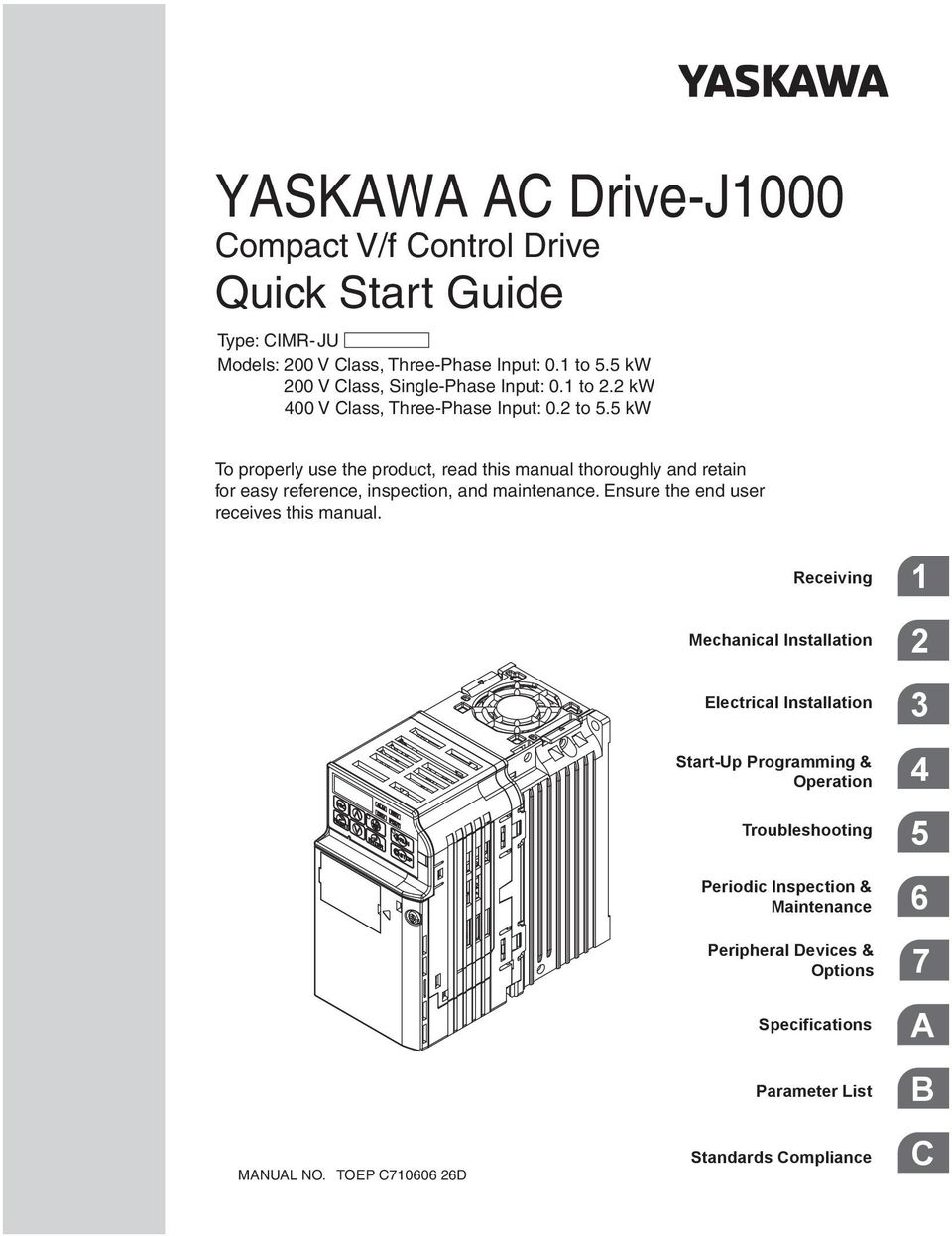
1 YASKAWA AC Drive-J1000 Compact V/f Control Drive Quick Start Guide Type: CIMR-JU Models: 200 V Class, Three-Phase Input: 0.1 to 5.5 kw 200 V Class, Single-Phase Input: 0.1 to 2.2 kw 400 V Class, Three-Phase Input: 0.2 to 5.5 kw To properly use the product, read this manual thoroughly and retain for easy reference, inspection, and maintenance. Ensure the end user receives this manual. Receiving 1 Mechanical Installation 2 Electrical Installation 3 Start-Up Programming & Operation 4 Troubleshooting 5 Periodic Inspection & Maintenance 6 Peripheral Devices & Options 7 MANUAL NO. TOEP C D Specifications Parameter List Standards Compliance A B C
2 Copyright 2008 YASKAWA ELECTRIC CORPORATION. All rights reserved. All rights reserved. No part of this publication may be reproduced, stored in a retrieval system, or transmitted, in any form or by any means, mechanical, electronic, photocopying, recording, or otherwise, without the prior written permission of Yaskawa. No patent liability is assumed with respect to the use of the information contained herein. Moreover, because Yaskawa is constantly striving to improve its high-quality products, the information contained in this manual is subject to change without notice. Every precaution has been taken in the preparation of this manual. Yaskawa assumes no responsibility for errors or omissions. Neither is any liability assumed for damages resulting from the use of the information contained in this publication.

3 Table of Contents i. PREFACE & GENERAL SAFETY...9 i.1 Preface Applicable Documentation...10 Symbols...10 Terms and Abbreviations...10 i.2 General Safety Supplemental Safety Information...11 Safety Messages...12 Drive Label Warnings...15 Warranty Information...16 Quick Reference RECEIVING Section Safety Model Number and Nameplate Check Nameplate Component Names IP20/Open-Chassis...22 Front Views MECHANICAL INSTALLATION...25 YASKAWA ELECTRIC TOEP C D YASKAWA AC Drive J1000 Quick Start Guide 3

4 Table of Contents 2.1 Section Safety Mechanical Installation Installation Environment...29 Installation Orientation and Spacing...30 Exterior and Mounting Dimensions ELECTRICAL INSTALLATION Section Safety Standard Connection Diagram Main Circuit Connection Diagram Single-Phase 200 V Class Models BA0001 to BA Three-Phase 200 V Class Models 2A0001 to 2A0020 Three-Phase 400 V Class Models 4A0001 to 4A Terminal Block Configuration Protective Covers IP20/Open-Chassis Cover Removal and Installation Main Circuit Wiring Main Circuit Terminal Functions...46 Wire Gauges and Tightening Torques...46 Main Circuit Terminal Power Supply and Motor Wiring Control Circuit Wiring Control Circuit Terminal Block Functions...53 Terminal Configuration...54 Wiring Procedure I/O Connections Sinking/Sourcing Mode Switch Main Frequency Reference DIP Switch S1 Analog Input Signal Selection Braking Resistor Installation Interlocking with Connected Machinery Drive Ready Signal Wiring Checklist YASKAWA ELECTRIC TOEP C D YASKAWA AC Drive J1000 Quick Start Guide

5 Table of Contents 4. START-UP PROGRAMMING & OPERATION Section Safety Using the Digital LED Operator Keys, Displays, and LEDs...73 Digital Text Display...75 LED Screen Displays...76 LO/RE LED and RUN LED Indications...76 Menu Structure for Digital LED Operator The Drive and Programming Modes Navigating the Drive and Programming Modes...80 Changing Parameter Settings or Values...83 Verifying Parameter Changes: Verify Menu...84 Switching Between LOCAL and REMOTE...85 Parameters Available in the Setup Group Start-up Flowchart Flowchart: Basic Start-up Basic Operation Initialize Parameter Values: A Frequency Reference Source: b Run Command Input Selection: b Stopping Method Selection: b Acceleration/Deceleration: C1-01 to C Drive Duty and Carrier Frequency Selection: C6-01 and C Multi-Step Speed Operation (4-Step Speed) E1: V/f Characteristics Motor Parameters: E2-01 to E Digital Output: H Analog Outputs: H4-01 to H Motor Protection: L1-01 and L Drive Status Monitors: U1-01 to U Powering Up the Drive Powering Up the Drive and Operation Status Display V/f Pattern Setting No-Load Operation Test Run No-Load Operation Test Run YASKAWA ELECTRIC TOEP C D YASKAWA AC Drive J1000 Quick Start Guide 5

6 Table of Contents 4.8 Test Run with Load Connected Test Run with the Load Connected Verifying and Backing Up Parameter Settings Parameter Access Level: A Password Settings: A1-04, A Copy Function (Optional) Test Run Checklist TROUBLESHOOTING Section Safety Motor Performance Fine Tuning Parameters for Tuning the Drive Motor Hunting and Oscillation Control Parameters Drive Alarms, Faults, and Errors Types of Alarms, Faults, and Errors Alarm and Error Displays Fault Detection Fault Displays, Causes, and Possible Solutions Alarm Detection Alarm Codes, Causes, and Possible Solutions Operator Programming Errors ope Codes, Causes, and Possible Solutions Diagnosing and Resetting Faults Fault Occurs Simultaneously with Power Loss If the Drive Still has Power After a Fault Occurs Viewing Fault History Data After Fault Fault Reset Methods Troubleshooting without Fault Display Cannot Change Parameter Settings Motor Does Not Rotate Properly after Pressing RUN Button or after Entering External Run Command PERIODIC INSPECTION & MAINTENANCE Section Safety YASKAWA ELECTRIC TOEP C D YASKAWA AC Drive J1000 Quick Start Guide

7 Table of Contents 6.2 Inspection Recommended Daily Inspection Recommended Periodic Inspection Periodic Maintenance Replacement Parts Drive Cooling Fans Number of Cooling Fans Cooling Fan Replacement PERIPHERAL DEVICES & OPTIONS Section Safety Drive Options and Peripheral Devices Connecting Peripheral Devices Installing Peripheral Devices Installing a Molded Case Circuit Breaker (MCCB) and Earth Leakage Circuit Breaker (ELCB) Application Precautions when Installing a GFCI Installing a Magnetic Contactor Connecting an AC Reactor or DC Link Choke Connecting a Surge Suppressor Connecting a Noise Filter EMC Filter Installation Zero-Phase Reactor Installing Fuses on the Input Side Attachment for External Heatsink Noise Filter Installation Installing a Motor Thermal Overload (ol) Relay on the Drive Output NEMA Type 1 Kit Options Interface Options Other Options A. SPECIFICATIONS A.1 Heavy Duty and Normal Duty Ratings YASKAWA ELECTRIC TOEP C D YASKAWA AC Drive J1000 Quick Start Guide 7

8 Table of Contents A.2 Single/Three-Phase 200 V Class Drives A.3 Three-Phase 400 V Class Drives A.4 Drive Specifications A.5 Drive Watt Loss Data A.6 Drive Derating Data Temperature Derating Altitude Derating B. PARAMETER LIST B.1 Parameter Groups B.2 Parameter Table A: Initialization Parameters b: Application C: Tuning d: References E: Motor Parameters H Parameters: Multi-Function Terminals L: Protection Function n: Advanced Performance Set-Up o: Operator Related Parameters U: Monitors B.3 Defaults by Drive Model and Duty Rating ND/HD C. STANDARDS COMPLIANCE C.1 Section Safety C.2 European Standards CE Low Voltage Directive Compliance EMC Guidelines Compliance C.3 UL Standards UL Standards Compliance Drive Motor Overload Protection INDEX YASKAWA ELECTRIC TOEP C D YASKAWA AC Drive J1000 Quick Start Guide

9 i Preface & General Safety This section provides safety messages pertinent to this product that, if not heeded, may result in fatality, personal injury, or equipment damage. Yaskawa is not responsible for the consequences of ignoring these instructions. i.1 PREFACE...10 i.2 GENERAL SAFETY...11 YASKAWA ELECTRIC TOEP C D YASKAWA AC Drive J1000 Quick Start Guide 9

10 i.1 Preface i.1 Preface Yaskawa manufactures products used as components in a wide variety of industrial systems and equipment. The selection and application of Yaskawa products remain the responsibility of the equipment manufacturer or end user. Yaskawa accepts no responsibility for the way its products are incorporated into the final system design. Under no circumstances should any Yaskawa product be incorporated into any product or design as the exclusive or sole safety control. Without exception, all controls should be designed to detect faults dynamically and fail safely under all circumstances. All systems or equipment designed to incorporate a product manufactured by Yaskawa must be supplied to the end user with appropriate warnings and instructions as to the safe use and operation of that part. Any warnings provided by Yaskawa must be promptly provided to the end user. Yaskawa offers an express warranty only as to the quality of its products in conforming to standards and specifications published in the Yaskawa manual. NO OTHER WARRANTY, EXPRESS OR IMPLIED, IS OFFERED. Yaskawa assumes no liability for any personal injury, property damage, losses, or claims arising from misapplication of its products. u Applicable Documentation The following manuals are available for J1000 series drives: J1000 Series Compact V/f Control Drive Quick Start Guide Read this manual first. This guide is packaged together with the product. It contains basic information required to install and wire the drive. This guide provides basic programming and simple setup and adjustment. Refer to the J1000 Technical Manual for complete descriptions of drive features and functions. J1000 Series Compact V/f Control Drive Technical Manual This manual describes installation, wiring, operation procedures, functions, troubleshooting, maintenance, and inspections to perform before operation. u Symbols Note: TERMS Indicates a supplement or precaution that does not cause drive damage. Indicates a term or definition used in this manual. u Terms and Abbreviations Drive: Yaskawa J1000 Series Drive r/min: Revolutions per Minute SI-485/J: RS-422/RS-485 Interface for MEMOBUS/Modbus Communication V/f: V/f Control 10 YASKAWA ELECTRIC TOEP C D YASKAWA AC Drive J1000 Quick Start Guide

11 i.2 General Safety i.2 General Safety u Supplemental Safety Information General Precautions The diagrams in this manual may be indicated without covers or safety shields to show details. Restore covers or shields before operating the drive and run the drive according to the instructions described in this manual. Any illustrations, photographs, or examples used in this manual are provided as examples only and may not apply to all products to which this manual is applicable. The products and specifications described in this manual or the content and presentation of the manual may be changed without notice to improve the product and/or the manual. When ordering a new copy of the manual due to damage or loss, contact your Yaskawa representative or the nearest Yaskawa sales office and provide the manual number shown on the front cover. If nameplate becomes worn or damaged, order a replacement from your Yaskawa representative or the nearest Yaskawa sales office. WARNING Read and understand this manual before installing, operating or servicing this drive. The drive must be installed according to this manual and local codes. The following conventions are used to indicate safety messages in this manual. Failure to heed these messages could result in serious or possibly even fatal injury or damage to the products or to related equipment and systems. DANGER Indicates a hazardous situation, which, if not avoided, will result in death or serious injury. WARNING Indicates a hazardous situation, which, if not avoided, could result in death or serious injury. WARNING! will also be indicated by a bold key word embedded in the text followed by an italicized safety message. YASKAWA ELECTRIC TOEP C D YASKAWA AC Drive J1000 Quick Start Guide 11

12 i.2 General Safety CAUTION Indicates a hazardous situation, which, if not avoided, could result in minor or moderate injury. CAUTION! will also be indicated by a bold key word embedded in the text followed by an italicized safety message. Indicates a property damage message. NOTICE NOTICE: will also be indicated by a bold key word embedded in the text followed by an italicized safety message. u Safety Messages DANGER Heed the safety messages in this manual. Failure to comply will result in death or serious injury. The operating company is responsible for any injuries or equipment damage resulting from failure to heed the warnings in this manual. Electrical Shock Hazard Do not connect or disconnect wiring while the power is on. Failure to comply will result in death or serious injury. Before servicing, disconnect all power to the equipment. The internal capacitor remains charged even after the power supply is turned off. The charge indicator LED will extinguish when the DC bus voltage is below 50 Vdc. To prevent electric shock, wait at least one minute after all indicators are OFF and measure the DC bus voltage level to confirm safe level. 12 YASKAWA ELECTRIC TOEP C D YASKAWA AC Drive J1000 Quick Start Guide

13 i.2 General Safety WARNING Sudden Movement Hazard System may start unexpectedly upon application of power, resulting in death or serious injury. Clear all personnel from the drive, motor and machine area before applying power. Secure covers, couplings, shaft keys and machine loads before applying power to the drive. Electrical Shock Hazard Do not attempt to modify or alter the drive in any way not explained in this manual. Failure to comply could result in death or serious injury. Yaskawa is not responsible for any modification of the product made by the user. This product must not be modified. Do not allow unqualified personnel to use equipment. Failure to comply could result in death or serious injury. Maintenance, inspection, and replacement of parts must be performed only by authorized personnel familiar with installation, adjustment and maintenance of AC drives. Do not remove covers or touch circuit boards while the power is on. Failure to comply could result in death or serious injury. Fire Hazard Do not use an improper voltage source. Failure to comply could result in death or serious injury by fire. Verify that the rated voltage of the drive matches the voltage of the incoming power supply before applying power. Crush Hazard Do not use this drive in lifting applications without installing external safety circuitry to prevent accidental dropping of the load. The drive does not possess built-in load drop protection for lifting applications. Failure to comply could result in death or serious injury from falling loads. Install electrical and/or mechanical safety circuit mechanisms independent of drive circuitry. YASKAWA ELECTRIC TOEP C D YASKAWA AC Drive J1000 Quick Start Guide 13

14 i.2 General Safety CAUTION Crush Hazard Do not carry the drive by the front cover. Failure to comply may result in minor or moderate injury from the main body of the drive falling. NOTICE Observe proper electrostatic discharge procedures (ESD) when handling the drive and circuit boards. Failure to comply may result in ESD damage to the drive circuitry. Never connect or disconnect the motor from the drive while the drive is outputting voltage. Improper equipment sequencing could result in damage to the drive. Do not perform a withstand voltage test on any part of the drive. Failure to comply could result in damage to the sensitive devices within the drive. Do not operate damaged equipment. Failure to comply could result in further damage to the equipment. Do not connect or operate any equipment with visible damage or missing parts. Install adequate branch circuit short circuit protection per applicable codes. Failure to comply could result in damage to the drive. The drive is suitable for circuits capable of delivering not more than 31,000 RMS symmetrical Amperes, 240 Vac maximum (200 V Class) and 480 Vac maximum (400 V Class). Do not expose the drive to halogen group disinfectants. Failure to comply may cause damage to the electrical components in the drive. Do not pack the drive in wooden materials that have been fumigated or sterilized. Do not sterilize the entire package after the product is packed. 14 YASKAWA ELECTRIC TOEP C D YASKAWA AC Drive J1000 Quick Start Guide

15 i.2 General Safety u Drive Label Warnings Always heed the warning information listed in Figure i.1 in the position shown in Figure i. 2. WARNING Risk of electric shock. Read manual before installing. Wait 1 minute for capacitor discharge after disconnecting power supply. To conform to requirements, make sure to ground the supply neutral for 400V class. Figure i.1 Warning Information Warning Label Figure i.2 Warning Information Position YASKAWA ELECTRIC TOEP C D YASKAWA AC Drive J1000 Quick Start Guide 15

16 i.2 General Safety u Warranty Information Restrictions The drive was not designed or manufactured for use in devices or systems that may directly affect or threaten human lives or health. Customers who intend to use the product described in this manual for devices or systems relating to transportation, health care, space aviation, atomic power, electric power, or in underwater applications must first contact their Yaskawa representatives or the nearest Yaskawa sales office. This product has been manufactured under strict quality-control guidelines. However, if this product is to be installed in any location where failure of this product could involve or result in a life-and-death situation or loss of human life or in a facility where failure may cause a serious accident or physical injury, safety devices must be installed to minimize the likelihood of any accident. u Quick Reference Run a Motor of One-Frame Larger Capacity When using this drive for variable torque loads such as fans and pumps, a motor one frame size larger can be used. Know the Details of Safety Measures The functions listed below affect the safe operation of the drive. Ensure that the settings fit the application requirements prior to operation. Safe operations. Run by power on. Parameter setting b1-17. LED operator stop key priority selection. Parameter o2-02. Enter press required after changing the keypad frequency reference. Parameter o2-05. Operation interlock when program mode is selected. Parameter b1-08. Standards Compliance Refer to European Standards on page 245 and Refer to UL Standards on page YASKAWA ELECTRIC TOEP C D YASKAWA AC Drive J1000 Quick Start Guide

17 1 Receiving This chapter describes the proper inspections to perform after receiving the drive and illustrates the different enclosure types and components. 1.1 SECTION SAFETY MODEL NUMBER AND NAMEPLATE CHECK COMPONENT NAMES...22 YASKAWA ELECTRIC TOEP C D YASKAWA AC Drive J1000 Quick Start Guide 17

18 1.1 Section Safety 1.1 Section Safety CAUTION Do not carry the drive by the front cover. Failure to comply may cause the main body of the drive to fall, resulting in minor or moderate injury. NOTICE Observe proper electrostatic discharge procedures (ESD) when handling the drive and circuit boards. Failure to comply may result in ESD damage to the drive circuitry. A motor connected to a PWM drive may operate at a higher temperature than a utilityfed motor and the operating speed range may reduce motor cooling capacity. Ensure that the motor is suitable for drive duty and/or the motor service factor is adequate to accommodate the additional heating with the intended operating conditions. 18 YASKAWA ELECTRIC TOEP C D YASKAWA AC Drive J1000 Quick Start Guide

19 1.2 Model Number and Nameplate Check 1.2 Model Number and Nameplate Check Please perform the following tasks after receiving the drive: Inspect the drive for damage. If the drive appears damaged upon receipt, contact the shipper immediately. Verify receipt of the correct model by checking the information on the nameplate. If you have received the wrong model or the drive does not function properly, contact your supplier. u Nameplate I H G F E MODEL : CIMR-J MAX APPLI. MOTOR : 3.5A/3.0A REV : A INPUT : AC3PH V 50 / 60Hz 2.7A / 1.4A IND.CONT.EQ. OUTPUT : AC3PH 0-240V 0-400Hz 1.2A / 0.8A 7J48 MASS : 0.9 kg O / N : S / N : A B Receiving 1 D FILE NO : E IP20 PASS YASKAWA ELECTRIC CORPORATION MADE IN JAPAN 2-1 Kurosaki-shiroishi, Yahatanishi-Ku, Kitakyushu Japan C A Normal Duty Amps / Heavy Duty Amps B Software version C Enclosure type D Address <1> E Serial number F Lot number G Output specifications H Input specifications I AC drive model Figure 1.1 Nameplate Information Example <1> The address of the head office of Yaskawa Electric Corporation (responsible for product liability) is shown on the nameplate. YASKAWA ELECTRIC TOEP C D YASKAWA AC Drive J1000 Quick Start Guide 19

20 1.2 Model Number and Nameplate Check CIMR - J U 2 A 0001 B A A Drive No. A B C T U J1000 Series Region Code Japan China Europe Asia USA No. A Customized Specifications Standard model No. Enclosure Type B No. A M N S IP20/Open- Chassis Environmental Specification <1> Standard Humidity- and dust-resistant Oil-resistant Vibration-resistant Design Revision Order No. B 2 4 Voltage Class 1-phase, Vac 3-phase, Vac 3-phase, Vac Single-Phase 200 V No. Normal Duty Max. Motor Capacity kw Rated Output Current A Refer to the tables below. No. Heavy Duty Max. Motor Capacity kw Rated Output Current A Three-Phase 200 V No. Normal Duty Max Motor Capacity kw Rated Output Current A No. Heavy Duty Max Motor Capacity kw Rated Output Current A YASKAWA ELECTRIC TOEP C D YASKAWA AC Drive J1000 Quick Start Guide

21 1.2 Model Number and Nameplate Check Three-Phase 400 V No. Normal Duty Max. Motor Capacity kw Rated Output Current A No. Heavy Duty Max. Motor Capacity kw Rated Output Current A Receiving 1 YASKAWA ELECTRIC TOEP C D YASKAWA AC Drive J1000 Quick Start Guide 21
22 1.3 Component Names 1.3 Component Names This section illustrates drive components in the IP20/Open-Chassis models. Refer to NEMA Type 1 Kit on page 193 for information on using the NEMA Type 1 Kit option to create a NEMA Type 1 rating. u IP20/Open-Chassis Single-Phase AC 200 V BA0001B to BA0003B Three-Phase AC 200 V 2A0001B to 2A0006B J K I A H B F G C E D A Mounting hole B Heatsink C Cable cover D Terminal cover E Front cover screw F Option connector cover G Front cover H LED operator Refer to Using the Digital LED Operator on page 73 I Case J Cooling fan <1> K Fan cover <1> Figure 1.2 Exploded View of IP20/Open-Chassis Type Components (Model 2A0006B) <1> Models BA0001B to BA0003B and 2A0001B to 2A0004B do not have a cooling fan or a cooling fan cover. 22 YASKAWA ELECTRIC TOEP C D YASKAWA AC Drive J1000 Quick Start Guide
23 1.3 Component Names Single-Phase AC 200 V BA0006B to BA0010B Three-Phase AC 200 V 2A0010B to 4A0020B Three-Phase AC 400 V 4A0001B to 4A0011B L K J A I B Receiving 1 G H C D F E A Mounting hole B Heatsink C Cable cover D Terminal cover E Bottom cover F Front cover screw G Option connector cover H Front cover I LED operator Refer to Using the Digital LED Operator on page 73 J Case K Cooling fan <1> L Fan cover <1> Figure 1.3 Exploded view of IP20/Open-Chassis Type Components (Model 2A0012B) <1> Models BA0006B and 4A0001B to 4A0004B do not have a cooling fan or a cooling fan cover. YASKAWA ELECTRIC TOEP C D YASKAWA AC Drive J1000 Quick Start Guide 23
24 1.3 Component Names u Front Views 2A0006B 2A0012B G A B G A B F C D F C D E E A DIP switch S1 Refer to DIP Switch S1 Analog Input Signal Selection on page 62 B DIP switch S3 Refer to Sinking/Sourcing Mode Switch on page 59 C Control circuit terminal Refer to Control Circuit Wiring on page 52 D Main circuit terminal Refer to Wiring the Main Circuit Terminal on page 51 Figure 1.4 Front Views of Drives E Ground terminal F Terminal cover G Option unit connector Refer to Options on page YASKAWA ELECTRIC TOEP C D YASKAWA AC Drive J1000 Quick Start Guide
25 2 Mechanical Installation This chapter explains how to properly mount and install the drive. 2.1 SECTION SAFETY MECHANICAL INSTALLATION...29 YASKAWA ELECTRIC TOEP C D YASKAWA AC Drive J1000 Quick Start Guide 25
26 2.1 Section Safety 2.1 Section Safety WARNING Fire Hazard Provide sufficient cooling with a fan or air conditioning unit when installing the drive inside an enclosed panel or cabinet. Failure to comply could result in overheating and fire. The airflow over an IP20/Open-Chassis drive should be less than 50 C, while an IP20/ NEMA Type 1 drive using the NEMA Type 1 Kit option should have an airflow cooler than 40 C. CAUTION Crush Hazard Do not carry the drive by the front cover. Failure to comply may result in minor or moderate injury from the main body of the drive falling. 26 YASKAWA ELECTRIC TOEP C D YASKAWA AC Drive J1000 Quick Start Guide
27 2.1 Section Safety NOTICE Observe proper electrostatic discharge (ESD) procedures when handling the drive. Failure to comply could result in ESD damage to the drive circuitry. It may be difficult to perform maintenance on the cooling fans of drives installed in a vertical row inside an enclosure. Ensure adequate spacing at the top of the drive to perform cooling fan replacement when required. Operating the motor in the low-speed range diminishes the cooling effects, increases motor temperature, and may lead to motor damage by overheating. Reduce the motor torque in the low-speed range whenever using a standard blower cooled motor. If 100% torque is required continuously at low speed, consider using a special drive or vector motor. Select a motor that is compatible with the required load torque and operating speed range. Do not operate motors above the maximum rated RPM. Failure to comply may lead to bearing or other mechanical motor failures. The speed range for continuous operation differs according to the lubrication method and motor manufacturer. If the motor is to be operated at a speed higher than the rated speed, consult with the manufacturer. Continuously operating an oil-lubricated motor in the low-speed range may result in burning. Mechanical Installation 2 YASKAWA ELECTRIC TOEP C D YASKAWA AC Drive J1000 Quick Start Guide 27
28 2.1 Section Safety NOTICE When the wiring distance is greater than 100 meters, pay special attention to the motor insulation voltage or use a drive-rated motor. Failure to comply could lead to motor winding failure. Motor vibration may increase when operating a machine in variable-speed mode, if that machine previously operated at a constant speed. Install vibration-proof rubber on the motor base or use the frequency jump function to skip a frequency resonating the machine. The motor may require more acceleration torque with drive operation than with a commercial power supply. Set a proper V/f pattern by checking the load torque characteristics of the machine to be used with the motor. The rated input current of submersible motors is higher than the rated input current of standard motors. Select an appropriate drive according to its rated output current. When the distance between the motor and drive is long, use a cable thick enough to connect the motor to the drive to prevent motor torque reduction. When using an explosion-proof motor, it must be subject to an explosion-proof test in conjunction with the drive. This is also applicable when an existing explosion-proof motor is to be operated with the drive. Since the drive itself is not explosion-proof, always install it in a safe place. Do not use a drive for a single-phase motor. Replace the motor with a three-phase motor. If an oil-lubricated gearbox or speed reducer is used in the power transmission mechanism, oil lubrication will be affected when the motor operates only in the low speed range. The power transmission mechanism will make noise and experience problems with service life and durability if the motor is operated at a speed higher than the rated speed. 28 YASKAWA ELECTRIC TOEP C D YASKAWA AC Drive J1000 Quick Start Guide
29 2.2 Mechanical Installation 2.2 Mechanical Installation This section outlines specifications, procedures, and environment for proper mechanical installation of the drive. u Installation Environment To help prolong the optimum performance life of the drive, install the drive in the proper environment. The table below provides a description of the appropriate environment for the drive. Environment Installation Area Ambient Temperature Humidity Indoors Table 2.1 Installation Environment Conditions IP20/NEMA Type 1 enclosure: -10 C to +40 C (14 F to 104 F) IP20/IP00 Open-Chassis enclosure: -10 C to +50 C (14 F to 122 F) Finless Type: IP20 enclosure: -10 C to +50 C (14 F to 122 F) Drive reliability improves in environments without wide temperature fluctuations. When using an enclosure panel, install a cooling fan or air conditioner in the area to ensure that the air temperature inside the enclosure does not exceed the specified levels. Do not allow ice to develop on the drive. 95% RH or less and free of condensation Storage Temperature -20 C to +60 C (-4 F to +104 F) Surrounding Area Altitude Vibration Orientation Install the drive in an area free from: oil mist and dust metal shavings, oil, water or other foreign materials radioactive materials combustible materials (e.g., wood) harmful gases and liquids excessive vibration chlorides direct sunlight Up to 1000 meters without derating; up to 3000 meters with output current, ambient temperature, and voltage derating. 10 to 20 Hz at 9.8 m/s 2 20 to 55 Hz at 5.9 m/s 2 Install the drive vertically to maintain maximum cooling effects. Mechanical Installation 2 NOTICE: Prevent foreign matter such as metal shavings or wire clippings from falling into the drive during installation and project construction. Failure to comply could result in damage to the drive. Place a temporary cover over the top of the drive during installation. Remove the temporary cover before startup, as the cover will reduce ventilation and cause the drive to overheat. NOTICE: Avoid placing drive peripheral devices, transformers, or other electronics near the drive. Failure to comply could result in erroneous operation. If such devices must be used in close proximity to the drive, take proper steps to shield the drive from noise. YASKAWA ELECTRIC TOEP C D YASKAWA AC Drive J1000 Quick Start Guide 29
30 2.2 Mechanical Installation u Installation Orientation and Spacing Install the drive upright as illustrated in Figure 2.1 to maintain proper cooling. A B B A Correct B Incorrect Figure 2.1 Correct Installation Orientation Single Drive Installation Figure 2.2 explains the required installation spacing to maintain sufficient space for airflow and wiring. Install the heatsink against a closed surface to avoid diverting cooling air around the heatsink. Side Clearance Top/Bottom Clearance A A C B C A 30 mm minimum B Airflow direction C 100 mm minimum Figure 2.2 Correct Installation Spacing Note: The space required on the left and right sides of the drive are the same for IP20/Open-Chassis drives and IP20/NEMA Type 1 drives using the NEMA Type 1 Kit option. 30 YASKAWA ELECTRIC TOEP C D YASKAWA AC Drive J1000 Quick Start Guide
31 2.2 Mechanical Installation Multiple Drive Installation When installing multiple drives into the same enclosure panel, mount the drives according to Figure 2.2. When mounting drives with a minimum side-by-side clearance of 2 mm according to Figure 2.3, derating must be considered and parameter L8-35 must be set. Refer to Parameter List on page 213. A B 2 mm B C A Line up the tops of the drives. B 30 mm minimum C C 100 mm minimum D Airflow direction Figure 2.3 Space Between Drives (Side-by-Side Mounting) D Mechanical Installation 2 Note: When installing drives of different heights in the same enclosure panel, the tops of the drives should line up. Leave space between the top and bottom of stacked drives for cooling fan replacement if required. Using this method, it is possible to replace the cooling fans later. YASKAWA ELECTRIC TOEP C D YASKAWA AC Drive J1000 Quick Start Guide 31
32 2.2 Mechanical Installation u Exterior and Mounting Dimensions Refer to NEMA Type 1 Kit on page 193 for exterior and mounting dimensions for drives using the NEMA Type 1 Kit option. IP20/Open-Chassis Drives Table 2.2 IP20/Open-Chassis (without an EMC filter) W1 2-M4 D2 t1 H1 H W H2 D D1 Voltage Class Single-Phase 200 V Class Three-Phase 200 V Class Drive Model BA0001B BA0002B BA0003B 2A0001B 2A0002B 2A0004B 2A0006B Dimensions mm (in) W H D W1 H1 H2 D1 D2 t1 68 (2.7) 68 (2.7) 68 (2.7) 68 (2.7) 68 (2.7) 68 (2.7) 68 (2.7) 128 (5.0) 128 (5.0) 128 (5.0) 128 (5.0) 128 (5.0) 128 (5.0) 128 (5.0) 76 (3.0) 76 (3.0) 118 (4.6) 76 (3.0) 76 (3.0) 108 (4.3) 128 (5.0) 56 (2.2) 56 (2.2) 56 (2.2) 56 (2.2) 56 (2.2) 56 (2.2) 56 (2.2) 118 (4.6) 118 (4.6) 118 (4.6) 118 (4.6) 118 (4.6) 118 (4.6) 118 (4.6) 5 (0.2) 5 (0.2) 5 (0.2) 5 (0.2) 5 (0.2) 5 (0.2) 5 (0.2) 6.5 (0.3) 6.5 (0.3) 38.5 (1.5) 6.5 (0.3) 6.5 (0.3) 38.5 (1.5) 58.5 (2.3) 67.5 (2.7) 67.5 (2.7) (4.3) 67.5 (2.7) 67.5 (2.7) 99.5 (3.9) (4.7) 3 (0.1) 3 (0.1) 5 (0.2) 3 (0.1) 3 (0.1) 5 (0.2) 5 (0.2) Wt. kg (lb.) 0.6 (1.3) 0.6 (1.3) 1.0 (2.2) 0.6 (1.3) 0.6 (1.3) 0.9 (2.0) 1.1 (2.4) 32 YASKAWA ELECTRIC TOEP C D YASKAWA AC Drive J1000 Quick Start Guide
33 2.2 Mechanical Installation Table 2.3 IP20/Open-Chassis (without an EMC filter) W1 4-M4 D2 Voltage Class Single-Phase 200 V Class Three-Phase 200 V Class W Drive Model BA0006B BA0010B 2A0010B 2A0012B 2A0020B H2 H1 H D Dimensions mm (in) W H D W1 H1 H2 D1 D2 t1 108 (4.3) 108 (4.3) 108 (4.3) 108 (4.3) 140 (5.5) 128 (5.0) 128 (5.0) 128 (5.0) 128 (5.0) 128 (5.0) (5.4) 154 (6.1) 129 (5.1) (5.6) 96 (3.8) 96 (3.8) 96 (3.8) 96 (3.8) 128 (5.0) 118 (4.6) 118 (4.6) 118 (4.6) 118 (4.6) 118 (4.6) 5 (0.2) 5 (0.2) 5 (0.2) 5 (0.2) 5 (0.2) 58 (2.3) 58 (2.3) 58 (2.3) 58 (2.3) 65 (2.6) 129 (5.1) (5.7) (4.7) 129 (5.1) (5.3) D1 t1 5 (0.2) 5 (0.2) 5 (0.2) 5 (0.2) 5 (0.2) Wt. kg (lb.) 1.7 (3.8) 1.8 (4.0) 1.7 (3.8) 1.7 (3.8) 2.4 (5.3) Mechanical Installation 2 YASKAWA ELECTRIC TOEP C D YASKAWA AC Drive J1000 Quick Start Guide 33
34 2.2 Mechanical Installation W1 4-M4 D2 W H2 H1 H D D1 t1 Voltage Class Three-Phase 400 V Class Drive Model 4A0001B 4A0002B 4A0004B 4A0005B 4A0007B 4A0009B 4A0011B Dimensions mm (in) W H D W1 H1 H2 D1 D2 t1 108 (4.3) 108 (4.3) 108 (4.3) 108 (4.3) 108 (4.3) 108 (4.3) 140 (5.5) 128 (5.0) 128 (5.0) 128 (5.0) 128 (5.0) 128 (5.0) 128 (5.0) 128 (5.0) 81 (3.2) 99 (3.9) (5.4) 154 (6.1) 154 (6.1) 154 (6.1) 143 ( (3.8) 96 (3.8) 96 (3.8) 96 (3.8) 96 (3.8) 96 (3.8) 128 (5.0) 118 (4.6) 118 (4.6) 118 (4.6) 118 (4.6) 118 (4.6) 118 (4.6) 118 (4.6) 5 (0.2) 5 (0.2) 5 (0.2) 5 (0.2) 5 (0.2) 5 (0.2) 5 (0.2) 10 (0.4) 28 (1.1) 58 (2.3) 58 (2.3) 58 (2.3) 58 (2.3) 65 (2.6) 72.5 (2.9) 90.5 (3.6) 129 (5.1) (5.7) (5.7) (5.7) (5.3) 5 (0.2) 5 (0.2) 5 (0.2) 5 (0.2) 5 (0.2) 5 (0.2) 5 (0.2) Wt. kg (lb.) 1.0 (2.2) 1.2 (2.7) 1.7 (3.8) 1.7 (3.8) 1.7 (3.8) 1.7 (3.8) 2.4 (5.3) 34 YASKAWA ELECTRIC TOEP C D YASKAWA AC Drive J1000 Quick Start Guide
35 3 Electrical Installation This chapter explains proper procedures for wiring the control circuit terminals, motor and power supply. 3.1 SECTION SAFETY STANDARD CONNECTION DIAGRAM MAIN CIRCUIT CONNECTION DIAGRAM TERMINAL BLOCK CONFIGURATION PROTECTIVE COVERS MAIN CIRCUIT WIRING CONTROL CIRCUIT WIRING I/O CONNECTIONS MAIN FREQUENCY REFERENCE BRAKING RESISTOR INTERLOCKING WITH CONNECTED MACHINERY WIRING CHECKLIST...67 YASKAWA ELECTRIC TOEP C D YASKAWA AC Drive J1000 Quick Start Guide 35
36 3.1 Section Safety 3.1 Section Safety DANGER Electrical Shock Hazard Do not connect or disconnect wiring while the power is on. Failure to comply will result in death or serious injury. WARNING Electrical Shock Hazard Do not operate equipment with covers removed. Failure to comply could result in death or serious injury. The diagrams in this section may show drives without covers or safety shields to show details. Be sure to reinstall covers or shields before operating the drives and run the drives according to the instructions described in this manual. Always ground the motor-side grounding terminal. Improper equipment grounding could result in death or serious injury by contacting the motor case. Do not perform work on the drive while wearing loose clothing, jewelry or without eye protection. Failure to comply could result in death or serious injury. Remove all metal objects such as watches and rings, secure loose clothing, and wear eye protection before beginning work on the drive. Do not remove covers or touch circuit boards while the power is on. Failure to comply could result in death or serious injury. Do not allow unqualified personnel to perform work on the drive. Failure to comply could result in death or serious injury. Installation, maintenance, inspection, and servicing must be performed only by authorized personnel familiar with installation, adjustment, and maintenance of AC drives. 36 YASKAWA ELECTRIC TOEP C D YASKAWA AC Drive J1000 Quick Start Guide
37 3.1 Section Safety WARNING Do not touch any terminals before the capacitors have fully discharged. Failure to comply could result in death or serious injury. Before wiring terminals, disconnect all power to the equipment. The internal capacitor remains charged even after the power supply is turned off. The charge indicator LED will extinguish when the DC bus voltage is below 50 Vdc. To prevent electric shock, wait at least one minute after all indicators are off and measure the DC bus voltage level to confirm safe level. Fire Hazard Tighten all terminal screws to the specified tightening torque. Loose electrical connections could result in death or serious injury by fire due to overheating of electrical connections. Do not use improper combustible materials. Failure to comply could result in death or serious injury by fire. Attach the drive to metal or other noncombustible material. Do not use an improper voltage source. Failure to comply could result in death or serious injury by fire. Verify that the rated voltage of the drive matches the voltage of the incoming power supply before applying power. Electrical Installation 3 YASKAWA ELECTRIC TOEP C D YASKAWA AC Drive J1000 Quick Start Guide 37
38 3.1 Section Safety NOTICE Observe proper electrostatic discharge procedures (ESD) when handling the drive and circuit boards. Failure to comply may result in ESD damage to the drive circuitry. Never connect or disconnect the motor from the drive while the drive is outputting voltage. Improper equipment sequencing could result in damage to the drive. Do not use unshielded cable for control wiring. Failure to comply may cause electrical interference resulting in poor system performance. Use shielded, twisted-pair wires and ground the shield to the ground terminal of the drive. Check all the wiring to ensure that all connections are correct after installing the drive and connecting any other devices. Failure to comply could result in damage to the drive. Do not modify the drive circuitry. Failure to comply could result in damage to the drive and will void warranty. Yaskawa is not responsible for any modification of the product made by the user. This product must not be modified. Route motor leads U/T1, V/T2, and W/T3 separate from other leads to reduce possible interference-related issues. Failure to comply may result in abnormal operation of drive and nearby equipment. 38 YASKAWA ELECTRIC TOEP C D YASKAWA AC Drive J1000 Quick Start Guide
39 3.2 Standard Connection Diagram 3.2 Standard Connection Diagram Connect the drive and peripheral devices as shown in Figure 3.. It is possible to run the drive via the digital operator without connecting digital I/O wiring. This section does not discuss drive operation; Refer to Start-Up Programming & Operation on page 69 for instructions on operating the drive. NOTICE: Inadequate branch short circuit protection could result in damage to the drive. Install adequate branch circuit short circuit protection per applicable codes. The drive is suitable for circuits capable of delivering not more than 31,000 RMS symmetrical amperes, 240 Vac maximum (200 V Class) and 480 Vac maximum (400 V Class). NOTICE: When the wiring distance is greater than 100 meters, pay special attention to the motor insulation voltage or use a drive duty motor. Failure to comply could lead to motor insulation breakdown. NOTICE: Correctly set Sink/Source jumper S3 for internal power supply. Failure to comply may result in damage to the drive. Refer to I/O Connections on page 59 for details. NOTICE: Do not connect AC control circuit ground to drive enclosure. Improper drive grounding can cause control circuit malfunction. NOTICE: Route motor leads U/T1, V/T2, and W/T3 separate from all other leads to reduce possible interference related issues. Failure to comply may result in abnormal operation of drive and nearby equipment. NOTICE: The minimum load for the multi-function relay output MA-MB-MC is 10 ma. Electrical Installation 3 YASKAWA ELECTRIC TOEP C D YASKAWA AC Drive J1000 Quick Start Guide 39
40 3.2 Standard Connection Diagram For single phase 200 V power supply, use R/L1 and S/L2. Three phase R/L1 power supply S/L2 for 200 V /400 V T/L3 2 MCCB THRX OFF ON MC 1 MCCB MC SA MC THRX Fault relay Forward run/stop Reverse run/stop External fault 2 MCCB r1 Thermal relay for SA Fault reset motor cooling fan Multi-step TRX speed 1 MC SA main/aux switch TRX MC _ Terminals +1, +2,, B1, and B2 are for connecting options. Never connect power supply lines to these terminals. MA <3> s1 t1 <4> R/L1 DC link choke (option) S/L2 Main circuit T/L3 S1 S2 S3 S4 S5 Jumper <1> J1000 Control circuit <2> Thermal relay (option) Braking resistor (option) B1 B2 +24 V 8 ma Option unit connector I U/T1 V/T2 W/T3 DIP switch S1 V r1 s1 t1 MA Fault Motor Cooling fan FU FV FW U V W M M Ground 10 or less (400 V class) 100 or less (200 V class) Digital output 250 Vac, 10 ma to 1 A 30 Vdc, 10 ma to 1 A (default setting) <6> MB Digital inputs (default setting) SC <5> DIP switch S3 Sink Source 24 V MC Shield ground terminal Main speed frequency reference. Multi-function programmable 2 k Setting power supply +V max. 20 ma A1 0 to +10 V (20 k ) (0)4 to 20 ma (250 ) AC AM AC Analog monitor + output AM 0 to +10 Vdc - (2 ma) Monitor output <7> shielded line main circuit terminal twisted-pair shielded line control terminal Figure 3.1 Drive Standard Connection Diagram (200 V Class Example) <1> Remove the jumper when installing an optional DC link choke. <2> The MC on the input side of the main circuit should open when the thermal relay is triggered. <3> Self-cooled motors do not require separate cooling fan motor wiring. <4> Connected using sequence input signal (S1 to S5) from NPN transistor; Default: sink mode (0 V com). <5> Use only a +24 V internal power supply in sinking mode; the source mode requires an external power supply. Refer to I/O Connections on page 59. <6> Minimum load: 5 Vdc, 10 ma (reference value). 40 YASKAWA ELECTRIC TOEP C D YASKAWA AC Drive J1000 Quick Start Guide
41 3.2 Standard Connection Diagram <7> Monitor outputs work with devices such as analog frequency meters, ammeters, voltmeters and wattmeters; they are not intended for use as a feedback-type of signal. WARNING! Sudden Movement Hazard. Do not close the wiring for the control circuit unless the multifunction input terminal parameter is properly set (S5 for 3-Wire; H1-05 = 0 ). Improper sequencing of run/stop circuitry could result in death or serious injury from moving equipment. WARNING! Sudden Movement Hazard. Ensure start/stop and safety circuits are wired properly and in the correct state before energizing the drive. Failure to comply could result in death or serious injury from moving equipment. When programmed for 3-Wire control, a momentary closure on terminal S1 may cause the drive to start. WARNING! When 3-Wire sequence is used, set the drive to 3-Wire sequence before wiring the control terminals and ensure parameter b1-17 is set to 0 (drive does not accept a run command at power up (default). If the drive is wired for 3-Wire sequence but set up for 2-Wire sequence (default) and if parameter b1-17 is set to 1 (drive accepts a Run command at power up), the motor will rotate in reverse direction at power up of the drive and may cause injury. Figure 3.2 illustrates an example of a 3-Wire sequence. Stop relay (N.C.) Run relay (N.O.) S1 S2 S5 SC Drive Run command (run on momentary close) Stop command (stop on momentary open) Foward/reverse command (multi-function input: H1-05 = 0) Sequence input common Figure Wire Sequence Electrical Installation 3 YASKAWA ELECTRIC TOEP C D YASKAWA AC Drive J1000 Quick Start Guide 41
42 3.3 Main Circuit Connection Diagram 3.3 Main Circuit Connection Diagram Refer to diagrams in this section for the Main Circuit wiring connections. Connections may vary based on drive capacity. The main circuit DC power supply powers the control circuit. NOTICE: Do not use the negative DC bus terminal - as a ground terminal. This terminal is at high voltage DC potential. Improper wiring connections could result in damage to the drive. u Single-Phase 200 V Class Models BA0001 to BA0010 Jumper DC link choke (option) Braking Resistor Unit (option) Single-phase 200 Vac R/L1 S/L B1 Drive B2 U/T1 V/T2 W/T3 Motor Figure 3.3 Connecting Single-Phase Main Circuit Terminals NOTICE: Do not connect T/L3 terminal when using single-phase power supply input. Incorrect wiring may damage the drive. u Three-Phase 200 V Class Models 2A0001 to 2A0020 Three-Phase 400 V Class Models 4A0001 to 4A0011 Jumper DC link choke (option) Braking Resistor Unit (option) B1 B2 Three phase 200 Vac (400 Vac) R/L1 S/L2 T/L3 Drive U/T1 V/T2 W/T3 Motor Figure 3.4 Connecting Three-Phase Main Circuit Terminals 42 YASKAWA ELECTRIC TOEP C D YASKAWA AC Drive J1000 Quick Start Guide
43 3.4 Terminal Block Configuration 3.4 Terminal Block Configuration The figures in this section provide illustrations of the main circuit terminal block configurations of the different drive sizes. Models: CIMR-J BA0001, 0002, 0003 CIMR-J 2A0001, 0002, 0004, 0006 Models: CIMR-J BA0006, 0010 CIMR-J 2A0010, 0012, 0020 CIMR-J 4A0001, 0002, 0004, 0005, 0007, 0009, 0011 Electrical Installation 3 Figure 3.5 Main Circuit Terminal Block Configurations YASKAWA ELECTRIC TOEP C D YASKAWA AC Drive J1000 Quick Start Guide 43
44 3.5 Protective Covers 3.5 Protective Covers Follow the procedure below to remove the protective covers before wiring the drive and to reattach the covers after wiring is complete. u IP20/Open-Chassis Cover Removal and Installation Removing the Protective Covers 1. Loosen the screw that locks the front cover in place to remove. Figure 3.6 Remove the Front Cover on an IP20/Open-Chassis Drive 2. Apply pressure to the tabs on each side of the terminal cover. Pull the terminal cover away from the drive while pushing in on the tabs to pull the cover free. Figure 3.7 Remove the Terminal Cover on an IP20/Open-Chassis Drive 44 YASKAWA ELECTRIC TOEP C D YASKAWA AC Drive J1000 Quick Start Guide
45 3.5 Protective Covers Reattaching the Protective Covers Properly connect all wiring and route power wiring away from control signal wiring. Reattach all protective covers when wiring is complete. Apply only a small amount of pressure to lock the cover back into place. Figure 3.8 Reattach the Protective Covers on an IP20/Open-Chassis Drive Electrical Installation 3 YASKAWA ELECTRIC TOEP C D YASKAWA AC Drive J1000 Quick Start Guide 45
46 3.6 Main Circuit Wiring 3.6 Main Circuit Wiring This section describes the functions, specifications, and procedures required to safely and properly wire the main circuit of the drive. NOTICE: Do not solder the ends of wire connections to the drive. Soldered wiring connections can loosen over time. Improper wiring practices could result in drive malfunction due to loose terminal connections. u Main Circuit Terminal Functions Table 3.1 Main Circuit Terminal Functions Terminal Type Function Reference R/L1 S/L2 T/L3 U/T1 V/T2 W/T3 B1 B Main circuit power supply input Connects line power to the drive. Drives with single-phase 200 V input power use terminals R/ L1 and S/L2 only. Do NOT use T/L3. Drive output Connects to the motor. 49 Braking resistor DC link choke connection DC power supply input Available for connecting a braking resistor or the braking resistor unit option. These terminals are shorted at shipment. Remove the shorting bar between 1 and 2 when connecting a DC link choke to this terminal. For connecting a DC power supply. (2 terminals) Ground Grounding Terminal 49 u Wire Gauges and Tightening Torques Select the appropriate wires and crimp terminals from Table 3.2 through Table 3.4. Note: 1. Wire gauge recommendations based on drive continuous current ratings using 75 C 600 Vac vinylsheathed wire assuming ambient temperature within 30 C and wiring distance shorter than 100 m. 2. Terminals 1, 2,, B1 and B2 are for connecting optional devices such as a braking resistor. Do not connect other non-specified devices to these terminals. Consider the amount of voltage drop when selecting wire gauges. Increase the wire gauge when the voltage drop is greater than 2% of motor rated voltage. Ensure the wire gauge is suitable for the terminal block. Use the following formula to calculate the amount of voltage drop: Line drop voltage (V) = 3 x wire resistance (Ω/km) x wire length (m) x current (A) x 10-3 Refer to instruction manual TOBP C for braking unit or braking resistor unit wire gauges. 46 YASKAWA ELECTRIC TOEP C D YASKAWA AC Drive J1000 Quick Start Guide
47 3.6 Main Circuit Wiring Refer to UL Standards Compliance on page 254 for information on UL compliance. Single-Phase 200 V Class Drive Model BA0001 BA0002 BA0003 Terminal Table 3.2 Wire Gauge and Torque Specifications Recomm. Gauge AWG, kcmil Wire Range AWG, kcmil R/L1, S/L2, T/L to 14 U/T1, V/T2, W/T to 14, 1, 2 18 to 14 B1, B2 18 to to 14 R/L1, S/L2, T/L to 10 Screw Size M3.5 Tightening Torque N m (lb.in.) 0.8 to 1.0 (7.1 to 8.9) BA0006 BA0010 U/T1, V/T2, W/T to 10, 1, 2 14 to 10 B1, B2 14 to to 10 R/L1, S/L2, T/L to 10 U/T1, V/T2, W/T to 10, 1, 2 14 to 10 B1, B2 14 to 10 Three-Phase 200 V Class Drive Model 2A0001 2A0002 2A0004 2A0006 Terminal to 10 Table 3.3 Wire Gauge and Torque Specifications Recomm. Gauge AWG, kcmil Wire Range AWG, kcmil R/L1, S/L2, T/L to 14 U/T1, V/T2, W/T to 14, 1, 2 18 to 14 B1, B2 18 to to 14 M4 M4 Screw Size M to 1.5 (10.6 to 13.3) 1.2 to 1.5 (10.6 to 13.3) Tightening Torque N m (lb.in.) 0.8 to 1.0 (7.1 to 8.9) Electrical Installation 3 YASKAWA ELECTRIC TOEP C D YASKAWA AC Drive J1000 Quick Start Guide 47
48 3.6 Main Circuit Wiring Drive Model Terminal Recomm. Gauge AWG, kcmil Wire Range AWG, kcmil Screw Size Tightening Torque N m (lb.in.) R/L1, S/L2, T/L to 10 U/T1, V/T2, W/T to 10 2A0010, 1, 2 14 to 10 B1, B2 14 to 10 M4 1.2 to 1.5 (10.6 to 13.3) to 10 R/L1, S/L2, T/L to 10 U/T1, V/T2, W/T to 10 2A0012, 1, 2 14 to 10 B1, B2 14 to 10 M4 1.2 to 1.5 (10.6 to 13.3) to 10 R/L1, S/L2, T/L to 10 U/T1, V/T2, W/T to 10 2A0020, 1, 2 14 to 10 B1, B2 14 to 10 M4 1.2 to 1.5 (10.6 to 13.3) to 10 Three-Phase 400 V Class Drive Model 4A0001 4A0002 4A0004 Terminal Table 3.4 Wire Gauge and Torque Specifications Recomm. Gauge AWG, kcmil Wire Range AWG, kcmil R/L1, S/L2, T/L to 10 U/T1, V/T2, W/T to 10, 1, 2 14 to 10 B1, B2 14 to 10 Screw Size M4 Tightening Torque N m (lb.in.) 1.2 to 1.5 (10.6 to 13.3) to 10 R/L1, S/L2, T/L to 10 4A0005 4A0007 4A0009 U/T1, V/T2, W/T to 10, 1, 2 14 to 10 B1, B2 14 to 10 M4 1.2 to 1.5 (10.6 to 13.3) to YASKAWA ELECTRIC TOEP C D YASKAWA AC Drive J1000 Quick Start Guide
49 3.6 Main Circuit Wiring Drive Model Terminal Recomm. Gauge AWG, kcmil Wire Range AWG, kcmil Screw Size Tightening Torque N m (lb.in.) R/L1, S/L2, T/L to 10 U/T1, V/T2, W/T to 10 4A0011, 1, 2 14 to 10 B1, B2 14 to 10 M4 1.2 to 1.5 (10.6 to 13.3) to 10 u Main Circuit Terminal Power Supply and Motor Wiring This section outlines the various steps, precautions, and checkpoints for wiring the main circuit terminals and motor terminals. NOTICE: When connecting the motor to the drive output terminals U/T1, V/T2, and W/T3, the phase order for the drive and motor should match. Failure to comply with proper wiring practices may cause the motor to run in reverse if the phase order is backward. NOTICE: Route motor leads U/T1, V/T2, and W/T3 separate from all other leads to reduce possible interference related issues. Failure to comply may result in abnormal operation of drive and nearby equipment. NOTICE: Do not connect phase-advancing capacitors or LC/RC noise filters to the output circuits. Improper application of noise filters could result in damage to the drive. NOTICE: Do not connect the AC power line to the output motor terminals of the drive. Failure to comply could result in death or serious injury by fire as a result of drive damage from line voltage application to output terminals. Cable Length Between Drive and Motor When the cable length between the drive and the motor is too long (especially at low frequency output), note that the cable voltage drop may cause reduced motor torque. Drive output current will increase as the leakage current from the cable increases. An increase in leakage current may trigger an overcurrent situation and weaken the accuracy of the current detection. Adjust the drive carrier frequency according to the following table. If the motor wiring distance exceeds 100 m because of the system configuration, reduce the ground currents. Refer to Table 3.5 to set the carrier frequency to an appropriate level. Table 3.5 Cable Length Between Drive and Motor Cable Length 50 m or less 100 m or less Greater than 100 m Carrier Frequency 15 khz or less 5 khz or less 2 khz or less Note: When setting carrier frequency, calculate the cable length as the total distance of wiring to all connected motors when running multiple motors from a single drive. Ground Wiring Follow the precautions to wire the ground for one drive or a series of drives. Electrical Installation 3 YASKAWA ELECTRIC TOEP C D YASKAWA AC Drive J1000 Quick Start Guide 49
50 3.6 Main Circuit Wiring WARNING! Electrical Shock Hazard. Always use a ground wire that complies with technical standards on electrical equipment and minimize the length of the ground wire. Improper equipment grounding may cause dangerous electrical potentials on equipment chassis, which could result in death or serious injury. WARNING! Electrical Shock Hazard. Be sure to ground the drive ground terminal. (200 V Class: Ground to 100 Ω or less, 400 V Class: Ground to 10 Ω or less). Improper equipment grounding could result in death or serious injury by contacting ungrounded electrical equipment. NOTICE: Do not share the ground wire with other devices such as welding machines or large-current electrical equipment. Improper equipment grounding could result in drive or equipment malfunction due to electrical interference. NOTICE: When using more than one drive, ground multiple drives according to instructions. Improper equipment grounding could result in abnormal operation of drive or equipment. Refer to Figure 3.9 when using multiple drives. Do not loop the ground wire. A B A Correct B Incorrect Figure 3.9 Multiple Drive Wiring 50 YASKAWA ELECTRIC TOEP C D YASKAWA AC Drive J1000 Quick Start Guide
51 3.6 Main Circuit Wiring Wiring the Main Circuit Terminal WARNING! Electrical Shock Hazard. Shut off the power supply to the drive before wiring the main circuit terminals. Failure to comply may result in death or serious injury. Note: A cover placed over the DC Bus and braking circuit terminals prior to shipment helps prevent miswiring. Cut away covers as needed for terminals with a needle-nose pliers. A A Protective Cover to Prevent Miswiring Main Circuit Connection Diagram Refer to section 3.3 Main Circuit Connection Diagram on page 42 for drive main power circuit connections. WARNING! Fire Hazard. The braking resistor connection terminals are B1 and B2. Do not connect braking resistors to any other terminals. Improper wiring connections could cause the braking resistor to overheat and cause death or serious injury by fire. Failure to comply may result in damage to the braking circuit or drive. Electrical Installation 3 YASKAWA ELECTRIC TOEP C D YASKAWA AC Drive J1000 Quick Start Guide 51
52 3.7 Control Circuit Wiring 3.7 Control Circuit Wiring NOTICE: Do not solder the ends of wire connections to the drive. Soldered wire connections can loosen over time. Improper wiring practices could result in drive malfunction due to loose terminal connections. <1> J1000 Control circuit Forward run/stop S1 Reverse run/stop External fault Fault reset Multi-step speed 1 main/aux switch S2 S3 S4 S5 +24 V 8 ma Option unit connector DIP switch S1 I V Digital output 250 Vac, 10 ma to 1 A 30 Vdc, 10 ma to 1 A (default setting) <3> Digital inputs (default setting) MA MB MC SC <2> DIP switch S3 Sink Source 24 V Shield ground terminal Main speed frequency reference. Multi-function programmable 2 k +V A1 AC Setting power supply max. 20 ma 0 to +10 V (20 k ) (0)4 to 20 ma (250 ) AM AC Analog monitor + output AM 0 to +10 Vdc - (2 ma) shielded line main circuit terminal twisted-pair shielded line control terminal Monitor output Figure 3.10 Control Circuit Connection Diagram <1> Connected using sequence input signal (S1 to S5) from NPN transistor; Default: sink mode (0 V com) <2> Use only the +24 V internal power supply in sinking mode; the source mode requires an external power supply. Refer to I/O Connections on page YASKAWA ELECTRIC TOEP C D YASKAWA AC Drive J1000 Quick Start Guide
53 3.7 Control Circuit Wiring <3> Minimum load: 5 Vdc, 10 ma (reference value). u Control Circuit Terminal Block Functions Drive parameters determine which functions apply to the multi-function digital inputs (S1 to S5), multi-function digital outputs (MA, MB, MC), and multi-function analog output (AM). The default is called out next to each terminal in Figure WARNING! Sudden Movement Hazard. Always check the operation and wiring of control circuits after being wired. Operating a drive with untested control circuits could result in death or serious injury. WARNING! Confirm the drive I/O signals and external sequence before starting test run. Failure to comply may result in death or serious injury. Input Terminals Table 3.6 Control Circuit Input Terminals Type No. Terminal Name (Function) Function (Signal Level) Default Setting Multi- Function Digital Inputs Main Frequency Reference Input S1 S2 S3 S4 S5 SC A1 Multi-function input 1 (Closed: Forward run, Open: Stop) Multi-function input 2 (Closed: Reverse run, Open: Stop) Multi-function input 3 (External fault (N.O.) Multi-function input 4 (Fault reset) Multi-function input 5 (Multi-step speed reference 1) Multi-function input common (Control common) Frequency reference 24 Vdc, 8 ma Note: Drive preset to sinking mode. When using source mode, set DIP switch S3 to allow for a 24 Vdc (±10%) external power supply. Refer to Sinking/ Sourcing Mode Switch on page 59. Sequence common Input voltage or input current (Selected by DIP switch S1 and H3-01) 0 to +10 Vdc (20 kω), Resolution: 1/ to 20 ma (250 Ω) or 0 to 20 ma (250 Ω), Resolution: 1/500 +V Analog input power supply Vdc (max allowable current 20 ma) AC Frequency reference common 0 Vdc Electrical Installation 3 YASKAWA ELECTRIC TOEP C D YASKAWA AC Drive J1000 Quick Start Guide 53
54 3.7 Control Circuit Wiring Output Terminals Table 3.7 Control Circuit Output Terminals Type No. Terminal Name (Function) Function (Signal Level) Default Setting Multi-Function Digital Output Monitor Output MA N.O. output (fault) MB MC N.C. output (fault) Digital output common Digital output 30 Vdc, 10 ma to 1 A; 250 Vac, 10 ma to 1 A Minimum load: 5 Vdc, 10 ma (reference value) AM Analog monitor output 0 to 10 Vdc (2 ma or less) Resolution: 1/256 AC Monitor common 0 V u Terminal Configuration S1 S2 S3 S4 S5 SC A1 +V AC AM AC MA MB MC Figure 3.11 Control Circuit Terminal 54 YASKAWA ELECTRIC TOEP C D YASKAWA AC Drive J1000 Quick Start Guide
55 3.7 Control Circuit Wiring Wire Size and Torque Specifications Select appropriate wire type and size from Table 3.8. For simpler and more reliable wiring, crimp ferrules to the wire ends. Refer to Table 3.9 for ferrule terminal types and sizes. Terminal MA, MB, MC S1-S5, SC, +V, A1, AC, AM Screw Size Table 3.8 Wire Size and Torque Specifications (Same for All Models) Tightenin g Torque N m Tightenin g Torque (in-lbs) M3 0.5 to to 5.3 M to to 2.2 Bare Wire Terminal Applic. wire size mm 2 (AWG) Stranded: 0.25 to 1.5 (24 to 16) Single: 0.25 to 1.5 (24 to 16) Stranded: 0.25 to 1.0 (24 to 18) Single: 0.25 to 1.5 (24 to 16) Recomm. mm 2 (AWG) 0.75 (18) 0.75 (18) Ferrule-Type Terminal Applic. wire size mm 2 (AWG) 0.25 to 1.0 (24 to 17) 0.25 to 0.5 (24 to 20) Recomm. mm 2 (AWG) 0.5 (20) 0.5 (20) Wire Type Shielded line, etc. Ferrule-Type Wire Terminations Crimp a ferrule to signal wiring to improve wiring simplicity and reliability. Use CRIMPFOX 6, a crimping tool manufactured by PHOENIX CONTACT. d1 Electrical Installation 3 L 6 mm d2 Figure 3.12 Ferrule Dimensions YASKAWA ELECTRIC TOEP C D YASKAWA AC Drive J1000 Quick Start Guide 55
56 3.7 Control Circuit Wiring Table 3.9 Ferrule Terminal Types and Sizes Size mm 2 (AWG) Type L (mm) d1 (mm) d2 (mm) Manufacturer 0.25 (24) AI YE (22) AI TQ (20) AI 0.5-6WH PHOENIX CONTACT 0.75 (18) AI GY AI 1-6RD u Wiring Procedure This section describes the proper procedures and preparations for wiring the control terminals. WARNING! Electrical Shock Hazard. Do not remove covers or touch the circuit boards while the power is on. Failure to comply could result in death or serious injury. NOTICE: Separate control circuit wiring from main circuit wiring (terminals R/L1, S/L2, T/L3, B1, B2, U/T1, V/T2, W/T3, -, +1, +2) and other high-power lines. Improper wiring practices could result in drive malfunction due to electrical interference. NOTICE: Separate wiring for digital output terminals MA, MB and MC from wiring to other control circuit lines. Improper wiring practices could result in drive or equipment malfunction or nuisance trips. NOTICE: Use a class 2 power supply (UL standard) when connecting to the control terminals. Improper application of peripheral devices could result in drive performance degradation due to improper power supply. NOTICE: Insulate shields with tape or shrink tubing to prevent contact with other signal lines and equipment. Improper wiring practices could result in drive or equipment malfunction due to short circuit. NOTICE: Connect the shield of shielded cable to the appropriate ground terminal. Improper equipment grounding could result in drive or equipment malfunction or nuisance trips. Wire the control terminals using Figure 3.13 as a guide. Prepare the ends of the control circuit wiring as shown in Figure Refer to Wire Size and Torque Specifications on page 55. NOTICE: Do not tighten screws beyond the specified tightening torque. Failure to comply may damage the terminal. NOTICE: Use shielded twisted-pair cables as indicated to prevent operating faults. Improper wiring practices could result in drive or equipment malfunction due to electrical interference. Connect control wires as shown in the following figure: 56 YASKAWA ELECTRIC TOEP C D YASKAWA AC Drive J1000 Quick Start Guide
57 3.7 Control Circuit Wiring D Preparing wire terminal ends E A B S1 S2 S3 S4 S5 SC A1 +V AC AM AC C A Control terminal block B Avoid fraying wire strands when stripping insulation from wire. Strip length 5.5 mm. C Single wire or stranded wire D Loosen screw to insert wire. E Blade depth of 0.4 mm or less Blade width of 2.5 mm or less Figure 3.13 Terminal Board Wiring Guide Electrical Installation A F C D 3 B A Drive side B Connect shield to ground terminal of drive. C Insulation E D Control device side E Shield sheath (Insulate with tape) F Shield Figure 3.14 Preparing the Ends of Shielded Cables When setting the frequency by analog reference from an external potentiometer, use shielded twisted-pair wires and ground the shield of twisted-pair wires to the ground terminal of the drive. NOTICE: The analog signal lines between the drive and the operator station or peripheral equipment should not exceed 50 meters when using an analog signal from a remote source to supply the frequency reference. Failure to comply could result in poor system performance. YASKAWA ELECTRIC TOEP C D YASKAWA AC Drive J1000 Quick Start Guide 57
58 3.7 Control Circuit Wiring A B +V A1 C D AC A Drive B Ground terminal (shield connection) C (+V) Frequency setting power source Vdc maximum 20 ma D (A1) Main speed frequency reference 0 to +10 Vdc (20 kω) or 4 to 20 ma (250 Ω)/ 0 to 20 ma (250 Ω) Figure 3.15 Wiring the Frequency Reference to the Control Circuit Terminals (External Reference) 58 YASKAWA ELECTRIC TOEP C D YASKAWA AC Drive J1000 Quick Start Guide
59 3.8 I/O Connections 3.8 I/O Connections u Sinking/Sourcing Mode Switch Set the DIP switch S3 on the front of the drive to switch the digital input terminal logic between sinking mode and sourcing mode; the drive is preset to sinking mode. Set Value SINK SOURCE Table 3.10 Sinking/Sourcing Mode Setting Details Sinking Mode (0 V common): default setting Sourcing Mode (+24 V common) DIP Switch S3 Electrical Installation SOURCE SINK 3 Figure 3.16 DIP Switch S3 YASKAWA ELECTRIC TOEP C D YASKAWA AC Drive J1000 Quick Start Guide 59
60 3.8 I/O Connections Transistor Input Signal Using 0 V Common/Sink Mode When controlling the digital inputs by NPN transistors (0 V common/sinking mode), set the DIP switch S3 to SINK and use the internal 24 V power supply. Shielded Cable SOURCE SINK Multi-funciton input FWD Run/Stop REV Run/Stop External Fault N.O. Fault Reset Multi-step Speed 1 S1 S2 S3 S4 S5 S3 SINK +24 V SC SOURCE Figure 3.17 Sinking Mode: Sequence from NPN Transistor (0 V Common) 60 YASKAWA ELECTRIC TOEP C D YASKAWA AC Drive J1000 Quick Start Guide
61 3.8 I/O Connections Transistor Input Signal Using +24 V Common/Source Mode When controlling digital inputs by PNP transistors (+24 V common/sourcing mode), set the DIP switch S3 to SOURCE and use an external 24 V power supply. Shielded cable FWD Run/Stop S1 SOURCE SINK REV Run/Stop External Fault N.O. S2 S3 External power supply +24V Fault reset Multi-step speed 1 S4 S5 S3 SINK +24V SC SOURCE Figure 3.18 Source Mode: Sequence from PNP Transistor (+24 V Common) Electrical Installation 3 YASKAWA ELECTRIC TOEP C D YASKAWA AC Drive J1000 Quick Start Guide 61
62 3.9 Main Frequency Reference 3.9 Main Frequency Reference u DIP Switch S1 Analog Input Signal Selection The main frequency reference can either be a voltage or current signal input at terminal A1. When using input A1 as a voltage input, set DIP switch S1 to V (right position, default setting) and program parameter H3-01 to 0 (0 to +10 Vdc with lower limit) or 1 (0 to +10 Vdc without lower limit). To use current input at terminal A1, set the DIP switch S1 to "I" and set parameter H3-01 = 2 or 3 (4-20 ma or 0-20 ma). Voltage Input Table 3.11 Frequency Reference Configurations Current Input 0 to 10 V Drive V +V 20 ma current Main speed frequency A1 reference (voltage input) AC Frequency reference common 4 to 20 ma input or 0 to 20 ma input +V A1 Drive V 20 ma current Main speed frequency reference (current input) AC Frequency reference common DIP Switch S1 I V Figure 3.19 DIP Switch S1 62 YASKAWA ELECTRIC TOEP C D YASKAWA AC Drive J1000 Quick Start Guide
63 3.9 Main Frequency Reference Setting Value V ( right position) I ( left position) Table 3.12 DIP Switch S1 Settings Description Voltage input (0 to 10 V): default setting Current input (4 to 20 ma or 0 to 20 ma) Table 3.13 Parameter H3-01 Details No. Parameter Name Description H3-01 Frequency ref. (voltage/current) terminal A1 signal level selection Selects the signal level for terminal A1. 0: 0 to +10 V, unipolar input (negative frequency reference values are zeroed) 1: 0 to +10 V, bipolar input (negative frequency reference changes the direction) 2: 4 to 20 ma 3: 0 to 20 ma Setting Range Default Setting MEMOBUS Register 0 to Electrical Installation 3 YASKAWA ELECTRIC TOEP C D YASKAWA AC Drive J1000 Quick Start Guide 63
64 3.10 Braking Resistor 3.10 Braking Resistor Dynamic braking (DB) helps bring the motor to a smooth and rapid stop when working with high inertia loads. Regeneration occurs as the drive lowers the motor frequency with high inertia. When the regeneration flows back into the DC bus capacitors, an overvoltage situation occurs. A braking resistor prevents these overvoltage faults. NOTICE: Do not allow unqualified personnel to use the product. Failure to comply could result in damage to the drive or braking circuit. Carefully review the braking resistor instruction manual when connecting a braking option to the drive. Note: The braking circuit must be sized properly in order to dissipate the power required to decelerate the load in the desired time. Ensure that the braking circuit can dissipate the energy for the set deceleration time prior to running the drive. NOTICE: Use a thermal overload relay or over-temperature contact to interrupt input power to the drive if the braking resistor overheats. In the event of a possible thermal overload, the relay triggers the input contactor and prevents the braking resistor from burning up. u Installation WARNING! Fire Hazard. The braking resistor connection terminals are B1 and B2. Do not connect a braking resistor directly to any other terminals. Improper wiring connections could result in death or serious injury by fire. Failure to comply may result in damage to the braking circuit or drive. NOTICE: Connect braking resistors to the drive as shown in the I/O wiring examples. Improperly wiring braking circuits could result in damage to the drive or equipment. Installation Procedure 1. Disconnect all electrical power to the drive and wait at least one minute before servicing the drive and any connected components. 2. Remove drive front cover. 3. Use a voltmeter to verify that voltage is disconnected from incoming power terminals and that the DC bus no longer holds a charge. 64 YASKAWA ELECTRIC TOEP C D YASKAWA AC Drive J1000 Quick Start Guide
65 3.10 Braking Resistor Thermal relay Braking resistor Power supply MCCB MC R/L1 B1 B2 S/L2 T/L3 U/T1 V/T2 Motor THRX OFF ON MC SA MC THRX Drive W/T3 SA Thermal relay switch for external braking resistor MC TRX MA MC SA TRX Fault contact Figure 3.20 Connecting a Braking Resistor 4. Follow manufacturer instructions to connect the resistor unit to the drive using proper wire gauge according to local electrical codes. Power leads for the remote mount resistors generate high levels of electrical noise; group these signal leads separately. 5. Mount the resistor unit on a noncombustible surface. Maintain minimum side and top clearances according to resistor manufacturer instructions. WARNING! Fire Hazard. Do not use improper combustible materials. Failure to comply could result in death or serious injury by fire. Attach the drive or braking resistors to metal or other noncombustible material. 6. Reinstall drive covers and resistor covers, if provided. 7. Set parameter L3-04 = 0 to disable stall prevention during deceleration. Set parameter L8-01 to 1 to enable overheat protection when using a heatsinkmounted braking resistor option. Set L8-01 = 0 for other braking resistor types. Parameter L8-01: Internal Dynamic Braking Resistor Protection Selection Table 3.14 Braking Resistor Settings Settings 0: Disabled. The drive will not provide overheat protection. Supply separate means of overheat protection. 1: Enabled. Braking Resistor is protected from overheat. L3-04: Stall Prevention During Decel 0: Stall prevention disabled. 8. Operate the system and verify the required deceleration rate is obtained during dynamic braking or stopping. Electrical Installation 3 YASKAWA ELECTRIC TOEP C D YASKAWA AC Drive J1000 Quick Start Guide 65
66 3.11 Interlocking with Connected Machinery 3.11 Interlocking with Connected Machinery For safety reasons, applications that may be affected by the operation status of the drive should be set up so that operation can only occur when the drive is ready to operate. A "Drive ready" and "Fault" signal should be assigned to the multi-function outputs to guarantee interlock with application. u Drive Ready Signal When the Drive ready signal has been set to one of the multi-function contact outputs, that output will close whenever the drive is ready to accept a Run command or is already running. Under the following conditions the Drive ready signal will switch off and remain off, even if a Run command is entered: when the power supply is shut off during a fault when there is problem with the control power supply when a parameter setting error makes the drive unable to run even if a Run command has been entered when a fault such as overvoltage or undervoltage is triggered as soon as the Run command is entered when the drive is in the Programming mode and will not accept a Run command even when entered. 66 YASKAWA ELECTRIC TOEP C D YASKAWA AC Drive J1000 Quick Start Guide
67 3.12 Wiring Checklist 3.12 Wiring Checklist No. Item Page Drive, peripherals, option cards 1 Check drive model number to ensure receipt of correct model Check for correct braking resistors, DC link chokes, noise filters, and other peripheral devices. Installation area and physical setup 3 Ensure area surrounding the drive complies with specifications Power supply voltage, output voltage The voltage from the power supply should fall within the input voltage specification range of the drive. 5 The voltage rating for the motor should match the drive output specifications. 19 Main circuit wiring 6 Confirm proper branch circuit protection exists per National and Local codes Properly wire the power supply to drive terminals R/L1, S/L2 and T/L Properly wire the drive and motor together. The motor lines and drive output terminals R/T1, V/T2 and W/T3 should match in order to produce the desired phase order. If the phase order is incorrect, the drive will rotate in the opposite direction. 9 Use 600 Vac vinyl-sheathed wire for the power supply and motor lines Use the correct wire gauges for the main circuit. Refer to Table 3.2 through Table When using comparatively long motor cable, calculate the amount of voltage drop Electrical Installation 3 Motor rated voltage (V) x x voltage resistance (Ω/km) x cable length (m) x motor rated current (A) x If the cable between the drive and motor exceeds 50 m, adjust the carrier frequency (C6-02) accordingly Properly ground the drive. Review page Tightly fasten all terminal screws (control circuit terminals, grounding terminals). Refer to Table 3.2 through Table YASKAWA ELECTRIC TOEP C D YASKAWA AC Drive J1000 Quick Start Guide 67
68 3.12 Wiring Checklist No. Item Page Set up overload protection circuits when running multiple motors from a single drive. Power supply Drive MC1 OL1 M1 13 MC2 OL2 M2 - MCn OLn Mn 14 Note: Close MC1 through MCn before operating the drive. MC1 - MCn... magnetic contactor OL 1 - OLn... thermal relay If using a braking resistor or dynamic braking resistor unit, install a magnetic contactor. Properly install the resistor, and ensure that overload protection shuts off the power supply. 15 Verify phase advancing capacitors are NOT installed on the output side of the drive. - Control circuit wiring 16 Use twisted-pair cables for all drive control circuit wiring Ground the shields of shielded wiring to the GND terminal If using a 3-Wire sequence, properly set parameters for multi-function contact input terminals S1 through S5, and properly wire control circuits. 19 Check for any other wiring mistakes. Only use a multimeter to check wiring Properly fasten the control circuit terminal screws in the drive. Refer to Table 3.2 through Table Pick up all wire clippings Ensure that no frayed wires on the terminal block are touching other terminals or connections. 23 Properly separate control circuit wiring and main circuit wiring Analog signal line wiring should not exceed 50 m YASKAWA ELECTRIC TOEP C D YASKAWA AC Drive J1000 Quick Start Guide
69 4 Start-Up Programming & Operation This chapter explains the functions of the LED operator and how to program the drive for initial operation. 4.1 SECTION SAFETY USING THE DIGITAL LED OPERATOR THE DRIVE AND PROGRAMMING MODES START-UP FLOWCHART BASIC OPERATION POWERING UP THE DRIVE NO-LOAD OPERATION TEST RUN TEST RUN WITH LOAD CONNECTED VERIFYING AND BACKING UP PARAMETER SETTINGS TEST RUN CHECKLIST YASKAWA ELECTRIC TOEP C D YASKAWA AC Drive J1000 Quick Start Guide 69
70 4.1 Section Safety 4.1 Section Safety DANGER Electrical Shock Hazard Do not connect or disconnect wiring while the power is on. Failure to comply will result in death or serious injury. WARNING Electrical Shock Hazard Do not operate equipment with covers removed. Failure to comply could result in death or serious injury. The diagrams in this section may include drives without covers or safety shields to illustrate details. Be sure to reinstall covers or shields before operating the drives and run the drives according to the instructions described in this manual. Always ground the motor-side grounding terminal. Improper equipment grounding could result in death or serious injury by contacting the motor case. Do not touch any terminals before the capacitors have fully discharged. Failure to comply could result in death or serious injury. Before wiring terminals, disconnect all power to the equipment. The internal capacitor remains charged even after the power supply is turned off. The charge indicator LED will extinguish when the DC bus voltage is below 50 Vdc. To prevent electric shock, wait at least one minute after all indicators are off and measure the DC bus voltage level to confirm safe level. Do not allow unqualified personnel to perform work on the drive. Failure to comply could result in death or serious injury. Installation, maintenance, inspection, and servicing must be performed only by authorized personnel familiar with installation, adjustment and maintenance of AC drives. 70 YASKAWA ELECTRIC TOEP C D YASKAWA AC Drive J1000 Quick Start Guide
71 4.1 Section Safety WARNING Do not perform work on the drive while wearing loose clothing, jewelry or without eye protection. Failure to comply could result in death or serious injury. Remove all metal objects such as watches and rings, secure loose clothing, and wear eye protection before beginning work on the drive. Do not remove covers or touch circuit boards while the power is on. Failure to comply could result in death or serious injury. Fire Hazard Tighten all terminal screws to the specified tightening torque. Loose electrical connections could result in death or serious injury by fire due to overheating of electrical connections. Do not use an improper voltage source. Failure to comply could result in death or serious injury by fire. Verify that the rated voltage of the drive matches the voltage of the incoming power supply before applying power. Do not use improper combustible materials. Failure to comply could result in death or serious injury by fire. Attach the drive to metal or other noncombustible material. Start-Up Programming & Operation 4 YASKAWA ELECTRIC TOEP C D YASKAWA AC Drive J1000 Quick Start Guide 71
72 4.1 Section Safety NOTICE Observe proper electrostatic discharge procedures (ESD) when handling the drive and circuit boards. Failure to comply may result in ESD damage to the drive circuitry. Never connect or disconnect the motor from the drive while the drive is outputting voltage. Improper equipment sequencing could result in damage to the drive. Do not use unshielded cable for control wiring. Failure to comply may cause electrical interference resulting in poor system performance. Use shielded twisted-pair wires and ground the shield to the ground terminal of the drive. Do not allow unqualified personnel to use the product. Failure to comply could result in damage to the drive or braking circuit. Carefully review instruction manual TOBPC when connecting a braking option to the drive. Do not modify the drive circuitry. Failure to comply could result in damage to the drive and will void warranty. Yaskawa is not responsible for any modification of the product made by the user. This product must not be modified. Check all the wiring to ensure that all connections are correct after installing the drive and connecting any other devices. Failure to comply could result in damage to the drive. 72 YASKAWA ELECTRIC TOEP C D YASKAWA AC Drive J1000 Quick Start Guide
73 1 2 周 波 数 指 令 3 正 転 逆 転 選 択 4 出 力 周 波 数 5 出 力 電 流 出 力 電 圧 据 え 付 け 運 転 の 前 には 必 ず 取 扱 説 明 書 を 読 むこと 通 電 中 および 電 源 遮 断 後 5 分 以 内 はフロントカバーを 外 さないこと : : : : : 6 7 モニタ 8 ベリファイ 9 セットアップ パラメータ 設 定 to ground the supply neutral for 400V class. けが 感 電 のおそれがあります : : : : 4.2 Using the Digital LED Operator 4.2 Using the Digital LED Operator Use the LED operator to enter run and stop commands, display data, edit parameters, as well as display fault and alarm information. u Keys, Displays, and LEDs STOPP Start-Up Programming & Operation 4 STOP J1000 WARNING Risk of electric shock. Read manual before installing. Wait 5 minutes for capacitor discharge after disconnecting power supply. To conform to requirements, make sure 危 険 400V 級 インバータの 場 合 は 電 源 の 中 性 点 が 接 地 されていることを 確 認 すること ( 対 応 ) YASKAWA ELECTRIC TOEP C D YASKAWA AC Drive J1000 Quick Start Guide 73
74 4.2 Using the Digital LED Operator Table 4.1 Keys and Displays on the LED Operator No. Display Name Function 1 Data Display Area Displays the frequency reference, parameter number, etc. 2 ESC Key Returns to the previous menu. 3 RESET Key Moves the cursor to the right. Resets the drive to clear a fault situation. 4 RUN Key Starts the drive. 5 Up Arrow Key Scrolls up to select parameter numbers, setting values, etc. 6 Down Arrow Key Scrolls down to select parameter numbers, setting values, etc. 7 STOP STOP Key 8 ENTER Key 9 LO/RE Selection Key Stops the drive. Note: Stop priority circuit. Pressing the STOP key will always cause the drive to stop the motor, even if a Run command is active at any external Run command source. Set parameter o2-06 to 0 to disable the STOP key priority. Selects all modes, parameters, settings, etc. Selects a menu item to move from one display screen to the next. Switches drive control between the operator (LOCAL) and the control circuit terminals (REMOTE). Note: LOCAL/REMOTE key effective during stop in drive mode. 10 RUN Light Lit while the drive is operating the motor. 11 LO/RE Light Lit while the operator (LOCAL) is selected to run the drive. 12 ALM LED Light 13 REV LED Light 14 DRV LED Light Refer to LED Screen Displays on page FOUT LED Light 74 YASKAWA ELECTRIC TOEP C D YASKAWA AC Drive J1000 Quick Start Guide
75 4.2 Using the Digital LED Operator u Digital Text Display Text appears on the LED Operator as shown below. This section explains the meaning of text as it appears on the display screen. Lit Flashing Table 4.2 Digital Text Display Text LED Text LED Text LED Text LED 0 9 I R 1 A J S 2 B K T 3 C L U 4 D M <1> V 5 E N W <1> 6 F O X None 7 G P Y 8 H Q Z None <1> Displayed in two digits. Start-Up Programming & Operation 4 YASKAWA ELECTRIC TOEP C D YASKAWA AC Drive J1000 Quick Start Guide 75
76 4.2 Using the Digital LED Operator u LED Screen Displays Display Lit Flashing Off As illustrated in this manual When the drive detects an alarm or error When an alarm occurs ope detected Normal state (no fault or alarm) Motor is rotating in reverse Motor is rotating forward Drive Mode Programming Mode Displays output frequency (Hz) u LO/RE LED and RUN LED Indications STOP LED Lit Flashing Flashing Quickly <1> As shown When a Run command is selected from the LED operator (LOCAL) During Run During deceleration to stop When a Run command is input and frequency reference is 0 During deceleration at a fast-stop. During stop by interlock operation. Off Run command is selected from device other than LED operator (REMOTE) During stop <1> Refer to Figure 4.1 for the difference between flashing and flashing quickly. 76 YASKAWA ELECTRIC TOEP C D YASKAWA AC Drive J1000 Quick Start Guide
77 4.2 Using the Digital LED Operator 1 s Flashing ON ON Flashing quickly ON ON ON ON Figure 4.1 RUN LED Status and Meaning Drive output frequency / Frequency setting during stop 6 Hz 0 Hz RUN STOP RUN STOP RUN LED OFF ON OFF Flashing Figure 4.2 RUN LED and Drive Operation OFF Start-Up Programming & Operation 4 YASKAWA ELECTRIC TOEP C D YASKAWA AC Drive J1000 Quick Start Guide 77
78 4.2 Using the Digital LED Operator u Menu Structure for Digital LED Operator Description of Key Operations Turn the power on : PROGRAMMING MODE DRIVE MODE Forward Selection Output Frequency Output Current Output Voltage Monitor Display Verify Menu Set Up Mode Parameter Setting Mode Reverse Selection XX XX XX XX XX XX XX XX <1> Note: XX characters are shown in this manual. The drive will display the actual setting values. XX XX XX XX XX XX XX XX : : : Figure 4.3 Digital LED Operator Screen Structure <1> Reverse can only be selected when LOCAL is set. 78 YASKAWA ELECTRIC TOEP C D YASKAWA AC Drive J1000 Quick Start Guide
79 4.3 The Drive and Programming Modes 4.3 The Drive and Programming Modes The drive functions are divided into two main groups accessible via the Digital LED Operator: Drive Mode: The Drive mode allows motor operation and parameter monitoring. Parameter settings cannot be changed when accessing functions in the Drive Mode (Table 4.3). Programming Mode: The Programming Mode allows access to setup/adjust, verify parameters. The drive prohibits changes in motor operation such as start/stop when the Digital LED Operator is accessing a function in the Programming Mode. Table 4.3 illustrates the different functions visible as the Up arrow is scrolled immediately after powering up the drive. Note: When b1-08 (Run Command Selection while in Programming Mode) is set to 1 (enabled), the drive can run even if the mode is switched to the programming mode. When setting b1-08 to 0 (disabled), the mode cannot be switched to the programming mode while the drive is running. Table 4.3 Summary of Modes Mode Group Description Key Press Drive Mode Functions (Motor operation and monitoring) Frequency Reference Display (Initial power-up state) Forward/Reverse Output Frequency Display Output Current Display Output Voltage Reference Monitor Display Verify Function LED Digital Operator Display <1> STOP STOP STOP STOP STOP Start-Up Programming & Operation 4 Programming Mode Functions (Changing parameters) Setup Group Parameters STOP STOP All Parameters <1> The enlarged illustration of the LED indicates that the LED is on. STOP STOP YASKAWA ELECTRIC TOEP C D YASKAWA AC Drive J1000 Quick Start Guide 79
80 4.3 The Drive and Programming Modes u Navigating the Drive and Programming Modes The drive is set to operate in Drive Mode when it is first powered up. Switch between display screens using and. Frequency Reference Power Up Default Setting STOP This display screen allows the user to monitor and set the frequency reference while the drive is running. Refer to The Drive and Programming Modes on page 79. Note: The user can select items to display when the drive is first powered up by setting parameter o1-02. Drive Mode Forward/Reverse STOP : Motor rotates forward. : Motor rotates in reverse. Note: For applications that should not run in reverse (fans, pumps, etc.), set parameter b1-04 = 1 to prohibit the motor from rotating in reverse. This sequence also puts the drive in LOCAL mode. Switching to reverse: The LED is lit when LOCAL is selected Output Frequency Display Monitors the frequency output by the drive. Drive Mode STOP Output Current Display Monitors the output current of the drive. STOP 80 YASKAWA ELECTRIC TOEP C D YASKAWA AC Drive J1000 Quick Start Guide
81 4.3 The Drive and Programming Modes Output Voltage Reference Monitors the output voltage of the drive. Drive Mode STOP Monitor Display Monitor parameters (U parameters) are displayed. STOP Verify Function Lists all parameters that have been edited or changed from default settings. Refer to Verifying Parameter Changes: Verify Menu on page 84. Programming Mode Drive Mode STOP Setup STOP Parameter Setting STOP Frequency Reference A select list of parameters necessary to get the drive operational quickly. Refer to The Setup Group within the Programming Mode on page 82. Allows the user to access and edit all parameter settings. Refer to Parameter List on page 213. Returns to the frequency reference display screen. Drive Mode Details STOP The following actions are possible in the Drive Mode: Run and stop the drive. Monitor the operation status of the drive (frequency reference, output frequency, output current, output voltage, etc.). View information on an alarm. Start-Up Programming & Operation 4 Note: Select "Drive Mode" when running. The mode can be switched to any mode (program mode, etc.) other than drive mode while the drive is stopped. However, the drive cannot be operated in other modes. Return the mode to "Drive Mode" after completing periodic inspection. Figure 4.4 illustrates changing the default frequency reference of F 0.00 (0 Hz) to F 6.00 (6 Hz) while in Drive Mode. This example assumes the drive is set to LOCAL. YASKAWA ELECTRIC TOEP C D YASKAWA AC Drive J1000 Quick Start Guide 81
82 STOP 4.3 The Drive and Programming Modes Frequency reference display at power up Press to select LOCAL Press to select the digit to the right Press until the frequency reference becomes 6 Hz Note: Figure 4.4 Setting the Frequency Reference while in Drive Mode The drive will not accept a frequency reference set value unless the ENTER key is pressed after the frequency reference is entered. This feature prevents accidental setting of the frequency reference. By setting o2-05 (Frequency Reference Setting Method Selection) to 1 (Enabled), the drive will accept the frequency reference while it is being adjusted on the digital operator. Programming Mode Details The following actions are possible in the programming mode: Verify Function: Verify parameter setting changes from original default values. Setup Group: Access a list of commonly used parameters to simplify setup. Parameter Setting Mode: Access and edit all parameter settings. The Setup Group within the Programming Mode In Setup Group, the user can access the minimum group of parameters required to operate the application. Note: Setup Group parameters are listed in Table 4.4. Figure 4.5 illustrates the keys to press to enter the Setup Group. In this example, the source of the frequency reference is changed from the control circuit terminals to the LED Operator (i.e., b1-01 is changed from 1 to 0). 82 YASKAWA ELECTRIC TOEP C D YASKAWA AC Drive J1000 Quick Start Guide
83 STOP 4.3 The Drive and Programming Modes Frequency reference appears when powered up STOP Press until appears <1> Parameter Display Control Circuit Terminal Select digit to edit <2> LED Operator Parameter Display (2x) STOP STOP STOP <1> Move to the right to change parameter settings. Scroll down to view and check settings in the Setup Mode. <2> To return to the Top Menu, press. To view or edit other parameters, press and. Start-Up Programming & Operation Figure 4.5 Setup Group Example 4 u Changing Parameter Settings or Values This example explains changing C1-01 (Acceleration Time 1) from 10.0 seconds (default) to 20.0 seconds. 1. Turn on the power to the drive. The initial display appears. Step Display/Result 2. Press the key until the Setup Mode Screen appears. YASKAWA ELECTRIC TOEP C D YASKAWA AC Drive J1000 Quick Start Guide 83
84 4.3 The Drive and Programming Modes Step Display/Result 3. Press the key to view the parameter setting display. 4. Scroll through parameters by pressing the key until C1-01 appears. 5. Press to view the current setting value (10.0). (Number farthest to the left flashes) 6. Press until the desired number is selected. ( 1 flashes) 7. Press the key and enter Press and the drive will confirm the change. 9. The display automatically returns to the screen shown in Step Press the key until back at the initial display. u Verifying Parameter Changes: Verify Menu The Verify Menu lists edited parameters from the Programming Mode. The Verify Menu helps determine which settings have been changed, and is particularly useful when replacing a drive. If no settings have been changed the Verify Menu will read. The Verify menu also allows users to access and re-edit edited parameters. Note: The Verify Menu will not display parameters from the A1 group even if those parameters have been changed from default settings. The following example is a continuation of the steps beginning on page 83. Here, parameter C1-01 is accessed using the Verify Menu and is changed again to 20.0 s. To check the list of edited parameters: 1. Turn on the power to the drive. The initial display appears. Step Display/Result 2. Press until the display shows the Verify representation. 84 YASKAWA ELECTRIC TOEP C D YASKAWA AC Drive J1000 Quick Start Guide
85 4.3 The Drive and Programming Modes Step Display/Result 3. Press to enter the list of parameters that have been edited from their original default settings. Scroll through the list by pressing the key. 4. Press the key until C1-01 appears. 5. Press the key to access the setting value. (number farthest to the left flashes) u Switching Between LOCAL and REMOTE Entering the run command using the LED operator is referred to as LOCAL, while entering the run command from an external device via the control circuit terminals or network option is referred to as REMOTE. WARNING! Sudden Movement Hazard. The drive may start unexpectedly if the Run command is already applied when switching from LOCAL mode to REMOTE mode when b1-07 = 1, resulting in death or serious injury. Be sure all personnel are clear of rotating machinery and electrical connections prior to switching between LOCAL mode and REMOTE mode. There are two ways to switch between LOCAL and REMOTE. Note: 1. After selecting LOCAL, the LO/RE light will remain lit. 2. The drive will not allow the user to switch between LOCAL and REMOTE during run. Using the LO/RE Key on the LED Operator 1. Turn on the power to the drive. The initial display appears. Step Display/Result Start-Up Programming & Operation 4 2. Press Local.. The LO/RE light will light up. The drive is now in STOP To set the drive for REMOTE operation, press the key again. YASKAWA ELECTRIC TOEP C D YASKAWA AC Drive J1000 Quick Start Guide 85
86 4.3 The Drive and Programming Modes Using Input Terminals S1 through S5 to Switch between LO/RE Switch between LOCAL and REMOTE using one of the digital input terminals S1 through S5 (set the corresponding parameter H1-01 through H1-05 to 1 ). Follow the example below to set the digital input terminals. Note: 1. For a list of digital input selections, Refer to Parameter List on page Setting a multi-function input terminal to a value of 1 disables the LO/RE key on the LED operator. u Parameters Available in the Setup Group Setup Mode (STUP) Parameters used for this drive are classified into A to U. To simplify the drive setup, frequently used parameters are selected and input into Setup Mode. 1. To set a parameter, the Setup Mode must be displayed first. Press the Up/Down key until is displayed. 2. Select the parameter and change the setting. Table 4.4 lists parameters available in the Setup group. If the desired parameter cannot be set in the Setup mode, use the Parameter Setting mode. Parameter Name b1-01 Frequency Reference Selection b1-02 Run Command Selection b1-03 Stop Method Selection C1-01 Acceleration Time 1 C1-02 Deceleration Time 1 C6-01 Drive Duty Selection C6-02 Carrier Frequency Selection d1-01 Frequency Reference 1 d1-02 Frequency Reference 2 d1-03 Frequency Reference 3 d1-04 Frequency Reference 4 Table 4.4 Setup Group Parameters Parameter Name d1-17 Jog Frequency Reference E1-01 Input Voltage Reference E1-04 Maximum Output Frequency E1-05 Maximum Voltage E1-06 Base Frequency E1-09 Minimum Output Frequency E2-01 Motor Rated Current H4-02 Terminal AM Gain Setting L1-01 Motor Protection Function Selection L3-04 Stall Prevention Selection during Deceleration 86 YASKAWA ELECTRIC TOEP C D YASKAWA AC Drive J1000 Quick Start Guide
87 4.4 Start-up Flowchart 4.4 Start-up Flowchart This section summarizes the basic steps required to start the drive. The flowchart is intended as a quick reference to help familiarize the user with start-up procedures. u Flowchart: Basic Start-up Figure 4.6 describes basic start-up sequence for the drive and motor system. This sequence varies slightly depending on application. Use drive default parameter settings in simple applications that do not require high precision. START Install and wire the drive as explained in Chapters 1, 2 and 3 Apply main power on to the drive. Adhere to safety messages concerning application of power. Set the basic parameters: * b1-01/02 for frequency reference and run command source selection * H1-, H2-01, H3-, H4-, H5- for I/O terminal setting * d1- for multi-speed references if used * C1- and C2- for accel./decel. and S-curve time settings * C6-01 for heavy/normal duty mode selection * L3-04 if braking options are used * E1-, V/f Characteristics * E2-, Motor 1 parameters Run the motor without load; check the rotation direction and operation. Verify external signal commands to the drive work as desired. Couple the load or machine to the motor. Run the machine and check for desired operation. Fine tune parameters. Adjust application settings if necessary. Start-Up Programming & Operation 4 Check the machine operation and verify parameter settings. Drive is ready to run the application. Figure 4.6 Basic Start-Up YASKAWA ELECTRIC TOEP C D YASKAWA AC Drive J1000 Quick Start Guide 87
88 4.5 Basic Operation 4.5 Basic Operation This section explains the basic settings required for initial drive operation. Checking these basic parameter settings during start-up will help to ensure a successful drive start-up. If more information is required for parameters not listed in this section, Refer to Parameter List on page 213 as required for a complete listing of drive parameters. u Initialize Parameter Values: A1-03 Parameter A1-03 (Initialize Parameters) resets all parameters to the original default values. Note: Record all the changed settings before initializing parameters. Different Methods of Drive initialization 2220: 2-Wire Initialization Returns all parameters to factory default values for 2-wire control. A 2-Wire sequence assigns functions to input terminals S1 and S : 3-Wire Initialization Returns all parameters to factory default values for 3-wire control. A 3-Wire sequence assigns functions to input terminals S1, S2, and S5. u Frequency Reference Source: b1-01 This section explains how to assign the frequency reference. Parameters b1-01 and b1-02 can be used to select the source of the run command and the frequency reference independently (e.g., set the reference from the operator and set the run command from the terminals). Frequency Reference from the LED Operator: b1-01 = 0 When b1-01 = 0 the frequency reference will be provided by the LED operator. Refer to The Drive and Programming Modes on page 79 for information on how to set the frequency reference. Frequency Reference from the Analog Input Terminal: b1-01 = 1 When b1-01 = 1, analog input A1 provides the frequency reference. Note: Set H3-01 (Terminal A1 Function Selection) to 0 to configure Terminal A1 for the main analog frequency reference. Voltage Input When entering the frequency reference with a voltage signal, set parameter H3-01 to 0 for 0 to 10 Vdc with lower reference limit. Set H3-01 to 1 if 0 to 10 Vdc input without lower limit is required. Set DIP Switch S1 for voltage input (position V ). 88 YASKAWA ELECTRIC TOEP C D YASKAWA AC Drive J1000 Quick Start Guide
89 4.5 Basic Operation I DIP switch S1 V Drive 0 to 10 V A1 AC Main frequency (voltage or current input) Analog common Figure 4.7 Voltage Input for the Frequency Reference Current Input When entering the frequency reference using an analog input signal, set parameter H3-01 to 2 if 4 to 20 ma input is used. When using 0 to 20 ma input, set H3-01 to 3. Set DIP Switch S1 for current input (position I ). DIP switch S1 I V Drive Start-Up Programming & Operation V (+10.5 V, 20 ma power supply) 4 0 or 4 to 20 ma input A1 AC Main Frequency (current input) Analog common Figure 4.8 Current Input for the Frequency Reference YASKAWA ELECTRIC TOEP C D YASKAWA AC Drive J1000 Quick Start Guide 89
90 4.5 Basic Operation u Run Command Input Selection: b1-02 This section explains how to assign the run command input. Parameters b1-01 and b1-02 can be used to select the source of the run command and the frequency reference independently, e.g. set the reference from the operator and set the run command from the terminals. WARNING! Sudden Movement Hazard. Clear personnel, secure equipment, and check sequence and safety circuitry before starting the drive. Failure to comply could result in death or serious injury from moving equipment. Run the Drive at 6 Hz using the LED Operator: b1-02 = 0 To assign the run command to the operator panel, set parameter b1-02 to 0. This will set up the drive to acknowledge the run command through the LED operator. Initialize the run command using the Run and Stop keys. Upon power up, the drive uses parameter b1-02 to determine the run command location. The following procedure indicates how to start and stop the drive through the LED operator after parameter b1-02 has been set to 0. Note: When b1-02 (Run Command Selection) is not set to 0 (operator), press 1. Turn on the power to the drive. The initial display appears. to set LOCAL. Step Display/Result 2. Set the frequency reference to F6.00 (6 Hz). Note: Refer to Drive Mode Details on page 81 for instructions on how to set the frequency reference. 3. Press the key to start the motor. 4. The motor should accelerate up to 6 Hz while the RUN light is on. STOP off on STOP 5. Press the key to stop the motor. The RUN light will flash until the motor comes to a complete stop. flashing off 90 YASKAWA ELECTRIC TOEP C D YASKAWA AC Drive J1000 Quick Start Guide
91 4.5 Basic Operation Run the Drive using Digital Input Terminals: b1-02 = 1 This setting uses the digital input terminals to enter the run command. The factory setting is a 2-Wire sequence. Using a 2-Wire Sequence Digital Input Terminals ON OFF S1 Forward Run Stop S2 Reverse Run Stop Forward Run Reverse Run S1 S2 Drive Using a 3-Wire Sequence SC Digital Input Common Figure 4.9 Example Wiring Diagram for 2-Wire Sequence When H1-05 (Multi-Function Digital Input Terminal S5 Function Selection) = 0, the functions of terminals S1 and S2 are set to 3-Wire sequence, and the multi-function input terminal becomes forward/reverse run command terminal. Start-Up Programming & Operation 4 Stop Button (N.C.) Run Button (N.O.) S1 S2 S5 SC Drive Run Command Runs when S1 and S2 are closed (Run button pushed) Stop Command Stops when S1 and S2 are open (Stop button pushed) FWD/REV Command <1> Digital Input Common Figure 4.10 Example Wiring Diagram for 3-Wire Sequence Using Terminal S5 YASKAWA ELECTRIC TOEP C D YASKAWA AC Drive J1000 Quick Start Guide 91
92 4.5 Basic Operation <1> When terminal S5 is open, the motor rotates forward. When closed, the motor rotates in reverse. WARNING! When 3-Wire sequence is used, set the drive to 3-Wire sequence before wiring the control terminals and ensure parameter b1-17 is set to 0 (drive does not accept a run command at power up (default)). If the drive is wired for 3-Wire sequence but set up for 2-Wire sequence (default) and if parameter b1-17 is set to 1 (drive accepts a Run command at power up), the motor will rotate in reverse direction at power up of the drive and may cause injury. Note: Note: Refer to Parameter List on page 213 for a list of digital input functions. After performing a 3-Wire initialization (A1-03 = 3 ), the drive will automatically assign the forward/reverse command to terminal S5. Run by Turning on/off the Power Supply. For safety reasons, the drive is initially set up not to accept a run command at power up (b1-17 = "0"). If a run command is issued at power up, the RUN indicator LED will flash quickly. To change this and have the run command issued by the drive, change parameter b1-17 to 1. u Stopping Method Selection: b1-03 When a Stop command is issued, the drive stops the motor using one of two possible methods. Ramp to Stop: b1-03 = 0 When b1-03 = 0, the motor will decelerate to a stop when a stop command is entered. The deceleration time is set by C1-02 (Deceleration Time 1). Refer to Acceleration/Deceleration: C1-01 to C1-04 on page 93. When the output frequency falls below E1-09 (Minimum Output Frequency) during deceleration, the DC Injection braking current (b2-02) will be activated for the specified DC Injection time at stop (b2-04). Run Command ON OFF Output Frequency Decelerates according to the specified deceleration time Minimum Output Freq. (E1-09) DC Injection Braking Decel Time (C1-02, etc.) DC Injection Current (b2-02) DC Braking Time at Stop (b2-04) Figure 4.11 Ramp to Stop 92 YASKAWA ELECTRIC TOEP C D YASKAWA AC Drive J1000 Quick Start Guide
93 4.5 Basic Operation Coast to Stop: b1-03 = 1 When the run command is removed, the drive will shut off its output and the motor will coast (uncontrolled deceleration). The motor will coast to a stop at the rate determined by the load inertia. Run Command Output Voltage ON OFF Drive output voltage interrupted Motor Rotations Figure 4.12 Coast to Stop Note: 1. After entering a stop command, the drive will not accept another run command until the time set passes. 2. Do not enter another run command until the motor comes to a complete stop. If a run command must be entered before the motor has fully stopped, use DC Injection to slow the motor or catch the motor before restarting. u Acceleration/Deceleration: C1-01 to C1-04 C1-01 (Acceleration Time 1) sets the time to accelerate from 0 to the maximum output frequency (E1-04). C1-02 (Deceleration Time 1) sets the time to decelerate from maximum output frequency to 0. No. Parameter Name Description C1-01 <1> C1-02 <1> Acceleration Time 1 Deceleration Time 1 <1> The parameter can be changed during run. Sets the time to accelerate from 0 to 100% (maximum output frequency). Sets the time to decelerate from 100% (maximum output frequency) to 0%. Setting Range 0.0 to Default 10.0 s WARNING! Sudden Movement Hazard. Rapid deceleration may cause the drive to fault on an overvoltage condition, resulting in death or serious injury due to an uncontrolled motor state. Set an acceptable deceleration time in parameter C1-09 when using the Fast-stop feature. Start-Up Programming & Operation 4 YASKAWA ELECTRIC TOEP C D YASKAWA AC Drive J1000 Quick Start Guide 93
94 4.5 Basic Operation Switching Accel/Decel Times with Digital Input Terminals Two acceleration / deceleration times can be selected using one of the digital input terminals S1 through S5. Program one of the parameters H1-01 through H1-05 to 07 (Accel/Decel Time). Opening or closing the digital input changes the accel/decel times as shown below: Accel/Decel Time H1- = 7 Acceleration Time Deceleration Time Open (not selected) C1-01 C1-02 Closed C1-03 C1-04 Using S-Curve Characteristics during Acceleration/Deceleration Use S-curve characteristics to smooth acceleration and deceleration and to minimize abrupt shock to the load. Note: Setting S-curve characteristics will lengthen accel/decel times as follows: Accel Time = Selected Accel Time + (C C2-02)/2 Decel Time = Selected Decel Time + (C C2-04)/2 Setting Example Figure 4.13 illustrates S-curve characteristics switching between forward and reverse. Forward Run Command Reverse Run Command Output Frequency C2-01 C2-02 C2-03 C2-04 C2-01 C2-04 C2-02 C2-03 Figure 4.13 S-Curve Characteristics 94 YASKAWA ELECTRIC TOEP C D YASKAWA AC Drive J1000 Quick Start Guide
95 4.5 Basic Operation u Drive Duty and Carrier Frequency Selection: C6-01 and C6-02 Drive Duty Selection: C6-01 The drive has two different duty modes from which to select based on the load characteristics. The drive rated current, overload capacity, and carrier frequency will change depending upon the duty mode selection. Use parameter C6-01 (Duty Cycle) to select Heavy Duty (HD) or Normal Duty (ND) for the application. The default setting is ND. Refer to Specifications on page 199 for details about the rated current. HD and ND Mode Selections Mode HD Rating ND Rating C Characteristics Application Overload capability (ol2) 150 % 100 % Overload Rated Load 0 Motor Speed Use HD Rating is designed applications requiring a high overload tolerance with constant load torque, like conveyors. 100 % 100% continuous, 150% of drive rated current for 60 s 120 % 100 % 0 Overload Rated Load Motor Speed 100 % Use ND Rating for applications in which the torque requirements drop along with the speed. Examples include fans or pumps where a high overload tolerance is not required. 100% continuous, 120% of drive rated current for 60 s C to 15.0 khz (default depends on drive capacity) L3-02 Stall Prevention during Acceleration L3-06 Stall Prevention during Run 150% 120% 150% 120% Start-Up Programming & Operation 4 Note: 1. By selecting HD/ND, motor parameter E2 is changed to the value for the maximum applicable motor. 2. Swing PWM uses 2.0 khz carrier frequency as a base. The application of special PWM patterns keeps the audible noise of the motor low. YASKAWA ELECTRIC TOEP C D YASKAWA AC Drive J1000 Quick Start Guide 95
96 4.5 Basic Operation Carrier Frequency Selection: C6-02 Fixed Carrier Frequencies The carrier frequency can be set using parameter C6-02 as shown in table below. Parameter Name Description Setting Range Default C6-02 Note: Note: Carrier frequency 1 : 2.0 khz 2 : 5.0 khz 3 : 8.0 khz 4 : 10.0 khz 5 : 12.5 khz 6 : 15.0 khz 7: Swing PWM F : User defined (C6-03 to C6-05) 1 to F Depends on drive size Settings 7 through A for parameter C6-02 use a Swing PWM equivalent to a 2 khz audible noise. This function turns the motor noise into a less obtrusive white noise. The upper limit for the carrier frequency is determined by drive capacity. Precautions when setting parameter C6-02: Symptom Speed and torque are unstable at low speeds. Noise from the drive is affecting peripheral devices. Excessive leakage current from the drive. Wiring between the drive and motor is too long. <1> Motor acoustic noise is too loud. Possible Solution Lower the carrier frequency. Increase the carrier frequency or use Swing PWM. <1> The carrier frequency may need to be lowered if the motor cable is too long. Refer to the table below. Wiring Distance Up to 50 m Up to 100 m Greater than 100 m C6-02 (Carrier Frequency Selection) 1 to F (15 khz) 1 to 2 (5 khz), 7 1 (2 khz), 7 Carrier Frequency Setting Error (ope11) A carrier frequency setup error (ope11) will occur when carrier frequency gain (C6-05) is greater than 6 and C6-03 < C6-04. Note: Refer to Troubleshooting without Fault Display on page 151 for information on operator errors (ope). Carrier Frequency and Drive Overload Current Level The tables below show the drive output current depending on the carrier frequency settings. The 2 khz value is equal to the Normal Duty (C6-01 = 1) rated current, the 8/10 khz value is equal to the Heavy Duty rated current. The carrier frequency determines the output current linearly. Use the data below to calculate output current values for carrier frequencies not listed in the tables. Note: In Heavy Duty mode the maximum rated output current is equal to the 8/10 khz value, even if the carrier frequency is reduced. 96 YASKAWA ELECTRIC TOEP C D YASKAWA AC Drive J1000 Quick Start Guide
97 4.5 Basic Operation Drive Model Table 4.5 Drives with Heavy Duty Default Carrier Frequency of 10 khz 200 V Single Phase Units 200 V Three Phase Units Rated Current [A] Drive Rated Current [A] 2 khz 10 khz 15 khz Model 2 khz 10 khz 15 khz BA A BA A BA A BA A Table 4.6 Drives with Heavy Duty Default Carrier Frequency of 8 khz 200 V Single Phase Units 200 V Three Phase Units 400 V Three Phase Units Drive Model Rated Current [A] Drive Rated Current [A] Drive Rated Current [A] 2 khz 8 khz 15 khz Model 2 khz 8 khz 15 khz Model 2 khz 8 khz 15 khz BA A A A A A A A A A A u Multi-Step Speed Operation (4-Step Speed) Select up to 9 preset references (including Jog reference) using two multi-function inputs S4 and S5. Two multi-step references can be selected using two multi-function inputs as illustrated in Figure Multi-Step Speed Operation Parameters No. Name Description d1-01 Frequency Reference 1 Frequency reference. o1-03 determines the units, with Hz as the default. d1-02 Frequency Reference 2 d1-03 Frequency Reference 3 d1-04 Frequency Reference 4 Frequency reference when multi-function input Multi-Step Speed Reference 1" (H1- = 3) is on. Setting unit: set by o1-03. Frequency reference when multi-function input Multi-Step Speed Reference 2 (H1- = 4) is on. Setting unit: set by o1-03. Frequency reference when multi-function input Multi-Step Speed Reference 1, 2" (H1- = 3 and 4) are both on. Setting unit: set by o1-03. Start-Up Programming & Operation 4 YASKAWA ELECTRIC TOEP C D YASKAWA AC Drive J1000 Quick Start Guide 97
98 4.5 Basic Operation Digital Input Terminal Parameter Setting Contents S4 H Multi-Step Speed Reference 2 S5 H Multi-Step Speed Reference 1 Wiring Example Set up external switches SW1 and SW2. Three-Phase, 200 Vac (400 Vac) R/L1 S/L2 T/L3 Drive U/T1 V/T2 W/T3 M SW1 S4 SW2 S5 SC Figure 4.14 Control Terminals for 4 Multi-Step Speeds 98 YASKAWA ELECTRIC TOEP C D YASKAWA AC Drive J1000 Quick Start Guide
99 4.5 Basic Operation Frequency Reference Freq Ref 3 Freq Ref 4 Freq Ref 1 Freq Ref 2 Forward/Reverse Run/Stop ON Multi-Step Speed 1 OFF ON ON Multi-Step Speed 2 Setting Procedure OFF Figure Step Speed Time Chart 1. Turn on the power to the drive. The initial display appears. 2. ON Step Display/Result Set the frequencies listed below to the specified parameters: 1. d1-01 = 5 Hz: Step 1 <1> 2. d1-02 = 20 Hz: Step 2 3. d1-03 = 50 Hz: Step 3 4. d1-04 = 60 Hz: Step 4 Start-Up Programming & Operation 4 3. Press the key until the initial display appears. 4. turns on. YASKAWA ELECTRIC TOEP C D YASKAWA AC Drive J1000 Quick Start Guide 99
100 4.5 Basic Operation Step Display/Result 5. Press to select LOCAL. The LO/RE light will turn on. STOP 6. Press to run the motor at 5 Hz. The RUN light will turn on. STOP Off On With SW1 closed, the drive runs the motor at Multi-Step Speed 2 (20 Hz). With SW1 open and SW2 closed, the drive runs the motor at Multi-Step 3 (50 Hz). With both SW1 and SW2 closed, the drive runs the motor at Multi-Step 4 (60 Hz). STOP 10. Press to stop the drive. The RUN light will flash until the motor comes to a complete stop. STOP Flashing Off <1> When the frequency reference is assigned to the LED operator (b1-01=0), the first step in a multi-step speed sequence comes from d1-01. Note: When a run command is input from the control circuit terminal, the frequency reference value is selected as follows: When b1-01 = 0 and the run command is given, the drive uses the frequency set to d1-01. When b1-01 = 1 and the run command is given, the drive uses the frequency reference value input to analog control terminal A YASKAWA ELECTRIC TOEP C D YASKAWA AC Drive J1000 Quick Start Guide
101 4.5 Basic Operation u E1: V/f Characteristics E1-01: Input Voltage Setting Set the input voltage parameter to the nominal voltage of the AC power supply. This parameter adjusts the levels of some protective features of the drive (overvoltage, Stall Prevention, etc.). NOTICE: Set parameter E1-01 to match the input voltage of the drive. Drive input voltage (not motor voltage) must be set in E1-01 for the protective features of the drive to function properly. Failure to comply could result in improper drive operation. No. Parameter Name Setting Range Default E1-01 <1> Input Voltage Setting 155 to 255 V 230 V <1> The setting range and default value shown here are for 200 V class drives. Double this for 400 V class units. E1-01 Related Values The input voltage setting determines the over-/undervoltage detection level and the operation levels of the braking transistor. Voltage Setting Value of E1-01 ov Detection Level (Approximate Values) BTR Operation Level 200 V Class All settings 410 V 394 V 400 V Class Note: Uv Detection Level 190 V (single-phase = 160 V) Setting 400 V 820 V 788 V 380 V Setting < 400 V 740 V 708 V 350 V The braking transistor operation levels are valid for the drive internal braking transistor. If an external CDBR braking chopper is used, refer to the instruction manual of that unit. V/f Pattern Settings The drive utilizes a set V/f pattern to determine the appropriate output voltage level for each relative to the frequency reference. V/f Pattern Setup for V/f Control 1. Set the input voltage for the drive. Refer to E1-01: Input Voltage Setting on page Set the V/f pattern. Refer to V/f Pattern Settings E1-04 to E1-10 on page 222. Start-Up Programming & Operation 4 YASKAWA ELECTRIC TOEP C D YASKAWA AC Drive J1000 Quick Start Guide 101
102 4.5 Basic Operation V/f Pattern Setting Examples This section provides examples of how to set a V/f pattern using E1-04 to E1-10. Table 4.7 V/f Pattern Examples Example Specification Characteristic Application A B C D 50 Hz 60 Hz (default setting) 60 Hz (with 50 Hz base) 72 Hz (with 60 Hz base) E 50 Hz, Heavy Duty 2 F 50 Hz, Heavy Duty 1 G 50 Hz, Heavy Duty 1 H 50 Hz, Heavy Duty 2 I J K L M N O 50 Hz, mid starting torque 50 Hz, high starting torque 60 Hz, mid starting torque 60 Hz, high starting torque 90 Hz (with 60 Hz base) 120 Hz (with 60 Hz base) 180 Hz (with 60 Hz base) Constant torque Derated torque High starting torque Constant output The following tables show details on V/f patterns. For general purpose applications. Torque remains constant regardless of changes to speed. For fans, pumps, and other applications that require torque derating relative to the load. Select high starting torque when: Wiring between the drive an motor exceeds 150 m A large amount of starting torque is required An AC reactor is installed When operating at greater than 60 Hz the output voltage will be constant. The following graphs are for 200 V class drives. Double the values when using a 400 V class drive. V/f Pattern Examples Example A 50 Hz Example B 200 Table 4.8 Constant Torque Characteristics, Examples A to D Hz (default) Example C 60 Hz Example D 72 Hz Voltage (V) Frequency (Hz) Voltage (V) Frequency (Hz) Voltage (V) Frequency (Hz) Voltage (V) Frequency (Hz) 102 YASKAWA ELECTRIC TOEP C D YASKAWA AC Drive J1000 Quick Start Guide
103 4.5 Basic Operation Table 4.9 Derated Torque Characteristics, Examples E to H Example E 50 Hz Example F 50 Hz Example G 60 Hz Example H 60 Hz Voltage (V) Frequency (Hz) Voltage (V) Frequency (Hz) Voltage (V) Frequency (Hz) Voltage (V) Frequency (Hz) Table 4.10 High Starting Torque, Examples I to L Example I 50 Hz Example J 50 Hz Example K 60 Hz Example L 60 Hz Voltage (V) Frequency (Hz) Voltage (V) Frequency (Hz) Voltage (V) Frequency (Hz) Voltage (V) Frequency (Hz) Table 4.11 Rated Output Operation, Examples M to O Example M 90 Hz Example N 120 Hz Example O 180 Hz Start-Up Programming & Operation Voltage (V) Frequency (Hz) Voltage (V) Frequency (Hz) Voltage (V) Frequency (Hz) 4 V/f Pattern Settings E1-04 to E1-10 Set up the V/f pattern as shown in Figure No. Parameter Name Setting Range Default E1-04 Maximum Output Frequency 40.0 to Hz 60 Hz E1-05 Maximum Voltage 0.0 to V <1> 230 V E1-06 Base Frequency 0.0 to Hz 60 Hz YASKAWA ELECTRIC TOEP C D YASKAWA AC Drive J1000 Quick Start Guide 103
104 4.5 Basic Operation No. Parameter Name Setting Range Default E1-07 Middle Output Frequency 0.0 to Hz 3.0 Hz E1-08 Middle Output Frequency Voltage 0.0 to V <1> 18.4 V E1-09 Minimum Output Frequency 0.0 to Hz 1.5 Hz E1-10 Minimum Output Frequency Voltage 0.0 to V <1> 13.8 V <1> Values shown here are for 200 V class drives; double the values for 400 V class drives. Output Voltage (V) E1-05 E1-08 E1-10 E1-09 E1-07 E1-06 E1-04 Frequency (Hz) Figure 4.16 V/f Pattern Note: 1. The following condition must be true when setting up the V/f pattern: E1-09 E1-07 < E1-06 E To make the V/f pattern a straight line set E1-09 = E1-07. In this case the E1-08 setting is disregarded. 3. E1-03 is unaffected when the drive is initialized using parameter A1-03, but the settings for E1-04 through E1-10 are returned to their default values. u Motor Parameters: E2-01 to E2-03 Setting Motor Parameters The following table provides instructions on how to set motor parameters. Refer to the motor data sheet for the correct motor data. No. Parameter Name Setting Method E2-01 Motor Rated Current Sets the motor nameplate full load current in amperes (A). E2-02 Motor Rated Slip Calculate and set the motor rated slip based on the rated speed described on the motor nameplate. Motor rated slip = Motor rated frequency [Hz] - Rated speed [r/min] x No. of motor poles / YASKAWA ELECTRIC TOEP C D YASKAWA AC Drive J1000 Quick Start Guide
105 4.5 Basic Operation No. Parameter Name Setting Method E2-03 Motor No-Load Current E2-05 Motor Line-to-Line Resistance Set motor no-load current at rated voltage and rated frequency. Contact the motor manufacturer to get the no-load current. This information is not usually written on the motor nameplate. The default no-load current is for a Yaskawa 4-pole motor. Sets the phase-to-phase motor resistance in ohms. u Digital Output: H2-01 Parameter H2-01 assigns functions to digital output terminals MA, MB, and MC. Set this parameter as required by the application. Default value is listed below. NOTICE: Do not assign a function that repeats ON/OFF frequently to terminals MA and MB. Failure to comply will reduce the relay contact lifetime. The expected number of relay contact switching times is normally 200,000 times (current 1 A, resistance load). No. Parameter Name Default H2-01 Terminal MA, MB and MC Function Selection (relay) E: Fault Note: The setting range for H2-01 is 0 to 13D. Refer to Parameter List on page 213 for more information. Multi-Function Contact Outputs 250 Vac, 10 ma - 1 A 30 Vdc, 10 ma - 1 A (standard default setting) MA Fault MB MC Fault Start-Up Programming & Operation 4 Figure 4.17 Digital Output Connection Diagram u Analog Outputs: H4-01 to H4-03 Group U parameters can be used to observe the drive status (operating conditions) through the LED operator. Analog outputs corresponding to these monitors can be obtained on analog output terminal AM when programmed with parameter group H4. Some Group U monitors are not available as analog outputs. YASKAWA ELECTRIC TOEP C D YASKAWA AC Drive J1000 Quick Start Guide 105
106 4.5 Basic Operation No. Parameter Name Description H4-01 H4-02 <1> H4-03 <1> Terminal AM Monitor Selection Terminal AM Output Gain Terminal AM Bias Setting <1> The parameter can be changed during run. Select the data to output through multi-function analog output terminal AM. Set the desired monitor parameter to the digits available in U -. For example, enter 103 for U1-03. When using this terminal as a through terminal or when not using it at all, set 000 or 031. Sets the voltage level gain of terminal AM. The bias to be added ranges from 0 to +/- 10% when 10 V is assumed to be 100%. Sets the voltage level bias for terminal AM. The bias added is 0 to ±10% with a maximum voltage output of 10 V as 100%. Changing Analog Output Settings The following example illustrates how to program analog output terminal AM to generate a signal proportional to drive output current (monitor U1-03). Using H4-01 to Display Monitor Contents 1. Turn on the power to the drive. The initial display appears. Step Display/Result Press Press until the Parameter setting menu is displayed. to enter the Parameter setting menu. 4. Press and to select H Press to display the value currently set to H Press and to set the output current (103). Save the setting by pressing. 8. The display automatically returns to the parameter setting menu. 9. Press the key until back at the Top Screen. Adjusting the Analog Output Terminal Voltage with H4-02 and H4-03 Note: This example continues from Step 3 in the previous example. 106 YASKAWA ELECTRIC TOEP C D YASKAWA AC Drive J1000 Quick Start Guide
107 4.5 Basic Operation Step Display/Result 1. Select H4-02 or H4-03 by pressing the and keys. 2. Press the key while the drive is stopped and the following voltage is output for adjustment: Output voltage = (10 V x Output Gain (H4-02) + Output Bias (H4-03). Using this output, adjust output gain (H4-02) and output bias (H4-03). 10 V Terminal AM output voltage 5 V 0 V 0% Monitor value 100% Gain 150% Bias 0% Gain 100% Bias 0% Gain 50% Bias 0% 10 V Terminal AM output voltage 3 V 0 V 0% Figure 4.18 Analog Output Gain/Bias Setting u Motor Protection: L1-01 and L1-02 This section explains how to set motor overload protection. Bias 30% Gain 100% Monitor value 100% Bias 0% Gain 100% Electronic Thermal Motor Protection The drive has built-in electronic thermal overload protection to detect overload conditions. This protection meets standards set by UL and cul for motor thermal overload protection. The protective feature is activated when the output current rises above the motor rated current for a specified time. This speed sensitive protective feature interrupts the motor current to protect the motor wiring and windings in the event of overload, eliminating the need for an external overload device. When multiple motors are used with a single drive, separate overload devices are required to properly protect the individual motor branches. Start-Up Programming & Operation 4 YASKAWA ELECTRIC TOEP C D YASKAWA AC Drive J1000 Quick Start Guide 107
108 4.5 Basic Operation Related Parameters No. E2-01 L1-01 L1-02 Parameter Name Motor Rated Current Motor Overload Protection Selection Motor Overload Protection Time Description Sets the motor nameplate full load current in amperes (A). This set value becomes the reference value for motor protection, torque limit, and torque control. Enables or disables motor thermal overload protection (ol1) 0: Disabled 1: Protection for general purpose motor 2: Protection for inverter motor Sets the electronic thermal overload protection detection time in the motor overload protection (ol1) function. This setting rarely needs to be changed and should be set in accordance with the overload tolerance of the motor. Setting Range 10 to 200% of drive rated current Default Setting Determined by o2-04 and C to 2 1 Use L1-13 (Continuous Electrothermal Operation Selection) to select whether electronic thermal value is held or not held when the power supply is turned off. When connecting several motors to one drive, set 0 (disabled) and install a thermal relay on each motor. 0.1 to min Note: Executing C6-01 (Duty Cycle) changes motor parameters E2 including motor rated current to the values of the maximum applicable motor. Setting Procedure 1. Set E2-01 (Motor Rated Current) to the motor rated current. Values set for the current become the base current for electronic thermal overload protection. 2. Set the proper motor protection level to L1-01. The ability of the cooling fan to keep an induction motor cool varies by the speed control range. Protection characteristics of the electronic thermal overload protection should be set accordingly. Refer to Table 4.12 for motor types and overload tolerances. NOTICE: When connecting multiple motors to one drive, disable the electronic overload protection of the drive (L1-01 = 0) and protect each motor with its own motor thermal overload. Failure to comply could result in improper drive operation. NOTICE: Inadequate motor protection could result in damage to the motor. Configure a motor thermal overload to disconnect main power to the drive when tripped. When using a thermal relay, disable the motor protection function (L1-01 = 0 ). 108 YASKAWA ELECTRIC TOEP C D YASKAWA AC Drive J1000 Quick Start Guide
109 4.5 Basic Operation L1-01 Setting Table 4.12 Motor Type and Overload Tolerances Motor Type Overload Tolerance Cooling Ability Overload Characteristics 1 General- Purpose Motor (Standard Self-Cooled) Motor designed to operate from line power. Motor cooling is most effective when running at rated nameplate base frequency (check the motor specifications). Operating continuously at less than line power frequency can trigger motor overload protection (ol1). A fault is then output and the motor will coast to stop sec. Rated Speed=100% Speed 2 Drive Dedicated Motor (Constant Torque, 1:10) Torque (%) Continuous A D B Motor is designed to effectively cool itself at speeds as low as 6 Hz. Continuous operation with 100% load from 6 Hz to 50/60 Hz (60 Hz) Speed (%) Notes on Motor Protection Motor protection meeting UL and cul standards is achieved with the motor overload protection time (L1-02) set to factory default setting. Normally, L1-02 (Motor Overload Protection Time) does not require setting. If the motor overload tolerance is clear, set the overload protection time at hot start according to the motor. To detect overload earlier, decrease the setting. Figure 4.19 illustrates motor protection operation time characteristics. Operation Time (minutes) Start-Up Programming & Operation Cold Start Hot Start Motor Current (%) E2-01 = 100% Figure 4.19 Motor Protection Operation YASKAWA ELECTRIC TOEP C D YASKAWA AC Drive J1000 Quick Start Guide 109
110 4.5 Basic Operation Disable motor protection (L1-01 = 1) when running multiple motors from the same drive. Attach a thermal relay for each motor to provide overload protection. Use L1-13 (Continuous Electrothermal Operation Selection) to select whether the electrothermal value is held or not held when power supply is turned off. Default setting is 1 (Enabled). In the case of a general purpose (standard) motor, the cooling capability is reduced at a low speed. Motor overload protection (ol1) may occur in frequencies lower than motor rated current. Use an exclusive-use or inverter-duty motor to operate the drive at rated current at low frequency. u Drive Status Monitors: U1-01 to U4-13 Parameter group U displays various data regarding the operating status of the drive. The following example demonstrates viewing output voltage reference (U1-06). 1. Turn on the power to the drive. The initial display appears. Step Display/Result Press Press Press until Monitor Display appears. to enter the Parameter Setting Screen. until U1-06 appears. 5. Press to display the voltage reference. The Output Voltage Reference appears. Refer to Parameter List on page 213 for more details about Drive Status Monitors. No. Parameter Name Page U1-01 Frequency Reference 235 U1-02 Output Frequency 235 U1-03 Output Current 235 U1-06 Output Voltage Reference 235 U1-07 DC Bus Voltage 235 U1-10 Input Terminal Status 236 U1-11 Output Terminal Status 236 U1-13 Terminal A1 Input Voltage 236 Table 4.13 Drive Status Monitors No. Parameter Name Page U1-19 MEMOBUS/Modbus Error Code 236 U1-25 Software Number (ROM) 236 U1-26 Software Number (Flash) 236 U2-01 Current Fault 236 U2-02 Previous Fault 236 U4-01 Accumulated Operation Time 237 U4-04 Cooling Fan Maintenance 237 U4-05 Capacitor Maintenance YASKAWA ELECTRIC TOEP C D YASKAWA AC Drive J1000 Quick Start Guide
111 4.5 Basic Operation No. Parameter Name Page U4-07 IGBT Maintenance 237 U4-08 Heatsink Temperature 237 No. Parameter Name Page U4-09 LED Check 237 U4-13 Peak Hold Current 237 Start-Up Programming & Operation 4 YASKAWA ELECTRIC TOEP C D YASKAWA AC Drive J1000 Quick Start Guide 111
112 4.6 Powering Up the Drive 4.6 Powering Up the Drive u Powering Up the Drive and Operation Status Display Powering Up the Drive Review the following checklist before turning the power on. Item to Check Power supply voltage Drive output terminals and motor terminals Control circuit terminals Drive control terminal status Status of the load and connected machinery Description Ensure the power supply voltage is correct: 200 V class: single-phase 200 to 240 Vac 50/60 Hz 200 V class: 3-phase 200 to 240 Vac 50/60 Hz 400 V class: 3-phase 380 to 480 Vac 50/60 Hz Properly wire the power supply input terminals (R/L1, S/L2, T/L3). (for single-phase 200 V class models, wire only R/L1 and S/L2) Check for proper grounding of drive and motor. Properly wire drive output terminals U/T1, V/T2, and W/T3 with motor terminals U, V, and W. Check control circuit terminal connections. Open all control circuit terminals (off). Uncouple the motor from the load. Status Display When the power supply to the drive is turned on, the LED operator lights will appear as follows: No. Name Description Normal Operation The data display area displays the frequency reference. is lit. Fault STOP Main circuit low voltage (ex) Data displayed varies by the type of fault. Refer to Fault Displays, Causes, and Possible Solutions on page 130 for more information and possible solution. and are lit. STOP 112 YASKAWA ELECTRIC TOEP C D YASKAWA AC Drive J1000 Quick Start Guide
113 4.6 Powering Up the Drive u V/f Pattern Setting Setting the V/f pattern according to the application. for details on setting the V/f pattern. Notes when Setting the V/f Pattern Set the maximum output frequency to match the motor characteristics. If the V/f pattern voltage is increased motor torque may also increase. However, if the V/f voltage is set too high these problems may occur: Excessive motor current. Motor overheat or vibration. Start-Up Programming & Operation 4 YASKAWA ELECTRIC TOEP C D YASKAWA AC Drive J1000 Quick Start Guide 113
114 4.7 No-Load Operation Test Run 4.7 No-Load Operation Test Run u No-Load Operation Test Run This section explains how to operate the drive with the motor uncoupled from the load during a test run. Before Starting the Motor Check the following items before operation: Ensure the area around the motor is safe. Ensure external emergency stop circuitry is working properly and other safety precautions have been taken. During Operation Check the following items during operation: The motor should rotate smoothly (i.e., no abnormal noise or oscillation). The motor should accelerate and decelerate smoothly. No-Load Operation Instructions The following example illustrates a test run procedure using the digital operator. Note: Before starting the motor, set the frequency reference d1-01 to 6 Hz. 1. Turn on the power to the drive. The initial display appears. Step Display/Result 2. Press the key to select LOCAL. The LO/RE LED will turn on. STOP 114 YASKAWA ELECTRIC TOEP C D YASKAWA AC Drive J1000 Quick Start Guide
115 4.7 No-Load Operation Test Run Step Display/Result 3. Press to give the drive a Run command. RUN will light and the motor will rotate at 6 Hz. STOP Off On Motor 4. Ensure the motor is rotating in the correct direction and no faults or alarms occur. Forward If there is no error in step 4, press to increase the frequency 5. reference. Increase the frequency in 10 Hz increments verifying smooth operation results at all speeds. For each frequency, monitor the drive output current (U1-03) through the LED operator to confirm the current is well below the motor rated current. STOP 6. The drive should operate normally. Press to stop the motor. RUN flashes until the motor comes to a complete stop. STOP Start-Up Programming & Operation Flashing Off 4 YASKAWA ELECTRIC TOEP C D YASKAWA AC Drive J1000 Quick Start Guide 115
116 4.8 Test Run with Load Connected 4.8 Test Run with Load Connected u Test Run with the Load Connected After performing a no-load test run connect the load and proceed to run the motor and load together. Notes on Connected Machinery Clear the area around the motor. The motor should come to a complete stop without problems. Connect the machinery. Fasten all installation screws properly. Check that the motor and connected machinery are held in place. Confirm that the Fast-stop circuit or mechanical safety measures operate correctly. Be ready to press the STOP button in case of emergency. Checklist Before Operation The motor should rotate in the proper direction. The motor should accelerate and decelerate smoothly. Operating the Motor under Loaded Conditions Test run the application similarly to the no-load test procedure when connecting the machinery to the motor. Check monitor parameter U1-03 to ensure there is no overcurrent. If the application permits running the load in the reverse direction, try changing motor direction and the frequency reference while watching for abnormal motor oscillation or vibration. Correct any problems that occurs with hunting, oscillation, or other control-related issues. 116 YASKAWA ELECTRIC TOEP C D YASKAWA AC Drive J1000 Quick Start Guide
117 4.9 Verifying and Backing Up Parameter Settings 4.9 Verifying and Backing Up Parameter Settings Check changes to parameter settings using the Verify function. Refer to Verifying Parameter Changes: Verify Menu on page 84. Save the verified parameter settings. Change the access level or set a password to the drive to prevent accidental modification of parameter settings. u Parameter Access Level: A1-01 Setting the Access Level for Operation only (A1-01 = 0) allows the user to access parameters A1- and U - only. Other parameters are not displayed. No. A1-01 Parameter Name Access Level Selection Description Selects which parameters are accessible via the digital operator. 0: Operation only (A1-01 and A1-04 can be set and monitored. U parameters can be monitored) 2: Advanced Access Level (All parameters can be set and monitored) u Password Settings: A1-04, A1-05 Setting Range Default 0, 2 2 The user can set a password to the drive to restrict access. The password is selected via parameter A1-05. The selected password must be entered in parameter A1-04 to unlock parameter access (i.e., parameter setting A1-04 must match the value programmed into A1-05). The following parameters cannot be viewed or edited until the value programmed into A1-04 correctly matches the value as programmed in parameter A1-05: A1-01 and A1-03. Note: Parameter A1-05 is hidden from view. To display A1-05, access parameter A1-04 and simultaneously depress the key and the key. u Copy Function (Optional) Parameter settings can be copied to another drive to simplify parameter restoration or multiple drive setup. The RS-232C Interface Unit (Removable Type) (SI-232/JC) is required to use the following options with J1000 drives: USB/Copy Unit (JVOP-181) The copy unit is an external option connected to the drive to copy parameter settings to another drive. It includes a USB adapter to connect the drive to a PC. Start-Up Programming & Operation 4 YASKAWA ELECTRIC TOEP C D YASKAWA AC Drive J1000 Quick Start Guide 117
118 4.9 Verifying and Backing Up Parameter Settings LED Operator (JVOP-182) The LED operator operates the drive and supports copying, importing, and verifying parameter settings. Note: Use of the LED operator requires that the drive is running drive software version PRG: 1010 or later. Drive Wizard Plus Drive Wizard Plus is a PC software tool for parameter management, monitoring, and diagnosis. Drive Wizard Plus can load, store, and copy drive parameter settings. For details, refer to Help in the Drive Wizard Plus software. The installation files can be obtained at no charge from: U.S.: YASKAWA ELECTRIC TOEP C D YASKAWA AC Drive J1000 Quick Start Guide
119 4.10 Test Run Checklist 4.10 Test Run Checklist Review the checklist before performing a test run. Check each item that applies. No. Checklist Page 1 Thoroughly read the manual before performing a test run. 2 Turn the power on Set the voltage for the power supply to E Check the items that correspond to the control mode being used. WARNING! Ensure start/stop and safety circuits are wired properly and in the correct state before energizing the drive. Failure to comply could result in death or serious injury from moving equipment. When programmed for 3-Wire control, a momentary closure on terminal S1 may cause the drive to start. No. Checklist Page 4 The should illuminate after giving a run command. 5 6 To give a run command and frequency reference from the LED Digital Operator, press to set to LOCAL. The LO/RE key lights while LOCAL is displayed. If the motor rotates in the opposite direction during the test run, switch two of the drive output terminals (U/T1, V/T2, W/T3). 7 Select the correct duty rating (C6-01) for the application Set the correct values for the motor rated current (E2-01) and the motor protection selection (L1-01) to ensure motor thermal protection. If the run command and frequency reference are provided via the control circuit terminals, set the drive for REMOTE and be sure the LO/RE light is out. If the control circuit terminals should supply the frequency reference, select the correct voltage input signal level (0 to 10 V) or the correct current input signal level (4 to 20 ma or 0 to 20 ma). 11 Set the proper voltage to terminal A1. (0 to 10 V) When current input is used, switch the drive built-in DIP switch S1 from the V-side (OFF) to I-side (ON). Set the minimum and maximum frequency references to the desired values. Make the following adjustments if the drive does not operate as expected: Gain adjustment: Set the maximum voltage/current signal and adjust the analog input gain (H3-03) until the frequency reference value reaches the desired value. Bias adjustment: Set the minimum voltage/current signal and adjust the analog input bias (H3-04) until the frequency reference value reaches the desired minimum value Start-Up Programming & Operation 4 YASKAWA ELECTRIC TOEP C D YASKAWA AC Drive J1000 Quick Start Guide 119
120 4.10 Test Run Checklist This Page Intentionally Blank 120 YASKAWA ELECTRIC TOEP C D YASKAWA AC Drive J1000 Quick Start Guide
121 5 Troubleshooting This chapter provides descriptions of the drive faults, alarms, errors, related displays, and possible solutions. This chapter can also serve as a reference guide for tuning the drive during a trial run. 5.1 SECTION SAFETY MOTOR PERFORMANCE FINE TUNING DRIVE ALARMS, FAULTS, AND ERRORS FAULT DETECTION ALARM DETECTION OPERATOR PROGRAMMING ERRORS DIAGNOSING AND RESETTING FAULTS TROUBLESHOOTING WITHOUT FAULT DISPLAY YASKAWA ELECTRIC TOEP C D YASKAWA AC Drive J1000 Quick Start Guide 121
122 5.1 Section Safety 5.1 Section Safety DANGER Electrical Shock Hazard Do not connect or disconnect wiring while the power is on. Failure to comply will result in death or serious injury. WARNING Electrical Shock Hazard Do not operate equipment with covers removed. Failure to comply could result in death or serious injury. The diagrams in this section may illustrate drives without covers or safety shields to display details. Be sure to reinstall covers or shields before operating the drives and run the drives according to the instructions described in this manual. Always ground the motor-side grounding terminal. Improper equipment grounding could result in death or serious injury by contacting the motor case. Do not touch terminals before the capacitors have fully discharged. Failure to comply could result in death or serious injury. Before wiring terminals, disconnect all power to the equipment. The internal capacitor remains charged even after the drive input power is turned off. The charge indicator LED will extinguish when the DC bus voltage is below 50 Vdc. To prevent electric shock, wait at least one minute after all indicators are off and measure the DC bus voltage level to confirm safe level. Do not allow unqualified personnel to perform work on the drive. Failure to comply could result in death or serious injury. Installation, maintenance, inspection and servicing must be performed only by authorized personnel familiar with installation, adjustment and maintenance of AC drives. 122 YASKAWA ELECTRIC TOEP C D YASKAWA AC Drive J1000 Quick Start Guide
123 5.1 Section Safety WARNING Do not perform work on the drive while wearing loose clothing, jewelry, or without eye protection. Failure to comply could result in death or serious injury. Remove all metal objects such as watches and rings, secure loose clothing and wear eye protection before beginning work on the drive. Do not remove covers or touch circuit boards while the power is on. Failure to comply could result in death or serious injury. Fire Hazard Tighten all terminal screws to the specified tightening torque. Loose electrical connections could result in death or serious injury by fire due to overheating of electrical connections. Do not use an improper voltage source. Failure to comply could result in death or serious injury by fire. Verify that the rated voltage of the drive matches the voltage of the incoming drive input power before applying power. Do not use improper combustible materials. Failure to comply could result in death or serious injury by fire. Attach the drive to metal or other noncombustible material. Troubleshooting 5 YASKAWA ELECTRIC TOEP C D YASKAWA AC Drive J1000 Quick Start Guide 123
124 5.1 Section Safety NOTICE Observe proper electrostatic discharge procedures (ESD) when handling the drive and circuit boards. Failure to comply may result in ESD damage to the drive circuitry. Never connect or disconnect the motor from the drive while the drive is outputting voltage. Improper equipment sequencing could result in damage to the drive. Do not use unshielded cable for control wiring. Failure to comply may cause electrical interference resulting in poor system performance. Use shielded twisted-pair wires and ground the shield to the ground terminal of the drive. Do not allow unqualified personnel to use the product. Failure to comply could result in damage to the drive or braking circuit. Carefully review instruction manual TOBPC when connecting a braking option to the drive. Do not modify the drive circuitry. Failure to comply could result in damage to the drive and will void warranty. Yaskawa is not responsible for modification of the product made by the user. Check all the wiring after installing the drive and connecting other devices to ensure that all connections are correct. Failure to comply could result in damage to the drive. 124 YASKAWA ELECTRIC TOEP C D YASKAWA AC Drive J1000 Quick Start Guide
125 5.2 Motor Performance Fine Tuning 5.2 Motor Performance Fine Tuning This section offers helpful information for counteracting oscillation, hunting, or other faults that occur while performing a trial run. Note: This section describes parameters that are commonly edited. Consult Yaskawa for more information on detailed settings and fine-tuning the drive. u Parameters for Tuning the Drive Table 5.1 Parameters for Tuning the Drive Problem Parameter Corrective Action Motor hunting and oscillation at speeds between 10 and 40 Hz Motor noise Motor hunting and oscillation at speeds up to 40 Hz Poor motor torque at speeds below 10 Hz Motor hunting and oscillation Poor motor torque at low speeds Motor instability at motor start Poor speed precision Hunting Prevention Gain (n1-02) Carrier Frequency Selection (C6-02) Torque Compensation Gain (C4-01) Mid Output Voltage A (E1-08) Minimum Output Voltage (E1-10) Slip Compensation Gain (C3-01) If insufficient motor torque relative to the size of the load causes hunting, reduce the setting. When motor hunting and oscillation occur with a light load, increase the setting. Lower this setting if hunting occurs when using a motor with a relatively low inductance, such as a high-frequency motor or a motor with a larger frame size. If the motor noise is too loud, increase the carrier frequency. When motor hunting and oscillation occur at speeds up to 40 Hz, lower the carrier frequency. The default setting for the carrier frequency depends on the drive capacity (o2-04) and the Drive Duty Selection (C6-01). If motor torque is insufficient at speeds below 10 Hz, increase the setting. If motor hunting and oscillation with a relatively light load, decrease the setting. If torque is insufficient at speeds below 10 Hz, increase the setting. If motor instability occurs at motor start, decrease the setting. Note: The recommended setting value is for 200 V class drives. Double this value when using a 400 V class drive. After setting the motor-rated current (E2-01), motor-rated slip (E2-02) and motor no-load current (E2-03), adjust the slip compensation gain (C3-01). Default Value Suggested Setting to (Swing PWM) 1 to to 1.50 E1-08: 18.4 V E1-10: 13.8 V Initial value ±5 V to 1.5 Troubleshooting 5 Note: Use slip compensation to improve speed precision. First make sure that the proper values have been set for the motor rated current to E2-01, motor rated slip (E2-02), and motor no-load current (E2-03). Next, adjust the slip compensation gain set to C3-01 so that it is between 0.5 to 1.5. YASKAWA ELECTRIC TOEP C D YASKAWA AC Drive J1000 Quick Start Guide 125
126 5.2 Motor Performance Fine Tuning u Motor Hunting and Oscillation Control Parameters The following parameters indirectly affect motor hunting and oscillation. Name (Parameter No.) Accel/Decel Time (C1-01 through C1-09) S-Curve Characteristics (C2-01 through C2-04) Jump Frequency (d3-01 through d3-04) Analog Filter Time Constant (H3-13) Stall Prevention (L3-01 through L3-06) Table 5.2 Parameters that Affect Control Performance in Applications Application Adjusting accel and decel times will affect the torque presented to the motor during acceleration or deceleration. Prevents shock at the beginning and end of acceleration and deceleration. Skips over the resonant frequencies of connected machinery. Prevents fluctuation in the analog input signal due to noise. Prevents motor speed loss and overvoltage. Used when the load is too heavy and also during sudden acceleration/deceleration. Adjustment is not normally required because Stall Prevention is enabled as a default. Disable Stall Prevention during deceleration (L3-04 = 0 ) when using a braking resistor. 126 YASKAWA ELECTRIC TOEP C D YASKAWA AC Drive J1000 Quick Start Guide
127 5.3 Drive Alarms, Faults, and Errors 5.3 Drive Alarms, Faults, and Errors u Types of Alarms, Faults, and Errors Check the LED operator for information about possible faults if the drive or motor fails to operate. Refer to Using the Digital LED Operator on page 73. If problems occur that are not covered in this manual, contact the nearest Yaskawa representative with the following information: Drive model Software version Date of purchase Description of the problem Table 5.3 contains descriptions of the various types of alarms, faults, and errors that may occur while operating the drive. Contact Yaskawa in the event of drive failure. Faults Type Minor Faults and Alarms Operation Errors Table 5.3 Types of Alarms, Faults, and Errors Drive Responses to Alarms, Faults, and Errors When the drive detects a fault: The digital operator displays text that indicates the specific fault and the ALM indicator LED remains lit until the fault is reset. The fault interrupts drive output and the motor coasts to a stop. Depending on the setting, the drive and motor may stop via different methods than listed. If a digital output is programmed for fault output (H2-01 = E), it will close if a fault occurs. When the drive detects a fault, it will remain inoperable until that fault has been reset. Refer to Fault Reset Methods on page 150. When the drive detects an alarm or a minor fault: The digital operator displays text that indicates the specific alarm or minor fault and the ALM indicator LED flashes. The motor does not stop. The multi-function contact output closes if set to be tripped by a minor fault (H2-01 = 10), but not by an alarm. The digital operator displays text indicating a specific alarm and ALM indicator LED flashes. Remove the cause of an alarm or minor fault to automatically reset. When parameter settings conflict with one another or do not match hardware settings (such as with an option unit), it results in an operation error. When the drive detects an operation error: The digital operator displays text that indicates the specific error. The multi-function contact output does not operate. When the drive detects an operation error, it will not operate the motor until the error has been reset. Correct the settings that caused the operation error to reset. Troubleshooting 5 YASKAWA ELECTRIC TOEP C D YASKAWA AC Drive J1000 Quick Start Guide 127
128 5.3 Drive Alarms, Faults, and Errors u Alarm and Error Displays Faults When the drive detects a fault, the ALM indicator LEDs remain lit without flashing. If the LEDs flash, the drive has detected a minor fault or alarm. Refer to Minor Faults and Alarms on page 129 for more information. Conditions such as overvoltage or external faults can trip both faults and minor faults, therefore it is important to note whether the LEDs remain lit or if the LEDs flash. Digital Operator Display or <1> or <2> CE Name MEMOBUS/Modbus Communication Error Table 5.4 Fault Displays Pg. 130 CoF Current Offset Fault 130 CPF00 or CPF01 CPF11 RAM Fault 130 CPF12 FLASH Memory Fault CPF14 Control Circuit Fault CPF17 Timing Fault 130 CPF18 Control Circuit Fault 130 CPF02 A/D Conversion Error 131 CPF06 CPF08 CPF20 or CPF21 Drive Specification Mismatch during Terminal Board or Control Board Replacement EEPROM Serial Communications Fault RAM Fault 131 FLASH Memory Fault 131 Watchdog Circuit Exception 131 Clock Fault 131 CPF22 A/D Conversion Error 131 CPF23 PWM Feedback Data Fault 132 CPF24 Drive Capacity Signal Fault 132 Digital Operator Display <3> <3> to Name Pg. EF0 Option External Fault 132 EF1 to EF5 External Fault (input terminal S1 to S5) 132 Err EEPROM Write Error 133 LF Output Phase Loss 133 oc Overcurrent 133 ofa01 Option Unit Fault 135 oh1 Heatsink Overheat 135 ol1 Motor Overload 135 ol2 Drive Overload 136 ol3 Overtorque Detection opr Operator Connection Fault 137 ov Overvoltage 137 PF Input Phase Loss 138 rh Dynamic Braking Resistor 139 Uv1 Undervoltage 139 Uv3 Soft Charge Circuit Fault 140 <1> Displayed as when occurring at drive power up. When one of the faults occurs after successfully starting the drive, the display will show. 128 YASKAWA ELECTRIC TOEP C D YASKAWA AC Drive J1000 Quick Start Guide
129 5.3 Drive Alarms, Faults, and Errors <2> Displayed as when occurring at drive power up. When one of the faults occurs after successfully starting the drive, the display will show. <3> Uv1 fault is not saved to the fault history Minor Faults and Alarms When a minor fault or alarm occurs, the ALM LED flashes and the text display shows an alarm code. A fault has occurred if the text remains lit and does not flash. Refer to Alarm Detection on page 141. An overvoltage situation, for example, can trigger both faults and minor faults. It is therefore important to note whether the LEDs remain lit or if the LEDs flash. Digital Operator Display Table 5.5 Minor Fault and Alarm Displays Name Minor Fault Output (H2- = 10) bb Drive Baseblock No output 141 CALL Serial Communication Transmission Error YES 141 CE MEMOBUS/Modbus Communication Error YES 141 CrST Can Not Reset YES 142 EF Run Command Input Error YES 142 Pg. to EF1 to EF5 External Fault (input terminal S1 to S5) YES 143 oh Heatsink Overheat YES 143 ol3 Overtorque 1 YES 144 ov Overvoltage YES 144 PASS MEMOBUS/Modbus Test Mode Complete No output 145 SE MEMOBUS/Modbus Test Mode Fault YES 145 Uv Undervoltage YES 145 Troubleshooting 5 Operation Errors Digital Operator Display Name Table 5.6 Operation Error Displays Pg. ope01 Drive Unit Setting Error 147 ope02 ope03 Parameter Setting Range Error Multi-Function Input Setting Error Digital Operator Display ope05 Name Run Command Selection Error Pg. 148 ope10 V/f Data Setting Error 148 ope11 Carrier Frequency Setting Error 148 YASKAWA ELECTRIC TOEP C D YASKAWA AC Drive J1000 Quick Start Guide 129
130 5.4 Fault Detection 5.4 Fault Detection u Fault Displays, Causes, and Possible Solutions Digital Operator Display Cause Table 5.7 Detailed Fault Displays, Causes, and Possible Solutions CE Faulty communications wiring, or a short circuit exists. A communications data error occurred due to noise. Digital Operator Display Cause CoF Fault Name MEMOBUS/Modbus Communication Error No data was received for longer than 2 seconds. Possible Solution Check for faulty wiring. Correct the wiring. Check for loose wiring and short circuits. Repair as needed. Check the various options available to minimize the effects of noise. Counteract noise in control circuit, main circuit, and ground wiring. Use Yaskawa-recommended cables, or another type of shielded line. Ground the shield on the controller side or on the drive input power side. Ensure that other equipment such as switches or relays do not cause noise and use surge suppressors if required. Separate all wiring for communications devices from drive input power lines. Install an EMC noise filter to the input side of the drive input power. Current Offset Fault Fault Name The current sensor is damaged or there was residual induction current in the motor (e.g., during sudden deceleration or when coasting) when the drive attempted to start the motor. Possible Solution Due to residual induction current in the motor when the drive attempted to start the motor, the drive Create a motor restart sequence that allows enough time for the residual induction attempted to adjust the current voltage to dissipate. offset value beyond the allowable range. Digital Operator Display or Cause Hardware is damaged. CPF00 or CPF01 Fault Name CPF11 RAM Fault CPF12 Problem with the ROM (FLASH memory) CPF14 CPU error (CPU operates incorrectly due to noise, etc.) CPF17 A timing error occurred during an internal process CPF18 CPU error (CPU operates incorrectly due to noise, etc.) Replace the drive. Possible Solution 130 YASKAWA ELECTRIC TOEP C D YASKAWA AC Drive J1000 Quick Start Guide
131 5.4 Fault Detection Digital Operator Display Cause CPF02 Control circuit is damaged. Control circuit terminals have shorted out (+V, AC). Control terminal input current has exceeded allowable levels. A/D Conversion Error An A/D conversion error occurred. Fault Name Possible Solution Cycle power to the drive. If the problem continues, replace the drive. Check for wiring errors along the control circuit terminals. Correct the wiring. Check the resistance of the speed potentiometer and related wiring. Check the input current. Reduce the current input to control circuit terminal (+V) to 20 ma. Digital Operator Display Cause CPF06 Control circuit is damaged. The power supply was switched off when parameters were written (e.g., using a communications option card). EEPROM Data Error Fault Name There is an error in the data saved to EEPROM. Possible Solution Cycle power to the drive. If the problem continues, replace the drive. Cycle power to the drive and check operation again. Initialize the drive using A1-03. If the problem persists after initializing the drive, replace the drive. Digital Operator Display Cause CPF08 Control circuit is damaged. Digital Operator Display or Cause Hardware is damaged. CPF20 or CPF21 EEPROM Serial Communication Fault Fault Name EEPROM communications are not functioning properly. Possible Solution Cycle power to the drive. If the problem persists, replace the drive. Fault Name One of the following faults occurred: RAM fault, FLASH memory error, watchdog circuit exception, clock error RAM fault. FLASH memory error (ROM error). Watchdog circuit exception (self-diagnostic error). Clock error. Replace the drive. Possible Solution Troubleshooting 5 Digital Operator Display CPF22 A/D Conversion Fault A/D conversion error. Fault Name YASKAWA ELECTRIC TOEP C D YASKAWA AC Drive J1000 Quick Start Guide 131
132 5.4 Fault Detection Digital Operator Display Cause Control circuit is damaged. Fault Name Possible Solution Cycle power to the drive. Refer to Diagnosing and Resetting Faults on page 149. If the problem continues, replace the drive. Digital Operator Display CPF23 Cause Hardware is damaged. PWM Feedback Fault PWM feedback error. Replace the drive. Fault Name Possible Solution Digital Operator Display CPF24 Cause Hardware is damaged. Fault Name Drive Capacity Signal Fault Entered a capacity that does not exist. (Checked when the drive is powered up.) Possible Solution Replace the drive. Digital Operator Display Cause EF0 Fault Name MEMOBUS/Modbus Communication External Fault An external fault condition is present. Possible Solution An external fault was received from the PLC with other than H5-04 = 3 Remove the cause of the external fault. alarm only (the drive continued to run after external fault). Remove the external fault input from the PLC. Problem with the PLC program. Check the PLC program and correct problems. Digital Operator Display EF1 EF2 EF3 EF4 EF5 Fault Name External Fault (input terminal S1) External fault at multi-function input terminal S1. External Fault (input terminal S2) External fault at multi-function input terminal S2. External Fault (input terminal S3) External fault at multi-function input terminal S3. External Fault (input terminal S4) External fault at multi-function input terminal S4. External Fault (input terminal S5) External fault at multi-function input terminal S YASKAWA ELECTRIC TOEP C D YASKAWA AC Drive J1000 Quick Start Guide
133 5.4 Fault Detection Digital Operator Display Cause An external device has tripped an alarm function. Wiring is incorrect. Incorrect setting of multi-function contact inputs. Digital Operator Display Cause - Err Fault Name Possible Solution Remove the cause of the external fault and reset the fault. Ensure the signal lines have been connected properly to the terminals assigned for external fault detection (H1- = 20 to 2F). Reconnect the signal line. Check if the unused terminals set for H1- = 20 to 2F (External Fault). Change the terminal settings. EEPROM Write Error Fault Name Data does not match the EEPROM being written to. Possible Solution Press the ENTER button. Correct the parameter settings. Cycle power to the drive. Refer to Diagnosing and Resetting Faults on page 149. Digital Operator Display Cause LF The output cable is disconnected. The motor winding is damaged. The output terminal is loose. The motor being used is less than 5% of the drive rated current. An output transistor is damaged. Output Phase Loss Fault Name Phase loss on the output side of the drive. Possible Solution Check for wiring errors and ensure the output cable is connected properly. Correct the wiring. Check the resistance between motor lines. Replace the motor if the winding is damaged. Apply the tightening torque specified in this manual to fasten the terminals. Refer to Wire Size and Torque Specifications on page 55. Check the drive and motor capacities. Replace the drive. A single-phase motor is being used. The drive being used cannot operate a single phase motor. Troubleshooting 5 Digital Operator Display Cause oc Overcurrent Fault Name Drive sensors have detected an output current greater than the specified overcurrent level. Possible Solution YASKAWA ELECTRIC TOEP C D YASKAWA AC Drive J1000 Quick Start Guide 133
134 5.4 Fault Detection Digital Operator Display The motor has been damaged due to overheating or the motor insulation is damaged. One of the motor cables has shorted out or there is a grounding problem. The load is too heavy. The acceleration or deceleration times are too short. The drive is attempting to operate a specialized motor or a motor larger than the maximum size allowed. Magnetic contactor (MC) on the output side of the drive has turned on or off. V/f setting is not operating as expected. Excessive torque compensation. Drive fails to operate properly due to noise interference. Overexcitation gain is set too high. Run command applied while motor was coasting. The motor cable is too long Check the insulation resistance. Replace the motor. Fault Name Check the motor cables. Remove the short circuit and power the drive back up. Check the resistance between the motor cables and the ground terminal. Replace damaged cables. Measure the current flowing into the motor. Replace the drive with a larger capacity unit if the current value exceeds the rated current of the drive. Determine if there is sudden fluctuation in the current level. Reduce the load to avoid sudden changes in the current level or switch to a larger drive. Calculate the torque needed during acceleration relative to the load inertia and the specified acceleration time. If the right amount of torque cannot be set, make the following changes: Increase the acceleration time (C1-01, C1-03) Increase the S-curve characteristics (C2-01 through C2-04) Increase the capacity of the drive. Check the motor capacity. Ensure that the rated capacity of the drive is greater than or equal to the capacity rating found on the motor nameplate. Set up the operation sequence so that the MC is not tripped while the drive is outputting current. Check the ratios between the voltage and frequency. Set parameters E1-04 through E1-10 appropriately. Lower the voltage if it is too high relative to the frequency. Check the amount of torque compensation. Reduce the torque compensation gain (C4-01) until there is no speed loss and less current. Review the possible solutions provided for handling noise interference. Review the section on handling noise interference and check the control circuit lines, main circuit lines, and ground wiring. Check if fault occurs simultaneously to overexcitation function operation. Consider motor flux saturation and reduce the value of n3-13 (Overexcitation Deceleration Gain). Program the Speed Search command input through one of the multi-function contact input terminals (H1- = 61 or 62). Use a larger drive. 134 YASKAWA ELECTRIC TOEP C D YASKAWA AC Drive J1000 Quick Start Guide
135 5.4 Fault Detection Digital Operator Display Cause ofa01 The option unit is not connected properly to the drive. Fault Name Option Unit Fault Replace the option unit. Possible Solution Turn the power off and reconnect the option unit. Digital Operator Display Cause oh1 Surrounding temperature is too high. Load is too heavy. Overheat 1 (Heatsink Overheat) Fault Name The temperature of the heatsink has exceeded the overheat pre-alarm level. Possible Solution Check the temperature surrounding the drive. Improve the air circulation within the enclosure panel. Install a fan or air conditioner to cool the surrounding area. Remove anything near the drive that might be producing excessive heat. Measure the output current. Lower the carrier frequency (C6-02). Reduce the load. Current flowing to control circuit Check the current level of the terminal. terminal +V exceeded the tolerance level. Set the current to the control circuit terminal to be 20 ma or less. Digital Operator Display Cause Load is too heavy. ol1 Cycle times are too short during acceleration and deceleration. Drive overloaded at low speeds. Overload may occur at low speeds when using a generalpurpose motor, even if operating within the rated current limitation. Although a special type of motor is being used, the motor protection selection is set for a generalpurpose motor (L1-01 = 1). Motor Overload Fault Name The electrothermal sensor tripped overload protection. Note: The integrated value of the internal register for ol1 must decrease before ol1 can be reset. Reduce the load. Possible Solution Increase the acceleration and deceleration times (C1-01 through C1-04). Reduce the load. Increase the speed. If the drive is supposed to operate at low speeds, either increase the motor capacity or use a motor specifically designed to operate with the drive. Set L1-01 to 2. Troubleshooting 5 YASKAWA ELECTRIC TOEP C D YASKAWA AC Drive J1000 Quick Start Guide 135
136 5.4 Fault Detection Digital Operator Display Voltage is too high for the V/f characteristics. The wrong motor-rated current is set to E2-01. The motor base frequency for the drive input power is set too low. Multiple motors are running off the same drive. The electrical thermal protection characteristics and motor overload characteristics do not match. The electrical thermal relay is operating at the wrong level. Motor overheated by overexcitation operation. Output current fluctuation due to input phase loss Digital Operator Display Cause Load is too heavy. ol2 Cycle times are too short during acceleration and deceleration. Voltage is too high for the V/f characteristics. Drive capacity is too small. Overload occurred when operating at low speeds. Excessive torque compensation. Fault Name Adjust the user set V/f patterns (E1-04 through E1-10). Parameters E1-08 and E1-10 may need to be reduced. If E1-08 and E1-10 are set too high, there may be very little load tolerance at low speed. Check the motor-rated current. Enter the value written on the motor nameplate to parameter E2-01. Check the rated frequency indicated on the motor nameplate. Enter the rated frequency to E1-06 (Base Frequency). Set L1-01 to 0 to disable the Motor Protection function and install a thermal relay to each motor. Check the motor characteristics. Correct the value set to L1-01 (Motor Protection Function). Install an external thermal relay. Check the current rating listed on the motor nameplate. Check the value set for the motor-rated current (E2-01). Overexcitation increases the motor losses and the motor temperature. If applied too long, motor damage can occur. Prevent excessive overexcitation operation or apply proper cooling to the motor Reduce the excitation deceleration gain (n3-13). Set L3-04 (Stall Prevention during Deceleration) to a value other than 4. Check the power supply for phase loss. Drive Overload Fault Name The thermal sensor of the drive triggered overload protection. Reduce the load. Possible Solution Increase the settings for the acceleration and deceleration times (C1-01 through C1-04). Adjust the preset V/f pattern (E1-04 through E1-10). This will mainly involve reducing E1-08 and E1-10. Be careful not to lower E1-08 and E1-10 excessively because this reduces load tolerance at low speeds. Replace the drive with a larger model. Reduce the load when operating at low speeds. Replace the drive with a model that is one frame size larger. Lower the carrier frequency (C6-02). Reduce the torque compensation gain (C4-01) until there is no speed loss but less current. 136 YASKAWA ELECTRIC TOEP C D YASKAWA AC Drive J1000 Quick Start Guide
137 5.4 Fault Detection Digital Operator Display Output current fluctuation due to input phase loss Check the power supply for phase loss. Fault Name Digital Operator Display Cause ol3 Parameter settings are not appropriate for the type of load. There is a fault on the machine side (e.g., the machine is locked up). Overtorque Detection 1 Fault Name The current has exceeded the value set for torque detection (L6-02) for longer than the allowable time (L6-03). Possible Solution Check the settings of parameters L6-02 and L6-03. Check the status of the load. Remove the cause of the fault. Digital Operator Display Cause opr External operator is not properly connected to the drive. Digital Operator Display Cause ov Fault Name External Digital Operator Connection Fault The external operator has been disconnected from the drive. Note: An opr fault will occur when all of the following conditions are true: Output is interrupted when the operator is disconnected (o2-06 = 1). The run command is assigned to the operator (b1-02 = 0 and LOCAL has been selected). Possible Solution Check the connection between the operator and the drive. Replace the cable if damaged. Turn off the drive input power and disconnect the operator. Next reconnect the operator and turn the drive input power back on. Overvoltage Fault Name Voltage in the DC bus has exceeded the overvoltage detection level. For 200 V class: approximately 410 V For 400 V class: approximately 820 V (740 V when E1-01 is less than 400) Possible Solution Increase the deceleration time (C1-02, C1-04). Deceleration time is too short and regenerative energy flows from the Install a braking resistor or a dynamic braking resistor unit. motor into the drive. Set L3-04 to 1 to enable stall prevention during deceleration. Stall prevention is enabled as the default setting. Excessive braking load. Surge voltage entering from the drive input power. The braking torque was too high, causing regenerative energy to charge the DC bus. Reduce the braking torque, use a braking option, or lengthen decel time. Install a DC link choke. Note: Voltage surge can result from thyristor convertor and phase advancing capacitor using same drive main input power supply. Troubleshooting 5 YASKAWA ELECTRIC TOEP C D YASKAWA AC Drive J1000 Quick Start Guide 137
138 5.4 Fault Detection Digital Operator Display Ground fault in the output circuit causing the DC bus capacitor to overcharge. Fault Name Check the motor wiring for ground faults. Correct grounding shorts and turn the power back on. Excessive regeneration when overshoot occurs after acceleration. Lengthen the S-curve at acceleration end. Drive input power voltage is too high. The dynamic braking transistor is damaged. The braking transistor is wired incorrectly. Drive fails to operate properly due to noise interference. Motor hunting occurs. Digital Operator Display Cause PF There is phase loss in the drive input power. There is loose wiring in the drive input power terminals. There is excessive fluctuation in the drive input power voltage. There is poor balance between voltage phases. Check the voltage. Lower drive input power voltage within the limits listed in the specifications. Replace the drive. Check braking transistor wiring for errors. Properly rewire the braking resistor device. Review the list of possible solutions provided for controlling noise. Review the section on handling noise interference and check the control circuit lines, main circuit lines and ground wiring. Adjust the parameters that control hunting. Set the hunting prevention gain (n1-02). Input Phase Loss Fault Name Drive input power has an open phase or has a large imbalance of voltage between phases. Detected when L8-05 = 1 (enabled). Possible Solution Check for wiring errors in the main circuit drive input power. Correct the wiring. Ensure the terminals are tightened properly. Apply the tightening torque specified in this manual to fasten the terminals. Refer to Wire Gauges and Tightening Torques on page 46 for details. Check the voltage from the drive input power. Review the possible solutions for stabilizing the drive input power. Disable Input Phase Loss Detection (L8-05 = 0 ). PF is detected if DC bus ripple is too high. If it is disabled, there is no fault but the ripple is still too high, thereby the capacitors are stressed more and lose lifetime. Stabilize drive input power or disable phase loss detection. 138 YASKAWA ELECTRIC TOEP C D YASKAWA AC Drive J1000 Quick Start Guide
139 5.4 Fault Detection Digital Operator Display The main circuit capacitors are worn. Fault Name Check the maintenance time for the capacitors (U4-05). Replace the drive if U4-05 is greater than 90%. Check for anything wrong with the drive input power. If nothing is wrong with the drive input power, try the following solutions if the alarm continues: Set L8-05 to 0 to disable Input Phase Loss Protection selection. PF is detected when DC bus ripple is too high. If it is disabled, there is no fault but the ripple is still too high, the capacitors are stressed more and lose lifetime. Replace the drive. Digital Operator Display Cause rh Deceleration time is too short and excessive regenerative energy is flowing back into the drive. Excessive braking inertia. The proper braking resistor has not been installed. Braking Resistor Overheat Fault Name Braking resistor protection was triggered. Fault detection is enabled when L8-01 = 1 (disabled as a default). Possible Solution Check the load, deceleration time and speed. Reduce the load. Increase the acceleration and deceleration times (C1-01 through C1-04). Replace the braking option with a larger device that can handle the power that is discharged. Recalculate braking load and braking power. Then try reducing the braking load and checking the braking resistor settings and improve braking capacity. Check the specifications and conditions for the braking resistor device. Select the optimal braking resistor. Note: The magnitude of the braking load trips the braking resistor overheat alarm, NOT the surface temperature. Using the braking resistor more frequently than its rating trips the alarm even when the braking resistor surface is not very hot. Digital Operator Display Cause Input power phase loss. Uv1 One of the drive input power wiring terminals is loose. DC Bus Undervoltage Fault Name One of the following conditions occurred while the drive was in operation: Voltage in the DC bus fell below the undervoltage detection level. For 200 V class: approximately 190 V (160 V for single phase drives) For 400 V class: approximately 380 V (350 V when E1-01 is less than 400) The fault is output only if L2-01 = 0 or L2-01 = 1 and the DC bus voltage is under L2-05 for longer than L2-02. Possible Solution The main circuit drive input power is wired incorrectly. Correct the wiring. Ensure there are no loose terminals. Apply the tightening torque specified in this manual to fasten the terminals. Refer to Wire Gauges and Tightening Torques on page 46 for details. Troubleshooting 5 YASKAWA ELECTRIC TOEP C D YASKAWA AC Drive J1000 Quick Start Guide 139
140 5.4 Fault Detection Digital Operator Display There is a problem with the voltage from the drive input power. The power has been interrupted. Drive internal circuitry has become worn. The drive input power transformer is not large enough and voltage drops after switching on power. Air inside the drive is too hot. Problem with the CHARGE indicator. Fault Name Check the voltage. Correct the voltage to within range listed in drive input power specifications. Correct the drive input power. Check the maintenance time for the capacitors (U4-05). Replace the drive if U4-05 exceeds 90%. Check the capacity of the drive input power transformer. Check the drive internal temperature. Replace the drive. Digital Operator Display Cause Uv3 The contactor on the inrush prevention circuit is damaged. Fault Name Undervoltage 3 (Inrush Prevention Circuit Fault) The inrush prevention circuit has failed. Possible Solution Cycle power to the drive. Check if the fault reoccurs. Replace the drive if the fault continues to occur. Check monitor U4-06 for the performance life of the inrush prevention circuit. Replace the drive if U4-06 exceeds 90%. 140 YASKAWA ELECTRIC TOEP C D YASKAWA AC Drive J1000 Quick Start Guide
141 5.5 Alarm Detection 5.5 Alarm Detection Alarms are drive protection functions that do not operate the fault contact. The drive will return to original status when the cause of the alarm has been removed. During an alarm condition, the Digital Operator display flashes and an alarm output is generated at the multi-function output (H2-01), if programmed. Investigate the cause of the alarm and refer to Table 5.8 for the appropriate action. u Alarm Codes, Causes, and Possible Solutions Digital Operator Display Cause Table 5.8 Detailed Alarm Codes, Causes, and Possible Solutions bb External baseblock signal entered via multi-function input terminal (S1 to S5). Baseblock Minor Fault Name Drive output interrupted as indicated by an external baseblock signal. Possible Solution Check external sequence and baseblock signal input timing. Minor Fault (H2- = 10) No output Digital Operator Display Cause CALL Minor Fault Name Serial Communication Transmission Error Communication has not yet been established. Possible Solution Communications wiring is faulty, Check for wiring errors. there is a short circuit, or something Correct the wiring. is not connected properly. Remove and ground shorts and reconnect loose wires. Programming error on the master side. Communications circuitry is damaged. Terminal resistance setting is incorrect. Check communications at start-up and correct programming errors. Perform a self-diagnostics check. Replace the drive if the fault continues to occurs. The terminal slave drive must have the internal terminal resistance switch set correctly. Place DIP switch S2 to the ON position. Minor Fault (H2- = 10) YES Troubleshooting 5 Digital Operator Display CE Minor Fault Name MEMOBUS/Modbus Communication Error Control data was not received correctly for two seconds. YASKAWA ELECTRIC TOEP C D YASKAWA AC Drive J1000 Quick Start Guide 141
142 5.5 Alarm Detection Digital Operator Display Cause A data error occurred due to noise. Communication protocol is incompatible. Minor Fault Name Possible Solution Check options available to minimize the effects of noise. Counteract noise in the control circuit wiring, main circuit lines and ground wiring. Reduce noise on the controller side. Use surge absorbers on magnetic contactors or other equipment causing the disturbance. Use cables recommended by Yaskawa or another type of shielded line. The shield should be grounded on the controller side or on the drive input power side. Separate all wiring for communications devices from drive input power lines. Install an EMC noise filter to the input side of the drive input power. Check the H5 parameter settings as well as the protocol setting in the controller. Ensure settings are compatible. The CE detection time (H5-09) is Check the PLC. set shorter than the time required for a communication cycle to take Change the software settings in the PLC. place. Set a longer CE detection time (H5-09). Incompatible PLC software settings or there is a hardware problem. Communications cable is disconnected or damaged. Check the PLC. Remove the cause of the error on the controller side. Check the connector for a signal through the cable. Replace the communications cable. Minor Fault (H2- = 10) YES Digital Operator Display CrST Can Not Reset Minor Fault Name Cause Possible Solution Ensure that a run command cannot be entered from the external Fault reset was being executed terminals or option card during fault reset. when a Run command was entered. Turn off the Run command. Minor Fault (H2- = 10) YES Digital Operator Display Cause EF Minor Fault Name Forward/Reverse Run Command Input Error Both forward run and reverse run closed simultaneously for longer than 0.5 s. Possible Solution Minor Fault (H2- = 10) 142 YASKAWA ELECTRIC TOEP C D YASKAWA AC Drive J1000 Quick Start Guide
143 5.5 Alarm Detection Digital Operator Display Sequence error Minor Fault Name Check the forward and reverse command sequence and correct the problem. Note: Motor ramps to stop when minor fault EF is detected. YES Digital Operator Display Cause EF1 EF2 EF3 EF4 EF5 An external device has tripped an alarm function. Wiring is incorrect. Multi-function contact inputs are set incorrectly. External fault (input terminal S1) Minor Fault Name External fault at multi-function input terminal S1. External fault (input terminal S2) External fault at multi-function input terminal S2. External fault (input terminal S3) External fault at multi-function input terminal S3. External fault (input terminal S4) External fault at multi-function input terminal S4. External fault (input terminal S5) External fault at multi-function input terminal S5. Possible Solution Remove the cause of the external fault and reset the multi-function input value. Ensure the signal lines have been connected properly to the terminals assigned for external fault detection (H1- = 20 to 2F). Reconnect the signal line. Check if the unused terminals have been set for H1- = 20 to 2F (External Fault). Change the terminal settings. Minor Fault (H2- = 10) YES Troubleshooting Digital Operator Display Cause oh Minor Fault Name Heatsink Overheat The temperature exceeded the value set to L8-02. Possible Solution Minor Fault (H2- = 10) 5 YASKAWA ELECTRIC TOEP C D YASKAWA AC Drive J1000 Quick Start Guide 143
144 5.5 Alarm Detection Digital Operator Display Surrounding temperature is too high Internal cooling fan has stopped. Airflow around the drive is restricted. Minor Fault Name Check the surrounding temperature. Improve the air circulation within the enclosure panel. Install a fan or air conditioner to cool surrounding area. Remove anything near drive that may cause extra heat. Replace the cooling fan. After replacing the fan, reset the cooling fan maintenance parameter to (o4-03 = 0 ). Provide proper installation space around the drive as indicated in the manual. Refer to on page 30. Allow for the specified space and ensure that there is sufficient circulation around the control panel. Check for dust or foreign materials clogging cooling fan. Clear debris caught in the fan that restricts air circulation. YES Digital Operator Display Cause ol3 Inappropriate parameter settings. There is a fault on the machine side (e.g., the machine is locked up). Overtorque 1 Minor Fault Name Drive output current was greater than L6-02 for longer than the time set in L6-03. Possible Solution Check parameters L6-02 and L6-03. Check the status of the machine. Remove the cause of the fault. Minor Fault (H2- = 10) YES Digital Operator Display Cause ov DC Bus Overvoltage Minor Fault Name The DC bus voltage exceeded the trip point. For 200 V class: approximately 410 V For 400 V class: approximately 820 V (740 V when E1-01 < 400) Possible Solution Minor Fault (H2- = 10) 144 YASKAWA ELECTRIC TOEP C D YASKAWA AC Drive J1000 Quick Start Guide
145 5.5 Alarm Detection Digital Operator Display Surge voltage present in the drive input power. The motor is short-circuited. Ground current has over-charged the main circuit capacitors via the drive input power. Noise interference causes the drive to operate incorrectly. Minor Fault Name Install an AC reactor or DC link choke. Voltage surge can result from a thyristor convertor and a phase advancing capacitor operating on the same drive input power system. Check the motor power cable, relay terminals and motor terminal box for short circuits. Correct grounding shorts and turn the power back on. Review possible solutions for handling noise interference. Review section on handling noise interference and check control circuit lines, main circuit lines and ground wiring. If the magnetic contactor is identified as a source of noise, install a surge protector to the MC coil. Set number of fault restarts (L5-01) to a value other than 0. YES Digital Operator Display Cause PASS MEMOBUS/Modbus test has finished normally. Digital Operator Display Cause SE Digital Operator Display Cause Uv Minor Fault Name MEMOBUS/Modbus Comm. Test Mode Complete Possible Solution This verifies that the test was successful. Minor Fault Name MEMOBUS/Modbus Communication Test Mode Error Undervoltage Possible Solution Minor Fault Name Minor Fault (H2- = 10) No output Minor Fault (H2- = 10) One of the following conditions was true when the drive was stopped and a run command was entered: DC bus voltage dropped below the undervoltage detection level. Contactor to suppress inrush current in the drive was open. Low voltage in the control drive input power. This alarm outputs only if L2-01 is not 0 and DC bus voltage is below the detection level. Possible Solution Minor Fault (H2- = 10) Troubleshooting 5 YASKAWA ELECTRIC TOEP C D YASKAWA AC Drive J1000 Quick Start Guide 145
146 5.5 Alarm Detection Digital Operator Display Phase loss in the drive input power. Loose wiring in the drive input power terminals. There is a problem with the drive input power voltage. Drive internal circuitry is worn. The drive input power transformer is not large enough and voltage drops when the power is switched on. Air inside the drive is too hot. The CHARGE indicator light is broken or disconnected. Minor Fault Name Check for wiring errors in the main circuit drive input power. Correct the wiring. Ensure the terminals have been properly tightened. Apply the tightening torque specified in this manual to fasten the terminals. Refer to Wire Gauges and Tightening Torques on page 46. Check the voltage. Lower the voltage of the drive input power so that it is within the limits listed in the specifications. Check the maintenance time for the capacitors (U4-05). Replace the drive if U4-05 exceeds 90%. Check for a tripped alarm when the magnetic contactor, line breaker and leakage breaker are turned on. Check the capacity of the drive input power transformer. Check the temperature inside the drive. Replace the drive. YES 146 YASKAWA ELECTRIC TOEP C D YASKAWA AC Drive J1000 Quick Start Guide
147 5.6 Operator Programming Errors 5.6 Operator Programming Errors An Operator Programming Error (ope) occurs when an inappropriate parameter is set or an individual parameter setting is inappropriate. The drive will not operate until the parameter is set correctly; however, no alarm or fault outputs will occur. If an ope occurs, investigate the cause and Refer to Detailed ope Codes, Causes, and Possible Solutions on page 147 for the appropriate action. u ope Codes, Causes, and Possible Solutions Digital Operator Display Cause Table 5.9 Detailed ope Codes, Causes, and Possible Solutions ope01 Drive Capacity Setting Fault Error Name Drive capacity and the value set to o2-04 do not match. The drive capacity setting (o2-04) and the actual capacity of the drive Correct the value set to o2-04. are not the same. Possible Solution Digital Operator Display Cause ope02 Parameters were set outside the possible setting range. Parameter Range Setting Error Fault Name Possible Solution Set parameters to the proper values. Note: Other errors are given precedence over ope02 when multiple errors occur at the same time. Digital Operator Display Cause ope03 The same function is assigned to two multi-function inputs. Excludes Not used and External Fault. Multi-Function Input Selection Error Fault Name A contradictory setting is assigned to multi-function contact inputs H1-01 to H1-05. Possible Solution Ensure all multi-function inputs are assigned to different functions. Re-enter the multi-function settings to ensure this does not occur. The Up command was set but the Down command was not, or vice versa (settings 10 vs. 11). Correctly set functions that need to be enabled in combination with other Run command for a 2-Wire functions. sequence was set, but forward/ reverse command for a 2-Wire sequence was not. Troubleshooting 5 YASKAWA ELECTRIC TOEP C D YASKAWA AC Drive J1000 Quick Start Guide 147
148 5.6 Operator Programming Errors Digital Operator Display The following two functions are set at the same time: Up/Down Command (10 vs. 11) Hold Accel/Decel Stop (A) One of the following settings is set at the multi-function input terminals: External Search Command 1 and External Search Command 2 (61 vs. 62) Fast-Stop N.O. and Fast-Stop N.C. (15 vs. 17) Digital Operator Display Cause ope05 Frequency reference is assigned to an option unit (b1-01 = 2 or 3) that is not connected to the drive. The Run command is assigned to serial communication (b1-02 = 2) but no communication option is connected to the drive. Fault Name Check if contradictory settings have been assigned to the multi-function input terminals at the same time. Correct setting errors. Fault Name Run Command/Frequency Reference Source Selection Error Reconnect the option card to the drive. Possible Solution Digital Operator Display Cause ope10 V/f Data Setting Error Fault Name One or more of the parameters listed below are not set according to the formula: E1-09 E1-07 < E1-06 E1-04 Possible Solution Digital Operator Display Cause ope11 Carrier Frequency Setting Error Fault Name Correct the setting for the carrier frequency. The following simultaneous contradictory settings: C6-05 is greater than 6 and C6-04 is greater than C6-03 (carrier frequency lower limit is greater than the upper limit). If C6-05 is less than or equal Correct the parameter settings. to 6, the drive operates at C6-03. Upper and lower limits between C6-02 and C6-05 contradict each other. Possible Solution 148 YASKAWA ELECTRIC TOEP C D YASKAWA AC Drive J1000 Quick Start Guide
149 5.7 Diagnosing and Resetting Faults 5.7 Diagnosing and Resetting Faults When a fault occurs and the drive stops, follow the instructions below to remove whatever conditions triggered the fault, then restart the drive. u Fault Occurs Simultaneously with Power Loss WARNING! Electrical Shock Hazard. Ensure there are no short circuits between the main circuit terminals (R/L1, S/L2, and T/L3) or between the ground and main circuit terminals before restarting the drive. Failure to comply may result in serious injury or death and will cause damage to equipment. 1. Turn on the drive input power. 2. Remove the cause of the fault and reset. Note: 1. To find out what faults were triggered, Check U2-02 (Fault History) to determine the faults that have been triggered. 2. If the fault continues to be displayed after cycling power, remove the cause of the fault and reset. u If the Drive Still has Power After a Fault Occurs 1. Look at the LED operator for information on the fault that occurred. 2. Refer to Fault Displays, Causes, and Possible Solutions on page Reset the fault. Refer to Fault Reset Methods on page 150. u Viewing Fault History Data After Fault Step Display/Result Troubleshooting 1. Turn on the drive input power. The first screen displays. STOP 5 2. Press until the monitor screen is displayed. 3. Press to display the parameter setting screen. 4. Press and > until U2-02 (Fault History) is displayed. 5. Press to view previous fault (here, EF3). YASKAWA ELECTRIC TOEP C D YASKAWA AC Drive J1000 Quick Start Guide 149
150 5.7 Diagnosing and Resetting Faults u Fault Reset Methods After the Fault Occurs Procedure Fix the cause of the fault, restart the drive, and reset the fault Press on the digital operator. STOP Fix the cause of the fault and reset via Fault Reset Digital Input S4. Close then open the fault signal digital input via terminal S4. S4 is set fault reset as default (H1-04 = 12) Drive Fault Reset Switch S4 Fault Reset Digital Input SC Digital Input Common If the above methods do not reset the fault, turn off the drive main power supply. Reapply power after LED operator display is out. 2 ON 1 OFF 150 YASKAWA ELECTRIC TOEP C D YASKAWA AC Drive J1000 Quick Start Guide
151 5.8 Troubleshooting without Fault Display 5.8 Troubleshooting without Fault Display This section describes troubleshooting problems that do not trip an alarm or fault. u Cannot Change Parameter Settings Cause The drive is running the motor (i.e., the Run command is present). The Access Level is set to restrict access to parameter settings. The operator is not in the Parameter Setup Mode (the LED screen will display PAr ). The wrong password was entered. Possible Solutions Stop the drive and switch over to the Programming Mode. Most parameters cannot be edited during run. Set the Access Level to allow parameters to be edited (A1-01 = 2). See what mode the LED parameter is current set for. Parameters cannot be edited when in the Setup Mode ( STUP ). Switch modes so that PAr appears on the screen. If the password entered to A1-04 does not match the password saved to A1-05, then drive settings cannot be changed. Reset the password. If you cannot remember the password: STOP Display parameter A1-04. Press the button while pressing Undervoltage was detected. at the same time. Parameter A1-05 will appear. Set a new password to parameter A1-05. Check the drive input power voltage by looking at the DC bus voltage (U1-07). Check all main circuit wiring. Troubleshooting 5 YASKAWA ELECTRIC TOEP C D YASKAWA AC Drive J1000 Quick Start Guide 151
152 5.8 Troubleshooting without Fault Display u Motor Does Not Rotate Properly after Pressing RUN Button or after Entering External Run Command Motor Does Not Rotate Cause The drive is not in the Drive Mode. The button was pushed. A Fast-Stop was executed and has not yet been reset. Settings are incorrect for the source that provides the run command. There is faulty wiring in the control circuit terminals. The drive has been set to accept the frequency reference from the incorrect source. The terminal set to accept the main speed reference is set to the incorrect voltage and/or current. Selection for the sink/source mode is incorrect. Frequency reference is too low. Multi-function analog input is set up to accept gain for the frequency reference, but no voltage (current) has been provided. Possible Solutions Check if the DRV light on the LED operator is lit. Enter the Drive Mode to begin operating the motor. Refer to The Drive and Programming Modes on page 79. Stop the drive and check if the correct frequency reference source is selected. If the operator keypad shall be the source, the LO/RE button LED must be on, if the source is REMOTE, it must be off. Take the following step to solve the problem: Push the button. Reset the Fast-Stop command. Check parameter b1-02 (Run Command Selection). Set b1-02 so that it corresponds with the correct run command source. 0: LED operator 1: Control circuit terminal (default setting) 2: MEMOBUS/Modbus communications Check the wiring for the control terminal. Correct wiring mistakes. Check the input terminal status monitor (U1-10). Check parameter b1-01 (Frequency Reference Selection 1). Set b1-01 to the correct source of the frequency reference. 0: LED operator 1: Control circuit terminal (default setting) 2: MEMOBUS/Modbus communications 3: Potentiometer (option) Check DIP switch S1. Next assign the correct input level to terminal A1 (H3-01). Refer to DIP Switch S1 Analog Input Signal Selection on page 62. Check DIP switch S3. Refer to Sinking/Sourcing Mode Switch on page 59. Check the frequency reference monitor (U1-01). Increase the frequency by changing the maximum output frequency (E1-09). Check the multi-function analog input settings. Check if H3-02 has been set to the proper values. Check if the analog input value has been set properly. 152 YASKAWA ELECTRIC TOEP C D YASKAWA AC Drive J1000 Quick Start Guide
153 5.8 Troubleshooting without Fault Display Cause STOP The button was pressed when the drive was started from a REMOTE source. Motor is not producing enough torque. The drive is set for both 2-Wire and 3-Wire sequence at the same time. Possible Solutions STOP When the button is pressed, the drive will decelerate to stop. Switch off the run command and then re-enter a run command. STOP The button is disabled when o2-02 is set to 0. Ensure the selected V/f pattern corresponds with the characteristics of the motor being used. Increase both the minimum and mid output frequency voltages (E1-08, E1-10). Increase the frequency reference so that it is higher than the minimum frequency reference (E1-09). Increase the torque compensation gain (C4-01). The drive is set for a 3-Wire sequence when one of the parameters H1-03 through H1-05 is set to 0. If the drive is supposed to be set up for a 2-Wire sequence, then ensure parameters H1-03 through H1-05 are not set to 0. If the drive is supposed to be set up for a 3-Wire sequence, then H1- must be set to 0. Motor Rotates in the Opposite Direction from the Run Command Cause Phase wiring between the drive and motor is incorrect. The forward direction for the motor is setup incorrectly. Possible Solutions Check the motor wiring. Switch two motor cables (U, V, and W) to reverse motor direction. Connect drive output terminals U/T1, V/T2 and W/T3 in the right order to the corresponding motor terminals U, V, and W. Change the setting of parameter b1-14. Typically, forward is designated as being counterclockwise when looking from the motor shaft (refer to the figure below) Forward Rotating Motor (looking down the motor shaft) 2. Motor Shaft Troubleshooting 5 Note: Check the motor specifications for the forward and reverse directions. The motor specifications will vary depending on the manufacturer of the motor. YASKAWA ELECTRIC TOEP C D YASKAWA AC Drive J1000 Quick Start Guide 153
154 5.8 Troubleshooting without Fault Display Motor is Too Hot Cause The load is too heavy. The air around the motor is too hot. Insufficient voltage insulation between motor phases. The motor fan has stopped or is clogged. Possible Solutions If the load is too heavy for the motor, the motor will overheat as it exceeds its rated torque value for an extended period of time. Keep in mind that the motor also has a short-term overload rating in addition to the possible solutions provided below: Reduce the load. Increase the acceleration and deceleration times. Check the values set for the motor protection (L1-01, L1-02) as well as the motor rated current (E2-01). Increase motor capacity. Check the ambient temperature. Cool the area until it is within the specified temperature range. When the motor is connected to terminals U/T1, V/T2, and W/T3, voltage surges occur between the motor coils and drive switching. Normally, surges can reach up to three times the drive input power supply voltage (600 V for 200 V class, and 1200 V for 400 V class). Use a motor with voltage tolerance higher than the max voltage surge. Use a motor designed to work specifically with a drive when using a 400 V class unit. Install an AC reactor on the output side of the drive. Check the motor fan. ope02 Error Occurs when Lowering the Motor Rated Current Setting Cause The motor rated current and the motor noload current settings in the drive are incorrect. Possible Solutions The user is trying to set the motor rated current in E2-01 to a value lower than the no-load current set in E2-03. Make sure that value set in E2-01 is higher than E2-03. Setting E2-01 < E2-03 will trigger an ope02 error. If it is necessary to set E2-01 lower than E2-03, first lower the value set to E2-03, then change the setting in E2-01 as needed. Motor Stalls During Acceleration or With Large Loads Load is too heavy. Cause Possible Solutions Take the following steps to resolve the problem: Reduce the load. Increase the acceleration time. Increase motor capacity. Although the drive has a Stall Prevention function and a Torque Compensation Limit function, accelerating too quickly or trying to drive an excessively large load can exceed the capabilities of the motor. 154 YASKAWA ELECTRIC TOEP C D YASKAWA AC Drive J1000 Quick Start Guide
155 5.8 Troubleshooting without Fault Display Motor Will Not Accelerate or the Acceleration Time is Too Long Cause Frequency reference is too low. Load is too heavy. Acceleration time has been set too long. Motor characteristics and drive parameter settings are incompatible with one another in V/f Control. Incorrect frequency reference setting. Possible Solutions Check the maximum output frequency (E1-04). Increase E1-04 if it is set too low. Check U1-01 for proper frequency reference. Check if a frequency reference signal switch has been set to one of the multifunction input terminals. Check for low gain level set to terminal A1 (H3-03). Reduce the load so that the output current remains within the motor-rated current. In extruder and mixer applications, the load will sometimes increase as the temperature drops. Check if the mechanical brake is fully releasing as it should. Check if the acceleration time parameters have been set too long (C1-01, -03). Set the correct V/f pattern so that it matches the characteristics of the motor being used. Check the motor data and adjust V/f pattern settings. Check the multi-function analog input settings. Ensure the analog input value is set to the right value (U1-13). Check the Stall Prevention level during acceleration (L3-02). The Stall Prevention level during acceleration and deceleration set too low. If L3-02 is set too low, acceleration will take a fair amount of time. Increase L3-02. The Stall Prevention level during run has been set too low. Check the Stall Prevention level during run (L3-06). If L3-06 is set too low, speed will drop as the drive outputs torque. Increase the setting value. Drive Frequency Reference Differs from the Controller Frequency Reference Command Cause The analog input frequency gain and bias are set to incorrect values. Possible Solutions Check the frequency reference terminal input gain level assigned to terminal A1 (parameter H3-03). Troubleshooting 5 Poor Speed Control Accuracy Cause Slip compensation function disabled or set up incorrectly. Possible Solutions Adjust the slip compensation gain (C3-01). YASKAWA ELECTRIC TOEP C D YASKAWA AC Drive J1000 Quick Start Guide 155
156 5.8 Troubleshooting without Fault Display Deceleration Takes Longer Than Expected when Using a Braking Resistor Cause L3-04 is set incorrectly. The deceleration time is set too long. Insufficient motor torque. Load exceeded the internal torque limit determined by the drive rated current. Possible Solutions Check the Stall Prevention Level during deceleration (L3-04). If a braking resistor option has been installed, disable Stall Prevention during deceleration (L3-04 = 0 ). Set deceleration to more appropriate time (C1-02 and C1-04). Assuming parameter settings are normal and that no overvoltage occurs when there is insufficient torque, it is likely that the demand on the motor has exceeded the motor capacity. Use a larger motor. Switch to a larger capacity drive. Motor Hunting Occurs When Operating With a Light Load Cause Carrier frequency is too high. Large V/f setting value at low speeds triggers overexcitation. The maximum output frequency and the base frequency reference are not set properly in relationship to each other. Hunting Prevention is set up incorrectly. Possible Solutions Lower the carrier frequency setting C6-02. Use parameters E1-04 through E1-10 to set the V/f pattern in relation to the load characteristics. Set the proper values for the maximum output frequency and base frequency (E1-04, E1-06). Adjust the hunting prevention gain (n1-02). Noise From Drive or Output Lines When the Drive is Powered On Cause Relay switching in the drive generates excessive noise. Possible Solutions Lower the carrier frequency (C6-02). Install a noise filter on the input side of drive input power. Install a noise filter on the output side of the drive. Place the wiring inside a metal conduit to shield it from switching noise. Ground the drive and motor properly. Separate the main circuit wiring and the control lines. Ground Fault Circuit Interrupter (GFCI) Trips During Run Cause Excessive leakage current trips MCCB. Possible Solutions Increase the GFCI sensitivity or use GFCI with a higher threshold. Lower the carrier frequency (C6-02). Reduce the length of the cable used between the drive and the motor. Install a noise filter or reactor on the output side of the drive. 156 YASKAWA ELECTRIC TOEP C D YASKAWA AC Drive J1000 Quick Start Guide
157 5.8 Troubleshooting without Fault Display Connected Machinery Vibrates When Motor Rotates Excessive Motor Oscillation and Erratic Rotation Cause Poor balance between motor phases. Unexpected Noise from Connected Machinery Cause The carrier frequency is at the resonant frequency of the connected machinery. The drive output frequency is the same as the resonant frequency of the connected machinery. Possible Solutions Check drive input power voltage to ensure that it provides stable power. Possible Solutions Adjust the carrier frequency using parameters C6-02 through C6-05. Adjust the parameters used for the Jump Frequency function (d3-01 through d3-04) to skip the problem-causing bandwidth. Place the motor on a rubber pad to reduce vibration. Note: The drive may have trouble assessing the status of the load due to white noise generated when using Swing PWM (C6-02 = 7). Oscillation or Hunting Insufficient tuning. Cause The frequency reference is assigned to an external source and the signal is noisy. The cable between the drive and motor is too long. Possible Solutions Adjust Hunting prevention Gain Setting (n1-02). Ensure that noise is not affecting the signal lines. Separate main circuit wiring and control circuit wiring. Use twisted-pair cables or shielded wiring for the control circuit. Increase the analog input time filter constant (H3-13). Reduce the length of the cable. Motor Rotates After the Drive Output is Shut Off Cause Low DC Injection Braking and the drive cannot decelerate properly. Possible Solutions Adjust the DC Injection braking settings. Increase the value of b2-02 (DC Injection Braking Current). Increase the b2-04 (DC Injection Braking Time at Stop). Troubleshooting 5 ov or Speed Loss Occurs When Starting into a Rotating Load Cause The load is already rotating when the drive is trying to start it. Possible Solutions Stop the motor using DC Injection braking. Restart the motor. Increase the value of b2-03 (DC Injection Braking Time at start). Set a multi-function input terminal for external Speed Search command (H1- = 61 or 62 during restart). YASKAWA ELECTRIC TOEP C D YASKAWA AC Drive J1000 Quick Start Guide 157
158 5.8 Troubleshooting without Fault Display Output Frequency is not as High as Frequency Reference Cause Frequency reference is set within the range of the Jump Frequency. Upper limit for the frequency reference has been exceeded. Large load triggered Stall Prevention function during acceleration. Buzzing Sound from Motor at 2 khz Cause Exceeded 110% of the rated output current of the drive while operating at low speeds. Possible Solutions Adjust the parameters used for the Jump Frequency function (d3-01, d3-02). Enabling the Jump Frequency prevents the drive from outputting the frequencies specified in the Jump Frequency range. Set the maximum output frequency and the upper limit for the frequency reference to more appropriate values (E1-04, d2-01). The following calculation yields the upper value for the output frequency = E1-04 x d2-01 / 100 Reduce the load. Adjust the Stall Prevention level during acceleration (L3-02). Possible Solutions If the output current rises too high at low speeds, the carrier frequency automatically reduces and causes a whining or buzzing sound. If the sound is coming from the motor, disable carrier frequency derating (L8-38 = 0 ). Disabling the automatic carrier frequency derating increases the chances of an overload fault (ol2). Switch to a larger capacity motor if ol2 faults occur too frequently. Motor Does Not Operate When the RUN Button on the Digital Operator is Pressed Cause The LOCAL/REMOTE mode is not selected properly. The drive is not in drive mode. The frequency reference is too low. Possible Solutions Press the LOCAL/REMOTE button to switch. The LO/RE LED should be on for LOCAL mode. A run command will not be issued. Exit to the drive mode and cycle the run command. If the frequency reference is set below the frequency set in E1-09 (Minimum Output Frequency), the drive will not operate. Raise the frequency reference to at least the minimum output frequency. Motor Does Not Operate When an External Run Command is Input Cause The LOCAL/REMOTE mode is not selected properly. The drive is not in Drive Mode. Possible Solutions Press the LOCAL/REMOTE button to switch. The LO/RE LED should be off for REMOTE mode. A run command will not be issued. Exit to the Drive mode and cycle the run command. 158 YASKAWA ELECTRIC TOEP C D YASKAWA AC Drive J1000 Quick Start Guide
159 5.8 Troubleshooting without Fault Display Cause The frequency reference is too low. Possible Solutions If the frequency reference is set below the frequency set in E1-09 (Minimum Output Frequency), the drive will not operate. Raise the frequency reference to at least the minimum output frequency. Motor Stops During Acceleration or When a Load is Connected Cause Possible Solution The load is too heavy. The limit of motor response may be reached during rapid acceleration. This Increase the acceleration time (C1-01) or reduce the motor load. Also, may be a result of improper stall consider increasing the motor size and/or drive size. prevention or automatic torque boost function adjustment. Motor Rotates in One Direction Only Cause Possible Solutions "Reverse run prohibited" is selected. If b1-04 (Reverse Prohibit Operation) is set to 1 (reverse run prohibited), the drive will Set b1-04 = 0 to allow reverse run operation. not accept a reverse run command. The drive prohibits reverse rotation. A Reverse run signal has not been entered, although 3-Wire sequence is selected. Check parameter b1-04. Set the drive to allow the motor to rotate in reverse (b1-04 = 0 ). Make sure that one of the input terminals S3 to S5 used for the 3-Wire sequence has been set for reverse. Peripheral Devices Affected by Drive Operation Cause Radio frequency interference may be generated by drive output PWM waveform. Possible Solutions Change the Carrier Frequency Selection (C6-02) to lower the carrier frequency. This will help to reduce the amount of transistor switching noise. Install an Input Noise Filter at the input power terminals. Install an Output Noise Filter at the motor terminals. Use conduit. Metal can shield electrical noise. Ground the drive and motor. Separate main circuit wiring from control wiring. Troubleshooting 5 YASKAWA ELECTRIC TOEP C D YASKAWA AC Drive J1000 Quick Start Guide 159
160 5.8 Troubleshooting without Fault Display Ground Fault Interrupter Activates When Drive is Running Cause The output of the drive is a series of high frequency pulses (PWM), so there is a certain amount of leakage current. This may cause the ground fault interrupter to operate and cut off the drive input power. Possible Solutions Change to a ground fault interrupter with a higher leakage current detection level (such as, a sensitivity current of 200 ma or greater per Unit, with an operating time of 0.1 s or more), or one that incorporates high-frequency corrective actions. Change the Carrier Frequency Selection (C6-02) to lower the carrier frequency. Note: Leakage current increases in proportion to cable length. 160 YASKAWA ELECTRIC TOEP C D YASKAWA AC Drive J1000 Quick Start Guide
161 6 Periodic Inspection & Maintenance This chapter describes the periodic inspection and maintenance of the drive to ensure that it receives the proper care to maintain overall performance. 6.1 SECTION SAFETY INSPECTION PERIODIC MAINTENANCE DRIVE COOLING FANS YASKAWA ELECTRIC TOEP C D YASKAWA AC Drive J1000 Quick Start Guide 161
162 6.1 Section Safety 6.1 Section Safety DANGER Electrical Shock Hazard Do not connect or disconnect wiring while the power is on. Failure to comply will result in death or serious injury. WARNING Electrical Shock Hazard Do not operate equipment with covers removed. Failure to comply could result in death or serious injury. The diagrams in this section may show drives without covers or safety shields to show details. Be sure to reinstall covers or shields before operating the drives and run the drives according to the instructions described in this manual. Always ground the motor-side grounding terminal. Improper equipment grounding could result in death or serious injury by contacting the motor case. Do not remove covers or touch circuit boards while the power is on. Failure to comply could result in death or serious injury. Do not allow unqualified personnel to perform work on the drive. Failure to comply could result in death or serious injury. Installation, maintenance, inspection, and servicing must be performed only by authorized personnel familiar with installation, adjustment, and maintenance of AC drives. Do not perform work on the drive while wearing loose clothing, jewelry or without eye protection. Failure to comply could result in death or serious injury. Remove all metal objects such as watches and rings, secure loose clothing, and wear eye protection before beginning work on the drive. 162 YASKAWA ELECTRIC TOEP C D YASKAWA AC Drive J1000 Quick Start Guide
163 6.1 Section Safety WARNING Do not touch any terminals before the capacitors have fully discharged. Failure to comply could result in death or serious injury. Before wiring terminals, disconnect all power to the equipment. The internal capacitor remains charged even after the power supply is turned off. The charge indicator LED will extinguish when the DC bus voltage is below 50 Vdc. To prevent electric shock, wait at least one minute after all indicators are off and measure the DC bus voltage level to confirm safe level. Fire Hazard Tighten all terminal screws to the specified tightening torque. Loose electrical connections could result in death or serious injury by fire due to overheating of electrical connections. Do not use an improper voltage source. Failure to comply could result in death or serious injury by fire. Verify that the rated voltage of the drive matches the voltage of the incoming power supply before applying power. Do not use improper combustible materials. Failure to comply could result in death or serious injury by fire. Attach the drive to metal or other noncombustible material. Periodic Inspection & Maintenance 6 YASKAWA ELECTRIC TOEP C D YASKAWA AC Drive J1000 Quick Start Guide 163
164 6.1 Section Safety NOTICE Observe proper electrostatic discharge procedures (ESD) when handling the drive and circuit boards. Failure to comply may result in ESD damage to the drive circuitry. Never connect or disconnect the motor from the drive while the drive is outputting voltage. Improper equipment sequencing could result in damage to the drive. Do not use unshielded cable for control wiring. Failure to comply may cause electrical interference resulting in poor system performance. Use shielded, twisted-pair wires and ground the shield to the ground terminal of the drive. Do not allow unqualified personnel to use the product. Failure to comply could result in damage to the drive or braking circuit. Carefully review instruction manual TOBPC when connecting a braking option to the drive. Do not modify the drive circuitry. Failure to comply could result in damage to the drive and will void warranty. Yaskawa is not responsible for any modification of the product made by the user. This product must not be modified. Check all the wiring to ensure that all connections are correct after installing the drive and connecting any other devices. Failure to comply could result in damage to the drive. 164 YASKAWA ELECTRIC TOEP C D YASKAWA AC Drive J1000 Quick Start Guide
165 6.2 Inspection 6.2 Inspection Power electronics have limited life and may exhibit changed characteristics or performance deterioration after years of use under normal conditions. To help avoid such problems, it is important to perform preventive maintenance and periodic inspection on the drive. Drives contain a variety of power electronics such as power transistors, semiconductors, capacitors, resistors, fans, and relays. The electronics in the drive serve a critical role in maintaining proper motor control. Follow the inspection lists provided in this chapter as a part of a regular maintenance program. Note: The drive will require more frequent inspection if it is placed in harsh environments, such as: High ambient temperatures Frequent starting and stopping Fluctuations in the AC supply or load Excessive vibrations or shock loading Dust, metal dust, salt, sulfuric acid, chlorine atmospheres Poor storage conditions. Perform the first equipment inspection 3 months after installation. u Recommended Daily Inspection Table 6.1 outlines the recommended daily inspection for Yaskawa drives. Check the following items on a daily basis to avoid premature deterioration in performance or product failure. Copy this checklist and mark the Checked column after each inspection. WARNING! Electrical Shock Hazard. Do not connect or disconnect wiring while the power is on. Failure to comply can result in serious personal injury. Before servicing the drive, disconnect all power to the equipment. The internal capacitor remains charged even after the power supply is turned off. The charge indicator LED will extinguish when the DC bus voltage is below 50 Vdc. To prevent electric shock, wait at least one minute after all indicators are OFF and measure the DC bus voltage level to confirm safe level. Periodic Inspection & Maintenance Motor Inspection Category Cooling Table 6.1 General Recommended Daily Inspection Checklist Inspection Points Corrective Action Checked Inspect for abnormal oscillation or noise coming from the motor. Inspect for abnormal heat generated from the drive or motor and visible discoloration. Check the load coupling. Measure motor vibration. Tighten all loose components. Check for excessive load. Loose connections Check for dirty heatsink or motor. Ambient temperature 6 YASKAWA ELECTRIC TOEP C D YASKAWA AC Drive J1000 Quick Start Guide 165
166 6.2 Inspection Inspection Category Cooling Fan Inspect drive cooling fan operation. Environment Load Power Supply Voltage Inspection Points Corrective Action Checked Verify the drive environment complies with the specifications listed in the Installation section of this manual. Check for clogged or dirty fan. Check fan operation drive parameter. Eliminate the source of contaminants or correct poor environment. The drive output current should not be Check for excessive load. higher than the motor or drive rating for Check the motor parameter settings an extended period of time. of the drive. Check main power supply and control voltages. Correct the voltage or power supply to within nameplate specifications. Verify all main circuit phases. u Recommended Periodic Inspection Table 6.2 outlines the recommended periodic inspections for Yaskawa drive installations. Periodic inspections should generally be checked every 3-6 months; however, the drive may require more frequent inspection due to poor environments or rigorous use. Operating and environmental conditions, along with experience in each application, will determine the actual inspection frequency for each installation. Periodic inspection will help to avoid premature deterioration in performance or product failure. Copy this checklist and mark the Checked column after each inspection. Periodic Inspection WARNING! Electrical Shock Hazard. Do not connect or disconnect wiring while the power is on. Failure to comply can result in serious personal injury. Before servicing the drive, disconnect all power to the equipment. The internal capacitor remains charged even after the power supply is turned off. The charge indicator LED will extinguish when the DC bus voltage is below 50 Vdc. To prevent electric shock, wait at least one minute after all indicators are OFF and measure the DC bus voltage level to confirm safe level. Inspection Area General Table 6.2 Periodic Inspection Checklist Inspection Points Corrective Action Checked Main Circuit Periodic Inspection Inspect equipment for discoloration from overheating or deterioration. Inspect for damaged or deformed parts. Inspect for dirt, foreign particles, or dust collection on components. Replace damaged components as required. The drive has few serviceable parts and may require complete drive replacement. Inspect enclosure door seal if present. Replace components if cleaning is not possible. Remove foreign particles and dust with a vacuum cleaner to avoid touching parts. 166 YASKAWA ELECTRIC TOEP C D YASKAWA AC Drive J1000 Quick Start Guide
167 6.2 Inspection Inspection Area Conductors and Wiring Terminals Relays and Contactors Braking Resistors General LEDs Cooling Fan Heatsink Air Duct Operation Check Inspection Points Corrective Action Checked Inspect wiring and connections for discoloration, damage, or heat stress. Inspect wire insulation and shielding for wear. Inspect terminals for stripped, damaged, or loose connections. Inspect contactors and relays for excessive noise during operation. Inspect coils for signs of overheating such as melted or cracked insulation. Inspect for discoloration of heat stress on or around resistors. Control Circuit Periodic Inspection Inspect terminals for stripped, damaged or loose connections. Check for tightness. LED Periodic Inspection Make sure the LED lights correctly. Inspect for dust or other foreign material that may have collected on surrounding components. Check for abnormal oscillation or unusual noise. Check for damaged or missing fan blades. Inspect for dust or other foreign material collected on the surface. Cooling System Periodic Inspection Repair or replace damaged wiring. Tighten loose screws and replace damaged screws or terminals. Check coil voltage for over or under voltage conditions. Replace damaged removable relays contactors or circuit board. Minor discoloration may be acceptable. If discoloration exists check for loose connections. Tighten loose screws and replace damaged screws or terminals. If terminals are integral to a circuit board then board or drive replacement may be required. Contact your Yaskawa representative if there is any trouble with the LED or keypad. Clean the LED. Replace as required. Refer to Drive Cooling Fans on page 171 for information on cleaning or replacing the cooling fan. Remove foreign particles and dust with a vacuum cleaner to avoid touching parts. Inspect air intake and exhaust openings. Visually inspect the area. They must be free from obstruction and Clear obstructions and clean air duct properly installed. as required. Check for increased vibration or abnormal noise. Motor Periodic Inspection Stop the motor and contact qualified maintenance personnel as required. Periodic Inspection & Maintenance 6 Note: Periodic inspections should be performed every one or two years. The drive, however, may require more frequent inspection due to poor environments or rigorous use. YASKAWA ELECTRIC TOEP C D YASKAWA AC Drive J1000 Quick Start Guide 167
168 6.3 Periodic Maintenance 6.3 Periodic Maintenance The drive has various "maintenance monitors." This feature provides advance maintenance warning and eliminates the need to shut down the entire system for unexpected problems. The drive allows the user to check the following maintenance periods. Cooling Fan Electrolytic Capacitors (Main Circuit) Inrush Prevention Circuit IGBT u Replacement Parts Table 6.3 contains the estimated performance life of components that require replacement during the life of the drive. Only use Yaskawa replacement parts for the appropriate drive model and revision. Component Cooling Fan Table 6.3 Estimated Performance Life Estimated Performance Life 2 ~ 3 years Electrolytic Capacitors (Main Circuit) 10 years <1> <1> The drive has few serviceable parts and may require complete drive replacement. NOTICE: Estimated performance life based on specific usage conditions. These conditions are provided for the purpose of replacing parts to maintain performance. Some parts may require more frequent replacement due to poor environments or rigorous use. Usage conditions for estimated performance life: Ambient temperature: Yearly average of 30 C Load factor: 80% maximum Operation time: 12 hours a day Performance Life Monitors The drive calculates the maintenance period for components that may require replacement during the life of the drive. A percentage of the maintenance period is displayed on the LED digital operator by viewing the appropriate monitor parameter. When the maintenance period reaches 100%, there is increased risk that the drive may malfunction. Yaskawa recommends checking the maintenance period regularly to ensure maximum performance life. Refer to Recommended Periodic Inspection on page 166 for more details. 168 YASKAWA ELECTRIC TOEP C D YASKAWA AC Drive J1000 Quick Start Guide
169 6.3 Periodic Maintenance Table 6.4 Performance Life Monitors Used for Component Replacement Parameter Component Contents U4-04 Cooling Fan U4-05 U4-06 Main Circuit (DC bus) Electrolytic Capacitors Inrush (pre-charge) relay Displays the accumulated cooling fan operation time as a percentage of the specified maintenance period (displayed in percent %). Displays the accumulated time the capacitors are used as a percentage of the specified maintenance period. Displays the number of times the drive is powered up as a percentage of the performance life of the inrush circuit. U4-07 IGBT Displays the percentage of the maintenance period reached by the IGBTs. Alarm Outputs for Maintenance Monitors An output can be set up to inform the user when a specific components has neared its expected performance life. When one of multi-function digital output terminals has been assigned the maintenance monitor function (H2- = 2F), the terminal will close when the cooling fan, DC bus capacitors, or DC bus pre-charge relay reach 90% of the expected performance life, or when the IGBTs have reached 50% of their expected performance life. Additionally the digital operator will display an alarm like shown in Table 6.5 to indicate the specific components that may need maintenance. Digital Operator Alarm Display <1> LT-1 <1> LT-2 <1> LT-3 <1> LT-4 <2> TrPC Table 6.5 Maintenance Alarms Function The cooling fans have reached 90% of their designated life time. The DC bus capacitors have reached 90% of their designated life time. The DC bus charge circuit has reached 90% of its designated life time. The IGBTs have reached 50% of their designated life time. The IGBTs have reached 90% of their designated life time. Corrective Action Replace the cooling fan. Contact a Yaskawa representative or the nearest Yaskawa sales office on possible drive replacement. Contact a Yaskawa representative or the nearest Yaskawa sales office on possible drive replacement. Check the load, carrier frequency, and output frequency. Contact a Yaskawa representative or the nearest Yaskawa sales office on possible drive replacement. <1> This alarm message will be output only if the Maintenance Monitor function is assigned to one of the digital outputs (H2- = 2F). The alarm will also trigger a digital output that is programmed for alarm indication (H2- = 10). Periodic Inspection & Maintenance 6 YASKAWA ELECTRIC TOEP C D YASKAWA AC Drive J1000 Quick Start Guide 169
170 6.3 Periodic Maintenance <2> This alarm message will always be output, even if the Maintenance Monitor function is not assigned to any of the digital outputs (H2- = 2F). The alarm will also trigger a digital output that is programmed for alarm indication (H2- = 10). Related Drive Parameters Use parameters o4-03, o4-05, o4-07, and o4-09 to reset a Maintenance Monitor to zero after replacing a specific component. Refer to Parameter List on page 213 for details on parameter settings. NOTICE: If these parameters are not reset after the corresponding parts have been replaced, the Maintenance Monitor function will continue to count down the performance life from the value that was reached with the old part. If the Maintenance Monitor is not reset, the drive will not have the correct value of the performance life for the new component. 170 YASKAWA ELECTRIC TOEP C D YASKAWA AC Drive J1000 Quick Start Guide
171 6.4 Drive Cooling Fans 6.4 Drive Cooling Fans NOTICE: Follow cooling fan replacement instructions. The cooling fan cannot operate properly when installed incorrectly and could seriously damage the drive. To ensure maximum useful product life, replace all cooling fans when performing maintenance. Contact your Yaskawa representative or supplier to order replacement cooling fans as required. u Number of Cooling Fans Drive Model Cooling Fans Single-Phase 200 V Class BA0001 BA0002 BA0003 BA0006 BA Three-Phase 200 V Class 2A0001 2A0002 2A0004 2A A A A Three-Phase 400 V Class 4A0001 4A0002 4A0004 4A A A A Periodic Inspection & Maintenance 6 YASKAWA ELECTRIC TOEP C D YASKAWA AC Drive J1000 Quick Start Guide 171
172 6.4 Drive Cooling Fans u Cooling Fan Replacement The cooling fan is installed on the top of the drive. The cooling fan can easily be replaced without tools or removal of the drive or enclosure parts. WARNING! Electrical Shock Hazard. Do not connect or disconnect wiring while the power is on. Failure to comply can result in serious personal injury. Before servicing the drive, disconnect all power to the equipment. The internal capacitor remains charged even after the power supply is turned off. The charge indicator LED will extinguish when the DC bus voltage is below 50 Vdc. To prevent electric shock, wait at least one minute after all indicators are OFF and measure the DC bus voltage level to confirm safe level. CAUTION! Burn Hazard. Do not touch a hot drive heatsink. Failure to comply could result in minor or moderate injury. Shut off the power to the drive when replacing the cooling fan. To prevent burns, wait at least 15 minutes and ensure the heatsink has cooled down. Removing the Cooling Fan 1. Depress the right and left sides of the fan cover tabs and pull upward. Remove the fan cover from the top of the drive. The following figure illustrates a drive with a single cooling fan. A B 172 YASKAWA ELECTRIC TOEP C D YASKAWA AC Drive J1000 Quick Start Guide
173 6.4 Drive Cooling Fans C A Fan cover B Cooling fan C Tab Figure 6.1 Remove the Cooling Fan Cover 2. Remove the fan cable carefully, disconnect the pluggable connector and remove the fan. Figure 6.2 Disconnect and Remove the Fan Periodic Inspection & Maintenance 6 YASKAWA ELECTRIC TOEP C D YASKAWA AC Drive J1000 Quick Start Guide 173
174 6.4 Drive Cooling Fans Installing the Cooling Fan NOTICE: Prevent Equipment Damage. Follow cooling fan replacement instructions. Improper cooling fan replacement could result in damage to equipment. When installing the replacement cooling fan into the drive, make sure the fan is facing upwards. To ensure maximum useful product life, replace all cooling fans when performing maintenance. 1. Install the replacement cooling fan into the drive, ensuring the alignment pins line up, as shown in the figure below: A B C A Label facing up B Back C Front Figure 6.3 Cooling Fan Orientation 2. Ensure the connectors are properly connected and place the cable back into the recess of the drive. 174 YASKAWA ELECTRIC TOEP C D YASKAWA AC Drive J1000 Quick Start Guide
175 6.4 Drive Cooling Fans A A Push the connectors together so no space remains between them. Figure 6.4 Connectors Note: Ensure that the left and right tabs are locked back into place. 3. Align the left and right cover tabs to install the fan cover back on the top of the drive. Periodic Inspection & Maintenance Figure 6.5 Installation 6 YASKAWA ELECTRIC TOEP C D YASKAWA AC Drive J1000 Quick Start Guide 175
176 6.4 Drive Cooling Fans This Page Intentionally Blank 176 YASKAWA ELECTRIC TOEP C D YASKAWA AC Drive J1000 Quick Start Guide
177 7 Peripheral Devices & Options This chapter explains the installation of available peripheral devices and options for the drive. 7.1 SECTION SAFETY DRIVE OPTIONS AND PERIPHERAL DEVICES CONNECTING PERIPHERAL DEVICES INSTALLING PERIPHERAL DEVICES OPTIONS YASKAWA ELECTRIC TOEP C D YASKAWA AC Drive J1000 Quick Start Guide 177
178 7.1 Section Safety 7.1 Section Safety DANGER Electrical Shock Hazard Do not connect or disconnect wiring while the power is on. Failure to comply will result in death or serious injury. Disconnect all power to the drive, wait at least one minute after all indicators are off, measure the DC bus voltage to confirm safe level, and check for unsafe voltages before servicing to prevent electric shock. The internal capacitor remains charged even after the power supply is turned off. The charge indicator LED will extinguish when the DC bus voltage is below 50 Vdc. WARNING Electrical Shock Hazard Do not operate equipment with covers removed. Failure to comply could result in death or serious injury. The diagrams in this section may show drives without covers or safety shields to show details. Be sure to reinstall covers or shields before operating the drives and run the drives according to the instructions described in this manual. Do not remove covers or touch circuit boards while the power is on. Failure to comply could result in death or serious injury. Do not touch any terminals before the capacitors have fully discharged. Failure to comply could result in death or serious injury. Before wiring terminals, disconnect all power to the equipment. The internal capacitor remains charged even after the power supply is turned off. The charge indicator LED will extinguish when the DC bus voltage is below 50 Vdc. To prevent electric shock, wait at least one minute after all indicators are off and measure the DC bus voltage level to confirm safe level. Do not allow unqualified personnel to perform work on the drive. Failure to comply could result in death or serious injury. Installation, maintenance, inspection and servicing must be performed only by authorized personnel familiar with installation, adjustment and maintenance of AC drives. 178 YASKAWA ELECTRIC TOEP C D YASKAWA AC Drive J1000 Quick Start Guide
179 7.1 Section Safety WARNING Do not perform work on the drive while wearing loose clothing, jewelry or without eye protection. Failure to comply could result in death or serious injury. Remove all metal objects such as watches and rings, secure loose clothing and wear eye protection before beginning work on the drive. Always ground the motor-side grounding terminal. Improper equipment grounding could result in death or serious injury by contacting the motor case. Do not change wiring or remove option unit while power is running through the drive. Failure to comply could result in death or serious injury. Disconnect all power to the drive and check for unsafe voltages before servicing. Tighten all terminal screws to the specified tightening torque. Loose electrical connections could result in death or serious injury by fire due to overheating of electrical connections. NOTICE Observe proper electrostatic discharge procedures (ESD) when handling the drive and circuit boards. Failure to comply may result in ESD damage to the drive circuitry. Never connect or disconnect the motor from the drive while the drive is outputting voltage. Improper equipment sequencing could result in damage to the drive. Peripheral Devices & Options 7 YASKAWA ELECTRIC TOEP C D YASKAWA AC Drive J1000 Quick Start Guide 179
180 7.2 Drive Options and Peripheral Devices 7.2 Drive Options and Peripheral Devices The following table of peripheral devices lists the names of the various devices/options available for Yaskawa drives. Contact Yaskawa or your Yaskawa agent to order these peripheral devices. Peripheral Device Selection: Refer to Yaskawa catalog for selection and part numbers. Peripheral Device Installation: Refer to option manual for option installation instructions. Table 7.1 Available Peripheral Devices Option Model Number Description Power Options DC Link Choke UZDA Series DC link choke to improve power factor AC Reactor UZBA Series AC reactor to improve power factor Braking Resistor <1> ERF-150WJ Series 3% ED, 150 W braking resistor Surge Absorber Molded Case Circuit Breaker Ground Fault Circuit Interrupter (GFCI) Magnetic Contactor (Input) Remote LED Operator USB/Copy Unit RS-232C Serial Communication Interface 200 V class: DCR2- A 400 V class: RFN3AL-504KD NF Series NV, EG, or SG Series SC Series JVOP-182 JVOP-181 SI-232/JC Suppresses surge voltage caused by switching magnetic contactors Circuit breaker for short circuit or overload protection Note: Yaskawa recommends installing an MCCB to the power supply side to protect drive wiring and to prevent other damage in the event of component failure. Install an MCCB if permitted by the power system. Provides protection against potentially harmful leakage currents Note: Yaskawa recommends installing a GFCI to the power supply side to protect drive wiring and to prevent other damage in the event of component failure. An MCCB can also be used if permitted by the power system. Prevents potential damage to the braking resistor and other internal circuitry by ensuring that power to drive is completely shut off when necessary. Install an MCCB when using a braking resistor to prevent the braking resistor from overheating. Wire the MC so that it opens when a fault output terminal is triggered to protect internal components from sudden high levels of input current. Interface Options Remote operator with LED display and copy function; Cable length max. 3 m Allows the user to copy and verify parameter settings between drives. Can also be used as adapter to connect the drive to a PC USB port. Note: SI-232/JC option is required RS-232/C communications interface to either connect the drive to a PC, to the optional copy unit, or to the external LED operator JVOP YASKAWA ELECTRIC TOEP C D YASKAWA AC Drive J1000 Quick Start Guide
181 7.2 Drive Options and Peripheral Devices Option Model Number Description Remote Operator Interface SI-232/J Potentiometer Option Heatsink External Mounting Attachment AI-V3/J EZZ RS-232/C communications interface for use with either the external LED operator JVOP-182, the optional copy unit, or for connecting to a PC. Potentiometer option for setting the frequency reference directly at the drive Mechanical Options Installation kit for mounting the drive with the heatsink outside of the panel (side-by-side mounting possible) DIN Rail Attachment EZZ08122 Installation kit for mounting the drive on a DIN rail NEMA Type 1 Kit EZZ Parts to make the drive conform to NEMA Type 1 enclosure Drive Wizard Plus RS-422/485 Serial Communications Interface SI-485/J Others PC tool for drive setup and parameter management The installation files can be obtained at no charge from: US: Other areas: Contact a Yaskawa representative. Communication Options Interface for RS-422/RS-485 communications using the MEMOBUS/Modbus RTU protocol <1> Contact Yaskawa or your nearest Yaskawa representative for more information. Peripheral Devices & Options 7 YASKAWA ELECTRIC TOEP C D YASKAWA AC Drive J1000 Quick Start Guide 181
182 Read Verify Copy LOCK 7.3 Connecting Peripheral Devices 7.3 Connecting Peripheral Devices Figure 7.1 illustrates connections between the drive, motor, and various peripheral devices. Refer to peripheral device option manual for detailed installation instructions. USB Copy Unit (RJ-45/USB adapter) Engineering software tools DriveWizardPlus Power supply Line breaker (MCCB) or Leakage breaker RJ-45 cable (1m) USB Copy Unit COM ERR JVOP-181 YASKAWA Drive USB cable <1> <2> Dedicated Cable (RJ-45/D-sub adapter) (30cm) PC B1 B2 Surge suppressor AC reactor Interface Option unit Braking resistor unit DC link choke Input side noise filter Ground R/L1 S/L2 T/L3 U/T1 V/T2 W/T3 Output side noise filter Motor Ground Figure 7.1 Connecting Peripheral Devices <1> NOTICE: Do not connect the LAN port on a PC and the comm. port of the RS-232/C Interface Option Unit (SI-232/J and SI-232/JC). Failure to comply may damage the option unit and the PC. Use the USB Copy Unit with an RJ-45 cable and USB cable as shown in Figure 7.1 to connect the drive to a PC. 182 YASKAWA ELECTRIC TOEP C D YASKAWA AC Drive J1000 Quick Start Guide
183 7.3 Connecting Peripheral Devices <2> The Interface Option Unit can be directly connected to a PC with a D-sub 9-pin connector. Use a cable designed for PC use (Yaskawa part number WV103). Note: If the drive is set to trigger an output terminal when performing a fault restart (L5-02 = 1), the power supply will be shut off during fault restart as the drive outputs a fault signal. Keep this in mind when designing a wiring sequence to interrupt the power to the drive. The default setting for the drive is to not trigger an output terminal that indicates a fault restart is being performed (L5-02 = 0). Peripheral Devices & Options 7 YASKAWA ELECTRIC TOEP C D YASKAWA AC Drive J1000 Quick Start Guide 183
184 7.4 Installing Peripheral Devices 7.4 Installing Peripheral Devices This section describes the proper steps and precautions to take when installing or connecting various peripheral devices to the drive. Refer to peripheral device manual for detailed installation instructions. NOTICE: Use a class 2 power supply (UL standard) when connecting to the control terminals. Improper application of peripheral devices could result in drive performance degradation due to improper power supply. u Installing a Molded Case Circuit Breaker (MCCB) and Earth Leakage Circuit Breaker (ELCB) Install an MCCB or ELCB for line protection between the power supply and the main circuit power supply input terminals R/L1, S/L2 and T/L3. This protects the main circuit and devices wired to the main circuit while also providing overload protection. Consider the following when selecting and installing an MCCB or ELCB: The rated current of the MCCB or ELCB should be 1.5 to 2 times the rated output current of the drive. Use an MCCB or ELCB with operation characteristics that do not trip the MCCB or ELCB faster than the drive overload protection (shuts off the drive after 1 minute of operation at 150% of the drive rated current). If several drives are connected to one MCCB or an ELCB that is shared with other equipment, use a sequence that shuts the power OFF when errors are output by using magnetic contactor (MC) as shown in the following figure. Drive Power Supply MCCB MC MC SA R/L1 S/L2 T/L3 MB MC MC Figure 7.2 Connecting an MCCB 184 YASKAWA ELECTRIC TOEP C D YASKAWA AC Drive J1000 Quick Start Guide
185 7.4 Installing Peripheral Devices WARNING! Electrical Shock Hazard. Disconnect the MCCB (or ELCB) and MC before wiring terminals. Failure to comply may result in serious injury or death. u Application Precautions when Installing a GFCI Drive outputs generate high-frequency leakage current as a result of high-speed switching. Install a GFCI on the input side of the drive to switch off potentially harmful leakage current. Factors in determining leakage current: Size of the AC drive AC drive carrier frequency Motor cable type and length EMI/RFI filter If the GFCI trips spuriously, consider changing these items or use a GFCI with a higher trip level. Note: Choose a GFCI designed specifically for an AC drive. The operation time should be at least 0.1 s with sensitivity amperage of at least 200 ma per drive. The output waveform of the drive may cause an increase in leakage current. This may in turn cause the leakage breaker to malfunction. Increase the sensitivity amperage or lower the carrier frequency to correct the problem. u Installing a Magnetic Contactor Disconnecting the Power Supply The drive should be shut off in the case of a fault in external equipment such as braking resistors through use of a Magnetic Contactor (MC). NOTICE: Do not connect electromagnetic switches or MCs to the output motor circuits without proper sequencing. Improper sequencing of output motor circuits may cause damage to the drive. NOTICE: Install an MC on the input side of the drive when the drive should not automatically restart after power loss. To get the full performance life out of the electrolytic capacitors and circuit relays, refrain from switching the MC more than once every 30 minutes. Frequent use can damage the drive. Use the drive to stop and start the motor. Note: 1. Install an MC to the drive output to prevent the drive from restarting automatically when the power is restored after momentary power loss. 2. Set up a delay for the MC so that it does not open prematurely for the drive to continue operating through momentary power loss. Peripheral Devices & Options 7 YASKAWA ELECTRIC TOEP C D YASKAWA AC Drive J1000 Quick Start Guide 185
186 7.4 Installing Peripheral Devices Protecting the Braking Resistor or Braking Resistor Unit Use an MC on the input side of the drive to protect a braking resistor or braking resistor unit from overheat or fire. WARNING! Fire Hazard. When using a braking unit, use a thermal relay on the braking resistors and configure a fault contact output for the braking resistor unit to disconnect drive main power via an input contactor. Inadequate braking circuit protection could result in death or serious injury by fire from overheating resistors. u Connecting an AC Reactor or DC Link Choke AC reactors and DC link chokes suppress surges in current and improve the power factor on the input side of the drive. Use an AC reactor, DC link choke, or both: To suppress harmonic current or improve the power factor of the power supply. When using a phase advancing capacitor switch. With a large capacity power supply transformer (over 600 kva). Note: Use an AC reactor or DC link choke when also connecting a thyristor converter (such as a DC drive) to the same power supply system, regardless of the conditions of the power supply. Connecting an AC Reactor A B U V W C X Y Z R/L1 S/L2 T/L3 D A Power supply B MCCB C AC reactor D Drive Figure 7.3 Connecting an AC Reactor 186 YASKAWA ELECTRIC TOEP C D YASKAWA AC Drive J1000 Quick Start Guide
187 7.4 Installing Peripheral Devices Connecting a DC Link Choke Ensure the jumper between terminals +1 and +2 (terminals are jumpered for shipment) is removed when connecting a DC link choke. The jumper must be installed if no DC link choke is used. Refer to Connecting a DC Link Choke on page 187 for an example of DC link choke wiring. A B R/L1 S/L2 T/L3 C A Power supply B MCCB D C Drive D DC link choke Figure 7.4 Connecting a DC Link Choke u Connecting a Surge Suppressor A surge suppressor suppresses transient voltages generated from switching an inductive load near the drive. Inductive loads include magnetic contactors, relays, valves, solenoids and brakes. Always use a surge suppressor or diode when operating with an inductive load. Note: Never connect a surge suppressor to the drive output. u Connecting a Noise Filter Input-Side Noise Filter Drive outputs generate noise as a result of high-speed switching. This noise flows from inside the drive back toward the power supply, possibly affecting other equipment. Installing a noise filter to the input side of the drive can reduce the amount of noise flowing back into the power supply. This also prevents noise from entering the drive from the power supply. Use a noise filter specifically designed for AC drives. Install the noise filter as close as possible to the drive. Peripheral Devices & Options 7 YASKAWA ELECTRIC TOEP C D YASKAWA AC Drive J1000 Quick Start Guide 187
188 7.4 Installing Peripheral Devices A MCCB 1 B 3 R/L1 C 2 4 S/L2 E MCCB D A Power supply B Input-side noise filter (Model: LNFB- ) C Drive D Other control device Figure 7.5 Input-Side Noise Filter (Single-Phase 200 V) A MCCB R B U R/L1 C S T V W S/L2 T/L3 E MCCB D A Power supply B Input-side noise filter (Model: LNFD- ) C Drive D Other control device Figure 7.6 Input-Side Noise Filter (Three-Phase 200/400 V) Refer to EMC Filter Installation on page 249 for details about EMC filter selection and installation in order to make the drive compliant with European standards EN :2004/ A1:2012 and the EMC guidelines. Output-Side Noise Filter A noise filter on the output side of the drive reduces inductive noise and radiated noise. Figure 7.7 illustrates an example of output-side noise filter wiring. 188 YASKAWA ELECTRIC TOEP C D YASKAWA AC Drive J1000 Quick Start Guide
189 7.4 Installing Peripheral Devices NOTICE: Do not connect phase-advancing capacitors or LC/RC noise filters to the output circuits. Improper application of noise filters could result in damage to the drive. B C A MCCB R/L1 S/L2 T/L3 U/T1 V/T2 W/T D A Power supply B Drive C Output-side noise filter D Motor Figure 7.7 Output-Side Noise Filter Radiated Noise: Electromagnetic waves radiated from the drive and cables create noise throughout the radio bandwidth that can affect devices. Induced Noise: Noise generated by electromagnetic induction can affect the signal line and may cause the controller to malfunction. Preventing Induced Noise Use a noise filter on the output side or use shielded cables. Lay the cables at least 30 cm away from the signal line to prevent induced noise. A MCCB R/L1 S/L2 T/L3 A Power supply B Drive C Shielded motor cable D Motor B U/T1 V/T2 W/T3 G C E E Separate at least 30 cm F Controller G Signal line Figure 7.8 Preventing Induced Noise F D Peripheral Devices & Options 7 YASKAWA ELECTRIC TOEP C D YASKAWA AC Drive J1000 Quick Start Guide 189
190 7.4 Installing Peripheral Devices Reducing Radiated/Radio Frequency Noise The drive, input lines, and output lines generate radio frequency noise. Use noise filters on input and output sides and install the drive in a metal enclosure panel to reduce radio frequency noise. Note: The cable running between the drive and motor should be as short as possible. A B MCCB C R/L1 S/L2 T/L3 D U/T1 V/T2 W/T3 E F G A Metal enclosure B Power supply C Noise filter D Drive E Noise filter F Shielded motor cable G Motor Figure 7.9 Reducing Radio Frequency Noise u EMC Filter Installation This drive is tested according to European standards IEC/EN and it complies with the EMC guidelines. Refer to EMC Filter Installation on page 249 for details about EMC filter selection and installation. u Zero-Phase Reactor A zero-phase reactor can be used to reduce the noise on the input and output sides of the drive. 190 YASKAWA ELECTRIC TOEP C D YASKAWA AC Drive J1000 Quick Start Guide
191 7.4 Installing Peripheral Devices A B C D R/L1 U/T1 S/L2 V/T2 T/L3 W/T3 E F Close-up of V/T2-phase wiring 1st pass 2nd pass 3rd pass 4th pass Pass each wire (U/T1, V/T2, W/T3) through the core 4 times. A Power supply B MCCB C Zero-phase reactor on input side D Drive E Zero-phase reactor on output side F Motor Figure 7.10 Zero-Phase Reactor u Installing Fuses on the Input Side Always install input fuses to the input side of the as a protective measure against damage caused by a short circuit. Refer to Factory Recommended Drive Branch Circuit Protection on page 258 for details on input fuse selection. u Attachment for External Heatsink An external attachment can be used to project the heatsink outside of an enclosure to ensure that there is sufficient air circulation around the heatsink. This installation method still requires a certain amount of airflow over the drive case. Refer to Output Current Derating Due to Ambient Temperature on page 211 if derating is required. Contact a Yaskawa sales representative for more information. u Noise Filter Installation This drive has undergone testing in conformance with IEC/EN and is in compliance with low voltage directives. Refer to EMC Guidelines Compliance on page 248 for information on selecting a noise filter. u Installing a Motor Thermal Overload (ol) Relay on the Drive Output Motor thermal overload relays protect the motor by disconnecting power lines to the motor due to a motor overload condition. Install a motor thermal overload relay between the drive and motor: YASKAWA ELECTRIC TOEP C D YASKAWA AC Drive J1000 Quick Start Guide 191 Peripheral Devices & Options 7
192 7.4 Installing Peripheral Devices When operating multiple motors on a single AC drive. When using a power line bypass to operate the motor directly from the power line. It is not necessary to install a motor thermal overload relay when operating a single motor from a single AC drive. The AC drive has UL recognized electronic motor overload protection built into the drive software. Note: Disable the motor protection function (L1-0 1 = 0 ) when using an external motor thermal overload relay. The relay should shut off main power on the input side of the main circuit when triggered. General Precautions when Using Thermal Overload Relays The following application precautions should be considered when using motor thermal overload relays on the output of AC drives in order to prevent nuisance trips or overheat of the motor at low speeds: Low speed motor operation Use of multiple motors on a single AC drive Motor cable length Nuisance tripping resulting from high AC drive carrier frequency Low Speed Operation and Motor Thermal ol Relays Generally, thermal relays are applied on general-purpose motors. When general-purpose motors are driven by AC drives, the motor current is approximately 5 to 10% greater than if driven by the commercial power supply. In addition, the cooling capacity of a motor with a shaft-driven fan decreases when operating at low speeds. Even if the load current is within the motor rated value, motor overheating may occur. A thermal relay cannot effectively protect the motor due to the reduction of cooling at low speeds. For this reason, apply the UL recognized electronic thermal overload protection function built into the drive whenever possible. UL recognized electronic thermal overload function of the drive: Speed-dependent heat characteristics are simulated using data from standard motors and force-ventilated motors. The motor is protected from overload using this function. Using One Drive with Multiple Motors Turn off the electronic thermal overload function. Please refer to the appropriate product instruction manual to determine which parameter disables this function. The UL recognized electronic thermal overload function of the drive cannot be applied when using multiple motors on one drive. Long Motor Cables When long motor cables and high carrier frequency are used, nuisance tripping of the thermal relay may occur due to increased leakage current. Therefore, reduce the carrier frequency or increase the tripping level of the thermal overload relay. 192 YASKAWA ELECTRIC TOEP C D YASKAWA AC Drive J1000 Quick Start Guide
193 7.4 Installing Peripheral Devices Nuisance Tripping Resulting from High AC Drive Carrier Frequency Current waveforms generated by high carrier frequency PWM drives tend to create additional temperature rise in overload relays. Therefore, it may be necessary to increase the trip level setting when encountering nuisance triggering of the relay. WARNING! Fire Hazard. Confirm an actual motor overload condition is not present prior to increasing the thermal ol trip setting. Check local electrical codes before making adjustments to motor thermal overload settings. u NEMA Type 1 Kit WARNING! Fire Hazard. Provide sufficient cooling when installing the drive inside an enclosed panel or cabinet. Failure to comply could result in overheating and fire. When multiple drives are placed inside the same enclosure panel, install proper cooling to ensure air entering the enclosure does not exceed 40 C. The optional NEMA Type 1 kit can be installed to raise the enclosure protection level of an IP20/Open-Chassis drive to NEMA Type 1. Drives with a NEMA Type 1 kit cannot be installed using side-by-side mounting unless the top cover is removed. The drive does not retain NEMA Type 1 integrity with the top cover removed. Refer to Installation Orientation and Spacing on page 30 for installation instructions. Installation Environment Environment Ambient Temperature Table 7.2 Installation Environment Conditions -10 C to +40 C (NEMA Type 1/wall-mounted enclosure) Drive reliability improves in environments without wide temperature fluctuations. When using an enclosure panel, install a cooling fan or air conditioner in the area to ensure that the air temperature inside the enclosure does not exceed the specified levels. Do not allow ice to develop on the drive. Refer to Installation Environment on page 29 for all other installation environment specifications. Peripheral Devices & Options 7 YASKAWA ELECTRIC TOEP C D YASKAWA AC Drive J1000 Quick Start Guide 193
194 7.4 Installing Peripheral Devices Exterior and Mounting Dimensions for NEMA Type 1 Kit Table 7.3 IP20/Open-Chassis Design Fitted with the NEMA Type 1 Kit D2 W1 2-M4 t1 H5 H3 H4 H2 H1 H W D D1 Drive Model NEMA Type 1 Kit Model EZZ Dimensions (in) W H D W1 H1 H2 H3 H4 H5 H6 D1 D2 t1 Single-Phase 200 V Class BA0001B A BA0002B A BA0003B B Three-Phase 200 V Class 2A0001B A A0002B A A0004B A A0006B A Wt. (lb) 194 YASKAWA ELECTRIC TOEP C D YASKAWA AC Drive J1000 Quick Start Guide
195 7.4 Installing Peripheral Devices Table 7.4 IP20/Open-Chassis Design Fitted with the NEMA Type 1 Kit W1 4-M4 D2 H5 H2 H1 H4 H t1 W H3 D D1 Drive Model NEMA Type 1 Kit Model EZZ Dimensions (in) W H D W1 H1 H2 H3 H4 H5 H6 D1 D2 t1 Single-Phase 200 V Class BA0006B C BA0010B D Three-Phase 200 V Class 2A0010B G A0012B C A0020B H Three-Phase 400 V Class 4A0001B G A0002B G A0004B C A0005B J A0007B J A0009B J A0011B H Wt. (lb) Peripheral Devices & Options 7 YASKAWA ELECTRIC TOEP C D YASKAWA AC Drive J1000 Quick Start Guide 195
196 7.4 Installing Peripheral Devices Removing the Protective Covers on a NEMA Type 1 Design (Using the NEMA Type 1 Kit Option for the NEMA Type 1 Rating) 1. Loosen the screw on the front cover to remove the front cover. Figure 7.11 Remove the Front Cover 2. Loosen the screw on the terminal cover (Figure 7.12, B) to remove the terminal cover and expose the conduit bracket (Figure 7.12, A). A B Figure 7.12 Remove the Terminal Cover 3. Loosen two screws attaching the conduit bracket (Figure 7.13, A) to remove. 196 YASKAWA ELECTRIC TOEP C D YASKAWA AC Drive J1000 Quick Start Guide
197 7.4 Installing Peripheral Devices A Figure 7.13 Remove the Conduit Bracket Reattaching the Protective Covers Pass power wiring and control signal wiring through the exit holes on the bottom of the conduit bracket of the drive. Place power wiring and control signal wiring in separate conduits. Properly connect all wiring after installing the drive and connecting other devices. Reattach all protective covers when wiring is complete. A Pass power wiring and control signal wiring through different exit holes at the bottom of the drive. Figure 7.14 Reattach the Protective Covers and Conduit Bracket A Peripheral Devices & Options 7 YASKAWA ELECTRIC TOEP C D YASKAWA AC Drive J1000 Quick Start Guide 197
198 7.5 Options 7.5 Options Table 7.5 and Table 7.6 give detailed information about the available options that allow Yaskawa drives to connect to communication networks. A host controller can control and monitor the drive, read and change parameters by using a communication option. Contact Yaskawa or your Yaskawa agent to order options. Option Selection: Refer to Yaskawa catalog for more details on option card selection and part numbers. Option Installation: Refer to option unit manual for option unit installation instructions. u Interface Options RS-232C Interface RS-232C Interface (Removable) Table 7.5 Interface Option Units Option Model Function RS-422/RS-485 Interface for MEMOBUS/Modbus Communication SI-232/J SI-232/JC SI-485/J Allows the user to connect an extension cable for remote operation and for use with Drive Wizard Plus. Allows the user to take advantage of the USB Copy Unit option and the Remote LED Operator option. Allows the drive to connect to a network using MEMOBUS/ Modbus RTU protocol. Option includes a communication cable connector. Potentiometer AI-V3/J Allows for easier speed control. u Other Options Remote LED Operator USB Copy Unit Table 7.6 Other Options Option Model Function JVOP-182 JVOP-181 Allows for remote operation when using the optional LED operator. This option is used in combination with the LED extension cable and the RS-232C interface. Option includes a Copy function for saving drive settings. Saves and transfers parameter settings and connects to a PC for operation with Drive Wizard Plus. This option is used in combination with the RS-232C interface. 198 YASKAWA ELECTRIC TOEP C D YASKAWA AC Drive J1000 Quick Start Guide
199 Appendix: A Specifications A.1 HEAVY DUTY AND NORMAL DUTY RATINGS 200 A.2 SINGLE/THREE-PHASE 200 V CLASS DRIVES A.3 THREE-PHASE 400 V CLASS DRIVES A.4 DRIVE SPECIFICATIONS A.5 DRIVE WATT LOSS DATA A.6 DRIVE DERATING DATA YASKAWA ELECTRIC TOEP C D YASKAWA AC Drive J1000 Quick Start Guide 199
200 A.1 Heavy Duty and Normal Duty Ratings A.1 Heavy Duty and Normal Duty Ratings The capacity of the drive is based on two types of load characteristics: Heavy Duty (HD) and Normal Duty (ND). Refer to Selecting the Appropriate Load Rating on page 200 for the differences between HD and ND. Specifications for capacity ratings are listed on the following pages. Setting Parameter C6-01 0: Heavy Duty 1: Normal Duty (default) Table A.1 Selecting the Appropriate Load Rating Rated Output Current HD Rating varies by model <1> ND Rating varies by model <1> Overload Tolerance 150% rated output current for 60 s 120% rated output current for 60 s varies by model <1> The following pages list information on rating changes based on drive model. TERMS Note: Default Carrier Frequency 8/10 khz varies by model 2 khz, Swing PWM HD and ND: HD refers to applications requiring constant torque output, while ND refers to applications with variable torque needs. The drive allows the user to select HD or ND torque depending on the application. Fans, pumps, and blowers should use ND (C6-01 = 1), and other applications generally use HD (C6-01 = 0). Swing PWM: Swing PWM equivalent to a 2 khz audible noise. This function turns the motor noise into a less obtrusive white noise. Differences between HD ratings and ND ratings for the drive include rated input and output current, overload capacity, carrier frequency, and current limit. The default setting is for ND (C6-01 = 1). 200 YASKAWA ELECTRIC TOEP C D YASKAWA AC Drive J1000 Quick Start Guide
201 A.2 Single/Three-Phase 200 V Class Drives A.2 Single/Three-Phase 200 V Class Drives Item Table A.2 Power Ratings Specification Three-Phase Drive Model 2A0001 2A0002 2A0004 2A0006 2A0010 2A0012 2A0020 Single-Phase Drive Model <1> BA0001 BA0002 BA0003 BA0006 BA Maximum Motor Size Allowed (HP) <2> Input Output Power Supply Input Current (A) <3> Three- Phase Single- Phase ND Rating & & & & HD Rating & ND Rating HD Rating ND Rating HD Rating Rated Output Capacity ND Rating (kva) <4> HD Rating Output Current (A) Overload Tolerance Carrier Frequency Max Output Voltage (V) ND Rating <5> Max Output Frequency (Hz) Rated Voltage Rated Frequency HD Rating 0.8 <6> 1.6 <6> 3.5 (3.3) 3.0 <6> <6> 8.0 <7> 11.0 <7> 17.5 <7> ND Rating: 120% of rated output current for 1 minute HD Rating: 150% of rated output current for 1 minute (Derating may be required for applications that start and stop frequently) 2 khz (user-set, 2 to 15 khz) Three-phase power: 200 to 240 V Single-phase power: 200 to 240 V (both proportional to input voltage) 400 Hz (user-adjustable) Three-phase power: 200 to 240 V 50/60 Hz Single-phase power: 200 to 240 V 50/60 Hz DC power supply: 270 to 340 V <8> Allowable Voltage Fluctuation -15 to 10% Allowable Frequency Fluctuation ±5% Harmonic Corrective Actions DC Link Choke Optional <1> Drives with a single-phase power supply input will output three-phase power and cannot run a single-phase motor. <2> Horsepower rating is based on 230 V Induction-Type Squirrel Cage NEMA B 4-Pole Motors as represented in NEC Table Full-Load Current, Three-Phase Alternating-Current Motors. <3> Input current rating varies depending on the power supply transformer, input reactor, wiring connections, and power supply impedance. Specifications A YASKAWA ELECTRIC TOEP C D YASKAWA AC Drive J1000 Quick Start Guide 201
202 A.2 Single/Three-Phase 200 V Class Drives <4> Rated motor capacity is calculated with a rated output voltage of 220 V. <5> Carrier frequency is set to 2 khz (Swing PWM). Current derating is required to raise the carrier frequency. <6> Carrier frequency is set to 10 khz. Current derating is required to raise the carrier frequency. <7> Carrier frequency is set to 8 khz. Current derating is required to raise the carrier frequency. <8> DC is not available for UL standards. Note: Differences between Heavy Duty (HD) ratings and Normal Duty (ND) ratings for the drive include rated input and output current, overload capacity, carrier frequency and current limit. Set parameter C6-01 to 0 for HD or 1 for ND (default). 202 YASKAWA ELECTRIC TOEP C D YASKAWA AC Drive J1000 Quick Start Guide
203 A.3 Three-Phase 400 V Class Drives A.3 Three-Phase 400 V Class Drives Item Table A.3 Power Ratings Specification Three-Phase Drive Model 4A0001 4A0002 4A0004 4A0005 4A0007 4A0009 4A0011 Maximum Applicable Motor ND Rating 0.5 Capacity (HP) <1> Input Output Power Supply Input Current (A) <2> Output Current (kva) <3> Output Current (A) Overload Tolerance Carrier Frequency 0.75 & HD Rating & ND Rating HD Rating ND Rating <4> HD Rating <5> ND Rating <4> HD Rating <5> Maximum Output Voltage (V) Maximum Output Frequency (Hz) Rated Voltage Rated Frequency ND Rating: 120% of rated output current for 60 s HD Rating: 150% of rated output current for 60 s (Derating may be required for applications that start and stop frequently) 2 khz (user-adjustable from 2 to 15 khz) Three-phase power: 380 to 480 V (proportional to input voltage) 400 Hz (user-adjustable) Three-phase power: 380 to 480 V 50/60 Hz DC power supply: 510 to 680 V <6> Allowable Voltage Fluctuation -15 to 10% Allowable Frequency Fluctuation ±5% Harmonic Corrective Actions DC Link Choke Optional <1> Horsepower rating is based on 460 V Induction-Type Squirrel Cage NEMA B 4-Pole Motors as represented in NEC Table Full-Load Current, Three-Phase Alternating-Current Motors. <2> Input current rating varies depending on the power supply transformer, input reactor, wiring conditions, and power supply impedance. <3> Rated motor capacity is calculated with a rated output voltage of 440 V. <4> Carrier frequency is set to 2 khz (Swing PWM). Current derating is required to raise the carrier frequency. <5> Carrier frequency is set to 8 khz. Current derating is required to raise the carrier frequency. Specifications A YASKAWA ELECTRIC TOEP C D YASKAWA AC Drive J1000 Quick Start Guide 203
204 A.3 Three-Phase 400 V Class Drives <6> DC is not available for UL standards. Note: Differences between Heavy Duty (HD) ratings and Normal Duty (ND) ratings for the drive include rated input and output current, overload capacity, carrier frequency and current limit. Set parameter C6-01 to 0 for HD or 1 for ND (default). 204 YASKAWA ELECTRIC TOEP C D YASKAWA AC Drive J1000 Quick Start Guide
205 A.4 Drive Specifications A.4 Drive Specifications Note: For optimum performance life of the drive, install the drive in an environment that meets the environmental conditions. Control Characteristics Item Control Method Frequency Control Range Frequency Accuracy Frequency Setting Resolution Output Frequency Calculation Resolution Frequency Setting Signal Starting Torque V/f Control 0.01 to 400 Hz Specification Digital input: within ±0.01% of the max output frequency (-10 to +50 C) Analog input: within ±0.5% of the max output frequency (25 C ±10 C) Digital inputs: 0.01 Hz Analog inputs: 1/1000 of maximum output frequency 1/2 20 x Maximum output frequency (E1 04) Main frequency reference: 0 to +10 Vdc (20 kω), 4 to 20 ma (250 Ω), 0 to 20 ma (250 Ω) 150%/3 Hz Speed Control Range 1: 20~40 Accel/Decel Time Braking Torque V/f Characteristics Functions 0.00 to s (allows four separate settings for accel and decel) Instantaneous Average Decel Torque <1> : 0.1/0.2 kw: over 150%, 0.4/0.75 kw: over 100%, 1.5 kw: over 50%, 2.2 kw and above: over 20% Continuous Regen Torque: 20%, 125% with a Braking Resistor Unit <2> : (10% ED) 10 s with an internal braking resistor. User-set, programmable. Momentary Power Loss Ride-Thru Speed Search Multi-Step Speed (9 steps max) Accel/Decel Time Switch S-Curve Accel/Decel 2-Wire/3-Wire Sequence Cooling Fan ON/OFF Slip Compensation Torque Compensation Jump Frequencies (reference dead band) Frequency Reference Upper/Lower Limit DC Injection Braking (start and stop) Overexcitation Braking Fault Reset Specifications A YASKAWA ELECTRIC TOEP C D YASKAWA AC Drive J1000 Quick Start Guide 205
206 A.4 Drive Specifications Protection Functions Item Motor Protection Overcurrent Protection Overload Protection Overvoltage Specification Low Voltage Protection Momentary Power Loss Ride-Thru Heatsink Overheat Protection Braking Resistor Overheat Protection Stall Prevention Cooling Fan Failure Protection Specification Motor overheat protection via output current sensor Drives stops when output exceeds 200% of the rated current (Heavy Duty) A stop command will be entered after operating at 150% for 60 s (Heavy Duty) <3> 200 V class: Stops when DC bus voltage exceeds approximately 410 V 400 V class: Stops when DC bus voltage exceeds approximately 820 V Drive stops when DC bus voltage falls below the levels indicated: 190 V (3-phase 200 V), 160 V (single-phase 200 V), 380 V (3-phase 400 V), 350 V (3-phase 380 V) Stops after 15 ms Protected by thermistor Overheat input signal for braking resistor (Optional ERF-type, 3% ED) During acceleration and during run: Separate settings for each type of stall prevention determine the current level at which stall prevention is triggered. During deceleration: Select, enable/disable. Circuit protection ( fan-lock sensor) Ground Fault Protection Electronic circuit protection <4> DC Bus Charge LED Remains lit until DC bus voltage falls below 50 V 206 YASKAWA ELECTRIC TOEP C D YASKAWA AC Drive J1000 Quick Start Guide
207 A.4 Drive Specifications Environment Item Storage/Installation Area Ambient Temperature Humidity Storage Temperature Standards Altitude Shock, Impact Surrounding Area Orientation Protective Enclosure Cooling Method Indoors Specification IP20/NEMA Type 1 enclosure: -10 C to +40 C (14 F to 104 F) IP20/IP00 Open-Chassis enclosure: -10 C to +50 C (14 F to 122 F) Finless Type: IP20 enclosure: -10 C to +50 C (14 F to 122 F) 95% RH or less with no condensation -20 to +60 C (-4 to +140 F) allowed for short-term transport of the product Up to 1000 meters without derating; up to 3000 meters with output current and voltage derating. 10 to 20 Hz: 9.8 m/s 2 20 to 55 Hz: 5.9 m/s 2 Install the drive in an area free from: oil mist and dust metal shavings, oil, water or other foreign materials radioactive materials combustible materials harmful gases and liquids excessive vibration chlorides direct sunlight Install the drive vertically to maintain maximum cooling effects UL508C EN :2004/A1:2012, IEC/EN IP20/Open-Chassis IP20/NEMA Type 1 <5> BA0001 to BA0006: self-cooled BA0010: cooling fan 2A0001 to 2A0004: self-cooled 2A0006 to 2A0020: cooling fan 4A0001 to 4A0004: self-cooled 4A0005 to 4A0011: cooling fan <1> Instantaneous average deceleration torque refers to the torque required to decelerate the motor (uncoupled from the load) from the rated motor speed down to zero in the shortest time. <2> Ensure that Stall Prevention Selection during Deceleration is disabled (L3-04 = 0) or set to 3 when using a braking resistor or the Braking Resistor Unit. The default setting for the stall prevention function will interfere with the braking resistor. <3> Overload protection may be triggered when operating with 150% of the rated output current if the output frequency is less than 6 Hz. <4> Ground protection cannot be provided under the following circumstances when a ground fault is likely in the motor windings during run: Low ground resistance for the motor cable and terminal block; low ground resistance for the motor cable and terminal block; or the drive is powered up from a ground short. Specifications A YASKAWA ELECTRIC TOEP C D YASKAWA AC Drive J1000 Quick Start Guide 207
208 A.4 Drive Specifications <5> All models have an IP20/Open-Chassis enclosure as standard. Use the NEMA Type 1 Kit option to convert drives to an IP20/NEMA Type 1 enclosure rating. 208 YASKAWA ELECTRIC TOEP C D YASKAWA AC Drive J1000 Quick Start Guide
209 A.5 Drive Watt Loss Data A.5 Drive Watt Loss Data Drive Model Table A.4 Watt Loss 200 V Class Single-Phase Models Heavy Duty (Carrier Frequency 8/10 khz) <1> Rated Amps (A) Heatsink Loss (W) Interior Unit Loss (W) Total Loss (W) Normal Duty (Swing PWM equal 2 khz) Rated Amps (A) Heatsink Loss (W) Interior Unit Loss (W) Total Loss (W) BA BA BA BA BA <1> 10 khz for BA0001 to BA0006 Table A.5 Watt Loss 200 V Class Three-Phase Models Drive Model Heavy Duty (Carrier Frequency 8/10 khz) <1> Rated Amps (A) Heatsink Loss (W) Interior Unit Loss (W) Total Loss (W) Normal Duty (Swing PWM equal 2 khz) Rated Amps (A) Heatsink Loss (W) Interior Unit Loss (W) Total Loss (W) 2A A A A A A A <1> 10 khz for 2A0001 to2a0006 Drive Model Table A.6 Watt Loss 400 V Class Three-Phase Models Heavy Duty (Carrier Frequency 8 khz) Rated Amps (A) Heatsink Loss (W) Interior Unit Loss (W) Total Loss (W) Normal Duty (Swing PWM equal 2 khz) Rated Amps (A) Heatsink Loss (W) Interior Unit Loss (W) Total Loss (W) 4A A A A Specifications A YASKAWA ELECTRIC TOEP C D YASKAWA AC Drive J1000 Quick Start Guide 209
210 A.5 Drive Watt Loss Data Drive Model Heavy Duty (Carrier Frequency 8 khz) Rated Amps (A) Heatsink Loss (W) Interior Unit Loss (W) Total Loss (W) Normal Duty (Swing PWM equal 2 khz) Rated Amps (A) Heatsink Loss (W) Interior Unit Loss (W) Total Loss (W) 4A A A YASKAWA ELECTRIC TOEP C D YASKAWA AC Drive J1000 Quick Start Guide
211 A.6 Drive Derating Data A.6 Drive Derating Data The drive can be operated at above rated temperature, altitude and default carrier frequency by derating the drive capacity. u Temperature Derating As the ambient temperature for the drive is increased above the drive specification the drive should be derated. Additionally parameter L8-35 Installation Method Selection on page 211 should be set according to enclosure type and mounting method as illustrated in Figure A.1. Output Current Derating Due to Ambient Temperature Set L8-12 and L8-35 according to the installation conditions when the ambient temperature is above the drive specification or if drives are side-by-side mounted in a cabinet. The output current is derated as shown in Figure A.1. No. Name Description Range Def. L8-12 L8-35 Ambient Temperature Setting Installation Method Selection Adjust the drive overload (ol2) protection level when the drive is installed in an environment that exceeds its ambient temperature rating. 0: IP20/IP00 Drive 1: Side-by-Side Mounting 2: NEMA Type 1 Drive <1> 3: Finless Drive or External Heatsink Installation <1> This selection assumes that the drive is fitted with the NEMA Type 1 Kit option. Parameter L8-35 = 0 (IP20/IP00 Drive) -10 to C 0 to % 85% 80% Drive 70% Rating 50% 0 30 o 35 o o o Ambient temp C Parameter L8-12 Parameter L8-35 = 2 (NEMA Type 1 Drive) Parameter L8-35 = 3 (Finless Drive or External Heatsink Installation) Parameter L8-35 = 1 (Side-by-side Mounting) Figure A.1 Ambient Temperature and Installation Method Derating Specifications A YASKAWA ELECTRIC TOEP C D YASKAWA AC Drive J1000 Quick Start Guide 211
212 A.6 Drive Derating Data u Altitude Derating The drive standard ratings are valid for an installation altitude up to 1000 m. If the altitude exceeds 1000 m, both the drive input voltage and the rated output current must be derated for 1% per 100 m. The maximum altitude is 3000 m. 212 YASKAWA ELECTRIC TOEP C D YASKAWA AC Drive J1000 Quick Start Guide
213 Appendix: B Parameter List This appendix contains a full listing of all parameters and settings available in the drive. B.1 PARAMETER GROUPS B.2 PARAMETER TABLE B.3 DEFAULTS BY DRIVE MODEL AND DUTY RATING ND/HD YASKAWA ELECTRIC TOEP C D YASKAWA AC Drive J1000 Quick Start Guide 213
214 B.1 Parameter Groups B.1 Parameter Groups Paramet er Group Name Table B.1 Parameter Groups Page A1 Initialization 215 b1 Operation Mode Selection 216 b2 DC Injection Braking 217 C1 Acceleration/Deceleration Time 217 C2 S-Curve Accel/Decel 217 C3 Motor Slip Compensation 218 C4 Motor Torque Compensation 218 C6 Carrier Frequency 218 d1 Frequency Reference 220 d2 Reference Limits 220 d3 Jump Frequencies 220 d4 Frequency Reference Hold 221 E1 V/f Pattern 222 E2 Motor Setup 222 H1 Digital Inputs 223 H2 Digital Outputs 225 H3 Analog Inputs 226 H4 Analog Outputs 227 Paramet er Group Name Page H5 Serial Communications Setup 227 L1 Motor Overload 229 L2 Power Loss Ride-Thru 229 L3 Stall Prevention 229 L4 Reference Detection 230 L5 Fault Restart 231 L6 Overtorque Detection 231 L8 Hardware Protection 231 n1 Hunting Prevention 233 n3 Overexcitation Braking 233 o1 Monitor Display Selection 233 o2 Operator Keypad Functions 233 o3 Copy Function 234 o4 Maintenance Functions 234 U1 Status Monitor 235 U2 Fault History 237 U4 Maintenance Monitor YASKAWA ELECTRIC TOEP C D YASKAWA AC Drive J1000 Quick Start Guide
215 B.2 Parameter Table B.2 Parameter Table An O in the Mode column indicates that the parameter is available in the Advanced menu. An S in the Mode column indicates that the parameter is available in the Startup menu. u A: Initialization Parameters The A parameter group creates the operating environment for the drive. This includes the parameter Access Level, and Password. No. Name Description Range Def. Mode Addr. Hex A1-01 <1> Access Level Selection A1-03 Initialize Parameters A1-04 Password A1-05 Password Setting A1: Initialization Parameters Use A1 parameters to configure the basic environment for drive operation. <1> Parameter can be changed during run. Selects which parameters are accessible via the digital operator. 0: Operation only 2: Advanced Access Level Resets all parameters to factory default settings. (Initializes the drive then returns A1-03 to 0) 0: No Initialization 2220: 2-Wire Initialization 3330: 3-Wire Initialization When the value set into A1-04 does not match the value set into A1-05, parameters A1-01 and A1-03 cannot be changed. Pg. 0, 2 2 O to O E1-03, L8-35, o2-04, o2-09, and all U2 monitors are not reset when performing initialization. 0 to to O O This parameter is hidden from view. To access A1-05, first display A1-04. Then press the STOP key while holding down the up arrow key. Parameter A1-05 will appear. Parameter List B YASKAWA ELECTRIC TOEP C D YASKAWA AC Drive J1000 Quick Start Guide 215
216 B.2 Parameter Table u b: Application Application parameters configure the Run Command Source, DC Injection Braking, and other application-related settings. No. Name Description Range Def. Mode Addr. Hex b1-01 Frequency Reference Selection b1-02 Run Command Selection b1-03 Stopping Method Selection b1-04 Reverse Operation Selection b1-07 LOCAL/ REMOTE Run Selection b1-08 b1-14 Run Command Selection while in Programming Mode Phase Order Selection b1-17 Run Command at Power Up b1: Operation Mode Selection Use b1 parameters to configure the operation mode. Selects the frequency reference input source. 0: Digital Operator - Digital preset speed d1-01 to d1-08 1: Terminals - Analog input terminal A1 2: MEMOBUS/Modbus communications (option) 3: Potentiometer (option) Selects the run command input source. 0: Digital Operator - RUN and STOP keys on the digital operator 1: Digital input terminals 2: MEMOBUS/Modbus communications (option) Selects the stopping method when the run command is removed. 0: Ramp to Stop 1: Coast to Stop Permits or prohibits reverse operation. 0: Reverse enabled. 1: Reverse disabled. Determines the operation when the Run command source is switched from LOCAL to REMOTE or between REMOTE and MEMOBUS/Modbus communication. 0: External Run command has to be cycled at the new source to be activated. 1: External Run command at new source is accepted immediately. 0: Run command accepted only in the operation menu. 1: Run command accepted in all menus. 2: Prohibit entering Programming Mode during Run Sets the phase order for drive output terminals U/T1, V/T2 and W/T3. 0 : Standard 1 : Switch phase order Determines the operation when a Run command is active at power up of the drive. 0: Run command not issued, needs to be cycled 1: Run command issued, motor operation start Pg. 0 to 3 1 S to 2 1 S , 1 0 S , 1 0 O 183 0, 1 0 O to 2 0 O 187 0, 1 0 O 1C3 0, 1 0 O 1C6 216 YASKAWA ELECTRIC TOEP C D YASKAWA AC Drive J1000 Quick Start Guide
217 B.2 Parameter Table No. Name Description Range Def. Mode Addr. Hex b2-02 b2-03 b2-04 DC Injection Braking Current DC Injection Braking Time/ DC Excitation Time at Start DC Injection Braking Time at Stop b2: DC Injection Braking Use b2 parameters to configure DC Injection Braking operation Sets the DC Injection Braking current as a percentage of the drive rated current. Sets DC Injection Braking time at start. Disabled when set to 0.00 seconds. Sets DC Injection Braking time at stop. When b1-03 = 0, this parameter sets the amount of DC Injection time applied to the motor at the end of the decel ramp. Disabled when set to Pg. 0 to 75 50% O 18A 0.00 to to s 0.50 s O 18B O 18C u C: Tuning C parameters are used to adjust the acceleration and deceleration times, S-curves, slip and torque compensation functions and carrier frequency selections. No. Name Description Range Def. Mode Addr. Hex C1-01 <1> C1-02 <1> C1-03 <1> C1-04 <1> C1-09 Acceleration Time 1 Deceleration Time 1 Acceleration Time 2 Deceleration Time 2 Fast-Stop Time C1: Acceleration and Deceleration Times Use C1 parameters to configure motor acceleration and deceleration. Sets the time to accelerate from 0 to maximum frequency. Sets the time to decelerate from maximum frequency to 0. Sets the time to accelerate from 0 to maximum frequency when Accel/Decel times 2 are selected by a digital input. Sets the time to decelerate from maximum frequency to 0 when Accel/Decel times 2 are selected by a digital input. Sets the time to decelerate from maximum frequency to 0 for the multi-function input fast-stop function. Note: This parameter is also used by selecting Fast- Stop as a Stop Method when a fault is detected. 0.0 to C2: S-Curve Characteristics Use C2 parameters to configure S-curve operation s Pg. S S O O O 208 Parameter List B YASKAWA ELECTRIC TOEP C D YASKAWA AC Drive J1000 Quick Start Guide 217
218 B.2 Parameter Table No. Name Description Range Def. Mode Addr. Hex C2-01 C2-02 C2-03 C2-04 C3-01 <1> C3-02 C4-01 <1> C6-01 S-Curve Characteristic at Accel Start S-Curve Characteristic at Accel End S-Curve Characteristic at Decel Start S-Curve Characteristic at Decel End Slip Compensation Gain Slip Compensation Primary Delay Time Torque Compensation Gain Drive Duty Selection The S-curve can be controlled in the four points shown below. Run command Output frequency ON C2-02 C2-03 C2-01 OFF C2-04 S-curve is used to further soften the starting and stopping ramp. The longer the S-curve time, the softer the starting and stopping ramp. Time 0.00 to to to to C3: Slip Compensation Use C3 parameters to configure the slip compensation function. Sets the slip compensation gain. Decides for what amount the output frequency is boosted in order to compensate the slip. Note: Adjustment is not normally required. Adjusts the slip compensation function delay time. Decrease the setting when the slip compensation response is too slow, increase it when the speed is not stable. 0.0 to to s 0.20 s 0.20 s 0.00 s Pg. O 20B O 20C O 20D O 20E 0.0 O 20F 2000 ms C4: Torque Compensation Use C4 parameters to configure Torque Compensation function. Sets the gain for the automatic torque (voltage) boost function and helps to produce better starting torque. Increase this setting when using a long motor cable or when the motor is significantly smaller than the drive capacity. Decrease this setting when motor oscillation occurs. Set the value so that the current at low speed does not exceeds the drive rated current to 2.50 C6: Carrier Frequency Use C6 parameters to configure the carrier frequency drive settings. Selects the load rating for the drive. 0: Heavy Duty (HD) for constant torque applications. 1: Normal Duty (ND) for variable torque applications. This setting affects the Rated output current and overload tolerance of the drive. O O 215 0, 1 1 S YASKAWA ELECTRIC TOEP C D YASKAWA AC Drive J1000 Quick Start Guide
219 B.2 Parameter Table No. Name Description Range Def. Mode Addr. Hex C6-02 C6-03 C6-04 C6-05 Carrier Frequency Selection Carrier Frequency Upper Limit Carrier Frequency Lower Limit Carrier Frequency Proportional Gain Selects the carrier frequency 1 : 2.0 khz 2 : 5.0 khz 3 : 8.0 khz 4 : 10.0 khz 5 : 12.5 khz 6 : 15.0 khz 7 : Swing PWM 8 to E : No setting possible F: User defined (determined by C6-03 through C6-05) C6-03 and C6-04 set upper and lower limits for the carrier frequency. Note: Set C6-02 to F before setting C6-03. carrier frequency C6-03 C6-04 <1> Parameter can be changed during run. output frequency (C6-05) K E1-04 max output frequency output frequency The coefficient K depends on C6-03: C khz: K = khz > C khz: K = khz > C6-03: K = 1 When C6-05 6, C6-04 is disabled (makes the carrier frequency C6-03 value). Sets the relationship of output frequency to carrier frequency when C6-02 = F. Pg. 1 to F <2> S to to 15.0 <3> O 225 <3> O to 99 <3> O 227 <2> Default setting value is dependent on parameter o2-04, Drive Model Selection and C6-01, Drive Duty Selection. <3> Default setting value is dependent on parameter C6-02, Carrier Frequency Selection. Parameter List B YASKAWA ELECTRIC TOEP C D YASKAWA AC Drive J1000 Quick Start Guide 219
220 B.2 Parameter Table u d: References Reference parameters are used to set the various frequency reference values during operation. No. Name Description Range Def. Mode Addr. Hex d1-01 <1> Frequency Reference 1 d1-02 <1> Frequency Reference 2 d1-03 <1> Frequency Reference 3 d1-04 <1> Frequency Reference 4 d1-05 <1> Frequency Reference 5 d1-06 <1> Frequency Reference 6 d1-07 <1> Frequency Reference 7 d1-08 <1> Frequency Reference 8 d1-17 <1> d2-01 d2-02 Jog Frequency Reference Frequency Reference Upper Limit Frequency Reference Lower Limit d1: Frequency Reference Use d1 parameters to configure the drive frequency reference. Frequency reference. Refer to Frequency Reference Source: b1-01 on page 88 for instructions to use d1-01 as the main frequency reference. Frequency reference when digital input "Multi-Step Speed Reference 1" (H1- = 3) is on. Frequency reference when digital input "Multi-Step Speed Reference 2 (H1- = 4) is on. Frequency reference when digital inputs "Multi-Step Speed Reference 1, 2" (H1- = 3 and 4) are on. Frequency reference when digital input "Multi-Step Speed Reference 3" (H1- = 5) is on. Frequency reference when digital inputs "Multi-Step Speed Reference 1, 3 " (H1- = 3 and 5) are on. Frequency reference when digital inputs "Multi-Step Speed Reference 2, 3" (H1- = 4 and 5) are on. Frequency reference when multi-function input "Multi-Step speed reference 1, 2, 3" (H1- = 3, 4, 5) are on. Frequency reference when digital inputs "Jog Frequency Reference", "Forward Jog" or "Reverse Jog." are on to Hz <2> d2: Frequency Upper and Lower Limits Use d2 parameters to configure the frequency reference limits. Sets the frequency reference upper limit as a percentage of maximum output frequency (E1-04). Output speed is limited to this value even if the frequency reference is higher. This limit applies to all frequency reference sources. Sets the frequency reference lower limit as a percentage of maximum output frequency (E1-04). Output speed is limited to this value even if the frequency reference is lower. This limit applies to all frequency reference sources. 0.0 to to Hz 0.00 Hz 0.00 Hz 0.00 Hz 0.00 Hz 0.00 Hz 0.00 Hz 0.00 Hz 6.00 Hz % d3: Jump Frequency Use d3 parameters to configure the drive Jump Frequency settings. Pg. S S S S O 284 O 285 O 286 O 287 S 292 O % O 28A 220 YASKAWA ELECTRIC TOEP C D YASKAWA AC Drive J1000 Quick Start Guide
221 B.2 Parameter Table No. Name Description Range Def. Mode Addr. Hex d3-01 Jump Frequency 1 d3-02 Jump Frequency 2 d3-04 d4-01 Jump Frequency Width Frequency Reference Hold Function Selection d3-01 to d3-04 allow programming of three prohibited frequency reference points for eliminating problems with resonant vibration of the motor/ machine. This feature does not eliminate the selected frequency values, but accelerates and decelerates the motor through the prohibited bandwidth. The parameters must be according to the rule d3-01 d3-02. This parameter sets the dead-band width around each selected prohibited frequency reference point. The bandwidth becomes the designated Jump frequency, plus or minus d to to Hz 0.0 Hz 1.0 Hz d4: Frequency Reference Hold Use d4 parameters to configure the drive frequency reference hold function. <1> Parameter can be changed during run. Determines if the frequency reference or frequency reference bias is saved when the Run command is removed or the power goes off. 0: Disabled 1: Enabled This parameter is effective when the multi-function inputs Accel/Decel Ramp Hold or Up/Down commands are selected (H1- = A or 10/11). Pg. O 294 O 295 O 297 0, 1 0 O 298 <2> Range upper limit is dependent on parameters E1-04, Maximum Output Frequency, and d2-01, Frequency Reference Upper Limit. Parameter List B YASKAWA ELECTRIC TOEP C D YASKAWA AC Drive J1000 Quick Start Guide 221
222 B.2 Parameter Table u E: Motor Parameters E parameters set V/f characteristics and motor-related data. No. Name Description Range Def. Mode Addr. Hex E1-01 <1> Input Voltage Setting E1-03 V/f Pattern Selection E1-04 Maximum Output Frequency E1-05 <1> Maximum Output Voltage E1-06 Base Frequency E1-07 Middle Output Frequency E1-08 <1> Middle Output Frequency Voltage E1-09 Minimum Output Frequency E1-10 <1> Minimum Output Frequency Voltage E2-01 Motor Rated Current E2-02 Motor Rated Slip E1: V/f Pattern Characteristics Use E1 parameters to set V/f characteristics for the motor. This parameter must be set to the power supply voltage. WARNING! Drive input voltage (not motor voltage) must be set in E1-01 for the protective features of the drive to function properly. Failure to do so may result in equipment damage and/or death or personal injury. F: Custom V/f. E1-04 through E1-10 settings define the V/f pattern. E1-04, E1-06 to E1-10 can only be changed when E1-03 is set to F. To set linear V/f characteristics, set the same values for E1-07 and E1-09. In this case, the setting for E1-08 will be disregarded. Ensure that the four frequencies are set according to these rules to prevent triggering an ope10 fault: E1-09 E1-07 < E1-06 E1-04 VACrms Out (V) E1-05 E1-08 E1-10 E1-09 E1-07 E1-06 E1-04 Frequency (Hz) E2: Motor Parameters Use E2 parameters to set motor-related data. Sets the motor nameplate full load current in amperes. Note: Set E2-03 (Motor No-Load Current) before making changes to E2-01. Setting E2-01 < E2-03 will trigger an ope02 error. Sets the motor rated slip in Hertz. 155 to 255 Pg. 230 S F F O to to to E to E to to E to to 200% of drive rated current 0.00 to Hz 230 V 60 Hz 3.0 Hz 18.4 V 1.5 Hz 13.8 V S S O O O S O <2> S 30E 104 <2> O 30F YASKAWA ELECTRIC TOEP C D YASKAWA AC Drive J1000 Quick Start Guide
223 B.2 Parameter Table No. Name Description Range Def. Mode Addr. Hex E2-03 Motor No-Load Current E2-05 Motor Line-to-Line Resistance Sets the magnetizing current of the motor in amperes. Note: Set E2-03 (Motor No-Load Current) before making changes to E2-01. Setting E2-01 < E2-03 will trigger an ope02 error. Sets the phase-to-phase motor resistance in ohms. 0 to less than E to <3> Pg. <2> O <2> O 312 <1> Values shown here are for 200 V class drives. Double the value when using a 400 V class drive. <2> Default setting value is dependent on parameter o2-04, Drive Model Selection and C6-01, Drive Duty Selection. <3> Setting range becomes 0.00 to for drives 0.2 kw and smaller. u H Parameters: Multi-Function Terminals H parameters assign functions to the multi-function input and output terminals. No. Name Description Range Def. Mode Addr. Hex H1: Multi-Function Digital Input H1 parameters to assign functions to the multi-function digital input terminals. Unused terminals should be set to "F". H1-01 H1-02 H1-03 H1-04 H1-05 Multi-Function Digital Input Terminal S1 Function Selection Multi-Function Digital Input Terminal S2 Function Selection Multi-Function Digital Input Terminal S3 Function Selection Multi-Function Digital Input Terminal S4 Function Selection Multi-Function Digital Input Terminal S5 Function Selection Assigns a function to the multi-function digital inputs. Refer to H1 Multi-Function Digital Input Selections on page 224 for a description of setting values. 1 to 67 0 to 67 Pg. 40 O O O O (0) <1> O 402 <1> Parenthetical value is the default when parameter A1-03 = Wire Initialization. Parameter List B YASKAWA ELECTRIC TOEP C D YASKAWA AC Drive J1000 Quick Start Guide 223
224 B.2 Parameter Table H1- Setting 0 3-Wire Sequence H1 Multi-Function Digital Input Selections Function Description Page 1 LOCAL/REMOTE Selection 2 Serial Communication Reference Selection 3 Multi-Step Speed Reference 1 Closed: Reverse rotation (only if the drive is set up for 3-Wire sequence) Open: REMOTE, Run and frequency reference source set in b1-01/02 Closed: LOCAL, LED operator is run and reference source Open: REMOTE, Run and frequency reference source set in b1-01/02 Closed: MEMOBUS/Modbus Communication 4 Multi-Step Speed Reference 2 Used to select Multi-Step Speeds set in d1-01 to d Multi-Step Speed Reference 3 6 Jog Reference Selection Open: Selected speed reference Closed: Jog Frequency reference (d1-17). Jog has priority over all other reference sources. 7 Accel/Decel Time 1 Used to switch between Accel/Decel Time 1 and 2 8 Baseblock Command (N.O.) 9 Baseblock Command (N.C.) A F Accel/Decel Ramp Hold Not used Open: Normal operation Closed: No drive output Open: No drive output Closed: Normal operation Closed: The drive pauses during acceleration or deceleration and maintains the output frequency. Select this setting when not using the terminal or when using the terminal in a pass-through mode. 10 Up Command Open: Maintains the current frequency reference Closed: Increases or decreases the current frequency reference. 11 Down Command Ensure that the increase and decrease commands are set in conjunction with one another. 14 Fault Reset 15 Fast-Stop (N.O.) Closed: Resets faults if the cause is cleared and the Run command is removed. Closed: Decelerates at the Fast-Stop time C1-09. To restart the Fast-Stop input must be released and Run must be cycled. 17 Fast-stop (N.C.) Open: Decelerates according to C1-09 (Fast-stop Time) 224 YASKAWA ELECTRIC TOEP C D YASKAWA AC Drive J1000 Quick Start Guide
225 B.2 Parameter Table H1- Setting 20 to 2F External Fault H1 Multi-Function Digital Input Selections Function Description Page Forward Run Command (2-Wire sequence) Reverse Run Command (2-Wire sequence) 61 External Search Command 1 62 External Search Command 2 20: N.O., Always Detected, Ramp To Stop 21: N.C., Always Detected, Ramp To Stop 22: N.O., During Run, Ramp To Stop 23: N.C., During Run, Ramp To Stop 24: N.O., Always Detected, Coast To Stop 25: N.C., Always Detected, Coast To Stop 26: N.O., During Run, Coast To Stop 27: N.C., During Run, Coast To Stop 28: N.O., Always Detected, Fast-stop 29: N.C., Always Detected, Fast-stop 2A: N.O., During Run, Fast-stop 2B: N.C., During Run, Fast-stop 2C: N.O., Always Detected, Alarm Only (continue running) 2D: N.C., Always Detected, Alarm Only (continue running) 2E: N.O., During Run, Alarm Only (continue running) 2F: N.C., During Run, Alarm Only (continue running) Open: Stop Closed: Forward run Open: Stop Closed: Reverse run Closed: Activates Current Detection Speed Search from the max. output frequency (E1-04) Closed: Activates Current Detection Speed Search from the frequency reference 67 Communications Test Mode Tests the MEMOBUS/Modbus RS-422/485 interface. No. Name Description Range Def. Mode Addr. Hex H2-01 H2: Multi-Function Digital Output MA-MB-MC Use H2 parameters to assign functions to the multi-function digital output MA-MB-MC. Terminal MA, MB and MC Function Selection (relay) Refer to H2 Multi-Function Digital Output Settings on page 225 for a description of setting values. Pg. 0 to 13D E O 40B 105 H2-01 Setting H2 Multi-Function Digital Output Settings Function Description Page 0 During Run Closed: A Run command is active or voltage is output 1 Zero Speed Closed: Output frequency is 0 2 Speed Agree 1 4 Frequency Detection 1 Closed: Output frequency equals the speed reference (plus or minus 2 Hz hysteresis) Closed: Output frequency is less than or equal to the value in L4-01 with 2 Hz hysteresis Parameter List B YASKAWA ELECTRIC TOEP C D YASKAWA AC Drive J1000 Quick Start Guide 225
226 B.2 Parameter Table H2-01 Setting 5 Frequency Detection 2 6 Drive Ready H2 Multi-Function Digital Output Settings Function Description Page Closed: Output frequency is greater than the value in L4-01 with 2 Hz hysteresis Closed: Drive Ready. The drive is powered up, not in a fault state, and in the Drive mode 7 DC Bus Undervoltage Closed: DC bus voltage is below the Uv trip level 8 During Baseblock (N.O.) Closed: There is no output voltage B Torque Detection 1 (N.O.) Closed: Output current/torque exceeds the torque value set in parameter L6-02 for longer than the time set in parameter L6-03 E Fault Closed: Fault occurred (other than CPF00 and CPF01) F Not used Set this value when the terminal is not used, or when using the terminal in the pass-through mode 10 Minor Fault Closed: An alarm is triggered 17 Torque Detection 1 (N.C.) Open: When the output current exceeds the value set in parameter L6-02 for more time than is set in parameter L6-03 1A Reverse Direction Closed: Drive is running in the reverse direction 1E Restart Enabled Closed: An automatic restart is performed 3C LOCAL/REMOTE Status Closed: LOCAL Open: REMOTE 3D Speed Search Closed: Speed search is being executed 100 to 102; 104 to 108; 10B, 10E, 110, 117, 11A, 11E, 13C, 13D H2 Parameter Functions Reversed Output Switching of 0 to 13D Reverse the output switching of the multi-function output functions. Set the last two digits of 1 to reverse the output signal of that specific function Examples: Setting 108 reverses the output of During baseblock, which is setting value 08 Setting 13C reverses the output of LOCAL/REMOTE Status, which is setting 3C No. Name Description Range Def. Mode Addr. Hex H3-01 H3-03 <1> H3-04 <1> Terminal A1 Signal Level Selection Terminal A1 Gain Setting Terminal A1 Bias Setting H3: Analog Input A1 Use H3 parameters to set the analog input terminal A1. Sets the input level for terminal A1. 0: 0 to +10 V (lower limit) 1: 0 to +10 V (no lower limit) 2: 4 to 20 ma 3: 0 to 20 ma Sets the level of the input value when 10 V (20 ma) is input at terminal A1. Sets the level of the input value when 0 V (0 or 4 ma) is input at terminal A1. Pg. 0 to 3 0 O to % to % O 411 O YASKAWA ELECTRIC TOEP C D YASKAWA AC Drive J1000 Quick Start Guide
227 B.2 Parameter Table No. Name Description Range Def. Mode Addr. Hex H3-13 Analog Input Filter Time Constant <1> Parameter can be changed during run. Sets the primary delay filter time constant for terminal A1 or potentiometer (optional). Used for noise filtering to s Pg. O 41B No. Name Description Range Def. Mode Addr. Hex H4-01 H4-02 <1> H4-03 <1> H5-01 <2> H5-02 H5-03 Multi- Function Analog Output Terminal AM Multi- Function Analog Output Terminal AM Gain Multi- Function Analog Output Terminal AM Bias H4: Multi-Function Analog Output AM Use H4 parameters to configure the multi-function analog output terminal AM. Selects the data to be output through multi-function analog output terminal AM. Set the desired monitor parameter to the digits available in U -. For example, enter 103 for U1-03. When using this terminal in through mode or when not using it at all, set 000 or 031. Sets terminal AM output level when selected monitor is at 100%. Maximum output voltage is 10 V. Sets terminal AM output level when selected monitor is at 0%. 000 to to % to Pg. 102 O 41D 105 S 41E % O 41F 105 H5: MEMOBUS/Modbus Communications Use H5 Parameters to connect the drive to a MEMOBUS/Modbus network. The settings for MEMOBUS/Modbus communications become effective when the drive is restarted. Drive Slave Address Comm. Speed Selection Comm. Parity Selection Selects drive slave number (address) for MEMOBUS/Modbus communication. Cycle power for the setting to take effect. Selects the baud rate for MEMOBUS/Modbus communication. Cycle power for the setting to take effect. 0 : 1200 bps 1 : 2400 bps 2 : 4800 bps 3 : 9600 bps 4 : bps 5 : bps Selects the communication parity for MEMOBUS/ Modbus communication. Cycle power for the setting to take effect. 0: No parity 1: Even parity 2: Odd parity 0 to FF 1F O to 5 3 O to 2 0 O 427 Parameter List B YASKAWA ELECTRIC TOEP C D YASKAWA AC Drive J1000 Quick Start Guide 227
228 B.2 Parameter Table No. Name Description Range Def. Mode Addr. Hex H5-04 H5-05 H5-06 H5-07 H5-12 H5-13 Stopping Method After Comm. Error Comm. Fault Detection Selection Selects the stopping method when a communication time-out fault (CE) is detected. 0: Ramp to stop 1: Coast to stop 2: Fast-stop 3: Alarm only Enables or disables the communications timeout fault (CE). 0: Disabled - A communication loss will not cause a communication fault. 1: Enabled - If communication is lost for more than 2 seconds, a CE fault will occur. Drive Transmit Wait Set the wait time between receiving and sending Time data. RTS Control Selection Run Command Method Selection MEMOBUS Freq. Reference and Freq. Monitor Unit Selects "request to send" (RTS) control: 0: Disabled - RTS is always on. 1: Enabled - RTS turns on only when sending. 0: FWD/STOP, REV/STOP Method 1: RUN/STOP, FWD/REV Method 0: 0.1 Hz/1 1: o1-03 based 2: 100%/ : 0.1%/1 <1> Parameter can be changed during run. Pg. 0 to 3 3 O 428 0, 1 1 O to ms O 42A 0, 1 1 O 42B 0, 1 0 O 43D 0 to 3 0 O 43E <2> If this parameter is set to 0, the drive will be unable to respond to MEMOBUS/Modbus commands. Note: Cycle power to the drive to enable MEMOBUS/Modbus settings. 228 YASKAWA ELECTRIC TOEP C D YASKAWA AC Drive J1000 Quick Start Guide
229 B.2 Parameter Table u L: Protection Function L parameters provide protection to the drive and motor, such as: control during momentary power loss, Stall Prevention, frequency detection, fault restarts, overtorque detection, and other types of hardware protection. No. Name Description Range Def. Mode Addr. Hex L1-01 Motor Overload Protection Selection L1-02 Motor Overload Protection Time L1-13 Continuous Electrothermal Operation Selection L2-01 Momentary Power Loss Operation Selection L1: Motor Protection Functions Use L1 parameters to configure motor protective functions. Sets the motor thermal overload protection (ol1) based on the cooling capacity of the motor. 0: Disabled 1: General Purpose Motor (Standard Fan-Cooled) 2: Drive Dedicated Motor with a Speed Range of 1:10 NOTICE: When multiple motors are used the drive may not be able to provide protection, even if it is enabled in L1-01. Set L1-01 to 0 and ensure each motor has a thermal relay installed. Sets the motor thermal overload protection (ol1) time. A larger L1-02 time will increase the time for an ol1 fault to occur. This parameter does not typically require adjustment. Should be set in accordance with the overload tolerance of the motor. Determines whether or not to hold the electrothermal value when the power supply is interrupted. 0: Disabled 1: Enabled Pg. 0 to 2 1 S to min O , 1 1 O 46D L2: Momentary Power Loss Use L2 parameters to configure drive functions for momentary power loss conditions. Enables and disables the momentary power loss function. 0: Disabled - Drive trips on (Uv1) fault when power is lost. 1: Power Loss Ride-Thru Time - Drive will restart if power returns within the Power Loss Ride-Thru Time. 2: CPU Power Active - Drive will restart if power returns as long as the CPU is working. L3: Stall Prevention Function Use L3 parameters to configure the Stall Prevention function. 0 to 2 0 O 485 Parameter List B YASKAWA ELECTRIC TOEP C D YASKAWA AC Drive J1000 Quick Start Guide 229
230 B.2 Parameter Table No. Name Description Range Def. Mode Addr. Hex L3-01 Stall Prevention Selection during Acceleration L3-02 Stall Prevention Level during Acceleration L3-04 Stall Prevention Selection during Deceleration L3-05 Stall Prevention Selection during Run L3-06 Stall Prevention Level during Run L4-01 Speed Agreement Detection Level Selects the Stall Prevention method used to prevent excessive current during acceleration. 0: Disabled - Motor accelerates at active acceleration rate. The motor may stall if load is too heavy or accel time is too short. 1: General Purpose - When output current exceeds L3-02 level, acceleration stops. Acceleration will continue when the output current level falls below the L3-02 level. Used when L3-01 = % is equal to the drive rated current. Decrease the set value if stalling or excessive current occurs with default setting. When using a braking resistor, use setting "0". 0: Disabled - The drive decelerates at the active deceleration rate. If the load is too large or the deceleration time is too short, an ov fault may occur. 1: General Purpose - The drive decelerates at the active deceleration rate, but if the main circuit DC bus voltage reaches the Stall Prevention level, deceleration will stop. Deceleration will continue once the DC bus level drops below the Stall Prevention level. 4: Overexcitation Deceleration - Decelerates with the flux level determined by n3-13 (Overexcitation Gain). Selects the Stall Prevention method to use to prevent drive faults during run. 0: Disabled - Drive runs a set frequency. A heavy load may cause the drive to trip on an oc or ol fault. 1: Decel Time 1 - The drive will decelerate at Decel Time 1 (C1-02) if the output current exceeds the level set by L3-06. Once the current level drops below the L3-06 level, the drive will accelerate back to its frequency reference at the active acceleration rate. 2: Decel Time 2 - Same as setting 1 except the drive decelerates at Decel Time 2 (C1-04). When output frequency is 6 Hz or less, Stall Prevention during run is disabled regardless of the setting in L3-05. Enabled when L3-05 is set to "1" or "2". 100% is equal to the drive rated current. Decrease the set value if stalling or excessive current occurs with the default settings. Upper level is determined by C6-01 and L , 1 <1> 0 to 150 <4> Pg. 1 O 48F <2> <4> O 490 0, 1, 4 1 S to 2 1 O to 150 <4> L4: Frequency Detection Use L4 parameters to configure frequency detection operation. These parameters configure the multi-function output (H2-01 = 2, 4, 5) settings "Speed Agree 1", "Frequency Detection 1," and "Frequency detection 2". 0.0 to <2> <4> 0.0 Hz O 494 O YASKAWA ELECTRIC TOEP C D YASKAWA AC Drive J1000 Quick Start Guide
231 B.2 Parameter Table No. Name Description Range Def. Mode Addr. Hex L4-07 L5-01 Speed Agreement Detection Selection Number of Auto Restart Attempts L6-01 Torque Detection Selection 1 L6-02 Torque Detection Level 1 L6-03 Torque Detection Time 1 L8-01 Internal Dynamic Braking Resistor Protection Selection (ERF type) 0: No detection during baseblock. 1: Detection always enabled. L5: Fault Reset Use L5 parameters to configure Automatic Restart after fault. Sets the counter for the number of times the drive attempts to restart when one of the following faults occurs: oc, oh1, ov, PF, rh, ol1, ol2, ol3, Uv1. When the drive operates without fault for 10 minutes, the counter will be reset. L6: Overtorque Detection Use L6 parameters to configure overtorque detection. Selects the overtorque operation. Overtorque is determined by the settings in parameters L6-02 and L6-03. The multi-function output settings (H2-01= B and 17) are also active if programmed. 0: Disabled 1: ol3 at Speed Agree - Alarm (overtorque detection only active during Speed Agree and operation continues after detection). 2: ol3 at RUN - Alarm (overtorque detection is always active and operation continues after detection). 3: ol3 at Speed Agree - Fault (overtorque detection only active during Speed Agree and drive output will shut down on an ol3 fault). 4: ol3 at RUN - Fault (overtorque detection is always active and drive output will shut down on an ol3 fault). Sets the overtorque detection level. 100% is equal to the motor rated current. Sets the length of time an overtorque condition must exist before Torque Detection is triggered. Pg. 0, 1 0 O to 10 0 O 49E 0 to 4 0 O 4A1 0 to to 10.0 L8: Hardware Protection Use L8 parameters to configure hardware protection functions. Selects the Braking resistor when using a 3% duty cycle heatsink mounted braking resistor. This parameter does not enable or disable the braking transistor of the drive. 0: Resistor overheat protection disabled 1: Resistor overheat protection enabled 150 % O 4A2 0.1 s O 4A3 0, 1 0 O 4AD Parameter List B YASKAWA ELECTRIC TOEP C D YASKAWA AC Drive J1000 Quick Start Guide 231
232 B.2 Parameter Table No. Name Description Range Def. Mode Addr. Hex L8-05 Input Phase Loss Protection Selection L8-10 Heatsink Cooling Fan Operation Selection L8-12 Ambient Temperature Setting L8-18 L8-35 <3> Soft Current Limit Selection Installation Method Selection L8-38 Carrier Frequency Reduction Selects the detection of input current phase loss, power supply voltage imbalance, or main circuit electrolytic capacitor deterioration. 0: Disabled 1: Enabled Note: This parameter is disabled in 200 V singlephase drives. Controls the heatsink cooling fan operation. 0: Run with timer (Fan operates only during run and for 60 seconds after stop.) 1: Run always (Cooling fan operates whenever the drive is powered up.) Used to input the ambient temperature. This value adjusts the drive ol2 detection level. Selects the software current limit function. Typically no adjustment is required. 0: Disabled 1: Enabled Selects the installation type: 0: IP20/IP00 Drive 1: Side-by-Side Mounting 2: NEMA Type 1 Drive 3: Finless Drive or External Heatsink Installation Provides protection to the IGBTs by reducing the carrier frequency at low speeds. 0: Disabled 1: Enabled below 6 Hz 2: Enabled for the whole speed range Current ND HD Pg. 0, 1 1 O 4B1 0, 1 0 O 4B6-10 to C O 4B8 0, 1 1 O 4BE 0 to 3 0 O 4EC 0 to 2 1 O 4EF 200 V Single Phase 80% of HD 400 V: 60% of HD (8) 15 C6-02 Carrier Frequency <1> When enabled, the drive stops accelerating when it exceeds the value of L3-02, Stall Prevention Level. The drive decelerates after 100 ms and begins accelerating again after restoring the current level. <2> Default setting value is 120% when C6-01 is set to 1 (ND) and 150% when C6-01 is set to 0 (HD). <3> This parameter is not reset to the default value when the drive is reinitialized using A1-03. <4> The default setting and the upper limit of the setting range are determined by C6-01, Drive Duty Mode, and L8-38, Carrier Frequency Reduction Selection. 232 YASKAWA ELECTRIC TOEP C D YASKAWA AC Drive J1000 Quick Start Guide
233 B.2 Parameter Table u n: Advanced Performance Set-Up The n parameters are used to adjust more advanced performance characteristics. No. Name Description Range Def. Mode Addr. Hex n1-02 n3-13 Hunting Prevention Gain Setting Overexcitation Deceleration Gain n1: Hunting Prevention Use n1 parameters to configure hunting prevention operation. Sets the gain for the Hunting Prevention Function. If the motor vibrates while lightly loaded, increase the gain by 0.1 until vibration ceases. If the motor stalls, decrease the gain by 0.1 until the stalling ceases to 2.50 n3: Overexcitation Braking Use n3 parameters to configure the overexcitation braking function. Applies a gain to the V/f pattern during deceleration (L3-04 = 4). Returns to normal values after ramp to stop or at re-acceleration. To increase the braking power of overexcitation, increase the gain by 1.25 to to 1.40 Pg O O 531 u o: Operator Related Parameters o parameters are used to set up the LED digital operator displays. No. Name Description Range Def. Mode Addr. Hex o1-02 <1> o1-03 o2-02 User Monitor Selection After Power Up Digital Operator Display Selection STOP Key Function Selection o1: Display Settings Use o1 parameters to configure the digital operator display. Selects the information displayed when power is applied. 1: Frequency Reference (U1-01) 2: Forward/Reverse 3: Output Frequency (U1-02) 4: Output Current (U1-03) Sets the units to display the frequency reference and output frequency. 0: 0.01 Hz 1: 0.01% (100% = E1-04) o2: Operator Keypad Functions Use o2 parameters to configure LED digital operator key functions. Determines if the STOP key on the digital operator will stop the drive when operating from the external terminals or via serial communication. 0: Disabled 1: Enabled Pg. 1 to 4 1 O 501 0, 1 0 O 502 0, 1 1 O 506 Parameter List B YASKAWA ELECTRIC TOEP C D YASKAWA AC Drive J1000 Quick Start Guide 233
234 B.2 Parameter Table No. Name Description Range Def. Mode Addr. Hex o2-04 Drive Model Selection o2-05 o2-06 Frequency Reference Setting Method Selection Operation Selection when Digital Operator is Disconnected Sets the drive model. This parameter only needs to be set when installing a new control board. Do not change for other reason. Selects if the ENTER key must be pressed when inputting the frequency reference by the operator keypad. 0: Data/Enter key must be pressed to enter a frequency reference. 1: Data/Enter key is not required. The output frequency changes immediately when the reference is changed by the UP or DOWN keys on the digital operator. The ENTER key does not need to be pressed. Note: When o2-05 is set to 1, the power supply to the drive must remain on for at least 5 seconds after making changes to the frequency reference. Sets drive action when the digital operator is removed in LOCAL mode or with b1-02 = 0 (valid for optional remote operator only). 0: The drive will continue operation 1: The drive will trigger a fault (opr) and the motor will coast to stop 0 to FF dep. on drive spec. Pg. O 508 0, 1 0 O 509 0, 1 0 O 50A o2-09 Factory use. o3-01 Copy Function Selection o3-02 Copy Allowed Selection o4-01 o4-02 o3: Copy Function Use o3 parameters to Read, Copy and Verify the parameter settings to and from the drive. Accumulated Operation Time Setting Accumulated Operation Time Selection 0: Copy select 1: INV OP READ (Read parameters from the drive, saving them onto the digital operator.) 2: OP INV WRITE (Copy parameters from the digital operator, writing them to the drive.) 3: OP INV VERIFY (Verify parameter settings on the drive to check if they match the data saved on the operator.) To read the drive parameter settings into the digital operator, set o3-02 to 1 (to allow reading). Locks the READ operation to prevent accidental overwriting of the data stored in the LED operator. 0: READ operation prohibited 1: READ operation allowed o4: Maintenance Period Use o4 parameters to perform maintenance. Sets the value for the cumulative operation time of the drive in units of 10 h. Determines, how the cumulative operation time (U4-01) is counted. 0: Logs power-on time 1: Logs operation time when the drive output is active (output operation time). 0 to 3 0 O 515 0, 1 0 O to O 50B 0, 1 0 O 50C 234 YASKAWA ELECTRIC TOEP C D YASKAWA AC Drive J1000 Quick Start Guide
235 B.2 Parameter Table No. Name Description Range Def. Mode Addr. Hex o4-03 o4-05 o4-07 o4-09 Cooling Fan Operation Time Setting Capacitor Maintenance Setting DC Bus Pre- Charge Relay Maintenance Setting IGBT Maintenance Setting o4-11 U2 Initialization <1> Parameter can be changed during run. u U: Monitors Sets the value of the fan operation time in units of 10 h. Sets the value of the capacitor maintenance time monitor U4-05. Sets the value of the Soft Charge Bypass Relay Maintenance monitor U4-06. Sets the value of the IGBT Maintenance monitor U : U2- monitor data are not reset when the drive is initialized using A : U2- monitor data are reset when the drive is initialized using A1-03. (The value of o4-11 is automatically returned to 0.) 0 to 9999 Pg. 0 O 50E 0 to 150 0% O 51D 0 to 150 0% O to 150 0% O 525 0, 1 0 O 510 Monitor parameters allow the user to view drive status, fault information, and other information about drive operation. No. Name Description U1-01 U1-02 U1-03 U1-06 U1-07 Frequency Reference Output Frequency Output Current Output Voltage Reference DC Bus Voltage Analog Output Level U1: Operation Status Monitors Use U1 monitors to display the operation status of the drive. Monitors the frequency reference Displays the output frequency. Display units are determined by o1-03. Displays the output current. Displays the output voltage. Displays the DC bus voltage. 10 V: Max frequency 10 V: Max frequency 10 V: Drive rated current 10 V: 200 Vrms (400 Vrms) 10 V: 400 V (800 V) Unit Mode Addr. Hex 0.01 Hz 0.01 Hz 0.01 A <1> O 40 O 41 O V O 45 1 V O 46 Parameter List B YASKAWA ELECTRIC TOEP C D YASKAWA AC Drive J1000 Quick Start Guide 235
236 B.2 Parameter Table No. Name Description Displays the input terminal status. Analog Output Level Unit Mode Addr. Hex Digital input terminal S1 enabled U1-10 Input Terminal Status Digital input terminal S2 enabled Digital input terminal S3 enabled Digital input terminal S4 enabled Digital input terminal S5 enabled No output signal available O 49 Displays the output terminal status. U1-11 Output Terminal Status Multi-Function Digital Output (fault) (terminal MA/MB-MC) No output signal available O 4A U1-13 Terminal Input Level Displays analog input A1 level: 100% when input is 10 V or 20 ma. Displays the contents of a MEMOBUS/Modbus error. 10 V/20 ma: 100% 0.1% O 4E CRC Error U1-19 MEMOBUS/ Modbus Error Code Data Length Error Not Used Parity Error No output signal available O 66 Overrun Error Framing Error Timed Out Not Used U1-25 U1-26 Software No. (ROM) Software No. (Flash) ROM ID Flash ID No signal output avail. No signal output avail. O 4D O 5B 236 YASKAWA ELECTRIC TOEP C D YASKAWA AC Drive J1000 Quick Start Guide
237 B.2 Parameter Table No. Name Description U2-01 Current Fault Displays the current fault. U2-02 U4-01 <3> U4-04 U4-05 <2> U4-06 <2> U4-07 <2> Previous Fault Accumulated Operation Time Cooling Fan Maintenance Capacitor Maintenance Soft Charge Bypass Relay Maintenance IGBT Maintenance U4-08 Heatsink Temperature U4-09 LED Check U4-13 Peak Hold Current U2: Fault History Use U2 monitors to view fault history data. Displays the previous fault. o4-11 resets the values for U2-02 Analog Output Level No signal output avail. No signal output avail. U4: Maintenance Monitors Use U4 monitors to display drive maintenance information. Displays the cumulative operation time of the drive. The value for the cumulative operation time counter can be reset in parameter o4-01. Use parameter o4-02 to determine if the No signal output operation time should start as soon as the power avail. is switched on or only while the run command is present. The maximum number displayed is 99999, after which the value is reset to 0. Displays main cooling fan usage time as a percentage of the expected performance life. Parameter o4-03 can be used to reset this monitor. Displays main circuit capacitor usage time as a percentage of the expected performance life. Parameter o4-05 can be used to reset this monitor. Displays the soft charge bypass relay maintenance time as a percentage of the estimated product life. Parameter o4-07 can be used to reset this monitor. No signal output avail. No signal output avail. No signal output avail. Displays IGBT usage time as a percentage of expected performance life. Parameter o4-09 can No signal output be used to reset this monitor. avail. Unit Mode Addr. Hex O 80 O 81 1 h O 4C 1% O 7E 1% O 7C 1% O 7D6 1% O 7D7 Displays the heatsink temperature. 10 V: 100 C 1 C O 68 Lights all segments of the LED to verify that the display is working properly. Displays the peak hold current during run. No signal output avail. No signal output avail. O 3C <1> U1-03 and U4-13 display monitor contents in amp units. When reading the value of these monitors via MEMOBUS/Modbus, a value of 8192 is equal to 100% of the drive rated output current. <2> When this value reaches 100%, the maintenance period has been reached for the component in question and the drive is at risk of faulting out due to component failure. Periodically check the maintenance monitors to avoid this situation. <3> MEMOBUS/Modbus communications data is in 10 h units. If data in 1 h units are also required, refer to register 0099H A <1> O 7CF Parameter List B YASKAWA ELECTRIC TOEP C D YASKAWA AC Drive J1000 Quick Start Guide 237
238 B.3 Defaults by Drive Model and Duty Rating ND/HD B.3 Defaults by Drive Model and Duty Rating ND/HD Table B.2 Single-Phase, 200 V Class Drives Default Settings by Drive Capacity and ND/HD Settings No. Description Unit Default Settings Model BA0001 BA0002 BA0003 o2-04 Drive Model Selection Hex C6-01 Normal/Heavy Duty HD ND HD ND HD ND Motor rated power kw C6-02 Carrier frequency E2-01 Motor rated current A E2-02 Motor rated slip Hz E2-03 Motor no-load current A E2-05 Motor line-to-line resistance Ω Momentary power loss ridethrough time Mom. power loss Baseblock time s s No. Description Unit Default Settings Model BA0006 BA0010 o2-04 Drive Model Selection Hex C6-01 Normal/Heavy Duty HD ND HD ND C6-02 Carrier frequency E2-01 Motor rated current A E2-02 Motor rated slip Hz E2-03 Motor no-load current A E2-05 Motor line-to-line resistance Ω Momentary power loss ride-through time s Momentary power loss Baseblock time s YASKAWA ELECTRIC TOEP C D YASKAWA AC Drive J1000 Quick Start Guide
239 B.3 Defaults by Drive Model and Duty Rating ND/HD Table B.3 Three-Phase, 200 V Class Drives Default Settings by Drive Capacity and ND/HD Setting No. Description Unit Default Settings Model 2A0001 2A0002 2A0004 2A0006 2A0010 o2-04 Drive Model Selection Hex C6-01 Normal/Heavy Duty HD ND HD ND HD ND HD ND HD ND Motor rated power kw C6-02 Carrier frequency E2-01 Motor rated current A E2-02 Motor rated slip Hz E2-03 Motor no-load current A E2-05 Motor line-to-line resistance Momentary power loss ride-through time Momentary power loss Baseblock time Ω s s No. Description Unit Default Settings Model 2A0012 2A0020 o2-04 Drive Model Selection Hex C6-01 Normal/Heavy Duty HD ND HD ND Motor rated power kw C6-02 Carrier frequency E2-01 Motor rated current A E2-02 Motor rated slip Hz E2-03 Motor no-load current A E2-05 Motor line-to-line resistance Ω Momentary power loss ridethrough time Momentary power loss Baseblock time s s Parameter List B YASKAWA ELECTRIC TOEP C D YASKAWA AC Drive J1000 Quick Start Guide 239
240 B.3 Defaults by Drive Model and Duty Rating ND/HD Table B.4 Three-Phase 400 V Class Drives Default Settings by Drive Capacity and ND/HD Setting No. Description Unit Default Settings Model 4A0001 4A0002 4A0004 4A0005 o2-04 Drive Model Selection Hex C6-01 Normal/Heavy Duty HD ND HD ND HD ND HD ND Motor rated power kw C6-02 Carrier frequency E2-01 Motor rated current A E2-02 Motor rated slip Hz E2-03 Motor no-load current A E2-05 Motor line-to-line resistance Momentary power loss ride-through time Momentary power loss Baseblock time Ω s s No. Description Unit Default Setting Model 4A0007 4A0009 4A0011 o2-04 Drive Model Selection C6-01 Normal/Heavy Duty HD ND HD ND HD ND Motor rated power kw C6-02 Carrier frequency E2-01 Motor rated current A E2-02 Motor rated slip Hz E2-03 Motor no-load current A E2-05 Motor line-to-line resistance Ω Momentary power loss ridethrough time Momentary power loss Baseblock time s s YASKAWA ELECTRIC TOEP C D YASKAWA AC Drive J1000 Quick Start Guide
241 Appendix: C Standards Compliance This appendix explains the guidelines and criteria for maintaining CE and UL standards. C.1 SECTION SAFETY C.2 EUROPEAN STANDARDS C.3 UL STANDARDS YASKAWA ELECTRIC TOEP C D YASKAWA AC Drive J1000 Quick Start Guide 241
242 C.1 Section Safety C.1 Section Safety DANGER Electrical Shock Hazard Do not connect or disconnect wiring while the power is on. Failure to comply will result in death or serious injury. WARNING Electrical Shock Hazard Do not operate equipment with covers removed. Failure to comply could result in death or serious injury. The diagrams in this section may show drives without covers or safety shields to show details. Be sure to reinstall covers or shields before operating the drives and run the drives according to the instructions described in this manual. Always ground the motor-side grounding terminal. Improper equipment grounding could result in death or serious injury by contacting the motor case. Do not touch any terminals before the capacitors have fully discharged. Failure to comply could result in death or serious injury. Before wiring terminals, disconnect all power to the equipment. The internal capacitor remains charged even after the power supply is turned off. The charge indicator LED will extinguish when the DC bus voltage is below 50 Vdc. To prevent electric shock, wait at least one minute after all indicators are off and measure the DC bus voltage level to confirm safe level. Do not allow unqualified personnel to perform work on the drive. Failure to comply could result in death or serious injury. Installation, maintenance, inspection, and servicing must be performed only by authorized personnel familiar with installation, adjustment and maintenance of AC drives. 242 YASKAWA ELECTRIC TOEP C D YASKAWA AC Drive J1000 Quick Start Guide
243 C.1 Section Safety WARNING Do not perform work on the drive while wearing loose clothing, jewelry or without eye protection. Failure to comply could result in death or serious injury. Remove all metal objects such as watches and rings, secure loose clothing, and wear eye protection before beginning work on the drive. Do not remove covers or touch circuit boards while the power is on. Failure to comply could result in death or serious injury. Fire Hazard Tighten all terminal screws to the specified tightening torque. Loose electrical connections could result in death or serious injury by fire due to overheating of electrical connections. Do not use an improper voltage source. Failure to comply could result in death or serious injury by fire. Verify that the rated voltage of the drive matches the voltage of the incoming power supply before applying power. Do not use improper combustible materials. Failure to comply could result in death or serious injury by fire. Attach the drive to metal or other noncombustible material. Install adequate branch circuit protection according to applicable local codes and this manual. Failure to comply could result in fire and damage to the drive or injury to personnel. The device is suitable for use on a circuit capable of delivering not more than 31,000 RMS symmetrical amperes, 240 Vac maximum (200 V class) and 480 Vac maximum (400 V class) when protected by branch circuit protection devices specified in this manual. Standards Compliance YASKAWA ELECTRIC TOEP C D YASKAWA AC Drive J1000 Quick Start Guide 243 C
244 C.1 Section Safety NOTICE Observe proper electrostatic discharge procedures (ESD) when handling the drive and circuit boards. Failure to comply may result in ESD damage to the drive circuitry. Never connect or disconnect the motor from the drive while the drive is outputting voltage. Improper equipment sequencing could result in damage to the drive. Do not use unshielded cable for control wiring. Failure to comply may cause electrical interference resulting in poor system performance. Use shielded twisted-pair wires and ground the shield to the ground terminal of the drive. Do not allow unqualified personnel to use the product. Failure to comply could result in damage to the drive or braking circuit. Carefully review instruction manual TOBPC when connecting a braking option to the drive. Do not modify the drive circuitry. Failure to comply could result in damage to the drive and will void warranty. Yaskawa is not responsible for modification of the product made by the user. This product must not be modified. Check all the wiring to ensure that all connections are correct after installing the drive and connecting other devices. Failure to comply could result in damage to the drive. 244 YASKAWA ELECTRIC TOEP C D YASKAWA AC Drive J1000 Quick Start Guide
245 C.2 European Standards C.2 European Standards Figure C.1 CE Mark The CE mark indicates compliance with European safety and environmental regulations and is required for engaging in business and commerce in Europe. European standards include the Machinery Directive for machine manufacturers, the Low Voltage Directive for electronics manufacturers and the EMC guidelines for controlling noise. This drive displays the CE mark based on the EMC guidelines and the Low Voltage Directive. EMC Guidelines: 2004/108/EC Low Voltage Directive: 2006/95/EC u CE Low Voltage Directive Compliance This drive has been tested according to IEC/EN , and it fully complies with the Low Voltage Directive. To comply with the Low Voltage Directive, be sure to meet the following conditions when combining this drive with other devices: Area of Use Do not use drives in areas with pollution higher than severity 2 and overvoltage category 3 in accordance with IEC/EN 664. Factory Recommended Branch Circuit Protection Yaskawa recommends installing one of the following types of branch circuit protection to maintain compliance with UL508C. Semiconductor protective type fuses are preferred. Alternate branch circuit protection devices are also listed in Table C.1. NOTICE: If a fuse is blown or a Ground Fault Circuit Interrupter (GFCI) is tripped, check the wiring and the selection of peripheral devices to identify the cause. Contact Yaskawa before restarting the drive or the peripheral devices if the cause cannot be identified. Standards Compliance YASKAWA ELECTRIC TOEP C D YASKAWA AC Drive J1000 Quick Start Guide 245 C
246 C.2 European Standards Drive Model Table C.1 Factory Recommended Drive Branch Circuit Protection Model Single-Phase 200 V Class Fuse Type Manufacturer: Bussmann Fuse Ampere Rating (A) BA0001 FWH-25A14F 25 BA0002 FWH-25A14F 25 BA0003 FWH-60B 60 BA0006 FWH-80B 80 BA0010 FWH-100B 100 Three-Phase 200 V Class 2A0001 FWH-25A14F 25 2A0002 FWH-25A14F 25 2A0004 FWH-25A14F 25 2A0006 FWH-25A14F 25 2A0010 FWH-70B 70 2A0012 FWH-70B 70 2A0020 FWH-90B 90 Three-Phase 400 V Class 4A0001 FWH-40B 40 4A0002 FWH-40B 40 4A0004 FWH-50B 50 4A0005 FWH-70B 70 4A0007 FWH-70B 70 4A0009 FWH-90B 90 4A0011 FWH-90B 90 Grounding The drive is designed to be used in T-N (grounded neutral point) networks. If installing the drive in other types of grounded systems, contact your dealer or Yaskawa for instructions. CE Standards Compliance for DC Power Supply Input Install the fuses in the following tables to meet CE standards. 246 YASKAWA ELECTRIC TOEP C D YASKAWA AC Drive J1000 Quick Start Guide
247 C.2 European Standards DC power supply (converter) + _ Fuse +1 _ U/T1 V/T2 W/T3 M Drive Fuse +1 _ U/T1 V/T2 W/T3 M Drive Figure C.2 Example of DC Power Supply Input (Two Drives Connected in Series) Note: 1. When connecting multiple drives together, make sure that each drive has its own fuse. Replace all fuses when one fuse blows. 2. Refer to on page 39 for an AC power supply. 3. The recommended fuses and fuse holders are made by Fuji Electric. Table C.2 Single-Phase 200 V Class Fuses and Fuse Holders Drive Model BA0001 Type CR6L-20/UL Fuse Rated Short Circuit Braking Current (ka) DC Power Supply Input Manufacturer: Fuji Electric Fuse Holder Qty. Type Qty. CMS-4 BA0002 CR6L-30/UL CMS-4 BA0003 CR6L-50/UL CMS-4 BA0006 CR6L-75/UL CMS-5 BA0010 CR6L-100/UL CMS-5 2 Standards Compliance YASKAWA ELECTRIC TOEP C D YASKAWA AC Drive J1000 Quick Start Guide 247 C
248 C.2 European Standards Drive Model 2A0001 Table C.3 Three-Phase 200 V Class Fuses and Fuse Holders Type CR6L-20/UL Fuse Rated Short Circuit Braking Current (ka) DC Power Supply Input Manufacturer: Fuji Electric Fuse Holder Qty. Type Qty. CMS-4 2A0002 CR6L-20/UL CMS-4 2A0004 CR6L-20/UL CMS-4 2A0006 CR6L-30/UL CMS-4 2A0010 CR6L-50/UL CMS-4 2A0012 CR6L-50/UL CMS-4 2A0020 CR6L-75/UL CMS 5 2 Drive Model 4A0001 Table C.4 Three-Phase 400 V Class Fuses and Fuse Holders Type CR6L-20/UL Fuse Rated Short Circuit Braking Current (ka) DC Power Supply Input Manufacturer: Fuji Electric Fuse Holder Qty. Type Qty. CMS-4 4A0002 CR6L-20/UL CMS-4 4A0004 CR6L-50/UL CMS-4 4A0005 CR6L-50/UL CMS-4 4A0007 CR6L-50/UL CMS-4 4A0009 CR6L-50/UL CMS-4 4A0011 CR6L-50/UL CMS-4 Guarding Against Harmful Materials When installing IP20/Open-Chassis enclosure drives, use an enclosure that prevents foreign material from entering the drive from above or below. u EMC Guidelines Compliance This drive is tested according to EN :2004/A1:2012 and it complies with the EMC guidelines YASKAWA ELECTRIC TOEP C D YASKAWA AC Drive J1000 Quick Start Guide
249 C.2 European Standards EMC Filter Installation The following conditions must be met to ensure continued compliance with guidelines. Refer to EMC Filters on page 252 for EMC filter selection. Installation Method Verify the following installation conditions to ensure that other devices and machinery used in combination with this drive also comply with EMC guidelines. 1. Install an EMC noise filter to the input side specified by Yaskawa for compliance with European standards. 2. Place the drive and EMC noise filter in the same enclosure. 3. Use braided shield cable for the drive and motor wiring or run the wiring through a metal conduit. 4. Keep wiring as short as possible. Ground the shield on both the drive side and the motor side. 5. Ground the largest possible surface area of the shield to the metal conduit when using braided shield cable. Yaskawa recommends using a cable clamp. Standards Compliance YASKAWA ELECTRIC TOEP C D YASKAWA AC Drive J1000 Quick Start Guide 249 C
250 C.2 European Standards Three-Phase 200 V / 400 V Class L2 L3 L1 PE PE D C B E L3 L2 L1 J E D I H F G A A Ground the cable shield B Enclosure panel C Metal plate D Grounding surface (remove any paint or sealant) E Drive F Motor cable (braided shield cable, max. 20 m) G Motor H Cable clamp I Wiring distance as short as possible J EMC noise filter Figure C.3 EMC Filter and Drive Installation for CE Compliance (Three-Phase 200 V / 400 V Class) 250 YASKAWA ELECTRIC TOEP C D YASKAWA AC Drive J1000 Quick Start Guide
251 N L1 PE PE C.2 European Standards Single-Phase 200 V Class D C B E N L1 J E D I H F G A A Ground the cable shield B Enclosure panel C Metal plate D Grounding surface (remove any paint or sealant) E Drive F Motor cable (braided shield cable, max. 20 m) G Motor H Cable clamp I Wiring distance as short as possible J EMC noise filter Figure C.4 EMC Filter and Drive Installation for CE Compliance (Single-Phase 200 V Class) YASKAWA ELECTRIC TOEP C D YASKAWA AC Drive J1000 Quick Start Guide 251 Standards Compliance C
252 C.2 European Standards EMC Filters Install the drive with the EMC filters listed below to comply with the EN :2004/ A1:2012, category C1 requirements. Drive Model Type Table C.5 EN :2004/A1:2012 Category C1 Filters Rated Current (A) Filter Data (Manufacturer: Schaffner) Weight (lb) Dimensions [W x L x H] (in) 200 V Single-Phase Units Mounting Dimensions [Y x X] (mm) Drive Mounting Screw A Filter Mounting Screw BA0001 FS x 6.7 x x 6.1 M4 M5 BA0002 FS x 6.7 x x 6.1 M4 M5 BA0003 FS x 6.7 x x 6.1 M4 M5 BA0006 FS x 6.7 x x 6.1 M4 M5 BA0010 FS x 6.7 x x 6.1 M4 M5 200 V Three-Phase Units 2A0001 FS x 6.7 x x 6.1 M4 M5 2A0002 FS x 6.7 x x 6.1 M4 M5 2A0004 FS x 6.7 x x 6.1 M4 M5 2A0006 FS x 6.7 x x 6.1 M4 M5 2A0010 FS x 6.7 x x 6.1 M4 M5 2A0012 FS x 6.7 x x 6.1 M4 M5 2A0020 FS x 6.9 x x 6.1 M4 M5 400 V Three-Phase Units 4A0001 FS x 6.7 x x 6.1 M4 M5 4A0002 FS x 6.7 x x 6.1 M4 M5 4A0004 FS x 6.7 x x 6.1 M4 M5 4A0005 FS x 6.7 x x 6.1 M4 M5 4A0007 FS x 6.7 x x 6.1 M4 M5 4A0009 FS x 6.7 x x 6.1 M4 M5 4A0011 FS x 6.9 x x 6.3 M4 M5 252 YASKAWA ELECTRIC TOEP C D YASKAWA AC Drive J1000 Quick Start Guide
253 C.2 European Standards W Y H LINE L X A PE LOAD Figure C.5 EMC Filter Dimensions DC Link Chokes for IEC/EN Compliance Note: Drive Model 2A0004 2A0006 4A0002 4A0004 Table C.6 DC Link Chokes for Harmonics Reduction Model 200V Three-Phase Units UZDA-B 400 V Three-Phase Units UZDA-B DC Link Choke Rating 5.4 A 8 mh 3.2 A 28 mh Models not listed in the above table do not require a DC link choke for EMC compliance. Standards Compliance YASKAWA ELECTRIC TOEP C D YASKAWA AC Drive J1000 Quick Start Guide 253 C
254 C.3 UL Standards C.3 UL Standards u UL Standards Compliance The UL/cUL mark applies to products in the United States and Canada indicates that UL has performed product testing and evaluation and determined that their stringent standards for product safety have been met. For a product to receive UL certification, all components inside that product must also receive UL certification. Figure C.6 UL/cUL Mark This drive is tested in accordance with UL standard UL508C, E and complies with UL requirements. The following conditions must be met to maintain compliance when using this drive in combination with other equipment: Installation Area Do not install the drive to an area greater than pollution severity 2 (UL standard). Ambient Temperature IP20/NEMA Type 1 enclosure: -10 C to +40 C (14 F to 104 F) IP20/IP00 Open-Chassis enclosure: -10 C to +50 C (14 F to 122 F) Finless Type: IP20 enclosure: -10 C to +50 C (14 F to 122 F) Main Circuit Terminal Wiring Yaskawa recommends using closed-loop crimp terminals on all drive models. UL/cUL approval requires the use of UL Listed closed-loop crimp terminals when wiring the drive main circuit terminals. Use only the tools recommended by the terminal manufacturer for crimping. The wire gauges listed in Table C.7, Table C.8, and Table C.9 are Yaskawa recommendations. Refer to local codes for proper wire gauge selections. 254 YASKAWA ELECTRIC TOEP C D YASKAWA AC Drive J1000 Quick Start Guide
255 C.3 UL Standards Table C.7 Wire Gauge and Torque Specifications Drive Model Terminal Recomm. Gauge AWG, kcmil Wire Range AWG, kcmil Screw Size Tightening Torque N m (lb.in.) R/L1, S/L2, T/L to 14 BA0001 BA0002 BA0003 U/T1, V/T2, W/T to 14, 1, 2 18 to 14 B1, B2 18 to 14 M to 1.0 (7.1 to 8.9) to 14 R/L1, S/L2, T/L to 10 U/T1, V/T2, W/T to 10 BA0006, 1, 2 14 to 10 B1, B2 14 to 10 M4 1.2 to 1.5 (10.6 to 13.3) to 10 R/L1, S/L2, T/L to 10 U/T1, V/T2, W/T to 10 BA0010, 1, 2 14 to 10 B1, B2 14 to 10 M4 1.2 to 1.5 (10.6 to 13.3) to 10 Table C.8 Wire Gauge and Torque Specifications Drive Model Terminal Recomm. Gauge AWG, kcmil Wire Range AWG, kcmil Screw Size Tightening Torque N m (lb.in.) R/L1, S/L2, T/L to 14 2A0001 2A0002 2A0004 2A0006 U/T1, V/T2, W/T to 14, 1, 2 18 to 14 B1, B2 18 to 14 M to 1.0 (7.1 to 8.9) to 14 R/L1, S/L2, T/L to 10 2A0010 U/T1, V/T2, W/T to 10, 1, 2 14 to 10 B1, B2 14 to to 10 M4 1.2 to 1.5 (10.6 to 13.3) Standards Compliance YASKAWA ELECTRIC TOEP C D YASKAWA AC Drive J1000 Quick Start Guide 255 C
256 C.3 UL Standards Drive Model Terminal Recomm. Gauge AWG, kcmil Wire Range AWG, kcmil Screw Size Tightening Torque N m (lb.in.) R/L1, S/L2, T/L to 10 U/T1, V/T2, W/T to 10 2A0012, 1, 2 14 to 10 B1, B2 14 to 10 M4 1.2 to 1.5 (10.6 to 13.3) to 10 R/L1, S/L2, T/L to 10 U/T1, V/T2, W/T to 10 2A0020, 1, 2 14 to 10 B1, B2 14 to 10 M4 1.2 to 1.5 (10.6 to 13.3) to 10 Table C.9 Wire Gauge and Torque Specifications Drive Model Terminal Recomm. Gauge AWG, kcmil Wire Range AWG, kcmil Screw Size Tightening Torque N m (lb.in.) R/L1, S/L2, T/L to 10 4A0001 4A0002 4A0004 U/T1, V/T2, W/T to 10, 1, 2 14 to 10 B1, B2 14 to 10 M4 1.2 to 1.5 (10.6 to 13.3) to 10 R/L1, S/L2, T/L to 10 4A0005 4A0007 4A0009 U/T1, V/T2, W/T to 10, 1, 2 14 to 10 B1, B2 14 to 10 M4 1.2 to 1.5 (10.6 to 13.3) to 10 R/L1, S/L2, T/L to 10 U/T1, V/T2, W/T to 10 4A0011, 1, 2 14 to 10 B1, B2 14 to 10 M4 1.2 to 1.5 (10.6 to 13.3) to 10 Note: Use crimp insulated terminals or insulated tubing for wiring these connections. Wires should have a continuous maximum allowable temperature of 75 C 600 V UL approved vinyl sheathed insulation. Ambient temperature should not exceed 30 C. 256 YASKAWA ELECTRIC TOEP C D YASKAWA AC Drive J1000 Quick Start Guide
257 C.3 UL Standards Closed-Loop Crimp Terminal Recommendations Yaskawa recommends crimp terminals made by JST and Tokyo DIP for the insulation cap. Table C.10 matches the wire gauges and terminal screw sizes with Yaskawa-recommended crimp terminals, tools, and insulation caps. Refer to the appropriate Wire Gauge and Torque Specifications table for the wire gauge and screw size for your drive model. Place orders with a Yaskawa representative or the Yaskawa sales department. The closed-loop crimp terminal sizes and values listed in Table C.10 are Yaskawa recommendations. Refer to local codes for proper selections. Wire Gauge Terminal Screws Table C.10 Closed-Loop Crimp Terminal Sizes Crimp Terminal Model Number Machine No. Tool Die Jaw Insulation Cap Model No. Code <1> 18 AWG M3.5 R YA-4 AD-900 TP AWG M3.5 R YA-4 AD-900 TP AWG M3.5 R2-3.5 YA-4 AD-900 TP M4 R2-4 YA-4 AD-900 TP / 10 AWG M4 R5.5-4 YA-4 AD-900 TP <1> Codes refer to a set of three crimp terminals and three insulation caps. Prepare input and output wiring using two sets for each connection. Example: Models with 14 AWG for both input and output require one set for input terminals and one set for output terminals, so the user should order two sets of [ ]. Note: Consider the amount of voltage drop when selecting wire gauges. Increase the wire gauge when the voltage drop is greater than 2% of motor rated voltage. Ensure the wire gauge is suitable for the terminal block. Use the following formula to calculate the amount of voltage drop: Line drop voltage (V) = 3 wire resistance (Ω/km) wire length (m) current (A) 10-3 Factory Recommended Branch Circuit Protection Yaskawa recommends installing one of the following types of branch circuit protection to maintain compliance with UL508C. Semiconductor protective type fuses are preferred. Branch circuit protection shall be provided by any of the following according to Table C.11. Non-time Delay Class J, T, or CC fuses. Time Delay Class J, T, CC, or RK5 fuses. Semiconductor fuses. Molded Case Circuit Breakers (MCCB). Standards Compliance YASKAWA ELECTRIC TOEP C D YASKAWA AC Drive J1000 Quick Start Guide 257 C
258 C.3 UL Standards Drive Model Table C.11 Factory Recommended Drive Branch Circuit Protection Non-time Delay Fuse Rating (A) <1> Time Delay Fuses Class J, T, or CC Fuse Rating (A) <2> Class RK5 Fuse Rating (A) <3> Bussmann Semiconductor Fuse Part Number (Fuse Ampere) <4> 200 V Class Single-Phase Drives Rating (A) MCCB <5> Minimum Enclosure Volume (in 3 ) BA FWH-25A14F (25) BA FWH-25A14F (25) BA FWH-60B (60) BA FWH-80B (80) BA FWH-100B (100) V Class Three-Phase Drives 2A FWH-25A14F (25) A <6> 3 3 FWH-25A14F (25) A <7> 6 8 FWH-25A14F (25) A FWH-25A14F (25) A FWH-70B (70) A FWH-70B (70) A FWH-90B (90) V Class Three-Phase Drives 4A FWH-40B (40) A FWH-40B (40) A <7> 7 8 FWH-50B (50) A <8> FWH-70B (70) A <9> FWH-70B (70) A FWH-90B (90) A FWH-90B (90) <1> Maximum 300% of drive input current rating for any Class J, T, or CC fuse except for models 2A0002, 2A0004, 4A0004, 4A0005, and 4A0007. <2> Maximum 175% of drive input current rating for any Class J, T, or CC fuse. <3> Maximum 225% of drive input current rating for any Class RK5 fuse. <4> When using semiconductor fuses, Bussmann FWH are required for UL compliance. <5> Maximum MCCB Rating is 15 A or 200% of drive input current rating, whichever is larger. MCCB voltage rating must be 600 Vac or greater. Additionally, when using MCCBs for protection, the drive must be installed in a ventilated enclosure with minimum volume according the Minimum Enclosure Volume column. <6> Model 2A0002 requires Mersen (Ferraz) part number A6T6 for compliance. <7> Models 2A0004 and 4A0004 require Mersen (Ferraz) part number A6T15 for compliance. 258 YASKAWA ELECTRIC TOEP C D YASKAWA AC Drive J1000 Quick Start Guide
259 C.3 UL Standards <8> Model 4A0005 requires Mersen (Ferraz) part number A6T20 for compliance. <9> Model 4A0007 requires Mersen (Ferraz) part number A6T25 for compliance. Standards Compliance YASKAWA ELECTRIC TOEP C D YASKAWA AC Drive J1000 Quick Start Guide 259 C
260 C.3 UL Standards Low Voltage Wiring for Control Circuit Terminals Wire low voltage wires with NEC Class 1 circuit conductors. Refer to national state or local codes for wiring. The external power supply shall be a UL-Listed Class 2 power source or equivalent. Table C.12 Control Circuit Terminal Power Supply Input / Output Terminal Signal Power Supply Specifications Multi-function digital inputs Main frequency reference S1, S2, S3, S4, S5, SC +V, A1, AC Use the internal power supply of the drive. Use class 2 for external power supply. Use the internal power supply of the drive. Use class 2 for external power supply. Drive Short-Circuit Rating This drive has undergone the UL short-circuit test, which certifies that during a short circuit in the power supply the current flow will not rise above 31,000 amps maximum at 240 V for 200 V class drives and 480 V for 400 V class drives. The MCCB and breaker protection and fuse ratings shall be equal to or greater than the short-circuit tolerance of the power supply being used. Suitable for use on a circuit capable of delivering not more than 31,000 RMS symmetrical amperes for 240 V in 200 V class drives (up to 480 V for 400 V class drives) motor overload protection. u Drive Motor Overload Protection Set parameter E2-01 (motor rated current) to the appropriate value to enable motor overload protection. The internal motor overload protection is UL listed and in accordance with the NEC and CEC. E2-01: Motor Rated Current Setting Range: Model Dependent Default Setting: Model Dependent Parameter E2-01 (motor rated current) protects the motor if parameter L1-01 is not set to 0 (default is 1, standard induction motor protection enabled). L1-01: Motor Overload Protection Selection The drive has an electronic overload protection function (ol1) based on time, output current and output frequency, which protects the motor from overheating. The electronic thermal overload function is UL-recognized, so it does not require an external thermal overload relay for single motor operation. This parameter selects the motor overload curve used according to the type of motor applied. 260 YASKAWA ELECTRIC TOEP C D YASKAWA AC Drive J1000 Quick Start Guide
261 C.3 UL Standards Setting 0 Disabled Table C.13 Overload Protection Settings Description 1 General Purpose Motor (Standard Fan-Cooled) (default) 2 Drive Dedicated Motor with a Speed Range of 1:10 Disable the electronic overload protection (L1-01 = 0: Disabled) and wire each motor with its own motor thermal overload when connecting the drive to more than one motor for simultaneous operation. Enable the motor overload protection (L1-01 = 1 or 2) when connecting the drive to a single motor unless there is another means of preventing motor thermal overload. The electronic thermal overload function causes an ol1 fault, which shuts off the output of the drive and prevents additional overheating of the motor. The motor temperature is continually calculated as long as the drive is powered up. Setting L1-01 = 1 selects a motor with limited cooling capability below rated (base) speed when running at 100% load. The ol1 function derates the motor when it is running below base speed. Setting L1-01 = 2 selects a motor capable of cooling itself over a 10:1 speed range when running at 100% load. The ol1 function derates the motor when it is running at 1/10 or less of its rated speed. L1-02: Motor Overload Protection Time Setting Range: 0.1 to 5.0 Minutes Factory Default: 1.0 Minutes The L1-02 parameter sets the allowed operation time before the ol1 fault occurs when the drive is running at 60 Hz and 150% of the full load amp rating (E2-01) of the motor. Adjusting the value of L1-02 can shift the set of ol1 curves up the Y-axis of the diagram below but will not change the shape of the curves. Standards Compliance YASKAWA ELECTRIC TOEP C D YASKAWA AC Drive J1000 Quick Start Guide 261 C
262 C.3 UL Standards Operation time (minutes) Cold start (characteristics when an overload occurs at a complete stop) Hot start (characteristics when an overload occurs during continuous operation at 100%) Motor current (%) E2-01 = 100% motor current Figure C.7 Motor Overload Protection Time 262 YASKAWA ELECTRIC TOEP C D YASKAWA AC Drive J1000 Quick Start Guide
263 Index Numerics 2-Wire Initialization Wire Sequence Wire Initialization Wire Sequence...91, Wire Sequence Example A A/D Conversion Error...128, 131 A , 215 A , 92, 215 A , 151, 215 A , 151, 215 A1 Initialization Parameters Accel/Decel Accel/Decel Ramp Hold Accel/Decel Time Accel/Decel Time Acceleration/Deceleration...92, 94 Acceleration Time , 217 Acceleration Time Access Level Selection...117, 215 Accumulated Operation Time...110, 237 Accumulated Operation Time Selection Accumulated Operation Time Setting Alarm Causes and Solutions Alarm Displays Alarm Outputs for Maintenance Monitors Alarms and Errors Allowable Frequency Fluctuation...201, 203 Allowable Voltage Fluctuation...201, 203 Altitude Derating Ambient Temperature Setting...211, 232 Analog Filter Time Constant Analog Input Filter Time Constant B b , 100, 152, 216 b , 91, 152, 216 b , 93 b , 216 b b b b b1 Operation Mode Selection b , 157, 217 b , 217 b , 157, 217 b2 DC Injection Braking Baseblock Baseblock Command (N.C.) Baseblock Command (N.O.) bb...129, 141 Braking Resistor Braking Resistor, Installation Braking Resistor Overheat Buzzing Sound from Motor at 2 khz YASKAWA ELECTRIC TOEP C D YASKAWA AC Drive J1000 Quick Start Guide 263
264 Index C C , 85, 92, 159 C C , 217 C1 Acceleration and Deceleration Times C C2-01 through C C C C C2 S-Curve Characteristics C C C3 Slip Compensation C , 153 C4 Torque Compensation C , 125, 156, 157, 159, 160, 219 C C C , 219 C6 Carrier Frequency Cable Length Between Drive and Motor...49 CALL...129, 141 Cannot Change Parameter Settings Can Not Reset...129, 142 Capacitor Maintenance...110, 237 Capacitor Maintenance Setting Carrier Frequency Lower Limit Carrier Frequency Proportional Gain Carrier Frequency Reduction Carrier Frequency Selection...125, 219 Carrier Frequency Setting Error...129, 148 Carrier Frequency Upper Limit CE , 129, 130, 141 CE mark clock error Clock Fault Closed-Loop Crimp Terminal Sizes Coast to Stop...93 CoF...128, 130 Comm. Fault Detection Selection Communication Parity Selection Communication Speed Selection Communications Test Mode Connected Machinery Vibrates When Motor Rotates 157 Control Circuit Connection Diagram...52 Control Circuit Fault Control Circuit Input Terminals...53 Control Circuit Output Terminals...54 Control Circuit Terminal Block Functions...53 Control Circuit Terminal Configuration...54 Cooling Fan Maintenance Cooling Fan Maintenance Setting (Operation Time). 235 Cooling Fan Replacement CPF CPF CPF CPF CPF CPF , 131 CPF , 132 CPF , 132 CrST...129, 142 C Tuning Current Fault...110, 237 Current Offset Fault...128, 130 D d , 100 d d d d1 Frequency Reference d , 220 d d2 Frequency Upper and Lower Limits d , 221 d3-01 through d d d , 221 d3 Jump Frequency d d4 Frequency Reference Hold DC Bus Pre-Charge Relay Maintenance Setting DC Bus Undervoltage...139, 226 DC Bus Voltage...110, 235 DC Injection Braking at start DC Injection Braking at Stop DC Injection Braking Current...157, 217 DC Injection Braking Time/DC Excitation Time at Start YASKAWA ELECTRIC TOEP C D YASKAWA AC Drive J1000 Quick Start Guide
265 Index Deceleration Time , 217 Deceleration Time Digital Operator Display Selection DIP Switch S Down Command d References Drive/kVA Selection Drive Baseblock Drive Capacity Setting Fault Drive Capacity Signal Fault Drive Cooling Fans Drive Dedicated Motor (Constant Torque, 1:10) Drive Mode...79, 80, 81 Drive Motor Overload Protection Drive Overload...128, 136 Drive Ready Drive Short-Circuit Rating Drive Slave Address Drive Status Monitors Drive Transmit Wait Time Drive Unit Setting Error Drive Watt Loss Data During Baseblock During Run Dynamic Braking Resistor E E , 156, 158 E E , 153 E , 153, 158, 159 E , 153, 156 E1 V/f Pattern Characteristics E , 125, 222, 260 E , 125, 222 E , 125, 223 E , 223 E2 Motor Parameters EEPROM Data Error EEPROM Serial Communication Fault EEPROM Write Error EF...129, 142 EF EF , 143 EF1 to EF EF , 143 EF , 143 EF , 143 EF , 143 Electrical Thermal Motor Protection EMC Guidelines Err European Standards Excessive Motor Oscillation and Erratic Rotation External Digital Operator Connection Fault External Fault (user selection possible) External Search Command External Search Command F Fast-stop (N.C.) Fast-Stop (N.O.) Fast-stop Time Fault Fault Causes and Solutions Fault Detection Fault Displays Fault History Example Fault Reset Fault Reset Example Faults...127, 128 FLASH memory error FLASH Memory Fault Forward/Reverse Run Command Input Error Forward Run Command (2-Wire sequence) Fref/Fout Agree Frequency (FOUT) Detection Frequency (FOUT) Detection Frequency Reference...110, 235 Frequency Reference , 220 Frequency Reference , 220 Frequency Reference , 220 Frequency Reference , 220 Frequency Reference Frequency Reference Frequency Reference Frequency Reference Frequency Reference Hold Function Selection Frequency Reference Selection Frequency Reference Selection Frequency Reference Setting Method Selection Frequency Reference Upper Limit YASKAWA ELECTRIC TOEP C D YASKAWA AC Drive J1000 Quick Start Guide 265
266 Index Frequency Reference Wiring...58 Fuse (CE)...246, 247 Fuse Holder (CE) Fuse Selection G General-Purpose Motor (Standard Self-Cooled) General Safety Information...11 Ground Fault Interrupter Activates When Drive is Running Ground Wiring...49 H H H H H H , 223 H1 Multi-Function Digital Input H1 Multi-Function Digital Input Selections H , 225 H2 Multi-Function Digital Outputs H2 Multi-Function Digital Output Settings H , 152, 226 H3-01 Details...63 H , 157 H3 Analog Input A H H H4 Multi-Function Analog Output AM H H H H H H H H H H5 MEMOBUS/Modbus Communications Heatsink Cooling Fan Operation Selection Heatsink Overheat...128, 129, 143 Heatsink Temperature Heavy Duty Ratings Hunting Prevention Gain Hunting Prevention Gain Setting I I/O Connections...39 IGBT Maintenance...111, 237 IGBT Maintenance Setting Initialize Parameters...88, 215 Initial Operation...87 Input Current (A)...201, 203 Input Fuses Input Phase Loss...128, 138 Input Terminals...86 Input Terminal Status Input Voltage Setting Inrush Prevention Circuit Fault Inspection...165, 167 Installation Environment...29 Installation Orientation...30 Installation Spacing...30 Installing Multiple Drives...31 Internal Dynamic Braking Resistor Protection...65 Internal Dynamic Braking Resistor Protection Selection (ERF type) J Jog Frequency Reference Jog Reference Selection Jump Frequency Jump Frequency Jump Frequency Jump Frequency Width L L , 109, 110, 229, 260, 261 L , 229, 261 L L1 Motor Protection Functions L L2 Momentary Power Loss L L3-01 through L L , 158, 230 L , 230 L L , 230 L3 Stall Prevention Function L L4 Frequency Detection YASKAWA ELECTRIC TOEP C D YASKAWA AC Drive J1000 Quick Start Guide
267 Index L L5 Fault Reset L L L L6 Overtorque Detection L8: Hardware Protection L L L , 232 L L L L , 232 LED Check...111, 237 LED Operator...22, 74, 75, 90 LF...128, 133 LO/RE... 76, 85, 114 LOCAL...85 Local/Remote Run Selection Local/Remote Selection Low Voltage Directive Low Voltage Wiring L Protection Function M Magnetic Flux Compensation Capacity Main Circuit Connection Diagram...42, 51 Main Circuit Terminal Functions...46 Main Circuit Terminal Power Supply...49 Main Circuit Terminals Connection...42 Main Circuit Terminal Wiring...24, 254 Main Frequency Reference...62 Main Frequency Reference Input...53 Maintenance Alarms Master Speed Reference Lower Limit Maximum Motor Size Allowed (HP) Maximum Motor Size Allowed (kw) Maximum Output Frequency MEMOBUS/Modbus Communication Error...128, 129, 130, 141 MEMOBUS/Modbus Communications Test Mode Complete MEMOBUS/Modbus Communications Test Mode Error MEMOBUS/Modbus Error Code Memobus/Modbus Error Code MEMOBUS/Modbus Test Mode Complete MEMOBUS/Modbus Test Mode Fault Mid Output Voltage A Minimum Output Frequency...158, 159 Minimum Output Voltage Minor Alarms Minor Faults...127, 128 Modes...79 Momentary Power Loss Operation Selection Monitor Output...54 Motor Does Not Operate When an External Run Command is Input Motor Does Not Operate When the RUN Button on the Digital Operator is Pressed Motor Does Not Rotate Motor Hunting and Oscillation Control Parameters Motor Hunting Occurs When Operating With a Light Load Motor is Too Hot Motor Line-to-Line Resistance...105, 223 Motor No-Load Current...105, 223 Motor Overload...128, 135 Motor Overload Protection Selection...108, 229, 260 Motor Overload Protection Time...108, 229, 261 Motor Parameters Motor protection operation time Motor Rated Current , 108, 222, 260 Motor Rated Slip...104, 222 Motor Rotates After the Drive Output is Shut Off Motor Rotates Faster Than the Frequency Reference. 155 Motor Rotates in One Direction Only Motor Stalls During Acceleration or With Large Loads Motor Stops During Acceleration or When a Load is Connected Motor Wiring...49 Multi-Function Analog 1 (Terminal AM Monitor Selection) Multi-Function Analog Outputs Multi-Function Contact Input...98 Multi-Function Contact Output Multi-Function Digital Inputs...53 Multi-Function Digital Input Terminal S1 Function Selection Multi-Function Digital Input Terminal S2 Function Selection YASKAWA ELECTRIC TOEP C D YASKAWA AC Drive J1000 Quick Start Guide 267
268 Index Multi-Function Digital Input Terminal S3 Function Selection Multi-Function Digital Input Terminal S4 Function Selection Multi-Function Digital Input Terminal S5 Function Selection Multi-Function Digital Output...54 Multi-Function Input Selection Error Multi-Function Input Setting Error Multiple Drive Wiring...50 Multi-Step Speed Operation (4-Step Speed)...97 Multi-Step Speed Reference N n , 233 n1 Hunting Prevention n3: Overexcitation Braking n n Advanced Performance Set Up Noise From the Drive or Output Lines When the Drive is Powered On No-Load Operation Normal Duty Ratings Number of Auto Restart Attempts O o1 Display Settings o , 233 o o o2 Multi-Function Selections o o o o o o o o4 Maintenance Period oc...128, 133 ofa , 135 oh...129, 143 oh , 135 ol , 135 ol , 136, 158 ol , 129, 137, 144 ope ope , 147 ope , 147 ope , 147 ope , 148 ope , 148 ope , 148 Open-Chassis IP , 33 Operating with the Load Connected Operation Errors...127, 129 Operator Connection Fault Operator Programming Errors Operator Related Parameters opr...128, 137 Option Card Fault Option Unit Fault Oscillation or Hunting Output Current...110, 235 Output Current (A)...201, 203 Output Frequency...110, 235 Output Frequency is not as High as Frequency Reference Output Phase Loss...128, 133 Output Terminal Status...110, 236 Output Voltage Reference...110, 235 ov , 129, 137, 144 Overcurrent...128, 133 Overexcitation Deceleration Gain Overheat 1 (Heatsink Overheat) Overload Tolerance...201, 203 Overtorque , 144 Overtorque Detection , 137 Overvoltage...128, 129, 137 ov Occurs When Starting a Fan or Motor Speed Loss Occurs P Parameter Range Setting Error Parameter Setting Range Error Parameter Settings...83 PASS...129, 145 Password Password Setting Password Settings Peak Hold Current...111, 237 Peripheral Devices Affected by Drive Operation YASKAWA ELECTRIC TOEP C D YASKAWA AC Drive J1000 Quick Start Guide
269 Index PF...128, 138 Phase Order Selection Poor Speed Control Accuracy Power Specifications 200 V Class Models Power Specifications 400 V Class Models Previous Fault...110, 237 Programming Mode...79, 81, 82 Protective Covers, Reattaching Protective Covers, Removing...44, 196 PWM Feedback Data Fault PWM Feedback Fault R RAM Fault...128, 131 Ramp to Stop...92 Rated Frequency...201, 203 Rated Output Capacity (kva) Rated Voltage...201, 203 REMOTE...85 Replacement Parts Restart Enabled Reverse Direction Reverse Operation Selection Reverse Run Command (2-Wire sequence) rh...128, 139 RTS Control Selection Run command...93 Run Command at Power Up Run Command Input Error Run Command Input Selection...90 Run Command Selection...152, 216 Run Command Selection during Program Run Command Selection Error S S S Safety Hazard Definitions...11 Safety Information...11 S-Curve Characteristic at Accel End S-Curve Characteristic at Accel Start S-Curve Characteristic at Decel End S-Curve Characteristic at Decel Start S-Curve Characteristics...94, 126 SE...129, 145 Serial Communication Reference Selection Serial Communication Transmission Error...129, 141 Setup Mode...81, 86 Shielded Twisted-Pair Cables...57 Side-by-Side Setup...31 Sinking/Sourcing Mode Switch...24 Slip Compensation Gain Slip Compensation Primary Delay Time Soft Charge Circuit Fault Soft Current Limit Selection Software No. (Flash) Software No. (ROM) Software Number (Flash) Software Number (ROM) Speed Agreement Detection Level Speed Search Stall Prevention Stall Prevention During Deceleration...65 Stall Prevention Level during Acceleration Stall Prevention Level during Run Stall Prevention Selection during Acceleration Stall Prevention Selection during Deceleration Stall Prevention Selection during Run Standard Connection Diagram...39, 40 STOP Key Function Selection Stopping Method...92 Stopping Method After Communication Error T Terminal A1 Bias Setting Terminal A1 Gain Setting Terminal A1 Input Voltage Terminal A1 Signal Level Selection Terminal Block Configuration...43 Terminal Board Wiring Guide...57 Terminal M1 thru M2 Function Selection (relay) Terminal MA, MB and MC Function Selection (relay) 105, 225 Test Run Tightening Torque...46 Timing Fault Torque Compensation Gain...125, 218 Torque Detection 1 (N.O.) Torque Detection 2 (N.O.) Torque Detection Level Torque Detection Selection Torque Detection Time YASKAWA ELECTRIC TOEP C D YASKAWA AC Drive J1000 Quick Start Guide 269
270 Index Torque Specifications, Single Phase 200 V Class. 47, 255 Torque Specifications, Three Phase 200 V Class. 47, 255 Torque Specifications, Three Phase 400 V Class. 48, 256 Transistor Input Signal...60, 61 U U , 152, 155, 235 U , 235 U , 235 U , 235 U , 151, 235 U U U , 236 U , 236 U , 236 U , 236 U , 236 U1 Operation Status Monitors U , 237 U , 149, 237 U2 Fault History U2 Initialization U4: Maintenance Monitors U U U , 237 U U , 237 U , 237 U , 237 U , 237 UL Standards U Monitors Undervoltage...128, 129, 145 Undervoltage Unexpected Noise from Connected Machinery Up Command User Monitor Selection After Power Up Uv...129, 145 Uv , 139 Uv , 140 V V/f Data Setting Error...129, 148 V/f Pattern Selection Verify Menu...81 W Watchdog Circuit Exception...128, 131 Watt Loss 200 V Class Single Phase Models Watt Loss 200 V Class Three Phase Models Watt Loss 400 V Class Three Phase Models Wire Gauge, Single Phase 200 V Class...47, 255 Wire Gauge, Three Phase 200 V Class...47, 255 Wire Gauge, Three Phase 400 V Class...48, 256 Wire Gauges...46 Wiring Checklist...67 Wiring Procedure...56 Z Zero Speed YASKAWA ELECTRIC TOEP C D YASKAWA AC Drive J1000 Quick Start Guide
271 Index This Page Intentionally Blank YASKAWA ELECTRIC TOEP C D YASKAWA AC Drive J1000 Quick Start Guide 271
272 Revision History The revision dates and the numbers of the revised manuals appear on the bottom of the back cover. Date of Publication Example: MANUAL NO. TOEP C A <1> Published in Japan July 2009 Revision Number May 2015 <4> March 2014 <3> December 2011 <2> Section Front Cover, Spine All Chapter 3 Appendix C Back Cover All Chapter 2 Appendix A Appendix C Back Cover Front Cover All Chapter 3 Chapter 7 Appendix C Back Cover Revision: Format Revision number Date of publication DATE Revised Content Revision: Reviewed and corrected documentation Addition: Safety message regarding motor leads Revision: UL Factory Recommended Branch Circuit Protection Revision: Format and address Revision: Reviewed and corrected documentation Revision: Ambient Temperature Revision: Ambient Temperature Revision: Standards Addition: Fuse List for European Standards Addition: Ambient Temperature for UL Standards Revision: Wire Gauge and Torque Specifications for UL Standards Revision: Standards Revision: Low Voltage Wiring for Control Circuit Terminals Revision: Address Revision: Format Revision: Reviewed and corrected documentation Revision: Precautions on installing a leakage breaker Revision: Wire Gauge and Torque Specifications Revision: Wire Gauge and Torque Specifications Revision: Closed-Loop Crimp Terminal Size Revision: Fuse list Revision: Format and address July 2009 <1> Back Cover Revision: Address February First Edition 272 YASKAWA ELECTRIC TOEP C D YASKAWA AC Drive J1000 Quick Start Guide
273
274 YASKAWA AC Drive-J1000 Compact V/f Control Drive Quick Start Guide YASKAWA AMERICA, INC. 2121, Norman Drive South, Waukegan, IL 60085, U.S.A. Phone: YASKAWA ( ) or Fax: DRIVE CENTER (INVERTER PLANT) , Nishimiyaichi, Yukuhashi, Fukuoka, , Japan Phone: Fax: YASKAWA ELECTRIC CORPORATION New Pier Takeshiba South Tower, , Kaigan, Minatoku, Tokyo, , Japan Phone: Fax: YASKAWA ELÉTRICO DO BRASIL LTDA. 777, Avenida Piraporinha, Diadema, São Paulo, , Brasil Phone: Fax: YASKAWA EUROPE GmbH 185, Hauptstraβe, Eschborn, 65760, Germany Phone: Fax: YASKAWA ELECTRIC KOREA CORPORATION 9F, Kyobo Securities Bldg., 26-4, Yeouido-dong, Yeongdeungpo-gu, Seoul, , Korea Phone: Fax: YASKAWA ELECTRIC (SINGAPORE) PTE. LTD. 151, Lorong Chuan, #04-02A, New Tech Park, , Singapore Phone: Fax: YASKAWA ELECTRIC (THAILAND) CO., LTD. 252/ , 27th Floor, Muang Thai-Phatra Tower B, Rachadapisek Road, Huaykwang, Bangkok, 10310, Thailand Phone: Fax: YASKAWA ELECTRIC (CHINA) CO., LTD. 22F, One Corporate Avenue, No.222, Hubin Road, Shanghai, , China Phone: Fax: YASKAWA ELECTRIC (CHINA) CO., LTD. BEIJING OFFICE Room 1011, Tower W3 Oriental Plaza, No. 1, East Chang An Ave., Dong Cheng District, Beijing, , China Phone: Fax: YASKAWA ELECTRIC TAIWAN CORPORATION 9F, 16, Nanking E. Rd., Sec. 3, Taipei, 104, Taiwan Phone: Fax: YASKAWA INDIA PRIVATE LIMITED #17/A, Electronics City, Hosur Road, Bangalore, (Karnataka), India Phone: Fax: In the event that the end user of this product is to be the military and said product is to be employed in any weapons systems or the manufacture thereof, the export will fall under the relevant regulations as stipulated in the Foreign Exchange and Foreign Trade Regulations. Therefore, be sure to follow all procedures and submit all relevant documentation according to any and all rules, regulations and laws that may apply. Specifications are subject to change without notice for ongoing product modifications and improvements YASKAWA ELECTRIC CORPORATION MANUAL NO. TOEP C D <4> Published in Japan May _YAI
A1000 Cheat Sheet (Open Loop Vector)
 A1000 Cheat Sheet (Open Loop Vector) The following procedure is a supplement to supplied with this equipment and will guide the user in properly wiring the A1000 and. It will also show the user how to
Manual No. YEG-TOE-S616-55.1-OY. VARISPEED F7 Vector Control Frequency Inverter USER S MANUAL
 Manual No. YEG-TOE-S616-55.1-OY VARISPEED F7 Control Frequency Inverter USER S MANUAL Table of Content Warnings... VII Safety Precautions and Instructions for Use... VIII EMC Compatibility... X Line Filters...
J1000. System configuration
 YASKAWA JZ J1000 The basic inverter V/f controlled inverter Good torque performance (150% / 3 Hz) Double rating ND 120%/1min and HD 150%/1 min Overload detection function (150% during 60s) thermal function
CAUTION OPC-LM1-ID. Option Card for Frequency Divider. Fuji Electric FA Components & Systems Co., Ltd. Instruction Manual
 Instruction Manual Option Card for Frequency Divider Deliver this instruction manual without fail to those who actually operate the equipment. Read this operation manual and understand the description
Instruction Manual. Designed for Fan and Pump Applications
 Instruction Manual Designed for Fan and Pump Applications Thank you for purchasing our FRENIC-Eco series of inverters. This product is designed to drive a three-phase induction motor. Read through this
CAUTION OPC-LM1-IL. Option Card for Encoder of Line Driver Output. Instruction Manual
 Instruction Manual OPC-LM1-IL Option Card for Encoder of Line Driver Output CAUTION Deliver this instruction manual without fail to those who actually operate the equipment. Read this operation manual
Operator Mounting Kit
 YASKAWA AC Drive-1000 Series Option Operator Mounting Kit Installation Manual Model No. UUX000526 or UUX000527 To properly use the product, read this manual thoroughly and retain for easy reference, inspection,
543-0032-00, 943-0032-00. User s Manual
 543-0032-00, 943-0032-00 User s Manual 1 Comfort Alert Diagnostics Faster Service And Improved Accuracy The Comfort Alert diagnostics module is a breakthrough innovation for troubleshooting heat pump and
ARCO Electric Products Installation and Maintenance Manual Low Voltage Automatic Power Factor Correction Capacitor Systems 2013
 ARCO Electric Products Installation and Maintenance Manual Low Voltage Automatic Power Factor Correction Capacitor Systems 2013 READ CAREFULLY These instructions are intended to cover good practices in
Single Phase Soft Starter
 Single Phase Soft Starter Installation & Operating Manual 6/02 Table of Contents Section 1 General Information................................................... 1 1 General Description................................................
GPD 506/P5 Start-up Procedure and Checklist
 GPD 506/P5 Start-up Procedure and Checklist Preparation for GPD506/P5 Drive Start-Up...2 HVAC Start-Up Procedure for GPD 506/P5 WITH Bypass Option:...4 HVAC Start-Up Procedure for GPD 506/P5 WITHOUT Bypass
Installation Instructions for Alarm Module Kit A043F059
 Instruction Sheet 07-2013 Installation Instructions for Alarm Module Kit A043F059 1 Introduction The information contained within is based on information available at the time of going to print. In line
MTE SERIES RLW. World REACTORS USER MANUAL PART NO. INSTR 030 REL. 090930. 2009 MTE Corporation
 MTE SERIES RLW World REACTORS USER MANUAL PART NO. INSTR 030 REL. 090930 2009 MTE Corporation IMPORTANT USER INFORMATION NOTICE MTE Series RLW reactors are components designed to improve the reliability
PowerFlex 700S and 700H Frame 12 DC Bus Connector Kit
 PowerFlex 700S and 700H Frame 12 DC Bus Connector Kit Installation Instructions This document provides instructions for the installation of a DC bus connector kit for PowerFlex 700S and 700H frame 12 drives
Oil and Coolant Circulating Heating System. Model - OCSM
 Oil and Coolant Circulating Heating System Model - OCSM Installation & Operation Manual 216280-000 REV 2 Identifying Your System The HOTSTART heating system is designed to heat fluids for use in marine
1000 Hz High Frequency Custom Software
 YASKAWA AC Drive - V1000 Option 1000 Hz High Custom Software Supplement Software No. VSV91005X To properly use the product, read this manual thoroughly and retain for easy reference, inspection, and maintenance.
Installation and safety instructions for AC/DC built-in devices
 The device type and date of manufacture (week/year) can be found on the device rating plate. In the event of any queries about the device, please quote all the details given on the rating plate. For further
Instruction Manual Copy Adapter "CPAD-C1A" "CP Fuji Electric Systems Co., Ltd. INR-SI47-0886a-EU Rev 052010
 Instruction n Manual Copy Adapter "CPAD-C1A" Thank you for purchasing our Copy Adapter CPAD-C1A. This product is designed to copy function codes and their data, which are stored in the FRENIC-Mini series
Service manual. Website: www.andico.com.au CAUTION - BEFORE SERVICING THE UNIT, READ THE SAFETY - PRECAUTIONS IN THIS MANUAL.
 Website: www.andico.com.au Service manual CAUTION - BEFORE SERVICING THE UNIT, READ THE SAFETY - PRECAUTIONS IN THIS MANUAL. - ONLY FOR AUTHORISED SERVICE PERSONNEL. MODELS: MPK1-09CR-QB8 MPK1-12ER-QB6
VSD Series Drives. November 2009 Supersedes September 2006. Powered by Eaton Technology. User Manual
 Powered by Eaton Technology VSD Series Drives User Manual Supersedes September 2006 LIT-1201828 For more information visit: www.johnsoncontrols.com Powered by Eaton Technology VSD Series Drives User Manual
PowerFlex 700H and 700S AC Drives Frame 11 Main Fan Capacitor Replacement Kit
 Installation Instructions PowerFlex 700H and 700S AC Drives Frame 11 Main Fan Capacitor Replacement Kit ATTENTION: The sheet metal cover and mounting screws on the ASIC Board located on the power structure
MCR1900 Media Converter 19-Slot Chassis
 MCR1900 Media Converter 19-Slot Chassis Installation Guide Part #5500304-11 Copyright Statement This document must not be reproduced in any way whatsoever, either printed or electronically, without the
VS mini J7. USER S Manual. Compact General Purpose Inverter. VS mini J7
 Manual No. I63E-EN-01 Manual No. I63E-EN-01 VS mini J7 USER S MANUAL OMRON YASKAWA MOTION CONTROL B.V. Wegalaan 65 2132 JD Hoofddorp The Netherlands phone: + 31 (0) 23 568 74 00 fax: + 31 (0) 23 568 74
Model 1756 Test Lead Kit
 Keithley Instruments 28775 Aurora Road Cleveland, Ohio 44139 1-888-KEITHLEY http://www.keithley.com Model 1756 Test Lead Kit Gerneral Purpose Test Lead Information Description These test leads allow you
SAFETY INSTRUCTIONS WARNING
 Important User Information Thank you for purchasing LS Variable Frequency Drives! SAFETY INSTRUCTIONS Always follow safety instructions to prevent accidents and potential hazards from occurring. In this
Varispeed V7 INSTRUCTION MANUAL
 YASKAWA Varispeed V7 INSTRUCTION MANUAL COMPACT GENERAL-PURPOSE INVERTER (VOLTAGE VECTOR CONTROL) FOR DeviceNet COMMUNICATIONS Upon receipt of the product and prior to initial operation, read these instructions
LS1024B / LS2024B/ LS3024B. Solar Charge Controller USER MANUAL
 EPSOLAR LS1024B / LS2024B/ LS3024B Solar Charge Controller USER MANUAL Thank you very much for selecting our product! This manual offers important information and suggestions with respect to installation,
Specifying a Variable Frequency Drive s
 Specifying a Variable Frequency Drive s Put on by Bruce Reeves and Jeremy Gonzales Dykman Electrical Covering the Western US For all of your VFD and Soft Start and Motor Needs How To Specify a Variable
User s Manual AURORA 1.2K/2.2K
 User s Manual AURORA 1.2K/2.2K Uninterruptible Power System Safety CAUTION This UPS utilizes voltages that may be hazardous. Do not attempt to disassemble the unit. The unit contains no user serviceable
StorTrends 3400 Hardware Guide for Onsite Support
 StorTrends 3400 Hardware Guide for Onsite Support MAN-3400-SS 11/21/2012 Copyright 1985-2012 American Megatrends, Inc. All rights reserved. American Megatrends, Inc. 5555 Oakbrook Parkway, Building 200
SAFETY PRECAUTIONS AND INSTRUCTIONS FOR USE OF TECHNICAL INFORMATION
 SAFETY PRECAUTIONS AND INSTRUCTIONS FOR USE OF TECHNICAL INFORMATION Please read and understand the product instruction manual before installing, servicing or operating Yaskawa products. Technical content
No. : EX##-OMF0004 OPERATION MANUAL. SI unit EX12#-SMB1
 No. : EX##-OMF0004 OPERATION MANUAL EX12#-SMB1 Contents 1. Safety instructions ------------------------------------------------------ P3 2. Notes ------------------------------------------------------
VCM Installation and Operations Manual. Table of Contents
 Table of Contents VCM Installation and Operations Manual 1.0 Introduction... 1 2.0 Product Inspection... 2 2.1 Nameplate Layout... 2 3.0 Operating Precautions... 3 3.1 Before Power up... 3 3.2 During Power
USER S MANUAL. MaxPower 400-600 UPS. Uninterruptible Power System 28-2MAXPO0018
 USER S MANUAL MaxPower 400-600 UPS Uninterruptible Power System 28-2MAXPO0018 IMPORTANT SAFETY INSTRUCTIONS SAVE THESE INSTRUCTIONS This manual contains important instructions for models MaxPower 400 and
DRM75A 230V 20/100A DIN rail single phase two wire energy meter
 DRM75A 230V 20/100A DIN rail single phase two wire energy meter 1.1 Safety instruction 1.2 Foreword 1.3 Performance criteria 1.4 Specifications 1.5 Basic errors 1.6 Description 1.7 Dimensions 1.8 Installation
Installation Manual Version 7.3 IMPORTANT:
 Installation Manual Version 7.3 IMPORTANT: READ ENTIRE MANUAL CAREFULLY, THIS PHASE CONVERTER MUST BE INSTALLED BY A INDUSTRIAL LICENSED ELECTRICIAN 230 VOLTS MODEL ONLY READ FIRST!!!!!! DANGER: HIGH VOLTAGE
ADM1TE 5/30A DIN rail single phase two wire energy meter
 ADMTE 5/30A DIN rail single phase two wire energy meter. Safety instruction.2 Foreword.3 Performance criteria.4 Specifications.5 Basic errors.6 Description.7 Dimensions.8 Installation.9 Operating.0 Troubleshooting.
How To Use A Power Supply Unit (Upu)
 BRAVER UPS (Uninterruptible Power System) User s Manual Safety CAUTION! This UPS utilizes voltages that may be hazardous. Do not attempt to disassemble the unit. The unit contains no user replaceable parts.
When any of the following symbols appear, read the associated information carefully. Symbol Meaning Description
 Samba OPLC SM35-J-R20 Installation Guide The Unitronics SM35-J-R20 offers the following onboard I/Os: 12 Digital Inputs, configurable via wiring to include: 1 HSC/Shaft-encoder Input, 2 Analog inputs (only
33.6W Power over Ethernet Waterproof Adapter PoE Plus Single Port Injector for Outdoor Application
 33.6W Power over Ethernet Waterproof Adapter PoE Plus Single Port Injector for Outdoor Application Features Compliant with the IEEE802.3at Standard -40 to +60 C Temperature Range Diagnostic LEDs Full Protection
YASKAWA AC Drive 1000-Series Option EtherNet/IP. Technical Manual
 YASKAWA AC Drive 1000-Series Option EtherNet/IP Technical Manual Type: SI-EN3 To properly use the product, read this manual thoroughly and retain for easy reference, inspection, and maintenance. Ensure
VS-606V7 Series Instruction Manual COMPACT GENERAL-PURPOSE INVERTER (VOLTAGE VECTOR CONTROL)
 VS-606V7 Series Instruction Manual COMPACT GENERAL-PURPOSE INVERTER (VOLTAGE VECTOR CONTROL) PREFACE YASKAWA s VS-606V7 is such a small and simple inverter; as easy as using a contactor. This instruction
VLT Series 3500 Adjustable Frequency Drive Instruction Manual
 Adjustable Frequency Drive Instruction Manual VLT Series 3500 Instruction Manual 175R5237 - Document Version 5.00 This manual applies to all VLT Series 3502-3800 Adjustable Frequency Drives with software
BroadBand PowerShield. User Manual
 BroadBand PowerShield User Manual 990-0375G 12/2006 Chapter 1 General Information The PowerShield provides a power source for broadband telephony and other DC applications. Safety This Safety Guide contains
Outdoor 33.6W Dual Port Passive Power-over-Ethernet Midspan For External Security Cameras and Wireless Access Points
 Outdoor 33.6W Dual Port Passive Power-over-Ethernet Midspan For External Security Cameras and Wireless Access Points Features SELV Compliant No Detection Passive Injector Gigabit Compatible Full Protection
Daker DK 1, 2, 3 kva. Manuel d installation Installation manual. Part. LE05334AC-07/13-01 GF
 Daker DK 1, 2, 3 kva Manuel d installation Installation manual Part. LE05334AC-07/13-01 GF Daker DK 1, 2, 3 kva Index 1 Introduction 24 2 Conditions of use 24 3 LCD Panel 25 4 Installation 28 5 UPS communicator
HP UPS R1500 Generation 3
 HP UPS R1500 Generation 3 Installation Instructions Part Number 650952-001 NOTE: The rating label on the device provides the class (A or B) of the equipment. Class B devices have a Federal Communications
DLP-PU/E Instruction Manual
 Instruction Manual BEFORE USING THE POWER SUPPLY UNIT Pay attention to all warnings and cautions before using the unit. Incorrect usage could lead to an electrical shock, damage to the unit or a fire hazard.
E/P Regulator (DeviceNet TM type) ITV1000/2000/3000/2090-DE* Series
 Doc. No. ITV2-OM00095-B P R O D U C T N A M E E/P Regulator (DeviceNet TM type) MODEL/ Series/ Product Number ITV1000/2000/3000/2090-DE* Series Install and operate the product only after reading the Operation
TIG INVERTER INSTRUCTION MANUAL
 TIG INVERTER INSTRUCTION MANUAL Contents Warning General Description Block Diagram Main Parameters Circuit Diagram Installation and Operation Caution Maintenance Spare Parts List Troubleshooting 3 4 4
Series P215PR/RM Direct- and Remote-Mount Pressure-Actuated Condenser Fan Speed Controllers for Single-Phase Motors
 European Refrigeration Controls Catalogue Catalogue Section 4 Product Bulletin P215PR/RM Issue 01/03/2013 Series P215PR/RM Direct- and Remote-Mount Pressure-Actuated Condenser Fan Speed Controllers for
DISCONTINUED PRODUCT. Infrastructure Management & Monitoring For Business-Critical Continuity. Liebert icom-do. User Manual
 Infrastructure Management & Monitoring For Business-Critical Continuity Liebert icom-do User Manual TABLE OF CONTENTS 1.0 INTRODUCTION............................... 1 2.0 INSTALLATION...............................
Safety Manual BT50(T) Safety relay / Expansion relay
 Safety Manual BT50(T) Safety relay / Expansion relay ABB Jokab Safety Varlabergsvägen 11, SE-434 39, Sweden www.abb.com/jokabsafety Read and understand this document Please read and understand this document
TECHNICAL DATA & SERVICE MANUAL SPLIT SYSTEM AIR CONDITIONER INDOOR UNIT: AW52AL AW64AL AW52AL 387030095 AW64AL 0.8180.463.0 07/05
 TECHNICAL DATA & SERVICE MANUAL INDOOR UNIT: AW52AL AW64AL SPLIT SYSTEM AIR CONDITIONER Model No. Product Code No. AW52AL 387030095 AW64AL 387030096 0.8180.463.0 07/05 IMPORTANT! Please read before installation
BT300 HVAC Drives Conventional Bypass (C-Bypass) Options
 BT300 HVAC Drives Conventional Bypass (C-Bypass) Options Description The BT300 Conventional Bypass is a companion package for the family of BT300 HVAC Drives. For information on the family of BT300 HVAC
5000VG7S Series. INSTRUCTION MANUAL High-Performance, Vector Control Inverter. CT Use (150%)
 5000VG7S Series INSTRUCTION MANUAL High-Performance, Vector Control Inverter CT Use (150%) 200V Series 400V Series 0.75kW/FRN0.75VG7S-2 3.7kW/FRN3.7VG7S-4 ~90kW/FRN90VG7S-2 ~400kW/FRN400VG7S-4 710kW/FRN710BVG7S-4DC
Content. Operational manual for RBU
 Content Operational manual for RBU 1 Safety Precautions...1 1.1 Safety definition... 1 1.2 Warning symbols... 1 1.3 Safety guidelines... 1 2 Inspection...4 2.1 Unpacking inspection... 4 2.2 Application
Bulletin 150 Smart Motor Controllers SMC-3 Smart Motor Controller
 Overview/Modes of Operation Bulletin 150 Smart Motor Controller The SMC-3 is a compact, simple to use, solid-state motor controller designed to operate 3-phase motors. It features a built-in overload relay
AIR-CONDITIONER SPLIT TYPE
 FILE NO. A08-016 SERVICE MANUAL AIR-CONDITIONER SPLIT TYPE RAS-M10PKVP-E, RAS-M13PKVP-E, RAS-M16PKVP-E, RAS-M18PKVP-E / RAS-M10PKVP-ND, RAS-M13PKVP-ND, RAS-M16PKVP-ND, RAS-M18PKVP-ND / RAS-3M26GAV-E1,
SAFETY INSTRUCTIONS WARNING
 Thank you for purchasing LG Variable Frequency Drives! SAFETY INSTRUCTIONS Always follow safety instructions to prevent accidents and potential hazards from occurring. In this manual, safety messages are
Addendum to the Operating Instructions
 Drive Technology \ Drive Automation \ System Integration \ Services Addendum to the Operating Instructions MOVIMOT with AS-Interface and AC Motor DT/DV Unit Replacement MOVIMOT MM..C -> MM..D with MLK3A
Brake module AX5021. Documentation. Please read this document carefully before installing and commissioning the brake module!
 Documentation Brake module AX5021 Please read this document carefully before installing and commissioning the brake module! Version : 1.2 : 2012.03.05 Date Article-no. : TDmlAX-5021-0000-0200 Page 2/8
CONTROLS DATA MANAGEMENT PROCESS AUTOMATION EUROCUBE. General purpose single phase thyristors and solid state relays Product data.
 425 CONTROLS DATA MANAGEMENT PROCESS AUTOMATION EUROCUBE General purpose single phase thyristors and solid state relays Product data abc 425 EUROCUBE A complete range of low cost solid state relays and
Advantium 2 Plus Alarm
 ADI 9510-B Advantium 2 Plus Alarm INSTALLATION AND OPERATING INSTRUCTIONS Carefully Read These Instructions Before Operating Carefully Read These Controls Corporation of America 1501 Harpers Road Virginia
YASKAWA AC Drive Compact V/f Control Drive J1000
 YASKAWA YASKAWA AC Drive Compact V/f Control Drive 100 V CLASS, SINGLE-PHASE INPUT: 0.1 to 1.1 kw 200 V CLASS, THREE-PHASE INPUT: 0.1 to 5.5 kw 200 V CLASS, SINGLE-PHASE INPUT: 0.1 to 2.2 kw 400 V CLASS,
The table below lists the symbols used on the Clamp and/or in this manual. Important Information. See manual.
 i800 AC Current Clamp Instruction Sheet Introduction The i800 AC Current Clamp, the Clamp, has been designed for use with multimeters, recorders, power analyzers, safety testers, etc., for accurate non-intrusive
! WARNING. McDonnell & Miller Installation & Maintenance Instructions MM-217(I) Series 150S and 157S (Snap Switch, All Models except 157S-RB-P)
 Series 150S and 157S (Snap Switch, All Models except 157S-RB-P) Low Water Cut-Off/Pump Controllers For Steam Boilers and Other Level Control Applications McDonnell & Miller Installation & Maintenance Instructions
aseries A13B Mini Bullet Camera User Manual
 aseries A13B Mini Bullet Camera User Manual Thank you for purchasing our product. If there are any questions, or requests, please do not hesitate to contact the dealer. This manual applies to the MicroView
ST Series POWER SUPPLIES USER INSTRUCTIONS
 Introduction These instructions detail the installation and operation requirements for the ST20 & ST35 power supplies. These have been designed for operation in RV s providing a DC power system, with optional
2011 Industrial Catalog. DRIVES, PAC, PLCs. Industrial Catalog 2011. www.toshiba.com/ind
 www.toshiba.com/ind 2011 Toshiba International Corporation Rev. 110504 Industrial Catalog 2011 13131 W. Little York Road Houston, TX 77041 Tel: 713-466-0277 Fax: 713-466-8773 US: 800-231-1412 Canada: 800-872-2792
CQM1-SF200/CS1W-SF200
 Safety Relay Unit ( I/O Unit Type) CQM1-SF200/CS1W-SF200 CSM_CQM1-SF200_CS1W-SF200_DS_E_2_1 A Safety Relay Unit That Functions as a I/O Unit. Less Installation Space and Wiring Required. Safety Relay Unit
Mercury Helios 2 ASSEMBLY MANUAL & USER GUIDE
 Mercury Helios 2 ASSEMBLY MANUAL & USER GUIDE TABLE OF CONTENTS INTRODUCTION...1 1.1 MINIMUM SYSTEM REQUIREMENTS 1.1.1 Apple Mac Requirements 1.1.2 PC Requirements 1.1.3 Supported PCIe Cards 1.2 PACKAGE
USER S MANUAL. CompoBus/D (DeviceNet) Communications Unit MODEL 3G3MV-PDRT1-SINV. (For SYSDRIVE 3G3MV Multi-function Compact Inverters)
 Cat. No. I529-E1-1 USER S MANUAL CompoBus/D (DeviceNet) Communications Unit MODEL 3G3MV-PDRT1-SINV (For SYSDRIVE 3G3MV Multi-function Compact Inverters) Thank you for choosing a 3G3MV Multi-function Compact
Match. GE Digital Energy. Uninterruptible Power Supply 500-1500 VA. Technology for the Digital World. Match UPS. GE Digital Energy.
 Match Uninterruptible Power Supply 500-1500 VA Manufactured by: General Electric Company Telephone +41 (0)91 / 850 51 51 CH 6595 Riazzino (Locarno) Fax +41 (0)91 / 850 51 44 Switzerland Website www.gedigitalenergy.com
Power supply unit Model: PAC-SC50KUA
 Building Air Conditioning Control System Power supply unit Model: PAC-SC50KUA Installation Manual Contents 1. Safety precautions... 1 2. Product feature... 2 1. Specification... 2 2. Appearance... 2 3.
Bubble King. User Manual
 Bubble King User Manual TABLE OF CONTENTS 1. Before You Begin... 3 What Is Included... 3 Unpacking Instructions... 3 Claims... 3 Text Conventions... 3 Icons... 3 Document Information... 3 Product at a
14. Troubleshooting Guide
 14. Guide 14.1 Refrigeration Cycle System In order to diagnose malfunctions, ensure the air conditioner is free from electrical problems before inspecting the refrigeration cycle. Such problems include
26 3213.13 Diesel Engine Driven Generators Page 1 of 6
 Last Update: December 8, 2014 A. Description of System Consultant s Handbook Page 1 of 6 1. Provide a diesel engine driven electric generating unit, factory assembled, tested and certified to operate at
REGULINE 600VA / 1000VA REGULATOR USER MANUAL
 REGULINE 600VA / 1000VA REGULATOR USER MANUAL TUNÇMATİK REGULINE SERIES AUTOMATIC VOLTAGE REGULATOR Models: REGULINE 600VA / REGULINE 1000VA Principle of Operation Automatic Voltage Regulators regulate
Current valve. for AC 24 V pulse/pause control of electrical loads up to 30 kw
 4 937 DESIO Current valve for AC 24 V pulse/pause control of electrical loads up to 30 kw SEA45.1 Use The current valve is used for the control of electric heating elements in heating, ventilation and
Digi-Motor Installation Guide
 Digi-Motor Installation Guide Installation Video...located at marsdelivers.com Digi-Motor Installation Guide Digi-Motor For technical assistance with your Azure Digi-Motor, call the MARS technical support
REVIEWED BY CAPITAL PROJECTS MANAGER (DAN REDDY) GENERAL MANAGER EQUIPMENT ENGINEERING & ASSET MANAGEMENT (HAMILTON NXUMALO)
 SA Port Operations DOCUMENT TYPE: REFERENCE EEAM-Q-014 (ORIGINAL SPECIFICATION HE8.2.3 Ver5) REVISION 0 SPECIFICATION TITLE: SPECIFICATION FOR ELECTRICAL MOTORS AND GENERATORS PAGE 0 of 07 COMPILED BY
BC & BCH SERIES INDOOR / OUTDOOR INSTALLATION
 Air Conditioning Central Heating & Cooling BC & BCH SERIES INDOOR / OUTDOOR INSTALLATION INSTALLATION AND SERVICE MANUAL 2 PROJECT: ADDRESS: MODEL: SERIAL NUMBER: INSTALLER: ADDRESS: PHONE NUMBER: INSTALLATION
PS6500 Storage Arrays Rack Mount Instructions
 PS6500 Storage Arrays Rack Mount Instructions Part Number: R724M Rev. A01 Copyright 2010 Dell, Inc. All rights reserved. Dell is a trademark of Dell, Inc. EqualLogic is a registered trademark. All trademarks
Instruction Manual. 2in1 LAN Tester & Multimeter. Model: LA-1011
 Instruction Manual 2in1 LAN Tester & Multimeter Model: LA-1011 1 Contents Introduction... Features... Safety Precautions.. Meter Description... Electrical Specification... Operation.. AutoRanging Multimeter.
/ Instruction Manual. Analog Input/Output Interface Card "OPC-G1-AIO"
 / Instruction Manual Analog Input/Output Interface Card "OPC-G1-AIO" Fuji Electric Co., Ltd. INR-SI47-1288b-JE English Version Preface Thank you for purchasing our analog input/output interface card.
OPL BASIC. Dosing System for Professional Laundry machines. Contents
 OPL BASIC Dosing System for Professional Laundry machines Contents 1 Getting Started. Page 2 2 Installation. Page 4 3 Set Up & Operation. Page 8 4 Maintenance & Accessories. Page 10 5 Troubleshooting Page
Single-Phase AC Synchronous Generator
 ST Series Single-Phase AC Synchronous Generator Instructions for Operation and Maintenance English to English translation by R.G. Keen, May 2004. ST Series of Single-Phase AC Synchronous Generators Description
Wiser Panel Meter, Model Number WISERCTPM200 Installer s Guide
 Instruction Bulletin EAV85226 08/2014 Wiser Panel Meter, Model Number WISERCTPM200 Installer s Guide Retain for future use. Product Description Kit Contents The Wiser Panel Meter is for use in energy management
9000X AF Drives. User Manual. May 2011 Supersedes June 2009
 9000X AF Drives User Manual May 2011 Supersedes June 2009 9000X AF Drives Disclaimer of Warranties and Limitation of Liability The information, recommendations, descriptions, and safety notations in this
EPM3. Phase Sequence and Motor Rotation Tester. Users Manual
 EPM3 Phase Sequence and Motor Rotation Tester Users Manual 1 L1 L2 L3 2 3 A B C CAT 600V 3-PHASE TESTER 5 TEST M1 M2 BATT M3 EPM3 MOTOR ROTATION TESTER EPM3 MOTOR ROTATION DETERMINED WHILE FACING MOTOR
MIC-WKT and MIC-WKT-IR
 MIC-WKT and MIC-WKT-IR Installation Manual Bosch Security Systems EN Installation and Operation Manual MIC-WKTI and MIC-WKT-IR Installation Manual EN 2 MIC-WKT and MIC-WKT-IR Washer Pump Drive Card Kits
Fan Coil EC Motor Control
 Fan Coil EC Motor Control G3 PWM BARD The Enviro-Tec Generation 3 PWM (G3 PWM) board provides a pulse-width modulated (PWM) signal to the EC motor to control fan speed. The board is factory programmed
HCS-3300/3302/3304 USB Remote Programmable Laboratory Grade Switching Mode Power Supply
 1. INTRODUCTION HCS-3300/3302/3304 USB Remote Programmable Laboratory Grade Switching Mode Power Supply User Manual This family of efficient, upgraded SMPS with small form factor, auto cross over CV CC,
USER MANUAL Stand Alone Power Supply PSQ 2909 / PSQ 3909 / PSQ 4909 PSQ 2920 / PSQ 3920 / PSQ 4920
 USER MANUAL Stand Alone Power Supply PSQ 2909 / PSQ 3909 / PSQ 4909 PSQ 2920 / PSQ 3920 / PSQ 4920 [This page intentionally left blank] Warning for Your Protection 1. Read these instructions. 2. Keep these
MILLENIUM INSTALLATION MANUAL NTR 735 A. Simple Automation Control Module (MAS)
 MILLENIUM Table of contents 1. INTRODUCTION 1 2. HARDWARE DESCRIPTION 2 3. INSTALLATION 5 4. CONNECTION 6 5. USER SAFETY AND PROTECTION OF EQUIPMENT 8 1. Introduction The MILLENIUM series has been designed
Industrial Process Pump Safety Manual IMPORTANT SAFETY NOTICE
 Industrial Process Pump Safety Manual IMPORTANT SAFETY NOTICE To: Our Valued Customers User safety is a major focus in the design of our products. Following the precautions outlined in this manual will
EFC 3600. Frequency converters
 2 Bosch Rexroth AG Electric Drives and Controls Documentation Compact and complete: space saving side-by-side assembly, plug-in I/O terminals, with brake chopper and mains filter for ultra-simple installation