
Characterization of Assembly. Variation Analysis Methods. A Thesis. Presented to the. Department of Mechanical Engineering. Brigham Young University
|
|
|
- Gavin Walker
- 10 years ago
- Views:
Transcription
1 Characterzaton of Assembly Varaton Analyss Methods A Thess Presented to the Department of Mechancal Engneerng Brgham Young Unversty In Partal Fulfllment of the Requrements for the Degree Master of Scence Robert Cvetko 997 By Robert Cvetko December 997

2 Ths thess by Robert Cvetko s accepted n ts present form by the Department of Mechancal Engneerng of Brgham Young Unversty as satsfyng the thess requrement for the degree of Master of Scence. Kenneth W. Chase, Commttee Char Carl D. Sorensen, Commttee Member Spencer P. Magleby, Commttee Member Date Crag Smth, Graduate Coordnator

3 Characterzaton of Assembly Varaton Analyss Methods Robert Cvetko Department of Mechancal Engneerng M.S. Degree, December 997 ABSTRACT Ths thess s a study and comparson of current assembly varaton analyss methods. New metrcs are presented for gaugng the accuracy of, not only the analyss methods, but also the problem nformaton wthout knowng the exact answer. A hybrd method usng Monte Carlo wth the method of system moments s also presented and evaluated. Matchng the accuracy of the problem and the analyss method allows for smple models and an estmate of confdence for the results. A framework for choosng the best method for dfferent analyss stuatons summarzes the fndngs. COMITTEE APPROVAL: Kenneth Chase, Commttee Char Carl D. Sorensen, Commttee Member Spencer P. Magleby, Commttee Member Date Crag Smth, Graduate Coordnator

4

5 Table of Contents Lst of Fgures v Lst of Tables x Chapter. Introducton Secton.. Statement of the Problem Secton.. Analyss and Revew of Prevous Work n the Feld Secton.3. Contrbutons to be Made by ths Thess 3 Secton.4. Delmtatons of the problem 3 Secton.5. Defnton of General Terms and symbols 4 Chapter. Settng Up an Assembly Varaton Analyss Problem 5 Secton.. Defnng the Varaton Analyss Objectve 5 Secton.. Defnng an Assembly Functon 6 Secton.3. One-way Clutch Model 7 Secton.4. Vector Loop Model and Assembly Functon for the Clutch 0 Secton.5. Summary for the Varaton Analyss Problem Chapter 3. Monte Carlo Smulaton 3 Secton 3.. Background on Monte Carlo 3 Secton 3.. Random Number Generaton 5 Secton 3.3. Explct and Implct Assembly Functons 5 Secton 3.4. Methods to Calculate Senstvtes 6 Secton 3.5. The State-of-the-art n Estmatng the Effectveness of Monte Carlo 8 Secton 3.6. Error n Estmatng Moments wth Monte Carlo 0 Secton 3.7. Advantages and Drawbacks of Monte Carlo Smulaton

6 Secton 3.8. Sample Clutch problem Secton 3.9. Confdence Interval for PPM Rejects Estmated 5 Secton 3.0. Summary for Monte Carlo Smulaton 6 Chapter 4. Method of System Moments 7 Secton 4.. Background of Method of System Moments 7 Secton 4.. Second-order MSM Analyss 8 Secton 4.3. Lnear Varaton Analyss 9 Secton 4.4. Calculatng the Senstvtes for the Clutch Problem 9 Secton 4.5. Sample Clutch Problem Usng Method of System Moments 3 Secton 4.6. State of Art for Estmatng the Accuracy of MSM 3 Secton 4.7. Summary for the Method of System Moments 33 Chapter 5. RSS Frst-order Approxmaton 34 Secton 5.. Background of RSS Frst-order Approxmaton 34 Secton 5.. Frst-order versus Second-order 35 Secton 5.3. Lnear Explctzaton 35 Secton 5.4. Frst Order Varaton Analyss 37 Secton 5.5. Sample Clutch Problem usng Lnear Explctzaton and RSS 38 Secton 5.6. Summary of RSS Method 4 Chapter 6. Qualty Loss and Desgn of Experments 4 Secton 6.. The Taguch Qualty Loss Functon 43 Secton 6.. Desgn of Experments n General 47 Secton 6.3. Desgn of Experments n Varaton Analyss 47 Secton 6.4. Two-level Desgns 48 Secton 6.5. Three-level Desgns 54 v

7 Secton 6.6. Three-Level Weghted Desgn 58 Secton 6.7. Sample Clutch Problem DOE Results 6 Secton 6.8. Response Surfaces 63 Secton 6.9. Summary for DOE and Response Surfaces 66 Chapter 7. Lambda Dstrbuton 68 Secton 7.. Introducton to the Lambda Dstrbuton 68 Secton 7.. Fttng the Lambda Dstrbuton 7 Secton 7.3. Summary for the Lambda Dstrbuton 8 Chapter 8. Determnng the Effect of Errors n Moment Estmates 83 Secton 8.. Defnng Standard Moment Errors 84 Secton 8.. Defnng the One-Sgma Error Bounds 85 Secton 8.3. Estmatng the Effect of Input Varable Moment Uncertanty 87 Secton 8.4. Explctly Determnng the Senstvtes for Qualty Loss 9 Secton 8.5. Two-Level DOE to Determne the Effect of Errors n the Moments 93 Secton 8.6. Summary of Senstvty Results 00 Chapter 9. Estmatng the Effectveness of Monte Carlo Smulaton 04 Secton 9.. Graphcally Representng Error versus Sample Sze 04 Secton 9.. Error n Estmatng Moments wth Monte Carlo 06 Secton 9.3. The Error Inherent n Usng the Lambda Dstrbuton Secton 9.4. Total Error n Estmatng PPM Rejects wth the Moments and Lambda Dstrbuton 3 Secton 9.5. Comparson of Countng Rejects wth Usng the Lambda Dstrbuton and the Moments 7 Secton 9.6. Senstvtes and Percent Contrbuton from Monte Carlo 9 v

8 Secton 9.7. Qualty Loss estmated by Monte Carlo 0 Secton 9.8. Strengths/Weaknesses Summary for Monte Carlo Chapter 0. Estmatng the Effectveness of the MSM and RSS 3 Secton 0.. The Method of System Moments 3 Secton 0.. RSS Frst-order Approxmaton 30 Chapter. Estmatng the Effectveness of the Desgn of Experments and Response Surface Methods 40 Secton.. Performng Physcal Experments versus Computer Smulaton 40 Secton.. Accuracy versus Method and Mxng Desgns 4 Secton.3. Effcency of Response Surface Desgns to Estmate Senstvtes 45 Secton.4. Summary for Estmatng the Effectveness of DOE and Response Surface Methods 49 Chapter. Random Response Surface Hybrd Method 50 Secton.. Optmal Senstvtes for the Method of System Moments 50 Secton.. Random Response Surfaces for MSM Senstvtes 56 Secton.3. Estmatng the Error of the RRS Method 6 Secton.4. Summary of the Random Response Surface Method 73 Chapter 3. Matchng the Error n the Problem wth the Analyss Method 75 Secton 3.. Accuracy of Input Informaton versus PPM Rejects 77 Secton 3.. Accuracy of Input Informaton versus the Qualty Loss Functon 8 Secton 3.3. Matchng the Errors of the Analyss Methods 83 Chapter 4. Choosng between the Analyss Methods 85 Secton 4.. Drect Comparson of the Methods 85 Secton 4.. Table of Methods 90 v

9 Secton 4.3. Examples of Method Selecton over the Product Lfe Cycle 9 Secton 4.4. Summary for Choosng Between the Analyss Methods 95 Chapter 5. Concluson and Recommendatons for Further Research 96 Secton 5.. New Metrcs: Standard Moment Error and Quadratc Rato 97 Secton 5.. New Hybrd Method: Random Response Surface (RRS) 98 Secton 5.3. Framework for Choosng Accuracy and Method 99 Secton 5.4. Recommendatons for Further Research 99 Sources 0 v

10 Lst of Fgures Fgure -: Drawng of the One-way Clutch Assembly 7 Fgure -: Important Dmensons for Clutch 8 Fgure -3: Vector Loop for the Clutch Assembly 0 Fgure 3-: Graphcal Representaton of Monte Carlo Method 4 Fgure 3-: Hstogram of %Error for Lower Rejects for,000 Dfferent Runs (Smulatons of Monte Carlo), each wth 0,000 Samples 9 Fgure 3-3: Monte Carlo Output from Crystal Ball Fgure 3-4: Percent Change n Moments for Monte Carlo Smulaton as the Sample Sze Doubles 4 Fgure 6-: Comparson between Quadratc and Step Loss Functons 43 Fgure 6-: Combnng the Loss Functon wth a Probablty Dstrbuton 45 Fgure 6-3: Two-level Expermental Desgns for Three Factors 49 Fgure 6-4: Three-level Expermental Desgns for Three Factors 55 Fgure 6-5: Weghtngs for the Alternate Three-Level Desgn 58 Fgure 6-6: Popular Response Surface Desgns 63 Fgure 6-7: Response Surface for φ versus a and c 65 Fgure 7-: Comparson of Lambda to other Dstrbutons 70 Fgure 7-: Error n Modelng a Normal dstrbuton (left tal) wth the Lambda 7 Fgure 7-3: Functon to Mnmze 76 Fgure 7-4: Local Mnmums for Functon 77 Fgure 7-5: Skewness vs. λ 3 and λ 4 78 Fgure 7-6: Kurtoss vs. λ 3 and λ 4 79 Fgure 7-7: Curves for Skewness.0 and Kurtoss Fgure 7-8: Value of Kurtoss whle Followng the Skewness.0 Curve 8 Fgure 8-: Estmatng the Mean of the Standard Normal Dstrbuton versus Sample Sze 87 Fgure 8-: One-Sgma Error Bound for SER 8 at,000 Samples 89 Fgure 8-3: Senstvty Percent of PPM Rejects to Standard Moment Errors 0 Fgure 8-4: Percent Contrbuton of SER to Total Rejects versus Sgma 0 Fgure 8-5: Percent Contrbuton of SER to Upper/Lower Rejects versus Sgma 0 Fgure 9-: Percent Error for Countng Lower Rejects wth Monte Carlo Showng One-Sgma Bounds for the Error 05 Fgure 9-: Percent Error for Countng Rejects wth Monte Carlo versus Sample Sze 06 Fgure 9-3: Hstogram of SER4 for,000 Cycles of Monte Carlo, each wth 0,000 Samples 08 v

11 Fgure 9-4: Error n Moments versus Sample Sze and One-Sgma Bound 0 Fgure 9-5: The One-Sgma Bound on SER-4 versus Sample Sze Fgure 9-6: Percent Error n PPM Rejects for Fttng a Lambda Dstrbuton to a Normal and Exponental Dstrbuton Fgure 9-7: Makeup of Error for Estmatng PPM Rejects wth the Lambda Dstrbuton Versus Sample Sze 4 Fgure 9-8: Actual Versus Predcted Error for Usng Moments and the Lambda Dstrbuton to fnd Lower PPM Rejects for the Clutch 6 Fgure 9-9: Actual Versus Predcted Error for Lower PPM Rejects Usng Monte Carlo Smulaton 7 Fgure 9-0: Predcted Error n Lower PPM Rejects at a 4-Sgma Qualty Level Usng Monte Carlo Smulaton 8 Fgure 9-: Percent Error Estmatng Qualty Loss wth Monte Carlo Smulaton Fgure 0-: Comparng the Accuracy of MSM usng a Response Surface to fnd the Senstvtes 6 Fgure 0-: Estmatng SER-4 Usng the Monte Carlo Dfference Method 9 Fgure 0-3: Lnearzaton Error from the Hub Radus (determned by the QR) versus the Standard Devaton 38 Fgure -: Method Effcency for Calculatng Senstvtes 48 Fgure -: Conventonal Methods to Lnearze a Functon 5 Fgure -: Conventonal Methods to Approxmate a Functon by a Quadratc 53 Fgure -3: Lnear and Quadratc Random Response Surfaces 55 Fgure -4: Random Response Surface versus Sample Sze usng Least-Squares Ft 59 Fgure -5: Random Response Surface versus Sample Sze usng Least-Fourths Ft 60 Fgure -6: SER for the RRS Method: Actual Error versus MCD Estmate 63 Fgure -7: SER for the RRS Method: Actual Error versus MCD Estmate 64 Fgure -8: SER3 for the RRS Method: Actual Error versus MCD Estmate 66 Fgure -9: SER4 for the RRS Method: Actual Error versus MCD Estmate 67 Fgure -0: Comparng SER for RSS and Monte Carlo 69 Fgure -: Comparng SER for Adjusted RSS and Monte Carlo 70 Fgure -: Comparng SER3 for Adjusted RSS and Monte Carlo 7 Fgure -3: Comparng SER4 for Adjusted RSS and Monte Carlo 7 Fgure 3-: General Flowchart for Evaluatng the Error n the Problem Informaton 76 x

12 Lst of Tables Table -: Contact Angle Specfcatons 9 Table -: Independent Dmensons for the Clutch 9 Table 3-: Dstrbuton for %Error Countng Rejects for 0,000 Samples 0 Table 3-: Senstvty Informaton from Crystal Ball 3 Table 3-3: Benchmark Results from Monte Carlo Smulaton at One Bllon Samples 5 Table 4-: Analyss Results from the Second Order Method of System Moments 3 Table 5-: Calculaton of the Varance of the Contact Angle 39 Table 5-: Percent Contrbuton from RSS Lnear and Monte Carlo 40 Table 5-3: Analyss Results from RSS Lnear 40 Table 6-: The Requred Number of Runs for Typcal Two-Level Desgns 50 Table 6-: Two-level Expermental Desgn for the Clutch 5 Table 6-3: Two-level Expermental Results for the Clutch 5 Table 6-4: Calculatons of the Varatons for the Two-level Desgn 53 Table 6-5: Summary Table for Two-level Clutch Experment 54 Table 6-6: Number of Runs for Common Three-Level Orthogonal Desgns 55 Table 6-7: Three-level Expermental Desgn for the Clutch Assembly 56 Table 6-8: Calculatons for the Orthogonal Three-level Desgn 57 Table 6-9: Summary Table for the Three-level Orthogonal Desgn 57 Table 6-0: Frst Twelve (of Twenty-Seven) Runs for the Weghted Three-Level Desgn 59 Table 6-: Comparson of Weghted DOE wth Monte Carlo 60 Table 6-: Summary of Moment Results from DOE 6 Table 6-3: Summary of Percent Contrbuton Results from DOE 6 Table 7-: Standard Normal vs. Lambda 7 Table 8-: Senstvty of Output Moments to Input Moments 90 Table 8-: Expected Error n Moments from Errors of an Input Dstrbuton Estmated from only,000 Samples 9 Table 8-3: Determnng Levels for the Moments 95 Table 8-4: Two-Level Desgn for Moments Senstvty Estmaton 96 Table 8-5: Response of Runs for Total PPM Rejects 98 Table 8-6: Summary Table for Calculatng Senstvty of Total Rejects 99 Table 8-7: Summary Results for the Locaton of the Mode and Qualty Loss 03 Table 9-: Probablty Dstrbutons for Estmatng SER SER4 at 0,000 Samples 09 x

13 Table 0-: Comparson of Moment Errors due to Senstvtes Obtanes by Partal Dervatves and Response Surfaces 7 Table 0-: Requred Sample Sze to for a One-Sgma Confdence Level on the Error of MSM (Samplng Rato 0.) 8 Table 0-3: Total PPM Rejects for a Normal Dstrbuton versus the Sgma Qualty Level 3 Table 0-4: Calculatons for the Quadratc Ratos of the Varables for the Clutch Assembly 36 Table 0-5: Estmates for the Lnearzaton Error from Each of the Three Input Varables of the Clutch Assembly 36 Table 0-6: Summary for Estmates of Lnearzaton Error for the Clutch Assembly 37 Table -: Standard Moment Errors versus DOE Method for the Clutch Assembly 4 Table -: Equvalent Monte Carlo Sample Sze for Accuracy of DOE Methods on the Clutch Assembly 4 Table -3: Setup and Response for Mxed Desgn 44 Table -4: Relatve Error Comparson for Mxed Desgn 45 Table -5: Method to Fnd Senstvtes versus the Number of Runs 47 Table 4-: Recommended Methods for Balancng Input Informaton and Analyss Accuracy 9 x
14 Chapter. Introducton Varaton analyss, or tolerance analyss, s a valuable tool to desgn products for hgh qualty and low cost. Varaton analyss s used to predct the varaton n assembles due to the process varatons of component dmensons and other features. There are several methods avalable to perform assembly varaton analyss. The man methods are lsted below. Monte Carlo Smulaton: Approxmate the output dstrbuton by samplng the assembly functon many tmes (thousands or more dependng on desred certanty level) wth random nput values. Method of System Moments: Approxmate the frst four output dstrbuton moments by combnng the nput varable moments and the senstvtes (dervatves) of the assembly functon. RSS Frst Order Approxmaton: Approxmate the assembly varaton as the sumsquared product of each nput varable standard devaton and ts lnear senstvty. Desgn of Experments: Approxmate the total assembly varaton and the contrbuton from each nput varable by samplng the assembly functon at specfc combnatons of the nput varables. Secton.. Statement of the Problem Although there are several methods avalable for varaton analyss, many engneers do not understand the strengths and weaknesses of each. The accuracy of an analyss s seldom estmated. Even consderng the accuracy of the nput nformaton s not generally done. It s common for an engneer to learn and embrace only one of the methods, usng t n all varaton analyss stuatons.

15 The dfferent methods are based on dfferent assumptons, do not always yeld the same results, and offer dfferent knds of nformaton. Because dfferent knds of nformaton are needed at dfferent stages of product development and producton, all of the varaton analyss methods should be learned, and used where approprate. The methods can even be used together to ncrease effcency. Therefore the objectves of ths thess are: Compare the exstng varaton analyss methods to determne ther strengths and weaknesses. Identfy ways to estmate the accuracy of the methods wthout havng to perform a full Monte Carlo smulaton to benchmark. Present new hybrd methods to ncrease effcency. Present a framework for selectng the optmum analyss method. Secton.. Analyss and Revew of Prevous Work n the Feld The frst part of ths thess (Chapter through Chapter 6) demonstrates the state-of-theart n varaton analyss, and bulds a foundaton for the contrbutons. These chapters focus on the followng: Explanng the background for several varaton analyss methods Presentng current technques to estmate the accuracy of the methods Demonstratng the methods on a sample problem to allow for comparson of accuracy Because several varaton analyss methods are beng evaluated, the complete state-of-theart for each method can not be presented. However, the state-of-the-art n varaton analyss relatve to the contrbutons of ths thess wll be presented.

16 3 Secton.3. Contrbutons to be Made by ths Thess The rest of the chapters, Chapter 8 through Chapter 4, focus on the contrbutons made by ths thess. The man contrbutons are: Presentng and demonstratng new metrcs for estmatng the accuracy of the dfferent varaton analyss methods (Chapter 8 through Chapter ) Presentng and evaluatng a hybrd method that combnes the strengths of several dfferent analyss methods (Chapter 9 through Chapter ) Presentng a framework for choosng the level of accuracy, and the method, for varaton analyss (Chapter 3 and Chapter 4) The value of these contrbutons s that wth them an engneer can compare analyss needs to avalable analyss methods and select the optmum method, or even use the methods together as a hybrd. The accuracy of the analyss can be matched to the accuracy of the nput nformaton, allowng for effcency, model smplcty, and an understandng of the confdence of the results. One of the problems stated earler n ths thess s that many engneers do not understand the varous assembly varaton analyss methods but use only one n all crcumstances. Thus, even the frst several chapters of ths thess may help to correct that problem by demonstratng each of the methods all n one place. The value that these contrbutons make s helpng the varaton analyss process become more effcent and useful n many dfferent stuatons. Secton.4. Delmtatons of the problem Ths thess wll not be an exhaustve study of any one of the assembly varaton analyss methods, as all of the methods are covered and compared. The test problem, presented n Chapter, was chosen because t s known to be qute non-lnear and non-quadratc.
17 4 Addtonally, there wll be no expermental verfcaton of the results of ths thess. The results wll be compared to the Monte Carlo soluton for a very large sample of smulated assembles. Secton.5. Defnton of General Terms and symbols The followng terms are presented here for reference. They wll be referred to throughout the thess. µ st moment (or mean) of a statstcal dstrbuton n x n µ nd moment (or varance) of a statstcal dstrbuton n σ ( x µ ) n µ 3 rd moment (or skewness) of a statstcal dstrbuton n 3 3 ( x µ ) n µ 4 th moment (or kurtoss) of a statstcal dstrbuton n 4 4 ( x µ ) n α Standardzed skewness 3 3 µ 3 σ α Standardzed kurtoss 4 4 µ 4 σ

18 5 Chapter. Settng Up an Assembly Varaton Analyss Problem Ths chapter defnes what an assembly problem s, and the value of varaton analyss n brngng together the engneerng and manufacturng requrements. The engneerng requrements are the lmts on ft and functon crtcal to assembly performance. These assembly specfcatons are appled to the dependent dmensons (or dependent varables) n the assembly. The values and varatons of the part dmensons (or ndependent varables) determne the value and varaton of the dependent varables. The manufacturng requrements are the lmts to sze, shape, and locaton of part features. These requrements are normally appled to the assembly components n terms of tolerances. The varatons n the manufacturng processes to make the parts cause the varatons of the ndependent varables, and thus ndrectly cause the varatons n the dependent varables of the assembly. The dffculty les n tyng together the process varatons and the assembly varatons, n hopes of selectng the best processes to meet the engneerng requrements most effcently. Assembly varaton analyss s the tool to brng together the engneerng requrements and the manufacturng capabltes, allowng the manufacturng processes and requrements to be chosen. Before the analyss can be performed, the objectve for the analyss must be determned and the assembly functon defned. Secton.. Defnng the Varaton Analyss Objectve Defnng the varaton analyss objectve s an mportant step n analyzng the varaton n an assembly. The analyss objectve defnes the goals or reasons for performng the varaton analyss. The analyss objectve not only defnes the characterstc of the assembly that s crtcal for performance, but t should also specfy the desred output nformaton. Once the analyss objectve s clear, the varables that affect the objectve

19 6 should be dentfed and ther varaton defned. The lst below llustrates dfferent types of possble output nformaton from a varaton analyss. Estmatng the qualty levels expected n producton (upper, lower, or total rejects) Determnng the manufacturng requrements and processes for the parts n the assembly to meet the engneerng requrements Determnng the senstvty of the objectve functon to the ndependent varables to compare dfferent desgns or parameter values (robust desgn) Determnng the percent contrbuton of each of the nput varatons to the assembly varaton, to help focus mprovement efforts Weghng the savngs n qualty loss aganst the cost of nvestments or changes Once the problem objectve s understood, the assembly functon can be determned that wll help reach the analyss objectve. Secton.. Defnng an Assembly Functon In order to analyze assembly varatons, a relatonshp between the ndependent and dependent varables must be found. Ths relatonshp can be found through expermentaton, an explct functon, or a set of mplct equatons. Expermentaton means physcally buldng the parts of an assembly and measurng the desred assembly characterstcs. Expermentaton s a valuable tool when relatonshps are unknown, lke the effect of envronmental nose. If the assembly functon s smple enough, the objectve functon can be expressed as an explct equaton n whch the assembly objectve (dependent varable) can be determned from the ndependent varables. More complcated assembly functons are not easly reducble to an explct form. In these cases the assembly dmensons (dependent and

20 7 ndependent) are all ncorporated nto mplct equatons representng closure n each of the necessary translatonal and rotatonal drectons. Any assembly can be represented as a set of mplct equatons, but an teratve process s requred to solve them. Examples of explct and mplct equatons are presented n the next secton (see Eq. - and Eq. -). For the analyss n ths thess, the assembly functon that wll be used s the one-way clutch. Secton.3. One-way Clutch Model Fgure - below shows a one-way clutch assembly. The assembly conssts of four dfferent parts: one hub, one rng, four rollers, and four sprngs. The sprngs push the rollers out to reman n contact wth both the rng and the hub. If the hub s turned counter-clockwse the rollers bnd, causng the rng to turn wth the hub. Turnng the hub clockwse causes the rollers to slp and prevents the transmsson of torque to the rng. Sprng Roller Hub Rng Fgure -: Drawng of the One-way Clutch Assembly
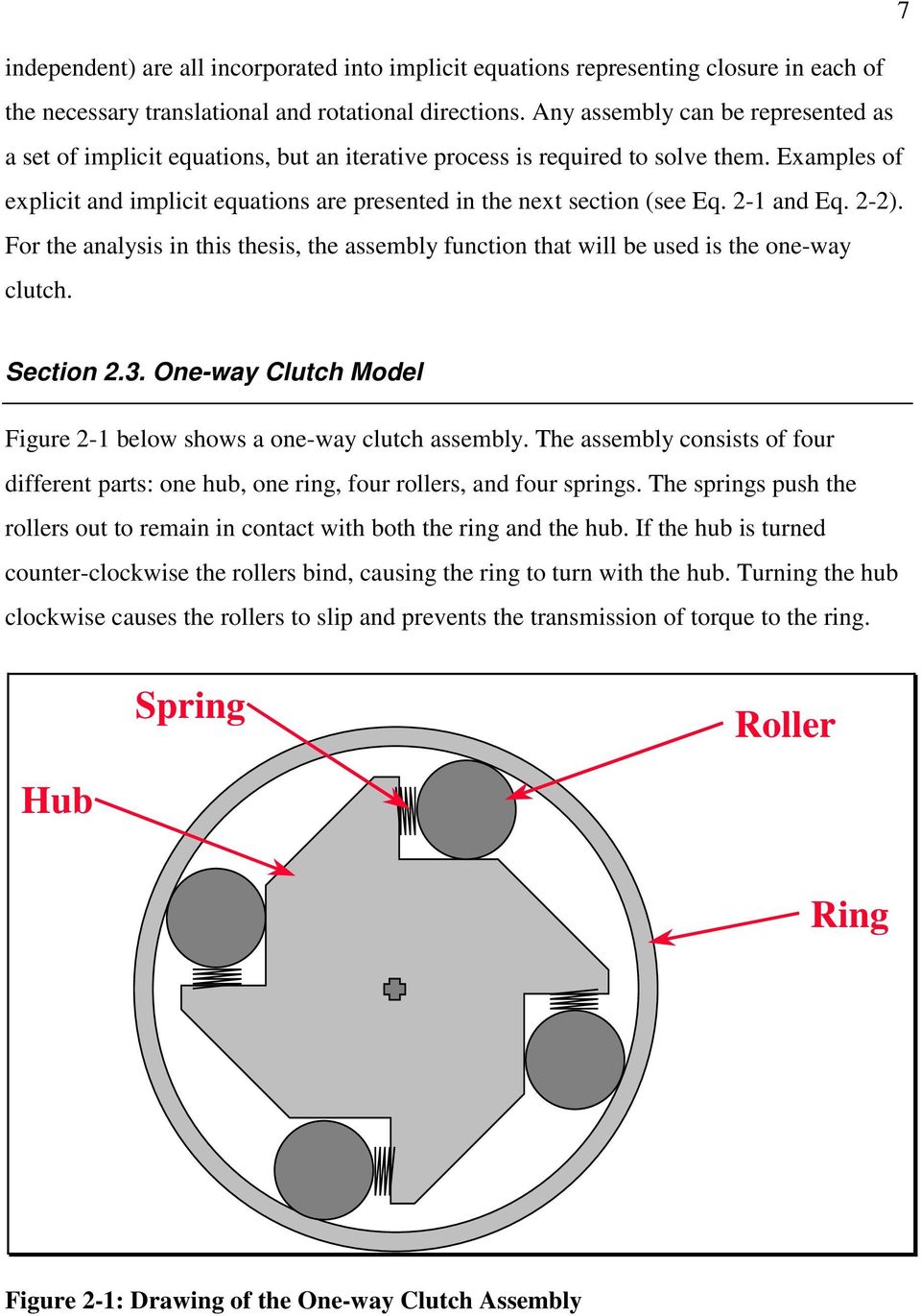
21 8 The bndng of the rollers causes the transmsson of torque between the hub and rng. The angle of contact between the roller and the rng s very mportant for the one-way clutch to functon properly. The angle of contact and the dmensons that affect t are shown below n Fgure -. Independent Varables Dependent Varables φ a c e b Fgure -: Important Dmensons for Clutch The contact angle (φ) s the dependent varable n the assembly and determnes the performance of the clutch. The three ndependent dmensons affect the value of the contact angle and the varable b (locaton of contact between the roller and the hub). The contact angle for the roller, when all of the ndependent varables are at ther mean values, s degrees (nomnal angle). For proper performance, the upper and lower specfcaton lmts for φ are based upon ths nomnal angle and ± 0.60 degree desgn lmts. Table - below summarzes these values.
22 9 Table -: Contact Angle Specfcatons Contact Angle Value (degrees) Upper Lmt Nomnal Angle Lower Lmt If the contact angle s outsde of the lmts, the clutch does not perform correctly and must be reworked, or scrapped. The cost of ths rework, or the qualty loss, s $0. Ths loss due to poor qualty should be mnmzed. Varaton analyss can help to predct the qualty level of the clutches or, nversely, to determne the varatons for the ndependent dmensons that wll yeld the desred qualty level. Dmensons a, c, and e are ndependent varables, whch affect the contact angle φ. The varaton n the contact angle s a functon of the varatons of the ndependent varables as well as the assembly functon. The objectve of ths varaton analyss problem s to determne the varaton of the contact angle relatve to ts performance. Table - below shows the three ndependent varables, or dmensons, and the standard devaton of each. Each of the ndependent varables s assumed to be a statstcally ndependent (not correlated wth each other) and normally dstrbuted random varable. Table -: Independent Dmensons for the Clutch Varable Mean Standard Devaton a - hub radus mm mm c - roller radus.430 mm mm e - rng radus mm mm The contact angle for the one-way clutch s smple enough to be represented by the explct functon Eq. - (refer to Fgure - for an explanaton of the symbols). a + c φ arccos e c Eq. -
23 0 Most assembles are too complcated to be reduced nto an explct equaton. Thus, a vector loop method can be used to fnd mplct equatons [Chase 995, 67]. Implct equatons can always be found for an assembly usng the followng vector loop method. Secton.4. Vector Loop Model and Assembly Functon for the Clutch The vector loop method uses the assembly drawng as the startng pont. Vectors are drawn from part-to-part n the assembly, passng through the ponts of contact. The vectors represent the ndependent and dependent dmensons (varables) n the assembly. Fgure - below shows the resultng vector loop for the clutch assembly. φ Vector Loop c c a b φ e Fgure -: Vector Loop for the Clutch Assembly
24 The vectors pass through the ponts of contact between the three parts n the assembly. The vector b and the angles φ and φ are dependent varables. In ths case t easy to see that φ φ (the contact angle). Once the vector loop s defned, the mplct equatons for the assembly can easly be extracted. Eq. - shows the set of mplct equatons for the clutch assembly derved from the vectors. h h h x 0 b + c sn( φ) esn( φ) Eq. - y θ 0 a + c + c cos( φ ) ecos( φ ) φ 80 + φ + 90 φ + φ From the mplct equatons t s also easy to see that φ and φ are equal. Therefore, the mplct equatons can be smplfed nto just two equatons for two unknowns as shown below by Eq. -. h h x y 0 b + csn( φ) esn( φ) Eq. - 0 a + c + c cos( φ) ecos( φ) Each of these assembly equatons for the clutch equals zero because the vector loop s closed, and must mantan closure for the parts to assemble. However, f a vector loop s not closed (open loop vector to measure a gap for example) the equatons equal the value of the openng (gap length n the h y drecton for example). In ths case the mplct equaton h y contans only one dependent varable (the contact angle) and can be smplfed down to the explct equaton for the contact angle shown above by Eq. -. But most assembles are too complex to easly derve an explct equaton for the desred assembly functon. Secton.5. Summary for the Varaton Analyss Problem Defnng the problem well conssts of determnng the analyss objectves and sources of varaton and defnng the assembly functon. The one-way clutch assembly wll be
25 analyzed wth all of the analyss methods. The example problem, the one-way clutch assembly, was chosen for several dfferent reasons: The clutch can be represented wth a small number of varables (three ndependent and two dependent varables) for easy demonstraton and comprehenson. The clutch assembly s known to be qute non-lnear, and even shown to be very nonquadratc [Glancy 994, 43 45]. Therefore the output dstrbuton for the contact angle s skewed even though the nputs are normally dstrbuted. The contact angle for the clutch assembly can be represented explctly, and not just mplctly to allow for use wth any of the analyss methods. Now that the sample analyss problem s defned, the dfferent varaton analyss method can be explaned and demonstrated. The frst method demonstrated wll be Monte Carlo as t s wdely used as a benchmark for the accuracy of the other methods. The followng wll be evaluated because they are the ones commonly used for assembly varaton analyss: Chapter 3. Monte Carlo Smulaton Chapter 4. Method of System Moments Chapter 5. RSS Frst-order Approxmaton Chapter 6. Qualty Loss and Desgn of Experments Presentng the state-of-the-art wth these methods, and demonstratng ther use on the clutch sample problem wll provde a foundaton for understandng the value of contrbuton of ths thess.
26 3 Chapter 3. Monte Carlo Smulaton Ths chapter presents the Monte Carlo smulaton method and the state-of-the-art for estmatng ts accuracy. Ths state-of-the-art on Monte Carlo wll be used as the foundaton for the contrbutons made n Chapter 9. Monte Carlo Smulaton s a method of choosng nputs from the probablty dstrbutons of randomly varyng components, calculatng the outputs, and analyzng the output dstrbuton. In order to understand Monte Carlo smulaton, a custom smulaton program has been wrtten and used along wth the Excel add-n program Crystal Ball. Secton 3.. Background on Monte Carlo The Monte Carlo Method for varaton analyss conssts of settng the ndependent varables to random values accordng to ther respectve probablty dstrbutons. Fgure 3- below graphcally shows how the process works. The output dstrbuton s a functon of the dstrbutons of the nput varables and the assembly functon. Thousands of samples of the nput varables are combned to get a relable measure of the output dstrbuton.
27 4 Input Varables Output Dstrbuton Iteratve Assembly Functon Hstogram Mean Std. Dev. Skewness Fgure 3-: Graphcal Representaton of Monte Carlo Method The Monte Carlo method conssts of selectng random values for the ndependent varables, calculatng the assembly functon (an teratve process f the functon s mplct), and analyzng the output. Sometmes hundreds of thousands of samples are requred for accurate results. The hstogram of the outputs for the assembly functon can be plotted. The rejects (assembles that fall outsde the specfcaton lmts) can be counted durng the smulaton, f the lmts are known before the smulaton. Or a dstrbuton can be ft to the moments or percentles of the Monte Carlo output and the rejects estmated (see Chapter 7 for usng the Lambda dstrbuton). The number of samples requred depends on the desred accuracy of the output. Secton 3.5 wll present the state-of-the-art n estmatng the accuracy. Chapter 9 wll contrbute addtonal materal for estmatng the effectveness of Monte Carlo smulaton.
28 5 Secton 3.. Random Number Generaton One mportant aspect of a Monte Carlo smulaton s the generaton of the random numbers (or unform random devate) for the ndependent varables. The frst step s generatng unform random devate. Then they can be mapped onto the probablty densty functons of the ndependent varables, such as the normal dstrbuton. Ths mappng can be done through the equatons for the probablty densty functons f they are known, or by matchng a Lambda dstrbuton to data, dscussed n Chapter 7. To generate the unform random devate, the algorthm ran [Press 99, 8] was chosen because t has a perod greater than x 0 8 random numbers before t repeats. One of the thngs nvestgated n ths report s the requred number of samples for Monte Carlo to gve relable results. Ths random number generaton algorthm takes about twce as long to calculate than the standard random number generatng algorthm, ran0, but ran0 has a perod of only x 0 9. Unfortunately, the more random numbers that are needed, the longer t takes to calculate each random number. The nput varables for the clutch assembly are normally dstrbuted, not unformly dstrbuted. The algorthm gasdev [Press 99, 89] was used to map the unform random devate to the normal dstrbuton. After the random nputs are ready for Monte Carlo, the next step s to use them n the assembly functon. Secton 3.3. Explct and Implct Assembly Functons Once the random numbers are generated and mapped onto the probablty densty functons for each of the ndependent varables, the values for the dependent varables and objectve functons must then be calculated. As hundreds of thousands of samples may be requred when usng Monte Carlo, solvng mplct equatons may requre sgnfcantly more computaton tme.
29 6 Glancy used Newton s method for solvng systems of nonlnear assembly equatons. He found that the clutch assembly problem requred an average of 3.4 teratons to solve the mplct equatons for each Monte Carlo smulaton sample [Glancy 994, 48]. Usng explct equatons wth the Monte Carlo method s extremely advantageous, but often not possble. Secton 3.4. Methods to Calculate Senstvtes Senstvty nformaton s helpful when analyzng an assembly. The senstvtes reveal how the objectve functon changes as each of the ndependent varables change. For the clutch problem, the senstvty of the contact angle wth respect to the hub radus s the partal dervatve φ. The partal dervatves can be determned analytcally or wth a a fnte dfference method. The senstvty nformaton reveals the part features that mght requre more accurate processes. If the senstvty s large, then varaton of the nput varable wll be amplfed to the assembly functon. Percent contrbuton nformaton can easly be estmated from the senstvtes and tells whch varables wth ther varatons do contrbute the most to the overall assembly varance Senstvtes from the Correlaton Coeffcents When usng Monte Carlo smulaton to analyze an assembly, senstvty nformaton can be obtaned through usng correlaton coeffcents and ndvdual samplng. A lnear correlaton coeffcent tell how strongly the output functon changes as an nput changes. The correlaton coeffcents range from.0 to.0. A value of 0.0 ndcates that the output s completely uncorrelated to the nput. A value of.0 ndcates that there s an exact lnear relatonshp between the output and the nput varable, the output ncreasng as the nput varable ncreases. A value of.0 also ndcates an exact lnear relatonshp, but wth the output decreasng as the nput varable ncreases.
30 7 One method of calculatng the correlaton coeffcents s usng the actual values of the nput varables and the output to calculate the Pearson correlaton coeffcent (see Eq. 3-). But sometmes the Pearson correlaton coeffcent can conclude that a correlaton exsts even f one does not because of the dfferences n magntude between the nput and the output [Press 99, 640]. r p ( x x)( y y) Eq. 3- ( x x) ( y y) The Spearman rank-order correlaton coeffcent s a more robust method that uses the rank of the nput varables and the rank of the output functon (see Eq. 3-). Even though the Spearman coeffcents may be more robust (not measurng a correlaton f none exsts), there s a loss of nformaton, as the actual x and y data s converted nto R (the rank of the nput varable) and S (the rank of the output varable). All of the values for the nputs and outputs must be stored durng the smulaton. Then the sets of values are all ranked accordng to magntude. It s the rank of the varables used nstead of the actual values. r s ( R R)( S S) Eq. 3- ( R R) ( S S) The program Crystal Ball, by Decsoneerng Inc., uses the Spearman rank-order correlaton coeffcents to calculate the senstvty nformaton, and wll be used to fnd the senstvtes for the clutch problem. In order to estmate the percent contrbuton, the rank correlaton coeffcents are squared and normalzed to sum to 00%. Ths method s only an estmate, and not a true decomposton of varance as wll be presented wth Desgn of Experments, n Chapter 6.
31 Senstvtes from Indvdual Samplng Another method of calculatng the senstvtes wth the Monte Carlo s ndvdual samplng. Ths method conssts of holdng all of the ndependent varables constant except for the one beng studed. The value of the one varable s changed ether to specfc ponts (fnte dfference dervatve) or to many random ponts (comparng the varance of the output to the varance of the nput). Each of the other ndependent varables s analyzed smlarly. A fnte dfference approach s very smlar n that only one varable s changed at a tme. Secton 3.5. The State-of-the-art n Estmatng the Effectveness of Monte Carlo The error n usng Monte Carlo to count the parts per mllon (PPM) rejects s found by way of the bnomal dstrbuton [Shapro 98, 9]. Expressng the error n PPM rejects as a percent of the rejects s shown below n Eq. 3-. As the sample sze (n) doubles, the error estmatng the rejects decreases by about mllon rejects.. PPM s an estmate of the parts per ( σ ) σ PPM % PPM 6 PPM (0 PPM ) n σ PPM PPM 6 0 PPM PPM ( n ) Eq. 3- Where: σ PPM The one-sgma bound on the error of rejects (where PPM n the equaton s the ntal estmate of the PPM rejects) σ %PPM The one-sgma bound on percent error of PPM rejects The one-sgma confdence lmts calculated by Eq. 3- can be multpled by any value to obtan the confdence level desred for the estmate of accuracy. The fgures presented n ths thess wll use the one-sgma confdence lmts for the errors for easy comparson. To explan what the one-sgma error s, Fgure 3- below shows a hstogram of percent error for lower PPM rejects. Each of the calculatons of percent error represents one cycle (or
32 9 run) of 0,000 Monte Carlo samples. A total of,000 runs were performed to generate the hstogram. The assembly s the contact angle for the one-way clutch assembly, and the rejects correspond to assembles wth contact angles outsde of the specfcaton lmts presented n Secton.. The PPM rejects correspond to about a.6 sgma qualty level, or 4,600 PPM rejects Output Dstrbuton for %Error n Lower PPM Rejects One-Sgma Lmts % -36% -9% -3% -6% -0% -3% 3% 0% 6% % 9% 35% 4% 48% 55% Frequency %Error n Lower PPM Rejects Fgure 3-: Hstogram of %Error for Lower Rejects for,000 Dfferent Runs (Smulatons of Monte Carlo), each wth 0,000 Samples The one-sgma lmts for the percent error were calculated wth Eq. 3-. The mean of the percent error for all,000 runs (or cycles of Monte Carlo) was about two percent. Ths hstogram s portrayng the one-sgma error lmts, or bounds. The one-sgma lmts are at about sxteen percent. If the sample sze were doubled, then the one-sgma bound on the percent error (σ %PPM ) would be dvded by about the square root of two, and would then
33 be only eleven percent. Thus as the sample sze ncreases, the hstogram would become more narrow, and the accuracy ncrease. Table 3- shows the statstcs for the percent error of the lower, upper, and total PPM rejects for the,000 Monte Carlo smulatons. The estmates of standard devaton of the percent errors are also compared wth the estmates calculated based on Eq. 3-. Table 3-: Dstrbuton for %Error Countng Rejects for 0,000 Samples % Error n Lower PPM % Error n Upper PPM % Error n Total PPM Mean (hstogram).% -9.9% -.% Stdev (hstogram) 5.8% 0.0%.6% σ %PPM (equaton) 5.% 0.4%.% 0 The standard devaton of the percent error for the hstogram of,000 runs of 0,000 samples s very close to the estmate determned by Eq. 3-. Even at 0,000 samples the one-sgma bound on the percent error for the lower PPM rejects s stll about ffteen percent. Secton 3.6. Error n Estmatng Moments wth Monte Carlo The estmate for mean and varance of the output dstrbuton mproves as the number of runs ncreases. The accuracy of the estmate of the mean of the output dstrbuton s presented below n Eq. 3-. Where: ˆ µ µ Standard Normal Dstrbut σ on Eq. 3- n σ σ µ n µˆ The estmate of the th moment for a dstrbuton σ µ The one-sgma bound on the error of the estmaton of the mean, also called the standard error of the mean [Crevelng 997, 63]
34 The standard error for the estmate of the mean decreases wth the square root of n (sample sze). The error for the estmate of the varance s a lttle more complcated. The dstrbuton for estmatng the accuracy of the varance s presented below n Eq. 3-. ( n ) ˆ µ Eq. 3- Ch - Square Dstrbuton : µ mean ( n ), varance ( n ) The Ch-Square dstrbuton for varance can be approxmated by the normal dstrbuton (wth the same mean and varance) at large sample szes [Vardeman 994, 36], and Monte Carlo generally uses large sample szes. Thus wth the state-of-the-art, the accuracy of countng rejects, estmatng the mean, and estmatng the varance of a dstrbuton can be evaluated. Chapter 9 wll expand upon ths to estmate the accuracy of estmatng the skewness and kurtoss, as well as estmatng the PPM rejects usng the moments and the Lambda dstrbuton. Secton 3.7. Advantages and Drawbacks of Monte Carlo Smulaton Monte Carlo s extremely versatle. Input varables may be correlated to each other, or n other words, not ndependent. Input varables may be of any dstrbuton, even dscrete. The number of rejects (assembles outsde of the specfcaton lmts) can be counted drectly durng the smulaton, or the output dstrbuton can be ftted to a standard dstrbuton (normal) or a general dstrbuton (Lambda for example) and the PPM rejects estmated for any lmts. One of the drawbacks s that large sample szes are requred, whch may be tme consumng f the assembly functon s teratve. The smaller the percent rejects, the more samples are requred for an accurate estmate. Once the smulaton s performed, changes n the problem (changes n nput varable dstrbutons, changes n specfcaton lmts, etc.) most often requre that the smulaton be run agan. The estmaton of senstvtes s not a drect result of Monte Carlo. Although the varables could be changed one at a tme or the correlaton coeffcents calculated to estmate the senstvtes.
35 Secton 3.8. Sample Clutch problem The one-way clutch assembly problem s easly modeled n a spreadsheet program (as the equaton for the contact angle s explct) and analyzed wth Crystal Ball, a Monte Carlo smulaton program from Decsoneerng Inc. More dffcult assembles wth teratve assembly functons would be more dffcult to model, and would be mpractcal to use as an Excel model. Fgure 3- below shows sample output of a Monte Carlo smulaton on the clutch assembly. The hstogram estmates the probablty dstrbuton for the contact angle φ. 0,000 Trals Forecast:φ Frequency Chart Probablty Frequency Certanty s 99.8% from to Degrees Fgure 3-: Monte Carlo Output from Crystal Ball The hstogram shows an estmaton of the output dstrbuton for the contact angle. Wth the specfcaton lmts as ndcated, 99.8% of the sample assembles are good, and 0.7% of the assembles are outsde the lmts. The sample sze was 0,000 for ths run. The darkened areas of the tals of the hstogram show the samples that fell outsde the specfcaton lmts (rejects).
36 Usng the Spearman correlaton coeffcents as descrbed by Eq. 3-, Crystal Ball estmates the senstvtes and the percent contrbuton of the ndependent varables as shown below n Table 3-. Ths senstvty nformaton ndcates that the varable a (hub radus) contrbutes most of the varaton to the contact angle. A reducton n the varaton of varable a should reduce the varaton n the contact angle more than reductons n the varatons of the other two varables. Table 3-: Senstvty Informaton from Crystal Ball Varable Correlaton Coeffcent %Contrbuton a % c % e % 3 An estmaton of the mean and varance and other moments of the dstrbuton of the contact angle s also provded by Crystal Ball, but a custom Monte Carlo smulaton program, usng the random number generator descrbed earler, was used for flexblty n outputtng the dstrbuton moment nformaton. Fgure 3- shows how the estmates of the dstrbuton moments change durng the smulaton as the sample sze doubles. Ths smulaton of over a bllon samples, whch took 8.6 hours to complete, wll be used as the benchmark for accuracy of the other methods.
37 4 %Change n Moments for Monte Carlo 40% 30% 0% %Change- 0% 0% -0% µ σ α3 α4-0% -30% -40%.E+03.E+04.E+05.E+06.E+07.E+08.E+09 Sample Sze (log scale) Fgure 3-: Percent Change n Moments for Monte Carlo Smulaton as the Sample Sze Doubles The percent change for the mean s very lttle due to a large value of mean versus the standard devaton. The large change n skewness (α 3 ) s due to the small value of actual skewness. But t appears as though the error n estmatng the skewness s greater than for kurtoss (ths s not really the case though). A better method of calculatng errors wll be presented n Chapter 8. Usng a percent change n the raw moments or the percent error n the moments s not a good estmate or accuracy. As Fgure 3- shows, the percent change n the moments as the sample sze doubles s approxmately zero as the sample sze reaches a bllon. The true values for the objectve functons wll be estmated by the values from ths smulaton. These moments, rejects, and qualty loss for the clutch assembly are presented below n Table 3-.
38 5 Table 3-: Benchmark Results from Monte Carlo Smulaton at One Bllon Samples Contact Angle for the Clutch Value µ (mean) σ (Standard Devaton) α3 (Skewness) α4 (Kurtoss) Qualty Loss ($/part)... Lower Rejects (ppm)... Upper Rejects (ppm)... Total Rejects (ppm) ,406,66 6,57 The above values were obtaned by usng Monte Carlo Smulaton at 30 samples (over one bllon). A descrpton of how to calculate the qualty loss s gven n Chapter 6 as t s manly used wth the desgn of experments. Secton 3.9. Confdence Interval for PPM Rejects Estmated The σ %PPM s easly calculated from Eq. 3- to be , or 0.04 percent (usng the estmate of total PPM rejects n the table above). That means that the 68 percent confdence level (plus and mnus one σ PPM ) for the total PPM rejects s from 6,569 to 6,574. Smlarly, f greater confdence s desred n the total PPM rejects, the 99.7 percent confdence nterval (plus and mnus three σ PPM ) for the rejects s 6,564 to 6,579 rejects. At one bllon samples, the results are qute confdent. The estmaton of the confdence nterval for the mean and varance s just as easly calculated from Eq. 3- and Eq. 3-. Monte Carlo Smulaton s a very effectve way to smulate the randomness that occurs n nature. The requred sample sze for a Monte Carlo smulaton depends on the desred output of the analyss (mean, varance, qualty loss, rejects, etc.) and the desred accuracy of that estmate. More on the requred sample sze for the Monte Carlo smulaton method s presented n Chapter 9.
39 6 Secton 3.0. Summary for Monte Carlo Smulaton The research and expermentaton ndcates that Monte Carlo smulaton s the most flexble of the methods n terms of dfferent types of nput, output, and assembly functons. Input varables can be skewed or even correlated. The assembly functon can even be dscontnuous. Smulaton s defntely the easest method to understand. The major weaknesses of smulaton are the number of trals necessary for accuracy, teratve assembly functons, and calculatng the senstvtes of the nputs [Crevelng 997; Shapro 98]. Monte Carlo smulaton s a valuable tool n varaton analyss and s wdely used. It has many advantages as well as lmtatons. Monte Carlo s a smulaton method that attempts to model the randomness that occurs n nature. Because of ts use of random numbers, more state-of-the-art technques for estmatng ts accuracy are avalable than any other method, as wll be shown n later chapters. Ths chapter has not only provded the state-of-the-art on Monte Carlo and ts accuracy, but t also has demonstrated ts use on the sample clutch problem to allow for drect comparson wth the other methods.
40 7 Chapter 4. Method of System Moments Ths chapter ntroduces and demonstrates the method of system moments (MSM). Because MSM s not a very common method the background wll also be dscussed. The method of system moments s an advanced varaton analyss method that uses the frst and second dervatves of the assembly functon wth respect to the nput varables, along wth the frst eght moments of the nput varable probablty dstrbutons, to estmate the moments of the output dstrbuton. The Taylor seres s used to estmate how the dervatves and nput moments wll affect the resultant assembly dstrbuton. Often, only the frst order terms of the Taylor seres are used, but the second order terms can also be used to ncrease the accuracy of the output dstrbuton predcton [Cox 986; Shapro 98]. Once the output dstrbuton moments are estmated, a Lambda dstrbuton (dscussed n Chapter 7), a Pearson dstrbuton [Fremer 988, 3560], or another dstrbuton may be used to estmate percent rejects, qualty loss, or other objectve functons. Secton 4.. Background of Method of System Moments The method of system moments (MSM) estmates the assembly functon wth a multvarate Taylor seres approxmaton. Eq. 4- below shows the general form of a second order Taylor expanson. For lnear varaton analyss, the second order terms are assumed to be neglgble and thus elmnated [Cox 986, 4 5]. R R + 0 n h x ( x x ) + ( x x ) 0 n n h + 0 j j0 j > xx j + thrd order and hgher terms n h Eq. 4- x 0 ( x x )( x x ) Where: R h(x ) Value of the assembly functon value evaluated at the x
41 8 R 0 h(x 0 ) Value of the functon evaluated at the mean values of the nputs, x 0 h The assembly functon x The value of the th nput varable x 0 The th nput varable at ts mean value In order to smplfy the expressons for the fndng the moments of the assembly functon the followng substtutons are made: X b ( x x ) σ 0 h σ X b b j h Eq. 4- σ X h X X j σ σ j The reason for these substtutons s to transform the dstrbutons to non-dmensonal coordnates, where the mean s 0.0 and the varance s.0. Truncatng the terms of thrd order and hgher and makng the above substtutons, Eq. 4- smplfes nto Eq R R 0 + n ( b x + b x ) + n n j j > b x x j Eq. 4-3 The expected values of the moments of Eq. 4-3 are then the estmates for the output dstrbuton. Generally, ether the quadratc terms are used for a second-order analyss, or the just the lnear terms are used for a frst-order analyss. Secton 4.. Second-order MSM Analyss The resultng equatons for calculatng the mean and the varance of a quadratc assembly functon are found below n Eq. 4-. The equatons for calculatng the skewness and kurtoss of a quadratc equaton are qute complex, and although they were coded n the analyss program used for ths thess, they wll not be presented here. Refer to the book by Cox [Cox 986, 49 50] or by Shapro [Shapro 98, 357] for the full quadratc varaton analyss expressons for skewness and kurtoss.
42 9 µ R µ + n 0 + n n [ b + b b ( α ) + b ( α ) ] n j + b 3 [ b b + b ] ( µ R ) jj j 4 0 Eq. 4- The method of system moments provdes a method to convert senstvtes and nput varable moment nformaton nto moments for the output dstrbuton. The dffculty les n calculatng the senstvtes. Secton 4.3. Lnear Varaton Analyss For lnear varaton analyss, only the frst order terms are retaned n Eq. 4-3, and f the nput varables are assumed to be ndependent (uncorrelated wth each other), the followng equatons represent the frst four moments of the output functon [Cox 986, 0]. 3 µ R µ b ( α ) µ 0 n b µ 3 4 n b 4 3 ( α ) 4 + n n j + 6b b j Eq. 4- Determnng when to use the lnear and when to use the quadratc MSM estmate s dffcult. The state-of-the-art s to try them both and see f the lnear s a good enough approxmaton. Secton 4.4. Calculatng the Senstvtes for the Clutch Problem Both Eq. 4- for second-order analyss and Eq. 4- for lnear analyss nclude terms for the partal dervatves of the desred assembly functon wth respect to the nput varables at ther mean values. These senstvtes (frst and second dervatves) could be found by dfferentatng the explct equaton for the output functon f t were smple enough.
43 30 Alternately, for mplct equatons and more complex explct assembly functons, a fnte dfference method may be used to determne the dervatves numercally. Because the clutch assembly can be represented by an explct equaton for the contact angle, Eq. - wll be dfferentated symbolcally and then evaluated at the mean values of the nput varables. Eq. 4- below shows the analytcal solutons to the frst dervatves. ( ) ( ) ( ) ( ) ( ) ( ) mm c e c a c a c e e mm c e c a c a c e c mm mm rad c a c e a deg.8 deg deg φ φ φ Eq. 4- From an examnaton of the magntudes of the frst dervatves calculated above, the contact angle s most senstve to changes n the roller radus c. The standard devaton of the hub radus s about fve tmes that of the roller radus, thus accountng for the larger percent contrbuton of the hub radus. The second dervatve senstvtes are shown below n Eq. 4-. ( ) ( ) [ ] [ ] [ ] [ ] [ ] deg ) ( ) ( ) ( ) ( ) ( ) ( ) ( deg ) ( ) ( ) ( ) ( ) ( ) ( deg 0.33 ) ( mm c e c a c a c e c a c e c a e mm c e c a c e c a c e c a c e c e c a e a c mm c a c e c a a φ φ φ Eq. 4-
44 3 The method of system moments not only requres the frst and second dervatves for the full quadratc model, but t also requres the cross-dervatves. Eq. 4-3 below shows the calculatons of the three cross-dervatves for the contact angle. [( e c) ( a + c) ] 3 φ deg Eq. 4-3 ( a + e) ac mm 3 φ deg ( e c) [( e c) ( a + c) ] ae mm 3 φ a + c ( e c) + [( e c) ( a + c) ] ce e c + ( a + c) deg [( e c) ( a + c) ] ( e c) mm Fndng the analytcal dervatves of Eq. - to get the second order senstvtes s not easy, even though the equaton for the contact angle was relatvely smple. For more complex assembles, a fnte dfference method would be preferred. Chapter 9 and Chapter wll present numercal methods for estmatng the senstvtes of assembly functons that provde even more accurate results when used wth MSM. Secton 4.5. Sample Clutch Problem Usng Method of System Moments In order to perform the method of system moments (MSM) on the clutch problem, the senstvtes calculated n the prevous secton were used, and the nput dstrbutons were assumed to be normally dstrbuted wth the standard devatons as presented earler n Table -. The method of system moments for second order varaton analyss requres that the frst eght moments of the nput dstrbutons be known. The frst eght moments of a standard normal dstrbuton are 0,, 0, 3, 0, 5, 0, 05, respectvely. In many cases, only the frst few moments of the nput dstrbutons may be known wth any level of certanty. Chapter 9 wll present a method of estmatng the hgher moments of a dstrbuton by fttng a Lambda dstrbuton to the known moments.
45 3 Table 4-: Analyss Results from the Second Order Method of System Moments Contact Angle for the Clutch Monte Carlo MSM nd Order %Error µ (mean) % σ (Standard Devaton) % α3 (Skewness) % α4 (Kurtoss) % Qualty Loss ($/part) % Lower Rejects (ppm)... 4,406 4,80-5.3% Upper Rejects (ppm)...,66,3 7.% Total Rejects (ppm)... 6,57 6, % The estmate of the mean for the contact angle probablty dstrbuton s very accurate. The estmates of the other moments are not as good. The true value of skewness (α 3 ) s so small that the error n skewness s amplfed when calculatng percent error. The estmates for rejects were obtaned by fttng a Lambda dstrbuton to the moments (method descrbed n Chapter 7) and solvng for the rejects. The error for total rejects s sgnfcantly less than the error for ether the upper of lower rejects alone. The second order method of system moments estmates the frst four moments for the clutch contact angle wthn one percent of the true moments (estmated by Monte Carlo at a bllon samples). The second order method approxmates the assembly functon as a quadratc functon, so f the assembly functon were quadratc, the results would be as accurate as the accuracy of the nput data and the round-off error permt. The frst order method of system moments wll be dscussed n Chapter 5, along wth a method of transformng a set of mplct equatons nto an explct lnear approxmaton. Secton 4.6. State of Art for Estmatng the Accuracy of MSM There s no method avalable to estmate the accuracy of the MSM wthout comparng the results to the Monte Carlo benchmark results. The accuracy depends on how nonquadratc the assembly functon s. About the only thng that s known wthout performng a full Monte Carlo smulaton s that second order MSM s more accurate than
46 frst order analyss. The hybrd method that uses MSM presented n Chapter wll have an estmate for accuracy that the regular MSM does not. 33 Secton 4.7. Summary for the Method of System Moments The major strengths of the method of system moments are clear and accurate estmates of nput senstvtes and flexblty of the nput and output dstrbutons. The weaknesses of the method of system moments are the dffculty n calculatng the dervatves of complex assembly functons, extreme complexty of calculatng the hgher moments for the second-order Taylor approxmaton, and the dffculty of estmatng the accuracy of the analyss. The method of system moments s not commonly used, and therefore the method tself s state-of-the-art. But MSM s valuable because t s very dfferent than the other methods. It does not requre the assembly functon but the dervatves. If the second-order dervatves are not avalable, the analyss can stll be performed assumng lnearty. Because of ths unqueness t s very easly ncorporated nto a hybrd method. Secton 0. wll combne MSM wth a response surface method, and Chapter wll combne them both wth Monte Carlo.
47 34 Chapter 5. RSS Frst-order Approxmaton Ths chapter wll explan the method of lnear varaton analyss, or RSS (root-sumsquare). The purpose of ths chapter s to demonstrate how assumng lnearty smplfes the analyss to the pont that t s qute easy to perform and understand. The state-of-theart n terms of RSS s the method to obtan the senstvtes from the mplct equatons. Ths method wll be demonstrated. One of the man contrbutons of ths thess s to present a method of estmatng the accuracy of lnear approxmaton ( presented n Secton 0.). Secton 5.. Background of RSS Frst-order Approxmaton The RSS method s based on the Method of System Moments usng only the frst order terms of the Taylor seres. The general equatons for the lnear MSM were shown by Eq But for the RSS method, the output dstrbuton s generally assumed to be normal. Thus the only thng to calculate s the varance of the output dstrbuton because the mean of the lnear analyss s the nomnal. Calculaton of the varance of the output dstrbuton s based on the classcal statstcal theorem that varances add lnearly. ο ο Eq. 5- ο Assembly Assembly n Parts ( S σ ) Where: S The frst-order senstvty (dervatve) of the functon wth respect to the th nput varable σ The standard devaton of the th nput varable RSS can be used wth any functon, even f t s not lnear. Secton 0. wll dscuss how to estmate the error of assumng a non-lnear assembly s lnear. The justfcatons for assumng the output dstrbuton s normal are lsted below.
48 35 If the nput dstrbutons are normal and the assembly functon lnear, the output dstrbuton wll be normally dstrbuted. If the assembly functon s lnear, then even non-normal dstrbutons for the components add to a normal dstrbuton as the number of components get large (central lmt theorem). Even as few components as fve often approaches normalty [Chase 99, 9]. Informaton on the skewness and kurtoss of nput varables s not generally avalable. And when there s dfferent from a normal dstrbuton, t s often not statstcally sgnfcant. Statstcal process control data generally only gathers nformaton on the mean and varance. Estmates of the nput senstvtes can ether be obtaned from the explct assembly functons, or from mplct equatons calculated drectly from the assembly geometry. These estmates can then be used to calculate the varaton of the assembly characterstcs and other output functons of nterest [Chase 995]. Secton 5.. Frst-order versus Second-order Second order varaton analyss models many assembly problems better than frst order. But one advantage of frst-order varaton analyss s that a set of mplct equatons that descrbe an assembly functon can be expressed as a set of lnear equatons that can be solved explctly through lnear algebra. The second-order senstvtes are not requred for RSS. Secton 5.3. Lnear Explctzaton Implct equatons that descrbe an assembly functon are wrtten n the general form expressed below n Eq. 5-. The varables x represent the n ndependent varables. The
49 36 varables u j represent the m dependent varables. And the equatons h k represent the l mplct equatons, where l s greater than or equal to m. ),,,,,,, ( ), ( ),,,,,,, ( ), ( ),,,,,,, ( ), ( m n l l m n m n u u u x x x h u x h u u u x x x h u x h u u u x x x h u x h Eq. 5- Where: The assembly equatons equal zero for closed loop constrant equatons, and equal the value of the nomnal plus and mnus the varaton for the open loop equatons. A frst order Taylor seres expanson (as descrbed by Eq. 4-) wll be performed on the mplct equatons above to lnearze them. Ths approxmaton s good for small perturbatons around the nomnal values of the nput varables. Eq. 5- below shows ths expanson. ( ) ( ) + + m j j j j k n k k k u u u h x x x h h h Eq. 5- Where: h k0 The nomnal value of the k th assembly functon h k (zero f closed loop constrant) x 0 The nomnal value of the th ndependent varable x u j0 The nomnal value of the j th dependent varable u j Once the lnear Taylor expanson s performed, the set of mplct equatons can be expressed as a lnear algebrac equaton n matrx form, as shown n Eq. 5-3 below. ( ) x S x A B u or u B x A + 0 Eq. 5-3 Where: x A vector of the ndependent varables (x x 0 ). It can also be the vector of varatons for the ndependent varables as the equaton s lnear. u A vector of the dependent varables (u j u j0 ). It can also be the vector of the resultant varatons for the dependent varables, because the equaton s lnear.
50 37 n l l l n n x h x h x h x h x h x h x h x h x h A m l l l m m u h u h u h u h u h u h u h u h u h B n m m m n n x u x u x u x u x u x u x u x u x u S The A and B matrces are not the senstvtes of the dependent varables to the ndependent varables, but ntermedate matrces. The (B - A) or S matrx s easly obtaned through matrx manpulaton methods, and s the senstvty matrx for lnear varaton analyss. Secton 5.4. Frst Order Varaton Analyss The S matrx contans the partal dervatves of each of the dependent varables wth respect to each of the nput varables. Eq. 5- below shows how the S matrx can be used to calculate the varatons of the dependent varables. ( ) ) ( ) ( n j j x S u σ σ Eq. 5- For a lnear varaton analyss, the mean of the assembly functon s assumed to be the value of the assembly functon wth the ndependent varables at ther nomnal (or mean) values. Addtonally, the output functon s assumed to be normally dstrbuted. Davd Larsen [Larsen 989, 6] found that the greater the number of ndependent varables, the nearer to normal the output functon would be. If all of the nput varables are n fact Note: the S matrx s easly obtaned from the A and B matrces and contans the senstvtes for lnear varaton analyss.
51 38 normally dstrbuted, then Eq. 4- for lnear method of system moments predcts that the output dstrbuton wll be normally dstrbuted as well. Secton 5.5. Sample Clutch Problem usng Lnear Explctzaton and RSS The frst step n performng a lnear varaton analyss s to fnd the mplct equatons for the assembly functon. Secton.4 showed the creaton of the vector loop and resultng set of mplct equatons. The loop s a closed loop so each of the assembly equatons s equal to zero. These equatons wll be represented here as Eq. 5- for a quck reference. 0 ) cos( ) cos( 0 ) sn( ) sn( 0 φ φ φ φ φ φ θ h e c c a h e c b h y x Eq. 5- Determnng the partal dervatves from these mplct equatons s much easer than from the explct equatons (refer to Eq. 4-). The A and B matrces are obtaned by takng the partal dervatves of the assembly equatons above. The S matrx s then obtaned by numercally computng (B - A). Once the partal dervatves are taken, the A and B matrces are the followng (refer to Eq. 5-3 for explanatons) ) cos( ) cos( ) sn( ) sn( 0 e h c h a h e h c h a h e h c h a h A y y y x x x θ θ θ φ φ φ φ Eq ) )sn( ( 0 0 ) ) cos( ( φ φ φ φ φ φ φ φ θ θ θ h h b h h e c h b h h e c h b h B y y y x x x Eq. 5-3
52 39 Usng the above matrces to calculate the S matrx as (B - A), the resultng senstvty matrx s shown below as Eq S ( B A) b 8.79 a φ a φ a b c φ c φ c b 8.84 e φ e φ e Eq. 5-4 The lnearzaton and senstvty calculatons are straghtforward and easly automated. Addtonally, feature control varatons due to shape, orentaton, and poston varatons may also be nserted nto the vector dagrams. For lnear RSS varaton analyss, the calculaton of the varance of the contact angle for the clutch s shown n Table 5- below. Each of the senstvtes s multpled by the standard devaton for each of the ndependent varables, and then squared to yeld the contrbuton to varance. The sum of the contrbuton to varance for each of the ndependent varables s the varance of the contact angle. The rato of the contrbuton to varance to the total varance s the percent contrbuton. Table 5-: Calculaton of the Varance of the Contact Angle Senstvty (rad/mm) Senstvty (deg/mm) Contrbuton to Varance Percent Contrbuton σ(degrees) a % c % e % Total % The hub radus a contrbutes over 80 percent of the total varaton of the contact angle. The senstvty of the hub radus s not the largest, but the nput varaton of a s the largest. The percent contrbutons calculated by the lnear RSS method and Monte Carlo are very smlar. Table 5- below shows that the dfference s less than one percent. The senstvty calculatons by Monte Carlo can not be assumed to be the correct values
53 because they were calculated usng a rank correlaton coeffcent. Whle the rank correlaton coeffcent are very robust, they are not necessarly accurate enough to be the benchmark senstvty estmates. Table 5-: Percent Contrbuton from RSS Lnear and Monte Carlo Percent Contrbuton RSS (lnear) Monte Carlo Dfference a 8.94% 8.94% -.00% c 3.0%.54% 0.47% e 5.04% 4.5% 0.53% 40 Table 5-3 below compares the results (output dstrbuton moments, qualty loss, and PPM rejects) from the lnear RSS method wth the benchmark results from Monte Carlo. Table 5-3: Analyss Results from RSS Lnear Contact Angle for the Clutch Monte Carlo RSS Lnear % Error µ (mean) % σ (Standard Devaton) % α3 (Skewness) % α4 (Kurtoss) % Qualty Loss ($/part) % Lower Rejects (ppm)... 4,406 3,09-9.4% Upper Rejects (ppm)...,66 3, % Total Rejects (ppm)... 6,57 6,9-5.38% The RSS lnear approxmaton gves a good estmate for the mean, standard devaton, qualty loss, and the total rejects. The rejects were calculated assumng the output was normally dstrbuted. Even wth a hghly non-lnear problem, and only three ndependent varables, the kurtoss s very smlar to that of a normal dstrbuton. Addtonally, the estmate of total rejects usng the normal dstrbuton s close to the actual. The lower or upper rejects alone s not well approxmated usng the RSS lnear and the normal dstrbuton because of both the shft n the mean from the nomnal and the skewness of the output dstrbuton.
54 4 Lnear varaton analyss does not perform too badly on ths extremely non-lnear problem. Assumng that the dstrbuton had no skewness does not affect the total rejects too much because the error n upper rejects partally offsets the error n lower rejects. It seems to generally be the case that the error n total rejects s less than the error n one of the tals (f the specfcaton cut-off ponts are centered around the mean). Secton 5.6. Summary of RSS Method Unlke Monte Carlo and second order method of system moments, lnear varaton analyss does not requre second order senstvtes or detaled knowledge of the nput dstrbutons. The accuracy of the lnear varaton analyss s defntely less than the other two (dependng on the sample sze for Monte Carlo), but for many stuatons the accuracy would be more than adequate. The major strengths of the RSS methods are the ease of automaton and the ablty to lnearze extremely complcated assembly functons, whle ncorporatng knematc assembly varaton nto the model. For ths reason, the RSS method s most useful wth mplct functons, elmnatng the need for teratve solutons. The major weaknesses of the RSS model are ncorporatng correlaton of nput varables, accountng accurately for non-normal nput varables, and estmatng the error of the analyss. Accuracy out the thrd or fourth decmal s not always requred. Secton 0.. dscusses a method of estmatng the error of lnearzaton to help determne f the accuracy s good enough. Addtonally, Chapter 3 presents a framework for estmatng the nherent error n the problem due to the accuracy of the nput nformaton. Due to these contrbutons, the lnear RSS method may be the preferred method n many varaton analyss stuatons.
55 4 Chapter 6. Qualty Loss and Desgn of Experments Ths chapter wll nvestgate the methods of usng desgn of experments for assembly varaton analyss. Its use n ths area has only recently become popular. Not much stateof-the-art nformaton exsts on estmatng the accuracy of an expermental desgn wthout performng the desgn and comparng t to a more complete desgn or Monte Carlo. Secton 0. wll contrbute a method to help optmze the desgn for accuracy whle lmtng the number of runs. Desgn of experments s a generalzed method for examnng the varablty n any process. It conssts of measurng the output functon for specfc combnatons of nput varable values. When appled to assembly varaton analyss, the procedure may be used to analyze varablty n an analytcal assembly functon, n whch calculated responses to varaton replace expermentally measured outputs [Crevelng 997; D Errco 988; Gerth 997; Mor 990]. The set of output trals can then be analyzed to estmate the overall output dstrbuton and the effects of each of the nput varables and the nteractons. These effects can also be used to estmate the partal dervatves of the assembly functon. Orthogonal arrays wth reduced numbers of trals can be used to mprove the effcency of the process [Taguch 986; Taguch 993]. A response surface can also be ft through the ponts to facltate addtonal understandng of the functon [Myers 97; Myers 995]. The qualty loss functon n state-of-the-art lterature has only really been used wth desgn of experments. It s an excellent tool, and one value of ths thess s showng that t can effectvely be used wth any of the varaton analyss methods.
56 43 Secton 6.. The Taguch Qualty Loss Functon The normal paradgm for product acceptance s to thnk of products as good f they are wthn specfcaton and bad f they are not. Ths knd of thnkng results n a dscontnuous system n whch a part barely nsde the specfcaton lmts s good, whle a part barely outsde the lmts s totally bad. Of course the accuracy n measurng the assembles would allow for some parts outsde the lmts to be accepted and vce-versa. To estmate the qualty loss from assembles that devate from optmal, Taguch uses a quadratc loss functon based on cost. Fgure 6- s a vsual comparson between the quadratc loss functon and the step functon (percent rejects). Loss($) A Quadratc Loss Functon Loss($) A Step Loss Functon φ m - φ m φ m + Contact Angle φ m - φ m φ m + Contact Angle Fgure 6-: Comparson between Quadratc and Step Loss Functons The quadratc loss functon has a pont where the qualty loss s a mnmum. At every other pont the loss s greater, ncreasng farther from the optmum. Specfcaton lmts result n a step loss functon whch assumes that between the specfcaton lmts there s no qualty loss and anywhere outsde the specfcaton lmts s equally bad. In the case of the clutch assembly, f the contact angle s degrees exactly (upper specfcaton lmt), s t good or bad? Suppose that the specfcaton lmts were chosen at ponts where the clutch would not functon properly under a maxmum operatng load
57 44 plus a safety factor. If the clutch performs best at the optmum contact angle of degrees (φ m ), the performance would thus deterorate wth any devaton from the optmum contact angle. Thus an assembly wth a contact angle of s relatvely bad. Varaton from the optmum mght not cause rejects, but t mght lower the average performance, and thus lower the market prce for the clutches. Lower average qualty mght requre more nspecton of the clutches, ncreasng costs. Abnormal operatng condtons for the clutches mght cause good clutches to fal. Sub-optmal clutches mght requre more mantenance, thus lowerng the value of the clutches to the customer. All of these extra losses due to qualty cause the qualty loss to ncrease wthn the specfcaton lmts. So the quadratc loss functon s more realstc than the step functon. Determnng the complete cost to socety, as Taguch advocates, seems mpossble, but an accurate cost estmate s not as mportant as havng a relatve cost functon by whch to compare optons. The general loss functon s descrbed by Eq. 6- below as f the assembly was the one-way clutch. The ntegraton s over all of the possble output contact angles. ( φ φ ) L K m f ( φ) dφ Eq. 6- Where: L The qualty loss K The cost constant φ The contact angle for an assembly φ m The optmal contact angle for mnmum loss f(φ) The probablty densty functon for the contact angle (output dstrbuton) Fgure 6- below shows some of the terms on a graphcal representaton of both the loss functon and a probablty dstrbuton. Integratng the product of the two determnes the average qualty loss per part (the ntegral of the probablty densty functon s.0).
58 45 φ m f(φ) L µ Fgure 6-: Combnng the Loss Functon wth a Probablty Dstrbuton Eq. 6- below shows how Eq. 6- expands out, and then smplfes usng the basc defntons for a probablty densty functon and the mean of a dstrbuton. ( ) ( ) ) ( ) ( ) ( ) ( m m m m d f K L d f d f d f K L φ µ φ φ φ φ φ φ φ φ φ φ φ φ φ φ + + Eq. 6- Where: φ φ φ µ φ φ d f d f ) ( ) ( The expresson can be further smplfed by frst addng and subtractng the same expresson and then collectng terms as shown below n Eq ( ) ( ) ) ( ) ( ) ( µ µ φ µ φ φ φ µ µ φ µ φ µ φ φ φ µ µ φ µ φ φ φ φ m m m m m d f K L d f K L d f K L Eq. 6-3
59 Then usng the same defntons from Eq. 6- the expresson can be expanded, and then smlar terms collected. The resultng expresson (Eq. 6- below) s then smplfed to a smple functon of the varance, mean, and mnmum cost pont for the contact angle (or any other assembly functon). L φ f ( φ) dφ + K L K L K L µ + m K ( µ φ ) + µ ( f ( φ) dφ ) µ ( φ f ( φ) dφ ) [ φ µ φ + µ ] f ( φ) dφ + ( µ φ ) ( φ µ ) f ( φ) dφ + ( µ φ ) ( µ φ ) Where: ( φ µ ) µ f ( φ) dφ m m m 46 Eq. 6-4 Thus the qualty loss as defned by a quadratc loss functon, where there s a mnmum cost pont s only a functon of the dstrbuton varance, mean, and that mnmum cost pont. That smplfed equaton for the qualty loss s shown below n Eq ( µ φ ) L Kµ + K Eq. 6-5 m For other loss functons (non-symmetrcal, non-quadratc, etc.) Eq. 6- can be ntegrated numercally. For quadratc loss functons where the larger the assembly functon the lower the cost, no fnte mnmum cost pont, Crevelng derves the smplfed expressons [Crevelng 997, 4 8]. In terms of the one-way clutch assembly, the qualty loss functon mght be estmated from the rework cost requred at the specfcaton lmts. If one pont on the cost curve s known (along wth the mnmum cost pont), the cost constant K can be determned. For the one-way clutch assembly, f the rework cost at the specfcaton lmt ( ) s $0, K may be estmated as shown n Eq. 6-6 below.
60 L( ) K Eq. 6-6 L( ) K $0 ( 0.60 deg) $55.56 deg Usng Eq. 6- and Eq. 6-6, along wth the estmaton for the mean and varance of the contact angle, the qualty loss can be estmated. Reductons n varance can be weghed aganst the qualty savngs. As was shown above, the qualty loss s only a functon of the mean and varance; the hgher moments of the output dstrbuton are not necessary. 47 Secton 6.. Desgn of Experments n General Desgn of experments s a method of studyng varaton n a system wthout needng a mathematcal expresson to descrbe t. Varables that affect the system are the expermental varables or factors, and a measurement of the system s the response. The expermental varables are set to specfc values and the response s measured. Analyzng the average response for the levels of each of the varables yelds the contrbuton to varance for each of the varables and nteractons. The total varaton of the response can estmate the true varaton of the system or a percent contrbuton for the expermental varables. Desgn of experments can be used to estmate varaton n an exstng process or system, or a mathematcal model of a system. Secton 6.3. Desgn of Experments n Varaton Analyss In the case of varaton analyss, the expermental varables are the ndependent dmensons, and the response s the assembly functon. The ndependent dmensons are set to specfc values whch are small perturbatons around ther means. The parts can then be made precsely to those dmensons and physcally assembled, or the assembly functon can be found (explct or mplct) and the functon calculated. Physcal parts must be made to a hgher degree of precson than actual producton parts, snce the prescrbed dmensons must be at the hgh or low end of the tolerance range n
61 48 varous combnatons. Thus, you cannot rely on the natural varaton of producton processes to produce such specfc varatons. Such precson requres costly processes smlar to those used to make fxtures and producton toolng. Physcally makng the parts may be expensve to do, but t can provde addtonal nformaton that a geometrc model can not. The physcal assembles can be tested to determne the effects of nose (temperature, wear, msuse, etc.) [Taguch 986, 75]. The desgn of the assembly can thus be made more robust (less senstve to nose and other varatons). Ths study wll not nvestgate the effects of nose, but s restrcted to the mathematcal modelng of the geometrc varaton n an assembly. The explct equaton for the contact angle of the clutch assembly wll be used as the example. Secton 6.4. Two-level Desgns Generally, the more expermental runs, and the more levels of the ndependent varables, the greater and more relable the nformaton that the experment can provde. Varaton analyss s generally performed wth ether two or three-level desgns. For a two-level desgn, each of the expermental varables s set above and below the mean values n specfc combnatons. A run s a measurement (or calculaton) of the assembly functon wth all of the nput varables set to a specfc combnaton of ther respectve levels. A graphcal representaton of two-level desgns for a three-factor problem s shown below n Fgure 6-.
62 49 DOE -Level e -Level Orthogonal e c c a a Fgure 6-: Two-level Expermental Desgns for Three Factors A complete two-level desgn requres p 8 runs (where p s the number of factors). A two-level orthogonal desgn can have sgnfcantly fewer runs, dependng on the desred nformaton for the nteractons. In general, a two-level orthogonal desgn requres about (p+) runs. Orthogonal arrays have many uses, but ther accuracy s dffcult to predct. Other sources can provde more nformaton on ther use [Crevelng 997, 53 58; Taguch 986; Taguch 993].
63 50 Table 6-: The Requred Number of Runs for Typcal Two-Level Desgns Number of Runs Varables Full Fact. Orthogonal p p (p+) , , ,47,483,648 3 An orthogonal desgn requres much fewer runs than a full factoral desgn, partcularly as the number of varables ncreases. If the expermentng were to be performed by physcally buldng the parts and assemblng and testng them, an orthogonal array would save tme and money. It would not be practcal to physcally buld parts for a full factoral desgn for an assembly of more than seven ndependent varables beng studed. But understandng the confoundng (combnng of the factor effects wth nteractons) that occurs wth orthogonal desgns can be dffcult. In order to llustrate how to analyze assembly varatons usng a two-level expermental desgn, a full two-level desgn wll be analyzed for the clutch assembly. For a two-level desgn, the samplng ponts for the factors are plus and mnus one standard devaton from the mean. Table 6- below shows the setup of the two-level desgn: the factors, the levels, and the nteractons. In the table a + ndcates that the dmenson s at the mean value plus one standard devaton, a means the mean mnus one standard devaton. At these levels, the nput varables are modeled as unform dstrbutons wth the same mean and varance as ther actual dstrbutons. In the frst three columns, every possble combnaton of the levels s ncluded n a run.
64 5 Table 6-: Two-level Expermental Desgn for the Clutch Run a c e ac ae ce ace The ac, ae, ce, and ace columns represent the nteractons of the varables. The levels for these nteractons are determned by multplyng the values of the factors. For example, the level of ace (a)(c)(e). In the analyss, the varatons for the nteracton terms are calculated just lke the varatons for the man factor. After the experment s set up the expermental runs can be performed. If physcal parts are gong to be made, the runs should be randomzed n order to help prevent unplanned physcal phenomena from skewng the results. Table 6-3 below shows the values of the ndependent varables for each of the runs, the value of the resultng contact angle φ, and the response (dfference between the contact angle and the optmum contact angle of degrees). It s the response that wll be analyzed to help determne the qualty loss (the mnmum loss s at the optmum contact angle).
65 5 Table 6-3: Two-level Expermental Results for the Clutch Response (Change from Optmum) Run a c e φ The contact angle s calculated wth Eq. -. The response s the dfference between the contact angle and the optmum contact angle (7.084 degrees). The varaton for each of the factors (ncludng nteractons) s found by summng the response for each level of each factor, and usng Eq. 6- below [Taguch 993, 307]. Lnear Varaton QuadratcVaraton a ( a ( a + r( λ S) a + a ) a 0 r( λ S) + a ) Eq. 6- Where: a + A value of the response wth factor a at the + level a - r λ S A value of the response wth factor a at the - level The number of values summed n each sum effect The sum of the squares of the coeffcents of the sum effects ( for the lnear varaton and 6 for the quadratc varaton) The calculaton of the sum effects and varatons for each of the factors s shown below n Table 6-4. It s clear that factor a has the most varaton.
66 53 Table 6-4: Calculatons of the Varatons for the Two-level Desgn Factor Level Sum Effect Varaton a c e ac E ae E ce E ace E The varatons are calculated usng Eq. 6-. In ths case r 4, for four terms are summed nto each one of the effects. All of the varatons are lnear because ths experment s only a two-level desgn. Eq. 6- below shows how the varaton assocated wth the mean s calculated. Varaton mean n response n Eq. 6- Ths varaton affects the qualty loss, and descrbes how far the mean contact angle s from the optmum. Table 6-5 below sums up the results from the two-level desgn of experment for the clutch assembly.
67 54 Table 6-5: Summary Table for Two-level Clutch Experment Source df Varaton V/df %Contrbuton %Contrbuton wthout Mean Mean 9.40E E % - a lnear % 8.909% c lnear % 3.05% e lnear % % ac 4.05E E % 0.005% ae.59e-05.59e % 0.004% ce.59e-06.59e % % ace.83e-08.83e % % error Total % 00% Less Mean Varance Pure Varance (no mean error) The pure varance s calculated by subtractng the mean varance from the total varance and dvdng by the degrees of freedom. The number of degrees of freedom s one for each of the man effects and nteractons, and the total degrees of freedom s the total number of runs. The number of degrees of freedom for the error s the dfference between the total and the man effects and nteractons. The percent contrbuton wthout the mean s comparable to the percent contrbuton obtaned by the other methods (Monte Carlo, method of system moments, etc.) The mean and the standard devaton for the contact angle can be calculated drectly from the calculatons for the contact angle for the runs n Table 6-3. These values wll be summarzed wth the others at the end of ths chapter. Secton 6.5. Three-level Desgns Three-level desgns are smlar to two-level desgns, except that the factors are also studed at ther mean values. Fgure 6- below shows a full three-level desgn and an orthogonal desgn. The three-level desgn calculaton for the clutch assembly wll be shown for the orthogonal desgn.
68 55 DOE 3-Level e 3-Level Orthogonal e c c a a Fgure 6-: Three-level Expermental Desgns for Three Factors A complete three-level desgn requres 3 P 7 runs (where p s the number of factors). Problems wth larger numbers of factors would thus requre many runs. An orthogonal array requres only a fracton of the full factoral [Crevelng 997, 53 58;Taguch 986; Taguch 993]. Table 6-: Number of Runs for Common Three-Level Orthogonal Desgns Number of Runs Varables Full Fact. Orthogonal p 3 p 3(p-) ,594,33 36 There are not orthogonal desgns talored for all dfferent numbers of varables, but an orthogonal desgn for more varables can always be used for less varables (the extra columns would just be wasted or used for nteractons).
69 The desgn of the experment, the values for the factors, and the calculated responses for the clutch assembly are shown below n Table 6-. The nteracton term wll not be studed wth the orthogonal desgn, because of the confoundng of ther effects wth the man effects. The values for each of the factors n ths Taguch-type three-level desgn are the mean (level 0), + σ 3 (level +), and σ 3 (level ). At these levels, the nput varables are modeled as unform dstrbutons wth the same mean and varance as ther actual dstrbutons. Table 6-: Three-level Expermental Desgn for the Clutch Assembly Response (Change from Optmum) Factor Level Factor Value Run a c e a c e φ Even for three levels, the orthogonal desgn requres only nne runs. The response s the dfference between the contact angle and the optmal angle of degrees. Ths orthogonal three-level desgn s as easy to perform as the full two-level desgn (only one more run). Because ths s a three-level desgn, the quadratc varatons for the factors can be estmated, although they are small relatve to the lnear varatons. The varatons for the nteractons are pooled nto the error term. Table 6-3 below shows the calculatons for the lnear and quadratc varatons, and Table 6-4 shows the summary table for the varatons of the factors, error, and mean.
70 57 Table 6-3: Calculatons for the Orthogonal Three-level Desgn Factor Level Sum Effect Lnear Varaton Quadratc Varaton a E c E e E The calculatons for the lnear and quadratc varatons are made usng Eq. 6-, wth r 3. Table 6-4 below summarzes the estmaton of the total varaton and percent contrbuton for the three-level orthogonal desgn. Table 6-4: Summary Table for the Three-level Orthogonal Desgn Source df Varaton V/df %Contrbuton %Contrbuton wthout Mean Mean.08E-04.08E % - a (lnear) % 8.59% aa (quad.).90e-05.90e % % c (lnear) % 3.89% cc (quad.) 3.8E E % 0.000% e (lnear) % 5.89% ee (quad.) 4.50E E % 0.000% error.03e E % 0.004% Total % 00% Less Mean Varance.0E-05 Pure Varance (no mean error) The sze of the error term ndcates that the varatons for the nteractons not studed are relatvely small. If the error term were large relatve to the others, a better desgn would be chosen that could study the nteractons, and the study would be redone.
71 58 Secton 6.6. Three-Level Weghted Desgn An alternate three-level desgn, n whch the factors at each level are weghted to smulate a normal dstrbuton for the nput varable dstrbutons, can be used to better estmate the skewness and kurtoss [Crevelng 997, 9; D Errco 988]. The weghts approxmate the probablty of that level of the factor occurrng. Fgure 6- shows these weghts and the samplng ponts for the factors. 5/6 4/6 Weght for each of the Three Levels Weght 3/6 /6 / # of Std. Devatons Fgure 6-: Weghtngs for the Alternate Three-Level Desgn The mean levels for ths alternate desgn are weghted /3, and the upper and lower levels (at ± σ 3 ) are each weghted /6. The levels for ths desgn are based on a quadrature formula used for numercal ntegraton demonstrated by Evans [Evans 967; Evans 97]. Ths weghtng approxmates the nput varables as normally dstrbuted. Calculatng the frst four moments for the nput dstrbutons of the factors usng the weghtng above results n normal dstrbutons, as shown below n Eq. 6-. The methods presented earler yeld nput dstrbuton moments for a unform dstrbuton (only the kurtoss s dfferent than a normal dstrbuton).
72 59 µ 6 µ 6 µ 3 6 µ ( µ σ 3) + ( µ ) + ( µ + σ 3) 4 ( µ σ 3 µ ) + ( µ µ ) + ( µ + σ 3 µ ) ( µ σ 3 µ ) + ( µ µ ) + ( µ + σ 3 µ ) ( 0) σ 9 4 ( µ σ 3 µ ) + ( µ µ ) + ( µ + σ 3 µ ) 3σ µ σ 3 σ 6 3 σ Eq. 6- To perform the experment wth the weghted levels, each run s weghted as the product of the weghts of the factors (determned by the levels for each factor). Table 6- below shows the frst twelve of the twenty-seven runs for ths weghted desgn. The weghts for each of the factors are shown, as well as the resultng weght of the run (product of the weghts for each of the factors) [Crevelng 997, 95]. Table 6-: Frst Twelve (of Twenty-Seven) Runs for the Weghted Three-Level Desgn Level Factor Weghts Run Factor Values Response Run a c e a c e Weght a c e φ /6 /6 /6 / /6 /6 4/6 4/ /6 /6 /6 / /6 4/6 /6 4/ /6 4/6 4/6 6/ /6 4/6 /6 4/ /6 /6 /6 / /6 /6 4/6 4/ /6 /6 /6 / /6 /6 /6 4/ /6 /6 4/6 6/ /6 /6 /6 4/ The response functon s the varaton of the contact angle (nstead of the dfference from the optmum contact angle) for the clutch assembly. Weghtng the responses wll gve a good estmate of the output dstrbuton for the contact angle. To calculate the moments for the contact angle wth the weghted expermental desgn, Eq. 6- should be used.
73 60 Crevelng ndcates that the full 3 p factoral array (or all twenty-seven runs n ths case) should be used for correct statstcal calculatons [Crevelng 997, 94]. Where: µ µ n n n wφ w w ( φ µ ) n w µ µ 3 4 n n w w ( φ µ ) n ( φ µ ) n w w 3 4 Eq. 6- w The weght of the th run (product of the weghts for the factors for the th run) Usng the above equatons to calculate the frst four moments for the contact angle output dstrbuton yelds the results n Table 6- below. Table 6-: Comparson of Weghted DOE wth Monte Carlo Contact Angle for the Clutch Monte Carlo Weghted DOE %Error µ (mean) % σ (Standard Devaton) % α3 (Skewness) % α4 (Kurtoss) % Qualty Loss ($/part) % Lower Rejects (ppm)... 4,406 4, % Upper Rejects (ppm)...,66, % Total Rejects (ppm)... 6,57 6, % The rejects for the weghted, three-level desgn were calculated by fttng a Lambda dstrbuton to the dstrbuton moments and applyng the specfcaton lmts for the contact angle. The errors for the weghted DOE are very small, most even smaller than the second order method of system moments (refer to Table 4-). But the weghted threelevel desgn requres that the nput varables are normally dstrbuted, and the number of runs requred escalates greatly wth the number of ndependent varables (0 varables would requre 59,049 runs).
74 6 Secton 6.7. Sample Clutch Problem DOE Results Fve expermental desgns were presented n the sectons above: two-level (full and orthogonal), three-level (full and orthogonal), and weghted three-level desgns. The desgns were executed by usng the explct equaton for the contact angle of the clutch assembly (see Eq. -). The results for these expermental desgns are shown below n Table 6- and Table 6-. Table 6-: Summary of Moment Results from DOE Contact Angle Monte Carlo -Level -Level Orthogonal 3-Level 3-Level Orthogonal 3-Level Weghted Dstrbuton... Normal Unform Unform Unform Unform Normal µ σ α α Qualty Loss The dstrbuton row of the table above ndcates how the nput varables are modeled. The dstrbuton type heavly affects the skewness and kurtoss of the output dstrbuton. The only expermental desgn that s actually desgned to estmate the thrd and fourth moments of the output dstrbuton s the three-level weghted desgn (f the nput varables are normally dstrbuted). All of the methods estmate the mean, standard devaton, and the qualty loss qute well.
75 6 Table 6-: Summary of Percent Contrbuton Results from DOE -Level Orthogonal 3-Level Orthogonal 3-Level Weghted Contact Angle -Level 3-Level a % 8.46% 8.907% 8.59% 8.90% aa... NA NA 0.008% 0.007% 0.033% c % 3.308% 3.00% 3.89% 3.007% cc... NA NA 0.000% 0.000% 0.00% e % 5.446% 5.049% 5.8% 5.043% ee... NA NA 0.000% 0.00% 0.000% ac % NA 0.0% NA 0.0% ae % NA 0.004% NA 0.004% ce % NA 0.00% NA 0.00% ace % NA 0.000% NA 0.000% other... NA NA 0.000% 0.00% 0.000% Total... 00% 00% 00% 00% 00% The percent contrbutons above are estmated wthout ncludng the varaton of the mean from the target. The factor a represents the lnear percent contrbuton of a, and the factor aa represents the quadratc percent contrbuton of a. All of the methods yeld smlar estmates for the contrbuton of the lnear effects. All of the other effects are qute small (quadratc and nteracton). The percent contrbutons for the quadratc effects are just lke the lnear effects as they sum up to the total. The percent contrbuton estmate from the three-level weghted desgn was dffcult to perform because of the weghtngs of the levels and runs. That desgn s not generally used to estmate the percent contrbuton, but rather the overall dstrbuton moments. Not all of the DOE methods are desgned to estmate the analyss objectves of skewness, kurtoss, and percent contrbuton, but where possble the estmates were calculated. For example, all of the expermental desgns, except for the three-level weghted desgn, model the nput varables as unform dstrbutons. Thus, the estmates for skewness and kurtoss of the output dstrbuton are based toward that of a unform dstrbuton. The more factors n an assembly, the closer the response wll be to a normal dstrbuton.
76 Snce the clutch has only three factors, the kurtoss s stll near.8. Both the normal and the unform dstrbutons have zero skewness. 63 Secton 6.8. Response Surfaces Another applcaton for desgn of experments, besdes lookng at the varaton of the output functon, s to create a response surface from the expermental runs. Response surfaces are generally used to study a large regon of a surface, not a small regon as wth varaton analyss. The response surface can used to fnd optmum desgn ponts where the senstvty of the assembly functon wth respect to nput varatons s mnmzed. Instead of modfyng the varatons of the nputs, the nomnal values are modfed to determne a more robust desgn. Generally, a lnear or a quadratc surface s ft to the data by least-squares regresson. Ths secton wll focus on the use of quadratc surfaces. Fgure 6- below shows two popular quadratc response surface desgns. Central Composte e Box-Behnken e c c a a Fgure 6-: Popular Response Surface Desgns
77 64 The central composte desgn (CCD) conssts of a two-level factoral desgn (ponts on the corner of the cube), plus axal ponts, plus ponts n the center. The Box-Behnken desgn (BBD) conssts of the ponts on the edges of the cube plus ponts n the center. The CCD s desgned to be a step-wse desgn. The factoral ponts are run frst ( p runs), then the center pont. The center pont helps to determne f there s curvature n the response surface. If there s lttle curvature n the response surface, a lnear response surface can then be ft to the data, otherwse the axal ponts can be run before fttng the full quadratc surface. The axal ponts can ether be on the surface of the cube, or further out on the surface of a sphere through the corner ponts. For physcally buldng the assembles, multple runs are performed n the center. Havng multple ponts n the center helps to determne the pure expermental error (error nherent n the setup and measurement of the desgn). The BBD conssts of multple center runs, lke the CCD, but all of the other ponts are equdstant from the center (sphercal desgn). And all of the levels for the factors are evenly spaced (for the CCD the levels for the factoral and axal ponts are not necessarly the same). The CCD, n contrast, can ether be sphercal or have evenly spaced levels, not both. The CCD better covers the entre space of the cube, especally wth greater numbers of varables [Myers 97; Myers 995] Usng a Response Surface Once the data s taken and a quadratc surface ft to assembly functon, t can be used to help determne better desgns. The dervatves of the response surface represent the senstvtes of the response to a varable at that pont n the desgn space. Therefore, the desgn can be altered to reduce the senstvty of the response to certan varables. For example, Fgure 6- below shows a response surface for the contact angle.
78 65 Response Surface for the Contact Angle φ a c Fgure 6-: Response Surface for φ versus a and c The quadratc response surface shown above was obtaned through a face-centered central composte desgn. Ths graph was plotted holdng the rng radus, e, constant. The combnatons of values for the nput varables for the optmum contact angle can thus be studed along wth the senstvtes (partal dervatves). The quadratc equaton represented n the fgure above s shown below n Eq. 6-. φ, a 37.8c e Eq a 44.57c.79e 48.9ac + 7.3ae ce Wth Eq. 6- above the senstvtes and percent contrbuton for the quadratc factors can all be estmated at any value of the nput varables; all that t requres s to take the partal dervatve of that equaton wth respect to the varables. Eq. 6- below shows the partal dervatves, and how they are calculated n terms of the values of the ndependent varables.
79 66 φ Eq ( ).64a 48.9c + 7.3e.48 a φ ( ) a φ 48.9 ac φ 7.3 ae The senstvtes above are easly calculated. Only the frst dervatve above s a functon of the nput varable values (evaluated at a 7.645, c.43, and e 50.8). These senstvtes can be used to mprove the desgn (changng the values of the nputs to reduce the senstvtes), or to estmate the percent contrbuton of each of the nputs to the varaton n the assembly functon. Chapter wll show how these senstvtes can be used to ncrease the accuracy of the method of system moments. It appears from both Eq. 6- and Fgure 6- that f the hub radus a were reduced, the senstvty (partal dervatve) of φ wth respect to t would decrease. But the other varables would also have to adjust to mantan the optmum contact angle. Thus the product desgn can be modfed to reduce the senstvty of the performance wth respect to varatons n components. Secton 6.9. Summary for DOE and Response Surfaces The major strengths of the desgn of experments s the reduced number of trals as compared to Monte Carlo, the ease of understandng, and the ablty to ncorporate nose and other non-geometrc varaton nto the model. Interactons between varables can also be determned, but requre more complex expermental desgns. The major weaknesses of desgn of experments are understandng orthogonal arrays, the confoundng of the nteractons, and understandng the dfferences n the alternatve methods of desgn of experments.
80 67 The objectves of the desgns are dfferent. Only the three-level weghted desgn s really desgned to determne the frst four output dstrbuton moments, where the others are desgned to analyze the contrbutons to varance easly. Response surfaces are not desgned to drectly determne the varaton of the output, but rather the shape and senstvtes of the output functon over a regon. Thus the desgn should be chosen frst accordng to the objectve, and then to the desred accuracy. Secton 4. wll how DOE and response surfaces compare to the other varaton methods also accordng to objectve and accuracy.
81 68 Chapter 7. Lambda Dstrbuton Ths chapter wll dscuss how the Lambda dstrbuton can be used wth varaton analyss. The state-of-the-art for the Lambda dstrbuton wll be presented n terms of ts use, calculaton of the moments of a Lambda dstrbuton, and determnng the Lambda parameters to match a real dstrbuton. Ths chapter wll also make contrbutons for the Lambda dstrbuton by presentng a method to more robustly determne the Lambda parameters to match a dstrbuton, and by understandng the nature of the Lambda dstrbuton better. Secton 7.. Introducton to the Lambda Dstrbuton Ftted dstrbutons are used to compute percent (or parts per mllon) rejects of the assembly objectve by applyng the specfcaton lmts and ntegratng the area outsde the lmts. Any dstrbuton can be represented n terms of the moments of area about the centrod (or mean). If the moments of a dstrbuton are known, a standard dstrbuton can be ft to those moments and used to estmate percent rejects. Several dfferent dstrbutons are commonly used n statstcs, such as the normal, lognormal, Webull, gamma, beta, unform, etc. The number of parameters used n these analytcal dstrbutons determnes how many moments of can be matched. Most of these dstrbutons, partcularly the normal dstrbuton, are only two parameter models and therefore can match only two moments: the mean and the varance. To accurately represent non-normal dstrbutons, a four-parameter model s requred. The Lambda dstrbuton has four parameters and can thus model a wde varety of dstrbutons Background of the Lambda Dstrbuton The Lambda dstrbuton s a general dstrbuton that requres four parameters: λ, λ, λ 3, and λ 4. Wth these parameters, the Lambda dstrbuton can model dstrbutons wth a
82 69 wde range of dfferent characterstcs. Thus, f four percentles or the frst four moments (µ, µ, µ 3, and µ 4 ) of a data set are known, the Lambda dstrbuton can provde a good model for statstcal analyss. The common equatons useful for the Lambda dstrbuton [Shapro 98, 8] are shown below as Eq. 7- and Eq. 7-. X λ + P λ λ 3 ( P) λ 4 Eq. 7- f ( X ) λ P 3 λ λ + λ ( P) 4 λ Where: P Cumulatve probablty desred (0 to ) X Value of the varable beng modeled f (X) Probablty densty functon 4 f (X) P X Eq. 7- To use Lambda dstrbuton wth the equatons above, the X value must be obtaned for a probablty. Eq. 7- s very useful for generatng random data for the Lambda dstrbuton because the cumulatve probablty P would just be a unform random number 0.0 to.0. Eq. 7- could be used n combnaton wth Eq. 7- to graph the probablty densty functon n terms of X. If the cumulatve probablty for a certan X s desred, Eq. 7- must be solved through teraton. The method mplemented for ths study was the Regula Fals method [Press 99, 354] due to the non-convergence possbltes assocated wth the Newton-Raphson method. Of course, before the above equatons can be used, the Lambda parameters must be chosen. Most of ths chapter wll focus on understandng the Lambda dstrbuton and choosng the Lambda parameters to ft a dstrbuton Comparson to other General Dstrbutons The Lambda dstrbuton can model many dfferent dstrbutons. Fgure 7- below shows several dstrbutons characterzed by α 3 and α 4.
83 70 3 (α 3 ) U N α Webull Log Normal E: Exponental U: Unform 6 Gamma N: Normal Lambda 7 8 µ8 Impossble area 9 E Fgure 7-: Comparson of Lambda to other Dstrbutons The Lambda dstrbuton can model a wde varety of dstrbutons, ncludng the Normal, Unform, and Exponental dstrbutons. Some of the area not covered by the Lambda dstrbuton could be covered by the Beta dstrbuton or the Johnson dstrbuton [Fremer 988, 356; Glancy 994, 9; Ramberg 979, 06]. Although the fgure above ndcates that the Lambda dstrbuton covers the regon of the Normal dstrbuton, t does not model t exactly. The table below shows a comparson of the frst eght moments of the standard Normal dstrbuton compared to the correspondng Lambda dstrbuton.
84 7 Table 7-: Standard Normal vs. Lambda µ Std Normal Lambda %Error % % % % % % % % The table above shows that the Lambda dstrbuton can model the Normal dstrbuton exactly through the frst fve moments (µ µ 5 ), but the sxth and eght moments do not match perfectly. The error n parts per mllon rejects usng the Lambda dstrbuton versus the Normal dstrbuton can be seen n Fgure 7- below. Error n Lambda Ft vs. Normal Error n Ft wth Lambda PPM-, Error %Error 00% 80% 60% 40% 0% 0% -0% -40% -60% %Error (PPM Error / PPM Normal) % -,000-00%.E+0.E+0.E+03.E+04.E+05.E+06 Normal PPM (log scale) Fgure 7-: Error n Modelng a Normal dstrbuton (left tal) wth the Lambda
85 7 The percent error n parts per mllon rejects (PPM) for the Lambda dstrbuton ncreases to about 90 percent as the normal PPM decreases to 0. The percent error for a normal PPM of 0,000 s about 3 percent. The Lambda dstrbuton obtaned by matchng the frst four moments of the normal dstrbuton does not model the normal dstrbuton well far out n the tals. The Lambda dstrbuton can be used to ft many dfferent dstrbutons or data sets. But, as was shown above, when usng a known dstrbuton (such as the Normal), the known dstrbuton should be used. But when dealng wth producton processes, there s no such thng as a known dstrbuton. All dstrbutons are obtaned by fttng the moments or percentles calculated from the data sets. Often only the frst few moments of a data set are calculated to see f they are close to normal. The hgher moments could be qute dfferent from normal, and assumng normalty adds some uncertanty to the analyss from the start. Secton 3. dscusses how to evaluate the uncertanty of nput varable nformaton. To say that the hgher moments of the Lambda dstrbuton are ncorrect because they do not match the normal dstrbuton s not true. To determne the accuracy of the hgher moments, one would have to calculate the hgher moments for the data set beng ft and compare them to the Lambda dstrbuton ft by the frst four moments. Many natural processes tend to be normally dstrbuted, but tendng to be normal s not the same as beng normal. Secton 7.. Fttng the Lambda Dstrbuton The four parameters of the Lambda dstrbuton are commonly determned by two dfferent methods: matchng percentles and matchng moments. Ether of the two methods s vald, and the choce would depend on the type of nformaton avalable and goals for the analyss [Ramburg 979, 05; Shapro 98, 85].
86 Matchng Percentles To match percentles, four percentles and correspondng x values from the data set are chosen. Eq. 7- s used four tmes, creatng a system of four non-lnear equatons and four unknowns (λ through λ 4 ). The system of non-lnear equatons must then be solved, resultng n the ft dstrbuton. Matchng percentles s a method that fts ncely wth actual data sets. The percentles of the data set to use for fttng would depend on the desred use for the Lambda dstrbuton. If the behavor of the dstrbuton n the tals s desred, than the percentles closer to the tals should be used for the ft. But for small data sets extreme percentles are very unrelable, and should be used wth extreme cauton Matchng Moments Matchng moments s a good technque when the moments of a dstrbuton are known or hypothetcally chosen. Ths s normally the case when performng varaton analyss by the Method of System Moments or Desgn of Experments. Usually the frst four moments of the dstrbuton are used (mean, varance, skewness, and kurtoss). Often only the frst two, or maybe three, moments of a dstrbuton are known wth any confdence. The task of matchng moments s to determne the values of λ 3 and λ 4 that result n the desred standardzed skewness and kurtoss. λ s a locaton parameter related manly to the mean, and λ s a scalng parameter smlar to the varance. λ 3 and λ 4 together determne the standardzed skewness and kurtoss of a dstrbuton. To solve for λ 3 and λ 4, a system of two non-lnear equatons must be solved. The equatons useful for matchng the frst four moments are shown below as Eq. 7- [Ramberg 979, 04 05]. The more general equaton for any moment of the Lambda dstrbuton can be found n artcle by Ramberg [Ramberg 979, 04] and the book by Shapro [Shapro 98, 83]. µ A λ + λ ) µ σ ( B A λ Eq. 7-
87 74 µ ( C AB + A λ ) σ 3 µ µ α α 4 4 Where: A ( + λ ) ( + ) 3 λ4 µ ( + A λ 4 4 D 4AC 6A B 3 ) 4 σ B ( + λ 3 ) + ( + λ4 ) β ( + λ3, + λ4 ) C ( + 3λ 3 ) ( + 3λ4 ) 3β ( + λ3, + λ4 ) + 3β ( + λ3, + λ4 ) D ( + 4λ ) + ( + 4λ ) 4β ( + 3λ, + λ ) 3 4β ( + λ, + 3λ ) + 6β ( + λ, + λ ) 3 u ( ) u u v The beta functon t ( t) 4 4 β, dt [Press 99, 5] The parameters λ and λ do not affect the values of α 3 and α 4. Thus, matchng the thrd and fourth standard moments of a dstrbuton wth the Lambda dstrbuton requres solvng only two smultaneous equatons (both functons of λ 3 and λ 4 ). The values of λ and λ may then be solved by usng the mean and standard devaton of the desred dstrbuton One dffculty of solvng for the λ 3 and λ 4 parameters s that often more than one combnaton of Lambda parameters can yeld the same frst four moments (the hgher moments may be dfferent). Thus, Ramberg constrans λ λ to be greater 0.0 to narrow down the choces. Tables of common values of standardzed skewness and kurtoss for values of λ 3 and λ 4 can be used, or the non-lnear equatons can be solved smultaneously Tables The tables for matchng standardzed skewness and kurtoss utlze the combnatons of λ 3 and λ 4 that result n common dstrbuton shapes (bell-type curves). These common λ 3 and λ 4 values are less than.0. Addtonally, the absolute value of λ 4 should be greater than the absolute value of λ 3. The tables [Ramberg 979, 0 4] contan only the
88 postve values of skewness. For negatve values of skewness, λ 3 and λ 4 are swtched and the sgn of λ reversed System of non-lnear equatons The tables mentoned above were created by solvng the non-lnear equatons through mnmzng the error n two functons (skewness and kurtoss). The mnmzaton was accomplshed through usng the Smplex algorthm [Olsson 975]. Eq. 7- below s the mnmzaton functon. ( α α ( λ, λ )) + ( α α ( λ, λ ) Error Eq ) Attempts at applyng ths functon mnmzaton faled due to local mnmums and a poor understandng of the characterstcs of the Lambda dstrbuton Method Followed The fst attempt at matchng the moments for the Lambda dstrbuton through the mnmzaton functon nvolved usng a method of steepest descent. A penalty functon was mplemented to keep λ 3 and λ 4 less than.0, and to keep λ 3 and λ 4 the same sgn. There seemed to be local mnmums, whch mpeded solvng the system. Next a smulated annealng method was used wth smlar results Understandng the Mnmzaton Functon After falng to consstently mnmze the error functon and not fndng unversally good startng ponts for λ 3 and λ 4, the mnmzaton functon was analyzed. Fgure 7- below shows the mnmzaton functon versus λ 3 and λ 4 for matchng α 3.0 and the α
89 76 Sum Square Error Lambda 3 Lambda 4 Fgure 7-: Functon to Mnmze The surface shown n the fgure above represents the mnmzaton functon for a desred thrd and fourth moments of.0 and 5.0 respectvely. The surface s farly symmetrcal about the lne λ 3 λ 4. Two major areas of possble solutons (error 0.0) are where λ 3 and λ 4 are less than zero, and when they are greater than zero. There s a dvson between them that ncludes the orgn. The two major regons for mnmzng the functon n the fgure above are quadrant one and quadrant three. The hole n quadrant three s qute solated, and would have to be searched separately from the man regon n quadrant one. The above mnmzaton functon was nvestgated n great depth to fnd the areas of local mnmums. Fgure 7- below shows only the areas where the mnmzaton functon s less than.0.
90 Sum Square Error Lambda Lambda 4 Fgure 7-: Local Mnmums for Functon Ths fgure represents the same surface n Fgure 7-, except that only the areas where the functon s less that.0 are shown. Wth a fner scale, the local mnmums can now be seen. There are sx separate local mnmums where a mnmzaton algorthm could get stuck. Fgure 7- above shows that there are sx dfferent local mnmums for ths mnmzaton functon. These local mnmums are the man reason that functon mnmzaton dd not result n consstent solutons Investgaton of the Lambda Functon To nvestgate a better soluton to matchng the Lambda parameters, the moments of the Lambda dstrbuton were analyzed. Fgure 7- below shows the surface that represents the skewness of the Lambda dstrbuton versus the parameters λ 3 and λ 4.
91 Skewness Lambda 3 Lambda 4 Fgure 7-: Skewness vs. λ 3 and λ 4 The skewness of the Lambda dstrbuton as a functon of λ 3 and λ 4 s symmetrcal about the lne λ 3 λ 4 except that the sgn of the skewness s opposte. The surface s qute steep around the orgn. Many of the λ 3 and λ 4 parameters n the standard tables fall nto the negatve skewness range. But, along wth those parameters, λ s also negatve. A negatve λ causes the skewness to change sgn, so the negatve skewness range can also be used to match a postve skewness moment. Fgure 7- below shows the kurtoss of the Lambda dstrbuton. It s very smlar to the mnmzaton functon shown earler. Because λ can change the sgn of the skewness, both the skewness and the kurtoss are symmetrcal about the lne λ 3 λ 4.
92 79 Kurtoss Lambda Lambda 4 Fgure 7-: Kurtoss vs. λ 3 and λ 4 The kurtoss of the Lambda dstrbuton s also symmetrcal about the lne λ 3 λ 4. Ths surface looks very smlar to the mnmzaton functon n Fgure 7-. Because the values of kurtoss are normally several tmes greater than the values of skewness, errors n kurtoss domnate the shape of the mnmzaton functon Successful Algorthm A soluton to matchng the moments of the Lambda dstrbuton was determned by plottng the constant skewness and kurtoss curves for the desred moments and fndng the ntersecton pont. Fgure 7- below shows the curves for skewness.0 and kurtoss 5.0.
93 Skewness Kurtoss Lambda Lambda Lambda 4 Lambda 4 Fgure 7-: Curves for Skewness.0 and Kurtoss 5.0 The curve representng skewness.0 s a relatvely smooth, well-behaved curve. The curve representng kurtoss 5.0 s not qute as well behaved near the orgn. These curves are typcal for many of the values of skewness and kurtoss that the Lambda dstrbuton can assume. Because of the well-behaved nature of the skewness curve, t was chosen to be the curve to follow. The algorthm conssted of the followng steps.. Start at the pont λ 3 λ 4-0. (any startng pont besdes the orgn wll due). Fnd the gradent of the skewness surface 3. Move n the drecton of the gradent to ncrease the skewness to the desred level (the opposte drecton to decrease the level) 4. Follow the skewness curve by gong n the drecton perpendcular to the gradent 5. Montor the value of the kurtoss as the skewness curve s traveled 6. When the algorthm strays from the true curve of the desred skewness correct the poston as n steps and 3
94 8 7. If the value of the kurtoss s crossed, reverse drecton and decrease the step sze 8. If the value of the skewness and kurtoss are both wthn the desred accuracy, qut The above algorthm rapdly and consstently fnds the soluton to λ 3 and λ 4 that yeld the desred moments. Then, f the magntude of λ 3 s greater than that of λ 4, the values are exchanged and the sgn of λ s reversed. Fgure 7- below shows a sample output of ths searchng algorthm. Kurtoss Value of Kurtoss as Skewness Lambda 4 Fgure 7-: Value of Kurtoss whle Followng the Skewness.0 Curve The curve above shows a sample of how the algorthm keeps track of the kurtoss as the skewness s kept constant. Around the orgn (λ 4 0.0), the skewness curve changes rapdly, causng a jump n kurtoss. When the desred value of kurtoss s passed, the drecton s reversed and the step sze decreased untl the desred accuracy s attaned.
95 8 Comparng the Lambda parameters obtaned through the algorthm outlned above wth the parameters n publshed tables [Ramberg 979, 0 4] supports the algorthm as beng vald. The algorthm must also ncorporate some error checkng to ensure that vald moments are entered, whch are n the range of the Lambda, as shown n Fgure 7-. Secton 7.3. Summary for the Lambda Dstrbuton Ths chapter not only presented the state-of-the-art n terms of usng the Lambda dstrbuton, but t also demonstrated a new algorthm to solve for the Lambda parameters. The Lambda dstrbuton s a valuable tool n varaton analyss to estmate the probablty densty functon for the output dstrbuton. The probablty densty functon could then be used to determne PPM rejects, non-symmetrcal qualty loss, the mode of the dstrbuton, etc. The Lambda dstrbuton wll be used throughout ths thess n estmatng PPM rejects from dstrbuton moments. The Lambda dstrbuton s not always a perfect ft (as shown wth the normal dstrbuton), but then agan nether s the nput nformaton for most analyss problems (ssue dscussed n Secton 3.).
96 83 Chapter 8. Determnng the Effect of Errors n Moment Estmates It has been shown that the method of system moments and Monte Carlo smulaton can be used for varaton analyss of assembles wth non-normal dstrbutons. The non-normal dstrbutons for each nput varable are defned n terms of the frst four or eght moments of area about the mean. The method of system moments uses the frst eght nput moments drectly to compute the four resultng moments of the assembly objectve. Monte Carlo fts a dstrbuton to the moments for each of the nputs and uses the dstrbutons to generate random assembly data from whch the assembly moments are calculated or the PPM rejects counted. Both methods can ft a dstrbuton to the output moments to estmate PPM rejects. In Secton 3.6 t was shown that the accuracy of the mean and varance estmated for a sample of a populaton s dependent on the sample sze. It wll be shown n Secton 9. that the accuracy of the other moments s lkewse dependent on sample sze. The accuracy of both Monte Carlo and the method of system moments s dependent on the accuracy of the nput varable moments. In ths chapter, the effect of errors n the nput varable moments on the output dstrbuton moments wll frst be nvestgated. Then the effect of errors n the output dstrbuton moments on estmatng PPM rejects and qualty loss wll be estmated. The result wll be a better understandng of how errors n the nput nformaton and analyss can cause uncertanty n the analyss results. In order to study the effect of moment errors, a standard measure of error s needed. Percent error s often used for error analyss, but ths was rejected for studyng moment errors. Snce the magntude of the moments s often near zero, partcularly for skewness, the percent error can be qute large. Ths can gve a dstorted vew of the error.
97 84 A better approach s to non-dmensonalze the error n terms of the standard devaton then each error s szed relatve to ts own varaton. Ths s smlar to the practce of convertng a raw normal dstrbuton to a standard normal, havng a mean of 0.0, standard devaton of.0, skewness of 0.0, and kurtoss 3.0. In fact the standardzed values of skewness and kurtoss are also calculated by non-dmensonalzng wth respect to the standard devaton as shown below. α (standardzed skewness) Eq µ 3 σ α (standardzed kurtoss) Eq µ 4 σ One of the major contrbutons of ths thess s the new metrcs to help estmate accuracy. The standard moment error presented n ths chapter s one of the new metrcs. Secton 8.. Defnng Standard Moment Errors A dmensonless standardzed error for each moment (contrbuton of ths thess) s defned as follows: ( µ ) ˆ µ SER Standard error of ˆµ (the estmate of µ ) σ ( µ µ ) ˆ SER Standard error of σ ( µ µ ) ˆ 3 3 SER3 Standard error of 3 3 σ ( µ µ ) ˆ 4 4 SER4 Standard error of 4 4 SER ˆ Where: σ ( µ µ ) σ Standard error of µ s the true value of the th moment µˆ s the estmate of the th moment ˆµ (the estmate of µ ) ˆµ (the estmate of µ ) ˆµ (the estmate of µ 4 ) µˆ (the estmate of the th moment) σ µ, or the true standard devaton of the dstrbuton
98 85 Note: The benchmark Monte Carlo estmates (at one bllon samples) of the moments wll be taken as the true values of the moments for ths thess. The man reason for defnng the standard error for an estmate of a moment as shown above s to make the error measure more unform across the spectrum of possble dstrbutons. For example, f a dstrbuton had a very small skewness, an error n estmatng the skewness would yeld a large relatve percent error. Fgure 3-, presented n Chapter 3, shows that the percent change n skewness for the clutch contact angle durng a Monte Carlo smulaton was much greater than the percent changes n any of the other moments. Ths s because the actual value of skewness s close to zero. The other reason for defnng the senstvtes, as shown above, s that t follows the same style as the calculaton for mean standard error, and smlar error for estmates of varance (explaned n Secton 3.6 for estmatng the error n moments for a Monte Carlo smulaton). Defnng the standard moment error as shown above, rather than dvdng the estmate of the moment by the estmate of the standard devaton, and subtractng the standardzed true moment, uncouples the errors n moments. If coupled, the error n standard devaton would affect the errors n all of the other moments. Secton 8.. Defnng the One-Sgma Error Bounds Secton 3.6 presented a method of estmatng the error for the mean n terms of sample sze. The one-sgma bound on the error, or σ µ, defnes the uncertanty n the estmate of the mean. Usng ths one-sgma error bound for the mean can determne an nterval for the true value of the mean, and a confdence level for that nterval. Smlarly, the onesgma bounds for the standard moment errors and other objectve functons are defned below: σ µ σ SER σ SER One-sgma bound on the mean One-sgma bound on the standard moment error for the mean or SER One-sgma bound on the th standard moment error (SER)
99 86 σ PPM σ %PPM One-sgma bound for a general objectve (PPM rejects s used as an example) One-sgma bound for a general objectve dvded by the objectve (onesgma bound on percent error) These defntons for the one-sgma bounds on error are not unque to ths thess, but are presented here to work together wth the defntons of standard moment error. The reason for defnng the one-sgma bounds s to deal wth uncertanty. Knowng the one-sgma bound for a value can help defne (wth a certan level of certanty) an nterval for whch the true value may be. The wll play an mportant part of Chapter 3 where the error n nput nformaton s matched wth the error n the analyss. Understandng the one-sgma bound on error s most easly llustrated by examnng the one-sgma bound on the mean (ntroduced n Secton 3.6). The one-sgma bound on the mean s equal to the standard devaton of the value beng observed dvded by the square of the sample sze. Fgure 8- below shows the probablty densty functon (dstrbuton) for estmatng the mean of the standard normal dstrbuton versus the sample sze.
100 87 Estmate of the Mean versus Sample Sze Probablty Densty for the Estmate of the Mean samples σ samples σ 0.5 sample σ Estmate of the Mean Fgure 8-: Estmatng the Mean of the Standard Normal Dstrbuton versus Sample Sze For a sample sze of only one, the probablty densty functon for the estmate of the mean s the same as the orgnal standard normal dstrbuton (mean of zero, and standard devaton of one). That means that f only one sample s used to estmate the mean of a value, the varablty of that estmate s the same as the varablty of the value tself. As the sample sze ncreases to four, the one-sgma bound on the mean s 50 percent of the orgnal. And at 6 samples, the one-sgma bound on the mean n 5 percent of the orgnal. Secton 8.3. Estmatng the Effect of Input Varable Moment Uncertanty The task of defnng the nput varable dstrbutons s requred for all of the varaton analyss methods to some degree. For the method of system moments, the frst eght moments for each nput varable are requred. Monte Carlo requres the dstrbutons to be known (that requres knowng or assumng all of the moments for the nput varables). The nput varable moments can be obtaned through assumng an exact dstrbuton,
101 88 measurng actual parts beng produced, or measurng output from specfc processes. Typcally, manufacturng data are lmted to no more than the frst four moments. Assumng an exact dstrbuton often means assumng that the nput varables are normally dstrbuted. Ths assumpton s often vald, as the normal dstrbuton can model phenomena caused by multple, random, ndependent events. Dfferences n machnes, operators, materals, envronmental condtons, and the many undefned random factors all affect part characterstcs. But other dstrbutons can also be chosen. The next most common dstrbuton s the unform. Measurng the actual parts or other output from a smlar process can also help defne nput varable dstrbutons. Sometmes a part dstrbuton can even be truncated because nspecton s elmnatng the tals. The confdence levels for measurng the nput varable moments are smlar to usng Monte Carlo to determne the output dstrbuton moments (see Secton 3.6 and Secton 9.). Many samples may need to be taken to get a good estmate of the moments. If too few samples are used to estmate the nput varable dstrbutons, or f the dstrbutons are assumed, the nput error should be evaluated, as t wll be a lmt to the accuracy of any method of analyss appled to the problem. Because the effects of errors n the estmates of the nput moments are so dependent on the assembly functon and the stuaton, a general form for the error wll not be covered n ths thess. Fgure 8- below shows the magntude of error that mght be expected for the frst eght moments of an nput varable, f the nput dstrbuton s estmated from,000 samples. The standard devaton of the standard moment errors from ten runs (each of,000 samples) s used as the estmate for the magntude of the one-sgma bound on the error.
102 89 σ SER for SER-8 at,000 Samples.E+0.E+0 y e.0083x σser.e+00.e-0.e Input Varable Moments Fgure 8-: One-Sgma Error Bound for SER 8 at,000 Samples Ten dfferent runs, consstng of,000 samples each, of a standard normal dstrbuton, were used to estmate the one-sgma bound for the standard moment errors for the frst eght moments of a hypothetcal nput varable dstrbuton. The equaton shown s of the trend lne that best fts the data. Fgure 8- above shows that the errors n the moments ncrease exponentally for a fxed sample sze (the plot s on log scale). Only the magntude of the errors s needed at ths pont. The errors for the frst four moments versus sample sze wll be determned wth more accuracy n Secton 9.. But how senstve s the frst four moments (usng MSM) to errors n the frst eght moments of the nput varables? The frst eght moments for the nput dstrbuton for the hub radus n the clutch assembly were vared one at a tme to determne ther effect on the output dstrbuton. The method of system moments was performed on each set of moments to determne the output moments. The method of system moments s the natural choce to nvestgate the
103 90 effects of nput varable moments, as t uses them drectly to calculate the four output dstrbuton moments. Table 8- below shows the senstvtes of the output moments to the standard error for the nput moments of the hub radus (refer to Fgure - for a drawng of the clutch assembly). The senstvtes were calculated by dvdng the standard moment error of the output moment by the standard moment of the nput dstrbuton (from the normal case). The hub radus was chosen because t contrbuted over 8 percent of the total varaton of the contact angle (see Table 6-). Table 8-: Senstvty of Output Moments to Input Moments Input Moment Error Output Moment Error SER SER SER3 SER4 SER SER SER SER4 0.6E SER E SER6 0 0.E E-04 SER E-06 SER E-08 The senstvtes are n terms of the standard moment error (SER) of the output dstrbuton (contact angle) that s caused by.0 SER n the nput dstrbuton for the hub radus (a). The bolded values are the largest senstvtes. Now that the senstvtes for the output dstrbuton moments are estmated n Table 8-, they can be combned wth the magntudes of the standard moment errors for the nput varables usng,000 samples to estmate the nput varable dstrbutons (see Fgure 8-). The magntude of the errors n output moments caused by errors n each of the frst eght nput varable dstrbuton moments s thus estmated n Table 8- below.
104 9 Table 8-: Expected Error n Moments from Errors of an Input Dstrbuton Estmated from only,000 Samples Input Moment Error Output Moment Error Delta SER SER SER3 SER4 SER SER E SER SER E SER E SER E SER E-05 SER E-07 The delta values for the frst four nput dstrbuton moments of the hub radus are from Eq. 9- through Eq. 9-4, presented later. The delta values for the ffth through eghth nput dstrbuton moments are estmated form the emprcal equaton shown n Fgure 8-. The greatest output standard moment error s for the kurtoss caused by the error of kurtoss of the nput varables. For each of the output moments n the table above, the major contrbutor of error s the error n that same moment estmate for the nput varables. The errors from nput moments fve through eght have lttle effect on output dstrbuton moments one through four. Because the senstvtes of each of the output dstrbuton moments wth respect to the same nput dstrbuton moments s close to one, the standard moment error of the output moments s the same order of magntude as the nput dstrbuton moment errors. For the clutch assembly problem the largest standard moment error for the output dstrbuton moments s for the kurtoss, and t s caused by a poor estmate of the kurtoss of the nput varable dstrbutons. In ths case the error n kurtoss for the output dstrbuton s about fve tmes the error n the other moments. Later n ths chapter t wll be shown (see Fgure 8-) that the senstvty of PPM rejects s only two or three tmes greater for SER than for SER4. Thus the majorty of the error n estmatng the PPM
105 9 rejects for an assembly could easly come from a poor estmate n the kurtoss of the nput varables. The followng sectons wll determne the senstvtes several output functons (PPM rejects, qualty loss, mode of dstrbuton, etc.) wth respect to the four output dstrbuton moments. The results from ths secton and the followng sectons wll help to understand how uncertanty n both nput nformaton and analyss can affect the certanty of the results. Secton 8.4. Explctly Determnng the Senstvtes for Qualty Loss The senstvtes of some objectve functons wth respect to the standard error n moments can be determned explctly. Ths secton wll determne the senstvtes of the Taguch qualty loss functon explctly. The next secton wll determne the senstvtes for several other objectve functons by performng an error analyss (or lnear varaton analyss) procedure. The qualty loss functon was shown by Eq. 6-5 to be only a functon of the mean and varance of the assembly functon. Eq. 8- below shows the general form for the qualty loss where m s the value for the assembly functon at the mnmum qualty loss and K s the cost constant. The estmates of the mean and varance are used n place of the true values to determne the effect of errors. ˆ ( m) L K ˆ µ + K µ Eq. 8- To calculate the senstvtes of the Taguch qualty loss functon, the dervatves of the loss functon are taken wth respect to SER and SER. These dervatves are shown below n Eq. 8- and Eq. 8-3, along wth the values of the senstvtes at the nomnal values of the moments.
106 L K SER L SER ˆ µ SER ( ˆ µ m) K( ˆ µ m) ( 55.56)( )( 0.97) $ σ 93 Eq. 8- L ˆ µ Eq. 8-3 K Kσ SER SER L 55.56( 0.97) $. 688 SER The senstvty of the qualty loss wth respect to SER s a functon of the dstance of the mean from the mnmum loss pont. For ths case, the mean s very close to the mnmum cost pont, and the senstvty s very low. If the mean were 0.5σ from the mnmum cost pont the magntudes of the senstvtes would be the same wth respect to SER and SER. Now that the senstvtes are known the one-sgma bound on the error for the qualty loss can be estmated usng a lnear varaton analyss approach as shown below n Eq L ( S σ ) ( S σ ) σ + SER SER SER SER Eq. 8-4 Where: σ SER The senstvty of qualty loss to the th standard moment error The rest of ths chapter wll be devoted to nvestgatng the senstvtes of the remanng objectve functons. A two-level DOE wll be performed to estmate the senstvtes, as the partal dervatves are not easly obtaned explctly. Secton 8.5. Two-Level DOE to Determne the Effect of Errors n the Moments A two-level expermental desgn was chosen to fnd the senstvtes of the objectve functons to errors n moments. The problem wll be treated very smlarly to a varaton analyss problem where the nput varables are the moments of an output dstrbuton, and the response varables are the objectve functons (rejects, qualty loss, etc.) The Lambda
107 94 dstrbuton wll be used where necessary to calculate the objectve functon from the output dstrbuton moments. A full two-level desgn wll be used because there are only four nput varables, and only lnear senstvtes are desred. The senstvtes of the objectve functons to errors n the moments wll be performed for nomnal output dstrbuton moments for the clutch contact angle. The benchmark values from the one bllon sample Monte Carlo analyss wll be taken as the exact values for the output dstrbuton moments. The senstvtes found wll be presented as reasonable ballpark estmates for most varaton analyss problems Desgn Setup The levels for the moments were chosen to be plus and mnus standard error (SER). Because the desgn s a two-level desgn, the levels are to be at plus and mnus one sgma of the nput varables. In ths case the one-sgma bounds on the error for the standard moment errors (σ SER ) wll be used as the change from nomnal for the levels ( µ k ). The calculaton of the levels, µ k, for the moments s qute straghtforward as shown n Eq. 8- and Eq. 8- below. µ k Eq. 8- SER k k σ k µ σ SER k Eq. 8- k Table 8- below shows the calculatons of the µ k for each of the moments. The hgher moments are changed much less than the mean and varance due to the standard moment errors beng the same.
108 95 Table 8-: Determnng Levels for the Moments Varable Nomnal µ k µ E-03 µ E-04 µ E-05 µ E-05 The µ k, or σ SER, for each of the levels s Ths σ SER level s not unreasonable for the mean and varance for a typcal Monte Carlo smulaton of about one hundred thousand samples, see Chapter 9. The setup of the desgn (levels and values of the moments and values) s shown below n Table 8-. There are a total of 6 runs. Because the desgn s a full 4 factoral, the nteracton effects could be accurately estmated. The skewness s negatve, so the upper-level value of skewness s closer to zero. Ths wll not affect the magntude of the senstvty of any of the objectve functons wth respect to skewness because the senstvty s based on the change n skewness, not the absolute magntude of the skewness.
109 96 Table 8-: Two-Level Desgn for Moments Senstvty Estmaton Run µ µ µ 3 µ 4 µ µ µ 3 µ Sxteen runs wll be performed to estmate the senstvtes of the objectve functons to each of the four moments. The levels for the moments are centered around the nomnal dstrbuton for the clutch contact angle Usng the Lambda Dstrbuton to Calculate the Objectve Functons The Lambda dstrbuton wll help determne the senstvtes of the objectve functons to the moments by modelng the expermental moments, and calculatng the values of the objectve functons. The Lambda dstrbuton s useful because t can model dstrbutons of a wde varety of moments (see Fgure 7- n Secton 7.). Once the Lambda dstrbuton parameters are determned for a set of dstrbuton moments, the dfferent objectve functons can be easly calculated. The followng are the objectve functons to be analyzed by expermental desgn:
110 97 Lower PPM (parts per mllon) rejects at about.0,.0, 3.0, 4.0, and 5.0 standard devatons from the mean Upper PPM (parts per mllon) rejects at about.0,.0, 3.0, 4.0, and 5.0 standard devatons from the mean Total PPM (parts per mllon) rejects at about.0,.0, 3.0, 4.0, and 5.0 standard devatons from the mean Qualty Loss (to be compared to the explctly calculated senstvtes) Locaton of the mode (pont of hghest probablty or peak) of the dstrbuton The calculatons for only the total rejects at about 3.0 standard devatons wll be demonstrated below; the other objectve functons are calculated usng the same technque. Ths experment wll help to estmate the effect of errors n the frst four moments on the dfferent objectve functons Calculatng the Senstvty for Total PPM Rejects at 3.0 Standard Devatons Only the calculatons for the senstvtes of the total rejects at 3.0 standard devatons wll be shown here. The calculatons for the other objectve functons are very smlar, and wll be summarzed after. The response of total rejects for each of the 6 runs s shown below n Table 8-.
111 98 Table 8-: Response of Runs for Total PPM Rejects Run P(lower) P(upper) PPM Rejects , , , , , , , , , , , , , , , ,657.3 These parts per mllon rejects were calculated by fttng a Lambda dstrbuton for the moments of each of the runs, and then usng the Lambda dstrbuton to calculate the probablty of beng above and below the lmts. Once the objectve functon s calculated for each of the runs, the contrbuton to varance, percent contrbuton, and senstvty for each of the effects s calculated. The calculaton of the senstvtes s shown below n Eq. 8-. Where: σ % PPM, SER σ PPM, SER SP σ SER PPM σ SER Eq. 8- σ PPM, SER The standard devaton n PPM rejects (see Secton 8.) caused by SER (the square root of the contrbuton to varance) σ %PPM, SER The standard devaton n percent PPM rejects caused by SER (the square root of the contrbuton to varance) σ SER The one-sgma bound on the standard moment error for the th output dstrbuton moment
112 99 PPM The average PPM rejects for the response The reason for defnng the senstvty n terms of percent error n PPM rejects nstead of just the error n PPM rejects s to make to senstvtes more usable for ranges of qualty levels. Eq. 8- below shows how the one-sgma bound on the percent error n PPM rejects s calculated from the senstvty percents (SP) for each of the moments. σ σ % PPM % PPM 4 4 ( σ ) % PPM, SER ( SPσ ) SER Eq. 8- The SP calculatons for the PPM rejects at 3.0 sgma are shown n Table 8- below. The σ SER for each of the moments n the experment s the same (0.005). The percent contrbuton and SP for the nteracton effects are also calculated to check the assumpton that they can be neglected. Table 8-: Summary Table for Calculatng Senstvty of Total Rejects PPM Effect for Level Percent SP µ - + Varance Contrbuton (Senstvty),88, % ,30,096 9, % ,5, % 0.8 4,9,476, %.495,,0, %.86,3,96, % 6.4,4,0, %.4,3,0, % 3.74,4,96, % 6.3 3,4,99, % error % - Total Varaton %
113 00 The PPM effects for each of the levels s just the sum of the runs wth that level for that moment. The varance and percent contrbuton were calculated smlarly to the method n Secton 6.4. The senstvty percent (SP) for the nteracton terms were calculated by dvdng the square root of the contrbuton to varance by the σ SER for both of the moments n the nteracton. Even though the senstvtes for the nteractons are of smlar magntude as the others, they do not contrbute sgnfcantly to the overall varaton. Ther contrbuton to the varaton s calculated by multplyng ther senstvty by the σ SER for both of the components and squarng. Wth the SER for each beng on the order of the varaton due to the nteractons becomes very small. The contrbuton to varance for the standard moment error of the varance and kurtoss contrbute together over 99 percent of the total varaton n PPM rejects. The reason that the mean and skewness have lttle effect on total PPM rejects s because a reducton n rejects for one lmt (tal of the dstrbuton) s usually accompaned by an ncrease of rejects for the other lmt. Secton 8.6. Summary of Senstvty Results Results for all of the Objectve Functons Instead of presentng a table wth the senstvtes and percent contrbutons of the errors n moments to the rejects, they wll be presented n graphcal form. The magntudes of the senstvtes are wanted to get an estmate for accuracy of predctng rejects from the output dstrbuton moments. Fgure 8- below shows the percent senstvtes for the errors n moments.
114 0 30 SP of PPM Rejects to SER 50 SP of PPM Rejects to SER 5 00 SP Lower Upper Total SP Lower Upper Total Sgma Level Sgma Level 6 SP of PPM Rejects to SER3 40 SP of PPM Rejects to SER4 SP Lower Upper Total SP Lower Upper Total Sgma Level Sgma Level Fgure 8-: Senstvty Percent of PPM Rejects to Standard Moment Errors The senstvtes shown above are greater n vrtually every case when tryng to estmate PPM rejects farther out n the tals of the dstrbuton. The senstvtes wth respect to SER and SER3 are less for the total rejects than for the lower or upper rejects n most cases. The calculaton of the senstvtes dd not nclude the sgn of ther effect; but on closer observaton of the data, the sgns for the upper and lower senstvtes are ndeed opposte. In general, the senstvtes for the PPM rejects are greater wth respect to SER and SER4 than to SER and SER3. The axes on the graphs are not scaled to compare the relatve magntudes of the senstvtes between graphs, but wthn the graphs. On the other hand, the percent contrbuton charts below, n Fgure 8- and Fgure 8-3, show the relatve contrbuton of the errors moments for total and one-sded rejects.
115 0 Percent Contrbuton of SER to Total Rejects Percent Contrbuton 00% 90% 80% 70% 60% 50% 40% 30% 0% 0% 0% SER4 SER3 SER SER Sgma Level Fgure 8-: Percent Contrbuton of SER to Total Rejects versus Sgma Percent Contrbuton of SER to Upper/Lower Rejects Percent Contrbuton 00% 90% 80% 70% 60% 50% 40% 30% 0% 0% 0% SER4 SER3 SER SER Sgma Level Fgure 8-3: Percent Contrbuton of SER to Upper/Lower Rejects versus Sgma For total rejects, the error n the mean or skewness has very lttle effect on the total rejects. The error from varance contrbuted the most, followed by the error from kurtoss.
116 The percent contrbutons for the upper and lower rejects were averaged because they were so smlar. The error n varance (SER) seems to agan play the major role n the regon most common n varaton analyss (three to four sgma). The problem s that the standard moment errors for all of the moments were the same. A more realstc vew would be to use standard moment errors accordng to the accuracy of the analyss method (see Chapter 9). For both total PPM rejects and lower/upper PPM rejects, the error n SER was the greatest contrbutor n the regon of most nterest n varaton analyss. Table 8- below shows the absolute senstvtes (not as a percent of the mean response) and the percent contrbutons of the standard moment error for the locaton of the mode and the qualty loss. The qualty loss s calculated wth the Taguch qualty loss functon descrbed n Secton 6.. Table 8-: Summary Results for the Locaton of the Mode and Qualty Loss Locaton of Mode SER SER SER3 SER4 Senstvty %Contrbuton 58.3% 7.6% 33.8% 0.3% Qualty Loss SER SER SER3 SER4 Senstvty %Contrbuton 0.% 99.9% 0% 0% 03 The locaton of the mode of a dstrbuton s most senstve to the mean and then the skewness. The qualty loss s most senstve to the varance and then the mean. The senstvtes of the qualty loss functon that were calculated by the expermental desgn are very close to those calculated explctly (see Eq. 8- and Eq. 8-3). Ths comparson demonstrates the effectveness of the desgn of experments for problems where the response s explct as well as mplct.
117 04 Chapter 9. Estmatng the Effectveness of Monte Carlo Smulaton Chapter 3 presented the state-of-the-art n terms of Monte Carlo smulaton for estmatng the accuracy. Eq. 3- was used to estmate the one-sgma bound on the error of estmatng the PPM rejects. Eq. 3- was used to estmate the error for the mean, and Eq. 3- for the varance. Ths chapter wll nvestgate the standard moment errors for the frst four moments of a dstrbuton as a functon of sample sze. These results wll then be combned wth the results on senstvtes from the prevous chapter to estmate the error n usng the Lambda dstrbuton for calculatng PPM rejects. The accuracy of usng the moments and Lambda to estmate the PPM rejects wll then be compared to countng the PPM rejects. Secton 9.. Graphcally Representng Error versus Sample Sze A graphcal demonstraton of the error n PPM rejects versus sample sze wll now be presented. The percent error for estmatng the PPM rejects by countng the actual rejects durng the smulaton (clutch problem presented n Secton 3.8), along wth the one-sgma bounds on the error, s shown below n Fgure 9-.
118 05 50% Actual and Sgma Lmts for %Error of countng Lower PPM Rejects %Error n PPM Rejects-- 00% 50% 0% -50% +Sgma Actual -Sgma -00%.E+00.E+0.E+04.E+06.E+08.E+0 Sample Sze (log scale) Fgure 9-: Percent Error for Countng Lower Rejects wth Monte Carlo Showng One-Sgma Bounds for the Error The + and sgma lmts n the fgure above show the sxty-eght percent confdence range for the percent error of PPM rejects. The absolute lower bound s 00 percent, as any lower would be predctng negatve rejects. The one-sgma bound estmates are calculated drectly from Eq. 3-. Fgure 9- llustrates the percent error versus the confdence lmts up to about 00,000 samples; afterward the error s too small to be seen on the graph clearly. Therefore, the same nformaton s dsplayed on a log scale graph below n Fgure 9-. In order to plot the percent error on a log scale, the absolute value of the error was taken. Addtonally, the confdence lmt bounds are symmetrcal, and thus form a sngle bound. All of the future graphs of error versus sample sze wll use ths same format.
119 % %Error n Countng Lower PPM Rejects for a Monte Carlo Smulaton %Error (log scale) % 0.00%.00% 0.0% Count Sgma 0.0%.E+00.E+0.E+04.E+06.E+08.E+0 Sample Sze (log scale) Fgure 9-: Percent Error for Countng Rejects wth Monte Carlo versus Sample Sze Ths graph shows the absolute value of the percent error n order to plot the error on a log scale. Ths graph allows the errors for all of the samples to be vewed together relatve to the one-sgma bound. It does appear that Eq. 3- generally descrbes the error of usng Monte Carlo to count rejects. The term count refers to the method of countng rejects durng the Monte Carlo smulaton and then calculatng the resultng PPM rejects. Secton 9.. Error n Estmatng Moments wth Monte Carlo The estmate for all of the moments of the output dstrbuton mproves as the sample sze ncreases. The accuracy of the estmate of the mean of the output dstrbuton was presented n Chapter 3, now the correspondng level of SER (see a defnton of the standard errors n Secton 8.) s presented below n Eq. 9-.
120 07 ˆ µ µ Eq. 9- Standard Normal Dstrbuton σ n ˆ µ µ σ SER Varance σ n σ SER n The standard moment error for the mean decreases wth the square root of n (sample sze). Usng SER nstead of just the mean error n the mean tself elmnates havng to scale the estmate of error by the standard devaton. The one-sgma error bound for the estmate of the varance s a lttle more complcated. The dstrbuton for estmatng the accuracy of the varance was also presented n Chapter 3, but now the subsequent error level for SER s presented below n Eq. 9-. ( n ) ˆ µ Eq. 9- Ch - Square Dstrbuton : µ Varance ˆ µ Varance µ σ SER mean ( n ) ˆ µ Varance µ ˆ µ µ ( n ) ( n ), varance ( n ) ( n ) µ µ ( n ) ( n ) The errors for the skewness and kurtoss are not as easy to calculate as wth the mean and varance. Usng data from several Monte Carlo type smulatons, the equatons for the one-sgma error bounds for SER3 and SER4 were found to be approxmately the followng equatons. σ SER 3 4 n Eq. 9-3
121 σ SER 4 00 n 6 08 Eq. 9-4 To vsualze the probablty dstrbuton for SER4 at n 0,000, fgure shows a hstogram of SER4 for,000 runs (or cycles) of Monte Carlo (each at 0,000 samples). Agan the clutch assembly s the assembly functon for the Monte Carlo smulaton. Output Dstrbuton for SER One-Sgma Lmts Frequency SER4 Fgure 9-: Hstogram of SER4 for,000 Cycles of Monte Carlo, each wth 0,000 Samples The mean SER4 for the,000 cycles s very close to zero. The standard devaton of SER4 s about 0.. The dstrbuton looks a lttle skewed to the rght, but overall s not too far from normal.
122 09 Table 9-: Probablty Dstrbutons for Estmatng SER SER4 at 0,000 Samples SER SER SER3 SER4 Mean (hstogram) Stdev (hstogram) σ SER (equaton) The one-sgma error bounds for the standard errors from the hstogram are very close to those predcted by Eq. 9- through Eq SER4 s sgnfcantly larger that the other standard errors (ten tmes greater than SER). To convert the one-sgma bounds on error back to one-sgma bounds on the orgnal moments, Eq. 9-5 below s used. σ µ σ SERσ Eq. 9-5 Where: σ The th power of the actual standard devaton of the dstrbuton (f the actual standard devaton s not known, the estmate can be used as long as the sample sze s not too small) The theoretcal one-sgma lmts versus sample sze for the standard errors SER through SER4 are shown below n Fgure 9-. The actual errors shown are from two dfferent Monte Carlo smulatons of a bllon samples. Addtonally, the one-sgma bounds on error are shown for comparson.
123 0 SER versus One-Sgma Bound SER versus One-Sgma Bound.E+0.E+0.E+00.E+00 SER (log scale) -.E-0.E-0.E-03 Smga SERa SERb SER (log scale) -.E-0.E-0.E-03 Smga SERa SERb.E-04.E-04.E-05.E+00.E+0.E+04.E+06.E+08 Sample Sze (log scale).e-05.e+00.e+0.e+04.e+06.e+08 Sample Sze (log scale) SER3 versus One-Sgma Bound SER4 versus One-Sgma Bound.E+0.E+0.E+00.E+00 SER (log scale) -.E-0.E-0.E-03 Smga SER3a SER3b SER (log scale) --.E-0.E-0.E-03 Smga SER4a SER4b.E-04.E-04.E-05.E+00.E+0.E+04.E+06.E+08 Sample Sze (log scale).e-05.e+00.e+0.e+04.e+06.e+08 Sample Sze (log scale) Fgure 9-: Error n Moments versus Sample Sze and One-Sgma Bound The one-sgma bound curves on the graphs are calculated by Eq. 9- through Eq Each of the one-sgma bound curves has the same general slope but s shfted up. Fgure 9- does show that the equatons for the one-sgma bounds for SER through SER4 do estmate the Monte Carlo error well for the whole range of sample szes. Havng an estmate for the error n the output dstrbuton moments as a functon of only the sample sze s a valuable tool to determne the number of samples to run. Fgure 9-3 below shows these four one-sgma bounds on the same graph to allow for easy comparson.
124 One-Sgma Bound for SER-4 versus Sample Sze.E+00 SER (log scale) -.E-0.E-0.E-03 SER4 SER3 SER SER.E-04.E+0.E+03.E+04.E+05.E+06.E+07.E+08 Sample Sze (log scale) Fgure 9-3: The One-Sgma Bound on SER-4 versus Sample Sze The one-sgma bounds for all four standard moment errors have a very smlar slope (decreasng at about the square root of n). But, to acheve a qualty level of.00 for SER4, 00 mllon samples s requred, versus one mllon for SER. An estmate for the error of the moments can now be determned based on sample sze. The estmate (σ SER ) can then be combned wth the senstvtes for PPM rejects determned n Chapter 8 to estmate the varaton n PPM rejects (calculated from the moments) based on sample sze. But frst, another source of error must be ntroduced the error nherent n usng the Lambda dstrbuton. Secton 9.3. The Error Inherent n Usng the Lambda Dstrbuton Another source of error n usng the output dstrbuton moments to estmate the PPM rejects s the error n fttng a real-world dstrbuton wth a Lambda dstrbuton. Fgure
125 7- showed that even though the frst four moments of a normal dstrbuton can be matched perfectly wth the Lambda, there s stll error n estmatng PPM rejects. The hgher moments of the Lambda are not the same as the normal dstrbuton (see Table 7-). The error n fttng a Lambda dstrbuton to a normal and an exponental dstrbuton s shown below n Fgure 9-. The absolute value of the error s taken n order to put t on a log scale. %Error n PPM Rejects for a Lambda Dstrbuton 00.00% %Error (log scale) %.00% 0.0% Normal Exponental 0.0%.E+0.E+0.E+03.E+04.E+05 PPM Rejects (log scale) Fgure 9-: Percent Error n PPM Rejects for Fttng a Lambda Dstrbuton to a Normal and Exponental Dstrbuton For both the normal and the exponental dstrbuton, the Lambda dstrbuton can match the frst four moments. But there s error n fndng the Lambda parameters, and n the hgher moments. The Lambda dstrbuton fts the exponental dstrbuton much better than the normal. The errors above are the absolute value of the errors. The Lambda dstrbuton underestmates the rejects for the normal near the tal, and overestmates the
126 3 rejects for the exponental. It s mportant to note that the error due to fttng a Lambda dstrbuton does not depend on the sample sze, but on the qualty level or how far out n the tal the specfcaton lmts are appled. Estmatng the error ntroduced through usng the Lambda dstrbuton to calculate the percent rejects s not easy. More research should be done to better determne ths error, or to determne how to better ft a Lambda dstrbuton to the tals of a dstrbuton when only the dstrbuton moments are known. As an estmate of the percent error nherent n usng the Lambda dstrbuton, the error shown above for the normal dstrbuton wll be used n the next secton. Secton 9.4. Total Error n Estmatng PPM Rejects wth the Moments and Lambda Dstrbuton Ths secton wll estmate the total error nvolved n usng Monte Carlo smulaton wth the output dstrbuton moments and the Lambda dstrbuton to calculate the PPM rejects. The total error wll be compared to the error n countng the PPM rejects drectly. The estmate of error n usng the Lambda dstrbuton to model only the frst four moments of a dstrbuton can be added to the estmate of the error caused from errors n the moments themselves to get the total error. As n classcal error analyss, the varances due to each source of error may be added by root-sum-squares (RSS). Eq. 9- below shows how the two forms of error combne to estmate the total error for the method. σ %PPM,Lambda represents the percent error n PPM rejects ntroduced by modelng a real dstrbuton wth a Lambda dstrbuton. σ %PPM,SER represents the error caused by usng estmates of the actual dstrbuton moments. ( σ ) + ( σ ) σ Eq. 9- σ % PPM, Total % ERR, Total % ERR, Lambda 4 ( σ ) + ( SP SER ) % ERR, Lambda % ERR, SER
127 4 The varance due each moment s calculated as the square of the product of ts senstvty percent (SP) and ts one-sgma bound on standard moment error. The senstvty percent for PPM rejects estmates the percent change n PPM rejects due to the standard moment errors (see Fgure 8-). The varance due to the Lambda dstrbuton ft has no senstvty, as not enough s understood about that source of error. The square of the error dsplayed for the normal dstrbuton n Fgure 9- (for the approprate qualty level) wll be used for the entre varance due to the Lambda ft. A graphcal representaton of Eq. 9- s shown below n Fgure 9-. Each of the two sources of error plays a major role n the total error, dependng on sample sze. Percent Error Vs. Sample Sze σ %PPM σ %PPM,SER σ %PPM,Total σ %PPM,Lambda Increasng Sample Sze Fgure 9-: Makeup of Error for Estmatng PPM Rejects wth the Lambda Dstrbuton Versus Sample Sze Because the two sources of error are added as the root-sum-square, the total error s vrtually dentcal to σ %PPM,SER at low sample szes and σ %PPM,Lambda at larger sample
128 5 szes. The transton between the two errors occurs where the two errors are equal. Ths fgure s drawn wth the same format as Fgure 9- wth a log scale. To calculate the percent error for estmatng the PPM rejects for the contact angle of the clutch, the SER for the four moments, the senstvty of percent error (SP) for each of the moments, and the estmate for σ %PPM,Lambda must be determned. The SER for the four moments can be estmated from the sample sze (see Eq. 9- through Eq. 9-4). The SP for each of the moments can be estmated by usng Fgure 8- (the sgma level of the specfcaton lmts s about three) and Eq. 8-. Eq. 9- below s a summary of calculatng σ %PPM,Total for the lower PPM rejects for the clutch problem when usng the Lambda dstrbuton. % PPM, Total ( σ ERR, Lambda ) + [ SP ( σ ERR, SER )] + [ SP ( σ ERR, SER )] + [ SP ( σ )] + [ SP ( σ )] σ Eq. 9- ( 0.03) + [ 3( n )] P 3 ERR, SER3 n 4 n ERR, SER4 00 n 6 The equaton above s used to estmate the one-sgma lmt on the error for the lower PPM rejects versus the sample sze n. From the equaton t appears that SER4 contrbutes the most to the total error, followed by SER. But at a large number of samples all of the terms get small except for σ %PPM,Lambda. Ths error lmt and the actual error for a Monte Carlo smulaton are shown below n Fgure 9-.
129 6 000% %Error n Lower PPM Rejects for a Monte Carlo Smulaton %Error (log scale) -- 00% 0% Lambda Sgma %.E+00.E+0.E+04.E+06.E+08.E+0 Sample Sze (log scale) Fgure 9-: Actual Versus Predcted Error for Usng Moments and the Lambda Dstrbuton to fnd Lower PPM Rejects for the Clutch The one-sgma error lmt predcton s qute close to the actual error n PPM rejects. If anythng, the one-sgma lmt s conservatve. Wth a large sample sze the predcted error levels off at three percent due to nadequacy of the Lambda dstrbuton ft. In the above fgure, the predcted error lmt s a good estmate for the actual error. The estmate of the total error could be mproved by a better estmate of σ %PPM,Lambda. The next secton wll show how the error from countng PPM rejects compares to the error usng the moments and the Lambda dstrbuton.
130 7 Secton 9.5. Comparson of Countng Rejects wth Usng the Lambda Dstrbuton and the Moments Ths secton wll compare two dfferent methods of estmatng PPM rejects. One method (count) counts the rejects durng the Monte Carlo smulaton and estmates the PPM rejects from the counted rejects and the sample sze. The second method (Lambda) uses the estmates for the frst four output dstrbuton moments to ft a Lambda dstrbuton. Then the Lambda dstrbuton can be used to estmate the PPM rejects for any set of specfcaton lmts. The predcted error for countng rejects was presented n Secton 3.5 and Secton 9.. The predcted error for usng the Lambda dstrbuton was presented n Secton 9.4. Fgure 9- below compares these two methods together (the actual errors and the predcted onesgma bounds on the errors). Actual %Error n Lower PPM Rejects Predcted %Error n Lower PPM Rejects % % %Error (log scale) % 0.00%.00% Count Lambda %Error (log scale) % 0.00%.00% Count Lambda 0.0% 0.0% 0.0%.E+00.E+0.E+04.E+06.E+08.E+0 0.0%.E+00.E+0.E+04.E+06.E+08.E+0 Sample Sze (log scale) Sample Sze (log scale) Fgure 9-: Actual Versus Predcted Error for Lower PPM Rejects Usng Monte Carlo Smulaton The one-sgma bound for the error by usng moments and the Lambda dstrbuton s very close to that from countng the rejects at lower sample szes. The graph of actual errors looks very much lke the predctons except for the addton of random nose. The actual error usng moments and the Lambda dstrbuton to estmate the PPM rejects s not sgnfcantly dfferent from the error from countng the rejects at lower sample
131 8 szes. In fact, as long as the Lambda dstrbuton models the real dstrbuton well, there does not appear to be any dfference n certanty. The results for upper and total rejects are very smlar as well. Fgure 9- below shows what the predcted error level for lower rejects s at a four-sgma qualty level. Predcted %Error n Lower PPM Rejects at a Four- Sgma Qualty Level % %Error (log scale) 00.00% 0.00%.00% Count Lambda 0.0%.E+00.E+0.E+04.E+06.E+08.E+0 Sample Sze (log scale) Fgure 9-: Predcted Error n Lower PPM Rejects at a 4-Sgma Qualty Level Usng Monte Carlo Smulaton At a four-sgma qualty level (about 0 PPM rejects for ths output dstrbuton) countng rejects does not acheve a better confdence level than usng the moments and the Lambda dstrbuton, except at sample szes greater than 00,000. Accordng to the model created n ths thess for estmatng the confdence nterval from usng the moments and the Lambda dstrbuton to determne the PPM rejects, the confdence level from the Lambda dstrbuton s not sgnfcantly dfferent from countng rejects. The major dfference s that the error n modelng a real dstrbuton wth a Lambda dstrbuton puts a lower lmt on the confdence level accordng to the sgma-
132 level of the problem (see Fgure 9-). A better dstrbuton than the Lambda, or a better method of fttng a real dstrbuton n the tals, would help reduce ths error. 9 Secton 9.6. Senstvtes and Percent Contrbuton from Monte Carlo The estmates for the senstvtes of the objectve functon to the nput varables usng Monte Carlo were presented n Secton 3.4. The Pearson correlaton coeffcent (r p ) and the Spearman rank coeffcent (r s ) measure the correlaton between the output varaton and the nput varaton. The Spearman rank coeffcent does not use the actual values of the varables, but only ther rank (relatve order by sze). Usng the rank prevents a correlaton from beng estmated f one does not exst, but loses some nformaton n the process. The Pearson correlaton coeffcent mght predct a correlaton when one does not exst. To calculate the percent contrbuton from the correlaton coeffcents, the correlaton coeffcents are scaled so that the sum of the squares s equal to 00 percent. The percent contrbuton for a term s then estmated by the square of ts scaled correlaton coeffcent as shown below n Eq. 9-. %Contrbuton r n rj j Eq. 9- The senstvty of the objectve functon can also be estmated from the percent contrbuton of a varable, the varaton of that nput varable, and the total varaton of the output functon. Ths estmate of senstvty s assumng a lnear assembly functon by usng Eq. 4- and Eq. 4-. Eq. 9- below shows the calculaton of the senstvty from the percent contrbuton. Senstvt y (%Contrbuton ) σ σ Total Eq. 9-
133 0 If more than the lnear senstvtes are desred, correlaton coeffcents would have to be calculated for the products of the nput varables, greatly ncreasng the complexty. Thus, the estmaton for senstvtes and percent contrbutons for Monte Carlo are not the extremely good, but are rough, lnear estmates. Secton 9.7. Qualty Loss estmated by Monte Carlo The Taguch qualty loss functon dscussed n Secton 6. and Secton 8.3 can be estmated by usng the mean and varance estmated by the output dstrbuton obtaned from Monte Carlo, or by summng up the average qualty loss of each part. Eq. 8- and Eq. 8-3 descrbe the dervatves of the loss functon wth respect to SER and SER. Usng the standard moment errors to estmate the qualty loss can yeld a confdence level by the followng equaton. σ L, Total L σ SER ( K( ˆ µ m) ˆ µ ) + ( K ˆ µ ) SER L + σ SER n SER n Eq. 9- As shown n the equaton above, the error n estmatng the qualty loss s nversely proportonal to the square root of n (the sample sze). Other sources of error for estmatng the qualty loss are the error n the cost constant and the error n estmatng the cost by a quadratc functon. These errors should be evaluated frst, because reducng the error from the Monte Carlo smulaton (gven n Eq. 9-) beyond the error n the cost model tself s frutless. The actual versus one-sgma bound on the percent error for qualty loss s shown below n Fgure 9-.
134 Error n Dollars (log scale) -- $ $.0000 $0.000 $0.000 $0.000 Error n Estmatng Qualty Loss wth Monte Carlo Error Sgma $0.000.E+00.E+0.E+04.E+06.E+08.E+0 Sample Sze (log scale) Fgure 9-: Percent Error Estmatng Qualty Loss wth Monte Carlo Smulaton The error estmatng the qualty loss wth Monte Carlo decreases wth the square root of the sample sze. The estmate of the dstrbuton mean and varance are used to calculate the one-sgma bound, so the one-sgma curve s not completely smooth at small sample szes. To determne the contrbuton to qualty loss from each of the nput varables would requre calculatng a correlaton coeffcent and percent contrbuton for the nputs. Thus, Monte Carlo can easly calculate the qualty loss, but determnng the percent contrbuton to the qualty loss s not as straghtforward. Secton 9.8. Strengths/Weaknesses Summary for Monte Carlo Monte Carlo smulaton s a robust, realstc smulaton method, useful for many varaton analyss stuatons. Monte Carlo s useful for calculatng PPM rejects and qualty loss. Usng Monte Carlo, an engneer can ether count rejects durng the smulaton, and use
135 them to estmate the PPM rejects; or the output dstrbuton moments can be used to ft a dstrbuton to estmate the rejects. Usng the Lambda dstrbuton wth the moments was determned to be as good as countng rejects for sample szes up to a mllon, lmted by the accuracy of the Lambda dstrbuton to model the real output dstrbuton (msmatch n the ffth moment and greater). Monte Carlo does not as easly calculate the percent contrbuton and senstvtes of the nput varables. The calculaton s ether not robust, or not as accurate as other methods that wll be dscussed later. But the estmates for the senstvtes can be gotten whle usng Monte Carlo, f they are desred. Monte Carlo s extremely robust. The assembly functon for Monte Carlo can be explct, mplct, or even dscontnuous. The nput varables can be correlated (not ndependently random) or even dscrete. The varables can be a functon of tme, lettng tme change durng the smulaton. Monte Carlo s very flexble to allow for unusual stuatons. The prncple complant about Monte Carlo s the neffcency due to large sample szes, makng t tedous for desgn teraton. Also, for mplct assembly functons, whch frequently occur n mechancal assembles and mechansms, the necessty of performng an teratve soluton for each smulated assembly decreases the effcency by an order of magntude.
136 3 Chapter 0. Estmatng the Effectveness of the MSM and RSS The method of system moments and RSS frst order approxmaton wll be evaluated n the same chapter, because they are smlar (a quadratc and a lnear model). The man contrbutons wll be n estmatng the accuracy of the methods n order to determne f they can be used. The method of system moments (MSM) wll be evaluated frst. Secton 0.. The Method of System Moments The method of system moments uses the dstrbutons for the nput varables, along wth ther senstvtes (relatve to the desred output functon) to estmate the output dstrbuton moments. Thus, the errors nvolved wth MSM come from the errors n the nput varable dstrbuton moments (dscussed n Secton 8.3), the senstvtes, and the non-quadratc nature of the assembly functon Fndng the Senstvtes of the Assembly Functon to the Input Varables The senstvtes of the assembly functon wth respect to the nput varables can be calculated from the partal dervatves of the assembly functon. Three other methods to obtan these senstvtes are matrx algebra, fnte dfference dervatves, and response surfaces Takng the Dervatves of the Assembly Functon In Secton 4.4, the frst and second partal dervatves for the contact angle of the clutch assembly were found from the explct assembly equaton. Most assembly functons are dffcult to express n explct form, and most of the others are dffcult to dfferentate. In general, takng the dervatves drectly from the assembly functon s mpractcal.
137 Senstvtes by Matrx Algebra In Secton 5.5, the frst partal dervatves were found by lnearzng the mplct assembly equatons and solvng for the senstvtes by matrx nverson. The clutch assembly problem was also demonstrated n that secton. Ths method s easly automated, and s currently used n the CATS software. The senstvtes obtaned through lnearzaton and matrx algebra have been shown to be the same as the explct dervatves (compare Table 5- and Eq. 4-). But, n lnearzng the assembly functon, hgher order terms are neglected. Valuable nformaton could be lost f the assembly functon s hghly nonlnear Fnte Dfference Dervatves One method to obtan close approxmatons of the partal dervatves s the fnte dfference method. Fnte dfference methods can easly fnd the frst and second dervatves of any functon by evaluatng the functon whle changng one or two nput varables at a tme. There are many establshed methods to perform the fnte dfference dervatves, but these wll not be evaluated by ths thess. The objectve of a fnte dfference dervatve s to most accurately estmate the actual partal dervatves Response Surfaces Secton 6.8 dscusses how a response surface can be used to estmate the assembly functon as a quadratc functon. The partal dervatves of the quadratc functon can then be easly found, and evaluated at any value of the nput varables. But how do these senstvtes compare to the exact or fnte dfference dervatves? The process to nvestgate the effect of dfferent senstvtes on the output moments from MSM s shown below:
138 5 The samplng nterval for the central composte desgn (CCD) for each varable was calculated to be a certan samplng rato tmes the standard devaton for that nput varable. A quadratc response surface was ft to the data from the CCD. The dervatves of the quadratc equaton were taken easly, as demonstrated by Eq. 6-. The senstvtes and nput varable nformaton were used wth the method of system moments to estmate the frst four output dstrbuton moments. The standard moment errors for the output moments were calculated usng the benchmark Monte Carlo estmates at one bllon samples. Fgure 0- below shows the standard moment errors for the method explaned above versus the samplng rato, and how calculatng the senstvtes usng a response surface at dfferent ponts can ncrease the accuracy of the method of system moments.
139 6 SER-4 versus the Samplng Rato SER Samplng Rato (of standard devatons) SER SER SER3 SER4 Fgure 0-: Comparng the Accuracy of MSM usng a Response Surface to fnd the Senstvtes The results shown n Fgure 0- above were obtaned by usng a central composte desgn (see Secton 6.8) response surface to fnd the senstvtes for the method of system moments. The levels for the nput varables were set to plus and mnus the standard devatons of the varables tmes the samplng rato. The standard moment errors at small samplng ratos approach the errors usng the exact partal dervatves (zero samplng rato). The results from usng the exact dervatves (see Table 4-), and the results of usng a response surface at a few key ponts, are shown below as standard moment errors.
140 7 Table 0-: Comparson of Moment Errors due to Senstvtes Obtanes by Partal Dervatves and Response Surfaces Partal Response Surface Dervatves 0.σ.4σ.8σ SER 7.33E E-05.88E E-06 SER -.94E E E-05.88E-03 SER3.8E-03.7E E-04.6E-04 SER4 -.98E E-0 -.3E E-04 The result of performng the MSM on the response surface usng the samplng rato of only 0. tmes the standard devatons for the nput varables approaches the standard moment error for usng the exact dervatves. The rato of.4 s close to the pont where the error n varance (SER) n mnmzed. The rato of.8 s close to the pont where the kurtoss (SER4) s mnmzed. Any samplng rato less than about.0 results n better estmates for each of the output dstrbuton moments than usng the exact partal dervatves Estmatng the Error from Modelng the Assembly Functon as Quadratc usng the Monte Carlo Dfference Method A quadratc varaton model s often very accurate. Tryng to estmate ts accuracy would normally requre a very large Monte Carlo sample sze. For example, usng the response surface senstvtes at a samplng rato of 0. (or the actual partal dervatves), the largest of the standard moment errors was for the kurtoss, (see Table 0-). Usng the equatons developed for the standard moment errors versus sample sze (see Eq. 9- through Eq. 9-4), the one-sgma bound on SER-4 can be estmated. Usng the same equatons, the sample sze for a certan one-sgma confdence nterval can also be determned. Therefore, Table 0- below shows the sample sze needed to conclude (wth only a 68 percent confdence level) that the moments calculated by MSM (usng senstvtes from a response surface at a samplng rato of 0.) are not accurate.
141 8 Table 0-: Requred Sample Sze to for a One-Sgma Confdence Level on the Error of MSM (Samplng Rato 0.) Mean Varance Skewness Kurtoss Actual SER 7.30E E-03.7E E-0 Sample Sze for one-sgma confdence 90,000,000 40,000,500,000 0,000 The accuracy of MSM s so great that at least 0,000 samples of Monte Carlo would be requred to even suspect an error n one of the moments. These calculatons assume that Monte Carlo predcts the exact value of the output dstrbuton moments, and the standard moment errors are the one-sgma bound for error for each of the moments. Even f the actual assembly functon were quadratc, so that MSM would result n the exact answer, the same sample szes above would be necessary to confrm t wth Monte Carlo for the same level of certanty. Clearly a better method s needed to estmate the accuracy of MSM because usng a larger samplng rato can even further enhance the accuracy of MSM. The method presented by ths thess to estmate the error of MSM s the Monte Carlo dfference method (MCD). Ths method uses Monte Carlo wth both the actual assembly functon and the quadratc approxmaton of the assembly functon. The followng are the steps of the MCD method: Determne the quadratc approxmatng equaton by puttng the senstvtes nto the Taylor seres expanson, or by usng the response surface equaton. For each sample of Monte Carlo, calculate the value of both the actual assembly functon and the quadratc approxmatng equaton.
142 9 Once the desred sample sze s reached, calculate the standard moment errors for the two sets of responses, assumng the moments from the actual assembly functon are the true values. The estmates of the standard moment errors can then be used to approxmate the errors usng MSM wth the quadratc approxmatng equaton. Ths accuracy of the Monte Carlo dfference method defntely depends on the sample sze used. The reason that the MCD method can better estmate the errors s that t uses the same data ponts (set of nput varable values) to estmate the moments of both equatons (the actual and the quadratc approxmate). Fgure 0- below shows the estmates of SER-4 that are obtaned as the sample sze ncreases..e-0 SER and SER3 for the MCD Method.E-0 SER and SER4 for the MCD Method SER (log scale)-.e-03.e-04 SER3 SER SER (log scale)-.e-0 SER4 SER.E-05.E+0.E+0.E+03.E+04 Sample Sze (log scale).e-03.e+0.e+0.e+03.e+04 Sample Sze (log scale) Fgure 0-: Estmatng SER-4 Usng the Monte Carlo Dfference Method The dark horzontal lnes show the exact standard moment errors. Because the actual errors for varance and kurtoss are greater than the other two errors, the MCD method better estmates ther standard moment errors. After only about 500 samples, the estmate of SER s very good, and the estmate of SER4 s the same order of magntude. For the other two standard errors (SER and SER3), even at about 0,000 samples the MCD method can estmate the order of magntude of the error. Of course, f the actual assembly functon s a quadratc, the quadratc approxmatng functon should be exact. In that case,
143 30 at any sample sze, the predcted standard moment error should be zero (assumng no round-of error). What s not apparent from the fgure above s that the MCD method estmates the magntude and the sgn of SER-4 (the absolute values of the errors were plotted n order to use a log scale). Therefore, the estmates of error can be used to correct the moments predcted by MSM to be more accurate. Ths results n a hybrd method that s more accurate that Monte Carlo alone. Ths wll be dscussed n detal n Secton.3 as part of the Random Response Surface method Strengths/Weaknesses Summary for MSM The method of system moments s a valuable varaton analyss method that can estmate the frst four output dstrbuton moments. The method of system moments requres the frst eght dstrbuton moments for each of the nput varables and the frst and secondorder senstvtes of the response functon. The accuracy of the method of system moments depends on how well a quadratc functon can approxmate the true assembly functon, and how that approxmatng functon was obtaned (response surface or fntedfference). The Monte Carlo Dfference method presented n Secton 0.. s one way to determne the accuracy of the MSM method wth much fewer samples than usng Monte Carlo alone. More verfcaton of the Monte Carlo Dfference method wll be presented n Secton.3. Most varaton analyss problems can be ft well by a quadratc functon because the tolerances are relatvely small. Some problems can even be approxmated well by a lnear analyss method. The followng secton wll dscuss RSS frst-order approxmaton. Secton 0.. RSS Frst-order Approxmaton In some stuatons, the magntude of the parts per mllon rejects s more mportant that the exact number. For example, a three-sgma process s one for whch the dstance from
144 3 the mean of the output dstrbuton to ether of the specfcaton lmts s three tmes the standard devaton. Table 0- below shows the PPM rejects that would be expected from a normal dstrbuton at dfferent sgma qualty levels. Table 0-: Total PPM Rejects for a Normal Dstrbuton versus the Sgma Qualty Level σ Level Total PPM Rejects 37,3 45,500 3, Because the output dstrbutons for most assembly functons tend to be normal, the table above s a quck reference for the magntude of the rejects that would be expected. If the specfcaton lmts are centered around the nomnal, an estmate of the standard devaton of the output dstrbuton s all that s needed to get the magntude of the rejects. In some cases, t does not matter f the number of rejects s,700 or 3,000 (about a ten percent dfference), but rather that the number of rejects s not more than 5,000. All varaton analyss problems have some level of uncertanty n them anyway. Chapter 8 and Secton 9.3 dscussed how errors n estmatng the output dstrbuton moments and fttng a Lambda dstrbuton can each add error to an analyss. Large sample szes are requred for Monte Carlo to reduce the error, even when countng rejects. Secton 8.3 found that poor estmates of the kurtoss for the nput varable dstrbutons could be a major source of error. If the nput nformaton (nput dstrbuton moments, senstvtes, all of the sources of varaton n an assembly, exact locaton of the specfcaton lmts for good performance, etc.) s not very relable, then RSS frst-order approxmaton could be the best choce of analyss method. In such cases, no number of samples from Monte Carlo can ncrease the certanty of the analyss over a smple RSS frst-order approxmaton.
145 3 Addtonally, f the objectve of the varaton analyss s to estmate the cost n terms of the Taguch qualty loss functon (see Secton 6.) only the mean and the varance of output dstrbuton are requred. So how can the accuracy of the RSS method be estmated? The state-of-the-art s to perform a Monte Carlo smulaton (wth a large sample sze) or MSM and see f the nonlnear effects are suffcent to change the results. But performng one of these other methods cancels the benefts of performng a lnear analyss. Another way would be to compare the tolerances to the frst and second dervatves of the assembly functon Estmatng the Error n Assumng a Lnear Assembly Functon (Lnearzaton Error) Eq. 4- showed that the quadratc estmate for the varance of the output s a functon of the frst, second, and cross dervatves, as well as the frst four nput dstrbuton moments. In order to see f a lnear model s vald, the quadratc equaton wll be smplfed to estmate the error of assumng a lnear assembly functon. Each of the nput varables wll be analyzed ndependently (holdng the other varables constant) to estmate ts quadratc versus lnear effect on the frst four moments of the output dstrbuton (lke a partal dervatve). Because only one varable s nvestgated at a tme, the expressons smplfy down and are qute usable. The error n assumng the assembly functon s lnear nstead of quadratc wll be called lnearzaton error. Eq. 0- below shows how Eq. 4- (quadratc estmate of the mean) s transformed (to a form lke the standard moment error) f only one varable contrbutes varaton to the assembly functon. Refer to Eq. 4- for a defnton of the varables. µ, Q µ, L µ L, L µ σ, Q n a b b b aa aa aa ( b ) ba a b Eq. 0- Where: µ,q The quadratc estmate of the mean of the assembly functon
146 33 µ,l The lnear estmate of the mean of the assembly functon σ L The lnear varaton of the assembly functon, but only for the one varable (to approxmate the true varaton) The fnal left sde of Eq. 0- ends up beng an approxmaton for the standard moment error of the mean (SER) for the assembly functon. Ths estmate of standard moment error wll be referred to as SERa to dfferentate t from SER, the error from the full analyss. Eq. 0- below shows how the formula s smplfed to the rato of the second dervatve and dervatves of the assembly functon tmes one-half the standard devaton of the nput varable under queston. Ths rato wll be referred to as the quadratc rato (QR). b SERa b aa a f σ a a f a QR a Eq. 0- Where: SERa The estmate of SER that s obtaned by assumng a quadratc functon s lnear (only functon of varable a), or lnearzaton error due to varable a. The quadratc rato of the assembly functon wth respect to an nput varable estmates the magntude of the standard error of the mean that s caused by that nput varable when assumng the assembly functon s lnear nstead of quadratc (lnearzaton error). To use the quadratc rato to estmate the lnearzaton error, generally the top few contrbutors to the lnear assembly varance should be checked. Addtonally, the varable wth the largest standard devaton could also be checked, as the quadratc rato s proportonal to the standard devaton of the nput varable. For example, Table 5- n Secton 5.4 shows the percent contrbuton for the three nput varables for the clutch assembly. The hub radus (a) not only has the largest standard devaton (by a factor of four), but t also contrbutes to over 80 percent of the total varaton. Thus, t would be the frst nput varable to be checked for the sze of ts quadratc rato.
147 34 To estmate the standard moment error for the varance, skewness, and kurtoss that s caused by lnearzaton, the quadratc estmate for the moments mentoned n Secton 4. and n Eq. 4- are presented below. Eq. 0-3 below assumes the assembly s only a functon of one varable (a). ( ) ( ) ( ) ( ) ( ) ( ) , , 4 3, aa aa aa a a aa aa a aa a aa a aa aa a aa a aa a aa a a Q aa aa aa a a aa aa a aa a aa a a Q aa aa aa a a a Q b b b b b b b b b b b b b b b b b b b b b b b b b b b b b b b b b b b b b b α α α α α α α α α α α µ α α α α α α µ α α µ Eq. 0-3 Where: σ µ α The th standardzed moment for the nput dstrbuton of a σ The standard devaton nput varable (a n ths case) to the th power From the set of equatons above, t can be noted that because only one nput varable s beng examned at a tme, the frst term on the rght of each equaton s the lnear estmate for that same moment. Thus, subtractng that term, dvdng by the approprate power of the lnear estmate of the standard devaton of the output functon, and collectng terms results n Eq. 0-4 below. ( ) ( ) ( ) ( ) ( ) ( ) ( ) ( ) ( ) , 4, , 3, 4 3,, a aa aa a a aa a aa a a L Q L a aa a aa a aa a L Q L a aa aa a a L Q L b b b b b b b b b b b b b b b b b b b α α α α α α α α α α σ µ µ α α α α α σ µ µ α α σ µ µ Eq. 0-4 The set of equatons above can now easly be put nto a form smlar to Eq. 0-, n order to approxmate the standard moment errors for varance, skewness and kurtoss. The only
148 dffculty s when a term n the numerator has a b a to an odd power, the sgn of b a must be retaned. In those cases the extra varable (S) s used where the sgn of the frst dervatve s requred. The resultng expressons are found below n Eq Where: SER3a 3 SER4a 4 4S S 3QR ( α 4 ) QR ( α 4 ) QR 3S( α 5 α 3 ) QR ( α 6 3α 4 + ) S( α 5 α 3 ) QR 6( α 6 α 4 + ) QR 3 4 ( α 3α + 3α ) QR ( α 4α + 6α 3) QR QR 3 35 SERa α Eq. 0-5 S The sgn of b a, or also the sgn of the frst dervatve of the assembly functon wth respect to the nput varable beng analyzed These approxmatons for the standard moment error due to lnearzaton can even further be smplfed f the nput varable s normally dstrbuted. The thrd through the eghth standardzed moments of a normal dstrbuton are 0, 3, 0, 5, 0, and 05. The estmates for standard moment error from Eq. 0- and Eq. 0-5 can thus by smplfed for a normal nput varable as shown below n Eq SERa QR Eq. 0-6 SERa QR SER3a 6QR 8QR SER4a 60QR 3 60QR Estmatng the Lnearzaton Error for the Clutch Assembly For the clutch assembly, t has already been ponted out that the hub radus (a) not only had the greatest standard devaton of the nput varables, but t also contrbutes over 80 percent of the total varaton of the contact angle. The frst step n the process would be to fnd the frst and second dervatves of the assembly contact angle wth respect to the hub radus. Fndng the dervatves could be done by any of the methods already mentoned n ths thess (takng the dervatves of the explct functon, fnte dfference methods, response surface methods, etc.) Then the quadratc rato could be calculated. All of the nformaton
149 necessary to estmate the lnearzaton error (and to determne the actual lnearzaton error) has already been calculated n earler chapters. The explct dervatves were calculated n Secton 4.4. Table - contans the nput varable standard devatons, Table 4- contans the results of lnear analyss, and Table 5-3 contans the results from the quadratc analyss. Table 0- below shows the nput data and calculaton of the quadratc ratos for the three varables n the clutch assembly. Table 0-: Calculatons for the Quadratc Ratos of the Varables for the Clutch Assembly a c e st Dervatve nd Dervatve Standard Devaton S (sgn of b ) QR (quadratc rato) The quadratc raton for the hub radus, a, s almost three tmes larger that the others. Therefore as t also contrbutes most of the varaton to the contact angle, the hub radus should provde a good estmate of the lnearzaton error. Table 0- show the estmate of lnearzaton error (n terms of standard moment error) usng the QR for each of the nput varables. Table 0-: Estmates for the Lnearzaton Error from Each of the Three Input Varables of the Clutch Assembly a c e SERa,c,e SERa,c,e SER3a,c,e SER4a,c,e
150 37 The lnearzaton errors from the hub radus, a, are much greater than from the other varables. Table 0-3 below shows how the estmates of lnearzaton error from the quadratc rato of a compares to the standard moment errors of the RSS method (error wth respect to the MSM quadratc approxmate and the Monte Carlo benchmark moments). Table 0-3: Summary for Estmates of Lnearzaton Error for the Clutch Assembly Quadratc Rato of a Estmates Obtaned From: RSS and MSM RSS and MC Benchmark SER SER SER SER The quadratc rato (QR) from varable a s a good estmate for the lnearzaton error of the mean and skewness. The actual standard moment error for the varance and kurtoss s sgnfcantly greater than predcted by the quadratc rato, but n that case the quadratc estmate from MSM also has sgnfcant error. Overall, the quadratc rato does estmate the error between the RSS method and the MSM method for the clutch assembly. Apparently the sgn of the standard moment error can even be estmated from the quadratc rato. The reason for the good results when usng the hub radus s that t contrbutes most to the total varaton of the contact angle. In general, probably no sngle nput varable wll estmate the error well, but rather gve an ndcaton of the magntude of the error. Fgure 0- below shows how the lnearzaton error, estmated by the quadratc rato, can be used to determne how small the varaton of an nput varable should be n order to assume the assembly functon s lnear for that varable.
151 38 Lnearzaton Error for the Clutch Hub Radus.E+00.E-0 SER.E-0.E-03.E-04 SER SER SER3 SER4.E-05.E-06.E-03.E-0.E-0 Standard Devaton of the Hub Radus Fgure 0-: Lnearzaton Error from the Hub Radus (determned by the QR) versus the Standard Devaton Estmatng the lnearzaton error usng the quadratc rato can help determne f the varatons of the nput varables are small enough to assume a lnear assembly functon. An even better estmate of the lnearzaton error than used above would be to use better estmates for the senstvtes. Secton dscusses how usng the senstvtes from a response surface can sgnfcantly mprove the estmate of second-order MSM. If the quadratc estmate of the moments s better, than the estmaton of the lnearzaton wll also be closer Advantages of Usng a Lnear Model A lnear varaton analyss model s extremely smple to work wth. Estmatng a new assembly varance wth a change n an nput dstrbuton varance s easy arthmetc. Therefore, many dfferent scenaros can be analyzed quckly, makng RSS the preferred method for desgn teraton and optmzaton.
152 Summary of Lnear Varaton Analyss One obvous weakness of the lnear RSS method s that t approxmates the true assembly functon as lnear. Ths approxmaton smplfes the analyss makng t easer to understand and explore, but t mght also reduce the accuracy of the analyss sgnfcantly. The key to estmatng the error ntroduced nto the analyss by lnearzng the assembly functon s the quadratc rato (see Eq. 0-). Fndng the quadratc rato for the nput varables that contrbute most of the lnear varaton wll help determne f ther standard devatons are small enough relatve to ther senstvtes to safely assume lnearty. More research should be done to determne f the quadratc rato (or lnearzaton error) from multple varables can add n some way to better approxmate the total lnearzaton error. Addtonally, f there s already sgnfcant error n the analyss problem (uncertanty of the nput dstrbutons, specfcaton lmts, causes of varaton, qualty loss model, etc.) assumng the assembly functon s lnear mght be the best choce. If a more accurate analyss method were used, the results would probably stll not be any more confdent than f a lnear analyss were used (see Chapter 3).
153 40 Chapter. Estmatng the Effectveness of the Desgn of Experments and Response Surface Methods Ths chapter wll nvestgate the accuracy and effcency of Desgn of Experments. A method for usng the quadratc rato n choosng an approprate expermental desgn wll also be presented. Desgn of experments can be performed by ether physcally buldng parts to assemble and test, or by smulatng the assembly wth a mathematcal model. Physcally buldng parts has benefts n that addtonal sources of varaton can be examned. The physcal assembles can be tested for wear, ease of assembly, envronmental effects, and other nose for whch a mathematcal model s not well defned. Secton.. Performng Physcal Experments versus Computer Smulaton In order to have accurate estmates for the analyss, the dmensons of the parts have to be made precsely at the upper or lower lmt of the tolerance range. A part wth several contrbutng dmensons would have to be produced wth several possble combnatons of dmensons. The parts would probably have to be made usng more accurate processes. Ths s both expensve and tme-consumng. The number of experments ncreases sgnfcantly wth the number of varables beng studed. Therefore, practcal applcatons would requre lmtng the number of varables, and thus lmt the overall accuracy of the method. There are ways of lmtng the number of samples requred for an expermental desgn, but the desgns become complex, and determnng the effects of the nteractons becomes complcated. Performng the experments by smulaton requres that a mathematcal model for the varaton be determned. As was dscussed earler, explct or mplct equatons can be used. But mplct equatons requre an teratve solvng technque, ncreasng the
154 4 computaton tme. Usng a computer to perform the smulatons permts comprehensve models ncludng many sources of varaton. But, the analyss can only be as good as the mathematcal model descrbng the assembly. Both physcal experments and computer smulaton have value n varaton analyss. Determnng whch method to use depends on whether the sources of varaton for the assembly are known, and defned by a mathematcal model. In fact, f a source of varaton s not well defned, an expermental desgn or response surface could be used to create a mathematcal model for t to be ncluded wth the other sources of varaton. Secton.. Accuracy versus Method and Mxng Desgns In Secton 6.7, the accuracy of the dfferent expermental desgns n predctng the output dstrbuton moments were presented as percent error from the benchmark of Monte Carlo at one bllon samples. And n Secton 8. the measures of standard moment error (SER) were presented as a better estmate of error. One of the man reasons that SER s better than usng percent error s that all of the moment errors are non-dmensonalzed by the approprate power of the standard devaton. If the actual skewness were close to zero, then any error n skewness would cause the percent error to be magnfed dsproportonately. Table - below shows the standard moment errors for the fve expermental desgns nvestgated. Table -: Standard Moment Errors versus DOE Method for the Clutch Assembly Contact Angle -Level -Level Orthogonal 3-Level 3-Level Orthogonal 3-Level Weghted SER SER SER SER The grayed porton of the table shows where sgnfcant errors are ntroduced because those expermental desgns model the nput varable dstrbutons as unform nstead of
155 4 normal. For the clutch assembly problem, all of the methods calculate the mean of for the contact angle well. The orthogonal desgns do not estmate the varance as well as the others. The only desgn to estmate all of the moments well s the three-level weghted desgn. The three-level weghted desgn estmates all four of the moments qute well. But, the weghted desgn requres all of the runs be performed (a full 3 n factoral). Because of ths t s not very practcal for problems wth many varables. In the case of the clutch assembly, the three-level weghted desgn analyzes the assembly qute accurately. Table - below shows how many samples for a Monte Carlo smulaton would be requred to reach a smlar level of accuracy for each of the moments (equatng the one-sgma bound on the error wth the actual error from the expermental desgns). Table -: Equvalent Monte Carlo Sample Sze for Accuracy of DOE Methods on the Clutch Assembly Contact Angle -Level -Level Orthogonal 3-Level 3-Level Orthogonal 3-Level Weghted DOE Runs SER E+08 3.E E+08.E E+09 SER... 7.E+05.3E+04.3E E+04.0E+0 SER , E+07 SER E+05 The grayed out porton of the table represents where the analyss methods model the nput varables as unform dstrbutons nstead of normal. The equvalent sample szes that are greater than one bllon (.0E+09) can not trusted, as the Monte Carlo benchmark s only one bllon samples large. These approxmatons are based on Table -, and Eq. 9- through Eq. 9-4 (SER versus sample sze). The accuracy of the expermental desgns n the case of the clutch assembly s unusually great, probably because the assembly s not very non-quadratc. In fact the results for the weghted three-level desgn are very smlar to usng a response surface (samplng at
156 43.4σ) to obtan senstvtes, and then usng the method of system moments to estmate the moments (see Fgure 0- and Table 0-). Desgn of experments and response surface methods are closely related. Estmatng the expected error usng DOE s qute dffcult. The error depends on how well the chosen desgn (two or three level, orthogonal, etc.) can model the actual assembly functon. Determnng the quadratc rato (see Secton 0..) for the varables that are suspected to have large quadratc effects or large varatons can help n desgnng the experment. Before desgnng and runnng the experments, the quadratc ratos should be determned for the varables wth the largest varatons, or the ones suspected to have large quadratc effects. If the quadratc ratos are large relatve to the desred analyss accuracy, those varables should have three levels nstead of two. When the varables n a desgn have dfferent numbers of levels, ths s called a mxed desgn. Two levels can only estmate the lnear effects of a varable, and the nteractons. Three levels can estmate the quadratc effects for a varable. Therefore, the varables wth relatvely large quadratc ratos relatve to the desred analyss accuracy should have three levels, and the others only two. In the example of the clutch assembly, the quadratc ratos for the nput varables were estmated, along wth the estmated and actual lnearzaton error (see Table 0- and Table 0-3). Because the hub radus (a) has the largest standard devaton of the nput dstrbutons, and because t has a large quadratc rato, usng three levels for t should ncrease the accuracy of the analyss more than usng three levels for any of the other varables alone. Table -3 below shows the setup and the executon of the mxed expermental desgn.
157 44 Table -3: Setup and Response for Mxed Desgn Levels Values Run a c e a c e φ The mxed desgn requres only four more runs than the full two-level desgn (the grayed porton of the table). The levels for the two, two-level varables are plus and mnus one standard devaton. The levels for the three-level varable are the mean and ± 3 σ. The mxed desgn above s very smlar to the two level desgn performed n Secton 6.4 (see Table 6-), only the mxed desgn has four extra runs. The calculatons of the man effects and contrbutons to varance for a mxed desgn are the same as shown earler, and so wll not be shown here. The output dstrbuton moments from the mxed desgn are very smlar to the three-level desgn. The standard moment errors for the two and three-level and mxed desgns are shown below n Table -4.
158 45 Table -4: Relatve Error Comparson for Mxed Desgn Contact Angle -Level Mxed 3-Level SER SER SER SER Number of Runs The standard moment errors for the mxed desgn are very smlar to the three-level desgn. About 95 percent of the dfference between the two and three-level desgns s elmnated by addng just four extra runs. The mxed desgn stll has less than half of the runs of the full three-level desgn. If the experments were beng performed by physcally buldng the assembles, maxmzng the accuracy whle mnmzng the number of runs would really save tme and money. Even orthogonal desgns can be mxed. Thus, estmatng the quadratc rato for the key varables can really help optmze the analyss. Secton.3. Effcency of Response Surface Desgns to Estmate Senstvtes The fnte dfference method of obtanng senstvtes for a full quadratc model was nvestgated by Glancy [Glancy 994, 4]. Eq. - below was determned to be the number of samples requred versus the number of varables. # Runs n + Eq. - For the central composte desgn (CCD), shown graphcally n Fgure 6-, the requred number of runs versus the number of varables s determned by Eq. - below. The term c s the number of runs done at the center (all of the varables at ther mean values). Multple ponts are often run at the center to get an dea of the pure expermental varaton. When usng a mathematcal model ths varaton s most often very small, therefore only one pont s requred at the center.
159 46 n # Runs + n + c (multple center runs) Eq. - # Runs n + n + (sngle center run) For the Box-Behnken response surface desgn (BOX), shown graphcally n Fgure 6-, the number of runs s gven by the Eq. -3 below. Agan the number of center ponts can be lmted to just one. # Runs n( n ) + c (multple center runs) Eq. -3 # Runs n( n ) + (sngle center run) For both of these response surface desgns, the number of requred runs can be reduced. A half-factoral or less can replace the full (p) factoral porton of the CCD. However, the ablty to detect nteractons may be reduced. The Box-Behnken desgn can lkewse be made more effcent for hgher numbers of varables [Myers 995]. In order to ft a full quadratc model, the number of coeffcents (or factors) n the quadratc equaton s the same as the number of senstvtes needed, plus the constant term. The number of factors s gven by Eq. -4. # Factors (constant) + (frst - order terms) Eq (second - order terms) + (nteracton terms) n( n ) + n + n + n( n ) + n + From the number of factors n the quadratc model, the effcency of the method for calculatng the senstvtes wll be defned as the number of factors dvded by the number of runs requred to fnd the senstvtes. Table - shows three methods to calculate senstvtes, the number of factors, and the effcency for several dfferent numbers of varables.
160 47 Table -: Method to Fnd Senstvtes versus the Number of Runs Number of Runs Effcency (Factors/Runs) Varables Factors Fnte Dff. CCD BOX Fnte Dff. CCD BOX NA 00.0% 60.0% NA NA 66.7% 66.7% NA % 66.7% 76.9% % 60.0% 60.0% % 48.8% 5.% % 36.4% 45.9% % 5.% 4.4% % 6.5% 39.8% % 0.4% 37.9% , % 6.3% 36.5% The fnte dfference method s very smlar n effcency to the Box-Behnken desgn. The number of runs requred for the central composte desgn ncreases dramatcally, but s very effcent for 4 varables. Both of the response surface desgns can be modfed to be more effcent wth larger numbers of varables, but the desgns get more complex. The effcency nformaton n the table above s more easly seen n Fgure - below. The Box-Behnken desgn s not defned for only one or two varables, so those ponts do not show up n the fgure.
161 48 Effcency versus Method 00% Percent Effcnecy 80% 60% 40% 0% Fnte Dff. CCD BOX 0% Number Varables Fgure -: Method Effcency for Calculatng Senstvtes The central composte desgn s very compettve wth the other methods at low numbers of varables, but becomes neffcent very quckly. The Box-Behnken desgn s a lttle bt more effcent than the fnte dfference method at calculatng senstvtes. From the several dfferent methods to calculate the senstvtes, t s clear that samplng the response functon at ponts between one and two standard devatons away from the means of the nput varables gves the best results for the method of system moments. Chapter wll dscuss the reasons for ths ncrease n accuracy, and wll present even another method or estmatng the senstvtes.
162 49 Secton.4. Summary for Estmatng the Effectveness of DOE and Response Surface Methods Desgn of experments can be very accurate n estmatng the output dstrbuton moments. Although t s dffcult to predct the accuracy of DOE, usng the quadratc rato can help determne whch varables mght need three levels. Generally no more than three levels for an nput varable s used, especally n varaton analyss where the varatons are relatvely small. Desgn of experments can not easly model non-normal nput dstrbutons. The regular two and three-level desgns model the nput varables as unform dstrbutons. The mean and varance of the output dstrbuton can be estmated relatvely well by any of the expermental desgns. For ths reason they are well matched wth the Taguch qualty loss functon, whch s only a functon of the mean and varance. If the nput dstrbutons are normal, the weghted, three-level desgn can be used to estmate the skewness and kurtoss of the output dstrbuton. The response surface method s very useful for obtanng senstvtes and s compettve wth the fnte-dfference method. But wth large numbers of varables, the sample sze for the response surface desgns ether becomes large, or the desgns complcated. The next chapter wll nvestgate how usng random ponts to determne the response surface and senstvtes for MSM can work together well as a hybrd method.
163 50 Chapter. Random Response Surface Hybrd Method The methods dscussed up to ths pont (Monte Carlo, method of system moments, RSS lnear analyss, and desgn of experments) all have dfferent strengths and weaknesses. Addtonally, the methods do not all requre the same nput nformaton, nor do they all provde the same nformaton about the output dstrbuton. Because of these dfferences, the methods may sometmes be used together to ncrease ther accuracy and effcency. It was shown n Secton 0.. that usng a response surface to estmate the senstvtes can sgnfcantly ncrease the accuracy of the method of system moments. Ths s a good match as the method of system moments requres the senstvtes to determne the output dstrbuton moments, and a response surface produces a quadratc estmate of the assembly functon from whch the senstvtes can readly be obtaned. But why would the senstvtes from the response surface be better than those obtaned by a fnte dfference method, or from determnng the exact dervatves from the explct assembly functon? Secton.. Optmal Senstvtes for the Method of System Moments In order to determne how optmum senstvtes for the method of system moments can be obtaned, the methods already dscussed wll be compared graphcally. The functon for whch the senstvtes are to be estmated s one for whch the non-quadratc effect s exaggerated. Eq. - below shows ths functon, whch s only of one varable to allow for easy comprehenson. ( +) 4 Y X Eq. - A lnear approxmaton for a frst order method of system moments (or RSS lnear analyss) requres just the frst dervatve of the functon wth respect to the nput varable. A second-order approxmaton would requre the second dervatve. Because the functon s smple the dervatve can easly be determned explctly. A fnte-dfference method
164 5 would obtan very smlar senstvtes. These senstvtes wll be referred to as Taylor senstvtes, because they approxmate the functon as a polynomal (lnear n ths case) for whch the accuracy s exact at the nomnal, and gets worse as the dstance from the nomnal ncreases. For ths demonstraton the varable X s defned as a standard normal varable (mean of zero, and standard devaton of.0). The calculaton of the frst and second dervatves of the functon at the mean of X are shown below n Eq. - and Eq. -3. Y 4( X + ) 3 4 Eq. - X Y ( X + ) Eq. -3 X Usng the dervatves above, and the Taylor seres expanson, the lnear and the quadratc approxmatons to the orgnal functon are shown below n Eq. -4 and Eq. -5. YLnear, Taylor 4X + Eq. -4 Y 6 Quadratc, Taylor X + 4X + Eq. -5 Another method to obtan the approxmaton for the orgnal functon (or the senstvtes) s desgn of experments. A two-level expermental desgn would be lke fttng a lne between the true functon values at X - and + (one standard devaton). Smlarly, the three-level expermental desgn would be lke fttng a quadratc functon to the three true functon values at X -.5, 0.0, and.5 ( 3 σ, 0, and + 3 σ ). Usng the true values of the functon at these ponts, and fttng a lne and a quadratc yelds Eq. -6 and Eq. -7. YLnear, Level 8X + 8 Eq. -6 YQuadratc, 3 Level 7.5X + 0X + Eq. -7
165 The orgnal functon, the lnear Taylor approxmaton, and the two-level approxmaton are shown below n Fgure - for comparson. 5 Y value Lnearzaton of a Functon Y Actual Lnear (Taylor) Lnear (-Level) X (No. of standard devatons) Fgure -: Conventonal Methods to Lnearze a Functon The Taylor lnear approxmaton s only a good approxmaton of the actual functon rght at the nomnal value of X (0.0). The two-level approxmaton fts the functon reasonably well between and about.5. The bg trangles represent the values used to create the two-level lnear approxmaton. The two lnear approxmatons are not desgned to get the same approxmaton of the output functon. The Taylor approxmaton s desgned to have the same value and slope of the actual functon at the nomnal value of X. The two-level approxmaton s desgned to get a better lnear approxmaton of the functon over the range of probablty. The slope of the two-level approxmaton s two tmes the slope of the Taylor approxmaton;
166 53 thus estmated varance of the output functon would be four tmes greater (closer to the varaton of the actual functon). Ths s one of the reasons that a two-level DOE s generally more accurate than lnear analyss wth the partal dervatves (RSS). The two quadratc approxmatons for the actual functon are shown together below n Fgure Approxmatng a Functon wth a Quadratc Y Actual Quadratc (Taylor) Quadratc (3-Level) Y value X (No. of standard devatons) Fgure -: Conventonal Methods to Approxmate a Functon by a Quadratc The Taylor approxmaton s exact rght around the nomnal value of X (0.0), but does not approxmate the orgnal functon well farther away. The three-level approxmaton fts the true curve better all over, but not the slope at X 0.0. The three-level approxmaton does not gve a good estmate for the exact frst and second dervatve of the functon at the nomnal value of X, but rather a better estmate of the values over the range the functon.
167 54 In Secton 0., varous response surfaces were used to approxmate the clutch assembly functon wth a quadratc (very smlar to the three-level approxmaton above). It was shown n that secton that samplng the value of the functon wth the nput varables at about.4 to.8 tmes ther standard devatons obtaned much more accurate estmates of the output dstrbuton moments when usng the method of system moments. Samplng at only.4 tmes the standard devatons (rather that at two or three) takes nto account the fact that more values of X wll be clustered near the mean than n the tals of the normal dstrbuton. Thus, usng the method of system moments wth nput from an expermental desgn or a response surface can enhance ts accuracy. But, the most accurate method to determne the senstvtes for MSM would be to ft a response surface to many ponts over the range of the functon weghted by ther probablty of occurrng. An easer method would be to use Monte Carlo to generate the random ponts accordng probablty dstrbutons for the nput varables. More ponts would be generated around the mean, and fewer at the tals, and there would be no need to wegh the ponts. Ths randomly created response surface wll be called a random response surface. Fgure -3 below shows the results of a lnear and quadratc random response surface usng 00 samples of Monte Carlo.
168 Random Response Surfaces y 5.89x x R Y value y 3.94x R X (No. of standard devatons) Fgure -3: Lnear and Quadratc Random Response Surfaces The ponts shown on the graph as an x are the 00 randomly generated functon values. The lnear and quadratc regresson curves are shown along wth ther equatons. The R term, or coeffcent of determnaton, represents the fracton of the total varaton n the response accounted for by the ft equaton, 83 percent for the quadratc case [Vardeman 994, 07]. The coeffcent of determnaton s calculated usng Eq. -8 below. R Where: n n ( Y -Y ) ( f(x ) Y ) n Varaton of the ft equaton Varaton of the raw data ( Y -Y ) Y The th actual response Y The mean of the actual responses Eq. -8 f(x ) The value of the ftted equaton for the same nput varable values as the th actual response
169 56 The coeffcent of determnaton s a valuable tool n estmatng the effectveness of the ft equaton to model the varance of the orgnal functon. The accuracy of the random response surface now s a functon of the sample sze, and how well a quadratc functon can ndeed model the true functon. The random response surface s the hybrd analyss method that wll be the focus of the rest of ths chapter. Secton.. Random Response Surfaces for MSM Senstvtes The expermental desgns used thus far to get the senstvtes are mostly symmetrcal, and good for normally or unformly dstrbuted nput varables. A more general method devsed through ths thess to determne a good response surface s to use Monte Carlo Smulaton to generate the ponts to ft a response surface. The random response surface would then truly mnmze the error n modelng a real functon wth a quadratc and could account for non-normal nputs. One method to determne a quadratc equaton that approxmates the real functon from the random functon evaluatons s to mnmze the sum of the squares of the resduals of the ft. Ths s the most popular method, and the one used n the prevous secton for the example. Eq. - below represents the error functon to mnmze. Where: Sum - Squared Error n ( Y f ( )) X Eq. - Y The real value of the assembly functon at the th values of the nput varables f(x ) The ftted equaton (quadratc n ths case) evaluated at the th values of the nput varables To mnmze the value of Eq. -, takng the partal dervatves wth respect to the coeffcents for the ftted equaton yelds a smple soluton by lnear algebra. Because of the smple soluton to ths least-squares ft, ths method of curve fttng s extremely popular. A smplfed dervaton for the lnear algebra soluton wll be presented here to show that the mean of the of the actual functon observatons end up equal to the mean of
170 57 the ftted equaton for the data ponts. The equaton for sum-squared error s shown below n Eq. - wth the ft equaton expanded out. The m functons shown below depend on the type of ft beng performed (lnear, quadratc, etc.) ( ) [ ] n m m X f C X f C X f C C Y Error 0 ) ( ) ( ) ( Eq. - To determne the coeffcents of the ft equaton to mnmze the sum-squared error, the partal dervatves wth respect to the coeffcents are taken as shown below n Eq. -3. ( ) [ ]( ) { } ( ) [ ]( ) { } ( ) [ ]( ) { } ( ) [ ]( ) { } n m m m m n m m n m m n m m X f X f C X f C X f C C Y C Error X f X f C X f C X f C C Y C Error X f X f C X f C X f C C Y C Error X f C X f C X f C C Y C Error ) ( ) ( ) ( ) ( 0 ) ( ) ( ) ( ) ( 0 ) ( ) ( ) ( ) ( 0 ) ( ) ( ) ( 0 Eq. -3 The set of equatons above can then be easly transformed nto a matrx algebra problem as shown below n Eq. -4. ( ) ( ) m m m m m m m C C C X f X f X f X f X f X f X f X f X f X f n X f Y X f Y Y 0 ) ( ) ( ) ( ) ( ) ( ) ( ) ( ) ( ) ( ) ( ) ( ) ( Eq. -4 Solvng the lnear algebra expresson above solves for the coeffcents that solve Eq. -3 and mnmzes the sum-squared error (Eq. -). The frst equaton of Eq. -3 can be smplfed, as shown below n Eq. -5.
171 58 ( ) [ ]( ) { } ( ) n n n m m n n m m X f Y X f C X f C X f C C Y X f C X f C X f C C Y 0 0 ) ( 0 ) ( ) ( ) ( 0 ) ( ) ( ) ( 0 Eq. -5 The equaton above shows that for the least-squares ft surface, the sum of the orgnal functon values from the data s equal to the sum of the ftted values from the data. Thus the means wll also be equal, except for the round-off error. Thus SER can not be predcted wth the same data ponts used to ft the response surface. Mnmzng the sum-squared error (Eq. -) s almost lke mnmzng the error n varance between the true equaton and the ftted approxmaton (SER). Fgure - below shows how the random response surface method performs usng the least-squares method to ft the random ponts.
172 59 Results of RRS wth Least-Squares Ft SER SER SER SER3 SER E+0.E+0.E+03.E+04.E+05 Sample Sze (log scale) Fgure -: Random Response Surface versus Sample Sze usng Least-Squares Ft The standard moment errors generally decrease wth sample sze. But, after a few hundred samples, the standard moment errors do not decrease much. The standard moment error for kurtoss (SER4) s much larger relatve to the others. The ponts of the graph represent one run (all of them startng from the same random seed value). Another method to ft a functon s to mnmze the fourth power of the resduals. The error functon to mnmze s very smlar to the sum-squared error functon presented above. Eq. -6 below shows the sum-fourths error functon. Sum - Fourths Error n ( Y f ( )) X 4 Eq. -6 The least-fourths method to ft data (mnmzng the sum-fourths error functon) s not as easy as the sum-squares method. There s no smple lnear algebra soluton. Eq. -6 must
173 60 be mnmzed by the method of steepest decent or some other mnmzaton algorthm. Mnmzaton algorthms are not guaranteed to fnd the global optmum, and requre much more tme to solve. Usng the method of steepest decent, and a startng pont for the equaton coeffcents from the least-squares ft, comparatve results to Fgure - were obtaned. Fgure - below shows how the output dstrbuton moments calculated from the senstvtes obtaned from random ponts and a least-fourths response surface ft. Results of RRS wth Least-Fourths Ft SER SER SER SER3 SER E+0.E+0.E+03.E+04.E+05 Sample Sze (log scale) Fgure -: Random Response Surface versus Sample Sze usng Least-Fourths Ft Mnmzng the sum-fourths error does appear to reduce the error n kurtoss (SER4). The mnmzaton algorthm dd not necessarly fnd the optmum response surface for the samples. Whle the error n kurtoss decreased, the error n varance ncreased. Startng the optmzaton for the least-fourths method at the soluton to the least-squares method seems to be successful.
174 6 Both the least-squares and the least-fourths methods could be used together. The leastsquares method could be used to determne the mean, varance, and possble skewness. The least-fourths method could then be used to estmate the kurtoss. But ths would generate two equatons nstead of just one to model the functon. Addtonally, usng both methods together would be complcated and tme consumng. The rest of the chapter wll use the least-squares method of response surface fttng, as the objectve functon (PPM rejects and qualty loss) are generally more senstve to errors n varance than kurtoss. Ths random response method (RRS) seems to obtan a good estmaton of the output dstrbuton moments wth relatvely few samples compared to Monte Carlo smulaton. The next secton wll try to determne the accuracy of the RRS method. Secton.3. Estmatng the Error of the RRS Method The random response surface method (RRS) used randomly generated functon evaluatons (accordng to the probablty dstrbutons of the nput varables) to fnd a quadratc response surface for the method of system moments. The frst four output dstrbuton moments from the method of system moments could then be used to estmate the PPM rejects and the qualty loss. The man errors nvolved n the RRS method come from the followng: Input nformaton error (nput varable dstrbutons, unknown sources of varance, etc.) Modelng a real functon as a quadratc (ftted to mnmze the error n varance) Usng random numbers to determne the data for the response surface ft All of these sources of error affect the accuracy of the analyss method. But, as wth the other methods, errors n the nput nformaton (nput dstrbutons, specfcaton lmts, etc.) can not be overcome by ncreasng the accuracy of the analyss. Therefore, the
175 nherent accuracy of the RRS method should be determned to understand when t s and s not approprate to use Estmatng the Standard Moment Errors for the Ft The frst source of error that wll be estmated s the error of tryng to use a quadratc equaton to model a real assembly functon. As n the case of lnear analyss, f the varatons of the nput varables are small relatve to the hgher order senstvtes (thrdorder and greater) then a quadratc approxmaton wll be good. Secton 0.. presented the Monte Carlo Dfference method (MCD) to help determne the accuracy of MSM wth much fewer samples than Monte Carlo alone. The same method (MCD) wll be used to estmate the accuracy of the random response surface method. After the Monte Carlo random ponts are generated and the orgnal assembly functon evaluated at the ponts, the response surface can be ft to the data. The prevous secton descrbed how a least-squares ft s used to mnmze the squared error of the ft. The R coeffcent (or the coeffcent of determnaton) was shown to be a measure of the percentage of the total varaton n the data that s accounted for by the ft equaton. Although the coeffcent of determnaton s very useful for the error of varance, and wdely used, the measures of ft that wll be used n ths paper are the estmates of the standard moment error. Eq. - below shows the formula for the actual standard moment errors and the approxmate errors usng the MCD method. SERj ˆ µ j µ j µ j, f ( X ) µ µ µ j j, Y j, Y Eq. - n Where: ( f ( X µ ) j, f ( X ) ), f ( X ) n j µ The j th moment for the ft functon evaluated at the Monte Carlo generated ponts
176 n j µ The j th moment for the orgnal assembly j, Y ( Y µ ), Y n 63 functon evaluated at the Monte Carlo generated ponts The reason that the standard moment calculatons are only approxmatons s that the moments from the Monte Carlo generated data are used as the estmates for the true values, and ther accuracy s based on the sample sze. It s sgnfcant that the estmates for SER 4 gve not only the magntude, but also the sgn of the error, unlke the coeffcent of determnaton! Fgure - below shows the actual standard moment error for the mean and the approxmatons usng the MCD method for the clutch assembly..e-0.e-04 SER (Actual vs. MCD Estmate) SER Act SER MCD SER (log scale).e-06.e-08.e-0.e- Monte Carlo Benchmark Accuracy 3e-5.E-4.E+0.E+0.E+03.E+04.E+05 Sample Sze (log scale) Fgure -: SER for the RRS Method: Actual Error versus MCD Estmate The benchmark for the mean s one bllon samples of Monte Carlo smulaton. The grayed out regon represents the lmtaton of accuracy for usng the benchmark to
177 64 estmate the actual SER. The accuracy of the benchmark s only about SER 3e-5, based on the n estmate. But the RRS method s approachng and surpassng that level of accuracy after only one thousand samples. The estmate of SER from the MCD method s very small, about x0 -. Eq. -3 showed that because the response surface was ft to the same data ponts used to estmate the standard moment errors, SER would be zero, or only close due to roundng error. The fgure above confrms that n ths case the MCD method can not estmate SER. Fgure - below shows the same type of graph for the estmate of SER. SER (Actual vs. MCD Estmate).E-0.E-03 SER Act SER MCD SER (log scale).e-04.e-05.e-06 Monte Carlo Benchmark Accuracy 4e-5.E-07.E+0.E+0.E+03.E+04.E+05 Sample Sze (log scale) Fgure -: SER for the RRS Method: Actual Error versus MCD Estmate Agan the accuracy of the Monte Carlo benchmark s surpassed, now at about ten thousand samples. The two estmates of SER are startng to converge as the sample sze ncreases. The SER calculated from the ft equaton s ncreasng wth the sample sze, as the SER calculated from the Monte Carlo benchmark s decreasng. In theory, f the
178 65 benchmark were truly accurate, the two estmates of SER would converge to each other. It s not clear whether the MCD estmate of SER really s a good estmate (and the Monte Carlo benchmark s bad), or whether (as wth SER) SER can not be estmated wth the same data as the response surface ft. The value of the coeffcent of determnaton (R ) s the percent of the varaton that s accounted for by the ft surface, whle the estmate of SER from the MCD method represents the percent error n varaton. Therefore, the quantty -R should be the same as the absolute value of SER. In the case above, for all of the dfferent sample szes, the greatest dfference between the absolute value of SER (estmated wth the MSD method) and (-R ) was.0x0-0. The two quanttes are essentally equal (except for roundng error). In Fgure -3 below, the accuracy of the Monte Carlo benchmark s suffcent to allow the two estmates of SER3 to converge.
179 66 SER3 (Actual vs. MCD Estmate).E-0 SER3 Act SER3 MCD SER (log scale).e-03.e-04.e-05 Monte Carlo Benchmark Accuracy 6e-5.E+0.E+0.E+03.E+04.E+05 Sample Sze (log scale) Fgure -3: SER3 for the RRS Method: Actual Error versus MCD Estmate The accuracy of the RRS method does not surpass the Monte Carlo benchmark. But the estmate of SER3 from the ft equaton s a very good estmate of the actual SER3 calculated from the benchmark after about one thousand samples. The estmate of SER3 from the ft equaton s not only a good estmate of the magntude of SER3 (the graph only shows the absolute value), but t also predcts the sgn of SER3. The next secton wll use the estmate of SER from the ft equaton to correct the MSM estmate of the output dstrbuton moments to even further enhance the accuracy of the RRS method. Fgure -4 below s very smlar to the graph of the estmates of SER3, but t shows even better the convergence of the two estmates of SER4.
180 67 SER4 (Actual vs. MCD Estmate).E-0 SER4 Act SER4 MCD SER (log scale).e-0.e-03 Monte Carlo Benchmark Accuracy 3e-4.E+0.E+0.E+03.E+04.E+05 Sample Sze (log scale) Fgure -4: SER4 for the RRS Method: Actual Error versus MCD Estmate The two estmates for SER4 (from the ft equaton and from the Monte Carlo benchmark) converge to about the same value of x0 - after one thousand samples. The regon where the Monte Carlo benchmark s not accurate s not even n the range of the graph (3x0-4 ). The estmate of SER4 usng the ft equaton (see Eq. -) s a good predctor of the true error. Thus, the estmate of SER could be used to adjust the output dstrbuton moments found from the MSM wth the ft equaton senstvtes..3.. Adjustng the Moment Estmates The estmates of SER from the ft quadratc equaton can be used to ncrease the accuracy of the RRS method. But those estmates are a functon of the sample sze, and the estmates are generally low at smaller sample szes. To convert the dmensonless standard moment errors to adjustment for the moments themselves, they must be scaled
181 68 by the second moment of the dstrbuton to the correct power. Ths s the reverse of the process n Eq. -. Eq. - below shows how the estmates of the output dstrbuton moments can be adjusted to ncrease ther accuracy. µ j ( ) j, adjusted µ j, MSM SERj µ, MSM Eq. - Where: µ j,adjusted The new, more accurate estmate of the j th output moment µ j,msm The output moment calculated from the senstvtes usng MSM SERj The estmate of the j th standard moment error from the MCD method The adjustment represents the error for the moments that could not be predcted by a quadratc model. It s very smlar to the error term n the analyss of an expermental desgn. The mean could not be adjusted because the MCD estmate for the mean errors are essentally zero (as dscussed earler). Fgure - below shows the standard moment error for the mean usng the RRS method. The σ SER usng Monte Carlo (see Secton 9.) s also shown for comparson.
182 69 SER: Monte Carlo versus Adjusted RRS.E-0.E-0 SER (log scale).e-03.e-04.e-05 One-Smga MC Adjusted RRS.E-06.E-07 Monte Carlo one bllon Accuracy 3e-5.E+0.E+0.E+03.E+04.E+05 Samples (log scale) Fgure -: Comparng SER for RSS and Monte Carlo The error of the RRS method seems to decrease proportonally to the error of Monte Carlo for the mean. But the adjusted RRS error s much smaller. The same error for one bllon Monte Carlo samples can be acheved wth only about ten thousand adjusted RRS samples. The accuracy of the adjusted RRS method can not really be evaluated past ten thousand samples because t surpasses the accuracy of the benchmark. The comparsons for SER are very smlar to SER as shown below n Fgure -.
183 70 SER: Monte Carlo versus Adjusted RRS.E+00.E-0 SER (log scale).e-0.e-03.e-04 One-Smga MC Adjusted RRS.E-05.E-06 Monte Carlo one bllon Accuracy 4e-5.E+0.E+0.E+03.E+04.E+05 Samples (log scale) Fgure -: Comparng SER for Adjusted RSS and Monte Carlo The accuracy of the adjusted RRS method at ten thousand samples s smlar to the accuracy of Monte Carlo at one bllon samples. The adjusted RRS method gves extremely accurate estmates of both the mean and varance at low numbers of samples relatve to Monte Carlo, a factor of about one hundred thousand fewer samples. The adjusted RRS results look smlar to the unadjusted results. The comparsons for SER3 are shown below n Fgure -3.
184 7 SER3: Monte Carlo versus Adjusted RRS.E+00.E-0 SER (log scale).e-0.e-03.e-04.e-05 Monte Carlo one bllon Accuracy 6e-5 One-Smga MC Adjusted RRS.E-06.E+0.E+0.E+03.E+04.E+05 Samples (log scale) Fgure -3: Comparng SER3 for Adjusted RSS and Monte Carlo The accuracy of the adjusted RRS method wll overtake the accuracy of a bllon samples of Monte Carlo at about one hundred thousand samples, a factor of ten thousand fewer samples. The accuracy n skewness for the adjusted RRS method does not level off as wth the RRS method alone. Fgure -4 below shows the adjusted RRS results for SER4.
185 7 SER4: Monte Carlo versus Adjusted RRS.E+00.E-0 SER (log scale).e-0.e-03.e-04 Monte Carlo one bllon Accuracy 3e-4 One-Smga MC Adjusted RRS.E-05.E-06.E+0.E+0.E+03.E+04.E+05 Samples (log scale) Fgure -4: Comparng SER4 for Adjusted RSS and Monte Carlo The accuracy of the adjusted RRS method wll overtake the accuracy of one bllon samples of Monte Carlo at about one hundred thousand, a factor of ten thousand fewer samples. Adjustng the moments from the RRS method wth the estmates from the MCD method defntely ncreases the accuracy of skewness and kurtoss Total Error for the Random Response Surface Method It has been shown that the error for fttng a real functon to a quadratc can be estmated. Addtonally, that very error can then be used to acheve an even better estmate of the output dstrbuton moments. The major dffculty n usng the RRS method s determnng the fnal error after adjustment. At ths pont t can not be assumed that all assembly functons wll follow the patterns seen for the clutch assembly. Because the
186 73 RRS method uses Monte Carlo, and the estmate of error from Monte Carlo, the RRS method can not be less accurate than Monte Carlo alone. Secton.4. Summary of the Random Response Surface Method The RRS method s a general method of usng a response surface generated from random ponts to determne the senstvtes to be used for the method of system moments. The method of system moments wll estmate the frst four output dstrbuton moments, and then the Lambda dstrbuton (or another general dstrbuton) can be used to determne PPM rejects or other analyss objectve functons. The random ponts (generated lke a Monte Carlo smulaton) are mportant for two reasons. Frst, the entre desgn space wll be explored accordng to the probablty dstrbuton. Thus, the response surface wll represent the best ft of the functon n the regons that t wll occur naturally. Skewed nput varables, for example, wll not only affect the MSM durng the estmaton of the output dstrbuton moments, but they wll also affect where the emphass s placed for fttng the response surface to obtan the senstvtes. The second reason that the random ponts are mportant s for a good estmate of the standard moment errors. Because the ponts are generated wth Monte Carlo, the estmate for the moments from the data and the ft equaton wll be representatve of the true moments. These error estmates can then be used to adjust the output dstrbuton moments to ncrease the accuracy of the overall analyss. Because the assembly problem chosen s one that s known to be qute non-quadratc, the accuracy of the RRS method for the clutch problem should be a conservatve estmate for most other problems. One very mportant feature of the RRS method s that t generates very accurate estmates of the quadratc senstvtes, not just the lnear senstvtes lke the correlaton coeffcents presented n Secton 3.4. These quadratc senstvtes are used by the method of system moments, but may also be used to change the desgn and mnmze the
187 74 senstvtes. Addtonally, the relatve accuracy of the senstvtes can be determned by lookng at the standard moment errors estmated from the ft equaton. It s recommended that further nvestgaton nto determnng the accuracy of the senstvtes be conducted. It s also recommended that the RRS method be tested on a varety of sample problems to determne what factors affect the accuracy (non-quadratc nature of the assembly functon, round-off error from calculatons, etc.)
188 75 Chapter 3. Matchng the Error n the Problem wth the Analyss Method Albert Ensten sad, Thngs should be made as smple as possble, but not any smpler. The complexty and amount of calculaton for varaton analyss ncreases wth the desred level of accuracy. Larger sample szes ncrease the accuracy of Monte Carlo. A three-level DOE ncreases the accuracy over a two-level desgn. The quadratc estmate of the method of system moments s more accurate than a lnear analyss, but t requres more senstvtes, nput varable nformaton, and many more calculatons. The RRS hybrd method presented n Chapter s extremely accurate, but requres precse nput varable nformaton, random generaton of ponts for the response surface, second-order senstvtes for the MSM, and a ftted Lambda dstrbuton f the PPM rejects are desred. Addtonal accuracy n the analyss can not compensate for errors n the problem nput nformaton. Thus, the accuracy of the analyss method should be matched to the error level defned n the problem statement. Addtonal accuracy n the analyss would ncrease the amount of calculatons, the complexty of the soluton, and the dffculty n presentng or sellng the results. If a greater level of accuracy s requred, the nput nformaton must be mproved frst. Ths chapter wll nvestgate how naccuraces n nput nformaton affect the accuracy of the soluton, and how to match the accuracy of that nformaton wth an analyss method. The effect of naccuraces n the nput nformaton s dependent on the analyss objectve functon: PPM rejects, qualty loss, or senstvtes and percent contrbuton. The general methodology for estmatng the effects of the errors n the nput nformaton s shown n Fgure 3- below.
189 76. Determne the sources of nformaton. Estmate σ ERR,nput for each source No 3. Estmate σ SER for each σ ERR,nput Fnshed wth all Sources? Yes 4. RSS all of the estmates of σ SER to fnd the matchng error Fgure 3-: General Flowchart for Evaluatng the Error n the Problem Informaton Steps two and three must be performed for each pece of nput nformaton. All of the estmates of σ SER must be summed as the root-sum-square because they are ndependent. The estmate of SER s used snce most of the analyss objectves are most senstve to the varance, and the other standard moment errors wll generally be proportonal.. Each pece of nput nformaton should be dentfed, and even the source of the nformaton determned where possble.. For each pece of nput nformaton, the uncertanty should be determned as a standard devaton of error (σ ERR ). For example, what s the 68 percent confdence nterval for one of the specfcaton lmts (plus and mnus one sgma error)? 3. The effect of each σ ERR on the analyss objectve functon should be estmated and equated wth a σ SER that results n the same level of uncertanty. In other words,
190 what level of σ SER would result n the same level of uncertanty for the objectve functon as the σ ERR for that source of nput nformaton After all of the estmates of σ SER are found they can be summed as the root-sumsquare to estmate the total one-sgma bound on SER from the nput nformaton. Ths bound on SER wll be used to match the approprate analyss method. If the one-sgma bound on SER does not provde the accuracy that s requred from the analyss, then the sources of error can be reduced by startng wth the largest of the contrbutors (found n step 3). Once the one-sgma bound on SER s small enough, the analyss method can then be matched. Secton 3.. Accuracy of Input Informaton versus PPM Rejects Determnng PPM rejects requres several types of nput nformaton: the assembly functon, nput varable nformaton, and the specfcaton lmts. The most dffcult factor affectng naccuraces s the assembly functon Error from an Incomplete Assembly Functon If some of the possble sources of varaton n the assembly are elmnated from the model for smplfcaton, then the magntude of those varatons should be estmated, and compared wth the total varaton to estmate the standard moment error for varance expected from the model smplfcaton. That one-sgma bound on the standard moment error n varance can then be added to the other estmates of σ SER to match the approprately accurate analyss method Error from Input Varable Informaton What consttutes nput varable error? Moments of measured data descrbe the nput varables, and are typcally estmated from a sample. The dfference between the
191 estmated moments 78 µˆ and the actual moments µ s the nput moment error. Dvdng by the proper power of the nput varable standard devaton transforms the errors nto standard moment errors. Eq. 3- shows the standard moment error for varance for an nput varable. SER ˆ, µ µ σ, Eq. 3- The actual errors for the nput varables are not known, but the one-sgma bound on those errors (σ SER ) s easly estmated from the sample sze. Frst the relatonshp between SER for the output and the nput varables wll be presented, and then the relatonshp between the one-sgma bounds on error. Secton 0. showed that the SER of the output dstrbuton moments s very smlar to the magntude of the SER for the nput varable moments (at least for the varables whch contrbute the most). For an exactly lnear model, the SER for the output dstrbuton s equal to the sum of the percent contrbuton of each nput varable tmes ts SER. The dervaton s shown below n Eq. 3-. Where: Output Varance µ ˆ µ µ SER µ n n S µ n S ( σˆ σ ) n S σˆ (%Contrbuton )( SER ) µ n n S S σ µ σ ( σˆ σ ) S The lnear senstvty of the th nput varable σ σ Eq. 3- σˆ The estmate of σ (the standard devaton of the th nput varable) ˆµ The estmate of µ (the varance of the output dstrbuton)
192 79 Because SER for the output dstrbuton s a smple lnear functon of SER for each of the nput varables, the σ SER for the output can be estmated as a lnear varaton problem (RSS). Eq. 3-3 below shows how the error estmates add by RSS. σ SER n (%Contrbut σ ) on SER, Eq. 3-3 Therefore, the estmate of the total σ SER for the output dstrbuton can be found from the one-sgma bound for the varance of the nput varables. For example f the σ SER for the nput varables for the clutch assembly were all about 0.03 (estmated from about,000 samples), and one varable contrbuted most of the varaton, then the total σ SER for the output dstrbuton would also be about Thus runnng a Monte Carlo smulaton greater than,000 samples to determne the output dstrbuton moments or PPM rejects would not produce much more accuracy Error from Uncertan Specfcaton Lmts Specfcaton lmts are normally determned by the functonal requrements of the assembly. Those assembles that fall outsde the specfcaton lmt are counted as rejects because they do not functon correctly. But often, settng those specfcaton lmts nvolves safety factors, and guesswork. To determne how an error n determnng the specfcaton lmt affects SER for the output dstrbuton, the effect of the varance s shown below n Eq. 3-. Where: σ output ( σ ) output X L X Z Z ( X X ) L X L σ Z output X Z The sgma level of the specfcaton lmt X L The error n the value of the specfcaton lmt (X L ) L Eq. 3-
193 ( ) The requred change n varance for the dstrbuton, σ output correspondng to a change n the value of the specfcaton lmt, f the qualty level s held constant Thus, the change of varance to mantan a constant sgma qualty level s proportonal to the change n the lmt (assumng relatvely small changes). When that change n varance s ncorporated nto the defnton for SER, the expresson can be smplfed, as shown by Eq SER σ output σ + Z output σ X L σ output X Zσ L output Eq. 3- SER X L X X L SER for the output s a smple lnear functon of the error n the specfcaton lmt. But the exact error n the specfcaton lmt s not known. So σ X (or the one-sgma bound on the value of the specfcaton lmt) wll be used to estmate σ SER for the output, as shown below n Eq σ SER σ X X X L Eq. 3-3 σ SER for the output dstrbuton (the one-sgma bound on the value of SER) s proportonal to the error n the value of the specfcaton lmt dvded by the dstance of the specfcaton lmt to the mean. Ths approxmaton s good when the errors n the specfcaton lmts are relatvely small compared to the standard devaton of the output dstrbuton. In the example of the clutch assembly, the upper specfcaton s set at 7.684, and the mean s about (nomnal). If the uncertanty (68 percent confdence nterval) were just the last sgnfcant dgt (0.000), then σ SER (0.000)/( ) That s the qualty level acheved by 8 mllon samples of Monte Carlo (see Eq. 9-) or about,000 samples of the adjusted RRS hybrd method (see Fgure -).
194 8 Secton 3.. Accuracy of Input Informaton versus the Qualty Loss Functon The Taguch qualty loss functon was presented n Secton 6. and the senstvtes wth respect to the standard moment error were presented n Secton 8.3. The extra nformaton requred for the Taguch qualty loss functon (not requred to estmate PPM rejects) s the cost constant. Assumng that the dfference between the mean and the mnmum cost pont s small relatve to the standard devaton of the output dstrbuton, Eq. 3- shows the estmaton for SER versus the error n estmatng the cost constant (holdng the qualty loss as a constant). L Kσ Eq. 3- L L σ K K K σ K SER σ K σ K K σ K K SER for the output s agan a smple lnear functon of the error n the cost constant. The exact error n the cost constant s not known. But the one-sgma bound on the error of K (or σ K ) can be used to determne the correspondng σ SER for the output dstrbuton. σ K σ Eq. 3- SER K The error from estmatng the mnmum cost pont can be ncluded nto the uncertanty of the cost constant K. The cost constant s based on an estmate for the mnmum cost pont. The cost constant for the clutch assembly s based on an estmate that t costs $0 (lost n scrap) f the contact angle s 0.6 degrees off the optmum. If the uncertanty s about $ n the scrap cost (dependng on batch sze, etc.) then the uncertanty n the cost constant would be $.78, and the correspondng one-sgma bound on SER (σ SER ) would be Ths represents the accuracy of only 800 samples of Monte Carlo.
195 Estmatng the Total σ SER for the Input Informaton In the case of estmatng the PPM rejects for the clutch assembly, the sources of nformatonal error were the nput varable moments (SER) and the specfcaton lmts. Hypothetcal σ SER estmates for the dfferent sources were presented, and now they wll be combned. Eq. 3- below shows how the two man sources of nput nformaton error affect the overall accuracy. SER, total SER, total 0.03 ( σ ) + ( σ ) σ, Eq. 3- SER total SER,varable moments SER,specfcaton lmts σ σ ( 0.03) + ( ) It s easy to see from the calculaton above that the error n estmatng of the varances of the nput varables s contrbutng vrtually all of the error n the problem. The error term for the specfcaton lmts s multpled by two because there are two lmts (an upper and a lower). The reason that the uncertanty n the cost constant was not ncluded s that the estmate was made assumng PPM rejects was the analyss objectve functon. If a more accurate estmate of rejects s desred than the σ SER,total can provde, the nput varable dstrbutons should be determned more accurately. In the case of qualty loss the man sources of nformatonal error are the nput varables and the cost constant (K). The calculaton of the total σ SER due to the uncertanty of the parts s shown below n Eq σ σ σ SER, total SER, total SER, total ( σ ) + ( σ ) ( 0.03) + ( 0.05) SER,varable moments SER, K Eq. 3- In the hypothetcal case of qualty loss, the major contrbutor to σ SER,total s the error n estmatng the qualty loss constant, n fact 96 percent of (σ SER,total ). Often the determnaton of the cost constant s dffcult, and therefore done wth rough estmaton.
196 83 Secton 3.3. Matchng the Errors of the Analyss Methods Once the σ SER,total (one-sgma error bound on the standard moment error of varance) has been determned the analyss method can be chosen to match the error. Havng calculated the error n terms of σ SER, t s relatvely easy to match the accuracy for the methods dscussed Matchng Error wth Monte Carlo The σ SER for Monte Carlo s easly determned based on the sample sze. Eq. 3- below shows how the sample sze can be determned accordng to the desred level of confdence for SER. σ SER n σ SER n + Eq. 3- The equaton above s probably not very good for small sample szes (less than about 00). But, for the hypothetcal clutch problem, f the PPM rejects were desred, Eq. 3- estmates that +, or about,00 (the + s nsgnfcant) samples would be 0.03 requred for Monte Carlo Smulaton Matchng Error wth Lnear Varaton Analyss Table 0- n Secton 0. showed how the quadratc rato s estmated for the nput varables. The hub radus was the major contrbutor to varance, and also has the largest standard devaton of the nput varables. Therefore, the quadratc rato for the hub radus s a good estmate for the lnearzaton error. The lnearzaton error predcted by the hub radus a for SER, or SERa, was Comparng that to the σ SER,total for the PPM rejects (0.0) or the qualty loss (0.05)
197 84 suggests that a lnear analyss s accurate enough. Whle SERa, predcted from the hub radus quadratc rato, s not an exact approxmaton for the real error, t does ndcate that usng a quadratc model nstead of a lnear model would not be valuable n ths case. The clutch assembly was chosen because t s sgnfcantly non-quadratc, therefore the quadratc rato should be an even better predctor for most assembly problems Matchng Error wth Desgn of Experments In ths case, matchng the error wth DOE s very smlar to evaluatng the lnear analyss. SERa, predcted by the hub radus quadratc rato, ndcates that a two level desgn s accurate enough. The regular two and three level desgns are not desgned to predct the skewness and kurtoss of the output dstrbuton, but f the nput varables are normally dstrbuted, the output can be assumed to be normally dstrbuted as well wth the twolevel desgn. If the estmate of the SER, from the quadratc rato, were borderlne wth σ SER,total, that sngle most quadratc varable could evaluated wth three levels, whle the others could reman wth two levels. If the SER estmated by the quadratc rato were extremely small (assembly functon almost entrely lnear), then even an orthogonal desgn could be safely used Matchng Error wth the Random Response Surface Method The random response surface hybrd method s very accurate at small sample szes relatve to Monte Carlo. So, n the few cases when nput nformaton s very accurate, and the desred accuracy of the analyss very hgh, the RRS method should be used. Not only wll the accuracy of the RRS method exceed Monte Carlo, but t wll also yeld a set of accurate quadratc senstvtes. Sometmes the RRS method could be the optmal choce not because of ts accuracy, but because of the senstvtes and the quadratc response surface generated. Addtonally, the RRS method s well suted for the nput varables whch have general probablty dstrbutons (not necessarly normal or symmetrcal).
198 85 Chapter 4. Choosng between the Analyss Methods Ths chapter wll frst drectly compare many aspects of the dfferent varaton analyss methods, and then t wll present a table to ad n selectng the correct method for the analyss problem. Secton 4.. Drect Comparson of the Methods The assumptons and lmtatons, requred nputs, outputs, accuracy, and the method specaltes must be compared n order to choose between the analyss methods. The dfferent analyss methods to be evaluated are Monte Carlo (MC), method of system moments (MSM), frst-order approxmaton (RSS), desgn of experments (DOE), response surface method (RS), and the random response surface hybrd method (RRS) Method Assumptons and Lmtatons MC: Because of the extremely large sample szes requred, the assembly functon should be represented n mathematcal form (explct equaton preferred over mplct), and evaluated through computer smulaton. MSM: The assembly functon s assumed to be well represented by a quadratc functon. Because of the extremely large number of terms requred to calculate the full quadratc estmates for skewness and kurtoss, the equatons should be evaluated usng a computer. RSS: The output dstrbuton s generally assumed to be normal. Assembles wth small numbers of parts should have normally dstrbuted nput varables. The assembly functon s assumed to be well represented by a lnear functon. The mean of the output dstrbuton s assumed to the value of the assembly functon at the nomnal values for the nput varables.
199 86 DOE: The two-level desgns assume the assembly functon s lnear plus the nteracton terms. The three-level desgns assume the assembly functon s quadratc. The nput dstrbuton are assumed to symmetrc and unform (normal for the threelevel weghted desgn). RS: Solvng the lnear algebra equaton for the coeffcents of the response surface requres nvertng a matrx. Because of the number of coeffcents, problems of more than three varables would only be practcal wth the ad of the computer. RRS: The random response surface method has all of the restrctons of MC, MSM, and RS. Although RRS s more tolerant to mplct equatons as the requred sample sze s much smaller than MC Requred Inputs MC: The probablty dstrbutons for the nput varables are requred to generate the random ponts. A random number generator must be used approprate to the sample sze. MSM: The frst eght moments of the nput varables should be known. The frst and second-order senstvtes must also be known. RSS: Only the mean and standard devatons of the nput varables are requred. The frst-order senstvtes are also requred. DOE: The mean and standard devatons of the nput varables are requred. RS: The desgn space (upper and lower practcal lmts of the nput varables) s used to generate the response surface desgn ponts. If the response surface s to be used to generate the senstvtes for MSM, the nput varables should be samples at about.4σ.
200 RRS: The random response surface method requres the same nputs as MC, the nput varable dstrbutons and random numbers Outputs MC: The output dstrbuton moments can be estmated, along wth a drect estmaton of the PPM rejects. An estmaton of the frst-order senstvtes can be found from the correlaton coeffcents. MSM: The frst four output dstrbuton moments are estmated. The PPM rejects can be found by fttng a Lambda (or other) dstrbuton to the four output dstrbuton moments. RSS: The varance of the output dstrbuton s estmated. The skewness and kurtoss can be estmated, but are often assumed to be normal. A normal dstrbuton can be ftted to the nomnal output and the estmate of varance to obtan an estmate for PPM rejects. DOE: The mean and varance of the output dstrbuton are determned. The senstvtes and contrbuton to varance of the dfferent factors are easly determned. The three-level weghted desgn can estmate the skewness and kurtoss of the output dstrbuton as well. A normal or Lambda dstrbuton can then be ftted to the data and used to estmate PPM rejects. RS: An approxmaton (often quadratc or lnear) of the assembly functon s determned whch best models the varance of the ponts sampled. The frst and second-order senstvtes can be easly determned from the response surface as a functon of the nput varables. RRS: The random response surface method estmates the four output dstrbuton moments, the response surface that best models the varance of the actual output
201 88 dstrbuton, and the frst and second-order senstvtes. The PPM rejects can be determned by countng the rejects durng the Monte Carlo porton of the method, or a Lambda dstrbuton can be ft to the output dstrbuton to estmate the PPM rejects at any value of the specfcaton lmts (certanty lmted by the Lambda dstrbuton ft) Accuracy MC: The accuracy of countng rejects s nversely proportonal to the square root of n- (Eq. 3-). The accuracy of the standard moment errors s proportonal to the square root of n for SER (Eq. 9-), n- for SER (Eq. 9-), n- for SER3 (Eq. 9-3), and n-6 for SER4 (Eq. 9-4). The accuracy of estmatng rejects from the moments, nstead of countng, s vrtually the same as for countng, but lmted by the accuracy of the ft dstrbuton (Eq. 9- and Fgure 9-). The accuracy of usng Monte Carlo to estmate qualty loss s approxmately proportonal to the square root of n (Eq. 9-). MSM: The accuracy of the method of system moments depends on the accuracy of the senstvtes, and the how non-quadratc the assembly functon s. Fgure 0- showed that MSM s much more accurate when usng senstvtes from a response surface samplng at about.4 tmes the standard devatons of the nput varables than usng the exact or fnte-dfference dervatves. The Monte Carlo Dfference method (Secton 0..) can be used to estmate SER 4 for MSM at much fewer samples than requred wth Monte Carlo alone. RSS: The quadratc rato, QR f σ a a f a, s a dmensonless rato useful n estmatng the lnearzaton error. The quadratc rato estmates the error SER for assumng a quadratc functon s only lnear (Eq. 0-). The errors SER through SER4 also can be estmated from the quadratc rato (Eq. 0-5). If the nput varables
202 are normally dstrbuted, the estmates of SER through SER4 are smplfed by Eq DOE: The quadratc rato (see above) can also be used to estmate the error of usng only two levels nstead of three for a sngle nput varable. Thus, only the most nonlnear varables must use three levels, whle the rest can use two. Thus, the accuracy can be sgnfcantly enhanced whle not ncreasng the number of runs dramatcally. RS: The accuracy of a response surface depends on how well the ftted response surface compares to the shape of the actual functon beng ft. The coeffcent of determnaton, Eq. -8, determnes the percent of the raw varaton n the data that can be explaned by the ft equaton. RRS: The accuracy of the random response surface method depends on how nonquadratc the assembly functon s. Estmates for SER 4 between RRS and MC are obtaned by the Monte Carlo Dfference method, Eq. -, and can be used to adjust the output dstrbuton moments to obtan even more accuracy. But the accuracy can not be worse than for Monte Carlo method, and wth the clutch assembly t s 00 tmes more accurate (SER RRS SER MC /00). The senstvtes are very accurate, as they are obtaned by samplng the probable desgn space, not necessarly symmetrcal Method Specaltes MC: Monte Carlo s very versatle. It can be used wth any type of assembly functon (non-contnuous, mplct, snusodal, etc.), and any type of nput varable dstrbutons (as long as the random devate can be generated). The nput varable varatons can even be correlated. Monte Carlo can also be used to estmate the hgher moments (more than just the frst four moments). MSM: The method of system moments s useful n that the nput nformaton can be changed and the effect on the output dstrbuton determned nstantly. If the varaton
203 of an nput varable s reduced, not only wll t reduce the output varance, but t wll also estmate the new value of skewness and other moments of the output dstrbuton. 90 RSS: Lnear RSS analyss s useful, as only the frst-order senstvtes and the nput varable means and varances are requred. It s easly understood and used. Even more than wth MSM, the nput nformaton can be altered, and the effect determned nstantly. In fact, the output dstrbuton mean and varance can be specfed as a desgn requrement, and the nput nformaton necessary to reach t may be determned. Lnear explctzaton (Secton 5.3) s a method used wth RSS that takes an mplct equaton and easly converts t to an explct lnear equaton, ready for the RSS method. DOE: DOE s the only method that can work even f there s no mathematcal expresson or senstvtes for the assembly model, or f all of the sources of varaton to be examned are not understood. Physcally buldng the parts and testng them can even help determne the sources of varaton. DOE s especally good at breakng up the total varance n the output nto ts component peces. RS: A response surface s especally good at turnng a complex assembly functon nto one that s more easly studed (quadratc, lnear, etc.) The senstvtes of the output functon can be determned as functons of the nput varables, and thus the desgn can be optmzed to reduce the senstvtes. RRS: The random response surface method s extremely accurate at determnng the output dstrbuton moments, and the frst and second-order senstvtes lke the response surface method. Secton 4.. Table of Methods Brngng all of the methods together and comparng accuracy s extremely dffcult as each method requres dfferent nputs and provdes dfferent types of nformaton about
204 9 the assembly functon. But Table 4- below attempts to match the methods wth the analyss objectves accordng to accuracy. Table 4-: Recommended Methods for Balancng Input Informaton and Analyss Accuracy Requred Input Method for Desred Output Accuracy Varables Functon PPM Rejects Qualty Loss Senstvtes Hgh µ -8 or Explct MC* MC* RRS Known Implct RRS RRS RRS Dstrbuton S and S MSM MSM Medum Dstrbuton Explct DOE(mxed) DOE(mxed) RS / FD Assumed Implct DOE(mxed) DOE(mxed) RS / FD Normal S and S MSM MSM Low µ - Explct DOE / RSS DOE / RSS RS / CATS Implct RSS(CATS) RSS(CATS) RS / CATS S RSS RSS * If senstvty nformaton s also desred the RRS method s preferred S and S refer to frst and second order senstvtes, respectvely. The analyss methods n bold are the ones where the accuracy and the analyss objectve are a very practcal combnaton. For example, f only the qualty loss s desred (only a functon of the mean and varance) hgh levels of accuracy for the nput varable moments (partcularly the skewness or kurtoss) are not very necessary, and only relatve levels of loss are needed. Table 4- s only for general problems (not known to be lnear or quadratc) and general nput dstrbutons. Many dfferent combnatons and methods are not shown n the table above. For example the weghted three-level expermental desgn s not shown because t s extremely accurate f the nput varables are normally dstrbuted. Often nput varable
205 9 dstrbutons are assumed to be normal, and often are approxmately normal. But, f a very hgh level of accuracy s desred, the nput dstrbuton can not be assumed. Addtonally, f the assembly functon s known to be lnear, then smple lnear RSS should be used, regardless of the requred analyss accuracy. And f lnearty s suspected, the quadratc rato Secton 0.. can help estmate the level of accuracy of usng RSS or a two-level DOE, and thus prevent the need of usng Monte Carlo or a three-level DOE. Secton 4.3. Examples of Method Selecton over the Product Lfe Cycle To conclude ths chapter, the nsghts nto the dfferent methods and Table 4- wll be used to determne approprate methods to be used durng a hypothetcal product lfe cycle of the clutch assembly. Some of the tmes durng the lfe cycle when varaton analyss would be useful are the followng: Product Desgn Stage Tolerance and Process Selecton Stage Qualty Improvement Stage Varaton Analyss n the Product Desgn Stage In the product desgn stage, the exact dmensons for the parts n the assembly may not be known. In fact the number of parts n the assembly may not even be sure. The general processes to make most of the parts may be known. The requred output from a varaton analyss problem would probably be the senstvtes or just a rough estmate of assembly varaton and percent contrbuton to varance. Probably not every source of varaton for the assembly wll be ncluded or known. In ths stuaton, the accuracy of the nput nformaton s very low, and the requred accuracy of the output s also low. A smple response surface ft would help determne the
206 93 senstvtes of the assembly as a functon of the nomnal values. Thus, the nomnal part dmensons could be chosen to decrease the senstvty of the assembly performance wth respect to the parts wth the largest senstvty, or the parts most dffcult to manufacture. At most a smple RSS lnear analyss or two-level DOE could be performed to estmate the overall varaton and the percent contrbuton. Thus, n the early stages of product desgn, a response surface or a lnear analyss would be valuable Varaton Analyss n the Tolerance and Process Selecton Stage In ths stage of the product lfe cycle, the assembly desgn s well defned dmensonally, and the types of processes selected. The varatons correspondng to the selected processes are assgned to the respectve parts (assumed normally dstrbuted). The specfcatons for the assembly are probably known wth more certanty than the varatons of the parts. The role of varaton analyss n ths stuaton would be to determne f the varaton n the assembly due to the varaton n the parts causes a greater number of rejects or the qualty loss to be greater than desred. The level of accuracy for the nput nformaton s medum at ths stage, greater than the prevous stage. The varaton analyss method that would be most useful would be a mxed DOE. The quadratc rato could be used to determne the magntude of the nonlnearty n the assembly functon. If the assembly functon s lnear, or very close to t, a two-level DOE or RSS method could be used. But, f one or more of the varables have large quadratc ratos relatve to the desred level of accuracy (see Secton 3.3.3) those few varables could be assgned three-levels of a mxed DOE. Once the overall varaton and percent contrbuton s determned, the qualty loss or estmate of PPM rejects can be made. If the assembly varaton s too great, the producton processes for the largest contrbutors can be changed to reduce the overall varaton. If the assembly varaton s much smaller than requred, the more expensve processes can be replaced by less-expensve processes. Thus, varaton analyss n the
207 process selecton stage can help to determne an optmum set of producton processes to mnmze the qualty loss, whle mnmzng the producton cost Varaton Analyss n the Qualty Improvement Stage Ths stage normally occurs after the product has been produced for some tme. The compettve pressures (on prce and qualty) are forcng the company to look for areas of mprovement. Varaton analyss can help fnd ways to ether ncrease the qualty at mnmal cost, or to lower the cost whle mantanng the qualty. At ths stage, changes n producton are relatvely expensve compared to earler stages. Thus, a greater level of certanty s requred for the varaton analyss. But, greater nformaton on the sources of varaton, nput varable dstrbutons, functon requrements, and the qualty loss functon are known because the parts have been n producton for a whle. The varaton analyss method most useful n ths stuaton, assumng the assembly functon s not lnear, s the random response surface hybrd method. The confdence level of the results must be hgh, and the senstvty nformaton from the RRS method s also valuable. The RRS method would determne the optmum lnear and quadratc senstvtes to examne the effect of slght modfcatons n the desgn (shftng the nomnal dmensons). Effects of slght modfcatons n the nput varable varances (machne overhaul or new toolng) can be evaluated nstantly, rather than havng to redo a Monte Carlo smulaton. If the potental changes are great (changng processes, materals, or even changng the desgn sgnfcantly) then the accuracy of the nput nformaton would probably be reduced. The varatons of the nput varables would probably be based on estmates of dfferent processes rather than on hstorcal data. Thus the varaton analyss stuaton would be smlar to the processes selecton stage, except that the requred level of certanty would be greater, as changes n producton are more expensve at ths pont.
208 95 Secton 4.4. Summary for Choosng Between the Analyss Methods The framework created n ths chapter helps to optmze the varaton analyss process. Matchng the accuracy of the analyss method to the accuracy of the nput nformaton prevents over-analyzng a problem and overstatng the confdence of the results. Comparng the dfferent method wth the nputs and accuracy n Table 4- helps to use the rght tool for the job. The varaton analyss model should be smplfed as much as the requred accuracy allows.
209 96 Chapter 5. Concluson and Recommendatons for Further Research Four methods for performng varaton analyss of mechancal assembles have been compared n great detal. The requred nput nformaton and predcted assembly resultants have been revewed, along wth a systematc evaluaton of ther respectve accuracy and effcency. Sx man assembly varaton parameters of nterest to desgners and manufacturng personnel were used throughout the study: the frst four moments of the resultng statstcal dstrbuton, the predcted rejects at the upper and lower desgn lmts, and the Taguch qualty loss functon. The capablty of each varaton analyss method was evaluated relatve to those parameters. The frst part of the thess (Chapter through Chapter 6) demonstrated the state-of-the-art n varaton analyss, and prepared the reader to understand and apprecate the contrbutons from the second part of ths thess (Chapter 8 through Chapter 4). These later chapters focused on the unque contrbutons made by ths thess. The man contrbutons of ths thess were: Developed a comprehensve procedure for evaluatng varaton analyss methods, based on a thorough error analyss of the effects of nput errors, assembly functon approxmatons, and statstcal computaton methods. Presented and demonstrated new metrcs for estmatng the accuracy of the dfferent varaton analyss methods based on an extenson of the central lmt theorem and the standard error of the mean to each of the sx varaton parameters (Chapter 8 through Chapter ) Presented and evaluated a new hybrd method that combnes the strengths of several dfferent analyss methods (Chapter 9 through Chapter )
210 97 Presented a comprehensve framework for choosng the method most suted for varaton analyss based on the level of accuracy of the output parameters desred, the accuracy of the avalable data, the accuracy of the assembly functon, the qualty level, and the computatonal effcency (Chapter 3 and Chapter 4) Secton 5.. New Metrcs: Standard Moment Error and Quadratc Rato The prncple contrbuton of ths thess s the presentaton and demonstraton of new metrcs for estmatng the accuracy of the dfferent varaton analyss methods. Current methods for estmatng the accuracy of varaton analyss methods are not suffcent. The current methods nclude only comparng the results to a benchmark of Monte Carlo smulaton. The accuracy of countng rejects wth Monte Carlo and estmatng the error for the mean and varance are well defned n terms of the sample sze, but often not used. Many tmes when comparng a method to Monte Carlo, the dfference between the two methods s not statstcally sgnfcant because of an nadequate sample sze. Ths thess contrbuted new metrcs: standard moment error and the quadratc rato. The standard moment errors are non-dmensonal measures of accuracy for the moments of a dstrbuton. They are robust and are not a functon of the actual magntude of the error, unlke usng percent error. Skewness error n partcular s exaggerated when the actual value of skewness s near zero. The senstvtes of estmatng PPM rejects and qualty loss wth respect to each of the standard moment errors are about the same order of magntude. The second sgnfcant metrc s the quadratc rato. Ths rato s helpful n evaluatng an ndvdual dmenson or ndependent varable. The rato helps to estmate the magntude of the error that would result n assumng that assembly functon were only lnear wth respect to that varable. Therefore t s an nvaluable metrc to be used for estmatng the accuracy of not only lnear RSS, but also for refnng the accuracy of desgn of
211 98 experments. It was suggested that varables wth large quadratc ratos can be modeled usng three levels, whle the others only need two. Thus, usng a mxed desgn, the effcency of the DOE s ncreased. Secton 5.. New Hybrd Method: Random Response Surface (RRS) From the presentaton each of the standard varaton analyss methods, t s clear that they each use dfferent nformaton and calculate dfferent types of results. The output of the response surface method s the senstvtes for example, whle the nput for the method of system moments s the senstvtes. Thus, the methods can easly be combned to enhance ther value. The RRS hybrd method uses Monte Carlo to generate random ponts n the probable desgn space accordng to the nput varable probablty dstrbutons. For each set of randomly generated component dmensons, the assembly functon was used to calculate the crtcal assembly feature of desgn nterest. A response surface s then ft to these ponts. The value of the ftted response surface at the same values of the nputs as the random ponts can be compared to the orgnal functon values to estmate the standard moment errors. The method of system moments s then appled, usng the senstvtes from the response surface, to estmate the output dstrbuton moments. The estmates of standard moment error at ths pont are a rough estmate of the true error of the output dstrbuton moments. In fact, the output moments from MSM can be adjusted by these estmates of error to further ncrease the accuracy of the method. The result of the RRS hybrd method s a method that s much more accurate than Monte Carlo at the same number of samples (roughly one-hundredth the standard moment errors). Extremely good estmates of the senstvtes are also produced. And fnally, there s an estmate of error correspondng to sample sze to assst n selectng the approprate sample sze for the analyss.
212 99 Secton 5.3. Framework for Choosng Accuracy and Method The accuracy of the analyss should not exceed the accuracy of the nput nformaton. Ths s called matchng the errors. Ths thess has presented the dea that the most accurate method s not the best n most crcumstances. An accurate analyss method can not correct for errors n the nput varable dstrbutons, for example. Equatons were presented to help determne how the uncertanty n the nput nformaton translates to uncertanty n SER (standard moment error for varance) for the output dstrbuton. Thus, the smplest method that can acheve the same accuracy should be used (as long as t produces the desred types of output nformaton). A table was created to help n makng the selecton. The level of accuracy and the types of output nformaton were the man drvers of the table. Secton 5.4. Recommendatons for Further Research The man weakness of ths thess s that only one sample problem, the one-way clutch, was used throughout. It s thus recommended that the new metrcs (SER and QR) be used on a varety of problems (lnear, non-lnear, non-quadratc, explct, mplct, etc.), accompaned by ther applcatons n estmatng error and the system for choosng the approprate analyss methods. Only after ths type of verfcaton can the value of the new metrcs really be determned. A method to combne the quadratc ratos from several varables to estmate ther total effect (perhaps usng ther percent contrbuton) should be determned to better estmate the lnearzaton error when one varable does not contrbute most of the varaton. Maybe even the SER-4 errors can be used to adjust the nput varable moments so that a lnear analyss could be performed wth the accuracy smlar to MSM. The optmal samplng ratos (for usng a response surface to obtan the senstvtes for MSM) should be determned by evaluatng many dfferent assembly problems. Is the
213 00 optmum samplng rato dependent on the assembly functon, the number of varables, etc. Addtonally, the RRS hybrd method should be further tested on a varety of problems to verfy ts accuracy relatve to Monte Carlo for the same number of samples. Perhaps a new rato lke the quadratc rato (but for thrd-order effects) could be developed for ths purpose. The Monte Carlo dfference method (MCD) should also be tested on a varety of problems to determne the requred number of runs to estmate the standard moment errors for the MSM and RRS methods. The accuracy of the Lambda dstrbuton lmts the accuracy for estmatng PPM rejects usng the output dstrbuton moments. A better method of fttng the Lambda dstrbuton to the frst four moments (dependng how far out n the tals the dstrbuton wll be used) would be valuable to ncrease the accuracy when estmatng PPM rejects.
214 0 Sources [Chase 99] Chase, Kenneth W. and Alan R. Parknson. A Survey of Research n the Applcaton of Tolerance analyss to the Desgn of Mechancal Assembles. Research n Engneerng Desgn 3 (99): Ths artcle descrbes the dfferent sources of varaton for an assembly. Models for optmzng a desgn for mnmum cost are presented. Dfferent methods of tolerance allocaton (choosng the tolerances to meet the engneerng requrements) are dscussed as well. [Chase 995] Chase, Kenneth W., Jnsong Gao, and Spencer P. Magleby. General - D Tolerance Analyss of Mechancal Assembles wth Small Knematc Adjustments. Journal of Desgn and Manufacturng 5 (995): The paper s an excellent study of lnear tolerance analyss method, whch ncorporates knematc adjustments nto the model for more realstc results. The vector loop method s explaned and demonstrated. [Cox 986] Cox, Nel D. Volume : How to Perform Statstcal Tolerance Analyss. Mlwaukee, Wsconsn: Amercan Socety for Qualty Control, 986. Ths book contans a detaled descrpton on the use of the Method of System Moments. It contans several examples for usng both the frst and second order approxmatons. [Crevelng 997] Crevelng, Clyde M. Tolerance Desgn: a Handbook for Developng Optmal Specfcatons. Readng, Massachusetts: Addson-Wesley, 997. Ths book s a very new handbook that covers many dfferent methods and aspects of tolerance analyss. Much of the book focuses on Taguch s methods, and the dfferent stages of product development. [D Errco 988] D Errco, John R. and Ncholas A. Zano, Jr. Statstcal Tolerancng Usng a Modfcaton of Taguch s Method. Technometrcs 30 (November 988):
215 0 Ths artcle explores usng Taguch s Desgn of Experments and a modfed verson that results n a more accurate estmate of the hgher moments when the nput varables are normally dstrbuted. [Evans 967] Evans, Davd H. An Applcaton of Numercal Integraton Technques to Statstcal Tolerancng. Technometrcs 9 (August 967): Ths artcle explans a method to numercally ntegrate the assembly functon to get accurate estmates of the output dstrbuton. The method uses a Gauss-Hermte quadrature formula, and s the bass for the artcle by D Errco and Zano. [Evans 97] Evans, Davd H. An Applcaton of Numercal Integraton Technques to Statstcal Tolerancng, II A Note on the Error. Technometrcs 3 (May 97): Ths artcle s a contnuaton of the frst artcle by Evans. Ths artcle nvestgates more closely the error term to determne the accuracy of the method. [Fremer 988] Fremer, Marshall, Georga Kolla, Govnd S. Mudholkar, and C. Thomas Ln. A Study of the Generalzed Tukey Lambda Famly. Communcatons n Statstcs Theory and Methods 7 (988): Ths artcle descrbes n detal the behavor of the Lambda dstrbuton and the varous types of dstrbuton that t can model. A comparson to the Pearson system of curves s also presented. [Gerth 997] Gerth, Rchard J. and Zaul Islam. Towards a Desgned Experments Approach to Tolerance Desgn. Proceedng of the 5 th CIRP Semnar on Computer-Aded Tolerancng. Toronto, Ontaro, Canada, (Aprl 7-9, 997): Ths s a very recent artcle descrbng the use of the Taguch method. The expermental desgn contaned both the nner array (geometrc varatons) and an outer array (nose varatons). [Glancy 994] Glancy, Charles G. A Second-Order Method for Assembly Tolerance Analyss. ADCATS Report No Brgham Young Unversty, December 994.
216 03 Ths thess focuses on the use of the method of system moments for assembly tolerance analyss. A comparson to Monte Carlo, and lnearzaton s done wth several sample problems. [Larsen 989] Larsen, Davd V. An Effcent Method for Iteratve Tolerance Desgn Usng Monte Carlo Smulaton. ADCATS Report No Brgham Young Unversty, January 989. Ths thess dscusses the use of Monte Carlo for tolerance desgn. A method for retanng nformaton from the trals useful for the method of system moments s dscussed and mplemented. Ths hybrd method allows for tolerance allocaton on lnear assembly functons. [Mor 990] Mor, Teruo. The New Expermental Desgn: Taguch s Approach to Qualty Engneerng. Dearborn, Mchgan: ASI Press, 990. Ths s a farly recent reference book explanng the use of the Taguch qualty engneerng approach. [Myers 97] Myers, Raymond H. Response Surface Methodology. Boston: Allyn and Bacon, Inc., 97. Ths book contans valuable nsght nto the use of desgn of experments, and n partcular response surface methods. Dfferent desgns are explaned for proper use. [Myers 995] Myers, Raymond H. and Douglas C. Montgomery. Response Surface Methodology: Process and Product Optmzaton Usng Desgned Experments. New York: John Wley & Sons, Inc., 995. Ths book contans nformaton on varous expermental desgns. Taguch methods are also dscussed and compared. [Olsson 975] Olsson, Donald M. and Lloyd S. Nelson. The Nelder-Mead Smplex Procedure for Functon Mnmzaton. Technometrcs 7 (February 975): Ths artcle descrbes a method for fndng the mnmum of a functon usng a smplex. Ths s the method that Ramberg uses to buld the Lambda parameter fttng dstrbuton table. [Press 99] Press, Wllam H., Saul A. Teukolsky, Wllam T. Vetterlng, and Bran P. Flannery. Numercal Recpes n C: The Art of Scentfc
217 04 Computng Second Edton. New York: Cambrdge Unversty Press, 99. Ths book contans valuable C functon examples for scentfc computng, ncludng random number generaton, dstrbuton moment calculatons, gamma functon estmaton, etc. [Ramberg 979] Ramberg, John S., Pandu R. Tadkamalla, Edward J. Dudewcz, and Edward F. Mykytka. A Probablty Dstrbuton and ts Uses n Fttng Data Technometrcs (May 979): 0 4. Ths artcle explans how the Lambda dstrbuton can be used for fttng data. The artcle contans an extensve table for dstrbuton moments and correspondng Lambda dstrbuton parameters. The table was constructed usng the smplex method descrbed n Olsson. [Shapro 98] Shapro, Samuel S. and Alan Gross. Statstcal Modelng Technques. New York: Marcel Dekker, Inc., 98. Ths reference book contans much helpful background on the theores of probablty, method of system moments, and statstcal dstrbutons. [Taguch 986] Taguch, Gench. Introducton to Qualty Engneerng: Desgnng Qualty nto Products and Processes. Whte Plans, New York: Kraus Internatonal Publcatons, 986. Ths reference book explans many of Taguch s technques for tolerance desgn, parameter desgn, the qualty loss functon, and other qualty assurance methods. [Taguch 993] Taguch, Gench. Taguch Methods: Desgn of Experments. Dearborn, Mchgan: ASI Press, 993. Ths reference contans more detal on Taguch s use of desgn of experments wth many practcal examples. [Vardeman 994] Vardeman, Stephen B. Statstcs for Engneerng Problem Solvng. Boston: PWS Publshng Company, 994. Ths s an excellent statstcs textbook for usng statstcs n the engneerng feld. Probablty dstrbuton, confdence ntervals, desgn of experments, response surfaces, etc. are all covered n one source.
benefit is 2, paid if the policyholder dies within the year, and probability of death within the year is ).
 REVIEW OF RISK MANAGEMENT CONCEPTS LOSS DISTRIBUTIONS AND INSURANCE Loss and nsurance: When someone s subject to the rsk of ncurrng a fnancal loss, the loss s generally modeled usng a random varable or
Causal, Explanatory Forecasting. Analysis. Regression Analysis. Simple Linear Regression. Which is Independent? Forecasting
 Causal, Explanatory Forecastng Assumes cause-and-effect relatonshp between system nputs and ts output Forecastng wth Regresson Analyss Rchard S. Barr Inputs System Cause + Effect Relatonshp The job of
THE DISTRIBUTION OF LOAN PORTFOLIO VALUE * Oldrich Alfons Vasicek
 HE DISRIBUION OF LOAN PORFOLIO VALUE * Oldrch Alfons Vascek he amount of captal necessary to support a portfolo of debt securtes depends on the probablty dstrbuton of the portfolo loss. Consder a portfolo
CHOLESTEROL REFERENCE METHOD LABORATORY NETWORK. Sample Stability Protocol
 CHOLESTEROL REFERENCE METHOD LABORATORY NETWORK Sample Stablty Protocol Background The Cholesterol Reference Method Laboratory Network (CRMLN) developed certfcaton protocols for total cholesterol, HDL
An Alternative Way to Measure Private Equity Performance
 An Alternatve Way to Measure Prvate Equty Performance Peter Todd Parlux Investment Technology LLC Summary Internal Rate of Return (IRR) s probably the most common way to measure the performance of prvate
The Development of Web Log Mining Based on Improve-K-Means Clustering Analysis
 The Development of Web Log Mnng Based on Improve-K-Means Clusterng Analyss TngZhong Wang * College of Informaton Technology, Luoyang Normal Unversty, Luoyang, 471022, Chna [email protected] Abstract.
Forecasting the Direction and Strength of Stock Market Movement
 Forecastng the Drecton and Strength of Stock Market Movement Jngwe Chen Mng Chen Nan Ye [email protected] [email protected] [email protected] Abstract - Stock market s one of the most complcated systems
Can Auto Liability Insurance Purchases Signal Risk Attitude?
 Internatonal Journal of Busness and Economcs, 2011, Vol. 10, No. 2, 159-164 Can Auto Lablty Insurance Purchases Sgnal Rsk Atttude? Chu-Shu L Department of Internatonal Busness, Asa Unversty, Tawan Sheng-Chang
Statistical algorithms in Review Manager 5
 Statstcal algorthms n Reve Manager 5 Jonathan J Deeks and Julan PT Hggns on behalf of the Statstcal Methods Group of The Cochrane Collaboraton August 00 Data structure Consder a meta-analyss of k studes
Quantization Effects in Digital Filters
 Quantzaton Effects n Dgtal Flters Dstrbuton of Truncaton Errors In two's complement representaton an exact number would have nfntely many bts (n general). When we lmt the number of bts to some fnte value
Calculating the high frequency transmission line parameters of power cables
 < ' Calculatng the hgh frequency transmsson lne parameters of power cables Authors: Dr. John Dcknson, Laboratory Servces Manager, N 0 RW E B Communcatons Mr. Peter J. Ncholson, Project Assgnment Manager,
CHAPTER 14 MORE ABOUT REGRESSION
 CHAPTER 14 MORE ABOUT REGRESSION We learned n Chapter 5 that often a straght lne descrbes the pattern of a relatonshp between two quanttatve varables. For nstance, n Example 5.1 we explored the relatonshp
SIMPLE LINEAR CORRELATION
 SIMPLE LINEAR CORRELATION Smple lnear correlaton s a measure of the degree to whch two varables vary together, or a measure of the ntensty of the assocaton between two varables. Correlaton often s abused.
What is Candidate Sampling
 What s Canddate Samplng Say we have a multclass or mult label problem where each tranng example ( x, T ) conssts of a context x a small (mult)set of target classes T out of a large unverse L of possble
Damage detection in composite laminates using coin-tap method
 Damage detecton n composte lamnates usng con-tap method S.J. Km Korea Aerospace Research Insttute, 45 Eoeun-Dong, Youseong-Gu, 35-333 Daejeon, Republc of Korea [email protected] 45 The con-tap test has the
Analysis of Premium Liabilities for Australian Lines of Business
 Summary of Analyss of Premum Labltes for Australan Lnes of Busness Emly Tao Honours Research Paper, The Unversty of Melbourne Emly Tao Acknowledgements I am grateful to the Australan Prudental Regulaton
"Research Note" APPLICATION OF CHARGE SIMULATION METHOD TO ELECTRIC FIELD CALCULATION IN THE POWER CABLES *
 Iranan Journal of Scence & Technology, Transacton B, Engneerng, ol. 30, No. B6, 789-794 rnted n The Islamc Republc of Iran, 006 Shraz Unversty "Research Note" ALICATION OF CHARGE SIMULATION METHOD TO ELECTRIC
Risk-based Fatigue Estimate of Deep Water Risers -- Course Project for EM388F: Fracture Mechanics, Spring 2008
 Rsk-based Fatgue Estmate of Deep Water Rsers -- Course Project for EM388F: Fracture Mechancs, Sprng 2008 Chen Sh Department of Cvl, Archtectural, and Envronmental Engneerng The Unversty of Texas at Austn
DEFINING %COMPLETE IN MICROSOFT PROJECT
 CelersSystems DEFINING %COMPLETE IN MICROSOFT PROJECT PREPARED BY James E Aksel, PMP, PMI-SP, MVP For Addtonal Informaton about Earned Value Management Systems and reportng, please contact: CelersSystems,
How To Calculate The Accountng Perod Of Nequalty
 Inequalty and The Accountng Perod Quentn Wodon and Shlomo Ytzha World Ban and Hebrew Unversty September Abstract Income nequalty typcally declnes wth the length of tme taen nto account for measurement.
Exhaustive Regression. An Exploration of Regression-Based Data Mining Techniques Using Super Computation
 Exhaustve Regresson An Exploraton of Regresson-Based Data Mnng Technques Usng Super Computaton Antony Daves, Ph.D. Assocate Professor of Economcs Duquesne Unversty Pttsburgh, PA 58 Research Fellow The
Realistic Image Synthesis
 Realstc Image Synthess - Combned Samplng and Path Tracng - Phlpp Slusallek Karol Myszkowsk Vncent Pegoraro Overvew: Today Combned Samplng (Multple Importance Samplng) Renderng and Measurng Equaton Random
A DYNAMIC CRASHING METHOD FOR PROJECT MANAGEMENT USING SIMULATION-BASED OPTIMIZATION. Michael E. Kuhl Radhamés A. Tolentino-Peña
 Proceedngs of the 2008 Wnter Smulaton Conference S. J. Mason, R. R. Hll, L. Mönch, O. Rose, T. Jefferson, J. W. Fowler eds. A DYNAMIC CRASHING METHOD FOR PROJECT MANAGEMENT USING SIMULATION-BASED OPTIMIZATION
Brigid Mullany, Ph.D University of North Carolina, Charlotte
 Evaluaton And Comparson Of The Dfferent Standards Used To Defne The Postonal Accuracy And Repeatablty Of Numercally Controlled Machnng Center Axes Brgd Mullany, Ph.D Unversty of North Carolna, Charlotte
1. Measuring association using correlation and regression
 How to measure assocaton I: Correlaton. 1. Measurng assocaton usng correlaton and regresson We often would lke to know how one varable, such as a mother's weght, s related to another varable, such as a
An Evaluation of the Extended Logistic, Simple Logistic, and Gompertz Models for Forecasting Short Lifecycle Products and Services
 An Evaluaton of the Extended Logstc, Smple Logstc, and Gompertz Models for Forecastng Short Lfecycle Products and Servces Charles V. Trappey a,1, Hsn-yng Wu b a Professor (Management Scence), Natonal Chao
The OC Curve of Attribute Acceptance Plans
 The OC Curve of Attrbute Acceptance Plans The Operatng Characterstc (OC) curve descrbes the probablty of acceptng a lot as a functon of the lot s qualty. Fgure 1 shows a typcal OC Curve. 10 8 6 4 1 3 4
Feature selection for intrusion detection. Slobodan Petrović NISlab, Gjøvik University College
 Feature selecton for ntruson detecton Slobodan Petrovć NISlab, Gjøvk Unversty College Contents The feature selecton problem Intruson detecton Traffc features relevant for IDS The CFS measure The mrmr measure
Forecasting the Demand of Emergency Supplies: Based on the CBR Theory and BP Neural Network
 700 Proceedngs of the 8th Internatonal Conference on Innovaton & Management Forecastng the Demand of Emergency Supples: Based on the CBR Theory and BP Neural Network Fu Deqang, Lu Yun, L Changbng School
CHAPTER 5 RELATIONSHIPS BETWEEN QUANTITATIVE VARIABLES
 CHAPTER 5 RELATIONSHIPS BETWEEN QUANTITATIVE VARIABLES In ths chapter, we wll learn how to descrbe the relatonshp between two quanttatve varables. Remember (from Chapter 2) that the terms quanttatve varable
IMPACT ANALYSIS OF A CELLULAR PHONE
 4 th ASA & μeta Internatonal Conference IMPACT AALYSIS OF A CELLULAR PHOE We Lu, 2 Hongy L Bejng FEAonlne Engneerng Co.,Ltd. Bejng, Chna ABSTRACT Drop test smulaton plays an mportant role n nvestgatng
An Interest-Oriented Network Evolution Mechanism for Online Communities
 An Interest-Orented Network Evoluton Mechansm for Onlne Communtes Cahong Sun and Xaopng Yang School of Informaton, Renmn Unversty of Chna, Bejng 100872, P.R. Chna {chsun,yang}@ruc.edu.cn Abstract. Onlne
Portfolio Loss Distribution
 Portfolo Loss Dstrbuton Rsky assets n loan ortfolo hghly llqud assets hold-to-maturty n the bank s balance sheet Outstandngs The orton of the bank asset that has already been extended to borrowers. Commtment
Face Verification Problem. Face Recognition Problem. Application: Access Control. Biometric Authentication. Face Verification (1:1 matching)
 Face Recognton Problem Face Verfcaton Problem Face Verfcaton (1:1 matchng) Querymage face query Face Recognton (1:N matchng) database Applcaton: Access Control www.vsage.com www.vsoncs.com Bometrc Authentcaton
Sketching Sampled Data Streams
 Sketchng Sampled Data Streams Florn Rusu, Aln Dobra CISE Department Unversty of Florda Ganesvlle, FL, USA [email protected] [email protected] Abstract Samplng s used as a unversal method to reduce the
ECONOMICS OF PLANT ENERGY SAVINGS PROJECTS IN A CHANGING MARKET Douglas C White Emerson Process Management
 ECONOMICS OF PLANT ENERGY SAVINGS PROJECTS IN A CHANGING MARKET Douglas C Whte Emerson Process Management Abstract Energy prces have exhbted sgnfcant volatlty n recent years. For example, natural gas prces
A hybrid global optimization algorithm based on parallel chaos optimization and outlook algorithm
 Avalable onlne www.ocpr.com Journal of Chemcal and Pharmaceutcal Research, 2014, 6(7):1884-1889 Research Artcle ISSN : 0975-7384 CODEN(USA) : JCPRC5 A hybrd global optmzaton algorthm based on parallel
Risk Model of Long-Term Production Scheduling in Open Pit Gold Mining
 Rsk Model of Long-Term Producton Schedulng n Open Pt Gold Mnng R Halatchev 1 and P Lever 2 ABSTRACT Open pt gold mnng s an mportant sector of the Australan mnng ndustry. It uses large amounts of nvestments,
BERNSTEIN POLYNOMIALS
 On-Lne Geometrc Modelng Notes BERNSTEIN POLYNOMIALS Kenneth I. Joy Vsualzaton and Graphcs Research Group Department of Computer Scence Unversty of Calforna, Davs Overvew Polynomals are ncredbly useful
STATISTICAL DATA ANALYSIS IN EXCEL
 Mcroarray Center STATISTICAL DATA ANALYSIS IN EXCEL Lecture 6 Some Advanced Topcs Dr. Petr Nazarov 14-01-013 [email protected] Statstcal data analyss n Ecel. 6. Some advanced topcs Correcton for
THE METHOD OF LEAST SQUARES THE METHOD OF LEAST SQUARES
 The goal: to measure (determne) an unknown quantty x (the value of a RV X) Realsaton: n results: y 1, y 2,..., y j,..., y n, (the measured values of Y 1, Y 2,..., Y j,..., Y n ) every result s encumbered
Inter-Ing 2007. INTERDISCIPLINARITY IN ENGINEERING SCIENTIFIC INTERNATIONAL CONFERENCE, TG. MUREŞ ROMÂNIA, 15-16 November 2007.
 Inter-Ing 2007 INTERDISCIPLINARITY IN ENGINEERING SCIENTIFIC INTERNATIONAL CONFERENCE, TG. MUREŞ ROMÂNIA, 15-16 November 2007. UNCERTAINTY REGION SIMULATION FOR A SERIAL ROBOT STRUCTURE MARIUS SEBASTIAN
Calculation of Sampling Weights
 Perre Foy Statstcs Canada 4 Calculaton of Samplng Weghts 4.1 OVERVIEW The basc sample desgn used n TIMSS Populatons 1 and 2 was a two-stage stratfed cluster desgn. 1 The frst stage conssted of a sample
L10: Linear discriminants analysis
 L0: Lnear dscrmnants analyss Lnear dscrmnant analyss, two classes Lnear dscrmnant analyss, C classes LDA vs. PCA Lmtatons of LDA Varants of LDA Other dmensonalty reducton methods CSCE 666 Pattern Analyss
7.5. Present Value of an Annuity. Investigate
 7.5 Present Value of an Annuty Owen and Anna are approachng retrement and are puttng ther fnances n order. They have worked hard and nvested ther earnngs so that they now have a large amount of money on
ANALYZING THE RELATIONSHIPS BETWEEN QUALITY, TIME, AND COST IN PROJECT MANAGEMENT DECISION MAKING
 ANALYZING THE RELATIONSHIPS BETWEEN QUALITY, TIME, AND COST IN PROJECT MANAGEMENT DECISION MAKING Matthew J. Lberatore, Department of Management and Operatons, Vllanova Unversty, Vllanova, PA 19085, 610-519-4390,
Abstract. 260 Business Intelligence Journal July IDENTIFICATION OF DEMAND THROUGH STATISTICAL DISTRIBUTION MODELING FOR IMPROVED DEMAND FORECASTING
 260 Busness Intellgence Journal July IDENTIFICATION OF DEMAND THROUGH STATISTICAL DISTRIBUTION MODELING FOR IMPROVED DEMAND FORECASTING Murphy Choy Mchelle L.F. Cheong School of Informaton Systems, Sngapore
Properties of Indoor Received Signal Strength for WLAN Location Fingerprinting
 Propertes of Indoor Receved Sgnal Strength for WLAN Locaton Fngerprntng Kamol Kaemarungs and Prashant Krshnamurthy Telecommuncatons Program, School of Informaton Scences, Unversty of Pttsburgh E-mal: kakst2,[email protected]
Chapter 4 ECONOMIC DISPATCH AND UNIT COMMITMENT
 Chapter 4 ECOOMIC DISATCH AD UIT COMMITMET ITRODUCTIO A power system has several power plants. Each power plant has several generatng unts. At any pont of tme, the total load n the system s met by the
INVESTIGATION OF VEHICULAR USERS FAIRNESS IN CDMA-HDR NETWORKS
 21 22 September 2007, BULGARIA 119 Proceedngs of the Internatonal Conference on Informaton Technologes (InfoTech-2007) 21 st 22 nd September 2007, Bulgara vol. 2 INVESTIGATION OF VEHICULAR USERS FAIRNESS
Answer: A). There is a flatter IS curve in the high MPC economy. Original LM LM after increase in M. IS curve for low MPC economy
 4.02 Quz Solutons Fall 2004 Multple-Choce Questons (30/00 ponts) Please, crcle the correct answer for each of the followng 0 multple-choce questons. For each queston, only one of the answers s correct.
8.5 UNITARY AND HERMITIAN MATRICES. The conjugate transpose of a complex matrix A, denoted by A*, is given by
 6 CHAPTER 8 COMPLEX VECTOR SPACES 5. Fnd the kernel of the lnear transformaton gven n Exercse 5. In Exercses 55 and 56, fnd the mage of v, for the ndcated composton, where and are gven by the followng
) of the Cell class is created containing information about events associated with the cell. Events are added to the Cell instance
 Calbraton Method Instances of the Cell class (one nstance for each FMS cell) contan ADC raw data and methods assocated wth each partcular FMS cell. The calbraton method ncludes event selecton (Class Cell
Module 2 LOSSLESS IMAGE COMPRESSION SYSTEMS. Version 2 ECE IIT, Kharagpur
 Module LOSSLESS IMAGE COMPRESSION SYSTEMS Lesson 3 Lossless Compresson: Huffman Codng Instructonal Objectves At the end of ths lesson, the students should be able to:. Defne and measure source entropy..
Statistical Methods to Develop Rating Models
 Statstcal Methods to Develop Ratng Models [Evelyn Hayden and Danel Porath, Österrechsche Natonalbank and Unversty of Appled Scences at Manz] Source: The Basel II Rsk Parameters Estmaton, Valdaton, and
1. Fundamentals of probability theory 2. Emergence of communication traffic 3. Stochastic & Markovian Processes (SP & MP)
 6.3 / -- Communcaton Networks II (Görg) SS20 -- www.comnets.un-bremen.de Communcaton Networks II Contents. Fundamentals of probablty theory 2. Emergence of communcaton traffc 3. Stochastc & Markovan Processes
Calibration and Linear Regression Analysis: A Self-Guided Tutorial
 Calbraton and Lnear Regresson Analyss: A Self-Guded Tutoral Part The Calbraton Curve, Correlaton Coeffcent and Confdence Lmts CHM314 Instrumental Analyss Department of Chemstry, Unversty of Toronto Dr.
On the Optimal Control of a Cascade of Hydro-Electric Power Stations
 On the Optmal Control of a Cascade of Hydro-Electrc Power Statons M.C.M. Guedes a, A.F. Rbero a, G.V. Smrnov b and S. Vlela c a Department of Mathematcs, School of Scences, Unversty of Porto, Portugal;
Logistic Regression. Lecture 4: More classifiers and classes. Logistic regression. Adaboost. Optimization. Multiple class classification
 Lecture 4: More classfers and classes C4B Machne Learnng Hlary 20 A. Zsserman Logstc regresson Loss functons revsted Adaboost Loss functons revsted Optmzaton Multple class classfcaton Logstc Regresson
The Application of Fractional Brownian Motion in Option Pricing
 Vol. 0, No. (05), pp. 73-8 http://dx.do.org/0.457/jmue.05.0..6 The Applcaton of Fractonal Brownan Moton n Opton Prcng Qng-xn Zhou School of Basc Scence,arbn Unversty of Commerce,arbn [email protected]
How To Understand The Results Of The German Meris Cloud And Water Vapour Product
 Ttel: Project: Doc. No.: MERIS level 3 cloud and water vapour products MAPP MAPP-ATBD-ClWVL3 Issue: 1 Revson: 0 Date: 9.12.1998 Functon Name Organsaton Sgnature Date Author: Bennartz FUB Preusker FUB Schüller
SPEE Recommended Evaluation Practice #6 Definition of Decline Curve Parameters Background:
 SPEE Recommended Evaluaton Practce #6 efnton of eclne Curve Parameters Background: The producton hstores of ol and gas wells can be analyzed to estmate reserves and future ol and gas producton rates and
Traffic-light a stress test for life insurance provisions
 MEMORANDUM Date 006-09-7 Authors Bengt von Bahr, Göran Ronge Traffc-lght a stress test for lfe nsurance provsons Fnansnspetonen P.O. Box 6750 SE-113 85 Stocholm [Sveavägen 167] Tel +46 8 787 80 00 Fax
A statistical approach to determine Microbiologically Influenced Corrosion (MIC) Rates of underground gas pipelines.
 A statstcal approach to determne Mcrobologcally Influenced Corroson (MIC) Rates of underground gas ppelnes. by Lech A. Grzelak A thess submtted to the Delft Unversty of Technology n conformty wth the requrements
Latent Class Regression. Statistics for Psychosocial Research II: Structural Models December 4 and 6, 2006
 Latent Class Regresson Statstcs for Psychosocal Research II: Structural Models December 4 and 6, 2006 Latent Class Regresson (LCR) What s t and when do we use t? Recall the standard latent class model
Recurrence. 1 Definitions and main statements
 Recurrence 1 Defntons and man statements Let X n, n = 0, 1, 2,... be a MC wth the state space S = (1, 2,...), transton probabltes p j = P {X n+1 = j X n = }, and the transton matrx P = (p j ),j S def.
Robust Design of Public Storage Warehouses. Yeming (Yale) Gong EMLYON Business School
 Robust Desgn of Publc Storage Warehouses Yemng (Yale) Gong EMLYON Busness School Rene de Koster Rotterdam school of management, Erasmus Unversty Abstract We apply robust optmzaton and revenue management
Conversion between the vector and raster data structures using Fuzzy Geographical Entities
 Converson between the vector and raster data structures usng Fuzzy Geographcal Enttes Cdála Fonte Department of Mathematcs Faculty of Scences and Technology Unversty of Combra, Apartado 38, 3 454 Combra,
An Enhanced Super-Resolution System with Improved Image Registration, Automatic Image Selection, and Image Enhancement
 An Enhanced Super-Resoluton System wth Improved Image Regstraton, Automatc Image Selecton, and Image Enhancement Yu-Chuan Kuo ( ), Chen-Yu Chen ( ), and Chou-Shann Fuh ( ) Department of Computer Scence
CS 2750 Machine Learning. Lecture 3. Density estimation. CS 2750 Machine Learning. Announcements
 Lecture 3 Densty estmaton Mlos Hauskrecht [email protected] 5329 Sennott Square Next lecture: Matlab tutoral Announcements Rules for attendng the class: Regstered for credt Regstered for audt (only f there
Time Domain simulation of PD Propagation in XLPE Cables Considering Frequency Dependent Parameters
 Internatonal Journal of Smart Grd and Clean Energy Tme Doman smulaton of PD Propagaton n XLPE Cables Consderng Frequency Dependent Parameters We Zhang a, Jan He b, Ln Tan b, Xuejun Lv b, Hong-Je L a *
PSYCHOLOGICAL RESEARCH (PYC 304-C) Lecture 12
 14 The Ch-squared dstrbuton PSYCHOLOGICAL RESEARCH (PYC 304-C) Lecture 1 If a normal varable X, havng mean µ and varance σ, s standardsed, the new varable Z has a mean 0 and varance 1. When ths standardsed
NPAR TESTS. One-Sample Chi-Square Test. Cell Specification. Observed Frequencies 1O i 6. Expected Frequencies 1EXP i 6
 PAR TESTS If a WEIGHT varable s specfed, t s used to replcate a case as many tmes as ndcated by the weght value rounded to the nearest nteger. If the workspace requrements are exceeded and samplng has
Methodology to Determine Relationships between Performance Factors in Hadoop Cloud Computing Applications
 Methodology to Determne Relatonshps between Performance Factors n Hadoop Cloud Computng Applcatons Lus Eduardo Bautsta Vllalpando 1,2, Alan Aprl 1 and Alan Abran 1 1 Department of Software Engneerng and
Number of Levels Cumulative Annual operating Income per year construction costs costs ($) ($) ($) 1 600,000 35,000 100,000 2 2,200,000 60,000 350,000
 Problem Set 5 Solutons 1 MIT s consderng buldng a new car park near Kendall Square. o unversty funds are avalable (overhead rates are under pressure and the new faclty would have to pay for tself from
Project Networks With Mixed-Time Constraints
 Project Networs Wth Mxed-Tme Constrants L Caccetta and B Wattananon Western Australan Centre of Excellence n Industral Optmsaton (WACEIO) Curtn Unversty of Technology GPO Box U1987 Perth Western Australa
Data Broadcast on a Multi-System Heterogeneous Overlayed Wireless Network *
 JOURNAL OF INFORMATION SCIENCE AND ENGINEERING 24, 819-840 (2008) Data Broadcast on a Mult-System Heterogeneous Overlayed Wreless Network * Department of Computer Scence Natonal Chao Tung Unversty Hsnchu,
7 ANALYSIS OF VARIANCE (ANOVA)
 7 ANALYSIS OF VARIANCE (ANOVA) Chapter 7 Analyss of Varance (Anova) Objectves After studyng ths chapter you should apprecate the need for analysng data from more than two samples; understand the underlyng
METHODOLOGY TO DETERMINE RELATIONSHIPS BETWEEN PERFORMANCE FACTORS IN HADOOP CLOUD COMPUTING APPLICATIONS
 METHODOLOGY TO DETERMINE RELATIONSHIPS BETWEEN PERFORMANCE FACTORS IN HADOOP CLOUD COMPUTING APPLICATIONS Lus Eduardo Bautsta Vllalpando 1,2, Alan Aprl 1 and Alan Abran 1 1 Department of Software Engneerng
Section 5.4 Annuities, Present Value, and Amortization
 Secton 5.4 Annutes, Present Value, and Amortzaton Present Value In Secton 5.2, we saw that the present value of A dollars at nterest rate per perod for n perods s the amount that must be deposted today
The Effect of Mean Stress on Damage Predictions for Spectral Loading of Fiberglass Composite Coupons 1
 EWEA, Specal Topc Conference 24: The Scence of Makng Torque from the Wnd, Delft, Aprl 9-2, 24, pp. 546-555. The Effect of Mean Stress on Damage Predctons for Spectral Loadng of Fberglass Composte Coupons
Stress test for measuring insurance risks in non-life insurance
 PROMEMORIA Datum June 01 Fnansnspektonen Författare Bengt von Bahr, Younes Elonq and Erk Elvers Stress test for measurng nsurance rsks n non-lfe nsurance Summary Ths memo descrbes stress testng of nsurance
Traffic State Estimation in the Traffic Management Center of Berlin
 Traffc State Estmaton n the Traffc Management Center of Berln Authors: Peter Vortsch, PTV AG, Stumpfstrasse, D-763 Karlsruhe, Germany phone ++49/72/965/35, emal [email protected] Peter Möhl, PTV AG,
Time Value of Money Module
 Tme Value of Money Module O BJECTIVES After readng ths Module, you wll be able to: Understand smple nterest and compound nterest. 2 Compute and use the future value of a sngle sum. 3 Compute and use the
Demographic and Health Surveys Methodology
 samplng and household lstng manual Demographc and Health Surveys Methodology Ths document s part of the Demographc and Health Survey s DHS Toolkt of methodology for the MEASURE DHS Phase III project, mplemented
Credit Limit Optimization (CLO) for Credit Cards
 Credt Lmt Optmzaton (CLO) for Credt Cards Vay S. Desa CSCC IX, Ednburgh September 8, 2005 Copyrght 2003, SAS Insttute Inc. All rghts reserved. SAS Propretary Agenda Background Tradtonal approaches to credt
Institute of Informatics, Faculty of Business and Management, Brno University of Technology,Czech Republic
 Lagrange Multplers as Quanttatve Indcators n Economcs Ivan Mezník Insttute of Informatcs, Faculty of Busness and Management, Brno Unversty of TechnologCzech Republc Abstract The quanttatve role of Lagrange
Meta-Analysis of Hazard Ratios
 NCSS Statstcal Softare Chapter 458 Meta-Analyss of Hazard Ratos Introducton Ths module performs a meta-analyss on a set of to-group, tme to event (survval), studes n hch some data may be censored. These
A Novel Methodology of Working Capital Management for Large. Public Constructions by Using Fuzzy S-curve Regression
 Novel Methodology of Workng Captal Management for Large Publc Constructons by Usng Fuzzy S-curve Regresson Cheng-Wu Chen, Morrs H. L. Wang and Tng-Ya Hseh Department of Cvl Engneerng, Natonal Central Unversty,
Multiple-Period Attribution: Residuals and Compounding
 Multple-Perod Attrbuton: Resduals and Compoundng Our revewer gave these authors full marks for dealng wth an ssue that performance measurers and vendors often regard as propretary nformaton. In 1994, Dens
IDENTIFICATION AND CORRECTION OF A COMMON ERROR IN GENERAL ANNUITY CALCULATIONS
 IDENTIFICATION AND CORRECTION OF A COMMON ERROR IN GENERAL ANNUITY CALCULATIONS Chrs Deeley* Last revsed: September 22, 200 * Chrs Deeley s a Senor Lecturer n the School of Accountng, Charles Sturt Unversty,
Effect of a spectrum of relaxation times on the capillary thinning of a filament of elastic liquid
 J. Non-Newtonan Flud Mech., 72 (1997) 31 53 Effect of a spectrum of relaxaton tmes on the capllary thnnng of a flament of elastc lqud V.M. Entov a, E.J. Hnch b, * a Laboratory of Appled Contnuum Mechancs,
NEURO-FUZZY INFERENCE SYSTEM FOR E-COMMERCE WEBSITE EVALUATION
 NEURO-FUZZY INFERENE SYSTEM FOR E-OMMERE WEBSITE EVALUATION Huan Lu, School of Software, Harbn Unversty of Scence and Technology, Harbn, hna Faculty of Appled Mathematcs and omputer Scence, Belarusan State
Vision Mouse. Saurabh Sarkar a* University of Cincinnati, Cincinnati, USA ABSTRACT 1. INTRODUCTION
 Vson Mouse Saurabh Sarkar a* a Unversty of Cncnnat, Cncnnat, USA ABSTRACT The report dscusses a vson based approach towards trackng of eyes and fngers. The report descrbes the process of locatng the possble
A DATA MINING APPLICATION IN A STUDENT DATABASE
 JOURNAL OF AERONAUTICS AND SPACE TECHNOLOGIES JULY 005 VOLUME NUMBER (53-57) A DATA MINING APPLICATION IN A STUDENT DATABASE Şenol Zafer ERDOĞAN Maltepe Ünversty Faculty of Engneerng Büyükbakkalköy-Istanbul
Study on Model of Risks Assessment of Standard Operation in Rural Power Network
 Study on Model of Rsks Assessment of Standard Operaton n Rural Power Network Qngj L 1, Tao Yang 2 1 Qngj L, College of Informaton and Electrcal Engneerng, Shenyang Agrculture Unversty, Shenyang 110866,