
STUDENT COURSE INFORMATION
|
|
|
- Virginia Taylor
- 10 years ago
- Views:
Transcription
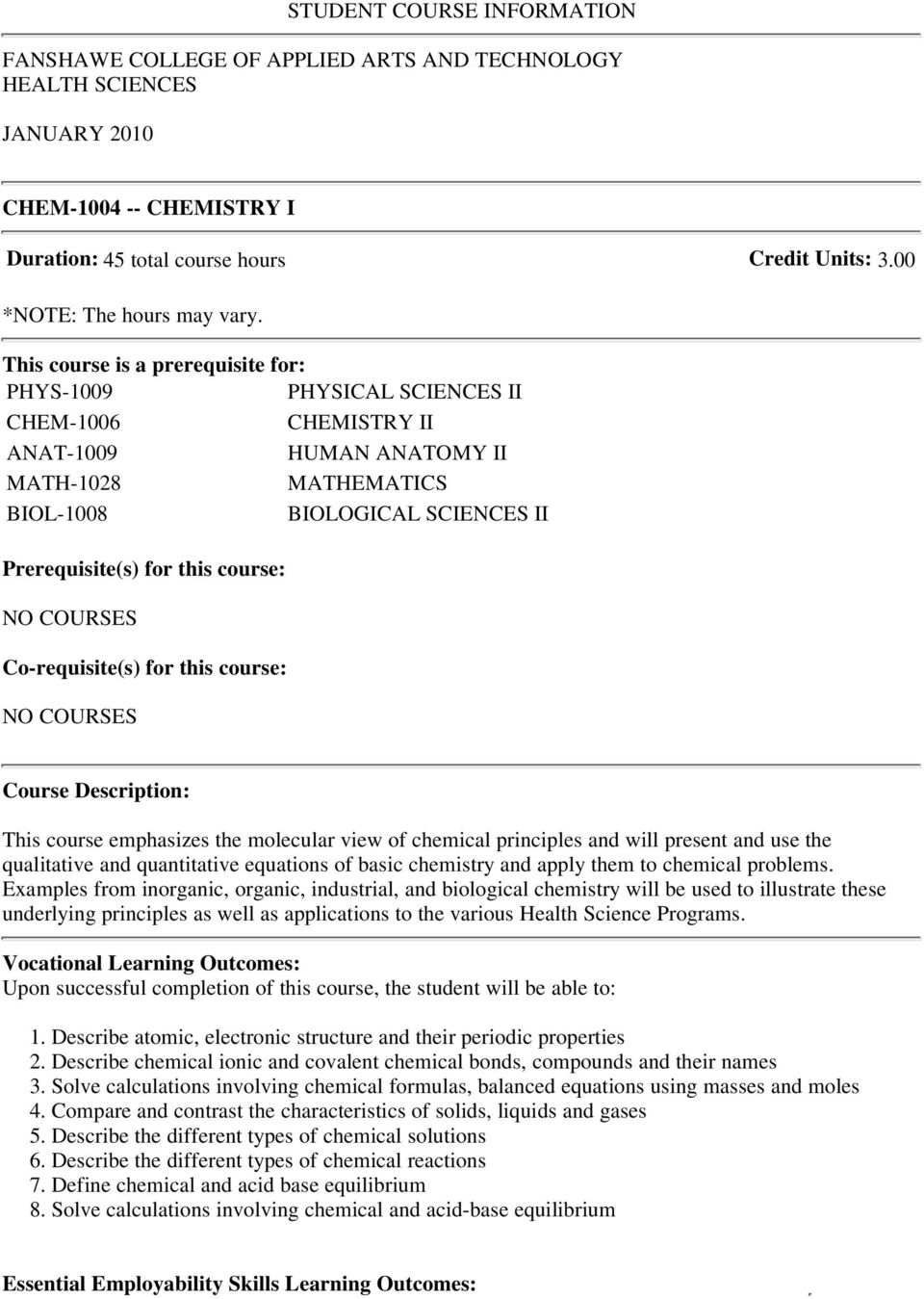
1 STUDENT COURSE INFORMATION FANSHAWE COLLEGE OF APPLIED ARTS AND TECHNOLOGY HEALTH SCIENCES JANUARY 2010 CHEM CHEMISTRY I Duration: 45 total course hours Credit Units: 3.00 *NOTE: The hours may vary. This course is a prerequisite for: PHYS-1009 PHYSICAL SCIENCES II CHEM-1006 CHEMISTRY II ANAT-1009 HUMAN ANATOMY II MATH-1028 MATHEMATICS BIOL-1008 BIOLOGICAL SCIENCES II Prerequisite(s) for this course: NO COURSES Co-requisite(s) for this course: NO COURSES Course Description: This course emphasizes the molecular view of chemical principles and will present and use the qualitative and quantitative equations of basic chemistry and apply them to chemical problems. Examples from inorganic, organic, industrial, and biological chemistry will be used to illustrate these underlying principles as well as applications to the various Health Science Programs. Vocational Learning Outcomes: Upon successful completion of this course, the student will be able to: 1. Describe atomic, electronic structure and their periodic properties 2. Describe chemical ionic and covalent chemical bonds, compounds and their names 3. Solve calculations involving chemical formulas, balanced equations using masses and moles 4. Compare and contrast the characteristics of solids, liquids and gases 5. Describe the different types of chemical solutions 6. Describe the different types of chemical reactions 7. Define chemical and acid base equilibrium 8. Solve calculations involving chemical and acid-base equilibrium Essential Employability Skills Learning Outcomes:
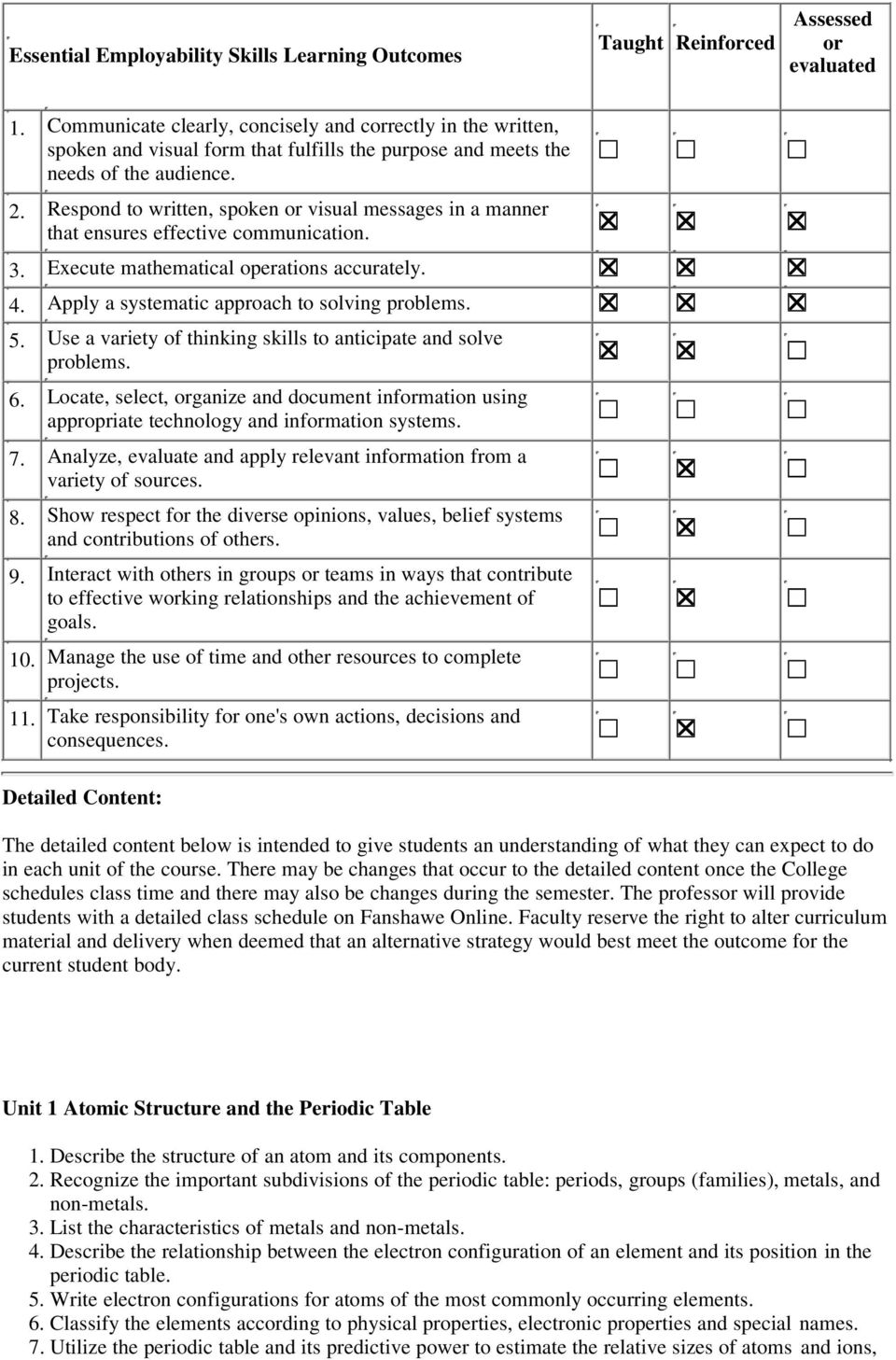
2 Essential Employability Skills Learning Outcomes Taught Reinforced Assessed or evaluated Communicate clearly, concisely and correctly in the written, spoken and visual form that fulfills the purpose and meets the needs of the audience. Respond to written, spoken or visual messages in a manner that ensures effective communication. Execute mathematical operations accurately. Apply a systematic approach to solving problems. Use a variety of thinking skills to anticipate and solve problems. Locate, select, organize and document information using appropriate technology and information systems. Analyze, evaluate and apply relevant information from a variety of sources. Show respect for the diverse opinions, values, belief systems and contributions of others. Interact with others in groups or teams in ways that contribute to effective working relationships and the achievement of goals. Manage the use of time and other resources to complete projects. Take responsibility for one's own actions, decisions and consequences. Detailed Content: The detailed content below is intended to give students an understanding of what they can expect to do in each unit of the course. There may be changes that occur to the detailed content once the College schedules class time and there may also be changes during the semester. The professor will provide students with a detailed class schedule on Fanshawe Online. Faculty reserve the right to alter curriculum material and delivery when deemed that an alternative strategy would best meet the outcome for the current student body. Unit 1 Atomic Structure and the Periodic Table 1. Describe the structure of an atom and its components. 2. Recognize the important subdivisions of the periodic table: periods, groups (families), metals, and non-metals. 3. List the characteristics of metals and non-metals. 4. Describe the relationship between the electron configuration of an element and its position in the periodic table. 5. Write electron configurations for atoms of the most commonly occurring elements. 6. Classify the elements according to physical properties, electronic properties and special names. 7. Utilize the periodic table and its predictive power to estimate the relative sizes of atoms and ions,
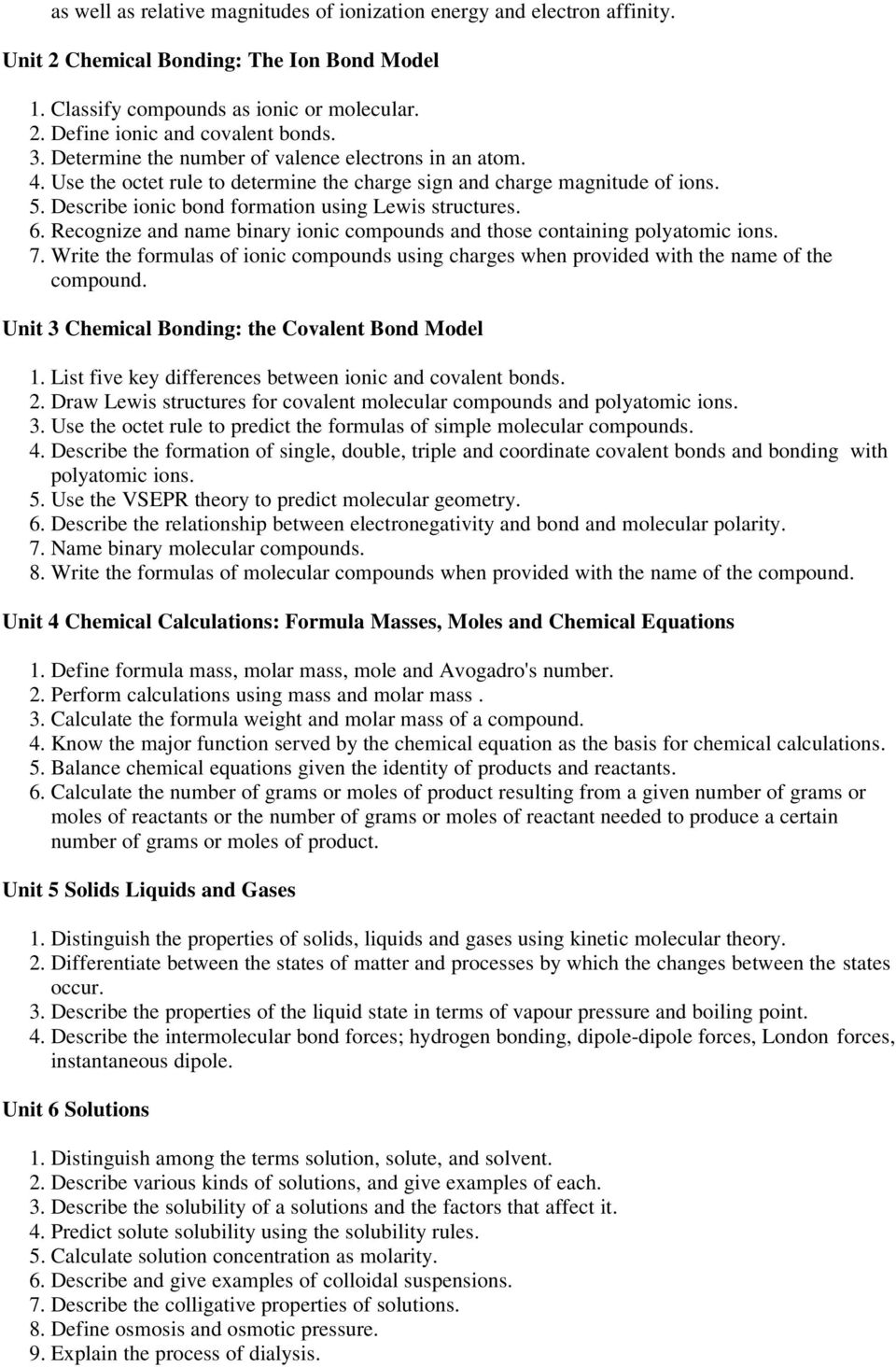
3 as well as relative magnitudes of ionization energy and electron affinity. Unit 2 Chemical Bonding: The Ion Bond Model 1. Classify compounds as ionic or molecular. 2. Define ionic and covalent bonds. 3. Determine the number of valence electrons in an atom. 4. Use the octet rule to determine the charge sign and charge magnitude of ions. 5. Describe ionic bond formation using Lewis structures. 6. Recognize and name binary ionic compounds and those containing polyatomic ions. 7. Write the formulas of ionic compounds using charges when provided with the name of the compound. Unit 3 Chemical Bonding: the Covalent Bond Model 1. List five key differences between ionic and covalent bonds. 2. Draw Lewis structures for covalent molecular compounds and polyatomic ions. 3. Use the octet rule to predict the formulas of simple molecular compounds. 4. Describe the formation of single, double, triple and coordinate covalent bonds and bonding with polyatomic ions. 5. Use the VSEPR theory to predict molecular geometry. 6. Describe the relationship between electronegativity and bond and molecular polarity. 7. Name binary molecular compounds. 8. Write the formulas of molecular compounds when provided with the name of the compound. Unit 4 Chemical Calculations: Formula Masses, Moles and Chemical Equations 1. Define formula mass, molar mass, mole and Avogadro's number. 2. Perform calculations using mass and molar mass. 3. Calculate the formula weight and molar mass of a compound. 4. Know the major function served by the chemical equation as the basis for chemical calculations. 5. Balance chemical equations given the identity of products and reactants. 6. Calculate the number of grams or moles of product resulting from a given number of grams or moles of reactants or the number of grams or moles of reactant needed to produce a certain number of grams or moles of product. Unit 5 Solids Liquids and Gases 1. Distinguish the properties of solids, liquids and gases using kinetic molecular theory. 2. Differentiate between the states of matter and processes by which the changes between the states occur. 3. Describe the properties of the liquid state in terms of vapour pressure and boiling point. 4. Describe the intermolecular bond forces; hydrogen bonding, dipole-dipole forces, London forces, instantaneous dipole. Unit 6 Solutions 1. Distinguish among the terms solution, solute, and solvent. 2. Describe various kinds of solutions, and give examples of each. 3. Describe the solubility of a solutions and the factors that affect it. 4. Predict solute solubility using the solubility rules. 5. Calculate solution concentration as molarity. 6. Describe and give examples of colloidal suspensions. 7. Describe the colligative properties of solutions. 8. Define osmosis and osmotic pressure. 9. Explain the process of dialysis.
4 Unit 7 Chemical Reactions 1. Classify chemical reactions by type: combination, decomposition, replacement or combustion. 2. Recognize the various classes of chemical reactions: precipitation, reactions with oxygen, acid-base, and oxidation-reduction. 3. Describe oxidation and reduction, and describe some practical examples of redox processes. 4. Describe collision theory and how it defines the conditions for chemical reactions. 5. Identify endothermic and exothermic reactions. 6. Describe the three factors that influence reaction rates. 7. Predict the way reactant structure, concentration, temperature, and catalysis affect the rate of a chemical reaction. 8. Describe chemical equilibrium. 9. Write equilibrium-constant expressions and use these expressions to calculate equilibrium constants. 10. Use LeChatelier's principle to predict changes in equilibrium position. Unit 8 Acid, Bases and Salts 1. Define and differentiate between acids and bases. 2. Identify acids and bases and acid-base reactions. 3. Write equations describing acid-base dissociation and label the conjugate acid-base pairs. 4. Calculate hydronium and/or hydroxide ion concentration from ph data. 5. Calculate ph of strong and weak acids and bases from concentration data. 6. Relate Ka or pka values to acid strength. 7. Differentiate between strong and weak acids and bases, and give examples of each. 8. Describe the meaning and utility of acid-base neutralization reactions. 9. State the meaning of the term buffer and describe the applications of buffers to chemical and biochemical systems, particularly blood chemistry. 10. Calculate the ph of a buffer system. 11. Identify metabolic and respiratory acidosis and alkalosis and give the causes of each. For detailed information about all content, please refer to the content section of this course on FOL. Teaching/Learning Methodology: Lectures - 50% Problem solving - Homework assignments - 20% In class assignments - 20% Student response participation - 10% Use of a scientific calculator Required Learning Resources: General, Organic and Biological Chemistry with Study Guide and CD ROM, Stoker, H. Stephen, 5th ed., 2010 Houghton Mifflin Co New York. ISBN Classroom response system TurningPoint Response Device (Blue Response card RF LCD model) Method Of Evaluation: The final mark/grade for this course will be determined as follows:

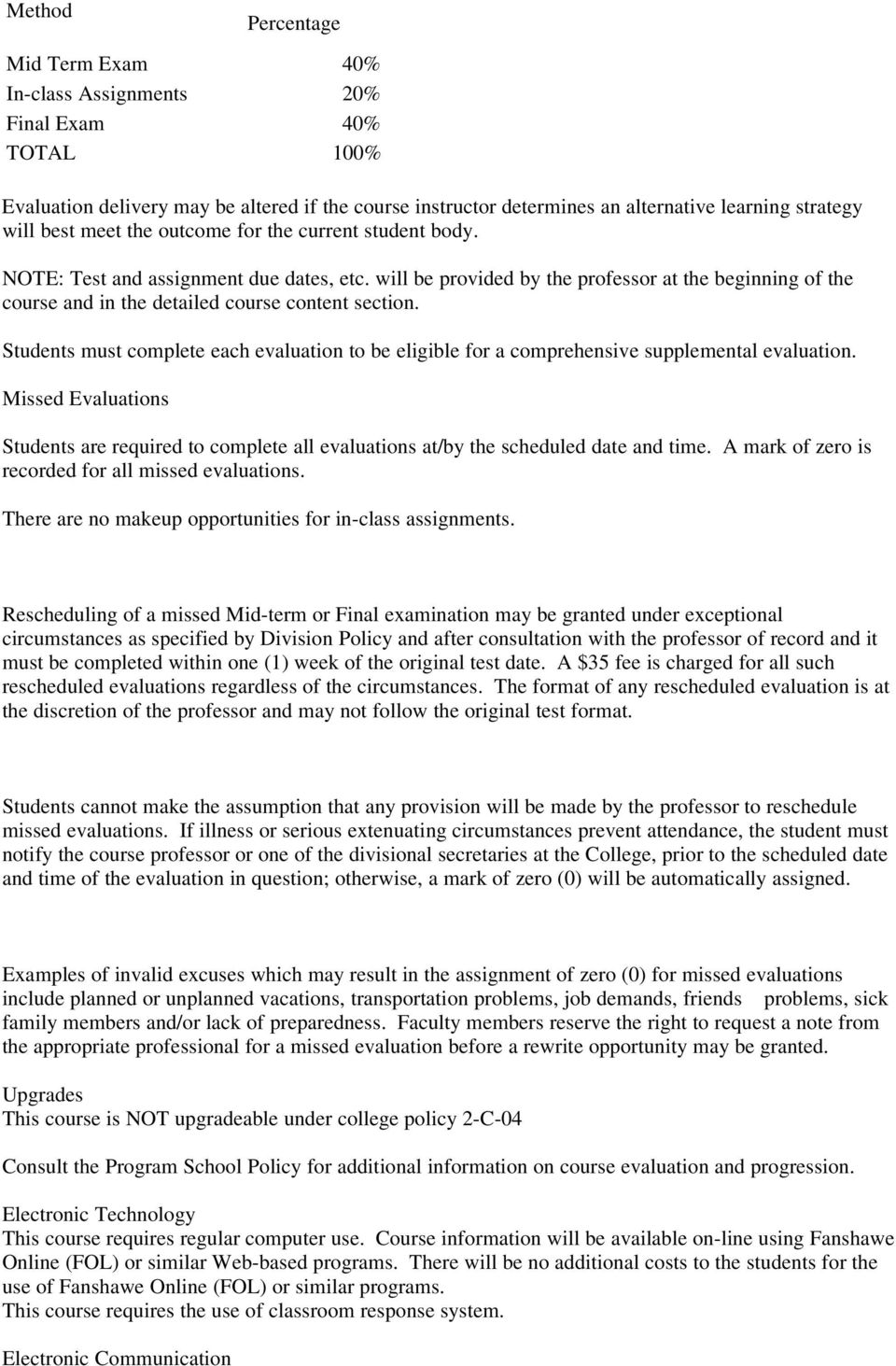
5 Method Percentage Mid Term Exam 40% In-class Assignments 20% Final Exam 40% TOTAL 100% Evaluation delivery may be altered if the course instructor determines an alternative learning strategy will best meet the outcome for the current student body. NOTE: Test and assignment due dates, etc. will be provided by the professor at the beginning of the course and in the detailed course content section. Students must complete each evaluation to be eligible for a comprehensive supplemental evaluation. Missed Evaluations Students are required to complete all evaluations at/by the scheduled date and time. A mark of zero is recorded for all missed evaluations. There are no makeup opportunities for in-class assignments. Rescheduling of a missed Mid-term or Final examination may be granted under exceptional circumstances as specified by Division Policy and after consultation with the professor of record and it must be completed within one (1) week of the original test date. A $35 fee is charged for all such rescheduled evaluations regardless of the circumstances. The format of any rescheduled evaluation is at the discretion of the professor and may not follow the original test format. Students cannot make the assumption that any provision will be made by the professor to reschedule missed evaluations. If illness or serious extenuating circumstances prevent attendance, the student must notify the course professor or one of the divisional secretaries at the College, prior to the scheduled date and time of the evaluation in question; otherwise, a mark of zero (0) will be automatically assigned. Examples of invalid excuses which may result in the assignment of zero (0) for missed evaluations include planned or unplanned vacations, transportation problems, job demands, friends problems, sick family members and/or lack of preparedness. Faculty members reserve the right to request a note from the appropriate professional for a missed evaluation before a rewrite opportunity may be granted. Upgrades This course is NOT upgradeable under college policy 2-C-04 Consult the Program School Policy for additional information on course evaluation and progression. Electronic Technology This course requires regular computer use. Course information will be available on-line using Fanshawe Online (FOL) or similar Web-based programs. There will be no additional costs to the students for the use of Fanshawe Online (FOL) or similar programs. This course requires the use of classroom response system. Electronic Communication
6 This course requires access to FOL All students registered in this course must have active FOL accounts. Fanshawe College provides access to (the student web site portal) and to personal computers at many sites within the College. If you have any concerns about meeting requirement, contact your professor or the Connect Resource Centre in E2030. NOTE: Test and assignment due dates, etc. will be provided by the professor at the beginning of the course. Consult the Program Division Policy for additional information on course evaluation and progression. Grade Range Comment Grade Point A Distinguished 4.2 A B B C C D D Marginal 1.0 F 0-49 Unsatisfactory 0 P greater than 50 Pass N/A I N/A Incomplete N/A N N/A No Credit Achieved N/A W N/A Withdrawn N/A X N/A Audit N/A CHEATING - All forms of cheating are considered an academic offence and the College has a clear policy on cheating. Please refer to Policy 2-G-04 on Fanshawe Online or in the Student Handbook. PLAGIARISM - Plagiarism is cheating and an appropriate penalty will be applied and a report will be placed in the student's file in conformance with College Policy 2-G-04 on cheating. Plagiarism (the intellectual dishonesty resulting from a student's failure to acknowledge indebtedness to sources used) is a serious academic offence that shall result in appropriate penalties, to be determined at the discretion of the course professor in consultation with the Divisional Chair. Plagiarism includes, but is not limited to, submitting the same work to more than one professor for credit in different courses without prior written permission from the professors. Penalties shall range from failure of an assignment to possible failure of the course. REWRITES - Students cannot make the assumption that any provision will be made by the professor to permit a student to rewrite failed assignments or tests. Turnitin.com As part of Fanshawe College's commitment to fostering excellence in student assignments, this course may require students to submit their papers to Turnitin.com. This Web service is designed to help students understand the importance of identifying borrowed work in their essays, and how to correctly cite research sources. Instructions for how to use Turnitin.com will be provided by the professor, and additional information is available at Additional Information: Consult your Program Outline for information concerning the minimum passing grade needed for this course.

7 This course is a pre-requisite for progression to second semester of the Pre-Health Science program. The student must pass this course in order to proceed to second semester of the Pre-Health Science program. Prepared By: Kathe McLister, Bsc., MEd. The following applies for course offerings consistent with the Standard Academic Calendar: Internal/External Course Credit Application Deadline Applications for Internal/External Course Credit are available from the Office of the Registrar. Check college calendar for deadlines. Course Add/Drop Deadline You may withdraw from a course without academic penalty during the first 70% of the course duration. Application is made through the Office of the Registrar. Academic Assistance The primary resource for students experiencing difficulty with course material is the course professor. In addition, students who wish to attend study skills workshops or who require further assistance, can contact the Learning Centre in A2019 ( ) for one-to-one tutoring from staff in math, physics, chemistry and english, or they can contact Counselling and Student Life in F2010 ( ) for information about receiving peer tutoring. Student Success Advisors are available to assist students with academic concerns or other problems they may face while at Fanshawe. They can either assist you directly, or refer you to the appropriate resource on campus to get the help you need. Contact information for your Student Success Advisor can be found on the Web at Students who have been identified as having (or who wish to be assessed for) a specific learning disability, should contact Disability Services F2010 ( ) in Counselling and Student Life for information about available support services. Re-taking a Course: Subject to meeting any pre-requisite or co-requisite requirements, a student may retake a course. The second re-take must be approved by the Academic Manager or designate and will be granted based on extenuating circumstances and with recommended interventions such as counselling or a learning contract. Subsequent re-take opportunities will only be available as part of an overall success strategy developed in consultation with the student, program co-ordinator and the Academic Manager. The best grade achieved will be used in calculating the cumulative GPA. Related Policies Course Grade System - See College Policy 2-C-04 Prior Learning Assessment and Recognition - See College Policy 2-A-10 Evaluations - See College Policy 2-C-02 Academic Standing - See College Policy 2-C-05 Student Appeal of a Grade or Other Academic Decision - See College Policy 2-G-02 Academic Withdrawal and Termination - See College Policy 2-C-06 Academic Offences - See College Policy 2-G-04 Student Code of Conduct Policy - See College Policy 2-G-01 Respectful College Community Policy - See College Policy 1-B-46 Authorized By: Date: JANUARY 2010

Bergen Community College Division of Mathematics, Science and Technology Department of Physical Sciences
 Semester and year: Course Number: Meeting Times and Locations: Instructor: Office Location: Phone: Office Hours: Email Address: Bergen Community College Division of Mathematics, Science and Technology
Introduction to Chemistry. Course Description
 CHM 1025 & CHM 1025L Introduction to Chemistry Course Description CHM 1025 Introduction to Chemistry (3) P CHM 1025L Introduction to Chemistry Laboratory (1) P This introductory course is intended to introduce
Southeastern Louisiana University Dual Enrollment Program--Chemistry
 Southeastern Louisiana University Dual Enrollment Program--Chemistry The Southeastern Dual Enrollment Chemistry Program is a program whereby high school students are given the opportunity to take college
STATE UNIVERSITY OF NEW YORK COLLEGE OF TECHNOLOGY CANTON, NEW YORK COURSE OUTLINE CHEM 150 - COLLEGE CHEMISTRY I
 STATE UNIVERSITY OF NEW YORK COLLEGE OF TECHNOLOGY CANTON, NEW YORK COURSE OUTLINE CHEM 150 - COLLEGE CHEMISTRY I PREPARED BY: NICOLE HELDT SCHOOL OF SCIENCE, HEALTH, AND PROFESSIONAL STUDIES SCIENCE DEPARTMENT
Prerequisites: CHEM 1311 and CHEM 1111, or CHEM 1411 General Chemistry I (Lecture and Laboratory)
 Course Syllabus CHEM 1412 General Chemistry II Revision Date: 8/21/2014 Catalog Description: Chemical equilibrium; phase diagrams and spectrometry; acid-base concepts; thermodynamics; kinetics; electrochemistry;
Chemistry. The student will be able to identify and apply basic safety procedures and identify basic equipment.
 Chemistry UNIT I: Introduction to Chemistry The student will be able to describe what chemistry is and its scope. a. Define chemistry. b. Explain that chemistry overlaps many other areas of science. The
GENERAL CHEMISTRY II Lecture & Recitation
 Howard University Department of Chemistry Fall 2010 GENERAL CHEMISTRY II Lecture & Recitation Chem 004, Section 04, CRN 82454; Section 05, CRN 82456; Section 06, CRN 82458 4 Credit Hours Course Time &
CHEMISTRY STANDARDS BASED RUBRIC ATOMIC STRUCTURE AND BONDING
 CHEMISTRY STANDARDS BASED RUBRIC ATOMIC STRUCTURE AND BONDING Essential Standard: STUDENTS WILL UNDERSTAND THAT THE PROPERTIES OF MATTER AND THEIR INTERACTIONS ARE A CONSEQUENCE OF THE STRUCTURE OF MATTER,
CHM 111 - General Chemistry I Lecture Fall 2014
 CHM 111 - General Chemistry I Lecture Fall 2014 Dr. Stuart T. Gentry Holroyd 329 215-951-1259 [email protected] Class Postings, Lecture Notes, and PowerPoint Slides Available on Canvas and at www.lasalle.edu/~gentry
A Teaching Portfolio for General Chemistry Harry Pang, Ph.D.
 A Teaching Portfolio for General Chemistry Harry Pang, Ph.D. Table of Content I. Teaching Philosophy II. Critical Thinking Practices III. Course Syllabus IV. Student Evaluation V. Final Report I. My Teaching
Keystone Exams: Chemistry Assessment Anchors and Eligible Content. Pennsylvania Department of Education www.education.state.pa.
 Assessment Anchors and Pennsylvania Department of Education www.education.state.pa.us 2010 PENNSYLVANIA DEPARTMENT OF EDUCATION General Introduction to the Keystone Exam Assessment Anchors Introduction
CHEM 1151 Survey of Chemistry I Georgia Perimeter College Alpharetta Center Syllabus and Policies Fall 2011
 CHEM 1151 Survey of Chemistry I Georgia Perimeter College Alpharetta Center Syllabus and Policies Fall 2011 GPC Cell Phone Use Policy Georgia Perimeter College prohibits student use of cell phones, pagers,
Forensic Science Standards and Benchmarks
 Forensic Science Standards and Standard 1: Understands and applies principles of scientific inquiry Power : Identifies questions and concepts that guide science investigations Uses technology and mathematics
Prentice Hall. Chemistry (Wilbraham) 2008, National Student Edition - South Carolina Teacher s Edition. High School. High School
 Prentice Hall Chemistry (Wilbraham) 2008, National Student Edition - South Carolina Teacher s Edition High School C O R R E L A T E D T O High School C-1.1 Apply established rules for significant digits,
AAHS-CHEMISTRY FINAL EXAM PREP-REVIEW GUIDE MAY-JUNE 2014 DR. GRAY CLASS OF 2016
 AAHS-CHEMISTRY FINAL EXAM PREP-REVIEW GUIDE MAY-JUNE 2014 DR. GRAY CLASS OF 2016 UNIT I: (CHAPTER 1-Zumdahl text) The Nature of Science and Chemistry 1. Explain why knowledge of chemistry is central to
CHEM 1211 Principles of Chemistry I Course Syllabus Spring 2016
 CHEM 1211 Principles of Chemistry I Course Syllabus Spring 2016 Student learning disabilities documented through the Disability Services Coordinator (Student Center 255, (678) 466-5445, [email protected])
Title: General Chemistry I. Department: Credits: 5 Lecture Hours:4 Lab/Studio Hours:3
 Code: CHEM-101 Title: General Chemistry I Institute: STEM Department: Chemistry Course Description:The student will investigate the fundamental concepts of chemistry from a theoretical approach and participate
CHM 105. General organic and Biochemistry
 Technical College of the Lowcountry Arts & Sciences Division 921 Ribaut Road Building 9, Room 102 Beaufort, SC 29901 843-525-8281 CHM 105 General organic and Biochemistry Course Description This course
Course Syllabus General Chemistry II Online Summer II, 2015
 Course Syllabus General Chemistry II Online Summer II, 2015 CHEM 1023: General Chemistry II Online Catalog Description: A continuation of CHEM 1013, online (ACTS: CHEM 1424) Type of Course: Theory Credit
COURSE SYLLABUS CHEM 103: General Chemistry- Fall 2010 University of Wisconsin-Eau Claire
 COURSE SYLLABUS CHEM 103: General Chemistry- Fall 2010 University of Wisconsin-Eau Claire Instructor Dr. Sudeep Bhattacharyay Office P-452 Office Phone 715 836 2278 Office Hours By appointment E-mail [email protected]
Chemical Reactions in Water Ron Robertson
 Chemical Reactions in Water Ron Robertson r2 f:\files\courses\1110-20\2010 possible slides for web\waterchemtrans.doc Properties of Compounds in Water Electrolytes and nonelectrolytes Water soluble compounds
Introductory Chemistry (Allied Health Emphasis)- Chem 1406 Course Syllabus: Summer 2015
 Introductory Chemistry (Allied Health Emphasis)- Chem 1406 Course Syllabus: Summer 2015 Northeast Texas Community College exists to provide responsible, exemplary learning opportunities. Bryan Trickey
CHEMISTRY II FINAL EXAM REVIEW
 Name Period CHEMISTRY II FINAL EXAM REVIEW Final Exam: approximately 75 multiple choice questions Ch 12: Stoichiometry Ch 5 & 6: Electron Configurations & Periodic Properties Ch 7 & 8: Bonding Ch 14: Gas
Instructional Notes/Strategies. GLEs. Evidence / Assessments of learning Knowledge/Synthesis. Resources # SI-1 (E)
 Lafayette Parish School System Curriculum Map Honors Chemistry (Pearson) Unit 1: Introduction to Chemistry Time Frame 1 week August 15 August 21, 2011 Unit Description - This unit focuses on Why It Is
CHAPTER 6 Chemical Bonding
 CHAPTER 6 Chemical Bonding SECTION 1 Introduction to Chemical Bonding OBJECTIVES 1. Define Chemical bond. 2. Explain why most atoms form chemical bonds. 3. Describe ionic and covalent bonding.. 4. Explain
How To Pass Chemistry 131
 University of Maryland, College Park SIE General Chemistry Syllabus Chemistry 131, Section SES1 Chemistry Building (CHM), Room 1402, College Park Spring, 2011 Class Schedule: Lectures - Mondays 6:30 to
ONLINE CHEMISTRY 1110 / GENERAL CHEMISTRY I. Term CRN #
 ONLINE CHEMISTRY 1110 / GENERAL CHEMISTRY I Term CRN # Professor: Office Hours: Office Phone: E-mail: Credit Hours: 4 Prerequisites: Exemption from or completion of ENGL 0810, READ 0810 and MATH 0810.
QUEENSBOROUGH COMMUNITY COLLEGE CHEMISTRY DEPARTMENT COURSE SYLLABUS CH-151: GENERAL CHEMISTRY I
 QUEENSBOROUGH COMMUNITY COLLEGE CHEMISTRY DEPARTMENT COURSE SYLLABUS CH-151: GENERAL CHEMISTRY I Pre-requisites: MA-119 and MA-121 or Departmental permission Hours: 3 Class Hours 3 Laboratory Hours 1 Recitation
CHEM 110 A Chemistry I
 Columbia College Online Campus P a g e 1 CHEM 110 A Chemistry I Early Fall Session (15-51) Monday, August 17 Saturday, October 10, 2015 Course Description Fundamental course in the principles of chemistry.
WRIGHT COLLEGE PROGRAM/DISCIPLINE ASSESSMENT FORM
 Program/Discipline: Chemistry 201 Instructional Manager: Kevin Li Semester/Year: Fall/2012 Assessment Coordinator: Kris Ochwat Department Chair: Doris Espiritu Email: [email protected] Plan Title: The Improvement
PTAC: Applied Chemistry COURSE OUTLINE & OBJECTIVES ESC Approved November 19, 2004
 INTRODUCTION PTAC: Applied Chemistry COURSE OUTLINE & OBJECTIVES ESC Approved November 19, 2004 A. Introduction to Chemistry Terms 1. Define basic terms associated with chemistry: Organic/inorganic/biochemistry/physical
AP Chemistry Semester One Study Guide
 AP Chemistry Semester One Study Guide Unit One: General Chemistry Review Unit Two: Organic Nomenclature Unit Three: Reactions Unit Four: Thermochemistry Unit Five: Electronic Structure of the Atom Unit
Chemistry B11 Chapter 4 Chemical reactions
 Chemistry B11 Chapter 4 Chemical reactions Chemical reactions are classified into five groups: A + B AB Synthesis reactions (Combination) H + O H O AB A + B Decomposition reactions (Analysis) NaCl Na +Cl
LAGUARDIA COMMUNITY COLLEGE CITY UNIVERSITY OF NEW YORK NATURAL SCIENCES DEPARTMENT
 LAGUARDIA COMMUNITY COLLEGE CITY UNIVERSITY OF NEW YORK NATURAL SCIENCES DEPARTMENT SCC 110: Foundations of Chemistry Course Coordinator: Dr. Nalband S. Hussain Office: M 210 E-mail: [email protected]
What You Need To Know for the Chemistry Regents Exam
 Name: What You Need To Know for the Chemistry Regents Exam The Test The Chemisty Regents Exam is broken down into three sections: Part A: 35 mulitple choice questions from all units covered over the course
Chemical Bonds. Chemical Bonds. The Nature of Molecules. Energy and Metabolism < < Covalent bonds form when atoms share 2 or more valence electrons.
 The Nature of Molecules Chapter 2 Energy and Metabolism Chapter 6 Chemical Bonds Molecules are groups of atoms held together in a stable association. Compounds are molecules containing more than one type
Enrollment Services: Rev 12/11/2012 1
 Enrollment Services: Rev 12/11/2012 1 Purpose of This Guide Page 3 CSULB Major Specific Requirements Page 4 Using ASSIST to Determine Course Equivalencies Between CSULB and California Community Colleges
Chemistry. Essential Question: How can one explain the structure, properties, and interactions of matter?
 Chemistry Special Note for the 2014-15 School Year: In 2013, the Maryland State Board of Education adopted the Next Generation Science Standards (NGSS) that set forth a vision for science education where
CHEM 112-03 PRINCIPLES OF CHEMISTRY Lecture
 CHEM 112-03 PRINCIPLES OF CHEMISTRY Lecture Spring 2016 COURSE DESCRIPTION An introductory course in chemistry emphasizing theoretical aspects and designed primarily for students who intend to take one
Course Goals: Have science and engineering majors able to translate the theoretical concepts of Chemistry into concrete terms.
 HOUSTON COMMUNITY COLLEGE COURSE SYLLABUS GENERAL CHEMISTRY II (CHEM-1412, CRN. 57247) Summer, 2015 DEPARTMENT OF PHYSICAL SCIENCES Spring branch center CHEMISTRY Professor: Usha Kiran Kala Phone: 713-718-5857
Chem101: General Chemistry Lecture 9 Acids and Bases
 : General Chemistry Lecture 9 Acids and Bases I. Introduction A. In chemistry, and particularly biochemistry, water is the most common solvent 1. In studying acids and bases we are going to see that water
Science Standard Articulated by Grade Level Strand 5: Physical Science
 Concept 1: Properties of Objects and Materials Classify objects and materials by their observable properties. Kindergarten Grade 1 Grade 2 Grade 3 Grade 4 PO 1. Identify the following observable properties
QUEENSBOROUGH COMMUNITY COLLEGE CHEMISTRY DEPARTMENT
 QUEENSBOROUGH COMMUNITY COLLEGE CHEMISTRY DEPARTMENT CH-127 INTRODUCTORY GENERAL CHEMISTRY PREREQUISITES: None LECTURE: 3 hrs/wk LAB: 3 hrs/wk CREDITS: 4.5 *TEXTBOOK: General, Organic, and Biochemistry
COURSE SYLLABUS. Luis Hernandez Chemical & Environmental Building J TBA. [email protected]
 COURSE SYLLABUS COURSE NUMBER AND TITLE: CHEM 1311 General Chemistry I COURSE (CATALOG) DESCRIPTION: Fundamental principles of chemistry for majors in the sciences, health sciences, and engineering; topics
Chapter 4: Structure and Properties of Ionic and Covalent Compounds
 Chapter 4: Structure and Properties of Ionic and Covalent Compounds 4.1 Chemical Bonding o Chemical Bond - the force of attraction between any two atoms in a compound. o Interactions involving valence
RANGER COLLEGE CREDIT HOURS: 3 HRS/WK LECTURE & 3 HRS/WK LAB. LEC/LAB/HRS/WK COMBINATION: 4 credit hours total
 RANGER COLLEGE COURSE NUMBER AND TITLE: Chemistry 1411 General Chemistry I CREDIT HOURS: 3 HRS/WK LECTURE & 3 HRS/WK LAB LEC/LAB/HRS/WK COMBINATION: 4 credit hours total INSTRUCTOR: Kimberlea M. Adams
Best way to contact me: email listed above or stop by my office; I don t read WebCT email
 Course CHEM 1311, section 003: General Chemistry I Professor Dr. Steven O. Nielsen Term Fall 2006 Meetings MWF 2:00 2:50 pm, FN 2.102 (Kusch Auditorium) Professor s Contact Information Office Phone 972-883-5323
LOS ANGELES MISSION COLLEGE-SUMMER 2013 CHEMISTRY 51-SECTIONS 0552 Lecture: MTWTh 10:35-12:40 ; Room: CMS-028 Lab: MTWTh 1:00-2:25 ; Room: CMS-201
 LOS ANGELES MISSION COLLEGE-SUMMER 2013 CHEMISTRY 51-SECTIONS 0552 Lecture: MTWTh 10:35-12:40 ; Room: CMS-028 Lab: MTWTh 1:00-2:25 ; Room: CMS-201 INSTRUCTOR: Said Pazirandeh OFFICE PHONE: (818)364-7705
WINDWARD COMMUNITY COLLEGE MISSION STATEMENT
 General Chemistry I: Course Syllabus Windward Community College Spring 2013 Course Number: CHEM 161 (CRN 62310; 3 credits) Class Meeting Days and Times: TR 10:00-11:15 am ( Imiloa 111) Instructor: Email:
CH-152: GENERAL CHEMISTRY II
 QUEENSBOROUGH COMMUNITY COLLEGE CHEMISTRY DEPARTMENT COURSE SYLLABUS CH-152: GENERAL CHEMISTRY II Pre-requisites: CH-151 Hours: 3 Class Hours 3 Laboratory Hours 1 Recitation Hour 4 1/2 Credits Course Description:
SYLLABUS. Semester: Spring 2009. Requirements: Text: General Chemistry. 9 th Edition, Chang, 2007
 SYLLABUS Course: General Chemistry II: CHEM-1100-001 Lecture: 10:30 AM-12:00 PM Tues. & Thurs. in Room 6068 Recitation: 12:00 PM-12:50 PM in Room 3066 Laboratory: 01:00-03:50 PM Wed. in Room 3066 Semester:
Chapter 2 Polar Covalent Bonds: Acids and Bases
 John E. McMurry www.cengage.com/chemistry/mcmurry Chapter 2 Polar Covalent Bonds: Acids and Bases Modified by Dr. Daniela R. Radu Why This Chapter? Description of basic ways chemists account for chemical
Exam 2 Chemistry 65 Summer 2015. Score:
 Name: Exam 2 Chemistry 65 Summer 2015 Score: Instructions: Clearly circle the one best answer 1. Valence electrons are electrons located A) in the outermost energy level of an atom. B) in the nucleus of
Chapter 17. How are acids different from bases? Acid Physical properties. Base. Explaining the difference in properties of acids and bases
 Chapter 17 Acids and Bases How are acids different from bases? Acid Physical properties Base Physical properties Tastes sour Tastes bitter Feels slippery or slimy Chemical properties Chemical properties
CHEMISTRY 103 - GENERAL CHEMISTRY Calvin College Whoever can be trusted with very little can also be trusted with much.
 CHEMISTRY 103 - GENERAL CHEMISTRY Calvin College Whoever can be trusted with very little can also be trusted with much. Luke 16:10a Instructor: Herb Fynewever Office: DeVries Hall 229 [email protected]
COURSE AND GRADING POLICY
 MONTGOMERY COLLEGE Chemistry Department Rockville Campus Summer II 2015 CHEM131-: General Chemistry I Lecture Section (10462 CH131) MTWR 9:00-10:35 am, Room SC-462 (Science Center). Discussion Sections
Syllabus. Course Number: CHEM 1411. Contact Information 409-673-7272 [email protected]
 Syllabus Lamar University, a member of The Texas State University System, is accredited by the Commission on Colleges of the Southern Association of Colleges and Schools to award Associate, Baccalaureate,
The content is based on the National Science Teachers Association (NSTA) standards and is aligned with state standards.
 Literacy Advantage Physical Science Physical Science Literacy Advantage offers a tightly focused curriculum designed to address fundamental concepts such as the nature and structure of matter, the characteristics
In the box below, draw the Lewis electron-dot structure for the compound formed from magnesium and oxygen. [Include any charges or partial charges.
 Name: 1) Which molecule is nonpolar and has a symmetrical shape? A) NH3 B) H2O C) HCl D) CH4 7222-1 - Page 1 2) When ammonium chloride crystals are dissolved in water, the temperature of the water decreases.
CHEMISTRY 101 EXAM 3 (FORM B) DR. SIMON NORTH
 1. Is H 3 O + polar or non-polar? (1 point) a) Polar b) Non-polar CHEMISTRY 101 EXAM 3 (FORM B) DR. SIMON NORTH 2. The bond strength is considerably greater in HF than in the other three hydrogen halides
EXPERIMENT 1: Survival Organic Chemistry: Molecular Models
 EXPERIMENT 1: Survival Organic Chemistry: Molecular Models Introduction: The goal in this laboratory experience is for you to easily and quickly move between empirical formulas, molecular formulas, condensed
Chemistry 151 Final Exam
 Chemistry 151 Final Exam Name: SSN: Exam Rules & Guidelines Show your work. No credit will be given for an answer unless your work is shown. Indicate your answer with a box or a circle. All paperwork must
Chemistry 20: Fundamentals of Chemistry, Section 1152 Fall, 2008
 Chemistry 20: Fundamentals of Chemistry, Section 1152 Fall, 2008 Instructor: Dr. Kenneth R. Rodriguez Office: LS-101 Phone: 310-660-3349 [email protected] Course Description: Chemistry 20 is an introductory
AP Chemistry A. Allan Chapter 8 Notes - Bonding: General Concepts
 AP Chemistry A. Allan Chapter 8 Notes - Bonding: General Concepts 8.1 Types of Chemical Bonds A. Ionic Bonding 1. Electrons are transferred 2. Metals react with nonmetals 3. Ions paired have lower energy
Getting the most from this book...4 About this book...5
 Contents Getting the most from this book...4 About this book....5 Content Guidance Topic 1 Atomic structure and the periodic table...8 Topic 2 Bonding and structure...14 Topic 2A Bonding....14 Topic 2B
a. pure substance b. composed of combinations of atoms c. held together by chemical bonds d. substance that cannot be broken down into simpler units
 Chemical Bonds 1. Which of the following is NOT a true compound? a. pure substance b. composed of combinations of atoms c. held together by chemical bonds d. substance that cannot be broken down into simpler
Chapter 14 - Acids and Bases
 Chapter 14 - Acids and Bases 14.1 The Nature of Acids and Bases A. Arrhenius Model 1. Acids produce hydrogen ions in aqueous solutions 2. Bases produce hydroxide ions in aqueous solutions B. Bronsted-Lowry
Ch 8.5 Solution Concentration Units % (m/m or w/w) = mass of solute x 100 total mass of solution mass of solution = mass solute + mass solvent
 1 Ch 8.5 Solution Concentration Units % (m/m or w/w) = mass of solute x 100 total mass of solution mass of solution = mass solute + mass solvent % (v/v) = volume of solute x 100 volume of solution filled
Course Syllabus CHEM 108 - General Lab Chemistry for Health Professions 4 credits
 Course Syllabus CHEM 108 - General Lab Chemistry for Health Professions 4 credits Prerequisites: High school chemistry (recommended, but not required) Instructor: Kenneth Hartman, PhD Contact Info: Faculty
Bonding Practice Problems
 NAME 1. When compared to H 2 S, H 2 O has a higher 8. Given the Lewis electron-dot diagram: boiling point because H 2 O contains stronger metallic bonds covalent bonds ionic bonds hydrogen bonds 2. Which
Chemistry and Biochemistry
 SUBJECT OUTLINE Subject Name: Chemistry and Biochemistry SECTION 1 GENERAL INFORMATION Subject Code: BIOB111 Award/s: Total course credit points: Level: Bachelor of Health Science (Naturopathy) 128 Core
How To Learn Chemistry And Biochemistry
 SUBJECT OUTLINE Subject Name: Chemistry and Biochemistry SECTION 1 GENERAL INFORMATION Subject Code: BIOB111 Award/s: Total course credit points: Level: Bachelor of Health Science (Naturopathy) 128 Core
CHEM 30A INTRO CHEMISTRY SPR
 CHEM 30A INTRO CHEMISTRY SPR 2014 Instructor: Nisha Guha; Email: [email protected] Office Hrs: T/Th 10:50 11:50 am: Rm A236A (office) Lecture T/Th 8:00-9:15 am Lab T/Th 9:30-10:45 am Course description:
Sample Exercise 8.1 Magnitudes of Lattice Energies
 Sample Exercise 8.1 Magnitudes of Lattice Energies Without consulting Table 8.2, arrange the following ionic compounds in order of increasing lattice energy: NaF, CsI, and CaO. Analyze: From the formulas
Lecture 22 The Acid-Base Character of Oxides and Hydroxides in Aqueous Solution
 2P32 Principles of Inorganic Chemistry Dr. M. Pilkington Lecture 22 The Acid-Base Character of Oxides and Hydroxides in Aqueous Solution Oxides; acidic, basic, amphoteric Classification of oxides - oxide
Write the acid-base equilibria connecting all components in the aqueous solution. Now list all of the species present.
 Chapter 16 Acids and Bases Concept Check 16.1 Chemists in the seventeenth century discovered that the substance that gives red ants their irritating bite is an acid with the formula HCHO 2. They called
Sample Exercise 8.1 Magnitudes of Lattice Energies
 Sample Exercise 8.1 Magnitudes of Lattice Energies Without consulting Table 8.2, arrange the ionic compounds NaF, CsI, and CaO in order of increasing lattice energy. Analyze From the formulas for three
Summer Holidays Questions
 Summer Holidays Questions Chapter 1 1) Barium hydroxide reacts with hydrochloric acid. The initial concentration of the 1 st solution its 0.1M and the volume is 100ml. The initial concentration of the
CHAPTER 10: INTERMOLECULAR FORCES: THE UNIQUENESS OF WATER Problems: 10.2, 10.6,10.15-10.33, 10.35-10.40, 10.56-10.60, 10.101-10.
 CHAPTER 10: INTERMOLECULAR FORCES: THE UNIQUENESS OF WATER Problems: 10.2, 10.6,10.15-10.33, 10.35-10.40, 10.56-10.60, 10.101-10.102 10.1 INTERACTIONS BETWEEN IONS Ion-ion Interactions and Lattice Energy
CHEMISTRY BONDING REVIEW
 Answer the following questions. CHEMISTRY BONDING REVIEW 1. What are the three kinds of bonds which can form between atoms? The three types of Bonds are Covalent, Ionic and Metallic. Name Date Block 2.
Unit 1 Measurement, Matter and Change
 Unit 1 Measurement, Matter and Change Part one: Scientific Measurement 1. Apply the rules of safety in the Chemistry laboratory 2. Distinguish between quantitative and qualitative measurements 3. Distinguish
Bonding & Molecular Shape Ron Robertson
 Bonding & Molecular Shape Ron Robertson r2 n:\files\courses\1110-20\2010 possible slides for web\00bondingtrans.doc The Nature of Bonding Types 1. Ionic 2. Covalent 3. Metallic 4. Coordinate covalent Driving
6 Reactions in Aqueous Solutions
 6 Reactions in Aqueous Solutions Water is by far the most common medium in which chemical reactions occur naturally. It is not hard to see this: 70% of our body mass is water and about 70% of the surface
CHEM 122, Spring 2015 Great Basin College Dr. David Freistroffer
 Syllabus for CHEM 122 General Chemistry II, 4CR, Great Basin College Section number: all sections at GBC 1001,1002,1003,1004,1005 (online and live are combined) Instructor: Dr. David Freistroffer Office:
stoichiometry = the numerical relationships between chemical amounts in a reaction.
 1 REACTIONS AND YIELD ANSWERS stoichiometry = the numerical relationships between chemical amounts in a reaction. 2C 8 H 18 (l) + 25O 2 16CO 2 (g) + 18H 2 O(g) From the equation, 16 moles of CO 2 (a greenhouse
IB Chemistry 1 Mole. One atom of C-12 has a mass of 12 amu. One mole of C-12 has a mass of 12 g. Grams we can use more easily.
 The Mole Atomic mass units and atoms are not convenient units to work with. The concept of the mole was invented. This was the number of atoms of carbon-12 that were needed to make 12 g of carbon. 1 mole
CHEM 36 General Chemistry EXAM #1 February 13, 2002
 CHEM 36 General Chemistry EXAM #1 February 13, 2002 Name: Serkey, Anne INSTRUCTIONS: Read through the entire exam before you begin. Answer all of the questions. For questions involving calculations, show
Correlation of Nelson Chemistry Alberta 20 30 to the Alberta Chemistry 20 30 Curriculum
 Correlation of Nelson Chemistry Alberta 20 30 to the Alberta Chemistry 20 30 Curriculum Unit 5 Organic Chemistry General Outcomes Students will: 1. explore organic compounds as a common form of matter
Laboratory 11: Molecular Compounds and Lewis Structures
 Introduction Laboratory 11: Molecular Compounds and Lewis Structures Molecular compounds are formed by sharing electrons between non-metal atoms. A useful theory for understanding the formation of molecular
4.5 Physical Properties: Solubility
 4.5 Physical Properties: Solubility When a solid, liquid or gaseous solute is placed in a solvent and it seems to disappear, mix or become part of the solvent, we say that it dissolved. The solute is said
ph: Measurement and Uses
 ph: Measurement and Uses One of the most important properties of aqueous solutions is the concentration of hydrogen ion. The concentration of H + (or H 3 O + ) affects the solubility of inorganic and organic
KS3 Science: Chemistry Contents
 summary KS3 Science MyWorks Guide Chemistry KS3 Science: Chemistry Mini zes: 40 Super zes: 5 Extension zes: 4 Skills zes: 6 TOTAL 54 What are MyWorks zes? MyWorks zes are short individual learning tasks
Which substance contains positive ions immersed in a sea of mobile electrons? A) O2(s) B) Cu(s) C) CuO(s) D) SiO2(s)
 BONDING MIDTERM REVIEW 7546-1 - Page 1 1) Which substance contains positive ions immersed in a sea of mobile electrons? A) O2(s) B) Cu(s) C) CuO(s) D) SiO2(s) 2) The bond between hydrogen and oxygen in
Chapter 2 Polar Covalent Bonds; Acids and Bases
 John E. McMurry http://www.cengage.com/chemistry/mcmurry Chapter 2 Polar Covalent Bonds; Acids and Bases Javier E. Horta, M.D., Ph.D. University of Massachusetts Lowell Polar Covalent Bonds: Electronegativity
Stoichiometry and Aqueous Reactions (Chapter 4)
 Stoichiometry and Aqueous Reactions (Chapter 4) Chemical Equations 1. Balancing Chemical Equations (from Chapter 3) Adjust coefficients to get equal numbers of each kind of element on both sides of arrow.
VCE CHEMISTRY UNIT 2 Environmental Chemistry SAMPLE COURSE OUTLINE
 VCE CHEMISTRY UNIT 2 Environmental Chemistry SAMPLE COURSE OUTLINE Week Area of Study Key knowledge Possible activities Key skills 1 1 Water Role of water in maintaining life in the environment unique
Chemistry Diagnostic Questions
 Chemistry Diagnostic Questions Answer these 40 multiple choice questions and then check your answers, located at the end of this document. If you correctly answered less than 25 questions, you need to
A pure covalent bond is an equal sharing of shared electron pair(s) in a bond. A polar covalent bond is an unequal sharing.
 CHAPTER EIGHT BNDING: GENERAL CNCEPT or Review 1. Electronegativity is the ability of an atom in a molecule to attract electrons to itself. Electronegativity is a bonding term. Electron affinity is the
CHEM 110: CHAPTER 3: STOICHIOMETRY: CALCULATIONS WITH CHEMICAL FORMULAS AND EQUATIONS
 1 CHEM 110: CHAPTER 3: STOICHIOMETRY: CALCULATIONS WITH CHEMICAL FORMULAS AND EQUATIONS The Chemical Equation A chemical equation concisely shows the initial (reactants) and final (products) results of