
department of electrical engineering
|
|
|
- Eugene Ellis
- 10 years ago
- Views:
Transcription
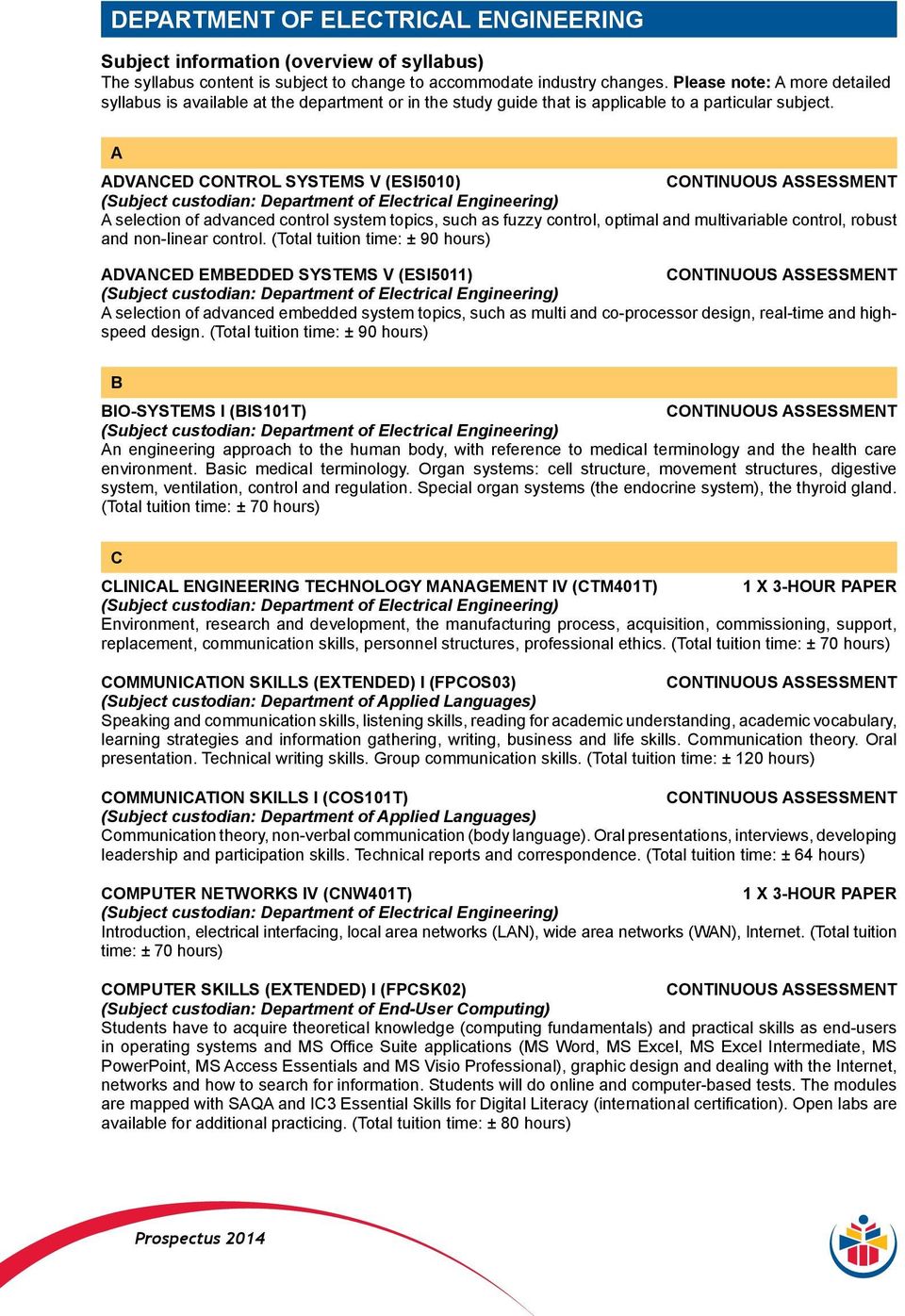
1 department of electrical engineering Subject information (overview of syllabus) The syllabus content is subject to change to accommodate industry changes. Please note: A more detailed syllabus is available at the department or in the study guide that is applicable to a particular subject. A ADVANCED CONTROL SYSTEMS V (ESI5010) A selection of advanced control system topics, such as fuzzy control, optimal and multivariable control, robust and non-linear control. (Total tuition time: ± 90 hours) ADVANCED EMBEDDED SYSTEMS V (ESI5011) A selection of advanced embedded system topics, such as multi and co-processor design, real-time and highspeed design. (Total tuition time: ± 90 hours) B BIO-SYSTEMS I (BIS101T) An engineering approach to the human body, with reference to medical terminology and the health care environment. Basic medical terminology. Organ systems: cell structure, movement structures, digestive system, ventilation, control and regulation. Special organ systems (the endocrine system), the thyroid gland. C CLINICAL ENGINEERING TECHNOLOGY MANAGEMENT IV (CTM401T) Environment, research and development, the manufacturing process, acquisition, commissioning, support, replacement, communication skills, personnel structures, professional ethics. COMMUNICATION SKILLS (EXTENDED) I (FPCOS03) (Subject custodian: Department of Applied Languages) Speaking and communication skills, listening skills, reading for academic understanding, academic vocabulary, learning strategies and information gathering, writing, business and life skills. Communication theory. Oral presentation. Technical writing skills. Group communication skills. (Total tuition time: ± 120 hours) COMMUNICATION SKILLS I (COS101T) (Subject custodian: Department of Applied Languages) Communication theory, non-verbal communication (body language). Oral presentations, interviews, developing leadership and participation skills. Technical reports and correspondence. (Total tuition time: ± 64 hours) COMPUTER NETWORKS IV (CNW401T) Introduction, electrical interfacing, local area networks (LAN), wide area networks (WAN), Internet. (Total tuition time: ± 70 hours) COMPUTER SKILLS (EXTENDED) I (FPCSK02) (Subject custodian: Department of End-User Computing) Students have to acquire theoretical knowledge (computing fundamentals) and practical skills as end-users in operating systems and MS Office Suite applications (MS Word, MS Excel, MS Excel Intermediate, MS PowerPoint, MS Access Essentials and MS Visio Professional), graphic design and dealing with the Internet, networks and how to search for information. Students will do online and computer-based tests. The modules are mapped with SAQA and IC3 Essential Skills for Digital Literacy (international certification). Open labs are available for additional practicing. (Total tuition time: ± 80 hours)
2 COMPUTER SKILLS I (CSK101C) (Subject custodian: Department of End-User Computing) Students have to acquire theoretical knowledge (computing fundamentals) and practical skills as end-users in operating systems and MS Office Suite applications (MS Word, MS Excel, MS Excel Intermediate, MS PowerPoint, MS Access Essentials and MS Visio Professional), graphic design and dealing with the Internet, networks and how to search for information. Students will do online and computer-based tests. The modules are mapped with SAQA and IC3 Essential Skills for Digital Literacy (international certification). Open labs are available for additional practising. (Total tuition time: ± 50 hours) CONTROL SYSTEMS III (CSY321T) Mathematical modelling of systems, stability of linear feedback systems, steady state error, feedback-control characteristics, the root locus, compensation of feedback control and frequency response. Programmable Logic Controllers (PLCs). CONTROL SYSTEMS IV (CSY401T) (OPEN BOOK) State-space analysis of linear systems. Design of compensators using gain adjustment, Lead, Lag, Lead-Lag and PID compensators. Designs of compensators for linear systems, using state space techniques. (Total tuition time: ± 70 hours) CONTROL SYSTEMS V (CSY501T) System modelling, discrete-time analysis and digital controller design. (Total tuition time: ± 90 hours) CONVERSION SYSTEMS V (CVS501T, ESI5027) Converter theory, electromechanical systems, electric materials, EM field calculation, distribution (non-linear and transient problems, numerical methods, applications), transmission, planning and design. (Total tuition time: ± 90 hours) D DESIGN PROJECT: HEAVY CURRENT III (DPJ30ZT) This subject covers the concepts and implementation of the design of power engineering systems. This includes the context of power engineering systems and components design (the technology-based organisation), systems engineering concepts (from problem-solving to design implementation), practical implementation, including circuit or system design, construction and documentation. Assessment is through open-book tests, a practical project, a research topic and a final examination. DESIGN PROJECT: LIGHT CURRENT III (DPJ30YT) This subject covers the concepts and implementation of the design of light current systems. This includes the context of electronic, telecommunications, digital technology, medical technology, or control technology systems and components design (the technology-based organisation), systems engineering concepts (from problem-solving to design implementation), practical implementation, including circuit design, construction and documentation. Assessment is through open-book tests, a practical project, a research topic and a final examination. DIGITAL COMMUNICATION II (DCO201T) Networks, OSI model, implementation, protocols, services. DIGITAL COMMUNICATION V (ESI5001) Fourier analysis and filtering, probability and stochastic processes, information theory and entropy, advanced modulation techniques, block and convolutional coding, performance analysis, networking fundamentals, system modelling. (Total tuition time: ± 90 hours)

3 DIGITAL COMMUNICATIONS V (DCO501T) Spectral analysis of common electronic signals: Fourier series and Fourier transform application. Source coding. Channel effect on symbol transmission and inter-symbol interference (ISI) control. Bandpass and multi-level digital modulation: generation, detection, probability of error, bandwidth efficiency, and applications. Channel coding and coding for reliable transmission over the channel. (Total tuition time: ± 90 hours) DIGITAL CONTROL V (ESI5003) System modelling, discrete-time analysis and digital controller design. (Total tuition time: ± 90 hours) DIGITAL CONTROL SYSTEMS IV (DCS401T) (OPEN BOOK) Discrete-time models and sampled data systems, difference equations, mathematical representation of the sampling process using the Z-transform, analysis of sampled data systems, stability considerations of sampled data systems, design of compensation for sampled data systems, using transform techniques. (Total tuition time: ± 70 hours) DIGITAL ELECTRONICS V (ESI5002) Analysis of advanced digital electronic circuits, best practice design and prototyping principles. (Total tuition time: ± 90 hours) DIGITAL SIGNAL PROCESSING IV (DSP401T) Introduction to digital signal processing. Sampling analogue signals that are to be converted into their discrete counterparts. The characteristics of discrete-time signals and systems. The three different domains that discrete-time signals are represented in. Time-domain representation and analysis of discrete-time signals and systems (using convolution and difference equations), frequency-domain (Discrete Fourier series, Discrete Fourier Transform, Fast Fourier Transform) representation and analysis and the z-transform. Applications of digital signal processing; for example, digital filter design. DIGITAL SYSTEMS I (DSY131T) Basic components of digital circuits, namely NOT, AND and NOR gates. How more complex gates and logic functions can be built from the basic gates. Boolean algebra and Karnaugh maps are used to simplify functions. Combinational logic circuits, including adders, comparators, decoders, encoders, multiplexers, demultiplexers and error control circuits. Binary, octal, decimal and hexadecimal numbers and operations. Basic components of sequential circuits, namely latches and flip-flops. Counters. DIGITAL SYSTEMS II (DSY231T) How more complex memory components, such as counters and registers, can be built from the basic components. Different analogue-to-digital and digital-to-analogue converters. Introduction to microprocessor systems and programmable interface control devices (PiCs). TTL and CMOS-integrated circuit technologies and electronic display units. Introduction to programmable logic devices (PLD, EPLD, FPGA). DIGITAL SYSTEMS III (DSY341T) The emphasis is on computer memory and the application of a micro controller. Static and dynamic characteristics of read-write memories (SRAM, DRAM), structure and applications. Read-only memories (ROM, EPROM, FLASH). The microcontroller architecture, memory arrangements, interrupts, timers and serial communication as well as peripheral devices such as ADC s, keypads, and LCD displays will be examined. The design and implementation of software and hardware for applications is supported by flow charts, assembly language and C language and forms and important component of the subject. After completion of the subject a student will be able to solve real life problems in industry. E ELECTRICAL DISTRIBUTION III (ELD331T) The principles and operation of different types of power stations and substations. High-voltage transmission lines, switchgear, cables, isolators, line supports, feeders and busbars.

4 ELECTRICAL ENGINEERING (EXTENDED) I (FPEEN01) Module 1: Introduction to engineering, factory safety, measurements, engineering materials, projects. Module 2: Lettering, line work and freehand sketches, geometric constructions, fasteners, dimensioning, methods of projections, sectioning, interpenetration curves and pipe developments, conversions: imperial to metric, terms and abbreviations used in engineering drawing, piping diagrams. The correct use of SI units and their applications, the construction and maintenance of batteries, a network analysis of direct current circuits and AC theory, a study of various measuring instruments. An investigation into the effects of magnetic lines of force, the application and use of magnetic fields, inductance and the factors affecting it, capacitors and their operation. (Total tuition time: ± 140 hours) ELECTRICAL ENGINEERING I (EEN111T) The correct use of SI units and their applications, the construction and maintenance of batteries, a network analysis of direct current circuits and AC theory, a study of various measuring instruments. An investigation into the effects of magnetic lines of force, the application and use of magnetic fields, inductance and the factors affecting it, capacitors and their operation. ELECTRICAL ENGINEERING II (EEN211T) The analysis of networks by means of different methods, the effect of harmonics, three-phase systems, power factor correction, the operation of motors and transformers. ELECTRICAL ENGINEERING III (EEN311T) Three-phase balanced and unbalanced circuits. Symmetrical components and short-circuit and open-circuit problems. Per-unit and basic fault-current calculations. Power in three-phase systems. Power and energy measurements in three-phase circuits. Illumination. ELECTRICAL MACHINES AND DRIVES V (EEM501T) Electrical machines modelling and analysis, dynamic and transient analysis of electrical machines, design of electrical machines, vector control of asynchronous machines, electronically commutated machines, special electrical machines (switch reluctance motors, permanent magnet machines, electrical actuators, etc.). (Total tuition time: ± 90 hours) ELECTRICAL MACHINES II (EMA241T) Basic and applied knowledge and practical skills in the field of alternating current single-phase transformers and direct current machinery, namely their construction, principle of operation, operational theory, basic control and applications. The performance and applications of the machinery are closely linked with the improvement of their efficiency and general energy saving when applied in an industrial environment. ELECTRICAL MACHINES III (EMA341T) Basic and applied knowledge and practical skills in the field of alternating current three-phase and single-phase machinery, namely their construction, principle of operation, operational theory, basic control and applications. The performance and applications of the machinery are closely linked with the improvement of their efficiency and general energy saving when applied in an industrial environment. ELECTRICAL MACHINES IV (EMA411T) A deeper study of the design and maintenance of synchronous, induction and special machines, as well as the different control techniques and uses of those machines. ELECTRICAL PROTECTION III (EPC321T) Faults in power systems and fault calculation. Types of relays according to number of inputs and principles of operation. Transmission line protection. Synchronous generator protection. Power transformer protection. Busbar protection. Protection of electrical motors. Instrument transformers for protection relays. (Total tuition time: ± 70 hours)

5 ELECTRICAL PROTECTION IV (EPC401T) A great deal of theoretical knowledge and calculations, as well as tasks and practicals on inrush currents, protections on different types of transformer feeders, motors, generators and feeders, busbar (busbar zone protection) distance and cable differential protection. ELECTRONIC COMMUNICATION II (ETC221T) Introduction to communication systems, electromagnetic spectrum. Analysis of passive networks. Transmission lines. Modulation, principles of AM, FM, PM and pulse modulation. Electromagnetic waves and wave propagation. Radio receivers, superheterodyne receivers. Antenna principles. Data communication principles. (Total tuition time: ± 70 hours) ELECTRONIC COMMUNICATION III (ETC301T) Modulation techniques: ASK, FSK, PSK, QAM, QPSK, CPFSK, MSK, PAM, TDM, Delta, PCM and DPCM, PNH, SDH. Data control and packaging: data interfaces, matched filter, matched filter codeword detection, error detection and correction. Switching systems. Protocols: V11, V35, V24, R5232, X21 and X25. OSI layer presentation packet switching. ATM networks. Electromagnetic theory. ELECTRONIC COMMUNICATION IV (ETC401T) Spectral analysis of common electronic signals: time/frequency representation of signals, Fourier series and Fourier transform application, factors affecting bandwidth occupied by signal. Principles of analogue-to-digital transmission in communications: source coding, PCM, DPCM, delta modulation, bandwidth requirement of PCM, digital signalling format, multi-level signalling. Channel effect on symbol transmission and inter-symbol interference (ISI) control: ISI, eye diagram as a tool, raised cosine filtering, partial response signalling. Bandpass digital modulation: Generation and detection of ASK, FSK, CPFSK, PSK, BPSK, QPSK, MSK, and QAM, multi-level digital bandpass modulation, calculation of probability of error, bandwidth efficiency, applications. Channel coding and coding for reliable transmission over the channel: Linear block codes and cyclic codes, convolutional code. This subject is designed to equip student with the ability to design some components of communication systems that meet some specifications of overall performance, respecting some system constraints which are related to power, channel bandwidth, effect of noise and complexity of the system. ETC401T will give you the foundation needed for digital communication courses taught in higher academic degrees. ELECTRONICS (EXTENDED) I (FPELC01) Module 1: Atom theory, electricity, magnetism and electromagnetism, inductors, capacitors, RLC networks. Module 2: Atoms, molecules and ions, chemical formulas and equations, the periodic table, chemical bonding, nomenclature of inorganic compounds, phases of matter, solutions, the rate of chemical reactions, equilibrium in chemical reactions, acids and bases, oxidation, reduction and electrochemical cells. Introduction to electronic components, analysis and design using measuring instruments, diodes and rectification, simple power supplies, DC operating point of single-stage bipolar junction- and field-effect transistor amplifiers and basic operational amplifier configurations. Theory supported by assessed practical experiments in a laboratory, including soldered and proto-board projects. (Total tuition time: ± 140 hours) ELECTRONICS I (ELC111T) Introduction to electronic components, analysis and design using measuring instruments, diodes and rectification, simple power supplies, DC operating point of single-stage bipolar junction- and field-effect transistor amplifiers and basic operational amplifier configurations. Theory supported by assessed practical experiments in a laboratory, including soldered and proto-board projects. ELECTRONICS II (ELC211T) Modelling of electronic components and their application in circuit analysis and design. Unregulated and regulated linear power supplies with transistor and operational amplifier error correction, short-circuit protection and heat sink principles. Small-signal modelling of transistor amplifiers. Theory is supported by assessed project and practical experiments in a laboratory.

6 ELECTRONICS III (ELC331T) Analysis and design of analogue electronic subsystems through multistage amplifier modelling, feedback configurations, time and frequency principles in amplifier systems, oscillator circuits, electromagnetic compatibility and electrical noise principles. The student should demonstrate the principles of analogue circuit design and analysis. Assessment is through a demonstrated project and written examination. ELECTRONICS IV (ELC411T) Design and analysis of electronic sub-systems by making use of basic building blocks of analogue integrated circuits. The emphasis is placed on transistor circuit design while giving enough information about operational amplifier that would enable the learner to intelligent and innovative analogue electronic designs. PSPICE is widely used in this course as a most valuable design tool (student version of circuit maker or Orcad lite) in a practical project that runs through the semester. EMBEDDED SYSTEMS V (EDD501T, ESI5004) VHDL and FPGA design and real-time DSP implementation. (Total tuition time: ± 90 hours) ENERGY SYSTEMS AND TECHNOLOGY V (EGS501T) Modelling of alternative energy sources and corresponding technological options. (Total tuition time: ± 90 hours) ENGINEERING ANALYSIS V (EAN501T) Signal spaces, mappings, deterministic signal theory, stochastic signal theory. (Total tuition time: ± 90 hours) ENGINEERING MANAGEMENT IV (EGM411T) The engineer and the manager, the engineering organisation. Total quality management: principles, applications, the human element in engineering management, engineering and construction contracts, professional ethics, the business plan, strategic and financial management. ENGINEERING MATHEMATICS IV (EMT451T) (Subject custodian: Department of Mathematics and Statistics) Advanced mathematical concepts are used in complex analysis and transforms. Complex variables. Complex differentiation. Complex integration. Z-transforms. Complex Fourier series. Fourier transforms. Solution of the wave equations. Matrix analysis (single-input single-output systems). ENGINEERING SCIENCE (EXTENDED) I (FPESL01) (Subject custodian: Department of Physics) Mathematical concepts, including vectors, mechanics kinematics in one and two dimensions, Newton s laws of motion, rotational motion, work, energy and power, static and dynamic fluids, heat: temperature and heat, heat transfer, waves and optics properties of waves and sound, electromagnetic waves, geometric pptics: light, reflection, thin lenses, prisms and dispersion, aberration, combined lenses, optical instruments, interference and diffraction. Laser: simple theory, types and applications, practical work. (Total tuition time: ± 140 hours) ENGINEERING SCIENCE I (ESL111T) (Subject custodian: Department of Physics) Mathematical concepts, including vectors, mechanics kinematics in one and two dimensions, Newton s laws of motion, rotational motion, work, energy and power, static and dynamic fluids, heat: temperature and heat, heat transfer, waves and optics properties of waves and sound, electromagnetic waves, geometric pptics: light, reflection, thin lenses, prisms and dispersion, aberration, combined lenses, optical instruments, interference and diffraction. Laser: simple theory, types and applications, practical work. ENTREPRENEURSHIP IV (ENT401B) (Subject custodian: Department of Management and Entrepreneurship) Introduction to strategic management. A strategic management model for a business. Situational analysis of a business. Strategy formulation, implementation and control. Continuous improvement approaches. Case studies and projects. Entrepreneurship: principles, innovation, creativity, opportunities, entrepreneurial options, sources of support.

7 EXPERIENTIAL LEARNING I (EXP1EEH) experiential LEARNING EXPERIENTIAL LEARNING II (EXP2EEH) experiential LEARNING Industry-related training, as determined by the industry and the University. (Total tuition time: 6 months) EXPERIENTIAL LEARNING: PRACTICE I (EXP1EYT) experiential LEARNING Industry-related training, as determined by the industry and the University. (Total tuition time: 6 months) EXPERIENTIAL LEARNING: WORKSHOP I (EXP1EWT) experiential LEARNING The aim is to provide the student with the required skills and knowhow to do experiential training. This include the following: Safety and first aid. Application of hand tools, power tools and equipment in practical work. Planning, designing marking and building of containers/boxes using sheet-metal work. Reading and understanding of basic schematic diagrams. Wiring techniques as used in houses, panels and electrical systems. Proteus software design package, soldering tools and techniques, measuring instruments and techniques. The planning, design, layout, construction, faultfinding, testing, documentation and presentation of a complete project. (Total tuition time: ± 70 hours) F FRENCH LANGUAGE SKILLS (ESI5007) Conversational French for beginners. (Total tuition time: ± 80 hours) H HIGH-FREQUENCY SYSTEMS V (ESI5005, HFS501T) HF system fundamentals and analysis, measurement principles and propagation models. (Total tuition time: ± 90 hours) HIGH-VOLTAGE ENGINEERING IV (HVE401T) Breakdown of solids, liquids and gases: ionisation and decay, breakdown in gases, solid dielectrics, liquid dielectrics. High-voltage generation: alternating voltage, direct voltages, impulse voltages. High-voltage measurement. High-voltage testing: non-destructive insulation test techniques, practical power equipment insulation tests. Corona. (Total tuition time: ± 68 hours) I IMAGE ANALYSIS V (ESI5012) Image formation, frequency domain analysis, neighbourhood processing, texture, segmentation, shape, feature extraction, transformation and classification. (Total tuition time: ± 90 hours) IMAGE ANALYSIS SYSTEMS V (IAS501T) Image formation, frequency domain analysis, neighbourhood processing, texture, segmentation, shape, feature extraction, transformation and classification. (Total tuition time: not available) INDUSTRIAL PROJECT IV (IPR413T) project The industrial project is continued throughout the study period for at least 300 hours. The subject content is handled on a personal basis and is evaluated by a panel of experts. The work may be done in the University environment or in the industry itself. Assessment of the project is based on a written report and its oral presentation before a panel of experts. (Total tuition time: ± 12 months)

8 L LOGIC DESIGN III (LOD311T) The emphasis in this subject is on communication methods (Electrical standard) and communication protocols as well as the use of additional peripherals apart from those studied in Digital systems 2 and 3. Communication protocols like Modbus, CANbus, and LINbus will be examined and implemented. Inter Interchangeable Communication (I2C), RS 482, RS 232, SPI will be implemented. Peripherals namely UART s, Real Time Clock, ADC s, LCD s, IO port expanders, EEPROM memory connection and implementations and FRAM will be investigated. The implementation of the Watchdog Timer and different interrupts will be examined. The design and implementation of software and hardware for applications is supported by flow charts and embedded language programs. After completion of the subject a student will be able to solve real life problems in industry. M MACHINE INTELLIGENCE V (ESI5013, MII501T) Supervised learning (Bayesian classification, linear classifiers, non-linear classifiers, including neural networks and support vector machines), unsupervised learning and special topics, such as genetic algorithms and swarms and ants optimisation. (Total tuition time: ± 90 hours) MANAGEMENT V (ESI5006) Project management, marketing, business strategies, financial planning, new product development and engineering research methodology. (Total tuition time: ± 90 hours) MATHEMATICS (EXTENDED) I (FPMAT04) (Subject custodian: Department of Mathematics and Statistics) Basic algebra, functions, exponents and logarithm, differential calculus, trigonometry, geometry. Basic mathematics. Differentiation. Integration. Matrices and determinants. Vectors. Data handling. Complex numbers or mensuration. (Total tuition time: ± 120 hours) MATHEMATICS I (MAT171T) (Subject custodian: Department of Mathematics and Statistics) Basic mathematics. Differentiation. Integration. Matrices and determinants. Vectors. Data handling. Complex numbers or mensuration. (Total tuition time: ± 60 hours) MATHEMATICS II (MAT271B) (Subject custodian: Department of Mathematics and Statistics) Revision of differentiation. Differentiation of functions with more than one variable. Further integration. Numerical methods. First-order ordinary differential equations. Matrices (Gauss elimination). (Total tuition time: ± 60 hours) MATHEMATICS III (MAT351T) (Subject custodian: Department of Mathematics and Statistics) First-order differential equations. Higher-order differential equations. Basic mathematical modelling. Laplace transforms. Systems of differential equations. Numerical solutions of differential equations. Fourier Series. MECHANICAL ENGINEERING DRAWING I (MDR101B, MDR101T) CONTINUOUS ASSESSMENT (Subject custodian: Department of Mechanical Engineering) Printing, freehand sketches. Construction of scales, ellipse, square screw thread. Isometric drawing. Oblique drawings. Development of pipes. Curve of interpenetration of T-ends and pipe connections. Projections of prisms and pyramids. Drawing language; for example, of machining symbols. First-angle and third-angle orthographic projection drawings of single objects, assembly drawings and detail drawings. (Total tuition time: ± 68 hours) MECHANICS I (MHC101C, MHC101T) (Subject custodian: Department of Mechanical Engineering) Moments, centroids, kinematics, forces and Newton s laws, momentum and impulse, work and energy, circular motion, statics. (Total tuition time: not available)

9 MEDICAL EQUIPMENT II (MEQ211T) Introduction to medical equipment and medical systems. MEDICAL EQUIPMENT: EQUIPMENT III (MEQ33XT) Introduction to transducers, detectors and sensors, diagnostic equipment and systems: thermometers, blood pressure measurement, electrocardiography, electro-encephalography, electromyography, lung function and spirometry, cardiac output monitoring, specialised systems, therapeutic equipment and systems: infusion pumps, dialysis machines, ventilation. MEDICAL EQUIPMENT: EQUIPMENT IV (MEQ40XT) Health delivery systems, overview of health policies and systems for treating patients, clinical engineering support systems, environmental hazards: health hazards, sterilisation, quarantine, EMC, gases. Advanced therapeutic equipment: anaesthesia, ventilators, energy transfer instruments, thrombo-elastography. Rehabilitation devices: cardiovascular prosthesis and assist devices, therapy equipment, therapy-supportive equipment, physiological prostheses. MEDICAL EQUIPMENT: SYSTEMS III (MEQ33YT) Electrical safety of medical equipment and systems, testing for performance of systems and fault-finding. Non-ionising radiation: production and detection, introduction to clinical engineering management. (Total tuition time: ± 70 hours) MEDICAL EQUIPMENT: SYSTEMS IV (MEQ40YT) Advanced transducers and sensors, advanced measurement and analysis techniques, modern imaging systems. MICRO-CONTROLLER SYSTEMS IV (MCS401T) Microcontrollers can be seen in action all around us. Although not noticeable, the microcontrollers function in environments not suitable for personal computers. Students learn the advantages and shortcomings of microcontrollers. The practical applications with which the students are confronted stress the importance of microcontroller use. MICROSYSTEMS DESIGN IV (MSD401T) The world of the microprocessor and microcomputer is discovered in this subject, taking the i486 as an example. It is covered in fair detail, from register level to the general software design. The i386-ex with its integrated peripherals on the same chip is investigated as a complete microcomputer. MICROWAVE COMMUNICATION III (MWC301T) Maxwell equations, electrical model of a transmission line, response of lines, wave propagation on lines, transmission line losses, impedance matching, and transmission line measurements. Microwave deviceswaveguides, passive components, microwave solid state devices, microwave tubes and microwave antennas. Radio wave propagation: ground wave, ionospheric and line-of-sight propagation, terrestrial microwave communication. MICROWAVE ENGINEERING IV (MWE401T) (OPEN BOOK) Introduction to electromagnetic field theory. Microstrip design and distributed matching techniques. Microwave filter and resonater applications. Power division and combining techniques. Analyses of microwave systems, including noise.

10 N NETWORK SYSTEMS IV (NSY401T) (Subject custodian: Department of Information Technology) This subject introduces the basic concepts and principles of wireless communication. The topics discussed include mobile radio propagation, coverage and capacity of mobile network, spread-spectrum, roaming, handover, wireless LAN and MAN, and emerging networks such as ad hoc and sensor networks. (Total tuition time: ± 20 hours) NUMERICAL METHODS AND STATISTICS IV (NMS401T) (Subject custodian: Department of Mathematics and Statistics) Mathematical basics, non-linear equations, ordinary differential equations, interpolation, numerical integration, sampling, descriptive statistics, regression analysis, probability. OPTO-ELECTRONICS IV (OET401T) Optical fibre wave guides: introduction, wave guide principles, transmission properties, fibre technology. Optical sources: emission, types, and transmission circuits. Optical detectors: principles, semiconductor transmitter type and semiconductor receiver circuits. Optical fibre systems: applications, measurements, noise and losses. P POWER ANALYSIS V (PWN501T) Power flow analysis, stability analysis of power systems, control of power systems. (Total tuition time: ± 90 hours) POWER ELECTRONICS III (PWE311T) Principles of power semiconductor devices. Single-phase rectifiers, basic principles of DC choppers, basic control of inverters, AC voltage controllers and single-phase supplied DC drives. Design principles to protect semiconductor components against overvoltage, overcurrent, overheat, too high dv/dt and di/dt and also ways to implement them in series and parallel. POWER ELECTRONICS IV (PWE411T) Revision of theory from PWE311T. Study of three-phase rectifiers. In-depth design of non-isolated DC choppers. Control of inverters. Basic control principles of switch mode DC power supplies. Design of high-frequency transformers and inductors and also of driver circuits. Three-phase supplied DC drives. AC and DC drive control principles. POWER SYSTEMS IV (PWS401T) Theory: transmission line design parameters, resistance, inductance, capacitance, parallel circuit three-phase lines. Power systems and load flow analysis: node equations, bus admittance, network reduction, Gauss Seidal solution, Newton Raphson solution, DC power flow. Load and frequency control. Transient operation of transmission line: travelling waves, Bewley lattice diagram, power system over voltages lightning surges, switching surges. Stability: the swing equation, power angle equation, simplified synchronous machine model and system equivalents, multi-machine stability. High-voltage DC transmission: converters, inverters, complete DC link system. Energy management systems. Economic tariffs. POWER SYSTEMS V (PWS501T) Generation theory, transmission and distribution theory, interconnection of power systems. (Total tuition time: ± 90 hours) PROCESS INSTRUMENTATION II (PCM221T) Design procedures and calculations for flow, level, temperature and pressure measurements. Electronic detectors, transmitters, actuators and their applications. Introduction to basic control theory, controllers and programmable logic controllers (PLCs). Laboratory assignments, including distributed control systems and programming of PLCs.

11 PROCESS INSTRUMENTATION III (PCM321T) Control and operation of plant units for boilers, heat exchangers, furnaces and distillation columns. Control strategies for feedback, feed forward, cascade, adaptive, ratio, selective, time cycle and time schedule control. Instrumentation for hazardous environments. Computer applications and telemetering as used in process instrumentation. PROCESS INSTRUMENTATION IV (PCM401T) Measurement and control of chemical composition, pollution measurement and control, application of engineering principles, automatic control applications and instrumentation project management. The illustration of SCADA (Supervisory Control and Data Acquisition) to be used in industry to acquire relevant plant information. PROJECTS I (PJT101T) Basic electricity: measurement of AC and DC current and voltage, breadboard, stripping and insulating of conductors, bending and matching to size, soldering techniques and tools. Electronic measuring instruments: the oscilloscope, function generator and multimeter. Safety and default settings, applications. Electronics; components, size, function and application, reading and understanding basic schematic diagrams. Simple testing of components with measuring instruments. Electronic project: building, construction and testing of the project. Wiring, placing components and soldering. Fitting section: making boxes. Drawing and sheet-metal work. Safety rules of applicable workshop, drawing a plan. The use of manual, marking and measuring tools. PROJECTS II (PJT201T) The planning, design, layout, construction, testing, documentation and oral presentation of a complete project. R RADIO ENGINEERING III (RAE311T) Radio frequency amplifiers. Amplitude and angle modulation, as well as demodulation. Frequency conversion and mixing. Receivers. Basic antenna theory and practical antennae. RADIO ENGINEERING IV (RAE411T) Modern wireless communications, frequency reuse, channel assignment strategies, handoff strategies, interference and system capacity, trunking and GOS. Radio wave propagation and propagation models; outdoor propagation models, indoor propagation models, signal prediction in buildings. Doppler shift, impulse response for a multipath channel, small scale multipath measurements. REAL-TIME SIGNAL PROCESSING V (ESI5014) Advanced signal processing concepts (adaptive filtering, multirate processing and wavelets, filter banks etc.) with the emphasis on real-time DSP implementation. (Total tuition time: ± 90 hours) REAL-TIME SYSTEMS V (RTS501T) Advanced signal processing concepts (adaptive filtering, multirate processing and wavelets, filter banks, etc.) with the emphasis on real-time DSP implementation. (Total tuition time: ± 90 hours) RESEARCH METHODOLOGY (RMD501C) Research methods and approaches, information-gathering approaches, writing research reports. (Total tuition time: ± 45 hours) RF DESIGN V (ESI5009) RF component design principles and analysis. (Total tuition time: ± 90 hours)

12 S SATELLITE COMMUNICATIONS IV (SCO401T) Implementation of satellite services. Orbit analysis. Utilisation of spacecraft resources. Assessment of transmission techniques, multiple access and direct broadcasting. Propagation and interference assessment. Satellite link analysis and design. Earth station design. SCIENTIFIC COMPUTING V (ESI5026, SII501T) Scientific computing fundamentals, simulation, C++, Matlab, Simulink and Scilab. (Total tuition time: not available) SIGNAL PROCESSING IV (SPR401T) Introduction to signal processing. Analogue signal processing. Signals and systems, and the characteristics of signals and systems. The different domains that continuous-time signals are represented in. Time-domain representation and analysis of continuous-time signals and systems (using convolution and ordinary differential equations), frequency-domain representation and analysis (Fourier series, Fourier Transform) and the Laplace Transform. Applications of signal processing; for example, the design of continuous-time filters. (Total tuition time: ± 70 hours) SIGNAL THEORY V (ESI5021) Signal spaces, mappings, deterministic signal theory and stochastic signal theory. (Total tuition time: ± 90 hours) SOFTWARE DESIGN II (SFD201T) Developing and applying structured programming. The core outcomes focus on basic C programming. This includes basic input/output, conditional execution, statement repetition, functions, libraries, one- and twodimensional arrays. The subject is very practical, and assessment is based on a number of programming tasks completed during the semester. SOFTWARE DESIGN III (SFD301T) More advanced programming topics will be presented, while still focusing on core skills. The basic principles of object-orientated programming, such as creation of abstract data types (ADTs), pointers, composite data types, linked lists, File I/O and string manipulation, will be covered. Windows programming may also be covered. The subject is practically orientated, and students are evaluated on a number of programming tasks completed during the semester. SOFTWARE ENGINEERING IV (SFE401T) An introduction to software engineering. The principles involved in the design phases of the development cycle of a complete software project from conceptual development to product delivery. Concepts, such as definitions of the software product and process, project planning, risk analysis, tracking, analysis, design, object-orientated analysis and quality control. On completion of the subject, students have to submit a software product developed in a group context. SOFTWARE ENGINEERING V (ESI5022) Software engineering fundamentals, UML design principles and operating system basics. (Total tuition time: ± 90 hours) SPECIAL TOPICS I (ESI5023, SEI501T) Special topics based on a selection of seminal research papers from a chosen field. (Total tuition time: ± 90 hours) SPECIAL TOPICS II (ESI5024) Special topics based on a selection of seminal research papers from a chosen field. (Total tuition time: ± 90 hours)

13 SPECIAL TOPICS III (ESI5025) Special topics based on a selection of seminal research papers from a chosen field. (Total tuition time: ± 90 hours) STRENGTH OF MATERIALS II (SMT211T) (Subject custodian: Department of Mechanical Engineering) Analysis of simple structures. Simple stress and strain. Shearing forces and bending moments. Thin cylinders (stationary and rotating). Torsion of circular shafts. Helical springs. Laboratory work. (Total tuition time: ± 68 hours) T TELECOMMUNICATION NETWORKS V (ESI5008) Fixed networks, mobile networks, RF and optical networks. (Total tuition time: ± 90 hours) TELECOMMUNICATIONS V (TMM501T) Fixed networks, mobile networks, RF and optical networks. (Total tuition time: ± 90 hours) TELEVISION III (TLV311T) Fundamentals of television: Light theory and colometry, formation of picture rhaster, composite video signal, RF television channel. Cameras: CCD and Plumbicon camera tube. Colour signal. Television receivers, displays: CRT, LCD, PLASMA, LED, distortion, block diagrams, television circuits analysis. Measurements. TELEVISION ENGINEERING IV (TVE401T) Overview of Analogue Colour television Standards and Colour Television Systems: PAL, PAL+, D2-MAC, SECAM, NTSC. Digital Video Standards: DVB and ATSC. Digital formats: 4:2:2, 4:2:0; SIF, CIF and QCIF (bandwidth and bit rate problem). Video Compression Techniques: DCT, VLC, RLC, Huffmann entropy, JPEG, MPEG I and MPEG II. Audio Compression Techniques: MP3 and AC-3. Complete DVB transmitting and receiving chain process and system multiplexers, scrambling, modulation transmission and receiving of DVB signal.

The details of the programme are given below. For a short description of the courses, Click here.
 MASTER S PROGRAMMES Through the Post Graduate School in Electrical and Electronic Engineering, three forms of Master s programmes are offered. The programme structure of the International MSc programme
BSEE Degree Plan Bachelor of Science in Electrical Engineering: 2015-16
 BSEE Degree Plan Bachelor of Science in Electrical Engineering: 2015-16 Freshman Year ENG 1003 Composition I 3 ENG 1013 Composition II 3 ENGR 1402 Concepts of Engineering 2 PHYS 2034 University Physics
Content Map For Career & Technology
 Content Strand: Applied Academics CT-ET1-1 analysis of electronic A. Fractions and decimals B. Powers of 10 and engineering notation C. Formula based problem solutions D. Powers and roots E. Linear equations
ELECTRICAL ENGINEERING
 EE ELECTRICAL ENGINEERING See beginning of Section H for abbreviations, course numbers and coding. The * denotes labs which are held on alternate weeks. A minimum grade of C is required for all prerequisite
DISTANCE DEGREE PROGRAM CURRICULUM NOTE:
 Bachelor of Science in Electrical Engineering DISTANCE DEGREE PROGRAM CURRICULUM NOTE: Some Courses May Not Be Offered At A Distance Every Semester. Chem 121C General Chemistry I 3 Credits Online Fall
T146 Electro Mechanical Engineering Technician MTCU Code 51021 Program Learning Outcomes
 T146 Electro Mechanical Engineering Technician MTCU Code 51021 Program Learning Outcomes Synopsis of the Vocational Learning Outcomes* The graduate has reliably demonstrated the ability to: 1. fabricate
TEC 327 Electronic Devices Lab (1) Corequisite: TEC 326. Three hours lab per week. Experiments involving basic electronic devices.
 TEC 201 Microcomputers Applications and Techniques (3) Two hours lecture and two hours lab per week. An introduction to microcomputer hardware and applications of the microcomputer in industry. Hands-on
جامعة البلقاء التطبيقية
 AlBalqa Applied University تا سست عام 997 The curriculum of associate degree in Air Conditioning, Refrigeration and Heating Systems consists of (7 credit hours) as follows: Serial No. Requirements First
CSEN301 Embedded Systems Trimester 1
 Victoria University of Wellington (VUW) course offering for NZ-EU Joint Mobility Project Novel Sensing Technologies and Instrumentation in Environmental Climate Change Monitoring 1. General The Victoria
Guru Ghasidas Vishwavidyalaya, Bilaspur (C.G.) Institute of Technology. Electronics & Communication Engineering. B.
 Guru Ghasidas Vishwavidyalaya, Bilaspur (C.G.) Institute of Technology Electronics & Communication Engineering B.Tech III Semester 1. Electronic Devices Laboratory 2. Digital Logic Circuit Laboratory 3.
The syllabus applies to students admitted in the academic year 2014-15 and thereafter under the fouryear
 COMPUTER ENGINEERING SYLLABUS The syllabus applies to students admitted in the academic year 2014-15 and thereafter under the fouryear curriculum. Definition and Terminology Each course offered by the
ELECTRICAL ENGINEERING
 ELECTRICAL ENGINEERING The master degree programme of Teacher Training in Electronical Engineering is designed to develop graduates competencies in the field of Curriculum Development and Instructional
COURSE DESCRIPTION OF ELECTRICAL ENGINEERING
 SUMMARY OF COURSE DESCRIPTIONS BACHELOR OF SCIENCE IN ELECTRICAL ENGINEERING A. MATHEMATICS COURSE DESCRIPTION OF ELECTRICAL ENGINEERING ALGEBRA (MATH 115) - Set theory; real numbers; algebraic expressions
Poznan University of Technology Faculty of Electrical Engineering
 Poznan University of Technology Faculty of Electrical Engineering Contact Person: Pawel Kolwicz Vice-Dean Faculty of Electrical Engineering [email protected] List of Modules Academic Year: 2015/16
Degree programme in Automation Engineering
 Degree programme in Automation Engineering Course descriptions of the courses for exchange students, 2014-2015 Autumn 2014 21727630 Application Programming Students know the basis of systems application
Electrical Engineering
 306 Electrical Engineering Paul Neudorfer, Ph.D., Chair Objectives Electrical engineering is concerned with the use of electrical energy for the benefit of society. The profession of electrical engineering
COURSE DESCRIPTION OF COMPUTER ENGINEERING SUBJECTS
 SUMMARY OF COURSE DESCRIPTIONS BACHELOR OF SCIENCE IN COMPUTER ENGINEERING A. MATHEMATICS COURSE DESCRIPTION OF COMPUTER ENGINEERING SUBJECTS COLLEGE ALGEBRA - A course in algebra covering such topics
NATIONAL DIPLOMA: ENGINEERING: ELECTRICAL Qualification code: NDEE12
 NATIONAL DIPLOMA: ENGINEERING: ELECTRICAL Qualification code: NDEE12 Campus where offered: Pretoria and emalahleni campuses Purpose of the qualification: To train technicians in the field of electrical
PROGRAM CRITERIA FOR ELECTRICAL ENGINEERING TECHNOLOGY
 PROGRAM CRITERIA FOR ELECTRICAL ENGINEERING TECHNOLOGY Scope These program criteria apply to programs having titles involving Electrical Engineering Technology including: electrical engineering, electrical
SCHWEITZER ENGINEERING LABORATORIES, COMERCIAL LTDA.
 Pocket book of Electrical Engineering Formulas Content 1. Elementary Algebra and Geometry 1. Fundamental Properties (real numbers) 1 2. Exponents 2 3. Fractional Exponents 2 4. Irrational Exponents 2 5.
Metropolitan State University of Denver
 ELECTRICAL ENGINEERING TECHNOLOGY Electrical Engineering Technology (EET) graduates have much of the know-why of the engineer and much of the knowhow of the technician. The EET curriculum combines theory
Location-Aware and Safer Cards: Enhancing RFID Security and Privacy
 Location-Aware and Safer Cards: Enhancing RFID Security and Privacy 1 K.Anudeep, 2 Mrs. T.V.Anantha Lakshmi 1 Student, 2 Assistant Professor ECE Department, SRM University, Kattankulathur-603203 1 [email protected],
ELECTRICAL ENGINEERING TECHNOLOGY (EET) TRANSFER ASSURANCE GUIDE (TAG) April 22, 2008
 ELECTRICAL ENGINEERING TECHNOLOGY (EET) TRANSFER ASSURANCE GUIDE (TAG) April 22, 2008 Ohio Transfer Module: Ohio Transfer Module (OTM) Requirements: 36-40 semester hours / 54-60 quarter hours. Students
Occupational Profile: Electrical & Electronics Engineering Technician
 Occupational Profile: Electrical & Electronics Engineering Technician A competent Electrical & Electronics Engineering Technician should be able to demonstrate the following skills and competences: 1.
Course Curriculum for Master Degree in Electrical Engineering/Wireless Communications
 Course Curriculum for Master Degree in Electrical Engineering/Wireless Communications The Master Degree in Electrical Engineering/Wireless Communications, is awarded by the Faculty of Graduate Studies
Digital Electronics Detailed Outline
 Digital Electronics Detailed Outline Unit 1: Fundamentals of Analog and Digital Electronics (32 Total Days) Lesson 1.1: Foundations and the Board Game Counter (9 days) 1. Safety is an important concept
INTRODUCTION TO COMMUNICATION SYSTEMS AND TRANSMISSION MEDIA
 COMM.ENG INTRODUCTION TO COMMUNICATION SYSTEMS AND TRANSMISSION MEDIA 9/6/2014 LECTURES 1 Objectives To give a background on Communication system components and channels (media) A distinction between analogue
NATIONAL SUN YAT-SEN UNIVERSITY
 NATIONAL SUN YAT-SEN UNIVERSITY Department of Electrical Engineering (Master s Degree, Doctoral Program Course, International Master's Program in Electric Power Engineering) Course Structure Course Structures
Relationship between large subject matter areas
 H02M APPARATUS FOR CONVERSION BETWEEN AC AND AC, BETWEEN AC AND DC, OR BETWEEN DC AND DC, AND FOR USE WITH MAINS OR SIMILAR POWER SUPPLY SYSTEMS; CONVERSION OF DC OR AC INPUT POWER INTO SURGE OUTPUT POWER;
ENEE Electrical & Computer Engineering Summer 2015
 This printed version of the Schedule of Classes is current as of 12/14/15 10:19 PM. ENEE Electrical & Computer Engineering Summer 2015 ENEE200 Social and Ethical Dimensions of Engineering Technology Credits:
Study Guide for the Electronics Technician Pre-Employment Examination
 Bay Area Rapid Transit District Study Guide for the Electronics Technician Pre-Employment Examination INTRODUCTION The Bay Area Rapid Transit (BART) District makes extensive use of electronics technology
Electronic Engineering
 Electronic Engineering Electronic engineering is concerned with the generation, transmission and utilization of electrical energy and with the transmitting and processing of information. Electronic engineers
Harmonics and Noise in Photovoltaic (PV) Inverter and the Mitigation Strategies
 Soonwook Hong, Ph. D. Michael Zuercher Martinson Harmonics and Noise in Photovoltaic (PV) Inverter and the Mitigation Strategies 1. Introduction PV inverters use semiconductor devices to transform the
Coursework for MS leading to PhD in Electrical Engineering. 1 Courses for Digital Systems and Signal Processing
 work for MS leading to PhD in Electrical Engineering 1 s for Digital Systems and Signal Processing EE 801 Analysis of Stochastic Systems EE 802 Advanced Digital Signal Processing EE 80 Advanced Digital
PLCs and SCADA Systems
 Hands-On Programmable Logic Controllers and Supervisory Control / Data Acquisition Course Description This extensive course covers the essentials of SCADA and PLC systems, which are often used in close
Lezione 6 Communications Blockset
 Corso di Tecniche CAD per le Telecomunicazioni A.A. 2007-2008 Lezione 6 Communications Blockset Ing. Marco GALEAZZI 1 What Is Communications Blockset? Communications Blockset extends Simulink with a comprehensive
Meeting TeTech. Version: 1.8, 15-July-2013, Author: Wim Telkamp, language: English
 Meeting TeTech, English version TeTech M.H. Trompstraat 6 3601 HT Maarssen The Netherlands Tel: + 31 (0) 346 284004 Fax: + 31 (0) 346 283691 Email: [email protected] Web: www.tetech.nl CoC: 30169033 VAT:
Computer Engineering Technology
 Computer Engineering Technology Dr. Adam Filios, Chair Electrical & Computer Engineering Technology Dept. [email protected] 631-420-2084 School of Engineering Technology Bachelor of Science Degree
Implementing a Digital Answering Machine with a High-Speed 8-Bit Microcontroller
 Implementing a Digital Answering Machine with a High-Speed 8-Bit Microcontroller Zafar Ullah Senior Application Engineer Scenix Semiconductor Inc. Leo Petropoulos Application Manager Invox TEchnology 1.0
ANALOG & DIGITAL ELECTRONICS
 ANALOG & DIGITAL ELECTRONICS Course Instructor: Course No: PH-218 3-1-0-8 Dr. A.P. Vajpeyi E-mail: [email protected] Room No: #305 Department of Physics, Indian Institute of Technology Guwahati,
Test Code: 8094 / Version 1
 Blueprint Electromechanical Engineering Technology PA Test Code: 8094 / Version 1 Copyright 2014. All Rights Reserved. General Assessment Information Electromechanical Engineering Technology PA Blueprint
E&I MAINTENANCE ENTRY TEST ENABLING OBJECTIVES. DESCRIBE hazards and precautions taken to avoid injury in the workplace.
 SAFETY Industrial DESCRIBE hazards and precautions taken to avoid injury in the workplace. Example #1: All of the following are common PPE used to perform maintenance activities EXCEPT: a. Safety Glasses
Electronics Technology
 Job Ready Assessment Blueprint Electronics Technology Test Code: 4035 / Version: 01 Copyright 2010. All Rights Reserved. General Assessment Information Blueprint Contents General Assessment Information
DEGREE: Bachelor in Biomedical Engineering YEAR: 2 TERM: 2 WEEKLY PLANNING
 SESSION WEEK COURSE: Electronic Technology in Biomedicine DEGREE: Bachelor in Biomedical Engineering YEAR: 2 TERM: 2 WEEKLY PLANNING DESCRIPTION GROUPS (mark X) SPECIAL ROOM FOR SESSION (Computer class
Electronics Technology
 Degree: A.S. - Electronic Systems Technology Certificates: Electronic Systems Technology Certificates offered by the department: Basic Electronic Assembly and Repair Advanced Electronic Assembly & Repair
Canadian Technology Accreditation Criteria (CTAC) ELECTRICAL ENGINEERING TECHNOLOGY - TECHNICIAN Technology Accreditation Canada (TAC)
 Preamble Canadian Technology Accreditation Criteria (CTAC) ELECTRICAL ENGINEERING TECHNOLOGY - TECHNICIAN Technology Accreditation Canada (TAC) These CTAC are applicable to programs having titles involving
School of Technology Field of study Electrical Engineering (0714)
 AUTUMN SEMESTER 2016 NOTE! Period Study level ECTS cr Course number Course Attendance required in both semesters Attendance required in both semesters M1 = 1 st year Master M2 = 2 nd year Master 1 M1 6
Satellite Telemetry, Tracking and Control Subsystems
 Satellite Telemetry, Tracking and Control Subsystems Col John E. Keesee 1 Overview The telemetry, tracking and control subsystem provides vital communication to and from the spacecraft TT&C is the only
Personal Broadband Networks, PBN (CE74024-3)
 Faculty of Computing, Engineering & Technology Introduction to Radio Systems Personal Broadband Networks, PBN (CE74024-3) Alison L Griffiths C203 [email protected] www.soc.staffs.ac.uk/alg1 2004
Information and Communications Technology Courses at a Glance
 Information and Communications Technology Courses at a Glance Level 1 Courses ICT121 Introduction to Computer Systems Architecture This is an introductory course on the architecture of modern computer
Cable Solutions for Servo and Variable Frequency Drives (VFD)
 Cable Solutions for Servo and Variable Frequency Drives (VFD) Electric drive systems with continuous torque and speed control are widespread today. They allow an optimal adjustment of the drive with respect
Higher National Unit Specification. General information for centres. Transmission of Measurement Signals. Unit code: DX4T 35
 Higher National Unit Specification General information for centres Unit title: Transmission of Measurement Signals Unit code: DX4T 35 Unit purpose: This Unit is designed to enable candidates to gain knowledge
A bachelor of science degree in electrical engineering with a cumulative undergraduate GPA of at least 3.0 on a 4.0 scale
 What is the University of Florida EDGE Program? EDGE enables engineering professional, military members, and students worldwide to participate in courses, certificates, and degree programs from the UF
Electronics Technology
 Teacher Assessment Blueprint Electronics Technology Test Code: 5907 / Version: 01 Copyright 2011 NOCTI. All Rights Reserved. General Assessment Information Blueprint Contents General Assessment Information
EECC694 - Shaaban. Transmission Channel
 The Physical Layer: Data Transmission Basics Encode data as energy at the data (information) source and transmit the encoded energy using transmitter hardware: Possible Energy Forms: Electrical, light,
The Disciplines of Engineering Graphics. Introduction
 The Need for Electrical/Electronic Graphics in Engineering and Related Curricula School of Engineering Technology Eric Hansberry, Robert Angus, and Thomas Hulbert Northeastern University Boston, Massachusetts
REPORT ON CANDIDATES WORK IN THE CARIBBEAN ADVANCED PROFICIENCY EXAMINATION MAY/JUNE 2008 ELECTRICAL AND ELECTRONIC TECHNOLOGY (TRINIDAD AND TOBAGO)
 CARIBBEAN EXAMINATIONS COUNCIL REPORT ON CANDIDATES WORK IN THE CARIBBEAN ADVANCED PROFICIENCY EXAMINATION MAY/JUNE 2008 ELECTRICAL AND ELECTRONIC TECHNOLOGY (TRINIDAD AND TOBAGO) Copyright 2008 Caribbean
Robotics and Automation Blueprint
 Robotics and Automation Blueprint This Blueprint contains the subject matter content of this Skill Connect Assessment. This Blueprint does NOT contain the information one would need to fully prepare for
Teaching optics in electrical engineering curriculums
 Teaching optics in electrical engineering curriculums by Alexander D Poularikas and Samuel Seely University of Alabama in Huntsville Electrical and Computer Engineering Department Huntsville, Alabama 35899
SECTION C [short essay] [Not to exceed 120 words, Answer any SIX questions. Each question carries FOUR marks] 6 x 4=24 marks
![SECTION C [short essay] [Not to exceed 120 words, Answer any SIX questions. Each question carries FOUR marks] 6 x 4=24 marks](/thumbs/35/17285180.jpg "SECTION C [short essay] [Not to exceed 120 words, Answer any SIX questions. Each question carries FOUR marks] 6 x 4=24 marks") UNIVERSITY OF KERALA First Degree Programme in Computer Applications Model Question Paper Semester I Course Code- CP 1121 Introduction to Computer Science TIME : 3 hrs Maximum Mark: 80 SECTION A [Very
UNIVERSITY OF KERALA First Degree Programme in Computer Applications Model Question Paper Semester I Course Code- CP 1121 Introduction to Computer Science TIME : 3 hrs Maximum Mark: 80 SECTION A [Very
SEM 1 SEM 2 SEM 3 SEM 4 AMT 101 201 301 401 BAHASA MELAYU I - IV 2.0 1.0 2.0 2.0 1.0 2.0 2.0 1.0 2.0 2.0 1.0 2.0 2.0 1.0 2.0 2.0 1.0 2.
 ON JOB TRAINING PROGRAMME STRUCTURE VOCATIONAL COLLEGE. MINISTRY OF EDUCATION MALAYSIA. COURSE : ELECTRONIC TECHNOLOGY CLUSTER : ELECTRICAL AND ELECTRONIC ENGINEERING TECHNOLOGY MODUL CODE KOD S1 S2 S3
AC 2007-2485: PRACTICAL DESIGN PROJECTS UTILIZING COMPLEX PROGRAMMABLE LOGIC DEVICES (CPLD)
 AC 2007-2485: PRACTICAL DESIGN PROJECTS UTILIZING COMPLEX PROGRAMMABLE LOGIC DEVICES (CPLD) Samuel Lakeou, University of the District of Columbia Samuel Lakeou received a BSEE (1974) and a MSEE (1976)
CIS 117 DATABASE MANAGEMENT SOFTWARE APPLICATIONS
 CIS 117 DATABASE MANAGEMENT SOFTWARE APPLICATIONS This course provides students with hands-on experience using database management software. Students will develop skills common to most database management
CHAPTER - 1. Chapter ONE: WAVES CHAPTER - 2. Chapter TWO: RAY OPTICS AND OPTICAL INSTRUMENTS. CHAPTER - 3 Chapter THREE: WAVE OPTICS PERIODS PERIODS
 BOARD OF INTERMEDIATE EDUCATION, A.P., HYDERABAD REVISION OF SYLLABUS Subject PHYSICS-II (w.e.f 2013-14) Chapter ONE: WAVES CHAPTER - 1 1.1 INTRODUCTION 1.2 Transverse and longitudinal waves 1.3 Displacement
Master of Science (Electrical Engineering) MS(EE)
 Master of Science (Electrical Engineering) MS(EE) 1. Mission Statement: The mission of the Electrical Engineering Department is to provide quality education to prepare students who will play a significant
Introduction to Digital System Design
 Introduction to Digital System Design Chapter 1 1 Outline 1. Why Digital? 2. Device Technologies 3. System Representation 4. Abstraction 5. Development Tasks 6. Development Flow Chapter 1 2 1. Why Digital
RF Network Analyzer Basics
 RF Network Analyzer Basics A tutorial, information and overview about the basics of the RF Network Analyzer. What is a Network Analyzer and how to use them, to include the Scalar Network Analyzer (SNA),
Unit/Standard Number. High School Graduation Years 2010, 2011 and 2012
 1 Secondary Task List 100 SAFETY 101 Demonstrate an understanding of State and School safety regulations. 102 Practice safety techniques for electronics work. 103 Demonstrate an understanding of proper
W a d i a D i g i t a l
 Wadia Decoding Computer Overview A Definition What is a Decoding Computer? The Wadia Decoding Computer is a small form factor digital-to-analog converter with digital pre-amplifier capabilities. It is
SECOND YEAR. Major Subject 3 Thesis (EE 300) 3 Thesis (EE 300) 3 TOTAL 3 TOTAL 6. MASTER OF ENGINEERING IN ELECTRICAL ENGINEERING (MEng EE) FIRST YEAR
 MASTER OF SCIENCE IN ELECTRICAL ENGINEERING (MS EE) FIRST YEAR Elective 3 Elective 3 Elective 3 Seminar Course (EE 296) 1 TOTAL 12 TOTAL 10 SECOND YEAR Major Subject 3 Thesis (EE 300) 3 Thesis (EE 300)
SUBJECT-SPECIFIC CRITERIA
 SUBJECT-SPECIFIC CRITERIA Relating to the accreditation of Bachelor s and Master s degree programmes in electrical engineering and information technology (09 December 2011) The following specifications
Digital Signal Processing
 School Major School of Engineering Electrical Engineering General Education Requirements ARAB200 Arabic Language and Literature This course is a comprehensive review of Arabic Grammar, Syntax, major literature
Unified requirements for systems with voltages above 1 kv up to 15 kv
 (1991) (Rev.1 May 2001) (Rev.2 July 2003) (Rev.3 Feb 2015) Unified requirements for systems with voltages above 1 kv up to 15 kv 1. General 1.1 Field of application The following requirements apply to
Bachelor of Games and Virtual Worlds (Programming) Subject and Course Summaries
 First Semester Development 1A On completion of this subject students will be able to apply basic programming and problem solving skills in a 3 rd generation object-oriented programming language (such as
7a. System-on-chip design and prototyping platforms
 7a. System-on-chip design and prototyping platforms Labros Bisdounis, Ph.D. Department of Computer and Communication Engineering 1 What is System-on-Chip (SoC)? System-on-chip is an integrated circuit
Basics of Simulation Technology (SPICE), Virtual Instrumentation and Implications on Circuit and System Design
 Basics of Simulation Technology (SPICE), Virtual Instrumentation and Implications on Circuit and System Design Patrick Noonan Business Development Manager National Instruments Electronics Workbench Group
Product Information S N O. Portable VIP protection CCTV & Alarm System 2
 Product Information S N O Portable VIP protection CCTV & Alarm System 2 G O V E R N M E N T A L S E C U R I T Y S O L U T I VIP KIT Rapid Deployment VIP Protection Kit The VIP KIT has been designed to
Computer Science and Electrical Engineering
 Department of Computer Science & Electrical Engineering Computer Science and Electrical Engineering Computer Science As a computer scientist, imagine creating the next search engine, the next social web
DIGITAL-TO-ANALOGUE AND ANALOGUE-TO-DIGITAL CONVERSION
 DIGITAL-TO-ANALOGUE AND ANALOGUE-TO-DIGITAL CONVERSION Introduction The outputs from sensors and communications receivers are analogue signals that have continuously varying amplitudes. In many systems
The content is based on the National Science Teachers Association (NSTA) standards and is aligned with state standards.
 Literacy Advantage Physical Science Physical Science Literacy Advantage offers a tightly focused curriculum designed to address fundamental concepts such as the nature and structure of matter, the characteristics
Department of Electrical and Computer Engineering Ben-Gurion University of the Negev. LAB 1 - Introduction to USRP
 Department of Electrical and Computer Engineering Ben-Gurion University of the Negev LAB 1 - Introduction to USRP - 1-1 Introduction In this lab you will use software reconfigurable RF hardware from National
Study Plan for Bachelor Program in Department of teacher of upper basic level - Teaching Science
 Study Plan for Bachelor Program in Department of teacher of upper basic level - Teaching Science Specialization Requirements: The students should complete the following courses with Average 70% and above:
GEORGIAN COLLEGE. Mechanical Engineering Technology Automotive Products Design
 Courses Required Mandatory GEORGIAN COLLEGE Mechanical Engineering Technology Automotive Products Design ADPE2000 Product Design Fundamentals ADPE2001 Virtual Prototyping ADPE3000 Advanced Product Design
Depth and Excluded Courses
 Depth and Excluded Courses Depth Courses for Communication, Control, and Signal Processing EECE 5576 Wireless Communication Systems 4 SH EECE 5580 Classical Control Systems 4 SH EECE 5610 Digital Control
Course: Bachelor of Science (B. Sc.) 1 st year. Subject: Electronic Equipment Maintenance. Scheme of Examination for Semester 1 & 2
 UPDATED SCHEME OF EXAMS. & SYLLABI FOR B.SC. Course: Bachelor of Science (B. Sc.) 1 st year Subject: Electronic Equipment Maintenance Scheme of Examination for Semester 1 & 2 (i) Theory: Two papers of
Table 1: Stage 1, Semester 1
 Module List Tables 1 to 4 list the modules of the programme Table 1: Stage 1, Semester 1 ELEK1101 Physical Computing 1 COMP1201 COMP1101 PC Hardware & Security 11 DTEC1101 Digital Age Technology 1 PROJ1101
Wroclaw University of Technology Faculty of Electrical Engineering
 Wroclaw University of Technology Faculty of Electrical Engineering Educational effects for the field of study Electrical Engineering 1st level education general academic profile Legend: K (before underscore)
The New Radio Receiver Building Handbook
 The New Radio Receiver Building Handbook And Related Radio Subjects Vacuum Tube and Transistor Shortwave Radio Receivers by Lyle Russell Williams, BSEE KC5KBG Copyright 2006 by Lyle Russell Williams All
(!' ) "' # "*# "!(!' +,
 ( Controls Signal Processing Telecommunications Network and processor modeling and simulation http://www.mathworks.com/academia/classroom-resources/departments/electrical-computerengineering.html ( MATLAB
Programmable Logic Controller PLC
 Programmable Logic Controller PLC UPCO ICAI Departamento de Electrónica y Automática 1 PLC Definition PLC is a user friendly, microprocessor based, specialized computer that carries out control functions
TRACTION NETWORK MONITORING AND PROTECTION SYSTEM SMTN-3 CITY ELECTRIC TRANSPORT RAILWAYS METRO INDUSTRY
 TRACTION NETWORK MONITORING AND PROTECTION SYSTEM SMTN-3 CITY ELECTRIC TRANSPORT RAILWAYS METRO INDUSTRY 2 TRACTION NETWORK MONITORING AND PROTECTION SYSTEM Traction network monitoring and protection system,
WIRELESS REMOTE MONITORING OF CATHODIC PROTECTION SYSTEMS. John Hawkyard MICorr Deputy General Manager Rawabi Corrosion Technology Co Ltd Al-Khobar
 WIRELESS REMOTE MONITORING OF CATHODIC PROTECTION SYSTEMS John Hawkyard MICorr Deputy General Manager Rawabi Corrosion Technology Co Ltd Al-Khobar INTRODUCTION Cathodic Protection is an electrochemical
Online Courses for High School Students 1-888-972-6237
 Online Courses for High School Students 1-888-972-6237 PHYSICS Course Description: This course provides a comprehensive survey of all key areas: physical systems, measurement, kinematics, dynamics, momentum,
White Paper: Pervasive Power: Integrated Energy Storage for POL Delivery
 Pervasive Power: Integrated Energy Storage for POL Delivery Pervasive Power Overview This paper introduces several new concepts for micro-power electronic system design. These concepts are based on the
MODULATION Systems (part 1)
 Technologies and Services on Digital Broadcasting (8) MODULATION Systems (part ) "Technologies and Services of Digital Broadcasting" (in Japanese, ISBN4-339-62-2) is published by CORONA publishing co.,
COURSE CATALOGUE 2013-2014
 COURSE CATALOGUE 201-201 Field: COMPUTER SCIENCE Programme: Bachelor s Degree Programme in Computer Science (Informatics) Length of studies: years (6 semesters) Number of ECTS Credits: 180 +0 for the B.Sc.
Unit of Learning # 2 The Physical Layer. Redes de Datos Sergio Guíñez Molinos [email protected] 1-2009
 Unit of Learning # 2 The Physical Layer Redes de Datos Sergio Guíñez Molinos [email protected] 1-2009 The Theoretical Basis for Data Communication Sergio Guíñez Molinos Redes de Computadores 2 The Theoretical
Master of Science in Electrical Engineering Graduate Program:
 Master of Science in Electrical Engineering Graduate Program: A student may pursue a Master of Science in Electrical Engineering (M.Sc. EE) via one of the following three options: (i) M.Sc. with thesis,
GenTech Practice Questions
 GenTech Practice Questions Basic Electronics Test: This test will assess your knowledge of and ability to apply the principles of Basic Electronics. This test is comprised of 90 questions in the following
ENERGY TRANSFER SYSTEMS AND THEIR DYNAMIC ANALYSIS
 ENERGY TRANSFER SYSTEMS AND THEIR DYNAMIC ANALYSIS Many mechanical energy systems are devoted to transfer of energy between two points: the source or prime mover (input) and the load (output). For chemical