
7.1 Potential and Kinetic Energy
|
|
|
- Molly Young
- 10 years ago
- Views:
Transcription
1 7.1 Potential and Kinetic Energy 7.1 This skill sheet reviews various forms of energy and introduces formulas for two kinds of mechanical energy potential and kinetic. You will learn how to calculate the amount of kinetic or potential energy for an object. Forms of energy Forms of energy include radiant energy from the sun, chemical energy from the food you eat, and electrical energy from the outlets in your home. Mechanical energy refers to the energy an object has because of its motion. All these forms of energy may be used or stored. Energy that is stored is called potential energy. Energy that is being used for motion is called kinetic energy. All types of energy are measured in joules or newton-meters. 1 N = 1 kg --- m s 2 Potential energy The word potential means that something is capable of becoming active. Potential energy sometimes is referred to as stored energy. This type of energy often comes from the position of an object relative to Earth. A diver on the high diving board has more energy than someone who dives into the pool from the low dive. The formula to calculate the potential energy of an object is the mass of the object times the acceleration due to gravity (9.8 m/s 2 ) times the height of the object. Did you notice that the mass of the object in kilograms times the acceleration of gravity (g) is the same as the weight of the object in newtons? Therefore you can think of an object s potential energy as equal to the object s weight multiplied by its height. So... 1 joule = 1 kg m = 1 N m E p = s 2 mgh 9.8 m mass of the object (kilograms) = weight of the object (newtons) s 2 E p = weight of object height of object Kinetic energy Kinetic energy is the energy of motion. Kinetic energy depends on the mass of the object as well as the speed of that object. Just think of a large object moving at a very high speed. You would say that the object has a lot of energy. Since the object is moving, it has kinetic energy. The formula for kinetic energy is: 1 E k = -- mv 2 2

2 Page 2 of 3 To do this calculation you need to square the velocity value. Next, multiply by the mass, and then divide by How are these mechanical energy formulas used in everyday situations? Take a look at two example problems. A 50 kg boy and his 100 kg father went jogging. Both ran at a rate of 5 m/s. Who had more kinetic energy? Show your work and explain. Solution: Although the boy and his father were running at the same speed, the father has more kinetic energy because he has more mass. The kinetic energy of the boy: 1 -- ( 50 kg) m 2 s 2 = 625 kg m = 625 joules The kinetic energy of the father: What is the potential energy of a 10 N book that is placed on a shelf that is 2.5 m high? Solution: The book s weight (10 N) is equal to its mass times the acceleration of gravity. Therefore, you can easily use this value in the potential energy formula: s m m ( 100 kg ) = 1,250 kg = 1,250 joules 2 2 s s potential energy = mgh = ( 10 N) ( 2.5 m) = 25 N m = 25 joules Now it is your turn to try calculating potential and kinetic energy. Don t forget to keep track of the units! 1. Determine the amount of potential energy of a 5.0-N book that is moved to three different shelves on a bookcase. The height of each shelf is 1.0 m, 1.5 m, and 2.0 m. 2. You are on in-line skates at the top of a small hill. Your potential energy is equal to 1,000. J. The last time you checked, your mass was 60.0 kg. a. What is your weight in newtons? b. What is the height of the hill? c. If you start rolling down this hill, your potential energy will be converted to kinetic energy. At the bottom of the hill, your kinetic energy will be equal to your potential energy at the top. Calculate your speed at the bottom of the hill. 3. A 1.0-kg ball is thrown into the air with an initial velocity of 30. m/s. a. How much kinetic energy does the ball have? b. How much potential energy does the ball have when it reaches the top of its ascent? c. How high into the air did the ball travel? 4. What is the kinetic energy of a 2,000.-kg boat moving at 5.0 m/s?

3 Page 3 of 3 5. What is the velocity of an 500-kg elevator that has 4000 J of energy? 6. What is the mass of an object traveling at 30. m/s if it has 33,750 J of energy? 7.1

4 7.1 James Prescott Joule 7.1 James Joule was known for the accuracy and precision of his work in a time when exactness of measurements was not held in high regard. He demonstrated that heat is a form of energy. He studied the nature of heat and the relationship of heat to mechanical work. Joule has also been credited with finding the relationship between the flow of electricity through a resistance, such as a wire, and the heat given off from it. This is now known as Joule s Law. He is remembered for his work that led to the First Law of Thermodynamics (Law of Conservation of Energy). The young student James Joule was born near Manchester, England on December 24, His father was a wealthy brewery owner. James injured his spine when he was young and as a result he spent a great deal of time indoors, reading and studying. When he became interested in science, his father built him a lab in the basement. When James was fifteen years old, his father hired John Dalton, a leading scientist at the time, to tutor James and his brother, Benjamin. Dalton believed that a scientist needed a strong math background. He spent four years teaching the boys Euclidian mathematics. He also taught them the importance of taking exact measurements, a skill that strongly influenced James in his scientific endeavors. Brewer first, scientist second After their father became ill, James and Benjamin ran the family brewery. James loved the brewery, but he also loved science. He continued to perform experiments as a serious hobby. In his lab, he tried to make a better electric motor using electromagnets. James wanted to replace the old steam engines in the brewery with these new motors. Though he learned a lot about magnets, heat, motion, and work, he was not able to change the steam engines in the brewery. The cost of the zinc needed to make the batteries for the electric motors was much too high. Steam engines fired by coal were more cost efficient. The young scientist In 1840, when he was only twenty-two years old, Joule wrote what would later be known as Joule s Law. This law explained that electricity produces heat when it travels through a wire due to the resistance of the wire. Joule s Law is still used today to calculate the amount of heat produced from electricity. By 1841, Joule focused most of his attention on the concept of heat. He disagreed with most of his peers who believed that heat was a fluid called caloric. Joule argued that heat was a state of vibration caused by the collision of molecules. He showed that no matter what kind of mechanical work was done, a given amount of mechanical work always produced the same amount of heat. Thus, he concluded, heat was a form of energy. He established this kinetic theory nearly 100 years before others truly accepted that molecules and atoms existed. On his honeymoon In 1847, Joule married Amelia Grimes, and the couple spent their honeymoon in the Alps. Joule had always been fascinated by waterfalls. He had observed that water was warmer at the bottom of a waterfall than at the top. He believed that the energy of the falling water was transformed into heat energy. While he and his new bride were in the Alps, he tried to prove his theory. His experiment failed because there was too much spray from the waterfall, and the water did not fall the correct distance for his calculations to work. From , Joule worked with a scientist named William Thomson. Together they studied thermodynamics and the expansion of gases. They learned how gases react under different conditions. Their law, named the Joule-Thomson effect, explains that compressed gases cool when they are allowed to expand under the right conditions. Their work later led to the invention of refrigeration. James Joule died on October 11, The international unit of energy is called the Joule in his honor.

5 Page 2 of 2 Reading reflection 1. Why do you think that Joule s father built him a science lab when he was young? What evidence is there that Joule had an exceptional education? 3. Why was Joule so interested in electromagnets? 4. Why would you consider Joule s early experiments with electric motors important even though he did not achieve his goal? 5. Explain Joule s Law in your own words. 6. Describe something Joule believed that contradicted the beliefs of his peers. 7. Describe the experiment that Joule tried to conduct on his honeymoon. 8. Name one thing that we use today that was invented as a result of his research. 9. What unit of measurement is named after him? 10. Research: Find out more information about one of Joule s more well-known experiments, and share your findings with the class. Try to find a picture of some of the apparatus that he used in his experiments. Suggested topics: galvanometer, heat energy, kinetic energy, mechanical work, conservation of energy, Kelvin scale of temperature, thermodynamics, Joule-Thomson Effect, electric welding, electromagnets, resistance in wires.

6 7.2 Identifying Energy Transformations 7.2 Systems change when energy flows and changes from one part of a system to another. Parts of a system may speed up or slow down, get warmer or colder, or change in other measurable ways. Each change transfers energy or transforms energy from one form to another. In this skill sheet, you will practice identifying energy transformations in various systems. At 5:30 a.m., Miranda s electric alarm clock starts beeping (1). It s still dark outside so she switches on the light (2). She stumbles sleepily down the hall to the kitchen (3), where she lights a gas burner on the stove (4) to warm some oatmeal for breakfast. Miranda has been awake for less than ten minutes, and she s already participated in at least four energy transformations. Describe an energy transformation that took place in each of the numbered events above. Solution: 1. Electrical energy to sound energy; 2. Electrical energy to radiant energy (light and heat); 3. Chemical energy from food to kinetic energy; 4. Chemical energy from natural gas to radiant energy (heat and light). 1. There is a spring attached to the screen door on Elijah s front porch. Elijah opens the door, stretching the spring (1). After walking through the doorway (2), Elijah lets go of the door, and the spring contracts, pulling the door shut (3). Describe an energy transformation that took place in each of the numbered events above. 2. Name two energy transformations that occur as Gabriella heats a bowl of soup in the microwave. 3. Dmitri uses a hand-operated air pump to inflate a small swimming pool for his younger siblings. Name two energy transformations that occurred. 4. Simon puts new batteries in his radio-controlled car and its controller. He activates the controller, which sends a radio signal to the car. The car moves forward. Name at least three energy transformations that occurred. 5. Name two energy transformations that occur as Adeline pedals her bicycle up a steep hill and then coasts down the other side.

7 7.2 Energy Transformations Extra Practice 7.2 You have learned that the amount of energy in the universe is constant and that in any situation requiring energy, all of it must be accounted for. This is the basis for the law of conservation of energy. In this skill sheet you will analyze different scenarios in terms of what happens to energy. Based on your experience with the CPO energy car, you already know that potential energy can be changed into kinetic energy and vice versa. As you study the scenarios below, specify whether kinetic energy is being changed to potential energy, potential is being converted to kinetic, or neither. Explain your answers. For each scenario, see if you can also answer the following questions: Are other energy transformations occurring? In each scenario, where did all the energy go? A roller coaster car travels from point A to point B. Solution: First, potential energy is changed into kinetic energy when the roller coaster car rolls down to the bottom of the first hill. But when the car goes up the second hill to point B, kinetic energy is changed to potential energy. Some energy is lost to friction. That is why point B is a little lower than point A. 1. A bungee cord begins to exert an upward force on a falling bungee jumper. 2. A football is spiraling downward toward a football player. 3. A solar cell is charging a battery.

8 Page 2 of 2 Energy Scenarios 7.2 Read each scenario below. Then complete the following for each scenario: Identify which of the following forms of energy are involved in the scenario: mechanical, radiant, electrical, chemical, and nuclear. Make an energy flow chart that shows how the energy changes from one form to another, in the correct order. Use a separate paper and colored markers to make your flow charts more interesting. In Western states, many homes generate electricity from windmills. In a particular home, a young boy is using the electricity to run a toy electric train. Solution: Mechanical energy of the windmill is changed to electrical energy which is changed to the mechanical energy of the toy train. 1. A camper is using a wood fire to heat up a pot of water for tea. The pot has a whistle that lets the camper know when the water boils. 2. The state of Illinois generates some of its electricity from nuclear power. A young woman in Chicago is watching a broadcast of a sports game on television. 3. A bicyclist is riding at night. He switches on his bike s generator so that his headlight comes on. The harder he pedals, the brighter his headlight glows.

9 7.3 Conservation of Energy 7.3 The law of conservation of energy tells us that energy can never be created or destroyed it is just transformed from one form to another. The total energy after a transformation (from potential to kinetic energy, for example) is equal to the total energy before the transformation. We can use this law to solve real-world problems, as shown in the example below. A 0.50-kilogram ball is tossed upward with a kinetic energy of 100. joules. How high does the ball travel? 1. Looking for: The maximum height of the ball. 2. Given: The mass of the ball, 0.50 kg, and the kinetic energy at the start: 100. joules 3. Relationships: E K = 1 / 2 mv 2 ; E p = mgh 4. Solution: The potential energy at the top of the ball s flight is equal to its kinetic energy at the start. Therefore, E p = mgh = 100. joules. Substitute into the equation m = 0.50 kg and g = 9.8 m/s = mgh = (0.50)(9.8)h = 4.9h Solve for h = 4.9h; = h h = 20. m 1. A 3.0-kilogram toy dump truck moving with a speed of 2.0 m/s starts up a ramp. How high does the truck roll before it stops? 2. A 2.0-kilogram ball rolling along a flat surface starts up a hill. If the ball reaches a height of 0.63 meters, what was its initial speed? 3. A 500.-kilogram roller coaster starts from rest at the top of an 80.0-meter hill. What is its speed at the bottom of this hill? 4. Find the potential energy of this roller coaster when it is halfway down the hill. 5. A 2.0-kilogram ball is tossed straight up with a kinetic energy of 196 joules. How high does it go? 6. A 50.-kilogram rock rolls off the edge of a cliff. If it is traveling at a speed of 24.2 m/s when it hits the ground, what is the height of the cliff? 7. Challenge! Make up your own energy conservation problem. Write the problem and the answer on separate index cards. Exchange problem cards with a partner. Solve the problems and then check each other s work using the answer cards. If your answers don t agree, work together to find the source of error.

10 8.1 Work 8.1 In science, work is defined with an equation. Work is the amount of force applied to an object (in the same direction as the motion) over a distance. By measuring how much force you have used to move something over a certain distance, you can calculate how much work you have accomplished. The formula for work is: Work (joules) = Force (newtons) W = F d distance (meters) A joule of work is actually a newton meter; both units represent the same thing: work! In fact, one joule of work is defined as the amount of work done by pushing with a force of one newton for a distance of one meter. 1.0 joule = 1.0 newton 1.0 meter = 1.0 newton meter How much work is done on a 10-N block that is lifted 5 m off the ground by a pulley? Solution: The force applied by the pulley to lift the block is equal to the block s weight.we can use the formula W = F d to solve the problem: Work = 10 newtons 5 meters = 50 newton meters 1. In your own words, define work as a scientific term. 2. How are work, force, and distance related? 3. What are two different units that represent work? 4. For the following situations, determine whether work was done. Write work done or no work done for each situation. a. An ice skater glides for two meters across ice. b. The ice skater s partner lifts her up a distance of 1 m. c. The ice skater s partner carries her across the ice a distance of 3 m. d. After setting her down, the ice skater s partner pulls her across the ice a distance of 10 m. e. After skating practice, the ice skater lifts her 20-N gym bag up 0.5 m. 5. A woman lifts her 100-N child up one meter and carries her for a distance of 50 m to the child s bedroom. How much work does the woman do? 6. How much work does a mother do if she lifts each of her twin babies upward 1.0 m? Each baby weighs 90. N.

11 Page 2 of 2 7. You pull your sled through the snow a distance of 500 m with a horizontal force of 200 N. How much work did you do? 8. Because the snow suddenly gets too slushy, you decide to carry your 100-N sled the rest of the way home. How much work do you do when you pick up the sled, lifting it 0.5 m upward? How much work do you do to carry the sled if your house is 800 m away? 9. An ant sits on the back of a mouse. The mouse carries the ant across the floor for a distance of 10 m. Was there work done by the mouse? Explain. 10. You decide to add up all the work you did yesterday. If you accomplished 10,000 N m of work yesterday, how much work did you do in units of joules? 11. You did 150. J of work lifting a 120.-N backpack. a. How high did you lift the backpack? b. How much did the backpack weigh in pounds? (Hint: There are N in one pound.) 12. A crane does 62,500 J of work to lift a boulder a distance of 25.0 m. How much did the boulder weigh? (Hint: The weight of an object is considered to be a force in units of newtons.) 13. A bulldozer does 30,000. J of work to push another boulder a distance of 20. m. How much force is applied to push the boulder? 14. You lift a 45-N bag of mulch 1.2 m and carry it a distance of 10. m to the garden. How much work was done? 15. A 450.-N gymnast jumps upward a distance of 0.50 m to reach the uneven parallel bars. How much work did she do before she even began her routine? 16. It took a 500.-N ballerina a force of 250 J to lift herself upward through the air. How high did she jump? 17. A people-moving conveyor-belt moves a 600-N person a distance of 100 m through the airport. a. How much work was done? b. The same 600-N person lifts his 100-N carry-on bag upward a distance of 1 m. They travel another 10 m by riding on the people mover. How much work was done in this situation? 18. Which person did the most work? a. John walks 1,000. m to the store. He buys N of candy and then carries it to his friend s house which is 500. m away. b. Sally lifts her 22-N cat a distance of 0.50 m. c. Henry carries groceries from a car to his house. Each bag of groceries weighs 40 N. He has 10 bags. He lifts each bag up 1 m to carry it and then walks 10 m from his car to his house. 8.1

12 8.2 Efficiency 8.2 In a perfect machine, the work input would equal the work output. However, there aren t any perfect machines in our everyday world. Bicycles, washing machines, and even pencil sharpeners lose some input work to friction. Efficiency is the ratio of work output to work input. It is expressed as a percent. A perfect machine would have an efficiency of 100 percent. An engineer designs a new can opener. For every twenty joules of work input, the can opener produces ten joules of work output. The engineer tries different designs and finds that her improved version produces thirteen joules of work output for the same amount of work input. How much more efficient is the new version? Efficiency of the first design Efficiency of the second design work output Efficiency = work input 10 joules = 20 joules = 50% work output Efficiency = work input 13 joules = 20 joules = 65% The second design is 15% more efficient than the first. 1. A cell phone charger uses 4.83 joules per second when plugged into an outlet, but only 1.31 joules per second actually goes into the cell phone battery. The remaining joules are lost as heat. That s why the battery feels warm after it has been charging for a while. How efficient is the charger? 2. A professional cyclist rides a bicycle that is 92 percent efficient. For every 100 joules of energy he exerts as input work on the pedals, how many joules of output work are used to move the bicycle? 3. An automobile engine is 15 percent efficient. How many joules of input work are required to produce 15,000 joules of output work to move the car? 4. It takes 56.5 kilojoules of energy to raise the temperature of 150 milliliters of water from 5 C to 95 C. If you use an electric water heater that is 60% efficient, how many kilojoules of electrical energy will the heater actually use by the time the water reaches its final temperature? 5. A power station burns 75 kilograms of coal per second. Each kg of coal contains 27 million joules of energy. a. What is the total power of this power station in watts? (watts = joules/second) b. The power station s output is 800 million watts. How efficient is this power station? 6. A machine requires 2,000 joules to raise a 20. kilogram block a distance of 6.0 meters. How efficient is the machine? (Hint: Work done against gravity = mass acceleration due to gravity height.)

13 8.2 Power 8.2 In science, work is defined as the force needed to move an object a certain distance. The amount of work done per unit of time is called power. Suppose you and a friend are helping a neighbor to reshingle the roof of his home. You each carry 10 bundles of shingles weighing 300 newtons apiece up to the roof which is 7 meters from the ground. You are able to carry the shingles to the roof in 10 minutes, but your friend needs 20 minutes. Both of you did the same amount of work (force distance) but you did the work in a shorter time. However, you had more power than your friend. W = F d W = 10 bundles of shingles( 300 N/bundle) 7 m = 21,000 joules Power (watts) = Work (joules) Time (seconds) Let s do the math to see how this is possible. Step one: Convert minutes to seconds. 60 seconds 10 minutes = 600 seconds (You) minute 60 seconds 20 minutes = 1, 200 seconds (Friend) minute Step two: Find power. 21,000 joules = 35 watts (You) 600 seconds 21,000 joules = 17.5 watts (Friend) 1, 200 seconds As you can see, more power is produced when the same amount of work is done in a shorter time period. You have probably heard the word watt used to describe a light bulb. Is it now clear to you why a 100-watt bulb is more powerful than a 40-watt bulb?

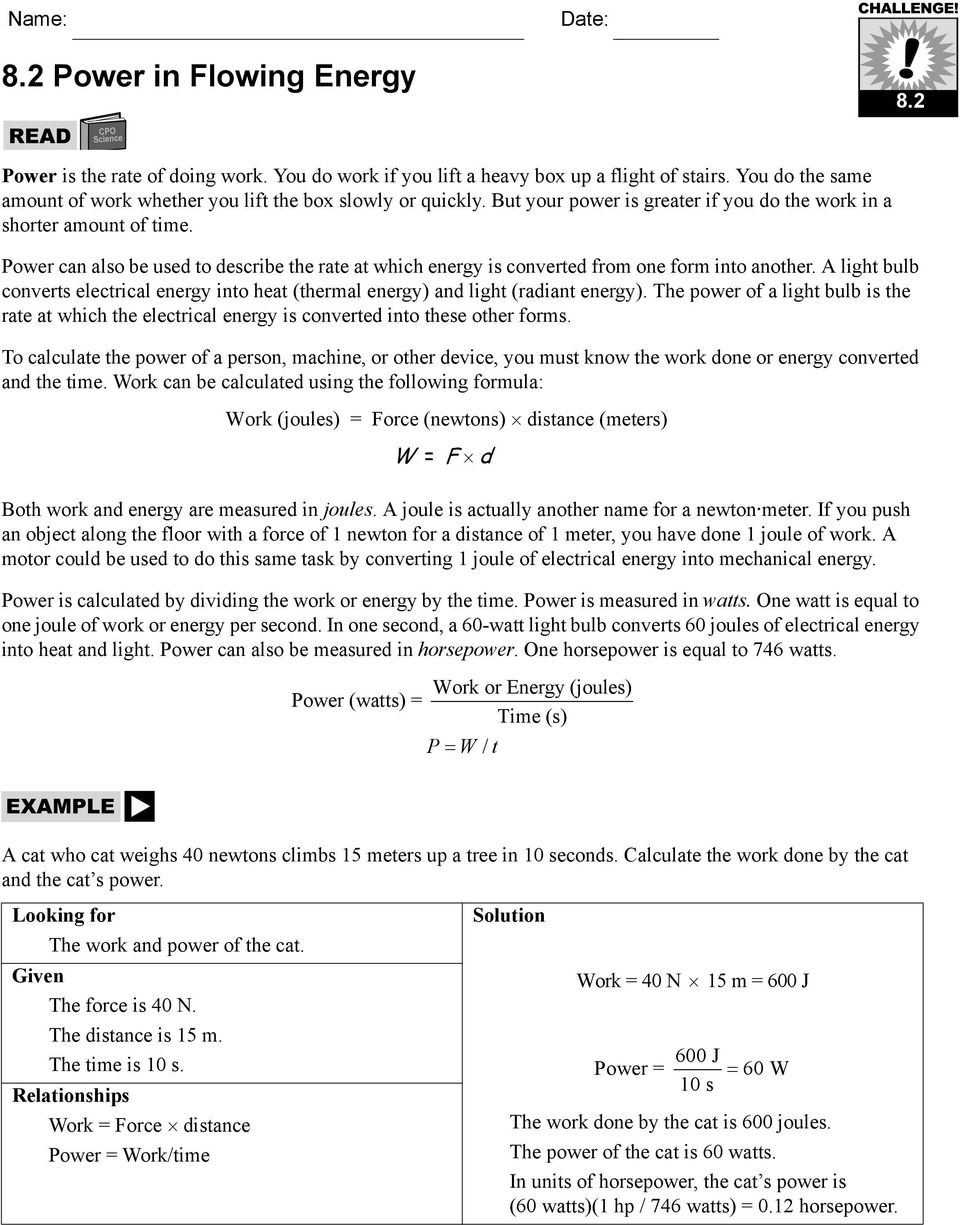
14 Page 2 of 2 1. A motor does 5,000. joules of work in 20. seconds. What is the power of the motor? A machine does 1,500 joules of work in 30. seconds. What is the power of this machine? 3. A hair dryer uses 72,000 joules of energy in 60. seconds. What is the power of this hair dryer? 4. A toaster oven uses 67,500 joules of energy in 45 seconds to toast a piece of bread. What is the power of the oven? 5. A horse moves a sleigh 1.00 kilometer by applying a horizontal 2,000.-newton force on its harness for 45.0 minutes. What is the power of the horse? (Hint: Convert time to seconds.) 6. A wagon is pulled at a speed of 0.40 m/s by a horse exerting an 1,800-newton horizontal force. What is the power of this horse? 7. Suppose a force of 100. newtons is used to push an object a distance of 5.0 meters in 15 seconds. Find the work done and the power for this situation. 8. Emily s vacuum cleaner has a power rating of 200. watts. If the vacuum cleaner does 360,000 joules of work, how long did Emily spend vacuuming? 9. Nicholas spends 20.0 minutes ironing shirts with his 1,800-watt iron. How many joules of energy were used by the iron? (Hint: convert time to seconds). 10. It take a clothes dryer 45 minutes to dry a load of towels. If the dryer uses 6,750,000 joules of energy to dry the towels, what is the power rating of the machine? 11. A 1000-watt microwave oven takes 90 seconds to heat a bowl of soup. How many joules of energy does it use? 12. A force of 100. newtons is used to move an object a distance of 15 meters with a power of 25 watts. Find the work done and the time it takes to do the work. 13. If a small machine does 2,500 joules of work on an object to move it a distance of 100. meters in 10. seconds, what is the force needed to do the work? What is the power of the machine doing the work? 14. A machine uses a force of 200 newtons to do 20,000 joules of work in 20 seconds. Find the distance the object moved and the power of the machine. (Hint: A joule is the same as a Newton-meter.) 15. A machine that uses 200. watts of power moves an object a distance of 15 meters in 25 seconds. Find the force needed and the work done by this machine.
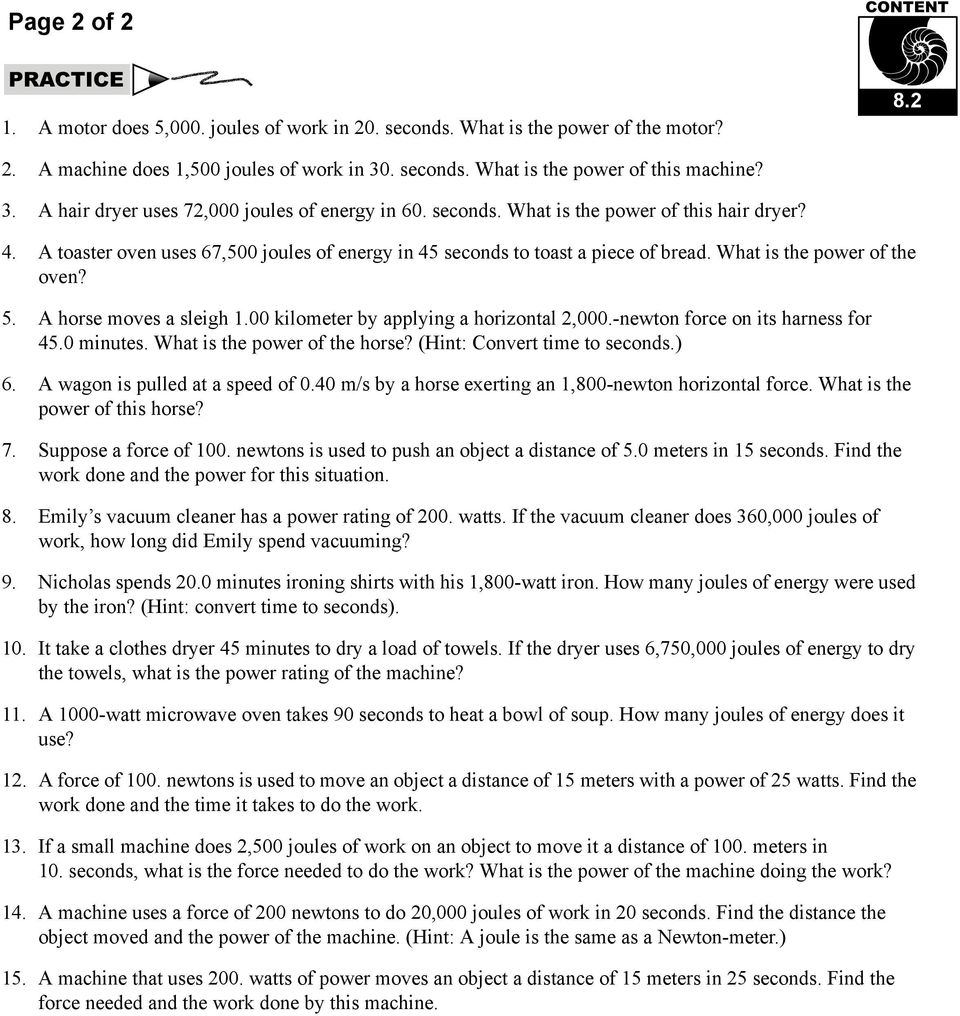
15 8.2 Power in Flowing Energy 8.2 Power is the rate of doing work. You do work if you lift a heavy box up a flight of stairs. You do the same amount of work whether you lift the box slowly or quickly. But your power is greater if you do the work in a shorter amount of time. Power can also be used to describe the rate at which energy is converted from one form into another. A light bulb converts electrical energy into heat (thermal energy) and light (radiant energy). The power of a light bulb is the rate at which the electrical energy is converted into these other forms. To calculate the power of a person, machine, or other device, you must know the work done or energy converted and the time. Work can be calculated using the following formula: Work (joules) = Force (newtons) distance (meters) W = F d Both work and energy are measured in joules. A joule is actually another name for a newton meter. If you push an object along the floor with a force of 1 newton for a distance of 1 meter, you have done 1 joule of work. A motor could be used to do this same task by converting 1 joule of electrical energy into mechanical energy. Power is calculated by dividing the work or energy by the time. Power is measured in watts. One watt is equal to one joule of work or energy per second. In one second, a 60-watt light bulb converts 60 joules of electrical energy into heat and light. Power can also be measured in horsepower. One horsepower is equal to 746 watts. Work or Energy (joules) Power (watts) = Time (s) P= W / t A cat who cat weighs 40 newtons climbs 15 meters up a tree in 10 seconds. Calculate the work done by the cat and the cat s power. Looking for The work and power of the cat. Given The force is 40 N. The distance is 15 m. The time is 10 s. Relationships Work = Force distance Power = Work/time Solution Work = 40 N 15 m = 600 J 600 J Power = 60 W 10 s = The work done by the cat is 600 joules. The power of the cat is 60 watts. In units of horsepower, the cat s power is (60 watts)(1 hp / 746 watts) = 0.12 horsepower.
16 Page 2 of 2 1. Complete the table below: 8.2 Force (N) Distance (m) Time (sec) Work (J) Power (W) Oliver weighs 600. newtons. He climbs a flight of stairs that is 3.0 meters tall in 4.0 seconds. a. How much work did he do? b. What was Oliver s power in watts? 3. An elevator weighing 6,000. newtons moves up a distance of 10.0 meters in 30.0 seconds. a. How much work did the elevator s motor do? b. What was the power of the elevator s motor in watt and in horsepower? 4. After a large snowstorm, you shovel 2,500. kilograms of snow off of your sidewalk in half an hour. You lift the shovel to an average height of 1.5 meters while you are piling the snow in your yard. a. How much work did you do? Hint: The force is the weight of the snow. b. What was your power in watts? Hint: You must always convert time to seconds when calculating power. 5. A television converts 12,000 joules of electrical energy into light and sound every minute. What is the power of the television? 6. The power of a typical adult s body over the course of a day is 100. watts. This means that 100. joules of energy from food are needed each second. a. An average apple contains 500,000 joules of energy. For how many seconds would an apple power a person? b. How many joules are needed each day? c. How many apples would a person need to eat to get enough energy for one day? 7. A mass of 1,000. kilograms of water drops 10.0 meters down a waterfall every second. a. How much potential energy is converted into kinetic energy every second? b. What is the power of the waterfall in watts and in horsepower 8. An alkaline AA battery stores approximately 12,000 joules of energy. A small flashlight uses two AA batteries and will produce light for 2.0 hours. What is the power of the flashlight bulb? Assume all of the energy in the batteries is used.

17 8.2 Efficiency and Energy 8.2 Efficiency describes how well energy is converted from one form into another. A process is 100% efficient if no energy is lost due to friction, to create sound, or for other reasons. In reality, no process is 100% efficient. Efficiency is calculated by dividing the output energy by the input energy. If you multiply the result by 100, you will get efficiency as a percentage. For example, if the answer you get is 0.50, you can multiply by 100 and write your answer as 50%. Efficiency = Output energy (J) Input energy (J) You drop a 2-kilogram box from a height of 3 meters. Its speed is 7 m/s when it hits the ground. How efficiently did the potential energy turn into kinetic energy? Looking for You are asked to find the efficiency. Given The mass is 2 kilograms, the height is 3 meters, and the landing speed is 7 m/s. Relationships Kinetic energy = 1/2mv 2 Potential energy = mgh Efficiency = (output energy)/(input energy) Solution E E P K = = = (1/ 2)(2 kg)(7 m/s) = 49 J 2 (2 kg)(9.8 m/s )(3 m) 58.8 J 2 The input energy is the potential energy, and the output energy is the kinetic energy. Efficiency = (49 J)/(58.8 J) = 0.83 or 83% The efficiency is 0.83 or 83% ( ). 1. Engineers who design battery-operated devices such as cell phones and MP3 players try to make them as efficient as possible. An engineer tests a cell phone and finds that the batteries supply 10,000 J of energy to make 5500 J of output energy in the form of sound and light for the screen. How efficient is the phone? 2. What s the efficiency of a car that uses 400,000 J of energy from gasoline to make 48,000 J of kinetic energy? 3. A kilogram roller coaster goes down a hill that is 90. meters tall. Its speed at the bottom is 40. m/s. a. What is the efficiency of the roller coaster? Assume it starts from rest at the top of the hill. b. What do you think happens to the lost energy? c. Use the concepts of energy and efficiency to explain why the first hill on a roller coaster is the tallest. 4. You see an advertisement for a new free fall ride at an amusement park. The ad says the ride is 50. meters tall and reaches a speed of 28 m/s at the bottom. How efficient is the ride? Hint: You can use any mass you wish because it cancels out. 5. Imagine that you are working as a roller coaster designer. You want to build a record-breaking coaster that goes 70.0 m/s at the bottom of the first hill. You estimate that the efficiency of the tracks and cars you are using is 90.0%. How high must the first hill be?

18 9.2 Mechanical Advantage 9.2 Mechanical advantage (MA) is the ratio of output force to input force for a machine. MA = or F o ---- F i MA = output force (N) input force (N) Did you notice that the force unit involved in the calculation, the newton (N) is present in both the numerator and the denominator of the fraction? These units cancel each other, leaving the value for mechanical advantage unitless. newtons newtons N = --- = 1 N Mechanical advantage tells you how many times a machine multiplies the force put into it. Some machines provide us with more output force than we applied to the machine this means MA is greater than one. Some machines produce an output force smaller than our effort force, and MA is less than one. We choose the type of machine that will give us the appropriate MA for the work that needs to be performed. Example 1: A force of 200 newtons is applied to a machine in order to lift a 1,000-newton load. What is the mechanical advantage of the machine? MA output force 1000 N = = = 5 input force 200 N Machines make work easier. Work is force times distance (W = F d). The unit for work is the newton-meter. Using the work equation, as shown in example 2 below, can help calculate the mechanical advantage. Example 2: A force of 30 newtons is applied to a machine through a distance of 10 meters. The machine is designed to lift an object to a height of 2 meters. If the total work output for the machine is 18 newton-meters (N-m), what is the mechanical advantage of the machine? input force = 30 N output force= ( work distance) = ( 18 N-m 2 m) = 9 N MA = output force input force = 9 N = N

19 Page 2 of 2 1. A machine uses an input force of 200 newtons to produce an output force of 800 newtons. What is the mechanical advantage of this machine? Another machine uses an input force of 200 newtons to produce an output force of 80 newtons. What is the mechanical advantage of this machine? 3. A machine is required to produce an output force of 600 newtons. If the machine has a mechanical advantage of 6, what input force must be applied to the machine? 4. A machine with a mechanical advantage of 10 is used to produce an output force of 250 newtons. What input force is applied to this machine? 5. A machine with a mechanical advantage of 2.5 requires an input force of 120 newtons. What output force is produced by this machine? 6. An input force of 35 newtons is applied to a machine with a mechanical advantage of What is the size of the load this machine could lift (how large is the output force)? 7. A machine is designed to lift an object with a weight of 12 newtons. If the input force for the machine is set at 4 newtons, what is the mechanical advantage of the machine? 8. An input force of 50. newtons is applied through a distance of 10. meters to a machine with a mechanical advantage of 3. If the work output for the machine is 450 newton meters and this work is applied through a distance of 3 meters, what is the output force of the machine? newton meters of work is put into a machine over a distance of 20. meters. The machine does 150. newton meters of work as it lifts a load 10. meters high. What is the mechanical advantage of the machine? 10. A machine has a mechanical advantage of 5. If 300. newtons of input force is used to produce 3,000. newton meters of work, a. What is the output force? b. What is the distance over which the work is applied?

20 9.2 Mechanical Advantage of Simple Machines 9.2 We use simple machines to make tasks easier. While the output work of a simple machine can never be greater than the input work, a simple machine can multiply input forces OR multiply input distances (but never both at the same time). You can use this skill sheet to practice calculating mechanical advantage (MA) for two common simple machines: levers and ramps. The general formula for the mechanical advantage (MA) of levers: Or you can use the ratio of the input arm length to the output arm length: MA MA F o (output force) lever = F i (input force) L i (length of input arm) lever = L o (length of output arm) Most of the time, levers are used to multiply force to lift heavy objects. The general formula for the mechanical advantage (MA) of ramps: A ramp makes it possible to move a heavy load to a new height using less force (but over a longer distance). MA ramp ramp length = ramp height Example 1: A construction worker uses a board and log as a lever to lift a heavy rock. If the input arm is 3 meters long and the output arm is 0.75 meters long, what is the mechanical advantage of the lever? 3 meters MA = = meter Example 2: Sometimes levers are used to multiply distance. For a broom, your upper hand is the fulcrum and your lower hand provides the input force: Notice the input arm is shorter than the output arm. The mechanical advantage of this broom is: 0.3 meter MA = = meters A mechanical advantage less than one doesn t mean a machine isn t useful. It just means that instead of multiplying force, the machine multiplies distance. A broom doesn t push the dust with as much force as you use to push the broom, but a small movement of your arm pushes the dust a large distance.

21 Page 2 of 2 Example 3: A 500-newton cart is lifted to a height of 1 meter using a 10-meter long ramp. You can see that the worker only has to use 50 newtons of force to pull the cart. You can figure the mechanical advantage in either of these two ways: 9.2 ramp length ramp height 10 meters 1 meter MA ramp = = = 10 Or using the standard formula for mechanical advantage: output force 500 newtons MA = = = 10 input force 50 newtons Lever problems 1. A lever used to lift a heavy box has an input arm of 4 meters and an output arm of 0.8 meters. What is the mechanical advantage of the lever? 2. What is the mechanical advantage of a lever that has an input arm of 3 meters and an output arm of 2 meters? 3. A lever with an input arm of 2 meters has a mechanical advantage of 4. What is the output arm s length? 4. A lever with an output arm of 0.8 meter has a mechanical advantage of 6. What is the length of the input arm? 5. A rake is held so that its input arm is 0.4 meters and its output arm is 1.0 meters. What is the mechanical advantage of the rake? 6. A broom with an input arm length of 0.4 meters has a mechanical advantage of 0.5. What is the length of the output arm? 7. A child s toy rake is held so that its output arm is 0.75 meters. If the mechanical advantage is 0.33, what is the input arm length? Ramp problems 8. A 5-meter ramp lifts objects to a height of 0.75 meters. What is the mechanical advantage of the ramp? 9. A 10-meter long ramp has a mechanical advantage of 5. What is the height of the ramp? 10. A ramp with a mechanical advantage of 8 lifts objects to a height of 1.5 meters. How long is the ramp? 11. A child makes a ramp to push his toy dump truck up to his sandbox. If he uses 5 newtons of force to push the 12-newton truck up the ramp, what is the mechanical advantage of his ramp? 12. A ramp with a mechanical advantage of 6 is used to move a 36-newton load. What input force is needed to push the load up the ramp? 13. Gina wheels her wheelchair up a ramp using a force of 80 newtons. If the ramp has a mechanical advantage of 7, what is the output force (in newtons)? 14. Challenge! A mover uses a ramp to pull a 1000-newton cart up to the floor of his truck (0.8 meters high). If it takes a force of 200 newtons to pull the cart, what is the length of the ramp?
22 9.2 Gear Ratios 9.2 A gear ratio is used to figure out the number of turns each gear in a pair will make based on the number of teeth each gear has. To calculate the gear ratio for a pair of gears that are working together, you need to know the number of teeth on each gear. The formula below demonstrates how to calculate a gear ratio. Notice that knowing the number of teeth on each gear allows you to figure out how many turns each gear will take. Why would this be important in figuring out how to design a clock that has a minute and hour hand? A gear with 48 teeth is connected to a gear with 12 teeth. If the 48-tooth gear makes one complete turn, how many times will the 12-tooth gear turn? Turns of output gear? One turn for the input gear = 48 input teeth output teeth 48 teeth 1 turn Turns of output gear? = = 4 turns 12 teeth 1. A 36-tooth gear turns three times. It is connected to a 12-tooth gear. How many times does the 12-tooth gear turn? 2. A 12-tooth gear is turned two times. How many times will the 24-tooth gear to which it is connected turn? 3. A 60-tooth gear is connected to a 24-tooth gear. If the smaller gear turns ten times, how many turns does the larger gear make? 4. A 60-tooth gear is connected to a 72-tooth gear. If the smaller gear turns twelve times, how many turns does the larger gear make? 5. A 72-tooth gear is connected to a 12-tooth gear. If the large gear makes one complete turn, how many turns does the small gear make?
23 Page 2 of 2 6. Use the gear ratio formula to help you fill in the table below. Table 1: Using the gear ratio to calculate number of turns Input Output Gear ratio Gear Gear (# of teeth) (# of teeth) (Input Gear: Output Gear) How many turns does the output gear make if the input gear turns 3 times? How many turns does the input gear make if the output gear turns 2 times? 7. The problems in this section involve three gears stacked on top of each other. Once you have filled in Table 2, answer the question that follow. Use the gear ratio formula to help. Remember, knowing the gear ratios allows you to figure out the number of turns for a pair of gears. Table 2: Set up for three gears Setup Gears Number of teeth 1 Top gear 12 Middle gear 24 Bottom gear 36 2 Top gear 24 Middle gear 36 Bottom gear 12 3 Top gear 12 Middle gear 48 Bottom gear 24 4 Top gear 24 Middle gear 48 Bottom gear 36 Ratio (top gear: middle gear) Ratio 2 (middle gear: bottom gear) Total gear ratio (Ratio 1 x Ratio 2) 8. As you turn the top gear to the right, what direction does the middle gear turn? What direction will the bottom gear turn? 9. How many times will you need to turn the top gear (input) in setup 1 to get the bottom gear (output) to turn once? 10. If you turn the top gear (input) in setup 2 two times, how many times will the bottom gear (output) turn? 11. How many times will the middle gear (output) in setup 3 turn if you turn the top gear (input) two times? 12. How many times will you need to turn the top gear (input) in setup 4 to get the bottom gear (output) to turn 4 times? 9.2
24 9.2 Bicycle Gear Ratios Project 9.2 How many gears does your bicycle really have? Bicycle manufacturers describe any bicycle with two gears in the front and five in the back as a ten-speed. But do you really get ten different speeds? In this project, you will determine and record the gear ratio for each speed of your bicycle. You will then write up an explanation of the importance (or lack of, in some cases) of each speed. You will explain what the rider experiences due to the physics of the gear ratio, and in what situation the rider would take advantage of that particular speed. To complete this project, you will need: Multi-speed bicycle Simple calculator Access to a library or the Internet for research Access to a computer for work with a spreadsheet (optional) On a multi-speed bicycle, there are two groups of gears: the front group and the rear group. You may want to carefully place your bicycle upside down on the floor to better work with the gears. The seat and handlebars will keep the bicycle balanced. 1. Draw a schematic diagram to show how the gears are set up on your bicycle. 2. Now, count the number of teeth on each gear in each group. Record your data in a table on paper or in a computer spreadsheet. Use these questions to guide you. a. How many gears are in the front group? b. How many teeth on each gear in the front group? c. How many gears are in the rear group? d. How many teeth on each gear in the rear group?
25 Page 2 of 2 3. Now, calculate the gear ratio for each front/rear combination of gears. Use the formula: front gear rear gear. Organize the results of your calculations into a new table either on paper on in a computer spreadsheet. How many different gear ratios do you actually have? Use your library or the Internet to research the development of the multi-speed bicycle. Take careful notes while you do your research as you will use the information you find to write a report (see step 7). In your research, find the answers to the following questions. a. In what circumstances would a low gear ratio be helpful? Why? b. In what circumstances would a high gear ratio be helpful? Why? 5. Write up your findings and results according to the guidelines below. Your final project should include: A brief (one page) report that discusses the evolution of the bicycle. What was the first bicycle like? How did we end up with the modern bicycle? Why was the multi-speed bicycle an important invention? A schematic diagram of your bicycle s gears. Include labels. An organized, professional data table showing the gear ratios of your bicycle. A summary report (one page) in which you interpret your findings and explain the trade-off between force and distance when pedaling a bicycle in each of the different speeds. Include answers to questions 4(a) and 4(b). In your research, you should make a surprising discovery about the speeds what is it? Reflection: Finish the report with one or two paragraphs that express your reflections on this project.
26 9.3 Types of Levers 9.3 A lever is a simple machine that can be used to multiply force, multiply distance, or change the direction of a force. All levers contain a stiff structure that rotates around a point called the fulcrum. The force applied to a lever is called the input force. The force applied to a load is called the output force. There are three types or classes of levers. The class of a lever depends on the location of the fulcrum and input and output forces. The picture below shows examples of the three classes of levers. Look at each lever carefully, noticing the location of the fulcrum, input force, and output force. 1. In which class of lever is the output force between the fulcrum and input force? 2. In which class of lever is the fulcrum between the input force and output force? 3. In which class of lever is the fulcrum on one end and the output force on the other end? 4. Do the following for each of the levers shown below and at the top of the next page: a. Label the fulcrum (F). b. Label the location of the input force (I) and output force (O). c. Classify the lever as first, second, or third class.
27 Page 2 of The relationship between a lever s input force and output force depends on the length of the input arm and output arm. The input arm is the distance between the fulcrum and input force. The output arm is the distance between the fulcrum and output force. If the input and output arms are the same length, the forces are equal. If the input arm is longer, the input force is less than the output force. If the input arm is shorter, the input force is greater than the output force. O 1. Label the input arm (IA) and output arm (OA) on each of the levers you labeled above and on the previous page. 2. In which of the levers is the input force greater than the output force? 3. In which of the levers is the output force greater than the input force? 4. In which of the levers are the input and output forces equal in strength? 5. Find two other examples of levers. Draw each lever and label the fulcrum, input force, output force, input arm, and output arm. State whether the input or output force is stronger.
28 9.3 Levers in the Human Body 9.3 Your skeletal and muscular systems work together to move your body parts. Some of your body parts can be thought of as simple machines or levers. There are three parts to all levers: Fulcrum - the point at which the lever rotates. Input force (also called the effort) - the force applied to the lever. Output force (also called the load) - the force applied by the lever to move the load. There are three types of levers: first class, second class and third class. In a first class lever, the fulcrum is located between the input force and output force. In a second class lever, the output force is between the fulcrum and the input force. In a third class lever, the input force is between the fulcrum and the output force. An example of each type of lever is shown below.
29 Page 2 of 2 The three classes of levers can be found in your body. Use diagrams A, B, and C to answer the questions below. Also label the effort (input force), fulcrum and load (output force) on each diagram. 9.3 LEVER A 1. Type of Lever: 2. How is this lever used in the body? LEVER B 3. Type of Lever: 4. How is this lever used in the body? LEVER C 5. Type of Lever: 6. How is this lever used in the body?
Chapter 2: Forms of Energy
 Chapter 2: Forms of Energy Goals of Period 2 Section 2.1: To describe the forms of energy Section 2.2: To illustrate conversions from one form of energy to another Section 2.3: To define the efficiency
Name Class Date. You do twice as much work. b. You lift two identical books one meter above the ground.
 Exercises 9.1 Work (pages 145 146) 1. Circle the letter next to the correct mathematical equation for work. work = force distance work = distance force c. work = force distance d. work = force distance
 Energy What is Energy? Energy is the ability to do work. Any object that has energy has the ability to create force. Energy is one of the fundamental building blocks of our universe. Energy appears in
EVALUAT ING ACADEMIC READINESS FOR APPRENTICESHIP TRAINING Revised for ACCESS TO APPRENTICESHIP
 EVALUAT ING ACADEMIC READINESS FOR APPRENTICESHIP TRAINING for ACCESS TO APPRENTICESHIP SCIENCE SKILLS SIMPLE MACHINES & MECHANICAL ADVANTAGE AN ACADEMIC SKILLS MANUAL for The Construction Trades: Mechanical
Student Reader. Energy Systems UNIT 7. E5 Student Reader v. 8.0 Unit 7 Page 1 2012 KnowAtom TM
 Student Reader UNIT 7 Energy Systems E5 Student Reader v. 8.0 Unit 7 Page 1 2012 KnowAtom TM Front Cover: The cover shows a photograph of a sled that is not in motion. The movement of a sled from one place
In science, energy is the ability to do work. Work is done when a force causes an
 What is energy? In science, energy is the ability to do work. Work is done when a force causes an object to move in the direction of the force. Energy is expressed in units of joules (J). A joule is calculated
9. The kinetic energy of the moving object is (1) 5 J (3) 15 J (2) 10 J (4) 50 J
 1. If the kinetic energy of an object is 16 joules when its speed is 4.0 meters per second, then the mass of the objects is (1) 0.5 kg (3) 8.0 kg (2) 2.0 kg (4) 19.6 kg Base your answers to questions 9
At the skate park on the ramp
 At the skate park on the ramp 1 On the ramp When a cart rolls down a ramp, it begins at rest, but starts moving downward upon release covers more distance each second When a cart rolls up a ramp, it rises
Section 15.1 Energy and Its Forms (pages 446 452)
 Section 15.1 and Its Forms (pages 446 452) This section describes how energy and work are related. It defines kinetic energy and potential energy, and gives examples for calculating these forms of energy.
Using mechanical energy for daily
 unit 3 Using mechanical energy for daily activities Physics Chapter 3 Using mechanical energy for daily activities Competency Uses mechanical energy for day-to-day activities Competency level 3.1 Investigates
Chapter 7: Momentum and Impulse
 Chapter 7: Momentum and Impulse 1. When a baseball bat hits the ball, the impulse delivered to the ball is increased by A. follow through on the swing. B. rapidly stopping the bat after impact. C. letting
Study Guide CCA week 12 - Key
 Study Guide CCA week 12 - Key Vocabulary to know: (define on separate paper & give an example of each) Electrical Energy Mechanical Energy Force Energy carried by electricity Ex: Toaster, Fan, Anything
Potential / Kinetic Energy Remedial Exercise
 Potential / Kinetic Energy Remedial Exercise This Conceptual Physics exercise will help you in understanding the Law of Conservation of Energy, and its application to mechanical collisions. Exercise Roles:
Work, Energy and Power
 Work, Energy and Power In this section of the Transport unit, we will look at the energy changes that take place when a force acts upon an object. Energy can t be created or destroyed, it can only be changed
Energy - Key Vocabulary
 Energy - Key Vocabulary Term Potential Energy Kinetic Energy Joules Gravity Definition The energy an object possesses due to its position. PE = mgh The energy an object possesses when it is in motion.
What is Energy? What is the relationship between energy and work?
 What is Energy? What is the relationship between energy and work? Compare kinetic and potential energy What are the different types of energy? What is energy? Energy is the ability to do work. Great, but
Chapter 2: Forms of Energy
 Chapter 2: Forms of Energy Goals of Period 2 Section 2.1: To describe the forms of energy Section 2.2: To illustrate conversions from one form of energy to another Section 2.3 To describe energy storage
WORK DONE BY A CONSTANT FORCE
 WORK DONE BY A CONSTANT FORCE The definition of work, W, when a constant force (F) is in the direction of displacement (d) is W = Fd SI unit is the Newton-meter (Nm) = Joule, J If you exert a force of
4 Gravity: A Force of Attraction
 CHAPTER 1 SECTION Matter in Motion 4 Gravity: A Force of Attraction BEFORE YOU READ After you read this section, you should be able to answer these questions: What is gravity? How are weight and mass different?
Energy Test Study Guide
 Name: Energy Test Study Guide (Test Dates: A Day May 5 th B Day May 6 th ) USE YOUR INTERACTIVE NOTEBOOK TO STUDY CLASSROOM ASSIGNMENTS, LABS, FORMATIVE ASSESSMENTS, AND HOMEWORK. ENERGY AND THE TWO MAIN
10.1 Quantitative. Answer: A Var: 50+
 Chapter 10 Energy and Work 10.1 Quantitative 1) A child does 350 J of work while pulling a box from the ground up to his tree house with a rope. The tree house is 4.8 m above the ground. What is the mass
ANSWER KEY. Work and Machines
 Chapter Project Worksheet 1 1. inclined plane, wedge, screw, lever, wheel and axle, pulley 2. pulley 3. lever 4. inclined plane 5. Answers will vary: top, side, or bottom 6. Answers will vary; only one
Potential and Kinetic Energy
 Potential and Kinetic Energy What is Energy? The ability to cause change Energy notes entry # 4 11/5 Potential Energy Kinetic Energy Definitions Dependent on Examples Forms of Potential Energy Definition
Name Period WORKSHEET: KINETIC AND POTENTIAL ENERGY PROBLEMS. 1. Stored energy or energy due to position is known as energy.
 Name Period Date WORKSHEET: KINETIC AND POTENTIAL ENERGY PROBLEMS 1. Stored energy or energy due to position is known as energy. 2. The formula for calculating potential energy is. 3. The three factors
PS-6.2 Explain the factors that determine potential and kinetic energy and the transformation of one to the other.
 PS-6.1 Explain how the law of conservation of energy applies to the transformation of various forms of energy (including mechanical energy, electrical energy, chemical energy, light energy, sound energy,
What Is Energy? Energy and Work: Working Together. 124 Chapter 5 Energy and Energy Resources
 1 What You Will Learn Explain the relationship between energy and work. Compare kinetic and potential energy. Describe the different forms of energy. Vocabulary energy kinetic energy potential energy mechanical
Physics: Principles and Applications, 6e Giancoli Chapter 4 Dynamics: Newton's Laws of Motion
 Physics: Principles and Applications, 6e Giancoli Chapter 4 Dynamics: Newton's Laws of Motion Conceptual Questions 1) Which of Newton's laws best explains why motorists should buckle-up? A) the first law
PHYS 117- Exam I. Multiple Choice Identify the letter of the choice that best completes the statement or answers the question.
 PHYS 117- Exam I Multiple Choice Identify the letter of the choice that best completes the statement or answers the question. 1. Car A travels from milepost 343 to milepost 349 in 5 minutes. Car B travels
WORKSHEET: KINETIC AND POTENTIAL ENERGY PROBLEMS
 WORKSHEET: KINETIC AND POTENTIAL ENERGY PROBLEMS 1. Stored energy or energy due to position is known as Potential energy. 2. The formula for calculating potential energy is mgh. 3. The three factors that
PART2Machines. Measuring Work on a Cart on an. Inclined Plane 102. Inclined Plane 104. Inquiry 12.1 Using Pulleys To Do Work 112
 TERRY G. MCCREA/SMITHSONIAN INSTITUTION PART2Machines LESSON 11 The Inclined Plane 100 Inquiry 11.1 Inquiry 11.2 Measuring Forces on a Cart on an Inclined Plane 102 Measuring Work on a Cart on an Inclined
Unit 8A: Systems in Action (Pg. 2 85) Chapter 2: Getting to Work (pg. 28 55)
 Unit 8A: Systems in Action (Pg. 2 85) Chapter 2: Getting to Work (pg. 28 55) Name: Date: 2.1: Physical Systems: Simple Machines (Pg. 30 35): Read Pages 30-35. Answer the following questions on pg. 35:
Free Fall: Observing and Analyzing the Free Fall Motion of a Bouncing Ping-Pong Ball and Calculating the Free Fall Acceleration (Teacher s Guide)
 Free Fall: Observing and Analyzing the Free Fall Motion of a Bouncing Ping-Pong Ball and Calculating the Free Fall Acceleration (Teacher s Guide) 2012 WARD S Science v.11/12 OVERVIEW Students will measure
Mechanical Systems. Grade 8 Unit 4 Test. 1. A wheelbarrow is an example of what simple machine? Class 1 lever. Class 2 lever.
 Mechanical Systems Grade 8 Unit 4 Test Student Class 1. A wheelbarrow is an example of what simple machine? D Wheel and Axle 2. A hockey stick is an example of what simple machine? D Inclined plane 3.
Work, Energy and Power Practice Test 1
 Name: ate: 1. How much work is required to lift a 2-kilogram mass to a height of 10 meters?. 5 joules. 20 joules. 100 joules. 200 joules 5. ar and car of equal mass travel up a hill. ar moves up the hill
General Physical Science
 General Physical Science Chapter 4 Work and Energy Work The work done by a constant force F acting upon an object is the product of the magnitude of the force (or component of the force) and the parallel
Simple Machines. What are simple machines?
 Definitions to know: Simple Machines Work done when an applied force causes an object to move in the direction of the force Energy ability to cause change; can change the speed, direction, shape, or temperature
SIZE. Energy. Non-Mechanical Energy. Mechanical Energy. Part II. Examples of Non-Mechanical Energy. Examples of Mechanical Energy.
 Energy Part II Non-Mechanical Energy Wait a minute if all energy is either kinetic or potential and TME = KE + PE then how can there possibly be such thing as non-mechanical energy!?!? Mechanical Energy
Introduction Assignment
 Physics 11 Introduction Assignment This assignment is intended to familiarize you with some of the basic concepts and skills related to Physics 11. This is the first meaningful assignment for Physics 11,
Ponce de Leon Middle School Physical Science 2016 Summer Instructional Packet
 Ponce de Leon Middle School Physical Science 2016 Summer Instructional Packet DIRECTIONS: 1. You are required to complete the Summer Instructional Packet. 2. Turn in your completed package to your teacher,
Energy and Energy Transformations Test Review
 Energy and Energy Transformations Test Review Completion: 1. Mass 13. Kinetic 2. Four 14. thermal 3. Kinetic 15. Thermal energy (heat) 4. Electromagnetic/Radiant 16. Thermal energy (heat) 5. Thermal 17.
Name: Partners: Period: Coaster Option: 1. In the space below, make a sketch of your roller coaster.
 1. In the space below, make a sketch of your roller coaster. 2. On your sketch, label different areas of acceleration. Put a next to an area of negative acceleration, a + next to an area of positive acceleration,
Compound Machine: Two or more simple machines working together to make work easier. Examples: Wheelbarrow, Can Opener, Bicycle
 Name SOL 4.2 Simple and Compound Machines NOTE - Simple machines are NOT included in the 5 th REVISED Science Standards Simple Machine: A machine with few or no moving parts. Simple machines make work
ch 15 practice test Multiple Choice Identify the letter of the choice that best completes the statement or answers the question.
 ch 15 practice test Multiple Choice Identify the letter of the choice that best completes the statement or answers the question. 1. Work is a transfer of a. energy. c. mass. b. force. d. motion. 2. What
XX. Introductory Physics, High School
 XX. Introductory Physics, High School High School Introductory Physics Test The spring 2014 high school Introductory Physics test was based on learning standards in the Introductory Physics content strand
Work, Energy & Momentum Homework Packet Worksheet 1: This is a lot of work!
 Work, Energy & Momentum Homework Packet Worksheet 1: This is a lot of work! 1. A student holds her 1.5-kg psychology textbook out of a second floor classroom window until her arm is tired; then she releases
Textbook pp. 148-153
 Textbook pp. 148-153 ENERGY is the ability to do WORK or cause change Name 2 things that ARE energy or that HAVE energy WORK is when a FORCE moves an object a FORCE is a push or a pull There are two main
1. Mass, Force and Gravity
 STE Physics Intro Name 1. Mass, Force and Gravity Before attempting to understand force, we need to look at mass and acceleration. a) What does mass measure? The quantity of matter(atoms) b) What is the
Friction and Gravity. Friction. Section 2. The Causes of Friction
 Section 2 Friction and Gravity What happens when you jump on a sled on the side of a snow-covered hill? Without actually doing this, you can predict that the sled will slide down the hill. Now think about
F output. F input. F = Force in Newtons ( N ) d output. d = distance ( m )
 Mechanical Advantage, Speed Ratio, Work and Efficiency Machines Make Work Easier Machines help people do things that they normally couldn t do on their own. Mechanical Advantage A machine makes work easier
7 TH GRADE SCIENCE REVIEW
 7 TH GRADE SCIENCE REVIEW The motion of an object is always judged with respect to some other object or point. When an object changes position over time relative to a reference point, the object is in
What is Energy? 1 45 minutes Energy and You: Energy Picnic Science, Physical Education Engage
 Unit Grades K-3 Awareness Teacher Overview What is energy? Energy makes change; it does things for us. It moves cars along the road and boats over the water. It bakes a cake in the oven and keeps ice frozen
Chapter 6 Work and Energy
 Chapter 6 WORK AND ENERGY PREVIEW Work is the scalar product of the force acting on an object and the displacement through which it acts. When work is done on or by a system, the energy of that system
Radiant Energy Definition
 Radiant Energy Definition: the energy of electromagnetic waves; this includes radio, microwave, infrared, visible, ultraviolet, x-ray, and gamma waves Solar panels Radiant Energy Examples of energy transformations:
Review Vocabulary force: a push or a pull. Vocabulary Newton s third law of motion
 Standard 7.3.17: Investigate that an unbalanced force, acting on an object, changes its speed or path of motion or both, and know that if the force always acts toward the same center as the object moves,
Gravitational Potential Energy
 Gravitational Potential Energy Consider a ball falling from a height of y 0 =h to the floor at height y=0. A net force of gravity has been acting on the ball as it drops. So the total work done on the
Explore 3: Crash Test Dummies
 Explore : Crash Test Dummies Type of Lesson: Learning Goal & Instructiona l Objectives Content with Process: Focus on constructing knowledge through active learning. Students investigate Newton s first
LeaPS Workshop March 12, 2010 Morehead Conference Center Morehead, KY
 LeaPS Workshop March 12, 2010 Morehead Conference Center Morehead, KY Word Bank: Acceleration, mass, inertia, weight, gravity, work, heat, kinetic energy, potential energy, closed systems, open systems,
Practice final for Basic Physics spring 2005 answers on the last page Name: Date:
 Practice final for Basic Physics spring 2005 answers on the last page Name: Date: 1. A 12 ohm resistor and a 24 ohm resistor are connected in series in a circuit with a 6.0 volt battery. Assuming negligible
Science Tutorial TEK 6.9C: Energy Forms & Conversions
 Name: Teacher: Pd. Date: Science Tutorial TEK 6.9C: Energy Forms & Conversions TEK 6.9C: Demonstrate energy transformations such as energy in a flashlight battery changes from chemical energy to electrical
Introduction to Forms of Energy
 FORMS OF ENERGY LESSON PLAN 2.1 Introduction to Forms of Energy This lesson is designed for 3rd 5th grade students in a variety of school settings (public, private, STEM schools, and home schools) in the
Chapter 4 Forms of energy
 Chapter 4 Forms of energy Introduction This chapter compromises a set of activities that focuses on the energy sources and conversion. The activities illustrate The concept and forms of energy; The different
Roanoke Pinball Museum Key Concepts
 Roanoke Pinball Museum Key Concepts What are Pinball Machines Made of? SOL 3.3 Many different materials are used to make a pinball machine: 1. Steel: The pinball is made of steel, so it has a lot of mass.
Forms of Energy. Freshman Seminar
 Forms of Energy Freshman Seminar Energy Energy The ability & capacity to do work Energy can take many different forms Energy can be quantified Law of Conservation of energy In any change from one form
Mechanical Energy. Mechanical Energy is energy due to position or motion.
 Mechanical Energy Mechanical Energy is energy due to position or motion. Position: This means that matter can have energy even though it is not moving. If you knock something off of your kitchen counter,
Work and Energy. Work = Force Distance. Work increases the energy of an object. Energy can be converted back to work.
 Work and Energy Ch. 6 Work = Force Distance Work increases the energy of an object. Energy can be converted back to work. Therefore, energy and work have the same unit: Newton meter = Nm Energy per gram,
8. As a cart travels around a horizontal circular track, the cart must undergo a change in (1) velocity (3) speed (2) inertia (4) weight
 1. What is the average speed of an object that travels 6.00 meters north in 2.00 seconds and then travels 3.00 meters east in 1.00 second? 9.00 m/s 3.00 m/s 0.333 m/s 4.24 m/s 2. What is the distance traveled
Chapter 4: Newton s Laws: Explaining Motion
 Chapter 4: Newton s Laws: Explaining Motion 1. All except one of the following require the application of a net force. Which one is the exception? A. to change an object from a state of rest to a state
NEWTON S LAWS OF MOTION
 Name Period Date NEWTON S LAWS OF MOTION If I am anything, which I highly doubt, I have made myself so by hard work. Isaac Newton Goals: 1. Students will use conceptual and mathematical models to predict
2After completing this chapter you should be able to
 After completing this chapter you should be able to solve problems involving motion in a straight line with constant acceleration model an object moving vertically under gravity understand distance time
Inclined Plane: Distance vs. Force
 1a Inclined Plane: Distance vs. Force Look at the inclined plane model you built for Card 2. It s a ramp, so it s easy to slide or roll things up and down it. As you noticed, it is a little more difficult
T E A C H E R S N O T E S
 T E A C H E R S N O T E S Focus: Students explore energy: its sources, forms, and transformations. Students also consider the benefits of energy-efficient technologies and energy conservation. Learning
Steps to Solving Newtons Laws Problems.
 Mathematical Analysis With Newtons Laws similar to projectiles (x y) isolation Steps to Solving Newtons Laws Problems. 1) FBD 2) Axis 3) Components 4) Fnet (x) (y) 5) Subs 1 Visual Samples F 4 1) F 3 F
Conceptual Questions: Forces and Newton s Laws
 Conceptual Questions: Forces and Newton s Laws 1. An object can have motion only if a net force acts on it. his statement is a. true b. false 2. And the reason for this (refer to previous question) is
The University of the State of New York REGENTS HIGH SCHOOL EXAMINATION PHYSICAL SETTING PHYSICS. Friday, June 20, 2014 1:15 to 4:15 p.m.
 P.S./PHYSICS The University of the State of New York REGENTS HIGH SCHOOL EXAMINATION PHYSICAL SETTING PHYSICS Friday, June 20, 2014 1:15 to 4:15 p.m., only The possession or use of any communications device
Partnerships Implementing Engineering Education Worcester Polytechnic Institute Worcester Public Schools
 Partnerships Implementing Engineering Education Worcester Polytechnic Institute Worcester Public Schools Supported by: National Science Foundation Simple Machines: 4.G.1 Introduction to Simple Machines
Physics 11 Assignment KEY Dynamics Chapters 4 & 5
 Physics Assignment KEY Dynamics Chapters 4 & 5 ote: for all dynamics problem-solving questions, draw appropriate free body diagrams and use the aforementioned problem-solving method.. Define the following
Simple Machines. Figure 2: Basic design for a mousetrap vehicle
 Mousetrap Vehicles Figure 1: This sample mousetrap-powered vehicle has a large drive wheel and a small axle. The vehicle will move slowly and travel a long distance for each turn of the wheel. 1 People
1. The Kinetic Theory of Matter states that all matter is composed of atoms and molecules that are in a constant state of constant random motion
 Physical Science Period: Name: ANSWER KEY Date: Practice Test for Unit 3: Ch. 3, and some of 15 and 16: Kinetic Theory of Matter, States of matter, and and thermodynamics, and gas laws. 1. The Kinetic
Physics 2A, Sec B00: Mechanics -- Winter 2011 Instructor: B. Grinstein Final Exam
 Physics 2A, Sec B00: Mechanics -- Winter 2011 Instructor: B. Grinstein Final Exam INSTRUCTIONS: Use a pencil #2 to fill your scantron. Write your code number and bubble it in under "EXAM NUMBER;" an entry
Heat Transfer: Conduction, Convection, and Radiation
 Heat Transfer: Conduction, Convection, and Radiation Introduction We have learned that heat is the energy that makes molecules move. Molecules with more heat energy move faster, and molecules with less
Bounce! Name. Be very careful with the balls. Do not throw them DROP the balls as instructed in the procedure.
 Bounce 1 Name Bounce! Be very careful with the balls. Do not throw them DROP the balls as instructed in the procedure. Background information: Energy causes things to happen. During the day, the sun gives
CHAPTER 6 WORK AND ENERGY
 CHAPTER 6 WORK AND ENERGY CONCEPTUAL QUESTIONS. REASONING AND SOLUTION The work done by F in moving the box through a displacement s is W = ( F cos 0 ) s= Fs. The work done by F is W = ( F cos θ). s From
Force, Work and Energy
 Force, Work and Energy Reference Guide Equipment Setup Ropes and Pulleys.................................................................. 1 Investigation Guides A-1 Ropes and Pulleys................................................................
5. Forces and Motion-I. Force is an interaction that causes the acceleration of a body. A vector quantity.
 5. Forces and Motion-I 1 Force is an interaction that causes the acceleration of a body. A vector quantity. Newton's First Law: Consider a body on which no net force acts. If the body is at rest, it will
Weight The weight of an object is defined as the gravitational force acting on the object. Unit: Newton (N)
 Gravitational Field A gravitational field as a region in which an object experiences a force due to gravitational attraction Gravitational Field Strength The gravitational field strength at a point in
Key Concepts What is mechanical energy? How do you calculate the amount of mechanical energy an object has?
 Physics Outcome 2 Energy and Energy Transformations At the end of this section students will understand and calculate the two types of energy studied in Science 10, kinetic and potential energy This outcome
B) 286 m C) 325 m D) 367 m Answer: B
 Practice Midterm 1 1) When a parachutist jumps from an airplane, he eventually reaches a constant speed, called the terminal velocity. This means that A) the acceleration is equal to g. B) the force of
Modified True/False Indicate whether the statement is true or false. If false, change the identified word or phrase to make the statement true.
 ch 7 and 16 review Modified True/False Indicate whether the statement is true or false. If false, change the identified word or phrase to make the statement true. 1. The heat released by a burning candle
How Rockets Work Newton s Laws of Motion
 How Rockets Work Whether flying a small model rocket or launching a giant cargo rocket to Mars, the principles of how rockets work are exactly the same. Understanding and applying these principles means
Science Standard 3 Energy and Its Effects Grade Level Expectations
 Science Standard 3 Energy and Its Effects Grade Level Expectations Science Standard 3 Energy and Its Effects The flow of energy drives processes of change in all biological, chemical, physical, and geological
Mission 1: What is Energy?
 Mission 1: What is Energy? What Do We Need Energy For? It s eight o clock in the morning and Nathan is still asleep. Is he using ENERGY? The alarm clock goes off. Nathan wakes up and gets ready for school.
AP Physics C Fall Final Web Review
 Name: Class: _ Date: _ AP Physics C Fall Final Web Review Multiple Choice Identify the choice that best completes the statement or answers the question. 1. On a position versus time graph, the slope of
Unit 4 Practice Test: Rotational Motion
 Unit 4 Practice Test: Rotational Motion Multiple Guess Identify the letter of the choice that best completes the statement or answers the question. 1. How would an angle in radians be converted to an angle
Work Energy & Power. September 2000 Number 05. 1. Work If a force acts on a body and causes it to move, then the force is doing work.
 PhysicsFactsheet September 2000 Number 05 Work Energy & Power 1. Work If a force acts on a body and causes it to move, then the force is doing work. W = Fs W = work done (J) F = force applied (N) s = distance
Teacher notes/ activities. Gravity is the attractive force between all objects in the universe. It is the force that pulls objects to the earth.
 Gravity and forces unit Teacher notes/ activities Gravity is the attractive force between all objects in the universe. It is the force that pulls objects to the earth. Galileo, a famous Italian scientist
Mechanical Reasoning Review
 Mechanical Reasoning Review Work can be made easier or faster through practical applications of simple and/or compound machines. This is called mechanical advantage - in other words, using the principal
Lesson 2 - Design a Robot. Grades: 6-8
 Lesson 2 - Design a Robot Grades: 6-8 Essential Questions: What steps do manufacturers take to design and build a product? What role does robotics have in manufacturing? How have robotics changed how products
3 Work, Power and Energy
 3 Work, Power and Energy At the end of this section you should be able to: a. describe potential energy as energy due to position and derive potential energy as mgh b. describe kinetic energy as energy
TIPS ON ENERGY SAVING
 TIPS ON ENERGY SAVING IN HOME APPLIANCES AND ELECTRICITY SAFETY The Domestic Sector accounts for 30% of total energy consumption in the country. There is a tremendous scope to conserve energy by adopting