
WORKSHEET: KINETIC AND POTENTIAL ENERGY PROBLEMS
|
|
|
- Geoffrey Wilson
- 9 years ago
- Views:
Transcription
1 WORKSHEET: KINETIC AND POTENTIAL ENERGY PROBLEMS 1. Stored energy or energy due to position is known as Potential energy. 2. The formula for calculating potential energy is mgh. 3. The three factors that determine the amount of potential energy in an object are mass, gravitational acceleration, and height of an object. 4. Potential energy is measured in units of joules(j). 5. Mass must be measured in units of kg. 6. Gravitational pull must be measured in units of m/s Height must be measured in units of m. 8. Calculate the potential energy of a rock with a mass of 55 kg while sitting on a cliff that is 27 m high. In this problem, m = 55kg and h = 27m. G or gravitational acceleration is always 9.8 m/ s 2. So, PE = 55kg 9.8 m/s 2 27m = J J 9. What distance is a book from the floor if the book contains 196 Joules of potential energy and has a mass of 5 kg? In this problem, m = 5kg and PE = 196 J. G or gravitational acceleration is always 9.8 m/s 2. So, 196 J = 5kg 9.8 m/s 2 xm, x = 4m 4m

2 10. An automobile is sitting on a hill which is 20 m higher than ground level. Find the mass of the automobile if it contains 362,600 J of potential energy. In this problem, h = 20m and PE = 362,600 J. G or gravitational acceleration is always 9.8 m/s 2. So, 362,600 J = xkg 9.8 m/s 2 20m, x = 1850kg 1850kg 11. Energy of motion is known as Kinetic energy. 12. The formula for calculating kinetic energy is 1/2mv The two factors that determine the amount of kinetic energy in an object are mass and velocity. 14. Kinetic energy is measured in units of joules(j). 15. Mass must be measured in units of kg. 16. Velocity must be measured in units of m/s. Energy, Work and Power 17. Calculate the kinetic energy of the rock in problem #8 if the rock rolls down the hill with a velocity of 8 m/s. KE = 1/2mv 2 In this problem, m = 55kg and v = 8 m/s. So, KE = 1/2 8 2 m/s 55kg = 1760 J 1760 J

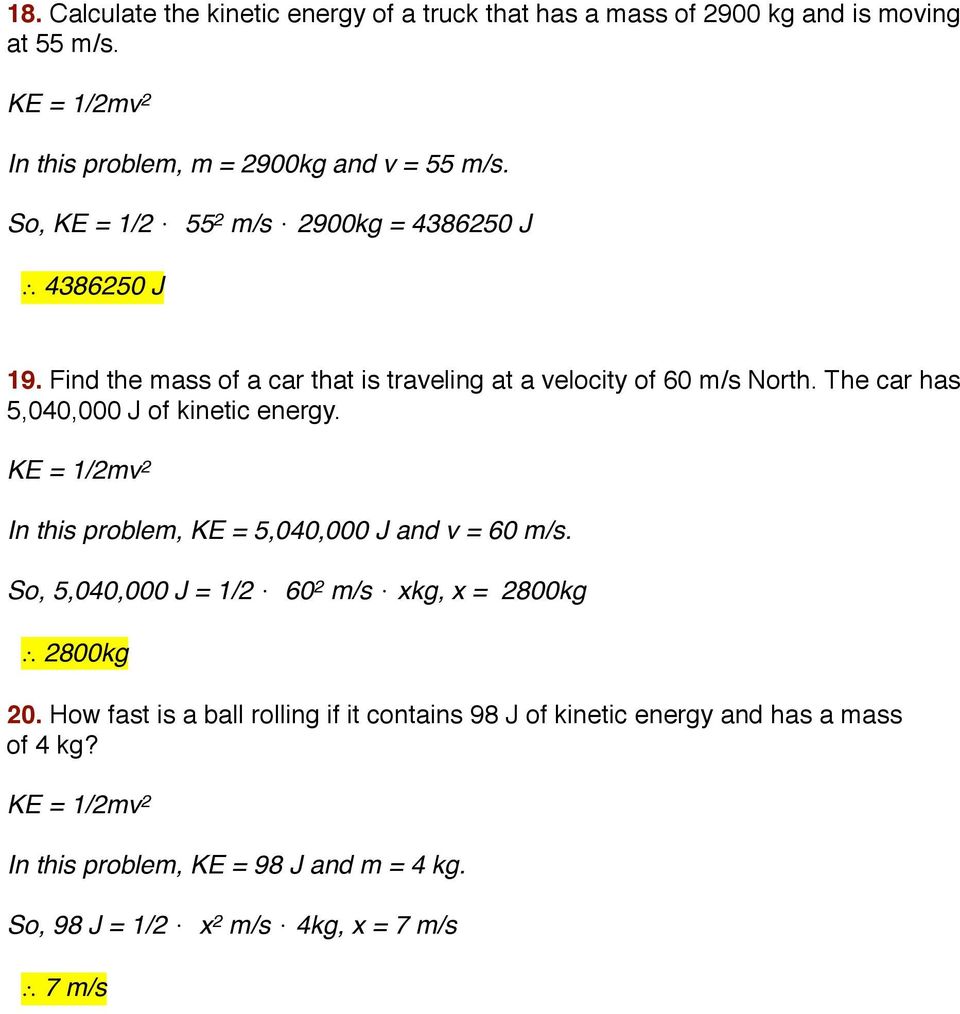
3 18. Calculate the kinetic energy of a truck that has a mass of 2900 kg and is moving at 55 m/s. KE = 1/2mv 2 In this problem, m = 2900kg and v = 55 m/s. So, KE = 1/ m/s 2900kg = J J 19. Find the mass of a car that is traveling at a velocity of 60 m/s North. The car has 5,040,000 J of kinetic energy. KE = 1/2mv 2 In this problem, KE = 5,040,000 J and v = 60 m/s. So, 5,040,000 J = 1/ m/s xkg, x = 2800kg 2800kg 20. How fast is a ball rolling if it contains 98 J of kinetic energy and has a mass of 4 kg? KE = 1/2mv 2 In this problem, KE = 98 J and m = 4 kg. So, 98 J = 1/2 x 2 m/s 4kg, x = 7 m/s 7 m/s
4 WORKSHEET: POTENTIAL ENERGY PROBLEMS Fill in the Blank: 1. Potential energy is the energy matter has as a result of its mass or height. 2. The more mass an object has the (more / less) potential energy it has. 3. The potential energy an object has due to its position is called gravitational potential energy. 4. The formula for calculating gravitational potential energy is. 5. The value of the g constant (the acceleration of all objects due to gravity) on earth is 9.8 m/s The SI (metric) unit for energy is joules and the symbol is J. Sample Problems: 7. PE = m = 0.6 kg h = 35 m 8. PE = 30 J m = 0.3kg h = 10m 9. PE = 7.5 J m = 1.6 kg h = 0.48m 10. PE = J m = 2 kg h = 22m

5 11. A 10 kg mass is lifted to a height of 2 m. What is its potential energy at this position? Given Formula Substitution Answer (with units) In this problem, m = 10kg and h = 2m. G or gravitational acceleration is always 9.8 m/s 2. So, PE = 10kg 9.8 m/s 2 2m = 196 J 196 J 12. At what height is an object that has a mass of 16 kg, it its gravitational potential energy is 7500J? In this problem, m = 16kg and PE = 7500 J. G or gravitational acceleration is always 9.8 m/s 2. So, 7500 J = 16kg 9.8 m/s 2 xm = m m 13. PE = 1176 m = 3 kg h = 40 m 14. PE = 74 J m = 3.8 kg h = 1.99 m 15. PE = 52 J m = 0.3 kg h = 18 m 16. PE = 1078 J m = 5 kg h = 22m

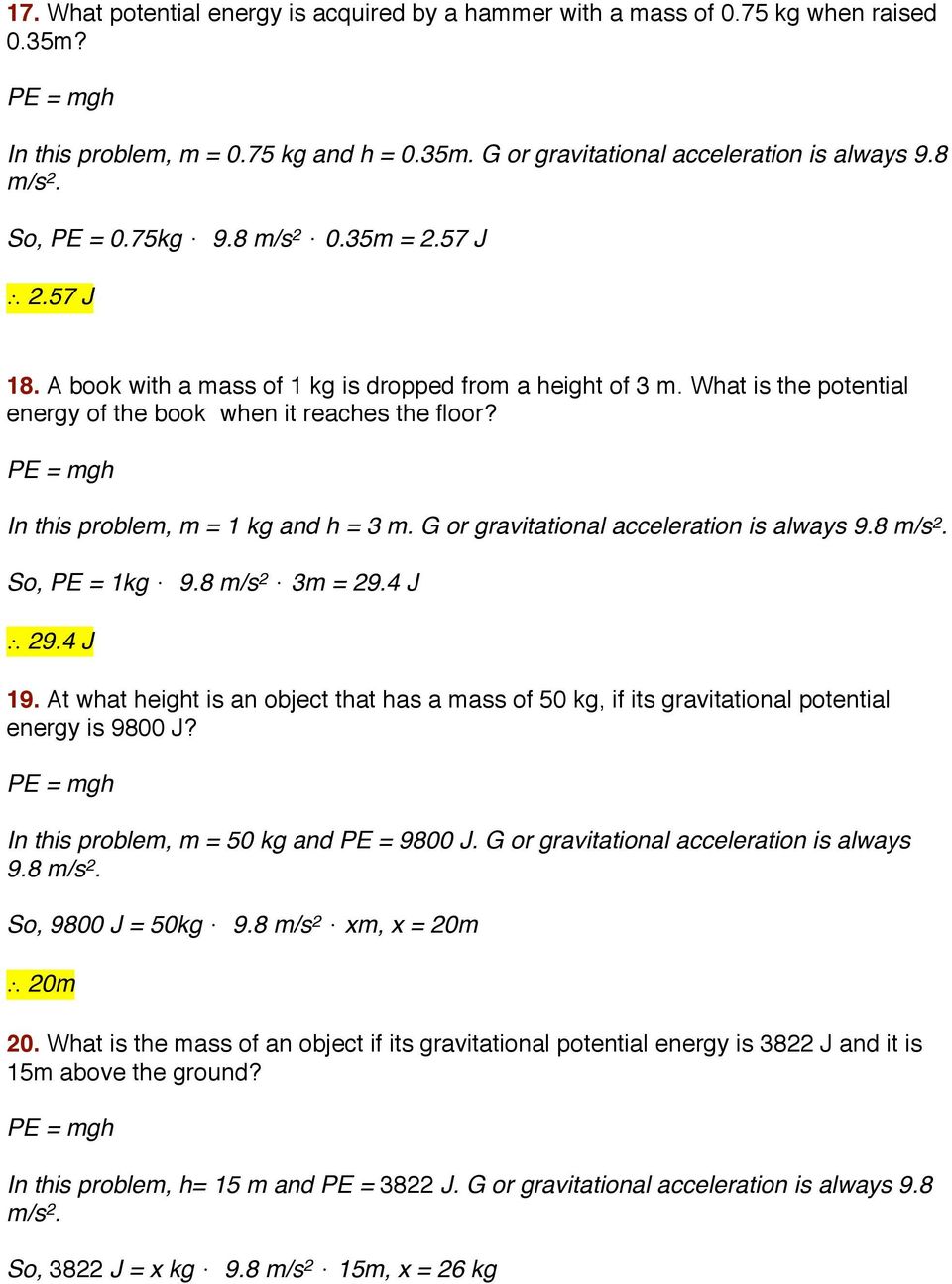
6 17. What potential energy is acquired by a hammer with a mass of 0.75 kg when raised 0.35m? In this problem, m = 0.75 kg and h = 0.35m. G or gravitational acceleration is always 9.8 m/s 2. So, PE = 0.75kg 9.8 m/s m = 2.57 J 2.57 J 18. A book with a mass of 1 kg is dropped from a height of 3 m. What is the potential energy of the book when it reaches the floor? In this problem, m = 1 kg and h = 3 m. G or gravitational acceleration is always 9.8 m/s 2. So, PE = 1kg 9.8 m/s 2 3m = 29.4 J 29.4 J 19. At what height is an object that has a mass of 50 kg, if its gravitational potential energy is 9800 J? In this problem, m = 50 kg and PE = 9800 J. G or gravitational acceleration is always 9.8 m/s 2. So, 9800 J = 50kg 9.8 m/s 2 xm, x = 20m 20m 20. What is the mass of an object if its gravitational potential energy is 3822 J and it is 15m above the ground? In this problem, h= 15 m and PE = 3822 J. G or gravitational acceleration is always 9.8 m/s 2. So, 3822 J = x kg 9.8 m/s 2 15m, x = 26 kg
7 26 kg 21. An object with a mass of 20 kg and potential energy of 584 J is what distance above the ground? In this problem, m= 20 kg and PE = 584 J. G or gravitational acceleration is always 9.8 m/s 2. So, 584 J = 20 kg 9.8 m/s 2 xm, x = 2.98m 2.98m Work Write the equation and units for work: Equation:, unit is joules(j). 1. A weight lifter lifts a set of weights a vertical distance of 2 m. If a constant net force of 350 N is exerted on the weights, what is the net work done on the weights? In this problem, f = 350 N and d = 2m. So, W = 350 N 2m = 700 J 700 J 2. A shopper in a supermarket pushes a cart with a force of 35 N directed at an angle of 25 degrees downward from the horizontal. Find the work done by the shopper on the cart as the shopper moves along a 50 m length of aisle.

8 3. If 2 J of work is done in raising a 180 g apple, how far is it lifted? In this problem, W = 2 J. Because F = mg, F = 0.18 kg 9.8 = N So, 2 J = N xm, x = 1.13 m 1.13 m 4. For each of the following cases, indicate whether the work done on the second object in each example will have a positive or a negative value. a. The road exerts a friction force on a speeding car skidding to a stop. " Negative value b. A rope exerts a force on a bucket as the bucket t is raised up a well. " Positive value c. Air exerts a force on a parachute as the parachutist falls to Earth. " Negative value 5. If a neighbor pushes a lawnmower four times as far as you do but exerts only half the force, which one of you does more work and by how much? Let s say a neighbor pushes a lawnmower 4m with 1 N of power. Then, I would push it 1m with 2 N of power. A neighbor did 4m 1N = 4J of work and I did 1m 2N = 2J of work. Thus, a neighbor did twice more work than me. A neighbor did twice more work than me. 6. A worker pushes a 1500 N crate with a horizontal force of 345 N a distance of 24 m. Assume the coefficient of kinetic friction between the crate and the floor is 22. a. How much work is done by the worker on the crate? b. How much work is done by the floor on the crate?

9 c. What is the net work done on the crate? 7. A kg ball in a kinetic sculpture moves at a constant speed along a motorized vertical conveyor belt. The ball rises 1.32 m above the ground. A constant frictional forc e of 35 N acts in the direction opposite the conveyor belt s motion. What is the net work done on the ball? 8. For each of the following statements, identify whether the everyday or the scientific meaning of work is intended. a. Jack had to work against time as the deadline neared. " Everyday work b. Jill had to work on her homework before she went to bed. " Everyday work c. Jack did work carrying the pail of water up the hill. " Scientific work 9. Determine whether work is being done in each of the following examples: a. a train engine pulling a loaded boxcar initially at rest " Work is being done. b. a tug of war that is evenly matched " Work is NOT being done. c. a crane lifting a car " Work is being done. 10. How much work does Bobby perform in pushing a 35 N crate a distance of 4 meters? List known values formula substitution answer & units In this problem, f = 35 N and d = 4m. So, W = 35 N 4m = 140 J 140 J 11. How far will a 70 N crate be moved if 3500 J or work are accomplished? list known values formula substitution answer & units

10 In this problem, f = 70 N and W = 3500 J. So, 3500 J = 70 N xm, x = 50 m 50m 12. What force is needed to move a barrel 25 m if 225 J of work are accomplished? In this problem, d= 25 m and W = 225 J. So, 225 J = x N 25m, x = 5 N 5 N 13. Peggy uses a force of 40 N to move the grocery basket 18 meters. How much work did she perform? In this problem, F = 40 N and d = 18 m. So, W= 40 N 18m = 720 J 720 J 14. How far will a 150 N crate be moved if 600 J or work are performed? In this problem, f = 150 N and W = 600 J. So, 600 J = 150 N xm, x = 4 m 4m 15. What distance is needed to lift a box that weighs 300 N if J of work are accomplished? In this problem, F = 300 N and W = J.

11 So, J = 300 N xm, x = 50 m 50 m 16. How far will a 700 N crate be moved if 2800 J or work are accomplished? In this problem, f = 700 N and W = 2800 J. So, 2800 J = 700 N xm, x = 4m 4m 17. What force is needed to move a barrel 45 m if 3600 J of work are accomplished? In this problem, d= 45 m and W = 3600 J. So, 3600 J = x N 45m, x = 80 N 80 N 18. How much work does Billy perform if he pushes the 8000 N stalled car a distance? of 25 meters? In this problem, F = 8000 N and d = 25 m. So, W= 8000 N 25m = J J 19. Grant stands 3 m from the check out at the grocery store holding a 20 N bag of potatoes for 10 minutes. How much work does he perform? In this problem, F = 20 N and d = 3 m. So, W= 20 N 3m = 60 J

12 60 J

Name Period WORKSHEET: KINETIC AND POTENTIAL ENERGY PROBLEMS. 1. Stored energy or energy due to position is known as energy.
 Name Period Date WORKSHEET: KINETIC AND POTENTIAL ENERGY PROBLEMS 1. Stored energy or energy due to position is known as energy. 2. The formula for calculating potential energy is. 3. The three factors
Work, Energy and Power
 Work, Energy and Power In this section of the Transport unit, we will look at the energy changes that take place when a force acts upon an object. Energy can t be created or destroyed, it can only be changed
Chapter 6 Work and Energy
 Chapter 6 WORK AND ENERGY PREVIEW Work is the scalar product of the force acting on an object and the displacement through which it acts. When work is done on or by a system, the energy of that system
B) 286 m C) 325 m D) 367 m Answer: B
 Practice Midterm 1 1) When a parachutist jumps from an airplane, he eventually reaches a constant speed, called the terminal velocity. This means that A) the acceleration is equal to g. B) the force of
Potential / Kinetic Energy Remedial Exercise
 Potential / Kinetic Energy Remedial Exercise This Conceptual Physics exercise will help you in understanding the Law of Conservation of Energy, and its application to mechanical collisions. Exercise Roles:
Serway_ISM_V1 1 Chapter 4
 Serway_ISM_V1 1 Chapter 4 ANSWERS TO MULTIPLE CHOICE QUESTIONS 1. Newton s second law gives the net force acting on the crate as This gives the kinetic friction force as, so choice (a) is correct. 2. As
Work, Energy and Power Practice Test 1
 Name: ate: 1. How much work is required to lift a 2-kilogram mass to a height of 10 meters?. 5 joules. 20 joules. 100 joules. 200 joules 5. ar and car of equal mass travel up a hill. ar moves up the hill
CHAPTER 6 WORK AND ENERGY
 CHAPTER 6 WORK AND ENERGY CONCEPTUAL QUESTIONS. REASONING AND SOLUTION The work done by F in moving the box through a displacement s is W = ( F cos 0 ) s= Fs. The work done by F is W = ( F cos θ). s From
Physics 11 Assignment KEY Dynamics Chapters 4 & 5
 Physics Assignment KEY Dynamics Chapters 4 & 5 ote: for all dynamics problem-solving questions, draw appropriate free body diagrams and use the aforementioned problem-solving method.. Define the following
Chapter 6. Work and Energy
 Chapter 6 Work and Energy ENERGY IS THE ABILITY TO DO WORK = TO APPLY A FORCE OVER A DISTANCE= Example: push over a distance, pull over a distance. Mechanical energy comes into 2 forms: Kinetic energy
At the skate park on the ramp
 At the skate park on the ramp 1 On the ramp When a cart rolls down a ramp, it begins at rest, but starts moving downward upon release covers more distance each second When a cart rolls up a ramp, it rises
Chapter 6. Work and Energy
 Chapter 6 Work and Energy The concept of forces acting on a mass (one object) is intimately related to the concept of ENERGY production or storage. A mass accelerated to a non-zero speed carries energy
Chapter 4: Newton s Laws: Explaining Motion
 Chapter 4: Newton s Laws: Explaining Motion 1. All except one of the following require the application of a net force. Which one is the exception? A. to change an object from a state of rest to a state
C B A T 3 T 2 T 1. 1. What is the magnitude of the force T 1? A) 37.5 N B) 75.0 N C) 113 N D) 157 N E) 192 N
 Three boxes are connected by massless strings and are resting on a frictionless table. Each box has a mass of 15 kg, and the tension T 1 in the right string is accelerating the boxes to the right at a
9. The kinetic energy of the moving object is (1) 5 J (3) 15 J (2) 10 J (4) 50 J
 1. If the kinetic energy of an object is 16 joules when its speed is 4.0 meters per second, then the mass of the objects is (1) 0.5 kg (3) 8.0 kg (2) 2.0 kg (4) 19.6 kg Base your answers to questions 9
Steps to Solving Newtons Laws Problems.
 Mathematical Analysis With Newtons Laws similar to projectiles (x y) isolation Steps to Solving Newtons Laws Problems. 1) FBD 2) Axis 3) Components 4) Fnet (x) (y) 5) Subs 1 Visual Samples F 4 1) F 3 F
v v ax v a x a v a v = = = Since F = ma, it follows that a = F/m. The mass of the arrow is unchanged, and ( )
 Week 3 homework IMPORTANT NOTE ABOUT WEBASSIGN: In the WebAssign versions of these problems, various details have been changed, so that the answers will come out differently. The method to find the solution
Work, Power, Energy Multiple Choice. PSI Physics. Multiple Choice Questions
 Work, Power, Energy Multiple Choice PSI Physics Name Multiple Choice Questions 1. A block of mass m is pulled over a distance d by an applied force F which is directed in parallel to the displacement.
WORK DONE BY A CONSTANT FORCE
 WORK DONE BY A CONSTANT FORCE The definition of work, W, when a constant force (F) is in the direction of displacement (d) is W = Fd SI unit is the Newton-meter (Nm) = Joule, J If you exert a force of
10.1 Quantitative. Answer: A Var: 50+
 Chapter 10 Energy and Work 10.1 Quantitative 1) A child does 350 J of work while pulling a box from the ground up to his tree house with a rope. The tree house is 4.8 m above the ground. What is the mass
Lesson 3 - Understanding Energy (with a Pendulum)
 Lesson 3 - Understanding Energy (with a Pendulum) Introduction This lesson is meant to introduce energy and conservation of energy and is a continuation of the fundamentals of roller coaster engineering.
Gravitational Potential Energy
 Gravitational Potential Energy Consider a ball falling from a height of y 0 =h to the floor at height y=0. A net force of gravity has been acting on the ball as it drops. So the total work done on the
Ch 7 Kinetic Energy and Work. Question: 7 Problems: 3, 7, 11, 17, 23, 27, 35, 37, 41, 43
 Ch 7 Kinetic Energy and Work Question: 7 Problems: 3, 7, 11, 17, 23, 27, 35, 37, 41, 43 Technical definition of energy a scalar quantity that is associated with that state of one or more objects The state
Work Energy & Power. September 2000 Number 05. 1. Work If a force acts on a body and causes it to move, then the force is doing work.
 PhysicsFactsheet September 2000 Number 05 Work Energy & Power 1. Work If a force acts on a body and causes it to move, then the force is doing work. W = Fs W = work done (J) F = force applied (N) s = distance
Work, Energy & Momentum Homework Packet Worksheet 1: This is a lot of work!
 Work, Energy & Momentum Homework Packet Worksheet 1: This is a lot of work! 1. A student holds her 1.5-kg psychology textbook out of a second floor classroom window until her arm is tired; then she releases
Forces. When an object is pushed or pulled, we say that a force is exerted on it.
 Forces When an object is pushed or pulled, we say that a force is exerted on it. Forces can Cause an object to start moving Change the speed of a moving object Cause a moving object to stop moving Change
8. Potential Energy and Conservation of Energy Potential Energy: When an object has potential to have work done on it, it is said to have potential
 8. Potential Energy and Conservation of Energy Potential Energy: When an object has potential to have work done on it, it is said to have potential energy, e.g. a ball in your hand has more potential energy
PHY231 Section 2, Form A March 22, 2012. 1. Which one of the following statements concerning kinetic energy is true?
 1. Which one of the following statements concerning kinetic energy is true? A) Kinetic energy can be measured in watts. B) Kinetic energy is always equal to the potential energy. C) Kinetic energy is always
Name: Partners: Period: Coaster Option: 1. In the space below, make a sketch of your roller coaster.
 1. In the space below, make a sketch of your roller coaster. 2. On your sketch, label different areas of acceleration. Put a next to an area of negative acceleration, a + next to an area of positive acceleration,
Exam 2 is at 7 pm tomorrow Conflict is at 5:15 pm in 151 Loomis
 * By request, but I m not vouching for these since I didn t write them Exam 2 is at 7 pm tomorrow Conflict is at 5:15 pm in 151 Loomis There are extra office hours today & tomorrow Lots of practice exams
F N A) 330 N 0.31 B) 310 N 0.33 C) 250 N 0.27 D) 290 N 0.30 E) 370 N 0.26
 Physics 23 Exam 2 Spring 2010 Dr. Alward Page 1 1. A 250-N force is directed horizontally as shown to push a 29-kg box up an inclined plane at a constant speed. Determine the magnitude of the normal force,
Energy - Key Vocabulary
 Energy - Key Vocabulary Term Potential Energy Kinetic Energy Joules Gravity Definition The energy an object possesses due to its position. PE = mgh The energy an object possesses when it is in motion.
Physics 201 Homework 8
 Physics 201 Homework 8 Feb 27, 2013 1. A ceiling fan is turned on and a net torque of 1.8 N-m is applied to the blades. 8.2 rad/s 2 The blades have a total moment of inertia of 0.22 kg-m 2. What is the
Chapter 7: Momentum and Impulse
 Chapter 7: Momentum and Impulse 1. When a baseball bat hits the ball, the impulse delivered to the ball is increased by A. follow through on the swing. B. rapidly stopping the bat after impact. C. letting
PHY231 Section 1, Form B March 22, 2012
 1. A car enters a horizontal, curved roadbed of radius 50 m. The coefficient of static friction between the tires and the roadbed is 0.20. What is the maximum speed with which the car can safely negotiate
Conceptual Questions: Forces and Newton s Laws
 Conceptual Questions: Forces and Newton s Laws 1. An object can have motion only if a net force acts on it. his statement is a. true b. false 2. And the reason for this (refer to previous question) is
Physics 125 Practice Exam #3 Chapters 6-7 Professor Siegel
 Physics 125 Practice Exam #3 Chapters 6-7 Professor Siegel Name: Lab Day: 1. A concrete block is pulled 7.0 m across a frictionless surface by means of a rope. The tension in the rope is 40 N; and the
AP Physics C Fall Final Web Review
 Name: Class: _ Date: _ AP Physics C Fall Final Web Review Multiple Choice Identify the choice that best completes the statement or answers the question. 1. On a position versus time graph, the slope of
Lecture 07: Work and Kinetic Energy. Physics 2210 Fall Semester 2014
 Lecture 07: Work and Kinetic Energy Physics 2210 Fall Semester 2014 Announcements Schedule next few weeks: 9/08 Unit 3 9/10 Unit 4 9/15 Unit 5 (guest lecturer) 9/17 Unit 6 (guest lecturer) 9/22 Unit 7,
VELOCITY, ACCELERATION, FORCE
 VELOCITY, ACCELERATION, FORCE velocity Velocity v is a vector, with units of meters per second ( m s ). Velocity indicates the rate of change of the object s position ( r ); i.e., velocity tells you how
3 Work, Power and Energy
 3 Work, Power and Energy At the end of this section you should be able to: a. describe potential energy as energy due to position and derive potential energy as mgh b. describe kinetic energy as energy
Chapter 7 WORK, ENERGY, AND Power Work Done by a Constant Force Kinetic Energy and the Work-Energy Theorem Work Done by a Variable Force Power
 Chapter 7 WORK, ENERGY, AND Power Work Done by a Constant Force Kinetic Energy and the Work-Energy Theorem Work Done by a Variable Force Power Examples of work. (a) The work done by the force F on this
LAB 6: GRAVITATIONAL AND PASSIVE FORCES
 55 Name Date Partners LAB 6: GRAVITATIONAL AND PASSIVE FORCES And thus Nature will be very conformable to herself and very simple, performing all the great Motions of the heavenly Bodies by the attraction
KE =? v o. Page 1 of 12
 Page 1 of 12 CTEnergy-1. A mass m is at the end of light (massless) rod of length R, the other end of which has a frictionless pivot so the rod can swing in a vertical plane. The rod is initially horizontal
W i f(x i ) x. i=1. f(x i ) x = i=1
 Work Force If an object is moving in a straight line with position function s(t), then the force F on the object at time t is the product of the mass of the object times its acceleration. F = m d2 s dt
LAB 6 - GRAVITATIONAL AND PASSIVE FORCES
 L06-1 Name Date Partners LAB 6 - GRAVITATIONAL AND PASSIVE FORCES OBJECTIVES And thus Nature will be very conformable to herself and very simple, performing all the great Motions of the heavenly Bodies
force (mass)(acceleration) or F ma The unbalanced force is called the net force, or resultant of all the forces acting on the system.
 4 Forces 4-1 Forces and Acceleration Vocabulary Force: A push or a pull. When an unbalanced force is exerted on an object, the object accelerates in the direction of the force. The acceleration is proportional
Physics: Principles and Applications, 6e Giancoli Chapter 4 Dynamics: Newton's Laws of Motion
 Physics: Principles and Applications, 6e Giancoli Chapter 4 Dynamics: Newton's Laws of Motion Conceptual Questions 1) Which of Newton's laws best explains why motorists should buckle-up? A) the first law
TEACHER ANSWER KEY November 12, 2003. Phys - Vectors 11-13-2003
 Phys - Vectors 11-13-2003 TEACHER ANSWER KEY November 12, 2003 5 1. A 1.5-kilogram lab cart is accelerated uniformly from rest to a speed of 2.0 meters per second in 0.50 second. What is the magnitude
BHS Freshman Physics Review. Chapter 2 Linear Motion Physics is the oldest science (astronomy) and the foundation for every other science.
 BHS Freshman Physics Review Chapter 2 Linear Motion Physics is the oldest science (astronomy) and the foundation for every other science. Galileo (1564-1642): 1 st true scientist and 1 st person to use
Unit 3 Work and Energy Suggested Time: 25 Hours
 Unit 3 Work and Energy Suggested Time: 25 Hours PHYSICS 2204 CURRICULUM GUIDE 55 DYNAMICS Work and Energy Introduction When two or more objects are considered at once, a system is involved. To make sense
Curso2012-2013 Física Básica Experimental I Cuestiones Tema IV. Trabajo y energía.
 1. A body of mass m slides a distance d along a horizontal surface. How much work is done by gravity? A) mgd B) zero C) mgd D) One cannot tell from the given information. E) None of these is correct. 2.
PHYS 117- Exam I. Multiple Choice Identify the letter of the choice that best completes the statement or answers the question.
 PHYS 117- Exam I Multiple Choice Identify the letter of the choice that best completes the statement or answers the question. 1. Car A travels from milepost 343 to milepost 349 in 5 minutes. Car B travels
Work. Work = Force x parallel distance (parallel component of displacement) F v
 Work Work = orce x parallel distance (parallel component of displacement) W k = d parallel d parallel Units: N m= J = " joules" = ( kg m2/ s2) = average force computed over the distance r r When is not
B Answer: neither of these. Mass A is accelerating, so the net force on A must be non-zero Likewise for mass B.
 CTA-1. An Atwood's machine is a pulley with two masses connected by a string as shown. The mass of object A, m A, is twice the mass of object B, m B. The tension T in the string on the left, above mass
Physics 2A, Sec B00: Mechanics -- Winter 2011 Instructor: B. Grinstein Final Exam
 Physics 2A, Sec B00: Mechanics -- Winter 2011 Instructor: B. Grinstein Final Exam INSTRUCTIONS: Use a pencil #2 to fill your scantron. Write your code number and bubble it in under "EXAM NUMBER;" an entry
Name Class Period. F = G m 1 m 2 d 2. G =6.67 x 10⁻¹¹ Nm 2 /kg 2
 Gravitational Forces 13.1 Newton s Law of Universal Gravity Newton discovered that gravity is universal. Everything pulls on everything else in the universe in a way that involves only mass and distance.
ENERGYand WORK (PART I and II) 9-MAC
 ENERGYand WORK (PART I and II) 9-MAC Purpose: To understand work, potential energy, & kinetic energy. To understand conservation of energy and how energy is converted from one form to the other. Apparatus:
Review Chapters 2, 3, 4, 5
 Review Chapters 2, 3, 4, 5 4) The gain in speed each second for a freely-falling object is about A) 0. B) 5 m/s. C) 10 m/s. D) 20 m/s. E) depends on the initial speed 9) Whirl a rock at the end of a string
5. Forces and Motion-I. Force is an interaction that causes the acceleration of a body. A vector quantity.
 5. Forces and Motion-I 1 Force is an interaction that causes the acceleration of a body. A vector quantity. Newton's First Law: Consider a body on which no net force acts. If the body is at rest, it will
Work-Energy Bar Charts
 Name: Work-Energy Bar Charts Read from Lesson 2 of the Work, Energy and Power chapter at The Physics Classroom: http://www.physicsclassroom.com/class/energy/u5l2c.html MOP Connection: Work and Energy:
Weight The weight of an object is defined as the gravitational force acting on the object. Unit: Newton (N)
 Gravitational Field A gravitational field as a region in which an object experiences a force due to gravitational attraction Gravitational Field Strength The gravitational field strength at a point in
CLASS TEST GRADE 11. PHYSICAL SCIENCES: PHYSICS Test 1: Mechanics
 CLASS TEST GRADE 11 PHYSICAL SCIENCES: PHYSICS Test 1: Mechanics MARKS: 45 TIME: 1 hour INSTRUCTIONS AND INFORMATION 1. Answer ALL the questions. 2. You may use non-programmable calculators. 3. You may
Conservative vs. Non-conservative forces Gravitational Potential Energy. Work done by non-conservative forces and changes in mechanical energy
 Next topic Conservative vs. Non-conservative forces Gravitational Potential Energy Mechanical Energy Conservation of Mechanical energy Work done by non-conservative forces and changes in mechanical energy
physics 111N work & energy
 physics 111N work & energy conservation of energy entirely gravitational potential energy kinetic energy turning into gravitational potential energy gravitational potential energy turning into kinetic
ANSWER KEY. Work and Machines
 Chapter Project Worksheet 1 1. inclined plane, wedge, screw, lever, wheel and axle, pulley 2. pulley 3. lever 4. inclined plane 5. Answers will vary: top, side, or bottom 6. Answers will vary; only one
Lesson 39: Kinetic Energy & Potential Energy
 Lesson 39: Kinetic Energy & Potential Energy Total Mechanical Energy We sometimes call the total energy of an object (potential and kinetic) the total mechanical energy of an object. Mechanical energy
Chapter 8: Potential Energy and Conservation of Energy. Work and kinetic energy are energies of motion.
 Chapter 8: Potential Energy and Conservation of Energy Work and kinetic energy are energies of motion. Consider a vertical spring oscillating with mass m attached to one end. At the extreme ends of travel
Lecture 17. Last time we saw that the rotational analog of Newton s 2nd Law is
 Lecture 17 Rotational Dynamics Rotational Kinetic Energy Stress and Strain and Springs Cutnell+Johnson: 9.4-9.6, 10.1-10.2 Rotational Dynamics (some more) Last time we saw that the rotational analog of
III. Applications of Force and Motion Concepts. Concept Review. Conflicting Contentions. 1. Airplane Drop 2. Moving Ball Toss 3. Galileo s Argument
 III. Applications of Force and Motion Concepts Concept Review Conflicting Contentions 1. Airplane Drop 2. Moving Ball Toss 3. Galileo s Argument Qualitative Reasoning 1. Dropping Balls 2. Spinning Bug
EDUH 1017 - SPORTS MECHANICS
 4277(a) Semester 2, 2011 Page 1 of 9 THE UNIVERSITY OF SYDNEY EDUH 1017 - SPORTS MECHANICS NOVEMBER 2011 Time allowed: TWO Hours Total marks: 90 MARKS INSTRUCTIONS All questions are to be answered. Use
Resistance in the Mechanical System. Overview
 Overview 1. What is resistance? A force that opposes motion 2. In the mechanical system, what are two common forms of resistance? friction and drag 3. What is friction? resistance that is produced when
Chapter 3.8 & 6 Solutions
 Chapter 3.8 & 6 Solutions P3.37. Prepare: We are asked to find period, speed and acceleration. Period and frequency are inverses according to Equation 3.26. To find speed we need to know the distance traveled
Work, Power, and Energy: Explaining the causes of motion without Newton. KIN335 Spring 2005
 Work, Power, and Energy: Explaining the causes of motion without Newton KIN335 Spring 2005 What you should know Definition of work and its characteristics Definition of energy (including kinetic energy
Page Topic Further Support Materials
 This booklet will discuss some of the principles involved in the design of a roller coaster. It is intended for the middle or high school teacher. Physics students may find the information helpful as well.
AP Physics Applying Forces
 AP Physics Applying Forces This section of your text will be very tedious, very tedious indeed. (The Physics Kahuna is just as sorry as he can be.) It s mostly just a bunch of complicated problems and
NEWTON S LAWS OF MOTION
 Name Period Date NEWTON S LAWS OF MOTION If I am anything, which I highly doubt, I have made myself so by hard work. Isaac Newton Goals: 1. Students will use conceptual and mathematical models to predict
Problem Set 1. Ans: a = 1.74 m/s 2, t = 4.80 s
 Problem Set 1 1.1 A bicyclist starts from rest and after traveling along a straight path a distance of 20 m reaches a speed of 30 km/h. Determine her constant acceleration. How long does it take her to
Work and Energy. W =!KE = KE f
 Activity 19 PS-2826 Work and Energy Mechanics: work-energy theorem, conservation of energy GLX setup file: work energy Qty Equipment and Materials Part Number 1 PASPORT Xplorer GLX PS-2002 1 PASPORT Motion
General Physical Science
 General Physical Science Chapter 4 Work and Energy Work The work done by a constant force F acting upon an object is the product of the magnitude of the force (or component of the force) and the parallel
Chapter 5 Using Newton s Laws: Friction, Circular Motion, Drag Forces. Copyright 2009 Pearson Education, Inc.
 Chapter 5 Using Newton s Laws: Friction, Circular Motion, Drag Forces Units of Chapter 5 Applications of Newton s Laws Involving Friction Uniform Circular Motion Kinematics Dynamics of Uniform Circular
Unit 8A: Systems in Action (Pg. 2 85) Chapter 2: Getting to Work (pg. 28 55)
 Unit 8A: Systems in Action (Pg. 2 85) Chapter 2: Getting to Work (pg. 28 55) Name: Date: 2.1: Physical Systems: Simple Machines (Pg. 30 35): Read Pages 30-35. Answer the following questions on pg. 35:
Work and Conservation of Energy
 Work and Conservation of Energy Topics Covered: 1. The definition of work in physics. 2. The concept of potential energy 3. The concept of kinetic energy 4. Conservation of Energy General Remarks: Two
Objective: Work Done by a Variable Force Work Done by a Spring. Homework: Assignment (1-25) Do PROBS # (64, 65) Ch. 6, + Do AP 1986 # 2 (handout)
 Double Date: Objective: Work Done by a Variable Force Work Done by a Spring Homework: Assignment (1-25) Do PROBS # (64, 65) Ch. 6, + Do AP 1986 # 2 (handout) AP Physics B Mr. Mirro Work Done by a Variable
4 Gravity: A Force of Attraction
 CHAPTER 1 SECTION Matter in Motion 4 Gravity: A Force of Attraction BEFORE YOU READ After you read this section, you should be able to answer these questions: What is gravity? How are weight and mass different?
OBJECTIVES. Newton s Laws
 Newton s Laws OBJECTIVES Students should be able to: 1. Describe Aristotleʼs Horse Cart theory and what was wrong with it. 2. Describe Galileo's experiment that lead to his conclusions about inertia (a)
Unit 2 Force and Motion
 Force and Motion Unit 2 Force and Motion Learning Goal (TEKS): Identify and describe the changes in position, direction, and speed of an object when acted upon by unbalanced forces. This means: We are
Exercises on Work, Energy, and Momentum. A B = 20(10)cos98 A B 28
 Exercises on Work, Energy, and Momentum Exercise 1.1 Consider the following two vectors: A : magnitude 20, direction 37 North of East B : magnitude 10, direction 45 North of West Find the scalar product
Newton s Laws. Physics 1425 lecture 6. Michael Fowler, UVa.
 Newton s Laws Physics 1425 lecture 6 Michael Fowler, UVa. Newton Extended Galileo s Picture of Galileo said: Motion to Include Forces Natural horizontal motion is at constant velocity unless a force acts:
AP Physics - Chapter 8 Practice Test
 AP Physics - Chapter 8 Practice Test Multiple Choice Identify the choice that best completes the statement or answers the question. 1. A single conservative force F x = (6.0x 12) N (x is in m) acts on
LeaPS Workshop March 12, 2010 Morehead Conference Center Morehead, KY
 LeaPS Workshop March 12, 2010 Morehead Conference Center Morehead, KY Word Bank: Acceleration, mass, inertia, weight, gravity, work, heat, kinetic energy, potential energy, closed systems, open systems,
PHY121 #8 Midterm I 3.06.2013
 PHY11 #8 Midterm I 3.06.013 AP Physics- Newton s Laws AP Exam Multiple Choice Questions #1 #4 1. When the frictionless system shown above is accelerated by an applied force of magnitude F, the tension
circular motion & gravitation physics 111N
 circular motion & gravitation physics 111N uniform circular motion an object moving around a circle at a constant rate must have an acceleration always perpendicular to the velocity (else the speed would
www.mathsbox.org.uk Displacement (x) Velocity (v) Acceleration (a) x = f(t) differentiate v = dx Acceleration Velocity (v) Displacement x
 Mechanics 2 : Revision Notes 1. Kinematics and variable acceleration Displacement (x) Velocity (v) Acceleration (a) x = f(t) differentiate v = dx differentiate a = dv = d2 x dt dt dt 2 Acceleration Velocity
Name Class Date. You do twice as much work. b. You lift two identical books one meter above the ground.
 Exercises 9.1 Work (pages 145 146) 1. Circle the letter next to the correct mathematical equation for work. work = force distance work = distance force c. work = force distance d. work = force distance
When showing forces on diagrams, it is important to show the directions in which they act as well as their magnitudes.
 When showing forces on diagrams, it is important to show the directions in which they act as well as their magnitudes. mass M, the force of attraction exerted by the Earth on an object, acts downwards.
University Physics 226N/231N Old Dominion University. Getting Loopy and Friction
 University Physics 226N/231N Old Dominion University Getting Loopy and Friction Dr. Todd Satogata (ODU/Jefferson Lab) [email protected] http://www.toddsatogata.net/2012-odu Friday, September 28 2012 Happy
ch 15 practice test Multiple Choice Identify the letter of the choice that best completes the statement or answers the question.
 ch 15 practice test Multiple Choice Identify the letter of the choice that best completes the statement or answers the question. 1. Work is a transfer of a. energy. c. mass. b. force. d. motion. 2. What
A Determination of g, the Acceleration Due to Gravity, from Newton's Laws of Motion
 A Determination of g, the Acceleration Due to Gravity, from Newton's Laws of Motion Objective In the experiment you will determine the cart acceleration, a, and the friction force, f, experimentally for