
Recommended Practice for Transit Bus In-Service Brake System Performance Testing
|
|
|
- Toby Morris
- 10 years ago
- Views:
Transcription
1 Recommended Practice for Transit Bus In-Service Brake System Performance Testing Approved March 10, 2005 APTA Bus Brake Working Group Approved May 15, 2005 APTA Bus Standards Committee Abstract: This recommended practice provides guidelines for testing transit bus air brake system performance. Keywords: brake performance, brakes, deceleration, bus brake, transit bus, stopping, PBBT Copyright 2005 by The American Public Transportation Association 1666 K Street, N. W. Washington, DC, 20006, USA No part of this publication may be reproduced in any form, in an electronic retrieval system or otherwise, without the prior written permission of The American Public Transportation Association.
2 Introduction (This introduction is not a part of APTA BTS-BC-RP Recommended Practice for Transit Bus In-Service Brake System Performance Testing) This Recommended Practice for Transit Bus In-Service Brake System Performance Testing reflects the consensus of the APTA Bus Standards Program members on the items, methods, and procedures that have provided the best practice based on the experiences of those present and participating in meetings of the Program Task Forces and Working Groups. Recommended practices are voluntary, industrydeveloped, and consensus-based practices that assist equipment suppliers, vehicle and component manufacturers, and maintenance personnel in the construction, assembly, operation, and maintenance of transit bus vehicles. Recommended practices may include test methodologies and informational documents. Recommended practices are non-exclusive and voluntary; they are intended to neither endorse nor discourage the use of any product or procedure. All areas and items included therein are subject to manufacturers supplemental or superceding recommendations. APTA recognizes that for certain applications, the practices, as implemented by operating agencies, may be either more or less restrictive than those given in this document. This recommended practice provides guidelines for transit bus in-service brake system performance testing. APTA recommends the use of this recommended practice by: Individuals or organizations that inspect and maintain transit buses Individuals or organizations that contract with others for the inspection and maintenance of transit buses Individuals or organizations that influence how transit buses are inspected and maintained. Test results must meet or exceed Federal, State, or other local regulatory agency requirements if different from the recommendations outlined in this document. Participants The American Public Transportation Association (APTA) greatly appreciates the contributions of the Bus Transit Standards Brake System Working Group, who provided the primary effort in the drafting of the Recommended Practice for Transit Bus In-Service Brake System Performance Testing. ii
3 Contents 1. Overview Scope Purpose References Definitions, abbreviations, and acronyms Definitions Abbreviations and acronyms Test provisions Training Frequency of testing Tools Conditions Personal protective equipment Safety Tests Wedge brakes CVSA out of service road side S-CAM brake power stroke measurement Burnishing Service brake road deceleration test Mechanical device Electronic device Parking brake road deceleration test Mechanical device Electronic device Brake system performance test using PBBT (Performance Based Brake Tester) Brake force while measuring weight Brake force while measuring primary control pressure Parking brake test Correction of deficiencies Documentation... 7 Annex A (informative) Bibliography... 8 Annex B (informative) Burnishing... 9 B.1 Burnishing advantages... 9 B.2 Burnishing procedure... 9 Annex C (informative) Comparison of measuring devices Annex D (informative) Use of performance based brake testers to verify brake performance D.3 Background iii
4 D.4 Advantages of using a PBBT to measure brake performance D.5 Discussion of braking requirements when using a PBBT D.6 Test results D.7 Specific recommendation iv
5 Recommended Practice for Transit Bus In-Service Brake System Performance Testing 1. Overview This document establishes a recommended practice for transit bus in-service brake performance testing. Individual operating agencies may modify these guidelines to accommodate their specific equipment and mode of operation. Test results must meet or exceed Federal, State, or other local regulatory agency requirements if different from the recommendations outlined in this document. 1.1 Scope This recommended practice provides system performance testing guidelines for heavy duty transit buses equipped with air drum brakes. This document only covers braking force and deceleration aspects of brake testing. Interlock and emergency brake systems are not covered in this document. 1.2 Purpose The purpose of this recommended practice is to provide a uniform method and criteria for testing and verification of transit bus brake system performance. 2. References This recommended practice should be used in conjunction with the following publications. Commercial Vehicle Safety Alliance (CVSA), Out-of-Service (OOS) Criteria. DOT Federal Motor Vehicle Carrier Safety Administration, Title 49, Part 393, published in the Code of Federal Regulations. New Jersey Transit F&SE, Title 39 16: Brakes, Items paragraph (a). 49 CFR , Code of Federal Regulations, Title 49: Volume 5, Part 571, Federal Motor Vehicle Safety Standards, Section 121, Air Brake Systems, Definitions, abbreviations, and acronyms For the purposes of this recommended practice, the following terms, definitions, abbreviations, and acronyms apply. 1
6 3.1 Definitions burnishing: A process where brake lining surface and brake drum surface are conditioned after reline power stroke: The dimensional change in brake chamber stroke between the fully released and fully applied measurements while maintaining 90 to 100 psi air pressure in the air brake system. 3.2 Abbreviations and acronyms CVSA DOT FMCSA FMVSS GAWR GVWR OEM OOS PBBT Commercial Vehicle Safety Alliance Department of Transportation Federal Motor Carrier Safety Administration Federal Motor Vehicle Safety Standard gross axle weight rating gross vehicle weight rating original equipment manufacturer out-of-service Performance Based Brake Testers 4. Test provisions 4.1 Training The operating agency and/or their maintenance contractors should develop and execute training programs that provide employees with the knowledge and skills necessary to perform the tasks outlined in this recommended practice safely and effectively. 4.2 Frequency of testing The minimum frequency of tasks should comply with OEM/operating agency recommendations and local, state, and federal requirements. 4.3 Tools A minimum of one of the following tools are recommended for the in-service testing of transit bus brake systems: Mechanical decelerometer (e.g. Tapley meter) (See Annex C) Electronic decelerometer (e.g. Vericom, Fraser, etc.) (See Annex C) Performance Based Brake Testers (PBBT) approved by FMCSA (See Annex D) Additional tools as recommended by the OEM or as used by the transit industry may also be used. 2
7 4.4 Conditions A suitable, location for a brake road test is one in which the road surface is reasonably level, dry, and free of road debris, sand, gravel, or oil, and where traffic conditions will safely permit the required actions. Road conditions different from those noted above may affect results. The following conditions are recommended for the testing of transit bus in-service systems: Passenger load none Air tank pressure - vehicle governed cutout pressure at the beginning of the test Tire pressure - manufacturer recommended pressure Retarder - off (if possible) until the entire test is complete 4.5 Personal protective equipment Personal protective equipment, as required by the operating agency, should be worn at all times during testing. 4.6 Safety All appropriate safety precautions should be followed at all times during testing. 5. Tests 5.1 Wedge brakes CVSA out of service road side Test wedge brakes where combined movement of both brake shoes exceeds 1/8. Example: The brake lining to drum clearance on the top shoe is 3/32 and the clearance on the bottom shoe is 1/32. Under this criteria, the brake would not be in an out of service condition, because the total of the top and bottom clearance does not exceed 1/ S-CAM brake power stroke measurement Prior to road testing a power stroke measurement of each brake adjuster should be made. The power stroke must not exceed the CVSA readjustment limits for the chamber size. The measurement procedure may be modified for each agency s requirements but should contain the following steps: a) Measure from the brake chamber face to the center of the clevis pin with the service brake and the parking brake fully released. Repeat at all wheel locations. 3
8 b) Make a full service brake application while maintaining psi air system pressure (dash gauge is acceptable) and hold it. c) While holding the application, re-measure from the brake chamber face to the center of the clevis. Repeat at all wheel locations. d) The power stroke measurement is the difference between the brakes fully applied and brakes fully released. Record calculations. If the power stroke does not exceed the CVSA power stroke limits for the chamber size, then the power stroke inspection is complete. If the power stroke exceeds the allowable stroke for the chamber size the cause of the overstroke condition must be identified and corrected. If the vehicle is equipped with automatic slack adjusters and measurements exceed the power stroke limits in Table 1, follow manufacturer s recommendations to repair deficiencies. The power stroke should then be retested to confirm compliance. Table 1 - Power stroke limits Chamber size Power stroke limits (inches) Power stroke limits (mm) 9 1 3/ / / LS / LS / LS ELS 2 1/ LS 2 1/ DD3 2 1/ /4 57 4
9 5.3 Burnishing Burnishing is recommended following replacement or reassembly of foundation brake components. The burnishing procedure may be modified for each agency s requirements. See Annex B for details. 5.4 Service brake road deceleration test Each operating agency may determine the number of tests used and the pass/fail criteria for the road deceleration test. CAUTION: Vehicles may pass the deceleration requirements but other conditions may affect the total stopping distance such as: a) Application delay timing A brake pedal sensor triggering device can be used to determine the delay time of the brake application, which may vary due to changes in the pneumatic or foundation brake systems. Application delay time is defined as the amount of time from when the brake pedal sensor is triggered until the vehicle reaches the set point deceleration. Comparison of the delay time within similar model buses and the delay time obtained during the test may provide an indication of the status of the air system. b) ABS system faults Crossed wheel sensors, modulator valves, or apply and hold wiring of the modulator valves can all increase stopping distances and not trigger fault codes. Care should be taken to check for these problems as well as addressing recognized faults Mechanical device If deceleration capability of the service brake system is tested with a mechanical deceleration measurement device, the peak efficiency of 60% (0.6 g) should be achieved from an initial speed of approximately 20 miles per hour Electronic device If the deceleration capability of the service brake system is tested with an electronic deceleration measurement device, an average in-stop deceleration rate of at least 0.528g should be achieved from the initial set point until the vehicle makes a complete stop from an initial speed of approximately 20 miles per hour. The deceleration reading may vary with a different initial set point. 5
10 5.5 Parking brake road deceleration test The purpose of the parking brake is to hold the vehicles in a static condition on a grade. For practical purposes the deceleration tests for the parking brake in Sections may be used Mechanical device If the deceleration capability of the parking brake system is tested with a mechanical deceleration measurement device a peak efficiency of 17% (0.17g), achieved from an initial speed of approximately 20 miles per hour, is recommended Electronic device If the deceleration capability of the parking brake system is tested with an electronic deceleration measurement device, an average deceleration rate of at least 15% (0.15g) from an initial negative g of 10% (-0.1g) until the vehicle makes a complete stop from 20 miles per hour. NOTE It may be necessary to adjust the initial set point of your electronic device to negative 0.1g. 5.6 Brake system performance test using PBBT (Performance Based Brake Tester) When using a PBBT, a brake system test must be conducted in accordance with the testing procedure outlined in the PBBT OEM technical manual. For additional information on performance brake testing, see 49 CFR 393 1, as published in the Federal Register Rules and Regulations. On a given axle the difference in brake forces, left to right, must not exceed 30 percent at the point of wheel lockup Brake force while measuring weight Transit bus brakes may be tested on a PBBT (that meets the US DOT specifications for such devices) as an alternative to a 20 mph vehicle test with a decelerometer. The recommended minimum braking force as a percentage of actual vehicle weight is 52.8% Brake force while measuring primary control pressure During the PBBT test, primary control line service pressure can be measured and each service brake chamber should meet the criteria indicated in Table 1 of Annex D. By using GAWR and GVWR to provide a basis for the requirements, the loaded braking capability of the vehicle is estimated. 1 For references in Italics, see Section 2. 6
11 NOTE See Annex D for a more detailed description of bus brake testing while using a PBBT Parking brake test If the deceleration capability of the parking brake system is tested with a PBBT measurement device, a deceleration rate of at least 0.15 g is required. Deceleration is calculated by adding the parking brake forces measured on a PBBT and then dividing by the GVWR of the vehicle. 5.7 Correction of deficiencies Deficiencies uncovered during transit bus in-service brake system performance testing should be corrected and documented in accordance with operating agency procedures and/or OEM recommendations. 5.8 Documentation Testing should be documented on a standard form (electronic or paper) and be reviewed and filed in accordance with operating agency procedures. 7
12 Annex A (informative) Bibliography [B1] [B2] CVSA , Appendix G to Subchapter B, Subpart C- Brakes [B3] 49 CFR , Code of Federal Regulations, Title 49: Volume 65, Part 393, Sections 17-25, [B4] 49 CFR , Code of Federal Regulations, Title 49: Volume 65, Part 393, Brake Performance Requirements for Commercial Motor Vehicles Inspected by Performance-Based Brake Testers, Sections 40-53,
13 Annex B (informative) Burnishing The burnishing procedure establishes the compatibility between the lining material and the drum. For optimal use of any given brake system, the brake shoes and drum have to be compatible with each other. This is achieved by a combination of rubbing speed, temperature, air pressure, and inertia. Burnishing is also influenced by the lining and drum material chemistries. B.1 Burnishing advantages a) Gradually eliminates any thermal shock in the drum b) Eliminates residues that are near the lining and drum surfaces, thereby reducing new lining fade c) Establishes a layer of transfer film a few microns thick on the drum surface (Otherwise, when using a freshly ground drum without the transfer film, the main friction force comes from cutting, plowing, or scoring of the lining surface. This leads to inconsistent braking effectiveness.) d) Mates the drum and lining surfaces for an improved contact area e) Reduces lining glazing and drum high spots B.2 Burnishing procedure Burnish procedures may be modified for each agency s requirements, but should be similar to the following steps: a) Using the service brake, slow the vehicle from 20 to 5 mph at approximately 0.3 g deceleration, or a moderate brake application. Repeat this process 10 times (snubs) at regular intervals of approximately 500 ft. or 0.1 mile without stopping the vehicle. CAUTION: Do not permit wheel lock up. b) After the tenth brake application (snub), make one complete stop from 20 to 0 MPH. c) Compare drum temperature differential immediately after burnishing. Any drum that is significantly cooler (approximately 50 F side to side, 100 F front to rear) than the others indicates a lack of braking effort. Inspect the vehicle for brake defects and perform necessary repair. After repairs have been made, repeat burnishing. 9
14 Annex C (informative) Comparison of measuring devices In order to put the braking performance (i.e. stopping distances) of a transit bus in the proper perspective, it is important to first understand the differences between the various instruments used to measure stopping distance. The stopping distance determined with an electronic brake tester (such as Vericom or Fraser) will always be greater than that recorded by a mechanical brake tester (such as a Tapley meter) and less than that recorded by a fifth wheel. Testing on transit buses at Radlinski and Associates, Inc. (RAI) have indicated that the Tapley meter using peak deceleration gave 20 mph stopping distance estimates 5 to 9 feet shorter than the electronic brake tester using average deceleration and the electronic brake tester gave 20 mph stopping distance estimates 3 to 5 feet shorter than the fifth wheel. These differences in stopping distance are related to how the three devices determine stopping distance. The fifth wheel measures stopping distance as specified by federal regulations (FMVSS No. 121, FMCSR ) and SAE Recommended Practices which all define stopping distance as the distance traveled from first movement of the brake pedal until the vehicle reaches a stop. The fifth wheel system counts revolutions of a trailing wheel that has a known circumference. The system triggers (starts counting distance) when the pedal is first moved. A switch on the brake pedal senses this movement. The system also determines vehicle speed from the rate of trailing wheel rotation when the pedal is first moved and throughout the stop. Initial speed information is then used to provide a corrected stopping distance or distance that would result if the vehicle was traveling at exactly some speed (20 mph in this case). The formula in SAE Recommended Practice J299 is used to make this correction. Electronic brake testers measure braking rate (deceleration) with an electronic accelerometer, a device that senses rate of speed change, and then it uses these data to calculate stopping distance. It does not measure stopping distance directly but uses a mathematical process known as double integration to compute the distance. It does not start recording data until the deceleration reaches the threshold setting and as such does not measure what happens at the beginning of the stop (i.e. from first movement of the pedal until the vehicle braking rate reaches the threshold setting). The mechanical brake tester is a pendulum device that measures deceleration but it only saves (records) a value that represents the maximum deceleration reached during the stop. The scale of the mechanical brake tester is calibrated in percent g and stopping distance in a side-by-side fashion but the distance that corresponds to a given percent g value assumes that the peak deceleration is maintained during the entire stop and that there is no application time to reach this level. In summary, the fifth wheel measures stopping distance directly while the electronic and mechanical brake testers measure deceleration and then compute stopping distance from this deceleration information. Because the electronic brake tester records deceleration over most of the stop and uses all of this data in the computation process, it provides a more accurate measure of actual stopping distance than does the mechanical brake tester but the electronic tester does 10
15 miss the distance traveled at the beginning of the stop until the vehicle reaches the threshold setting. The fact that the three devices produce different results does not mean that they are not useful for measuring or comparing brake performance. In the testing conducted at RAI, they all ranked different levels of braking performance in the same way indicating that they do provide good relative measures of braking performance. The problem arises in comparing the absolute value of their measurements. Since the electronic and mechanical testers actually measure deceleration, it makes more sense to report their measurements in terms of deceleration and not stopping distance, as they do not measure true stopping distance. Furthermore, the mechanical tester measures peak deceleration whereas the electronic tester measures both peak and average deceleration. Peak and average are both good measures of braking performance, but they are different values and cannot be compared. However, the average deceleration more accurately predicts the actual stopping distance. New Jersey Transit s Title 39 regulation 2 has a stopping distance requirement that a bus must stop from 20 mph in less than 22.5 feet. This distance was originally established when the DOT and transit properties were using Tapley meters and represents a peak deceleration reading of 0.6g. Since testing at RAI has shown that a Vericom, using average deceleration, will give 5 to 9 feet longer stopping distance than a Tapley on the same vehicle with the same brakes, vehicles that would meet the requirement using the Tapley meter might be marginal or not meet the requirement when an electronic tester is used to determine stopping distance. This does not mean the brakes are defective, only that the test instrument being used is producing a different number that is longer. A more reasonable approach would be to use peak deceleration rate or average deceleration rate as the pass-fail criteria, not stopping distance. New York State has actually changed their brake regulation for buses to take into account the differences in mechanical devices that measure peak deceleration and electronic devices that measure average deceleration. Under (Z)(1)(b) Service Brakes, of the New York State DOT regulations a mechanical device (like a Tapley) must measure a peak efficiency of at least 60% (0.6 g) from an initial speed of approximately 20 mph. If an electronic device (like a Vericom or Fraser) is used, an average deceleration rate of at least g must be obtained from an initial speed of approximately 20 mph. RAI has recently tested several transit buses used in New York and New Jersey. Below are three figures showing the stopping distance comparison between a fifth wheel, Vericom 2000, Vericom 3000 and Tapley meter for three different transit buses with three different wheelbases under several test configurations. Also included are average deceleration and peak deceleration charts. Data was recorded from the fifth wheel, Vericom, and Tapley simultaneously during each stop. The target speed for all the stops was 20-mph. The buses were at empty weight for all the stops. The data plotted is the average of six stops. 2 For references in Italics, see Section 2. 11
16 Peak Deceleration (g) Average Deceleration (g) Stopping Distance (ft) APTA BTS-BC-RP Target Speed 20mph - Empty Transit Bus 300-inch Wheelbase Fifth Wheel Vericom 2000 Tapley Test Condition 1 Test Condition 2 Test Condition 3 Test Condition 4 Test Condition 5 T arget Speed 20mph - Empty T ransit B us 300-inch Wheelbase Fifth Wheel Vericom 2000 Test Condition 1 Test Condition 2 Test Condition 3 Test Condition 4 Test Condition 5 Target Speed 20mph - Empty Transit Bus 300-inch Wheelbase Fifth Wheel Vericom 2000 Tapley Test Condition 1 Test Condition 2 Test Condition 3 Test Condition 4 Test Condition 5 Figure 1 Long wheelbase transit bus 12

17 Average Deceleration (g) APTA BTS-BC-RP T arget Speed 20mph - Empty T ransit B us 173-inch Wheelbase Fif t h Wheel Vericom 2000 Vericom 3000 Test Condit ion 1 Test Condit ion 2 Test Condit ion 3 Test Condit ion 4 Test Condit ion 5 Figure 2 Medium wheelbase transit bus 13
18 Peak Deceleration (g) Average Deceleration (g) APTA BTS-BC-RP Target Speed 20mph - Empty Transit Bus 300-inch Wheelbase 1 ) (g n tio ra le 0.5 e e c D k a e P Fif th W hee l Ver icom Ta pley Test Condition 1 Test Condition 2 Tes t Condition 3 Test Condition 4 Test Condition 5 T arget Speed 20mph - Empty T ransit B us 132-inch Wheelbase Fifth Wheel Vericom 2000 Vericom 3000 Test Condition 1 Test Condition 2 Test Condition 3 Test Condition 4 Test Condition 5 T arget Speed 20mph - Empty T ransit B us 132-inch Wheelbase Fifth Wheel Vericom 2000 Vericom 3000 Tapley Test Condition 1 Test Condition 2 Test Condition 3 Test Condition 4 Test Condition 5 Figure 3 Short wheelbase transit bus 14
19 Annex D APTA BTS-BC-RP (informative) Use of performance based brake testers to verify brake performance D.3 Background The Federal Motor Carrier Safety Administration of the US DOT has issued a modification to the Federal Motor Carrier Safety Regulations (effective date February 5, 2003) that allows the use of a PBBT (that meets certain DOT specifications) to determine compliance with the brake performance requirements of section Section requires that the brake forces on the vehicle must be capable of producing a vehicle deceleration of at least 0.435g (14 ft/sec²). If the total of the maximum brake forces for individual wheels measured on a PBBT are greater than times the vehicles weight, the vehicle then meets the deceleration requirement of s Historically, the transit industry has also used deceleration as a measure of brake performance, but the requirements that are typically implemented require a deceleration greater than that specified in FMCSR Some properties use a Tapley meter with a 22.2-foot requirement. This actually corresponds to a peak deceleration of 0.6g or peak brake efficiency of 60%. Others use a Fraser or Vericom or some other electronic decelerometer with a requirement of 0.528g average deceleration. In either case this is significantly higher deceleration and brake performance than required by the FMCSR. D.4 Advantages of using a PBBT to measure brake performance PBBTs offer a number of advantages over a road test: a) The test can be run indoors and is not affected by weather b) The test is safer (no moving vehicles or traffic issues) c) There is no damage to the tires or suspension d) They can measure performance at each individual wheel and can identify exactly where the problem is located e) They are fast and can check service brakes, parking brakes and ABS function, all in less than 10 minutes f) They can measure front to rear brake force balance and threshold pressures in order to assess wear balance issues g) They can measure left/right balance in order to determine the source of steering pull complaints 15
20 h) They can measure rolling resistance in order to identify dragging brakes or bad wheel bearings D.5 Discussion of braking requirements when using a PBBT D.5.1 Service brake effectiveness The current deceleration requirement of 0.435g in the FMCSR has historically been considered too lenient by transit operators and the requirement to be used with PBBTs needs to be higher to satisfy transit needs. European countries generally require that deceleration be at least 0.5g based on PBBT measurements, but this is for annual inspections as opposed to random road-side inspections where the FMCSR apply (and must therefore allow for some degradation between annual inspections). FMVSS 121, the brake standard for new vehicles, requires that each brake on a vehicle meet certain dynamometer requirements using a laboratory device known as an inertia dynamometer. Table 1 below shows the brake effectiveness requirements from FMVSS 121. Table 1 - FMVSS 121 dynamometer requirements - brake effectiveness at 50 mph Pressure (psi) Retardation Ratio Retardation ratio is simply the brake force divided by the rated wheel load (GAWR/2). If all of the wheels on the vehicle developed a retardation ratio of exactly 0.41 at 80 psi, then the deceleration of the vehicle at 80 psi would be 0.41 g. It is proposed that the FMVSS 121 requirements in Table 1 be used with a PBBT to serve as one of the pass-fail criteria for service brake force at each wheel. Since the FMVSS 121 requirements in Table 1 are for a 50 mph stop and the measurements on a PBBT are usually made at 5 mph or less, using such a criteria on a PBBT actually allows for some degradation from the new vehicle requirement. This is because brake force increases as speed is reduced and the PBBT would be expected to produce a higher brake force than the inertia dynamometer. Some degradation from the new vehicle requirements is reasonable and in addition FMVSS 121 requires that brakes be burnished to a very specific temperature-controlled procedure that may not be representative of transit operations. 16
21 D.5.2 Side-to-side (left/ right) balance on service brake forces APTA BTS-BC-RP Experience has shown that left to right brake force differences across an axle that exceed 30 percent indicate that something is wrong with the brake that has the lower force. European-based PBBT requirements use the 30 percent as pass-fail criteria and in fact some countries set this limit at 20 percent for the steering axle. It is proposed that the 30 percent criteria be used to identify a brake problem in the transit requirements for PBBTs. D.5.3 Parking brake forces FMVSS 121 requires that a vehicle at full load (GVWR) must hold on a 20 percent slope. It is proposed that for transit, this value be set at 15 percent to allow for some degradation, which is normal for the spring brake assemblies. Grade holding is calculated by adding the parking forces measured on a PBBT and then dividing by the GVWR of the vehicle. D.6 Test results RAI tested a 30-foot transit bus with a GVWR of 33,000 lbs. The unit was tested because the bus would not meet the 0.528g average deceleration requirement for a 20-mph stop, when measured with an electronic decelerometer. The attached charts in Figure 1 show the retardation ratio calculated from brake force measured on a PBBT divided by GAWR/2 for each brake. The curves show the PBBT retardation ratio before and after the bus was repaired. When the retardation ratio from the PBBT fell below the FMVSS mph retardation requirement, the bus would not meet the average deceleration requirement for a 20-mph stop measured with an electronic decelerometer. When the retardation ratio was above the FMVSS 121 requirement, the bus met the 20-mph average deceleration requirement of 0.528g. D.7 Specific recommendation Transit bus brakes may be tested on a PBBT (that meets the US DOT specifications for such devices) as an alternative to a 20 mph vehicle test with a decelerometer. During the PBBT test, each service brake must develop brake forces that exceed those values shown in the table of retardation values in FMVSS 121 (see table 1 in Section D.5.1). These required retardation values must be based on rated wheel weight (GAWR/2). On a given axle the differences in brake forces, left to right, must not exceed 30 percent at the point of lock wheel up. Percent difference is equal to the difference in brake forces divided by the higher of the two forces times 100. The total of the brake forces developed by the parking brakes must be equal to or exceed 15 percent of the GVWR. NOTE By using GAWR and GVWR to provide a basis for the requirements, the loaded braking capability of the vehicle is determined. In addition, it is then not necessary to actually measure the weight of the bus with the PBBT. Eliminating the need for weight measurement reduces the initial cost of the equipment and also reduces the cost for maintenance and calibration. GAWR and GVWR are the parameters used when designing brakes. 17
22 Measurement of brake pressure is necessary during the test in order to give a measure of brake effectiveness. The FMCSR PBBT test does not measure pressure and as such may miss brake problems that result in driver complaints. Pressure can be easily measured in the primary control line by installing a quick coupler and leaving it in place (if the bus does not already have one). Each time the bus is tested, the pressure transducer provided with the brake tester is installed during the test. Both wireless and cable style transducers are available. 18
23 Retardation Ratio APTA BTS-BC-RP BRAKE RETARDATION # STEER AXLE - LEFT FRONT BRAKE 30-FOOT TRANSIT GVWR Brake force when unit did meet the 20mph stopping test requirement of 0.528g Brake force when unit did not meet the 20mph stopping test requirement of 0.528g Control Pressure (psi) 121 Retardation Ratio Left Front - Failed Veicom Left Front - Passed Vericom 19
24 Retardation Ratio APTA BTS-BC-RP BRAKE RETARDATION # DRIVE AXLE - LEFT REAR BRAKE 30-FOOT TRANSIT GVWR Brake force when unit did meet the 20mph stopping test requirement of 0.528g Brake force when unit did not meet the 20mph stopping test requirement of 0.528g Control Pressure (psi) 121 Retardation Ratio Left Rear - Failed Veicom Left Rear - Passed Vericom 20
25 Retardation Ratio APTA BTS-BC-RP BRAKE RETARDATION # STEER AXLE - RIGHT FRONT BRAKE 30-FOOT TRANSIT GVWR Brake force when unit did meet the 20mph stopping test requirement of 0.528g Brake force when unit did not meet the 20mph stopping test requirement of 0.528g Control Pressure (psi) 121 Retardation Ratio Right Front - Failed Veicom Right Front - Passed Vericom 21
26 Retardation Ratio APTA BTS-BC-RP BRAKE RETARDATION # DRIVE AXLE - RIGHT REAR BRAKE 30-FOOT TRANSIT GVWR Brake force when unit did meet the 20mph stopping test requirement of 0.528g Brake force when unit did not meet the 20mph stopping test requirement of 0.528g Control Pressure (psi) 121 Retardation Ratio Left Rear - Failed Veicom Left Rear - Passed Vericom 22
Troubleshooting Common Transit Bus S-cam and Air Brake Complaints
 APTA STANDARDS DEVELOPMENT PROGRAM RECOMMENDED PRACTICE American Public Transportation Association 1666 K Street NW, Washington, DC 20006 APTA BTS-BC-RP-005-10 Approved May 7, 2009 APTA Bus Brake Working
Chapter 4 DEFENSIVE DRIVING
 Chapter 4 DEFENSIVE DRIVING Chapter 4 Table of Contents Chapter 4 DEFENSIVE DRIVING... 4-1 DEFENSIVE DRIVING... 4-3 Positioning The Bus... 4-3 When Making a Turn at an Intersection... 4-3 Making the perfect
Recommended Practice for Installation of Transit Vehicle Fire Protection Systems
 Recommended Practice for Installation of Transit Vehicle Fire Protection Systems Approved October 25, 2007 APTA Fire Safety Working Group Approved May 3, 2008 APTA Bus Safety Committee Approved October
E/ECE/324/Rev.1/Add.12/Rev.7/Amend.4 E/ECE/TRANS/505/Rev.1/Add.12/Rev.7/Amend.4
 6 December 2012 Agreement Concerning the adoption of uniform technical prescriptions for wheeled vehicles, equipment and parts which can be fitted and/or be used on wheeled vehicles and the conditions
Webinar Series. Committee. Disc Brake Wheels Off Inspection and Reline. Presents
 1 APTA Bus Webinar Technical Series Maintenance Committee Webinar Series Presents Disc Brake Wheels Off Inspection and Reline January 21, 2015 2 Introduction Welcome to today s webinar in which we will
DiscPlus DX195 and DX225 Air Disc Brakes
 Revised 11-04 Technical Bulletin Revised 1 Technical 11-04 Bulletin DiscPlus DX195 and DX225 Air Disc Brakes Inspection, Installation and Diagnostics Air Disc Brake Inspection Intervals and Procedures
Section 6 Brake Drum Failure Analysis. Brake Drum Wear Conditions. What is Normal Wear? What is Deep or Excessive Wear? WARNING. Deep, Uniform Wear
 Section Brake Drum 6 Failure Analysis WARNING To prevent serious eye injury, always wear safe eye protection when you perform vehicle maintenance or service. Figure 6.1 ASBESTOS AND NON-ASBESTOS FIBERS
BRAKE DRUM AND ROTOR SERVICE INFORMATION
 SERVICE INFORMATION To achieve maximum drum life and optimum performance, proper brake maintenance and brake balance are essential. Consult your truck or trailer manufacturer s maintenance manual for proper
16. APTA PR-IM-S-016-02 Standard for Pantograph Current Collection Equipment Periodic Inspection and Maintenance
 16. APTA PR-IM-S-016-02 Standard for Pantograph Current Collection Equipment Periodic Inspection and Maintenance Approved October 30, 2002 APTA Passenger Rail Equipment Safety Standards Task Force Authorized
S-Cam Air Brakes. Braking Systems - Air. Operation
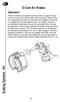 Operation S-Cam Air Brakes Trailer air brakes are operated by the tractor air supply through a series of relay and check valves. When braking is desired, the air is supplied to the axle air chamber which
(A5) Brakes Sample Questions and Answers
 (A5) Brakes Sample Questions and Answers Answers to these questions are found beginning on page 4 of this document 1. Two technicians are discussing a problem where the brake pedal travels too far before
BRAKE SYSTEMS 101. Energy Conversion Management. Presented by Paul S. Gritt
 Energy Conversion Management Presented by Paul S. Gritt Topics To Be Presented The Basic Concepts Hydraulic layouts Component functions Brake Balance Stopping Distance and Fade Formula SAE vs. Mini Baja
TECHNICAL BULLETIN. Meritor WABCO Cab Leveling Valves and Chassis Leveling Valves. How the Cab Leveling and Chassis Leveling Valves Work
 Revised 02-00 TECHNICAL BULLETIN Meritor WABCO Cab Leveling Valves and Chassis Leveling Valves This technical bulletin covers both cab and chassis leveling valves manufactured by Meritor WABCO. While the
1. SYSTEM OVERVIEW. 1) Basic Theory of ABS Function 10-3 4891-01
 10-3 1. SYSTEM OVERVIEW When braking suddenly or braking on slippery roads, the vehicle keeps moving forward but the wheels are locking and not rotating. If these happen, the vehicle may lose stability
12. REAR WHEEL/BRAKE/SUSPENSION
 12 12 12-0 SERVICE INFORMATION... 12-1 REAR BRAKE... 12-5 TROUBLESHOOTING... 12-2 REAR SHOCK ABSORBER... 12-8 REAR WHEEL... 12-3 REAR FORK... 12-9 SERVICE INFORMATION GENERAL INSTRUCTIONS When installing
GENERAL KNOWLEDGE PRACTICE TEST
 GENERAL KNOWLEDGE PRACTICE TEST 1. Driving under the influence of any drug that makes you drive unsafely is: a. Permitted if it is prescribed by a doctor b. Against the law c. Permitted if it is a diet
Recreational Vehicle Towing Guide
 Recreational Vehicle Towing Guide TABLE OF CONTENTS HOW TO DETERMINE THE GROSS VEHICLE WEIGHT RATING FOR RECREATIONAL VEHICLES Terms and Definitions... 2 Conversion... 3 Net Weight... 4 Manufacturer Gross
17. APTA PR-IM-S-017-02 Standard for Third Rail Current Collection Equipment Periodic Inspection and Maintenance
 17. APTA PR-IM-S-017-02 Standard for Third Rail Current Collection Equipment Periodic Inspection and Maintenance Approved October 30, 2002 APTA Passenger Rail Equipment Safety Standards Task Force Authorized
REFERENCE BOOK FOR: AREX WINDOWS GC SYSTEMS
 REFERENCE BOOK FOR: AREX WINDOWS GC SYSTEMS AREX TEST SYSTEMS BV VENNESTRAAT 4B 2161 LE LISSE HOLLAND Product of: Arex Test Systems bv Vennestraat 4b 2161 LE Lisse Holland Tel: +31-(0)252-419151 Fax: +31-(0)252-420510
Developed by the Technology & Maintenance Council s (TMC)
 Tire Pressure Monitoring and Inflation Maintenance Issued: June 2010 S.2 Tire & Wheel Study Group Information Report: 2010-2 Developed by the Technology & Maintenance Council s (TMC) S.2 Tire & Wheel Study
To help avoid personal injury due to poor braking. DO NOT Tap into the vehicle's brake system to operate a trailer brake system.
 489201 133 ANTIBRAKE SYSTEM GENERAL 489201 1. REPAIR INSTRUCTIONS 1) ONVEHICLE SERVICE (1) Service Precautions Brake Fluid may irritate eyes and skin. In case of contact, take the following actions: Eye
The hydraulically damped overrun control device is made up of six main elements that control and operate the braking system.
 THE OVERRUN PRINCIPLE The hydraulically damped overrun control device is made up of six main elements that control and operate the braking system. 1. The Housing 2. The Drawtube 3. The Overrun Lever of
Chapter 3. Track and Wheel Load Testing
 Chapter 3 Track and Wheel Load Testing This chapter describes the track, truck, and testing equipment that were used by the Transportation Technology Center, Inc. (TTCI) for collecting the data that was
SELF-STEERING AXLE TABLE OF CONTENTS
 SELF-STEERING AXLE TABLE OF CONTENTS Section 1 - Introduction Section 2 - Pre-Installation Check List Section 3 - Ride Height Adjustments Section 4 - Suspension Mount Section 5 - Axle Mount Section 6 -
Boom and fly capacities for this machine are listed by the following sections:
 Lifting Capacities Telescopic Hydraulic Truck Crane HTC 8650 50 ton (45.36 metric ton) and fly capacities for this machine are listed by the following sections: Fully Extended Outriggers Working Range
ABS Flash Code (Blink Code) Instructions
 ABS Flash Code (Blink Code) Instructions Innovative Products of America Incorporated Tinker Street, Woodsttock, NY 8 Local: 8-6-00 Toll Free: 888-86-8 Fax: 8-6-600 www.ipatools.com [email protected] ABS
Defensive Driving While Towing a Trailer By Elizabeth Koncki, Maryland Department of Agriculture
 Defensive Driving While Towing a Trailer By Elizabeth Koncki, Maryland Department of Agriculture Many of you have heard the term defensive driving, but maybe you may have not been taught the method or
VEHICLE SPEED CONTROL SYSTEM
 PL VEHICLE SPEED CONTROL SYSTEM 8H - 1 VEHICLE SPEED CONTROL SYSTEM TABLE OF CONTENTS page DESCRIPTION AND SPEED CONTROL SYSTEM...1 SPEED CONTROL SERVO-PCM OUTPUT....2 SPEED CONTROL SWITCHES PCM INPUT...2
The smart route to performance.
 M e r i t o r T r a n s i t B u s a n d C o a c h A x l e s The smart route to performance. Meritor Transit Bus and Coach Axles FH-946 The Industry s Axle Leader. With more than a century of axle-manufacturing
1. What data might a car leave behind at the scene of an accident?
 Bellwork 2-10-15 It takes 8,460 bolts to assemble an automobile, and one nut to scatter it all over the road. Author Unknown 1. What data might a car leave behind at the scene of an accident? 1 5 9 ACCIDENT
ALL NISSAN; BRAKE NOISE/JUDDER/PEDAL FEEL DIAGNOSIS AND REPAIR
 Classification: Reference: Date: BR00-004b NTB00-033b August 30, 2004 ALL NISSAN; BRAKE NOISE/JUDDER/PEDAL FEEL DIAGNOSIS AND REPAIR This bulletin amends NTB00-033. This version amends the Brake Judder
Bendix Air Disc Brakes
 Bendix Air Disc Brakes Optimum Performance. Optimum Engineering. A i r D r u m B r a k e s A i r D i s c B r a k e s A i r B r a k e C h a m b e r s S l a c k A d j u s t e r s H y d r a u l i c s A major
Tyre Awareness Training
 Tyre Awareness Training Tyre Law Tread depth Tyres on cars, light vans (not exceeding 3,500kg gross weight) and light trailers must have a tread depth of at least 1.6mm across the central three-quarters
Meritor WABCO Pneumatic Antilock Braking System (ABS) 42.22
 (ABS) 2.22 Troubleshooting WARNING Before testing a vehicle equipped with Automatic Traction Control (ATC) on a dynamometer, the ATC system must be disabled. See Subject 160 for instructions. Activation
LIFT-505. BMF Lift Kit. Yamaha Drive Gas or Electric. Installation Instructions
 LIFT-505 BMF Lift Kit Yamaha Drive Gas or Electric Installation Instructions Contents of LIFT-505 Yamaha Drive BMF Lift Kit: a (1 ea.) BMF A-Arm Assembly b (1 ea.) Driver Side Shock Tower c (1 ea.) Passenger
Electronic Brake Controller Hayes Brake Controller Company ENERGIZE III P/N # 81741B or ENERGIZE XPC P/N #81745 OPERATION MANUAL
 Electronic Brake Controller Hayes Brake Controller Company ENERGIZE III P/N # 81741B or ENERGIZE XPC P/N #81745 OPERATION MANUAL ENERGIZE III is for trailers with 2 or 4 electric brakes and vehicles with
Original ATE wheel cylinders. Reduced in weight and resistant to brake fluid
 Original ATE wheel cylinders Reduced in weight and resistant to brake fluid 1 Original ATE wheel cylinders The ATE brand is backed up by Continental, one of the worlds biggest brake specialists: this is
Spicer Axles and Tire Pressure Management Systems
 Spicer Axles and Tire Pressure Management Systems Spicer Fire and Rescue Vehicle Products Spicer Axle, Driveshaft, and Tire Pressure Management Systems Bendix Foundation Brake Systems Everything You Need.
Gunite Disc Brake Rotors
 Gunite Disc Brake Rotors Maintenance Manual Gunite is the industry leader in the development of brake system components for heavy-duty truck applications including air disc brake rotors. Gunite was the
CONSUMER INFORMATION TRUCK-CAMPER LOADING
 2015 MODEL YEAR GENERAL MOTORS INFORMATION REGARDING CONSUMER INFORMATION TRUCK-CAMPER LOADING PUBLISHED JANUARY 2014 Page 1 2015 MODEL YEAR GENERAL MOTORS TRUCKS CONSUMER INFORMATION TRUCK-CAMPER LOADING
INSTALLATION INSTRUCTIONS. 6111 Air Spring Kit 2011+ Ford F250/F-350 Single Wheel 2WD 2011+ Ford F350 Dually 2WD IMPORTANT NOTES
 INSTALLATION INSTRUCTIONS 6111 Air Spring Kit 2011+ Ford F250/F-350 Single Wheel 2WD 2011+ Ford F350 Dually 2WD Thank you for purchasing a quality Hellwig Product. PLEASE READ THIS INSTRUCTION SHEET COMPLETELY
BRAKE SYSTEM DESIGN AND THEORY
 RAKE SYSTEM DESIGN AND THEORY Aircraft brake systems perform multiple functions. They must be able to hold the aircraft back at full static engine run-up, provide adequate control during ground taxi operations,
Volkswagen Corrado 1990-1994 Suspension Wheels -Tires Wheel Alignment (Page GR-44)
 Wheels -Tires Wheel Alignment (Page GR-44) Front wheel camber adjusting Rear wheel toe determining Snow tires size Vibrations eliminating Wheel alignment data (4 cylinder) data (6 cylinder) Wheels - Tires,
Technical Service Bulletin
 Subject FOUR WHEEL ALIGNMENT - EZ CAM TM XR CAMBER ANGLE ADJUSTING BOLTS Date Model [X] PARTS MANAGER JANUARY, 2008 2003-2008 TIBURON [X] TECHNICIAN CIRCULATE TO: [ ] GENERAL MANAGER [X] SERVICE ADVISOR
Section A. GENERAL INFORMATION
 Section A. GENERAL INFORMATION I. Description The information and instructions for attaching the sidecar to the right-hand side of the motorcycle are contained in this handbook and must be carefully observed.
MASTER CYLINDER. Section 2. Master Cylinder. Tandem Master Cylinder. Master Cylinder
 MASTER CYLINDER Master Cylinder The master cylinder converts the motion of the brake pedal into hydraulic pressure. It consists of the reservoir tank, which contains the brake fluid; and the piston and
E/ECE/324/Rev.2/Add.116/Rev.2/Amend.2 E/ECE/TRANS/505/Rev.2/Add.116/Rev.2/Amend.2
 6 August 2013 Agreement Concerning the Adoption of Uniform Technical Prescriptions for Wheeled Vehicles, Equipment and Parts which can be Fitted and/or be Used on Wheeled Vehicles and the Conditions for
Electric Brakes. Braking Systems - Electric
 Electric Brakes The electric brakes on your trailer are similar to the drum brakes on your automobile. The basic difference is that your automotive brakes are actuated by hydraulic pressure while your
RAILROAD ACCIDENT INVESTIGATION REPORT NO. 4129 THE PENNSYLVANIA RAILROAD COMPANY WEST JEFFERSON, O. AUGUST 4, 1967 DEPARTMENT OF TRANSPORTATION
 RAILROAD ACCIDENT INVESTIGATION REPORT NO. 4129 THE PENNSYLVANIA RAILROAD COMPANY WEST JEFFERSON, O. AUGUST 4, 1967 DEPARTMENT OF TRANSPORTATION FEDERAL RAILROAD ADMINISTRATION Washington Summary DATE:
Report of Investigation. into the Crew Fatality Caused. by a Deck Lifter Onboard. M.V. Dyvi Adriatic
 Report of Investigation into the Crew Fatality Caused by a Deck Lifter Onboard M.V. Dyvi Adriatic on 30 June 2005 Purpose of Investigation This incident is investigated, and published in accordance with
 Guide for the use of HANS in international motor sport The HANS (Head And Neck Support) head restraint Issue: 05/01/2005 1. Choosing a HANS HANS devices exist not only in different sizes but with different
E/ECE/324/Rev.1/Add.12/Rev.8 E/ECE/TRANS/505/Rev.1/Add.12/Rev.8
 3 March 2014 Agreement Concerning the Adoption of Uniform Technical Prescriptions for Wheeled Vehicles, Equipment and Parts which can be Fitted and/or be Used on Wheeled Vehicles and the Conditions for
SmartTrac Stability Control Systems
 Innovation That Delivers SmartTrac Stability Control Systems safety SmartTrac brings stability to your vehicles and your bottom line. Meritor WABCO is a recognized pioneer in delivering advanced stability
Electronically Controlled Air Suspension (ECAS) for Trucks
 $2.50 Electronically Controlled Air Suspension (ECAS) for Trucks Maintenance Manual No. 36 Issued 7-99 ECAS System for 6 x 2 and 6 x 4 Vehicles with Rear Air Suspensions Service Notes Service Notes This
JCB Fastrac in Heavy Goods Vehicle Applications
 JCB Fastrac in Heavy Goods Vehicle Applications Agricultural or General Haulage? Alan Mendelson JCB Consultant Introduction The JCB Fastrac is an instantly recognisable modern agricultural tractor. It
6 inch A-Arm Lift Kit WARNING: 16-018/16-019. installation instructions. will fit CLUB CAR DS. included:
 Revised May 205 6-08/6-09 6 inch A-Arm Lift Kit will fit CLUB CAR DS installation instructions included: Rear Lift Blocks Main Suspension Assembly Spindles A-Arms Rear Shock Mounting Plates U-Bolts WARNING:
Cane Creek Double Barrel Instructions
 Cane Creek Double Barrel Instructions Congratulations on your purchase of the Cane Creek Double Barrel (CCDB) rear shock. Developed in partnership with Öhlins Racing, the Double Barrel brings revolutionary
Model Year: 2010 Model: Prius Doc ID: RM000001Y3B015X. Title: ALIGNMENT / HANDLING DIAGNOSIS: FRONT WHEEL ALIGNMENT: ADJUSTMENT (2010 Prius)
 Last Modified: 5-3-2010 6.4 N From: 200904 Model Year: 2010 Model: Prius Doc ID: RM000001Y3B015X Title: ALIGNMENT / HANDLING DIAGNOSIS: FRONT WHEEL ALIGNMENT: ADJUSTMENT (2010 Prius) ADJUSTMENT If the
Cable Installation Notes
 Cable Installation Notes June 2006 Table of Contents Cable Pulling... 2 Bending Radius... 2 Pulling Tension... 3 Friction... 3 Installation with Rollers... 4 Installation without Rollers... 4 Pulling Tension
QUALITY ASSURANCE FOR MOBILE RETROREFLECTIVITY UNITS
 State of Florida Department of Transportation QUALITY ASSURANCE FOR MOBILE RETROREFLECTIVITY UNITS FDOT Office State Materials Office Authors Patrick Upshaw Joshua Sevearance Hyung Lee Date of Publication
Appendix 6145-T1 Forklift Use Practices
 Appendix 6145-T1 Operators must perform a preoperational inspection of the forklifts and attachments in accordance with the equipment operating manual. They will immediately report any equipment deficiencies
UMTRI Automotive Safety Conference
 Heavy Truck Advanced Brake Control Safety Systems UMTRI Automotive Safety Conference February 16, 2011 Alan Korn Agenda Introduction / Background Government Truck Safety Initiatives Tractor and Trailer
READ AND UNDERSTAND ALL INSTRUCTIONS AND WARNINGS PRIOR TO INSTALLATION OF SYSTEM AND OPERATION OF VEHICLE.
 491 W. Garfield Ave., Coldwater, MI 49036 Phone: 517-279-2135 Web/live chat: www.bds-suspension.com E-mail: [email protected] Product: GM Leaf Spring READ AND UNDERSTAND ALL INSTRUCTIONS AND
M113 VEHICLE FAMILY RUBBER TRACK INSTALLATION INSTRUCTIONS SOUCY TRACK SYSTEM 04-M113-1ENS (SPLIT IDLER) Litho d in Canada 1 04-M113-1ENS
 M113 VEHICLE FAMILY RUBBER TRACK INSTALLATION INSTRUCTIONS (SPLIT IDLER) 1 # TABLE OF CONTENTS List of parts and tools................................................3 Installation of complete kit...................................................5
Evaluation of the Automatic Transmission Model in HVE Version 7.1
 HVE-WP-2010-3 Evaluation of the Automatic Transmission Model in HVE Version 7.1 Copyright 2010 Engineering Dynamic Corporation Eric S. Deyerl, P.E., Michael J. Fitch Dial Engineering ABSTRACT The Automatic
Adaptive Cruise Control System Overview
 5th Meeting of the U.S. Software System Safety Working Group April 12th-14th 2005 @ Anaheim, California USA 1 Introduction Adaptive Cruise System Overview Adaptive Cruise () is an automotive feature that
Class 5 to 7 Truck and Bus Hydraulic Brake System
 Class 5 to 7 Truck and Bus Hydraulic Brake System Diagnostic Guide 1st Edition * 5+0 Important Service tes The information in this publication was current at the time of printing. The information presented
Reasons for reissue are provided in Section 6, REVISION SUMMARY.
 Reasons for reissue are provided in Section 6, REVISION SUMMARY. The FRONT OF TOOL has the AMP marking on the link. The BACK OF TOOL (Wire Side), into which the wire is inserted, has the wire size marked
TROUBLESHOOTING ABS DIAGNOSTIC CODES L20293, Rev. 1/13
 TROUBLESHOOTING ABS DIAGNOSTIC CODES L20293, Rev. 1/13 Additional information regarding complete ABS Systems can be found in the Haldex Service Manual L30041. This manual can be found on the Haldex website
04 13 ANTILOCK BRAKE SYSTEM
 04 13 ANTILOCK BRAKE SYSTEM ABS LOCATION INDEX............. 04 13 1 ABS SYSTEM DIAGRAM............ 04 13 2 ABS HYDRAULIC UNIT (HU)/ CONTROL MODULE (CM) SYSTEM INSPECTION............. 04 13 3 System Inspection................
Research Report. Impact of Vehicle Weight Reduction on Fuel Economy for Various Vehicle Architectures
 Impact of Vehicle Weight Reduction on Fuel Economy for Various Vehicle Architectures Research Report Conducted by Ricardo Inc. for The Aluminum Association 2008-04 Impact of Vehicle Weight Reduction on
What You Should Know About 15-Passenger Vans
 What You Should Know About s Why should I read this guide? This document provides licensing, registration, and other safety information for owners and operators of 15-passenger vans in the Northwest Territories.
Section 14. Forklift Safety Contents 14.1 Operator Safety
 Section 14. Forklift Safety Contents 14.1 Operator Safety... 14-1 14.2 Inspection and Maintenance... 14-2 14.3 Handling the Load... 14-3 14.4 Fueling Liquefied Petroleum (LP) Gas Forklifts... 14-3 14.5
Checking Wheel Brakes Wear
 Issue 1 en 1 Checking Wheel Brakes Wear Contents Disc Brakes... 3 Removing the wheels... 4 Checking the Brake Pads... 5 Check brake disc thickness... 7 Checking brake disc for cracks... 8 Drum Brakes...
Model Fleet Safety Program Short
 TM Model Fleet Safety Program Short CORPORATE HEADQUARTERS 518 EAST BROAD STREET COLUMBUS, OHIO 43215 614.464.5000 STATEAUTO.COM TM Disclaimer: The information contained in this publication was obtained
Electric Forklift Trucks Capacity 5000 and 6000 lbs. RX60-25C and RX60-30C SERIES RX60
 Electric Forklift Trucks Capacity 5000 and 6000 lbs. RX60-25C and RX60-30C SERIES RX60 Safety To adapt to different operating conditions and customer requirements, all performance parameters are adjustable.
Hydraulic Power Brake (HPB) Catalog
 PB-06107 Revised 03/11 Hydraulic Power Brake (HPB) Catalog Page Accumulator 4 Diagnostic and Test Equipment 10 Electronic Control Unit (ECU) 4 HCU Accessories 6 HCU Quick Reference 3 HCU Reservior 4 Hydraulic
RT100 ROUGH TERRAIN CRANE DATASHEET - IMPERIAL. Features:
 ROUGH TERRAIN CRANE DATASHEET - IMPERIAL Features: Rated capacity: 100 ton @ 10 ft working radius Maximum boom length: 174 ft Maximum tip height: 183 ft Maximum hook height: 174.5 ft CONTENTS Key............................................................................................
DESIGN OF PRESTRESSED BARRIER CABLE SYSTEMS
 8601 North Black Canyon Highway Suite 103 Phoenix, AZ 8501 For Professionals Engaged in Post-Tensioning Design Issue 14 December 004 DESIGN OF PRESTRESSED BARRIER CABLE SYSTEMS by James D. Rogers 1 1.0
BUYING A USED CAR. Copyright Permission Data Wizard/Humboldt 2003, Scott Keele
 BUYING A USED CAR VOCABULARY and DEFINITIONS Anti-lock brakes: Brakes that won t lock up, a computer in the car pumps the brakes on and off so the car will not skid. As Is: Buyer beware, the car is sold
INSTALLATION INSTRUCTIONS. 6108 Air Spring Kit 2011+ Ford F250 Single Wheel 4WD 2011+ Ford F350 Dually 4WD (2011 F350 Single Wheel 4WD use p/n 6113)
 INSTALLATION INSTRUCTIONS 6108 Air Spring Kit 2011+ Ford F250 Single Wheel 4WD 2011+ Ford F350 Dually 4WD (2011 F350 Single Wheel 4WD use p/n 6113) Thank you for purchasing a quality Hellwig Product. PLEASE
RT 780. RT 780 80 USt Lifting Capacity Rough Terrain Cranes Datasheet Imperial. Features
 USt Lifting Capacity Rough Terrain Cranes Datasheet Imperial Features Rated capacity: US t @ ft working radius Maximum boom length: 126 ft Maximum tip height: 1 ft CONTENTS Page: Key...3 Dimensions Crane
THE FEDERAL REDUCED STOPPING DISTANCE MANDATE: IMPACT AND SOLUTIONS UPDATED AUGUST 2013
 THE FEDERAL REDUCED STOPPING DISTANCE MANDATE: IMPACT AND SOLUTIONS UPDATED AUGUST 2013 Bendix Spicer Foundation Brake LLC 901 Cleveland Street Elyria, Ohio 44035 1-866-610-9709 www.foundationbrakes.com
Tiguan Haldex All-Wheel Drive
 Service Training Self Study Program 861803 Tiguan Haldex All-Wheel Drive Volkswagen of America, Inc. Volkswagen Academy Printed in U.S.A. Printed 3/2008 Course Number 861803 2008 Volkswagen of America,
MEASURING WHEEL ALIGNMENT
 MEASURING WHEEL ALIGNMENT 2003-04 WHEEL ALIGNMENT Specifications & Procedures - Hummer - H2 Steering and vibration complaints are not always the result of improper alignment. One possible cause is wheel
MAXIMIZING THE OUTPUT OF YOUR BRAKES Getting Your Pedal Geometry Right
 MATCO mfg 2361 S 1560 West Woods Cross, UT 84087 801-335-0582 801-335-0581 (F) www.matcomfg.com MAXIMIZING THE OUTPUT OF YOUR BRAKES Getting Your Pedal Geometry Right Brake Specifications Energy Rating
Powered Industrial Truck Safety Program
 Powered Industrial Truck Safety Program TABLE OF CONTENTS Forklift Safety Program 1.0 Overview... 3 2.0 Policy.....3 3.0 Requirements 3 4.0 Purpose. 3 5.0 Scope......4 6.0 Forklift Procedures 4 6.0 Responsibilities.....6
2007 Hummer H3. 2007 BRAKES Disc Brakes - H3. Fastener Tightening Specifications Specification Application
 2007 BRAKES Disc Brakes - H3 SPECIFICATIONS FASTENER TIGHTENING SPECIFICATIONS Fastener Tightening Specifications Specification Application Metric English Backing Plate Bolts 135 N.m 100 lb ft Brake Hose
AUTOMOBILE MECHANIC STUDENT INTERNSHIP SKILLS LIST Provo School District
 AUTOMOBILE MECHANIC STUDENT INTERNSHIP SKILLS LIST Provo School District Repairs and overhauls automobiles, buses, trucks, and other automotive vehicles: Examines vehicle and discusses with customer or
4 Ways to Boost Fleet Operations Accountability
 HOME NEWS CHANNELS MAGAZINE BLOG FORUMS 100 BEST FLEETS JOB BOARD FLEET MANAGER O DIGITAL MAGAZINE CURRENT ISSUE PAST ISSUES RECENT ARTICLES WEB XCLUSIVE SIGN-UP LOGIN GM Fleet s Special Edition of Government
FLEXURAL PERFORMANCE REQUIREMENTS FOR PRESTRESSED CONCRETE TIES BY FACTORING * * *
 FLEXURAL PERFORMANCE REQUIREMENTS FOR PRESTRESSED CONCRETE TIES BY FACTORING By P. Jeffrey McQueen, P.E., Consulting Engineer Abstract The AREMA Manual for Railway Engineering, Chapter 30, Part 4, gives
Tire Safety for Passenger Vehicles and Light Trucks
 Hanover Risk Solutions Tire Safety for Passenger Vehicles and Light Trucks Properly maintained tires improve the steering, stopping, traction, and load-carrying capability of vehicles. Underinflated and
User s Manual. Diagnostic and On-Screen Service Instructions For:
 Rev 01-04 User s Manual TOOLBOX TM SOFTWARE W H ME R I T O R A T Y O U WA B C O Diagnostic and On-Screen Service Instructions For: TOOLBOX Pneumatic ABS (D and E Versions) Trailer ABS (Easy-Stop TM and
ATTACHMENT TO NOTICE TO FIXED GUIDEWAY SYSTEM VEHICLE SUPPLIERS REQUEST FOR INFORMATION (RFI 001)
 ATTACHMENT TO NOTICE TO FIXED GUIDEWAY SYSTEM VEHICLE SUPPLIERS REQUEST FOR INFORMATION (RFI 001) INTRODUCTION To supplement and expand its understanding of available fixed guideway transit system vehicle
TROPIC LIGHTNING CHECKRIDE PERFORMANCE MEASURE
 TROPIC LIGHTNING CHECKRIDE PERFORMANCE MEASURES V4.0 TASK 1: PERSONAL PROTECTIVE EQUIPMENT PERFORMANCE MEASURE DOT Approved Helmet Proper Reflective Equipment Full Fingered Gloves Proper Eye Protection
EVBIKE LCD Display Control User Guide. EVBIKE LCD Display Control User Guide WWW.EVBIKE.CZ - 1 -
 EVBIKE LCD Display Control User Guide WWW.EVBIKE.CZ - 1 - Table of Contents: 1) Description of the individual components and installation 2) Description of the measured quantities and user control display
INTRODUCTION KINGPIN REPLACEMENT
 KINGPIN REPLACEMENT Author: Randy Baumann All information, illustrations and specifications are based on the best information available at the time of publication. The author cannot guarantee the accuracy
Procedures and Intervals to Inspect the Wheel Ends and Tighten the Spindle Nuts on Meritor TL Series Trailer Axles with Unitized Wheel Ends
 Technical Bulletin Revised 1 Technical 02-11 Bulletin Revised 02-11 Procedures and Intervals to Inspect the Wheel Ends and Tighten the Spindle Nuts on Meritor TL Series Trailer Axles with Unitized Wheel