
2007 Hummer H BRAKES Disc Brakes - H3. Fastener Tightening Specifications Specification Application
|
|
|
- Charlene Gaines
- 10 years ago
- Views:
Transcription
1 2007 BRAKES Disc Brakes - H3 SPECIFICATIONS FASTENER TIGHTENING SPECIFICATIONS Fastener Tightening Specifications Specification Application Metric English Backing Plate Bolts 135 N.m 100 lb ft Brake Hose to Caliper Bolt, Front 40 N.m 30 lb ft Brake Hose to Caliper Bolt, Rear 40 N.m 30 lb ft Front Brake Caliper Mounting Bolt 195 N.m 144 lb ft Park Brake Equalizer 3.5 N.m 31 lb in Quarter Shaft Shield 25 N.m 18 lb ft Rear Brake Caliper Guide Pin Bolt 36 N.m 27 lb ft Rear Brake Caliper Mounting Bolt 135 N.m 100 lb ft Rear Brake Caliper Mounting Bracket Bolt 135 N.m 100 lb ft DISC BRAKE COMPONENT SPECIFICATIONS Disc Brake Component Specifications Front Brakes Application Specification Metric English Rotor Discard Thickness * 26.5 mm 1.04 in Rotor Minimum Allowable Thickness After Refinish 27.0 mm 1.06 in Rotor Thickness (new) 28.0 mm 1.10 in Rotor Maximum Allowable Lateral Runout 0.06 mm in Rotor Maximum Allowable Scoring 1.50 mm in Rotor Maximum Allowable Thickness Variation Rear Brakes mm in

2 Rotor Discard Thickness * 10.5 mm in Rotor Minimum Allowable Thickness After Refinish DIAGNOSTIC INFORMATION AND PROCEDURES DIAGNOSTIC STARTING POINT - DISC BRAKES Begin the disc brake system diagnosis with Diagnostic Starting Point - Hydraulic Brakes. The use of the Diagnostic Starting Point will lead to the identification of the correct procedure for diagnosing the system and where the procedure is located. BRAKE ROTOR THICKNESS MEASUREMENT 11.0 mm in Rotor Thickness (new) 12.0 mm in Rotor Maximum Allowable Lateral Runout 0.06 mm in Rotor Maximum Allowable Scoring 1.50 mm in Rotor Maximum Allowable Thickness mm in Variation * All brake rotors have a discard dimension cast into them. Replace any rotor that does not meet this specification. After refinishing the rotor, replace any rotor that does not meet the minimum thickness specifications. CAUTION: Refer to Brake Dust Caution.
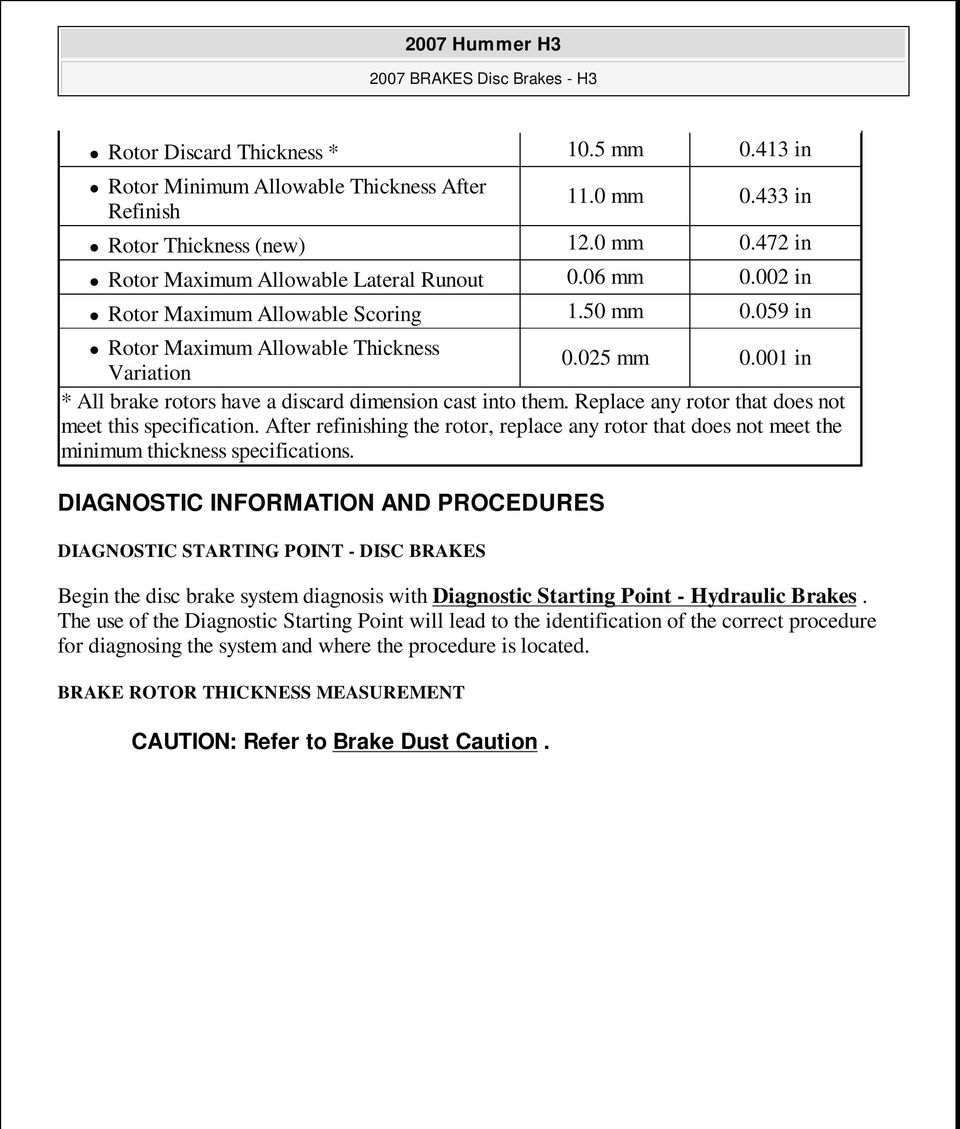
3 Fig. 1: Measuring Brake Rotor Thickness Courtesy of GENERAL MOTORS CORP. 1. Clean the brake pad lining contact surface of the brake rotor with denatured alcohol or an equivalent brake cleaner. 2. Using a calibrated micrometer measure and record the lowest thickness of the brake rotor at
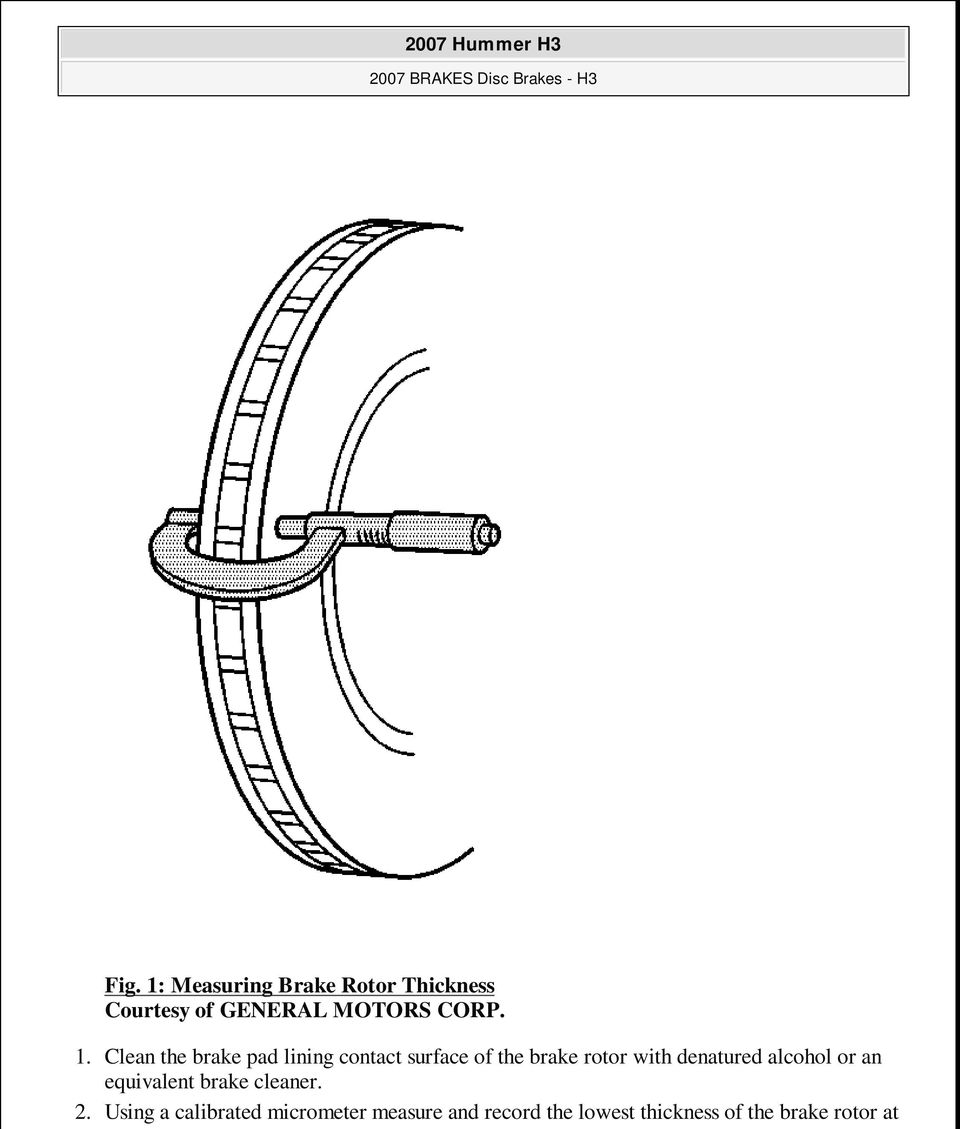
4 4 or more points equally spaced around the rotor. Ensure that the measurements are only taken within the brake pad lining contact area and that the micrometer is positioned the same distance from the outside edge of the rotor for each measurement. 3. If the lowest thickness measurement of the brake rotor is above the minimum allowable thickness after refinishing specification, the rotor may be able to be refinished, depending upon surface and wear conditions which may be present. 4. If the lowest thickness measurement of the brake rotor is at or below the minimum allowable thickness after refinishing specification, the rotor may not be refinished. 5. If the lowest thickness measurement of the brake rotor is at or below the discard thickness specification, the rotor requires replacement. BRAKE ROTOR THICKNESS VARIATION MEASUREMENT CAUTION: Refer to Brake Dust Caution. IMPORTANT: Any disc brake rotor that exhibits thickness variation exceeding the maximum acceptable level must be refinished or replaced. Thickness variation exceeding the maximum acceptable level can cause brake pulsation. 1. If the inboard friction surface of the brake rotor is not accessible, reposition and support the caliper with the brake pads. Refer to Front Disc Brake Pads Replacement and/or Rear Disc Brake Pads Replacement. 2. Clean the friction surfaces of the brake rotor with denatured alcohol or an equivalent approved brake cleaner.

5 Fig. 2: Measuring Brake Rotor Thickness Courtesy of GENERAL MOTORS CORP. 3. Using a micrometer calibrated in thousandths-of-a-millimeter or ten-thousandths-of-an-inch, measure and record the thickness of the brake rotor at 4 or more points, evenly spaced around the rotor.
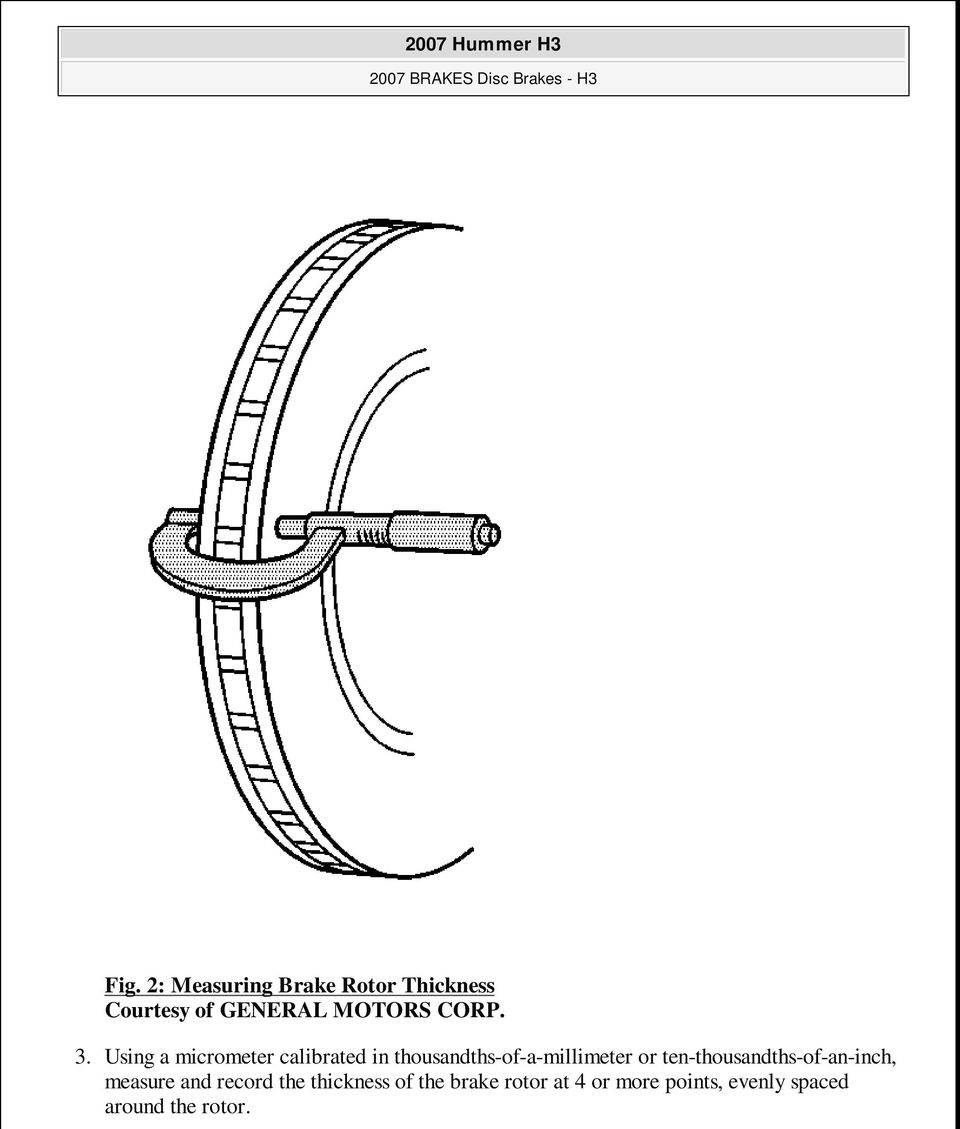
6 Ensure that the measurements are only taken within the friction surfaces and that the micrometer is positioned the same distance from the outer edge of the rotor, about 13 mm (1/2 in), for each measurement. 4. Calculate the difference between the highest and lowest thickness measurements recorded to obtain the amount of thickness variation. 5. Compare the thickness variation measurement to the following specification: Specification: Brake rotor maximum allowable thickness variation: mm (0.001 in) IMPORTANT: Whenever a brake rotor is refinished or replaced, the assembled lateral runout (LRO) of the rotor must be measured to ensure optimum performance of the disc brakes. 6. If the brake rotor thickness variation measurement exceeds the specification, the rotor requires refinishing or replacement. BRAKE ROTOR SURFACE AND WEAR INSPECTION CAUTION: Refer to Brake Dust Caution. 1. If the inboard friction surface of the brake rotor is not accessible, reposition and support the caliper with the brake pads. Refer to Front Disc Brake Pads Replacement and/or Rear Disc Brake Pads Replacement. 2. Clean the friction surfaces of the brake rotor with denatured alcohol or an equivalent approved brake cleaner. 3. Inspect the friction surfaces of the brake rotor for the following Braking Surface Conditions: Heavy rust and/or pitting Light surface rust can be removed with an abrasive disc. Heavy surface rust and/or pitting must be removed by refinishing the rotor. Cracks and/or heat spots Excessive blueing discoloration 4. If the friction surfaces of the brake rotor exhibit one or more of the Braking Surface Conditions, the rotor requires refinishing or replacement.
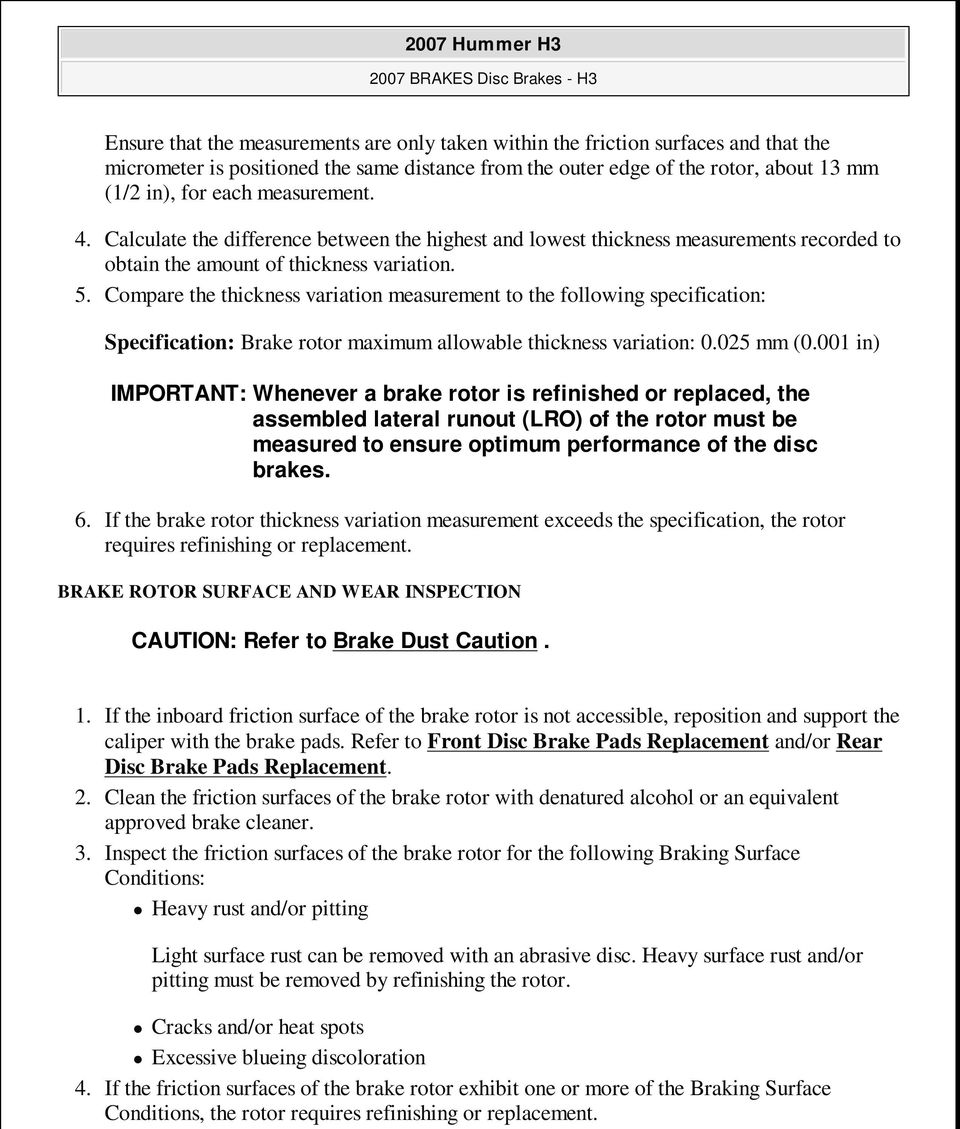
7 Fig. 3: Measuring Brake Rotor Thickness Courtesy of GENERAL MOTORS CORP. 5. Using a micrometer calibrated in thousandths-of-a-millimeter or ten-thousandths-of-an-inch, measure and record the scoring depth of any grooves present on the rotor friction surfaces. 6. Compare the groove scoring depth recorded to the following specification:

8 Specification: Brake rotor maximum allowable scoring: 1.50 mm (0.059 in) 7. If the brake rotor scoring depth exceeds the specification or if an excessive amount of scoring is present, the rotor requires refinishing or replacement. BRAKE ROTOR ASSEMBLED LATERAL RUNOUT MEASUREMENT Tools Required J KIT Complete Torque Socket Set-10 Pieces or equivalent. See Special Tools. J Rotor Resurfacing Kit. See Special Tools. J A Wheel Hub Resurfacing Kit. See Special Tools. J Hub and Wheel Runout Gage. See Special Tools. J Conical Brake Rotor Washers. See Special Tools. CAUTION: Refer to Brake Dust Caution. IMPORTANT: Brake rotor assembled lateral runout (LRO) exceeding the maximum allowable specification can cause thickness variation to develop in the brake rotor over time, usually between km (3,000-7,000 mi). Brake rotor thickness variation MUST be checked BEFORE checking for assembled lateral runout (LRO). Thickness variation exceeding the maximum acceptable level can cause brake pulsation. Refer to Brake Rotor Thickness Variation Measurement. Measuring Procedure 1. Matchmark the position of the brake rotor to the wheel studs if this has not been done already. IMPORTANT: Whenever the brake rotor has been separated from the hub/axle flange, any rust or contaminants should be cleaned from the hub/axle flange and the brake rotor mating surfaces. Failure to do this may result in excessive assembled lateral runout (LRO) of the brake rotor, which could lead to brake pulsation.
9 2. Inspect the mating surface of the hub/axle flange and the brake rotor to ensure that there are no foreign particles, corrosion, rust or debris remaining. If the wheel hub/axle flange and/or if the brake rotor mating surfaces exhibit these conditions, perform the following steps: 1. Remove the brake rotor from the vehicle. Refer to Front Brake Rotor Replacement and/or Rear Brake Rotor Replacement. 2. Using the J A, thoroughly clean any rust or corrosion from the mating surface of the hub/axle flange. See Special Tools. 3. Using the J 41013, thoroughly clean any rust or corrosion from the mating surface of the brake rotor. 4. Clean the friction surfaces of the brake rotor with denatured alcohol or an equivalent approved brake cleaner. 3. Install the rotor to the hub/axle flange using the matchmark made prior to removal.
10 Fig. 4: Identifying J & Lug Nut Courtesy of GENERAL MOTORS CORP. 4. Hold the rotor firmly in place against the hub/axle flange and install one of the J (1) and one lug nut (2) onto the upper-most wheel stud. See Special Tools. 5. Continue to hold the rotor secure and tighten the lug nut firmly by hand.

11 Fig. 5: Identifying Brake Rotor Courtesy of GENERAL MOTORS CORP. 6. Install the remaining J and lug nuts onto the wheel studs and tighten the nuts firmly by hand in a star-pattern. 7. Using the J KIT or equivalent, tighten the lug nuts in a star-pattern to specification,

12 in order to properly secure the rotor. Refer to Tire and Wheel Removal and Installation. 8. If the brake rotor has been REFINISHED or REPLACED with a new rotor, proceed to step If the brake rotor meets the following criteria, proceed to step 10. The rotor is within specifications and is being REUSED. The rotor has NOT been refinished. The rotor does NOT exhibit thickness variation exceeding the maximum allowable level.
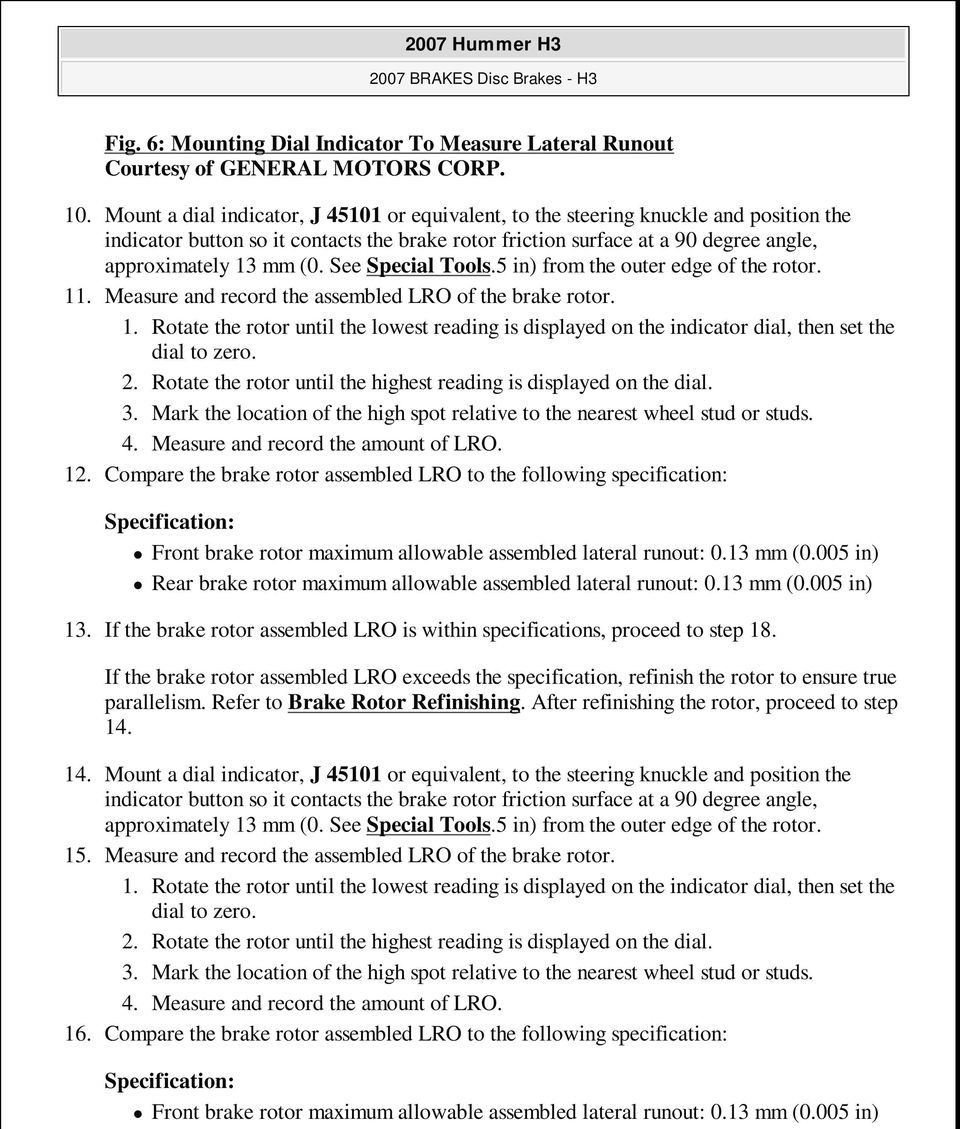
13 Fig. 6: Mounting Dial Indicator To Measure Lateral Runout Courtesy of GENERAL MOTORS CORP. 10. Mount a dial indicator, J or equivalent, to the steering knuckle and position the indicator button so it contacts the brake rotor friction surface at a 90 degree angle, approximately 13 mm (0. See Special Tools.5 in) from the outer edge of the rotor. 11. Measure and record the assembled LRO of the brake rotor. 1. Rotate the rotor until the lowest reading is displayed on the indicator dial, then set the dial to zero. 2. Rotate the rotor until the highest reading is displayed on the dial. 3. Mark the location of the high spot relative to the nearest wheel stud or studs. 4. Measure and record the amount of LRO. 12. Compare the brake rotor assembled LRO to the following specification: Specification: Front brake rotor maximum allowable assembled lateral runout: 0.13 mm (0.005 in) Rear brake rotor maximum allowable assembled lateral runout: 0.13 mm (0.005 in) 13. If the brake rotor assembled LRO is within specifications, proceed to step 18. If the brake rotor assembled LRO exceeds the specification, refinish the rotor to ensure true parallelism. Refer to Brake Rotor Refinishing. After refinishing the rotor, proceed to step Mount a dial indicator, J or equivalent, to the steering knuckle and position the indicator button so it contacts the brake rotor friction surface at a 90 degree angle, approximately 13 mm (0. See Special Tools.5 in) from the outer edge of the rotor. 15. Measure and record the assembled LRO of the brake rotor. 1. Rotate the rotor until the lowest reading is displayed on the indicator dial, then set the dial to zero. 2. Rotate the rotor until the highest reading is displayed on the dial. 3. Mark the location of the high spot relative to the nearest wheel stud or studs. 4. Measure and record the amount of LRO. 16. Compare the brake rotor assembled LRO to the following specification: Specification: Front brake rotor maximum allowable assembled lateral runout: 0.13 mm (0.005 in)
14 Rear brake rotor maximum allowable assembled lateral runout: 0.13 mm (0.005 in) 17. If the brake rotor assembled LRO measurement exceeds the specification, bring the LRO to within specifications. Refer to Brake Rotor Assembled Lateral Runout Correction. 18. If the brake rotor assembled LRO measurement is within specification, install the brake caliper and depress the brake pedal several times to secure the rotor in place before removing the J and the lug nuts. BRAKE PAD INSPECTION CAUTION: Refer to Brake Dust Caution.
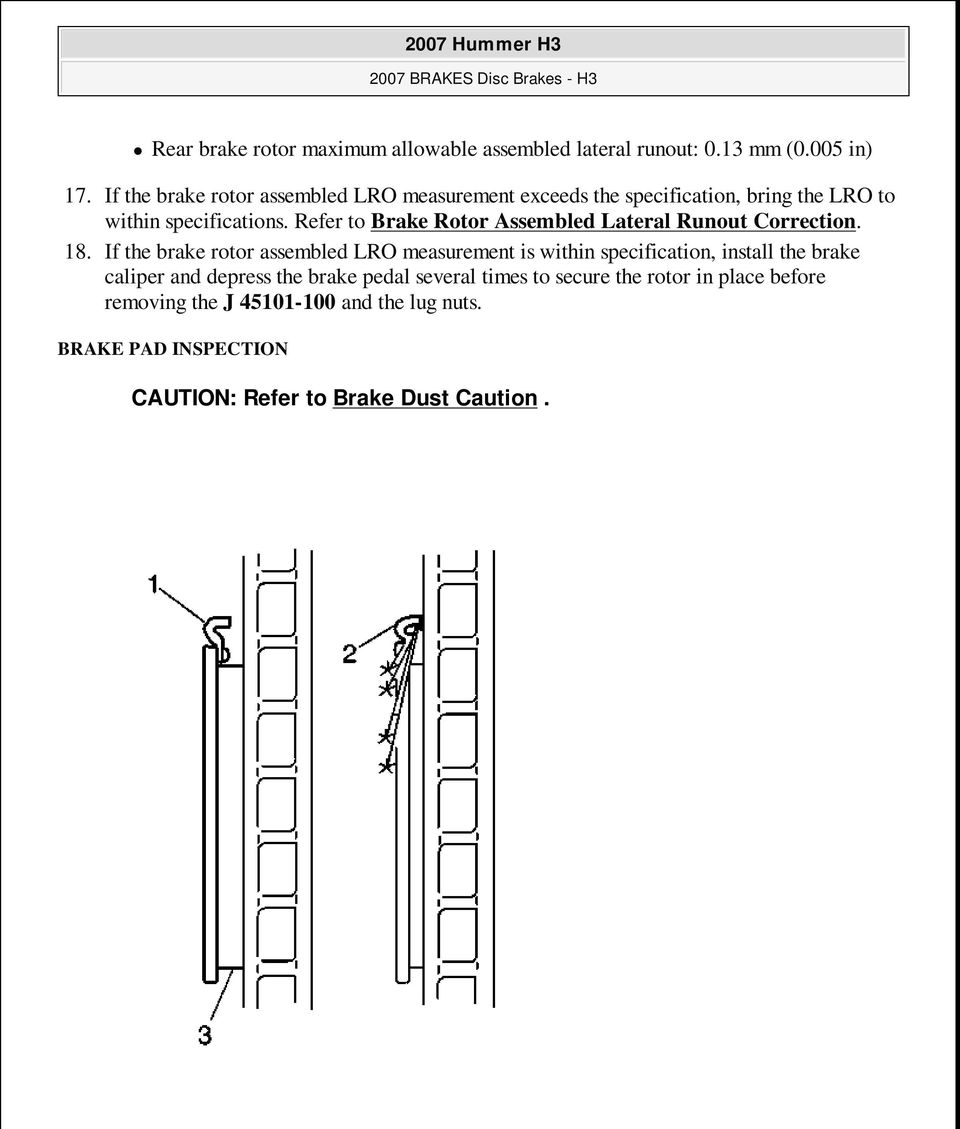
15 Fig. 7: View Of Brake Pads & Audible Wear Sensors Courtesy of GENERAL MOTORS CORP. Inspect the disc brake pads at regular intervals or whenever the tire and wheel assemblies are removed from the vehicle. If replacement is necessary, always replace disc brake pads in axle sets. Inspect both edges of the disc brake pad friction surfaces (3). The highest rate of wear normally occurs at the trailing edge of the disc brake pads. Inspect the thickness of the disc brake pads (3) in order to ensure that they have not worn prematurely. The disc brake pad wear should be approximately even per axle set. Both front and rear disc brake pads have integral, audible wear sensors (1). When the disc brake pad wear reaches the minimum allowable thickness, the wear sensor contacts the disc brake rotor (2). The wear indicator will then produce an audible, high-pitched warning noise during wheel rotation. Replace the disc brake pads when the friction surface (3) is worn to within 0.76 mm (0.030 in) of the mounting plates. Remove the brake calipers and inspect the friction surfaces of the inner and outer disc brake pads to ensure that they are level. Place the disc brake pad friction surfaces together and measure the gap between the surfaces. If more than 0.13 mm (0.005 in) gap exists midway between the length of the disc brake pads, replace the disc brake pads. Verify that any disc brake pad shims that may be required are in place and not damaged or excessively corroded. Replace any missing or damaged shims in order to preserve proper disc brake performance. Replace the disc brake pads if any have separated from the mounting plates. Inspect the disc brake pads friction surfaces for cracks, fractures or damage which may cause noise or otherwise impair disc brake performance. BRAKE CALIPER INSPECTION CAUTION: Refer to Brake Dust Caution.
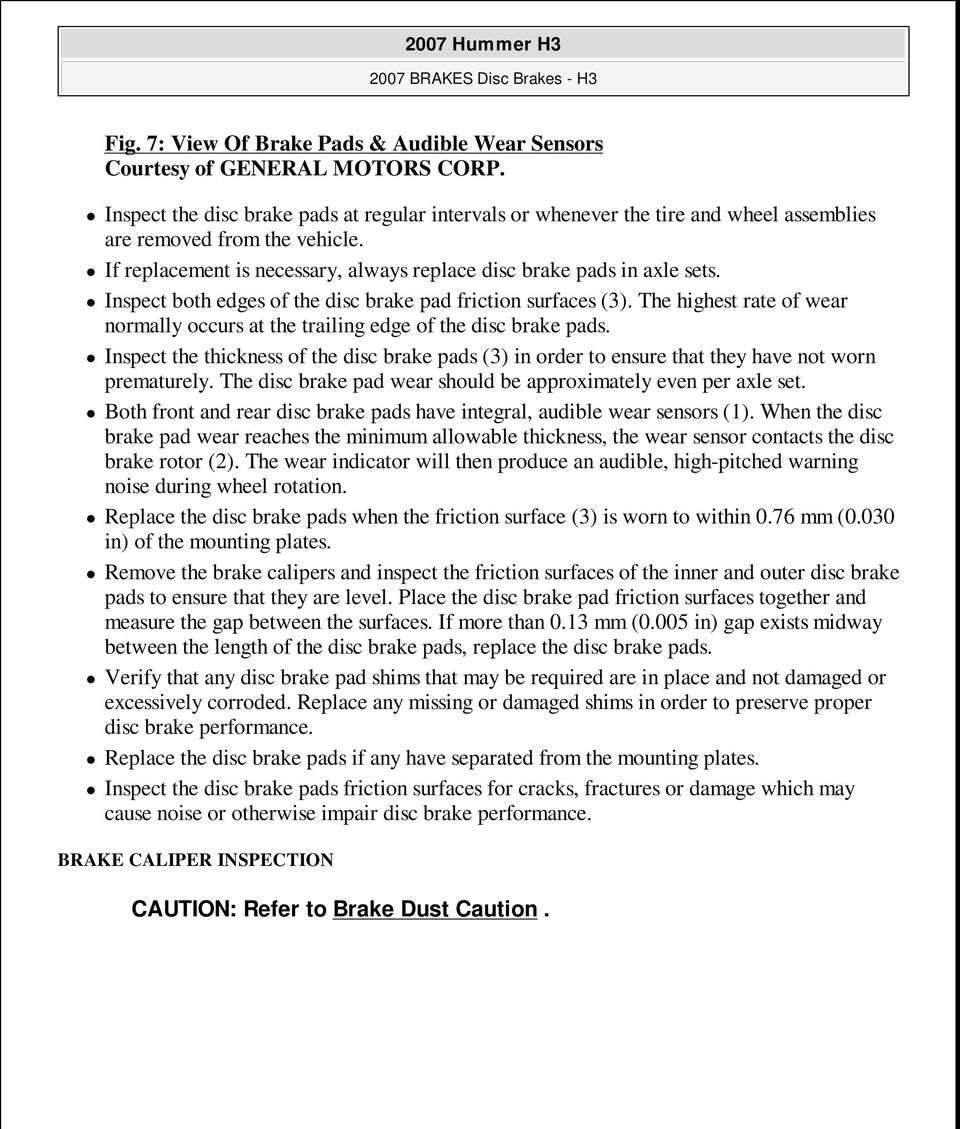
16 Fig. 8: Exploded View Of Brake Caliper Courtesy of GENERAL MOTORS CORP. 1. Inspect the brake caliper housing (1) for cracks, excess wear, and/or damage. If any of these conditions are present, the brake caliper requires replacement. 2. Inspect the caliper piston dust boot seal (2) for cracks, tears, cuts, deterioration and/or improper seating in the caliper body. If any of these conditions are present, the brake caliper requires overhaul or replacement. 3. Inspect for brake fluid leakage around the caliper piston dust boot seal (2) and on the disc

17 brake pads. If there is any evidence of brake fluid leakage, the brake caliper requires overhaul or replacement. Fig. 9: Compressing Caliper Piston Courtesy of GENERAL MOTORS CORP. 4. Inspect for smooth and complete travel of the caliper pistons into the caliper bores: The movement of the caliper pistons into the caliper bores should be smooth and even. If the caliper piston is frozen or difficult to bottom, the caliper requires overhaul or replacement. For single piston caliper applications, insert a discarded inner brake pad (2) or block
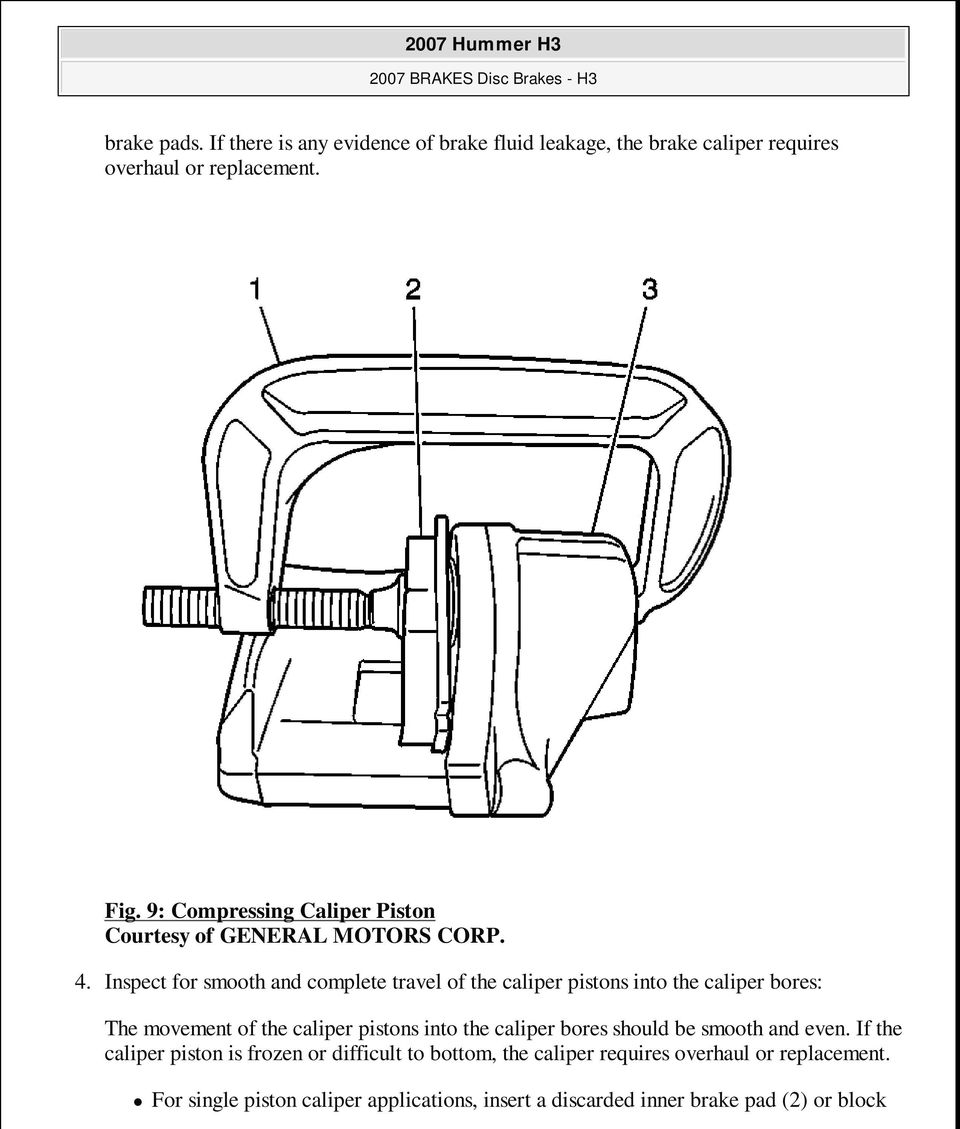
18 of wood in front of the piston. Using a large C-clamp (1) installed over the body of the caliper (3) and against the brake pad or block of wood, slowly bottom the piston in the bore. For dual piston caliper applications, insert a discarded inner brake pad (2) or block of wood in front of the pistons. Using 2 large C-clamps (1) installed over the body of the caliper (3) and against the brake pad or block of wood, slowly bottom the pistons evenly into the bores. FRONT DISC BRAKE MOUNTING AND HARDWARE INSPECTION CAUTION: Refer to Brake Dust Caution. 1. Inspect the fluid level in the brake master cylinder reservoir. 2. If the brake fluid level is midway between the maximum-full point and the minimum allowable level, then no brake fluid needs to be removed from the reservoir before proceeding. 3. If the brake fluid level is higher than midway between the maximum-full point and the minimum allowable level, then remove brake fluid to the midway point before proceeding. 4. Raise and support the vehicle. Refer Lifting and Jacking the Vehicle. 5. Remove the tire and wheel assembly. Refer to Tire and Wheel Removal and Installation.

19 6. Grasp the brake caliper housing and try to move the brake caliper housing up/down and forward/reverse in relation to the brake caliper mounting bracket. If excessive looseness is observed, the brake caliper bracket bushings and/or the brake caliper mounting bolts may need to be replaced. 7. Compress the front caliper pistons. Install a large C-clamp over the top of the caliper housing and against the back of the outboard pad. Slowly tighten the C-clamp until the pistons are pushed completely into the caliper bores Hummer H3 Fig. 10: View Of Caliper, Pin, Boots & Caliper Mounting Bracket Courtesy of GENERAL MOTORS CORP.

20 Remove the C-clamp from the caliper. 8. With the pistons compressed into the caliper bores, grasp the brake caliper housing and slide it back and forth on the brake caliper mounting bolts. Check for smooth operation. If the brake caliper housing slide force is high or the brake caliper housing does not slide smoothly, inspect the brake caliper mounting bolts and/or the brake caliper mounting bracket bushings for wear or damage. If wear or damage conditions are found, replacement of the brake caliper mounting bolts and/or the brake caliper mounting bracket bushings is necessary. 9. Remove the brake caliper mounting bolts from the brake caliper mounting bracket and support the brake caliper using heavy mechanic's wire. Do not remove the hydraulic brake hose from the caliper. Refer to Front Brake Caliper Replacement. 10. Remove the disc brake pads from the brake caliper mounting bracket. 11. Inspect the disc brake pad mounting hardware for the following: Missing mounting hardware Excessive corrosion Bent mounting tabs Looseness at the brake caliper mounting bracket Looseness at the disc brake pads Excessive contaminants in the brake caliper mounting bracket surface and threads 12. If any of the conditions listed are found, the disc brake pad mounting hardware requires replacement. 13. Ensure the disc brake pads are held firmly in place on the brake caliper mounting bracket, yet slide easily on the mounting hardware without binding.

21 Fig. 11: View Of Disc Brake Pads & Brake Caliper Mounting Bracket Courtesy of GENERAL MOTORS CORP. 14. Inspect the caliper bolts (1) for the following: Binding Seizing Looseness in the brake caliper mounting bracket (3) Bent or damaged brake caliper mounting bolts Cracked or torn boots (4) Missing boots Bent or damaged brake caliper mounting bracket (3) 15. If any of the conditions listed are found then the brake caliper mounting hardware requires replacement. 16. Install the disc brake pads to the brake caliper mounting bracket. 17. Install the disc brake caliper to the brake caliper mounting bracket. Refer to Front Brake
22 Caliper Replacement. REAR DISC BRAKE MOUNTING AND HARDWARE INSPECTION CAUTION: Refer to Brake Dust Caution. 1. Inspect the fluid level in the brake master cylinder reservoir. 2. If the brake fluid level is midway between the maximum-full point and the minimum allowable level then no brake fluid needs to be removed from the reservoir before proceeding. 3. If the brake fluid level is higher than midway between the maximum-full point and the minimum allowable level then remove brake fluid to the midway point before proceeding. 4. Raise and support the vehicle. Refer to Lifting and Jacking the Vehicle. 5. Remove the tire and wheel assembly. Refer to Tire and Wheel Removal and Installation.
23 Fig. 12: View Of Disc Brake Pads & Brake Caliper Mounting Bracket Courtesy of GENERAL MOTORS CORP. 6. Grasp the brake caliper housing and try to move the brake caliper housing up/down and forward/reverse in relation to the brake caliper mounting bracket. If excessive looseness is observed, the brake caliper bracket bushings and/or the brake caliper mounting bolts may need to be replaced. 7. Compress the rear brake caliper pistons. Install a large C-clamp over the top of the caliper housing and against the back of the outboard pad. Slowly tighten the C-clamp until the pistons are pushed completely into the caliper bores. Remove the C-clamp from the caliper. 8. With the pistons compressed into the caliper bores, grasp the brake caliper housing and slide it back and forth on the brake caliper mounting bolts. Check for smooth operation. If the brake caliper housing slide force is high or the brake caliper housing does not slide smoothly, inspect the brake caliper mounting bolts and/or the brake caliper mounting bracket bushings for wear or damage. If wear or damage conditions are found, replacement of the brake caliper mounting bolts and/or the brake caliper mounting bracket bushings is necessary. 9. Remove the brake caliper mounting bolts from the brake caliper mounting bracket and support the brake caliper using heavy mechanic's wire. Do not remove the hydraulic brake hose from the caliper. Refer to Rear Brake Caliper Replacement. 10. Remove the disc brake pads from the brake caliper mounting bracket. 11. Inspect the disc brake pad mounting hardware for the following: Missing mounting hardware Excessive corrosion Bent mounting tabs Looseness at the brake caliper mounting bracket Looseness at the disc brake pads Excessive contaminants in the brake caliper mounting bracket surface and threads 12. If any of the conditions listed are found, the disc brake pad mounting hardware requires replacement. 13. Ensure the disc brake pads are held firmly in place on the brake caliper mounting bracket, yet slide easily on the mounting hardware without binding.
24 Fig. 13: View Of Caliper, Pin, Boots & Caliper Mounting Bracket Courtesy of GENERAL MOTORS CORP. 14. Inspect the caliper bolts (1) for the following: Binding Seizing Looseness in the brake caliper mounting bracket (3) Bent or damaged brake caliper mounting bolts Cracked or torn boots (4) Missing boots Bent or damaged brake caliper mounting bracket (3)
25 15. If any of the conditions listed are found then the brake caliper mounting hardware requires replacement. 16. Install the disc brake pads to the brake caliper mounting bracket. 17. Install the disc brake caliper to the brake caliper mounting bracket. Refer to Rear Brake Caliper Replacement. REPAIR INSTRUCTIONS FRONT DISC BRAKE PADS REPLACEMENT Fig. 14: Brake Pads Replacement - Front Courtesy of GENERAL MOTORS CORP. Front Disc Brake Pads Replacement Callout Component Name CAUTION: Refer to Brake Dust Caution.
26 CAUTION: Refer to Brake Fluid Irritant Caution. Fastener Tightening Specifications: Refer to Fastener Tightening Specifications. Preliminary Procedures 1. Raise and support the vehicle. Refer to Lifting and Jacking the Vehicle. 2. Remove the tire and wheel. Refer to Tire and Wheel Removal and Installation. Retainer, Front Disc Brake Pad (Qty: 2) Tip: The front disc pad retainers (Qty: 2) secure the front disc brake pad 1 pins (Qty: 2) into the caliper and hold the pad assembly and hardware together. 2 Pin, Front Disc Brake Pad (Qty: 2) 3 Clip, Front Disc Brake Caliper Damping Pad Assembly, Front Disc Brake Inner Tip: 4 1. Compress the pistons into the caliper bores. 2. Pump the brake pedal in order to seat the new brake pads, then road test the vehicle in order to burnish the brake pads. Refer to Brake Pad and Rotor Burnishing. 5 Shim, Front Brake Pad Vibration 6 Pad Assembly, Front Disc Brake Outer 7 Insulator, Front Disc Brake Outer Pad REAR DISC BRAKE PADS REPLACEMENT
27 Fig. 15: Brake Pads Replacement - Rear Courtesy of GENERAL MOTORS CORP. Rear Disc Brake Pads Replacement Callout Component Name CAUTION: Refer to Brake Dust Caution. CAUTION: Refer to Brake Fluid Irritant Caution. NOTE: Refer to Fastener Notice.
28 Preliminary Procedure: Raise and support the vehicle. Refer to Lifting and Jacking the Vehicle. Rear Disc Brake Caliper Bolt (Qty: 2) Tip: Pump the brake pedal in order to seat the new brake pads, then road test the vehicle in order to burnish the brake pads. Refer to Brake Pad and 1 Rotor Burnishing. Tighten: 36 N.m (27 lb ft). 2 Rear Disc Brake Caliper 3 Rear Disc Brake Caliper Bracket Retainer (Qty: 2) Rear Disc Brake Inner Pad Assembly 4 Tip: Compress the pistons into the caliper bores. 5 Rear Disc Brake Outer Pad Assembly BRAKE PAD AND ROTOR BURNISHING CAUTION: Refer to ROAD TEST CAUTION. Burnishing the brake pads and brake rotors is necessary in order to ensure that the braking surfaces are properly prepared after service has been performed on the disc brake system. This procedure should be performed whenever the disc brake rotors have been refinished or replaced, and/or whenever the disc brake pads have been replaced. 1. Select a smooth road with little or no traffic. 2. Accelerate the vehicle to 48 km/h (30 mph). IMPORTANT: Use care to avoid overheating the brakes while performing this step. 3. Using moderate to firm pressure, apply the brakes to bring the vehicle to a stop. Do not allow the brakes to lock. 4. Repeat steps 2 and 3 until approximately 20 stops have been completed. Allow sufficient cooling periods between stops in order to properly burnish the brake pads and rotors. FRONT BRAKE CALIPER REPLACEMENT
29 Fig. 16: Brake Caliper Replacement - Front Courtesy of GENERAL MOTORS CORP. Front Brake Caliper Replacement Callout Component Name CAUTION: Refer to Bleed Procedure Caution. CAUTION: Refer to Brake Dust Caution. CAUTION: Refer to Brake Fluid Irritant Caution. NOTE: Refer to Brake Fluid Effects on Paint and Electrical Components Notice. NOTE:
30 Refer to Fastener Notice. Fastener Tightening Specifications: Refer to Fastener Tightening Specifications. Preliminary Procedures 1. Raise and support the vehicle. Refer to Lifting and Jacking the Vehicle. 2. Remove the tire and wheel. Refer to Tire and Wheel Removal and Installation. Brake Hose Banjo Bolt Tip: If removing the brake caliper to service another part of the brake 1 system, DO NOT remove the brake hose. Reposition the brake caliper to the side and secure with mechanics wire or the equivalent. 2 Tighten: 40 N.m (30 lb ft) Brake Hose Banjo Bolt Washer (Qty: 2) Tip: Install the new brake hose banjo bolt washers. Do not reuse the brake hose banjo bolt washers. Front Brake Hose Tip: 3 Cap or plug the brake hose to prevent fluid loss and contamination. Bleed the brake system anytime the system is opened for repairs. Refer to Hydraulic Brake System Bleeding (Manual) or Hydraulic Brake System Bleeding (Pressure). Brake Caliper Bolt (Qty: 2) 4 Tighten: 195 N.m (144 lb ft) 5 Front Brake Caliper REAR BRAKE CALIPER REPLACEMENT
31 Fig. 17: Brake Caliper Replacement - Rear Courtesy of GENERAL MOTORS CORP. Rear Brake Caliper Replacement Callout CAUTION: Refer to Bleed Procedure Caution. Component Name CAUTION: Refer to Brake Dust Caution. CAUTION: Refer to Brake Fluid Irritant Caution. NOTE: Refer to Brake Fluid Effects on Paint and Electrical Components Notice.
32 NOTE: Refer to Fastener Notice. Fastener Tightening Specifications: Refer to Fastener Tightening Specifications. Preliminary Procedure Raise and support the vehicle. Refer to Lifting and Jacking the Vehicle. Remove the tire and wheel. Refer to Tire and Wheel Removal and Installation Brake Hose Bolt Tighten: 40 N.m (30 lb ft) Brake Hose Washer (Qty: 2) Tip: Install the new brake hose bolt washers. Do not reuse the brake hose bolt washers. Rear Brake Hose Tip: Cap or plug the brake hose to prevent fluid loss and contamination for the brake system. Brake Caliper Bolt (Qty: 2) Tip: If removing the brake caliper to service the brake system, note that the rear or trailing slide bolt for the brake caliper bolt has an O-ring and is a smaller size bolt. DO NOT interchange the front or rear slide bolts. Tighten: 36 N.m (27 lb ft) Rear Brake Caliper Tip: Bleed the brake system anytime the system is opened for repairs. Refer to Hydraulic Brake System Bleeding (Manual) or Hydraulic Brake System Bleeding (Pressure). FRONT BRAKE CALIPER OVERHAUL (WITHOUT RPO BRM)
33 Fig. 18: Brake Caliper Overhaul - Front Courtesy of GENERAL MOTORS CORP. Front Brake Caliper Overhaul (without RPO BRM) Callout Component Name CAUTION: Refer to Bleed Procedure Caution. CAUTION: Refer to Brake Dust Caution. CAUTION: Refer to Brake Fluid Irritant Caution.
34 CAUTION: Refer to Eye Protection Caution. NOTE: Refer to Brake Fluid Effects on Paint and Electrical Components Notice. NOTE: Refer to Fastener Notice. Fastener Tightening Specifications: Refer to Fastener Tightening Specifications. Preliminary Procedure 1. Raise the vehicle. Refer to Lifting and Jacking the Vehicle. 2. Remove the front disc brake caliper. Refer to Front Brake Caliper Replacement. 1 Front Brake Bleeder Valve Cap Front Brake Bleeder Valve Screw 2 Tighten: 10 N.m (89 lb in) 3 Front Disc Brake Caliper Piston Boot (Qty: 4) Front Disc Brake Caliper Piston (Qty: 4) Tip: 4 5 Wear eye protection while performing these steps. Do not use abrasives to clean the brake caliper piston or the disc brake caliper bore. Place a block of wood against the inside of the caliper body, opposite of the caliper piston, then direct low pressure compressed air through the caliper inlet port to remove the caliper piston. Repeat for each of the pistons, until all the pistons are removed from the caliper bores. During installation apply a thin coat of Delco Supreme 11 GM P/N (Canadian P/N ) or equivalent DOT-3 brake fluid from a clean, sealed brake fluid container onto the outer surface area of the caliper pistons. Front Disc Brake Caliper Piston Seal (Qty: 4) Tip: 1. Use a small wooden or plastic tool, carefully remove the rear disc brake caliper piston seal from the groove in the caliper seal bore.
35 2. During installation lubricate the new piston seals with Delco Supreme 11 GM P/N (Canadian P/N ) or equivalent DOT-3 brake fluid from a clean, sealed brake fluid container. Front Disc Brake Caliper Tip: 6 Inspect the caliper bore and housing for cracks, scoring, pitting, excessive rust, and/or excessive corrosion. If any of these conditions are present in the caliper bore or housing, replace the caliper assembly. If light rust or light corrosion are present in the caliper bore, attempt to remove the imperfection with a fine emery paper. If the imperfection cannot be removed, replace the caliper assembly. Clean the brake caliper piston bore and seal counterbore, the caliper piston and the caliper sleeves with denatured alcohol or equivalent. Bleed the brake system anytime the system is opened for repairs. Refer to Hydraulic Brake System Bleeding (Manual) or Hydraulic Brake System Bleeding (Pressure). FRONT BRAKE CALIPER OVERHAUL (WITH RPO BRM)
36 Fig. 19: Brake Caliper Overhaul - Front Courtesy of GENERAL MOTORS CORP. Front Brake Caliper Overhaul (with RPO BRM) Callout Component Name CAUTION: Refer to Bleed Procedure Caution. CAUTION: Refer to Brake Dust Caution. CAUTION: Refer to Brake Fluid Irritant Caution.
37 1. Use a small wooden or plastic tool, carefully remove the rear disc brake caliper piston seal from the groove in the caliper seal bore Hummer H3 CAUTION: Refer to Eye Protection Caution. NOTE: Refer to Brake Fluid Effects on Paint and Electrical Components Notice. NOTE: Refer to Fastener Notice. Fastener Tightening Specifications: Refer to Fastener Tightening Specifications. Preliminary Procedure 1. Raise the vehicle. Refer to Lifting and Jacking the Vehicle. 2. Remove the front disc brake caliper. Refer to Front Brake Caliper Replacement. 1 Front Brake Bleeder Valve Cap Front Brake Bleeder Valve Screw 2 Tighten: 10 N.m (89 lb in) 3 Front Disc Brake Caliper Piston Boot (Qty: 4) Front Disc Brake Caliper Piston (Qty: 4) Tip: 4 Wear eye protection while performing these steps. Do not use abrasives to clean the brake caliper piston or the disc brake caliper bore. Place a block of wood against the inside of the caliper body, opposite of the caliper piston, then direct low pressure compressed air through the caliper inlet port to remove the caliper piston. Repeat for each of the pistons, until all the pistons are removed from the caliper bores. During installation apply a thin coat of Delco Supreme 11 GM P/N (Canadian P/N ) or equivalent DOT-4 brake fluid from a clean, sealed brake fluid container onto the outer surface area of the caliper pistons. Front Disc Brake Caliper Piston Seal (Qty: 4) Tip:
38 Fig. 20: Brake Caliper Overhaul - Rear 2007 Hummer H During installation lubricate the new piston seals with Delco Supreme 11 GM P/N (Canadian P/N ) or equivalent DOT-4 brake fluid from a clean, sealed brake fluid container. Front Disc Brake Caliper Tip: Inspect the caliper bore and housing for cracks, scoring, pitting, excessive rust, and/or excessive corrosion. If any of these conditions are present in the caliper bore or housing, replace the caliper assembly. If light rust or light corrosion are present in the caliper bore, attempt to remove the imperfection with a fine emery paper. If the imperfection cannot be removed, replace the caliper assembly. Clean the brake caliper piston bore and seal counterbore, the caliper piston and the caliper sleeves with denatured alcohol or equivalent. Bleed the brake system anytime the system is opened for repairs. Refer to Hydraulic Brake System Bleeding (Manual) or Hydraulic Brake System Bleeding (Pressure). REAR BRAKE CALIPER OVERHAUL
39 Courtesy of GENERAL MOTORS CORP. Rear Brake Caliper Overhaul Callout CAUTION: Refer to Bleed Procedure Caution. Component Name CAUTION: Refer to Brake Dust Caution. CAUTION: Refer to Brake Fluid Irritant Caution. NOTE: Refer to Brake Fluid Effects on Paint and Electrical Components Notice. NOTE: Refer to Fastener Notice. Fastener Tightening Specifications: Refer to Fastener Tightening Specifications. Preliminary Procedure 1. Raise the vehicle. Refer to Lifting and Jacking the Vehicle. 2. Remove the rear disc brake caliper. Refer to Rear Brake Caliper Replacement. 1 Cap, Rear Brake Bleeder Valve Screw, Rear Brake Bleeder Valve 2 Tighten: 10 N.m (86 lb in) 3 Boot, Rear Disc Brake Caliper Piston Piston, Rear Disc Brake Caliper Tip: 4 Do not use abrasives to clean the brake caliper piston or the disc brake caliper bore. Place a block of wood against the inside of the caliper body, opposite of the caliper piston, then direct low pressure compressed air through the caliper inlet port to remove the caliper piston. During installation apply a thin coat of Delco Supreme 11 GM P/N
40 (Canadian P/N ) or equivalent DOT-3 brake fluid from a clean, sealed brake fluid container onto the outer surface area of the caliper piston. Seal, Rear Disc Brake Caliper Piston Tip: 5 1. Use a small wooden or plastic tool, carefully remove the rear disc brake caliper piston seal from the groove in the caliper seal bore. 2. During installation lubricate the new piston seal with Delco Supreme 11 GM P/N (Canadian P/N ) or equivalent DOT-3 brake fluid from a clean, sealed brake fluid container. Use a small wooden or plastic tool, carefully remove the rear disc brake caliper piston seal from the groove in the caliper seal bore. Caliper, Rear Disc Brake Tip: 6 1. Inspect the caliper bore and housing for cracks, scoring, pitting, excessive rust, and/or excessive corrosion. If any of these conditions are present in the caliper bore or housing, replace the caliper assembly. 2. If light rust or light corrosion are present in the caliper bore, attempt to remove the imperfection with a fine emery paper. If the imperfection cannot be removed, replace the caliper assembly. 3. Clean the brake caliper piston bore and seal counterbore, the caliper piston and the caliper sleeves with denatured alcohol or equivalent. 4. Bleed the brake system anytime the system is opened for repairs. Refer to Hydraulic Brake System Bleeding (Manual) or Hydraulic Brake System Bleeding (Pressure). FRONT DISC BRAKE HARDWARE REPLACEMENT
41 1. Raise and support the vehicle. Refer to Lifting and Jacking the Vehicle Hummer H3 Fig. 21: Disc Brake Hardware Replacement - Front Courtesy of GENERAL MOTORS CORP. Front Disc Brake Hardware Replacement Callout Component Name CAUTION: Refer to Brake Dust Caution. CAUTION: Refer to Brake Fluid Irritant Caution. Fastener Tightening Specifications: Refer to Fastener Tightening Specifications. Preliminary Procedure
42 2. Remove the tire and wheel. Refer to Tire and Wheel Removal and Installation. 1 Retainer, Front Disc Brake Pad (Qty: 2) 2 Pin, Front Disc Brake Pad (Qty: 2) 3 Clip, Front Disc Brake Caliper Damping REAR DISC BRAKE HARDWARE REPLACEMENT Fig. 22: Disc Brake Hardware Replacement - Rear Courtesy of GENERAL MOTORS CORP. Rear Disc Brake Hardware Replacement Callout Component Name CAUTION: Refer to Brake Dust Caution. NOTE: Refer to Fastener Notice. NOTE: Refer to Brake Caliper Notice.
43 Fig. 23: Brake Caliper Bracket Replacement - Rear Courtesy of GENERAL MOTORS CORP Hummer H3 Fastener Tightening Specifications: Refer to Fastener Tightening Specifications. Preliminary Procedure 1. Raise and support the vehicle. Refer to Lifting and Jacking the Vehicle. 2. Remove the tire and wheel. Refer to Tire and Wheel Removal and Installation. Rear Brake Caliper Guide Pin Bolt (Qty: 2) Tip: DO NOT reuse the brake caliper bracket bolts. Replace with NEW 1 bolts. Tighten: 36 N.m (27 lb ft) Rear Disc Brake Caliper 2 Tip: Do NOT disconnect the hydraulic brake flexible hose from the caliper. 3 Rear Disc Brake Pad (Qty: 2) 4 Rear Disc Brake Caliper Bracket Retainer (Qty: 2) 5 Rear Disc Brake Caliper Guide Pin (Qty: 2) 6 Rear Brake Caliper Guide Pin Seal 7 Rear Brake Caliper Guide Pin Boot (Qty: 2) REAR BRAKE CALIPER BRACKET REPLACEMENT
44 Rear Brake Caliper Bracket Replacement Callout Component Name CAUTION: Refer to Brake Dust Caution. Preliminary Procedures 1. Raise and support the vehicle. Refer to Lifting and Jacking the Vehicle. 2. Remove the tire and wheel. Refer to Tire and Wheel Removal and Installation. IMPORTANT: If removing the brake caliper bracket to access other vehicle components, remove the disc brake caliper, disc brake pads and the caliper bracket as an assembly. 3. Remove the rear disc brake pads. Refer to Rear Disc Brake Pads Replacement. Brake Caliper Bracket Bolt (Qty: 2) NOTE: Refer to Fastener Notice. 1 Tip: Do NOT reuse the brake caliper bracket mounting bolts. Replace the bolts. Replace the brake caliper bracket bolts each time the bolts are removed. Tighten: 135 N.m (100 lb ft) 2 Rear Brake Caliper Bracket Rear Disc Brake Caliper Guide Pin (Qty: 2) 3 Tip: The disc brake caliper guide pins are not interchangeable. Note the location of the guide pins. Rear Brake Caliper Guide Pin Seal 4 Tip: The guide pin seal is installed on the lower disc brake caliper guide pin. 5 Rear Brake Caliper Guide Pin Boot (Qty: 2) FRONT BRAKE ROTOR REPLACEMENT
45 Fig. 24: Brake Rotor Replacement - Front Courtesy of GENERAL MOTORS CORP. Front Brake Rotor Replacement Callout Component Name CAUTION: Refer to Brake Dust Caution. CAUTION: Refer to Brake Fluid Irritant Caution. NOTE: Refer to Fastener Notice. NOTE: Refer to Brake Caliper Notice.
46 Fastener Tightening Specifications: Refer to Fastener Tightening Specifications. Preliminary Procedures 1. Raise and support the vehicle. Refer to Lifting and Jacking the Vehicle. 2. Remove the tire and wheel. Refer to Tire and Wheel Removal and Installation. 1 Front Disc Brake Rotor Retainer (Qty: 2) Brake Caliper Bolt (Qty: 2) 2 Tighten: 195 N.m (144 lb ft) Front Brake Caliper 3 Tip: Do NOT disconnect the hydraulic brake flexible hose from the caliper. Front Brake Rotor 4 Tip: Road test the vehicle in order to burnish the brake pads. Refer to Brake Pad and Rotor Burnishing. REAR BRAKE ROTOR REPLACEMENT Fig. 25: Brake Rotor Replacement - Rear Courtesy of GENERAL MOTORS CORP. Rear Brake Rotor Replacement Callout Component Name CAUTION: Refer to Brake Dust Caution.
47 NOTE: Support the brake caliper with heavy mechanic wire or equivalent, whenever it is separated from its mount and the hydraulic flexible brake hose is still connected. Failure to support the caliper in this manner will cause the flexible brake hose to bear the weight of the caliper, which may cause damage to the brake hose and in turn may cause a brake fluid leak. Preliminary Procedures 1. Raise and support the vehicle. Refer to Lifting and Jacking the Vehicle. 2. Remove the tire and wheel. Refer to Tire and Wheel Removal and Installation. 1 Disc Brake Rotor Retainer (Qty: 2) Brake Caliper Bracket Bolt (Qty: 2) NOTE: Refer to Fastener Notice. Tip: Do NOT reuse the brake caliper bracket mounting bolts. Replace the bolts. Tighten: 135 N.m (100 lb ft) Brake Caliper and Bracket Assembly Tip: Position the brake caliper and bracket assembly aside and support with heavy mechanics wire or equivalent. It is not necessary to disconnect the flexible brake hose. Disc Brake Rotor Tip: If the disc brake rotor will not slide over the park brake shoes, remove the rubber access plug on the backing plate and rotate the park brake shoe adjuster screw to provide clearance. Burnish the brake pads and rotors. Refer to Brake Pad and Rotor Burnishing. FRONT BRAKE SHIELD REPLACEMENT
48 Fig. 26: Disc Brake Splash Shield Replacement - Front Courtesy of GENERAL MOTORS CORP. Front Brake Shield Replacement Callout CAUTION: Refer to Brake Dust Caution. Component Name CAUTION: Refer to Brake Fluid Irritant Caution. Fastener Tightening Specifications: Refer to Fastener Tightening Specifications. Preliminary Procedures 1. Raise and support the vehicle. Refer to Lifting and Jacking the Vehicle. 2. Remove the tire and wheel. Refer to Tire and Wheel Removal and Installation. 3. Remove the wheel hub assembly. Refer to Front Wheel Hub, Bearing and Seal Replacement. 1 Front Brake Shield
49 REAR DISC BRAKE BACKING PLATE REPLACEMENT Fig. 27: Disc Brake Backing Plate Replacement - Rear Courtesy of GENERAL MOTORS CORP. Rear Disc Brake Backing Plate Replacement Callout Component Name CAUTION: Refer to Brake Dust Caution. Preliminary Procedure 1. Raise and support the vehicle. Refer to Lifting and Jacking the Vehicle. 2. Remove the tire and wheel. Refer to Tire and Wheel Removal and Installation. 3. Remove the axle shaft. Refer to Rear Axle Shaft Replacement. 4. Remove the park brake shoe. Refer to Parking Brake Shoe Replacement. 1 Park Brake Actuator 2 Park Brake Cable Anchor Pin Nut (Qty: 2) NOTE: Refer to Fastener Notice.
50 Tighten: 72 N.m (530 lb ft) 3 Park Brake Rear Cable Bracket Rear Brake Backing Plate Bolt (Qty: 4) 4 Tighten: 135 N.m (100 lb ft) 5 Rear Brake Backing Plate BRAKE ROTOR ASSEMBLED LATERAL RUNOUT CORRECTION IMPORTANT: Brake rotor thickness variation MUST be checked BEFORE checking for assembled lateral runout (LRO). Thickness variation exceeding the maximum acceptable level can cause brake pulsation. Refer to Brake Rotor Thickness Variation Measurement. Brake rotor assembled lateral runout (LRO) exceeding the maximum allowable specification can cause thickness variation to develop in the brake rotor over time, usually between km (3,000-7,000 mi). Refer to Brake Rotor Assembled Lateral Runout Measurement. Review the following acceptable methods for bringing the brake rotor assembled LRO to within specifications. Determine which method to use for the specific vehicle being repaired. Brake Rotor Assembled Lateral Runout Correction - Indexing The indexing method of correcting assembled LRO is most effective when the LRO specification is only exceeded by a relatively small amount: mm ( in). Indexing is used to achieve the best possible match of high spots to low spots between related components. Brake Rotor Assembled Lateral Runout Correction - On Vehicle Lathe The on-vehicle brake lathe method is used to bring the LRO to within specifications through compensating for LRO while refinishing the brake rotor. If the assembled LRO cannot be corrected using these methods, then other components must be suspected as causing and/or contributing to the LRO concern. BRAKE ROTOR ASSEMBLED LATERAL RUNOUT CORRECTION - INDEXING
51 Tools Required J KIT Complete Torque Socket Set-10 Pieces or equivalent. See Special Tools. J Conical Brake Rotor Washers. See Special Tools. CAUTION: Refer to Brake Dust Caution. IMPORTANT: Brake rotor thickness variation MUST be checked BEFORE checking for assembled lateral runout (LRO). Thickness variation exceeding the maximum acceptable level can cause brake pulsation. Refer to Brake Rotor Thickness Variation Measurement. Brake rotor assembled lateral runout (LRO) exceeding the maximum allowable specification can cause thickness variation to develop in the brake rotor over time, usually between km (3,000-7,000 mi). Refer to Brake Rotor Assembled Lateral Runout Measurement. Procedure
52 Fig. 28: Identifying J & Lug Nut Courtesy of GENERAL MOTORS CORP. 1. Remove the J and the lug nuts that were installed during the assembled LRO measurement procedure. See Special Tools. 2. Inspect the mating surface of the hub/axle flange and the brake rotor to ensure that there are no foreign particles or debris remaining. 3. Index the brake rotor in a different orientation to the hub/axle flange. 4. Hold the rotor firmly in place against the hub/axle flange and install one of the J (1) and one lug nut (2) onto the upper-most wheel stud.
53 5. Continue to hold the rotor secure and tighten the lug nut firmly by hand. Fig. 29: Identifying Brake Rotor Courtesy of GENERAL MOTORS CORP. 6. Install the remaining J and lug nuts onto the wheel studs and tighten the nuts
54 firmly by hand in a star-pattern. See Special Tools. 7. Using the J KIT or equivalent, tighten the lug nuts in a star-pattern to specification, in order to properly secure the rotor. See Special Tools. Refer to Tire and Wheel Removal and Installation. 8. Measure the assembled LRO of the brake rotor. Refer to Brake Rotor Assembled Lateral Runout Measurement. 9. Compare the amount of change between this measurement and the original measurement. 10. If this measurement is within specifications, proceed to step If this measurement still exceeds specifications, repeat steps 1-9 until the best assembled LRO measurement is obtained. 12. Matchmark the final location of the rotor to the wheel studs if the orientation is different than it was originally. 13. If the brake rotor assembled LRO measurement still exceeds the maximum allowable specification, refer to Brake Rotor Assembled Lateral Runout Correction. 14. If the brake rotor assembled LRO is within specification, install the brake caliper and depress the brake pedal several times to secure the rotor in place before removing the J and the lug nuts. See Special Tools. BRAKE ROTOR ASSEMBLED LATERAL RUNOUT CORRECTION - ON VEHICLE LATHE Tools Required J KIT Complete Torque Socket Set-10 Pieces or equivalent. See Special Tools. J Rotor Resurfacing Kit. See Special Tools. J A Wheel Hub Resurfacing Kit. See Special Tools. J Hub and Wheel Runout Gage. See Special Tools. J Conical Brake Rotor Washers. See Special Tools. CAUTION: Refer to Brake Dust Caution. IMPORTANT: Brake rotor assembled lateral runout (LRO) exceeding the maximum allowable specification can cause thickness variation to develop in the brake rotor over time, usually between km (3,000-7,000 mi). Brake rotor thickness variation MUST be checked BEFORE
55 checking for assembled lateral runout (LRO). Thickness variation exceeding the maximum acceptable level can cause brake pulsation. Refer to Brake Rotor Thickness Variation Measurement. Procedure 1. Matchmark the position of the brake rotor to the wheel studs if this has not been done already. IMPORTANT: Whenever the brake rotor has been separated from the hub/axle flange, any rust or contaminants should be cleaned from the hub/axle flange and the brake rotor mating surfaces. Failure to do this may result in excessive assembled lateral runout (LRO) of the brake rotor, which could lead to brake pulsation. 2. Inspect the mating surface of the hub/axle flange and the brake rotor to ensure that there are no foreign particles, corrosion, rust or debris remaining. If the wheel hub/axle flange and/or if the brake rotor mating surfaces exhibit these conditions, perform the following steps: 1. Remove the brake rotor from the vehicle. Refer to Front Brake Rotor Replacement and/or Rear Brake Rotor Replacement. 2. Using the J A, thoroughly clean any rust or corrosion from the mating surface of the hub/axle flange. See Special Tools. 3. Using the J 41013, thoroughly clean any rust or corrosion from the mating surface of the brake rotor. 4. Clean the friction surfaces of the brake rotor with denatured alcohol or an equivalent approved brake cleaner. 3. Install the rotor to the hub/axle flange using the matchmark made prior to removal.
56 Fig. 30: Identifying J & Lug Nut Courtesy of GENERAL MOTORS CORP. 4. Hold the rotor firmly in place against the hub/axle flange and install one of the J (1) and one lug nut (2) onto the upper-most wheel stud. See Special Tools. 5. Continue to hold the rotor secure and tighten the lug nut firmly by hand.
57 Fig. 31: Identifying Brake Rotor Courtesy of GENERAL MOTORS CORP. 6. Install the remaining J and lug nuts onto the wheel studs and tighten the nuts firmly by hand in a star-pattern. 7. Using the J KIT or equivalent, tighten the lug nuts in a star-pattern to specification,
58 in order to properly secure the rotor. Refer to Tire and Wheel Removal and Installation. 8. If the brake rotor has been REFINISHED or REPLACED with a new rotor, proceed to step If the brake rotor meets the following criteria, proceed to step 10. The rotor is within specifications and is being REUSED The rotor has NOT been refinished The rotor does NOT exhibit thickness variation exceeding the maximum allowable level
59 Fig. 32: Mounting Dial Indicator To Measure Lateral Runout Courtesy of GENERAL MOTORS CORP. 10. Mount a dial indicator, J or equivalent, to the steering knuckle and position the indicator button so it contacts the brake rotor friction surface at a 90 degree angle, approximately 13 mm (0. See Special Tools.5 in) from the outer edge of the rotor. 11. Measure and record the assembled LRO of the brake rotor. 1. Rotate the rotor until the lowest reading is displayed on the indicator dial, then set the dial to zero. 2. Rotate the rotor until the highest reading is displayed on the dial. 3. Mark the location of the high spot relative to the nearest wheel stud or studs. 4. Measure and record the amount of LRO. 12. Compare the brake rotor assembled LRO to the following specification: Specification: Front brake rotor maximum allowable assembled lateral runout: 0.13 mm (0.005 in) Rear brake rotor maximum allowable assembled lateral runout: 0.13 mm (0.005 in) 13. If the brake rotor assembled LRO is within specifications, proceed to step 18. If the brake rotor assembled LRO exceeds the specification, refinish the rotor to ensure true parallelism, refer to Brake Rotor Refinishing. After refinishing the rotor, proceed to step Mount a dial indicator, J or equivalent, to the steering knuckle and position the indicator button so it contacts the brake rotor friction surface at a 90 degree angle, approximately 13 mm (0. See Special Tools.5 in) from the outer edge of the rotor. 15. Measure and record the assembled LRO of the brake rotor. 1. Rotate the rotor until the lowest reading is displayed on the indicator dial, then set the dial to zero. 2. Rotate the rotor until the highest reading is displayed on the dial. 3. Mark the location of the high spot relative to the nearest wheel stud or studs. 4. Measure and record the amount of LRO. 16. Compare the brake rotor assembled LRO to the following specification: Specification: Front brake rotor maximum allowable assembled lateral runout: 0.13 mm (0.005 in)
60 Rear brake rotor maximum allowable assembled lateral runout: 0.13 mm (0.005 in) 17. If the brake rotor assembled LRO measurement exceeds the specification, bring the LRO to within specifications. Refer to Brake Rotor Assembled Lateral Runout Correction. 18. If the brake rotor assembled LRO measurement is within specification, install the brake caliper and depress the brake pedal several times to secure the rotor in place before removing the J and the lug nuts. See Special Tools. BRAKE ROTOR REFINISHING Tools Required J Rotor Resurfacing Kit. See Special Tools. J A Wheel Hub Resurfacing Kit. See Special Tools. CAUTION: Refer to Brake Dust Caution. IMPORTANT: The disc brake rotors do not require refinishing as part of routine brake system service. New disc brake rotors do not require refinishing. Do not refinish disc brake rotors in an attempt to correct the following conditions: Brake system noise - squeal, growl, groan Uneven and/or premature disc brake pad wear Superficial or cosmetic corrosion/rust of the disc brake rotor friction surface Scoring of the disc brake rotor friction surface less than the maximum allowable specification Before refinishing a brake rotor, the rotor MUST first be checked for adequate thickness to allow the rotor to be refinished and remain above the minimum allowable thickness after refinish specification. Refer to Brake Rotor Thickness Measurement. Disc brake rotors should only be refinished if they have
61 adequate thickness to be refinished and if one or more of the following conditions exist: Thickness variation in excess of the maximum allowable specification Excessive corrosion/rust and/or pitting Cracks and/or heat spots Excessive blueing discoloration Scoring of the disc brake rotor surface in excess of the maximum allowable specification Disc brake rotors may need to be refinished as part of the process for correcting brake rotor assembled lateral runout (LRO) that exceeds the maximum allowable specification. Procedure IMPORTANT: Whenever the brake rotor has been separated from the hub/axle flange, clean any rust or contaminants from the hub/axle flange and the brake rotor mating surfaces. Failure to do this may result in increased assembled lateral runout (LRO) of the brake rotor, which could lead to brake pulsation. 1. Using the J A, thoroughly clean any rust or corrosion from the mating surface of the hub/axle flange. See Special Tools. 2. Using the J 41013, thoroughly clean any rust or corrosion from the mating surface and mounting surface of the brake rotor. 3. Inspect the mating surfaces of the hub/axle flange and the rotor to ensure that there are no foreign particles or debris remaining. 4. Mount the brake rotor to the brake lathe according to the lathe manufacturer's instructions, ensuring that all mounting attachments and adapters are clean and free of debris. 5. Ensure that any vibration dampening attachments are securely in place. 6. With the brake lathe running, slowly bring in the cutting tools until they just contact the brake rotor friction surfaces. 7. Observe the witness mark on the brake rotor. If the witness mark extends approximately three-quarters or more of the way around the brake rotor friction surface on each side, the brake rotor is properly mounted to the lathe. 8. If the witness mark does not extend three-quarters or more of the way around the brake
62 rotor, re-mount the rotor to the lathe. 9. Following the brake lathe manufacturer's instructions, refinish the brake rotor. 10. After each successive cut, inspect the brake rotor thickness. Refer to Brake Rotor Thickness Measurement. 11. If at any time the brake rotor exceeds the minimum allowable thickness after refinish specification, the brake rotor must be replaced. 12. After refinishing the brake rotor, use the following procedure in order to obtain the desired non-directional finish: 1. Follow the brake lathe manufacturer's recommended speed setting for applying a nondirectional finish. 2. Using moderate pressure, apply the non-directional finish: If the lathe is equipped with a non-directional finishing tool, apply the finish with 120 grit aluminum oxide sandpaper. If the lathe is not equipped with a non-directional finishing tool, apply the finish with a sanding block and 150 grit aluminum oxide sandpaper. 3. After applying a non-directional finish, clean each friction surface of the brake rotor with denatured alcohol or an equivalent approved brake cleaner. 13. Remove the brake rotor from the brake lathe. 14. Measure the assembled lateral runout (LRO) of the brake rotor to ensure optimum performance of the disc brakes. Refer to Brake Rotor Assembled Lateral Runout Measurement. 15. If the brake rotor assembled LRO measurement exceeds the specification, bring the LRO to within specifications. Refer to Brake Rotor Assembled Lateral Runout Correction. DESCRIPTION AND OPERATION DISC BRAKE SYSTEM DESCRIPTION AND OPERATION System Component Description The disc brake system consists of the following components: Disc Brake Pads Applies mechanical output force from the hydraulic brake calipers to friction surfaces of brake rotors. Disc Brake Rotors
63 Uses mechanical output force applied to friction surfaces from the disc brake pads to slow speed of tire and wheel assembly rotation. Disc Brake Pad Hardware Secures disc brake pads firmly in proper relationship to the hydraulic brake calipers. Enables a sliding motion of brake pads when mechanical output force is applied. Disc Brake Caliper Hardware Provides mounting for hydraulic brake caliper and secures the caliper firmly in proper relationship to caliper bracket. Enables a sliding motion of the brake caliper to the brake pads when mechanical output force is applied. System Operation - Rear Mechanical output force is applied from the hydraulic brake caliper pistons to the inner brake pads. As the pistons press the inner brake pads outward, the caliper housings draw the outer brake pads inward. This allows the output force to be equally distributed. The brake pads apply the output force to the friction surfaces on both sides of the brake rotors, which slows the rotation of the tire and wheel assemblies. The correct function of both the brake pad and brake caliper hardware is essential for even distribution of braking force. System Operation - Front Mechanical output force is applied from the hydraulic brake caliper inboard and outboard pistons to the inner and outer brake pads. The brake calipers are a fixed, opposed-piston design, allowing the output force to be equally distributed through the distribution of the pressurized brake fluid within the caliper. The brake pads apply the output force to the friction surfaces on both sides of the brake rotors, which slows the rotation of the tire and wheel assemblies. The correct function of the brake pad hardware and of the brake caliper inboard and outboard pistons is essential for even distribution of braking force. SPECIAL TOOLS AND EQUIPMENT SPECIAL TOOLS Special Tools Illustration Tool Number/Description
64 J KIT Complete Torque Socket Set-10 Pieces J Rotor Resurfacing Kit J A Wheel Hub Resurfacing Kit
65 J Hub and Wheel Runout Gage J Conical Brake Rotor Washers
66
DiscPlus DX195 and DX225 Air Disc Brakes
 Revised 11-04 Technical Bulletin Revised 1 Technical 11-04 Bulletin DiscPlus DX195 and DX225 Air Disc Brakes Inspection, Installation and Diagnostics Air Disc Brake Inspection Intervals and Procedures
Webinar Series. Committee. Disc Brake Wheels Off Inspection and Reline. Presents
 1 APTA Bus Webinar Technical Series Maintenance Committee Webinar Series Presents Disc Brake Wheels Off Inspection and Reline January 21, 2015 2 Introduction Welcome to today s webinar in which we will
BRAKE DRUM AND ROTOR SERVICE INFORMATION
 SERVICE INFORMATION To achieve maximum drum life and optimum performance, proper brake maintenance and brake balance are essential. Consult your truck or trailer manufacturer s maintenance manual for proper
Rear wheel brakes, servicing. Стр. 1 из 45. Note:
 Volkswagen Touareg - Rear wheel brakes, servicing Стр. 1 из 45 46-2 Rear wheel brakes, servicing Rear brakes, FN 44 brake caliper, servicing Note: After replacing brake pads, depress brake pedal firmly
Volkswagen Jetta, Golf, GTI 1999, 2000 Brake System 46 Brakes - Mechanical Components (Page GR-46)
 46 Brakes - Mechanical Components (Page GR-46) Front brakes Brake pads, removing and installing Brake pads, removing and installing FN 3 brake caliper, servicing FS III brake caliper, servicing Rear wheel
DO NOT attempt to repair hub and wheel bearing assembly.
 Page 1 of 6 HUB & WHEEL BEARINGS (WITH PULSE VACUUM HUBLOCK) DO NOT attempt to repair hub and wheel bearing assembly. Removal DO NOT remove hub lock assembly by prying on hub lock legs. This can crack
Front brakes (FN- 3), servicing
 j a t Front brakes (FN- 3), servicing 46-1 Front brakes, servicing Note: Install complete repair kit. After replacing brake pads and before moving vehicle, depress brake pedal several times firmly to properly
AXLE SHAFTS - FRONT. 1993 Toyota Celica DESCRIPTION REMOVAL, DISASSEMBLY, REASSEMBLY & INSTALLATION. 1993 DRIVE AXLES Toyota FWD Axle Shafts
 AXLE SHAFTS - FRONT 1993 Toyota Celica 1993 DRIVE AXLES Toyota FWD Axle Shafts Toyota; Celica DESCRIPTION Axle shafts transfer power from transaxle to driving wheels. All axle shafts consist of a shaft
Volkswagen Jetta, Golf, GTI 1999, 2000 Brake System 47 Brakes - Hydraulic Components (Page GR-47)
 47 Brakes - Hydraulic Components (Page GR-47) FS III front brake calipers, servicing Front brake caliper piston, removing and installing FN 3 front brake calipers, servicing Front caliper piston, removing
Unit: mm(in) Item Standard value Service limit Axle shaft run out - 0.2(0.008)
 Rear Wheel/Brake/Suspension 13. Rear Wheel/Brake/Suspension Service Information 13-1 Troubleshooting 13-2 Rear Wheel 13-3 Rear Cushion 13-4 Rear Swing Arm 13-7 Service Information General Safety If the
STEERING HANDLEBAR/FRONT WHEEL/ FRONT SHOCK ABSORBER
 14 14 STEERING HANDLEBAR/FRONT WHEEL/ SCHEMATIC DRAWING ------------------------------------------------- 14-1 SERVICE INFORMATION------------------------------------------------ 14-2 TROUBLESHOOTING-----------------------------------------------------
13. REAR WHEEL/BRAKE/SUSPENSION
 13. REAR WHEEL/BRAKE/SUSPENSION 13 3.5~4.5kg-m 8.0~10.0kg-m 0.8~1.2kg-m 3.0~4.0kg-m 2.4~3.0kg-m 3.5~4.5kg-m 6.0~8.0kg-m 13-0 13. REAR WHEEL/BRAKE/SUSPENSION 13 REAR WHEEL/BRAKE/SUSPENSION SERVICE INFORMATION...
AXLE SHAFTS - FRONT. 1998 Pontiac Bonneville MODEL IDENTIFICATION DESCRIPTION & OPERATION TROUBLE SHOOTING REMOVAL & INSTALLATION
 AXLE SHAFTS - FRONT 1998 Pontiac Bonneville 1998-99 DRIVE AXLES FWD Axle Shafts - Cars - "C", "G" & "H" Bodies GM Aurora, Bonneville, Eighty Eight, LeSabre, LSS, Park Avenue, Regency, Riviera MODEL IDENTIFICATION
CHROME FRONT BRAKE MASTER CYLINDER KIT
 -J075 REV. 009-0-0 CHROME FRONT BRAKE MASTER CYLINDER KIT GENERAL Kit Number 5-99D, 5-99D Models These Chrome Master Cylinder Kits are designed to replace the original equipment front brake master cylinder
FOR ANY QUESTIONS, PLEASE CALL US @ 727.347.9915 M-F 8:00a.m.-8:00p.m. EST. REAR BRAKES 1 AEROSPACE COMPONENTS 727.347.9915
 REAR BRAKES 1 AEROSPACE COMPONENTS 727.347.9915 REAR BRAKES Before getting started, remove all stock braking components. Pre-assembly of parts: Clean the bolts and the threads in the hat with acetone.
ALL NISSAN; BRAKE NOISE/JUDDER/PEDAL FEEL DIAGNOSIS AND REPAIR
 Classification: Reference: Date: BR00-004b NTB00-033b August 30, 2004 ALL NISSAN; BRAKE NOISE/JUDDER/PEDAL FEEL DIAGNOSIS AND REPAIR This bulletin amends NTB00-033. This version amends the Brake Judder
8) Push piston in the remaining distance while bleeding through bleed nipple
 1 of 16 Replacing Brake pads on a Jeep Cherokee (XJ) Copyright 2004 [email protected] *All things shown or advice given in this PDF is to give you ideas of what can be done. They may not be suited to
Subject: Pre-Formed and Pre-Flared Hydraulic Brake Pipe Kits Now Available for Service
 Subject: Pre-Formed and Pre-Flared Hydraulic Brake Pipe its Now Available for Service Models: 2000-2006 adillac Escalade Models 2000-2006 hevrolet Avalanche, Suburban, Tahoe 1999-2007 hevrolet Silverado
1993 SUSPENSION Volkswagen Front. EuroVan
 Article Text ARTICLE BEGINNING 1993 SUSPENSION Volkswagen Front EuroVan DESCRIPTION FWD independent suspension is an double-wishbone type with torsion bars mounted on upper control arm. Wheel is supported
Technical Service Bulletin
 Subject BRAKE SERVICE BEST PRACTICES RECOMMENDATIONS Date Model [X] PARTS MANAGER OCTOBER, 2010 [X] TECHNICIAN CIRCULATE TO: [ ] GENERAL MANAGER [X] SERVICE ADVISOR [X] SERVICE MANAGER [X] WARRANTY MGR
ARVINMERITOR UNITIZED FRONT WHEEL HUB INSPECTION AND MAINTENANCE
 SERVICE BULLETIN (Also applies to Mack Trucks Australia) NUMBER: SB-423-002 DATE: 8/23/02 MODEL: All with FF981 Front Axle ARVINMERITOR UNITIZED FRONT WHEEL HUB INSPECTION AND MAINTENANCE The ArvinMeritor
MKV Golf GTI Rear Brake Service - Replace Pads and Rotors
 Page 1 Installation Procedures MKV Golf GTI Rear Brake Service - This tutorial is provided as a courtesy by ECS Tuning. Proper service and repair procedures are vital to the safe, reliable operation of
Volkswagen B3 Passat Manual Transmission 02A 34 Manual Transmission - Controls, Assembly (Page GR-34) 02A 5-speed. Gearshift cable/lever installing
 34 Manual Transmission - Controls, Assembly (Page GR-34) 02A 5-speed Gearshift cable/lever installing Gearshift housing repairing Gearshift lever repairing lever/relay lever, installing Gearshift mechanism
STEERING SYSTEM - POWER
 STEERING SYSTEM - POWER 1990 Nissan 240SX 1990 STEERING Nissan - Power Rack & Pinion Axxess, Maxima, Pulsar NX, Sentra, Stanza, 240SX, 300ZX DESCRIPTION The power steering system consists of a rack and
Class 5 to 7 Truck and Bus Hydraulic Brake System
 Class 5 to 7 Truck and Bus Hydraulic Brake System Diagnostic Guide 1st Edition * 5+0 Important Service tes The information in this publication was current at the time of printing. The information presented
Section 6 Brake Drum Failure Analysis. Brake Drum Wear Conditions. What is Normal Wear? What is Deep or Excessive Wear? WARNING. Deep, Uniform Wear
 Section Brake Drum 6 Failure Analysis WARNING To prevent serious eye injury, always wear safe eye protection when you perform vehicle maintenance or service. Figure 6.1 ASBESTOS AND NON-ASBESTOS FIBERS
Service Manual Rol-Lift
 R 2000 Service Manual Rol-Lift Series: T and E Developed by Generic Parts Service This manual is intended for basic service and maintenance of the Rol-Lift pallet jack. The pallet jacks you are servicing
TUTORIAL. REbUILdING. front CALIpER O-RING CONVERSION CORVETTE 1965-82. Part #: HT-1
 Part #: HT-1 1965-82 CORVETTE O-RING CONVERSION front CALIpER REbUILdING TUTORIAL Choosing a Brake Caliper Rebuild Kit Standard Lip Seals vs. O-Ring Seals Lip seal design seals are used on 1965-1982 Corvette
Meritor WABCO Hydraulic Power Brake (HPB) System Bleeding Procedures
 Issued 03-10 Technical Bulletin Meritor WABCO Hydraulic Power Brake (HPB) System Bleeding Procedures Issued 1 Technical 03-10 Bulletin Hazard Alert Messages Read and observe all Warning and Caution hazard
Fremont County School District No. One, Lander, Wyoming Common Core of Knowledge and Skills For Standards and Measures/Assessment
 Level: CV.ATBR.1 Resources CV.ATBR.1.1 Students prepare and analyze CV.ATBR.1.1.1 Students will apply for a personal car personal financial information. loan via a mock-up project. Students effectively
Drum Brake Owners Manual
 Drum Brake Owners Manual TIE DOWN ENGINEERING, Inc. 5901 Wheaton Drive, Atlanta, GA 30336 www.tiedown.com (404) 344-0000 Fax (404) 349-0401 2007 TIE DOWN ENGINEERING, INC. ALL RIGHTS RESERVED Instruction
Char-Lynn Hydraulic Motor. Repair Information. 10 000 Series. October, 1997
 Char-Lynn Hydraulic Motor October, 1997 Repair Information Geroler Motor Two Speed 001 27 Retainer inside bore of valve plate bearingless motors only 4 15 16 3 6 35 Parts Drawing 25 2 2 1 19 17 36 40 47
SUSPENSION DIAGNOSIS
 SECTION 2A SUSPENSION DIAGNOSIS TABLE OF CONTENTS Diagnosis... 2A-2 General Diagnosis... 2A-2 Hub and Bearing... 2A-7 2A-2 SUSPENSION DIAGNOSIS DIAGNOSIS GENERAL DIAGNOSIS Problems in the steering, the
2005-2007 Ford Focus Front Brake Rotors
 2005-2007 Ford Focus Front Brake Rotors Replacement Replacing the rotors in 2005-2007 Ford Focus models with rear drum brakes. Written By: David Hodson INTRODUCTION The steps in this guide are used to
Eliminator Vented Disc Brake Owners Manual
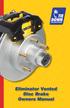 Eliminator Vented Disc Brake Owners Manual Eliminator Vented Disc Brakes Exclusive Features Whenever possible, the tendency is to use an aluminum alloy in order to reduce weight. These alloys are much
MEASURING WHEEL ALIGNMENT
 MEASURING WHEEL ALIGNMENT 2003-04 WHEEL ALIGNMENT Specifications & Procedures - Hummer - H2 Steering and vibration complaints are not always the result of improper alignment. One possible cause is wheel
Drive shaft, servicing
 Volkswagen Passat B6 - Drive shaft, servicing Стр. 1 из 41 40-7 Drive shaft, servicing Drive shafts, overview I - Assembly overview: Drive axle with CV joint VL100 40-7, Drive axle with CV joint VL100,
Spicer Axles & Brakes ABIB-0302
 Information Bulletin Bulletin Type: Parts / Service Information Topic: Dana LMS Hub Assembly Procedure Steer and Drive Axles Spicer Axles & Brakes ABIB-0302 Note: Bulletin ABIB-0302 replaces the original
How Do I Replacing My Rear Brake Pads and Rotors?
 How Do I Replacing My Rear Brake Pads and Rotors? WARNING! Always have the vehicle under inspection on level ground, in park with the emergency brake on. Always wear protective eyewear, gloves and necessary
TUTORIAL. REbUILdING. REAR CALIpER O-RING CONVERSION CORVETTE 1965-82. Part #: HT-2
 Part #: HT-2 1965-82 CORVETTE O-RING CONVERSION REAR CALIpER REbUILdING TUTORIAL Choosing a Brake Caliper Rebuild Kit Standard Lip Seals vs. O-Ring Seals Lip seal design seals are used on 1965-1982 Corvette
12. REAR WHEEL/BRAKE/SUSPENSION
 12 12 12-0 SERVICE INFORMATION... 12-1 REAR BRAKE... 12-5 TROUBLESHOOTING... 12-2 REAR SHOCK ABSORBER... 12-8 REAR WHEEL... 12-3 REAR FORK... 12-9 SERVICE INFORMATION GENERAL INSTRUCTIONS When installing
Pallet Jack. OWNER S MANUAL Model MH1230. Important Safety Instructions Assembly Instructions Parts and Hardware Identification
 OWNER S MANUAL Model MH1230 Important Safety Instructions Assembly Instructions Parts and Hardware Identification Pallet Jack CAUTION: Read, understand and follow ALL instructions before using this product
Table of Contents. Overview 1. Pump Disassembly 2. Control Disassembly / Reassembly 7. Pump Reassembly 13. Adjustment Procedures DR Control 19
 Table of Contents Overview 1 Pump Disassembly 2 Control Disassembly / Reassembly 7 Pump Reassembly 13 Adjustment Procedures DR Control 19 Adjustment Procedures DRG Control 20 Adjustment Procedures DFR
Turbocharger system components, servicing
 21-1 Turbocharger system components, servicing Engine codes: AAZ, 1Z, AHU Observe rules of cleanliness Page 21-10 Turbocharger hoses and lines, connecting Page 21-11 WARNING! Do not re-use any fasteners
This instruction is valid for all ACD pump models shown on page 2
 Screw pumps ACD Maintenance and Service Instruction This instruction is valid for all ACD pump models shown on page 2 Contents Page List of components 2 Exploded view/ordering code 3 Service intervals
Rebuild Instructions for 70001 and 70010 Transmission
 Rebuild Instructions for 70001 and 70010 Transmission Brinn, Incorporated 1615 Tech Drive Bay City, MI 48706 Telephone 989.686.8920 Fax 989.686.6520 www.brinninc.com Notice Read all instructions before
REMOVAL AND INSTALLATION
 303-01C-1 REMOVAL AND INSTALLATION Engine Body On Special Tool(s) Adapter For 303-D043 303-D043-02 or equivalent Special Tool(s) 303-01C-1 Turbocharger Lifting Bracket 303-1266 Wrench, Fan Clutch Nut 303-214
DYNA RIDER FOOTBOARD KIT
 -J0 REV. 0-0-0 DYNA RIDER FOOTBOARD KIT GENERAL Kit Number 000 Models For model fitment information, see the P&A Retail Catalog or the Parts and Accessories section of www.harley-davidson.com (English
Front axle components, overview
 just a test. Front axle components, overview 40-1 General Information Load bearing components and parts of the suspension must not be welded or straightened. Vehicles without drive axle must not be moved,
Cylinder head, removing and replacing
 15-1 Cylinder head, removing and replacing WARNING! Do not re-use any fasteners that are worn or deformed in normal use. Some fasteners are designed to be used only once, and are unreliable and may fail
CHAPTER 65 TAIL ROTOR DRIVE SYSTEM. Section Title Page
 CHAPTER 65 TAIL ROTOR DRIVE SYSTEM Section Title Page 65-00 Description........................................ 65.1 65-10 Tail Rotor Drive Fan Shaft.............................. 65.1 65-20 Tail Rotor
INTRODUCTION KINGPIN REPLACEMENT
 KINGPIN REPLACEMENT Author: Randy Baumann All information, illustrations and specifications are based on the best information available at the time of publication. The author cannot guarantee the accuracy
INSTALLATION INSTRUCTIONS. 6111 Air Spring Kit 2011+ Ford F250/F-350 Single Wheel 2WD 2011+ Ford F350 Dually 2WD IMPORTANT NOTES
 INSTALLATION INSTRUCTIONS 6111 Air Spring Kit 2011+ Ford F250/F-350 Single Wheel 2WD 2011+ Ford F350 Dually 2WD Thank you for purchasing a quality Hellwig Product. PLEASE READ THIS INSTRUCTION SHEET COMPLETELY
Gunite Disc Brake Rotors
 Gunite Disc Brake Rotors Maintenance Manual Gunite is the industry leader in the development of brake system components for heavy-duty truck applications including air disc brake rotors. Gunite was the
2008 ACCORD - Front Knuckle/Hub/Wheel Bearing Replacement (page 18-13)
 2008 ACCORD - Front Knuckle/Hub/Wheel Bearing Replacement (page 18-13) Exploded View Special Tools Required Ball joint remover, 28 mm 07MAC-SL0A202 Hub dis/assembly tool 07GAF-SD40100 Bearing driver attachment,
FRONT SUSPENSION Click on the applicable bookmark to selected the required model year
 FRONT SUSPENSION 33A-2 FRONT SUSPENSION General Information GENERAL INFORMATION 33200010105 The front suspension on 2WD vehicles is an independent suspension system having the double wishbone combined
INSTALLATION INSTRUCTIONS MULTI-MOUNT KIT Part Number: 75330 Application: Warn HP PowerPlant P/N 71800
 INSTALLATION INSTRUCTIONS MULTI-MOUNT KIT Part Number: 75330 Application: Warn HP PowerPlant P/N 71800 Your safety, and the safety of others, is very important. To help you make informed decisions about
DANA 30 MANUAL HUB CONVERSION KIT
 DANA 30 MANUAL HUB CONVERSION KIT 12194 PLEASE READ AND UNDERSTAND ALL INSTRUCTIONS BEFORE YOU BEGIN Your safety and the safety of other motorists is very important. Your Jeep is an off road capable vehicle
SUBJECT: Special Offset Ball Joint - Allows Adjustment To Caster And Camber Angles
 NUMBER: 02-001-02 GROUP: Suspension DATE: Jun. 10, 2002 This bulletin is supplied as technical information only and is not an authorization for repair. No part of this publication may be reproduced, stored
REAR AXLE 27-1 CONTENTS 27109000161 ON-VEHICLE SERVICE... 3 GENERAL INFORMATION... 2 SERVICE SPECIFICATIONS... 2 SPECIAL TOOLS... 2 REAR AXLE HUB...
 27-1 REAR AXLE CONTENTS 27109000161 GENERAL INFORMATION... 2 SERVICE SPECIFICATIONS... 2 SPECIAL TOOLS... 2 ON-VEHICLE SERVICE... 3 Wheel Bearing Axial Play Check... 3 Wheel Bearing Rotary-Sliding Resistance
Thank You For Choosing. INSTALLATION INSTRUCTIONS Portal Gear Hubs Polaris RZR XP 900 Crew. (Right) (Left)
 740B Clifty Drive Madison, Indiana 47250 812-574-7777 INSTALLATION INSTRUCTIONS Portal Gear Hubs Polaris RZR XP 900 Crew A Item Description Qty A Rotor 4 B Gear Box, L 2 C Gear Box, R 2 D Gasket 4 E Cap
2003 Volkswagen Passat GLX 4Motion
 2001-2003 BRAKES Disc MODEL IDENTIFICATION Several different brake versions are used by Volkswagen. To aid in identifying brake system installed on a particular model, see BRAKE SYSTEM IDENTIFICATION table.
LIFT-505. BMF Lift Kit. Yamaha Drive Gas or Electric. Installation Instructions
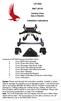 LIFT-505 BMF Lift Kit Yamaha Drive Gas or Electric Installation Instructions Contents of LIFT-505 Yamaha Drive BMF Lift Kit: a (1 ea.) BMF A-Arm Assembly b (1 ea.) Driver Side Shock Tower c (1 ea.) Passenger
READ AND UNDERSTAND ALL INSTRUCTIONS AND WARNINGS PRIOR TO INSTALLATION OF SYSTEM AND OPERATION OF VEHICLE.
 491 W. Garfield Ave., Coldwater, MI 49036 Phone: 517-279-2135 Web/live chat: www.bds-suspension.com E-mail: [email protected] Product: GM Leaf Spring READ AND UNDERSTAND ALL INSTRUCTIONS AND
DIFFERENTIAL AND DRIVELINE
 PL DIFFERENTIAL AND DRIVELINE 3-1 DIFFERENTIAL AND DRIVELINE TABLE OF CONTENTS page DESCRIPTION AND OPERATION FRONT DRIVESHAFTS...1 DIAGNOSIS AND TESTING DRIVESHAFT DIAGNOSIS....2 REMOVAL AND INSTALLATION
Thank You For Choosing. INSTALLATION INSTRUCTIONS Portal Gear Hubs Polaris RZR 800. (installation performed on 60 Model) (Right) (Left)
 740B Clifty Drive Madison, Indiana 47250 812-574-7777 INSTALLATION INSTRUCTIONS Portal Gear Hubs Polaris RZR 800 A (installation performed on 60 Model) Item Description Qty A Rotor 4 B Gear Box, L 2 C
TECHNICAL BULLETIN. Meritor WABCO Cab Leveling Valves and Chassis Leveling Valves. How the Cab Leveling and Chassis Leveling Valves Work
 Revised 02-00 TECHNICAL BULLETIN Meritor WABCO Cab Leveling Valves and Chassis Leveling Valves This technical bulletin covers both cab and chassis leveling valves manufactured by Meritor WABCO. While the
INSTRUCTIONS. FLHR/C/S (Road King) FRONT END LOWERING KIT 1WARNING -J03242 REV. 10-19-04. General. Removal (Left and Right Forks) Kit Number 54614-05
 INSTRUCTIONS -J04 REV. 0-9-04 General FLHR/C/S (Road King) FRONT END LOWERING KIT This kit is designed for installation on 00 and later FLHR/C/S Model Motorcycles. Road King models use the conventional
For exploded diagram and part number information, refer to the Spare Parts Catalog available on our website at www.rockshox.com.
 For exploded diagram and part number information, refer to the Spare Parts Catalog available on our website at www.rockshox.com. Information contained in this publication is subject to change at anytime
MUSTANG II IFS COMPLETE PARTS PACKAGE
 MUSTANG II IFS COMPLETE PARTS PACKAGE Your Southern Rods & Parts Mustang II IFS Parts Package contains the following items: 1 pr) Upper Control Arms (2023) 1) Upper Arm Bolt Kit (MP-001-A) 1 pr) Lower
7600 SAND STREET, FORT WORTH, TX 76118. www.kodiaktrailer.com -2-
 7600 SAND STREET, FORT WORTH, TX 76118 www.kodiaktrailer.com -2- CONTENTS SECTION I. INTRODUCTION II. GENERAL INFORMATION III. SAFETY INFORMATION IV. INSTALLATION INFORMATION V. SOLENOID REVERSING VALVES
HISTORY IN THE BRAKING
 Practical Tips HISTORY IN THE BRAKING Documentation of a disc brake repair 1 Start of brake repair Visually check the brake disc and/or pads for sign of reaching their wear limit. Before starting the brake
Check for deteriorated, shifting or missing tie-down pads. Replace if needed.
 C C 0 5 C H A S S I S F R A M E Chassis Frame Overview The Blue Bird Vision s chassis frame consists of two main C-channel rails which run the entire length of the bus, and several different kinds of cross
Recall R136 Front Lower Ball Joints Check Torque or Replace
 SERVICE DATE /00 Amended /00 TECHNICAL BULLETIN Recall R6 Front Lower Ball Joints Check Torque or Replace MODEL VIN Remove and destroy Bulletin S04-R6, dated /00. Replace with this Bulletin. Revisions
Maintenance manual no. MM-1147 DX Air Disc Brake DX series of disc brakes
 Maintenance manual no. MM-1147 DX Air Disc Brake DX series of disc brakes Issued 06/2003-2nd Edition an ArvinMeritor brand Service Notes Before You Begin This publication provides installation and maintenance
M113 VEHICLE FAMILY RUBBER TRACK INSTALLATION INSTRUCTIONS SOUCY TRACK SYSTEM 04-M113-1ENS (SPLIT IDLER) Litho d in Canada 1 04-M113-1ENS
 M113 VEHICLE FAMILY RUBBER TRACK INSTALLATION INSTRUCTIONS (SPLIT IDLER) 1 # TABLE OF CONTENTS List of parts and tools................................................3 Installation of complete kit...................................................5
Slide the new steering column shaft through the steering column from the driver compartment.
 Slide the new steering column shaft through the steering column from the driver compartment. Push the column shaft through the steering column until the machined end is out past the column lower bushing.
Hydraulic Disc Brake, Installation, Maintenance, and Service Manual
 Hydraulic Disc Brake, Installation, Maintenance, and Service Manual HFX-Mag HFX-9 45-14550DWeb 02/06 copyright 2006 Hayes Bicycle Group, LLC Introduction to this Manual This manual is intended to provide
System Saver 318 Air Compressor for Mack E-Tech and ASET Engines
 Maintenance Manual 31 System Saver 318 Air Compressor for Mack E-Tech and ASET Engines Revised 08-05 NON-THROUGH DRIVE THROUGH DRIVE Service Notes About This Manual This manual provides service and repair
Disc Brake Service. Chapter 13. Common Disc Brake Problems. Caliper and Pad Service. Important Terms
 This sample chapter is for review purposes only. Copyright The Goodheart-Willcox Co., Inc. ll rights reserved. fter studying this chapter, you will be able to: Identify common disc brake problems. Diagnose
Maintenance and Service Instruction
 Screw pumps E4 Maintenance and Service Instruction E4 1 IMO AB This instruction is valid for all E4 pump models shown on page 2 Contents Page List of components 2 Exploded view/ordering code 3 Service
Char-Lynn Spool Valve Hydraulic Motors. Repair Information. W Series Geroler Motors
 Char-Lynn Spool Valve Hydraulic Motors Repair Information W Series Geroler Motors with Parking Brake 004 Nut Key Ring, Retaining Bearing Ring, Retaining Ring, Retaining Washer (Thick), Pressure Washer,
2005 MINI Cooper. 2002-05 MANUAL TRANSMISSIONS On-Vehicle Servicing. Cooper S Getrag 285
 2002-05 MANUAL TRANSMISSIONS On-Vehicle Servicing APPLICATION MANUAL TRANSMISSION APPLICATIONS Application Transmission Model Cooper R65 Cooper S Getrag 285 LUBRICATION SERVICE INTERVALS Inspect fluid
Sport Ice Elektro 124
 Sport Ice Elektro 124 Operation Manual 2007/4 V2.1 Introduction The Sport Ice Elektro 124 is an ice resurfacing machine designed to be used on small ice surfaces. The machine has been designed to produce
DR125 and DR150 Hensim Dirt Runner 125cc and 150cc Dirt Bike (VIN PREFIX LLCH or LUAH)
 Parts Lists - DR125 and DR150 Hensim Dirt Runner 125cc and 150cc Dirt Bike (VIN PR... Page 1 of 25 Product Information Baja Web > Product Information > Parts Lists > DIRTBIKE > DR125 and DR150 Hensim Dirt
Trouble Shooting Tech Tips Operation
 Steering Components TroubleShooting Tech Tips Table of Contents Basic Steering System Operation 2 Sector Shaft Adjustments 4 Drag Link Adjustment 5 Relief Valve/Unloading Valve Adjustment 6 Ross TAS Automatic
Diesel Care & Performance Inc Care is at the center of everything we do
 Service and Repair REMOVAL WARNING: RED-STRIPED WIRE HARNESS CARRIES 115V DC. SEVERE ELECTRICAL SHOCK MAY BE RECEIVED. DO NOT PIERCE. CAUTION: Do not pierce engine electrical wires or damage to the harness
Checking Wheel Brakes Wear
 Issue 1 en 1 Checking Wheel Brakes Wear Contents Disc Brakes... 3 Removing the wheels... 4 Checking the Brake Pads... 5 Check brake disc thickness... 7 Checking brake disc for cracks... 8 Drum Brakes...
2011-14 F250 6 RADIUS ARM KIT
 92154000 Thank you for choosing Rough Country for your suspension needs. 2011-14 F250 6 RADIUS ARM KIT Rough Country recommends a certified technician installs this system. In addition to these instructions,
INSTALLATION INSTRUCTIONS. 6108 Air Spring Kit 2011+ Ford F250 Single Wheel 4WD 2011+ Ford F350 Dually 4WD (2011 F350 Single Wheel 4WD use p/n 6113)
 INSTALLATION INSTRUCTIONS 6108 Air Spring Kit 2011+ Ford F250 Single Wheel 4WD 2011+ Ford F350 Dually 4WD (2011 F350 Single Wheel 4WD use p/n 6113) Thank you for purchasing a quality Hellwig Product. PLEASE
PUMP MAINTENANCE SCHEDULE AND CHECKLISTS
 PUMP MAINTENANCE SCHEDULE AND CHECKLISTS Providing a maintenance schedule defined specifically by run hours or yardage pumped serves only as a general guideline given the large amount of variables a unit
MASTER CYLINDER. Section 2. Master Cylinder. Tandem Master Cylinder. Master Cylinder
 MASTER CYLINDER Master Cylinder The master cylinder converts the motion of the brake pedal into hydraulic pressure. It consists of the reservoir tank, which contains the brake fluid; and the piston and
1/29/2008 DR125 / DR150. Baja Motorsports Inc. P.O. Box 61150 Phoenix, AZ 85082 Toll Free: 888-863-2252 PARTS AND PRICES ARE SUBJECT TO CHANGE 1 of 55
 DR125 / DR150 Toll Free: 888-863-2252 PARTS AND PRICES ARE SUBJECT TO CHANGE 1 of 55 CYLINDER HEAD ASSY. 1 125-001 883099006937 CYLINDER HEAD COVER 1 1 2 125-002 883099006944 BOLT M6X28 2 3 3 125-003 883099006951
Rating when used as a weight carrying hitch without spring bars:
 BOLT-TOGETHER WEIGHT DISTRIBUTING HITCH SYSTEM Rating when used as a weight distributing hitch with spring bars: Part Number 48051 4805 48053 48054 Max Tongue Weight 550 Ibs. 750 Ibs. 1000 Ibs. 1400 lbs.
HYDRAULIC TABLE CART 500-LB.
 HYDRAULIC TABLE CART 500-LB. OWNER S MANUAL WARNING: Read carefully and understand all MACHINE ADJUSTMENT AND OPERATION INSTRUCTIONS before operating. Failure to follow the safety rules and other basic
4 PISTON BRAKE CALIPERS AND ROTORS
 Installation Instructions 4 PISTON BRKE CLIPERS ND ROTORS TTENTION Statements in these instructions that are preceded by the following words are of special significance: Warning This means there is the
M-2004-MBA Brake Duct Kit 2013 BOSS 302, Mustang GT and California Special INSTALLATION INSTRUCTIONS
 Please visit www.fordracingparts.com for the most current instruction information.!!! PLEASE READ ALL OF THE FOLLOWING INSTRUCTIONS CAREFULLY PRIOR TO INSTALLATION. AT ANY TIME YOU DO NOT UNDERSTAND THE
SUPERCHIPPER CASTING MAINTENANCE
 INTRODUCTION By design, the Superchipper Rotor is clad in castings which wear during crushing. The castings wear at different rates depending on their location on the rotor, material feed rate, material
Original ATE wheel cylinders. Reduced in weight and resistant to brake fluid
 Original ATE wheel cylinders Reduced in weight and resistant to brake fluid 1 Original ATE wheel cylinders The ATE brand is backed up by Continental, one of the worlds biggest brake specialists: this is