
Inductance and Magnetic Energy
|
|
|
- Maryann Roberts
- 10 years ago
- Views:
Transcription
1 Chapter 11 Inductance and Magnetic Energy 11.1 Mutual Inductance Example 11.1 Mutual Inductance of Two Concentric Coplanar Loops Self-Inductance Example 11. Self-Inductance of a Solenoid Example 11.3 Self-Inductance of a Toroid Example 11.4 Mutual Inductance of a Coil Wrapped Around a Solenoid Energy Stored in Magnetic Fields Example 11.5 Energy Stored in a Solenoid Animation 11.1: Creating and Destroying Magnetic Energy Animation 11.: Magnets and Conducting Rings RL Circuits Self-Inductance and the Modified Kirchhoff's Loop Rule Rising Current Decaying Current LC Oscillations The RLC Series Circuit Summary Appendix 1: General Solutions for the RLC Series Circuit Quality Factor Appendix : Stresses Transmitted by Magnetic Fields Animation 11.3: A Charged Particle in a Time-Varying Magnetic Field Problem-Solving Strategies Calculating Self-Inductance Circuits containing inductors Solved Problems Energy stored in a toroid Magnetic Energy Density Mutual Inductance RL Circuit RL Circuit LC Circuit Conceptual Questions

2 11.13 Additional Problems Solenoid Self-Inductance Coupled Inductors RL Circuit RL Circuit Inductance of a Solenoid With and Without Iron Core RLC Circuit Spinning Cylinder Spinning Loop

3 Inductance and Magnetic Energy 11.1 Mutual Inductance Suppose two coils are placed near each other, as shown in Figure Figure Changing current in coil 1 produces changing magnetic flux in coil. The first coil has N 1 turns and carries a current I 1 which gives rise to a magnetic field 1. Since the two coils are close to each other, some of the magnetic field lines through coil 1 will also pass through coil. Let Φ1 denote the magnetic flux through one turn of coil due to I 1. Now, by varying I 1 with time, there will be an induced emf associated with the changing magnetic flux in the second coil: dφ d ε = N = d dt dt A (11.1.1) coil The time rate of change of magnetic flux Φ 1 in coil is proportional to the time rate of change of the current in coil 1: N dφ di = M (11.1.) dt dt where the proportionality constant M1 is called the mutual inductance. It can also be written as M N Φ 1 1 = (11.1.3) I1 The SI unit for inductance is the henry (H): 11-3

4 1 henry = 1 H = 1 T m /A (11.1.4) We shall see that the mutual inductance M 1 depends only on the geometrical properties of the two coils such as the number of turns and the radii of the two coils. In a similar manner, suppose instead there is a current I in the second coil and it is varying with time (Figure 11.1.). Then the induced emf in coil 1 becomes dφ d ε = N = d dt dt A (11.1.5) coil 1 and a current is induced in coil 1. Figure Changing current in coil produces changing magnetic flux in coil 1. This changing flux in coil 1 is proportional to the changing current in coil, where the proportionality constant M1 as N dφ di = M (11.1.6) dt dt M is another mutual inductance and can be written N Φ = (11.1.7) I However, using the reciprocity theorem which combines Ampere s law and the iot- Savart law, one may show that the constants are equal: M1 = M1 M (11.1.8) 11-4

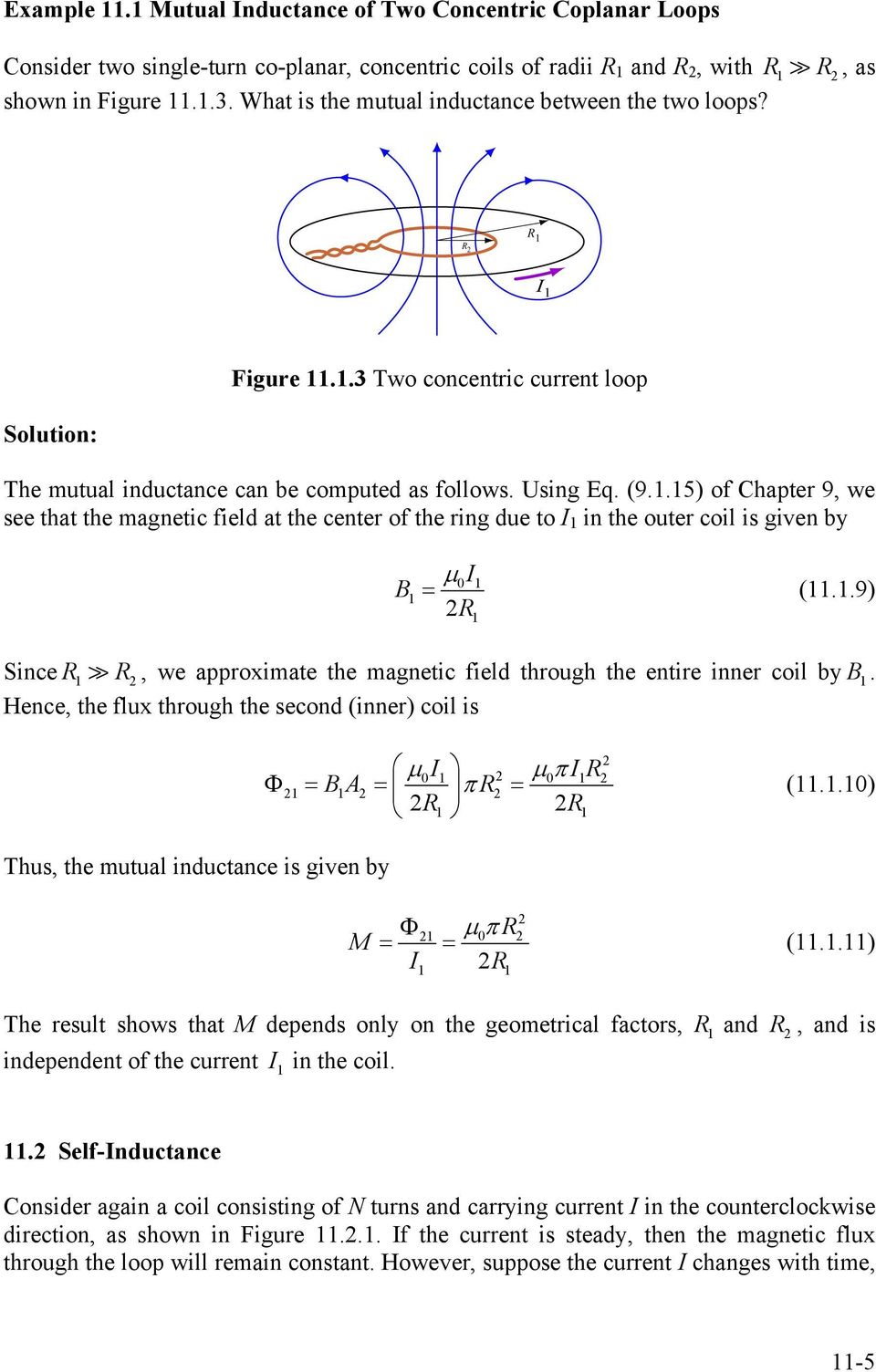
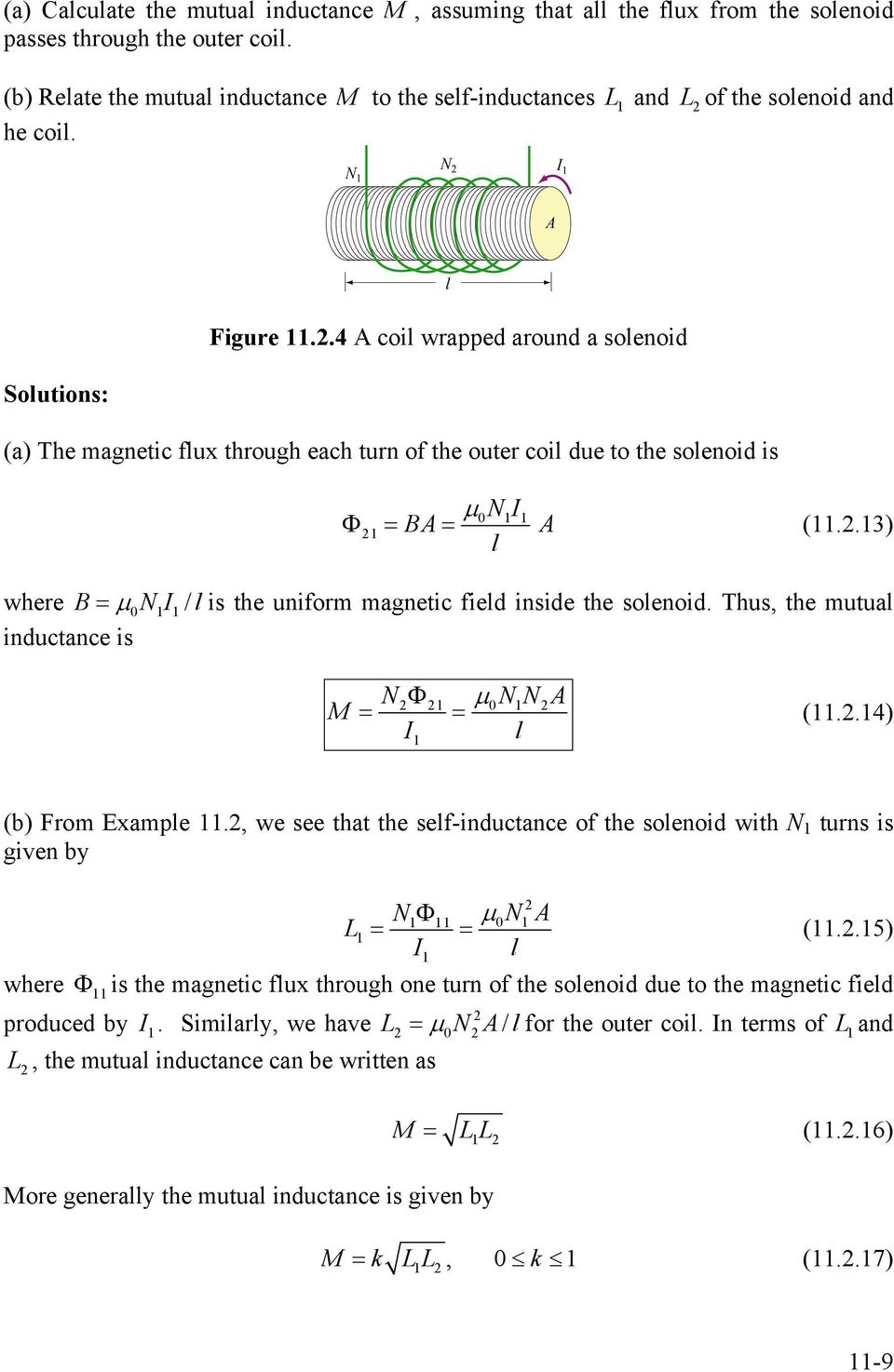
5 Example 11.1 Mutual Inductance of Two Concentric Coplanar Loops Consider two single-turn co-planar, concentric coils of radii R 1 and R, with R1 R, as shown in Figure What is the mutual inductance between the two loops? Solution: Figure Two concentric current loop The mutual inductance can be computed as follows. Using Eq. (9.1.15) of Chapter 9, we see that the magnetic field at the center of the ring due to I 1 in the outer coil is given by µ I 1 1 = (11.1.9) R1 Since R 1 R, we approximate the magnetic field through the entire inner coil by 1. Hence, the flux through the second (inner) coil is Φ = µ I = µ πir = A 1 π R R1 R1 (11.1.1) Thus, the mutual inductance is given by Φ µπr = = ( ) M 1 I 1 R 1 The result shows that M depends only on the geometrical factors, R 1 and R, and is independent of the current I 1 in the coil. 11. Self-Inductance Consider again a coil consisting of N turns and carrying current I in the counterclockwise direction, as shown in Figure If the current is steady, then the magnetic flux through the loop will remain constant. However, suppose the current I changes with time, 11-5
6 then according to Faraday s law, an induced emf will arise to oppose the change. The induced current will flow clockwise if di / dt >, and counterclockwise if di / dt <. The property of the loop in which its own magnetic field opposes any change in current is called self-inductance, and the emf generated is called the self-induced emf or back emf, which we denote as ε L. All current-carrying loops exhibit this property. In particular, an inductor is a circuit element (symbol ) which has a large selfinductance. Figure Magnetic flux through the current loop Mathematically, the self-induced emf can be written as ε dφ N dt and is related to the self-inductance L by d N dt L = = d A (11..1) di ε L = L (11..) dt The two expressions can be combined to yield L NΦ I = (11..3) Physically, the inductance L is a measure of an inductor s resistance to the change of current; the larger the value of L, the lower the rate of change of current. Example 11. Self-Inductance of a Solenoid Compute the self-inductance of a solenoid with N turns, length l, and radius current I flowing through each turn, as shown in Figure R with a 11-6

7 Figure 11.. Solenoid Solution: Ignoring edge effects and applying Ampere s law, the magnetic field inside a solenoid is given by Eq. (9.4.3): µ NI = kˆ =µ ni kˆ l (11..4) where n= N / lis the number of turns per unit length. The magnetic flux through each turn is Φ = A= µ ni ( π R ) = µ niπr (11..5) Thus, the self-inductance is L NΦ I = = µ n πr l (11..6) We see that L depends only on the geometrical factors (n, R and l) and is independent of the current I. Example 11.3 Self-Inductance of a Toroid Calculate the self-inductance of a toroid which consists of N turns and has a rectangular cross section, with inner radius a, outer radius b and height h, as shown in Figure 11..3(a). (a) (b) Figure A toroid with N turns 11-7

8 Solution: According to Ampere s law discussed in Section 9.3, the magnetic field is given by or ds = ds= ds= ( π r) = µ NI µ NI π r (11..7) = (11..8) The magnetic flux through one turn of the toroid may be obtained by integrating over the rectangular cross section, with da = h dr as the differential area element (Figure 11..3b): The total flux is µ NI µ NIh b A (11..9) πr π a b Φ = d = hdr = ln a. Therefore, the self-inductance is NΦ NΦ µ Nh b L = = ln I π a (11..1) Again, the self-inductance L depends only on the geometrical factors. Let s consider the situation where a b a. In this limit, the logarithmic term in the equation above may be expanded as b b a b a ln = ln 1+ a a a (11..11) and the self-inductance becomes µ N h b a µ N A µ N A L = = π a πa l (11..1) where A= h( b a) is the cross-sectional area, and l = π a. We see that the selfinductance of the toroid in this limit has the same form as that of a solenoid. Example 11.4 Mutual Inductance of a Coil Wrapped Around a Solenoid A long solenoid with length l and a cross-sectional area A consists of N 1 turns of wire. An insulated coil of N turns is wrapped around it, as shown in Figure
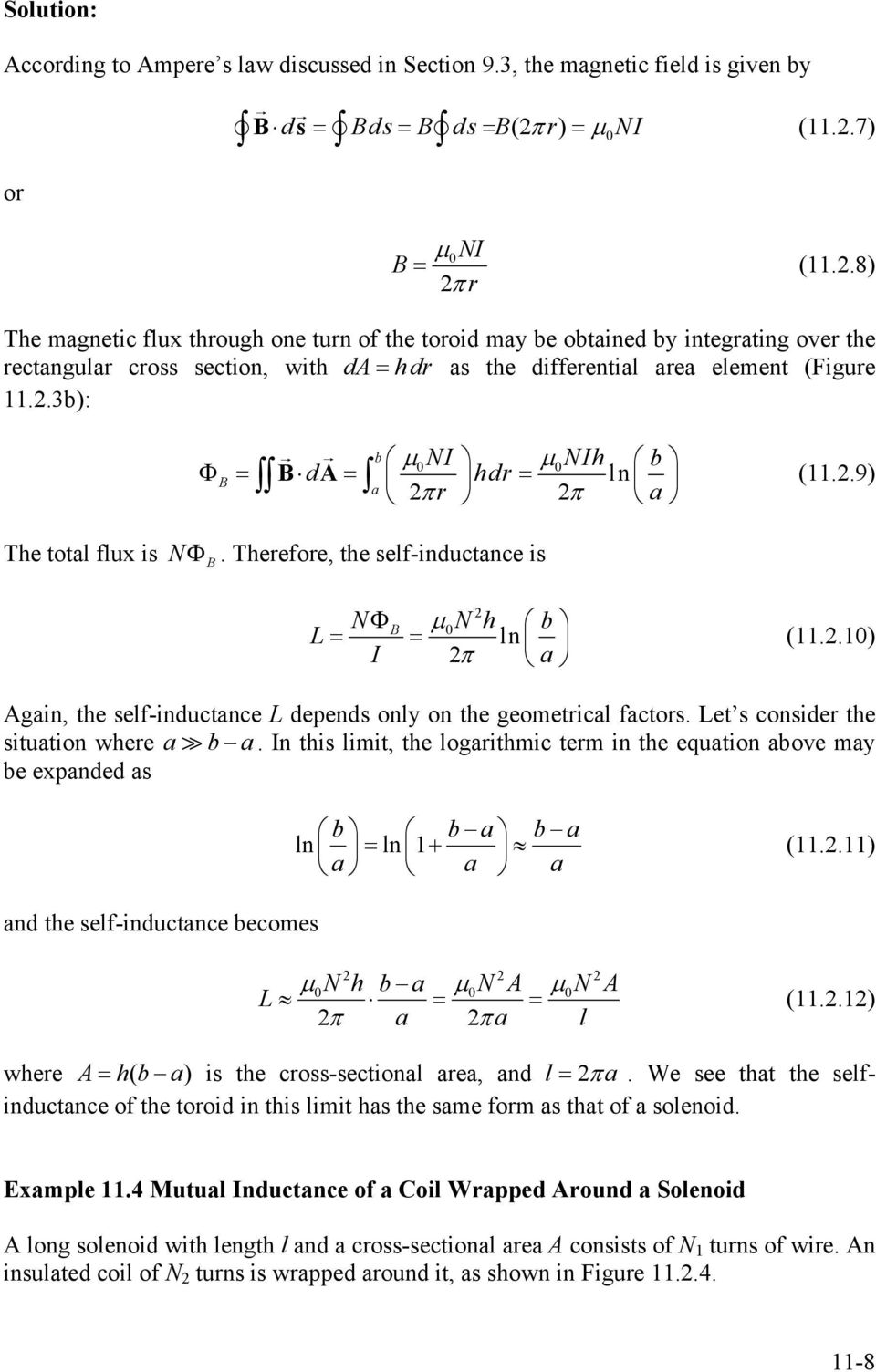
9 (a) Calculate the mutual inductance M, assuming that all the flux from the solenoid passes through the outer coil. (b) Relate the mutual inductance M to the self-inductances L1 and L of the solenoid and he coil. Figure A coil wrapped around a solenoid Solutions: (a) The magnetic flux through each turn of the outer coil due to the solenoid is A µ NI l A 1 1 Φ 1 = = (11..13) where = µ NI / l 1 1 is the uniform magnetic field inside the solenoid. Thus, the mutual inductance is M N Φ I 1 1 = = (11..14) 1 µ NN A l (b) From Example 11., we see that the self-inductance of the solenoid with N 1 turns is given by where Φ 11 L N Φ µ N A = = (11..15) I1 l is the magnetic flux through one turn of the solenoid due to the magnetic field produced by I 1. Similarly, we have L = µ N A/ lfor the outer coil. In terms of L1 and, the mutual inductance can be written as L M = LL (11..16) 1 More generally the mutual inductance is given by M = k LL, k 1 (11..17)
10 where k is the coupling coefficient. In our example, we have k = 1 which means that all of the magnetic flux produced by the solenoid passes through the outer coil, and vice versa, in this idealization Energy Stored in Magnetic Fields Since an inductor in a circuit serves to oppose any change in the current through it, work must be done by an external source such as a battery in order to establish a current in the inductor. From the work-energy theorem, we conclude that energy can be stored in an inductor. The role played by an inductor in the magnetic case is analogous to that of a capacitor in the electric case. The power, or rate at which an external emf ε ext works to overcome the self-induced emf ε L and pass current I in the inductor is P L dw dt ext = = Iεext (11.3.1) If only the external emf and the inductor are present, then εext = ε which implies L P L dw dt ext = = Iε L =+IL di dt (11.3.) If the current is increasing with di / dt >, then P > which means that the external source is doing positive work to transfer energy to the inductor. Thus, the internal energy U of the inductor is increased. On the other hand, if the current is decreasing with di / dt <, we then have P <. In this case, the external source takes energy away from the inductor, causing its internal energy to go down. The total work done by the external source to increase the current form zero to I is then 1 Wext = dw = LI di = L This is equal to the magnetic energy stored in the inductor: I ext ' ' I (11.3.3) U 1 L = I (11.3.4) The above expression is analogous to the electric energy stored in a capacitor: U E 1 Q = (11.3.5) C 11-1

11 We comment that from the energy perspective there is an important distinction between an inductor and a resistor. Whenever a current I goes through a resistor, energy flows into the resistor and dissipates in the form of heat regardless of whether I is steady or timedependent (recall that power dissipated in a resistor is PR = IVR = I R). On the other hand, energy flows into an ideal inductor only when the current is varying with di / dt >. The energy is not dissipated but stored there; it is released later when the current decreases with di / dt <. If the current that passes through the inductor is steady, then there is no change in energy since P = LI( di / dt) =. L Example 11.5 Energy Stored in a Solenoid A long solenoid with length l and a radius R consists of N turns of wire. A current I passes through the coil. Find the energy stored in the system. Solution: Using Eqs. (11..6) and (11.3.4), we readily obtain 1 1 U = LI = µ n I πr l (11.3.6) The result can be expressed in terms of the magnetic field strength = µ ni : 1 U = ( ni ) ( R l ) = ( R l ) (11.3.7) µ µ µ π π Since π R l is the volume within the solenoid, and the magnetic field inside is uniform, the term u = (11.3.8) µ may be identified as the magnetic energy density, or the energy per unit volume of the magnetic field. The above expression holds true even when the magnetic field is nonuniform. The result can be compared with the energy density associated with an electric field: ue 1 E = ε (11.3.9) 11-11

12 Animation 11.1: Creating and Destroying Magnetic Energy Let s consider the process involved in creating magnetic energy. Figure shows the process by which an external agent(s) creates magnetic energy. Suppose we have five rings that carry a number of free positive charges that are not moving. Since there is no current, there is no magnetic field. Now suppose a set of external agents come along (one for each charge) and simultaneously spin up the charges counterclockwise as seen from above, at the same time and at the same rate, in a manner that has been pre-arranged. Once the charges on the rings start to accelerate, there is a magnetic field in the space between the rings, mostly parallel to their common axis, which is stronger inside the rings than outside. This is the solenoid configuration. Figure Creating and destroying magnetic field energy. As the magnetic flux through the rings grows, Faraday s law of induction tells us that there is an electric field induced by the time-changing magnetic field that is circulating clockwise as seen from above. The force on the charges due to this electric field is thus opposite the direction the external agents are trying to spin the rings up (counterclockwise), and thus the agents have to do additional work to spin up the charges because of their charge. This is the source of the energy that is appearing in the magnetic field between the rings the work done by the agents against the back emf. Over the course of the create animation associated with Figure , the agents moving the charges to a higher speed against the induced electric field are continually doing work. The electromagnetic energy that they are creating at the place where they are doing work (the path along which the charges move) flows both inward and outward. The direction of the flow of this energy is shown by the animated texture patterns in Figure This is the electromagnetic energy flow that increases the strength of the magnetic field in the space between the rings as each positive charge is accelerated to a higher and higher speed. When the external agents have gotten up the charges to a predetermined speed, they stop the acceleration. The charges then move at a constant speed, with a constant field inside the solenoid, and zero induced electric field, in accordance with Faraday s law of induction. We also have an animation of the destroy process linked to Figure This process proceeds as follows. Our set of external agents now simultaneously start to spin down the moving charges (which are still moving counterclockwise as seen from above), at the 11-1

13 same time and at the same rate, in a manner that has been pre-arranged. Once the charges on the rings start to decelerate, the magnetic field in the space between the rings starts to decrease in magnitude. As the magnetic flux through the rings decreases, Faraday s law tells us that there is now an electric field induced by the time-changing magnetic field that is circulating counterclockwise as seen from above. The force on the charges due to this electric field is thus in the same direction as the motion of the charges. In this situation the agents have work done on them as they try to spin the charges down. Over the course of the destroy animation associated with Figure , the strength of the magnetic field decreases, and this energy flows from the field back to the path along which the charges move, and is now being provided to the agents trying to spin down the moving charges. The energy provided to those agents as they destroy the magnetic field is exactly the amount of energy that they put into creating the magnetic field in the first place, neglecting radiative losses (such losses are small if we move the charges at speeds small compared to the speed of light). This is a totally reversible process if we neglect such losses. That is, the amount of energy the agents put into creating the magnetic field is exactly returned to the agents as the field is destroyed. There is one final point to be made. Whenever electromagnetic energy is being created, an electric charge is moving (or being moved) against an electric field ( q ve < ). Whenever electromagnetic energy is being destroyed, an electric charge is moving (or being moved) along an electric field ( q ve > ). This is the same rule we saw above when we were creating and destroying electric energy above. Animation 11.: Magnets and Conducting Rings In the example of Faraday s law that we gave above, the sense of the electric field associated with a time-changing magnetic field was always such as to try to resist change. We consider another example of Faraday s law that illustrates this same tendency in a different way. Figure A perfectly conducting ring falls on the axis of a permanent magnet. The induced currents and the resulting magnetic field stresses are such as to slow the fall of the ring. If the ring is light enough (or the magnet strong enough), the ring will levitate above the magnet

14 In Figure 11.3., we show a permanent magnet that is fixed at the origin with its dipole moment pointing upward. On the z-axis above the magnet, we have a co-axial, conducting, non-magnetic ring with radius a, inductance L, and resistance R. The center of the conducting ring is constrained to move along the vertical axis. The ring is released from rest and falls under gravity toward the stationary magnet. Eddy currents arise in the ring because of the changing magnetic flux and induced electric field as the ring falls toward the magnet, and the sense of these currents is to repel the ring when it is above the magnet. This physical situation can be formulated mathematically in terms of three coupled ordinary differential equations for the position of the ring, its velocity, and the current in the ring. We consider in Figure the particular situation where the resistance of the ring (which in our model can have any value) is identically zero, and the mass of the ring is small enough (or the field of the magnet is large enough) so that the ring levitates above the magnet. We let the ring begin at rest a distance a above the magnet. The ring begins to fall under gravity. When the ring reaches a distance of about a above the ring, its acceleration slows because of the increasing current in the ring. As the current increases, energy is stored in the magnetic field, and when the ring comes to rest, all of the initial gravitational potential of the ring is stored in the magnetic field. That magnetic energy is then returned to the ring as it bounces and returns to its original position a distance a above the magnet. ecause there is no dissipation in the system for our particular choice of R in this example, this motion repeats indefinitely. What are the important points to be learned from this animation? Initially, all the free energy in this situation is stored in the gravitational potential energy of the ring. As the ring begins to fall, that gravitational energy begins to appear as kinetic energy in the ring. It also begins to appear as energy stored in the magnetic field. The compressed field below the ring enables the transmission of an upward force to the moving ring as well as a downward force to the magnet. ut that compression also stores energy in the magnetic field. It is plausible to argue based on the animation that the kinetic energy of the downwardly moving ring is decreasing as more and more energy is stored in the magnetostatic field, and conversely when the ring is rising. Figure shows a more realistic case in which the resistance of the ring is finite. Now energy is not conserved, and the ring eventually falls past the magnet. When it passes the magnet, the sense of the induced electric field and thus of the eddy currents reverses, and the ring is now attracted to the magnet above it, which again retards its fall. There are many other examples of the falling ring and stationary magnet, or falling magnet and stationary ring, given in the animations at this link. All of them show that the effect of the electric field associated with a time-changing magnetic field is to try to keep things the same. In the limiting case of zero resistance, it can in fact achieve this goal, e.g. in Figure the magnetic flux through the ring never changes over the course of the motion

15 Figure A ring with finite resistance falls on the axis of a magnet. We show the ring after it has fallen past the magnet, when it is attracted to the magnet above it RL Circuits Self-Inductance and the Modified Kirchhoff's Loop Rule The addition of time-changing magnetic fields to simple circuits means that the closed line integral of the electric field around a circuit is no longer zero. Instead, we have, for any open surface d E ds = d dt A (11.4.1) Any circuit where the current changes with time will have time-changing magnetic fields, and therefore induced electric fields. How do we solve simple circuits taking such effects into account? We discuss here a consistent way to understand the consequences of introducing time-changing magnetic fields into circuit theory -- that is, inductance. As soon as we introduce time-changing magnetic fields, the electric potential difference between two points in our circuit is no longer well-defined, because when the line integral of the electric field around a closed loop is nonzero, the potential difference between two points, say a and b, is no longer independent of the path taken to get from a to b. That is, the electric field is no longer a conservative field, and the electric potential is no longer an appropriate concept, since we can no longer write E as the negative gradient of a scalar potential. However, we can still write down in a straightforward fashion the equation that determines the behavior of a circuit. Figure One-loop inductor circuit 11-15

16 To show how to do this, consider the circuit shown in Figure We have a battery, a resistor, a switch S that is closed at t =, and a one-loop inductor. It will become clear what the consequences of this inductance are as we proceed. For t >, current will flow in the direction shown (from the positive terminal of the battery to the negative, as usual). What is the equation that governs the behavior of our current I( t ) for t >? To investigate this, apply Faraday's law to the open surface bounded by our circuit, where we take d A to be out of the page, and d s right-handed with respect to that choice (counter-clockwise). First, what is the integral of the electric field around this circuit? There is an electric field in the battery, directed from the positive terminal to the negative terminal, and when we go through the battery in the direction of d s that we have chosen, we are moving against that electric field, so that E d s <. Thus the contribution of the battery to our integral is ε. Then, there is an electric field in the resistor, in the direction of the current, so when we move through the resistor in that direction, E d s is greater than zero, and that contribution to our integral is + IR. What about when we move through our one-loop inductor? There is no electric field in this loop if the resistance of the wire making up the loop is zero. Thus, going around the closed loop clockwise against the current, we have E d s = ε + IR (11.4.) Now, what is the magnetic flux Φ through our open surface? First of all, we arrange the geometry so that the part of the circuit which includes the battery, the switch, and the resistor makes only a small contribution to Φ as compared to the (much larger in area) part of the open surface which includes our one-loop inductor. Second, we know that Φ is positive in that part of the surface, because current flowing counterclockwise will produce a magnetic field pointing out of the page, which is the same direction we have assumed for da. Thus, the dot product da >. Note that is the self magnetic field that is, the magnetic field produced by the current flowing in the circuit, and not by any external currents. From Section 11.1, we also see that the magnetic flux Φ is proportional to I, and may be written as Φ = LI, where L is the self-inductance which depends on the geometry of the circuit. The time rate of change of Faraday's law Φ is just dφ dt LdI ( / dt), so that we have from E d s = ε + IR= = L (11.4.3) We can write the governing equation for I( t ) from above as di dt 11-16

17 di V = ε IR L = (11.4.4) dt where the expression has been cast in a form that resembles Kirchhoff's loop rule, namely that the sum of the potential drops around a circuit is zero. To preserve the loop rule, we must specify the potential drop across an inductor. (a) (b) Figure Modified Kirchhoff s rule for inductors (a) with increasing current, and (b) with decreasing current. The modified rule for inductors may be obtained as follows: The polarity of the selfinduced emf is such as to oppose the change in current, in accord with Lenz s law. If the rate of change of current is positive, as shown in Figure 11.4.(a), the self-induced emf ε L sets up an induced current I ind moving in the opposite direction of the current I to oppose such an increase. The inductor could be replaced by an emf ε L = L di / dt =+ L( di / dt) with the polarity shown in Figure 11.4.(a). On the other hand, if di / dt <, as shown in Figure 11.4.(b), the induced current self-induced emf ε L flows in the same direction as I to oppose such a decrease. I ind set up by the We see that whether the rate of change of current in increasing ( di / dt > ) or decreasing ( di / dt < ), in both cases, the change in potential when moving from a to b along the direction of the current I is V V = L( di / dt). Thus, we have b a Kirchhoff's Loop Rule Modified for Inductors: If an inductor is traversed in the direction of the current, the potential change is LdI ( / dt). On the other hand, if the inductor is traversed in the direction opposite of the current, the potential change is + LdI ( / dt). Use of this modified Kirchhoff s rule will give the correct equations for circuit problems that contain inductors. However, keep in mind that it is misleading at best, and at some level wrong in terms of the physics. Again, we emphasize that Kirchhoff's loop rule was originally based on the fact that the line integral of E around a closed loop was zero

18 With time-changing magnetic fields, this is no longer so, and thus the sum of the potential drops around the circuit, if we take that to mean the negative of the closed loop integral of E, is no longer zero in fact it is + LdI ( / dt) Rising Current Consider the RL circuit shown in Figure At t = the switch is closed. We find that the current does not rise immediately to its maximum value ε / R. This is due to the presence of the self-induced emf in the inductor. Figure (a) RL Circuit with rising current. (b) Equivalent circuit using the modified Kirchhoff s loop rule. Using the modified Kirchhoff s rule for increasing current, described by the following differential equation: di/ dt >, the RL circuit is di ε IR εl = ε IR L = (11.4.5) dt Note that there is an important distinction between an inductor and a resistor. The potential difference across a resistor depends on I, while the potential difference across an inductor depends on di / dt. The self-induced emf does not oppose the current itself, but the change of current di / dt. The above equation can be rewritten as di dt = I ε / R L/ R (11.4.6) Integrating over both sides and imposing the condition It= ( ) =, the solution to the differential equation is where ε t / τ It () = ( 1 e ) (11.4.7) R 11-18

19 L τ = (11.4.8) R is the time constant of the RL circuit. The qualitative behavior of the current as a function of time is depicted in Figure Figure Current in the RL circuit as a function of time Note that after a sufficiently long time, the current reaches its equilibrium value ε / R. The time constant τ is a measure of how fast the equilibrium state is attained; the larger the value of L, the longer it takes to build up the current. A comparison of the behavior of current in a circuit with or without an inductor is shown in Figure below. Similarly, the magnitude of the self-induced emf can be obtained as t / τ L = =ε (11.4.9) ε di L dt e which is at a maximum when t = and vanishes as t approaches infinity. This implies that a sufficiently long time after the switch is closed, self-induction disappears and the inductor simply acts as a conducting wire connecting two parts of the circuit. Figure ehavior of current in a circuit with or without an inductor To see that energy is conserved in the circuit, we multiply Eq. (11.4.7) by I and obtain di Iε = I R+ LI (11.4.1) dt 11-19

20 The left-hand side represents the rate at which the battery delivers energy to the circuit. On the other hand, the first term on the right-hand side is the power dissipated in the resistor in the form of heat, and the second term is the rate at which energy is stored in the inductor. While the energy dissipated through the resistor is irrecoverable, the magnetic energy stored in the inductor can be released later Decaying Current Next we consider the RL circuit shown in Figure Suppose the switch S 1 has been closed for a long time so that the current is at its equilibrium value ε / R. What happens to the current when at t = switches S 1 is opened and S closed? Applying modified Kirchhoff s loop rule to the right loop for decreasing current, di/ dt <, yields di ε L IR = L IR = ( ) dt which can be rewritten as di I dt = (11.4.1) L/ R Figure (a) RL circuit with decaying current, and (b) equivalent circuit. The solution to the above differential equation is I() t ε R = t / τ e ( ) where τ = L/ Ris the same time constant as in the case of rising current. A plot of the current as a function of time is shown in Figure

21 11.5 LC Oscillations Figure Decaying current in an RL circuit Consider an LC circuit in which a capacitor is connected to an inductor, as shown in Figure Figure LC Circuit Q Suppose the capacitor initially has charge. When the switch is closed, the capacitor begins to discharge and the electric energy is decreased. On the other hand, the current created from the discharging process generates magnetic energy which then gets stored in the inductor. In the absence of resistance, the total energy is transformed back and forth between the electric energy in the capacitor and the magnetic energy in the inductor. This phenomenon is called electromagnetic oscillation. The total energy in the LC circuit at some instant after closing the switch is Q U U U LI C The fact that U remains constant implies that 1 1 = C + L = + (11.5.1) du d 1 Q 1 = + LI = Q dq + LI di dt dt C C dt dt = (11.5.) or 11-1
22 Q d Q + L = (11.5.3) C dt where I = dq / dt (and di / dt = d Q / dt ). Notice the sign convention we have adopted here. The negative sign implies that the current I is equal to the rate of decrease of charge in the capacitor plate immediately after the switch has been closed. The same equation can be obtained by applying the modified Kirchhoff s loop rule clockwise: followed by our definition of current. The general solution to Eq. (11.5.3) is Q di L = (11.5.4) C dt Qt () = Qcos( ω t+ φ) (11.5.5) where Q is the amplitude of the charge and φ is the phase. The angular frequency ω is given by The corresponding current in the inductor is 1 ω = (11.5.6) LC dq It () = = ωqsin( ωt+ φ) = Isin( ωt+ φ) (11.5.7) dt where I = ωq. From the initial conditionsqt ( = ) = Q and It= ( ) =, the phase φ can be determined to be φ =. Thus, the solutions for the charge and the current in our LC circuit are Qt () = Qcos t (11.5.8) ω and The time dependence of I t = I t (11.5.9) () sinω Qt ( ) and I( t) are depicted in Figure
23 Figure Charge and current in the LC circuit as a function of time Using Eqs. (11.5.8) and (11.5.9), we see that at any instant of time, the electric energy and the magnetic energies are given by U E Q () t Q = = cos ωt C C (11.5.1) and 1 LI L( Q ) Q U LI t ω t t ω = = = = C ω ( ) sin sin sin respectively. One can easily show that the total energy remains constant: ω ( ) t Q Q Q U = UE + U = cos ωt+ sin ωt = C C C (11.5.1) The electric and magnetic energy oscillation is illustrated in Figure Figure Electric and magnetic energy oscillations The mechanical analog of the LC oscillations is the mass-spring system, shown in Figure Figure Mass-spring oscillations 11-3
24 If the mass is moving with a speed v and the spring having a spring constant k is displaced from its equilibrium by x, then the total energy of this mechanical system is 1 1 U = K+ Usp = mv + kx ( ) where K and U sp are the kinetic energy of the mass and the potential energy of the spring, respectively. In the absence of friction, U is conserved and we obtain du d 1 1 dv dx = mv + kx = mv + kx = dt dt dt dt ( ) dv dt = d x dt Using v= dx/ dt and / /, the above equation may be rewritten as d x kx m dt The general solution for the displacement is + = ( ) xt () = x cos( ω t+ φ) ( ) where k ω = ( ) m is the angular frequency and x is the amplitude of the oscillations. Thus, at any instant in time, the energy of the system may be written as 1 1 U = mxω sin ( ωt+ φ) + kx cos ( ωt+ φ) 1 1 = sin ( ω + φ) + cos ( ω + φ) = kx t t kx ( ) In Figure we illustrate the energy oscillations in the LC Circuit and the massspring system (harmonic oscillator). 11-4
25 LC Circuit Mass-spring System Energy Figure Energy oscillations in the LC Circuit and the mass-spring system 11-5
26 11.6 The RLC Series Circuit We now consider a series RLC circuit which contains a resistor, an inductor and a capacitor, as shown in Figure Figure A series RLC circuit The capacitor is initially charged to Q. After the switch is closed current will begin to flow. However, unlike the LC circuit energy will be dissipated through the resistor. The rate at which energy is dissipated is du dt = I R (11.6.1) where the negative sign on the right-hand side implies that the total energy is decreasing. After substituting Eq. (11.5.) for the left-hand side of the above equation, we obtain the following differential equation: QdQ C dt di dt + LI = I R (11.6.) Again, by our sign convention where current is equal to the rate of decrease of charge in the capacitor plates, I = dq / dt. Dividing both sides by I, the above equation can be rewritten as L dq R dq Q + + = (11.6.3) dt dt C For small R (the underdamped case, see Appendix 1), one can readily verify that a solution to the above equation is Qt () = Qe cos( ω ' t+ φ) (11.6.4) γ t where 11-6
27 R γ = (11.6.5) L is the damping factor and ω ' = ω γ (11.6.6) is the angular frequency of the damped oscillations. The constants Q and φ are real quantities to be determined from the initial conditions. In the limit where the resistance vanishes, R =, we recover the undamped, natural angular frequencyω = 1/ LC. There are three possible scenarios and the details are discussed in Appendix 1 (Section 11.8). The mechanical analog of the series RLC circuit is the damped harmonic oscillator system. The equation of motion for this system is given by d x dx m + b + kx= (11.6.7) dt dt where the velocity-dependent term accounts for the non-conservative, dissipative force dx F = b (11.6.8) dt with b being the damping coefficient. The correspondence between the RLC circuit and the mechanical system is summarized in Table (Note that the sign of the current I depends on the physical situation under consideration.) RLC Circuit Damped Harmonic Oscillator Variable s Q x Variable ds/dt ± I v Coefficient of s 1/C k Coefficient of ds/dt R b Coefficient of d s/dt L m Energy LI / mv / Q /C kx / Table Correspondence between the RLC circuit and the mass-spring system 11-7
28 11.7 Summary Using Faraday s law of induction, the mutual inductance of two coils is given by N Φ N Φ M = = M = = M I1 I The induced emf in coil due to the change in current in coil 1 is given by di ε = M dt 1 The self-inductance of a coil with N turns is L = NΦ I where Φ is the magnetic flux through one turn of the coil. The self-induced emf responding to a change in current inside a coil current is di ε L = L dt The inductance of a solenoid with N turns, cross sectional area A and length l is µ L = l N A If a battery supplying an emf ε is connected to an inductor and a resistor in series at time t =, then the current in this RL circuit as a function of time is t / τ () = ( 1 e ) I t ε R where τ = L/ R is the time constant of the circuit. If the battery is removed in the RL circuit, the current will decay as t / () e I t ε = R The magnetic energy stored in an inductor with current I passing through is τ 11-8
29 U 1 = LI The magnetic energy density at a point with magnetic field is u = µ The differential equation for an oscillating LC circuit is dq + ω Q = dt 1 where ω = is the angular frequency of oscillation. The charge on the LC capacitor as a function of time is given by ( ω φ ) Qt () = Qcos t+ and the current in the circuit is dq It () = =+ ωqsin( ωt+ φ) dt The total energy in an LC circuit is, using I = ωq, Q LI Q U = UE + U = cos ωt+ sin ωt = C C The differential equation for an RLC circuit is dq dq + γ + ω Q = dt dt 1 where ω = and γ = R / L. In the underdamped case, the charge on the LC capacitor as a function of time is where ω ' = ω γ. ( ω φ ) γ t Qt () = Qe cos ' t+ 11-9
30 11.8 Appendix 1: General Solutions for the RLC Series Circuit In Section 11.6, we have shown that the LRC circuit is characterized by the following differential equation whose solutions is given by L dq R dq Q + + = (11.8.1) dt dt C Qt () = Qe cos( ω ' t+ φ) (11.8.) γ t where R γ = (11.8.3) L is the damping factor and ω ' = ω γ (11.8.4) is the angular frequency of the damped oscillations. There are three possible scenarios, depending on the relative values of γ and ω. Case 1: Underdamping When ω > γ, or equivalently, ω ' is real and positive, the system is said to be underdamped. This is the case when the resistance is small. Charge oscillates (the cosine t function) with an exponentially decaying amplitude Qe γ. However, the frequency of this damped oscillation is less than the undamped oscillation, ω ' < ω. The qualitative behavior of the charge on the capacitor as a function of time is shown in Figure Figure Underdamped oscillations 11-3
31 As an example, suppose the initial condition is Qt ( = ) = Q. The phase is then φ =, and Qt () = Qe cos ω ' t (11.8.5) γ t The corresponding current is dq γ t I() t = = Qω ' e [ sin ω' t+ ( γ / ω')cos ω' t] (11.8.6) dt For small R, the above expression may be approximated as Q γ t It () e sin( ω ' t+ δ ) (11.8.7) LC where δ 1 = (11.8.8) tan γ ω ' The derivation is left to the readers as an exercise. Case : Overdamping In the overdamped case, ω < γ, implying that ω ' is imaginary. There is no oscillation in this case. y writing ω ' = iβ, where β = γ ω, one may show that the most general solution can be written as Qt () = Qe + Qe ( γ + β) t ( γ β) t 1 (11.8.9) where the constants and Q can be determined from the initial conditions. Q1 Figure Overdamping and critical damping 11-31
32 Case 3: Critical damping When the system is critically damped, ω = γ, ω ' =. Again there is no oscillation. The general solution is Qt () = ( Q+ Qte ) γ t (11.8.1) 1 where Q 1 and Q are constants which can be determined from the initial conditions. In this case one may show that the energy of the system decays most rapidly with time. The qualitative behavior of Qt ( ) in overdamping and critical damping is depicted in Figure Quality Factor When the resistance is small, the system is underdamped, and the charge oscillates with decaying amplitude Qe γ t. The quality of this underdamped oscillation is measured by the so-called quality factor, Q (not to be confused with charge.) The larger the value of Q, the less the damping and the higher the quality. Mathematically, Q is defined as energy stored U Q = ω' = ω' ( ) average power dissipated du / dt Using Eq. (11.8.), the electric energy stored in the capacitor is Qt () Q = = cos ( ' + φ) (11.8.1) C C γ t UE e ω t To obtain the magnetic energy, we approximate the current as dq γ t γ It () = = Qω ' e sin( ω' t φ) cos( ω' t φ) dt ω ' γ t Qω' e sin( ω' t+ φ) ( ) Q e γ t t sin( ω' + φ) LC assuming that ω ' γ and ω' ω = 1/LC. Thus, the magnetic energy stored in the inductor is given by 1 LQ γt Q γt U = LI ω ' e sin ( ω' t+ φ) e sin ( ω' t+ φ) ( ) C 11-3
33 Adding up the two terms, the total energy of the system is Q Q Q U = UE + U e cos ( ω' t+ φ) + e sin ( ω' t+ φ) = e C C C γt γt γt ( ) Differentiating the expression with respect to t then yields the rate of change of energy: du dt Q γ t = γ e = γ U ( ) C Thus, the quality factor becomes U ω ' ω ' L Q = ω ' = = ( ) du / dt γ R As expected, the smaller the value of R, the greater the value of Q, and therefore the higher the quality of oscillation Appendix : Stresses Transmitted by Magnetic Fields It appears therefore that the stress in the axis of a line of magnetic force is a tension, like that of a rope J. C. Maxwell [1861]. In Chapter 9, we showed that the magnetic field due to an infinite sheet in the xy-plane carrying a surface current K = K ˆiis given by µ K ˆ, j z > = µ K < ˆ, j z (11.9.1) Now consider two sheets separated by a distance d carrying surface currents in the opposite directions, as shown in Figure
34 Figure Magnetic field due to two sheets carrying surface current in the opposite directions Using the superposition principle, we may show that the magnetic field is non-vanishing only in the region between the two sheets, and is given by = µ K ˆ, j d/ < z < d/ Using Eq. (11.3.8), the magnetic energy stored in this system is (11.9.) ( µ K) µ U = ( Ad) = ( Ad) = K ( Ad ) (11.9.3) µ µ where A is the area of the plate. The corresponding magnetic energy density is u U Ad µ = = K (11.9.4) Now consider a small current-carrying element Ids ˆ 1 = ( K y) xi on the upper plate (Recall that K has dimensions of current/length). The force experienced by this element due to the magnetic field of the lower sheet is ˆ ˆ d ˆ 1 Id 1 ( K y x ) µ F = s = i Kj = µ K ( x y ) k (11.9.5) The force points in the +kˆ direction and therefore is repulsive. This is expected since the currents flow in opposite directions. Since df is proportional to the area of the current element, we introduce force per unit area, f 1, and write 1 µ f1 = K1 = K k = ˆ u k ˆ (11.9.6) 11-34
35 using Eq. (11.9.4). The magnitude of the force per unit area, f 1, is exactly equal to the magnetic energy density u. Physically, f 1 may be interpreted as the magnetic pressure f1 = P= u = (11.9.7) µ The repulsive force experienced by the sheets is shown in Figure Figure Magnetic pressure exerted on (a) the upper plate, and (b) the lower plate Let s now consider a more general case of stress (pressure or tension) transmitted by fields. In Figure , we show an imaginary closed surface (an imaginary box) placed in a magnetic field. If we look at the face on the left side of this imaginary box, the field on that face is perpendicular to the outward normal to that face. Using the result illustrated in Figure 11.9., the field on that face transmits a pressure perpendicular to itself. In this case, this is a push to the right. Similarly, if we look at the face on the right side of this imaginary box, the field on that face is perpendicular to the outward normal to that face, the field on that face transmits a pressure perpendicular to itself. In this case, this is a push to the left. Figure An imaginary box in a magnetic field (blue vectors). The short vectors indicate the directions of stresses transmitted by the field, either pressures (on the left or right faces of the box) or tensions (on the top and bottom faces of the box). If we want to know the total electromagnetic force transmitted to the interior of this imaginary box in the left-right direction, we add these two transmitted stresses. If the electric or magnetic field is homogeneous, this total electromagnetic force transmitted to 11-35
36 the interior of the box in the left-right direction is a push to the left and an equal but opposite push to the right, and the transmitted force adds up to zero. In contrast, if the right side of this imaginary box is sitting inside a long vertical solenoid, for which the magnetic field is vertical and constant, and the left side is sitting outside of that solenoid, where the magnetic field is zero, then there is a net push to the left, and we say that the magnetic field exerts a outward pressure on the walls of the solenoid. We can deduce this by simply looking at the magnetic field topology. At sufficiently high magnetic field, such forces will cause the walls of a solenoid to explode outward. Similarly, if we look at the top face of the imaginary box in Figure , the field on that face is parallel to the outward normal to that face, and one may show that the field on that face transmits a tension along itself across that face. In this case, this is an upward pull, just as if we had attached a string under tension to that face, pulling upward. (The actual determination of the direction of the force requires an advance treatment using the Maxwell stress tensor.) On the other hand, if we look at the bottom face of this imaginary box, the field on that face is anti-parallel to the outward normal to that face, and Faraday would again have said that the field on that face transmits a tension along itself. In this case, this is a downward pull, just as if we had attached a string to that face, pulling downward. Note that this is a pull parallel to the outward surface normal, whether the field is into the surface or out of the surface, since the pressures or tensions are proportional to the squares of the field magnitudes. If we want to know the total electromagnetic force transmitted to the interior of this imaginary box in the up-down direction, we add these two transmitted stresses. If the magnetic field is homogeneous, this total electromagnetic force transmitted to the interior of the box in the up-down direction is a pull upward plus an equal and opposite pull downward, and adds to zero. The magnitude of these pressures and tensions on the various faces of the imaginary surface in Figure is given by /µ, as shown in Eq. (11.9.7). Our discussion may be summarized as follows: Pressures and Tensions Transmitted by Magnetic Fields Electromagnetic fields are mediators of the interactions between material objects. The fields transmit stresses through space. A magnetic field transmits a tension along itself and a pressure perpendicular to itself. The magnitude of the tension or pressure transmitted by a magnetic field is given by 1 P= u = µ o 11-36
37 Animation 11.3: A Charged Particle in a Time-Varying Magnetic Field As an example of the stresses transmitted by magnetic fields, consider a moving positive point charge at the origin in a rapidly changing time-dependent external field. This external field is uniform in space but varies in time according to the equation π t kˆ T 4 = sin (11.9.8) We assume that the variation of this field is so rapid that the charge moves only a negligible distance in one period T. Figure shows two frames of an animation of the total magnetic field configuration for this situation. Figure (a) is at t =, when the vertical magnetic field is zero, and we see only the magnetic field of the moving charge (the charge is moving out of the page, so the field circulates clockwise). Frame (b) is at a quarter period later, when the vertically downward magnetic field is at a maximum. To the left of the charge, where the field of the charge is in the same direction as the external magnetic field (downward), the magnetic field is enhanced. To the right of the charge, where the field of the charge is opposite that of the external magnetic field, the magnetic field is reduced (and is zero at one point to the right of the charge). (a) (b) Figure Two frames of an animation of the magnetic field around a positive charge moving out of the page in a time-changing magnetic field that points downward. The blue vector is the magnetic field and the white vector is the force on the point charge. We interpret the field configuration in Figure (b) as indicating a net force to the right on the moving charge. This occurs because the pressure of the magnetic field is much higher on the left as compared to the right. Note that if the charge had been moving into the page instead of out of the page, the force would have been to the left, because the magnetic pressure would have been higher on the right. The animation of Figure shows dramatically the inflow of energy into the neighborhood of the charge as the external magnetic field grows, with a resulting build-up of stress that transmits a sideways force to the moving positive charge
38 We can estimate the magnitude of the force on the moving charge in Figure (b) as follows. At the time shown in Figure (b), the distance r to the right of the charge at which the magnetic field of the charge is equal and opposite to the constant magnetic field is determined by µ qv = (11.9.9) 4π r The surface area of a sphere of this radius is A= 4π r = µ qv/. Now according to Eq. (11.9.7) the pressure (force per unit area) and/or tension transmitted across the surface of this sphere surrounding the charge is of the order of P= /µ. Since the magnetic field on the surface of the sphere is of the order, the total force transmitted by the field is of order µ F = PA= r = qv qv µ µ (11.9.1) (4 π ) Of course this net force is a combination of a pressure pushing to the right on the left side of the sphere and a tension pulling to the right on the right side of the sphere. The exact expression for the force on a charge moving in a magnetic field is F = q v ( ) The rough estimate that we have just made demonstrates that the pressures and tensions transmitted across the surface of this sphere surrounding the moving charge are plausibly of the order /µ. In addition, this argument gives us some insight in to why the magnetic force on a moving charge is transverse to the velocity of the charge and to the direction of the background field. This is because of the side of the charge on which the total magnetic pressure is the highest. It is this pressure that causes the deflection of the charge Problem-Solving Strategies Calculating Self-Inductance The self-inductance L of an inductor can be calculated using the following steps: 1. Assume a steady current I for the inductor, which may be a conducting loop, a solenoid, a toroid, or coaxial cables.. Choose an appropriate cross section S and compute the magnetic flux through S using 11-38
39 Φ = d A S If the surface is bounded by N turns of wires, then the total magnetic flux through the surface would be. NΦ 3. The inductance may be obtained as L = NΦ I Circuits containing inductors Three types of single-loop circuits were examined in this chapter: RL, LC and RLC. To set up the differential equation for a circuit, we apply the Kirchhoff s loop and junction rules, as we did in Chpater 7 for the RC circuits. For circuits that contain inductors, the corresponding modified Kirchhoff s rule is schematically shown below. Note that the potential difference across the inductor is proportional to di / dt, the rate of change of current. The situation simplifies if we are only interested in the long-term behavior of the circuit where the currents have reached their steady state and di / dt =. In this limit, the inductor acts as a short circuit and can simply be replaced by an ideal wire Solved Problems Energy stored in a toroid A toroid consists of N turns and has a rectangular cross section, with inner radius a, outer radius b and height h (see Figure 11..3). Find the total magnetic energy stored in the toroid
40 Solution: In Example 11.3 we showed that the self-inductance of a toroid is NΦ µ Nh b L = = ln I π a Thus, the magnetic energy stored in the toroid is simply U µ N I h 1 b = LI = ln 4π a ( ) Alternatively, the energy may be interpreted as being stored in the magnetic field. For a toroid, the magnetic field is (see Chapter 9) µ NI = π r and the corresponding magnetic energy density is u 1 µ N I = = (11.11.) µ 8π r The total energy stored in the magnetic field can be found by integrating over the volume. We choose the differential volume element to be a cylinder with radius r, width dr and height h, so that dv = π rh dr. This leads to b µ N I µ N I h b U = u dv = π rh dr a = 8π r 4π a Thus, both methods yield the same result. ln ( ) Magnetic Energy Density A wire of nonmagnetic material with radius R and length l carries a current I which is uniformly distributed over its cross-section. What is the magnetic energy inside the wire? Solution: Applying Ampere s law, the magnetic field at distance r R can be obtained as: 11-4
41 I ( π r) = µ J( π r ) = µ ( πr ) π R ( ) or µ Ir π R = ( ) Since the magnetic energy density (energy per unit volume) is given by u = ( ) µ the total magnetic energy stored in the system becomes 4 R µ I l R 3 µ I l R µ I l U = ( π rldr) = r dr 4 4 µ 4πR = = 4πR 4 16 π ( ) Mutual Inductance An infinite straight wire carrying current I is placed to the left of a rectangular loop of wire with width w and length l, as shown in the Figure Determine the mutual inductance of the system. Figure Rectangular loop placed near long straight current-carrying wire Solution: To calculate the mutual inductance M, we first need to know the magnetic flux through the rectangular loop. The magnetic field at a distance r away from the straight wire is = µ I /π r, using Ampere s law. The total magnetic flux Φ through the loop can be obtained by summing over contributions from all differential area elements da =l dr: 11-41
42 µ IL s+ wdr µ Il s + w Φ = dφ = da= = ln π s r π s ( ) Thus, the mutual inductance is M Φ µ l s+ w = = ln ( ) I π s RL Circuit Consider the circuit shown in Figure below. Figure RL circuit Determine the current through each resistor (a) immediately after the switch is closed. (b) a long time after the switch is closed. Suppose the switch is reopened a long time after it s been closed. What is each current (c) immediately after it is opened? (d) after a long time? Solution: (a) Immediately after the switch is closed, the current through the inductor is zero because the self-induced emf prevents the current from rising abruptly. Therefore, I. Since I1 = I + I3, we have I1 = I 3 = 11-4
43 Figure Applying Kirchhoff s rules to the first loop shown in Figure yields I = I = 1 R ε + R 1 ( ) (b) After the switch has been closed for a long time, there is no induced emf in the inductor and the currents will be constant. Kirchhoff s loop rule gives ε IR = ( ) 1 1 IR for the first loop, and IR IR 3 3 = ( ) for the second. Combining the two equations with the junction rule I1 = I + I3, we obtain I I I 1 3 = = = ( R + R ) 3 ε R R + RR + R R R3 ε R R + RR + R R R ε R R + RR + R R ( ) (c) Immediately after the switch is opened, the current through R 1 is zero, i.e., I = 1. This implies that I + I3 =. On the other hand, loop now forms a decaying RL circuit and I3 starts to decrease. Thus, I = I = 3 Rε R R + RR + R R ( ) (d) A long time after the switch has been closed, all currents will be zero. That is, I1 = I = I3 =
44 RL Circuit In the circuit shown in Figure , suppose the circuit is initially open. At time t = it is thrown closed. What is the current in the inductor at a later time t? Solution: Figure RL circuit Let the currents through R 1, R and L be I 1, I and I, respectively, as shown in Figure From Kirchhoff s junction rule, we have I 1 = I + I. Similarly, applying Kirchhoff s loop rule to the left loop yields ( ) ε I + I R I R = ( ) 1 Figure Similarly, for the outer loop, the modified Kirchhoff s loop rule gives di ε + = ( ) ( ) I I R1 L dt The two equations can be combined to yield di L di IR = L I dt = R dt ( ) Substituting into Eq. ( ) the expression obtained above for I, we have 11-44
45 L di di R1+ R di ε I + R1 L = ε IR1 L = R dt dt R dt ( ) Dividing the equation by ( R1+ R)/ R leads to di ε ' IR ' L = ( ) dt where RR 1 Rε R ' =, ε ' = R + R R + R 1 1 (11.11.) The differential equation can be solved and the solution is given by Since ε ' Rt L = ) ( ) R ' '/ () ( 1 e I t ε ' ε R /( R1+ R) ε = = (11.11.) R ' RR /( R + R ) R the current through the inductor may be rewritten as ε ε I() t = ( 1 e Rt L ) = ( 1 e R R ' / t / τ 1 1 ) ( ) where τ = L/ R' is the time constant LC Circuit Consider the circuit shown in Figure Suppose the switch which has been connected to point a for a long time is suddenly thrown to b at t =. Figure LC circuit 11-45
46 Find the following quantities: (a) the frequency of oscillation of the LC circuit. (b) the maximum charge that appears on the capacitor. (c) the maximum current in the inductor. (d) the total energy the circuit possesses at any time t. Solution: (a) The (angular) frequency of oscillation of the LC circuit is given by ω = π f = 1/ LC. Therefore, the frequency is f 1 = ( ) π LC (b) The maximum charge stored in the capacitor before the switch is thrown to b is Q = Cε ( ) (c) The energy stored in the capacitor before the switch is thrown is UE 1 Cε = ( ) On the other hand, the magnetic energy stored in the inductor is U 1 = LI ( ) Thus, when the current is at its maximum, all the energy originally stored in the capacitor is now in the inductor: 1 1 Cε = LI ( ) This implies a maximum current I C = ε ( ) L 11-46
47 (d) At any time, the total energy in the circuit would be equal to the initial energy that the capacitance stored, that is 1 U U U Cε = E + = ( ) 11.1 Conceptual Questions 1. How would you shape a wire of fixed length to obtain the greatest and the smallest inductance?. If the wire of a tightly wound solenoid is unwound and made into another tightly wound solenoid with a diameter 3 times that of the original one, by what factor does the inductance change? 3. What analogies can you draw between an ideal solenoid and a parallel-plate capacitor? 4. In the RL circuit show in Figure , can the self-induced emf ever be greater than the emf supplied by the battery? Figure The magnetic energy density u = /µ may also be interpreted as the magnetic pressure. Using the magnetic pressure concept, explain the attractive (repulsive) force between two coils carrying currents in the same (opposite) direction. 6. Explain why the LC oscillation continues even after the capacitor has been completely discharged. 7. Explain physically why the time constant τ = L/ Rin an RL circuit is proportional to L and inversely proportional to R
48 11.13 Additional Problems Solenoid A solenoid with a length of 3 cm, a radius of 1. cm and 5 turns carries a steady current I =. A. (a) What is the magnetic field at the center of the solenoid along the axis of symmetry? (b) Find the magnetic flux through the solenoid, assuming the magnetic field to be uniform. (c) What is the self-inductance of the solenoid? (d) What is the induced emf in the solenoid if the rate of change of current is di / dt = 1 A/s? Self-Inductance Suppose you try to wind a wire of length d and radius a into an inductor which has the shape of a cylinder with a circular cross section of radius r. The windings are tight without wires overlapping. Show that the self-inductance of this inductor is rd L = µ 4a Coupled Inductors (a) If two inductors with inductances L1 and L are connected in series, show that the equivalent inductance is Leq = L1 + L ± M where M is their mutual inductance. How is the sign chosen for M? Under what condition can M be ignored? (b) If the inductors are instead connected in parallel, show that, if their mutual inductance can be ignored, the equivalent inductance is given by = + L L L eq
49 How would you take the effect of M into consideration? RL Circuit The LR circuit shown in Figure contains a resistor R 1 and an inductance L in series with a battery of emfε. The switch S is initially closed. At t =, the switch S is opened, so that an additional very large resistance R (with R R1) is now in series with the other elements. Figure RL circuit (a) If the switch has been closed for a long time before t =, what is the steady current I in the circuit? (b) While this current I is flowing, at time t =, the switch S is opened. Write the differential equation for I( t ) that describes the behavior of the circuit at times t. Solve this equation (by integration) for I( t) under the approximation that ε =. (Assume that the battery emf is negligible compared to the total emf around the circuit for times just after the switch is opened.) Express your answer in terms of the initial current I, and R 1, R, and L. (c) Using your results from (b), find the value of the total emf around the circuit (which from Faraday's law is LdI/ dt ) just after the switch is opened. Is your assumption in (b) that ε could be ignored for times just after the switch is opened OK? (d) What is the magnitude of the potential drop across the resistor R at times t >, just after the switch is opened? Express your answers in terms of ε, R 1, and R. How does the potential drop across R just after t = compare to the battery emf ε, if R = 1R?
50 RL Circuit In the circuit shown in Figure , ε = 1 V, R 1 = 1 Ω, R = Ω, R 3 = 3 Ω, and the inductance L in the right loop of the circuit is. H. The inductance in the left loop of the circuit is zero. Figure RL circuit (a) Find I 1 and I immediately after switch S is closed. (b) Find I 1 and I a long time later. What is the energy stored in the inductor a long time later? (c) A long, long time later, switch S is opened again. Find I 1 and I immediately after switch S is opened again. (d) Find I 1 and I a long time after switch S is opened. How much energy is dissipated in resistors R and R3 between the time immediately after switch S is opened again, and a long time after that? (e) Give a crude estimate of what a long time is in this problem Inductance of a Solenoid With and Without Iron Core (a) A long solenoid consists of N turns of wire, has length l, and cross-sectional area A. Show that the self-inductance can be written as L= µ N A l. Note that L increases as / N, and has dimensions of µ times a length (as must always be true). (b) A solenoid has a length of 16 cm and a diameter of 5.45 cm, with 187 windings. What is its inductance if its interior is vacuum? (c) If we now fill the interior with iron with an effective permeability constant κ m = 968, what is its inductance? 11-5
51 (d) Suppose we connect this iron core inductor up in series with a battery and resistor, and that the total resistance in the circuit, including that of the battery and inductor, is 1 Ω. How long does it take after the circuit is established for the current to reach 5% of its final value? [Ans: (b) 8.1 mh; (c) 7.88 H; (d).55 s] RLC Circuit An RLC circuit with battery is set up as shown in Figure There is no current flowing in the circuit until time t =, when the switch is closed. S 1 Figure (a) What is the current I in the circuit at a time t > after the switch S1 is closed? (b) What is the current I in the circuit a very long time (t >> L/R) after the switch closed? S 1 is (c) How much energy is stored in the magnetic field of the solenoid a very long time (t >> L R) after the switch is closed? For the next two questions, assume that a very long time ( t L R) >> after the switch was closed, the voltage source is disconnected from the circuit by opening the switch and that the solenoid is simultaneously connected to a capacitor by closing the switch. Assume there is negligible resistance in this new circuit. S 1 S 1 S Figure (d) What is the maximum amount of charge that will appear on the capacitor, in terms of the quantities given? 11-51
52 (e) How long will it take for the capacitor to first reach a maximal charge after the switch has been closed? S Spinning Cylinder Two concentric, conducting cylindrical shells are charged up by moving +Q from the outer to the inner conductor, so that the inner conductor has a charge of +Q spread uniformly over its area, and the outer conductor is left with Q uniformly distributed. The radius of the inner conductor is a; the radius of the outer conductor is b; the length of both is l; and you may assume that l >> a, b. (a) What is the electric field for r < a, a < r < b, and r > b? Give both magnitude and direction. (b) What is the total amount of energy in the electric field? (Hint: you may use a variety of ways to calculate this, such as using the energy density, or the capacitance, or the potential as a function of Q. It never hurts to check by doing it two different ways.) (c) If the cylinders are now both spun counterclockwise (looking down the z axis) at the same angular velocity ω (so that the period of revolution is T = π / ω ), what is the total current (magnitude and sign) carried by each of the cylinders? Give your answer in terms of ω and the quantities from the first paragraph, and consider a current to be positive if it is in the same direction as ω. (d) What is the magnetic field created when the cylinders are spinning at angular velocity ω? You should give magnitude and direction of in each of the three regions: r < a, a< r < b, r > b. (Hint: it s easiest to do this by calculating from each cylinder independently and then getting the net magnetic field as the vector sum.) (e) What is the total energy in the magnetic field when the cylinders are spinning at ω? Spinning Loop A circular, conducting loop of radius a has resistance R and is spun about its diameter which lies along the y-axis, perpendicular to an external, uniform magnetic field = kˆ. The angle between the normal to the loop and the magnetic field is θ, where θ = ωt. You may ignore the self-inductance of the loop. (a) What is the magnetic flux through the loop as a function of time? (b) What is the emf induced around the loop as a function of time? 11-5
53 (c) What is the current flowing in the loop as a function of time? (d) At an instant that the normal to the loop aligns with the x-axis, the top of the loop lies on the +z axis. At this moment is the current in this piece of loop in the +j ˆ or j ˆ direction? (e) What is the magnitude of the new magnetic field ind (as a function of time) created at the center of the loop by the induced current? (f) Estimate the self-inductance L of the loop, using approximation that the magnetic field ind is uniform over the area of the loop and has the value calculated in part (e). (g) At what angular speed ω will the maximum induced magnetic field ind equal the external field (therefore thoroughly contradicting the assumption of negligible selfinductance that went into the original calculation of ind )? Express your answer in terms of R and L
Eðlisfræði 2, vor 2007
 [ Assignment View ] [ Print ] Eðlisfræði 2, vor 2007 30. Inductance Assignment is due at 2:00am on Wednesday, March 14, 2007 Credit for problems submitted late will decrease to 0% after the deadline has
Chapter 30 Inductance
 Chapter 30 Inductance - Mutual Inductance - Self-Inductance and Inductors - Magnetic-Field Energy - The R- Circuit - The -C Circuit - The -R-C Series Circuit . Mutual Inductance - A changing current in
Slide 1 / 26. Inductance. 2011 by Bryan Pflueger
 Slide 1 / 26 Inductance 2011 by Bryan Pflueger Slide 2 / 26 Mutual Inductance If two coils of wire are placed near each other and have a current passing through them, they will each induce an emf on one
Problem 1 (25 points)
 MASSACHUSETTS INSTITUTE OF TECHNOLOGY Department of Physics 8.02 Spring 2012 Exam Three Solutions Problem 1 (25 points) Question 1 (5 points) Consider two circular rings of radius R, each perpendicular
Induced voltages and Inductance Faraday s Law
 Induced voltages and Inductance Faraday s Law concept #1, 4, 5, 8, 13 Problem # 1, 3, 4, 5, 6, 9, 10, 13, 15, 24, 23, 25, 31, 32a, 34, 37, 41, 43, 51, 61 Last chapter we saw that a current produces a magnetic
Faraday s Law of Induction
 Chapter 10 Faraday s Law of Induction 10.1 Faraday s Law of Induction...10-10.1.1 Magnetic Flux...10-3 10.1. Lenz s Law...10-5 10. Motional EMF...10-7 10.3 Induced Electric Field...10-10 10.4 Generators...10-1
Homework #11 203-1-1721 Physics 2 for Students of Mechanical Engineering
 Homework #11 203-1-1721 Physics 2 for Students of Mechanical Engineering 2. A circular coil has a 10.3 cm radius and consists of 34 closely wound turns of wire. An externally produced magnetic field of
Physics 9e/Cutnell. correlated to the. College Board AP Physics 1 Course Objectives
 Physics 9e/Cutnell correlated to the College Board AP Physics 1 Course Objectives Big Idea 1: Objects and systems have properties such as mass and charge. Systems may have internal structure. Enduring
Solution Derivations for Capa #11
 Solution Derivations for Capa #11 Caution: The symbol E is used interchangeably for energy and EMF. 1) DATA: V b = 5.0 V, = 155 Ω, L = 8.400 10 2 H. In the diagram above, what is the voltage across the
Edmund Li. Where is defined as the mutual inductance between and and has the SI units of Henries (H).
 INDUCTANCE MUTUAL INDUCTANCE If we consider two neighbouring closed loops and with bounding surfaces respectively then a current through will create a magnetic field which will link with as the flux passes
Eðlisfræði 2, vor 2007
 [ Assignment View ] [ Pri Eðlisfræði 2, vor 2007 28. Sources of Magnetic Field Assignment is due at 2:00am on Wednesday, March 7, 2007 Credit for problems submitted late will decrease to 0% after the deadline
Electromagnetism Laws and Equations
 Electromagnetism Laws and Equations Andrew McHutchon Michaelmas 203 Contents Electrostatics. Electric E- and D-fields............................................. Electrostatic Force............................................2
Lecture 22. Inductance. Magnetic Field Energy. Outline:
 Lecture 22. Inductance. Magnetic Field Energy. Outline: Self-induction and self-inductance. Inductance of a solenoid. The energy of a magnetic field. Alternative definition of inductance. Mutual Inductance.
Last time : energy storage elements capacitor.
 Last time : energy storage elements capacitor. Charge on plates Energy stored in the form of electric field Passive sign convention Vlt Voltage drop across real capacitor can not change abruptly because
Module 22: Inductance and Magnetic Field Energy
 Module 22: Inductance and Magnetic Field Energy 1 Module 22: Outline Self Inductance Energy in Inductors Circuits with Inductors: RL Circuit 2 Faraday s Law of Induction dφ = B dt Changing magnetic flux
Physics 2102 Lecture 19. Physics 2102
 Physics 2102 Jonathan Dowling Physics 2102 Lecture 19 Ch 30: Inductors and RL Circuits Nikolai Tesla What are we going to learn? A road map Electric charge Electric force on other electric charges Electric
Applications of Second-Order Differential Equations
 Applications of Second-Order Differential Equations Second-order linear differential equations have a variety of applications in science and engineering. In this section we explore two of them: the vibration
Inductance. Motors. Generators
 Inductance Motors Generators Self-inductance Self-inductance occurs when the changing flux through a circuit arises from the circuit itself. As the current increases, the magnetic flux through a loop due
ES250: Electrical Science. HW7: Energy Storage Elements
 ES250: Electrical Science HW7: Energy Storage Elements Introduction This chapter introduces two more circuit elements, the capacitor and the inductor whose elements laws involve integration or differentiation;
April 1. Physics 272. Spring 2014 http://www.phys.hawaii.edu/~philipvd/pvd_14_spring_272_uhm.html. Prof. Philip von Doetinchem philipvd@hawaii.
 Physics 272 April 1 Spring 2014 http://www.phys.hawaii.edu/~philipvd/pvd_14_spring_272_uhm.html Prof. Philip von Doetinchem [email protected] Phys272 - Spring 14 - von Doetinchem - 164 Summary Gauss's
Direction of Induced Current
 Direction of Induced Current Bar magnet moves through coil Current induced in coil A S N v Reverse pole Induced current changes sign B N S v v Coil moves past fixed bar magnet Current induced in coil as
CHAPTER 30: Inductance, Electromagnetic Oscillations, and AC Circuits
 HAPTE 3: Inductance, Electromagnetic Oscillations, and A ircuits esponses to Questions. (a) For the maximum value of the mutual inductance, place the coils close together, face to face, on the same axis.
Objectives. Capacitors 262 CHAPTER 5 ENERGY
 Objectives Describe a capacitor. Explain how a capacitor stores energy. Define capacitance. Calculate the electrical energy stored in a capacitor. Describe an inductor. Explain how an inductor stores energy.
1. The diagram below represents magnetic lines of force within a region of space.
 1. The diagram below represents magnetic lines of force within a region of space. 4. In which diagram below is the magnetic flux density at point P greatest? (1) (3) (2) (4) The magnetic field is strongest
Chapter 4. Electrostatic Fields in Matter
 Chapter 4. Electrostatic Fields in Matter 4.1. Polarization A neutral atom, placed in an external electric field, will experience no net force. However, even though the atom as a whole is neutral, the
Chapter 28 Fluid Dynamics
 Chapter 28 Fluid Dynamics 28.1 Ideal Fluids... 1 28.2 Velocity Vector Field... 1 28.3 Mass Continuity Equation... 3 28.4 Bernoulli s Principle... 4 28.5 Worked Examples: Bernoulli s Equation... 7 Example
Force on Moving Charges in a Magnetic Field
 [ Assignment View ] [ Eðlisfræði 2, vor 2007 27. Magnetic Field and Magnetic Forces Assignment is due at 2:00am on Wednesday, February 28, 2007 Credit for problems submitted late will decrease to 0% after
12. The current in an inductor is changing at the rate of 100 A/s, and the inductor emf is 40 V. What is its self-inductance?
 12. The current in an inductor is changing at the rate of 100 A/s, and the inductor emf is 40 V. What is its self-inductance? From Equation 32-5, L = -E=(dI =dt) = 40 V=(100 A/s) = 0.4 H. 15. A cardboard
Chapter 7 Direct-Current Circuits
 Chapter 7 Direct-Current Circuits 7. Introduction...7-7. Electromotive Force...7-3 7.3 Resistors in Series and in Parallel...7-5 7.4 Kirchhoff s Circuit Rules...7-7 7.5 Voltage-Current Measurements...7-9
6 J - vector electric current density (A/m2 )
 Determination of Antenna Radiation Fields Using Potential Functions Sources of Antenna Radiation Fields 6 J - vector electric current density (A/m2 ) M - vector magnetic current density (V/m 2 ) Some problems
EEE1001/PHY1002. Magnetic Circuits. The circuit is of length l=2πr. B andφ circulate
 1 Magnetic Circuits Just as we view electric circuits as related to the flow of charge, we can also view magnetic flux flowing around a magnetic circuit. The sum of fluxes entering a point must sum to
Linear DC Motors. 15.1 Magnetic Flux. 15.1.1 Permanent Bar Magnets
 Linear DC Motors The purpose of this supplement is to present the basic material needed to understand the operation of simple DC motors. This is intended to be used as the reference material for the linear
1. A wire carries 15 A. You form the wire into a single-turn circular loop with magnetic field 80 µ T at the loop center. What is the loop radius?
 CHAPTER 3 SOURCES O THE MAGNETC ELD 1. A wire carries 15 A. You form the wire into a single-turn circular loop with magnetic field 8 µ T at the loop center. What is the loop radius? Equation 3-3, with
VELOCITY, ACCELERATION, FORCE
 VELOCITY, ACCELERATION, FORCE velocity Velocity v is a vector, with units of meters per second ( m s ). Velocity indicates the rate of change of the object s position ( r ); i.e., velocity tells you how
Chapter 10. Faraday s Law of Induction
 10 10 10-0 Chapter 10 Faraday s Law of Induction 10.1 Faraday s Law of Induction... 10-3 10.1.1 Magnetic Flux... 10-5 10.2 Motional EMF... 10-5 10.3 Faraday s Law (see also Faraday s Law Simulation in
PHY114 S11 Term Exam 3
 PHY4 S Term Exam S. G. Rajeev Mar 2 20 2:0 pm to :45 pm PLEASE write your workshop number and your workshop leader s name at the top of your book, so that you can collect your graded exams at the workshop.
Exercises on Voltage, Capacitance and Circuits. A d = (8.85 10 12 ) π(0.05)2 = 6.95 10 11 F
 Exercises on Voltage, Capacitance and Circuits Exercise 1.1 Instead of buying a capacitor, you decide to make one. Your capacitor consists of two circular metal plates, each with a radius of 5 cm. The
Chapter 2. Derivation of the Equations of Open Channel Flow. 2.1 General Considerations
 Chapter 2. Derivation of the Equations of Open Channel Flow 2.1 General Considerations Of interest is water flowing in a channel with a free surface, which is usually referred to as open channel flow.
Circuits with inductors and alternating currents. Chapter 20 #45, 46, 47, 49
 Circuits with inductors and alternating currents Chapter 20 #45, 46, 47, 49 RL circuits Ch. 20 (last section) Symbol for inductor looks like a spring. An inductor is a circuit element that has a large
EE301 Lesson 14 Reading: 10.1-10.4, 10.11-10.12, 11.1-11.4 and 11.11-11.13
 CAPACITORS AND INDUCTORS Learning Objectives EE301 Lesson 14 a. Define capacitance and state its symbol and unit of measurement. b. Predict the capacitance of a parallel plate capacitor. c. Analyze how
Candidate Number. General Certificate of Education Advanced Level Examination June 2012
 entre Number andidate Number Surname Other Names andidate Signature General ertificate of Education dvanced Level Examination June 212 Physics PHY4/1 Unit 4 Fields and Further Mechanics Section Monday
RLC Resonant Circuits
 C esonant Circuits Andrew McHutchon April 20, 203 Capacitors and Inductors There is a lot of inconsistency when it comes to dealing with reactances of complex components. The format followed in this document
Chapter 11 Equilibrium
 11.1 The First Condition of Equilibrium The first condition of equilibrium deals with the forces that cause possible translations of a body. The simplest way to define the translational equilibrium of
Mutual Inductance and Transformers F3 3. r L = ω o
 utual Inductance and Transformers F3 1 utual Inductance & Transformers If a current, i 1, flows in a coil or circuit then it produces a magnetic field. Some of the magnetic flux may link a second coil
Solving Simultaneous Equations and Matrices
 Solving Simultaneous Equations and Matrices The following represents a systematic investigation for the steps used to solve two simultaneous linear equations in two unknowns. The motivation for considering
Mechanics 1: Conservation of Energy and Momentum
 Mechanics : Conservation of Energy and Momentum If a certain quantity associated with a system does not change in time. We say that it is conserved, and the system possesses a conservation law. Conservation
PS-6.2 Explain the factors that determine potential and kinetic energy and the transformation of one to the other.
 PS-6.1 Explain how the law of conservation of energy applies to the transformation of various forms of energy (including mechanical energy, electrical energy, chemical energy, light energy, sound energy,
Magnetic Fields. I. Magnetic Field and Magnetic Field Lines
 Magnetic Fields I. Magnetic Field and Magnetic Field Lines A. The concept of the magnetic field can be developed in a manner similar to the way we developed the electric field. The magnitude of the magnetic
DEGREE: Bachelor's Degree in Industrial Electronics and Automation COURSE: 1º TERM: 2º WEEKLY PLANNING
 SESSION WEEK COURSE: Physics II DEGREE: Bachelor's Degree in Industrial Electronics and Automation COURSE: 1º TERM: 2º WEEKLY PLANNING DESCRIPTION GROUPS (mark ) Indicate YES/NO If the session needs 2
Physics 6C, Summer 2006 Homework 2 Solutions
 Physics 6C, Summer 006 Homework Solutions All problems are from the nd edition of Walker. Numerical values are different for each student. Chapter 3 Problems. Figure 3-30 below shows a circuit containing
Review D: Potential Energy and the Conservation of Mechanical Energy
 MSSCHUSETTS INSTITUTE OF TECHNOLOGY Department of Physics 8.01 Fall 2005 Review D: Potential Energy and the Conservation of Mechanical Energy D.1 Conservative and Non-conservative Force... 2 D.1.1 Introduction...
Problem Solving 8: RC and LR Circuits
 MASSACHUSETTS INSTITUTE OF TECHNOLOGY Department of Physics Problem Solving 8: RC and LR Circuits Section Table and Group (e.g. L04 3C ) Names Hand in one copy per group at the end of the Friday Problem
Chapter 22: Electric Flux and Gauss s Law
 22.1 ntroduction We have seen in chapter 21 that determining the electric field of a continuous charge distribution can become very complicated for some charge distributions. t would be desirable if we
Candidate Number. General Certificate of Education Advanced Level Examination June 2014
 entre Number andidate Number Surname Other Names andidate Signature General ertificate of Education dvanced Level Examination June 214 Physics PHY4/1 Unit 4 Fields and Further Mechanics Section Wednesday
8.2 Elastic Strain Energy
 Section 8. 8. Elastic Strain Energy The strain energy stored in an elastic material upon deformation is calculated below for a number of different geometries and loading conditions. These expressions for
Chapter 27 Magnetic Field and Magnetic Forces
 Chapter 27 Magnetic Field and Magnetic Forces - Magnetism - Magnetic Field - Magnetic Field Lines and Magnetic Flux - Motion of Charged Particles in a Magnetic Field - Applications of Motion of Charged
Physics 121 Sample Common Exam 3 NOTE: ANSWERS ARE ON PAGE 6. Instructions: 1. In the formula F = qvxb:
 Physics 121 Sample Common Exam 3 NOTE: ANSWERS ARE ON PAGE 6 Signature Name (Print): 4 Digit ID: Section: Instructions: Answer all questions 24 multiple choice questions. You may need to do some calculation.
W03 Analysis of DC Circuits. Yrd. Doç. Dr. Aytaç Gören
 W03 Analysis of DC Circuits Yrd. Doç. Dr. Aytaç Gören ELK 2018 - Contents W01 Basic Concepts in Electronics W02 AC to DC Conversion W03 Analysis of DC Circuits (self and condenser) W04 Transistors and
Physics 112 Homework 5 (solutions) (2004 Fall) Solutions to Homework Questions 5
 Solutions to Homework Questions 5 Chapt19, Problem-2: (a) Find the direction of the force on a proton (a positively charged particle) moving through the magnetic fields in Figure P19.2, as shown. (b) Repeat
CBE 6333, R. Levicky 1 Differential Balance Equations
 CBE 6333, R. Levicky 1 Differential Balance Equations We have previously derived integral balances for mass, momentum, and energy for a control volume. The control volume was assumed to be some large object,
Midterm Solutions. mvr = ω f (I wheel + I bullet ) = ω f 2 MR2 + mr 2 ) ω f = v R. 1 + M 2m
 Midterm Solutions I) A bullet of mass m moving at horizontal velocity v strikes and sticks to the rim of a wheel a solid disc) of mass M, radius R, anchored at its center but free to rotate i) Which of
Spring Simple Harmonic Oscillator. Spring constant. Potential Energy stored in a Spring. Understanding oscillations. Understanding oscillations
 Spring Simple Harmonic Oscillator Simple Harmonic Oscillations and Resonance We have an object attached to a spring. The object is on a horizontal frictionless surface. We move the object so the spring
11.1. Objectives. Component Form of a Vector. Component Form of a Vector. Component Form of a Vector. Vectors and the Geometry of Space
 11 Vectors and the Geometry of Space 11.1 Vectors in the Plane Copyright Cengage Learning. All rights reserved. Copyright Cengage Learning. All rights reserved. 2 Objectives! Write the component form of
Chapter 30 Inductance, Electromagnetic Oscillations, and AC Circuits. Copyright 2009 Pearson Education, Inc.
 Chapter 30 Inductance, Electromagnetic Oscillations, and AC Circuits 30-1 Mutual Inductance Mutual inductance: a changing current in one coil will induce a current in a second coil: Coil 1 produces a flux
Review Questions PHYS 2426 Exam 2
 Review Questions PHYS 2426 Exam 2 1. If 4.7 x 10 16 electrons pass a particular point in a wire every second, what is the current in the wire? A) 4.7 ma B) 7.5 A C) 2.9 A D) 7.5 ma E) 0.29 A Ans: D 2.
The purposes of this experiment are to test Faraday's Law qualitatively and to test Lenz's Law.
 260 17-1 I. THEORY EXPERIMENT 17 QUALITATIVE STUDY OF INDUCED EMF Along the extended central axis of a bar magnet, the magnetic field vector B r, on the side nearer the North pole, points away from this
Lecture L22-2D Rigid Body Dynamics: Work and Energy
 J. Peraire, S. Widnall 6.07 Dynamics Fall 008 Version.0 Lecture L - D Rigid Body Dynamics: Work and Energy In this lecture, we will revisit the principle of work and energy introduced in lecture L-3 for
Magnetic Circuits. Outline. Ampere s Law Revisited Review of Last Time: Magnetic Materials Magnetic Circuits Examples
 Magnetic Circuits Outline Ampere s Law Revisited Review of Last Time: Magnetic Materials Magnetic Circuits Examples 1 Electric Fields Magnetic Fields S ɛ o E da = ρdv B V = Q enclosed S da =0 GAUSS GAUSS
Conceptual: 1, 3, 5, 6, 8, 16, 18, 19. Problems: 4, 6, 8, 11, 16, 20, 23, 27, 34, 41, 45, 56, 60, 65. Conceptual Questions
 Conceptual: 1, 3, 5, 6, 8, 16, 18, 19 Problems: 4, 6, 8, 11, 16, 20, 23, 27, 34, 41, 45, 56, 60, 65 Conceptual Questions 1. The magnetic field cannot be described as the magnetic force per unit charge
Physics 2A, Sec B00: Mechanics -- Winter 2011 Instructor: B. Grinstein Final Exam
 Physics 2A, Sec B00: Mechanics -- Winter 2011 Instructor: B. Grinstein Final Exam INSTRUCTIONS: Use a pencil #2 to fill your scantron. Write your code number and bubble it in under "EXAM NUMBER;" an entry
RUPHYS2272015 ( RUPHY227F2015 ) My Courses Course Settings University Physics with Modern Physics, 14e Young/Freedman
 Signed in as Jolie Cizewski, Instructor Help Sign Out RUPHYS2272015 ( RUPHY227F2015 ) My Courses Course Settings University Physics with Modern Physics, 14e Young/Freedman Course Home Assignments Roster
Capacitors in Circuits
 apacitors in ircuits apacitors store energy in the electric field E field created by the stored charge In circuit apacitor may be absorbing energy Thus causes circuit current to be reduced Effectively
5. Measurement of a magnetic field
 H 5. Measurement of a magnetic field 5.1 Introduction Magnetic fields play an important role in physics and engineering. In this experiment, three different methods are examined for the measurement of
Magnetism. d. gives the direction of the force on a charge moving in a magnetic field. b. results in negative charges moving. clockwise.
 Magnetism 1. An electron which moves with a speed of 3.0 10 4 m/s parallel to a uniform magnetic field of 0.40 T experiences a force of what magnitude? (e = 1.6 10 19 C) a. 4.8 10 14 N c. 2.2 10 24 N b.
104 Practice Exam 2-3/21/02
 104 Practice Exam 2-3/21/02 1. Two electrons are located in a region of space where the magnetic field is zero. Electron A is at rest; and electron B is moving westward with a constant velocity. A non-zero
Scott Hughes 7 April 2005. Massachusetts Institute of Technology Department of Physics 8.022 Spring 2005. Lecture 15: Mutual and Self Inductance.
 Scott Hughes 7 April 2005 151 Using induction Massachusetts nstitute of Technology Department of Physics 8022 Spring 2005 Lecture 15: Mutual and Self nductance nduction is a fantastic way to create EMF;
State of Stress at Point
 State of Stress at Point Einstein Notation The basic idea of Einstein notation is that a covector and a vector can form a scalar: This is typically written as an explicit sum: According to this convention,
AP2 Magnetism. (c) Explain why the magnetic field does no work on the particle as it moves in its circular path.
 A charged particle is projected from point P with velocity v at a right angle to a uniform magnetic field directed out of the plane of the page as shown. The particle moves along a circle of radius R.
Differential Relations for Fluid Flow. Acceleration field of a fluid. The differential equation of mass conservation
 Differential Relations for Fluid Flow In this approach, we apply our four basic conservation laws to an infinitesimally small control volume. The differential approach provides point by point details of
PHYS 222 Spring 2012 Final Exam. Closed books, notes, etc. No electronic device except a calculator.
 PHYS 222 Spring 2012 Final Exam Closed books, notes, etc. No electronic device except a calculator. NAME: (all questions with equal weight) 1. If the distance between two point charges is tripled, the
Phys222 Winter 2012 Quiz 4 Chapters 29-31. Name
 Name If you think that no correct answer is provided, give your answer, state your reasoning briefly; append additional sheet of paper if necessary. 1. A particle (q = 5.0 nc, m = 3.0 µg) moves in a region
Chapter 6 Work and Energy
 Chapter 6 WORK AND ENERGY PREVIEW Work is the scalar product of the force acting on an object and the displacement through which it acts. When work is done on or by a system, the energy of that system
Ch 7 Kinetic Energy and Work. Question: 7 Problems: 3, 7, 11, 17, 23, 27, 35, 37, 41, 43
 Ch 7 Kinetic Energy and Work Question: 7 Problems: 3, 7, 11, 17, 23, 27, 35, 37, 41, 43 Technical definition of energy a scalar quantity that is associated with that state of one or more objects The state
Candidate Number. General Certificate of Education Advanced Level Examination June 2010
 entre Number andidate Number Surname Other Names andidate Signature General ertificate of Education dvanced Level Examination June 1 Physics PHY4/1 Unit 4 Fields and Further Mechanics Section Friday 18
Lecture L2 - Degrees of Freedom and Constraints, Rectilinear Motion
 S. Widnall 6.07 Dynamics Fall 009 Version.0 Lecture L - Degrees of Freedom and Constraints, Rectilinear Motion Degrees of Freedom Degrees of freedom refers to the number of independent spatial coordinates
Chapter 30 - Magnetic Fields and Torque. A PowerPoint Presentation by Paul E. Tippens, Professor of Physics Southern Polytechnic State University
 Chapter 30 - Magnetic Fields and Torque A PowerPoint Presentation by Paul E. Tippens, Professor of Physics Southern Polytechnic State University 2007 Objectives: After completing this module, you should
Sample Questions for the AP Physics 1 Exam
 Sample Questions for the AP Physics 1 Exam Sample Questions for the AP Physics 1 Exam Multiple-choice Questions Note: To simplify calculations, you may use g 5 10 m/s 2 in all problems. Directions: Each
Outline. Systems and Signals 214 / 244 & Energy Systems 244 / 344. Ideal Inductor. Ideal Inductor (cont... )
 Outline Systems and Signals 214 / 244 & Energy Systems 244 / 344 Inductance, Leakage Inductance, Mutual Inductance & Transformers 1 Inductor revision Ideal Inductor Non-Ideal Inductor Dr. P.J. Randewijk
ElectroMagnetic Induction. AP Physics B
 ElectroMagnetic Induction AP Physics B What is E/M Induction? Electromagnetic Induction is the process of using magnetic fields to produce voltage, and in a complete circuit, a current. Michael Faraday
Lecture 6. Weight. Tension. Normal Force. Static Friction. Cutnell+Johnson: 4.8-4.12, second half of section 4.7
 Lecture 6 Weight Tension Normal Force Static Friction Cutnell+Johnson: 4.8-4.12, second half of section 4.7 In this lecture, I m going to discuss four different kinds of forces: weight, tension, the normal
DC GENERATOR THEORY. LIST the three conditions necessary to induce a voltage into a conductor.
 DC Generators DC generators are widely used to produce a DC voltage. The amount of voltage produced depends on a variety of factors. EO 1.5 LIST the three conditions necessary to induce a voltage into
Power Electronics. Prof. K. Gopakumar. Centre for Electronics Design and Technology. Indian Institute of Science, Bangalore.
 Power Electronics Prof. K. Gopakumar Centre for Electronics Design and Technology Indian Institute of Science, Bangalore Lecture - 1 Electric Drive Today, we will start with the topic on industrial drive
Physics Notes Class 11 CHAPTER 6 WORK, ENERGY AND POWER
 1 P a g e Work Physics Notes Class 11 CHAPTER 6 WORK, ENERGY AND POWER When a force acts on an object and the object actually moves in the direction of force, then the work is said to be done by the force.
Physics 41 HW Set 1 Chapter 15
 Physics 4 HW Set Chapter 5 Serway 8 th OC:, 4, 7 CQ: 4, 8 P: 4, 5, 8, 8, 0, 9,, 4, 9, 4, 5, 5 Discussion Problems:, 57, 59, 67, 74 OC CQ P: 4, 5, 8, 8, 0, 9,, 4, 9, 4, 5, 5 Discussion Problems:, 57, 59,
Prelab Exercises: Hooke's Law and the Behavior of Springs
 59 Prelab Exercises: Hooke's Law and the Behavior of Springs Study the description of the experiment that follows and answer the following questions.. (3 marks) Explain why a mass suspended vertically
Lecture Notes: ECS 203 Basic Electrical Engineering Semester 1/2010. Dr.Prapun Suksompong 1 June 16, 2010
 Sirindhorn International Institute of Technology Thammasat University School of Information, Computer and Communication Technology Lecture Notes: ECS 203 Basic Electrical Engineering Semester 1/2010 Dr.Prapun
13.4 THE CROSS PRODUCT
 710 Chapter Thirteen A FUNDAMENTAL TOOL: VECTORS 62. Use the following steps and the results of Problems 59 60 to show (without trigonometry) that the geometric and algebraic definitions of the dot product
Your Comments. This was a very confusing prelecture. Do you think you could go over thoroughly how the LC circuits work qualitatively?
 Your omments I am not feeling great about this mierm...some of this stuff is really confusing still and I don't know if I can shove everything into my brain in time, especially after spring break. an you
The Electric Field. Electric Charge, Electric Field and a Goofy Analogy
 . The Electric Field Concepts and Principles Electric Charge, Electric Field and a Goofy Analogy We all know that electrons and protons have electric charge. But what is electric charge and what does it