
ElectroMagnetic Induction. AP Physics B
|
|
|
- Melvin Lee
- 9 years ago
- Views:
Transcription
1 ElectroMagnetic Induction AP Physics B

2 What is E/M Induction? Electromagnetic Induction is the process of using magnetic fields to produce voltage, and in a complete circuit, a current. Michael Faraday first discovered it, using some of the works of Hans Christian Oersted. His work started at first using different combinations of wires and magnetic strengths and currents, but it wasn't until he tried moving the wires that he got any success. It turns out that electromagnetic induction is created by just that - the moving of a conductive substance through a magnetic field.

3 Magnetic Induction As the magnet moves back and forth a current is said to be INDUCED in the wire.

4 Magnetic Flux The first step to understanding the complex nature of electromagnetic induction is to understand the idea of magnetic flux. B Flux is a general term associated with a FIELD that is bound by a certain AREA. So MAGNETIC FLUX is any AREA that has a MAGNETIC FIELD passing through it. A We generally define an AREA vector as one that is perpendicular to the surface of the material. Therefore, you can see in the figure that the AREA vector and the Magnetic Field vector are PARALLEL. This then produces a DOT PRODUCT between the 2 variables that then define flux.

5 Magnetic Flux The DOT product Φ Φ B B Unit = B A = BAcosθ :Tm 2 or Weber(Wb) How could we CHANGE the flux over a period of time? We could move the magnet away or towards (or the wire) We could increase or decrease the area We could ROTATE the wire along an axis that is PERPENDICULAR to the field thus changing the angle between the area and magnetic field vectors.

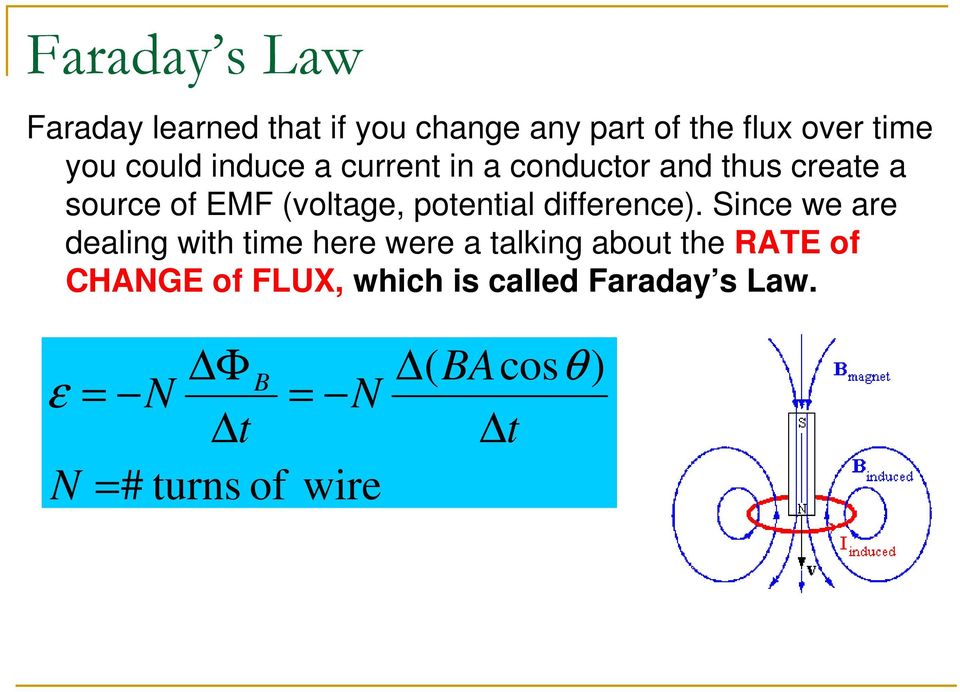
6 Faraday s Law Faraday learned that if you change any part of the flux over time you could induce a current in a conductor and thus create a source of EMF (voltage, potential difference). Since we are dealing with time here were a talking about the RATE of CHANGE of FLUX, which is called Faraday s Law. Φ B ( BAcosθ ) ε = N = N t t N = # turns of wire
7 Useful Applications The Forever Flashlight uses the Faraday Principle of Electromagnetic Energy to eliminate the need for batteries. The Faraday Principle states that if an electric conductor, like copper wire, is moved through a magnetic field, electric current will be generated and flow into the conductor.

8 Useful Applications AC Generators use Faraday s law to produce rotation and thus convert electrical and magnetic energy into rotational kinetic energy. This idea can be used to run all kinds of motors. Since the current in the coil is AC, it is turning on and off thus creating a CHANGING magnetic field of its own. Its own magnetic field interferes with the shown magnetic field to produce rotation.

9 Transformers Probably one of the greatest inventions of all time is the transformer. AC Current from the primary coil moves quickly BACK and FORTH (thus the idea of changing!) across the secondary coil. The moving magnetic field caused by the changing field (flux) induces a current in the secondary coil. If the secondary coil has MORE turns than the primary you can step up the voltage and runs devices that would normally need MORE voltage than what you have coming in. We call this a STEP UP transformer. We can use this idea in reverse as well to create a STEP DOWN transformer.

10 Microphones A microphone works when sound waves enter the filter of a microphone. Inside the filter, a diaphragm is vibrated by the sound waves which in turn moves a coil of wire wrapped around a magnet. The movement of the wire in the magnetic field induces a current in the wire. Thus sound waves can be turned into electronic signals and then amplified through a speaker.

11 Example A coil with 200 turns of wire is wrapped on an 18.0 cm square frame. Each turn has the same area, equal to that of the frame, and the total resistance of the coil is 2.0Ω. A uniform magnetic field is applied perpendicularly to the plane of the coil. If the field changes uniformly from 0 to T in 0.80 s, find the magnitude of the induced emf in the coil while the field has changed as well as the magnitude of the induced current. Φ B BAcosθ ε = N = N t t ( )(0.18x0.18)cos90 ε = ε = 4.05 V Why did you find the ABSOLUTE VALUE of the EMF? What happened to the that was there originally? ε = I = IR = I(2) 2.03 A

12 Lenz s Law Lenz's law gives the direction of the induced emf and current resulting from electromagnetic induction. The law provides a physical interpretation of the choice of sign in Faraday's law of induction, indicating that the induced emf and the change in flux have opposite signs. Lenz s Law ε = N Φ t B In the figure above, we see that the direction of the current changes. Lenz s Law helps us determine the DIRECTION of that current.

13 Lenz s Law & Faraday s Law ε = N Φ t Let s consider a magnet with it s north pole moving TOWARDS a conducting loop. B DOES THE FLUX CHANGE? Yes! B induced DOES THE FLUX INCREASE OR DECREASE? Increase WHAT SIGN DOES THE GIVE YOU IN FARADAY S LAW? Positive DOES LENZ S LAW CANCEL OUT? What does this mean? This means that the INDUCED MAGNETIC FIELD around the WIRE caused by the moving magnet OPPOSES the original magnetic field. Since the original B field is downward, the induced field is upward! We then use the curling right hand rule to determine the direction of the current. NO

14 Lenz s Law The INDUCED current creates an INDUCED magnetic field of its own inside the conductor that opposes the original magnetic field. A magnet is dropped down a conducting tube. The magnet INDUCES a current above and below the magnet as it moves. Since the induced field opposes the direction of the original it attracts the magnet upward slowing the motion caused by gravity downward. If the motion of the magnet were NOT slowed this would violate conservation of energy!

15 Lenz s Law ε = N Φ t B Let s consider a magnet with it s north pole moving AWAY from a conducting loop. DOES THE FLUX CHANGE? Yes! DOES THE FLUX INCREASE OR DECREASE? Decreases WHAT SIGN DOES THE GIVE YOU IN FARADAY S LAW? negative DOES LENZ S LAW CANCEL OUT? yes B induced What does this mean? In this case, the induced field DOES NOT oppose the original and points in the same direction. Once again use your curled right hand rule to determine the DIRECTION of the current.

16 In summary Faraday s Law is basically used to find the MAGNITUDE of the induced EMF. The magnitude of the current can then be found using Ohm s Law provided we know the conductor s resistance. Lenz s Law is part of Faraday s Law and can help you determine the direction of the current provided you know HOW the flux is changing


17 Motional EMF The Rail Gun A railgun consists of two parallel metal rails (hence the name) connected to an electrical power supply. When a conductive projectile is inserted between the rails (from the end connected to the power supply), it completes the circuit. Electrons flow from the negative terminal of the power supply up the negative rail, across the projectile, and down the positive rail, back to the power supply. In accordance with the right-hand rule, the magnetic field circulates around each conductor. Since the current is in opposite direction along each rail, the net magnetic field between the rails (B) is directed vertically. In combination with the current (I) across the projectile, this produces a magnetic force which accelerates the projectile along the rails. There are also forces acting on the rails attempting to push them apart, but since the rails are firmly mounted, they cannot move. The projectile slides up the rails away from the end with the power supply.

18 Motional Emf There are many situations where motional EMF can occur that are different from the rail gun. Suppose a bar of length, L, is pulled to right at a speed, v, in a magnetic field, B, directed into the page. The conducting rod itself completes a circuit across a set of parallel conducting rails with a resistor mounted between them. Φ B ε = N t BA Blx ε = ; t t ε = IR I = Blv R ε = Blv

19 Motional EMF In the figure, we are applying a force this time to the rod. Due to Lenz s Law the magnetic force opposes the applied force. Since we know that the magnetic force acts to the left and the magnetic field acts into the page, we can use the RHR to determine the direction of the current around the loop and the resistor.

20 Example An airplane with a wing span of 30.0 m flies parallel to the Earth s surface at a location where the downward component of the Earth s magnetic field is 0.60 x10⁻⁴ T. Find the difference in potential between the wing tips is the speed of the plane is 250 m/s. ε = ε = ε = Blv 0.60x V 4 (30)(250) In 1996, NASA conducted an experiment with a 20,000-meter conducting tether. When the tether was fully deployed during this test, the orbiting tether generated a potential of 3,500 volts. This conducting single-line tether was severed after five hours of deployment. It is believed that the failure was caused by an electric arc generated by the conductive tether's movement through the Earth's magnetic field.

Induced voltages and Inductance Faraday s Law
 Induced voltages and Inductance Faraday s Law concept #1, 4, 5, 8, 13 Problem # 1, 3, 4, 5, 6, 9, 10, 13, 15, 24, 23, 25, 31, 32a, 34, 37, 41, 43, 51, 61 Last chapter we saw that a current produces a magnetic
Direction of Induced Current
 Direction of Induced Current Bar magnet moves through coil Current induced in coil A S N v Reverse pole Induced current changes sign B N S v v Coil moves past fixed bar magnet Current induced in coil as
The purposes of this experiment are to test Faraday's Law qualitatively and to test Lenz's Law.
 260 17-1 I. THEORY EXPERIMENT 17 QUALITATIVE STUDY OF INDUCED EMF Along the extended central axis of a bar magnet, the magnetic field vector B r, on the side nearer the North pole, points away from this
1. The diagram below represents magnetic lines of force within a region of space.
 1. The diagram below represents magnetic lines of force within a region of space. 4. In which diagram below is the magnetic flux density at point P greatest? (1) (3) (2) (4) The magnetic field is strongest
Force on Moving Charges in a Magnetic Field
 [ Assignment View ] [ Eðlisfræði 2, vor 2007 27. Magnetic Field and Magnetic Forces Assignment is due at 2:00am on Wednesday, February 28, 2007 Credit for problems submitted late will decrease to 0% after
Magnetism Basics. Magnetic Domains: atomic regions of aligned magnetic poles Random Alignment Ferromagnetic Alignment. Net Effect = Zero!
 Magnetism Basics Source: electric currents Magnetic Domains: atomic regions of aligned magnetic poles Random Alignment Ferromagnetic Alignment Net Effect = Zero! Net Effect = Additive! Bipolar: all magnets
Introduction to Electricity & Magnetism. Dr Lisa Jardine-Wright Cavendish Laboratory
 Introduction to Electricity & Magnetism Dr Lisa Jardine-Wright Cavendish Laboratory Examples of uses of electricity Christmas lights Cars Electronic devices Human body Electricity? Electricity is the presence
Chapter 22: Electric motors and electromagnetic induction
 Chapter 22: Electric motors and electromagnetic induction The motor effect movement from electricity When a current is passed through a wire placed in a magnetic field a force is produced which acts on
45. The peak value of an alternating current in a 1500-W device is 5.4 A. What is the rms voltage across?
 PHYS Practice Problems hapters 8- hapter 8. 45. The peak value of an alternating current in a 5-W device is 5.4 A. What is the rms voltage across? The power and current can be used to find the peak voltage,
104 Practice Exam 2-3/21/02
 104 Practice Exam 2-3/21/02 1. Two electrons are located in a region of space where the magnetic field is zero. Electron A is at rest; and electron B is moving westward with a constant velocity. A non-zero
PHYS 222 Spring 2012 Final Exam. Closed books, notes, etc. No electronic device except a calculator.
 PHYS 222 Spring 2012 Final Exam Closed books, notes, etc. No electronic device except a calculator. NAME: (all questions with equal weight) 1. If the distance between two point charges is tripled, the
Physics 121 Sample Common Exam 3 NOTE: ANSWERS ARE ON PAGE 6. Instructions: 1. In the formula F = qvxb:
 Physics 121 Sample Common Exam 3 NOTE: ANSWERS ARE ON PAGE 6 Signature Name (Print): 4 Digit ID: Section: Instructions: Answer all questions 24 multiple choice questions. You may need to do some calculation.
Magnetic Fields and Their Effects
 Name Date Time to Complete h m Partner Course/ Section / Grade Magnetic Fields and Their Effects This experiment is intended to give you some hands-on experience with the effects of, and in some cases
Candidate Number. General Certificate of Education Advanced Level Examination June 2010
 entre Number andidate Number Surname Other Names andidate Signature General ertificate of Education dvanced Level Examination June 1 Physics PHY4/1 Unit 4 Fields and Further Mechanics Section Friday 18
Motor Fundamentals. DC Motor
 Motor Fundamentals Before we can examine the function of a drive, we must understand the basic operation of the motor. It is used to convert the electrical energy, supplied by the controller, to mechanical
Inductors & Inductance. Electronic Components
 Electronic Components Induction In 1824, Oersted discovered that current passing though a coil created a magnetic field capable of shifting a compass needle. Seven years later, Faraday and Henry discovered
Conceptual: 1, 3, 5, 6, 8, 16, 18, 19. Problems: 4, 6, 8, 11, 16, 20, 23, 27, 34, 41, 45, 56, 60, 65. Conceptual Questions
 Conceptual: 1, 3, 5, 6, 8, 16, 18, 19 Problems: 4, 6, 8, 11, 16, 20, 23, 27, 34, 41, 45, 56, 60, 65 Conceptual Questions 1. The magnetic field cannot be described as the magnetic force per unit charge
PS-6.2 Explain the factors that determine potential and kinetic energy and the transformation of one to the other.
 PS-6.1 Explain how the law of conservation of energy applies to the transformation of various forms of energy (including mechanical energy, electrical energy, chemical energy, light energy, sound energy,
AP2 Magnetism. (c) Explain why the magnetic field does no work on the particle as it moves in its circular path.
 A charged particle is projected from point P with velocity v at a right angle to a uniform magnetic field directed out of the plane of the page as shown. The particle moves along a circle of radius R.
Magnetism. d. gives the direction of the force on a charge moving in a magnetic field. b. results in negative charges moving. clockwise.
 Magnetism 1. An electron which moves with a speed of 3.0 10 4 m/s parallel to a uniform magnetic field of 0.40 T experiences a force of what magnitude? (e = 1.6 10 19 C) a. 4.8 10 14 N c. 2.2 10 24 N b.
Physics 25 Exam 3 November 3, 2009
 1. A long, straight wire carries a current I. If the magnetic field at a distance d from the wire has magnitude B, what would be the the magnitude of the magnetic field at a distance d/3 from the wire,
Chapter 22 Magnetism
 22.6 Electric Current, Magnetic Fields, and Ampere s Law Chapter 22 Magnetism 22.1 The Magnetic Field 22.2 The Magnetic Force on Moving Charges 22.3 The Motion of Charged particles in a Magnetic Field
Faraday s Law of Induction
 Chapter 10 Faraday s Law of Induction 10.1 Faraday s Law of Induction...10-10.1.1 Magnetic Flux...10-3 10.1. Lenz s Law...10-5 10. Motional EMF...10-7 10.3 Induced Electric Field...10-10 10.4 Generators...10-1
TEACHER S CLUB EXAMS GRADE 11. PHYSICAL SCIENCES: PHYSICS Paper 1
 TEACHER S CLUB EXAMS GRADE 11 PHYSICAL SCIENCES: PHYSICS Paper 1 MARKS: 150 TIME: 3 hours INSTRUCTIONS AND INFORMATION 1. This question paper consists of 12 pages, two data sheets and a sheet of graph
Phys222 Winter 2012 Quiz 4 Chapters 29-31. Name
 Name If you think that no correct answer is provided, give your answer, state your reasoning briefly; append additional sheet of paper if necessary. 1. A particle (q = 5.0 nc, m = 3.0 µg) moves in a region
Chapter 7. Magnetism and Electromagnetism ISU EE. C.Y. Lee
 Chapter 7 Magnetism and Electromagnetism Objectives Explain the principles of the magnetic field Explain the principles of electromagnetism Describe the principle of operation for several types of electromagnetic
Linear DC Motors. 15.1 Magnetic Flux. 15.1.1 Permanent Bar Magnets
 Linear DC Motors The purpose of this supplement is to present the basic material needed to understand the operation of simple DC motors. This is intended to be used as the reference material for the linear
Electromagnetic Induction: Faraday's Law
 1 Electromagnetic Induction: Faraday's Law OBJECTIVE: To understand how changing magnetic fields can produce electric currents. To examine Lenz's Law and the derivative form of Faraday's Law. EQUIPMENT:
Physics 112 Homework 5 (solutions) (2004 Fall) Solutions to Homework Questions 5
 Solutions to Homework Questions 5 Chapt19, Problem-2: (a) Find the direction of the force on a proton (a positively charged particle) moving through the magnetic fields in Figure P19.2, as shown. (b) Repeat
DIRECT CURRENT GENERATORS
 DIRECT CURRENT GENERATORS Revision 12:50 14 Nov 05 INTRODUCTION A generator is a machine that converts mechanical energy into electrical energy by using the principle of magnetic induction. This principle
DC generator theory. Resources and methods for learning about these subjects (list a few here, in preparation for your research):
 DC generator theory This worksheet and all related files are licensed under the Creative Commons Attribution License, version 1.0. To view a copy of this license, visit http://creativecommons.org/licenses/by/1.0/,
Magnetic Field and Magnetic Forces
 Chapter 27 Magnetic Field and Magnetic Forces PowerPoint Lectures for University Physics, Thirteenth Edition Hugh D. Young and Roger A. Freedman Lectures by Wayne Anderson Goals for Chapter 27 Magnets
Inductance. Motors. Generators
 Inductance Motors Generators Self-inductance Self-inductance occurs when the changing flux through a circuit arises from the circuit itself. As the current increases, the magnetic flux through a loop due
Objectives. Capacitors 262 CHAPTER 5 ENERGY
 Objectives Describe a capacitor. Explain how a capacitor stores energy. Define capacitance. Calculate the electrical energy stored in a capacitor. Describe an inductor. Explain how an inductor stores energy.
Lesson 3 DIRECT AND ALTERNATING CURRENTS. Task. The skills and knowledge taught in this lesson are common to all missile repairer tasks.
 Lesson 3 DIRECT AND ALTERNATING CURRENTS Task. The skills and knowledge taught in this lesson are common to all missile repairer tasks. Objectives. When you have completed this lesson, you should be able
MULTIPLE CHOICE. Choose the one alternative that best completes the statement or answers the question.
 MULTIPLE CHOICE. Choose the one alternative that best completes the statement or answers the question. 1) If the voltage at a point in space is zero, then the electric field must be A) zero. B) positive.
Think About This How do the generators located inside the dam convert the kinetic and potential energy of the water into electric energy?
 What You ll Learn You will describe how changing magnetic fields can generate electric potential differences. You will apply this phenomenon to the construction of generators and transformers. Why It s
Scott Hughes 7 April 2005. Massachusetts Institute of Technology Department of Physics 8.022 Spring 2005. Lecture 15: Mutual and Self Inductance.
 Scott Hughes 7 April 2005 151 Using induction Massachusetts nstitute of Technology Department of Physics 8022 Spring 2005 Lecture 15: Mutual and Self nductance nduction is a fantastic way to create EMF;
Physics 30 Worksheet #10 : Magnetism From Electricity
 Physics 30 Worksheet #10 : Magnetism From Electricity 1. Draw the magnetic field surrounding the wire showing electron current below. x 2. Draw the magnetic field surrounding the wire showing electron
Review Questions PHYS 2426 Exam 2
 Review Questions PHYS 2426 Exam 2 1. If 4.7 x 10 16 electrons pass a particular point in a wire every second, what is the current in the wire? A) 4.7 ma B) 7.5 A C) 2.9 A D) 7.5 ma E) 0.29 A Ans: D 2.
1. Units of a magnetic field might be: A. C m/s B. C s/m C. C/kg D. kg/c s E. N/C m ans: D
 Chapter 28: MAGNETIC FIELDS 1 Units of a magnetic field might be: A C m/s B C s/m C C/kg D kg/c s E N/C m 2 In the formula F = q v B: A F must be perpendicular to v but not necessarily to B B F must be
Magnetic Field of a Circular Coil Lab 12
 HB 11-26-07 Magnetic Field of a Circular Coil Lab 12 1 Magnetic Field of a Circular Coil Lab 12 Equipment- coil apparatus, BK Precision 2120B oscilloscope, Fluke multimeter, Wavetek FG3C function generator,
STUDY GUIDE: ELECTRICITY AND MAGNETISM
 319 S. Naperville Road Wheaton, IL 60187 www.questionsgalore.net Phone: (630) 580-5735 E-Mail: [email protected] Fax: (630) 580-5765 STUDY GUIDE: ELECTRICITY AND MAGNETISM An atom is made of three
Magnetism. Magnetism. Magnetic Fields and Magnetic Domains. Magnetic Fields and Magnetic Domains. Creating and Destroying a Magnet
 Magnetism Magnetism Opposite poles attract and likes repel Opposite poles attract and likes repel Like electric force, but magnetic poles always come in pairs (North, South) Like electric force, but magnetic
Objectives 200 CHAPTER 4 RESISTANCE
 Objectives Explain the differences among conductors, insulators, and semiconductors. Define electrical resistance. Solve problems using resistance, voltage, and current. Describe a material that obeys
DC GENERATOR THEORY. LIST the three conditions necessary to induce a voltage into a conductor.
 DC Generators DC generators are widely used to produce a DC voltage. The amount of voltage produced depends on a variety of factors. EO 1.5 LIST the three conditions necessary to induce a voltage into
Chapter 10. Faraday s Law of Induction
 10 10 10-0 Chapter 10 Faraday s Law of Induction 10.1 Faraday s Law of Induction... 10-3 10.1.1 Magnetic Flux... 10-5 10.2 Motional EMF... 10-5 10.3 Faraday s Law (see also Faraday s Law Simulation in
General Physics (PHY 2140)
 General Physics (PHY 2140) Lecture 12 Electricity and Magnetism Magnetism Magnetic fields and force Application of magnetic forces http://www.physics.wayne.edu/~apetrov/phy2140/ Chapter 19 1 Department
physics 112N magnetic fields and forces
 physics 112N magnetic fields and forces bar magnet & iron filings physics 112N 2 bar magnets physics 112N 3 the Earth s magnetic field physics 112N 4 electro -magnetism! is there a connection between electricity
AC generator theory. Resources and methods for learning about these subjects (list a few here, in preparation for your research):
 AC generator theory This worksheet and all related files are licensed under the Creative Commons Attribution License, version 1.0. To view a copy of this license, visit http://creativecommons.org/licenses/by/1.0/,
CHAPTER - 1. Chapter ONE: WAVES CHAPTER - 2. Chapter TWO: RAY OPTICS AND OPTICAL INSTRUMENTS. CHAPTER - 3 Chapter THREE: WAVE OPTICS PERIODS PERIODS
 BOARD OF INTERMEDIATE EDUCATION, A.P., HYDERABAD REVISION OF SYLLABUS Subject PHYSICS-II (w.e.f 2013-14) Chapter ONE: WAVES CHAPTER - 1 1.1 INTRODUCTION 1.2 Transverse and longitudinal waves 1.3 Displacement
Candidate Number. General Certificate of Education Advanced Level Examination June 2012
 entre Number andidate Number Surname Other Names andidate Signature General ertificate of Education dvanced Level Examination June 212 Physics PHY4/1 Unit 4 Fields and Further Mechanics Section Monday
Chapter 30 - Magnetic Fields and Torque. A PowerPoint Presentation by Paul E. Tippens, Professor of Physics Southern Polytechnic State University
 Chapter 30 - Magnetic Fields and Torque A PowerPoint Presentation by Paul E. Tippens, Professor of Physics Southern Polytechnic State University 2007 Objectives: After completing this module, you should
ELECTRODYNAMICS 05 AUGUST 2014
 ELECTRODYNAMICS 05 AUGUST 2014 In this lesson we: Lesson Description Discuss the motor effect Discuss how generators and motors work. Summary The Motor Effect In order to realise the motor effect, the
Chapter 27 Magnetic Field and Magnetic Forces
 Chapter 27 Magnetic Field and Magnetic Forces - Magnetism - Magnetic Field - Magnetic Field Lines and Magnetic Flux - Motion of Charged Particles in a Magnetic Field - Applications of Motion of Charged
CLASS TEST GRADE 11. PHYSICAL SCIENCES: PHYSICS Test 3: Electricity and magnetism
 CLASS TEST GRADE 11 PHYSICAL SCIENCES: PHYSICS Test 3: Electricity and magnetism MARKS: 45 TIME: 1 hour INSTRUCTIONS AND INFORMATION 1. Answer ALL the questions. 2. You may use non-programmable calculators.
Aircraft Electrical System
 Chapter 9 Aircraft Electrical System Introduction The satisfactory performance of any modern aircraft depends to a very great degree on the continuing reliability of electrical systems and subsystems.
Principles and Working of DC and AC machines
 BITS Pilani Dubai Campus Principles and Working of DC and AC machines Dr Jagadish Nayak Constructional features BITS Pilani Dubai Campus DC Generator A generator consists of a stationary portion called
Candidate Number. General Certificate of Education Advanced Level Examination June 2014
 entre Number andidate Number Surname Other Names andidate Signature General ertificate of Education dvanced Level Examination June 214 Physics PHY4/1 Unit 4 Fields and Further Mechanics Section Wednesday
Chapter 11. Inductors ISU EE. C.Y. Lee
 Chapter 11 Inductors Objectives Describe the basic structure and characteristics of an inductor Discuss various types of inductors Analyze series inductors Analyze parallel inductors Analyze inductive
Module P4.4 Electromagnetic induction
 F L E X I B L E L E A R N I N G A P P R O A C H T O P H Y S I C S Module P4.4 Electromagnetic induction 1 Opening items 1.1 Module introduction 1.2 Fast track questions 1.3 Ready to study? 2 Introducing
Physics 221 Experiment 5: Magnetic Fields
 Physics 221 Experiment 5: Magnetic Fields August 25, 2007 ntroduction This experiment will examine the properties of magnetic fields. Magnetic fields can be created in a variety of ways, and are also found
( )( 10!12 ( 0.01) 2 2 = 624 ( ) Exam 1 Solutions. Phy 2049 Fall 2011
 Phy 49 Fall 11 Solutions 1. Three charges form an equilateral triangle of side length d = 1 cm. The top charge is q = - 4 μc, while the bottom two are q1 = q = +1 μc. What is the magnitude of the net force
Chapter 21. Magnetic Forces and Magnetic Fields
 Chapter 21 Magnetic Forces and Magnetic Fields 21.1 Magnetic Fields The needle of a compass is permanent magnet that has a north magnetic pole (N) at one end and a south magnetic pole (S) at the other.
Sample Questions for the AP Physics 1 Exam
 Sample Questions for the AP Physics 1 Exam Sample Questions for the AP Physics 1 Exam Multiple-choice Questions Note: To simplify calculations, you may use g 5 10 m/s 2 in all problems. Directions: Each
Chapter 29 Electromagnetic Induction and Faraday s Law. Basis of generators Alternators, transformers Tape recording And computer memory
 Chapter 29 Electromagnetic Induction and Faraday s Law Basis of generators Alternators, transformers Tape recording And computer memory Some History In 1800 s (1820-21) it was found I produces B B exerts
2. A conductor of length 2m moves at 4m/s at 30 to a uniform magnetic field of 0.1T. Which one of the following gives the e.m.f. generated?
 Extra Questions - 2 1. A straight length of wire moves through a uniform magnetic field. The e.m.f. produced across the ends of the wire will be maximum if it moves: a) along the lines of magnetic flux
Practice final for Basic Physics spring 2005 answers on the last page Name: Date:
 Practice final for Basic Physics spring 2005 answers on the last page Name: Date: 1. A 12 ohm resistor and a 24 ohm resistor are connected in series in a circuit with a 6.0 volt battery. Assuming negligible
Electromagnetism Extra Study Questions Short Answer
 Electromagnetism Extra Study Questions Short Answer 1. The electrostatic force between two small charged objects is 5.0 10 5 N. What effect would each of the following changes have on the magnitude of
WORK DONE BY A CONSTANT FORCE
 WORK DONE BY A CONSTANT FORCE The definition of work, W, when a constant force (F) is in the direction of displacement (d) is W = Fd SI unit is the Newton-meter (Nm) = Joule, J If you exert a force of
The rate of change of velocity with respect to time. The average rate of change of distance/displacement with respect to time.
 H2 PHYSICS DEFINITIONS LIST Scalar Vector Term Displacement, s Speed Velocity, v Acceleration, a Average speed/velocity Instantaneous Velocity Newton s First Law Newton s Second Law Newton s Third Law
BASIC ELECTRONICS AC CIRCUIT ANALYSIS. December 2011
 AM 5-202 BASIC ELECTRONICS AC CIRCUIT ANALYSIS December 2011 DISTRIBUTION RESTRICTION: Approved for Pubic Release. Distribution is unlimited. DEPARTMENT OF THE ARMY MILITARY AUXILIARY RADIO SYSTEM FORT
The DC Motor. Physics 1051 Laboratory #5 The DC Motor
 The DC Motor Physics 1051 Laboratory #5 The DC Motor Contents Part I: Objective Part II: Introduction Magnetic Force Right Hand Rule Force on a Loop Magnetic Dipole Moment Torque Part II: Predictions Force
Circuits with inductors and alternating currents. Chapter 20 #45, 46, 47, 49
 Circuits with inductors and alternating currents Chapter 20 #45, 46, 47, 49 RL circuits Ch. 20 (last section) Symbol for inductor looks like a spring. An inductor is a circuit element that has a large
Chapter 19: Magnetic Forces and Fields
 Chapter 19: Magnetic Forces and Fields Magnetic Fields Magnetic Force on a Point Charge Motion of a Charged Particle in a Magnetic Field Crossed E and B fields Magnetic Forces on Current Carrying Wires
Simple Analysis for Brushless DC Motors Case Study: Razor Scooter Wheel Motor
 Simple Analysis for Brushless DC Motors Case Study: Razor Scooter Wheel Motor At first glance, a brushless direct-current (BLDC) motor might seem more complicated than a permanent magnet brushed DC motor,
AP Physics Electricity and Magnetism #4 Electrical Circuits, Kirchoff s Rules
 Name Period AP Physics Electricity and Magnetism #4 Electrical Circuits, Kirchoff s Rules Dr. Campbell 1. Four 240 Ω light bulbs are connected in series. What is the total resistance of the circuit? What
A Practical Guide to Free Energy Devices
 A Practical Guide to Free Energy Devices Part PatD9: Last updated: 28th January 2006 Author: Patrick J. Kelly Please note that this is a re-worded excerpt from this patent. If the content interests you,
Build A Simple Electric Motor (example #1)
 PHY115 Experiment 11 Build A Simple Electric Motor (example #1) MATERIAL This is the necessary equipment. Present any list of material in your written lab report. 1.5 V battery in series 1 ceramic magnet
Solution Derivations for Capa #11
 Solution Derivations for Capa #11 Caution: The symbol E is used interchangeably for energy and EMF. 1) DATA: V b = 5.0 V, = 155 Ω, L = 8.400 10 2 H. In the diagram above, what is the voltage across the
The University of the State of New York REGENTS HIGH SCHOOL EXAMINATION PHYSICAL SETTING PHYSICS. Tuesday, June 22, 2010 9:15 a.m. to 12:15 p.m.
 PS/PHYSICS The University of the State of New York REGENTS HIGH SCHOOL EXAMINATION PHYSICAL SETTING PHYSICS Tuesday, June 22, 2010 9:15 a.m. to 12:15 p.m., only The answers to all questions in this examination
A METHOD OF CALIBRATING HELMHOLTZ COILS FOR THE MEASUREMENT OF PERMANENT MAGNETS
 A METHOD OF CALIBRATING HELMHOLTZ COILS FOR THE MEASUREMENT OF PERMANENT MAGNETS Joseph J. Stupak Jr, Oersted Technology Tualatin, Oregon (reprinted from IMCSD 24th Annual Proceedings 1995) ABSTRACT The
Pre-lab Quiz/PHYS 224 Magnetic Force and Current Balance. Your name Lab section
 Pre-lab Quiz/PHYS 224 Magnetic Force and Current Balance Your name Lab section 1. What do you investigate in this lab? 2. Two straight wires are in parallel and carry electric currents in opposite directions
Preview of Period 16: Motors and Generators
 Preview of Period 16: Motors and Generators 16.1 DC Electric Motors What causes the rotor of a motor to spin? 16.2 Simple DC Motors What causes a changing magnetic field in the simple coil motor? 16.3
Experiment NO.3 Series and parallel connection
 Experiment NO.3 Series and parallel connection Object To study the properties of series and parallel connection. Apparatus 1. DC circuit training system 2. Set of wires. 3. DC Power supply 4. Digital A.V.O.
Electromagnetic Induction Experiment
 In this experiment, the activity will be based on a Phet simulation called Faraday s Electromagnetic Lab, created by a group at the University of Colorado at Boulder. This group has a number of good simulations
ELECTRIC FIELD LINES AND EQUIPOTENTIAL SURFACES
 ELECTRIC FIELD LINES AND EQUIPOTENTIAL SURFACES The purpose of this lab session is to experimentally investigate the relation between electric field lines of force and equipotential surfaces in two dimensions.
UNIT D ELECTRICAL PRINCIPLES & TECHNOLOGIES. Science 9
 UNIT D ELECTRICAL PRINCIPLES & TECHNOLOGIES Science 9 LEARNING GOALS Investigate and interpret devices that convert various forms of energy Describe technologies for the transfer and control of electrical
Quiz: Work and Energy
 Quiz: Work and Energy A charged particle enters a uniform magnetic field. What happens to the kinetic energy of the particle? (1) it increases (2) it decreases (3) it stays the same (4) it changes with
Basic Electrical Technology Dr. L. Umanand Department of Electrical Engineering Indian Institute of Science, Bangalore. Lecture - 33 3 phase System 4
 Basic Electrical Technology Dr. L. Umanand Department of Electrical Engineering Indian Institute of Science, Bangalore Lecture - 33 3 phase System 4 Hello everybody. So, in the last class we have been
Eðlisfræði 2, vor 2007
 [ Assignment View ] [ Print ] Eðlisfræði 2, vor 2007 30. Inductance Assignment is due at 2:00am on Wednesday, March 14, 2007 Credit for problems submitted late will decrease to 0% after the deadline has
TEACHER ANSWER KEY November 12, 2003. Phys - Vectors 11-13-2003
 Phys - Vectors 11-13-2003 TEACHER ANSWER KEY November 12, 2003 5 1. A 1.5-kilogram lab cart is accelerated uniformly from rest to a speed of 2.0 meters per second in 0.50 second. What is the magnitude
Magnetic Circuits. Outline. Ampere s Law Revisited Review of Last Time: Magnetic Materials Magnetic Circuits Examples
 Magnetic Circuits Outline Ampere s Law Revisited Review of Last Time: Magnetic Materials Magnetic Circuits Examples 1 Electric Fields Magnetic Fields S ɛ o E da = ρdv B V = Q enclosed S da =0 GAUSS GAUSS
Inductors. AC Theory. Module 3
 Module 3 AC Theory What you ll learn in Module 3. Section 3.1 Electromagnetic Induction. Magnetic Fields around Conductors. The Solenoid. Section 3.2 Inductance & Back e.m.f. The Unit of Inductance. Factors
 Last Name: First Name: Physics 102 Spring 2006: Exam #2 Multiple-Choice Questions 1. A charged particle, q, is moving with speed v perpendicular to a uniform magnetic field. A second identical charged
Ampere's Law. Introduction. times the current enclosed in that loop: Ampere's Law states that the line integral of B and dl over a closed path is 0
 1 Ampere's Law Purpose: To investigate Ampere's Law by measuring how magnetic field varies over a closed path; to examine how magnetic field depends upon current. Apparatus: Solenoid and path integral
CHAPTER 16 -- MAGNETIC FIELDS QUESTION & PROBLEM SOLUTIONS
 Solutions--Ch. 16 (Magnetic Fields) CHAPTER 16 -- MAGNETIC FIELDS QUESTION & PROBLEM SOLUTIONS 16.1) What is the symbol for a magnetic field? What are its units? Also, what are magnetic fields, really?
The University of the State of New York REGENTS HIGH SCHOOL EXAMINATION PHYSICAL SETTING PHYSICS. Friday, June 20, 2014 1:15 to 4:15 p.m.
 P.S./PHYSICS The University of the State of New York REGENTS HIGH SCHOOL EXAMINATION PHYSICAL SETTING PHYSICS Friday, June 20, 2014 1:15 to 4:15 p.m., only The possession or use of any communications device
6/2016 E&M forces-1/8 ELECTRIC AND MAGNETIC FORCES. PURPOSE: To study the deflection of a beam of electrons by electric and magnetic fields.
 6/016 E&M forces-1/8 ELECTRIC AND MAGNETIC FORCES PURPOSE: To study the deflection of a beam of electrons by electric and magnetic fields. APPARATUS: Electron beam tube, stand with coils, power supply,
Digital Energy ITI. Instrument Transformer Basic Technical Information and Application
 g Digital Energy ITI Instrument Transformer Basic Technical Information and Application Table of Contents DEFINITIONS AND FUNCTIONS CONSTRUCTION FEATURES MAGNETIC CIRCUITS RATING AND RATIO CURRENT TRANSFORMER