
Problem 1 (25 points)
|
|
|
- Ella Hunt
- 10 years ago
- Views:
Transcription
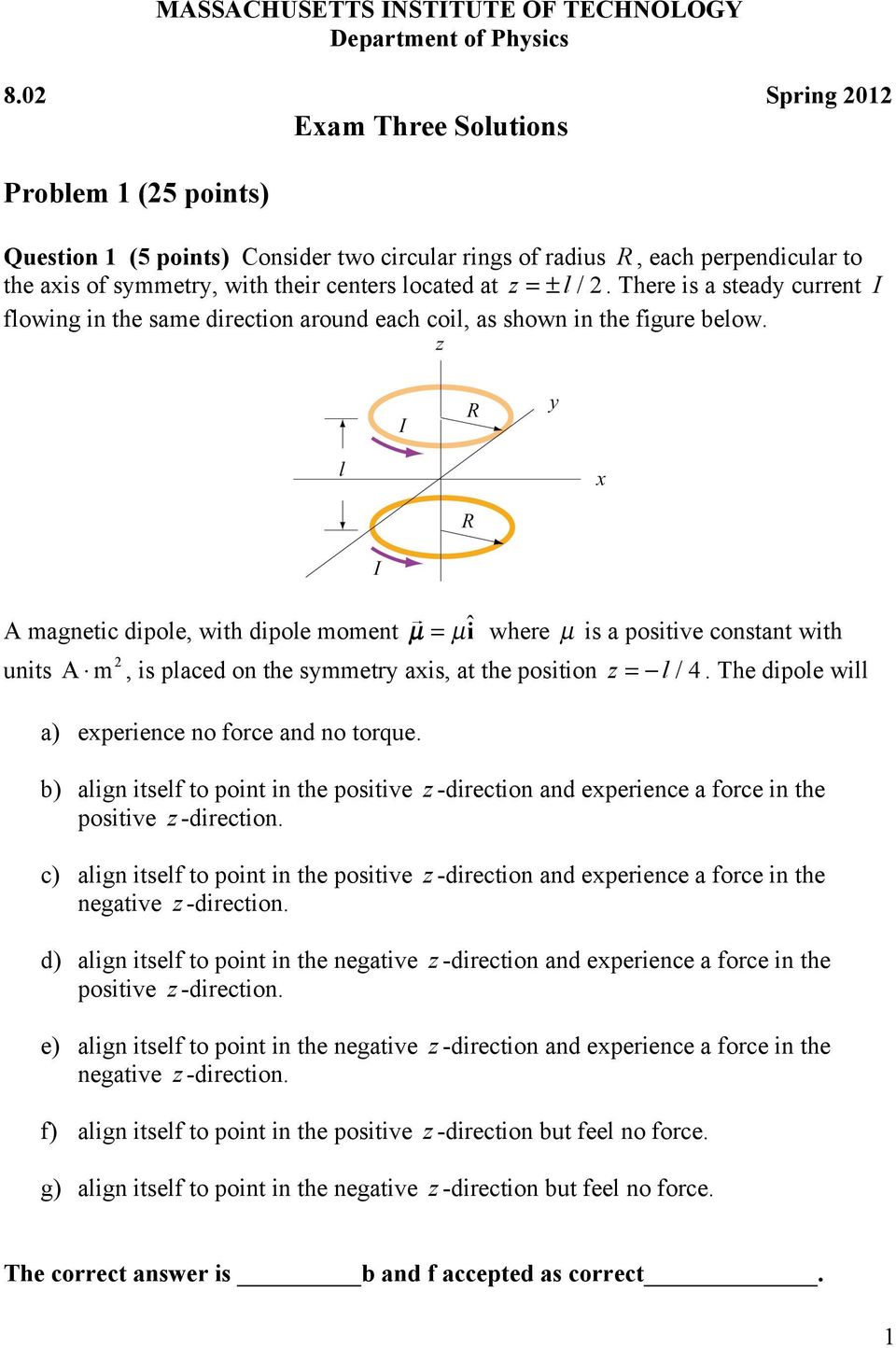
1 MASSACHUSETTS INSTITUTE OF TECHNOLOGY Department of Physics 8.02 Spring 2012 Exam Three Solutions Problem 1 (25 points) Question 1 (5 points) Consider two circular rings of radius R, each perpendicular to the axis of symmetry, with their centers located at z = ± l / 2. There is a steady current I flowing in the same direction around each coil, as shown in the figure below. A magnetic dipole, with dipole moment µ = µî where µ is a positive constant with units A m 2, is placed on the symmetry axis, at the position z = l / 4. The dipole will a) experience no force and no torque. b) align itself to point in the positive z -direction and experience a force in the positive z -direction. c) align itself to point in the positive z -direction and experience a force in the negative z -direction. d) align itself to point in the negative z -direction and experience a force in the positive z -direction. e) align itself to point in the negative z -direction and experience a force in the negative z -direction. f) align itself to point in the positive z -direction but feel no force. g) align itself to point in the negative z -direction but feel no force. The correct answer is b and f accepted as correct. 1
2 Question 2 (5 points) A square wire loop rotates in the direction shown (see sketch) in a magnetic field directed to the right. At the instant shown, when 0 < θ < π / 2, which of the figures below best describes the direction of current in the square wire loop and the direction of the magnetic torque on the square wire loop? The correct answer is c. At the instant shown the flux is increasing (in the ˆn -direction) so there is a clockwise induced current to oppose that change. Therefore the magnetic dipole vector points in the negative ˆn-direction. The torque τ = µ B ext is therefore in the positive z -direction. 2

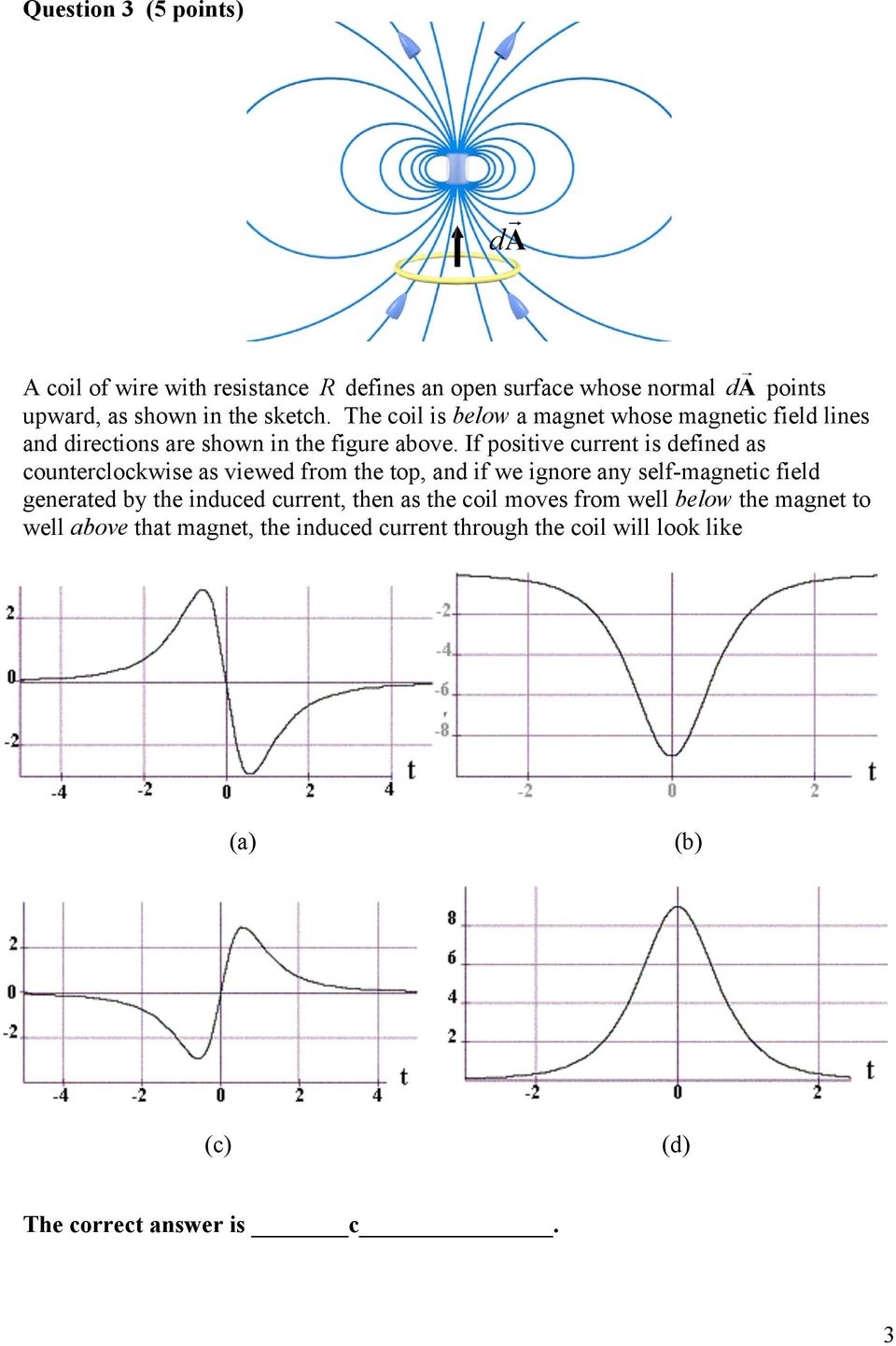
3 Question 3 (5 points) A coil of wire with resistance R defines an open surface whose normal d A points upward, as shown in the sketch. The coil is below a magnet whose magnetic field lines and directions are shown in the figure above. If positive current is defined as counterclockwise as viewed from the top, and if we ignore any self-magnetic field generated by the induced current, then as the coil moves from well below the magnet to well above that magnet, the induced current through the coil will look like (a) (b) (c) (d) The correct answer is c. 3
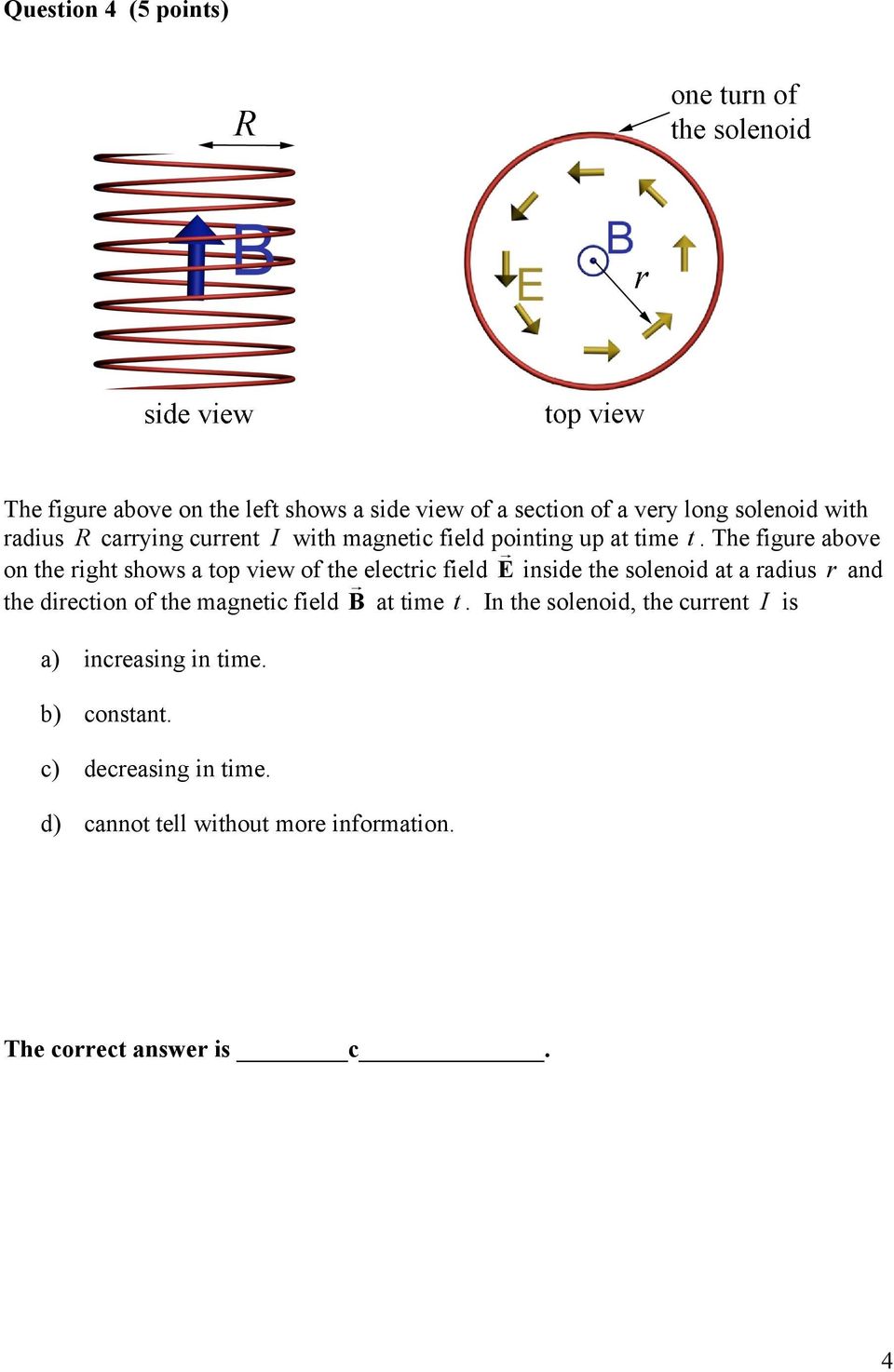
4 Question 4 (5 points) The figure above on the left shows a side view of a section of a very long solenoid with radius R carrying current I with magnetic field pointing up at time t. The figure above on the right shows a top view of the electric field E inside the solenoid at a radius r and the direction of the magnetic field B at time t. In the solenoid, the current I is a) increasing in time. b) constant. c) decreasing in time. d) cannot tell without more information. The correct answer is c. 4
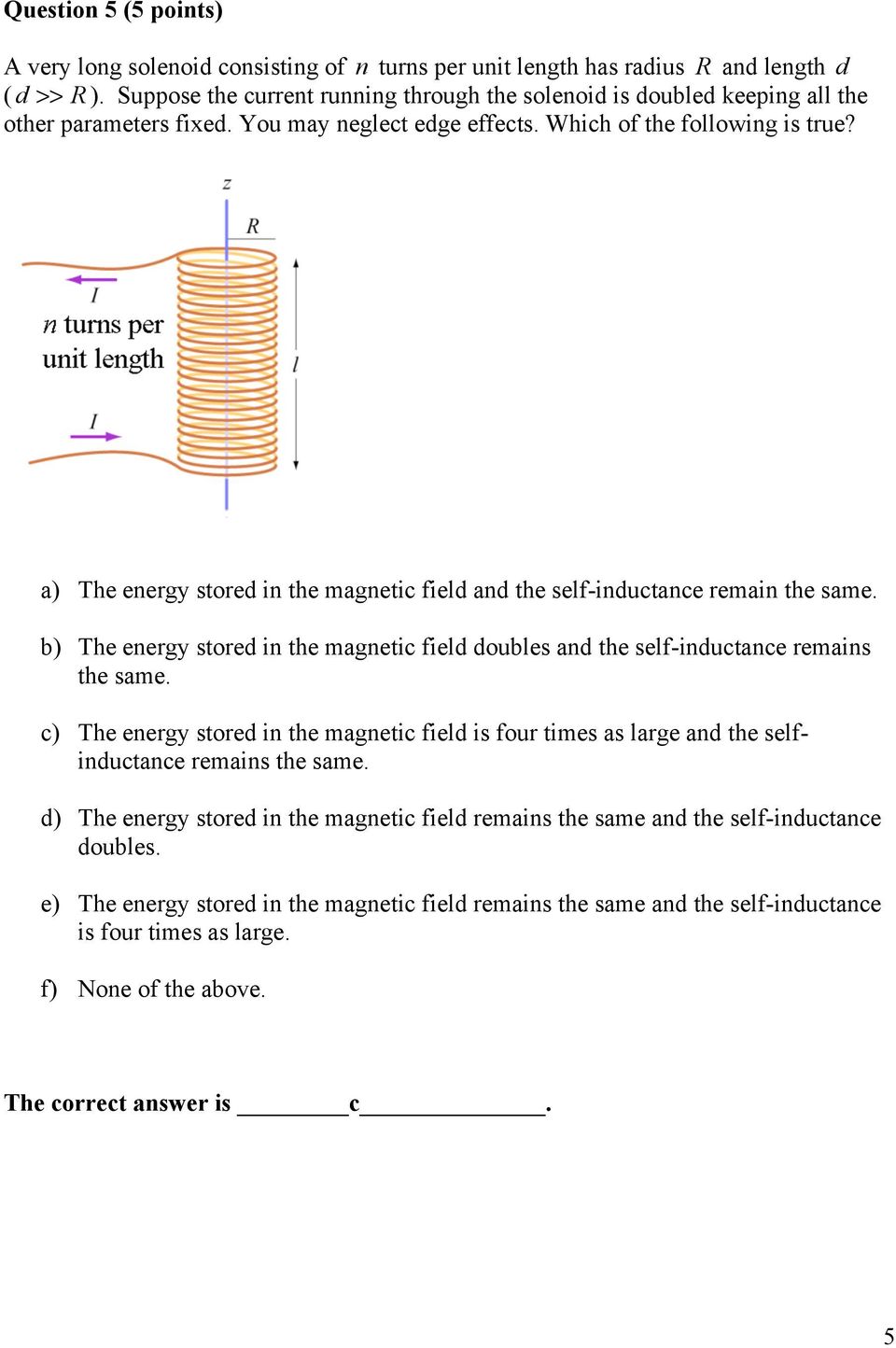
5 Question 5 (5 points) A very long solenoid consisting of n turns per unit length has radius R and length d ( d >> R ). Suppose the current running through the solenoid is doubled keeping all the other parameters fixed. You may neglect edge effects. Which of the following is true? a) The energy stored in the magnetic field and the self-inductance remain the same. b) The energy stored in the magnetic field doubles and the self-inductance remains the same. c) The energy stored in the magnetic field is four times as large and the selfinductance remains the same. d) The energy stored in the magnetic field remains the same and the self-inductance doubles. e) The energy stored in the magnetic field remains the same and the self-inductance is four times as large. f) None of the above. The correct answer is c. 5
6 Problem 2 (25 points) NOTE: YOU MUST SHOW WORK in order to get any credit for this problem. Make it clear to us that you understand what you are doing (use a few words!) A very long coaxial cable consists of a solid cylindrical inner conductor of radius a, surrounded by a concentric cylindrical conducting shell of inner radius b and outer radius c. The inner conductor has a non-uniform current density J inner = αr ˆk (pointing to the left in the figure just below) where α is a positive constant with units A m -3. The outer conductor has a uniform current density J outer = β ˆk where β is a positive constant with units A m -2. The conductors carry equal and opposite currents of magnitude I 0. a) Find expressions for α and β in terms of a, b, c, and I 0. For current through 0 < r < a, For current through b< r < c, a J ˆn da = I o = 2πr dr αr S 0 ( ) c J ˆn da = I o = 2πr dr ( β ) = βπ c 2 b 2 S b = 2πα 3 a3 α = 3 I o 2π a 3 ( ) β = I o π c 2 b 2 ( ) b) Determine the magnitude and direction of the magnetic field for the regions (i) r < a, (ii) a < r < b, (iii) b < r < c, (iv) and r > c. For each region, redraw the coaxial cable clearly indicating your choice of Amperian loop and associated parameters. For r < a, loop is circle of radius r < a, and 6
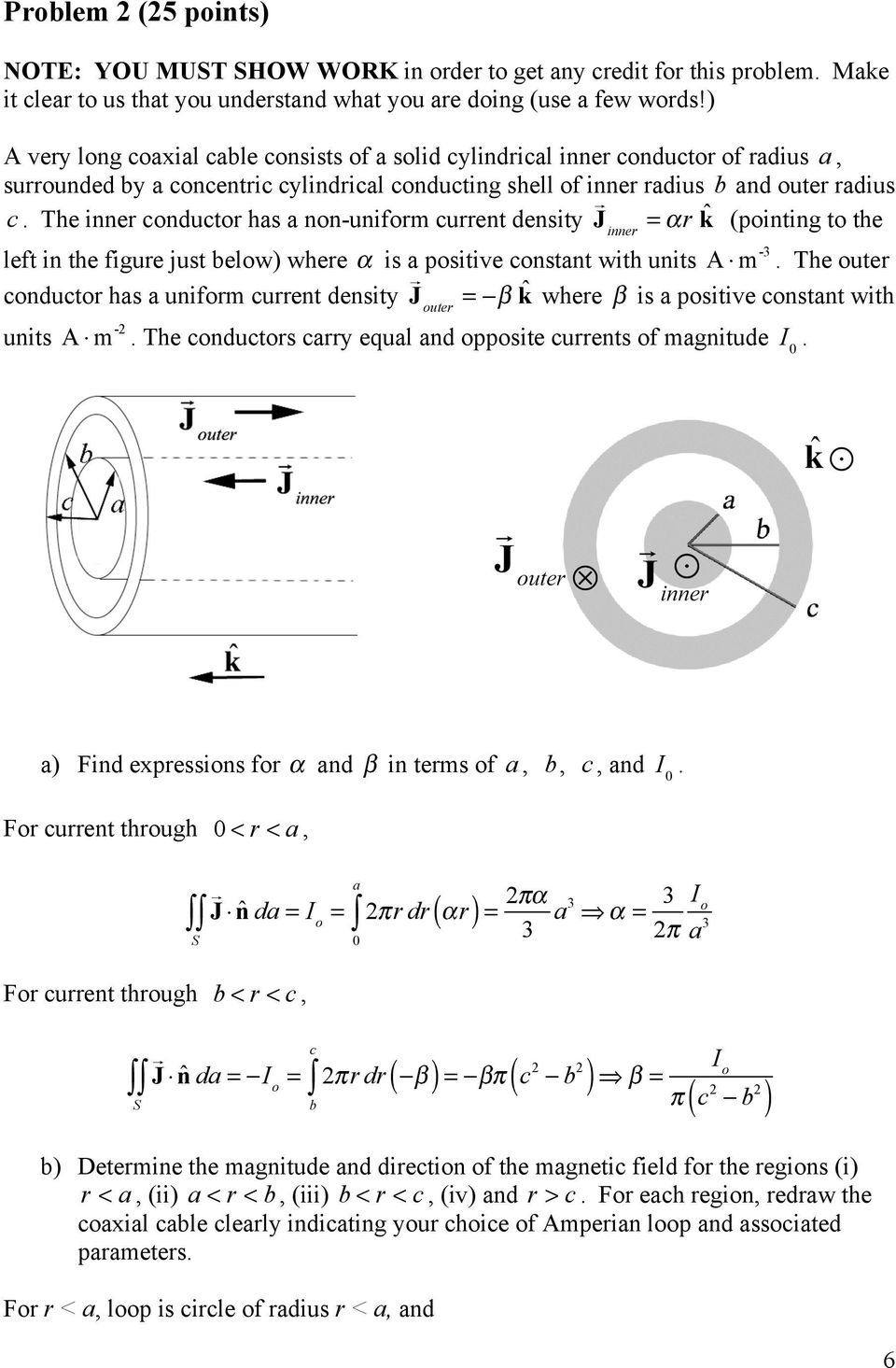
7 B d s = 2πrB θ = µ 0 J ˆn da closed path = µ 0 2π S r 0 r d r α r ( ) = 2π 3 αr 3 2 ˆ αr B = θ µ where ˆθ is a unit vector oriented counterclockwise. 0 3 For a<r < b, loop is circle of radius a<r < b, and B d s = 2πrB θ = µ 0 J ˆn da closed path where ˆθ is a unit vector oriented clockwise. = µ 0 I 0 S ˆ µ B = θ 2π r 0I o For b<r < c, loop is circle of radius b<r < c, and closed path B d s = 2πrB θ = µ 0 I o 1 β 2π I o ˆ µ 0I o β B = θ 1 π 2π r Io r b r d r = µ I 1 β π r 2 b 2 0 o ( ) I o 2 2 ( r b ) where ˆθ is a unit vector oriented counterclockwise. This can be written using the results above as For c<r, loop is circle of radius c<r, and 2 2 ( c r ) 2 2 ( ) ˆ µ 0Io B = θ 2π r c b B d s = 2πrB θ = 0 closed path c) Make a graph of the magnitude of the magnetic field as a function of the distance r from the central axis of symmetry. Clearly label each axis with any relevant values. 7
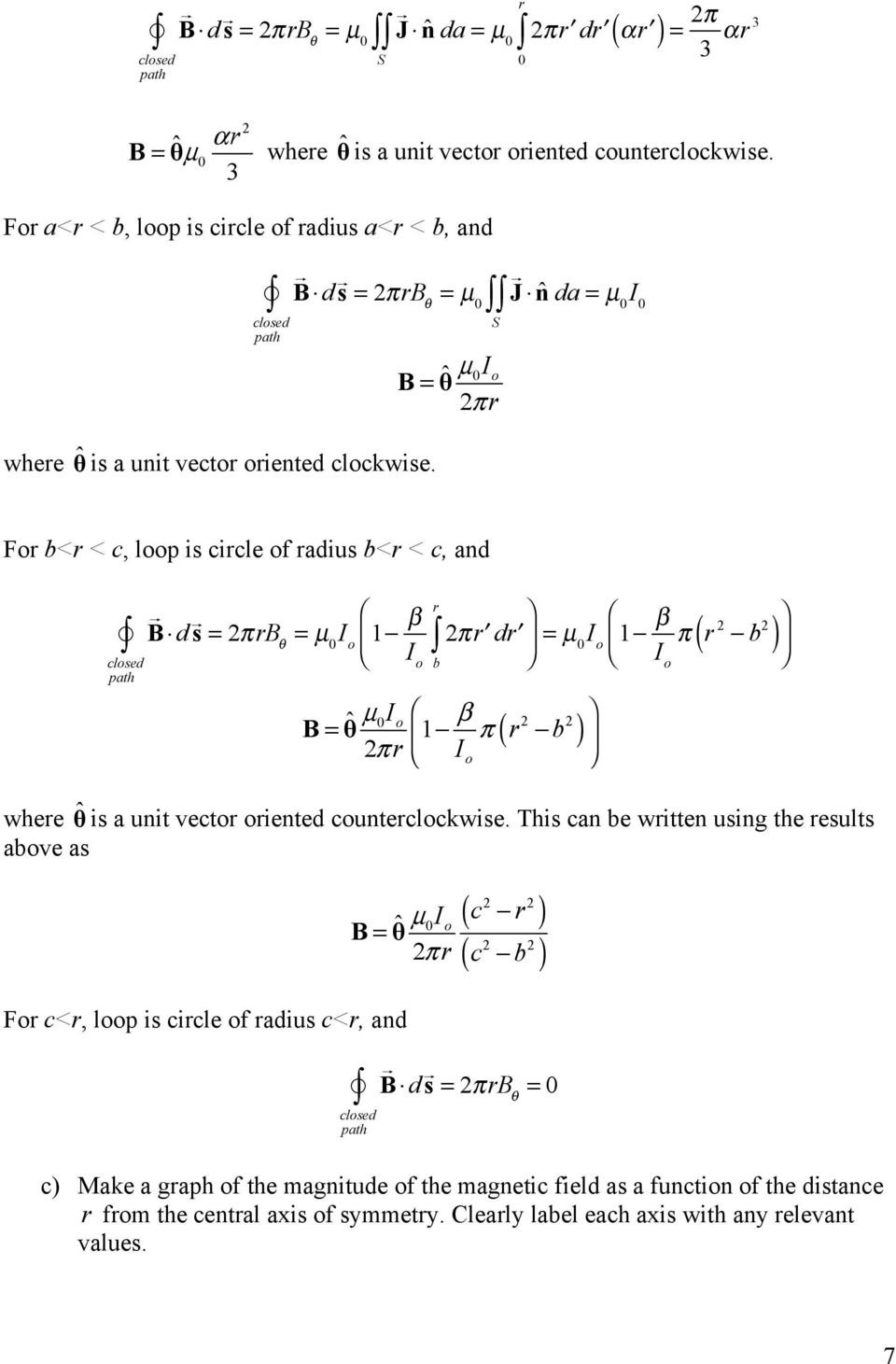
8 µ 0I The graph is a concave upward parabola from 0 to a, rising to a value of o at r = a. 2π a µ 0I Then it goes as inverse r from a to b, decreasing to o at r = b. Then it decreases from 2π b its value at r = b to 0 as we move from b to c. It is zero thereafter. 8
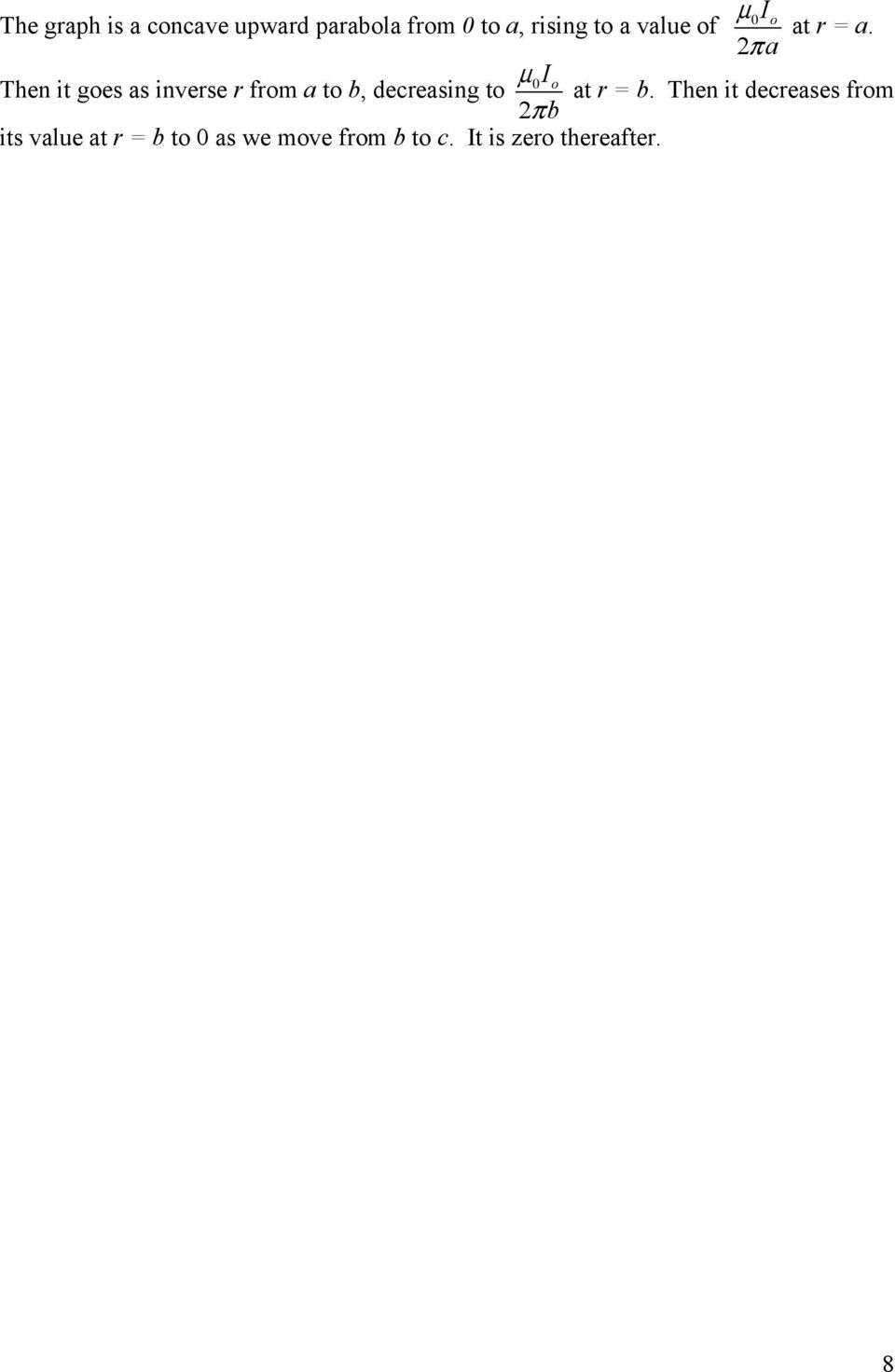
9 Problem 3 (25 points) NOTE: YOU MUST SHOW WORK in order to get any credit for this problem. Make it clear to us that you understand what you are doing (use a few words!). Consider a slab that is infinite in the x and z directions that has thickness d in the y- direction. The slab has a time varying current with the current density as a function of time given by the following expression: 0; t 0 J = (J e t / T ) ˆk; 0 t T, J e ˆk; T t where J e is positive constant with units of amps per square meter and T is a constant with units of seconds. a) Find the direction and magnitude of the magnetic field for the interval 0 t T in the regions: (i) 0 y d / 2 ; (ii) y d / 2. Clearly show all your work. Answers without justification will receive no credit. 0 y d / 2 : By symmetry we argue that the field is zero at y = 0. We take an Amperean loop whose bottom is at y = 0 and whose top is at 0 y d / 2, of width w. We have closed path B d s = wb x = µ 0 J ˆn da = µ 0 wy(j e t / T ) B = ˆxµ 0 y(j e t / T ) S d /2 y: We take an Amperean loop whose bottom is at y = 0 and whose top is at d /2 y, of width w. We have closed path B d s = wb x ( y) = µ 0 J ˆn da = µ 0 w d 2 (J e t / T ) B = ˆxµ 0 S d 2 (J e t / T ) 9
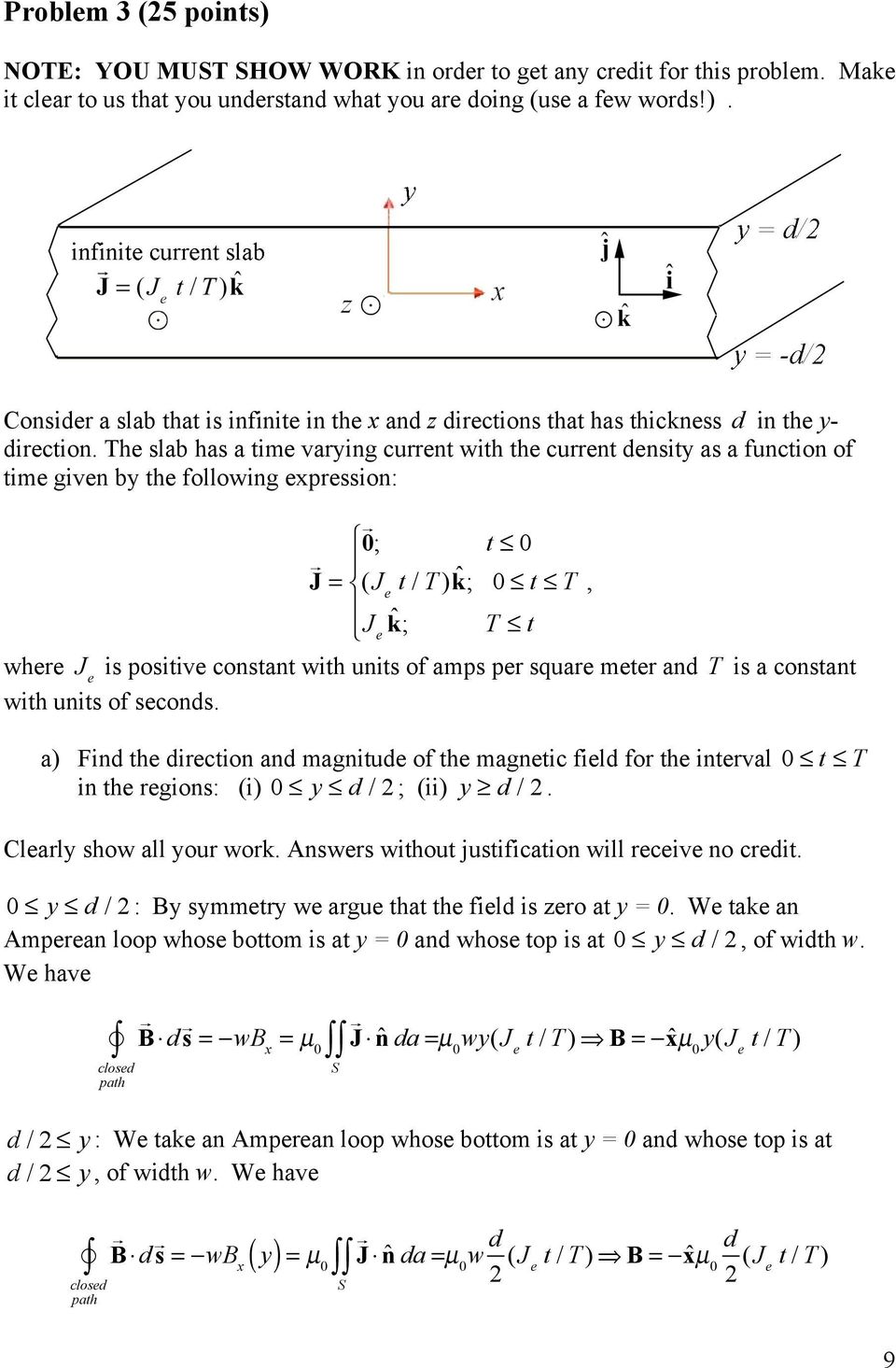
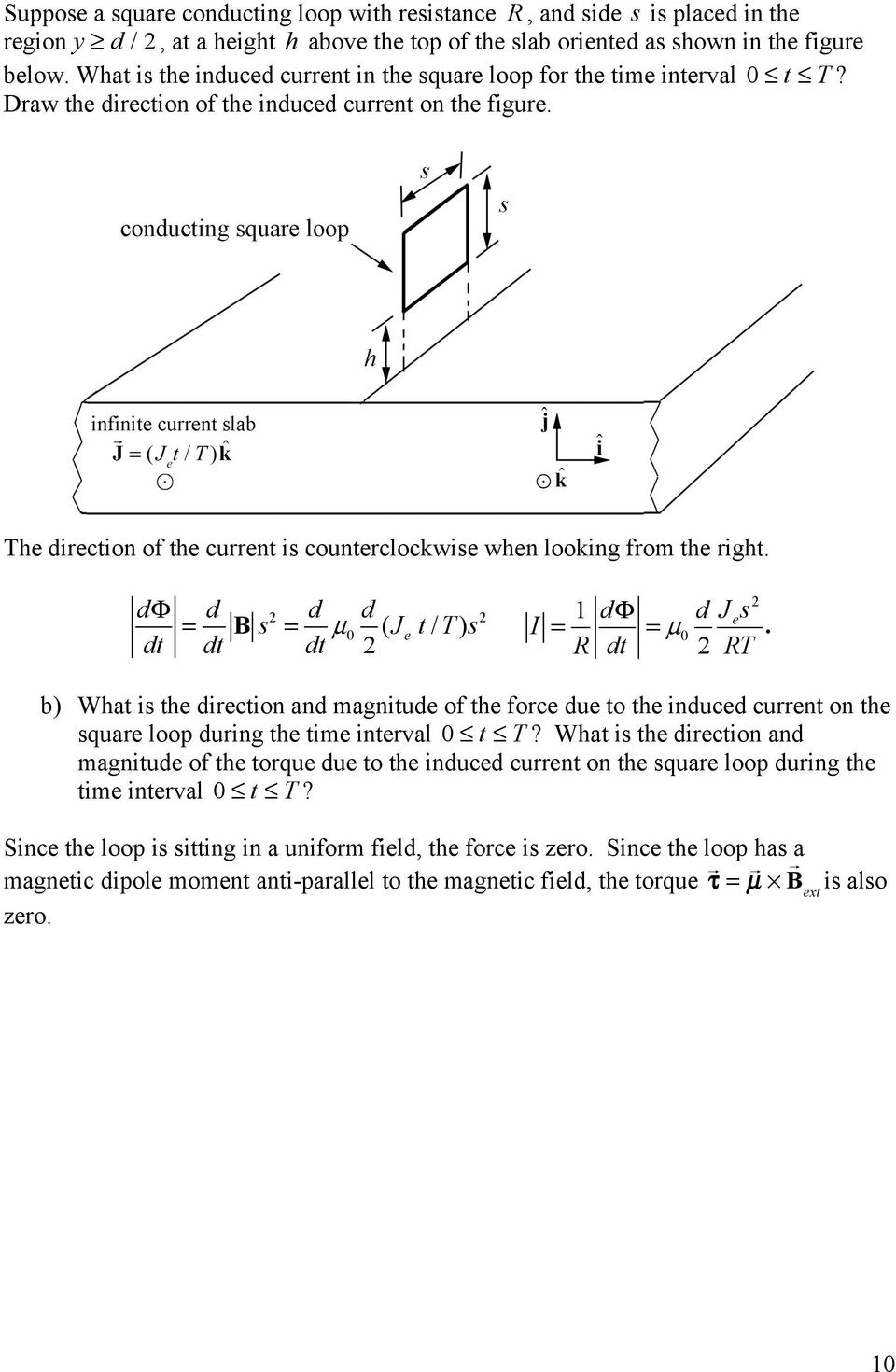
10 Suppose a square conducting loop with resistance R, and side s is placed in the region y d / 2, at a height h above the top of the slab oriented as shown in the figure below. What is the induced current in the square loop for the time interval 0 t T? Draw the direction of the induced current on the figure. The direction of the current is counterclockwise when looking from the right. d Φ d d d = = dt dt dt µ 2 1 dφ d Js = =. R dt 2 RT 2 B 2 2 e s 0 ( Je t/ T) s I µ 0 b) What is the direction and magnitude of the force due to the induced current on the square loop during the time interval 0 t T? What is the direction and magnitude of the torque due to the induced current on the square loop during the time interval 0 t T? Since the loop is sitting in a uniform field, the force is zero. Since the loop has a magnetic dipole moment anti-parallel to the magnetic field, the torque τ = µ B ext is also zero. 10
11 Problem 4 (25 points) NOTE: YOU MUST SHOW WORK in order to get any credit for this problem. Make it clear to us that you understand what you are doing (use a few words!). A stretchable and flexible conducting band in the shape of a circle with radius r(t) has constant resistance R. It sits in a uniform magnetic field B that is directed out of the page (see figure). External agents distributed uniformly over the circumference of the ring exert radial outward forces that cause the ring to expand at a constant speed from radius a to a larger radius b over a time interval 0 t T, where T is a constant with units of seconds. Let v = dr / dt be the constant speed at which the ring expands. Express your answers to the following questions in terms of r, v, a, b, R, B = B, and T as needed. Note that in this problem R is a resistance, not a radius. a) Give an expression for the induced current I in the ring. Draw the direction of the induced current on the figure above. You may ignore any magnetic field generated by the induced current. The current flows clockwise in the band. d Φ d 2 r 2 r dr 1 dφ 2π rbv = B π = B π I = = dt dt dt R dt R b) What is the rate at which energy is dissipated (Joule heating) during the time interval 0 t T? πrBv 4π r B v I R= R= R R c) What is the direction and magnitude of the force per unit length that the external agents must apply to overcome the magnetic force per unit length on the conducting band due to the induced current?. 11
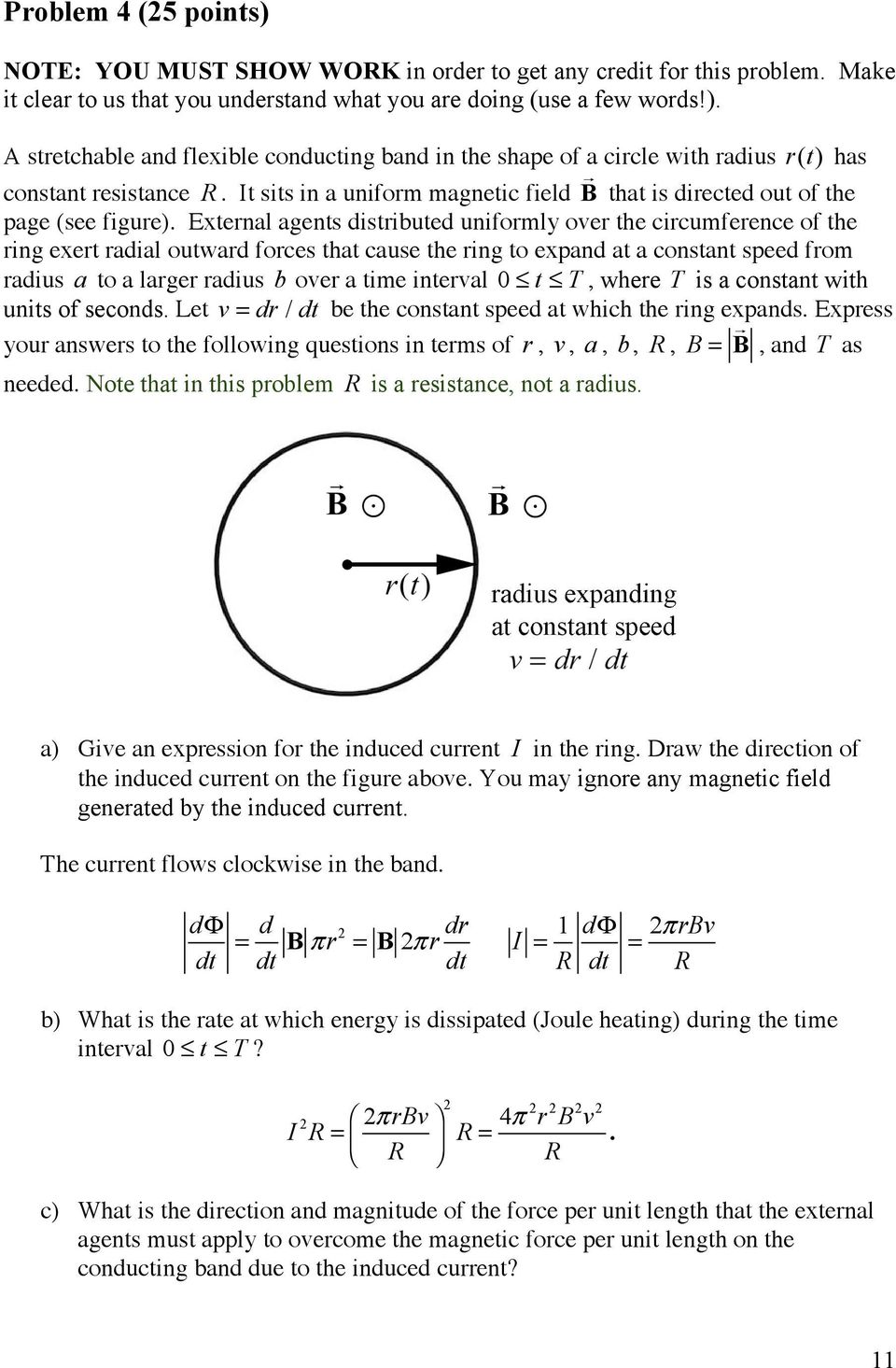
12 At any given point on the band, the Id s B ext force is radially inward, and therefore at that point the external agents must exert a force per unit length given by df agents ds = I B ext = ˆrIB = ˆrIB = ˆr 2πrB2 v R d) Based on your result for the force per unit length in part c), what power do the external agents provide during the time interval 0 t T? Is this the same as your answer to part b)? If yes, explain why; if no, explain why not. Be sure to give your reasoning. An external agent at a given point on the band exerting a force on that ds section of the band does work at a rate given by F v = ds ˆr 2πrB2 v v = 2πrB2 v 2 ds. R R The power from all the agents is found by integrating the above over the circumference, giving 4π 2 r 2 B 2 v 2 / R, the same as above. They are the same because of conservation of energy. 12

Eðlisfræði 2, vor 2007
 [ Assignment View ] [ Pri Eðlisfræði 2, vor 2007 28. Sources of Magnetic Field Assignment is due at 2:00am on Wednesday, March 7, 2007 Credit for problems submitted late will decrease to 0% after the deadline
Phys222 Winter 2012 Quiz 4 Chapters 29-31. Name
 Name If you think that no correct answer is provided, give your answer, state your reasoning briefly; append additional sheet of paper if necessary. 1. A particle (q = 5.0 nc, m = 3.0 µg) moves in a region
Homework #11 203-1-1721 Physics 2 for Students of Mechanical Engineering
 Homework #11 203-1-1721 Physics 2 for Students of Mechanical Engineering 2. A circular coil has a 10.3 cm radius and consists of 34 closely wound turns of wire. An externally produced magnetic field of
Edmund Li. Where is defined as the mutual inductance between and and has the SI units of Henries (H).
 INDUCTANCE MUTUAL INDUCTANCE If we consider two neighbouring closed loops and with bounding surfaces respectively then a current through will create a magnetic field which will link with as the flux passes
1. A wire carries 15 A. You form the wire into a single-turn circular loop with magnetic field 80 µ T at the loop center. What is the loop radius?
 CHAPTER 3 SOURCES O THE MAGNETC ELD 1. A wire carries 15 A. You form the wire into a single-turn circular loop with magnetic field 8 µ T at the loop center. What is the loop radius? Equation 3-3, with
Physics 210 Q1 2012 ( PHYSICS210BRIDGE ) My Courses Course Settings
 1 of 11 9/7/2012 1:06 PM Logged in as Julie Alexander, Instructor Help Log Out Physics 210 Q1 2012 ( PHYSICS210BRIDGE ) My Courses Course Settings Course Home Assignments Roster Gradebook Item Library
MASSACHUSETTS INSTITUTE OF TECHNOLOGY Department of Physics. 8.02 Spring 2013 Conflict Exam Two Solutions
 MASSACHUSETTS INSTITUTE OF TECHNOLOGY Department of Physics 802 Spring 2013 Conflict Exam Two Solutions Problem 1 (25 points): answers without work shown will not be given any credit A uniformly charged
Faraday s Law of Induction
 Chapter 10 Faraday s Law of Induction 10.1 Faraday s Law of Induction...10-10.1.1 Magnetic Flux...10-3 10.1. Lenz s Law...10-5 10. Motional EMF...10-7 10.3 Induced Electric Field...10-10 10.4 Generators...10-1
Magnetism. d. gives the direction of the force on a charge moving in a magnetic field. b. results in negative charges moving. clockwise.
 Magnetism 1. An electron which moves with a speed of 3.0 10 4 m/s parallel to a uniform magnetic field of 0.40 T experiences a force of what magnitude? (e = 1.6 10 19 C) a. 4.8 10 14 N c. 2.2 10 24 N b.
 Last Name: First Name: Physics 102 Spring 2006: Exam #2 Multiple-Choice Questions 1. A charged particle, q, is moving with speed v perpendicular to a uniform magnetic field. A second identical charged
Review Questions PHYS 2426 Exam 2
 Review Questions PHYS 2426 Exam 2 1. If 4.7 x 10 16 electrons pass a particular point in a wire every second, what is the current in the wire? A) 4.7 ma B) 7.5 A C) 2.9 A D) 7.5 ma E) 0.29 A Ans: D 2.
Chapter 4. Electrostatic Fields in Matter
 Chapter 4. Electrostatic Fields in Matter 4.1. Polarization A neutral atom, placed in an external electric field, will experience no net force. However, even though the atom as a whole is neutral, the
Lecture 22. Inductance. Magnetic Field Energy. Outline:
 Lecture 22. Inductance. Magnetic Field Energy. Outline: Self-induction and self-inductance. Inductance of a solenoid. The energy of a magnetic field. Alternative definition of inductance. Mutual Inductance.
Exercises on Voltage, Capacitance and Circuits. A d = (8.85 10 12 ) π(0.05)2 = 6.95 10 11 F
 Exercises on Voltage, Capacitance and Circuits Exercise 1.1 Instead of buying a capacitor, you decide to make one. Your capacitor consists of two circular metal plates, each with a radius of 5 cm. The
Module 22: Inductance and Magnetic Field Energy
 Module 22: Inductance and Magnetic Field Energy 1 Module 22: Outline Self Inductance Energy in Inductors Circuits with Inductors: RL Circuit 2 Faraday s Law of Induction dφ = B dt Changing magnetic flux
Solution Derivations for Capa #11
 Solution Derivations for Capa #11 Caution: The symbol E is used interchangeably for energy and EMF. 1) DATA: V b = 5.0 V, = 155 Ω, L = 8.400 10 2 H. In the diagram above, what is the voltage across the
Chapter 22: Electric Flux and Gauss s Law
 22.1 ntroduction We have seen in chapter 21 that determining the electric field of a continuous charge distribution can become very complicated for some charge distributions. t would be desirable if we
Problem Solving 5: Magnetic Force, Torque, and Magnetic Moments
 MASSACHUSETTS INSTITUTE OF TECHNOLOY Department of Physics Problem Solving 5: Magnetic Force, Torque, and Magnetic Moments OBJECTIVES 1. To start with the magnetic force on a moving charge q and derive
1. Units of a magnetic field might be: A. C m/s B. C s/m C. C/kg D. kg/c s E. N/C m ans: D
 Chapter 28: MAGNETIC FIELDS 1 Units of a magnetic field might be: A C m/s B C s/m C C/kg D kg/c s E N/C m 2 In the formula F = q v B: A F must be perpendicular to v but not necessarily to B B F must be
Electromagnetism Laws and Equations
 Electromagnetism Laws and Equations Andrew McHutchon Michaelmas 203 Contents Electrostatics. Electric E- and D-fields............................................. Electrostatic Force............................................2
Force on a square loop of current in a uniform B-field.
 Force on a square loop of current in a uniform B-field. F top = 0 θ = 0; sinθ = 0; so F B = 0 F bottom = 0 F left = I a B (out of page) F right = I a B (into page) Assume loop is on a frictionless axis
Physics 121 Sample Common Exam 3 NOTE: ANSWERS ARE ON PAGE 6. Instructions: 1. In the formula F = qvxb:
 Physics 121 Sample Common Exam 3 NOTE: ANSWERS ARE ON PAGE 6 Signature Name (Print): 4 Digit ID: Section: Instructions: Answer all questions 24 multiple choice questions. You may need to do some calculation.
Chapter 33. The Magnetic Field
 Chapter 33. The Magnetic Field Digital information is stored on a hard disk as microscopic patches of magnetism. Just what is magnetism? How are magnetic fields created? What are their properties? These
HW6 Solutions Notice numbers may change randomly in your assignments and you may have to recalculate solutions for your specific case.
 HW6 Solutions Notice numbers may change randomly in your assignments and you may have to recalculate solutions for your specific case. Tipler 22.P.053 The figure below shows a portion of an infinitely
Exam 1 Practice Problems Solutions
 MASSACHUSETTS INSTITUTE OF TECHNOLOGY Department of Physics 8 Spring 13 Exam 1 Practice Problems Solutions Part I: Short Questions and Concept Questions Problem 1: Spark Plug Pictured at right is a typical
Chapter 27 Magnetic Field and Magnetic Forces
 Chapter 27 Magnetic Field and Magnetic Forces - Magnetism - Magnetic Field - Magnetic Field Lines and Magnetic Flux - Motion of Charged Particles in a Magnetic Field - Applications of Motion of Charged
Force on Moving Charges in a Magnetic Field
 [ Assignment View ] [ Eðlisfræði 2, vor 2007 27. Magnetic Field and Magnetic Forces Assignment is due at 2:00am on Wednesday, February 28, 2007 Credit for problems submitted late will decrease to 0% after
Conceptual: 1, 3, 5, 6, 8, 16, 18, 19. Problems: 4, 6, 8, 11, 16, 20, 23, 27, 34, 41, 45, 56, 60, 65. Conceptual Questions
 Conceptual: 1, 3, 5, 6, 8, 16, 18, 19 Problems: 4, 6, 8, 11, 16, 20, 23, 27, 34, 41, 45, 56, 60, 65 Conceptual Questions 1. The magnetic field cannot be described as the magnetic force per unit charge
Magnetic fields of charged particles in motion
 C H A P T E R 8 Magnetic fields of charged particles in motion CONCEPTS 8.1 Source of the magnetic field 8. Current loops and spin magnetism 8.3 Magnetic moment and torque 8.4 Ampèrian paths QUANTTATVE
Physics 25 Exam 3 November 3, 2009
 1. A long, straight wire carries a current I. If the magnetic field at a distance d from the wire has magnitude B, what would be the the magnitude of the magnetic field at a distance d/3 from the wire,
CHAPTER 24 GAUSS S LAW
 CHAPTER 4 GAUSS S LAW 4. The net charge shown in Fig. 4-40 is Q. Identify each of the charges A, B, C shown. A B C FIGURE 4-40 4. From the direction of the lines of force (away from positive and toward
Chapter 10. Faraday s Law of Induction
 10 10 10-0 Chapter 10 Faraday s Law of Induction 10.1 Faraday s Law of Induction... 10-3 10.1.1 Magnetic Flux... 10-5 10.2 Motional EMF... 10-5 10.3 Faraday s Law (see also Faraday s Law Simulation in
PHY114 S11 Term Exam 3
 PHY4 S Term Exam S. G. Rajeev Mar 2 20 2:0 pm to :45 pm PLEASE write your workshop number and your workshop leader s name at the top of your book, so that you can collect your graded exams at the workshop.
104 Practice Exam 2-3/21/02
 104 Practice Exam 2-3/21/02 1. Two electrons are located in a region of space where the magnetic field is zero. Electron A is at rest; and electron B is moving westward with a constant velocity. A non-zero
Eðlisfræði 2, vor 2007
 [ Assignment View ] [ Print ] Eðlisfræði 2, vor 2007 30. Inductance Assignment is due at 2:00am on Wednesday, March 14, 2007 Credit for problems submitted late will decrease to 0% after the deadline has
Inductance. Motors. Generators
 Inductance Motors Generators Self-inductance Self-inductance occurs when the changing flux through a circuit arises from the circuit itself. As the current increases, the magnetic flux through a loop due
Induced voltages and Inductance Faraday s Law
 Induced voltages and Inductance Faraday s Law concept #1, 4, 5, 8, 13 Problem # 1, 3, 4, 5, 6, 9, 10, 13, 15, 24, 23, 25, 31, 32a, 34, 37, 41, 43, 51, 61 Last chapter we saw that a current produces a magnetic
Chapter 19 Magnetic Forces and Fields
 Chapter 19 Magnetic Forces and Fields Student: 3. The magnetism of the Earth acts approximately as if it originates from a huge bar magnet within the Earth. Which of the following statements are true?
Direction of Induced Current
 Direction of Induced Current Bar magnet moves through coil Current induced in coil A S N v Reverse pole Induced current changes sign B N S v v Coil moves past fixed bar magnet Current induced in coil as
Inductance and Magnetic Energy
 Chapter 11 Inductance and Magnetic Energy 11.1 Mutual Inductance... 11-3 Example 11.1 Mutual Inductance of Two Concentric Coplanar Loops... 11-5 11. Self-Inductance... 11-5 Example 11. Self-Inductance
The purposes of this experiment are to test Faraday's Law qualitatively and to test Lenz's Law.
 260 17-1 I. THEORY EXPERIMENT 17 QUALITATIVE STUDY OF INDUCED EMF Along the extended central axis of a bar magnet, the magnetic field vector B r, on the side nearer the North pole, points away from this
Magnetic Fields. I. Magnetic Field and Magnetic Field Lines
 Magnetic Fields I. Magnetic Field and Magnetic Field Lines A. The concept of the magnetic field can be developed in a manner similar to the way we developed the electric field. The magnitude of the magnetic
Exam 2 Practice Problems Part 1 Solutions
 MASSACHUSETTS INSTITUTE OF TECHNOLOGY Department of Physics Exam Practice Problems Part 1 Solutions Problem 1 Electric Field and Charge Distributions from Electric Potential An electric potential V ( z
How To Understand The Physics Of A Charge Charge
 MFF 3a: Charged Particle and a Straight Current-Carrying Wire... 2 MFF3a RT1: Charged Particle and a Straight Current-Carrying Wire... 3 MFF3a RT2: Charged Particle and a Straight Current-Carrying Wire...
PHYS 222 Spring 2012 Final Exam. Closed books, notes, etc. No electronic device except a calculator.
 PHYS 222 Spring 2012 Final Exam Closed books, notes, etc. No electronic device except a calculator. NAME: (all questions with equal weight) 1. If the distance between two point charges is tripled, the
Experiment 7: Forces and Torques on Magnetic Dipoles
 MASSACHUSETTS INSTITUTE OF TECHNOLOY Department of Physics 8. Spring 5 OBJECTIVES Experiment 7: Forces and Torques on Magnetic Dipoles 1. To measure the magnetic fields due to a pair of current-carrying
Quiz: Work and Energy
 Quiz: Work and Energy A charged particle enters a uniform magnetic field. What happens to the kinetic energy of the particle? (1) it increases (2) it decreases (3) it stays the same (4) it changes with
1. The diagram below represents magnetic lines of force within a region of space.
 1. The diagram below represents magnetic lines of force within a region of space. 4. In which diagram below is the magnetic flux density at point P greatest? (1) (3) (2) (4) The magnetic field is strongest
Physics 2A, Sec B00: Mechanics -- Winter 2011 Instructor: B. Grinstein Final Exam
 Physics 2A, Sec B00: Mechanics -- Winter 2011 Instructor: B. Grinstein Final Exam INSTRUCTIONS: Use a pencil #2 to fill your scantron. Write your code number and bubble it in under "EXAM NUMBER;" an entry
The Electric Field. Electric Charge, Electric Field and a Goofy Analogy
 . The Electric Field Concepts and Principles Electric Charge, Electric Field and a Goofy Analogy We all know that electrons and protons have electric charge. But what is electric charge and what does it
Magnetic electro-mechanical machines
 Magnetic electro-mechanical machines Lorentz Force A magnetic field exerts force on a moving charge. The Lorentz equation: f = q(e + v B) f: force exerted on charge q E: electric field strength v: velocity
Physics 112 Homework 5 (solutions) (2004 Fall) Solutions to Homework Questions 5
 Solutions to Homework Questions 5 Chapt19, Problem-2: (a) Find the direction of the force on a proton (a positively charged particle) moving through the magnetic fields in Figure P19.2, as shown. (b) Repeat
potential in the centre of the sphere with respect to infinity.
 Umeå Universitet, Fysik 1 Vitaly Bychkov Prov i fysik, Electricity and Waves, 2006-09-27, kl 16.00-22.00 Hjälpmedel: Students can use any book. Define the notations you are using properly. Present your
VELOCITY, ACCELERATION, FORCE
 VELOCITY, ACCELERATION, FORCE velocity Velocity v is a vector, with units of meters per second ( m s ). Velocity indicates the rate of change of the object s position ( r ); i.e., velocity tells you how
Magnetic Field and Magnetic Forces
 Chapter 27 Magnetic Field and Magnetic Forces PowerPoint Lectures for University Physics, Thirteenth Edition Hugh D. Young and Roger A. Freedman Lectures by Wayne Anderson Goals for Chapter 27 Magnets
11. Rotation Translational Motion: Rotational Motion:
 11. Rotation Translational Motion: Motion of the center of mass of an object from one position to another. All the motion discussed so far belongs to this category, except uniform circular motion. Rotational
MULTIPLE CHOICE. Choose the one alternative that best completes the statement or answers the question.
 MULTIPLE CHOICE. Choose the one alternative that best completes the statement or answers the question. 1) If the voltage at a point in space is zero, then the electric field must be A) zero. B) positive.
A METHOD OF CALIBRATING HELMHOLTZ COILS FOR THE MEASUREMENT OF PERMANENT MAGNETS
 A METHOD OF CALIBRATING HELMHOLTZ COILS FOR THE MEASUREMENT OF PERMANENT MAGNETS Joseph J. Stupak Jr, Oersted Technology Tualatin, Oregon (reprinted from IMCSD 24th Annual Proceedings 1995) ABSTRACT The
RUPHYS2272015 ( RUPHY227F2015 ) My Courses Course Settings University Physics with Modern Physics, 14e Young/Freedman
 Signed in as Jolie Cizewski, Instructor Help Sign Out RUPHYS2272015 ( RUPHY227F2015 ) My Courses Course Settings University Physics with Modern Physics, 14e Young/Freedman Course Home Assignments Roster
Objectives. Capacitors 262 CHAPTER 5 ENERGY
 Objectives Describe a capacitor. Explain how a capacitor stores energy. Define capacitance. Calculate the electrical energy stored in a capacitor. Describe an inductor. Explain how an inductor stores energy.
Chapter 22: The Electric Field. Read Chapter 22 Do Ch. 22 Questions 3, 5, 7, 9 Do Ch. 22 Problems 5, 19, 24
 Chapter : The Electric Field Read Chapter Do Ch. Questions 3, 5, 7, 9 Do Ch. Problems 5, 19, 4 The Electric Field Replaces action-at-a-distance Instead of Q 1 exerting a force directly on Q at a distance,
Magnetic Circuits. Outline. Ampere s Law Revisited Review of Last Time: Magnetic Materials Magnetic Circuits Examples
 Magnetic Circuits Outline Ampere s Law Revisited Review of Last Time: Magnetic Materials Magnetic Circuits Examples 1 Electric Fields Magnetic Fields S ɛ o E da = ρdv B V = Q enclosed S da =0 GAUSS GAUSS
F = 0. x ψ = y + z (1) y ψ = x + z (2) z ψ = x + y (3)
 MATH 255 FINAL NAME: Instructions: You must include all the steps in your derivations/answers. Reduce answers as much as possible, but use exact arithmetic. Write neatly, please, and show all steps. Scientists
Ampere's Law. Introduction. times the current enclosed in that loop: Ampere's Law states that the line integral of B and dl over a closed path is 0
 1 Ampere's Law Purpose: To investigate Ampere's Law by measuring how magnetic field varies over a closed path; to examine how magnetic field depends upon current. Apparatus: Solenoid and path integral
Scott Hughes 7 April 2005. Massachusetts Institute of Technology Department of Physics 8.022 Spring 2005. Lecture 15: Mutual and Self Inductance.
 Scott Hughes 7 April 2005 151 Using induction Massachusetts nstitute of Technology Department of Physics 8022 Spring 2005 Lecture 15: Mutual and Self nductance nduction is a fantastic way to create EMF;
The DC Motor. Physics 1051 Laboratory #5 The DC Motor
 The DC Motor Physics 1051 Laboratory #5 The DC Motor Contents Part I: Objective Part II: Introduction Magnetic Force Right Hand Rule Force on a Loop Magnetic Dipole Moment Torque Part II: Predictions Force
If Σ is an oriented surface bounded by a curve C, then the orientation of Σ induces an orientation for C, based on the Right-Hand-Rule.
 Oriented Surfaces and Flux Integrals Let be a surface that has a tangent plane at each of its nonboundary points. At such a point on the surface two unit normal vectors exist, and they have opposite directions.
Physics 9e/Cutnell. correlated to the. College Board AP Physics 1 Course Objectives
 Physics 9e/Cutnell correlated to the College Board AP Physics 1 Course Objectives Big Idea 1: Objects and systems have properties such as mass and charge. Systems may have internal structure. Enduring
Exam 2 Practice Problems Part 2 Solutions
 Problem 1: Short Questions MASSACHUSETTS INSTITUTE OF TECHNOLOGY Department of Physics 8. Exam Practice Problems Part Solutions (a) Can a constant magnetic field set into motion an electron, which is initially
Practice final for Basic Physics spring 2005 answers on the last page Name: Date:
 Practice final for Basic Physics spring 2005 answers on the last page Name: Date: 1. A 12 ohm resistor and a 24 ohm resistor are connected in series in a circuit with a 6.0 volt battery. Assuming negligible
Chapter 19: Magnetic Forces and Fields
 Chapter 19: Magnetic Forces and Fields Magnetic Fields Magnetic Force on a Point Charge Motion of a Charged Particle in a Magnetic Field Crossed E and B fields Magnetic Forces on Current Carrying Wires
AP2 Magnetism. (c) Explain why the magnetic field does no work on the particle as it moves in its circular path.
 A charged particle is projected from point P with velocity v at a right angle to a uniform magnetic field directed out of the plane of the page as shown. The particle moves along a circle of radius R.
General Physics (PHY 2140)
 General Physics (PHY 2140) Lecture 12 Electricity and Magnetism Magnetism Magnetic fields and force Application of magnetic forces http://www.physics.wayne.edu/~apetrov/phy2140/ Chapter 19 1 Department
Q27.1 When a charged particle moves near a bar magnet, the magnetic force on the particle at a certain point depends
 Q27.1 When a charged particle moves near a bar magnet, the magnetic force on the particle at a certain point depends A. on the direction of the magnetic field at that point only. B. on the magnetic field
Chapter 28 Fluid Dynamics
 Chapter 28 Fluid Dynamics 28.1 Ideal Fluids... 1 28.2 Velocity Vector Field... 1 28.3 Mass Continuity Equation... 3 28.4 Bernoulli s Principle... 4 28.5 Worked Examples: Bernoulli s Equation... 7 Example
6 J - vector electric current density (A/m2 )
 Determination of Antenna Radiation Fields Using Potential Functions Sources of Antenna Radiation Fields 6 J - vector electric current density (A/m2 ) M - vector magnetic current density (V/m 2 ) Some problems
ELECTRIC FIELD LINES AND EQUIPOTENTIAL SURFACES
 ELECTRIC FIELD LINES AND EQUIPOTENTIAL SURFACES The purpose of this lab session is to experimentally investigate the relation between electric field lines of force and equipotential surfaces in two dimensions.
Chapter 30 - Magnetic Fields and Torque. A PowerPoint Presentation by Paul E. Tippens, Professor of Physics Southern Polytechnic State University
 Chapter 30 - Magnetic Fields and Torque A PowerPoint Presentation by Paul E. Tippens, Professor of Physics Southern Polytechnic State University 2007 Objectives: After completing this module, you should
Experiment 3: Magnetic Fields of a Bar Magnet and Helmholtz Coil
 MASSACHUSETTS INSTITUTE OF TECHNOLOGY Department of Physics 8.02 Spring 2006 Experiment 3: Magnetic Fields of a Bar Magnet and Helmholtz Coil OBJECTIVES 1. To learn how to visualize magnetic field lines
Steady Heat Conduction
 Steady Heat Conduction In thermodynamics, we considered the amount of heat transfer as a system undergoes a process from one equilibrium state to another. hermodynamics gives no indication of how long
April 1. Physics 272. Spring 2014 http://www.phys.hawaii.edu/~philipvd/pvd_14_spring_272_uhm.html. Prof. Philip von Doetinchem philipvd@hawaii.
 Physics 272 April 1 Spring 2014 http://www.phys.hawaii.edu/~philipvd/pvd_14_spring_272_uhm.html Prof. Philip von Doetinchem [email protected] Phys272 - Spring 14 - von Doetinchem - 164 Summary Gauss's
Experiment 3: Magnetic Fields of a Bar Magnet and Helmholtz Coil
 MASSACHUSETTS INSTITUTE OF TECHNOLOGY Department of Physics 8.02 Spring 2009 Experiment 3: Magnetic Fields of a Bar Magnet and Helmholtz Coil OBJECTIVES 1. To learn how to visualize magnetic field lines
physics 112N magnetic fields and forces
 physics 112N magnetic fields and forces bar magnet & iron filings physics 112N 2 bar magnets physics 112N 3 the Earth s magnetic field physics 112N 4 electro -magnetism! is there a connection between electricity
Physics 53. Kinematics 2. Our nature consists in movement; absolute rest is death. Pascal
 Phsics 53 Kinematics 2 Our nature consists in movement; absolute rest is death. Pascal Velocit and Acceleration in 3-D We have defined the velocit and acceleration of a particle as the first and second
Magnetic Field of a Circular Coil Lab 12
 HB 11-26-07 Magnetic Field of a Circular Coil Lab 12 1 Magnetic Field of a Circular Coil Lab 12 Equipment- coil apparatus, BK Precision 2120B oscilloscope, Fluke multimeter, Wavetek FG3C function generator,
E X P E R I M E N T 8
 E X P E R I M E N T 8 Torque, Equilibrium & Center of Gravity Produced by the Physics Staff at Collin College Copyright Collin College Physics Department. All Rights Reserved. University Physics, Exp 8:
Inductors & Inductance. Electronic Components
 Electronic Components Induction In 1824, Oersted discovered that current passing though a coil created a magnetic field capable of shifting a compass needle. Seven years later, Faraday and Henry discovered
PHY121 #8 Midterm I 3.06.2013
 PHY11 #8 Midterm I 3.06.013 AP Physics- Newton s Laws AP Exam Multiple Choice Questions #1 #4 1. When the frictionless system shown above is accelerated by an applied force of magnitude F, the tension
Unit 4 Practice Test: Rotational Motion
 Unit 4 Practice Test: Rotational Motion Multiple Guess Identify the letter of the choice that best completes the statement or answers the question. 1. How would an angle in radians be converted to an angle
PHYSICS 111 HOMEWORK SOLUTION #10. April 8, 2013
 PHYSICS HOMEWORK SOLUTION #0 April 8, 203 0. Find the net torque on the wheel in the figure below about the axle through O, taking a = 6.0 cm and b = 30.0 cm. A torque that s produced by a force can be
ǫ 0 = 8.85419 10 12 C 2 /N m 2,
 Version 001 review unit chiu 58655 1 This print-out should have 45 questions. Multiple-choice questions may continue on the next column or page find all choices before answering. The long negatively charged
Magnetic Dipoles. Magnetic Field of Current Loop. B r. PHY2061 Enriched Physics 2 Lecture Notes
 Disclaimer: These lecture notes are not meant to replace the course textbook. The content may be incomplete. Some topics may be unclear. These notes are only meant to be a study aid and a supplement to
Chapter 10 Rotational Motion. Copyright 2009 Pearson Education, Inc.
 Chapter 10 Rotational Motion Angular Quantities Units of Chapter 10 Vector Nature of Angular Quantities Constant Angular Acceleration Torque Rotational Dynamics; Torque and Rotational Inertia Solving Problems
Physics 1A Lecture 10C
 Physics 1A Lecture 10C "If you neglect to recharge a battery, it dies. And if you run full speed ahead without stopping for water, you lose momentum to finish the race. --Oprah Winfrey Static Equilibrium
Lesson 3 DIRECT AND ALTERNATING CURRENTS. Task. The skills and knowledge taught in this lesson are common to all missile repairer tasks.
 Lesson 3 DIRECT AND ALTERNATING CURRENTS Task. The skills and knowledge taught in this lesson are common to all missile repairer tasks. Objectives. When you have completed this lesson, you should be able
Chapter 7. Magnetism and Electromagnetism ISU EE. C.Y. Lee
 Chapter 7 Magnetism and Electromagnetism Objectives Explain the principles of the magnetic field Explain the principles of electromagnetism Describe the principle of operation for several types of electromagnetic
PROBLEM SET. Practice Problems for Exam #1. Math 1352, Fall 2004. Oct. 1, 2004 ANSWERS
 PROBLEM SET Practice Problems for Exam # Math 352, Fall 24 Oct., 24 ANSWERS i Problem. vlet R be the region bounded by the curves x = y 2 and y = x. A. Find the volume of the solid generated by revolving
D Alembert s principle and applications
 Chapter 1 D Alembert s principle and applications 1.1 D Alembert s principle The principle of virtual work states that the sum of the incremental virtual works done by all external forces F i acting in
Problem 6.40 and 6.41 Kleppner and Kolenkow Notes by: Rishikesh Vaidya, Physics Group, BITS-Pilani
 Problem 6.40 and 6.4 Kleppner and Kolenkow Notes by: Rishikesh Vaidya, Physics Group, BITS-Pilani 6.40 A wheel with fine teeth is attached to the end of a spring with constant k and unstretched length