
Magnetic Fields. I. Magnetic Field and Magnetic Field Lines
|
|
|
- Bryan Perkins
- 9 years ago
- Views:
Transcription
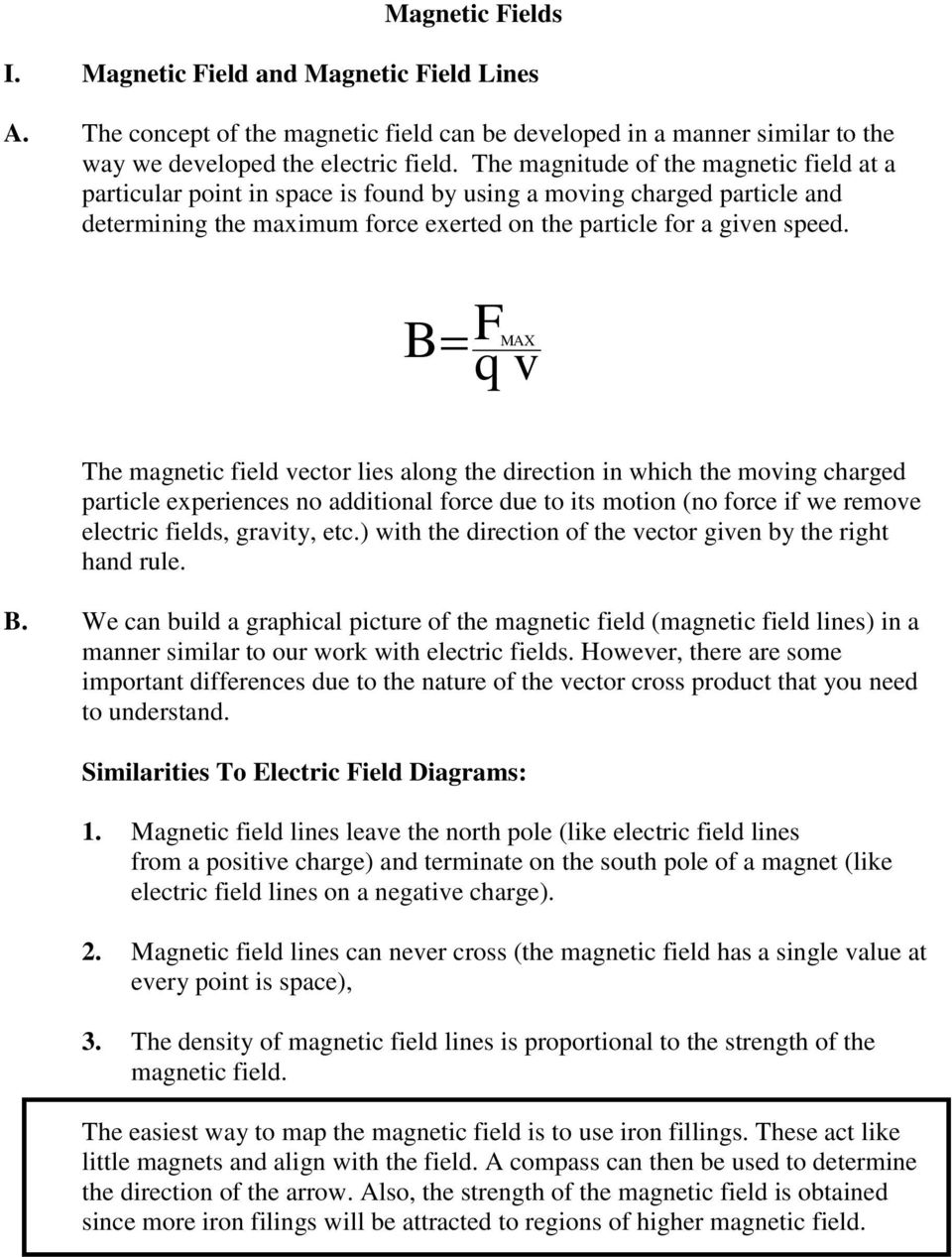
1 Magnetic Fields I. Magnetic Field and Magnetic Field Lines A. The concept of the magnetic field can be developed in a manner similar to the way we developed the electric field. The magnitude of the magnetic field at a particular point in space is found by using a moving charged particle and determining the maximum force exerted on the particle for a given speed. B F q MAX v The magnetic field vector lies along the direction in which the moving charged particle experiences no additional force due to its motion (no force if we remove electric fields, gravity, etc.) with the direction of the vector given by the right hand rule. B. We can build a graphical picture of the magnetic field (magnetic field lines) in a manner similar to our work with electric fields. However, there are some important differences due to the nature of the vector cross product that you need to understand. Similarities To Electric Field Diagrams: 1. Magnetic field lines leave the north pole (like electric field lines from a positive charge) and terminate on the south pole of a magnet (like electric field lines on a negative charge). 2. Magnetic field lines can never cross (the magnetic field has a single value at every point is space), 3. The density of magnetic field lines is proportional to the strength of the magnetic field. The easiest way to map the magnetic field is to use iron fillings. These act like little magnets and align with the field. A compass can then be used to determine the direction of the arrow. Also, the strength of the magnetic field is obtained since more iron filings will be attracted to regions of higher magnetic field.
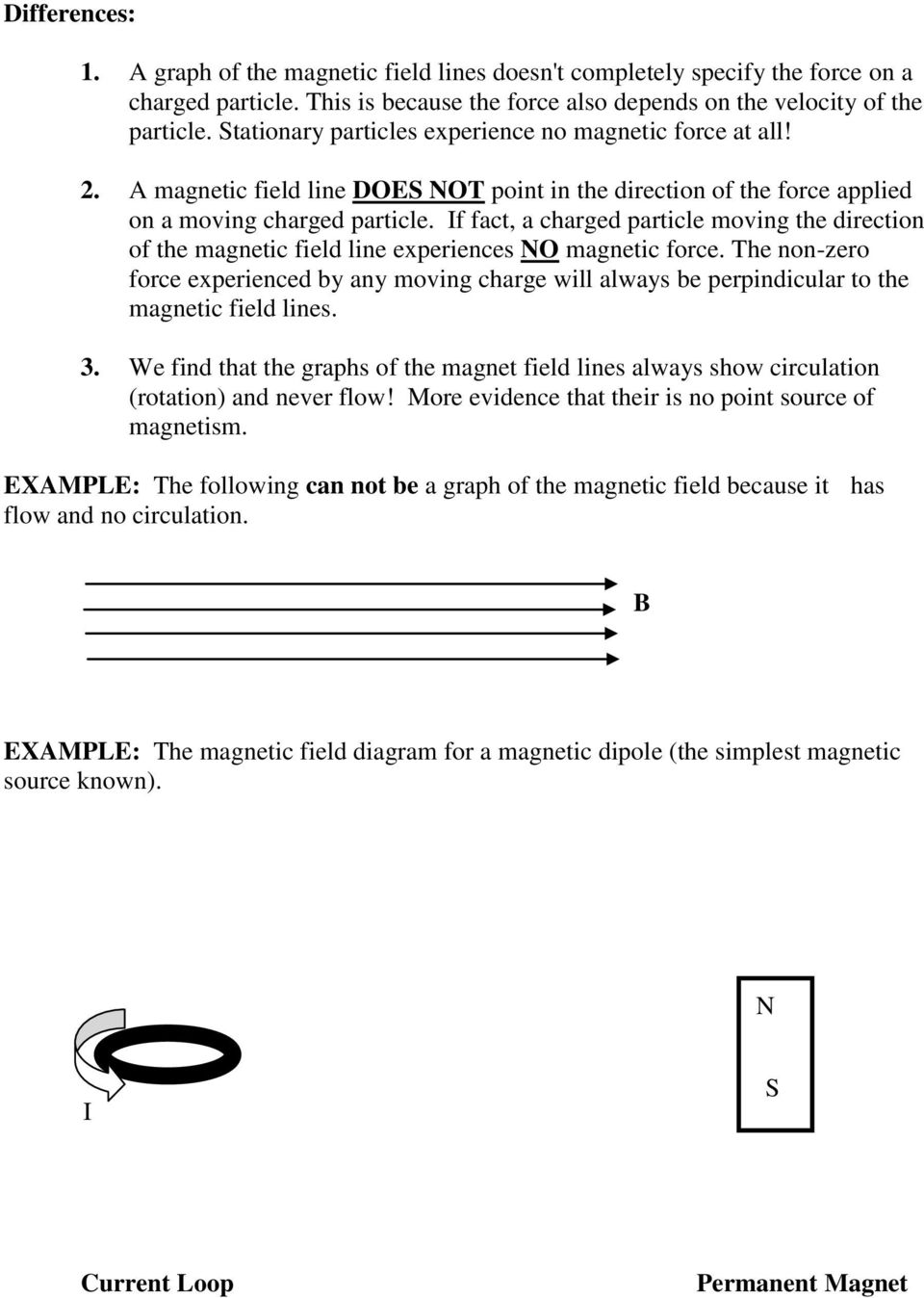
2 Differences: 1. A graph of the magnetic field lines doesn't completely specify the force on a charged particle. This is because the force also depends on the velocity of the particle. Stationary particles experience no magnetic force at all! 2. A magnetic field line DOES NOT point in the direction of the force applied on a moving charged particle. If fact, a charged particle moving the direction of the magnetic field line experiences NO magnetic force. The non-zero force experienced by any moving charge will always be perpindicular to the magnetic field lines. 3. We find that the graphs of the magnet field lines always show circulation (rotation) and never flow! More evidence that their is no point source of magnetism. EXAMPLE: The following can not be a graph of the magnetic field because it has flow and no circulation. B EXAMPLE: The magnetic field diagram for a magnetic dipole (the simplest magnetic source known). N I S Current Loop Permanent Magnet
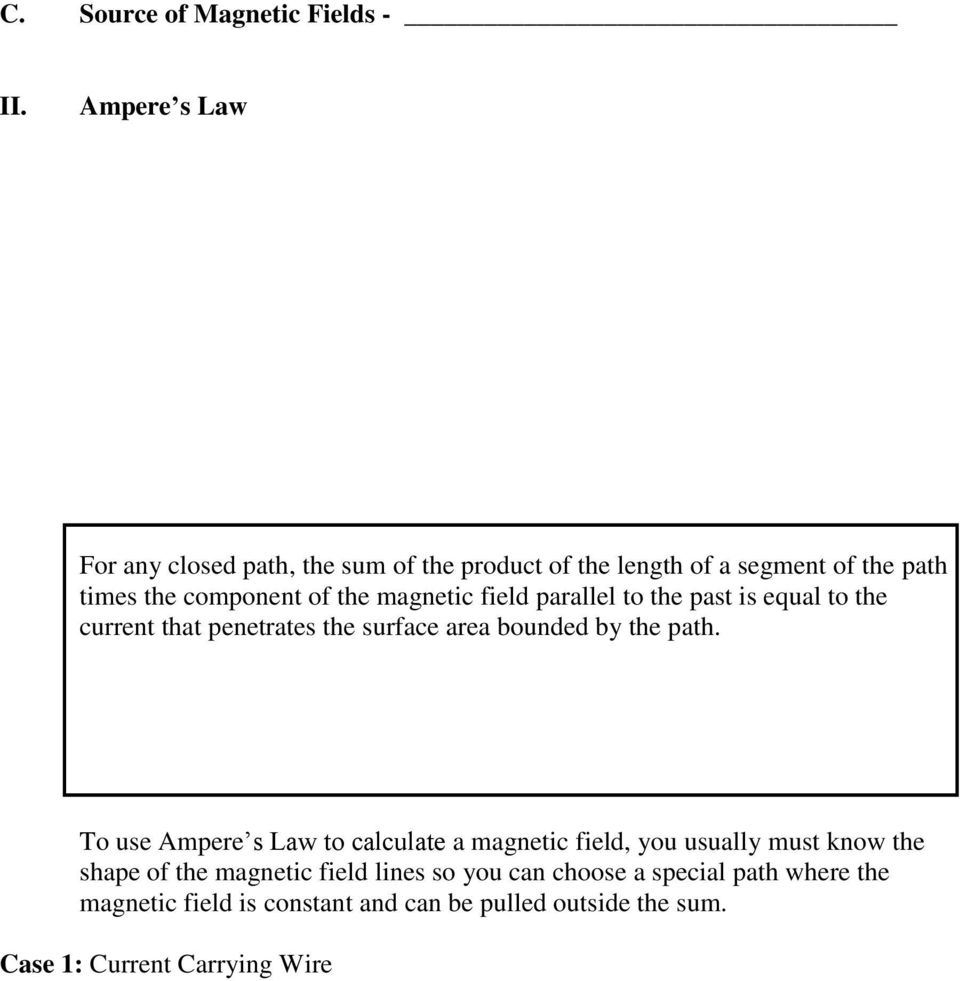
3 C. Source of Magnetic Fields - II. Ampere s Law For any closed path, the sum of the product of the length of a segment of the path times the component of the magnetic field parallel to the past is equal to the current that penetrates the surface area bounded by the path. To use Ampere s Law to calculate a magnetic field, you usually must know the shape of the magnetic field lines so you can choose a special path where the magnetic field is constant and can be pulled outside the sum. Case 1: Current Carrying Wire
4 Case 2: An Infinitely Long Solenoid Case 3: A Torroid
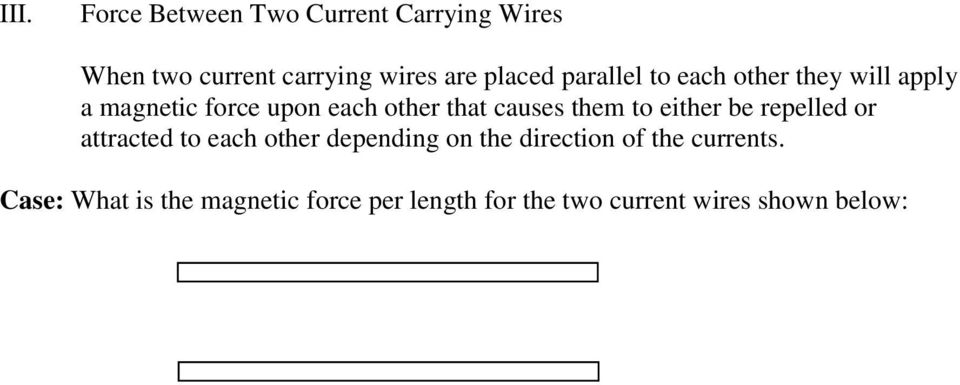
5 III. Force Between Two Current Carrying Wires When two current carrying wires are placed parallel to each other they will apply a magnetic force upon each other that causes them to either be repelled or attracted to each other depending on the direction of the currents. Case: What is the magnetic force per length for the two current wires shown below:
6 IV. Torque On A Current Carrying Loop Consider the current carrying rectangular loop in a magnetic field shown below: What is the net magnetic force on the loop? What is the torque applied by the magnetic field upon the wire?

7 While we did this for a rectangular loop, it is a general result regardless of the loops shape. If the loop has N-turns then the torques on each turn sums to increase the total torque by a factor N.

physics 112N magnetic fields and forces
 physics 112N magnetic fields and forces bar magnet & iron filings physics 112N 2 bar magnets physics 112N 3 the Earth s magnetic field physics 112N 4 electro -magnetism! is there a connection between electricity
Chapter 21. Magnetic Forces and Magnetic Fields
 Chapter 21 Magnetic Forces and Magnetic Fields 21.1 Magnetic Fields The needle of a compass is permanent magnet that has a north magnetic pole (N) at one end and a south magnetic pole (S) at the other.
Chapter 33. The Magnetic Field
 Chapter 33. The Magnetic Field Digital information is stored on a hard disk as microscopic patches of magnetism. Just what is magnetism? How are magnetic fields created? What are their properties? These
Chapter 27 Magnetic Field and Magnetic Forces
 Chapter 27 Magnetic Field and Magnetic Forces - Magnetism - Magnetic Field - Magnetic Field Lines and Magnetic Flux - Motion of Charged Particles in a Magnetic Field - Applications of Motion of Charged
Eðlisfræði 2, vor 2007
 [ Assignment View ] [ Pri Eðlisfræði 2, vor 2007 28. Sources of Magnetic Field Assignment is due at 2:00am on Wednesday, March 7, 2007 Credit for problems submitted late will decrease to 0% after the deadline
1. Units of a magnetic field might be: A. C m/s B. C s/m C. C/kg D. kg/c s E. N/C m ans: D
 Chapter 28: MAGNETIC FIELDS 1 Units of a magnetic field might be: A C m/s B C s/m C C/kg D kg/c s E N/C m 2 In the formula F = q v B: A F must be perpendicular to v but not necessarily to B B F must be
1. The diagram below represents magnetic lines of force within a region of space.
 1. The diagram below represents magnetic lines of force within a region of space. 4. In which diagram below is the magnetic flux density at point P greatest? (1) (3) (2) (4) The magnetic field is strongest
Chapter 19: Magnetic Forces and Fields
 Chapter 19: Magnetic Forces and Fields Magnetic Fields Magnetic Force on a Point Charge Motion of a Charged Particle in a Magnetic Field Crossed E and B fields Magnetic Forces on Current Carrying Wires
Phys222 Winter 2012 Quiz 4 Chapters 29-31. Name
 Name If you think that no correct answer is provided, give your answer, state your reasoning briefly; append additional sheet of paper if necessary. 1. A particle (q = 5.0 nc, m = 3.0 µg) moves in a region
Chapter 22 Magnetism
 22.6 Electric Current, Magnetic Fields, and Ampere s Law Chapter 22 Magnetism 22.1 The Magnetic Field 22.2 The Magnetic Force on Moving Charges 22.3 The Motion of Charged particles in a Magnetic Field
Conceptual: 1, 3, 5, 6, 8, 16, 18, 19. Problems: 4, 6, 8, 11, 16, 20, 23, 27, 34, 41, 45, 56, 60, 65. Conceptual Questions
 Conceptual: 1, 3, 5, 6, 8, 16, 18, 19 Problems: 4, 6, 8, 11, 16, 20, 23, 27, 34, 41, 45, 56, 60, 65 Conceptual Questions 1. The magnetic field cannot be described as the magnetic force per unit charge
Magnetism. d. gives the direction of the force on a charge moving in a magnetic field. b. results in negative charges moving. clockwise.
 Magnetism 1. An electron which moves with a speed of 3.0 10 4 m/s parallel to a uniform magnetic field of 0.40 T experiences a force of what magnitude? (e = 1.6 10 19 C) a. 4.8 10 14 N c. 2.2 10 24 N b.
Force on Moving Charges in a Magnetic Field
 [ Assignment View ] [ Eðlisfræði 2, vor 2007 27. Magnetic Field and Magnetic Forces Assignment is due at 2:00am on Wednesday, February 28, 2007 Credit for problems submitted late will decrease to 0% after
Magnetic Fields and Their Effects
 Name Date Time to Complete h m Partner Course/ Section / Grade Magnetic Fields and Their Effects This experiment is intended to give you some hands-on experience with the effects of, and in some cases
 Last Name: First Name: Physics 102 Spring 2006: Exam #2 Multiple-Choice Questions 1. A charged particle, q, is moving with speed v perpendicular to a uniform magnetic field. A second identical charged
Magnetic fields of charged particles in motion
 C H A P T E R 8 Magnetic fields of charged particles in motion CONCEPTS 8.1 Source of the magnetic field 8. Current loops and spin magnetism 8.3 Magnetic moment and torque 8.4 Ampèrian paths QUANTTATVE
Motor Fundamentals. DC Motor
 Motor Fundamentals Before we can examine the function of a drive, we must understand the basic operation of the motor. It is used to convert the electrical energy, supplied by the controller, to mechanical
Force on a square loop of current in a uniform B-field.
 Force on a square loop of current in a uniform B-field. F top = 0 θ = 0; sinθ = 0; so F B = 0 F bottom = 0 F left = I a B (out of page) F right = I a B (into page) Assume loop is on a frictionless axis
Ampere's Law. Introduction. times the current enclosed in that loop: Ampere's Law states that the line integral of B and dl over a closed path is 0
 1 Ampere's Law Purpose: To investigate Ampere's Law by measuring how magnetic field varies over a closed path; to examine how magnetic field depends upon current. Apparatus: Solenoid and path integral
Physics 112 Homework 5 (solutions) (2004 Fall) Solutions to Homework Questions 5
 Solutions to Homework Questions 5 Chapt19, Problem-2: (a) Find the direction of the force on a proton (a positively charged particle) moving through the magnetic fields in Figure P19.2, as shown. (b) Repeat
Edmund Li. Where is defined as the mutual inductance between and and has the SI units of Henries (H).
 INDUCTANCE MUTUAL INDUCTANCE If we consider two neighbouring closed loops and with bounding surfaces respectively then a current through will create a magnetic field which will link with as the flux passes
F B = ilbsin(f), L x B because we take current i to be a positive quantity. The force FB. L and. B as shown in the Figure below.
 PHYSICS 176 UNIVERSITY PHYSICS LAB II Experiment 9 Magnetic Force on a Current Carrying Wire Equipment: Supplies: Unit. Electronic balance, Power supply, Ammeter, Lab stand Current Loop PC Boards, Magnet
The purposes of this experiment are to test Faraday's Law qualitatively and to test Lenz's Law.
 260 17-1 I. THEORY EXPERIMENT 17 QUALITATIVE STUDY OF INDUCED EMF Along the extended central axis of a bar magnet, the magnetic field vector B r, on the side nearer the North pole, points away from this
Q27.1 When a charged particle moves near a bar magnet, the magnetic force on the particle at a certain point depends
 Q27.1 When a charged particle moves near a bar magnet, the magnetic force on the particle at a certain point depends A. on the direction of the magnetic field at that point only. B. on the magnetic field
Two bar magnets are brought near each other as shown. The magnets... A) attract B) repel C) exert no net force on each other.
 Magnetic Fields and Forces Learning goals: Students will be able to Predict the direction of the magnet field for different locations around a bar magnet and an electromagnet. Relate magnetic field strength
Chapter 30 - Magnetic Fields and Torque. A PowerPoint Presentation by Paul E. Tippens, Professor of Physics Southern Polytechnic State University
 Chapter 30 - Magnetic Fields and Torque A PowerPoint Presentation by Paul E. Tippens, Professor of Physics Southern Polytechnic State University 2007 Objectives: After completing this module, you should
Objectives. Capacitors 262 CHAPTER 5 ENERGY
 Objectives Describe a capacitor. Explain how a capacitor stores energy. Define capacitance. Calculate the electrical energy stored in a capacitor. Describe an inductor. Explain how an inductor stores energy.
PY106 Class13. Permanent Magnets. Magnetic Fields and Forces on Moving Charges. Interactions between magnetic north and south poles.
 Permanent Magnets Magnetic ields and orces on Moing Charges 1 We encounter magnetic fields frequently in daily life from those due to a permanent magnet. Each permanent magnet has a north pole and a south
General Physics (PHY 2140)
 General Physics (PHY 2140) Lecture 12 Electricity and Magnetism Magnetism Magnetic fields and force Application of magnetic forces http://www.physics.wayne.edu/~apetrov/phy2140/ Chapter 19 1 Department
Representing Vector Fields Using Field Line Diagrams
 Minds On Physics Activity FFá2 5 Representing Vector Fields Using Field Line Diagrams Purpose and Expected Outcome One way of representing vector fields is using arrows to indicate the strength and direction
FORCE ON A CURRENT IN A MAGNETIC FIELD
 7/16 Force current 1/8 FORCE ON A CURRENT IN A MAGNETIC FIELD PURPOSE: To study the force exerted on an electric current by a magnetic field. BACKGROUND: When an electric charge moves with a velocity v
Chapter 19 Magnetic Forces and Fields
 Chapter 19 Magnetic Forces and Fields Student: 3. The magnetism of the Earth acts approximately as if it originates from a huge bar magnet within the Earth. Which of the following statements are true?
DC GENERATOR THEORY. LIST the three conditions necessary to induce a voltage into a conductor.
 DC Generators DC generators are widely used to produce a DC voltage. The amount of voltage produced depends on a variety of factors. EO 1.5 LIST the three conditions necessary to induce a voltage into
Magnetism. Magnetism. Magnetic Fields and Magnetic Domains. Magnetic Fields and Magnetic Domains. Creating and Destroying a Magnet
 Magnetism Magnetism Opposite poles attract and likes repel Opposite poles attract and likes repel Like electric force, but magnetic poles always come in pairs (North, South) Like electric force, but magnetic
Chapter 22: Electric motors and electromagnetic induction
 Chapter 22: Electric motors and electromagnetic induction The motor effect movement from electricity When a current is passed through a wire placed in a magnetic field a force is produced which acts on
Linear DC Motors. 15.1 Magnetic Flux. 15.1.1 Permanent Bar Magnets
 Linear DC Motors The purpose of this supplement is to present the basic material needed to understand the operation of simple DC motors. This is intended to be used as the reference material for the linear
Review Questions PHYS 2426 Exam 2
 Review Questions PHYS 2426 Exam 2 1. If 4.7 x 10 16 electrons pass a particular point in a wire every second, what is the current in the wire? A) 4.7 ma B) 7.5 A C) 2.9 A D) 7.5 ma E) 0.29 A Ans: D 2.
Magnetic Dipoles. Recall that an electric dipole consists of two equal but opposite charges separated by some distance, such as in
 MAGNETISM History of Magnetism Bar Magnets Magnetic Dipoles Magnetic Fields Magnetic Forces on Moving Charges and Wires Electric Motors Current Loops and Electromagnets Solenoids Sources of Magnetism Spin
Problem Solving 5: Magnetic Force, Torque, and Magnetic Moments
 MASSACHUSETTS INSTITUTE OF TECHNOLOY Department of Physics Problem Solving 5: Magnetic Force, Torque, and Magnetic Moments OBJECTIVES 1. To start with the magnetic force on a moving charge q and derive
Lab 37: Magnetic Field ; Magnets - Drawing magnetic fields - Magnetic poles - Forces between magnets
 Lab 37: Magnetic Field ; Magnets - Drawing magnetic fields - Magnetic poles - Forces between magnets 1) The following simple magnet configurations were shown to you in class - draw the magnetic field lines
The DC Motor. Physics 1051 Laboratory #5 The DC Motor
 The DC Motor Physics 1051 Laboratory #5 The DC Motor Contents Part I: Objective Part II: Introduction Magnetic Force Right Hand Rule Force on a Loop Magnetic Dipole Moment Torque Part II: Predictions Force
Quiz: Work and Energy
 Quiz: Work and Energy A charged particle enters a uniform magnetic field. What happens to the kinetic energy of the particle? (1) it increases (2) it decreases (3) it stays the same (4) it changes with
Problem 1 (25 points)
 MASSACHUSETTS INSTITUTE OF TECHNOLOGY Department of Physics 8.02 Spring 2012 Exam Three Solutions Problem 1 (25 points) Question 1 (5 points) Consider two circular rings of radius R, each perpendicular
Magnetic Field and Magnetic Forces
 Chapter 27 Magnetic Field and Magnetic Forces PowerPoint Lectures for University Physics, Thirteenth Edition Hugh D. Young and Roger A. Freedman Lectures by Wayne Anderson Goals for Chapter 27 Magnets
Lab 4: Magnetic Force on Electrons
 Lab 4: Magnetic Force on Electrons Introduction: Forces on particles are not limited to gravity and electricity. Magnetic forces also exist. This magnetic force is known as the Lorentz force and it is
Physics 30 Worksheet #10 : Magnetism From Electricity
 Physics 30 Worksheet #10 : Magnetism From Electricity 1. Draw the magnetic field surrounding the wire showing electron current below. x 2. Draw the magnetic field surrounding the wire showing electron
Physics 121 Sample Common Exam 3 NOTE: ANSWERS ARE ON PAGE 6. Instructions: 1. In the formula F = qvxb:
 Physics 121 Sample Common Exam 3 NOTE: ANSWERS ARE ON PAGE 6 Signature Name (Print): 4 Digit ID: Section: Instructions: Answer all questions 24 multiple choice questions. You may need to do some calculation.
Experiment 6: Magnetic Force on a Current Carrying Wire
 Chapter 8 Experiment 6: Magnetic Force on a Current Carrying Wire 8.1 Introduction Maricourt (1269) is credited with some of the original work in magnetism. He identified the magnetic force centers of
Faraday s Law of Induction
 Chapter 10 Faraday s Law of Induction 10.1 Faraday s Law of Induction...10-10.1.1 Magnetic Flux...10-3 10.1. Lenz s Law...10-5 10. Motional EMF...10-7 10.3 Induced Electric Field...10-10 10.4 Generators...10-1
Principles and Working of DC and AC machines
 BITS Pilani Dubai Campus Principles and Working of DC and AC machines Dr Jagadish Nayak Constructional features BITS Pilani Dubai Campus DC Generator A generator consists of a stationary portion called
Chapter 7. Magnetism and Electromagnetism ISU EE. C.Y. Lee
 Chapter 7 Magnetism and Electromagnetism Objectives Explain the principles of the magnetic field Explain the principles of electromagnetism Describe the principle of operation for several types of electromagnetic
Induced voltages and Inductance Faraday s Law
 Induced voltages and Inductance Faraday s Law concept #1, 4, 5, 8, 13 Problem # 1, 3, 4, 5, 6, 9, 10, 13, 15, 24, 23, 25, 31, 32a, 34, 37, 41, 43, 51, 61 Last chapter we saw that a current produces a magnetic
AP2 Magnetism. (c) Explain why the magnetic field does no work on the particle as it moves in its circular path.
 A charged particle is projected from point P with velocity v at a right angle to a uniform magnetic field directed out of the plane of the page as shown. The particle moves along a circle of radius R.
PS-6.2 Explain the factors that determine potential and kinetic energy and the transformation of one to the other.
 PS-6.1 Explain how the law of conservation of energy applies to the transformation of various forms of energy (including mechanical energy, electrical energy, chemical energy, light energy, sound energy,
Candidate Number. General Certificate of Education Advanced Level Examination June 2014
 entre Number andidate Number Surname Other Names andidate Signature General ertificate of Education dvanced Level Examination June 214 Physics PHY4/1 Unit 4 Fields and Further Mechanics Section Wednesday
Physics 2B. Lecture 29B
 Physics 2B Lecture 29B "There is a magnet in your heart that will attract true friends. That magnet is unselfishness, thinking of others first. When you learn to live for others, they will live for you."
When the fluid velocity is zero, called the hydrostatic condition, the pressure variation is due only to the weight of the fluid.
 Fluid Statics When the fluid velocity is zero, called the hydrostatic condition, the pressure variation is due only to the weight of the fluid. Consider a small wedge of fluid at rest of size Δx, Δz, Δs
DIRECT CURRENT GENERATORS
 DIRECT CURRENT GENERATORS Revision 12:50 14 Nov 05 INTRODUCTION A generator is a machine that converts mechanical energy into electrical energy by using the principle of magnetic induction. This principle
Physics 221 Experiment 5: Magnetic Fields
 Physics 221 Experiment 5: Magnetic Fields August 25, 2007 ntroduction This experiment will examine the properties of magnetic fields. Magnetic fields can be created in a variety of ways, and are also found
Lecture L6 - Intrinsic Coordinates
 S. Widnall, J. Peraire 16.07 Dynamics Fall 2009 Version 2.0 Lecture L6 - Intrinsic Coordinates In lecture L4, we introduced the position, velocity and acceleration vectors and referred them to a fixed
Chapter 22: The Electric Field. Read Chapter 22 Do Ch. 22 Questions 3, 5, 7, 9 Do Ch. 22 Problems 5, 19, 24
 Chapter : The Electric Field Read Chapter Do Ch. Questions 3, 5, 7, 9 Do Ch. Problems 5, 19, 4 The Electric Field Replaces action-at-a-distance Instead of Q 1 exerting a force directly on Q at a distance,
Physics 2A, Sec B00: Mechanics -- Winter 2011 Instructor: B. Grinstein Final Exam
 Physics 2A, Sec B00: Mechanics -- Winter 2011 Instructor: B. Grinstein Final Exam INSTRUCTIONS: Use a pencil #2 to fill your scantron. Write your code number and bubble it in under "EXAM NUMBER;" an entry
Solving Simultaneous Equations and Matrices
 Solving Simultaneous Equations and Matrices The following represents a systematic investigation for the steps used to solve two simultaneous linear equations in two unknowns. The motivation for considering
State of Stress at Point
 State of Stress at Point Einstein Notation The basic idea of Einstein notation is that a covector and a vector can form a scalar: This is typically written as an explicit sum: According to this convention,
Electromagnetism Laws and Equations
 Electromagnetism Laws and Equations Andrew McHutchon Michaelmas 203 Contents Electrostatics. Electric E- and D-fields............................................. Electrostatic Force............................................2
5. Measurement of a magnetic field
 H 5. Measurement of a magnetic field 5.1 Introduction Magnetic fields play an important role in physics and engineering. In this experiment, three different methods are examined for the measurement of
6 J - vector electric current density (A/m2 )
 Determination of Antenna Radiation Fields Using Potential Functions Sources of Antenna Radiation Fields 6 J - vector electric current density (A/m2 ) M - vector magnetic current density (V/m 2 ) Some problems
Motors and Generators
 Motors and Generators Electro-mechanical devices: convert electrical energy to mechanical motion/work and vice versa Operate on the coupling between currentcarrying conductors and magnetic fields Governed
Experiment 7: Forces and Torques on Magnetic Dipoles
 MASSACHUSETTS INSTITUTE OF TECHNOLOY Department of Physics 8. Spring 5 OBJECTIVES Experiment 7: Forces and Torques on Magnetic Dipoles 1. To measure the magnetic fields due to a pair of current-carrying
Introduction to Electricity & Magnetism. Dr Lisa Jardine-Wright Cavendish Laboratory
 Introduction to Electricity & Magnetism Dr Lisa Jardine-Wright Cavendish Laboratory Examples of uses of electricity Christmas lights Cars Electronic devices Human body Electricity? Electricity is the presence
Magnetism Basics. Magnetic Domains: atomic regions of aligned magnetic poles Random Alignment Ferromagnetic Alignment. Net Effect = Zero!
 Magnetism Basics Source: electric currents Magnetic Domains: atomic regions of aligned magnetic poles Random Alignment Ferromagnetic Alignment Net Effect = Zero! Net Effect = Additive! Bipolar: all magnets
Chapter 10. Faraday s Law of Induction
 10 10 10-0 Chapter 10 Faraday s Law of Induction 10.1 Faraday s Law of Induction... 10-3 10.1.1 Magnetic Flux... 10-5 10.2 Motional EMF... 10-5 10.3 Faraday s Law (see also Faraday s Law Simulation in
Chapter 18. Electric Forces and Electric Fields
 My lecture slides may be found on my website at http://www.physics.ohio-state.edu/~humanic/ ------------------------------------------------------------------- Chapter 18 Electric Forces and Electric Fields
Chapter 7: Polarization
 Chapter 7: Polarization Joaquín Bernal Méndez Group 4 1 Index Introduction Polarization Vector The Electric Displacement Vector Constitutive Laws: Linear Dielectrics Energy in Dielectric Systems Forces
Rotation: Moment of Inertia and Torque
 Rotation: Moment of Inertia and Torque Every time we push a door open or tighten a bolt using a wrench, we apply a force that results in a rotational motion about a fixed axis. Through experience we learn
Worksheet #1 Free Body or Force diagrams
 Worksheet #1 Free Body or Force diagrams Drawing Free-Body Diagrams Free-body diagrams are diagrams used to show the relative magnitude and direction of all forces acting upon an object in a given situation.
Slide 1 / 26. Inductance. 2011 by Bryan Pflueger
 Slide 1 / 26 Inductance 2011 by Bryan Pflueger Slide 2 / 26 Mutual Inductance If two coils of wire are placed near each other and have a current passing through them, they will each induce an emf on one
Planetary Orbit Simulator Student Guide
 Name: Planetary Orbit Simulator Student Guide Background Material Answer the following questions after reviewing the Kepler's Laws and Planetary Motion and Newton and Planetary Motion background pages.
Ground Rules. PC1221 Fundamentals of Physics I. Kinematics. Position. Lectures 3 and 4 Motion in One Dimension. Dr Tay Seng Chuan
 Ground Rules PC11 Fundamentals of Physics I Lectures 3 and 4 Motion in One Dimension Dr Tay Seng Chuan 1 Switch off your handphone and pager Switch off your laptop computer and keep it No talking while
Sample Questions for the AP Physics 1 Exam
 Sample Questions for the AP Physics 1 Exam Sample Questions for the AP Physics 1 Exam Multiple-choice Questions Note: To simplify calculations, you may use g 5 10 m/s 2 in all problems. Directions: Each
LABORATORY VI MAGNETIC FIELDS AND FORCES
 LABORATORY VI MAGETIC FIELD AD FORCE Magnetism plays a large role in our world s modern technology. ome uses of magnets today are imaging parts of the body, exploring the mysteries of the human brain,
Use the following information to deduce that the gravitational field strength at the surface of the Earth is approximately 10 N kg 1.
 IB PHYSICS: Gravitational Forces Review 1. This question is about gravitation and ocean tides. (b) State Newton s law of universal gravitation. Use the following information to deduce that the gravitational
Copyright 2011 Casa Software Ltd. www.casaxps.com. Centre of Mass
 Centre of Mass A central theme in mathematical modelling is that of reducing complex problems to simpler, and hopefully, equivalent problems for which mathematical analysis is possible. The concept of
Difference between a vector and a scalar quantity. N or 90 o. S or 270 o
 Vectors Vectors and Scalars Distinguish between vector and scalar quantities, and give examples of each. method. A vector is represented in print by a bold italicized symbol, for example, F. A vector has
Newton s Laws. Physics 1425 lecture 6. Michael Fowler, UVa.
 Newton s Laws Physics 1425 lecture 6 Michael Fowler, UVa. Newton Extended Galileo s Picture of Galileo said: Motion to Include Forces Natural horizontal motion is at constant velocity unless a force acts:
The Dot and Cross Products
 The Dot and Cross Products Two common operations involving vectors are the dot product and the cross product. Let two vectors =,, and =,, be given. The Dot Product The dot product of and is written and
Objective: Equilibrium Applications of Newton s Laws of Motion I
 Type: Single Date: Objective: Equilibrium Applications of Newton s Laws of Motion I Homework: Assignment (1-11) Read (4.1-4.5, 4.8, 4.11); Do PROB # s (46, 47, 52, 58) Ch. 4 AP Physics B Mr. Mirro Equilibrium,
Physics 41, Winter 1998 Lab 1 - The Current Balance. Theory
 Physics 41, Winter 1998 Lab 1 - The Current Balance Theory Consider a point at a perpendicular distance d from a long straight wire carrying a current I as shown in figure 1. If the wire is very long compared
Preview of Period 16: Motors and Generators
 Preview of Period 16: Motors and Generators 16.1 DC Electric Motors What causes the rotor of a motor to spin? 16.2 Simple DC Motors What causes a changing magnetic field in the simple coil motor? 16.3
A METHOD OF CALIBRATING HELMHOLTZ COILS FOR THE MEASUREMENT OF PERMANENT MAGNETS
 A METHOD OF CALIBRATING HELMHOLTZ COILS FOR THE MEASUREMENT OF PERMANENT MAGNETS Joseph J. Stupak Jr, Oersted Technology Tualatin, Oregon (reprinted from IMCSD 24th Annual Proceedings 1995) ABSTRACT The
How To Understand The Physics Of A Charge Charge
 MFF 3a: Charged Particle and a Straight Current-Carrying Wire... 2 MFF3a RT1: Charged Particle and a Straight Current-Carrying Wire... 3 MFF3a RT2: Charged Particle and a Straight Current-Carrying Wire...
PHYSICAL QUANTITIES AND UNITS
 1 PHYSICAL QUANTITIES AND UNITS Introduction Physics is the study of matter, its motion and the interaction between matter. Physics involves analysis of physical quantities, the interaction between them
Magnetic Dipoles. Magnetic Field of Current Loop. B r. PHY2061 Enriched Physics 2 Lecture Notes
 Disclaimer: These lecture notes are not meant to replace the course textbook. The content may be incomplete. Some topics may be unclear. These notes are only meant to be a study aid and a supplement to
104 Practice Exam 2-3/21/02
 104 Practice Exam 2-3/21/02 1. Two electrons are located in a region of space where the magnetic field is zero. Electron A is at rest; and electron B is moving westward with a constant velocity. A non-zero
Electromagnetic Induction: Faraday's Law
 1 Electromagnetic Induction: Faraday's Law OBJECTIVE: To understand how changing magnetic fields can produce electric currents. To examine Lenz's Law and the derivative form of Faraday's Law. EQUIPMENT:
Tennessee State University
 Tennessee State University Dept. of Physics & Mathematics PHYS 2010 CF SU 2009 Name 30% Time is 2 hours. Cheating will give you an F-grade. Other instructions will be given in the Hall. MULTIPLE CHOICE.
AP1 Oscillations. 1. Which of the following statements about a spring-block oscillator in simple harmonic motion about its equilibrium point is false?
 1. Which of the following statements about a spring-block oscillator in simple harmonic motion about its equilibrium point is false? (A) The displacement is directly related to the acceleration. (B) The
The DC Motor/Generator Commutation Mystery. Commutation and Brushes. DC Machine Basics
 The DC Motor/Generator Commutation Mystery One small, yet vital piece of the DC electric motor puzzle is the carbon brush. Using the correct carbon brush is a key component for outstanding motor life,
Chapter 29: Magnetic Fields
 Chapter 29: Magnetic Fields Magnetism has been known as early as 800C when people realized that certain stones could be used to attract bits of iron. Experiments using magnets hae shown the following:
Direction of Induced Current
 Direction of Induced Current Bar magnet moves through coil Current induced in coil A S N v Reverse pole Induced current changes sign B N S v v Coil moves past fixed bar magnet Current induced in coil as