
AR-5620 AR-5623 AR-5618D AR-5620D AR-5623D DIGITAL MULTIFUNCTIONAL SYSTEM OPERATION GUIDE
|
|
|
- Frederick Johns
- 10 years ago
- Views:
Transcription
1 MODEL: AR-568 AR-560 AR-56 AR-568D AR-560D AR-56D DIGITAL MULTIFUNCTIONAL SYSTEM OPERATION GUIDE

2

3 CONTENTS INTRODUCTION... USING THE MANUAL... DIFFERENCES BETWEEN MODELS... 5 SETUP BEFORE SOFTWARE SETUP... 6 SOFTWARE...6 HARDWARE AND SOFTWARE REQUIREMENTS...6 POWER ON THE MACHINE...6 INSTALLING THE SOFTWARE... 7 CONNECTING TO A COMPUTER... 9 CONNECTING A USB CABLE...9 USING THE MACHINE AS A SHARED PRINTER...0 CONFIGURING THE PRINTER DRIVER... SETTING UP BUTTON MANAGER... TROUBLESHOOTING... BEFORE USING THE MACHINE PART NAMES AND FUNCTIONS... 6 OPERATION PANEL...8 POWER ON AND OFF... 0 POWER ON...0 POWER OFF...0 LOADING PAPER... PAPER... LOADING PAPER... CHANGING A TRAY'S PAPER SIZE SETTING... OPERATION IN COPY, PRINTER, AND SCANNER MODES... 6 COPY FUNCTIONS NORMAL COPYING... 7 MAKING A COPY DARKER OR LIGHTER... 0 SELECTING THE TRAY... 0 SETTING THE NUMBER OF COPIES... REDUCTION/ENLARGEMENT/ZOOM... AUTOMATIC RATIO SELECTION... MANUAL RATIO SELECTION... SELECTING THE VERTICAL AND HORIZONTAL COPY RATIOS SEPARATELY (XY ZOOM Copying)... AUTOMATIC TWO-SIDED COPYING (AR- 568D/AR-560D/AR-56D)... 5 IMAGE ROTATION IN DUPLEX COPYING... 7 TWO-SIDED COPYING USING THE BYPASS TRAY... 8 DUAL PAGE COPYING... 9 INTERRUPTING A COPY RUN (Interrupt Copying)... 0 CONVENIENT COPY FUNCTIONS... ROTATING THE IMAGE 90 DEGREES (Rotation Copy)... SORT COPY/GROUP COPY... COPYING MULTIPLE ORIGINALS ONTO A SINGLE SHEET OF PAPER ( IN / IN Copy)... CREATING MARGINS WHEN COPYING (Margin Shift)... 5 ERASING SHADOWS AROUND THE EDGES OF A COPY (Erase Copy)... 6 ID CARD COPY... 7
4 PRINTER FUNCTIONS BASIC PRINTING... 8 OPENING THE PRINTER DRIVER FROM THE "Start" BUTTON...9 PRINTER DRIVER SETTING SCREEN SETTING ADVANCED PRINT FUNCTIONS... 5 PRINTING MULTIPLE PAGES ON ONE PAGE (N-Up Printing)...5 FITTING THE PRINTED IMAGE TO THE PAPER (Fit To Paper Size)...5 ROTATING THE PRINT IMAGE 80 DEGREES (Rotate 80 degrees)...5 ENLARGING/REDUCING THE PRINT IMAGE (Zoom)...5 PRINTING FAINT TEXT AND LINES IN BLACK (Text To Black/Vector To Black)...5 ADJUSTING THE BRIGHTNESS AND CONTRAST OF THE IMAGE (Image Adjustment)...5 ADDING A WATERMARK TO PRINTED PAGES (Watermark)...5 TWO-SIDED PRINTING (AR-568D/AR-560D/AR- 56D)...55 SAVING FREQUENTLY USED PRINT SETTINGS SAVING SETTINGS AT THE TIME OF PRINTING (User Settings)...56 OUTLINE OF THE PRINT STATUS WINDOW SCANNER FUNCTIONS SCANNING OVERVIEW SCANNING USING THE KEYS ON THE MACHINE OUTLINE OF BUTTON MANAGER...60 BUTTON MANAGER SETTINGS...6 SCANNING FROM YOUR COMPUTER... 6 SCANNING FROM A TWAIN-COMPLIANT APPLICATION...6 SCANNING FROM A WIA-COMPLIANT APPLICATION (Windows XP/Vista/7)...66 SCANNING FROM THE "Scanner and Camera Wizard" (Windows XP) USER SETTINGS ADJUSTING THE AUTOMATIC EXPOSURE LEVEL TONER SAVE MODE AND HIGH IMAGE QUALITY MODE CUSTOMISING SETTINGS (System Settings) SYSTEM SETTINGS SELECTING A SETTING FOR A SYSTEM SETTING... 7 SETTINGS FOR AUDITING MODE AUDITING MODE AUDITING MODE SETTINGS SELECTING AUDITING MODE SETTINGS TROUBLESHOOTING TROUBLESHOOTING MACHINE/COPYING PROBLEMS PRINTING AND SCANNING PROBLEMS... 8 INDICATORS AND DISPLAY MESSAGES MISFEED REMOVAL MISFEED IN THE SPF/RSPF MISFEED IN THE BYPASS TRAY MISFEED IN THE MACHINE MISFEED IN THE UPPER PAPER TRAY... 9 MISFEED IN THE LOWER PAPER TRAY... 9 REPLACING THE TONER CARTRIDGE ROUTINE MAINTENANCE CHECKING THE TOTAL OUTPUT COUNT AND TONER LEVEL CHECKING THE TOTAL OUTPUT COUNT...96 CHECKING THE TONER LEVEL ROUTINE MAINTENANCE CLEANING THE DOCUMENT GLASS AND SPF/RSPF/DOCUMENT COVER CLEANING THE ORIGINAL SCANNING GLASS (ONLY WHEN AN SPF/RSPF IS INSTALLED) CLEANING THE BYPASS TRAY PAPER FEED ROLLER CLEANING THE TRANSFER CHARGER... 99

5 9 APPENDIX SPECIFICATIONS (PRINTER AND SCANNER) PRINTER FUNCTION...00 SCANNER FUNCTION...0 PERIPHERAL DEVICES... 0 SINGLE PASS FEEDER/REVERSING SINGLE PASS FEEDER...0 DOCUMENT COVER SHEET PAPER FEED UNIT/ X 50- SHEET PAPER FEED UNIT...0 STORAGE OF SUPPLIES PROPER STORAGE...05

6 INTRODUCTION This manual describes the copier, printer, and scanner functions of the AR-568/AR-560/AR-56 and AR-568D/ AR-560D/AR-56D digital multifunctional system. Where "AR-XXXX" appears in this manual, please substitute the name of your model for "XXXX". For the name of your model, see "DIFFERENCES BETWEEN MODELS" (p.5). The screen images and procedures that appear in this manual are mainly for Windows Vista. With other versions of Windows, some screen images may be different from those in this manual. For information on using your operating system, refer to your operating system's manual or online Help. The display screens, messages, and key names shown in the manual may differ from those on the actual machine due to product improvements and modifications. USING THE MANUAL This machine has been designed to provide convenient copying features in a minimum amount of office space and with maximum operational ease. To get full use of all machine features, be sure to familiarise yourself with this manual and the machine. For quick reference during machine use, SHARP recommends printing out this manual and keep it in a handy location. ABOUT THE MANUALS The manuals for the machine are as follows: Start Guide This manual explains: Specifications Cautions for using the machine in safety Operation Guide (on the accessory CD-ROM) This manual explains: How to install the software that allows the machine to be used as a printer and scanner for your computer Part names of the machine Available paper type for this machine Basic copy procedure and advanced copy functions (For example: rotating the image 90 degrees, copying multiple originals onto a single sheet of paper) Basic print procedure and other frequently used print functions (For example: fitting the printed image to the paper, enlarging/reducing the print image) Scanning on the machine and from a computer Toner cartridge replacement and peripheral devices Troubleshooting for using the machine THE MEANING OF "R" IN ORIGINAL AND PAPER SIZE INDICATIONS An "R" appearing at the end of an original or paper size (AR (5-/" x 8-/ "R, 8-/" x "R), etc.) indicates that the original or paper is oriented horizontally as shown on the right. Sizes that can be placed only in the horizontal (landscape) orientation (B, A (8-/" x ", " x 7")) do not contain the "R" in their size indication. <Horizontal (Landscape) orientation>

7 CONVENTIONS USED IN THIS MANUAL Warning Caution Warns the user that injury may result if the contents of the warning are not properly followed. Cautions the user that damage to the machine or one of its components may result if the contents of the caution are not properly followed. s provide information relevant to the machine regarding specifications, functions, performance, operation and such, that may be useful to the user. SPF (AR-568/AR-560/AR-56) This manual refers to the Single Pass Feeder as the "SPF". RSPF (AR-568D/AR-560D/AR-56D) This manual refers to the Reversing Single Pass Feeder as the "RSPF". DIFFERENCES BETWEEN MODELS This manual covers the following models. Model AR-560/AR-56/AR-560D/AR-56D AR-568/AR-568D (With optional SPF/RSPF installed) (With optional SPF/RSPF installed) Appearance The above illustration is used in instances where a function and/ or the operation of the machine is the same on both models. Copy speed 0CPM/CPM 8CPM Paper trays Two (50 x ) One (50 x ) AB series (metric) and inch series references Both specifications are quoted where applicable. For example: Page...B and A (8-/" x " and " x 7") Start Guide...50%, 70%, 8%, 86%, 00%, 5%, %, %, 00% (50%, 6%, 77%, 95%, 00%, %, 9%, %, 00%) [AB series] [Inch series] Although AB series size indications are shown on the operation panel of this manual, inch series indications are displayed on the inch series machines. 5

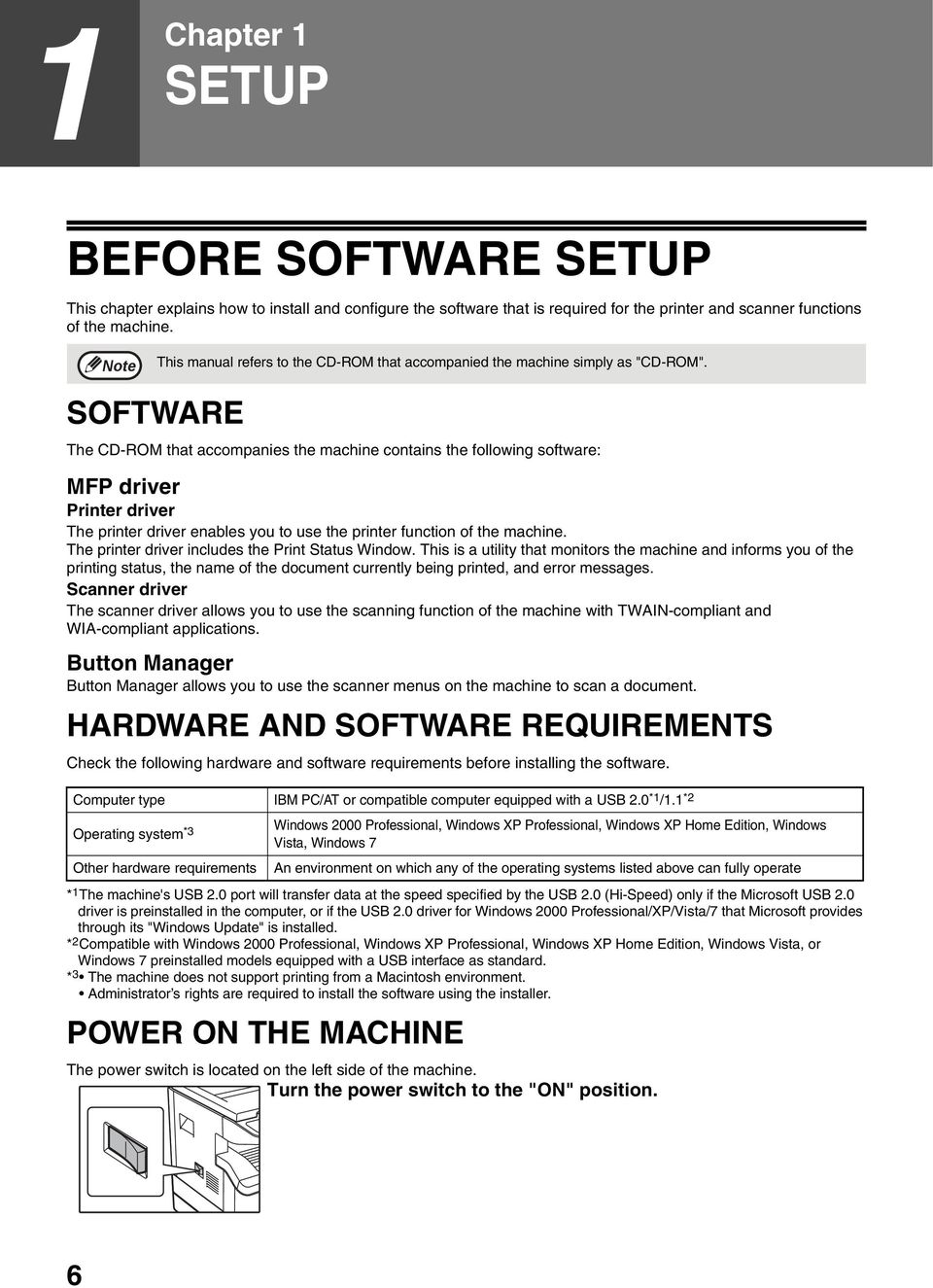
8 Chapter SETUP BEFORE SOFTWARE SETUP This chapter explains how to install and configure the software that is required for the printer and scanner functions of the machine. This manual refers to the CD-ROM that accompanied the machine simply as "CD-ROM". SOFTWARE The CD-ROM that accompanies the machine contains the following software: MFP driver Printer driver The printer driver enables you to use the printer function of the machine. The printer driver includes the Print Status Window. This is a utility that monitors the machine and informs you of the printing status, the name of the document currently being printed, and error messages. Scanner driver The scanner driver allows you to use the scanning function of the machine with TWAIN-compliant and WIA-compliant applications. Button Manager Button Manager allows you to use the scanner menus on the machine to scan a document. HARDWARE AND SOFTWARE REQUIREMENTS Check the following hardware and software requirements before installing the software. Computer type IBM PC/AT or compatible computer equipped with a USB.0 * /. * Operating system * Other hardware requirements * The machine's USB.0 port will transfer data at the speed specified by the USB.0 (Hi-Speed) only if the Microsoft USB.0 driver is preinstalled in the computer, or if the USB.0 driver for Windows 000 Professional/XP/Vista/7 that Microsoft provides through its "Windows Update" is installed. * Compatible with Windows 000 Professional, Windows XP Professional, Windows XP Home Edition, Windows Vista, or Windows 7 preinstalled models equipped with a USB interface as standard. * The machine does not support printing from a Macintosh environment. Administrator s rights are required to install the software using the installer. POWER ON THE MACHINE Windows 000 Professional, Windows XP Professional, Windows XP Home Edition, Windows Vista, Windows 7 An environment on which any of the operating systems listed above can fully operate The power switch is located on the left side of the machine. Turn the power switch to the "ON" position. 6
9 INSTALLING THE SOFTWARE The USB cable must not be connected to the machine. Make sure that the cable is not connected before proceeding. If the cable is connected, a Plug and Play window will appear. If this happens, click the "Cancel" button to close the window and disconnect the cable. The screen images in this manual are mainly for Windows Vista. With other versions of Windows, some screen images may be different from those in this manual. If an error message appears, follow the instructions on the screen to solve the problem. After the problem is solved, the installation procedure will continue. Depending on the problem, you may have to click the "Cancel" button to exit the installer. In this case, reinstall the software from the beginning after solving the problem. The cable will be connected in step. Insert the CD-ROM into your CD-ROM drive Read the message in the "Welcome" window and then click the "Next" button. To install all of the software, click the "Standard" button and go to step. To install particular packages, click the "Custom" button and go to the next step. Click the "MFP Driver" button. 5 Click the "Start" button, click "Computer", and then double-click the CD-ROM icon ( ). In Windows XP, click the "start" button, click "My Computer", and then double-click the CD-ROM icon. In Windows 000, double-click "My Computer", and then double-click the CD-ROM icon. Double-click the "Setup" icon ( ). In Windows 7, if a message screen appears asking you for confirmation, click "Yes". In Windows Vista, if a message screen appears asking you for confirmation, click "Allow". The "SOFTWARE LICENSE" window will appear. Make sure that you understand the contents of the software license, and then click the "Yes" button. Click the "Display Readme" button to show information on packages that are selected. You can show the "SOFTWARE LICENSE" in a different language by selecting the desired language from the language menu. To install the software in the selected language, continue the installation with that language selected. 7

10 SETUP 9 Select "Connected to this computer" and click the "Next" button. When installing is finished, click the "Close" button. Caution If you are using Windows Vista/7 and a security warning window appears, be sure to click "Install this driver software anyway". If you are running Windows 000/XP and a warning message appears regarding the Windows logo test or digital signature, be sure to click "Continue Anyway" or "Yes". A message will appear instructing you to connect the machine to your computer. Click the "OK" button. Follow the on-screen instructions. When "The installation of the SHARP software is complete." appears, click the "OK" button. Caution If you are using Windows Vista/7 and a security warning window appears, be sure to click "Install this driver software anyway". If you are running Windows 000/XP and a warning message appears regarding the Windows logo test or digital signature, be sure to click "Continue Anyway" or "Yes". After the installation, a message prompting you to restart your computer may appear. In this case, click the "Yes" button to restart your computer. Make sure that the power of the machine is turned on, and then connect the USB cable (p.9). Windows will detect the machine and a Plug and Play window will appear. Follow the instructions in the Plug and Play window to install the driver. 0 You will return to the window of step 8. If you wish to install Button Manager, click the "Button Manager" button. If you do not wish to install the Button Manager, go to step. Follow the on-screen instructions. Caution If you are using Windows Vista/7 and a security warning window appears, be sure to click "Install this driver software anyway". If you are running Windows 000/XP and a warning message appears regarding the Windows logo test or digital signature, be sure to click "Continue Anyway" or "Yes". This completes the installation of the software. If you installed Button Manager, set up Button Manager as explained in "SETTING UP BUTTON MANAGER" (p.) Follow the on-screen instructions. After the installation, a message prompting you to restart your computer may appear. In this case, click the "Yes" button to restart your computer. 8

11 CONNECTING TO A COMPUTER Follow the procedure below to connect the machine to your computer. A USB cable for connecting the machine to your computer is not included with the machine. Please purchase the appropriate cable for your computer. Interface cable USB cable Shielded twisted pair cable, high-speed transmission equivalent ( m (0 feet) max.) If the machine will be connected using a USB.0 interface, please purchase a USB cable that supports USB.0. Caution USB is available with a PC/AT compatible computer that was originally equipped with USB and had Windows 000 Professional, Windows XP Professional, Windows XP Home Edition, Windows Vista, or Windows 7 preinstalled. Do not connect the USB cable before installing the MFP driver. The USB cable should be connected during installation of the MFP driver. CONNECTING A USB CABLE Insert the cable into the USB connector on the machine. Insert the other end of the cable into your computer's USB connector. System requirements for USB.0 (Hi-Speed mode) The machine's USB.0 connector will transfer data at the speed specified by the USB.0 (Hi-Speed) only if the Microsoft USB.0 driver is preinstalled in the computer, or if the USB.0 driver for Windows 000 Professional /XP/Vista/7 that Microsoft provides through its "Windows Update" Web page is installed. Even when the Microsoft USB.0 driver is used, it may not be possible to obtain full USB.0 speed if a PC card supporting USB.0 is used. To obtain the latest driver (which may enable a higher speed), contact the manufacturer of your PC card. Connection is also possible using a USB. port on your computer. However, the specifications will be USB. specifications (Full-Speed). 9

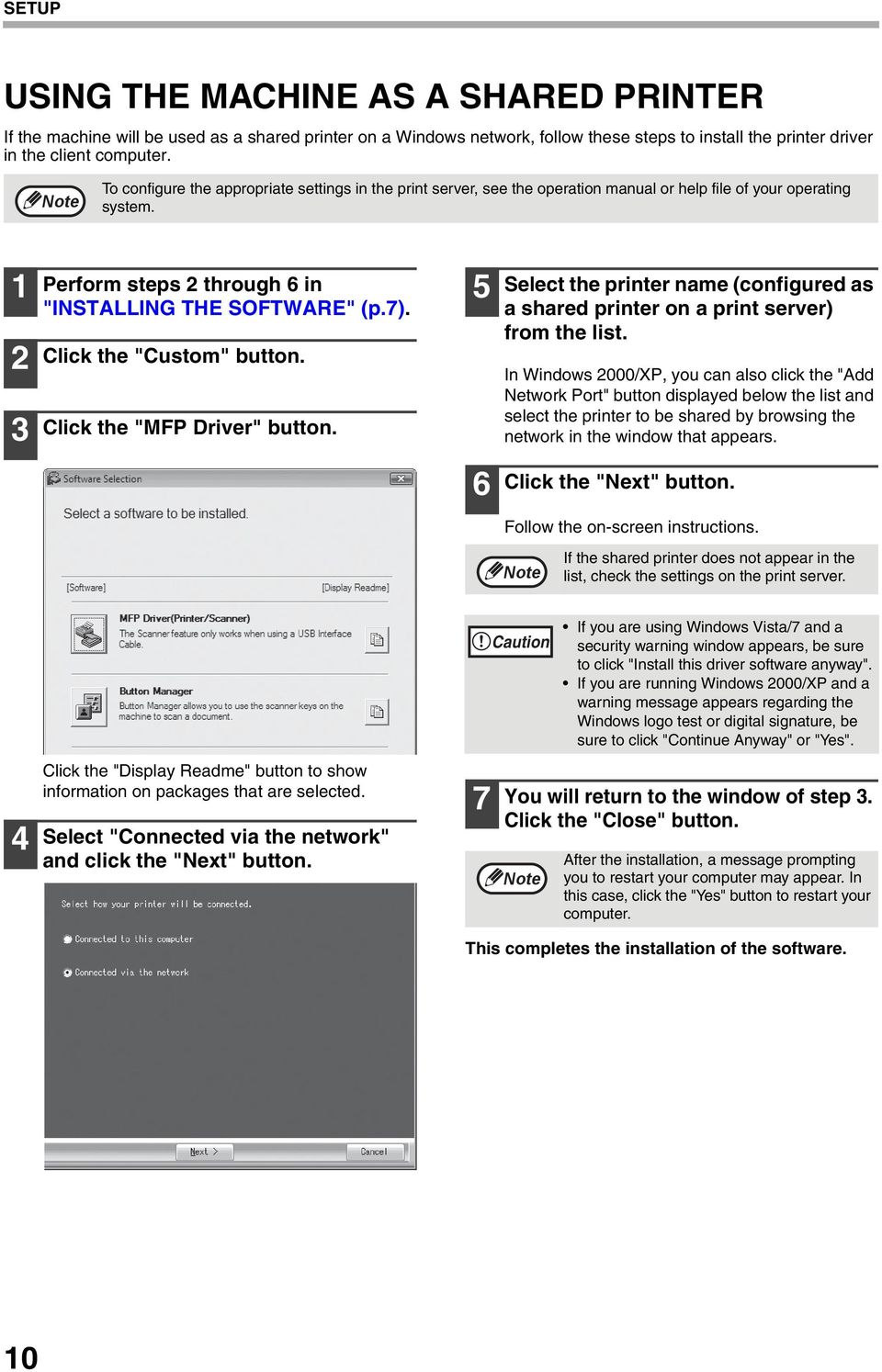
12 SETUP USING THE MACHINE AS A SHARED PRINTER If the machine will be used as a shared printer on a Windows network, follow these steps to install the printer driver in the client computer. To configure the appropriate settings in the print server, see the operation manual or help file of your operating system. Perform steps through 6 in "INSTALLING THE SOFTWARE" (p.7). Click the "Custom" button. Click the "MFP Driver" button. 5 Select the printer name (configured as a shared printer on a print server) from the list. In Windows 000/XP, you can also click the "Add Network Port" button displayed below the list and select the printer to be shared by browsing the network in the window that appears. 6 Click the "Next" button. Follow the on-screen instructions. If the shared printer does not appear in the list, check the settings on the print server. Click the "Display Readme" button to show information on packages that are selected. Select "Connected via the network" and click the "Next" button. 7 Caution If you are using Windows Vista/7 and a security warning window appears, be sure to click "Install this driver software anyway". If you are running Windows 000/XP and a warning message appears regarding the Windows logo test or digital signature, be sure to click "Continue Anyway" or "Yes". You will return to the window of step. Click the "Close" button. After the installation, a message prompting you to restart your computer may appear. In this case, click the "Yes" button to restart your computer. This completes the installation of the software. 0
13 CONFIGURING THE PRINTER DRIVER After installing the printer driver, you must configure the printer driver settings appropriately for the number of paper trays on the machine and the size of paper loaded in each. Click the "Start" button, click "Control Panel", and then click "Printer". In Windows 7, click the "Start" button and then click "Devices and Printers". In Windows XP, click the "start" button and click "Printers and Faxes". In Windows 000, click the "Start" button, select "Settings", and then click "Printers". Click the "Set Tray Status" button and select the size of paper that is loaded in each tray. Select a tray in the "Paper Source" menu, and select the size of paper loaded in that tray from the "Set Paper Size" menu. Repeat for each tray. In Windows XP, if "Printers and Faxes" does not appear in the "start" menu, select "Control Panel", select "Printers and Other Hardware", and then select "Printers and Faxes". Click the "SHARP AR-XXXX" printer driver icon and select "Properties" from the "Organize" menu. In Windows 7, right-click the "SHARP AR-XXXX" printer driver icon, and then click "Printer properties". In Windows XP/000, select "Properties" from the "File" menu. Click the "Configuration" tab and set the printer configuration based on the options that have been installed. Set the printer configuration properly. If not, printing may not take place correctly. 5 6 Click the "OK" button in the "Set Tray Status" window. Click the "OK" button in the printer properties window. To automatically configure the settings based on the detected machine status, click the "Auto Configuration" button.

14 SETTING UP BUTTON MANAGER Button Manager is a software program that works with the scanner driver to enable scanning from the machine. To scan using the machine, Button Manager must be linked with the scan menu on the machine. Follow the steps below to link Button Manager. Windows XP/Vista/7 Click the "Start" button, click "Control Panel", click "Hardware and Sound", and then click "Scanners and Cameras". In Windows 7, click the "Start" button and then click "Devices and Printers". In Windows XP, click the "start" button, select "Control Panel" and click "Printers and Other Hardware", and then click "Scanners and Cameras". 5 Select "Start this program" and then select "Sharp Button Manager AA" from the pull-down menu. Click the "SHARP AR-XXXX" icon and select "Properties". In Windows 7, right-click the "SHARP AR-XXXX" icon and select "Scan properties". In Windows XP, select "Properties" from the "File" menu. In the "Properties" screen, click the "Events" tab. Select "SC:" from the "Select an event" pull-down menu. 6 Repeat Steps and 5 to link Button Manager to "SC:" through "SC6:". Select "SC:" from the "Select an event" pull-down menu. Select "Start this program", select "Sharp Button Manager AA" from the pull-down menu. Do the same for each scan menu through "SC6:". 7 Click the "OK" button. Button Manager is now linked to the scan menu ( through 6). The scan settings for each of scan menu through 6 can be changed with the setting window of Button Manager. For the factory default settings of the scan menu and the procedures for configuring Button Manager settings, see "BUTTON MANAGER SETTINGS" (p.6).

15 SETUP Windows 000 Click the "Start" button, select "Settings", and then click "Control Panel". 6 Select "Sharp Button Manager AA" in "Send to this application". Double-click the "Scanners and Cameras" icon. Select "SHARP AR-XXXX" and click the "Properties" button. SC: AA In the "Properties" screen, click the "Events" tab. 5 Select "SC:" from the "Scanner events" pull-down menu. If other applications are shown, deselect the checkboxes for the other applications and leave only the Button Manager checkbox selected. SC: 7 Click the "Apply" button. AA 8 Repeat Steps 5 through 7 to link Button Manager to "SC:" through "SC6:". Select "SC:" from the "Scanner events" pull-down menu. Select "Sharp Button Manager AA" in "Send to this application" and click the "Apply" button. Do the same for each scan menu through "SC6:". When the settings have been completed, click the "OK" button to close the screen. Button Manager is now linked to the scan menu ( through 6). The scan settings for each of scan menu through 6 can be changed with the setting window of Button Manager. For the factory default settings of the scan menu and the procedures for configuring Button Manager settings, see "BUTTON MANAGER SETTINGS" (p.6).

16 TROUBLESHOOTING If the software is not installed correctly, check the following items on your computer. The driver cannot be installed (Windows 000/XP) If the driver cannot be installed in Windows 000/XP, follow these steps to check your computer's settings. Click the "start" button and then click "Control Panel". In Windows 000, click the "Start" button, select "Settings", and then click "Control Panel". Click "Performance and Maintenance", and then click "System". In Windows 000, double-click the "System" icon. Click the "Hardware" tab and then click the "Driver Signing" button. Check "What action do you want Windows to take?" ("File signature verification" in Windows 000). Plug and Play window does not appear If the Plug and Play window does not appear after you connect the machine to your computer with a USB cable and turn on the machine, follow the steps below to verify that the USB port is available. Click the "Start" button, select "Control Panel", and then click "System and Maintenance". In Windows XP, click the "start" button, click "Control Panel", and then click "Performance and Maintenance". In Windows 000, click the "Start" button, select "Settings", and then click "Control Panel". Click "Device Manager", and if a message screen appears asking you for confirmation, click "Continue". "Universal Serial Bus controllers" will appear in the list of devices. In Windows XP, click "System", click the "Hardware" tab, and click the "Device Manager" button. In Windows 000, double-click the "System" icon, click the "Hardware" tab, and click the "Device Manager" button. Click the icon beside "Universal Serial Bus controllers". If the option "Block" has been selected, it will not be possible to install the driver. Select the option "Warn" and then install the driver as explained in "INSTALLING THE SOFTWARE" (p.7). Two items should appear: your controller chipset type and Root Hub. If these items appear, you can use the USB port. If the "Universal Serial Bus controllers" shows a yellow exclamation point or does not appear, you must check your computer manual for USB troubleshooting or contact your computer manufacturer. Once you have verified that the USB port is enabled, install the software as explained in "INSTALLING THE SOFTWARE" (p.7).

17 SETUP The driver cannot be correctly installed by Plug and Play If the driver cannot be correctly installed by Plug and Play (for example, Plug and Play takes place without copying the required files for the driver installation), follow these steps to remove unneeded devices and then install the driver as explained in "INSTALLING THE SOFTWARE" (p.7). Click the "Start" button, select "Control Panel", and then click "System and Maintenance". In Windows XP, click the "start" button, click "Control Panel", and then click "Performance and Maintenance". In Windows 000, click the "Start" button, select "Settings", and then click "Control Panel". Click "Device Manager", and if a message screen appears asking you for confirmation, click "Continue". In Windows XP, click "System", click the "Hardware" tab, and click the "Device Manager" button. In Windows 000, double-click the "System" icon, click the "Hardware" tab, and click the "Device Manager" button. Click the icon beside "Other devices". Removing the software If you need to remove the software, follow these steps. 5 Click the "Start" button, and then click "Control Panel". In Windows XP, click the "start" button and then click "Control Panel". In Windows 000, click the "Start" button, select "Settings", and then click "Control Panel". Click "Uninstall a program". In Windows XP, click "Add or Remove Programs". In Windows 000, double-click the "Add/Remove Programs" icon. Select the driver from the list, and remove the software. For more information, refer to your operating manual or to the help files for your operating system. Restart your computer. If "SHARP AR-XXXX" appears, select and delete the item. If "Other devices" does not appear, close the "Device Manager" window. Install the software as explained in "INSTALLING THE SOFTWARE" (p.7). 5

18 Chapter BEFORE USING THE MACHINE This chapter contains basic information that should be read before using the machine. PART NAMES AND FUNCTIONS Glass cleaner (when the SPF/RSPF is installed) Use to clean the original scanning glass. (p.98) Document feeder cover (when the SPF/RSPF is installed) /document cover Open to make copies from the document glass. (p.7) Document glass Place an original that you wish to scan face down here. (p.7) Handles Use to move the machine. Power switch Press to turn the machine power on and off. (p.0) Operation panel Contains operation keys and indicator lights. (p.8, p.9) Paper output tray Copies and prints are deposited to this tray. Front cover Open to remove paper misfeeds and perform machine maintenance. (p.90, p.9, p.95) Paper trays Each tray holds 50 sheets of paper. (p.) Side cover Open to remove paper misfeeds and perform machine maintenance. (p.89, p.90) Side cover handle Pull to open the side cover. (p.89) Bypass tray guides Adjust to the width of the paper. (p.) 6

19 BEFORE USING THE MACHINE Bypass tray Paper including special paper (such as transparency film) can be fed from the bypass tray. (p., p.8) Bypass tray extension Pull out when feeding large paper such as B and A (8-/" x " and " x 7"). (p.) Charger cleaner Use to clean the transfer charger. (p.99) USB.0 connector Connect to your computer to use the printer function. (p.9) Document feeder tray (when the SPF/RSPF is installed) Place the original(s) that you wish to scan face up here. Holds up to 0 originals. (p.9) Original guides (when the SPF/RSPF is installed) Adjust to the size of the originals. (p.8) Feeding roller cover (when the SPF/RSPF is installed) Open to remove misfed originals. (p.88) Right side cover (when the SPF/RSPF is installed) Open to remove misfed originals. (p.88) Exit area (when the SPF/RSPF is installed) Originals exit the machine here after copying Toner cartridge lock release lever To replace the toner cartridge, pull out the toner cartridge while pushing on this lever. (p.95) Toner cartridge Contains toner. (p.95) Roller rotating knob Turn to remove misfed paper. (p.90, p.9) Fusing unit release levers To remove a paper misfeed from the fusing unit, push down on these levers and remove the paper. (p.9) Warning The fusing unit is hot. Do not touch the fusing unit when removing misfed paper. Doing so may cause a burn or injury. Photoconductive drum Copy images are formed on the photoconductive drum. Fusing unit paper guide Open to remove misfed paper. (p.9) The model name can be seen on the machines front cover. 7

20 BEFORE USING THE MACHINE OPERATION PANEL The indications of the operation panel may differ depending on the country and the region. The example of a display of inch series When the ID CARD COPY function is used SCAN MENU key Use to scan by means of the provided Button Manager software. (p.6) SCAN key ( ) / indicator Press to switch the machine to scanner mode and scan by means of the provided Button Manager software. (p.59) The indicator blinks during scanning and transmission of the scanned data. ON LINE key ( ) / indicator Press to toggle the machine between online and off-line. The indicator lights up when the machine is online, and goes off when the machine is off-line. The indicator blinks while the machine is receiving print data and while printing is paused. (p.8) ORIGINAL TO COPY key / indicators (AR-568D/AR-560D/AR-56D) Press to select one-sided and two-sided copy modes. (p.6) Two-sided copies from one-sided originals. Two-sided copies from two-sided originals. One-sided copies from two-sided originals. 5 XY-ZOOM key ( ) / indicator Press to change the horizontal and vertical copy ratios independently. (p.) 6 DUAL PAGE COPY key ( ) / indicator Use to make individual copies of the two pages of an open book or other two-page original. (p.9) 7 ERASE key ( / ) / indicators Press to select the "EDGE ERASE", "CENTRE ERASE" or "EDGE + CENTRE ERASE" mode. (p.6) 8 ORIGINAL DATA indicator ( DATA ) Blinks when the memory becomes full of scanned original image data. (p., p.) 9 SORT/GROUP key ( / ) / indicators Press to select the "SORT" or "GROUP" mode. (p.) 0 IN / IN key ( / ) / indicators Press to select the " IN " or " IN " mode. (p.) MARGIN SHIFT key ( ) / indicator Shifts text or image on the copy to leave a binding margin on the edge of the copy. (p.5) To use the ID card copy function, attach the supplied [ID CARD] key label on the MARGIN SHIFT key. (The function cannot be used in some regions.) AUTO/TEXT/PHOTO key ( AUTO / / ) / indicators Use to select the exposure mode: "AUTO", "TEXT", or "PHOTO". (p.0) ORIGINAL key ( ) / ORIGINAL SIZE indicators Use to enter the original size. (p.) The selected original size will light up. PAPER SIZE indicators Light up to show the selected copy paper size. (p.) 5 Paper feed location / misfeed location indicators The selected paper feed location is shown by a lit indicator ( ). (p.7) The general location of misfed paper is shown by a blinking red indicator ( ). (p.88) 6 Alarm indicators [ ] Maintenance indicator (p.87) [ ] Toner cartridge replacement required indicator (p.87) [ ] Developer replacement required indicator (p.87) [ ] Paper required indicator (p.87) [ ] Misfeed indicator (p.87) 8

21 BEFORE USING THE MACHINE When there are two or more paper trays 7 Display Shows the set number of copies, as well as the copy ratio, system setting function or setting code, or an error code when an error occurs. 8 Numeric keys Use to select the desired copy quantity or to make system setting entries. (p.) To display the total number of pages output by the machine, hold the [0] key down. (p.96) 9 CLEAR key ( ) Clears the copy quantity display or terminates a copy run. 0 INTERRUPT key ( ) / indicator Interrupts a copy run. (p.0) Light and Dark keys (, ) / indicators Use to adjust the TEXT or PHOTO exposure level. (p.0) PAPER SELECT key ( ) Use to set the paper size in the paper trays. (p., p.0) AUTO PAPER SELECT indicator ( AUTO ) Paper of the proper size will be automatically selected depending on the original size and selected copy ratio when this indicator is on. (p.9) TRAY SETTING key ( ) Use to manually select a paper tray. (p.) 5 AUTO IMAGE key ( AUTO %) / indicator Press for automatic copy ratio selection. (p.) 6 SPF/RSPF indicator (when the SPF/RSPF is installed) Lights up when originals are set in the document feeder tray. (p.8) 7 PRESET RATIO selector keys (, ) / indicators Use to select preset reduction/enlargement copy ratios. (p.) 8 Zoom keys (, ) Use to select any reduction or enlargement copy ratio from 5% to 00% in increments of %. (p.) 9 Copy ratio display key ( ) Hold down when the machine is not in use to display the copy ratio in the display. (p.) 0 ZOOM indicator Lights up when a zoom ratio is set. (p.) Audit clear key ( ) ( ACC.#-C ) Closes an open account. (p.78) READ-END key ( ) Use to check the total number of copies made. (p.96) When copying in sort mode and in / in from the document glass, press this key when you have finished scanning the original pages and are ready to start copying. (p., p.) CLEAR ALL key ( ) Clears all selected settings and returns the machine to the initial settings. (p.0) POWER SAVE indicator ( ) Lights up when the machine is in a power save mode. (p.0) 5 START key ( ) / indicator Press to make a copy (p.8). Also press to exit "Auto power shut-off" mode and to set a system setting. Copying is possible when the indicator is on. 9
22 POWER ON AND OFF The power switch is located on the left side of the machine. POWER ON Turn the power switch to the "ON" position. It will take about 5 seconds for the machine to warm up. While the machine is warming up, the POWER SAVE indicator ( ) will blink. (The POWER SAVE indicator ( ) will go off when the machine is ready to copy.) However, you can make desired settings and press the [START] key ( ) during warm-up. Copying will start after warm-up. POWER OFF Make sure that the machine is not in operation and then turn the power switch to the "OFF" position. If the power switch is turned off while the machine is in operation, a misfeed may occur and the job that was in progress will be cancelled. Check the following to make sure the machine is not in operation: The START indicator is lit. (Initial state) The POWER SAVE indicator ( ) is lit. ("Preheat mode" or "Auto power shut-off" mode) The machine reverts to the initial settings when it is first turned on, when the [CLEAR ALL] key ( ) is pressed, or when no keys are pressed for the preset "Auto clear" time following the end of a copy job. When the machine reverts to the initial settings, all settings and functions selected to that point are cancelled. The "Auto clear" time can be changed in the user settings. (p.70) The machine is initially set to automatically enter power save mode if not used for copying or printing, for a preset period of time. This setting can be changed in the system settings. (p.70) Power save modes The machine has two power save modes to reduce overall power consumption thereby reducing the cost of operation. In addition, these modes conserve natural resources and help reduce environmental pollution. The two power save modes are "Preheat mode" and "Auto power shut-off mode". Preheat mode This function automatically switches the machine to a low power consumption state if the set duration of time elapses without the machine being used when the power is on. The POWER SAVE indicator ( ) lights up, however, the keys on the operation panel can be used. Normal operation automatically resumes when a key on the operation panel is pressed, an original is placed, or a print job is received. Auto power shut-off mode This function automatically switches the machine to a state that consumes even less power than preheat mode if the set duration of time elapses without the machine being used when the power is on. All lights except the POWER SAVE indicator ( ) and ON LINE indicator go off. To resume normal operation, press the [START] key ( ). Normal operation also resumes automatically when a print job is received. While in auto power shut-off mode, no keys (except the [START] key ( )) can be used. The preheat activation time and the "Auto power shut-off timer" can be changed using system settings. It is suggested that you set times that are appropriate for your usage of the machine. (p.70) Initial settings The machine assumes the initial settings when it is first turned on, when the [CLEAR ALL] key ( ) is pressed, and approximately one minute after the last copy is made in any mode. Copy ratio: 00%, Exposure: Automatic Copy quantity: 0, All special copier modes: Off Auto paper selection: On, Paper feed station: The tray selected in the "Default tray setting" in the system settings. (p.7) 0
23 LOADING PAPER The paper required indicator ( ) will light up when there is no copy paper in the selected paper feed tray, or when the selected paper tray is not installed or is improperly installed. PAPER For best results, use only SHARP recommended paper. Paper tray type Paper type Size Weight Capacity Paper tray 50-sheet paper feed unit x 50-sheet paper feed unit Bypass tray * A5 (5-/" x 8-/") can be used in the upper paper tray but cannot be used in other trays (including trays in optional paper feeding unit). * When making a large number of copies or prints using 90 g/m ( lbs.) paper, remove the output from the paper output tray when about 00 pages have been printed. The output may not stack correctly if more than 00 pages are allowed to accumulate. * The number of sheets of the paper which can be set changes with the weight of a paper. * Index Special papers Standard paper Recycled paper Standard paper Recycled paper Transparency film Labels Thick paper Envelopes A5 * B5 A B A (5-/" x 8-/" * (Invoice)) (8-/" x " (Letter)) (8-/" x " (Foolscap)) (8-/" x " (Legal)) (" x 7" (Ledger)) A6R to A (5-/" x 8-/" (Invoice) to " x 7" (Ledger)) A6R to A (5-/" x 8-/" (Invoice) to 8-/" x " (Letter)) A6R to A (5-/" x 8-/" (Invoice) to " x 7" (Ledger)) International DL (0 mm x 0 mm) International C5 (6 mm x 9 mm) Monarch (-7/8" x 7-/") Commercial 0 (-/8" x 9-/") 56 g/m to 90 g/m * (5 lbs. to lbs. * ) 56 g/m to 90 g/m (5 lbs. to lbs.) 9 g/m to 00 g/m ( lbs. to 0 lbs. * ) 06 g/m to 8 g/m (8 lbs. to lbs.) 9 g/m to 05 g/m ( lbs. to 8 lbs.) 50 sheets (Load paper lower than the line on the tray) 00 sheets * Load one sheet of paper each time on the bypass tray. Load one sheet of paper each time on the bypass tray. You can load multiple sheets of paper on the bypass tray. You can load multiple sheets of paper on the bypass tray. 5 sheets Follow these guidelines when using special papers. Use SHARP recommended transparency film and label sheets. Using other than SHARP recommended paper may result in misfeeds or smudges on the output. If other than SHARP recommended media must be used, feed each sheet one at a time using the bypass tray (do not attempt continuous copying or printing). There are many varieties of special paper available on the market, and some cannot be used with this machine. Before using special paper, contact your authorised service representative. Before using other than SHARP recommended paper, make a test copy to see if the paper is suitable.
24 BEFORE USING THE MACHINE LOADING PAPER Make sure that the machine is not copying or printing, and then follow these steps to load paper. Loading the paper tray Gently lift and pull out the paper tray until it stops. Do not load paper higher than the line on the tray (up to 50 sheets). Do not add paper to the loaded paper. It may cause multiple feed of paper. A5 (5-/" x 8-/") can be used in the upper paper tray but cannot be used in other trays (including trays in optional paper feeding unit). Push the pressure plate down until it locks in place. Gently push the paper tray into the machine. Push the centre of the pressure plate down until it locks into place. Load paper into the tray. Open the package of the paper and load it without fanning the paper. Make sure the stack of paper is straight before loading it. If you loaded a different size of paper than was loaded previously in the tray, go to "CHANGING A TRAY'S PAPER SIZE SETTING" (p.). When misfeed occurs, rotate the paper 80 degrees and reload it. Straighten curled paper before using it. For how to load paper, refer to the steps below.
25 BEFORE USING THE MACHINE Loading the bypass tray Unfold the bypass tray. Insert the paper (print face down) all the way into the bypass tray. To prevent a misfeed, verify once more that the paper guides are adjusted to the width of the paper. When feeding large paper such as B and A (8-/" x " and " x 7"), pull out the bypass tray extension. Set the paper guides to the copy paper width. If you loaded paper in the bypass tray, press the [PAPER SELECT] key ( ) to select the bypass tray. The bypass tray will not be selected automatically. If you load thick paper in the bypass tray, hold down the [TRAY SETTING] key ( ) for more than 5 seconds, use the [PAPER SELECT] key ( ) to select the bypass tray, and press the [AUTO IMAGE] key ( AUTO % ). When AUTO IMAGE indicator ( AUTO % ) lights up, the paper type is set to thick paper. The setting is cleared when "Auto clear" works or the [CLEAR ALL] key ( ) is pressed. Important points when inserting paper in the bypass tray Up to 00 sheets of standard copy paper can be set in the bypass tray. Be sure to place A6, B6 or 5-/" x 8-/" size paper or envelopes horizontally as shown in the following diagram ( ). Available Not available When loading envelopes, make sure that they are straight and flat and do not have loosely glued construction flaps (not the closure flap). Special papers except SHARP recommended transparency film, labels, and envelopes must be fed one sheet at a time through the bypass tray. When adding paper, first remove any paper remaining in the tray, combine it with the paper to be added and then reload as a single stack. The paper to be added must be the same size and type as the paper already in the tray. Do not use paper that is smaller than the original. This may cause smudges or unclean images. Do not use paper that has already been printed on by a laser printer or plain paper fax machine. This may cause smudges or unclean images.
26 BEFORE USING THE MACHINE Envelopes Do not use the following envelopes, as misfeeds will occur. Envelopes with metal tabs, clasps, strings, holes, or windows. Envelopes with rough fibres, carbon paper, or glossy surfaces. Envelopes with two or more flaps. Envelopes with tape, film, or paper attached to the flap. Envelopes with a fold in the flap. Envelopes with glue on the flap to be moistened for sealing. Envelopes with labels or stamps. Envelopes that are slightly inflated with air. Envelopes with glue protruding from the seal area. Envelopes with part of the seal area peeled off. CHANGING A TRAY'S PAPER SIZE SETTING Follow these steps to change a tray's paper size setting. The paper size setting cannot be changed when the machine has stopped temporarily due to running out of paper or a misfeed, or during interrupt copying. During printing (even in copy mode), the paper size setting cannot be changed. A5 (5-/" x 8-/") size paper can only be selected in upper paper tray. Do not load paper that is a different size than the paper size setting. Copying will not be possible. Hold down the [TRAY SETTING] key ( ) for more than 5 seconds to set the selected paper size. The currently selected paper feed location indicator will blink and the corresponding paper size (which is currently set) indicator will light steadily. All other indicators will go out. If the machine has two or more paper trays, use the [PAPER SELECT] key ( ) to select the paper tray for which you wish to change the paper size setting. Each time the [PAPER SELECT] key ( ) is pressed, a paper tray will be indicated with a blinking paper feed location indicator.
27 BEFORE USING THE MACHINE Use the [ORIGINAL] key ( ) to select the paper size. The indicator of the selected paper size lights up. Squeeze the lock lever of the front guide and slide the front guide to match the width of the paper, and move the left guide to the appropriate slot as marked on the tray. Left guide Changing bypass tray's paper size setting To change the bypass tray's paper size setting, hold down the [TRAY SETTING] key ( ) for more than 5 seconds, use the [PAPER SELECT] key ( ) to select the bypass tray, and select the desired paper size. If you load thick paper in the bypass tray, hold down the [TRAY SETTING] key ( ) for more than 5 seconds, use the [PAPER SELECT] key ( ) to select the bypass tray, and press the [AUTO IMAGE] key ( AUTO % ). When AUTO IMAGE indicator ( AUTO % ) lights up, the paper type is set to thick paper. The setting is cleared when "Auto clear" works or the [CLEAR ALL] key ( ) is pressed. Customise the bypass tray setting If the bypass tray is selected, you can also change the paper size setting with the following procedure. Enter a value for the horizontal/vertical direction by pressing the numeric keys. Press the [ ] key to switch the horizontal/vertical direction. The horizontal direction is selected: zoom indicator lights up The vertical direction is selected: zoom indicator does not light up When finished, press and hold [ ]. Available value Direction min. (mm) max. (mm) horizontal vertical 9 0 * Value can be entered only in metric (AB series). The front guide is a slide-type guide. Grasp the locking knob on the guide and slide the guide to the indicator line of the paper to be loaded. The left guide is an insert-type guide. Remove it and then insert it at the indicator line of the paper to be loaded. When using " x 7" sized paper store the left guide in the slot at the left front of the paper tray. If the bypass tray is selected, set the paper guides to the copy paper width. 5 Press the [START] key ( ) and then the [TRAY SETTING] key ( ). Front guide To change the paper size setting of another tray, repeat steps to 5 after pressing the [START] key ( ). Affix the paper size label for the paper size selected in step to the label position on the right end of the tray. Metric (AB series) and inch series reference Inch series (inch) Metric series (AB series) (mm) 5-/" x 8-/" (Invoice) 0 x 6 8-/" x " (Letter) 6 x 79 8-/" x " (Foolscap) 6 x 0 8-/" x " (Legal) 6 x 55 " x 7" (Ledger) 79 x Important points when using the printer mode Make sure that the tray's paper size setting is the same as the tray's paper size setting in the printer driver. For example, if the tray's paper size setting is AR (8-/" x "R), set "Set Paper Size" to "AR" ("Letter-R"). For more information, see "CONFIGURING THE PRINTER DRIVER" (p.). 5
28 OPERATION IN COPY, PRINTER, AND SCANNER MODES Some operations cannot be performed simultaneously when the machine is being used in printer mode, copy mode, or scanner mode. Modes Copying Printing Scanning from a computer Scanning from the machine Copy key input Yes Yes Yes No Copy During copying No No No Printer During printing Yes * Yes Yes During scan preview/ Scanner No Yes during scanning * During two-sided printing (AR-568D/AR-560D/AR-56D), the copy job begins after the print job finishes. 6
29 Chapter COPY FUNCTIONS This chapter explains how to use the copy functions. NORMAL COPYING This section explains how to make a regular copy. If "Auditing mode" has been enabled (p.75), enter your -digit account number. Copying from the document glass Open the document cover/spf/rspf, and place the original. Place the original face down on the document glass. [How to place the original] Align the edge of the original with the original size scale, to be centred with the centring mark ( ). mark Original size scale mark Original size scale An original up to A (" x 7") can be placed on the document glass. Close the document cover/spf/rspf. After placing the original, be sure to close the document cover/spf/ RSPF. If left open, parts outside of the original will be copied black, causing excessive use of toner. Press the [ORIGINAL] key ( ) and select the original size. When the original size is selected, the tray with the same size of paper is automatically selected. (When there are two or more paper trays) Make sure that the PAPER SIZE indicator lights up. If the indicator is not lit, no tray has the same size of paper as the original. Load paper of the required size in a tray, or select the bypass tray with the [PAPER SELECT] key ( ) and copy from the bypass tray. The bypass tray must be manually selected. To copy on paper of a different size than the original, select the paper with the [PAPER SELECT] key ( ). If the ORIGINAL SIZE indicator is blinking, rotate the original so that it is in the same orientation as the blinking ORIGINAL SIZE indicator. Set the number of copies. 7
30 COPY FUNCTIONS 5 Press the [START] key ( ) to begin copying. The copy is delivered to the paper output tray. The paper output tray can hold up to 50 sheets of paper. About one minute after copying ends, "Auto clear" activates and restores the copy settings to the initial settings. (p.0) The setting for "Auto clear time" can be changed in the system settings. (p.70) Press the [CLEAR] key ( ) to stop copying in the middle of a run. Copying from the SPF/RSPF Make sure that an original has not been left on the document glass. Close the SPF/RSPF. Adjust the original guides to the size of the original(s). Set the original(s) face up in the document feeder tray. 5 Do not place originals of different sizes together in the document feeder tray. This may cause misfeeds. Set the number of copies. Press the [START] key ( ) to begin copying. The copy is delivered to the paper output tray. The default output mode for copying from the SPF/ RSPF is sort mode (p.). The default output mode can be changed using "Sort auto select" in the system settings (p.7). Insert the original into the document feeder tray as far as it will go. When the original is set, the SPF/ RSPF indicator will light up. The ORIGINAL SIZE indicator corresponding to the size of the original lights up. If the ORIGINAL SIZE indicator is blinking, rotate the original so that it is in the same orientation as the blinking ORIGINAL SIZE indicator. Make sure that the PAPER SIZE indicator is lit. If the indicator is not lit, no tray has the same size of paper as the original. Load paper of the required size in a tray, or select the bypass tray with the [PAPER SELECT] key ( ) and copy from the bypass tray. The bypass tray must be manually selected. To copy on paper of a different size than the original, select the paper with the [PAPER SELECT] key ( ). The paper output tray can hold up to 50 sheets of paper. About one minute after copying ends, "Auto clear" activates and restores the copy settings to the initial settings. (p.0) The setting for "Auto clear" time can be changed in the system settings. (p.70) Press the [CLEAR] key ( ) to stop copying in the middle of a run. If you find it difficult to remove the original from the document feeder tray, open the feeding roller cover first and then remove the original. If you remove the original without opening the feeding roller cover, the original may become dirty. 8
31 COPY FUNCTIONS Auto paper select mode (when there are two or more paper trays) When the AUTO PAPER SELECT indicator ( AUTO ) lights up, "Auto paper select mode" is enabled. This function automatically selects the paper that is the same size as the original A5, B5, B5R, A, AR, B, A (5-/" x 8-/", 8-/" x ", 8-/" x "R, 8-/" x ", 8-/" x " and " x 7") paper. "Auto paper select mode" can be disabled in the system settings. (p.7) The sizes of paper that can be used vary by country and region. If a zoom setting is selected after placing the original, the paper size that is appropriate for the zoom setting will be automatically selected. "Auto paper select mode" is cancelled if the automatic ratio selection is enabled (p.) or if a tray is selected with the [PAPER SELECT] key ( ). Auto paper select resumes operation when the [CLEAR ALL] key ( ) is pressed or when "Auto clear time" activates. Removing the document cover To copy large originals like newspapers, remove the document cover. To remove it, open the document cover and lift it at a slightly backward angle. To replace the cover, do the reverse. The SPF/RSPF cannot be removed. Copying books or originals with folds or creases Press down on the document cover/spf/rspf while copying as shown. If the document cover/spf/rspf is not completely closed, shadows may appear on the copy or it may be fuzzy. Straighten originals with folds or creases well before placing. Originals that can be used in the SPF/RSPF Originals that are A5 to A (5-/" x 8-/" to " x 7") and 56 g/m to 90 g/m (5 lbs. to lbs.) can be used. A maximum of 0 pages can be placed at once. For originals that are B (8-/" x ") or larger (B, A (8-/" x ", " x 7")), a maximum of 0 pages can be placed at once. Make sure that there are no paper clips or staples on the original. Straighten curled originals before placing them in the document feeder tray. Curled original may cause misfeeds. When you set multiple sheets of thick original, if the original is not fed, reduce the number of the set originals. Originals that cannot be used in the SPF/RSPF The following originals cannot be used. These may cause misfeeds or smudging and unclear images. Transparencies, tracing paper, other transparent or translucent paper, and photographs. Carbon paper, thermal paper. Originals that are creased, folded, or torn. Glued originals, cut-out originals. Originals with binder holes. Originals printed using an ink ribbon (thermal transfer printing), originals on thermal transfer paper. Stream feeding mode If "Stream feeding mode" is enabled in the system settings (p.70), the SPF/RSPF indicator will blink for about 5 seconds after all originals are fed. If a new original is placed in the SPF/RSPF during this time, the original will be automatically fed in and copying will begin. 9
32 COPY FUNCTIONS MAKING A COPY DARKER OR LIGHTER Automatic exposure adjustment is initially enabled. This function automatically adjusts the copy image according to the original being copied. If you wish to select the exposure level yourself, follow the steps below. (Select from two original types and five exposure levels for each original type.) The exposure level used in automatic exposure adjustment can also be changed. ("ADJUSTING THE AUTOMATIC EXPOSURE LEVEL" (p.68)) Original types AUTO...Automatic exposure adjustment is enabled and the exposure is automatically adjusted according to the original being copied. The exposure is lowered for coloured areas and background shadows. TEXT...The exposure is raised for light areas and lowered for dark backgrounds to make text easier to read. PHOTO...Halftones in the photo are reproduced with greater clarity. Press the [AUTO/TEXT/PHOTO] key ( AUTO / / ) to select the original type. To adjust the exposure of a text original manually, press until the TEXT indicator ( ) lights. To copy a photo, press until the PHOTO indicator ( ) lights. Press the [Light] key ( ) or [Dark] key ( ) to adjust the exposure. For a darker image, press the [Dark] key ( ). For a lighter image, press the [Light] key ( ). If exposure level or is selected, the two indicators will light simultaneously. To return to automatic adjustment, press until the AUTO indicator ( AUTO ) lights. Exposure value guidelines Dark originals like newspapers Normal originals 5 Coloured text or text written in pencil SELECTING THE TRAY Auto paper select mode (p.9) normally operates (unless it has been disabled), and thus when the original is placed on the document glass and the original size is selected, or when the original is placed in the SPF/RSPF, the tray with the same size of paper as the original is automatically selected. If you wish to use a tray other than the automatically selected tray (for example you wish to enlarge or reduce the copy or use the bypass tray), press the [PAPER SELECT] key ( ) to select the desired tray. If the desired PAPER SIZE indicator does not light up, change the paper in the tray to the desired paper size. (p.) Automatic ratio selection (p.) does not operate when the bypass tray or a tray set for a special paper size is selected. Auto tray switching (when there are two or more paper trays) If the tray runs out of paper during copying and there is another tray with the same size of paper and the same feeding orientation (horizontal or vertical), the other tray is automatically selected and copying continues. "Auto tray switching" can be disabled in the system settings (p.7). 0
33 COPY FUNCTIONS SETTING THE NUMBER OF COPIES Press the numeric keys to set the number of copies. The set number of copies appears in the display. A maximum of 999 copies (factory default setting) can be set. If you wish to make only a single copy, copying is possible with the display showing "0". If you enter the wrong number, press the [CLEAR] key ( ) and enter the correct number. Important note when making a large number of copies When the maximum number of pages (about 50 pages) that can be held in the paper output tray are output, copying will temporarily stop. When this happens, promptly remove the copies and press the [START] key ( ) to resume copying. Copying will also stop after about 500 pages and 750 pages. Remove the pages and resume copying in the same way. The maximum number of copies can be changed in the system settings. (p.7) REDUCTION/ENLARGEMENT/ZOOM The zoom function enables precise copy ratio selection from 5% to 00% in increments of %. There are three ways to enlarge and reduce copies, as explained below. Reduction and enlargement ratios can be selected automatically with the [AUTO IMAGE] key ( AUTO %). "AUTOMATIC RATIO SELECTION" (below) Reduction and enlargement ratios can be selected manually with the [PRESET RATIO] selector keys (, ) and/or the [ZOOM] keys (, ). "MANUAL RATIO SELECTION" (p.) Separate settings can be selected for the vertical and horizontal ratios. "SELECTING THE VERTICAL AND HORIZONTAL COPY RATIOS SEPARATELY (XY ZOOM Copying)" (p.) Ratios that can be selected will vary depending on whether the original is placed on the document glass or in the SPF/RSPF. Original position Selectable ratios Document glass 5% 00% SPF/RSPF 50% 00% AUTOMATIC RATIO SELECTION Place the original(s) in the document feeder tray or on the document glass. If the original is placed on the document glass, select the original size. (p.7) Automatic ratio selection can be used when the original size is A5, B5, B5R, A, AR, B, A, (5-/" x 8-/", 8-/" x ", 8-/" x "R, 8-/" x ", 8-/" x " or " x 7"). The sizes of paper that can be used vary by country and region. It cannot be used for other sizes. After placing the original, be sure to close the document cover/spf/rspf. If left open, parts outside of the original will be copied black, causing excessive use of toner. Use the [PAPER SELECT] key ( ) to select the paper tray with the desired paper size. This feature will not work when using copy paper of non-standard size or when using the bypass tray.
34 COPY FUNCTIONS Press the [AUTO IMAGE] key ( ). AUTO % The AUTO IMAGE indicator ( AUTO %) lights up and the appropriate ratio for the original size and paper size is selected. (The indicator of the selected ratio will light up.) 5 Set the number of copies and other copy settings, and then press the [START] key ( ). The copy will be delivered to the paper output tray. To cancel automatic ratio selection, press the [AUTO IMAGE] key ( AUTO % ) again. If the ORIGINAL SIZE indicator blinks, change the orientation of the placed original. If the copy is made when a PRESET RATIO selector indicator is blinking, the copied image may run off the page. MANUAL RATIO SELECTION Copies can be reduced down to 5% or enlarged up to 00%. The [PRESET RATIO] selector keys (, ) can be pressed to quickly select a ratio from among eight preset ratios. In addition, the [Zoom] keys (, ) can be pressed to select the ratio in increments of %. Place the original(s) in the document feeder tray or on the document glass. If the original is placed on the document glass, select the original size. (p.7) After placing the original, be sure to close the document cover/spf/rspf. If left open, parts outside of the original will be copied black, causing excessive use of toner. Use the [PRESET RATIO] selector keys (, ) and [Zoom] keys (, ) to select the desired copy ratio. Selecting a preset ratio Press the [PRESET RATIO] selector key ( ) to move up through the preset ratios. Press the [PRESET RATIO] selector key ( ) to move down through the preset ratios. Fine adjustment of the ratio Any ratio from 5% to 00% can be set in increments of %. Press a [PRESET RATIO] selector key ( or ) to set the approximate ratio, then press the [Zoom] keys ( or ) to increase or decrease the ratio. To decrease or increase the zoom ratio rapidly, hold down the [Zoom] keys ( or ). When a [Zoom] key ( or ) is pressed, the ZOOM indicator will light up and the zoom ratio will appear in the display for about two seconds. To verify a zoom setting without changing the zoom ratio, Hold down the [Copy ratio display] key ( ). When the key is released, the display will return to the number of copies display. If the copy is made when a PRESET RATIO selector indicator or the ZOOM indicator is blinking, the copied image may run off the page. To ensure that the image fits on the page, lower the copy ratio until the indicator stops blinking and lights steadily. If the PAPER SIZE indicator is not lit, there is no appropriate paper. Load appropriate paper in a paper tray. (p.) Set the number of copies and other copy settings, and then press the [START] key ( ). The copy will be delivered to the paper output tray. To return the ratio to 00%, press the [PRESET RATIO] selector key ( or ) until the 00% indicator lights up.
35 COPY FUNCTIONS SELECTING THE VERTICAL AND HORIZONTAL COPY RATIOS SEPARATELY (XY ZOOM Copying) The XY ZOOM feature allows the horizontal and vertical copy ratios to be changed independently. Example: Reduction only in the horizontal direction. Original Copy This feature cannot be used with the IN or IN feature. (p.) To use the XY ZOOM feature with the DUAL PAGE COPY feature, set the DUAL PAGE COPY feature first and then the XY ZOOM feature. The XY ZOOM feature cannot be used in combination with the AUTO IMAGE function. Ratios that can be selected will vary depending on the position of the original. Original position Selectable ratios Document glass 5% 00% SPF/RSPF 50% 00% Place the original(s) in the document feeder tray or on the document glass. If the original is placed on the document glass, select the original size. (p.7) After placing the original, be sure to close the document cover/spf/rspf. If left open, parts outside of the original will be copied black, causing excessive use of toner. Press the [XY-ZOOM] key ( ). Use the [PRESET RATIO] selector keys (, ) and [Zoom] keys (, ) to change the copy ratio in the vertical direction. Press the [PRESET RATIO] selector keys (, ) to select a ratio close to the desired ratio, and then press the [Zoom] keys (, ) to adjust the ratio in increments of %. The ratio appears in the display. XY-ZOOM Indicator ( ) lights up. The current value for the vertical direction will appear in the display. 5 Press the [Copy ratio display] key ( ). The selected ratio for the vertical direction will be entered.
36 COPY FUNCTIONS Use the [PRESET RATIO] selector keys (, ) and [Zoom] keys (, ) to change the copy ratio in the horizontal direction. Press the [PRESET RATIO] selector keys (, ) to select a ratio close to the desired ratio, and then press the [Zoom] keys (, ) to adjust the ratio in increments of %. The ratio appears in the display. Press the [Copy ratio display] key ( ). The selected ratio for the horizontal direction will be entered and the display will change to the number of copies display. Set the number of copies and other copy settings, and then press the [START] key ( ). The copy will be delivered to the paper output tray. To verify the copy ratios, press and hold down the [Copy ratio display] key ( ). The vertical and horizontal ratios will be alternately displayed. If you need to change the ratios, press the [PRESET RATIO] selector keys (, ) and the [Zoom] keys (, ) to reset the ratios, beginning with the vertical ratio. (step ) To cancel XY ZOOM copy, press the [XY-ZOOM] key ( ). The XY-ZOOM indicator ( ) will go off, indicating that the function is cancelled.
37 AUTOMATIC TWO-SIDED COPYING (AR-568D/AR-560D/AR-56D) Two originals placed on the document glass can be copied onto each side of a single sheet of paper. In addition, an RSPF can be used to copy two originals onto one sheet of paper, or one two-sided original onto two sheets of paper, or one two-sided original onto each side of one sheet of paper. Document glass Original Paper One-sided original Two sides Usable paper A5 to A (8-/" x " to " x 7") The bypass tray cannot be used. RSPF One-sided original Two sides Two-sided original One side Two-sided original Two sides A5, B5, B5R, A, AR, B, A (8-/" x ", 8-/" x "R, 8-/" x ", 8-/" x ", " x 7") Special paper and 5-/" x 8-/" paper cannot be used. The bypass tray can only be used when making one-sided copies from two-sided originals. The sizes of paper that can be loaded vary by country and region. To use paper in the bypass tray, make a two-sided copy as explained in "TWO-SIDED COPYING USING THE BYPASS TRAY" (p.8). When performing automatic two-sided copying of a one-sided original, or one-sided copying of a two-sided original, the image on the back can be rotated 80 degrees to reverse the top and bottom (Image rotation in duplex copying). To rotate the image 80 degrees, enable the setting as explained in "IMAGE ROTATION IN DUPLEX COPYING" (p.7) or in the system settings (p.70), and then follow the steps below. In particular, when a one-sided vertical (portrait) original is placed in a horizontal orientation (B or A (8-/" x " or " x 7") size) for two-sided copying, the top and bottom of the images on the front and back of the paper will be reversed, and thus this function can be conveniently used to make the top and bottom of the images agree. B or A (8-/" x " or " x 7") portrait original Normal automatic two-sided copying If the orientation of two-sided copying is changed Orientation of the placed original The top and bottom of the images on the front and back are reversed. The top and bottom of the images on the front and back are the same. 5
38 COPY FUNCTIONS Using the document glass Place the original that you wish to copy onto the front side of the paper on the document glass and close the document cover. After placing the original, be sure to close the document cover/rspf. If left open, parts outside of the original will be copied black, causing excessive use of toner. Select the original size. (p.7) Using the RSPF Place originals in the RSPF. (p.8) If you place an odd number of originals for one-sided to two-sided copying, the last page will be one-sided. When the machine is selected two-sided copies from two-sided originals mode or one-sided copies from two-sided originals mode, 5-/" x 8-/" size original cannot be used. (This is because a 5-/" x 8-/" original cannot be reversed.) Press the [ORIGINAL TO COPY] key, and make sure that the indicator is lit. Press the [ORIGINAL TO COPY] key and select the two-sided copy mode that you wish to use. Two-sided copies from one-sided originals Two-sided copies from two-sided originals One-sided copies from two-sided originals Set the number of copies and other settings, and then press the [START] key ( ). The display blinks, and the original is scanned into memory. If you need to clear the data scanned into memory, press the [CLEAR] key ( ). If you wish to cancel two-sided copying and just make a copy of the first original, press the [READ-END] key ( ). Set the number of copies and other copy settings, and press the [START] key ( ). The copy will be delivered to the paper output tray. To cancel automatic two-sided copying, press the [CLEAR ALL] key ( ). 5 When the start indicator lights, remove the first original and then place the original that you wish to copy onto the back side of the paper on the document glass. Close the document cover. Place the second original in the same orientation as the first original. The first original The second original 6 Press the [START] key ( ). 6 The copy will be delivered to the paper output tray.
39 COPY FUNCTIONS IMAGE ROTATION IN DUPLEX COPYING This function is used to invert the top and bottom of the image on the front side of the paper during two-sided copying. Hold down the [ORIGINAL TO COPY] key until the indicator blinks. The currently set setting code blinks in the first digit of the number of copies display. Press a numeric key to enter the setting code. Press the [START] key ( ). To enable the setting, press [] key. To disable the setting, press [0] key. The factory default setting is "0". The entered number appears in the first digit of the number of copies display. The selected setting code stops blinking and lights steadily. This completes the setting. Press the [ORIGINAL TO COPY] key to exit the setting. The display returns to the normal number of copies display. "Image rotation in duplex copying" can also be enabled or disabled in the system settings. (p.7) 7
40 TWO-SIDED COPYING USING THE BYPASS TRAY To perform manual two-sided copying, follow these steps. Example: Copying originals A and B onto each side of one sheet of paper Original A Original B Copy Copy original A. Turn the copy of original A over, and without changing the position of the edge closest to you, insert it in the bypass tray. Insert the paper all the way in. Copied original A Original A Original B Copied original A Copied original A Original A Place original B as shown below. Original B Copied original A Original B Vertically-oriented original: If the original is oriented vertically, place it in the same orientation as original A. Original B Horizontally-oriented original: If the original is oriented horizontally, place it with the top and bottom and left and right sides reversed with respect to the placement of original A. Copies made on the back side of paper should always be made one sheet at a time using the bypass tray. Straighten curled or wavy paper before using it. Curled paper may cause misfeeds, creases, or a poor-quality image. After placing the original, be sure to close the document cover/spf/rspf. If left open, parts outside of the original will be copied black, causing excessive use of toner. 8 Select the bypass tray with the [PAPER SELECT] key ( ), and then press the [START] key ( ). The copy is delivered to the paper output tray.
41 DUAL PAGE COPYING A dual page original can be automatically separated into two pages during copying. This feature is convenient for making copies of books and other dual page originals on individual sheets of paper. Original Copy A (8-/" x ") paper is used for dual page copying. When rotation copy is enabled, AR (8-/" x "R) paper can also be used. Dual page copying can be enabled when Sort/Group copy (p.). When used in combination with XY ZOOM copying, enlargement is not possible. Dual page copying cannot be used in combination with the following functions: Enlargement IN / IN copying Centre erase Automatic ratio selection cannot be used when dual page copying is used. Dual page copying cannot be selected when an original is placed in the SPF/RSPF. Place the original on the document glass, aligning the division between the pages with the size marker ( A ( 8 / )). Close the document cover/ SPF/RSPF. Copying will begin from the page to the right of the size marker. Press the [DUAL PAGE COPY] key ( ) and make sure that the DUAL PAGE COPY indicator ( ) is lit. A 8 / To keep the copies in the correct page order when performing dual page copying over multiple pages, make sure that the original is always placed on the document glass with the smaller page number to the right. After placing the original, be sure to close the document cover/spf/rspf. If left open, parts outside of the original will be copied black, causing excessive use of toner. Set the original size to A (" x 7"). 5 Make sure that a paper tray with A (8-/" x ") size paper is selected. Set the number of copies and other copy settings, and press the [START] key ( ). The copy will be delivered to the paper output tray. To cancel dual page copying, press the [DUAL PAGE COPY] key ( ). The DUAL PAGE COPY indicator ( ) will go off, indicating that the function is cancelled. 9
42 INTERRUPTING A COPY RUN (Interrupt Copying) A copy run can be temporarily interrupted to allow another copy job to be performed. When the other job is finished, the copy run will resume using the original copy settings. Sort/group copying, IN / IN copying, two-sided copying, or ID card copying cannot be performed as an interrupt copy job. System settings and scanning function are also not available when interrupt copying. Press the [INTERRUPT] key ( ) to interrupt the copy run. The INTERRUPT indicator will light up and the machine will revert to the initial settings. (p.0) The INTERRUPT indicator will blink until the current copy run stops. If "Auditing mode" is enabled: "- - -" will appear in the number of copies display. Enter your -digit account number. Copying will not be possible unless a correct account number is entered. (p.7) 5 When the copy job is finished, press the [INTERRUPT] key ( ) and remove the original(s). The INTERRUPT indicator will go off, indicating that the interrupt function is no longer operating. The copy settings will automatically revert to the settings selected for the copy run before the run was interrupted. Replace the previous original(s) and press the [START] key ( ). The interrupted copy run will resume. Remove the previous original(s) and place the original(s) of the interrupt copy job. Set the number of copies and other copy settings and then press the [START] key ( ). 0
43 CONVENIENT COPY FUNCTIONS This section explains major convenient copy functions. ROTATING THE IMAGE 90 DEGREES (Rotation Copy) When "Auto paper select mode" or "automatic ratio selection" are in operation and the original is placed in a different orientation (vertical or horizontal) than the paper, the original image will be automatically rotated 90 degrees to enable correct copying onto the paper. This function is convenient for copying B or A (8-/" x " or " x 7") originals, which can only be placed horizontally, onto paper that is loaded vertically. The rotation copy function is initially enabled. It can be disabled in the system settings. (p.7) Rotation copy will not operate when a copy is enlarged to a paper size greater than A (8-/" x "). In this case, place the original in the same orientation as the paper. When IN / IN copy is used (p.), rotation copy will operate even if disabled in the system settings. Orientation of the placed original Orientation of the loaded paper Copy SORT COPY/GROUP COPY Copies of multiple original pages can be sorted into sets. (Sort copy) Copies of multiple original pages can be grouped by page. (Group copy) The machine can scan standard originals (A (8-/" x ")) with approximately 60 pages, however, the number will vary for photos and other types of originals. Less pages can be scanned for interrupt copying. Sort copy Group copy
44 COPY FUNCTIONS Using the document glass Place the first original. (p.7) Using the SPF/RSPF Place the originals. (p.8) Select the original size. (p.7) Press the [SORT/GROUP] key ( / ) to select the desired mode. The modes are selected in the order "SORT" ( ), "GROUP" ( ), "Off". Sort mode is normally the default output mode, and thus the SPF/RSPF and SORT indicators light up. If "Sort auto select" has been set to ": OFF" in the system settings, follow the steps below to select sort mode. "Sort auto select" can also be used to change the default output mode (p.7). Press the [SORT/GROUP] key ( / ) to select the desired mode. 5 Set the number of copies and other settings, and then press the [START] key ( ). The ORIGINAL DATA indicator ( DATA ) blinks, and the original is scanned into memory. When the start indicator lights, replace the original with the next original, and then press the [START] key ( ). Repeat step 5 until all originals have been scanned into memory. To clear the data in memory, press the [CLEAR] key ( ). The modes are selected in the order "SORT"( ), "GROUP" ( ), "Off". Set the number of copies and other settings, and then press the [START] key ( ). The copies are delivered to the paper output tray. To cancel the Sort/Group copy job, press the [CLEAR] key ( ). To cancel Sort or Group mode, press the [SORT/GROUP] key ( / ) repeatedly until the SORT/GROUP indicators ( / ) are both off. 6 When all originals have been scanned, and then press the [READ-END] key ( ). The copies are delivered to the paper output tray. To cancel the Sort/Group copy job, press the [CLEAR] key ( ). To cancel Sort or Group mode, press the [SORT/GROUP] key ( / ) repeatedly until the SORT/GROUP indicators ( / ) are both off. If the memory becomes full If the memory becomes full while scanning the originals, the ORIGINAL DATA indicator ( DATA ) will blink, "FUL" will appear in the display, and the machine will stop copying. To copy the originals that have been scanned up to that point, press the [START] key ( ). To clear the data that has been scanned into memory, press the [CLEAR ALL] key ( ) or the [CLEAR] key ( ). If the paper output tray becomes full When the maximum number of pages (about 50 pages) that can be held in the paper output tray are output, copying will temporarily stop. When this happens, promptly remove the copies and press the [START] key ( ) to resume copying.
45 COPY FUNCTIONS COPYING MULTIPLE ORIGINALS ONTO A SINGLE SHEET OF PAPER ( IN / IN Copy) Multiple originals can be copied onto a single sheet of paper in a selected layout pattern. This function is convenient for compiling multi-page reference materials into a compact format, or for providing an overview of all pages of a document on a single page. IN COPY IN COPY Pattern Pattern Pattern Pattern Pattern Pattern First select the layout pattern as explained in "Setting the layout pattern" (p.), and "Border line for IN / IN " (solid line or broken line) in the system settings (p.70). When finished, follow the steps below. An appropriate ratio setting will be automatically selected based on the size of the originals, the size of the paper, and the selected number of originals. When using the document glass, reduction is possible to 5%. When using the SPF/RSPF, reduction is possible to 50%. Certain combinations of original size, paper size, and number of images may result in images being cut off. Even if "Rotation copy" is disabled in the system settings, the original images may be rotated if necessary depending on their orientation and the orientation of the paper. IN / IN copy cannot be used in combination with dual page copying (p.9), XY Zoom (p.), margin shift (p.5), or erase copy. (p.6) Using the document glass Place the first original. (p.7) Select the original size. (p.7) If the original size was not selected, IN / IN copy cannot be used. Press the [ IN / IN ] key ( / ) to select the desired mode. The mode is selected in the order " IN " ( ), " IN " ( ), "Off". Set the number of copies and other settings, and then press the [START] key ( ). The ORIGINAL DATA indicator ( DATA ) blinks, and the original is scanned into memory. 5 6 When the start indicator lights, replace the original with the next original, and then press the [START] key ( ). Repeat step 5 until all originals have been scanned into memory. When all originals have been scanned, press the [READ-END] key ( ). The copy is delivered to the paper output tray. To clear the data in memory, press the [CLEAR] key ( ). To cancel IN / IN copying, press the [CLEAR] key ( ). To cancel IN / IN copy mode, press the [ IN / IN ] key ( / ) repeatedly until the IN / IN indicators ( / ) are both off. Using IN / IN copy in combination with sort copy Sort copy can be used if the original is placed on the document glass. Press the [SORT/GROUP] key ( / ) to select sort copy and then perform steps through 6. The IN / IN copies will be sorted.
46 COPY FUNCTIONS Using the SPF/RSPF Place the originals. (p.8) Press the [ IN / IN ] key ( / ) to select the mode. The mode is selected in the order " IN " ( ), " IN " ( ), "Off". Set the number of copies and other settings, and press the [START] key ( ). The copy is delivered to the paper output tray. To cancel IN / IN copying, press the [CLEAR] key ( ). To cancel IN / IN copy mode, press the [ IN / IN ] key ( / ) repeatedly until the IN / IN indicators ( / ) are both off. If the memory becomes full If the memory becomes full while scanning the originals, the ORIGINAL DATA indicator ( DATA ) will blink, "FUL" will appear in the display, and the machine will stop copying. To copy the originals that have been scanned up to that point, press the [START] key ( ). To clear the data that has been scanned into memory, press the [CLEAR ALL] key ( ) or the [CLEAR] key ( ). Setting the layout pattern You can select the layout pattern for copying original pages or original pages onto one sheet of paper. The available layout patterns are shown on the first page of this section. The layout pattern can also be selected in the system settings. (p.7) Use the [ IN / IN ] key ( / ) to access the setting. Selecting the layout for IN copy With the IN / IN indicators off, hold down the [ IN / IN ] key ( / ) until the IN indicator ( ) blinks. The setting code of the currently selected pattern will blink in the first digit of the display. Selecting the layout for IN copy With the IN indicator lit ( ), hold down the [ IN / IN ] key ( / ) until the IN indicator ( ) blinks. The setting code of the currently selected pattern will blink in the first digit of the display. Select the setting code by pressing a numeric key. To select "Pattern ", press the [] key. See page for layout pattern. The factory default settings are indicated by " * ". The entered number blinks in the first digit of the display. Function IN layout IN layout Setting code (p.7) * (Pattern ) (Pattern ) * (Pattern ) (Pattern ) (Pattern ) (Pattern ) Press the [START] key ( ). The selected setting code stops blinking and lights steadily. This completes the setting. Press the [ IN / IN ] key ( / ) to exit the setting. The display returns to the number of copies display.
47 COPY FUNCTIONS CREATING MARGINS WHEN COPYING (Margin Shift) The MARGIN SHIFT feature, in its initial setting, automatically shifts the text or image to increase the margin by approximately 0mm (/"). The location of the margin to be increased can be selected to be either at the left edge or the top of the page (AR-568D/AR-560D/AR-56D). Example: Model that supports automatic two-sided copying Margin A A A Margin Original Left Edge Top Edge To use margin shift, "ID CARD COPY" in system setting must be set to "0: margin shift", if the setting has been changed, it can only be used by changing back to "0". For changing a system setting, refer to "SELECTING A SETTING FOR A SYSTEM SETTING" (p.7). This feature cannot be used with the IN / IN feature or rotation copy feature. You can also switch between the left margin and the top margin in the system settings. (p.7) The margin width can be changed in the system settings. (p.7) that a margin is created by shifting the image, and thus if the image is shifted too far, the edge of the image may be cut off. If the ORIGINAL SIZE indicator blinks when margin shift is selected, rotate the original so that it is in the same orientation as the blinking ORIGINAL SIZE indicator. Place the original(s). If you are using the document glass, place the side of the original where you wish to create the margin on the right. If you are using the SPF/ RSPF, place the side of the original where you wish to create the margin on the left. If the original is placed on the document glass, select the original size. (p.7) When using the SPF/RSPF, make sure that the same ORIGINAL SIZE indicator as your original size lights up. Press the [MARGIN SHIFT] key ( ). The MARGIN SHIFT indicator ( ) lights up. Set the number of copies and other settings, and then press the [START] key ( ). The copy is delivered to the paper output tray. To cancel margin shift, press the [MARGIN SHIFT] key ( ) repeatedly until the MARGIN SHIFT indicator ( ) is off. When margin shift is used in combination with automatic two-sided copying, a margin is also created automatically on the back side of the paper directly behind the margin on the front side. Select the location of the margin (AR-568D/AR-560D/AR-56D) Follow this step if you are using a model that supports automatic two-sided copying. On other models, skip to the next step. Hold down the [MARGIN SHIFT] key ( ) until the MARGIN SHIFT indicator ( ) blinks. The currently selected setting code for the margin position blinks in the display. : Left edge : Top edge Press the [] key or the [] key, and then press the [START] key ( ). The selected setting code for the margin position lights. Press the [MARGIN SHIFT] key ( ). The MARGIN SHIFT indicator ( ) stops blinking. 5
48 COPY FUNCTIONS ERASING SHADOWS AROUND THE EDGES OF A COPY (Erase Copy) This feature is used to erase shadows that appear around the edges of copies of books and other thick originals. (EDGE ERASE) The feature can also erase the shadow that appears down the centre of books and other originals that open up. (CENTRE ERASE) The factory default setting for the width of the erasure is approximately 0 mm (/"). The width can be changed in the system settings. (p.7) EDGE ERASE Original Copy EDGE + CENTRE ERASE CENTRE ERASE Original Copy Original Copy Centre erase cannot be used in combination with dual page copy. Erase copy cannot be used in combination with IN / IN copy. (p.) Erase copy cannot be used when the paper is a special size or copying from the bypass tray. that if the width of the erasure is too large, the edge of the image may be partially erased. Place the original(s). (p.7) If the original is placed on the document glass, select the original size. (p.7) When using the SPF/RSPF, make sure that the same ORIGINAL SIZE indicator as your original size lights up. Press the [ERASE] key ( / ) to select the desired erase mode. To select the "EDGE + CENTRE ERASE" mode, press the [ERASE] key ( / ) until both the EDGE ( ) and CENTRE indicators ( ) light up. Set the number of copies and other settings, and then press the [START] key ( ). The copy is delivered to the paper output tray. To cancel erase copy, press the [ERASE] key ( / ) repeatedly until the ERASE indicators ( / ) are both off. If the original size was not selected in step, erase copy cannot be used. 6
49 COPY FUNCTIONS ID CARD COPY You can copy the front and back sides of ID card onto a page through this function, which can be used as margin shift function, too. The specified patterns of ID card copy are shown as follows. To use the ID card copy function, attach the supplied [ID CARD] key label on the MARGIN SHIFT key. Pattern Pattern Front Centre Line Front Back Back Select the layout patterns as explained in "ID card" of SYSTEM SETTINGS (p.7) first, then follow the steps below to perform the copy. For changing a system setting, refer to "SELECTING A SETTING FOR A SYSTEM SETTING" (p.7). ID card copy feature cannot be used in combination with interrupt copy, two-sided copy, dual page copy, XY-zoom, margin shift, edge + centre erase, in / in, sort/group and rotation copy functions. The following paper sizes can be used: A5, A5R, A, AR, B, B5, B5R, A (5-/" x 8-/", 5-/" x 8-/"R, 8-/" x ", 8-/" x "R, 8-/" x ", " x 7"). (A5, A5R (5-/" x 8-/", 5-/" x 8-/"R) can only be used in bypass tray.) When using Pattern, the image may cut off even if using standard paper size. In ID card copy mode, scan area and scan number ( page) cannot be changed. Scan area is: X: mm (/") (margin), Y: mm (/") (top margin 5 mm (/") and bottom margin 5 mm (/")). Auto paper selection and auto tray switch are invalid in ID card copy mode. Please select paper and tray manually. Only making a single copy is available (Number of copies cannot be set.). Press the [ID CARD] key. The ID CARD COPY indicator will light up. The exposure is set to [text], the exposure level is set to, and the number is set to automatically. Turn the ID card to the other side, and press the [START] key ( ). When scan finished, Copy will begin. To cancel ID card copy, press the [CLEAR ALL] key ( ) and make sure the ID CARD COPY indicator is off. Place the ID card on the document glass, align with the ID card mark, and press the [START] key ( ). When scan is finished, ORIGINAL DATA indicator will blink and one side of the ID card is scanned into memory. (In this case, print will start if pressing [READ-END] key ( ).) 7
50 Chapter PRINTER FUNCTIONS This chapter explains how to use the printer functions. The procedure for loading paper is the same as for loading copy paper. See "LOADING PAPER" (p.). Print jobs received while the machine is copying or scanning will be stored in memory. When the copy job is finished, the print jobs will begin printing. Printing is not possible when the front or side cover is opened for machine maintenance, or when a misfeed occurs or the machine runs out of paper or toner, or when the drum cartridge reaches its replacement time. If an original misfeed occurs in the SPF/RSPF, printing will not be possible until the misfed original is removed and the SPF/RSPF is restored to a usable state. BASIC PRINTING The following example explains how to print a document from WordPad. Before printing, make sure that the correct size of paper for your document has been loaded in the machine. Make sure that the ON LINE indicator on the operation panel is lit. If the ON LINE indicator is not lit, press the [ON LINE] key ( ). When the indicator is: Lit, the machine is online and ready to print, or is printing. Blinking, the machine is processing print data in memory or printing has been paused. Off, the machine is off-line and cannot print. Start WordPad and open the document that you wish to print. Select "Print" from the application's "File" menu. The "Print" dialog box will appear. Make sure that "SHARP AR-XXXX" is selected as the printer. If you need to change any print settings, click the "Preferences" button to open the printer driver setup screen. The printer driver setup screen will appear. Windows 000 does not have the "Preferences" button in this dialog box. Select settings as needed on each of the tabs in the setup screen and click the "OK" button. "PRINTER DRIVER SETTING SCREEN" (p.50) "SETTING ADVANCED PRINT FUNCTIONS" (p.5) 5 Click the "Print" button. Printing begins. When printing begins, the Print Status Window automatically opens. "OUTLINE OF THE PRINT STATUS WINDOW" (p.57) The print job will be delivered to the output tray. 8
51 PRINTER FUNCTIONS If the tray runs out of paper during printing Add paper to the tray or press the [PAPER SELECT] key ( ) to select a different tray, and then press the [ON LINE] key ( ) to resume printing. that if the "Auto tray switching" setting in the system settings is enabled on a model that has two or more paper trays and there is the same size of paper in another tray, the machine will automatically switch to the other tray and continue printing. Pausing a print job To pause a print job during printing, press the [ON LINE] key ( ) on the operation panel to switch the machine off-line. Printing will be paused and the ON LINE indicator will blink. To cancel a print job, press the [CLEAR] key ( ) or the [CLEAR ALL] key ( ). To resume printing, press the [ON LINE] key ( ) to switch the machine online. When "Paper Source" is set to "Auto Select" If "Paper Source" is set to "Auto Select" in the "Paper" tab of the printer driver setup screen and the correct size of paper for a print job is not loaded in the machine, the printing procedure will vary depending on the "Use close paper size" setting in the system settings (p.7). When "Use close paper size" is disabled The PAPER SIZE indicator on the operation panel will blink. You can press the [PAPER SELECT] key ( ) to select a tray manually, or load paper in the bypass tray and press the [ON LINE] key ( ) to begin printing. * The paper sizes that appear in the operation panel will vary by country and region. When "Use close paper size" is enabled Printing will take place using a size of paper that is close to the size of the print image. For limitations on copying in print mode, scanner mode limitations, and print mode limitations in copy and scanner mode, see "OPERATION IN COPY, PRINTER, AND SCANNER MODES" (p.6). The print image is automatically rotated to fit the paper in the event that the paper is loaded in an orientation different from the print image. OPENING THE PRINTER DRIVER FROM THE "Start" BUTTON You can open the printer driver and change the printer driver settings from the Windows "Start" button. Settings adjusted in this way will be the initial settings when you print from an application. (If you change the settings from the printer driver setup screen at the time of printing, the settings will revert to the initial settings when you quit the application.) Click the "Start" button and select "Control Panel" and then select "Printer". In Windows 7, click the "Start" button, and then click "Devices and Printers". In Windows XP, click the "start" button, and then click "Printers and Faxes". In Windows 000, click the "Start" button and point to "Settings", and then select "Printers". In Windows XP, if "Printers and Faxes" does not appear in the "start" menu, select "Control Panel", select "Printers and Other Hardware", and then select "Printers and Faxes". Click the "SHARP AR-XXXX" printer driver icon. Select "Properties" from the "Organize" menu. In Windows 7, right-click the "SHARP AR-XXXX" printer driver icon, and then click "Printer properties". In Windows XP/000, select "Properties" from the "File" menu. Click the "Printing Preferences" button in the "General" tab. In Windows 7, click the "Preferences" button in the "General" tab. The printer driver setup screen will appear. "PRINTER DRIVER SETTING SCREEN" (p.50) 9
52 PRINTER DRIVER SETTING SCREEN Some restrictions exist on the combinations of settings that can be selected in the printer driver setup screen. When a restriction is in effect, an information icon ( ) will appear next to the setting. Click the icon to view an explanation of the restriction The settings and the image of the machine will vary depending on the model Tab The settings are grouped on tabs. Click on a tab to bring it to the front. Checkbox Click on a checkbox to activate or deactivate a function. Print setting image This shows the effect of the selected print settings. Drop-down list Allows you to make a selection from a list of choices. Image of paper trays The tray selected in "Paper Selection" in the "Paper" tab appears in blue. You can also click on a tray to select it. Check button Allows you to select one item from a list of options "OK" button Click this button to save your settings and exit the dialog box. "Cancel" button Click this button to exit the dialog box without making any changes to the settings. "Apply" button Click to save your settings without closing the dialog box. "Help" button Click this button to display the help file for the printer driver.
53 SETTING ADVANCED PRINT FUNCTIONS This section explains major advanced print functions. The explanations assume that the paper size and other basic settings have already been selected. For the basic procedure for printing and the steps for opening the printer driver, see "BASIC PRINTING" (p.8). PRINTING MULTIPLE PAGES ON ONE PAGE (N-Up Printing) This function can be used to reduce the print image and print multiple pages on a single sheet of paper. This is convenient when you want to print multiple images such as photos on a single sheet of paper, and when you want to conserve paper. This function can also be used in combination with two-sided printing for maximum conservation of paper. The following print results will be obtained, depending on the order selected. N-Up (Pages per sheet) Left To Right Print results Right To Left Top To Bottom (when the print orientation is landscape) -Up ( pages per sheet) N-Up (Pages per sheet) Right, and Down Down, and Right Left, and Down Down, and Left -Up ( pages per sheet) 6-Up (6 pages per sheet) Click the "Main" tab in the printer driver setup screen. Select the order of the pages. Select the number of pages per sheet. If you wish to print borderlines, check the "Border" box. 5
54 PRINTER FUNCTIONS FITTING THE PRINTED IMAGE TO THE PAPER (Fit To Paper Size) The printer driver can adjust the size of the printed image to match the size of the paper loaded in the machine. Follow the steps shown below to use this function. The explanation below assumes that you intend to print an A or Ledger size document on A or Letter size paper. Click the "Paper" tab in the printer driver setup screen. Select the original size (A or Ledger) of the print image in "Paper Size". Select the actual size of paper to be used for printing (A or Letter). The size of the printed image will be automatically adjusted to match the paper loaded in the machine. Paper Size: A or Ledger Fit To Paper Size: A or Letter Check the "Fit To Paper Size" button. A or Ledger size document (Paper Size) A or Letter size paper (Fit To Paper Size) ROTATING THE PRINT IMAGE 80 DEGREES (Rotate 80 degrees) The feature rotates the image 80 degrees so that it can be printed correctly on paper that can only be loaded in one orientation (such as envelopes). ABCD ABCD Click the "Main" tab in the printer driver setup screen. Check the "Rotate 80 degrees" box. 5
55 PRINTER FUNCTIONS ENLARGING/REDUCING THE PRINT IMAGE (Zoom) This function is used to enlarge or reduce the image to a selected percentage. This allows you to enlarge a small image or add margins to the paper by slightly reducing an image. The "Zoom" setting is not available when "N-Up Printing" is selected. Click the "Paper" tab in the printer driver setup screen. Select "Zoom" and click the "Settings" button. Select the zoom ratio. Directly enter a number or click the button to change the ratio in increments of %. The actual paper size to be used for printing can be selected from the pop-up menu. PRINTING FAINT TEXT AND LINES IN BLACK (Text To Black/Vector To Black) When printing a colour image, colour text and lines that are faint can be printed in black. (Raster data such as bitmap images cannot be adjusted.) This allows you to bring out colour text and lines that are faint and difficult to see. ABCD ABCD Click the "Advanced" tab in the printer driver setup screen. Check the "Text To Black" box and/or the "Vector To Black" box. "Text To Black" can be selected to print all text other than white text in black. "Vector To Black" can be selected to print all vector graphics other than white lines and areas in black. 5
56 PRINTER FUNCTIONS ADJUSTING THE BRIGHTNESS AND CONTRAST OF THE IMAGE (Image Adjustment) The brightness and contrast can be adjusted in the print settings when printing a photo or other image. These settings can be used for simple corrections when you do not have image editing software installed on your computer. Click the "Advanced" tab in the printer driver setup screen. Click the "Image Adjustment" button. Adjust the image settings. To adjust a setting, drag the slide bar or click the or button. ADDING A WATERMARK TO PRINTED PAGES (Watermark) Faint shadow-like text can be added to the background of the printed image as a watermark. The size, density, and angle of the watermark text can be adjusted. The text can be selected from a pre-stored list, or entered to create an original watermark. Click the "Watermarks" tab in the printer driver setup screen. Select the watermark settings. Select a stored watermark from the pull-down menu. You can click the "Edit" button to edit the font and select other detailed settings. If you wish to create a new watermark, enter the text of the watermark in the "Text" box and click the "Add" button. 5
57 PRINTER FUNCTIONS TWO-SIDED PRINTING (AR-568D/AR-560D/AR-56D) The machine can print on both sides of the paper. This function is useful for many purposes, and is particularly convenient when you want to create a simple pamphlet. Two-sided printing also helps conserve paper. When using two-sided printing, select a source other than "Bypass Tray" for the "Paper Source" in the "Paper" tab. Paper orientation Printing result -Sided (Book) -Sided (Tablet) Vertical -Sided (Book) -Sided (Tablet) Horizontal The pages are printed so that they can be bound at the side. The pages are printed so that they can be bound at the top. Click the "Main" tab in the printer driver setup screen. Select "-Sided(Book)" or "-Sided(Tablet)". 55
58 SAVING FREQUENTLY USED PRINT SETTINGS Settings configured on each of the tabs at the time of printing can be saved as user settings. Saving frequently used settings or complex colour settings under an assigned name makes it easy to select those settings the next time you need to use them. SAVING SETTINGS AT THE TIME OF PRINTING (User Settings) Settings can be saved from any tab of the printer driver properties window. Settings configured on each tab are listed at the time of saving, allowing you to check the settings as you save them. For the steps for opening the printer driver, see "BASIC PRINTING" (p.8). Configure print settings on each tab and click the "Save" button on any tab. After checking the displayed settings, enter a name for the settings (maximum of 0 characters). Up to 0 sets of user settings can be saved. A watermark that you created cannot be saved in user settings. Click the "OK" button. Using saved settings Select the user settings that you wish to use on any tab. Deleting saved settings Select the user settings that you want to delete in "Using saved settings" (above), and click the "Delete" button. 56
59 OUTLINE OF THE PRINT STATUS WINDOW When printing begins, the Print Status Window automatically opens. The Print Status Window is a utility that monitors the machine and shows the name of the document being printed and any error messages that occur Status window Provides information on the current status of the printer. Status icon The status icons appear to alert you to printer errors. Nothing appears when printing is taking place normally. The icons are explained below. Follow the instructions in the status window to solve the problem. Icon Print Status An error has occurred that requires immediate attention Tab Click a tab to bring it to the front. The "Options" tab allows you to select display options for the Print Status Window. Document Name Shows the name of the document currently being printed. "Cancel Job" button Printing can be cancelled by clicking this button before the machine receives the job. "Help" button Click this button to display the help file for the Print Status Window. "Close" button Click this button to close the Print Status Window. An error has occurred that requires attention soon. 57
60 5 Chapter 5 SCANNER FUNCTIONS This chapter explains how to use the scanner functions. Scan jobs received while the machine is copying or printing will be stored in memory. When the copy job is finished, the scan jobs will begin. Scanning is not possible when the front or side cover is opened for machine maintenance, or when a misfeed occurs or the machine runs out of paper or toner, or when the drum cartridge reaches its replacement time. If an original misfeed occurs in the SPF/RSPF, scanning will not be possible until the misfed original is removed and the SPF/RSPF is restored to a usable state. SCANNING OVERVIEW The flow chart shown below provides an overview of scanning. Scanning from the machine* Scanning from a TWAIN* -compliant or WIA* -compliant application Scanning from the "Scanner and Camera Wizard" (Windows XP) Place the original in the scanning position For more information, refer to "SCANNING USING THE KEYS ON THE MACHINE" (p.59). Change the machine to scanner mode and select the scan menu. (SC: to SC6:) Start up a TWAIN-compliant or WIA-compliant application, and select the machine's scanner driver. Start up the "Scanner and Camera Wizard" from "Control Panel" in your computer. Set the scan preferences (only if the preferences are set to appear) Set the scan preferences Scanning "OUTLINE OF BUTTON MANAGER" (p.60) Scanning "SCANNING FROM A TWAIN-COMPLIANT APPLICATION" (p.6) "SCANNING FROM A WIA-COMPLIANT APPLICATION (Windows XP/Vista/7)" (p.66) Scanning "SCANNING FROM THE "Scanner and Camera Wizard" (Windows XP)" (p.67) * To scan using the machine's operation panel, you must first install Button Manager and establish the appropriate settings in the Control Panel. For details, see "SETTING UP BUTTON MANAGER" (p.). * TWAIN is an international interface standard for scanners and other image acquisition devices. By installing a TWAIN driver on your computer, you can scan and work with images using a variety of TWAIN-compliant applications. * WIA (Windows Imaging Acquisition) is a Windows function that allows a scanner, digital camera or other imaging device to communicate with an image processing application. The WIA driver for this machine can only be used in Windows XP/Vista/7. 58
61 SCANNING USING THE KEYS ON THE MACHINE When scanning is performed by this method, the application that has been set in Button Manager will automatically start and the scanned image will be pasted into the application. For the steps to allocate applications using the Button Manager or other settings, see "BUTTON MANAGER SETTINGS" (p.6). If the machine is in copy mode, press the [SCAN] key ( set copy settings. ) to switch to scanner mode and clear the previously Scanning from the operation panel of the machine Press the [SCAN] key ( ). When the SCAN indicator lights up, the machine enters scanner mode. Place the original(s) that you wish to scan on the document glass/spf/ RSPF. [When scanning from the document glass] mark Original size scale Place the original face down on the document glass. Align the edge of the original with the original size scale, to be centred with the centring mark ( ). [When scanning from the SPF/RSPF] Set the original(s) face up in the document feeder tray. Press the [SCAN MENU] key to begin scanning. Scanning will start and the scanned data will be transferred to the application. The target application can be selected by the [SCAN MENU] key. For the default application allocated to each key, see "BUTTON MANAGER SETTINGS" (p.6). The display will show the number of the [SCAN MENU] key that you pressed, and the number will light and the SCAN indicator will be blinking. To return to copy mode from scanner mode, press the [SCAN] key ( ) or [CLEAR ALL] key ( ). For limitations on copying and printing in scanner mode, and scanner mode while copying or printing, see "OPERATION IN COPY, PRINTER, AND SCANNER MODES" (p.6). 5 59
62 SCANNER FUNCTIONS OUTLINE OF BUTTON MANAGER Button Manager is a software utility that allows you to use the scanner function at the machine. Button Manager allows you to configure six sets of scanning settings as a scan menu on the machine. To view Help for a setting, click the button in the upper right-hand corner of the window and then click the setting. To begin scanning using the machine's operation panel, settings must be established in the Control Panel after Button Manager is installed. For information on installing Button Manager and establishing the Control Panel settings, see "SETTING UP BUTTON MANAGER" (p.). For information on scanning using the machine's operation panel, see "SCANNING USING THE KEYS ON THE MACHINE" (p.59). You can use Button Manager to select and change the functions of the six scan menus. Refer to "BUTTON MANAGER SETTINGS" (p.6). Full Colour Tab Click to set scan menu options. Each tab contains scan settings for the scan menu. "Application Selection" area Select the start-up application here. "Show TWAIN setting screen when scanning" Checkbox You can select whether or not the TWAIN screen is shown. When the checkbox is selected, the TWAIN screen appears when scanning is executed to let you adjust the scanning conditions. "Scan Setup" area Set the scan conditions "OK" button Click to save your settings and exit the dialog box. "Cancel" button Click this button to exit the dialog box without making any changes to the settings. "Apply" button Click to save your settings without closing the dialog box. "Help" button Click this button to display the help file for Button Manager. Some applications may limit your choice of settings. "Menu Name" is not used on this machine. 60
63 SCANNER FUNCTIONS BUTTON MANAGER SETTINGS Once installed, Button Manager normally runs in the background in the Windows operating system. If you need to change Button Manager settings, follow the steps below. For details on Button Manager settings, see Button Manager Help. "OUTLINE OF BUTTON MANAGER" (p.60) Right-click the Button Manager icon ( ) on the task bar, and select "Settings" from the pop-up menu. The setting screen of Button Manager will open. 5 Set up the "Colour Mode", "Edge" and other scan settings in the "Scan Setup" area. Click the "OK" button. This completes the settings. If the Button Manager icon does not appear on the task bar, click the "Start" button, select "All Programs" ("Programs" in Windows 000), select "Sharp Button Manager AA", and then click "Button Manager" to start Button Manager. Click the tab of the scan menu that you want to set up. Select the start-up application in the "Application Selection" area. When the "Show TWAIN setting screen when scanning" checkbox is selected, the scan setting screen appears when scanning is executed to let you adjust the scanning conditions. 5 Button Manager scan menu (factory default) Display/Button Manager menu SC: SC: SC: SC: SC5: SC6: Application that starts Sharpdesk FAX OCR Microsoft Word Filing The start-up application must be installed before using. 6
64 SCANNING FROM YOUR COMPUTER The machine supports the TWAIN standard, making it possible to scan from TWAIN-compliant applications. The machine also supports WIA (Windows Image Acquisition), making it possible to scan from WIA-compliant applications and the "Scanner and Camera Wizard" in Windows XP. For information on TWAIN and WIA settings, see the help file for the scanner driver or Windows Help. SCANNING FROM A TWAIN-COMPLIANT APPLICATION The SHARP scanner driver is compatible with the TWAIN standard, allowing it to be used with a variety of TWAIN-compliant applications. 6 Place the original(s) that you wish to scan on the document glass/spf/ RSPF. For information on setting an original for scanning, refer to "SCANNING USING THE KEYS ON THE MACHINE" (p.59). After starting TWAIN-compliant application, click the "File" menu and select a menu to scan. Select "SHARP MFP TWAIN AA", and click the "Select" button. The method for accessing the menu to select the scanner depends upon the application. For more information, refer to the manual or the help file of your application. If you are using Windows XP/Vista/7, you can also select "WIA-SHARP AR-XXXX" to scan using the WIA driver. "SCANNING FROM A WIA-COMPLIANT APPLICATION (Windows XP/Vista/7)" (p.66) Depending on your system, "SHARP MFP TWAIN AA.0 (-)" and "WIA-SHARP AR-XXXX.0 (-)" may appear in the above "Select Source" screen. Select the menu to acquire an image from the application s "File" menu. The scanner driver setup screen will appear. "Scanner driver settings" (p.6) 5 6 In the "Scanning Source" menu, select the location where you placed the original in Step. If you placed a one-sided original in the SPF/RSPF, select "SPF (Simplex)". Only when using the RSPF: If you placed a two-sided original in the RSPF, select "SPF (Duplex-Book)" or "SPF (Duplex-Tablet)" according to the binding position of the original. If you selected "SPF (Duplex-Book)" or "SPF (Duplex-Tablet)" in the "Scanning Source" menu, select whether the orientation of the placed original is "Right edge is fed first" or "Top edge is fed first". Click the "Preview" button. The preview image will appear. If the angle of the image is not correct, reset the original, and click the "Preview" button again. If the preview image is not oriented correctly, click the "Rotate" button in the preview screen. This rotates the preview image 90 degrees clockwise, allowing you to correct the orientation without resetting the original. "Preview screen" (p.65) If you set multiple pages in the SPF/RSPF, the machine previews only the top page of the originals, and then sends it to the original exit area. Return the previewed original to the SPF/RSPF before starting the scanning job.
65 SCANNER FUNCTIONS 7 8 Specify the scanning area and set the scan preferences. For information on specifying the scan area and setting the scan preferences, see scanner driver Help. "Scanner driver settings" (p.6) Caution Scanning a large area at high resolution results in a large quantity of data and a prolonged scanning time. It is recommended that you set appropriate scanning preferences for the type of original being scanned, i.e., Web page (monitor), Photo, FAX, or OCR. When you are ready to begin scanning, click the "Scanning" button. To cancel a scanning job after clicking the "Scanning" button, press the [Esc] key on your keyboard. 5 6
66 SCANNER FUNCTIONS Scanner driver settings The scanner driver setup screen consists of the "Set-up screen", which lets you select scan settings, and the "Preview screen", which shows the scanned image. For details on the scan settings, click the "Help" button in the preview screen to display Help. Set-up screen "Scanning Source" menu Select the location where the original is placed. Selections are "Platen" (document glass), "SPF (Simplex)", "SPF (Duplex-Book)" or "SPF (Duplex-Tablet)". "SCANNING FROM A TWAIN-COMPLIANT APPLICATION" (p.6) Scan side menu If you placed a two-sided original in the RSPF, select "Right edge is fed first" or "Top edge is fed first" from the scan side menu according to the orientation of the placed original. "Scanning Mode" menu Select "Standard" or "Professional" for the scanning mode. For details on the settings, click the "Help" button in the preview screen to display Help. "Zoom Preview" Checkbox When this is selected, the selected part of the preview image will be enlarged when the "Preview" button is clicked. To return to the regular view, remove the checkmark "Preview" button Previews the document. If "Preview" is cancelled by immediately pressing the [Esc] key on your keyboard, or the [CLEAR] key ( ) or [CLEAR ALL] key ( ) on the machine, nothing will appear in the preview screen. "Scanning" button Click to scan an original using the selected settings. Before clicking the "Scanning" button, make sure the settings are correct. To cancel a scanning job after clicking the "Scanning" button, press the [Esc] key on your keyboard, or the [CLEAR] key ( ) or [CLEAR ALL] key ( ) on the machine. "Close" button Click to close the scanner driver setup screen. "Zoom Preview" can be used when "Platen" is selected in the "Scanning Source" menu. 6
67 SCANNER FUNCTIONS Preview screen 5 Preview screen Click the "Preview" button in the Set-up screen to display the scanned image. You can specify the scanning area by dragging the mouse inside the window. The inside of the frame that is created when you drag the mouse will be the scanning area. To cancel a specified scanning area and clear the frame, click anywhere outside the frame. "Rotate" button Click to rotate the preview image 90 degrees clockwise. This allows the orientation to be corrected without resetting the original. Upon scanning, the image file is created in the orientation shown in the preview screen. "Image Size" button Click to open a dialog box that allows you to specify the scanning area by entering numbers. Pixels, mm, or inches can be selected for the units of the numbers. By initially specifying a scanning area, numbers can be entered to change that area relative to the top left corner as a fixed origin. 5 "Auto Scan Area Judgement" button Click when the preview screen is displayed to automatically set the scanning area to the entire preview image. Click the "Auto Scan Area Judgement" button to automatically set the scanning area to the entire preview image. Preview image Preview screen "Help" button Click to display the help file for the scanner driver. 5 65
68 SCANNER FUNCTIONS SCANNING FROM A WIA-COMPLIANT APPLICATION (Windows XP/Vista/7) If you are using Windows XP/Vista/7, you can use the WIA driver to scan from Paint and other WIA-compliant applications. The procedure for scanning using Paint is explained in the following. Place the original that you wish to scan on the document glass/spf/ RSPF. For information on setting an original for scanning, refer to "SCANNING USING THE KEYS ON THE MACHINE" (p.59). Start Paint and then click the "File" menu and select "From Scanner or Camera". The scan screen of the WIA driver will appear. Select the paper source and picture type, and click the "Preview" button. The preview image will appear. If you placed the original on the document glass, select "Flatbed" for the "Paper source". If you placed the original in the SPF/RSPF, select "Document Feeder" for the "Paper source" and specify the original size in "Page size". If you have WIA drivers for other devices installed in your computer, the "Select Device" screen will open. Select "SHARP AR-XXXX" and click the "OK" button. If you select "Document Feeder" for the "Paper source" and click the "Preview" button, the top original in the SPF/RSPF is previewed. The previewed original is sent to the original exit area, so you will need to return it to the SPF/RSPF before starting the scanning job. In Windows XP, you can view Help for a setting. Click the button in the upper right-hand corner of the window and then click the setting. Click the "Scan" button. Scanning begins and the image is acquired into Paint. Use "Save" in your application to specify a file name and folder for the scanned image, and save the image. To cancel a scanning job after clicking the "Scan" button, click the "Cancel" button. 66
69 SCANNER FUNCTIONS SCANNING FROM THE "Scanner and Camera Wizard" (Windows XP) The procedure for scanning with the "Scanner and Camera Wizard" in Windows XP is explained here. The "Scanner and Camera Wizard" lets you scan an image without using a WIA-compliant application. Place the original that you wish to scan on the document glass/spf/ RSPF. For information on setting an original for scanning, refer to "SCANNING USING THE KEYS ON THE MACHINE" (p.59). Click the "start" button, click "Control Panel", click "Printers and Other Hardware", and then click "Scanners and Cameras". Click the "SHARP AR-XXXX" icon and then click "Get pictures" in "Imaging Tasks". 6 To adjust the resolution, picture type, brightness and contrast settings, click the "Custom settings" button. Specify a group name, format and folder for saving the image, and then click the "Next" button. JPG, BMP, TIF or PNG can be selected for the format. To begin scanning, click the "Next" button. Click the "Next" button. The "Scanner and Camera Wizard" will appear. 7 When scanning ends, the following screen will appear. Select the next task that you wish to perform, and then click the "Next" button. If you are ready to end the session, click "Nothing. I m finished working with these pictures". 5 8 Click the "Finish" button. 5 Select the "Picture type" and click the "Next" button. The "Scanner and Camera Wizard" closes and the scanned image is saved in the specified folder. 67
70 6 Chapter 6 USER SETTINGS This chapter explains how to set the automatic exposure level, toner save mode/high image quality mode, and the system settings, which are custom settings that control fine points of the machine's operation. ADJUSTING THE AUTOMATIC EXPOSURE LEVEL The exposure level used in automatic exposure adjustment, which automatically adjusts the copy exposure according to the original, can be adjusted. If copies tend to be too dark or too light when automatic exposure adjustment is used, follow the steps below to adjust the automatic exposure level. The automatic exposure level can be adjusted separately for the document glass and the SPF/RSPF. The copy, scanner and printer functions cannot be used while the automatic exposure level is being adjusted. To adjust the automatic exposure level in the SPF/RSPF, place the original in the SPF/RSPF. (p.8) Make sure that the SPF/RSPF indicator is lit. Press the [Light] key ( ) or [Dark] key ( ) to lighten or darken the automatic exposure level as desired. To adjust the automatic exposure level for copies made from originals placed on the document glass, proceed to step. Press the [AUTO/TEXT/PHOTO] key ( AUTO / / ) to select "PHOTO" ( ). Hold down the [AUTO/TEXT/PHOTO] key ( AUTO / / ) until the AUTO indicator ( ) blinks. AUTO The exposure level indicators show the current setting. 5 Press the [AUTO/TEXT/PHOTO] key ( AUTO / / ) to complete the setting. The AUTO indicator ( AUTO ) stops blinking and lights steadily. After adjusting the automatic exposure level, it is recommended that you make a test copy to check the new level. 68
71 TONER SAVE MODE AND HIGH IMAGE QUALITY MODE Toner save mode can be enabled to reduce toner consumption by about 0%. (The amount of the saved toner varies depending on the type of original.) The high image quality mode improves copy image quality in the automatic and manual exposure modes by increasing copy density with a slight increase of toner consumption. To switch between toner save mode and high image quality mode, follow the steps below. In Europe, high image quality mode is initially selected. In regions other than Europe, toner save mode is initially selected. Press the [AUTO/TEXT/PHOTO] key ( AUTO / / ) to select "TEXT" ( ). Hold down the [AUTO/TEXT/PHOTO] key ( AUTO / / ) until the PHOTO indicator ( ) blinks. The exposure level indicators show the current setting. To enable toner save mode, press the [Light] key ( ). To enable high image quality mode, press the [Dark] key ( ). When enabling toner save mode, make sure that "" is lit. When enabling high image quality mode, make sure that "5" is lit. Press the [AUTO/TEXT/PHOTO] key ( AUTO / / ) to complete the setting. The PHOTO indicator ( lights steadily. ) stops blinking and 6 69
72 CUSTOMISING SETTINGS (System Settings) The system settings allow you to customise the machine to match your needs. SYSTEM SETTINGS Program number Program name Auto clear time Preheat mode Auto power shut-off timer Setting codes (factory default setting appears in bold) : OFF : 0 sec. : 0 sec. : 60 sec. 5: 90 sec. 6: 0 sec. : min. : 5 min. : 5 min. : 0 min. 5: 60 min. 6: 0 min. 7: 0 min. : 5 min. : 5 min. : 0 min. : 60 min. 5: 0 min. 6: 0 min. Stream feeding mode * 0: OFF : ON 5 6 Auto power shut-off setting Border line for IN / IN 0: OFF : ON : OFF : Solid line : Broken line Explanation "Auto clear time" automatically returns the copy settings to the initial settings (p.0) when a certain period of time elapses after a copy is made. This program is used to select the period of time. "Auto clear time" can also be disabled. This function automatically switches the machine to a low power consumption state if the set duration of time elapses without the machine being used when the power is on. The POWER SAVE indicator ( ) lights up, however, the keys on the operation panel can be used. Normal operation automatically resumes when a key on the operation panel is pressed, a print job is received or an original is placed. This function automatically switches the machine to a state that consumes even less power than preheat mode if the set duration of time elapses without the machine being used when the power is on. All lights except the POWER SAVE indicator ( ) and ON LINE indicator go off. To resume normal operation, press the [START] key ( ). Normal operation also resumes automatically when a print job is received. While in auto power shut-off mode, no keys (except the [START] key ( )) can be used. When copying using the SPF/RSPF, during the period of time that the SPF/RSPF indicator blinks after an original has been scanned (about 5 seconds), a subsequent original can be placed and automatically fed into the machine. Use this setting to enable or disable auto power shut-off. When copying multiple originals onto a single sheet of paper ( IN / IN copy), this function can be used to print a solid or broken borderline around each original image. * When the SPF/RSPF is installed. 70
73 USER SETTINGS Program number 7 Rotation copy 8 Auto paper select mode * 0: OFF : ON 0: OFF : ON 9 Auto tray switching * 0: OFF : ON When the auto paper select function is enabled and there is no paper that is the same size as the original and loaded in the same orientation, this function will automatically select paper of the same size that is loaded in the opposite orientation, and rotate the image 90 degrees so that it is copied on the paper in the correct orientation. When the auto ratio select function is operating and the original and paper are loaded in opposite orientations, this function rotates the image so that it is copied on the paper in the correct orientation. This function automatically selects paper that is the same size as the original placed in the SPF/RSPF, or the same size as that selected with the [ORIGINAL] key ( ). The function can be disabled. If the paper runs out during printing and there is paper of the same size and orientation in another tray, this function automatically switches to that tray (excluding the bypass tray). The function can be disabled. 0 to 5 Auditing mode See "AUDITING MODE SETTINGS" (p.75). 6 Erase width adjustment 7 Layout in IN copy 8 Layout in IN copy 0 Program name Image rotation in duplex copying * Location of the margin * Margin width Setting codes (factory default setting appears in bold) : 0 mm (0") : 5 mm (/") : 0 mm (/") : 5 mm (/") 5: 0 mm (") : Pattern : Pattern : Pattern : Pattern : Pattern : Pattern 0: OFF : ON : Left edge : Top edge : 0 mm (0") : 5 mm (/") : 0 mm (/") : 5 mm (/") 5: 0 mm (") Explanation Use this setting to set the width of erasure of shadows that appear around the edges and at the binding margin when a book or similar original is copied. Use this setting to select the layout pattern when two original pages are copied onto a single sheet of paper (see page for the layout patterns). Use this setting to select the layout pattern when four original pages are copied onto a single sheet of paper (see page for the layout patterns). When a one-sided vertical (portrait) original is placed in a horizontal orientation (B or A (8-/" x " or " x 7") size) for two-sided copying, the top and bottom of the images on the front and back of the paper will be opposite to each other. Use this setting to switch between the margin at the top edge and the margin at the left edge. Use this setting to set the margin width. 6 * When there are two or more paper trays. * When the RSPF is installed. 7
74 USER SETTINGS Program number Memory allocated to printer mode 5 Key auto repeat 6 Key press time 7 Audible signals volume 8 Program name Base setting beep signal 9 Number of copies limit 0 Use close paper size Default tray setting * Setting codes (factory default setting appears in bold) : 0% : 0% : 50% : 60% 5: 70% 0: OFF : ON : Minimum (current response speed) : 0.5 sec. :.0 sec. :.5 sec. 5:.0 sec. : Short beep : Long beep : OFF 0: OFF : ON : 99 copies : 999 copies 0: OFF : ON : Upper paper tray : Lower paper tray : 50-sheet paper feed unit/ Upper paper tray of x 50-sheet paper feed unit : Lower paper tray of x 50-sheet paper feed unit 5: Bypass tray Explanation Use this to change the proportion of machine memory used for printer mode. Use this setting to select whether or not holding down a key causes repeated input of the key. For keys that normally cause a set value to increase when held down (for example, holding down the [ZOOM] key (, )), this program can be used to have the set value not change when the key is held down. Use this setting to select how long a key must be pressed for the input to be accepted. By selecting a longer time, you can prevent settings from being changed by the accidental pressing of a key. This sets the volume of beep signals. (p.7) Use this to sound a beep when a base setting is selected. (p.7) Use this setting to select 99 or 999 for the maximum number of copies. When this function is enabled, printing in printer mode will automatically continue using a different size of paper if the specified size of paper runs out in all trays. This feature does not function in copy mode. Use this program to select a default tray. This tray is automatically selected each time the power is turned on or each time the machine reverts to the initial settings. * AR-568/AR-568D is as follows: : Upper tray (factory default), : 50-sheet paper feed unit/upper paper tray of x 50-sheet paper feed unit, : Lower paper tray of x 50-sheet paper feed unit, 5: Bypass tray 7
75 USER SETTINGS Program number Default exposure mode Setting codes (factory default setting appears in bold) : AUTO : TEXT : PHOTO Sort auto select * : OFF : Sort : Group 0: Margin Shift 5 ID card : Pattern : Pattern *5 6 Program name Auto power shut-off switching immediately after print job finishes 0: OFF : ON Explanation Use this program to set "AUTO", "TEXT", or "PHOTO" as the default exposure mode. Use this setting to select the default output mode for copying from the SPF/RSPF. Use this setting to copy the front and back sides of ID card onto a page, and to use margin shift feature. This function automatically switches the machine to auto power shut-off mode immediately after a print job finishes. If "OFF" is set, the duration of time for the Auto power shut-off timer set in the program number () is enabled. * When the SPF/RSPF is installed. * 5 The factory setting values may vary depending on the region. 6 7
76 USER SETTINGS SELECTING A SETTING FOR A SYSTEM SETTING Hold down the [Light] key ( ) until the alarm indicators (,,,, ) blink. The display shows "- -" with the left hyphen blinking. Enter the desired setting code by pressing a numeric key. For the setting codes, see "SYSTEM SETTINGS" (p.70 to p.7). The selected setting code blinks. For example, to select 90 seconds, press the [5] key. Enter the program number with the numeric keys. If you enter the wrong number, press the [CLEAR] key ( ) and return to step. See "SYSTEM SETTINGS" (p.70 to p.7) for the program numbers. The selected program number blinks. For example, to select "Auto clear timer", press the [] key. 5 Press the [START] key ( ). The selected setting code stops blinking and lights steadily. If you enter the wrong number, press the [CLEAR] key ( ) and then enter the correct number. Press the [START] key ( ). To select a setting for another system setting, press the [CLEAR] key ( ) and then return to step. The selected program number stops blinking and lights steadily. The currently selected setting code blinks on the right side of the display. 6 Press the [Light] key ( ) to complete the settings. The alarm indicators (,,,, ) go off and the display returns to the number of copies display. Audible signals (key entry beep, invalid key beep, base setting beep) The machine sounds three different types of beep signals: a key entry beep that sounds when a valid key is pressed, an invalid key beep that sounds when an invalid key is pressed, and a base setting beep that sounds when a setting is the same as the base setting (base settings are explained below). The base setting beep is initially disabled. If you wish to enable the base setting beep, see "Base setting beep signal" on page 7. If you wish to change the volume of the beep signals or disable them, see "Audible signals volume" on page 7. The beep patterns of each type of beep signal are as follows: Key entry beep... One beep Base setting beep...three beeps Invalid key beep...two beeps Base settings The base settings are preset standard selections for each copy setting. The base settings are as follows: Copy ratio... 00% ORIGINAL SIZE...A (8-/" x ") Light and Dark indicator... AUTO/TEXT/PHOTO ( AUTO / / ) Paper feed location... Upper paper tray... AUTO 7
77 SETTINGS FOR AUDITING MODE AUDITING MODE When "Auditing mode" is enabled, a count is kept of the number of copies made by each account (up to 0 accounts can be established), and the counts can be displayed and totalled as necessary. In "Auditing mode", the display shows "- - -", and this indicates that a -digit account number must be entered in order to use the machine for copying. The administrator of the machine should complete the following settings: Enable "Auditing mode" (p.77) Account number entry (p.77) AUDITING MODE SETTINGS Program number Program name 0 Auditing mode Setting codes (factory default settings are indicated in bold) 0: OFF : ON Account number entry None Account number change Account number deletion Number of copies per account 5 Resetting account None 0: Delete single account : Delete all accounts None 0: Reset single account : Reset all accounts Explanation Use to enable or disable "Auditing mode". "Auditing mode" is initially disabled. Use to set up account numbers. Up to 0 accounts can be established. Use to change an account number. Use to delete an account number. A single account number can be deleted, or all account numbers at once. This displays the number of copies made by each account. The maximum count is 9,999. If this number is exceeded, the count will start over from 0. Use to reset the copy count of an account to 0. The copy count of a single account or of all accounts can be reset. 6 75
78 USER SETTINGS SELECTING AUDITING MODE SETTINGS Hold down the [Light] key ( ) until the alarm indicators (,,,, ) blink. The display shows "- -" with the left hyphen blinking. 5 Press the [Light] key ( ) to complete the settings. The alarm indicators (,,,, ) go off and the display returns to the number of copies display. Enter the program number with the numeric keys. See "AUDITING MODE SETTINGS" (p.75) for the program numbers. The selected program number blinks. For example, to select "Auditing mode", enter "0". If you enter the wrong number, press the [CLEAR] key ( ) and then enter the correct number. Press the [START] key ( ). The selected program number stops blinking and lights steadily. The currently selected setting code blinks on the right side of the display. Enter the desired setting code for the program as explained in the detailed procedures on the following pages. For the setting codes, see "AUDITING MODE SETTINGS" (p.75). If you enter the wrong number, press the [CLEAR] key ( ) and return to step. If "E" (error code) blinks in the first digit of the display, press the [CLEAR] key ( ) and return to step. 76
79 USER SETTINGS Auditing mode (program No.0) Press the [] key to enable "Auditing mode" or the [0] key to disable it, and then press the [START] key ( ). Press the [CLEAR] key ( ). Account number entry (program No.) If 0 accounts have already been established, the error code "E" will appear in the display. Use the numeric keys to enter a -digit number (any number except "000") and then press the [START] key ( ). Press the [CLEAR] key ( ). Account number change (program No.) Use this procedure to change an account number. If no account numbers have been established, the error code "E" will appear in the display. Press the [Copy ratio display] key ( ) to select the account number that you wish to change, and then press the [START] key ( ). The display will show blinking hyphens "- - -". Press the numeric keys to enter a new account number (any -digit number except "000"), and then press the [START] key ( ). After enabling "Auditing mode", use "Account number entry" to establish account numbers for each account (up 0 accounts can be established). If you enter "000" or a number that has already been stored, the number will blink in the display. Enter a different number. (Up to 0 accounts can be established.) Repeat the same procedure to enter any other account numbers that you wish to establish. Keep a record of what group is using each account number (account names cannot be stored, so keep a record to prevent confusion when totalling account values). If you enter "000" or a number that has already been stored, the number will blink in the display. Enter a different number. To change another account number, repeat steps and. When finished, press the [CLEAR] key ( ). Account number deletion (program No.) Use this procedure to delete account numbers. A single account number can be deleted, or all account numbers at once. If no account numbers have been established, the error code "E" will appear in the display. [Deleting all accounts at once] Press the [] key and then press the [START] key ( ). All account numbers will be deleted. [Deleting a single account] Press the [0] key, and then press the [START] key ( ). Select the account number to be deleted with the [Copy ratio display] key ( ) and then press the [START] key ( ). Number of copies per account (program No.) Use this procedure to display the copy count of each account. If no account numbers have been established, the error code "E" will appear in the display. Select the account number with the [Copy ratio display] key ( ). Hold down the [0] key. The copy count of the selected account will appear in the display while you hold down the [0] key. The count is displayed sequentially as shown below. Example:,5 copies To delete another account number, enter the program number () for account number deletion and then repeat the procedure for "Deleting a single account". Each A (" x 7") size page is counted as two pages. To view the copy count of another account, repeat steps and. When finished, press the [CLEAR] key ( ). 6 77
80 USER SETTINGS Resetting account (program No.5) The copy count of a single account or all accounts can be reset to 0. If no account numbers have been established, the error code "5E" will appear in the display. [Resetting all accounts] Press the [] key and then press the [START] key ( ). The copy counts of all accounts will be deleted. [Resetting a single account] Press the [0] key, and then press the [START] key ( ). Select the account number to be reset with the [Copy ratio display] key ( ) and then press the [START] key ( ). Copying when "Auditing mode" is enabled When "Auditing mode" is enabled, "- - -" appears in the display. Enter your -digit account number with the numeric keys. When you enter your account number, "0" appears in the display to indicate that copying is possible. To reset another account number, enter the program number (5) for resetting account and then repeat the procedure for "Resetting a single account". If you enter an incorrect number, press the [CLEAR] key ( ) and then enter the correct number. Follow the appropriate steps to make the copy. If you are performing an interrupt copy (p.0), be sure to press the [INTERRUPT] key ( ) when finished to exit interrupt mode. When finished, press the [ ] key ( ). ACC.#-C If a misfeed occurs or the paper runs out during copying, your session will not end even if the [ ] key ( ACC.#-C ) is pressed. 78
81 7 Chapter 7 TROUBLESHOOTING This chapter describes troubleshooting and misfeed removal. TROUBLESHOOTING If you experience difficulty using the machine, check the following troubleshooting guide before calling for service. Many problems can be easily resolved by the user. If you are unable to solve the problem using the troubleshooting guide, turn off the power switch and unplug the machine, and contact your authorised service representative. MACHINE/COPYING PROBLEMS The machine does not operate Copies are too dark or too light Blank copies Part of the image is cut off or there is too much blank space Wrinkles appear in the paper or the image disappears in places Paper misfeed... 8 Original size not selected automatically. (When the SPF/RSPF is installed.)... 8 Copies are smudged or dirty... 8 White or black lines appear on copies Paper size for a paper tray cannot be set A copy job stops before it is finished... 8 The POWER SAVE indicator ( ) is lit Any one of the alarm indicators (,,,, ) is lit or blinking Lighting fixture flickers PRINTING AND SCANNING PROBLEMS The machine does not print. (ON LINE indicator does not blink.)... 8 The machine does not print. (ON LINE indicator was blinking.)... 8 A Notice Page (NP-00) has been printed, but the print data has not been printed completely... 8 Printing is slow The printed image is light and uneven The printed image is dirty... 8 The printed image is skewed or it runs off the paper The printed image is darker or lighter than expected... 8 Any one of the alarm indicators (,,,, ) is lit or blinking Poor scanning quality Unable to scan the image Scanner transfer speed is slow INDICATORS AND DISPLAY MESSAGES MISFEED REMOVAL REPLACING THE TONER CARTRIDGE
82 TROUBLESHOOTING MACHINE/COPYING PROBLEMS The following problems are related to the general operation of the machine and copying. Problem Cause and solution Page The machine does not operate. Copies are too dark or too light. Blank copies. Part of the image is cut off or there is too much blank space. Wrinkles appear in the paper or the image disappears in places. The machine is not plugged into a power outlet. Plug the machine into a grounded outlet. Power switch OFF. Turn the power switch ON. The POWER SAVE indicator ( ) is blinking. Indicates that the machine is warming up. Copies cannot be made until the machine has finished warming up. The front cover or the side cover is not completely closed. Close the front cover or the side cover. The machine is in auto power shut-off mode. In auto power shut-off mode, all lights are off except the POWER SAVE indicator ( ) and ON LINE indicator. Press the [START] key ( ) to resume normal operation. PAPER SIZE indicator is blinking. A blinking PAPER SIZE indicator means that the size of paper loaded in the tray is different from the paper size setting for the tray. Change the paper size setting. To clear the display, do one of the following: Use the [PAPER SELECT] key ( ) to change the tray selection. Open and close the tray. Press the [CLEAR ALL] key ( ). Select the correct original type for the original. Select AUTO with the [AUTO/TEXT/PHOTO] key or press the [Light] key ( ) and [Dark] key ( ) to manually select an appropriate exposure. If the copy is too light or too dark even though AUTO was selected with the [AUTO/TEXT/PHOTO] key ( AUTO / / ), adjust the automatic exposure level. The original is not placed face up in the SPF/RSPF or face down on the document glass. Place the original face up in the SPF/RSPF or face down on the document glass. The original was not placed in the correct position. Place the original correctly. An appropriate ratio was not used for the size of the original and the size of the paper. Press the [AUTO IMAGE] key ( AUTO % ) to have the copy made using the appropriate ratio for the original and paper. The size of paper loaded in the tray was changed without changing the tray's paper size setting. Be sure to change the tray's paper size setting whenever you change the size of paper loaded in the tray. The paper is outside of the specified size and weight range. Use copy paper within the specified range. Paper curled or damp. Do not use curled or crimped paper. Replace with dry copy paper. During periods when the machine is not used for a long time, remove the paper from the tray and store it in a dark place in a bag to prevent moisture absorption , , 8 7, 8 80
83 TROUBLESHOOTING Paper misfeed. Problem Cause and solution Page Original size not selected automatically. (When the SPF/RSPF is installed.) Copies are smudged or dirty. White or black lines appear on copies. Misfeed occurs. To remove the misfeed, see "MISFEED REMOVAL". The paper is outside of the specified size and weight range. Use copy paper within the specified range. Paper curled or damp. Do not use curled or crimped paper. Replace with dry copy paper. During periods when the machine is not used for a long time, remove the paper from the tray and store it in a dark place in a bag to prevent moisture absorption. Paper is not loaded properly. Make sure the paper is properly installed. Pieces of paper inside machine. Remove all pieces of misfed paper. Too much paper is loaded in the tray. If the stack of paper is higher than the indicator line on the tray, remove some of the paper and reload so that the stack does not exceed the line. The guides on the bypass tray do not match the width of the paper. Adjust the guides to match the width of the paper. The bypass tray extension is not pulled out. When loading a large size of paper, pull out the extension. The bypass paper feed roller is dirty. Clean the roller. A5 (5-/" x 8-/") paper is loaded in lower paper tray or in the 50-sheet or x 50-sheet paper feed unit. A5 (5-/" x 8-/") size paper must be loaded in upper paper tray or the bypass tray. Original(s) curled. The original size cannot be correctly detected if the original is curled or folded. Straighten the original. The machine is directly exposed to sunlight. Install in a location that is not exposed to sunlight. The document glass or the underside of the document cover/spf/rspf is dirty. Clean regularly. Original smudged or blotchy. Use a clean original. The scanner glass for the SPF/RSPF is dirty. Clean the long, narrow scanning glass. The transfer charger is dirty. Clean the transfer charger ,
84 TROUBLESHOOTING Paper size for a paper tray cannot be set. A copy job stops before it is finished. The POWER SAVE indicator ( lit. Any one of the alarm indicators (,,,, ) is lit or blinking. Lighting fixture flickers. Problem Cause and solution Page ) is Copying or printing is performed. Set the paper size after copying or printing is complete. The machine has stopped temporarily due to running out of paper or a misfeed. Load paper or remove the misfeed, and then set the paper size. An interrupt copy job is in progress. Set the paper size after the interrupt copy job is finished. The display or the ORIGINAL DATA indicator ( DATA ) is blinking. Data is being held in memory. Print the data in memory or clear it from memory. The paper output tray is full. Long copy runs are automatically paused every 50 copies. Remove the copies in the paper output tray and press the [START] key ( ) to resume copying. "FUL" appear in the display. The memory became full during sort/group copy or IN / IN copy. Copy only the originals that have been scanned to that point, or cancel the job and clear the data from memory. The tray is out of paper. Load paper. Any other indicators are lit. If other indicators are lit, the machine is in "Preheat mode". Press any key on the operation panel to resume normal operation. The POWER SAVE indicator ( ) and ON LINE indicator are only lit. If only the POWER SAVE indicator ( ) and ON LINE indicator are lit, the machine is in auto power shut-off mode. Press the [START] key ( ) to resume normal operation. See "INDICATORS AND DISPLAY MESSAGES" to check the meaning of the alarm indicator and error message in the display, and take appropriate action. The same power outlet being used is for the lighting fixture and the machine. Connect the machine to a power outlet which is not used for other electric appliances., 88 0,,
85 TROUBLESHOOTING PRINTING AND SCANNING PROBLEMS In addition to this section, troubleshooting information can also be found in the README files for each of the software programs. To view a README file, see "INSTALLING THE SOFTWARE" (p.7). Problem Cause and solution Page The machine does not print. (ON LINE indicator does not blink.) The machine does not print. (ON LINE indicator was blinking.) The machine is set to off-line mode. Press the [ON LINE] key ( ) to turn on the ON LINE indicator. The machine is not correctly connected with your computer. Check both ends of the printer cable and make sure you have a solid connection. Try a known good cable. For information on cables, see "SPECIFICATIONS (PRINTER AND SCANNER)". Copy job is performed. Wait until the copy job is complete. Your machine is not selected correctly in the current application for the print job. When choosing "Print" from the "File" menu located in applications, be sure you have selected "SHARP AR-XXXX" (where XXXX is the model name of your machine) printer displayed in the "Print" dialog box. The printer driver has not been installed properly. Follow these steps to check and see if the printer driver is installed. Click the "Start" button, click "Control Panel", and then click "Printer". In Windows 7, click the "Start" button, and then click "Devices and Printers". In Windows XP, click the "start" button, and then click "Printers and Faxes". In Windows 000, click the "Start" button, select "Settings" and then click "Printers". If the "SHARP AR-XXXX" printer driver icon is shown but you still cannot print, the printer driver may not have been installed correctly. In this case, delete the software and then reinstall it. The tray size settings are not the same on the machine and in the printer driver. Make sure that the same tray paper size is set on the machine and in the printer driver. To change the tray's paper size setting on the machine, see "CHANGING A TRAY'S PAPER SIZE SETTING" or see "CONFIGURING THE PRINTER DRIVER" to change it in the printer driver. The specified size of paper has not been loaded. Load the specified size of paper in the paper tray. The PAPER SIZE indicator is blinking. When "Use close paper size (system setting)" is disabled, the PAPER SIZE indicator on the operation panel will blink. You can press the [PAPER SELECT] key ( ) to select a tray manually, or load paper in the bypass tray and press the [ON LINE] key ( ) to begin printing. When "Use close paper size" is enabled, printing will take place using a size of paper that is close to the size of the print image. 8 9, 00,, 0 7 8
86 TROUBLESHOOTING A Notice Page (NP-00) has been printed, but the print data has not been printed completely. Printing is slow. Problem Cause and solution Page The printed image is light and uneven. The printed image is dirty. The printed image is skewed or it runs off the paper. The printed image is darker or lighter than expected. Any one of the alarm indicators (,,,, ) is lit or blinking. A print job containing more data than can be held in the print memory is sent to the machine. Disable the ROPM function on the "Configuration" tab of the printer driver setup screen. If you need to use the ROPM function, divide the pages of the print data into two or more print jobs. The memory allocated to the printer function can be changed in the system setting "Memory allocated to printer mode". Simultaneous use of two or more application software programs. Start printing after quitting all unused application software programs. The paper is loaded so that printing takes place on the back side of the paper. Some paper types have a front and back side. If the paper is loaded so that printing takes place on the back side, toner will not adhere well to the paper and a good image will not be obtained. You are using paper that is outside the specified size and weight range. Use copy paper within the specified range. Paper curled or damp. Do not use curled or crimped paper. Replace with dry copy paper. During periods when the machine is not used for a long time, remove the paper from the tray and store it in a dark place in a bag to prevent moisture absorption. You did not set sufficient margins in the paper settings of your application. The top and bottom of the paper may be dirty if the margins are set outside of the specified print quality area. Set the margins in the software application within the specified print quality area. The paper loaded in the tray is not the same size as that specified in the printer driver. Check if the "Paper Size" options suit the size of the paper loaded in the tray. If the "Fit To Paper Size" setting is activated, make sure that the paper size selected from the drop-down list is the same as the size of the loaded paper. The orientation of document setting is not correct. Click the "Main" tab in the printer driver setup screen, and verify if the "Image Orientation" option is set to your requirements. Paper is not loaded properly. Make sure the paper is properly loaded. You did not correctly specify the margins for the application in use. Check the layout of the document margins and the paper size settings for the application you are using. Also check if the print settings are specified correctly to suit the paper size. The setting for the print density is not appropriate. You can adjust the print density on the printer driver. Click the "Advanced" tab in the printer driver setup screen, and click the "Compatibility" button. Select the "Print Density Level" from (light) to 5 (dark). See "INDICATORS AND DISPLAY MESSAGES" to check the meaning of the alarm indicator and error message in the display, and take appropriate action
87 TROUBLESHOOTING Poor scanning quality. Problem Cause and solution Page The document glass or the underside of the document cover/spf/rspf is dirty. Clean regularly. Original smudged or blotchy. Use a clean original. You have not specified a suitable resolution. Make sure that the resolution setting in the scanner driver is appropriate for the original. You are scanning a large area (for example an entire A (" x 7")) at high resolution. If you attempt to scan a large area at high resolution and there is insufficient memory in the machine to hold the scanned data, scanning will take place at a lower resolution and the scanner driver will enhance the data to make up for the lower resolution. However, the quality of the enhanced image will not be as high as if scanning took place at the higher resolution. Use a lower resolution setting, or scan a smaller area. You have not specified a suitable value for the "B/W Threshold" setting. If you are scanning with a TWAIN-compliant application, make sure that a suitable value is specified for the "B/W Threshold" setting. A larger threshold value makes your output darker, while a small threshold value makes it lighter. To adjust the threshold automatically, click the "Auto Threshold" button on the "Image" tab of the "Professional" screen. The brightness and contrast settings are not suitable. If you are scanning with a TWAIN-compliant application and the resulting image has unsuitable brightness or contrast (for example it is too bright), click the "Auto Brightness/Contrast Adjustment" button on the "Colour" tab of the "Professional" screen. Click the "Brightness/Contrast" button to adjust the brightness and the contrast while viewing the scanned output image on the screen. If you are scanning with a WIA-compliant application or the "Scanner and Camera Wizard", click "Adjust the quality of the scanned picture" or the "Custom settings" button, and adjust the brightness and contrast in the screen that appears. The original is not placed face up in the SPF/RSPF or face down on the document glass. Place the original face up in the SPF/RSPF or face down on the document glass. The original was not placed in the correct position. Place the original correctly. 98 7, 8 7,
88 TROUBLESHOOTING Problem Cause and solution Page Unable to scan the image. Scanner transfer speed is slow. If scanning is not possible, shut down your computer, turn off the machine s power switch, and unplug the machine s power cord. Next, start your computer, restore power to the machine, and try scanning again. If scanning is still not possible, check the following items. Your application is not TWAIN/WIA compliant. If your application is not TWAIN/WIA compliant, scanning will not be possible. Make sure your application is TWAIN/WIA compliant. You have not selected the scanner driver of the machine in your application. Make sure that the machine s scanner driver is selected in your TWAIN/WIA-compliant application. You have not specified all scanning preferences appropriately. Scanning a large area at high resolution results in a large amount of data and extended scanning times. The scanning preferences should be set appropriately for type of original to be scanned, i.e., Text, Text/Graphics, Photograph. There is not enough machine memory. The scan resolution will vary depending on the scanning area and how much memory in the machine is free. Your computer does not meet the system requirements for the USB.0 interface (Hi-Speed mode). See "System requirements for USB.0 (Hi-Speed mode)" to configure your system as required. 9 86
89 INDICATORS AND DISPLAY MESSAGES If one of the following indicators lights up or one of the following messages appears in the display, check the meaning of the indicator or message in the following table and take appropriate action. Maintenance indicator Paper required indicator Misfeed indicator Toner cartridge replacement required indicator Developer replacement required indicator Display Indication Cause and solution Page Maintenance Steadily Service by an authorised SHARP service technician is required. indicator lit Developer Steadily Developer is required. Contact your authorised service replacement lit representative. required indicator Steadily Replacement of toner cartridge will be needed soon. Prepare a Toner cartridge lit new cartridge. replacement required indicator Toner cartridge must be replaced. Replace it with a new one. Blinking 95 Toner is being fed. The tray is out of paper. Load paper. It is also possible that the Paper required Steadily tray is not inserted completely into the machine. Make sure it is indicator lit inserted correctly. A paper misfeed has occurred. Remove the misfeed as Misfeed indicator Blinking 88 explained in "MISFEED REMOVAL". The original is not placed in the correct orientation. Rotate the ORIGINAL SIZE indicator Blinking original so that it is in the same orientation as the blinking 7,8 ORIGINAL SIZE indicator. A blinking PAPER SIZE indicator means that the size of paper loaded in the tray is different from the paper size setting for the tray. Change the paper size setting. PAPER SIZE indicator Blinking To clear the display, do one of the following: Use the [PAPER SELECT] key ( ) to change the tray selection. Open and close the tray. Press the [CLEAR ALL] key ( ). Steadily The front cover or the side cover is open. Close the front cover or lit the side cover. [CH] appears in display The toner cartridge is not installed correctly. Reinstall the toner Blinking cartridge. If [CH] still blinks in the display after reinstalling the 95 toner cartridge, contact your authorised service representative. Turn off the power switch, wait about 0 seconds, and then turn on the switch again. If this does not clear the message, write down Letters and numbers appear the code (Main code and sub code exists.) that appears and then in the display unplug the power cord and contact your authorised service representative. Tell your authorised service representative what code appeared and the circumstances under which it appeared. Data is being held in memory. Print the data or clear it from "FUL" appears in the display, memory. When "Use close paper size" is disabled 7 Press the [PAPER SELECT] key ( ) to manually select the tray and then press the [ON LINE] key ( ). Printing will begin. If you are selecting the bypass tray, load paper in the bypass tray. 9 Misfeed location indicator lights up at the optional x 50-sheet/50-sheet paper feed unit The side cover of the x 50-sheet/50-sheet paper feed unit is open. Close the side cover. 87
90 MISFEED REMOVAL When a misfeed occurs, the misfeed indicator ( ) and a misfeed location indicator ( ) will blink and the machine will automatically stop. Check the blinking misfeed location indicator to identify the location of the misfeed and remove it. The paper may tear when you remove a misfeed. In this event, be sure to remove all torn pieces of paper from the machine, taking care not to touch the photoconductive drum (the green part). Any scratches or damage to the surface of the drum will cause dirty copies. (p.88) (p.89) (p.9) (p.9) MISFEED IN THE SPF/RSPF Remove the misfed original. Check sections A, B, and C in the left shows the illustration (see the next page), and remove the misfed original. Section B Open the SPF/RSPF and rotate the two release rollers in the direction of the arrow to feed the original out. Close the SPF/RSPF and then remove the original. Roller Section A Open the feeding roller cover and remove the misfed original from the document feeder tray. Close the feeding roller cover. Feeding roller cover If a small original (A5 (5-/" x 8-/"), etc.) is misfed, open the right side cover and remove the original. Close the right side cover. Right side cover 88
91 TROUBLESHOOTING Section C Remove the misfed original from the exit area. Return the originals indicated by the minus number in the display to the document feeder tray and press the [START] key ( ). Copying will resume from the originals that still remained when the misfeed occurred. If the misfed original cannot be easily removed from the exit area, open the moveable part of the document feeder tray and remove the original. Open and close the SPF/RSPF to make the misfeed location indicator stop blinking. You can also make the misfeed indicator stop blinking by opening and closing the feeding roller cover or the right side cover. MISFEED IN THE BYPASS TRAY Gently pull the misfed paper out. Open and close the side cover. The misfeed indicator ( ) will go out. 7 When closing the side cover, press down on the handle. If the misfeed indicator ( ) does not stop blinking, check for torn pieces of paper in the machine. 89
92 TROUBLESHOOTING MISFEED IN THE MACHINE Open the bypass tray and the side cover. Check the misfeed location. Remove the misfed paper following the instructions for each location in the illustration below. If paper is misfed here, go to "B. Misfeed in the fusing area". If the misfed paper is visible here, go to "C. Misfeed in the transport area". If paper is misfed here, go to "A. Misfeed in the paper feed area". A. Misfeed in the paper feed area Push gently on both ends of the front cover and open it. Close the front cover and side cover. The misfeed indicator ( ) will go out. Carefully remove the misfed paper. Turn the roller rotating knob in the direction of the arrow to assist in removing it. Roller rotating knob Be careful not to tear the misfed paper during removal. When closing the front cover, gently hold both ends. When closing the side cover, press on the handle. If the misfeed indicator ( ) does not stop blinking, check for torn pieces of paper in the machine. Warning The fusing unit is hot. Do not touch the fusing unit when removing misfed paper. Doing so may cause a burn or injury. Caution Do not touch the photoconductive drum (green portion) when removing the misfed paper. Doing so may damage the drum and cause smudges on copies. 90
93 TROUBLESHOOTING B. Misfeed in the fusing area Push gently on both ends of the front cover and open it. Lift the fusing unit release levers, to return them to their operating positions. Turn the roller rotating knob in the direction of the arrow. Roller rotating knob 5 Close the front cover and side cover. The misfeed indicator ( ) will go out. Carefully remove the misfed paper. Lower the fusing unit release levers to allow easier removal. Fusing unit release lever Be careful not to tear the misfed paper during removal. When closing the front cover, gently hold both ends. When closing the side cover, press on the handle. If the misfeed indicator ( ) does not stop blinking, check for torn pieces of paper in the machine. Warning The fusing unit is hot. Do not touch the fusing unit when removing misfed paper. Doing so may cause a burn or injury. 7 Caution Do not touch the photoconductive drum (green portion) when removing the misfed paper. Doing so may damage the drum and cause smudges on copies. Be careful about unfixed toner on the misfed paper not to soil your hands or clothes. 9
94 TROUBLESHOOTING C. Misfeed in the transport area Open the fusing paper guide by pressing down the green-labeled projection on the guide and remove the misfed paper. Be careful not to tear the misfed paper during removal. Warning The fusing unit is hot. Do not touch the fusing unit when removing misfed paper. Doing so may cause a burn or injury. If the misfed paper cannot be removed by the previous step but is visible in the paper output area, remove the paper by pulling it into the paper output area. Be careful not to tear the misfed paper during removal. Close the side cover. The misfeed indicator ( ) will go out. When closing the side cover, press on the handle. If the paper was torn, make sure that no torn pieces remain in the machine. If the misfeed indicator ( ) does not stop blinking, check for torn pieces of paper in the machine. 9
95 TROUBLESHOOTING MISFEED IN THE UPPER PAPER TRAY Make sure that there is no misfed paper in the tray before pulling it out. (p.90) Lift and pull out the upper paper tray and remove the misfed paper. Be careful not to tear the misfed paper during removal. Open and close the side cover. The misfeed indicator ( ) will go out. When closing the side cover, press on the handle. If the misfeed indicator ( ) does not stop blinking, check for torn pieces of paper in the machine. Close the upper paper tray. Push the upper paper tray in completely. 7 9
96 TROUBLESHOOTING MISFEED IN THE LOWER PAPER TRAY Make sure that there is no misfed paper in the tray before pulling it out. (p.90) Use the following procedure to remove misfeeds that occur in the 50-sheet paper feed unit/ x 50-sheet paper feed unit. Open the lower side cover. 5 Close the lower paper tray. Grasp the handle to open the lower side cover. Remove the misfed paper. Be careful not to tear the misfed paper during removal. If the misfed paper is not seen in step, lift and pull out the lower paper tray and remove the misfed paper. Be careful not to tear the misfed paper during removal. Close the lower side cover. The misfeed indicator ( ) will go out. If the misfeed indicator ( ) does not stop blinking, check for torn pieces of paper in the machine. 9
97 REPLACING THE TONER CARTRIDGE When the toner cartridge replacement required indicator ( ) lights up, the toner cartridge will need replacement soon. Obtain a new cartridge. When the toner cartridge replacement required indicator ( ) blinks, the toner cartridge must be replaced before copying can be resumed. Replace the toner cartridge by following the procedure below. When the toner cartridge replacement indicator ( ) lights up, little toner remains and thus copies may be faint. Push on both ends of the front cover and open it. Insert the toner cartridge along the guides until it locks in place while pushing the lock release lever. If there is any dirt or dust on the toner cartridge, remove it before installing the cartridge. Pull the toner cartridge out while pressing the lock release lever. Toner cartridge lock release lever When pulling out the toner cartridge, place your other hand on the indentation of the cartridge. 5 Close the front cover. The toner cartridge replacement required indicator ( ) will go out. Caution After removing the toner cartridge, do not shake it or tap on it. Doing so may cause toner to leak from the cartridge. Put the old cartridge immediately in the bag contained in the box of the new cartridge. Dispose of the old toner cartridge in accordance with local regulations. Remove the new toner cartridge from the bag. Grasp the cartridge on both sides and shake it horizontally four or five times. Even after a new toner cartridge is installed, the toner cartridge replacement required indicator ( ) may still light up, indicating that copying cannot be resumed (toner is not fed sufficiently). In this case, open and close the front cover. The machine will feed toner again for about two minutes and then copying can be resumed. Before closing the front cover, make sure that the toner cartridge is correctly installed. When closing the front cover, gently hold both ends. 7 or 5 times Caution Grasp the grip when holding the cartridge. 95
98 8 Chapter 8 ROUTINE MAINTENANCE This chapter explains how to keep the machine operating smoothly, including viewing copy count, and scan count, the toner level indicator, and cleaning the machine. CHECKING THE TOTAL OUTPUT COUNT AND TONER LEVEL CHECKING THE TOTAL OUTPUT COUNT When "Auditing mode" is "ON": From the "- - -" display, you can check the total output count, total copy count, and total scan count as explained below. When "Auditing mode" is "OFF": From the " 0" display, you can check the total output count, total copy count, and total scan count as explained below. The total output count is all pages (for both printing and copying) printed by the machine and the total output count can be counted up to 999,999. [Total output count] Hold down the [0] key. The total output count appears sequentially in two parts while you hold down the [0] key. Example: Total number of pages output is,5. [Total copy count] Hold down the [READ-END] key ( ). The total copy count appears in the display while you hold down the key. The count display and counting method are the same as for the total output count. The total number of pages printed in printer mode can be calculated by subtracting the total copy count from the total output count. Each A (" x 7") size page is counted as two pages. During a copy run, pressing the [0] key shows the number of completed copy pages, not the total output count. [Total scan count] Hold down the [ ] key. The total scan count appears in the display while you hold down the key. The count display and counting method are the same as for the total output count. 96
99 ROUTINE MAINTENANCE CHECKING THE TONER LEVEL The toner level is indicated by a 6-level display. Use it as a guideline for replacing the toner cartridge. Hold down the [Light] key ( ) until the alarm indicators (,,,, ) blink. The display will show "- -". Hold down the [Copy ratio display] key ( ) for more than 5 seconds. The approximate quantity of toner remaining will be indicated in the display as a percentage. ("00", "75", "50", "5", "0" is displayed.) When the percentage is less than 0%, "LO" will be displayed. Press the [Light] key ( ) to return to the normal display. The alarm indicators (,,,, ) go off. The display returns to the number of copies display. 8 97
100 ROUTINE MAINTENANCE CLEANING THE DOCUMENT GLASS AND SPF/RSPF/DOCUMENT COVER If the document glass, underside of the document cover/spf/rspf, or the scanner for originals coming from the SPF/RSPF (the long narrow glass surface on the right side of the document glass) become dirty, the dirt may appear on copies. Always keep these parts clean. Stains or dirt on the document glass/spf/rspf will also be copied. Wipe the document glass, underside of the document cover/spf/rspf and the scanning window on the document glass with a soft, clean cloth. If necessary, dampen the cloth with water. Do not use thinner, benzene, or similar volatile cleaning agents. Warning Do not spray flammable cleaner gas. Gas from the spray may come in contact with the internal electrical components or high-temperature parts of the fusing unit, creating a risk of fire or electrical shock. CLEANING THE ORIGINAL SCANNING GLASS (ONLY WHEN AN SPF/RSPF IS INSTALLED) If white or black lines appear in copies made with using the SPF/RSPF, use the provided glass cleaner to clean the original scanning glass. (If white or black lines appear in copies or printed pages when the SPF/RSPF is not used, see "CLEANING THE TRANSFER CHARGER" (p.99)). Example of dirty print image Black lines White lines Open the SPF/RSPF and take out the glass cleaner. Clean the original scanning glass with the glass cleaner. Return the glass cleaner to its original position. 98
101 ROUTINE MAINTENANCE CLEANING THE BYPASS TRAY PAPER FEED ROLLER If misfeeds occur frequently when feeding envelopes, thick paper, etc. through the bypass tray, wipe the paper feed roller at the feed slot of the bypass tray with a soft, clean cloth dampened with alcohol or water. Paper feed roller CLEANING THE TRANSFER CHARGER If copies start becoming streaky or blotchy, the transfer charger may be dirty. Clean the charger using the following procedure. Turn the power switch off. Open the bypass tray and the side cover. 5 Set the charger cleaner onto the transfer charger and gently slide the cleaner in the direction indicated by the arrow two or three times. If the white sheet metal is smudged with toner, wipe it with a soft, clean cloth. Lift and pull out the upper paper tray. Slide the charger cleaner from one end to the other end along the groove of the transfer charger. If the cleaner is stopped on the way, smudges on copies may occur. 6 Return the charger cleaner to its original position. Close the upper paper tray. Close the side cover by pressing the handle on the cover. Take the charger cleaner out by holding the tab. 7 Turn the power switch on. 8 Charger cleaner 99
102 9 Chapter 9 APPENDIX Specifications, optional equipment, and supplies are explained in this chapter. To purchase optional equipment and supplies, contact your authorised service representative. SPECIFICATIONS (PRINTER AND SCANNER) PRINTER FUNCTION Specifications AR-568/AR-568D Max. 8 ppm Print speed * AR-560/AR-560D Max. 0 ppm AR-56/AR-56D Max. ppm Resolution 600 dpi Memory 6 MB Emulation SHARP SPLC (Sharp Printer Language with Compression) Interface connector USB connector (USB.0) [USB cable] Interface cables Shielded twisted pair cable (max. length m (0 feet), must support USB.0) Please purchase a commercially available USB cable. * Print speed during printing of the second sheet and following sheets when using A (8-/" x ") plain paper and performing continuous one-sided printing of the same page. 00
103 APPENDIX SCANNER FUNCTION Specifications Type Scanning method Light source Resolution Original types Effective scanning area Scanning speed Input Data Output Data Scanning colours Protocol Interface Drop out colour Supported operating systems Void area Interface cables Scanner utilities Flatbed scanner Document glass/spf/rspf Cold cathode fluorescent lamp Factory default: 50 dpi Setting range: 50 dpi dpi Sheets, bound documents Approx. 97 mm (-/6") (Lengthwise) x mm (6-/") (Width). msec/line (Colour), 0.8msec/line (Greyscale/Black and White) bit or bit bit or 8 bit Black and white value, Greyscale, Colour TWAIN, WIA (Windows XP/Vista/7), STI USB.0 (Full-Speed/Hi-Speed compatible interface) No Windows 000/XP/Vista/7 (Detailed information can be found in "HARDWARE AND SOFTWARE REQUIREMENTS" (p.6)) Max..5 mm (/0") (leading and trailing edges) Max..0 mm (/5") (along other edges in total) [USB cable] Shielded twisted pair cable (max. length m (0 feet), must support USB.0) Please purchase a commercially available USB cable. Button Manager As a part of our policy of continuous improvement, SHARP reserves the right to make design and specification changes for product improvement without prior notice. The performance specification figures indicated are nominal values of production units. There may be some deviations from these values in individual units. 9 0
104 PERIPHERAL DEVICES As a part of our policy of continuous improvement, SHARP reserves the right to make design and specification changes for product improvement without prior notice. The performance specification figures indicated are nominal values of production units. There may be some deviations from these values in individual units. AR-560/AR-56/AR-560D/AR-56D AR-568/AR-568D Options that can be installed on both models 50-sheet paper feed unit (AR-D6) x 50-sheet paper feed unit (AR-D7) Document cover (AR-VR7) * Single pass feeder (AR-SP0) * Reversing Single pass feeder (AR-RP0) * * Equipped on AR-568/AR-560/AR-56 as standard * Only for AR-568/AR-560/AR-56 * Only for AR-568D/AR-560D/AR-56D You cannot attach two units of 50-sheet paper feed unit to the machine. When you need to attach two or more paper trays, be sure to use the x 50-sheet paper feed unit, and then 50-sheet paper feed unit if necessary. 0
105 APPENDIX SINGLE PASS FEEDER/REVERSING SINGLE PASS FEEDER For the names of the parts of the SPF/RSPF, see "PART NAMES AND FUNCTIONS" (p.6). Specifications AR-SP0 (Single pass feeder) AR-RP0 (Reversing single pass feeder) Weight 56 g/m to 90 g/m (5 lbs. to lbs.) A5 to A (5-/" x 8-/" to " x 7") Acceptable Size (5-/ x 8-/" size originals cannot be used in the duplex copy mode.) original Up to 0 sheets (Thickness mm (5/") and below) Capacity For B (8-/" x ") and larger sizes, up to 0 sheets Detectable original sizes * A5, B5, B5R, A, AR, B, A (5-/" x 8-/", 8-/" x ", 8-/" x "R, 8-/" x ", " x 7") Weight Approx. 5. kg (.7 lbs.) Approx. 5. kg (.0 lbs.) 586 mm (W) x 0 mm (D) x mm (H) Dimensions (-5/6" (W) x 7-/6" (D) x 5-/6" (H)) * The detectable original sizes vary by country and region. DOCUMENT COVER Specifications Weight Dimensions AR-VR7 Approx..5 kg (. lbs.) 586 mm (W) x 6 mm (D) x 0 mm (H) (-5/6" (W) x 6-50/6" (D) x -/6" (H)) 9 0
106 APPENDIX 50-SHEET PAPER FEED UNIT/ X 50-SHEET PAPER FEED UNIT These paper feed units provide the convenience of increased paper capacity for the copier and a greater choice of paper sizes readily available for copying. The AR-D6 contains one 50-sheet paper tray and the AR-D7 contains two 50-sheet paper trays. Part names 50-sheet paper feed unit AR-D6 Side cover x 50-sheet paper feed unit AR-D7 Side cover Tray Trays Specifications AR-D6 Paper size B5 to A (8-/" x " to " x 7") Paper capacity Paper weight Power supply Dimensions One tray with capacity for 50 sheets of 80 g/m (0 lbs.) bond paper 590 mm (W) x 77 mm (D) x mm (H) (-5/6" (W) x 8-5/" (D) x -/" (H)) 56 g/m to 90 g/m (5 lbs. to lbs.) Drawn from the machine AR-D7 Two trays with capacity for 50 sheets of 80 g/m (0 lbs.) bond paper 590 mm (W) x 77 mm (D) x mm (H) (-5/6" (W) x 8-5/" (D) x 8-5/6" (H)) Weight Approx. 5.5 kg (. lbs.) Approx. 0 kg (. lbs.) 0
107 STORAGE OF SUPPLIES Standard supplies for this product that are to be replaced by the user are paper and toner cartridge. For best copying results, be sure to use only SHARP products. Only genuine SHARP consumables carry the Genuine Supplies label. GENUINE SUPPLIES PROPER STORAGE Store the supplies in a location that is: clean and dry, at a stable temperature, not exposed to direct sunlight. Store paper in the wrapper and lying flat. Paper stored out of the wrapper or in packages standing on end may curl or get damp, resulting in paper misfeeds. Supply of spare parts and consumables The supply of spare parts for repair of the machine is guaranteed for at least 7 years following the termination of production. Spare parts are those parts of the machine which may break down within the scope of the ordinary use of the product, whereas those parts which normally exceed the life of the product are not to be considered as spare parts. Consumables too, are available for 7 years following the termination of production. 9 05
108 OPERATION GUIDE AR56D-EX
DIGITAL MULTIFUNCTIONAL SYSTEM
 MODEL: MX-M283N MX-M363N MX-M453N MX-M503N DIGITAL MULTIFUNCTIONAL SYSTEM Quick Start Guide Before using the machine Functions of the machine and procedures for placing originals and loading paper. Copying
MODEL: MX-C250 MX-C300W DIGITAL FULL COLOR MULTIFUNCTIONAL SYSTEM OPERATION GUIDE
 MODEL: MX-C250 MX-C300W DIGITAL FULL COLOR MULTIFUNCTIONAL SYSTEM OPERATION GUIDE INTRODUCTION This manual describes MX-C250/MX-C300W Digital full color multifunctional system. Where "MX-XXXX" appears
Printer / Scanner Reference
 Operating Instructions Printer / Scanner Reference 1 2 3 4 5 6 Getting Started Installing the Software Using the Printer Function Using the TWAIN Scanner Function Troubleshooting Appendix Read this manual
DIGITAL MULTIFUNCTIONAL SYSTEM
 MODEL: MX-M283N MX-M363N MX-M453N MX-M503N DIGITAL MULTIFUNCTIONAL SYSTEM Software Setup Guide BEFORE INSTALLING THE SOFTWARE SETUP IN A WINDOWS ENVIRONMENT SETUP IN A MACINTOSH ENVIRONMENT TROUBLESHOOTING
DDST Unit Type A / Type B. Printer / Scanner Reference. Operating Instructions
 DDST Unit Type A / Type B Operating Instructions Printer / Scanner Reference 1 2 3 4 5 6 Getting Started Installing the Software Using the Printer Function Using the TWAIN Scanner Function Troubleshooting
DIGITAL FULL COLOR MULTIFUNCTIONAL SYSTEM. Software Setup Guide
 DIGITAL FULL COLOR MULTIFUNCTIONAL SYSTEM Software Setup Guide BEFORE INSTALLING THE SOFTWARE SETUP IN A WINDOWS ENVIRONMENT SETUP IN A MACINTOSH ENVIRONMENT TROUBLESHOOTING Thank you for purchasing this
ADMINISTRATOR SETTINGS GUIDE PURPOSE OF THE ADMINISTRATOR SETTINGS ADMINISTRATOR SETTINGS LIST USING THE ADMINISTRATOR SETTINGS
 ADMINISTRATOR SETTINGS GUIDE DIGITAL MULTIFUNCTIONAL SYSTEM This manual explains settings for use by the administrator of the machine. PURPOSE OF THE ADMINISTRATOR SETTINGS ADMINISTRATOR SETTINGS LIST
SOFTWARE SETUP GUIDE DIGITAL MULTIFUNCTIONAL SYSTEM
 SOFTWARE SETUP GUIDE DIGITAL MULTIFUNCTIONAL SYSTEM INTRODUCTION CONTENTS INSTALLING THE SOFTWARE (THAT ACCOMPANIES THE MACHINE) INSTALLING THE SOFTWARE (FOR OPTIONS) TROUBLESHOOTING AND USEFUL INFORMATION
SOFTWARE SETUP GUIDE DIGITAL MULTIFUNCTIONAL SYSTEM
 SOFTWARE SETUP GUIDE DIGITAL MULTIFUNCTIONAL SYSTEM INTRODUCTION CONTENTS INSTALLING THE SOFTWARE (THAT ACCOMPANIES THE MACHINE) INSTALLING THE SOFTWARE (FOR OPTIONS) TROUBLESHOOTING AND USEFUL INFORMATION
Legal Notes. Regarding Trademarks. Model supported by the KX printer driver. 2010 KYOCERA MITA Corporation
 Legal Notes Unauthorized reproduction of all or part of this guide is prohibited. The information in this guide is subject to change for improvement without notice. We cannot be held liable for any problems
SOFTWARE SETUP GUIDE DIGITAL MULTIFUNCTIONAL SYSTEM 1 ABOUT THE SOFTWARE. Contents 2 BEFORE INSTALLATION
 SOFTWARE SETUP GUIDE DIGITAL MULTIFUNCTIONAL SYSTEM Page Contents 1 ABOUT THE SOFTWARE BEFORE INSTALLATION INSTALLING THE SOFTWARE 3 CONNECTING TO A COMPUTER 10 CONFIGURING THE PRINTER DRIVER 11 TROUBLESHOOTING
Checking the Package Contents. Installing the Printer Software. Connecting. Unpacking the. the Printer. Printer. Attaching
 Installing the Printer Software Checking the Package Contents Connecting the Printer Unpacking the Printer Installing the Ink Cartridges Plugging in the Printer Attaching the Printer Parts 4032216-00 EUL
MG2400 series. Online Manual. Troubleshooting. English
 MG2400 series Online Manual Troubleshooting English Contents Troubleshooting................................................... 5 Problems with Printing.....................................................
MULTIFUNCTIONAL DIGITAL SYSTEMS. Troubleshooting Guide
 MULTIFUNCTIONAL DIGITAL SYSTEMS Troubleshooting Guide 0-03 TOSHIBA TEC CORPORATION All rights reserved Under the copyright laws, this manual cannot be reproduced in any form without prior written permission
Understanding the home screen
 Quick Reference Learning about the printer Using the printer control panel 1 2 3 4 5 6 Understanding the home screen When the printer is turned on, the display shows a basic screen, referred to as the
LBP-1210 Laser Printer
 LBP-1210 Laser Printer Getting Started Guide IMPORTANT: Read this manual carefully before using your printer. Save this manual for future reference. Copyright Copyright 2002 Canon Inc. All information
MULTIFUNCTIONAL DIGITAL COLOR SYSTEMS. Troubleshooting Guide
 MULTIFUNCTIONAL DIGITAL COLOR SYSTEMS Troubleshooting Guide 2009 KYOCERA MITA All rights reserved Preface Thank you for purchasing Multifunctional Digital Color System. This guide describes how to troubleshoot
HP Scanjet N6350. User Guide
 HP Scanjet N6350 User Guide Contents 1 Use the scanner HP scanning software overview...4 Scanner overview...5 Scanner control panel...6 Automatic document feeder (ADF)...7 Transparent materials adapter
Artisan 1430 User's Guide
 Artisan 1430 User's Guide Contents Artisan 1430 User's Guide... 9 Product Basics... 10 Printer Parts Locations... 10 Printer Parts - Top... 10 Printer Parts - Back... 11 Printer Parts - Inside... 12 Printer
Chapter 1 Downloading Images to Your Computer (Windows)
 Software User Guide For the safe use of your camera, be sure to read the Safety Precautions thoroughly before use. Types of software installed on your computer varies depending on the method of installation
Duplex ID Card & License Scanner. User Guide
 Duplex ID Card & License Scanner User Guide CE Conformity and FCC Statement This equipment has been tested and found to comply with the limits of the European Council Directive on the approximation of
Understanding the home screen
 Quick Reference Learning about the printer Using the printer control panel 1 2 3 4 5 6 Understanding the home screen When the printer is turned on, the display shows a basic screen, referred to as the
V1.0 April 2010. Xerox WorkCentre 3550 User Guide
 V1.0 April 2010 Xerox WorkCentre 3550 2010 Xerox Corporation. All Rights Reserved. Unpublished rights reserved under the copyright laws of the United States. Contents of this publication may not be reproduced
HP Scanjet G4000 series. User Guide
 HP Scanjet G4000 series User Guide Contents 1 How to use the scanner...2 Where to get additional information...2 Accessibility...2 How to use the HP Photosmart software...3 Front panel and accessories
AR-NB2 A NETWORK EXPANSION KIT. OPERATION MANUAL (for network scanner) SCANNER FUNCTION 17 USING THE NETWORK
 MODEL AR-NB A NETWORK EXPANSION KIT OPERATION MANUAL (for network scanner) Page INTRODUCTION BEFORE USING THE NETWORK SCANNER FUNCTION USING THE NETWORK SCANNER FUNCTION 7 TROUBLESHOOTING SHARPDESK CD-ROM
2500 Series All-In-One
 2500 Series All-In-One User's Guide December 2006 www.lexmark.com Lexmark and Lexmark with diamond design are trademarks of Lexmark International, Inc., registered in the United States and/or other countries.
Networking. General networking. Networking overview. Common home network configurations. Wired network example. Wireless network examples
 Networking General networking Networking overview A network is a collection of devices such as computers, printers, Ethernet hubs, wireless access points, and routers connected together for communication
How To Install A Scanner On A Computer With A Microsoft Scanner On Itunes Vista 2 (Windows) (Windows 2000) (Powerbook) (Macintosh) (Apple) (X86) (Ms7000) (Netbook
 MS6000 MKII / MS7000 MKII User s Guide Scanner Driver Software Ver.3.00 Scanner Driver (32bit) Ver.2.26 Scanner Driver (64bit) Ver.3.16 Contents 1 Getting Ready 1-1 1-1 Overview 1-1 1-2 System Requirements
OPERATION MANUAL. (for image send) LASER PRINTER
 OPERATION MANUAL (for image send) LASER PRINTER INTRODUCTION This manual explains the scanner function, the Internet fax function, and the metadata send function of the machine. To use these functions,
Xerox 700 Digital Color Press with Integrated Fiery Color Server. Utilities
 Xerox 700 Digital Color Press with Integrated Fiery Color Server Utilities 2008 Electronics for Imaging, Inc. The information in this publication is covered under Legal Notices for this product. 45072726
www.ricoh-usa.com Ricoh Product Line Segment 2 thru 6 MP/5000/5001, MP C5000/C6000/C6501, MP7000/8000, MP6001/7001, MP8001/9001, MP907EX
 www.ricoh-usa.com Ricoh Product Line Segment 2 thru 6 MP/5000/5001, MP C5000/C6000/C6501, MP7000/8000, MP6001/7001, MP8001/9001, MP907EX Understanding Your Ricoh Control Panel To access system administrator
Printer Reference. Operating Instructions
 Operating Instructions Printer Reference 1 2 3 4 5 Preparing the Machine Setting Up the Printer Driver Other Print Operations Direct Printing from a Digital Camera (PictBridge) Appendix Read this manual
AR-M316 AR-M317 AR-M318 AR-M256 AR-M257 AR-M258 DIGITAL MULTIFUNCTIONAL SYSTEM. OPERATION MANUAL (for network scanner)
 AR-M56 AR-M57 AR-M58 MODEL AR-M6 AR-M7 AR-M8 DIGITAL MULTIFUNCTIONAL SYSTEM OPERATION MANUAL (for network scanner) INTRODUCTION BEFORE USING THE NETWORK SCANNER FUNCTION HOW TO USE THE NETWORK SCANNER
User s Guide: Maintenance/Troubleshooting
 User s Guide: Maintenance/Troubleshooting Table of contents 1 Cleaning This Machine 1.1 Before getting started... 1-2 1.2 Cleaning... 1-4 1.2.1 Cleaning the outside of this machine...1-4 Control Panel...1-4
ScanShell.Net Install Guide
 ScanShell.Net Install Guide Please install the software first - DO NOT PLUG IN THE SCANNER The scanner has been carefully packaged to avoid damage during transportation. Before operating the scanner, please
How To Use A Brother Ql700
 User's Guide QL-700 Be sure to read and understand this guide before using the machine. We recommend that you keep this guide nearby for future reference. www.brother.com US ENG ver.0 Thank you for purchasing
S PT-E550W ELECTRONIC E C LABELING L SYSTEM
 ELECTRONIC E C LABELING L SYSTEM S PT-E0W In order to use your P-touch labeling system safely, read the included Quick Setup Guide first. Read this guide before you start using your P-touch labeling system.
Printer Support Guide. FedEx Ship Manager Software
 Printer Support Guide FedEx Ship Manager Software Printer FAQs Installing Printer Drivers How do I download and install the Zebra printer drivers? To download and install the current Zebra printer drivers
MULTIFUNCTIONAL DIGITAL COLOR SYSTEMS. Printing Guide
 MULTIFUNCTIONAL DIGITAL COLOR SYSTEMS Printing Guide 009 KYOCERA MITA Corporation All rights reserved. Preface Thank you for purchasing Multifunctional Digital Color Systems. Also this guide describes
Quick Reference. Store this guide next to the machine for future reference. ENG
 Quick Reference Store this guide next to the machine for future reference. ENG Contents * Screen shots used in this manual may differ from the ones you actually see. Things You Can Do with This Device...........................................................................................................
Xerox WorkCentre 6655 Color Multifunction Printer Control Panel
 Control Panel Available services can vary on your printer setup. For details about services and settings, see the User Guide. 3 4 5 Touch screen Menus 6 6 Alphanumeric keypad 7 Job controls 7 Services
For visually-impaired users. You can read this manual with Screen Reader text-to-speech software.
 User s Guide Brother Laser Printer HL-100(E) HL-10(E) HL-110W(E) HL-11W For visually-impaired users You can read this manual with Screen Reader text-to-speech software. You must set up the hardware and
CANON FAX L360 SOFTWARE MANUAL
 CANON FAX L360 SOFTWARE MANUAL Before You Begin the Installation: a Checklist 2 To ensure a smooth and successful installation, take some time before you begin to plan and prepare for the installation
User Guide HD-WLU3R1 DriveStation Duo
 User Guide HD-WLU3R1 DriveStation Duo EN 35011790 ver.01 Front Panel Layout Power LED Power On: blue RAID Maintenance: purple Power Off: off Access LEDs Access: blinking green Failure: red Rebuild: blinking
HP Scanjet Professional 1000 Mobile Scanner. User Guide
 HP Scanjet Professional 1000 Mobile Scanner User Guide ii Contents 1 Scanner overview... 3 Scanner hardware... 3 Scanner front panel buttons... 3 Scanner software... 4 How to scan with the HP Scanjet 1000
hp deskjet 948c/940c/920c series learning about your printer... 1
 quick help hp deskjet 948c/940c/920c series table of contents learning about your printer...................... 1 introducing your hp deskjet printer........................ 2 finding information...................................
DX 3243 / DX 3443. Operating Instructions. Before Using the Machine Basics Printing Functions Troubleshooting User Tools Remarks Specifications
 DX 3243 / DX 3443 Operating Instructions 1 2 3 4 5 6 7 Before Using the Machine Basics Printing Functions Troubleshooting User Tools Remarks Specifications Read this manual carefully before you use this
WorkForce Pro WP-4530 User's Guide
 WorkForce Pro WP-4530 User's Guide Contents WorkForce Pro WP-4530 User's Guide... 13 Product Basics... 14 Setting Up the Control Panel... 14 Printer Parts - Control Panel Buttons and Lights... 14 Changing
RICOH. Quick User Guide For Copying, Printing E-mailing and Faxing
 RICOH Quick User Guide For Copying, Printing E-mailing and Faxing 1 Index Chapter 1: Chapter 2: Navigating the Ricoh Operation Panel Chapter 3: Making a Copy Chapter 4: Sending a Fax Enter a Fax Number
Xerox WorkCentre 7800 Series Control Panel
 Control Panel Available services can vary on your printer setup. For details about services and settings, see the User Guide. ABC DEF Menus GHI PQRS 7 JKL TUV 8 MNO 6 WXYZ 9 7 Job controls 0 # C Touch
Network Setup Guide. Introduction. Setting up for use over LAN
 Network Setup Guide This manual contains the setup information required to use the machine over wired LAN. If you use the machine with USB connection, refer to your setup sheet. Introduction To use the
SOFTWARE INSTALLATION AND USB/i.LINK CONNECTION GUIDE
 SOFTWARE INSTALLATION AND USB/i.LINK CONNECTION GUIDE ENGLISH LYT1155-001A COPYRIGHT 2003 VICTOR COMPANY OF JAPAN, LTD. M3D8 Printed in Japan 0403-FO-ID-VP This document explains the basic information
500/600/1000. User Manual June 2011 Rev. 061311. 1 v061311
 500/600/1000 User Manual June 2011 Rev. 061311 1 v061311 http://shopping.netsuite.com/digitalcheck TABLE OF CONTENTS Contents Radio Frequency Interference... 3 About the SB Scanner... 3 SB Scanner Equipment...
Network ScanGear Guide
 Network ScanGear Guide Please read this guide before operating this product. After you finish reading this guide, store it in a safe place for future reference. ENG Network ScanGear Guide Contents Before
Quick Reference Guide. copy. locked print. fax. scan-to-email
 Quick Reference Guide copy locked print fax scan-to-email Copy Basic Copy Procedure 3 Place original(s) face up in the Auto Document Feeder, or face down on the Platen Glass.. Select the [Copy] function
DocuPrint M225 dw DocuPrint M225 z Basic User s Guide
 DocuPrint M5 dw DocuPrint M5 z Basic User s Guide Contacting Fuji Xerox IMPORTANT For technical help, you must call Fuji Xerox customer service or your local Fuji Xerox dealer. Technical Support Fuji Xerox
SOFTWARE USER S GUIDE
 SOFTWARE USER S GUIDE MFC-7840W MFC-7440N MFC-7340 MFC-7345N DCP-7040 DCP-7030 Not all models are available in all countries. Version B USA Trademarks The Brother logo is a registered trademark of Brother
E321, E323 Printer. Setup Guide. October 2002. www.lexmark.com
 E321, E323 Printer Setup Guide October 2002 www.lexmark.com Edition: October 2002 The following paragraph does not apply to any country where such provisions are inconsistent with local law: LEXMARK INTERNATIONAL,
PRINTER / PC-FAX USER S GUIDE. Intelli FAX-2820 Intelli FAX-2920
 PRINTER / PC-FAX USER S GUIDE Intelli FAX-2820 Intelli FAX-2920 Table of Contents 1 Using the machine as a printer Using the Brother printer driver...1-1 How to print your document...1-1 Printing from
Star t Here. Epson Stylus Photo RX620. Unpack and Assemble. 1 Make sure you have all the parts shown here. If any parts are missing,
 Star t Here Epson Stylus Photo RX0 Unpack and Assemble Make sure you have all the parts shown here. If any parts are missing, contact Epson as described on the back of this sheet. Epson Stylus Photo RX0
Contents XP-410 User's Guide... 11 Product Basics... 12 Wi-Fi Networking... 25
 XP-410 User's Guide Contents XP-410 User's Guide... 11 Product Basics... 12 Setting Up the Control Panel... 12 Control Panel Buttons and Lights... 12 Adjusting Control Panel Position... 13 Changing LCD
DocuPrint P115 w User s Guide
 DocuPrint P115 w User s Guide Types of Manuals Which manual? Safety Guide Quick Setup Guide User s Guide Network User s Guide Mobile Printing Fuji Xerox Print & Scan Utility What's in it? Read this Guide
PN-L702B LCD MONITOR TOUCH PANEL DRIVER OPERATION MANUAL. Version 2.1
 PN-L702B LCD MONITOR TOUCH PANEL DRIVER OPERATION MANUAL Version 2.1 Contents Setting up the PC...3 Installing the touch panel driver...3 Touch Panel Settings...4 How to configure settings...4 Calibration...5
LPT1 Printer Connector. External Power Supply Connector Power Indicator
 AXIS 1650 Set-up Instructions Page 3 Unpack box Verify that you have all the items listed below: LPT1 Printer Connector Network Indicator Ethernet Connector External Power Supply Connector Power Indicator
PostScript User Guide 604P17454_EN
 CopyCentre C118 WorkCentre M118/M118i PostScript User Guide 604P17454_EN Prepared by: The Document Company Xerox GKLS European Operations Bessemer Road Welwyn Garden City Hertfordshire AL7 1HE ENGLAND
Driver s License Camera Scanner Installation Guide
 Driver s License Camera Scanner Installation Guide Copyright 2008 Evelyn Manufacturing, All Rights Reserved. Distributed under license by COMPanion Corporation. Under the copyright laws, this document
Basic User's Guide DCP-L2560DW MFC-L2720DW MFC-L2740DW
 Basic User's Guide DCP-L560DW MFC-L70DW MFC-L740DW Online User's Guide This Basic User's Guide does not contain all the information about the machine. To learn detailed information, read the Online User's
Troubleshooting. Operating Instructions
 Operating Instructions Troubleshooting 1 2 3 4 5 6 7 8 When the Machine Does Not Operate As Wanted Troubleshooting When Using the Copy Function Troubleshooting When Using the Facsimile Function Troubleshooting
XP-420/XP-424 User's Guide
 XP-420/XP-424 User's Guide Contents XP-420/XP-424 User's Guide... 13 Product Basics... 14 Using the Control Panel... 14 Control Panel Buttons and Lights... 14 Adjusting Control Panel Position... 15 Changing
HP Scanjet N8400 series. User Guide
 HP Scanjet N8400 series User Guide Copyright and license 2007 Copyright Hewlett-Packard Development Company, L.P. Reproduction, adaptation or translation without prior written permission is prohibited,
EPSON Stylus. Start Here
 EPSON Stylus C84 EPSON Stylus Start Here C84 CPD-16675R1 4043482-00 XXX 1 Unpack 1 Remove everything from the box. Paper support Printer Manual Power cord Ink cartridges CD-ROM 2 Remove all the blue tape
CLEARONE DOCUMENT 801-000-002 (REVISION 1.0) October, 2008. with Converge Pro Units
 APPLICATION NOTES Converge Pro Products CLEARONE DOCUMENT 801-000-002 (REVISION 1.0) October, 2008. Troubleshooting USB Connections with Converge Pro Units Description This document explains how to connect
For visually-impaired users. You can read this manual with Screen Reader text-to-speech software.
 User s Guide Brother Laser Printer HL-1110 HL-1111 For visually-impaired users You can read this manual with Screen Reader text-to-speech software. You must set up the hardware and install the driver before
CMP-102U. Quick Installation Guide
 CMP-102U Quick Installation Guide V1.0 http://www.cnet.com.tw 1 CMP-102U Supports One High-speed USB2.0 Port MFP Server Supports 10/100Mbps Fast Ethernet Network Quick Installation Guide 1 Package Contents:
MFD User Guide. Ver 1.3
 MFD User Guide Ver 1.3 CONTENTS CONTROL PANEL Page 4 An overview of the function buttons. MFD BASICS Page 5 Explains some of the most commonly used buttons. COPIER Double-sided Page 7 Make 2-sided copies
Xerox DocuPrint P12 Print Driver User Guide
 Xerox DocuPrint P12 Print Driver User Guide Xerox Corporation 800 Phillips Road Webster, New York 14580 1998 Xerox Corporation. Xerox, The Document Company, the stylized X, and the identifying product
 - - - - - - 601/751 Print To access the print driver in most programs: 1. File Print 2. From the dropdown box next to Name, select the Bizhub 601/751 Printer 3. Click the Properties or Preferences button
Network FAX Driver. Operation Guide
 Network FAX Driver Operation Guide About this Operation Guide This Operation Guide explains the settings for the Network FAX driver as well as the procedures that are required in order to use the Network
Basic User s Guide MFC-J5620DW MFC-J5625DW MFC-J5720DW. Version 0
 Basic User s Guide MFC-J5620DW MFC-J5625DW MFC-J5720DW Version 0 UK If you must contact Customer Service Please complete this information for future reference: Model Number: MFC-J5620DW, MFC-J5625DW and
Print-Quality and Copy-Quality Problems
 Print-Quality and Copy-Quality Problems Topics Covered: Print-quality checklist...................... Page 1 Image defect examples: Light print (partial page)................... Page 2 Light print (entire
PCLinq2 Hi-Speed USB Bridge-Network Cable. Quick Network Setup Guide
 PCLinq2 Hi-Speed USB Bridge-Network Cable Congratulations! Quick Network Setup Guide For Windows 98/ME/2000/XP Congratulations for installing the PCLinq2 Hi-Speed USB Bridge-Network Cable. This Quick Network
Installation Instructions
 Installation Instructions Windows USB driver for Installation If a Diagnostic Interface with USB is connected to a PC with a Windows operating system 98, ME, XP or Vista for the first time, it is necessary
KX Driver Version 4.1. User Guide
 KX Driver Version 4. User Guide Legal Notes Unauthorized reproduction of all or part of this guide is prohibited. The information in this guide is subject to change for improvement without notice. We cannot
Version 1.0 November 2010. Xerox Phaser 4600/4620 User Guide
 Version 1.0 November 2010 Xerox Phaser 4600/4620 2010 Xerox Corporation. XEROX and XEROX and Design are trademarks of Xerox Corporation in the United States and/or other countries. Changes are periodically
Contents DS-510 User's Guide... 7 Scanner Basics... 8 Placing Originals on the Scanner... 15 Using the Network Interface Unit... 30 Scanning...
 DS-510 User's Guide Contents DS-510 User's Guide... 7 Scanner Basics... 8 Scanner Parts Locations... 8 Scanner Parts... 8 Scanner Buttons and Lights... 10 Page Separation Lever... 12 User Replaceable
Trademarks...3 How to Read This Manual...4
 Maintenance Guide Read This First Trademarks...3 How to Read This Manual...4 Paper and Other Media Paper and Other Media Supported by This Printer...5 Paper Recommendations...9 Loading Paper...9 Storing
Getting Started. rp5800, rp5700 and rp3000 Models
 Getting Started rp5800, rp5700 and rp3000 Models Copyright 2011 Hewlett-Packard Development Company, L.P. The information contained herein is subject to change without notice. Microsoft, Windows, and Windows
Basic User s Guide MFC-J4620DW MFC-J4625DW. Version 0
 Basic User s Guide MFC-J4620DW MFC-J4625DW Version 0 UK If you must contact Customer Service Please complete this information for future reference: Model Number: MFC-J4620DW and MFC-J4625DW (Circle your
MULTIFUNCTIONAL DIGITAL COLOR SYSTEMS / MULTIFUNCTIONAL DIGITAL SYSTEMS. Remote Scan driver Help
 MULTIFUNCTIONAL DIGITAL COLOR SYSTEMS / MULTIFUNCTIONAL DIGITAL SYSTEMS Remote Scan driver Help 2012, 2013 TOSHIBA TEC CORPORATION All rights reserved Under the copyright laws, this manual cannot be reproduced
UFR II Driver Guide. UFR II Driver Ver. 2.20 ENG
 UFR II Driver Guide UFR II Driver Ver. 2.20 Please read this guide before operating this product. After you finish reading this guide, store it in a safe place for future reference. ENG 0 Ot UFR II Driver
NEC Projector User Supportware 2 Software Utility Installation Guide
 NEC Projector User Supportware 2 Software Utility Installation Guide Image Express Utility 2.0 Desktop Control Utility 1.0 Ulead Photo Explorer 8.0 Viewer PPT Converter 2.0 PC Control Utility 3.0 To Our
How To Use An Easymp Network Projector On A Computer Or Network Projection On A Network Or Network On A Pc Or Mac Or Ipnet On A Laptop Or Ipro Or Ipo On A Powerbook On A Microsoft Computer On A Mini
 EasyMP Network Projection Operation Guide Contents 2 Before Use Functions of EasyMP Network Projection....................... 5 Sharing the Projector....................................................
Network ScanGear. User's Guide ENG
 Network ScanGear User's Guide Please read this guide before operating this product. After you finish reading this guide, store it in a safe place for future reference. ENG Organization of this User s
HP LaserJet 4050 and 4050 N Printers Getting Started Guide. English
 HP LaserJet 4050 and 4050 N Printers Getting Started Guide English HP LaserJet 4050 and 4050 N Printers Getting Started Guide Copyright Hewlett-Packard Company 1999 All Rights Reserved. Reproduction,
reflecta Super 8 Scanner
 reflecta Super 8 Scanner User Manual 1 FEDERAL COMMUNICATIONS COMMISSION (FCC) STATEMENT This Equipment has been tested and found to comply with the limits for a class B digital device, pursuant to Part
Basic User s Guide DCP-J4110DW. Version 0 UK/IRE/GEN
 Basic User s Guide DCP-J4110DW Version 0 UK/IRE/GEN If you need to call Customer Service Complete the following information for future reference: Model Number: DCP-J4110DW Serial Number: 1 Date of Purchase:
WF-2540 User's Guide
 WF-2540 User's Guide Contents WF-2540 User's Guide... 13 Product Basics... 14 Setting Up the Control Panel... 14 Control Panel Buttons and Lights... 14 Changing LCD Screen Language... 15 Turning Off Control
HP Photosmart Wireless series - B109
 HP Photosmart Wireless series - B109 Apply sticker to printer Important! Do NOT connect the USB cable until prompted by the software (Windows users only) 1 Verify box contents 2 Insert the CD for guided