
Preliminary Analysis of USDA s Organic Trade Data: 2011 to 2014
|
|
|
- Primrose Williamson
- 10 years ago
- Views:
Transcription
1 REPORT TO THE ORGANIC TRADE ASSOCIATION Preliminary Analysis of USDA s Organic Trade Data: 2011 to 2014 Edward C. Jaenicke, Associate Professor, Penn State University, and Iryna Demko, Ph.D. Student, Penn State University APRIL 2015

2 TABLE OF CONTENTS Section Title SECTION 1: Introduction and Major Themes 1 Introduction 1 Highlights and Major Themes 2 Strong Growth In Exports 2 Mixed Results for Imports, Including Some Declines 5 Page SECTION 2: Exports of Organic Products, Product-by-Product 7 1. Apples 8 2. Lettuce (Not Head) Grapes Fresh Spinach Strawberries Carrots Cauliflower Coffee Roast (Not Decaf) Tomato Sauce Pears (and Quince) Cult Blueberries Oranges Broccoli Lemons Cherries 51 SECTION 3: Imports of Organic Products, Product-by-Product Coffee Soybeans Olive Oil Bananas Wine Honey Almonds Mangoes Avocados Yellow Dent Corn Tea Apples Rice Bell Peppers Ginger 98 SECTION 4: Next Steps 100 TECHNICAL APPENDICES Page Jaenicke and Demko, Penn State University

3 APPENDIX A All Organic Export and Import HS Trade Codes A-1 APPENDIX B Organic and Non-Organic HS Export and Import Code B-1 Correspondences APPENDIX C Organic Exports by Month C-1 APPENDIX D Organic Imports by Month D-1 APPENDIX E Econometric Estimation of Monthly Export and Import Growth Rates APPENDIX F: #8 ORGANIC COFFEE EXPORTS (Measured in Kilograms) APPENDIX G: #8 ORGANIC COFFEE IMPORTS (Measured in Kilograms) E-1 F-1 G-1 Jaenicke and Demko, Penn State University

4 Preliminary Analysis of USDA s Organic Trade Data: 2011 to 2014 SECTION 1: Introduction and Major Themes Introduction This report represents a qualitative and quantitative analysis of the data for organic products contained in the U.S. Department of Agriculture s (USDA) Global Agricultural Trade System (GATS). Data for trade in organic products were first added to this system by the USDA in The U.S. International Trade Commission publishes and maintains the U.S. Harmonized Tariff Schedule, which serves as the statistical reference point for trade data. The structure of the tariff schedule is based on the international Harmonized Commodity Description and Coding System (HS), administered by the World Customs Organization in Brussels. New code requests can be submitted to the Office of Tariff Affairs and Trade Agreements of the U.S. International Trade Commission. However, the granting of a new code generally requires $1 million in annual U.S. trade and multiple trading partners. As of January 2015, there are 38 export and 38 import HS codes. For the purpose of this study, a number of the products are so closely related that it makes sense to aggregate them to a single product. For example, red, white, and sparkling wine imports can be aggregated to a single wine category. In 2011, the USDA GATS contained export data for 23 different organic products and import data for 10 different aggregated organic products with HS codes. Taking into account newer HS codes, this report reflects aggregated export and import data for 26 different organic products exported from the U.S., and 21 different organic products imported into the U.S. This set represents codes with at least one full year of reported data. Exports: The USDA GATS data cover organic products representing over $550 million in exports for This figure compares to more than $5.9 billion in non-organic exports for the same 26 products. More generally, the USDA reports that all agricultural exports were valued at $150.5 billion in In dollar value, organic apples, lettuce, grapes, spinach and strawberries are the top five organic exports. Imports: Organic products in the USDA GATS data represent over $1.2 billion in imports for This figure compares to more than $18 billion in non-organic imports for the same 21 products. More generally, the USDA reports that all agricultural imports were valued at $111.7 billion in Organic coffee, soybeans, olive oil, bananas, and wine are the top organic imports. Note that the organic export and import figures do not capture all international trade for organic products. Instead, the data presented here represent only the portion of trade recorded by the U.S. government through the Harmonized Tariff Schedule System. SECTION 1: Introduction and Major Themes Jaenicke and Demko, Penn State University Page 1

5 Highlights and Major Themes Two major themes emerge when analyzing the USDA GATS data for organic products: 1. Strong Growth In Organic Exports: Annual growth rates were estimated for the 22 organic export products. Nineteen of these products (i.e., all but three) show positive growth in organic exports. Among the top ten exports, the product with the highest growth rate is organic apples (41% annual growth). Also among the top ten exports, organic strawberries have the second highest annual growth rate (25%). Ranked 18 th in terms of export value, cherry tomatoes have the highest annual growth rates (75%). Ranked 2 nd, 12 th, and 15 th, (non-head) lettuce, oranges, and cherry exports experienced declines instead of growth. Among the top ten exports, spinach and carrot exports have the highest shares of organic exports relative to total exports. Spinach has a 33% organic share of total spinach exports, and carrots is next with a 23% organic share. Organic cherry tomatoes--the 18 th ranked organic export--has a 75% organic share. 2. Mixed Results for Imports, Including Some Declines Annual growth rates were estimated for 16 of the 21 organic import products. Ten of these 16 have positive growth rates for organic imports Six organic imports, including four of the top five, have negative growth rates. Among the top 15 imports, the products with the highest annual growth rates are organic almonds (134% annual growth), ginger (97% annual growth), and yellow corn (86% annual growth). Top 15 imports with the largest declining rates are organic wine ( 51% annual growth) and organic bananas ( 31% annual growth). Among the top ten imports, almond imports have the highest share of organic imports relative to total almond imports. Almonds have a 53% organic share of imports; yellow corn is next with a 33% organic share; and soybeans are third with a 31% organic share. These themes are discussed in more detail in the two main sections of this report, Sections 2 and 3. For the most part, these themes are supported with tables and figures. Strong Growth in Exports In 2011, the USDA GATS added export data for 23 different organic products, and since then three more products were added. Although 12 new organic export codes were approved as additions to the Harmonized Tariff Schedule in fall 2014, data collection for those codes just began in January 2015 and therefore they are not included in this study. Table 1 lists these 26 products ranked by 2014 export values. For each product, except where data problems prevent it, the table also presents the estimated annual growth rates for the organic exports. Technical details on how the growth rates are estimated can be found in Appendix E. Table 2 lists the product-by-product share of organic exports relative to total (organic plus non-organic) exports. SECTION 1: Introduction and Major Themes Jaenicke and Demko, Penn State University Page 2

6 Table 1: Total Organic Exports (millions of $), ranked by 2014 values Product Est. Annual Growth Rate 1. Apples % 2. Lettuce (Not Head) % 3. Grapes Fresh % 4. Spinach % 5. Strawberries Carrots % 7. Cauliflower % 8. Coffee Roast (Not Decaf) % 9. Tomato Sauce % # 10. Pears (and Quince) % 11. Cult Blueberries % # 12. Oranges % # 13. Broccoli Lemons % 15. Cherries % # missing values 16. Onion Sets missing values 17. Celery % 18. Cherry Tomato Peppers % 20. Tomato Other % 21. Grapefruit missing values 22. Potatoes % 23. Cabbage missing values 24. Head Lettuce % 25. Roma Plum Tomato % 26. Cucumbers missing values Total Notes: # : not statistically significant results Missing values : Estimation problems were encountered due to excessive zeros or missing data points. Data Source: USDA Foreign Agricultural Service's Global Agricultural Trade System (GATS) SECTION 1: Introduction and Major Themes Jaenicke and Demko, Penn State University Page 3

7 Table 2: Organic Exports Share of Total Exports (%) Product Apples 5% 9% 13% 11% 2. Lettuce (Not Head) 23% 23% 21% 19% 3. Grapes Fresh 8% 5% 6% 7% 4. Spinach 29% 31% 33% 33% 5. Strawberries 4% 5% 7% 8% 6. Carrots 17% 19% 20% 23% 7. Cauliflower 14% 19% 1 18% 8. Coffee Roast (Not Decaf) 3% 3% 3% 9. Tomato Sauce 11% 6% 6% 8% 10. Pears (and Quince) 5% 10% 9% 8% 11. Cult Blueberries 17% 1 13% 16% 12. Oranges 3% 3% 3% 13. Broccoli 9% 10% 1 11% 14. Lemons 5% 5% 5% 6% 15. Cherries 7% 1% 3% 16. Onion Sets 16% 14% 24% 27% 17. Celery 9% 8% 8% Cherry Tomato 9% 25% 25% Peppers 3% 4% 6% 20. Tomato Other 3% 21. Grapefruit - 1% 1% 3% 22. Potatoes 1% 1% 1% 23. Cabbage - 4% 8% 7% 24. Head Lettuce 25. Roma Plum Tomato 6% 9% 1 11% 26. Cucumbers - 0% 0% 0% Average (across 23 products tracked from 2011) 9% 10% 11% 1 Average (across 26 products tracked from 2012) 9% 10% 11% SECTION 1: Introduction and Major Themes Jaenicke and Demko, Penn State University Page 4

8 Mixed Results for Imports, Including Some Declines In 2011, the USDA GATS added import data for only ten different organic products. By 2014, the list expanded and now totals 21 organic imported products. Actually, the total number of products in the raw GATS data is much higher, but the raw data break wine, coffee, and olive oil into a large number of disaggregated products. Table 3 lists these 21 products ranked by 2014 import values and includes the estimated annual growth rates for 16 organic imports. Table 4 lists the product-byproduct share of organic imports relative to total (organic plus non-organic) imports. Table 3: Total Organic Imports (millions of $), ranked by 2014 values Est. Annual Product Growth Rate 1. Coffee % # 2. Soybeans % 3. Olive Oil % # 4. Bananas % # 5. Wine % 6. Honey % 7. Almonds % 8. Mangoes % 9. Avocados % 10. Yellow Dent Corn % 11. Tea % # 12. Apples % 13. Rice % # 14. Bell Peppers % 15. Ginger % 16. Durum Wheat (Not Seed) missing values 17. Pears missing values 18. Blueberries missing values 19. Flaxseed % 20. Garlic missing values 21. Quinces missing values Total , ,278.9 Notes: # : not statistically significant results Missing values : Estimation problems due to excessive zeros or missing data points. Data Source: USDA Foreign Agricultural Service's Global Agricultural Trade System (GATS) SECTION 1: Introduction and Major Themes Jaenicke and Demko, Penn State University Page 5

9 Table 4: Organic Imports Share of Total Imports (%) Product Coffee 7% 4% 5% 6% 2. Soybeans 46% 48% 3 31% 3. Olive Oil % 4. Bananas % 6% 5. Wine - - 6% 3% 6. Honey - 3% 3% 8% 7. Almonds % 53% 8. Mangoes % 10% 9. Avocados 10. Yellow Dent Corn % 33% 11. Tea 21% 20% 21% 18% 12. Apples 4% 7% 7% Rice 4% 5% 5% 4% 14. Bell Peppers 3% 3% 15. Ginger % 16% 16. Durum Wheat Not Seed 0% 5% 6% 6% 17. Pears 4% 5% 5% 9% 18. Blueberries 1% 1% 1% 1% 19. Flaxseed - - 4% 9% 20. Garlic - - 4% 21. Quinces - 5% 5% 9% Average (across 10 products tracked from 2011) 9% 10% 9% 9% Average (across 21 products tracked from 2013) 1 13% SECTION 1: Introduction and Major Themes Jaenicke and Demko, Penn State University Page 6

10 SECTION 2: Exports of Organic Products, Product-by-Product This section describes the top 15 organic export products, paying particular attention to growth and quarterly effects that help quantify some potential seasonality in the data. Annual growth rates are estimated by fitting an exponential function to the monthly data, recovering the estimated monthly growth rate, and converting it to an annual growth rate. In addition, the fitted equation includes indicator variables for each quarter of the year, thereby allowing us to see if there are statistically significant quarterly effects. More details on the econometric model can be found in Technical Appendix E. These product-by-product reports on organic exports also include information, when available, on the export of non-organic product counterparts. Thus, the estimated growth rate of organic products is compared to the growth rate of their non-organic counterparts, and the export destinations for organic products are compared to the export destinations for their non-organic counterparts. Labeling for the tables and figures follows the following scheme: E.1.a represents exports (E) of the number 1 ranked organic export, with a denoting the first table or figure of a series. In addition, graphs depicting monthly exports are in different colors to remind readers that the report has moved on to another product. Often the color of the graph is meant to remind readers of the product for example, red for apples and dark green for broccoli. SECTION 2: Exports, Product-by-Product Jaenicke and Demko, Penn State University Page 7

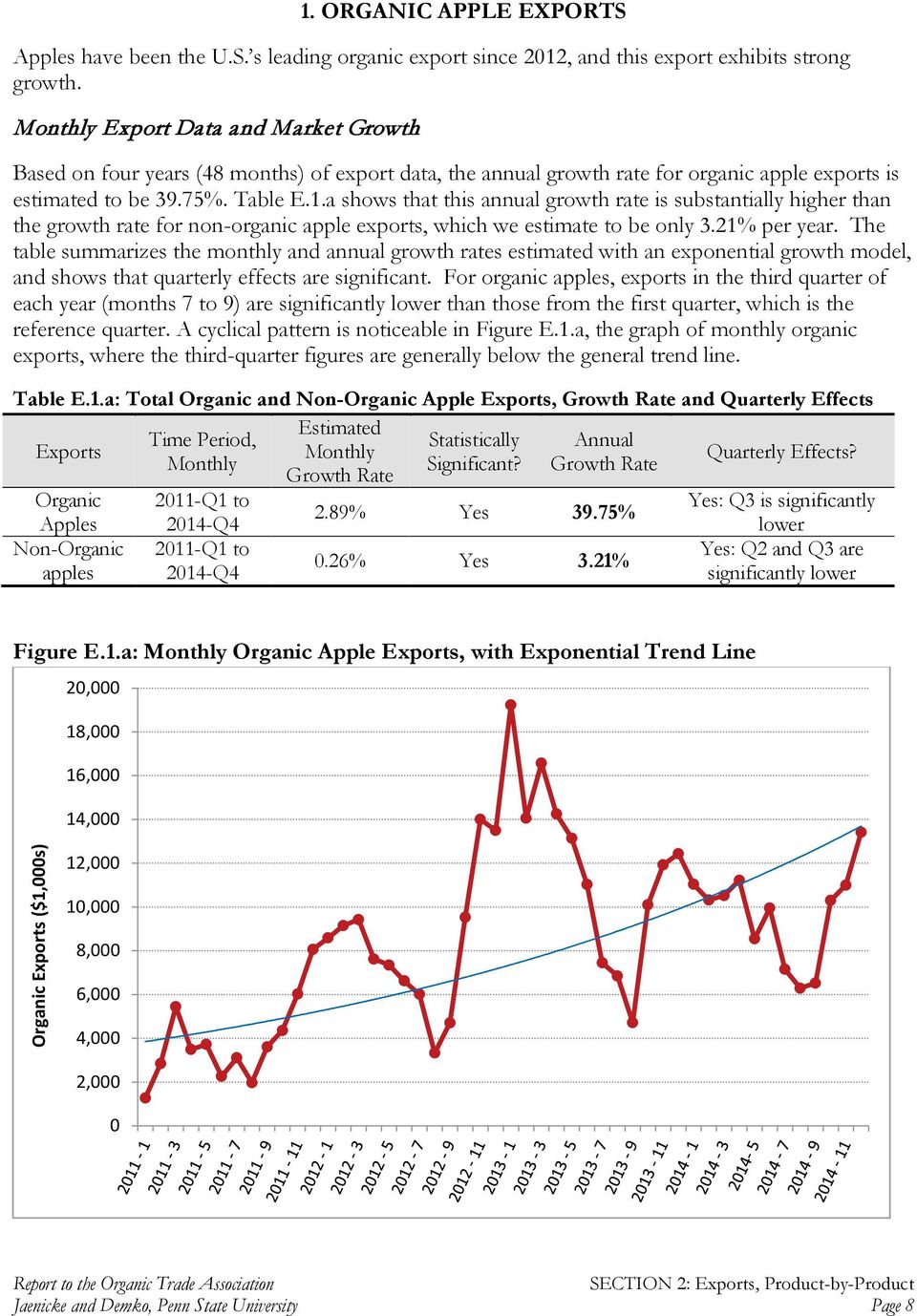
11 1. ORGANIC APPLE EXPORTS Apples have been the U.S. s leading organic export since 2012, and this export exhibits strong growth. Monthly Export Data and Market Growth Based on four years (48 months) of export data, the annual growth rate for organic apple exports is estimated to be 39.75%. Table E.1.a shows that this annual growth rate is substantially higher than the growth rate for non-organic apple exports, which we estimate to be only 3.21% per year. The table summarizes the monthly and annual growth rates estimated with an exponential growth model, and shows that quarterly effects are significant. For organic apples, exports in the third quarter of each year (months 7 to 9) are significantly lower than those from the first quarter, which is the reference quarter. A cyclical pattern is noticeable in Figure E.1.a, the graph of monthly organic exports, where the third-quarter figures are generally below the general trend line. Table E.1.a: Total Organic and Non-Organic Apple Exports, Growth Rate and Quarterly Effects Estimated Time Period, Statistically Annual Exports Monthly Quarterly Effects? Monthly Significant? Growth Rate Growth Rate Organic 2011-Q1 to Yes: Q3 is significantly 2.89% Yes 39.75% Apples Non-Organic apples 2014-Q Q1 to 2014-Q4 0.26% Yes 3.21% lower Yes: Q2 and Q3 are significantly lower Figure E.1.a: Monthly Organic Apple Exports, with Exponential Trend Line 20,000 18,000 16,000 14,000 Organic Exports ($1,000s) 12,000 10,000 8,000 6,000 4,000 2,000 0 SECTION 2: Exports, Product-by-Product Jaenicke and Demko, Penn State University Page 8
12 Table E.1.b shows the growth of organic apple exports over the four-year period juxtaposed with total apple exports (both organic and non-organic) over the same period. The organic export share rises dramatically from 2011 to 2013, and then declines modestly in Table E.1.b: Organic and Total Apple Exports (Thousands of $) Organic Apples Export 46,181 99, , ,262 Total Apples Export 941,713 1,072,671 1,106,973 1,077,576 Organic Apple Exports Share of Total 5% 9% 13% 11% Country of Destination Organic apple export destination countries are dominated by Mexico and Canada. Figure E.1.b shows the destination countries for those countries receiving more than 1% of the total U.S. organic apple exports. Mexico s share averages 69% over the four-year period; Canada s averages 19.5%. Figure E.1.b: Organic Apple Export Destinations, by Share Israel India Hong Kong Dominican Republic 1% Others 8% 2011 Canada 15% Others 10% 2012 Canada 29% Mexico 56% Mexico 75% United Kingdom Others 7% 2013 Taiwan Israel(*) Others 8% 2014 Canada 15% Canada 19% Mexico 76% Mexico 69% SECTION 2: Exports, Product-by-Product Jaenicke and Demko, Penn State University Page 9

13 Table E.1.c shows the level of exports to the top destination countries for organic apples for all four years of data. Table E.1.d, which shows the same information for non-organic apples, is presented as a basis for comparison. Again, it is clear that Mexico and Canada dominate organic (and nonorganic) apple exports. One result that stands out from comparing the two tables is that by 2014, the share of organic apple exports to Mexico has risen to about 30% of all apples exported to Mexico. The tables also show that organic exports to India increased substantially in the period, while non-organic exports to India decreased in the same period. Lastly, two E.U. countries, the United Kingdom and Finland, make the list of top organic apple export destinations but not for non-organic apples. Table E.1.c: Organic Apple Exports by Destination Country ($1,000s) Country (2014 ranking) Organic % of Exports (2014) 1. Mexico 25,835 74, ,480 79,866 30% 2. Canada 13,234 14,768 21,547 22,195 11% 3. Israel 773 1, , Taiwan , United Kingdom 418 1,462 2,208 1,229 10% 6. India ,418 1, United Arab Emirates Guatemala % 9. Finland , % 10. Colombia % Totals 41,689 94, , ,322 Table E.1.d: Non-Organic Apple Exports by Destination Country ($1,000s) Country (2014 ranking) Mexico 173, , , , Canada 154, , , , Taiwan 76,407 84,347 82,140 88, India 80,746 96,334 68,569 66, United Arab Emirates 31,452 38,415 57,787 59, Vietnam 17,937 16,597 32,616 54, Indonesia 64,987 64,884 41,029 49, Hong Kong 70,584 62,925 45,272 43, Saudi Arabia 22,092 15,991 21,257 28, Thailand 24,628 24,504 24,292 21, Dominican Republic 11,974 15,307 12,953 16, Colombia 14,154 15,699 9,654 16, Malaysia 12,124 14,473 14,762 15,759 Totals 754, , , ,339 SECTION 2: Exports, Product-by-Product Jaenicke and Demko, Penn State University Page 10

14 Conclusions: In general, organic apple exports appear to exhibit strong growth overall as well as a fairly consistent cycle where the level of exports is highest in the November-to-March range and lowest in the August-to-September range. The year 2013 appears to be a particularly strong year for organic exports, maybe an abnormally strong year. The overall decline in organic apple exports from 2013 to 2014 may be attributable to a corresponding decline in exports to Mexico. SECTION 2: Exports, Product-by-Product Jaenicke and Demko, Penn State University Page 11

15 2. ORGANIC LETTUCE (NOT HEAD) EXPORTS Non-head lettuce has been the U.S. s second leading organic export since However, exports of organic non-head lettuce are declining, on average. Monthly Export Data and Market Growth Based on four years (48 months) of export data, the annual growth rate for organic lettuce exports is estimated to be 4.24%. Table E.2.a also shows that non-organic lettuce had positive growth during the same time period. The table summarizes the monthly and annual growth rates estimated with an exponential growth model, and shows that quarterly effects are significant for organic lettuce: the second quarter of each year has significantly higher exports than that from the first quarter, which is the reference quarter. A cyclical pattern is not generally noticeable in Figure E.2.a, the graph of monthly organic exports. Table E.2.a: Total Organic and Non-Organic Lettuce (Not Head) Exports, Growth Rate and Quarterly Effects Time Estimated Annual Statistically Quarterly Exports Period, Monthly Growth Significant? Effects? Monthly Growth Rate Rate Organic Lettuce (Not Head) 2011-Q1 to 2014-Q % Yes -4.24% Yes: Q2 is the highest Non-Organic Lettuce (Not Head) 2011-Q1 to 2014-Q % Yes 3.88% No Figure E.2.a: Monthly Organic Lettuce (Not Head) Exports, with Exponential Trend Line 9,000 8,000 7,000 Organic Exports ($1,000s) 6,000 5,000 4,000 3,000 2,000 1,000 0 SECTION 2: Exports, Product-by-Product Jaenicke and Demko, Penn State University Page 12

16 Table E.2.b shows the growth of organic non-head lettuce exports over the four-year period juxtaposed with total non-head lettuce exports (both organic and non-organic) over the same period. The organic export share declines modestly from 23% in 2011 and 2012 to 19% in Table E2.b: Organic and Total Apple Exports (Thousands of $) Organic Lettuce (Not Head) Export 85,197 80,909 83,606 73,326 Total Lettuce (Not Head) Export 363, , , ,004 Share of Organic Export 23% 23% 21% 19% Country of Destination Figure E.2.b clearly shows that Canada is the dominant destination for organic lettuce. Figure E.2.b: Organic Lettuce (Not Head) Export Destinations, by Share Taiwan, 5% Others, 1% 2011 Taiwan, Others, 1% % 97% 4% Taiwan, 1% Others, 1% % Others, % 9 SECTION 2: Exports, Product-by-Product Jaenicke and Demko, Penn State University Page 13

17 Table E.2.c shows country-by-country exports of organic lettuce over the four-year period. Again we see that Canada is the prominent destination. However, exports to Mexico increased greatly over the four-year period, while exports to Taiwan diminished greatly. Table E.2.c: Organic Lettuce (Not Head) Exports by Destination Country (values in $1,000s) Country (2014 ranking) Canada 79,907 78,241 78,488 67, Mexico ,471 4, Korea, South Netherlands Antilles Hong Kong Japan Trinidad and Tobago Barbados Taiwan 4,529 1, Totals 85,018 80,808 83,414 73,270 Canada is also the prominent destination for non-organic lettuce, as shown in Table E.2.d. Exports of non-organic lettuce to Taiwan grew (instead of declining). Table E.2.d: Non-Organic Lettuce (Not Head) Exports by Destination Country (values in $1,000s) Country (2014 ranking) Canada 266, , , , Taiwan 2,663 3,406 4,835 11, Mexico 3,552 5,830 6,319 5, Bermuda 20 1,952 2,531 2, Hong Kong 1,061 1,916 2,038 1, Bahamas, The 1,160 1,096 1,687 1, Korea, South 412 3,181 2,914 1,615 Totals 275, , , ,505 Conclusions: In general, organic non-head lettuce exports have declined modestly since data collection began in Because Canada is the primary destination by far, the overall numbers mirror Canada s exports numbers, which are also declining. SECTION 2: Exports, Product-by-Product Jaenicke and Demko, Penn State University Page 14

18 3. ORGANIC GRAPES EXPORTS Exhibiting strong growth, grapes have been the U.S. s third leading organic export since Monthly Export Data and Market Growth Based on four years (48 months) of export data, the annual growth rate for organic grapes exports is estimated to be 16.3%. Table E.3.a shows that this annual growth rate is about 30% higher than the growth rate in non-organic grapes exports, which we estimate to be 12.4% per year. The table summarizes the monthly and annual growth rates estimated with an exponential growth model, and shows that quarterly effects are significant. For organic grapes exports, the fourth quarter of each year has significantly higher exports than the reference quarter. A cyclical pattern is noticeable in Figure E.3.a, the graph of monthly organic exports, where the fourth-quarter figures are generally above the general trend line. Table E.3.a: Total Organic and Non-Organic Grapes Exports, Growth Rate and Quarterly Effects Exports Organic Grapes Non-Organic Grapes Time Period, Monthly 2011-Q1 to 2014-Q Q1 to 2014-Q4 Estimated Monthly Growth Rate Statistically Significant? Annual Growth Rate Quarterly Effects? 1.270% Yes 16.3% Yes: Q4 is the highest 0.978% Yes 12.4% Yes: Q4 is the highest Figure E.3.a: Monthly Organic Grapes Exports, with Exponential Trend Line Organic Exports ($1,000s) SECTION 2: Exports, Product-by-Product Jaenicke and Demko, Penn State University Page 15

19 Table E.3.b shows the growth of organic grape exports over the four-year period juxtaposed with total grape exports (both organic and non-organic) over the same period. The organic export share dips from 8% in 2011 to 5% in 2012, and then rises back to 7% by Table E.3.b: Organic and Total Grapes Exports (values in $1,000s) Organic Grapes Exports 60,007 39,784 59,001 64,319 Total Grapes Exports 719, , , ,479 Share of Organic Exports 8% 5% 6% 7% Country of Destination As shown in Figure E.3.b, Australia and Canada are major destinations for organic grapes. In 2014, the United Kingdom became the first E.U. country to receive organic grape exports from the U.S. totaling 1% or more. Figure E.3.b: Organic Grapes Export Destinations, by Share China, Guatemala, United Arab Emirates, 3% Thailand, 3% Dominican Republic, 3% Korea, South, 4% Indonesia, Colombia, 8% New Zealand(*), 9% Others, 10% Japan, 11% 2011 Australia(* ), 28% 14% United Others, Arab 9% Venezuela 2012 Emirates,, 3% Indonesia, 3% Japan, 5% 14% Australia( *), 15% 50% Indonesia, United Arab Emirates, 6% Japan, 9% 13% Others, 8% 2013 Australia, 16% 47% United Arab Emirates, 7% Saudi Arabia, United Kingdom, 7% Japan, 7% Australia, 10% 16% Others, 5% % SECTION 2: Exports, Product-by-Product Jaenicke and Demko, Penn State University Page 16

20 Tables E.3.c and E.3.d juxtapose organic and non-organic grape exports by destination country. Note that Mexico and Canada swap rankings, with Mexico ranking first for organic exports and Canada ranking first for non-organic exports. Also note that exports to the United Kingdom grew dramatically from 2013 to Table E.3.c: Organic Grapes Exports by Destination Country with Shares Greater than 1% (values in $1,000s) Country (2014 ranking) Mexico 8,311 19,914 27,542 28, Canada 4,690 5,699 7,785 9, Australia(*) 16,637 5,982 9,533 6, Japan 6,353 1,991 5,109 4, United Kingdom , United Arab Emirates 1,503 1,010 3,508 4, Saudi Arabia ,547 Totals 38,532 35,027 53,993 60,944 Table E.3.d: Non-Organic Grapes Exports by Destination Country with Shares Greater than 1% (values in $1,000s) Country (2014 ranking) Canada 193, , , , Hong Kong 86,254 76, ,050 97, Mexico 56,868 56,881 60,697 62, Australia(*) 18,148 43,054 40,563 47, Philippines 27,438 38,325 44,093 41, Indonesia 36,792 41,553 23,927 36, Malaysia 19,223 26,438 32,127 30, Taiwan 16,740 21,297 30,052 29, Singapore 13,896 15,888 26,533 24, Korea, South 11,496 15,798 17,581 24, China 22,270 23,937 38,152 23, Vietnam 15,790 17,708 21,053 19, New Zealand(*) 11,748 16,190 15,157 19, Thailand 23,835 22,587 20,159 17, Japan 13,616 24,852 22,683 17, United Kingdom 5,782 8,259 16,191 12,385 Totals 573, , , ,194 Conclusions: In general, organic grape exports are highly cyclical and, on average, show modest growth over the four-year period. This modest growth seems to be fueled by the slow but steady growth in organic exports to Mexico and the two main destination countries. Exports to other destinations, such as Australia and Japan, have either declined or been mixed. SECTION 2: Exports, Product-by-Product Jaenicke and Demko, Penn State University Page 17

21 4. ORGANIC SPINACH EXPORTS Spinach has been the U.S. s fourth leading organic export since 2012, and this export exhibits strong growth. Monthly Export Data and Market Growth Based on four years (48 months) of export data, the annual growth rate for organic spinach exports is estimated to be more than 2. Table E.4.a shows that this annual growth rate is substantially higher than the growth rate in non-organic spinach exports, which we estimate to be only 14% per year. The table summarizes the monthly and annual growth rates estimated with an exponential growth model, and shows that quarterly effects are significant. A cyclical pattern is noticeable in Figure E.4.a, the graph of monthly organic exports, where the third-quarter figures are generally below the general trend line. The overall growth in organic spinach exports is quite apparent in Figure E.4.a. Table E.4.a: Total Organic and Non-Organic Spinach Exports, Growth Rate and Quarterly Effects Estimated Time Period, Statistically Annual Exports Monthly Quarterly Effects? Monthly Significant? Growth Rate Growth Rate Organic 2011-Q1 to Yes: Q2 is the highest; 1.689% Yes 22.3% Spinach Non-Organic Spinach 2014-Q Q1 to 2014-Q % Yes 14. Q4 is the lowest Yes: Q3 is the lowest Figure E.4.a: Monthly Organic Spinach Exports, with Exponential Trend Line 4,000 3,500 3,000 Organic Exports ($1,000s) 2,500 2,000 1,500 1, SECTION 2: Exports, Product-by-Product Jaenicke and Demko, Penn State University Page 18
22 Table E.4.b shows the growth of organic spinach exports over the four-year period along with total spinach exports (both organic and non-organic) over the same period. The organic export share rises modestly throughout the period from 29% to 33%. Table E.4.b: Organic and Total Spinach Exports (Thousands of $) Organic Spinach Export 20,943 26,033 33,368 37,758 Total Spinach Export 73,440 82, , ,205 Share of Organic Export 29% 31% 33% 33% Country of Destination Organic spinach export destination countries are dominated by Canada and Mexico. Figure E.4.b shows the destination countries for those countries receiving more than 1% of the total U.S. organic spinach exports. In 2011 and 2012, all organic spinach exports went to Canada; by 2013 and 2014, slightly more than 4% and 6% of exports went to Mexico. Figure E.4.b: Organic Spinach Export Destinations, by Share 0.10% % 100% 4.4% Others, % Others, 0.08% % 93.35% SECTION 2: Exports, Product-by-Product Jaenicke and Demko, Penn State University Page 19
23 Table E.4.c shows the level of exports to the top destination countries for organic spinach for all four years of data. Table E.4.d, which shows the same information for non-organic spinach, is presented as a basis for comparison. Again, it is clear that Canada and Mexico dominate organic (and non-organic) spinach exports. Table E.4.c: Organic Spinach Exports by Destination Country ($1,000s) Country (2014 ranking) Canada 20,923 26,033 31,808 35, Mexico ,478 2,482 Totals 20,943 26,033 33,286 37,730 Table E.4.d: Non-Organic Spinach Exports by Destination Country ($1,000s) Country (2014 ranking) Canada 52,327 56,431 66,609 75, Mexico ,178 Totals 52,426 56,676 67,016 77,152 Conclusions: In general, organic spinach exports appear to exhibit strong and steady growth. This export is perhaps unique in that organic and non-organic spinach are exported to two and only two major destinations Canada and Mexico. Another notable conclusion involves the organic s share of spinach exports: Nearly half of all spinach exported to the top destination, is organic. SECTION 2: Exports, Product-by-Product Jaenicke and Demko, Penn State University Page 20
24 5. ORGANIC STRAWBERRY EXPORTS Strawberries have been the U.S. s fifth leading organic export since 2013; in 2011, they were the tenth leading organic export. Monthly Export Data and Market Growth Based on four years (48 months) of export data, the annual growth rate for organic strawberry exports is estimated to be 25%. Table E.5.a shows that this annual growth rate is substantially higher than the growth rate for non-organic strawberry exports, which we estimate to be only 3% per year. The table summarizes the monthly and annual growth rates estimated with an exponential growth model, and shows that quarterly effects are significant. For organic strawberry exports, the second quarter has significantly higher exports than during the reference quarter. A cyclical pattern is noticeable in Figure E.5.a, the graph of monthly organic exports, where the second-quarter figures are generally above the general trend line. Table E.5.a: Total Organic and Non-Organic Strawberry Exports, Growth Rate and Quarterly Effects Estimated Time Period, Statistically Annual Exports Monthly Quarterly Effects? Monthly Significant? Growth Rate Growth Rate Organic Strawberries Non-Organic Strawberries 2011-Q1 to 2014-Q Q1 to 2014-Q % Yes 25.0 Yes: Q2 is the highest 0.251% Yes 3.05% Yes: Q2 is the highest; Q4 is the lowest Figure E.5.a: Monthly Organic Strawberry Exports, with Exponential Trend Line Organic Exports ($1,000s) SECTION 2: Exports, Product-by-Product Jaenicke and Demko, Penn State University Page 21
25 Table E.5.b shows the growth of organic strawberry exports over the four-year period juxtaposed with total strawberry exports (both organic and non-organic) over the same period. The organic export share rises modestly throughout the four-year period. Table E.5.b: Organic and Total Strawberry Exports (Thousands of $) Organic Strawberries Export 15,770 18,423 27,682 30,716 Total Strawberries Export 360, , , ,282 Share of Organic Export 4% 5% 7% 8% Country of Destination By a wide margin, Canada is the primary destination for organic strawberry exports. Figure E.5.b shows that Canada receives 71% and 86% of the U.S. s organic strawberries between 2011 and The share of organic strawberries exported to the United Kingdom increased from near zero in 2011 to 6% by Figure E.5.b: Organic Strawberry Export Destinations, by Share 3% Others, Japan, 9% 2011 United Kingdom, 3% 4% Hong Kong, 5% Others, 4% 2012 Japan, 6% 86% 78% United Kingdom, 5% Others, 4% Japan, 5% 2013 United Kingdom, 6% United Arab Emirates, 4% Thailand, Others, 3% % 9% 71% 76% SECTION 2: Exports, Product-by-Product Jaenicke and Demko, Penn State University Page 22
26 Table E.5.c shows the level of exports to the top destination countries for organic strawberries for all four years of data. Table E.5.d, which shows the same information for non-organic strawberries, is presented as a basis for comparison. Again, it is clear that Canada dominates organic (and nonorganic) strawberry exports. One notable result is that exports to the United Kingdom, while small relative to grew dramatically throughout the four-year period. Table E.5.c: Organic Strawberry Exports by Destination Country ($1,000s) Country (2014 ranking) Canada 13,632 14,308 19,752 23, Mexico ,994 2, United Kingdom ,387 1, United Arab Emirates , Thailand Totals 14,224 15,670 25,417 29,745 Table E.5.d: Non-Organic Strawberry Exports by Destination Country ($1,000s) Country (2014 ranking) Canada 295, , , , Mexico 12,204 14,809 22,942 26, Japan 21,732 24,008 23,009 24, United Arab Emirates 2,885 7,390 6,538 7, Saudi Arabia 59 1,045 2,995 5, United Kingdom 3,569 1,590 3,036 4,236 Totals 335, , , ,891 Conclusions: In general, organic strawberry exports appear to exhibit strong growth overall as well as a fairly consistent cycle where the level of exports is highest in the May-to-July range and lowest in the December-to-February range. The year 2013 appears to be a particularly strong year for organic strawberry exports, maybe an abnormally strong year. For example, organic exports to the top destination, rose close to 40% from 2012 to On the other hand, non-organic exports to Canada rose by about 2 for the same time frame. SECTION 2: Exports, Product-by-Product Jaenicke and Demko, Penn State University Page 23
27 6. ORGANIC CARROT EXPORTS The fourth-most exported organic product in 2011, carrots became the sixth-most exported organic product in Monthly Export Data and Market Growth Based on four years (48 months) of export data, the annual growth rate for organic carrot exports is estimated to be 6.35%. Table E.6.a shows that this annual growth rate is substantially higher than the growth rate for non-organic carrot exports, which we estimate to have declined by 6% per year. The table summarizes the monthly and annual growth rates estimated with an exponential growth model, and shows that quarterly effects are significant. For organic carrot exports, the third quarter of each year has significantly lower exports than the reference quarter. A cyclical pattern is noticeable in Figure E.6.a, the graph of monthly organic exports, where the third-quarter figures are generally below the general trend line. More generally, Figure.E.6.a shows a modest overall growth trend. Table E.6.a Total Organic and Non-Organic Carrot Exports, Growth Rate and Quarterly Effects Estimated Time Period, Statistically Annual Exports Monthly Quarterly Effects? Monthly Significant? Growth Rate Growth Rate Organic Carrots 2011-Q1 to 2014-Q4 0.51% Yes 6.35% Yes: Q3 is the lowest Non-Organic Carrots 2011-Q1 to 2014-Q4-0.5 Yes -6.1 Yes: Q2 is the highest; Q3 is the lowest Figure E.6.a: Monthly Organic Carrot Exports, with Exponential Trend Line 3,500 3,000 2,500 Organic Exports ($1,000s) 2,000 1,500 1, SECTION 2: Exports, Product-by-Product Jaenicke and Demko, Penn State University Page 24
28 Table E.6.b shows the relatively steady growth of organic carrot exports over the four-year period juxtaposed with total carrot exports (both organic and non-organic) over the same period. The organic export share rises from 17% to 23% throughout the 2011 to 2014 period. Table E.6.b: Organic and Total Carrot Exports ($1,000s) Organic Carrots Exports 22,701 22,590 24,555 26,507 Total Carrots Exports 132, , , ,881 Share of Organic Exports 17% 19% 20% 23% Country of Destination By a wide margin, Canada is the primary destination for organic carrots exports. As shown in Figure E.6.b, Canada s share of exports ranges from 94% to 98% over the four-year period. Figure E.6.b: Organic Carrot Export Destinations, by Share Others, Guyana, 1% % Brazil, 1% 1% Netherlands, 1% Colombia, 1% Others, 1% % 96% Brazil, 1% Others, 2013 Netherlands, 1% 1% Netherlands, 3% Brazil, 1% Colombia, 1% Others, 1% % 94% SECTION 2: Exports, Product-by-Product Jaenicke and Demko, Penn State University Page 25
29 Table E.6.c shows the level of exports to the top destination countries for organic carrots for all four years of data. Table E.6.d, which shows the same information for non-organic carrots, is presented as a basis for comparison. Again, it is clear that Canada is by far the leading destination for organic and non-organic carrot exports. Table E.6.c: Organic Carrots Exports by Destination Country ($1,000s) Country (2014 ranking) Canada 22,251 21,750 23,190 24, Netherlands Mexico Brazil Colombia Totals 22,483 22,442 24,263 26,364 Table E.6.d: Non-Organic Carrots Exports by Destination Country ($1,000s) Country (2014 ranking) Canada 99,246 88,052 88,216 81, Mexico 3,448 3,596 3,502 4, United Arab Emirates Totals 103,011 92,237 92,332 86,395 Conclusions: In general, organic carrot exports appear to exhibit steady growth overall. Digging a little deeper, we see that organic carrot exports to Canada increase steadily since 2012, while nonorganic exports to Canada show a modest decrease in SECTION 2: Exports, Product-by-Product Jaenicke and Demko, Penn State University Page 26
30 7. ORGANIC CAULIFLOWER EXPORTS Cauliflower has been a top-ten organic export since 2011, and shows steady, modest growth. Monthly Export Data and Market Growth Based on four years (48 months) of export data, the annual growth rate for organic cauliflower exports is estimated to be 7.5%. Table E.7.a shows that this annual growth rate is substantially higher than the growth rate in non-organic cauliflower exports, which we estimate to be only 2.5% per year. The table summarizes the monthly and annual growth rates estimated with an exponential growth model, and shows that quarterly effects are significant. For organic cauliflower exports, the second quarter of each year has significantly higher exports than the reference quarter. A cyclical pattern is noticeable in Figure E.7.a, the graph of monthly organic exports, where the secondquarter figures are generally above the general trend line. Table E.7.a: Total Organic and Non-Organic Cauliflower Exports, Growth Rate and Quarterly Effects Estimated Time Period, Statistically Annual Exports Monthly Quarterly Effects? Monthly Significant? Growth Rate Growth Rate Organic Cauliflower 2011-Q1 to 2014-Q4 0.61% Yes 7.51% Yes: Q2 is the highest Non-Organic Cauliflower 2011-Q1 to 2014-Q4 0.20% Yes 2.46% Yes: Q3 is the lowest Figure E.7.a: Monthly Organic Cauliflower Exports, with Exponential Trend Line Organic Exports ($1,000s) SECTION 2: Exports, Product-by-Product Jaenicke and Demko, Penn State University Page 27
31 Table E.7.b shows the growth of organic cauliflower exports over the four-year period juxtaposed with total cauliflower exports (both organic and non-organic) over the same period. The organic export share rises, falls, and rises again from 2011 to Table E.7.b: Organic and Total Cauliflower Exports ($1,000s) Organic Cauliflower Exports 18,013 24,034 16,781 24,558 Total Cauliflower Exports 124, , , ,458 Share of Organic Exports 14% 19% 1 18% Country of Destination Japan followed by Canada are the primary destination countries for organic cauliflower exports. Figure E.7.b shows the destination countries for those countries receiving more than 1% of the total U.S. organic cauliflower exports. Figure E.7.b: Organic Cauliflower Export Destinations, by Share Trinidad and Tobago, 1% Others, 1% 2011 Trinidad and Tobago, 1% United Kingdom, 1% Others, 1% 2012 Taiwan, 13% Taiwan, 10% 25% Japan, 59% 20% Japan, 66% 3% Taiwan, 4% Trinidad and Tobago, 1% Others, 1% 2013 Taiwan, 11% Trinidad and Tobago, 1% Others, % Japan, 55% 29% Japan, 58% SECTION 2: Exports, Product-by-Product Jaenicke and Demko, Penn State University Page 28
32 Table E.7.c shows the level of exports to the top destination countries for organic cauliflower for all four years of data. Table E.7.d, which shows the same information for non-organic cauliflower, is presented as a basis for comparison. Note that Japan and Canada swap top rankings: Japan is the top destination for organic exports, while Canada is the top destination for non-organic exports. Also note that organic exports to Japan and Taiwan seem unusually low in Table E.7.c: Organic Cauliflower Exports by Destination Country ($1,000s) Country (2014 ranking) Japan 10,597 15,770 9,198 14, Canada 4,517 4,734 6,023 7, Taiwan 2,256 2, , Trinidad and Tobago Totals 17,528 23,044 16,006 24,134 Table E.7.d: Non-Organic Cauliflower Exports by Destination Country ($1,000s) Country (2014 ranking) Canada 88,994 78, ,095 91, Japan 11,212 16,274 14,257 10, Taiwan 2,922 3,482 3,815 5, Mexico 3,148 1,900 1,574 1, Panama Trinidad and Tobago Totals 106, , , ,712 Conclusions: In general, organic cauliflower exports appear to exhibit steady, modest growth. Exports in 2013 seem unusually low, and the country-by-country data show that unusually low exports to Japan and Taiwan might be responsible. At its peak, organic cauliflower makes up a fairly high share--19%--of all cauliflower exports. SECTION 2: Exports, Product-by-Product Jaenicke and Demko, Penn State University Page 29
33 8. ORGANIC ROASTED COFFEE EXPORTS Roasted coffee is the U.S. s eighth leading organic export, and like most other products in the top ten, organic coffee exports exhibit strong growth. Monthly Export Data and Market Growth Based on four years (48 months) of export data, the annual growth rate for organic coffee exports is estimated to be just under 13%. Table E.8.a shows that this annual growth rate is substantially higher than the growth rate in non-organic coffee exports, which we estimate to be decreasing by 2.5% per year. The table summarizes the monthly and annual growth rates estimated with an exponential growth model. Figure E.8.a shows monthly exports over the time period, often fluctuating but generally rising. Table E.8.a: Total Organic and Non-Organic Coffee Exports, Growth Rate and Quarterly Effects Exports Organic Coffee Non-Organic Coffee Time Period, Monthly 2011-Q1 to 2014-Q Q1 to 2014-Q4 Estimated Monthly Growth Rate Statistically Significant? Annual Growth Rate Quarterly Effects? 1.01% Yes 12.86% No -0.21% No -2.50% Yes: Q4 is the highest Figure E.8.a: Monthly Organic Coffee Exports, with Exponential Trend Line Organic Exports ($1,000s) SECTION 2: Exports, Product-by-Product Jaenicke and Demko, Penn State University Page 30
34 Table E.8.b shows the growth of organic coffee exports over the four-year period juxtaposed with total coffee exports (both organic and non-organic) over the same period. The organic export share of coffee is fairly small, ranging from to 3%. Table E.8.b: Organic and Total Coffee Exports ($1,000s) Organic Coffee Exports 15,214 24,276 21,730 23,096 Total Coffee Exports 749, , , ,092 Share of Organic Exports 3% 3% 3% Country of Destination Mexico overtook Canada as the number one destination for organic coffee exports in Figure E.8.b shows the destination countries for those countries receiving more than 1% of the total U.S. organic coffee exports. Figure E.8.b: Organic Coffee Export Destinations, by Share Taiwan, 3% United Kingdom, 5% Netherlands, 6% Hong Kong, 10% Japan, 4% Korea, South, 18% Others, 5% % China, Belgium- Luxembourg, 3% United Kingdom, 3% Japan, 6% Hong Kong, 8% Singapore, Saudi Arabia, 33% Bahamas, The, % Singapore, Japan, Korea, South, 4% Saudi Arabia, Others, 9% Korea, South, 3% Australia, China, 3% Taiwan, 4% United Kingdom, Others, 8% % 39% 33% SECTION 2: Exports, Product-by-Product Jaenicke and Demko, Penn State University Page 31
35 Table E.8.c shows the level of exports to the top destination countries for organic coffee for all four years of data. Table E.8.d, which shows the same information for non-organic coffee, is presented as a basis for comparison. Examined together, the two tables show the low amount of organic coffee exports relative to non-organic coffee exports. Non-organic exports to Canada are huge; whereas organic exports to Canada are quite modest. Note that 2012 s total for the top seven destinations ($18.3 million) is well short of the total ($24.3 million) from Table E.8.b above. This discrepancy would seem to suggest that the difference stems from lots of exports to small-destination countries. Table E.8.c: Organic Coffee Exports by Destination Country ($1,000s) Country (2014 ranking) Mexico 2,720 7,978 9,157 10, Canada 7,367 8,827 8,407 7, Taiwan Korea, South China Australia(*) United Kingdom Totals 11,540 18,337 19,215 21,143 Table E.8.d: Non-Organic Coffee Exports by Destination Country ($1,000s) Country (2014 ranking) Canada 555, , , , Japan 46,673 72,513 62,465 48, Korea, South 31,127 34,795 39,099 25, Singapore 14,049 16,893 18,561 11, Taiwan 7,206 9,991 9,042 11,240 Totals 654, , , ,890 Conclusions: In general, organic coffee exports appear to exhibit strong growth. However, the organic share of all coffee exports is quite low. Finally, 2012 seemed to be an unusually strong year for organic coffee exports to countries outside the top seven destinations. SECTION 2: Exports, Product-by-Product Jaenicke and Demko, Penn State University Page 32
36 9. ORGANIC TOMATO SAUCE EXPORTS Tomato sauce is the U.S. s ninth leading organic export in Monthly Export Data and Market Growth Based on four years (48 months) of export data, the annual growth rate for organic tomato sauce exports is estimated to be 3.45%. Table E.9.a shows that this annual growth rate is half the growth rate in non-organic tomato sauce exports, which we estimate to be over 7% per year. Thus, tomato sauce is one of the few products investigated where the non-organic export growth rate is higher than the organic export growth rate. Figure E.9.a, the graph of monthly organic exports, shows that tomato sauce exports generally decreased through 2011, then gradually rose for the rest of the time period. Table E.9.a: Total Organic and Non-Organic Tomato Sauce Exports, Growth Rate and Quarterly Effects Time Estimated Statistically Annual Exports Period, Monthly Quarterly Effects? Significant? Growth Rate Monthly Growth Rate Organic Tomato Sauce Non-Organic Tomato Sauce 2011-Q1 to 2014-Q % No 3.45% No 2011-Q1 to 2014-Q % Yes 7.19% Yes: Q2 is the lowest Figure E.9.a: Monthly Organic Tomato Sauce Exports, with Exponential Trend Line 4,500 4,000 3,500 Organic Exports ($1,000s) 3,000 2,500 2,000 1,500 1, SECTION 2: Exports, Product-by-Product Jaenicke and Demko, Penn State University Page 33
37 Table E.9.b shows the growth of organic tomato sauce exports over the four-year period juxtaposed with total tomato sauce exports (both organic and non-organic) over the same period. The organic export share declined from 2011 to 2012 and 2013, and then increased modestly in Table E.9.b: Organic and Total Tomato Sauce Exports ($1,000s) Organic Tomato Sauce Exports 21,959 12,011 14,991 19,646 Total Tomato Sauce Exports 200, , , ,296 Share of Organic Exports 11% 6% 6% 8% Country of Destination By a wide margin, Canada is the primary destination for organic tomato sauce exports. Figure E.9.b shows the destination countries for those countries receiving more than 1% of the total U.S. organic tomato sauce exports. One European Union country, the United Kingdom, appears as an export destination for the first time in Figure E.9.b: Organic Tomato Sauce Export Destinations, by Share Australia (*), Others, China, 7% 4% 4% 2011 Japan, 6% Others, % 84% 73% 6% Korea, South, Japan, 8% Others, 10% % United Arab Emirates, United Kingdom, Japan, 6% 7% Korea, South, China, Others, 11% % SECTION 2: Exports, Product-by-Product Jaenicke and Demko, Penn State University Page 34
38 Table E.9.c shows the level of exports to the top destination countries for organic tomato sauce for all four years of data. Table E.9.d, which shows the same information for non-organic tomato sauce, is presented as a basis for comparison. The top three destination countries, and Japan, are the same for both organic and non-organic tomato sauce exports. Exports to Canada dropped by more than half from 2011 to Table E.9.c: Organic Tomato Sauce Exports by Destination Country ($1,000s) Country (2014 ranking) Canada 18,429 8,751 11,128 13, Mexico 795 1, , Japan ,190 1, United Kingdom United Arab Emirates Korea, South China Totals 20,615 10,899 13,789 17,523 Table E.9.d: Non-Organic Tomato Sauce Exports by Destination Country ($1,000s) Country (2014 ranking) Canada 137, , , , Mexico 9,599 10,914 15,321 15, Japan 5,906 10,203 13,408 14,255 Totals 153, , , ,177 Conclusions: In general, organic tomato sauce exports appear to exhibit modest growth overall, and it is one of the only products with stronger growth in its non-organic counterpart. Organic tomato sauce exports might have seen stronger growth if not for a dramatic drop in exports to Canada from 2011 to SECTION 2: Exports, Product-by-Product Jaenicke and Demko, Penn State University Page 35
39 10. ORGANIC PEARS EXPORTS Pears round out the top ten leading organic exports. Organic pear exports grew dramatically from 2011 to 2012, with growth slowing after that. Monthly Export Data and Market Growth Based on four years (48 months) of export data, the annual growth rate for organic pear exports is estimated to be 14.4%. Table E.10.a shows that this annual growth rate is substantially higher than the growth rate for non-organic pear exports, which we estimate to be only 0.6% per year (and is not statistically different from zero). The table summarizes the monthly and annual growth rates estimated with an exponential growth model, and shows that quarterly effects are significant. Figure E.10.a, which shows monthly exports, depicts some very large swings. Exports at the end of 2012/beginning of 2013 appear to be unusually high, as do exports in September Table E.10.a: Total Organic and Non-Organic Pear Exports, Growth Rate and Quarterly Effects Estimated Time Period, Statistically Annual Exports Monthly Quarterly Effects? Monthly Significant? Growth Rate Growth Rate Organic Pears Non-Organic Pears 2011-Q1 to 2014-Q Q1 to 2014-Q % Yes 14.4% 0.046% No 0.6% Yes: Q2 is the lowest, Q4 is the highest Yes: Q2 is the lowest, Q4 is the highest Figure E.10.a: Monthly Organic Pear Exports, with Exponential Trend Line Organic Exports ($1,000s) SECTION 2: Exports, Product-by-Product Jaenicke and Demko, Penn State University Page 36
40 Table E.10.b shows the growth of organic pear exports over the four-year period juxtaposed with total pear exports (both organic and non-organic) over the same period. The organic export share rises dramatically from 2011 to 2012, and then declines modestly in 2013 and Table E.10.b: Organic and Total Pear Exports ($1,000s) Organic Pears Exports 8,923 20,589 19,012 18,406 Total Pears Exports 179, , , ,843 Share of Organic Exports 5% 10% 9% 8% Country of Destination Mexico and Canada are the primary export destinations for organic pears. Mexico s share of exports ranges from 67% to 81% over the period. Canada s share ranges from 14% to 21%. Figure E.10.b shows the destination countries for those countries receiving more than 1% of the total U.S. organic pear exports. Figure E.10.b: Organic Pear Export Destinations, by Share Ecuador, 1% Venezuela, 5% Dominican Republic, 1% Peru, Israel(*), Taiwan, 1% % Others, 1% 14% Russia, 3% Venezuela, Others, % 67% 80% Russia, Israel(*), 1% Others, 2013 Trinidad and Tobago, 1% United Arab Emirates, 1% Chile, 1% Others, 3% % 17% 81% 78% SECTION 2: Exports, Product-by-Product Jaenicke and Demko, Penn State University Page 37
41 Table E10.c shows the level of exports to the top destination countries for organic pear for all four years of data. Table E.10.d, which shows the same information for non-organic pear, is presented as a basis for comparison. Note that organic exports to Mexico decline after 2012, whereas nonorganic exports to Mexico increase each year. Table E.10.c: Organic Pear Exports by Destination Country ($1,000s) Country (2014 ranking) Mexico 5,987 16,445 15,322 14, Canada 1,906 2,842 2,781 3, Trinidad and Tobago United Arab Emirates Chile Totals 8,604 20,244 18,765 17,826 Table E.10.d: Non-Organic Pear Exports by Destination Country ($1,000s) Country (2014 ranking) Mexico 52,770 72,968 79,352 86, Canada 47,781 55,308 52,857 54, Colombia 6,250 5,968 5,481 9, United Arab Emirates 3,974 5,033 6,421 8, Brazil 15,630 10,825 5,388 5, India 3,386 3,668 3,628 3, Hong Kong 4,013 3,312 3,892 3, China ,732 3,260 Totals 133, , , ,166 Conclusions: In general, organic pear exports appear to exhibit strong but fluctuating growth over the four-year period. Because exports to Mexico dominate all exports, the decline in exports to Mexico after 2012 has affected the overall growth of this export. SECTION 2: Exports, Product-by-Product Jaenicke and Demko, Penn State University Page 38
42 11. ORGANIC BLUEBERRY EXPORTS The U.S. exported approximately $17.2 million of organic cultivated blueberries in 2014, and this organic export has seen steady growth during the 2011 to 2014 period. Monthly Export Data and Market Growth Based on four years (48 months) of export data, the annual growth rate for organic blueberry exports is estimated to be 10.5%; however, the monthly growth rate estimated from the exponential growth model is not statistically different from zero. Nonetheless, Table E.11.a shows that the annual growth rate for non-organic blueberries is substantially lower, actually declining over time at an estimated rate of 9.5% per year. Blueberry exports are found to have quarterly effects, with the second quarter exports significantly higher than the reference quarter. Figure E.11.a echoes this finding, and shows a highly cyclical export pattern, with strong peaks at the end of the second quarter and export values near zero during the fourth and first quarters of each year. Table E. 11.a: Total Organic and Non-Organic Blueberry Exports, Growth Rate and Quarterly Effects Estimated Time Period, Statistically Annual Exports Monthly Quarterly Effects? Monthly Significant? Growth Rate Growth Rate Organic Blueberries 2011-Q1 to 2014-Q4 0.83% No 10.5% Yes: Q2 is the highest Non-Organic Blueberries 2011-Q1 to 2014-Q4-0.83% Yes -9.5% Yes: Q2 is the highest Figure E.11.a: Monthly Organic Blueberry Exports, with Exponential Trend Line Organic Exports ($1,000s) SECTION 2: Exports, Product-by-Product Jaenicke and Demko, Penn State University Page 39
43 Table E.11.b shows the growth of organic blueberry exports over the four-year period juxtaposed with total blueberry exports (both organic and non-organic) over the same period. The organic export share was strongest in 2011, dropped in 2012, and then rose in 2013 and Table E.11.b: Organic and Total Blueberry Exports ($1,000s) Organic Blueberries Exports 16,369 13,733 15,261 17,247 Total Blueberries Exports 96, , , ,447 Share of Organic Exports, % 17% 1 13% 16% Country of Destination Organic blueberry export destination countries are dominated by Canada. Figure E.11.b shows the destination countries for those countries receiving more than 1% of the total U.S. organic blueberry exports. Canada s share of exports averages almost 9 over the four-year period. Figure E.11.b: Organic Blueberry Export Destinations, by Share Japan, 1.1 Others, 0.38% 2011 United Kingdom, 1.4% Hong Kong, 5.7% Japan, 0.8% Korea, Others, South, 0.3% % 98.49% 91. United Hong Kingdom Kong, 3%, Japan, 1% Others, 1% 2013 United Singapore, Kingdom, Hong Kong, 9% Belgium- Luxembourg( *), 1% Japan, 1% Others, 1% % 84% SECTION 2: Exports, Product-by-Product Jaenicke and Demko, Penn State University Page 40
44 Table E.11.c shows the level of exports to the top destination countries for organic blueberries for all four years of data. Table E.11.d, which shows the same information for non-organic blueberries, is presented as a basis for comparison. Again, it is clear that Canada is by far the primary destination for organic (and non-organic) blueberry exports. Table E.11.c: Organic Blueberry Exports by Destination Country ($1,000s) Country (2014 ranking) Canada 16,121 12,524 14,225 14, Hong Kong , Singapore United Kingdom Belgium-Luxembourg(*) Japan Totals 16,316 13,608 15,048 17,108 Table E.11.d: Non-Organic Blueberry Exports by Destination Country ($1,000s) Country (2014 ranking) Canada 69,895 87,012 85,753 72, Hong Kong 6,306 6,113 4,584 5, Mexico 227 1,520 1,156 2, Australia(*) 1,017 1,696 1,866 2, Philippines ,454 1, Indonesia 1, ,642 1,403 Totals 79,386 97,880 96,455 85,339 Conclusions: Organic blueberry exports are highly cyclical, with large amounts of exports occurring between April and August of each year. Despite this cycle, organic blueberry exports appear to generally exhibit strong growth overall. Exports to Canada dominate all other exports, and the amount exported to Canada dropped substantially from 2011 to SECTION 2: Exports, Product-by-Product Jaenicke and Demko, Penn State University Page 41
45 12. ORGANIC ORANGE EXPORTS The U.S. exported more than $14 million of organic oranges in The value of organic orange exports declined from 2011 to 2012 and 2013, but then rebounded in Monthly Export Data and Market Growth Based on four years (48 months) of export data, the annual growth rate for organic orange exports is estimated to be 5.4%; however, the monthly growth rate estimated from the exponential growth model is not statistically different from zero. Table E.12.a shows that this annual growth rate is substantially virtually identical to the estimated growth rate in non-organic orange exports. The table summarizes the monthly and annual growth rates estimated with an exponential growth model, and shows that quarterly effects are significant. A cyclical pattern is noticeable in Figure E.12.a, the graph of monthly organic exports, where months in the third and fourth quarters are generally below the general trend line. Table E.12.a: Total Organic and Non-Organic Orange Exports, Growth Rate and Quarterly Effects Estimated Time Period, Statistically Annual Exports Monthly Quarterly Effects? Monthly Significant? Growth Rate Growth Rate Organic Oranges Non-Organic Oranges 2011-Q1 to 2014-Q Q1 to 2014-Q No -5.41% Yes: Q3 is the lowest % No -5.40% Yes: Q3 is the lowest Figure E.12.a: Monthly Organic Orange Exports, with Exponential Trend Line 4,500 4,000 3,500 Organic Exports ($1,000s) 3,000 2,500 2,000 1,500 1, SECTION 2: Exports, Product-by-Product Jaenicke and Demko, Penn State University Page 42
46 Table E12.b shows the growth of organic orange exports over the four-year period juxtaposed with total orange exports (both organic and non-organic) over the same period. The organic export share, at or 3%, is quite low relative to non-organic orange exports. Table E.12.b: Organic and Total Orange Exports ($1,000s) Organic Oranges Exports 14,186 13,677 10,926 14,631 Total Oranges Exports 516, , , ,597 Share of Organic Exports, % 3% 3% 3% Country of Destination Figure E.12.b shows Canada as the primary destination for organic orange exports; however, Asian countries such as Japan, Korean, Malaysia, and others are common destination countries as well. Figure E.12.b: Organic Orange Export Destinations, by Share China, 3% Sri Lanka, 3% Bangladesh, 6% Malaysia, 7% India, Hong Kong, 1 Japan, 20% Others, 5% 40% 2011 Bangladesh, Taiwan, China, 3% 3% India, 3% Sri Lanka, 4% Japan, 4% Malaysia, 8% Hong Kong, 8% Vietnam, Others, 3% Korea, South, 18% Sri Lanka, Bangladesh, 3% Vietnam, Taiwan, Korea, 3% South, 5% 5% Malaysia, 8% Hong Kong, 11% Others, 7% % Sri Lanka, India, 3% China, 3% Australia( *), 4% Singapore, 5% Bangladesh, Others, 8% Hong Kong, 17% Malaysia, 18% % SECTION 2: Exports, Product-by-Product Jaenicke and Demko, Penn State University Page 43
47 Table E.12.c shows the level of exports to the top destination countries for organic oranges for all four years of data. Table E.12.d, which shows the same information for non-organic oranges, is presented for a basis for comparison. Organic exports to Canada rose slightly throughout the fouryear period. Table E.12.c: Organic Orange Exports by Destination Country ($1,000s) Country (2014 ranking) Canada 5,736 5,775 6,054 5, Malaysia 1,017 1, , Hong Kong 1,703 1,130 1,219 2, Singapore Australia(*) China India Sri Lanka Bangladesh Totals 10,575 9,666 9,143 13,447 Table E.12.d: Non-Organic Orange Exports by Destination Country ($1,000s) Country (2014 ranking) Canada 134, , , , Korea, South 80, ,182 95, , Japan 80, ,506 82,714 67, Hong Kong 63,927 48,755 64,724 67, Australia(*) 15,435 13,468 19,496 17, Malaysia 23,105 18,258 19,446 13, Singapore 13,783 11,557 11,657 11, China 32,434 25,321 21,938 8, Vietnam ,517 7, New Zealand(*) 7,007 6,734 8,590 7, Taiwan 6,152 5,881 8,174 7,108 Totals 458, , , ,827 Conclusions: In general, organic orange exports appear to exhibit weak or declining growth, although the highly cyclical nature of exports may be masking some of the growth. The very last month of export data, December 2014, shows unusually high exports. Perhaps this extra amount was sent to Malaysia, which received an unusually high amount of exports in SECTION 2: Exports, Product-by-Product Jaenicke and Demko, Penn State University Page 44
48 13. ORGANIC BROCCOLI EXPORTS The U.S. exported close to $15 million of organic broccoli in 2014, and this organic export has seen strong, steady growth during the 2011 to 2014 period. Monthly Export Data and Market Growth Based on four years (48 months) of export data, the annual growth rate for organic broccoli exports is estimated to be 14.8%. Table E.13.a shows that this annual growth rate is substantially higher than the growth rate in non-organic broccoli exports, which we estimate to be only 3% per year. The table summarizes the monthly and annual growth rates estimated with an exponential growth model, and shows that quarterly effects are significant. For organic broccoli, exports during months in the third and fourth quarters are significantly higher than the general trend line. Table E.13.a: Total Organic and Non-Organic Broccoli Exports, Growth Rate and Quarterly Effects Estimated Time Period, Statistically Annual Exports Monthly Quarterly Effects? Monthly Significant? Growth Rate Growth Rate Organic Broccoli 2011-Q1 to 2014-Q4 1.16% Yes 14.8% Yes: Q2 is the highest Non-Organic Broccoli 2011-Q1 to 2014-Q4 0.25% Yes 3.0% Yes: Q2 is the highest Figure E.13.a: Monthly Organic Broccoli Exports, with Exponential Trend Line Organic Exports ($1,000s) SECTION 2: Exports, Product-by-Product Jaenicke and Demko, Penn State University Page 45
49 Table E13.b shows the growth of organic broccoli exports over the four-year period juxtaposed with total broccoli exports (both organic and non-organic) over the same period. The organic export share for broccoli is ranges from 9% to 1 from 2011 to 2013, and then declined slightly. Table E.13.b: Organic and Total Broccoli Exports ($1,000s) Organic Broccoli Exports 9,874 13,576 15,649 14,457 Total Broccoli Exports 115, , , ,432 Share of Organic Exports, % 9% 10% 1 11% Country of Destination Taiwan is the primary destination for organic broccoli exports. Its share of all exports averages around 50%. Canada and Japan are the second and third ranked destinations, with their order switching over the four years of data. Figure E.13.b shows the destination countries for those countries receiving more than 1% of the total U.S. organic broccoli exports. Figure E.13.b: Organic Broccoli Export Destinations, by Share 1% Hong Kong, Trinidad and Tobago, 1% Suriname, 1% Others, 1% 2011 Netherlands, 1% 1% Others, 2012 Japan, 15% 20% 28% Taiwan, 51% Japan, 2 Taiwan, 55% Barbados, Guyana, Germany, 1% 1% Suriname, 1% Netherlands, 3% Bahrain, 1% Others, 2013 Suriname, Barbados, 1% 3% Others, 1% % Taiwan, 47% Japan, 18% Taiwan, 48% Japan, 23% 26% SECTION 2: Exports, Product-by-Product Jaenicke and Demko, Penn State University Page 46
50 Table E.13.c shows the level of exports to the top destination countries for organic broccoli for all four years of data. Table E.13.d, which shows the same information for non-organic broccoli, is presented as a basis for comparison. These tables reveal that organic broccoli exports to Taiwan were actually higher than non-organic broccoli exports to Taiwan. Table E.13.c: Organic Broccoli Exports by Destination Country ($1,000s) Country (2014 ranking) Taiwan 4,995 7,413 7,403 6, Canada 2,813 2,681 3,232 3, Japan 1,526 2,951 3,542 2, Mexico Suriname Barbados Totals 9,518 13,227 14,467 14,330 Table E.13.d: Non-Organic Broccoli Exports by Destination Country ($1,000s) Country (2014 ranking) Canada 65,015 71,916 81,495 82, Japan 34,421 38,698 29,284 32, Taiwan 5,115 5,518 4,494 1, Mexico 780 1,103 1, Totals 105, , , ,063 Conclusions: In general, organic broccoli exports appear to exhibit strong growth overall as well as a fairly consistent cycle where exports are highest between May and September. Taiwan is a key export market, and exports there rose dramatically from 2011 to 2012, but declined modestly after that. SECTION 2: Exports, Product-by-Product Jaenicke and Demko, Penn State University Page 47
51 14. ORGANIC LEMON EXPORTS The U.S. exported approximately $12.7 million of organic lemons in 2014, and this organic export has seen strong growth during the 2011 to 2014 period. Monthly Export Data and Market Growth Based on four years (48 months) of export data, the annual growth rate for organic lemon exports is estimated to be 19.4%. Table E.14.a shows that this annual growth rate is slightly lower than the growth rate in non-organic lemon exports, which we estimate to be 21.4% per year. The table summarizes the monthly and annual growth rates estimated with an exponential growth model, and shows that quarterly effects are significant. For organic lemon exports, the third quarter of each year has significantly lower exports than the reference quarter. A cyclical pattern is noticeable in Figure E.14.a, the graph of monthly organic exports, where exports in third-quarter months are generally below the general trend line. Table E.14.a: Total Organic and Non-Organic Lemon Exports, Growth Rate and Quarterly Effects Estimated Annual Time Period, Statistically Exports Monthly Growth Quarterly Effects? Monthly Significant? Growth Rate Rate Organic Lemons 2011-Q1 to 2014-Q4 1.49% Yes 19.4% Yes: Q3 is the lowest Non-Organic Lemons 2011-Q1 to 2014-Q4 1.63% Yes 21.4% Yes: Q3 is the lowest Figure E.14.a: Monthly Organic Lemon Exports, with Exponential Trend Line Organic Exports ($1,000s) SECTION 2: Exports, Product-by-Product Jaenicke and Demko, Penn State University Page 48
52 Table E.14.b shows the growth of organic lemon exports over the four-year period juxtaposed with total lemon exports (both organic and non-organic) over the same period. The organic export share has not grown much over the period, increasing from 5% in up to 6% in Table E.14.b: Organic and Total Lemon Exports ($1,000s) Organic Lemons Exports 6,285 6,085 7,860 12,722 Total Lemons Exports 115, , , ,115 Share of Organic Exports, % 5% 5% 5% 6% Country of Destination Canada is the primary destination for organic lemon exports; however, its export share has declined from around 80% in the period to 60% in Hong Kong s share of organic lemon exports rose to 10% in Figure E14.b shows the destination countries for those countries receiving more than 1% of the total U.S. organic lemon exports. Figure E.14.b: Organic Lemon Export Destinations, by Share China, 3% Hong Kong, 3% Japan, 1 Chile, Others, 2011 China, Others, Thailand, 3% 1% 2012 Hong Kong, 4% Japan, 6% 77% 8 China, 3% 4% Japan, 4% Thailand, 3% Others, 4% 2013 Vietnam, 3% China, 3% 5% Philippines, Thailand, Others, 7% Australia, 9% Hong Kong, 10% 60% SECTION 2: Exports, Product-by-Product Jaenicke and Demko, Penn State University Page 49
53 Table E14.c shows the level of exports to the top destination countries for organic lemons for all four years of data. Table E14.d, which shows the same information for non-organic lemons, is presented as a basis for comparison. Despite the decrease in the share of organic exports, the level of organic lemon exports to top destination Canada rose during the period. The year 2014 also saw a large increase in the amount of organic lemons exported to Australia, which had been a major destination for non-organic lemons. Table E.14.c: Organic Lemon Exports by Destination Country ($1,000s) Country (2014 ranking) Canada 4,826 4,976 6,481 7, Hong Kong , Australia(*) , Mexico China Vietnam Philippines Thailand Totals 5,405 5,682 7,390 11,844 Table E.14.d: Non-Organic Lemon Exports by Destination Country ($1,000s) Country (2014 ranking) Japan 44,144 46,909 57,831 62, Canada 33,528 35,262 42,410 46, Hong Kong 2,877 4,598 10,358 32, Korea, South 8,876 15,484 23,889 24, Australia(*) 6,111 7,026 13,208 13, China 4,094 3,877 6,537 10, Chile 3,147 1,336 2,582 4,902 Totals 102, , , ,726 Conclusions: In general, organic lemon exports appear to exhibit strong growth overall. However, it is one of the few organic exports whose growth underperforms its non-organic counterpart. Both organic and non-organic lemon exports were particularly strong in Unusually high exports to Hong Kong that year may be partially responsible for this result. SECTION 2: Exports, Product-by-Product Jaenicke and Demko, Penn State University Page 50
54 15. ORGANIC CHERRY EXPORTS The U.S. exported more than $11 million of organic cherries in After a decrease in exports from 2011 to 2012, this organic export has seen steady growth during after Monthly Export Data and Market Growth Estimating the average monthly or annual growth rate for organic cherries has proved difficult due to the large number of months that have zero exports. Based on only those months with positive organic cherry exports, our estimate for the average monthly growth rate, -4.6%, is not statistically different from zero. Table E.15.a shows this result and the corresponding annual growth rate. It also shows that the estimated annual growth rate for non-organic cherries is also strongly negative: 7. per year. Figure E.15.a, the graph of monthly organic exports, shows the prevalence of zero exports for months in fourth and first quarters of the year. Table E.15.a: Total Organic and Non-Organic Cherry Exports, Growth Rate and Quarterly Effects Exports Organic Cherries Non-Organic Cherries Time Period, Monthly 2011-Q1 to 2014-Q Q1 to 2014-Q4 Estimated Monthly Growth Rate Statistically Significant? Annual Growth Rate Quarterly Effects? -4.63% No -43.4% No -3.80% Yes -37. Yes: Q2 is the highest Figure E.15.a: Monthly Organic Cherry Exports, with Exponential Trend Line Organic Exports ($1,000s) SECTION 2: Exports, Product-by-Product Jaenicke and Demko, Penn State University Page 51
55 Table E.15.b shows the progression of organic cherry exports over the four-year period juxtaposed with total cherry exports (both organic and non-organic) over the same period. These figures show that 2011 is a bit of an anomaly, with organic cherry exports much higher that year than in the following years. Table E.15.b: Organic and Total Cherry Exports ($1,000s) Organic Cherries Exports 30,597 6,431 8,844 11,623 Total Cherries Exports 414, , , ,690 Share of Organic Exports, % 7% 1% 3% Country of Destination Canada was the primary destination for organic cherry exports in ; however, Australia became the leading destination in Figure E.15.b shows the destination countries for those countries receiving more than 1% of the total U.S. organic cherry exports. A number of Asian countries, including Taiwan and Korea, are among the major export destinations. Figure E.15.b: Organic Cherry Export Destinations, by Share Australia, 5% United Kingdom, Others, 5% 2011 Hong Kong, 6% Others, 2012 China, Hong 6% Kong, 7% 37% 2 40% Taiwan, 8% Korea, South, 10% Japan, 20% Taiwan, 30% Thailand, 3% 6% Hong Kong, 9% Australia, 11% Taiwan, 14% Others, 3% 2013 Korea, South, 24% 31% Taiwan, 7% Hong Kong, 8% 1 Korea, South, 13% Singapore, Others, 5% 2014 Australi a, 27% 27% SECTION 2: Exports, Product-by-Product Jaenicke and Demko, Penn State University Page 52
56 Table E.15.c shows the level of exports to the top destination countries for organic cherries for all four years of data. Table E.15.d, which shows the same information for non-organic cherries, is presented as a basis for comparison. Organic cherry exports to Canada have been very stable, with recent years seeing substantial growth. On the other hand, organic exports (as well as non-organic exports) to Australia have been uneven. Finally, organic exports to Hong Kong and Taiwan decreased dramatically from 2011 to 2012; this decrease is not found for non-organic cherry exports. Table E.15.c: Organic Cherry Exports by Destination Country ($1,000s) Country (2014 ranking) Australia(*) 2, , Canada 2,597 2,541 2,705 3, Korea, South ,109 1, Mexico 413 1, , Hong Kong 7, Taiwan 3,765 1,946 1, Singapore Totals 18,032 6,359 8,383 11,080 Table E.15.d: Non-Organic Cherry Exports by Destination Country ($1,000s) Country (2014 ranking) Canada 143, , , , Korea, South 39,406 74,002 79, , China 21,612 40,449 33,271 50, Hong Kong 28,337 55,461 41,201 46, Japan 77,512 76,612 55,647 44, Taiwan 29,278 45,980 25,833 38, Australia(*) 17,792 23,496 15,247 10,201 Totals 357, , , ,648 Conclusions: In general, organic cherry exports appear to exhibit strong growth after The first year of data, 2011, appears to be a year with unusually high exports, and this anomaly may be driving the estimated negative growth rate overall. Exports to Hong Kong and Taiwan may deserve a closer look: Organic cherry exports to these two countries dropped substantially from 2011 to 2012, but a similar decrease is not observed for non-organic cherry exports to these countries. SECTION 2: Exports, Product-by-Product Jaenicke and Demko, Penn State University Page 53
57 SECTION 3: Imports of Organic Products, Product-by-Product In this section, we present and discuss the top 15 organic imported products. In some cases (e.g., coffee, olive oil, and wine), we combine several sub-categories into one aggregate category. For example, the aggregate category wine is composed of white, red, and sparkling wine. Particular product codes that underlie these combinations are found in the technical appendix. In the productby-product summaries that follow, we again pay particular attention to seasonality and growth, which is often negative for organic imports. These product-by-product reports on organic imports include information on the import of their non-organic product counterparts for only six products, the top five imports plus corn. Collecting that information proved to be very time consuming as the category codes do not match up well with the organic codes. Labeling for the tables and figures follows the following scheme: I.1.a represents imports (I) of the number 1 ranked organic import, with a denoting the first table or figure of a series. In addition, graphs depicting monthly imports are in different colors to remind readers that the report has moved on to another product. Often the color of the graph is meant to remind readers of the product for example, brown for coffee and yellow for bananas. SECTION 3: Imports, Product-by-Product Jaenicke and Demko, Penn State University Page 54
58 1. ORGANIC COFFEE IMPORTS Coffee, when combined as a single import product, has been the U.S. s leading organic import by far since With the exception of 2014, however, this leading import is not growing. Monthly Import Data and Market Growth Based on four years (48 months) of import data, the annual growth rate for organic coffee imports is estimated to be 13%, as shown in Table I.1.a. The table summarizes the monthly and annual growth rates estimated with an exponential growth model. It shows that non-organic coffee imports are also decreasing, though at a slightly lower annual rate. Organic coffee imports during the second quarter of each year are significantly higher than during the first quarter, which is the reference quarter. A cyclical pattern is only mildly noticeable in Figure I.1.a, the graph of monthly organic imports. Table I.1.a: Total Organic and Non-Organic Coffee Imports, Growth Rate and Quarterly Effects Imports Organic Coffee Time Period, Monthly 2011-Q1 to 2014-Q4 Estimated Monthly Growth Rate Statistically Significant? Annual Growth Rate Quarterly Effects? -1.17% No % Yes: Q2 is the highest Non-Organic Coffee 2011-Q1 to 2014-Q4-0.79% Yes -9.13% Yes: Q2 is the highest Figure I.1.a: Monthly Organic Coffee Imports, with Exponential Trend Line 100,000 90,000 80,000 70,000 60,000 50,000 40,000 30,000 20,000 10,000 0 SECTION 3: Imports, Product-by-Product Jaenicke and Demko, Penn State University Page 55
59 Table I.1.b shows the progression of organic coffee imports over the four-year period juxtaposed with total coffee (both organic and non-organic) over the same period. These figures show that 2011 is a bit of an anomaly, with organic coffee imports much higher that year than in the following years. The organic share reflects this anomaly: at 7%, organic coffee s import share was highest in 2011, dropped in 2012, and then grew slightly in 2013 and Table I.1.b: Organic and Total Coffee Imports ($1,000s) Organic Coffee Imports 526, , , ,524 Total Coffee Imports 7,584,207 6,477,237 5,298,919 5,859,670 Organic Coffee Imports Share of Total 7% 4% 5% 6% Countries of Origin Organic coffee import countries of origin prominently feature South American and Central American countries. Peru is the primary origin, but Indonesia, and Brazil are also prominent. Figure I.1.b shows the countries of origin for those countries supplying more than 1% of the total U.S. organic coffee imports. A comparison between organic and non-organic trade distribution is illustrated in Figure I.1.c. Figure I.1.b: Countries of Origin for Organic Coffee Imports, by Share El Salvador, Ethiopia(* ), 3% Nicaragua, 5% Honduras, 5% Guatemala, 6% Switzerland (*), 6% Indonesia, 8% Costa Rica, 6% Others, 8% Peru, 16% Brazil, 1 9% 2011 Colombia, 13% Costa Rica, 3% 3% Colombia, 4% Nicaragua, 5% Honduras, 6% Ethiopia(* ), 6% Guatemal a, 7% Brazil, 7% Others, 8% Indonesia, Peru, 24% 15% SECTION 3: Imports, Product-by-Product Jaenicke and Demko, Penn State University Page 56
60 Vietnam, 3% Nicaragua, Costa 3% Rica, 4% Honduras, 5% Guatemala, 6% Ethiopia(* ), 6% Brazil, 6% Others, 8% Peru, 2 14% 2013 Indonesia, 14% Colombia, 9% 3% Costa Rica, 3% Nicaragua, 4% Ethiopia(*), 5% Guatemala, 6% Vietnam, Honduras, 6% Colombia, 8% Others, 9% Brazil, 8% Peru, 19% Indonesia, 15% Tables I.1.c and I.1.d show the level of organic and non-organic imports from the top countries of origin for organic coffee for all four years of data. The 2011 imports from Peru, Brazil, Colombia, and some other countries as well seem abnormally high, especially compared with their 2012, 2013, and 2014 values. Table I.1.c: Organic Coffee Imports by Top Countries of Origin ($1,000s) Country (2014 ranking) Peru 84,663 67,794 54,643 62, Indonesia 41,593 34,557 36,379 50, Mexico 48,715 42,562 35,429 38, Brazil 61,011 19,463 14,195 27, Colombia 67,809 11,450 21,560 27, Honduras 27,552 16,125 12,135 20, Guatemala 29,892 18,713 14,658 19, Ethiopia(*) 18,208 18,327 15,450 16, Nicaragua 24,277 14,073 8,528 14, Costa Rica 31,302 8,449 9,003 9, Canada 9,917 9,336 6,596 8, Vietnam 4, ,069 7,803 Total, Top 2014 Origins Only 448, , , ,258 SECTION 3: Imports, Product-by-Product Jaenicke and Demko, Penn State University Page 57
61 Table I.1.d: Non-Organic Coffee Imports by Top Countries of Origin ($1,000s) Country (2014 ranking) Brazil 1,871,354 1,326,996 1,067,251 1,312, Colombia 1,222, , ,162 1,134, Vietnam 487, , , , Canada 385, , , , Guatemala 547, , , , Indonesia 283, , , , Mexico 449, , , , Nicaragua 197, , , , Honduras 203, , , , Costa Rica 222, , , , Peru 285, , , , Germany(*) 181, , , ,540 Total, Top 2014 Origins Only 6,336,824 5,555,258 4,514,140 4,985,812 Figure I.1.c: Coffee Organic and Non-Organic Trading Partner Distribution (2014) 3% Costa Rica, 3% Nicaragua, 4% Ethiopia(*), 5% Guatemala, 6% Vietnam, Honduras, 6% Colombia, 8% Others, 9% Brazil, 8% Peru, 19% 1 Indonesia, 15% Organic Costa Rica, 3% Honduras, 3% Nicaragua, 4% 4% Indonesia, 5% Guatemala, 6% 7% Peru, 3% Germany( *), Non-Organic Vietnam, 9% Brazil, 24% Colombia, 21% Organic imports show greater proportion of direct from origin sourcing compared to non-organic. Conclusions: In general, organic coffee imports appear to exhibit steady declines, though strong 2014 imports from Peru, Indonesia, Brazil, and Colombia seem provide an upturn in the import trend. SECTION 3: Imports, Product-by-Product Jaenicke and Demko, Penn State University Page 58
62 2. ORGANIC SOYBEAN IMPORTS Soybeans are the U.S. s second leading organic import, and the level of organic soybean imports has shown steady and strong growth from 2011 to Monthly Import Data and Market Growth Based on four years (48 months) of import data, the annual growth rate for organic soybean imports is estimated to be 57.3%, as shown in Table I.2.a. The same table shows that this annual growth rate is slightly lower than the growth rate for non-organic soybean imports, which we estimate to be 66.5% per year estimated with an exponential growth model. While Figure I.2.a shows fluctuations from the overall trend of organic imports, these fluctuations do not appear to follow quarterly patterns. Table I.2.a: Total Organic and Non-Organic Soybean Imports, Growth Rate and Quarterly Effects Imports Organic Soybean Non-Organic Soybean Time Period, Monthly 2011-Q1 to 2014-Q Q1 to 2014-Q4 Estimated Monthly Growth Rate Statistically Significant? Annual Growth Rate Quarterly Effects? 3.85% Yes 57.3% No 4.34% Yes 66.5% Q2 is the highest; Q4 is the lowest Figure I.2.a: Monthly Organic Soybean Imports, with Exponential Trend Line 25,000 20,000 15,000 10,000 5,000 0 SECTION 3: Imports, Product-by-Product Jaenicke and Demko, Penn State University Page 59
63 Table I.2.b shows the steady annual increase in organic soybean imports, but it also shows even larger annual increases for all soybean imports, including non-organic. Because of the increase in non-organic soybean imports, the organic share has declined from 2011/2012 to 2013/2014. Table I.2.b: Organic and Total Soybean Imports ($1,000) Organic Soybeans Imports 41,790 90, , ,629 Total Soybean Imports 91, , , ,545 Organic Soybean Imports Share of Total 46% 48% 3 31% Countries of Origin Figure I.2.b shows the countries of origin for those countries supplying more than 1% of the total U.S. organic soybean imports The list of countries of origin for organic soybeans is diverse, which aside from Canada include some potentially unexpected countries. In 2011, Canada was the U.S. s chief supplier of organic soybeans, supplying 70 percent of our imports. However, in 2012 and 2013, the share of organic imports from Canada decreased to 33% and 17%, respectively, and China became the top supplier. Canada s share dropped further in 2014, and India became the top supplier. Potentially unexpected import countries of origin for organic soybeans include Romania, Ukraine, Kazakhstan, and the Netherlands. A comparison between organic and non-organic trade distribution is illustrated in Figure I.2.c. Figure I.2.b: Countries of Origin for Organic Soybean Imports, by Share China, 6% Argentina, 4% 2011 Argentina, 8% Netherlands, 1% Kazakhstan, 1% 2012 India, 13% India, 14% China, 43% 78% 33% SECTION 3: Imports, Product-by-Product Jaenicke and Demko, Penn State University Page 60
64 Romania, 3% Kazakhstan, Argentina, 1% 8% 2013 Turkey, 6% Argentina, 8% Kazakhstan, 4% Netherlands, 1% % China, 44% Ukraine, 9% India, 40% India, 27% 9% China, 2 Tables I.2.c and I.2.d show the level of organic and non-organic imports from the top countries of origin for soybeans for all four years of data. The first table shows that imports from India increased throughout the four-year period, with a large increase in Imports from China increased each year except for It is noteworthy that the U.S. imported more organic soybeans than nonorganic soybeans from India and China. The U.S. did not import any organic soybeans from Ukraine until 2014, when it imported $16 million. Table I.2.c: Organic Soybean Imports by Top Countries of Origin ($1,000s) Country (2014 ranking) India 5,328 12,729 29,819 73, China 2,319 38,924 48,471 39, Canada 32,462 29,748 18,613 16, Ukraine , Argentina 1,682 7,275 8,681 14, Turkey , Kazakhstan , Netherlands ,091 Total, Top 2014 Origins Only s 41,791 90, , ,401 Table I.2.d: Non-Organic Soybean Imports by Top Countries of Origin ($1,000s) Country (2014 ranking) Brazil , , Canada 35,633 74,909 93,320 68, Paraguay ,320 51, China 9,455 19,908 23,710 15, Turkey 0 0 1,111 10, India 3, ,409 7, Ukraine ,349 Total, Top 2014 Origins Only 48,613 95, , ,966 SECTION 3: Imports, Product-by-Product Jaenicke and Demko, Penn State University Page 61
65 Figure I.2.c: Soybeans Organic and Non-Organic Trading Partner Distribution (2014) Turkey, 6% Argentina, 8% Kazakhstan, 4% Netherlands, 1% Organic Paraguay, 1 Turkey, China, 4% India, Ukraine, Non-Organic Ukraine, 9% 9% India, 40% 16% Brazil, 6 China, 2 China and India are the top two suppliers of organic soybeans, whereas Canada and Brazil are the top two suppliers of non-organic soybeans. Conclusions: In general, organic soybean imports exhibit extremely strong growth overall. Growth from 2013 to 2014 is particularly strong, and large increases in imports from India, Ukraine, Turkey, Kazakhstan, and the Netherlands seem to be driving this recent increase. SECTION 3: Imports, Product-by-Product Jaenicke and Demko, Penn State University Page 62
66 3. ORGANIC OLIVE OIL IMPORTS Data on organic olive oil imports began in Since that time, organic olive oil has been a top-five import, rising to the third most highly valued import in Yet from 2013 to 2014, organic olive oil imports have declined modestly. Monthly Import Data and Market Growth Based on two years (24 months) of import data, the estimated monthly growth rate for organic olive oil imports is negative though not statistically different from zero. Annualizing this growth rate suggests that organic olive oil imports had a negative annual growth rate of 9.9%, as shown in Table I.3.a. The table summarizes the monthly and annual growth rates estimated with an exponential growth model, and shows that quarterly effects are significant. The quarterly effect is barely noticeable in Figure I.3.a, the graph of monthly organic imports. Table I.3.a: Total Organic and Non-Organic Olive Oil Imports, Growth Rate and Quarterly Effects Estimated Time Period, Statistically Annual Imports Monthly Quarterly Effects? Monthly Significant? Growth Rate Growth Rate Organic Olive Oil Non-Organic Olive Oil 2013-Q1 to 2014-Q Q1 to 2014-Q4-0.87% No -9.9% Yes: Q2 is the highest 0.26% No 3.15% No Figure I.3.a: Monthly Organic Olive Oil Imports, with Exponential Trend Line 30,000 25,000 20,000 15,000 10,000 5,000 0 SECTION 3: Imports, Product-by-Product Jaenicke and Demko, Penn State University Page 63
67 Table I.3.b shows the small but steady annual decrease in organic olive oil imports, but a slight annual increase for all olive oil imports, including non-organic. The organic share has declined slightly from 2013 to Table I.3.b: Organic and Total Olive Oil Imports ($1,000s) Organic Olive Oil Import 165, ,274 Total Olive Oil Import 769, ,794 Organic Olive Oil Imports Share of Total 2 20% Countries of Origin Figure I.3.b shows the countries of origin for those countries supplying more than 1% of the total U.S. organic olive oil imports, and Table I.3.c lists these imports. For comparison s sake, Table I.3.d also lists imports of non-organic olive oil. The two primary sources of organic and non-organic olive oil imports are Italy and Spain, and imports from both countries grew from 2013 to However, organic olive oil imports from other countries, such as Tunisia, Greece, Turkey, and Chile, all declined from 2013 to A comparison between organic and non-organic trade distribution is illustrated in Figure I.3.c. Figure I.3.b: Countries of Origin for Organic Olive Oil Imports, by Share Greece, 3% Turkey, 4% Chile, Morocco Argentina, 3%, 1% Others, 2013 Greece, 3% Tunisia, 1 Turkey, 1% Chile, 1% 2014 Tunisia, 16% Italy(*), 49% Spain, 29% Italy(*), 53% Spain, 20% SECTION 3: Imports, Product-by-Product Jaenicke and Demko, Penn State University Page 64
68 Table I.3.c: Organic Olive Oil Imports by Top Countries of Origin ($1,000s) Country (2014 ranking) Italy(*) 81,673 82, Spain 33,036 44, Tunisia 26,668 19, Greece 5,435 4, Turkey 7, Chile 3, Total, Top 2014 Origins Only 157, ,810 Table I.3.d: Non-Organic Olive Oil Imports by Top Countries of Origin ($1,000s) Country (2014 ranking) Italy(*) 333, , Spain 110, , Greece 22,822 18, Tunisia 51,142 15, Argentina 22,830 12, Morocco 8,482 10, Chile 13,283 9,839 Total, Top 2014 Origins Only 562, ,460 Figure I.3.c: Olive Oil Organic and Non-Organic Trading Partner Distribution (2014) Greece, 3% Tunisia, 1 Turkey, 1% Chile, 1% Organic Argentina, Morocco, Tunisia, Chile, Greece, 3% Non-Organic Spain, 29% Italy(*), 53% Spain, 35% Italy(*), 51% SECTION 3: Imports, Product-by-Product Jaenicke and Demko, Penn State University Page 65
69 The distribution of organic and non-organic olive oil supply is very similar. Conclusions: In general, organic olive oil imports have declined overall. The decrease is mostly reflected in imports from Tunisia, Turkey, and Chile. Unusually high imports in March and April 2014 seem to be exceptions to an overall trend. SECTION 3: Imports, Product-by-Product Jaenicke and Demko, Penn State University Page 66
70 4. ORGANIC BANANA IMPORTS Data on organic banana imports began in At that time, organic bananas were the top-ranked organic import. In 2014, organic bananas dropped to the fourth-most valued organic import. Monthly Import Data and Market Growth Based on two years (24 months) of import data, the estimated monthly growth rate for organic banana imports is negative, though not statistically different from zero. Annualizing this growth rate suggests that organic banana imports had a negative annual growth rate of over 30%, as shown in Table I.4.a. On the other hand, non-organic banana imports increased at a rate of 10.9% per year during the same two-year time period. Figure I.4.a, the graph of monthly organic imports, shows that for the first four months of data, organic banana imports were unusually high. Starting in May 2013, organic banana imports exhibit a steady increase. Table I.4.a: Total Organic and Non-Organic Banana Imports, Growth Rate and Quarterly Effects Estimated Time Period, Statistically Annual Imports Monthly Quarterly Effects? Monthly Significant? Growth Rate Growth Rate Organic Bananas Non-Organic Bananas 2013-Q1 to 2014-Q Q1 to 2014-Q4-2.99% No -30.6% No 0.87% Yes 10.9% Yes: Q2 is the highest Figure I.4.a: Monthly Organic Banana Imports, with Exponential Trend Line 60,000 50,000 40,000 30,000 20,000 10,000 0 SECTION 3: Imports, Product-by-Product Jaenicke and Demko, Penn State University Page 67
71 Table 1.4.b shows organic bananas imports juxtaposed with total banana imports, including nonorganic bananas. This table shows a large decline in organic imports, but a very small increase in total banana imports. Table I.4.b: Organic and Total Banana Imports ($1,000s) Organic Banana Imports 258, ,639 Total Banana Imports 2,016,151 2,054,137 Organic Banana Imports Share of Total 13% 6% Countries of Origin Figure I.4.b shows the countries of origin for those countries supplying more than 1% of the total U.S. organic banana imports. Tables I.4.c and 1.4.d list these country-of-origin imports, as well as non-organic imports. The primary sources of organic banana imports are Ecuador, Peru, Columbia, Guatemala, and Costa Rica. Large 2013 to 2014 decreases in organic banana imports from Honduras and Costa Rica are noticeable in Table I.4.c. A comparison between organic and nonorganic trade distribution is illustrated in Figure I.4.c. Figure I.4.b: Countries of Origin for Organic Banana Imports, by Share Costa Rica, 10% 5% Honduras, 16% Peru, 5% 2013 Ecuador, 2 Colombia, 2 Honduras, 5% 1 Colombia, 18% Dominican Costa Republic, 4% Rica, 3% Ecuador, 39% 2014 Guatemala, 19% Peru, 20% Table I.4.c: Organic Banana Imports by Top Countries of Origin ($1,000s) Country (2014 ranking) Ecuador 57,617 47, Peru 12,416 24, Colombia 56,187 21, Mexico 12,963 14, Honduras 41,124 6, Dominican Republic 3,123 4, Costa Rica 26,916 3,354 Total, Top 2014 Origins Only 210, ,611 SECTION 3: Imports, Product-by-Product Jaenicke and Demko, Penn State University Page 68
72 Table I.4.d: Non-Organic Banana Imports by Top Countries of Origin ($1,000s) Country (2014 ranking) Guatemala 659, , Costa Rica 351, , Ecuador 279, , Honduras 180, , Colombia 156, , Mexico 101, , Nicaragua 12,794 18,634 Total, Top 2014 Origins Only 1,742,898 1,921,758 Figure I.4.c: Bananas Organic and Non-Organic Trading Partner Distribution (2014) Honduras, 5% Dominican Republic, 4% Costa Rica, 3% Organic 5% Nicaragua, 1% Non-Organic Colombia, 8% 1 Colombia, 18% Peru, 20% Ecuador, 39% Honduras, 11% Ecuador, 15% Costa Rica, 20% Guatema la, 39% The organic and non-organic shares of imports are fairly similar for banana imports with one exception: Guatemala has a much larger share of non-organic banana imports. Conclusions: Organic banana imports had a tremendous decline during the first part of 2013, but grew modestly after that. Imports from Peru grew dramatically from 2013 to 2014, but declined even more from Colombia and Honduras. SECTION 3: Imports, Product-by-Product Jaenicke and Demko, Penn State University Page 69
73 5. ORGANIC WINE IMPORTS Data on organic wine imports began in 2013, and at that time organic wine was the second most highly valued import (when white, red, and sparkling wine categories are aggregated). In 2014, organic wine dropped to the fifth-most valued organic import. From 2013 to 2014, annual imports have declined dramatically. Monthly Import Data and Market Growth Based on two years (24 months) of import data, the estimated monthly growth rate for organic wine is negative and statistically different from zero. Annualizing this growth rate suggests that organic wine imports had a negative annual growth rate of over 50%. Table I.5.a shows the negative growth rate for organic wine, as well as the corresponding positive annual growth rate (5.) for nonorganic wine. Figure I.5.a, the graph of monthly organic wine imports, shows a steady and sometimes steep decline. Table I.5.a: Total Organic and Non-Organic Wine Imports, Growth Rate and Quarterly Effects Estimated Time Period, Statistically Annual Imports Monthly Quarterly Effects? Monthly Significant? Growth Rate Growth Rate Organic Wine Non-Organic Wine 2013-Q1 to 2014-Q Q1 to 2014-Q4-5.79% Yes -51.1% No 0.43% Yes 5. Yes: Q4 is the highest Figure I.5.a: Monthly Organic Wine Imports, with Exponential Trend Line 60,000 50,000 40,000 30,000 20,000 10,000 0 SECTION 3: Imports, Product-by-Product Jaenicke and Demko, Penn State University Page 70
74 Table I.5.b shows the annual decrease in organic wine imports juxtaposed with the slight increase in total wine imports, which includes non-organic wine. Organic s share of all wine imports dropped from 6% to 3% from 2013 to Table I.5.b: Organic and Total Wine Imports ($1,000) Organic Wine Imports 255, ,341 Total Wine Imports 4,389,766 4,489,872 Organic Wine Imports Share of Total 6% 3% Countries of Origin Figure I.5.b shows the countries of origin for those countries supplying more than 1% of the total U.S. organic wine imports. Tables I.5.c and I.5.d list the country-of-origin imports for organic and non-organic wine. The primary sources of organic wine imports are France, Italy, New Zealand, Chile, Argentina, Spain, and Australia. Every country listed in Table I.5.b shows substantial decreases in organic wine imports to the U.S. from 2013 to A comparison between organic and non-organic trade distribution is illustrated in Figure I.5.c. Figure I.5.b: Countries of Origin for Organic Wine Imports, by Share Argentina, 4% Chile, 6% Australia, 5% Spain, 7% New Zealand, 8% Germany, 3% Others, 4% Italy, 29% France, 34% 2013 Spain, 5% Argentina, 5% Australia, 3% Chile, 7% New Zealand, 11% Others, 6% Italy, 23% 2014 France, 40% Table I.5.c: Organic Wine Imports by Top Countries of Origin ($1,000s) Country (2014 ranking) France(*) 86,267 47, Italy(*) 75,028 28, New Zealand(*) 19,336 13, Chile 14,901 8, Argentina 10,439 6, Spain 19,059 6, Australia(*) 13,880 3,801 Total, Top 2014 Origins Only 238, ,125 SECTION 3: Imports, Product-by-Product Jaenicke and Demko, Penn State University Page 71
75 Table I.5.d: Non-Organic Wine Imports by Top Countries of Origin ($1,000s) Country (2014 ranking) Italy(*) 1,398,458 1,508, France(*) 1,225,667 1,325, Australia(*) 370, , Spain 252, , New Zealand(*) 205, , Argentina 240, , Chile 203, , Germany(*) 109, ,994 Total, Top 2014 Origins Only 4,007,226 4,228,137 Figure I.5.c: Wine Organic and Non-Organic Trading Partner Distribution (2014) Spain, 5% Argentina, 5% Australia, 3% Others, 6% Chile, 7% New Zealand, 11% Italy, 23% Organic France, 40% Chile, 5% Argentina, 5% New Zealand( *), 6% Spain, 6% Australia( *), 8% Germany (*), 3% Non-Organic France(* ), 30% Italy(*), 35% France and Italy swap places as the number one wine supplier: For organic wine, France is number one and Italy is number two. The opposite is true for non-organic wine. Conclusions: In general, organic wine imports exhibit a strong decline. The U.S. imports less organic wine in 2014 than in 2013 from each individual country of origin. SECTION 3: Imports, Product-by-Product Jaenicke and Demko, Penn State University Page 72
76 6. ORGANIC HONEY IMPORTS After strong growth from 2013 to 2014, honey became the U.S. s sixth leading organic import. Monthly Import Data and Market Growth Based on three years (36 months) of import data, the annual growth rate for organic honey imports is estimated to be 89.4%, as shown in Table I.6.a. The table summarizes the monthly and annual growth rates estimated with an exponential growth model, and shows that quarterly effects are significant. Organic honey imports during months in the fourth quarter of each year are significantly lower than those during months in the first quarter, which is the reference quarter. Figure I.6.a, the graph of monthly organic imports, shows a dramatic increase in organic honey imports between March and September Table I.6.a: Total Organic Honey Imports, Growth Rate and Quarterly Effects Imports Organic Honey Time Period, Monthly 2012-Q1 to 2014-Q4 Estimated Monthly Growth Rate Statistically Significant? Annual Growth Rate Quarterly Effects? 5.47% Yes 89.4% Yes: Q4 is the lowest Figure I.6.a: Monthly Organic Honey Imports, with Exponential Trend Line SECTION 3: Imports, Product-by-Product Jaenicke and Demko, Penn State University Page 73
77 Countries of Origin Figure I.6.b shows the countries of origin for those countries supplying more than 1% of the total U.S. organic honey imports. With an import share ranging from 63% to 94%, Brazil is the primary source for organic honey imports. Table I.6.b shows that imports from Brazil increased dramatically from over $8 million in 2013 to over $43 million in A comparison between organic and nonorganic trade distribution is illustrated in Figure I.6.c. Figure I.6.b: Countries of Origin for Organic Honey Imports, by Share Dominican Republic, 7% Australia, Others, 4% 2012 Italy, Dominican Republic, 3% 8% New Zealand, Others, 4% % Brazil, 7 18% Brazil, 63% Vietnam, 1% 1% 1% Italy, 1% Australia, 1% 2014 Brazil, 94% SECTION 3: Imports, Product-by-Product Jaenicke and Demko, Penn State University Page 74
78 Table I.6.b: Organic Honey Imports by Top Countries of Origin ($1,000s) Country (2014 ranking) Brazil 8,013 8,307 43, Canada 1,476 2, Vietnam Mexico 781 1, Italy(*) Australia(*) Total, Top 2014 Origins Only 10,678 12,147 45,463 Figure I.6.c: Honey Organic and Non-organic Trading Partner Distribution (2014) Vietnam, 1% 1% 1% Italy, 1% Australia, 1% Organic Brazil, 6% Uruguay, 5% 9% 5% Non-Organic Argentina, 30% Brazil, 94% India, 14% Vietnam, 18% Brazil s share of organic imports is nine times higher than its non-organic share of imports. Conclusions: In general, organic honey imports exhibits extremely strong growth. Much of that growth seems to be driven by a dramatic increase in imports from Brazil. Finally, these abnormally high imports from Brazil probably came in March through September of SECTION 3: Imports, Product-by-Product Jaenicke and Demko, Penn State University Page 75
79 7. ORGANIC ALMOND IMPORTS Almonds are the U.S. s seventh leading organic import in 2014, and there was a large increase in organic almond imports from 2013 to Monthly Import Data and Market Growth Based on two years (24 months) of import data, the annual growth rate for organic almond imports is estimated to be 133.8%, as shown in Table I.7.a. The table summarizes the monthly and annual growth rates estimated with an exponential growth model, and shows that quarterly effects are significant. Organic almond imports during the third quarter of each year are significantly lower than during the first quarter, which is the reference quarter. A cyclical pattern is only mildly noticeable in Figure I.7.a, the graph of monthly organic imports; however, strong growth in recent months is very noticeable. At just over $7 million, imports for December 2014, the most recent month with import data, were approximately triple the monthly average for the two years of data. Table I.7.a: Total Organic Almond Imports, Growth Rate and Quarterly Effects Estimated Time Period, Statistically Annual Imports Monthly Quarterly Effects? Monthly Significant? Growth Rate Growth Rate Organic Almonds 2013-Q1 to 2014-Q4 7.34% Yes 133.8% Yes: Q3 is the lowest Figure I.7.a: Monthly Organic Almond Imports, with Exponential Trend Line 8,000 7,000 6,000 5,000 4,000 3,000 2,000 1,000 0 SECTION 3: Imports, Product-by-Product Jaenicke and Demko, Penn State University Page 76
80 Countries of Origin Figure I.7.b and Table I.7.b show the countries of origin for those countries supplying more than 1% of the total U.S. organic almond imports. Only two source countries, Spain and Italy, are responsible for the U.S. s organic almond imports. Spain s level of almond imports rose dramatically from 2013 to Figure I.7.b: Countries of Origin for Organic Almond Imports, by Share Italy(*), 49% Spain, 51% Italy(*), 34% Spain, 66% Table I.7.b: Organic Almond Imports by Top Country of Origin ($1,000s) Country (2014 ranking) Spain 8,552 26, Italy(*) 8,166 13,904 Total, Top 2014 Origins Only 16,718 40,394 SECTION 3: Imports, Product-by-Product Jaenicke and Demko, Penn State University Page 77
81 Figure I.7.c: Almond Organic and Non-organic Trading Partner Distribution (2014) Organic 1% Chile, 3% Italy(*), 1% Non-Organic China, 1% Italy(*), 34% Spain, 66% Spain, 30% Australia( *), 64% Conclusions: Organic almond imports grew dramatically and, given the most recent month of data, appear poised to keep growing. SECTION 3: Imports, Product-by-Product Jaenicke and Demko, Penn State University Page 78
82 8. ORGANIC MANGO IMPORTS Mangos are the U.S. s eighth leading organic import in They might have been ranked higher except for a large decrease in imports from 2013 to Monthly Import Data and Market Growth Based on two years (24 months) of import data, the estimated annual growth rate for organic mango imports is strongly negative. As shown in Table I.8.a, imports of organic mangos are decreasing at an annual rate of -73% per year. Figure I.8.a, the graph of monthly organic imports, shows a strong and steady decrease over the 24-month period, despite some quarterly fluctuations. Table I.8.a: Total Organic Mango Imports, Growth Rate and Quarterly Effects Estimated Time Period, Statistically Annual Imports Monthly Quarterly Effects? Monthly Significant? Growth Rate Growth Rate Organic Mangoes 2013-Q1 to 2014-Q % Yes -73.0% Yes: Q2 is the highest; Q4 is the lowest Figure I.8.a: Monthly Organic Mango Imports, with Exponential Trend Line 18,000 16,000 14,000 12,000 10,000 8,000 6,000 4,000 2,000 0 SECTION 3: Imports, Product-by-Product Jaenicke and Demko, Penn State University Page 79
83 Countries of Origin Figure I.8.b shows the countries of origin for those countries supplying more than 1% of total U.S. organic mango imports, and Table I.8.b lists these imports. The primary sources of organic mango imports are Mexico and Peru. All five countries listed in Table I.8.b show strong decreases in imports from 2013 to A comparison between organic and non-organic trade distribution is illustrated in Figure I.8.c. Figure I.8.b: Countries of Origin for Organic Mango Imports, by Share Ecuador, 7% Haiti, 3% 2013 Ecuador, 3% Haiti, 4% Brazil, 2014 Guatemala, 8% Brazil, 1 Peru, 17% 53% Peru, 15% 75% Table I.8.b: Organic Mango Imports by Top Countries of Origin ($1,000s) Country (2014 ranking) Mexico 53,539 28, Peru 16,882 5, Haiti 3,058 1, Ecuador 6,643 1, Brazil 12, Total, Top 2014 Origins Only 92,300 38,205 SECTION 3: Imports, Product-by-Product Jaenicke and Demko, Penn State University Page 80
84 Figure I.8.c: Mangoes Organic and Non-Organic Trading Partner Distribution (2014) Ecuador, 3% Haiti, 4% Brazil, Organic Haiti, 3% Guatemala, 5% Brazil, 10% Nicaragua, 1% Non-Organic Peru, 15% 75% Ecuador, 1 Peru, 1 56% The trading partner distribution of organic and non-organic mangoes is very similar; however, Mexico s share of organic imports is substantially higher than its non-organic share. Conclusions: Organic mango imports are steeply declining, and that decline comes from acrossthe-board drops in imports from all top countries. SECTION 3: Imports, Product-by-Product Jaenicke and Demko, Penn State University Page 81
85 9. ORGANIC AVOCADO IMPORTS Avocados were the U.S. s ninth leading organic import in 2014, and there was a large increase in organic avocado imports from 2013 to Monthly Import Data and Market Growth Based on four years (48 months) of import data, the annual growth rate for organic avocado imports is estimated to be 37.7%. Table I.9.a summarizes the monthly and annual growth rates estimated with an exponential growth model, and shows that quarterly effects are significant. Organic avocado imports during the third quarter of each year are significantly lower than during the first quarter, which is the reference quarter. A cyclical pattern is present in Figure I.9.a, the graph of monthly organic imports. That figure also shows some substantial increases in Table I.9.a: Total Organic Avocado Imports, Growth Rate and Quarterly Effects Imports Organic Avocados Time Period, Monthly 2011-Q1 to 2014-Q4 Estimated Monthly Growth Rate Statistically Significant? Annual Growth Rate Quarterly Effects? 2.70% Yes 37.7% Yes: Q3 is the lowest Figure I.9.a: Monthly Organic Avocado Imports, with Exponential Trend Line 5,000 4,500 4,000 3,500 3,000 2,500 2,000 1,500 1, Countries of Origin Figure I.9.b and Table I.9.b shows the countries of origin for organic avocado imports. Almost all organic avocados come from Mexico. Table I.9.b shows that, after an initial drop from 2011 to SECTION 3: Imports, Product-by-Product Jaenicke and Demko, Penn State University Page 82
86 2012, imports rose steadily through 2013 and A comparison between organic and non-organic trade distribution is illustrated in Figure I.9.c. Figure I.9.b: Countries of Origin for Organic Avocado Imports, by Share Chile, 2011 Peru, 3% Chile, % 95% Peru, 0.65% Dominican Republic, Peru, 3% % 97% Table I.9.b: Organic Avocado Imports by Top Countries of Origin ($1,000s) Country (2014 ranking) Mexico 16,805 12,406 18,759 36, Peru Total, Top 2014 Origins Only 16,805 12,834 18,882 37,133 SECTION 3: Imports, Product-by-Product Jaenicke and Demko, Penn State University Page 83
87 Figure I.9.c: Avocado Organic and Non-organic Trading Partner Distribution (2014) Peru, 3% Organic Chile, 6% Peru, 6% Non-Organic 97% 88% Conclusions: Organic avocado imports show strong growth. From 2013 to 2014, imports from the dominate source country, almost doubled. SECTION 3: Imports, Product-by-Product Jaenicke and Demko, Penn State University Page 84
88 10. ORGANIC YELLOW DENT CORN IMPORTS Data on organic yellow corn imports began halfway through By 2014, it became the tenth ranked organic import. Monthly Import Data and Market Growth Based on one and one-half years (18 months) of import data, organic corn imports is estimated to have an annual growth rate of over 85%. Table I.10.a shows this rate juxtaposed with the large negative estimated growth rate for non-organic corn (-76.9%). Figure I.10.a, the graph of monthly organic imports, shows that for the first two months of data reporting, organic corn imports were unusually high. Starting in September 2013, organic corn imports generally exhibit a steady increase. Table I.10.a: Total Organic and Non-Organic Corn Imports, Growth Rate and Quarterly Effects Time Estimated Annual Statistically Imports Period, Monthly Growth Quarterly Effects? Significant? Monthly Growth Rate Rate Organic Yellow Dent Corn Non-Organic Yellow Dent Corn 2013-Q1 to 2014-Q Q1 to 2014-Q4 5.29% Yes 85.7% Yes: Q3 is the highest % Yes -76.9% Yes: Q3 is the highest Figure I.4.a: Monthly Organic Corn Imports, with Exponential Trend Line 25,000 20,000 15,000 10,000 5,000 0 SECTION 3: Imports, Product-by-Product Jaenicke and Demko, Penn State University Page 85
89 Table I.10.b shows a slight decrease in the annual organic imports of organic corn juxtaposed with a large annual decrease in total corn imports, which includes non-organic corn. The organic share of corn imports rose from 19% in 2013 to 33% in Table I.10.b: Organic and Total Corn Imports ($1,000) Organic Corn Imports 36,631 35,700 Total Corn Imports 191, ,108 Organic Corn Imports Share of Total 19% 33% Countries of Origin Figure I.10.b shows the countries of origin for those countries supplying more than 1% of the total U.S. organic corn imports. Tables I.10.c and I.10.d list country-specific organic and non-organic corn imports. There appears to be strong fluctuation in the source of organic corn imports. The three leading sources of organic corn in Romania, Turkey, and the Netherlands--supplied little or no organic corn to the U.S. in On the other hand, the level of imports decreased dramatically from 2013 to 2014 for Argentina, the leading source in A comparison between organic and non-organic trade distribution is illustrated in Figure I.10.c. Figure I.10.b: Countries of Origin for Organic Corn Imports, by Share 5% Romania, 1% 2013 India, 2014 Argentina, 10% Brazil, 35% Argentina, 58% 18% Romania, 33% Netherlands, 18% Turkey, 19% SECTION 3: Imports, Product-by-Product Jaenicke and Demko, Penn State University Page 86
90 Table I.10.c: Organic Corn Imports by Top Country of Origin ($1,000s) Country (2014 ranking) Romania , Turkey 0 6, Netherlands 0 6, Canada 1,838 6, Argentina 21,282 3, India Total, Top 2014 Origins Only 23,665 35,698 Table I.10.d: Non-Organic Corn Imports by Top Countries of Origin ($1,000) Country (2014 ranking) Canada 112,968 57, Argentina 11,091 11, Romania 109 3, Paraguay 0 1,402 Total, Top 2014 Origins Only s 124,168 73,210 Figure I. 10.c: Yellow Dent Corn Organic and Non-Organic Trading Partner Distribution (2014) Argentina, 10% India, Organic Paraguay, Romania, 4% Non-Organic Argentina, 16% 18% Romania, 33% Netherlands, 18% Turkey, 19% 78% Conclusions: In general, organic corn imports exhibit strong growth, and that growth would appear even stronger if the first two months of data from July and August 2013 were ignored. SECTION 3: Imports, Product-by-Product Jaenicke and Demko, Penn State University Page 87
91 11. ORGANIC TEA IMPORTS Once several organic tea import codes are aggregated to a single category, organic tea becomes the U.S. s eleventh leading organic import in Monthly Import Data and Market Growth Based on four years (48 months) of import data, the annual growth rate for organic tea imports is estimated to be -2.8%, as shown in Table I.11.a. Figure I.11.a shows monthly fluctuations and a slight general decline in monthly imports. Table I.11.a: Total Organic Tea Imports, Growth Rate and Quarterly Effects Imports Organic Tea Time Period, Monthly 2011-Q1 to 2014-Q4 Estimated Monthly Growth Rate Statistically Significant? Annual Growth Rate Quarterly Effects? % No -2.8% No Figure I.11.a: Monthly Organic Tea Imports, with Exponential Trend Line 6,000 5,000 4,000 3,000 2,000 1,000 0 SECTION 3: Imports, Product-by-Product Jaenicke and Demko, Penn State University Page 88
92 Countries of Origin Figure I.11.b and Table I.11.b show the countries of origin for those countries supplying more than 1% of the total U.S. organic tea imports. Not surprisingly, China, Japan, and India are the top three sources of organic tea. Figure I.11.b: Countries of Origin for Organic Tea Imports, by Share Sri Lanka, 8% Germany (*), 2011 United Kingdom, 10% Others, 3% % Japan, 28% 11% China, 27% United Kingdom, 11% India, 14% China, 25% Sri Lanka, 1 India, 13% Japan, 23% Sri Lanka, 9% United Kingdom, 9% 9% Morocco, Japan, 21% Others, 3% China, 26% India, 21% 2013 Sri Lanka, 5% 6% United Kingdom, 13% India, 14% Others, 3% Japan, 25% China, 34% 2014 SECTION 3: Imports, Product-by-Product Jaenicke and Demko, Penn State University Page 89
93 Table I.11.b: Organic Tea Imports by Top Countries of Origin ($1,000s) Country (2014 ranking) China 9,218 9,428 10,833 10, Japan 10,428 8,170 8,690 7, India 5,031 4,389 8,992 4, United Kingdom 3,961 3,449 3,763 4, Canada 3,527 3,976 3,778 1, Sri Lanka 3,060 4,272 3,750 1,481 Total, Top 2014 Origins Only 35,225 33,684 39,806 30,213 Conclusions: Organic tea imports are declining modestly, and individual country imports from Japan, India, and other countries are contributing to this decline. SECTION 3: Imports, Product-by-Product Jaenicke and Demko, Penn State University Page 90
94 12. ORGANIC APPLE IMPORTS Apples are the U.S. s 12th leading organic import in 2014, and there was a substantial annual increase in organic imports from 2013 to Monthly Import Data and Market Growth Based on four years (48 months) of import data, the annual growth rate for organic apple imports is estimated to be 29.8%, as shown in Table I.12.a. The table summarizes the monthly and annual growth rates estimated with an exponential growth model, and shows that quarterly effects are significant. Figure I.12.a, the graph of monthly organic imports, shows that the level of imports is highly cyclical, with the highest levels of imports coming in the months of May through August. Table I.12.a: Total Organic Apple Imports, Growth Rate and Quarterly Effects Imports Organic Apples Time Period, Monthly 2011-Q1 to 2014-Q4 Estimated Monthly Growth Rate Statistically Significant? Annual Growth Rate 2.198% Yes 29.8% Quarterly Effects? Yes: Q2 is the highest; Q4 is the lowest Figure I.12.a: Monthly Organic Apple Imports, with Exponential Trend Line Countries of Origin Figure I.12.b and Table I.12.b show the countries of origin for those countries supplying more than 1% of the total U.S. organic apple imports. Chile, Argentina, and New Zealand (in that order) provide the bulk of U.S. organic apple imports. Imports from all three countries increased over 2011 to SECTION 3: Imports, Product-by-Product Jaenicke and Demko, Penn State University Page 91
95 Figure I.12.b: Countries of Origin for Organic Apple Imports, by Share Argentina, 11% New Zealand, 14% New Zealand, 13% 1 18% Chile, 57% Argentina, 14% Chile, 61% New Zealand, 13% 7% 2013 New Zealand, 7% 4% 2014 Argentina, 16% Chile, 64% Argentina, 29% Chile, 60% Table I.12.b: Organic Apple Imports by Top Countries of Origin ($1,000s) Country (2014 ranking) Chile 3,248 7,397 9,523 18, Argentina 621 1,673 2,405 8, New Zealand(*) 832 1,530 1,984 2, Canada 1,038 1, ,065 Total, Top 2014 Origins Only 5,739 12,106 14,893 29,772 Conclusions: In general, organic apple imports exhibit strong growth, albeit cyclical growth. Imports from our four main trading partners are growing substantially. SECTION 3: Imports, Product-by-Product Jaenicke and Demko, Penn State University Page 92
96 13. ORGANIC RICE IMPORTS In 2014, organic rice imports to the U.S. were valued at $24 million. Monthly Import Data and Market Growth Based on four years (48 months) of import data, the annual growth rate for organic rice imports is estimated to be, as shown in Table I.13.a, though the monthly estimate on which this annual figure is based is not statistically different from zero. Figure I.13, which depicts monthly organic rice imports, shows a fair amount of month-to-month fluctuations but very little overall trend. Table I.13.a: Total Organic Rice Imports, Growth Rate and Quarterly Effects Imports Organic Rice Time Period, Monthly 2011-Q1 to 2014-Q4 Estimated Monthly Growth Rate Statistically Significant? Annual Growth Rate Quarterly Effects? 0.17% No 2.06% No Figure I.13.a: Monthly Organic Rice Imports, with Exponential Trend Line 4,000 3,500 3,000 2,500 2,000 1,500 1, SECTION 3: Imports, Product-by-Product Jaenicke and Demko, Penn State University Page 93
97 Countries of Origin Figure I.13.b and Table I.13.b show the countries of origin for those countries supplying more than 1% of the total U.S. organic rice imports. Most organic rice comes from Thailand and India. Combined, these two countries comprise 77% to 9 of organic imports from 2011 to However, imports from Thailand dropped substantially from 2013 to 2014, whereas imports from other top countries increased. Figure I.13.b: Countries of Origin for Organic Rice Imports, by Share Italy(*), Others, Hong 3% Kong, 2011 Italy(*), Others, 3% Argentina, 5% 2012 India, 2 India, 19% Thailand, 70% Thailand, 71% Italy(*), China, Argentina, 8% Taiwan, Others, 3% 2013 Italy(*), 5% Argentina, 10% China, 4% Cambodia, Brazil, 1% 2014 India, 23% Thailand, 60% India, 30% Thailand, 47% SECTION 3: Imports, Product-by-Product Jaenicke and Demko, Penn State University Page 94
98 Table I.13.b: Organic Rice Imports by Top Countries of Origin ($1,000s) Country (2014 ranking) Thailand 17,152 17,980 18,063 11, India 5,462 4,789 6,959 7, Argentina 134 1,359 2,485 2, Italy(*) , China Cambodia Total, Top 2014 Origins Only 23,443 24,925 29,096 23,176 Conclusions: In general, organic rice imports are flat. In recent years, imports from the U.S. s top source dropped substantially, whereas imports from other countries increased. SECTION 3: Imports, Product-by-Product Jaenicke and Demko, Penn State University Page 95
99 14. ORGANIC BELL PEPPER IMPORTS In 2014, organic bell pepper imports to the U.S. were valued at more than $19 million, and imports rose each year throughout the period. Monthly Import Data and Market Growth Based on four years (48 months) of import data, the annual growth rate for organic bell pepper imports is estimated to be 38.6%, as shown in Table I.14.a. The table summarizes the monthly and annual growth rates estimated with an exponential growth model, and shows that quarterly effects are significant. Organic bell pepper imports are significantly higher during the first quarter of the year (the reference quarter) than during the third quarter. A cyclical pattern is noticeable in Figure I.14.a, the graph of monthly organic imports, as is the general upward trend. Table I.14.a: Total Organic Bell Pepper Imports, Growth Rate and Quarterly Effects Imports Organic Bell Peppers Time Period, Monthly 2011-Q1 to 2014-Q4 Estimated Monthly Growth Rate Statistically Significant? Annual Growth Rate Quarterly Effects? 2.76% Yes 38.6% Yes: Q3 is the lowest Figure I.14.a: Monthly Organic bell Pepper Imports, with Exponential Trend Line Countries of Origin Figure I.14.b and Table I.14.b show the countries of origin for U.S. organic bell pepper imports. With an average share of 67% of all organic bell pepper imports, Mexico is the primary supplier. The Netherlands is second, with an average share of 23%. Imports from Mexico and the Netherlands rose each year during the 2011 to 2014 period. SECTION 3: Imports, Product-by-Product Jaenicke and Demko, Penn State University Page 96
100 Figure I.14.b: Countries of Origin for Organic Bell Imports, by Share Israel(*), 8% 3% Others, 2011 Israel(*), 5% Dominican Republic, 1% 2012 Netherlands, 2 65% Netherlands, 26% 67% Israel(*), 9% Belgium- Luxembourg(*), Honduras, 2013 Israel(*), 5% Belgium- Luxembourg, 1% 2014 Netherlands, 19% Netherlands, 24% 68% 69% Table I.14.b: Organic Bell Pepper Imports by Top Countries of Origin ($1,000s) Country (2014 ranking) Mexico 5,205 6,250 12,335 13, Netherlands 1,735 2,467 3,461 4, Israel(*) ,567 1, Belgium-Luxembourg(*) Total, Top 2014 Origins Only 7,585 9,216 17,658 19,217 Conclusions: Organic bell pepper imports exhibit strong growth overall. This growth can be seen in imports from the U.S. s top two sources, Mexico and the Netherlands. SECTION 3: Imports, Product-by-Product Jaenicke and Demko, Penn State University Page 97
101 15. ORGANIC GINGER IMPORTS In 2014, organic ginger imports to the U.S. were valued at $19 million, and annual imports increased dramatically from 2013 to Monthly Import Data and Market Growth Based on two years (24 months) of import data, the annual growth rate for organic ginger imports is estimated to be 97%, as shown in Table I.15.a. Figure I.15.a, the graph of monthly organic imports, shows that strong growth despite some month-to-month fluctuations. Table I.15.a: Total Organic Ginger Imports, Growth Rate and Quarterly Effects Estimated Time Period, Statistically Annual Imports Monthly Quarterly Effects? Monthly Significant? Growth Rate Growth Rate Organic Ginger 2013-Q1 to 2014-Q4 5.8 Yes 97.1% No Figure I.15.a: Monthly Organic Ginger Imports, with Exponential Trend Line SECTION 3: Imports, Product-by-Product Jaenicke and Demko, Penn State University Page 98
102 Countries of Origin Figure I.15.b and Table I.15.b show the countries of origin for organic ginger imports. China and Peru are the primary sources for organic ginger, and imports from these countries approximately doubled from 2013 to Figure I.15.b: Countries of Origin for Organic Ginger Imports, by Share Germany India, 5%, 1% Nigeria, 1% Other Pacific 2013 Islands, NEC, 1% Nigeria, Germany 1% India, 3%, 1% 1% 2014 Peru, 25% Peru, 24% China, 66% China, 68% Table I.15.b: Organic Ginger Imports by Top Countries of Origin ($1,000s) Country (2014 ranking) China 6,357 12, Peru 2,381 4, India Nigeria Germany(*) Mexico Total, Top 2014 Origins Only 9,473 18,707 Conclusions: Organic ginger imports exhibit extremely strong growth. Imports from our top trading partners more than doubled from 2013 to SECTION 3: Imports, Product-by-Product Jaenicke and Demko, Penn State University Page 99
103 SECTION 4: Next Steps More Non-Organic Counterpart Information The above tables, figures, and analyses are based on monthly export and import data for organic products in the USDA GATS system. Section 2, which focuses on exports, also presents monthly export data for non-organic product counterparts. However, the same is not completely true for Section 3, which focuses on imports but includes information on non-organic counterpart products for only a small number of cases. The reason for this discrepancy is the difficulty in matching trade codes for organic and non-organic imports. This matching is possible, but labor intensive and time consuming. Future work could expand on the non-organic counterpart products. Statistical Analysis of Equivalency Policy on Exports and/or Imports (separate report) In a separate report, we will conduct a rigorous statistical analysis of the impact of organic equivalency agreements on the flow of organic exports and imports. We will employ a workhorse trade model called the gravity model that will allow us to include, as one of the factors of trade flows, a policy variable that reflects the transaction costs of exporting or importing. An organic equivalency policy would be a good example of a policy that reduces the transaction costs of exporting and importing organic products. A gravity model with this policy included will allow us to estimate the impact of the policy. SECTION 4: Next Steps Jaenicke and Demko, Penn State University Page 100
104 TECHNICAL APPENDICES APPENDIX A All Organic Export and Import HS Trade Codes Table A-1: Organic Exports with HS Trade Codes Apples Product Lettuce (Not Head) Grapes Fresh Spinach Strawberries Carrots Cauliflower Coffee Roast (Not Decaf) Tomato Sauce Pears (and Quince) Cult Blueberries Oranges Broccoli Lemons Cherries Onion Sets Celery Cherry Tomato Peppers Tomato Other Grapefruit Potatoes Cabbage Head Lettuce Roma Plum Tomato Codes (Organic) ORG APPLES FRESH ORG LETTUCE X HD ORG LETTUCE < 1 KG (added in 2015) ORG LETTUCE > 1 KG (added in 2015) ORG GRAPES FRESH ORG SPINACH FR/C ORG STRAWBERS FR ORG CARROTS FR/C ORG CARROT < 11 CM (added in 2015) ORG CARROT NESOI (added in 2015) ORG CAULFLOWR FR ORG COFFE RST ND ORG TMTO SAUC NE ORG PEARS ORG PEARS/QUINCE ORG CULT BLUEBER ORG ORANGES FR/D ORG BROCCOLI FR ORG LEMONS FR/D ORG CHER N/SR FR ORG CHERRIES FR ORG ONION SET FR ORG CELERY FR/CH ORG CHERRY TOMAT ORG PEPPERS FR/C ORG TOMATO OTHER ORG GRAPEFRUIT ORG POTATO XSD ORG CABBAGE ORG HD LETTUCE ORG ROMA PLM TOM Cucumbers ORG CUCMBERS Beets ORG BEET FR/CH (added in 2015) Peas ORG PEAS (added in 2015) Asparagus ORG ASPARAGUS FR/CH (added in 2015) Limes ORG LIMES (added in 2015) Watermelon ORG WATERMELON (added in 2015) Peach ORG PEACH/NECTARIN FRESH (added in 2015) Berries ORG BERRIES FRESH (added in 2015) APPENDIX A: All Organic HS Trade Codes Jaenicke and Demko, Penn State University Page A - 1
105 Table A-2: Organic Imports with HS Trade Codes Product Coffee Soybeans Bananas Olive Oil Wine Honey Almonds Mangoes Avocado Yellow Dent Corn Tea Apples Rice Bell Peppers Ginger Durum Wheat Pears Blueberries Flaxseed Garlic Quinces Codes (Organic) ORG COFF AR ND ORG COFFEE NR ND ORG COFF DEC NR ORG COF RS ND<2K ORG COF RS DE<2K ORG COFF RST ND ORG SOYBEANS OTH (in 2011) ORG SOYBEANS OTH (since 2012) BANANAS, ORGANIC OLV OL VRG<18ORG (only in 2013) OLV OL XVR<18ORG OLV OL VRG<18ORG OLV OL XVR>18ORG OLV OL VRG>18ORG OLV OL VRG>18ORG (only in 2013) OSPK WIN>$1.59/L ORED>1.05<14%<2L OWWN>1.50<14%<2L BHONEY, ORGANIC ALMONDS, SHL ORG MANGO, ORG IN MANGO, ORG OUT ORG AVOC-HSLIKE ORG CRN,YLW, X SD ORG GR TEA FL<3K ORG GR TEA NF<3K ORG GR TEA NF OT ORG BL TEA F/BAG ORG APPL>22CN/KG ORG RICE SMI/WHL ORG BELL PEPP GH ORG BL PEPPRS NE GINGER, ORGANIC ORG DURUM WHEAT (in 2011) ORG DURUM WHEAT (since 2012) ORG PEAR4/1-6/30 (in 2011) ORG PEAR OTH TM (in 2011) ORG CULT BLUEBR FLAXSEED, OIL ORG GARLIC, ORGANIC ORG QNCE4/1-6/ ORG QNCE7/1-3/31 APPENDIX A: All Organic HS Trade Codes Jaenicke and Demko, Penn State University Page A - 2
106 APPENDIX B Organic and Non-Organic HS Export and Import Code Correspondences Table B-1: HS Export Code Correspondences Product Codes (Organic) Codes (Non-Organic) Apples ORG APPLES FRESH APPLES FRESH Lettuce (Not Head) ORG LETTUCE X HD LETTUCE X HD FR Grapes Fresh ORG GRAPES FRESH GRAPES FRESH Spinach ORG SPINACH FR/C SPINACH FR/CH Strawberries ORG STRAWBERS FR STRAWBERRIES FR Carrots ORG CARROTS FR/C CARROTS FR/CH Cauliflower ORG CAULFLOWR FR CAULFLOWER FR/CH Coffee Roast (Not Decaf) ORG COFFE RST ND COFFEE RST ND Tomato Sauce ORG TMTO SAUC NE TMTO SAUCES NES Pears (and Quince) ORG PEARS ORG PEARS/QUINCE PEARS/QUINCE FR PEARS, FRESH QUINCES, FRESH Cult Blueberries ORG CULT BLUEBER CULT BLUEBERS FR Oranges ORG ORANGES FR/D ORANGES NES FR/D Broccoli ORG BROCCOLI FR BROCCOLI FR/CH Lemons ORG LEMONS FR/D LEMONS FR/D ORG CHER N/SR FR CHERRIES FR Cherries ORG CHERRIES FR CHER N/SR FR Onion Sets ORG ONION SET FR ONION SETS FR/CH Celery ORG CELERY FR/CH CELERY FR/CH Cherry Tomato ORG CHERRY TOMAT CHERRY TOMATO Peppers ORG PEPPERS FR/C PEPPERS FR/CH Tomato Other ORG TOMATO OTHER TOMATOES OTHER Grapefruit ORG GRAPEFRUIT GRAPEFRUIT,FRESH GRAPEFRUIT,FRESH Potatoes ORG POTATO XSD POTATO XSD NESOI Cabbage ORG CABBAGE CABBAGE, FR/CH CABBAGE, FR/CH Head Lettuce ORG HD LETTUCE HD LETTUCE FR/CH Roma Plum Tomato ROMA PLUM ORG ROMA PLM TOM TOMATO Cucumbers ORG CUCMBERS CUCMBERS,FR/CH CUCMBERS,FR/CH APPENDIX B: Organic and Non-Organic HS Trade Codes Jaenicke and Demko, Penn State University Page B - 1
107 Table B-2: HS Import Code Correspondences Coffee Soybeans Bananas Olive Oil Wine Honey Almonds Mangoes Avocado Product Codes (Organic) Codes (Non-Organic) ORG COFF AR ND ORG COFFEE NR ND ORG COFF DEC NR ORG COF RS ND<2K ORG COF RS DE<2K ORG COFF RST ND ORG SOYBEANS OTH (in 2011) ORG SOYBEANS OTH (since 2012) BANANAS, ORGANIC OLV OL VRG<18ORG (only in 2013) OLV OL XVR<18ORG OLV OL VRG<18ORG OLV OL XVR>18ORG OLV OL VRG>18ORG OLV OL VRG>18ORG (only in 2013) OSPK WIN>$1.59/L ORED>1.05<14%<2L OWWN>1.50<14%<2L BHONEY, ORGANIC ALMONDS, SHL ORG MANGO, ORG IN MANGO, ORG OUT ORG AVOC-HSLIKE COFF AR ND COFFEE NR ND COFF DEC NR COFF RS ND<2K COFF RS DEC<2K COFF RST ND SOYBEANS OTHER (in 2011) SOYBEANS OTHER (since 2012) BANANAS, FRESH BANANAS, DRIED OLV OL VRG<18KCT (only in 2013) OLV OL XVR<18KCT OLV OL VRG<18KCT OLVOL XVRG18K>CT OLVOL VRG18K>CT OLVOL VRG18K>CT (only in 2013) SPK WIN>$1.59/L RED>1.05<14%<2L WWN>1.50<14%<2L CMB & NT HNY/RTL WHT HONEY,NT/RT HONEY,E/L AMBER HONEY,NT/RET,LT HONEY,NT/RET,OT ALMONDS,SHELLED MANGO, 9/1-5/ MANGO, 6/1-8/ AVOC-HSLIKE Yellow Dent Corn ORG CRN,YLW, X SD CORN, YLW, EX SD ORG GR TEA FL<3K GR TEA FL<3K Tea ORG GR TEA NF<3K GR TEA NF<3K ORG GR TEA NF OT GR TEA NF OT ORG BL TEA F/BAG BL TEA F/BAG Apples ORG APPL>22CN/KG APPLE FR>22CN/KG Rice ORG RICE SMI/WHL LNG GRN RICE,MLD MDM GRN RICE,MLD SHT GRN RICE,MLD RICE MIXED, MLD Bell Peppers ORG BELL PEPP GH BELL PEPPERS GH ORG BL PEPPRS NE BELL PEPPERS NES Ginger GINGER, ORGANIC GINGER,NT/GROUND Durum Wheat Pears Blueberries Flaxseed Garlic Quinces ORG DURUM WHEAT (in 2011) ORG DURUM WHEAT (since 2012) ORG PEAR4/1-6/30 (in 2011) ORG PEAR OTH TM (in 2011) ORG CULT BLUEBR FLAXSEED, OIL ORG GARLIC, ORGANIC ORG QNCE4/1-6/ ORG QNCE7/1-3/ DURUM>84%DHV (in 2011) DURUMUPTO84%DHV (in 2011) DURUM>84%DHV (in 2011) DURUMUPTO84%DHV (in 2011) OTHER DURUM (in 2011) DURUM>84%DHV (since 2012) DURUMUPTO84%DHV (since 2012) DURUM>84%DHV (since 2012) DURUMUPTO84%DHV (since 2012) OTHER DURUM (since 2012) PEAR FR 4/1-6/30 (in 2011) PEAR OTH TM (in 2011) PEAR FR 4/1-6/30 (since 2012) PEAR7/1-3/31 (since 2012) CULT BLUEBR FLAXSEED, OIL STK FRSH GARLIC BULB QNCE7/1-3/ QNCE FR 4/1-6/30 APPENDIX B: Organic and Non-Organic HS Trade Codes Jaenicke and Demko, Penn State University Page B - 2
108 APPENDIX C Organic Exports by Month Table C-1: Organic Apple Exports by Month (value in $1,000s) January 1,276 8,584 19,231 11,037 February 2,848 9,149 14,059 10,316 March 5,439 9,425 16,565 10,521 April 3,492 7,621 14,245 11,218 May 3,721 7,348 13,139 8,545 June 2,266 6,622 11,029 9,949 July 3,110 6,013 7,447 7,153 August 1,975 3,329 6,850 6,292 September 3,609 4,706 4,712 6,525 October 4,359 9,526 10,101 10,302 November 6,024 14,006 11,925 10,996 December 8,063 13,494 12,432 13,411 Total 46,181 99, , ,262 Table C-2: Organic Lettuce (Not Head) Exports by Month (value in $1,000s) January 7,255 6,952 7,027 7,211 February 5,798 6,488 7,153 5,464 March 8,083 6,972 7,900 6,710 April 7,233 7,053 7,591 7,103 May 7,687 7,815 7,956 6,891 June 6,729 6,733 6,459 6,552 July 7,945 6,410 6,708 5,999 August 6,957 6,462 6,239 5,550 September 6,593 6,135 6,369 5,430 October 7,184 6,407 6,579 5,657 November 6,485 6,697 6,802 5,605 December 7,249 6,787 6,827 5,157 Total 85,198 80,911 83,610 73,329 APPENDIX C: Monthly Organic Export Data Jaenicke and Demko, Penn State University Page C - 1
109 Table C-3: Organic Grapes Exports by Month (value in $1,000s) January 42 1, ,710 February March April May June ,478 July 2,674 2,562 4,281 4,225 August 7,628 8,943 11,307 8,446 September 15,834 5,491 10,503 11,863 October 12,860 6,213 14,520 14,530 November 11,871 7,346 7,581 11,123 December 8,286 6,655 9,329 10,365 Total 60,008 39,787 59,004 64,318 Table C-4: Organic Spinach Exports by Month (value in $1,000s) January 1,885 1,991 2,291 3,326 February 1,285 1,815 2,555 2,897 March 1,963 1,974 2,869 3,217 April 1,896 2,152 2,864 3,248 May 1,726 2,461 3,063 3,213 June 1,736 2,272 2,677 3,344 July 1,753 2,197 2,818 3,050 August 1,661 2,183 2,790 2,831 September 1,683 2,138 2,757 3,078 October 1,716 2,084 2,841 3,147 November 1,777 2,386 2,922 3,168 December 1,862 2,380 2,921 3,241 Total 20,943 26,033 33,368 37,760 APPENDIX C: Monthly Organic Export Data Jaenicke and Demko, Penn State University Page C - 2
110 Table C-5: Organic Strawberries Exports by Month (value in $1,000s) January ,034 February March ,148 1,336 April 1,162 1,116 1,829 1,850 May 1,994 2,683 4,414 4,185 June 2,386 2,756 5,212 4,580 July 2,126 2,341 4,344 5,105 August 1,430 2,037 2,925 3,005 September 2,214 1,702 2,932 3,273 October 1,668 1,745 1,547 2,826 November 610 1,096 1,561 1,994 December Total 15,765 18,418 27,679 30,715 Table C-6: Organic Carrots Exports by Month (value in $1,000s) January 2,377 1,832 2,303 2,568 February 2,248 1,928 1,950 2,142 March 3,181 2,133 2,341 2,662 April 2,129 2,116 2,384 2,862 May 2,001 2,304 2,626 2,662 June 1,880 2,383 2,243 2,433 July 1,650 1,932 1,921 2,018 August 1,466 1,393 1,520 1,739 September 1,165 1,383 1,563 1,660 October 1,222 1,462 1,624 1,721 November 1,510 1,648 1,876 1,781 December 1,874 2,073 2,200 2,257 Total 22,703 22,587 24,551 26,505 APPENDIX C: Monthly Organic Export Data Jaenicke and Demko, Penn State University Page C - 3
111 Table C-7: Organic Cauliflower Exports by Month (value in $1,000s) January 682 1, ,527 February 1,144 2,006 1,165 1,419 March 773 2,221 1,359 1,938 April 1,687 2,816 2,021 2,560 May 1,743 2,524 1,940 2,837 June 1,957 2,196 1,416 2,529 July 1,953 1,949 1,488 3,015 August 1,943 1,916 1,238 1,923 September 2,676 2,168 1,353 2,043 October 1,684 1,560 1,034 1,894 November 726 1,302 1,400 1,258 December 1,045 1,542 1,506 1,620 Total 18,013 24,035 16,782 24,563 Table C-8: Organic Coffee Exports by Month (value in $1,000s) January 640 2,117 2,074 1,846 February 893 2,344 1,627 1,188 March 948 2,823 1,752 1,741 April 1,231 1,937 1,873 2,197 May 1,406 2,279 1,401 1,666 June 946 1,526 1,338 2,028 July 1,314 2,154 1,853 2,189 August 979 1,819 1,969 1,658 September 1,864 2,764 2,089 1,780 October 1,249 1,478 2,765 2,541 November 1,641 1,516 1,657 1,375 December 2,100 1,522 1,334 2,889 Total 15,211 24,279 21,732 23,098 APPENDIX C: Monthly Organic Export Data Jaenicke and Demko, Penn State University Page C - 4
112 Table C-9: Organic Tomato Sauce Exports by Month (value in $1,000s) January 2, ,030 1,741 February 2, ,566 March 3, ,648 1,414 April 1, ,347 2,156 May 2,151 1,070 1,146 1,529 June 2,063 1,270 1,562 1,700 July 2,315 1,002 1,077 1,550 August 1,660 1,450 1,105 1,847 September ,377 1,597 October 1,113 1,003 1,262 1,433 November 881 1,114 1,153 1,363 December 673 1,125 1,363 1,747 Total 21,954 12,019 14,990 19,643 Table C-10: Organic Pears Exports by Month (value in $1,000s) January 330 1,375 3,154 1,573 February ,422 1,763 March ,189 1,586 April ,757 1,532 May 134 1,048 1, June 104 1, July August ,098 1,290 September 1,603 3,027 1,967 4,133 October 1,565 3,365 2,047 2,199 November 1,612 3,222 1,170 1,207 December 1,269 3, ,413 Total 8,925 20,586 19,016 18,405 APPENDIX C: Monthly Organic Export Data Jaenicke and Demko, Penn State University Page C - 5
113 Table C-11: Organic Blueberries Exports by Month (value in $1,000s) January February March April 1, ,223 1,032 May 4,401 3,604 3,752 4,811 June 5,337 4,428 3,904 4,465 July 2,530 1,893 2,374 3,543 August 706 1,094 1,644 1,098 September 568 1, October November December Total 16,368 13,736 15,264 17,247 Table C-12: Organic Oranges Exports by Month (value in $1,000s) January 1,115 1,051 1,256 1,512 February 2,041 1,240 1,271 1,600 March 2,285 1,604 1,957 1,288 April 1,970 1,747 1,902 1,431 May 1,443 2, ,932 June 1,882 1, July 1, August September October November ,199 December 682 2, ,176 Total 14,183 13,678 10,928 14,629 APPENDIX C: Monthly Organic Export Data Jaenicke and Demko, Penn State University Page C - 6
114 Table C-13: Organic Broccoli Exports by Month (value in $1,000s) January February March ,120 April 787 1,468 1,456 1,832 May 923 1,856 2,138 1,650 June 1,397 1,592 1,860 2,112 July 1,216 1,242 1,588 1,892 August 1,189 1,872 1,704 1,302 September 1,535 1,671 1,956 1,258 October 671 1,110 1, November December , Total 9,875 13,579 15,645 14,459 Table C-14: Organic Lemons Exports by Month (value in $1,000s) January ,082 February ,117 March ,329 April ,044 May June July August September October ,140 November ,503 December ,105 Total 6,283 6,085 7,856 12,721 APPENDIX C: Monthly Organic Export Data Jaenicke and Demko, Penn State University Page C - 7
115 Table C-15: Organic Cherries Exports by Month (value in $1,000s) January February March April May 4, ,673 1,882 June 6,262 2,295 2,171 3,372 July 13,890 2,698 2,918 4,927 August 5, September October November December Total 30,596 6,431 8,850 11,625 APPENDIX C: Monthly Organic Export Data Jaenicke and Demko, Penn State University Page C - 8
116 APPENDIX D Organic Imports by Month Table D-1: Organic Coffee Imports by Month (value in $1,000s) January 90,601 21,767 19,515 14,150 February 38,607 15,057 14,005 12,688 March 68,545 22,865 23,609 27,602 April 63,885 23,436 25,352 31,097 May 44,287 30,928 29,967 39,526 June 36,671 29,513 26,450 37,948 July 37,648 28,471 26,734 27,566 August 30,627 22,244 19,706 29,627 September 30,886 21,501 17,469 31,931 October 34,610 21,551 17,923 30,314 November 26,173 25,165 17,866 24,704 December 23,535 20,393 14,704 25,371 Total 526, , , ,524 Table D-2: Organic Soybeans Imports by Month (value in $1,000s) January 2,497 7,474 7,694 8,691 February 3,957 5,146 6,232 10,030 March 3,748 4,793 6,579 12,835 April 5,018 5,461 8,325 12,595 May 4,261 5,246 5,017 17,189 June 3,591 8,723 8,683 17,365 July 4,722 9,250 13,440 22,079 August 3,439 8,532 11,395 16,792 September 2,101 10,926 11,962 19,488 October 2,217 8,976 12,716 15,657 November 2,417 7,800 9,550 10,897 December 3,823 7,849 8,653 20,009 Total 41,791 90, , ,627 APPENDIX D: Monthly Import Data Jaenicke and Demko, Penn State University Page D - 1
117 Table D-3: Organic Olive Oil Imports by Month (value in $1,000s) January 12,335 11,004 February 7,751 9,576 March 15,861 20,799 April 11,839 24,912 May 17,078 12,494 June 13,005 11,699 July 12,488 15,897 August 21,583 11,138 September 13,498 8,827 October 15,231 11,990 November 15,250 10,919 December 9,850 7,016 Total 165, ,271 Table D-4: Organic Bananas Imports by Month (value in $1,000s) January 45,799 7,223 February 56,015 7,898 March 54,531 8,243 April 41,260 9,972 May 8,244 10,936 June 8,648 10,229 July 7,533 11,973 August 7,017 9,740 September 6,778 10,348 October 7,843 10,479 November 7,053 11,329 December 8,047 13,267 Total 258, ,637 APPENDIX D: Monthly Import Data Jaenicke and Demko, Penn State University Page D - 2
118 Table D-5: Organic Wine Imports by Month (value in $1,000s) January 50,594 8,656 February 26,978 8,085 March 24,592 14,509 April 26,606 12,225 May 19,756 15,008 June 15,617 9,748 July 17,149 7,836 August 16,693 9,209 September 14,828 7,752 October 14,434 10,141 November 17,760 7,664 December 10,733 10,499 Total 255, ,332 Table D-6: Organic Honey Imports by Month (value in $1,000s) January 824 1,045 1,441 February 802 1,352 1,298 March 791 1,125 5,238 April 789 1,516 4,596 May 1,554 1,924 5,371 June 1, ,699 July 1, ,850 August 712 1,756 5,495 September ,396 October ,901 November 994 1,857 1,695 December ,051 Total 11,197 13,246 46,031 APPENDIX D: Monthly Import Data Jaenicke and Demko, Penn State University Page D - 3
119 Table D-7: Organic Almonds Imports by Month (value in $1,000s) January 1,168 2,103 February 1,484 1,558 March 1,154 4,607 April 1,036 4,381 May 2,253 4,469 June 985 4,701 July 1,130 2,191 August 852 1,923 September 270 1,583 October 1,565 1,448 November 2,094 4,355 December 2,731 7,075 Total 16,722 40,394 Table D-8: Organic Mangoes Imports by Month (value in $1,000s) January 8,367 2,466 February 9,077 3,768 March 10,879 5,572 April 13,310 7,188 May 12,419 6,274 June 14,633 5,180 July 11,128 4,465 August 5,744 1,801 September 5, October 7, November December 1, Total 100,710 38,518 APPENDIX D: Monthly Import Data Jaenicke and Demko, Penn State University Page D - 4
120 Table D-9: Organic Avocados Imports by Month (value in $1,000s) January 4,324 2,512 2,190 4,269 February 1,656 1,429 1,280 3,210 March 1,938 1,073 1,847 3,775 April 441 1,463 1,457 2,791 May ,132 June ,704 July ,012 August ,785 September 1, ,380 3,602 October 2, ,550 3,663 November 1,549 1,387 2,778 4,657 December 1,975 1,630 2,975 4,533 Total 17,221 13,118 18,885 37,133 Table D-10: Organic Yellow Dent Corn Imports by Month (value in $1,000s) January 0 1,771 February March April May 0 1,269 June 0 3,182 July 10,646 6,556 August 23,367 4,571 September 506 4,608 October 791 2,587 November December 501 8,035 Total 36,631 35,698 APPENDIX D: Monthly Import Data Jaenicke and Demko, Penn State University Page D - 5
121 Table D-11: Organic Tea Imports by Month (value in $1,000s) January 2,752 2,301 3,077 2,941 February 2,591 3,141 3,409 2,870 March 3,431 3,010 3,704 2,816 April 2,543 2,792 4,247 2,040 May 2,247 2,514 3,937 2,181 June 2,929 2,745 3,513 2,878 July 3,921 2,584 4,319 2,089 August 3,320 3,279 4,423 2,530 September 3,116 3,042 3,555 2,419 October 2,311 3,725 3,058 2,538 November 3,146 2,530 2,152 2,608 December 4,920 3,120 2,717 3,303 Total 37,227 34,783 42,111 31,213 Table D-12: Organic Apples Imports by Month (value in $1,000s) January February March April ,584 May 982 1,603 2,548 6,699 June 1,697 3,595 4,132 6,839 July 1,374 3,195 3,959 9,611 August ,306 2,543 September October November December Total 5,739 12,118 14,893 29,772 APPENDIX D: Monthly Import Data Jaenicke and Demko, Penn State University Page D - 6
122 Table D-13: Organic Rice Imports by Month (value in $1,000s) January 2,877 2,365 2,482 2,647 February 2,179 1,811 2,219 1,609 March 1,907 2,109 2,283 1,613 April 1,636 2,201 2,286 2,034 May 2,767 2,198 3,469 1,866 June 2,121 2,128 2,978 2,025 July 853 1,705 1,987 1,925 August 2,087 1,797 2,941 2,884 September 1,849 2,287 2,150 2,132 October 2,077 2,084 1,991 1,403 November 1,426 2,188 3,129 1,887 December 2,646 2,549 2,224 1,969 Total 24,425 25,422 30,139 23,994 Table D-14: Organic Bell Peppers Imports by Month (value in $1,000s) January 492 1,309 2,122 3,570 February 608 1,163 2,134 2,104 March ,532 2,065 April 1, ,211 1,937 May 1, ,191 1,250 June July ,529 August ,399 1,000 September October ,418 1,407 November ,291 1,221 December 968 1,141 2,261 1,531 Total 7,971 9,331 18,062 19,350 APPENDIX D: Monthly Import Data Jaenicke and Demko, Penn State University Page D - 7
123 Table D-15: Organic Ginger Imports by Month (value in $1,000s) January 319 1,465 February 592 1,494 March 682 1,367 April 803 1,572 May 550 1,938 June 527 1,202 July 857 1,586 August 1,104 1,332 September 1,045 1,330 October 952 2,361 November 1,173 2,053 December 1,043 1,274 Total 9,647 18,974 APPENDIX D: Monthly Import Data Jaenicke and Demko, Penn State University Page D - 8
124 APPENDIX E Econometric Estimation of Monthly Export and Import Growth Rates We assume that when exports or imports grow each month, that growth compounds. In other words, if exports start at an arbitrary value of A and grow one month, and the second month, then the value of exports (Y) would be: y(2) = ((A x 1.02) x 1.02) = A x (1.02) 2 For an arbitrary number of months, t, this logic can be generalized using e, the transcendental number (~ ) for the base. Mathematically, this generalization looks like this: y(t) = A e gt, where g is the average monthly growth rate measured as a percentage and t is the month count. Taking the natural logarithm of both sides of this equation, we get: ln y(t) = ln A + g t This is essentially the model we estimate to obtain an exponential curve that best fits the data. The y comes from the monthly export or import data, and we need to take its natural log. (Note that zeros pose a problem for this model because the natural log of zero is undefined.)the ln A is an estimate of the initial amount of exports or imports (logged). Likewise, g is the estimated average monthly growth rate, and this is the key variable of interest. After recovering the estimate for g, we raise it to the 12 th power (adding a 1 first) to get the annual growth rate. One last thing: to the estimated equation above we add indicator variables if the particular month (t) falls in the second, third, or fourth quarters of the year, which means the first quarter is the reference quarter. These quarterly indicators act as shifters, and allow the average monthly growth to potentially shift up or down as we move from one quarter to the next. The estimated results might show, for example, that a quarterly shifter is statistically significant, meaning that there is a quarterly effect on export growth, or statistically insignificant, meaning that the quarterly indicators have no statistical impact on export growth. With the quarterly shifters, the new model will look like this: ln y(t) = ln A + g t + b 2 Q 2 + b 3 Q 3 + b 4 Q 4 In this model, ln A, g, b 2, b 3 and b 4 are all parameters that need to be estimated by fitting this equation to the data. Finally, after the best fit equation is estimated, we recover the standard deviation associated with each of the parameter estimates (i.e., ln A, g, b 2, b 3 and b 4 ). These standard deviations tell us how precise the parameter estimates are so we can determine whether the estimates are statistically different from zero or not. An example with organic spinach exports: The best fit equation for the monthly spinach export data is: ln y(t) = t Q Q Q 4 (.0308) (.0010) (.0242) (.0250) (.0186) APPENDIX E: Technical Details Jaenicke and Demko, Penn State University Page E - 1
125 In this example, the numbers in parentheses are standard deviations calculated with a Newey- West method that accounts for potentially correlated errors across time. Because the standard deviations in this example are much lower than the parameter estimates, we can say in this case that all parameter estimates are statistically different from zero with 90% or 95% confidence. The parameter estimate is the average monthly growth rate, the key variable of interest. We would interpret as evidence of a 1.69% monthly growth rate. To recover the annual growth rate, we use this formula: Annual Growth Rate = ( ) 12 = , or % growth each year. Note that this growth rate is identical to the annual growth rate for organic spinach exports found in Table 1 as well as Section 2 s Table E.4.1. Finally, in Section 2 and 3 of this report, we do not present the full set of parameter estimates. Instead we present the estimate for the average monthly growth rate (g) and indicate whether or not it is statistically different from zero. We also present the result from annualizing this monthly growth rate. Finally, we present an indication if any of the quarterly shifters are significantly different from zero or not. If there is statistical significance, then quarter effects are important in average export or import growth. APPENDIX E: Technical Details Jaenicke and Demko, Penn State University Page E - 2
126 APPENDIX F: #8 ORGANIC COFFEE EXPORTS (Measured in Kilograms) Some concern has been raised about the possibility of significant price decrease in coffee affecting the report s results, which rely on export and import data measured in dollars. To see how the results might change, this appendix and the next (Appendix G) re-do the results using trade data measured in kilograms. In sum, the results do not change in the following two important ways: (1) The estimated monthly growth for organic imports is still not statistically significant; and (2) The graphs of monthly imports look similar. However, the results do change in the following three respects: (i) The estimated growth rate for non-organic coffee exports is positive with the quantity-based figures; (ii) The value-based figures have lower peaks in later years than do the quantity-based figures (which is consistent with a price drop); and (iii) With quantity-based figures, Brazil s share of imports increases. This outcome makes sense if coffee from Brazil has a low price. Table F.8.a: Organic Coffee Exports, Growth Rate and Seasonality (in Kilograms) Imports Organic Coffee Non-Organic Coffee Time Period, Monthly 2011-Q1 to 2014-Q Q1 to 2014-Q4 Estimated Monthly G h R Statistically Significant? Annual Growth Rate Quarterly Effects? 0.80% Yes 9.99% No 0.03% No 0.33% Yes: Q4 is the highest Figure F.8.a: Monthly Organic Coffee Exports, with Exponential Trend Line (Using Kilograms) 400, , , ,000 Exports (kg) 200, , ,000 50,000 0 APPENDIX F: Coffee Exports in Kilograms Jaenicke and Demko, Penn State University Page F- 1
127 TableF.8.b: Shares of Organic Coffee Exports in Total Exports (in Kilograms) Organic Coffee Exports 1,900,642 2,286,304 2,301,064 2,572,526 Total Coffee Exports 91,096,629 87,699,737 89,848,171 92,206,366 Share of Organic Exports 3% 3% 3% Figure F.8.b: Organic Coffee Exports Partners, by Share (using Kilograms) Japan, Others, 3% Taiwan, 7% United Kingdom, 5% 2011 Bahamas, The, 3% Saudi Arabia, 3% China, 3% United Kingdom, Singapor e, Korea, South, 2012 Hong Kong, 6% Netherlands, 7% 15% 54% Japan, 4% Belgium- Luxembourg(*), 4% Hong Kong, 8% 30% 36% Singapore, Belgium- Luxembourg(*), 3% Korea, South, 5% Saudi Arabia, Others, 9% % Saudi Arabia, United Kingdom, Taiwan, 3% Korea, South, 4% Others, % 36% APPENDIX F: Coffee Exports in Kilograms Jaenicke and Demko, Penn State University Page F- 2
128 Figure F.8.c: Organic and Non-Organic Coffee Exports Shares in 2014 (using Kilograms) United Kingdom, Saudi Arabia, Organic Korea, South, 3% Others, Singapore, 8% Non-Organic Taiwan, 3% Korea, South, 4% Others, 1 4 Japan, 5% 36% 8 Table F.8.c: Organic Coffee Exports by Country (values in kilograms) Country (2014 ranking) Mexico 294, , ,360 1,075, Canada 1,033, , , , Korea, South 27,745 42, ,442 91, Taiwan 36,310 1,824 19,326 84, United Kingdom 96,257 54,896 10,156 50, Saudi Arabia 25,723 66,088 52,278 47,940 Totals 1,513,999 1,672,049 1,999,472 2,275,517 Table F.8.d: Non-Organic Coffee Exports by Country (values in Kilograms) Country (2014 ranking) Canada 71,050,400 67,356,360 67,984,344 73,446, Japan 4,185,519 5,806,249 5,389,499 4,516, Korea, South 3,283,335 3,274,901 4,093,100 2,905, Singapore 1,804,315 1,961,662 2,457,068 1,672,039 Totals 80,323,569 78,399,172 79,924,011 82,540,367 APPENDIX F: Coffee Exports in Kilograms Jaenicke and Demko, Penn State University Page F- 3
129 APPENDIX G: #1. ORGANIC COFFEE IMPORTS (Measured in Kilograms) Table G.1.a: Organic Coffee Imports, Growth Rate and Seasonality (Using kg) Imports Organic Coffee Non-Organic Coffee Time Period, Monthly 2011-Q1 to 2014-Q Q1 to 2014-Q4 Estimated Monthly Growth Rate Statistically Significant? Annual Growth Rate Quarterly Effects? -0.15% No -1.8% No 0.18% Yes 2. Yes: Q4 is the lowest Figure G.1.a: Monthly Organic Coffee Imports, with Exponential Trend Line (Using kg) 20,000,000 18,000,000 16,000,000 14,000,000 Imports (kg) 12,000,000 10,000,000 8,000,000 6,000,000 4,000,000 2,000,000 0 APPENDIX F: Coffee Imports in Kilograms Jaenicke and Demko, Penn State University Page G- 1
130 Table G.1.b: Shares of Organic Coffee Import in Total Import (Using kg) Organic Coffee Imports 83,718,593 48,265,190 55,883,547 69,366,295 Total Coffee Imports 1,441,293,929 1,436,046,822 1,490,363,267 1,522,275,647 Share of Organic Imports 6% 3% 4% 5% Figure G.1.b: Organic Coffee Imports Partners, by Share (Using kg) Ecuador, El Salvador, Ethiopia(* ), 3% Nicaragua, 5% Honduras, 5% Guatemala, 6% Vietnam, Costa Rica, 6% Indonesia, 7% Others, 8% 9% Brazil, 17% Peru, 15% Colombia, 14% 2011 Costa Rica, 3% Colombia, 4% Ethiopia( *), 5% Nicaragua, 5% Honduras, 6% Guatemal a, 7% Others, 7% Brazil, 8% Peru, 27% 15% Indonesia, 11% 2012 Nicaragua, 3% Costa Rica, 3% Others, 7% 2013 Costa Rica, 3% Others, 10% 2014 Ethiopia( *), 4% Vietnam, 5% Honduras, 5% Guatemala, 5% Brazil, 7% Colombi a, 10% Peru, 23% Indonesia, 13% 14% Ethiopia( *), 4% Nicaragua, 4% Vietnam, 5% Guatemala, 5% Honduras, 6% Colombia, 9% Peru, 17% Brazil, 14% Indonesia, 1 11% APPENDIX F: Coffee Imports in Kilograms Jaenicke and Demko, Penn State University Page G- 2
131 Figure G.1.c: Organic and Non-Organic Shares in 2014 (Using kg) Costa Rica, 3% Ethiopia( *), 4% Nicaragua, 4% Vietnam, 5% Guatemala, 5% Honduras, 6% Colombia, 9% Others, 10% Peru, 17% Brazil, 14% Indonesia, 1 11% Organic 3% Costa Rica, 3% Peru, 3% Honduras, 3% Nicaragua, 4% Indonesia, 4% 4% Guatemala, 5% Germany( *), Table G.1.c: Organic Coffee Imports by Country (values in kg) Others, 7% Vietnam, 15% Brazil, 29% Non-Organic Colombia, 18% Country (2014 ranking) Peru 12,492,880 13,108,423 12,896,457 12,066, Brazil 14,246,510 3,858,615 3,687,312 9,456, Indonesia 6,093,542 5,298,258 7,355,287 8,106, Mexico 7,287,873 7,403,668 7,782,556 7,576, Colombia 11,560,831 1,911,416 5,519,755 6,440, Honduras 4,336,663 2,813,624 2,687,491 4,433, Guatemala 5,054,068 3,300,189 3,066,563 3,732, Vietnam 1,339,966 56,121 2,598,766 3,143, Nicaragua 3,909,771 2,393,799 1,844,055 2,957, Ethiopia(*) 2,511,922 2,324,759 2,447,558 2,612, Costa Rica 5,166,725 1,387,516 1,809,928 1,902,698 Totals 74,000,751 43,856,388 51,695,728 62,428,141 Table G.1.d: Non-Organic Coffee Imports by Country (values in kilograms) Country (2014 ranking) Brazil 389,281, ,613, ,765, ,191, Colombia 192,955, ,761, ,721, ,797, Vietnam 199,087, ,405, ,230, ,355, Guatemala 89,446, ,833,984 98,681,304 79,527, Mexico 78,043,872 97,883,440 92,287,984 61,980, Indonesia 52,954,008 73,934,112 73,069,216 58,721, Nicaragua 35,349,884 42,235,544 41,002,764 53,471, Honduras 35,509,056 59,526,776 42,069,600 48,492, Peru 50,491,984 38,599,656 39,273,208 40,290, Costa Rica 37,127,408 43,477,608 43,914,112 38,358, Canada 35,720,044 35,172,712 36,948,548 36,781, Germany(*) 32,329,008 30,711,596 40,702,712 30,610,392 Totals 1,228,296,368 1,272,155,492 1,319,667,416 1,352,577,128 APPENDIX F: Coffee Imports in Kilograms Jaenicke and Demko, Penn State University Page G- 3
132 Table G.1.e: Organic Coffee Imports by Month (value in kilograms) January 18,217,876 3,770,152 3,801,706 3,479,588 February 7,040,881 2,238,585 2,978,069 3,344,411 March 11,489,527 3,482,153 5,475,125 7,441,661 April 9,608,770 3,603,302 5,629,251 7,928,671 May 6,279,685 5,045,351 6,869,555 8,300,269 June 5,065,050 4,683,723 5,906,064 7,083,451 July 4,863,308 4,707,202 5,766,671 5,294,179 August 4,411,028 4,124,996 4,289,124 5,499,668 September 4,491,148 3,823,295 3,701,060 6,199,323 October 4,701,189 4,001,719 4,013,442 5,621,690 November 3,971,384 4,799,912 3,939,948 4,417,555 December 3,578,747 3,984,800 3,513,532 4,755,829 Total 83,718,593 48,265,190 55,883,547 69,366,295 Addendum Table G.1.f: Non-Organic Coffee Imports by Month (value in kilograms) January 101,014, ,969, ,214, ,035,096 February 103,755, ,526, ,362, ,005,968 March 127,037, ,676, ,913, ,274,816 April 117,018, ,489, ,232, ,482,192 May 114,024, ,266, ,142, ,230,832 June 116,168, ,419, ,482, ,540,816 July 113,964, ,663, ,732, ,046,816 August 100,668, ,325, ,010, ,513,472 September 103,716, ,358, ,817, ,034,096 October 111,585,912 99,343, ,653, ,899,120 November 120,430, ,319, ,685,680 89,399,576 December 128,190, ,423, ,232, ,446,552 Total 1,357,575,336 1,387,781,632 1,434,479,720 1,452,909,352 APPENDIX F: Coffee Imports in Kilograms Jaenicke and Demko, Penn State University Page G- 4
Chart 1: Zambia's Major Trading Partners (Exports + Imports) Q4 2008 - Q4 2009. Switzernd RSA Congo DR China UAE Kuwait UK Zimbabwe India Egypt Other
 Bank of Zambia us $ Million 1. INTRODUCTION This report shows Zambia s direction of merchandise trade for the fourth quarter of 2009 compared with the corresponding quarter in 2008. Revised 1 statistics,
Global Effective Tax Rates
 www.pwc.com/us/nes Global s Global s April 14, 2011 This document has been prepared pursuant to an engagement between PwC and its Client. As to all other parties, it is for general information purposes
List of tables. I. World Trade Developments
 List of tables I. World Trade Developments 1. Overview Table I.1 Growth in the volume of world merchandise exports and production, 2010-2014 39 Table I.2 Growth in the volume of world merchandise trade
U.S. Trade Overview, 2013
 U.S. Trade Overview, 213 Stephanie Han & Natalie Soroka Trade and Economic Analysis Industry and Analysis Department of Commerce International Trade Administration October 214 Trade: A Vital Part of the
Table 9 Page 12 Q13. Which of the following produce items have you purchased FRESH (NOT frozen, canned or dried) in the past 12 months?
 Banner 1 Table 1 Page 1 Q5. What is your household income? Table 2 Page 2 Q6. What is your marital status? Table 3 Page 3 Q7. How many dependent children do you have? Table 4 Page 4 Q8. In which state
I. World trade developments
 I. World trade developments The value of world merchandise exports increased by 20 per cent in 2011 while exports of commercial services grew by 11 per cent. Key developments in 2011: a snapshot Trade
The Role of Banks in Global Mergers and Acquisitions by James R. Barth, Triphon Phumiwasana, and Keven Yost *
 The Role of Banks in Global Mergers and Acquisitions by James R. Barth, Triphon Phumiwasana, and Keven Yost * There has been substantial consolidation among firms in many industries in countries around
Appendix 1: Full Country Rankings
 Appendix 1: Full Country Rankings Below please find the complete rankings of all 75 markets considered in the analysis. Rankings are broken into overall rankings and subsector rankings. Overall Renewable
Analysis of the EU fruit and vegetables sector
 26 September 2014 Analysis of the EU fruit and vegetables sector EU and to Russia (2011-2013) Recent market s and measures taken to address market disruptions following the Russian import ban EU and to
(Adopted April 25, 2003, Amended May 22, 2009)
 DRC GOOD ARRIVAL GUIDELINES (Adopted April 25, 2003, Amended May 22, 2009) Section 16 of the DRC Trading Standards policy on grade and condition standards for commodities stipulates: With regard to grade
Foreign Taxes Paid and Foreign Source Income INTECH Global Income Managed Volatility Fund
 Income INTECH Global Income Managed Volatility Fund Australia 0.0066 0.0375 Austria 0.0045 0.0014 Belgium 0.0461 0.0138 Bermuda 0.0000 0.0059 Canada 0.0919 0.0275 Cayman Islands 0.0000 0.0044 China 0.0000
U.S. Agriculture and International Trade
 Curriculum Guide I. Goals and Objectives A. Understand the importance of exports and imports to agriculture and how risk management is affected. B. Understand factors causing exports to change. C. Understand
Australia s position in global and bilateral foreign direct investment
 Australia s position in global and bilateral foreign direct investment At the end of 213, Australia was the destination for US$592 billion of global inwards foreign direct investment (FDI), representing
Fresh Connections: China
 Fresh Connections: China China Market Overview Mabel Zhuang, PMA China Consultant M.Z. Marketing Communications March 20, 2014 Overview 1. Background 2. Production 3. Trade & Distribution 4. Trends Background:
Global Dialing Comment. Telephone Type. AT&T Direct Number. Access Type. Dial-In Number. Country. Albania Toll-Free 00-800-0010 888-426-6840
 Below is a list of Global Access Numbers, in order by country. If a Country has an AT&T Direct Number, the audio conference requires two-stage dialing. First, dial the AT&T Direct Number. Second, dial
Fall 2015 International Student Enrollment
 Fall 2015 International Student Enrollment Prepared by The Office of International Affairs Nova Southeastern University Nova Southeastern University International Student Statistics Fall 2015 International
IMD World Talent Report. By the IMD World Competitiveness Center
 2014 IMD World Talent Report By the IMD World Competitiveness Center November 2014 IMD World Talent Report 2014 Copyright 2014 by IMD: Institute for Management Development, Lausanne, Switzerland For further
SunGard Best Practice Guide
 SunGard Best Practice Guide What Number Should I Use? www.intercalleurope.com Information Hotline 0871 7000 170 +44 (0)1452 546742 [email protected] Reservations 0870 043 4167 +44 (0)1452
Senate Committee: Education and Employment. QUESTION ON NOTICE Budget Estimates 2015-2016
 Senate Committee: Education and Employment QUESTION ON NOTICE Budget Estimates 2015-2016 Outcome: Higher Education Research and International Department of Education and Training Question No. SQ15-000549
Know the Facts. Aon Hewitt Country Profiles can help: Support a decision to establish or not establish operations in a specific country.
 Aon Hewitt Country Profiles Your eguide to employment requirements and practices Profiles for nearly 90 countries worldwide Risk. Reinsurance. Human Resources. Know the Facts Whether you are a newcomer
Global Network Access International Access Rates
 Global Network Access International Access Rates We know that you need to communicate with your partners, colleagues and customers around the world. We make every effort to understand the difficulties
World Consumer Income and Expenditure Patterns
 World Consumer Income and Expenditure Patterns 2014 14th edi tion Euromonitor International Ltd. 60-61 Britton Street, EC1M 5UX TableTypeID: 30010; ITtableID: 22914 Income Algeria Income Algeria Income
Brochure More information from http://www.researchandmarkets.com/reports/1339929/
 Brochure More information from http://www.researchandmarkets.com/reports/1339929/ The 2011 World Forecasts of Machine Tools That Remove Material by Laser or Light, Photon, Ultrasonic, Electro-Discharge,
Consolidated International Banking Statistics in Japan
 Total (Transfer Consolidated cross-border claims in all currencies and local claims in non-local currencies Up to and including one year Maturities Over one year up to two years Over two years Public Sector
BT Premium Event Call and Web Rate Card
 BT Managed Event and BT Self-Managed Event (also referred to as Express, Plus and Premium) Conference Bridge and Call for Booked Audio Conferencing Services will comprise the following for each phone-conference:
BANK FOR INTERNATIONAL SETTLEMENTS P.O. BOX, 4002 BASLE, SWITZERLAND
 BANK FOR INTERNATIONAL SETTLEMENTS P.O. BOX, 4002 BASLE, SWITZERLAND PRESS RELEASE CENTRAL BANK SURVEY OF FOREIGN EXCHANGE AND DERIVATIVES MARKET ACTIVITY IN APRIL 1998: PRELIMINARY GLOBAL DATA The BIS
Consumer Credit Worldwide at year end 2012
 Consumer Credit Worldwide at year end 2012 Introduction For the fifth consecutive year, Crédit Agricole Consumer Finance has published the Consumer Credit Overview, its yearly report on the international
II. Merchandise trade
 II. Merchandise trade Merchandise trade increased by 5 per cent in volume in 211. The strongest momentum was achieved by trade in manufactured goods, which grew by.5 per cent. Key developments in 211:
How Much Do U.S. Multinational Corporations Pay in Foreign Income Taxes?
 FISCAL FACT May. 2014 No. 432 How Much Do U.S. Multinational Corporations Pay in Foreign Income Taxes? By Kyle Pomerleau Economist Key Findings The United States worldwide system of corporate taxation
Brochure More information from http://www.researchandmarkets.com/reports/3278449/
 Brochure More information from http://www.researchandmarkets.com/reports/3278449/ The 2016 World Forecasts of Hand-Operated Date, Sealing, or Numbering Stamps; Devices for Printing or Embossing Labels;
ANNEX TABLES Table 1. Revenue by ICT Type Revenue * Share to Total Revenues Growth Rate ICT Type 2004 2005 2004 2005 (in percent)
 ANNEX TABLES Table 1. Revenue by Revenue * Share to Revenues 2004 2005 2004 2005 Contact Centers 32,904.1 54,295.1 44.4 49.4 65.0 Medical Transcription 236.7 466.2 0.3 0.4 97.0 Animation 694.2 939.1 0.9
FDI performance and potential rankings. Astrit Sulstarova Division on Investment and Enterprise UNCTAD
 FDI performance and potential rankings Astrit Sulstarova Division on Investment and Enterprise UNCTAD FDI perfomance index The Inward FDI Performance Index ranks countries by the FDI they receive relative
Composition of Premium in Life and Non-life Insurance Segments
 2012 2nd International Conference on Computer and Software Modeling (ICCSM 2012) IPCSIT vol. 54 (2012) (2012) IACSIT Press, Singapore DOI: 10.7763/IPCSIT.2012.V54.16 Composition of Premium in Life and
Chinese students and the higher education market in Australia and New Zealand.
 Chinese students and the higher education market in Australia and New Zealand. by Ma Xiaoying English Department North China Electric University, Beijing, China and Malcolm Abbott Centre for Research in
AN AUGMENTED TRADE-WEIGHTED INDEX OF THE AUSTRALIAN DOLLAR 1
 AN AUGMENTED TRADE-WEIGHTED INDEX OF THE AUSTRALIAN DOLLAR 1 Introduction Trade-weighted exchange rate indices provide a guide to a country s exchange rate against the currencies of its trading partners,
SUPPLEMENTAL EXECUTIVE RETIREMENT PLANS IN CANADA
 HEALTH WEALTH CAREER SUPPLEMENTAL EXECUTIVE RETIREMENT PLANS IN CANADA KEY FINDINGS FROM THE MERCER SERP DATABASE (2014 UPDATE) APRIL 2015 b CONTENTS 1. Introduction...2 2. Highlights of the Mercer SERP
MEN'S FITNESS FAT TO FIT CHALLENGE - 1800 CALORIE MEAL PLAN WEEK 2
 Day 1 1 egg + 3 egg whites scrambled 125 1.1 17.1 5.1 1/2 whole wheat english muffin, toasted 67 13.3 2.9 0.7 1 medium orange 61.6 15.4 1.2 0.2 TOTAL 253.6 29.8 21.2 6 2 Tbs dried cherries 48.8 12.8 0
Region Country AT&T Direct Access Code(s) HelpLine Number. Telstra: 1 800 881 011 Optus: 1 800 551 155
 Mondelēz International HelpLine Numbers March 22, 2013 There are many ways to report a concern or suspected misconduct, including discussing it with your supervisor, your supervisor s supervisor, another
July 2015. Figure 1. 1 The index is set to 100 in 2000. House prices are deflated by country CPIs in most cases.
 July 2015 Globally, house prices continue a slow recovery. The Global House Price Index, an equally weighted average of real house prices in nearly 60 countries, inched up slowly during the past two years
II. Merchandise trade
 II. Merchandise trade World merchandise trade grew by 2 per cent in volume terms in 2012 against a backdrop of weak global demand and declining prices. This is significantly less than the 5 per cent increase
S T R A W B E R R Y E X P O R T R E P O R T. Figure 1: California Export Trends
 S R A W B E R R Y E X P O R R E P O R he Strawberry Export Report is published annually and reflects trends for total fresh and frozen exports and major export countries. Data is compiled by the U.S. Census
2015 Growth in data center employment continues but the workforce is changing
 Published in Conjunction with MARKET BRIEFING GLOBAL DATA CENTER EMPLOYMENT 2015 2015 Growth in data center employment continues but the workforce is changing Globally, the number of people working in
Business Phone. Product solutions. Key features
 Product solutions Enjoy free calls and significant savings on your business landline bills with from International. Set-up is simple and you don t need to change your existing telephone numbers, plus there
17 Day Diet Cycle 1 Sample Menus
 17 Day Diet Cycle 1 Sample Menus Day 1 Hot Water with Lemon 1/2 Cup of Non-Fat Plain Yogurt 4-5 Strawberries cut up Sweetener Grilled Chicken Breast on bed of lettuce, carrots, cucumber, and cherry tomatoes
Introducing GlobalStar Travel Management
 Introducing GlobalStar Travel Management GlobalStar is a worldwide travel management company owned and managed by local entrepreneurs. In total over 80 market leading enterprises, representing over US$13
Introducing Clinical Trials Insurance Services Ltd
 Introducing Clinical Trials Insurance Services Ltd Important Staff Richard Kelly Managing Director Richard joined CTIS in 2006 having previously managed the Pharmaceutical wholesale division at Heath Lambert
A Nielsen Report Global Trust in Advertising and Brand Messages. April 2012
 A Nielsen Report Global Trust in Advertising and Brand Messages April 2012 CONSUMER TRUST IN EARNED ADVERTISING GROWS IN IMPORTANCE Earned media sources remain most credible Trust in traditional paid advertising
MARKET NEWSLETTER No 94 May 2015
 Believe in Olive Oil promotion campaign gears up for launch in Japan The International Olive Council will be officially launching its Believe in Olive Oil campaign to promote olive oil in Japan this coming
IMD World Talent Report. By the IMD World Competitiveness Center
 2015 IMD World Talent Report By the IMD World Competitiveness Center November 2015 IMD World Talent Report 2015 Copyright 2015 by IMD Institute for Management Ch. de Bellerive 23 P.O. Box 915 CH-1001 Lausanne
IMPORT STATUS OF PLANT COMMODITIES & RELATED ITEMS: ANTIGUA AND BARBUDA
 IMPORT STATUS OF PLANT COMMODITIES & RELATED ITEMS: ANTIGUA AND BARBUDA Country of Export All Countries All planting material, plant cuttings, live plants, cut flowers & ornamentals without an import permit
Triple-play subscriptions to rocket to 400 mil.
 Triple-play criptions to rocket to 400 mil. Global triple-play criptions will reach 400 million by 2017; up by nearly 300 million on the end-2011 total and up by 380 million on the 2007 total, according
Logix5000 Clock Update Tool V2.00.36. 12/13/2005 Copyright 2005 Rockwell Automation Inc., All Rights Reserved. 1
 Logix5000 Clock Update Tool V2.00.36. 1 Overview Logix5000 Clock Update Tool 1. 1. What is is it? it? 2. 2. How will it it help me? 3. 3. How do do I I use it? it? 4. 4. When can I I get get it? it? 2
MERCER S COMPENSATION ANALYSIS AND REVIEW SYSTEM AN ONLINE TOOL DESIGNED TO TAKE THE WORK OUT OF YOUR COMPENSATION REVIEW PROCESS
 MERCER S COMPENSATION ANALYSIS AND REVIEW SYSTEM AN ONLINE TOOL DESIGNED TO TAKE THE WORK OUT OF YOUR COMPENSATION REVIEW PROCESS MERCER S COMPENSATION ANALYSIS AND REVIEW SYSTEM www.imercer.com/cars Mercer
Washington State Industry Outlook and Freight Transportation Forecast:
 Washington State Industry Outlook and Freight Transportation Forecast: Apple Industry Prepared for the Washington State Department of Transportation Freight Systems Division By Selmin Creamer Research
Economic Conditions Snapshot, December 2013
 McKinsey Global Survey results Economic Conditions Snapshot, December 03 Executives economic expectations have reached a high for the year, though they expect only mild improvements in 04 and anticipate
Raveh Ravid & Co. CPA. November 2015
 Raveh Ravid & Co. CPA November 2015 About Us Established in 1986 by Abir Raveh, CPA & Itzhak Ravid, CPA 6 Partners, 80 employees Located in Tel Aviv, Israel wide range of professional services highly experienced
How To Get A New Phone System For Your Business
 Cisco Phone Systems Telemarketing Script Cold Call 1. Locate Contact: Name listed Owner General Manager / Office Manager Chief BDM (Business Decision Maker) Note: Avoid talking to IT since this is not
Digital TV Research. http://www.marketresearch.com/digital-tv- Research-v3873/ Publisher Sample
 Digital TV Research http://www.marketresearch.com/digital-tv- Research-v3873/ Publisher Sample Phone: 800.298.5699 (US) or +1.240.747.3093 or +1.240.747.3093 (Int'l) Hours: Monday - Thursday: 5:30am -
The big pay turnaround: Eurozone recovering, emerging markets falter in 2015
 The big pay turnaround: Eurozone recovering, emerging markets falter in 2015 Global salary rises up compared to last year But workers in key emerging markets will experience real wage cuts Increase in
CMMI for SCAMPI SM Class A Appraisal Results 2011 End-Year Update
 CMMI for SCAMPI SM Class A 2011 End-Year Update Software Engineering Institute Carnegie Mellon University Pittsburgh, PA 15213 1 Outline Introduction Current Status Community Trends Organizational Trends
2014 UXPA Salary Survey. November 2014
 2014 UXPA Salary Survey November 2014 Summary 1355 Total Responses from 58 Countries Salary Data converted to US Dollars Median Salary decreased 2% (in constant US Dollars) to $92,500 Median US Salary
BRAZILIAN AGRICULTURAL FOREIGN TRADE MAIN MARKETS AND PRODUCTS. 2012 Edition
 BRAZILIAN AGRICULTURAL FOREIGN TRADE MAIN MARKETS AND PRODUCTS 2012 Edition BRAZILIAN AGRICULTURAL FOREIGN TRADE MAIN MARKETS AND PRODUCTS 2012 Edition Ministry of Agriculture, Livestock and Food Supply
GE Grid Solutions. Providing solutions that keep the world energized Press Conference Call Presentation November 12, 2015. Imagination at work.
 GE Grid Solutions Providing solutions that keep the world energized Press Conference Call Presentation November 12, 2015 Press Conference Call Recording: Toll Free: +1 (855) 859-2056 Toll: +1 (404) 537-3406
Reporting practices for domestic and total debt securities
 Last updated: 4 September 2015 Reporting practices for domestic and total debt securities While the BIS debt securities statistics are in principle harmonised with the recommendations in the Handbook on
Dial 00-800-0010, when prompted to enter calling number, enter 800-544-6666 American Samoa 1-800-544-6666 Number can be dialed directly Angola 0199
 National Financial Services International Calling Instructions Albania 00-800-0010 Dial 00-800-0010, when prompted to enter American Samoa 1-800-544-6666 Number can be dialed directly Angola 0199 Dial
THE UPDATE OF THE EURO EFFECTIVE EXCHANGE RATE INDICES
 September 2004 THE UPDATE OF THE EURO EFFECTIVE EXCHANGE RATE INDICES Executive summary In September 2004, the European Central Bank (ECB) has updated the overall trade weights underlying the ECB nominal
Republic of Turkey Ministry of Economy, 2014 0
 Republic of Turkey Ministry of Economy, 2014 0 FRESH FRUITS AND VEGETABLES PRODUCTION Vegetal production is the leading sector of Turkish agriculture, and vegetal perishables constitute the backbone of
Global Long-Term Incentives: Trends and Predictions Results from the 2013 iquantic Global Long-Term Incentive Practices Survey
 Global Long-Term Incentives: Trends and Predictions Results from the 2013 iquantic Global Long-Term Incentive Practices Survey Jon F. Doyle and Sandra Sussman October 8, 2013 Presenters Jon F. Doyle Attorney
Mineral Industry Surveys
 4 Mineral Industry Surveys For information contact: Robert L. Virta, Asbestos Commodity Specialist U.S. Geological Survey 989 National Center Reston, VA 20192 Telephone: 703-648-7726, Fax: (703) 648-7757
89% 96% 94% 100% 54% Williams 93% financial aid at Williams. completion statistics $44,753 76% class of 2013 average four-year debt: $12,749
 financial aid at Average - $, financial aid is comprehensive, covering books, health insurance, study abroad costs, travel, and personal expenses % % % % cost met by average % of with demonstrated need
Project Management Salary Survey Ninth Edition Project Management Institute Newtown Square, Pennsylvania, USA
 Project Management Salary Survey Ninth Edition Project Management Institute Newtown Square, Pennsylvania, USA 2015 Project Management Institute, Inc. (PMI). All rights reserved. No part of this work may
Comparative tables. CPSS Red Book statistical update 427
 CPSS Red Book statistical update 427 January 2013 Table 1 Basic statistical data GDP (USD billions) 1 Population (millions, yearly average) Australia 952 1,050 999 1,246 1,500 21.1 21.4 21.8 22.1 22.4
Cisco Global Cloud Index Supplement: Cloud Readiness Regional Details
 White Paper Cisco Global Cloud Index Supplement: Cloud Readiness Regional Details What You Will Learn The Cisco Global Cloud Index is an ongoing effort to forecast the growth of global data center and
A BETTER RETIREMENT PORTFOLIO FOR MEMBERS IN DC INVESTMENT DEFAULTS
 A BETTER RETIREMENT PORTFOLIO FOR MEMBERS IN DC INVESTMENT DEFAULTS JUNE 2014 TALENT HEALTH RETIREMENT INVESTMENTS EXECUTIVE SUMMARY The majority of defined contribution (DC) plan members typically end
FACT SHEET Global Direct Selling
 Global 2011 Global Retail Sales: USD $153,727 million Global Sales Force The 91.5 million Direct Sellers who represent companies around the world are: 3 2 16% 9% 2% 3% 2% 3% 2% 3% Care 42% 2% 56% 3% 2
Clinical Trials. Local Trial Requirements
 Clinical Trials Clinical trials insurance covers the legal liabilities of the insured in respect of clinical trials for bodily injury arising from the trial. The coverage provided by Newline is on the
DEVICEATLAS MOBILE WEB TRAFFIC REPORT
 DEVICEATLAS MOBILE WEB TRAFFIC REPORT Q1 2015 PROVIDING DETAILED DATA ON THE LATEST TRENDS IN THE MOBILE MARKET INTRODUCTION With 81.5% market share, Android was the leading mobile OS in 2014 in terms
FedEx is the preferred and primary courier company for BP small package, parcel and express envelope (up to 150 lbs.) requirements worldwide.
 FedEx is the preferred and primary courier company for BP small package, parcel and express envelope (up to 150 lbs.) requirements worldwide. Corporate Account To set up a corporate account or to update
Bangladesh Visa fees for foreign nationals
 Bangladesh Visa fees for foreign nationals No. All fees in US $ 1. Afghanistan 5.00 5.00 10.00 2. Albania 2.00 2.00 3.00 3. Algeria 1.00 1.00 2.00 4. Angola 11.00 11.00 22.00 5. Argentina 21.00 21.00 42.00
BIS CEMLA Roundtable on Fiscal Policy, public debt management and government bond markets: issues for central banks
 BIS CEMLA Roundtable on Fiscal Policy, public debt management and government bond markets: issues for central banks Is monetary policy constrained by fiscal policy? by Carlos Montoro 26-27 November 212
International Financial Reporting Standards
 International Financial Reporting Standards Of Growing Importance for U.S. Companies Assurance Services there is no longer a choice Three factors may influence your need to consider IFRS. First, many organizations
Project Management Salary Survey Seventh Edition Project Management Institute Newtown Square, Pennsylvania, USA
 Project Management Salary Survey Seventh Edition Project Management Institute Newtown Square, Pennsylvania, USA 2011 Project Management Institute, Inc. (PMI). All rights reserved. No part of this work
A Brief Review of the Crop Insurance Program in Korea
 A Brief Review of the Crop Insurance Program in Korea About the Crop Insurance Program Dohan Song, Ph.D. Director of Financial Research Unit NongHyup Economic Research Institute Seoul, Korea In Korea,
Welcome to Bell Reservationless Audio Conferencing. A guide to help you get started with your new Bell service
 Welcome to Bell Reservationless Audio Conferencing A guide to help you get started with your new Bell service Contents Welcome to Bell Reservationless Audio Conferencing How to get started with Bell Reservationless
International Marketing Data and Statistics
 International Marketing Data and Statistics 2014 38th edi tion Euromonitor International Ltd, 60-61 Britton Street, London EC1M 5UX Euromonitor International Ltd 2013 www.euromonitor.com 3 Preliminaries
OCTOBER 2010. Russell-Parametric Cross-Sectional Volatility (CrossVol ) Indexes Construction and Methodology
 OCTOBER 2010 Russell-Parametric Cross-Sectional Volatility (CrossVol ) Indexes Construction and Methodology SEPTEMBER 2010 Russell-Parametric Cross-Sectional Volatility (CrossVol) Indexes Construction
2015 Country RepTrak The World s Most Reputable Countries
 2015 Country RepTrak The World s Most Reputable Countries July 2015 The World s View on Countries: An Online Study of the Reputation of 55 Countries RepTrak is a registered trademark of Reputation Institute.
International Student Population A Statistical Report by The International Office
 International Student Population A Statistical Report by The International Office CURRENT STUDENTS: 2,362 F-1 OPT & STEM OPT STUDENTS: 313 F-2/J-2 DEPENDENTS: 303 TOTAL: 2,978 Basic Information: There
Transition of supply from all industries for consumption and investment (estimate) 1995, ratio compared to the previous year, seasonally adjusted
 Trends in supply and final demand (1) Outline of supply for the year 2000 As both private and government consumption increased by 2.1% over the previous year, the overall industry supply intended for consumption
The Economics of International International Education: The Australian Experience
 The Economics of International International Education: The Australian Experience Professor Michael Powell Pro Vice Chancellor (Business) International Education: A significant industry 3 rd largest export
Digital vs Traditional Media Consumption
 Digital vs Traditional Media Consumption Summary Comparing time spent on traditional and digital media at a global level as well as analyzing behaviors between countries and across the age groups GWI Q3
Pricing, Cost Structures, and Profitability in the Australian Vegetable Industry
 Pricing, Cost Structures, and Profitability in the Australian Vegetable Industry This paper examines some key financial aspects of the Australian vegetable industry as it relates to pricing and costs of
Analysis of Australia s Education exports
 - 1 - Analysis of Australia s Education exports Australia s exports of Education services are an important part of Australia s services exports to the world, accounting for around 36 per cent of total
Shell Global Helpline - Telephone Numbers
 Shell Global Helpline - Telephone Numbers The Shell Global Helpline allows reports to be submitted by either a web-based form at https://shell.alertline.eu or by utilising one of a number of telephone
Fibe. Fiber and water work together in bowel regulation. Be sure to drink eight to ten (8 ounce) glasses of
 r Fibe An important part of a healthy diet is eating a variety of fiber-rich foods, including whole-grain breads and cereals, fruits and vegetables, beans and nuts. Fiber is an important part of your diet.
Editorial for Summer Edition
 Editorial for Summer Edition of the SOCIETAS ET IURISPRUDENTIA 2015 Dear readers and friends, let me introduce the second issue of the third volume of SOCIETAS ET IURISPRUDENTIA, an international scientific
Global Education Office University of New Mexico MSC06 3850, Mesa Vista Hall, Rm. 2120 Tel. 505 277 4032, Fax 505 277 1867, geo@unm.
 Global Education Office University of New Mexico MSC06 3850, Mesa Vista Hall, Rm. 220 Tel. 505 277 4032, Fax 505 277 867, [email protected] Report on International Students, Scholars and Study Abroad Programs