
IMD World Talent Report. By the IMD World Competitiveness Center
|
|
|
- Claire Douglas
- 10 years ago
- Views:
Transcription
1 2015 IMD World Talent Report By the IMD World Competitiveness Center

2 November 2015 IMD World Talent Report 2015 Copyright 2015 by IMD Institute for Management Ch. de Bellerive 23 P.O. Box 915 CH-1001 Lausanne Switzerland For further information, please contact the IMD World Competitiveness Center Tel : Fax : Internet: eshop: [email protected] The IMD World Competitiveness Center team: At IMD Professor Arturo Bris Director of IMD World Competitiveness Center Christos Cabolis Chief Economist & Head of Operations José Caballero Senior Economist Carin Grydbeck Projects, Marketing and Press Coordinator Madeleine Hediger Data Research and Online Services Specialist Catherine Jobin Order and Sales administrator Luchia Mallet Programs and Client Relationship Manager William Milner Information Researcher Lu Wang Research Specialist Arielle Ben-Hur Trainee With the collaboration of IMD s Information Center and Information Systems Department At KAESCO Consulting Jean-François Kaeser We also have the privilege of collaborating with a unique network of Partner Institutes, and other organizations, which guarantees the relevance of the data gathered.
3 Analysis 3 Ranking Introduction 5 The structure of the IMD World Talent Ranking 5 Constructing the IMD World Talent Ranking 7 The IMD World Talent Ranking Results overview 9 The IMD World Talent Ranking in retrospective 11 Case studies 12 IMD World Talent Ranking Factor 1: Investment and Factor 2: Factor 3: Profiles 21 Criteria 83 Factor 1: Investment and Factor 2: Contents Factor 3: Appendix 103 Notes and Sources 104 Partner Institutes 103 1

4 2

5 Analysis 3

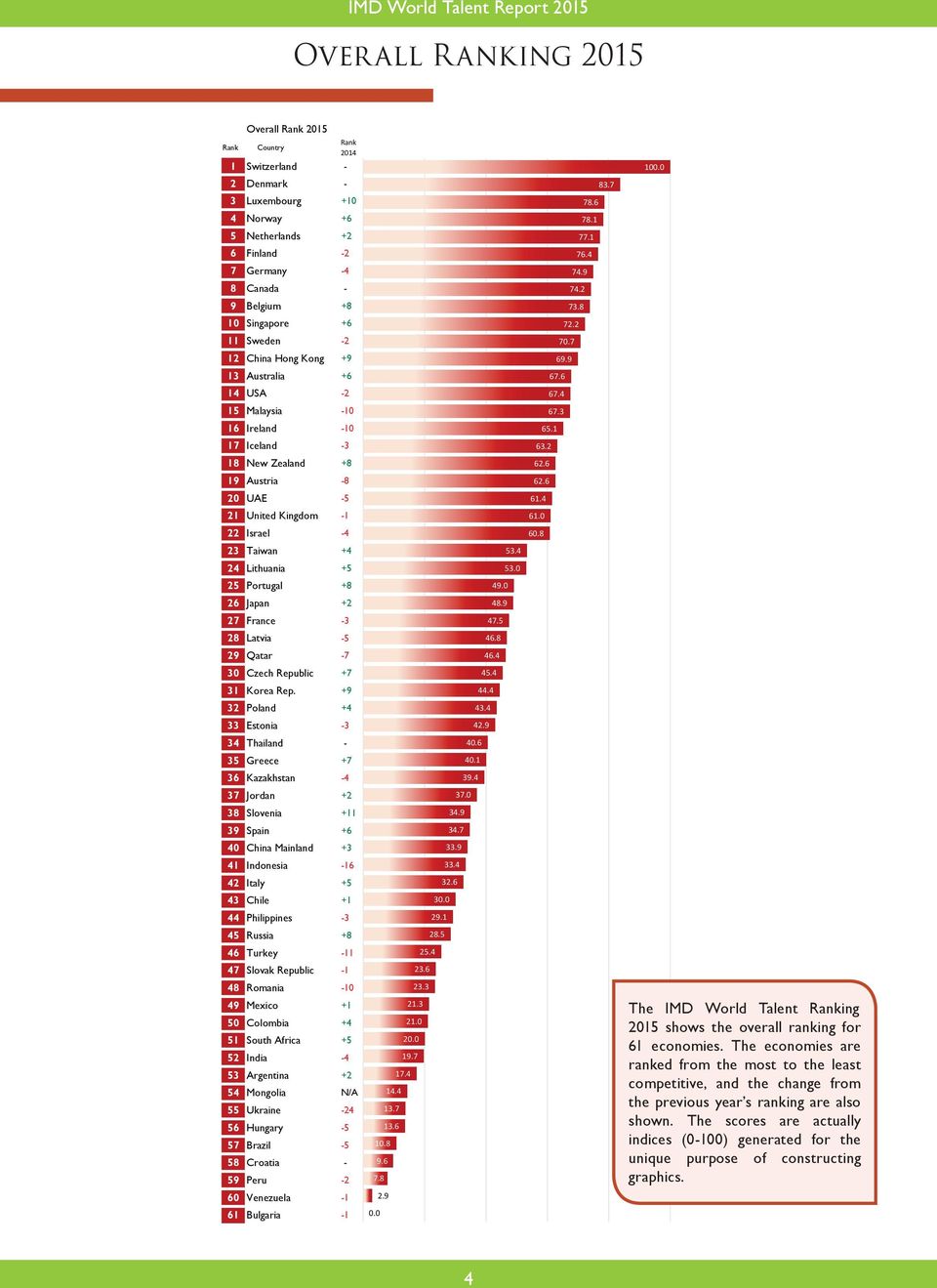
6 R anking 2015 Rank Country 1 Switzerland - 2 Denmark - Rank Luxembourg Norway +6 5 Netherlands +2 6 Finland -2 7 Germany -4 8 Canada - 9 Belgium Singapore Sweden China Hong Kong Australia USA Malaysia Ireland Iceland New Zealand Austria UAE United Kingdom Israel Taiwan Lithuania Portugal Japan France Latvia Qatar Czech Republic Korea Rep Poland Estonia Thailand - 35 Greece Kazakhstan Jordan Slovenia Spain China Mainland Indonesia Italy Chile Philippines Russia Turkey Slovak Republic Romania Mexico Colombia South Africa India Argentina Mongolia N/A 55 Ukraine Hungary Brazil Croatia - 59 Peru Venezuela Bulgaria The IMD World Talent Ranking 2015 shows the overall ranking for 61 economies. The economies are ranked from the most to the least competitive, and the change from the previous year s ranking are also shown. The scores are actually indices (0-100) generated for the unique purpose of constructing graphics. 4
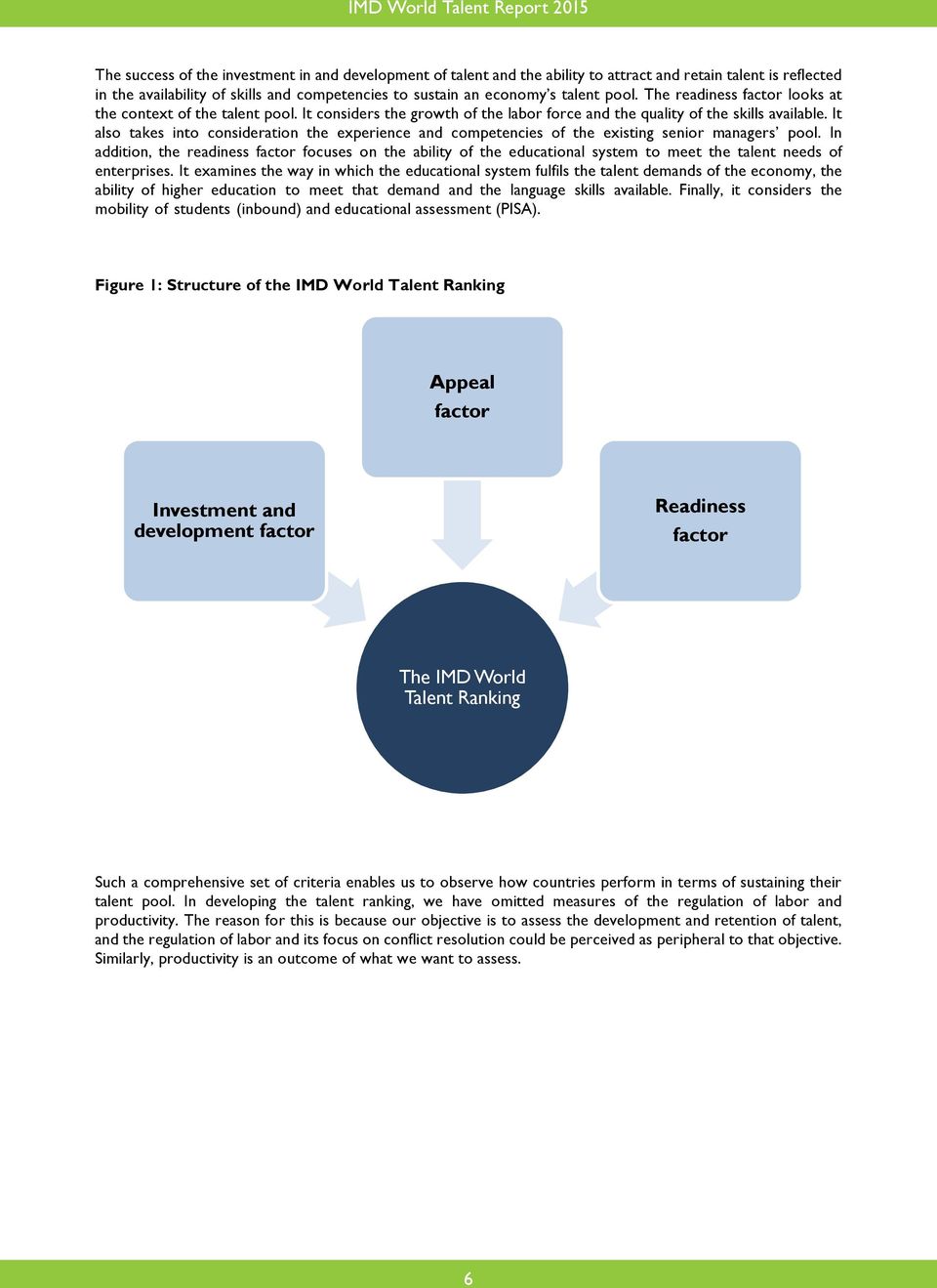
7 The IMD World Talent Report Introduction The IMD World Competitiveness Center is delighted to present its IMD World Talent Report 2015, which includes a talent ranking for all countries that are part of the IMD World Competitiveness Yearbook (61 countries as of 2015). The data are gathered from the Center s extensive database, which encompasses 20 years of competitiveness-related data. In some sections of this report, we present a detailed discussion of the data (at the indicator level) from 2005 to In the indicator tables, however, we only present the 2015 data. All criteria employed in the development of this report can be accessed through the World Competitiveness Online website. The objective of the IMD World Talent Ranking is to assess the extent to which countries develop, attract and retain talent to sustain the talent pool available for enterprises operating in those economies. While the hard data used in this report have been gathered from various sources (see Appendix), the survey data were obtained from the Center s executive opinion survey, designed for the World Competitiveness Yearbook New for 2015 We have added some features to this year s IMD World Talent Report to make it a more comprehensive study of talent around the world. In order to balance the structure of each of the talent factors, we include new indicators (see Table 1) that make for more cogent factors. We discuss these new indicators in the next section. Another new feature of the Talent Report is the inclusion of country profiles. The profiles enable readers to easily trace the evolution of the talent rankings over the last five years and provide a quick assessment of each country s talent strengths and weaknesses. We continue to trace the performance of what we refer to as talent competitive countries. This edition covers their 2005 to 2015 performance in the World Talent Ranking. These are the countries that have achieved a top 10 spot in the ranking for five or more years during the period under study. Such a performance is the result of an approach to talent competitiveness based on a balanced commitment to the development of home-grown talent and the attraction of overseas talent through policies that strive to meet the talent demands of the country. 2. The structure of the IMD World Talent Ranking The ranking is structured according to three factors: 1) investment and development, 2) appeal and 3) readiness: The first factor takes into account the investment in and development of home-grown talent. It traces the size of public investment on education by incorporating an indicator of public expenditure. It also looks at the quality of education through indicators related to pupil-teacher ratios. The development of talent is covered by variables related to the implementation of apprenticeship and the priority of employee training for companies. It also looks at the development of the female labor force. In addition, this factor takes into account the quality of the health infrastructure in terms of meeting the health needs of society. The appeal factor goes beyond the focus on the local labor force to incorporate the ability of a country to tap into the overseas talent pool. It does so by including indicators such as the cost of living and quality of life in a particular economy. Specifically, it examines the ability of a country to attract highly skilled foreign labor. In addition, it assesses the way enterprises prioritize the attraction and retention of talent. Another component of this factor evaluates the impact of brain drain on the competitiveness of countries. It also takes into account the level of worker motivation. Salary and taxation levels are important for an economy to be able to maintain an effective flow of talent. The appeal factor thus considers remuneration at the management and services professions levels and personal income tax rates. This factor also incorporates measures of personal security and the protection of private property rights because they play a key role in increasing the attractiveness of a particular economy. 5

8 The success of the investment in and development of talent and the ability to attract and retain talent is reflected in the availability of skills and competencies to sustain an economy s talent pool. The readiness factor looks at the context of the talent pool. It considers the growth of the labor force and the quality of the skills available. It also takes into consideration the experience and competencies of the existing senior managers pool. In addition, the readiness factor focuses on the ability of the educational system to meet the talent needs of enterprises. It examines the way in which the educational system fulfils the talent demands of the economy, the ability of higher education to meet that demand and the language skills available. Finally, it considers the mobility of students (inbound) and educational assessment (PISA). Figure 1: Structure of the IMD World Talent Ranking factor Investment and development factor factor The IMD World Talent Ranking Such a comprehensive set of criteria enables us to observe how countries perform in terms of sustaining their talent pool. In developing the talent ranking, we have omitted measures of the regulation of labor and productivity. The reason for this is because our objective is to assess the development and retention of talent, and the regulation of labor and its focus on conflict resolution could be perceived as peripheral to that objective. Similarly, productivity is an outcome of what we want to assess. 6
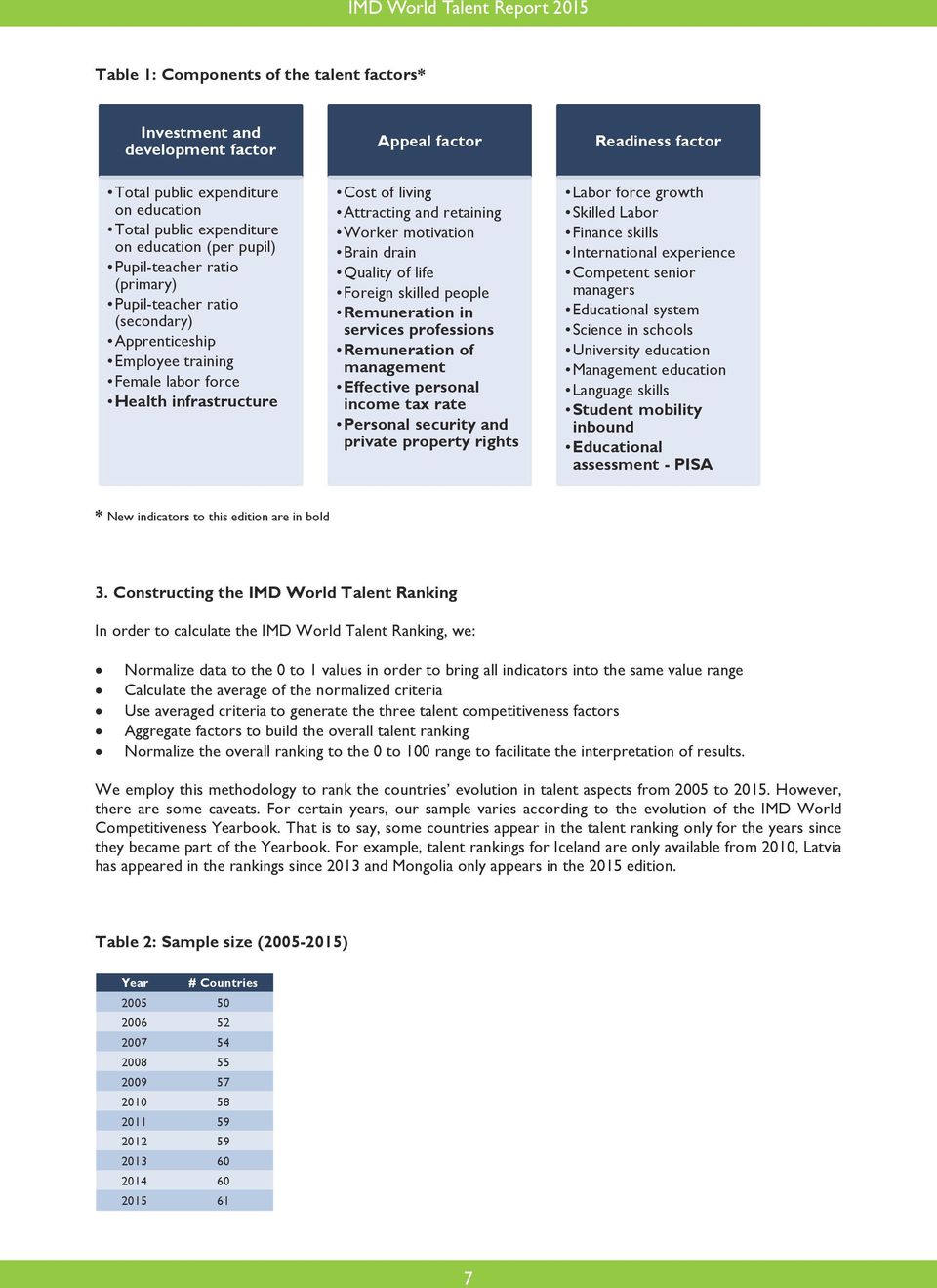
9 Table 1: Components of the talent factors* Investment and development factor Total public expenditure on education Total public expenditure on education (per pupil) Pupil-teacher ratio (primary) Pupil-teacher ratio (secondary) Apprenticeship Employee training Female labor force Health infrastructure factor Cost of living Attracting and retaining Worker motivation Brain drain Quality of life Foreign skilled people Remuneration in services professions Remuneration of management Effective personal income tax rate Personal security and private property rights factor Labor force growth Skilled Labor Finance skills International experience Competent senior managers Educational system Science in schools University education Management education Language skills Student mobility inbound Educational assessment - PISA * New indicators to this edition are in bold 3. Constructing the IMD World Talent Ranking In order to calculate the IMD World Talent Ranking, we: Normalize data to the 0 to 1 values in order to bring all indicators into the same value range Calculate the average of the normalized criteria Use averaged criteria to generate the three talent competitiveness factors Aggregate factors to build the overall talent ranking Normalize the overall ranking to the 0 to 100 range to facilitate the interpretation of results. We employ this methodology to rank the countries evolution in talent aspects from 2005 to However, there are some caveats. For certain years, our sample varies according to the evolution of the IMD World Competitiveness Yearbook. That is to say, some countries appear in the talent ranking only for the years since they became part of the Yearbook. For example, talent rankings for Iceland are only available from 2010, Latvia has appeared in the rankings since 2013 and Mongolia only appears in the 2015 edition. Table 2: Sample size ( ) Year # Countries
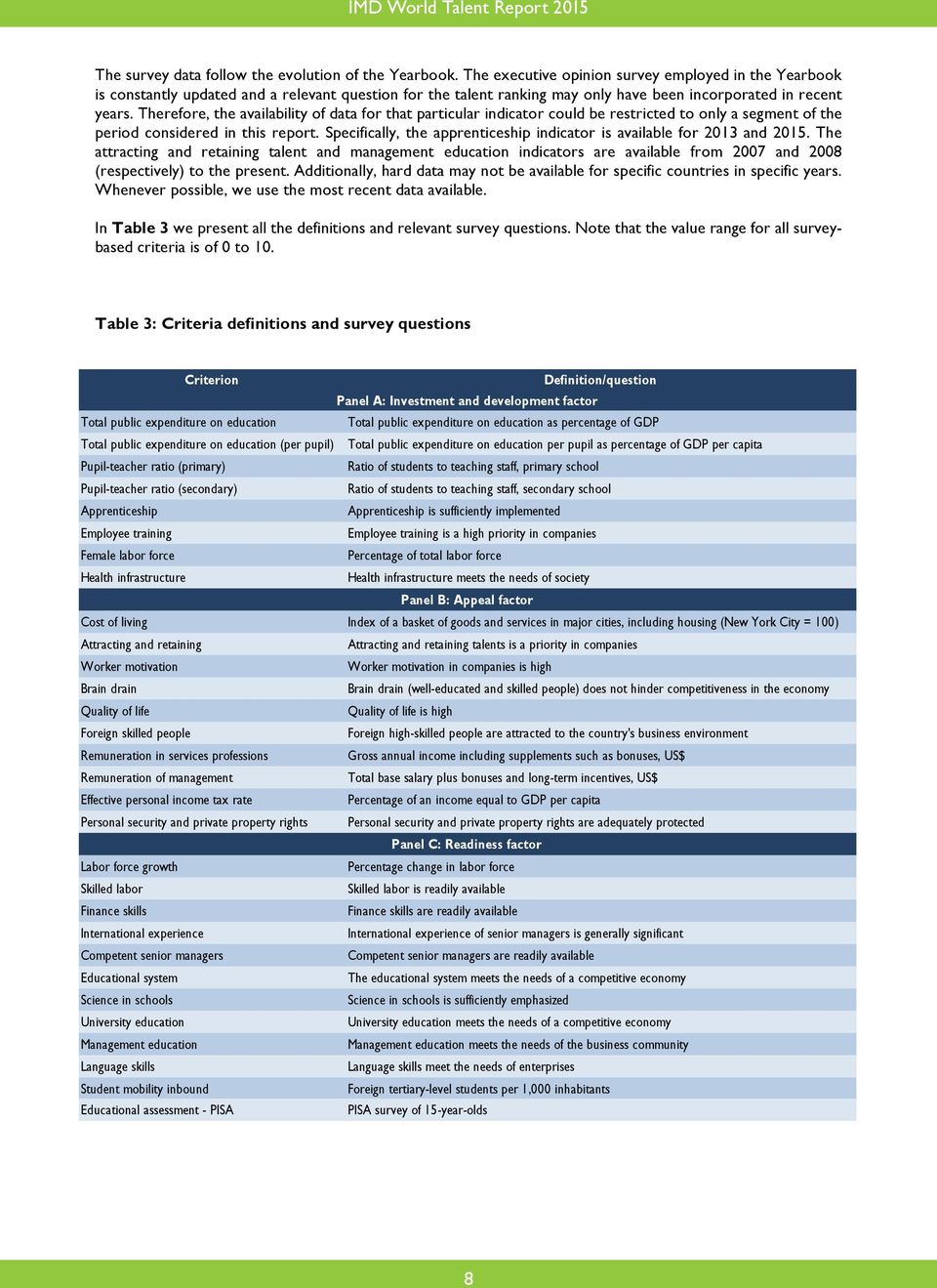
10 The survey data follow the evolution of the Yearbook. The executive opinion survey employed in the Yearbook is constantly updated and a relevant question for the talent ranking may only have been incorporated in recent years. Therefore, the availability of data for that particular indicator could be restricted to only a segment of the period considered in this report. Specifically, the apprenticeship indicator is available for 2013 and The attracting and retaining talent and management education indicators are available from 2007 and 2008 (respectively) to the present. Additionally, hard data may not be available for specific countries in specific years. Whenever possible, we use the most recent data available. In Table 3 we present all the definitions and relevant survey questions. Note that the value range for all surveybased criteria is of 0 to 10. Table 3: Criteria definitions and survey questions Criterion Definition/question Panel A: Investment and development factor Total public expenditure on education Total public expenditure on education as percentage of GDP Total public expenditure on education (per pupil) Total public expenditure on education per pupil as percentage of GDP per capita Pupil-teacher ratio (primary) Ratio of students to teaching staff, primary school Pupil-teacher ratio (secondary) Ratio of students to teaching staff, secondary school Apprenticeship Apprenticeship is sufficiently implemented Employee training Employee training is a high priority in companies Female labor force Percentage of total labor force Health infrastructure Health infrastructure meets the needs of society Panel B: factor Cost of living Index of a basket of goods and services in major cities, including housing (New York City = 100) Attracting and retaining Attracting and retaining talents is a priority in companies Worker motivation Worker motivation in companies is high Brain drain Brain drain (well-educated and skilled people) does not hinder competitiveness in the economy Quality of life Quality of life is high Foreign skilled people Foreign high-skilled people are attracted to the country's business environment Remuneration in services professions Gross annual income including supplements such as bonuses, US$ Remuneration of management Total base salary plus bonuses and long-term incentives, US$ Effective personal income tax rate Percentage of an income equal to GDP per capita Personal security and private property rights Personal security and private property rights are adequately protected Panel C: factor Labor force growth Percentage change in labor force Skilled labor Skilled labor is readily available Finance skills Finance skills are readily available International experience International experience of senior managers is generally significant Competent senior managers Competent senior managers are readily available Educational system The educational system meets the needs of a competitive economy Science in schools Science in schools is sufficiently emphasized University education University education meets the needs of a competitive economy Management education Management education meets the needs of the business community Language skills Language skills meet the needs of enterprises Student mobility inbound Foreign tertiary-level students per 1,000 inhabitants Educational assessment - PISA PISA survey of 15-year-olds 8
11 4. The IMD World Talent Ranking 2015 Results overview The 2015 IMD World Talent Ranking is led by Switzerland, Denmark, Luxembourg, Norway and the Netherlands (1 st to 5 th respectively). In Table 4 we present the 2015 top 10 countries and in the sub-sections that follow, we discuss in detail the performance of several countries in the three talent competitiveness factors. Table 4: Top 10 talent ranking, 2015 Top 10 countries 2015 Ranking Country 1 Switzerland 2 Denmark 3 Luxembourg 4 Norway 5 Netherlands 6 Finland 7 Germany 8 Canada 9 Belgium 10 Singapore 4.1 Investment and development factor Similarly to last year s ranking, Denmark leads the investment and development factor while Switzerland reaches the 2 nd spot. Austria follows in 3 rd place with Belgium and Finland ranking 4 th and 5 th respectively. Within this factor, Denmark achieves the highest score in total expenditure on education (as a percentage of GDP) and Belgium leads in the total public expenditure on education per pupil indicator. The pupil-teacher ratios are headed by Luxembourg (primary school) and Croatia (secondary school). Lithuania, Portugal and Latvia rank high in this factor (10 th, 11 th and 15 th respectively). Switzerland obtains the highest mark in the apprenticeship indicator followed closely by Germany (8.05) and Austria (7.10). For the same criterion, Lithuania (6.93), Japan (6.86) and Malaysia (6.55) make the top 10 (4 th, 5 th and 6 th, respectively). Latvia comes 11 th with a score of 5.52, Kazakhstan12 th with 5.50 and Taiwan 13 th with Denmark leads the way in employee training. Germany (7.51) and Switzerland (7.37) reach 2 nd and 3 rd places respectively. In the same indicator, Malaysia achieves 4 th with 7.33, Japan 5 th with 7.24 and Lithuania 9 th with Mongolia reaches the 11 th spot with Estonia, Latvia, Thailand and China Hong Kong round up the top 20 in employee training. In terms of female labor force (as a percentage of the total labor force), Lithuania (10 th spot in the investment and development factor) obtains the highest score. While Latvia (49.87%), Brazil (49.65%) and Kazakhstan (48.97%) reach the 2 nd, 3 rd and 4 th spots, Portugal (48.69%) comes 6 th, Estonia (48.50%) makes it to 7 th place, and France (47.83%) 9 th. In this indicator, USA (46.84%) reaches 18 th position, Switzerland (46.44%) 23 rd and Germany (46.41%) 25 th. The Netherlands (45.97%), Australia (45.91%) and Luxembourg (38.43%) rank in the bottom half of the sample (31 st, 32 nd and 52 nd respectively). The health infrastructure indicator is led by Switzerland (8.98), Belgium (8.53) and Singapore (8.39) in 1 st, 2 nd and 3 rd places respectively. Taiwan (7.82, 11 th ), Spain (7.76, 12 th ), Malaysia (7.53, 14 th ), Korea Rep. (7.49, 16 th ) and UAE (7.24, 17 th ) make the top 20 in this indicator. 9

12 4.2 factor Switzerland heads the talent appeal factor with USA, Luxembourg, Canada and Germany (2 nd to 5 th respectively) completing the top 5. Ireland (7 th ), UAE (8 th ) and China Hong Kong (10 th ) make it to the top 10 in this factor. Within the appeal factor, in terms of the cost of living, Canada is the least expensive (74.52) among the top 10 countries. USA (74.65) and Germany (80.09) follow. The most expensive countries among the top 10 are Denmark (104.2), Switzerland (114.4) and China Hong Kong (121). In the quality of life criterion, Switzerland (9.73), Norway (9.57) and Austria (9.51) head the top 10 rankings while Canada (9.22), Australia (9.11) and Finland (9.02) close it. UAE obtains the lowest mark (6.96) in terms of attracting and retaining talents among the top10 countries in the factor. Other countries at the top of this indicator are Denmark (7.85), USA (7.72), Norway (7.72), Malaysia (7.70), Switzerland (7.66) and Singapore (7.64). In the level of worker motivation in companies criterion, Switzerland (7.67), Denmark (7.66) and Norway (7.46) lead the way. In the same criterion, Ireland, Luxembourg and China Hong Kong make it to the top 10 with 7.40, 7.38 and 7.29 respectively. Taiwan and Malaysia close ranks in the top 10 obtaining 7.12 and 7.08 respectively. Norway (8.27) heads the brain drain (as a hindrance to competitiveness in the economy) criterion. Switzerland (7.56) and Finland (6.83) follow. While the UAE reaches 7 th place with 6.58, Chile comes 13 th with 6.21, the UK 14 th with 5.98 and Indonesia 15 th with The ability to attract foreign highly skilled people is led by Switzerland (8.91). Singapore obtains 8.12 (5 th place) while the UK (8.00) reaches 6 th place, Qatar (7.51) 8 th place, Australia (7.48) in the 9 th spot and China Hong Kong draw with New Zealand (7.43) in 10 th place. Malaysia (7.05), Chile (6.81), Kazakhstan (6.60) and Indonesia (6.14) make it to the top 20 in this criterion. In terms of personal security and protection of private property rights, Finland leads the ranking while Denmark, Norway, Switzerland, Singapore and Canada come 3 rd, 4 th, 5 th, 6 th and 7 th respectively. Only two countries outside the top 10 of the overall talent ranking, China Hong Kong and Australia make it to the top (2 nd and 8 th respectively) in this criterion. Germany and Luxembourg close the top factor Switzerland heads the readiness factor followed by Singapore (2 nd ), Netherlands (3 rd ), Finland (4 th ) and Canada (5 th ). Within this factor, in the labor growth (percentage change) criterion, Qatar achieves top score (9.53%) followed by UAE (9.31%), Turkey (6.43%), Venezuela (6.10%) and Indonesia (3.11%). Switzerland (1.81%) reaches 15 th place, Germany (0.61%) 29 th and Denmark (0.55%) 30 th position. In terms of skilled labor (readily available), Finland (7.67) heads the top with Greece (7.50), Norway (7.27), Denmark (7.13) and the Netherlands (7.05) rounding up the top of the table. The Philippines (7.00) reaches 6 th spot, Australia (6.75) reaches 7 th spot, Israel (6.70) 8 th, Iceland (6.69) 9 th, Ireland (6.68) 10 th and Germany (5.02) a distant 45 th spot. Switzerland (8.13) leads in the availability of finance skills. Norway (7.84) and Denmark (7.75) complete the top 3. While China Hong Kong (7.69) makes it to the 7 th place, Israel (7.49) comes 10 th, USA (7.47) 11 th, the UK (7.32) 14 th, Germany (6.98) 21 st and France (6.92) 23 rd. Luxembourg (7.87) reaches the top in the international experience of senior managers (generally significant), Switzerland (7.82), China Hong Kong (7.69), UAE (7.21) and Qatar (7.01) follow. Singapore (6.88), the Netherlands (6.86), Sweden (6.66), Malaysia (6.62) and Belgium (6.59) close the top 10. Germany (6.30) ranks 14 th with Denmark (5.97) at 16 th, and the USA (5.06) and Norway (5.02) in a distant 35 th and 38 th respectively. In terms of competent senior managers (readily available), Ireland (7.00), China Hong Kong (6.94), Norway (6.86), Denmark (6.80), Switzerland (6.77) and the Netherlands (6.77) lead the table. UAE (6.76), Canada (6.67), Sweden (6.59) and Finland (6.50) reach the 7 th to 10 th positions. Germany (5.59) and France (5.57) come 32 nd and 33 rd respectively. Switzerland (8.74), Finland (8.56), Singapore (8.27), Canada (8.20) and Germany (7.84) lead the way in the fit between the educational system and the needs of a competitive economy. Ireland (7.45) and Australia (7.30) 10
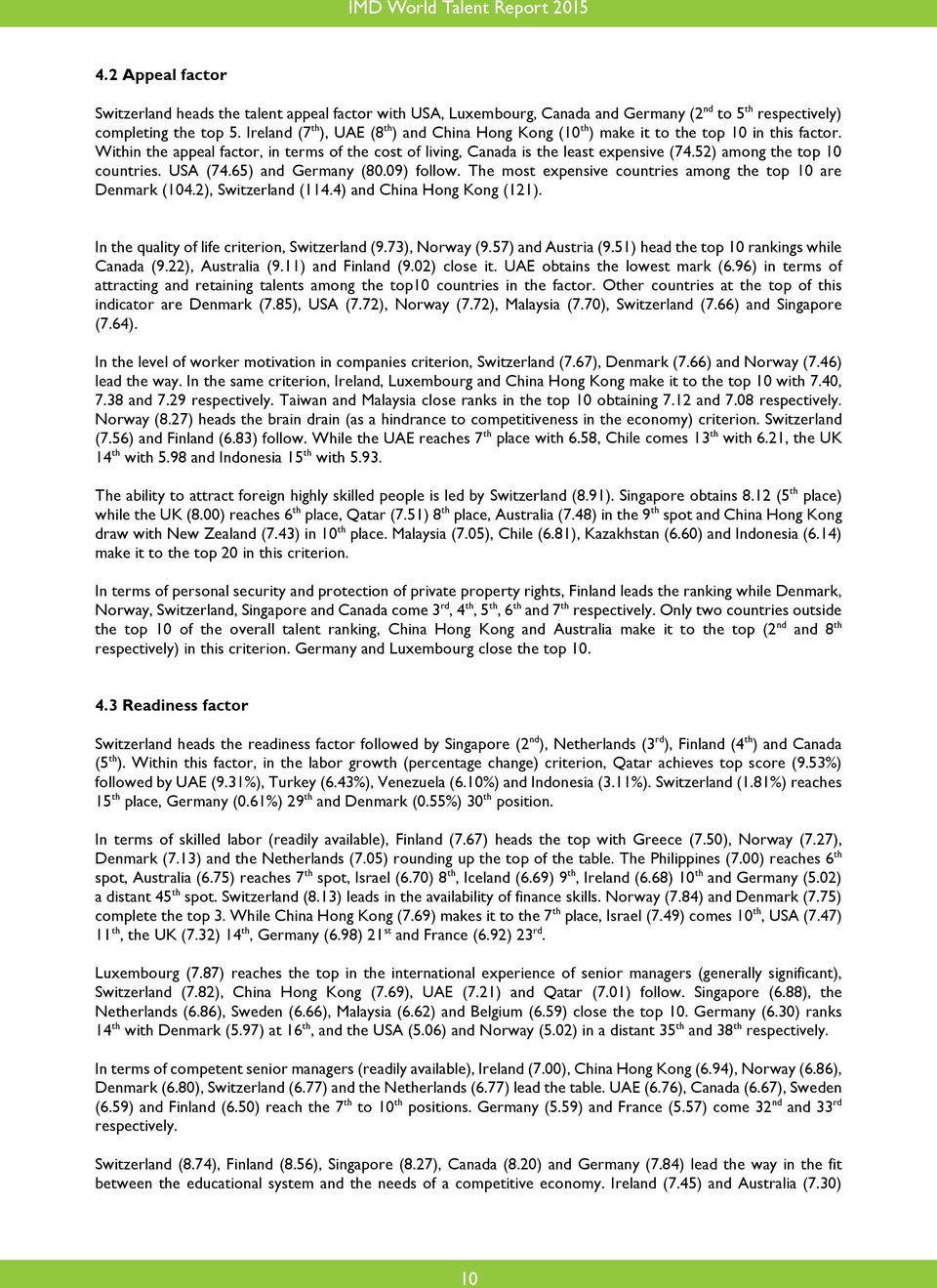
13 close the top 10 in this criterion. While the USA (6.37) comes 19 th, France (5.70) and Sweden (5.59) make it to the 26 th and 27 th places respectively. Singapore (8.44) tops the table in science in schools (sufficiently emphasized). Switzerland (7.68), Canada (7.48), Finland (7.34) and Malaysia (6.91) reach the 2 nd to 5 th places (respectively). UAE (6.65), China Hong Kong (6.51) and Taiwan (6.41) close the top 10. Germany (6.39) comes 11 th and Denmark 12 th while Norway reaches 20 th spot and Luxembourg 25 th. Sweden ranks at a distant 40 th. The top 5 for the University education (fulfil the needs of a competitive economy) criterion is Switzerland (8.56), Canada (8.17), Singapore (8.14), Israel (8.04) and Finland (7.82). Malaysia (6.68), Sweden (6.57) and Luxembourg (5.90) rank 17 th, 19 th and 24 th respectively. Switzerland (8.34), Canada (8.00) and Singapore (7.73) top the management education (meets the needs of the businesses) indicator. Belgium (7.23) closes the top 10 while Malaysia (6.88) ranks 14 th, Sweden (6.80) 16 th and the UK (6.29) 25 th. Luxembourg (8.89) leads the way in the availability of language skills followed by the Netherlands (8.68), Denmark (8.63), Switzerland (8.57) and Sweden (8.48). While Singapore (8.34) comes in 7 th position, Portugal (8.11) rounds up the top 10. Germany (7.05) ranks 22 nd and the USA (4.79) reaches the 42 nd spot. In the student mobility (inbound) indicator, Australia (10.89), Singapore (9.97), New Zealand (9.29), Austria (6.89) and the UK (6.71) top the ranking. The UAE (6.18) and Switzerland (5.59) follow in 6 th and 7 th position. Netherlands (3.43), Finland (3.26) and Sweden (3.00) make it to the 18 th, 19 th and 20 th place while Germany (2.56) is in the 24 th spot. 5. The IMD World Talent Ranking in retrospective ( ) In this section we discuss the evolution of the IMD World Talent Ranking for a selected group of countries during the period from 2005 to Talent competitive countries Developing the talent rankings enables us to identify countries that consistently accomplish high scores over the years; that is to say, the countries that rank in the top 10 for five or more years during the period assessed. We call these countries talent competitive. Talent competitive countries show a balanced approach between their commitment to education, investment in the development of local talent and their ability to attract overseas talent. The talent competitiveness strategies that these countries adopt strive to fulfil the demands of their economies. In this sense, talent competitive countries exhibit a high level of agility in the development of policies that impact their talent pipeline. In the following table we present the most talent competitive countries for the period. Table 5. The most talent competitive countries ( ) Country Austria Canada Denmark Finland Ireland Netherlands Norway Singapore Sweden Switzerland
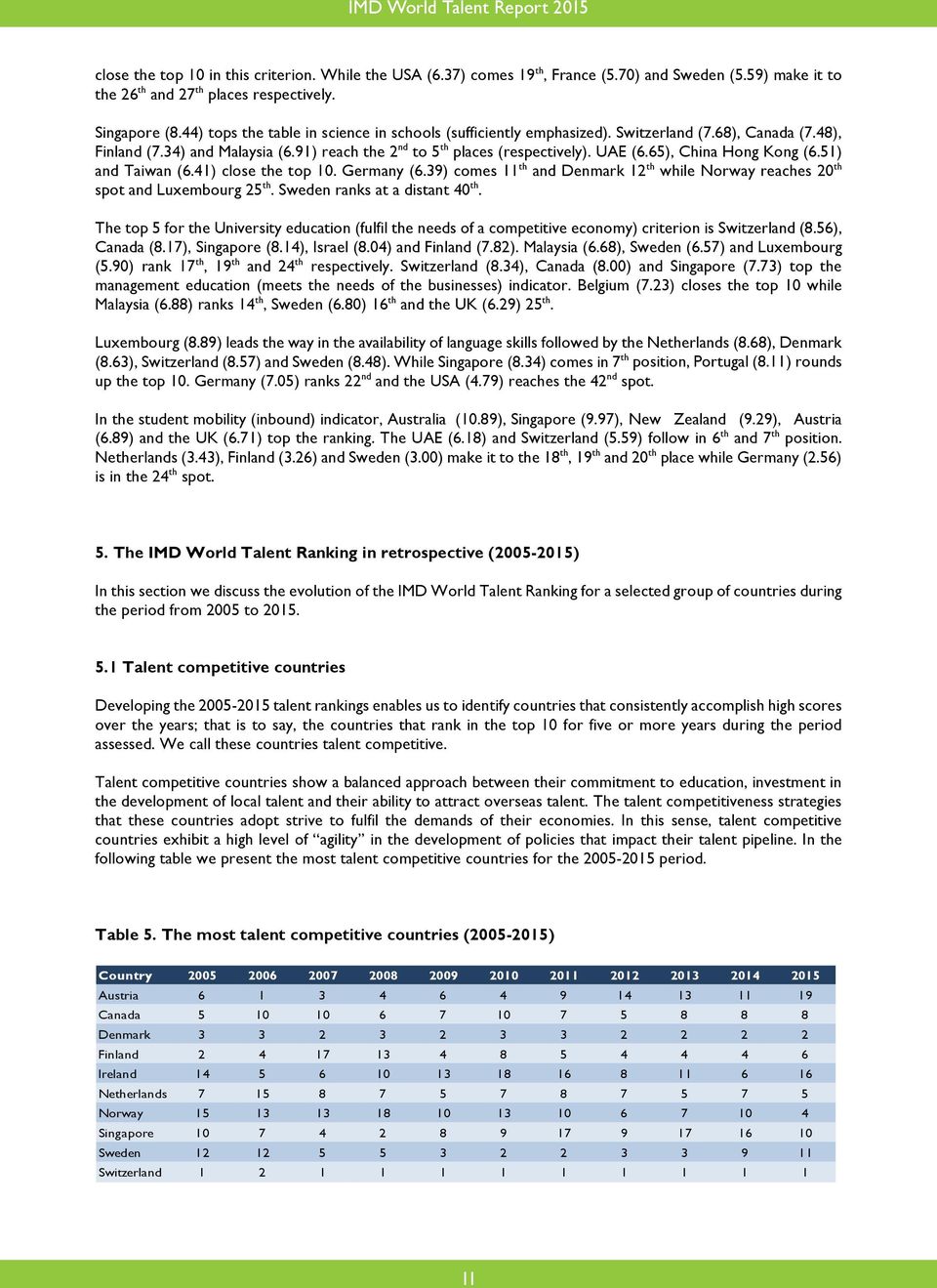
14 The fluctuation in the overall ranking experienced by some of these countries throughout the period may be the result of cyclical economic and socio-political issues that impact, for example, immigration policies and/or investment in education. In some cases, such policies could result in the diminishing ability of countries to attract overseas talent despite strong commitment to local talent development. In the next section we assess the proposition that talent competitive countries strike a balance between the development of local talent and the attraction of overseas talent through the adoption of policies that meet the talent requirements of their economies. We select countries based on their evolution in the talent ranking for These short case studies include examples of countries that steadily remain in the top 10 of the rankings and others that fluctuate in and out of the top 10 ranks. In addition, we include countries that consistently decline in their ranks and others that steadily rise. 5.2 Case studies Brazil In the overall talent ranking, Brazil peaks at 28 th in 2005 and experiences a decline to 52 nd position in 2014 and to 57 th in When comparing Brazil s scores for 2005 and 2015 we observe that it has experienced a decline in most of the indicators and a particularly sharp drop in some of the criteria encompassed by the readiness factor. Among these we find several indicators. Brazil sees the labor force growth indicator steeply decline from 4.57% in 2005 to 0.75% in 2014 and to -0.05% in Similarly, the availability of skilled labor scores drop from 5.34 to 3.16 and to 3.11 in the same period. The availability of finance skills falls sharply from 6.17 (2005) to 4.93 (2014) and to 4.05 (2015) while the access to competent senior managers dwindles from 6.20 (2005) to 3.45 (2014) but improves to 3.68 in The ability of the country s educational institutions to fulfil the talent demands of the market suffers a similar decrease. The educational system criterion steeply falls from 3.34 in 2005 to 1.80 in 2014, improving in 2015 (1.88) while the emphasis on science in schools drops from 3.68 to 2.06, further decreasing to 1.88 in Such a considerable decline in the readiness factor occurs despite a somewhat stable investment and development factor. Brazil sees an increase in its total public expenditure on education from 4.60% in 2005 to 5.82% in The pupil-teacher ratio in primary education improves from to Similarly the pupil-teacher ratio secondary school is enhanced from in 2005 to in The percentage of female labor force increases from 43.11% to 49.65%, although the prioritization of employee training decreases from 5.86 to The health infrastructure steadily decreases from 2.86 to 1.51 during the same period. Brazil ranks inconsistently in the appeal factor. It experiences a sharp increase in the cost of living index from in 2005 to in 2014 but it improves in 2015 (80.93). The level of worker motivation in the country also takes a dive from 6.66 to 4.80 while the brain drain indicator drops from 5.63 to Similarly, the quality of life decreases from 4.34 to 4.16 and the attracting and retaining talents indicator also decreases from 6.59 in 2007 to 6.42 in The ability of the country to attract foreign highly skilled people slightly increases from 5.06 in 2005 to 5.17 in 2014 but shows a fair decline in 2015 (4.19). The percentage of personal income tax rate steadily increases from 7.64% in 2005 to 7.95% in 2014 peaking at 11.02% in In terms of the protection of personal security and private property, Brazil scores 3.49 in 2005 peaking at 4.67 in 2011 but declining to 3.24 in Germany In the period from 2005 to 2015 Germany rises from 18 th place in 2006 to 3 rd in 2014, dropping to 7 th in At the factor level during the period, Germany s performance is mixed. The investment and development factor fluctuates from the 12 th to the 7 th place. Similarly, the appeal factor moves from 14 th (2011) to the 5 th (2015). In the same period, the readiness factor declines from 6 th to 17 th place. In the investment and development factor, results show that Germany increases the total public expenditure on education from 4.10% in 2005 to 4.20% in We observe, however, a declining trend in pupil-teacher ratio in primary education, which drops from to 16. Such a decline occurs despite an increase in Germany s 12
15 total public expenditure on education per pupil from 20.99% in 2006 to 24.70% in It is important to mention that the pupil-teacher ratio for secondary school slightly improves from to during the period from 2005 to While the country s implementation of apprenticeship programs declines from 8.44 in 2013 to 8.05 in 2015, other indicators in the investment and development factor improve. The prioritization of employee training in companies increases from 6.91 in 2005 to 7.51 in Similarly, Germany s percentage of female labor force also increases from 44.94% in 2005 to 46.41% in 2014, while the health infrastructure of the country improves from 8.08 to 8.15 in the period. In the appeal factor, Germany also sees an improvement in the level of worker motivation criterion from 6.35 in 2005 to 7.37 in Brain drain as a hindrance to competitiveness also observes the same pattern, improving from 5.98 (2005) to 6.30 (2015). The ability of Germany to attract foreign highly skilled people similarly increases from 4.35 in 2005 to 6.26 in Germany s quality of life indicator improves from 8.47 in 2005 to 9.31 in 2015, while the attracting and retaining talents indicator also increases from 7.19 in 2007 to 7.51 in 2015 (despite dwindling from a score of 8 in 2014). The personal security and protection of private property indicator fluctuates in the period of study decreasing from 8.87 (2005), peaking at 8.98 (2011) but dropping to 8.58 (2015). The country fares similarly in the readiness factor. The access to skilled labor sharply drops from 7.07 in 2005 to 5.02 in The availability of finance skills falls from 7.18 to 6.98 and likewise the availability of competent senior managers indicator drops from 6.31 to 5.59 during the same period. At the management level, the international experience criterion increases from 5.73 in 2005 to 6.30 in The management education fit to the needs of the business community also improves from 6.31 in 2008 to 6.99 in The readiness of Germany s educational institutions to meet the demands of the economy likewise experiences an improvement in the period of study. The criterion of educational system obtains a score of 4.21 in 2005 but increases to 7.84 in In addition, the indicator for the emphasis assigned to science in schools increases from 3.84 in 2005 to 6.39 in Similarly the university education criterion improves from 5.05 to 7.67 during the same years while the language skills indicator also increases from 6.06 in 2005 to 7.05 in In 2015, Germany s lowest scores come in the public expenditure on education, pupil-teacher ratio (secondary education), effective personal income tax rate, availability of skilled labor and of competent senior managers. Its highest scores are in the implementation of apprenticeship schemes and on the priority that companies assign to the training of the workforce Malaysia Malaysia experiences a decline in almost all talent indicators resulting in a drop of 10 ranks in It steadily improves its position in the overall World Talent Ranking from 20 th place in 2005 to the 6 th spot in 2010 up to the 5 th rank in 2014, but dropping to the 15 th in Malaysia sees an increase in the score of the employee training criterion from 6.17 in 2005 to 7.71 in 2014 but declines in 2015 (7.33). Within the readiness factor, the availability of skilled labor improves from 5.77 to 6.95 dropping to 6.66 (2015) while access to finance skills is enhanced from 6.15 (2005) to 7.40 (2014) but declines to 7.30 (2015). At the senior management level, Malaysia improves in international experience from 5.83 in 2005 to 7.23 in 2014 decreasing to 6.62 in Likewise, access to competent senior managers increases from 5.89 to 7.44 and then down to The ability of the country s educational institutions to meet the talent requirement of the market is enhanced in the period but declines in The educational system indicator rises from 5.54 to 6.86 and then drops to Likewise, the university education criterion increases from 5.49 to 6.90, then to 6.68, while that of language skills improves from 5.60 to 7.52 dropping to In addition, the emphasis that schools assign to science increases from 6.04 to 6.98 but declines to 6.91 in the period under consideration. Malaysia s appeal factor experiences the same pattern. The level of worker motivation in companies increases from 6.08 in 2005 to 7.68 in 2014 down to 7.08 in At the same time, the criterion covering the brain drain as a hindrance to the competitiveness of the country improves from 4.84 to 6.51 and then declines to While 13
16 the quality of life improves from 6.76 in 2005 to 7.48 in 2014, it drops to 7.36 in Nevertheless, the ability of the country to attract foreign highly skilled people increases from 6.42 in 2005 to 7.24 in 2014 and it is further enhanced in 2015 (7.05). Personal security and protection of private property rights also increases from 6.57 (2005) to 6.94 (2015). There are improvement trends under the investment and development factor in the period from 2005 to Malaysia s pupil-teacher ratio for both primary and secondary education improves from to and from to 13.10, respectively. The percentage of the country s female labor force also increases from 36.06% in 2005 to 38.43% in The adequacy of the country s health infrastructure increases from 6.65 in 2005 to 7.53 in Other indicators under this factor, however, experience a decline between 2014 and The country s implementation of apprenticeship programs increases from 6.49 in 2013 to 7.12 in 2014 but decreases to 6.55 in Malaysia s total public expenditure on education decreases from 6.98% in 2005 to 5.51% in The country s total public expenditure on education per pupil improves from 20.54% in 2007 to 23.15% in 2014 but drops to 19.87% in Singapore In the overall ranking, Singapore experiences an increase from the 10 th spot in 2005, peaking at 2 nd place in 2008 then descending to 9 th in 2010 and reaching 10 th in The country s scores in most of the indicators of the investment and development factor seem low and cost of living is high suggesting that Singapore currently has a large pool of talent that it has nurtured and attracted, but that this pool may shrink slightly in the future. While the total public expenditure on education peaks at 3.72% in 2005, it reaches its lowest (2.80%) in In 2015, expenditure on education is at 3.08%. The primary school pupil-teacher ratio reaches its lowest at 25 in 2006 but steadily improves to 18 in The female percentage of the labor force criterion experiences a similar pattern, improving from 41.30% in 2005 to 44.97% in In terms of the prioritization of employee training, Singapore s scores fluctuate from a high of 7.32 (2008) to a low of 6.27 in 2013, improving in 2015 (6.72). Other indicators under this factor, however, experience a decline during the period under study. In the implementation of apprenticeship programs, Singapore scores 5.26 in 2013, 5.25 in 2014 and drops to 5 in The health infrastructure, likewise, declines from 8.44 in 2005 to 8.39 in In the cost of living indicator, Singapore scores in 2005; living costs increase to in 2013 but decrease to in 2015 (the second most expensive in the sample). Scores for the quality of life are consistently high (above 8) with a lowest value of 8 in 2005 and a highest of 8.96 in 2007; although in 2015 the quality of life indicator experiences a slight decline to In the attracting and retaining indicator Singapore achieves the highest mark of the sample in 2008 with a value of 8.33; by 2015, however, the country scores slightly lower (7.64) in this indicator. Scores for the brain drain criterion are relatively high throughout. At the same time, Singapore s ability to attract foreign highly skilled people receives extremely high marks, albeit with a lowest score of 7.95 in 2013 from a high of 8.74 in 2008; the score for 2015 is In the personal security and protection of private property, similarly, Singapore s scores are high, peaking at 9.30 in 2008, obtaining its lowest mark in 2014 (8.61). For 2015 the country s score in this indicator is Within the readiness factor, Singapore scores are consistently high for the educational system, science in schools, university education and management education criteria. Moreover, in all the years under study, Singapore achieves the highest scores for science in schools. In the period, Singapore dominates the educational system and university education indicators Switzerland In the years considered in this report, Switzerland ranks 1 st except in the 2006 ranking for which it reaches the 2 nd spot. Through the period, Switzerland excels in all factors particularly in the appeal and readiness factors. It is worth mentioning that under the investment and development factor, in the female percentage of the labor force, Switzerland experiences some fluctuation but sees an increase from 44.69% in 2005 to in Similarly, in the prioritization of employee training for companies, the country scores higher than 7.35 throughout, reaching top marks in 2012 (7.86) but declining in 2015 (7.37). In the health infrastructure, scores are similar, peaking in 2011 (9.04), with the lowest in 2013 (8.72) and improving in 2015 (8.98). 14
17 Switzerland achieves the top spot in the quality of life for six of the years in the period under study, in worker motivation (four years) and in attracting foreign highly skilled people (eight years). In the personal security and protection of private property indicator, Switzerland s marks are likewise high throughout the period covered by this report. It is also important to mention, its scores in the brain drain as a hindrance to the competitiveness of the economy are consistently high (above 7.00 from 2007 to 2015), reaching its lowest in 2009 at In other specific indicators, Switzerland dominates (in the majority of years analyzed) the rankings in the availability of finance skills, the significance of the international experience of senior managers, in the ability of university education to fulfil the demands of the labor market, and in the ability of the management education to meet the needs of the business community. In language skills it achieves top marks in four years during the period. Switzerland s lowest scores show in the pupil-teacher ratio (primary and secondary education), percentage female labor force, labor force growth, cost of living indicators and in effective personal income tax rate. 6. Observations The 2015 results support the proposition that countries that achieve a positive balance between investing and developing local talent and the ability to attract and retain overseas talent perform consistently well in the period under study, for example Switzerland. The country s results indicate that it is able to develop its home-grown talent while efficiently tapping into the overseas talent pipeline. In addition, the Malaysian example shows that a strategy aiming at improving both the home-grown and overseas talents has a positive impact on the country s performance in the overall talent ranking. Countries that experience imbalances in that strategy tend to experience a drop in their overall rankings. The overall ranking pattern exhibited by Singapore seems to be the outcome of the investment and development factor results in combination with other indicators, such as the cost of living. In other words, despite improvement in 2015, Singapore s results show a fair degree of imbalance between the criteria covering the home-grown talent pipeline and the ability of the country to attract overseas talent. The country thus fluctuates in and out of the top 10 talent ranking during the period under study. Similarly, Germany s performance experiences a fair degree of imbalances. It shows that despite some improvements in the investment and development and appeal factors, the readiness of the economy to meet the talent demand could steadily dwindle if the availability of the necessary competencies and skills are not constantly updated and replenished. Finally, the performance of Brazil shows that imbalances across all talent competitiveness criteria are detrimental for the sustainability of an effective and dynamic talent pipeline. 15

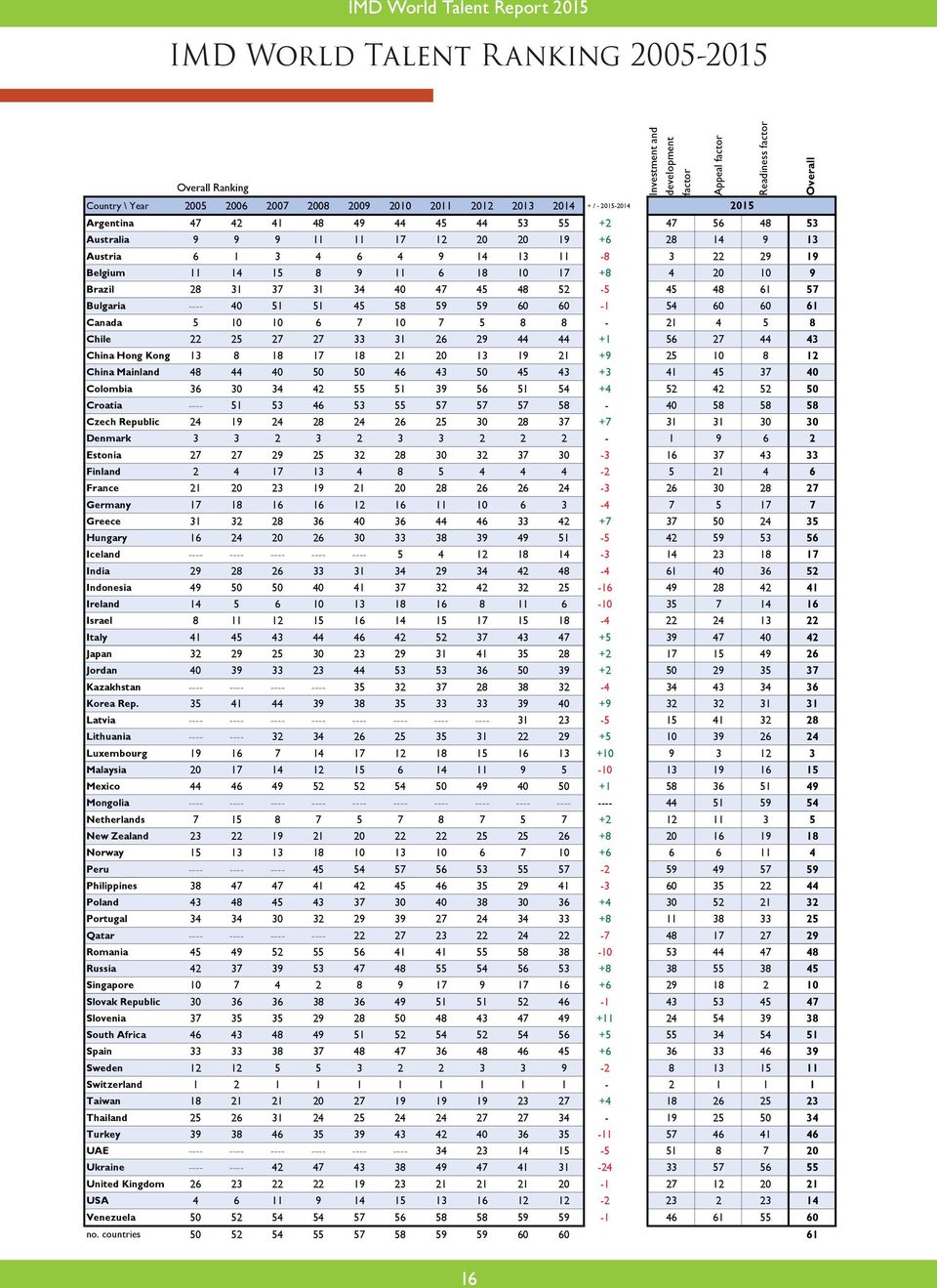
18 IMD World Talent R anking Ranking Country \ Year / Investment and development factor factor factor Argentina Australia Austria Belgium Brazil Bulgaria Canada Chile China Hong Kong China Mainland Colombia Croatia Czech Republic Denmark Estonia Finland France Germany Greece Hungary Iceland India Indonesia Ireland Israel Italy Japan Jordan Kazakhstan Korea Rep Latvia Lithuania Luxembourg Malaysia Mexico Mongolia Netherlands New Zealand Norway Peru Philippines Poland Portugal Qatar Romania Russia Singapore Slovak Republic Slovenia South Africa Spain Sweden Switzerland Taiwan Thailand Turkey UAE Ukraine United Kingdom USA Venezuela no. countries
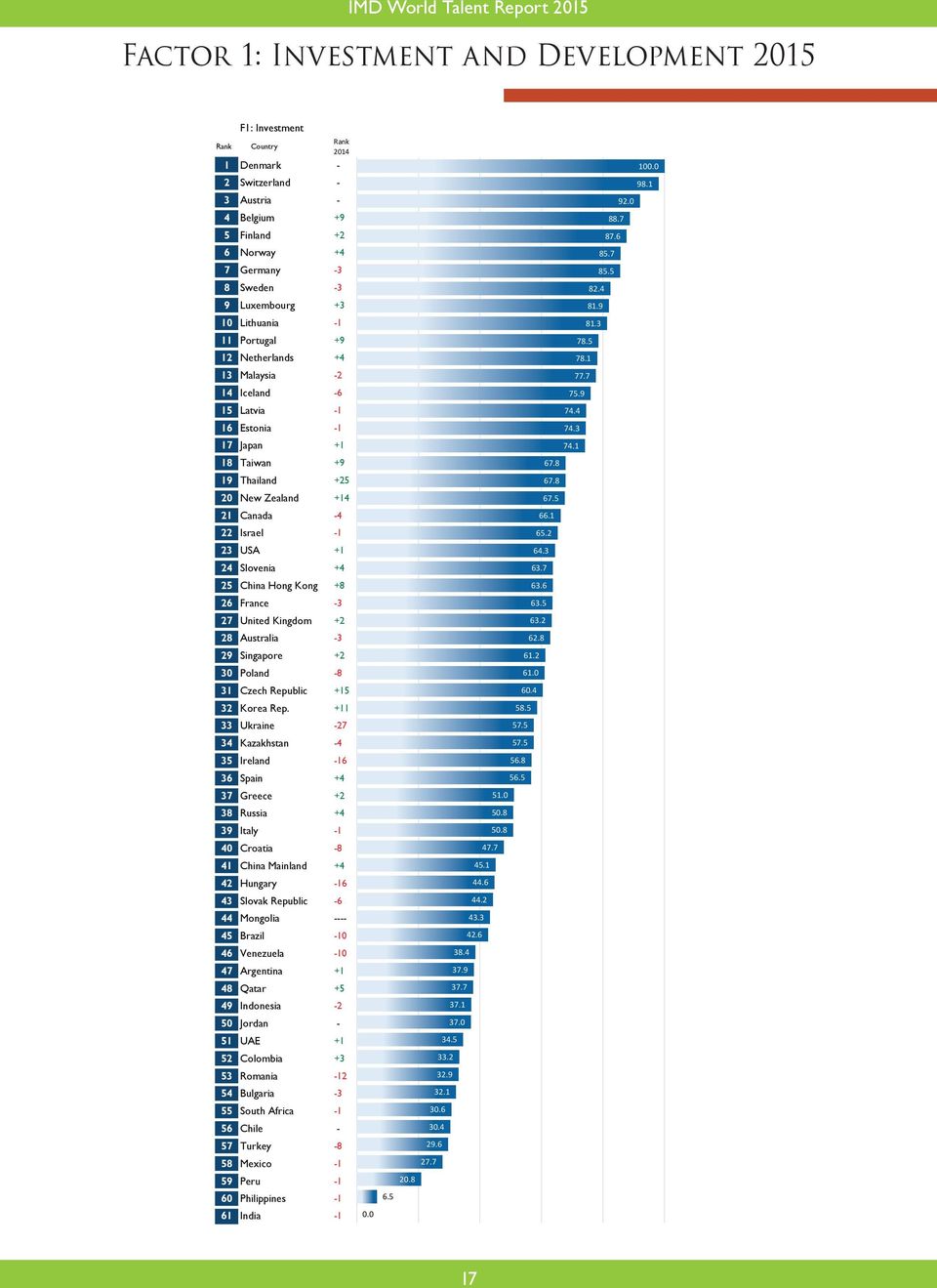
19 Factor 1: Investment and 2015 F1: Investment Rank Country 1 Denmark - 2 Switzerland - 3 Austria - Rank Belgium +9 5 Finland +2 6 Norway +4 7 Germany -3 8 Sweden -3 9 Luxembourg Lithuania Portugal Netherlands Malaysia Iceland Latvia Estonia Japan Taiwan Thailand New Zealand Canada Israel USA Slovenia China Hong Kong France United Kingdom Australia Singapore Poland Czech Republic Korea Rep Ukraine Kazakhstan Ireland Spain Greece Russia Italy Croatia China Mainland Hungary Slovak Republic Mongolia Brazil Venezuela Argentina Qatar Indonesia Jordan - 51 UAE Colombia Romania Bulgaria South Africa Chile - 57 Turkey Mexico Peru Philippines India
20 Factor 2: 2015 F2: Rank Country 1 Switzerland - Rank USA +1 3 Luxembourg +7 4 Canada +3 5 Germany -3 6 Norway +2 7 Ireland -3 8 UAE -2 9 Denmark - 10 China Hong Kong Netherlands United Kingdom Sweden - 14 Australia Japan New Zealand Qatar - 18 Singapore Malaysia Belgium Finland Austria Iceland Israel Thailand Taiwan Chile - 28 Indonesia Jordan France Czech Republic Korea Rep Spain South Africa Philippines Mexico Estonia Portugal Lithuania India Latvia Colombia Kazakhstan Romania China Mainland Turkey Italy Brazil Peru Greece Mongolia Poland Slovak Republic Slovenia Russia Argentina Ukraine Croatia Hungary Bulgaria Venezuela

21 Factor 3: 2015 F3: Rank Country 1 Switzerland - Rank Singapore +4 3 Netherlands - 4 Finland -2 5 Canada +4 6 Denmark -2 7 UAE -2 8 China Hong Kong +2 9 Australia Belgium Norway Luxembourg Israel - 14 Ireland Sweden Malaysia Germany Iceland New Zealand United Kingdom Poland Philippines USA Greece Taiwan - 26 Lithuania Qatar France Austria Czech Republic Korea Rep Latvia Portugal Kazakhstan Jordan India China Mainland Russia Slovenia Italy Turkey Indonesia Estonia Chile Slovak Republic Spain Romania Argentina Japan Thailand Mexico Colombia Hungary South Africa Venezuela Ukraine Peru - 58 Croatia - 59 Mongolia Bulgaria - 61 Brazil
22 20
23 Profiles 21
24 Argentina Factor 1 : Investment and Total Public Expenditure on Education Percentage of GDP - % - Public Expenditure on Education per Pupil (Secondary) Percentage of GDP per capita % 13 Pupil-Teacher Ratio (Primary Education) Ratio of students to teaching staff Ratio 35 Pupil-Teacher Ratio (Secondary Education) Ratio of students to teaching staff Ratio 15 Apprenticeships Are sufficiently implemented 3.64 Survey 53 Employee Training Is a high priority in companies 4.18 Survey 59 Female Labor Force Percentage of total labor force - % - Health Infrastructure Meets the needs of society 3.81 Survey 46 Factor 2 : Cost-of-Living Index Index of a basket of goods & services Index 29 Attracting and Retaining Talents Is a priority in companies 5.57 Survey 51 Worker Motivation Is high 4.37 Survey 56 Brain Drain Does not hinder competitiveness in your economy 4.77 Survey 30 Quality of Life Is high 4.45 Survey 50 Foreign High-Skilled People Are attracted to your country's business environment 2.55 Survey 57 Remuneration in Services Professions Gross annual income including supplements such as bonuses 13,920 US$ 44 Remuneration of Management Total base salary plus bonuses and long-term incentives 99,565 US$ 47 Effective Personal Income Tax Rate Percentage of an income equal to GDP per capita % 28 Personal Security and Private Property Rights Are adequately protected 2.36 Survey 60 Factor 3 : Labor Force Growth Percentage change 0.29 % 39 Skilled Labor Is readily available 4.79 Survey 47 Finance Skills Are readily available 6.05 Survey 37 International Experience Of senior managers is generally significant 5.32 Survey 32 Competent Senior Managers Are readily available 4.86 Survey 42 Educational System Meets the needs of a competitive economy 3.30 Survey 54 Science in Schools Is sufficiently emphasized 2.90 Survey 54 University Education Meets the needs of a competitive economy 4.50 Survey 48 Management Education Meets the needs of the business community 5.18 Survey 43 Language Skills Are meeting the needs of enterprises 5.00 Survey 41 Student Mobility Inbound Foreign tertiary-level students per 1000 inhabitants - Number - Educational Assessment - PISA PISA survey of 15-year olds Value 51 22
25 Australia Factor 1 : Investment and Total Public Expenditure on Education Percentage of GDP 5.27 % 24 Public Expenditure on Education per Pupil (Secondary) Percentage of GDP per capita % 40 Pupil-Teacher Ratio (Primary Education) Ratio of students to teaching staff Ratio 28 Pupil-Teacher Ratio (Secondary Education) Ratio of students to teaching staff Ratio 23 Apprenticeships Are sufficiently implemented 4.65 Survey 31 Employee Training Is a high priority in companies 5.82 Survey 31 Female Labor Force Percentage of total labor force % 32 Health Infrastructure Meets the needs of society 7.12 Survey 20 Factor 2 : Cost-of-Living Index Index of a basket of goods & services Index 44 Attracting and Retaining Talents Is a priority in companies 7.34 Survey 18 Worker Motivation Is high 5.87 Survey 32 Brain Drain Does not hinder competitiveness in your economy 5.75 Survey 17 Quality of Life Is high 9.11 Survey 9 Foreign High-Skilled People Are attracted to your country's business environment 7.48 Survey 9 Remuneration in Services Professions Gross annual income including supplements such as bonuses 58,060 US$ 7 Remuneration of Management Total base salary plus bonuses and long-term incentives 190,512 US$ 28 Effective Personal Income Tax Rate Percentage of an income equal to GDP per capita % 42 Personal Security and Private Property Rights Are adequately protected 8.63 Survey 8 Factor 3 : Labor Force Growth Percentage change 1.35 % 18 Skilled Labor Is readily available 6.75 Survey 7 Finance Skills Are readily available 7.71 Survey 5 International Experience Of senior managers is generally significant 5.73 Survey 22 Competent Senior Managers Are readily available 6.44 Survey 13 Educational System Meets the needs of a competitive economy 7.30 Survey 10 Science in Schools Is sufficiently emphasized 5.36 Survey 29 University Education Meets the needs of a competitive economy 7.08 Survey 15 Management Education Meets the needs of the business community 6.75 Survey 17 Language Skills Are meeting the needs of enterprises 5.95 Survey 27 Student Mobility Inbound Foreign tertiary-level students per 1000 inhabitants Number 1 Educational Assessment - PISA PISA survey of 15-year olds Value 14 23
26 Austria Factor 1 : Investment and Total Public Expenditure on Education Percentage of GDP 5.00 % 27 Public Expenditure on Education per Pupil (Secondary) Percentage of GDP per capita % 8 Pupil-Teacher Ratio (Primary Education) Ratio of students to teaching staff Ratio 12 Pupil-Teacher Ratio (Secondary Education) Ratio of students to teaching staff 9.54 Ratio 9 Apprenticeships Are sufficiently implemented 7.10 Survey 3 Employee Training Is a high priority in companies 7.04 Survey 7 Female Labor Force Percentage of total labor force % 19 Health Infrastructure Meets the needs of society 7.91 Survey 10 Factor 2 : Cost-of-Living Index Index of a basket of goods & services Index 47 Attracting and Retaining Talents Is a priority in companies 6.72 Survey 34 Worker Motivation Is high 6.96 Survey 13 Brain Drain Does not hinder competitiveness in your economy 4.43 Survey 35 Quality of Life Is high 9.51 Survey 3 Foreign High-Skilled People Are attracted to your country's business environment 5.39 Survey 28 Remuneration in Services Professions Gross annual income including supplements such as bonuses 51,840 US$ 10 Remuneration of Management Total base salary plus bonuses and long-term incentives 303,310 US$ 4 Effective Personal Income Tax Rate Percentage of an income equal to GDP per capita % 60 Personal Security and Private Property Rights Are adequately protected 8.20 Survey 16 Factor 3 : Labor Force Growth Percentage change 0.40 % 35 Skilled Labor Is readily available 4.29 Survey 51 Finance Skills Are readily available 6.09 Survey 36 International Experience Of senior managers is generally significant 5.53 Survey 28 Competent Senior Managers Are readily available 4.97 Survey 41 Educational System Meets the needs of a competitive economy 5.45 Survey 31 Science in Schools Is sufficiently emphasized 4.29 Survey 45 University Education Meets the needs of a competitive economy 6.03 Survey 23 Management Education Meets the needs of the business community 6.12 Survey 27 Language Skills Are meeting the needs of enterprises 5.91 Survey 28 Student Mobility Inbound Foreign tertiary-level students per 1000 inhabitants 6.89 Number 4 Educational Assessment - PISA PISA survey of 15-year olds Value 19 24
27 Belgium Factor 1 : Investment and Total Public Expenditure on Education Percentage of GDP 6.40 % 10 Public Expenditure on Education per Pupil (Secondary) Percentage of GDP per capita % 1 Pupil-Teacher Ratio (Primary Education) Ratio of students to teaching staff Ratio 16 Pupil-Teacher Ratio (Secondary Education) Ratio of students to teaching staff 9.50 Ratio 8 Apprenticeships Are sufficiently implemented 4.66 Survey 29 Employee Training Is a high priority in companies 5.87 Survey 30 Female Labor Force Percentage of total labor force % 26 Health Infrastructure Meets the needs of society 8.53 Survey 2 Factor 2 : Cost-of-Living Index Index of a basket of goods & services Index 39 Attracting and Retaining Talents Is a priority in companies 7.00 Survey 25 Worker Motivation Is high 6.27 Survey 23 Brain Drain Does not hinder competitiveness in your economy 5.23 Survey 24 Quality of Life Is high 8.68 Survey 15 Foreign High-Skilled People Are attracted to your country's business environment 5.57 Survey 24 Remuneration in Services Professions Gross annual income including supplements such as bonuses 50,580 US$ 11 Remuneration of Management Total base salary plus bonuses and long-term incentives 284,195 US$ 6 Effective Personal Income Tax Rate Percentage of an income equal to GDP per capita % 50 Personal Security and Private Property Rights Are adequately protected 7.60 Survey 24 Factor 3 : Labor Force Growth Percentage change 0.40 % 36 Skilled Labor Is readily available 6.25 Survey 18 Finance Skills Are readily available 6.87 Survey 24 International Experience Of senior managers is generally significant 6.59 Survey 10 Competent Senior Managers Are readily available 6.16 Survey 19 Educational System Meets the needs of a competitive economy 7.78 Survey 7 Science in Schools Is sufficiently emphasized 6.76 Survey 7 University Education Meets the needs of a competitive economy 7.81 Survey 6 Management Education Meets the needs of the business community 7.23 Survey 10 Language Skills Are meeting the needs of enterprises 8.26 Survey 8 Student Mobility Inbound Foreign tertiary-level students per 1000 inhabitants 3.87 Number 13 Educational Assessment - PISA PISA survey of 15-year olds Value 16 25
28 Brazil Factor 1 : Investment and Total Public Expenditure on Education Percentage of GDP 5.82 % 14 Public Expenditure on Education per Pupil (Secondary) Percentage of GDP per capita % 31 Pupil-Teacher Ratio (Primary Education) Ratio of students to teaching staff Ratio 53 Pupil-Teacher Ratio (Secondary Education) Ratio of students to teaching staff Ratio 47 Apprenticeships Are sufficiently implemented 4.05 Survey 47 Employee Training Is a high priority in companies 5.15 Survey 48 Female Labor Force Percentage of total labor force % 3 Health Infrastructure Meets the needs of society 1.51 Survey 60 Factor 2 : Cost-of-Living Index Index of a basket of goods & services Index 31 Attracting and Retaining Talents Is a priority in companies 6.42 Survey 39 Worker Motivation Is high 4.80 Survey 50 Brain Drain Does not hinder competitiveness in your economy 4.33 Survey 36 Quality of Life Is high 4.16 Survey 54 Foreign High-Skilled People Are attracted to your country's business environment 4.19 Survey 44 Remuneration in Services Professions Gross annual income including supplements such as bonuses 18,700 US$ 40 Remuneration of Management Total base salary plus bonuses and long-term incentives 160,356 US$ 36 Effective Personal Income Tax Rate Percentage of an income equal to GDP per capita 7.95 % 11 Personal Security and Private Property Rights Are adequately protected 3.24 Survey 57 Factor 3 : Labor Force Growth Percentage change % 45 Skilled Labor Is readily available 3.11 Survey 59 Finance Skills Are readily available 4.05 Survey 59 International Experience Of senior managers is generally significant 4.33 Survey 53 Competent Senior Managers Are readily available 3.68 Survey 56 Educational System Meets the needs of a competitive economy 1.88 Survey 61 Science in Schools Is sufficiently emphasized 1.88 Survey 61 University Education Meets the needs of a competitive economy 3.02 Survey 59 Management Education Meets the needs of the business community 3.38 Survey 59 Language Skills Are meeting the needs of enterprises 2.48 Survey 61 Student Mobility Inbound Foreign tertiary-level students per 1000 inhabitants 0.08 Number 52 Educational Assessment - PISA PISA survey of 15-year olds Value 49 26
29 Bulgaria Factor 1 : Investment and Total Public Expenditure on Education Percentage of GDP 3.42 % 53 Public Expenditure on Education per Pupil (Secondary) Percentage of GDP per capita % 26 Pupil-Teacher Ratio (Primary Education) Ratio of students to teaching staff Ratio 40 Pupil-Teacher Ratio (Secondary Education) Ratio of students to teaching staff Ratio 28 Apprenticeships Are sufficiently implemented 2.46 Survey 59 Employee Training Is a high priority in companies 4.00 Survey 61 Female Labor Force Percentage of total labor force % 21 Health Infrastructure Meets the needs of society 2.78 Survey 53 Factor 2 : Cost-of-Living Index Index of a basket of goods & services Index 3 Attracting and Retaining Talents Is a priority in companies 5.37 Survey 55 Worker Motivation Is high 3.97 Survey 58 Brain Drain Does not hinder competitiveness in your economy 1.76 Survey 59 Quality of Life Is high 3.12 Survey 59 Foreign High-Skilled People Are attracted to your country's business environment 2.44 Survey 58 Remuneration in Services Professions Gross annual income including supplements such as bonuses 9,780 US$ 54 Remuneration of Management Total base salary plus bonuses and long-term incentives 50,303 US$ 55 Effective Personal Income Tax Rate Percentage of an income equal to GDP per capita % 41 Personal Security and Private Property Rights Are adequately protected 3.22 Survey 58 Factor 3 : Labor Force Growth Percentage change % 46 Skilled Labor Is readily available 4.03 Survey 54 Finance Skills Are readily available 4.00 Survey 60 International Experience Of senior managers is generally significant 3.66 Survey 59 Competent Senior Managers Are readily available 3.53 Survey 57 Educational System Meets the needs of a competitive economy 2.10 Survey 60 Science in Schools Is sufficiently emphasized 2.83 Survey 56 University Education Meets the needs of a competitive economy 2.00 Survey 61 Management Education Meets the needs of the business community 3.10 Survey 61 Language Skills Are meeting the needs of enterprises 4.54 Survey 45 Student Mobility Inbound Foreign tertiary-level students per 1000 inhabitants 1.54 Number 31 Educational Assessment - PISA PISA survey of 15-year olds Value 41 27
30 Canada Factor 1 : Investment and Total Public Expenditure on Education Percentage of GDP - % - Public Expenditure on Education per Pupil (Secondary) Percentage of GDP per capita % 37 Pupil-Teacher Ratio (Primary Education) Ratio of students to teaching staff Ratio 21 Pupil-Teacher Ratio (Secondary Education) Ratio of students to teaching staff Ratio 39 Apprenticeships Are sufficiently implemented 5.08 Survey 19 Employee Training Is a high priority in companies 5.90 Survey 29 Female Labor Force Percentage of total labor force % 12 Health Infrastructure Meets the needs of society 7.11 Survey 21 Factor 2 : Cost-of-Living Index Index of a basket of goods & services Index 17 Attracting and Retaining Talents Is a priority in companies 7.38 Survey 16 Worker Motivation Is high 6.66 Survey 17 Brain Drain Does not hinder competitiveness in your economy 6.56 Survey 8 Quality of Life Is high 9.22 Survey 8 Foreign High-Skilled People Are attracted to your country's business environment 7.70 Survey 7 Remuneration in Services Professions Gross annual income including supplements such as bonuses 48,030 US$ 15 Remuneration of Management Total base salary plus bonuses and long-term incentives 220,143 US$ 18 Effective Personal Income Tax Rate Percentage of an income equal to GDP per capita % 27 Personal Security and Private Property Rights Are adequately protected 8.77 Survey 7 Factor 3 : Labor Force Growth Percentage change 0.46 % 33 Skilled Labor Is readily available 6.63 Survey 13 Finance Skills Are readily available 7.70 Survey 6 International Experience Of senior managers is generally significant 5.44 Survey 30 Competent Senior Managers Are readily available 6.67 Survey 8 Educational System Meets the needs of a competitive economy 8.20 Survey 4 Science in Schools Is sufficiently emphasized 7.48 Survey 3 University Education Meets the needs of a competitive economy 8.17 Survey 2 Management Education Meets the needs of the business community 8.00 Survey 2 Language Skills Are meeting the needs of enterprises 7.90 Survey 13 Student Mobility Inbound Foreign tertiary-level students per 1000 inhabitants 3.53 Number 17 Educational Assessment - PISA PISA survey of 15-year olds Value 12 28
31 Chile Factor 1 : Investment and Total Public Expenditure on Education Percentage of GDP 4.06 % 41 Public Expenditure on Education per Pupil (Secondary) Percentage of GDP per capita % 41 Pupil-Teacher Ratio (Primary Education) Ratio of students to teaching staff Ratio 55 Pupil-Teacher Ratio (Secondary Education) Ratio of students to teaching staff Ratio 56 Apprenticeships Are sufficiently implemented 4.21 Survey 42 Employee Training Is a high priority in companies 4.75 Survey 52 Female Labor Force Percentage of total labor force % 48 Health Infrastructure Meets the needs of society 5.02 Survey 39 Factor 2 : Cost-of-Living Index Index of a basket of goods & services Index 26 Attracting and Retaining Talents Is a priority in companies 6.27 Survey 43 Worker Motivation Is high 5.66 Survey 37 Brain Drain Does not hinder competitiveness in your economy 6.21 Survey 13 Quality of Life Is high 6.59 Survey 31 Foreign High-Skilled People Are attracted to your country's business environment 6.81 Survey 15 Remuneration in Services Professions Gross annual income including supplements such as bonuses 18,700 US$ 37 Remuneration of Management Total base salary plus bonuses and long-term incentives 214,853 US$ 17 Effective Personal Income Tax Rate Percentage of an income equal to GDP per capita % 26 Personal Security and Private Property Rights Are adequately protected 6.10 Survey 39 Factor 3 : Labor Force Growth Percentage change 2.01 % 14 Skilled Labor Is readily available 4.17 Survey 52 Finance Skills Are readily available 6.75 Survey 27 International Experience Of senior managers is generally significant 5.93 Survey 18 Competent Senior Managers Are readily available 5.97 Survey 23 Educational System Meets the needs of a competitive economy 3.73 Survey 48 Science in Schools Is sufficiently emphasized 3.21 Survey 53 University Education Meets the needs of a competitive economy 5.66 Survey 27 Management Education Meets the needs of the business community 6.47 Survey 20 Language Skills Are meeting the needs of enterprises 2.88 Survey 59 Student Mobility Inbound Foreign tertiary-level students per 1000 inhabitants 0.21 Number 50 Educational Assessment - PISA PISA survey of 15-year olds Value 45 29
32 China_Hong_Kong Factor 1 : Investment and Total Public Expenditure on Education Percentage of GDP 3.58 % 50 Public Expenditure on Education per Pupil (Secondary) Percentage of GDP per capita % 43 Pupil-Teacher Ratio (Primary Education) Ratio of students to teaching staff Ratio 22 Pupil-Teacher Ratio (Secondary Education) Ratio of students to teaching staff Ratio 36 Apprenticeships Are sufficiently implemented 5.31 Survey 15 Employee Training Is a high priority in companies 6.24 Survey 20 Female Labor Force Percentage of total labor force % 5 Health Infrastructure Meets the needs of society 7.50 Survey 15 Factor 2 : Cost-of-Living Index Index of a basket of goods & services Index 59 Attracting and Retaining Talents Is a priority in companies 7.68 Survey 7 Worker Motivation Is high 7.29 Survey 7 Brain Drain Does not hinder competitiveness in your economy 6.29 Survey 12 Quality of Life Is high 6.79 Survey 30 Foreign High-Skilled People Are attracted to your country's business environment 7.43 Survey 10 Remuneration in Services Professions Gross annual income including supplements such as bonuses 36,520 US$ 25 Remuneration of Management Total base salary plus bonuses and long-term incentives 250,058 US$ 15 Effective Personal Income Tax Rate Percentage of an income equal to GDP per capita 4.76 % 5 Personal Security and Private Property Rights Are adequately protected 9.10 Survey 2 Factor 3 : Labor Force Growth Percentage change 0.44 % 34 Skilled Labor Is readily available 5.90 Survey 22 Finance Skills Are readily available 7.69 Survey 7 International Experience Of senior managers is generally significant 7.69 Survey 3 Competent Senior Managers Are readily available 6.94 Survey 2 Educational System Meets the needs of a competitive economy 6.71 Survey 15 Science in Schools Is sufficiently emphasized 6.51 Survey 9 University Education Meets the needs of a competitive economy 7.15 Survey 13 Management Education Meets the needs of the business community 7.29 Survey 8 Language Skills Are meeting the needs of enterprises 7.06 Survey 21 Student Mobility Inbound Foreign tertiary-level students per 1000 inhabitants 2.95 Number 21 Educational Assessment - PISA PISA survey of 15-year olds Value 3 30
33 China_Mainland Factor 1 : Investment and Total Public Expenditure on Education Percentage of GDP 3.87 % 43 Public Expenditure on Education per Pupil (Secondary) Percentage of GDP per capita - % - Pupil-Teacher Ratio (Primary Education) Ratio of students to teaching staff Ratio 45 Pupil-Teacher Ratio (Secondary Education) Ratio of students to teaching staff Ratio 41 Apprenticeships Are sufficiently implemented 4.17 Survey 43 Employee Training Is a high priority in companies 6.04 Survey 25 Female Labor Force Percentage of total labor force - % - Health Infrastructure Meets the needs of society 4.24 Survey 42 Factor 2 : Cost-of-Living Index Index of a basket of goods & services Index 49 Attracting and Retaining Talents Is a priority in companies 6.78 Survey 33 Worker Motivation Is high 6.12 Survey 25 Brain Drain Does not hinder competitiveness in your economy 4.07 Survey 41 Quality of Life Is high 5.19 Survey 44 Foreign High-Skilled People Are attracted to your country's business environment 6.34 Survey 18 Remuneration in Services Professions Gross annual income including supplements such as bonuses 15,180 US$ 43 Remuneration of Management Total base salary plus bonuses and long-term incentives 121,430 US$ 41 Effective Personal Income Tax Rate Percentage of an income equal to GDP per capita % 40 Personal Security and Private Property Rights Are adequately protected 4.86 Survey 48 Factor 3 : Labor Force Growth Percentage change 0.51 % 31 Skilled Labor Is readily available 5.25 Survey 40 Finance Skills Are readily available 5.50 Survey 47 International Experience Of senior managers is generally significant 4.36 Survey 51 Competent Senior Managers Are readily available 5.31 Survey 35 Educational System Meets the needs of a competitive economy 4.59 Survey 40 Science in Schools Is sufficiently emphasized 5.77 Survey 19 University Education Meets the needs of a competitive economy 5.05 Survey 41 Management Education Meets the needs of the business community 5.19 Survey 42 Language Skills Are meeting the needs of enterprises 5.43 Survey 34 Student Mobility Inbound Foreign tertiary-level students per 1000 inhabitants 0.07 Number 55 Educational Assessment - PISA PISA survey of 15-year olds Value 1 31
34 Colombia Factor 1 : Investment and Total Public Expenditure on Education Percentage of GDP 4.77 % 30 Public Expenditure on Education per Pupil (Secondary) Percentage of GDP per capita % 48 Pupil-Teacher Ratio (Primary Education) Ratio of students to teaching staff Ratio 56 Pupil-Teacher Ratio (Secondary Education) Ratio of students to teaching staff Ratio 58 Apprenticeships Are sufficiently implemented 5.22 Survey 16 Employee Training Is a high priority in companies 6.16 Survey 22 Female Labor Force Percentage of total labor force % 43 Health Infrastructure Meets the needs of society 2.53 Survey 56 Factor 2 : Cost-of-Living Index Index of a basket of goods & services Index 22 Attracting and Retaining Talents Is a priority in companies 5.38 Survey 54 Worker Motivation Is high 6.04 Survey 27 Brain Drain Does not hinder competitiveness in your economy 3.98 Survey 42 Quality of Life Is high 4.40 Survey 51 Foreign High-Skilled People Are attracted to your country's business environment 4.78 Survey 35 Remuneration in Services Professions Gross annual income including supplements such as bonuses 21,820 US$ 34 Remuneration of Management Total base salary plus bonuses and long-term incentives 192,820 US$ 23 Effective Personal Income Tax Rate Percentage of an income equal to GDP per capita 7.56 % 10 Personal Security and Private Property Rights Are adequately protected 3.94 Survey 53 Factor 3 : Labor Force Growth Percentage change 1.56 % 17 Skilled Labor Is readily available 5.04 Survey 44 Finance Skills Are readily available 5.31 Survey 50 International Experience Of senior managers is generally significant 5.06 Survey 34 Competent Senior Managers Are readily available 4.40 Survey 47 Educational System Meets the needs of a competitive economy 3.50 Survey 51 Science in Schools Is sufficiently emphasized 3.50 Survey 52 University Education Meets the needs of a competitive economy 4.48 Survey 49 Management Education Meets the needs of the business community 4.98 Survey 49 Language Skills Are meeting the needs of enterprises 3.04 Survey 55 Student Mobility Inbound Foreign tertiary-level students per 1000 inhabitants - Number - Educational Assessment - PISA PISA survey of 15-year olds Value 52 32
35 Croatia Factor 1 : Investment and Total Public Expenditure on Education Percentage of GDP 5.05 % 26 Public Expenditure on Education per Pupil (Secondary) Percentage of GDP per capita % 39 Pupil-Teacher Ratio (Primary Education) Ratio of students to teaching staff Ratio 20 Pupil-Teacher Ratio (Secondary Education) Ratio of students to teaching staff 7.81 Ratio 1 Apprenticeships Are sufficiently implemented 3.00 Survey 57 Employee Training Is a high priority in companies 4.15 Survey 60 Female Labor Force Percentage of total labor force % 22 Health Infrastructure Meets the needs of society 5.37 Survey 36 Factor 2 : Cost-of-Living Index Index of a basket of goods & services Index 13 Attracting and Retaining Talents Is a priority in companies 4.90 Survey 60 Worker Motivation Is high 3.85 Survey 60 Brain Drain Does not hinder competitiveness in your economy 2.09 Survey 58 Quality of Life Is high 5.41 Survey 39 Foreign High-Skilled People Are attracted to your country's business environment 2.00 Survey 60 Remuneration in Services Professions Gross annual income including supplements such as bonuses 20,820 US$ 33 Remuneration of Management Total base salary plus bonuses and long-term incentives 93,356 US$ 50 Effective Personal Income Tax Rate Percentage of an income equal to GDP per capita % 43 Personal Security and Private Property Rights Are adequately protected 5.60 Survey 41 Factor 3 : Labor Force Growth Percentage change 1.77 % 16 Skilled Labor Is readily available 3.91 Survey 55 Finance Skills Are readily available 4.06 Survey 58 International Experience Of senior managers is generally significant 3.25 Survey 60 Competent Senior Managers Are readily available 3.39 Survey 58 Educational System Meets the needs of a competitive economy 2.58 Survey 57 Science in Schools Is sufficiently emphasized 2.47 Survey 59 University Education Meets the needs of a competitive economy 2.65 Survey 60 Management Education Meets the needs of the business community 3.29 Survey 60 Language Skills Are meeting the needs of enterprises 5.40 Survey 36 Student Mobility Inbound Foreign tertiary-level students per 1000 inhabitants 0.20 Number 51 Educational Assessment - PISA PISA survey of 15-year olds Value 36 33
36 Czech_Republic Factor 1 : Investment and Total Public Expenditure on Education Percentage of GDP 5.16 % 25 Public Expenditure on Education per Pupil (Secondary) Percentage of GDP per capita % 22 Pupil-Teacher Ratio (Primary Education) Ratio of students to teaching staff Ratio 49 Pupil-Teacher Ratio (Secondary Education) Ratio of students to teaching staff Ratio 18 Apprenticeships Are sufficiently implemented 3.85 Survey 50 Employee Training Is a high priority in companies 5.50 Survey 40 Female Labor Force Percentage of total labor force % 41 Health Infrastructure Meets the needs of society 7.08 Survey 23 Factor 2 : Cost-of-Living Index Index of a basket of goods & services Index 25 Attracting and Retaining Talents Is a priority in companies 6.35 Survey 41 Worker Motivation Is high 6.04 Survey 28 Brain Drain Does not hinder competitiveness in your economy 4.88 Survey 27 Quality of Life Is high 7.80 Survey 22 Foreign High-Skilled People Are attracted to your country's business environment 5.35 Survey 29 Remuneration in Services Professions Gross annual income including supplements such as bonuses 16,460 US$ 42 Remuneration of Management Total base salary plus bonuses and long-term incentives 114,829 US$ 43 Effective Personal Income Tax Rate Percentage of an income equal to GDP per capita % 38 Personal Security and Private Property Rights Are adequately protected 6.73 Survey 32 Factor 3 : Labor Force Growth Percentage change % 47 Skilled Labor Is readily available 5.53 Survey 33 Finance Skills Are readily available 5.81 Survey 40 International Experience Of senior managers is generally significant 5.81 Survey 20 Competent Senior Managers Are readily available 5.38 Survey 34 Educational System Meets the needs of a competitive economy 5.46 Survey 29 Science in Schools Is sufficiently emphasized 4.98 Survey 37 University Education Meets the needs of a competitive economy 5.45 Survey 32 Management Education Meets the needs of the business community 6.08 Survey 30 Language Skills Are meeting the needs of enterprises 5.58 Survey 32 Student Mobility Inbound Foreign tertiary-level students per 1000 inhabitants 3.75 Number 14 Educational Assessment - PISA PISA survey of 15-year olds Value 21 34
37 Denmark Factor 1 : Investment and Total Public Expenditure on Education Percentage of GDP 7.70 % 1 Public Expenditure on Education per Pupil (Secondary) Percentage of GDP per capita % 9 Pupil-Teacher Ratio (Primary Education) Ratio of students to teaching staff Ratio 9 Pupil-Teacher Ratio (Secondary Education) Ratio of students to teaching staff Ratio 21 Apprenticeships Are sufficiently implemented 6.36 Survey 7 Employee Training Is a high priority in companies 7.53 Survey 1 Female Labor Force Percentage of total labor force % 14 Health Infrastructure Meets the needs of society 8.08 Survey 7 Factor 2 : Cost-of-Living Index Index of a basket of goods & services Index 55 Attracting and Retaining Talents Is a priority in companies 7.85 Survey 3 Worker Motivation Is high 7.66 Survey 2 Brain Drain Does not hinder competitiveness in your economy 6.78 Survey 6 Quality of Life Is high 9.38 Survey 4 Foreign High-Skilled People Are attracted to your country's business environment 5.12 Survey 31 Remuneration in Services Professions Gross annual income including supplements such as bonuses 71,600 US$ 2 Remuneration of Management Total base salary plus bonuses and long-term incentives 238,754 US$ 14 Effective Personal Income Tax Rate Percentage of an income equal to GDP per capita % 61 Personal Security and Private Property Rights Are adequately protected 9.01 Survey 3 Factor 3 : Labor Force Growth Percentage change 0.55 % 30 Skilled Labor Is readily available 7.13 Survey 4 Finance Skills Are readily available 7.75 Survey 3 International Experience Of senior managers is generally significant 5.97 Survey 16 Competent Senior Managers Are readily available 6.80 Survey 4 Educational System Meets the needs of a competitive economy 7.50 Survey 8 Science in Schools Is sufficiently emphasized 6.38 Survey 12 University Education Meets the needs of a competitive economy 7.53 Survey 9 Management Education Meets the needs of the business community 7.46 Survey 5 Language Skills Are meeting the needs of enterprises 8.63 Survey 3 Student Mobility Inbound Foreign tertiary-level students per 1000 inhabitants 4.01 Number 11 Educational Assessment - PISA PISA survey of 15-year olds Value 22 35
38 Estonia Factor 1 : Investment and Total Public Expenditure on Education Percentage of GDP 6.01 % 12 Public Expenditure on Education per Pupil (Secondary) Percentage of GDP per capita % 12 Pupil-Teacher Ratio (Primary Education) Ratio of students to teaching staff Ratio 17 Pupil-Teacher Ratio (Secondary Education) Ratio of students to teaching staff Ratio 26 Apprenticeships Are sufficiently implemented 4.12 Survey 44 Employee Training Is a high priority in companies 6.54 Survey 17 Female Labor Force Percentage of total labor force % 7 Health Infrastructure Meets the needs of society 5.91 Survey 33 Factor 2 : Cost-of-Living Index Index of a basket of goods & services Index 20 Attracting and Retaining Talents Is a priority in companies 7.01 Survey 23 Worker Motivation Is high 5.79 Survey 35 Brain Drain Does not hinder competitiveness in your economy 3.00 Survey 55 Quality of Life Is high 6.30 Survey 33 Foreign High-Skilled People Are attracted to your country's business environment 4.57 Survey 41 Remuneration in Services Professions Gross annual income including supplements such as bonuses 13,520 US$ 45 Remuneration of Management Total base salary plus bonuses and long-term incentives 104,565 US$ 46 Effective Personal Income Tax Rate Percentage of an income equal to GDP per capita % 23 Personal Security and Private Property Rights Are adequately protected 7.38 Survey 27 Factor 3 : Labor Force Growth Percentage change % 52 Skilled Labor Is readily available 2.66 Survey 61 Finance Skills Are readily available 4.85 Survey 56 International Experience Of senior managers is generally significant 4.47 Survey 48 Competent Senior Managers Are readily available 3.82 Survey 53 Educational System Meets the needs of a competitive economy 6.09 Survey 23 Science in Schools Is sufficiently emphasized 5.79 Survey 18 University Education Meets the needs of a competitive economy 6.15 Survey 22 Management Education Meets the needs of the business community 6.24 Survey 26 Language Skills Are meeting the needs of enterprises 6.75 Survey 24 Student Mobility Inbound Foreign tertiary-level students per 1000 inhabitants 1.19 Number 36 Educational Assessment - PISA PISA survey of 15-year olds Value 8 36
39 Finland Factor 1 : Investment and Total Public Expenditure on Education Percentage of GDP 6.47 % 9 Public Expenditure on Education per Pupil (Secondary) Percentage of GDP per capita % 4 Pupil-Teacher Ratio (Primary Education) Ratio of students to teaching staff Ratio 19 Pupil-Teacher Ratio (Secondary Education) Ratio of students to teaching staff Ratio 31 Apprenticeships Are sufficiently implemented 4.43 Survey 37 Employee Training Is a high priority in companies 6.79 Survey 10 Female Labor Force Percentage of total labor force % 8 Health Infrastructure Meets the needs of society 7.64 Survey 13 Factor 2 : Cost-of-Living Index Index of a basket of goods & services Index 43 Attracting and Retaining Talents Is a priority in companies 6.99 Survey 26 Worker Motivation Is high 6.59 Survey 19 Brain Drain Does not hinder competitiveness in your economy 6.83 Survey 3 Quality of Life Is high 9.02 Survey 10 Foreign High-Skilled People Are attracted to your country's business environment 4.03 Survey 48 Remuneration in Services Professions Gross annual income including supplements such as bonuses 45,480 US$ 16 Remuneration of Management Total base salary plus bonuses and long-term incentives 203,958 US$ 21 Effective Personal Income Tax Rate Percentage of an income equal to GDP per capita % 56 Personal Security and Private Property Rights Are adequately protected 9.39 Survey 1 Factor 3 : Labor Force Growth Percentage change 0.13 % 42 Skilled Labor Is readily available 7.67 Survey 1 Finance Skills Are readily available 7.64 Survey 8 International Experience Of senior managers is generally significant 5.74 Survey 21 Competent Senior Managers Are readily available 6.50 Survey 10 Educational System Meets the needs of a competitive economy 8.56 Survey 2 Science in Schools Is sufficiently emphasized 7.34 Survey 4 University Education Meets the needs of a competitive economy 7.82 Survey 5 Management Education Meets the needs of the business community 7.17 Survey 11 Language Skills Are meeting the needs of enterprises 7.93 Survey 12 Student Mobility Inbound Foreign tertiary-level students per 1000 inhabitants 3.26 Number 19 Educational Assessment - PISA PISA survey of 15-year olds Value 7 37
40 France Factor 1 : Investment and Total Public Expenditure on Education Percentage of GDP 5.51 % 19 Public Expenditure on Education per Pupil (Secondary) Percentage of GDP per capita % 11 Pupil-Teacher Ratio (Primary Education) Ratio of students to teaching staff Ratio 48 Pupil-Teacher Ratio (Secondary Education) Ratio of students to teaching staff Ratio 32 Apprenticeships Are sufficiently implemented 3.44 Survey 54 Employee Training Is a high priority in companies 5.04 Survey 49 Female Labor Force Percentage of total labor force % 9 Health Infrastructure Meets the needs of society 8.28 Survey 5 Factor 2 : Cost-of-Living Index Index of a basket of goods & services Index 42 Attracting and Retaining Talents Is a priority in companies 6.33 Survey 42 Worker Motivation Is high 4.95 Survey 48 Brain Drain Does not hinder competitiveness in your economy 4.57 Survey 31 Quality of Life Is high 7.95 Survey 20 Foreign High-Skilled People Are attracted to your country's business environment 4.60 Survey 39 Remuneration in Services Professions Gross annual income including supplements such as bonuses 46,120 US$ 17 Remuneration of Management Total base salary plus bonuses and long-term incentives 285,248 US$ 7 Effective Personal Income Tax Rate Percentage of an income equal to GDP per capita % 49 Personal Security and Private Property Rights Are adequately protected 7.30 Survey 29 Factor 3 : Labor Force Growth Percentage change 0.38 % 37 Skilled Labor Is readily available 5.76 Survey 27 Finance Skills Are readily available 6.92 Survey 23 International Experience Of senior managers is generally significant 4.60 Survey 46 Competent Senior Managers Are readily available 5.57 Survey 33 Educational System Meets the needs of a competitive economy 5.70 Survey 26 Science in Schools Is sufficiently emphasized 6.18 Survey 14 University Education Meets the needs of a competitive economy 5.34 Survey 35 Management Education Meets the needs of the business community 5.02 Survey 48 Language Skills Are meeting the needs of enterprises 3.67 Survey 52 Student Mobility Inbound Foreign tertiary-level students per 1000 inhabitants 4.16 Number 10 Educational Assessment - PISA PISA survey of 15-year olds Value 23 38
41 Germany Factor 1 : Investment and Total Public Expenditure on Education Percentage of GDP 4.20 % 38 Public Expenditure on Education per Pupil (Secondary) Percentage of GDP per capita % 24 Pupil-Teacher Ratio (Primary Education) Ratio of students to teaching staff Ratio 30 Pupil-Teacher Ratio (Secondary Education) Ratio of students to teaching staff Ratio 37 Apprenticeships Are sufficiently implemented 8.05 Survey 2 Employee Training Is a high priority in companies 7.51 Survey 2 Female Labor Force Percentage of total labor force % 25 Health Infrastructure Meets the needs of society 8.15 Survey 6 Factor 2 : Cost-of-Living Index Index of a basket of goods & services Index 28 Attracting and Retaining Talents Is a priority in companies 7.51 Survey 11 Worker Motivation Is high 7.37 Survey 6 Brain Drain Does not hinder competitiveness in your economy 6.30 Survey 11 Quality of Life Is high 9.31 Survey 6 Foreign High-Skilled People Are attracted to your country's business environment 6.26 Survey 19 Remuneration in Services Professions Gross annual income including supplements such as bonuses 56,960 US$ 8 Remuneration of Management Total base salary plus bonuses and long-term incentives 328,148 US$ 3 Effective Personal Income Tax Rate Percentage of an income equal to GDP per capita % 53 Personal Security and Private Property Rights Are adequately protected 8.58 Survey 9 Factor 3 : Labor Force Growth Percentage change 0.61 % 29 Skilled Labor Is readily available 5.02 Survey 45 Finance Skills Are readily available 6.98 Survey 21 International Experience Of senior managers is generally significant 6.30 Survey 14 Competent Senior Managers Are readily available 5.59 Survey 32 Educational System Meets the needs of a competitive economy 7.84 Survey 5 Science in Schools Is sufficiently emphasized 6.39 Survey 11 University Education Meets the needs of a competitive economy 7.67 Survey 7 Management Education Meets the needs of the business community 6.99 Survey 13 Language Skills Are meeting the needs of enterprises 7.05 Survey 22 Student Mobility Inbound Foreign tertiary-level students per 1000 inhabitants 2.56 Number 24 Educational Assessment - PISA PISA survey of 15-year olds Value 13 39
42 Greece Factor 1 : Investment and Total Public Expenditure on Education Percentage of GDP 4.49 % 35 Public Expenditure on Education per Pupil (Secondary) Percentage of GDP per capita - % - Pupil-Teacher Ratio (Primary Education) Ratio of students to teaching staff 9.40 Ratio 2 Pupil-Teacher Ratio (Secondary Education) Ratio of students to teaching staff - Ratio - Apprenticeships Are sufficiently implemented 4.35 Survey 38 Employee Training Is a high priority in companies 4.86 Survey 51 Female Labor Force Percentage of total labor force % 40 Health Infrastructure Meets the needs of society 4.74 Survey 40 Factor 2 : Cost-of-Living Index Index of a basket of goods & services Index 32 Attracting and Retaining Talents Is a priority in companies 5.77 Survey 47 Worker Motivation Is high 4.90 Survey 49 Brain Drain Does not hinder competitiveness in your economy 3.42 Survey 49 Quality of Life Is high 6.00 Survey 36 Foreign High-Skilled People Are attracted to your country's business environment 2.66 Survey 56 Remuneration in Services Professions Gross annual income including supplements such as bonuses 27,640 US$ 27 Remuneration of Management Total base salary plus bonuses and long-term incentives 196,792 US$ 24 Effective Personal Income Tax Rate Percentage of an income equal to GDP per capita % 46 Personal Security and Private Property Rights Are adequately protected 6.58 Survey 34 Factor 3 : Labor Force Growth Percentage change % 51 Skilled Labor Is readily available 7.50 Survey 2 Finance Skills Are readily available 6.99 Survey 20 International Experience Of senior managers is generally significant 5.71 Survey 24 Competent Senior Managers Are readily available 6.20 Survey 18 Educational System Meets the needs of a competitive economy 4.35 Survey 43 Science in Schools Is sufficiently emphasized 5.12 Survey 34 University Education Meets the needs of a competitive economy 4.97 Survey 43 Management Education Meets the needs of the business community 5.42 Survey 36 Language Skills Are meeting the needs of enterprises 8.46 Survey 6 Student Mobility Inbound Foreign tertiary-level students per 1000 inhabitants 2.61 Number 23 Educational Assessment - PISA PISA survey of 15-year olds Value 39 40
43 Hungary Factor 1 : Investment and Total Public Expenditure on Education Percentage of GDP 4.72 % 32 Public Expenditure on Education per Pupil (Secondary) Percentage of GDP per capita % 32 Pupil-Teacher Ratio (Primary Education) Ratio of students to teaching staff Ratio 6 Pupil-Teacher Ratio (Secondary Education) Ratio of students to teaching staff Ratio 22 Apprenticeships Are sufficiently implemented 3.26 Survey 55 Employee Training Is a high priority in companies 4.66 Survey 53 Female Labor Force Percentage of total labor force % 30 Health Infrastructure Meets the needs of society 2.81 Survey 52 Factor 2 : Cost-of-Living Index Index of a basket of goods & services Index 8 Attracting and Retaining Talents Is a priority in companies 5.18 Survey 57 Worker Motivation Is high 4.35 Survey 57 Brain Drain Does not hinder competitiveness in your economy 1.71 Survey 60 Quality of Life Is high 3.94 Survey 56 Foreign High-Skilled People Are attracted to your country's business environment 3.16 Survey 53 Remuneration in Services Professions Gross annual income including supplements such as bonuses 14,280 US$ 47 Remuneration of Management Total base salary plus bonuses and long-term incentives 93,607 US$ 49 Effective Personal Income Tax Rate Percentage of an income equal to GDP per capita % 58 Personal Security and Private Property Rights Are adequately protected 5.52 Survey 43 Factor 3 : Labor Force Growth Percentage change 2.11 % 13 Skilled Labor Is readily available 4.16 Survey 53 Finance Skills Are readily available 5.00 Survey 53 International Experience Of senior managers is generally significant 4.67 Survey 43 Competent Senior Managers Are readily available 3.37 Survey 60 Educational System Meets the needs of a competitive economy 3.90 Survey 47 Science in Schools Is sufficiently emphasized 4.48 Survey 43 University Education Meets the needs of a competitive economy 4.46 Survey 50 Management Education Meets the needs of the business community 4.62 Survey 54 Language Skills Are meeting the needs of enterprises 2.89 Survey 58 Student Mobility Inbound Foreign tertiary-level students per 1000 inhabitants 1.76 Number 28 Educational Assessment - PISA PISA survey of 15-year olds Value 32 41
44 Iceland Factor 1 : Investment and Total Public Expenditure on Education Percentage of GDP 7.63 % 2 Public Expenditure on Education per Pupil (Secondary) Percentage of GDP per capita % 30 Pupil-Teacher Ratio (Primary Education) Ratio of students to teaching staff Ratio 4 Pupil-Teacher Ratio (Secondary Education) Ratio of students to teaching staff Ratio 17 Apprenticeships Are sufficiently implemented 4.81 Survey 26 Employee Training Is a high priority in companies 5.49 Survey 41 Female Labor Force Percentage of total labor force % 10 Health Infrastructure Meets the needs of society 6.91 Survey 25 Factor 2 : Cost-of-Living Index Index of a basket of goods & services - Index - Attracting and Retaining Talents Is a priority in companies 7.21 Survey 19 Worker Motivation Is high 6.71 Survey 15 Brain Drain Does not hinder competitiveness in your economy 5.57 Survey 21 Quality of Life Is high 8.54 Survey 16 Foreign High-Skilled People Are attracted to your country's business environment 3.30 Survey 52 Remuneration in Services Professions Gross annual income including supplements such as bonuses 47,368 US$ 12 Remuneration of Management Total base salary plus bonuses and long-term incentives 89,031 US$ 45 Effective Personal Income Tax Rate Percentage of an income equal to GDP per capita % 30 Personal Security and Private Property Rights Are adequately protected 8.03 Survey 22 Factor 3 : Labor Force Growth Percentage change 1.08 % 21 Skilled Labor Is readily available 6.69 Survey 9 Finance Skills Are readily available 7.00 Survey 19 International Experience Of senior managers is generally significant 4.66 Survey 44 Competent Senior Managers Are readily available 5.94 Survey 25 Educational System Meets the needs of a competitive economy 6.79 Survey 14 Science in Schools Is sufficiently emphasized 5.56 Survey 24 University Education Meets the needs of a competitive economy 7.32 Survey 11 Management Education Meets the needs of the business community 7.02 Survey 12 Language Skills Are meeting the needs of enterprises 8.06 Survey 11 Student Mobility Inbound Foreign tertiary-level students per 1000 inhabitants 3.68 Number 15 Educational Assessment - PISA PISA survey of 15-year olds Value 33 42
45 India Factor 1 : Investment and Total Public Expenditure on Education Percentage of GDP 3.85 % 44 Public Expenditure on Education per Pupil (Secondary) Percentage of GDP per capita % 51 Pupil-Teacher Ratio (Primary Education) Ratio of students to teaching staff Ratio 61 Pupil-Teacher Ratio (Secondary Education) Ratio of students to teaching staff Ratio 59 Apprenticeships Are sufficiently implemented 4.68 Survey 28 Employee Training Is a high priority in companies 5.17 Survey 47 Female Labor Force Percentage of total labor force % 56 Health Infrastructure Meets the needs of society 3.76 Survey 48 Factor 2 : Cost-of-Living Index Index of a basket of goods & services Index 2 Attracting and Retaining Talents Is a priority in companies 6.51 Survey 37 Worker Motivation Is high 5.35 Survey 42 Brain Drain Does not hinder competitiveness in your economy 4.87 Survey 29 Quality of Life Is high 4.19 Survey 53 Foreign High-Skilled People Are attracted to your country's business environment 4.73 Survey 36 Remuneration in Services Professions Gross annual income including supplements such as bonuses 7,270 US$ 58 Remuneration of Management Total base salary plus bonuses and long-term incentives 89,929 US$ 52 Effective Personal Income Tax Rate Percentage of an income equal to GDP per capita % 16 Personal Security and Private Property Rights Are adequately protected 6.13 Survey 38 Factor 3 : Labor Force Growth Percentage change % 56 Skilled Labor Is readily available 5.35 Survey 38 Finance Skills Are readily available 6.38 Survey 30 International Experience Of senior managers is generally significant 4.83 Survey 41 Competent Senior Managers Are readily available 5.23 Survey 39 Educational System Meets the needs of a competitive economy 5.37 Survey 33 Science in Schools Is sufficiently emphasized 6.10 Survey 16 University Education Meets the needs of a competitive economy 5.42 Survey 34 Management Education Meets the needs of the business community 6.11 Survey 28 Language Skills Are meeting the needs of enterprises 6.57 Survey 26 Student Mobility Inbound Foreign tertiary-level students per 1000 inhabitants 0.02 Number 58 Educational Assessment - PISA PISA survey of 15-year olds - Value - 43
46 Indonesia Factor 1 : Investment and Total Public Expenditure on Education Percentage of GDP 3.52 % 52 Public Expenditure on Education per Pupil (Secondary) Percentage of GDP per capita % 54 Pupil-Teacher Ratio (Primary Education) Ratio of students to teaching staff Ratio 47 Pupil-Teacher Ratio (Secondary Education) Ratio of students to teaching staff Ratio 49 Apprenticeships Are sufficiently implemented 5.01 Survey 22 Employee Training Is a high priority in companies 5.95 Survey 28 Female Labor Force Percentage of total labor force % 53 Health Infrastructure Meets the needs of society 4.36 Survey 41 Factor 2 : Cost-of-Living Index Index of a basket of goods & services Index 14 Attracting and Retaining Talents Is a priority in companies 6.80 Survey 32 Worker Motivation Is high 5.93 Survey 31 Brain Drain Does not hinder competitiveness in your economy 5.93 Survey 15 Quality of Life Is high 5.06 Survey 46 Foreign High-Skilled People Are attracted to your country's business environment 6.14 Survey 20 Remuneration in Services Professions Gross annual income including supplements such as bonuses 5,800 US$ 60 Remuneration of Management Total base salary plus bonuses and long-term incentives 78,502 US$ 53 Effective Personal Income Tax Rate Percentage of an income equal to GDP per capita 2.40 % 3 Personal Security and Private Property Rights Are adequately protected 5.60 Survey 42 Factor 3 : Labor Force Growth Percentage change 3.11 % 5 Skilled Labor Is readily available 5.32 Survey 39 Finance Skills Are readily available 5.65 Survey 44 International Experience Of senior managers is generally significant 5.45 Survey 29 Competent Senior Managers Are readily available 5.25 Survey 38 Educational System Meets the needs of a competitive economy 4.76 Survey 39 Science in Schools Is sufficiently emphasized 4.81 Survey 39 University Education Meets the needs of a competitive economy 5.45 Survey 33 Management Education Meets the needs of the business community 5.47 Survey 35 Language Skills Are meeting the needs of enterprises 5.64 Survey 31 Student Mobility Inbound Foreign tertiary-level students per 1000 inhabitants 0.03 Number 57 Educational Assessment - PISA PISA survey of 15-year olds Value 54 44
47 Ireland Factor 1 : Investment and Total Public Expenditure on Education Percentage of GDP 4.75 % 31 Public Expenditure on Education per Pupil (Secondary) Percentage of GDP per capita % 10 Pupil-Teacher Ratio (Primary Education) Ratio of students to teaching staff Ratio 31 Pupil-Teacher Ratio (Secondary Education) Ratio of students to teaching staff Ratio 43 Apprenticeships Are sufficiently implemented 4.10 Survey 45 Employee Training Is a high priority in companies 6.05 Survey 24 Female Labor Force Percentage of total labor force % 37 Health Infrastructure Meets the needs of society 3.80 Survey 47 Factor 2 : Cost-of-Living Index Index of a basket of goods & services Index 41 Attracting and Retaining Talents Is a priority in companies 7.51 Survey 10 Worker Motivation Is high 7.40 Survey 4 Brain Drain Does not hinder competitiveness in your economy 5.27 Survey 23 Quality of Life Is high 8.80 Survey 13 Foreign High-Skilled People Are attracted to your country's business environment 7.22 Survey 12 Remuneration in Services Professions Gross annual income including supplements such as bonuses 49,900 US$ 14 Remuneration of Management Total base salary plus bonuses and long-term incentives 228,647 US$ 16 Effective Personal Income Tax Rate Percentage of an income equal to GDP per capita % 21 Personal Security and Private Property Rights Are adequately protected 8.45 Survey 13 Factor 3 : Labor Force Growth Percentage change % 50 Skilled Labor Is readily available 6.68 Survey 10 Finance Skills Are readily available 7.35 Survey 13 International Experience Of senior managers is generally significant 6.49 Survey 12 Competent Senior Managers Are readily available 7.00 Survey 1 Educational System Meets the needs of a competitive economy 7.45 Survey 9 Science in Schools Is sufficiently emphasized 6.34 Survey 13 University Education Meets the needs of a competitive economy 7.13 Survey 14 Management Education Meets the needs of the business community 6.49 Survey 19 Language Skills Are meeting the needs of enterprises 4.73 Survey 43 Student Mobility Inbound Foreign tertiary-level students per 1000 inhabitants 2.42 Number 25 Educational Assessment - PISA PISA survey of 15-year olds Value 15 45
48 Israel Factor 1 : Investment and Total Public Expenditure on Education Percentage of GDP 6.59 % 7 Public Expenditure on Education per Pupil (Secondary) Percentage of GDP per capita % 47 Pupil-Teacher Ratio (Primary Education) Ratio of students to teaching staff Ratio 26 Pupil-Teacher Ratio (Secondary Education) Ratio of students to teaching staff Ratio 25 Apprenticeships Are sufficiently implemented 4.94 Survey 24 Employee Training Is a high priority in companies 5.78 Survey 36 Female Labor Force Percentage of total labor force % 16 Health Infrastructure Meets the needs of society 6.57 Survey 26 Factor 2 : Cost-of-Living Index Index of a basket of goods & services Index 51 Attracting and Retaining Talents Is a priority in companies 7.19 Survey 20 Worker Motivation Is high 6.65 Survey 18 Brain Drain Does not hinder competitiveness in your economy 5.91 Survey 16 Quality of Life Is high 7.53 Survey 24 Foreign High-Skilled People Are attracted to your country's business environment 5.45 Survey 27 Remuneration in Services Professions Gross annual income including supplements such as bonuses 28,780 US$ 26 Remuneration of Management Total base salary plus bonuses and long-term incentives 165,687 US$ 30 Effective Personal Income Tax Rate Percentage of an income equal to GDP per capita % 25 Personal Security and Private Property Rights Are adequately protected 7.59 Survey 25 Factor 3 : Labor Force Growth Percentage change 2.75 % 8 Skilled Labor Is readily available 6.70 Survey 8 Finance Skills Are readily available 7.49 Survey 10 International Experience Of senior managers is generally significant 6.30 Survey 13 Competent Senior Managers Are readily available 6.34 Survey 15 Educational System Meets the needs of a competitive economy 6.57 Survey 17 Science in Schools Is sufficiently emphasized 6.17 Survey 15 University Education Meets the needs of a competitive economy 8.04 Survey 4 Management Education Meets the needs of the business community 7.40 Survey 6 Language Skills Are meeting the needs of enterprises 7.74 Survey 15 Student Mobility Inbound Foreign tertiary-level students per 1000 inhabitants 0.57 Number 45 Educational Assessment - PISA PISA survey of 15-year olds Value 38 46
49 Italy Factor 1 : Investment and Total Public Expenditure on Education Percentage of GDP 4.07 % 40 Public Expenditure on Education per Pupil (Secondary) Percentage of GDP per capita % 28 Pupil-Teacher Ratio (Primary Education) Ratio of students to teaching staff Ratio 13 Pupil-Teacher Ratio (Secondary Education) Ratio of students to teaching staff Ratio 29 Apprenticeships Are sufficiently implemented 4.06 Survey 46 Employee Training Is a high priority in companies 4.43 Survey 56 Female Labor Force Percentage of total labor force % 45 Health Infrastructure Meets the needs of society 6.12 Survey 31 Factor 2 : Cost-of-Living Index Index of a basket of goods & services Index 48 Attracting and Retaining Talents Is a priority in companies 5.63 Survey 50 Worker Motivation Is high 4.79 Survey 52 Brain Drain Does not hinder competitiveness in your economy 4.53 Survey 33 Quality of Life Is high 6.99 Survey 29 Foreign High-Skilled People Are attracted to your country's business environment 3.37 Survey 51 Remuneration in Services Professions Gross annual income including supplements such as bonuses 36,990 US$ 24 Remuneration of Management Total base salary plus bonuses and long-term incentives 275,790 US$ 9 Effective Personal Income Tax Rate Percentage of an income equal to GDP per capita % 48 Personal Security and Private Property Rights Are adequately protected 5.22 Survey 46 Factor 3 : Labor Force Growth Percentage change 1.01 % 22 Skilled Labor Is readily available 5.85 Survey 24 Finance Skills Are readily available 5.67 Survey 43 International Experience Of senior managers is generally significant 4.12 Survey 58 Competent Senior Managers Are readily available 5.01 Survey 40 Educational System Meets the needs of a competitive economy 5.30 Survey 34 Science in Schools Is sufficiently emphasized 4.82 Survey 38 University Education Meets the needs of a competitive economy 5.74 Survey 26 Management Education Meets the needs of the business community 5.39 Survey 37 Language Skills Are meeting the needs of enterprises 3.99 Survey 51 Student Mobility Inbound Foreign tertiary-level students per 1000 inhabitants 1.29 Number 33 Educational Assessment - PISA PISA survey of 15-year olds Value 28 47
50 Japan Factor 1 : Investment and Total Public Expenditure on Education Percentage of GDP 3.53 % 51 Public Expenditure on Education per Pupil (Secondary) Percentage of GDP per capita % 19 Pupil-Teacher Ratio (Primary Education) Ratio of students to teaching staff Ratio 42 Pupil-Teacher Ratio (Secondary Education) Ratio of students to teaching staff Ratio 33 Apprenticeships Are sufficiently implemented 6.86 Survey 5 Employee Training Is a high priority in companies 7.24 Survey 5 Female Labor Force Percentage of total labor force % 44 Health Infrastructure Meets the needs of society 7.16 Survey 18 Factor 2 : Cost-of-Living Index Index of a basket of goods & services Index 52 Attracting and Retaining Talents Is a priority in companies 8.19 Survey 1 Worker Motivation Is high 7.06 Survey 11 Brain Drain Does not hinder competitiveness in your economy 4.49 Survey 34 Quality of Life Is high 8.16 Survey 19 Foreign High-Skilled People Are attracted to your country's business environment 3.39 Survey 50 Remuneration in Services Professions Gross annual income including supplements such as bonuses 70,640 US$ 3 Remuneration of Management Total base salary plus bonuses and long-term incentives 260,572 US$ 10 Effective Personal Income Tax Rate Percentage of an income equal to GDP per capita % 32 Personal Security and Private Property Rights Are adequately protected 8.13 Survey 17 Factor 3 : Labor Force Growth Percentage change 0.15 % 41 Skilled Labor Is readily available 4.59 Survey 49 Finance Skills Are readily available 6.10 Survey 35 International Experience Of senior managers is generally significant 2.89 Survey 61 Competent Senior Managers Are readily available 3.23 Survey 61 Educational System Meets the needs of a competitive economy 5.27 Survey 36 Science in Schools Is sufficiently emphasized 6.09 Survey 17 University Education Meets the needs of a competitive economy 4.19 Survey 52 Management Education Meets the needs of the business community 4.19 Survey 57 Language Skills Are meeting the needs of enterprises 2.86 Survey 60 Student Mobility Inbound Foreign tertiary-level students per 1000 inhabitants 1.18 Number 37 Educational Assessment - PISA PISA survey of 15-year olds Value 5 48
51 Jordan Factor 1 : Investment and Total Public Expenditure on Education Percentage of GDP 3.80 % 46 Public Expenditure on Education per Pupil (Secondary) Percentage of GDP per capita % 49 Pupil-Teacher Ratio (Primary Education) Ratio of students to teaching staff Ratio 39 Pupil-Teacher Ratio (Secondary Education) Ratio of students to teaching staff Ratio 13 Apprenticeships Are sufficiently implemented 5.18 Survey 17 Employee Training Is a high priority in companies 5.27 Survey 45 Female Labor Force Percentage of total labor force % 57 Health Infrastructure Meets the needs of society 6.15 Survey 30 Factor 2 : Cost-of-Living Index Index of a basket of goods & services Index 21 Attracting and Retaining Talents Is a priority in companies 5.44 Survey 52 Worker Motivation Is high 4.99 Survey 46 Brain Drain Does not hinder competitiveness in your economy 4.94 Survey 26 Quality of Life Is high 5.36 Survey 43 Foreign High-Skilled People Are attracted to your country's business environment 4.84 Survey 34 Remuneration in Services Professions Gross annual income including supplements such as bonuses - US$ - Remuneration of Management Total base salary plus bonuses and long-term incentives - US$ - Effective Personal Income Tax Rate Percentage of an income equal to GDP per capita 6.79 % 9 Personal Security and Private Property Rights Are adequately protected 6.49 Survey 35 Factor 3 : Labor Force Growth Percentage change 0.07 % 44 Skilled Labor Is readily available 5.72 Survey 29 Finance Skills Are readily available 5.70 Survey 41 International Experience Of senior managers is generally significant 5.54 Survey 27 Competent Senior Managers Are readily available 5.87 Survey 27 Educational System Meets the needs of a competitive economy 5.46 Survey 29 Science in Schools Is sufficiently emphasized 5.57 Survey 23 University Education Meets the needs of a competitive economy 5.16 Survey 39 Management Education Meets the needs of the business community 5.23 Survey 40 Language Skills Are meeting the needs of enterprises 5.49 Survey 33 Student Mobility Inbound Foreign tertiary-level students per 1000 inhabitants 4.37 Number 9 Educational Assessment - PISA PISA survey of 15-year olds Value 50 49
52 Kazakhstan Factor 1 : Investment and Total Public Expenditure on Education Percentage of GDP 3.64 % 48 Public Expenditure on Education per Pupil (Secondary) Percentage of GDP per capita % 52 Pupil-Teacher Ratio (Primary Education) Ratio of students to teaching staff Ratio 33 Pupil-Teacher Ratio (Secondary Education) Ratio of students to teaching staff 8.60 Ratio 5 Apprenticeships Are sufficiently implemented 5.50 Survey 12 Employee Training Is a high priority in companies 6.19 Survey 21 Female Labor Force Percentage of total labor force % 4 Health Infrastructure Meets the needs of society 5.16 Survey 37 Factor 2 : Cost-of-Living Index Index of a basket of goods & services Index 19 Attracting and Retaining Talents Is a priority in companies 6.59 Survey 36 Worker Motivation Is high 5.54 Survey 39 Brain Drain Does not hinder competitiveness in your economy 3.49 Survey 48 Quality of Life Is high 5.67 Survey 37 Foreign High-Skilled People Are attracted to your country's business environment 6.60 Survey 17 Remuneration in Services Professions Gross annual income including supplements such as bonuses 13,575 US$ 52 Remuneration of Management Total base salary plus bonuses and long-term incentives 23,995 US$ 57 Effective Personal Income Tax Rate Percentage of an income equal to GDP per capita % 29 Personal Security and Private Property Rights Are adequately protected 5.89 Survey 40 Factor 3 : Labor Force Growth Percentage change 0.67 % 28 Skilled Labor Is readily available 5.96 Survey 21 Finance Skills Are readily available 6.66 Survey 28 International Experience Of senior managers is generally significant 5.68 Survey 25 Competent Senior Managers Are readily available 5.96 Survey 24 Educational System Meets the needs of a competitive economy 4.85 Survey 38 Science in Schools Is sufficiently emphasized 5.44 Survey 27 University Education Meets the needs of a competitive economy 5.21 Survey 37 Management Education Meets the needs of the business community 5.04 Survey 47 Language Skills Are meeting the needs of enterprises 5.20 Survey 39 Student Mobility Inbound Foreign tertiary-level students per 1000 inhabitants 0.53 Number 46 Educational Assessment - PISA PISA survey of 15-year olds Value 46 50
53 Korea_Rep Factor 1 : Investment and Total Public Expenditure on Education Percentage of GDP 4.62 % 33 Public Expenditure on Education per Pupil (Secondary) Percentage of GDP per capita % 23 Pupil-Teacher Ratio (Primary Education) Ratio of students to teaching staff Ratio 46 Pupil-Teacher Ratio (Secondary Education) Ratio of students to teaching staff Ratio 48 Apprenticeships Are sufficiently implemented 4.51 Survey 34 Employee Training Is a high priority in companies 5.81 Survey 33 Female Labor Force Percentage of total labor force % 47 Health Infrastructure Meets the needs of society 7.49 Survey 16 Factor 2 : Cost-of-Living Index Index of a basket of goods & services Index 56 Attracting and Retaining Talents Is a priority in companies 7.43 Survey 13 Worker Motivation Is high 4.64 Survey 54 Brain Drain Does not hinder competitiveness in your economy 3.98 Survey 44 Quality of Life Is high 5.40 Survey 40 Foreign High-Skilled People Are attracted to your country's business environment 4.70 Survey 37 Remuneration in Services Professions Gross annual income including supplements such as bonuses 40,680 US$ 20 Remuneration of Management Total base salary plus bonuses and long-term incentives 220,874 US$ 20 Effective Personal Income Tax Rate Percentage of an income equal to GDP per capita 9.40 % 13 Personal Security and Private Property Rights Are adequately protected 6.67 Survey 33 Factor 3 : Labor Force Growth Percentage change 2.56 % 9 Skilled Labor Is readily available 5.88 Survey 23 Finance Skills Are readily available 6.20 Survey 33 International Experience Of senior managers is generally significant 4.49 Survey 47 Competent Senior Managers Are readily available 4.77 Survey 44 Educational System Meets the needs of a competitive economy 5.93 Survey 25 Science in Schools Is sufficiently emphasized 5.63 Survey 21 University Education Meets the needs of a competitive economy 5.17 Survey 38 Management Education Meets the needs of the business community 5.28 Survey 38 Language Skills Are meeting the needs of enterprises 5.83 Survey 29 Student Mobility Inbound Foreign tertiary-level students per 1000 inhabitants 1.19 Number 35 Educational Assessment - PISA PISA survey of 15-year olds Value 4 51
54 Latvia Factor 1 : Investment and Total Public Expenditure on Education Percentage of GDP 5.48 % 20 Public Expenditure on Education per Pupil (Secondary) Percentage of GDP per capita % 18 Pupil-Teacher Ratio (Primary Education) Ratio of students to teaching staff Ratio 8 Pupil-Teacher Ratio (Secondary Education) Ratio of students to teaching staff 9.30 Ratio 7 Apprenticeships Are sufficiently implemented 5.52 Survey 11 Employee Training Is a high priority in companies 6.48 Survey 18 Female Labor Force Percentage of total labor force % 2 Health Infrastructure Meets the needs of society 3.93 Survey 45 Factor 2 : Cost-of-Living Index Index of a basket of goods & services Index 33 Attracting and Retaining Talents Is a priority in companies 6.97 Survey 28 Worker Motivation Is high 5.38 Survey 41 Brain Drain Does not hinder competitiveness in your economy 4.28 Survey 37 Quality of Life Is high 5.10 Survey 45 Foreign High-Skilled People Are attracted to your country's business environment 4.14 Survey 46 Remuneration in Services Professions Gross annual income including supplements such as bonuses 16,880 US$ 39 Remuneration of Management Total base salary plus bonuses and long-term incentives - US$ - Effective Personal Income Tax Rate Percentage of an income equal to GDP per capita % 31 Personal Security and Private Property Rights Are adequately protected 5.31 Survey 45 Factor 3 : Labor Force Growth Percentage change % 58 Skilled Labor Is readily available 5.52 Survey 35 Finance Skills Are readily available 6.21 Survey 32 International Experience Of senior managers is generally significant 5.72 Survey 23 Competent Senior Managers Are readily available 5.79 Survey 29 Educational System Meets the needs of a competitive economy 4.97 Survey 37 Science in Schools Is sufficiently emphasized 4.21 Survey 47 University Education Meets the needs of a competitive economy 5.10 Survey 40 Management Education Meets the needs of the business community 5.52 Survey 34 Language Skills Are meeting the needs of enterprises 7.10 Survey 19 Student Mobility Inbound Foreign tertiary-level students per 1000 inhabitants 1.34 Number 32 Educational Assessment - PISA PISA survey of 15-year olds Value 24 52
55 Lithuania Factor 1 : Investment and Total Public Expenditure on Education Percentage of GDP 5.57 % 16 Public Expenditure on Education per Pupil (Secondary) Percentage of GDP per capita % 36 Pupil-Teacher Ratio (Primary Education) Ratio of students to teaching staff Ratio 15 Pupil-Teacher Ratio (Secondary Education) Ratio of students to teaching staff 8.32 Ratio 2 Apprenticeships Are sufficiently implemented 6.93 Survey 4 Employee Training Is a high priority in companies 6.80 Survey 9 Female Labor Force Percentage of total labor force % 1 Health Infrastructure Meets the needs of society 5.83 Survey 34 Factor 2 : Cost-of-Living Index Index of a basket of goods & services Index 11 Attracting and Retaining Talents Is a priority in companies 6.97 Survey 27 Worker Motivation Is high 6.00 Survey 29 Brain Drain Does not hinder competitiveness in your economy 3.03 Survey 53 Quality of Life Is high 6.41 Survey 32 Foreign High-Skilled People Are attracted to your country's business environment 4.93 Survey 32 Remuneration in Services Professions Gross annual income including supplements such as bonuses 13,520 US$ 51 Remuneration of Management Total base salary plus bonuses and long-term incentives 114,757 US$ 48 Effective Personal Income Tax Rate Percentage of an income equal to GDP per capita % 45 Personal Security and Private Property Rights Are adequately protected 7.36 Survey 28 Factor 3 : Labor Force Growth Percentage change 0.81 % 24 Skilled Labor Is readily available 5.42 Survey 36 Finance Skills Are readily available 5.59 Survey 46 International Experience Of senior managers is generally significant 6.57 Survey 11 Competent Senior Managers Are readily available 6.13 Survey 22 Educational System Meets the needs of a competitive economy 5.93 Survey 24 Science in Schools Is sufficiently emphasized 4.40 Survey 44 University Education Meets the needs of a competitive economy 5.60 Survey 28 Management Education Meets the needs of the business community 5.80 Survey 32 Language Skills Are meeting the needs of enterprises 7.87 Survey 14 Student Mobility Inbound Foreign tertiary-level students per 1000 inhabitants 1.04 Number 40 Educational Assessment - PISA PISA survey of 15-year olds Value 31 53
56 Luxembourg Factor 1 : Investment and Total Public Expenditure on Education Percentage of GDP 5.60 % 15 Public Expenditure on Education per Pupil (Secondary) Percentage of GDP per capita % 33 Pupil-Teacher Ratio (Primary Education) Ratio of students to teaching staff 9.30 Ratio 1 Pupil-Teacher Ratio (Secondary Education) Ratio of students to teaching staff 8.80 Ratio 6 Apprenticeships Are sufficiently implemented 5.93 Survey 9 Employee Training Is a high priority in companies 7.15 Survey 6 Female Labor Force Percentage of total labor force % 52 Health Infrastructure Meets the needs of society 8.03 Survey 9 Factor 2 : Cost-of-Living Index Index of a basket of goods & services Index 39 Attracting and Retaining Talents Is a priority in companies 7.48 Survey 12 Worker Motivation Is high 7.38 Survey 5 Brain Drain Does not hinder competitiveness in your economy 6.48 Survey 9 Quality of Life Is high 9.36 Survey 5 Foreign High-Skilled People Are attracted to your country's business environment 8.49 Survey 2 Remuneration in Services Professions Gross annual income including supplements such as bonuses 69,680 US$ 5 Remuneration of Management Total base salary plus bonuses and long-term incentives 277,980 US$ 5 Effective Personal Income Tax Rate Percentage of an income equal to GDP per capita % 52 Personal Security and Private Property Rights Are adequately protected 8.58 Survey 10 Factor 3 : Labor Force Growth Percentage change 2.52 % 11 Skilled Labor Is readily available 5.77 Survey 26 Finance Skills Are readily available 7.57 Survey 9 International Experience Of senior managers is generally significant 7.87 Survey 1 Competent Senior Managers Are readily available 6.36 Survey 14 Educational System Meets the needs of a competitive economy 6.13 Survey 21 Science in Schools Is sufficiently emphasized 5.52 Survey 25 University Education Meets the needs of a competitive economy 5.90 Survey 24 Management Education Meets the needs of the business community 6.07 Survey 31 Language Skills Are meeting the needs of enterprises 8.89 Survey 1 Student Mobility Inbound Foreign tertiary-level students per 1000 inhabitants 4.70 Number 8 Educational Assessment - PISA PISA survey of 15-year olds Value 26 54
57 Malaysia Factor 1 : Investment and Total Public Expenditure on Education Percentage of GDP 5.51 % 18 Public Expenditure on Education per Pupil (Secondary) Percentage of GDP per capita % 35 Pupil-Teacher Ratio (Primary Education) Ratio of students to teaching staff Ratio 14 Pupil-Teacher Ratio (Secondary Education) Ratio of students to teaching staff Ratio 34 Apprenticeships Are sufficiently implemented 6.55 Survey 6 Employee Training Is a high priority in companies 7.33 Survey 4 Female Labor Force Percentage of total labor force % 51 Health Infrastructure Meets the needs of society 7.53 Survey 14 Factor 2 : Cost-of-Living Index Index of a basket of goods & services Index 16 Attracting and Retaining Talents Is a priority in companies 7.70 Survey 6 Worker Motivation Is high 7.08 Survey 10 Brain Drain Does not hinder competitiveness in your economy 5.71 Survey 19 Quality of Life Is high 7.36 Survey 25 Foreign High-Skilled People Are attracted to your country's business environment 7.05 Survey 13 Remuneration in Services Professions Gross annual income including supplements such as bonuses 14,660 US$ 48 Remuneration of Management Total base salary plus bonuses and long-term incentives 108,834 US$ 42 Effective Personal Income Tax Rate Percentage of an income equal to GDP per capita % 14 Personal Security and Private Property Rights Are adequately protected 6.94 Survey 31 Factor 3 : Labor Force Growth Percentage change 2.18 % 12 Skilled Labor Is readily available 6.66 Survey 11 Finance Skills Are readily available 7.30 Survey 15 International Experience Of senior managers is generally significant 6.62 Survey 9 Competent Senior Managers Are readily available 6.44 Survey 12 Educational System Meets the needs of a competitive economy 6.70 Survey 16 Science in Schools Is sufficiently emphasized 6.91 Survey 5 University Education Meets the needs of a competitive economy 6.68 Survey 17 Management Education Meets the needs of the business community 6.88 Survey 14 Language Skills Are meeting the needs of enterprises 7.10 Survey 20 Student Mobility Inbound Foreign tertiary-level students per 1000 inhabitants 1.91 Number 27 Educational Assessment - PISA PISA survey of 15-year olds Value 47 55
58 Mexico Factor 1 : Investment and Total Public Expenditure on Education Percentage of GDP 3.60 % 49 Public Expenditure on Education per Pupil (Secondary) Percentage of GDP per capita % 46 Pupil-Teacher Ratio (Primary Education) Ratio of students to teaching staff Ratio 57 Pupil-Teacher Ratio (Secondary Education) Ratio of students to teaching staff Ratio 52 Apprenticeships Are sufficiently implemented 4.83 Survey 25 Employee Training Is a high priority in companies 5.37 Survey 43 Female Labor Force Percentage of total labor force % 54 Health Infrastructure Meets the needs of society 3.42 Survey 51 Factor 2 : Cost-of-Living Index Index of a basket of goods & services Index 4 Attracting and Retaining Talents Is a priority in companies 5.98 Survey 46 Worker Motivation Is high 5.86 Survey 33 Brain Drain Does not hinder competitiveness in your economy 4.55 Survey 32 Quality of Life Is high 5.39 Survey 41 Foreign High-Skilled People Are attracted to your country's business environment 5.63 Survey 23 Remuneration in Services Professions Gross annual income including supplements such as bonuses 13,360 US$ 46 Remuneration of Management Total base salary plus bonuses and long-term incentives 209,138 US$ 22 Effective Personal Income Tax Rate Percentage of an income equal to GDP per capita % 19 Personal Security and Private Property Rights Are adequately protected 3.45 Survey 56 Factor 3 : Labor Force Growth Percentage change % 54 Skilled Labor Is readily available 5.39 Survey 37 Finance Skills Are readily available 5.24 Survey 51 International Experience Of senior managers is generally significant 6.00 Survey 15 Competent Senior Managers Are readily available 4.83 Survey 43 Educational System Meets the needs of a competitive economy 3.12 Survey 55 Science in Schools Is sufficiently emphasized 2.90 Survey 55 University Education Meets the needs of a competitive economy 4.51 Survey 47 Management Education Meets the needs of the business community 4.91 Survey 50 Language Skills Are meeting the needs of enterprises 4.53 Survey 46 Student Mobility Inbound Foreign tertiary-level students per 1000 inhabitants 0.07 Number 54 Educational Assessment - PISA PISA survey of 15-year olds Value 48 56
59 Mongolia Factor 1 : Investment and Total Public Expenditure on Education Percentage of GDP 4.90 % 29 Public Expenditure on Education per Pupil (Secondary) Percentage of GDP per capita % 42 Pupil-Teacher Ratio (Primary Education) Ratio of students to teaching staff Ratio 58 Pupil-Teacher Ratio (Secondary Education) Ratio of students to teaching staff Ratio 53 Apprenticeships Are sufficiently implemented 5.12 Survey 18 Employee Training Is a high priority in companies 6.78 Survey 11 Female Labor Force Percentage of total labor force % 24 Health Infrastructure Meets the needs of society 2.47 Survey 57 Factor 2 : Cost-of-Living Index Index of a basket of goods & services - Index - Attracting and Retaining Talents Is a priority in companies 7.98 Survey 2 Worker Motivation Is high 4.80 Survey 51 Brain Drain Does not hinder competitiveness in your economy 4.07 Survey 40 Quality of Life Is high 3.28 Survey 58 Foreign High-Skilled People Are attracted to your country's business environment 3.78 Survey 49 Remuneration in Services Professions Gross annual income including supplements such as bonuses 8,189 US$ 56 Remuneration of Management Total base salary plus bonuses and long-term incentives - US$ - Effective Personal Income Tax Rate Percentage of an income equal to GDP per capita % 34 Personal Security and Private Property Rights Are adequately protected 4.53 Survey 51 Factor 3 : Labor Force Growth Percentage change % 60 Skilled Labor Is readily available 3.25 Survey 58 Finance Skills Are readily available 3.96 Survey 61 International Experience Of senior managers is generally significant 4.38 Survey 50 Competent Senior Managers Are readily available 4.04 Survey 51 Educational System Meets the needs of a competitive economy 3.56 Survey 50 Science in Schools Is sufficiently emphasized 4.25 Survey 46 University Education Meets the needs of a competitive economy 3.14 Survey 58 Management Education Meets the needs of the business community 4.07 Survey 58 Language Skills Are meeting the needs of enterprises 4.61 Survey 44 Student Mobility Inbound Foreign tertiary-level students per 1000 inhabitants 0.37 Number 48 Educational Assessment - PISA PISA survey of 15-year olds - Value - 57
60 Netherlands Factor 1 : Investment and Total Public Expenditure on Education Percentage of GDP 5.54 % 17 Public Expenditure on Education per Pupil (Secondary) Percentage of GDP per capita % 20 Pupil-Teacher Ratio (Primary Education) Ratio of students to teaching staff Ratio 29 Pupil-Teacher Ratio (Secondary Education) Ratio of students to teaching staff Ratio 51 Apprenticeships Are sufficiently implemented 6.03 Survey 8 Employee Training Is a high priority in companies 6.78 Survey 12 Female Labor Force Percentage of total labor force % 31 Health Infrastructure Meets the needs of society 8.37 Survey 4 Factor 2 : Cost-of-Living Index Index of a basket of goods & services Index 45 Attracting and Retaining Talents Is a priority in companies 7.41 Survey 15 Worker Motivation Is high 7.27 Survey 8 Brain Drain Does not hinder competitiveness in your economy 6.40 Survey 10 Quality of Life Is high 9.22 Survey 7 Foreign High-Skilled People Are attracted to your country's business environment 6.85 Survey 14 Remuneration in Services Professions Gross annual income including supplements such as bonuses 44,860 US$ 18 Remuneration of Management Total base salary plus bonuses and long-term incentives 265,166 US$ 12 Effective Personal Income Tax Rate Percentage of an income equal to GDP per capita % 55 Personal Security and Private Property Rights Are adequately protected 8.56 Survey 11 Factor 3 : Labor Force Growth Percentage change % 49 Skilled Labor Is readily available 7.05 Survey 5 Finance Skills Are readily available 7.71 Survey 4 International Experience Of senior managers is generally significant 6.86 Survey 7 Competent Senior Managers Are readily available 6.77 Survey 6 Educational System Meets the needs of a competitive economy 7.82 Survey 6 Science in Schools Is sufficiently emphasized 6.81 Survey 6 University Education Meets the needs of a competitive economy 7.65 Survey 8 Management Education Meets the needs of the business community 7.56 Survey 4 Language Skills Are meeting the needs of enterprises 8.68 Survey 2 Student Mobility Inbound Foreign tertiary-level students per 1000 inhabitants 3.43 Number 18 Educational Assessment - PISA PISA survey of 15-year olds Value 10 58
61 New_Zealand Factor 1 : Investment and Total Public Expenditure on Education Percentage of GDP 5.45 % 22 Public Expenditure on Education per Pupil (Secondary) Percentage of GDP per capita % 21 Pupil-Teacher Ratio (Primary Education) Ratio of students to teaching staff Ratio 36 Pupil-Teacher Ratio (Secondary Education) Ratio of students to teaching staff Ratio 42 Apprenticeships Are sufficiently implemented 4.79 Survey 27 Employee Training Is a high priority in companies 6.00 Survey 27 Female Labor Force Percentage of total labor force % 17 Health Infrastructure Meets the needs of society 7.04 Survey 24 Factor 2 : Cost-of-Living Index Index of a basket of goods & services Index 36 Attracting and Retaining Talents Is a priority in companies 7.36 Survey 17 Worker Motivation Is high 6.86 Survey 14 Brain Drain Does not hinder competitiveness in your economy 4.14 Survey 39 Quality of Life Is high 8.96 Survey 11 Foreign High-Skilled People Are attracted to your country's business environment 7.43 Survey 10 Remuneration in Services Professions Gross annual income including supplements such as bonuses 37,780 US$ 21 Remuneration of Management Total base salary plus bonuses and long-term incentives 186,139 US$ 31 Effective Personal Income Tax Rate Percentage of an income equal to GDP per capita % 39 Personal Security and Private Property Rights Are adequately protected 8.38 Survey 14 Factor 3 : Labor Force Growth Percentage change 2.93 % 6 Skilled Labor Is readily available 5.21 Survey 43 Finance Skills Are readily available 7.14 Survey 16 International Experience Of senior managers is generally significant 4.64 Survey 45 Competent Senior Managers Are readily available 5.79 Survey 29 Educational System Meets the needs of a competitive economy 7.11 Survey 12 Science in Schools Is sufficiently emphasized 5.57 Survey 22 University Education Meets the needs of a competitive economy 6.43 Survey 21 Management Education Meets the needs of the business community 6.36 Survey 22 Language Skills Are meeting the needs of enterprises 5.41 Survey 35 Student Mobility Inbound Foreign tertiary-level students per 1000 inhabitants 9.29 Number 3 Educational Assessment - PISA PISA survey of 15-year olds Value 17 59
62 Norway Factor 1 : Investment and Total Public Expenditure on Education Percentage of GDP 4.90 % 28 Public Expenditure on Education per Pupil (Secondary) Percentage of GDP per capita % 16 Pupil-Teacher Ratio (Primary Education) Ratio of students to teaching staff Ratio 5 Pupil-Teacher Ratio (Secondary Education) Ratio of students to teaching staff 9.97 Ratio 12 Apprenticeships Are sufficiently implemented 5.65 Survey 10 Employee Training Is a high priority in companies 6.92 Survey 8 Female Labor Force Percentage of total labor force % 15 Health Infrastructure Meets the needs of society 8.04 Survey 8 Factor 2 : Cost-of-Living Index Index of a basket of goods & services Index 50 Attracting and Retaining Talents Is a priority in companies 7.72 Survey 5 Worker Motivation Is high 7.46 Survey 3 Brain Drain Does not hinder competitiveness in your economy 8.27 Survey 1 Quality of Life Is high 9.57 Survey 2 Foreign High-Skilled People Are attracted to your country's business environment 6.65 Survey 16 Remuneration in Services Professions Gross annual income including supplements such as bonuses 67,920 US$ 4 Remuneration of Management Total base salary plus bonuses and long-term incentives 176,965 US$ 26 Effective Personal Income Tax Rate Percentage of an income equal to GDP per capita % 57 Personal Security and Private Property Rights Are adequately protected 8.92 Survey 4 Factor 3 : Labor Force Growth Percentage change 1.00 % 23 Skilled Labor Is readily available 7.27 Survey 3 Finance Skills Are readily available 7.84 Survey 2 International Experience Of senior managers is generally significant 5.02 Survey 38 Competent Senior Managers Are readily available 6.86 Survey 3 Educational System Meets the needs of a competitive economy 7.19 Survey 11 Science in Schools Is sufficiently emphasized 5.65 Survey 20 University Education Meets the needs of a competitive economy 7.22 Survey 12 Management Education Meets the needs of the business community 6.85 Survey 15 Language Skills Are meeting the needs of enterprises 8.24 Survey 9 Student Mobility Inbound Foreign tertiary-level students per 1000 inhabitants 3.66 Number 16 Educational Assessment - PISA PISA survey of 15-year olds Value 25 60
63 Peru Factor 1 : Investment and Total Public Expenditure on Education Percentage of GDP 3.22 % 54 Public Expenditure on Education per Pupil (Secondary) Percentage of GDP per capita % 56 Pupil-Teacher Ratio (Primary Education) Ratio of students to teaching staff Ratio 50 Pupil-Teacher Ratio (Secondary Education) Ratio of students to teaching staff Ratio 50 Apprenticeships Are sufficiently implemented 3.84 Survey 51 Employee Training Is a high priority in companies 4.59 Survey 55 Female Labor Force Percentage of total labor force % 46 Health Infrastructure Meets the needs of society 2.26 Survey 58 Factor 2 : Cost-of-Living Index Index of a basket of goods & services Index 8 Attracting and Retaining Talents Is a priority in companies 5.31 Survey 56 Worker Motivation Is high 5.03 Survey 45 Brain Drain Does not hinder competitiveness in your economy 4.19 Survey 38 Quality of Life Is high 4.36 Survey 52 Foreign High-Skilled People Are attracted to your country's business environment 5.78 Survey 22 Remuneration in Services Professions Gross annual income including supplements such as bonuses 16,860 US$ 41 Remuneration of Management Total base salary plus bonuses and long-term incentives 178,657 US$ 25 Effective Personal Income Tax Rate Percentage of an income equal to GDP per capita % 18 Personal Security and Private Property Rights Are adequately protected 3.45 Survey 55 Factor 3 : Labor Force Growth Percentage change 1.16 % 20 Skilled Labor Is readily available 3.52 Survey 57 Finance Skills Are readily available 4.96 Survey 54 International Experience Of senior managers is generally significant 5.02 Survey 37 Competent Senior Managers Are readily available 3.72 Survey 55 Educational System Meets the needs of a competitive economy 2.62 Survey 56 Science in Schools Is sufficiently emphasized 2.38 Survey 60 University Education Meets the needs of a competitive economy 3.50 Survey 56 Management Education Meets the needs of the business community 4.44 Survey 55 Language Skills Are meeting the needs of enterprises 3.19 Survey 54 Student Mobility Inbound Foreign tertiary-level students per 1000 inhabitants - Number - Educational Assessment - PISA PISA survey of 15-year olds Value 55 61
64 Philippines Factor 1 : Investment and Total Public Expenditure on Education Percentage of GDP 2.70 % 58 Public Expenditure on Education per Pupil (Secondary) Percentage of GDP per capita 9.14 % 57 Pupil-Teacher Ratio (Primary Education) Ratio of students to teaching staff Ratio 60 Pupil-Teacher Ratio (Secondary Education) Ratio of students to teaching staff Ratio 60 Apprenticeships Are sufficiently implemented 4.30 Survey 41 Employee Training Is a high priority in companies 5.82 Survey 32 Female Labor Force Percentage of total labor force % 50 Health Infrastructure Meets the needs of society 4.02 Survey 43 Factor 2 : Cost-of-Living Index Index of a basket of goods & services Index 12 Attracting and Retaining Talents Is a priority in companies 6.69 Survey 35 Worker Motivation Is high 6.18 Survey 24 Brain Drain Does not hinder competitiveness in your economy 3.69 Survey 45 Quality of Life Is high 5.04 Survey 47 Foreign High-Skilled People Are attracted to your country's business environment 5.56 Survey 25 Remuneration in Services Professions Gross annual income including supplements such as bonuses 6,900 US$ 59 Remuneration of Management Total base salary plus bonuses and long-term incentives 131,672 US$ 40 Effective Personal Income Tax Rate Percentage of an income equal to GDP per capita 8.30 % 12 Personal Security and Private Property Rights Are adequately protected 4.74 Survey 50 Factor 3 : Labor Force Growth Percentage change 0.17 % 40 Skilled Labor Is readily available 7.00 Survey 6 Finance Skills Are readily available 6.76 Survey 26 International Experience Of senior managers is generally significant 5.85 Survey 19 Competent Senior Managers Are readily available 6.25 Survey 16 Educational System Meets the needs of a competitive economy 5.51 Survey 28 Science in Schools Is sufficiently emphasized 4.99 Survey 36 University Education Meets the needs of a competitive economy 5.85 Survey 25 Management Education Meets the needs of the business community 6.35 Survey 23 Language Skills Are meeting the needs of enterprises 7.52 Survey 18 Student Mobility Inbound Foreign tertiary-level students per 1000 inhabitants 0.03 Number 56 Educational Assessment - PISA PISA survey of 15-year olds - Value - 62
65 Poland Factor 1 : Investment and Total Public Expenditure on Education Percentage of GDP 5.36 % 23 Public Expenditure on Education per Pupil (Secondary) Percentage of GDP per capita % 25 Pupil-Teacher Ratio (Primary Education) Ratio of students to teaching staff Ratio 7 Pupil-Teacher Ratio (Secondary Education) Ratio of students to teaching staff Ratio 14 Apprenticeships Are sufficiently implemented 4.65 Survey 32 Employee Training Is a high priority in companies 5.42 Survey 42 Female Labor Force Percentage of total labor force % 36 Health Infrastructure Meets the needs of society 3.96 Survey 44 Factor 2 : Cost-of-Living Index Index of a basket of goods & services Index 7 Attracting and Retaining Talents Is a priority in companies 4.56 Survey 61 Worker Motivation Is high 5.74 Survey 36 Brain Drain Does not hinder competitiveness in your economy 3.98 Survey 43 Quality of Life Is high 4.68 Survey 49 Foreign High-Skilled People Are attracted to your country's business environment 4.47 Survey 42 Remuneration in Services Professions Gross annual income including supplements such as bonuses 14,140 US$ 49 Remuneration of Management Total base salary plus bonuses and long-term incentives 161,130 US$ 34 Effective Personal Income Tax Rate Percentage of an income equal to GDP per capita % 51 Personal Security and Private Property Rights Are adequately protected 7.00 Survey 30 Factor 3 : Labor Force Growth Percentage change 0.09 % 43 Skilled Labor Is readily available 6.24 Survey 19 Finance Skills Are readily available 7.08 Survey 17 International Experience Of senior managers is generally significant 5.96 Survey 17 Competent Senior Managers Are readily available 6.15 Survey 20 Educational System Meets the needs of a competitive economy 5.40 Survey 32 Science in Schools Is sufficiently emphasized 5.47 Survey 26 University Education Meets the needs of a competitive economy 5.47 Survey 30 Management Education Meets the needs of the business community 6.30 Survey 24 Language Skills Are meeting the needs of enterprises 7.59 Survey 17 Student Mobility Inbound Foreign tertiary-level students per 1000 inhabitants 0.61 Number 44 Educational Assessment - PISA PISA survey of 15-year olds Value 11 63
66 Portugal Factor 1 : Investment and Total Public Expenditure on Education Percentage of GDP 6.77 % 5 Public Expenditure on Education per Pupil (Secondary) Percentage of GDP per capita % 3 Pupil-Teacher Ratio (Primary Education) Ratio of students to teaching staff Ratio 11 Pupil-Teacher Ratio (Secondary Education) Ratio of students to teaching staff 8.56 Ratio 4 Apprenticeships Are sufficiently implemented 4.63 Survey 33 Employee Training Is a high priority in companies 4.41 Survey 57 Female Labor Force Percentage of total labor force % 6 Health Infrastructure Meets the needs of society 7.09 Survey 22 Factor 2 : Cost-of-Living Index Index of a basket of goods & services Index 24 Attracting and Retaining Talents Is a priority in companies 5.70 Survey 49 Worker Motivation Is high 5.05 Survey 44 Brain Drain Does not hinder competitiveness in your economy 3.67 Survey 46 Quality of Life Is high 7.24 Survey 26 Foreign High-Skilled People Are attracted to your country's business environment 4.36 Survey 43 Remuneration in Services Professions Gross annual income including supplements such as bonuses 26,400 US$ 28 Remuneration of Management Total base salary plus bonuses and long-term incentives 177,599 US$ 29 Effective Personal Income Tax Rate Percentage of an income equal to GDP per capita % 33 Personal Security and Private Property Rights Are adequately protected 8.08 Survey 21 Factor 3 : Labor Force Growth Percentage change % 55 Skilled Labor Is readily available 5.74 Survey 28 Finance Skills Are readily available 5.60 Survey 45 International Experience Of senior managers is generally significant 4.18 Survey 57 Competent Senior Managers Are readily available 4.11 Survey 50 Educational System Meets the needs of a competitive economy 6.16 Survey 20 Science in Schools Is sufficiently emphasized 5.40 Survey 28 University Education Meets the needs of a competitive economy 6.95 Survey 16 Management Education Meets the needs of the business community 7.38 Survey 7 Language Skills Are meeting the needs of enterprises 8.11 Survey 10 Student Mobility Inbound Foreign tertiary-level students per 1000 inhabitants 1.76 Number 29 Educational Assessment - PISA PISA survey of 15-year olds Value 30 64
67 Qatar Factor 1 : Investment and Total Public Expenditure on Education Percentage of GDP 3.19 % 55 Public Expenditure on Education per Pupil (Secondary) Percentage of GDP per capita % 55 Pupil-Teacher Ratio (Primary Education) Ratio of students to teaching staff 9.60 Ratio 3 Pupil-Teacher Ratio (Secondary Education) Ratio of students to teaching staff 9.73 Ratio 11 Apprenticeships Are sufficiently implemented 5.41 Survey 14 Employee Training Is a high priority in companies 6.09 Survey 23 Female Labor Force Percentage of total labor force % 59 Health Infrastructure Meets the needs of society 5.40 Survey 35 Factor 2 : Cost-of-Living Index Index of a basket of goods & services Index 6 Attracting and Retaining Talents Is a priority in companies 6.84 Survey 30 Worker Motivation Is high 6.00 Survey 29 Brain Drain Does not hinder competitiveness in your economy 5.48 Survey 22 Quality of Life Is high 5.57 Survey 38 Foreign High-Skilled People Are attracted to your country's business environment 7.51 Survey 8 Remuneration in Services Professions Gross annual income including supplements such as bonuses 25,540 US$ 30 Remuneration of Management Total base salary plus bonuses and long-term incentives 124,563 US$ 37 Effective Personal Income Tax Rate Percentage of an income equal to GDP per capita 0.00 % 1 Personal Security and Private Property Rights Are adequately protected 8.11 Survey 18 Factor 3 : Labor Force Growth Percentage change 9.53 % 1 Skilled Labor Is readily available 5.23 Survey 41 Finance Skills Are readily available 6.04 Survey 38 International Experience Of senior managers is generally significant 7.01 Survey 5 Competent Senior Managers Are readily available 5.90 Survey 26 Educational System Meets the needs of a competitive economy 5.30 Survey 35 Science in Schools Is sufficiently emphasized 5.24 Survey 31 University Education Meets the needs of a competitive economy 5.26 Survey 36 Management Education Meets the needs of the business community 5.07 Survey 44 Language Skills Are meeting the needs of enterprises 5.09 Survey 40 Student Mobility Inbound Foreign tertiary-level students per 1000 inhabitants 3.90 Number 12 Educational Assessment - PISA PISA survey of 15-year olds Value 53 65
68 Romania Factor 1 : Investment and Total Public Expenditure on Education Percentage of GDP 2.84 % 57 Public Expenditure on Education per Pupil (Secondary) Percentage of GDP per capita % 53 Pupil-Teacher Ratio (Primary Education) Ratio of students to teaching staff Ratio 41 Pupil-Teacher Ratio (Secondary Education) Ratio of students to teaching staff Ratio 30 Apprenticeships Are sufficiently implemented 1.61 Survey 61 Employee Training Is a high priority in companies 6.74 Survey 13 Female Labor Force Percentage of total labor force % 42 Health Infrastructure Meets the needs of society 2.74 Survey 54 Factor 2 : Cost-of-Living Index Index of a basket of goods & services Index 5 Attracting and Retaining Talents Is a priority in companies 7.42 Survey 14 Worker Motivation Is high 6.35 Survey 22 Brain Drain Does not hinder competitiveness in your economy 5.61 Survey 20 Quality of Life Is high 3.55 Survey 57 Foreign High-Skilled People Are attracted to your country's business environment 4.58 Survey 40 Remuneration in Services Professions Gross annual income including supplements such as bonuses 9,540 US$ 55 Remuneration of Management Total base salary plus bonuses and long-term incentives 93,767 US$ 51 Effective Personal Income Tax Rate Percentage of an income equal to GDP per capita % 59 Personal Security and Private Property Rights Are adequately protected 4.81 Survey 49 Factor 3 : Labor Force Growth Percentage change % 59 Skilled Labor Is readily available 4.65 Survey 48 Finance Skills Are readily available 5.13 Survey 52 International Experience Of senior managers is generally significant 4.95 Survey 39 Competent Senior Managers Are readily available 4.29 Survey 48 Educational System Meets the needs of a competitive economy 4.42 Survey 42 Science in Schools Is sufficiently emphasized 5.00 Survey 35 University Education Meets the needs of a competitive economy 5.45 Survey 31 Management Education Meets the needs of the business community 4.74 Survey 51 Language Skills Are meeting the needs of enterprises 6.74 Survey 25 Student Mobility Inbound Foreign tertiary-level students per 1000 inhabitants 0.86 Number 42 Educational Assessment - PISA PISA survey of 15-year olds Value 42 66
69 Russia Factor 1 : Investment and Total Public Expenditure on Education Percentage of GDP 4.36 % 37 Public Expenditure on Education per Pupil (Secondary) Percentage of GDP per capita - % - Pupil-Teacher Ratio (Primary Education) Ratio of students to teaching staff Ratio 52 Pupil-Teacher Ratio (Secondary Education) Ratio of students to teaching staff 9.60 Ratio 10 Apprenticeships Are sufficiently implemented 4.65 Survey 30 Employee Training Is a high priority in companies 5.01 Survey 50 Female Labor Force Percentage of total labor force % 27 Health Infrastructure Meets the needs of society 3.50 Survey 50 Factor 2 : Cost-of-Living Index Index of a basket of goods & services Index 53 Attracting and Retaining Talents Is a priority in companies 5.41 Survey 53 Worker Motivation Is high 4.77 Survey 53 Brain Drain Does not hinder competitiveness in your economy 3.03 Survey 54 Quality of Life Is high 4.00 Survey 55 Foreign High-Skilled People Are attracted to your country's business environment 5.19 Survey 30 Remuneration in Services Professions Gross annual income including supplements such as bonuses 17,480 US$ 38 Remuneration of Management Total base salary plus bonuses and long-term incentives 120,181 US$ 44 Effective Personal Income Tax Rate Percentage of an income equal to GDP per capita % 17 Personal Security and Private Property Rights Are adequately protected 3.60 Survey 54 Factor 3 : Labor Force Growth Percentage change % 48 Skilled Labor Is readily available 6.52 Survey 15 Finance Skills Are readily available 6.79 Survey 25 International Experience Of senior managers is generally significant 4.23 Survey 56 Competent Senior Managers Are readily available 5.61 Survey 31 Educational System Meets the needs of a competitive economy 4.04 Survey 45 Science in Schools Is sufficiently emphasized 5.24 Survey 32 University Education Meets the needs of a competitive economy 4.82 Survey 45 Management Education Meets the needs of the business community 4.35 Survey 56 Language Skills Are meeting the needs of enterprises 4.32 Survey 48 Student Mobility Inbound Foreign tertiary-level students per 1000 inhabitants 1.21 Number 34 Educational Assessment - PISA PISA survey of 15-year olds Value 34 67
70 Singapore Factor 1 : Investment and Total Public Expenditure on Education Percentage of GDP 3.08 % 56 Public Expenditure on Education per Pupil (Secondary) Percentage of GDP per capita % 44 Pupil-Teacher Ratio (Primary Education) Ratio of students to teaching staff Ratio 44 Pupil-Teacher Ratio (Secondary Education) Ratio of students to teaching staff Ratio 38 Apprenticeships Are sufficiently implemented 5.00 Survey 23 Employee Training Is a high priority in companies 6.72 Survey 14 Female Labor Force Percentage of total labor force % 35 Health Infrastructure Meets the needs of society 8.39 Survey 3 Factor 2 : Cost-of-Living Index Index of a basket of goods & services Index 58 Attracting and Retaining Talents Is a priority in companies 7.64 Survey 9 Worker Motivation Is high 6.36 Survey 21 Brain Drain Does not hinder competitiveness in your economy 5.73 Survey 18 Quality of Life Is high 8.37 Survey 17 Foreign High-Skilled People Are attracted to your country's business environment 8.12 Survey 5 Remuneration in Services Professions Gross annual income including supplements such as bonuses 39,280 US$ 22 Remuneration of Management Total base salary plus bonuses and long-term incentives 260,490 US$ 13 Effective Personal Income Tax Rate Percentage of an income equal to GDP per capita % 37 Personal Security and Private Property Rights Are adequately protected 8.84 Survey 6 Factor 3 : Labor Force Growth Percentage change 2.53 % 10 Skilled Labor Is readily available 5.54 Survey 32 Finance Skills Are readily available 7.04 Survey 18 International Experience Of senior managers is generally significant 6.88 Survey 6 Competent Senior Managers Are readily available 6.22 Survey 17 Educational System Meets the needs of a competitive economy 8.27 Survey 3 Science in Schools Is sufficiently emphasized 8.44 Survey 1 University Education Meets the needs of a competitive economy 8.14 Survey 3 Management Education Meets the needs of the business community 7.73 Survey 3 Language Skills Are meeting the needs of enterprises 8.34 Survey 7 Student Mobility Inbound Foreign tertiary-level students per 1000 inhabitants 9.97 Number 2 Educational Assessment - PISA PISA survey of 15-year olds Value 2 68
71 Slovak_Republic Factor 1 : Investment and Total Public Expenditure on Education Percentage of GDP 3.79 % 47 Public Expenditure on Education per Pupil (Secondary) Percentage of GDP per capita % 38 Pupil-Teacher Ratio (Primary Education) Ratio of students to teaching staff Ratio 37 Pupil-Teacher Ratio (Secondary Education) Ratio of students to teaching staff Ratio 35 Apprenticeships Are sufficiently implemented 3.69 Survey 52 Employee Training Is a high priority in companies 5.80 Survey 34 Female Labor Force Percentage of total labor force % 38 Health Infrastructure Meets the needs of society 3.73 Survey 49 Factor 2 : Cost-of-Living Index Index of a basket of goods & services Index 30 Attracting and Retaining Talents Is a priority in companies 5.02 Survey 58 Worker Motivation Is high 5.15 Survey 43 Brain Drain Does not hinder competitiveness in your economy 3.25 Survey 51 Quality of Life Is high 6.12 Survey 35 Foreign High-Skilled People Are attracted to your country's business environment 3.12 Survey 54 Remuneration in Services Professions Gross annual income including supplements such as bonuses 20,580 US$ 32 Remuneration of Management Total base salary plus bonuses and long-term incentives 161,123 US$ 32 Effective Personal Income Tax Rate Percentage of an income equal to GDP per capita % 36 Personal Security and Private Property Rights Are adequately protected 5.37 Survey 44 Factor 3 : Labor Force Growth Percentage change 0.47 % 32 Skilled Labor Is readily available 5.53 Survey 33 Finance Skills Are readily available 5.69 Survey 42 International Experience Of senior managers is generally significant 4.92 Survey 40 Competent Senior Managers Are readily available 4.23 Survey 49 Educational System Meets the needs of a competitive economy 3.65 Survey 49 Science in Schools Is sufficiently emphasized 3.85 Survey 49 University Education Meets the needs of a competitive economy 3.38 Survey 57 Management Education Meets the needs of the business community 5.06 Survey 45 Language Skills Are meeting the needs of enterprises 5.65 Survey 30 Student Mobility Inbound Foreign tertiary-level students per 1000 inhabitants 1.67 Number 30 Educational Assessment - PISA PISA survey of 15-year olds Value 37 69
72 Slovenia Factor 1 : Investment and Total Public Expenditure on Education Percentage of GDP 6.33 % 11 Public Expenditure on Education per Pupil (Secondary) Percentage of GDP per capita % 7 Pupil-Teacher Ratio (Primary Education) Ratio of students to teaching staff Ratio 38 Pupil-Teacher Ratio (Secondary Education) Ratio of students to teaching staff Ratio 16 Apprenticeships Are sufficiently implemented 2.50 Survey 58 Employee Training Is a high priority in companies 5.80 Survey 35 Female Labor Force Percentage of total labor force % 29 Health Infrastructure Meets the needs of society 5.05 Survey 38 Factor 2 : Cost-of-Living Index Index of a basket of goods & services Index 15 Attracting and Retaining Talents Is a priority in companies 5.71 Survey 48 Worker Motivation Is high 4.61 Survey 55 Brain Drain Does not hinder competitiveness in your economy 3.20 Survey 52 Quality of Life Is high 7.04 Survey 28 Foreign High-Skilled People Are attracted to your country's business environment 2.15 Survey 59 Remuneration in Services Professions Gross annual income including supplements such as bonuses 25,660 US$ 29 Remuneration of Management Total base salary plus bonuses and long-term incentives 139,989 US$ 33 Effective Personal Income Tax Rate Percentage of an income equal to GDP per capita % 54 Personal Security and Private Property Rights Are adequately protected 6.15 Survey 37 Factor 3 : Labor Force Growth Percentage change 0.69 % 27 Skilled Labor Is readily available 6.00 Survey 20 Finance Skills Are readily available 6.19 Survey 34 International Experience Of senior managers is generally significant 4.29 Survey 55 Competent Senior Managers Are readily available 4.47 Survey 46 Educational System Meets the needs of a competitive economy 4.55 Survey 41 Science in Schools Is sufficiently emphasized 4.66 Survey 41 University Education Meets the needs of a competitive economy 4.25 Survey 51 Management Education Meets the needs of the business community 5.22 Survey 41 Language Skills Are meeting the needs of enterprises 6.78 Survey 23 Student Mobility Inbound Foreign tertiary-level students per 1000 inhabitants 1.15 Number 39 Educational Assessment - PISA PISA survey of 15-year olds Value 18 70
73 South_Africa Factor 1 : Investment and Total Public Expenditure on Education Percentage of GDP 7.04 % 3 Public Expenditure on Education per Pupil (Secondary) Percentage of GDP per capita % 34 Pupil-Teacher Ratio (Primary Education) Ratio of students to teaching staff Ratio 59 Pupil-Teacher Ratio (Secondary Education) Ratio of students to teaching staff Ratio 57 Apprenticeships Are sufficiently implemented 2.30 Survey 60 Employee Training Is a high priority in companies 5.58 Survey 37 Female Labor Force Percentage of total labor force % 34 Health Infrastructure Meets the needs of society 2.58 Survey 55 Factor 2 : Cost-of-Living Index Index of a basket of goods & services Index 1 Attracting and Retaining Talents Is a priority in companies 7.02 Survey 21 Worker Motivation Is high 3.55 Survey 61 Brain Drain Does not hinder competitiveness in your economy 2.53 Survey 56 Quality of Life Is high 5.37 Survey 42 Foreign High-Skilled People Are attracted to your country's business environment 4.68 Survey 38 Remuneration in Services Professions Gross annual income including supplements such as bonuses 19,080 US$ 35 Remuneration of Management Total base salary plus bonuses and long-term incentives - US$ - Effective Personal Income Tax Rate Percentage of an income equal to GDP per capita 0.91 % 2 Personal Security and Private Property Rights Are adequately protected 4.04 Survey 52 Factor 3 : Labor Force Growth Percentage change 2.88 % 7 Skilled Labor Is readily available 3.08 Survey 60 Finance Skills Are readily available 5.38 Survey 49 International Experience Of senior managers is generally significant 4.72 Survey 42 Competent Senior Managers Are readily available 3.92 Survey 52 Educational System Meets the needs of a competitive economy 2.42 Survey 58 Science in Schools Is sufficiently emphasized 2.53 Survey 58 University Education Meets the needs of a competitive economy 5.02 Survey 42 Management Education Meets the needs of the business community 5.62 Survey 33 Language Skills Are meeting the needs of enterprises 5.31 Survey 37 Student Mobility Inbound Foreign tertiary-level students per 1000 inhabitants 0.81 Number 43 Educational Assessment - PISA PISA survey of 15-year olds - Value - 71
74 Spain Factor 1 : Investment and Total Public Expenditure on Education Percentage of GDP 4.43 % 36 Public Expenditure on Education per Pupil (Secondary) Percentage of GDP per capita % 17 Pupil-Teacher Ratio (Primary Education) Ratio of students to teaching staff Ratio 18 Pupil-Teacher Ratio (Secondary Education) Ratio of students to teaching staff Ratio 19 Apprenticeships Are sufficiently implemented 3.04 Survey 56 Employee Training Is a high priority in companies 4.32 Survey 58 Female Labor Force Percentage of total labor force % 28 Health Infrastructure Meets the needs of society 7.76 Survey 12 Factor 2 : Cost-of-Living Index Index of a basket of goods & services Index 37 Attracting and Retaining Talents Is a priority in companies 4.95 Survey 59 Worker Motivation Is high 4.96 Survey 47 Brain Drain Does not hinder competitiveness in your economy 3.57 Survey 47 Quality of Life Is high 7.84 Survey 21 Foreign High-Skilled People Are attracted to your country's business environment 4.88 Survey 33 Remuneration in Services Professions Gross annual income including supplements such as bonuses 40,270 US$ 19 Remuneration of Management Total base salary plus bonuses and long-term incentives 223,559 US$ 19 Effective Personal Income Tax Rate Percentage of an income equal to GDP per capita % 20 Personal Security and Private Property Rights Are adequately protected 7.52 Survey 26 Factor 3 : Labor Force Growth Percentage change % 53 Skilled Labor Is readily available 6.55 Survey 14 Finance Skills Are readily available 6.04 Survey 39 International Experience Of senior managers is generally significant 4.34 Survey 52 Competent Senior Managers Are readily available 4.62 Survey 45 Educational System Meets the needs of a competitive economy 4.07 Survey 44 Science in Schools Is sufficiently emphasized 3.89 Survey 48 University Education Meets the needs of a competitive economy 4.02 Survey 55 Management Education Meets the needs of the business community 5.27 Survey 39 Language Skills Are meeting the needs of enterprises 2.91 Survey 57 Student Mobility Inbound Foreign tertiary-level students per 1000 inhabitants 1.18 Number 38 Educational Assessment - PISA PISA survey of 15-year olds Value 27 72
75 Sweden Factor 1 : Investment and Total Public Expenditure on Education Percentage of GDP 6.62 % 6 Public Expenditure on Education per Pupil (Secondary) Percentage of GDP per capita % 6 Pupil-Teacher Ratio (Primary Education) Ratio of students to teaching staff Ratio 9 Pupil-Teacher Ratio (Secondary Education) Ratio of students to teaching staff Ratio 27 Apprenticeships Are sufficiently implemented 3.93 Survey 49 Employee Training Is a high priority in companies 6.63 Survey 15 Female Labor Force Percentage of total labor force % 11 Health Infrastructure Meets the needs of society 7.15 Survey 19 Factor 2 : Cost-of-Living Index Index of a basket of goods & services Index 46 Attracting and Retaining Talents Is a priority in companies 7.01 Survey 24 Worker Motivation Is high 6.99 Survey 12 Brain Drain Does not hinder competitiveness in your economy 6.82 Survey 4 Quality of Life Is high 8.83 Survey 12 Foreign High-Skilled People Are attracted to your country's business environment 5.47 Survey 26 Remuneration in Services Professions Gross annual income including supplements such as bonuses 51,980 US$ 9 Remuneration of Management Total base salary plus bonuses and long-term incentives 256,997 US$ 8 Effective Personal Income Tax Rate Percentage of an income equal to GDP per capita % 47 Personal Security and Private Property Rights Are adequately protected 8.48 Survey 12 Factor 3 : Labor Force Growth Percentage change 1.33 % 19 Skilled Labor Is readily available 6.35 Survey 16 Finance Skills Are readily available 7.37 Survey 12 International Experience Of senior managers is generally significant 6.66 Survey 8 Competent Senior Managers Are readily available 6.59 Survey 9 Educational System Meets the needs of a competitive economy 5.59 Survey 27 Science in Schools Is sufficiently emphasized 4.68 Survey 40 University Education Meets the needs of a competitive economy 6.57 Survey 19 Management Education Meets the needs of the business community 6.80 Survey 16 Language Skills Are meeting the needs of enterprises 8.48 Survey 5 Student Mobility Inbound Foreign tertiary-level students per 1000 inhabitants 3.00 Number 20 Educational Assessment - PISA PISA survey of 15-year olds Value 35 73
76 Switzerland Factor 1 : Investment and Total Public Expenditure on Education Percentage of GDP 5.97 % 13 Public Expenditure on Education per Pupil (Secondary) Percentage of GDP per capita % 14 Pupil-Teacher Ratio (Primary Education) Ratio of students to teaching staff Ratio 25 Pupil-Teacher Ratio (Secondary Education) Ratio of students to teaching staff Ratio 20 Apprenticeships Are sufficiently implemented 8.43 Survey 1 Employee Training Is a high priority in companies 7.37 Survey 3 Female Labor Force Percentage of total labor force % 23 Health Infrastructure Meets the needs of society 8.98 Survey 1 Factor 2 : Cost-of-Living Index Index of a basket of goods & services Index 57 Attracting and Retaining Talents Is a priority in companies 7.66 Survey 8 Worker Motivation Is high 7.68 Survey 1 Brain Drain Does not hinder competitiveness in your economy 7.56 Survey 2 Quality of Life Is high 9.73 Survey 1 Foreign High-Skilled People Are attracted to your country's business environment 8.91 Survey 1 Remuneration in Services Professions Gross annual income including supplements such as bonuses 90,200 US$ 1 Remuneration of Management Total base salary plus bonuses and long-term incentives 439,265 US$ 1 Effective Personal Income Tax Rate Percentage of an income equal to GDP per capita % 15 Personal Security and Private Property Rights Are adequately protected 8.87 Survey 5 Factor 3 : Labor Force Growth Percentage change 1.81 % 15 Skilled Labor Is readily available 6.64 Survey 12 Finance Skills Are readily available 8.13 Survey 1 International Experience Of senior managers is generally significant 7.82 Survey 2 Competent Senior Managers Are readily available 6.77 Survey 5 Educational System Meets the needs of a competitive economy 8.74 Survey 1 Science in Schools Is sufficiently emphasized 7.68 Survey 2 University Education Meets the needs of a competitive economy 8.56 Survey 1 Management Education Meets the needs of the business community 8.34 Survey 1 Language Skills Are meeting the needs of enterprises 8.57 Survey 4 Student Mobility Inbound Foreign tertiary-level students per 1000 inhabitants 5.59 Number 7 Educational Assessment - PISA PISA survey of 15-year olds Value 9 74
77 Taiwan Factor 1 : Investment and Total Public Expenditure on Education Percentage of GDP 4.03 % 42 Public Expenditure on Education per Pupil (Secondary) Percentage of GDP per capita % 29 Pupil-Teacher Ratio (Primary Education) Ratio of students to teaching staff Ratio 23 Pupil-Teacher Ratio (Secondary Education) Ratio of students to teaching staff Ratio 45 Apprenticeships Are sufficiently implemented 5.42 Survey 13 Employee Training Is a high priority in companies 6.54 Survey 16 Female Labor Force Percentage of total labor force % 39 Health Infrastructure Meets the needs of society 7.82 Survey 11 Factor 2 : Cost-of-Living Index Index of a basket of goods & services Index 38 Attracting and Retaining Talents Is a priority in companies 6.46 Survey 38 Worker Motivation Is high 7.12 Survey 9 Brain Drain Does not hinder competitiveness in your economy 3.38 Survey 50 Quality of Life Is high 7.06 Survey 27 Foreign High-Skilled People Are attracted to your country's business environment 4.04 Survey 47 Remuneration in Services Professions Gross annual income including supplements such as bonuses 24,180 US$ 31 Remuneration of Management Total base salary plus bonuses and long-term incentives 156,414 US$ 35 Effective Personal Income Tax Rate Percentage of an income equal to GDP per capita 6.06 % 8 Personal Security and Private Property Rights Are adequately protected 7.73 Survey 23 Factor 3 : Labor Force Growth Percentage change 0.79 % 25 Skilled Labor Is readily available 5.66 Survey 30 Finance Skills Are readily available 6.56 Survey 29 International Experience Of senior managers is generally significant 5.05 Survey 36 Competent Senior Managers Are readily available 5.29 Survey 36 Educational System Meets the needs of a competitive economy 6.10 Survey 22 Science in Schools Is sufficiently emphasized 6.41 Survey 10 University Education Meets the needs of a competitive economy 5.57 Survey 29 Management Education Meets the needs of the business community 6.09 Survey 29 Language Skills Are meeting the needs of enterprises 5.29 Survey 38 Student Mobility Inbound Foreign tertiary-level students per 1000 inhabitants 2.87 Number 22 Educational Assessment - PISA PISA survey of 15-year olds Value 6 75
78 Thailand Factor 1 : Investment and Total Public Expenditure on Education Percentage of GDP 4.15 % 39 Public Expenditure on Education per Pupil (Secondary) Percentage of GDP per capita % 2 Pupil-Teacher Ratio (Primary Education) Ratio of students to teaching staff Ratio 34 Pupil-Teacher Ratio (Secondary Education) Ratio of students to teaching staff Ratio 55 Apprenticeships Are sufficiently implemented 5.02 Survey 21 Employee Training Is a high priority in companies 6.32 Survey 19 Female Labor Force Percentage of total labor force % 33 Health Infrastructure Meets the needs of society 6.19 Survey 28 Factor 2 : Cost-of-Living Index Index of a basket of goods & services Index 26 Attracting and Retaining Talents Is a priority in companies 7.02 Survey 22 Worker Motivation Is high 5.86 Survey 34 Brain Drain Does not hinder competitiveness in your economy 4.88 Survey 28 Quality of Life Is high 6.25 Survey 34 Foreign High-Skilled People Are attracted to your country's business environment 5.86 Survey 21 Remuneration in Services Professions Gross annual income including supplements such as bonuses 11,900 US$ 53 Remuneration of Management Total base salary plus bonuses and long-term incentives 150,451 US$ 38 Effective Personal Income Tax Rate Percentage of an income equal to GDP per capita 4.76 % 6 Personal Security and Private Property Rights Are adequately protected 6.27 Survey 36 Factor 3 : Labor Force Growth Percentage change % 57 Skilled Labor Is readily available 4.98 Survey 46 Finance Skills Are readily available 5.45 Survey 48 International Experience Of senior managers is generally significant 5.68 Survey 26 Competent Senior Managers Are readily available 5.26 Survey 37 Educational System Meets the needs of a competitive economy 3.93 Survey 46 Science in Schools Is sufficiently emphasized 3.81 Survey 50 University Education Meets the needs of a competitive economy 4.16 Survey 53 Management Education Meets the needs of the business community 4.73 Survey 52 Language Skills Are meeting the needs of enterprises 3.38 Survey 53 Student Mobility Inbound Foreign tertiary-level students per 1000 inhabitants 0.32 Number 49 Educational Assessment - PISA PISA survey of 15-year olds Value 44 76
79 Turkey Factor 1 : Investment and Total Public Expenditure on Education Percentage of GDP 4.52 % 34 Public Expenditure on Education per Pupil (Secondary) Percentage of GDP per capita % 50 Pupil-Teacher Ratio (Primary Education) Ratio of students to teaching staff Ratio 51 Pupil-Teacher Ratio (Secondary Education) Ratio of students to teaching staff Ratio 54 Apprenticeships Are sufficiently implemented 4.33 Survey 40 Employee Training Is a high priority in companies 4.61 Survey 54 Female Labor Force Percentage of total labor force % 55 Health Infrastructure Meets the needs of society 6.08 Survey 32 Factor 2 : Cost-of-Living Index Index of a basket of goods & services Index 8 Attracting and Retaining Talents Is a priority in companies 6.37 Survey 40 Worker Motivation Is high 5.55 Survey 38 Brain Drain Does not hinder competitiveness in your economy 4.98 Survey 25 Quality of Life Is high 4.69 Survey 48 Foreign High-Skilled People Are attracted to your country's business environment 4.16 Survey 45 Remuneration in Services Professions Gross annual income including supplements such as bonuses 19,200 US$ 36 Remuneration of Management Total base salary plus bonuses and long-term incentives 161,104 US$ 39 Effective Personal Income Tax Rate Percentage of an income equal to GDP per capita % 44 Personal Security and Private Property Rights Are adequately protected 5.14 Survey 47 Factor 3 : Labor Force Growth Percentage change 6.43 % 3 Skilled Labor Is readily available 5.22 Survey 42 Finance Skills Are readily available 6.24 Survey 31 International Experience Of senior managers is generally significant 5.27 Survey 33 Competent Senior Managers Are readily available 5.84 Survey 28 Educational System Meets the needs of a competitive economy 3.39 Survey 53 Science in Schools Is sufficiently emphasized 3.67 Survey 51 University Education Meets the needs of a competitive economy 4.57 Survey 46 Management Education Meets the needs of the business community 4.71 Survey 53 Language Skills Are meeting the needs of enterprises 4.24 Survey 50 Student Mobility Inbound Foreign tertiary-level students per 1000 inhabitants 0.51 Number 47 Educational Assessment - PISA PISA survey of 15-year olds Value 40 77
80 UAE Factor 1 : Investment and Total Public Expenditure on Education Percentage of GDP 1.07 % 59 Public Expenditure on Education per Pupil (Secondary) Percentage of GDP per capita - % - Pupil-Teacher Ratio (Primary Education) Ratio of students to teaching staff Ratio 43 Pupil-Teacher Ratio (Secondary Education) Ratio of students to teaching staff Ratio 40 Apprenticeships Are sufficiently implemented 5.04 Survey 20 Employee Training Is a high priority in companies 6.03 Survey 26 Female Labor Force Percentage of total labor force % 58 Health Infrastructure Meets the needs of society 7.24 Survey 17 Factor 2 : Cost-of-Living Index Index of a basket of goods & services Index 34 Attracting and Retaining Talents Is a priority in companies 6.96 Survey 29 Worker Motivation Is high 6.45 Survey 20 Brain Drain Does not hinder competitiveness in your economy 6.58 Survey 7 Quality of Life Is high 8.77 Survey 14 Foreign High-Skilled People Are attracted to your country's business environment 8.26 Survey 4 Remuneration in Services Professions Gross annual income including supplements such as bonuses 39,200 US$ 23 Remuneration of Management Total base salary plus bonuses and long-term incentives 183,191 US$ 27 Effective Personal Income Tax Rate Percentage of an income equal to GDP per capita 5.15 % 7 Personal Security and Private Property Rights Are adequately protected 8.09 Survey 20 Factor 3 : Labor Force Growth Percentage change 9.31 % 2 Skilled Labor Is readily available 6.26 Survey 17 Finance Skills Are readily available 6.96 Survey 22 International Experience Of senior managers is generally significant 7.21 Survey 4 Competent Senior Managers Are readily available 6.76 Survey 7 Educational System Meets the needs of a competitive economy 7.10 Survey 13 Science in Schools Is sufficiently emphasized 6.65 Survey 8 University Education Meets the needs of a competitive economy 6.44 Survey 20 Management Education Meets the needs of the business community 6.43 Survey 21 Language Skills Are meeting the needs of enterprises 7.72 Survey 16 Student Mobility Inbound Foreign tertiary-level students per 1000 inhabitants 6.18 Number 6 Educational Assessment - PISA PISA survey of 15-year olds Value 43 78
81 Ukraine Factor 1 : Investment and Total Public Expenditure on Education Percentage of GDP 6.96 % 4 Public Expenditure on Education per Pupil (Secondary) Percentage of GDP per capita % 15 Pupil-Teacher Ratio (Primary Education) Ratio of students to teaching staff Ratio 32 Pupil-Teacher Ratio (Secondary Education) Ratio of students to teaching staff Ratio 24 Apprenticeships Are sufficiently implemented 4.48 Survey 36 Employee Training Is a high priority in companies 5.18 Survey 46 Female Labor Force Percentage of total labor force % 13 Health Infrastructure Meets the needs of society 1.88 Survey 59 Factor 2 : Cost-of-Living Index Index of a basket of goods & services Index 22 Attracting and Retaining Talents Is a priority in companies 6.06 Survey 44 Worker Motivation Is high 5.52 Survey 40 Brain Drain Does not hinder competitiveness in your economy 2.39 Survey 57 Quality of Life Is high 2.00 Survey 60 Foreign High-Skilled People Are attracted to your country's business environment 2.85 Survey 55 Remuneration in Services Professions Gross annual income including supplements such as bonuses 7,340 US$ 57 Remuneration of Management Total base salary plus bonuses and long-term incentives 47,166 US$ 56 Effective Personal Income Tax Rate Percentage of an income equal to GDP per capita % 24 Personal Security and Private Property Rights Are adequately protected 2.82 Survey 59 Factor 3 : Labor Force Growth Percentage change % 61 Skilled Labor Is readily available 4.46 Survey 50 Finance Skills Are readily available 4.09 Survey 57 International Experience Of senior managers is generally significant 4.33 Survey 53 Competent Senior Managers Are readily available 3.39 Survey 58 Educational System Meets the needs of a competitive economy 3.48 Survey 52 Science in Schools Is sufficiently emphasized 4.49 Survey 42 University Education Meets the needs of a competitive economy 4.09 Survey 54 Management Education Meets the needs of the business community 6.55 Survey 18 Language Skills Are meeting the needs of enterprises 4.49 Survey 47 Student Mobility Inbound Foreign tertiary-level students per 1000 inhabitants 0.96 Number 41 Educational Assessment - PISA PISA survey of 15-year olds - Value - 79
82 United_Kingdom Factor 1 : Investment and Total Public Expenditure on Education Percentage of GDP 5.46 % 21 Public Expenditure on Education per Pupil (Secondary) Percentage of GDP per capita % 5 Pupil-Teacher Ratio (Primary Education) Ratio of students to teaching staff Ratio 54 Pupil-Teacher Ratio (Secondary Education) Ratio of students to teaching staff Ratio 46 Apprenticeships Are sufficiently implemented 4.34 Survey 39 Employee Training Is a high priority in companies 5.53 Survey 39 Female Labor Force Percentage of total labor force % 20 Health Infrastructure Meets the needs of society 6.16 Survey 29 Factor 2 : Cost-of-Living Index Index of a basket of goods & services Index 35 Attracting and Retaining Talents Is a priority in companies 6.83 Survey 31 Worker Motivation Is high 6.04 Survey 26 Brain Drain Does not hinder competitiveness in your economy 5.98 Survey 14 Quality of Life Is high 7.73 Survey 23 Foreign High-Skilled People Are attracted to your country's business environment 8.00 Survey 6 Remuneration in Services Professions Gross annual income including supplements such as bonuses 49,020 US$ 13 Remuneration of Management Total base salary plus bonuses and long-term incentives 292,549 US$ 11 Effective Personal Income Tax Rate Percentage of an income equal to GDP per capita % 35 Personal Security and Private Property Rights Are adequately protected 8.34 Survey 15 Factor 3 : Labor Force Growth Percentage change 0.75 % 26 Skilled Labor Is readily available 5.62 Survey 31 Finance Skills Are readily available 7.32 Survey 14 International Experience Of senior managers is generally significant 5.39 Survey 31 Competent Senior Managers Are readily available 6.14 Survey 21 Educational System Meets the needs of a competitive economy 6.41 Survey 18 Science in Schools Is sufficiently emphasized 5.21 Survey 33 University Education Meets the needs of a competitive economy 6.58 Survey 18 Management Education Meets the needs of the business community 6.29 Survey 25 Language Skills Are meeting the needs of enterprises 4.25 Survey 49 Student Mobility Inbound Foreign tertiary-level students per 1000 inhabitants 6.71 Number 5 Educational Assessment - PISA PISA survey of 15-year olds Value 20 80
83 USA Factor 1 : Investment and Total Public Expenditure on Education Percentage of GDP 6.51 % 8 Public Expenditure on Education per Pupil (Secondary) Percentage of GDP per capita % 27 Pupil-Teacher Ratio (Primary Education) Ratio of students to teaching staff Ratio 27 Pupil-Teacher Ratio (Secondary Education) Ratio of students to teaching staff Ratio 44 Apprenticeships Are sufficiently implemented 3.97 Survey 48 Employee Training Is a high priority in companies 5.58 Survey 38 Female Labor Force Percentage of total labor force % 18 Health Infrastructure Meets the needs of society 6.56 Survey 27 Factor 2 : Cost-of-Living Index Index of a basket of goods & services Index 18 Attracting and Retaining Talents Is a priority in companies 7.72 Survey 4 Worker Motivation Is high 6.71 Survey 16 Brain Drain Does not hinder competitiveness in your economy 6.82 Survey 4 Quality of Life Is high 8.22 Survey 18 Foreign High-Skilled People Are attracted to your country's business environment 8.31 Survey 3 Remuneration in Services Professions Gross annual income including supplements such as bonuses 58,345 US$ 6 Remuneration of Management Total base salary plus bonuses and long-term incentives 364,453 US$ 2 Effective Personal Income Tax Rate Percentage of an income equal to GDP per capita % 22 Personal Security and Private Property Rights Are adequately protected 8.10 Survey 19 Factor 3 : Labor Force Growth Percentage change 0.34 % 38 Skilled Labor Is readily available 5.83 Survey 25 Finance Skills Are readily available 7.47 Survey 11 International Experience Of senior managers is generally significant 5.06 Survey 35 Competent Senior Managers Are readily available 6.47 Survey 11 Educational System Meets the needs of a competitive economy 6.37 Survey 19 Science in Schools Is sufficiently emphasized 5.32 Survey 30 University Education Meets the needs of a competitive economy 7.39 Survey 10 Management Education Meets the needs of the business community 7.29 Survey 9 Language Skills Are meeting the needs of enterprises 4.79 Survey 42 Student Mobility Inbound Foreign tertiary-level students per 1000 inhabitants 2.36 Number 26 Educational Assessment - PISA PISA survey of 15-year olds Value 29 81
84 Venezuela Factor 1 : Investment and Total Public Expenditure on Education Percentage of GDP 3.84 % 45 Public Expenditure on Education per Pupil (Secondary) Percentage of GDP per capita % 45 Pupil-Teacher Ratio (Primary Education) Ratio of students to teaching staff Ratio 24 Pupil-Teacher Ratio (Secondary Education) Ratio of students to teaching staff 8.41 Ratio 3 Apprenticeships Are sufficiently implemented 4.50 Survey 35 Employee Training Is a high priority in companies 5.33 Survey 44 Female Labor Force Percentage of total labor force % 49 Health Infrastructure Meets the needs of society 0.93 Survey 61 Factor 2 : Cost-of-Living Index Index of a basket of goods & services Index 54 Attracting and Retaining Talents Is a priority in companies 6.00 Survey 45 Worker Motivation Is high 3.85 Survey 59 Brain Drain Does not hinder competitiveness in your economy 1.71 Survey 61 Quality of Life Is high 1.22 Survey 61 Foreign High-Skilled People Are attracted to your country's business environment 0.83 Survey 61 Remuneration in Services Professions Gross annual income including supplements such as bonuses 14,400 US$ 50 Remuneration of Management Total base salary plus bonuses and long-term incentives 61,293 US$ 54 Effective Personal Income Tax Rate Percentage of an income equal to GDP per capita 4.19 % 4 Personal Security and Private Property Rights Are adequately protected 0.39 Survey 61 Factor 3 : Labor Force Growth Percentage change 6.10 % 4 Skilled Labor Is readily available 3.76 Survey 56 Finance Skills Are readily available 4.88 Survey 55 International Experience Of senior managers is generally significant 4.46 Survey 49 Competent Senior Managers Are readily available 3.75 Survey 54 Educational System Meets the needs of a competitive economy 2.25 Survey 59 Science in Schools Is sufficiently emphasized 2.65 Survey 57 University Education Meets the needs of a competitive economy 4.88 Survey 44 Management Education Meets the needs of the business community 5.05 Survey 46 Language Skills Are meeting the needs of enterprises 2.98 Survey 56 Student Mobility Inbound Foreign tertiary-level students per 1000 inhabitants 0.07 Number 53 Educational Assessment - PISA PISA survey of 15-year olds - Value - 82
85 Criteria 83
86 Factor 1: Investment and 2015 F1: Investment Rank Country 1 Denmark - 2 Switzerland - 3 Austria - Rank Belgium +9 5 Finland +2 6 Norway +4 7 Germany -3 8 Sweden -3 9 Luxembourg Lithuania Portugal Netherlands Malaysia Iceland Latvia Estonia Japan Taiwan Thailand New Zealand Canada Israel USA Slovenia China Hong Kong France United Kingdom Australia Singapore Poland Czech Republic Korea Rep Ukraine Kazakhstan Ireland Spain Greece Russia Italy Croatia China Mainland Hungary Slovak Republic Mongolia Brazil Venezuela Argentina Qatar Indonesia Jordan - 51 UAE Colombia Romania Bulgaria South Africa Chile - 57 Turkey Mexico Peru Philippines India
87 Basic Infrastructure 01 TOTAL PUBLIC EXPENDITURE ON EDUCATION 2013 Percentage of GDP Prices 02 PUBLIC EXPENDITURE ON EDUCATION PER PUPIL (SECONDARY) Percentage of GDP per capita 2012 Ranking 1 DENMARK ICELAND SOUTH AFRICA UKRAINE PORTUGAL SWEDEN ISRAEL USA FINLAND BELGIUM SLOVENIA ESTONIA SWITZERLAND BRAZIL LUXEMBOURG LITHUANIA NETHERLANDS MALAYSIA FRANCE LATVIA UNITED KINGDOM NEW ZEALAND POLAND AUSTRALIA CZECH REPUBLIC CROATIA AUSTRIA NORWAY MONGOLIA COLOMBIA IRELAND HUNGARY KOREA REP TURKEY GREECE SPAIN RUSSIA GERMANY THAILAND ITALY CHILE TAIWAN CHINA MAINLAND INDIA VENEZUELA JORDAN SLOVAK REPUBLIC KAZAKHSTAN MEXICO CHINA HONG KONG JAPAN INDONESIA BULGARIA PERU QATAR SINGAPORE ROMANIA PHILIPPINES UAE ARGENTINA - - CANADA - % Ranking 1 BELGIUM THAILAND 37 3 PORTUGAL FINLAND UNITED KINGDOM SWEDEN SLOVENIA AUSTRIA DENMARK IRELAND FRANCE ESTONIA ARGENTINA SWITZERLAND UKRAINE NORWAY SPAIN LATVIA JAPAN NETHERLANDS NEW ZEALAND CZECH REPUBLIC KOREA REP GERMANY POLAND BULGARIA USA ITALY TAIWAN ICELAND BRAZIL HUNGARY LUXEMBOURG SOUTH AFRICA MALAYSIA LITHUANIA CANADA SLOVAK REPUBLIC CROATIA AUSTRALIA CHILE MONGOLIA CHINA HONG KONG SINGAPORE VENEZUELA MEXICO ISRAEL COLOMBIA JORDAN TURKEY INDIA KAZAKHSTAN ROMANIA INDONESIA QATAR PERU PHILIPPINES CHINA MAINLAND - - GREECE - - RUSSIA - - UAE - % Notes & Sources: see Appendix IV Notes & Sources: see Appendix IV 85
88 Business Legislation 03 PUPIL-TEACHER RATIO (PRIMARY EDUCATION) 2012 Ratio of students to teaching staff Prices 04 PUPIL-TEACHER RATIO (SECONDARY EDUCATION) 2012 Ratio of students to teaching staff Ranking 1 LUXEMBOURG GREECE QATAR ICELAND NORWAY HUNGARY POLAND LATVIA DENMARK SWEDEN PORTUGAL AUSTRIA ITALY MALAYSIA LITHUANIA BELGIUM ESTONIA SPAIN FINLAND CROATIA CANADA CHINA HONG KONG TAIWAN VENEZUELA SWITZERLAND ISRAEL USA AUSTRALIA NETHERLANDS GERMANY IRELAND UKRAINE KAZAKHSTAN THAILAND ARGENTINA NEW ZEALAND SLOVAK REPUBLIC SLOVENIA JORDAN BULGARIA ROMANIA JAPAN UAE SINGAPORE CHINA MAINLAND KOREA REP INDONESIA FRANCE CZECH REPUBLIC PERU TURKEY RUSSIA BRAZIL UNITED KINGDOM CHILE COLOMBIA MEXICO MONGOLIA SOUTH AFRICA PHILIPPINES INDIA ratio Ranking 1 CROATIA LITHUANIA VENEZUELA PORTUGAL KAZAKHSTAN LUXEMBOURG LATVIA BELGIUM AUSTRIA RUSSIA QATAR NORWAY JORDAN POLAND ARGENTINA SLOVENIA ICELAND CZECH REPUBLIC SPAIN SWITZERLAND DENMARK HUNGARY AUSTRALIA UKRAINE ISRAEL ESTONIA SWEDEN BULGARIA ITALY ROMANIA FINLAND FRANCE JAPAN MALAYSIA SLOVAK REPUBLIC CHINA HONG KONG GERMANY SINGAPORE CANADA UAE CHINA MAINLAND NEW ZEALAND IRELAND USA TAIWAN UNITED KINGDOM BRAZIL KOREA REP INDONESIA PERU NETHERLANDS MEXICO MONGOLIA TURKEY THAILAND CHILE SOUTH AFRICA COLOMBIA INDIA PHILIPPINES GREECE - ratio Notes & Sources: see Appendix IV Notes & Sources: see Appendix IV 86
89 <PICT>!\\nestor\Appl$\WCC\Prod\App\Survey.png <PICT>!\\nestor\Appl$\WCC\Prod\App\Survey.png IMD World Talent Report 2015 Employment 05 APPRENTICESHIPS Apprenticeships are not sufficiently implemented 2015 are sufficiently implemented Fiscal Policy 06 EMPLOYEE TRAINING Employee training is not a high priority in companies 2015 is a high priority in companies Ranking Survey [0..10] 1 SWITZERLAND GERMANY AUSTRIA LITHUANIA JAPAN MALAYSIA DENMARK NETHERLANDS LUXEMBOURG NORWAY LATVIA KAZAKHSTAN TAIWAN QATAR CHINA HONG KONG COLOMBIA JORDAN MONGOLIA CANADA UAE THAILAND INDONESIA SINGAPORE ISRAEL MEXICO ICELAND NEW ZEALAND INDIA BELGIUM RUSSIA AUSTRALIA POLAND PORTUGAL KOREA REP VENEZUELA UKRAINE FINLAND GREECE UNITED KINGDOM TURKEY PHILIPPINES CHILE CHINA MAINLAND ESTONIA IRELAND ITALY BRAZIL USA SWEDEN CZECH REPUBLIC PERU SLOVAK REPUBLIC ARGENTINA FRANCE HUNGARY SPAIN CROATIA SLOVENIA BULGARIA SOUTH AFRICA ROMANIA 1.61 Ranking Survey [0..10] 1 DENMARK GERMANY SWITZERLAND MALAYSIA JAPAN LUXEMBOURG AUSTRIA NORWAY LITHUANIA FINLAND MONGOLIA NETHERLANDS ROMANIA SINGAPORE SWEDEN TAIWAN ESTONIA LATVIA THAILAND CHINA HONG KONG KAZAKHSTAN COLOMBIA QATAR IRELAND CHINA MAINLAND UAE NEW ZEALAND INDONESIA CANADA BELGIUM AUSTRALIA PHILIPPINES KOREA REP SLOVAK REPUBLIC SLOVENIA ISRAEL SOUTH AFRICA USA UNITED KINGDOM CZECH REPUBLIC ICELAND POLAND MEXICO VENEZUELA JORDAN UKRAINE INDIA BRAZIL FRANCE RUSSIA GREECE CHILE HUNGARY TURKEY PERU ITALY PORTUGAL SPAIN ARGENTINA CROATIA BULGARIA
90 <PICT>!\\nestor\Appl$\WCC\Prod\App\Survey.png IMD World Talent Report 2015 Institutional Framework 07 FEMALE LABOR FORCE Percentage of total labor force 2014 Health and Environment HEALTH INFRASTRUCTURE Health infrastructure does not meet the needs of society 2015 meets the needs of society Ranking % 1 LITHUANIA LATVIA BRAZIL KAZAKHSTAN CHINA HONG KONG PORTUGAL ESTONIA FINLAND FRANCE ICELAND SWEDEN CANADA UKRAINE DENMARK NORWAY ISRAEL NEW ZEALAND USA AUSTRIA UNITED KINGDOM BULGARIA CROATIA SWITZERLAND MONGOLIA GERMANY BELGIUM RUSSIA SPAIN SLOVENIA HUNGARY NETHERLANDS AUSTRALIA THAILAND SOUTH AFRICA SINGAPORE POLAND IRELAND SLOVAK REPUBLIC TAIWAN GREECE CZECH REPUBLIC ROMANIA COLOMBIA JAPAN ITALY PERU KOREA REP CHILE VENEZUELA PHILIPPINES MALAYSIA LUXEMBOURG INDONESIA MEXICO TURKEY INDIA JORDAN UAE QATAR ARGENTINA - - CHINA MAINLAND - Ranking Survey [0..10] 1 SWITZERLAND BELGIUM SINGAPORE NETHERLANDS FRANCE GERMANY DENMARK NORWAY LUXEMBOURG AUSTRIA TAIWAN SPAIN FINLAND MALAYSIA CHINA HONG KONG KOREA REP UAE JAPAN SWEDEN AUSTRALIA CANADA PORTUGAL CZECH REPUBLIC NEW ZEALAND ICELAND ISRAEL USA THAILAND UNITED KINGDOM JORDAN ITALY TURKEY ESTONIA LITHUANIA QATAR CROATIA KAZAKHSTAN SLOVENIA CHILE GREECE INDONESIA CHINA MAINLAND PHILIPPINES POLAND LATVIA ARGENTINA IRELAND INDIA SLOVAK REPUBLIC RUSSIA MEXICO HUNGARY BULGARIA ROMANIA SOUTH AFRICA COLOMBIA MONGOLIA PERU UKRAINE BRAZIL VENEZUELA 0.93 Notes & Sources: see Appendix IV 88
91 Factor 2: 2015 F2: Rank Country 1 Switzerland - Rank USA +1 3 Luxembourg +7 4 Canada +3 5 Germany -3 6 Norway +2 7 Ireland -3 8 UAE -2 9 Denmark - 10 China Hong Kong Netherlands United Kingdom Sweden - 14 Australia Japan New Zealand Qatar - 18 Singapore Malaysia Belgium Finland Austria Iceland Israel Thailand Taiwan Chile - 28 Indonesia Jordan France Czech Republic Korea Rep Spain South Africa Philippines Mexico Estonia Portugal Lithuania India Latvia Colombia Kazakhstan Romania China Mainland Turkey Italy Brazil Peru Greece Mongolia Poland Slovak Republic Slovenia Russia Argentina Ukraine Croatia Hungary Bulgaria Venezuela
92 <PICT>!\\nestor\Appl$\WCC\Prod\App\Survey.png IMD World Talent Report 2015 Finance 08 COST-OF-LIVING INDEX 2014 Productivity & Efficiency 09 ATTRACTING AND RETAINING TALENTS 2015 Index of a basket of goods & services in major cities, including housing (New York City = 100) Attracting and retaining talents is not a priority in companies is a priority in companies Ranking index 1 SOUTH AFRICA INDIA BULGARIA MEXICO ROMANIA QATAR POLAND HUNGARY PERU TURKEY LITHUANIA PHILIPPINES CROATIA INDONESIA SLOVENIA MALAYSIA CANADA USA KAZAKHSTAN ESTONIA JORDAN COLOMBIA UKRAINE PORTUGAL CZECH REPUBLIC CHILE THAILAND GERMANY ARGENTINA SLOVAK REPUBLIC BRAZIL GREECE LATVIA UAE UNITED KINGDOM NEW ZEALAND SPAIN TAIWAN BELGIUM LUXEMBOURG IRELAND FRANCE FINLAND AUSTRALIA NETHERLANDS SWEDEN AUSTRIA ITALY CHINA MAINLAND NORWAY ISRAEL JAPAN RUSSIA VENEZUELA DENMARK KOREA REP SWITZERLAND SINGAPORE CHINA HONG KONG ICELAND - - MONGOLIA - Ranking Survey [0..10] 1 JAPAN MONGOLIA DENMARK USA NORWAY MALAYSIA CHINA HONG KONG SWITZERLAND SINGAPORE IRELAND GERMANY LUXEMBOURG KOREA REP ROMANIA NETHERLANDS CANADA NEW ZEALAND AUSTRALIA ICELAND ISRAEL SOUTH AFRICA THAILAND ESTONIA SWEDEN BELGIUM FINLAND LITHUANIA LATVIA UAE QATAR UNITED KINGDOM INDONESIA CHINA MAINLAND AUSTRIA PHILIPPINES KAZAKHSTAN INDIA TAIWAN BRAZIL TURKEY CZECH REPUBLIC FRANCE CHILE UKRAINE VENEZUELA MEXICO GREECE SLOVENIA PORTUGAL ITALY ARGENTINA JORDAN RUSSIA COLOMBIA BULGARIA PERU HUNGARY SLOVAK REPUBLIC SPAIN CROATIA POLAND 4.56 Notes & Sources: see Appendix IV 90
93 <PICT>!\\nestor\Appl$\WCC\Prod\App\Survey.png <PICT>!\\nestor\Appl$\WCC\Prod\App\Survey.png IMD World Talent Report 2015 Employment 10 WORKER MOTIVATION Worker motivation in companies is low Ranking Survey [0..10] 1 SWITZERLAND DENMARK NORWAY IRELAND LUXEMBOURG GERMANY CHINA HONG KONG NETHERLANDS TAIWAN MALAYSIA JAPAN SWEDEN AUSTRIA NEW ZEALAND ICELAND USA CANADA ISRAEL FINLAND UAE SINGAPORE ROMANIA BELGIUM PHILIPPINES CHINA MAINLAND UNITED KINGDOM COLOMBIA CZECH REPUBLIC LITHUANIA QATAR INDONESIA AUSTRALIA MEXICO THAILAND ESTONIA POLAND CHILE TURKEY KAZAKHSTAN UKRAINE LATVIA INDIA SLOVAK REPUBLIC PORTUGAL PERU JORDAN SPAIN FRANCE GREECE BRAZIL MONGOLIA ITALY RUSSIA KOREA REP SLOVENIA ARGENTINA HUNGARY BULGARIA VENEZUELA CROATIA SOUTH AFRICA high International Trade 11 BRAIN DRAIN Brain drain (well-educated and skilled people) hinders competitiveness in your economy Ranking Survey [0..10] 1 NORWAY SWITZERLAND FINLAND SWEDEN USA DENMARK UAE CANADA LUXEMBOURG NETHERLANDS GERMANY CHINA HONG KONG CHILE UNITED KINGDOM INDONESIA ISRAEL AUSTRALIA SINGAPORE MALAYSIA ROMANIA ICELAND QATAR IRELAND BELGIUM TURKEY JORDAN CZECH REPUBLIC THAILAND INDIA ARGENTINA FRANCE MEXICO ITALY JAPAN AUSTRIA BRAZIL LATVIA PERU NEW ZEALAND MONGOLIA CHINA MAINLAND COLOMBIA POLAND KOREA REP PHILIPPINES PORTUGAL SPAIN KAZAKHSTAN GREECE TAIWAN SLOVAK REPUBLIC SLOVENIA LITHUANIA RUSSIA ESTONIA SOUTH AFRICA UKRAINE CROATIA BULGARIA HUNGARY VENEZUELA does not hinder competitiveness in your economy 91
94 <PICT>!\\nestor\Appl$\WCC\Prod\App\Survey.png <PICT>!\\nestor\Appl$\WCC\Prod\App\Survey.png IMD World Talent Report 2015 Technological Infrastructure 12 QUALITY OF LIFE Quality of life is low Ranking Survey [0..10] 1 SWITZERLAND NORWAY AUSTRIA DENMARK LUXEMBOURG GERMANY NETHERLANDS CANADA AUSTRALIA FINLAND NEW ZEALAND SWEDEN IRELAND UAE BELGIUM ICELAND SINGAPORE USA JAPAN FRANCE SPAIN CZECH REPUBLIC UNITED KINGDOM ISRAEL MALAYSIA PORTUGAL TAIWAN SLOVENIA ITALY CHINA HONG KONG CHILE LITHUANIA ESTONIA THAILAND SLOVAK REPUBLIC GREECE KAZAKHSTAN QATAR CROATIA KOREA REP MEXICO SOUTH AFRICA JORDAN CHINA MAINLAND LATVIA INDONESIA PHILIPPINES TURKEY POLAND ARGENTINA COLOMBIA PERU INDIA BRAZIL RUSSIA HUNGARY ROMANIA MONGOLIA BULGARIA UKRAINE VENEZUELA high Public Finance 13 FOREIGN HIGH-SKILLED PEOPLE Foreign high-skilled people are not attracted to your country's business environment Ranking Survey [0..10] 1 SWITZERLAND LUXEMBOURG USA UAE SINGAPORE UNITED KINGDOM CANADA QATAR AUSTRALIA CHINA HONG KONG NEW ZEALAND IRELAND MALAYSIA NETHERLANDS CHILE NORWAY KAZAKHSTAN CHINA MAINLAND GERMANY INDONESIA THAILAND PERU MEXICO BELGIUM PHILIPPINES SWEDEN ISRAEL AUSTRIA CZECH REPUBLIC RUSSIA DENMARK LITHUANIA SPAIN JORDAN COLOMBIA INDIA KOREA REP SOUTH AFRICA FRANCE ROMANIA ESTONIA POLAND PORTUGAL BRAZIL TURKEY LATVIA TAIWAN FINLAND MONGOLIA JAPAN ITALY ICELAND HUNGARY SLOVAK REPUBLIC UKRAINE GREECE ARGENTINA BULGARIA SLOVENIA CROATIA VENEZUELA are attracted to your country's business environment 92
95 REMUNERATION IN SERVICES PROFESSIONS 2012 Gross annual income including supplements such as bonuses, US$ Primary school Bank credit officer Product Manager teacher Personal assistant Call center agent 1 SWITZERLAND 103, ,650 97,100 68,000 60,350 2 DENMARK 72,900 94,500 86,500 61,900 42,200 3 JAPAN 79, ,100 78,200 48,800 44,700 4 NORWAY 69,300 97,400 61,500 64,900 46,500 5 LUXEMBOURG 93,900 58, ,300 45,700 37,200 6 USA 51,025 94,625 57,850 47,275 40,950 7 AUSTRALIA 52,200 93,400 57,400 50,500 36,800 8 GERMANY 63,833 89,233 56,333 46,267 29,133 9 SWEDEN 48,600 81,900 46,600 41,100 41, AUSTRIA 49,100 82,900 44,700 49,900 32, BELGIUM 56,900 73,700 44,000 42,300 36, ICELAND 47,719 76,599 34,564 42,976 34, UNITED KINGDOM 46,600 75,000 55,700 40,700 27, IRELAND 45,800 86,100 57,100 31,700 28, CANADA 45,900 56,200 69,800 33,550 34, FINLAND 44,700 60,500 48,000 38,600 35, FRANCE 67,950 70,850 36,300 30,350 25, NETHERLANDS 49,200 58,700 48,400 40,300 27, SPAIN 46,200 65,250 35,200 27,900 26, KOREA REP. 34,100 52,300 65,400 27,100 24, NEW ZEALAND 37,300 55,000 35,700 33,400 27, SINGAPORE 27,800 77,600 41,200 28,200 21, UAE 26,200 91,400 35,900 22,900 19, ITALY 38,900 62,750 31,700 33,400 18, CHINA HONG KONG 22,300 63,700 52,500 25,100 19, ISRAEL 28,900 56,200 20,700 18,400 19, GREECE 30,700 44,000 26,200 21,000 16, PORTUGAL 32,400 35,200 32,000 17,500 14, SLOVENIA 23,400 41,700 29,000 16,300 17, QATAR 27,100 47,000 22,300 19,800 11, TAIWAN 20,600 44,400 25,600 15,500 14, SLOVAK REPUBLIC 15,800 43,300 11,300 16,100 16, CROATIA 26,600 28,000 22,500 13,000 14, COLOMBIA 14,600 65,800 11,100 12,300 5, SOUTH AFRICA 11,900 36,800 17,700 22,400 6, TURKEY 19,300 39,100 14,800 13,500 9, CHILE 21,600 36,700 15,400 11,300 8, RUSSIA 19,200 29,500 11,900 16,800 10, LATVIA 18,900 30,400 8,400 13,700 13, BRAZIL 12,750 50,150 12,150 12,300 6, PERU 10,100 40,700 6,300 18,900 8, CZECH REPUBLIC 20,100 25,300 13,200 13,200 10, CHINA MAINLAND 23,600 18,200 11,800 14,700 7, ARGENTINA 17,100 17,600 8,700 15,800 10, ESTONIA 11,800 16,600 11,400 14,200 13, MEXICO 7,100 21,200 8,400 15,500 14, HUNGARY 21,400 21,100 8,900 11,100 8, MALAYSIA 11,400 31,200 10,400 13,200 7, POLAND 11,900 27,600 11,900 11,700 7, VENEZUELA 15,800 30,600 10,500 8,400 6, LITHUANIA 20,200 18,500 10,500 10,400 8, KAZAKHSTAN 20,752 27,469 6,029 7,987 5, THAILAND 14,500 22,400 8,300 7,800 6, BULGARIA 10,700 15,200 4,700 7,400 10, ROMANIA 8,800 22,000 5,600 6,000 5, MONGOLIA 8,239 15,709 6,258 5,452 5, UKRAINE 10,000 14,100 3,800 4,900 3, INDIA 7,100 16,100 4,150 4,600 4, PHILIPPINES 3,500 18,800 3,400 4,000 4, INDONESIA 5,300 13,000 2,700 4,800 3,200 - JORDAN
96 REMUNERATION OF MANAGEMENT Total base salary plus bonuses and long-term incentives, US$ 2014 CEO Engineer Director manufacturing Human resources director 1 SWITZERLAND 856, , , ,624 2 USA 757, , , ,425 3 GERMANY 602, , , ,461 4 AUSTRIA 570, , , , LUXEMBOURG 455, , , ,321 6 BELGIUM 515, , , ,419 7 FRANCE 577, , , ,264 8 SWEDEN 372, , , ,107 9 ITALY 526, , , , JAPAN 456, , , , UNITED KINGDOM 641, , , , NETHERLANDS 486, , , , SINGAPORE 459,462 97, , , DENMARK 397, , , , CHINA HONG KONG 455,815 99, , , IRELAND 366, , , , CHILE 356, , , , CANADA 386, , , , SPAIN 406,238 92, , , KOREA REP. 429, , , , FINLAND 349, , , , MEXICO 362,010 68, , , COLOMBIA 331, , , , GREECE 364, , , , PERU 263, , , , NORWAY 273, , , , UAE 302,940 90, , , AUSTRALIA 348,437 88, , , PORTUGAL 334,319 94, , , ISRAEL 273, , , , NEW ZEALAND 383,122 55, , , SLOVAK REPUBLIC 275,491 70, , , SLOVENIA 192, , ,933 94, POLAND 294,275 67, , , TAIWAN 274,153 75, , , BRAZIL 310,034 71, , , QATAR 120,055 87, , , THAILAND 277,147 55, , , TURKEY 358,079 44, , , PHILIPPINES 188,125 55, , , CHINA MAINLAND 184,178 63, , , MALAYSIA 178,778 47, , , CZECH REPUBLIC 221,171 43,258 96,442 98, RUSSIA 263,172 44,161 81,821 91, ICELAND 130,468 72,823 73,678 79, ESTONIA 197,678 34, ,996 76, ARGENTINA 182,745 45,787 86,467 83, LITHUANIA 278,745 27,926 62,674 89, HUNGARY 163,829 49,633 75,061 85, CROATIA 145,147 29,190 94, , ROMANIA 169,794 35,515 81,902 87, INDIA 171,017 42,569 73,734 72, INDONESIA 142,025 32,828 75,637 63, VENEZUELA 126,640 22,892 37,445 58, BULGARIA 88,059 22,745 38,561 51, UKRAINE 77,544 14,350 45,037 51, KAZAKHSTAN 38,476 7,248 11,778 38,476 - JORDAN LATVIA MONGOLIA SOUTH AFRICA
97 <PICT>!\\nestor\Appl$\WCC\Prod\App\Survey.png IMD World Talent Report 2015 Fiscal Policy EFFECTIVE PERSONAL INCOME TAX RATE 2014 Societal Framework PERSONAL SECURITY AND PRIVATE PROPERTY RIGHTS 2015 Percentage of an income equal to GDP per capita Personal security and private property rights are not adequately protected are adequately protected Ranking 1 QATAR SOUTH AFRICA INDONESIA VENEZUELA CHINA HONG KONG THAILAND UAE TAIWAN JORDAN COLOMBIA BRAZIL PHILIPPINES KOREA REP MALAYSIA SWITZERLAND INDIA RUSSIA PERU MEXICO SPAIN IRELAND USA ESTONIA UKRAINE ISRAEL CHILE CANADA ARGENTINA KAZAKHSTAN ICELAND LATVIA JAPAN PORTUGAL MONGOLIA UNITED KINGDOM SLOVAK REPUBLIC SINGAPORE CZECH REPUBLIC NEW ZEALAND CHINA MAINLAND BULGARIA AUSTRALIA CROATIA TURKEY LITHUANIA GREECE SWEDEN ITALY FRANCE BELGIUM POLAND LUXEMBOURG GERMANY SLOVENIA NETHERLANDS FINLAND NORWAY HUNGARY ROMANIA AUSTRIA DENMARK % Ranking Survey [0..10] 1 FINLAND CHINA HONG KONG DENMARK NORWAY SWITZERLAND SINGAPORE CANADA AUSTRALIA GERMANY LUXEMBOURG NETHERLANDS SWEDEN IRELAND NEW ZEALAND UNITED KINGDOM AUSTRIA JAPAN QATAR USA UAE PORTUGAL ICELAND TAIWAN BELGIUM ISRAEL SPAIN ESTONIA LITHUANIA FRANCE POLAND MALAYSIA CZECH REPUBLIC KOREA REP GREECE JORDAN THAILAND SLOVENIA INDIA CHILE KAZAKHSTAN CROATIA INDONESIA HUNGARY SLOVAK REPUBLIC LATVIA ITALY TURKEY CHINA MAINLAND ROMANIA PHILIPPINES MONGOLIA SOUTH AFRICA COLOMBIA RUSSIA PERU MEXICO BRAZIL BULGARIA UKRAINE ARGENTINA VENEZUELA 0.39 Notes & Sources: see Appendix IV 95
98 Factor 3: 2015 F3: Rank Country 1 Switzerland - Rank Singapore +4 3 Netherlands - 4 Finland -2 5 Canada +4 6 Denmark -2 7 UAE -2 8 China Hong Kong +2 9 Australia Belgium Norway Luxembourg Israel - 14 Ireland Sweden Malaysia Germany Iceland New Zealand United Kingdom Poland Philippines USA Greece Taiwan - 26 Lithuania Qatar France Austria Czech Republic Korea Rep Latvia Portugal Kazakhstan Jordan India China Mainland Russia Slovenia Italy Turkey Indonesia Estonia Chile Slovak Republic Spain Romania Argentina Japan Thailand Mexico Colombia Hungary South Africa Venezuela Ukraine Peru - 58 Croatia - 59 Mongolia Bulgaria - 61 Brazil
99 <PICT>!\\nestor\Appl$\WCC\Prod\App\Survey.png IMD World Talent Report 2015 Health and Environment 14 LABOR FORCE GROWTH Percentage change 2014 International Investment 15 SKILLED LABOR Skilled labor is not readily available 2015 is readily available Ranking 1 QATAR UAE TURKEY VENEZUELA INDONESIA NEW ZEALAND SOUTH AFRICA ISRAEL KOREA REP SINGAPORE LUXEMBOURG MALAYSIA HUNGARY CHILE SWITZERLAND CROATIA COLOMBIA AUSTRALIA SWEDEN PERU ICELAND ITALY NORWAY LITHUANIA TAIWAN UNITED KINGDOM SLOVENIA KAZAKHSTAN GERMANY DENMARK CHINA MAINLAND SLOVAK REPUBLIC CANADA CHINA HONG KONG AUSTRIA BELGIUM FRANCE USA ARGENTINA PHILIPPINES JAPAN FINLAND POLAND JORDAN BRAZIL BULGARIA CZECH REPUBLIC RUSSIA NETHERLANDS IRELAND GREECE ESTONIA SPAIN MEXICO PORTUGAL INDIA THAILAND LATVIA ROMANIA MONGOLIA UKRAINE % Ranking Survey [0..10] 1 FINLAND GREECE NORWAY DENMARK NETHERLANDS PHILIPPINES AUSTRALIA ISRAEL ICELAND IRELAND MALAYSIA SWITZERLAND CANADA SPAIN RUSSIA SWEDEN UAE BELGIUM POLAND SLOVENIA KAZAKHSTAN CHINA HONG KONG KOREA REP ITALY USA LUXEMBOURG FRANCE PORTUGAL JORDAN TAIWAN UNITED KINGDOM SINGAPORE CZECH REPUBLIC SLOVAK REPUBLIC LATVIA LITHUANIA MEXICO INDIA INDONESIA CHINA MAINLAND QATAR TURKEY NEW ZEALAND COLOMBIA GERMANY THAILAND ARGENTINA ROMANIA JAPAN UKRAINE AUSTRIA CHILE HUNGARY BULGARIA CROATIA VENEZUELA PERU MONGOLIA BRAZIL SOUTH AFRICA ESTONIA 2.66 Notes & Sources: see Appendix IV 97
100 <PICT>!\\nestor\Appl$\WCC\Prod\App\Survey.png <PICT>!\\nestor\Appl$\WCC\Prod\App\Survey.png IMD World Talent Report 2015 Attitudes and Values 16 FINANCE SKILLS Finance skills are not readily available 2015 are readily available Labor Market 17 INTERNATIONAL EXPERIENCE International experience of senior managers is generally low 2015 significant Ranking Survey [0..10] 1 SWITZERLAND NORWAY DENMARK NETHERLANDS AUSTRALIA CANADA CHINA HONG KONG FINLAND LUXEMBOURG ISRAEL USA SWEDEN IRELAND UNITED KINGDOM MALAYSIA NEW ZEALAND POLAND SINGAPORE ICELAND GREECE GERMANY UAE FRANCE BELGIUM RUSSIA PHILIPPINES CHILE KAZAKHSTAN TAIWAN INDIA TURKEY LATVIA KOREA REP SLOVENIA JAPAN AUSTRIA ARGENTINA QATAR SPAIN CZECH REPUBLIC JORDAN SLOVAK REPUBLIC ITALY INDONESIA PORTUGAL LITHUANIA CHINA MAINLAND THAILAND SOUTH AFRICA COLOMBIA MEXICO ROMANIA HUNGARY PERU VENEZUELA ESTONIA UKRAINE CROATIA BRAZIL BULGARIA MONGOLIA 3.96 Ranking Survey [0..10] 1 LUXEMBOURG SWITZERLAND CHINA HONG KONG UAE QATAR SINGAPORE NETHERLANDS SWEDEN MALAYSIA BELGIUM LITHUANIA IRELAND ISRAEL GERMANY MEXICO DENMARK POLAND CHILE PHILIPPINES CZECH REPUBLIC FINLAND AUSTRALIA LATVIA GREECE KAZAKHSTAN THAILAND JORDAN AUSTRIA INDONESIA CANADA UNITED KINGDOM ARGENTINA TURKEY COLOMBIA USA TAIWAN PERU NORWAY ROMANIA SLOVAK REPUBLIC INDIA SOUTH AFRICA HUNGARY ICELAND NEW ZEALAND FRANCE KOREA REP ESTONIA VENEZUELA MONGOLIA CHINA MAINLAND SPAIN BRAZIL UKRAINE SLOVENIA RUSSIA PORTUGAL ITALY BULGARIA CROATIA JAPAN
101 <PICT>!\\nestor\Appl$\WCC\Prod\App\Survey.png <PICT>!\\nestor\Appl$\WCC\Prod\App\Survey.png IMD World Talent Report 2015 Management Practices 18 COMPETENT SENIOR MANAGERS Competent senior managers are not readily available 2015 are readily available Domestic Economy 19 EDUCATIONAL SYSTEM The educational system does not meet the needs of a competitive economy 2015 meets the needs of a competitive economy Ranking Survey [0..10] 1 IRELAND CHINA HONG KONG NORWAY DENMARK SWITZERLAND NETHERLANDS UAE CANADA SWEDEN FINLAND USA MALAYSIA AUSTRALIA LUXEMBOURG ISRAEL PHILIPPINES SINGAPORE GREECE BELGIUM POLAND UNITED KINGDOM LITHUANIA CHILE KAZAKHSTAN ICELAND QATAR JORDAN TURKEY LATVIA NEW ZEALAND RUSSIA GERMANY FRANCE CZECH REPUBLIC CHINA MAINLAND TAIWAN THAILAND INDONESIA INDIA ITALY AUSTRIA ARGENTINA MEXICO KOREA REP SPAIN SLOVENIA COLOMBIA ROMANIA SLOVAK REPUBLIC PORTUGAL MONGOLIA SOUTH AFRICA ESTONIA VENEZUELA PERU BRAZIL BULGARIA CROATIA UKRAINE HUNGARY JAPAN 3.23 Ranking Survey [0..10] 1 SWITZERLAND FINLAND SINGAPORE CANADA GERMANY NETHERLANDS BELGIUM DENMARK IRELAND AUSTRALIA NORWAY NEW ZEALAND UAE ICELAND CHINA HONG KONG MALAYSIA ISRAEL UNITED KINGDOM USA PORTUGAL LUXEMBOURG TAIWAN ESTONIA LITHUANIA KOREA REP FRANCE SWEDEN PHILIPPINES CZECH REPUBLIC JORDAN AUSTRIA POLAND INDIA ITALY QATAR JAPAN LATVIA KAZAKHSTAN INDONESIA CHINA MAINLAND SLOVENIA ROMANIA GREECE SPAIN RUSSIA THAILAND HUNGARY CHILE SLOVAK REPUBLIC MONGOLIA COLOMBIA UKRAINE TURKEY ARGENTINA MEXICO PERU CROATIA SOUTH AFRICA VENEZUELA BULGARIA BRAZIL
102 <PICT>!\\nestor\Appl$\WCC\Prod\App\Survey.png <PICT>!\\nestor\Appl$\WCC\Prod\App\Survey.png IMD World Talent Report 2015 Scientific Infrastructure 20 SCIENCE IN SCHOOLS 2015 Societal Framework UNIVERSITY EDUCATION Science in schools is not sufficiently emphasized University education is sufficiently emphasized does not meet the needs of a competitive economy meets the needs of a competitive economy Ranking Survey [0..10] 1 SINGAPORE SWITZERLAND CANADA FINLAND MALAYSIA NETHERLANDS BELGIUM UAE CHINA HONG KONG TAIWAN GERMANY DENMARK IRELAND FRANCE ISRAEL INDIA JAPAN ESTONIA CHINA MAINLAND NORWAY KOREA REP NEW ZEALAND JORDAN ICELAND LUXEMBOURG POLAND KAZAKHSTAN PORTUGAL AUSTRALIA USA QATAR RUSSIA UNITED KINGDOM GREECE ROMANIA PHILIPPINES CZECH REPUBLIC ITALY INDONESIA SWEDEN SLOVENIA UKRAINE HUNGARY LITHUANIA AUSTRIA MONGOLIA LATVIA SPAIN SLOVAK REPUBLIC THAILAND TURKEY COLOMBIA CHILE ARGENTINA MEXICO BULGARIA VENEZUELA SOUTH AFRICA CROATIA PERU BRAZIL 1.88 Ranking Survey [0..10] 1 SWITZERLAND CANADA SINGAPORE ISRAEL FINLAND BELGIUM GERMANY NETHERLANDS DENMARK USA ICELAND NORWAY CHINA HONG KONG IRELAND AUSTRALIA PORTUGAL MALAYSIA UNITED KINGDOM SWEDEN UAE NEW ZEALAND ESTONIA AUSTRIA LUXEMBOURG PHILIPPINES ITALY CHILE LITHUANIA TAIWAN POLAND ROMANIA CZECH REPUBLIC INDONESIA INDIA FRANCE QATAR KAZAKHSTAN KOREA REP JORDAN LATVIA CHINA MAINLAND SOUTH AFRICA GREECE VENEZUELA RUSSIA TURKEY MEXICO ARGENTINA COLOMBIA HUNGARY SLOVENIA JAPAN THAILAND UKRAINE SPAIN PERU SLOVAK REPUBLIC MONGOLIA BRAZIL CROATIA BULGARIA
103 <PICT>!\\nestor\Appl$\WCC\Prod\App\Survey.png <PICT>!\\nestor\Appl$\WCC\Prod\App\Survey.png IMD World Talent Report 2015 International Investment 22 MANAGEMENT EDUCATION Management education does not meet the needs of the business community 2015 meets the needs of the business community Education 23 LANGUAGE SKILLS Language skills are not meeting the needs of enterprises 2015 are meeting the needs of enterprises Ranking Survey [0..10] 1 SWITZERLAND CANADA SINGAPORE NETHERLANDS DENMARK ISRAEL PORTUGAL CHINA HONG KONG USA BELGIUM FINLAND ICELAND GERMANY MALAYSIA NORWAY SWEDEN AUSTRALIA UKRAINE IRELAND CHILE UAE NEW ZEALAND PHILIPPINES POLAND UNITED KINGDOM ESTONIA AUSTRIA INDIA TAIWAN CZECH REPUBLIC LUXEMBOURG LITHUANIA SOUTH AFRICA LATVIA INDONESIA GREECE ITALY KOREA REP SPAIN JORDAN SLOVENIA CHINA MAINLAND ARGENTINA QATAR SLOVAK REPUBLIC VENEZUELA KAZAKHSTAN FRANCE COLOMBIA MEXICO ROMANIA THAILAND TURKEY HUNGARY PERU RUSSIA JAPAN MONGOLIA BRAZIL CROATIA BULGARIA 3.10 Ranking Survey [0..10] 1 LUXEMBOURG NETHERLANDS DENMARK SWITZERLAND SWEDEN GREECE SINGAPORE BELGIUM NORWAY PORTUGAL ICELAND FINLAND CANADA LITHUANIA ISRAEL UAE POLAND PHILIPPINES LATVIA MALAYSIA CHINA HONG KONG GERMANY SLOVENIA ESTONIA ROMANIA INDIA AUSTRALIA AUSTRIA KOREA REP SLOVAK REPUBLIC INDONESIA CZECH REPUBLIC JORDAN CHINA MAINLAND NEW ZEALAND CROATIA SOUTH AFRICA TAIWAN KAZAKHSTAN QATAR ARGENTINA USA IRELAND MONGOLIA BULGARIA MEXICO UKRAINE RUSSIA UNITED KINGDOM TURKEY ITALY FRANCE THAILAND PERU COLOMBIA VENEZUELA SPAIN HUNGARY CHILE JAPAN BRAZIL
104 Education STUDENT MOBILITY INBOUND Foreign tertiary-level students per 1000 inhabitants 2012 Education EDUCATIONAL ASSESSMENT - PISA PISA survey of 15-year olds Ranking number 1 AUSTRALIA SINGAPORE NEW ZEALAND AUSTRIA UNITED KINGDOM UAE SWITZERLAND LUXEMBOURG JORDAN FRANCE DENMARK QATAR BELGIUM CZECH REPUBLIC ICELAND NORWAY CANADA NETHERLANDS FINLAND SWEDEN CHINA HONG KONG TAIWAN GREECE GERMANY IRELAND USA MALAYSIA HUNGARY PORTUGAL SLOVAK REPUBLIC BULGARIA LATVIA ITALY RUSSIA KOREA REP ESTONIA JAPAN SPAIN SLOVENIA LITHUANIA UKRAINE ROMANIA SOUTH AFRICA POLAND ISRAEL KAZAKHSTAN TURKEY MONGOLIA THAILAND CHILE CROATIA BRAZIL VENEZUELA MEXICO CHINA MAINLAND PHILIPPINES INDONESIA INDIA ARGENTINA - - COLOMBIA - - PERU - Mathematics Sciences 1 CHINA MAINLAND SINGAPORE CHINA HONG KONG KOREA REP JAPAN TAIWAN FINLAND ESTONIA SWITZERLAND NETHERLANDS POLAND CANADA GERMANY AUSTRALIA IRELAND BELGIUM NEW ZEALAND SLOVENIA AUSTRIA UNITED KINGDOM CZECH REPUBLIC DENMARK FRANCE LATVIA NORWAY LUXEMBOURG SPAIN ITALY USA PORTUGAL LITHUANIA HUNGARY ICELAND RUSSIA SWEDEN CROATIA SLOVAK REPUBLIC ISRAEL GREECE TURKEY BULGARIA ROMANIA UAE THAILAND CHILE KAZAKHSTAN MALAYSIA MEXICO BRAZIL JORDAN ARGENTINA COLOMBIA QATAR INDONESIA PERU INDIA MONGOLIA PHILIPPINES SOUTH AFRICA UKRAINE VENEZUELA - - Notes & Sources: see Appendix IV Notes & Sources: see Appendix IV 102
105 Appendix 103
106 Notes and Sources Collaboration with 55 Partner Institutes worldwide helps us gather complete, up-to-date and reliable statistics. The date shown in the criteria table is the reference year of the data. When statistical data is not available the name appears at the bottom of the statistical table and a dash is shown. When the data is older than the reference year, the year of the data is shown next to the criterion table. Total public expenditure on education (%) Government Finance Statistics Yearbook Eurostat National sources Jordan, Chile and Luxembourg: Budgetary central government. Total public expenditure on education per pupil Government Finance Statistics Yearbook National sources Croatia: Sum of expenditure from central government and local governments. Jordan, Chile and Luxembourg: Budgetary central government. Pupil-teacher ratio (primary education) UNESCO OECD Education at a Glance National sources For public and private institutions, based on full-time equivalent. Primary education (ISCED level 1): level of which the main function is to provide the basic elements of education at such establishments as elementary schools, primary schools. The ratio of students to teaching staff is calculated as the total number of full-time equivalent students divided by the total number of full-time equivalent educational personal. Teaching staff refers to professional personnel directly involved in teaching students. The classification includes classroom teachers; special education teacher; and other teachers who work with students as a whole class in a classroom, in small groups in a resource room, or in one-to-one teaching inside a regular classroom. Teaching staff also includes chairpersons of departments whose duties include some amount of teaching, but it does not include non-professional personnel who support teachers in providing instructions to students, such as teacher s aides and other paraprofessional personnel. Data are UNESCO or OECD estimates and from national statistics. Australia, Israel, Italy, Norway, and Russia: public institutions only. Hong Kong: figures refer to the position as at mid-september of the respective years (i.e. the beginning of an academic year spanning two calendar years). Teaching staff includes teachers as well as principles; figures cover local schools, special and international schools. 104
107 Pupil-teacher ratio (secondary education) UNESCO OECD Education at a Glance National sources For public and private institutions, based on full-time equivalent. Secondary education (ISCED levels 2 and 3): level providing general and/or specialized instruction at middle schools, secondary schools, high schools, teacher training schools and schools of a vocational or technical nature. The ratio of students to teaching staff is calculated as the total number of full-time equivalent students divided by the total number of full-time equivalent educational personal. Teaching staff refers to professional personnel directly involved in teaching students. The classification includes classroom teachers; special education teacher; and other teachers who work with students as a whole class in a classroom, in small groups in a resource room, or in one-to-one teaching inside a regular classroom. Teaching staff also includes chairpersons of departments whose duties include some amount of teaching, but it does not include non-professional personnel who support teachers in providing instructions to students, such as teacher s aides and other paraprofessional personnel. Data are UNESCO or OECD estimates and from national statistics. Australia, Canada, Ireland, Israel, Italy, Jordan, Norway and Russia: public institutions only. Australia: includes only programs in upper secondary education. Belgium: excludes independent private institutions. Hong Kong: figures refer to the position as at mid-september of the respective years (i.e. the beginning of an academic year spanning two calendar years). Teaching staff includes teachers as well as principles; figures cover local schools, special and international schools. Female labor force (%) OECD Main Economic Indicators National sources Estimate for latest year. Austria: break in series in Denmark: break in series in Indonesia: as of August for Malaysia: break in series in Portugal: methodological change in Romania: break in series in 2002, third quarter for Spain: break in series in Cost-of-living index MERCER Cost of Living survey The Mercer survey covers 214 cities across five continents and measures the comparative cost of over 200 items in each location, including housing, transport, food, clothing, household goods and entertainment. It is the world s most comprehensive cost of living survey and is used to help multinational companies and governments determine compensation allowance for their expatriate employees. New York is used as the base city (=100) for the index and all cities are compared against New York. Currency movements are measured against the US dollar. The cost of housing often the biggest expense for expats - plays an important part in determining where cities are ranked. Mercer data is shown for cities (sometimes several data per country). Therefore, the WCC team made an average for each WCY country. Data is not always comparable over years (money fluctuations in 2010 and 2011). 105
108 Effective personal income tax rate PricewaterhouseCoopers, Resource Tax Manager This criterion is based on the latest GDP per capita figures. Amount of personal income tax (including social security paid by the employee) that an individual married + 1 child with this level of earnings would expect to pay. The taxes for Canada, Switzerland and the US are an average for the respective provinces, cantons and states. India: in case, where the number of employees in the establishment exceeds 20 and an employee s monthly salary is less than INR 6,500.--, he would have to contribute to Provident Fund 12% of basic salary. The employer also contributes to an equal amount to Provident Fund. As a consequence, if we assume that the number of employees is less than 20, no social security contributions would be due. The differences against last year s data can generally be explained by differences in base GDP/capita, and the changes in legislation for some countries. Remuneration in services professions UBS Prices and Earnings National sources Figures are estimates remuneration paid in major cities. Gross annual income including possible supplements such as profit sharing, performance bonuses, vacation pay, additional monthly salaries and family allowances. Bank Credit Officer: completed bank training and around 10 years experience in a bank; about 35 years old, married, two children. Product Manager: employed in the pharmaceuticals, chemicals or food industry, middle-management position, university or technical college graduate with at least 5 years experience in the field; about 35 years old, married, no children. Primary school teacher: teaching in the state school system (not private schools) for around 10 years; about 35 years old, married, two children. Personal Assistant: to a department head in an industrial or service company, around 5 years experience (PC skills, 1 foreign language); about 25 years old, single. Call center agent: trained agent at an inbound call/service center, e.g. in the telecommunications or technology sector; age about 25, single. Remuneration of management HCM Compensation Insights & Technology AG (CCT-ProSurvey) National sources Total remuneration: including annual base salary, annual short-term incentive bonus and long term incentive. Based on companies having a minimal turnover of US$ 250 million. Engineer: co-ordinates the engineering/ technical aspects of production operations; typically manages functions such as process engineering, plant specifications and development; is responsible for planning, calculating and budgeting any item necessary to achieve a project; monitors the entire development of a project; holds an University degree. Estonia: break in series in 2011 (change of source, data for earlier years are not comparable). Slovenia: break in series in 2007, estimates, not entirely corresponding to definition. Director manufacturing: directs the manufacturing side of the operations, including production, engineering, production and material control and quality assurance; manages the output process, production control and quality assurance; is responsible for manufacturing, engineering, maintenance purchasing, shipping and receiving as well as quality control; ensures the return on investment. Estonia: break in series in 2011 (change of source, data for earlier years are not comparable). Slovenia: break in series in 2007, estimates, not entirely corresponding to definition. 106
109 Director of Human Resources: develops and implements Human Resources policies and programs; advises and assist the General Manager in the management of the Human Resources, is responsible for all matters concerning personnel management, including planning, recruitment, selection, training and development, hygiene and security, remuneration, benefits and personnel services, is responsible for the development and implementation of personnel policies and training, co-ordinates the company s internal communication policies. Estonia: break in series in 2011 (change of source, data for earlier years are not comparable). Slovenia: break in series in 2007, estimates, not entirely corresponding to definition. Chief Executive Officer: directs all company s operations, including sales, marketing, manufacturing and support function; coordinates and provides guidance for the development and implementation of business strategies; optimizes market potential; provides long-term vision and leadership; identifies growth opportunities; assures organizational efficiency of the operations; builds long-term partnership with key accounts. Estonia: break in series in 2011 (change of source, data for earlier years are not comparable). Slovenia: break in series in 2007, estimates, not entirely corresponding to definition. Labor force growth OECD Main Economic Indicators National sources Estimates for latest year. Austria: break in series in Denmark: break in series in Lithuania: break in series census revised labor force figure downwards by 10% (emigration to EU over past decade). Latvia: break in series in Malaysia: break in series in Romania: break in series in 2002, third quarter for Portugal: methodological change in Spain: break in series in Lithuania: break in series census revised labor force figure downwards by 10% (emigration to EU over past decade). Student Mobility inbound Global Education Digest UNESCO International mobile students (men and women) from abroad studying in a given country (in tertiary education). Data can refer to the school or financial year prior or after the reference year. Educational assessment - PISA PISA (OECD) The OECD s Programme for International Student Assessment (PISA) is a regular survey of 15-year olds which assesses aspects of their preparedness for adult life. Mathematical literacy: an individual s capacity to identify and understand the role that mathematics plays in the world, to make well-founded judgments and to use and engage with mathematics in ways that meet the needs of that individual s life as a constructive, concerned and reflective citizen. Scientific literacy: an individual s scientific knowledge and use of that knowledge to identify questions, to acquire new knowledge, to explain scientific phenomena, and to draw evidence based conclusions about science-related issues, understanding of the characteristic features of science as a form of human knowledge and enquiry, awareness of how science and technology shape our material, intellectual, and cultural environments, and willingness to engage in science-related issues, and with the ideas of science, as a reflective citizen. 107
110 Executive Opinion Survey Every year, for our flagship publication, The IMD World Competitiveness Yearbook, we conduct an Executive Opinion Survey in order to complement the statistics that we use from international, national and regional sources. Whereas the Hard Data shows how competitiveness is measured over a specific period of time, the Survey Data measures competitiveness as it is perceived. The survey was designed to quantify issues that are not easily measured, for example: management practices, labor relations, corruption, environmental concerns or quality of life. The survey responses reflect present and future perceptions of competitiveness by business executives who are dealing with international business situations. Their responses are more recent and closer to reality since there is no time lag, which is often a problem with Hard Data that shows a picture of the past. The Executive Opinion Survey is sent to executives in top- and middle management in all of the economies covered by the WCY. In order to be statistically representative, we select a sample size which is proportional to the GDP of each economy. The sample of respondents are representative of the entire economy, covering a cross-section of the business community in each economic sector: primary, manufacturing and services, based on their contribution to the GDP of the economy. The survey respondents are nationals or expatriates, located in local and foreign enterprises in the economy and which, in general, have an international dimension. They are asked to evaluate the present and expected competitiveness conditions of the economy in which they work and have resided during the past year, drawing from the wealth of their international experience, thereby ensuring that the evaluations portray an in-depth knowledge of their particular environment. We try to contact most IMD alumni and all responses returned to IMD are treated as confidential. The surveys are sent in January and are returned in April; in 2015, we received 6,200 responses from the 61 economies worldwide. The respondents assess the competitiveness issues by answering the questions on a scale of 1 to 6. The average value for each economy is then calculated and converted into a 0 to 10 scale. 108
111 Partner Institutes We would like to express our deep appreciation for the contribution of our Partner Institutes, enabling an extensive coverage of competitiveness in their home countries. The following Institutes and people supplied data from national sources and helped distribute the survey questionnaires: Argentina Australia Austria Belgium Brazil Bulgaria Economic and Institutions Research Program Faculty of Economic Science Catholic University of Argentina, Buenos Aires Dr. Carlos G. Garaventa, Dean Dr. Marcelo F. Resico, Senior Economist Dr. Ernesto A. O Connor, Senior Economist Mr. Andrès Martignano CEDA - Committee for Economic of Australia, Melbourne Professor the Hon. Stephen Martin, Chief Executive Officer Ms. Roxanne Punton, National Communications and Marketing Manager Ms. Sarah-Jane Derby, Senior Research Analyst Federation of Austrian Industries, Vienna Austrian Institute of Economic Research, Vienna Dr. Christian Helmenstein, Chief Economist Ms. Helena Zwickl Mr. Michael Oliver FEB - Federation of Enterprises in Belgium, Brussels Ms. Morgane Haid, Economist Fundação Dom Cabral, Minas Gerais, Innovation Center Carlos Arruda, Professor and Associate Dean for Business Partnerships Ana Burcharth, Associate Professor Fernanda Bedê, Research Assistant Dalila Machado, Marketing Specialist Mariana Drummond, Researcher Center for the Study of Democracy, Sofia Mr. Ruslan Stefanov, Director, Economic Program Ms. Daniela Mineva, Research Fellow, Economic Program Mr. Martin Tsanov, Analyst, Economic Program 109
112 Canada Chile China Hong Kong China Mainland Colombia Croatia Czech Republic Denmark Institute for Competitiveness & Prosperity, Toronto Mr. Jamison Steeve, Executive Director Ms. Dorinda So, Policy Analyst Intifin Group, Toronto Mr. Brett Berman, Managing Director Universidad de Chile, School of Economics and Business Dr. Enrique Manzur, Vice Dean Dr. Sergio Olavarrieta, Graduate Dean Mr. Pedro Hidalgo, Department Head Hong Kong Trade Council Mr Daniel Poon, Principal Economist (Global Research) Ms Wenda Ma, Economist China Institute for Planning, Tsinghua University Prof. Yongheng Yang, Associate Dean (School of Public Policy & Management) Prof. Youqiang Wang, Executive Director Dr. Yizhi Xiong, Associate Professor Ms. Zi Ding, PhD Candidate Mr. Pu Gong, PhD Candidate Mr. Dong Guo, PhD Student Mr. Haoyuan Li, MPhil Student Mr. Liang Li, MPhil Student National Planning Department, Bogota Mr. Simón Gaviria, General Director Mr. Rafael Puyana, Enterprise Director Mr. John Rodríguez, Project Manager Mrs. Sara Patricia Rivera, Research Analyst National Competitiveness Council, Zagreb Ms. Jadranka Gable, Advisor Mr. Kresimir Jurlin, PhD, Researcher CERGE-EI, Prague Mr. Daniel Münich Dr. Vilem Semerak Confederation of Danish Industry (DI) Mr. Allan Sorensen 110
113 Estonia Estonian Institute of Economic Research, Tallinn Ms. Marje Josing Ms. Ingrid Niklus Mr. Koit Nilson, Researcher Enterprise Estonia, Tallinn Mr. Ülari Alamets, Head of the Board Finland France Germany Greece ETLA, The Research Institute of the Finnish Economy, Helsinki Mr. Petri Rouvinen, Research Director Mr. Markku Kotilainen, Head of the Forecasting Group Mr. Vesa Vihriälä, Managing Director Invest in France Agency, Paris Ms. Sylvie Montout, Economist Federation of German Industries (BDI), Berlin Ms. Soveigh Jaeger, Department of Economic and Industrial Policy Federation of Industries of Northern Greece, Thessaloniki Dr. Christos Georgiou, Director, Research and Documentation Department Mr. Constantinos Styliaras, MBA, Economist, Research and Documentation Department Foundation for Economic and Industrial Research (FEIR/IOBE), Athens Dr. Aggelos Tsakanikas, Research Director Hungary Iceland India Indonesia ICEG European Center, Budapest Ms. Renata Anna Jaksa, Director Mr. Oliver Kovacs, Research Fellow Icelandic Chamber of Commerce, Reykjavik Mr. Björn Brynjulfur Björnsson National Productivity Council, New Delhi Dr. K.P. Sunny, Group Head (Economic Services), Project Director Mr. Rajesh Sund, Deputy Director (Economic Services), Project Associate Center for Strategic and International Studies, Jakarta Dr. Yose Rizal Damuri, Head of Department of Economics Mr. David Christian, Research Assistant 111
114 Ireland Israel Italy Japan Jordan Kazakhstan Korea Rep. Latvia IDA Ireland, Investment and Agency, Dublin The Federation of Israeli Chambers of Commerce, Tel-Aviv Ms. Israela Many, Deputy Managing Director of Economy and Tax Mr. Aviad Toub, Economist CONFINDUSTRIA, Economic Research Department, Rome Dr. Luca Paolazzi, Director Research Centre Dr. Pasquale Capretta, Senior Economist Mitsubishi Research Institute, Inc., Tokyo Research Center for Policy and Economy Mr. Hirotsugu Sakai, Research Director Ministry of Planning and International Cooperation Jordan National Competitiveness Team Dr. Mukhallad Al-Omari, Director of Policies and Strategies Department Kawthar Al-Zubi, Team Leader Basma Arabiyat, Researcher Economic Research Institute, JSC of the Ministry of National Economy of the Republic of Kazakhstan, Astana Mr. Maksat Mukhanov, Chairman of the Board of the Economic Research Institute JSC Dr. Shakharbanu Zhakupova, Deputy Chairman of the Board of the Economic Research Institute JSC Ms. Sholpan Ibraimova, Head of the Department for Competitiveness Research Mrs. Madina Nurzhanova, Senior Expert of the Department for Competitiveness Research Mrs. Rufinat Orynbayeva, Senior Expert of the Department for Competitiveness Research Korea Institute for International Economic Policy (KIEP) Dr. Heungchong Kim, Director, Department of Planning and Research Coordination Ms. Nayoun Park, Researcher Employers Confederation of Latvia (LDDK), Riga Dr. Inese Stepina, Deputy Director General, Adviser on international and EU affairs 112
115 Lithuania Luxembourg Malaysia Mexico Mongolia Netherlands New Zealand Peru Enterprise Lithuania, Vilnius Mrs. Jurgita Butkeviciene, Export Department Manger Ms. Rasa Narusaityte, Senior Project Manager Chamber of Commerce of the Grand Duchy of Luxembourg Mr. Marc Wagener, Member of the Managing Board Ms. Annabelle Dullin, Economist Malaysia Productivity Corporation (MPC), Petaling Jaya Dato Mohd Razali Hussain, Director General Ms. Lee Saw Hoon, Senior Director Strategic Studies Center for Competitiveness, Saltillo Ing. Carlos Maroto Cabrera, General Director Lic. Carlos Maroto Espinosa, Project & Relationship Manager Lic. Natalia Maroto Espinosa, Administration Manager The Economic Policy and Competitiveness Research Center: Ms. Lakshmi Boojoo, Director General Ms. Odonchimeg Ikhbayar, Head of Research/Manager Mr. Ganbat Chuluun, Research Economist Ms. Tungalag Erdenebat, Research Economist Ms. Yesunchuluu Khuderchuluu, Research Specialist Mr. Otgon-Erdene Khandaa, Research Economist Ms. Delgerjargal Dorjsuren, Research Economist Confederation of Netherlands Industry and Employers (VNO-NCW), The Hague. Mr. Paul van Kempen, Advisor Economic policy New Zealand Institute of Management Inc, Wellington Mr. Garry Sturgess, Chief Executive Ms. Fiona Zhou, Administration & Registry Manager CENTRUM Católica Graduate Business School, Lima Mr. Fernando D Alessio, Director General Mr. Luis Del Carpio, Director Center of Competitiveness 113
116 Philippines Poland Portugal Qatar Romania Russia Singapore Asian Institute of Management Policy Center, Makati City Ronald U. Mendoza, Executive Director Tristan A. Canare, Economist Mari Chrys R. Pablo, Economist Jean Rebecca D. Labios, Program Associate Charles Irvin S. Siriban, Research Associate Warsaw School of Economics, Warsaw Dr. Bogdan A. Radomski, Associate Professor of Finance Dr. Marcin Nowakowski, Professor of International Business and Prorector FORMEDIA European Institute of Entrepreneurs and Managers, Lisbon Ministry of Planning and Statistics, Department of Environmental and Economic Planning. Doha Dr. Frank Harrigan, Director Dr. Issa Ibrahim, Economic Expert (Project Manager) Ms. Hissa AL-Assiry, Economic Researcher IRECSON Romanian Institute for Economic-Social Research and Polls, Bucharest Prof. Dumitru Porojan PhD, President Mr. Bogdan Ciocanel, Executive Director Moscow Business School Ms. Elina Pechonova Economics Division, Ministry of Trade and Industry, Singapore Singapore Business Federation Ms. Cheryl Kong, Assistant Executive Director Slovak Republic Slovenia The F. A. Hayek Foundation, Bratislava Mr. Martin Kapko, Project Manager Institute for Economic Research, Ljubljana Prof. Peter Stanovnik Ms. Sonja Uršič, M.A. 114
117 South Africa Spain Taiwan Thailand Turkey University of Ljubljana, Faculty of Economics Ms. Kaja Rangus, PhD Prof. Mateja Drnovšek Prof. Aleš Vahčič Productivity SA, Midrand Mr. Bongani Coka, CEO Mr. Sello Mosai, Executive Manager, Knowledge Management, Value Chain Competitiveness Department Ms. Keneuoe Mosoang, Chief Economist, Value Chain Competitiveness Department Spanish Confederation of Employers, Madrid Ms. Edita Pereira, Head of Economic Research Unit Ms. Paloma Blanco, Economic Research Unit National Council, Taipei Ms. Kao, Shienquey, Deputy Minister Ms. Wu, Ming Huei, Director of Economic Department Ms. Lee, Cho-Jin, Senior Economist Thailand Management Association, Bangkok Ms. Wanweera Rachdawong, Chief Executive Officer Ms. Pornkanok Wipusanawan, Director, TMA Center for Competitiveness Turkish Industrialists and Businessmen s Association (TUSIAD), Istanbul Economic Research Department Ukraine United Arab Emirates Venezuela International Management Institute (MIM-Kyiv) Dr. Iryna Tykhomyrova, President Dr. Volodymyr Danko, Professor Ms. Oksana Kukuruza, External Relations Director Emirates Competitiveness Council National Council to Investment Promotion (CONAPRI) Mr. Eduardo Porcarelli, Executive Director Ms. Litsay Guerrero A, Economic Affairs & Investor Services Manager 115
118 IMD World Competitiveness Center Chemin de Bellerive 23 P.O. Box 915 CH-1001 Lausanne Switzerland IMD, IMD INTERNATIONAL REAL WORLD. REAL LEARNING, IMD BUSINESS SCHOOL and IMD WORLD COMPETITIVENESS YEARBOOK are trademarks of IMD- International Institute for Management
IMD World Talent Report. By the IMD World Competitiveness Center
 2014 IMD World Talent Report By the IMD World Competitiveness Center November 2014 IMD World Talent Report 2014 Copyright 2014 by IMD: Institute for Management Development, Lausanne, Switzerland For further
World Consumer Income and Expenditure Patterns
 World Consumer Income and Expenditure Patterns 2014 14th edi tion Euromonitor International Ltd. 60-61 Britton Street, EC1M 5UX TableTypeID: 30010; ITtableID: 22914 Income Algeria Income Algeria Income
41 T Korea, Rep. 52.3. 42 T Netherlands 51.4. 43 T Japan 51.1. 44 E Bulgaria 51.1. 45 T Argentina 50.8. 46 T Czech Republic 50.4. 47 T Greece 50.
 Overall Results Climate Change Performance Index 2012 Table 1 Rank Country Score** Partial Score Tendency Trend Level Policy 1* Rank Country Score** Partial Score Tendency Trend Level Policy 21 - Egypt***
Foreign Taxes Paid and Foreign Source Income INTECH Global Income Managed Volatility Fund
 Income INTECH Global Income Managed Volatility Fund Australia 0.0066 0.0375 Austria 0.0045 0.0014 Belgium 0.0461 0.0138 Bermuda 0.0000 0.0059 Canada 0.0919 0.0275 Cayman Islands 0.0000 0.0044 China 0.0000
Appendix 1: Full Country Rankings
 Appendix 1: Full Country Rankings Below please find the complete rankings of all 75 markets considered in the analysis. Rankings are broken into overall rankings and subsector rankings. Overall Renewable
Reporting practices for domestic and total debt securities
 Last updated: 4 September 2015 Reporting practices for domestic and total debt securities While the BIS debt securities statistics are in principle harmonised with the recommendations in the Handbook on
Triple-play subscriptions to rocket to 400 mil.
 Triple-play criptions to rocket to 400 mil. Global triple-play criptions will reach 400 million by 2017; up by nearly 300 million on the end-2011 total and up by 380 million on the 2007 total, according
How To Get A New Phone System For Your Business
 Cisco Phone Systems Telemarketing Script Cold Call 1. Locate Contact: Name listed Owner General Manager / Office Manager Chief BDM (Business Decision Maker) Note: Avoid talking to IT since this is not
PISA FOR SCHOOLS. How is my school comparing internationally? Andreas Schleicher Director for Education and Skills OECD. Madrid, September 22 nd
 PISA FOR SCHOOLS How is my school comparing internationally? Andreas Schleicher Director for Education and Skills OECD Madrid, September 22 nd PISA in brief Over half a million students representing 28
International Call Services
 International Call Services Affordable rates for business calls. Wherever you are in the world. We ve got plenty to say when it comes to staying in touch when you re overseas. We have agreements with 443
SunGard Best Practice Guide
 SunGard Best Practice Guide What Number Should I Use? www.intercalleurope.com Information Hotline 0871 7000 170 +44 (0)1452 546742 [email protected] Reservations 0870 043 4167 +44 (0)1452
Consolidated International Banking Statistics in Japan
 Total (Transfer Consolidated cross-border claims in all currencies and local claims in non-local currencies Up to and including one year Maturities Over one year up to two years Over two years Public Sector
Supported Payment Methods
 Supported Payment Methods Global In the global payments market, credit cards are the most popular payment method. However, BlueSnap expands the payment selection by including not only the major credit
Supported Payment Methods
 Sell Globally in a Snap Supported Payment Methods Global In the global payments market, credit cards are the most popular payment method. However, BlueSnap expands the payment selection by including not
The big pay turnaround: Eurozone recovering, emerging markets falter in 2015
 The big pay turnaround: Eurozone recovering, emerging markets falter in 2015 Global salary rises up compared to last year But workers in key emerging markets will experience real wage cuts Increase in
BT Premium Event Call and Web Rate Card
 BT Managed Event and BT Self-Managed Event (also referred to as Express, Plus and Premium) Conference Bridge and Call for Booked Audio Conferencing Services will comprise the following for each phone-conference:
MAUVE GROUP GLOBAL EMPLOYMENT SOLUTIONS PORTFOLIO
 MAUVE GROUP GLOBAL SOLUTIONS PORTFOLIO At Mauve Group, we offer a variety of complete employee management services such as Global Employment Solutions (GES), Professional Employment Outsourcing (PEO),
July 2015. Figure 1. 1 The index is set to 100 in 2000. House prices are deflated by country CPIs in most cases.
 July 2015 Globally, house prices continue a slow recovery. The Global House Price Index, an equally weighted average of real house prices in nearly 60 countries, inched up slowly during the past two years
Global Effective Tax Rates
 www.pwc.com/us/nes Global s Global s April 14, 2011 This document has been prepared pursuant to an engagement between PwC and its Client. As to all other parties, it is for general information purposes
EMEA BENEFITS BENCHMARKING OFFERING
 EMEA BENEFITS BENCHMARKING OFFERING COVERED COUNTRIES SWEDEN FINLAND NORWAY ESTONIA R U S S I A DENMARK LITHUANIA LATVIA IRELAND PORTUGAL U. K. NETHERLANDS POLAND BELARUS GERMANY BELGIUM CZECH REP. UKRAINE
Know the Facts. Aon Hewitt Country Profiles can help: Support a decision to establish or not establish operations in a specific country.
 Aon Hewitt Country Profiles Your eguide to employment requirements and practices Profiles for nearly 90 countries worldwide Risk. Reinsurance. Human Resources. Know the Facts Whether you are a newcomer
GE Grid Solutions. Providing solutions that keep the world energized Press Conference Call Presentation November 12, 2015. Imagination at work.
 GE Grid Solutions Providing solutions that keep the world energized Press Conference Call Presentation November 12, 2015 Press Conference Call Recording: Toll Free: +1 (855) 859-2056 Toll: +1 (404) 537-3406
Global Dialing Comment. Telephone Type. AT&T Direct Number. Access Type. Dial-In Number. Country. Albania Toll-Free 00-800-0010 888-426-6840
 Below is a list of Global Access Numbers, in order by country. If a Country has an AT&T Direct Number, the audio conference requires two-stage dialing. First, dial the AT&T Direct Number. Second, dial
Region Country AT&T Direct Access Code(s) HelpLine Number. Telstra: 1 800 881 011 Optus: 1 800 551 155
 Mondelēz International HelpLine Numbers March 22, 2013 There are many ways to report a concern or suspected misconduct, including discussing it with your supervisor, your supervisor s supervisor, another
GfK PURCHASING POWER INTERNATIONAL
 GfK PURCHASING POWER INTERNATIONAL 1 Agenda 1. Europe 3 2. Americas 45 3. Asia & Near East 54 4. Afrika 66 5. Australia 68 6. Overview of countries and available levels 70 2 2 EUROPE 4 GfK
DSV Air & Sea, Inc. Aerospace Sector. DSV Air & Sea, Inc. Aerospace
 DSV Air & Sea, Inc. Aerospace Sector DSV Air & Sea, Inc. Aerospace Introduction to DSV DSV is a global supplier of transport and logistics services. We have offices in more than 70 countries and an international
2015 Country RepTrak The World s Most Reputable Countries
 2015 Country RepTrak The World s Most Reputable Countries July 2015 The World s View on Countries: An Online Study of the Reputation of 55 Countries RepTrak is a registered trademark of Reputation Institute.
Brochure More information from http://www.researchandmarkets.com/reports/1339929/
 Brochure More information from http://www.researchandmarkets.com/reports/1339929/ The 2011 World Forecasts of Machine Tools That Remove Material by Laser or Light, Photon, Ultrasonic, Electro-Discharge,
Global Network Access International Access Rates
 Global Network Access International Access Rates We know that you need to communicate with your partners, colleagues and customers around the world. We make every effort to understand the difficulties
Verdict Financial: Wealth Management. Data Collection and Forecasting Methodologies
 Verdict Financial: Wealth Management Data Collection and Forecasting Methodologies April 2014 Contents Global Wealth Markets Methodology Methodology Methodology 2 Global Wealth Markets Section 1: Global
Senate Committee: Education and Employment. QUESTION ON NOTICE Budget Estimates 2015-2016
 Senate Committee: Education and Employment QUESTION ON NOTICE Budget Estimates 2015-2016 Outcome: Higher Education Research and International Department of Education and Training Question No. SQ15-000549
The Role of Banks in Global Mergers and Acquisitions by James R. Barth, Triphon Phumiwasana, and Keven Yost *
 The Role of Banks in Global Mergers and Acquisitions by James R. Barth, Triphon Phumiwasana, and Keven Yost * There has been substantial consolidation among firms in many industries in countries around
How many students study abroad and where do they go?
 From: Education at a Glance 2012 Highlights Access the complete publication at: http://dx.doi.org/10.1787/eag_highlights-2012-en How many students study abroad and where do they go? Please cite this chapter
Audio Conferencing Service Comprehensive Telecommunications Services Group Number 77017 Award Number 20268 Contract Number PS63110
 Audio Conferencing Comprehensive Telecommunications s Number PS63110 Audio Conferencing, Function or Device Reservationless Conferencing Solution Setup Meeting Center Multimedia Minute - Self-, Automated
Ninth United Nations Survey of Crime Trends and Operations of Criminal Justice Systems POLICE
 Indicators as defined by the (- ) POLICE 2. Crimes recorded in criminal (police) statistics, by type of crime including attempts to commit crimes 2.2 Total recorded intentional homicide, completed (c)
2012 Country RepTrak Topline Report
 2012 Country RepTrak Topline Report The World s View on Countries: An Online Study of the Reputation of 50 Countries RepTrak is a registered trademark of Reputation Institute. Global Reputation Knowledge
Digital TV Research. http://www.marketresearch.com/digital-tv- Research-v3873/ Publisher Sample
 Digital TV Research http://www.marketresearch.com/digital-tv- Research-v3873/ Publisher Sample Phone: 800.298.5699 (US) or +1.240.747.3093 or +1.240.747.3093 (Int'l) Hours: Monday - Thursday: 5:30am -
Table 1: TSQM Version 1.4 Available Translations
 Quintiles, Inc. 1 Tables 1, 2, & 3 below list the existing and available translations for the TSQM v1.4, TSQM vii, TSQM v9. If Quintiles does not have a translation that your Company needs, the Company
Consumer Credit Worldwide at year end 2012
 Consumer Credit Worldwide at year end 2012 Introduction For the fifth consecutive year, Crédit Agricole Consumer Finance has published the Consumer Credit Overview, its yearly report on the international
Global AML Resource Map Over 2000 AML professionals
 www.pwc.co.uk Global AML Resource Map Over 2000 AML professionals January 2016 Global AML Resources: Europe France Italy Jersey / Guernsey 8 Ireland 1 Portugal 7 Luxembourg 5 United Kingdom 1 50 11 Spain
E-Seminar. Financial Management Internet Business Solution Seminar
 E-Seminar Financial Management Internet Business Solution Seminar Financial Management Internet Business Solution Seminar 3 Welcome 4 Objectives 5 Financial Management 6 Financial Management Defined 7
Expenditure and Outputs in the Irish Health System: A Cross Country Comparison
 Expenditure and Outputs in the Irish Health System: A Cross Country Comparison Paul Redmond Overview This document analyzes expenditure and outputs in the Irish health system and compares Ireland to other
SUPPLEMENTAL EXECUTIVE RETIREMENT PLANS IN CANADA
 HEALTH WEALTH CAREER SUPPLEMENTAL EXECUTIVE RETIREMENT PLANS IN CANADA KEY FINDINGS FROM THE MERCER SERP DATABASE (2014 UPDATE) APRIL 2015 b CONTENTS 1. Introduction...2 2. Highlights of the Mercer SERP
CMMI for SCAMPI SM Class A Appraisal Results 2011 End-Year Update
 CMMI for SCAMPI SM Class A 2011 End-Year Update Software Engineering Institute Carnegie Mellon University Pittsburgh, PA 15213 1 Outline Introduction Current Status Community Trends Organizational Trends
FDI performance and potential rankings. Astrit Sulstarova Division on Investment and Enterprise UNCTAD
 FDI performance and potential rankings Astrit Sulstarova Division on Investment and Enterprise UNCTAD FDI perfomance index The Inward FDI Performance Index ranks countries by the FDI they receive relative
NORTHERN TRUST GLOBAL TRADE CUT OFF DEADLINES
 Argentina T+3 Only Govt Tsy Bills (Letes) have a settlement cycle of T+1, other fixed income securities have a T+3 settlement cycle. T+0 OTC Market (MAE) SD 1200 9amSD-2 9am SD T+3 T+0 SD 1500 9am SD 9am
Editorial for Summer Edition
 Editorial for Summer Edition of the SOCIETAS ET IURISPRUDENTIA 2015 Dear readers and friends, let me introduce the second issue of the third volume of SOCIETAS ET IURISPRUDENTIA, an international scientific
International Higher Education in Facts and Figures. Autumn 2013
 International Higher Education in Facts and Figures Autumn 2013 UK Higher Education International Unit International higher education in facts and figures covers the majority of the UK higher education
DIR Contract #DIR-TSO-2610 Amendment #1 Appendix C Price Index
 CONFERENCING SERVICES Customer Price Price per minute/hour/mont h etc. Comment Audio Conferencing Operator Assisted Dial-Out $0.1530 Per Minute OADI Toll-Free Dial-In (Operator Assisted) $0.0816 Per Minute
THE CISCO CRM COMMUNICATIONS CONNECTOR GIVES EMPLOYEES SECURE, RELIABLE, AND CONVENIENT ACCESS TO CUSTOMER INFORMATION
 CUSTOMER SUCCESS STORY THE CISCO CRM COMMUNICATIONS CONNECTOR GIVES EMPLOYEES SECURE, RELIABLE, AND CONVENIENT ACCESS TO CUSTOMER INFORMATION EXECUTIVE SUMMARY CUSTOMER NAME Coleman Technologies INDUSTRY
Composition of Premium in Life and Non-life Insurance Segments
 2012 2nd International Conference on Computer and Software Modeling (ICCSM 2012) IPCSIT vol. 54 (2012) (2012) IACSIT Press, Singapore DOI: 10.7763/IPCSIT.2012.V54.16 Composition of Premium in Life and
The Determinants of Global Factoring By Leora Klapper
 The Determinants of Global Factoring By Leora Klapper Factoring services can be traced historically to Roman times. Closer to our own era, factors arose in England as early as the thirteenth century, as
OCTOBER 2010. Russell-Parametric Cross-Sectional Volatility (CrossVol ) Indexes Construction and Methodology
 OCTOBER 2010 Russell-Parametric Cross-Sectional Volatility (CrossVol ) Indexes Construction and Methodology SEPTEMBER 2010 Russell-Parametric Cross-Sectional Volatility (CrossVol) Indexes Construction
Motion Graphic Design Census. 10 hrs. motiongraphicdesigncensus.org. 9 hrs.
 8 h 2010 Motion Graphic Design Census 10 hrs. motiongraphicdesigncensus.org 9 hrs. A Note on the Survey. First, let me apologize for the delay in getting this actually done and out to you. I bit off much
A Nielsen Report Global Trust in Advertising and Brand Messages. April 2012
 A Nielsen Report Global Trust in Advertising and Brand Messages April 2012 CONSUMER TRUST IN EARNED ADVERTISING GROWS IN IMPORTANCE Earned media sources remain most credible Trust in traditional paid advertising
TRANSFERS FROM AN OVERSEAS PENSION SCHEME
 PENSIONS PROFILE DECEMBER 2011 TRANSFERS FROM AN OVERSEAS PENSION SCHEME = Summary A simplified guide to the process: 1. Individual requests transfer from their overseas pension scheme to their UK registered
Cisco Blended Agent: Bringing Call Blending Capability to Your Enterprise
 DATA SHEET Cisco Blended Agent: Bringing Call Blending Capability to Your Enterprise Cisco ICM software has traditionally enabled companies to distribute inbound service volume to a variety of termination
U.S. Trade Overview, 2013
 U.S. Trade Overview, 213 Stephanie Han & Natalie Soroka Trade and Economic Analysis Industry and Analysis Department of Commerce International Trade Administration October 214 Trade: A Vital Part of the
2014 UXPA Salary Survey. November 2014
 2014 UXPA Salary Survey November 2014 Summary 1355 Total Responses from 58 Countries Salary Data converted to US Dollars Median Salary decreased 2% (in constant US Dollars) to $92,500 Median US Salary
Configuring DHCP for ShoreTel IP Phones
 Configuring DHCP for ShoreTel IP Phones Network Requirements and Preparation 3 Configuring DHCP for ShoreTel IP Phones The ShoreTel server provides the latest application software and configuration information
Accuracy counts! SENSORS WITH ANALOG OUTPUT
 Accuracy counts! SENSORS WITH ANALOG OUTPUT OTHER APPLICATIONS: KEY ADVANTAGES: Distance measurement Positioning Profile detection Deformation monitoring Vibration monitoring Process monitoring Detection
Introducing Clinical Trials Insurance Services Ltd
 Introducing Clinical Trials Insurance Services Ltd Important Staff Richard Kelly Managing Director Richard joined CTIS in 2006 having previously managed the Pharmaceutical wholesale division at Heath Lambert
Business Phone. Product solutions. Key features
 Product solutions Enjoy free calls and significant savings on your business landline bills with from International. Set-up is simple and you don t need to change your existing telephone numbers, plus there
THE ADVANTAGES OF A UK INTERNATIONAL HOLDING COMPANY
 THE ADVANTAGES OF A UK INTERNATIONAL HOLDING COMPANY Ideal Characteristics for the Location of an International Holding Company Laurence Binge +44 (0)1372 471117 [email protected] www.woolford.co.uk
Report on Government Information Requests
 Report on Government Information July 1 - December 31, 2014 apple Apple takes our commitment to protecting your data very seriously and we work incredibly hard to deliver the most secure hardware, software
TOWARDS PUBLIC PROCUREMENT KEY PERFORMANCE INDICATORS. Paulo Magina Public Sector Integrity Division
 TOWARDS PUBLIC PROCUREMENT KEY PERFORMANCE INDICATORS Paulo Magina Public Sector Integrity Division 10 th Public Procurement Knowledge Exchange Platform Istanbul, May 2014 The Organization for Economic
Credit & Debit Card Payments. Factsheet
 Credit & Debit Card Payments Factsheet Contents 1. Card Types... 2 2. Supported countries... 2 3. First Funding via Credit / Debit Card... 3 4. Transaction Currencies... 4 5. Currency Conversion... 4 6.
Cisco IOS Public-Key Infrastructure: Deployment Benefits and Features
 Data Sheet Cisco IOS Public-Key Infrastructure: Deployment Benefits and Features Introduction to Public Key Infrastructure Public Key Infrastructure (PKI) offers a scalable method of securing networks,
COST Presentation. COST Office Brussels, 2013. ESF provides the COST Office through a European Commission contract
 COST Presentation COST Office Brussels, 2013 COST is supported by the EU Framework Programme ESF provides the COST Office through a European Commission contract What is COST? COST is the oldest and widest
Building a Global Internet Company: Driving Traffic to Your Site. Benjamin Edelman Harvard Business School
 Building a Global Internet Company: Driving Traffic to Your Site Benjamin Edelman Harvard Business School Mumbai, India January 20, 2012 About me Assistant Professor, Harvard Business School Teaching:
Clinical Trials. Local Trial Requirements
 Clinical Trials Clinical trials insurance covers the legal liabilities of the insured in respect of clinical trials for bodily injury arising from the trial. The coverage provided by Newline is on the
Overview menu: ArminLabs - DHL Medical Express Online-Pickup: Access to the Online System
 Access to the Online System Overview menu: Create shipment: Preselected - Here you can order your shipment including the Pickup 0049 821 78093150 ArminLabs DHL Medical Express Online-Pickup-Manual DHL
relating to household s disposable income. A Gini Coefficient of zero indicates
 Gini Coefficient The Gini Coefficient is a measure of income inequality which is based on data relating to household s disposable income. A Gini Coefficient of zero indicates perfect income equality, whereas
What Is the Total Public Spending on Education?
 What Is the Total Public Spending on Education? Indicator On average, OECD countries devote 12.9% of total public expenditure to, but values for individual countries range from less than 10% in the Czech
Enterprise Mobility Suite (EMS) Overview
 Enterprise Mobility Suite (EMS) Overview Industry trends driving IT pressures Devices Apps Big data Cloud 52% of information workers across 17 countries report using 3+ devices for work Enable my employees
List of tables. I. World Trade Developments
 List of tables I. World Trade Developments 1. Overview Table I.1 Growth in the volume of world merchandise exports and production, 2010-2014 39 Table I.2 Growth in the volume of world merchandise trade
CISCO METRO ETHERNET SERVICES AND SUPPORT
 SERVICES OVERIVEW CISCO METRO ETHERNET SERVICES AND SUPPORT In the ever-changing communications market, incumbent service providers are looking for ways to grow revenue. One method is to deploy service
An introduction to the World Federation of Occupational Therapists (WFOT)
 An introduction to the World Federation of Occupational Therapists (WFOT) WHAT IS THE WORLD FEDERATION OF OCCUPATIONAL THERAPISTS? The key international representative for occupational therapists and occupational
Student performance in mathematics, reading and science
 NORWAY Key findings Norway performs around average in mathematics, above average in reading, but below average in science. Norway s mean performance in mathematics declined since the previous PISA assessment
GLOBAL HRMONITOR NEW DIMENSIONS IN ONLINE HR INFORMATION TALENT HEALTH RETIREMENT INVESTMENTS
 GLOBAL HRMONITOR NEW DIMENSIONS IN ONLINE HR INFORMATION TALENT HEALTH RETIREMENT INVESTMENTS DISCOVER MERCER S GLOBAL HRMONITOR ABOUT GLOBAL HRMONITOR Mercer s Global HRMonitor is a single-source, web-based
Global Economic Briefing: Global Inflation
 Global Economic Briefing: Global Inflation August 7, Dr. Edward Yardeni -97-7 eyardeni@ Debbie Johnson -- djohnson@ Mali Quintana -- aquintana@ Please visit our sites at www. blog. thinking outside the
How To Calculate Euro Area Competitiveness Indicators
 JULY 2012 EURO AREA EXCHANGE RATE-BASED COMPETITIVENESS INDICATORS: A COMPARISON OF METHODOLOGIES AND EMPIRICAL RESULTS by Bernadette Lauro and Martin Schmitz, 1 This paper will be presented at the Sixth
CISCO IP PHONE SERVICES SOFTWARE DEVELOPMENT KIT (SDK)
 DATA SHEET CISCO IP PHONE SERVICES SOFTWARE DEVELOPMENT KIT (SDK) Cisco Systems IP Phone Services bring the power of the World Wide Web to Cisco IP Phones. An integral part of a Cisco AVVID (Architecture
Introducing GlobalStar Travel Management
 Introducing GlobalStar Travel Management GlobalStar is a worldwide travel management company owned and managed by local entrepreneurs. In total over 80 market leading enterprises, representing over US$13
Dial 00-800-0010, when prompted to enter calling number, enter 800-544-6666 American Samoa 1-800-544-6666 Number can be dialed directly Angola 0199
 National Financial Services International Calling Instructions Albania 00-800-0010 Dial 00-800-0010, when prompted to enter American Samoa 1-800-544-6666 Number can be dialed directly Angola 0199 Dial
Belgium (Fr.) Australia. Austria. England. Belgium (Fl.) United States 2. Finland 2. Norway 2. Belgium (Fr.) Australia. Austria Norway 2, 4.
 How Much Are Teachers Paid? Indicator The statutory salaries of teachers with at least 15 years of experience average USD 38 914 at the primary level, USD 41 701 at the lower level and USD 43 711 at the
2011 ICT Facts and Figures
 The World in 211 ICT Facts and Figures One third of the world s population is online 45% of Internet users below the age of 25 Share of Internet users in the total population Users, developed Using Internet:
Health and welfare Humanities and arts Social sciences, bussiness and law. Ireland. Portugal. Denmark. Spain. New Zealand. Argentina 1.
 Indicator to Which fields of education are students attracted? Women represent the majority of students and graduates in almost all OECD countries and largely dominate in the fields of education, health
Doing Business in Australia and Hong Kong SAR, China
 Doing Business in Australia and Hong Kong SAR, China Mikiko Imai Ollison Private Sector Development Specialist Nan Jiang Private Sector Development Specialist Washington, DC October 29, 2013 What does
UNITED STATES. Key findings
 UNITED STATES Key findings Among the 34 OECD countries, the United States performed below average in mathematics in 2012 and is ranked 27 th (this is the best estimate, although the rank could be between
Cisco Conference Connection
 Data Sheet Cisco Conference Connection Cisco IP Communications a comprehensive system of powerful, enterprise-class solutions including IP telephony, unified communications, IP video/audio conferencing,
How To Calculate Tertiary Type A Graduation Rate
 Indicator How Many Students Finish Tertiary Education? Based on current patterns of graduation, it is estimated that an average of 46% of today s women and 31% of today s men in OECD countries will complete
European Bottled Water - Overview. Stewart Macintosh 16 th June 2011
 European Bottled Water - Overview Stewart Macintosh 16 th June 211 The Big Picture Global Bottled Water M Litres 18, 16, 14, 12, 1, 8, 6, 4, 2, 2 21 22 23 24 25 26 27 28 29 21 Top 15 Bottled Water Markets
NetFlow Feature Acceleration
 WHITE PAPER NetFlow Feature Acceleration Feature Description Rapid growth in Internet and intranet deployment and usage has created a major shift in both corporate and consumer computing paradigms. This
HP Technology Services HP NonStop Server Support
 Reference guide HP Technology Services HP NonStop Server Support HP Global NonStop Solution Center (GNSC) Table of contents Global NonStop Solution Center... 2 Product support for HP NonStop and Neoview
- 2 - Chart 2. Annual percent change in hourly compensation costs in manufacturing and exchange rates, 2010-2011
 For release 10:00 a.m. (EST) Wednesday, December 19, 2012 USDL-12-2460 Technical Information: (202) 691-5654 [email protected] www.bls.gov/ilc Media Contact: (202) 691-5902 [email protected] INTERNATIONAL
B Financial and Human Resources
 Chapter B Financial and Human Resources Invested In Education Education at a Glance OECD 2011 203 chapter B Classification of al expenditure Educational expenditure in this chapter is classified through