
Force on a square loop of current in a uniform B-field.
|
|
|
- Bernard Lyons
- 9 years ago
- Views:
Transcription
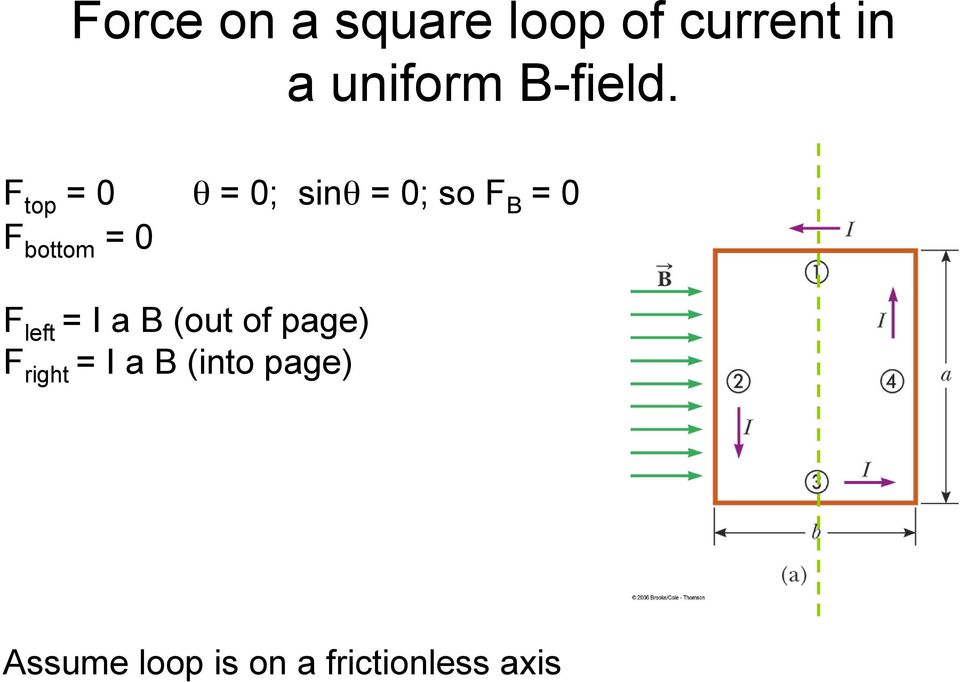
1 Force on a square loop of current in a uniform B-field. F top = 0 θ = 0; sinθ = 0; so F B = 0 F bottom = 0 F left = I a B (out of page) F right = I a B (into page) Assume loop is on a frictionless axis
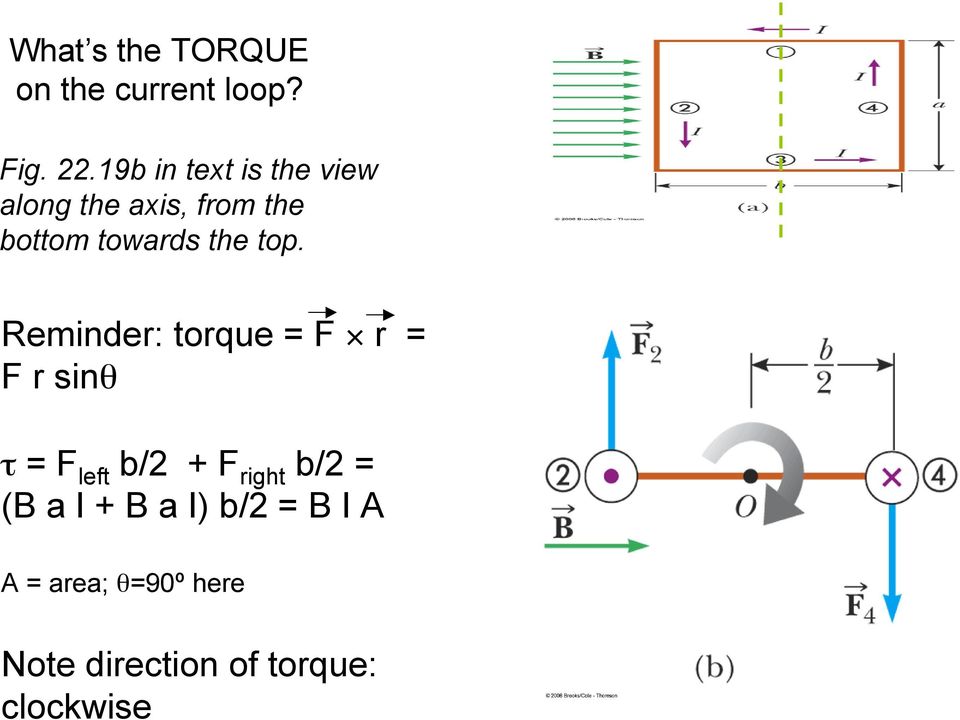
2 What s the TORQUE on the current loop? Fig b in text is the view along the axis, from the bottom towards the top. Reminder: torque = F r = F r sinθ τ = F left b/2 + F right b/2 = (B a I + B a I) b/2 = B I A A = area; θ=90º here Note direction of torque: clockwise
3 For 1 loop: τ = BIA sinθ τ max = BIA For N turns: Total current = NI τ = BIAN sinθ Magnetic Moment µ = IAN µ always points perp. to the plane of the loops (points along the normal) τ= µb sinθ
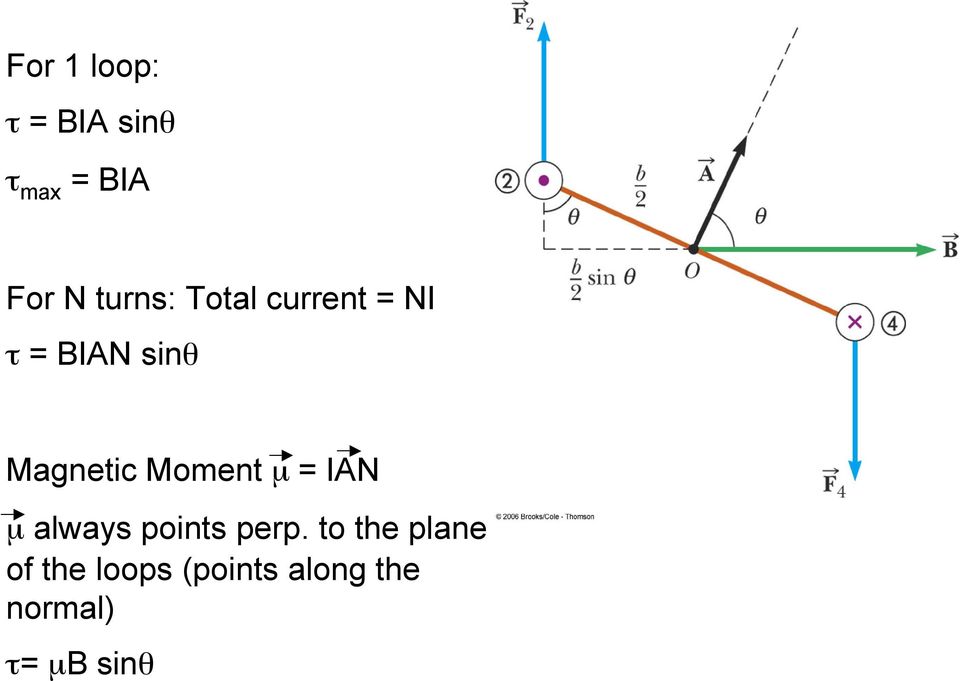
4 The product IA is defined as the magnetic dipole moment, µ of the loop (for ANY loop shape) SI units: A m 2 Torque in terms of magnetic moment: For a coil with N turns of wire: µ = NIA

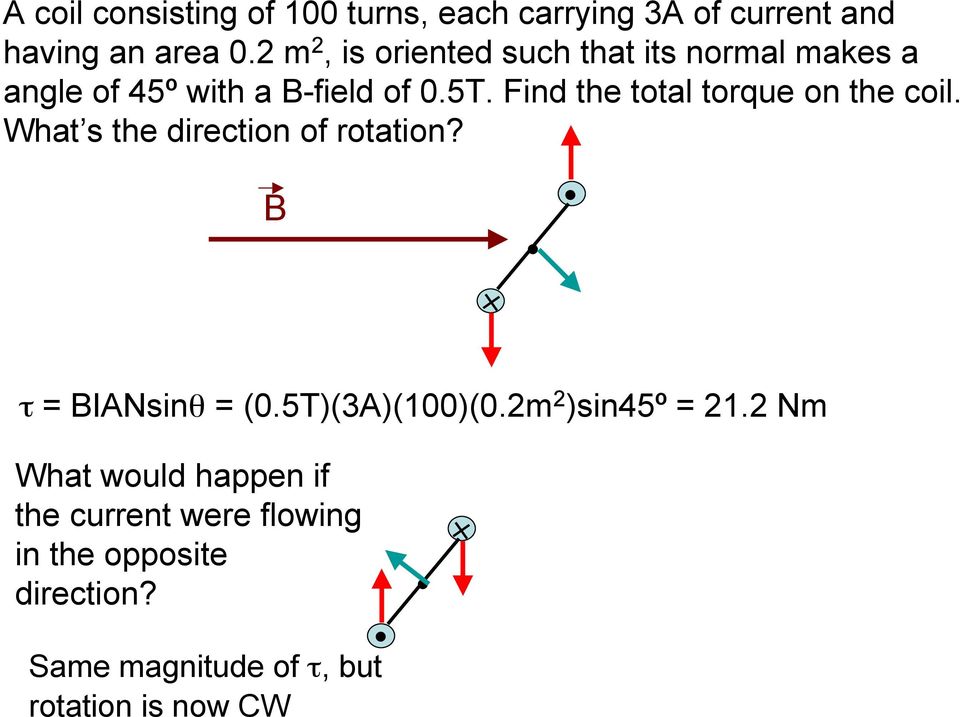
5 A coil consisting of 100 turns, each carrying 3A of current and having an area 0.2 m 2, is oriented such that its normal makes a angle of 45º with a B-field of 0.5T. Find the total torque on the coil. What s the direction of rotation? B τ = BIANsinθ = (0.5T)(3A)(100)(0.2m 2 )sin45º = 21.2 Nm What would happen if the current were flowing in the opposite direction? Same magnitude of τ, but rotation is now CW
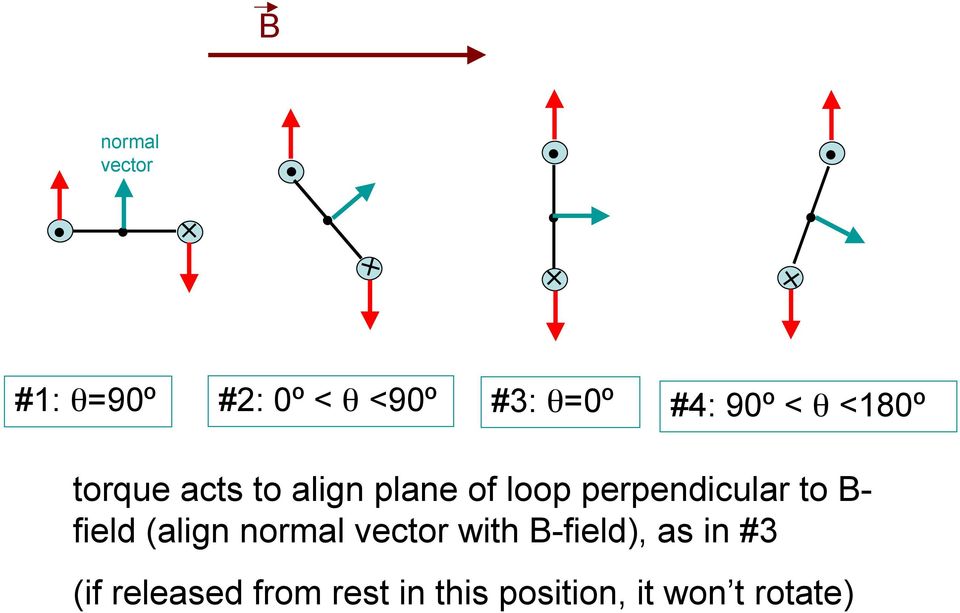
6 B normal vector #1: θ=90º #2: 0º < θ <90º #3: θ=0º #4: 90º < θ <180º torque acts to align plane of loop perpendicular to B- field (align normal vector with B-field), as in #3 (if released from rest in this position, it won t rotate)
7 B normal vector #1: θ=90º #2: 0º < θ <90º #3: θ=0º #4: 90º < θ <180º As loop is rotating, what would happen if we switched the direction of current immediately after #3? The loop would continue to rotate clockwise!
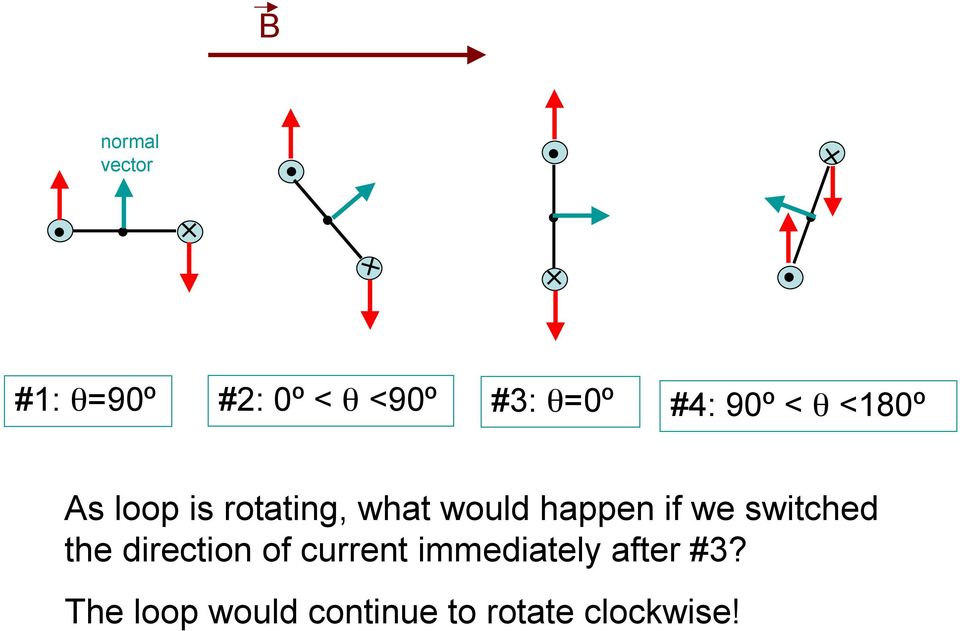
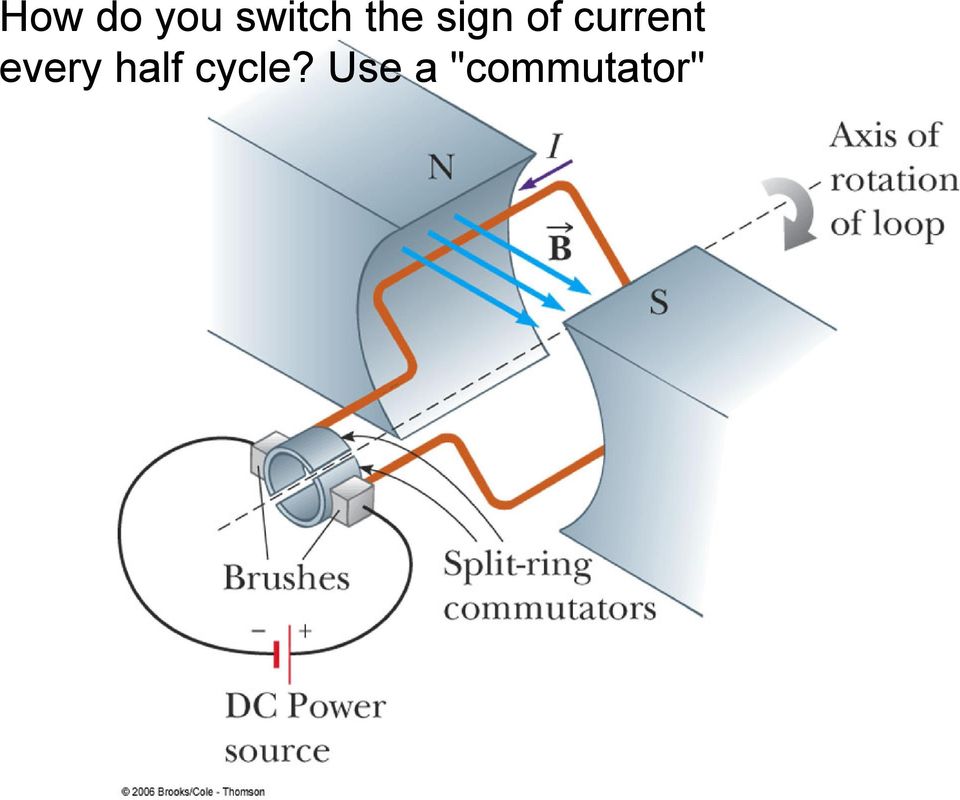
8 Electric motors If direction of current is switched every time τ is about to change sign, then τ will never change sign! Loop will rotate nonstop: we have an electric motor (electrical energy converted to mechanical (rotational) energy)! Fans, blenders, power drills, etc. Use AC current (sign changes naturally), or if you only have DC current available.

9 How do you switch the sign of current every half cycle? Use a "commutator"
10 22.7 & 22.9 Biot-Savart Law / Ampere s Law Context: Previous sections discussed what happens when moving charges are placed in a previouslyexisting B-fields: charged particles/current-carrying wires experience magnetic force; a loop of wire experiences a torque. But what can GENERATE a magnetic field?
11 Magnetic Field of a long straight wire In 1819, Oersted (Denmark) noticed that a magnet (compass needle) was deflected when current was drawn through a nearby wire. 1820: compasses in a horizontal plane:

12 Magnetic Field of a long straight wire In 1819, Oersted (Denmark) noticed that a magnet (compass needle) was deflected when current was drawn through a nearby wire. 1820: compasses in a horizontal plane: Direction of deflection indicated right-hand rule #2 :
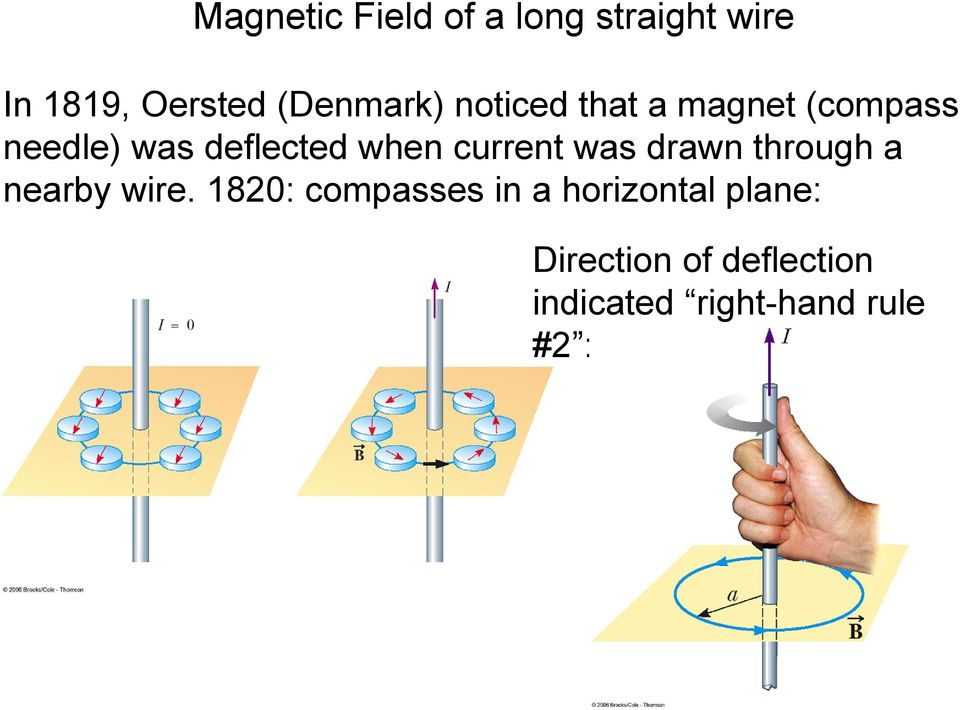
13 Magnetic Field of a long straight wire B-field lines form concentric circles: Notice that the iron filings are more strongly aligned closer to the wire Magnitude of B is the same everywhere along a given radius: B depends only on r (& physical constants)

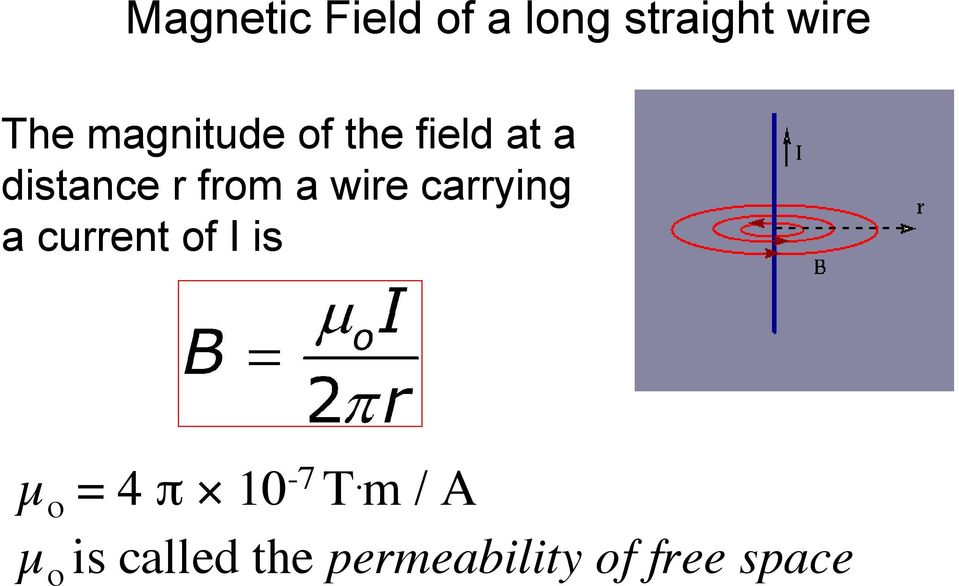
14 Magnetic Field of a long straight wire The magnitude of the field at a distance r from a wire carrying a current of I is µ o = 4 π 10-7 T. m / A µ o is called the permeability of free space
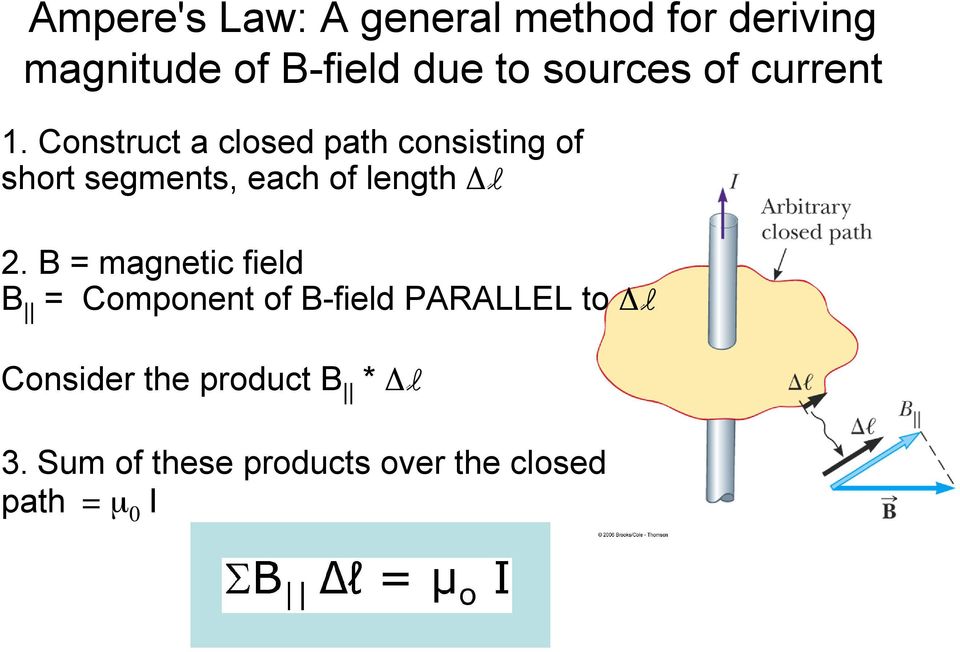
15 Ampere's Law: A general method for deriving magnitude of B-field due to sources of current 1. Construct a closed path consisting of short segments, each of length Δl 2. B = magnetic field B = Component of B-field PARALLEL to Δl Consider the product B * Δl 3. Sum of these products over the closed path = µ 0 I
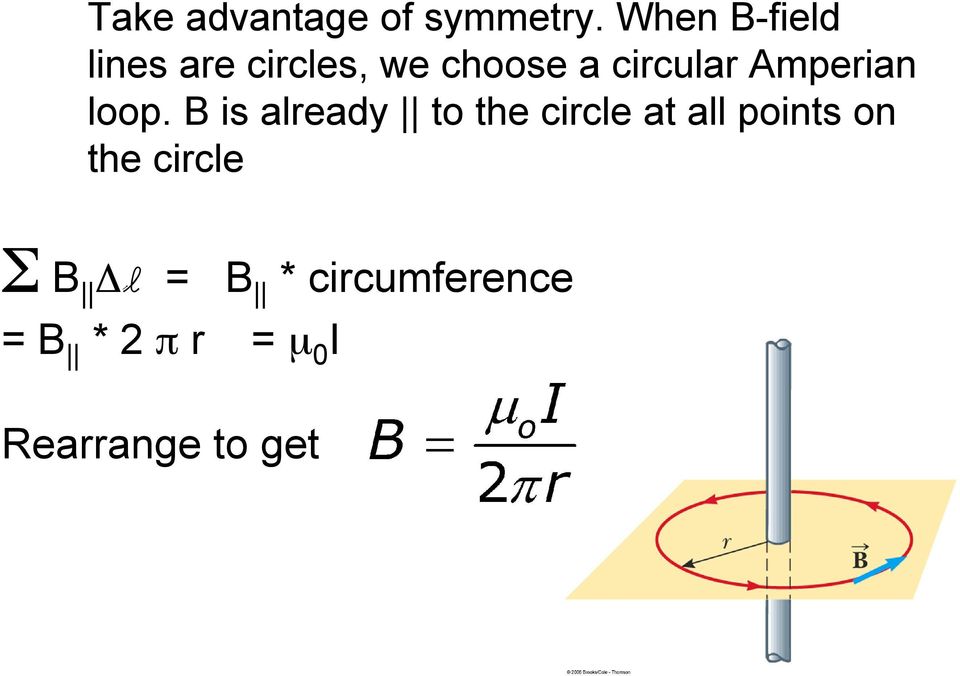
16 Take advantage of symmetry. When B-field lines are circles, we choose a circular Amperian loop. B is already to the circle at all points on the circle Σ B Δl = B * circumference = B * 2 π r = µ 0 I Rearrange to get
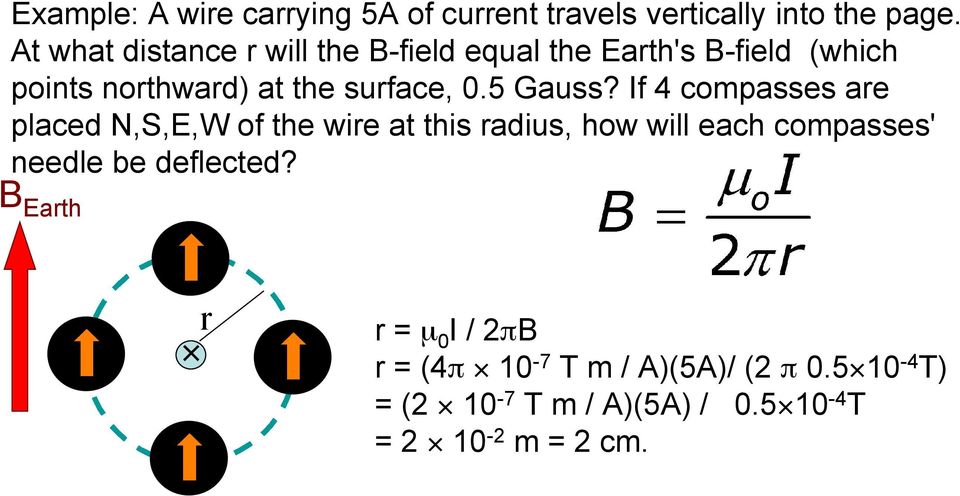
17 Example: A wire carrying 5A of current travels vertically into the page. At what distance r will the B-field equal the Earth's B-field (which points northward) at the surface, 0.5 Gauss? B Earth r r = µ 0 I / 2πB r = (4π 10-7 T m / A)(5A)/ (2 π T) = ( T m / A)(5A) / T = m = 2 cm.

18 Example: A wire carrying 5A of current travels vertically into the page. At what distance r will the B-field equal the Earth's B-field (which points northward) at the surface, 0.5 Gauss? If 4 compasses are placed N,S,E,W of the wire at this radius, how will each compasses' needle be deflected? B Earth r r = µ 0 I / 2πB r = (4π 10-7 T m / A)(5A)/ (2 π T) = ( T m / A)(5A) / T = m = 2 cm.
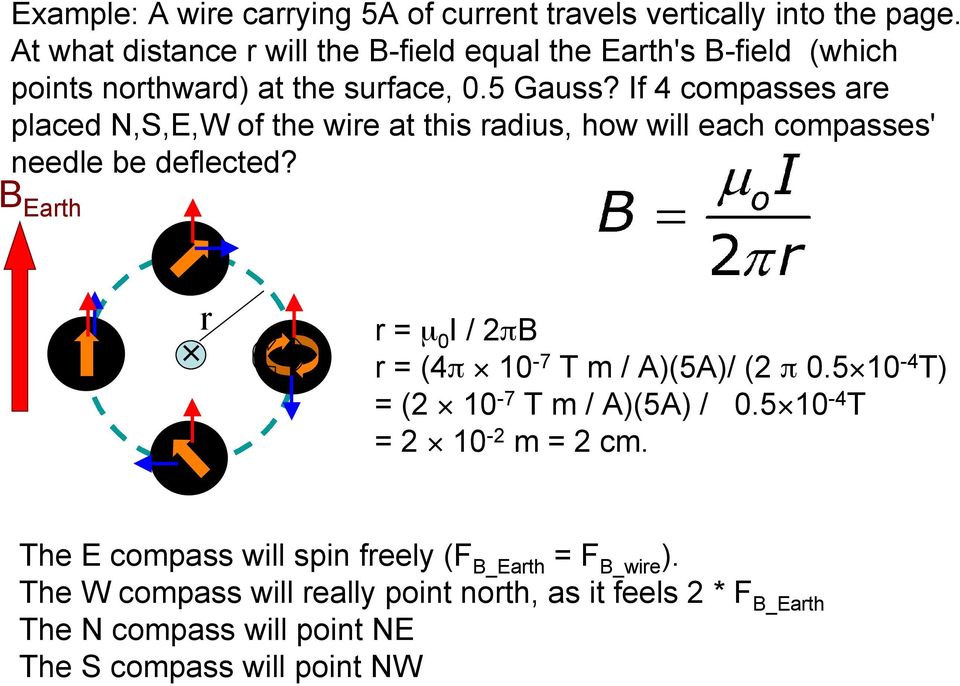
19 Example: A wire carrying 5A of current travels vertically into the page. At what distance r will the B-field equal the Earth's B-field (which points northward) at the surface, 0.5 Gauss? If 4 compasses are placed N,S,E,W of the wire at this radius, how will each compasses' needle be deflected? B Earth r r = µ 0 I / 2πB r = (4π 10-7 T m / A)(5A)/ (2 π T) = ( T m / A)(5A) / T = m = 2 cm. The E compass will spin freely (F B_Earth = F B_wire ). The W compass will really point north, as it feels 2 * F B_Earth The N compass will point NE The S compass will point NW
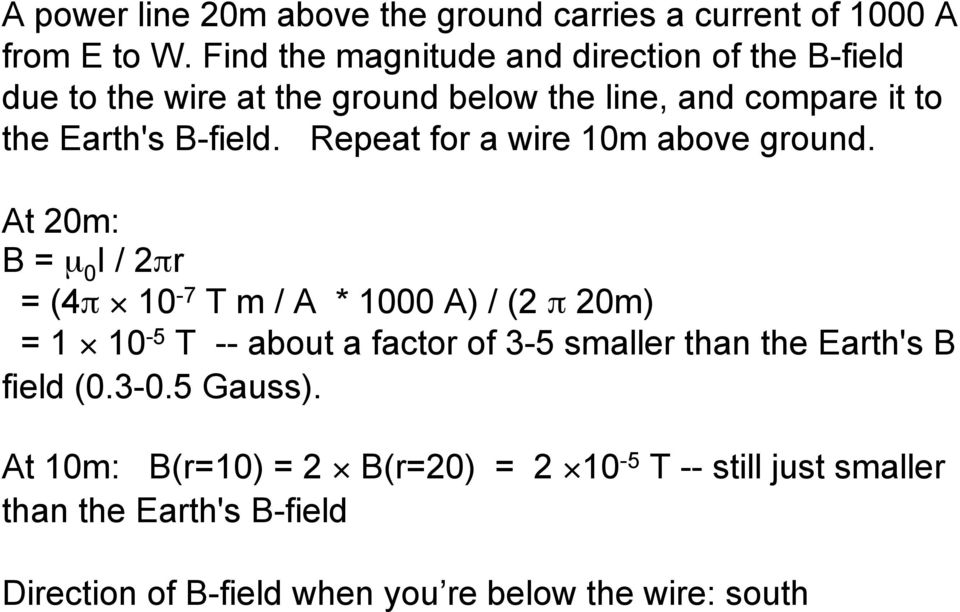
20 A power line 20m above the ground carries a current of 1000 A from E to W. Find the magnitude and direction of the B-field due to the wire at the ground below the line, and compare it to the Earth's B-field. Repeat for a wire 10m above ground. At 20m: B = µ 0 I / 2πr = (4π 10-7 T m / A * 1000 A) / (2 π 20m) = T -- about a factor of 3-5 smaller than the Earth's B field ( Gauss). At 10m: B(r=10) = 2 B(r=20) = T -- still just smaller than the Earth's B-field Direction of B-field when you re below the wire: south
21 B-field at the center of a current-loop: B X
22 Example: A Co-axial cable Inner conductor and outer conductor of radius R out carrying currents in opposite directions. What's B at r > R out? I I KEY: Remember superposition = vector addition: Total B-field from 2 sources = sum of B-fields from each source! +I + I = zero total current, so B-field = 0.
23 Example: B(r), inside wire: Ex. 22.7, p. 749 Use Ampere s Law to derive that inside a wire with a uniform current distribution, B(r) is proportional to r. Recall the case of the electric field E(r) inside a wire with a uniform charge distribution: E(r) is also proportional to r. Outside a long, straight wire, both E and B as proportional to 1/r.
24 22.10: Stack of current loops = solenoid When the loop are spaced together tightly enough, the B-field inside is strong and rather uniform, and B-field outside is essentially negligible. Commonly used in electromagnets, devices used to convert electrical current to magnetic field. N S
25 B-field in the center of a solenoid Use Ampere's Law; choose a closed loop as follows: Only segment 1 contributes: B Δl = 0 for other segments. BL = µ 0 (NI) B = µ 0 I (N/L) = µ 0 In (n=n/l)
26 Example: An electromagnet consists of 100 turns of wire, and the length is 3.0 cm. The wire carries 20 Amps of current. What's the B- field at the center of the magnet? B = µ 0 I (N/L) = 4π 10-7 T m / A * 20 A (100/0.03m) = T
27 B-field of a toroid (ex. 22.8) lbl.gov ΣB Δl = B 2πr Tokamak: used for fusion energy research enclosed current on blue line = µ 0 N I B = µ 0 N I / 2πr B-field higher towards inner radius (not perfectly uniform), but uniform along each radius
28 22.11: Magnetism in Matter / Magnetic Domains Magnetic materials owe their properties to magnetic dipole moments of electrons in atoms Classical model for electrons in atoms: 1.Orbital motion of electron: like a loop current (but B-field produced by 1 electron can be cancelled out by an oppositely revolving electron in the same atom) 2. spin of individual electrons produces much stronger B- field: each electron itself acts like a magnetic dipole
29 Magnetic Domains Magnetic domains ( cm): Each domain has a substantial fraction of atoms with magnetic moments coupled. They're separated by domain boundaries. Ferromagnetic materials (Fe, Co, Ni): have these domains. Spins are randomly oriented, but when an external B is applied, domains tend to align with magnetic field; domain boundaries adjust accordingly.
30 Result: material produces its own internal B (B net = B external + B internal ) Re-cap: Soft magnetic materials (e.g. Fe): Easily magnetized in presence of external B, but doesn t retain magnetization for long. Used as cores for electromagnets. When external B is turned off, thermal agitation returns dipoles to random orientations Hard magnetic materials (e.g. metal alloys: Alnico (Aluminum, Nickel, Cobalt)): Harder to magnetize (requires higher B external ) but retains the magnetization for a long time. Used as permanent magnets.
Chapter 33. The Magnetic Field
 Chapter 33. The Magnetic Field Digital information is stored on a hard disk as microscopic patches of magnetism. Just what is magnetism? How are magnetic fields created? What are their properties? These
Chapter 19: Magnetic Forces and Fields
 Chapter 19: Magnetic Forces and Fields Magnetic Fields Magnetic Force on a Point Charge Motion of a Charged Particle in a Magnetic Field Crossed E and B fields Magnetic Forces on Current Carrying Wires
Chapter 27 Magnetic Field and Magnetic Forces
 Chapter 27 Magnetic Field and Magnetic Forces - Magnetism - Magnetic Field - Magnetic Field Lines and Magnetic Flux - Motion of Charged Particles in a Magnetic Field - Applications of Motion of Charged
Eðlisfræði 2, vor 2007
 [ Assignment View ] [ Pri Eðlisfræði 2, vor 2007 28. Sources of Magnetic Field Assignment is due at 2:00am on Wednesday, March 7, 2007 Credit for problems submitted late will decrease to 0% after the deadline
Chapter 21. Magnetic Forces and Magnetic Fields
 Chapter 21 Magnetic Forces and Magnetic Fields 21.1 Magnetic Fields The needle of a compass is permanent magnet that has a north magnetic pole (N) at one end and a south magnetic pole (S) at the other.
physics 112N magnetic fields and forces
 physics 112N magnetic fields and forces bar magnet & iron filings physics 112N 2 bar magnets physics 112N 3 the Earth s magnetic field physics 112N 4 electro -magnetism! is there a connection between electricity
Magnetism. d. gives the direction of the force on a charge moving in a magnetic field. b. results in negative charges moving. clockwise.
 Magnetism 1. An electron which moves with a speed of 3.0 10 4 m/s parallel to a uniform magnetic field of 0.40 T experiences a force of what magnitude? (e = 1.6 10 19 C) a. 4.8 10 14 N c. 2.2 10 24 N b.
Chapter 22 Magnetism
 22.6 Electric Current, Magnetic Fields, and Ampere s Law Chapter 22 Magnetism 22.1 The Magnetic Field 22.2 The Magnetic Force on Moving Charges 22.3 The Motion of Charged particles in a Magnetic Field
1. A wire carries 15 A. You form the wire into a single-turn circular loop with magnetic field 80 µ T at the loop center. What is the loop radius?
 CHAPTER 3 SOURCES O THE MAGNETC ELD 1. A wire carries 15 A. You form the wire into a single-turn circular loop with magnetic field 8 µ T at the loop center. What is the loop radius? Equation 3-3, with
Electromagnetism Laws and Equations
 Electromagnetism Laws and Equations Andrew McHutchon Michaelmas 203 Contents Electrostatics. Electric E- and D-fields............................................. Electrostatic Force............................................2
Conceptual: 1, 3, 5, 6, 8, 16, 18, 19. Problems: 4, 6, 8, 11, 16, 20, 23, 27, 34, 41, 45, 56, 60, 65. Conceptual Questions
 Conceptual: 1, 3, 5, 6, 8, 16, 18, 19 Problems: 4, 6, 8, 11, 16, 20, 23, 27, 34, 41, 45, 56, 60, 65 Conceptual Questions 1. The magnetic field cannot be described as the magnetic force per unit charge
Magnetic Field and Magnetic Forces
 Chapter 27 Magnetic Field and Magnetic Forces PowerPoint Lectures for University Physics, Thirteenth Edition Hugh D. Young and Roger A. Freedman Lectures by Wayne Anderson Goals for Chapter 27 Magnets
1. Units of a magnetic field might be: A. C m/s B. C s/m C. C/kg D. kg/c s E. N/C m ans: D
 Chapter 28: MAGNETIC FIELDS 1 Units of a magnetic field might be: A C m/s B C s/m C C/kg D kg/c s E N/C m 2 In the formula F = q v B: A F must be perpendicular to v but not necessarily to B B F must be
104 Practice Exam 2-3/21/02
 104 Practice Exam 2-3/21/02 1. Two electrons are located in a region of space where the magnetic field is zero. Electron A is at rest; and electron B is moving westward with a constant velocity. A non-zero
Physics 112 Homework 5 (solutions) (2004 Fall) Solutions to Homework Questions 5
 Solutions to Homework Questions 5 Chapt19, Problem-2: (a) Find the direction of the force on a proton (a positively charged particle) moving through the magnetic fields in Figure P19.2, as shown. (b) Repeat
Chapter 30 - Magnetic Fields and Torque. A PowerPoint Presentation by Paul E. Tippens, Professor of Physics Southern Polytechnic State University
 Chapter 30 - Magnetic Fields and Torque A PowerPoint Presentation by Paul E. Tippens, Professor of Physics Southern Polytechnic State University 2007 Objectives: After completing this module, you should
Review Questions PHYS 2426 Exam 2
 Review Questions PHYS 2426 Exam 2 1. If 4.7 x 10 16 electrons pass a particular point in a wire every second, what is the current in the wire? A) 4.7 ma B) 7.5 A C) 2.9 A D) 7.5 ma E) 0.29 A Ans: D 2.
AP2 Magnetism. (c) Explain why the magnetic field does no work on the particle as it moves in its circular path.
 A charged particle is projected from point P with velocity v at a right angle to a uniform magnetic field directed out of the plane of the page as shown. The particle moves along a circle of radius R.
The DC Motor. Physics 1051 Laboratory #5 The DC Motor
 The DC Motor Physics 1051 Laboratory #5 The DC Motor Contents Part I: Objective Part II: Introduction Magnetic Force Right Hand Rule Force on a Loop Magnetic Dipole Moment Torque Part II: Predictions Force
Magnetic Dipoles. Magnetic Field of Current Loop. B r. PHY2061 Enriched Physics 2 Lecture Notes
 Disclaimer: These lecture notes are not meant to replace the course textbook. The content may be incomplete. Some topics may be unclear. These notes are only meant to be a study aid and a supplement to
Quiz: Work and Energy
 Quiz: Work and Energy A charged particle enters a uniform magnetic field. What happens to the kinetic energy of the particle? (1) it increases (2) it decreases (3) it stays the same (4) it changes with
Force on Moving Charges in a Magnetic Field
 [ Assignment View ] [ Eðlisfræði 2, vor 2007 27. Magnetic Field and Magnetic Forces Assignment is due at 2:00am on Wednesday, February 28, 2007 Credit for problems submitted late will decrease to 0% after
General Physics (PHY 2140)
 General Physics (PHY 2140) Lecture 12 Electricity and Magnetism Magnetism Magnetic fields and force Application of magnetic forces http://www.physics.wayne.edu/~apetrov/phy2140/ Chapter 19 1 Department
Problem 1 (25 points)
 MASSACHUSETTS INSTITUTE OF TECHNOLOGY Department of Physics 8.02 Spring 2012 Exam Three Solutions Problem 1 (25 points) Question 1 (5 points) Consider two circular rings of radius R, each perpendicular
Magnetic Fields. I. Magnetic Field and Magnetic Field Lines
 Magnetic Fields I. Magnetic Field and Magnetic Field Lines A. The concept of the magnetic field can be developed in a manner similar to the way we developed the electric field. The magnitude of the magnetic
Two bar magnets are brought near each other as shown. The magnets... A) attract B) repel C) exert no net force on each other.
 Magnetic Fields and Forces Learning goals: Students will be able to Predict the direction of the magnet field for different locations around a bar magnet and an electromagnet. Relate magnetic field strength
Edmund Li. Where is defined as the mutual inductance between and and has the SI units of Henries (H).
 INDUCTANCE MUTUAL INDUCTANCE If we consider two neighbouring closed loops and with bounding surfaces respectively then a current through will create a magnetic field which will link with as the flux passes
Ampere's Law. Introduction. times the current enclosed in that loop: Ampere's Law states that the line integral of B and dl over a closed path is 0
 1 Ampere's Law Purpose: To investigate Ampere's Law by measuring how magnetic field varies over a closed path; to examine how magnetic field depends upon current. Apparatus: Solenoid and path integral
Chapter 22: Electric motors and electromagnetic induction
 Chapter 22: Electric motors and electromagnetic induction The motor effect movement from electricity When a current is passed through a wire placed in a magnetic field a force is produced which acts on
CHAPTER 5: MAGNETIC PROPERTIES
 CHAPTER 5: MAGNETIC PROPERTIES and Magnetic Materials ISSUES TO ADDRESS... Why do we study magnetic properties? What is magnetism? How do we measure magnetic properties? What are the atomic reasons for
Magnetic Field of a Circular Coil Lab 12
 HB 11-26-07 Magnetic Field of a Circular Coil Lab 12 1 Magnetic Field of a Circular Coil Lab 12 Equipment- coil apparatus, BK Precision 2120B oscilloscope, Fluke multimeter, Wavetek FG3C function generator,
Chapter 22: Electric Flux and Gauss s Law
 22.1 ntroduction We have seen in chapter 21 that determining the electric field of a continuous charge distribution can become very complicated for some charge distributions. t would be desirable if we
 Last Name: First Name: Physics 102 Spring 2006: Exam #2 Multiple-Choice Questions 1. A charged particle, q, is moving with speed v perpendicular to a uniform magnetic field. A second identical charged
Induced voltages and Inductance Faraday s Law
 Induced voltages and Inductance Faraday s Law concept #1, 4, 5, 8, 13 Problem # 1, 3, 4, 5, 6, 9, 10, 13, 15, 24, 23, 25, 31, 32a, 34, 37, 41, 43, 51, 61 Last chapter we saw that a current produces a magnetic
The purposes of this experiment are to test Faraday's Law qualitatively and to test Lenz's Law.
 260 17-1 I. THEORY EXPERIMENT 17 QUALITATIVE STUDY OF INDUCED EMF Along the extended central axis of a bar magnet, the magnetic field vector B r, on the side nearer the North pole, points away from this
Magnetic fields of charged particles in motion
 C H A P T E R 8 Magnetic fields of charged particles in motion CONCEPTS 8.1 Source of the magnetic field 8. Current loops and spin magnetism 8.3 Magnetic moment and torque 8.4 Ampèrian paths QUANTTATVE
MAG Magnetic Fields revised July 24, 2012
 MAG Magnetic Fields revised July 24, 2012 (You will do two experiments; this one (in Rock 402) and the Magnetic Induction experiment (in Rock 403). Sections will switch rooms and experiments half-way through
E/M Experiment: Electrons in a Magnetic Field.
 E/M Experiment: Electrons in a Magnetic Field. PRE-LAB You will be doing this experiment before we cover the relevant material in class. But there are only two fundamental concepts that you need to understand.
Magnetism. Magnetism. Magnetic Fields and Magnetic Domains. Magnetic Fields and Magnetic Domains. Creating and Destroying a Magnet
 Magnetism Magnetism Opposite poles attract and likes repel Opposite poles attract and likes repel Like electric force, but magnetic poles always come in pairs (North, South) Like electric force, but magnetic
Phys222 Winter 2012 Quiz 4 Chapters 29-31. Name
 Name If you think that no correct answer is provided, give your answer, state your reasoning briefly; append additional sheet of paper if necessary. 1. A particle (q = 5.0 nc, m = 3.0 µg) moves in a region
Physics 25 Exam 3 November 3, 2009
 1. A long, straight wire carries a current I. If the magnetic field at a distance d from the wire has magnitude B, what would be the the magnitude of the magnetic field at a distance d/3 from the wire,
CHAPTER 24 GAUSS S LAW
 CHAPTER 4 GAUSS S LAW 4. The net charge shown in Fig. 4-40 is Q. Identify each of the charges A, B, C shown. A B C FIGURE 4-40 4. From the direction of the lines of force (away from positive and toward
1. The diagram below represents magnetic lines of force within a region of space.
 1. The diagram below represents magnetic lines of force within a region of space. 4. In which diagram below is the magnetic flux density at point P greatest? (1) (3) (2) (4) The magnetic field is strongest
Physics 30 Worksheet #10 : Magnetism From Electricity
 Physics 30 Worksheet #10 : Magnetism From Electricity 1. Draw the magnetic field surrounding the wire showing electron current below. x 2. Draw the magnetic field surrounding the wire showing electron
STUDY GUIDE: ELECTRICITY AND MAGNETISM
 319 S. Naperville Road Wheaton, IL 60187 www.questionsgalore.net Phone: (630) 580-5735 E-Mail: [email protected] Fax: (630) 580-5765 STUDY GUIDE: ELECTRICITY AND MAGNETISM An atom is made of three
Problem Solving 5: Magnetic Force, Torque, and Magnetic Moments
 MASSACHUSETTS INSTITUTE OF TECHNOLOY Department of Physics Problem Solving 5: Magnetic Force, Torque, and Magnetic Moments OBJECTIVES 1. To start with the magnetic force on a moving charge q and derive
Magnetic Dipoles. Recall that an electric dipole consists of two equal but opposite charges separated by some distance, such as in
 MAGNETISM History of Magnetism Bar Magnets Magnetic Dipoles Magnetic Fields Magnetic Forces on Moving Charges and Wires Electric Motors Current Loops and Electromagnets Solenoids Sources of Magnetism Spin
Examples of magnetic field calculations and applications. 1 Example of a magnetic moment calculation
 Examples of magnetic field calculations and applications Lecture 12 1 Example of a magnetic moment calculation We consider the vector potential and magnetic field due to the magnetic moment created by
Chapter 7. Magnetism and Electromagnetism ISU EE. C.Y. Lee
 Chapter 7 Magnetism and Electromagnetism Objectives Explain the principles of the magnetic field Explain the principles of electromagnetism Describe the principle of operation for several types of electromagnetic
Linear DC Motors. 15.1 Magnetic Flux. 15.1.1 Permanent Bar Magnets
 Linear DC Motors The purpose of this supplement is to present the basic material needed to understand the operation of simple DC motors. This is intended to be used as the reference material for the linear
Magnetostatics (Free Space With Currents & Conductors)
 Magnetostatics (Free Space With Currents & Conductors) Suggested Reading - Shen and Kong Ch. 13 Outline Review of Last Time: Gauss s Law Ampere s Law Applications of Ampere s Law Magnetostatic Boundary
Experiment 7: Forces and Torques on Magnetic Dipoles
 MASSACHUSETTS INSTITUTE OF TECHNOLOY Department of Physics 8. Spring 5 OBJECTIVES Experiment 7: Forces and Torques on Magnetic Dipoles 1. To measure the magnetic fields due to a pair of current-carrying
1 CHAPTER 12 PROPERTIES OF MAGNETIC MATERIALS
 1 CHAPTER 12 PROPERTIES OF MAGNETIC MATERIALS 12.1 Introduction This chapter is likely to be a short one, not least because it is a subject in which my own knowledge is, to put it charitably, a little
Faraday s Law of Induction
 Chapter 10 Faraday s Law of Induction 10.1 Faraday s Law of Induction...10-10.1.1 Magnetic Flux...10-3 10.1. Lenz s Law...10-5 10. Motional EMF...10-7 10.3 Induced Electric Field...10-10 10.4 Generators...10-1
Q27.1 When a charged particle moves near a bar magnet, the magnetic force on the particle at a certain point depends
 Q27.1 When a charged particle moves near a bar magnet, the magnetic force on the particle at a certain point depends A. on the direction of the magnetic field at that point only. B. on the magnetic field
Physics 221 Experiment 5: Magnetic Fields
 Physics 221 Experiment 5: Magnetic Fields August 25, 2007 ntroduction This experiment will examine the properties of magnetic fields. Magnetic fields can be created in a variety of ways, and are also found
Magnetism Basics. Magnetic Domains: atomic regions of aligned magnetic poles Random Alignment Ferromagnetic Alignment. Net Effect = Zero!
 Magnetism Basics Source: electric currents Magnetic Domains: atomic regions of aligned magnetic poles Random Alignment Ferromagnetic Alignment Net Effect = Zero! Net Effect = Additive! Bipolar: all magnets
Magnetic Fields and Their Effects
 Name Date Time to Complete h m Partner Course/ Section / Grade Magnetic Fields and Their Effects This experiment is intended to give you some hands-on experience with the effects of, and in some cases
PY106 Class13. Permanent Magnets. Magnetic Fields and Forces on Moving Charges. Interactions between magnetic north and south poles.
 Permanent Magnets Magnetic ields and orces on Moing Charges 1 We encounter magnetic fields frequently in daily life from those due to a permanent magnet. Each permanent magnet has a north pole and a south
Pre-lab Quiz/PHYS 224 Magnetic Force and Current Balance. Your name Lab section
 Pre-lab Quiz/PHYS 224 Magnetic Force and Current Balance Your name Lab section 1. What do you investigate in this lab? 2. Two straight wires are in parallel and carry electric currents in opposite directions
Physics 121 Sample Common Exam 3 NOTE: ANSWERS ARE ON PAGE 6. Instructions: 1. In the formula F = qvxb:
 Physics 121 Sample Common Exam 3 NOTE: ANSWERS ARE ON PAGE 6 Signature Name (Print): 4 Digit ID: Section: Instructions: Answer all questions 24 multiple choice questions. You may need to do some calculation.
Measurement of Charge-to-Mass (e/m) Ratio for the Electron
 Measurement of Charge-to-Mass (e/m) Ratio for the Electron Experiment objectives: measure the ratio of the electron charge-to-mass ratio e/m by studying the electron trajectories in a uniform magnetic
A METHOD OF CALIBRATING HELMHOLTZ COILS FOR THE MEASUREMENT OF PERMANENT MAGNETS
 A METHOD OF CALIBRATING HELMHOLTZ COILS FOR THE MEASUREMENT OF PERMANENT MAGNETS Joseph J. Stupak Jr, Oersted Technology Tualatin, Oregon (reprinted from IMCSD 24th Annual Proceedings 1995) ABSTRACT The
FORCE ON A CURRENT IN A MAGNETIC FIELD
 7/16 Force current 1/8 FORCE ON A CURRENT IN A MAGNETIC FIELD PURPOSE: To study the force exerted on an electric current by a magnetic field. BACKGROUND: When an electric charge moves with a velocity v
Lesson 3 DIRECT AND ALTERNATING CURRENTS. Task. The skills and knowledge taught in this lesson are common to all missile repairer tasks.
 Lesson 3 DIRECT AND ALTERNATING CURRENTS Task. The skills and knowledge taught in this lesson are common to all missile repairer tasks. Objectives. When you have completed this lesson, you should be able
Physics 1A Lecture 10C
 Physics 1A Lecture 10C "If you neglect to recharge a battery, it dies. And if you run full speed ahead without stopping for water, you lose momentum to finish the race. --Oprah Winfrey Static Equilibrium
Chapter 19 Magnetic Forces and Fields
 Chapter 19 Magnetic Forces and Fields Student: 3. The magnetism of the Earth acts approximately as if it originates from a huge bar magnet within the Earth. Which of the following statements are true?
DIRECT CURRENT GENERATORS
 DIRECT CURRENT GENERATORS Revision 12:50 14 Nov 05 INTRODUCTION A generator is a machine that converts mechanical energy into electrical energy by using the principle of magnetic induction. This principle
HW6 Solutions Notice numbers may change randomly in your assignments and you may have to recalculate solutions for your specific case.
 HW6 Solutions Notice numbers may change randomly in your assignments and you may have to recalculate solutions for your specific case. Tipler 22.P.053 The figure below shows a portion of an infinitely
EDEXCEL NATIONAL CERTIFICATE/DIPLOMA MECHANICAL PRINCIPLES AND APPLICATIONS NQF LEVEL 3 OUTCOME 1 - LOADING SYSTEMS
 EDEXCEL NATIONAL CERTIFICATE/DIPLOMA MECHANICAL PRINCIPLES AND APPLICATIONS NQF LEVEL 3 OUTCOME 1 - LOADING SYSTEMS TUTORIAL 1 NON-CONCURRENT COPLANAR FORCE SYSTEMS 1. Be able to determine the effects
PHY121 #8 Midterm I 3.06.2013
 PHY11 #8 Midterm I 3.06.013 AP Physics- Newton s Laws AP Exam Multiple Choice Questions #1 #4 1. When the frictionless system shown above is accelerated by an applied force of magnitude F, the tension
Angular acceleration α
 Angular Acceleration Angular acceleration α measures how rapidly the angular velocity is changing: Slide 7-0 Linear and Circular Motion Compared Slide 7- Linear and Circular Kinematics Compared Slide 7-
Chapter 4. Electrostatic Fields in Matter
 Chapter 4. Electrostatic Fields in Matter 4.1. Polarization A neutral atom, placed in an external electric field, will experience no net force. However, even though the atom as a whole is neutral, the
Magnetic Fields and Forces. AP Physics B
 Magnetic ields and orces AP Physics acts about Magnetism Magnets have 2 poles (north and south) Like poles repel Unlike poles attract Magnets create a MAGNETIC IELD around them Magnetic ield A bar magnet
Application Note. So You Need to Measure Some Inductors?
 So You Need to Measure Some nductors? Take a look at the 1910 nductance Analyzer. Although specifically designed for production testing of inductors and coils, in addition to measuring inductance (L),
Direction of Induced Current
 Direction of Induced Current Bar magnet moves through coil Current induced in coil A S N v Reverse pole Induced current changes sign B N S v v Coil moves past fixed bar magnet Current induced in coil as
SURFACE TENSION. Definition
 SURFACE TENSION Definition In the fall a fisherman s boat is often surrounded by fallen leaves that are lying on the water. The boat floats, because it is partially immersed in the water and the resulting
Magnetic Circuits. Outline. Ampere s Law Revisited Review of Last Time: Magnetic Materials Magnetic Circuits Examples
 Magnetic Circuits Outline Ampere s Law Revisited Review of Last Time: Magnetic Materials Magnetic Circuits Examples 1 Electric Fields Magnetic Fields S ɛ o E da = ρdv B V = Q enclosed S da =0 GAUSS GAUSS
Chapter 29: Magnetic Fields
 Chapter 29: Magnetic Fields Magnetism has been known as early as 800C when people realized that certain stones could be used to attract bits of iron. Experiments using magnets hae shown the following:
Chapter 4. Forces and Newton s Laws of Motion. continued
 Chapter 4 Forces and Newton s Laws of Motion continued 4.9 Static and Kinetic Frictional Forces When an object is in contact with a surface forces can act on the objects. The component of this force acting
Solution. Problem. Solution. Problem. Solution
 4. A 2-g ping-pong ball rubbed against a wool jacket acquires a net positive charge of 1 µc. Estimate the fraction of the ball s electrons that have been removed. If half the ball s mass is protons, their
Experiment 5: Magnetic Fields of a Bar Magnet and of the Earth
 MASSACHUSETTS INSTITUTE OF TECHNOLOGY Department of Physics 8.02 Spring 2005 Experiment 5: Magnetic Fields of a Bar Magnet and of the Earth OBJECTIVES 1. To examine the magnetic field associated with a
CHARGED PARTICLES & MAGNETIC FIELDS - WebAssign
 Name: Period: Due Date: Lab Partners: CHARGED PARTICLES & MAGNETIC FIELDS - WebAssign Purpose: Use the CP program from Vernier to simulate the motion of charged particles in Magnetic and Electric Fields
Candidate Number. General Certificate of Education Advanced Level Examination June 2010
 entre Number andidate Number Surname Other Names andidate Signature General ertificate of Education dvanced Level Examination June 1 Physics PHY4/1 Unit 4 Fields and Further Mechanics Section Friday 18
Structural Axial, Shear and Bending Moments
 Structural Axial, Shear and Bending Moments Positive Internal Forces Acting Recall from mechanics of materials that the internal forces P (generic axial), V (shear) and M (moment) represent resultants
MECHANICAL PRINCIPLES OUTCOME 4 MECHANICAL POWER TRANSMISSION TUTORIAL 1 SIMPLE MACHINES
 MECHANICAL PRINCIPLES OUTCOME 4 MECHANICAL POWER TRANSMISSION TUTORIAL 1 SIMPLE MACHINES Simple machines: lifting devices e.g. lever systems, inclined plane, screw jack, pulley blocks, Weston differential
5. Measurement of a magnetic field
 H 5. Measurement of a magnetic field 5.1 Introduction Magnetic fields play an important role in physics and engineering. In this experiment, three different methods are examined for the measurement of
ElectroMagnetic Induction. AP Physics B
 ElectroMagnetic Induction AP Physics B What is E/M Induction? Electromagnetic Induction is the process of using magnetic fields to produce voltage, and in a complete circuit, a current. Michael Faraday
Objectives. Capacitors 262 CHAPTER 5 ENERGY
 Objectives Describe a capacitor. Explain how a capacitor stores energy. Define capacitance. Calculate the electrical energy stored in a capacitor. Describe an inductor. Explain how an inductor stores energy.
45. The peak value of an alternating current in a 1500-W device is 5.4 A. What is the rms voltage across?
 PHYS Practice Problems hapters 8- hapter 8. 45. The peak value of an alternating current in a 5-W device is 5.4 A. What is the rms voltage across? The power and current can be used to find the peak voltage,
If you put the same book on a tilted surface the normal force will be less. The magnitude of the normal force will equal: N = W cos θ
 Experiment 4 ormal and Frictional Forces Preparation Prepare for this week's quiz by reviewing last week's experiment Read this week's experiment and the section in your textbook dealing with normal forces
Unit 4 Practice Test: Rotational Motion
 Unit 4 Practice Test: Rotational Motion Multiple Guess Identify the letter of the choice that best completes the statement or answers the question. 1. How would an angle in radians be converted to an angle
Lecture 5. Electric Flux and Flux Density, Gauss Law in Integral Form
 Lecture 5 Electric Flux and Flux ensity, Gauss Law in Integral Form ections: 3.1, 3., 3.3 Homework: ee homework file LECTURE 5 slide 1 Faraday s Experiment (1837), Flux charge transfer from inner to outer
Magnetism and Magnetic Materials K. Inomata
 Magnetism and Magnetic Materials K. Inomata 1. Origin of magnetism 1.1 Magnetism of free atoms and ions 1.2 Magnetism for localized electrons 1.3 Itinerant electron magnetism 2. Magnetic properties of
Experiment 3: Magnetic Fields of a Bar Magnet and Helmholtz Coil
 MASSACHUSETTS INSTITUTE OF TECHNOLOGY Department of Physics 8.02 Spring 2006 Experiment 3: Magnetic Fields of a Bar Magnet and Helmholtz Coil OBJECTIVES 1. To learn how to visualize magnetic field lines
Physics 41, Winter 1998 Lab 1 - The Current Balance. Theory
 Physics 41, Winter 1998 Lab 1 - The Current Balance Theory Consider a point at a perpendicular distance d from a long straight wire carrying a current I as shown in figure 1. If the wire is very long compared
VELOCITY, ACCELERATION, FORCE
 VELOCITY, ACCELERATION, FORCE velocity Velocity v is a vector, with units of meters per second ( m s ). Velocity indicates the rate of change of the object s position ( r ); i.e., velocity tells you how
Insertion Devices Lecture 4 Permanent Magnet Undulators. Jim Clarke ASTeC Daresbury Laboratory
 Insertion Devices Lecture 4 Permanent Magnet Undulators Jim Clarke ASTeC Daresbury Laboratory Introduction to Lecture 4 So far we have discussed at length what the properties of SR are, when it is generated,
Experiment 9. The Pendulum
 Experiment 9 The Pendulum 9.1 Objectives Investigate the functional dependence of the period (τ) 1 of a pendulum on its length (L), the mass of its bob (m), and the starting angle (θ 0 ). Use a pendulum
CHAPTER 7 DISLOCATIONS AND STRENGTHENING MECHANISMS PROBLEM SOLUTIONS
 7-1 CHAPTER 7 DISLOCATIONS AND STRENGTHENING MECHANISMS PROBLEM SOLUTIONS Basic Concepts of Dislocations Characteristics of Dislocations 7.1 The dislocation density is just the total dislocation length