
Host Excellence Hosting Manual. June 26th, 2007
|
|
|
- Philippa Chambers
- 10 years ago
- Views:
Transcription
1 Host Excellence Hosting Manual June 26th, 2007

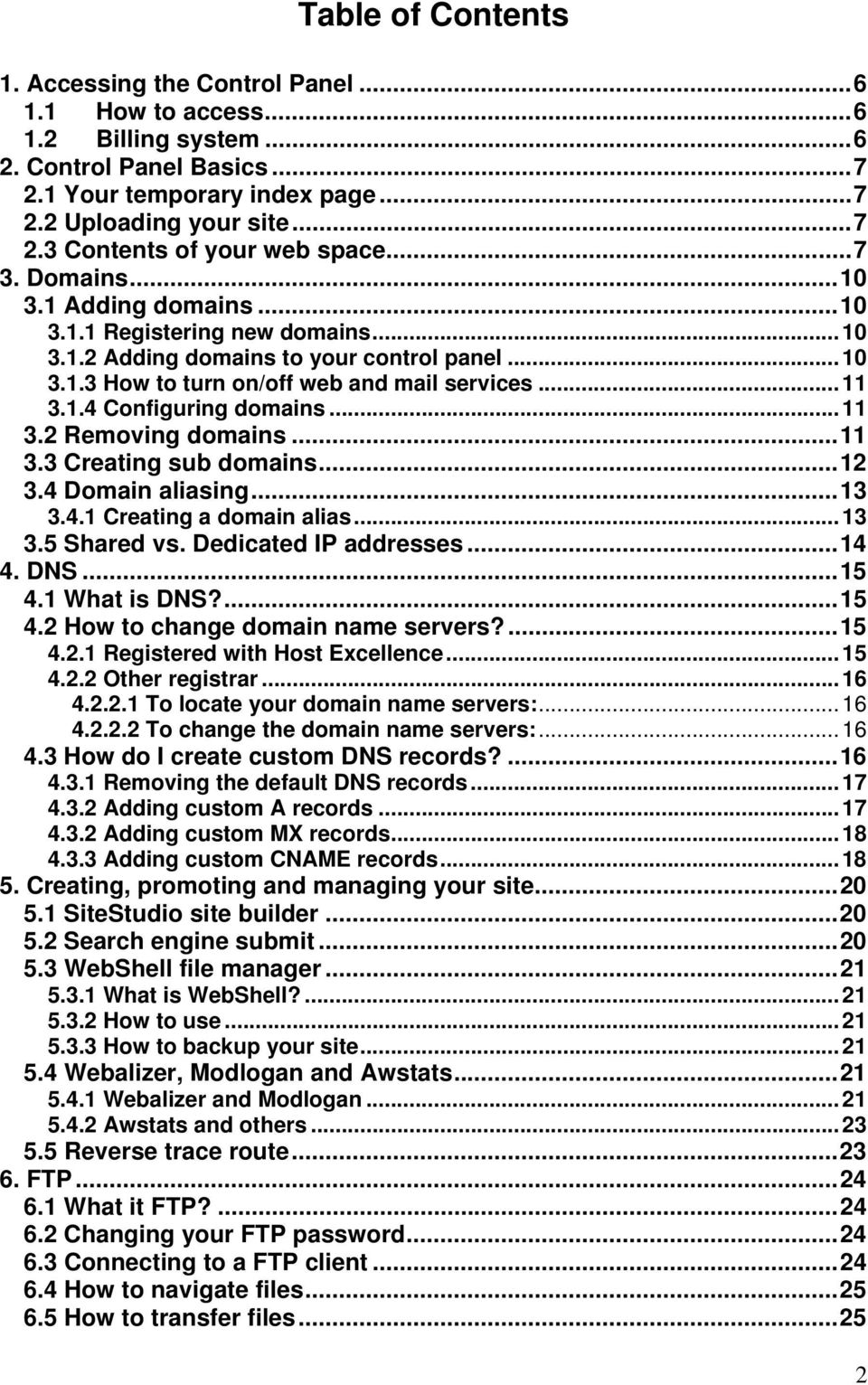
2 Table of Contents 1. Accessing the Control Panel How to access Billing system Control Panel Basics Your temporary index page Uploading your site Contents of your web space Domains Adding domains Registering new domains Adding domains to your control panel How to turn on/off web and mail services Configuring domains Removing domains Creating sub domains Domain aliasing Creating a domain alias Shared vs. Dedicated IP addresses DNS What is DNS? How to change domain name servers? Registered with Host Excellence Other registrar To locate your domain name servers: To change the domain name servers: How do I create custom DNS records? Removing the default DNS records Adding custom A records Adding custom MX records Adding custom CNAME records Creating, promoting and managing your site SiteStudio site builder Search engine submit WebShell file manager What is WebShell? How to use How to backup your site Webalizer, Modlogan and Awstats Webalizer and Modlogan Awstats and others Reverse trace route FTP What it FTP? Changing your FTP password Connecting to a FTP client How to navigate files How to transfer files
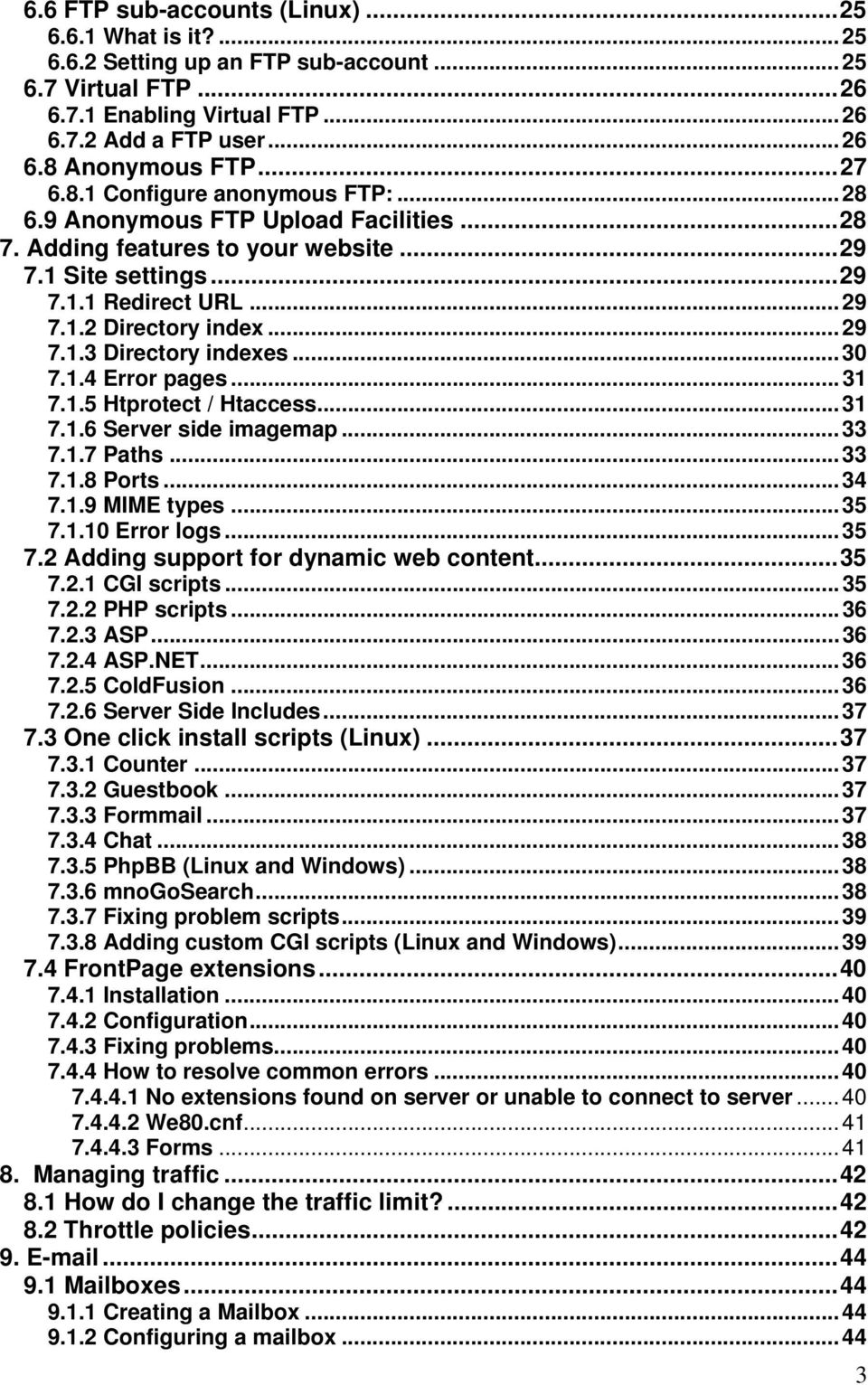
3 6.6 FTP sub-accounts (Linux) What is it? Setting up an FTP sub-account Virtual FTP Enabling Virtual FTP Add a FTP user Anonymous FTP Configure anonymous FTP: Anonymous FTP Upload Facilities Adding features to your website Site settings Redirect URL Directory index Directory indexes Error pages Htprotect / Htaccess Server side imagemap Paths Ports MIME types Error logs Adding support for dynamic web content CGI scripts PHP scripts ASP ASP.NET ColdFusion Server Side Includes One click install scripts (Linux) Counter Guestbook Formmail Chat PhpBB (Linux and Windows) mnogosearch Fixing problem scripts Adding custom CGI scripts (Linux and Windows) FrontPage extensions Installation Configuration Fixing problems How to resolve common errors No extensions found on server or unable to connect to server We80.cnf Forms Managing traffic How do I change the traffic limit? Throttle policies Mailboxes Creating a Mailbox Configuring a mailbox
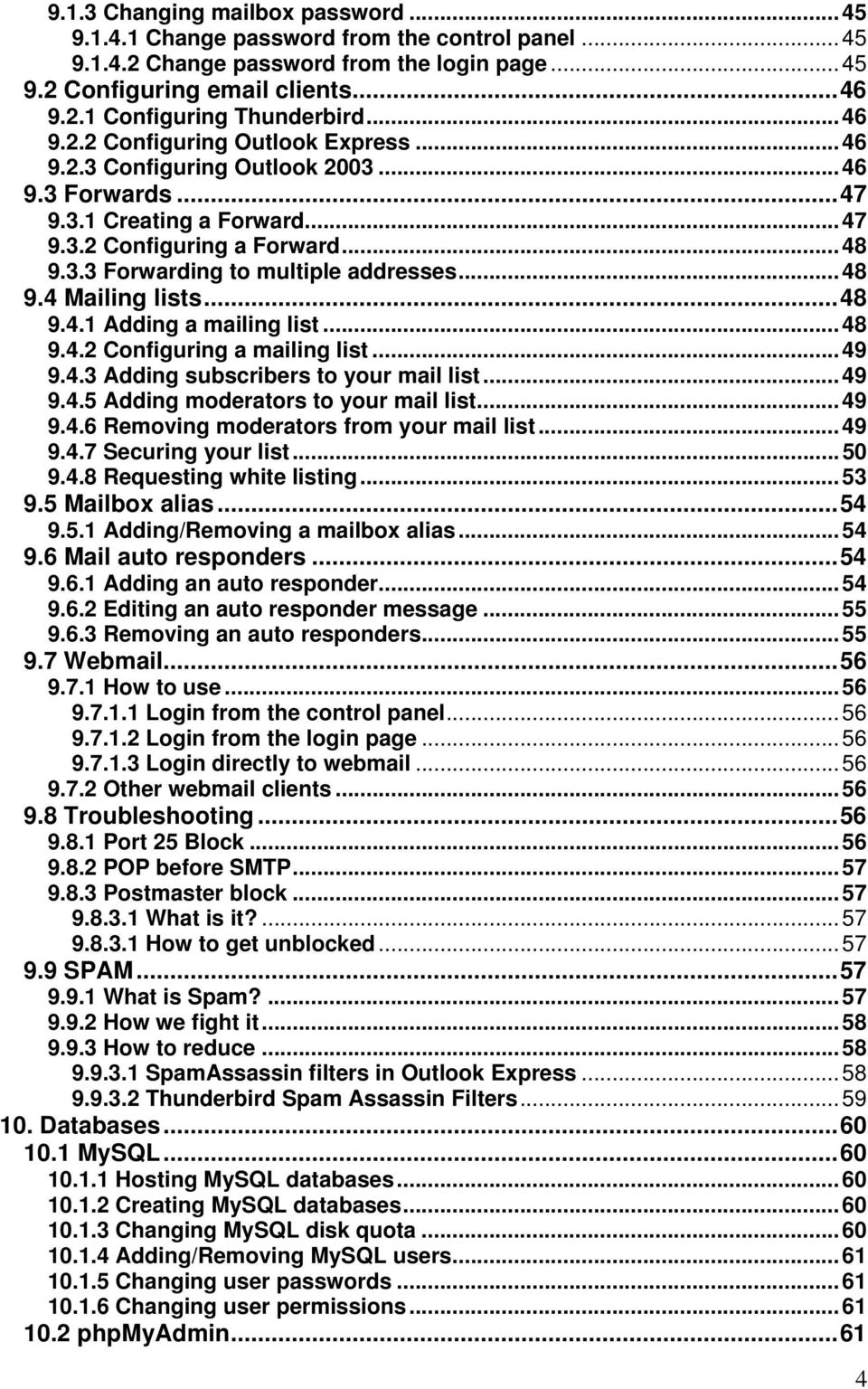
4 9.1.3 Changing mailbox password Change password from the control panel Change password from the login page Configuring clients Configuring Thunderbird Configuring Outlook Express Configuring Outlook Forwards Creating a Forward Configuring a Forward Forwarding to multiple addresses Mailing lists Adding a mailing list Configuring a mailing list Adding subscribers to your mail list Adding moderators to your mail list Removing moderators from your mail list Securing your list Requesting white listing Mailbox alias Adding/Removing a mailbox alias Mail auto responders Adding an auto responder Editing an auto responder message Removing an auto responders Webmail How to use Login from the control panel Login from the login page Login directly to webmail Other webmail clients Troubleshooting Port 25 Block POP before SMTP Postmaster block What is it? How to get unblocked SPAM What is Spam? How we fight it How to reduce SpamAssassin filters in Outlook Express Thunderbird Spam Assassin Filters Databases MySQL Hosting MySQL databases Creating MySQL databases Changing MySQL disk quota Adding/Removing MySQL users Changing user passwords Changing user permissions phpmyadmin
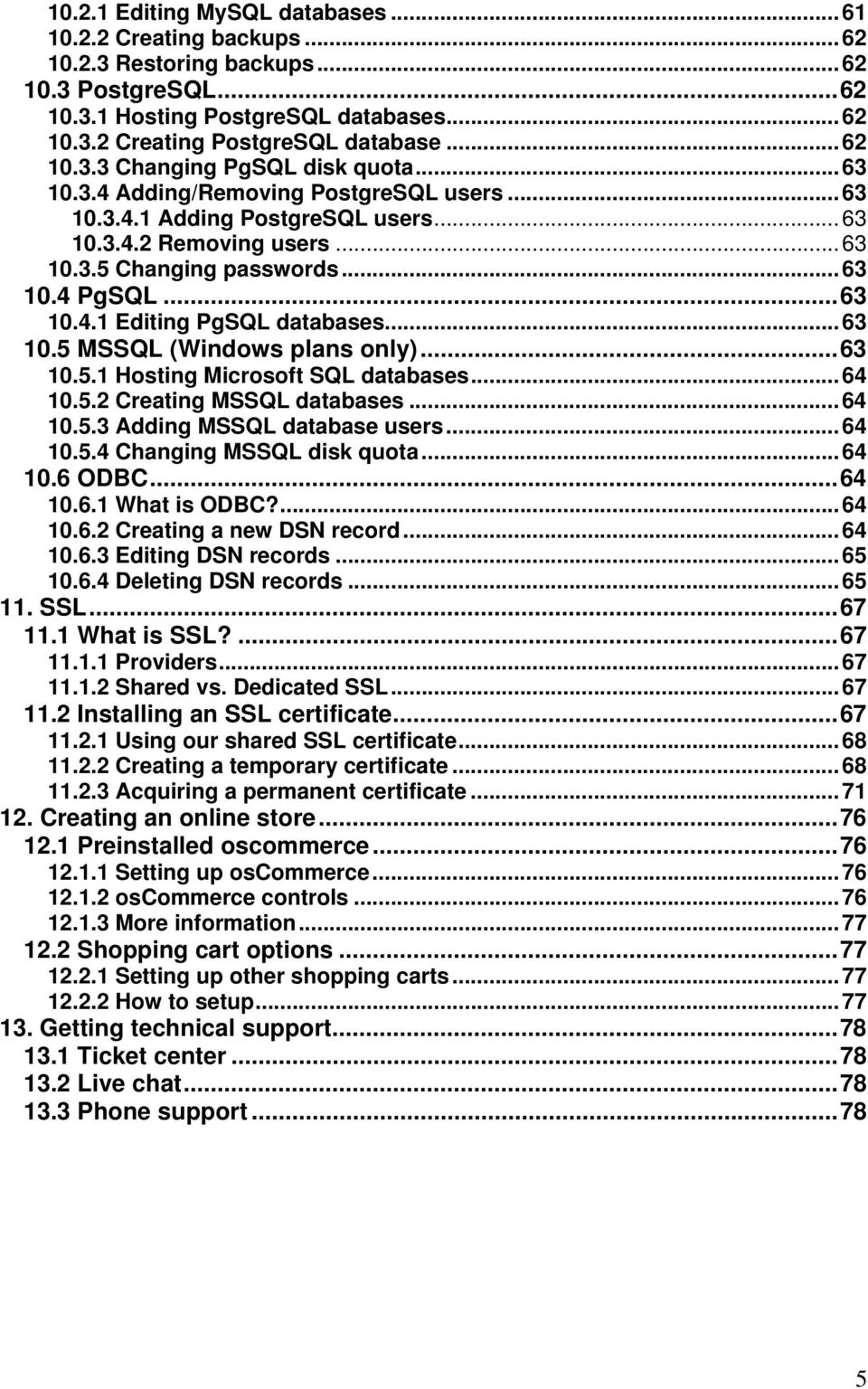
5 Editing MySQL databases Creating backups Restoring backups PostgreSQL Hosting PostgreSQL databases Creating PostgreSQL database Changing PgSQL disk quota Adding/Removing PostgreSQL users Adding PostgreSQL users Removing users Changing passwords PgSQL Editing PgSQL databases MSSQL (Windows plans only) Hosting Microsoft SQL databases Creating MSSQL databases Adding MSSQL database users Changing MSSQL disk quota ODBC What is ODBC? Creating a new DSN record Editing DSN records Deleting DSN records SSL What is SSL? Providers Shared vs. Dedicated SSL Installing an SSL certificate Using our shared SSL certificate Creating a temporary certificate Acquiring a permanent certificate Creating an online store Preinstalled oscommerce Setting up oscommerce oscommerce controls More information Shopping cart options Setting up other shopping carts How to setup Getting technical support Ticket center Live chat Phone support
6 1. Accessing the Control Panel 1.1 How to access This manual will focus on management of your hosting account and features. You can log in to the control panel system at the following URL: Once you login, the control panel can be accessed from the manage button by your hosting account. 1.2 Billing system All other features of the Billing and Administration System are further explained in our billing manual which is available at the following URL: 6

7 2. Control Panel Basics 2.1 Your temporary index page As soon as a domain is added to your account, a directory for your site is created on the server. This directory contains a temporary index page which is accessible from the internet. This page is just a default place holder that will be removed or replaced by your website once published or uploaded. 2.2 Uploading your site The contents of your website will be placed into a folder that is named the same as your site's domain name. The files and folders that compose your site must be transferred to the server. Many of the popular site design programs have built in publishing features that will simplify the upload process. Whenever possible, upload your site using these included features. For instance, if you made your site with SiteStudio, FrontPage or Dream weaver, use their integrated web publishing tools to upload your site. If you made your site with a text editor, or an application that does not include a publish feature you will need to use a freestanding FTP client, such as Filezilla, SmartFTP, or the built in file manager WebShell. NOTE: Site publishing tools do not remove your old web content from the server. For instance, if you used SiteStudio to upload a site with 15 pages and later you published an updated 7 page version of this site, the directory will have all the new pages and the old pages that have not been overwritten. If you publish many versions of a website, the site may become cluttered with old files, which can cause problems. WARNING: If you have a complete website, be careful not to overwrite it with a publish command. It is also highly recommended to make backups of your website and content often. 2.3 Contents of your web space Your root directory contains several default directories. Their names will differ depending on your plan, yet some of them are common for all plans. 7

8 Here are some of the directories that are automatically created: The logs directory It contains directories for each site with transfer logs enabled. Each such directory contains its own set of log files that are required to write and read the data about all visits to your sites. Deleting the Logs directory will cause the loss of the web statistics accumulated over the course of your site s operation. The virtual FTP directory This directory is created when you enable Virtual FTP Server and can be accessed by virtual FTP users to list and download its content. Deleting Virtual FTP directories will cause incorrect operation of Virtual FTP. However, you may harmlessly delete individual files in these directories. The ssl.conf directory This directory stores SSL pairs for all encrypted sites. Deleting the ssl.conf directory will result in incorrect SSL operation. The domain directory Each of your domains and subdomains are located in their own directories. They are named the same as your site's domain name. If you have more than one site, you will have several such directories. These are the directories where you will upload your.html files or any other files that you want to make accessible from the Internet. WARNING: Deleting any domain directory will delete your site and all content. Use extreme caution. The Webalizer or Modlogan directories Each of these directories is created by default or when the stat programs Webalizer and Modlogan are enabled from your control panel. Deleting these directories will disable your statistic programs and remove any accumulated site statistics. The cp directory This folder contains many of the help and example files used as you navigate our control panel. These files are not essential and can be deleted. The cgi-bin directory This is the default location that you place any CGI or Perl applications. You can modify which files and folders can be used. The images directory 8

9 The images folder is the location where the default index page images are placed. Deleting any of the files/folders in your web space can affect the performance of your website. 9

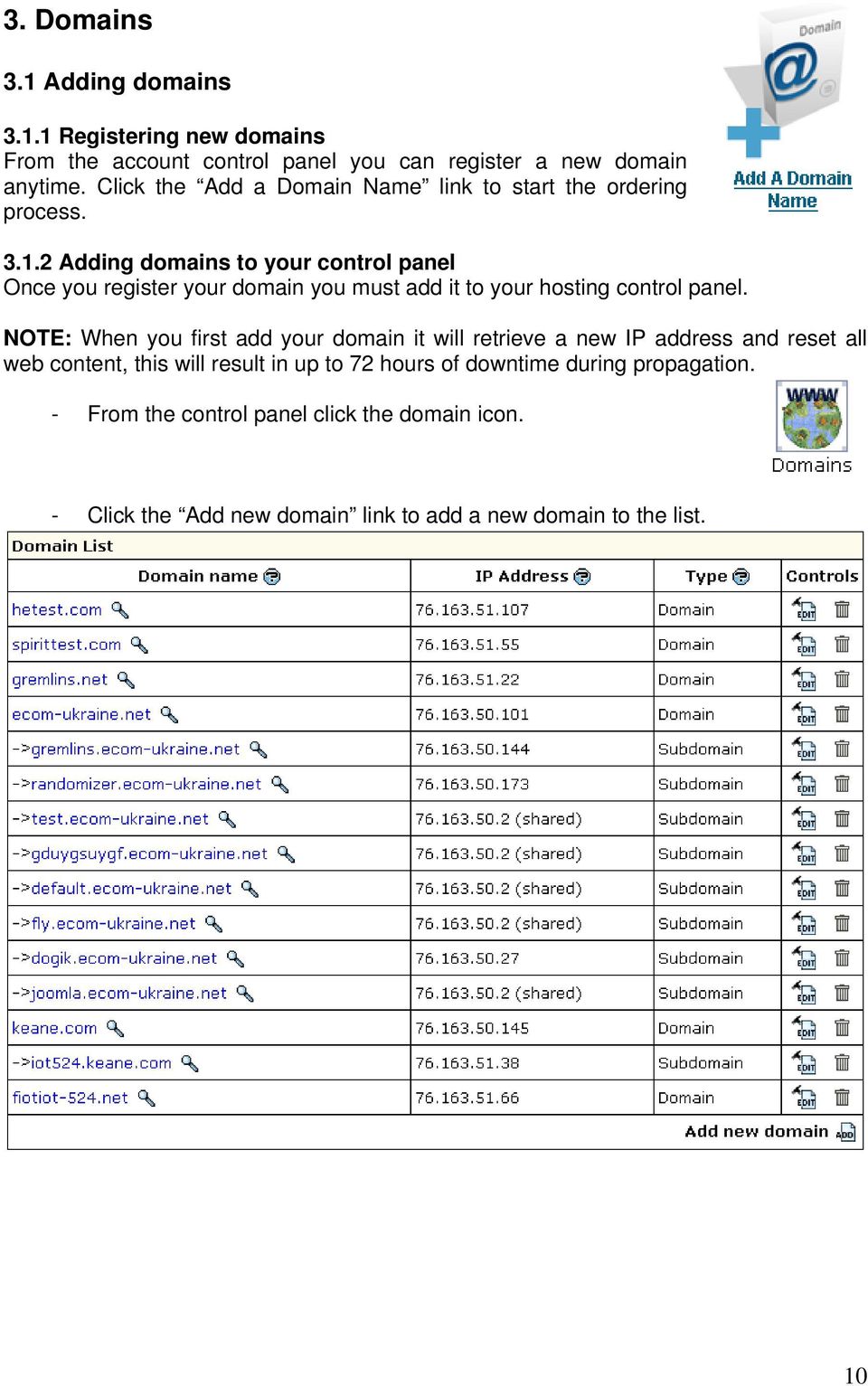
10 3. Domains 3.1 Adding domains Registering new domains From the account control panel you can register a new domain anytime. Click the Add a Domain Name link to start the ordering process Adding domains to your control panel Once you register your domain you must add it to your hosting control panel. NOTE: When you first add your domain it will retrieve a new IP address and reset all web content, this will result in up to 72 hours of downtime during propagation. - From the control panel click the domain icon. - Click the Add new domain link to add a new domain to the list. 10
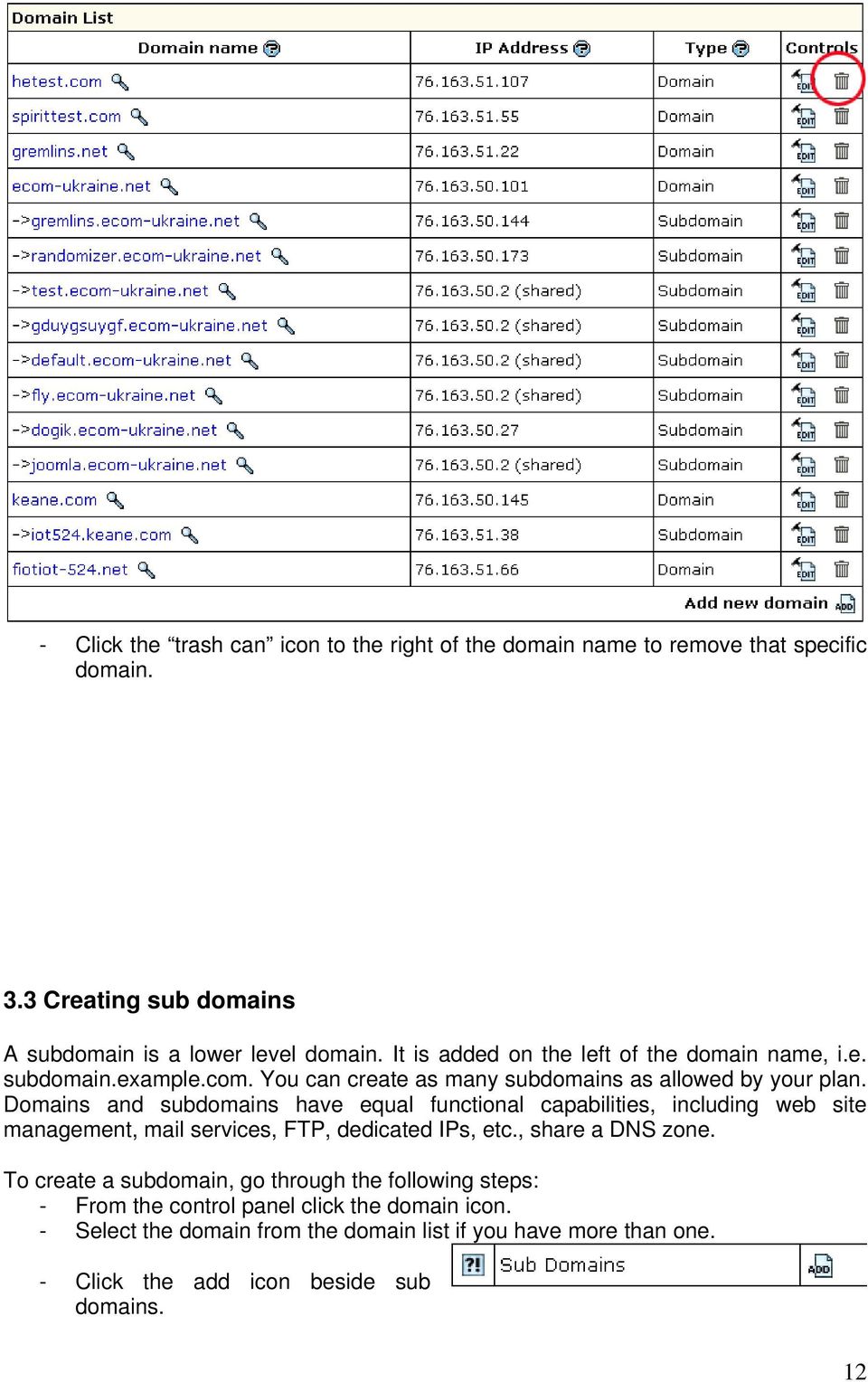
11 3.1.3 How to turn on/off web and mail services You can turn web and mail services on or off from your account control panel. WARNING: Please ensure you have a backup of all your web content before continuing. Turning off web service will remove your web content and release the assigned IP address. When turned on your site will retrieve a new IP address and reset all web content, this will result in up to 72 hours of downtime during propagation. To turn on/off web or mail services: - From the control panel click the domain icon. - Select the domain from the list and click on the domain name. - You can click the on/off button beside web or mail service to enable/disable it. - Clicking the edit buttons for either service will let you configure the options for that specific service and domain Configuring domains To configure DNS, web, or mail services: - From the control panel click the domain icon. - Select the domain from the list and click on the domain name. - You can click the edit button for either service to configure the options for that specific domain. 3.2 Removing domains You may for many reasons want to remove a domain from your account. WARNING: Please ensure you have a backup of all your web content before continuing. Removing a domain will remove all associated web content and release the assigned IP address. To remove a domain: - From the control panel click the domain icon. 11

12 - Click the trash can icon to the right of the domain name to remove that specific domain. 3.3 Creating sub domains A subdomain is a lower level domain. It is added on the left of the domain name, i.e. subdomain.example.com. You can create as many subdomains as allowed by your plan. Domains and subdomains have equal functional capabilities, including web site management, mail services, FTP, dedicated IPs, etc., share a DNS zone. To create a subdomain, go through the following steps: - From the control panel click the domain icon. - Select the domain from the domain list if you have more than one. - Click the add icon beside sub domains. 12
13 - Enter a new subdomain name and click create subdomain - This will result in the creation of the subdomain test.hetestdomain.com 3.4 Domain aliasing Domain aliasing, or domain stacking, is creating additional domain names that would point to the IP of a different domain. For example, if your domain name is example.com, you can register another domain name, for instance example.net and have it point to the location of example.com. This means, every Internet user who goes to example.net will land in example.com. A domain alias can have: - its own DNS zone - custom DNS records - separate mail service Creating a domain alias - Register the alias, exactly as you register domain names. - From the control panel click the domain icon. - Select the domain from the domain list if you have more than one. - Click the Add icon in the Domain Aliases field at the bottom of the page. - Enter the domain alias. This must be a fully qualified domain name, e.g. example.com: - Leave the create DNS zone box unchecked if the domain alias is registered on a different DNS server. The domain alias will not be maintained and mail service will be inaccessible for this domain alias. 13
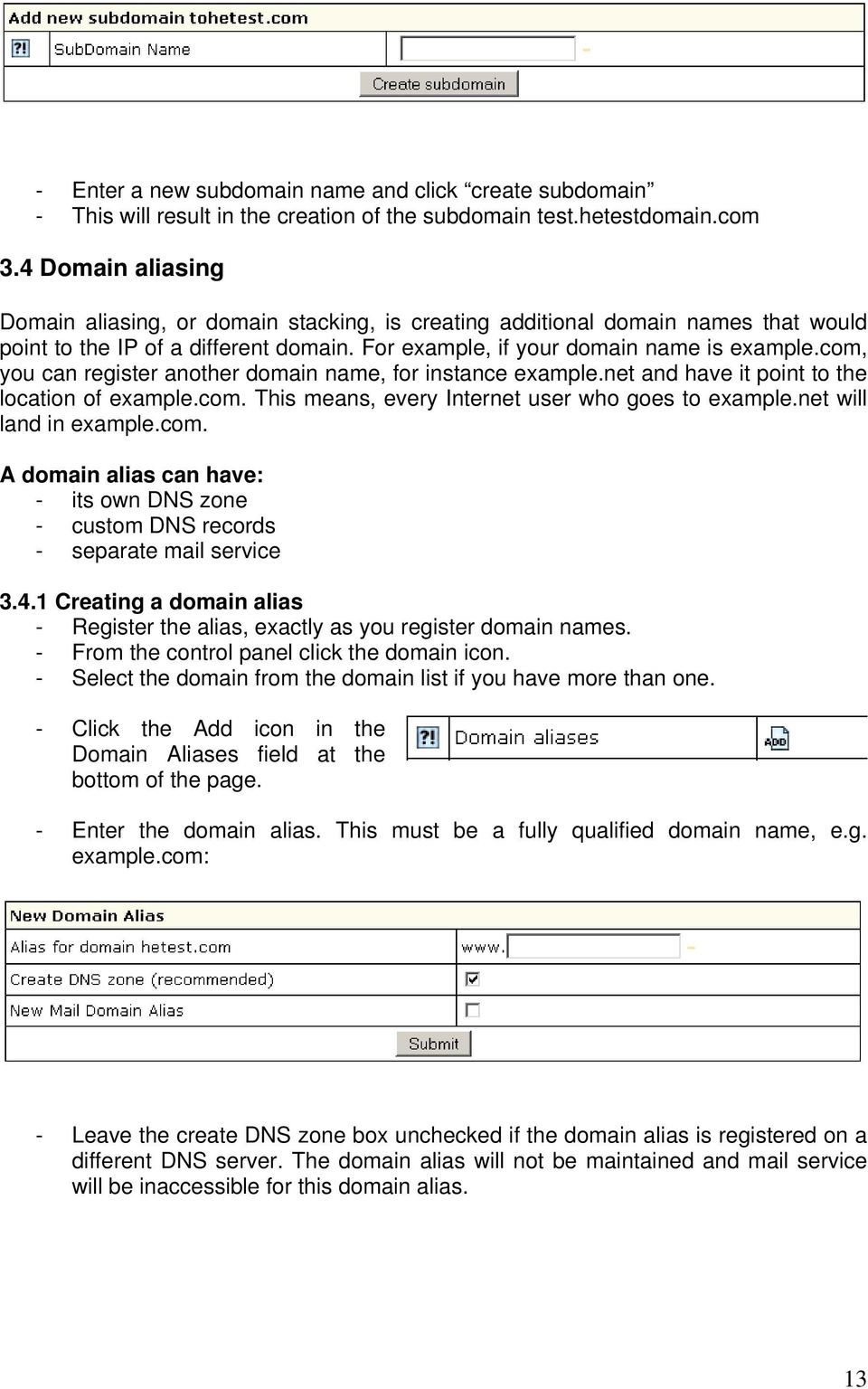
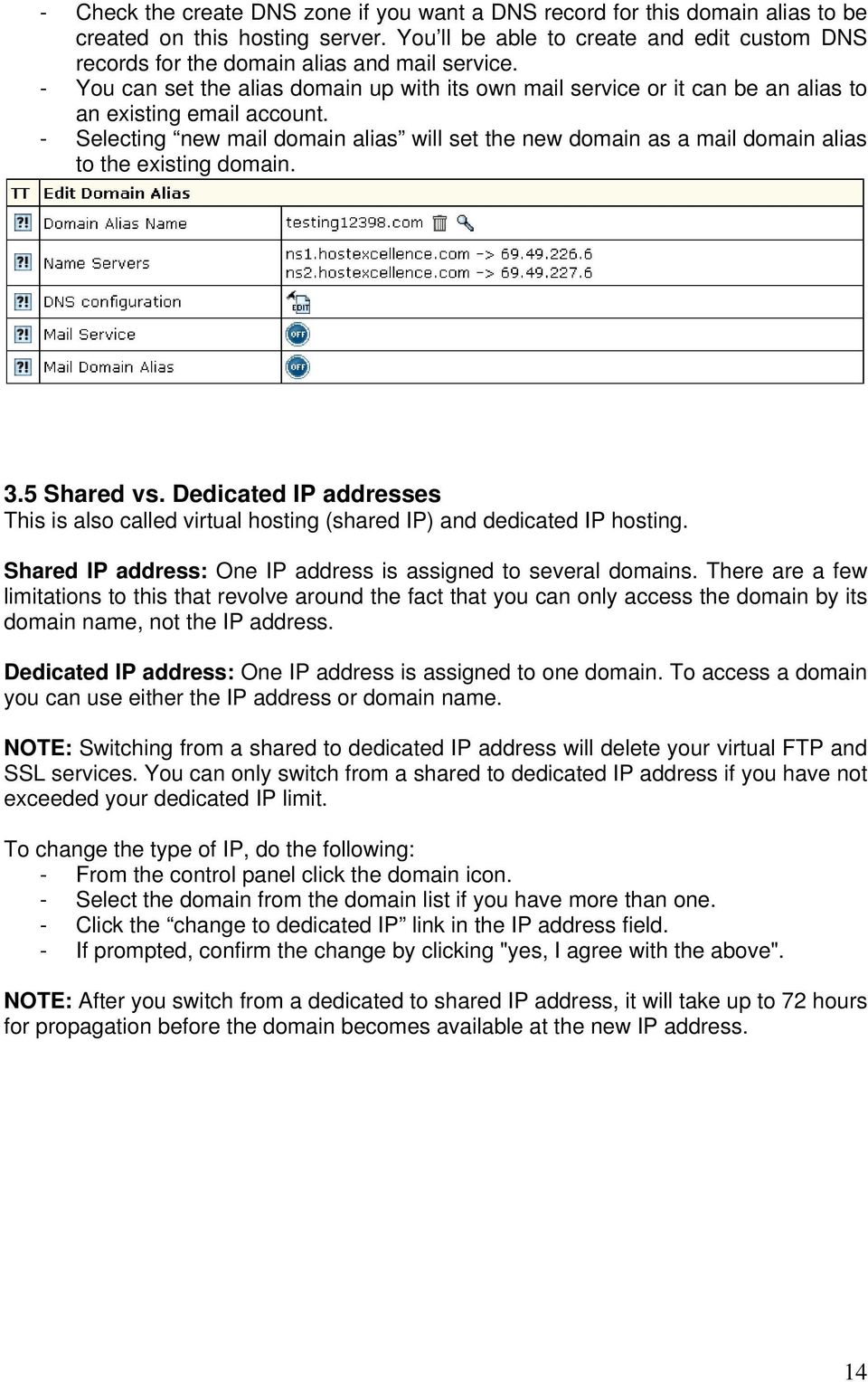
14 - Check the create DNS zone if you want a DNS record for this domain alias to be created on this hosting server. You ll be able to create and edit custom DNS records for the domain alias and mail service. - You can set the alias domain up with its own mail service or it can be an alias to an existing account. - Selecting new mail domain alias will set the new domain as a mail domain alias to the existing domain. 3.5 Shared vs. Dedicated IP addresses This is also called virtual hosting (shared IP) and dedicated IP hosting. Shared IP address: One IP address is assigned to several domains. There are a few limitations to this that revolve around the fact that you can only access the domain by its domain name, not the IP address. Dedicated IP address: One IP address is assigned to one domain. To access a domain you can use either the IP address or domain name. NOTE: Switching from a shared to dedicated IP address will delete your virtual FTP and SSL services. You can only switch from a shared to dedicated IP address if you have not exceeded your dedicated IP limit. To change the type of IP, do the following: - From the control panel click the domain icon. - Select the domain from the domain list if you have more than one. - Click the change to dedicated IP link in the IP address field. - If prompted, confirm the change by clicking "yes, I agree with the above". NOTE: After you switch from a dedicated to shared IP address, it will take up to 72 hours for propagation before the domain becomes available at the new IP address. 14
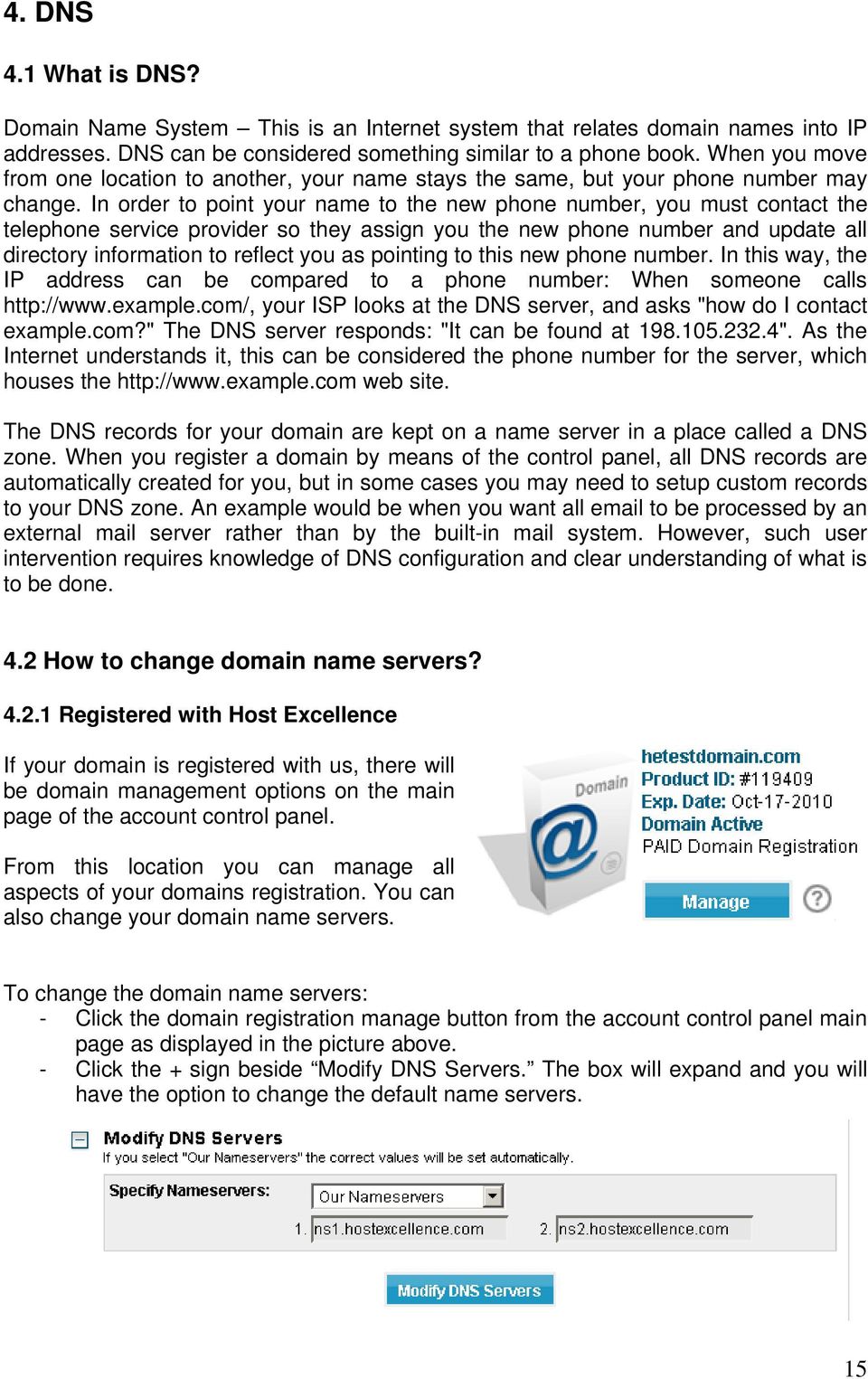
15 4. DNS 4.1 What is DNS? Domain Name System This is an Internet system that relates domain names into IP addresses. DNS can be considered something similar to a phone book. When you move from one location to another, your name stays the same, but your phone number may change. In order to point your name to the new phone number, you must contact the telephone service provider so they assign you the new phone number and update all directory information to reflect you as pointing to this new phone number. In this way, the IP address can be compared to a phone number: When someone calls your ISP looks at the DNS server, and asks "how do I contact example.com?" The DNS server responds: "It can be found at ". As the Internet understands it, this can be considered the phone number for the server, which houses the web site. The DNS records for your domain are kept on a name server in a place called a DNS zone. When you register a domain by means of the control panel, all DNS records are automatically created for you, but in some cases you may need to setup custom records to your DNS zone. An example would be when you want all to be processed by an external mail server rather than by the built-in mail system. However, such user intervention requires knowledge of DNS configuration and clear understanding of what is to be done. 4.2 How to change domain name servers? Registered with Host Excellence If your domain is registered with us, there will be domain management options on the main page of the account control panel. From this location you can manage all aspects of your domains registration. You can also change your domain name servers. To change the domain name servers: - Click the domain registration manage button from the account control panel main page as displayed in the picture above. - Click the + sign beside Modify DNS Servers. The box will expand and you will have the option to change the default name servers. 15
16 For more information regarding the management of your domain registration through Host Excellence, please refer to the Domain section of the Billing Manual Other registrar You can usually change your domain name servers at the registrars website or by contacting the registrar. Your name servers with us are sent in the initial hosting account and can also be found in the hosting account control panel To locate your domain name servers: - From the control panel click the domain icon. - Select the domain from the domain list if you have more than one. - The primary and secondary name servers are listed on this page similar to what you see below To change the domain name servers: - Log in to your domain registrars website - Look for the domain or hosting settings area. - There may be an option such as change DNS or update name servers - You should see 2 or more boxes to place name server information. You will place the information you found when you located your domain name servers into these blanks. - It can take up from 24 to 72 hours for propagation before the site is accessible. 4.3 How do I create custom DNS records? Custom DNS records are required to manage any outside server through our name servers. This can be useful in many instances, such as when setting up an outside mail server or to map a domain to a different server. 16
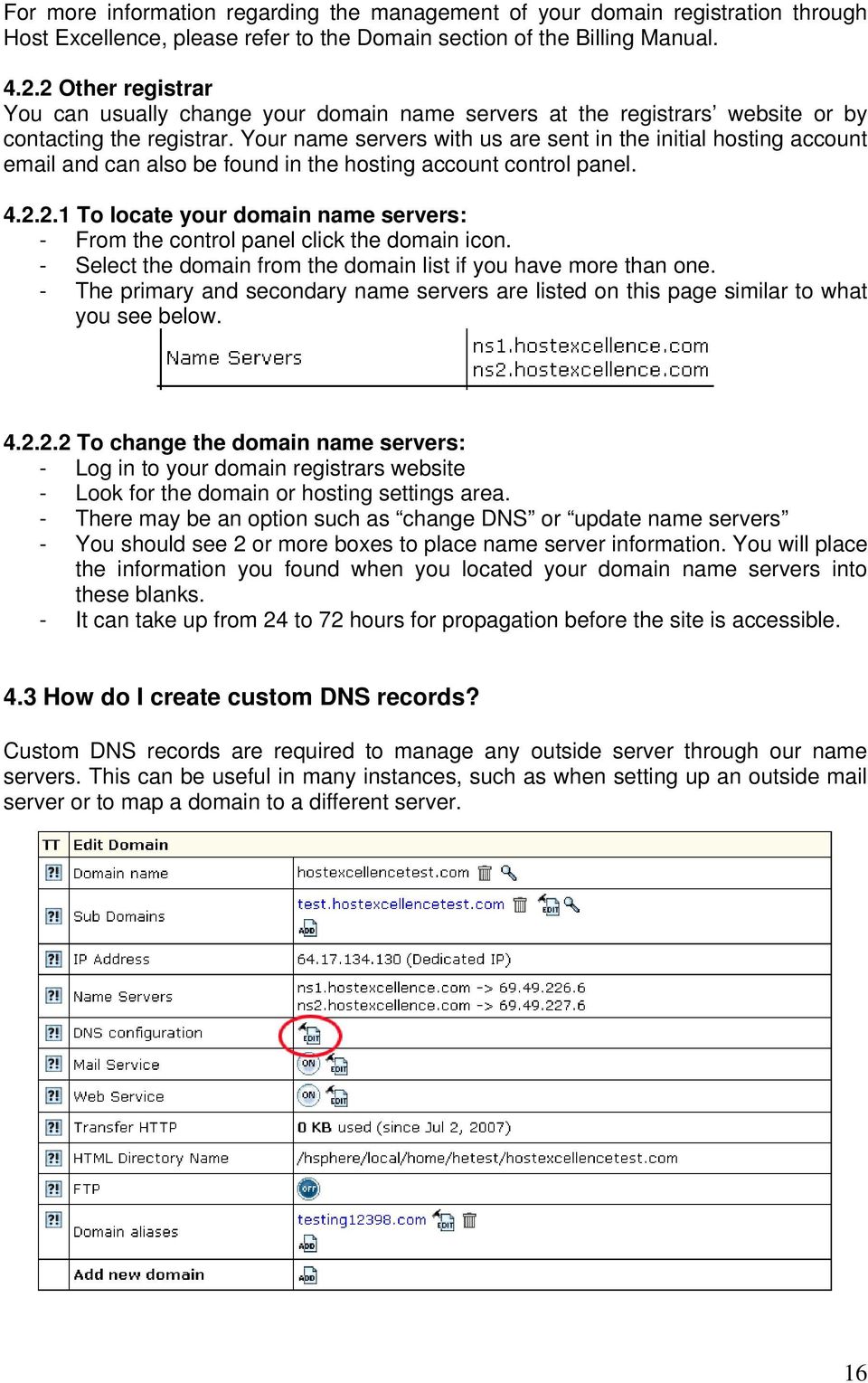
17 4.3.1 Removing the default DNS records Removing the default DNS A or MX records will make your site inaccessible. For this reason the only way to remove the default dns records is to turn web or mail service off. This will remove all hosting content and release your ip address Adding custom A records An A record gives you the IP address of a domain. This allows users that visit to go to the right IP address. It can also be used to map a domain to a different server or a sub domain to the correct IP address. To add a new DNS A record, do the following: - From the control panel click the domain icon. - Select the domain from the domain list if you have more than one. - Click the edit button to the right of DNS configuration. - Click the add DNS A record link. 17

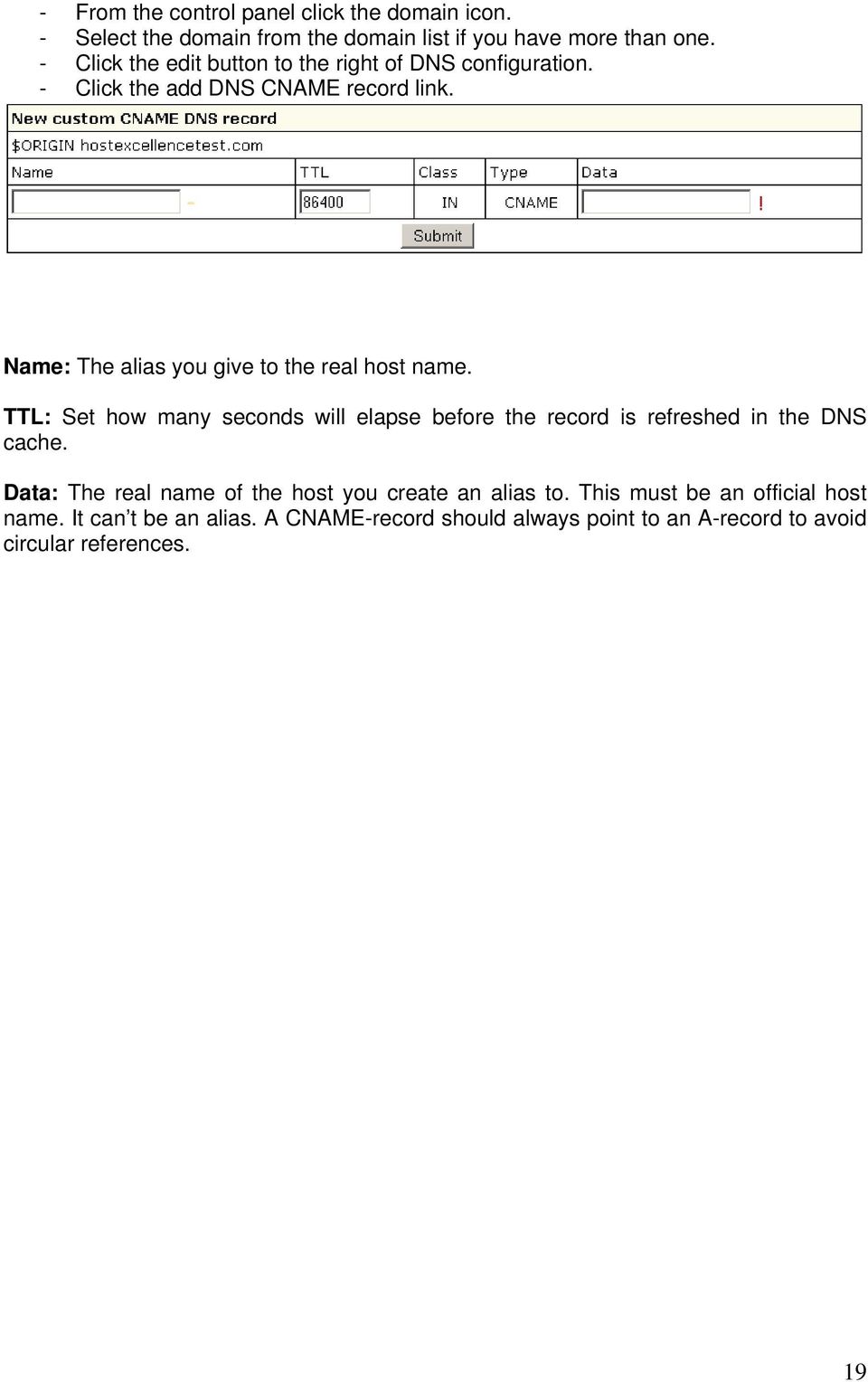
18 Name: Enter the prefix to map. This will be accessible at the prefix.domain.com. TTL: Set how many seconds will elapse before the record is refreshed in the DNS cache (a time to live period of is recommended). Data: Enter the IP of the web server Adding custom MX records Custom MX records should be added when you want to use your external mail servers to process your . To use your external servers instead of those you get by default, you need to disable mail service on the Domain Settings page. To use the external mail servers in addition to those you get by default, you need to keep mail service enabled in the control panel. The priority of the custom MX record will define whether your external servers will act as primary or secondary. For instance, if you set the priority of the custom MX record higher than 10, your external mail server will be used as secondary. If you set the priority of the custom MX record lower than 10, your external mail server will be used as primary. In the first case, your mail will be sent to your external mail server until it goes down or becomes otherwise inaccessible. Then the default mail server will take over. To add a new DNS MX record, do the following: - From the control panel click the domain icon. - Select the domain from the domain list if you have more than one. - Click the edit button to the right of DNS configuration. - Click the add DNS MX record link. Name: Your local domain name. If you leave the name field blank, all mail will be redirected for the base zone. Data: The priority the record and mail domain name (not the IP) mail will be forwarded to. IMPORTANT: To add an MX record for the base domain, leave the name field empty Adding custom CNAME records CNAME records are used to map aliases with domain names. To add a new DNS CNAME record, do the following: 18
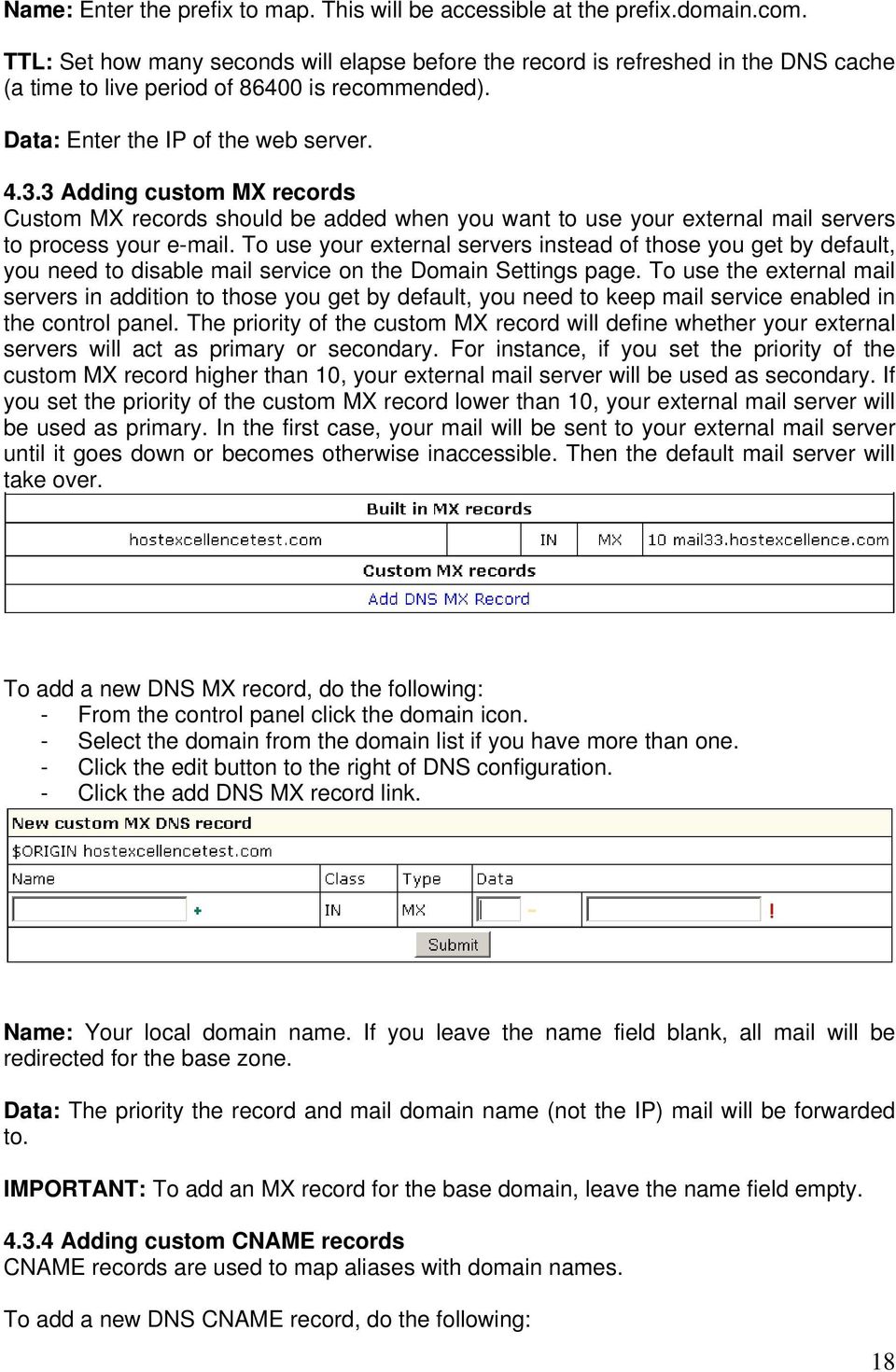
19 - From the control panel click the domain icon. - Select the domain from the domain list if you have more than one. - Click the edit button to the right of DNS configuration. - Click the add DNS CNAME record link. Name: The alias you give to the real host name. TTL: Set how many seconds will elapse before the record is refreshed in the DNS cache. Data: The real name of the host you create an alias to. This must be an official host name. It can t be an alias. A CNAME-record should always point to an A-record to avoid circular references. 19
20 5. Creating, promoting and managing your site 5.1 SiteStudio site builder Before you pay a fortune to a web design studio or waste hours making a nice looking web site in FrontPage, consider our online site builder that will create you a professional website in a matter of minutes and automatically post it to your directory on the server. To start SiteStudio: - Click the SiteStudio icon in the control panel. - Click the launch icon for the desired domain. - Then follow the on-screen instructions. 5.2 Search engine submit So your site is up and running? Help others find it among the millions of websites on the Internet! Our search engine submission tool is a quick and easy way to make the search engines aware of your site. To start the Search Engine Submit utility: - From the control panel click the submit URL icon. - Select the domain to submit. - On the page that appears, check the engines to register the site with and fill in the requested fields. Contact Most search engines require a contact address. Key Words: Some search engines provide the possibility for entering additional keywords your site can be searched by. Description: This text will show to Internet users as a description of your site in the list of search results. Time-out: This is the time you allow for registering one site with all search engines. If this period is too short, the site will get registered with only a few search engines. - Click the submit button. Be patient while the server processes your request. WARNING: Avoid submitting to a large number of web sites at a time or the browser will time out before the program has finished. NOTE: This tool will send a request for the search engines to index your website in their search engine pool. This is a supplemental tool, and is only as reliable as the search engine you are submitting to. We can not guarantee that they will honor this request. It can take more than a month for your site to be indexed, if it will be at all. It is generally considered more effective to go to the individual search engine sites and request directly to the search engines. There are many governing factors that determine search engine placement, and submission alone is normally not enough in the current competitive market to attain top level placement in major search engines. Tactics such as the use of keywords, active 20
21 promotion and links to your site from other sites should always be employed for optimal results. 5.3 WebShell file manager What is WebShell? WebShell allows you to copy, move, delete, and rename files and directories in your home directory on the server. You can also use it to upload, download, compress and decompress files as well as preview them in the browser. To launch WebShell: - From the control panel click the WebShell3 icon How to use The WebShell application is very useful for navigating, accessing and modifying your site files and folders. It is similar in function to any FTP application. Once open you will see a list of files. The folder named the same as your domain name is the public files that compose your site. You can select multiple files or folders to perform various tasks to How to backup your site To backup your site files: - Check the box next to the files and folders to be archived and downloaded. - Click the archive button in the top level menu. An archive form shows to the right with a name of the zipped file. - Click the create button to proceed. - You can then click the file icon beside the created archive file to download it. 5.4 Webalizer, Modlogan and Awstats Webalizer and Modlogan Webalizer and Modlogan are popular web statistic programs that track the actions of users to your site. To access Webalizer or Modlogan, do the following: - Click the stats icon from the control panel. - Click the off icon for the stat program and domain you wish to have stats for. - If the stat program is already turned on, click the magnifying glass to be redirected to your web statistics page. NOTE: The Webalizer and Modlogan directories are located at or which is web accessible. If you wish to make you statistics private, you can setup password protection on the directory through Htprotect or Htaccess. (Linux only) Once they are enabled it will take between hours for your web statistics to start working. Webalizer stat labels Hits Any request made to the server which is logged, is considered a 'hit'. 21
22 The requests can be for anything; html pages, graphic images, audio files, CGI scripts, etc. Each valid line in the server log is counted as a hit. This number represents the total number of requests that were made to the server during the specified report period. Files Some requests made to the server, require that the server then send something back to the requesting client, such as an html page or graphic image. When this happens, it is considered a 'file' and the files total is incremented. The relationship between 'hits' and 'files' can be thought of as incoming requests and outgoing responses. Pages Pages are, well, pages! Generally, any HTML document, or anything that generates an HTML document, would be considered a page. This does not include the other stuff that goes into a document, such as graphic images, audio clips, etc... This number represents the number of 'pages' requested only, and does not include the other 'stuff' that is in the page. What actually constitutes a 'page' can vary from server to server. The default action is to treat anything with the extension '.htm', '.html' or '.cgi' as a page. A lot of sites will probably define other extensions, such as '.phtml', '.php3' and '.pl' as pages as well. Some people consider this number as the number of 'pure' hits... I'm not sure if I totally agree with that viewpoint. Some other programs (and people :) refer to this as 'Pageviews'. Sites Each request made to the server comes from a unique 'site', which can be referenced by a name or ultimately, an IP address. The 'sites' number shows how many unique IP addresses made requests to the server during the reporting time period. This DOES NOT mean the number of unique individual users (real people) that visited, which is impossible to determine using just logs and the HTTP protocol (however, this number might be about as close as you will get). Visits Whenever a request is made to the server from a given IP address (site), the amount of time since a previous request by the address is calculated (if any). If the time difference is greater than a pre configured 'visit timeout' value (or has never made a request before), it is considered a 'new visit', and this total is incremented (both for the site and the IP address). The default timeout value is 30 minutes (can be changed), so if a user visits your site at 1:00 in the afternoon, and then returns at 3:00, two visits would be registered. NOTE: In the 'Top Sites' table, the visits total should be discounted on 'Grouped' records, and thought of as the "Minimum number of visits" that came from that grouping instead. Note: Visits only occur on PageType requests, that is, for any request whose URL is one of the 'page' types defined with the PageType option. Due to the limitation of the HTTP protocol, log rotations and other factors, this number should not be taken as absolutely accurate; rather, it should be considered a pretty close "guess". KBytes The KBytes (kilobytes) value shows the amount of data that was sent out by the server during the specified reporting period. This value is generated directly from the log file, so it is up to the web server to produce accurate numbers in the logs (some web servers do stupid things when it comes to reporting the number of bytes). In general, this should be a fairly accurate representation of the amount of outgoing traffic the server had, regardless of the web servers reporting quirks. 22
23 NOTE: A kilobyte is 1024 bytes, not 1000 :) Top Entry and Exit Pages The Top Entry and Exit tables give a rough estimate of what URL's are used to enter your site, and what the last pages viewed are. Because of limitations in the HTTP protocol, log rotations, etc, this number should be considered a good "rough guess" of the actual numbers, however will give a good indication of the overall trend in where users come into, and exit, your site Awstats and others Many customers are not satisfied with the limited reporting capability of Webalizer and Modlogan and look for something more. There are many other programs out there that will report much deeper in certain areas. Most of these programs can be installed in your web space and configured to work with our service. Many use Awstats with great success to provide the advanced statistics they require. 5.5 Reverse trace route This network troubleshooting tool allows you to ping any Internet host from your hosting server. In other words, you can use this tool to determine if a host is reachable and how long it takes for the signal to go all the way through. To launch the reverse trace route tool, do the following: - On your control panel page, click the reverse trace route icon. - In the form that appears, enter the host name or the IP address of the server you would like to ping. - Select the timeout period. If you see the connection is slow, select a bigger period. - Click trace and wait for the result. - The next page will show all the hosts that were passed to reach the target server. 23
24 6. FTP 6.1 What it FTP? FTP or file transfer protocol is a common way to transfer files to and from servers. It is also a common way to share accessed to files with others. Many web publishing applications use FTP to connect and upload to the web server. Most FTP clients are compatible with our service, including the following Filezilla, SmartFTP, CuteFTP, Fetch, Cyberduck, Dream weaver, Publisher and FrontPage. Address: This is the domain name or IP address of the FTP server. Port: 21 is the most commonly used port for FTP connections. Username: A username is a required unless you are using anonymous FTP. Password: A password is also required unless you are using anonymous FTP. 6.2 Changing your FTP password To change the FTP password: - Go to your control panel. - Click the FTP manager icon. - Click the icon beside password to change the current password. 6.3 Connecting to a FTP client Using a FTP client can be very simple to use, if you have the basics. This guide will focus on using Filezilla to transfer files. This information applies to most of the popular FTP software. To connect to your FTP server: - After starting up your ftp client you should be given an area to enter your logon information. Address: This is the domain name or IP address of the FTP server. Port: 21 is the most commonly used port for FTP connections. Username: A username is a required unless you are using anonymous FTP. Password: A password is also required unless you are using anonymous FTP. - Once you enter your information you can click connect to initiate the connection process. 24
25 - If the connection was successful you will have a list of the files and folders located in your website root directory. 6.4 How to navigate files Navigating in Filezilla: - Navigating the files and folders in Filezilla is very similar to using the file manager on your home computer. - To change the current folder either on your machine or on the server, just select a tree item in the appropriate tree. 6.5 How to transfer files Transferring Files into Filezilla: - You will see two views the local and the remote view. - Navigate the remote view to the location you would like to place the files you upload. - Navigate the local view to the location of the files you wish to upload. - You can upload or download a file by double-clicking on it. It will be added to the transfer queue and the transfer will start automatically. - Alternatively you can also drag the files from one side and drop them on the other side. 6.6 FTP sub-accounts (Linux) What is it? The simplest way to authorize your friends or colleagues to work with particular directories of your account is to create FTP sub-accounts. An FTP sub-account is a combination of a username and a password, which gives full FTP permissions to a single directory, without giving access to the root directory, other directories or the control panel. No dedicated IP is required for FTP sub-accounts Setting up an FTP sub-account To create a new FTP sub-account: - Click the FTP Manager icon from your control panel. - At the bottom of the page that shows, find FTP subaccounts and click the Add icon. 25
26 - On the next page, enter the FTP login and password that will be used by this other user, and the directory this user will be restricted to. The directory must be relative to your home directory. If you leave the directory field empty, FTP subusers will have access to your whole home directory. - Once complete you can click the edit icon beside an existing username to see the details of that user. Transfer FTP: This shows the amount of traffic used by an individual ftp sub-account user. Home Directory: /hsphere/local/home/(ftpusername)/(folder name) Host Name: The host name is the direct web server address, which can be used in place of the domain name to log on. 6.7 Virtual FTP Virtual FTP provides more possibilities than a FTP sub-account. You can give your Virtual FTP users access to more than one directory and specify a different set of permissions for each directory. Virtual FTP users log right into your root, but can enter only those directories you allow them to enter Enabling Virtual FTP - On your control panel page, click the domains icon. - If you have several domains, choose the one you wish to enable virtual FTP for. - On the page that appears, make sure you have a dedicated IP. - Go back to your control panel page and click the FTP service icon. Enable FTP for this domain: - On the next page, add a server name for the new virtual host. This name will appear in the welcome message when guest users connect to your server with FTP clients. Also, enter the address by which FTP users can reach you with questions or comments Add a FTP user 26
27 - Click the Edit icon for FTP for this domain - Click the Add icon for Virtual FTP Users and create a new Virtual FTP User: - Click the Add icon for Virtual FTP Directories and enter the name for the new Virtual FTP Directory: - End it with a slash, e.g.: Dir1/. The location must be specified relative to root. To create a virtual FTP directory inside a different directory, include the path, for example Dir1/UserDirs/. - On the same page, specify permissions to this directory: Read: check to allow file downloads from this directory. Write: check to allow file uploads to this directory. List: check to allow viewing / browsing the contents of the directory. It is usually used jointly with Read. Grant Permissions to all users: check to grant these permissions to all your Virtual FTP users. If you leave this property unchecked, you will have to define permissions on this directory individually for each Virtual FTP User. - Click the Edit icon next to the directory you have just created. If you haven't granted the same permissions to all your Virtual FTP Users, you can specify permissions for each of them individually. - If you have chosen to grant the same permissions to all users, you can skip this step. 6.8 Anonymous FTP This feature allows you to give public FTP access to a dedicated directory in your account. A special directory is created in your root, and its content can be viewed and 27
28 downloaded, but not uploaded. Anonymous FTP becomes available only after you create a Virtual FTP server Configure anonymous FTP: Skip this step if you are already using a dedicated IP. - On your control panel page click the domains icon - If you have several domains, choose the one you wish to enable virtual FTP for. - On the page that appears, switch to dedicated IP. Skip this step if you have already enabled Virtual FTP. - Go back to your control panel page and click the FTP Service icon. - Enable FTP for this domain: - On your control panel page, click FTP Service, then enable Anonymous FTP for the domain you want: - You can also enable Anonymous FTP on the FTP virtual server page. 6.9 Anonymous FTP Upload Facilities If you want to allow anonymous FTP users to upload files, enable Anonymous FTP Upload Facilities by doing the following: - Enable Anonymous FTP - At the bottom of the FTP virtual server page you will find a new option to enable anonymous FTP upload facilities: NOTE: This will create a dedicated directory inside the Anonymous FTP directory. The Uploads (Windows based plans) / Incoming (Linux based plans) directory will have only 'upload' permissions, so you can not downloaded or viewing the content. 28
29 7. Adding features to your website 7.1 Site settings The site settings allow you to control many features of your website Redirect URL This allows you to redirect your domain to a different domain or IP address. With this feature you can redirect visitors from one URL to another. When a visitor tries to connect it will redirect them to the address specified here. Example: If you were to put in the Redirect from: field and in the to field, it will redirect visitors of to the page. NOTE: URL path must be an absolute path, not a relative path. It is not possible to use this method to redirect to a sub pages within the same domain, only to a different domain or IP address Directory index This allows you to set your own index pages instead of the one we have set as default. In other words, you can tell your visitors' browsers which page to load when they type your base domain name ( Default index pages index.html index.php default.html Example: If a visitor goes to your site the first page to open will be However, if you set welcome.html as the directory index, the page to open will be You can specify multiple index pages in case different folders have index pages of different names. Make sure to enter the full list of indexes you would like to have in your configuration. To set your custom directory indexes, do the following: - On the control panel page, click Web Options. 29
30 - Select the domain if you have more than one. - On the Web Service page, scroll down and find the directory indexes option and turn it on. - In the box that appears, enter the names of the files that will be treated as indexes. Put file names in descending order of priority and separate them with spaces (e.g. index.html cgi.bin about.html index.php). - At the top of the Web Service page, click the Apply link for the Server configuration to change. - The changes will take effect within 15 minutes. To edit the list you have made, click the Edit icon next to the Directory Indexes. On Windows hosting these changes will happen immediately Directory indexes The index page is the first page entered on your site. If for any reason it is corrupted or missing, the system can automatically control what is displayed. Switch the radio buttons to enable or disable this option. Disabled: This causes the server to refuse to list the files and folders of a directory if an index file is not found. Enabled/Fancy: When pointed at a directory, the server looks for a file called index.html; if found, that is what is sent back. If it's pointed at a directory that doesn't have an index.html, the server will perform "fancy indexing" and return the following HTML: - Set the title and main header to "Index of dir" - The header file for this directory, if any - A list of the files in this directory. Each file name is a link to the file. The first file is "Parent Directory". Last modification date, size, and an icon indicating the types of file included. 30
31 NOTE: We recommend you keep this option to disabled and instead keep an updated index file that list the files stored in your site Error pages Use this utility to define what will be done if a requested page on your site is missing or fails to open for any other reason. In order to specify your own Error Documents, you need to be slightly familiar with the server returned error codes: To configure Error Pages, do the following: - On the control panel page, click Web Options. - Select the domain if you have more than one. - On the Web Service page, scroll down to find the Error option and click the Add icon on its right. - In the form that appears, enter the error document settings: Message or URL: Enter the message the visitors will get or the URL of the page that they will be taken to if the requested page is not found. Type: Specify if the text in the previous field must be treated as a URL (Redirect) or as a text message (Message). Windows users will get a slightly different form: Htprotect / Htaccess NOTE: HtProtect is only available on Linux hosting packages. HtProtect utility allows you to password protect any directory on your site so only authorized visitors can open its content with their browsers. Htprotect is a feature which is located inside of WebShell: To add password protection to a directory, do the following. - On the control panel page, click the Webshell3 icon. 31
32 - On the top navigation menu select the button which says protect. This will open a new window that allows you to select the directory you wish to apply the protection to. - Group files are used if you need multiple people or groups of people to have access to a resource. This is optional and usually only required by advanced users. - Once you click on this you will be given two different options which would be to close or create, also if you already have users you can edit or delete those as well. - Once you have added the needed users use the close button to go back to the previous screen. - The default supplied valid user requirement is usually the best choice for the novice user. You can also list the users who specifically have access. - You can add any external.htaccess information to the page labeled optional. 32
33 - The Htprotect file must be saved to take affect. - Click the save icon on the left. - An overview screen will appear on which you can see all your information, prior to clicking the save button. - Your changes should take affect immediately Server side imagemap This feature allows your server to regard files with a specific extension as map files. In other words, the server checks the file with the specified extension to define the links of an image (unlike a client-side image map, which uses the info inserted into the HTML code) and reports back to the browser where to go. To add an imagemap file extension, do the following: - On the control panel page, click Web Options. - Select the domain if you have more than one. - On the Web Service page, scroll down to find the Server Side imagemap option and click the add icon on its right. Enter the file extension beginning with a dot: Paths Linux Perl /usr/bin/perl ImageMagick /usr/x11r6/bin/ (/usr/x11r6/bin/mogrify) Convert is at /usr/x11r6/bin/convert 33
34 Identity is at /usr/x11r6/bin/identify PHP /usr/local/bin/php Sendmail /usr/sbin/sendmail Date /bin/date Python /usr/bin/python Python2 /usr/bin/python2 CURL /usr/bin/curl Ffmpeg /usr/bin/ffmpeg Home Directory /hsphere/local/home/<username> Replace <username> with your username Windows Perl c:\perl\perl ImageMagick c:\program Files\ImageMagick Home directory D:\home\<username> Replace <username> with your username Ports A port is a special number present in the header of a data packet. Ports are typically used to map data to a particular process running on a computer. Below is a list of commonly used open ports on our network: HTTP 80 HTTPS POP3-110 SMTP - 25 IMAP mysql PostGreSQL MSSQL FTP 21 34
35 7.1.9 MIME types This utility allows you to define file formats that are not defined in web browsers. This enables the browser to display or output files that are not in HTML format, just like it displays simple text files and.gif graphics files. To add a definition for your own file format, do the following: - On the control panel page, click web options. - Select the domain if you have more than one. - On the web service page, scroll down to find the MIME type option and click the add icon on its right. - On the page that appears, enter the extension for the file type: Begin file extension with a dot. The MIME type must comply with MIME type specifications, e.g.: text/rtf or video/mpeg Error logs If you turn the error logs icon on it will keep a history of the errors received from scripts ran on your site. 7.2 Adding support for dynamic web content CGI scripts To add CGI support, you will need to create a CGI alias or, in other words, specify a CGI file extension and a CGI handler for it, for instance Perl. For example, you can specify that all.cgi files must be treated as executable Perl scripts. To add a CGI alias, do the following: - On the control panel page, click web options. - Select the domain if you have more than one. - On the web services page, scroll down to find the cgi-bin option and turn it on. Now all files in the cgi-bin directory will be treated as CGI executables. This is the directory to place all your CGI scripts. - On the web services page, scroll down to find the CGI option and click the add icon to the right. - Enter an extension beginning with a dot and select the handler from the list: 35
36 7.2.2 PHP scripts You can add support for your own PHP scripts. To add PHP support, do the following: - On the control panel page, click web options. - Select the domain if you have more than one. - On the web service page, scroll down to find the PHP option and turn it on. Skip this step if you are using a Windows-based plan. - On the web service page, click the add icon that has appeared next to the PHP option. - On the page that appears, enter an extension for your PHP pages beginning with a dot, for instance.php4. Select the MIME type from the list. - At the top of the web service page, click the apply link for the server configuration to change. The changes will take effect within 15 minutes ASP To add support for ASP (Active Server Pages) in a Windows-based account, do the following: - On the control panel page, click web options. - Select the domain if you have more than one. - On the web service page, scroll down to find the ASP option and turn it on ASP.NET To add support for ASP.NET in a Windows-based account, do the following: - On the control panel page, click web options. - Select the domain if you have more than one. - On the web service page, scroll down to find the ASP.NET option and turn it on ColdFusion To add ColdFusion support in a Windows-based account, do the following: - On the control panel page, click web options. - Select the domain if you have more than one. - On the web services page, scroll down to find the ColdFusion option and turn it on. - If you need to add custom file extensions to be handled by ColdFusion, click the Add icon that has appeared next to the PHP option: - On the page that appears, enter an extension for your PHP pages beginning with a dot. 36
37 7.2.6 Server Side Includes You can add your own SSI file extensions. For example, you can specify that all.shtml files must be treated as server side includes. To add a SSI file extension, do the following: - On the control panel page, click web options. - Click the edit icon for the domain you wish to edit. - On the web services page, scroll down to find the SSI option and click the add icon on its right. - In the window that appears, enter your SSI file extension beginning with a dot: - At the top of the web services page, click the apply link for the server configuration to change. The changes will take effect within 15 minutes. NOTE: Adding.html as an SSI file extension will cause many problems. Webalizer and many other scripts will cease to function. 7.3 One click install scripts (Linux) Owners of Linux accounts can use simple CGI wizards to enhance their sites with the following scripts: Counter To add a counter to your site, do the following: - On the control panel page, click the counter icon. - Enable the counter for domains in the list. - Click the view icon for more instructions Guestbook To add a guestbook to your site, do the following: - On the control panel page, click the guestbook icon. - Enable the guestbook for domains in the list. - Click the view icon for more instructions Formmail To add a Formmail script to your site, do the following: - On the control panel page, click the Formmail icon. 37
38 - Enable the Formmail for domains in the list. - Click the view icon for more instructions Chat To add a chat to your site, do the following: - On the control panel page, click the chat icon. - Enable chat for domains in the list. - Click the view icon for more instructions PhpBB (Linux and Windows) phpbb forum (distributed according to phpbb License Agreement) is a high powered, fully scalable, and highly customizable bulletin board package. phpbb has a user friendly interface, simple and straightforward administration panel, and helpful FAQ. phpbb Key Features: - Unlimited forums and posts - Multiple language interfaces - Private or public forums - Powerful search utility - Private messaging system - Complete customization with templates To add phpbb forum to your site, do the following: - On the control panel page, click web options. - Click the edit icon for the domain you wish to edit. - On the web services page, scroll down to find the phpbb option and turn it on: - This will start the installation wizard. - You'll be prompted to either create a new MySQL database or select from the existing databases for phpbb to use. WARNING: Assigning a previously created MySQL database to be used for phpbb, will remove the contents of all its tables. - Click the setup icon to install the script: - You'll be taken to the phpbb admin control panel, where you can start configuring the forum to your liking mnogosearch 38
39 If you are on a Linux account, you can enhance your site with mnogosearch, a utility that searches your site by keywords. mnogosearch script file is stored in the cgi-bin directory, but its configuration files are located in the mnogosearch/ directory in your root. To enable mnogosearch, do the following: - On the control panel page, click web options. - Click the edit icon for the domain you wish to edit. - On the web service page, scroll down to find the mnogosearch option and turn it on: - This will start the installation wizard. - You'll be prompted to either create a new MySQL database or select from the existing databases for mnogosearch to use. WARNING: Assigning a previously created MySQL database to be used for phpbb, will remove the contents of all its tables. - Go to your search page by clicking the magnifying glass icon: NOTE: It will take some time to index your site pages and get your search working. If you mishandle anything, you can always restore mnogosearch configuration to the default by clicking the Edit icon, but all your custom settings will be lost. - You can extend your mnogosearch capabilities (e.g.: set local charset) by editing file indexer.conf. For more information on working with indexer.conf, refer to indexer.conf dist which can be found in the /'account'/mnogosearch/'domain'/ directory Fixing problem scripts If you have accidentally deleted any of your CGI scripts and/or the initial account index page (index.html), you can restore them to default. To get rid of any undesirable changes in you CGI scripts and go back to the default settings, delete the unnecessary files and restore the scripts. To fix/restore the scripts: - On the control panel page, click web options. - Select the domain if you have more than one. - On the web service page, click the restore to default link. WARNING: This will delete the CGI scripts and index pages of your website, which can cause damage to your site. As with any action please insure you have a backup of all your web files and databases Adding custom CGI scripts (Linux and Windows) You can install almost any script on either our Windows or Linux hosting packages. Make sure you only download scripts from trustworthy locations. It is also important to 39
40 read all accompanying documentation for proper use and installation instructions. These script files are usually placed in the cgi-bin folder of the specific domain. 7.4 FrontPage extensions The FrontPage extensions work as a conduit for FrontPage to connect and publish your site to our servers. It is also required to provide some of the advanced server side functionalities offered by FrontPage. It's a good idea to install and fully configure Front Page Extensions prior to uploading your web pages Installation WARNING: If you turn off FrontPage extensions after they are configured and your site has been published this will delete needed files and corrupt some aspects of your site. A republish may be required to correct any problems. To install FrontPage extensions, do the following: - On the control panel page, click the FrontPage icon. - Enable FrontPage Extension for domains in the list. - Now you can proceed to FrontPage configuration Configuration To configure FrontPage formmail settings in Linux or Windows based accounts: - On the control panel page, click the FrontPage icon. - Click the edit icon in the FrontPage section. - On the page that appears, make sure to supply the sender and reply to addresses. They will be used in FrontPage mail forms. - Click submit - Now that you have applied your changes, you can upload your web pages Fixing problems WARNING: If you turn off FrontPage extensions after they are configured and your site has been published this will delete needed files and corrupt some aspects of your site. A republish may be required to correct any problems. If your FrontPage publish fails to perform correctly, try reinstalling FrontPage Extensions by doing the following: - On the control panel page, click the FrontPage icon. - Click the Fix icon in the FrontPage section. - Click the Edit icon right beside the fix icon. - On the page that appears, make sure to supply the sender and reply to addresses. They will be used in FrontPage mail forms How to resolve common errors No extensions found on server or unable to connect to server - First make sure the FrontPage extensions are configured and the connection to the server is correct. - Make sure the site is accessible and the domain name is registered and has not expired. 40
41 - If these do not resolve the problem, try to turn the front page extensions off and back on and then reconfigure We80.cnf We80.cnf is an Authentication file. It can become corrupt and cause problems with a running site or at publish time. The following options should resolve the problem. - Try using the configure option to change the FrontPage user name and password and then changing it back. This causes it to recreate the We80.cnf file and may resolve the problem. - Go to publish site in FrontPage and verify the domain name is set without the www prefix. Say, is correct. is not correct. - If you are still having problems try using the fix tool from the Front Page icon on your control panel. - If this does not work try turning the Front Page extensions off, deleting all _vti folders and folders starting with _ in your domain directory, and then turn the extensions back on in your control panel Forms If you have problems with a FrontPage form a common problem and solution is described below. - Open your Webpage in FrontPage. - In the folder list, expand the _private folder that is in the root of your Web site. - Locate the Feedback.txt file. If you can t locate this file, follow these steps: On the File menu, click New, and then click Page or Web. The task pane opens. Under New form template, click Page Templates. On the General tab, click Normal Page, and then click OK. Switch to HTML view, and then delete all the HTML code. On the File menu, click Save. Locate and then double-click the _private folder that is in the root of your Web. In the Save as type box, click All Files (*.*). In the File name box, type Feedback.txt. Click Save. - Open the page that contains the feedback form. - Right-click the form, then click Form Properties. - Click Browse. - Locate and then double-click the _private folder that is in the root of your Web. - Click the Feedback.txt file, and then click OK. - In the address : type the address which you provided while enabling FrontPage extensions - Save the form page. 41
42 8. Managing traffic 8.1 How do I change the traffic limit? Traffic limits are set per plan and can t be changed. We unfortunately are not able to offer any custom changes or accommodations to our plans. If your account reaches its limit in a given month your account is subject to suspension. We do however offer throttle policies to help you regulate the amount of traffic you receive. 8.2 Throttle policies To enable the Throttle module, do the following: - On the control panel page, click web options. - Click the edit icon for the domain you wish to edit. - Scroll the page to find the throttle policy option and turn it on. - Select the type of policy and click submit. - Complete the wizard. - At the top of the web service page, click the apply link. The eight throttling policies are: Concurrent: Impose a limit on the number of concurrent requests at any one time. The period specifies how long data is accumulated before the counters are reset. Document: Excluding requests for HTML page elements such as images and style sheets impose a limit on the number of requests per period. When this limit is exceeded, all further requests are refused, until the elapsed time exceeds the period length, at which point the elapsed time and the counters are reset. Note that the requests (hits) column of the throttle status display does not include the requests for page elements. Idle: Impose a minimum idle time between requests. When the minimum is not reached, the request incurs a calculated delay penalty or is refused. First, whenever the elapsed time exceeds the period length, then the counters are reset. Second, if the idle time between requests exceeds the minimum, then the request proceeds without delay. Otherwise the request is delayed between one and the set maximum number of seconds. If the delay would exceed maximum, then the request is refused entirely to avoid occupying servers unnecessarily. The delay is computed as the policy minimum less the idle time between requests. 42
43 Original: Impose a limit on the volume (Kbytes sent) per period, which when exceeded the request incurs a counter-based delay penalty or is refused. First, whenever the elapsed time exceeds the period length, then the volume and elapsed time are halved. Second, if the volume is below the limit, then the delay counter is decreased by one second if it is not yet zero. Otherwise, when the limit is exceeded, the delay counter is increased by one second. The delay can be between zero and the set maximum number of seconds, after which the request will be refused to avoid occupying servers unnecessarily. Random: Randomly accept a percentage (limit) of the requests. If the percentage is zero (0), then every request is refused; if the percentage is 100, then all requests are accepted. The period specifies how long data is accumulated before the counters are reset. Request: Impose a limit on the number of requests per period. When this limit is exceeded all further requests are refused until the elapsed time exceeds the period length, at which point the elapsed time and counters are reset. Speed: Impose a limit on the volume (Kbytes sent) per period, which when exceeded the request incurs a calculated delay penalty or is refused. First, whenever the elapsed time exceeds the period length, then the limit (allowance) is deducted from the volume, which can t be a negative result; also the period length is deducted from the elapse time. Second, if the volume is below the limit, in which case the request proceeds without delay. Otherwise the request is delayed between one and the set maximum number of seconds. If the delay would exceed the maximum, you refuse the request entirely to avoid occupying servers unnecessarily. The delay is computed as one plus the integer result of the volume times 10 divided by the limit. Volume: Impose a limit on the volume (kbytes sent) per period. When this limit is exceeded all further requests are refused, until the end of the period at which point the elapsed time and counters are reset. You can also set throttle policy to none which imposes no restrictions on a request and used as a place holder to allow monitoring. The limit currently serves no purpose. The period specifies how long data is accumulated before the counters are reset. Remember to apply the changes you have made. Press Apply in the Web Service -> Server Configuration row. 43
44 Mailboxes An mailbox is similar to the mailbox at your home. When mail is sent to your address it is delivered and stored in this mailbox Creating a Mailbox To add a new mailbox, do the following: - On your control panel page, click . - At the bottom of the page that appears, click add new mail resource: - Choose mailbox from the drop-down list and click next: - Enter the name and password for the new mailbox and click submit: NOTE: If you want your mailbox to work as a forward and mail auto responder at the same time, you can give forward, mailbox and auto responder the same name within one mail domain by following the same steps you used to create an address. You will be presented with a drop down list in which you can use to choose mail forward, mail auto responder. In this case, your mailbox will forward all incoming to another address and send responses to senders. IMPORTANT: The postmaster box is a mail box which you can neither delete nor change its quota. However the webmaster box works as normal and counts towards your total box limit Configuring a mailbox To configure a mailbox, click the Edit icon next to the name of the mailbox. You will see the list of its properties on the right: Quota: Change the quota for this specific mailbox. Mailbox quota is not related to the site disk space quota. To change your mail quota, enter its new size in megabytes. However this can t be increased over 2 gigabytes of space with any account. Catch All: If it's on, any messages sent to a nonexistent account on your domain will go to this address. Example: your mailbox [email protected] is marked as catch all. If someone sends an to [email protected], which doesn't exist, this particular message will arrive at [email protected]. If no account were marked as catch all, this message would bounce back to the sender with an error notification. Password: Click the icon to change the mailbox password. 44
45 Web Mail: If you click the launch button, a new browser window will open our webmail interface. This is where you will send and receive you . This can also be accessed at mail.domain.com. Discard all incoming mail: Turn this on only if you are absolutely sure you don't need all your incoming mail. You can also turn it on when you are going on vacation. Senders won't receive undelivered mail notices. Only use this if you do not want to receive messages. Delete: Delete the mailbox. NOTE: To delete a catch all mailbox, first switch catch all off. Trouble Ticket: This will open the help desk to report any issues you have been having with your Changing mailbox password Change password from the control panel Change box passwords. - From the control panel, click the icon. - Select the domain in the drop down box at the top and click go. - Click on the box for which you would like to change the password. - You will have options on the right hand side. - You will see an icon which says password there you will be able change your password Change password from the login page If you go to manage.hostexcellence.com there are a few options so you can change your box password as well as log into your web mail. 45
46 9.2 Configuring clients Configuring Thunderbird To find your information: - From your control panel click the icon. - Select the domain, if you have more than one. - Note the mail server address, address and password. To configure in Mozilla Thunderbird: - Start Thunderbird and either follow the install wizard or go to the tools drop-down menu and select accounts. - Click add account. - Enter the name you would like your messages to appear from - Enter your address. - You can setup either POP or IMAP mail service, the settings are very similar. For the example we will use POP. - Enter the mail server address, which is either mail.domainname.com or the direct mail server address. - Your incoming username will be your full address. - The program will prompt you for the password, the first time it tries to connect Configuring Outlook Express To find your information: - From your control panel click the icon. - Select the domain, if you have more than one. - Note the mail server address, address and password. To configure in Outlook Express: - Start Outlook Express and either follow the install wizard or go to the tools dropdown menu and select accounts. - Click add and select mail. - When the wizard starts, enter the name you would like your messages to appear from. - On the page that shows, enter your address and click next to proceed. - In the drop-down box, choose POP3 as your incoming server. - Enter the mail server name for both incoming mail and outgoing mail. - Make sure to enter the full address in the account name field. - Enter the mailbox password in the password field. - Check the remember password box to avoid entering it every time you check or send . - Click finish to save settings Configuring Outlook 2003 To find your information: - From your control panel click the icon. - Select the domain, if you have more than one. - Note the mail server address, address and password. To configure in Outlook 2003: - Start Outlook 2003 and either follow the install wizard or go to the tools drop-down menu and select accounts. - Select to setup POP3. 46
47 - Enter the name you would like your messages to appear from. - Enter your address. - Enter your full address for your user name - Enter your account password. - Enter the mail server address, which is either mail.domainname.com or the direct mail server address for both the incoming mail and outgoing mail. - Click more settings and then outgoing server. - Select my outgoing (SMTP) server requires authentication. - Then select the very last option to log on to incoming server before sending mail. - Click ok to more settings. - Test the connection to see if you get everything is setup correctly. - Click finish to save settings. 9.3 Forwards You can have any or all your forwarded to an outside account Creating a Forward To create a forward, do the following: - From the control panel, click the icon. - Select the domain in the drop down box at the top and click go. - At the bottom of the page that appears, click Add new mail resource. - Choose mail forward from the drop-down list and click next: - On the page that appears, create the forwarding rule. Local address: The address your mail will be forwarded from. Remote address: The address your mail will be forwarded to. 47
48 9.3.2 Configuring a Forward To configure a forward, do the following: - From the control panel, click the icon. - Select the domain in the drop down box at the top and click go. - Click on the box for which you would like to change the forward. - This will open its properties on the right: Local: The local address your mail is forwarded from. Remote: Any local or external address your mail is forwarded to. Catch All: If this is on, any sent to a nonexistent account on your domain will be forwarded to the remote addresses. Example: You have a forward from [email protected] pointing to [email protected]. If you mark this forward as catch all, incoming mail will be forwarded to [email protected]. If someone sends an to [email protected], which doesn't exist, this particular message will still arrive at [email protected]. If this forward wasn't marked as catch all, this message would bounce back to the sender with an error notification. Delete: Click the trash can icon to delete the forwarding rule. Trouble Ticket: This option opens the ticket center where you can get technical assistance with any problems Forwarding to multiple addresses To add more than one destination address to a forward, do the following: - From the control panel, click the icon. - Select the domain in the drop down box at the top and click go. - Click on the box for which you would like to change the forward. - This will open its properties on the right. - Click the edit icon in the remote field. - Enter another destination address. 9.4 Mailing lists Mailing lists allow you to send mail to multiple users. The mailing list feature is implemented through EZMLM mailing list manager ( Adding a mailing list - From the control panel, click the icon. - Select the domain in the drop down box at the top and click go. - At the bottom of the page that appears, then click add new mail resource. - Choose mailing list from the drop-down list and click next: 48
49 - Enter address: This is the address from which mail will be forwarded to subscribers. Important: You can only enter a new address. If you need to use an existing address, first delete the resource that uses it Configuring a mailing list Adding subscribers to your mail list To add subscribers to your mail list: - From the control panel, click the icon. - Select the domain in the drop down box at the top and click go. - Click on the Mailing list you would like to add subscribers to. - This will open its properties on the right. - Click the add icon to the right of subscribers. - You will have the option to add a single subscriber or a batch of subscribers one per line Removing subscribers To remove subscribers from your mail list: - From the control panel, click the icon. - Select the domain in the drop down box at the top and click go. - Click on the Mailing list you would like to edit subscribers of. - This will open its properties on the right. - Click the edit icon to the right of subscribers. - Click the trash can icon to the right of the subscriber you would like to delete or click the remove all icon to remove all subscribers Adding moderators to your mail list To add moderators to your mail list: - From the control panel, click the icon. - Select the domain in the drop down box at the top and click go. - Click on the mailing list you would like to add a moderator to. - This will open its properties on the right. - Click the add icon to the right of moderators. - You can add moderators as you see fit Removing moderators from your mail list To remove moderators from your mail list: - From the control panel, click the icon. 49
50 - Select the domain in the drop down box at the top and click go. - Click on the mailing list you would like to remove moderators from. - This will open its properties on the right. - Click the edit icon to the right of moderators. - Click the trash can icon to the right of the moderators you would like to delete or click the remove all icon to remove all moderators Securing your list Mailing list software is notorious for allowing its members to get inundated with spam if configured wrong. This will attempt to describe the different elements of the configuration to assist with securing your mailing list. Archive - By default, all messages sent to a list are kept archived. This way, subscribers can later retrieve messages from the archive. For instance, subscribers who haven't been following the list for a while, or who just want to see the discussion of a specific question can retrieve a specific set of messages from the archive. Block Archive - You can prohibit the overall access to the archive and authorize only moderators to get in. Digest - The digest is a special kind of mailing list extension. Instead of sending separate messages, it sends out a collection of messages ordered by digest subscriber s collections of messages. Digest is sent out when a predetermined time or traffic limit has been reached. Receiving digest is very convenient for users who want to follow a list, but not to participate in the discussion. Digests contain each message as it was sent out by the list. No editorials, no missing messages. If the list owner has chosen to restrict posts and archive access to subscribers, digest subscribers are automatically given the same privilege. - From the subscriber point of view, the digest list for the mailing list [email protected] is called [email protected]. You use the same commands to work with digest as you do when you work with the main list. - The only difference is that you use your commands with 'digest' indication. 50
51 Prefix - Check "no prefix" to prohibit adding prefix to the subject line of each message that does not already contain it. If you want the subject line of each message that does not contain it, to include the prefix, place the text in the file DIR/prefix Guard Archive - Here you can restrict the access to the mailing list archive by allowing only subscribers to retrieve the archive. Non-subscribers' requests will be rejected. Subscription confirmation - Usually an applicant for subscription ([email protected]) is sent a confirmation request. To confirm it, one should just reply to the message. When it is done, recipient's address is added to the database and he becomes a subscriber. This verification mechanism tests if the person at the subscription address really wants to be a subscriber. You can always include or exclude confirmation from the subscription procedure. Unsubscribe confirm - Unsubscribe confirmation is basically the same as the subscription process. This just indicates if the user is required to confirm their unsubscribe request. List subscribers - Mailing list users are not allowed to list the addresses of all subscribers. Still, you can allow a remote administrator to get it. The subscription log stores entries for each modification made to the subscriber database. Remote administrators can list this log or search it for specific entries. For example, listing this file allows the remote administrator to see recent additions and removals. 51
52 Message moderation - The list owner may set up the list to be message moderated. On a message moderated list, messages, instead of going directly to the list (to send messages to the list, one must know its name. If the list is called [email protected], just send a message to [email protected]), are sent to one or more moderators. They can accept or reject, but not modify the message. If the message is accepted, it is sent to the list unmodified. If it is rejected, it is ed back to the sender, optionally with an explanation from the moderator. On moderated lists it may take a little longer for the message to reach all the subscribers, since it has to be read and approved by at least one moderator before being sent out to the subscribers. This is however recommended as it will stop your members from receiving spam. Text file - Here, you can allow remote administrators to edit the text files that make up most of the ezmlm responses. Replies are sent only if the target address is a remote administrator. With this switch, ezmlm replies to the -edit command with a list of the files in dir/text/. Only files where editing seems reasonable are included in the list. The remote administrator can edit any file in dir/text/ by sending an containing the new text to edit the file with. In reply to this command, ezmlm sends a message with the file and editing instructions. A cookie based on the date, file name, and contents of the file are added to the Reply-To: address. The cookie becomes invalid as soon as the file has been changed, or after 27 hours, whichever is shorter. Also, the cookie can t be used to edit any other file, even if the other file has exactly the same contents. Posts from addresses other than moderators - Here you can disable posting by subscribers to the mailing list, so they will only receive messages posted by moderators. This is usually chosen to send announcement or notifications where the interaction between recipients is not intended. 52
53 Respond to admin - If you enable this function, users will be required to request to the remote administrator in order to retrieve mail list archives. Otherwise, archive will be accessible only to the remote administrator. Request address is serviced - Enables/Disables the -request command. The request allows commands to be sent in the subject/body of an . This way you don t have to send the command in the address itself. For more information on this, refer to the ezmlm documentation on the ezmlm-request command. Enables remote administration - A remote administrator is an address with the rights to do certain administrative tasks remotely by . Depending on how the list is configured, remote administrators may have the right/ability to list subscribers, search for subscriber addresses by name, add and remove subscriber addresses and/or edit the texts that are sent in reply to list commands. Subscription moderation - Mailing lists may use subscription moderation. Subscription to these lists is identical to the process described above, except that after confirmation the request is passed on to the list moderator. One becomes a subscriber only after his request has been approved by a moderator, i.e. he replies to the Reply-To: address. User posts only. - You can set up your mailing list to allow posts from subscribers only. In this case posts received from non-subscribers will be rejected and sent back Requesting white listing If you are using the ezmlm mail list or if you have a web based mail list script and you notice trouble there may be a simple solution. If you have a mail list or a script that is sending more than 300 messages a day there is a possibility you may need to be white listed on our mail servers. This is done by our administration staff only through our 24/7 53
54 Help Desk. If you feel this needs to be completed please place a ticket providing the following information and the administrators will take your request into consideration. - How many messages will you be sending to send per hour/day/week? - Describe your policy regarding the treatment of bounced messages. - What application is being used to send your messages? - Which address, will be shown as the return-path in list messages (the address, where bounces are collected)? 9.5 Mailbox alias A mailbox alias is a way of having mail arrive to a mailbox other than or in addition to the mailbox it was being sent to. It is like having 2 addresses assigned to the same mailbox. For instance, an address [email protected] is created. The user also wants to be able to receive mail from [email protected] to the same mailbox Adding/Removing a mailbox alias To add a mailbox alias: - From the control panel click the icon. - Select the domain in the drop down box at the top and click go. - At the bottom of the page that appears, click add new mail resource: - Choose mail alias from the drop-down list and click next: To remove a mailbox alias, do the following: - From the control panel click the icon. - Select the domain in the drop down box at the top and click go. - Click on the mailbox alias you would like to remove. - This will open its properties on the right. - Click the trash can icon next to delete. 9.6 Mail auto responders Adding an auto responder An auto responder is a mailbox attribute. Whenever a message arrives in a mailbox, the system will immediately send a uniform response back to the sender. To add an auto responder, do the following: - From the control panel click the icon. - Select the domain in the drop down box at the top and click go. 54
55 - At the bottom of the page that appears, click add new mail resource: - Use this form to compose an auto response message: Send a Copy To: The option address to which copies of response messages will be ed. Subject: The subject of the response message Message: The body of the response message Editing an auto responder message To edit an auto responder, do the following: - From the control panel click the icon. - Select the domain in the drop down box at the top and click go. - Click on the corresponding auto responder. - This will open its properties on the right. - Click the edit icon next to message Removing an auto responders To remove an auto responder, do the following: - From the control panel click the icon. - Select the domain in the drop down box at the top and click go. - Click on the auto responder which you would like to remove. - This will open its properties on the right. - Click the trash can icon next to delete. 55
56 9.7 Webmail How to use Login from the control panel Login from the control panel: - From the control panel click the icon. - Select the domain in the drop down box at the top and click go. - Click on the box which you would like to login to. - Click the launch icon to the right of webmail. - This will launch the webmail interface in a separate window Login from the login page Login from the login page: - Go to manage.hostexcellence.com. You will see an option to access your webmail account Login directly to webmail Login directly to webmail: - You can log in your webmail directly at the URL mail.domain.com, replace domain with your domain name Other webmail clients Many other webmail clients and services will work with our service. Webmail clients such as horde and squirrel mail need to be installed in your web space to work. These can be installed the same as any other php application. - The downloaded file needs to be uploaded to your hosting account. - You then need to extract or uncompress the downloaded file. This can be accomplished from the WebShell utility on your control panel. Select the file you uploaded and then select the uncompress option to the right. - You will then, in your browser, go to the location that you uncompressed the file. This will usually start the install process. WARNING: This will replace any existing files by the same name. 9.8 Troubleshooting Port 25 Block With spam on the rise and many compromised computers, including home computers, being used by spammers to send unwanted messages, ISP s have instituted new tactics to prevent the sending of unwanted messages on their networks. One of their methods is to block port 25, which is the port most mail servers and mail clients use by default for outgoing mail. This block is intended to allow the ISP to regulate what travels across their networks. 56
57 While this is a very good way to help eliminate random spam sources, it does unfortunately affect the legitimate people who simply want to use another server to send their . Sadly at this time there is no trust system in place that would allow certain providers to be granted access. The best option for this situation is to contact your ISP who may be able to remove the block or give access to their server for outgoing messages. This will not affect the appearance of your , as an outgoing mail server is not unlike a postal mail drop box. It merely facilitates the starting point for the piece of mail. We highly recommend that you contact your ISP and request their outgoing mail server information, and use this for your outgoing . If you have any problems configuring your client or if you should have any other questions regarding this feel free to contact us POP before SMTP The reason you get the error message: sorry, that domain isn t in my list of allowed rcpthosts or sorry, that domain is not allowed to be relayed through this MTA when trying to send is commonly related to an anti-spam protection we have in place on our network. This protection is called POP-before-SMTP and is for the benefit of your domain. Due to this protection, it will not be possible for a spammer to use your mail server to relay their unwanted messages. You can still use the SMTP service that comes with your account. When sending mail you first have to login to your server, this usually happens when you check for new messages. For a certain period of time after you check for mail, you are authorized to send through your mail server. As soon as you receive the same error message - simply login again to your mail server (check your mailbox for new s) and you will then be able to send again Postmaster block What is it? We honor spam complaints sent from individuals and a few different providers. If we received a complaint of spam from one of these sources we investigate the situation and if the complaint is valid we block the source IP address. Currently the following providers are honored AOL, Juno and UUNet. Whenever you are blocked by this system, you will receive a bounce-back message. The message instructs the blocked party to visit a link to the actual message sent. Clicking the link will allow you to download the original complaint message, which can be opened in WordPad or other text editor How to get unblocked A customer must agree to stop causing spam complaints before the block may be removed. Some customers have decided (but are not required) to stop sending mail to AOL and other major mail services altogether to prevent further issues. You must place a ticket in our 24/7 Help Desk and our system administration team will review your request to have your IP removed from the blacklist. 9.9 SPAM What is Spam? 57
58 spam usually pertains to unsolicited commercial messages sent in bulk by people you don't know although there are exceptions to this rule. that is not requested is SPAM no special criteria needed. Also known as "unsolicited commercial " (UCE), "unsolicited bulk " (UBE), "gray mail" and just plain "junk mail," the term is both a noun (the message) and a verb (to send it). Spam is mostly used to advertise products and sometimes to broadcast some political or social commentary How we fight it Spam has become a part of life for anyone who has an account. Due to the fact that computers are not human detection will never be perfect, but we are taking steps to lessen the amount of spam received. Postmaster block - We honor spam complaints sent from individuals and a few different providers. If we received a complaint of spam from one of these sources we investigate the situation and if the complaint is valid we block the source IP address. Currently the following providers are honored AOL, Juno and UUNet. SpamCop This service provides list of IP addresses of known spam sources. They maintain addresses that are used as spam traps. If these addresses receive a message it is almost guaranteed to be spam as these addresses are not used or public. SpamAssassin This system works by "scoring" each message against a range of tests designed to identify if that message is spam or not. A wide number of tests are provided, including checks to see if the sender and recipient address are valid, if the message dates are valid, if the body contains any of a list of forbidden words, if any of the sending servers are blacklisted, and so on. Each test adds to a message's overall spam score; messages over a certain user-defined threshold are marked as spam How to reduce There are multiple options available to help control spam . We are in the process of developing a more advanced method for spam detection and blocking and we hope to have these systems available as soon as possible. You can download and install many different spam filters for your home client. This will discuss the setting up of spam assassin filters and built in spam filters of Outlook Express and Thunderbird SpamAssassin filters in Outlook Express - Start Outlook Express - Click on or select inbox in your mail folders (NOTE: you may have to turn on folder view if it is not already on to select the Inbox folder.) - Right click with your mouse on the inbox folder and from the popup menu select mew folder - For the name of the folder enter spam mail and click ok - From the outlook menu list click on tools and select rules wizard or rules and alerts - Click on new - Select start from a blank rule - Highlight check messages when they arrive - Click next - Scroll down and look for the line with specific words in the message header and place a check in the box to the left of it. - In the box below, click on the underlined words specific words 58
59 - A new option box will open, enter X-Spam-Status: Yes (without quotes) and click the add button (be sure you leave a blank space between the colon and the word Yes) - Click next - Look for move to a folder named and place a check in the box to its left - In the space below, click on the underlined word specified - From the folder list, scroll to and select the folder spam mail, the folder you set up in steps 3 and 4. - Click next and next again and for the name of the rule enter spam marking - Click finish (NOTE: Make sure that there is a check in the box to the left of the rule you just created and click ok.) - This should move much of the spam you receive to the spam mail folder where you can review and delete it Thunderbird Spam Assassin Filters - Start Thunderbird. - Go to the tools menu and click on message filters - On the window that pops up, click new to create a new message filter for spam. - Give the filter a name (such as spam ) and click on the down arrow of the drop box that currently says subject. Find customize at the bottom of the list and click on it. - In the pop-up window, under new message header: type X-Spam-Flag. Click on the add button next to it, and it will move it to the box below. Click OK. - If it doesn t automatically change the first drop-down box to X-Spam-Flag that you just added, click on the arrow again and choose it from the list. In the 3rd box, type yes. - Click the check box next to move to folder and select the folder that you want to move spam to. Click ok - Your new filter should show up in the list now, you can close the window and you re done! This should move much of the spam you receive to the spam mail folder where you can review and delete it Junk mail controls in Thunderbird Thunderbird has a very good built in spam filter that is trainable and will catch most spam messages. - Start Thunderbird. - Go to tools in the top navigation bar. - Click on tool you should see an option for junk mail controls, click on this option - Click the check box which says trust junk mail headers set by: then in the drop down box which is next to it select to use spam assassin. 59
60 10. Databases SQL or "Structured Query Language" and is a commonly used way to access databases MySQL Hosting MySQL databases MySQL is a database management system. It allows you to add, access, and process stored data. To access the MySQL database settings page: - From the control panel, click the 'MySQL Server' icon. - Then select the database name. Host Name: The domain name and IP address of the database server Port number: MySQL 3306 NOTE: If you have problems accessing phpmyadmin from here, try the main phpmyadmin icon on the control panel Creating MySQL databases To create MySQL databases: - Click the 'MySQL Server' icon. - Click the 'add' icon next to the words 'add database' - Enter the name for your new database along with a description of the database. When you are finished, click 'next'. - Now, you will need to create a user name and password. Enter this same password again in the 'confirm password' field and assign a role for this user. - Click the 'add user' button. When this completes, it will return you to the same page. You may now add additional users or grant privileges to users of other databases. Click the 'finish' button at the bottom when you are done. You have now successfully created a MySQL database and user Changing MySQL disk quota To change MySQL disk quota: - Click the 'MySQL Server' icon. - Choose the database name that you would like to change the quota for and click the 'edit' icon that appears to the right of the database name. 60
61 - In the 'quota' field, you will see the current amount of space the database uses and current disk quota set for this database. Click on the "pen & paper" icon to the right of this. - At this screen you may set the new database quota. Click 'submit' when you are finished Adding/Removing MySQL users To add a MySQL user: - Click the 'MySQL Server' Icon. - Click the database name. - This will bring up the database settings page. - At the bottom, click the 'add' icon. - Create a new user name along with a password and confirm this password. Choose a user role and click 'add'. To remove a MySQL user: - Click the 'MySQL Server' Icon. - Click the database name. - This will bring up the database settings page. - Click the trash can icon next to the username and confirm to remove it Changing user passwords To change user passwords: - Click the 'MySQL Server' icon. - In the 'database users' field, select the user that you would like to change the password for - Click the "pen & paper" icon that appears to the right of the user name. - Enter the new password and confirm. - Click 'change' Changing user permissions To change user permissions: - Click the 'MySQL Server' Icon. - In the 'database users' field, select the user that you would like to change the privileges for and click the 'edit' icon that appears to the right of the user name. - Click the empty box to add a check to each privilege you would like to grant to the user. - Click 'submit' phpmyadmin Phpmyadmin is a common tool used to view and edit the content within your databases. This can also be used to create and restore Mysql backups Editing MySQL databases To edit a MySQL database: - Click the 'MySQL Server' icon. - Click the specific database name that you would like to edit. - Click Built in phpmyadmin control panel. NOTE: If you have problems accessing phpmyadmin from here, try the main phpmyadmin icon on the control panel. 61
62 - Click on the database name to the left. - From here, you can make changes to the database such as creating/removing tables and editing data Creating backups To create a backup: - Click the phpmyadmin icon on the control panel. - Click the 'MySQL Server' icon. - Click the specific database name that you would like to create a backup of. - On the left hand side, click the database name in the drop down box. - Click the 'export' tab located near the top of the screen. - Choose your preferred format type and any options you would like to apply. - At the bottom, check 'Save as File' and create a name for the backup. You may also choose a compression format. - Click go - Depending on your browser's settings, the backup file may automatically download or your browser may prompt you to save the file Restoring backups To restore a database: - Click the phpmyadmin icon on the control panel. - Click the specific database name that you would like to restore from a backup. - Click the database name on the left-hand side. - Click the 'Import' tab located near the top of the screen. - Click the 'Browse' button to select the backup file from your local computer. - Click go 10.3 PostgreSQL Hosting PostgreSQL databases In addition to MySQL, you may also create PostgreSQL databases. Host Name: The domain name and IP address of the database server Port number: MySQL Creating PostgreSQL database To create a PostgreSQL database: - Click the 'PgSQL Server icon on the control panel. - Click the 'Add Database' icon. - Assign a name for the database. Choose an owner for the database from the dropdown. When finished, click the 'Submit' button. 62
63 Changing PgSQL disk quota To change the PostgreSQL disk quota: - Click the 'PgSQL Server icon on the control panel. - Click on the database name that you would like to change the quota for. - At the bottom, you will see the current disk space used and the total disk space the database can occupy. Click the "Pen & Paper" icon located to the right. - Enter the desired quota. - Click the 'Submit' button Adding/Removing PostgreSQL users Adding PostgreSQL users To add PostgreSQL users: - Click the 'PgSQL Server icon on the control panel. - Click the 'Add User' icon at the bottom. - Enter a desired user name and password and confirmed the password. - Click the 'Add' button Removing users To remove PostgreSQL users: - Click the 'PgSQL Server icon on the control panel. - Near the bottom, you will see all created users. - To delete a user, click the "trash can" icon that appears to the far right of the user name. - Click 'Yes, I agree with the above' to confirm Changing passwords To change PostgreSQL passwords: - Click the 'PgSQL Server icon on the control panel. - Near the bottom, you will see all created users. - To change the password, click the "Pen & Paper" icon located to the right of the user name. - Enter the new password and confirm it - Click Change 10.4 PgSQL Editing PgSQL databases To edit a PgSQL database: - Click the 'PgSQL Server icon on the control panel. - Click on the specific database name that you would like to edit. - Click 'Built in phppgadmin control panel'. NOTE: If you have problems accessing phppgadmin from here, try the main phppgadmin icon on the control panel. - Click on the database name to the left - From here, you can make changes to the database such as creating/removing tables and editing data MSSQL (Windows plans only) 63
64 Hosting Microsoft SQL databases Microsoft SQL Server is a relational database management system produced by Microsoft. It supports a superset of SQL Creating MSSQL databases To create a MSSQL database: - Click the 'MSSQL Server' icon on the control panel. - At the bottom, click the 'add' button next to 'add database' - Enter the desired database name. Next, select the user from the dropdown that you would like to associate with this database. When you are finished, click the 'submit' button Adding MSSQL database users To add MSSQL database users, do the following: - Click the 'MSSQL server' icon on the control panel. - Click the 'add' button next to 'add new MS SQL login' - Enter the desired login name then enter the desired password twice. When you are satisfied, click the 'submit' button Changing MSSQL disk quota To change MSSQL disk quota, do the following: - Click the 'MSSQL Server' icon on the control panel. - At the bottom under the 'MS SQL databases' heading, you will see all existing databases. Click the 'edit' button that appears to the right of the database name that you would like to edit. - In the 'database quota' field, click the "pen & paper" icon - Set the desired quota then click the 'submit' button 10.6 ODBC What is ODBC? ODBC - Open Database Connectivity is a standard database access method developed by Microsoft Corporation. ODBC makes it possible to access any data from any application by means of ODBC drivers - one for each database format. You can create a DSN (date source name) records based on ODBC drivers to access databases of different formats under Windows plan Creating a new DSN record To create a new DSN Record, do the following: - Click the ODBC icon on your control panel page, and the list of available ODBC drivers will show. 64
65 - Click the Add icon next to the DB driver you need. - Fill the form that appears. Forms are different depending on the DSN type: - Enter the second part of your full DSN name in the DSN field. NOTE: The first part of your full DSN name is your Windows login. Directories and file names must include paths relative to your home dir root, (the SourceDB field should include the name of the database and the extension). - Click Create Editing DSN records To edit a DSN record, do the following: - Click the ODBC icon on your control panel. - On the page that shows, in the Your DSN section, click the edit icon next to the DSN record you need. - Edit the DSN records in the form that appears. - Click update Deleting DSN records 65
66 To delete a DSN record, do the following: - Click the ODBC icon on your control panel. - In the Your DSN section, click the trash can icon next to the existing DSN to delete it. 66
67 11. SSL 11.1 What is SSL? SSL (Secure Sockets Layer protocol) is a standard for transmitting confidential data such as credit card information over the Internet. Most true business sites support this feature to increase security during data transmissions over the Internet. This is the standard minimum security level for an internet business. SSL works by using a private key and public key to encrypt data before it is transmitted, at the other end the matching key decrypts the transmission. If you are going to transmit sensitive information via a webpage it should be protected. This is done for both you and your customer s safety. To read more about what is SSL and how it works, go to Providers There are many SSL providers that will provide you with a dedicated SSL certificate for your domain. These providers range in price and popularity depending on the provider. Here are a few of the current providers worth looking into. Thawte Go Daddy Verisign CAcert Rapid SSL Shared vs. Dedicated SSL With a shared SSL certificate you get the benefits of SSL with out the costs that are usually associated with setting up a SSL server. Shared SSL uses a certificate we provide to secure multiple sites. With shared SSL you usually get a secure URL like The c5 would represent the control panel which you are on. You can find this information by clicking on the magnifying glass icon under SSL inside your hosting account control panel. For dedicated SSL you must purchase your own SSL certificate and have a dedicated IP address to run the SSL server on. Dedicated SSL certificates are not free so they are usually something only used if you were going to process credit card transactions or transmit sensitive information Installing an SSL certificate To install an SSL certificate - Click the SSL icon on the control panel. - Select the domain for which you wish to install the certificate. 67
68 - You can install a shared SSL certificate or a dedicated SSL certificate. You can t have both shared and dedicated SSL certificates installed Using our shared SSL certificate You can use our shared SSL certificate instead of purchasing a certificate of your own. Unlike a regular SSL certificate, it is free and doesn't require a dedicated IP, while still belonging to an equally trusted Certificate Authority. To use our shared SSL: - Click the SSL icon on the control panel. - If the icon is currently off then click the button under the shared SSL column to turn it on. - The secure certificate would look like this domain.c*.hostexcellence.com Creating a temporary certificate The only difference between temporary and permanent certificates is that temporary certificates are generated by your control panel, not trusted certificate authorities. Thus, when visitors enter your site, they will get an "unknown certification authority" warning window. To generate a new temporary SSL private key and certificate, do the following: - Click the SSL on your control panel page. - Enable the SSL for the requested domain in the list. - Click the generate link at the top of the form that appears. 68
69 - Click on generate a temporary SSL certificate and certificate request. 69
70 - Once you have the needed information filled in click on the submit button. This data will be used to generate the certificate. Don't make changes to the data if you are not sure about the purpose of these changes. 70
71 NOTE: You must remember to click the submit query link once you have relayed the information to the certificate authority. SSL certificate signing request: It includes the details that you submitted on the previous step. Use this request if you want to get a permanent SSL certificate from a trusted Certificate Authority, such as Thawte or VeriSign. SSL server private key: This is the secret key to decrypt messages from your visitors. It must be stored in a secure place where it is inaccessible to others. Don't lose this key; you will need it if you get a permanent certificate. Temporary SSL certificate: It validates your identity and confirms the public key to assure the visitors that they are communicating with your server, not any other party Acquiring a permanent certificate There are many providers who can provide a SSL certificate; however for this tutorial we are going to use a free certificate provider, cacert.org. - The previously created signing request completed above is submitted to CAcert: 71
72 - CAcert provides the full server key to install: - Click the SSL icon from the control panel. NOTE: After generating a CSR do not hit the on button because you will have to generate a new key from your provider. - Once inside of the control panel you will click on the edit button 72
73 The certificate in this example has only one certificate, this is usually the case with a previously generated certificate request. Some providers will also give you multiple keys such as Go Daddy and Verisign 73
74 Once the certificate file has been pasted correctly select the upload button. This should be the last step. If you have installed your SSL certificate correctly you should see the information issued by your provider: NOTE: It can take a few hours for the changes to start working. 74
75 75
76 12. Creating an online store There are many different shopping carts systems available. Many are php or asp based and most can easily be installed. We provide oscommerce to our customers which can be installed at the click of a single button Preinstalled oscommerce Your control panel comes with a one click install on-line store builder, called oscommerce. NOTE: After initial setup the shopping cart is functional but not operational, until the store is fully configured and setup with a merchant account. This document is not a storefront management guide. It only explains how to install and access the integrated e- stores from your control panel. For instructions on how to operate your on-line shop visit the manufactures website Setting up oscommerce To set up oscommerce online shop, do the following: - Click oscommerce on the control panel. - On the page that shows enable oscommerce for the online store domain. - Create a database and a user. oscommerce uses MySQL databases to store your commercial data, such as products, catalogs, etc. WARNING: Assigning a previously created MySQL database for use by oscommerce will clear contents of all its tables. The databases used by oscommerce will show among your MySQL databases marked Locked By oscommerce." You can manage oscommerce databases with any MySQL GUI client or the built-in phpmyadmin control panel. NOTE: You should set password protection on your "admin" directory using the Htprotect utility. This is done to restrict public access to oscommerce configuration oscommerce controls ON/OFF: Enable/disable the resource. NOTE: Switching off or editing your oscommerce can permanently remove all your oscommerce settings, databases, etc. So after you disable/enable it, you will have to configure it from scratch. EDIT: Click the icon in the case that you somehow corrupted the templates and want to get them fixed. It can also be useful if you have just set your e-shop to use a SSL certificate. This option resets the configuration file using the current hosting settings and restores the oscommerce files from the bundle. E-SHOP: Click the icon to go directly to your on-line store. ADMIN: Click the icon to go to your oscommerce administrative panel. 76
77 More information For more information refer to the manufactures website: Shopping cart options Setting up other shopping carts Our hosting packages will support most of the popular shopping cart applications. It is always best to check the system requirements for the shopping cart software which you want to install prior to attempting installation. You can always contact us if you need specific compatibility information. Open source shopping carts such as Zen Cart, X Cart and Cube Cart are supported on both our Windows and Linux packages. Setting up a shopping cart from scratch is not for everyone, it can be time consuming and complicated. External shopping cart services can be much easier to setup and maintain. Providers such as King-Cart are all inclusive and work as a complimentary add-on to a hosting account How to setup Shopping cart applications such as Zen Cart are usually php or asp based and often downloaded as a compressed zip file. Most of the time there are installation instructions available in the downloaded file. The general flow is as follows: - The downloaded file needs to be uploaded to your hosting account. - You then need to extract or uncompress the downloaded file. This can be accomplished from the WebShell3 utility on your control panel. Navigate to the folder where you would like to install the application. Select the file you uploaded and then select the uncompress option to the right. (NOTE: This will remove any files or folders with the same name and location.) This will extract the website and install files to a directory with the name of the compressed file. You will access the domain.com/catalog in your browser and it will start the installation. 77
78 13. Getting technical support All of our support channels are available 24/7 to assist you Ticket center Our support staff can be contacted through our Help Desk, which can be reached from the 24/7 Help Desk icon on the account control panel or the ticket center icon at the bottom of the hosting account control panel. For more information on our Help Desk system, please consult the help desk manual available at the following URL Live chat Our live chat will be happy to assist you 24/7 with any issue. They can be reached from the front page of our website Phone support We have support staff available 24/7 by phone to assist with any account maintenance or technical support issue. Contact information can be found on the front page of our website. 78
Legal and Copyright Notice
 Parallels H-Sphere Legal and Copyright Notice ISBN: N/A Parallels 660 SW 39 th Street Suite 205 Renton, Washington 98057 USA Phone: +1 (425) 282 6400 Fax: +1 (425) 282 6444 Copyright 2008, Parallels, Inc.
1 - Getting Started. Step 1: Your Welcome Email
 1 - Getting Started Step 1: Your Welcome Email After you finish the signup wizard for your new reseller account, you'll have to wait for 24 hours before your account is activated. When your account isactivated,
WHY USE ILLUMIN8 MARKETING FOR HOSTING YOUR WEB SITE?
 QUESTIONS OR COMMENTS? email [email protected] or call 608-796-1990 WHY USE ILLUMIN8 MARKETING FOR HOSTING YOUR WEB SITE? Yes, there are cheaper (even free) alternatives out there. What we will
Domain Name. Domain Registrar. Web Site cpanel. www..com. www..net. www..biz URL: Username: Password: www.mydomain.com/cpanel. Username: Password:
 314 Main Street Onalaska, WI 54650 608-787-8887 Why Use The Idea Center for Hosting Your Web Site? Yes, there are cheaper (even free) alternatives out there. What we will offer you is a reliable service,
CPanel User Guide DOCUMENTATION VERSION: 1.2
 CPanel User Guide DOCUMENTATION VERSION: 1.2 Table of contents 1 What is CPanel? 8 2 How do I get help? 9 3 CPanel themes 10 4 How do I use CPanel? 11 4.1 Logging on..............................................
Parallels Plesk Automation. Customer s Guide. Parallels Plesk Automation 11.5
 Parallels Plesk Automation Customer s Guide Parallels Plesk Automation 11.5 Last updated: 17 March 2015 Contents Quick Start with Hosting Panel 4 Set Up Your First Website... 4 1. Create Your Site... 5
Parallels H-Sphere 3.6.0 User Guide
 Parallels H-Sphere 3.6.0 User Guide Revision 1.0 Legal and Copyright Notice Parallels IP Holdings GmbH Vordergasse 59 CH-Schaffhausen Switzerland Phone: +41-526320-411 Fax: +41-52672-2010 Copyright 2012
SMT v4.0 Users Guide (Linux version)
 SMT v4.0 Users Guide (Linux version) Table of Contents 1. Manage Customer Billing 2. Provision Web Services a. Add a virtual host b. Password protect a directory c. Enable virtual host logs d. Change password
Move Your Website Files to AT&T Website Solutions
 September 2012 Move Your Website Files to AT&T Website Solutions How to Change your current Hosting Provider to AT&T Website Solutions in Nine Steps We have created 9 steps to ensure a smooth transition
When you first login to your reseller account you will see the following on your screen:
 Step 1 - Creating Your Administrative Account We presume that your Reseller account has been created. Here's how to create your Administrative account which you'll use to create your hosting plans, add
A User s Guide to Helm
 A User s Guide to Helm WebHost Automation Ltd http://www.webhostautomation.com/ January 2006 Doc: HELM300.02.09 Complying with all applicable copyright laws is the responsibility of the user. Without limiting
Web24 Web Hosting Guide
 Web24 Web Hosting Guide Welcome Dear Web24 customer, We would like to thank you for choosing Web24 as your preferred web hosting provider. To make your experience as enjoyable as possible, we have prepared
Hostopia Web Hosting - Getting Started
 Hostopia Web Hosting - Getting Started Getting Started www.elihosting.net Main Menu www.elihosting.net Home Page Administrative Access: For Email and Website Setup & Maintenance... Point your browser to
Changing Hosting From Yahoo!
 Issue 1 September, 2012 Changing Hosting From Yahoo! Change Hosting from Yahoo! in Nine Easy Steps! Moving your website shouldn t have to be a painful experience filled with confusion and downtime. Here
Getting Started - The Control Panel
 Table of Contents 1. Getting Started - the Control Panel Login Navigation Bar Domain Limits Domain User Account Properties Session Management 2. FTP Management Creating and Editing Users Accessing FTP
User Manual version 3.1. Contents
 User Manual version 3.1 Contents 1What is Confixx? General Information... 3 1.1 Login... 3 1.2 Settings Lag... 3 2 The Sections of the Web Interface... 3 3 General... 4 3.1 Overview... 4 3.2 Change Password...
WHM Administrator s Guide
 Fasthosts Customer Support WHM Administrator s Guide This manual covers everything you need to know in order to get started with WHM and perform day to day administrative tasks. Contents Introduction...
cpanel 11 User Manual
 cpanel 11 User Manual Table Of Contents README FIRST...1 README FIRST...1 Common Questions...3 Common Questions...3 Advanced...9 Apache Handlers...9 Cron Jobs...10 Error Pages...12 Frontpage Extensions...14
4. Client-Level Administration
 4. Client-Level Administration Introduction to Client Usage The Client Home Page Overview Managing Your Client Account o Editing Your Client Record View Account Status Report Domain Administration Page
Parallels Plesk Panel 11 for your Linux server
 Getting Started Guide Parallels Plesk Panel 11 for your Linux server Getting Started Guide Page 1 Getting Started Guide: Parallels Plesk Panel 11, Linux Server Version 1.1 (11.1.2012) Copyright 2012. All
Transferring Your Internet Services
 Page 1 of 6 Transferring Your Internet Services Below you will find the instructions necessary to move your web hosting, email, and DNS services to NuVox. The Basics Transferring your domain name Preparing
Configuring your email client to connect to your Exchange mailbox
 Configuring your email client to connect to your Exchange mailbox Contents Use Outlook Web Access (OWA) to access your Exchange mailbox... 2 Use Outlook 2003 to connect to your Exchange mailbox... 3 Add
Customer Control Panel Manual
 Customer Control Panel Manual Contents Introduction... 2 Before you begin... 2 Logging in to the Control Panel... 2 Resetting your Control Panel password.... 3 Managing FTP... 4 FTP details for your website...
Simple. Control Panel. for your Linux Server. Getting Started Guide. Simple Control Panel // Linux Server
 Getting Started Guide Simple Control Panel for your Linux Server Getting Started Guide Page 1 Getting Started Guide: Simple Control Panel, Linux Server Version 2.1 (02.01.10) Copyright 2010. All rights
STEP BY STEP RESELLER GUIDE
 STEP BY STEP RESELLER GUIDE This guide is design to help new resellers to set up their reseller account easily and quickly. H Sphere is one of the most powerful reseller systems ever designed. Understanding
Welcome To Your New Web Hosting Account!
 Welcome To Your New Web Hosting Account! We are focused on providing you the very best web hosting service, including all the tools necessary to establish and maintain a successful website. This document
Getting Started Guide. Getting Started With Your Dedicated Server. Setting up and hosting a domain on your Linux Dedicated Server using Plesk 8.0.
 Getting Started Guide Getting Started With Your Dedicated Server Setting up and hosting a domain on your Linux Dedicated Server using Plesk 8.0. Getting Started with Your Dedicated Server Plesk 8.0 Version
Getting Started With Your Virtual Dedicated Server. Getting Started Guide
 Getting Started Guide Getting Started With Your Virtual Dedicated Server Setting up and hosting a domain on your Linux Virtual Dedicated Server using Plesk 8.0. Getting Started with Your Virtual Dedicated
H-Sphere Reseller Step-By-Step Beginner guide: Welcome To MatrixReseller! Introduction. I. The Reseller Panel
 H-Sphere Reseller Step-By-Step Beginner guide: Welcome To MatrixReseller! Welcome to the MatrixReseller H-Sphere Setup guide! If you have just signed up for a reseller plan and want to get in and get going
User Manual. version 3.0-r1
 User Manual version 3.0-r1 Contents 1 What is Confixx? - General Information 5 1.1 Login................................ 5 1.2 Settings Lag............................ 6 2 The Sections of the Web Interface
Introduction to cpanel
 Introduction to cpanel Thank you for hosting your domain with Sierra Tel Internet. In order to provide modern and efficient service, we are housing your website s files on a server running the Linux operating
End User Guide The guide for email/ftp account owner
 End User Guide The guide for email/ftp account owner ServerDirector Version 3.7 Table Of Contents Introduction...1 Logging In...1 Logging Out...3 Installing SSL License...3 System Requirements...4 Navigating...4
Parallels Plesk Panel 11 for your Windows Server
 Getting Started Guide Parallels Plesk Panel 11 for your Windows Server Getting Started Guide Page 1 Getting Started Guide: Parallels Plesk Panel 11, Windows Server Version 1.1 (11.1.2012) Copyright 2012.
Web Hosting Features. Small Office Premium. Small Office. Basic Premium. Enterprise. Basic. General
 General Basic Basic Small Office Small Office Enterprise Enterprise RAID Web Storage 200 MB 1.5 MB 3 GB 6 GB 12 GB 42 GB Web Transfer Limit 36 GB 192 GB 288 GB 480 GB 960 GB 1200 GB Mail boxes 0 23 30
Admin Guide Web Hosting (Windows Websites) MailStreet Hosting Control Panel (CP)
 Admin Guide Web Hosting (Windows Websites) MailStreet Hosting Control Panel (CP) DOCUMENT REVISION DATE: October, 2009 Web Hosting Admin Guide / Table of Contents Page 2 of 112 Table of Contents HOW TO
Quick Start Guide Getting started with your Hetzner package
 Welcome to Hetzner! This guide will show you how to setup your domain name, website and email services you have subscribed to. Before getting started, it is important to understand that when you order
Fasthosts Internet Parallels Plesk 10 Manual
 Fasthosts Internet Parallels Plesk 10 Manual Introduction... 2 Before you begin... 2 Logging in to the Plesk control panel... 2 Securing access to the Plesk 10 control panel... 3 Configuring your new server...
Talk Internet User Guides Controlgate Administrative User Guide
 Talk Internet User Guides Controlgate Administrative User Guide Contents Contents (This Page) 2 Accessing the Controlgate Interface 3 Adding a new domain 4 Setup Website Hosting 5 Setup FTP Users 6 Setup
A Reseller s Guide to Using Helm
 tm H E L M A Reseller s Guide to Using Helm Table of Contents About HELM & This Guide 3 Logging Into HELM 3 Changing Your Password 4 Customizing Your Control Panel 4 Step 1: Global Settings 5 Step 2: Domain
Web Hosting Getting Started Guide
 Web Hosting Getting Started Guide This guide describes: - Hosting Terms and Definitions - How to sync a domain with your hosting account - How to change your domain s nameservers - How to use FTP to upload
Legal and Copyright Notice
 Parallels Confixx Legal and Copyright Notice ISBN: N/A Parallels 660 SW 39 th Street Suite 205 Renton, Washington 98057 USA Phone: +1 (425) 282 6400 Fax: +1 (425) 282 6444 Copyright 2008, Parallels GmbH
Introduction... 1. Connecting Via FTP... 4. Where do I upload my website?... 4. What to call your home page?... 5. Troubleshooting FTP...
 This guide is designed to show you the different ways of uploading your site using ftp, including the basic principles of understanding and troubleshooting ftp issues. P a g e 0 Introduction... 1 When
IceWarp to IceWarp Server Migration
 IceWarp to IceWarp Server Migration Registered Trademarks iphone, ipad, Mac, OS X are trademarks of Apple Inc., registered in the U.S. and other countries. Microsoft, Windows, Outlook and Windows Phone
Administrators guide to the Matrix Control Panel
 www.fasthosts.co.uk Administrators guide to the Matrix Control Panel Setting up your server... 3 Introduction... 3 Logging into the matrix control panel... 3 Setting yourself up as a user... 3 Securing
OutDisk 4.0 FTP FTP for Email Users using Microsoft Windows and/or Microsoft Outlook. 5/1/2012 2012 Encryptomatic LLC www.encryptomatic.
 OutDisk 4.0 FTP FTP for Email Users using Microsoft Windows and/or Microsoft Outlook 5/1/2012 2012 Encryptomatic LLC www.encryptomatic.com Contents What is OutDisk?... 3 OutDisk Requirements... 3 How Does
imhosted Web Hosting Knowledge Base
 imhosted Web Hosting Knowledge Base CGI, Perl, Sendmail Category Contents CGI, Perl, Sendmail 1 What directory do I upload my CGI scripts to? 1 What is CGI? 1 What is Perl? 1 Do you allow CGI to run on
Configuring, Customizing, and Troubleshooting Outlook Express
 3 Configuring, Customizing, and Troubleshooting Outlook Express............................................... Terms you ll need to understand: Outlook Express Newsgroups Address book Email Preview pane
Server Management Tool (SMT) 4.1. SMT 4.1 User s Guide (Linux Version)
 Page 1 of 102 Server Management Tool (SMT) 4.1 User s Guide (Linux Version) Advanced Internet Technologies, Inc. AIT Center November 3, 2005 Revision History: This is version 4.1 of the SMT User s Guide
Distributor Control Center Private Label/Channel Administrators
 March 13, 2014 Distributor Control Center Private Label/Channel Administrators Version 2.6.3 Everyone.net Table of Contents Distributor Control Center... 1 1 The Distributor Control Center... 4 1.1 Introduction...
Getting Started With Your Virtual Dedicated Server. Getting Started Guide
 Getting Started Guide Getting Started With Your Virtual Dedicated Server Setting up and hosting a domain on your Linux Virtual Dedicated Server using cpanel. Getting Started with Your Virtual Dedicated
Site Store Pro. INSTALLATION GUIDE WPCartPro Wordpress Plugin Version
 Site Store Pro INSTALLATION GUIDE WPCartPro Wordpress Plugin Version WPCARTPRO INTRODUCTION 2 SYSTEM REQUIREMENTS 4 DOWNLOAD YOUR WPCARTPRO VERSION 5 EXTRACT THE FOLDERS FROM THE ZIP FILE TO A DIRECTORY
Preface 5. Typographical Conventions... 5 Feedback... 6. Overview of the Main Changes in the Panel 7
 Parallels Panel Copyright Notice Parallels Holdings, Ltd. c/o Parallels International GMbH Vordergasse 49 CH8200 Schaffhausen Switzerland Phone: +41 526320 411 Fax: +41 52672 2010 Copyright 1999-2011 Parallels
Lesson 7 - Website Administration
 Lesson 7 - Website Administration If you are hired as a web designer, your client will most likely expect you do more than just create their website. They will expect you to also know how to get their
NovaBACKUP. Storage Server. NovaStor / May 2011
 NovaBACKUP Storage Server NovaStor / May 2011 2011 NovaStor, all rights reserved. All trademarks are the property of their respective owners. Features and specifications are subject to change without notice.
Transferring Your Hosting Account
 Transferring Your Hosting Account Setting up your Web site on our secure hosting servers So you want to host your Web site on our secure servers, but you want to avoid costly mistakes and excessive site
Getting Started With Your Dedicated Server. Getting Started Guide
 Getting Started Guide Getting Started With Your Dedicated Server Setting up and hosting a domain on your Windows Server 2003 Dedicated Server using Plesk. Getting Started with Your Dedicated Server Version
1. An Introduction to cpanel. Welcome to Thanks for signing up. 2. How Domain Names work
 1. An Introduction to cpanel cpanel is the name of the control panel you can use to manage your site. In our setup email, you can login using the details that look like this: Welcome to Thanks for signing
CHARTER BUSINESS custom hosting faqs 2010 INTERNET. Q. How do I access my email? Q. How do I change or reset a password for an email account?
 Contents Page Q. How do I access my email? Q. How do I change or reset a password for an email account? Q. How do I forward or redirect my messages to a different email address? Q. How do I set up an auto-reply
P l e s k H o s t i n g V P S. An Introduction to Linux and Windows Plesk Hosting VPS
 P l e s k H o s t i n g V P S An Introduction to Linux and Windows Plesk Hosting VPS Updated November 18, 2007 ISBN: N/A Web24 Pty Ltd 5a Harnett Close, Mulgrave Victoria, 3170 Australia Tel: +61 (1300)
EZblue BusinessServer The All - In - One Server For Your Home And Business
 EZblue BusinessServer The All - In - One Server For Your Home And Business Quick Start Guide Version 3.11 1 2 3 EZblue Server Overview EZblue Server Installation EZblue Server Configuration 4 EZblue Magellan
Parallels Plesk Panel
 Parallels Plesk Panel Contents Preface 5 Typographical Conventions... 5 Feedback... 6 Getting Started after Migration from Small Business Panel 7 Differences between SBP and Panel 10... 7 Extended User
Email Client Configuration Guide
 Email Client Configuration Guide Table of Contents Email Configuration...3 Email settings...3 IMAP...3 POP...3 SMTP...3 Process Overview...5 Account set up wizards...5 Anatomy of an email address...5 Why
Welcome to ECBuzz.com! Please go through this document carefully to make the experience of owning and using a website an enjoyable one.
 Sales call: 90116 90305 Sales email: [email protected] Support email: [email protected] Welcome to ECBuzz.com! Please go through this document carefully to make the experience of owning and using a website
VP-ASP Shopping Cart QUICK START GUIDE Version 7.00. 18 th Feb 2010 Rocksalt International Pty Ltd www.vpasp.com
 VP-ASP Shopping Cart QUICK START GUIDE Version 7.00 18 th Feb 2010 Rocksalt International Pty Ltd www.vpasp.com 2 P a g e Table of Contents INTRODUCTION... 4 1 FEATURES... 5 2 WHAT DO I NEED TO RUN VP-ASP?...
Migration guide. Business Email
 Migration guide Business Email June 2013 Contents Introduction 3 Administrator Migration What You Need to Get Started 1. Importing PST Files 2. Exporting PST Files 3 3 4 5 End User Migration Using Outlook
AXIGEN Mail Server. Quick Installation and Configuration Guide. Product version: 6.1 Document version: 1.0
 AXIGEN Mail Server Quick Installation and Configuration Guide Product version: 6.1 Document version: 1.0 Last Updated on: May 28, 2008 Chapter 1: Introduction... 3 Welcome... 3 Purpose of this document...
Parallels Plesk Panel
 Parallels Plesk Panel Copyright Notice ISBN: N/A Parallels 660 SW 39th Street Suite 205 Renton, Washington 98057 USA Phone: +1 (425) 282 6400 Fax: +1 (425) 282 6444 Copyright 1999-2010, Parallels, Inc.
PLESK 7 NEW FEATURES HOW-TO RESOURCES
 PLESK 7 NEW FEATURES HOW-TO RESOURCES Copyright (C) 1999-2004 SWsoft, Inc. All rights reserved. Distribution of this work or derivative of this work in any form is prohibited unless prior written permission
WEB2CS INSTALLATION GUIDE
 WEB2CS INSTALLATION GUIDE FOR PARALLELS / POA HTTP://WWW.XANDMAIL.COM XandMail 32, rue de Cambrai 75019 PARIS - FRANCE Tel : +33 (0)1 40 388 700 - http://www.xandmail.com TABLE OF CONTENTS 1. INSTALLING
SaskTel Web Hosting Feature Overview
 SaskTel Web Hosting Feature Overview Table of Contents Website OS4 and Desktop... 3 Ad Manager... 6 EasyLiveChat... 7 EasyStoreMaker & EasyStoreMaker Pro... 7 Appointment Scheduler... 9 EasyBlog Builder...10
Configuring a Domain to work with your Server
 Configuring a Domain to work with your Server If you have a domain name registered with a third party and would like to use that domain with your Tagadab server (Virtual or Dedicated) then you have several
Windows Hosting Documentation
 Windows Hosting Documentation Web Hosting Basics Control Panel Access your Control Panel at http://your-domain-name.com/stats/ to change your password, setup your e-mail accounts, administer your account,
Admin Guide Virtual Private Server (VPS) MailStreet Hosting Control Panel (CP)
 Admin Guide Virtual Private Server (VPS) MailStreet Hosting Control Panel (CP) DOCUMENT REVISION DATE: September 1, 2009 Virtual Private Server (VPS) Admin Guide / Table of Contents Page 2 of 87 Table
Version 1.7. Inbound Email Integration (POP3 and IMAP) Installation, Configuration and User Guide. Last updated October 2011
 Version 1.7 Inbound Email Integration (POP3 and IMAP) Installation, Configuration and User Guide Last updated October 2011 1 Introduction and Overview... 1 2 The Case for Email monitoring... 2 3 Installation
Helm 3 to Plesk migration guide
 Helm 3 to Plesk migration guide 1 Preface... 3 1.1 About This Document... 3 1.2 Feedback... 3 2 Migration scope... 4 2.1 Objects hierarchy... 4 2.2 Migrated Objects and Settings... 4 2.3 Not migrated...
Hosted Exchange 2010
 Hosted Exchange 2010 Introduction The purpose of this Startup Guide is to familiarize you with ExchangeDefender's Exchange and SharePoint Hosting. ExchangeDefender provides enterprise grade Exchange 2010
Plesk 11 Manual. Fasthosts Customer Support
 Fasthosts Customer Support Plesk 11 Manual This guide covers everything you need to know in order to get started with the Parallels Plesk 11 control panel. Contents Introduction... 3 Before you begin...
Legal and Copyright Notice
 Parallels Confixx Legal and Copyright Notice ISBN: N/A Parallels 660 SW 39 th Street Suite 205 Renton, Washington 98057 USA Phone: +1 (425) 282 6400 Fax: +1 (425) 282 6444 Copyright 2009, Parallels GmbH
CONFIGURING FUSE BUSINESS
 CONFIGURING FUSE BUSINESS This tutorial will walkthrough with you on how to configure your Fuse Business Account. You will learn how to setup your domain name for use with EmailHosting.com, as well as
TANDBERG MANAGEMENT SUITE 10.0
 TANDBERG MANAGEMENT SUITE 10.0 Installation Manual Getting Started D12786 Rev.16 This document is not to be reproduced in whole or in part without permission in writing from: Contents INTRODUCTION 3 REQUIREMENTS
MailEnable Connector for Microsoft Outlook
 MailEnable Connector for Microsoft Outlook Version 2.23 This guide describes the installation and functionality of the MailEnable Connector for Microsoft Outlook. Features The MailEnable Connector for
Installation Guide For ChoiceMail Enterprise Edition
 Installation Guide For ChoiceMail Enterprise Edition How to Install ChoiceMail Enterprise On A Server In Front Of Your Company Mail Server August, 2004 Version 2.6x Copyright DigiPortal Software, 2002-2004
1. Product Information
 ORIXCLOUD BACKUP CLIENT USER MANUAL LINUX 1. Product Information Product: Orixcloud Backup Client for Linux Version: 4.1.7 1.1 System Requirements Linux (RedHat, SuSE, Debian and Debian based systems such
How To Set Up A Webhosting Website On Windstream.Com
 E-commerce Web Hosting Package Welcome To Your Windstream Hosting Service! We are pleased you have chosen us as your solutions provider to help your business become even more successful. We recognize your
Parallels. for your Linux or Windows Server. Small Business Panel. Getting Started Guide. Parallels Small Business Panel // Linux & Windows Server
 Getting Started Guide Parallels Small Business Panel for your Linux or Windows Server Getting Started Guide Page 1 Getting Started Guide: Parallels Small Business Panel, Linux & Windows Server Version
Parallels Panel. Parallels Small Business Panel 10.2: User's Guide. Revision 1.0
 Parallels Panel Parallels Small Business Panel 10.2: User's Guide Revision 1.0 Copyright Notice ISBN: N/A Parallels 660 SW 39 th Street Suite 205 Renton, Washington 98057 USA Phone: +1 (425) 282 6400 Fax:
Server Management Tool (SMT) 6.0 For Linux Web Hosting Customers User Manual
 Server Management Tool (SMT) 6.0 For Linux Web Hosting Customers User Manual Advanced Internet Technologies, Inc. AUGUST 2012 Page 1 TABLE OF CONTENTS INTRO TO SERVER MANAGEMENT & WEBSITE MANAGEMENT TOOLS...