
How To Teach Aqa Physics
|
|
|
- Suzan Cooper
- 5 years ago
- Views:
Transcription
1 as and a-level physics AS (7407) A-level (7408) Specifications For teaching from September 2015 onwards For AS exams in May/June 2016 onwards For A-level exams in May/June 2017 onwards Version October 2014

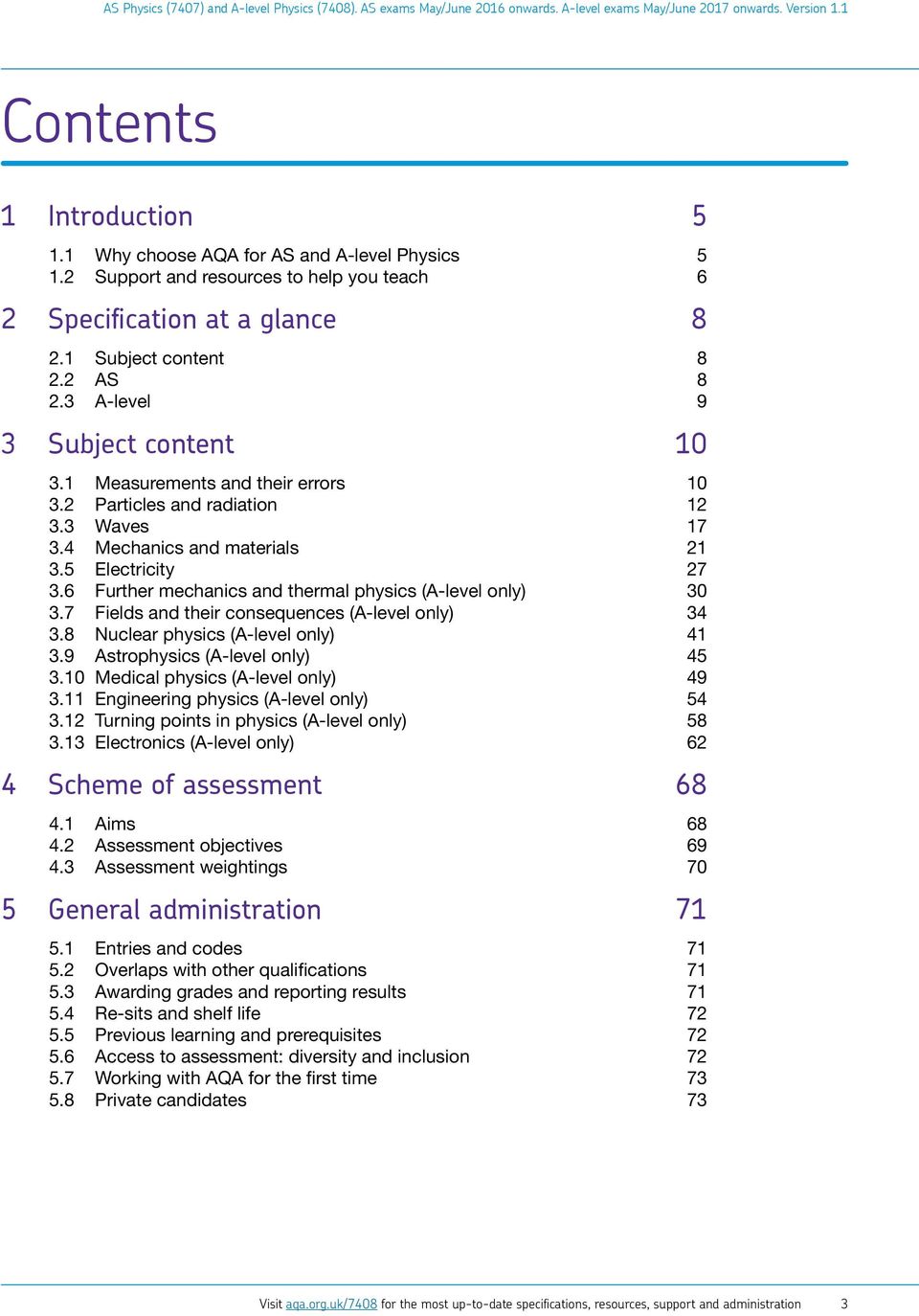
2 AS Physics (7407) and A-level Physics (7408). AS exams May/June 2016 onwards. A-level exams May/June 2017 onwards. Version 1.1 s 1 Introduction Why choose AQA for AS and A-level Physics Support and resources to help you teach 6 2 Specification at a glance Subject content AS A-level 9 3 Subject content Measurements and their errors Particles and radiation Waves Mechanics and materials Electricity Further mechanics and thermal physics (A-level only) Fields and their consequences (A-level only) Nuclear physics (A-level only) Astrophysics (A-level only) Medical physics (A-level only) Engineering physics (A-level only) Turning points in physics (A-level only) Electronics (A-level only) 62 4 Scheme of assessment Aims Assessment objectives Assessment weightings 70 5 General administration Entries and codes Overlaps with other qualifications Awarding grades and reporting results Re-sits and shelf life Previous learning and prerequisites Access to assessment: diversity and inclusion Working with AQA for the first time Private candidates 73 Visit aqa.org.uk/7408 for the most up-to-date specifications, resources, support and administration 3
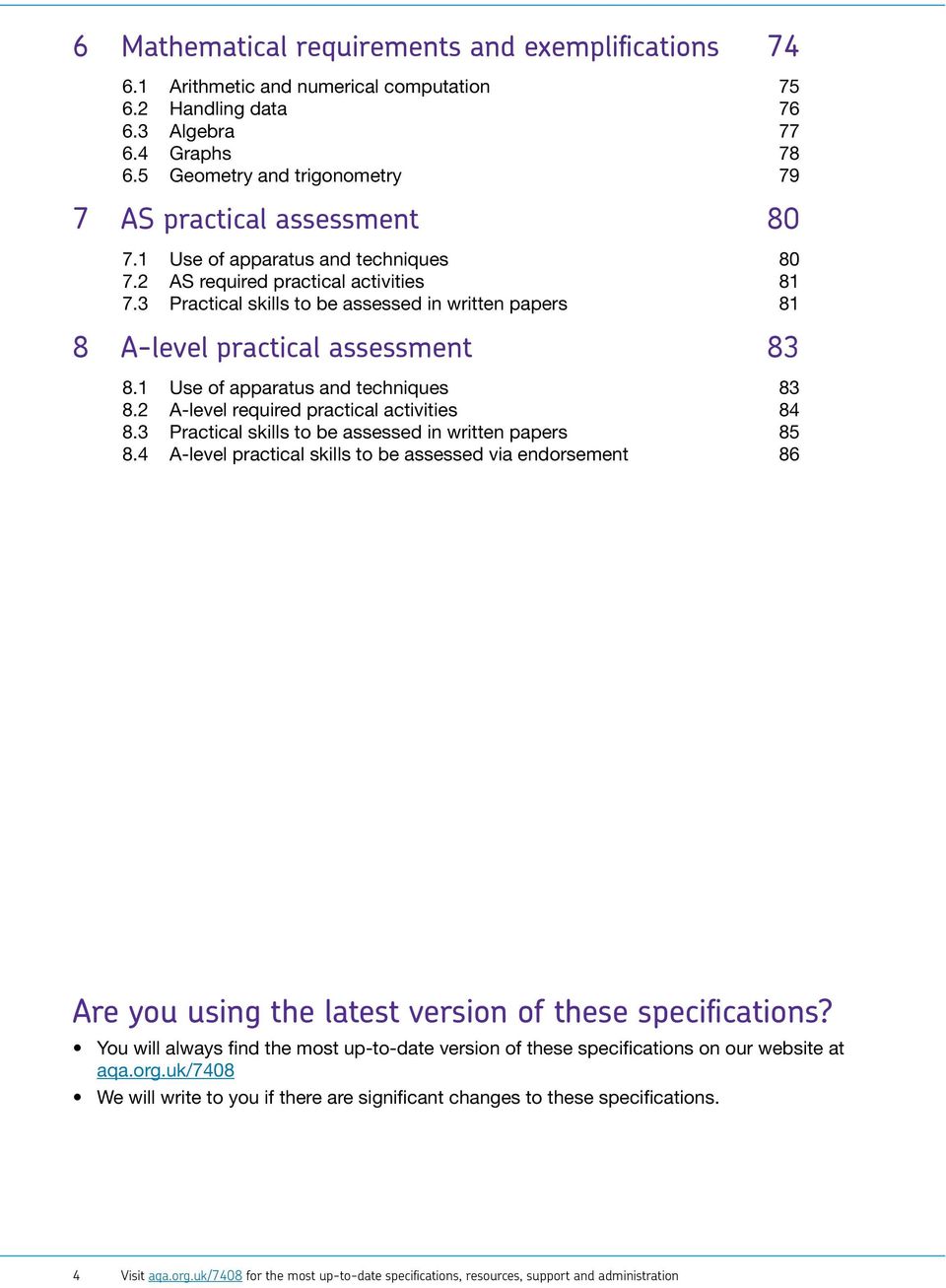
3 6 Mathematical requirements and exemplifications Arithmetic and numerical computation Handling data Algebra Graphs Geometry and trigonometry 79 7 AS practical assessment Use of apparatus and techniques AS required practical activities Practical skills to be assessed in written papers 81 8 A-level practical assessment Use of apparatus and techniques A-level required practical activities Practical skills to be assessed in written papers A-level practical skills to be assessed via endorsement 86 Are you using the latest version of these specifications? You will always find the most up-to-date version of these specifications on our website at aqa.org.uk/7408 We will write to you if there are significant changes to these specifications. 4 Visit aqa.org.uk/7408 for the most up-to-date specifications, resources, support and administration
4 AS Physics (7407) and A-level Physics (7408). AS exams May/June 2016 onwards. A-level exams May/June 2017 onwards. Version Introduction 1.1 Why choose AQA for AS and A-level Physics Relevant in the classroom and the real world We involved over a thousand teachers in developing these specifications, to ensure that the subject content is relevant to real world experiences and is interesting to teach and learn. We ve also presented it in a straightforward way, giving you the freedom to teach in the way that works for your students. These Physics specifications are a stepping stone to future study, which is why we also consulted universities, to ensure these specifications allow students to develop the skills that they want to see. This approach has led to specifications that will support you to inspire students, nurture a passion for physics and lay the groundwork for further study in science or engineering. The way you teach your choice Our specifications have been written in a context-free style. This means that you can select the contexts and applications that you feel bring the subject alive. We have also produced a range of excellent teaching resources that you can use alongside your own material. The AS and A-level courses allow for a choice of starting points. You can choose a familiar starting point for students, such as mechanics, or begin with fresh topics to create interest and a new dimension to their knowledge, such as particle physics. We ve provided five optional topics as part of the full A-level course so students can focus on their areas of interest: Astrophysics Medical physics Turning points in physics Engineering physics (re-branded Applied physics) Electronics. Practical at the heart of science Like you, we believe that Physics is fundamentally an experimental subject. These specifications provide numerous opportunities to use practical experiences to link theory to reality, and equip students with the essential practical skills they need. Teach AS and A-level together We ve ensured that the AS and A-level are fully co-teachable. The AS exams include similar questions to those in the A-level, with less difficulty. We ve created our A-level content with our GCSE in mind to make sure that there is a seamless progression between qualifications. We ve also followed ASE guidance on use of scientific terminology across our science subjects. Visit aqa.org.uk/7408 for the most up-to-date specifications, resources, support and administration 5

5 Assessment success We ve tested our specimen question papers with students, making sure they re interesting, straightforward and clear and hold no hidden surprises. To ensure that your students are rewarded for the physics skills and knowledge they ve developed, our exams include: specified content tested in each of the first two papers at A-level to help students prepare for their exams a variety of assessment styles within each paper so students can confidently engage with the questions multiple choice questions are included to allow for a wide breadth of Physics from the specifications to be tested. With us, your students will get the results they deserve, from the exam board you trust. You can find out about all our science qualifications at aqa.org.uk/science 1.2 Support and resources to help you teach We know that support and resources are vital for your teaching and that you have limited time to find or develop good quality materials. So we ve worked with experienced teachers to provide you with a range of resources that will help you confidently plan, teach and prepare for exams. Teaching resources We have too many Physics resources to list here so visit aqa.org.uk/7408 to see them all. They include: additional practice papers to help students prepare for exams guidance on how to plan both the AS and A-level courses with supporting schemes of work for co-teaching several AQA-approved student textbooks reviewed by experienced senior examiners guidance on maths skills requirements with additional support via Exampro resources to support key topics (including the optional topics), with detailed lesson plans written by experienced teachers training courses to help you deliver AQA Physics qualifications subject expertise courses for all teachers, from newly-qualified teachers who are just getting started to experienced teachers looking for fresh inspiration. Preparing for exams Visit aqa.org.uk/7408 for everything you need to prepare for our exams, including: past papers, mark schemes and examiners reports specimen papers and mark schemes for new courses Exampro: a searchable bank of past AQA exam questions exemplar student answers with examiner commentaries. 6 Visit aqa.org.uk/7408 for the most up-to-date specifications, resources, support and administration

6 AS Physics (7407) and A-level Physics (7408). AS exams May/June 2016 onwards. A-level exams May/June 2017 onwards. Version 1.1 Analyse your students' results with Enhanced Results Analysis (ERA) Find out which questions were the most challenging, how the results compare to previous years and where your students need to improve. ERA, our free online results analysis tool, will help you see where to focus your teaching. Register at aqa.org.uk/era For information about results, including maintaining standards over time, grade boundaries and our post-results services, visit aqa.org.uk/results Keep your skills up to date with professional Wherever you are in your career, there s always something new to learn. As well as subject-specific training, we offer a range of courses to help boost your skills. Improve your teaching skills in areas including differentiation, teaching literacy and meeting Ofsted requirements. Prepare for a new role with our leadership and management courses. You can attend a course at venues around the country, in your school or online whatever suits your needs and availability. Find out more at coursesandevents.aqa.org.uk Get help and support Visit our website for information, guidance, support and resources at aqa.org.uk/7408 You can talk directly to the Physics subject team E: [email protected] T: Visit aqa.org.uk/7408 for the most up-to-date specifications, resources, support and administration 7

7 2 Specification at a glance These qualifications are linear. Linear means that students will sit all the AS exams at the end of their AS course and all the A-level exams at the end of their A-level course. 2.1 Subject content Core content 1 Measurements and their errors (page 10) 2 Particles and radiation (page 12) 3 Waves (page 17) 4 Mechanics and materials (page 21) 5 Electricity (page 27) 6 Further mechanics and thermal physics (A-level only) (page 30) Options 9 Astrophysics (A-level only) (page 45) 10 Medical physics (A-level only) (page 49) 11 Engineering physics (A-level only) (page 54) 12 Turning points in physics (A-level only) (page 58) 13 Electronics (A-level only) (page 62) 7 Fields and their consequences (A-level only) (page 34) 8 Nuclear physics (A-level only) (page 41) 2.2 AS Assessments Paper 1 What's assessed Sections 1 5 Assessed written exam: 1 hour 30 minutes 70 marks 50% of AS Questions 70 marks of short and long answer questions split by topic. + Paper 2 What's assessed Sections 1 5 Assessed written exam: 1 hour 30 minutes 70 marks 50% of AS Questions Section A: 20 marks of short and long answer questions on practical skills and data analysis Section B: 20 marks of short and long answer questions from across all areas of AS content Section C: 30 multiple choice questions 8 Visit aqa.org.uk/7408 for the most up-to-date specifications, resources, support and administration

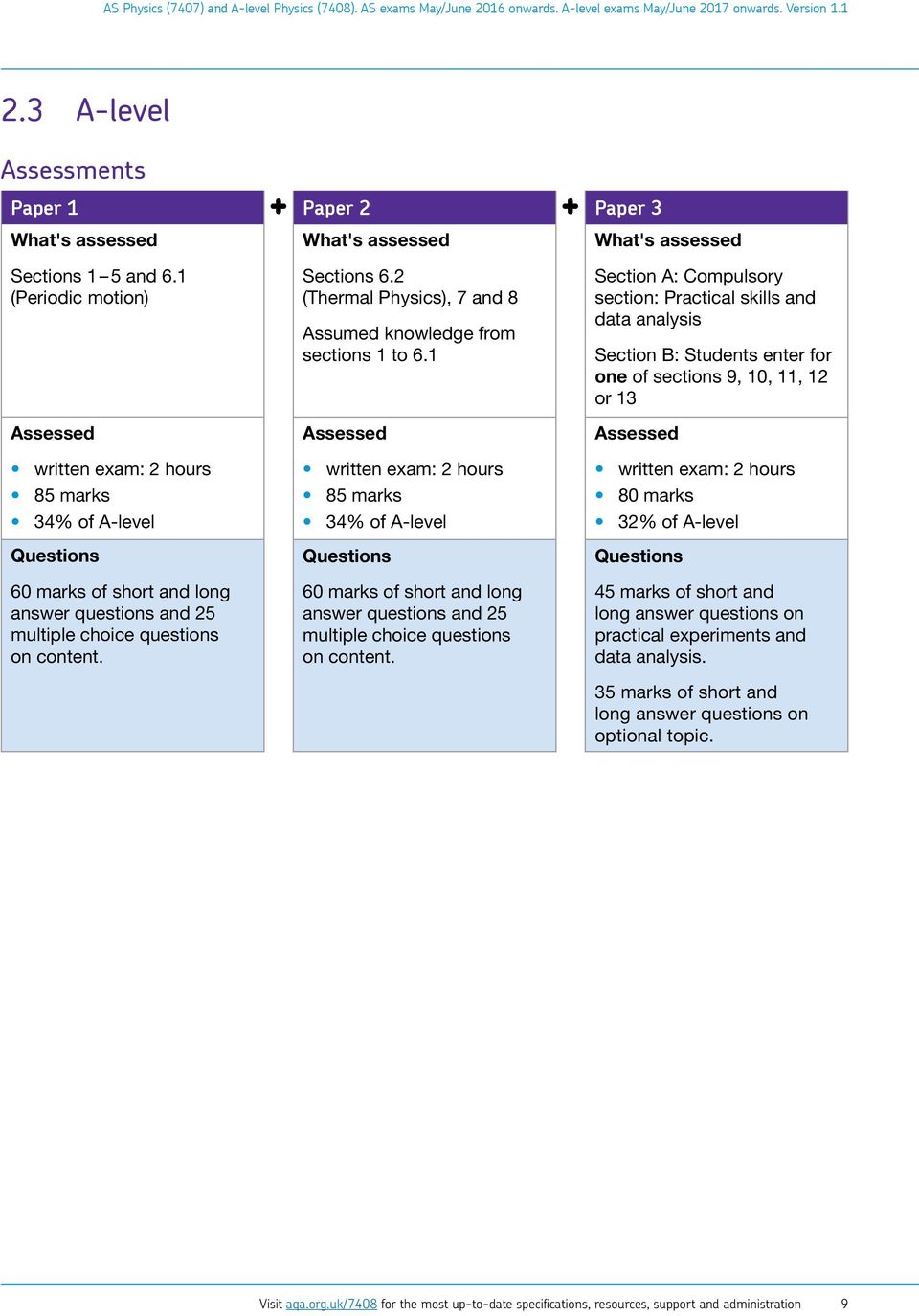
8 AS Physics (7407) and A-level Physics (7408). AS exams May/June 2016 onwards. A-level exams May/June 2017 onwards. Version A-level Assessments Paper 1 What's assessed Sections 1 5 and 6.1 (Periodic motion) Assessed written exam: 2 hours 85 marks 34% of A-level Questions 60 marks of short and long answer questions and 25 multiple choice questions on content. + Paper 2 + What's assessed Sections 6.2 (Thermal Physics), 7 and 8 Assumed knowledge from sections 1 to 6.1 Assessed written exam: 2 hours 85 marks 34% of A-level Questions 60 marks of short and long answer questions and 25 multiple choice questions on content. Paper 3 What's assessed Section A: Compulsory section: Practical skills and data analysis Section B: Students enter for one of sections 9, 10, 11, 12 or 13 Assessed written exam: 2 hours 80 marks 32% of A-level Questions 45 marks of short and long answer questions on practical experiments and data analysis. 35 marks of short and long answer questions on optional topic. Visit aqa.org.uk/7408 for the most up-to-date specifications, resources, support and administration 9
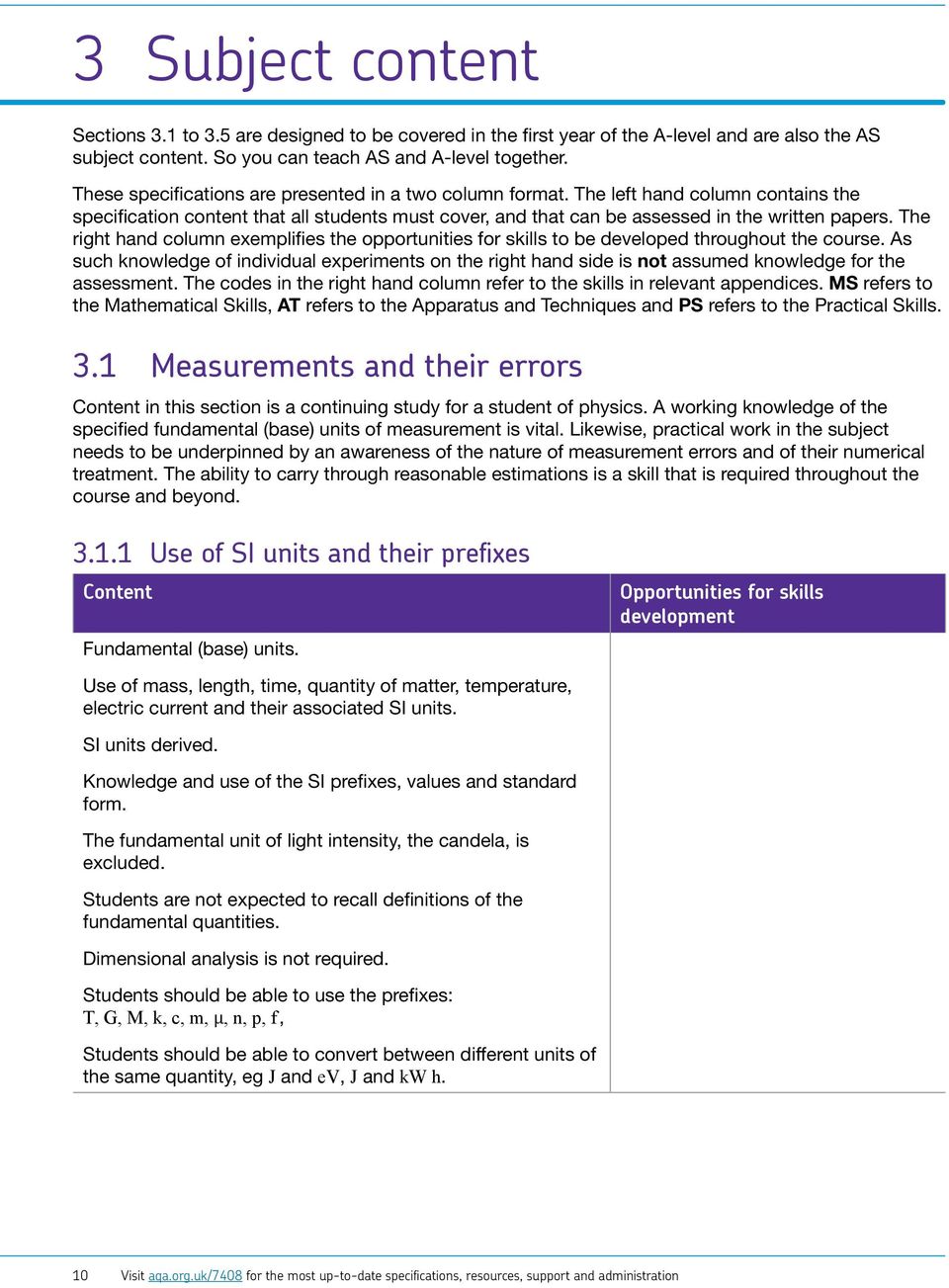
9 3 Subject content Sections 3.1 to 3.5 are designed to be covered in the first year of the A-level and are also the AS subject content. So you can teach AS and A-level together. These specifications are presented in a two column format. The left hand column contains the specification content that all students must cover, and that can be assessed in the written papers. The right hand column exemplifies the opportunities for skills to be developed throughout the course. As such knowledge of individual experiments on the right hand side is not assumed knowledge for the assessment. The codes in the right hand column refer to the skills in relevant appendices. MS refers to the Mathematical Skills, AT refers to the Apparatus and Techniques and PS refers to the Practical Skills. 3.1 Measurements and their errors in this section is a continuing study for a student of physics. A working knowledge of the specified fundamental (base) units of measurement is vital. Likewise, practical work in the subject needs to be underpinned by an awareness of the nature of measurement errors and of their numerical treatment. The ability to carry through reasonable estimations is a skill that is required throughout the course and beyond Use of SI units and their prefixes Fundamental (base) units. Use of mass, length, time, quantity of matter, temperature, electric current and their associated SI units. SI units derived. Knowledge and use of the SI prefixes, values and standard form. The fundamental unit of light intensity, the candela, is excluded. Students are not expected to recall definitions of the fundamental quantities. Dimensional analysis is not required. Students should be able to use the prefixes: T, G, M, k, c, m, μ, n, p, f, Students should be able to convert between different units of the same quantity, eg J and ev, J and kw h. 10 Visit aqa.org.uk/7408 for the most up-to-date specifications, resources, support and administration
10 AS Physics (7407) and A-level Physics (7408). AS exams May/June 2016 onwards. A-level exams May/June 2017 onwards. Version Limitation of physical measurements Random and systematic errors. Precision, repeatability, reproducibility, resolution and accuracy. Uncertainty: Absolute, fractional and percentage uncertainties represent uncertainty in the final answer for a quantity. Combination of absolute and percentage uncertainties. Represent uncertainty in a data point on a graph using error bars. Determine the uncertainties in the gradient and intercept of a straight-line graph. Individual points on the graph may or may not have associated error bars Estimation of physical quantities Orders of magnitude. Estimation of approximate values of physical quantities. PS 2.3 Students should be able to identify random and systematic errors and suggest ways to reduce or remove them. PS 3.3 Students should understand the link between the number of significant figures in the value of a quantity and its associated uncertainty. MS 1.5 Students should be able to combine uncertainties in cases where the measurements that give rise to the uncertainties are added, subtracted, multiplied, divided, or raised to powers. Combinations involving trigonometric or logarithmic functions will not be required. MS 1.4 Students should be able to estimate approximate values of physical quantities to the nearest order of magnitude. Students should be able to use these estimates together with their knowledge of physics to produce further derived estimates also to the nearest order of magnitude. Visit aqa.org.uk/7408 for the most up-to-date specifications, resources, support and administration 11

11 3.2 Particles and radiation This section introduces students both to the fundamental properties of matter, and to electromagnetic radiation and quantum phenomena. Teachers may wish to begin with this topic to provide a new interest and knowledge dimension beyond GCSE. Through a study of these topics, students become aware of the way ideas develop and evolve in physics. They will appreciate the importance of international collaboration in the of new experiments and theories in this area of fundamental research Particles Constituents of the atom Simple model of the atom, including the proton, neutron and electron. Charge and mass of the proton, neutron and electron in SI units and relative units. The atomic mass unit (amu) is included in the A-level Nuclear physics section. Specific charge of the proton and the electron, and of nuclei and ions. Proton number Z, nucleon number A, nuclide notation. A Students should be familiar with the Z X notation. Meaning of isotopes and the use of isotopic data Stable and unstable nuclei The strong nuclear force; its role in keeping the nucleus stable; short-range attraction up to approximately 3 fm, very-short range repulsion closer than approximately 0.5 fm. Unstable nuclei; alpha and beta decay. Equations for alpha decay, β decay including the need for the neutrino. The existence of the neutrino was hypothesised to account for conservation of energy in beta decay. AT i Demonstration of the range of alpha particles using a cloud chamber, spark counter or Geiger counter. MS 0.2 Use of prefixes for small and large distance measurements. 12 Visit aqa.org.uk/7408 for the most up-to-date specifications, resources, support and administration

12 AS Physics (7407) and A-level Physics (7408). AS exams May/June 2016 onwards. A-level exams May/June 2017 onwards. Version Particles, antiparticles and photons For every type of particle, there is a corresponding antiparticle. Comparison of particle and antiparticle masses, charge and rest energy in MeV. Students should know that the positron, antiproton, antineutron and antineutrino are the antiparticles of the electron, proton, neutron and neutrino respectively. Photon model of electromagnetic radiation, the Planck constant. E = hf = hc AT i Detection of gamma radiation. MS 1.1, 2.2 Students could determine the frequency and wavelength of the two gamma photons produced when a slow electron and a slow positron annihilate each other. The PET scanner could be used as an application of annihilation. Knowledge of annihilation and pair production and the energies involved. The use of E = mc 2 is not required in calculations Particle interactions Four fundamental interactions: gravity, electromagnetic, weak nuclear, strong nuclear. (The strong nuclear force may be referred to as the strong interaction.) The concept of exchange particles to explain forces between elementary particles. PS 1.2 Momentum transfer of a heavy ball thrown from one person to another. Knowledge of the gluon, Z 0 and graviton will not be tested. The electromagnetic force; virtual photons as the exchange particle. The weak interaction limited to β and β + decay, electron capture and electron proton collisions; W + and W as the exchange particles. Simple diagrams to represent the above reactions or interactions in terms of incoming and outgoing particles and exchange particles. Visit aqa.org.uk/7408 for the most up-to-date specifications, resources, support and administration 13

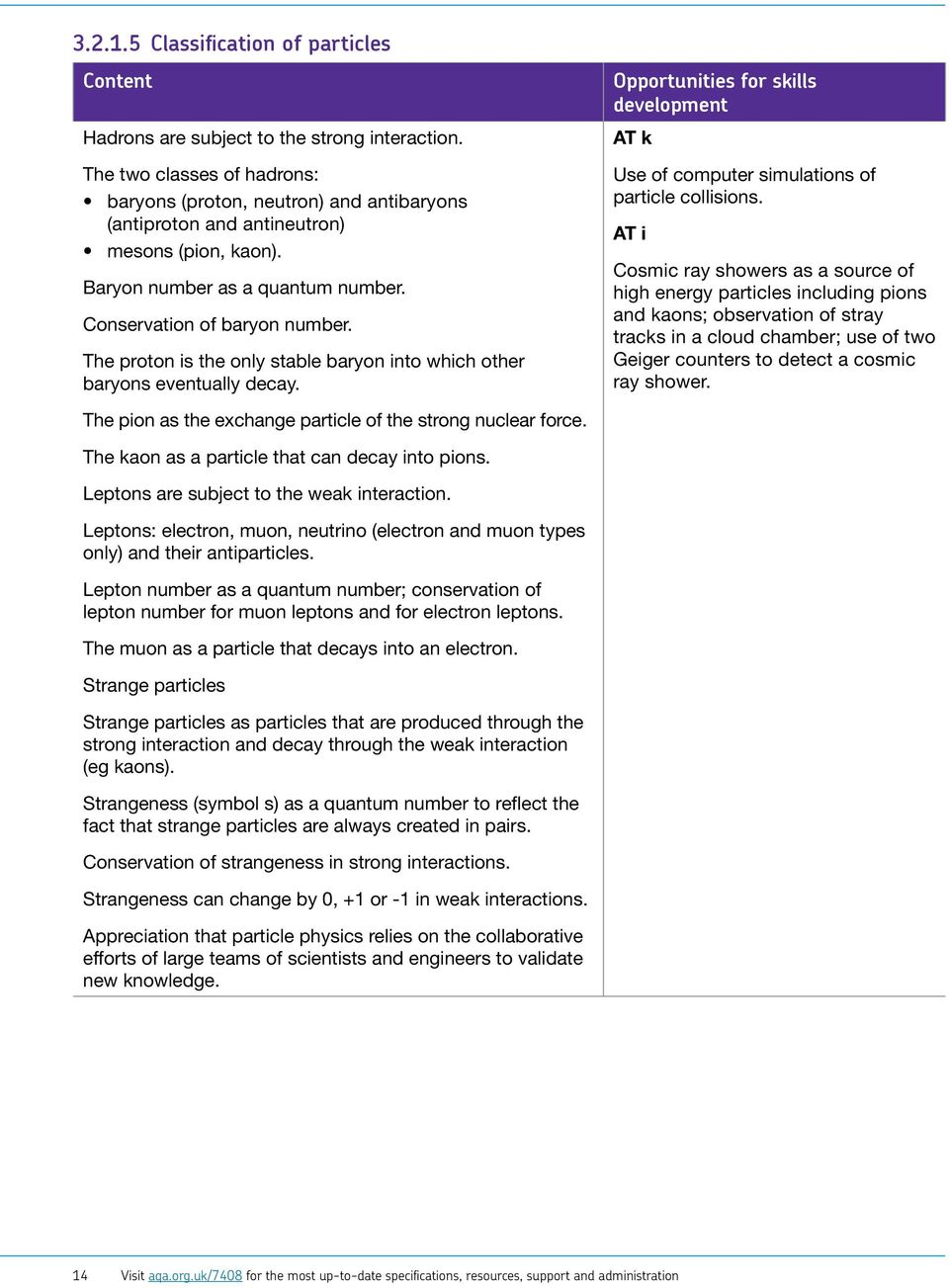
13 Classification of particles Hadrons are subject to the strong interaction. The two classes of hadrons: baryons (proton, neutron) and antibaryons (antiproton and antineutron) mesons (pion, kaon). Baryon number as a quantum number. Conservation of baryon number. The proton is the only stable baryon into which other baryons eventually decay. AT k Use of computer simulations of particle collisions. AT i Cosmic ray showers as a source of high energy particles including pions and kaons; observation of stray tracks in a cloud chamber; use of two Geiger counters to detect a cosmic ray shower. The pion as the exchange particle of the strong nuclear force. The kaon as a particle that can decay into pions. Leptons are subject to the weak interaction. Leptons: electron, muon, neutrino (electron and muon types only) and their antiparticles. Lepton number as a quantum number; conservation of lepton number for muon leptons and for electron leptons. The muon as a particle that decays into an electron. Strange particles Strange particles as particles that are produced through the strong interaction and decay through the weak interaction (eg kaons). Strangeness (symbol s) as a quantum number to reflect the fact that strange particles are always created in pairs. Conservation of strangeness in strong interactions. Strangeness can change by 0, +1 or -1 in weak interactions. Appreciation that particle physics relies on the collaborative efforts of large teams of scientists and engineers to validate new knowledge. 14 Visit aqa.org.uk/7408 for the most up-to-date specifications, resources, support and administration
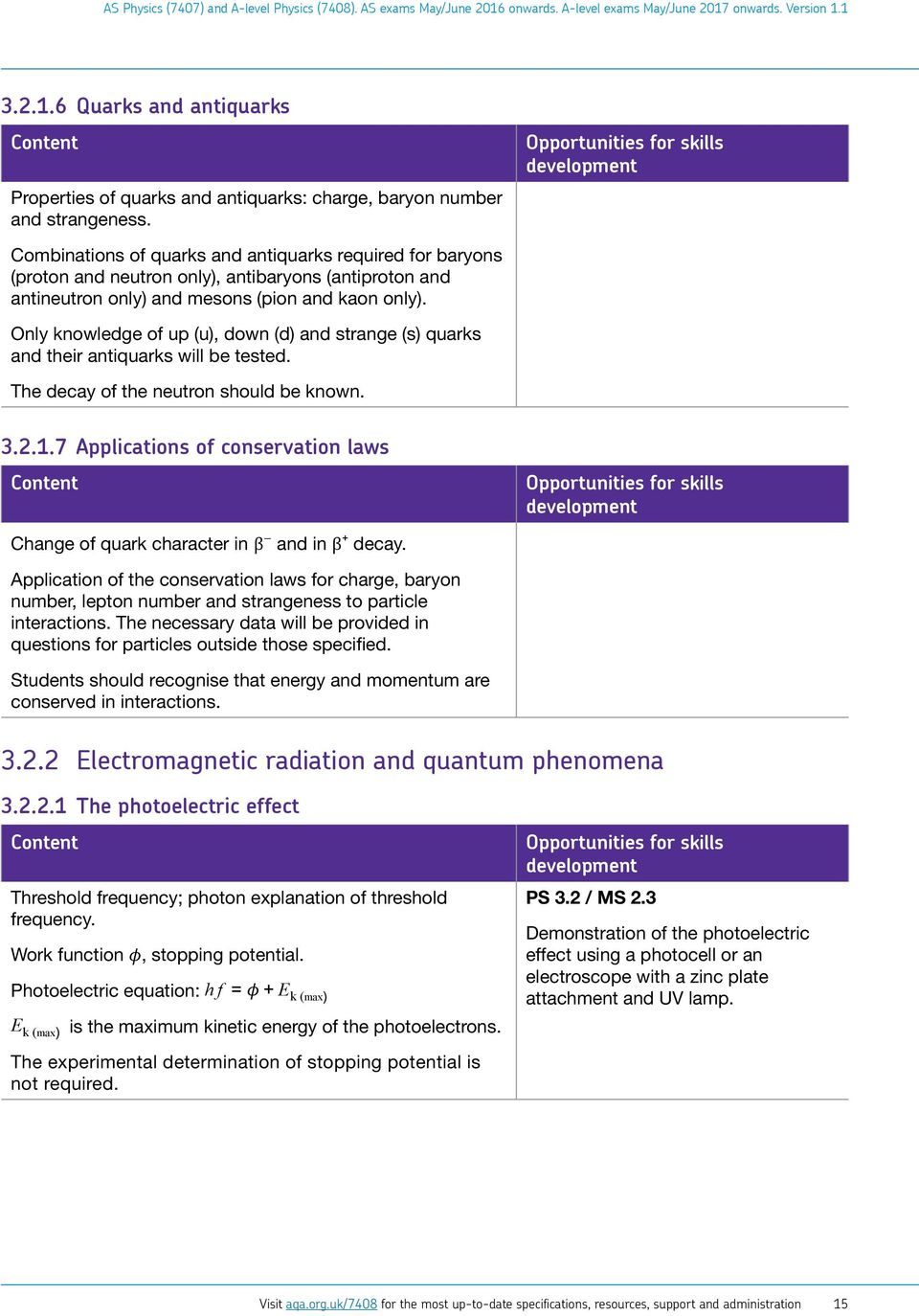
14 AS Physics (7407) and A-level Physics (7408). AS exams May/June 2016 onwards. A-level exams May/June 2017 onwards. Version Quarks and antiquarks Properties of quarks and antiquarks: charge, baryon number and strangeness. Combinations of quarks and antiquarks required for baryons (proton and neutron only), antibaryons (antiproton and antineutron only) and mesons (pion and kaon only). Only knowledge of up (u), down (d) and strange (s) quarks and their antiquarks will be tested. The decay of the neutron should be known Applications of conservation laws Change of quark character in β and in β + decay. Application of the conservation laws for charge, baryon number, lepton number and strangeness to particle interactions. The necessary data will be provided in questions for particles outside those specified. Students should recognise that energy and momentum are conserved in interactions Electromagnetic radiation and quantum phenomena The photoelectric effect Threshold frequency; photon explanation of threshold frequency. Work function, stopping potential. Photoelectric equation: hf = + E k (max E k (max is the maximum kinetic energy of the photoelectrons. PS 3.2 / MS 2.3 Demonstration of the photoelectric effect using a photocell or an electroscope with a zinc plate attachment and UV lamp. The experimental determination of stopping potential is not required. Visit aqa.org.uk/7408 for the most up-to-date specifications, resources, support and administration 15
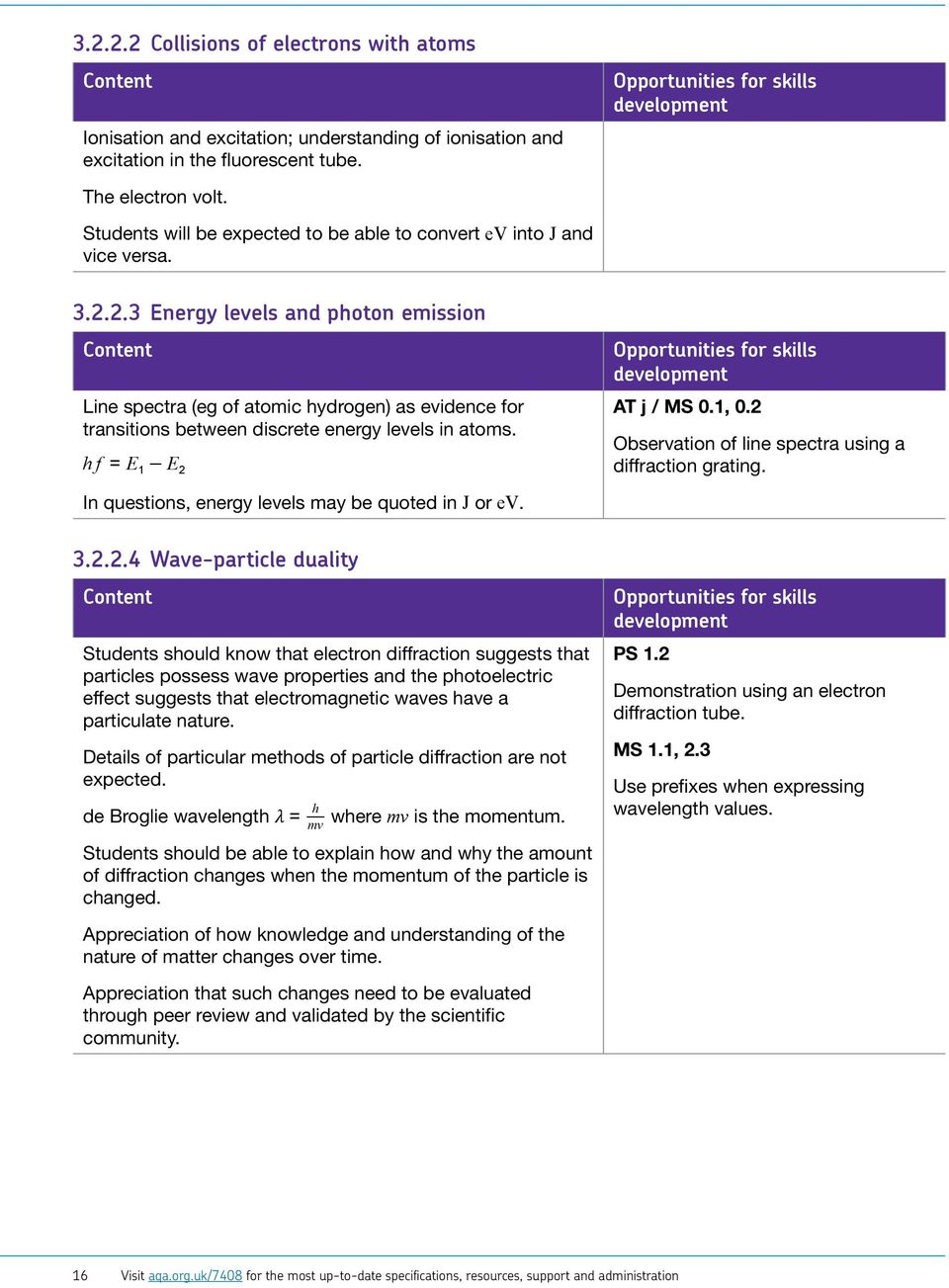
15 Collisions of electrons with atoms Ionisation and excitation; understanding of ionisation and excitation in the fluorescent tube. The electron volt. Students will be expected to be able to convert ev into J and vice versa Energy levels and photon emission Line spectra (eg of atomic hydrogen) as evidence for transitions between discrete energy levels in atoms. hf = E 1 E 2 AT j / MS 0.1, 0.2 Observation of line spectra using a diffraction grating. In questions, energy levels may be quoted in J or ev Wave-particle duality Students should know that electron diffraction suggests that particles possess wave properties and the photoelectric effect suggests that electromagnetic waves have a particulate nature. Details of particular methods of particle diffraction are not expected. de Broglie wavelength = h mv where mv is the momentum. PS 1.2 Demonstration using an electron diffraction tube. MS 1.1, 2.3 Use prefixes when expressing wavelength values. Students should be able to explain how and why the amount of diffraction changes when the momentum of the particle is changed. Appreciation of how knowledge and understanding of the nature of matter changes over time. Appreciation that such changes need to be evaluated through peer review and validated by the scientific community. 16 Visit aqa.org.uk/7408 for the most up-to-date specifications, resources, support and administration
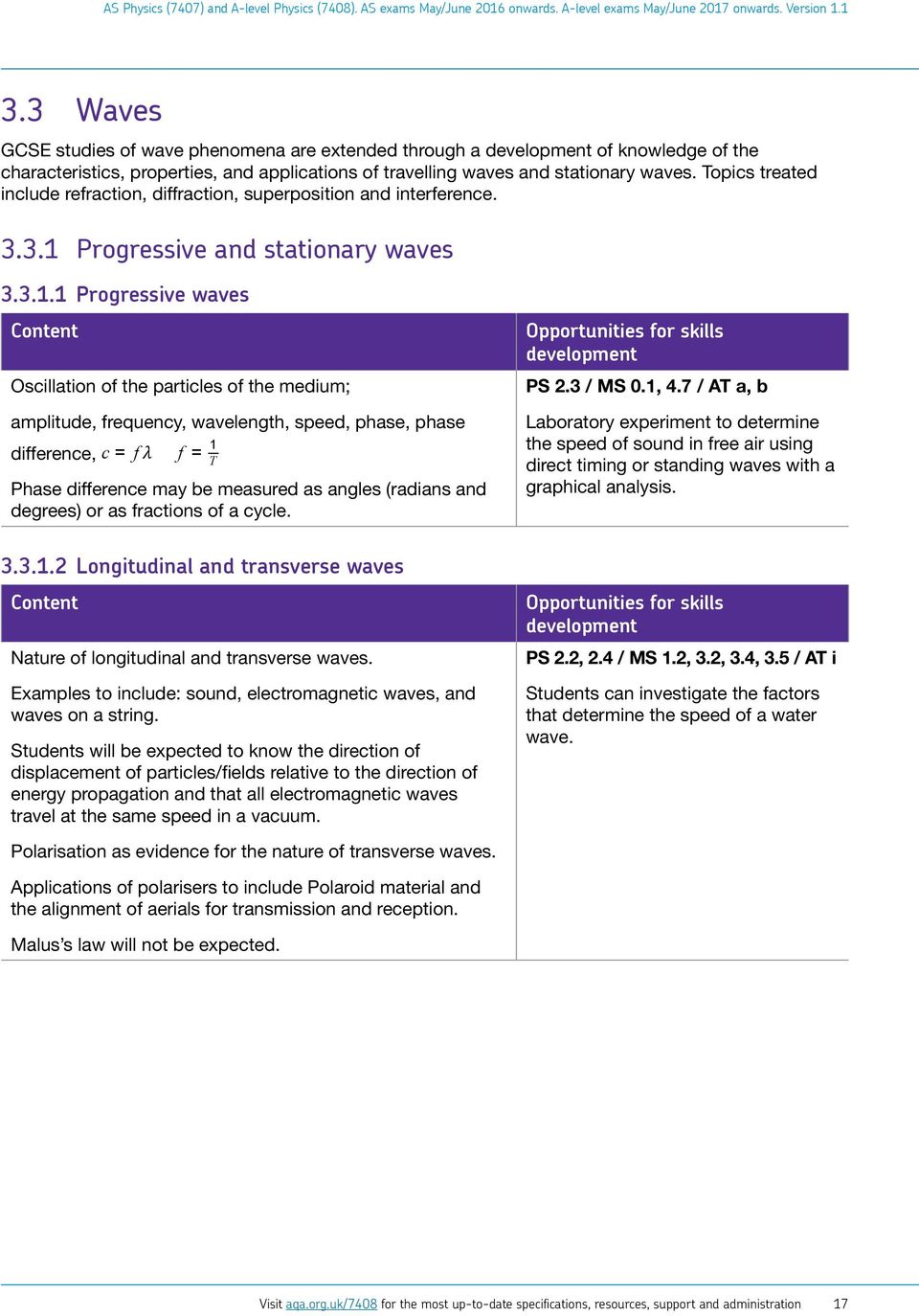
16 AS Physics (7407) and A-level Physics (7408). AS exams May/June 2016 onwards. A-level exams May/June 2017 onwards. Version Waves GCSE studies of wave phenomena are extended through a of knowledge of the characteristics, properties, and applications of travelling waves and stationary waves. Topics treated include refraction, diffraction, superposition and interference Progressive and stationary waves Progressive waves Oscillation of the particles of the medium; amplitude, frequency, wavelength, speed, phase, phase difference, c = f f = 1 T Phase difference may be measured as angles (radians and degrees) or as fractions of a cycle. PS 2.3 / MS 0.1, 4.7 / AT a, b Laboratory experiment to determine the speed of sound in free air using direct timing or standing waves with a graphical analysis Longitudinal and transverse waves Nature of longitudinal and transverse waves. Examples to include: sound, electromagnetic waves, and waves on a string. Students will be expected to know the direction of displacement of particles/fields relative to the direction of energy propagation and that all electromagnetic waves travel at the same speed in a vacuum. PS 2.2, 2.4 / MS 1.2, 3.2, 3.4, 3.5 / AT i Students can investigate the factors that determine the speed of a water wave. Polarisation as evidence for the nature of transverse waves. Applications of polarisers to include Polaroid material and the alignment of aerials for transmission and reception. Malus s law will not be expected. Visit aqa.org.uk/7408 for the most up-to-date specifications, resources, support and administration 17
17 Principle of superposition of waves and formation of stationary waves Stationary waves. MS 4.7 / PS 1.2, 2.1 / AT i Nodes and antinodes on strings. f = 1 2l T for first harmonic. The formation of stationary waves by two waves of the same frequency travelling in opposite directions. Students can investigate the factors that determine the frequency of stationary wave patterns of a stretched string. A graphical explanation of formation of stationary waves will be expected. Stationary waves formed on a string and those produced with microwaves and sound waves should be considered. Stationary waves on strings will be described in terms of harmonics. The terms fundamental (for first harmonic) and overtone will not be used. Required practical 1: Investigation into the variation of the frequency of stationary waves on a string with length, tension and mass per unit length of the string. 18 Visit aqa.org.uk/7408 for the most up-to-date specifications, resources, support and administration

18 AS Physics (7407) and A-level Physics (7408). AS exams May/June 2016 onwards. A-level exams May/June 2017 onwards. Version Refraction, diffraction and interference Interference Path difference. Coherence. Interference and diffraction using a laser as a source of monochromatic light. Young s double-slit experiment: the use of two coherent sources or the use of a single source with double slits to produce an interference pattern. AT i Investigation of two-source interference with sound, light and microwave radiation. Fringe spacing, w = D s Production of interference pattern using white light. Students are expected to show awareness of safety issues associated with using lasers. Students will not be required to describe how a laser works. Students will be expected to describe and explain interference produced with sound and electromagnetic waves. Appreciation of how knowledge and understanding of nature of electromagnetic radiation has changed over time. Required practical 2: Investigation of interference effects to include the Young s slit experiment and interference by a diffraction grating Diffraction Appearance of the diffraction pattern from a single slit using monochromatic and white light. Qualitative treatment of the variation of the width of the central diffraction maximum with wavelength and slit width. The graph of intensity against angular separation is not required. Plane transmission diffraction grating at normal incidence. Derivation of dsin = n Use of the spectrometer will not be tested. Applications of diffraction gratings. Visit aqa.org.uk/7408 for the most up-to-date specifications, resources, support and administration 19
19 Refraction at a plane surface MS 0.6, 4.1 Refractive index of a substance, n = c c s Students should recall that the refractive index of air is approximately 1. Snell s law of refraction for a boundary n 1 sin 1 = n 2 sin 2 Total internal reflection sin c = n 2 n 1 Simple treatment of fibre optics including the function of the cladding. Optical fibres will be limited to step index only. Material and modal dispersion. Students are expected to understand the principles and consequences of pulse broadening and absorption. 20 Visit aqa.org.uk/7408 for the most up-to-date specifications, resources, support and administration

20 AS Physics (7407) and A-level Physics (7408). AS exams May/June 2016 onwards. A-level exams May/June 2017 onwards. Version Mechanics and materials Vectors and their treatment are introduced followed by of the student s knowledge and understanding of forces, energy and momentum. The section continues with a study of materials considered in terms of their bulk properties and tensile strength. As with earlier topics, this section and also the following section Electricity would provide a good starting point for students who prefer to begin by consolidating work Force, energy and momentum Scalars and vectors Nature of scalars and vectors. Examples should include: velocity/speed, mass, force/weight, acceleration, displacement/distance. MS 0.6, 4.2, 4.4, 4.5 / PS 1.1 Investigation of the conditions for equilibrium for three coplanar forces acting at a point using a force board. Addition of vectors by calculation or scale drawing. Calculations will be limited to two vectors at right angles. Scale drawings may involve vectors at angles other than 90. Resolution of vectors into two components at right angles to each other. Examples should include components of forces along and perpendicular to an inclined plane. Problems may be solved either by the use of resolved forces or the use of a closed triangle. Conditions for equilibrium for two or three coplanar forces acting at a point. Appreciation of the meaning of equilibrium in the context of an object at rest or moving with constant velocity. Visit aqa.org.uk/7408 for the most up-to-date specifications, resources, support and administration 21

21 Moments Moment of a force about a point. Moment defined as force perpendicular distance from the point to the line of action of the force. Couple as a pair of equal and opposite coplanar forces. Moment of couple defined as force perpendicular distance between the lines of action of the forces. Principle of moments. Centre of mass. Knowledge that the position of the centre of mass of uniform regular solid is at its centre. 22 Visit aqa.org.uk/7408 for the most up-to-date specifications, resources, support and administration
22 AS Physics (7407) and A-level Physics (7408). AS exams May/June 2016 onwards. A-level exams May/June 2017 onwards. Version Motion along a straight line Displacement, speed, velocity, acceleration. v = s t a = v t Calculations may include average and instantaneous speeds and velocities. Representation by graphical methods of uniform and nonuniform acceleration. Significance of areas of velocity time and acceleration time graphs and gradients of displacement time and velocity time graphs for uniform and non-uniform acceleration eg graphs for motion of bouncing ball. MS 3.6, 3.7 / PS 1.1, 3.1 Distinguish between instantaneous velocity and average velocity. MS 3.5, 3.6 Measurements and calculations from displacement time, velocity time and acceleration time graphs. MS 0.5, 2.2, 2.3, 2.4 Calculations involving motion in a straight line. Equations for uniform acceleration: v = u + at s = u + v 2 t s = ut + at2 2 v 2 = u 2 +2as Acceleration due to gravity, g. Required practical 3: Determination of g by a freefall method. MS 0.3, 1.2, 3.7 / AT d Students should be able to identify random and systematic errors in the experiment and suggest ways to remove them. MS 3.9 Determine g from a graph. Visit aqa.org.uk/7408 for the most up-to-date specifications, resources, support and administration 23
23 Projectile motion Independent effect of motion in horizontal and vertical directions of a uniform gravitational field. Problems will be solvable using the equations of uniform acceleration. Qualitative treatment of friction. PS 2.2, 3.1 Investigation of the factors that determine the motion of an object through a fluid. Distinctions between static and dynamic friction will not be tested. Qualitative treatment of lift and drag forces. Terminal speed. Knowledge that air resistance increases with speed. Qualitative understanding of the effect of air resistance on the trajectory of a projectile and on the factors that affect the maximum speed of a vehicle Newton s laws of motion Knowledge and application of the three laws of motion in appropriate situations. F = ma for situations where the mass is constant. PS 4.1 / MS 0.5, 3.2 / AT a, b, d Students can verify Newton s second law of motion. MS 4.1, 4.2 Students can use free-body diagrams. 24 Visit aqa.org.uk/7408 for the most up-to-date specifications, resources, support and administration
24 AS Physics (7407) and A-level Physics (7408). AS exams May/June 2016 onwards. A-level exams May/June 2017 onwards. Version Momentum momentum = mass velocity Conservation of linear momentum. Principle applied quantitatively to problems in one dimension. MS 2.2, 2.3 Students can apply conservation of momentum and rate of change of momentum to a range of examples. Force as the rate of change of momentum, F = mv t Impulse = change in momentum F t = mv, where F is constant. Significance of the area under a force time graph. Quantitative questions may be set on forces that vary with time. Impact forces are related to contact times (eg kicking a football, crumple zones, packaging). Elastic and inelastic collisions; explosions. Appreciation of momentum conservation issues in the context of ethical transport design Work, energy and power Energy transferred, W = Fscos rate of doing work = rate of energy transfer, P = W t = Fv Quantitative questions may be set on variable forces. Significance of the area under a force displacement graph. efficiency = useful output power input power MS 0.3 / PS 3.3, 4.1 / AT a, b, f. Investigate the efficiency of an electric motor being used to raise a mass through a measured height. Students should be able to identify random and systematic errors in the experiment and suggest ways to remove them. Efficiency can be expressed as a percentage Conservation of energy Principle of conservation of energy. E p = mg h and E k = 1 2 mv2 Quantitative and qualitative application of energy conservation to examples involving gravitational potential energy, kinetic energy, and work done against resistive forces. MS 0.4, 2.2 Estimate the energy that can be derived from food consumption. Visit aqa.org.uk/7408 for the most up-to-date specifications, resources, support and administration 25
25 3.4.2 Materials Bulk properties of solids Density, = m V Hooke s law, elastic limit, F = k L, k as stiffness and spring constant. Tensile strain and tensile stress. Elastic strain energy, breaking stress. energy stored = 1 2 F L = area under force extension graph MS 0.2, 4.3 / PS 3.3, 4.1 Students can compare the use of analogue and digital meters. MS 0.4, 4.3 / AT e Estimate the volume of an object leading to an estimate of its density. Description of plastic behaviour, fracture and brittle behaviour linked to force extension graphs. Quantitative and qualitative application of energy conservation to examples involving elastic strain energy and energy to deform. Spring energy transformed to kinetic and gravitational potential energy. Interpretation of simple stress strain curves. Appreciation of energy conservation issues in the context of ethical transport design The Young modulus Young modulus = tensile stress tensile strain = FL A L MS 3.1 Use of stress strain graphs to find the Young modulus. (One simple method of measurement is required.) Required practical 4: Determination of the Young modulus by a simple method. 26 Visit aqa.org.uk/7408 for the most up-to-date specifications, resources, support and administration
26 AS Physics (7407) and A-level Physics (7408). AS exams May/June 2016 onwards. A-level exams May/June 2017 onwards. Version Electricity This section builds on and develops earlier study of these phenomena from GCSE. It provides opportunities for the of practical skills at an early stage in the course and lays the groundwork for later study of the many electrical applications that are important to society Current electricity Basics of electricity Electric current as the rate of flow of charge; potential difference as work done per unit charge. I = Q t, V = W Q AT b, f Students can construct circuits from the range of components. Resistance defined as R = V I Current voltage characteristics For an ohmic conductor, semiconductor diode, and filament lamp. Ohm s law as a special case where I V under constant physical conditions. Unless specifically stated in questions, ammeters and voltmeters should be treated as ideal (having zero and infinite resistance respectively). Questions can be set where either I or V is on the horizontal axis of the characteristic graph. Visit aqa.org.uk/7408 for the most up-to-date specifications, resources, support and administration 27
27 Resistivity Resistivity, = RA L Description of the qualitative effect of temperature on the resistance of metal conductors and thermistors. Only negative temperature coefficient (ntc) thermistors will be considered. MS 3.2, 4.3 / PS 1.2 / AT a, b, f, g Investigation of the variation of resistance of a thermistor with temperature. Applications of thermistors to include temperature sensors and resistance temperature graphs. Superconductivity as a property of certain materials which have zero resistivity at and below a critical temperature which depends on the material. Applications of superconductors to include the production of strong magnetic fields and the reduction of energy loss in transmission of electric power. Critical field will not be assessed. Required practical 5: Determination of resistivity of a wire using a micrometer, ammeter and voltmeter Circuits Resistors: in series, R T = R 1 + R 2 + R 3 + in parallel, 1 R = 1 T R R R + 3 Energy and power equations: E = IVt; P = IV = I 2 R = V 2 R MS 0.3 / PS 4.1 / AT a, b, f, g Students can construct circuits with various component configurations and measure currents and potential differences. The relationships between currents, voltages and resistances in series and parallel circuits, including cells in series and identical cells in parallel. Conservation of charge and conservation of energy in dc circuits. 28 Visit aqa.org.uk/7408 for the most up-to-date specifications, resources, support and administration
28 AS Physics (7407) and A-level Physics (7408). AS exams May/June 2016 onwards. A-level exams May/June 2017 onwards. Version Potential divider The potential divider used to supply constant or variable potential difference from a power supply. The use of the potentiometer as a measuring instrument is not required. Examples should include the use of variable resistors, thermistors, and light dependent resistors (LDR) in the potential divider Electromotive force and internal resistance MS 3.2 / PS 4.1 / AT f Students can investigate the behaviour of a potential divider circuit. MS 3.2 / AT g Students should design and construct potential divider circuits to achieve various outcomes. = E Q, = I R + r Terminal pd; emf Students will be expected to understand and perform calculations for circuits in which the internal resistance of the supply is not negligible. Required practical 6: Investigation of the emf and internal resistance of electric cells and batteries by measuring the variation of the terminal pd of the cell with current in it. MS 3.1, 3.3 / PS 2.2, 3.1 / AT f Visit aqa.org.uk/7408 for the most up-to-date specifications, resources, support and administration 29
29 3.6 Further mechanics and thermal physics (A-level only) The earlier study of mechanics is further advanced through a consideration of circular motion and simple harmonic motion (the harmonic oscillator). A further section allows the thermal properties of materials, the properties and nature of ideal gases, and the molecular kinetic theory to be studied in depth Periodic motion (A-level only) Circular motion (A-level only) Motion in a circular path at constant speed implies there is an acceleration and requires a centripetal force. Magnitude of angular speed = v r =2 f Radian measure of angle. MS 0.4 Estimate the acceleration and centripetal force in situations that involve rotation. Direction of angular velocity will not be considered. Centripetal acceleration a = v2 r = 2 r The derivation of the centripetal acceleration formula will not be examined. Centripetal force F = mv2 r = m 2 r Simple harmonic motion (SHM) (A-level only) Analysis of characteristics of simple harmonic motion (SHM). Condition for SHM: a x Defining equation: a = 2 x x = Acos t and v =± A 2 x 2 Graphical representations linking the variations of x, v and a with time. AT i, k Data loggers can be used to produce s t, v t and a t graphs for SHM. MS 3.6, 3.8, 3.9, 3.12 Sketch relationships between x, v, a and a t for simple harmonic oscillators. Appreciation that the v t graph is derived from the gradient of the x t graph and that the a t graph is derived from the gradient of the v t graph. Maximum speed = A Maximum acceleration = 2 A 30 Visit aqa.org.uk/7408 for the most up-to-date specifications, resources, support and administration
30 AS Physics (7407) and A-level Physics (7408). AS exams May/June 2016 onwards. A-level exams May/June 2017 onwards. Version Simple harmonic systems (A-level only) Study of mass-spring system: T =2 m k Study of simple pendulum: T =2 Questions may involve other harmonic oscillators (eg liquid in U-tube) but full information will be provided in questions where necessary. l g MS 4.6 / AT b, c Students should recognise the use of the small-angle approximation in the derivation of the time period for examples of approximate SHM. Variation of E k, E p, and total energy with both displacement and time. Effects of damping on oscillations. Required practical 7: Investigation into simple harmonic motion using a mass spring system and a simple pendulum Forced vibrations and resonance (A-level only) Qualitative treatment of free and forced vibrations. Resonance and the effects of damping on the sharpness of resonance. Examples of these effects in mechanical systems and situations involving stationary waves. AT g, i, k Investigation of the factors that determine the resonant frequency of a driven system. Visit aqa.org.uk/7408 for the most up-to-date specifications, resources, support and administration 31
31 3.6.2 Thermal physics (A-level only) Thermal energy transfer (A-level only) Internal energy is the sum of the randomly distributed kinetic energies and potential energies of the particles in a body. The internal energy of a system is increased when energy is transferred to it by heating or when work is done on it (and vice versa), eg a qualitative treatment of the first law of thermodynamics. Appreciation that during a change of state the potential energies of the particle ensemble are changing but not the kinetic energies. Calculations involving transfer of energy. For a change of temperature: Q = mc where c is specific heat capacity. Calculations including continuous flow. For a change of state Q = ml where l is the specific latent heat. MS 1.5 / PS 2.3 / AT a, b, d, f Investigate the factors that affect the change in temperature of a substance using an electrical method or the method of mixtures. Students should be able to identify random and systematic errors in the experiment and suggest ways to remove them. PS 1.1, 4.1 / AT k Investigate, with a data logger and temperature sensor, the change in temperature with time of a substance undergoing a phase change when energy is supplied at a constant rate Ideal gases (A-level only) Gas laws as experimental relationships between p, V, T and the mass of the gas. Concept of absolute zero of temperature. Ideal gas equation: pv = nrt for n moles and pv = NkT for N molecules. Work done = p V Avogadro constant N A, molar gas constant R, Boltzmann constant k Molar mass and molecular mass. Required practical 8: Investigation of Boyle's law (constant temperature) and Charles s law (constant pressure) for a gas. MS 3.3, 3.4, 3.14 / AT a 32 Visit aqa.org.uk/7408 for the most up-to-date specifications, resources, support and administration
32 AS Physics (7407) and A-level Physics (7408). AS exams May/June 2016 onwards. A-level exams May/June 2017 onwards. Version Molecular kinetic theory model (A-level only) Brownian motion as evidence for existence of atoms. Explanation of relationships between p, V and T in terms of a simple molecular model. Students should understand that the gas laws are empirical in nature whereas the kinetic theory model arises from theory. Assumptions leading to pv = 1 3 Nm c 2 rms including derivation of the equation and calculations. A simple algebraic approach involving conservation of momentum is required. Appreciation that for an ideal gas internal energy is kinetic energy of the atoms. Use of average molecular kinetic energy = 1 2 m c 2 rms = 3 3RT 2kT = 2N A Appreciation of how knowledge and understanding of the behaviour of a gas has changed over time. Visit aqa.org.uk/7408 for the most up-to-date specifications, resources, support and administration 33
33 3.7 Fields and their consequences (A-level only) The concept of field is one of the great unifying ideas in physics. The ideas of gravitation, electrostatics and magnetic field theory are developed within the topic to emphasise this unification. Many ideas from mechanics and electricity from earlier in the course support this and are further developed. Practical applications considered include: planetary and satellite orbits, capacitance and capacitors, their charge and discharge through resistors, and electromagnetic induction. These topics have considerable impact on modern society Fields (A-level only) Concept of a force field as a region in which a body experiences a non-contact force. Students should recognise that a force field can be represented as a vector, the direction of which must be determined by inspection. Force fields arise from the interaction of mass, of static charge, and between moving charges. Similarities and differences between gravitational and electrostatic forces: Similarities: Both have inverse-square force laws that have many characteristics in common, eg use of field lines, use of potential concept, equipotential surfaces etc Differences: masses always attract, but charges may attract or repel Gravitational fields (A-level only) Newton's law (A-level only) Gravity as a universal attractive force acting between all matter. Magnitude of force between point masses: F = Gm 1m 2 r 2 where G is the gravitational constant. MS 0.4 Students can estimate the gravitational force between a variety of objects. 34 Visit aqa.org.uk/7408 for the most up-to-date specifications, resources, support and administration
34 AS Physics (7407) and A-level Physics (7408). AS exams May/June 2016 onwards. A-level exams May/June 2017 onwards. Version Gravitational field strength (A-level only) Representation of a gravitational field by gravitational field lines. g as force per unit mass as defined by g = F m Magnitude of g in a radial field given by g = GM r Gravitational potential (A-level only) Understanding of definition of gravitational potential, including zero value at infinity. Understanding of gravitational potential difference. Work done in moving mass m given by W = m V MS 3.8, 3.9 Students use graphical representations to investigate relationships between v, r and g. Equipotential surfaces. Idea that no work is done when moving along an equipotential surface. V in a radial field given by V = GM r Significance of the negative sign. Graphical representations of variations of g and V with r. V related to g by: g = V r V from area under graph of g against r Orbits of planets and satellites (A-level only) Orbital period and speed related to radius of circular orbit; derivation of T 2 r 3 Energy considerations for an orbiting satellite. Total energy of an orbiting satellite. Escape velocity. Synchronous orbits. Use of satellites in low orbits and geostationary orbits, to include plane and radius of geostationary orbit. MS 0.4 Estimate various parameters of planetary orbits, eg kinetic energy of a planet in orbit. MS 3.11 Use logarithmic plots to show relationships between T and r for given data. Visit aqa.org.uk/7408 for the most up-to-date specifications, resources, support and administration 35
35 3.7.3 Electric fields (A-level only) Coulomb's law (A-level only) Force between point charges in a vacuum: F = 1 Q 1 Q r 2 Permittivity of free space, 0 Appreciation that air can be treated as a vacuum when calculating force between charges. MS 0.3, 2.3 Students can estimate the magnitude of the electrostatic force between various charge configurations. For a charged sphere, charge may be considered to be at the centre. Comparison of magnitude of gravitational and electrostatic forces between subatomic particles Electric field strength (A-level only) Representation of electric fields by electric field lines. Electric field strength. E as force per unit charge defined by E = F Q Magnitude of E in a uniform field given by E = V d PS 1.2, 2.2 / AT b Students can investigate the patterns of various field configurations using conducting paper (2D) or electrolytic tank (3D). Derivation from work done moving charge between plates: Fd = QΔV Trajectory of moving charged particle entering a uniform electric field initially at right angles. Magnitude of E in a radial field given by E = Q r 2 36 Visit aqa.org.uk/7408 for the most up-to-date specifications, resources, support and administration
36 AS Physics (7407) and A-level Physics (7408). AS exams May/June 2016 onwards. A-level exams May/June 2017 onwards. Version Electric potential (A-level only) Understanding of definition of absolute electric potential, including zero value at infinity, and of electric potential difference. Work done in moving charge Q given by W = Q V Equipotential surfaces. No work done moving charge along an equipotential surface. Magnitude of V in a radial field given by V = 1 Q 4 0 r Graphical representations of variations of E and V with r. V related to E by E = V r V from the area under graph of E against r Capacitance (A-level only) Capacitance (A-level only) Definition of capacitance: C = Q V Parallel plate capacitor (A-level only) Dielectric action in a capacitor C = A 0 r d Relative permittivity and dielectric constant. Students should be able to describe the action of a simple polar molecule that rotates in the presence of an electric field Energy stored by a capacitor (A-level only) Interpretation of the area under a graph of charge against pd. E = 1 2 QV = 1 2 CV 2 = 1 Q2 2 C PS 1.2, 2.2, 4.3 / AT f, g Determine the relative permittivity of a dielectric using a parallel-plate capacitor. Investigate the relationship between C and the dimensions of a parallel-plate capacitor eg using a capacitance meter. Visit aqa.org.uk/7408 for the most up-to-date specifications, resources, support and administration 37
37 Capacitor charge and discharge (A-level only) Graphical representation of charging and discharging of capacitors through resistors. Corresponding graphs for Q, V and I against time for charging and discharging. Interpretation of gradients and areas under graphs where appropriate. Time constant RC. Calculation of time constants including their determination from graphical data. Time to halve, T ½ = 0.69RC Quantitative treatment of capacitor discharge, Q = Q 0 e t RC Use of the corresponding equations for V and I. Quantitative treatment of capacitor charge, Q = Q 0 1 e t RC Required practical 9: Investigation of the charge and discharge of capacitors. Analysis techniques should include log-linear plotting leading to a determination of the time constant, RC MS 3.8, 3.10, 3.11 / PS 2.2, 2.3 / AT f, k Magnetic fields (A-level only) Magnetic flux density (A-level only) Force on a current-carrying wire in a magnetic field: F = BIl when field is perpendicular to current. Fleming s left hand rule. Magnetic flux density B and definition of the tesla. Required practical 10: Investigate how the force on a wire varies with flux density, current and length of wire using a top pan balance. 38 Visit aqa.org.uk/7408 for the most up-to-date specifications, resources, support and administration
38 AS Physics (7407) and A-level Physics (7408). AS exams May/June 2016 onwards. A-level exams May/June 2017 onwards. Version Moving charges in a magnetic field (A-level only) Force on charged particles moving in a magnetic field, F = BQv when the field is perpendicular to velocity. Direction of force on positive and negative charged particles. Circular path of particles; application in devices such as the cyclotron. MS 4.3 Convert between 2D representations and 3D situations Magnetic flux and flux linkage (A-level only) Magnetic flux defined by = BA where B is normal to A. Flux linkage as N where N is the number of turns cutting the flux. Flux and flux linkage passing through a rectangular coil rotated in a magnetic field: flux linkage N = BANcos Required practical 11: Investigate, using a search coil and oscilloscope, the effect on magnetic flux linkage of varying the angle between a search coil and magnetic field direction Electromagnetic induction (A-level only) Simple experimental phenomena. Faraday s and Lenz s laws. Magnitude of induced emf = rate of change of flux linkage = N t Applications such as a straight conductor moving in a magnetic field. emf induced in a coil rotating uniformly in a magnetic field: = BAN sin t Visit aqa.org.uk/7408 for the most up-to-date specifications, resources, support and administration 39
39 Alternating currents (A-level only) Sinusoidal voltages and currents only; root mean square, peak and peak-to-peak values for sinusoidal waveforms only. I rms = I 0 2 ; V rms = V 0 2 Application to the calculation of mains electricity peak and peak-to-peak voltage values. Use of an oscilloscope as a dc and ac voltmeter, to measure time intervals and frequencies, and to display ac waveforms. No details of the structure of the instrument are required but familiarity with the operation of the controls is expected The operation of a transformer (A-level only) The transformer equation: N s N = V s p V p Transformer efficiency = I S V S I P V P Production of eddy currents. MS 0.3 / AT b, h Investigate relationships between currents, voltages and numbers of coils in transformers. Causes of inefficiencies in a transformer. Transmission of electrical power at high voltage including calculations of power loss in transmission lines. 40 Visit aqa.org.uk/7408 for the most up-to-date specifications, resources, support and administration
40 AS Physics (7407) and A-level Physics (7408). AS exams May/June 2016 onwards. A-level exams May/June 2017 onwards. Version Nuclear physics (A-level only) This section builds on the work of Particles and radiation to link the properties of the nucleus to the production of nuclear power through the characteristics of the nucleus, the properties of unstable nuclei, and the link between energy and mass. Students should become aware of the physics that underpins nuclear energy production and also of the impact that it can have on society Radioactivity (A-level only) Rutherford scattering (A-level only) Qualitative study of Rutherford scattering. Appreciation of how knowledge and understanding of the structure of the nucleus has changed over time α, β and γ radiation (A-level only) Their properties and experimental identification using simple absorption experiments; applications eg to relative hazards of exposure to humans. Applications also include thickness measurements of aluminium foil paper and steel. Inverse-square law for γ radiation: I = k x 2 Experimental verification of inverse-square law. Applications eg to safe handling of radioactive sources. Background radiation; examples of its origins and experimental elimination from calculations. Appreciation of balance between risk and benefits in the uses of radiation in medicine. Required practical 12: Investigation of the inverse-square law for gamma radiation. Visit aqa.org.uk/7408 for the most up-to-date specifications, resources, support and administration 41
41 Radioactive decay (A-level only) Random nature of radioactive decay; constant decay probability of a given nucleus; N t = N N = N 0 e t Use of activity, A = N MS 1.3, 3.10, 3.11 / PS 3.1, 3.2 Investigate the decay equation using a variety of approaches (including the use of experimental data, dice simulations etc) and a variety of analytical methods. Modelling with constant decay probability. Questions may be set which require students to use A = A 0 e t Questions may also involve use of molar mass or the Avogadro constant. Half-life equation: T ½ = ln2 Determination of half-life from graphical decay data including decay curves and log graphs. Applications eg relevance to storage of radioactive waste, radioactive dating etc Nuclear instability (A-level only) Graph of N against Z for stable nuclei. Possible decay modes of unstable nuclei including α, β +, β and electron capture. Changes in N and Z caused by radioactive decay and representation in simple decay equations. Questions may use nuclear energy level diagrams. Existence of nuclear excited states; γ ray emission; application eg use of technetium-99m as a γ source in medical diagnosis. 42 Visit aqa.org.uk/7408 for the most up-to-date specifications, resources, support and administration
42 AS Physics (7407) and A-level Physics (7408). AS exams May/June 2016 onwards. A-level exams May/June 2017 onwards. Version Nuclear radius (A-level only) Estimate of radius from closest approach of alpha particles and determination of radius from electron diffraction. Knowledge of typical values for nuclear radius. MS 1.4 Make order of magnitude calculations of the radius of different atomic nuclei. Students will need to be familiar with the Coulomb equation for the closest approach estimate. Dependence of radius on nucleon number: R = R 0 A 1/3 derived from experimental data. Interpretation of equation as evidence for constant density of nuclear material. Calculation of nuclear density. Students should be familiar with the graph of intensity against angle for electron diffraction by a nucleus Mass and energy (A-level only) Appreciation that E = mc 2 applies to all energy changes, Simple calculations involving mass difference and binding energy. Atomic mass unit, u. Conversion of units; 1 u = MeV. Fission and fusion processes. Simple calculations from nuclear masses of energy released in fission and fusion reactions. Graph of average binding energy per nucleon against nucleon number. Students may be expected to identify, on the plot, the regions where nuclei will release energy when undergoing fission/fusion. Appreciation that knowledge of the physics of nuclear energy allows society to use science to inform decision making. Visit aqa.org.uk/7408 for the most up-to-date specifications, resources, support and administration 43
43 Induced fission (A-level only) Fission induced by thermal neutrons; possibility of a chain reaction; critical mass. The functions of the moderator, control rods, and coolant in a thermal nuclear reactor. Details of particular reactors are not required. Students should have studied a simple mechanical model of moderation by elastic collisions. Factors affecting the choice of materials for the moderator, control rods and coolant. Examples of materials used for these functions Safety aspects (A-level only) Fuel used, remote handling of fuel, shielding, emergency shut-down. Production, remote handling, and storage of radioactive waste materials. Appreciation of balance between risk and benefits in the of nuclear power. 44 Visit aqa.org.uk/7408 for the most up-to-date specifications, resources, support and administration
44 AS Physics (7407) and A-level Physics (7408). AS exams May/June 2016 onwards. A-level exams May/June 2017 onwards. Version Astrophysics (A-level only) Fundamental physical principles are applied to the study and interpretation of the Universe. Students gain deeper insight into the behaviour of objects at great distances from Earth and discover the ways in which information from these objects can be gathered. The underlying physical principles of the devices used are covered and some indication is given of the new information gained by the use of radio astronomy. The discovery of exoplanets is an example of the way in which new information is gained by astronomers Telescopes (A-level only) Astronomical telescope consisting of two converging lenses (A-level only) Ray diagram to show the image formation in normal adjustment. Angular magnification in normal adjustment. M = angle subtended by image at eye angle subtended by object at unaided eye Focal lengths of the lenses. M = f o f e Reflecting telescopes (A-level only) Cassegrain arrangement using a parabolic concave primary mirror and convex secondary mirror. Ray diagram to show path of rays through the telescope up to the eyepiece. Relative merits of reflectors and refractors including a qualitative treatment of spherical and chromatic aberration Single dish radio telescopes, I-R, U-V and X-ray telescopes (A-level only) Similarities and differences of radio telescopes compared to optical telescopes. Discussion should include structure, positioning and use, together with comparisons of resolving and collecting powers Advantages of large diameter telescopes (A-level only) Minimum angular resolution of telescope. Rayleigh criterion, D Collecting power is proportional to diameter 2. Students should be familiar with the rad as the unit of angle. Comparison of the eye and CCD as detectors in terms of quantum efficiency, resolution, and convenience of use. No knowledge of the structure of the CCD is required. Visit aqa.org.uk/7408 for the most up-to-date specifications, resources, support and administration 45
45 3.9.2 Classification of stars (A-level only) Classification by luminosity (A-level only) Apparent magnitude, m. The Hipparcos scale. Dimmest visible stars have a magnitude of 6. Relation between brightness and apparent magnitude. Difference of 1 on magnitude scale is equal to an intensity ratio of Brightness is a subjective scale of measurement Absolute magnitude, M (A-level only) Parsec and light year. Definition of M, relation to m: m M = 5 log d Classification by temperature, black-body radiation (A-level only) Stefan s law and Wien s displacement law. General shape of black-body curves, use of Wien s displacement law to estimate black-body temperature of sources. Experimental verification is not required. max T = constant = m K Assumption that a star is a black body. Inverse square law, assumptions in its application. Use of Stefan s law to compare the power output, temperature and size of stars P = AT 4 46 Visit aqa.org.uk/7408 for the most up-to-date specifications, resources, support and administration
46 AS Physics (7407) and A-level Physics (7408). AS exams May/June 2016 onwards. A-level exams May/June 2017 onwards. Version Principles of the use of stellar spectral classes (A-level only) Description of the main classes: Spectral class Intrinsic colour Temperature / K O blue He +, He, H B blue He, H A blue-white H (strongest) Prominent absorption lines ionized metals F white ionized metals G yellow-white ionized & neutral metals K orange neutral metals M red < neutral atoms, TiO Temperature related to absorption spectra limited to Hydrogen Balmer absorption lines: requirement for atoms in an n =2 state The Hertzsprung-Russell (HR) diagram (A-level only) General shape: main sequence, dwarfs and giants. Axis scales range from 10 to +15 (absolute magnitude) and K to K (temperature) or OBAFGKM (spectral class). Students should be familiar with the position of the Sun on the HR diagram. Stellar evolution: path of a star similar to our Sun on the HR diagram from formation to white dwarf Supernovae, neutron stars and black holes (A-level only) Defining properties: rapid increase in absolute magnitude of supernovae; composition and density of neutron stars; escape velocity > c for black holes. Gamma ray bursts due to the collapse of supergiant stars to form neutron stars or black holes. Comparison of energy output with total energy output of the Sun. Use of type 1a supernovae as standard candles to determine distances. Controversy concerning accelerating Universe and dark energy. Students should be familiar with the light curve of typical type 1a supernovae. Supermassive black holes at the centre of galaxies. Calculation of the radius of the event horizon for a black hole, Schwarzschild radius R s, R s 2GM c 2 Visit aqa.org.uk/7408 for the most up-to-date specifications, resources, support and administration 47
47 3.9.3 Cosmology (A-level only) Doppler effect (A-level only) z = f f = v c and = v c for v c applied to optical and radio frequencies. Calculations on binary stars viewed in the plane of orbit. Galaxies and quasars Hubble's law (A-level only) Red shift v = Hd Simple interpretation as expansion of universe; estimation of age of universe, assuming H is constant. Qualitative treatment of Big Bang theory including evidence from cosmological microwave background radiation, and relative abundance of hydrogen and helium Quasars (A-level only) Quasars as the most distant measurable objects. Discovery of quasars as bright radio sources. Quasars show large optical red shifts; estimation involving distance and power output. Formation of quasars from active supermassive black holes Detection of exoplanets (A-level only) Difficulties in the direct detection of exoplanets. Detection techniques will be limited to variation in Doppler shift (radial velocity method) and the transit method. Typical light curve. 48 Visit aqa.org.uk/7408 for the most up-to-date specifications, resources, support and administration
48 AS Physics (7407) and A-level Physics (7408). AS exams May/June 2016 onwards. A-level exams May/June 2017 onwards. Version Medical physics (A-level only) Students with an interest in biological and medical topics are offered the opportunity to study some of the applications of physical principles and techniques in medicine. The physics of the eye and ear as sensory organs is discussed. The important and developing field of medical imaging, with both nonionising and ionising radiations is considered. Further uses of ionising radiation are developed in a section on radiation therapy Physics of the eye (A-level only) Physics of vision (A-level only) The eye as an optical refracting system, including ray diagrams of image formation. Sensitivity of the eye; spectral response as a photodetector. Spatial resolution of the eye; explanation in terms of the behaviour of rods and cones Defects of vision and their correction using lenses (A-level only) Properties of converging and diverging lenses; principal focus, focal length and power, power = 1 f ; 1 u + 1 v = 1 f ; m = v u Myopia, hypermetropia, astigmatism. Ray diagrams and calculations of powers (in dioptres) of correcting lenses for myopia and hypermetropia. The format of prescriptions for astigmatism. Visit aqa.org.uk/7408 for the most up-to-date specifications, resources, support and administration 49
49 Physics of the ear (A-level only) Ear as a sound detection system (A-level only) Simple structure of the ear, transmission processes Sensitivity and frequency response (A-level only) Production and interpretation of equal loudness curves. Human perception of relative intensity levels and the need for a logarithmic scale to reflect this. Definition of intensity. Intensity level = 10 log I I 0 where the threshold of hearing I 0 = W m 2 Measurement of sound intensity levels and the use of db and dba scales; relative intensity levels of sounds Defects of hearing (A-level only) The effect on equal loudness curves and the changes experienced in terms of hearing loss due to injury resulting from exposure to excessive noise or deterioration with age (excluding physiological changes) Biological measurement (A-level only) Simple ECG machines and the normal ECG waveform (A-level only) Principles of operation for obtaining the ECG waveform; explanation of the characteristic shape of a normal ECG waveform. 50 Visit aqa.org.uk/7408 for the most up-to-date specifications, resources, support and administration
50 AS Physics (7407) and A-level Physics (7408). AS exams May/June 2016 onwards. A-level exams May/June 2017 onwards. Version Non-ionising imaging (A-level only) Ultrasound imaging (A-level only) Reflection and transmission characteristics of sound waves at tissue boundaries, acoustic impedance, Z, and attenuation. Advantages and disadvantages of ultrasound imaging in comparison with alternatives including safety issues and resolution. Piezoelectric devices Principles of generation and detection of ultrasound pulses. A-scans and B-scans. Examples of applications. Use of the equations Z = c and I t I = Z 2 Z 2 1 i Z 2 + Z Fibre optics and endoscopy (A-level only) Properties of fibre optics and applications in medical physics; including total internal reflection at the core cladding interface. Physical principles of the optical system of a flexible endoscope; the use of coherent and non-coherent fibre bundles; examples of use for internal imaging and related advantages Magnetic resonance (MR) scanner (A-level only) Basic principles of MR scanner: cross-section of patient scanned using magnetic fields protons initially aligned with spins parallel spinning hydrogen nuclei (protons) precess about the magnetic field lines of a superconducting magnet 'gradient' field coils used to scan cross-section short radio frequency (RF) pulses cause excitation and change of spin state in successive small regions protons excited during the scan emit RF signals as they de-excite RF signals detected and the resulting signals are processed by a computer to produce a visual image. Students will not be asked about the production of magnetic fields used in an MR scanner, or about de-excitation relaxation times. Visit aqa.org.uk/7408 for the most up-to-date specifications, resources, support and administration 51
51 X-ray imaging (A-level only) The physics of diagnostic X-rays (A-level only) Physical principles of the production of X-rays; maximum photon energy, energy spectrum; continuous spectrum and characteristic spectrum. Rotating-anode X-ray tube; methods of controlling the beam intensity, the photon energy, the image sharpness and contrast, and the patient dose Image detection and enhancement (A-level only) Flat panel (FTP) detector including X-ray scintillator, photodiode pixels, electronic scanning. Advantages of FTP detector compared with photographic detection. Contrast enhancement; use of X-ray opaque material as illustrated by the barium meal technique. Photographic detection with intensifying screen and fluoroscopic image intensification; reasons for using these Absorption of X-rays (A-level only) Exponential attenuation. Linear coefficient, mass attenuation coefficient m, half-value thickness I = I 0 e x m = Differential tissue absorption of X-rays excluding details of the absorption processes CT scanner (A-level only) Basic principles of CT scanner: movement of X-ray tube narrow, monochromatic X-ray beam array of detectors computer used to process the signals and produce a visual image. Comparisons will be limited to advantages and disadvantages of image resolution, cost and safety issues. Students will not be asked about the construction or operation of the detectors. 52 Visit aqa.org.uk/7408 for the most up-to-date specifications, resources, support and administration
52 AS Physics (7407) and A-level Physics (7408). AS exams May/June 2016 onwards. A-level exams May/June 2017 onwards. Version Radionuclide imaging and therapy (A-level only) Imaging techniques (A-level only) Use of a gamma-emitting radioisotope as a tracer; technetium-99 m, iodine-131 and indium-111 and their relevant properties. The properties should include the radiation emitted, the half-life, the energy of the gamma radiation, the ability for it to be labelled with a compound with an affinity for a particular organ. The Molybdenum-Technetium generator, its basic use and importance. PET scans Half-life (A-level only) Physical, biological and effective half-lives; 1 T E = 1 T B + 1 T P ; definitions of each term Gamma camera (A-level only) Basic structure and workings of a photomultiplier tube and gamma camera Use of high-energy X-rays (A-level only) External treatment using high-energy X-rays. Methods used to limit exposure to healthy cells Use of radioactive implants (A-level only) Internal treatment using beta emitting implants Imaging comparisons (A-level only) Students will be required to make comparisons between imaging techniques. Questions will be limited to consideration of image resolution, convenience and safety issues. Visit aqa.org.uk/7408 for the most up-to-date specifications, resources, support and administration 53
53 3.11 Engineering physics (A-level only) This option offers opportunities for students to reinforce and extend the work of core units by considering applications in areas of engineering and technology. It extends the student s understanding in areas of rotational dynamics and thermodynamics. The emphasis in this option is on an understanding of the concepts and the application of physics. Questions can be set in novel or unfamiliar contexts, but in such cases the scene is set and any relevant required information is given Rotational dynamics (A-level only) Concept of moment of inertia (A-level only) I = mr 2 for a point mass. I = mr 2 for an extended object. Qualitative knowledge of the factors that affect the moment of inertia of a rotating object. Expressions for moment of inertia will be given where necessary Rotational kinetic energy (A-level only) E k = 1 2 I 2 Factors affecting the energy storage capacity of a flywheel. Use of flywheels in machines. Use of flywheels for smoothing torque and speed, and for storing energy in vehicles, and in machines used for production processes Rotational motion (A-level only) Angular displacement, angular speed, angular velocity, angular acceleration, = t, = t Representation by graphical methods of uniform and non-uniform angular acceleration. Equations for uniform angular acceleration; 2 = 1 + t, = t = 1 t + t2 2, 2 2 = Students should be aware of the analogy between rotational and translational dynamics Torque and angular acceleration (A-level only) T = Fr T = I 54 Visit aqa.org.uk/7408 for the most up-to-date specifications, resources, support and administration
54 AS Physics (7407) and A-level Physics (7408). AS exams May/June 2016 onwards. A-level exams May/June 2017 onwards. Version Angular momentum (A-level only) angular momentum = I Conservation of angular momentum. Angular impulse = change in angular momentum; T t = I where T is constant. Applications may include examples from sport Work and power (A-level only) W = T ; P = T Awareness that frictional torque has to be taken into account in rotating machinery Thermodynamics and engines (A-level only) First law of thermodynamics (A-level only) Quantitative treatment of first law of thermodynamics, Q = U + W where Q is energy transferred to the system by heating, U is increase in internal energy and W is work done by the system. Applications of first law of thermodynamics Non-flow processes (A-level only) Isothermal, adiabatic, constant pressure and constant volume changes. pv = nrt adiabatic change : pv γ = constant isothermal change : pv = constant at constant pressure W = pδv Application of first law of thermodynamics to the above processes. Visit aqa.org.uk/7408 for the most up-to-date specifications, resources, support and administration 55
55 The p V diagram (A-level only) Representation of processes on p V diagram. Estimation of work done in terms of area below the graph. Extension to cyclic processes: work done per cycle = area of loop Expressions for work done are not required except for the constant pressure case, W = pδv Engine cycles (A-level only) Understanding of a four-stroke petrol engine cycle and a diesel engine cycle, and of the corresponding indicator diagrams. Comparison with the theoretical diagrams for these cycles; use of indicator diagrams for predicting and measuring power and efficiency input power = calorific value fuel flow rate Indicated power as area of p V loop no. of cycles per second no. of cylinders Output or brake power, P = T friction power = indicated power brake power Engine efficiency; overall, thermal and mechanical efficiencies. Overall efficiency = Thermal efficiency = Mechanical efficiency = brake power input power indicated power input power brake power indicated power A knowledge of engine constructional details is not required. Questions may be set on other cycles, but they will be interpretative and all essential information will be given. 56 Visit aqa.org.uk/7408 for the most up-to-date specifications, resources, support and administration
56 AS Physics (7407) and A-level Physics (7408). AS exams May/June 2016 onwards. A-level exams May/June 2017 onwards. Version Second Law and engines (A-level only) Impossibility of an engine working only by the First Law. Second Law of Thermodynamics expressed as the need for a heat engine to operate between a source and a sink. efficiency = W Q H = Q H Q C Q H maximum theoretical efficiency = T H T C T H source at T H Q H Q C W sink at T C Reasons for the lower efficiencies of practical engines. Maximising use of W and Q H for example in combined heat and power schemes Reversed heat engines (A-level only) Basic principles and uses of heat pumps and refrigerators. A knowledge of practical heat pumps or refrigerator cycles and devices is not required. hot space at T H Q H W Q C cold space at TC Coefficients of performance: refrigerator: COP ref = Q C W = Q C Q H Q C = T C T H T C heat pump: COP hp = Q H W = Q H Q H Q C = T H T H T C Visit aqa.org.uk/7408 for the most up-to-date specifications, resources, support and administration 57
57 3.12 Turning points in physics (A-level only) This option is intended to enable key concepts and s in physics to be studied in greater depth than in the core content. Students will be able to appreciate, from historical and conceptual viewpoints, the significance of major paradigm shifts for the subject in the perspectives of experimentation and understanding. Many present-day technological industries are the consequence of these key s and the topics in the option illustrate how unforeseen technologies can develop from new discoveries The discovery of the electron (A-level only) Cathode rays (A-level only) Production of cathode rays in a discharge tube Thermionic emission of electrons (A-level only) The principle of thermionic emission. Work done on an electron accelerated through a pd V ; 1 2 mv2 = ev Specific charge of the electron (A-level only) Determination of the specific charge of an electron, e m e, by any one method. Significance of Thomson s determination of e m e Comparison with the specific charge of the hydrogen ion Principle of Millikan s determination of the electronic charge, e (A-level only) Condition for holding a charged oil droplet, of charge Q, stationary between oppositely charged parallel plates. QV d = mg Motion of a falling oil droplet with and without an electric field; terminal speed to determine the mass and the charge of the droplet. Stokes Law for the viscous force on an oil droplet used to calculate the droplet radius. F =6 rv Significance of Millikan s results. Quantisation of electric charge. 58 Visit aqa.org.uk/7408 for the most up-to-date specifications, resources, support and administration
58 AS Physics (7407) and A-level Physics (7408). AS exams May/June 2016 onwards. A-level exams May/June 2017 onwards. Version Wave-particle duality (A-level only) Newton s corpuscular theory of light (A-level only) Comparison with Huygens wave theory in general terms. The reasons why Newton s theory was preferred Significance of Young s double slits experiment (A-level only) Explanation for fringes in general terms, no calculations are expected. Delayed acceptance of Huygens wave theory of light Electromagnetic waves (A-level only) Nature of electromagnetic waves. Maxwell s formula for the speed of electromagnetic waves in a vacuum c = where 0 is the permeability of free space and 0 is the permittivity of free space. Students should appreciate that 0 relates to the electric field strength due to a charged object in free space and 0 relates to the magnetic flux density due to a current-carrying wire in free space. Hertz s discovery of radio waves including measurements of the speed of radio waves. Fizeau s determination of the speed of light and its implications The discovery of photoelectricity (A-level only) The ultraviolet catastrophe and black-body radiation. Planck s interpretation in terms of quanta. The failure of classical wave theory to explain observations on photoelectricity. Einstein s explanation of photoelectricity and its significance in terms of the nature of electromagnetic radiation. Visit aqa.org.uk/7408 for the most up-to-date specifications, resources, support and administration 59
59 Wave particle duality (A-level only) de Broglie s hypothesis: p = h ; = h 2meV Low-energy electron diffraction experiments; qualitative explanation of the effect of a change of electron speed on the diffraction pattern Electron microscopes (A-level only) Estimate of anode voltage needed to produce wavelengths of the order of the size of the atom. Principle of operation of the transmission electron microscope (TEM). Principle of operation of the scanning tunnelling microscope (STM) Special relativity (A-level only) The Michelson-Morley experiment (A-level only) Principle of the Michelson-Morley interferometer. Outline of the experiment as a means of detecting absolute motion. Significance of the failure to detect absolute motion. The invariance of the speed of light Einstein s theory of special relativity (A-level only) The concept of an inertial frame of reference. The two postulates of Einstein s theory of special relativity: 1 physical laws have the same form in all inertial frames 2 the speed of light in free space is invariant. 60 Visit aqa.org.uk/7408 for the most up-to-date specifications, resources, support and administration
60 AS Physics (7407) and A-level Physics (7408). AS exams May/June 2016 onwards. A-level exams May/June 2017 onwards. Version Time dilation (A-level only) Proper time and time dilation as a consequence of special relativity. Time dilation: t = t 0 1 v2 c 2 Evidence for time dilation from muon decay Length contraction (A-level only) Length of an object having a speed v l = l 0 1 v2 c Mass and energy (A-level only) Equivalence of mass and energy, E = mc 2 ; E = m 0c 2 1 v2 c 2 Graphs of variation of mass and kinetic energy with speed. Bertozzi s experiment as direct evidence for the variation of kinetic energy with speed. Visit aqa.org.uk/7408 for the most up-to-date specifications, resources, support and administration 61
61 3.13 Electronics (A-level only) This option is designed for those who wish to learn more about modern electronic technologies as a of their core work in electricity. A variety of discrete devices is introduced followed by discussions of both analogue and digital techniques ranging from the operational amplifier to digital signal processing. The option ends with a look at the issues surrounding data communication Discrete semiconductor devices (A-level only) MOSFET (metal-oxide semiconducting field-effect transistor) (A-level only) Simplified structure, behaviour and characteristics. Drain, source and gate. V DS, V GS, I DSS, and V th Use as a switch, use as a device with a very high input resistance. Use in N-channel, enhancement mode only is required Zener diode (A-level only) Characteristic curve showing zener breakdown voltage and typical minimum operating current. Anode and cathode. Use with a resistor as a constant voltage source. Use to provide a reference voltage. Use as a stabiliser is not required Photodiode (A-level only) Characteristic curves and spectral response curves. Use in photo-conductive mode as a detector in optical systems. Use with scintillator to detect atomic particles Hall effect sensor (A-level only) Use as magnetic field sensor to monitor attitude. Use in tachometer. Principles of operation are not required. 62 Visit aqa.org.uk/7408 for the most up-to-date specifications, resources, support and administration
62 AS Physics (7407) and A-level Physics (7408). AS exams May/June 2016 onwards. A-level exams May/June 2017 onwards. Version Analogue and digital signals (A-level only) Difference between analogue and digital signals (A-level only) Bits, bytes. Analogue-to-digital conversion: sampling audio signals for transmission in digital form conversion of analogue signals into digital data using two voltage levels quantisation sampling rate effect of sampling rate and number of bits per sample on quality of conversion advantages and disadvantages of digital sampling process of recovery of original data from noisy signal effect of noise in communication systems. Pulse code modulation. Students should appreciate the use of a variety of sensors to collect analogue data. The ability to carry out binary arithmetic is not required. Knowledge of binary numbers 1 to 10 is adequate Analogue signal processing (A-level only) LC resonance filters (A-level only) Resonant frequency, f 0 = 1 2π LC Only parallel resonance arrangements are required. Analogy between LC circuit and mass spring system. Inductance as mass analogy. Capacitance as spring analogy. Derivation of the equation is not required. Energy (voltage) response curve. The response curve for current is not required. Q factor, Q = f 0 f B f B is the bandwidth of the filter at the 50% energy points. Visit aqa.org.uk/7408 for the most up-to-date specifications, resources, support and administration 63
63 The ideal operational amplifier (A-level only) Operation and characteristics of an ideal operational amplifier: power supply and signal connections infinite open-loop gain infinite input resistance. Open-loop transfer function for a real operational amplifier, V out = A OL V + V Use as a comparator. The operational amplifier should be treated as an important system building block Operational amplifier in: Inverting amplifier configuration (A-level only) Derivation of V out V in = R f R, calculations. in Meaning of virtual earth, virtual-earth analysis Non-inverting amplifier configuration (A-level only) V out V in =1+ R f R l Derivation is not required Summing amplifier configuration (A-level only) V out = R f V 1 R 1 + V 2 R 2 + V 3 R 3 + Difference amplifier configuration. Derivation is not required. V out = V + V R f R l Derivation is not required. 64 Visit aqa.org.uk/7408 for the most up-to-date specifications, resources, support and administration
64 AS Physics (7407) and A-level Physics (7408). AS exams May/June 2016 onwards. A-level exams May/June 2017 onwards. Version Real operational amplifiers (A-level only) Limitations of real operational amplifiers. Frequency response curve. gain bandwidth = constant for a given device Digital signal processing (A-level only) Combinational logic (A-level only) Use of Boolean algebra related to truth tables and logic gates. A = not A A B = A and B A + B = A or B Identification and use of AND, NAND, OR, NOR, NOT and EOR gates in combination in logic circuits. Construction and deduction of a logic circuit from a truth table. The gates should be treated as building blocks. The internal structure or circuit of the gates is not required Sequential logic (A-level only) Counting circuits: Binary counter BCD counter Johnson counter. Inputs to the circuits, clock, reset, up/down. Outputs from the circuits. Modulo-n counter from basic counter with the logic driving a reset pin. The gates should be treated as building blocks. The internal structure or circuit of the gates is not required Astables (A-level only) The astable as an oscillator to provide a clock pulse. Clock (pulse) rate (frequency), pulse width, period, duty cycle, mark-to-space ratio. Variation of running frequency using an external RC network. Knowledge of a particular circuit or a specific device (eg 555 chip) will not be required. Visit aqa.org.uk/7408 for the most up-to-date specifications, resources, support and administration 65
65 Data communication systems (A-level only) Principles of communication systems (A-level only) Communication systems, block diagram of 'real time' communication system. information input input transducer e.g. microphone modulator amplifier transmitter e.g. aerial transmission path e.g. radio waves receiver e.g. aerial amplifier demodulator output transducer e.g. loudspeaker information output Only the purpose of each stage is required Transmission media (A-level only) Transmission-path media: metal wire, optic fibre, electromagnetic (radio, microwave). Ground wave, refraction and reflection of sky waves, diffraction of long-wavelength radiation around the Earth s surface. Satellite systems and typical transmission frequencies. Students should recognise that up-links and down-links require different frequencies so that the receivers are not de-sensed. Advantages and disadvantages of various transmission media. Students should consider data transmission rate, cost, and security issues. 66 Visit aqa.org.uk/7408 for the most up-to-date specifications, resources, support and administration
66 AS Physics (7407) and A-level Physics (7408). AS exams May/June 2016 onwards. A-level exams May/June 2017 onwards. Version Time-division multiplexing (A-level only) Basic principles of time-division multiplexing Amplitude (AM) and frequency modulation (FM) techniques (A-level only) Principles of modulation; bandwidth. Carrier wave and information signal. Details of modulation circuits for modulating a carrier signal with the information signal will not be required. Graphical representation of both AM and FM modulated signals. A detailed mathematical treatment is not required. Students will be expected to identify the carrier frequency and the information frequency from a graph of the variation of signal voltage with time. Bandwidth requirements of simple AM and FM: bandwidth =2f M for AM bandwidth =2 f + f M for FM Data capacity of a channel. Comparison of bandwidth availability for various media. Visit aqa.org.uk/7408 for the most up-to-date specifications, resources, support and administration 67
67 4 Scheme of assessment Find past papers and mark schemes, and specimen papers for new courses, on our website at aqa.org.uk/pastpapers The AS specification is designed to be taken over one or two years with all assessments taken at the end of the course. The A-level specification is designed to be taken over two years with all assessments taken at the end of the course. Assessments and certification for the AS specification are available for the first time in May/June 2016 and then every May/June for the life of the specification. Assessments and certification for the A-level specification are available for the first time in May/June 2017 and then every May/June for the life of the specification. These are linear qualifications. In order to achieve the award, students must complete all exams in May/ June in a single year. All assessments must be taken in the same series. Questions for these specifications will be set which require students to demonstrate: their knowledge and understanding of the content developed in one section or topic, including the associated mathematical and practical skills or the ability to apply mathematical and practical skills to areas of content they are not normally developed in or the ability to draw together different areas of knowledge and understanding within one answer. A range of question types will be used, including those that require extended responses. Extended response questions will allow students to demonstrate their ability to construct and develop a sustained line of reasoning which is coherent, relevant, substantiated and logically structured. Extended responses may be in written English, extended calculations, or a combination of both, as appropriate to the question. All materials are available in English only. 4.1 Aims Courses based on these specifications should encourage students to: develop their interest in and enthusiasm for the subject, including developing an interest in further study and careers associated with the subject develop essential knowledge and understanding of different areas of the subject and how they relate to each other develop and demonstrate a deep appreciation of the skills, knowledge and understanding of scientific methods develop competence and confidence in a variety of practical, mathematical and problem solving skills understand how society makes decisions about scientific issues and how the sciences contribute to the success of the economy and society use theories, models and ideas to develop scientific explanations use knowledge and understanding to pose scientific questions, define scientific problems, present scientific arguments and scientific ideas use appropriate methodology, including information and communication technology (ICT), to answer scientific questions and solve scientific problems 68 Visit aqa.org.uk/7408 for the most up-to-date specifications, resources, support and administration
68 AS Physics (7407) and A-level Physics (7408). AS exams May/June 2016 onwards. A-level exams May/June 2017 onwards. Version 1.1 carry out experimental and investigative activities, including appropriate risk management, in a range of contexts analyse and interpret data to provide evidence, recognising correlations and causal relationships evaluate methodology, evidence and data, and resolve conflicting evidence know that scientific knowledge and understanding develops over time communicate information and ideas in appropriate ways using appropriate terminology consider applications and implications of science and evaluate their associated benefits and risks consider ethical issues in the treatment of humans, other organisms and the environment evaluate the role of the scientific community in validating new knowledge and ensuring integrity evaluate the ways in which society uses science to inform decision making. 4.2 Assessment objectives Assessment objectives (AOs) are set by Ofqual and are the same across all AS and A-level Physics specifications and all exam boards. The exams will measure how students have achieved the following assessment objectives. AO1: Demonstrate knowledge and understanding of scientific ideas, processes, techniques and proceedures. AO2: Apply knowledge and understanding of scientific ideas, processes, techniques and procedures: in a theoretical context in a practical context when handling qualitative data when handling quantitative data. AO3: Analyse, interpret and evaluate scientific information, ideas and evidence, including in relation to issues, to: make judgements and reach conclusions develop and refine practical design and procedures. Weighting of assessment objectives for AS Physics Assessment objectives (AOs) Component weightings (approx %) Paper 1 Paper 2 Overall weighting (approx %) AO AO AO Overall weighting of components % of the overall assessment of AS Physics will contain mathematical skills equivalent to Level 2 or above. At least 15% of the overall assessment of AS Physics will assess knowledge, skills and understanding in relation to practical work. Visit aqa.org.uk/7408 for the most up-to-date specifications, resources, support and administration 69
69 Weighting of assessment objectives for A-level Physics Assessment objectives (AOs) Component weightings (approx %) Paper 1 Paper 2 Paper 3 AO AO AO Overall weighting of components Overall weighting (approx %) 40% of the overall assessment of A-level Physics will contain mathematical skills equivalent to Level 2 or above. At least 15% of the overall assessment of A-level Physics will assess knowledge, skills and understanding in relation to practical work. 4.3 Assessment weightings The marks awarded on the papers will be scaled to meet the weighting of the components. Students' final marks will be calculated by adding together the scaled marks for each component. Grade boundaries will be set using this total scaled mark. The scaling and total scaled marks are shown in the table below. AS Component Maximum raw mark Scaling factor Maximum scaled mark Paper 1 70 x1 70 Paper 2 70 x1 70 A-level Component Total scaled mark: 140 Maximum raw mark Scaling factor Paper 1 85 x1 85 Paper 2 85 x1 85 Paper 3: Section A 45 x1 45 Paper 3: Section B (Astrophysics option) 35 x1 35 Paper 3: Section B (Medical physics option) 35 x1 35 Paper 3: Section B (Engineering physics option) 35 x1 35 Paper 3: Section B (Turning points in physics option) 35 x1 35 Paper 3: Section B (Electronics option) 35 x1 35 Total scaled mark: 250 Maximum scaled mark 70 Visit aqa.org.uk/7408 for the most up-to-date specifications, resources, support and administration
70 AS Physics (7407) and A-level Physics (7408). AS exams May/June 2016 onwards. A-level exams May/June 2017 onwards. Version General administration You can find information about all aspects of administration, as well as all the forms you need, at aqa.org.uk/examsadmin 5.1 Entries and codes You only need to make one entry for each qualification. Every specification is given a national discount (classification) code by the Department for Education (DfE), which indicates its subject area. If a student takes two specifications with the same discount code, Further and Higher Education providers are likely to take the view that they have only achieved one of the two qualifications. Please check this before your students start their course. Qualification title AQA entry code DfE discount code AQA Advanced Subsidiary GCE in Physics (post-16), RC1 (KS4) TBC AQA Advanced Level GCE in Physics These specifications comply with Ofqual s: General conditions of recognition that apply to all regulated qualifications GCE qualification level conditions that apply to all GCEs GCE subject level conditions that apply to all GCEs in this subject all relevant regulatory documents. Ofqual has accredited these specifications. The qualification accreditation number (QAN) for the AS is 601/4746/5. The QAN for the A-level is 601/4747/ Overlaps with other qualifications There is overlapping content in the AS and A-level Physics specifications. This helps you teach the AS and A-level together. 5.3 Awarding grades and reporting results The AS qualification will be graded on a five-point scale: A, B, C, D and E. The A-level qualification will be graded on a six-point scale: A*, A, B, C, D and E. Students who fail to reach the minimum standard for grade E will be recorded as U (unclassified) and will not receive a qualification certificate. Visit aqa.org.uk/7408 for the most up-to-date specifications, resources, support and administration 71
71 5.4 Re-sits and shelf life Students can re-sit these qualifications as many times as they wish, within the shelf life of the qualifications. 5.5 Previous learning and prerequisites There are no previous learning requirements. Any requirements for entry to a course based on these specifications are at the discretion of schools and colleges. However, we recommend that students should have the skills and knowledge associated with at least GCSE Science and Additional Science or GCSE Physics course or equivalent. 5.6 Access to assessment: diversity and inclusion General qualifications are designed to prepare students for a wide range of occupations and further study. Therefore our qualifications must assess a wide range of competences. The subject criteria have been assessed to see if any of the skills or knowledge required present any possible difficulty to any students, whatever their ethnic background, religion, sex, age, disability or sexuality. If any difficulties were encountered, the criteria were reviewed again to make sure that tests of specific competences were only included if they were important to the subject. As members of the Joint Council for Qualifications (JCQ) we participate in the production of the JCQ document Access Arrangements and Reasonable Adjustments: General and Vocational qualifications. We follow these guidelines when assessing the needs of individual students who may require an access arrangement or reasonable adjustment. This document is published on the JCQ website at jcq.org.uk Students with disabilities and special needs We can make arrangements for disabled students and students with special needs to help them access the assessments, as long as the competences being tested are not changed. Access arrangements must be agreed before the assessment. For example, a Braille paper would be a reasonable adjustment for a Braille reader but not for a student who does not read Braille. We are required by the Equality Act 2010 to make reasonable adjustments to remove or lessen any disadvantage that affects a disabled student. If you have students who need access arrangements or reasonable adjustments, you can apply using the Access arrangements online service at aqa.org.uk/eaqa Special consideration We can give special consideration to students who have been disadvantaged at the time of the assessment through no fault of their own for example a temporary illness, injury or serious problem such as the death of a relative. We can only do this after the assessment. Your exams officer should apply online for special consideration at aqa.org.uk/eaqa For more information and advice about access arrangements, reasonable adjustments and special consideration please see aqa.org.uk/access or [email protected] 72 Visit aqa.org.uk/7408 for the most up-to-date specifications, resources, support and administration
72 AS Physics (7407) and A-level Physics (7408). AS exams May/June 2016 onwards. A-level exams May/June 2017 onwards. Version Working with AQA for the first time If your school or college has not previously offered any AQA specification, you need to register as an AQA centre to offer our specifications to your students. Find out how at aqa.org.uk/becomeacentre If your school or college is new to these specifications, please let us know by completing an Intention to enter form. The easiest way to do this is via e-aqa at aqa.org.uk/eaqa 5.8 Private candidates A private candidate is someone who enters for exams through an AQA-approved school or college but is not enrolled as a student there. If you are a private candidate you may be self-taught, home-schooled or have private tuition, either with a tutor or through a distance learning organisation. You must be based in the UK. If you have any queries as a private candidate, you can: speak to the exams officer at the school or college where you intend to take your exams visit our website at aqa.org.uk/examsadmin [email protected] Visit aqa.org.uk/7408 for the most up-to-date specifications, resources, support and administration 73
73 6 Mathematical requirements and exemplifications In order to be able to develop their skills, knowledge and understanding in physics, students need to have been taught, and to have acquired competence in, the appropriate areas of mathematics as indicated in the table of coverage below. Overall, at least 40% of the marks in assessments for physics will require the use of mathematical skills. These skills will be applied in the context of physics A-level and will be at least the standard of higher tier GCSE Mathematics. The following tables illustrate where these mathematical skills may be developed during teaching or could be assessed. Those shown in bold type would only be tested in the full A-level course. This list of examples is not exhaustive. These skills could be developed or assessed in other areas of specification content. Other areas where these skills could be developed have been exemplified throughout the specifications. 74 Visit aqa.org.uk/7408 for the most up-to-date specifications, resources, support and administration
74 AS Physics (7407) and A-level Physics (7408). AS exams May/June 2016 onwards. A-level exams May/June 2017 onwards. Version Arithmetic and numerical computation MS 0.1 MS 0.2 MS 0.3 Mathematical skills Recognise and make use of appropriate units in calculations Recognise and use expressions in decimal and standard form Use ratios, fractions and percentages Exemplification of mathematical skill in the context of A-level Physics Students may be tested on their ability to: identify the correct units for physical properties such as m s 1, the unit for velocity convert between units with different prefixes eg cm 3 to m 3 Students may be tested on their ability to: use physical constants expressed in standard form such as c = 3.00 x 10 8 m s 1 Students may be tested on their ability to: calculate efficiency of devices calculate percentage uncertainties in measurements MS 0.4 Estimate results Students may be tested on their ability to: estimate the effect of changing experimental parameters on measurable values MS 0.5 Use calculators to find and use power, exponential and logarithmic functions Students may be tested on their ability to: solve for unknowns in decay problems such as N = N 0 e t MS 0.6 Use calculators to handle sin x, cos x, tan x when x is expressed in degrees or radians Students may be tested on their ability to: calculate the direction of resultant vectors Visit aqa.org.uk/7408 for the most up-to-date specifications, resources, support and administration 75
75 6.2 Handling data MS 1.1 Mathematical skills Use an appropriate number of significant figures Exemplification of mathematical skill in the context of A-level Physics Students may be tested on their ability to: report calculations to an appropriate number of significant figures given raw data quoted to varying numbers of significant figures understand that calculated results can only be reported to the limits of the least accurate measurement MS 1.2 Find arithmetic means Students may be tested on their ability to: calculate a mean value for repeated experimental readings MS 1.3 Understand simple probability Students may be tested on their ability to: understand probability in the context of radioactive decay MS 1.4 MS 1.5 Make order of magnitude calculations Identify uncertainties in measurements and use simple techniques to determine uncertainty when data are combined by addition, subtraction, multiplication, division and raising to powers Students may be tested on their ability to: evaluate equations with variables expressed in different orders of magnitude Students may be tested on their ability to: determine the uncertainty where two readings for length need to be added together 76 Visit aqa.org.uk/7408 for the most up-to-date specifications, resources, support and administration
76 AS Physics (7407) and A-level Physics (7408). AS exams May/June 2016 onwards. A-level exams May/June 2017 onwards. Version Algebra MS 2.1 MS 2.2 MS 2.3 MS 2.4 MS 2.5 Mathematical skills Understand and use the symbols: =, <, <<, >>, >,,, Change the subject of an equation, including non-linear equations Substitute numerical values into algebraic equations using appropriate units for physical quantities Solve algebraic equations, including quadratic equations Use logarithms in relation to quantities that range over several orders of magnitude Exemplification of mathematical skill in the context of A-level Physics Students may be tested on their ability to: recognise the significance of the symbols in the expression F p t Students may be tested on their ability to: rearrange E = mc 2 to make m the subject Students may be tested on their ability to: calculate the momentum p of an object by substituting the values for mass m and velocity v into the equation p = mv Students may be tested on their ability to: solve kinematic equations for constant acceleration such as v = u + at and s = ut + ½ at 2 Students may be tested on their ability to: recognise and interpret real world examples of logarithmic scales Visit aqa.org.uk/7408 for the most up-to-date specifications, resources, support and administration 77
77 6.4 Graphs MS 3.1 MS 3.2 MS 3.3 MS 3.4 MS 3.5 MS 3.6 MS 3.7 MS 3.8 MS 3.9 Mathematical skills Translate information between graphical, numerical and algebraic forms Plot two variables from experimental or other data Understand that y = mx + c represents a linear relationship Determine the slope and intercept of a linear graph Calculate rate of change from a graph showing a linear relationship Draw and use the slope of a tangent to a curve as a measure of rate of change Distinguish between instantaneous rate of change and average rate of change Understand the possible physical significance of the area between a curve and the x axis and be able to calculate it or estimate it by graphical methods as appropriate Apply the concepts underlying calculus (but without requiring the explicit use of derivatives or integrals) by solving equations involving rates of change, eg Δx Δt = x using a graphical method or spreadsheet modelling Exemplification of mathematical skill in the context of A-level Physics Students may be tested on their ability to: calculate Young modulus for materials using stress strain graphs Students may be tested on their ability to: plot graphs of extension of a wire against force applied Students may be tested on their ability to: rearrange and compare v = u + at with y = mx + c for velocity time graph in constant acceleration problems Students may be tested on their ability to: read off and interpret intercept point from a graph eg the initial velocity in a velocity time graph Students may be tested on their ability to: calculate acceleration from a linear velocity time graph Students may be tested on their ability to: draw a tangent to the curve of a displacement time graph and use the gradient to approximate the velocity at a specific time Students may be tested on their ability to: understand that the gradient of the tangent of a displacement time graph gives the velocity at a point in time which is a different measure to the average velocity Students may be tested on their ability to: recognise that for a capacitor the area under a voltage charge graph is equivalent to the energy stored Students may be tested on their ability to: determine g from distance-time plot for projectile motion MS 3.10 Interpret logarithmic plots Students may be tested on their ability to: obtain time constant for capacitor discharge by interpreting plot of log V against time 78 Visit aqa.org.uk/7408 for the most up-to-date specifications, resources, support and administration
78 AS Physics (7407) and A-level Physics (7408). AS exams May/June 2016 onwards. A-level exams May/June 2017 onwards. Version 1.1 MS 3.11 MS 3.12 Mathematical skills Use logarithmic plots to test exponential and power law variations Sketch relationships which are modelled by y = k/x, y = kx 2, y = k/x 2, y = kx, y = sin x, y = cos x, y = e ±x, and y = sin 2 x, y = cos 2 x as applied to physical relationships Exemplification of mathematical skill in the context of A-level Physics Students may be tested on their ability to: use logarithmic plots with decay law of radioactivity / charging and discharging of a capacitor Students may be tested on their ability to: sketch relationships between pressure and volume for an ideal gas 6.5 Geometry and trigonometry MS 4.1 MS 4.2 MS 4.3 MS 4.4 MS 4.5 MS 4.6 MS 4.7 Mathematical skills Use angles in regular 2D and 3D structures Visualise and represent 2D and 3D forms including two-dimensional representations of 3D objects Calculate areas of triangles, circumferences and areas of circles, surface areas and volumes of rectangular blocks, cylinders and spheres Use Pythagoras theorem, and the angle sum of a triangle Use sin, cos and tan in physical problems Use of small angle approximations including sin, tan, cos 1 for small where appropriate Understand the relationship between degrees and radians and translate from one to the other Exemplification of mathematical skill in the context of A-level Physics Students may be tested on their ability to: interpret force diagrams to solve problems Students may be tested on their ability to: draw force diagrams to solve mechanics problems Students may be tested on their ability to: calculate the area of the cross section to work out the resistance of a conductor given its length and resistivity Students may be tested on their ability to: calculate the magnitude of a resultant vector, resolving forces into components to solve problems Students may be tested on their ability to: resolve forces into components Students may be tested on their ability to: calculate fringe separations in interference patterns Students may be tested on their ability to: convert angle in degrees to angle in radians Visit aqa.org.uk/7408 for the most up-to-date specifications, resources, support and administration 79
79 7 AS practical assessment Practical work is at the heart of physics, so we have placed it at the heart of this specification. Assessment of practical skills in this AS specification will be by written exams only. The practical endorsement does not apply to the AS specification. A rich diet of practical work is essential to develop students' manipulative skills and understanding of the processes of scientific investigation. It also contributes to teaching and learning of the concepts within this specification. Questions in the papers have been written in the expectation that students have carried out at least the six required practical activities in Section % of the marks in the papers will relate to practical work. 7.1 Use of apparatus and techniques All students taking an A-level Physics qualification are expected to have carried out the required practical activities in Section 7.2. These develop skills in the use of many of the following apparatus and techniques. This list is a compulsory element of the full A-level course. It is reproduced here for reference and to aid co-teaching the AS and A-level specifications. ATa ATb ATc ATd ATe ATf ATg ATh ATi ATj ATk ATl Apparatus and techniques use appropriate analogue apparatus to record a range of measurements (to include length/distance, temperature, pressure, force, angles, volume) and to interpolate between scale markings use appropriate digital instruments, including electrical multimeters, to obtain a range of measurements (to include time, current, voltage, resistance, mass) use methods to increase accuracy of measurements, such as timing over multiple oscillations, or use of fiduciary marker, set square or plumb line use stopwatch or light gates for timing use calipers and micrometers for small distances, using digital or vernier scales correctly construct circuits from circuit diagrams using DC power supplies, cells, and a range of circuit components, including those where polarity is important design, construct and check circuits using DC power supplies, cells, and a range of circuit components use signal generator and oscilloscope, including volts/division and time-base generate and measure waves, using microphone and loudspeaker, or ripple tank, or vibration transducer, or microwave / radio wave source use laser or light source to investigate characteristics of light, including interference and diffraction use ICT such as computer modelling, or data logger with a variety of sensors to collect data, or use of software to process data use ionising radiation, including detectors 80 Visit aqa.org.uk/7408 for the most up-to-date specifications, resources, support and administration
80 AS Physics (7407) and A-level Physics (7408). AS exams May/June 2016 onwards. A-level exams May/June 2017 onwards. Version AS required practical activities The following practicals must be carried out by all students taking this course. Written papers will assess knowledge and understanding of these, and the skills exemplified within each practical. Required activity 1 Investigation into the variation of the frequency of stationary waves on a string with length, tension and mass per unit length of the string. 2 Investigation of interference effects to include the Young s slit experiment and interference by a diffraction grating. Apparatus and technique reference a, b, c, i 3 Determination of g by a free-fall method. a, c, d, k 4 Determination of the Young modulus by a simple method. a, c, e 5 Determination of resistivity of a wire using a micrometer, ammeter and voltmeter. 6 Investigation of the emf and internal resistance of electric cells and batteries by measuring the variation of the terminal pd of the cell with current in it. a, j a, b, e, f b, f, g Teachers are encouraged to vary their approach to these practical activities. Some are more suitable for highly structured approaches that develop key techniques. Others allow opportunities for students to develop investigative approaches. This list is not designed to limit the practical activities carried out by students. A rich practical experience for students will include more than the six required practical activities. The explicit teaching of practical skills will build students competence. Many teachers will also use practical approaches to the introduction of content knowledge in the course of their normal teaching. 7.3 Practical skills to be assessed in written papers Overall, at least 15% of the marks for all AS level Physics courses will require the assessment of practical skills. In order to be able to answer these questions, students need to have been taught, and to have acquired competence in, the appropriate areas of practical skills as indicated in the table of coverage below Independent thinking PS1.1 PS1.2 Practical skill Solve problems set in practical contexts Apply scientific knowledge to practical contexts Visit aqa.org.uk/7408 for the most up-to-date specifications, resources, support and administration 81
81 7.3.2 Use and application of scientific methods and practices PS2.1 PS2.2 PS2.3 PS2.4 Practical skill Comment on experimental design and evaluate scientific methods Present data in appropriate ways Evaluate results and draw conclusions with reference to measurement uncertainties and errors Identify variables including those that must be controlled Numeracy and the application of mathematical concepts in a practical context PS3.1 PS3.2 PS3.3 Practical skill Plot and interpret graphs Process and analyse data using appropriate mathematical skills as exemplified in the mathematical appendix for each science Consider margins of error, accuracy and precision of data Instruments and equipment PS4.1 Practical skill Know and understand how to use a wide range of experimental and practical instruments, equipment and techniques appropriate to the knowledge and understanding included in the specification 82 Visit aqa.org.uk/7408 for the most up-to-date specifications, resources, support and administration
82 AS Physics (7407) and A-level Physics (7408). AS exams May/June 2016 onwards. A-level exams May/June 2017 onwards. Version A-level practical assessment Practical work is at the heart of physics, so we have placed it at the heart of this specification. Practical assessments have been divided into those that can be assessed in written exams and those that can only be directly assessed whilst students are carrying out experiments. A-level grades will be based only on marks from written exams. A separate endorsement of practical skills will be taken alongside the A-level. This will be assessed by teachers and will be based on direct observation of students competency in a range of skills that are not assessable in written exams. 8.1 Use of apparatus and techniques All students taking an A-level Physics qualification are expected to have had opportunities to use the following apparatus and develop and demonstrate these techniques. These apparatus and techniques are common to all A-level Physics specifications. Carrying out the 12 required practicals in Section 8.2 means that students will have experienced use of each of these apparatus and techniques. However, teachers are encouraged to develop students abilities by inclusion of other opportunities for skills, as exemplified in the right hand column of the content section of this specification. ATa ATb ATc ATd ATe ATf ATg ATh ATi ATj ATk ATl Apparatus and techniques use appropriate analogue apparatus to record a range of measurements (to include length/distance, temperature, pressure, force, angles, volume) and to interpolate between scale markings use appropriate digital instruments, including electrical multimeters, to obtain a range of measurements (to include time, current, voltage, resistance, mass) use methods to increase accuracy of measurements, such as timing over multiple oscillations, or use of fiduciary marker, set square or plumb line use stopwatch or light gates for timing use calipers and micrometers for small distances, using digital or vernier scales correctly construct circuits from circuit diagrams using DC power supplies, cells, and a range of circuit components, including those where polarity is important design, construct and check circuits using DC power supplies, cells, and a range of circuit components use signal generator and oscilloscope, including volts/division and time-base generate and measure waves, using microphone and loudspeaker, or ripple tank, or vibration transducer, or microwave / radio wave source use laser or light source to investigate characteristics of light, including interference and diffraction use ICT such as computer modelling, or data logger with a variety of sensors to collect data, or use of software to process data use ionising radiation, including detectors Visit aqa.org.uk/7408 for the most up-to-date specifications, resources, support and administration 83
83 8.2 A-level required practical activities The following practicals must be carried out by all students taking this course. Written papers will assess knowledge and understanding of these, and the skills exemplified within each practical. Required activity 1 Investigation into the variation of the frequency of stationary waves on a string with length, tension and mass per unit length of the string. 2 Investigation of interference effects to include the Young s slit experiment and interference by a diffraction grating. Apparatus and technique reference a, b, c, i 3 Determination of g by a free-fall method a, c, d, k 4 Determination of the Young modulus by a simple method. a, c, e 5 Determination of resistivity of a wire using a micrometer, ammeter and voltmeter. 6 Investigation of the emf and internal resistance of electric cells and batteries by measuring the variation of the terminal pd of the cell with current in it. 7 Investigation into simple harmonic motion using a mass-spring system and a simple pendulum. 8 Investigation of Boyle s (constant temperature) law and Charles s (constant pressure) law for a gas. 9 Investigation of the charge and discharge of capacitors. Analysis techniques should include log-linear plotting leading to a determination of the time constant RC. 10 Investigate how the force on a wire varies with flux density, current and length of wire using a top pan balance. 11 Investigate, using a search coil and oscilloscope, the effect on magnetic flux linkage of varying the angle between a search coil and magnetic field direction. a, j a, b, e, f b, f, g a, b, c, h, i a b, f, g, h, k a, b, f a, b, f, h 12 Investigation of the inverse-square law for gamma radiation. a, b, k, l Teachers are encouraged to vary their approach to these practical activities. Some are more suitable for highly structured approaches that develop key techniques. Others allow opportunities for students to develop investigative approaches. This list is not designed to limit the practical activities carried out by students. A rich practical experience for students will include more than the 12 required practical activities. The explicit teaching of practical skills will build students competence. Many teachers will also use practical approaches to the introduction of content knowledge in the course of their normal teaching. Students work in these activities can also contribute towards the endorsement of practical skills. 84 Visit aqa.org.uk/7408 for the most up-to-date specifications, resources, support and administration
84 AS Physics (7407) and A-level Physics (7408). AS exams May/June 2016 onwards. A-level exams May/June 2017 onwards. Version Practical skills to be assessed in written papers Overall, at least 15% of the marks for all A-level Physics courses will require the assessment of practical skills. In order to be able to answer these questions, students need to have been taught, and to have acquired competence in, the appropriate areas of practical skills as indicated in the table of coverage below Independent thinking PS1.1 PS1.2 Practical skill Solve problems set in practical contexts Apply scientific knowledge to practical contexts Use and application of scientific methods and practices PS2.1 PS2.2 PS2.3 PS2.4 Practical skill Comment on experimental design and evaluate scientific methods Present data in appropriate ways Evaluate results and draw conclusions with reference to measurement uncertainties and errors Identify variables including those that must be controlled Numeracy and the application of mathematical concepts in a practical context PS3.1 PS3.2 PS3.3 Practical skill Plot and interpret graphs Process and analyse data using appropriate mathematical skills as exemplified in the mathematical appendix for each science Consider margins of error, accuracy and precision of data Instruments and equipment PS4.1 Practical skill Know and understand how to use a wide range of experimental and practical instruments, equipment and techniques appropriate to the knowledge and understanding included in the specification Visit aqa.org.uk/7408 for the most up-to-date specifications, resources, support and administration 85
85 8.4 A-level practical skills to be assessed via endorsement Cross-board statement on practical endorsement The assessment of practical skills is a compulsory requirement of the course of study for A-level qualifications in biology, chemistry and physics. It will appear on all students certificates as a separately reported result, alongside the overall grade for the qualification. The arrangements for the assessment of practical skills will be common to all awarding organisations. These arrangements will include: A minimum of 12 practical activities to be carried out by each student which, together, meet the requirements of Appendices 5b (Practical skills identified for direct assessment and developed through teaching and learning) and 5c (Use of apparatus and techniques) from the prescribed subject content, published by the Department for Education. The required practical activities will be defined by each awarding organisation. Teachers will assess students against Common Practical Assessment Criteria (CPAC) issued by the awarding organisations. The draft CPAC (see below) are based on the requirements of Appendices 5b and 5c of the subject content requirements published by the Department for Education, and define the minimum standard required for the achievement of a pass. The CPAC will be piloted with schools and colleges and other stakeholders during autumn 2014 and spring 2015 to ensure that they can be applied consistently and effectively. Each student will keep an appropriate record of their assessed practical activities. Students who demonstrate the required standard across all the requirements of the CPAC will receive a pass grade. There will be no separate assessment of practical skills for AS qualifications. Students will answer questions in the AS and A-level exam papers that assess the requirements of Appendix 5a (practical skills identified for indirect assessment and developed through teaching and learning) from the prescribed subject content, published by the Department for Education. Specifications will be updated to include the final version of the CPAC in spring 2015 and the processes that all awarding organisations will follow to review teacher assessments. 86 Visit aqa.org.uk/7408 for the most up-to-date specifications, resources, support and administration
86 AS Physics (7407) and A-level Physics (7408). AS exams May/June 2016 onwards. A-level exams May/June 2017 onwards. Version Draft criteria for the assessment of practical competency in A-level Biology, Chemistry and Physics Competency Practical mastery In order to achieve a pass, students will need to have met the following expectations. Students will be expected to develop these competencies through the acquisition of the technical skills specified in Appendix 5 for each science subject Biology, Chemistry and Physics. Students can demonstrate these competencies in any practical activity undertaken throughout the course of study. The 12 practical activities prescribed in the subject specification, which cover the requirements of appendix 5c of the DfE content for sciences, will provide opportunities for demonstrating competence in all the skills identified together with the use of apparatus and practical techniques for each subject. Students may work in groups but must be able to demonstrate and record independent evidence of their competency. This must include evidence of independent application of investigative approaches and methods to practical work. Teachers who award a pass to their students need to be confident that the student consistently and routinely exhibits the competencies listed below before completion of the A-level course. 1. Follows written procedures Correctly follows instructions to carry out the experimental techniques or procedures. 2. Applies investigative approaches and methods when using instruments and equipment Correctly uses appropriate instrumentation, apparatus and materials (including ICT) to carry out investigative activities, experimental techniques and procedures with minimal assistance or prompting. Carries out techniques or procedures methodically, in sequence and in combination, identifying practical issues and making adjustments when necessary. Identifies and controls significant quantitative variables where applicable, and plans approaches to take account of variables that cannot readily be controlled. 3. Safely uses a range of practical equipment and materials Selects appropriate equipment and measurement strategies in order to ensure suitably accurate results. Identifies hazards and assesses risks associated with these hazards when carrying out experimental techniques and procedures in the lab or field. Uses appropriate safety equipment and approaches to minimise risks with minimal prompting. Identifies safety issues and makes adjustments when necessary. Visit aqa.org.uk/7408 for the most up-to-date specifications, resources, support and administration 87
87 Competency 4. Makes and records observations 5. Researches, references and reports Practical mastery Makes accurate observations relevant to the experimental or investigative procedure. Obtains accurate, precise and sufficient data for experimental and investigative procedures and records this methodically using appropriate units and conventions. Uses appropriate software and/or tools to process data, carry out research and report findings. Sources of information are cited demonstrating that research has taken place, supporting planning and conclusions. 88 Visit aqa.org.uk/7408 for the most up-to-date specifications, resources, support and administration
88 Get help and support Visit our website for information, guidance, support and resources at aqa.org.uk/7408 You can talk directly to the Science subject team E: T: aqa.org.uk Copyright 2014 AQA and its licensors. All rights reserved. AQA retains the copyright on all its publications, including the specifications. However, schools and colleges registered with AQA are permitted to copy material from these specifications for their own internal use. AQA Education (AQA) is a registered charity (number ) and a company limited by guarantee registered in England and Wales (company number ). Our registered address is AQA, Devas Street, Manchester M15 6EX. G00407
Boardworks AS Physics
 Boardworks AS Physics Vectors 24 slides 11 Flash activities Prefixes, scalars and vectors Guide to the SI unit prefixes of orders of magnitude Matching powers of ten to their SI unit prefixes Guide to
Physics 9e/Cutnell. correlated to the. College Board AP Physics 1 Course Objectives
 Physics 9e/Cutnell correlated to the College Board AP Physics 1 Course Objectives Big Idea 1: Objects and systems have properties such as mass and charge. Systems may have internal structure. Enduring
Indiana's Academic Standards 2010 ICP Indiana's Academic Standards 2016 ICP. map) that describe the relationship acceleration, velocity and distance.
 .1.1 Measure the motion of objects to understand.1.1 Develop graphical, the relationships among distance, velocity and mathematical, and pictorial acceleration. Develop deeper understanding through representations
Curriculum for Excellence. Higher Physics. Success Guide
 Curriculum for Excellence Higher Physics Success Guide Electricity Our Dynamic Universe Particles and Waves Electricity Key Area Monitoring and Measuring A.C. Monitoring alternating current signals with
Curriculum Overview IB Physics SL YEAR 1 JUNIOR TERM I (2011)
 Curriculum Overview IB Physics SL YEAR 1 JUNIOR TERM I (2011) Resources: Gregg Kerr, Nancy Kerr, (2004) Physics International Baccalaureate, IBID Press, Victoria, Australia. Tim Kirk and Neil Hodgson Physics
The rate of change of velocity with respect to time. The average rate of change of distance/displacement with respect to time.
 H2 PHYSICS DEFINITIONS LIST Scalar Vector Term Displacement, s Speed Velocity, v Acceleration, a Average speed/velocity Instantaneous Velocity Newton s First Law Newton s Second Law Newton s Third Law
Science Standard Articulated by Grade Level Strand 5: Physical Science
 Concept 1: Properties of Objects and Materials Classify objects and materials by their observable properties. Kindergarten Grade 1 Grade 2 Grade 3 Grade 4 PO 1. Identify the following observable properties
G482 Electrons, Waves and Photons; Revision Notes Module 1: Electric Current
 G482 Electrons, Waves and Photons; Revision Notes Module 1: Electric Current Electric Current A net flow of charged particles. Electrons in a metal Ions in an electrolyte Conventional Current A model used
Online Courses for High School Students 1-888-972-6237
 Online Courses for High School Students 1-888-972-6237 PHYSICS Course Description: This course provides a comprehensive survey of all key areas: physical systems, measurement, kinematics, dynamics, momentum,
Sample Questions for the AP Physics 1 Exam
 Sample Questions for the AP Physics 1 Exam Sample Questions for the AP Physics 1 Exam Multiple-choice Questions Note: To simplify calculations, you may use g 5 10 m/s 2 in all problems. Directions: Each
Cambridge International Examinations Cambridge International Advanced Subsidiary and Advanced Level
 Cambridge International Examinations Cambridge International Advanced Subsidiary and Advanced Level *0123456789* PHYSICS 9702/02 Paper 2 AS Level Structured Questions For Examination from 2016 SPECIMEN
A-level PHYSICS (7408/1)
 SPECIMEN MATERIAL A-level PHYSICS (7408/1) Paper 1 Specimen 2014 Morning Time allowed: 2 hours Materials For this paper you must have: a pencil a ruler a calculator a data and formulae booklet. Instructions
PHYSICAL QUANTITIES AND UNITS
 1 PHYSICAL QUANTITIES AND UNITS Introduction Physics is the study of matter, its motion and the interaction between matter. Physics involves analysis of physical quantities, the interaction between them
COMPETENCY GOAL 1: The learner will develop abilities necessary to do and understand scientific inquiry.
 North Carolina Standard Course of Study and Grade Level Competencies, Physics I Revised 2004 139 Physics PHYSICS - Grades 9-12 Strands: The strands are: Nature of Science, Science as Inquiry, Science and
CHAPTER - 1. Chapter ONE: WAVES CHAPTER - 2. Chapter TWO: RAY OPTICS AND OPTICAL INSTRUMENTS. CHAPTER - 3 Chapter THREE: WAVE OPTICS PERIODS PERIODS
 BOARD OF INTERMEDIATE EDUCATION, A.P., HYDERABAD REVISION OF SYLLABUS Subject PHYSICS-II (w.e.f 2013-14) Chapter ONE: WAVES CHAPTER - 1 1.1 INTRODUCTION 1.2 Transverse and longitudinal waves 1.3 Displacement
PS-6.2 Explain the factors that determine potential and kinetic energy and the transformation of one to the other.
 PS-6.1 Explain how the law of conservation of energy applies to the transformation of various forms of energy (including mechanical energy, electrical energy, chemical energy, light energy, sound energy,
The content is based on the National Science Teachers Association (NSTA) standards and is aligned with state standards.
 Literacy Advantage Physical Science Physical Science Literacy Advantage offers a tightly focused curriculum designed to address fundamental concepts such as the nature and structure of matter, the characteristics
The Phenomenon of Photoelectric Emission:
 The Photoelectric Effect. The Wave particle duality of light Light, like any other E.M.R (electromagnetic radiation) has got a dual nature. That is there are experiments that prove that it is made up of
The University of the State of New York REGENTS HIGH SCHOOL EXAMINATION PHYSICAL SETTING PHYSICS. Friday, June 20, 2014 1:15 to 4:15 p.m.
 P.S./PHYSICS The University of the State of New York REGENTS HIGH SCHOOL EXAMINATION PHYSICAL SETTING PHYSICS Friday, June 20, 2014 1:15 to 4:15 p.m., only The possession or use of any communications device
How To Understand The Physics Of A Single Particle
 Learning Objectives for AP Physics These course objectives are intended to elaborate on the content outline for Physics B and Physics C found in the AP Physics Course Description. In addition to the five
Learner Guide. Cambridge International AS and A Level Physics. Cambridge Advanced
 Learner Guide Cambridge International AS and A Level Physics 9702 Cambridge Advanced Cambridge International Examinations retains the copyright on all its publications. Registered Centres are permitted
SYLLABUS. Cambridge International AS and A Level Physics. Cambridge Advanced
 SYLLABUS Cambridge International AS and A Level Physics 9702 For examination in June and November 2015 Cambridge Advanced Changes to syllabus for 2015 This syllabus has been updated. Significant changes
AS COMPETITION PAPER 2008
 AS COMPETITION PAPER 28 Name School Town & County Total Mark/5 Time Allowed: One hour Attempt as many questions as you can. Write your answers on this question paper. Marks allocated for each question
AS PHYSICS (7407/1) Paper 1. Specimen 2014 Morning Time allowed: 1 hour 30 minutes. SPECIMEN MATERIAL v1.1
 SPECIMEN MATERIAL v1.1 AS PHYSICS (7407/1) Paper 1 Specimen 2014 Morning Time allowed: 1 hour 30 minutes Materials For this paper you must have: a pencil a ruler a calculator a data and formulae booklet.
AP1 Electricity. 1. A student wearing shoes stands on a tile floor. The students shoes do not fall into the tile floor due to
 1. A student wearing shoes stands on a tile floor. The students shoes do not fall into the tile floor due to (A) a force of repulsion between the shoes and the floor due to macroscopic gravitational forces.
The University of the State of New York REGENTS HIGH SCHOOL EXAMINATION PHYSICAL SETTING PHYSICS. Tuesday, June 22, 2010 9:15 a.m. to 12:15 p.m.
 PS/PHYSICS The University of the State of New York REGENTS HIGH SCHOOL EXAMINATION PHYSICAL SETTING PHYSICS Tuesday, June 22, 2010 9:15 a.m. to 12:15 p.m., only The answers to all questions in this examination
PHYSICS CONCEPTS NEWTONIAN MECHANICS KINEMATICS
 NEWTONIAN MECHANICS KINEMATICS PHYSICS CONCEPTS 1. Distance is the total length that an object in motion covers. Displacement is a vector quantity that indicates the change in position that an object moves
The University of the State of New York REGENTS HIGH SCHOOL EXAMINATION PHYSICAL SETTING PHYSICS. Wednesday, June 17, 2015 1:15 to 4:15 p.m.
 P.S./PHYSICS The University of the State of New York REGENTS HIGH SCHOOL EXAMINATION PHYSICAL SETTING PHYSICS Wednesday, June 17, 2015 1:15 to 4:15 p.m., only The possession or use of any communications
GACE Physics Assessment Test at a Glance
 GACE Physics Assessment Test at a Glance Updated January 2016 See the GACE Physics Assessment Study Companion for practice questions and preparation resources. Assessment Name Physics Grade Level 6 12
TEACHER S CLUB EXAMS GRADE 11. PHYSICAL SCIENCES: PHYSICS Paper 1
 TEACHER S CLUB EXAMS GRADE 11 PHYSICAL SCIENCES: PHYSICS Paper 1 MARKS: 150 TIME: 3 hours INSTRUCTIONS AND INFORMATION 1. This question paper consists of 12 pages, two data sheets and a sheet of graph
Final. Mark Scheme. Physics A PHYA1. (Specification 2450) Unit 1: Particles, quantum phenomena and electricity
 Version.0 General Certificate of Education (A-level) June 0 Physics A PHYA (Specification 450) Unit : Particles, quantum phenomena and electricity Final Mark Scheme Mark schemes are prepared by the Principal
How To Understand Light And Color
 PRACTICE EXAM IV P202 SPRING 2004 1. In two separate double slit experiments, an interference pattern is observed on a screen. In the first experiment, violet light (λ = 754 nm) is used and a second-order
One Stop Shop For Teachers
 Physical Science Curriculum The Georgia Performance Standards are designed to provide students with the knowledge and skills for proficiency in science. The Project 2061 s Benchmarks for Science Literacy
Assessment Plan for Learning Outcomes for BA/BS in Physics
 Department of Physics and Astronomy Goals and Learning Outcomes 1. Students know basic physics principles [BS, BA, MS] 1.1 Students can demonstrate an understanding of Newton s laws 1.2 Students can demonstrate
PHYSICS PAPER 1 (THEORY)
 PHYSICS PAPER 1 (THEORY) (Three hours) (Candidates are allowed additional 15 minutes for only reading the paper. They must NOT start writing during this time.) ---------------------------------------------------------------------------------------------------------------------
DO PHYSICS ONLINE FROM QUANTA TO QUARKS QUANTUM (WAVE) MECHANICS
 DO PHYSICS ONLINE FROM QUANTA TO QUARKS QUANTUM (WAVE) MECHANICS Quantum Mechanics or wave mechanics is the best mathematical theory used today to describe and predict the behaviour of particles and waves.
PHOTOELECTRIC EFFECT AND DUAL NATURE OF MATTER AND RADIATIONS
 PHOTOELECTRIC EFFECT AND DUAL NATURE OF MATTER AND RADIATIONS 1. Photons 2. Photoelectric Effect 3. Experimental Set-up to study Photoelectric Effect 4. Effect of Intensity, Frequency, Potential on P.E.
SYLLABUS FORM WESTCHESTER COMMUNITY COLLEGE Valhalla, NY lo595. l. Course #: PHYSC 111 2. NAME OF ORIGINATOR /REVISOR: Dr.
 SYLLABUS FORM WESTCHESTER COMMUNITY COLLEGE Valhalla, NY lo595 l. Course #: PHYSC 111 2. NAME OF ORIGINATOR /REVISOR: Dr. Neil Basescu NAME OF COURSE: College Physics 1 with Lab 3. CURRENT DATE: 4/24/13
Physics Notes Class 11 CHAPTER 6 WORK, ENERGY AND POWER
 1 P a g e Work Physics Notes Class 11 CHAPTER 6 WORK, ENERGY AND POWER When a force acts on an object and the object actually moves in the direction of force, then the work is said to be done by the force.
Weight The weight of an object is defined as the gravitational force acting on the object. Unit: Newton (N)
 Gravitational Field A gravitational field as a region in which an object experiences a force due to gravitational attraction Gravitational Field Strength The gravitational field strength at a point in
Eðlisfræði 2, vor 2007
 [ Assignment View ] [ Print ] Eðlisfræði 2, vor 2007 30. Inductance Assignment is due at 2:00am on Wednesday, March 14, 2007 Credit for problems submitted late will decrease to 0% after the deadline has
Code number given on the right hand side of the question paper should be written on the title page of the answerbook by the candidate.
 Series ONS SET-1 Roll No. Candiates must write code on the title page of the answer book Please check that this question paper contains 16 printed pages. Code number given on the right hand side of the
Copyright 2011 Casa Software Ltd. www.casaxps.com
 Table of Contents Variable Forces and Differential Equations... 2 Differential Equations... 3 Second Order Linear Differential Equations with Constant Coefficients... 6 Reduction of Differential Equations
Physics Notes Class 11 CHAPTER 2 UNITS AND MEASUREMENTS
 1 P a g e Physics Notes Class 11 CHAPTER 2 UNITS AND MEASUREMENTS The comparison of any physical quantity with its standard unit is called measurement. Physical Quantities All the quantities in terms of
PHYS 222 Spring 2012 Final Exam. Closed books, notes, etc. No electronic device except a calculator.
 PHYS 222 Spring 2012 Final Exam Closed books, notes, etc. No electronic device except a calculator. NAME: (all questions with equal weight) 1. If the distance between two point charges is tripled, the
The University of the State of New York REGENTS HIGH SCHOOL EXAMINATION PHYSICAL SETTING PHYSICS. Thursday, June 13, 2013 1:15 to 4:15 p.m.
 P.S./PHYSICS The University of the State of New York REGENTS HIGH SCHOOL EXAMINATION PHYSICAL SETTING PHYSICS Thursday, June 13, 2013 1:15 to 4:15 p.m., only The possession or use of any communications
Candidate Number. General Certificate of Education Advanced Level Examination June 2010
 entre Number andidate Number Surname Other Names andidate Signature General ertificate of Education dvanced Level Examination June 1 Physics PHY4/1 Unit 4 Fields and Further Mechanics Section Friday 18
Candidate Number. General Certificate of Education Advanced Level Examination June 2014
 entre Number andidate Number Surname Other Names andidate Signature General ertificate of Education dvanced Level Examination June 214 Physics PHY4/1 Unit 4 Fields and Further Mechanics Section Wednesday
AP1 Oscillations. 1. Which of the following statements about a spring-block oscillator in simple harmonic motion about its equilibrium point is false?
 1. Which of the following statements about a spring-block oscillator in simple harmonic motion about its equilibrium point is false? (A) The displacement is directly related to the acceleration. (B) The
Current Staff Course Unit/ Length. Basic Outline/ Structure. Unit Objectives/ Big Ideas. Properties of Waves A simple wave has a PH: Sound and Light
 Current Staff Course Unit/ Length August August September September October Unit Objectives/ Big Ideas Basic Outline/ Structure PS4- Types of Waves Because light can travel through space, it cannot be
Time allowed: 1 hour 45 minutes
 GCSE PHYSICS Foundation Tier Paper 1F F Specimen 2018 Time allowed: 1 hour 45 minutes Materials For this paper you must have: a ruler a calculator the Physics Equation Sheet (enclosed). Instructions Answer
1. The diagram below represents magnetic lines of force within a region of space.
 1. The diagram below represents magnetic lines of force within a region of space. 4. In which diagram below is the magnetic flux density at point P greatest? (1) (3) (2) (4) The magnetic field is strongest
UNL71 Physics Neil Lister; BSc, Dip, Ed.
 UNL71 Physics Your Teacher for Unilearn Physics is Neil Lister; BSc, Dip, Ed. Neil has taught at least 1 physics course at Sunnybank S.H.S. every year from 1971 until he retired from full time teaching
AP2 Magnetism. (c) Explain why the magnetic field does no work on the particle as it moves in its circular path.
 A charged particle is projected from point P with velocity v at a right angle to a uniform magnetic field directed out of the plane of the page as shown. The particle moves along a circle of radius R.
State Newton's second law of motion for a particle, defining carefully each term used.
 5 Question 1. [Marks 28] An unmarked police car P is, travelling at the legal speed limit, v P, on a straight section of highway. At time t = 0, the police car is overtaken by a car C, which is speeding
Physical Quantities, Symbols and Units
 Table 1 below indicates the physical quantities required for numerical calculations that are included in the Access 3 Physics units and the Intermediate 1 Physics units and course together with the SI
Candidate Number. General Certificate of Education Advanced Level Examination June 2012
 entre Number andidate Number Surname Other Names andidate Signature General ertificate of Education dvanced Level Examination June 212 Physics PHY4/1 Unit 4 Fields and Further Mechanics Section Monday
specification AS/A Level GCE GCE Physics A version 4 September 2013 OCR Advanced Subsidiary GCE in Physics A H158 OCR Advanced GCE in Physics A H558
 AS/A Level GCE GCE Physics A OCR Advanced Subsidiary GCE in Physics A H158 OCR Advanced GCE in Physics A H558 version 4 September 013 specification QAN 500/603/3 QAN 500/584/3 Contents 1 About these Qualifications
Final. Mark Scheme. Physics A PHYA1. (Specification 2450) Unit 1: Particles, quantum phenomena and electricity
 Version 1.0 General Certificate of Education (A-level) January 01 Physics A PHYA1 (Specification 450) Unit 1: Particles, quantum phenomena and electricity Final Mark Scheme Mark schemes are prepared by
Monday 11 June 2012 Afternoon
 Monday 11 June 2012 Afternoon A2 GCE PHYSICS B (ADVANCING PHYSICS) G495 Field and Particle Pictures *G412090612* Candidates answer on the Question Paper. OCR supplied materials: Data, Formulae and Relationships
Salem Community College Course Syllabus. Course Title: Physics I. Course Code: PHY 101. Lecture Hours: 2 Laboratory Hours: 4 Credits: 4
 Salem Community College Course Syllabus Course Title: Physics I Course Code: PHY 101 Lecture Hours: 2 Laboratory Hours: 4 Credits: 4 Course Description: The basic principles of classical physics are explored
KERN COMMUNITY COLLEGE DISTRICT CERRO COSO COLLEGE PHYS C111 COURSE OUTLINE OF RECORD
 KERN COMMUNITY COLLEGE DISTRICT CERRO COSO COLLEGE PHYS C111 COURSE OUTLINE OF RECORD 1. DISCIPLINE AND COURSE NUMBER: PHYS C111 2. COURSE TITLE: Mechanics 3. SHORT BANWEB TITLE: Mechanics 4. COURSE AUTHOR:
General Certificate of Education (A-level) January 2013 Physics A PHYA4 (Specification 2450) Unit 4: Fields and further mechanics Final Mark Scheme
 Version 1.1 General Certificate of Education (A-level) January 013 Physics A PHYA4 (Specification 450) Unit 4: Fields and further mechanics Final Mark Scheme Mark schemes are prepared by the Principal
Nuclear Physics and Radioactivity
 Nuclear Physics and Radioactivity 1. The number of electrons in an atom of atomic number Z and mass number A is 1) A 2) Z 3) A+Z 4) A-Z 2. The repulsive force between the positively charged protons does
XX. Introductory Physics, High School
 XX. Introductory Physics, High School High School Introductory Physics Test The spring 2014 high school Introductory Physics test was based on learning standards in the Introductory Physics content strand
APPLIED MATHEMATICS ADVANCED LEVEL
 APPLIED MATHEMATICS ADVANCED LEVEL INTRODUCTION This syllabus serves to examine candidates knowledge and skills in introductory mathematical and statistical methods, and their applications. For applications
UNIVERSITY OF SASKATCHEWAN Department of Physics and Engineering Physics
 UNIVERSITY OF SASKATCHEWAN Department of Physics and Engineering Physics Physics 111.6 MIDTERM TEST #4 March 15, 2007 Time: 90 minutes NAME: (Last) Please Print (Given) STUDENT NO.: LECTURE SECTION (please
Practice final for Basic Physics spring 2005 answers on the last page Name: Date:
 Practice final for Basic Physics spring 2005 answers on the last page Name: Date: 1. A 12 ohm resistor and a 24 ohm resistor are connected in series in a circuit with a 6.0 volt battery. Assuming negligible
Physics 41 HW Set 1 Chapter 15
 Physics 4 HW Set Chapter 5 Serway 8 th OC:, 4, 7 CQ: 4, 8 P: 4, 5, 8, 8, 0, 9,, 4, 9, 4, 5, 5 Discussion Problems:, 57, 59, 67, 74 OC CQ P: 4, 5, 8, 8, 0, 9,, 4, 9, 4, 5, 5 Discussion Problems:, 57, 59,
Chapter 112. Texas Essential Knowledge and Skills for Science. Subchapter D. Other Science Courses
 Chapter 112. Texas Essential Knowledge and Skills for Science Subchapter D. Other Science Courses Statutory Authority: The provisions of this Subchapter D issued under the Texas Education Code, 7.102(c)(4),
The University of the State of New York REGENTS HIGH SCHOOL EXAMINATION PHYSICAL SETTING PHYSICS
 PS/PHYSICS The University of the State of New York REGENTS HIGH SCHOOL EXAMINATION PHYSICAL SETTING PHYSICS Wednesday, June 24, 2009 9:15 a.m. to 12:15 p.m., only The answer sheet for Part A and Part B
Force on Moving Charges in a Magnetic Field
 [ Assignment View ] [ Eðlisfræði 2, vor 2007 27. Magnetic Field and Magnetic Forces Assignment is due at 2:00am on Wednesday, February 28, 2007 Credit for problems submitted late will decrease to 0% after
Masses in Atomic Units
 Nuclear Composition - the forces binding protons and neutrons in the nucleus are much stronger (binding energy of MeV) than the forces binding electrons to the atom (binding energy of ev) - the constituents
Pearson Physics Level 30 Unit VIII Atomic Physics: Chapter 17 Solutions
 Pearson Physics Level 30 Unit VIII Atomic Physics: Chapter 17 Solutions Student Book page 831 Concept Check Since neutrons have no charge, they do not create ions when passing through the liquid in a bubble
PHYS 1624 University Physics I. PHYS 2644 University Physics II
 PHYS 1624 Physics I An introduction to mechanics, heat, and wave motion. This is a calculus- based course for Scientists and Engineers. 4 hours (3 lecture/3 lab) Prerequisites: Credit for MATH 2413 (Calculus
ARIZONA Science Standards High School Chemistry: Matter and Change 2005
 ARIZONA Science Standards High School Chemistry: Matter and Change 2005 OBJECTIVES Strand 1: Inquiry Process Concept 1: Observations, Questions, and Hypotheses Formulate predictions, questions, or hypotheses
Lecture 07: Work and Kinetic Energy. Physics 2210 Fall Semester 2014
 Lecture 07: Work and Kinetic Energy Physics 2210 Fall Semester 2014 Announcements Schedule next few weeks: 9/08 Unit 3 9/10 Unit 4 9/15 Unit 5 (guest lecturer) 9/17 Unit 6 (guest lecturer) 9/22 Unit 7,
Physics 2A, Sec B00: Mechanics -- Winter 2011 Instructor: B. Grinstein Final Exam
 Physics 2A, Sec B00: Mechanics -- Winter 2011 Instructor: B. Grinstein Final Exam INSTRUCTIONS: Use a pencil #2 to fill your scantron. Write your code number and bubble it in under "EXAM NUMBER;" an entry
Light as a Wave. The Nature of Light. EM Radiation Spectrum. EM Radiation Spectrum. Electromagnetic Radiation
 The Nature of Light Light and other forms of radiation carry information to us from distance astronomical objects Visible light is a subset of a huge spectrum of electromagnetic radiation Maxwell pioneered
PHYA2. General Certificate of Education Advanced Subsidiary Examination June 2010. Mechanics, Materials and Waves
 Centre Number Surname Candidate Number For Examiner s Use Other Names Candidate Signature Examiner s Initials Physics A Unit 2 For this paper you must have: a ruler a calculator a Data and Formulae Booklet.
Science Standard 3 Energy and Its Effects Grade Level Expectations
 Science Standard 3 Energy and Its Effects Grade Level Expectations Science Standard 3 Energy and Its Effects The flow of energy drives processes of change in all biological, chemical, physical, and geological
Chapter 18: The Structure of the Atom
 Chapter 18: The Structure of the Atom 1. For most elements, an atom has A. no neutrons in the nucleus. B. more protons than electrons. C. less neutrons than electrons. D. just as many electrons as protons.
State Newton's second law of motion for a particle, defining carefully each term used.
 5 Question 1. [Marks 20] An unmarked police car P is, travelling at the legal speed limit, v P, on a straight section of highway. At time t = 0, the police car is overtaken by a car C, which is speeding
Chapter NP-5. Nuclear Physics. Nuclear Reactions TABLE OF CONTENTS INTRODUCTION OBJECTIVES 1.0 NUCLEAR REACTIONS 2.0 NEUTRON INTERACTIONS
 Chapter NP-5 Nuclear Physics Nuclear Reactions TABLE OF CONTENTS INTRODUCTION OBJECTIVES 1.0 2.0 NEUTRON INTERACTIONS 2.1 ELASTIC SCATTERING 2.2 INELASTIC SCATTERING 2.3 RADIATIVE CAPTURE 2.4 PARTICLE
Unit 3 Work and Energy Suggested Time: 25 Hours
 Unit 3 Work and Energy Suggested Time: 25 Hours PHYSICS 2204 CURRICULUM GUIDE 55 DYNAMICS Work and Energy Introduction When two or more objects are considered at once, a system is involved. To make sense
1. Fluids Mechanics and Fluid Properties. 1.1 Objectives of this section. 1.2 Fluids
 1. Fluids Mechanics and Fluid Properties What is fluid mechanics? As its name suggests it is the branch of applied mechanics concerned with the statics and dynamics of fluids - both liquids and gases.
Does Quantum Mechanics Make Sense? Size
 Does Quantum Mechanics Make Sense? Some relatively simple concepts show why the answer is yes. Size Classical Mechanics Quantum Mechanics Relative Absolute What does relative vs. absolute size mean? Why
Experiment #5: Qualitative Absorption Spectroscopy
 Experiment #5: Qualitative Absorption Spectroscopy One of the most important areas in the field of analytical chemistry is that of spectroscopy. In general terms, spectroscopy deals with the interactions
Forensic Science Standards and Benchmarks
 Forensic Science Standards and Standard 1: Understands and applies principles of scientific inquiry Power : Identifies questions and concepts that guide science investigations Uses technology and mathematics
www.mathsbox.org.uk Displacement (x) Velocity (v) Acceleration (a) x = f(t) differentiate v = dx Acceleration Velocity (v) Displacement x
 Mechanics 2 : Revision Notes 1. Kinematics and variable acceleration Displacement (x) Velocity (v) Acceleration (a) x = f(t) differentiate v = dx differentiate a = dv = d2 x dt dt dt 2 Acceleration Velocity
Orbital Mechanics. Angular Momentum
 Orbital Mechanics The objects that orbit earth have only a few forces acting on them, the largest being the gravitational pull from the earth. The trajectories that satellites or rockets follow are largely
The Physics Degree. Graduate Skills Base and the Core of Physics
 The Physics Degree Graduate Skills Base and the Core of Physics Version date: September 2011 THE PHYSICS DEGREE This document details the skills and achievements that graduates of accredited degree programmes
Forms of Energy. Freshman Seminar
 Forms of Energy Freshman Seminar Energy Energy The ability & capacity to do work Energy can take many different forms Energy can be quantified Law of Conservation of energy In any change from one form
XX. Introductory Physics, High School
 XX. Introductory Physics, High School High School Introductory Physics Test The spring 2013 high school Introductory Physics test was based on learning standards in the Physics content strand of the Massachusetts