
Wheeled Mobile Robots Introduction and Kinematic Modeling
|
|
|
- Chester Parsons
- 9 years ago
- Views:
Transcription

1 Robotics 1 Wheeled Mobile Robots Introduction and Kinematic Modeling Prof. Alessandro De Luca Robotics 1 1
2 introduction Summary Wheeled Mobile Robot (WMR) operating environments basic motion problem elementary tasks block diagram of a mobile robot kinematic modeling configuration space wheel types nonholonomic constraints (due to wheel rolling) kinematic model of WMR examples of kinematic models unicycle car-like Robotics 1 2
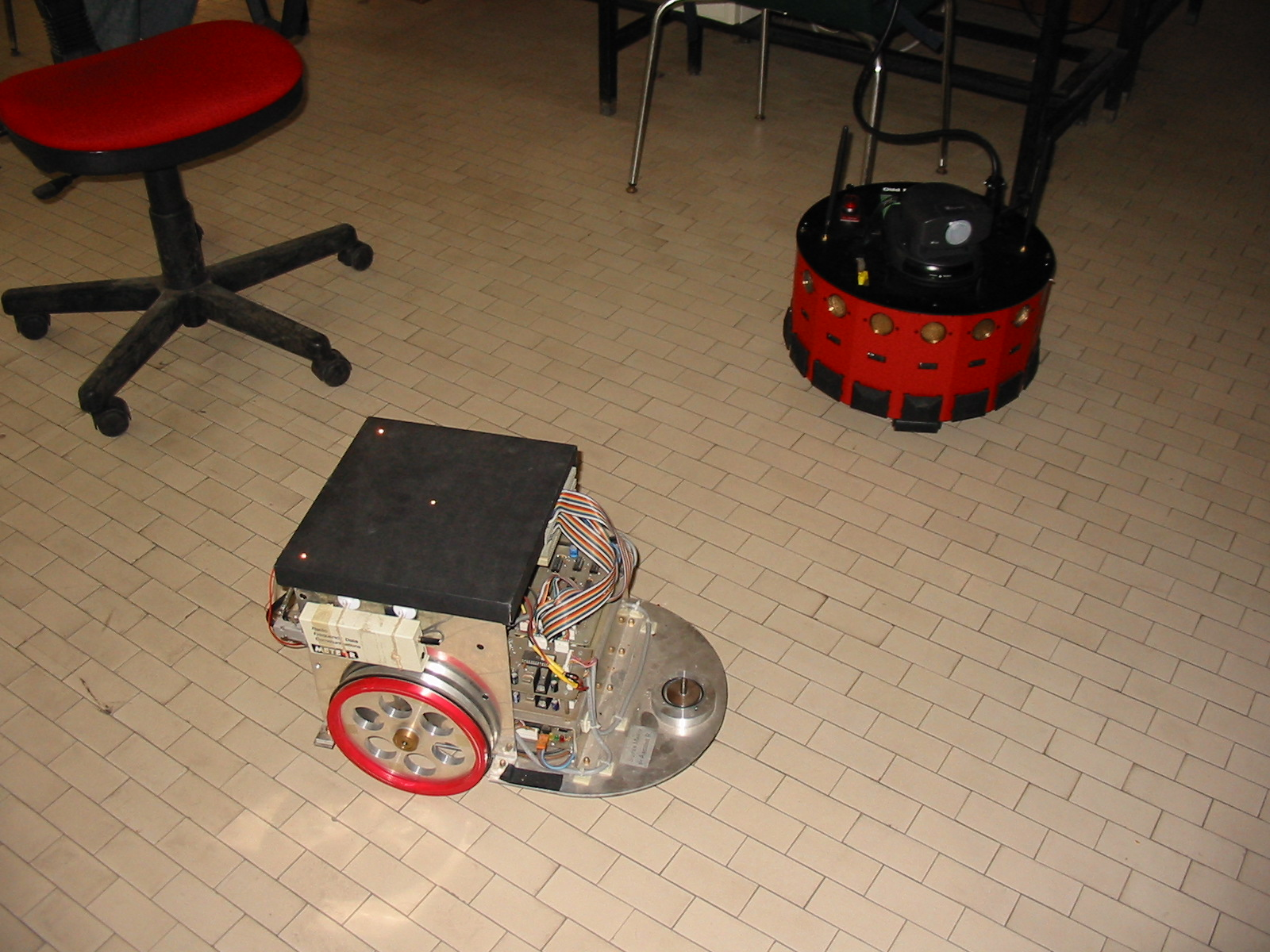

3 Wheeled mobile robots locally restricted mobility NONHOLONOMIC constraints SuperMARIO & MagellanPro (DIS, Roma) Hilare 2-Bis (LAAS, Toulouse) with off-hooked trailer Robotics 1 3


4 Wheeled mobile robots full mobility OMNIDIRECTIONAL robots Tribolo Omni-2 Robotics 1 4
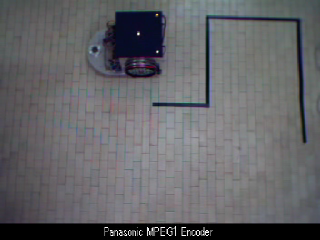
5 Video SuperMARIO Omni-2 Robotics 1 5
6 Operating environments external 3D unstructured natural vs. artificial landmarks internal 2D known availability of a map (possibly acquired by robot sensors in an exploratory phase) unknown with static or dynamic obstacles Robotics 1 6
7 Basic motion problem start dynamic obstacle static obstacles goal high computational complexity of the planning problem dynamic environment (including multiple robots) restricted mobility of robotic vehicle analysis of elementary tasks Robotics 1 7

8 Multi-robot environment 2 Pioneer 1 Nomad XR Hilare with on-board manipulator arm 5 robots in simultaneous motion Robotics 1 8
9 Elementary motion tasks point-to-point motion in the configuration space path following trajectory tracking geometric path + timing law purely reactive (local) motion mixed situations of planning and control Robotics 1 9
10 Elementary motion tasks (cont d) point-to-point motion (e.g., parking) path following initial configuration final configuration parameter s d reference WMR ( closest on path) path trajectory tracking e p trajectory time t reference WMR (at instant t) Robotics 1 10
11 Elementary motion tasks (cont d) examples of reactive motion on-line obstacle avoidance detected obstacle planned path sensor range executed path unknown obstacle goal wall following target tracking Robotics 1 11
12 Block diagram of a mobile robot task + planning control A - mobile robot E task output environment sensors (proprio/extero) actuators (A) DC motors with reduction task output (even identity, i.e., q) effectors (E) on-board manipulator, gripper, sensors proprioceptive: encoders, gyroscope, exteroceptive: bumpers, rangefinders (IR = infrared, US = ultrasound), structured light (laser+ccd), vision (mono, stereo, color, ) control high- / low-level feedforward (from planning) / feedback Robotics 1 12
13 Block diagram of a mobile robot (cont d) highlevel control + - lowlevel controls A WMR + encoders low-level control: analog velocity PI(D) loop with high gain (or digital, at high frequency) planning + - highlevel control WMR kinematic model task output high-level control: purely kinematics-based, with velocity commands Robotics 1 13
14 for wheeled mobile robots Configuration space rigid body (one, or many interconnected) pose of one body is given by a set of INDEPENDENT variables # total of descriptive variables (including all bodies) - # total of HOLONOMIC (positional) constraints # generalized coordinates wheels (of different types) in contact with the ground (possibly) additional INTERNAL variables configuration space C parameterized through dim C = Robotics 1 14
15 Examples of configuration spaces y ϑ dim C = 3 x φ y ϑ dim C = 4 x φ y δ ϑ dim C = 5 x Robotics 1 15
16 Additional configuration variables in all previous cases, one can add in the parameterization of C also the rolling angle ψ of each wheel r ψ Robotics 1 16

17 conventional Types of wheels fixed v t centered steering v t v n = 0 off-centered steering (castor) d v t omni-directional (Mecanum/Swedish wheels) v t v n Robotics 1 17
18 pure rolling constraints Differential constraints each wheel rolls on the ground without slipping (longitudinally) nor skidding (sideways) continuous contact used in dead-reckoning (odometry) geometric consequence there is always an Instantaneous Center of Rotation (=ICR) where all wheel axes intercept: one ICR for each chassis (= rigid body) constituting the WMR Robotics 1 18
19 Instantaneous Center of Rotation ICR: a graphical construction input computing in sequence (with some trigonometry): Robotics 1 19
20 from constraints Nonholonomy for each wheel, condition can be written in terms of generalized coordinates and their derivatives for N wheels, in matrix form N differential constraints (in Pfaffian form = linear in velocity) partially or completely integrable into not integrable reduction of C (dim - ) but NONHOLONOMY Robotics 1 20
21 to feasible motion Nonholonomy (cont d) nonintegrable (nonholonomic) ALL feasible motion directions can be generated as being the image of the columns of matrix G coincides with the kernel of matrix A Robotics 1 21
22 a comparison Nonholonomy (cont d) dim C = 3 fixed-base manipulator same number of commands and generalized velocities the space of feasible velocities has dimension 3 and coincides with the tangent space to the robot configuration space Robotics 1 22
23 Nonholonomy (cont d) dim C = 3 wheeled mobile robot path on (x,y) plane (with varying orientation) less number of commands than generalized velocities! the space of feasible velocities has here dimension 2 (a subspace of the tangent space) Robotics 1 23
24 Kinematic model of WMR provides all feasible directions of instantaneous motion describes the relation between the velocity input commands and the derivatives of generalized coordinates (a differential model!) with needed for studying the accessibility of (i.e., the system controllability ) planning of feasible paths/trajectories design of motion control algorithms incremental WMR localization (odometry) simulation configuration space (input) command space Robotics 1 24
25 Unicycle (ideal) the choice of a base in the kernel of can be made according to physical considerations on the real system Robotics 1 25
26 Unicycle (real) a) three centered steering wheels [Nomad 200] synchro-drive (2 motors) 1 = linear speed 2 = angular speed of the robot Robotics 1 26
27 Unicycle (real) b) two fixed wheels + castor [SuperMARIO, MagellanPro] castor linear speed of the two fixed wheels on the ground (R = right, L = left) note: d is here the half-axis length (in textbook, it is the entire distance between the two fixed wheels!!) Robotics 1 27
28 Equivalence of the two models a) b) by means of a transformation (invertible and constant) between inputs however, pay attention to how possible (equal) bounds on maximum speed of the two wheels are transformed! here Robotics 1 28
29 y φ ϑ Car-like ideal ( telescopic view) tricycle x with differential gear on rear wheels Robotics 1 29
30 Car-like (continued) FD = Front wheel Drive ( ) linear and angular speed of front wheel kinematic model of unicycle with trailer (e.g., Hilare 2-bis) Robotics 1 30
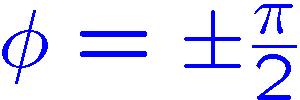
31 Car-like (continued) RD = Rear wheel Drive ( ) linear speed of rear wheel (medium point of rear-axis) singularity at (the model is no longer valid) Robotics 1 31
32 General constraint form by wheel type a) f = fixed or centered s = steerable y x constant (f) or variable (s) Robotics 1 32
33 General constraint form by wheel type b) o = steerable with off-set (off-centered) d y x variable Robotics 1 33
34 Possible kinematic classes 5 possible classes for the WMR kinematic model (single chassis) number of wheels class description example (N = 3) I = 3 is an omnidirectional WMR! II on same axis = 2 = 1 Robotics 1 34

35 Example of class I WMR (omnidirectional) with three conventional off-centered wheels, independently actuated Robotics 1 35
36 Possible kinematic classes (cont d) III synchronized if > 1 = 1 = 2 IV on same axis at least one out of the common axis of the two fixed wheels = 2 = 1 V synchronized if > 2 = 2 = 1 WMRs in same class are characterized by same maneuverability previous models of WMRs fit indeed in this classification: SuperMARIO (class II), Nomad 200 (class III), car-like (class IV) Robotics 1 36
CE801: Intelligent Systems and Robotics Lecture 3: Actuators and Localisation. Prof. Dr. Hani Hagras
 1 CE801: Intelligent Systems and Robotics Lecture 3: Actuators and Localisation Prof. Dr. Hani Hagras Robot Locomotion Robots might want to move in water, in the air, on land, in space.. 2 Most of the
WMR Control Via Dynamic Feedback Linearization: Design, Implementation, and Experimental Validation
 IEEE TRANSACTIONS ON CONTROL SYSTEMS TECHNOLOGY, VOL. 10, NO. 6, NOVEMBER 2002 835 WMR Control Via Dynamic Feedback Linearization: Design, Implementation, and Experimental Validation Giuseppe Oriolo, Member,
FRC WPI Robotics Library Overview
 FRC WPI Robotics Library Overview Contents 1.1 Introduction 1.2 RobotDrive 1.3 Sensors 1.4 Actuators 1.5 I/O 1.6 Driver Station 1.7 Compressor 1.8 Camera 1.9 Utilities 1.10 Conclusion Introduction In this
INSTRUCTOR WORKBOOK Quanser Robotics Package for Education for MATLAB /Simulink Users
 INSTRUCTOR WORKBOOK for MATLAB /Simulink Users Developed by: Amir Haddadi, Ph.D., Quanser Peter Martin, M.A.SC., Quanser Quanser educational solutions are powered by: CAPTIVATE. MOTIVATE. GRADUATE. PREFACE
Robotics. Chapter 25. Chapter 25 1
 Robotics Chapter 25 Chapter 25 1 Outline Robots, Effectors, and Sensors Localization and Mapping Motion Planning Motor Control Chapter 25 2 Mobile Robots Chapter 25 3 Manipulators P R R R R R Configuration
Robotics. Lecture 3: Sensors. See course website http://www.doc.ic.ac.uk/~ajd/robotics/ for up to date information.
 Robotics Lecture 3: Sensors See course website http://www.doc.ic.ac.uk/~ajd/robotics/ for up to date information. Andrew Davison Department of Computing Imperial College London Review: Locomotion Practical
Path Tracking for a Miniature Robot
 Path Tracking for a Miniature Robot By Martin Lundgren Excerpt from Master s thesis 003 Supervisor: Thomas Hellström Department of Computing Science Umeå University Sweden 1 Path Tracking Path tracking
Definitions. A [non-living] physical agent that performs tasks by manipulating the physical world. Categories of robots
![Definitions. A [non-living] physical agent that performs tasks by manipulating the physical world. Categories of robots](/thumbs/27/11692183.jpg "Definitions. A [non-living] physical agent that performs tasks by manipulating the physical world. Categories of robots") Definitions A robot is A programmable, multifunction manipulator designed to move material, parts, tools, or specific devices through variable programmed motions for the performance of a variety of tasks.
Definitions A robot is A programmable, multifunction manipulator designed to move material, parts, tools, or specific devices through variable programmed motions for the performance of a variety of tasks.
Feedback Control of a Nonholonomic Car-like Robot
 Feedback Control of a Nonholonomic Car-like Robot A. De Luca G. Oriolo C. Samson This is the fourth chapter of the book: Robot Motion Planning and Control Jean-Paul Laumond (Editor) Laboratoire d Analye
Simulation of Trajectories and Comparison of Joint Variables for Robotic Manipulator Using Multibody Dynamics (MBD)
 Simulation of Trajectories and Comparison of Joint Variables for Robotic Manipulator Using Multibody Dynamics (MBD) Jatin Dave Assistant Professor Nirma University Mechanical Engineering Department, Institute
Field and Service Robotics. Odometry sensors
 Field and Service Robotics Odometry sensors Navigation (internal) Sensors To sense robot s own state Magnetic compass (absolute heading) Gyro (angular speed => change of heading) Acceleration sensors (acceleration)
Sensor Based Control of Autonomous Wheeled Mobile Robots
 Sensor Based Control of Autonomous Wheeled Mobile Robots Gyula Mester University of Szeged, Department of Informatics e-mail: [email protected] Abstract The paper deals with the wireless sensor-based
FEEDBACK CONTROL OF A NONHOLONOMIC CAR-LIKE ROBOT
 FEEDBACK CONTROL OF A NONHOLONOMIC CAR-LIKE ROBOT Alessandro De Luca Giuseppe Oriolo Dipartimento di Informatica e Sistemistica Università di Roma La Sapienza Via Eudossiana 8, 84 Rome, Italy {deluca,oriolo}@labrob.ing.uniroma.it
Mobile Robot FastSLAM with Xbox Kinect
 Mobile Robot FastSLAM with Xbox Kinect Design Team Taylor Apgar, Sean Suri, Xiangdong Xi Design Advisor Prof. Greg Kowalski Abstract Mapping is an interesting and difficult problem in robotics. In order
Robot Sensors. Outline. The Robot Structure. Robots and Sensors. Henrik I Christensen
 Robot Sensors Henrik I Christensen Robotics & Intelligent Machines @ GT Georgia Institute of Technology, Atlanta, GA 30332-0760 [email protected] Henrik I Christensen (RIM@GT) Sensors 1 / 38 Outline 1
CIM Computer Integrated Manufacturing
 INDEX CIM IN BASIC CONFIGURATION CIM IN ADVANCED CONFIGURATION CIM IN COMPLETE CONFIGURATION DL CIM A DL CIM B DL CIM C DL CIM C DL CIM B DL CIM A Computer Integrated Manufacturing (CIM) is a method of
Robot coined by Karel Capek in a 1921 science-fiction Czech play
 Robotics Robot coined by Karel Capek in a 1921 science-fiction Czech play Definition: A robot is a reprogrammable, multifunctional manipulator designed to move material, parts, tools, or specialized devices
ROBOTICS 01PEEQW. Basilio Bona DAUIN Politecnico di Torino
 ROBOTICS 01PEEQW Basilio Bona DAUIN Politecnico di Torino Probabilistic Fundamentals in Robotics Robot Motion Probabilistic models of mobile robots Robot motion Kinematics Velocity motion model Odometry
Robotics and Automation Blueprint
 Robotics and Automation Blueprint This Blueprint contains the subject matter content of this Skill Connect Assessment. This Blueprint does NOT contain the information one would need to fully prepare for
What s Left in E11? Technical Writing E11 Final Report
 Technical Writing What s Left in E11? Technical Writing E11 Final Report 2 Next Week: Competition! Second Last Week: Robotics S&T, Eng&CS Outlooks, Last Week: Final Presentations 3 There are several common
Introduction to Robotics Analysis, Systems, Applications
 Introduction to Robotics Analysis, Systems, Applications Saeed B. Niku Mechanical Engineering Department California Polytechnic State University San Luis Obispo Technische Urw/carsMt Darmstadt FACHBEREfCH
MECE 102 Mechatronics Engineering Orientation
 MECE 102 Mechatronics Engineering Orientation Mechatronic System Components Associate Prof. Dr. of Mechatronics Engineering Çankaya University Compulsory Course in Mechatronics Engineering Credits (2/0/2)
ACTUATOR DESIGN FOR ARC WELDING ROBOT
 ACTUATOR DESIGN FOR ARC WELDING ROBOT 1 Anurag Verma, 2 M. M. Gor* 1 G.H Patel College of Engineering & Technology, V.V.Nagar-388120, Gujarat, India 2 Parul Institute of Engineering & Technology, Limda-391760,
Force/position control of a robotic system for transcranial magnetic stimulation
 Force/position control of a robotic system for transcranial magnetic stimulation W.N. Wan Zakaria School of Mechanical and System Engineering Newcastle University Abstract To develop a force control scheme
Constraint satisfaction and global optimization in robotics
 Constraint satisfaction and global optimization in robotics Arnold Neumaier Universität Wien and Jean-Pierre Merlet INRIA Sophia Antipolis 1 The design, validation, and use of robots poses a number of
CATIA V5 Tutorials. Mechanism Design & Animation. Release 18. Nader G. Zamani. University of Windsor. Jonathan M. Weaver. University of Detroit Mercy
 CATIA V5 Tutorials Mechanism Design & Animation Release 18 Nader G. Zamani University of Windsor Jonathan M. Weaver University of Detroit Mercy SDC PUBLICATIONS Schroff Development Corporation www.schroff.com
Academic Crosswalk to Common Core Standards. REC ELA.RST.11-12.3 LA.12.1.6.k LA.12.3.2
 Introduction to Robotics Course Description NHT Introduction to Robotics (IR) is designed to explore the current and future use of automation technology in industry and everyday use. Students will receive
Mobile Robotics I: Lab 2 Dead Reckoning: Autonomous Locomotion Using Odometry
 Mobile Robotics I: Lab 2 Dead Reckoning: Autonomous Locomotion Using Odometry CEENBoT Mobile Robotics Platform Laboratory Series CEENBoT v2.21 '324 Platform The Peter Kiewit Institute of Information Science
Design-Simulation-Optimization Package for a Generic 6-DOF Manipulator with a Spherical Wrist
 Design-Simulation-Optimization Package for a Generic 6-DOF Manipulator with a Spherical Wrist MHER GRIGORIAN, TAREK SOBH Department of Computer Science and Engineering, U. of Bridgeport, USA ABSTRACT Robot
Artificial Intelligence
 Artificial Intelligence Robotics RWTH Aachen 1 Term and History Term comes from Karel Capek s play R.U.R. Rossum s universal robots Robots comes from the Czech word for corvee Manipulators first start
Solving Simultaneous Equations and Matrices
 Solving Simultaneous Equations and Matrices The following represents a systematic investigation for the steps used to solve two simultaneous linear equations in two unknowns. The motivation for considering
Epipolar Geometry and Visual Servoing
 Epipolar Geometry and Visual Servoing Domenico Prattichizzo joint with with Gian Luca Mariottini and Jacopo Piazzi www.dii.unisi.it/prattichizzo Robotics & Systems Lab University of Siena, Italy Scuoladi
Robot Perception Continued
 Robot Perception Continued 1 Visual Perception Visual Odometry Reconstruction Recognition CS 685 11 Range Sensing strategies Active range sensors Ultrasound Laser range sensor Slides adopted from Siegwart
Chapter 7 MODELING AND CONTROL OF NONHOLONOMIC MECHANICAL SYSTEMS
 Chapter 7 MODELING AND CONTROL OF NONHOLONOMIC MECHANICAL SYSTEMS Alessandro De Luca and Giuseppe Oriolo Dipartimento di Informatica e Sistemistica Università degli Studi di Roma La Sapienza Via Eudossiana
Robot Navigation. Johannes Maurer, Institute for Software Technology TEDUSAR Summerschool 2014. u www.tugraz.at
 1 Robot Navigation u www.tugraz.at 2 Motivation challenges physical laws e.g. inertia, acceleration uncertainty e.g. maps, observations geometric constraints e.g. shape of a robot dynamic environment e.g.
E190Q Lecture 5 Autonomous Robot Navigation
 E190Q Lecture 5 Autonomous Robot Navigation Instructor: Chris Clark Semester: Spring 2014 1 Figures courtesy of Siegwart & Nourbakhsh Control Structures Planning Based Control Prior Knowledge Operator
Metrics on SO(3) and Inverse Kinematics
 Mathematical Foundations of Computer Graphics and Vision Metrics on SO(3) and Inverse Kinematics Luca Ballan Institute of Visual Computing Optimization on Manifolds Descent approach d is a ascent direction
MSc in Autonomous Robotics Engineering University of York
 MSc in Autonomous Robotics Engineering University of York Practical Robotics Module 2015 A Mobile Robot Navigation System: Labs 1a, 1b, 2a, 2b. Associated lectures: Lecture 1 and lecture 2, given by Nick
Guidelines in Nonholonomic Motion Planning for Mobile Robots
 Guidelines in Nonholonomic Motion Planning for Mobile Robots J.P. Laumond S. Sekhavat F. Lamiraux This is the first chapter of the book: Robot Motion Planning and Control Jean-Paul Laumond (Editor) Laboratoire
Virtual CRASH 3.0 Staging a Car Crash
 Virtual CRASH 3.0 Staging a Car Crash Virtual CRASH Virtual CRASH 3.0 Staging a Car Crash Changes are periodically made to the information herein; these changes will be incorporated in new editions of
3D Vision An enabling Technology for Advanced Driver Assistance and Autonomous Offroad Driving
 3D Vision An enabling Technology for Advanced Driver Assistance and Autonomous Offroad Driving AIT Austrian Institute of Technology Safety & Security Department Manfred Gruber Safe and Autonomous Systems
Rotation: Moment of Inertia and Torque
 Rotation: Moment of Inertia and Torque Every time we push a door open or tighten a bolt using a wrench, we apply a force that results in a rotational motion about a fixed axis. Through experience we learn
Industrial Robotics. Training Objective
 Training Objective After watching the program and reviewing this printed material, the viewer will learn the basics of industrial robot technology and how robots are used in a variety of manufacturing
MOBILE ROBOT TRACKING OF PRE-PLANNED PATHS. Department of Computer Science, York University, Heslington, York, Y010 5DD, UK (email:[email protected].
 MOBILE ROBOT TRACKING OF PRE-PLANNED PATHS N. E. Pears Department of Computer Science, York University, Heslington, York, Y010 5DD, UK (email:[email protected]) 1 Abstract A method of mobile robot steering
Improved Mecanum Wheel Design for Omni-directional Robots
 Proc. 2002 Australasian Conference on Robotics and Automation Auckland, 27-29 November 2002 Improved Mecanum Wheel Design for Omni-directional Robots Olaf Diegel, Aparna Badve, Glen Bright, Johan Potgieter,
Robotics & Automation
 Robotics & Automation Levels: Grades 10-12 Units of Credit: 1.0 CIP Code: 21.0117 Core Code: 38-01-00-00-130 Prerequisite: None Skill Test: 612 COURSE DESCRIPTION Robotics & Automation is a lab-based,
Robot Task-Level Programming Language and Simulation
 Robot Task-Level Programming Language and Simulation M. Samaka Abstract This paper presents the development of a software application for Off-line robot task programming and simulation. Such application
INTRODUCTION TO SERIAL ARM
 INTRODUCTION TO SERIAL ARM A robot manipulator consists of links connected by joints. The links of the manipulator can be considered to form a kinematic chain. The business end of the kinematic chain of
Robotic motion planning for 8- DOF motion stage
 Robotic motion planning for 8- DOF motion stage 12 November Mark Geelen Simon Jansen Alten Mechatronics www.alten.nl [email protected] Introduction Introduction Alten FEI Motion planning MoveIt! Proof
ANTI LOCK BRAKING SYSTEM MODELLING AND DEVELOPMENT
 ANTI LOCK BRAKING SYSTEM MODELLING AND DEVELOPMENT Aldi Manikanth ME10B004 A Manoj Kumar ME10B006 C Vijay Chauhan ME10B010 Nachiket Dongre ME10B013 Lithas ME10B020 Rajesh Kumar Meena ME10B030 Varada Karthik
What is a robot? Lecture 2: Robot Basics. Remember the Amigobot? Describing the Amigobot. The Unicycle Model. Modeling Robot Interaction.
 What is a robot? Lectre 2: Basics CS 344R/393R: ics Benjamin Kipers A robot is an intelligent sstem that interacts with the phsical environment throgh sensors and effectors. Toda we discss: Abstraction
Dynamics of Rotational Motion
 Chapter 10 Dynamics of Rotational Motion PowerPoint Lectures for University Physics, Twelfth Edition Hugh D. Young and Roger A. Freedman Lectures by James Pazun Modified by P. Lam 5_31_2012 Goals for Chapter
Visual Servoing Methodology for Selective Tree Pruning by Human-Robot Collaborative System
 Ref: C0287 Visual Servoing Methodology for Selective Tree Pruning by Human-Robot Collaborative System Avital Bechar, Victor Bloch, Roee Finkelshtain, Sivan Levi, Aharon Hoffman, Haim Egozi and Ze ev Schmilovitch,
PID Control. Proportional Integral Derivative (PID) Control. Matrix Multimedia 2011 MX009 - PID Control. by Ben Rowland, April 2011
 PID Control by Ben Rowland, April 2011 Abstract PID control is used extensively in industry to control machinery and maintain working environments etc. The fundamentals of PID control are fairly straightforward
Modeling Mechanical Systems
 chp3 1 Modeling Mechanical Systems Dr. Nhut Ho ME584 chp3 2 Agenda Idealized Modeling Elements Modeling Method and Examples Lagrange s Equation Case study: Feasibility Study of a Mobile Robot Design Matlab
Kinematics and Dynamics of Mechatronic Systems. Wojciech Lisowski. 1 An Introduction
 Katedra Robotyki i Mechatroniki Akademia Górniczo-Hutnicza w Krakowie Kinematics and Dynamics of Mechatronic Systems Wojciech Lisowski 1 An Introduction KADOMS KRIM, WIMIR, AGH Kraków 1 The course contents:
Linear Motion vs. Rotational Motion
 Linear Motion vs. Rotational Motion Linear motion involves an object moving from one point to another in a straight line. Rotational motion involves an object rotating about an axis. Examples include a
Interactive Computer Graphics
 Interactive Computer Graphics Lecture 18 Kinematics and Animation Interactive Graphics Lecture 18: Slide 1 Animation of 3D models In the early days physical models were altered frame by frame to create
A ROBOTIC MOBILITY AID FOR FRAIL VISUALLY IMPAIRED PEOPLE
 A ROBOTIC MOBILITY AID FOR FRAIL VISUALLY IMPAIRED PEOPLE Shane MacNamara, Gerard Lacey Department of Computer Science Trinity College Dublin, Ireland ABSTRACT This paper discusses the design of a smart
Multi-Robot Tracking of a Moving Object Using Directional Sensors
 Multi-Robot Tracking of a Moving Object Using Directional Sensors Manuel Mazo Jr., Alberto Speranzon, Karl H. Johansson Dept. of Signals, Sensors & Systems Royal Institute of Technology SE- 44 Stockholm,
Figure 3.1.2 Cartesian coordinate robot
 Introduction to Robotics, H. Harry Asada Chapter Robot Mechanisms A robot is a machine capable of physical motion for interacting with the environment. Physical interactions include manipulation, locomotion,
Advantages of Auto-tuning for Servo-motors
 Advantages of for Servo-motors Executive summary The same way that 2 years ago computer science introduced plug and play, where devices would selfadjust to existing system hardware, industrial motion control
Stirling Paatz of robot integrators Barr & Paatz describes the anatomy of an industrial robot.
 Ref BP128 Anatomy Of A Robot Stirling Paatz of robot integrators Barr & Paatz describes the anatomy of an industrial robot. The term robot stems from the Czech word robota, which translates roughly as
Chapter 10 Rotational Motion. Copyright 2009 Pearson Education, Inc.
 Chapter 10 Rotational Motion Angular Quantities Units of Chapter 10 Vector Nature of Angular Quantities Constant Angular Acceleration Torque Rotational Dynamics; Torque and Rotational Inertia Solving Problems
Parameter identification of a linear single track vehicle model
 Parameter identification of a linear single track vehicle model Edouard Davin D&C 2011.004 Traineeship report Coach: dr. Ir. I.J.M. Besselink Supervisors: prof. dr. H. Nijmeijer Eindhoven University of
Applications > Robotics research and education > Assistant robot at home > Surveillance > Tele-presence > Entertainment/Education > Cleaning
 Introduction robulab 10 is a multi-purpose mobile robot designed for various indoor applications, such as research and education, tele-presence, assistance to people staying at home. robulab 10 is a generic
The Easy-to-use Steering Design Tool SimuLENK as an Application of SIMPACK Code Export
 The Easy-to-use Steering Design Tool SimuLENK as an Application of SIMPACK Code Export MAN Nutzfahrzeuge Group Ille / Caballero SIMPACK User Meeting 2006 22.03.2006 1 Contents Inspiration for development
3D Tranformations. CS 4620 Lecture 6. Cornell CS4620 Fall 2013 Lecture 6. 2013 Steve Marschner (with previous instructors James/Bala)
 3D Tranformations CS 4620 Lecture 6 1 Translation 2 Translation 2 Translation 2 Translation 2 Scaling 3 Scaling 3 Scaling 3 Scaling 3 Rotation about z axis 4 Rotation about z axis 4 Rotation about x axis
Basic Principles of Inertial Navigation. Seminar on inertial navigation systems Tampere University of Technology
 Basic Principles of Inertial Navigation Seminar on inertial navigation systems Tampere University of Technology 1 The five basic forms of navigation Pilotage, which essentially relies on recognizing landmarks
ECE 495 Project 3: Shocker Actuator Subsystem and Website Design. Group 1: One Awesome Engineering
 ECE 495 Project 3: Shocker Actuator Subsystem and Website Design Group 1: One Awesome Engineering Luquita Edwards Evan Whetsell Sunny Verma Thomas Ryan Willis Long I. Executive Summary The main goal behind
Time Domain and Frequency Domain Techniques For Multi Shaker Time Waveform Replication
 Time Domain and Frequency Domain Techniques For Multi Shaker Time Waveform Replication Thomas Reilly Data Physics Corporation 1741 Technology Drive, Suite 260 San Jose, CA 95110 (408) 216-8440 This paper
WEB ENABLED ROBOT DESIGN AND DYNAMIC CONTROL SIMULATION SOFTWARE SOLUTIONS FROM TASK POINTS DESCRIPTION
 WEB ENABLED ROBOT DESIGN AND DYNAMIC CONTROL SIMULATION SOFTWARE SOLUTIONS FROM TASK POINTS DESCRIPTION Tarek M. Sobh, Bei Wang* and Sarosh H. Patel University of Bridgeport Bridgeport, CT 06601 U.S.A.
3D Vision An enabling Technology for Advanced Driver Assistance and Autonomous Offroad Driving
 3D Vision An enabling Technology for Advanced Driver Assistance and Autonomous Offroad Driving AIT Austrian Institute of Technology Safety & Security Department Christian Zinner Safe and Autonomous Systems
Heavy Vehicles Modeling with the Vehicle Dynamics Library
 Heavy Vehicle Modeling with VehicleDynamics Library Heavy Vehicles Modeling with the Vehicle Dynamics Library Niklas Philipson Magnus Gäfvert Johan Andreasson Andrew Woodruff Modelon AB Ideon Sience Park,
The connector we use most in joining beams is the Technic pin. The Technic pin comes in several variants, as shown in Figure 1 below.
 In this chapter we consider various ways to build strong constructions. A strong construction is vital to a robot, particularly mobile robots that tend to run into solid objects like walls, chairs, table
Power Electronics. Prof. K. Gopakumar. Centre for Electronics Design and Technology. Indian Institute of Science, Bangalore.
 Power Electronics Prof. K. Gopakumar Centre for Electronics Design and Technology Indian Institute of Science, Bangalore Lecture - 1 Electric Drive Today, we will start with the topic on industrial drive
Analysis of dynamic properties of the PRT vehicle-track system
 BULLETIN OF THE POLISH ACADEMY OF SCIENCES TECHNICAL SCIENCES, Vol. 63, No. 3, 2015 DOI: 10.1515/bpasts-2015-0091 Analysis of dynamic properties of the PRT vehicle-track system M. KOZŁOWSKI, W. CHOROMAŃSKI,
The Department of Engineering, has two Scorbot-ER VII robotic manipulators and one Controller- A. There are 4 components in the system:
 Introduction to the Scorbot ER VII and the Eshed Robotec Pty. Ltd. Advanced Control Language (ACL) Robert MAHONY, Dep. Engineering, ANU, ACT, 0200, Australia. The Department of Engineering, has two Scorbot-ER
How To Use Trackeye
 Product information Image Systems AB Main office: Ågatan 40, SE-582 22 Linköping Phone +46 13 200 100, fax +46 13 200 150 [email protected], Introduction TrackEye is the world leading system for motion
Static Environment Recognition Using Omni-camera from a Moving Vehicle
 Static Environment Recognition Using Omni-camera from a Moving Vehicle Teruko Yata, Chuck Thorpe Frank Dellaert The Robotics Institute Carnegie Mellon University Pittsburgh, PA 15213 USA College of Computing
DINAMIC AND STATIC CENTRE OF PRESSURE MEASUREMENT ON THE FORCEPLATE. F. R. Soha, I. A. Szabó, M. Budai. Abstract
 ACTA PHYSICA DEBRECINA XLVI, 143 (2012) DINAMIC AND STATIC CENTRE OF PRESSURE MEASUREMENT ON THE FORCEPLATE F. R. Soha, I. A. Szabó, M. Budai University of Debrecen, Department of Solid State Physics Abstract
Sensory-motor control scheme based on Kohonen Maps and AVITE model
 Sensory-motor control scheme based on Kohonen Maps and AVITE model Juan L. Pedreño-Molina, Antonio Guerrero-González, Oscar A. Florez-Giraldo, J. Molina-Vilaplana Technical University of Cartagena Department
Introduction to Engineering System Dynamics
 CHAPTER 0 Introduction to Engineering System Dynamics 0.1 INTRODUCTION The objective of an engineering analysis of a dynamic system is prediction of its behaviour or performance. Real dynamic systems are
Center of Gravity. We touched on this briefly in chapter 7! x 2
 Center of Gravity We touched on this briefly in chapter 7! x 1 x 2 cm m 1 m 2 This was for what is known as discrete objects. Discrete refers to the fact that the two objects separated and individual.
Rules of Actuator and Guide Alignment in Linear Motion Systems
 Rules of Actuator and Guide Alignment in Linear Motion Systems By Gary Rosengren, Director of Engineering Tolomatic, Inc. About the Author Gary Rosengren is Director of Engineering at Tolomatic and has
Active Vibration Isolation of an Unbalanced Machine Spindle
 UCRL-CONF-206108 Active Vibration Isolation of an Unbalanced Machine Spindle D. J. Hopkins, P. Geraghty August 18, 2004 American Society of Precision Engineering Annual Conference Orlando, FL, United States
UNIT II Robots Drive Systems and End Effectors Part-A Questions
 UNIT II Robots Drive Systems and End Effectors Part-A Questions 1. Define End effector. End effector is a device that is attached to the end of the wrist arm to perform specific task. 2. Give some examples
The Effects of Wheelbase and Track on Vehicle Dynamics. Automotive vehicles move by delivering rotational forces from the engine to
 The Effects of Wheelbase and Track on Vehicle Dynamics Automotive vehicles move by delivering rotational forces from the engine to wheels. The wheels push in the opposite direction of the motion of the
Chapter 1. Introduction. 1.1 The Challenge of Computer Generated Postures
 Chapter 1 Introduction 1.1 The Challenge of Computer Generated Postures With advances in hardware technology, more powerful computers become available for the majority of users. A few years ago, computer
Online Tuning of Artificial Neural Networks for Induction Motor Control
 Online Tuning of Artificial Neural Networks for Induction Motor Control A THESIS Submitted by RAMA KRISHNA MAYIRI (M060156EE) In partial fulfillment of the requirements for the award of the Degree of MASTER
Integration of a Robotic Arm with the Surgical Assistant Workstation Software Framework
 Integration of a Robotic Arm with the Surgical Assistant Workstation Software Framework Release 1.7 Jessie Young 1, Haytham Elhawary 2 and Aleksandra Popovic 2 July 21, 2011 1 Center for Computer-Integrated
Practical Work DELMIA V5 R20 Lecture 1. D. Chablat / S. Caro [email protected] [email protected]
 Practical Work DELMIA V5 R20 Lecture 1 D. Chablat / S. Caro [email protected] [email protected] Native languages Definition of the language for the user interface English,
Geometry of Nonholonomic Systems
 Geometry of Nonholonomic Systems A. Bellaïche F. Jean J.J. Risler This is the second chapter of the book: Robot Motion Planning and Control Jean-Paul Laumond (Editor) Laboratoire d Analye et d Architecture
Chapter. 4 Mechanism Design and Analysis
 Chapter. 4 Mechanism Design and Analysis 1 All mechanical devices containing moving parts are composed of some type of mechanism. A mechanism is a group of links interacting with each other through joints
TwinCAT NC Configuration
 TwinCAT NC Configuration NC Tasks The NC-System (Numeric Control) has 2 tasks 1 is the SVB task and the SAF task. The SVB task is the setpoint generator and generates the velocity and position control
Outline Servo Control
 Outline Servo Control Servo-Motor Drivers Control Modes orque Capability Servo-control Systems Direct/Indirect Control System Control Algorithm Implementation Controller Design by Emulation Discretization
Modelling and Identification of Underwater Robotic Systems
 University of Genova Modelling and Identification of Underwater Robotic Systems Giovanni Indiveri Ph.D. Thesis in Electronic Engineering and Computer Science December 1998 DIST Department of Communications,
Intelligent Submersible Manipulator-Robot, Design, Modeling, Simulation and Motion Optimization for Maritime Robotic Research
 20th International Congress on Modelling and Simulation, Adelaide, Australia, 1 6 December 2013 www.mssanz.org.au/modsim2013 Intelligent Submersible Manipulator-Robot, Design, Modeling, Simulation and