
Chapter 1. Introduction. 1.1 The Challenge of Computer Generated Postures
|
|
|
- Damian Jackson
- 9 years ago
- Views:
Transcription
1 Chapter 1 Introduction 1.1 The Challenge of Computer Generated Postures With advances in hardware technology, more powerful computers become available for the majority of users. A few years ago, computer animation was restricted to work on platforms oriented exclusively to 3D graphics. However, nowadays interactive environments or computer animation systems are rather accessible to almost everyone. Computer animation involves the creation of movement of virtual entities like characters interacting in a virtual environment. It not only embraces resulted motions but also the creation of postures. In the posture case, the user aims at generating a final posture without worrying about the movement in between the initial and final poses. Inverse Kinematics is a technique that allows an easy interaction by the user and, in consequence, an easy generation of postures [Bae01]. As opposed to key-frame animation, where the user has to spend much time producing key poses [Las87], Inverse Kinematics requires the user to specify only the part of the body which he wants to animate and a goal in 3D space. Then the system will do the rest, that is, to drive the effector (hands, feet, etc.) to the goal. However, this technique applied to complex articulated structures uses numerical techniques to converge towards the goal

2 Chapter 1 Introduction 24 resulting in unnatural postures. It is an interesting challenge to exploit physiological data like fatigue in the generation of human postures. In particular, in the generation of human postures using Inverse Kinematics. 1.2 Motivation In the animation of whatever entity, an animal, a formula one car, a human being, it is desirable to obtain a realistic result. Human animations are specially complicated due to the complexity of the human body and the intricate mechanism that produces human movement: articulations, muscles and the Central Nervous System (CNS). In the CNS, there is a sophisticated chain of processes that produce and control the movement of the human body. In the classification of 3D computer animation techniques we find two main groups, offline animation (movies) and interactive animation. We are interested in the interactive one. Depending on the animation technique used, the realism of the final animations differs qualitatively. Performance animation techniques use devices to obtain performance data. These devices are not available for most of animators and new performances are needed for generating new postures. If the aim is to generate realistic postures, the use of key-framing is arduous. In this case, the realism depends only on adjustments made by the animator. Techniques using dynamic applied to complex figures, as the human body, do not provide the desirable interactive rates. The Inverse Kinematics technique allows an interactive manipulation of articulated structures while incorporating other aspects of the motion affected by physiological aspects as fatigue. The motivation for fatigue assessment stems from the possibility of simulating such a complex human sensation and using it in the generation of natural looking postures. Postures adopted by a human under fatigued conditions are different than those adopted in non-fatiguing ones. In addition to realistic computer animation, its application is extended to fields as ergonomics, or workplaces design. In workplaces design, a computer system lets to explore situations avoiding doing experiences with real subjects. Then, accelerating and making less expensive the design process. Considering the design of an assembly line, a

3 Thesis Objectives virtual human placing a load in its goal position, several simulations and adjusting can be made during the design before performing final phases of test on subjects. Considering a virtual human acting in a virtual environment, he cannot sustain a load infinitely. His muscular system will be overstrained and he will need to change the posture in order to be able to maintain the load. It should be a postural change that allows the fatigue recovery for the person sustaining a load. Visualization techniques as skinning and deformation also improve the realism of animations but it is also necessary to pay attention to the postures adopted by the virtual human. It is not very helpful to show a realistic muscle deformation if the posture adopted by the limbs of the virtual body is not natural. 1.3 Thesis Objectives This thesis concerns the fatigue assessment of human body joints for generating realistic postures. Our objective is to create a model of fatigue at joint level to allow the adjustment of fatigued postures. Of course, our model should be applicable to human like characters or any articulated structures whose actuators may become fatigued. We consider a sequence of static poses in the time domain, then introducing a temporal dimension in the posture design process. Thereby, we aim to assess fatigue at joint level under static conditions but considering the pass of time effect. A wider approach is the one followed by studies working at individual muscle level. Our purpose, to propose a model at the muscle group level, is motivated by the complexity and computational cost that individual muscle models convey. The approach working at joint level is in an easier way extendable to assess different joints of the human body without the need of an exhaustive description of individual muscle parameters. We propose to exploit the fatigue model in an Inverse Kinematics framework. As Inverse Kinematics is a computer animation technique extensively utilized nowadays, it is important to search for methods improving obtained postures. Mechanisms using fatigue at joint level would drive the system to adjust achieved postures. Our purpose is to perform experiments in real subjects and compare with results obtained using the simulation framework and the fatigue model.

4 Chapter 1 Introduction 26 In addition, this work aims at providing a novel way of posture characterization using the fatigue factor. We store posture data, including joint angles, along with fatigue information and we generate reachability trees of the human arm corresponding to different strategies of reaching. Afterwards, a computerized visualization allows to distinguish a fatigue factor reflected in the reachability volume. Useful information can be extracted from the reachability tree, for example, what area of reachability produces the most fatigued postures and, of course, what postures are adopted when the reaching is done in that area. 1.4 Thesis Contributions We contribute with a new model of fatigue at joint level and with a new approach of working with human joints. This approach splits a common revolute joint into two halfjoints, each of them representing antagonistic muscles. This new concept limits us to the only use of revolute joints, e.g. the shoulder joint is defined as three revolute joints converted to three half-joint pairs. We provide a simulation environment where fatigue is exploited at two differentiated levels. At a low level, we adjust fatigued postures and at a higher level, we characterize reachable volumes using the fatigue factor. Due to the lack of strength data, the fatigue model has been validated under an important limitation. Although it is defined in a general way, case studies are restricted to movements in the sagital (lifting) and frontal plane (contraposto case). In order to facilitate its future expansion, it has been designed to be easily extended. It has been developed using the C and C++ programming languages. 1.5 Potential Applications The Fatigue model can be applied to any scenario where it is useful to assess the potential evaluation of postures adopted by humans under the influence of external or internal forces, i.e. sustaining an external load or the own body mass. We exploit fatigue data obtained from our model in two ways, optimizing and characterizing postures. In the optimization case, it can be used to predict postural changes under fatigued conditions. For example, a subject sustaining a heavy load has to adjust his posture when

5 Overview of the Thesis his arm joints reach unbearable values of fatigue. Another application can be the study of sitting and viewing postures, for example if we sit with our head in a forward bent position, the ligaments and the muscles in the neck will be under tremendous strain. Then, a change in the posture is needed to avoid neck fatigue. In the characterization case, we aim at describing a posture using beside joint angles, the fatigue that the posture produces at joint level. A human posture is mainly determined by the set of joint values defined in the skeleton. We add an attribute that also describes a distinctive quality of a posture. This kind of postural characterization can be useful in workplace design in order to evaluate which areas of arm reachability are less fatigued for an industrial worker. 1.6 Overview of the Thesis Chapter 2 presents the literature related with computer animation and its application to the realistic generation of postures and motions. Chapter 3 describes factors, such as muscular strength, fatigue, general health or state of mind, that influence motions and postures adopted by humans. Chapter 4 describes the fatigue model. This chapter also introduces the half-joint approach and applies it in the design of the fatigue model. Chapter 5 describes how fatigue values are exploited for both postures optimization and characterization. Chapter 6 presents case studies and shows results comparing data obtained in experiments and those achieved by a simulation environment. This chapter also presents results of the cooperation between the fatigue and the reachability module, then generating reachable spaces featured with fatigue data. Chapter 7 gives conclusions and points out directions for future work.

This week. CENG 732 Computer Animation. Challenges in Human Modeling. Basic Arm Model
 CENG 732 Computer Animation Spring 2006-2007 Week 8 Modeling and Animating Articulated Figures: Modeling the Arm, Walking, Facial Animation This week Modeling the arm Different joint structures Walking
Interactive Computer Graphics
 Interactive Computer Graphics Lecture 18 Kinematics and Animation Interactive Graphics Lecture 18: Slide 1 Animation of 3D models In the early days physical models were altered frame by frame to create
Robot Task-Level Programming Language and Simulation
 Robot Task-Level Programming Language and Simulation M. Samaka Abstract This paper presents the development of a software application for Off-line robot task programming and simulation. Such application
Two hours UNIVERSITY OF MANCHESTER SCHOOL OF COMPUTER SCIENCE. M.Sc. in Advanced Computer Science. Friday 18 th January 2008.
 COMP60321 Two hours UNIVERSITY OF MANCHESTER SCHOOL OF COMPUTER SCIENCE M.Sc. in Advanced Computer Science Computer Animation Friday 18 th January 2008 Time: 09:45 11:45 Please answer any THREE Questions
Graphics. Computer Animation 고려대학교 컴퓨터 그래픽스 연구실. kucg.korea.ac.kr 1
 Graphics Computer Animation 고려대학교 컴퓨터 그래픽스 연구실 kucg.korea.ac.kr 1 Computer Animation What is Animation? Make objects change over time according to scripted actions What is Simulation? Predict how objects
Computer Animation. Lecture 2. Basics of Character Animation
 Computer Animation Lecture 2. Basics of Character Animation Taku Komura Overview Character Animation Posture representation Hierarchical structure of the body Joint types Translational, hinge, universal,
Motion Capture Technologies. Jessica Hodgins
 Motion Capture Technologies Jessica Hodgins Motion Capture Animation Video Games Robot Control What games use motion capture? NBA live PGA tour NHL hockey Legends of Wrestling 2 Lords of Everquest Lord
Procedure for Managing Injury Risks Associated with Manual Tasks
 Burgess-Limerick & Associates Ergonomics and Research Consultants ABN 84976421949 Procedure for Managing Injury Risks Associated with Manual Tasks Burgess-Limerick, R. (2008). Procedure for Managing Injury
Chapter 1. Animation. 1.1 Computer animation
 Chapter 1 Animation "Animation can explain whatever the mind of man can conceive. This facility makes it the most versatile and explicit means of communication yet devised for quick mass appreciation."
Character Animation from 2D Pictures and 3D Motion Data ALEXANDER HORNUNG, ELLEN DEKKERS, and LEIF KOBBELT RWTH-Aachen University
 Character Animation from 2D Pictures and 3D Motion Data ALEXANDER HORNUNG, ELLEN DEKKERS, and LEIF KOBBELT RWTH-Aachen University Presented by: Harish CS-525 First presentation Abstract This article presents
ERGONOMICS AND MUSCULOSKELETAL INJURY (MSI) Preventing Injuries by Design
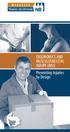 ERGONOMICS AND MUSCULOSKELETAL INJURY (MSI) Preventing Injuries by Design ERGONOMICS and Musculoskeletal injury (MSI) Some of the tasks we perform at work, such as lifting, reaching and repeating the same
animation animation shape specification as a function of time
 animation animation shape specification as a function of time animation representation many ways to represent changes with time intent artistic motion physically-plausible motion efficiency control typically
Computers in Film Making
 Computers in Film Making Snow White (1937) Computers in Film Making Slide 1 Snow White - Disney s Folly Moral: Original Budget $250,000 Production Cost $1,488,422 Frames 127,000 Production time 3.5 years
Methodology development of human task simulation as PLM solution related to OCRA ergonomic analysis
 Methodology development of human task simulation as PLM solution related to OCRA M. Annarumma 1, M. Pappalardo 2, and A. Naddeo 3 1 University of Salerno, Fisciano (SA), Italy, [email protected] 2 University
Human Simulation verbesserte Ergonomie von
 Human Simulation verbesserte Ergonomie von Produkten und Arbeitsabläufen durch digitale Menschmodelle Hochschule Amberg-Weiden, 21.10.2008 Magnus Edholm Product Manager [email protected] www.siemens.com/plm
SimFonIA Animation Tools V1.0. SCA Extension SimFonIA Character Animator
 SimFonIA Animation Tools V1.0 SCA Extension SimFonIA Character Animator Bring life to your lectures Move forward with industrial design Combine illustrations with your presentations Convey your ideas to
Ergonomics in the Workplace
 Ergonomics in the Workplace Ergonomics in the Workplace 1 Introduction The purpose of this short guide is to provide information to the reader on the subject of Ergonomics. It also provides guidance on
The 3D rendering pipeline (our version for this class)
 The 3D rendering pipeline (our version for this class) 3D models in model coordinates 3D models in world coordinates 2D Polygons in camera coordinates Pixels in image coordinates Scene graph Camera Rasterization
Cervical Whiplash: Considerations in the Rehabilitation of Cervical Myofascial Injury. Canadian Family Physician
 Cervical Whiplash: Considerations in the Rehabilitation of Cervical Myofascial Injury 1 Canadian Family Physician Volume 32, September 1986 Arthur Ameis, MD Dr. Ames practices physical medicine and rehabilitation,
Republic Polytechnic School of Information and Communications Technology C391 Animation and Visual Effect Automation.
 Republic Polytechnic School of Information and Communications Technology C391 Animation and Visual Effect Automation Module Curriculum This document addresses the content related abilities, with reference
animation shape specification as a function of time
 animation 1 animation shape specification as a function of time 2 animation representation many ways to represent changes with time intent artistic motion physically-plausible motion efficiency typically
Using Autodesk HumanIK Middleware to Enhance Character Animation for Games
 Autodesk HumanIK 4.5 Using Autodesk HumanIK Middleware to Enhance Character Animation for Games Unlock your potential for creating more believable characters and more engaging, innovative gameplay with
CS 4204 Computer Graphics
 CS 4204 Computer Graphics Computer Animation Adapted from notes by Yong Cao Virginia Tech 1 Outline Principles of Animation Keyframe Animation Additional challenges in animation 2 Classic animation Luxo
Name. Most of the bones of the limbs (arms & legs) act as levers. These levers are powered by muscles.
 Bones as Levers 1 Name Bones as Levers You may not think of your limbs as being machines, but they are. The action of a muscle pulling on a bone often works like a type of simple machine called a lever.
Workplace Job Accommodations Solutions for Effective Return to Work
 Workplace Job Accommodations Solutions for Effective Return to Work Workplace Job Accommodations Solutions for Effective Return to Work Published by 102 275 Broadway Winnipeg, MB R3C 4M6 www.mflohc.mb.ca
Fact Sheet: Occupational Overuse Syndrome (OOS)
 Fact Sheet: Occupational Overuse Syndrome (OOS) What is OOS? Occupational Overuse Syndrome (OOS) is the term given to a range of conditions characterised by discomfort or persistent pain in muscles, tendons
our team training is simulated the
 1 our team e-technologies Solutions, Corp. e-technologies Solutions is a leading North American company, established in West Palm Beach, Florida, which specializes in providing information and tools for
Today. Keyframing. Procedural Animation. Physically-Based Animation. Articulated Models. Computer Animation & Particle Systems
 Today Computer Animation & Particle Systems Some slides courtesy of Jovan Popovic & Ronen Barzel How do we specify or generate motion? Keyframing Procedural Animation Physically-Based Animation Forward
Determining the Posture, Shape and Mobility of the Spine
 Determining the Posture, Shape and Mobility of the Spine The World of Biomechanics Assessment of the Mobility Function Using a special Triple Cervical marker set comprising miniature ultrasound transmitters,
CATIA V5 Tutorials. Mechanism Design & Animation. Release 18. Nader G. Zamani. University of Windsor. Jonathan M. Weaver. University of Detroit Mercy
 CATIA V5 Tutorials Mechanism Design & Animation Release 18 Nader G. Zamani University of Windsor Jonathan M. Weaver University of Detroit Mercy SDC PUBLICATIONS Schroff Development Corporation www.schroff.com
Simulation of Trajectories and Comparison of Joint Variables for Robotic Manipulator Using Multibody Dynamics (MBD)
 Simulation of Trajectories and Comparison of Joint Variables for Robotic Manipulator Using Multibody Dynamics (MBD) Jatin Dave Assistant Professor Nirma University Mechanical Engineering Department, Institute
Factors Influencing Human Postures
 Chapter 3 Factors Influencing Human Postures 3.1 Introduction Postures and motions generated by the human body are very difficult to simulate since the human body has so many interrelated muscles that
UNIVERSAL FITNESS NETWORK, Inc. 2315 West Monica Dunlap, IL 61525 (309)-360-5615 [email protected] FACTS ABOUT THE PHYSICAL FITNESS ASSESSMENT TESTS
 UNIVERSAL FITNESS NETWORK, Inc. 2315 West Monica Dunlap, IL 61525 (309)-360-5615 [email protected] FACTS ABOUT THE PHYSICAL FITNESS ASSESSMENT TESTS Universal Fitness Network, Inc. specializes in physical
Computer Animation. Jason Lawrence CS 4810: Graphics
 Computer Animation Jason Lawrence CS 4810: Graphics Acknowledgment: slides by Misha Kazhdan, Allison Klein, Tom Funkhouser, Adam Finkelstein and David Dobkin Overview Some early animation history o http://web.inter.nl.net/users/anima/index.htm
CHAPTER 6 TEXTURE ANIMATION
 CHAPTER 6 TEXTURE ANIMATION 6.1. INTRODUCTION Animation is the creating of a timed sequence or series of graphic images or frames together to give the appearance of continuous movement. A collection of
Animation. Persistence of vision: Visual closure:
 Animation Persistence of vision: The visual system smoothes in time. This means that images presented to the eye are perceived by the visual system for a short time after they are presented. In turn, this
Figure 3.1.2 Cartesian coordinate robot
 Introduction to Robotics, H. Harry Asada Chapter Robot Mechanisms A robot is a machine capable of physical motion for interacting with the environment. Physical interactions include manipulation, locomotion,
These notes are designed to be used in conjunction with the Moving and Handling PowerPoint slides.
 CORE SKILLS FRAMEWORK MOVING AND HANDLING PRINCIPLES FOR STAFF: LESSON NOTES & TIPS FOR A SUGGESTED APPROACH These notes are designed to be used in conjunction with the Moving and Handling PowerPoint slides.
NORCO COLLEGE SLO to PLO MATRIX PLOs
 SLO to PLO MATRX CERTF CATE/ Game Art: 3D Animation NAS686/NCE686 PROGR AM: ART-17: Beginning Drawing dentify and employ proper use of a variety of drawing materials. dentify, define, and properly use
Practical Work DELMIA V5 R20 Lecture 1. D. Chablat / S. Caro [email protected] [email protected]
 Practical Work DELMIA V5 R20 Lecture 1 D. Chablat / S. Caro [email protected] [email protected] Native languages Definition of the language for the user interface English,
STRAIN INJURIES. Summary of the law on
 Summary of the law on STRAIN INJURIES Workers who suffer from pain and stiffness in any of their upper limbs because of something they do at work may be suffering from strain injury categorised as a work
Texas Department of Insurance. Office Ergonomics. Provided by. Division of Workers Compensation HS03-003C (03-09)
 Texas Department of Insurance Office Ergonomics Provided by Division of Workers Compensation HS03-003C (03-09) Contents Introduction 1 The Ergonomic Checklist 1 Sharp Edge Hazards 1 Equipment Adjustability
Cycling Injury Prevention Workshop
 Cycling Injury Prevention Workshop Focus on Thoracic-Shoulder & Associated Conditions Ian Wee Occupational Therapist / Cycle Coach Chris Thompson Physiotherapist / Cycle Coach/ Exercise Physiologist Workshop
Lean-Ergonomic methods to reduce workers compensation costs (Part 2 of 2) Cumulative trauma disorders can be classified as: What is CTD?
 #425 Lean-ergonomic methods to reduce workers compensation costs, Part 2 of 2 Lean-Ergonomic methods to reduce workers compensation costs (Part 2 of 2) Govid Bharwani, Ph.D, Biomedical Engineering Thursday,
REHAB 442: Advanced Kinesiology and Biomechanics INTRODUCTION - TERMS & CONCEPTS
 Rehab 442: Introduction - Page 1 REHAB 442: Advanced Kinesiology and Biomechanics INTRODUCTION - TERMS & CONCEPTS Readings: Norkin & Levangie, Chapters 1 & 2 or Oatis, Ch. 1 & 2 (don't get too bogged down
Kinematical Animation. [email protected] 2013-14
 Kinematical Animation 2013-14 3D animation in CG Goal : capture visual attention Motion of characters Believable Expressive Realism? Controllability Limits of purely physical simulation : - little interactivity
Musculoskeletal System
 CHAPTER 3 Impact of SCI on the Musculoskeletal System Voluntary movement of the body is dependent on a number of systems. These include: The brain initiates the movement and receives feedback to assess
Manual Handling- The Whole Story!
 Manual Handling- The Whole Story! For Responsible Managers and Assessors Course Notes Mark Mallen Group Health and Safety Manager July 2005 Course Content 1 What is Manual Handling? 2 What s the Problem?
Design of a Robotic Arm with Gripper & End Effector for Spot Welding
 Universal Journal of Mechanical Engineering 1(3): 92-97, 2013 DOI: 10.13189/ujme.2013.010303 http://www.hrpub.org Design of a Robotic Arm with Gripper & End Effector for Spot Welding Puran Singh *, Anil
Fundamentals of Computer Animation
 Fundamentals of Computer Animation Principles of Traditional Animation How to create maximum impact page 1 How to create maximum impact Early animators worked from scratch to analyze and improve upon silence
Sit stand desks and musculo skeletal health. Katharine Metters
 Sit stand desks and musculo skeletal health Katharine Metters Topics Sitting Standing Movement and activity Work and human change Sitting uses less energy Sitting provides support for the body to reduce
Computer Animation and Visualisation. Lecture 1. Introduction
 Computer Animation and Visualisation Lecture 1 Introduction 1 Today s topics Overview of the lecture Introduction to Computer Animation Introduction to Visualisation 2 Introduction (PhD in Tokyo, 2000,
The ergonomics of tablet use in business applications
 The ergonomics of tablet use in business applications An Ergonomic Solutions white paper by Melanie Swann MSc(Hons), Grad IOSH For more information and contact details, please go to ergonomic-solutions.net
SPRAINS AND STRAINS. Preventing musculoskeletal injury through workplace design
 SPRAINS AND STRAINS Preventing musculoskeletal injury through workplace design TABLE OF CONTENTS An introduction to musculoskeletal injury............................. 1 Preventing musculoskeletal injury:
The Human Balance System
 PO BOX 13305 PORTLAND, OR 97213 FAX: (503) 229-8064 (800) 837-8428 [email protected] WWW.VESTIBULAR.ORG The Human Balance System A Complex Coordination of Central and Peripheral Systems By the Vestibular
Computer Animation. Computer Animation. Principles of Traditional Animation. Outline. Principles of Traditional Animation
 Computer Animation What is animation? Make objects change over time according to scripted actions Computer Animation What is simulation? Predict how objects change over time according to physical laws
Avoid The Dreaded Back Injury by Proper Lifting Techniques
 Avoid The Dreaded Back Injury by Proper Lifting Techniques If you ve ever strained your back while lifting something, you ll know the importance of lifting safely. Agenda Introduction About the Back The
Back Safety and Lifting
 Back Safety and Lifting Structure of the Back: Spine The spine is the part of the back that supports the trunk and head. It protects the spinal cord as well as giving flexibility to the body. Vertebrae
Stirling Paatz of robot integrators Barr & Paatz describes the anatomy of an industrial robot.
 Ref BP128 Anatomy Of A Robot Stirling Paatz of robot integrators Barr & Paatz describes the anatomy of an industrial robot. The term robot stems from the Czech word robota, which translates roughly as
Kinematics and Dynamics of Mechatronic Systems. Wojciech Lisowski. 1 An Introduction
 Katedra Robotyki i Mechatroniki Akademia Górniczo-Hutnicza w Krakowie Kinematics and Dynamics of Mechatronic Systems Wojciech Lisowski 1 An Introduction KADOMS KRIM, WIMIR, AGH Kraków 1 The course contents:
Robotics. Chapter 25. Chapter 25 1
 Robotics Chapter 25 Chapter 25 1 Outline Robots, Effectors, and Sensors Localization and Mapping Motion Planning Motor Control Chapter 25 2 Mobile Robots Chapter 25 3 Manipulators P R R R R R Configuration
HELPFUL HINTS FOR A HEALTHY BACK
 HELPFUL HINTS FOR A HEALTHY BACK 1. Standing and Walking For correct posture, balance your head above your shoulders, eyes straight ahead, everything else falls into place. Try to point toes straight ahead
Biomechanical Analysis of the Deadlift (aka Spinal Mechanics for Lifters) Tony Leyland
 Biomechanical Analysis of the Deadlift (aka Spinal Mechanics for Lifters) Tony Leyland Mechanical terminology The three directions in which forces are applied to human tissues are compression, tension,
Program of Study. Animation (1288X) Level 1 (390 hrs)
 Program of Study Level 1 (390 hrs) ANI1513 Life Drawing for Animation I (60 hrs) Life drawing is a fundamental skill for creating believability in our animated drawings of motion. Through the use of casts
HUR Rehab Line H E A L T H & F I T N E S S E Q U I P M E N T
 H E A L T H & F I T N E S S E Q U I P M E N T HUR Rehab Line HUR naturally different Contents HUR naturally different HUR SmartCard 1 HUR Rehab Line key to rehabilitation 2 SmartCard FCM Rehab Line computerized
Mechanism and Control of a Dynamic Lifting Robot
 Mechanism and Control of a Dynamic Lifting Robot T. Uenoa, N. Sunagaa, K. Brownb and H. Asada' 'Institute of Technology, Shimizu Corporation, Etchujima 3-4-17, Koto-ku, Tokyo 135, Japan 'Department of
Dr. Enas Elsayed. Brunnstrom Approach
 Brunnstrom Approach Learning Objectives: By the end of this lab, the student will be able to: 1. Demonstrate different reflexes including stimulus and muscle tone response. 2. Demonstrate how to evoke
LEGO NXT-based Robotic Arm
 Óbuda University e Bulletin Vol. 2, No. 1, 2011 LEGO NXT-based Robotic Arm Ákos Hámori, János Lengyel, Barna Reskó Óbuda University [email protected], [email protected], [email protected]
Transferring Safety: Prevent Back Injuries
 Transferring Safety: Prevent Back Injuries OBJECTIVES: At the end of this class you will be able to: 1. Describe the back and what it does. 2. List things that you can do everyday in your home and at work
C O M P U C O M P T U T E R G R A E R G R P A H I C P S Computer Animation Guoying Zhao 1 / 66 /
 Computer Animation Guoying Zhao 1 / 66 Basic Elements of Computer Graphics Modeling construct the 3D model of the scene Rendering Render the 3D model, compute the color of each pixel. The color is related
A guide for employees
 A guide for employees This booklet has been developed as a guide to assist in the prevention of muscular discomfort and strain that can sometimes be associated with computer use. The information provided
Scooter, 3 wheeled cobot North Western University. PERCRO Exoskeleton
 Scooter, 3 wheeled cobot North Western University A cobot is a robot for direct physical interaction with a human operator, within a shared workspace PERCRO Exoskeleton Unicycle cobot the simplest possible
Ergonomic Workplace Evaluation ISE 210, Human Factors and Ergonomics San Jose State University Fall 2003
 Ergonomic Workplace Evaluation ISE 210, Human Factors and Ergonomics San Jose State University Fall 2003 Robert Murphy Table of Contents Introduction... 2 Task... 2 Equipment... 4 Workers... 5 Observations
Current Concepts of Low Back Pain. Terry L. Grindstaff, PhD, PT, ATC, SCS, CSCS
 Current Concepts of Low Back Pain Terry L. Grindstaff, PhD, PT, ATC, SCS, CSCS 28% population reports LBP in past 3 months (CDC 2010) 60% recurrence rate (Turner et al, 1992) Low Back Pain Low Back Pain
DATA RECOVERY SOLUTIONS EXPERT DATA RECOVERY SOLUTIONS FOR ALL DATA LOSS SCENARIOS.

Injury Prevention for the Back and Neck
 Injury Prevention for the Back and Neck www.csmr.org We have created this brochure to provide you with information regarding: Common Causes of Back and Neck Injuries and Pain Tips for Avoiding Neck and
Dragon Solutions From RSI to ROI
 Dragon Solutions From RSI to ROI RSI A Painful Reality for Computer Users The widespread use of computers in the workplace has contributed to the rise of musculoskeletal disorders (MSDs), which include
KNEE EXERCISE PROGRAM
 KNEE PROGRAM INTRODUCT ION Welcome to your knee exercise program. The exercises in the program are designed to improve your knee stability and strength of the muscles around your knee and hip. The strength
Human Body Grade 3 Summative Assessment. Assessed Understandings
 Human Body Grade 3 Summative Assessment Students will understand: Assessed Understandings 1. Bones, muscles, and joints function as a system allowing vertebrates to move and survive. 2. Structures and
Strength Training for the Runner
 Strength Training for the Runner Strength Training for the Runner What? The goal of resistance training for runners is not necessarily adding muscle mass but 1. improving muscular strength, 2. improving
Injuries from lifting, loading, pulling or pushing can happen to anyone in any industry. It is important to be aware of the risks in your workplace.
 Workplace safety: lifting One of the biggest concerns in the workplace is lifting and loading. When you lift something, the load on your spine increases and your spine can only bear so much before it is
INTRODUCTION TO SERIAL ARM
 INTRODUCTION TO SERIAL ARM A robot manipulator consists of links connected by joints. The links of the manipulator can be considered to form a kinematic chain. The business end of the kinematic chain of
Industrial Robotics. Training Objective
 Training Objective After watching the program and reviewing this printed material, the viewer will learn the basics of industrial robot technology and how robots are used in a variety of manufacturing
MOBILITY DATA MODELING AND REPRESENTATION
 PART I MOBILITY DATA MODELING AND REPRESENTATION 1 Trajectories and Their Representations Stefano Spaccapietra, Christine Parent, and Laura Spinsanti 1.1 Introduction For a long time, applications have
Kinematics & Dynamics
 Overview Kinematics & Dynamics Adam Finkelstein Princeton University COS 46, Spring 005 Kinematics Considers only motion Determined by positions, velocities, accelerations Dynamics Considers underlying
Safe Operating Procedure
 Safe Operating Procedure (Revised 11/11) JOB SAFETY ASSESSMENTS (For assistance, please contact EHS at (402) 472-4925, or visit our web site at http://ehs.unl.edu.) This SOP is intended for supervisors
THE BIG SIX. Six Best Volleyball Strength Training Exercises. By Dennis Jackson, CSCS www.strength-and
 THE BIG SIX Six Best Volleyball Strength Training Exercises By Dennis Jackson, CSCS www.strength-and and-power power-for for-volleyball.com THE SQUAT What it is The two most common squatting exercises
CITY OF CARLSBAD CLASS SPECIFICATION BUSINESS SYSTEMS ASSOCIATE, BUSINESS SYSTEMS SPECIALIST, SENIOR BUSINESS SYSTEMS SPECIALIST
 CITY OF CARLSBAD CLASS SPECIFICATION JOB SERIES: DEPARTMENT: BUSINESS SYSTEMS ASSOCIATE, BUSINESS SYSTEMS SPECIALIST, SENIOR BUSINESS SYSTEMS SPECIALIST VARIOUS DEPARTMENTS Distinguishing Features and
The Advantages of Ergonomics
 The Advantages of Ergonomics Workers come in all different sizes. Ergonomics can help make the work more comfortable for the individual worker. What is ergonomics? Ergonomics is designing a job to fit
An Interactive method to control Computer Animation in an intuitive way.
 An Interactive method to control Computer Animation in an intuitive way. Andrea Piscitello University of Illinois at Chicago 1200 W Harrison St, Chicago, IL [email protected] Ettore Trainiti University of
Second Year Fall. Spring
 Occupational Therapy Program Curriculum (3+3 Students = OTFY courses; first year only.) Please note, course descriptions are updated periodically. First Year Fall Credits GMOT 6110/OTFY 4110 Functional
Cost effective ergonomic improvements
 Innovative Ergonomic Solutions in Manufacturing Cost effective ergonomic improvements John Schlyer 316-526 526-4661 Spirit AeroSystems, Inc. Innovative Ergonomic Solutions in Manufacturing Ergonomic improvements
Health and Safety Initial Induction Training. Manual Handling
 Health and Safety Initial Induction Training Manual Handling This training has been designed to provide information to help you understand the problems associated with the manual handling of loads and