
NEUTRON BASED TECHNIQUES FOR DETECTION OF ILLICIT MATERIALS AND EXPLOSIVES
|
|
|
- Melina Fletcher
- 9 years ago
- Views:
Transcription
1 Final Report on CRP Entitled, NEUTRON BASED TECHNIQUES FOR DETECTION OF ILLICIT MATERIALS AND EXPLOSIVES Research contract R. M. Megahid *, A. M. Osman and, W. A. Kansouhfg Laboratories for Detection of Landmines and Illicit Materials, Nuclear Research Centre, Atomic Energy Authority Cairo, Egypt Fax: Summary: Terrorist use of explosives, chemical, biological and radiological weapons has become the main source of threat to homeland security for many countries (1-4). Scanning techniques based on manual and visual inspection of large payloads at borders are ineffective from time consideration. Even inspection by X and gamma ray imaging is not a viable solution since they lose specificity; low mass attenuation coefficients for H and N, high mass attenuation coefficients for heavy elements and uncapability for distinguish nearby elements due to regular attenuation coefficients. Hence to achieve the goal of international counter-terrorism, automatic, intrusive and specific techniques must applied to inspect objects of all sizes from small parcels to large containers. Nuclear inspection techniques based on using neutrons of different energies emitted from neutron generators and isotropic neutron sources offer a versatile and powerful inspection tool in different applications (5-9). Moreover, the experiences gained from the CRP implemented by IAEA on application of nuclear techniques for landmine detection have indicated the capability of neutron based techniques for identification of explosive materials. Hence, neutron based techniques can be used to inspect large commercial payloads for illicit trafficking. *Chief Scientific Investigator - 1 -
2 In this work, development, adaptation and implementation of nuclear techniques based on neutrons and gamma-rays emitted from small radioisotope sources were used to locate and identify explosive and contraband materials hidden in cargo containers. This objective was achieved by gamma or fast neutron radiography methods to locate the position of hidden object, followed by identification of the suspected object through elemental analysis by fast and thermal neutron activation. The radiography scanner and neutron identifier are combined into one complete system which is characterized by very low detection cost, mobility and ease to use by non specialists. A short description of the designed and installed manipulating mechanical container system and radiation scanning and identification systems are given in next section. 2- Combined Scanning and Identification Systems: The installed combined systems consist of container manipulator system, radiography scanner and neutron identifier. Figure 1 shows a schematic diagram for these systems. FIG. 1. Schematic diagram for the installed combined systems
3 2.1 Container Manipulating system: The system consists of a transfer table moves on steel frame by step motor. Inspected container is fixed on the transfer table and is moved between radiation source and detector in step increment varies from 0.05 mm to 100 mm. The system works as well in continuous mode in the backward and forward directions. The movement increment and time of measurements are changed and adjusted by a control unit. 2.2 Radiographic Scanner: The position of hidden object within container payload is located either by a gamma or fast neutron radiography scanner. A brief description of the installed gamma and fast neutron radiography scanners is given below: Gamma-Ray Scanner: Initial efforts were performed to install a scanning system based on gamma-ray radiography. Accordingly, a gamma scanner based on using slit beam of gamma-ray emitted from 60 Co source was built and tested. A 60 Co gamma source of 0.5 Ci activity was fixed in a lead shield with horizontal channel where gamma-ray collimators can be inserted to have gamma-ray beams of different geometries. The gamma-rays transmitted through the inspected container are measured by NaI(Tl) detector housed in lead shield with slit collimator fixed in front of the detector lead shield to enhance the spatial resolution of the 2D image constructed from the transmitted gamma beam. The output signals of NaI(Tl) detector were amplified and fed to the input of a radiation analyzer to only count signals of gamma-rays of energy ranges from 1.1 to 1.4 MeV. The output of scan is fed to a counter/timer Nim module type, Ortec 776, and its output is fed to the input of PC for signal processing and image reconstruction
4 2.2.2 Fast Neutron Scanner: To improve the performance of scanning system for detection of objects hidden within thick and high dense materials, a fast neutron radiography system was installed and tested. This system works by using slit collimated beam of fast neutrons of 10 mm width and 20 mm height emitted from Pu-α-Be neutron source. The transmitted fast neutron beam was measured by stilbene scintillator fixed in high density polyethylene shield with slit collimator has the same dimensions of the incident neutron beam.. Figure 2 shows the circuit diagram of neutron/gamma spectrometer used to measure fast neutron transmitted through the inspected container To have a good quality image by fast neutron radiography a fast neutron source with high emission rate and neutron detector of high efficiency must be used. These two requirements could not be achieved in the installed fast neutron radiography scanner which uses 5 Ci Pu-α-Be source and organic scintillator with efficiency less than 20 % for neutrons of average energy ~ 4 MeV. The incident fast neutron flux was enhanced by surrounding the Pu-α-Be source directly with lead of spherical shape to work as fast neutron reflector.. The fast neutron count rate given by the neutron gamma spectrometer was only measured for fast neutrons of energies higher than 3 MeV to avoid artifact in the 2D image due to neutron multiple scattering. FIG.2. The circuit used in association with stilbene detector
5 2.3 Neutron Identifier: The installed neutron identifier makes use of the same neutron source and gamma detector built in fast neutron and gamma radiography scanner. The output of the detector amplified signals was fed to the input of a multichannel analyzer for gamma spectrum display. The prompt emitted gamma-ray spectrum emitted from the suspected object was measured for 600 sec. Measurements were then repeated for the same time to measure gamma-ray spectrum emitted from a position far from the allocated suspected object and the given spectrum is used as background object. 3- Results and Discussion: The cross-sectional 2D images for ATM with 2.5 kg explosive material hidden in a container filled with foam material are constructed from the measured transmitted gamma-rays and fast neutrons using MATLAPE 7.0 program. Measurements were performed with bare object and with the object screened in steel box with wall thickness = 1 cm. 3.1 Gamma Scanning: Fig.3. Shows the constructed images for bare and steel screened ATM. The displayed images give a good indication about the position of the hidden object inside the inspected container. Fig. 3. 2D - images constructed from gamma ray scanning of ATM hidden inside cargo container. 3.2 Fast Neutron Scanning: The images constructed from fast neutron radiography using 14 MeV neutrons and fast neutrons emitted from Pu- α -Be and 252 Cf sources are given in figures 4, 5 and 6. The displayed - 5 -
6 images indicate the good capability of the neutron scanner using fast neutrons emitted from radioisotic sources. They also indicate that the images obtained with Pu-α-Be neutron source are much better than that obtained with 252 Cf neutrons and are nearly of the same quality as those obtained by 14 MeV neutrons. FIG. 4. 2D - images constructed from 14 MeV neutron scanning of ATM hidden inside cargo container. FIG.5. 2D - images constructed from Pu-Be neutron scanning of ATM hidden inside cargo container. FIG.6. 2D - images constructed from 252 Cf neutrons scanning of ATM hidden inside cargo container
7 3.3 Neutron Identification : The net spectra of gamma rays resulting from fast and thermal neutron interactions with bare ATM and ATM (2.5 kg explosive) placed in steel box with walls of 1 cm thick are displayed in figures 7, 8 and 9. The spectra displayed in these figures are emitted when the object was interrogated by 14 MeV neutrons and neutrons emitted from Pu-α-Be and 252 Cf sources respectively. The spectra of gamma rays displayed in figure 7 are for gamma rays emitted from the bare and steel screened objects interrogated by 14 MeV neutrons. These two spectra show several gamma lines of energy varies from 1 to 7 MeV for gamma rays produced from the interaction of fast neutrons with the nuclei of explosive material, i.e., 1 H, 12 C, 14 N and 16 O. FIG.7. Gamma ray spectrum of ATM with 2.5 kg explosive material interrogated with 14 MeV neutrons. Figure 8 shows the net gamma ray spectra of the same ATM interrogated by Pu-α-Be neutron sources. These spectra show as well several gamma lines of energy varies from 2 to 7 MeV. These gamma lines are attributed to gamma rays produced from the interaction of fast and thermal neutrons with the nuclei of explosive material, i.e. 1 H, 12 C, 14 N, and 16 O
8 Fig. 8. Gamma ray spectrum of ATM with 2.5 kg explosive material interrogated with Pu-α-Be neutrons. Figure 9 shows the net gamma ray spectra for the same ATM without and with steel box interrogated by 252 Cf neutrons. The displayed spectra show only the gamma line of 2.23 MeV emitted from 1 H, the annihilation line of MeV and MeV emitted from 56 Fe nuclei of the steel box by inelastic scattering. Fig. 9. Gamma ray spectrum of ATM with 2.5 kg explosive material interrogated with 252 Cf neutrons. The measured net gamma spectra displayed in the previous figures show that the screening of the hidden object by element of high inelastic scattering cross sections tends to enhance the moderation of fast neutrons and hence decreases the number of gamma photons emitted by inelastic scattering with 12 C and 16 O. However, screening the object by steel - 8 -
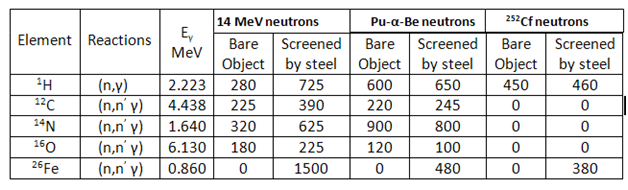
9 decreases the number of gamma photons produced from thermal neutron capture. These phenomena are clearly observed from the net count rate of gamma rays emitted from different interactions by fast and thermal neutrons with the object nuclei as shown from the count rate of the gamma peak tabulated in Table 1. Table 1. Gamma energies emitted by fast and thermal neutron interactions using different radioisotope sources Conclusions: The installed combined scanning and identification systems prove a good capability to locate the position and identify the material of hidden object in cargo containers. The scanning system can work by either gamma or fast neutron radiography technique, with nearly the same effectiveness. The use of fast neutron radiography with neutrons emitted from Pu-α-Be sources to scan cargo-containers show the same reliability and easiness as those work with gamma emitted from 60 Co source. The use of these neutrons to radiograph objects gives nearly the same image quality obtained by 14 MeV neutron or neutrons of like fission neutron spectrum emitted from 252 Cf neutron sources. Although fast neutrons emitted from α-be sources are less capable to detect carbon and oxygen than 14 MeV neutrons, they are much easier to moderate and hence become more capable to identify elements by thermal neutron activation analysis. The effectiveness of a scanner works with isotopic fast neutron source can be enhanced to ~ 40 % if the source is surrounded by fast neutron reflector made of heavy material
10 A combined systems work with only one simple isotopic neutron source possess very low scanning cost, reduced source shield, low weight and possibility to use as mobile scanning system. Recommendations: Fast neutron sources of high emission rate ~ n/s and fast neutron detector of higher detection efficiency must be used to improve the scanning performance. With such a neutron source and neutron detector, it becomes possible to scan a container of relatively large volume in shorter time. Fan beam of fast neutrons and an array of radiation detectors must be installed and used to provide quick scanning of the suspected object hidden in container of various sizes. Further investigations have to be performed to check the effectiveness of the installed References: combined system for locating and identifying fertile and fissile materials hidden in cargo containers. [1] J. R. Cliffrd, et al., An Explosive Detection System for Screening Luggage with High Energy x-rays, Proceeding of the First International Symposium on Explosive Detection Technology, Nov.13-15, (1991). [2] J. E. McFee and Y. Das, Advances in the location and identification of Hidden Explosive Munitions, Report No.548, Suffield, Defence Research Establishment, (1991). [3] L. Grodzins, Detecting Contraband in Luggage, Nucl. Instr. And Meth. B79, , (1993). [4] T. Gozani, et al., Apparatus and Method for Detecting Contraband Using Fast Neutron Activation, U.S. Patent #5, 098, 640, field January 1990, awarded March (1992). [5] G. Vourvopoulas, Accelerator based Techniques for Contraband Detection, Nucl. Instr. Nd Meth. B_89, (1994). [6] G. Vourvopoulos and R. C. Womble, Pulsed Fast/Thermal Neutron Analysis: A Technique for Explosives Detection, ATLANTA 54 (2001) , G. Eiceman, Editor, ELSEVIER (2001). [7] Z.P. Sowa, et al., Contraband Detection System Using Direct Imaging Pulsed Fast Neutrons, U.S. Patent 5, 076, 993, field January 1990, awarded December (1991). [8] N. Toyofuku and T. F. Schatzki, Image feature based detection of agricultural quarantine materials in X-ray images, Journal of Air Transport Management 13, (2007). [9] H. Vogel and D. Haller Luggage and shipped goods, European Journal of Radiology 63, (2007)
Characteristics of an Integrated Germanium Detector Based Gamma-Ray Spectrometer for Monitoring Systems
 Characteristics of an Integrated Germanium Detector Based Gamma-Ray Spectrometer for Monitoring Systems Ronald M. Keyser, Timothy R. Twomey, Sam Hitch ORTEC 801 South Illinois Avenue Oak Ridge, TN, 37831
Overview of Nuclear Detection Needs for Homeland Security. Abstract
 Overview of Nuclear Detection Needs for Homeland Security Timothy E. Valentine * Oak Ridge National Laboratory, P.O. Box 2008, Oak Ridge, Tennessee, 37831, USA Abstract The need for advanced and improved
Chapter NP-5. Nuclear Physics. Nuclear Reactions TABLE OF CONTENTS INTRODUCTION OBJECTIVES 1.0 NUCLEAR REACTIONS 2.0 NEUTRON INTERACTIONS
 Chapter NP-5 Nuclear Physics Nuclear Reactions TABLE OF CONTENTS INTRODUCTION OBJECTIVES 1.0 2.0 NEUTRON INTERACTIONS 2.1 ELASTIC SCATTERING 2.2 INELASTIC SCATTERING 2.3 RADIATIVE CAPTURE 2.4 PARTICLE
Cargo Container X-ray Inspection Systems
 Hitachi Review Vol. 53 (2004), No. 2 97 Cargo Container X-ray Inspection Systems OVERVIEW: Container inspection is categorized into three stages. In the initial stage, large-size X-ray DR (digital radiography)
Gamma Rays OBJECT: READINGS: APPARATUS: BACKGROUND:
 Gamma Rays OBJECT: To understand the various interactions of gamma rays with matter. To calibrate a gamma ray scintillation spectrometer, using gamma rays of known energy, and use it to measure the energy
Activitity (of a radioisotope): The number of nuclei in a sample undergoing radioactive decay in each second. It is commonly expressed in curies
 Activitity (of a radioisotope): The number of nuclei in a sample undergoing radioactive decay in each second. It is commonly expressed in curies (Ci), where 1 Ci = 3.7x10 10 disintegrations per second.
GAMMA-RAY SPECTRA REFERENCES
 GAMMA-RAY SPECTRA REFERENCES 1. K. Siegbahn, Alpha, Beta and Gamma-Ray Spectroscopy, Vol. I, particularly Chapts. 5, 8A. 2. Nucleonics Data Sheets, Nos. 1-45 (available from the Resource Centre) 3. H.E.
Atomic and Nuclear Physics Laboratory (Physics 4780)
 Gamma Ray Spectroscopy Week of September 27, 2010 Atomic and Nuclear Physics Laboratory (Physics 4780) The University of Toledo Instructor: Randy Ellingson Gamma Ray Production: Co 60 60 60 27Co28Ni *
Effect of Gamma Ray Energies and Addition of Iron Slag by weight to Portland Cements on Mass Attenuation Coefficient
 Journal of Materials Science and Engineering A 3 (12) (2013) 838-842 D DAVID PUBLISHING Effect of Gamma Ray Energies and Addition of Iron Slag by weight to Portland s on Mass Attenuation Coefficient Abd
A Comparison of an HPGe-based and NaI-based Radionuclide Identifier (RID) for Radioactive Materials
 Illicit Trafficking, Sub/cross-national threats, Poster presentation A Comparison of an HPGe-based and NaI-based Radionuclide Identifier (RID) for Radioactive Materials Ronald M. Keyser, Timothy R. Twomey,
A VERSATILE COUNTER FOR CONVERSION MÖSSBAUER SPECTROSCOPY
 A VERSATILE COUNTER FOR CONVERSION MÖSSBAUER SPECTROSCOPY I. BIBICU 1, G. NICOLESCU 2, L. CIOLACU 2, L. SERBINA 2 1 National Institute for Materials Physics, Bucharest 77125, Romania, [email protected] 2
ORTEC AN34 Experiment 7 High-Resolution Gamma-Ray Spectroscopy
 Equipment Needed from ORTEC GEM10P4/CFG-PV4/DWR-30 Coaxial Detector System (Includes detector, cryostat, dewar, preamplifier, and 12-ft. cable pack); typical specifications: 10% relative efficiency, 1.75
Nuclear Physics. Nuclear Physics comprises the study of:
 Nuclear Physics Nuclear Physics comprises the study of: The general properties of nuclei The particles contained in the nucleus The interaction between these particles Radioactivity and nuclear reactions
Lecture 2 Macroscopic Interactions. 22.106 Neutron Interactions and Applications Spring 2010
 Lecture 2 Macroscopic Interactions 22.106 Neutron Interactions and Applications Spring 2010 Objectives Macroscopic Interactions Atom Density Mean Free Path Moderation in Bulk Matter Neutron Shielding Effective
Cosmic Ray Muon Scattering Tomography for Security Applications
 Cosmic Ray Muon Scattering Tomography for Security Applications Lindsay Cox 1 Cosmic ray Muon Scattering Tomography (MST) is an innovative technique that uses naturally occurring background radiation to
Basics of Nuclear Physics and Fission
 Basics of Nuclear Physics and Fission A basic background in nuclear physics for those who want to start at the beginning. Some of the terms used in this factsheet can be found in IEER s on-line glossary.
A Digital Spectrometer Approach to Obtaining Multiple Time-Resolved Gamma-Ray. Spectra for Pulsed Spectroscopy. W. K. Warburton a
 1 IRRMA6 #21 A Digital Spectrometer Approach to Obtaining Multiple Time-Resolved Gamma-Ray Spectra for Pulsed Spectroscopy H. Tan a,, S. Mitra b, A. Fallu-Labruyere a, W. Hennig a, Y. X. Chu a, L. Wielopolski
MDCT Technology. Kalpana M. Kanal, Ph.D., DABR Assistant Professor Department of Radiology University of Washington Seattle, Washington
 MDCT Technology Kalpana M. Kanal, Ph.D., DABR Assistant Professor Department of Radiology University of Washington Seattle, Washington ACMP Annual Meeting 2008 - Seattle, WA Educational Objectives Historical
MONTE CARLO SIMULATION OF THE FULL MULTIPLICITY DISTRIBUTIONS MEASURED WITH A PASSIVE COUNTER
 International Conference on Mathematics, Computational Methods & Reactor Physics (M&C 9) Saratoga Springs, New York, May 3-7, 9, on CD-ROM, American Nuclear Society, LaGrange Park, IL (9) MONTE CARLO SIMULATION
Radiation Strip Thickness Measurement Systems
 Radiation Strip Thickness Measurement Systems During the past years we have increased our sales of radiometric Vollmer strip thickness measurement systems, i.e. X-ray or isotope gauges, dramatically. Now,
13C NMR Spectroscopy
 13 C NMR Spectroscopy Introduction Nuclear magnetic resonance spectroscopy (NMR) is the most powerful tool available for structural determination. A nucleus with an odd number of protons, an odd number
Radioactivity III: Measurement of Half Life.
 PHY 192 Half Life 1 Radioactivity III: Measurement of Half Life. Introduction This experiment will once again use the apparatus of the first experiment, this time to measure radiation intensity as a function
Radiation Detection and Measurement
 Radiation Detection and Measurement June 2008 Tom Lewellen [email protected] Types of radiation relevant to Nuclear Medicine Particle Symbol Mass (MeV/c 2 ) Charge Electron e-,! - 0.511-1 Positron
Tutorial 4.6 Gamma Spectrum Analysis
 Tutorial 4.6 Gamma Spectrum Analysis Slide 1. Gamma Spectrum Analysis In this module, we will apply the concepts that were discussed in Tutorial 4.1, Interactions of Radiation with Matter. Slide 2. Learning
ON-STREAM XRF ANALYSIS OF HEAVY METALS AT PPM CONCENTRATIONS
 Copyright JCPDS - International Centre for Diffraction Data 2004, Advances in X-ray Analysis, Volume 47. 130 ABSTRACT ON-STREAM XRF ANALYSIS OF HEAVY METALS AT PPM CONCENTRATIONS G Roach and J Tickner
Main properties of atoms and nucleus
 Main properties of atoms and nucleus. Atom Structure.... Structure of Nuclei... 3. Definition of Isotopes... 4. Energy Characteristics of Nuclei... 5. Laws of Radioactive Nuclei Transformation... 3. Atom
Production of X-rays. Radiation Safety Training for Analytical X-Ray Devices Module 9
 Module 9 This module presents information on what X-rays are and how they are produced. Introduction Module 9, Page 2 X-rays are a type of electromagnetic radiation. Other types of electromagnetic radiation
Chapter 3 SYSTEM SCANNING HARDWARE OVERVIEW
 Qiang Lu Chapter 3. System Scanning Hardware Overview 79 Chapter 3 SYSTEM SCANNING HARDWARE OVERVIEW Since all the image data need in this research were collected from the highly modified AS&E 101ZZ system,
Instructors Guide: Atoms and Their Isotopes
 Instructors Guide: Atoms and Their Isotopes Standards Connections Connections to NSTA Standards for Science Teacher Preparation C.3.a.1 Fundamental structures of atoms and molecules. C.3.b.27 Applications
PHYA5/1. General Certificate of Education Advanced Level Examination June 2012. Unit 5 Nuclear and Thermal Physics Section A
 Centre Number Surname Candidate Number For Examinerʼs Use Other Names Candidate Signature Examinerʼs Initials General Certificate of Education Advanced Level Examination June 2012 Question 1 2 Mark Physics
Introduction to Geiger Counters
 Introduction to Geiger Counters A Geiger counter (Geiger-Muller tube) is a device used for the detection and measurement of all types of radiation: alpha, beta and gamma radiation. Basically it consists
Pesticide Analysis by Mass Spectrometry
 Pesticide Analysis by Mass Spectrometry Purpose: The purpose of this assignment is to introduce concepts of mass spectrometry (MS) as they pertain to the qualitative and quantitative analysis of organochlorine
Optimization of Digital Industrial Radiography (DIR) Techniques for Specific Applications: An IAEA Coordinated Research Project
 IV Conferencia Panamericana de END Buenos Aires Octubre 2007 Optimization of Digital Industrial Radiography (DIR) Techniques for Specific Applications: An IAEA Coordinated Research Project U. Ewert, U.
Gamma and X-Ray Detection
 Gamma and X-Ray Detection DETECTOR OVERVIEW The kinds of detectors commonly used can be categorized as: a. Gas-filled Detectors b. Scintillation Detectors c. Semiconductor Detectors The choice of a particular
EXPERIMENTAL CONDITIONS FOR CROSS SECTION MEASUREMENTS FOR ANALYTICAL PURPOSES. L. Csedreki 1. Abstract. I. Introduction
 ACTA PHYSICA DEBRECINA XLVI, 25 (2012) EXPERIMENTAL CONDITIONS FOR CROSS SECTION MEASUREMENTS FOR ANALYTICAL PURPOSES L. Csedreki 1 1 Institute of Nuclear Research of the Hungarian Academy of Sciences,
W. C. Reinig. Savannah River Laboratory E. I. du Pent de Nemours and Company Aiken, South Carolina 298o1
 .*. *.-a /dp73j/3~ DP-MS-68-48 calforn1um-252: A NEW SOTOPC SOUR(!EFOR NEUTRON RADOGRAPHY by W. C. Reinig Savannah River Laboratory E.. du Pent de Nemours and Company Aiken, South Carolina 298o1. SRL7
Scanners more rapidly and accurately identify radioactive materials at US borders, events 22 June 2016, by Rob Matheson
 Scanners more rapidly and accurately identify radioactive materials at US borders, events 22 June 2016, by Rob Matheson In about 30 seconds, we can scan a container and provide a three-dimensional map
8.1 Radio Emission from Solar System objects
 8.1 Radio Emission from Solar System objects 8.1.1 Moon and Terrestrial planets At visible wavelengths all the emission seen from these objects is due to light reflected from the sun. However at radio
Neutron Detection Setups proposed for
 Neutron Detection Setups proposed for DESPEC D. Cano-Ott on behalf of the WG members CIEMAT, IFIC, LNL, FYL, UPC, UU, UW Motivation GOAL: to measure neutron emission probabilities and energies for neutron
............... [2] At the time of purchase of a Strontium-90 source, the activity is 3.7 10 6 Bq.
![............... [2] At the time of purchase of a Strontium-90 source, the activity is 3.7 10 6 Bq.](/thumbs/40/21837699.jpg "............... [2] At the time of purchase of a Strontium-90 source, the activity is 3.7 10 6 Bq.") 1 Strontium-90 decays with the emission of a β-particle to form Yttrium-90. The reaction is represented by the equation 90 38 The decay constant is 0.025 year 1. 90 39 0 1 Sr Y + e + 0.55 MeV. (a) Suggest,
1 Strontium-90 decays with the emission of a β-particle to form Yttrium-90. The reaction is represented by the equation 90 38 The decay constant is 0.025 year 1. 90 39 0 1 Sr Y + e + 0.55 MeV. (a) Suggest,
ABSORPTION OF BETA AND GAMMA RADIATION
 ABSORPTION OF BETA AND GAMMA RADIATION The purpose of this experiment is to understand the interaction of radiation and matter, and the application to radiation detection and shielding Apparatus: 137 Cs
Appendix A. An Overview of Monte Carlo N-Particle Software
 Appendix A. An Overview of Monte Carlo N-Particle Software A.1 MCNP Input File The input to MCNP is an ASCII file containing command lines called "cards". The cards provide a description of the situation
Gamma Ray Detection at RIA
 Gamma Ray Detection at RIA Summary Report: Physics & Functional Requirements Cyrus Baktash Physics goals Experimental tools: Techniques & Reactions Functional Requirements Physics Questions (Discussed
Scan Time Reduction and X-ray Scatter Rejection in Dual Modality Breast Tomosynthesis. Tushita Patel 4/2/13
 Scan Time Reduction and X-ray Scatter Rejection in Dual Modality Breast Tomosynthesis Tushita Patel 4/2/13 Breast Cancer Statistics Second most common cancer after skin cancer Second leading cause of cancer
Nuclear Physics and Radioactivity
 Nuclear Physics and Radioactivity 1. The number of electrons in an atom of atomic number Z and mass number A is 1) A 2) Z 3) A+Z 4) A-Z 2. The repulsive force between the positively charged protons does
Mars Atmosphere and Volatile EvolutioN (MAVEN) Mission
 Mars Atmosphere and Volatile EvolutioN (MAVEN) Mission MAVEN Science Community Workshop December 2, 2012 Particles and Fields Package Solar Energetic Particle Instrument (SEP) Davin Larson and the SEP
2 KEV FILTERS OF QUASI-MONOCHROMATIC EPITHERMAL NEUTRONS
 Journal of Nuclear and Radiation Physics, Vol. 6, No. 1&2, pp. 69-77 2 KEV FILTERS OF QUASI-MONOCHROMATIC EPITHERMAL NEUTRONS H. N. Morcos and M. Adib Reactor Department, Nuclear Research Center, EAEA,
90 degrees Bremsstrahlung Source Term Produced in Thick Targets by 50 MeV to 10 GeV Electrons
 SLAC-PUB-7722 January 9 degrees Bremsstrahlung Source Term Produced in Thick Targets by 5 MeV to GeV Electrons X. S. Mao et al. Presented at the Ninth International Conference on Radiation Shielding, Tsukuba,
ENERGY PER PHOTOELECTRON IN A COINCIDENCE LIQUID SCINTILLATION COUNTER AS A FUNCTION OF ELECTRON ENERGY. Donald L. Horrocks
 ENERGY PER PHOTOELECTRON IN A COINCIDENCE LIQUID SCINTILLATION COUNTER AS A FUNCTION OF ELECTRON ENERGY Donald L. Horrocks Nuclear Systems Operations Beckman Instruments, Inc. SmithKlirie Beckman Irvine,
From lowest energy to highest energy, which of the following correctly orders the different categories of electromagnetic radiation?
 From lowest energy to highest energy, which of the following correctly orders the different categories of electromagnetic radiation? From lowest energy to highest energy, which of the following correctly
Nuclear Detonation Calculator
 Nuclear Detonation Calculator In last month s newsletter, February 2007, I discussed the Fallout Radiation Dose Calculator that was a new feature in the in the latest version of the PEAC-WMD software released
Chapter 8. Low energy ion scattering study of Fe 4 N on Cu(100)
 Low energy ion scattering study of 4 on Cu(1) Chapter 8. Low energy ion scattering study of 4 on Cu(1) 8.1. Introduction For a better understanding of the reconstructed 4 surfaces one would like to know
Calculation of Source-detector Solid Angle, Using Monte Carlo Method, for Radioactive Sources with Various Geometries and Cylindrical Detector
 International Journal of Pure and Applied Physics ISSN 0973-1776 Volume 3, Number 2 (2007), pp. 201 208 Research India Publications http://www.ripublication.com/ijpap.htm Calculation of Source-detector
Ch. 227 ANALYTICAL X-RAY EQUIPMENT 25
 Ch. 227 ANALYTICAL X-RAY EQUIPMENT 25 CHAPTER 227. RADIATION SAFETY REQUIREMENTS FOR ANALYTICAL X-RAY EQUIPMENT, X-RAY GAUGING EQUIPMENT, ELECTRON MICROSCOPES AND X-RAY CALIBRATION SYSTEMS Sec. 227.1.
X Ray Flourescence (XRF)
 X Ray Flourescence (XRF) Aspiring Geologist XRF Technique XRF is a rapid, relatively non destructive process that produces chemical analysis of rocks, minerals, sediments, fluids, and soils It s purpose
F321 THE STRUCTURE OF ATOMS. ATOMS Atoms consist of a number of fundamental particles, the most important are... in the nucleus of an atom
 Atomic Structure F32 TE STRUCTURE OF ATOMS ATOMS Atoms consist of a number of fundamental particles, the most important are... Mass / kg Charge / C Relative mass Relative Charge PROTON NEUTRON ELECTRON
Experiment 5. Lasers and laser mode structure
 Northeastern University, PHYS5318 Spring 2014, 1 1. Introduction Experiment 5. Lasers and laser mode structure The laser is a very important optical tool that has found widespread use in science and industry,
Medical Applications of radiation physics. Riccardo Faccini Universita di Roma La Sapienza
 Medical Applications of radiation physics Riccardo Faccini Universita di Roma La Sapienza Outlook Introduction to radiation which one? how does it interact with matter? how is it generated? Diagnostics
For convenience, we may consider an atom in two parts: the nucleus and the electrons.
 Atomic structure A. Introduction: In 1808, an English scientist called John Dalton proposed an atomic theory based on experimental findings. (1) Elements are made of extremely small particles called atoms.
Cutting Edge Digital Radiography Technology in Daily NDT Use
 Cutting Edge Digital Radiography Technology in Daily NDT Use Ron PINCU, Eli DAYAN, Ofra KLEINBERGER Vidisco Ltd. Or-Yehuda, Israel 60375 Tel: +972 (3) 533-3001 Email: [email protected] ABSTRACT Digital Radiography
ENERGY LOSS OF ALPHA PARTICLES IN GASES
 Vilnius University Faculty of Physics Department of Solid State Electronics Laboratory of Applied Nuclear Physics Experiment No. ENERGY LOSS OF ALPHA PARTICLES IN GASES by Andrius Poškus (e-mail: [email protected])
MASS DEFECT AND BINDING ENERGY
 MASS DEFECT AND BINDING ENERGY The separate laws of Conservation of Mass and Conservation of Energy are not applied strictly on the nuclear level. It is possible to convert between mass and energy. Instead
Nuclear Physics Lab I: Geiger-Müller Counter and Nuclear Counting Statistics
 Nuclear Physics Lab I: Geiger-Müller Counter and Nuclear Counting Statistics PART I Geiger Tube: Optimal Operating Voltage and Resolving Time Objective: To become acquainted with the operation and characteristics
Chemistry 1000 Lecture 2: Nuclear reactions and radiation. Marc R. Roussel
 Chemistry 1000 Lecture 2: Nuclear reactions and radiation Marc R. Roussel Nuclear reactions Ordinary chemical reactions do not involve the nuclei, so we can balance these reactions by making sure that
GCE Physics A. Mark Scheme for June 2014. Unit G485: Fields, Particles and Frontiers of Physics. Advanced GCE. Oxford Cambridge and RSA Examinations
 GCE Physics A Unit G485: Fields, Particles and Frontiers of Physics Advanced GCE Mark Scheme for June 014 Oxford Cambridge and RSA Examinations OCR (Oxford Cambridge and RSA) is a leading UK awarding body,
An Innovative Method for Dead Time Correction in Nuclear Spectroscopy
 An Innovative Method for Dead Time Correction in Nuclear Spectroscopy Upp, Daniel L.; Keyser, Ronald M.; Gedcke, Dale A.; Twomey, Timothy R.; and Bingham, Russell D. PerkinElmer Instruments, Inc. ORTEC,
The data acquisition system of the XMASS experiment
 The data acquisition system of the XMASS experiment Katsuki Hiraide 1,2, for the XMASS Collaboration 1 Kamioka Observatory, Institute for Cosmic Ray Research, the University of Tokyo, Higashi-Mozumi, Kamioka,
Introduction to the Monte Carlo method
 Some history Simple applications Radiation transport modelling Flux and Dose calculations Variance reduction Easy Monte Carlo Pioneers of the Monte Carlo Simulation Method: Stanisław Ulam (1909 1984) Stanislaw
2 Absorbing Solar Energy
 2 Absorbing Solar Energy 2.1 Air Mass and the Solar Spectrum Now that we have introduced the solar cell, it is time to introduce the source of the energy the sun. The sun has many properties that could
CHAPTER 7 SCINTILLATION COUNTING
 CHAPTER 7 SCINTILLATION COUNTING Radiation of various types is widely utilized for non-destructive inspection and testing such as in medical diagnosis, industrial inspection, material analysis and other
History of the Atom & Atomic Theory
 Chapter 5 History of the Atom & Atomic Theory You re invited to a Thinking Inside the Box Conference Each group should nominate a: o Leader o Writer o Presenter You have 5 minutes to come up with observations
Objectives 404 CHAPTER 9 RADIATION
 Objectives Explain the difference between isotopes of the same element. Describe the force that holds nucleons together. Explain the relationship between mass and energy according to Einstein s theory
Objectives. PAM1014 Introduction to Radiation Physics. Constituents of Atoms. Atoms. Atoms. Atoms. Basic Atomic Theory
 PAM1014 Introduction to Radiation Physics Basic Atomic Theory Objectives Introduce and Molecules The periodic Table Electronic Energy Levels Atomic excitation & de-excitation Ionisation Molecules Constituents
Application Note. ipix A Gamma imager to support various applications
 Application Note ipix A Gamma imager to support various applications Introduction ipix is a unique gamma imager that quickly locates low level radioactive sources from a distance and estimates the dose
X-ray Production. Target Interactions. Principles of Imaging Science I (RAD119) X-ray Production & Emission
 Principles of Imaging Science I (RAD119) X-ray Production & Emission X-ray Production X-rays are produced inside the x-ray tube when high energy projectile electrons from the filament interact with the
Security Imaging Systems (X-Ray): Design, Measurements Regulations, and Standards
 Security Imaging Systems (X-Ray): Design, Measurements Regulations, and Standards Presented: August 3, 2011 Daniel Kassiday United States Food and Drug Administration Center for Devices and Radiological
EDXRF of Used Automotive Catalytic Converters
 EDXRF of Used Automotive Catalytic Converters Energy Dispersive X-Ray Fluorescence (EDXRF) is a very powerful technique for measuring the concentration of elements in a sample. It is fast, nondestructive,
Atomic Structure: Chapter Problems
 Atomic Structure: Chapter Problems Bohr Model Class Work 1. Describe the nuclear model of the atom. 2. Explain the problems with the nuclear model of the atom. 3. According to Niels Bohr, what does n stand
The Physics of Energy sources Nuclear Reactor Practicalities
 The Physics of Energy sources Nuclear Reactor Practicalities B. Maffei [email protected] www.jb.man.ac.uk/~bm Nuclear Reactor 1 Commonalities between reactors All reactors will have the same
ENRICHMENT AND URANIUM MASS FROM NMIS FOR HEU METAL
 ABSTRACT ENRICHMENT AND URANIUM MASS FROM NMIS FOR HEU METAL J. K. Mattingly, T. E. Valentine, J. T. Mihalczo, L. G. Chiang, R. B. Perez Oa Ridge National Laboratory Oa Ridge, Tennessee 37831-6004 Recently,
Fuel Cell Activities at TU Graz
 Fuel Cell Activities at TU Graz Viktor Hacker Institute of Chemical Engineering and Environmental Technology Graz University of Technology IEA Workshop TU Graz September 1 st, 2010 Content Lifetime and
MCQ - ENERGY and CLIMATE
 1 MCQ - ENERGY and CLIMATE 1. The volume of a given mass of water at a temperature of T 1 is V 1. The volume increases to V 2 at temperature T 2. The coefficient of volume expansion of water may be calculated
FTIR Instrumentation
 FTIR Instrumentation Adopted from the FTIR lab instruction by H.-N. Hsieh, New Jersey Institute of Technology: http://www-ec.njit.edu/~hsieh/ene669/ftir.html 1. IR Instrumentation Two types of instrumentation
MODELING AND IMPLEMENTATION OF THE MECHANICAL SYSTEM AND CONTROL OF A CT WITH LOW ENERGY PROTON BEAM
 MODELING AND IMPLEMENTATION OF THE MECHANICAL SYSTEM AND CONTROL OF A CT WITH LOW ENERGY PROTON BEAM João Antônio Palma Setti, [email protected] Pontifícia Universidade Católica do Paraná / Rua Imaculada
PROSPECT: Precision Reactor Oscillation and Spectrum experiment
 PROSPECT: Precision Reactor Oscillation and Spectrum experiment DAVID MARTINEZ CAICEDO on behalf of PROSPECT collaboration ILLINOIS INSTITUTE OF TECHNOLOGY NUFACT 2015 AUGUST 14th 2015 1 Outline Motivations:
TOF-PET DETECTOR CONCEPT BASED ON ORGANIC SCINTILLATORS
 TOF-PET DETECTOR CONCEPT BASED ON ORGANIC SCINTILLATORS P. Moskal, T. Bednarski, P. Białas, M. Ciszewska, E. Czerwiński, A. Heczko, M. Kajetanowicz, Ł. Kapłon, A. Kochanowski, G. Konopka-Cupiał, G. Korcyl,
Monte Carlo simulation of a scanning whole body counter and the effect of BOMAB phantom size on the calibration.
 Monte Carlo simulation of a scanning whole body counter and the effect of BOMAB phantom size on the calibration. Gary H. Kramer, Linda C. Burns and Steven Guerriere Human Monitoring Laboratory, Radiation
Chapter 18: The Structure of the Atom
 Chapter 18: The Structure of the Atom 1. For most elements, an atom has A. no neutrons in the nucleus. B. more protons than electrons. C. less neutrons than electrons. D. just as many electrons as protons.
Basic Concepts of X-ray X Fluorescence by Miguel Santiago, Scientific Instrumentation Specialist
 Basic Concepts of X-ray X Fluorescence by Miguel Santiago, Scientific Instrumentation Specialist University of Puerto Rico Mayagüez Campus Department of Geology X-ray / Microanalysis Laboratory F - 304
Lectures about XRF (X-Ray Fluorescence)
 1 / 38 Lectures about XRF (X-Ray Fluorescence) Advanced Physics Laboratory Laurea Magistrale in Fisica year 2013 - Camerino 2 / 38 X-ray Fluorescence XRF is an acronym for X-Ray Fluorescence. The XRF technique
Jorge E. Fernández Laboratory of Montecuccolino (DIENCA), Alma Mater Studiorum University of Bologna, via dei Colli, 16, 40136 Bologna, Italy
 Information technology (IT) for teaching X- and gamma-ray transport: the computer codes MUPLOT and SHAPE, and the web site dedicated to photon transport Jorge E. Fernández Laboratory of Montecuccolino
Synthetic Sensing: Proximity / Distance Sensors
 Synthetic Sensing: Proximity / Distance Sensors MediaRobotics Lab, February 2010 Proximity detection is dependent on the object of interest. One size does not fit all For non-contact distance measurement,
Laboratory Technologies, Inc. Multi-Wiper. Time Saving Multiple Detector Wipe Counter
 Laboratory Technologies, Inc. Multi-Wiper Time Saving Multiple Detector Wipe Counter Features Wipe test sets In-vitro tests Patient library Isotope library AutoSpect efficiency correction Advanced 4096-channel
Phased Array Ultrasonic Inspection Of 25%Cr Super Duplex Stainless Steel. On Subsea Manifold Piping Girth Welds In Lieu Of Radiography
 National Seminar & Exhibition on Non-Destructive Evaluation, NDE 2014, Pune, December 4-6, 2014 (NDE-India 2014) Vol.20 No.6 (June 2015) - The e-journal of Nondestructive Testing - ISSN 1435-4934 www.ndt.net/?id=17866
Nuclear Magnetic Resonance (NMR) Spectroscopy cont... Recommended Reading:
 Applied Spectroscopy Nuclear Magnetic Resonance (NMR) Spectroscopy cont... Recommended Reading: Banwell and McCash Chapter 7 Skoog, Holler Nieman Chapter 19 Atkins, Chapter 18 Relaxation processes We need