
CURRICULUM REGISTRATION GUIDE
|
|
|
- Alyson Montgomery
- 10 years ago
- Views:
Transcription
1 O R A N G E C O U N T Y S C H O O L S HIGH SCHOOL CURRICULUM and REGISTRATION GUIDE Preparing For Your Future

2 CONTACT INFORMATION Orange High School Mr. Jason Johnson, Principal 500 Orange High School Rd., Hillsborough, NC Cedar Ridge High School Heather Blackmon, Principal 1125 New Grady Brown School Rd., Hillsborough, NC Partnership Academy Dr. Paige Marsh, Principal 1006 East Storey Lane, Hillsborough, NC This course guide can be found online at:
3 VISION MISSION CORE VALUES Orange County Schools Vision Orange County Schools prepares students to be responsible citizens in a diverse world by promoting academic and individual success. Mission Orange County Schools, in partnership with students, families and the community, is committed to providing challenging and engaging educational experiences that will develop responsible, knowledgeable and resourceful citizens prepared to contribute in our global society. Orange County Schools Board of Education The Orange County School System is fortunate to have a Board of Education which provides strong leadership and is committed to the educational excellence of our students. The Board of Education has control and supervision of all matters pertaining to the school district. Furthermore, the Board provides leadership and direction through the formulation of goals and objectives, especially in defining and setting high academic standards for student success. Core Values We believe in and support O utstanding student achievement and individual success C ommitment to excellence, communication and collaboration S erving students, staff, families and the community through strong, active relationships Board Members: Mr. Tom Carr Ms. Donna Coffey Dr. Stephen Halkiotis Mr. Tony McKnight Mr. Lawrence Sanders Ms. Brenda Stephens Ms. Rosa D. Williams VISION MISSION CORE VALUES Page 3
4
5 CONTACT INFORMATION...Inside Cover VISION MISSION CORE VALUES...3 FOUR YEAR PLAN FOR HIGH SCHOOL STUDENTS...7 STUDENT CALENDAR...8 A MESSAGE FROM GUIDANCE...9 TIPS FOR SELECTING COURSES...9 ONLINE REGISTRATION...10 GRADUATION REQUIREMENTS...10 GRADUATION & GRADE LEVEL PROMOTION ON BLOCK SCHEDULE...14 FUTURE READY CORE GRADUATION CHECKLIST FOR NINTH GRADE STUDENTS ENTERING IN / FUTURE READY CORE GRADUATION CHECKLIST FOR NINTH GRADE STUDENTS ENTERING IN 2012/13 AND LATER...16 MATHEMATICS COURSES AND PROGRESSION...17 ENGLISH LANGUAGE ARTS COURSES AND PROGRESSION...17 ORANGE COUNTY SCHOOLS CLUSTER PATHWAYS...18 SCHEDULE CHANGES/COURSE WITHDRAWAL...20 HIGH SCHOOL COURSE SELECTION WAIVER FORM...20 HIGH SCHOOL PROGRAMS & SERVICES...21 THE NORTH CAROLINA ACADEMIC SCHOLARS PROGRAM...21 HONORS COURSES...21 THE COLLEGE BOARD ADVANCED PLACEMENT COURSES PROGRAM...22 INTERNATIONAL BACCALAUREATE PROGRAMME (IB)...24 MIDDLE COLLEGE HIGH SCHOOL AT DURHAM TECHNICAL COMMUNITY COLLEGE (MCHS)...26 NORTH CAROLINA VIRTUAL PUBLIC SCHOOL (NCVPS)...26 CAREER & TECHNICAL EDUCATION PATHWAYS...26 CAREER AND COLLEGE PROMISE...27 NORTH CAROLINA HIGH SCHOOL TO COMMUNITY COLLEGE ARTICULATION AGREEMENT...28 SERVICES AVAILABLE...29 TRANSCRIPTS...29 WEIGHTED GRADING...30 NATIONAL TESTING CALENDARS...32 ORANGE COUNTY SCHOOLS HIGH SCHOOL COURSE OFFERINGS...33 Cultural Arts Education...33 Instrumental Music Vocal Music Theatre Arts Visual Arts Advanced Placement & International Baccalaureate Cultural Arts...36 Career/Technical Education (CTE)...36 Agricultural Education Business and Information Technology Education Family and Consumer Sciences Health Sciences Education Marketing Education Trade and Industrial Education English...45 Advanced Placement & International Baccalaureate English...47 English Electives...47 Journalism Electives...48

6 T A B L E O F C O N T E N T S Special Services...50 Mathematics...52 Advanced Placement & International Baccalaureate Mathematics...54 Healthful Living...55 Healthful Living Electives...55 Science...58 Science Electives...59 Advanced Placement & International Baccalaureate Science...59 World Language Studies...60 French Spanish Latin International Baccalaureate World Language Studies...61 Social Studies...62 Social Studies Electives...62 Advanced Placement & International Baccalaureate Social Studies...64 Additional Elective Courses...65 FYI...67 GLOSSARY...68 FOUR YEAR PLAN FOR HIGH SCHOOL STUDENTS...70 NOTES...71
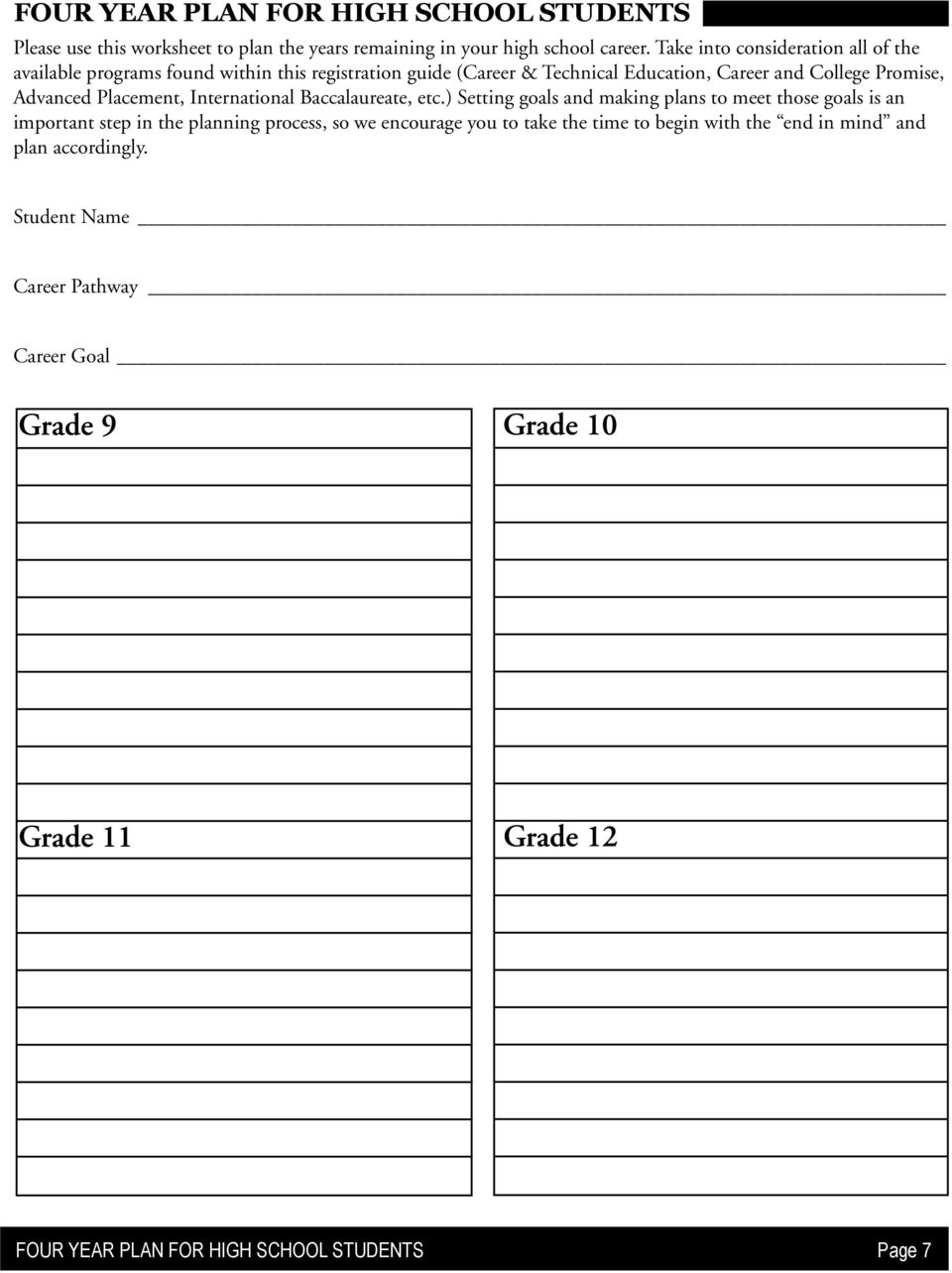
7 FOUR YEAR PLAN FOR HIGH SCHOOL STUDENTS Please use this worksheet to plan the years remaining in your high school career. Take into consideration all of the available programs found within this registration guide (Career & Technical Education, Career and College Promise, Advanced Placement, International Baccalaureate, etc.) Setting goals and making plans to meet those goals is an important step in the planning process, so we encourage you to take the time to begin with the end in mind and plan accordingly. Student Name Career Pathway Career Goal FOUR YEAR PLAN FOR HIGH SCHOOL STUDENTS Page 7
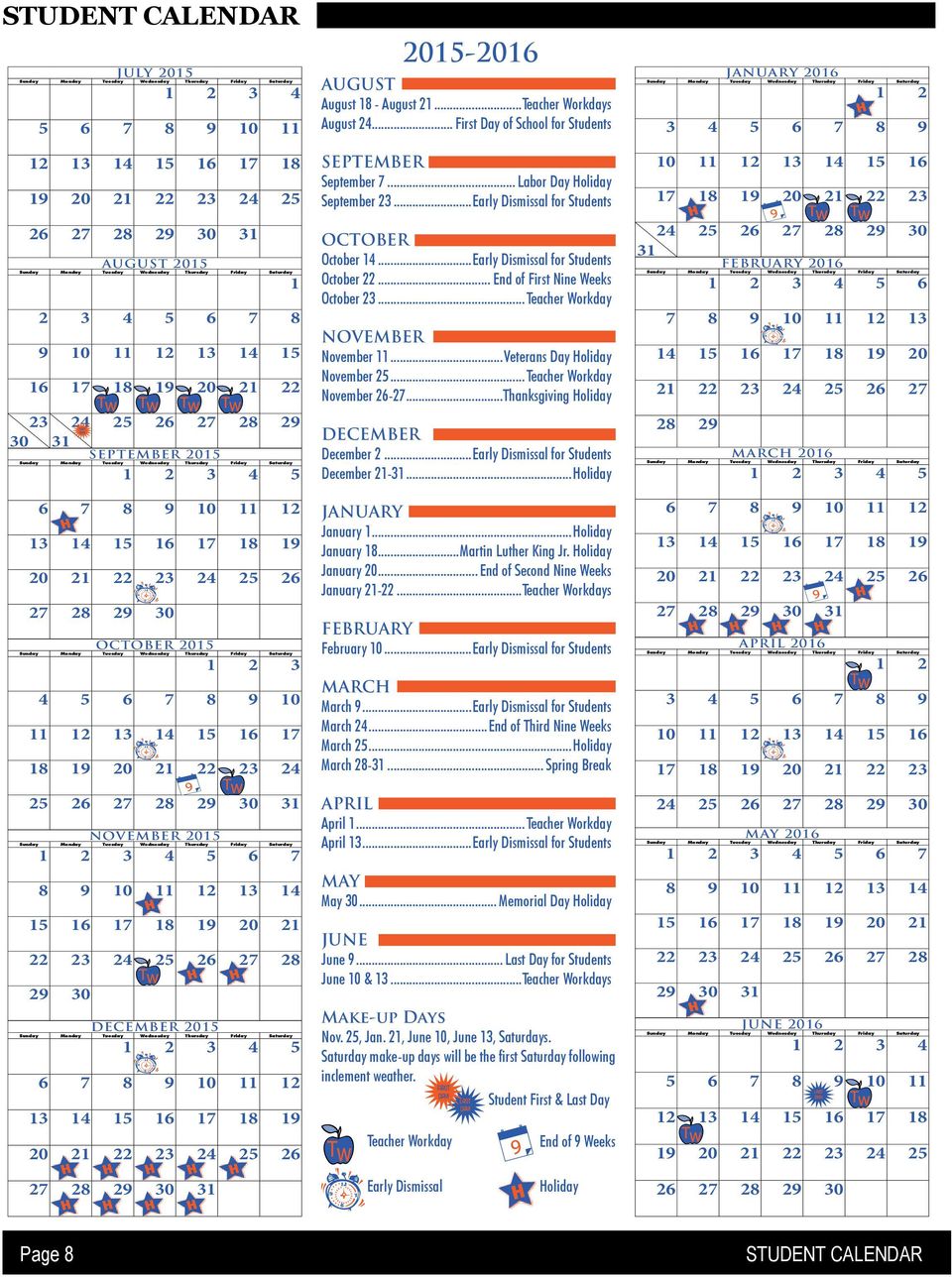
8 ORANGE COUNTY SCHOOLS STUDENT CALENDAR TRADITIONAL STUDENT CALENDAR JULY 2015 Sunday Monday Tuesday Wednesday Thursday Friday Saturday AUGUST August 18 - August 21...Teacher Workdays August First Day of School for Students Approved 11/24/14 JANUARY 2016 Sunday Monday Tuesday Wednesday Thursday Friday Saturday AUGUST 2015 Sunday Monday Tuesday Wednesday Thursday Friday Saturday SEPTEMBER 2015 Sunday Monday Tuesday Wednesday Thursday Friday Saturday OCTOBER 2015 Sunday Monday Tuesday Wednesday Thursday Friday Saturday NOVEMBER 2015 Sunday Monday Tuesday Wednesday Thursday Friday Saturday DECEMBER 2015 Sunday Monday Tuesday Wednesday Thursday Friday Saturday SEPTEMBER September 7... Labor Day Holiday September 23...Early Dismissal for Students OCTOBER October 14...Early Dismissal for Students October End of First Nine Weeks October Teacher Workday NOVEMBER November 11...Veterans Day Holiday November Teacher Workday November Thanksgiving Holiday DECEMBER December 2...Early Dismissal for Students December Holiday JANUARY January 1...Holiday January 18...Martin Luther King Jr. Holiday January End of Second Nine Weeks January Teacher Workdays FEBRUARY February 10...Early Dismissal for Students MARCH March 9...Early Dismissal for Students March 24...End of Third Nine Weeks March 25...Holiday March Spring Break APRIL April 1... Teacher Workday April 13...Early Dismissal for Students MAY May Memorial Day Holiday JUNE June 9... Last Day for Students June 10 & 13...Teacher Workdays Make-up Days Nov. 25, Jan. 21, June 10, June 13, Saturdays. Saturday make-up days will be the first Saturday following inclement weather. Student First & Last Day Teacher Workday End of 9 Weeks FEBRUARY 2016 Sunday Monday Tuesday Wednesday Thursday Friday Saturday MARCH 2016 Sunday Monday Tuesday Wednesday Thursday Friday Saturday APRIL 2016 Sunday Monday Tuesday Wednesday Thursday Friday Saturday MAY 2016 Sunday Monday Tuesday Wednesday Thursday Friday Saturday JUNE 2016 Sunday Monday Tuesday Wednesday Thursday Friday Saturday Early Dismissal Holiday Page 8 STUDENT CALENDAR
9 A MESSAGE FROM GUIDANCE The basis for a successful year in high school is careful course selection for that academic year. The best selections are made when the student and parent have complete and accurate information from which to make choices and decisions. The registration guide provides students and parents/legal guardians with information about high school graduation requirements, university and community college admissions requirements, course descriptions, special academic programs available to students, and more. With careful attention to the information presented here, a student can make a tentative four-year plan for high school that is based on options available upon graduation from high school. Students and parents/legal guardians can also gain additional insight into high school planning by attending special presentations offered by the middle schools and high schools. These programs are presented during the orientation and registration period in the spring. Both high schools offer the resources of a Career Development Center. These centers can be helpful in planning the best course selection based on a student s overall ability, aptitude, interest, and work values. They also distribute information about universities, colleges and scholarships for students and parents. With the help of computers, you can access university and college web sites as well as complete interest inventories. The center also offers job shadowing, apprenticeship, and military information. The center will help you select a career that is right for you based on your individual areas of interest. Cedar Ridge and Orange High School counselors are glad to meet with parents/guardians to help with course selection and post-high school planning. For additional information, or to make an appointment with a high school counselor, please call ext (CRHS) or ext (OHS). The Orange County Schools High School Curriculum and Registration Guide contains information needed to register for the school year. Please read through it carefully. Discuss your course selections with your parents or legal guardian, teachers, and school counselor. Focus on your graduation requirements, course requirements, career goals and interests. More information and explanations of procedures and programs at each high school will be shared with students as they register for classes. Please note: Select eight courses plus alternates. Course offerings begin on page 33. Please use the glossary to understand terms about which you have questions. Pay attention to prerequisites, recommendations, and/or special notes necessary before you select your courses. Elective courses are offered subject to student demand and teacher availability. TIPS FOR SELECTING COURSES A MESSAGE FROM GUIDANCE TIPS FOR SELECTING COURSES Page 9
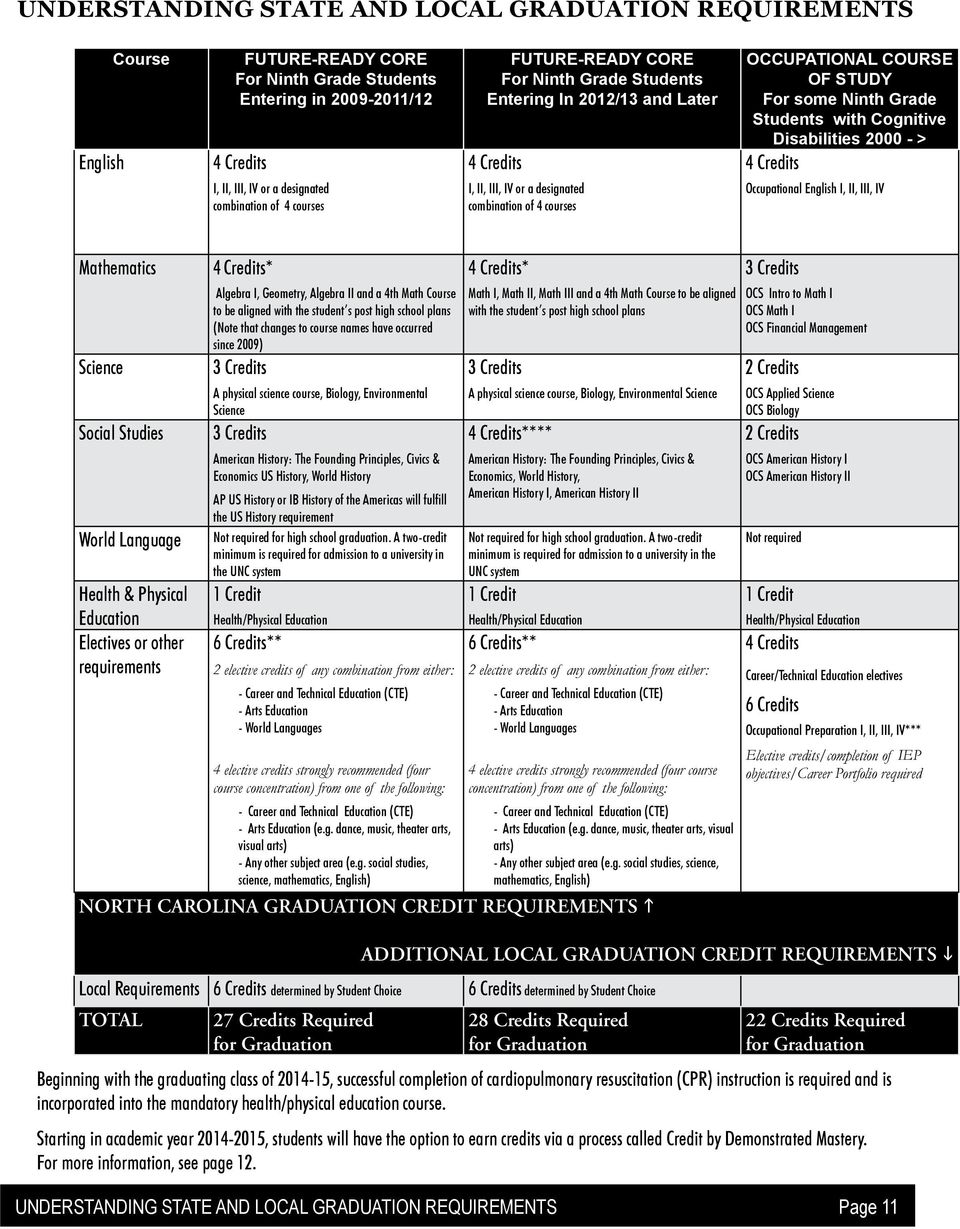
10 ONLINE REGISTRATION Students at the high school level will be registering for courses online through his/her PowerSchool account. Middle school and high school students work with CareerCruising and/or CFNC (College for North Carolina) to determine a four year plan for high school research possible colleges, community colleges, and careers associated with their plan. Based on their four year plan students will register for their courses. Students will be given the time and resources at school to register online if needed. GRADUATION REQUIREMENTS The Orange County Schools Board of Education encourages a rigorous standard for student graduation. In this section you will find pertinent information from the Orange County Board of Education Policy (Policy Number 3460 see Future-Ready Core Curriculum Graduation Requirements Ninth Grade Classes of /12 (27 credits required) The first column in the table to the right shows the units required for graduation under the Future-Ready Core. These students will be required to pass End-of-Course Tests as designated by the NC State Board of Education. The checklist on page 15 might also be helpful to you. The Occupational Course of Study (OCS) is available for eligible students. Ninth Grade Classes of 2012/13 (28 credits required) The second column in the table to the right shows the units required for graduation under the Future-Ready Core for students entering ninth grade for the first time in Students will also be required to take three Endof-Course (EOC) assessments (Math I, Biology and English II). The checklist on page 16 might also be helpful to you. For some students identified as Exceptional Children, the Occupational Course of Study (OCS) will remain an option. These students should have the Occupational Course of Study identified in their Individualized Education Program. Understanding State and Local Graduation Requirements * Exemptions to the mathematics requirement for a particular student requires a recommendation and / or request from the parent or school personnel. In this rare instance, the school will initiate the review process. A school-based committee will review and consider the request in order to make a recommendation to the principal. Final decision will be made by principal. (Refer to OCS Board of Education Policy #3460, ** Students can tailor their course cluster to fit their interests and goals while building a strong academic foundation. Under the six total elective units required for graduation, four elective credits (a four course cluster) will be taken from one of the following areas of focus: Career and Technical Education, Arts Education, or other designated subject areas. (e.g. mathematics, science). The remaining two electives must be any combination from Career and Technical Education, Arts Education or World Languages. *** Completion of 300 hours of school-based training, 240 hours of community-based training and 360 hours of paid employment. **** Students may substitute AP U.S. History for American History I and American History II, but they are required to take a fourth social studies course (elective). International Baccalaureate (IB) United States History may be substituted for American History I and American History II. Students will not be required to take an additional elective as students will be receiving the full range of United States History in these two courses and will receive two credits, satisfying the NC Graduation Requirements. Page 10 ONLINE REGISTRATION GRADUATION REQUIREMENTS

11 UNDERSTANDING STATE AND LOCAL GRADUATION REQUIREMENTS English Course FUTURE-READY CORE For Ninth Grade Students Entering in /12 4 Credits I, II, III, IV or a designated combination of 4 courses FUTURE-READY CORE For Ninth Grade Students Entering In 2012/13 and Later 4 Credits I, II, III, IV or a designated combination of 4 courses OCCUPATIONAL COURSE OF STUDY For some Ninth Grade Students with Cognitive Disabilities > 4 Credits Occupational English I, II, III, IV Mathematics Science Social Studies World Language Health & Physical Education Electives or other requirements 4 Credits* Algebra I, Geometry, Algebra II and a 4th Math Course to be aligned with the student s post high school plans (Note that changes to course names have occurred since 2009) 3 Credits A physical science course, Biology, Environmental Science 3 Credits American History: The Founding Principles, Civics & Economics US History, World History AP US History or IB History of the Americas will fulfill the US History requirement Not required for high school graduation. A two-credit minimum is required for admission to a university in the UNC system 1 Credit Health/Physical Education 6 Credits** 2 elective credits of any combination from either: - Career and Technical Education (CTE) - Arts Education - World Languages 4 elective credits strongly recommended (four course concentration) from one of the following: - Career and Technical Education (CTE) - Arts Education (e.g. dance, music, theater arts, visual arts) - Any other subject area (e.g. social studies, science, mathematics, English) 4 Credits* Math I, Math II, Math III and a 4th Math Course to be aligned with the student s post high school plans 3 Credits A physical science course, Biology, Environmental Science 4 Credits**** American History: The Founding Principles, Civics & Economics, World History, American History I, American History II Not required for high school graduation. A two-credit minimum is required for admission to a university in the UNC system 1 Credit Health/Physical Education 6 Credits** 2 elective credits of any combination from either: - Career and Technical Education (CTE) - Arts Education - World Languages 4 elective credits strongly recommended (four course concentration) from one of the following: - Career and Technical Education (CTE) - Arts Education (e.g. dance, music, theater arts, visual arts) - Any other subject area (e.g. social studies, science, mathematics, English) NORTH CAROLINA GRADUATION CREDIT REQUIREMENTS h 3 Credits OCS Intro to Math I OCS Math I OCS Financial Management 2 Credits OCS Applied Science OCS Biology 2 Credits OCS American History I OCS American History II Not required 1 Credit Health/Physical Education 4 Credits Career/Technical Education electives 6 Credits Occupational Preparation I, II, III, IV*** Elective credits/completion of IEP objectives/career Portfolio required ADDITIONAL LOCAL GRADUATION CREDIT REQUIREMENTS i Local Requirements 6 Credits determined by Student Choice 6 Credits determined by Student Choice TOTAL 27 Credits Required 28 Credits Required for Graduation for Graduation 22 Credits Required for Graduation Beginning with the graduating class of , successful completion of cardiopulmonary resuscitation (CPR) instruction is required and is incorporated into the mandatory health/physical education course. Starting in academic year , students will have the option to earn credits via a process called Credit by Demonstrated Mastery. For more information, see page 12. UNDERSTANDING STATE AND LOCAL GRADUATION REQUIREMENTS Page 11
12 Credit by Demonstrated Mastery (CDM) Credit by Demonstrated Mastery (CDM) is a State Board of Education policy (GCS-M ) that was passed in October CDM offers students in grades 6-12 the opportunity to personalize and accelerate their learning by earning credit for a high school course through demonstrating mastery of course content, without being required to complete classroom instruction for a certain amount of seat time. Students who wish to pursue CDM will need to show mastery of the content by completing two phases. In phase I, students must complete an exam of course content. In phase II, students must create a product/ performance that exhibits a deeper understanding and application of course content. Course Eligibility & Prerequisites Students may earn CDM for all high school courses in grades 9-12 and high school courses offered in middle school in grades 6-8. The following courses are excluded from CDM: Career and Technical Education (CTE) work-based learning courses (co-op, internship, apprenticeship) CTE courses that have a clinical setting as a requirement of the course, such as Early Childhood Education I & II, and Nursing Fundamentals CTE Advanced Studies courses or any course without state technical standards English Language Learner (ELL) courses Healthful Living required courses AP/IB courses For courses offered in a predetermined sequence, a student may only attempt to earn CDM for the next course in the sequence. For example, if a student has taken Math I and would like to attempt CDM for Math III, s/he would need to first successfully earn credit for Math II, either through CDM or traditional enrollment in the course. For more information on CDM, go to our website page: Special Circumstances The board adopts the following policies to address special circumstances regarding graduation: 1. Honor Graduates Honor graduates may be designated by the principals on the basis of criteria established by the superintendent. Recognition of honor graduates shall be included in graduation programs. Calculations for Valedictorian and Salutatorian Honors will be computed after final exams just prior to graduation. 2. Early Graduation The Board supports the right to meet graduation requirements in fewer than the standard four years when specific criteria are met. Allowing early graduation recognizes student differences and fosters self-motivation. Decisions related to early graduation require considerable planning and must be initiated in a timely manner. The student must meet the following criteria: 1) Written notification of intent to graduate early must be submitted to the building level principal no later than the first five (5) days of the academic year the student wishes to be awarded a diploma. Earlier notification is preferred. 2) A transcript reflecting the completion of prerequisite courses and sufficient number of units must be presented to the principal. 3) Take all End-of-Course Tests and NC Final Exams as designated by the NC State Board of Education 4) Parental approval After receiving student intent to graduate early within the first five days of the academic year, the principal will certify student eligibility and make appropriate scheduling changes if needed. Early graduation allows the student to participate in any activities related to graduation, i.e., awards programs and graduation ceremonies. Page 12 UNDERSTANDING STATE AND LOCAL GRADUATION REQUIREMENTS
13 3. General Diploma Requirements Students who meet specific criteria and have the approval of a school-level team, the principal and the superintendent or designee may participate in a General Diploma program. Students who entered the ninth grade prior to , may graduate with a General Diploma. A student must meet the North Carolina High School Exit Requirements and have earned a minimum of 21 units, including the following: English I, II, II, and IV 4 Mathematics 4 (including Algebra I and Geometry or Algebra II ) Science 3 (Biology, 1 unit of Physical Science, and 1 unit of an Environmental Science) Social Studies 3 (U.S. History, American History: The Founding Principles, Civics & Economics (formerly Civics and Economics), and World History) Health and Physical Education 1 Elective Concentration 4 Other Electives 2 Total 21 Beginning with the Ninth Grade Class of , to graduate from Orange County Schools with a General Diploma, a student must have earned a minimum of 22 units. English I, II, III, and IV 4 Mathematics 4 (including Common Core Math I [formerly called Algebra I] and Common Core Geometry or Common Core Algebra II) Science 3 (Biology, 1 unit of physical science, and 1 unit of an environmental science) Social Studies 4 (World History, American History I, American History II, American History: The Founding Principles, Civics & Economics (formerly Civics and Economics) Health and Physical Education 1 Elective Concentration 4 Other Electives 2 Total 22 Beginning with the graduating class of , successful completion of cardiopulmonary resuscitation instruction is a graduation requirement which will be completed through the Health/Physical Education course. The superintendent or designee shall develop procedures to govern the administration of the General Diploma. UNDERSTANDING STATE AND LOCAL GRADUATION REQUIREMENTS Page 13

14 4. Graduation Certificate The Board of Education shall award a Graduation Certificate to a student who does not earn a high school diploma and shall allow the student to participate in graduation exercises, provided: 1) The student has been identified as a child with a disability as defined by G.S. 115C-106.3(1); and the student has satisfied all state and local graduation requirements other than the proficiency standards as defined in HSP-N-000 (Student Accountability Standards); or 2) The student has been enrolled in the Occupational Course of Study, and the student has passed all the requirements of the Occupational Course of Study other than the 360 hours of competitive employment and the student has passed all state and local graduation requirements other than the standards for proficiency specified in HSP-N-000; or 3) Any other student that has satisfied all state and local graduation requirements other than the proficiency standards as defined in HSP-N-000. GRADUATION & GRADE LEVEL PROMOTION ON BLOCK SCHEDULE Promotion requirements To grade 10: 6 credits To grade 11: 12 credits To grade 12: 20 credits Graduation Requirements for Orange County Schools For ninth grade students entering BEFORE 2012 For ninth grade students entering IN 2012 and Later 27 Course Credits 28 Course Credits Page 14 GRADUATION & GRADE LEVEL PROMOTION ON BLOCK SCHEDULE

15 FUTURE READY CORE GRADUATION CHECKLIST FOR NINTH GRADE STUDENTS ENTERING IN /12 English 4 credits - 1 per year *AP English Language and IB English III will fulfill this requirement **AP English Literature and IB English IV will fulfill this requirement Mathematics 4 credits *4th math credit to be aligned with the student s post high school plan (Note that changes to course names have occurred since 2009) q English I q English II q English III* q English IV** q Algebra I q Geometry q Algebra II q 4th Math* Social Studies 3 credits *AP US History or IB History of the Americas will fulfill this requirement (Note that effective August 2015, Civics and Economics is now named American History: The Founding Principles, Civics & Economics) Science 3 credits *AP Environmental Science and IB Ecosystems & Societies will fulfill this requirement **Chemistry, Physics, or Physical Science fulfills the physical science requirement. q World History q Civic and Economics q US History* q Earth/Environmental* q Biology q Physical Science** Health & Physical Education 1 credit q Health and Physical Education Electives: A total of 12 elective credits based on the following criteria Cluster Pathway: 4 credits in a Cluster Pathway 6 Additional credits from any courses State Requirements Courses for Pathway q 1. q 2. q 3. q 4. 2 credits of any combination from either Career & Technical Education, Arts Education, or World Languages* *two credits in the same language are required for admission to the UNC system q 1. q 2. End of Course (EOC) Exams will be determined by the NC Department of Public Instruction Beginning with the graduating class of , successful completion of cardiopulmonary resuscitation (CPR) instruction will be required and will be incorporated into the mandatory health/physical education course. Additional Courses q 1. q 2. q 3. q 4. q 5. q 6. Total Elective Credits Earned Total Credits Required 27 Total Credits Earned FUTURE READY CORE GRADUATION CHECKLIST FOR NINTH GRADE STUDENTS ENTERING IN /12 Page 15

16 FUTURE READY CORE GRADUATION CHECKLIST FOR NINTH GRADE STUDENTS ENTERING IN 2012/13 AND LATER English 4 credits - 1 per year *AP English Language and IB English III will fulfill this requirement **AP English Literature and IB English IV will fulfill this requirement Mathematics 4 credits *4th math credit to be aligned with the student s post high school plan (Note that changes to course names have occurred since 2009) q English I q English II q English III* q English IV** q q q q Health & Physical Education 1 credit Math I Math II Math III 4 th Math Social Studies 4 credits for students entering high school in 2012 and beyond *AP US History with another Social Studies elective OR IB History of the Americas and IB 20th Century Topics will fulfill American History I and II requirement. Science 3 credits *AP Environmental Science and IB Ecosystems & Societies will fulfill this requirement **Chemistry, Physics, Physical Science, Conceptual Physics (CRHS only) fulfills the physical science requirement. q World History q American History I* q American History II* q American History: The Founding Principles, Civics & Economics (formerly Civics & Economics) q Earth/Environmental* q Biology q Physical Science** q Health and Physical Education Electives: A total of 12 elective credits based on the following criteria Cluster Pathway: 4 credits in a Cluster Pathway 6 Additional credits from any courses Courses for Pathway q 1. q 2. q 3. q 4. 2 credits of any combination from either Career & Technical Education, Arts Education, or World Languages* *two credits in the same language are required for admission to the UNC system State Requirements q 1. q 2. End of Course (EOC) Exams will be determined by the NC Department of Public Instruction Beginning with the graduating class of , successful completion of cardiopulmonary resuscitation (CPR) instruction will be required and will be incorporated into the mandatory health/physical education course. Additional Courses q 1. q 2. q 3. q 4. q 5. q 6. Total Elective Credits Earned Total Credits Required 28 Total Credits Earned Page 16 FUTURE READY CORE GRADUATION CHECKLIST FOR NINTH GRADE STUDENTS ENTERING IN 2012/13 AND LATER

17 MATHEMATICS COURSES AND PROGRESSION 5 th Grade 6th Grade 7th Grade 8th Grade 9th Grade 10th Grade 11th Grade 12th Grade Fifth Grade Math Math 6 Math 7 Math 8 Math I** Math II** Math III** Additional Math Courses*** (at least one course beyond Math III needed for graduation) (See Placement Criteria to Determine Sequence) Math 6 Plus Math 7 Plus Math I* (high school credit) Math II** Math III** Additional Math Courses*** (at least one course beyond Math III needed for graduation) * Math I in middle school is taken at standard level ** Math II and Math III can be taken at the standard or honors level * Math I in middle school is taken at standard level ** Math II and Math III can be taken at the standard or honors level *** Additional math courses include advanced functions and modeling, pre-calculus, calculus, AP Calculus AB and *** Additional math courses include advanced functions and modeling, BC, AP Statistics, IB Math SL, and IB Math HL. pre-calculus, calculus, AP Calculus AB and BC, AP Statistics, IB Math SL, and IB Math HL ENGLISH LANGUAGE ARTS COURSES AND PROGRESSION 5th Grade 6th Grade 7th Grade 8th Grade 9th Grade 10th Grade 11th Grade 12th Grade Fifth Grade English Language Arts (ELA) ELA 6* ELA 7* ELA 8* English I** (high school credit) English I *** Honors Reading and Composition **** English II *** English III *** AP English Language and Composition or IB English III English IV *** AP English Literature and Composition or IB English IV *Advanced students will receive differentiated instruction via cluster grouping or ELA Plus classes * Advanced ** students English I in middle will school receive is taken at standard differentiated level el instruction via cluster grouping or ELA Plus classes *** English II, English III, and English IV can be taken at the standard or honors level ****English II / Honors English II may be considered for first-time freshmen who have a 99% EVAAS EOC English II projection, and achieve a Level IV on an Honors Reading and Composition writing assessment. Please see your AIG specialist for guidance. ** English I in middle school is taken at standard level *** English I, English II, English III, and English IV can be taken at the standard or honors level **** English II / Honors English II may be considered for first-time freshmen who have a 99% EVAAS EOC English II projection, and achieve a Level IV on an Honors Reading and Composition writing assessment. Please see your AIG specialist for guidance. Mathematics Courses and Progression ELA COURSES AND PROGRESSION Page 17

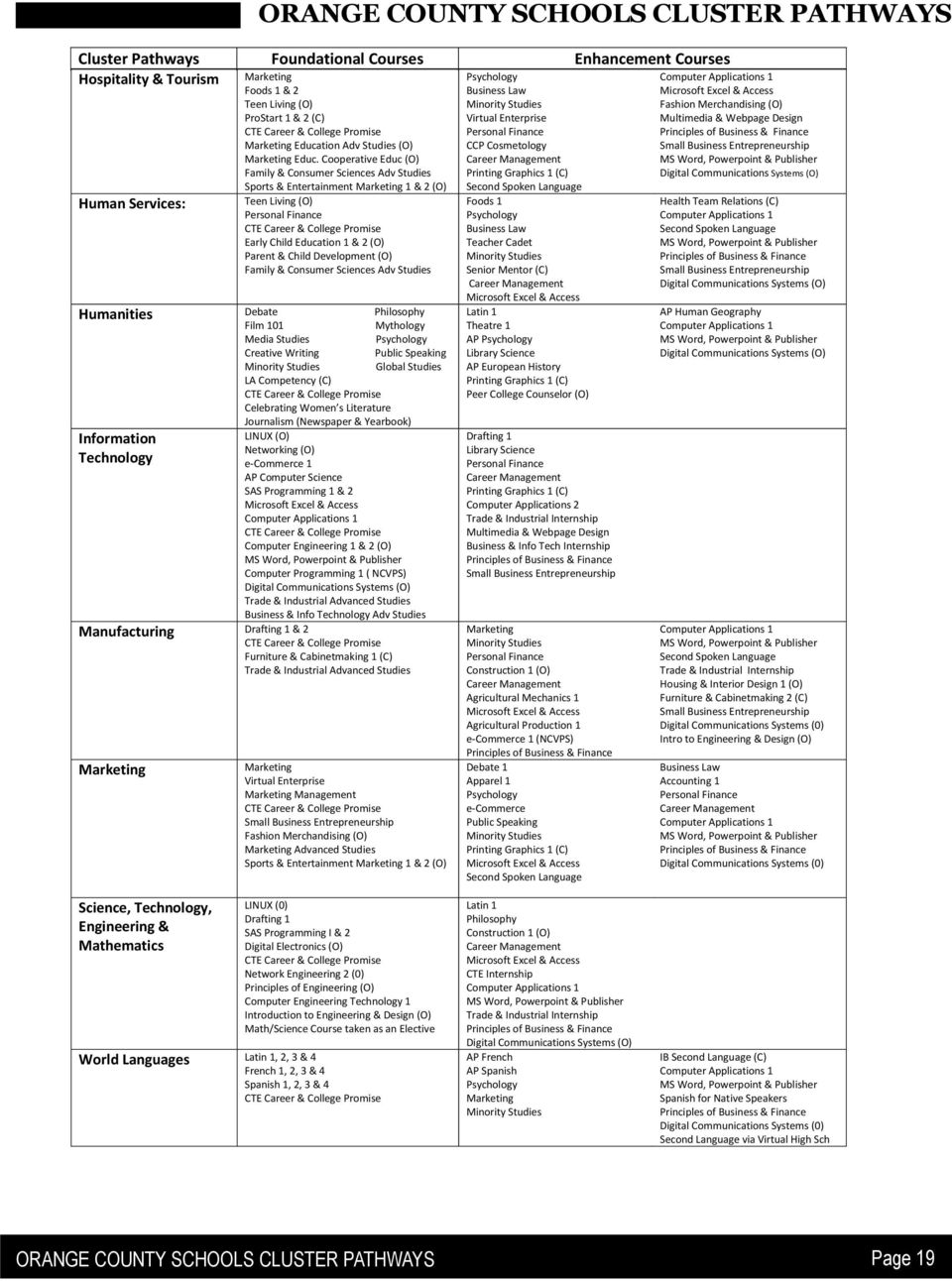
18 ORANGE COUNTY SCHOOLS CLUSTER PATHWAYS 4 credits from one pathway are required for graduation. Course availability may change due to state Board of Education decisions; check course listings beginning on page 33 to confirm course availability. (C) indicates courses offered only at CEDAR RIDGE HIGH SCHOOL (O) indicates courses offered only at ORANGE HIGH SCHOOL Cluster Pathways Foundational Courses Enhancement Courses Agriculture, Food & Natural Resources Architecture & Construction Arts, A/V Technology & Communications Business Management & Administration Finance Foods 1 & 2 Teen Living (O) Horticulture 1 & 2 Personal Finance Ag Production 1 & 2 (O) Ag Mechanics 1 & 2 Agriscience Applications (O) CTE Career & College Promise Agriculture/Food Advanced Studies Animal Science 1 &2 Drafting 1, 2 & 3 Teen Living (O) Interior Design 1 & 2 Housing & Interiors CTE Career & College Promise Trade & Industrial Adv. Studies Construction Technology 1, 2 & 3 (O) Furniture & Cabinetmaking 1 & 2(C) Architectural & Construction Adv. Studies Drafting 1 Art 1, 2, 3 & 4 Band 1, 2, 3 & 4 Teen Living (O) Theatre 1, 2, 3 & 4 Adobe Visual Design Vocal Music 1, 2, 3 & 4 Tech Theatre 1, 2, 3 & 4 Printing Graphics 1, 2 (C) Print Advertising & Design CTE Career & College Promise Fashion Merchandising (O) Apparel Development 1 & 2 Multimedia & Webpage Design Intro to Graphic Communication Arts/AV/Comm Advanced Studies MS Word, Powerpoint & Publisher Accounting 1 Business Law Microsoft Excel & Access CTE Career & College Promise Computer Applications 1 & 2 Business Advanced Studies Multimedia & Webpage Design Principles of Business & Finance Small Business Entrepreneurship MS Word, Powerpoint & Publisher Digital Communications Systems (O) Business Law Accounting 1 & 2 Personal Finance Microsoft Excel & Access CTE Career & College Promise Principles of Business & Finance Small Business Entrepreneurship Business & Info Technology Adv Studies Health & Fitness Foods 1 Teen Living (O) Personal Fitness 1 & 2 Sports Medicine 1 & 2 Anatomy & Physiology Health Team Relations CTE Career & College Promise Health Science Health Science 1 & 2 Nursing Fundamentals CTE Career & College Promise Health Team Relations (C) Biomedical Technology (C) Health Science Adv Studies (C) Debate 1 Marketing Business Law Construction 1 (O) Virtual Enterprise Career Management Computer Applications 1 Second Spoken Language AP Environmental Science Biomedical Technology (C) Furniture Cabinet Making 1 (C) Intro to Engineering & Design (O) Art 1 Marketing Tech Theatre 1 Agricultural Production 1 Agricultural Mechanics 1 Second Spoken Language Fashion Merchandising (O) Apparel Development 1 (O) Principles of Engineering (O) Intro to Engineering & Design (O) Mythology Yearbook 1 Journalism 1 Business Law AP Visual Arts Networking (O) Interior Design CTE Internship Videography Library Science Virtual Enterprise Personal Finance AP Music Theory Media Studies (C) LINUX (O) Marketing CTE Internship Networking (O) Personal Finance Virtual Enterprise Sports Marketing 1 (O) Marketing Management Print Advertising & Design Second Spoken Language Marketing Teen Living Psychology AP Statistics CTE Internship Virtual Enterprise Career Management Computer Applications 1 Latin 1 Marketing Psychology Accounting 1 Business Law Lifetime Sports Weight Training 1 Personal Finance Career Management Latin 1 Foods 1 Forensics Marketing Psychology Accounting 1 Business Law Sports Medicine Personal Finance Career Management Anatomy & Physiology Drafting 1 ProStart 1 (C) Accounting 1 CTE Internship Microsoft Excel & Access Multimedia & Webpage Design Principle of Business & Finance Small Business Entrepreneurship Digital Communications Systems (O) CCP Automotive Service Technology MS Word, Powerpoint & Publisher Business Law Personal Finance Virtual Enterprise Career Management Computer Applications 1 Microsoft Excel & Access Trade & Industrial Internship Principles of Business & Finance Small Business Entrepreneurship Digital Communications Systems (O) MS Word, Powerpoint & Publisher Marketing Housing & Interiors Sports Marketing (O) Career Management Computer Applications 1 Microsoft Excel & Access Second Spoken Language Computer Applications 1 Intro to Engineering & Design (O) Principles of Business & Finance Small Business Entrepreneurship Family & Consumer Sciences Educ. IB Music, Theatre, or Visual Arts (C) Digital Communications Systems (O) Career Management e-commerce 1 (NCVPS) Computer Engineering 1 Network Administration (O) Business & Info Technology Internship Second Spoken Language MS Word, Powerpoint & Publisher Digital Communications Systems (O) Business & Info Technology Internship Microsoft Excel & Access Second Spoken Language Men s Athletic Enhancement Principles of Business & Finance EMS (Community College Course) Women s Athletic Enhancement Microsoft Excel & Access Computer Applications 1 Second Spoken Language CCP Medical Terminology 1 & 2 Introduction to Biotechnology Principles of Business & Finance Small Business Entrepreneurship MS Word, Powerpoint & Publisher Page 18 ORANGE COUNTY SCHOOLS CLUSTER PATHWAYS

19 ORANGE COUNTY SCHOOLS CLUSTER PATHWAYS Cluster Pathways Foundational Courses Enhancement Courses Agriculture, Hospitality & Food Tourism & Foods Marketing 1 & 2 Debate Psychology 1 Drafting 1 Teen Foods Living 1 & 2 (O) Marketing Business Law ProStart 1 (C) Natural Resources Horticulture Teen Living (O) 1 & 2 Personal ProStart 1 Finance & 2 (C) Ag CTE Production Career & College 1 & 2 (O) Promise Ag Marketing Mechanics Education 1 & 2 Adv Studies (O) Agriscience Marketing Educ. Applications Cooperative (O) Educ (O) CTE Family Career & Consumer & College Sciences Promise Adv Studies Agriculture/Food Sports & Entertainment Advanced Marketing Studies 1 & 2 (O) Human Services: Animal Teen Living Science (O) 1 &2 Personal Finance CTE Career & College Promise Drafting Early Child 1, Education 2 & 3 1 & 2 (O) Teen Parent Living & Child (O) Development (O) Interior Family & Design Consumer 1 & 2 Sciences Adv Studies Housing & Interiors CTE Career & College Promise Humanities Trade Debate & Industrial Adv. Studies Philosophy Architecture & Construction Arts, A/V Technology & Communications Information Technology Business Manufacturing Management Drafting 1 & 2 & Administration Marketing Finance Health & Fitness Foods 1 Science, Technology, Engineering & Mathematics Construction Film 101 Technology 1, 2 Mythology & 3 (O) Furniture Media Studies & Cabinetmaking 1 Psychology & 2(C) Architectural Creative Writing & Construction Public Adv. Studies Speaking Minority Studies Global Studies LA Competency (C) Drafting CTE Career 1 & College Promise Art Celebrating 1, 2, 3 & Women s 4 Literature Band Journalism 1, 2, 3 (Newspaper & 4 & Yearbook) Teen LINUX Living (O) (O) Theatre Networking 1, 2, (O) 3 & 4 Adobe e-commerce Visual 1 Design Vocal AP Computer Music 1, Science 2, 3 & 4 Tech SAS Programming Theatre 1, 2, 13 & 24 Printing Microsoft Graphics Excel & 1, Access 2 (C) Print Computer Advertising Applications & Design 1 CTE Career & College Promise Fashion Computer Merchandising Engineering 1 (O) & 2 (O) Apparel MS Word, Development Powerpoint 1 && Publisher 2 Multimedia Computer Programming & Webpage Design 1 ( NCVPS) Intro Digital to Communications Graphic Communication Systems (O) Arts/AV/Comm Trade & Industrial Advanced Studies Studies MS Business Word, & Powerpoint Info Technology & Publisher Adv Studies Accounting 1 Business CTE Career Law & College Promise Microsoft Furniture & Excel Cabinetmaking & Access 1 (C) CTE Trade Career & Industrial & College Advanced Promise Studies Computer Applications 1 & 2 Business Advanced Studies Multimedia & Webpage Design Principles of Business & Finance Small Business Entrepreneurship MS Word, Powerpoint & Publisher Digital Marketing Communications Systems (O) Business Virtual Enterprise Law Accounting Marketing Management 1 & 2 Personal CTE Career Finance & College Promise Microsoft Small Business Excel Entrepreneurship & Access CTE Fashion Career Merchandising & College Promise (O) Principles Marketing of Advanced Business Studies & Finance Small Sports Business & Entertainment Entrepreneurship Marketing 1 & 2 (O) Business & Info Technology Adv Studies Teen LINUX Living (0) (O) Personal Drafting 1 Fitness 1 & 2 Sports SAS Programming Medicine 1 I & 22 Anatomy Digital Electronics & Physiology (O) Health CTE Career Team & Relations College Promise CTE Network Career Engineering & College Promise 2 (0) Principles of Engineering (O) Computer Engineering Technology 1 Introduction to Engineering & Design (O) Nursing Math/Science Fundamentals Course taken as an Elective CTE Career & College Promise Health Team Relations (C) Biomedical French 1, 2, Technology 3 & 4 (C) Health Spanish Science 1, 2, 3 & Adv 4 Studies (C) CTE Career & College Promise Health Science Health Science 1 & 2 World Languages Latin 1, 2, 3 & 4 Business Minority Law Studies Construction Virtual Enterprise 1 (O) Virtual Personal Enterprise Finance Career CCP Cosmetology Management Computer Career Management Applications 1 Second Printing Spoken Graphics Language 1 (C) AP Second Environmental Spoken Language Science Biomedical Foods 1 Technology (C) Furniture Psychology Cabinet Making 1 (C) Intro Business to Engineering Law & Design (O) Art Teacher 1 Cadet Marketing Minority Studies Tech Senior Theatre Mentor 1 (C) Agricultural Career Management Production 1 Agricultural Microsoft Excel Mechanics & Access 1 Second Latin 1 Spoken Language Fashion Theatre Merchandising 1 (O) Apparel AP Psychology Development 1 (O) Principles Library Science of Engineering (O) Intro AP European to Engineering History & Design (O) Printing Graphics 1 (C) Mythology Peer College Counselor (O) Yearbook 1 Journalism 1 Business Drafting 1 Law AP Library Visual Science Arts Networking Personal Finance (O) Interior Career Management Design CTE Printing Internship Graphics 1 (C) Videography Computer Applications 2 Library Trade & Science Industrial Internship Virtual Multimedia Enterprise & Webpage Design Personal Business & Finance Info Tech Internship AP Principles Music Theory of Business & Finance Media Small Business Studies (C) Entrepreneurship LINUX Marketing (O) Marketing Minority Studies CTE Personal Internship Finance Networking Construction (O) 1 (O) Personal Career Management Finance Virtual Agricultural Enterprise Mechanics 1 Sports Microsoft Marketing Excel & 1 Access (O) Marketing Agricultural Management Production 1 Print e-commerce Advertising 1 (NCVPS) & Design Second Principles Spoken of Business Language & Finance Debate 1 Marketing Apparel 1 Teen Psychology Living Psychology e-commerce AP Public Statistics Speaking CTE Minority Internship Studies Virtual Printing Enterprise Graphics 1 (C) Career Microsoft Management Excel & Access Computer Second Spoken Applications Language 1 Latin 1 Marketing Latin 1 Psychology Philosophy Accounting Construction 1 1 (O) Business Career Management Law Lifetime Microsoft Sports Excel & Access Weight CTE Internship Training 1 Personal Computer Finance Applications 1 Career MS Word, Management Powerpoint & Publisher Latin Trade 1 & Industrial Internship Foods Principles 1 of Business & Finance Forensics Digital Communications Systems (O) Marketing AP French Psychology AP Spanish Accounting Psychology 1 Business Marketing Law Sports Minority Medicine Studies Personal Finance Career Management Anatomy & Physiology Computer Applications 1 Microsoft Excel & Access Accounting Fashion Merchandising 1 (O) CTE Multimedia Internship & Webpage Design Microsoft Principles of Excel Business & Access & Finance Multimedia Small Business & Webpage Entrepreneurship Design Principle MS Word, of Powerpoint Business && Finance Publisher Small Digital Business Communications Entrepreneurship Systems (O) Digital Communications Systems (O) CCP Health Automotive Team Relations Service (C) Technology MS Computer Word, Powerpoint Applications & 1 Publisher Second Spoken Language Business MS Word, Law Powerpoint & Publisher Personal Principles Finance of Business & Finance Virtual Small Business Enterprise Entrepreneurship Career Digital Communications Management Systems (O) Computer Applications 1 Microsoft AP Human Excel Geography & Access Trade Computer & Industrial Applications Internship 1 Principles MS Word, of Powerpoint Business & Finance Publisher Small Digital Business Communications Entrepreneurship Systems (O) Digital Communications Systems (O) MS Word, Powerpoint & Publisher Marketing Housing & Interiors Sports Marketing (O) Career Management Computer Applications 1 Microsoft Excel & Access Second Spoken Language Computer Applications 1 Intro to Engineering & Design (O) Principles of Business & Finance Small Business Entrepreneurship Family & Consumer Sciences Educ. IB Music, Theatre, or Visual Arts (C) Digital Communications Systems (O) Career Computer Management Applications 1 e-commerce MS Word, Powerpoint 1 (NCVPS)& Publisher Computer Second Spoken Engineering Language 1 Network Trade & Industrial Administration Internship (O) Business Housing & Interior Info Technology Design 1 Internship (O) Furniture & Cabinetmaking 2 (C) Small Business Entrepreneurship Digital Communications Systems (0) Intro to Engineering & Design (O) Business Law Second Accounting Spoken 1 Language MS Personal Word, Finance Powerpoint & Publisher Digital Career Communications Management Systems (O) Business Computer & Applications Info Technology 1 Internship MS Word, Powerpoint & Publisher Principles of Business & Finance Digital Communications Systems (0) Microsoft Excel & Access Second Spoken Language Men s Athletic Enhancement Principles of Business & Finance EMS (Community College Course) Women s Athletic Enhancement Microsoft Excel & Access Computer Applications 1 Second Spoken Language CCP IB Second Medical Language Terminology (C) 1 & 2 Introduction Computer Applications to Biotechnology 1 Principles MS Word, of Powerpoint Business & Finance Publisher Small Spanish Business for Native Entrepreneurship Speakers MS Principles Word, of Powerpoint Business & Finance Publisher Digital Communications Systems (0) Second Language via Virtual High Sch ORANGE COUNTY SCHOOLS CLUSTER PATHWAYS Page 19
20 SCHEDULE CHANGES/COURSE WITHDRAWAL Schedule Changes Schedule changes may be requested prior to the opening of school and through the first five (5) days of school with parental and counselor s signatures. Listed below are the specific criteria for schedule changes: 1) Attended summer school, thus creating a need for a change 2) Scheduled for a class in which the student has already earned a credit, or failed a course that is a prerequisite for the scheduled class 3) Has not been scheduled for the number of classes required by the school 4) A specific course is needed for graduation 5) Course(s) may be changed to accommodate an administrative need Schedule changes submitted after the first five (5) days but before the tenth (10) day of the semester must be initiated by a teacher or parent only and will require a conference between the two parties. The agreed upon change would then be submitted in writing and will require principal approval. The NC Department of Public Instruction prohibits students dropping a class after the 10 th day of the semester. Pleae note: A schedule change that affects your course of study could prevent you from graduating with your class; therefore, all schedule changes will require a parent/legal guardian s signature. Course Withdrawal Course withdrawals are not allowed after the fourth week of the semester. Withdrawals will be recorded on your transcript as WP if passing the course when withdrawing or as WF if failing the course when withdrawing from the course. These withdrawal codes for dropped courses are a part of your permanent record and will become a part of your transcript. COURSE SELECTION WAIVER FORM In some cases, exceptions are made when parents and students choose to override published prerequisites and/or recommendations. When such a request comes from a student or parent, county-wide procedure is to inform the parent that in the staff s best professional judgment a student should not register for a particular course unless prerequisites/recommended requirements have been met. If a parent insists, the student is permitted to register for the course provided that the student and the parent have a conference with the recommending teacher and/or counselor to sign the waiver form below. This waiver states that, as a condition of the exception, the student is expected to keep pace with the class. A copy of this waiver will be kept with school records. Once this form is signed and the change is approved, that change is final. I, as parent/guardian, fully understand that my child has not successfully met the prerequisites/recommended requirements for the course and level listed below. Course/Level Student s Signature Parent Teacher Conference Held On: Date Student s Name (Please Print) Parent/Guardian s Signature Teacher s Signature SAMPLE Teacher s Comments (if any) For Office Use Only: Principal s Approval: Page 20 ORANGE COUNTY SCHOOLS CLUSTER PATHWAYS SAMPLE COURSE SELECTION WAIVER FORM

21 HIGH SCHOOL PROGRAMS & SERVICES It is the goal of the North Carolina State Board of Education that all students will graduate from a rigorous, relevant academic program that equips them with the knowledge, skills, and dispositions necessary to succeed in both post-secondary education and 21 st Century careers and to be participating, engaged citizens (State Board of Education Policy defining academic rigor, relevance, and relationships). To that end, specific programs such as the North Carolina Scholars Program, the College Board Advanced Placement Courses Program, Career and College Ready Promise, the English Language Learners (ELL) Services, the International Baccalaureate (IB) Programme (High School Juniors and Seniors), and the Exceptional Children s Program are offered for high school students in Orange County Schools. These programs offer adaptive, differentiated approaches to students with specific academic needs and goals. If you would like more information, please contact the Guidance Departments at CRHS ( ) ext and OHS ( ) ext THE NORTH CAROLINA ACADEMIC SCHOLARS PROGRAM The students who qualify for the NC Academic Scholars Program will be designated by the State Board of Education as North Carolina Academic Scholars. will receive a seal of recognition attached to their diplomas. may receive special recognition at graduation exercises and other community events. may be considered for scholarships from the local and state business/industrial community. may use this special recognition in applying to post-secondary institutions. (Candidates are identified by the end of grade 11 and their candidacy can be included in application forms and/or transcripts sent to these institutions.) The State Board of Education instituted the North Carolina Academic Scholars Program in order to encourage students to pursue a well-balanced but more rigorous high school academic program. Students who complete the requirements receive special recognition by the State Board, including a special seal affixed to his/her diploma, recognition in the commencement program, and identification on all official transcripts as a North Carolina Academic Scholar. Please refer to the requirements. Please consult with your counselor about the NC Academic Scholars Program. Copies of the requirements and criteria are available in your school s counseling office and can be found at the following link: HONORS COURSES Honors courses provide students with the opportunity to take challenging courses which can prepare them for Advanced Placement courses, the International Baccelaureate Programme, future advanced courses and college. Students who complete honors level courses will receive 1 or.5 quality point, depending on the year the student entered as freshman. HIGH SCHOOL PROGRAMS/SERVICES NC ACADEMIC SCHOLARS PROGRAM HONORS COURSES Page 21
22 THE COLLEGE BOARD ADVANCED PLACEMENT COURSES PROGRAM Sponsored and designed by the College Board, the Advanced Placement (AP) Courses Program offers hardworking and capable students an opportunity to study college-level material in high school and gives them an opportunity to show that they have mastered the material by taking AP Exams. Students can receive college credit, placement into college courses, or both if they qualify. The AP Test, administered in May by Educational Testing Service for the College Board, has two objectives: 1) to inform students as to how well they have prepared themselves in a particular subject area, 2) to provide the colleges with an independent assessment of the student s knowledge and skills. Benefits of Enrolling in AP Classes AP courses provide a challenging college-level curriculum and the opportunity to place out of an introductory college course, thus saving tuition money and/or allowing early graduation from college. Depending on the score a student makes and the policies of the college/university the student selects, the student may receive three or more semester hours of college credit for each test taken. AP students can take a wide variety of courses in multiple disciplines or concentrate on AP courses within a discipline (for instance, a strong science student could choose to concentrate on AP science courses and take regular or Honors courses in the other disciplines.) Advanced Placement (AP) courses are weighted one or two additional points, depending on the year the student entered as a freshman. Students who do well in AP classes increase their chances of college success, and the College Board recognizes the following AP Scholar Designations and notifies both the high school and college the student attends of these distinctions: AP Scholar AP Scholar with Honor AP Scholar with Distinction AP State Scholar National AP Scholar Granted to students who receive scores of 3 or higher on three or more AP exams. An average of 3.25 on all AP exams taken, and scores of 3 or higher on four + exams. Students who receive an average of 3.5 on all AP exams taken, and scores of 3 or higher on five or more of these exams. Granted to one male and one female student in each U.S. state and the District of Columbia with scores of 3 or higher on the greatest number of AP Exams and then the highest average score (at least 3.5) on all AP Exams taken. Students in the U.S. who receive an average score of at least 4 on all AP exams taken, and grades of 4 or higher on eight or more of the exams. Page 22 THE COLLEGE BOARD ADVANCED PLACEMENT COURSES PROGRAM
23 AP Courses Offered at CRHS and OHS Cultural Arts AP Music Theory AP Studio Art: Drawing (OHS ONLY), AP Studio Art: 2D Design, AP Studio Art: 3D Design (OHS ONLY) English AP English Language and Composition AP English Literature and Composition Mathematics AP Calculus AB AP Calculus BC AP Statistics AP Computer Science (OHS ONLY) Science AP Biology AP Chemistry AP Environmental Science AP Physics I and II Social Studies AP Human Geography AP U.S. History AP European History AP Psychology (CRHS ONLY) World Languages AP Latin (OHS ONLY) AP Spanish (OHS ONLY) AP French (OHS ONLY) Note: AP Course offerings may alternate from year to year. See individual course descriptions for specific details. THE COLLEGE BOARDADVANCED PLACEMENT COURSES PROGRAM Page 23
24 INTERNATIONAL BACCALAUREATE PROGRAMME (IB) The Diploma Programme of the International Baccalaureate Organization (IBO) is a rigorous university preparation course of study that leads to assessments; it is designed for highly-motivated high school students. The programme includes the best elements of national systems without being based upon any one. The IBO s objective is to provide INTERNATIONAL students with the BACCALAUREATE values and opportunities DIPLOMA that will enable PROGRAMME them to develop (IB) sound judgment, make wise choices, and respect others in a global community. In the thirty years since its inception, the IB The diploma Diploma has Programme become a of symbol the International of academic Baccalaureate integrity and Organization intellectual (IBO) promise. a rigorous The university student who preparation satisfies its demands course demonstrates of study that a leads strong to assessments; commitment is to designed learning, for both highly motivated in terms of high the mastery school students. of subject The content programme and in the development includes the best of the elements skills and of national discipline systems necessary without for being success based in upon a competitive any one. The world. IBO s objective (IB Counseling is to provide Level 2 Supplemental, students with p. 31) the values and opportunities that will enable them to develop sound judgment, make wise choices, and respect others in a global community. In the thirty years since its inception, the IB diploma has become a symbol of The academic Curriculum integrity (from and intellectual promise. The student who satisfies its demands demonstrates a strong commitment to learning, both in terms of the mastery of subject content and in the development of the skills and discipline necessary IB Diploma for success in Programme a competitive world. students (IB Counseling study six Level courses 2 Supplemental, at higher p. 31) level or standard level. Students must choose one subject from each of groups 1 to 6, thus ensuring breadth of experience in The Curriculum (from languages, social studies, the experimental sciences and mathematics. The sixth subject may be an arts subject IB Diploma Programme students study six courses at higher level or standard level. chosen from group 6, or the student may choose another subject from groups 1 to 5. Students must choose one subject from each of groups 1 to 6, thus ensuring breadth of experience in languages, In social addition, studies, the the programme experimental has sciences three core and requirements mathematics. that The are sixth included subject may to broaden be an arts the subject educational chosen from experience group 6. The and sixth challenge subject students may be an to arts apply subject their chosen knowledge from and group understanding. 6, or the student may choose another subject from groups 1 to 5. The In addition, extended the essay programme (EE) is a has requirement three core for requirements students to that engage are included in independent to broaden research the educational through an in-depth study experience of a question and challenge relating students to one to of apply the subjects their knowledge they are studying. and understanding. o The extended essay (EE) is a requirement for students to engage in independent research through an indepth study of a question relating to one of the subjects they are studying. Theory of knowledge (ToK) is a course designed to encourage each student to reflect on the nature of knowledge by critically examining different ways of knowing (perception, emotion, language and reason) and o Theory of knowledge (ToK) is a course designed to encourage each student to reflect on the nature of different kinds knowledge of knowledge by critically (scientific, examining artistic, different mathematical ways of knowing and (perception, historical). emotion, language and Creativity, reason) action, and service different (CAS) kinds requires of knowledge that students (scientific, actively artistic, learn mathematical from experience and historical). of doing real tasks beyond o the Creativity, classroom. action, Students service can (CAS) combine requires all that three students components actively or learn do activities from the experience related to each of doing one real of them tasks beyond the classroom. Students can combine all three components or do activities related to each separately. one of them separately. Group One (English) IB English 3 HL IB English 4 HL Group Two (Foreign Lang.) IB French 4 SL IB French 5 (SL/HL) IB Latin 4 SL IB Latin 5 (SL/HL) IB Spanish 4 SL IB Spanish 5 (SL/HL) International Baccalaureate Course Offerings Group Four (Experimental Sciences) IB Chemistry 1 SL IB Chemistry 2 SL IB Environmental Systems & Societies 1 SL IB Environmental Systems & Societies 2 SL IB Sports, Exercise, & Health Science 1 SL IB Sports, Exercise, & Health Science 2 SL Group Five (Mathematics) IB Mathematics 1 SL IB Mathematics 2 SL IB Math Studies 1 SL IB Math Studies 2 SL Group Three (History) Group Six (The Arts) IB History 1 History of the Americas HL IB Visual Arts 1 HL IB History 2 20 th Century Topics HL IB Visual Arts 2 HL IB Psychology 1 HL IB Psychology 2 HL Up to four of the six subjects are studied at higher level (HL) (courses representing 240 teaching hours) The remaining subjects are studied at standard level (SL) (courses representing 150 teaching hours) Page 24 INTERNATIONAL BACCALAUREATE PROGRAMME (IB)
25 4 Year Course Planner and Progress Check for the OCS International Baccalaureate Diploma Program 9 th Grade 10 th Grade 11 th Grade 12 th Grade IB Math Studies SL I IB Math Studies SL II Common Core Math I Honors Common Core Math III Honors Common Core Math II Honors English I OR Critical Reading & Composition Pre Calculus Honors World History Honors Civics & Economics OR IB Mathematics SL I OR IB Mathematics SL II Honors English II IB English HL I IB English HL II IB History HL I IB History HL II Honors Biology AP Environmental IB Chemistry SL I IB Chemistry SL II OR OR OR Honors Chemistry IB Environmental Systems & Societies SL I IB Environmental Systems & Societies SL II Second Language Level I (Choose French, Latin, Spanish) Second Language Level II IB Second Language I IB Second Language II Second Language Level III PE / Health AP Human Geography (optional; not required) Theory of Knowledge I Theory of Knowledge II Elective Elective Non IB Elective (Fall) IB Elective II (Fall) (Visual Arts / Exercise / Psych.) IB Elective I (Spring) (Visual Arts / Exercise / Psych.) Non IB Elective (Spring) 8 Courses Total 8 Courses Total 8 Courses Total 8 Courses Total INTERNATIONAL BACCALAUREATE PROGRAMME (IB) Page 25
26 MIDDLE COLLEGE HIGH SCHOOL AT DURHAM TECHNICAL COMMUNITY COLLEGE (MCHS) Middle College High School (MCHS) at Durham Technical Community College is an opportunity for 11th and 12th grade students to earn college credit while in high school. Located on Durham Tech s campus, MCHS consists of students (approx. 150) from three school districts: Durham Public Schools, Orange County Schools, and Chapel Hill-Carrboro City Schools. Students apply for admission to MCHS, and once accepted take both community college courses and honors level high school courses. Up to a year or more of college credit can be earned at MCHS. Tuition, and use of all textbooks are free! For more information, you can contact Dr. Charles Nolan at (919) This program provides a non-traditional choice for students who have the desire to accelerate their education, the ability to complete advanced work successfully, and a preference for a unique academic environment. Students who have achieved junior-year status are eligible to apply; students must be 16 years old to enroll in a community course through MCHS and Durham Technical Community College. Applications are available If you are interested or have questions, contact your counselor. Transportation can be arranged through Orange County Schools by contacting the Director of Secondary Instruction, at (919) , ext NORTH CAROLINA VIRTUAL PUBLIC SCHOOL (NCVPS) NCVPS offers high school courses that are taken over the internet. Virtual high school courses require strong independent, self-motivated students. NCVPS courses may not be taken in place of face-to-face courses offered at the student s school. Building Principals must give approval prior to a student enrolling in NCVPS. Grades earned in approved courses count toward a student s grade point average, class rank and eligibility for athletic and extracurricular activities. Students will need a reliable working computer and internet access if taking courses at home and an appropriate level of computer knowledge including downloading, video, communication, etc. See your counselor for enrollment procedures. CAREER & TECHNICAL EDUCATION (CTE) PATHWAYS Orange County Schools offers numerous CTE Pathways in eight program areas that provide students with opportunities to explore careers and gain academic knowledge, technical skills, and employability skills that will prepare them for their post-secondary education and careers. Students can build their knowledge and skills in the pathways by continuing their education at a community college, trade school, university, or in an apprenticeship program. Each program area offers students the opportunity to earn industry recognized credentials if they pass the state or national certification or licensing exams. Some of the pathways and certifications/college credit available include: Agricultural Mechanics OSHA and Welding Certifications Accounting College Level Accounting (honors) Business Management Microsoft Word, PowerPoint, Access, & Excel Certifications Computer Programming SAS Base & Advanced Programmer Certifications Information Technology Comp TIA A+ Certifications Cabinetmaking and Construction OHSA & NCCER Certifications Page 26 MIDDLE COLLEGE HIGH SCHOOL NCVPS CAREER & TECHNICAL EDUCATION PATHWAYS
27 Drafting Autodesk Certified Revit Finance EverFi Financial Literacy Certification Health Services CPR. First Aid, and CNA Certifications Hospitality & Tourism ServSafe Food Protections Managers Certification Graphic Communication PrintED & Adobe Photoshop, InDesign, & Illustrator Certifications For a list of all pathways, see pages 18 & 19. Many CTE courses are eligible for articulated college credit; see page 28 for more details. CAREER AND COLLEGE PROMISE DURHAM TECHNICAL COMMUNITY COLLEGE AND ALAMANCE COMMUNITY COLLEGE Eligible high school students can earn college credit through North Carolina s Career and College Promise (CCP) program. Students must: be a junior or senior (freshman and sophomore students for specific pathways if they meet eligibility) demonstrate college readiness through a placement test and/or recommendation; have a weighted GPA of at least 3.0 or high school recommendation for CTE students meet minimum pre-requisites for the community college pathway in which they plan to enroll; be making progress toward HS graduation for admission and continued eligibility; and maintain at least a college GPA of 2.0 after two college courses for continued eligibility. Career and Technical Education Examples (CTE) Advertising & Graphic Design (See Videography) Automotive Computer Integrated Machining Construction Criminal Justice Early Childhood Electronics Engineering Landscape Medical Office Administration Networking Technology Web Designer Welding College Transfer Pathways (CT) Humanities and Social Science Business and Economics Life and Health Science Engineering and Mathematics To enroll in the Career and College Promise program, students should meet with the school s Career Development Coordinator. For detailed program information and a complete list of CCP courses available at Durham Technical Community College and Alamance Community College, visit their websites: Students who successfully complete college transfer courses will receive honors weight of 1 or 0.5 additional quality point depending on the freshman cohort. CTE PATHWAYS CAREER & COLLEGE PROMISE Page 27
28 High school students who enroll in a Career and College Promise pathway may earn articula college credit as described in this agreement while enrolled in high school if the CTE articulated college credit is part of their Career and College Promise pathway. Community college officials NORTH CAROLINA HIGH SCHOOL TO COMMUNITY COLLEGE ARTICULATION AGREEMENT eligibility and acceptance of articulated courses listed on the high school transcript. Students ma asked to submit supporting documentation and/or demonstrate proficiency to receive credit. Co must follow the criteria of the Southern Association of Colleges and Schools (SACS) Commissio Colleges in awarding credit. Receive Community College Credit for Your High School Courses! This statewide articulation agreement is comprised of high school CTE courses that match the knowledge and skills taught in similar community college courses. The articulation agreement ensures that if a student is proficient in their high school course, the student can receive college credit for that course at any North Carolina community college. To receive articulated credit, students must enroll at the community college within two years of their high school graduation date and meet the following criteria: Final grade of B or higher in the course and A score of 93 or higher on the standardized CTE postassessment High school students who enroll in a Career and College Promise pathway may earn articulated college credit as described in this agreement while enrolled in high school if the CTE articulated college credit is part of their Career and College Promise pathway. Community college officials verify eligibility and acceptance of articulated courses listed on the high school transcript. Students may be asked to submit supporting documentation and/or demonstrate proficiency to receive credit. Colleges must follow the criteria of the Southern Association of Colleges and Schools (SACS) Commission on Colleges in awarding credit. High School Course Number / Title Agricultural Mechanics II Animal Science II Horticulture I Horticulture II - Landscaping Accounting I Accounting II Microsoft Word and Power Point Multimedia and Webpage Design Personal Finance Early Childhood Education I AND Early Childhood Education II Foods I AND Foods II - Enterprise Foods II - Enterprise Health Science I Health Science II Nursing Fundamentals Marketing Cabinetmaking I AND Cabinetmaking II Computer Engineering Technology I Computer Engineering Technology II Drafting I AND Drafting II - Architectural Drafting I Community College Course Number/ Title WLD-112 Basic Welding Processes OR AGR-111 Basic Farm Maintenance ANS-110 Animal Science HOR-150 Intro to Horticulture HOR-114 Landscaping Construction OR LSG-111 Basic Landscaping Technique ACC-115 College Accounting OR ACC-118 Accounting Fundamentals I ACC-115 College Accounting OR ACC-118 Accounting Fundaments I OR ACC-119 Accounting Fundaments II CIS-111 Basic PC Literacy OR CIS-124 DTP Graphics Software OR OST-136 Word Processing WEB-110 Internet/Web Fundamentals OR WEB-120 Intro Internet Multimedia BUS-125 Personal Finance EDU-119 Intro to Early Childhood Education CUL-112 Nutrition for Food Service CUL-110 Sanitation & Safety AND CUL-110A Sanitation & Safety Lab MED-121 Medical Terminology I AND MED-122 Medical Terminology II HSC-110 Orientation to Health Careers AND (HSC-120 CPR OR MED- 180 CPR Certification) NAS-101 Nursing Assistant I ETR-230 Entrepreneur Marketing OR MKT-110 Principles of Fashion OR MKT-120 Principles of Marketing CAB-111 Cabinetmaking I CTS-120 Hardware/Software Support CTS-220 Adv Hard/Software Support DFT-115 Architectural Drafting OR DFT-119 Basic CAD OR ARC-114 Architectural CAD DFT-111 Technical Drafting I AND DFT-111A Technical Drafting I Lab Page 28 NC HIGH SCHOOL TO COMMUNITY COLLEGE ARTICULATION AGREEMENT
29 SERVICES AVAILABLE Academically/Intellectually Gifted (AIG) Program There are many opportunities for students identified as academically/intellectually gifted to develop their talents. This includes honors, AP and IB courses, dual enrollment at an institute of higher learning, and the North Carolina Governor s School summer program. Differentiated Education Plans (DEPs) are developed for each AIG student. An assistant principal at each high school oversees the progress of AIG students and coordinates support for gifted students at risk for underachievement. ESL (English as a Second Language) Services English as a Second Language (ESL) is a program that assists English Language Learners (ELL) to become proficient in the English language (speaking, writing, reading and listening). Students who have qualified for ESL services will receive services through the ESL Program. The ESL Program uses the North Carolina English Language Development Standard Course of Study to augment the North Carolina Common Core Standards. The Exceptional Children s Program The Exceptional Children s Department offers specialized academic services to meet the needs of Orange County Schools students identified as having a disability. With parental consent and collaboration, Individualized Educational Programs (IEP) are developed and implemented in accordance with state and federal guidelines. Section 504 Section 504 requires that schools not discriminate against students with disabilities. If your student has a disability that substantially limits a major life activity, he/she may be eligible for a 504 plan. Schools must provide these students with reasonable accommodations comparable to those provided to their peers. Please contact your student s school counselor to discuss the 504 process. TRANSCRIPTS To send transcripts to NC institutions of higher learning, students should log in to their account, click on Transcript Manager, select the college of your choice and submit your request. Allow 2 business days for processing. There is no processing fee for sending transcripts through CFNC. For those institutions outside of NC, students must submit a completed transcript request to their guidance counselor including a $5.00 processing fee. Allow two weeks for processing. Forms are available in the counseling office. SERVICES AVAILABLE TRANSCRIPTS Page 29
30 WEIGHTED GRADING Standard courses Course content, pace and academic rigor follow standards specified by the North Carolina Standard Course of Study (NCSCoS). Standard courses provide credit toward a high school diploma and require the end-of-course test for those courses identified as such in the NC accountability program. Quality points for the GPA calculation are assigned according to the standard 4.0 scale and receive no additional quality points. Honors courses - Course content, pace and academic rigor place high expectations on the student, demanding greater independence and responsibility. Such courses are more challenging than standard level courses and are distinguished by a difference in the depth and scope of work required to address the NCSCoS. These courses provide credit toward a high school diploma and require the end-of-course test for those courses identified as such in the NC accountability program. An honors review process shall be followed, as outlined in the latest edition of the North Carolina Honors Course Implementation Guide. The state course weighting system awards the equivalent of one (1) quality point to the grade earned in Honors courses. Effective with the freshman class of , the weighting for Honors courses shall be one-half (.5) of a quality point. Honors sections of standard-level academic courses, including NC Virtual Public School courses and other on-line courses, that are in accordance with the philosophy, rubric, procedures, guidelines, and standards for curriculum, instruction, and assessment as described in the North Carolina Honors Course Implementation Guide. Such courses are assigned additional quality point; it is not necessary to offer a standard level of a course to offer an honors level. Pre-calculus, non-ap/ib calculus, mathematics courses beyond the level of calculus, and world language courses beyond the second-year level are considered inherently advanced and are assigned Honors-level weighting as well. Arts education courses meeting the standards for proficient and advanced dance, music, theatre arts, and visual arts are assigned Honors-level weighting Advanced Placement/International Baccalaureate (AP/IB) courses - Course content, pace and academic rigor are considered college-level as determined by the College Board or the International Baccalaureate (IB) program and are designed to enable students to earn high scores on the AP or IB test, potentially leading to college credit. These courses provide credit toward a high school diploma and require an EOC in cases where the AP/IB course is the first course taken by a student in a subject where an EOC is required by the NC accountability program. The state weighting system awards the equivalent of two (2) quality points to the grade earned in an AP/IB course. Effective with the freshman class of , the weight for AP/IB courses shall be one (1) quality point. College courses ( dual enrollment ) - Course content, pace and academic rigor are, by definition, college-level for these courses. College courses, which may be delivered by a community college, public university or private college or university, provide credit toward a high school diploma and may satisfy a graduation requirement or provide an elective course credit. The state weighting system adds the equivalent of one (1) quality point to the grade earned in community college courses included on the most recent Comprehensive Articulation Agreement Transfer List, and for courses taught at four-year universities and colleges. Project Lead the Way courses approved for college credit are assigned college-level weighting, the equivalent of one (1) quality point. In accordance with GS (10a), each student s official class rank shall be listed on the standardized transcript The official class rank shall be calculated using the weighted grade point average in which quality points are provided for passing grades in standard, Honors, AP/IB, and college-level courses according to the weighting system defined in sections 3 and 4 above Local education agencies may re-calculate class rank for local purposes such as determination of valedictorian, salutatorian, and other graduation honors. Such re-calculations may be used for local purposes only, and the official class rank provided on the standardized transcript shall not be altered. High schools shall use one grading scale. The conversion of grades to quality points is standardized. Implicit is a conversion of percentage grades to letter grades according to the following widely used scale: = A; = B; 70-79= C; = D; < 59 = F. Grades and the corresponding number of quality points are shown below. Standard scale Numeric Grades with a letter grade legend = = = = = 0.0 WF=0.0 FF=0.0 WP=0.0 INC=0.0 AUD=0.0 P=0.0 Page 30 WEIGHTED GRADING
31 The following are examples that contrast a non-weighted grade point average (GPA) with a weighted GPA. For the purpose of illustration, these sample averages are computed for one year and with each course counting one unit. In reality, a student s GPA is figured with all of the course work/grades that have been completed since ninth grade. GPA Computational Examples for Ninth Grade Students Entering prior to Example #1 Course Grade Grade Points Weighted Total AP English AP Biology AP Calculus Spanish IV (honors) Chemistry Art Beginning Total Grade Points: non-weighted weighted GPA = = 4.00 on a 4.00 non- weighted scale GPA = = on a 4.00 weighted scale (Used for calculation of class rank) Grade points from state conversion scale GPA Computational Examples Per State Policy GCS-L-004 For Ninth Grade Students Entering In and later Example #1 Course Grade Grade Points Weighted Total AP English AP Biology AP Calculus Spanish IV (honors) Chemistry Art Beginning Total Grade Points: non-weighted weighted GPA = = 4.00 on a 4.00 non- weighted scale GPA = = on a 4.00 weighted scale (Used for calculation of class rank) Grade points from state conversion scale WEIGHTED GRADING Page 31
32 NATIONAL TESTING CALENDARS Please note that the registration date occurs six to eight weeks prior to the test date. Please plan accordingly. ACT TEST DATES Visit: September 12, 2015 October 24, 2015 December 12, 2015 February 6, 2016 April 9, 2016 June 11, 2016 The ACT is mandated by the State Board of Education for all juniors. Each high school will administer this test each Spring at no cost to students.the State Board of Education will determine the test date for juniors. SAT TEST DATES Visit: October 3, 2015 November 7, 2015 December 5, 2015 January 23, 2016 March 5, 2016 May 7, 2016 June 4, 2016 ADVANCED PLACEMENT TEST DATES The Advanced Placement Exams will be administered during the first two weeks in May Page 32 NATIONAL TESTING CALENDARS
33 Band (Intermediate) Band students who have met the standards for Band Beginning and do not intend to be a part of the marching band, should sign up for Band Intermediate (Fall) and Band intermediate (Spring). This is a two semester class that will receive 2 units of elective credit. Ensemble placement will be determined by the band director. After-school rehearsals and performances will be required. Orange County Schools High School Course Offerings CULTURAL ARTS EDUCATION Instrumental Music Students enrolled in either band (Beginning - Advanced) or Marching Band (Beginning - Advanced) can expect to build upon musicianship skills begun in middle grades band. Students will have the opportunity to perform in various ensembles from Wind Ensemble, Symphonic Band, Concert Band, Marching Band, Jazz Ensemble, Percussion Ensemble and others. All students will participate in required performances at their local school and in the surrounding community. Students enrolled in a leveled visual arts, band, chorus or theatre arts course will need to show proficiency in all essential standards before progressing to the next level. For example, a student enrolled in a Beginners level will not progress to the intermediate level unless he/she shows proficiency on all standards. Students can also take the same course more than once if he/she has not shown proficiency. Proficiency level will be determined by the instructor through standards based projects, auditions, or portfolio depending on the course. Student fees for participation in instructional programs shall be assessed in accordance with Orange County Schools Board Policy Proficient and Advanced courses will receive 1 or.5 additional quality points, depending on the student s entering Freshman cohort. See page 30 for further clarification. A course designated AP or IB will receive 2.0 or 1.0 additional quality points, depending on the student s entering Freshman cohort. See page 30 for further clarification. For Students who DO NOT intend to participate in marching band: Band (Beginning) Band students who have completed 8 th grade band and do not intend to be a part of the marching band should sign up for Beginning Band (Fall) and Beginning Band (Spring). This is a two semester class that will receive 2 units of elective credit. Ensemble placement will be determined by the Band Director. After-school rehearsals and performances will be required. Band (Proficient - Honors) Band students who have met the standards for Band Intermediate and do not intend to be a part of the marching band, should sign up for Band Proficient (Fall) and Band Proficient (Spring). This is a two semester class that will receive 2 units of elective credit. Ensemble placement will be determined by the band director. After-school rehearsals and performances will be required. Band (Advanced - Honors) Band students who have met the standards for Band Proficient and do not intend to be a part of the marching band, should sign up for Band Advanced (Fall) and Band Advanced (Spring). This is a two semester class that will receive 2 units of elective credit. Ensemble placement will be determined by the band director. After-school rehearsals and performances will be required. FOR MARCHING BAND REQUIREMENTS, PLEASE SEE THE BAND DIRECTOR. For Students who DO intend to participate in Marching Band: Marching Band (Beginning) Band students who have completed 8 th grade band, and first year members of the auditioned color guard, who elect to be part of the marching band should enroll in Marching Band Beginning (Fall) and Band Beginning (Spring). The student will receive 2 units of elective credit for this sequence. Students enrolled in Marching Band will perform difficult repertoires, compete, travel, and develop higher levels of performance and musical skills. Requirements include attendance at all after-school rehearsals on the published rehearsal calendar, Friday night VARSITY football games including home playoff games, local parades, three to five Saturday competitions, occasional local performances and summer camp. Students are expected to meet strict attendance and behavior policies. Non-instrumentalists in the color guard will only take Marching Band in the fall semester and will receive only one elective credit. OHS ONLY Page 33
34 Marching Band (Intermediate) Students that have met the standards for Band (Beginning), who elect to be part of the marching band should enroll in Marching Band Intermediate (Fall) and Band Intermediate (Spring). The student will receive 2 units of elective credit for this sequence. Students enrolled in this class will perform difficult repertoires, compete, travel, and develop higher levels of performance and musical skills. Requirements include attendance at all after-school rehearsals on the published rehearsal calendar, Friday night VARSITY football games including home playoff games, local parades, three to five Saturday competitions, occasional local performances and summer camp. Students are expected to meet strict attendance and behavior policies. Non-instrumentalists in the color guard will only take Marching Band in the fall semester and will receive only one elective credit. OHS ONLY Marching Band (Proficient - Honors) Students that have met the standards for Marching Band Intermediate, who elect to be part of the marching band should enroll in Marching Band Proficient (Fall) and Band Proficient (Spring). The student will receive 2 units of elective credit for this sequence. Students enrolled in this class will perform difficult repertoires, compete, travel, and develop higher levels of performance and musical skills. Requirements include attendance at all after-school rehearsals on the published rehearsal calendar, Friday night VARSITY football games including home playoff games, local parades, three to five Saturday competitions, occasional local performances and summer camp. Students are expected to meet strict attendance and behavior policies. Non-instrumentalists in the color guard will only take Marching Band in the fall semester and will receive only one elective credit. OHS ONLY Marching Band (Advanced - Honors) Students that have met the standards for Marching Band Proficient, who elect to be part of the marching band should enroll in Marching Band Advanced(Fall) and Band Advanced (Spring). The student will receive 2 units of elective credit for this sequence. Students enrolled in this class will perform difficult repertoires, compete, travel, and develop higher levels of performance and musical skills. Requirements include attendance at all after-school rehearsals on the published rehearsal calendar, Friday night VARSITY football games including home playoff games, local parades, three to five Saturday competitions, occasional local performances and summer camp. Students are expected to meet strict attendance and behavior policies. Noninstrumentalists in the color guard will only take Marching Band in the fall semester and will receive only one elective credit. OHS ONLY Jazz Ensemble (1 Credit - Pass/Fail) In this small group setting, students will study the art of improvisationas well as the history of the jazz idiom. Prior musical training is needed before taking this course. Students can expect to listen, watch, read and perform different aspects of jazz both in and out of class. There are observation hours and clinics associated with this class which will be listed on the syllabus. Students interested in this course should see the Band Director. This course is offered in a 0 period setting instead of during the instructional day. OHS ONLY Vocal Music Students enrolled in Vocal Music Beginning-Advanced can expect to build on basic musicianship started in the middle grades chorus. Students will have the opportunity to perform in various ensembles (some auditioned, some volunteer). All students can expect many required performances per year at their local school and in surrounding communities. Enrollment in any specific ensemble will be determined by the site music instructor based on the applicants and audition and current ability/music literacy level. Student fees for participation in instructional programs shall be assessed in accordance with Orange County Schools Board Policy 4600.After school acitivites are required. While prior choral experience (middle school) is helpful, it is not required to sign up for Vocal Music Beginning. Students enrolled in a leveled visual arts, band, chorus or theatre arts course will need to show proficiency in all essential standards before progressing to the next level. For example, a student enrolled in a Beginners level will not progress to the intermediate level unless he/she shows proficiency on all standards. Students can also take the same course more than once if he/she has not shown proficiency. Proficiency level will be determined by the instructor through standards based projects, auditions, or portfolio depending on the course. Vocal Music (Beginning) All 9 th grade choral students should sign up for Vocal Music Beginning. Ensemble placement will be determined by the Vocal Music Director. Some after school rehearsals and performances are required. Vocal Music (Intermediate) All choral students who have completed Vocal Music Beginning should sign up for Vocal Music Intermediate. Ensemble placement will be determined by the Vocal Music Director. Some after school rehearsals and performances are required. Vocal Music (Proficient - Honors) All choral students who have completed Vocal Music Intermediate should sign up for Vocal Music Proficient. Ensemble placement will be determined by the Vocal Music Director. Some after school rehearsals and performances are required. Page 34
35 Vocal Music (Advanced - Honors) All choral students who have completed Vocal Music Proficient should sign up for Vocal Music Advanced. Ensemble placement will be determined by the Vocal Music Director. Some after school rehearsals and performances are required. Theatre Arts Students enrolling in Theatre Arts courses can expect to learn on stage and back stage techniques and procedures. Students in this area should expect some in class and out of class performance obligations. Students interested in on stage learning should sign up for the Theatre Arts sequence while those students interested in back-stage management should sign up for the Tech Theatre sequence of classes. Students enrolled in the Theatre Arts Beginning-Advanced are expected to memorize dialogue and perform in front of groups on a regular basis. Students enrolled in a leveled visual arts, band, chorus or theatre arts course will need to show proficiency in all essential standards before progressing to the next level. For example, a student enrolled in a Beginners level will not progress to the intermediate level unless he/she shows proficiency on all standards. Students can also take the same course more than once if he/she has not shown proficiency. Proficiency level will be determined by the instructor through standards based projects, auditions, or portfolio depending on the course. Theatre Arts (Beginning) This introductory acting course offers skill development in improvisations, monologues, scenes, stage movements, character study, and examination of scripts. Students will learn the basics of both acting and tech theatre work. Theatre Arts (Intermediate) This intermediate acting course offers further skill development for students who have met the standards for Theatre Arts Beginning. Students will learn advanced character and script analysis as well as acting styles, classical theatre literature, and the basics of directing for the theatre. Theatre Arts (Proficient - Honors) This advanced acting course offers further skill development in acting styles, voice, movement, and directing for students who have auditioned. Theatre Arts (Advanced - Honors) This advanced acting course prepares students for collegiate theatre studies in script and character analysis, voice, movement, and directing. This course is open only to students who have auditioned. Tech Theatre (Beginning) (Recommended: Theatre Arts Beginning) This introductory technical theatre course offers skill development in all of the backstage functions essential to play production, including: scenery, set, prop and costume constructions. Tech Theatre (Intermediate) This intermediate technical theatre course offers skill development for students who have met the standards for Tech Theatre Beginning in all of the backstage functions essential to play production, including scenery, set, prop and costume constructions. Tech Theatre (Proficient - Honors) This advanced technical theatre course offers skill development for students who have met the standards for Tech Theatre Intermediate in all of the backstage functions essential to play production, including scenery, set, prop and costume constructions. Tech Theatre (Advanced - Honors) This advanced technical theatre course offers skill development for students who have met the standards for Tech Theatre Proficient in all of the backstage functions essential to play production, including scenery, set, prop and costume construction; lighting; sound; stage make-up and front-of-the-house management. Advanced Play Production (Advanced - Honors) (Prerequisites: Theatre Arts Advanced) Advanced Play Production is a capstone theatre course for students who have completed all other acting courses. Following an extensive study of the structure of one-act plays, Advanced Play Production students write a one-act play during the first nine weeks of the course. During the second nine weeks, students cast, direct, rehearse and produce the play for a festival which serves as the performance exam. OHS ONLY Visual Arts Students enrolled in Visual Arts courses will learn everything from basic drawing skills to 2-D and 3-D art designs to sculpture culminating with the production of a portfolio suitable for admission to post-secondary art programs. Students enrolled in a leveled visual arts, band, chorus or theatre arts course will need to show proficiency in all essential standards before progressing to the next level. For example, a student enrolled in a Beginners level will not progress to the intermediate level unless he/she shows proficiency on all standards. Students can also take the same course more than once if he/she has not shown proficiency. Proficiency level will be determined by the instructor through standards based projects, auditions, or portfolio depending on the course. Students in all levels can expect to participate in regular art shows at school and/or in the community. Art (Beginning) This general survey art course is designed to reinforce and build on knowledge and skills developed at the elementary and middle school levels. It is the foundation level for art study throughout high school. Page 35
36 Art (Intermediate) (Prerequisite: Art Beginning) Intermediate Art level with more indepth art studio experience; Art Intermediate builds on the student s technical skills and foundation of knowledge developed in Art Beginning. Art (Proficient - Honors) (Prerequisite: Art Intermediate) Art Proficient builds on skills from Art Intermediate with a more in-depth approach to the study of art processes and techniques, aesthetic issues, art criticism and art history. Art (Advanced - Honors) (Prerequisite: Art Proficient) In Art Advanced students develop, clarify, and apply their philosophy of art and art making developed in Art Proficient through in-depth, independent, and advanced explorations with media, techniques, processes, and aesthetics. Art V (Advanced - Honors) (Prerequisite: Art Advanced) Emphasis is placed on fine art and commercial designs including the production of a portfolio suitable for admission to a post-secondary art program. OHS ONLY Advanced Placement & International Baccalaureate Cultural Arts Courses AP Music Theory (Prerequisites: Instructor recommendation and the ability to read music) This is an academic, non-performance based course with a national curriculum that prepares students to take the national AP Exam in Music Theory. Instruction includes basic to advanced concepts of music structure and form, along with preparation in sight singing and dictation. AP Visual Arts The AP Program offers three separate portfolio courses: IB Visual Arts (HL) I & II Grades (2 semesters; spring of Junior year and fall of Senior year) (Prerequisite: Art I) IB Visual Arts is offered at the higher or standard level and is designed to provide students with the opportunities to develop aesthetic, imaginative and creative facilities; stimulate and train visual awareness, perception and criticism of the arts of various cultures; enable students to discover, develop and enjoy means of creative visual expression; encourage the pursuit of quality; through training, individual experiment and persistent endeavor; and encourage a lively, inquiring and informed attitude towards art and design in all its forms, both in the past and present. CRHS ONLY CAREER/TECHNICAL EDUCATION (CTE) The mission of Career and Technical Education (CTE) is to help empower students for effective participation in an international economy as worldclass workers and citizens. Both school-based and work-based learning opportunities are offered to students enrolled in Career and Technical Education. School-based opportunities include competency-based courses in six program areas: Agriculture Education, Business and Information Technology Education, Career Development, Family and Consumer Sciences Education, Health Sciences Education, Marketing, andtrade and Industrial Education. Work-based learning opportunities include apprenticeships, internships, job shadowing, and supervised occupational experiences. These experiences can be arranged through the Career and Technical Education teachers. For eligibility requirements and guidelines, contact the program area teacher. In addition, Career and Technical Education Student Organizations (CTSO activities) are an integral part of each program. CTSO leadership and competitive events are held on the local, district, state, and national levels. Student fees for participation in instructional programs shall be assessed in accordance with Orange County Schools Board Policy Honors courses will receive 1 or.5 additional quality points, depending on the student s entering Freshman cohort. See page 30 for further clarification. At OHS, Introduction to Engineering (IED), Principles of Engineering (POE) & Digital Electronics (DE) will receive 2.0 or 1.0 additional quality points, depending on the student s entering Freshman cohort. See page 30 for further clarification. AP Drawing Studio AP 2-D Design Studio AP 3-D Design Studio OHS ONLY OHS & CRHS OHS ONLY Agricultural Education Animal Science I Grades OHS; Grades 9-12 CRHS (Recommended: Agriscience Applications) This course will focus on the basic scientific principles and processes that are involved in animal physiology, breeding, nutrition, and care in preparation for an animal science career. Topics will include animal diseases, introduction to animal science, animal nutrition, animal science issues, career opportunities, and animal evaluation. Page 36
37 Animal Science II (Small Animal - CRHS; Large Animal - OHS) Grades (Prerequisite: Animal Science I) This course provides instruction on animal husbandry topics related to small/large animals that are served by a veterinarian. Content related to the breeding, grooming, care and marketing of animals that fit into this category will be covered through this course. Opportunities for students to gain hands-on experience will be included in the course and reinforced through work-based learning and leadership experiences. Agriscience Applications Grade 9 This course provides instruction that focuses on integrating biological/ physical sciences with technology as related to the environment, natural resources, food production, science, and agribusiness concepts. Leadership skills are emphasized through FFA and competitive activities. OHS ONLY Agricultural Production I Grades (Recommended: Agriscience Applications) This course provides instruction that focuses on the basic scientific principles and processes related to the production of plants and animals for the food and fiber system. Other topics include livestock/poultry industry, soil science, crop science/agronomy, weed science, and basic agricultural machinery. Leadership skills are emphasized through FFA and competitive activities. OHS ONLY Agricultural Production II Grades (Prerequisite: Agricultural Production I) This course has a heavy emphasis on topics including pesticide use and safety, herbicide use and safety, wildlife habitat concerns, irrigation, and agricultural equipment technology. Leadership skills are emphasized through FFA and competitive activities. OHS ONLY Agricultural Mechanics I Grades OHS; Grades 9-12 CRHS (Recommended: Agriscience Applications) This course develops knowledge and technical skills in the broad field of agricultural machinery, equipment, and structures. Topics include agricultural mechanics safety, agricultural engineering career opportunities, hand/ power tool use and selection, electrical wiring, basic metal working, basic agricultural construction skills related to plumbing, concrete, carpentry, and basic welding. Leadership skills are emphasized through FFA and competitive activities. Welding certification available. Agricultural Mechanics II Grades OHS; Grades CRHS (Prerequisite: Agricultural Mechanics I) This course expands upon the knowledge and skills learned in Agricultural Mechanics I. The topics of instruction emphasized are non-metallic agricultural fabrication techniques, metal fabrication technology, safe tool and equipment use, human resource development, hot/cold metal working skills and technology, advanced welding and metal cutting skills, working with plastics, and advanced career exploration/decision-making. Students are encouraged to earn certifications for welding. Leadership skills are emphasized through FFA and competitive activities. Horticulture I Grades OHS; Grades 9-12 CRHS (Recommended: Agriscience Applications) This course focuses on plant growth and development, plant nutrition, media selection, basic plant identification, pest management, chemical disposal, customer relations, and career opportunities. Leadership skills are emphasized through FFA and competitive activities. Horticulture II Grades (Prerequisite: Horticulture I) This course expands skills developed in Horticulture I to include more advanced scientific, computation, and communication skills needed in the horticulture industry. Topics include greenhouse plant production and management, bedding plant production, watering systems, light effects, basic landscape design, installation and maintenance, lawn and turf grass management. Leadership skills are emphasized through FFA and competitive activities. CRHS ONLY Landscape Construction Horticulture II Grades (Prerequisite: Horticulture I) Students will learn to interpret landscape designs, identify landscape plants and planting and maintenance for trees, shrubs and turf. Emphasis will be on grading and drainage, irrigation, paver installation and the use of landscape equipment. The course is based on the NC Landscape Contractor s Association skill standards for a Certified Landscape Technician. OHS ONLY Agricultural Advanced Studies Grade 12 (Prerequisites: Three credits in Agricultural Education) Students will demonstrate their ability to use content and apply knowledge to real-world situations in a career major. Students work under the guidance of a teacher-facilitator in collaboration with community members, business representatives and other school-based personnel. FFA leadership activities are integral components of the course and provide many opportunities for practical application of instructional competencies. Page 37
38 Agricultural Career Major Internship 2 Credits; Grade 12 (Prerequisites: Three technical credits in Agricultural Education) The Career Major Internship class is a year long class that gives Agricultural Education students an opportunity to apply learning in their chosen career area. The Career Major Internship Program is designed to improve the student s competence and skills required in the world of work. The students are required to complete 135 hours of instruction in the classroom and hours of on the job training. The intern may or may not be paid. Students must provide their own transportation.if interested, contact the Career Development Coordinator at your school. Business and Information Technology Education Accounting I Grades (Recommended Prerequisite: Math I) This course covers the basic principles of accounting with an emphasis on analysis and the recording of business transactions, preparation and interpretation of financial statements, accounting systems, banking and payroll activities, basic types of business ownership and accounting careers. Accounting II Grades (Prerequisites: Accounting I and instructor approval) This advancedlevel accounting course is an in-depth instruction of accounting procedures and techniques utilized in solving business problems and making financial decisions. Topics include an intense review of Accounting I concepts, accounting procedures for partnerships as well as corporations, managing business inventory, depreciation of assets, budgeting, applying for credit and managing debt as well as developing employment skills for a career in accounting. To be successful in this course, students must have strong reading, critical thinking and independent study skills. Honors College Level Accounting Grades Microsoft ITA: Word and PowerPoint Grades 9-12 This course is designed to help students master advanced skills in the areas of word processing and presentation applications through the use of Microsoft Office 2010 tools. Students are provided with the opportunity to complete and receive nationally recognized Microsoft Office Specialist (MOS) certifications at no cost. Microsoft ITA: Excel and Access Grades 9-12 (Prerequisites: Microsoft ITA: Word and PowerPoint) This course is designed to help students master advanced skills in the areas of spreadsheet and database applications through the use of Microsoft Office 2010 tools. Students are provided with the opportunity to complete and receive nationally recognized Microsoft Office Specialist (MOS) certifications at no cost. Multimedia and Web Page Design Grades 9-12 (Recommended: Microsoft ITA: Word and PowerPoint) This project-based course focuses on desktop publishing, graphic image design, computer animation, virtual reality, multimedia production and webpage design. Communication and critical thinking skills are reinforced through course projects and software applications throughout the semester. Introduction to Computer Science Grades 9-12 Introduction to Computer Science will expose the student to the computer science field through an exploration of engaging and accessible topics. The course is designed to focus on the conceptual ideas of computing and help students understand why certain tools or languages might be utilized to solve particular problems. The use of Scratch programming and Mindstorms will be used during the course. Honors SAS Programming I Grades 9-12 (Recommended: Completion of or concurrent registration in Math II and Completion of Introduction to Computer Science) This course is the entry point for students to learn SAS programming. Students will learn how to plan and write SAS programs to solve common data analysis problems. Instruction provides practice running and debugging programs. The emphasis is placed on reading input data, creating list and summary reports, defining new variables, executing code conditionally, reading raw data files and SAS data sets and writing the results to SAS data sets. This course can help prepare students for the SAS Certified Base Programmer Exam ( OHS ONLY Honors SAS Programming II Grades 9 12 (Prerequisite: SAS Programming I) This course is for experienced SAS student programmers who will learn how to prepare data for analysis. The comparisons of manipulation techniques and resource cost benefits are designed to help student programmers choose the most appropriate technique for their data situation. Students will also learn how to process SAS data using Structured Query Language (SQL) and how to use the components of the SAS macro facility to design, write, and debug macro systems that are reusable and dynamic. This course can help prepare students for the SAS Certified Advanced Programmer Exam ( OHS ONLY Page 38
39 Principles of Business and Finance Grades This course introduces students to the world of business, finance and marketing for a global economy. Topics include functions of business organization and management, marketing basics and significance of business financial and risk management. Personal Finance Grades 9 12 This course introduces students to the job search, resumes and career opportunities, as well as the process of learning financial independence. Students will become financially literate in the areas of spending, earning, saving and borrowing. Honors Business Law Grades (Recommended: At least one Business credit) Topics in this course include criminal and civil law, understanding business contracts and banking/budgeting Guest speakers and mock trials may be incorporated into the curriculum to allow students to relate what they learn in class to the real world. Students who enroll in this course must have strong reading and critical thinking skills. Honors Virtual Enterprise (VE) I 2 credits/year-long course; Grades (Prerequisites: At least one business or marketing course credit and approved application) Business Students are involved in every aspect of running a business, including human resources, accounting, product development, production, distribution, marketing and sales. Students engage in trade with other practice VE firms around the world. This simulation enables students to understand how employees, workgroup teams and departments interact with each other plus work together for the goal of the company. Honors Virtual Enterprise (VE) II 2 credits/year-long course; Grade 12 (Prerequisite: Virtual Enterprise I) This course is a continuation of Virtual Enterprise I for students interested in business leadership positions. Business Advanced Studies Grades (Prerequisites: Three technical credits in Business and Information Technology Education) Business Advanced Studies is a course for juniors and seniors who are career focused in business and/or information technology. Students work under the guidance of their teacher-advisor in collaboration with community members, business representatives and other school-based personnel. Business Career Major Internship 2 credits/year-long course; Grade 12 (Prerequisites: Three technical credits in Business and Information Technology Education) The Career Major Internship class is a yearlong class that gives Business and Information Technology Education students an opportunity to apply learning in their chosen career area. The Career Major Internship Program is designed to improve the student s competence and skills required in the world of work. The students are required to complete 135 hours of instruction in the classroom and hours of on-the-job training. The intern may or may not be paid. Students must provide their own transportation. If interested, contact the Career Development Coordinator at your school. Family and Consumer Sciences Teen Living Grades 9-10 This course examines life management skills in the areas of personal and family living; wellness, nutrition, and foods; financial management; living environments; appropriate child development practices; fashion and clothing; and job readiness. Emphasis is placed on students applying these skills during their teen years. Through simulated experiences, students learn to fulfill their responsibilities associated with the work of the family and community. Family, Career and Community Leaders of America (FCCLA) leadership activities provide the opportunity to apply instructional competencies and workplace readiness skills to authentic experiences. GHMS Students are encouraged to take this course before taking the other courses in the Family & Consumer Sciences pathway. Apparel and Textile Production I Grades 9-12 This course examines clothing design in the areas of preparation for clothing construction, basic clothing construction techniques, consumer decisions, textiles, historical perspectives, and design and career opportunities. Emphasis is placed on students applying these construction and design skills to apparel and home fashion. Family, Career and Community Leaders of America (FCCLA) leadership activities provide the opportunity to apply instructional competencies and workplace readiness skills to authentic experiences. OHS ONLY Apparel and Textile Production II Grades (Prerequisite: Apparel and Textile Production I) This course focuses on advanced clothing and housing apparel development. The use of fibers and fabrics is combined with design and construction techniques to develop and produce a clothing or housing apparel product. A real or simulated business apparel enterprise and FCCLA activities allow students to apply instructional strategies and workplace readiness skills to an authentic experience and to develop a portfolio. OHS ONLY Page 39
40 Housing And Interiors I Grades 9-12 This course examines housing and interior decisions that individuals and families make based on their needs, the environment, and technology. Emphasis is placed on selecting goods and services and creating functional and pleasing living environments based on sound financial decisions and design principles. Family, Career and Community Leaders of America (FCCLA) leadership activities provide the opportunity to apply instructional competencies and workplace readiness skills to authentic experiences. Parenting And Child Development Grades 9-12 This course introduces students to responsible nurturing and basic applications of child development theory. Emphasis is on the parents responsibilities for and influences on children while providing care and guidance. Prenatal care and stages of labor are discussed. Baby Think It Over simulators are one strategy used in instruction. Family, Career and Community Leaders of America (FCCLA) leadership activities provide the opportunity to apply instructional competencies and workplace readiness skills to authentic experiences. OHS ONLY Early Childhood Education I 2 credits/year-long course; Grades (Prerequisite: Parenting and Child Development) This course prepares students to work with children, birth through age 12. Emphasis is placed on enhancing the development of young children while providing care or teaching. Topics include the early childhood education profession, health, safety, guidance, and developmentally appropriate activities. Students serve an internship with local child care/education providers. Family, Career and Community Leaders of America (FCCLA) leadership activities provide the opportunity to apply instructional competencies and workplace readiness skills to authentic experiences. Students must provide their own transportation to their internship worksite. Students must complete an internship application from the instructor. A T.B. skin test and criminal background check are required. OHS ONLY Early Childhood Education II 2 credits/year-long course; Grades (Prerequisite: Early Childhood Education I) This course prepares students to work with children, birth to twelve years of age in child care, preschool, and/or after school programs. Students receive instruction in child care pertaining to teaching methods, career development, program planning and management, health and safety issues, entrepreneurship skills, and technology. Students serve an internship with local child care/education providers. Family, Career and Community Leaders of America (FCCLA) leadership activities provide the opportunity to apply instructional competencies and workplace readiness skills to authentic experiences. Students must provide their own transportation to their internship worksite. Students must complete an internship application from the instructor. A T.B. skin test and criminal background check are required. OHS ONLY Foods I Grades 9-12 In this course students will examine their individual basic nutritional needs. Emphasis is placed on the relationship of diet to health, kitchen and meal management, and food preparation. Foods II Grades (Prerequisite: Foods I) This course will be a great choice if you are interested in food production and food service. If you currently or plan to work in food service, this will benefit your performance on the job. This course focuses on advanced food preparation techniques. Food safety and sanitation receive special emphasis, with the possibility of students taking the exam for the ServSafe credential from the National Restaurant Association. Students develop skills in preparing foods such as beverages, salads and dressing, yeast breads, and cake fillings and frostings. An in-school food business component allows students to apply instructional strategies and workplace readiness skills to an authentic experience to develop a portfolio and to enhance FCCLA activities. Skills in science, math, management, and communication are reinforced in this course. Family And Consumer Sciences (FACS) Advanced Studies Interior Design, Early Childhood Education or Foods Grade 12 (Prerequisites: Three technical credits in Apparel Design, Early Childhood Education or Foods) This is a culminating course for seniors who are enrolled in a FACS career area. The course requires a portfolio, a research paper, a product, and a presentation. Students demonstrate their abilities to use content and apply knowledge to authentic situations in a selected career. In addition, students will also demonstrate their abilities to write, speak, solve problems, and use life skills such as time management and organization. Students work under the guidance of a teacher-facilitator in collaboration with community members, business representatives, and other schoolbased personnel. Students must provide their own transportation for work-based experiences. Family, Career and Community Leaders of America (FCCLA) leadership activities provide the opportunity to apply instructional competencies and workplace readiness skills to authentic experiences. If interested, contact the Career Development Coordinator at your school. Page 40
41 Family And Consumer Sciences (FACS) Career Major Internship 2 credits; Grade 12 (Prerequisites: Three technical credits in Family and Consumer Sciences Education) The Career Major Internship class is a year long class that gives Family and Consumer Sciences Education students an opportunity to apply learning in their chosen career area. The Career Major Internship Program is designed to improve the student s competence and Major Internship Program is designed to improve the student s competence and skills required in the world of work. The students are required to complete 135 hours of instruction in the classroom and hours of on the-job training. The intern may or may not be paid. Students must provide their own transportation. If interested, contact the Career Development Coordinator at your school. Health Sciences Education Health Team Relations Grades 9-10 This course is designed to assist potential health care workers to function in their role as health team members. Topics include medical terminology, the history of health care, health care delivery system, ethics, legal responsibilities, health career exploration, holistic health, human needs, cultural awareness, communication, medical math, leadership, and career decision-making. HOSA leadership activities provide many opportunities for practical application of instructional competencies. CRHS ONLY Biomedical Technology Grades 9 12 This course investigates the current technologies used in health careers and the use of biomedical research in today s world. The basics of medicine, infectious diseases, organ transplants, and cancer cell biology will be explored. Careers in Biomedical research will be reviewed and the political and challenging issues involved with this type of research will be analyzed. CRHS ONLY Health Sciences I Grades (Recommended Prerequisites: Biology and Health Team Relations or Biomedical Technology) This course focuses on human anatomy, physiology and human body diseases and disorders, and biomedical therapies. Students will learn about health care careers within the context of human body systems. Projects, teamwork, and demonstrations serve as instructional strategies that reinforce the curriculum content. CRHS ONLY Health Sciences II Grades (Prerequisite: Health Sciences I) This course is designed to help students expand their understanding of financing and trends of health care agencies, fundamentals of wellness, legal and ethical issues, concepts of teamwork, and effective communication. Students will learn health care skills, including current CPR and first aid training. CRHS ONLY Nursing Fundamentals Grades (Prerequisite: Health Sciences II and approved application) After taking Health Sciences I and II, students can further their interest in health sciences. This course is an enhanced adaptation of the North Carolina Division of Health Service Regulation (DHSR) Nurse Aide I curriculum. Students will do a clinical part which will take place outside of class. Because of the clinical portion, the course will meet for a double block each day for one semester. Students will need to pay for his/her appropriate attire. Financial assistance is available for those students who need support. CRHS ONLY Health Careers Major Internship 2 credits, Year-long course; Grade 12 (Prerequisite: Completed Health Sciences II) The Career Major Internship class is a year-long class that gives Health Occupation students an opportunity to apply learning in their chosen career area. The program is designed to improve the student s competence and skills required in the world of work. The students are required to complete 135 hours of instruction in the classroom and hours on the job training. The intern may or may not be paid. Students must provide their own transportation and purchase one uniform with nametag. Financial assistance is available. If interested, contact the Career Development Coordinator at your school. CRHS ONLY Marketing Education Marketing Grades 9-12 This introductory course is designed to help students develop knowledge, skills and attitudes about the basics of product design, distribution, research, promotion/advertising, customer satisfaction and sales. Honors Marketing Management Grades (Recommended Prerequisite: Marketing) In this course students will gain a deeper understanding of how marketing concepts such as product design, distribution, research, promotion/advertising, customers satisfaction and sales will impact overall business decisions/ functions. CRHS ONLY Page 41
42 Sports and Entertainment Marketing I Grades (Recommended Prerequisite: Marketing) This course is designed for students interested in sports entertainment and event marketing. Emphasis is placed on the following principles as they apply to the marketing industry: branding, licensing, naming rights, promotion/ advertising, safety/security in regards to crowd control and public relations. Sports and Entertainment Marketing II Grades (Prerequisite: Sports and Entertainment Marketing I) This course is designed for students interested in an advanced study of sports entertainment and event marketing. Emphasis is placed on the following principles as they apply to the marketing industry: business management, career development options, client relations, promotion/ advertising and sponsorships. Fashion Merchandising Grades 9-12 This course is designed for students interested in the fashion industry and the merchandising of fashion. Topics include an overview of the evolution of fashion, fashion careers, merchandising, risk management, promotion and fashion show production. OHS ONLY Marketing Career Major Internship 2 credits; Grade 12 (Prerequisites: Three technical credits in Marketing Education) The Career Major Internship class is a year long class that gives Marketing Education students an opportunity to apply learning in their chosen career area. The Career Major Internship Program is designed to improve the student s competence and skills required in the world of work. The students are required to complete 135 hours of instruction in the classroom and hours of on the job training. The intern may or may not be paid. Students must provide their own transportation.if interested, contact the Career Development Coordinator at your school. OHS ONLY Trade and Industrial Education Introduction to Engineering and Design (IED) Grades 9-10 (Recommended: Successful completion of Math I/Algebra 1 or concurrent enrollment in Math I) IED is the beginning course for an Engineering pathway. Students will create and analyze models using specialized computer software. Math skills and science skills will be enhanced through hands-on activities and project-based learning. This course is a continuation of skills learned through middle school courses Design & Modeling and Automation & Robotics but these courses are not necessary as a prerequisite. This is a great course to take before a student enters Computer Engineering and/or Drafting. Successful completion of this course awards 2.0 or 1.0 additional quality points, depending on the student s entering Freshman cohort. OHS ONLY Principles of Engineering (POE) Grades (Prerequisite: Introduction to Engineering and Design) The course exposes students to some of the major concepts that they will encounter in a postsecondary engineering course of study. Students have an opportunity to investigate engineering and high tech career POE gives students the opportunity to develop skills and understanding of course concepts through activity-, project-, and problem-based learning. The course of study includes: mechanisms, energy sources, energy applications, machine control, fluid power, statics, material properties, material testing, statistics, kinematics. Successful completion of this course awards 2.0 or 1.0 additional quality points, depending on the student s entering Freshman cohort. OHS ONLY Digital Electronics (DE) Grades (Prerequisite: Introduction to Engineering and Design or Principles of Engineering) This course is a study of electronic circuits and is the foundation of all modern electronic devices such as cellular phones, MP3 players, laptop computers, digital cameras and high definition televisions. Students will be exposed to the design process of logic design, teamwork, communication methods, engineering standards and technical documentation. Successful completion of this course awards 2.0 or 1.0 additional quality points, depending on the student s entering Freshman cohort. OHS ONLY Construction Technology I Grades 9-12 This course provides a basic introduction to construction work and the technical aspects of carpentry. Topics include safety, measurement, and the identification, selection and use of tools, equipment, lumber, materials, and fasteners. Hands-on work experiences at the OHS Project House and SkillsUSA leadership activities provide many opportunities to enhance classroom instruction and career development. OHS ONLY Page 42
43 Construction Technology II 2 credits/year-long course; Grades (Prerequisite: Construction Technology I) This course covers advanced technical aspects of carpentry with emphasis on development of skills introduced in Level I. Topics include plans, framing, footings, foundations, wall sheathing, insulation, vapor barriers, gypsum board, and underlayment. Skills in measurement, leadership, safety, mathematics, and problem solving are reinforced in this course. Hands-on work experiences with the Hands for Habitat Project enhances classroom instruction and career development. OHS ONLY Construction Technology III 2 credits/year-long course; Grades (Prerequisite: Construction Technology II) This course covers issues related to planning, management, finance, labor, technology, community, health, environment, and safety. Topics include estimating, leveling instruments, forms, special framing, interior and exterior finishing, cabinets, built-ins, and metal studs. Skills in technical subjects, production, leadership, safety, problems solving, and mathematics are reinforced in this course. Hands-on work experiences with the Hands for Habitat project enhances classroom instruction and career development. OHS ONLY Drafting I Grades 9-12 (Recommended: Geometry) This course introduces students to the use of simple and complex graphic tools used to communicate and understand ideas and concepts found in the areas of architecture, manufacturing, engineering, science, and mathematics. Topics include problemsolving strategies, classical representation methods such as sketching, geometric construction techniques, CADD (computer-aided design and drafting), orthographic projection, and 3-D modeling. CRHS only (At OHS Drafting courses will be offered via Durham Tech Instructor on-campus, and if students are successful they will receive high school credit and community college credit.) Drafting II Architectural (Honors Available) Grades (Prerequisite: Drafting I) This course focuses on the principles, concepts, and use of complex graphic tools used in the field of architecture, structural systems, and construction trades. Emphasis is placed on the use of CADD tools in the creation of floor plans, wall sections, and elevation drawings. (This course is eligible for Honors Credit provided the student successfully completes rigorous differentiated assignments). CRHS only (At OHS Drafting courses will be offered via Durham Tech Instructor on-campus, and if students are successful they will receive high school credit and community college credit.) Drafting III Architectural (Honors Available) Grades (Prerequisite: Drafting II Architectural) This course introduces students to advanced architectural design concepts. Emphasis is placed on the use of CADD tools in the design and execution of site and foundation plans as well as topographical information and detail drawings of stairs and wall sections. (This course is eligible for Honors Credit provided the student successfully completes rigorous differentiated assignments). Furniture & Cabinetmaking I Grades 9-12 This course introduces career information, employment opportunities, and skills required for work in the furniture and cabinetmaking industry. Topics include tools and equipment, theory and practice, types of woods, finishes, styles, bonds, and fasteners. CRHS ONLY Furniture & Cabinetmaking II 2 credits/year-long block; Grades (Prerequisite: Furniture and Cabinetmaking I) The course covers development of advanced knowledge and skills in the furniture and cabinetmaking industry. Individualized project-based instruction is provided on a variety of topics including design and construction, wood turning, marquetry, carving, veneering, vacuum pressing, inlaying, laminating, and finishing. Students are encouraged to enter national design competitions and seek WoodLINKS certification. CRHS ONLY Furniture & Cabinetmaking III 2 credits/year-long block OR 1 credit/semester block; Grades (Prerequisites: Furniture and Cabinetmaking II and instructor approval) This course covers development of more advanced knowledge and skills in the furniture and cabinetmaking industry. Emphasis is placed on construction principles as applied to mass production. Advanced individualized project-based instruction is provided on a variety of topics including design and construction, wood turning, marquetry, carving, veneering, vacuum pressing, inlaying, laminating, and finishing. Students are encouraged to enter national design competitions and seek WoodLINKS certification. CRHS ONLY T & I Advanced Studies Furniture & Cabinetmaking Grade 12 (Prerequisites: Three technical credits in the Construction Technologies career pathway) This is a culminating course for seniors in the construction field. Students will prepare a research paper, product, and presentation related to design and construction of specialty wood projects. This course engages students in advanced team and independent furniture and cabinetmaking studies. Opportunities for work-based learning such as shadowing, internships, and apprenticeships will be offered. Students are encouraged to enter national design competitions and seek WoodLINKS certification. CRHS ONLY Page 43
44 T&I Advanced Studies Architecture, Construction or Engineering Grades (Prerequisites: Three continuous technical credits in Construction Technologies career pathway or Drafting Career Pathway) This culminating, career focused course for seniors in the construction field includes a research paper, product, and presentation. Emphasis is on students demonstrating their abilities to use content and apply knowledge to real-world situations. Skills in leadership, writing, speaking, problem solving, mathematics, and science are reinforced in this course. Students work under the guidance of a teacher-facilitator in collaboration with community members, business representatives, and other school-based personnel. Students must provide their own transportation for work-based experiences. OHS ONLY Computer Engineering Technology I Grades (Recommended: Math I/Algebra I) This course introduces the essential competencies for an entry-level PC service technician. This course introduces concepts covered in the CompTIA A+ Hardware exam. Students demonstrate basic knowledge of installing, configuring, upgrading, troubleshooting, and repairing microcomputer systems. Hands-on experiences provide many opportunities to enhance classroom instruction and career development. Independent classroom skills are highly recommended. OHS ONLY Computer Engineering Technology II (Honors Available) Grades (Prerequisite: Computer Engineering Technology I) This course provides the competencies for a specialized PC service technician. This course introduces concepts covered in the CompTIA A+ Operating Systems exam. Students demonstrate knowledge of installing, configuring, upgrading, troubleshooting, and repairing microcomputer systems. Hands-on experiences provide opportunities which enhance classroom instruction and career development. OHS ONLY Linux (Honors Available) Grades (Prerequisites: Computer Engineering Technology II and concurrent enrollment in a mathematics class beyond Algebra II, or teacher s approval) This challenging course offers advanced handson training in Linux. Topics covered in depth include Linux installation, operation, administration, and troubleshooting. OHS ONLY Introduction to Graphic Communications Grades 9-12 This course introduces students to graphic communications a multifaceted industry with a wide range of career opportunities. Through course content students will gain an overall understanding of graphic and printing industry standards and operating procedures. Topics include: desktop publishing using Adobe Creative Suite, photography, color theory, typography, design, printing, bindery, paper, technical math, safety and first aid, and job application and interpersonal skills. Career development skills are emphasized and include opportunities to compete in the annual Printing Industries of the Carolinas Association (PICA) Student Awards, and to participate in Career Tech Student Organization, SkillsUSA ( org) and to compete at the NC SkillsUSA Conference. Students are given opportunities to develop and market their skills by completing projects for clients or by creating product for our Howlmark Card Shop. CRHS ONLY Print Advertising and Design Grades (Prerequisite: Introduction to Graphic Communications) The competencies for this course prepare students for careers that communicate ideas and information to the public. These competencies can be applied in any media, including: print, digital media, motion graphics, animation, product design, packaging, etc. Most of the competencies require students to combine text and graphics to communicate an effective message to a specific audience, with a focus on print media. Students will be expected to demonstrate what they learn using Adobe Creative Suite software CS6, the latest industry standard especially, Illustrator, InDesign and Photoshop. Students will also demonstrate design principles and concepts and will utilize appropriate file formats for web and print to meet client expectations. Career development skills are emphasized and include opportunities to compete in the annual PICA (Printing Industries of the Carolinas Association) Student Awards, and to participate in the Career Tech Student Organization, SkillsUSA ( which provides opportunities to compete at the NC SkillsUSA Conference. Students can also develop and market their skills by completing projects for clients or by creating product for our Howlmark Card Shop. CRHS ONLY T&I Advanced Studies Computer Engineering Grades (Prerequisites: Computer Engineering Technology I and II, or Linux ) This course is designed for students who are pursuing an IT certification by taking the Network+, A+ or Linux+ exams. OHS ONLY Page 44
45 Adobe Visual Design using CS6 Grades (Prerequisite: Intro to Graphic Communications) Adobe Visual Design develops skills that lay the foundation for photography and producing print-ready communications. These skills include: graphic design principles, visual comps, print production development, shared project management skills such as interviewing and project scheduling, peer review and redesign. Project activities focus on developing effective communications that can be deployed in print, on the web, or in a video. Projects are based on the development of a variety of print graphics including: logos, photo collages, business cards, ads, brochures and newsletters. Course content allows students to use Adobe Creative Suite 6 (CS6) to develop images, design and build lay-outs and print materials; and to produce print-ready materials and their own student portfolio. Course content also prepares students for Adobe certification in Visual Communication using CS6. Students will also be exposed to career development skills opportunities which include: the annual PICA (Printing Industries of the Carolinas Association) Student Awards, and SkillsUSA competitions (www. skillsusa.org). CRHS ONLY Videography I & II Grades (Prerequisite: Community College requires students to be 16 years old or older) This course is a community college credit course designed to teach the basic skills and processes necessary for digital video production and editing. Emphasis is placed on the following: teamwork, creative development, technical skills, production techniques/styles, professionalism, media literacy and career and college readiness. Students will create videos including documentaries, narratives, commercials, music videos, video resumes and special projects. Upon completion of this course, students should be able to develop, produce, edit and output a professional quality, short digital video using the latest digital formats and computer software. CRHS ONLY T&I Advanced Studies Printing Graphics Grade 12 (Prerequisites: Three technical credits in the Commercial and Artistic Production career pathway) This is a culminating course for seniors in the printing graphics field. Students will prepare a research paper, product, and presentation related to a printing topic such as multimedia, screen-printing, digital prepress, offset printing, and flexography. This course engages students in advanced team and independent printing graphics studies. Opportunities for work-based learning such as shadowing, internships, and apprenticeships will be offered. SkillsUSA leadership activities provide many opportunities to enhance classroom instruction and career development. CRHS ONLY ENGLISH In North Carolina and Orange County, all students are required to take and pass four consecutive English courses: English I, II, III, and IV. Courses in the Secondary English Language Arts Program in Orange County Schools closely follow the Common Core State Standards and the North Carolina Department of Public Instruction s Standard Course of Study. Students, moreover, have the opportunity to take different versions of these courses that meet the North Carolina guidelines for honors-level work, and students may take the College Board s Advanced Placement (AP) classes or International Baccalaureate (IB) in lieu of their English III and English IV courses and still meet state graduation requirements. The core English classes are by nature process-oriented, with students demonstrating increasingly sophisticated levels of performance in reading and writing, speaking and listening, viewing and crafting multi-media products. Additionally, according to the state curriculum, each grade level course has certain literature requirements. Students also learn and apply grammar and usage rules to written compositions and spoken language. While preparing multi-media projects (projects that incorporate written text, images, and speech or sound), pupils practice public speaking. Each year, English students complete a research project. The research topic for each course is relevant to course texts and concepts, and the research product requires increased skill level with each consecutive course. Students in English I are expected to study the various literary genres (poetry, fiction, non-fiction, and drama) and accompanying literary features; English II, world literature with the exclusion of literature from the United States and the United Kingdom; English III, the literature of the United States; and English IV, the literature of the United Kingdom (Britain, Scotland, Wales, Ireland). In addition to core classes in the English Language Arts, the Orange County Schools Secondary Program offers students a variety of electives, from classes in special literary genres to hands-on production courses in journalism to classes in public speaking and creative writing. The ultimate goal of all these classes, whether electives or core courses, however, is to produce 21 st century citizens and workers who Understand the power of language Can express their wishes, desires, and dreams to a variety of audiences for a variety of purposes and in a variety of texts Can analyze and evaluate the ideas of others as expressed in a variety texts and situations Understand the language of power Can manipulate standard written and spoken English Can manipulate print and non-print (oral and multimedia) texts Are lifelong critical and imaginative readers, writers, listeners, speakers, consumers, producers Honors courses will receive 1 or.5 additional quality points, depending on the student s entering Freshman cohort. See page 30 for further clarification. A course designated AP or IB will receive 2.0 or 1.0 additional quality points, depending on the student s entering Freshman cohort. See page 30 -Continued Page 45
46 for further clarification. NOTE: All English courses are semester courses unless otherwise noted. Required English Courses (All students must take some version of English I IV) Courses open to freshmen are the Honors Reading and Composition for Advanced High School Freshmen, English I and Honors English I. Literacy Studies Grade 9 This course is designed for students on the Future Ready-Core Academic Pathway who are struggling readers. Students who are not proficient in reading at the end of their eighth grade year are enrolled in this course. Students will be taught skills in the areas of reading comprehension, fluency, and engagement through the use of high interest, leveled texts. Students will develop a tool box of problem-solving strategies for overcoming obstacles and deepening comprehension of texts in various academic disciplines. While the emphasis is placed on communication for purposes of personal expression, students also engage in meaningful communication for expressive, expository, argumentative, and literary purposes. Enrollment in this course will be contingent on the results of a leveled reading assessment. English I Grade 9 This course explores ways that audience, purpose, and context shape oral communication, written communication, and media and technology. While emphasis is placed on communicating for purposes of personal expression, students also engage in meaningful communication for expressive, expository, argumentative, and literary purposes. Honors English I Grade 9 This honors course explores ways that audience, purpose, and context shape oral communication, written communication, and media and technology by requiring students to study more challenging texts, to demonstrate critical thinking in generating thought-provoking questions, and to work as self-directed and reflective learners independently and as leaders and collaborators in groups. Although emphasizing personal expression, the class also engages students in meaningful communication for expressive, expository, argumentative, and literary purposes. Students in this class will be prepared for success in AP/IB courses as upperclassmen. Honors Reading and Composition Grade 9 (Prerequisite: Eighth Grade English I) This rigorous, honors-weighted course is designed to awaken students intellectual curiosity. The course will emphasize contemporary and historical problems and issues, engaging students in reading and writing based on a variety of fiction and non-fiction print and non-print texts. Lessons involving cultural awareness, synthesis of information, source selection and analysis, SAT skills preparation, and communication skills will provide students with a foundation for advanced English coursework. Students will learn foundational writing components of rhetorical analysis, synthesis, research, and argumentation that make up AP, IB and college writing courses and assessments. English II Grades 10, 11, 12 This course involves reading, discussing, and writing about both classical and contemporary world literature (excluding British and American authors). Students will examine pieces of world literature in a cultural context to appreciate the diversity and complexity of world issues and to connect global ideas to their own experiences. Students will continue to explore language for expressive, explanatory, critical, argumentative, and literary purposes, although emphasis will be placed on informational contexts. The End-of-Course test is required. Honors English II Grades 10, 11, 12 This honors course involves reading, discussing, and writing about both classical and contemporary world literature (excluding British and American authors). Students will continue to explore language for expressive, explanatory, critical, argumentative and literary purposes, although emphasis will be placed on informational contexts. This course, moreover, requires students to study more challenging texts, to demonstrate critical thinking in generating thought-provoking questions, and to work as self-directed and reflective learners independently and as leaders and collaborators in groups. Students in this class will be prepared for success in AP/IB as upperclassmen. The End-of-Course test is required. English III Grade 11 This course focuses on United States literature as it reflects social perspective and historical significance by continuing to use language for expressive, expository, argumentative, and literary purposes. The emphasis in English III is critical analysis of texts through reading, writing, speaking, listening, and using media. Page 46
47 Honors English III Grade 11 This honors course focuses on United States literature as it reflects social perspective and historical significance by continuing to use language for expressive, expository, argumentative, and literary purposes. The emphasis in English III is critical analysis of texts through reading, writing, speaking, listening, and using media. This course, moreover, requires students to study more challenging texts, to demonstrate critical thinking in generating thought-provoking questions, and to work as self-directed and reflective learners independently and as leaders and collaborators in groups. English IV Grade 12 This course requires students to integrate all the language arts skills gained throughout their education. The curriculum both affirms these skills and equips the students to be life-long learners. Students continue to explore expressive, expository, argumentative, and literary contexts with a focus on British literature. The emphasis in English IV is on argumentation by developing a position of advocacy through reading, writing, speaking, listening, and using media. Honors English IV Grade 12 This honors course requires students to integrate all the language arts skills gained throughout their education. Students continue to explore expressive, expository, argumentative, and literary contexts with a focus on British literature and an emphasis on argumentation by developing a position of advocacy through reading, writing, speaking, listening, and using media. This course, moreover, requires students to study more challenging texts, to demonstrate critical thinking in generating thought-provoking questions, and to work as self-directed and reflective learners independently and as leaders and collaborators in groups. Advanced Placement & International Baccalaureate English Courses AP English Language and Composition Grade 11 (Recommendation: Honors Reading and Composition and Honors English II) This intense college-level, College Board class helps students become skilled readers of prose written in a variety of periods, disciplines, and rhetorical contexts and to become skilled writers who can compose for a variety of purposes. Through writing and reading in this course, students become aware of the interactions among a writer s purposes, audience expectations, and subjects, as well as the way generic conventions and the resources of language contribute to effective writing. The course focuses on a study of both non-fiction and American literature. Students are expected to take the AP English Language and Composition test. Some colleges offer college credit to students based on their AP test scores. Students in this class are required to complete a written assignment prior to the first day of class. IB English (HL) III & IV Grades (Prerequisite: Critical Reading and Composing for Advanced Freshmen; IB English III must precede IB English IV) Language and Literature A1 Higher Level is a 2-year course that encourages students to see literary works as products of art and their authors as craftsmen whose methods can be analyzed in a variety of ways and on a number of levels. The course is designed to broaden the students perspectives through the study of a variety of text types from the US and other cultures and to understand the relationships between works as well as their importance in society. Students are allowed to make significant choices regarding their assessments and are encouraged to respond to literature in creative ways. The curriculum is prescribed and approved by the International Baccalaureate Organization. Some colleges offer college credit to students based on their IB assessment scores. CRHS ONLY AP English Literature & Composition Grade 12 (Recommendation: Honors English III or AP English Language and Composition) Offered for academically advanced students, this intense college-level, College Board course engages students in the careful reading and critical analysis of imaginative literature. Through the close reading of selected texts, students deepen their understanding of the ways writers use language to provide both meaning and pleasure for their readers. As they read, students consider a work s structure, style, and themes, as well as such smaller-scale elements as the use of figurative language, imagery, symbolism, and tone. Students are expected to take the AP English Literature and Composition Exam. Some colleges offer college credit to students based on their AP test scores. Students in this class are required to read one assigned book and complete a written assignment prior to the first day of class. English Electives Please note that elective courses are taught subject to student demand (sufficient enrollment) and/or teacher availability. Creative Writing I Creative writing is an academic course designed to challenge students to think critically and creatively about writing in all genres. Students will work to enhance their writing skills by reading, studying, and imitating successful classic and contemporary authors to develop their own writing styles. Creative Writing II This course continues the development of the creative abilities and skills for young writers. In addition to submitted finished manuscripts in several genres, students will publish a creative arts magazine. Page 47
48 Creative Writing III and IV These courses continue the development of the creative abilities and skills for young writers. In addition to submitted finished manuscripts in several genres, students will publish a creative arts magazine. Film 101 In this course, students will identify, evaluate, and apply cinematic, dramatic, and literary elements of selected film clips and films, structural elements and techniques of film reviews, dramatic and literary techniques of writing screenplays, and oral expression strategies. Students will produce a written film review, written screenplay, and a dramatic reading. Student performance will also be measured via quizzes and tests. Introduction to Poetry Grades 11, 12 This course is dedicated primarily to the close study and analysis of poetry and poetic forms and will have limited opportunity for students to write their own verse. Broad ranges of poetry will be covered, from Ancient Greek to modern times. Students taking this course should be seriously interested in dissecting all aspects of poetry in order to fully understand the poet s skill. Minority Literary Studies This course uses literature from a variety of texts to study race and multiculturalism as major components of American culture. Students will study the literature and writings of selected African-American, American Indian, Asian-American, women, and Latin-American writers. Media Studies Grades 11, 12 Media Studies will be an in depth, hands-on exploration into all major areas of mass media. This project based class will include sections on music (rock and roll, metal, hip hop, blues, jazz), movies, internet, video games, newspapers, and of course television. Also featured will be expert guests to introduce real world insight into the power and prominence of the media in our lives. CRHS ONLY Mythology Grades 10, 11, 12 This course focuses on the analysis of myth in literature from ancient times to the present, with special attention to classical (Greek/Roman) mythology, but also with the inclusion of myths from a variety of cultures (i.e., African, Norse, Native American). Students will explore and examine the history and influence of mythological motifs and figures through various literary texts and other artistic forms. SAT/ACT Prep Grades 10, 11, 12 (Recommended: Concurrently taking Math II or III) This course prepares students for the SAT Reasoning test, but also includes some preparation for the ACT. The course is equally split between the Math and Verbal sections of the test. Students will learn the structure and format of the tests, learn the concepts that are tested, practice the types of questions, learn brain exercises, diagnose strengths and weaknesses, and practice strategies for successful test taking. Students will collaborate, problem solve, and use the most up-to-date research for mastering the test. Students will register with the college board and learn to use the websites and resources available to them. Public Speaking I Public Speaking is the coordination of mind, body, and voice to communicate ideas. In this course, students will prepare speeches, deliver them to the class/audience, observe and comment on the rhetoric and delivery of television and radio personalities, and participate in class discussions. Students will also learn how to integrate multimedia technology into presentations. The course enables students to develop poise and effective techniques for various speaking situations. Public Speaking II Public Speaking II focuses on performance based learning for students to further explore the coordination of mind, body, and voice to communicate ideas. Students will analyze speeches, rhetorical devices and rhythm, and apply gleaned ideas when preparing informative, persuasive and ceremonial speeches. Students will analyze body language, storytelling and multimedia presentations, and demonstrate learned techniques when performing speeches. Students will also practice impromptu, informal and formal speeches, seminars, discussions, debate and broadcast journalism. OHS ONLY Journalism Electives Journalism (newspaper and yearbook) courses are classes/workshops designed to instruct as well as to produce publications. Because of the need for continuity of staff throughout an academic year, students are encouraged to sign up for two semesters in newspaper or two semesters in yearbook during a given academic year. Exceptions may be made with teacher permission. A maximum of six journalism courses of either kind (newspaper or yearbook) spread over the student s 9 th, 10 th, 11 th, and 12 th grades will be allowed. Page 48
49 Newspaper I Grades 9-12 (Prerequisites: Application and prior English teacher recommendation) This introductory journalism course is designed for students interested in the basics of newspaper journalism and the production of the school newspaper. This course introduces students to the function of newspapers, the ethics of journalism, the writing of news, features, columns, editorials, and reviews, as well as the basics of photography. Working with more advanced students, Newspaper I students will produce the school newspaper. Some after-school work may be required. Available to second semester freshmen at CRHS. Available to first semester freshmen at OHS. Newspaper II Grades (Prerequisites: Newspaper I, application, and instructor s permission) This second level journalism course is designed to help students refine those skills acquired in Newspaper I, including more in-depth interviewing and reporting, as well as understanding the business management aspect of newspapers. Working with more advanced students, these students will produce the school newspaper. Some after-school work may be required. Newspaper III (Honors Available) Grades (Prerequisites: Newspaper II and instructor s permission) This course is for those students interested in continuing their work on the school newspaper, exploring more specialized journalism such as finance, copy editing, sports writing, particular school beats, column writing, review writing, cartooning, photojournalism, and editorial writing. Some after-school work will be required. Newspaper IV (Honors Available) Grades (Prerequisites: Newspaper III and instructor s permission) Students in this course will refine skills acquired in earlier courses, as well as learning management and leadership skills by functioning as team leaders and managers or associate editors on the newspaper staff. Some after-school work will be required. Newspaper V (Honors Available) Grades (Prerequisites: Newspaper IV and instructor s permission) This course for juniors or seniors allows newspaper staff members to develop advanced journalistic skills as well as leadership skills. Students are required to fill an editor, manager, or other leadership positions on the staff. They participate in the planning and publication of the newspaper from beginning to end, including editing responsibilities and responsibility for layouts and photography (desktop publishing, digital imagery). A portfolio demonstrating students mastery of skills is required. After-school work will be required. Newspaper VI (Honors Available) Grades (Prerequisites: Newspaper V and instructor s permission) This level course provides advanced journalism students an opportunity to continue refining skills acquired in earlier courses as well as deliver training modules for more novice students. Students in this course are required to fill editor or manager positions on the staff and take leadership positions. A portfolio demonstrating students master of skills will be required. After-school work will be required. Yearbook I Grades (Prerequisites: Application and prior English teacher recommendation) The introductory yearbook course offers the student involvement in the production of the yearbook, including photography, digital image placement, copywriting, and advertising. Some after-school work will be required. Yearbook II Grades (Prerequisites: Yearbook I and instructor s permission) This second level yearbook course will help students refine skills acquired in the first course, as well as skills in proofing and revision, more advanced desktop publication computer skills, and photography. Some afterschool work may be required. Yearbook III (Honors Available) Grades (Prerequisites: Yearbook II and instructor s permission) Students in this course will refine acquired skills in writing, proofing, and photography. Students will also learn the fundamentals of layout design and business management for yearbook. Some after-school work may be required. Yearbook IV (Honors Available) Grades (Prerequisites: Yearbook III, and instructor s permission) This course will continue to allow students to refine and utilize the skills necessary for the production of the school yearbook (writing, photography, proofing, advertising, and design.) These students will serve as senior staff members and/or as associate editors and managers. Some afterschool work may be required. ) Page 49
50 Yearbook V (Honors Available) Grades (Prerequisites: Yearbook IV and instructor s permission) This course open to juniors and seniors is designed for advanced yearbook staff members who fill editorial, managerial, and other leadership positions for the publication. They are responsible for planning and producing the yearbook and managing other staff members. These students will produce a portfolio documenting their mastery of the necessary skills. After-school work will be required. Yearbook VI (Honors Available) Grades (Prerequisites: Yearbook V and teacher recommendation) This level course provides advanced yearbook students an opportunity to continue refining skills acquired in earlier courses as well as deliver training modules for more novice students. Students in this course are required to fill editor or manager positions on the staff and take leadership positions. A portfolio demonstrating students mastery of skills will be required. After-school work will be required. SPECIAL SERVICES A student must have a current Individualized Educational Plan (IEP) to be eligible to enroll in any of the courses listed in this section. The coursework for the Occupational Course of Study (OCS) students began with implementation of major changes in in order to meet Federal Guidelines for No Child Left Behind accountability. Under the new guidelines, OCS students must take the following courses; several will include elements of the new Common Core Standards combined or crosswalked with the current North Carolina Standard Course of Study. The new Common Core Standards will include a deep understanding of thinking and questioning based on the revised Bloom s Taxonomy. Please note that course descriptions were not available for all courses from the North Carolina Department of Public Instruction at the time of printing. Academic Skills Strategies Grades 9-12 This course offers study skills and strategies for greater success in academic courses and for successful completion of the Standard Course of Study. Students will work on assignments and projects from their academic classes, as well as work toward the goals and objectives stated on their IEPs. In order to enroll in this course, it must be noted in the student s Individualized Educational Plan (IEP). Literacy Strategies Grades 9-12 This is an academic support class that will include specific reading instruction to increase student engagement, fluency, and comprehension strategies such as summarizing, vocabulary analysis, questioning and critical analysis. In addition, students are taught study skills and classroom strategies that will help them achieve success in their academic course work. Students will work on assignments and projects from their academic classes, as well as work toward the goals and objectives stated on their IEP. In order to enroll in this course, students must be recommended by their case manager and it must be noted in the student s Individualized Educational Plan (IEP). Occupational English I Students in English I will study literature, informational texts, poetry, drama, biographical work and art from all genres to gain knowledge of culture, current events and themselves. They will gain the reading and writing skills necessary to write, analyze and evaluate detailed arguments. Occupational English II English II students will study literature, informational texts, poetry, drama, biographical works and art from around the world to come to a better understanding of world cultures, contemporary issues, and their world. They will fine tune the reading and writing skills necessary to write, analyze and evaluate detailed arguments. Occupational English III Student in English III analyze United States literature as it reflects social perspective and historical significance by continuing to use language for expressive, expository, argumentative and literary purposes. The emphasis in English III is critical analysis of text through reading, writing, speaking, listening and using media. Occupational English IV Students in English IV will integrate all the language skills gained throughout their education. The curriculum both affirms these skill and equips the students to be lifelong learners. Students continue to explore expressive, expository, argumentative, literary contexts with a focus on British Literature. The emphasis in English IV is on argumentation by developing a position of advocacy through reading, writing, speaking, listening and using media. Occupational Applied Science Students learn about energy, the environment, conservation, and chemical exposure. The students also study human body systems and learn how they work together to regulate health. Students explore these topics through hands-on activities and by applying the concepts they learn to real world situations. Page 50
51 Occupational Biology Students survey the history and development of biology including an introduction to biochemistry, cellular biology, physiology, genetics, organisms, and life processes. In addition to reading, students will engage in laboratory activities to develop process and problem solving skills. Occupational Intro to Mathematics Introductory Mathematics provides students a survey of preparatory topics for high school mathematics, including the foundations for high school algebra and geometry. Appropriate technology, from manipulatives to calculators, should be used regularly for instruction and assessment. Occupational Math I This rigorous course is designed to formalize and extend the mathematics learned in the middle grades. The topics studies seek to deepen and extend the understanding of linear relationships, in part by contrasting them with exponential phenomena, and in part by applying linear models to data that exhibit a linear trend. CCMI uses properties and theorems involving congruent figures to deepen and extend understanding of geometric knowledge from prior grades. Culminating units of study tie together the algebraic and geometric ideas studies and also provide students opportunities to have experiences with more formal means of assessing how a model fits data. Students use regression techniques to describe approximately linear relationships between two quantities. They further use graphical representations and knowledge of the context to make judgments about the appropriateness of the linear models. Appropriate technology and tools, including manipulatives and calculators, will be used regularly for instruction and assessment. Occupational Financial Management Financial Management assists with preparing students to understand economic activities and challenges of individuals and families, the role of lifestyle goals in education and career choices, procedures in successful job search, financial forms used in independent living, and shopping options and practices for meeting consumer needs. Occupational American History I Students will begin with the European exploration of the new world through Reconstruction. Students will examine the historical and intellectual origins of the United States from European exploration and colonial settlement to the Revolutionary and Constitutional eras. Students will learn about the important political and economic factors that contributed to the development of colonial America and the outbreak of the American Revolution as well as the consequences of the Revolution, including the writing and key ideas of the U.S. Constitution. American History I will guide students as they study the establishment of political parties, America s westward expansion, the growth of sectional conflict, how that sectional conflict led to the Civil War, and the consequences of the Civil War, including Reconstruction. Occupational American History II American History II will guide students from the late nineteenth century time period through the early 21st century. Students will examine the political, economic, social and cultural development of the United States from the end of the Reconstruction era to present times. Students will trace the change in the ethnic composition of American society; the movement toward equal rights for racial minorities and women; and the role of the United States as a major world power. An emphasis is placed on the expanding role of the federal government and federal courts as well as the continuing tension between the individual and the state. The desired outcome of this course is for students to develop an understanding of the cause-and-effect relationship between past and present events, recognize patterns of interactions, and understand the impact of events on in the United States in an interconnected world. Occupational Preparation I This course is designed to introduce students to the fundamentals attitudes, behaviors and habits needed to obtain and maintain employment in their career choice and make career advancements. Students will participate in school-based learning activities including work ethic development, job-seeking skills, decision-making skills and self-management. Students will be involved in on-campus vocational training activities such as school factories, work-based enterprises, hands-on vocational training in Career-Technical Education courses and the operation of small business. Formal career planning and development of knowledge regarding transition planning begins in this course and continues throughout the strand of Occupational Preparation courses. Occupational Preparation II This course is designed to allow students to develop skills generic to all career majors; resource management, communication, interpersonal relationships, technology, stamina, endurance, safety, mobility skills, motor skills, teamwork, sensory skills, problem solving, cultural diversity, information acquisition/management and self-management. This course content is focused on providing students with a repertoire of basic skills that will serve as a foundation for future career application. Students will expand their school-based learning activities to include on-campus jobs and work-based learning activities. Job seeking skills also will be refined. Occupational Preparation III This course is designed to allow students to continue the development and begin the application of skills learned in Occupational Preparation I and II. Work-based learning activities are provided including community-base training, job shadowing job sampling, internships, situational assessment, cooperative education and apprenticeships. These work-based activities allow student to apply employability skills to competitive employment setting and demonstrate the effectiveness of their work personality. Multiple opportunities for leadership development and self-determination are provided. Page 51
52 Occupational Preparation IV This course give students the opportunity to synthesize all the skills acquired in previous occupational Preparation courses and apply them to their personal career choice. This course allows student to solve work-related problems experienced in competitive employment, practice self-advocacy skills and master the theoretical and practical aspects of their career choice. Students finish completing the 360 hours of integrated competitive employment in a community setting required for successful completion of the Occupational Course of Study. Students also will develop a job placement portfolio that provides and educational and vocational record of their high school experience. MATHEMATICS The high school mathematics course of study provides a rigorous sequence of skills and concepts that will prepare students for post secondary education and work in the 21 st century. As students progress through high school, they will continue working in the strands started in middle school using those skills and concepts as a foundation for the individual courses taken at the high school level. In order to graduate from Orange County Schools, a student must earn a minimum of four credits in mathematics. The three required math credits are: Math I, Math II, Math III. The fourth math must be one additional mathematics course aligned with the student s post high school plans. High school math students should be able to determine appropriate technology and strategies to model and or solve problems. Working individually or collaboratively, students should be able to communicate the mathematical processes which were involved in the investigations. Honors courses will receive 1 or.5 additional quality points, depending on the student s entering Freshman cohort. See page 30 for further clarification. A course designated AP or IB will receive 2.0 or 1.0 additional quality points, depending on the student s entering Freshman cohort. See page 30 for further clarification.. Foundations of Math I Grade 9 This course provides students a survey of preparatory topics for high school mathematics, including the foundations for high school Math I. Appropriate technology, from manipulatives to calculators, will be used regularly for instruction and assessment. Foundations of Math II Grades (Prerequisite: Math I) Foundations of Math II is a hands-on course allowing students to use Algebra I/Math I skills to analyze different geometrical concepts. This course will allow students to develop an understanding of the fundamentals of geometry in order to be successful in Math II. This will be an elective course for students who need more skill building and concrete practice prior to taking Math II. Math I Grades 9-11 The purpose of this course is to formalize and extend the mathematics that students learned in the middle grades. This course deepens and extends understanding of linear relationships, in part by contrasting them with exponential and quadratic phenomena, and in part by applying linear models to data that exhibit a linear trend. In addition to studying bivariate data, students also summarize, represent, and interpret data on a single count or measurement variable. The Geometry standards that appear in this course formalize and extend students geometric experiences to explore more complex geometric situations and deepen their explanations of geometric relationships, moving towards formal mathematical arguments. The Standards for Mathematical Practice apply throughout each course and, together with the content standards, require that students experience mathematics as a coherent, useful, and logical subject that makes use of their ability to make sense of problem situations. This course fulfills the North Carolina high school graduation requirement for Math I. The final exam is the North Carolina End-of-Course test based on the Math I standards. Math II Grades 9-12 In Math II, students continue to deepen their study of quadratic expressions, equations, and functions; comparing their characteristics and behavior to those of linear and exponential relationships from Math I. The concept of quadratics is generalized with the introduction of higher degree polynomials. New methods for solving quadratic and exponential equations are developed. The characteristics of advanced types of functions are investigated (including power, inverse variation. radical, absolute value, piecewise-defined, and simple trigonometric functions). The link between probability and data is explored through conditional probability and counting methods. Students explore more complex geometric situations and deepen their explanations of geometric relationships, moving towards formal mathematical arguments. Important differences exist between Math II and the historical approach taken in Geometry classes. For example, transformations are explored early in the course and provide the framework for studying geometric concepts such as similarity and congruence. The study of similarity leads to an understanding of right triangle trigonometry and connects to quadratics through Pythagorean relationships. The Standards for Mathematical Practice apply throughout each course and, together with the content standards, require that students experience mathematics as a coherent, useful, and logical subject that makes use of their ability to make sense of problem situations. This course fulfills the North Carolina high school graduation requirement for Math II. The final exam is the North Carolina Final Exam based on the Math II standards. Page 52
53 Math II (Honors) Grades 9-11 Honors Math II demands a more challenging approach to the student s study of Math II concepts. Students will have opportunities to take greater responsibility for their learning. In Math II (Honors), students continue to deepen their study of quadratic expressions, equations, and functions; comparing their characteristics and behavior to those of linear and exponential relationships from Math I. The concept of quadratics is generalized with the introduction of higher degree polynomials. New methods for solving quadratic and exponential equations are developed. The characteristics of advanced types of functions are investigated (including power, inverse variation, radical, absolute value, piecewise-defined, and simple trigonometric functions). The link between probability and data is explored through conditional probability and counting methods. Students explore more complex geometric situations and deepen their explanations of geometric relationships, moving towards formal mathematical arguments. Important differences exist between Math II and the historical approach taken in Geometry classes. For example, transformations are explored early in the course and provide the framework for studying geometric concepts such as similarity and congruence. The study of similarity leads to an understanding of right triangle trigonometry and connects to quadratics through Pythagorean relationships. Honors Math II contains additional topics that will begin students preparation for advanced math courses. The Standards for Mathematical Practice apply throughout each course and, together with the content standards, require that students experience mathematics as a coherent, useful, and logical subject that makes use of their ability to make sense of problem situations. This course fulfills the North Carolina high school graduation requirement for Math II. The final exam is the North Carolina Final Exam based on the Math II standards. Math III Grades This course is designed so that students have the opportunity to pull together and apply the accumulation of mathematics concepts learned previously. They apply methods from probability and statistics to draw inferences and conclusions from data. Students expand their repertoire of functions to include polynomial, rational, and radical functions, including an intense study of families of functions and the relationships therein. They expand their study of right triangle trigonometry to include general triangles and in the study of trigonometric functions to model simple periodic phenomena. Finally, students bring together all of their experience with functions and geometry to create models and solve contextual problems. Appropriate technology and tools, including manipulatives and calculators, will be used regularly for instruction and assessment. The Standards for Mathematical Practice apply throughout each course and, together with the content standards, require that students experience mathematics as a coherent, useful, and logical subject that makes use of their ability to make sense of problem situations. This course fulfills the North Carolina high school graduation requirement for Math III. The final exam is the North Carolina Final Exam based on the Math III standards. Math III (Honors) Grades Honors Math III demands a more challenging approach to the student s study of Math III concepts. Students will have opportunities to take greater responsibility for their learning.this course is designed so that students have the opportunity to pull together and apply the accumulation of mathematics concepts learned previously. They apply methods from probability and statistics to draw inferences and conclusions from data. Students expand their repertoire of functions to include polynomial, rational, and radical functions, including an intense study of families of functions and the relationships therein. They expand their study of right triangle trigonometry to include general triangles and in the study of trigonometric functions to model simple periodic phenomena. Finally, students bring together all of their experience with functions and geometry to create models and solve contextual problems. Appropriate technology and tools, including manipulatives and calculators, will be used regularly for instruction and assessment. The Standards for Mathematical Practice apply throughout each course and, together with the content standards, require that students experience mathematics as a coherent, useful, and logical subject that makes use of their ability to make sense of problem situations. This course fulfills the North Carolina high school graduation requirement for Math III. The final exam is the North Carolina Final Exam based on the Math III standards. Alternate Math I Grades 11, 12 (Pre-requisite: Math I & Math II). This course is designed to develop and refine practical mathematical skills that may be used in the workplace. Emphasis is placed on problem solving techniques in real world situations. Topics will include solving equations, manipulate formulas, trigonometry, ratios and proportions, polynomials, and graphing. Alternate Math II Grades (Pre-requisite: Applied Math I). This consumer based math course details how math shows up in everyday situations as well as reinforcing basic math skills. Topics include mortgages and loans, credit, wages and salaries, budgets, taxes, the stock market and more. Advanced Functions & Modeling Grades (Prerequisites: Algebra II/Math III) This course provides an in-depth study of modeling and applying functions. Linear, quadratic, cubic, trigonometric, exponential, logarithmic and piece-wise functions will be used to solve problems. Students will also analyze data and apply probability concepts to solve problems. Work, recreation, consumer issues, public policy, and scientific investigations are areas from which applications will originate. Appropriate technology will be used regularly for instruction and assessment. Page 53
54 Honors Pre-Calculus Grades 10, 11, 12 (Prerequisites: Math III) This course provides students an honors-level study of trigonometry, advanced functions, analytic geometry, and data analysis in preparation for calculus. Applications and modeling will be included throughout the course of study. Students will have opportunities to take greater responsibility for their learning. Honors Calculus Grades 10, 11, 12 (Prerequisite: Honors Pre-Calculus) Honors Calculus is an introductory course to AP Calculus. Honors Calculus presents the topics covered in one semester of college Calculus. The major units of study include a foundation of derivatives and integrals, rules of derivatives, models of integration, applications and analytic geometry. This course is aligned with the College Board curriculum to prepare students for AP Calculus AB. Discrete Mathematics Grades 10, 11, 12 (Prerequisites: Math III) Discrete mathematics introduces students to the mathematics of networks, social choice, and decision making. Applications and modeling are central to the course. The course builds on students knowledge of matrix arithmetic and probability to model relationships and solve problems. CRHS ONLY Introduction to Computer Science Grades 9-12 Introduction to Computer Science will expose the student to the computer science field through an exploration of engaging and accessible topics. The course is designed to focus on the conceptual ideas of computing and help students understand why certain tools or languages might be utilized to solve particular problems. The use of Scratch programming and Mindstorms will be used during the course. Counts as a Math Elective Credit Advanced Placement & International Baccalaureate Mathematics Courses AP Calculus AB Grades 11, 12 AP Calculus AB is designed for students who want to undertake studies on the college level. The purpose of this course is to develop students understanding of the concepts of calculus and to provide experience with its methods and applications. The major units of study include Functions, Graphs, and Limits; Derivatives; and Integrals. This course is aligned with the College Board curriculum to prepare students for the Advanced Placement Calculus AB exam. AP Calculus BC Grades 11, 12 AP Calculus BC presents the topics covered in two semesters of college calculus and enables students to complete the AP Calculus BC exam. The major units of study include all topics covered in the AB course, polar, parametric, and vector functions, polynomial approximations and series. This course is aligned with the College Board curriculum to prepare students for the Advanced Placement Calculus BC exam. AP Statistics Grades 11, 12 (Recommended: Advanced Functions & Modeling/Pre-Calculus) AP Statistics is designed for students who want to undertake studies at the college level. Students will study different statistical tests, then analyze and draw conclusions from the data. Successful completion of the course and the AP examination may earn the student one semester of college credit in statistics. This course is aligned with the College Board curriculum to prepare students for the Advanced Placement Statistics exam. AP Computer Science (A) Grades 11, 12 (Recommended: Advanced Functions & Modeling/ Pre-Calculus and Introduction to Computer Science) AP Computer Science is an intensive course in computer programming using JAVA language and is designed to prepare a student for the AP Computer Science test. This course emphasizes object-oriented programming with a concentration on problem solving and algorithm development and is meant to be the equivalent of a first semester college-level course in Computer Science. It also includes the study of data structures, design, and abstraction. This course is aligned with the College Board curriculum to prepare students for the Advanced Placement Computer Science exam. OHS ONLY IB Math Studies I and II Grades 11, 12 (Prerequisite: Honors Math III by the end of the 10th grade) This course is available only at standard level, and is equivalent in status to mathematics SL, but addresses different needs. It has an emphasis on applications of mathematics, and the main focus is on statistical techniques. Students with varied mathematical backgrounds and abilities will benefit from this course. It offers students opportunities to learn important concepts and techniques and to gain an understanding of a wide variety of mathematical topics. This course prepares students to be able to solve problems in a variety of settings, to develop more sophisticated mathematical reasoning and to enhance their critical thinking. The individual project is an extended piece of work based on personal research involving the collection, analysis and evaluation of data. Students taking this course are well prepared for a career in social sciences, humanities, languages or arts. These students may need to utilize the statistics and logical reasoning that they have learned as part of the mathematical studies SL course in their future studies. CRHS ONLY Page 54
55 IB Mathematics I and II Grade 11, 12 (Prerequisite: Honors Math III by the end of the 10th grade; Recommended: Pre-Calculus) This course caters to students who already possess knowledge of basic mathematical concepts, and who are equipped with the skills needed to apply simple mathematical techniques correctly. The majority of these students will need a sound mathematical background as they prepare for future studies in subjects such as chemistry, economics, psychology and business administration. The internally assessed component, the exploration, offers students the opportunity for developing independence in their mathematical learning. Students are encouraged to take a focused approach to various mathematical activities and to explore different mathematical ideas. The exploration also allows students to work without the time constraints of a written examination and to develop the skills they need for communicating mathematical ideas. CRHS ONLY HEALTHFUL LIVING Healthful Living, a combination of health and physical education, is a program designed for the teaching and learning of behaviors that contribute to a healthful lifestyle and improved quality of life for high school students. Research continues to show that healthy, active, fit children are better students academically. Involvement in a comprehensive healthful living program offers opportunities for each student to develop pro-active health promotion behaviors for continued personal fitness and lifetime activity beyond high school. Elective sequential program offerings in healthful living provide a variety of lifetime wellness opportunities that focus on wellness and safety of the student as well as daily activity for a student to assess personal fitness levels with an opportunity to improve. Healthful Living program offerings throughout the high school years include: Health and Physical Education Life Time Sports I & II Personal Fitness I & II Personal Fitness Through Dance Sports Medicine Strength Training and Conditioning I & II Women s Athletic Enhancement and Weight Training Men s Athletic Enhancement and Weight Training Honors courses will receive 1 or.5 additional quality points, depending on the student s entering Freshman cohort. See page 30 for further clarification. A course designated AP or IB will receive 2.0 or 1.0 additional quality points, depending on the student s entering Freshman cohort. See page 30 for further clarification. Required for Graduation from High School Health and Physical Education Grades 9, 10, 11, 12 Completion of this course is designed to address the Health and Physical Education components of the K-12 program. This is a required course for graduation. In Health, students will assess their own health status and understand the relationship of healthful living to their quality of life, how to manage stress, accept responsibility for the prevention of major health risks; and demonstrate conflict resolution skills. In Physical Education, students will understand concepts of fitness and lifetime wellness; accept responsibility for personal fitness; demonstrate competence in a variety of skills needed for being active; and control behaviors in physical activity settings. Beginning with the graduating class of , successful completion of cardiopulmonary resuscitation (CPR) instruction will be required and will be incorporated into this course. Healthful Living Electives Lifetime Sports I Grades 10, 11, and 12 (Prerequisite: Healthful Living) This elective course is designed to provide a basic knowledge of various sports & skills one may utilize throughout one s life. Plus you will partake in cardiovascular & strength conditioning, which will improve flexibility and muscular strength/endurance for students. The main focus will be to increase cardiovascular fitness/endurance. This will include, but not be limited to the following: 1-2 mile runs, fitness stations, sprint work-outs, jumping rope, track interval running, and step aerobics. Students will also participate in various exercises to build muscular strength/ endurance. Students will be introduced to various individual/team activities/sports where students will become more competent, literate, and enthusiastic within these activities/sports. Some of these activities/ sports will be basketball, football, volleyball, tennis, soccer, softball, strength training, fitness testing and cardio training. Lifetime Sports II Grades 10, 11, and 12 (Prerequisites: Healthful Living and Lifetime Sports I) This program is designed to include the development of a greater knowledge and application of personal fitness development and demonstration of more advanced skills in lifetime sports. Activities are divided equally within the total weeks of the semester. Page 55
56 Personal Fitness I Grades 10, 11, and 12 (Prerequisite: Healthful Living) This program emphasizes regular participation in a variety of enjoyable fitness activities that promote a healthy and wellness-oriented lifestyle. This is an individual health-related fitness program in which the students, through active participation, develop knowledge and skills to provide enjoyment in the areas of cardiovascular fitness, flexibility, and muscular strength/ endurance. Personal Fitness II Grades 10, 11, and 12 (Prerequisites: Healthful Living and Personal Fitness I) This program involves continued participation in aerobics, step aerobics, and weight lifting. Other topics such as nutrition and muscle physiology are studied. Personal improvement through an individualized exercise and nutrition plan will be stressed in this program. This program includes a focus on the five components of flexibility, muscular strength and endurance, body composition, and cardiovascular training. Sports Medicine I Grades 10, 11, and 12 (Prerequisite: Healthful Living) This program is designed for students interested in the career of athletic training. The primary focus will include, but not be limited to, the following topics: The Sports Medicine Team, organization and administration, injury prevention, physical training and conditioning techniques, nutritional considerations, protective sports equipment, psychology of sports injury/illness, mechanisms and characteristics of sports trauma, tissue response to injury, human anatomy, exercise physiology, biomechanics, kinesiology, CPR/bloodborne pathogens, injury assessment and evaluation, environmental concerns, basic taping and bandaging, explanations of therapeutic modalities, basic exercise rehabilitation, drug use/abuse in sports, and skin disorders. Students may be required to engage in practical experience outside of class for the purpose of applying knowledge and techniques learned in class. Sports Medicine II Grades 10, 11, and 12 (Prerequisite: Sports Medicine I, Biology and prior approval of the instructor due to job shadowing requirements outside of class). This course is designed to educate students interested in fields such as athletic training, physical therapy, medicine fitness, physiology of exercise, kinesiology, nutrition and other sports medicine fields. There will be a hands-on application in areas of prevention, assessment, treatment and rehabilitation of sports injuries. Students will be required to perform additional hours outside the classroom with sports teams and athletes to further enhance their learning. Strength Training & Conditioning I Grades 10, 11, 12 (Prerequisite: Healthful Living) This program is designed for the novice weight-training student. It involves introductory techniques of weight training and cardiovascular conditioning, safety precautions and injury prevention, and other methods of weight management. The major focuses are general muscle toning and achieving total fitness. The development of a personal fitness plan is a part of this program. Strength Training & Conditioning II Grades 10, 11, 12 (Prerequisite: Weight Training & Conditioning I) This course is an advanced strength and conditioning program. Students should be in good physical shape for this course. This program is strongly recommended for student athletes. SCIENCE The high school science course of study centers around an in-depth investigation into the specific disciplines of science through inquiry and application of concepts. Each individual course continues to integrate the unifying concepts of science to provide continuity between science disciplines. The unifying concepts are: Systems, Order and Organization; Evidence, Models and Explanations; Constancy, Change and Measurement; Evolution and Equilibrium; Form and Function. Success in high school science depends on strong math, writing and reading comprehension skills. Students build upon earlier science knowledge from their middle grades to prepare them for post-secondary opportunities and workforce opportunities. In a world filled with the products of scientific inquiry, scientific literacy has become a necessity for everyone. Many of the problems and issues faced by society will require citizens who are scientifically literate to develop solutions. In order to graduate from Orange County Schools, a student must earn a minimum of three credits in science. The three required sciences are Biology, a physical science, and an earth/environmental science. Science courses offered are listed below: Biological Sciences *Biology *Biology Honors Introduction to Biotechnology Anatomy & Physiology Honors Biology II Honors Honors Botany & Zoology AP Biology * meets Biology requirement Physical Sciences Physical Science Page 56
57 Conceptual Physics Chemistry Chemistry Honors Physics Honors AP Physics IB Chemistry (CRHS) Chemistry II Honors AP Chemistry Earth/Environmental Sciences Earth/Environmental Science Honors Earth/Environmental Science IB Environmental Systems (CRHS) AP Environmental Science Honors courses will receive 1 or.5 additional quality points, depending on the student s entering Freshman cohort. See page 30 for further clarification. A course designated AP or IB will receive 2.0 or 1.0 additional quality points, depending on the student s entering Freshman cohort. See page 30 for further clarification. Earth/Environmental Science Grades 9, 10, 11, 12 The purpose of this course is to develop and apply concepts basic to the Earth, its materials, processes, history, and environment in space. The course includes four themes: Geology, Oceanography, Meteorology, and Astronomy. As we explore each theme throughout the semester, students are challenged to connect the themes and relate them to the entire Earth as a system. During their study of these main topics, students will apply their scientific knowledge to the environment, learning how humans interact with the natural world and how the environment can be protected. Honors Earth/Environmental Science Grades 9, 10, 11, 12 Honors Earth/Environmental Science is a rigorous curriculum designed to allow highly motivated students to conduct an in-depth study of the Earth and Environmental Sciences. In Honors Earth/ Environmental Science students are expected to work independently on a variety of assignments and accept greater responsibility for their learning. In order to develop a greater understanding of the processes that shape our everyday lives, the curriculum will integrate inquiry investigations and a variety of technologies with the study of earth as a system. The impacts of human activities on earth systems will also be a focus. The results of student investigations will be communicated through presentations and formal laboratory reports. Biology Grades 10, 11, 12 (Recommended: Successful completion or current enrollment in Geometry/Math II) This course uses a conceptual approach to teach students about the world of living things, and includes topics such as Cell Biology, Biochemistry, Genetics, Evolution and Ecology. Investigations, activities, and projects will emphasize living organisms and the special challenges all livings things face. The End-of-Course test is required. Honors Biology Grades 9, 10, 11, 12 (Recommended: Successful completion or current enrollment in Geometry/Math II) This course uses a conceptual approach to teach students about the world of living things, and includes topics such as Cell Biology, Biochemistry, Genetics, Invertebrates, Evolution and Ecology. Investigations, activities, and projects will emphasize living organisms and the special challenges all livings things face. Topics will be discussed in detail beyond the NC Essential Standards for Biology. Honors Biology demands a high degree of independence and responsibility on the part of the student due to extensive outside readings and assignments. The End-of-Course test is required. Honors Biology II Grades 10, 11, 12 (Prerequisites: Successful completion of Biology and Chemistry) This is an advanced biology course designed for the scientifically oriented student. Topics may include advanced levels of cell biology, biochemistry, genetics and evolution, anatomy and physiology of animals and plants, populations, ecological topics and recent research in the field of biology. There is an emphasis on laboratory work relating to course content. This college freshman level course will prepare students to take AP Biology in the spring semester and is a prerequisite for AP Biology, which concludes the topics begun in this course. Offered in alternating years with Honors Chemistry II. Honors Anatomy & Physiology Grades 11, 12 (Recommended: Biology and Chemistry) This course provides an introduction to the study of the structure and function of the human body. This course is well-suited for students interested in pursuing a career in medical/health fields. Topics will include anatomical terminology, homeostasis, cytology, histology and physiology. Multiple specimen dissections are a required part of lab work in this class. The required work for this course will be advanced in level in both thinking skills and products, and may include research papers and outside projects. Page 57
58 Physical Science Grades 10, 11, 12 (Recommended: Algebra I/Math I) This course covers the basic principles of chemistry and physics. The student will build a conceptual understanding of the structure of matter and energy. Topics include atomic structure, chemical reactions, motion, work, and electricity. Conceptual Physics Grade 9 This course provides a conceptually-based exposure to the fundamental principles and processes of the physical world. Topics include basic concepts of motion, forces, energy, heat, electricity, magnetism, and the structure of matter and the universe. The course will be taught as a laboratory-based inquiry course using modeling of the physical world. The course is designed as an introductory course covering basic physical concepts that will be used extensively in Biology and Earth and Environmental Science and Chemistry courses. This course satisfies the NC Physical Science credit/graduation requirement. CRHS ONLY, Subject to Availability Chemistry Grades 10, 11, 12 (Recommended: Biology and current enrollment in Algebra II/Math III) This course is the study of matter: its composition, structure, behavior, and interactions, from atoms to complex molecules. This course expands the student s lab skills and problem-solving skills and is very dependent on algebra skills. Honors Chemistry Grades 10, 11, 12 (Recommended: Biology and current enrollment in Algebra II/Math III) This course is the study of matter: its composition, structure, behavior, and interactions, from atoms to complex molecules. This course expands the student s lab skills and problem-solving skills and is very dependent on algebra skills. Topics will be discussed in detail beyond the NC Essential Standards for Chemistry. Students should have a strong reading and mathematical background. Honors Chemistry II Grades 11, 12 (Prerequisite: Chemistry) Chemistry II is an advanced second year college level course that incorporates the knowledge obtained in the prerequisite chemistry class. Advanced levels of chemical concepts such as equilibrium, stochiometry, periodicity, chemical reactions, atomic structure, thermodynamics, kinetics, electrochemistry, nuclear and organic chemistry will be taught. This course will prepare students to take AP Chemistry in the spring and is a prerequiste for that course. Offered in alternating years with Honors Biology II. Honors Physics Grades 11, 12 (Recommended: Chemistry and current enrollment in Algebra II/ Math III) This course provides a survey of the basic concepts of motion, forces, momentum, energy, light, sound, electricity and magnetism. Emphasis will be placed on scientific inquiry and experiments to develop the basic concepts of physics. OHS ONLY Science Electives Honors Botany and Zoology Grades 9, 10, 11, 12 This course will support all students, including those who are considering future careers in life or health sciences. Students will study animals and plants, learning about how they compare in their structures and functions. This course will provide a strong honors level foundation for future high school life sciences. Students will explore this content through laboratory activities including dissections, models, research, projects and field work. Forensics Grades 10, 11, 12 Forensics is a course which will introduce students to the application of science to law. Scientific methods will be used to examine physical evidence. An overview of the forensic analysis of firearms, fingerprints, drugs, blood, hair, fibers, paint, glass, arson debris and other topics will be covered in this course. Students will have a wide range of hands-on learning experiences, from collection of evidence at the crime scene to taking the stand as an expert witness in a mock court of law. Introduction to Biotechnology Grades 9, 10, 11, 12 Biotechnology is an exciting and expanding field. This course will prepare the student to become ready for a biotechnology pathway. Hands-on labs will be used in order to learn the work of microorganisms, plant and animal cells and biodiversity. Students will determine genetic codes and how protein structure is used in vaccines. Page 58
59 Advanced Placement & International Baccalaureate Science Courses AP Biology Grades 11, 12 (Prerequisites: Biology or Chemistry or Honors Biology II) This course prepares students to take the AP Biology exam and is taught at the level of a college freshman class. Students are required to be adept in writing essays in a science context. Extensive outside study and reading of college-level texts is required. Numerous labs are required to adequately prepare students for the rigorous AP test. Offered in alternating years with AP Chemistry. IB Chemistry (SL) I & II Grades (Recommended Prerequisites: Honors Biology, AP Environmental Science) IB Chemistry I and II are offered at the standard level (SL) and are taught in the 11th and 12th grade year. There are eleven topics of study: Measurement & Data Processing, Atomic Structure, Periodicity, Chemical Bonding & Structure, Stoichiometric Relationships, Energetics & Thermochemistry, Chemical Kinetics, Equilibrium, Acids & Bases, Redox Processes, Organic Chemistry, and one optional IB topic. Students will develop their applied chemistry skills within the practical laboratory setting, as well as complete an integrated multidisciplinary science project in the senior year. There are a minimum of 40 laboratory hours required for this course. CRHS ONLY AP Chemistry Grades 11, 12 (Prerequisites: Chemistry, Algebra II/Math III, Honors Chemistry II) The AP chemistry course is designed to be the equivalent to the General Chemistry course usually taken during the first year in college. An extensive laboratory experience will be provided and evidence of the lab curriculum must be documented in a student laboratory notebook. Extensive reading of college-level texts is required. Offered in alternating years with AP Biology. IB Environmental Systems & Societies (SL) I & II Grades (Prerequisite: Honors Biology, Honors Chemistry/Physics) Environmental Systems is offered at the standard level and is designed to provide students with a coherent perspective on the environment that is essentially scientific and above all enables them to adopt an informed and responsible stance on a wide range of environmental issues they will inevitably come to face. The core of Environmental Systems consists of studying five broad topics: systems and models; the ecosystem; conservation and biodiversity, global cycles and physical systems; human population and environmental ethics, natural resource and carrying capacity; pollution and pollution management, climate change, and sustainable economics. The course naturally leads students to an appreciation of the nature and value of internationalism. CRHS ONLY IB Sports, Exercise, & Health Science (SL) I & II Grades (2 semesters; spring of Junior year and fall of Senior year) This two-semester course involves the study of the science that underpins physical performance and provides the opportunity to apply these principles. The course incorporates the traditional disciplines of anatomy and physiology, bio-mechanics, psychology and nutrition, which are studied in the context of sports, exercise, and health. Students will cover a range of core and optional topics and carry our practical (experimental) investigation in both laboratory and field settings. This will provide an opportunity to acquire the knowledge and understanding necessary to apply scientific principles and critically analyze human performance. Where relevant, the course will address issues of internationalism and ethics by considering sport, exercise, and health, relative to the individual and in a global context. AP Environmental Science Grades (Recommended: Honors Chemistry and Honors Biology) AP Environmental Science is an interdisciplinary science course which teaches students to think critically about the environment. It is a rigorous course taught on a college level and includes a strong laboratory and field investigation component. The emphasis is on studying environmental issues from a scientific perspective. The course culminates in the national AP Environmental Science Exam. Page 59
60 AP Physics I Grades 10, 11, 12 (Recommended: Concurrent Algebra II/Math III or higher) AP Physics I is a college-level course. This algebra-based course is the equivalent to a first-semester college course in algebra-based physics. The course covers Newtonian mechanics (motion, forces, including rotational dynamics and angular momentum;) work, energy, and power; mechanical waves and sound. It will also introduce electric circuits. The College Board course of study will be followed including a strong laboratory component. This course is designed to advance students understanding of natural phenomena by an in-depth approach to the topics of physics. The course culminates in the national AP Physics Exam. AP Physics II Grades 10, 11, 12 (Recommended: Concurrent Algebra II/Math III or higher) AP Physics II is the equivalent of a second-semester college course in algebra-based physics. The course covers fluid mechanics; thermodynamics; electricity and magnetism; optics; as well as atomic and nuclear physics. The College Board course of study will be followed including a strong laboratory component. This course is designed to advance students understanding of natural phenomena by an in-depth approach to the topics of physics. The course culminates in the national AP Physics Exam. AP Physics C: Mechanics Grades 11, 12 (Recommended: Concurrent Calculus or higher) Mechanics is a calculus-based physics course that provides instruction in each of the following six content areas: kinematics; Newton s laws of motion; work, energy and power; systems of particles and linear momentum; circular motion and rotation; and oscillations and gravitation. The course culminates in the national AP Physics Exam. CRHS ONLY WORLD LANGUAGE STUDIES Presently the University of North Carolina system requires a minimum of two consecutive years of the same second language preferably in the junior and senior year of high school if only two years are taken. The University of North Carolina system further recommends three years in the same second language. The Orange County World languages teachers recommend an early and continuous study for a more natural acquisition of language. Successful completion of one language course enables a student to advance to the next level. Beginning in the school year, middle school students who pass Spanish 1A and 1B or French 1A and 1B courses during grades 7 and 8, as described in the North Carolina Standard Course of Study for Grades 9-12, will receive one (1) world language credit which counts toward graduation. Any world languages courses must consist of 150 clock hours of instruction in a traditional schedule and must be directed by a teacher. For Orange County middle school students, this means students must take their world language over a two-year period that consists of a semester each year in the same language. To receive credit, the student must have the required clock hours, a teacher recommendation and must pass the course. While the courses will count toward graduation requirements, the student grade point average (GPA) will be computed with courses taken during high school years. Honors, Proficient and Advanced courses will receive 1 or.5 additional quality points, depending on the student s entering Freshman cohort. See page 30 for further clarification. A course designated AP or IB will receive 2.0 or 1.0 additional quality points, depending on the student s entering Freshman cohort. See page 30 for further clarification. French French I Grades 9-12 This course is an introduction to the study of the target language and its culture. Students perform the most basic functions of the language and become familiar with some elements of its culture. The emphasis is placed on the development of the four skills of listening, speaking, reading, and writing within a given context extending outside of the classroom setting when possible. Grammar is integrated throughout the course and is selected according to the language conventions (functions). French II Grades 9-12 (Prerequisite: French I or French IA and 1B in middle school) This course provides students with opportunities to continue the development of their listening, speaking, reading and writing skills. Students participate in simple conversational situations by combining and recombining learned elements of the language orally and in writing. They are able to satisfy basic survival needs and interact on issues of everyday life in the present time and past time inside and outside of the classroom setting. They compose related sentences which narrate, describe, compare, and summarize familiar topics from the target culture. Focus is placed on understanding main ideas. French III (Honors) Grades 9-12 (Prerequisite: French II) This course emphasizes the transition from spoken to written French. Students develop significant accuracy in reading and writing skills through an extensive grammar review, reading and discussion of short stories, newspapers and magazine articles, and videos. Students complete research papers and oral presentations in the target language. Cultural and language opportunities are available through travel in Europe, Canada, and other Francophone regions. Page 60
61 French IV (Honors) Grades 9-12 (Prerequisite: French III) At Level IV, French students learn the fine points of grammar and usage and continue to advance their proficiency in the four language skills through extensive conversation, listening, speaking, reading and writing. French IV aims at moving the student to a more abstract level of language usage at which the student will work with more extended discourse and will read samples of more sophisticated literary texts. Honors French IV will prepare students for the AP French Language course. AP French Grades 9-12 (Prerequisite: French IV) Advanced Placement French is a course for advanced students in French language. The course strengthens and refines skills in listening comprehension, speaking, writing and reading in preparation for success on the Advanced Placement examination. Literature and other authentic documents will be used to generate and enhance exchanges in the French language. Students have a thorough review of grammar. They write a variety of types of essays and paragraphs. Students take the AP French exam in May. Spanish Spanish I Grades 9, 10, 11, 12 This course is an introduction to the study of the target language and its culture. Students perform the most basic functions of the language and become familiar with some elements of its culture. The emphasis is placed on the development of the four skills of listening, speaking, reading and writing within a given context extending outside of the classroom setting when possible. Grammar is integrated throughout the course and is selected according to the language conventions (functions). Spanish II Grades 9, 10, 11, 12 (Prerequisite: Spanish I or Spanish 1A and 1B in middle school) This course provides students with opportunities to continue the development of their listening, speaking, reading and writing skills. Students participate in simple conversational situations by combining learned elements of the language orally and in writing. They are able to satisfy basic survival needs and interact on issues of everyday life in the present time and past time inside and outside of the classroom setting. They compose related sentences which narrate, describe, compare, and summarize familiar topics from the target culture. Focus is placed on understanding main ideas. Spanish III (Honors) Grades 9, 10, 11, 12 (Prerequisite: Spanish II) Beyond a thorough review of grammar, students will focus on more complex linguistic structures. Extensive vocabulary will be incorporated in the course. Students will communicate verbally at a higher level of proficiency. They will use more sophisticated writing skills to relate personal stories and other compositions. Students will read short stories in the target language and begin a deeper study of the target literature. Spanish IV (Honors) Grades 9, 10, 11, 12 (Prerequisite: Spanish III) Spanish IV will further develop skills learned in earlier levels with an emphasis on highly-developed oral communication and complex writing. Use of sophisticated grammar and syntax will be emphasized. Reading and critical analysis of Spanish literature is emphasized. Spanish for Native Speakers I Grades 9, 10, 11, 12 This course is designed specifically for native/heritage speakers of Spanish who already have some oral language proficiency. The purpose of this course is to enable students whose heritage language is Spanish to develop, maintain, and enhance proficiency in Spanish by providing them the opportunity to listen, speak, read, and view in a variety of contexts and for a variety of audiences including the family, school, and the immediate community. The course will allow students to explore the cultures of the Hispanic world including their own, and it will enable students to gain a better understanding of the nature of their own language as well as other languages to be acquired. AP Spanish Grade 12 (Prerequisite: Spanish IV) Advanced Placement Spanish is a course designed for advanced students in Spanish language and literature. The course strengthens and refines skills in listening comprehension, speaking, writing and reading in preparation for success on the national AP Spanish Exam. Literature and other authentic documents will be used to generate and enhance exchanges in the Spanish language. The course follows the national AP curriculum, and culminates in the AP Exam in May. Latin Latin I Grades 9, 10, 11, 12 Latin I is an introduction to the study of the Latin language and Greco-Roman culture. The course encourages students to learn basic functions of the language, become familiar with some elements of its culture, and increase their understanding of English. Emphasis is placed on the development of skills in reading and comprehension of adapted Latin texts. Page 61
62 Latin II Grades 10, 11, 12 (Prerequisite: Latin I) Latin II continues the study of the Latin language and Greco-Roman culture. Students learn increasingly complex functions of the language, become familiar with more elements of the culture, and broaden their understanding of English. Emphasis is placed on the development of skills in reading and comprehension of adapted Latin texts. Latin III (Honors) Grades 11, 12 (Prerequisite Latin II) Latin III focuses on advanced Latin grammar skills. It also introduces the study of Latin literature and emphasizes the process of reading authentic Latin texts. Students continue to refine their knowledge and understanding of Greco-Roman and their own culture by examining the interrelationship of the cultures, by applying higher-order thinking skills and deeper knowledge inside and outside the classroom setting. Latin IV (Honors) Grade 12 (Prerequisite: Latin III) The major focus of Latin IV is on the reading and critical analysis of authentic Latin texts with grammar taught in the context of the reading. Emphasis is placed on analysis of literary devices such as figures of speech, as well as on critical analysis and essay composition. There is a more in-depth study of the Greco- Roman culture and its influence throughout the world, as well as on application to the student s own culture. Students are able to demonstrate awareness of the connection of the Latin language to other disciplines and compare it to their own language structures. AP Latin Caesar and Vergil Grade 12 (Prerequisite: Latin IV) This course is in general conformity with college Latin studies in the fourth through sixth semesters. The basic objective is progress in reading, translating, understanding, analyzing, and interpreting Latin. In the course, students are expected to be able to translate accurately, from Latin into English, both the prose and poetry they are reading and to demonstrate a grasp of grammatical structures and vocabulary. An understanding of the literary techniques of Latin prose and poetry and of stylistic analysis is an integral part of the advanced work in the course. International Baccalaureate IB Language Acquisition (SL or HL)/World Language Grades 11, 12 (Prerequisite: Level III of a second language (Latin, Spanish, or French) by the end of 10th grade) Spanish III, French III or Latin III) Language B is designed for foreign language learners and focuses principally on the interaction between speakers and writers of the target language. The aim of the course is to prepare students to use the language appropriately in a range of situations and contexts and for a variety of purposes. The course also allows students to develop an awareness and appreciation of the culture(s) of the countries in which the target language is spoken. The skills of listening, speaking, reading and writing are equally emphasized, and are taught and developed through the study of a range of authentic oral and written texts chosen by the teacher. A variety of oral and written examinations are used to assess students listening, speaking, reading, writing, and viewing skills. This course is available at the standard level or higher level in French, Spanish and Latin. CRHS ONLY SOCIAL STUDIES The secondary social studies program is designed to develop each student s understanding of cultural, social, economic and political systems through a coordinated, vertically aligned curriculum. Students will have the opportunity to further enrich their understanding of these themes through a variety of elective offerings. The social studies program allows students to develop essential life skills through analysis of primary and secondary sources, debate, consensus, cooperative learning, problem solving, writing and project-based learning. The primary purpose of social studies is to help students develop the ability to make informed and reasoned decisions for the public good as citizens of a culturally diverse, democratic society in an interdependent world. Ninth grade students entering high school in through are required by the state to graduate with three social studies credits: World History, United States History and American History: The Founding Principles, Civics & Economics. Ninth grade students entering high school in and beyond are required by the state to graduate with four social studies credits: World History, American History I and II, and American History: The Founding Principles, Civics & Economics. Students may substitute AP U.S. History for American History I and American History II, but they are required to take a fourth social studies course (elective). International Baccalaureate (IB) United States History may be substituted for American History I and American History II. Students will not be required to take an additional elective as students will be receiving the full range of United States History in these two courses and will receive two credits, satisfying the NC Graduation Requirements. Honors courses will receive 1 or.5 additional quality points, depending on the student s entering Freshman cohort. See page 30 for further clarification. A course designated AP or IB will receive 2.0 or 1.0 additional quality points, depending on the student s entering Freshman cohort. See page 30 Page 62
63 for further clarification. World History Grade 9 Students will develop an understanding of the recurring themes of civilizations from ancient to modern times. Students will examine, compare, and contrast the historic origins of significant events, ideas, and reactions of world leaders. Social, religious, economic, and political perspectives in Europe, Asia, Africa, and the Americas will be explored, with an emphasis placed on western civilizations. Students will develop chronological and thematic insights based on their understanding of these historical perspectives and the changes they created throughout human history. Honors World History Grade 9 While following the topics reflected in World History, Honors World History provides the opportunity for advanced work in the systematic study of major ideas and concepts found in the study of global history. The course is designed to be challenging and requires students to take greater responsibility for their learning by participating in problemseeking, problem-solving, scholarly and creative processes, critical analysis and application, reflective thinking, and historical writing. Assignments will encourage critical thinking skills such as drawing conclusions, making inferences, and analyzing primary and secondary sources through a variety of means, including reading selections made by the department. American History: The Founding Principles, Civics, and Economics Grade Students learn the structure of federal, state, and local governments and how they influence our lives on a daily basis. Students will explore how the national economy works and how they, as consumers, have an impact in a free enterprise system. Students will acquire the skills and knowledge necessary to become responsible and effective citizens in an interdependent world. Students will gain a practical understanding of these systems of civics and economics that affect their lives as consumers and citizens. Honors American History: The Founding Principles, Civics, and Economics Grade While covering the same curriculum as Civics and Economics, Honors Civics and Economics provides the opportunity for advanced work, rigorous study and systematic investigation of major ideas and concepts that are a part of our government and economy. The course is challenging and requires students to take greater responsibility for their learning by participating in problem-seeking, problem-solving, scholarly and creative processes, critical analysis and application, and reflective thinking. Assignments will encourage critical thinking skills such as drawing conclusions, making inferences, and analyzing primary and secondary sources, including reading selections made by the department. American History I Grades This course begins with the European exploration of the new world through Reconstruction. The founding principles will guide students as they study the establishment of political parties, America s westward expansion, the growth of sectional conflict, how that sectional conflict led to the Civil War, and the consequences of the Civil War, including Reconstruction. Honors American History I Grades Honors American History I is a survey of American History from European exploration of the new world through Reconstruction. Honors American History I provides the opportunity for advanced work, rigorous academic study, and the practical application of major ideas and concepts found in the study of American History. The course is challenging and requires students to take greater responsibility for their learning by participating in problem-seeking and problemsolving, scholarly and creative process, critical analysis and application, reflective thinking, and the expression and defense of ideas generated through the study of the content. Honors American History I follows the same course of study as the corresponding standard American History I course; however, the material is taught with greater complexity, novelty, acceleration, and reflects a differentiated curriculum. Honors American History I is distinguished by a difference in the quality of the work expected, not merely an increase in quantity. American History II Grades This course will guide students from the late nineteenth century time period through the early 21st century. The founding principles will trace the change in the ethnic composition of American society; the movement toward equal rights for racial minorities and women; and the role of the United States as a major world power. Honors American History II Grades Honors American History II is a survey of American History from Gilded Age US(1870 s) to the present. The founding principles will trace the change in the ethnic composition of American society; the movement toward equal rights for racial minorities and women; and the role of the United States as a major world power. Honors American History II provides the opportunity for advanced work, rigorous academic study, and the practical application of major ideas and concepts found in the study of American History. The course is challenging and requires students to take greater responsibility for their learning by participating in problem-seeking and problemsolving, scholarly and creative process, critical analysis and application, reflective thinking, and the expression and defense of ideas generated through the study of the content. Honors American History II is taught with greater complexity, novelty, acceleration, and reflects a differentiated curriculum, and a difference in the quality of work expected of the student. Additional outside reading selections will be made by the department. Page 63
64 United States History Grade 11, 12 Students will continue to explore American history building upon the ideas and subjects covered previously in American History: The Founding Principles, Civics & Economics. Beginning with George Washington s presidential administration, students in United States History will witness the events and people who played major roles in the development of America. Students will study and analyze the events that shaped the nation with special emphasis on economic, political, social, and cultural issues and the impact that these issues have had on American society. Honors United States History Grade 11, 12 Following the same course of study as United States History, Honors United States History provides the opportunity for advanced work, rigorous academic study, and the practical application of the major ideas and concepts found in the study of American history. The course is challenging and requires students to take greater responsibility for their learning by participating in problem-seeking and problem-solving, scholarly and creative processes, critical analysis and application, reflective thinking, and the expression and defense of ideas generated through the study of American history. Additional outside reading selections will be made by the department. Social Studies Electives General Psychology Grades 11, 12 This course is a general survey course designed to provide an understanding of the basic concepts and techniques of modern psychology as a social science. Topics include biological influences on behavior, sensation and perception, memory, intelligence, personality, learning, consciousness, research methods, stress and coping, abnormal psychology, and behaviorism. Minority Studies Grades 10, 11, 12 In this elective course, students will have the opportunity to investigate through the use of primary sources, projects, and outside readings, the influence of minority groups on the development of the United States as we know it today. The course will examine the impact of Native Americans, African Americans, Hispanic Americans, and women on the cultural, political, economic, and social systems in our country past and present. OHS ONLY, Subject to Availability. Global Issues Grades 11, 12 Global Issues is a semester-long course that is designed to engage students in studying the most crucial and intriguing international issues of our day. Relevant units may include global poverty, war, the challenges of corruption, natural resource extraction, and infectious disease. Multiple perspectives will be presented and, at OHS, an emphasis will be on connecting students with speakers who have experience dealing with these issues, including those who work with international non-governmental organizations (NGOs), scholars, filmmakers, politicians from both parties, and medical doctors. Students will generate solution to the issues that they study. At CRHS, this class will use the Model United Nations as a framework for instruction, student delegates will collaborate on developing resolutions to global problems, and heavy emphasis will be placed on current events. Honors Global Issues Grades 11, 12 FHonors Global Issues is a semester-long course that is designed to engage students in studying the most crucial and intriguing international issues of our day. The issues include, but are not limited to, poverty,climate change and environmental degradation, food and water security, terrorism, global health issues (including HIV/ AIDS, malaria, polio, tuberculosis), women s rights, corruption and protection of indigenous cultures. Within the context of each unit,students will be exposed to a variety of perspectives. In fact, a key component of the class is connecting students with speakers who have direct experience working on the issues that we study. In the past, students in the class have spoken in person or via phone or video conference with high-ranking politicians from both parties,presidential advisors, scholars, filmmakers, Nobel Peace Prize winners and medical doctors. Students will use the knowledge that they gain from class to propose ways of solving the issues that we study.honors Global Issues provides the opportunity for advancedwork, rigorous academic study, and the practical application of the major ideas and concepts found in the study of Global Issues.The course is challenging and requires students to take greater responsibility for their learning by participating in problem-seeking and problem-solving, scholarly and creative processes, critical analysis and application, reflective thinking, and the expression and defense of ideas generated through the study of Global Issues. Additional outside reading selections will be made by the department. OHS ONLY Forensic/Debate I Grades 10, 11, 12 This elective course is designed to aid students in the fundamentals of communication. Topics will highlight the following: interviewing skills, interpersonal communication, modes of public speaking, panel discussions, parliamentary procedure, and oral interpretation. As students participate in class, they will also improve diction, articulation, enunciation, and projection. Other skills that will be developed include research methods and constructive criticism of speeches. OHS ONLY, Subject to Availability. Page 64
65 Forensic/Debate II Grades 10, 11, 12 (Prerequisite: Forensic/Debate I) In this elective course, students focus on the forensic art of public speaking. Students will be exposed to a wide range of competitive public speaking events including extemporaneous speaking, original oratory, humorous and dramatic interpretation, duo interpretation, storytelling, prose-poetry interpretation, and debate. Skill development will include advanced techniques in diction, articulation, enunciation, and projection. Students will begin to analyze pieces of literature, create oration, and evaluate performances. OHS ONLY, Subject to Availability. Forensic/Debate III Grades 11, 12 (Prerequisite: Forensic/Debate II) This elective course expands public speaking and forensic skills and abilities in the following areas: selecting and editing quality literature, sharpening research skills, and analyzing current issues as they relate to specific philosophical topics. Students will further develop skills of analysis and evaluation by beginning to coach team members, lead parent and volunteer judging seminars, present workshops to middle school forensic students, and perform in a variety of settings. Students will be expected to attend all local forensic tournaments and other state tournaments. OHS ONLY Subject to Availability. Introduction to Philosophy Grades 11, 12 This course will expose students to some of the most significant and influential philosophers from both Eastern and Western thought. Students will enrich their ability to read, analyze, and write critically through the study of various philosophy texts. In addition, students will explore the foundations of modern thought through the study of philosophy. OHS ONLY Senior Mentor (Prior approval required) This course focuses on leadership development, public speaking, listening skills, community service, character development, self-assessment, and special event planning. Students enrolled in this course will serve as mentors to various elementary and middle school students through the school district. CRHS ONLY Advanced Placement & International Baccalaureate Social Studies Courses AP United States History Grade 11, 12 As described by The College Board, the AP program in United States History is designed to provide students with the analytical skills and factual knowledge necessary to deal critically with the problems and materials of United States History. The course prepares students for college courses by making demands upon them equivalent to those made by full-year introductory college survey courses. In this pursuit, the acquisition of factual knowledge is the beginning point of the process, not the end. Students will learn to interpret and evaluate the relative significance of primary and secondary source material and to present their evidence and conclusion clearly and persuasively in essay format. Proficient essay writing is an essential skill necessary for successful completion of the course. Students are expected to take the AP Exam. AP Human Geography Grades 10, 11, 12 (Prerequisite: World History) AP Human Geography is a collegelevel course which will prepare students to take the AP exam in May. The aim of the AP course is to provide students with a learning experience equivalent to that obtained in most collegelevel introductory human geography courses. The purpose of AP Human Geography is to introduce students to the systematic study of patterns and processes that have shaped human understanding, use and alteration of the Earth s surface. Students employ spatial concepts and landscape analysis to examine human social organization and its environmental consequences. Students also learn about the methods and tools geographers use in their science and practice. IB History of the Americas/20th Century Topics Grade 11, 12 History of the Americas is offered at a higher level. The course is designed to promote: the acquisition and understanding of historical knowledge in breadth and in depth focusing on the history of Canada, the United States and Latin America; an appreciation and understanding of history as a discipline, including the nature and diversity of its sources, methods and interpretations; international awareness and understanding by promoting the achievement of empathy with, and understanding of, people living in diverse places and at different times; a better understanding of the present through an understanding of the past; an appreciation of the historical dimension of the human condition; an ability to use and communicate historical knowledge and understanding; and a lasting interest in history. All students study a selection of topics in twentieth century world history and a specific region in-depth. History of the Americas will be taken 11th grade year in lieu of U.S. History. Twelfth grade students will also complete a historical investigation and prepare for comprehensive exams in May of their senior year. CRHS ONLY Page 65
66 AP European History Grades 11, 12 AP European History is a rigorous academic course that furnishes a basic narrative of events and movements in European history from 1450 to the present. It prepares students for the demands of a college education by providing experience in college level reading, writing, and responsibility for learning. Students will be given the opportunity to develop skills of academic organization, discipline, and self-confidence necessary to succeed in a higher level course. Extensive readings are required from the textbook, primary sources, and historic documents. Students are expected to take the AP Exam. AP Psychology Grade 12 AP Psychology is a college-level course which will prepare students to take the AP exam in May. The AP Psychology course is designed to introduce students to the systematic and scientific study of the behavior and mental processes of human beings and other animals. Students are exposed to the psychological facts, principles, and phenomena associated with each of the major subfields within psychology. They also learn about the ethics and methods psychologists use in their science and practice. There are five main components which make up the curriculum for this class: psychological methods, behavioral psychology, cognitive psychology, psychoanalytical psychology and biological psychology. Within these five main subjects, secondary subjects will include, but not be limited to, the following: sensation and perception, child development, social psychology, memory and learning, psychological disorders and the ethics of psychology. CRHS ONLY IB Psychology (HL) I & II Grade 12 (2 semesters; spring of Junior year and fall of Senior year) The aim of this course is to analyze three approaches to psychological research and theory (Biological, Cognitive, Sociocultural) while taking into consideration cultural, ethical, gender and methodological aspects of each. The study of these approaches will focus on their development as accepted perspectives, the principle ideas of each framework, the methodologies used and the application of these perspectives in society. Students will apply their understanding of each perspective as they complete research in sports psychology and abnormal psychology in the spring semester. Students will also design, implement and critique their own psychological study for the Internal Assessment requirement. The most important aim of this class is to increase the learners life-long ability to analyze all aspects of their social, moral and educational development personally by applying the concepts learned in class. Psychology serves as a choice in fulfilling the Group Six IB requirement. CRHS ONLY Additional Elective Courses Freshman Seminar Grade 9 This course is designed to assist 9 th graders with their transition to high school. Topics to be explored include note-taking skills, study skills, test-taking skills, reading techniques and strategies, oral presentation skills, career planning and development, financial management, and other life-skill-building activities. Library Science Grades 11, 12 (Prerequisite: Students must complete a Library Science application form and be approved by the Media Coordinator via an interview. Slots for this class are limited to two students per period.) In this course students will learn the basics of library operation including organization and maintenance of materials, circulation, reference, and use of equipment. Students will shelve books, shelf read, check books in and out, maintain an assigned area, deliver equipment and other materials to classrooms, process new book shipments, and complete digital projects. The abilities to work independently, be self-motivated, and pay attention to detail are important characteristics of successful library science students. Peer College Counselor Grade 12 (Prerequisites: Application and letter of recommendation required) Peer College Counselors will be trained to inform all students about opportunities available for post-secondary education. The goal of the program is to increase the number of graduates continuing their education after high school. Students will be trained in encouraging students to learn about their high school graduation requirements, college entrance requirements, and the course of study requirements. Peer College Counselors should possess the following qualities: integrity, initiative, excellent citizenship, team player, strong desire to help students of all levels, ability, and ethnic background with competence, kindness, and respect, and above all a willingness to learn. The training will cover all aspects of the college search, college application process, college essay review, the university system and its requirements, and financial aid. Students should be recommended by a teacher/administrator. Students must also complete an application and sit for an interview. Students will be receiving notification of acceptance into the program in the spring. Applications are available in the Counseling Office upon request. OHS ONLY Page 66
67 FYI North Carolina Virtual Public School The North Carolina Virtual Public School (NCVPS) Program is a collaborative effort of high schools around the country. Schools in this program can offer their students Net Courses, ranging from an advanced academic course to technical and specialized courses. NCVPS uses technology as a tool to build online high school courses that are given over the Internet. In this way, students are able to take courses that schools would not otherwise be able to offer; moreover, students are able to work with students from a variety of locations and cultures as well as use technology daily. For the most up-to-date list of course offerings, check out the catalog online at Driver Education Non-unit course Dependent upon state legistlation, Driver training and safety education is offered throughout the year, as a before or after-school activity, to all eligible Orange County students who are at least 14 1/2 years old and are enrolled in public, private, or home school. Upon completion of thirty hours of classroom and six hours of behind-the-wheel instruction, students who are 15 to 17 years old are eligible to apply for a learner s permit at any North Carolina Department of Motor Vehicles (DMV). For more information, check html Page 67
68 GLOSSARY ACT: ACT assessment is a five-hour national college admissions test which includes five sections: writing, science, math, reading and English. Most colleges will accept a student s ACT scores as a part of the admissions evaluation. Eleventh grade students are required by the state to take this assessment which is administered in each high school. AP: Advanced Placement. Advanced Placement courses are designed by the College Board. In May, students take a test for each AP course in which they are enrolled; students who achieve a certain score may, if their college accepts the AP credit, receive college credit. There is a separate fee required for each AP test taken by the student. AP exam fee waivers are available at each high school. See the Advanced Placement Courses section on page 22 for more information. Articulation Credit: Several Career and Technical Education courses which are offered at each of the high schools can be used for credit when a student attends a community college. The community college will give automatic credit to the student if he/she has earned a B in the course and a raw score of 90% or above on the state end of course test. See earn.html for the list of courses which allow students to receive articulated credit. CCP: The abbreviation for Career and College Promise. North Carolina s Career and College Promise provides a pathway for high school students to begin their college work during high school. There are specific course pathways and restrictions to help guide students toward career and educational goals and it clarifies which students are eligible and best positioned to be successful in college coursework while in high school. Tuition is free, but other fees may apply. See page 27 in the Curriculum Guide for CCP opportunities for Orange County Schools students. CDM: Credit by Demonstrated Mastery (CDM) offers students in grades 6-12 the opportunity to personalize and accelerate their learning by earning credit for select high school courses by demonstrating mastery of course content, without being required to complete classroom instruction for a certain amount of seat time. Students who wish to pursue CDM will need to show mastery Page 68 of the content by completing two phases. In phase I, students must complete an exam of course content. In phase II, students must create a product/performance that exhibits a deeper understanding and application of course content. Certain courses are excluded, please see your school counselor. CDM is not available for Honors weighted courses. CRHS: The abbreviation for Cedar Ridge High School Completer Course: Any designated upper-level course in a series of courses in the Career and Technical Education program. For example, Construction Technology II, which follows Construction Technology I, is a completer course. Co-requisite: A co-requisite is a required course that is to be taken at the same time the course in question is to be taken. EOC: End of Course test. Students are required by state policy to take an EOC in certain courses. GPA: The abbreviation for grade point average Honors: Certain courses are designated as honors courses because of the challenging nature of the curriculum. These courses receive one additional quality point, or 0.5 quality points for the Freshman class, in the weighted grading system that is used to compute GPA. IB: International Baccalaureate Diploma Programme is a demanding course of study that is designed for highly motivated secondary school students (Juniors and Seniors) with an interest in internationalism, service, academic rigor and independent learning. The school district s IB program is housed at Cedar Ridge High School. For more information on the IB Programme, see page 24. MCHS: Middle College High School at Durham Technical Community College is an open, nontraditional high school program for upperclassmen in Orange County Schools. Students accepted into the Middle College High School have the opportunity to receive high school credits and potential community college credit. See page 26 for more information. c o n t i n u e d GLOSSARY TRANSCRIPTS
69 NCAA: The abbreviation for the National Collegiate Athletic Association NCSCOS (North Carolina Standard Course of Study): The North Carolina Standard Course of Study is a publication produced by the North Carolina Department of Public Instruction. This document specifies a set of standard guidelines and requirements for each course taught in the public schools of North Carolina. NCVPS (North Carolina Virtual Public High School Courses): NCVPS offers high school courses that are taken over the Internet or through correspondence from other high schools across the nation. Virtual High School courses are courses that require strong independent, self-motivated students. See your counselor for enrollment procedures. OCS: The abbreviation for Occupational Course of Study OHS: The abbreviation for Orange High School PLAN: The PLAN is a 10th grade curriculum-based educational and career planning program/assessment. It helps high school students prepare for future academic and career success. Tenth grade students are required by the state to take the assessment which is administered in each high school. Post-Secondary: This term means after the completion of high school. It typically refers to any education a person receives beyond or after high school, including four-year colleges and universities and community colleges. Prerequisite: A prerequisite is a required course that is to be completed before a student can take the course in question. PSAT: an assessment developed by College Board to determine college readiness. Students are assessed in the areas of critical reading, mathematics, and written expression in preparation for the SAT 1: Reasoning Test. The PSAT is offered once a year in October to any interested student for a nominal fee. Juniors taking the exam may qualify through their scores for the National Merit Scholarship program. GLOSSARY SAT: A standardized, five-hour test developed by The College Board that measures verbal, mathematical reasoning and writing skills. Four-year colleges use a student s score on this test as part of the admissions evaluation for entrance. Secondary: This term refers to middle and high schools. Weighted Grades (Weighting): In calculating a student s grade point average, advanced courses are awarded additional quality points because of the emphasis on rigor and demand for higher order thinking skills. Courses designated as honors are awarded 1 or.5 additional quality point depending on the student s entering Freshman cohort; Advanced Placement (AP) courses and International Baccalaureate (IB) courses are weighted 2 or 1 additional quality points depending on the student s entering Freshman cohort. The weighted credit is approved by the North Carolina State Board of Education (policy # HSP-L-004). Please see the Weighted Grading section on page 30 for a more detailed explanation. WorkKeys: The ACT WorkKeys Assessment measures real world skills that employers know are critical to job success. North Carolina Department of Public Instruction requires all seniors who have a CTE concentration to take this exam.the exam evaluates students in three areas: Applied Mathematics, Location Information and Reading for Information. As a result of this testing, students may earn a NC Career Readiness Certificate. This certification is industry-recognized, portable, and certifies that the student has the essential skills needed for workplace success. Page 69
70 FOUR YEAR PLAN FOR HIGH SCHOOL STUDENTS Please use this worksheet to plan the years remaining in your high school career. Take into consideration all of the available programs found within this registration guide (Career & Technical Education, Career and College Promise, Advanced Placement, International Baccalaureate, etc.) Setting goals and making plans to meet those goals is an important step in the planning process, so we encourage you to take the time to begin with the end in mind and plan accordingly. Student Name Career Pathway Career Goal Page 70 FOUR YEAR PLAN FOR HIGH SCHOOL STUDENTS
71 NOTES NOTES Page 71
72 The Orange County School System does not discriminate on the basis of race, sex, color, national origin, creed, or disadvantaging or handicapping conditions in its educational programs, activities, or employment practices. For questions or concerns, please contact the Chief Human Resources Officer at
2015-2016 CURRICULUM REGISTRATION GUIDE
 O R A N G E C O U N T Y S C H O O L S 2015-2016 HIGH SCHOOL CURRICULUM and REGISTRATION GUIDE Preparing For Your Future CONTACT INFORMATION Orange High School Mr. Jason Johnson, Principal 500 Orange High
5542 COURSES FOR CREDIT 5542
 5542 COURSES FOR CREDIT 5542 In Policy 5540, Graduation Requirements, the Board has established requirements for graduation and the granting of diplomas. In order for a course to be considered a credit
High School Registration Graduation Requirements
 High School Registration Graduation Requirements Beginning with the class of 2013, students will complete the Future-Ready course of study. These courses are designed so that all students graduate prepared
NORTH CAROLINA STATE BOARD OF EDUCATION Policy Manual
 NORTH CAROLINA STATE BOARD OF EDUCATION Policy Manual Policy Identification Priority: Globally Competitive Students Category: Course for Credit Policy ID Number: GCS-M-001 Policy Title: Policy defining
Looking Forward. High School Registration for 8th graders
 Looking Forward High School Registration for 8th graders Website https://sites.google.com/a/gaston.k12.nc. us/high-school-curriculum-guide/ Course of Study Students follow the Future Ready Course of Study
High School Graduation Requirements
 High School Graduation From the time students enter kindergarten, they are preparing for high school graduation. To make sure students stay on track for a high school diploma, please remember that every
GRADUATION REQUIREMENTS
 GRADUATION REQUIREMENTS The Virginia Board of Education of the Commonwealth of Virginia establishes graduation requirements for all Virginia public schools. The Board of Education of the Chesapeake Public
Future-Ready Core Course and Credit Requirements Checklist*
 Future-Ready Core Course and Credit Requirements Checklist* For Ninth Graders Entering in 2012-13 and Later Math I Geometry Math II I Math III** I and II AP *** additional social studies course*** () REQUIREMENTS
Moore County Schools. High School Program of Studies 2016-2017
 Moore County Schools High School Program of Studies 2016-2017 (Updated 2/18/2016) Dear Students, Statement from the Superintendent The High School Program of Studies contains information to aid you in
Michigan Merit Curriculum
 Michigan Merit Curriculum East Grand Rapids Public Schools Educating and inspiring each student to navigate successfully in a global community East Grand Rapids Public Schools 2915 Hall Street SE Grand
Measuring Student Learning for Educator Effectiveness
 Measuring Student Learning for Educator Effectiveness A guide to the use of student growth data in the evaluation of North Carolina teachers PUBLIC SCHOOLS OF NORTH CAROLINA Department of Public Instruction
COURSE SELECTION PROCESS
 COURSE SELECTION PROCESS Franklin Central High School Our vision is to have the most sought after graduates by colleges, universities, and the world of work! Diploma Options Class of 2016+ Core 40 Requirements
New. High School Graduation. Michigan s. Requirements
 Michigan s New High School Graduation Requirements a guide for parents of 7th and 8th grade students. Monroe County Intermediate School District 1101 South Raisinville Road Monroe, MI 48161 www.misd.k12.mi.us
Class of 2016. Finding Success at Hellgate
 Class of 2016 Finding Success at Hellgate Learning Goals Understand graduation requirements and number of credits needed Learn about classes offered through Hellgate Learn about Q (formerly Zangle) Understand
CURRICULUM FRAMEWORK,
 ` CURRICULUM FRAMEWORK, SCHOOLS OF STUDY, AND MAJORS SMAJORS Wando High School 1000 Warrior Way Mount Pleasant, South Carolina 29466 (843) 881-8200 www.wandohigh.com Sherry M. Eppelsheimer, Interim Principal
Michigan s High School Graduation requirements Guide for Parents
 D i c k i n s o n - I r o n I n t e r m e d i a t e S c h o o l D i s t r i c t Michigan s High School Graduation requirements Guide for Parents Important Notice Information is subject to change. For the
HB5 Foundation High School Programs
 HB5 Foundation High School Programs Foundation High School Program 22 Credits 4 English Credits: English I, II, III, one advanced English course 3 Math Credits: Algebra I, Geometry, one credit in any authorized
Miami-Dade County Public Schools
 Please note that the information included in this document may be revised, pending legislative changes resulting from the 2016 legislative session. The changes would be in effect for the 2016-2017 school
House Bill 5 and High School Graduation Requirements
 House Bill 5 and High School Graduation Requirements Foundation High School Program HB 5 gives the SBOE decision-making authority in a number of areas related to the new high school graduation requirements.
CONTENTS NORTH CAROLINA CAREER CLUSTERS...29 NORTH CAROLINA CAREER CLUSTERS...36
 CONTENTS MESSAGE FROM DISTRICT ADMINISTRATION...4 MESSAGE TO STUDENTS AND PARENTS...5 GLOSSARY...6 HOW TO USE THIS GUIDE...8 QUICK REFERENCE TIPS...9 ATTENDANCE...9 EXAMS...9 MAKEUP POLICY...9 THE N.C.
CURRICULUM FRAMEWORK,
 ` CURRICULUM FRAMEWORK, SCHOOLS OF STUDY, AND MAJORS SMAJORS Wando High School 1000 Warrior Way Mount Pleasant, South Carolina29466 (843) 881-8200 www.wandohigh.com Lucy G. Beckham, Principal 2014-2015
Engaging Families: Answering K-12 Family Questions About College To Career Readiness
 Engaging Families: Answering K-12 Family Questions About College To Career Readiness AUGUST 12, 2015 1 Key Topic Endorsements/ New Grad Plans/ 2015 Legislative Update Career Exploration Advanced Academics
Shelby County Board of Education GRADUATION REQUIREMENTS
 Shelby County Board of Education GRADUATION REQUIREMENTS 5004 Issued Date: 08/26/10 Revised: 05/28/13 Effective: 07/01/13 I. PURPOSE To identify requirements for graduation for Shelby County Schools. II.
TENNESSEE STATE BOARD OF EDUCATION
 TENNESSEE STATE BOARD OF EDUCATION HIGH SCHOOL POLICY 2.103 ELEMENTS OF SCHOOL-WIDE REFORM The following policy will be effective beginning with the ninth grade class entering high school during the 2009-2010
Graduation Toolkit. Texas Education Agency. Foundation High School Program. Information for Planning Your High School Years & Beyond
 Texas Education Agency Graduation Toolkit Information for Planning Your High School Years & Beyond including information about the new Foundation High School Program Overview Benefits Choices Checklists
How To Get A College Degree In North Carolina
 HIGH SCHOOL OPTIONS FAQ s High School Options - Quick Glance: pg 1 International Baccalaureate Program: pg 2 Health Sciences Academy: pg 3 Phoenix STEM Academy: pg 4 Rockingham Early College High: pg 5
2015-2016 Articulation Manual
 2015-2016 Articulation Manual Ringling College of Art and Design For more information please visit: www.ringling.edu Mission Ringling College of Art and Design recognizes that artists and designers play
School Counselors. Alphabet represented: Ms. Stengel. LHHS Presenters: Mrs. Pressley Mrs. Krueger. Asst. Principal, Athletic Director
 LHHS Presenters: School Counselors Alphabet represented: Mr. Becker Principal Ms. Stengel A-D Mr. Burger Mrs. Thompson Asst. Principal, Athletic Director Math Dept. Chair Mrs. Pressley Mrs. Krueger Ms.
LOS ANGELES UNIFIED SCHOOL DISTRICT Policy Bulletin
 TITLE: NUMBER: ISSUER: Graduation Requirements for the Graduating Classes of 2014 and 2015 BUL-5186.0 DATE: February 11, 2011 Judy Elliott, Chief Academic Officer Office of Curriculum, Instruction, and
North Penn School District Career Pathways Planner
 North Penn School District Career Pathways Planner 2010-2011 The Career Pathways Planner is a guide for course selection based on your career interest! You can match your courses in ninth grade and at
Rising Seniors. Welcome Class of 2017
 Rising Seniors Welcome Class of 2017 Meet your Counselors Ms. Untoria: Grades 9-12, A-G Ms. Lindquist: Grades 9-12, H-N Ms. Cox: Grades: 9-12, O-Z Ms. Taylor: Dean of Students Ms. Deskus: SAP Counselor
THE MISSION OF CHESAPEAKE PUBLIC SCHOOLS TABLE OF CONTENTS
 The most current revisions to this publication may be located on the Chesapeake Public Schools website www.cpschools.com. The copy may be found under the handbook/guidelines tab. THE MISSION OF CHESAPEAKE
Diploma Requirements Procedure (up to the Class of 2016) Hoover City Schools September 2013
 Note: These requirements apply to students who enrolled in the ninth (9 th ) grade before the 2013-14 school year. Graduation Credential Options The following sections describe the various options for
Texas Private High School Certification. Admission to a Texas Public University Top 10 Percent Scholarship
 Texas Private High School Certification Admission to a Texas Public University Top 10 Percent Scholarship UPDATED 4-2014 - EFFECTIVE FALL 2014 Certification of Course Completion Equivalent BACKGROUND INFORMATION
High School. Program Planning Guide
 High School Program Planning Guide 2015 2016 Table of Contents General Information... 5 Graduation Requirements... 5 Scheduling High School Courses for Middle School Students... 9 High School Courses for
OFFERINGS GUIDE HIGH SCHOOL COURSE SPOTSYLVANIA COUNTY PUBLIC SCHOOLS CHANCELLOR HIGH 2014-2015 COURTLAND HIGH MASSAPONAX HIGH RIVERBEND HIGH
 SPOTSYLVANIA COUNTY PUBLIC SCHOOLS HIGH SCHOOL COURSE 2014-2015 OFFERINGS GUIDE CHANCELLOR HIGH COURTLAND HIGH MASSAPONAX HIGH RIVERBEND HIGH SPOTSYLVANIA HIGH CAREER & TECH CENTER WWW.SPOTSYLVANIA.K12.VA.US
Welcome to the Sioux Falls School District High Schools!
 Welcome to the Sioux Falls School District High Schools! Dear Students, We welcome you and your parents/guardians to the Sioux Falls School District High Schools. We believe that high school can be full
Overhills High School
 Overhills High School Stalking the Course to your future. Course Guide Harnett County 2014-2015 Overhills High School 2495 Ray Road Spring Lake, North Carolina 28390 Phone (910)436-1436 Fax (910) 436-0413
Zachary High School Class of 2018 Parent Meeting. February 3, 2015
 Zachary High School Class of 2018 Parent Meeting February 3, 2015 Objectives for Tonight s Meeting To share information regarding academic resources for ZHS students and parents To review Graduation Requirements
Lenoir County Public Schools
 Lenoir County Public Schools Connecting Your Child to a Prosperous Future Student Guide for Course Selection Grades 9 12 2014 2015 Board of Education Jonathon L. Sargeant, Chairperson Bruce Hill, Vice
SUNCOAST COMMUNITY HIGH SCHOOL Four Year Plans 2013-2014
 SUNCOAST COMMUNITY HIGH SCHOOL Four Year Plans 2013-2014 Computer Science Academy (CS) (2/25/13) AP English Literature and Composition Dual Enrollment English or English 4 Honors AP World History or AP
Twelfth Grade Student Intervention and Support Courses AP Courses: AP Independent Study: Concurrent Enrollment Courses GTI Career Courses
 Cyprus High School As a 12 th grade student, you are almost ready to graduate! It s time to review your first three years and make sure you are online to graduate and prepared for college and/or a career
ASSOCIATE IN ARTS DEGREE GENERAL EDUCATION 2010-2011
 ASSOCIATE IN ARTS DEGREE GENERAL EDUCATION 2010-2011 Revised 2.23.11 Graduation from Santa Monica College with the Associate in Arts degree is granted upon successful completion of a program of study of
FAIRFIELD HIGH SCHOOL ACADEMIC HANDBOOK
 FAIRFIELD HIGH SCHOOL ACADEMIC HANDBOOK It is the policy of Fairfield High School not to discriminate on the basis of race, color, national origin, sex, age, or handicap in all courses and programs as
WELCOME INCOMING FRESHMEN CLASS OF 2019!
 WELCOME INCOMING FRESHMEN CLASS OF 2019! Signature Programs Dysart Automotive Tech AVID Cambridge JROTC Photo Imaging Willow Canyon Valley Vista Shadow Ridge Allied Health Cambridge Academy International
Graduation Toolkit. Graduation Program - Overview. Distinguished Level of Achievement - Benefits. Texas High School Diploma - Steps
 Texas Education Agency Graduation Toolkit Graduation Program - Overview Distinguished Level of Achievement - Benefits Texas High School Diploma - Steps Endorsements - Choices Graduation Program - Checklists
Graduation Requirements
 Senior Registration Graduation Requirements College Entrance Requirements Course Offerings TITLE A-G YR SEM 1 SEM 2 GR TITLE A-G YR SEM 1 SEM 2 GR ART ENGLISH Draw ing/painting + Y 0154 1154 9-12 English
Joint School District No. 2, Meridian. EDUCATIONAL PROGRAM Series 600. Policy Title: High School Credits & Graduation Code No. 603.
 1 2 3 4 5 6 7 8 9 10 11 12 13 14 15 16 17 18 19 20 21 22 23 24 25 26 27 28 29 30 31 32 33 34 35 36 37 38 39 40 41 42 43 44 45 46 47 48 49 50 51 52 53 54 55 Joint School District No. 2, Meridian EDUCATIONAL
THE WORLD IS YOUR CLASSROOM.
 THE WORLD IS YOUR CLASSROOM. GO AHEAD. WHAT IS FLVS? Florida Virtual School (FLVS ) is a fully accredited public school district with an established history of successfully educating students. An award-winning,
OFFERINGS GUIDE HIGH SCHOOL COURSE SPOTSYLVANIA COUNTY PUBLIC SCHOOLS CHANCELLOR HIGH 2015-2016 COURTLAND HIGH MASSAPONAX HIGH RIVERBEND HIGH
 SPOTSYLVANIA COUNTY PUBLIC SCHOOLS HIGH SCHOOL COURSE 2015-2016 OFFERINGS GUIDE CHANCELLOR HIGH COURTLAND HIGH MASSAPONAX HIGH RIVERBEND HIGH SPOTSYLVANIA HIGH CAREER & TECH CENTER WWW.SPOTSYLVANIA.K12.VA.US
Godley High School Class of 2019 Course Selection Guide
 Godley High School Class of 09 Course Selection Guide 0-06 Plan for the future because that s where you are going to spend the rest of your life. ~Mark Twain~ TO THE STUDENTS Students: This Course Catalog
Graduation Plans Students who entered 9 th grade before the 2014-2015 school year
 Graduation Plans Students who entered 9 th grade before the 2014-2015 school year All students should plan to graduate on the Recommended or Distinguished Achievement Program. Students should take rigorous
Joint School District No. 2, Meridian. EDUCATIONAL PROGRAM Series 600. Policy Title: High School Credits & Graduation Code No. 603.
 1 2 3 4 5 6 7 8 9 10 11 12 13 14 15 16 17 18 19 20 21 22 23 24 25 26 27 28 29 30 31 32 33 34 35 36 37 38 39 40 41 42 43 44 45 46 47 48 49 50 51 52 53 Joint School District No. 2, Meridian EDUCATIONAL PROGRAM
Marvin Ridge High School
 Marvin Ridge High School 2016-2017 Registration RISING 12 th GRADE COLLEGE PLACEMENT TESTS Most students take the SAT / ACT the fall and/or spring of their junior year. Prep classes are available online
EDEN PRAIRIE HIGH SCHOOL REGISTRATION GUIDE. 2015-2016 School Year
 EDEN PRAIRIE HIGH SCHOOL REGISTRATION GUIDE 2015-2016 School Year INTRODUCTION This registration packet and the annual Course Offerings Guide have been prepared to assist students with making important
GRADUATION REQUIREMENT WORKSHEET CLASS OF 2015-2020. Credits
 EARNING A HIGH SCHOOL DIPLOMA Edmonds School District Graduation Requirements: GRADUATION REQUIREMENT WORKSHEET CLASS OF 2015-2020 Graduation Requirement Credits Art 1.0 Use this space to check off courses
Oh, that explains it. Michigan Merit Curriculum High School Graduation Requirements
 Oh, that explains it Michigan Merit Curriculum High School Graduation Requirements November 2006 Table of Contents Introduction... 1 Overview... 2 Non-Public and Home School Requirements... 4 Earning Credit...
2014-2015 High School Program of Studies Text Copy Secondary Education Department Union County Public Schools Dr. Wanda V.
 2014-2015 High School Program of Studies Text Copy Secondary Education Department Union County Public Schools Dr. Wanda V. Little, Director PARENTS The Board recognizes the critical role of parents in
Michigan Merit Curriculum High School Graduation Requirements
 Michigan Merit Curriculum High School Graduation Requirements 45 Understanding Michigan s graduation requirements will enable you to help your child obtain a high school diploma and ultimately succeed
Virtual School Option TWO RIVERS VIRTUAL SCHOOL HANDBOOK
 Virtual School Option TWO RIVERS VIRTUAL SCHOOL HANDBOOK 2014-2015 Overview The Two Rivers Virtual School Option was implemented in the 2011-2012 school year for students in grades 9-12. Providing students
ONLINE up in the library February 27 28 during THEOLOGY class. This is only 3 weeks away!!
 Sophomore Year You will request sophomore classes ONLINE up in the library on Thursday or Friday, February 27 or 28 during THEOLOGY class. This is only 3 weeks away!! Registration Fee Reserves your spot
Missy Bender, Plano ISD Trustee
 Missy Bender, Plano ISD Trustee Missy Bender was elected to the Plano ISD Board of Trustees in May 2006 and re-elected in 2009. She is serving her third year as Secretary of the Board. Ms. Bender is the
NORTH EAST ISD HIGH SCHOOL COURSE CATALOG 2014 2015
 Robert E Lee HS Douglas MacArthur HS Winston Churchill HS International School of the Americas NORTH EAST ISD HIGH SCHOOL COURSE CATALOG 2014 2015 Theodore Roosevelt HS James Madison HS Ronald Reagan HS
ONLINE up in the library February 27 28 during THEOLOGY class. This is only 3 weeks away!!
 Sophomore Year Students will request sophomore classes ONLINE up in the library on Thursday or Friday, February 27 or 28 during THEOLOGY class. This is only 3 weeks away!! Registration Fee Reserves one
CLARK COUNTY SCHOOL DISTRICT REGULATION HIGH SCHOOL GRADUATION REQUIREMENTS R-5127
 CLARK COUNTY SCHOOL DISTRICT REGULATION HIGH SCHOOL GRADUATION REQUIREMENTS R-5127 I. Graduation Requirements To receive a diploma signifying graduation from a Clark County School District high school,
INDIANA S NEW HIGH SCHOOL COURSE AND CREDIT REQUIREMENTS
 Updated 6/15/06 Indiana State Board of Education FREQUENTLY ASKED QUESTIONS REGARDING INDIANA S NEW HIGH SCHOOL COURSE AND CREDIT REQUIREMENTS June 2006 TABLE OF CONTENTS General Information and Brief
High School Graduation
 Genesee Intermediate School District Michigan s High School Graduation requirements Guide for Parents IMPORTANT NOTICE Information is subject to change. For the most current information, go to www.geneseeisd.org.
Walnut High School 2008-2009
 Walnut High School 2008-2009 Digital Media & Design Business & Technology Health & Human Services An Integration of Academic and Career Technical Education Walnut High School 08-09 Program Overview: The
60% - Summative Test, labs, DIA. 40% - Formatives Reading logs, Class work, Home work
 60% - Summative Test, labs, DIA 40% - Formatives Reading logs, Class work, Home work 3 Language Arts 3 Math 3 Science 3 Social Studies Reading is a district requirement Student s must pass 5 out of 7 classes
E.A. Laney AIG STEM - Medical/ Biomedical Academy
 Appendix I Item: E.A. Laney AIG STEM - Medical/ Biomedical Academy Dept.: Instructional Services Background/Historical Context: Laney High School s signature program planning started last school year (2012-2013).
Graduation & Promotion
 NOTICE OF Graduation & Promotion Hampton City Schools School Year 2015-2016 REQUIREMENTS Updated August 2015 Penny W. Petersen Director of School Counseling One Franklin Street Hampton, Virginia 23669
POLICY 8030 GRADUATION REQUIREMENTS. I. Policy Statement
 GRADUATION REQUIREMENTS BOARD OF EDUCATION Effective: July 1, 2014 I. Policy Statement The Board of Education is committed to ensuring that each student in the Howard County Public School System meets
CLARK COUNTY SCHOOL DISTRICT REGULATION HIGH SCHOOL GRADUATION REQUIREMENTS R-5127
 CLARK COUNTY SCHOOL DISTRICT REGULATION HIGH SCHOOL GRADUATION REQUIREMENTS R-5127 I. Graduation Requirements To receive a diploma signifying graduation from a Clark County School District high school,
How To Get A High School Diploma
 Sullivan High School 902 N. Section Street Sullivan, IN 47882 812-268-6301 Principal: David Springer Asst. Principal/Dean: Sarah Hannon Athletic Director: Otto Clements Guidance Director: David Lisman
Boonville R-I High School. Senior Enrollment Presentation
 Boonville R-I High School Senior Enrollment Presentation Enrollment Form Unit of Credit Course Selection Teacher Approval Teacher Comments Communication Arts Elective Elective Elective Elective Elective
2012-13 Indian Creek High School Curriculum Guide
 2012-13 Indian Creek High School Curriculum Guide March 1, 2012 Prepared for Indian Creek High School Students, Parents, and Family by Mr. Steve N. Cowser, Principal Table of Contents A Letter to Parents...
SECONDARY CHESAPEAKE PUBLIC SCHOOLS CATALOG A STUDENT HANDBOOK & COURSE OF STUDY GUIDE. Secondary Student Catalog 1
 CHESAPEAKE PUBLIC SCHOOLS A STUDENT HANDBOOK & COURSE OF STUDY GUIDE SECONDARY CATALOG 2013 REVISED 2/2013 Secondary Student Catalog 1 Secondary Student Catalog 2 The most current revisions to this publication
Sullivan Central High School 131 Shipley Ferry Road Blountville, TN 37617. Student Registration 2015-2016
 Sullivan Central High School 131 Shipley Ferry Road Blountville, TN 37617 Student Registration 2015-2016 Main Office (423) 354-1200 Attendance (423) 354-1231 Counseling (423) 354-1226 Principal Mr. Loren
School Guidelines, 2015-2016 Graduation Requirements
 DISTINGUISHED LEVEL OF English Language Arts* Four Credits English I, II, III, and an advanced course. The fourth credit of English may be satisfied by: English IV, English Research/Technical Writing,
NORTH EAST ISD HIGH SCHOOL COURSE CATALOG 2015 2016
 Robert E Lee HS Douglas MacArthur HS Winston Churchill HS International School of the Americas NORTH EAST ISD HIGH SCHOOL COURSE CATALOG 2015 2016 Theodore Roosevelt HS James Madison HS Ronald Reagan HS
Course Catalog 2014-2015. Pulaski County High School Home of the Cougars 540-643-0747
 Course Catalog 2014-2015 Pulaski County High School Home of the Cougars 540-643-0747 All course offerings are contingent upon available resources including instructional personnel, student interest, funding
GUILFORD COUNTY SCHOOLS 2011/12 HIGH SCHOOL REGISTRATION
 GUILFORD COUNTY SCHOOLS 2011/12 HIGH SCHOOL REGISTRATION 2 Table of Contents GENERAL INFORMATION Letter from the Superintendent...4 Introduction...5 Steps for Completing the Registration Process...5 Planning
Texas Private High School Certification. TEXAS Grant Admission to a Texas Public University Top 10 Percent Scholarship
 Texas Private High School Certification TEXAS Grant Admission to a Texas Public University Top 10 Percent Scholarship UPDATED 06/2014 - EFFECTIVE FALL 2013 Certification of Course Completion Equivalent
Within the context of this policy, the following definitions apply:
 GRADUATION REQUIREMENTS BOARD OF EDUCATION Effective: July 1, 2015 I. Policy Statement The Board of Education is committed to ensuring that each student in the Howard County Public School System (HCPSS)
WAKELAND HIGH SCHOOL & FISD ENDORSEMENT GUIDE
 WAKELAND HIGH SCHOOL FISD ENDORSEMENT GUIDE The Distinguished Level of Achievement (DLA) graduation plan is the FISD default graduation plan. The core of this plan is also known as the 4 x 4 where students
GLOUCESTER ONLINE ACADEMY OF LEARNING (GOAL)
 GLOUCESTER ONLINE ACADEMY OF LEARNING (GOAL) Gloucester County Public Schools STUDENT HANDBOOK Page 1 Table of Contents Welcome Letter...3 Site Information...4 Admission and Enrollment...5 Mission, Model,
Section 4 GRADUATION AND DEGREE REqUIREMENTS
 Section 4 GRADUATION and DEGREE Requirements 42 Catalog Rights marin.edu Catalog Rights The catalog sets forth graduation requirements for achieving an associate degree, and these requirements may change
EDEN PRAIRIE HIGH SCHOOL REGISTRATION GUIDE for the 2013-2014 School Year
 EDEN PRAIRIE HIGH SCHOOL REGISTRATION GUIDE for the 2013-2014 School Year Class of 2015/2016/2017 INTRODUCTION This registration packet and the annual Course Offerings Guide have been prepared to assist
SCIENCE, TECHNOLOGY, ENGINEERING & MATHEMATICS (STEM) ENDORSEMENT A STEM
 SCIENCE, TECHNOLOGY, ENGINEERING & MATHEMATICS (STEM) ENDORSEMENT A STEM endorsement can be earned by completing the foundation program general endorsement requirements including algebra II, chemistry,
High School Graduation Requirements
 High School Graduation Requirements Procedure No. 2410A A student graduating from a Longview high school shall receive a diploma indicating essential skills competency and exit outcomes proficiency. In
WELCOME TO WASHINGTON HIGH SCHOOL
 WELCOME TO WASHINGTON HIGH SCHOOL CLASS OF 2019 [email protected] remember to update parent email info 1 Choices Are you ready for all of the choices that you have to make? The things you do in high
International Baccalaureate
 Preparation for International Baccalaureate Camdenton High School 2007-2008 Frequently Asked Questions Who should attempt to earn the IB Diploma? Students seeking the International Baccalaureate should