
Moore County Schools. High School Program of Studies
|
|
|
- Cameron Watson
- 9 years ago
- Views:
Transcription
1 Moore County Schools High School Program of Studies (Updated 2/18/2016)
2 Dear Students, Statement from the Superintendent The High School Program of Studies contains information to aid you in planning a course of study. The courses and programs listed in this document provide an opportunity to try a variety of subjects. This is a time for students to take full advantage of the opportunities in high school and to prepare for life after graduation and the transition to the college or career of your choice. Please take the time to review the course listings carefully. It includes specifics about course selection options, academic levels, academic and post secondary career planning, the North Carolina High School Athletic Association and the National Collegiate Athletic Association sports eligibility guidelines, dual enrollment agreements, graduation requirements, grade level promotion information, diploma requirements, North Carolina End of Course and Final examinations, grade point averages, attendance and career clusters. Development of a comprehensive academic and career plan is best accomplished as collaboration between students, parents, school counselors, teacher and principals. I encourage you to talk to your parents, counselors and teachers about which courses will give you the best opportunity to reach your future goals. A well developed plan will ensure that graduation requirements are met and that academic and personal growth are supported as you prepare for post-secondary options such as college, vocational training, military service or employment. I am confident that, with proper preparation, you will find success in your education, and in life. Sincerely, Dr. Robert Bob Grimesey Superintendent

3 INTRODUCTION To the Student Many of your choices in the future depend upon your choices of high school courses today. This booklet has been assembled so that you will know which courses you are required to take in order to graduate from high school as well as which elective courses you may choose. Take the booklet home or access it online and discuss the courses with your parents or guardians. Give very serious consideration to your choices. Consider your own abilities, interests, and goals. Then, choose a program of study that will help you reach those goals. Please note that you will be required to take the associated North Carolina End of Course tests as well as the North Carolina Final Examinations in English, mathematics, science and social studies and select Career and Technical Education courses. To the Parent The North Carolina Department of Public Instruction (NCDPI) and the North Carolina State Board of Education (NCSBE) implemented rigorous instructional standards by refining and strengthening core skills and concepts and knowledge in English, mathematics, science, and social studies. All students will be tested in high school on their mastery of the standards. All courses reflect these standards. All students must meet the graduation requirements included in this catalog. Please note that all students in grades 9-12 must take the associated North Carolina End of Course (EOC) tests and North Carolina Final Examinations (NCFE) in English, mathematics, science and social studies and select Career and Technical Education courses. Registration During the winter and spring, counselors in each middle and high school will be meeting with students and/or parents/guardians to aid students in the selection of appropriate courses for future years. Certain courses are required, but many courses may be selected according to a student s interests. Alternates for elective courses should be chosen in case a scheduled conflict or low enrollment forces cancellation of a course. Generally, elective courses, as well as specialty courses must have an enrollment of 15 in order to be offered.
4 State and Local Course Requirements for High School Graduation Content Area Future Ready Core Occupational Course of Study (OCS) For Ninth Graders Entering in For Ninth Graders Entering in (Selected IEP students excluded from EOC Proficiency and Later 2009, 2010, or 2011 Level Requirements) English 4 Credits English I English II English III English IV 4 Credits OCS English I OCS English II* OCS English III OCS English IV Mathematics Science 4 Credits Algebra I, Algebra II, Geometry and Additional Math Course to be aligned with Students High School Plan and must be above the third level of mathematics OR * Math I, Math II, Math III and Additional Math Course to be aligned with students post high school plans** and must be above the third level of mathematics 3 Credits Earth/Environmental Science A Physical Science Biology 3 Credits OCS Introduction to Mathematics I OCS Mathematics II OCS Financial Management 2 Credits Applied Science Biology* Social Studies 4 Credits Civics and Economics World History and either : American History I: Founding Principles and American History II OR AP US History and An additional Social Studies course*** 3 Credits World History Civics and Economics US History 2 Credits OCS Social Studies I OCS Social Studies II World Languages Health / Physical Education Not required for high school graduation. A 2 credit minimum is required for admission to a university in the UNC System**** 1 Credit Health/Physical Education I Not required for OCS 1 Credit Health/Physical Education I Successful completion of CPR for ALL students graduating 2015 and beyond Electives or Other Requirements 6 Credits: 2 elective credits of any combination from either: Career and Technical Education (CTE) Arts Education World Languages 6 Additional Electives From any Content Area 4 elective credits strongly recommended: CTE- 4 credits within a NC Career Cluster with at least 1 credit at the second or completer level JROTC 4 credits Arts Education 4 credits (any combination) from any of the four Arts Ed. Disciplines with at least 1 credit at the second level World Languages: 4 credits within the same WL Advanced Placement and International Baccalaureate 4 credits of AP/IB courses Cross Disciplinary 4 credits from any combination of courses that relate to student s career or other interests, with at least 1 credit at the second or honors level Career and College Promise 4 credits in any of the 3 Career and College Promise Pathways 6 Credits Occupational Preparation: Occupational Prep I Occupational Prep II Occupational Prep III Occupational Prep IV*** Completion of IEP objectives Career Portfolio required 4 Credits Career/Technical Education electives 2 Credits Additional elective credits Arts Education DPI recommends at least one credit in an arts discipline, but is not required to meet graduation standards. DPI recommends at least one credit in an arts discipline, but is not required to meet graduation standards. Total Minimum Credits Required 28 Credits (MCS Seal) 22 Credits (minimum NC) 24 or 25 Credits (NC Academic Scholars Seal) 28 Credits (MCS schools) 22 credits + any additional local requirements Credits + NC Graduation Project * OCS courses aligned with Future-Ready Core courses in English II, Common Core Math I, and Biology (New Common Core State Standards and new NC Essential Standards implemented in the school year). ** For additional information on CTE courses that meet requirements for selected Courses of Study, refer to the CTE Clusters chart located at: org/docs/cte/standards/careerclusters2012.pdf. *** A student who takes AP US History instead of taking American History I: The Founding Principles and American History II must also take an additional social studies course in order to meet the four credit requirement. ****Students seeking to complete minimum application requirements for UNC universities must complete two credit in the same world language.
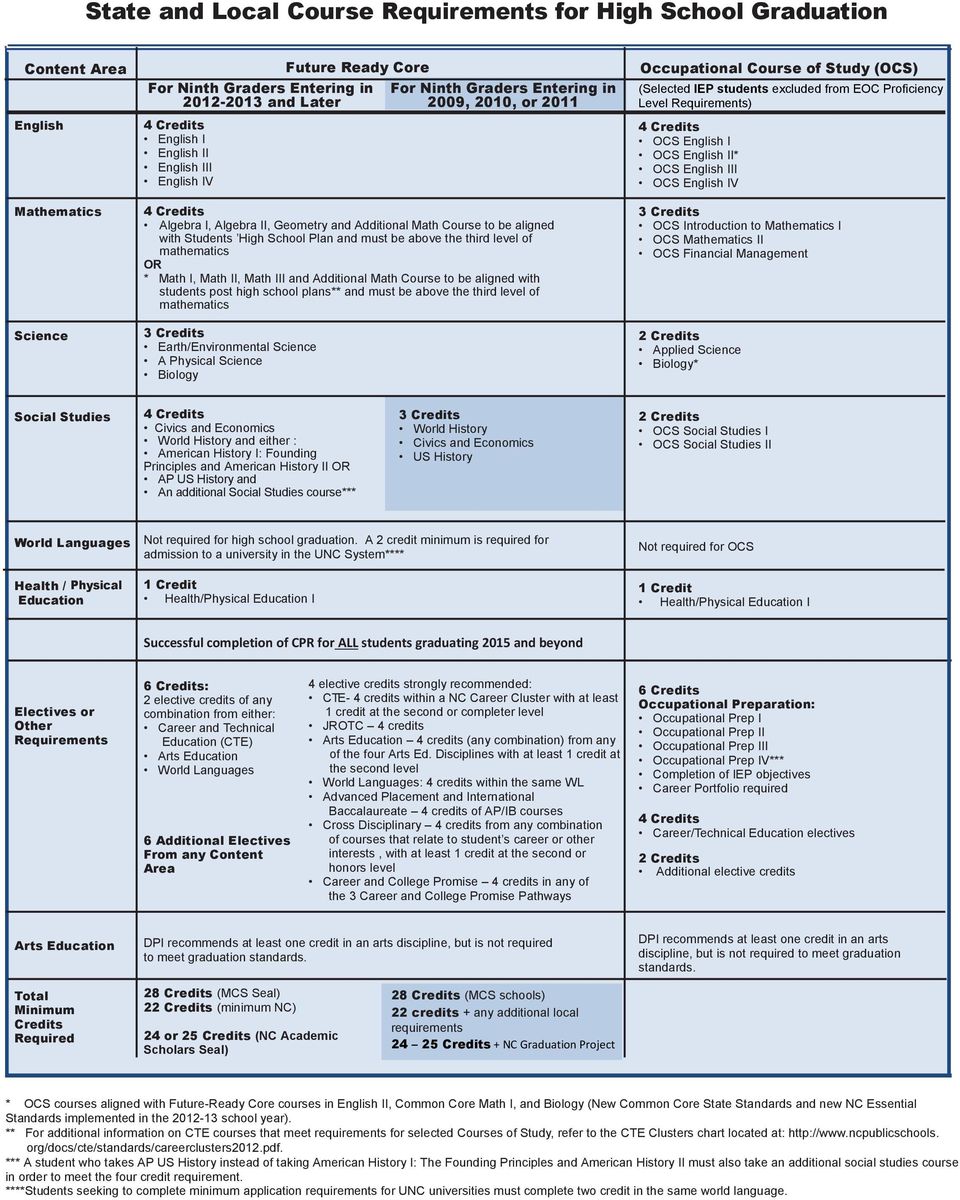
5 Course Requirements General Information General Information Welcome to the spring registration process for the school year Moore County Schools High School Program of Studies contains information needed to register and is designed to help you and your parents or guardians make the best choices for your high school education. You ll find many exciting options for you as a high school student in this book. Read through it carefully. It will be especially important for you to talk with your counselors, parents and teachers concerning your course selections. Choices that you make in high school affect your options for study and career after your time in high school has ended, so please give serious consideration to your course choices. In order to earn a high school diploma you must meet all course, credit and test requirements of at least one course of study. These courses of study are designed by the state to prepare students for a multitude of post-high school opportunities from entry-level careers to highly technical studies at community colleges, colleges and universities. You are encouraged to select the most challenging course of study in which you can be successful. REGISTRATION IS A COMMITMENT to take the courses you have selected. Remember, when you complete your registration sheet you are requesting a specific course, NOT a specific teacher, time or place. Every effort will be made to honor your course requests within the guidelines established by your school, the safety requirements of a program and the Board of Education. You may choose the courses you would like to take in the next school year; however, your schedule may change pending final grades in the courses you are currently taking and your End-of-Grade (EOG) or End-of-Course (EOC) scores, and whether the course is offered. Use the High School Plan developed by you and your counselor to select the courses you want to take. Talk with your school counselors and teachers for help in determining the courses you need. School staff members will make recommendations to you by using several criteria such as your previous performance, test scores and the AP Potential results based on your PSAT information. Meet with your counselor to make your course selections on your registration form. Have your parent or guardian double check your selections to make sure you have registered for the courses you need. Return the registration sheet to the school after you and your parent or guardian has signed it. Be sure to return it by the deadline designated by your school. The information provided in this book is current at the time of printing. It is recommended that you work closely with your school counselor during the registration period to be aware of any changes. Planning for High School Registration Selecting Requires Planning Your high school classes should be selected based on your career and educational aspirations. Careful fouryear planning will give you a challenging class schedule that meets all requirements and allows opportunity to explore your interests. The Future-Ready Core Course of Study requires six total elective units for graduation. Thoughtfully deliberating your elective choices may help you discover the answer to the question What kind of work do I want to do as an adult? Consider classes either related to your planned college or community college studies or those that prepare you to enter the workforce. Steps for Completing the Registration Process Study the General Information section of this registration book. Identify the requirements for graduation by reviewing the chart on the previous page. Read the course descriptions of both required courses and electives in which you are interested, and make sure you meet the prerequisite requirements. IMPORTANT...Registration is the student s opportunity to request appropriate courses. All courses may not be available at the student s home school. Every effort will be made to grant requests by linking students with schools offering those courses. Alternates should be chosen very carefully and will be considered part of the student s final selection of courses.

6 Graduation Requirements Future-Ready Core Beginning with the ninth grade class, all students will be expected to meet the requirements outlined under the Future-Ready Core Course of Study. Under the six total elective units required for graduation, it is strongly recommended that four elective credits be taken from one of the following areas of focus: Career and Technical Education, JROTC, Arts Education, World Languages or any other subject area (e.g., mathematics, science, social studies, English). The remaining two electives must be any combination from Career and Technical Education, Arts Education or World Languages. By taking elective credits in a concentrated area, students can tailor their course concentrations to fit their interests and goals while building a strong academic foundation. For some students with disabilities, the Occupational Course of Study (OCS) will remain an option. The participation of a student with a disability in the Occupational Course of Study is determined by the student s Individualized Education Program (IEP) Team which includes the student and parent/guardian. Early Graduation Early Graduation is a serious decision that requires Principal approval. The choice to graduate early has significant impact on available post high school education and employment options. It should not be a rushed decision but rather a well-planned and thoughtful action weighed carefully by students and parents over a period of time. It may be accomplished by completing summer online courses. Graduating early allows the student only enough time to complete the minimum graduation requirements and will limit the student s opportunities to enrich their course of study through accelerated courses such as Advanced Placement, higher level World Language classes, and classes in Career and Technical Education. Conferences with your school counselor will assure a comprehensive analysis of post-secondary options available to early graduates. Students who have completed ALL graduation requirements including specific course and testing requirements, an appropriate course of study, and total number of graduation credits required, may request to graduate early, either at mid-year of their senior year or at the end of their junior year. The student s grade classification will be based on the MCS high school promotion standards. Diplomas are awarded only at the end of the school year. Graduation Project - Option This performance-based assessment provides students with a vehicle to demonstrate what they know and are able to do as they prepare to graduate from high school. It also provides students the opportunity to connect what they have learned throughout their school career, the skills they have acquired, and work habits to real-world situations and issues. Students have the opportunity to showcase the skills and knowledge that they have been building their entire school career. The Graduation Project is a component of the North Carolina Academic Scholar Endorsement. Graduation Project Components The Graduation Project consists of four components: a paper demonstrating research and writing skills; a product created through the use of knowledge and skills to accomplish a goal; a portfolio, a learning record of the student s process and progress through all the steps of the graduation project; and, an oral presentation during which the student will present information on the chosen topic to a review panel. The Graduation Project grade may count as a grade in English IV, English IV Honors, AP English Literature and Composition or DE English IV. Check with your school counselor for an overview of the graduation project components at your high school. Diploma Endorsements Students enrolled in North Carolina high schools shall have the opportunity to earn endorsements to their High School Diploma beginning with the graduating class of Endorsements are not required to graduate but are an additional recognition from the state. Students may earn a Career Endorsement, a College Endorsement, the Moore County School Distinguished Scholar or the North Carolina Academic Scholars Endorsement. It should be noted that students may earn multiple endorsements. These endorsements are earned by completing specific course work, maintaining a minimum grade point average, and earning additional industry certification (Career Endorsement only). Information for the NC Academic Scholars Endorsement is posted on the next page. For specific information on the requirements to earn the Career Endorsement or the College Endorsement, please visit the MCS webpage at and click on Departments, Career and Technical Education, Diploma Endorsements.

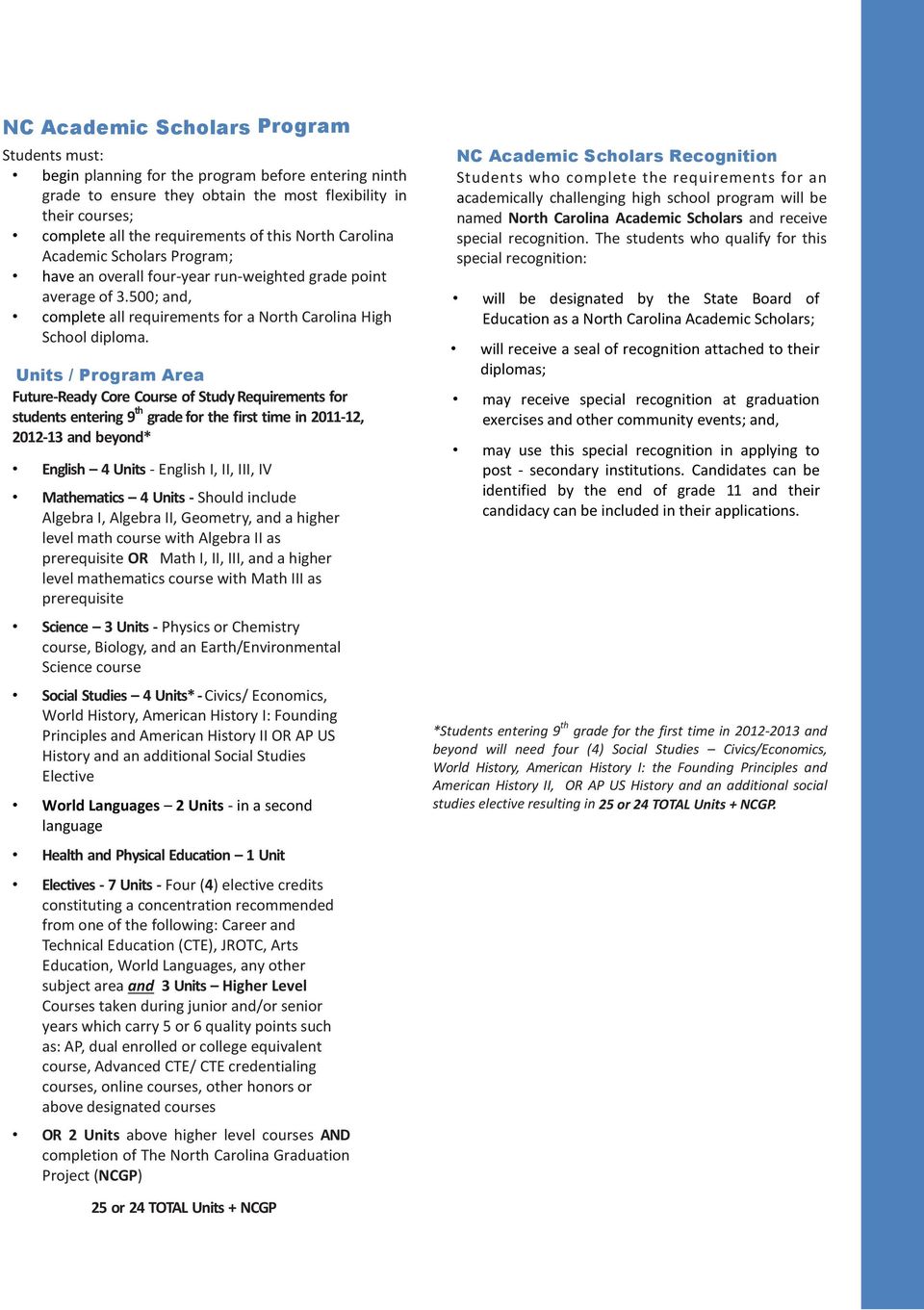
7 Graduation Requirements Scholars Program NC Academic Scholars Program Students must: begin planning for the program before entering ninth grade to ensure they obtain the most flexibility in their courses; complete all the requirements of this North Carolina Academic Scholars Program; have an overall four-year run-weighted grade point average of 3.500; and, complete all requirements for a North Carolina High School diploma. Units / Program Area Future-Ready Core Course of Study Requirements for students entering 9 th grade for the first time in , and beyond* English 4 Units - English I, II, III, IV Mathematics 4 Units - Should include Algebra I, Algebra II, Geometry, and a higher level math course with Algebra II as prerequisite OR Math I, II, III, and a higher level mathematics course with Math III as prerequisite Science 3 Units - Physics or Chemistry course, Biology, and an Earth/Environmental Science course Social Studies 4 Units* - Civics/ Economics, World History, American History I: Founding Principles and American History II OR AP US History and an additional Social Studies Elective World Languages 2 Units - in a second language Health and Physical Education 1 Unit Electives - 7 Units - Four (4) elective credits constituting a concentration recommended from one of the following: Career and Technical Education (CTE), JROTC, Arts Education, World Languages, any other subject area and 3 Units Higher Level Courses taken during junior and/or senior years which carry 5 or 6 quality points such as: AP, dual enrolled or college equivalent course, Advanced CTE/ CTE credentialing courses, online courses, other honors or above designated courses OR 2 Units above higher level courses AND completion of The North Carolina Graduation Project (NCGP) NC Academic Scholars Recognition Students who complete the requirements for an academically challenging high school program will be named North Carolina Academic Scholars and receive special recognition. The students who qualify for this special recognition: will be designated by the State Board of Education as a North Carolina Academic Scholars; will receive a seal of recognition attached to their diplomas; may receive special recognition at graduation exercises and other community events; and, may use this special recognition in applying to post - secondary institutions. Candidates can be identified by the end of grade 11 and their candidacy can be included in their applications. *Students entering 9 th grade for the first time in and beyond will need four (4) Social Studies Civics/Economics, World History, American History I: the Founding Principles and American History II, OR AP US History and an additional social studies elective resulting in 25 or 24 TOTAL Units + NCGP. 25 or 24 TOTAL Units + NCGP
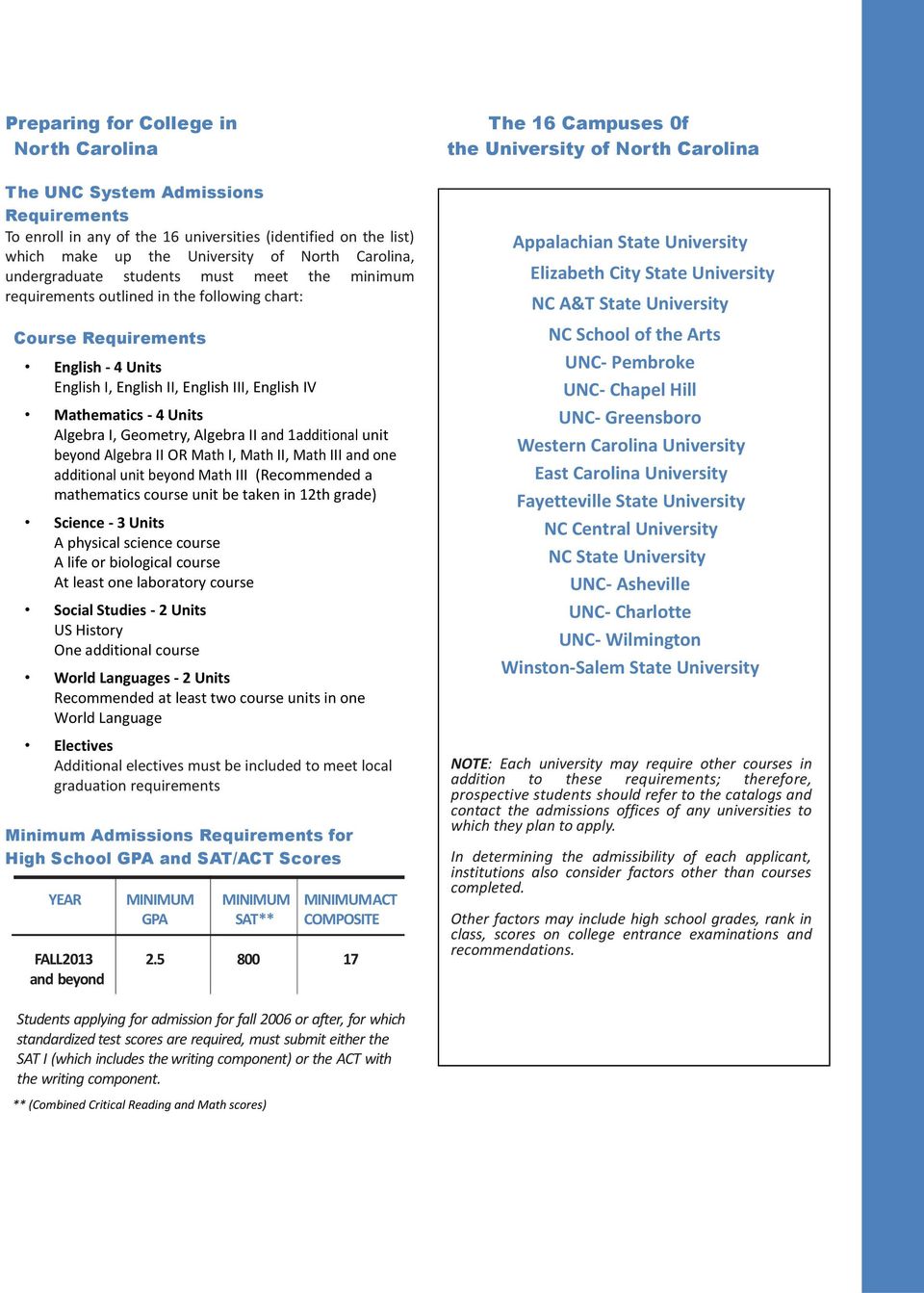
8 Preparing for College in North Carolina The UNC System Admissions Requirements To enroll in any of the 16 universities (identified on the list) which make up the University of North Carolina, undergraduate students must meet the minimum requirements outlined in the following chart: Course Requirements English - 4 Units English I, English II, English III, English IV Mathematics - 4 Units Algebra I, Geometry, Algebra II and 1additional unit beyond Algebra II OR Math I, Math II, Math III and one additional unit beyond Math III (Recommended a mathematics course unit be taken in 12th grade) Science - 3 Units A physical science course A life or biological course At least one laboratory course Social Studies - 2 Units US History One additional course World Languages - 2 Units Recommended at least two course units in one World Language Electives Additional electives must be included to meet local graduation requirements Minimum Admissions Requirements for High School GPA and SAT/ACT Scores YEAR MINIMUM MINIMUM MINIMUMACT GPA SAT** COMPOSITE FALL and beyond The 16 Campuses 0f the University of North Carolina Appalachian State University Elizabeth City State University NC A&T State University NC School of the Arts UNC- Pembroke UNC- Chapel Hill UNC- Greensboro Western Carolina University East Carolina University Fayetteville State University NC Central University NC State University UNC- Asheville UNC- Charlotte UNC- Wilmington Winston-Salem State University NOTE: Each university may require other courses in addition to these requirements; therefore, prospective students should refer to the catalogs and contact the admissions offices of any universities to which they plan to apply. In determining the admissibility of each applicant, institutions also consider factors other than courses completed. Other factors may include high school grades, rank in class, scores on college entrance examinations and recommendations. Students applying for admission for fall 2006 or after, for which standardized test scores are required, must submit either the SAT I (which includes the writing component) or the ACT with the writing component. ** (Combined Critical Reading and Math scores)
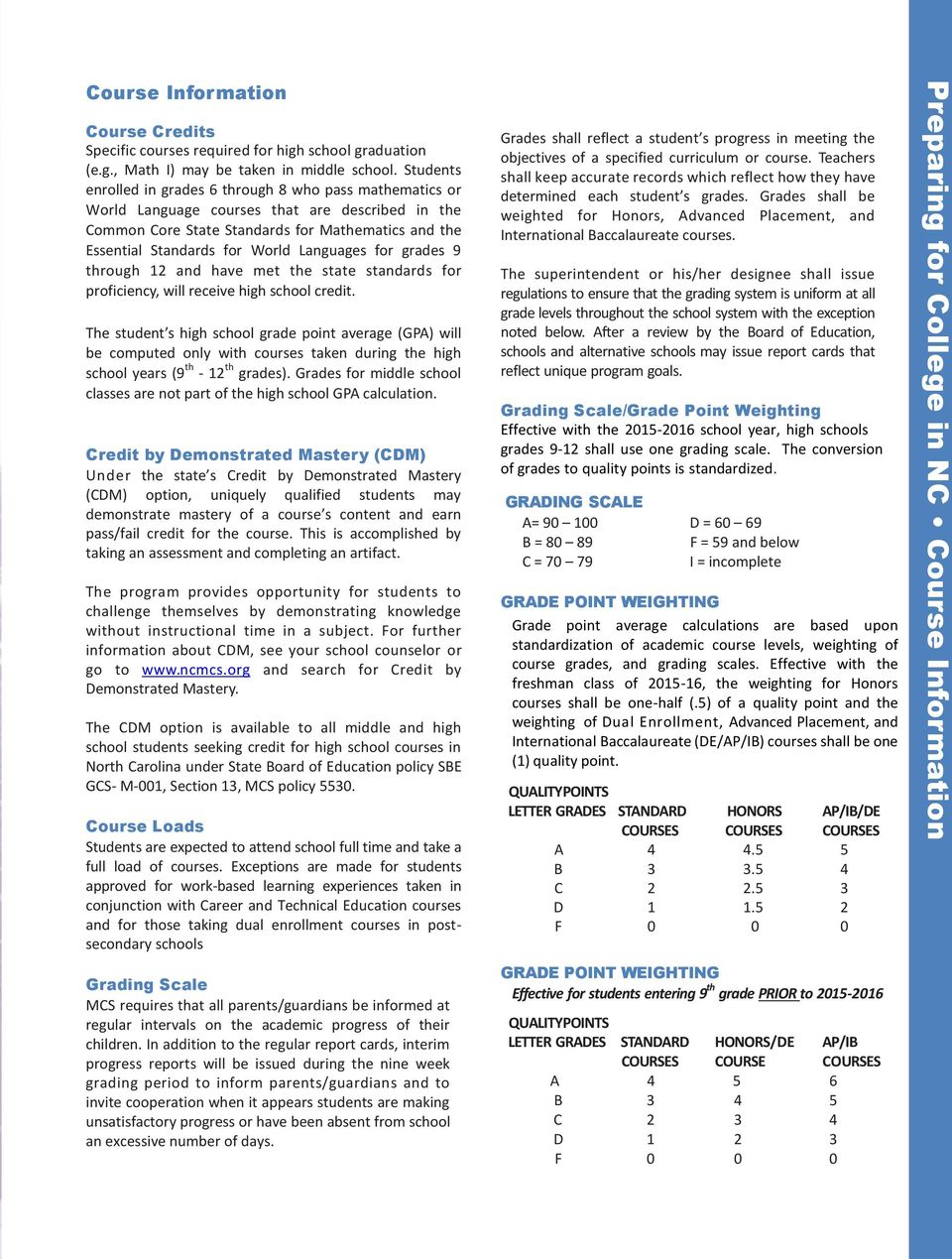
9 Preparing for College in NC Course Information Course Information Course Credits Specific courses required for high school graduation (e.g., Math I) may be taken in middle school. Students enrolled in grades 6 through 8 who pass mathematics or World Language courses that are described in the Common Core State Standards for Mathematics and the Essential Standards for World Languages for grades 9 through 12 and have met the state standards for proficiency, will receive high school credit. The student s high school grade point average (GPA) will be computed only with courses taken during the high school years (9 th - 12 th grades). Grades for middle school classes are not part of the high school GPA calculation. Credit by Demonstrated Mastery (CDM) Under the state s Credit by Demonstrated Mastery (CDM) option, uniquely qualified students may demonstrate mastery of a course s content and earn pass/fail credit for the course. This is accomplished by taking an assessment and completing an artifact. The program provides opportunity for students to challenge themselves by demonstrating knowledge without instructional time in a subject. For further information about CDM, see your school counselor or go to and search for Credit by Demonstrated Mastery. The CDM option is available to all middle and high school students seeking credit for high school courses in North Carolina under State Board of Education policy SBE GCS- M-001, Section 13, MCS policy Course Loads Students are expected to attend school full time and take a full load of courses. Exceptions are made for students approved for work-based learning experiences taken in conjunction with Career and Technical Education courses and for those taking dual enrollment courses in postsecondary schools Grading Scale MCS requires that all parents/guardians be informed at regular intervals on the academic progress of their children. In addition to the regular report cards, interim progress reports will be issued during the nine week grading period to inform parents/guardians and to invite cooperation when it appears students are making unsatisfactory progress or have been absent from school an excessive number of days. Grades shall reflect a student s progress in meeting the objectives of a specified curriculum or course. Teachers shall keep accurate records which reflect how they have determined each student s grades. Grades shall be weighted for Honors, Advanced Placement, and International Baccalaureate courses. The superintendent or his/her designee shall issue regulations to ensure that the grading system is uniform at all grade levels throughout the school system with the exception noted below. After a review by the Board of Education, schools and alternative schools may issue report cards that reflect unique program goals. Grading Scale/Grade Point Weighting Effective with the school year, high schools grades 9-12 shall use one grading scale. The conversion of grades to quality points is standardized. GRADING SCALE A= D = B = F = 59 and below C = I = incomplete GRADE POINT WEIGHTING Grade point average calculations are based upon standardization of academic course levels, weighting of course grades, and grading scales. Effective with the freshman class of , the weighting for Honors courses shall be one-half (.5) of a quality point and the weighting of Dual Enrollment, Advanced Placement, and International Baccalaureate (DE/AP/IB) courses shall be one (1) quality point. QUALITYPOINTS LETTER GRADES STANDARD COURSES HONORS COURSES A B C D F AP/IB/DE COURSES GRADE POINT WEIGHTING Effective for students entering 9 th grade PRIOR to QUALITYPOINTS LETTER GRADES STANDARD HONORS/DE AP/IB COURSES COURSE COURSES A B C D F 0 0 0
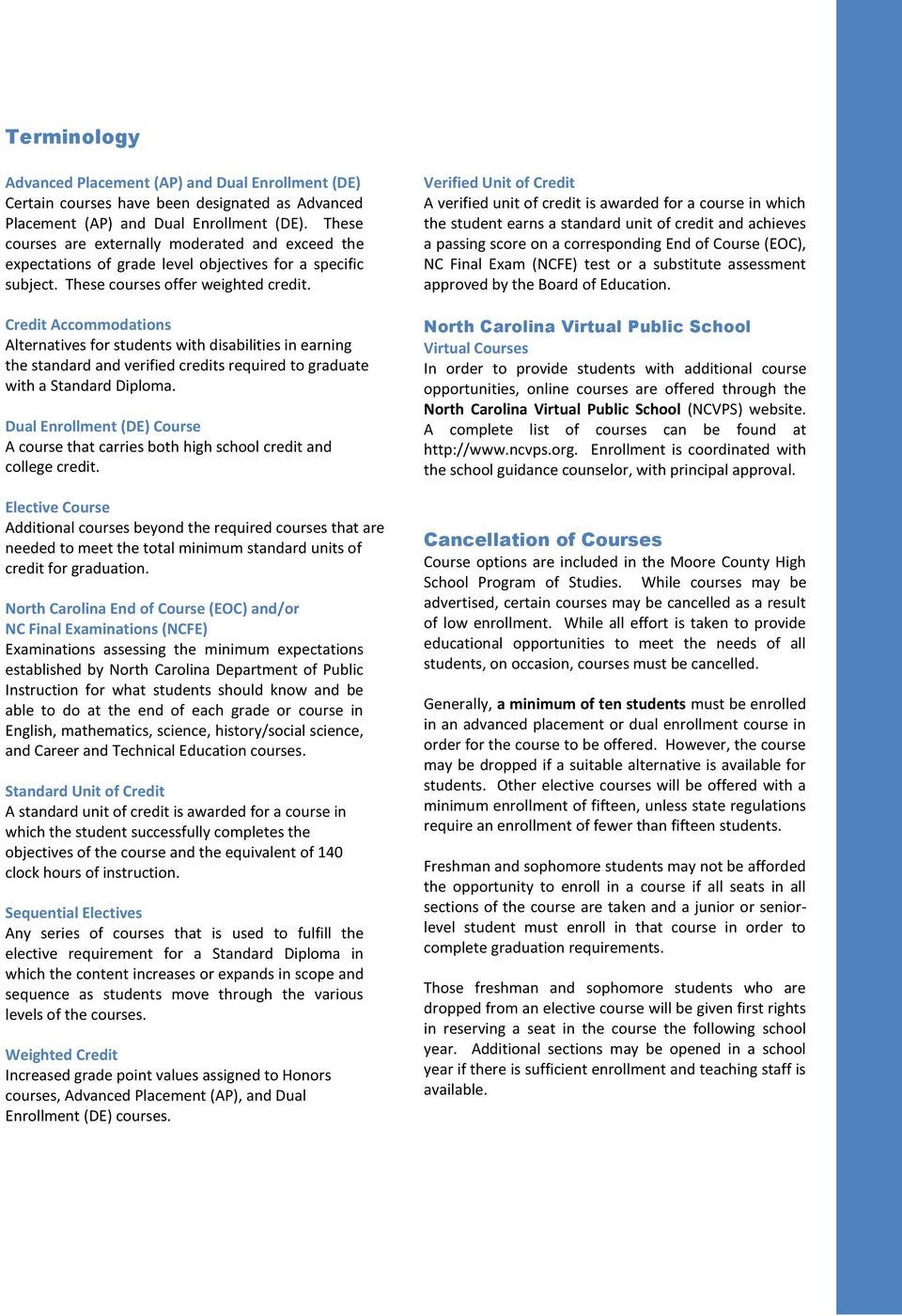
10 Terminology Advanced Placement (AP) and Dual Enrollment (DE) Certain courses have been designated as Advanced Placement (AP) and Dual Enrollment (DE). These courses are externally moderated and exceed the expectations of grade level objectives for a specific subject. These courses offer weighted credit. Credit Accommodations Alternatives for students with disabilities in earning the standard and verified credits required to graduate with a Standard Diploma. Dual Enrollment (DE) Course A course that carries both high school credit and college credit. Elective Course Additional courses beyond the required courses that are needed to meet the total minimum standard units of credit for graduation. North Carolina End of Course (EOC) and/or NC Final Examinations (NCFE) Examinations assessing the minimum expectations established by North Carolina Department of Public Instruction for what students should know and be able to do at the end of each grade or course in English, mathematics, science, history/social science, and Career and Technical Education courses. Standard Unit of Credit A standard unit of credit is awarded for a course in which the student successfully completes the objectives of the course and the equivalent of 140 clock hours of instruction. Sequential Electives Any series of courses that is used to fulfill the elective requirement for a Standard Diploma in which the content increases or expands in scope and sequence as students move through the various levels of the courses. Weighted Credit Increased grade point values assigned to Honors courses, Advanced Placement (AP), and Dual Enrollment (DE) courses. Verified Unit of Credit A verified unit of credit is awarded for a course in which the student earns a standard unit of credit and achieves a passing score on a corresponding End of Course (EOC), NC Final Exam (NCFE) test or a substitute assessment approved by the Board of Education. North Carolina Virtual Public School Virtual Courses In order to provide students with additional course opportunities, online courses are offered through the North Carolina Virtual Public School (NCVPS) website. A complete list of courses can be found at Enrollment is coordinated with the school guidance counselor, with principal approval. Cancellation of Courses Course options are included in the Moore County High School Program of Studies. While courses may be advertised, certain courses may be cancelled as a result of low enrollment. While all effort is taken to provide educational opportunities to meet the needs of all students, on occasion, courses must be cancelled. Generally, a minimum of ten students must be enrolled in an advanced placement or dual enrollment course in order for the course to be offered. However, the course may be dropped if a suitable alternative is available for students. Other elective courses will be offered with a minimum enrollment of fifteen, unless state regulations require an enrollment of fewer than fifteen students. Freshman and sophomore students may not be afforded the opportunity to enroll in a course if all seats in all sections of the course are taken and a junior or seniorlevel student must enroll in that course in order to complete graduation requirements. Those freshman and sophomore students who are dropped from an elective course will be given first rights in reserving a seat in the course the following school year. Additional sections may be opened in a school year if there is sufficient enrollment and teaching staff is available.
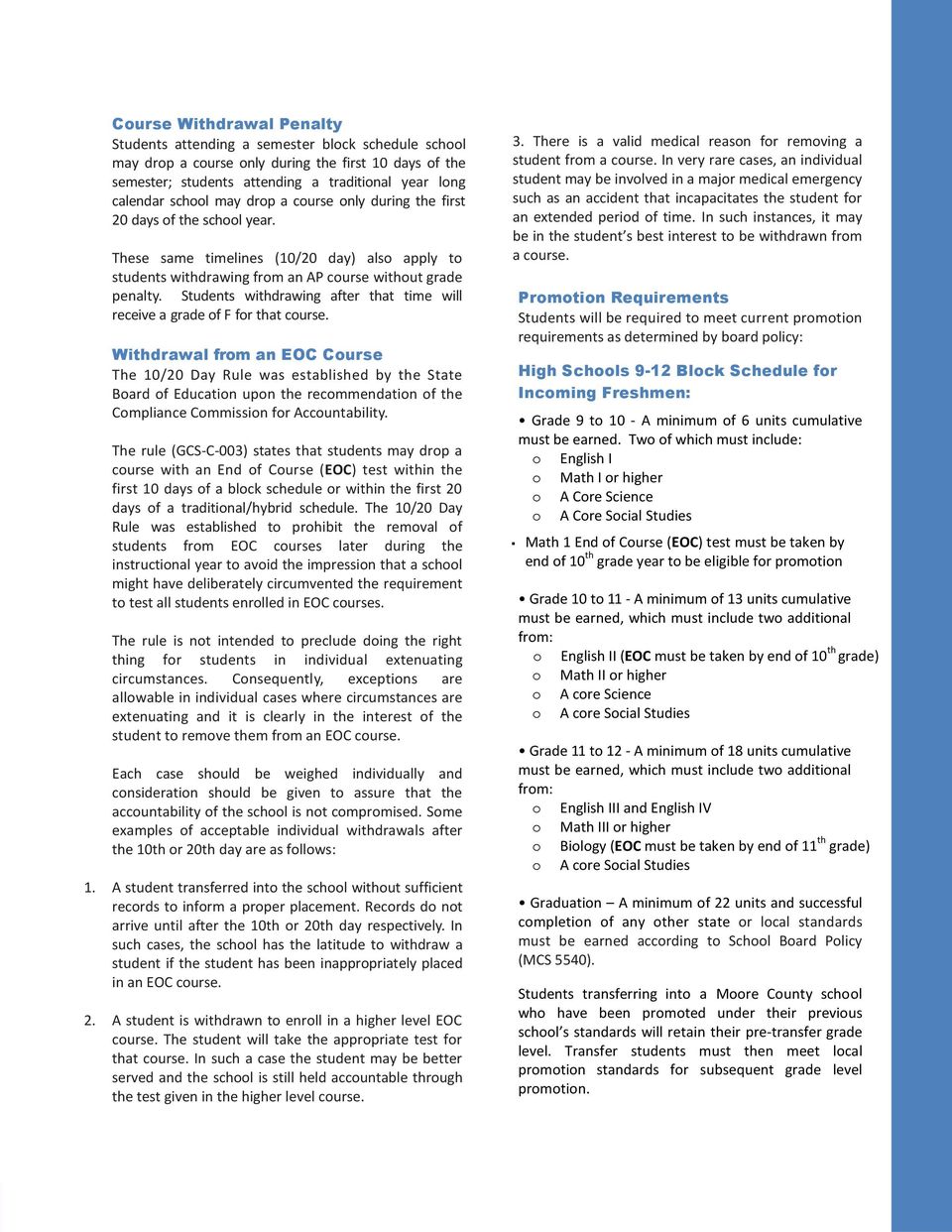
11 Course Withdrawal Penalty Students attending a semester block schedule school may drop a course only during the first 10 days of the semester; students attending a traditional year long calendar school may drop a course only during the first 20 days of the school year. These same timelines (10/20 day) also apply to students withdrawing from an AP course without grade penalty. Students withdrawing after that time will receive a grade of F for that course. Withdrawal from an EOC Course The 10/20 Day Rule was established by the State Board of Education upon the recommendation of the Compliance Commission for Accountability. The rule (GCS-C-003) states that students may drop a course with an End of Course (EOC) test within the first 10 days of a block schedule or within the first 20 days of a traditional/hybrid schedule. The 10/20 Day Rule was established to prohibit the removal of students from EOC courses later during the instructional year to avoid the impression that a school might have deliberately circumvented the requirement to test all students enrolled in EOC courses. The rule is not intended to preclude doing the right thing for students in individual extenuating circumstances. Consequently, exceptions are allowable in individual cases where circumstances are extenuating and it is clearly in the interest of the student to remove them from an EOC course. Each case should be weighed individually and consideration should be given to assure that the accountability of the school is not compromised. Some examples of acceptable individual withdrawals after the 10th or 20th day are as follows: 1. A student transferred into the school without sufficient records to inform a proper placement. Records do not arrive until after the 10th or 20th day respectively. In such cases, the school has the latitude to withdraw a student if the student has been inappropriately placed in an EOC course. 2. A student is withdrawn to enroll in a higher level EOC course. The student will take the appropriate test for that course. In such a case the student may be better served and the school is still held accountable through the test given in the higher level course. 3. There is a valid medical reason for removing a student from a course. In very rare cases, an individual student may be involved in a major medical emergency such as an accident that incapacitates the student for an extended period of time. In such instances, it may be in the student s best interest to be withdrawn from a course. Promotion Requirements Students will be required to meet current promotion requirements as determined by board policy: High Schools 9-12 Block Schedule for Incoming Freshmen: Grade 9 to 10 - A minimum of 6 units cumulative must be earned. Two of which must include: o English I o Math I or higher o A Core Science o A Core Social Studies Math 1 End of Course (EOC) test must be taken by end of 10 th grade year to be eligible for promotion Grade 10 to 11 - A minimum of 13 units cumulative must be earned, which must include two additional from: o English II (EOC must be taken by end of 10 th grade) o Math II or higher o A core Science o A core Social Studies Grade 11 to 12 - A minimum of 18 units cumulative must be earned, which must include two additional from: o English III and English IV o Math III or higher o Biology (EOC must be taken by end of 11 th grade) o A core Social Studies Graduation A minimum of 22 units and successful completion of any other state or local standards must be earned according to School Board Policy (MCS 5540). Students transferring into a Moore County school who have been promoted under their previous school s standards will retain their pre-transfer grade level. Transfer students must then meet local promotion standards for subsequent grade level promotion.
12 Course Information Transfer Credit Students transferring from another public school system, a charter school or a non-public school accredited by one of the six regional accrediting associations** into MCS will receive: 1. Credit for all courses approved by the sending school. 2. Weighted credit for a course designated by the sending school system as Honors or AP only if a comparable course is designated Honors or AP in the current MCS High School Program of Studies. The following guidelines must be met by any student who is transferring from a non-accredited, non-public school, or Home School and may be seeking graduation credits for those courses successfully completed while attending the non-public or Home School: 1. The parent/guardian must read and sign the transfer credit parent form and provide a copy to the receiving school prior to beginning the transfer credit process. 2. The parent/guardian must provide clear and concise attendance records for the student. If the incoming student was homeschooled prior to turning 16 years of age, proof of the Home school s approval by the North Carolina Division of Non-Public Education is required and must be submitted to the school in a timely manner. Transfer students requesting credit from a nonaccredited program are required to have the institution provide the following documentation to the receiving MCS School: Course title(s), materials used, total number of contact hours per course, attendance record(s), scores of any standardized tests associated with the specific course(s) and complete syllabus with topics and number of hours included. Please Note: Clear alignment to the appropriate North Carolina Standard Course of Study or the Essential State Standards must be evident in order to receive assignment of credit. All requests should be submitted to the receiving MCS school for review and evaluation. The receiving school may request additional documentation, which may include, but is not limited to student work samples and artifacts. The school will inform the parent/guardian of the approval decision within 2 weeks of the submission. If the course is approved, the following applies: Grades will be recorded as Pass (P) or Fail (F) and will be identified on the transcript as non-mcs grades. The approved courses will not be included in calculation of GPA or class ranking at the school. Six Regional Accrediting Associations Middle States, New England, North Central, Northwest, Southern, and Western Associations of Colleges and Schools Transferring Between High Schools If students transfer between high schools that operate on different schedules (block, traditional or a hybrid), consideration will be given to ensure the least amount of impact to the student s on time graduation status. The following is an example of a formula that could be used to compute graduation requirements: (# of years at block x 8) + (# of years at traditional x 6) minus 3 = number of units required for graduation Credit Recovery Program High School students who have failed an academic core course can take a District adopted/approved online course that is self-paced and based on a mastery of individual units. Participation requires principal approval. The purpose of credit recovery is to provide an opportunity for each student who failed a course to accelerate and to complete courses based on individual needs, and to meet specific graduation requirements. Students must pass the online examination to earn credit, and will receive a pass/fail grade. (The grade of pass/fail will not be calculated into a student s GPA.) Please note: This course (credit recovery) does not meet the NCAA Eligibility Center Requirements. If you plan to participate in collegiate athletics, the eligibility center has not approved this class to count towards the NCAA eligibility standards.
13 Other Information Enrollment in Off Campus Courses All high school students are expected to attend school on a full-time basis. Students who have advanced beyond all of the course offerings of MCS in the areas of English, mathematics, science, social studies and/or world languages (courses above Level IV) may request principal permission to attend classes on college campuses. Written approval from the high school principal must be obtained during the spring semester high school registration period. No approval will be granted after the end of the registration period. Virtual Learning NC Virtual Public Schools (NCVPS) North Carolina Virtual Public Schools (NCVPS) and MCS provides students with expanded academic options by offering online courses and online services such as test preparation and career planning services at NO COST to your student. By virtue of online course delivery, students have access to courses taught by highly qualified teachers. Students will be taught by NC certified teachers and the grades that they earn in their online course will transfer to their school and become part of their academic record. MCS and NCVPS provide courses that augment a student s program of study as offered by the home school. MCS accepts credits from regionally accredited schools only. Any summer coursework completed by distance learning (as defined by the Southern Association of Colleges and Schools) must be completed prior to the opening of school each fall. High school principals and guidance counselors must approve any distance learning prior to the student s enrollment in the program. The examples of the course offerings listed below are not inclusive of all offering through NCVPS. The following are examples of courses currently offered in NCVPS: English Language Arts English I, Honors English I English II, Honors English II English III, Honors English III English IV, Honors English IV Mathematics Advanced Functions and Modeling Math I Math II, Honors Math II Math III, Honors Math III Social Studies American History: Founding Principles, Civics and Economics Honors American History: Founding Principles Civics and Economics Psychology, Honors Psychology World History, Honors World History Science Honors Anatomy & Physiology Biology, Honors Biology Chemistry, Honors Chemistry Earth and Environmental Science Honors Earth and Environmental Science Science (continued) Forensic Science I, Forensic Science II Physical Science World Languages French I, French II Latin I, Latin II, Honors Latin III Spanish I, Spanish II Honors Spanish III, Honors Spanish IV Career and Technical Education Entrepreneurship I Marketing Microsoft Word and PowerPoint, Publisher Microsoft Excel/Access Scientific Visualization I Electives Digital Photography I Digital Photography II Journalism Music Appreciation SAT Prep Other courses include test preparation, courses for credit recovery, and Occupational Course of Study (OCS)
14 Career and College Promise The Career and College Promise program is designed to provide seamless dual enrollment educational opportunities for eligible North Carolina high school juniors and seniors in order to accelerate completion of college certificates, diplomas, and associate degrees that lead to college transfer or provide entry-level job skills. MCS students may take community college course work at Montgomery Community College and/or at Sandhills Community College in one of the following pathways: College Transfer Pathway Career and Technical Education Pathway College Transfer Pathway The College Transfer Pathways provide several hours of tuition free college credits as part of the Universal General Education Transfer Component (UGETC) courses, which are guaranteed to transfer for general education equivalency credit to each of the 16 UNC institutions. Juniors and seniors may take courses in one of four areas leading to a minimum of 30 hours of college transfer credit. Many courses can be used to provide dual credit to meet both high school and college requirements. Career and Technical Education Pathway Career and Technical Education Pathways are programs of study to provide expanded opportunities for eligible high school students to participate in Career and Technical Education tuition free courses and to expose students to a variety of high-skill career options. Juniors and seniors may take courses in designated areas leading to a certificate or diploma aligned with one of sixteen Career Clusters. Courses may be used in partial or complete fulfillment of a four-unit high school Career Cluster. For more information about the Career and College Promise program, including courses offered and eligibility requirements, please visit the MCS Career and College Promise webpage at (click Departments, Career and Technical Education, Career and College Promise). Academic Opportunities Opportunities for academic challenge are offered to students through Advanced Placement (AP) options and the Honors program. The Honors curriculum and the AP curriculum (as established by the College Board) have a more demanding and rigorous instructional approach than regular classes. Honors Courses The overall purpose of Honors courses is to provide students opportunities in which the instruction is expanded and special activities focus appropriately on both depth and breadth of content. Instructors place additional emphasis on the application of content within each course and across related disciplines. Honors courses require advanced reading lists, advanced writing assignments, and independent study/projects. Additional activities may include follow-up assignments on enrichment activities and a portfolio collection of work. Students may enroll in an Honors course if they possess the appropriate prerequisite courses and choose to participate in this more rigorous course of study. Advanced Placement (AP) Courses The AP program offers able and ambitious students an opportunity to study college-level course curriculum. Students may study challenging subjects of interest in a variety of areas: arts, English, world language, mathematics, science, and social studies and to prepare for a national AP exam, which is an expectation of all students enrolled in an AP course. AP examinations are administered in the spring of each school year. Many colleges grant college credit or advanced placement or both based on AP exam scores. Honors and AP courses receive weighted credit in computing the student s grade point average (GPA). Each student is required to take the appropriate EOC assessment the first time the student takes the course even if the course is an Honors or AP Course. Students enrolled in Honors courses will be allowed to continue in those courses if they transfer from one high school to another within Moore County Schools.

15 Other Information Advanced Placement (AP) Testing The College Board will coordinate the national administration of the Advanced Placement exams during May in the following areas: Art History, Biology, Calculus AB, Calculus BC, Chemistry, Chinese Language and Culture, Computer Science A, Economics-Macro and Micro, English Language and Composition, English Literature and Composition, Environmental Science, European History, French Language and Culture, German Language and Culture, Government & Politics - U.S. and Comparative, Human Geography, Japanese Language and Culture, Latin, Music Theory, Physics 1 and 2, Physics C, Psychology, Spanish Language, Spanish Literature, Statistics, Studio Art: Drawing and Design, 2-D, 3-D, US History, and World History. AP Course Credit Students enrolled in Advanced Placement courses are expected to take the AP national exam administered in May, which is provided at no cost to the student. Students earn AP quality points in all AP courses, regardless of their performance on the AP exam. Potential college creditor advanced placement opportunities are dependent solely upon AP exam results. Most AP science and art portfolio courses require a co-requisite lab in order to earn course credit. Students taking AP lab courses may opt to take the lab as Pass/ Fail, which does not affect the student s GPA, or for a non-weighted grade which is included in calculating the GPA. An AP Lab Waiver Form must be signed by the student and parent prior to enrolling in the lab course with the understanding that graded classes will be averaged into the student s grade point average (GPA) on a 4.0 weighted scale. Academic Recognition Students may pursue the MCS Distinguished Scholar Endorsement, which requires the student to complete all state and local content graduation requirements and a minimum of 28 credits. Criteria for the MCS Distinguished Scholar Endorsement can be found within the MCS Policy 5540, Graduation Requirements. In addition, the NC State Board of Education has approved the recognition of five high school diploma endorsements for students graduating from high school in 2015 and later. NC SBE Academic endorsements are: North Carolina Academic Scholar Endorsement North Carolina Career Endorsement North Carolina College Endorsement North Carolina College/UNC Endorsement North Carolina Global Language Endorsement Criteria for each of these State Board of Education endorsements can be located within the State Board of Education Policy GCS L-007. Recognition of Honor Graduates Honor candidates recognition may be included in the graduation program in the following format: Seniors with a weighted GPA of: * Cum Laude candidates, * Magna Cum Laude candidates; and, 4.5 * and higher Summa Cum Laude candidates. Each high school will also recognize a valedictorian and salutatorian. * GPA averages are not rounded up Non-Credit Driver Education Extended-day driver education classes will be available to students who are 14 ½ years old by the starting date for the Driver Education Class. During the traditional school year, classes begin 15 minutes after school ends and run three (3) hours. Times vary by school, so home schooled or private school students should contact Pinecrest, Union Pines or North Moore High Schools for times. Class schedules are subject to change. If changed, announcements will be made at the home school. Classes are not held on early dismissal days, workdays or if school activities are cancelled due to inclement weather or unforeseen situations. Summer driver education will be available for students who will reach their 14 1/2 birthday by the starting date of the Driver Education Class. Driver s Education information may be accessed on the MCS Webpage under Student and Parent Resources. Under Dropout Prevention/Drivers License legislation passed in 1998, students under the age of 18 who drop out of school or do not pass 70 percent of their courses are subject to having their permit/license suspended.

16 Home/Hospital Services A MCS student may be eligible for Home/Hospital services if he/she is medically or physically unable to attend school for four weeks or longer as documented by a physician. Home/Hospital services are provided on a temporary basis, and the goal is to return the student to the regular school program as soon as feasible unless there is medical information which would require the service to be extended. Home/Hospital teachers provide instructional services so that a student can return to school with the knowledge and skills sufficient to maintain his/her previous level of academic performance. For more information, please contact your school counselor. Section 504 Students who do not qualify for Exceptional Children s Services under the Individuals with Disabilities Education Act (IDEA) may be entitled to support under Section 504 of the Rehabilitation Act of A student may be found disabled under Section 504 if he/she: has a physical or mental impairment which substantially limits one or more major life activity (i.e., learning, behavior, seeing, walking, and so forth); has a record of impairment; or is regarded as having an impairment. Students eligible under Section 504 may be entitled to supports and services which are delivered through a 504 plan. For a list of frequently asked questions about Section 504, please visit The Section 504 District Contact for Moore County Schools can be reached by calling (910) Non-Discrimination Policy In compliance with federal laws, Moore County Schools administers all educational programs, employment activities and admissions without discrimination because of race, religion, national or ethnic origin, color, age, military service, disability, marital status, parental status, or gender, except where exemption is appropriate and allowed by law. Refer to the MCS Board of Education s Discrimination Free Environment Policy for a complete statement. Contact information Inquiries or complaints regarding Title IX should be directed to the Moore County Schools Compliance Officer, P.O. Box 1180, Carthage, NC (910) Inquiries or complaints regarding Section 504 should be directed to the Director of Exceptional Children, 160 Pinckney Road, Carthage, NC (910) CFNC.org College Foundation of North Carolina (CFNC) is a comprehensive, free information service provided by the state of North Carolina to help families plan, apply and pay for college. The goal of CFNC is to help every student in the state prepare successfully for education beyond high school and find the best financial aid alternatives. Resources and information on careers, more than 100 NC colleges, college admission, scholarships, grants and other financial assistance are available online at CFNC.org or by calling toll-free CFNC. High school students and their parents are encouraged to take advantage of this service and Moore County school counselors are trained to assist them. CFNC is made available by College Foundation, Inc., the North Carolina State Education Assistance Authority and Pathways, a partnership that includes the State Department of Public Instruction, the North Carolina Community College System, the North Carolina Independent Colleges and Universities and the University of North Carolina System. End of Course (EOC) Testing Students enrolled in Math I, Biology, and English II are required to take the North Carolina READY End of Course (EOC) test. The EOCs are used to sample a student s knowledge of subject-related concepts as specified in the NC Standard Course of Study and to provide a global estimate of the student s mastery of the material in a particular content area. All EOCs will be administered at the end of the semester (block schedule) or the end of the year (hybrid/traditional block schedule). Schools shall use results from all EOC tests as twenty percent (25%) of the student s final grade for each respective course. Each student shall take the appropriate EOC assessment the first time the student takes the course even if the course is an honors or Advanced Placement course.
17 Other Information Students enrolled for credit must participate in the appropriate EOC regardless of course delivery (e.g., traditional classroom, NC Virtual Public School, etc.). Students who are identified as failing a course for which an EOC is required shall take the appropriate EOC assessment. Students shall take the appropriate EOC assessment at the end of the course regardless of the grade level in which the course is offered. Preliminary Scholastic Assessment (PSAT )Test: National Merit Scholarship Qualifying Test The Preliminary Scholastic Assessment Test/National Merit Scholarship Qualifying Test (PSAT/NMSQT) or more often simply called the PSAT is nationally administered by the College Entrance Examination Board (CEEB), and assesses students in three areas: Reading, Writing and Mathematics. The PSAT is used to help students practice for the Scholastic Assessment Test and to qualify for scholarships and recognition from such programs as: National Merit Scholarships, National Achievement Scholarships for Outstanding African American Students, National Hispanic Scholar Recognition Program, Student Search Service, and Some statewide and national industry scholarship competitions. Registration information will be available in the school counselors office at each high school. SAT The SAT is an optional test nationally administered by the College Board. It assesses students in three areas: Reading, Writing and Mathematics. The SAT will undergo revisions during the school year. The Redesigned SAT will be administered for the first time in March of The PSAT 2015 will reflect the redesigned format in order to better prepare students for the new SAT. Currently, Critical Reading skills are assessed by multiple choice questions using: critical reading passages, paired passages, vocabulary in context and sentence completion. Math sections allow the use of a calculator and employ multiple choice questions and constructed responses to measure how well students understand and apply mathematics to new situations and non-routine problems. The section on Writing includes multiplechoice questions on grammar and usage and a studentwritten essay. The focus of the Redesigned SAT shifts to evidencebased reading and writing and application-based math questions. The reading section will no longer contain sentence completions and the vocabulary will be less esoteric. Passages will be pulled from significant historical or scientific documents and will focus on support for answers based on evidence in the passages. Math problems will deal with problem-solving and data analysis. The essay will be optional. The SAT is one of the admissions tests used by postsecondary institutions to assist in selecting students. The SAT is administered at selected sites nationally. Students must pay and register online or by mail several weeks prior to the test date. Registration information is available in the school counselors office at each high school and at ACT The ACT college readiness assessment is a curriculum and standards-based educational and career planning tool that assesses students academic readiness for college. All students in grade 11 take the ACT Plus Writing which has five sub scores: four multiple-choice tests covering skill areas of English, mathematics, reading, and science; the Writing Test measuring skill in planning and writing a short essay. Students in grade 10 take the ACT PLAN test. This test is designed to help students prepare not only for high school coursework, but for college and career success. The ACT PLAN contains four curriculum-based assessments: English, mathematics, reading, and science. It also contains an Interest Inventory that will match a student s interests and skills with college and career goals. The ACT is also administered at selected sites nationally. For these administrations, students must pay and register by mail several weeks prior to the test date. Registration information is available in the school counselors office at each high school. In the U.S., the ACT is administered on six national test dates: in September, October, December, February, April, and June. There is no charge for the state administration of the ACT or PLAN. More information is available at
18 CTE Post-Assessments Career and Technical Education (CTE) postassessments are end-of-course tests provided by the Department of Public Instruction and are required in most CTE courses. These assessments provide documentation of the individual student s attainment of technical competencies based on the goals and objectives of the CTE Essential Standards document. Scores are reported to the Department of Public Instruction (DPI) and are used to evaluate programs and the system-wide attainment of performance standards. Such assessment information is also a requirement of the Carl D. Perkins Career and Technical Education Act. The Perkins Act is a federal program that provides increased focus on the academic achievement of Career and Technical Education students, strengthens the connections between secondary and postsecondary education, and improves state and local accountability. For CTE courses included in either the North Carolina Community College Articulation Agreement or the MCS/Sandhills Community College (SCC) and MCS/Montgomery Community College (MCC) Local Articulation Agreement, students who earn a score of 93 or better on the CTE post-assessment and make a B or better in the course may receive articulation credit. WorkKeys ACT WorkKeys is a job skills assessment system that helps employers select, hire, train, develop, and retain a high-performance workforce. ACT WorkKeys tests help students determine if they have the skill levels required for various careers. WorkKeys assessments will be administered to CTE Concentrators during their graduating year at no cost to the student. The ACT WorkKeys includes three assessments: Reading for Information, Applied Mathematics, and Locating Information. Taking the WorkKeys assessments is an important first step to prepare for education, training or a career. For more information on WorkKeys, see www. act.org/workkeys. NC Career Readiness Certificate (NCCRC) The North Carolina Career Readiness Certificate (NCCRC) ensures that an individual student has obtained certain foundational skills that are important across a range of occupations. The NCCRC offers students, parents, individuals, employers and educators an easily understood, conveniently attained and universally valued credential that will contribute to the state s workforce and economic development objectives. Recipients are awarded certificates of Platinum, Gold, Silver or Bronze depending on their skill levels in Applied Mathematics, Reading for Information and Locating Information. The certificate can complement diplomas, degrees and resumes. It also can potentially provide job seekers an advantage in the interview process. W.I.D.A. and ACCESS for ELLs 2.0 The North Carolina State Board of Education (SBE) approved the adoption of the WIDA Consortium English Language Development Standards beginning with the school year. The administration of this assessment is a requirement for all students who identify a language other than English during the Home Language Survey process. The test functions as a screener used for both the initial assessment and the English as a Second Language (ESL) program placement of students identified as limited English Proficient (LEP). The annual test, Assessing Comprehension and Communication in English State-to State for English Language Learners (ACCESS for ELLs 2.0 ), is North Carolina s required assessment that complies with Title III of the federal No Child Left Behind (NCLB) legislation. This annual assessment of all students identified as Limited English Proficient measures student English language proficiency, performance and progress in the areas of listening, speaking, reading, writing, and comprehending English [ref. Title I, SEC (a) (7)], including students who receive special education services. Because of this federal legislation, all students identified as LEP are tested annually, during an established testing window as designated by the NCDPI, on the ACCESS for ELLs 2.0 or the Alternate ACCESS for ELLs.
19 Student Attendance K-12 MCS believes that attendance in school is central to a student s educational achievement and a student s success in school. Furthermore, MCS considers attendance and participation in class an integral part of the teaching and learning process. Regular attendance develops patterns of behavior essential to success in life after high school, both personally and professionally. The State Board of Education requires that students be enrolled in the public schools for at least 5.5 hours of instruction daily or 27.5 hours weekly. Students will be assigned to a full instructional day, unless they receive appropriate approvals. A. Lawful Absences Excusable absences permitted by NC State Board of Education Attendance Rules: (a) Illness or injury (b) Quarantine/Isolation by State Board of Health (c) Death in Family (d) Medical/Dental Appointments (e) Court proceedings (f) Religious events or observances (g) Valid Educational opportunity (h) Military Deployment/return (MCS Policy 6024) (i) Local School Board exception (j) Suspension (k) Expulsion B. Unlawful Absences Unlawful (unexcused) absences are defined as the student s willful absences from school without the knowledge of the parents/guardians, or the student s absences from school without justifiable causes with the knowledge of parents/guardians. C. Homebound Placements Homebound placements are based on medical recommendations and students are credited as in attendance when pre-approved by the appropriate official in the Moore County Schools. D. Make-up Work Students are responsible for all work missed when absent from school. Immediately upon returning to school, students must make arrangements with their teacher(s) to make up all work (assignments, tests, projects, etc.) missed while absent within the specified period as defined by the teacher. E. Absence Documentation Requirement Parents/guardians are requested to contact school officials immediately when unanticipated absences occur. All absences require a written note from the parent/guardian explaining the absence(s). The student should deliver the note to school authorities (teacher, attendance office official, etc.) as soon as possible upon his/her return to school. Failure to submit such notes within 3 school days after returning to school will result in an unlawful absence being recorded. All anticipated periods of absence should be reported to school officials prior to the period of absence. Such absences should receive prior approval by school officials. Note: Juniors will be allotted one college day in the spring; prior approval note is required. Seniors are allotted one day in the fall. Prior approval is required for any student departing from campus once he/she has arrived; this approval is required throughout the school day. Students must follow a sign-out procedure as established by the school. F. Definition of being In Attendance To be considered in attendance a student must be present in the school for at least one-half of the school day (or one-half of the class for class attendance in secondary schools). Students may, with the approval of the school principal or designees attend an authorized school activity and are considered in attendance. Such activities include, but may not be limited to, job shadowing and other work based learning activities, field trips, athletic contests or other competitions, student conventions, music festivals, concerts, or similar activities approved by the school. Assignments missed for these reasons are eligible for make up by the student. The student is responsible for finding out what assignments are due and completing them within the specified time period. G. Unlawful Absence Disciplinary Actions Unlawful absence will result in conferences with parents/guardians. Unlawful absence and/or truancy may lead to disciplinary action to include court proceedings involving parents and/or students if the student is less than sixteen years of age. North Carolina General Statute (G.S.115C-378) requires attendance until the age of sixteen (16).
20 High School Attendance Requirements Records are kept on each student s attendance for the duration of each course (period by period). Each student s attendance record is assessed during the length of the course. School attendance has been identified as a critical component to academic success. According to SACS (Southern Association of Colleges and Schools) accreditation standards, course credit is granted based on defined performance criteria and a minimum of 130 clock hours of instruction. However, Moore County Schools and NCSBE require 135 Clock Hours of attendance. Excessive Lawful Absences The Moore County Schools Attendance Policy 6000 states, Students in grades 9-12 who are absent from a class more than eight (8) days during a semester course shall not receive credit for the semester or year where applicable. The maximum numerical grade recorded for such a student for the semester or for the year shall be fifty (50). Any student who misses more than eight (8) days in a semester or A/B class may not receive credit for that class, even if the student s grade is passing. Students are expected to make up work assigned during the lawful absence(s) within three school days of the student s return to school, or as scheduled with the teacher. The ultimate responsibility for makeup work lies with the student. Unlawful Absences Unlawful (unexcused) absences: the student s willful absences from school without the knowledge of the parents/guardians, or the student s absences from school without justifiable causes with the knowledge of parents/ guardians. Notification Of Absences The following schedule will be used to notify parents/guardians of student unexcused absences: After 3 absences by principal or designee After 6 absences in writing After 10 absences as aligned with G.S. 115C 38) Methods of notification vary from school to school but can include personal telephone messages, computer- generated telephone messages, letters, conferences, and home visits. Parents should monitor their student s attendance closely; notifications sent by the school can follow the actual absence by a number of days due to time needed for processing, mailing, etc. Schools may also communicate attendance information to parents through the district s automated Student Information System. State Mandated Attendance Policy Students under the age of 16 years will receive notification under North Carolina General Statute (G.S.115C-378). The law states that Unlawful absences will result in conferences with parents/guardians. Unlawful absences and/or truancy may lead to disciplinary action to include court proceedings involving parents and/ or students if a student is less than sixteen years of age. North Carolina General Statute (G.S.115C-378) requires attendance until age sixteen. Students who are absent 13.5 days in a semester will not be eligible to play sports (NCHSAA) and may lose driving privileges. Reminder: Attendance is taken each period. For state attendance purposes, students must be in school for at least half a day to be counted present. Absences Procedure Attendance in class is essential to the mastery of subject matter; therefore, students are expected to be present in class every day. Any student absent from class or school must present a note from the proper authority within three (3) days. Failure to bring a note and submit it to the designated/appropriate person or office as determined by the high school administration will result in the absence being coded unexcused. The written note must be signed by the parent/guardian, and presented to the school within 36 hours (three days) of the absence. The note must include the date(s) of absence and state the reason for the absence. A student must be present more than half of the period in order to be considered in attendance. Excessive Absences - Impact to Credit Students present less than 46 minutes in a class will be counted as absent. Any student who accumulates more than eight (8) absences will receive a failing grade of FF. A FF is issued to students who passed a course academically but have exceeded the allotted absences. All students have the right to appeal their absences. FFs revert to a grade of 50 at the end of the school year, if makeup time is not completed or an attendance waiver granted.
21 Attendance Recovery Programs Due to seat time requirements set by the state, a student who misses more than 8 days (excused or unexcused) must recover that time in a school based program such as a Saturday Attendance Academy, After School Recovery period, or other school sponsored attendance recovery programs to recover their missed class time. All excused and unexcused absences between (9 and 20) must be recovered. Students who have less than 20 total absences have the right to appeal their absences to the Attendance Appeals Committee. The purpose of these attendance recovery programs is to provide the opportunity for students to make up excess absences that might otherwise cause the student to lose credit for a class. Students who do not recover their absences and have not been approved to waive the recovery generally will not be considered for appeal. Any student who receives over 20 absences cannot meet the 135 hours seat time to receive credit and may not appeal unless they have extenuating circumstances documented with doctor or court notes. Please note that a waiver of the requirement of recovering the missed days can be approved if there are circumstances that preclude the student from attending the recovery program. Any waiver must be pre-approved by the designated administrator within your school. Attendance waivers will be considered on a case by case basis. Request for Attendance Appeal Under extenuating circumstances, a student may appeal excessive absences. It is the student s responsibility to appeal absences. The Attendance Appeal Form is available for pick up at the student s school. The process for completion of the Attendance Appeal Form requires that the classroom teacher fills out the dates of absences and codes either excused or unexcused. The Attendance Appeal Form is returned to the student to take home for signature by a parent or guardian. After the parent or guardian signs the Attendance Appeal Form, it is the student s responsibility to return the form to the appropriate designated office by the specified deadline. Attendance Appeals will not be approved for the following circumstances: Excessive absences without proper medical documentation Unexcused absences Repeat appeals Lack of proper documentation The deadline for submitting Attendance Appeals Forms for the first semester will be two weeks prior to the end of the semester. The deadline for submitting Attendance Appeal Forms for the second semester will be two weeks prior to the end of the semester. More Important Attendance Information Attendance notes: A note from a parent or guardian is required when students are absent. All notes are due within three school days after a student s return. Failure to present a note will result in that absence being categorized as unlawful. Tardies: Each school will design its own program for discouraging students from being late to school or class. Field trips: Students are considered present in school when on field trips and other school-sponsored activities. Ask your attendance staff or school administrator when clarification is needed; refer to each individual school s procedure. Time required in class: Attendance in class for at least one-half of the class period is required for the student to be counted present. Suspensions: By state statute (G.S.115C-391), out-of-school suspensions are counted as lawful absences and students are provided an opportunity to makeup work. Make Up Work All incomplete work due to a student s absenteeism must be made up under the direction of the classroom teacher. If the work is not made up within the allotted time, a failing grade may be recorded for the incomplete work and averaged accordingly. It is strongly recommended that students who miss tests due to excused absences make up these tests before or after school. The specific time for making up these tests, however, must be prearranged with the class instructors.
22 NC Athletic Association Membership Athletic Participation: The North Carolina High School Athletic Association (NCHSAA) has its own attendance requirements for student participation. All of the Moore County high schools are members of NCHSAA and their players/participants must meet those requirements. Students are responsible for having knowledge of and meeting those requirements; coaches and school athletic directors can provide complete information regarding NCHSAA regulations. All absences, whether the absences have been made up or not count towards North Carolina High School Athletic Association (NCHSAA) attendance eligibility. Requirements for Athletic Participation Academics In order to participate in any sport, a student in a 4x4 block schedule must pass three out of four courses for the semester immediately prior to the semester of participation, meet LEA promotion requirements and meet any additional individual school requirements. Students on a traditional schedule must pass five courses the previous semester to be eligible. Lab courses that a student is taking for credit but which are listed as an audit class do not carry a grade and do not count toward passing the minimum number of courses passed per semester. Seniors must pass the minimum course load, even if they need fewer credits for graduation Attendance To be eligible for athletic participation, students must also have been in daily attendance 85 percent of the previous semester. Daily absences cannot be made up under any circumstances, even if a student attends Saturday classes, extra help sessions, summer school and/or any other means to make up academic work. Note: In determining attendance, ALL absences count towards the total. In addition to the aforementioned academic and attendance requirements, there are several other requirements established by the North Carolina High School Athletic Association that govern athletic eligibility in North Carolina. These NCHSAA eligibility requirements include: Age and Birth Date: A student may not participate in any sport if his or her 19 th birth date comes on or before August 31st of the present school year. Eight Semester Rule: A student may not participate at the high school level for a period lasting longer than eight consecutive semesters, beginning with the student s first enrollment in the ninth grade. Medical Examination: a player must receive a medical examination once every 365 days by a duly licensed physician, nurse practitioner or physician s assistant. Student-athletes and their parents must complete the concussion awareness form annually, prior to participation. Medical Releases: If an athlete misses five or more days of practice due to an injury, a medical release must be presented prior to the athlete returning to practice or to play. Student Athletes with potential head injuries must receive a medical release from a physician before re-admittance to practice or games. Promotion Standards: All students must meet local promotion standards set by the MCS. A set number of total units earned must be met in order to be promoted to the next grade level. Residence Requirement: a student is eligible to participate at the school to which he or she is assigned by the Board of Education. Transfers within the MCS administrative district are governed by local Board of Education Policy. The athletic director and coaches at each high school can tell you what sports are offered at your school. Athletic Participation Form and Proof of Residency Once each school year, high school student athletes and their parents will be required to complete an Athletic Participation Form. The form must be completed and on file with the school prior to participation in a contest. Along with the Athletic Participation Form, parents must submit two documents as proof of residence.
23 Other Information Extracurricular College Bound Student Athlete To play sports as a freshman in NCAA Division I and Division II, you must meet specific standards. You must graduate from high school and make at least the minimum required grade-point average in 16 core academic classes for Division I and 16 core academic classes for Division II. NCAA Division I Core Academic Course Requirements 4 years English 3 years math (Algebra I, Math I or higher) 2 years social science 2 years natural or physical science (including one lab course, if offered by the high school) 1 year of an additional course in English, math or natural/physical science 4 additional years of academic courses in any of the above areas, or in World Language, philosophy or comparative religion Beginning with those who enroll in NCAA Division I colleges in 2008 or later, students must meet all of the requirements above with three years of math (Algebra I or higher level) and four additional years of academic courses. NCAA Division II Core Academic Course Requirements 3 years English 2 years math (Algebra I or higher) 2 years natural or physical science(including one lab if offered by high school) 2 years social science 3 years of additional English, math or natural/physical science. 4 years of additional courses (from any area above, World Language, or comparative religion/ philosophy). The grade-point average requirements are for the 16 core courses, in Division I and the 16 core courses in Division II, not the overall GPA. Be sure to look at your high school s list of NCAA approved core courses located on the NCAA Eligibility Center s website to make certain that the courses being taken have been approved as core courses. Only courses that appear on your school s approved list of NCAA Courses will be used in the calculation of the core GPA. Use the list as a guide. The Eligibility Center s website is Division I Core GPA required to be eligible for competition on or after August 1, 2016 is Division I Core GPA required to receive athletics aid and practice on or after August 1, 2016 is The Division II core GPA requirement is a minimum On August 1, 2018, the minimum GPA for Division II to be eligible for competition will be Students must earn the SAT or ACT score that matches their core course GPA on the associated Division I or II competition sliding scale. Students should work with their high school counselor and coach to make certain their class schedule is on track to meet the NCAA guidelines. NCAA Eligibility Center Certification If the student intends to participate in Division I or II athletics as a freshman, then he/she must register and be certified by the NCAA Eligibility Center. Fee Waivers High school counselors may waive the application fee if the student has previously qualified for and received a waiver of the ACT or SAT fee. Test-Score Requirements (SAT, ACT) In Division I and II, the student must achieve the minimum required SAT score or ACT score before his/her first full-time college enrollment in order to qualify. Additional Information Athletic information included is provided as a resource. Specific questions or clarifications of athletic information and/or eligibility should be addressed to the school s athletic director. For more information regarding the rules, please go to Click on Academics and Athletes then Eligibility and Recruiting Or visit the NCAA Eligibility Center Website at Please call the NCAA Eligibility Center if you have questions: Toll-free number: (877)
24 High School Options Career and Technical Education Career and Technical Education Why Should You Take Career and Technical Education (CTE) Courses? U.S. Department of Education data indicates that students who focus on Career and Technical Education in high school are overall more likely to graduate. CTE leads to: a high skill, high wage, and high demand occupations; a head start on a college degree by earning college credits while in high school; learning skills that could provide an earning advantage both during and after high school through nationally recognized certifications; and, hands-on work-based learning with the business community through activities such as apprenticeships, internships, cooperative learning and job shadowing. In Moore County Schools: CTE Concentrators had a 94% graduation rate for the school year. Follow-up studies conducted with the CTE Concentrators from the class of 2015 show 92% went on to further education, advanced training, military service, or employment after high school graduation. CTE students have the opportunity to earn college credit (over 200 courses) while in high school. 34.1% of graduates in 2015 completed a focused sequence of four or more credits in a CTE pathway. CTE students earned 716 industry standard certifications and/or credentials during CTE students also have the opportunity to take work-based learning courses such as apprenticeships, internships and Cooperative Learning. CTE students can also earn articulation credit with over 50 CTE courses. To qualify for the articulation credit, students must score 93 or better on the exam as well as a B in the course. Whether planning to enter the workforce before or after college, all students benefit from both a strong academic foundation and the specialized technical skills to be successful in today s world. Career and Technical Education (CTE) course sequences may be combined with required academic courses to assist students as they prepare for two and four-year degree programs in technical fields. CTE course sequences are developed in collaboration with business and industry partners and aspire to reflect the trends in current and emerging careers and the need for life-long learning. Students who elect to pursue a CTE concentration must earn at least four CTE credits in a specific Career Cluster. At least one of these credits must be from an advanced level completer course. Career Clusters contain courses within a focused technical area that provide students with the knowledge needed to make educated choices about career goals and the post secondary education needed to reach those goals. A list of CTE courses in each Career Cluster can be found in the CTE section of this book. Career Clusters are applicable to students who entered ninth grade for the first time in or later. Students should work with their parents, counselors and teachers to identify their interests, abilities and talents. Students will develop an individualized high school plan that will prepare them for career goals and the post secondary education needed to help them reach their goals. Careers are as diverse as student interests; therefore, MCS offers more than 100 CTE courses in 12 Career Clusters. The selection of a CTE Career Cluster concentration is not a permanent commitment and can be changed if student interests change; however, students should work closely with their school counselor and Career Development Coordinator to determine the effect that changes may have on meeting CTE Career Cluster requirements. Earning College Credit While In High School MCS in conjunction with Montgomery Community College and Sandhills Community College have adopted the North Carolina High School to Community College Statewide Articulation Agreement which awards college credit at North Carolina community colleges to students completing select CTE courses. Under the current state articulation agreements, MCS high school students have the opportunity to earn college credit prior to graduation by earning a score of 93 or higher on the CTE EOC post-assessment and earning a grade of B or better in their high school CTE course. See your school counselor or Career Development Coordinator for additional information and an advanced standing agreement application. For more information about CTE visit the MCS Website at: and click Departments, Career and Technical Education
25 Career and Technical Education OPTIONS CTE PREPARES STUDENTS FOR CAREER AND COLLEGE CTE courses combined with the required math, science, English, and career/technical course sequences will provide every student with the opportunity for a focused course of study related to his/her career goal. CTE concentrators can meet college course requirements and have the multiple options of enrolling in a four-year college or university, a community college, or entering adult apprenticeship programs. This course of study prepares students to enter technical careers after completing two or four years of college studies. A complete listing of CTE courses and the CTE career clusters can be found in the CTE section of this registration book. Multiple Options Course of Study Course of Study English 4 Credits Science 3 Credits English Math - 4 credits Credits Science - 3 credits Social Studies 3 credits Math - 4 credits Or 4 credits for ninth graders Social Studies - 3 credits entering in or later or World 4 credits Language for ninth graders 2 credits entering the same in language or later. are required for the UNC System World Language - 2 credits in the same Health/PE language are -1 credit required for the UNC System Career and Technical Education Health/PE 4 credits - 1 Credit in a Career and Technical Career Education and Technical Career - Cluster 4 credits In a Career including and a Technical second Education level Career Cluster advanced including course a second level advanced course. See your school counselor for specific math See your school counselor for course requirements for the UNC specific math course System. requirements for the UNC System Adult Apprenticeship Adult Apprenticeship Bachelor s Bachelor s Degree Degree Associate s Associate s Degree Degree Certificate Certificate or or Diploma from from a a Community Community College College Career Career Ready Ready
26 CTE Options Career and Technical Education Career Clusters Career and Technical Education Career Clusters Career Clusters are broad groupings of occupations/ career specialties, organized by common knowledge and skills required for career success. Career Clusters identify courses that help students transition from high school to two and four-year colleges and the workplace. By carefully choosing course sequences in a cluster, students can link what they learn in school to their future career plans. All CTE courses align to the Career Clusters. Each course is placed in a Career Cluster based on a set of knowledge and skills common to careers in the Career Cluster. Current industry standards identify what the student should know and be able to do. The courses prepare students for success in a broad range of occupations/career specialties. Some CTE courses cross over multiple Career Clusters. Moore County Schools offers CTE courses that lead to a concentration in the 14 Career Clusters listed below: Agriculture, Food & Natural Resources Architecture & Construction Arts, A/V Technology & Communications Business Management & Administration Finance Health Science Hospitality & Tourism Human Services Information Technology Law, Public Safety, Corrections & Security Manufacturing Marketing Science, Technology, Engineering & Mathematics Transportation, Distribution & Logistics Not every Career Cluster is offered at each school, but every Moore County Schools student has the opportunity to complete any Career Cluster by combining courses at their home school with courses at Sandhills Community College or Montgomery Community College. The courses that will count toward CTE concentrator status within a cluster vary depending on the year that the student enters the ninth grade. See the following pages for a list of CTE course combinations that lead to CTE concentrator status current as of press time. Please check (click Departments, Career and Technical Education, Career Clusters) for updates. If you have questions regarding CTE courses or the Career Clusters, please contact the Career Development Coordinator or counseling office at your school. CTE completion offers: rigorous academics with strong technical skills multiple options after graduation industry certifications articulation agreements allowing students to earn college credits while in high school seamless transition from high school to postsecondary education Make the best decision for YOUR future success; BE a CTE Concentrator!! To be a CTE Concentrator, you must choose a minimum of four credits within a cluster. At least three of the credits must be Foundational. The fourth credit may be either Foundational or Enhancement. Remember to include a Level II course indicated by an asterisk (*) to fulfill the requirements for the CTE Concentrator Course of Study. Please refer to the Career and Technical Education Cluster Worksheet found in the MCS High School Program of Studies to help plan your course selection. 33
27 Foundation Enhancement CAREER AND TECHNICAL EDUCATION CAREER CLUSTERS Students entering high school in: Agriculture and Natural Resources SAMPLE CAREERS MCS COURSE OPTIONS CTE COURSE OPTIONS Agricultural Salesperson AP Calculus (AB or BC) Agriculture Applications X Biologist Ecology Horticulture 1 X Farmer AP Environmental Science Horticulture 2 X Food Technologist AP Statistics Horticulture 2 Landscape X Forest & Conservationist Biology Horticulture 2 Turf Grass X Hazardous Material Handler Chemistry Animal Science 1 X Mining Machine Operator Math I, II, & III Animal Science 2 X Park Ranger Journalism Animal Science X Soil & Water Specialist Health & PE Vet Assisting X Veterinarian Personal Finance Advanced Studies X Water Treatment Plant Foods 1 & 2 Career Management X Operator Horticulture Personal Finance X Wildlife Manager or Horticulture Landscape Foods 1 X Technician Horticulture - Turf Grass Foods 2 Enterprise X Foods 2 Technology X Microsoft Word X Microsoft Excel X Marketing X Entrepreneurship 1 X Principles of Business X 46CTE Career Clusters
28 Foundation Enhancement CTE Career Clusters CAREER AND TECHNICAL EDUCATION CAREER CLUSTERS Students entering high school in: Architecture and Construction SAMPLE CAREERS MCS COURSE OPTIONS CTE COURSE OPTIONS Architect Studio Art Career Management X Brick Mason Visual Arts Core & Sustainable X Building Inspector Math I, II & III Construction Advanced Functions & Carpenter Modeling Carpentry 1, 2 & 3 X Civil Engineer Discrete mathematics Masonry 1, 2 & 3 X Cost Estimator AP Statistics Drafting 1, 2 & 3 X Computer - Aided Drafter AP Calculus (AB or BC) Personal Finance X Construction Equipment Electrical/Welding Principles of Business X Operator Intro to Architectural Tech Multimedia & Webpage X Construction Manager Construction Materials Microsoft Word X Electrician Residential Architectural Tech Microsoft Excel X General Contractor Architectural CAD Marketing X Heating, AC and Fashion Merchandising X Refrigeration Technician Apparel & Textile 1 X Iron/Metalworker Entrepreneurship 1 X Maintenance Planner Plumber Pipefitter Painter Sheet Metal Worker 47
29 Foundation Enhancement CTE Career Clusters CAREER AND TECHNICAL EDUCATION CAREER CLUSTERS Students entering high school in: Arts, A/V and Communications SAMPLE CAREERS MCS COURSE OPTIONS CTE COURSE OPTIONS Actors AP Music Theory Career Management X Audio-Visual Systems Vocal Music Microsoft Excel X Technician Music Specialization Microsoft Word X Camera Operator Theatre Arts Digital Media X Camera Editor AP Studio Art Advanced Digital Media X 3D Animator Visual Arts Principles of Business X Desktop Publishing Specialist Debate Personal Finance X Journalism Multimedia & Webpage X Lighting Designer Speech Marketing X Musician American History I/II Fashion Merchandising X News Analyst World History Apparel & Textile 1 X Reporter AP Calculus (AB or BC) Apparel & Textile 2 X Photographer Math I, II & III Entrepreneurship 1 X Printing Press Operator World Language Advanced Studies X Producer Intro to Multimedia Adobe Visual Design X Director Digital Animation 1 Adobe Digital Design X Talent Agent Adobe Video Design X Telecommunications Specialist Scientific & Tech. Vis. 1 Game Art Design Writer and Author Advanced Game Art X X X 48
30 Foundation Enhancement CTE Career Clusters CAREER AND TECHNICAL EDUCATION CAREER CLUSTERS Students entering high school in: Business Management and Administration SAMPLE CAREERS MCS COURSE OPTIONS CTE COURSE OPTIONS Administrative Assistant Yearbook - Annual Production Career Management X Bookkeeping Clerk Journalism Microsoft Excel X Budget Analysts Speech Microsoft Word X General Manager Financial Management Principles of Business X Health Services Manager Principles of Management Accounting 1 X Human Resources Manager American History I/II Business Law X Meeting and Convention Math I, II & III Entrepreneurship 1 X Planner Advanced Functions & Modeling Entrepreneurship 2 X Public Relations Specialist AP Statistics Advanced Studies X Training Manager AP Calculus (AB or BC) Multimedia & Webpage X Wholesale Buyer AP Microeconomics Marketing X Retail Buyer AP Macroeconomics Strategic Marketing X Intro to Accounting Personal Finance X Business Law 49
31 Foundation Enhancement CTE Career Clusters CAREER AND TECHNICAL EDUCATION CAREER CLUSTERS Students entering high school in: Finance SAMPLE CAREERS MCS COURSE OPTIONS CTE COURSE OPTIONS Accountant Math I, II & III Career Management X Actuary Advanced Functions & Modeling Microsoft Excel X Insurance Agent Discrete Mathematics Microsoft Word X Claims Agent AP Statistics Principles of Business X Credit Analyst AP Calculus (AB or BC) Personal Finance X Financial Counselor AP Macroeconomics Accounting 1 X Financial Planner AP Microeconomics Accounting 2 X Loan Interviewer AP US Government & Politics Entrepreneurship 1 X Loan Officer Business Law Business Law X Securities Sales Agent Advanced Studies X Tax Preparer Criminal Law Marketing X Title Researcher Criminology Strategic Marketing X Title Examiner Juvenile Justice 50
32 Foundation Enhancement CTE Career Clusters CAREER AND TECHNICAL EDUCATION CAREER CLUSTERS Students entering high school in: Health Science SAMPLE CAREERS MCS COURSE OPTIONS CTE COURSE OPTIONS Athletic Trainer Health & PE Career Management X Dental Hygienist Physical Education Microsoft Word X Dietician Math I, II & III Microsoft Excel X EMT Advanced Function & Modeling Health Team Relations X Health Information Tech Discrete Mathematics Biomedical Technology 1 X Home Health Aide AP Statistics Biomedical Technology 2 X Medical Assistant AP Calculus (AB or BC) Marketing X Medical Lab Tech Anatomy & Physiology Foods 1 X Nurse Biology Entrepreneurship 1 X Occupation Therapist Chemistry Health Science 1 X Optician Physical Science Health Science 2 X Pharmacist Physics Nursing Fundamentals X Phlebotomist Psychology Pharmacy Technician X Physical Therapist Latin Principles of Business X Physician First Aid & CPR Personal Finance X Radiation Therapist Advanced Studies X Respiratory Therapist Surgeon Ultrasound Tech 51
33 Foundation Enhancement CTE Career Clusters CAREER AND TECHNICAL EDUCATION CAREER CLUSTERS Students entering high school in: Hospitality and Tourism SAMPLE CAREERS MCS COURSE OPTIONS CTE COURSE OPTIONS Caterer Visual Arts Career Management X Chef Journalism Microsoft Word X Cook Speech Microsoft Excel X Exhibit Developer Math I, II & III Multimedia & Webpage X Event Planner AP Statistics Foods 1 X Food & Beverage Manager AP Calculus (AB or BC) Foods 2 X Front Desk Supervisor American History I/II Principles of Business X Promoter World History Marketing X Recreation Worker AP Macroeconomics Hospitality & Tourism X Fitness Worker AP Microeconomics Entrepreneurship 1 X Resort Manager World Languages Entrepreneurship 2 X Ticket Agent Art History Advanced Studies X Tour Guide Personal Finance X Tourism Marketing Specialist Travel Agent Wait Staff Principles of Management Front Office Procedures Legal Issues Hospitality Human Resource Mgt Hosp 52
34 Foundation Enhancement CAREER AND TECHNICAL EDUCATION CAREER CLUSTERS Students entering high school in: Information Technology SAMPLE CAREERS MCS COURSE OPTIONS CTE COURSE OPTIONS 3D Animator Math 1, 2 & 3 Career Management X Computer Programmer Advanced Functions & Modeling Personal Finance X Computer Support Specialist Discrete Mathematics AP Statistics Entrepreneurship 1 Principles of Business X Computer Technician AP Calculus (AB or BC) Microsoft Excel X Cyber Security Analyst Business Law Microsoft Word X Database Administrator Intro to Computers Multimedia & Webpage X Network Administrator Intro to Programming ecommerce 1 X Software Developer ecommerce 2 X Systems Administrator Intro to Multimedia Adobe Visual Design X Web Designer Digital Animation 1 Adobe Digital Design X Adobe Video Design X X 53
35 Foundation Enhancement CAREER AND TECHNICAL EDUCATION CAREER CLUSTERS Students entering high school in: Manufacturing SAMPLE CAREERS MCS COURSE OPTIONS CTE COURSE OPTIONS Advanced Functions & Aircraft Assembler Modeling Career Management Computer Control Discrete Mathematics Multimedia & Webpage X Programmer AP Statistics Microsoft Word X Electronics Assembler AP Calculus (AB or BC) Microsoft Excel X Engine Assembler Math I, II & III Cabinetmaking 1 X Machine assembler Intro to Computers Cabinetmaking 2 X Industrial Engineer Intro to Programming Cabinetmaking 3 X Machinist Intro to Multimedia Advanced Studies X Millwright Electrical Marketing X Power Plant Operator Welding Fashion Merchandising X Production Planner Apparel & Textile 1 X Production Supervisor Apparel & Textile 2 X Purchasing Agent Principles of Business X Quality Engineer Entrepreneurship 1 X Safety Coordinator Shipbuilder Tool and Die Maker Welder X 54
36 Foundation Enhancement CAREER AND TECHNICAL EDUCATION CAREER CLUSTERS Students entering high school in: Marketing SAMPLE CAREERS MCS COURSE OPTIONS CTE COURSE OPTIONS Advanced Functions & Advertising Manger Modeling Career Management X Customer Service Rep Discrete Mathematics Multimedia & Webpage X E-Commerce Director AP Statistics Microsoft Word X Marketing Manager AP Calculus ( AB or BC) Microsoft Excel X Sales Manager Math I, II & III Principles of Business X Model Journalism Marketing X Procurement Clerk Debate Fashion Merchandising X Product Planner Speech Marketing Management X Real Estate Agent Principles of Management Entrepreneurship 1 X Retail Sales Supervisor Front Office Procedures Entrepreneurship 2 X Sales Representative Legal Issues Hospitality Strategic Marketing X Human Resource Mgt Small Business Owner Hospitality Advanced Studies X Store Manager AP Microeconomics Business Law X Technical Sales Specialist AP Macroeconomics Personal Finance X Telemarketer Hospitality & Tourism X Retail Buyer 55
37 Foundation Enhancement CAREER AND TECHNICAL EDUCATION CAREER CLUSTERS Students entering high school in: Science, Technology, Engineering and Mathematics SAMPLE CAREERS MCS COURSE OPTIONS CTE COURSE OPTIONS Aerospace Engineer AP Calculus (AB or BC) Career Management X Biologist Ecology Multimedia & Webpage X Biological Technician AP Environmental Science Microsoft Word X Biomedical Engineer AP Statistics Microsoft Excel X Chemist Biology Drafting 1 X Chemical Technician Chemistry Technology Engineering X Civil Engineer Math I, II, & III & Design Computer Engineer Discrete Mathematics Scientific & Technical X Drafter Anatomy & Physiology Visualization 1 Electrical Engineer Biology Scientific & Technical X Engineering Manager Latin Visualization 2 Engineering Technician Physical Science Principles of Tech 1 X Environmental Engineer Physics Principles of Tech 2 X Industrial Engineer Intro to Computers Advanced Studies X Mining Engineer Intro to Programming Horticulture 1 X Nuclear Engineer Intro to Multimedia Entrepreneurship 1 X Quality Control Scientist Principles of Business X Research Technician Personal Finance X 56
38 Foundation Enhancement CAREER AND TECHNICAL EDUCATION CAREER CLUSTERS Students entering high school in: Transportation, Distribution and Logistics SAMPLE CAREERS MCS COURSE OPTIONS CTE COURSE OPTIONS Air Traffic Controller AP Calculus (AB or BC) Career Management X Aircraft Pilot Chemistry Microsoft Word X Flight Engineer Math I, II, & III Microsoft Excel X Aircraft Service Technician AP Statistics Intro to Automotive Ser. X Automotive Technician Physics Automotive Service 1 X Auto Body Technician Painting & Refinishing Automotive Service 2 X Avionics Technician Non-Structural Damage Automotive Service 3 X Bus Driver Safety & Emissions Advanced Studies X Diesel Engine Specialist Engine Repair Marketing X Flight Attendant Brake Systems Marketing Management X Freight Supervisor Business Law Entrepreneurship 1 X Logistics Manager Strategic Marketing X Marine Technician Principles of Business X Safety Analyst Personal Finance X Shipping & Receiving Clerk Transportation Supervisor Mechanic Small Business Owner Automotive Repair Tech 57
39 Planning for College Planning for College? Grades: Aim for high grades throughout high school. If you find that you need additional help in a class, talk with your teacher or counselor. SAT or ACT scores: Taking classes that challenge you and reading everyday will help you score higher on the SAT or ACT. Talk with your school counselor about test preparation programs available at your high school and on CFNC.org. The SAT and the ACT are both college admissions tests but have different formats. Consider taking both to maximize your scores. All high school juniors will be administered the ACT in March by your high school at no cost to the student or the family. Class rank: Your class rank will be determined by your grade point average in relation to others in your high school class. Remember that class rank begins with the first grades you receive as a freshman. Start strong to finish strong! Community activities: Extracurricular activities, hobbies, and community involvement through volunteerism and work will be considered during the college admission process. Most colleges prefer activities that show long-term interest and commitment rather than a flurry of things that you do in your junior or senior year. Become involved in clubs, sports, and the arts early in high school. College admissions officers also look for evidence of leadership and well-rounded interests. If you are planning to continue your education after high school, following the graduation requirements for the Future Ready Core course of study will prepare you for community college or four-year college/university admission. To be the very best prepared high school graduate, keep these goals in mind: Courses: Take the most challenging classes possible that will prepare you for your after-high school education. Take sequential courses that will deepen your knowledge and understanding in that subject. Select courses in Career and Technical Education Clusters to explore and prepare you for the workplace. These classes will be excellent preparation for both university and community college. Remember that you may be able to earn college credit, save college costs, and possibly graduate college early by taking Advanced Placement or Career and Technical Education courses listed on the Community College Articulation Agreement list. R ecommendation s: Yo u l l w an t c o ll e g e recommendations from adults in your life with whom you have created strong, positive relationships. Essays and interviews: Work on improving your writing and speaking abilities by reading material that you would not usually select. Take a variety of elective courses to widen your interests. Ask your English teachers and school counselor to provide mock interview sessions to strengthen your communication skills. It is never too early to plan for the future! Use the guidance included from the National Association for College Admission Counseling to help you in your successful preparation for college over the next four years. Visit for more information. 12 2
40 Planning for College Freshman Year Build strong academic, language, mathematics and critical thinking skills by taking challenging courses. Study hard and get excellent grades. Strengthen your vocabulary by increasing your reading. Become involved in co-curricular activities. Meet your high school counselor and discuss your plans for the next four years. Browse through college literature or surf the Web to get an idea of what kinds of schools may be of interest to you. Check out what high school courses colleges require. Know NCAA (National Collegiate Athletic Association) requirements if you want to play sports in college. Keep an academic portfolio and extracurricular record. Research career possibilities. Continue saving money for college. Sophomore Year All tenth graders will be administered the PLAN Assessment in the fall by your high school at no cost. Keep a record of your extracurricular involvement, volunteer work and employment (all year). Make sure you are "on top" of your academic work. If necessary, meet with your teacher for additional help. Keep studying! Volunteer this is a great way to identify your interests and to develop skills. It is never too early to start researching colleges and universities. Visit your counseling office to browse through literature and guidebooks. Use the Internet to check out college and university websites. Websites like and allows you to review and compare both North Carolina and out-of-state institutions. Check with your counselor for opportunities to meet with college representatives. Plan now for wise use of your summers. Consider taking a summer course or participating in a special program (e.g., prospective engineers, writing seminars, or music/theatre camps) at a college or community college. Work a summer job or volunteer in your community. Sophomore Year (continued) During the summer, you may want to sign up for a PSAT/ SAT/ACT prep course, use computer software or do the practice tests in books designed to familiarize you with standardized tests. Make your summer productive. Continue reading to increase your vocabulary. Junior Year Junior Year PSAT scores are used to qualify a student for the National Merit Scholarship Competition, the National Achievement Program, and the National Hispanic Scholars Program. While not used for college admissions, it is an excellent idea to take the Junior Year PSAT. This test also provides real-time test experience. Junior year grades are extremely important in the college admission process because they are a measure of how well you do in advanced, upperlevel courses. Grades also are used to determine scholarships. So put in the extra effort and keep those grades up! You will be administered an ACT test in the spring by your high school at no cost to you. Register for the spring administration of the SAT. Register early at to ensure you have a seat. Check with your school counselor before registering if you may qualify for a fee waiver. Actively research colleges and universities, and plan campus visits both during your junior year and the summer after. Attend local/community College Night events to meet admissions representatives and to ask questions about the colleges and universities. Begin preparing for the actual application process. Draft application essays. Collect writing samples of your work. Assemble portfolios or audition tapes to share your artistic talents. Contact potential references to ask if they would be willing to write letters for you. If you are an athlete and hope to play in college, contact the NCAA at to register after you finish your junior year. The NCAA Eligibility Center must be sent a copy of your completed junior transcript for individual eligibility review.
41 Senior Year Make a comprehensive list of the colleges/universities you are considering. Prepare a timeline of application deadlines and test registration deadlines. Remember that colleges have early decision, early action, and/ or regular admission deadlines. The early deadlines come as early as mid-october. Most applications are completed online. There are websites like or that provide applications for in-state and many outof-state colleges and universities. Familiarize yourself with the registration steps and the information that is required for a completed application. Check on application and financial aid deadlines for the schools to which you plan to apply. They may vary and it is essential to meet all deadlines! Meet with your counselor to be sure your list includes colleges appropriate to your academic and personal record. Review your transcript and co-curricular records with your school counselor to ensure their accuracy. Register for the SAT and ACT early in the school year to assure a seat at the testing site you prefer. Be sure to register for the ACT Plus Writing. The UNC System requires the writing section of the ACT to be submitted. If the colleges require recommendations, ask the appropriate people to write on your behalf. At least three weeks before the due date, ask your counselor and teachers, employers or coaches to write letters of recommendation. Provide recommendation forms, any special instructions and a stamped, addressed business envelope to the people writing your recommendation. Be thoughtful! Write thank-you notes to those who write recommendations and keep them informed of your decisions. Attend the local/community College Night to get your questions answered by admissions representatives. Mail applications in time to reach the colleges by the deadlines. Check with your school counselor to make sure your transcript and test scores have been/will be sent to the colleges to which you are applying. \ Have official test scores sent by the testing agency to colleges on your list. If you need financial aid, talk to your counselor about the FAFSA (Free Application for Federal Student Aid) process. Check to see if the colleges to which you are applying require any other financial aid form. Register for the CSS Profile if required and obtain the college's own financial aid forms, if available. Keep working in your classes! Grades and courses continue to count throughout the senior year. Complete scholarship applications. You may be eligible for more scholarships than you think, so apply for as many as you can. Stay focused and keep studying - only a couple more months to go! Review your college acceptances and financial aid awards. Be sure to compare financial aid packages in your decision-making process. If you are positive you will not enroll at one or more of the colleges which have accepted you, please notify those colleges that you have selected another college. Keeping colleges abreast of your plans might enable those colleges to admit someone else. If you know which college you will attend, send your tuition deposit and follow all other instructions for admitted students. You must decide which offer of admission to accept by May 1 (postmark date). By May 1 st, decide on the one college that you will attend. By May 1 st, send in your tuition deposit to the college you will attend. Notify the other colleges that accepted you that you have selected another college. If your first-choice college places you on their waiting list, do not lose all hope. Some students are admitted off the waiting list. Talk with your counselor and contact the college to let them know you are still very interested. Keep the college updated on your activities. Take Advanced Placement examinations, if appropriate and request that your AP scores be sent to the college you will attend. Request that your counselor send your final transcript to the college you will attend. Notify the college of any private scholarships or grants you will be receiving. Congratulations, you've made it through high school! Enjoy your graduation and look forward to college. Be sure your first quarter grades are good. Adapted from and reprinted with permission from the National Association for College Admission Counseling, 2005.
42 HIGH SCHOOL COURSE PLANNING WORKSHEET Last Name First Middle Academic Program Options Selected (check all that apply) NC Scholars Program Beginning Date Grade Meeting NC Univ. System Admissions Standards Meeting Future Ready Core completer Requirements (College Prep+) in the following program area:. School Current Grade Level Course No. 9th GRADE 10th GRADE 11th GRADE 12th GRADE Unit(s) Course No. Unit(s) Course No. Unit(s) Course No. Unit(s) Alternates Alternates Alternates Alternates Complete this worksheet to use as reference when you receive your official registration form. Parent Signature
43 NOTES
44 CAREER AND TECHNICAL EDUCATION CAREER CLUSTER WORKSHEET Select four career elective courses appropriate for the Career Cluster of your choice.you must choose a minimum of four credits within the cluster. At least three of the credits must be Foundational. The fourth credit may be either Foundational or Enhancement. Remember to include a Level II course indicated by an asterisk (*) to fulfill the requirements for the CTE Concentrator Course of Study. Refer to the Career and Technical Education section of the registration book to complete this worksheet. Career Cluster 9th GRADE 10th GRADE 11th GRADE 12th GRADE For more information on Career Clusters, please contact the Career Development Coordinator or Counselor at your school.
45 NOTES
46 High School Program of Studies Course Descriptions (Updated 2/18/2016)
47 Arts Education AP Music Theory 5A017X0Y This course develops a student s ability to recognize, understand, and describe basic materials and processes of music that are heard or presented in a score. This course seeks to instill mastery of the rudiments and terminology of music, introduction of the twentieth-century scales, choral structure, and compositional procedures. CREDIT: 1 TYPE: Advanced Placement GRADE: Offered: PHS, UPHS Vocal Music Vocal Music (Beginning): Semester I 52302X01 This course is open to all students. Students will study basic music theory and a variety of choral literatures. They will learn basic notation and applications to original compositions. Students will develop proper breathing and singing techniques. CREDIT: 1 TYPE: Standard GRADE: 9-12 Vocal Music (Beginning): Semester II 52302X02 This course is open to all students. Students will study basic music theory and a variety of choral literatures. They will learn basic notation and applications to original compositions. Students will develop proper breathing and singing techniques. CREDIT: 1 TYPE: Standard GRADE: 9-12 PREREQUISITE: Vocal Music (Beginning) Vocal Music (Intermediate): Semester I 52312X01 Vocal Music (Intermediate): Semester II 52312X02 This course offers students opportunities in both singing and playing instruments through improvisation, composition, analysis, and evaluation. Students will expand their knowledge of notation through the study of music theory and apply this to the literature. Proper breathing and singing techniques will be emphasized. CREDIT: 1 TYPE: Standard GRADE: PREREQUISITE: Vocal Music (Beginning):
48 Vocal Music (Proficient): Honors Semester I 52325X01 Vocal Music (Proficient): Honors Semester II 52325X02 This course instructs students in the study of improvisation, composition, analysis and evaluation through singing and limited playing of instruments. Students will apply their knowledge of notation. Continued emphasis will be placed on proper breathing and singing techniques. PREREQUISITE: Vocal Music (Intermediate): Vocal Music (Advanced): Honors Semester I 52335X01 Vocal Music (Advanced): Honors Semester II 52335X02 This course will provide students with opportunities to develop and demonstrate advanced vocal practices and to refine the use of the voice as an instrument. Students are expected to sing with increased technical accuracy and expression, refine sight reading and ear training skills, and sing difficult vocal literature. The ability to perform in various meters, keys, unusual meters, complex rhythms, and subtle dynamic requirements is expected. CREDIT: 1 TYPE: Honors GRADE: 12 PREREQUISITE: Vocal Music (Proficient): Honors Instrumental Music Band (Beginning): Semester I 52552X01 Band (Beginning): Semester II 52552X02 This course includes specific instrumental study, music reading and notation, music listening and analysis, evaluation of music and music performance. CREDIT: 1 TYPE: Standard GRADE: 9-12 Band (Intermediate): Semester I 52562X01 Band (Intermediate): Semester II 52562X02 This course will include specific instrumental study. Emphasis will be placed on music notation and reading, listening and analysis, evaluation of music, and music performance skills. The student will also learn the relationships between music and the other disciplines, history, and culture. CREDIT: 1 TYPE: Standard GRADE: PREREQUISITE: Band (Beginning); or, audition with band director
49 Band (Proficient): Honors Semester I 52575X01 Band (Proficient): Honors Semester II 52575X02 This course will include specific instrumental study beyond the intermediate level. Emphasis will be on more advanced music notation and reading, listening and analysis, evaluation of music, and a higher level of music performance skills. The student will perform, alone and with others, a varied repertoire of music. The student will also learn the relationships between music and other disciplines, history, and culture. PREREQUISITE: Band (Intermediate); or, audition with band director Band (Advanced): Honors Semester I 52585X01 Band (Advanced): Honors Semester II 52585X02 This course will teach concepts including specific instrumental study at the highest level. Emphasis will be on the highest level of music notation and reading, listening and analysis, evaluation of music, and the highest level of music performance skills. The student will perform, alone and with others, a varied repertoire of music. The student will learn to identify, by genre or style, aural examples of music from various historical periods and cultures. CREDIT: 1 TYPE: Honors GRADE: 12 PREREQUISITE: Band (Proficient) Honors; or, audition with band director Music Specialization (Beginning): Electronic Keyboard Music Semester I 52162X01EK Music Specialization (Beginning): Electronic Keyboard Music Semester II 52162X02EK This class will encompass basic piano technique from the beginner level. Concepts will include basic notation and reading skills. The student will work at his/her own pace to achieve the course objectives. CREDIT: 1 TYPE: Standard GRADE: 9-12 Offered: NMHS, UPHS Music Specialization (Proficient): Honors Jazz Band Semester I 52185X01JB Music Specialization (Proficient): Honors Jazz Band Semester II 52185X02JB This course will provide students study on specific instrumentation in the jazz era. The main focus will be on improvisation. Students will study music reading and notation, music listening and analysis, and evaluation of music and music performance. CREDIT: 1 TYPE: Honors GRADE: 10-11
50 Music Specialization (Advanced): Honors Jazz Combo Semester I 52195X01JC Music Specialization (Advanced): Honors Jazz Combo Semester II 52195X02JC This course provides additional extensions of the improvisation process in a smaller band setting. The goals and objectives will advance the student proficiency in jazz improvisation. Emphasis will be on the highest level of music notation and reading, listening and analysis, evaluation of music, and the highest level of music performance skills. PREREQUISITE: Music Specialization (Proficient): Honors Jazz Band Music Specialization (Beginning): Marching Percussion 52162X01MP This course explores the intricacies of percussion instruments. The class will consist of all percussion instruments to include snare, bass drum, cymbals, and trio, quad quint, and pit instruments. CREDIT: 1 TYPE: Standard GRADE: 9-12 PREREQUISITE: Previous course or audition with band director Offered: PHS Music Specialization (Intermediate): Marching Percussion 52172X01MP This course explores the intricacies of percussion instruments. The class will consist of all percussion instruments to include snare, bass drum, cymbals, and trio, quad quint, and pit instruments. CREDIT: 1 TYPE: Standard GRADE: 9-12 PREREQUISITE: Previous course or audition with band director Offered: PHS Music Specialization (Beginning): Marching Music I, Fall Semester 52162X01MM This course includes specific instrumental study, music reading and notation, music listening and analysis, evaluation of music, and music performance as it pertains to the Marching Band. COURSE NOTE: Offered in fall only. CREDIT: 1 TYPE: Standard GRADE: 9-12 PREREQUISITE: Audition with band director Music Specialization (Intermediate): Marching Music II, Fall Semester 52172X01MM This course includes specific instrumental study, music reading and notation, music listening and analysis, evaluation of music, and music performance as it pertains to the Marching Band. COURSE NOTE: Offered in fall only. CREDIT: 1 TYPE: Standard GRADE: PREREQUISITE: Marching Music (Beginning); or, audition with band director
51 Music Specialization (Proficient): Honors Marching Music III, Fall Semester 52185X01MM This course includes specific instrumental study, music reading and notation, music listening and analysis, evaluation of music, and music performance as it pertains to the Marching Band. COURSE NOTE: Offered in fall only. PREREQUISITE: Marching Music (Intermediate); or, audition with band director Music Specialization (Advanced): Honors Marching Music IV, Fall Semester 52195X01MM This course includes specific instrumental study, music reading and notation, music listening and analysis, evaluation of music, and music performance as it pertains to the Marching Band. COURSE NOTE: Offered in fall only. CREDIT: 1 TYPE: Honors GRADE: 12 PREREQUISITE: Marching Music (Proficient); or, audition with band director Orchestra (Beginning): Semester I 52402X01 This course of study focuses on the development of concepts, knowledge and skills in music reading, improvisation, rhythm intervals, musical terms, and harmonic principles. CREDIT: 1 TYPE: Standard GRADE: 9-12 Orchestra (Beginning): Semester II 52402X02 This course involves the study and performance of increasingly difficult literature with the violin, viola, cello and bass. The content of this course focuses on the development of concepts, knowledge and skills in music reading, improvisation, rhythm intervals, musical terms, and harmonic principles. CREDIT: 1 TYPE: Standard GRADE: 9-12 PREREQUISITE: Orchestra (Beginning); or, audition with Orchestra Director Orchestra (Intermediate): Semester I 52412X01 Orchestra (Intermediate): Semester II 52412X02 This courses places emphasis on orchestral techniques and performance of various styles and periods of string ensemble literature including classical, show tunes, contemporary, and pop. It includes an introduction to music theory and history. CREDIT: 1 TYPE: Standard GRADE: PREREQUISITE: Orchestra (Beginning)
52 Orchestra (Proficient): Honors Semester I 52425X01 Orchestra (Proficient): Honors Semester II 52425X02 This course involves the study and performance of increasingly difficult literature. The content of the course focuses on developing skills learned in Orchestra II and expanding harmonic principles. This course will also expand knowledge of music theory and appreciation. PREREQUISITE: Orchestra (Intermediate) Orchestra (Advanced): Honors Semester I 52435X01 This course develops advanced proficiencies in performance, conducting, listening, appreciation, history, analyzing, and composing. Students will apply advanced techniques through challenging music literature. CREDIT: 1 TYPE: Honors GRADE: 12 PREREQUISITE: Orchestra (Proficient) Honors Orchestra (Advanced): Honors Semester II 52435X02 A course designed to introduce the strings student of the violin, viola, cello, and bass to more advanced technique and music literature. The elements of music, composition, analysis, music history, and music appreciation are studied more in depth. This course allows for the student to develop as an individual musician as well as a group player. CREDIT: 1 TYPE: Honors GRADE: 12 PREREQUISITE: Orchestra (Advanced) Theatre Arts Theatre Arts I (Beginning) 53152X0 This course is based in theater history. Students will study the fundamentals of theater arts including acting, voice work, movement work, and technical theater. There will be a performance at the end of the semester that is open to the public. CREDIT: 1 TYPE: Standard GRADE: 9-12
53 Theatre Arts (Intermediate) 53162X0 This course will continue the study of theater with more in-depth work in acting and theater production through formal and informal performances. Students will analyze and critique work created by themselves and by other students in the exploration of voice and bodywork, improvisation, and character analysis. Students will explore stage construction, lighting, sound, props and makeup. Students will do research for background material about characters, playwrights, and historical settings of plays. CREDIT: 1 TYPE: Standard GRADE: PREREQUISITE: Theatre Arts (Beginning) Theatre Arts (Proficient): Honors 53175X0S 53175X0Y This course will continue the study of theater at a more challenging level. Acting study continues and refines the concepts of voice and bodywork, improvisation and character analysis. Students will continue to explore set construction, lighting, sound, props, and make up as each applies to the dramatic literature being studied. In addition, design constructs are introduced. Theater study at this level places a greater emphasis on the execution of skills, ensemble work, and collaboration with other students. Research to support both formal and informal performances is emphasized. PREREQUISITE: Theatre Arts (Intermediate) Offered:, NMHS, PHS, UPHS Theatre Arts (Advanced): Honors 53185X0S 53185X0Y This course will consist of advanced, more individualized work in a seminar style with in-depth research, analysis, application, and theater production. Special emphasis will be placed on directing and script writing. CREDIT: 1 TYPE: Honors GRADE: 12 PREREQUISITE: Theatre Arts (Proficient): Honors Theatre Arts Specialization (Beginning): Technical Theater I 53612X0S 53612X0Y This class focuses on research and application of the backstage elements of theater. Students will be trained in scene design and construction, scene painting, costume design, lighting and sound, stage management, and properties. PREREQUISITE: Theater Arts (Beginning) Offered: NMHS, PHS
54 Theatre Arts Specialization (Intermediate): Technical Theater II 53622X0S 53622X0Y This course extends skills learned in Technical Theater I. Students will be trained in scene design and construction, scene painting, costume design, lighting and sound, stage management, and properties. PREREQUISITE: Theatre Arts Specialization (Beginning): Technical Theater I Offered: NMHS, PHS Theatre Arts Specialization (Proficient): Honors 53635X0S This course will study acting, stage management, makeup, lighting, scenery, construction, and painting in a practical setting to support the class productions. CREDIT: 1 TYPE: Standard GRADE: PREREQUISITE: Theatre Arts (Intermediate) Theatre Arts Specialization (Advanced): Honors Student Directing 53645X0S This course will require students to complete independent projects in theatre performance and production. Research and analysis of scripts and characters, script writing and directing for stage and video will be emphasized. PREREQUISITES: Previous course or theatre director recommendation Visual Arts AP Studio Art Drawing 5A047X0Y This course is designed to address a very broad interpretation of drawing issues. Examples include many types of painting, printmaking and studies for sculpture as well as abstract and observational works. The images produced for the portfolio will include twenty-four slides of the images and six actual works. All portfolios should reflect a proficient product. CREDIT: 1 TYPE: Advanced Placement GRADE: PREREQUISITE: Visual Arts (Intermediate) Offered: PHS AP Studio Art - 2D Design 5A027X0S 5A027X0Y This course is designed to address a very broad interpretation of two-dimensional issues. This type of design involves purposeful decision making about how to use the elements and principles of art in an integrative way. For this portfolio, students are asked to demonstrate proficiency which can include but are not limited to: graphic design, weaving, illustration, painting, digital imagery, typography, printmaking and collage. CREDIT: 1 TYPE: Advanced Placement GRADE: PREREQUISITE: Visual Arts (Intermediate) Offered: PHS
55 AP Studio Art 3D Design 5A037X0S 5A037X0Y This course addresses a broad interpretation of sculptural issues in depth and space. These may include mass, volume, form, plane, light and texture. A variety of approaches to representation, abstraction and expression may be part of the portfolio including traditional sculpture, architectural models, apparel, ceramics, fiber arts or metalwork. A total of twenty-five works must be selected for presentation. CREDIT: 1 TYPE: Advanced Placement GRADE: PREREQUISITE: Visual Arts (Intermediate) Offered: PHS Visual Arts (Beginning) 54152X0S This course is a basic introductory course designed to give students practical experience in drawing, painting, sculpture, color, design, and crafts. The elements of art, the principles of design, art history, and appreciation are studied. An emphasis is placed on development of hand/eye coordination and on basic techniques and skills. COURSE NOTE: Also offered as a North Carolina Virtual Public School Course *see NCVPS Section for more information CREDIT: 1 TYPE: Standard GRADE: 9-12 Visual Arts (Intermediate) 54162X0S This course allows students to build on drawing and painting skills developed in Visual Arts I. The course provides an intense study of different styles of drawing/painting and an in-depth study of art history. Acrylic, ink, watercolor, pencil, and marker will be the media studied. COURSE NOTE: Also offered as a North Carolina Virtual Public School Course *see NCVPS Section for more information CREDIT: 1 TYPE: Standard GRADE: PREREQUISITE: Visual Arts (Beginning) Visual Arts (Proficient): Honors 54175X0S This course is designed for the advanced art student willing to complete more challenging assignments. The course allows flexibility for the student to develop as an individual through his/her use of various media and techniques. The student can study art history and appreciation, films, design, advanced sculpture, advanced painting and ceramics, digital photography and computer graphics. Emphasis is placed on student development of compositional concerns and graphic expression through media, process, and content. PREREQUISITE: Visual Arts (Intermediate)
56 Visual Arts (Advanced): Honors 54185X0S This course of study is designed for the more advanced art student. The student will work with the instructor to design a course of independent study in the visual elements and principals of design. The student will develop a portfolio of work with more challenging assignments to demonstrate achievement in an area of art. The student will also study art history, design, advanced painting, and drawing techniques. CREDIT: 1 TYPE: Honors GRADE: 12 PREREQUISITE: Visual Arts (Proficient): Honors Visual Arts Specialization (Beginning): Ceramics I 54612X0CER This course will focus on 3-D design through ceramics. Oral and written analysis and evaluation of art works will develop critical thinking skills. Basic hand building techniques, wheel-thrown pottery, glazing and firing will be studied. CREDIT: 1 TYPE: Standard GRADE: PREREQUISITE: Visual Arts (Beginning) Offered: NMHS, UPHS Visual Arts Specialization (Intermediate): Ceramics II 54622X0CER This course will focus on expanded 3-D design through ceramics. Oral and written analysis and evaluation of art works will develop advanced critical thinking skills. Intermediate hand building techniques, wheelthrown pottery, glazing and firing will be studied. PREREQUISITE: Visual Arts Specialization (Beginning): Ceramics I Offered: NMHS, UPHS Visual Arts Specialization (Beginning): Digital Photography I 54612X0DIG This course teaches basic skills of photography and digital editing. Students enrolled in this class will create imagery that is imaginative, creative, and attentive to detail. Students will develop an understanding of the application of core design principles. A digital darkroom will be used to explore two dimensional issues. Research, essays, and a portfolio will be required. CREDIT: 1 TYPE: Standard GRADE: PREREQUISITE: Visual Arts (Beginning) Offered: PHS, UPHS Visual Arts Specialization (Intermediate): Digital Photography II 54622X0DIG This course is designed for the serious student who wishes to continue to use the digital camera as a medium for creating art. This course will focus on different photographic genres including portrait photography, landscape and nature photography, action and sports photography, architectural photography, and photojournalism. Students will be encouraged to search and develop their own creative voice within their photography. Intermediate level image manipulation projects, student portfolios, photographic projects, research, and presentations are all required for this course. PREREQUISITE: Visual Arts Specialization (Beginning): Digital Photography I Offered: UPHS
57 Visual Arts Specialization (Intermediate): Graphic Design 54622X0GRA This course is an introductory course that explores the world of visual design. Students will study 1) the relationship of text and visual images used in marketing and advertising 2) the history of graphic design 3) various components of design and 4) the design process. Students will complete digital and nondigital projects. CREDIT: 1 TYPE: Standard GRADE: PREREQUISITE: Visual Arts (Beginning) Offered: UPHS Career and Technical Education (CTE) Agricultural Education Agriscience Applications AU102X0S This course focuses on integrating biological and physical sciences with technology as related to the environment, natural resources, food production, science and agribusiness. Topics of instruction include agricultural awareness and literacy, employability skills and introduction to all aspects of the total agricultural industry. Skills in biology, language, writing, computers, mathematics, and physics are reinforced in this course. Field trips, job shadowing, agriscience projects are possible activities for this course. Supervised agricultural experience programs and FFA leadership activities are a large part of this course and allow students to learn more about opportunities in this field of study. CREDIT: 1 TYPE: Standard GRADE: 9-11 CTE Advanced Studies: Agriculture CS952X0AGR This course requires students to work under the guidance of a teacher with expertise in the content of the completer course in collaboration with community members, business representatives, and other school-based personnel. The four parts of the course include writing a research paper, producing a product, developing a portfolio, and delivering a presentation. PREREQUISITES: Two CTE credits in one Career Cluster - One must be a completer course (see Career and Technical Education - Career Clusters Chart).
58 CTE Internship: Agriculture CS972X0AGR This course provides work-based learning opportunities for any student who has fulfilled the prerequisite requirements. Students gain hands-on exposure to their field of study for a specified period of time by working for an employer. Students in the paid or unpaid agricultural internship are awarded graduation credit. CREDIT: 1 TYPE: Standard GRADE: 12 PREREQUISITES: Three prior CTE credits in Agricultural Education Animal Science I AA212X0S This course focuses on the basic scientific principles and processes involved in livestock production in regards to management and husbandry, with an emphasis on food production. Topics include animal diseases, introduction to animal science, animal nutrition, animal science issues, reproductive and digestive physiology, animal evaluation and grading, and career opportunities. Skills in biology, chemistry, anatomy, physiology, and algebra are reinforced in this course. CREDIT: 1 TYPE: Standard GRADE: 9-12 Animal Science I Honors AA215X0S This course focuses on the basic scientific principles and processes involved in livestock production in regards to management and husbandry, with an emphasis on food production. Topics include animal diseases, introduction to animal science, animal nutrition, animal science issues, reproductive and digestive physiology, animal evaluation and grading, and career opportunities. Skills in biology, chemistry, anatomy, physiology, and algebra are reinforced in this course. Students will complete competency based projects and use problem solving skills on a regular basis. Students who are interested in pursuing a career in a small animal science field should continue and take the next level course, Honors Animal Science II. CREDIT: 1 TYPE: Honors GRADE: 9-12 Animal Science II: Large Animal AA222X0S Students must be willing to work with sheep, goats, cows, horses and other large animals. This course includes more advanced scientific principles and communication skills in the animal science world. Some topics include animal waste management, animal science economics, decision-making, and global concerns in the industry, genetics and breeding, anatomy of larger animals, and understanding live stock animals. English, mathematics, and science skills are reinforced in this class. Work based learning strategies appropriate for this course are apprenticeship, cooperative education, entrepreneurship, internship, mentorship, school based enterprise, service learning, job shadowing, and supervised agricultural experience. CREDIT: 1 TYPE: Standard GRADE: PREREQUISITES: Animal Science I or Animal Science I Honors
59 Animal Science II Honors: Large Animal AA225X0S Students must be willing to work with sheep, goats, cows, horses and other large animals. This course includes more advanced scientific principles and communication skills in the animal science world. Some topics include animal waste management, animal science economics, decision-making, and global concerns in the industry, genetics and breeding, anatomy of larger animals, and understanding live stock animals. English, mathematics, and science skills are reinforced in this class. Work based learning strategies appropriate for this course are apprenticeship, cooperative education, entrepreneurship, internship, mentorship, school based enterprise, service learning, job shadowing, and supervised agricultural experience. Students will complete competency based projects and use problem solving skills on a regular basis. Students who are interested in pursuing a career in a large animal science field should continue and take the next level course, Veterinary Assisting. CREDIT: 1 TYPE: Honors GRADE: PREREQUISITES: Animal Science I or Animal Science I Honors Animal Science II Small Animal AA232X0S This course provides instruction in the broad field of Animal Science- Small Animals with an emphasis on the scientific and technical knowledge needed for a career in the field. Animal Science II focuses on domestic small animals involving topics such as introduction to the small animal industry, leadership for career development, developing and maintaining records in the animal industry, animal digestion and nutrition, animal reproduction and genetics, animal anatomy and physiology, breed identification, handling and caring for small animals, behavior and physiological processes, and disease identification and management. Skills in biology, chemistry, physics, English, marketing, and algebra are reinforced in this course. Work- based learning strategies appropriate for this course are agriscience projects, internships, and Supervised Agricultural Experiences. Supervised Agricultural Experience programs and FFA Leadership activities are integral components of the course and provide many opportunities for practical application of the instructional competencies. CREDIT: 1 TYPE: Standard GRADE: PREREQUISITES: Animal Science I or Animal Science I Honors Animal Science II Honors Small Animal AA235X0S This course provides instruction in the broad field of Animal Science- Small Animals with an emphasis on the scientific and technical knowledge needed for a career in the field. Animal Science II focuses on domestic small animals involving topics such as introduction to the small animal industry, leadership for career development, developing and maintaining records in the animal industry, animal digestion and nutrition, animal reproduction and genetics, animal anatomy and physiology, breed identification, handling and caring for small animals, behavior and physiological processes, and disease identification and management. Skills in biology, chemistry, physics, English, marketing, and algebra are reinforced in this course. Work-based learning strategies appropriate for this course are agriscience projects, internships, and Supervised Agricultural Experiences. Supervised Agricultural Experience programs and FFA Leadership activities are integral components of the course and provide many opportunities for practical application of the instructional competencies. Students will complete competency based projects and use problem solving skills on a regular basis. Students who are interested in pursuing a career in a small animal science field should continue and take the next level course, Veterinary Assisting. CREDIT: 1 TYPE: Honors GRADE: PREREQUISITES: Animal Science I or Animal Science I Honors
60 Horticulture I AP412X0S This course provides instruction on the broad field of horticulture with emphasis on the scientific and technical knowledge for a career in horticulture. Topics in this course include plant growth and development, plant nutrition, media selection, basic plant identification, pest management, chemical disposal, customer relations, career opportunities, and leadership development. Skills in biology, chemistry, and algebra are reinforced in this course. CREDIT: 1 TYPE: Standard GRADE: 9-12 Horticulture I Honors AP415X0S This course provides instruction emphasizing scientific and technical knowledge for a career in horticulture. Topics in this course include plant growth and development, plant nutrition, media selection, basic plant identification, pest management, chemical disposal, customer relations, career opportunities, and leadership development. Hands-on learning experiences will include agriscience projects, internships, and supervised agriculture experiences. Research, experiments, and analysis papers to support project- based learning experiences are required. CREDIT: 1 TYPE: Honors GRADE: 9-12 Horticulture II AP422X0S This course expands scientific knowledge and skills to include advanced scientific computations and communication skills developed in Horticulture I to include more advanced scientific, computation, and communication skills needed in the horticulture industry. It includes greenhouse plant production and management, bedding plant production, watering systems, lighting effects, basic landscape design, installation and maintenance, lawn and turf grass management, career planning, and leadership/personal development. This course reinforces skills in biology, chemistry, and algebra. CREDIT: 1 TYPE: Standard GRADE: PREREQUISITES: Horticulture I or Horticulture I Honors Horticulture II Honors AP425X0S This honors course extends the Standard Course of Study in Horticulture to a higher, more challenging level. Topics discussed in this course include greenhouse plant production, bedding plant production, watering systems, light effects, basic landscape designs, lawn and turf grass management, career planning, and leadership/personal development. Students are expected to conduct research and write a research paper. CREDIT: 1 TYPE: Honors GRADE: PREREQUISITES: Horticulture I or Horticulture I Honors
61 Horticulture II Cooperative Education AP426X0S This course allows students who wish to combine part-time work experience with the classroom to enroll in this cooperative experience. Students are required to turn in employment information weekly. In addition, the supervising teacher will visit the student on the job site for evaluation purposes. COURSE NOTE: Cooperative education requires students to work an average of hours per week in continuous employment. Students must work in an approved job related to Horticulture. Students must take this course in the same academic year as Horticulture II or Horticulture II Honors. CREDIT: 1 TYPE: Standard GRADE: PREREQUISITES: Horticulture II or Horticulture II Honors Horticulture II Landscaping AP442X0S This course, based on the skill standards for certified Landscape Technician, provides hands-on instruction and emphasizes safety skills needed by landscape technicians in the field. Students are instructed in interpreting landscape designs, identifying plants, and planting/maintaining trees, shrubs, and turf. Landscape construction is emphasized in the areas of grading and drainage, irrigation, paver installation, and the use/maintenance of landscape equipment. CREDIT: 1 TYPE: Standard GRADE: PREREQUISITES: Horticulture I or Horticulture I Honors I Horticulture II Turf Grass AP432X0S This course provides hands-on instruction and emphasizes eight units of instruction including: fundamentals of soils and pests; environmental issues related to turf management; landscape basics; lawn care and turf production; golf course management; sports turf and turf irrigation; turf equipment and maintenance; and human resources and financial management. Opportunities exist for students to conduct internships or apprenticeships related to landscaping, lawn care, and golf course management. CREDIT: 1 TYPE: Standard GRADE: PREREQUISITES: Horticulture I or Horticulture I Honors Veterinary Assisting AA415X0S This course provides instruction for students desiring a career in animal medicine. Topics include proper veterinary practice management and client relations, pharmacy and laboratory procedures, enhancement of animal care learned in previous animal science courses, and surgical/radiological procedures. This course will include a hands-on skill set with 200 hours of working in the animal medicine field. Students will learn material needed to take the Veterinary Assisting Exam thru the National Association of Veterinary Technicians in America. PREREQUISITES: Animal Science II Small Animal or Large Animal or Animal Science II Honors Small Animal or Large Animal
62 Business, Finance and Information Technology Education Accounting I BA102X0S This course helps students understand the basic principles of the accounting cycle. Units include recording business transactions, preparation and interpretation of financial statements, accounting systems, and banking and payroll activities. COURSE NOTE: Also offered as a North Carolina Virtual Public School Course *see NCVPS Section for more information CREDIT: 1 TYPE: Standard GRADE: 9-12 Accounting II BA205X0S This course provides students with an opportunity to develop in-depth knowledge of accounting procedures and techniques utilized in solving business problems and making financial decisions. This course includes partnership accounting, adjustments and inventory control systems, budgetary control systems, and cost accounting. CREDIT: 1 TYPE: Honors GRADE: PREREQUISITE: Accounting I CTE Advanced Studies: Business CS952X0BUS This course requires students to work under the guidance of a teacher with expertise in the content of the completer course in collaboration with community members, business representatives, and other school-based personnel. The four parts of the course include writing a research paper, producing a product, developing a portfolio, and delivering a presentation. PREREQUISITES: Two CTE credits in one Career Cluster - One must be a completer course (see Career and Technical Education - Career Clusters Chart). Business Law BB302X0S This course acquaints students with the basic legal principles common to business and personal activities. Units include evaluating contracts, maximizing purchasing power through credit, purchasing appropriate insurance, and renting and owning real estate. CREDIT: 1 TYPE: Standard GRADE: PREREQUISITE: Principles of Business and Finance
63 Business Law Honors BB305X0S This course is designed to inform students of the basic legal principles common to business and personal activities. Topics include consumer concepts when evaluating contracts, purchasing with credit, purchasing appropriate insurance, and renting and owning real estate. Business concepts such as contracting, ethics, starting a business, hiring employees, managing employees, and representing other businesses and individuals are included. Skills in critical thinking are reinforced in this course as well as research and presentations on current business law trends. Students will be responsible for conducting research and developing a portfolio. CREDIT: 1 TYPE: Honors GRADE: PREREQUISITE: Principles of Business and Finance Microsoft Excel and Access BM202X0S This course instructs students in Microsoft curriculum and cutting-edge software tools to tackle realworld challenges in the classroom environment. The first part of the class is designed to help students use the newest version of Microsoft Excel interface, commands, and features to present, analyze, and manipulate various types of data. Students will learn to manage workbooks as well as how to manage, manipulate, and format data. In the second part of the class students will learn how to create and work with a database and its objects by using the new and improved features in newest version of Microsoft Access. Students will learn how to create, modify, and locate information as well as how to create programmable elements and share and distribute database information. CREDIT: 1 TYPE: Standard GRADE: 9-12 Microsoft Excel and Access Honors BM205X0S This course instructs students in Microsoft curriculum and cutting-edge software tools to tackle realworld challenges in the classroom environment. This course is designed to help students use the newest version of Microsoft Excel interface, commands, and features to present, analyze, and manipulate various types of data. Students will learn to manage workbooks as well as how to manage, manipulate, and format data. Additionally, students will learn how to create and work with a database and its objects by using Microsoft Access. Students will learn how to create, modify, and locate information as well as how to create programmable elements and share and distribute database information. Research and projectbased presentations on current Microsoft programs are required. CREDIT: 1 TYPE: Honors GRADE: 9-12
64 Microsoft Word and PowerPoint BM102X0S This course instructs students in Microsoft curriculum and cutting-edge software tools. During the first part of the class students will learn to create, edit, organize, and share a virtual notebook. In the second part, students will learn to use the newest version of Microsoft Word interface, commands, and features to create, enhance, customize, and share documents as well as create complex documents and publish them. In the third part, students will learn to use the newest version of Microsoft PowerPoint interface, commands, and features to create, enhance, customize and deliver presentations. CREDIT: 1 TYPE: Standard GRADE: 9-12 Microsoft Word and PowerPoint Honors BM105X0S This course instructs students in the Microsoft curriculum and software tools to tackle real-world challenges in the classroom environment. Students will learn to use the newest version of Microsoft Word interface, commands, and features to create, enhance, customize, share and create complex documents, and publish them. Additionally, students will learn to use the newest version of Microsoft PowerPoint interface, commands, and features to create, enhance, customize, and deliver presentations. Research and project-based presentations on current Microsoft programs will be required. CREDIT: 1 TYPE: Honors GRADE: 9-12 Multimedia and Webpage Design BD102X0S This revised course focuses on desktop publishing, graphic image design, computer animation, virtual reality, multimedia production, and webpage design. Communication skills and critical thinking are reinforced through software applications. CREDIT: 1 TYPE: Standard GRADE: 9-12 PREREQUISITE: Microsoft Word & PowerPoint Multimedia and Webpage Design Honors BD105X0S This course focuses on desktop publishing, graphic image design, computer animation, virtual reality, multimedia production, webpage design, digital graphics, video programming, and graphic programming. Students will be using computer and computer software to complete classroom assignments and projects. Students will take all concepts learned in this course and create desktop publishing documents, design graphic images and develop web pages. Research and project-based presentations on current multimedia programs will be required. CREDIT: 1 TYPE: Honors GRADE: 9-12 PREREQUISITE: Microsoft Word and PowerPoint
65 Personal Finance BF052X0S This course in Personal Finance prepares students to understand economic activities and challenges of individuals and families, the role of lifestyle goals in education and career choices, procedures in a successful job search, financial forms used in independent living, and shopping options and practices for meeting consumer needs. The course also prepares students to understand consumer rights, responsibilities, and information, protect personal and family resources, and apply procedures for managing personal finances. COURSE NOTE: Also offered as a North Carolina Virtual Public School Course *see NCVPS Section for more information CREDIT: 1 TYPE: Standard GRADE: 9-12 Personal Finance Honors BF055X0S This course teaches students about basic financial issues, terms, and goals. Students will learn and apply the concepts of saving and spending. They will learn and demonstrate how to manage their money. Some topics include: basics of taxes, creating spending plans, researching investing, researching options for paying for college, understanding government programs, saving, researching the pros and cons of credit, insurance, charitable giving, and researching the many different types of retirement programs. CREDIT: 1 TYPE: Honors GRADE: 9-12 Principles of Business and Finance BF102X0S This course focuses on the principles and concepts that will become the foundation for future study of business and management of work projects. Students will learn basic business principles, management concepts, systems thinking and total quality, and the current environment for business in an international marketplace. CREDIT: 1 TYPE: Standard GRADE: 9-12 Principles of Business and Finance Honors BF105X0S This course introduces students to the basic principles of business and finance; such as the role of business in global economy, the nature of business, marketing in business, the role of finance in business, business credit, and the risk of business credit. Students will learn and research the different types of businesses, how and why technology is used in businesses, research different banking systems, investment opportunities for business, and create a financial plan. CREDIT: 1 TYPE: Honors GRADE: 9-12
66 CTE Advanced Studies: Finance CS952X0FIN This course requires students to work under the guidance of a teacher with expertise in the content of the completer course in collaboration with community members, business representatives, and other school-based personnel. The four parts of the course include writing a research paper, producing a product, developing a portfolio, and delivering a presentation. PREREQUISITES: Two CTE credits in one Career Cluster - One must be a completer course (see Career and Technical Education - Career Clusters Chart). Career Development Education Career Management CC452X0S This course is designed to prepare students to locate, secure, keep, and change careers. Competencies for this course are based on the National Career Development Guidelines. Strategies for this course include teamwork, technology, problem-solving, decision-making, goal setting, and self-management. CREDIT: 1 TYPE: Standard GRADE: 9-12 Family and Consumer Sciences Education Apparel and Textile Production I FA312X0S Students are introduced to clothing production in the areas of preparation for clothing construction, basic clothing construction techniques, consumer decisions, textiles historical perspectives and design, and career opportunities. Emphasis is placed on students applying these construction and design skills to apparel and home fashion. COURSE NOTE: For safety reasons, enrollment is not to exceed 20 in this course. CREDIT: 1 TYPE: Standard GRADE: 9-12 Offered: PHS Apparel and Textile Production II FA322X0S Students are introduced to advanced clothing and housing apparel development skills. The use of fibers and fabrics is combined with design and construction techniques to develop and produce clothing or housing apparel products. A real or simulated apparel business enterprise and FCLA activities allow students to apply instructional strategies and workplace readiness skills to an authentic experience and to develop a portfolio. COURSE NOTE: For safety reasons, enrollment is not to exceed 20 in this course. CREDIT: 1 TYPE: Standard GRADE: PREREQUISITE: Apparel and Textile Production I Offered: PHS
67 Foods I FN412X0S This course examines the nutritional needs of the individual. Emphasis is placed on the relationship of diet to health, kitchen and meal management, and food preparation. Skills in science and mathematics are reinforced. CREDIT: 1 TYPE: Standard GRADE: 9-12 Foods I Honors FN415X0S This advanced course examines the nutritional needs of the individual. Emphasis is placed on the relationship of diet to health, kitchen and meal management, and food preparation. Students are expected to complete performance projects that show complexity in course content. CREDIT: 1 TYPE: Honors GRADE: 9-12 Foods II-Enterprise FN422X0S This course focuses on advanced food preparation techniques while applying nutrition, and food science. Food safety and sanitation receive special emphasis, with students taking the exam for the ServSafe credentials from the National Restaurant Association. Students develop skills in preparing foods such as beverages, salads and dressing, yeast breads, cake production and garnishing skills. CREDIT: 1 TYPE: Standard GRADE: PREREQUISITES: Foods I or Foods I Honors Foods II-Enterprise Honors FN425X0S This course focuses on advanced food preparation techniques while applying nutrition, and food science. Food safety and sanitation receive special emphasis, with students taking the exam for the ServSafe credentials from the National Restaurant Association. Students develop skills in preparing foods such as beverages, salads and dressing, yeast breads, cake production and garnishing skills. Research on safety and sanitation, advanced cake decorating, and presentation of food preparation techniques are required. Entrepreneurship components are also a part of this class. CREDIT: 1 TYPE: Honors GRADE: PREREQUISITES: Foods I or Food I Honors
68 Foods II-Enterprise Cooperative Education FN426X0COE This course allows students who wish to combine part-time work experience with the classroom to enroll in this cooperative education. Students are required to turn in employment information weekly. In addition, the supervising teacher will visit the student on the job site for evaluation purposes. COURSE NOTE: Cooperative Education requires students to work an average of hours per week in continuous employment. Students must work in an approved job related to Foods. Students must take this course in the same academic year as Foods II or Foods II Honors. CREDIT: 1 TYPE: Standard GRADE: PREREQUISITES: Foods II or Food II Honors Foods II - Technology FN432X0S This course explores the food industry from the farm to the table using skills in food science, technology, engineering, and mathematics. Students will be introduced to government regulations, emerging trends, biotechnology, and technological career opportunities as well as examining production, processing, preparation, preservation, and packaging principles. Work-based learning strategies appropriate for this course include apprenticeship, cooperative education, school-based enterprise, service learning, and job shadowing. CREDIT: 1 TYPE: Standard GRADE: PREREQUISITES: Foods I or Food I Honors Health Science Education Biomedical Technology I HB112X0S This course challenges students to investigate current medical and health care practices using technology and advances in health care research. Topics include ethics, forensic medicine, infectious diseases, organ transplants, cell biology and cancer, and biomedical research. English language arts and science are reinforced in this course. Work-based learning strategies appropriate for this course include service learning and job shadowing. Apprenticeship and cooperative education are not available for this course. Health Occupations Students of America (HOSA) competitive events, community service, and leadership activities provide the opportunity to apply essential standards and workplace readiness skills through authentic experiences. CREDIT: 1 TYPE: Standard GRADE: 9-12
69 Biomedical Technology I Honors HB115X0S This course challenges students to investigate current medical and health care practices using technology and advances in health care research. Topics include ethics, forensic medicine, infectious diseases, organ transplants, cell biology and cancer, and biomedical research. English language arts and science are reinforced in this course. Work-based learning strategies appropriate for this course include service learning and job shadowing. Apprenticeship and cooperative education are not available for this course. Health Occupations Students of America (HOSA) competitive events, community service, and leadership activities provide the opportunity to apply essential standards and workplace readiness skills through authentic experiences. Students will be required to complete a research paper and product related to new Biomedical Technology trends. CREDIT: 1 TYPE: Honors GRADE: 9-12 Biomedical Technology II HB122X0S This course focuses on genetics, neurobiology, sleep disorder and biological rhythms, bioethics, the evolution of medicine, and use of technology to study cellular and molecular biology. Students will also learn about careers in biotechnology. CREDIT: 1 TYPE: Standard GRADE: PREREQUISITE: Biomedical Technology I Biomedical Technology II Honors HB125X0S This course focuses on genetics, neurobiology, sleep disorder and biological rhythms, bioethics, the evolution of medicine, and use of technology to study cellular and molecular biology. Students will also learn about careers in biotechnology. Students will be required to complete a research paper and product related to new Biomedical Technology trends. CREDIT: 1 TYPE: Honors GRADE: PREREQUISITE: Biomedical Technology I or Biomedical Technology I Honors Pharmacy Technician Honors (new course) HH325X0S This course has self-paced, on-line instruction designed to prepare high school seniors for a pharmacy technician career. Topics included in this course are federal law, medication used in major body systems, calculations, and pharmacy operations. Mathematics is reinforced in this course. Work-based learning strategies appropriate for this course include an apprenticeship, cooperative education, internship, or mentorship. Health Occupations Students of America (HOSA) competitive events, community service, and leadership activities provide the opportunity to apply essential standards and workplace readiness skills through authentic experiences. This course is accredited by the Accreditation Council for Pharmacy Education (APCE). Upon successful completion of this course and after graduation, the student is eligible to take the Pharmacy Technician Certification Board (PTCB) exam. CREDIT: 1 TYPE: Honors GRADE: 12 PREREQUISITE: Health Science II or Health Science II Honors Offered: PHS
70 CTE Advanced Studies: Health Science CS952X0HSC This course requires students to work under the guidance of a teacher with expertise in the content of the completer course in collaboration with community members, business representatives, and other school-based personnel. The four parts of the course include writing a research paper, producing a product, developing a portfolio, and delivering a presentation. PREREQUISITES: Two CTE credits in one Career Cluster - One must be a completer course (see Career and Technical Education - Career Clusters Chart). Health Science I HU402X0S This course focuses on human anatomy, physiology and human body diseases and disorders, and biomedical therapies. Students will learn about health care careers within the context of human body system. Biology is recommended as a preparation for this course. CREDIT: 1 TYPE: Standard GRADE: 9-12 Health Science I Honors HU405X0S This course focuses on human anatomy, physiology and human body diseases and disorders, and biomedical therapies. Students will learn about health care careers within the context of human body system. Biology is recommended as a preparation for this course. Students will be required to complete a research paper and product related Health Science. CREDIT: 1 TYPE: Honors GRADE: 9-12 Health Science II HU422X0S This course focuses on the National Healthcare Foundation Standards and Accountability Criteria and the National Health Science Career Cluster Model pathways. The course is designed to help students expand their understanding of financing and trends of health care agencies, fundamentals of wellness, legal and ethical issues, concepts of teamwork, and effective communication. CREDIT: 1 TYPE: Standard GRADE: PREREQUISITE: Health Science I Health Science II Honors HU425X0S This course focuses on the National Healthcare Foundation Standards and Accountability Criteria and the National Health Science Career Cluster Model pathways. This course is designed to help students expand their understanding of financing and trends of health care agencies, fundamentals of wellness, legal and ethical issues, concepts of teamwork and effective communication. Students will be required to complete a research paper and product related Health Science. CREDIT: 1 TYPE: Honors GRADE: PREREQUISITE: Health Science I or Health Science I Honors
71 Health Team Relations HU102X0S This course introduces students who are potential health care workers to their role and function as health team members. Topics include terminology, the history of health care, health care agencies, ethics, legal responsibilities, medical math, careers, communication, and career decision making. CREDIT: 1 TYPE: Standard GRADE: 9-10 Offered: NMHS Nursing Fundamentals HN435X0S This course is designed for students who are interested in medical careers where personal care and basic nursing care skills are used. This course is an enhanced adaptation of the North Carolina Division of Health Service Regulation Nurse Aide I curriculum. Students who successfully complete the course will be prepared to take the National Nurse Aide Assessment Program (NNAAP) competency exam for Certified Nurse Aide I. A clinical internship in a long-term care facility is required. HOSA activities support networking with health care agencies and professionalism through the development of clinical expertise and volunteerism. COURSE NOTE: Students must provide their own transportation to clinicals. Nursing Fundamentals is usually taken by Seniors able to take the NNAAP after completing the course. CREDIT: 2 TYPE: Honors GRADE: 12 PREREQUISITE: Health Science II or Health Science II Honors Offered: PHS, UPHS Marketing and Entrepreneurship Education Entrepreneurship I ME112X0S Students will evaluate the concepts of going into business for themselves and working for or operating a small business. Emphasis is on the exploration of feasible ideas of products/services, research procedures, business financing, marketing strategies, and access to resources for starting a small business. Students develop components of a business plan and evaluate startup requirements. CREDIT: 1 TYPE: Standard GRADE: PREREQUISITES: Marketing or Personal Finance or Principals of Business and Finance Offered: PHS, UPHS Entrepreneurship I Honors ME115X0S In this course students evaluate the concepts of going into business for themselves and operating a small business. Some small business concepts covered in this course are products/services, research procedures, business financing, marketing strategies and access to resources. Students develop components of a business plan and evaluate startup requirements. English and social studies are reinforced in this course. Students will apply the Entrepreneur skills learned to create a culminating business project, including SWOT Analysis, Business Plan and Marketing Plan. CREDIT: 1 TYPE: Honors GRADE: PREREQUISITES: Marketing or Personal Finance or Principles of Business and Finance Offered: PHS, UPHS
72 Entrepreneurship I: Cooperative Education ME116X0COE This course allows students who wish to combine part-time work experience with the classroom to enroll in this cooperative education. Students are required to turn in employment information weekly. In addition, the supervising teacher will visit the student on the job site for evaluation purposes. COURSE NOTE: Cooperative Education requires students to work an average of hours per week in continuous employment. Students must work in an approved job related to Entrepreneurship. Students must take this course in the same academic year as Entrepreneurship I. CREDIT: 1 TYPE: Standard GRADE: PREREQUISITES: Entrepreneurship I or Entrepreneurship I Honors Offered: PHS, UPHS Entrepreneurship II ME125X0S Students develop an understanding of pertinent decisions to be made after obtaining financing to open a small business. Students acquire in-depth understanding of business regulations, risks, management, and marketing. Students will develop a small business management handbook. English and social studies are reinforced. Work-based learning strategies appropriate include cooperative education, internship, entrepreneurship, mentorship, school-based enterprise, service learning, and job shadowing. PREREQUISITES: Entrepreneurship I or Entrepreneurship I Honors Offered: PHS, UPHS CTE Advanced Studies: Entrepreneurship Lab CS952X0ENT This course requires students to work under the guidance of a teacher with expertise in the content of the completer course in collaboration with community members, business representatives, and other school-based personnel. The four parts of the course include writing a research paper, producing a product, developing a portfolio, and delivering a presentation. COURSE NOTE: This course requires submission of an application to be accepted into this program. CREDIT: 1 TYPE: Standard GRADE: 12 PREREQUISITES: Two CTE credits in one Career Cluster - One must be a completer course (see Career and Technical Education - Career Clusters Chart). Offered: PHS, UPHS Entrepreneurship II: Cooperative Education ME126X0COE This course allows students who wish to combine part-time work experience with the classroom to enroll in this cooperative education. Students are required to turn in employment information weekly. In addition, the supervising teacher will visit the student on the job site for evaluation purposes. COURSE NOTE: Cooperative Education requires students to work an average of hours per week in continuous employment. Students must work in an approved job related to Entrepreneurship. Students must take this course in the same academic year as Entrepreneurship. PREREQUISITES: Entrepreneurship II or Entrepreneurship II Honors Offered: PHS, UPHS
73 Sports and Entertainment Marketing I (new course) MH312X0S In this course, students are introduced to the industry of sports, entertainment, and event marketing. Students acquire transferable knowledge and skills among related industries for planning sports, entertainment, and event marketing. Topics included are branding, licensing, and naming rights; business foundations; concessions and on-site merchandising; economic foundations; human relations; and safety and security. Mathematics and social studies are reinforced. Work-based learning strategies appropriate include cooperative education, entrepreneurship, internship, mentorship, school-based enterprise, service learning, and job shadowing. Apprenticeship is not available for this course. DECA (an association for Marketing Education students) competitive events, community service, and leadership activities provide the opportunity to apply essential standards and workplace readiness skills through authentic experiences. CREDIT: 1 TYPE: Standard GRADE: 9-12 Sports and Entertainment Marketing II (new course) MH322X0S In this course, students acquire an understanding of selling, promotion, and market planning of sports, entertainment, and event marketing. English/Language Arts, Mathematics and social studies are reinforced. Work-based learning strategies appropriate include cooperative education, entrepreneurship, internship, mentorship, school-based enterprise, service learning, and job shadowing. Apprenticeship is not available for this course. DECA (an association for Marketing Education students) competitive events, community service, and leadership activities provide the opportunity to apply essential standards and workplace readiness skills through authentic experiences. CREDIT: 1 TYPE: Standard GRADE: 9-12 PREREQUISITE: Sports and Entertainment Marketing I Fashion Merchandising MI212X0S This course begins with the evolution of fashion: the relationship between historical events and fashion, types of designers, market trends, and expense of fashion and current trends. Students will then learn the business of fashion and the industry of fashion. Students will gain understanding of the marketing side of fashion, design, advertising, retail, sizing, and careers in the fashion merchandising world. CREDIT: 1 TYPE: Standard GRADE: 9-12 Offered: PHS CTE Advanced Studies: Hospitality CS952X0HOS This course requires students to work under the guidance of a teacher with expertise in the content of the completer course in collaboration with community members, business representatives, and other school-based personnel. The four parts of the course include writing a research paper, producing a product, developing a portfolio, and delivering a presentation. COURSE NOTE: Two CTE credits in one Career Cluster - One must be a completer course (see Career and Technical Education - Career Clusters Chart).
74 Hospitality and Tourism MH422X0S This course provides a foundation for students interested in a career in travel, tourism, and recreation marketing. Emphasis is on the hospitality/tourism industry, customer relations, travel destinations, tourism promotion, economics, and career development. CREDIT: 1 TYPE: Standard GRADE: PREREQUISITE: Marketing or Principles of Business and Finance or Sports and Entertainment Marketing I Offered: PHS Hospitality and Tourism: Cooperative Education MH426X0COE This course allows students who wish to combine part-time work experience with the classroom to enroll in this cooperative education. Students are required to turn in employment information weekly. In addition, the supervising teacher will visit the student on the job site for evaluation purposes. COURSE NOTE: Cooperative Education requires students to work an average of hours per week in continuous employment. Students must work in an approved job related to Hospitality and Tourism. Students must take this course in the same academic year as Hospitality and Tourism. CREDIT: 1 TYPE: Standard GRADE: PREREQUISITE: Hospitality and Tourism Offered: PHS Marketing: MM512X0S This course develops basic knowledge, skills and attitudes that prepare students to enter the field of sales and marketing. Emphasis is on the foundations of business, management and entrepreneurship, economics, professional development, communication and interpersonal skills. Topics include distribution, financing, selling, risk management, pricing, promotion and distribution. CREDIT: 1 TYPE: Standard GRADE: 9-12 Offered: PHS, UPHS CTE Advanced Studies: Marketing CS952X0MRK This course requires students to work under the guidance of a teacher with expertise in the content of the completer course in collaboration with community members, business representatives, and other school-based personnel. The four parts of the course include writing a research paper, producing a product, developing a portfolio, and delivering a presentation. PREREQUISITES: Two CTE credits in one Career Cluster - One must be a completer course (see Career and Technical Education - Career Clusters Chart). Offered: PHS, UPHS
75 Marketing: Cooperative Education MM516X0COE This course allows students who wish to combine part-time work experience with the classroom to enroll in this cooperative education. Students are required to turn in employment information weekly. In addition, the supervising teacher will visit the student on the job site for evaluation purposes. COURSE NOTE: Cooperative Education requires students to work an average of hours per week in continuous employment. Students must work in an approved job related to Marketing. Students must take this course in the same academic year as Marketing. CREDIT: 1 TYPE: Standard GRADE: 9-12 Offered: PHS, UPHS Marketing Management MA522X0S This course is designed to continue the foundations covered in Marketing or Fashion Merchandising. Topics of study include recruiting, hiring, training and evaluating employees, information management, purchasing, pricing, ethics, sales management, and financing. CREDIT: 1 TYPE: Standard GRADE: PREREQUISITE: Marketing or Fashion Merchandising Offered: PHS, UPHS Marketing Management: Cooperative Education MA526X0COE This course allows students who wish to combine part-time work experience with the classroom to enroll in this cooperative education. Students are required to turn in employment information weekly. In addition, the supervising teacher will visit the student on the job site for evaluation purposes. COURSE NOTE: Cooperative Education requires students to work an average of hours per week in continuous employment. Students must work in an approved job related to Marketing Management. Students must take this course in the same academic year as Marketing Management. CREDIT: 1 TYPE: Standard GRADE: 12 Offered: PHS, UPHS Project Management I CS112X0S This course introduces students to the principles, concepts, and software applications used in the management of projects. Through project-based learning, students will understand how to use the framework of initiating, planning, executing, monitoring and controlling, and closing a project in authentic situations. Art, English, and mathematics are reinforced. Work-based learning strategies appropriate for this course include cooperative education, entrepreneurship, internship, mentorship, school-based enterprise, service learning, and job shadowing. CREDIT: 1 TYPE: Standard GRADE: 9-12
76 Project Management II-Global CS122X0S This course focuses on the impact of cultural differences and exchange rate fluctuations on business practices and the marketing mix in global markets through the use of projects. Students will understand factors that affect manufacturing and research location selection, the impact of local government policies and procedures on market decision-making, and the use of strategic alliances to acquire additional necessary experience. Finally, students will learn to identify and manage risk in global market development. Art, English, and mathematics are reinforced. Work-based learning strategies appropriate for this course include cooperative education, entrepreneurship, internship, mentorship, school-based enterprise, service-learning, and job shadowing. CREDIT: 1 TYPE: Standard GRADE: PREREQUISITE: Project Management I Project Management II-Technology CS132X0S This course focuses on the use of information technology to increase the effectiveness and efficiency of project management and integrated enterprise. Students will learn operational strategies for managing advanced technology and innovation as well as how to map the high technology operations environment to business setting. Art, English, and mathematics are reinforced. Work-based learning strategies appropriate for this course include apprenticeship, cooperative education, entrepreneurship, internship, mentorship, school-based enterprise, service learning, and job shadowing. CREDIT: 1 TYPE: Standard GRADE: PREREQUISITE: Project Management I Strategic Marketing Honors MU925X0S This course challenges students by combining the content taught in Marketing and Marketing Management. The curriculum, activities, and resources utilized in this course are written at the freshman college level. Topics include economics, marketing research, decision making, domestic and international markets, human resource development, ethics, and financial analysis. This honors course extends the Standard Course of Study to a higher, more extensive level. Students will complete extensive written assignments including a comprehensive performance product with an oral presentation requirement. CREDIT: 1 TYPE: Honors GRADE: 9-12 Offered: PHS, UPHS
77 Strategic Marketing: Cooperative Education MU926X0COE This course allows students who wish to combine part-time work experience with the classroom to enroll in this cooperative education. Students are required to turn in employment information weekly. In addition, the supervising teacher will visit the student on the job site for evaluation purposes. COURSE NOTE: Cooperative Education requires students to work an average of hours per week in continuous employment. Students must work in an approved job related to Strategic Marketing. Students must take this course in the same academic year as Strategic Marketing. PREREQUISITE: Strategic Marketing Honors Offered: PHS, UPHS Technology, Engineering and Design Education CTE Advanced Studies: Information Technology CS952X0INT This course requires students to work under the guidance of a teacher with expertise in the content of the completer course in collaboration with community members, business representatives, and other school-based personnel. The four parts of the course include writing a research paper, producing a product, developing a portfolio, and delivering a presentation. PREREQUISITES: Two CTE credits in one Career Cluster - One must be a completer course (see Career and Technical Education - Career Clusters Chart). Principles of Technology I TE212X0S This course provides a hands-on approach to understanding fundamental principles and concepts of physics and associated mathematics. Emphasis is on understanding mechanical, electrical, fluid, and thermal systems as they relate to work, force, rate, resistance, energy, and power. COURSE NOTE: Math I, and Technology Engineering and Design are recommended as preps for this course. CREDIT: 1 TYPE: Standard GRADE: Principles of Technology I Honors TE215X0S This course provides a hands-on approach to understanding fundamental principles and concepts of physics and associated mathematics. Emphasis is on understanding mechanical, electrical, fluid, and thermal systems as they relate to work, force, rate, resistance, energy, and power. Research and projectbased learning are required. COURSE NOTE: Math I and Technology, Engineering and Design are recommended as preps for this course. CREDIT: 1 TYPE: Honors GRADE: 10-12
78 Principles of Technology II TE222X0S This course is a continuation of laboratory-based experiences. Students focus on mechanical, electrical, fluid, and thermal systems as they relate to force transformers, momentum, waves and vibrations, energy converters, transducers, radiation theory, optical systems, and time constants. Activities are structured to integrate science, mathematics, and language arts. CREDIT: 1 TYPE: Standard GRADE: PREREQUISITES: Principles of Technology I or Principles of Technology I Honors Principles of Technology II Honors TE225X0S This course provides advanced content in mechanical, electrical, fluid, and thermal systems as they relate to force, momentum, waves and vibrations, energy convectors, transducers, radiation theory, optical systems, and time constants. Complex activities are structured to integrate science, mathematics, and language arts. This course enhances the skills essential for success in technical, engineering, and science related fields. CREDIT: 1 TYPE: Honors GRADE: PREREQUISITES: Principles of Technology I or Principles of Technology I Honors CTE Advanced Studies: Science, Technology, Engineering, and Math CS952X0STE This course requires students to work under the guidance of a teacher with expertise in the content of the completer course in collaboration with community members, business representatives, and other school-based personnel. The four parts of the course include writing a research paper, producing a product, developing a portfolio, and delivering a presentation. PREREQUISITES: Two CTE credits in one Career Cluster - One must be a completer course (see Career and Technical Education - Career Clusters Chart). Scientific and Technical Visualization I TS212X0S Emphasis is placed on the principles, concepts, and use of complex graphic and visualization tools as applied to the study of science and technology. Students use complex 2D graphics, animation, editing, and image analysis tools to better understand, illustrate, explain, and present technical, mathematical and/or scientific concepts and principles. Emphasis is placed on the use of computer-enhanced images to generate both conceptual and data-driven models, data-driven charts, and animation. Activities are structured to integrate physical and social sciences, mathematics, English, and art. CREDIT: 1 TYPE: Standard GRADE: 9-12 Offered: PHS, UPHS
79 Scientific and Technical Visualization II TS225X0S Students design and develop increasingly complex data and concept-driven visualization models. The use of complex 2D and 3D graphics, animation, editing, and image analysis tools to better understand, illustrate, and explain concepts are integrated in this course. Activities are structured to include physical and social sciences, mathematics, and English, and art. CREDIT: 1 TYPE: Honors GRADE: PREREQUISITE: Scientific and Technical Visualization I Offered: PHS, UPHS Game and Design (new course) TS312X0S This course introduces students to techniques used in the electronic game industry. Students will focus on the principles used in game design including mathematical and virtual modeling. Emphasis is placed on areas related to art, history, ethics, plot development, storyboarding, programming, 2D visual theory, and interactive play technologies. Students develop physical and virtual games using hands-on experiences and a variety of software. Art, English/language arts, mathematics and science are reinforced. Workbased learning strategies appropriate for this course include mentorship, school-based enterprise, service learning, and job shadowing. Cooperative education is not available for this course. Apprenticeship is not available for this course. Technology Student Association (TSA) competitive events, community service, and leadership activities provide the opportunity to apply essential standards and workplace readiness skills through authentic experiences. CREDIT: 1 TYPE: Standard GRADE: PREREQUISITES: Scientific and Technical Visualization I Offered: PHS Advanced Game and Design (new course) TS322X0S This course is a continuation in the study of game design and interactivity. Emphasis is place on visual design, evaluating, scripting and networking protocols, and legal issues as well as 3D visual theory. Students compile a game portfolio. Advanced topics include the use of audio and visual effects, rendering, modeling, and animation techniques. Students work in collaborative teams to develop a final 3D game project. Art, English/language arts, mathematics and science are reinforced. Work-based learning strategies appropriate for this course include mentorship, school-based enterprise, service learning, and job shadowing. Cooperative education is not available for this course. Apprenticeship is not available for this course. Technology Student Association (TSA) competitive events, community service, and leadership activities provide the opportunity to apply essential standards and workplace readiness skills through authentic experiences. PREREQUISITE: Game Art Design Offered: PHS
80 Technology Engineering and Design TE112X0S This course focuses on the nature and core concepts of technology, engineering and design. Through engaging activities and hands-on project based activities, students are introduced to the following concepts: elements and principles of design, basic engineering, problem-solving, and teaming. Students apply research and development skills to produce physical and virtual models. CREDIT: 1 TYPE: Standard GRADE: 9-12 Trade and Industrial Education CTE Advanced Studies: Architecture CS952X0ARC This course requires students to work under the guidance of a teacher with expertise in the content of the completer course in collaboration with community members, business representatives, and other school-based personnel. The four parts of the course include writing a research paper, producing a product, developing a portfolio, and delivering a presentation. PREREQUISITES: Two CTE credits in one Career Cluster - One must be a completer course (see Career and Technical Education - Career Clusters Chart). CTE Advanced Studies: Audio/Video Technology CS952X0AVT This course requires students to work under the guidance of a teacher with expertise in the content of the completer course in collaboration with community members, business representatives, and other school-based personnel. The four parts of the course include writing a research paper, producing a product, developing a portfolio, and delivering a presentation. PREREQUISITES: Two CTE credits in one Career Cluster - One must be a completer course (see Career and Technical Education - Career Clusters Chart). Introduction to Automotive Service IT112X0S This course introduces basic automotive skills in Service & Safety, Engine Repair, Automatic Transmissions & Transaxles, Manual Drivetrain and Axles and job opportunities in the auto repair industry. As part of the NATEF accreditation, topics are aligned to the Maintenance and Light Repair (MLR) requirements. CREDIT: 1 TYPE: Standard GRADE: 9-12
81 Introduction to Automotive Service Honors IT115X0S This course introduces basic automotive skills in Service & Safety, Engine Repair, Automatic Transmissions & Transaxles, Manual Drivetrain and Axles and job opportunities in the auto repair industry. As part of the NATEF accreditation, topics are aligned to the Maintenance and Light Repair (MLR) requirements. Students will be required to complete a research paper and product along with a portfolio related to new automotive trends. CREDIT: 1 TYPE: Honors GRADE: 9-12 Automotive Service I IT162X0S This course introduces basic automotive skills in Suspension & Steering, Heating & Air Conditioning and Engine Performance. As part of the NATEF accreditation, topics are aligned to the Maintenance and Light Repair (MLR) requirements. CREDIT: 1 TYPE: Standard GRADE: 9-12 PREREQUISITE: Introduction to Automotive Service Automotive Service I Honors IT165X0S This course introduces basic automotive skills in Suspension & Steering, Heating & Air Conditioning and Engine Performance. As part of the NATEF accreditation, topics are aligned to the Maintenance and Light Repair (MLR) requirements. Students will be required to complete a research paper and product along with a portfolio related to new automotive trends. CREDIT: 1 TYPE: Honors GRADE: 9-12 PREREQUISITES: Introduction to Automotive Service or Introduction to Automotive Service Honors Automotive Service II IT172X0S This course builds on the knowledge and skills introduced in Automotive Service I and develops advanced knowledge and skills in vehicle system repair and/or replacement of components in the brakes, electrical systems, drivetrain, engine, HVAC and steering & suspension systems, emphasizing hands-on experience. This course helps prepare students for the Automotive Service Excellence (ASE) certification in Maintenance and Light Repair (MLR- G1). CREDIT: 1 TYPE: Standard GRADE: PREREQUISITES: Automotive Service I or Automotive Service I Honors
82 Automotive Service II Honors IT175X0S This course builds on the knowledge and skills introduced in Automotive Service I and develops advanced knowledge and skills in vehicle system repair and/or replacement of components in the brakes, electrical systems, drivetrain, engine, HVAC and steering & suspension systems, emphasizing hands-on experience. As part of the NATEF accreditation, topics are aligned to the MLR requirements; students will understand, analyze and evaluate these topics. CREDIT: 1 TYPE: Honors GRADE: PREREQUISITES: Automotive Service I or Automotive Service I Honors Automotive Service III IT182X0S This course builds on the skills and knowledge introduced in Automotive Service I & II. Building advanced automotive skills and knowledge in vehicle servicing, testing, repair, and diagnosis of brakes, electrical systems, drivetrain, engine, HVAC and steering & suspension systems, while emphasizing hands-on experience. This course helps prepare students for the Automotive Service Excellence (ASE) certification in Maintenance and Light Repair (MLR- G1). PREREQUISITES: Automotive Service II or Automotive Service II Honors Automotive Service III Honors IT185X0S This course builds on the skills and knowledge introduced in Automotive Service I & II. Topics include building advanced automotive skills and knowledge in vehicle servicing, testing, repair, and diagnosis of brakes, electrical systems, drivetrain, engine, HVAC and steering & suspension systems, while emphasizing hands-on experience. As part of the NATEF accreditation, topics are aligned to the MLR requirements; students will understand, analyze and evaluate these topics. PREREQUISITES: Automotive Service II or Automotive Service II Honors Cabinetmaking I IM212X0S This course introduces students to cabinetmaking. Some topics covered in this course are career information, employment opportunities, and the skills needed in cabinetmaking. Other topics include, identifying hand tools, identifying power tools, job safety, types of wood, types of finishes, different cabinetmaking styles, and types of materials. English and mathematics skills are reinforced. Geometry is recommended as preparation for this course. Work-based learning strategies appropriate for this course include apprenticeship, cooperative education, internship, and job shadowing. CREDIT: 1 TYPE: Standard GRADE: 9-12
83 Cabinetmaking II IM222X0S This course is the next level in the development of skills needed in the cabinetmaking career. Students will begin to learning the construction of cabinet drawers and doors. Students will also learn more about career opportunities in the cabinetmaking industry. Students will apply job safety skills previously learned during this course. Application of students understanding and correct usage of hand tools, power tools, materials and wood is also a part of this course. English and math are reinforced. Geometry is recommended as preparation for this course. Work-based learning strategies appropriate for this course include apprenticeship, cooperative education, internship, and job shadowing. CREDIT: 1 TYPE: Standard GRADE: 9-12 PREREQUISITES: Cabinetmaking I Cabinetmaking III IM232X0S This course is the highest level needed for the development of skills needed in the cabinetmaking career. Students will demonstrate all skills learned, by developing a project, from beginning to end. Students will know the difference between woods, materials and equipment. Safety skills will be expected in this course. Students will also learn about hazards in the cabinetmaking careers, and understand OSHA regulations. English and math are reinforced. Work-based learning strategies appropriate for this course include apprenticeship, cooperative education, internship, and job shadowing. CREDIT: 1 TYPE: Standard GRADE: PREREQUISITES: Cabinetmaking II CTE Advanced Studies: Construction CS952X0CON This course requires students to work under the guidance of a teacher with expertise in the content o f the completer course in collaboration with community members, business representatives, and other school based personnel. The four parts of the course will include writing a research paper, producing a product, developing a portfolio, and delivering a presentation. PREREQUISITES: Two CTE credits in one Career Cluster - One must be a completer course (see Career and Technical Education - Career Clusters Chart). Offered: PHS, UPHS Carpentry I IC21XOS This course covers basic carpentry terminology and develops technical aspects of carpentry with emphasis on development of introductory skills. This course helps prepare students for National Center for Construction Education and Research (NCCER) certification. CREDIT: 1 Grade: PREREQUISITE: Core and Sustainable Construction Offered: PHS, UPHS
84 Carpentry II IC22XOS This course covers additional technical aspects of carpentry with emphasis on development of intermediate skills. The course content includes floor systems, wall and ceiling framing, roof framing, introductions to concrete, reinforcing materials and forms, windows and exterior doors, and basic stair layout. Continues with the NCCER certification. CREDIT: 1 Grade: PREREQUISITE: Core and Sustainable Construction Offered: PHS, UPHS Core and Sustainable Construction IC002X0S This course covers the National Center for Construction Education and Research (NCCER) Core certification modules required for all of the NCCER curriculum-area programs, and an additional Green module. The course content includes: basic safety, introduction to construction math, hand tools, power tools, blueprints, material handling, basic communication skills and basic employability skills and Your Role in the Green Environment. CREDIT: 1 TYPE: Standard GRADE: 9-12 Offered: PHS Digital Media IA312X0S This course provides a broad-based foundation in the digital media field. An emphasis is placed on the fundamental concepts of audio and video design, various digital media technologies, non-linear editing, product development and design, and career development. Communication, mathematical, and critical thinking skills are strengthened throughout the course. CREDIT: 1 TYPE: Standard GRADE: 9-12 Offered: PHS, UPHS Digital Media Honors IA315X0S This course provides a broad-based foundation in the digital media field. An emphasis is placed on the fundamental concepts of audio and video design, various digital media technologies, non-linear editing, product development and design, and career development. Communication, mathematical, and critical thinking skills are strengthened throughout the course. Students will be required to develop a digital portfolio with a research paper and a web-page design presentation. CREDIT: 1 TYPE: Honors GRADE: 9-12 Offered: PHS, UPHS Advanced Digital Media IA322X0S This course provides students with more advanced knowledge in the digital and interactive media industry. Emphasis is placed on advanced audio and video editing techniques. Project planning, design, and development prepare students for entry into Information Technology and Communication industries. CREDIT: 1 TYPE: Standard GRADE: PREREQUISITES: Digital Media or Digital Media Honors Offered: PHS, UPHS
85 Advanced Digital Media Honors IA325X0S This course provides students with more advanced knowledge in the digital and interactive media industry. Emphasis is placed on advanced audio and video editing techniques. Project planning, design, and development prepare students for entry into various Information Technology and Communication industries. Students will develop a portfolio that demonstrates many video production techniques and current research in the industry. CREDIT: 1 TYPE: Honors GRADE: PREREQUISITES: Digital Media or Digital Media Honors Offered: PHS, UPHS Adobe Visual Design (new course) II312X0S This course is a project-based course that develops ICT, career, and communication skills in print and graphic design using Adobe tools. This course is aligned to Adobe Photoshop, In-design, and illustrator certification. English/language arts are reinforced. Work-based learning strategies appropriate for this course include job shadowing. Apprenticeship and cooperative education are possible for this course. SkillsUSA competitive events, community service, and leadership activities provide the opportunity to apply essential standards and workplace readiness skills through authentic experiences. CREDIT: 1 TYPE: Standard GRADE: 9-11 Offered: PHS, UPHS Adobe Digital Design (new course) II322X0S This course is a project-based course that develops ICT, career, and communication skills in Web design and animation using Adobe tools. This course is aligned to Adobe Dreamweaver and Flash certification. English/language arts are reinforced. Work-based learning strategies appropriate for this course include job shadowing. Apprenticeship and cooperative education are possible for this course. SkillsUSA competitive events, community service, and leadership activities provide the opportunity to apply essential standards and workplace readiness skills through authentic experiences. CREDIT: 1 TYPE: Standard GRADE: 9-12 PREREQUISITE: II31 Adobe Visual Design Offered: PHS, UPHS Adobe Video Design (new course) II332X0S This course is a project-based video course that develops career, and communication skills in video production using Adobe tools. This course is aligned to Adobe Premiere certification. English/language arts are reinforced. Work-based learning strategies appropriate for this course include job shadowing. Apprenticeship and cooperative education are possible for this course. SkillsUSA competitive events, community service, and leadership activities provide the opportunity to apply essential standards and workplace readiness skills through authentic experiences. CREDIT: 1 TYPE: Standard GRADE: PREREQUISITE: II32 Adobe Digital Design Offered: PHS, UPHS
86 Drafting I IC612X0S This course introduces students to the use of simple and complex graphic tools used to communicate and understand ideas and concepts found in the areas of architecture, manufacturing, engineering, science, and mathematics. Topics include problem-solving strategies, classical representation methods such as sketching, geometric construction techniques, as well as CAD (computer assisted design), orthographic projection, and 3-D modeling. Skills in communication, mathematics, science, leadership, and problemsolving are reinforced in this course. CREDIT: 1 TYPE: Standard GRADE: 9-12 Drafting II Architectural IC622X0S This course is focused on the principles, concepts, and use of complex graphic tools used in the field of architecture, structural systems, and construction trades. Emphasis is on the use of CAD tools in the creation of floor plans, wall sections, and elevation drawings. CREDIT: 1 TYPE: Standard GRADE: PREREQUISITE: Drafting I Drafting II Architectural Honors IC625X0S This advanced course is focused on the principles, concepts, and use of complex graphic tools used in the field of architecture, structural systems, and construction trades. Emphasis is on the use of CAD tools in the creation of floor plans, wall sections, and elevation drawings. The course covers the material in greater complexity and acceleration. CREDIT: 1 TYPE: Honors GRADE: PREREQUISITE: Drafting I Drafting III Architectural IC635X0S This course introduces students to advanced architectural design concepts. Emphasis is placed on the use of CAD tools in the design and execution of site and foundation plans as well as topographical information and detail drawings of stairs and wall sections. Teaming and problem-solving skills are reinforced in this course. CREDIT: 1 TYPE: Standard GRADE: PREREQUISITES: Drafting II - Architectural or Drafting II Architectural Honors
87 Masonry I IC112X0S This course introduces the nature of masonry technology, materials and supplies, and employability skills. Topics include safety, layout, tools, leveling, plumbing, use of straightedge and jointing brick and block in wall construction. CREDIT: 1 TYPE: Standard GRADE: PREREQUISITE: Core and Sustainable Construction Offered: PHS Masonry II IC122X0S This course provides a continuation of masonry skills, estimating, blueprint reading, and building codes. Topics include constructing walls, corners, sills, and similar structures using a variety of bonds and materials. CREDIT: 1 TYPE: Standard GRADE: PREREQUISITE: Masonry I Offered: PHS Masonry II: Cooperative Education IC126X0COE This course allows students who wish to combine part-time work experience with the classroom to enroll in this cooperative education. Students are required to turn in employment information weekly. In addition, the supervising teacher will visit the student on the job site for evaluation purposes. COURSE NOTE: Cooperative Education requires students to work an average of hours per week in continuous employment. Students must work in an approved job related to Masonry. Students must take this course in the same academic year as Masonry II. CREDIT: 1 TYPE: Standard GRADE: PREREQUISITE: Masonry II Offered: PHS Masonry III IC132X0S This course provides advanced masonry skills, leadership development, and residential masonry. Topics include designing from residential blueprints, drawing interpretations, grout other types of reinforcements, and metal work in masonry. PREREQUISITE: Masonry II Offered: PHS
88 CTE Advanced Studies: Masonry CS952X0MAS This course requires students to work under the guidance of a teacher with expertise in the content of the completer course in collaboration with community members, business representatives, and other school-based personnel. The four parts of the course include writing a research paper, producing a product, developing a portfolio, and delivering a presentation. PREREQUISITES: Two CTE credits in one Career Cluster - One must be a completer course (see Career and Technical Education - Career Clusters Chart). Offered: PHS CTE Advanced Studies: Transportation CS952X0TRA This course requires students to work under the guidance of a teacher with expertise in the content of the completer course in collaboration with community members, business representatives, and other school-based personnel. The four parts of the course include writing a research paper, producing a product, developing a portfolio, and delivering a presentation. PREREQUISITES: Two CTE credits in one Career Cluster - One must be a completer course (see Career and Technical Education - Career Clusters Chart). English English I 10212X0S 10212X0Y This course provides a foundational study of literary genres (novels, short stories, poetry, drama, literary nonfiction) to include influential U.S. documents and one Shakespearean play. Interdisciplinary informational and creative writing as well as documented research and speaking and listening skills will be included along with multimodal presentations. COURSE NOTE: Also offered as a North Carolina Virtual Public School Course *see NCVPS Section CREDIT: 1 TYPE: Standard GRADE: 9 English I Honors 10215X0S 10215X0Y This course studies all genres of literature and explores the ways audience, purpose, and context shape oral communication, written communication, media, and technology. Literature will be explored more widely and deeply, including more challenging print and non-print texts. Students will engage in meaningful communication for expressive, expository, argumentative, and literary purposes. A strong concentration on grammar, vocabulary development, writing, and reading comprehension will occur in this course with the use of higher-level thinking skills. COURSE NOTE: Also offered as a North Carolina Virtual Public School Course *see NCVPS Section CREDIT: 1 TYPE: Honors GRADE: 9
89 English II 10222X0S 10222X0Y This course introduces literary global perspectives focusing on literature from the Americas (Caribbean, Central, South, and North), Africa, Eastern Europe, Asia, Oceania, and the Middle East. Students will read, discuss, analyze, and write about classical and contemporary world literature including novels, short stories, drama, prose, and poetry. The course includes influential U.S. documents and a Shakespearean play. Students will continue to explore language for expressive, informational, explanatory, critical, argumentative, and literary purposes. Students will concentrate on building vocabulary, refining grammatical skills, and widening personal reading. COURSE NOTE: Also offered as a North Carolina Virtual Public School Course *see NCVPS Section CREDIT: 1 TYPE: Standard GRADE: 10 PREREQUISITES: English I or English I Honors English II Honors 10225X0S 10225X0Y This course introduces literary global perspectives focusing on literature from the Americas (Caribbean, Central, South, and North), Africa, Eastern Europe, Asia, Oceania, and the Middle East. Literature surveyed will focus on more challenging print and non-print texts and will foster intellectual curiosity in the learner. Students will be expected to work as self-directed and reflective learners, both independently and in groups as leaders and collaborators. The course includes influential U.S. documents and a Shakespearean play. Higher level thinking skills will be emphasized through interdisciplinary and critical perspectives. COURSE NOTE: Also offered as a North Carolina Virtual Public School Course *see NCVPS Section CREDIT: 1 TYPE: Honors GRADE: 10 PREREQUISITES: English I or English I Honors English III 10232X0S 10232X0Y This course provides an in-depth study of U.S. literature and U.S. literary nonfiction, especially foundational works and documents from the 17 th century through the early 20 th century. Students will analyze literary and non-literary texts using several critical lenses to produce written responses demonstrating a high level of understanding and knowledge of how American literature reflects the American experience and at least one Shakespearean play will be included. The course provides a strong emphasis on research writing and analyzing argumentative/persuasive devices in non-fiction texts. COURSE NOTE: Also offered as a North Carolina Virtual Public School Course *see NCVPS Section CREDIT: 1 TYPE: Standard GRADE: 11 PREREQUISITES: English II or English II Honors
90 English III Honors 10235X0S 10235X0Y This course provides an in-depth study of U.S. literature and U.S. literary nonfiction, especially foundational works and documents from the 17 th century through the early 20 th century. Deep contextual analysis will occur with students analyzing literary and non-literary texts using several critical lenses to produce written responses that demonstrate a high level of comprehension and extensive knowledge of how American literature reflects the American experience and at least one Shakespearean play will be included. A strong emphasis on research writing and analyzing argumentative/persuasive devices in non-fiction texts will occur, using self-directed and reflective learning. Higher level thinking and analysis skills will be emphasized through interdisciplinary and critical perspectives. COURSE NOTE: Also offered as a North Carolina Virtual Public School Course (*see NCVPS Section) CREDIT: 1 TYPE: Honors GRADE: 11 PREREQUISITES: English II or English II Honors English IV 10242X0S 10242X0Y This course integrates all previously acquired language arts skills by continuing the exploration of expressive, expository, argumentative, and literary texts. With a focus on completing the global perspective in English II, this course provides an in-depth study of mostly European (Western, Southern, Northern) literature as well as important U.S. documents and literature (texts influenced by European philosophy or action) as well as at least one Shakespearean play. A strong concentration of grammar, vocabulary development, increased reading comprehension, and citing textual evidence will be a course expectation. COURSE NOTE: Also offered as a North Carolina Virtual Public School Course (*see NCVPS Section) CREDIT: 1 TYPE: Standard GRADE: 12 PREREQUISITES: English III or English III Honors or AP English - Language and Composition English IV Honors 10245XOS 10245XOY This course integrates all previously acquired language arts skills by continuing the exploration of expressive, expository, argumentative, and literary texts. With a focus on completing the global perspective in English II, this course provides an in-depth study of mostly European (Western, Southern, Northern) literature as well as important U.S. documents and literature (texts influenced by European philosophy or action) as well as at least one Shakespearean play. Students will expand upon their exploration of expressive, expository, argumentative, and literary texts. Students will explore the connections of themes, ideas, and movements in literature. Emphasis will be placed on argumentation by developing a position of advocacy through reading, writing, speaking, listening, and using media. COURSE NOTE: Also offered as a North Carolina Virtual Public School Course *see NCVPS Section for more information CREDIT: 1 TYPE: Honors GRADE: 12 PREREQUISITES: English III or English III Honors or AP English - Language and Composition
91 AP English - Language and Composition 1A007X0Y This course will teach students how to identify, analyze, and utilize the power of rhetoric to persuade an audience. Students will explore seven different themes as presented in a chronological survey of American literature. Students will learn to analyze the audience, purpose and rhetorical strategies used by a wide variety of authors and how to employ those strategies in their own writing as they develop their purpose and identify their audience. The course will be taught in a module-based format where each module centers on a novel/ theme. COURSE NOTE: Also offered as a North Carolina Virtual Public School Course *see NCVPS Section for more information CREDIT: 1 TYPE: Advanced Placement GRADE: 11 PREREQUISITES: English II or English II Honors AP English - Literature and Composition 1A017X0Y This course is designed to provide a college level English experience through fostering the ability to read closely and to analyze with insight. Students will study literature from the American and British traditions, ranging from the dawn of British literature to the twentieth century. Students will read a comprehensive range of short fiction, poetry, excerpts from longer works, plays, and novels. The course requires a demanding composition regimen including in-class essays, creative assignments, and responses to the works and ideas of the course. COURSE NOTE: Also offered as a North Carolina Virtual Public School Course *see NCVPS Section for more information CREDIT: 1 TYPE: Advanced Placement GRADE: 12 PREREQUISITES: English III or English III Honors or AP English - Language and Composition English Electives ELA Local Elective: Annual Production I 10252X01YB This course will allow students to pursue a variety of experiences in yearbook production including: deadlines, developing theme, copywriting, copy editing, designing layouts, photography, and selling advertisements. CREDIT: 1 TYPE: Standard GRADE: ELA Local Elective: Annual Production II 10252X02YB This course is for students who are interested in applying skills learned in Annual Production I. Students will meet deadlines, assist with computer graphics, edit proofs, write, and prepare final copy for the school annual. CREDIT: 1 TYPE: Standard GRADE: PREREQUISITE: ELA Local Elective: Annual Production I
92 ELA Local Elective: Annual Production III 10252X03YB This course will allow students to work at the third level in the yearbook production series. Students will assume roles as assistant editors, editors, and editors-in-chief. In addition, students will set deadlines for production, review candid student photographs, and make final decisions on the cover and content of the school annual. PREREQUISITE: ELA Local Elective: Annual Production II ELA Local Elective: Annual Production IV 10252X04YB This course will allow students to work at the fourth level in the yearbook production series. Students will continue roles as assistant editors, editors, and editors-in-chief. In addition, students continue to set deadlines for production, review candid student photographs, and make final decisions on the cover and content of the school annual. CREDIT: 1 TYPE: Standard GRADE: 12 PREREQUISITE: ELA Local Elective: Annual Production III Offered: NMHS, UPHS ELA Local Elective Honors: Annual Production IV Honors 10255X04YB This course will allow students to work at the fourth level in the yearbook production series. Students will continue roles as assistant editors, editors, and editors-in-chief. In addition, students continue to set deadlines for production, review candid student photographs, and make final decisions on the cover and content of the school annual. CREDIT: 1 TYPE: Honors GRADE: 12 PREREQUISITE: ELA Local Elective: Annual Production III ELA Local Elective Honors: Annual Production V Honors 10255X05YB The course provides students with the responsibility and coursework required to publish the yearbook. Students work in leadership roles to select and group pictures, sell advertisements, design layouts of copy, identify pictures, organize materials, and write copy. More responsibilities and duties are utilized as students create and organize spreads as well as market the yearbook. Research and product development are required in this course. CREDIT: 1 TYPE: Honors GRADE: 12 PREREQUISITE: ELA Local Elective Honors: Annual Production IV Honors Offered: PHS, UPHS
93 Debate 10182X0S This course is designed to introduce students to public speaking and oral presentation. Students will gain experience with impromptu speaking, original oratory, Lincoln-Douglas debate, and Public Forum Debate. Students will learn to research and present information in a fair and ethical manner. CREDIT: 1 TYPE: Standard GRADE: Offered: NMHS, PHS Debate III Honors 10185X0A This course requires students to consistently demonstrate an advanced level of skill in selecting and editing quality literature, research methods, analysis of current issues, and analysis and evaluation of public speaking and debate activities. Students compete in a variety of formats. Honors activities include advanced reading lists, advanced writing assignments, special projects, enrichment activities, and a portfolio of student activities and performances. PREREQUISITES: Speech II Honors or Debate Offered: NMHS, PHS Debate IV Honors 10185X0B This course is for students participating in advanced public speaking and debate events in a variety of settings. It continues the honors level focuses of leadership, performance excellence, sportsmanship and collaboration. Honors activities include advanced reading lists, advanced writing assignments, special projects, enrichment activities, and a portfolio of student activities/performances. CREDIT: 1 TYPE: Honors GRADE: 12 PREREQUISITE: Debate III Honors Offered: PHS ELA Local Elective: Creative Writing 10252X0CW This course is designed to enhance students' creative writing skills. Students will examine, analyze, and apply the techniques used. Students will edit, present, and create culminating portfolios each grading period. CREDIT: 1 TYPE: Standard GRADE: PREREQUISITES: English I or English I Honors Offered: UPHS English as a Second Language 10382X0S This course will provide Limited English Proficient (LEP) students English support that will build background knowledge, enrich vocabulary, and develop reading and writing strategies that will enable the students to access content in multiple areas. COURSE NOTE: This course is only for students identified as Limited English Proficient (LEP) by DPI and may be taken multiple times. CREDIT: 1 TYPE: Standard GRADE: 9-12
94 Journalism I 10312X0S This course exposes students to a comprehensive picture of school and professional media. Students will receive instruction in meeting deadlines, journalistic writing, interviewing, and editing/layout techniques. The course will also explore ethical rights and responsibilities of student journalists and provide an overview of style, design, photography, and graphics. COURSE NOTE: Also offered as a North Carolina Virtual Public School Course *see NCVPS Section CREDIT: 1 TYPE: Standard GRADE: 9-12 Offered: PHS Journalism I: Newspaper 10312X0SNP This course is for students who have a special interest in pursuing additional experience in newspaper production. Students will write news stories, begin editing, practice design elements, create mock layouts, learn digital photography, extend knowledge of desktop publishing, and contribute to the planning of the final product. CREDIT: 1 TYPE: Standard GRADE: PREREQUISITE: Journalism I Offered: PHS Journalism II: Newspaper 10322X0SNP This course will provide students with opportunities to perfect their journalism skills as they prepare to seek a career in print journalism. Students will be responsible for the final decisions in producing the school newspaper. Taking into consideration the ethics and responsibilities of scholastic media, special focus will be in developing leadership skills, applying editing skills, mastering layout planning, utilizing technology, and employing financial planning. PREREQUISITE: Journalism I: Newspaper Offered: PHS Speech I 10142X0S This course will equip students for a variety of classroom and civics presentations using multi-media. Research, preparation for speech, and delivery will prepare students for public speaking opportunities. CREDIT: 1 TYPE: Standard GRADE: 9-12 Offered: NMHS, PHS Speech II 10152X0S This course is designed for students seriously interested in Speech and Debate. Students will explore individual events such as dramatic interpretations, impromptu speech, prose/poetry, public forum debate, and Lincoln-Douglas debate. CREDIT: 1 TYPE: Standard GRADE: PREREQUISITES: Speech I or Debate Offered: PHS
95 Speech II Honors X0S This course is a continuation of Speech I. Students will explore individual events such as extemporaneous speaking, dramatic interpretations, impromptu speech, prose/poetry, Lincoln-Douglas debate, and public forum debate. This course will provide forensic students with complex concepts, terminology, written and oral skills, and training in the ethics of the art of speech and debate. CREDIT: 1 TYPE: Honors GRADE: PREREQUISITES: Speech I or Debate Offered: PHS Exceptional Education Local Elective: CASEE (Curriculum Assistance & Skills for Employment & Education) 96102X0CC This course is designed to help students learn how to study, get organized, and advocate for themselves. Testing modifications are also provided. Each section of this course has a specific subject area focus COURSE NOTE: This course is designated for EC students in the Future Ready Course of Study. It may be taken more than once. This course must be required by the student's Individualized Education Plan (IEP). CREDIT: 1 TYPE: Standard GRADE: 9-12 Extended Courses English I: EC Extended 9210AX0AS This course is individually designed to develop skills to enable the student to recognize and respond to as many signs, symbols, and survival vocabulary words as appropriate. Functional communication, including reading, writing, speaking, listening and following directions are the focus of the life skills curriculum in this class. COURSE NOTE: All Extended Courses lead to a certificate and not a high school diploma. CREDIT: 1 TYPE: Standard GRADE: 9
96 English II: EC Extended 9211AX0AS This course is individually designed to develop skills to enable the student to recognize and respond to as many signs, symbols, and survival vocabulary words as appropriate. Functional communication, including reading, writing, speaking, listening, and following directions, are the focus of the life skills curriculum in this class. COURSE NOTE: All Extended Courses lead to a certificate and not a high school diploma. CREDIT: 1 TYPE: Standard GRADE: 10 PREREQUISITE: English I: EC Extended English III: EC Extended 9212AX0AS This course is individually designed to develop skills to enable the student to recognize and respond to as many signs, symbols, and survival vocabulary words as appropriate. Functional communication, including reading, writing, speaking, listening, and following directions, are the focus of the life skills curriculum in this class. COURSE NOTE: All Extended Courses lead to a certificate and not a high school diploma. CREDIT: 1 TYPE: Standard GRADE: 11 PREREQUISITE: English II: EC Extended English IV: EC Extended 9213AX0AS This course is individually designed to develop skills to enable the student to recognize and respond to as many signs, symbols, and survival vocabulary words as appropriate. Functional communication, including reading, writing, speaking, listening, and following directions, are the focus of the life skills curriculum in this class. COURSE NOTE: All Extended Courses lead to a certificate and not a high school diploma. CREDIT: 1 TYPE: Standard GRADE: 12 PREREQUISITE: English III: EC Extended Introduction to Mathematics I: EC Extended 9220AX0AS This course is individually designed to develop skills which enable the student to recognize, use, and respond to as many essential signs and number concepts as his/her ability allows. COURSE NOTE: All Extended Courses lead to a certificate and not a high school diploma. CREDIT: 1 TYPE: Standard GRADE: 9
97 Math I: EC Extended 9221AX0AS This course is individually designed to develop skills which enable the student to recognize, use, and respond to as many essential signs and number concepts as his/her ability allows. COURSE NOTE: All Extended Courses lead to a certificate and not a high school diploma. CREDIT: 1 TYPE: Standard GRADE: 10 PREREQUISITE: Introduction to Mathematics I: EC Extended Financial Management I: EC Extended 9222AX0AS This course is individually designed to develop skills which enable the student to recognize, use, and respond to as many essential signs and number concepts as his/her ability allows. COURSE NOTE: All Extended Courses lead to a certificate and not a high school diploma. CREDIT: 1 TYPE: Standard GRADE: 11 PREREQUISITE: Math I: EC Extended Financial Management II: EC Extended 9323AX0AS This course is individually designed to develop skills which enable the student to recognize, use, and respond to as many essential signs and number concepts as his/her ability allows. COURSE NOTE: All Extended Courses lead to a certificate and not a high school diploma. CREDIT: 1 TYPE: Standard GRADE: 11 PREREQUISITE: Math I: EC Extended Life Science: EC Extended 9331AX0S This course is individually designed to develop skills which enable the student to study basic principles of general science. Studies will include safety measures and procedures for community and home, simple first aid and medical treatment and healthy living and good nutrition. COURSE NOTE: All Extended Courses lead to a certificate and not a high school diploma. CREDIT: 1 TYPE: Standard GRADE: 9-12 Biology A: EC Extended 9332AX0AS This course is individually designed to develop skills which enable the student to gain knowledge of cell structure, how living things interact with the environment and the impact of human activities on the environment. COURSE NOTE: All Extended Courses lead to a certificate and not a high school diploma. CREDIT: 1 TYPE: Standard GRADE: 9-12
98 Biology B: EC Extended 9333AX0AS This course is individually designed to develop skills which enable the student to gain knowledge of cell structure, how living things interact with the environment and the impact of human activities on the environment. COURSE NOTE: All Extended Courses lead to a certificate and not a high school diploma. CREDIT: 1 TYPE: Standard GRADE: 9-12 PREREQUISITE: EC Extended Biology A Civics and Governance I: EC Extended 9340AX0SA This course teaches students about the skills needed to function within our larger community. Appropriate social behavior for various settings is modeled and practiced. COURSE NOTE: All Extended Courses lead to a certificate and not a high school diploma. CREDIT: 1 TYPE: Standard GRADE: 9-12 American History I: EC Extended 9342AX0SA This course teaches students basic skills such as beginning, middle and end and identifying problem and solution, etc. through a historical perspective. COURSE NOTE: All Extended Courses lead to a certificate and not a high school diploma. CREDIT: 1 TYPE: Standard GRADE: 9-12 American History II: EC Extended 9343AX0SA This course teaches students basic skills such as beginning, middle and end and identifying problem and solution, etc. through a historical perspective. COURSE NOTE: All Extended Courses lead to a certificate and not a high school diploma. CREDIT: 1 TYPE: Standard GRADE: 9-12 PREREQUISITE: American History I: EC Extended Occupational Course of Study English I: Occupational 9210BX0BS This course explores and examines different ways to communicate and the importance each plays in daily living and job settings. Students will apply reading and writing skills to interpret and express information. Students will use language skills to communicate effectively in all situations. COURSE NOTE: This course is designated for students in the Occupational Course of Study. CREDIT: 1 TYPE: Standard GRADE: 9
99 English II: Occupational 9211BX0BS This course involves a survey of world literature. Students will read, discuss, analyze, and write about classical and contemporary world literature including novels, short stories, drama, prose, and poetry. Students will continue to explore language for expressive, informational, explanatory, critical, argumentative, and literary purposes. Students will concentrate on building vocabulary, refining grammatical skills, and widening personal reading. This course is designed to be implemented in a blended learning environment with collaborative instruction delivered by a highly-qualified English teacher as well as an OCS teacher. COURSE NOTE: This course is designated for students in the Occupational Course of Study. Students will be required to take the English II course exam. CREDIT: 1 TYPE: Standard GRADE: 10 PREREQUISITE: English I: Occupational English III: Occupational 9212BX0BS This course teaches students to read, write, and orally express information required in a variety of daily living and job settings. Students in OCS English III will expand sentence and paragraph writing as needed for job tasks and independent living. COURSE NOTE: This course is designated for students in the Occupational Course of Study. CREDIT: 1 TYPE: Standard GRADE: 11 PREREQUISITE: English II: Occupational English IV: Occupational 9213BX0BS This course teaches students to communicate effectively in a variety of daily living and job situations. Students will use communication skills to locate and research information. OCS English IV students will write reports, learn medical and tax terms, and complete a personal portfolio. COURSE NOTE: This course is designated for students in the Occupational Course of Study. CREDIT: 1 TYPE: Standard GRADE: 12 PREREQUISITE: English III: Occupational Introduction to Mathematics I: Occupational 9220BX0BS This course teaches students basic math skills through hands-on activities and working with peers within the classroom and community. The skills taught are important for money management and independent living. COURSE NOTE: This course is designated for students in the Occupational Course of Study. CREDIT: 1 TYPE: Standard GRADE: 9
100 Locally Developed Mathematics: Occupational 28002X0VPS The Locally Developed Mathematics elective course teaches NC Standards for math and prepares students for the subsequent course, Occupational Mathematics I. Successful completion of both the Locally Developed Mathematics elective course and Occupational Mathematics I will fulfill the Math I requirement. Students will receive two credits: Locally Developed Mathematics elective as an elective credit and Occupational Mathematics I as the Math I credit. Topics such as simplifying expressions with exponents, solving equations and inequalities, relations and functions, slope and linear functions, and solving systems of equations and inequalities are the focus of this class. COURSE NOTE: This course is designated for students in the Occupational Course of Study. CREDIT: 1 TYPE: Standard GRADE: 10 PREREQUISITE: Introduction to Mathematics: Occupational Math I: Occupational 9221BX0BS This course will provide the opportunity to study traditional topics from algebra, geometry, probability and statistics in a problem-centered, connected approach. Students will use technology including manipulatives, calculators, and application software. This course is designed to be implemented in a blended learning environment with collaborative instruction delivered by a highly-qualified Math teacher and OCS teacher. COURSE NOTE: This course is designated for students in the Occupational Course of Study. Students will be required to take the Math I End of Course Exam. CREDIT: 1 TYPE: Standard GRADE: 10 PREREQUISITES: Introduction to Mathematics I: Occupational and Locally Developed Mathematic: Occupational Financial Management: Occupational 9222BX0BS This course focuses on the application of skills needed for independent living. Emphasis is placed on financial management and planning. Students will develop an understanding of state and federal income taxes, wage compensation, and the use of credit. The course will also introduce different types of insurance to meet personal needs while applying math skills to consumer spending. COURSE NOTE: This course is designated for students in the Occupational Course of Study. PREREQUISITES: Introduction to Mathematics I: Occupational, Locally Developed Mathematic: Occupational, and Mathematics I: Occupational Applied Science: Occupational 9231BX0BS This course provides students with the knowledge to practice safety in all areas of life and maintain a healthy lifestyle. Students will also receive instruction in first aid and accessing medical care. They will have opportunities to apply skills in the area of healthy living and safety in the school, community, and workplace. COURSE NOTE: This course is designated for students in the Occupational Course of Study. CREDIT: 1 TYPE: Standard GRADE: 9-12
101 Biology: Occupational 9232BX0BS This course is the study of living things including how they are made, what they are used for, how they grow, where they come from, and how they have changed over time. Students will understand the relationship between the structures and functions of cells and their organelles and the analysis of the cell as a living system. The course explains how traits are determined by the structure and function of DNA and how the environment, and/or the interaction of alleles, influences the expression of genetic traits, as well as the application of DNA technology. The theory of evolution by natural selection as a mechanism for how species change over time is included, as well as how classification systems are developed based on speciation. COURSE NOTE: This course is designated for students in the Occupational Course of Study. Students are required to take the Biology EOC Exam. CREDIT: 1 TYPE: Standard GRADE: American History I: Occupational 9247BX0BS This course explores the founding principles of America beginning with the exploration of the new world through Reconstruction. Students will examine the historical and intellectual origins of the United States from European exploration and colonial settlement through the Revolutionary and Constitutional time eras. Students will learn about the important economic and political factors contributing to the development of colonial America as well as the outbreak of the American Revolution. The consequences of the Revolution, including the writing of and key ideas of the U.S. Constitution, will be studied. COURSE NOTE: This course is designated for students in the Occupational Course of Study. CREDIT: 1 TYPE: Standard GRADE: 9-10 American History II: Occupational 9248BX0BS This course will examine the political, economic, social and cultural development of the United States from the end of the Reconstruction era to present times. The course will trace the changes in ethnic composition of American society, the movement toward equal rights for racial minorities and women, and the role of the United States as a major world power in depth. An emphasis will be placed on the expanding role of the federal government and federal courts, focusing on the ongoing tension between the individual and the state. The goal of the course is for students to develop a deep and comprehensive understanding of the cause-and-effect relationship between past and present events, recognize patterns of interactions, and understand the impact of events on the United States in an ever interconnected world. COURSE NOTE: This course is designated for students in the Occupational Course of Study. CREDIT: 1 TYPE: Standard GRADE: PREREQUISITE: Occupational American History I
102 Preparation I: Occupational 9240BX0BS This course will introduce students to the attitudes, behaviors, and habits needed to get and hold a job of their choice. Students will participate in school-based learning activities including work ethic development, job-seeking skills, decision-making skills, and self-management. Formal career planning and development of knowledge regarding transition planning begins in this course and continues throughout the strand of Occupational Preparation courses. COURSE NOTE: This course is designated for students in the Occupational Course of Study. CREDIT: 1 TYPE: Standard GRADE: 9 Preparation II: Occupational 9241BX0BS This course builds important job skills. These skills include: time and money management, communication, getting along with others, technology, safety, teamwork, listening skills, problem solving, and self-management. This course gives students basic skills needed on the job. Students will work more on campus and begin some off campus job opportunities. Job seeking skills will continue to be refined. COURSE NOTE: This course is designated for students in the Occupational Course of Study. This is a two section class. CREDIT: 2 TYPE: Standard GRADE: 10 PREREQUISITE: Preparation I: Occupational Local Elective: Occupational Preparation II Lab 96102X0CC2 This course is taken with Occupational Preparation II, to assist students in earning the 240 required oncampus work hours at school based locations. Students will perform jobs throughout the school campus and create products for the Occupational Course of Study School Based Enterprise. COURSE NOTE: This course must be taken with Preparation II: Occupational. CREDIT: 1 TYPE: Standard GRADE: 10 PREREQUISITE: Preparation I: Occupational Preparation III: Occupational 9242BX0BS This course continues to develop skills learned in Occupational Preparation I and II. Work-based learning activities are provided including community-based training, job shadowing, job sampling, internships, situational assessments, cooperative education, and apprenticeships. Course activities allow students to apply job skills to real world settings and demonstrate learned knowledge. COURSE NOTE: This course is designated for students in the Occupational Course of Study. This is a two section class. CREDIT: 2 TYPE: Standard GRADE: PREREQUISITE: Preparation II: Occupational
103 Local Elective: Occupational Preparation III Lab 96102X0CC3 This course is taken with Occupational Preparation III, to assist students in earning the 300 required offcampus, unpaid work hours at community based vocational training sites. Students will travel off campus, to practice work skills at community based job sites. Schedules are arranged with the intent of students experiencing a variety of work-related experiences. Students travel to these job sites and are supervised by school based job coaches. COURSE NOTE: This course must be taken with Preparation III: Occupational. CREDIT: 1 TYPE: Standard GRADE: 11 PREREQUISITE: Preparation II: Occupational Preparation IV: Occupational 9243BX0BS This course gives students an on the job opportunity to use all the skills learned in their Occupational Preparation Courses. Students will solve work-related problems experienced on the job and complete the 360 hours of competitive employment required for successful completion of the Occupational Course of Study. Students will develop a job placement portfolio that provides an educational and vocational record of their high school experience. COURSE NOTE: This course is designated for students in the Occupational Course of Study. PREREQUISITE: Preparation III: Occupational General Electives Teacher Cadet I Honors 96045X0S This course is considered an orientation to the teaching profession. The main purpose is to encourage students who possess a high level of academic achievement and the personality traits found in good teachers to consider teaching as a career. An important secondary goal of the program is to provide these talented future community leaders with insights about schools. Although the course may be taught at the college freshman level, the curriculum includes simulations and other hands-on activities designed to excite students about teaching. Students are exposed to teaching careers and the educational system through a variety of teaching methods. Offered: NMHS, UPHS Teacher Cadet II Honors 96065X0S This course is for seniors who have completed the first level of Teacher Cadet and have a strong desire to enter the teaching profession. Students will explore educational theories and complete independent projects related to fields in education. Students will also work with educational support staff, including administrators, directors, and other county school officials. Emphasis will be on real-life teaching situations, including teacher observations, tutoring, and serving as a Cadet Teacher to a professional at one of the elementary feeder schools. CREDIT: 1 TYPE: Honors GRADE: 12 PREREQUISITE: Teacher Cadet I Honors Offered: NMHS, UPHS
104 Physical Education Health and Physical Education Grades X0S This course will focus on stress management, nutrition/weight management, substance abuse, personal fitness, healthful lifestyles, social wellness, and appreciation for diversity. COURSE NOTE: This course satisfies the State Board of Education graduation requirement for Healthful Living. CREDIT: 1 TYPE: Standard GRADE: 9-12 Physical Fitness I Grades X0 This course emphasizes regular participation in fitness activities that promote a healthy and wellnessoriented lifestyle. This is an individual health-related fitness course that addresses cardiovascular fitness, flexibility, and muscular strength/endurance. CREDIT: 1 TYPE: Standard GRADE: 9-12 PREREQUISITE: Health and Physical Education Grades 9-12 Physical Fitness II Grades X0 This course emphasizes continued participation in aerobics, fitness, and weight training. Other topics such as nutrition and muscle physiology are included. Personal improvement through an individualized exercise and nutrition plan is stressed. Flexibility, muscular strength and endurance, body composition, and cardiovascular training are emphasized. CREDIT: 1 TYPE: Standard GRADE: 9-12 PREREQUISITE: Physical Fitness I Grades 9-12 Physical Education Grades X0 This course is designed to allow students to concentrate in areas of interest developed in physical education. The course will be taught with each unit being presented in greater detail. Emphasis will be placed on skill development, knowledge of the activity, and physical fitness, as well as learning how to set up various programs, officiate various sports, and conduct research in areas of conditioning and weight training. Emphasis will be placed on routines of selected pieces of equipment and on knowledge of routines and scoring methods for each specific routine. Students are provided opportunities in the following areas: warm-up and conditioning activities; individual and dual activities: golf, tennis, weight training, wrestling, jogging and recreational games; fitness testing; and team games: basketball, softball, volleyball and soccer. COURSE NOTE: This course does not replace the Health and Physical Education Grades 9-12 graduation requirement. CREDIT: 1 TYPE: Standard GRADE: 9-12 PREREQUISITE: Health and Physical Education Grades 9-12 Offered: PHS
105 Physical Education Local Elective Grades 9-12: Weight Training and Physical Conditioning I Female 60392X0W1F This course is designed for the novice weight-training student. Introductory techniques of weight training and cardiovascular conditioning, safety precautions, and injury prevention are addressed. Students will also develop a personal fitness program. CREDIT: 1 TYPE: Standard GRADE: 9-12 PREREQUISITE: Health and Physical Education Grades 9-12 Physical Education Local Elective Grades 9-12: Weight Training and Physical Conditioning II Female 60392X0W2F This course is designed to improve muscular strength and power through progressive weight training techniques. More advanced coursework on the principles of cardiovascular fitness and strength development are addressed in this course. CREDIT: 1 TYPE: Standard GRADE: 9-12 PREREQUISITE: Physical Education Local Elective Grades 9-12: Weight Training and Physical Conditioning I Female Physical Education Local Elective Grades 9-12: Weight Training and Physical Conditioning III Female 60392X0W3F This course is for students interested in learning advanced lifting and exercise techniques. The basic principles of exercise prescription, sports nutrition, exercise testing and evaluation, cardiovascular fitness, and strength development will be addressed. The design and implementation of the student s personal fitness plan is included in this course. CREDIT: 1 TYPE: Standard GRADE: 9-12 PREREQUISITE: Physical Education Local Elective Grades 9-12: Weight Training and Physical Conditioning II Female Physical Education Local Elective Grades 9-12: Weight Training and Physical Conditioning I Male 60392X0W1M This course is designed for the novice weight-training student. Introductory techniques of weight training and cardiovascular conditioning, safety precautions, and injury prevention are addressed. Students will also develop a personal fitness program. CREDIT: 1 TYPE: Standard GRADE: 9-12 PREREQUISITE: Health and Physical Education Grades 9-12
106 Physical Education Local Elective Grades 9-12: Weight Training and Physical Conditioning II- Male 60392X0W2M This course is designed to improve muscular strength and power through progressive weight training techniques. More advanced coursework on the principles of cardiovascular fitness and strength development are addressed in this course. CREDIT: 1 TYPE: Standard GRADE: 9-12 PREREQUISITE: Physical Education Local Elective Grades 9-12: Weight Training and Physical Conditioning I Male Physical Education Local Elective Grades 9-12: Weight Training and Physical Conditioning III- Male 60392X0W3M This course is for students interested in learning advanced lifting and exercise techniques. The basic principles of exercise prescription, sports nutrition, exercise testing and evaluation, cardiovascular fitness, and strength development will be addressed. The design and implementation of the student s personal fitness plan is included in this course. CREDIT: 1 TYPE: Standard GRADE: 9-12 PREREQUISITE: Physical Education Local Elective Grades 9-12: Weight Training and Physical Conditioning II Male Sports Medicine I Grades X0S This course teaches basic first aid and preventive therapeutic techniques. The course will include but not be limited to: first aid, taping techniques, anatomy/physiology, filling out proper forms, most common sports related injuries, and CPR. CREDIT: 1 TYPE: Standard GRADE: 9-12 PREREQUISITE: Health and Physical Education Grades 9-12 Offered: PHS, UPHS Physical Education Local Elective Grades 9-12: Team Sports I 60392X0TS1 This course is designed to include the development of general personal fitness, and active participation in team sports such as basketball, soccer, flag football, volleyball, and softball. This course includes the history, rules, and terminology of each sport with an emphasis in skill development, game strategies, and leadership. CREDIT: 1 TYPE: Standard GRADE: 9-12 PREREQUISITE: Health and Physical Education Grades 9-12 Physical Education Local Elective Grades 9-12: Team Sports II 60392X0TS2 This course is a continuation of Team Sports I. It is designed to develop a greater in-depth knowledge and practice of advanced team sports skills. CREDIT: 1 TYPE: Standard GRADE: 9-12 PREREQUISITE: Physical Education Local Elective Grades 9-12: Team Sports I
107 ROTC (Air Force) ROTC I (Air Force) 95012X0AF1 This course is designed for high school freshman and sophomore students. Concepts include history of flight, military organization, drill and ceremonies, personal behavior, and responsibility. COURSE NOTE: Students are issued Air Force uniforms and physical fitness clothing that must be worn at a minimum of one full day each week. Students must adhere to Air Force grooming standards. Failure to accomplish the uniform and grooming standard requirement can result in a failing grade and disenrollment from the program. CREDIT: 1 TYPE: Standard GRADE: 9-10 Offered: PHS ROTC II (Air Force) 95022X0AF2 This course addresses advanced study of airpower during the nuclear age. Concepts include airpower in the nuclear age, U.S. Constitution, Bill of Rights, and physical fitness. COURSE NOTE: Students are issued Air Force uniforms and physical fitness clothing that must be worn at a minimum of one full day each week. Students must adhere to Air Force grooming standards. Failure to accomplish the uniform and grooming standard requirement can result in a failing grade and disenrollment from the program. CREDIT: 1 TYPE: Standard GRADE: 9-10 PREREQUISITE: ROTC I (Air Force) Offered: PHS ROTC III (Air Force) 95032X0AF3 This course introduces cadets to aviation weather, aerospace medicine, protective flight clothing and equipment. Students will also study basic leadership concepts. COURSE NOTE: Students are issued Air Force uniforms and physical fitness clothing that must be worn at a minimum of one full day each week. Students must adhere to Air Force grooming standards. Failure to accomplish the uniform and grooming standard requirement can result in a failing grade and disenrollment from the program. CREDIT: 1 TYPE: Standard GRADE: PREREQUISITE: ROTC II (Air Force) Offered: PHS ROTC IV (Air Force) 95042X0AF4 This course allows cadets to learn basic aerodynamics, air navigation, and effective communication skills. COURSE NOTE: Students are issued Air Force uniforms and physical fitness clothing that must be worn at a minimum of one full day each week. Students must adhere to Air Force grooming standards. Failure to accomplish the uniform and grooming standard requirement can result in a failing grade and disenrollment from the program. CREDIT: 1 TYPE: Standard GRADE: PREREQUISITE: ROTC III (Air Force) Offered: PHS
108 ROTC V (Air Force) 95052X0AF5 This course allows cadets to learn and/or demonstrate an understanding of sea power, national security, and military law. General topics include overall military strategy, Grand Strategy, US Strategy, Naval Operations, and International Law of the Sea. COURSE NOTE: Students are issued Air Force uniforms and physical fitness clothing that must be worn at a minimum of one full day each week. Students must adhere to Air Force grooming standards. Failure to accomplish the uniform and grooming standard requirement can result in a failing grade and disenrollment from the program. PREREQUISITE: ROTC IV (Air Force) Offered: PHS ROTC VI (Air Force) 95062X0AF6 This course teaches cadets about basic space exploration through the civilian manned space program and the Air Force Space Command. This course also emphasizes communication and leadership skills as students assume more responsibility in managing the cadet corps under the supervision of the SASI/ASI. COURSE NOTE: Students are issued Air Force uniforms and physical fitness clothing that must be worn at a minimum of one full day each week. Students must adhere to Air Force grooming standards. Failure to accomplish the uniform and grooming standard requirement can result in a failing grade and disenrollment from the program. PREREQUISITE: ROTC V (Air Force) Offered: PHS ROTC VII (Air Force) 95072X0AF7 This course provides cadets with an increased international awareness and insight into foreign affairs, permitting a more educated understanding of other cultures in Europe, the Middle East, and Asia. Cadets will have hands-on experience in the management of a cadet flight. COURSE NOTE: Students are issued Air Force uniforms and physical fitness clothing that must be worn at a minimum of one full day each week. Students must adhere to Air Force grooming standards. Failure to accomplish the uniform and grooming standard requirement can result in a failing grade and disenrollment from the program. CREDIT: 1 TYPE: Standard GRADE: 12 PREREQUISITE: ROTC VI (Air Force) Offered: PHS ROTC VIII (Air Force) 95082X0AF8 This course provides increased international awareness and insight into foreign affairs, permitting a more educated understanding of other cultures in Africa and Latin America. Cadets will have hands-on experience in the management of a cadet flight. COURSE NOTE: Students are issued Air Force uniforms and physical fitness clothing that must be worn at a minimum of one full day each week. Students must adhere to Air Force grooming standards. Failure to accomplish the uniform and grooming standard requirement can result in a failing grade and disenrollment from the program. CREDIT: 1 TYPE: Standard GRADE: 12 PREREQUISITE: ROTC VII (Air Force) Offered: PHS
109 ROTC (Navy) ROTC I (Navy) 95012X0NV1 This course is designed for high school freshman and sophomore students. Concepts include naval fundamentals, drill and ceremonies, personal behavior, leadership skills, and responsibility. COURSE NOTE: Students are issued Navy uniforms and physical fitness clothing that must be worn at a minimum of one full day each week. Students must adhere to Navy grooming standards. Failure to accomplish the uniform and grooming standard requirement can result in a failing grade and disenrollment from the program. CREDIT: 1 TYPE: Standard GRADE: 9-10 Offered: UPHS ROTC II (Navy) 95022X0NV2 This course addresses advanced freshman topics of maritime studies. Concepts include sea power, the U.S. Constitution, Bill of Rights, and physical fitness. COURSE NOTE: Students are issued Navy uniforms and physical fitness clothing that must be worn at a minimum of one full day each week. Students must adhere to Navy grooming standards. Failure to accomplish the uniform and grooming standard requirement can result in a failing grade and disenrollment from the program. CREDIT: 1 TYPE: Standard GRADE: 9-10 PREREQUISITE: ROTC I (Navy) Offered: UPHS ROTC III (Navy) 95032X0NV3 This course introduces cadets to maritime history, leadership, and nautical sciences. COURSE NOTE: Students are issued Navy uniforms and physical fitness clothing that must be worn at a minimum of one full day each week. Students must adhere to Navy grooming standards. Failure to accomplish the uniform and grooming standard requirement can result in a failing grade and disenrollment from the program. CREDIT: 1 TYPE: Standard GRADE: PREREQUISITE: ROTC II (Navy) Offered: UPHS
110 ROTC III Honors (Navy) (new course) 95035X0NV3 This Honors course extends the Standard Course of Study provided by the Chief of Naval Education and Training and approved by the North Carolina Department of Public Instruction and Moore County Schools, to a higher, more challenging level. The purpose of this course is to further develop a deeper and more practical understanding of the importance of sea power and national security, naval operations and support functions, military law, international law and the sea, naval leadership and further introduce cadets to the technical areas of naval science study, engendering a deeper awareness of the vital importance of the world oceans to the continue well-being of the United States. COURSE NOTE: Honor Cadets are held to an even higher standard of conduct as well as completing challenging assignments outside the classroom. Students are issued Navy uniforms and physical fitness clothing that must be worn at a minimum of one full day each week. Students must adhere to Navy grooming standards. Failure to accomplish the uniform and grooming standard requirement can result in a failing grade and disenrollment from the program. CREDIT: 1 TYPE: Honors GRADE: PREREQUISITE: ROTC II (Navy) Offered: UPHS ROTC IV (Navy) 95042X0NV4 This course allows cadets to learn advanced material in geography, oceanography, meteorology, and astronomy. COURSE NOTE: Students are issued Navy uniforms and physical fitness clothing that must be worn at a minimum of one full day each week. Students must adhere to Navy grooming standards. Failure to accomplish the uniform and grooming standard requirement can result in a failing grade and disenrollment from the program. CREDIT: 1 TYPE: Standard GRADE: PREREQUISITE: ROTC III (Navy) Offered: UPHS ROTC IV Honors (Navy) (new course) 95045X0NV4 This Honors course extends the Standard Course of Study provided by the Chief of Naval Education and Training and approved by the North Carolina Department of Public Instruction and Moore County Schools, to a higher, more challenging level. The purpose of this course is to build on the basic qualities of a good follower and an effective leader provided in Naval Science 1, 2, and 3, and to take a more in-depth look at what leadership is, and how to maximize your abilities in the leadership area. COURSE NOTE: Honor Cadets are held to an even higher standard of conduct as well as completing challenging assignments outside the classroom. Students are issued Navy uniforms and physical fitness clothing that must be worn at a minimum of one full day each week. Students must adhere to Navy grooming standards. Failure to accomplish the uniform and grooming standard requirement can result in a failing grade and disenrollment from the program. CREDIT: 1 TYPE: Honors GRADE: PREREQUISITE: ROTC III (Navy) Offered: UPHS
111 ROTC V (Navy) 95052X0NV5 This course allows cadets to learn and/or demonstrate an understanding of sea power, national security, and military law. General topics include overall military strategy, Grand Strategy, Naval Operations, and International Law of the Sea. COURSE NOTE: Students are issued Navy uniforms and physical fitness clothing that must be worn at a minimum of one full day each week. Students must adhere to Navy grooming standards. Failure to accomplish the uniform and grooming standard requirement can result in a failing grade and disenrollment from the program. PREREQUISITE: ROTC IV (Navy) Offered: UPHS ROTC VI (Navy) 95062X0NV6 This course teaches cadets advanced topics in maritime and national strategies, drill and ceremony, and physical fitness. COURSE NOTE: Students are issued Navy uniforms and physical fitness clothing that must be worn at a minimum of one full day each week. Students must adhere to Navy grooming standards. Failure to accomplish the uniform and grooming standard requirement can result in a failing grade and disenrollment from the program. PREREQUISITE: ROTC V (Navy) Offered: UPHS ROTC VII (Navy) 95072X0NV7 This course provides cadets with an increased international awareness and insight into foreign affairs, permitting a more educates understanding of other cultures in Europe, the Middle East, and Asia. Cadets will have hands-on experience in the management of the cadet unit. COURSE NOTE: Students are issued Navy uniforms and physical fitness clothing that must be worn at a minimum of one full day each week. Students must adhere to Navy grooming standards. Failure to accomplish the uniform and grooming standard requirement can result in a failing grade and disenrollment from the program. CREDIT: 1 TYPE: Standard GRADE: 12 PREREQUISITE: ROTC VI (Navy) Offered: UPHS ROTC VIII (Navy) 95082X0NV8 This course provides increased international awareness and insight into foreign affairs, permitting a more educated understanding of other cultures in Africa and Latin America. Cadets will have hands-on experience in the management of a cadet unit. COURSE NOTE: Students are issued Navy uniforms and physical fitness clothing that must be worn at a minimum of one full day each week. Students must adhere to Navy grooming standards. Failure to accomplish the uniform and grooming standard requirement can result in a failing grade and disenrollment from the program. CREDIT: 1 TYPE: Standard GRADE: 12 PREREQUISITE: ROTC VII (Navy) Offered: UPHS
112 Mathematics Foundations of Math I 20502X0S 20502X0Y Foundations of Math I provides learners with an opportunity to review and study foundational topics for higher-level mathematics. Topics include: working with different forms of numbers (rates, ratios, fractions, percents); exponents and exponential notation; solving percent problems using proportions; integers; square roots; simplifying numerical and algebraic expressions; solving one-variable equations; linear relationships; and statistics. Students will solve relevant and authentic problems using manipulatives and appropriate technology. CREDIT: 1 TYPE: Standard GRADE: 9-10 Math I 21032X0S 21032X0Y This course will provide the opportunity to study traditional topics from algebra, geometry, probability, and statistics in a problem-centered, connected approach. Students will use technology including manipulative, calculators, and application software. COURSE NOTE: Also offered as a North Carolina Virtual Public School Course *see NCVPS Section CREDIT: 1 TYPE: Standard GRADE: 9-11 Math I Honors (new course) 21035X0S This course will provide the opportunity to study traditional topics from algebra, geometry, probability, and statistics in a problem-centered, connected approach. Students will use technology including manipulatives, calculators, and application software. Emphasis will be place on higher order thinking skills that impact practical and increasingly complex applications in a problem-centered, connected approach. CREDIT: 1 TYPE: Honors GRADE: 9-11 Math II 22012X0S 22012X0Y This course provides a focus on quadratic expressions, equations and functions and comparing their characteristics to linear and exponential relationships. The need for extending the set of rational numbers arises and real and complex numbers are introduced so that all quadratic equations can be solved. The study of similarity leads to an understanding of right triangle trigonometry and connects to quadratics through Pythagorean relationships. COURSE NOTE: Also offered as a North Carolina Virtual Public School Course *see NCVPS Section CREDIT: 1 TYPE: Standard GRADE: 9-11 PREREQUISITES: Math I or Honors Math I
113 Math II Honors 22015X0S 22015X0Y This course provides a focus on quadratic expressions, equations and functions and comparing their characteristics to linear and exponential relationships. The need for extending the set of rational numbers arises and real and complex numbers are introduced so that all quadratic equations can be solved. The link between probability and data is explored through conditional probability and counting methods, including their use in making and evaluating decisions. The study of similarity leads to an understanding of right triangle trigonometry and connects to quadratics through Pythagorean relationships. Emphasis will be placed on higher order thinking skills that impact practical and increasingly complex applications in a problem-centered, connected approach. COURSE NOTE: Also offered as a North Carolina Virtual Public School Course *see NCVPS Section CREDIT: 1 TYPE: Honors GRADE: 9-11 PREREQUISITES: Math I or Honors Math I Math III 23012X0S 23012X0Y The high school standards in Math III specify the mathematics that all students should study in order to be college and career ready. The high school Math III standards are listed in conceptual categories: Number and Quantity, Algebra, Functions, Modeling, Geometry, Statistics and Probability. COURSE NOTE: Also offered as a North Carolina Virtual Public School Course *see NCVPS Section CREDIT: 1 TYPE: Standard GRADE: 9-12 PREREQUISITES: Math II or Math II Honors Math III Honors 23015X0S 23015X0Y The high school standards in Math III specify the mathematics that all students should study in order to be college and career ready. The high school Math III standards are listed in conceptual categories: Number and Quantity, Algebra, Functions, Modeling, Geometry, Statistics and Probability. Emphasis will be placed on higher order thinking skills that impact practical and increasingly complex applications in a problem-centered, connected approach. COURSE NOTE: Also offered as a North Carolina Virtual Public School Course (*see NCVPS Section). CREDIT: 1 TYPE: Honors GRADE: 9-12 PREREQUISITES: Math II or Math II Honors Essentials for College Math (SREB) 24082X0S 24082X0Y The SREB Math Ready course emphasizes understanding mathematics concepts rather than just memorizing procedures. Students will learn the context behind procedures: for example, why they should use a certain formula or method to solve a problem. This equips them with higher-order thinking skills enabling them to apply math skills, functions, and concepts in different situations. Additionally, it prepares students for college level math assignments. The course contains eight units: exponentials, quadratics, equations, measurement, number operations, systems, linear functions, and statistics (optional); the quadratics unit was developed by North Carolina teachers. Math Ready is designed primarily for high school students, juniors and seniors, not planning to major in a STEM (science, technology, engineering and mathematics) area beyond high school. The course can be offered as a semester or yearlong option
114 for a fourth math or as an elective bridge course for students who have finished Math III. PREREQUISITES: Math III or Math III Honors Advanced Functions and Modeling 24002X0S 24002X0Y This course provides students continued development of conceptual understanding and application of functions and modeling. Data analysis, linear models, recursion, trigonometric functions, logarithmic functions and exponential functions are topics included in the instruction. COURSE NOTE: Also offered as a North Carolina Virtual Public School Course *see NCVPS Section CREDIT: 1 TYPE: Standard GRADE: PEREQUISITES: Math III or Math III Honors Advanced Functions and Modeling Honors 24005X0S 24005X0Y This course will provide an in-depth study of applying math to the real world. Topics will include data analysis, probability, and using functions to solve problems. Emphasis will be placed on higher level thinking skills through increasingly complex applications of algebra in the real world. Emphasis will be placed on higher order thinking skills that impact practical and increasingly complex applications in a problem-centered, connected approach. CREDIT: 1 TYPE: Honors GRADE: PEREQUISITES: Math III or Math III Honors Offered: PHS Discrete Mathematics 24012X0S 24012X0Y This course introduces students to the mathematics of networks, social choice, and decision making. The course extends students application of matrix arithmetic and probability. Applications and modeling are central to this course of study. PREREQUISITES: Math III or Math III Honors Offered: PHS AP Statistics 2A037X0S 2A037X0Y This course will provide the equivalent of a college statistics course. Topics will include describing data patterns and departures from patterns; sampling and experimentation; exploring random phenomena using probability and simulation; estimating population parameters and testing hypothesis. This course differs significantly from high school level math with respect to the range and depth of topics taught and time and effort required of the students. COURSE NOTE: Also offered as a North Carolina Virtual Public School Course *see NCVPS Section CREDIT: 1 TYPE: Advanced Placement GRADE: PREREQUISITES: Math III or Math III Honors Offered: PHS, UPHS
115 Pre-Calculus Honors 24035X0S 24035X0Y This course will provide the basis for further study in calculus in an honors-level study. Topics will include trigonometry, advanced functions, analytic geometry, and data analysis. Applications and modeling will be included throughout the course. COURSE NOTE: Also offered as a North Carolina Virtual Public School Course *see NCVPS Section CREDIT: 1 TYPE: Honors GRADE: PREREQUISITES: Math III Honors or Advanced Functions and Modeling or Advanced Functions and Modeling Honors AP Calculus AB 2A007X0S 2A007X0Y This course will provide the equivalent of a college calculus course. Topics will include functions, graphs, limits, derivatives, and integrals. This course differs significantly from high school level math with respect to the range and depth of topics taught and time and effort required of the students. COURSE NOTE: Also offered as a North Carolina Virtual Public School Course *see NCVPS Section CREDIT: 1 TYPE: Advanced Placement GRADE: PREREQUISITE: Pre-Calculus Honors AP Calculus BC 2A017X0S 2A017X0Y This course will provide the equivalent of a college calculus course and is a continuation of AP Calculus AB. Topics will include the study of parametric, polar and vector functions, improper integrals, antiderivatives by substitution of variables, logistic differential equations and polynomial approximations and series. This course differs significantly from high school level math with respect to the range and depth of topics covered and time and effort required of the students. COURSE NOTE: Also offered as a North Carolina Virtual Public School Course *see NCVPS Section CREDIT: 1 TYPE: Advanced Placement GRADE: PREREQUISITE: AP Calculus AB Offered: PHS AP Computer Science A 2A027X0S 2A027X0Y The AP Computer Science A course is equivalent to a first-semester, college-level course in computer science. The course introduces students to computer science with fundamental topics that include problem solving, design strategies and methodologies, organization of data (data structures), approaches to processing data (algorithms), analysis of potential solutions, and the ethical and social implications of computing. The course emphasizes object-oriented and imperative problem solving and design using the Java language. These techniques represent proven approaches for developing solutions that can scale up from small, simple problems to large, complex problems. The AP Computer Science A course curriculum is compatible with many CS1 courses in colleges and universities. CREDIT: 1 TYPE: Advanced Placement GRADE: PREREQUISITE: Math III or AP Calculus AB Offered: PHS
116 Science Anatomy and Physiology 33302X0S This course will provide an in-depth study of the structure and function of the systems of the human body. It is recommended for students interested in a career in the medical field or sports medicine. PREREQUISITES: Chemistry or Chemistry Honors Offered: PHS Anatomy and Physiology Honors 33305X0S This course is designed for the student with a strong background and interest in biology and medical sciences. A detailed study of the human body, gross anatomy (structure), and physiology (function) provides the framework for this class. The course includes the study of chemical levels of organization, the organ level of organization, and the organ system level of organization. This is an advanced laboratory course which includes hands-on use of inquiry, critical reasoning, and diagnosis involving microscopic observation, study of anatomical models, dissection exercises, and projects related to guest speakers. Medical terminology is emphasized. COURSE NOTE: Also offered as a North Carolina Virtual Public School Course *see NCVPS Section for more information. CREDIT: 1 TYPE: Honors GRADE: PREREQUISITES: AP Biology or Chemistry or Chemistry Honors Offered: UPHS Biology 33202X0S This course provides learning experiences that will allow students to develop an appreciation for biological processes and to discover how life science is an integral part of other sciences and of society. Students will gain an understanding of the cell, molecular basis of heredity, and biological evolution. The course will direct students to investigate the interdependence of organisms as well as acquire an understanding of the matter, energy and organization in living systems, as well as their ability to demonstrate adaptive responses. COURSE NOTE: Also offered as a North Carolina Virtual Public School Course *see NCVPS Section for more information. CREDIT: 1 TYPE: Standard GRADE: 10-12
117 Biology Honors 33205X0S 33205X0Y This course will provide learning experiences to aid students in developing an appreciation for biological processes and discovering how life science is an integral part of other sciences and society. Students will gain a deep understanding of the cell, the molecular basis of heredity, and biological evolution. Students will investigate the interdependence of organisms. The course will challenge students to acquire a thorough understanding of matter, energy, and organization in living systems, as well as their adaptive responses. Students will be expected to demonstrate independence in learning and to produce quality work. COURSE NOTE: Also offered as a North Carolina Virtual Public School Course *see NCVPS Section for more information. CREDIT: 1 TYPE: Honors GRADE: 9-10 AP Biology 3A007X0S 3A007X0Y This course is designed to be a rigorous college-level two semester introductory biology course. The course will be fast-paced and use an in-depth curriculum requiring 12 labs both online and outside the confines of the online learning environment. COURSE NOTE: Also offered as a North Carolina Virtual Public School Course *see NCVPS Section for more information. CREDIT: 1 TYPE: Advanced Placement GRADE: PREREQUISITES: Biology, Chemistry, Biology Honors, or Chemistry Honors Biology II (2 nd Yr) 33212X0S This course will provide further study in biological life sciences. Topics will include cell biology, microbiology, botany, embryology, and genetics. CREDIT: 1 TYPE: Standard GRADE: PREREQUISITES: Biology or Biology Honors Offered: UPHS Chemistry 34202X0S This course will provide an introduction to the structure of matter and chemical reactions. Topics will include structure of atoms, structure and properties of matter, and chemical reactions. CREDIT: 1 TYPE: Standard GRADE: PREREQUISITES: Math III or Chemistry and Math III simultaneously
118 Chemistry Honors 34205X0S 34205X0Y This course is designed to engage highly motivated students in inquiry-based instruction and to develop a conceptual understanding of matter, energy, and their interaction. Students will integrate science content, scientific inquiry, experimentation and technological design to build science literacy. The course will emphasize creativity, critical thinking, problem-solving, collaboration; communication, initiative, and accountability as students analyze the structure of atoms, form an understanding of the behavior of atoms and relationship among pressure, temperature, volume and phase, and analyze chemical reactions. The course will demonstrate a differentiated curriculum with enrichment and studies of reduction-oxidation and entropy. COURSE NOTE: Also offered as a North Carolina Virtual Public School Course *see NCVPS Section for more information. CREDIT: 1 TYPE: Honors GRADE: PREREQUISITES: Math III or Chemistry and Math III simultaneously AP Chemistry 3A017X0Y This course will provide the equivalent of a college introductory chemistry course. Topics will include structure and states of matter, reactions, the periodic table, and an introduction to organic chemistry. This course differs significantly from high school level Chemistry with respect to the range and depth of topics covered, lab work, and time and effort required of the students. CREDIT: 1 TYPE: Advanced Placement GRADE: PREREQUISITES: Chemistry or Chemistry Honors Earth/Environmental Science 35012X0S This course will provide learning opportunities for students so that they will build an understanding of earth materials, processes, changes, and uses with concerns for good stewardship. Students will also develop an understanding of plate tectonics and their human impacts and the origin and evolution of the earth system. The course will provide experiences to investigate the hydrosphere and its influences on the lithosphere, the atmosphere, and its processes influencing climate and air quality. Students will also acquire an understanding of the earth in the solar system and its position in the universe and will consider alternate choices facing human societies in their stewardship of the earth. COURSE NOTE: Also offered as a North Carolina Virtual Public School Course *see NCVPS Section for more information. CREDIT: 1 TYPE: Standard GRADE: 9-10
119 Earth/Environmental Science Honors 35015X0S This course will provide learning opportunities for students to build an understanding of earth materials, processes, changes, and uses with concerns for good stewardship. Through a faster, more independentlyfocused pace, students will develop an understanding of plate tectonics, their human impacts, and the origin and evolution of the earth system. Students will explore the dynamics of the atmosphere and its processes influencing climate and air quality. A deep exploration of the earth in the solar system and its position in the universe will occur; students will consider alternative choices facing human societies in their stewardship of the earth using higher-order thinking and problem-solving strategies. COURSE NOTE: Also offered as a North Carolina Virtual Public School Course *see NCVPS Section for more information. CREDIT: 1 TYPE: Honors GRADE: 9-10 AP Environmental Science 3A027X0Y This course will provide the equivalent of a college introductory environmental science course. Topics will include earth systems and resources, the living world, populations, land and water use, energy resources and consumption, pollution, and global change. This course differs significantly from high school level Earth and Environmental Science with respect to the range and depth of topics taught, lab work, and time and effort required of the students. COURSE NOTE: Also offered as a North Carolina Virtual Public School Course *see NCVPS Section CREDIT: 1 TYPE: Advanced Placement GRADE: PREREQUISITES: Earth/Environmental Science or Earth/Environmental Science Honors or Biology or Biology Honors or AP Biology or Chemistry or Chemistry Honors Physical Science 34102X0S This course will provide students a foundation for the study of matter - properties and change; energy - conservation and transfer; forces and motion; and the interaction of energy and matter. Topics from the fields of chemistry and physics will be investigated. COURSE NOTE: Also offered as a North Carolina Virtual Public School Course *see NCVPS Section Honors Physics 34305X0S 34305X0Y This course will provide an in-depth study of matter and energy. Topics will include conservation of mass, energy, momentum and electricity. Substantial class time will be devoted to student-directed exploration and experimentation. PREREQUISITES: Math III or Math III Honors
120 AP Physics 1: Algebra-Based 3A057X0Y The AP Physics I curriculum covers topics like kinematics, Newton s laws, circular motion, work, energy and power, linear momentum, gravitational field, harmonic motion and waves, electric circuits and Ohm s and Kirchhoff s laws. The primary goals of the course are to provide a broad overview of introductory physics at the level and with the scope of the AP Physics I curriculum and to develop the associated skills in problem solving and laboratory work. This course will prepare students for the AP Physics I test in May. CREDIT: 1 TYPE: Advanced Placement GRADE: PREREQUISITES: Pre-Calculus Honors or AP Calculus AB Offered: PHS AP Physics C: Electricity and Magnetism 3A037X0S 3A037X0Y The AP Physics C: Electricity and Magnetism course applies both differential and integral calculus, and builds upon the AP Physics C: Mechanics course by providing instruction in each of the following five content areas: Electrostatics; Conductors, capacitors, and dielectrics; Electric circuits; Magnetic fields; Electromagnetism. This course is appropriate for students planning to specialize or major in physical science or engineering. CREDIT: 1 TYPE: Advanced Placement GRADE: PREREQUISITES: Pre-Calculus Honors or AP Calculus AB Offered: PHS AP Physics C: Mechanics 3A047X0S 3A047X0Y The AP Physics C: Mechanics course applies both differential and integral calculus and provides instruction in each of the following six content areas: Kinematics; Newton s laws of motion; Work, energy and power; Systems of particles and linear momentum; Circular motion and rotation; Oscillations and gravitation This course is appropriate for students planning to specialize or major in physical science or engineering. CREDIT: 1 TYPE: Advanced Placement GRADE: PREREQUISITES: Pre-Calculus Honors or AP Calculus AB Offered: PHS Social Studies American History: Founding Principles, Civics & Economics 42092XOS 42092X0Y This course will introduce students to the skills and knowledge necessary to become responsible and effective citizens in an interdependent world. Topics include foundations of government, citizenship, and economics. COURSE NOTE: Also offered as a North Carolina Virtual Public School Course *see NCVPS Section CREDIT: 1 TYPE: Standard GRADE: PREREQUISITES: World History or World History Honors
121 American History: Founding Principles, Civics & Economics Honors 42095X0S This course will introduce students to the skills and knowledge necessary to become responsible and effective citizens in an interdependent world. Topics include foundations of government, citizenship, and economics. The content includes information in greater complexity, novelty, acceleration, and reflects a differentiated curriculum. COURSE NOTE: Also offered as a North Carolina Virtual Public School Course *see NCVPS Section CREDIT: 1 TYPE: Honors GRADE: PREREQUISITES: World History or World History Honors American History I 43042X0S This course will guide students through the founding principles of America as they study European exploration of the new world through the Reconstruction period. Students will examine in depth the historical and intellectual origins of the United States from European exploration and colonial settlement to the Revolutionary and Constitutional eras. Students will acquire information related to the political and economic factors that contributed to the development of colonial America. They will evaluate the outbreak of the American Revolution as well as its consequences, including the concepts that led to the writing and key ideas of the U.S. Constitution. Students will explore the establishment of the political parties, America's westward expansion, the growth of the sectional conflict which led to the Civil War, and the consequences of the Civil War. COURSE NOTE: Also offered as a North Carolina Virtual Public School Course *see NCVPS Section PREREQUISITES: World History or World History Honors American History I Honors 43045X0S This course will guide students through the founding principles of America as they study European exploration of the new world through the Reconstruction period. Students will examine in depth the historical and intellectual origins of the United States from European exploration and colonial settlement to the Revolutionary and Constitutional eras. Students will acquire information related to the political and economic factors that contributed to the development of colonial America. They will evaluate the outbreak of the American Revolution as well as its consequences, including the concepts that led to the writing and key ideas of the U.S. Constitution. Students will explore the establishment of the political parties, America's westward expansion, the growth of the sectional conflict which led to the Civil War, and the consequences of the Civil War. Students will be expected to demonstrate a complex understanding of the historical development of America. COURSE NOTE: Also offered as a North Carolina Virtual Public School Course *see NCVPS Section PREREQUISITES: World History or World History Honors
122 American History II 43052X0S This course will examine the political, economic, social and cultural development of the United States from the end of the Reconstruction era to present times. The course will trace the changes in ethnic composition of American society, the movement toward equal rights for racial minorities and women, and the role of the United States as a major world power. An emphasis will be placed on the expanding role of the federal government and federal courts, focusing on the ongoing tension between the individual and the state. The goal of the course is for students to develop an understanding of the causeand-effect relationship between past and present events, recognize patterns of interactions, and understand the impact of events on the United States in an ever-interconnected world. COURSE NOTE: Also offered as a North Carolina Virtual Public School Course *see NCVPS Section PREREQUISITES: World History or World History Honors American History II Honors 43055X0S This course will examine the political, economic, social and cultural development of the United States from the end of the Reconstruction era to present times. The course will trace the changes in ethnic composition of American society, the movement toward equal rights for racial minorities and women, and the role of the United States as a major world power in depth. An emphasis will be placed on the expanding role of the federal government and federal courts, focusing on the ongoing tension between the individual and the state. The goal of the course is for students to develop a deep and comprehensive understanding of the cause-and-effect relationship between past and present events, recognize patterns of interactions, and understand the impact of events on the United States in an ever interconnected world. Students will be expected to demonstrate a complex understanding of the historical development of America. COURSE NOTE: Also offered as a North Carolina Virtual Public School Course *see NCVPS Section PREREQUISITES: World History or World History Honors AP Macroeconomics 4A037X0S 4A037X0Y This course is a college level course designed to give students a thorough understanding of the principles of economics that apply to an economic system as a whole. Particular emphasis is placed on the study of national income and price determination, economic performance measures, economic growth, and international economics. Important: Students are encouraged to register for both the AP Macroeconomics and AP Microeconomics courses in order to get the complete study of the AP Economics course. COURSE NOTE: Also offered as a North Carolina Virtual Public School Course *see NCVPS Section CREDIT: 1 TYPE: Advanced Placement GRADE: PREREQUISITES: Math III or Math III Honors; and, American History: Founding Principles, Civics & Economics or American History: Founding Principles, Civics & Economics Honors Offered: PHS
123 AP Microeconomics 4A047X0S 4A047X0Y This course is a college level course that provides a thorough understanding of the principles of economics that apply to the functions of individual decision makers within the larger economic system. It places primary emphasis on the nature and functions of product markets and includes the study of factor markets and of the role of government in promoting greater efficiency and equity in the economy. Important: Students are encouraged to register for both the AP Macro and AP Micro courses in order to get the complete study of the AP Economics course. COURSE NOTE: Also offered as a North Carolina Virtual Public School Course *see NCVPS Section CREDIT: 1 TYPE: Advanced Placement GRADE: PREREQUISITES: Math III or Math III Honors; and, American History: Founding Principles, Civics & Economics or American History: Founding Principles, Civics & Economics Honors Offered: PHS AP United States Government and Politics 4A067X0Y This course is a college level course in AP Government and Politics which includes general concepts used to interpret US politics (specific examples will be analyzed). Students in this course will confront critical questions about the American political landscape and their roles as citizens. Students will question the compatibility of capitalism and democracy, the balance between security and liberty, and the relationship between rights and responsibilities. The focus of the course will be Constitutional principles, the political process, policy making institutions, rights and liberties, and the politics of national policy. The course will analyze such important concepts as social capital, immigration, inequality, racism, education, First Amendment rights, and the media. COURSE NOTE: Also offered as a North Carolina Virtual Public School Course *see NCVPS Section CREDIT: 1 TYPE: Advanced Placement GRADE: PREREQUISITES: American History: Founding Principles, Civics & Economics or American History: Founding Principles, Civics & Economics Honors Offered: PHS, UPHS AP Comparative Government and Politics 4A007X0Y This course introduces students to the rich diversity of political life outside the United States. The course uses a comparative approach to examine the political structures, policies, and political, economic, and social challenges among six selected countries: Great Britain, Mexico, Russia, Iran, China, and Nigeria. Additionally, students examine how different governments solve similar problems by comparing the effectiveness of approaches to many global issues. CREDIT: 1 TYPE: Advanced Placement GRADE: PREREQUISITES: American History: Founding Principles, Civics & Economics or American History: Founding Principles, Civics & Economics Honors Offered: PHS
124 AP Human Geography 4A027X0S 4A027X0Y This course introduces students to the systematic study of patterns and processes that have shaped human understanding, use, and alteration of the earth s surface. Students employ spatial concepts and landscape analysis to examine human social organization and its environmental consequences. Exposure to the methods and tools used by geographers is included in this course. COURSE NOTE: Also offered as a North Carolina Virtual Public School Course *see NCVPS Section CREDIT: 1 TYPE: Advanced Placement GRADE: 9-12 Psychology Honors 44035X0S This course is designed to engage students in the understanding, articulation, and dissemination of psychology as a science. Students are introduced to psychology, with a focus on the scientific study of human development, learning, motivation, and personality. Honors psychology covers the material in greater complexity, novelty, and pacing. COURSE NOTE: Also offered as a North Carolina Virtual Public School Course *see NCVPS Section CREDIT: 1 TYPE: Honors GRADE: Offered: NMHS, PHS AP Psychology 4A057X0S 4A057X0Y This course is the study of behavior and mental processes. It is a science with roots in the fields of biology, philosophy and physiology. The philosophical background causes psychologists to wonder about the behavior and thinking of humans, and the more science-based knowledge allows us to test our hypotheses. This introductory course will expose students to many of the fields of interest within Psychology. COURSE NOTE: Also offered as a North Carolina Virtual Public School Course *see NCVPS Section CREDIT: 1 TYPE: Advanced Placement GRADE: Offered: NMHS, PHS AP United States History 4A077X0S 4A077X0Y This course is a college level designed course that will provide students the opportunity to develop critical thinking skills by analyzing and interpreting primary documents and writings by respected historians. This course will be writing intensive and aligns with requirements of both the North Carolina Standard Course of Study and the College Board Advanced Placement United States History expectations. COURSE NOTE: Also offered as a North Carolina Virtual Public School Course *see NCVPS Section CREDIT: 1 TYPE: Advanced Placement GRADE: 11-12
125 World History 43032X0S This course is a survey course that allows students the opportunity to explore recurring themes of human experience common to civilizations around the globe from ancient to contemporary times. Students will examine the historical roots of significant events, ideas, and movements. Students will broaden their historical perspectives as they explore how societies have dealt with continuity and change through issues such as war, peace, internal stability and strife, and the development of institutions. COURSE NOTE: Also offered as a North Carolina Virtual Public School Course *see NCVPS Section CREDIT: 1 TYPE: Standard GRADE: 9 World History Honors 43035X0S This course is a survey course that gives students the opportunity to explore recurring themes of human experience common to civilizations around the globe from ancient to contemporary times. Students will examine the historical roots of significant events, ideas, and movements from multiple perspectives, allowing for a deep understanding. Students will broaden their historical perspectives as they explore ways societies have dealt with continuity and change as exemplified by issues such as war and peace, internal stability and strife, and the development of institutions. The pace, complexity, and novelty of this course reinforces the focus on the enhanced quality of student work expected in this honors course. COURSE NOTE: Also offered as a North Carolina Virtual Public School Course *see NCVPS Section CREDIT: 1 TYPE: Honors GRADE: 9 AP World History 4A087X0Y This course is a college level course designed to help students develop greater understanding of the evolution of global processes, contacts and interactions between different types of human societies. Understanding is advanced through a combination of selective factual knowledge and appropriate analytical skills applied to the time frame of 8000 BCE to the present. COURSE NOTE: Also offered as a North Carolina Virtual Public School Course *see NCVPS Section CREDIT: 1 TYPE: Advanced Placement GRADE: 9-12
126 World Languages French I 11012X0S 11012X0Y This course will develop the language skills of listening, speaking, reading, and writing in everyday situations. Grammar will be integrated throughout the course. Students will acquire insight into how language and cultures work by making comparisons to their own. COURSE NOTE: Also offered as a North Carolina Virtual Public School Course *see NCVPS Section CREDIT: 1 TYPE: Standard GRADE: 9-12 Offered: PHS, UPHS French II 11022X0S 11022X0Y This course will continue the development of listening, speaking, reading and writing skills. Students will be able to satisfy basic survival needs and interact on issues of everyday life as they participate in simple conversational situations. Writing skills will be extended to composing related sentences which narrate, describe, compare, and summarize familiar topics. Grammar will be integrated throughout the course. Reading skills will be extended to understanding of main ideas. Students will compare the influence of beliefs and values of the target cultures to their own. COURSE NOTE: Also offered as a North Carolina Virtual Public School Course *see NCVPS Section CREDIT: 1 TYPE: Standard GRADE: 9-12 PREREQUISITE: French I Offered: PHS, UPHS French III Honors 11035X0S 11035X0Y This course will provide students with additional opportunities to expand their language skills. Writing will be extended to include paragraph development and a variety of short cohesive selections in present, past and future time. Extended reading will include short literary texts, authentic materials, and media on familiar topics. Students will identify main idea(s) and significant details in discussions, presentations and written texts. Opportunities for social interaction will further develop oral language skills. Students will examine the interrelationship of other cultures to their own. COURSE NOTE: Also offered as a North Carolina Virtual Public School Course *see NCVPS Section CREDIT: 1 TYPE: Honors GRADE: PREREQUISITE: French II Offered: PHS, UPHS
127 French IV Honors 11045X0S 11045X0Y This course will enable students to communicate in writing and in extended conversations on a variety of topics. Students will begin to narrate, discuss, and support fairly complex ideas and concepts using concrete facts and topics. Students will be given opportunities for a variety of social interactions to further develop communication skills. This course will emphasize culture, literature, and independent reading of short stories, poetry, current events, and authentic materials. Finer points of grammar will be studied to aid oral and written communication. Level IV is taught primarily in the target language. COURSE NOTE: Also offered as a North Carolina Virtual Public School Course *see NCVPS Section PREREQUISITE: French III Honors Offered: PHS, UPHS AP French Language and Culture 1A037X0S 1A037X0Y This course will emphasize the use of language for active communication. Students will develop reading, writing, listening, and speaking skills that can be used in various activities and subjects. Emphasis will be placed on comprehension of the spoken and written language in various contexts; coherent and resourceful communication; and organization of compositions. The class is taught in the target language and follows the AP Syllabus approved by the College Board which prepares the students for the AP French Language Exam. CREDIT: 1 TYPE: Advanced Placement GRADE: 12 PREREQUISITE: French IV Honors Offered: PHS Spanish I 11412X0S 11412X0Y This course will develop the language skills of listening, speaking, reading, and writing in everyday situations. Grammar will be integrated throughout the course. Students will acquire insight into how language and cultures work by making comparisons to their own. COURSE NOTE: Also offered as a North Carolina Virtual Public School Course *see NCVPS Section CREDIT: 1 TYPE: Standard GRADE: 9-12 Spanish II 11422X0S 11422X0Y This course will continue the development of listening, speaking, reading and writing skills. Students will be able to satisfy basic survival needs and interact on issues of everyday life as they participate in simple conversational situations. Writing skills will be extended to composing related sentences which narrate, describe, compare, and summarize familiar topics. Grammar will be integrated throughout the course. Reading skills will be extended to the understanding of main ideas. Students will compare the influence of beliefs and values of the target cultures to their own. COURSE NOTE: Also offered as a North Carolina Virtual Public School Course *see NCVPS Section CREDIT: 1 TYPE: Standard GRADE: 9-12 PREREQUISITE: Spanish I
128 Spanish III Honors 11435X0S 11435X0Y This course will provide students with additional opportunities to expand their language skills. Writing will be extended to include paragraph development and a variety of short cohesive selections in present, past and future time. Extended reading will include short literary texts, authentic materials, and media on familiar topics. Students will identify main idea(s) and significant details in discussions, presentations and written texts. Opportunities for social interaction will further develop oral language skills. Students will examine the interrelationship of other cultures to their own. COURSE NOTE: Also offered as a North Carolina Virtual Public School Course *see NCVPS Section CREDIT: 1 TYPE: Honors GRADE: PREREQUISITE: Spanish II Spanish IV Honors 11445X0S 11445X0Y This course provides a continuation of the first three years of Spanish. Students will continue to increase listening, reading, speaking, and writing skills that are based on pedagogically proven methods of world language instruction. Students will expand their self-expression through increasing vocabulary, verb tenses, and advanced grammar constructions. Culture will be integrated throughout the course to assist learners in focusing on the Spanish speaking world, its cultures, people, geographical locations, and histories. COURSE NOTE: Also offered as a North Carolina Virtual Public School Course *see NCVPS Section PREREQUISITE: Spanish III Honors AP Spanish Language and Culture 1A087X0S 1A087X0Y This course emphasizes the use of language for active communication. Students will develop reading, writing, listening, and speaking that can be used in various activities and disciplines rather than focusing on any specific subject matter. Emphasis will be placed on comprehension of the spoken and written language in various contexts; coherent and resourceful communication; and the organization and writing of compositions. The class is taught in the target language and follows the AP Syllabus approved by the College Board which prepares the students for the AP Spanish Language Exam. CREDIT: 1 TYPE: Advanced Placement GRADE: 12 PREREQUISITE: Spanish IV Honors Offered: PHS
129 North Carolina Virtual Public School (NCVPS) For more information about NCVPS courses, please visit: Each NCVPS course is worth 1 high school credit. (With the exception of Health Education which is a 0.5 credit course) NCVPS-AP Courses AP Art History (Yearlong) 54487X0VPS This is a year-long course that requires a 90-minute daily class amount of time. Also, students need to spend time working at home a minimum of 30 minutes daily on the textbook readings, class discussions, assignments, and tests. Art is the reflection of the time, place, and people that produced it. The Advanced Placement Art History course is designed to provide the same benefits to you as high school students that are provided by an introductory college art history course those being an understanding and enjoyment of architecture, sculpture, and other art forms within their historical and cultural context. During the course we will examine major forms of artistic expression from the past and the present from a variety of cultures. Students will learn to look at works of art critically, with intelligence and sensitivity, and to analyze what you see. All students successfully completing the AP Art History course should gain an in-depth knowledge of the subject, as well as form disciplined study habits that can contribute to continued success at the college level. The course requires a high degree of commitment to academic work and to the purposes of a program designed to meet the college standards. For the latest information and services available go to CREDIT: 1 TYPE: Advanced Placement GRADE: AP Biology (Yearlong) 31007X0VPS This is a year-long course that requires a 90-minute daily class amount of time. Also, students need to spend time working at home a minimum of 30 minutes daily on the textbook readings, class discussions, assignments, and tests. AP Biology is designed to be a rigorous course equivalent to a two semester college introductory biology course. All work is designed to be at the college level and students are expected to work accordingly. This is a fast paced course dealing with more content in depth than the regular high school biology. Lab requirements are rigorous. Students will complete 11 AP Bio Labs as described in the lab manual (if their school can provide the materials,) or the alternative virtual labs. There are also several assignments that act as supplemental materials to help the students better understand the labs. Students are expected to take responsibility for their learning by spending the required time in class (60-90 minutes daily) and to also devote time out of class working on required assignments in order to achieve mastery in biology. On Site Lab Information This course comes with 11 mandatory AP Biology labs. Our teachers prefer that students complete these labs as they are described in the lab manual. This will require each school to have an on-site lab facilitator. The facilitator will provide access to lab materials, lab facility, and any lab process or content related question. If it is not possible for students to complete the labs on site, there are alternative virtual labs provided in the course. CREDIT: 1 TYPE: Advanced Placement GRADE: PREREQUISITE: Biology or Honors Biology, and Chemistry or Honors Chemistry
130 AP Calculus AB (Yearlong) 2A007X0VPS This course will provide the equivalent of a college calculus course. Topics will include functions, graphs, limits, derivatives, and integrals. This course differs significantly from high school level math with respect to the range and depth of topics taught and time and effort required of the students. CREDIT: 1 TYPE: Advanced Placement GRADE: PREREQUISITE: Pre-Calculus Honors AP Calculus BC (Yearlong) 2A017X0VPS This course will provide the equivalent of a college calculus course and is a continuation of AP Calculus AB. Topics will include the study of parametric, polar and vector functions, improper integrals, antiderivatives by substitution of variables, logistic differential equations and polynomial approximations and series. This course differs significantly from high school level math with respect to the range and depth of topics covered and time and effort required of the students. CREDIT: 1 TYPE: Advanced Placement GRADE: PREREQUISITE: AP Calculus AB AP Chinese Language and Culture (Yearlong) 1A027X0VPS This course is designed to be comparable to a college/university course in Mandarin Chinese. It deepens students' immersion into the language and culture of the Chinese-speaking world. Course work provides students with opportunities to perform advanced level tasks. CREDIT: 1 TYPE: Advanced Placement GRADE: PREREQUISITE: Mandarin Chinese IV Honors AP Computer Science A (Yearlong) 2A027X0VPS This course is an introductory course in computer science. Because the development of computer programs to solve problems is a skill fundamental to the study of computer science, a large part of the course is built around the development of computer programs or parts of programs that correctly solve a given problem. The course also emphasizes the design issues that make programs understandable, adaptable, and, when appropriate, reusable. Computer Science A emphasizes object-oriented programming methodology with an emphasis on problem solving and algorithm development. CREDIT: 1 TYPE: Advanced Placement GRADE: PREREQUISITES: Math I, NCVPS strongly recommends programming experience
131 AP Computer Science (Yearlong) 25217X0VPS This is a year-long course that requires a 90-minute daily class amount of time. Also, students need to spend time working at home a minimum of 30 minutes daily on the readings, class discussions, assignments, and tests. This AP Computer Science course is an introductory course in computer science. Because the development of computer programs to solve problems is a skill fundamental to the study of computer science, a large part of the course is built around the development of computer programs or parts of programs that correctly solve a given problem. The course also emphasizes the design issues that make programs understandable, adaptable, and, when appropriate, reusable. At the same time, the development of useful computer programs and classes is used as a context for introducing other important concepts in computer science, including the development and analysis of algorithms, the development and use of fundamental data structures, and the study of standard algorithms and typical applications. Computer Science emphasizes object-oriented programming methodology with an emphasis on problem solving and algorithm development and is meant to be the equivalent of a firstsemester course in computer science. It also includes the study of data structures and abstraction. This class is available to any student who has completed Math 1 and is interested in learning to program at the college level. Although it is not required, it is highly recommended to complete an introductory programming course prior to this course. This is a college level class and will move at a considerably faster pace than the typical high school class. Students should be prepared to complete outside readings and spend many hours on the computer. You must be willing to share and help classmates throughout this class with their programming assignments. The instructor will monitor the support given to students and will intervene only when necessary. Technical Requirements/Course Materials/Software: Microsoft Office (Word, Excel, Power Point); Java 7.0 update 51 Software; BlueJ2 IDE Software CREDIT: 1 TYPE: Advanced Placement GRADE: PREREQUISITES: Math I, An introductory programming class is not required but some type of computer programming is generally recommended. AP English Language and Composition (Yearlong) 1A007X0VPS This course will teach students how to identify, analyze, and utilize the power of rhetoric to persuade an audience. Students will explore seven different themes as presented in a chronological survey of American literature. Students will learn to analyze the audience, purpose and rhetorical strategies used by a wide variety of authors and how to employ those strategies in their own writing as they develop their purpose and identify their audience. The course will be taught in a module-based format where each module centers on a novel and a theme. CREDIT: 1 TYPE: Advanced Placement GRADE: 11 PREREQUISITE: English II or English II Honors
132 AP English Literature and Composition (Yearlong) 1A017X0VPS This course is designed to provide a college level English experience through fostering the ability to read closely and to analyze with insight. Students will study literature from the American and British traditions, ranging from the dawn of British literature to the twentieth century. Students will read a comprehensive range of short fiction, poetry, excerpts from longer works, plays, and novels. The course requires a demanding composition regimen including in-class essays, creative assignments, and responses to the works and ideas of the course. CREDIT: 1 TYPE: Advanced Placement GRADE: 12 PREREQUISITES: AP English Language and Composition, English III or English III Honors AP Environmental Science (Yearlong) 3A027X0VPS This is a year-long course that requires a 90-minute daily class amount of time. Also, students need to spend time working at home a minimum of 30 minutes daily on the textbook readings, class discussions, assignments, and tests. This course is a yearlong course that allows students to study human interactions within the earth system. Topics that will be covered include biogeochemical cycles, dynamic earth, air, water, and soil quality, human populations, the physical and social context of human decisions and policies, ecological concepts, and sustainability of earth systems. The course provides students the rigors of a college level introductory course in environmental science while allowing for scientific inquiry that encourages human stewardship of the earth. Assessments will include laboratory and simulation exercises, self-quizzes, and traditional testing methods such as multiple choice and free response essays that will allow successful students to take the Advanced Placement Exam in the spring after completing the course. CREDIT: 1 TYPE: Advanced Placement GRADE: PREREQUISITES: Biology I, Math I, and Chemistry I AP European History (Yearlong) 4A017X0VPS This is a year-long course that requires a 90-minute daily class amount of time. Also, students need to spend time working at home a minimum of 30 minutes daily on the textbook readings, class discussions, assignments, and tests. AP European History is a college level survey course that covers the time period from approximately 1450 until the present. The course will cover economic, social, cultural, intellectual, political, and diplomatic themes in European History. Students will be expected to develop analytical thinking and persuasive writing skills in dealing with historical evidence and interpretation. Students are expected to complete the AP European History exam in the spring. CREDIT: 1 TYPE: Advanced Placement GRADE: PREREQUISITES: World History Honors or AP World History
133 AP Human Geography (Yearlong) 4A027X0VPS This course is a college level course in Human Geography. Students will learn the systematic study of patterns and processes that have shaped human understanding and alteration of Earth's surface. Students will employ spatial concepts and landscape analysis to examine human social organization and its environmental consequences. They also will learn about the methods and tools geographers use in their science and practice. CREDIT: 1 TYPE: Advanced Placement GRADE: 9-12 AP Latin (Yearlong) 12447X0VPS This is a year-long course that requires a 90-minute daily class amount of time. Also, students need to spend time working at home a minimum of 30 minutes daily on the textbook readings, class discussions, assignments, and tests. This course will follow the syllabus for the Vergil Advanced Placement Exam as outlined by THE COLLEGE BOARD (apcentral.collegeboard.com). The aim of this course is in general conformity with college Latin studies in the fourth through sixth semesters. As in all such courses at this level, the basic objective is progress in reading, translating, understanding, analyzing, and interpreting Latin in the original. The content of advanced Latin courses contains literary works of surprising beauty and excitement, which often also carry an element of surprise since we tend to read only Greek literature in translation, and have as a culture often lost touch with Latin authors. Our set texts are Julius Caesar s field notebooks on his wars in Gaul and selections from Vergil s epic poem The Aeneid. A range of additional authors in both prose and poetry will be assessed as you develop skills in sight translation--i.e. reading Latin using the toolkit you already have at greater and greater speed and ease. Suggested summer reading: Caesar s The Gallic Wars and Vergil s Aeneid. CREDIT: 1 TYPE: Advanced Placement GRADE: PREREQUISITES: Latin III AP Music Theory (Yearlong) 5A017X0VPS This course is a college level course in Music Theory. The principle study in the course is based on Baroque stylistic practice; however, music of other stylistic periods, to include the contemporary period, will also be studied. The use of music technology will be used throughout the course. CREDIT: 1 TYPE: Advanced Placement GRADE: AP Physics 1 3A057X0VPS The AP Physics 1 curriculum covers topics like kinematics, Newton s laws, circular motion, work, energy and power, linear momentum, gravitational field, harmonic motion and waves, electric circuits and Ohm s and Kirchhoff s laws. The primary goals of the course are to provide a broad overview of introductory physics at the level and with the scope of the AP Physics 1 curriculum and to develop the associated skills in problem solving and laboratory work. This course will prepare students for the AP Physics 1 test in May. CREDIT: 1 TYPE: Advanced Placement GRADE: PREREQUISITES: Math III or Math III Honors
134 AP Physics 2 3A067X0VPS This is a year-long course that requires a 90-minute daily class amount of time. Also, students need to spend time working at home a minimum of 30 minutes daily on the textbook readings, class discussions, assignments, and tests. The AP Physics 2 curriculum is for students who are interested in studying modern physics as part of the basis for more advanced work in college in the life sciences, medicine, geology, or related areas. A hands-on laboratory component is included. Students will perform laboratory experiments. For some of the experiments, students will take their own data at home or in the classroom, while for others students will obtain the data from analysis of video clips that are provided. The AP Physics 2 curriculum explores topics such as fluid statics and dynamics; thermodynamics with kinetic theory; PV diagrams and probability; electrostatics; electrical circuits with capacitors; magnetic fields; electromagnetism; physical and geometric optics; and quantum, atomic, and nuclear physics. The primary goals of the course are to provide an introductory overview of modern physics at the level and with the scope of the AP Physics 2 curriculum and to develop the associated skills in problem solving and laboratory work. Achieving these goals in an online course is more challenging than in a traditional course, because students must use the associated online materials as the primary resources for content and problem-solving strategies. Moreover, students need to be able to keep to a fast-paced schedule with less direct involvement from the instructor than in a traditional course. The instructor will set goals and provide instructions for completing weekly assignments, evaluate the student's work, and provide feedback. Technical Requirements: Internet Access; Graphing Calculator; Computer updated according to Scanning/High-Quality photo capability for submitting assignments digitally; Microsoft Office or equivalent; Lab Equipment includes but is not only subject to: meter stick, string, stopwatch, scale/balance, spring scale, and other household items. CREDIT: 1 TYPE: Advanced Placement GRADE: PREREQUISITES: AP Physics 1 or a comparable introductory course. Students should have taken or be concurrently taking pre-calculus or an equivalent course. AP Psychology (Yearlong) 4A057X0VPS This course is the study of behavior and mental processes. It is a science with roots in the fields of biology, philosophy and physiology. The philosophical background causes psychologists to wonder about the behavior and thinking of humans, and the more science-based knowledge allows us to test our hypotheses. This introductory course will expose students to many of the fields of interest within Psychology. CREDIT: 1 TYPE: Advanced Placement GRADE: 11-12
135 AP Statistics (Yearlong) 2A037X0VPS This is a year-long course that requires a 90-minute daily class amount of time. Also, students need to spend time working at home a minimum of 30 minutes daily on the textbook readings, class discussions, assignments, and tests. The course is designed to prepare students to collect, analyze and draw conclusions from data. Students will learn how to view data through a discriminatory eye to determine validity and be able to interpret data and analysis that is valid. Teaching the course is somewhat different than other traditional mathematics courses because it provides an answer to the age old mathematics student question of, When are we going to use this? Students will use real data, whether self collected or from a primary source, to perform analysis or to test hypotheses. Students will conduct simulations and studies to help anchor topics throughout the course. Data will come from a variety of sources ranging from national newspapers to organization websites. Students will be prepared to successfully take the AP Statistics exam in May. Technical Requirements: TI- 83 or 84 graphing calculator. It is also acceptable to use a TI-89; MSWord and MS Excel 2007 or higher version; Computer Disk or Flash Drive (to save work/make backups) CREDIT: 1 TYPE: Advanced Placement GRADE: PREREQUISITES: Math III or equivalent AP United States Government and Politics US (Yearlong) 4A067X0VPS This course is a college level course in AP Government and US Politics which includes general concepts used to interpret US politics (specific examples will be analyzed). Students in this course will confront critical questions about the American political landscape and their roles as citizens. Students will question the compatibility of capitalism and democracy, the balance between security and liberty, and the relationship between rights and responsibilities. The focus of the course will be Constitutional principles, the political process, policy making institutions, rights and liberties, and the politics of national policy. The course will analyze such important concepts as social capital, immigration, inequality, racism, education, First Amendment rights, and the media. CREDIT: 1 TYPE: Advanced Placement GRADE: PREREQUISITES: American History: Founding Principles, Civics & Economics or American History: Founding Principles, Civics & Economics Honors AP United States History (Yearlong) 4A077X0VPS This course is a college level course designed to develop critical thinking skills by analyzing and interpreting both primary documents and writings by respected historians. This course is writing intensive and aligns with the North Carolina Standard Course of Study and the College Board Advanced Placement US History expectations. CREDIT: 1 TYPE: Advanced Placement GRADE: PREREQUISITES: American History: Founding Principles, Civics & Economics or American History: Founding Principles, Civics & Economics Honors
136 AP World History (Yearlong) 4A087X0VPS This course is a college level course designed to help students develop greater understanding of the evolution of global processes, contacts and interactions between different types of human societies. Understanding is advanced through a combination of selective factual knowledge and appropriate analytical skills applied to the time frame of 8000 BCE to the present. CREDIT: 1 TYPE: Advanced Placement GRADE: PREREQUISITES: American History: Founding Principles, Civics & Economics or American History: Founding Principles, Civics & Economics Honors NCVPS-Art and Music Music Specialization (Beginning): Music Appreciation 52162X0VMA This course is an entry level music course that provides an overview of music from the early ages to present. The course focuses on the use and value of music in the lives of the human population. It encourages students to view music in the social context of human life in all cultures rather than abstract information to be learned for its own sake. History will be used as a primary resource for how music came to be, changed over time, and becomes a global language/connection as new technology continues to develop. Throughout this course many types of styles/genres will be explored. CREDIT: 1 TYPE: Standard GRADE: 9-12 Music Specialization (Beginning): Music Business and Recording 52162X0VMB This course, as an entry-level music business course, prepares students for careers in the music industry, both in music management and in music recording. As an introduction to the music industry, this course establishes communication skills and knowledge of copyrights, music publishing and contracts, concert promotion, and recording studio business. Skill introduction to audio mixing, concert sound mixing, and D.J. applications is included as well as the technical and basic electronic aspects of music technology. Beginning music theory, physics of sound, basic electronics, sound reinforcement systems, and multitrack recording, digital audio recording, and digital signal processing is also introduced. CREDIT: 1 TYPE: Standard GRADE: 9-12 Visual Arts (Beginning) 54152X0VPS This course is an introductory course for students interested in taking art. It provides intensive work with various drawing skills and media while introducing students to the basic vocabulary of art and design. Specific topics studied include drawing, color, architecture, painting, photography, graphics, printmaking and sculpture. Careers in art are also explored. CREDIT: 1 TYPE: Standard GRADE: 9-12
137 Visual Arts (Intermediate) 54162X0VPS This course builds on the student's technical skills and foundation of knowledge developed in Visual Arts I. The study of the elements of art and principles of design, color theory, vocabulary, and art history is expanded but through a less teacher-directed format. Various art processes, procedures, and theories are presented in a problem-solving manner which allows for independent choices and personal solutions to problems. The approach to art experiences is less experimental and based upon more informed choices. Student research of art and artists is a major source for gaining knowledge and understanding of past and present art forms. CREDIT: 1 TYPE: Standard GRADE: PREREQUISITE: Visual Arts (Beginning) Visual Arts Specialization (Proficient): Advanced Digital Photography 54635X0VDP This course provides an advanced study of digital photography through a series of projects and critiques. Students will expand their technical abilities while exploring their own personal aesthetic. Content, form, aesthetics, and technical issues regarding processing, file formats, controlling exposure, and special effects techniques will be explored. In-depth exploration of techniques and applications of acquiring, manipulating, and outputting digitized photographic images will be conducted. The advanced study of the elements of art and principles of design, color theory, vocabulary, and art history will occur. Through weekly critiques and presentations, students will examine the technical aspects of their work including composition, lighting, and shadow. CREDIT: 1 TYPE: Standard GRADE: PREREQUISITES: Visual Arts (Beginning) and Visual Arts Specialization (Intermediate): Art of Digital Photography. Visual Arts Specialization (Intermediate): Art of Advertising 54622X0VAD In this course, students will learn about creative concepts, visual design, psychology, and other advertising basics all of which are important aspects in communicating a message and selling a product. Class projects include designing magazine and billboard ads, photography, product packaging, and a final project in which students create an ad campaign. Students will build their portfolio and learn persuasive skills that every ad designer should know. CREDIT: 1 TYPE: Standard GRADE: PREREQUISITE: Visual Arts (Beginning) Visual Arts Specialization (Intermediate): Art of Fashion 54622X0VFA In this course, students will explore the artistic process of fashion design and learn how design concepts evolve over time. Drawing on inspiration from prehistoric to contemporary fashion and art, students will learn to plan and create their own fashion designs. Students will be introduced to various types of patterns, fabrics, materials, and drawing techniques that will help them develop their vision as an emerging fashion designer. CREDIT: 1 TYPE: Standard GRADE: PREREQUISITE: Visual Arts (Beginning)
138 Visual Arts Specialization (Intermediate): Art of Game Design 54622X0VGD This course teaches the basic elements of designing digital (video) games and non-digital (board/card) games using multimedia modalities. Works of art from the North Carolina Museum of Art will be used as catalysts for learning through exploration of game purpose and structure, as well as character and story development. The history of games, games from around the world, and troubleshooting common obstacles in game design will be included in this course. CREDIT: 1 TYPE: Standard GRADE: PREREQUISITE: Visual Arts (Beginning) Visual Arts Specialization (Intermediate): Art of Photography 54622X0VPH This course allows for exploration of digital photography techniques and learning to enhance images with photo-editing software. Students will examine technical aspects of photographic work through weekly projects combined with critiques and class discussions. Course topics will include composition, the elements and principles of design, and art history. CREDIT: 1 TYPE: Standard GRADE: PREREQUISITE: Visual Arts (Beginning) Visual Arts Specialization (Intermediate): Art of Videography 54622X0VVI This course teaches students to use the tools of video-editing to make original and creative videos. The course uses filming, uploading, and editing as a basis to work with various files, add titles, transitions, and music to developing video products. Art history and Renaissance art are focal points for the course. CREDIT: 1 TYPE: Standard GRADE: PREREQUISITE: Visual Arts (Beginning) Visual Arts Specialization (Beginning): Non Western Art 54612X0VWA This course introduces non-western cultural perspectives through art. Emphasis is placed on, but not limited to, African, Oriental, and Oceanic art forms throughout history. Students will work towards an historical understanding of art as a product reflective of non-western social and cultural development. CREDIT: 1 TYPE: Standard GRADE: PREREQUISITE: Visual Arts (Beginning)
139 Visual Arts Specialization (Intermediate): Visual Journaling 54622X0VVJ This course in visual journaling is a way to record one's experiences, thoughts, life journeys, and our inner visual world. Exploring the connection between the written word and the important imagery and symbolism of our life can allow us to better articulate and express who we are. This course will explore the history of the visual journal and will guide students through weekly art-making experiences in their own visual journals. Students will be exposed to many important and influential contemporary visual journal artists. Students will be required to keep a visual journal and to have access to a variety of techniques and mixed media including but not limited to paint, markers, glue, paper, and a camera for uploading weekly photos of their work. CREDIT: 1 TYPE: Standard GRADE: PREREQUISITE: Visual Arts (Beginning) NCVPS-Career and Technical Education Accounting I BA102X0VPS This course is designed to help students understand the basic principles of the accounting cycle. Emphasis is placed on the analysis and recording of business transactions; preparation and interpretation of financial statements; accounting systems; banking and payroll activities; basic types of business ownership; and an accounting career orientation. CREDIT: 1 TYPE: Standard GRADE: 9-12 Biotechnology and AgriScience 1 AU712X0VPS Biotechnology and Agriscience I is designed for students with a fundamental understanding of the basic processes and structures related to the various disciplines of biological science. The course provides students with an introduction to the field of biotechnology and insight into the process and products of general agricultural research. Students will learn the history and development of laboratory techniques as they apply modern procedures in a variety agriscience research fields. Though the primary focus of the course is biotechnology, students will receive instruction in wide array of biological fields including, but not limited to: genetics/heredity, anatomy, plant physiology, biochemistry, and microbiology. This course requires completion of the state post assessment formerly known as VoCats. This exam is administered at the school level. CREDIT: 1 TYPE: Standard GRADE: 9-12
140 Biotechnology and AgriScience 2 AU722X0VPS Biotechnology and Agriscience II is designed for students with a strong background in the biological sciences and a firm grasp of the variation between living organisms in both form and function. Students should have completed Biotechnology & Agriscience I prior to attempting this more advanced and indepth investigation in the field. Students enrolled in Biotechnology and Agriscience II will learn advanced research techniques for data collection, analysis, and display. Advanced theories and applications of biotechnology will be investigated through various fields including; agri-medicine, food science, horticulture, and zoology. Special attention will be given to concepts including genetic manipulation, advanced reproductive techniques, bioremediation, and microbiology. This course requires completion of the state post assessment formerly known as VoCats. This exam is administered at the school level. CREDIT: 1 TYPE: Standard GRADE: 9-12 Career Management CC452X0VPS This course prepares students to locate, secure, keep, and change careers. Emphasis is placed on selfassessment of characteristics, interests, and values; education and career exploration; evaluation of career information and creation of a career plan. Based on the National Career Development Guidelines, skills learned in this course include, but are not limited to communications, interpersonal skills, problem solving, personal management and teamwork. English language arts are reinforced. CREDIT: 1 TYPE: Standard GRADE: 9-12 Computer Programming I BP102X0VPS This course is designed to introduce the concepts of programming, application development, and writing software solutions in the Visual Basic environment. Emphasis is placed on the software development process, principles of user interface design, and the writing of a complete Visual Basic program including event-driven input, logical decision making and processing, and useful output. Communication, critical thinking, and lifelong learning skills are reinforced through the completion of course activities. Work- based learning strategies appropriate to this course are internships, cooperative education, and apprenticeship. Simulations, projects, teamwork, and FBLA leadership activities, meetings, conferences, and competitions provide opportunities for application of instructional competencies. CREDIT: 1 TYPE: Standard GRADE: 9-12 PREREQUISITE: Math I Computer Science Principles: Honors BP405X0VPS This course familiarizes students to general concepts and thinking practices of computing, computer science, and information science. Students will learn computing concepts through authentic visual and interactive projects using various programming languages. Students will focus on reactive thinking related to computer science emphasizing conceptual knowledge rather than on programming alone. Creative activity, abstraction, facilitating knowledge creation through computing, algorithms, problem-solving, communication, creativity, and exploring the impacts of computing will be incorporated into the course. The course will be a rigorous, introductory-level course. CREDIT: 1 TYPE: Honors GRADE: 9-12
141 e-commerce I Honors BD125X0VPS This course is designed to help student s master skills in the design and construction of complex websites for conducting business electronically. Topics include economic, social, legal, and ethical issues related to electronic business, and emphasis is placed on skill development in advanced webpage construction and entrepreneurial applications of conducting business electronically. Upon completion of this course, students should be able to plan, design, create, publish, maintain, and promote an electronic business website. CREDIT: 1 TYPE: Honors GRADE: 9-12 PREREQUISITE: Multimedia and Webpage Design Entrepreneurship I ME112X0VPS This course introduces students to the rewards and risks of owning or operating a business enterprise. Emphasis is on the mastery of skills needed to plan, organize, manage, and finance a small business. CREDIT: 1 TYPE: Standard GRADE: PREREQUISITES: Personal Finance or Principles of Business and Finance or Marketing Personal Finance (BE/ME/FACS) BF052X0VPS This course in Personal Finance prepares students to understand economic activities and challenges of individuals and families, the role of lifestyle goals in education and career choices, procedures in a successful job search, financial forms used in independent living, and shopping options and practices for meeting consumer needs. The course also prepares students to understand consumer rights, responsibilities, and information, protect personal and family resources, and apply procedures for managing personal finances. CREDIT: 1 TYPE: Standard GRADE: 9-12 Principles of Business and Finance (BE/ME) BF102X0VPS This course introduces students to topics related to business, finance, management, and marketing to cover business in the global economy, functions of business organization and management, marketing basics, and significance of business financial and risk management. English language arts, social studies, and mathematics are reinforced. Work-based learning strategies appropriate for this course include mentorship, school-based enterprise, service learning, and job shadowing. Cooperative education is not available for this course. Apprenticeship is not available for this course. DECA (an association for Marketing Education students) and Future Business Leaders of America (FBLA) competitive events, community service, and leadership activities provide the opportunity to apply essential standards and workplace readiness skills through authentic experiences. This course requires completion of the state post assessment formerly known as VoCats. This exam is administered at the school level. Course Materials/Software/Technical Requirements: Microsoft Office Word; Microsoft Office Excel; Microsoft Office PowerPoint. CREDIT: 1 TYPE: Standard GRADE: 9-12
142 SAS Programming I (for High School) BP202X0VPS This course is designed to teach data manipulation using the SAS DATA step. Emphasis is placed on creating, controlling, and combining, summarizing, reading and writing different types of data using SAS software. The course combines SAS Programming essentials and data manipulation techniques. CREDIT: 1 TYPE: Standard GRADE: PREREQUISITES: Math I and a programming course Sharepoint BM302X0VPS Students in Microsoft IT Academies benefit from world-class Microsoft curriculum and software tools to tackle real-world challenges in the classroom environment. In this course, students will learn to use the newest version of Microsoft SharePoint. They will manage SharePoint Libraries, create and manage items and documents, manage and administer a site, manage web parts and create a SharePoint workspace. Students will configure and collaborate through My Sites and tag and note content. Students will learn to view and perform advanced searches. Finally, students will learn to integrate SharePoint 2010 with other Microsoft Office 2010 applications and create a dashboard for SharePoint. This course can help prepare students for the Microsoft Office Specialist (MOS) in SharePoint NCVPS is offering SharePoint 2013 so students have an opportunity to earn the MOS Certification. Because the course is currently in pilot status, there is not a final state post assessment. Access to SharePoint 2013 resources and the certification exam is a benefit of the statewide Microsoft IT Academy agreement and the certification exam is available at no additional cost. The exam can be accessed from Console 8 at an authorized testing center Technical Requirements: Sharepoint 2010; MS Office Suite 2010 CREDIT: 1 TYPE: Standard GRADE: 9-12 Strategic Marketing MU922X0VPS This course will challenge students to a fast-paced course through combining the concepts taught in Marketing and Marketing Management courses. This course curriculum, activities, and resources are written at the freshman college level. This course focuses on the impact of marketing on society, procedures used in buying behavior, procedures to manage marketing information, procedures to develop and manage products, pricing procedures, promotion, marketing channels, supply chain management, retail operations, and global marketing
143 NCVPS-Electives Local Elective (Success 101) 96102X0VSU This course focuses on providing new high school students with the skills necessary to be successful during their secondary and post secondary educational career. Emphasis will be placed on the acquisition of study skills, development of techniques for note taking, procedures for reviews, and learning modalities unique to individual students. In addition, students will analyze the importance of postsecondary education by exploring everyday living expenses through real-life applications. The uses of technology to prepare and present information, conduct research, develop media skills, and apply problemsolving strategies in the academic disciplines are included. CREDIT: 1 TYPE: Standard GRADE: 9-12 Health Education (9 week course) 60092X0VPS This course allows for students to gain knowledge and skills leading to lifelong healthy behaviors. Broad healthful living topics included in the focus of instruction will be the nature of health, health risks, health education, stress management, substance abuse, nutrition and weight management, selfprotection, relationships, ATV and motorcycle safety, and personal fitness. The class is offered twice per semester and students may earn 1/2 credit towards the Health and Physical Education credit for graduation. CREDIT: 0.5 TYPE: Standard GRADE: 9-12 SAT Prep 96022X0VPS This course is designed to help prepare students for the SAT. In addition to reviewing the basic verbal and math skills assessed on the SAT, students have access to test-taking strategies specific to the exam, real student work samples with explanations, grading rubrics for peer and self-assessment, practice tests with complete multiple-choice assessments, essay prompts, and study resources. Instruction, followed by collaborative, guided, and independent practice, provides the foundation for the course. Students spend nine weeks working on the verbal and writing component of the SAT and nine weeks working on the math component of the SAT. Students will also register for and use daily both the College Board and CFNC Websites for the course. Upon successful completion, students will possess the tools necessary to complete the SAT to the best of their ability. CREDIT: 1 TYPE: Standard GRADE: 9-11 PREREQUISITES: English I/English I Honors and Math I
144 ACT Prep 96072X0VPS ACT Prep is a course designed to help prepare students for the ACT. In addition to reviewing the basic English, math, science, reading, and writing skills assessed on the ACT, students have access to testtaking strategies specific to the exam, real student work samples with explanations, grading rubrics for peer and self-assessment, practice tests with complete multiple-choice assessments, essays prompts, and study resources. Instruction, followed by collaborative, guided, and independent practice, provides the foundation for the course. Students spend nine weeks working on the English/reading/writing components of the ACT and nine weeks working on the mathematics/science components of the ACT. Upon successful completion, students will possess the tools necessary to complete the ACT to the best of their ability. CREDIT: 1 TYPE: Standard GRADE: PREREQUISITES: Math I, Math II/ Math II Honors, English I/English I Honors and English II/ English II Honors NCPVS-English English I (Academic) 10212X0VPS This course provides a foundational study of literary genres (novels, short stories, poetry, drama, literary nonfiction), to include influential U.S. documents and one Shakespearean play. Interdisciplinary informational and creative writing as well as documented research and speaking and listening skills will be included along with multimodal presentations. CREDIT: 1 TYPE: Standard GRADE: 9 English I Honors 10215X0VPS This course studies all genres of literature and explores the ways audience, purpose, and context shape oral communication, written communication, media, and technology. Literature will be explored more widely and deeply, including more challenging print and non-print texts. Students will engage in meaningful communication for expressive, expository, argumentative, and literary purposes. A strong concentration on grammar, vocabulary development, writing, and reading comprehension will occur in this course with the use of higher-level thinking skills. CREDIT: 1 TYPE: Honors GRADE: 9
145 English II (Academic) 10222X0VPS This course introduces literary global perspectives focusing on literature from the Americas (Caribbean, Central, South, and North), Africa, Eastern Europe, Asia, Oceania, and the Middle East. Students will read, discuss, analyze, and write about classical and contemporary world literature including novels, short stories, drama, prose, and poetry. The course includes influential U.S. documents and a Shakespearean play. Students will continue to explore language for expressive, informational, explanatory, critical, argumentative, and literary purposes. Students will concentrate on building vocabulary, refining grammatical skills, and widening personal reading. CREDIT: 1 TYPE: Standard GRADE: 10 PREREQUISITES: English I Academic or English I Honors English II Honors 10225X0VPS This course introduces literary global perspectives focusing on literary global perspectives focusing on literature from the Americas (Caribbean, Central, South, and North), Africa, Eastern, Europe, Asia, Oceania, and the Middle East. Literature surveyed will focus on more challenging print and non-print texts and will foster intellectual curiosity in the learner. Students will be expected to work as self-directed and reflective learners, both independently and in groups as leaders and collaborators. The course includes influential U.S. documents and a Shakespearean play. Higher level thinking skills will be emphasized through interdisciplinary and critical perspectives. CREDIT: 1 TYPE: Honors GRADE: 10 PREREQUISITES: English I Academic or English I Honors English III Academic 10232X0VPS This course provides an in-depth study of U.S. literature and U.S. literary nonfiction especially foundational works and documents from the 17 th century through the early 20 th century. Students will analyze literary and non-literary texts using several critical lenses to produce written responses demonstrating a high level of understanding and knowledge of how American literature reflects the American experience and at least one Shakespearean play will be included. The course provides a strong emphasis on research writing and analyzing argumentative/persuasive devices in non-fiction texts. CREDIT: 1 TYPE: Standard GRADE: 11 PREREQUISITES: English II Academic or English II Honors
146 English III Honors 10235X0VPS This course provides an in-depth study of U.S. literature and U.S. literary nonfiction especially foundation works and documents from the 17 th century through the early 20 th century. Deep contextual analysis will occur with students analyzing literary and non-literary texts using several critical lenses to produce written responses that demonstrate a high level of comprehension and extensive knowledge of how American literature reflects the American experience and at least one Shakespearean play will be included. A strong emphasis on research writing and analyzing argumentative/persuasive devices in non-fiction texts will occur, using self- directed and reflective learning. Higher level thinking and analysis skills will be emphasized through interdisciplinary and critical perspectives. CREDIT: 1 TYPE: Honors GRADE: 11 PREREQUISITES: English II Academic or English II Honors English IV (Academic) 10242X0VPS This course integrates all previously acquired language arts skills by continuing the exploration of expressive, expository, argumentative, and literary texts. With a focus on completing the global perspective in English II, this course provides an in-depth study of mostly European (Western, Southern, Northern) literature as well as important U.S. documents and literature (texts influenced by European philosophy or action) as well as at least on Shakespearean play. A strong concentration of grammar, vocabulary development, increased reading comprehension, and citing textual evidence will be a course expectation. CREDIT: 1 TYPE: Standard GRADE: 12 PREREQUISITES: English III Academic or English III Honors or AP English - Language and Composition English IV Honors 10245X0VPS This integrates all previously acquired language arts skills by continuing the exploration of expressive, expository, argumentative, and literary texts. With a focus on completing the global perspective in English II, this course provides an in-depth study of mostly European (Western, Southern, Northern) literature as well as important U.S. documents and literature (texts influenced by European philosophy or action) as well as at least one Shakespearean play. Students will expand upon their exploration of expressive, expository, argumentative, and literary texts. Students will explore the connections of themes, ideas, and movements in literature. Emphasis will be placed on argumentation by developing a position of advocacy through reading, writing, speaking, listening, and using media. CREDIT: 1 TYPE: Honors GRADE: 12 PREREQUISITES: English III Academic or English III Honors or AP English - Language and Composition Journalism I 10312X0VPS This course exposes students to a comprehensive picture of school and professional media. Students will receive instruction in meeting deadlines, journalistic writing, interviewing, and editing/layout techniques. The course will also explore ethical rights and responsibilities of student journalists and provide an overview of style, design, photography, and graphics. CREDIT: 1 TYPE: Standard GRADE: 9-12
147 NCVPS-Mathematics Math I 21032X0VPS The purpose of this course is to deepen and extend students understanding of linear and exponential relationships by contrasting them with each other and by applying linear models to data that exhibit a linear trend. Additionally, students engage in methods for analyzing, solving, and using quadratic functions, are introduced to operations with real numbers and polynomials, and are asked to explain and use volume formulas. Finally, students work with applications of linear, quadratic and exponential functions. Assessments within the course include but are not limited to multiple-choice, short-answer, extended response questions, class discussions, self-check quizzes, and interactive games. Upon successful completion of this course, students will have mastered the Common Core Standards for this course and will be ready for Math II. COURSE NOTE: While the course is delivered in an asynchronous manner, some course assignments may require students to work collaboratively or to share their work during a live session with a teacher. Various times will be offered to students to meet the course requirements, regardless of each student's individual schedule. CREDIT: 1 TYPE: Standard GRADE: 9-11 Math II 22012X0VPS Math II continues students study of algebraic concepts including functions, polynomials, equations, inequalities and rational expressions. Students will also begin making connections by creating relationships and modeling of measurements and properties for one-, two-, and three-dimensional objects. Reasoning skills will be emphasized and students will broaden their use of the coordinate plane. Math II curriculum is aligned to the Common Core. The topics include, but are not limited to: the real number system, equations and inequalities, functions, polynomials, congruence, foundations of geometry, transformations, probability, similarity, 2D and 3D measurement, circles, and basic trigonometry. Quizzes, Assignments, Forums and Tests will be used to evaluate student success in the course. The course Final Exam will count as 25% of the overall course grade. COURSE NOTE: While the course is delivered in an asynchronous manner, some course assignments may require students to work collaboratively or to share their work during a live session with a teacher. Various times will be offered to students to meet the course requirements, regardless of each student's individual schedule. CREDIT: 1 TYPE: Standard GRADE: 9-11 PREREQUISITE: Math I
148 Math II Honors 22015X0VPS Math II continues students study of algebraic concepts including functions, polynomials, equations, inequalities and rational expressions. Students will also begin making connections by creating relationships and modeling of measurements and properties for one-, two-, and three-dimensional objects. Reasoning skills will be emphasized and students will broaden their use of the coordinate plane. Math II curriculum is aligned to the Common Core. The topics include, but are not limited to: the real number system, equations and inequalities, functions, polynomials, congruence, foundations of geometry, transformations, probability, similarity, 2D and 3D measurement, circles, and basic trigonometry. Quizzes, Assignments, Forums and Tests will be used to evaluate student success in the course. The course Final Exam will count as 25% of the overall course grade. Math II will also cover the Law of Sines and Cosines, the Binomial Theorem and will delve deeper into Geometric Proofs. In addition to the extra topics, the level of questions the students are expected to respond to will be more difficult and require higher level thinking skills. COURSE NOTE: While the course is delivered in an asynchronous manner, some course assignments may require students to work collaboratively or to share their work during a live session with a teacher. Various times will be offered to students to meet the course requirements, regardless of each student's individual schedule. CREDIT: 1 TYPE: Honors GRADE: 9-11 PREREQUISITE: Math I Math III 23012X0VPS Math III continues students study of advanced algebraic concepts including functions, polynomials, rational expressions, geometric proofs, similarity, circles and parabolas, systems of functions and inequalities, graphs of function and trigonometry. Students will be expected to describe and translate among graphic, algebraic, numeric, tabular, and verbal representations of relations and use those representations to solve problems. Emphasis will be placed on practical applications and modeling. Appropriate technology, from manipulatives to calculators and application software, will be used regularly for instruction and assessment. Upon successful completion of this course, students will be prepared for Advanced Functions and Modeling or Discrete Mathematics. COURSE NOTE: While the course is delivered in an asynchronous manner, some course assignments may require students to work collaboratively or to share their work during a live session with a teacher. Various times will be offered to students to meet the course requirements, regardless of each student's individual schedule. CREDIT: 1 TYPE: Standard GRADE: 9-12 PREREQUISITES: Math II or Math II Honors
149 Math III Honors 23015X0VPS Honors Math III provides students with an opportunity to build on their work with linear, quadratic and exponential functions. Students in Math III extend their repertoire of functions to include polynomial, rational and radical functions. Students work closely with the expressions that define the functions and continue to expand and hone their abilities to model situations and to solve equations, including solving quadratic equations over the set of complex numbers and solving exponential equations using the properties of logarithms. The Mathematical Practice Standards continue to be applied throughout this course and together with the content standards, prescribe that students experience mathematics as a coherent, useful and logical subject that makes use of their ability to make sense of problem situations Students will be expected to describe and translate among graphic, algebraic, numeric, tabular, and verbal representations of relations and use those representations to solve problems. Emphasis will be placed on higher order thinking skills that impact practical and increasingly complex applications, modeling, and algebraic proof. Appropriate technology should be used regularly for instruction and assessment. This course is generally required for college entrance and is the third course in the Future Ready mathematics pathway. COURSE NOTE: While the course is delivered in an asynchronous manner, some course assignments may require students to work collaboratively or to share their work during a live session with a teacher. Various times will be offered to students to meet the course requirements, regardless of each student's individual schedule. CREDIT: 1 TYPE: Honors GRADE: 9-12 PREREQUISITES: Math II or Math II Honors Advanced Functions and Modeling 24002X0VPS This course provides students continued development of conceptual understanding and application of functions and modeling. Data analysis, linear models, recursion, trigonometric functions, logarithmic functions and exponential functions are topics included in the instruction. PREREQUISITES: Math III or Math III Honors Pre-Calculus Honors 24035X0VPS This course provides students the use of meaningful problems and appropriate technologies to build upon previously learned concepts to develop the underpinnings of calculus. The course closely examines systems of equations and inequalities, matrices, functions, analytical trigonometry, conic sections, limits and derivatives, sequence and series, vectors, and basic probability. CREDIT: 1 TYPE: Honors GRADE: PREREQUISITES: Math III or Math III Honors
150 NCVPS-Science Anatomy and Physiology Honors 33305X0VPS This course is designed for the student with a strong background and interest in biology and medical sciences. A detailed study of the human body, gross anatomy, and physiology provides the framework for this class. Students are expected to complete research and engage in online investigations in this course. Both independent and collaborative anatomy/physiology projects will be expected for the honors level credit. PREREQUISITES: Biology or Biology Honors Biology Academic 33202X0VPS This course provides learning experiences that will allow students to develop an appreciation for biological processes and to discover how life science is an integral part of other sciences and of society. Students will gain an understanding of the cell, molecular basis of heredity, and biological evolution. The course will direct students to investigate the interdependence of organisms as well as acquire an understanding of the matter, energy and organization in living systems, as well as their ability to demonstrate adaptive responses. CREDIT: 1 TYPE: Standard GRADE: 9-12 Biology Honors 33205X0VPS This course will provide learning experiences to aid students in developing an appreciation for biological processes and discovering how life science is an integral part of other sciences and society. Students will gain a deep understanding of the cell, the molecular basis of heredity, and biological evolution. Students will investigate the interdependence of organisms. The course will challenge students to acquire a thorough understanding of matter, energy, and organization in living systems, as well as their adaptive responses. Students will be expected to demonstrate independence in learning and to produce quality work. CREDIT: 1 TYPE: Honors GRADE: 9-12 Chemistry Honors 34205X0VPS This course is designed to engage highly motivated students in inquiry-based instruction and to develop a conceptual understanding of matter, energy, and their interaction. Students will integrate science content, scientific inquiry, experimentation and technological design to build science literacy. The course will emphasize creativity, critical thinking, problem-solving, collaboration, communication, initiative, and accountability as students analyze the structure of atoms, form an understanding of the behavior of atoms and relationship among pressure, temperature, volume and phase, and analyze chemical reactions. The course will demonstrate a differentiated curriculum with enrichment with studies of reduction- oxidation and entropy. CREDIT: 1 TYPE: Honors GRADE: PREREQUISITES: Math III or Math III Honors
151 Earth/Environmental Science (Academic) 35012X0VPS This course will provide learning opportunities for students so that they will build an understanding of earth materials, processes, changes, and uses with concerns for good stewardship. Students will also develop an understanding of plate tectonics and their human impacts and the origin and evolution of the earth system. The course will provide experiences to investigate the hydrosphere and its influences on the lithosphere, the atmosphere, and its processes influencing climate and air quality. Students will also acquire an understanding of the earth in the solar system and its position in the universe and will consider alternate choices facing human societies in their stewardship of the earth. CREDIT: 1 TYPE: Standard GRADE: 9-12 Earth/Environmental Science Honors 35015X0VPS This course will provide learning opportunities for students to build an understanding of earth materials, processes, changes, and uses with concerns for good stewardship. Through a faster, more independentlyfocused pace, students will develop an understanding of plate tectonics, their human impacts, and the origin and evolution of the earth system. Students will explore the dynamics of the atmosphere and its processes influencing climate and air quality. A deep exploration of the earth in the solar system and its position in the universe will occur; students will consider alternative choices facing human societies in their stewardship of the earth using higher-order thinking and problem-solving strategies. CREDIT: 1 TYPE: Honors GRADE: 9-10 Forensics 30202X0VPS Forensic Science is a Science, Technology, Engineering, and Math focused course that encourages students to apply forensic science techniques to real-world problems. Students utilize 21 st Century Learning Skills and technology, to focus on the Grand Challenge of Engineering and the Tools of Scientific Discovery. Forensic science reviews and extends into application several fields of science such as; biology, chemistry, environmental science, anatomy, physiology and physics. The course is rich in exploration and investigation, teaching students to apply the concepts of core science using criminalistics, scientific methodology and technology. This course will focus on the collection and analysis of crime scene evidence (such as serology, toxicology, entomology, odontology and trace evidence), and explore lab analysis techniques (such as chromatography, DNA analysis, fingerprinting, and hair and footprint analysis and facial reconstruction). After successful course completion, students will be able to detect, collect, test, analyze and assess a variety of evidence and explain the significance and science of the evidence to a courtroom. CREDIT: 1 TYPE: Standard GRADE: 9-12 PREREQUISITES: Biology and one physical science (chemistry, physical science or physics may be taken concurrently)
152 Physical Science 34102X0VPS This course will provide students a foundation for the study of matter - properties and change; energy - conservation and transfer; forces and motion; the interaction of energy and matter. Topics from the fields of chemistry and physics will be investigated. CREDIT: 1 TYPE: Standard GRADE: 9-12 NCVPS-Social Studies African-American Studies 46012X0VPS This course allows students to explore the history, culture, and contributions of African American to the United States experience. Students will investigate the roles of people of African descent in all aspects of American life and culture from the African slave trade through the twentieth century and beyond. Contributions in all aspects of social and cultural life will be explored. CREDIT: 1 TYPE: Standard GRADE: 9-12 American History: Founding Principles, Civics and Economics 42092X0VPS This course will introduce students to the skills and knowledge necessary to become responsible and effective citizens in an interdependent world. Topics include foundations of government, citizenship, and economics. CREDIT: 1 TYPE: Standard GRADE: 10 American History: Founding Principles, Civics and Economics Honors 42095X0VPS This course will introduce students to the skills and knowledge necessary to become responsible and effective citizens in an interdependent world. Topics include foundations of government, citizenship, and economics. The content includes information in greater complexity, novelty, acceleration, and reflects a differentiated curriculum. CREDIT: 1 TYPE: Honors GRADE: 10
153 American History I (Academic) 43042X0VPS This course explores the founding principles of America beginning with the exploration of the new world through Reconstruction. Students will examine the historical and intellectual origins of the United States from European exploration and colonial settlement through the Revolutionary and Constitutional time eras. Students will learn about the important economic and political factors contributing to the development of colonial America as well as the outbreak of the American Revolution. The consequences of the Revolution, including the writing of and key ideas of the U.S. Constitution, will be studied. American History I Honors 43045X0VPS This course explores the founding principles of America beginning with the exploration of the new world through Reconstruction. Students will examine with complexity the historical and intellectual origins of the United States from European exploration and colonial settlement through the Revolutionary and Constitutional time eras. Students will learn about the important economic and political factors contributing to the development of colonial America as well as the outbreak of the American Revolution. The consequences of the Revolution, including the writing of and key ideas of the U.S. Constitution, will be studied. American History II (Academic) 43052X0VPS This course will examine the political, economic, social and cultural development of the United States from the end of the Reconstruction era to present times. The course will trace the changes in ethnic composition of American society, the movement toward equal rights for racial minorities and women, and the role of the United States as a major world power. An emphasis will be placed on the expanding role of the federal government and federal courts, focusing on the ongoing tension between the individual and the state. The goal of the course is for students to develop an understanding of the causeand-effect relationship between past and present events, recognize patterns of interactions, and understand the impact of events on the United States in an ever-interconnected world. American History II Honors 43055X0VPS This course will examine the political, economic, social and cultural development of the United States from the end of the Reconstruction era to present times. The course will trace the changes in ethnic composition of American society, the movement toward equal rights for racial minorities and women, and the role of the United States as a major world power in depth. An emphasis will be placed on the expanding role of the federal government and federal courts, focusing on the ongoing tension between the individual and the state. The goal of the course is for students to develop a deep and comprehensive understanding of the cause-and-effect relationship between past and present events, recognize patterns of interactions, and understand the impact of events on the United States in an ever interconnected world.
154 Social Studies Local Elective (Leadership Development) 48002X0VLD This course allows students to explore and analyze twenty qualities of effective leadership and distinguish between management and leadership. They will investigate both positive and negative leadership roles in current and historical contexts. Students will self-reflect on leadership and how it applies to their own lives. They will develop a personal leadership portfolio and be encouraged to participate in an individualized service project in their own community. CREDIT: 1 TYPE: Standard GRADE: 9-12 Social Studies Local Elective (Medieval Studies) 47002X X0VMS Students investigate Christianity, the rise of the Byzantine Empire, The Islamic World, and European Invasions and how these movements influenced medieval culture, politics, and economics. Students trace medieval political threads and how they influenced each other. The course makes frequent use of the rich resources about this period available as online, textual, and visual media. Within this textbookindependent course students work both individually and as members of groups to complete assignments and projects. Medieval Studies provides students an opportunity to explore both Eastern and Western cultures during an exciting period of history. CREDIT: 1 TYPE: Standard GRADE: 9-12 Psychology 44032X0VPS This course focuses on the scientific study of human development, learning, motivation, and personality. The study of psychology enables students to recognize and interpret differences in human behavior. CREDIT: 1 TYPE: Standard GRADE: Psychology Honors 44035X0VPS This course is designed to engage students in the understanding, articulation, and dissemination of psychology as a science. Students are introduced to psychology, with a focus on the scientific study of human development, learning, motivation, and personality. Honors psychology covers the material in greater complexity, novelty, and pacing. CREDIT: 1 TYPE: Honors GRADE: World History (Academic) 43032X0VPS This course is a survey course that allows students the opportunity to explore recurring themes of human experience common to civilizations around the globe from ancient to contemporary times. Students will examine the historical roots of significant events, ideas, and movements. Students will broaden their historical perspectives as they explore how societies have dealt with continuity and change through issues such as war, peace, internal stability and strife, and the development of institutions. CREDIT: 1 TYPE: Standard GRADE: 9-10
155 World History Honors 43035X0VPS This course is a survey course that gives students the opportunity to explore recurring themes of human experience common to civilizations around the globe from ancient to contemporary times. Students will examine the historical roots of significant events, ideas, and movements from multiple perspectives, allowing for a deep understanding. Students will broaden their historical perspectives as they explore ways societies have dealt with continuity and change as exemplified by issues such as war and peace, internal stability and strife, and the development of institutions. The pace, complexity, and novelty of this course reinforces the focus on the enhanced quality of student work expected in this honors course. CREDIT: 1 TYPE: Honors GRADE: 9-10 NCVPS-World Languages Arabic Language and Culture I 12212X0VPS This course focuses on the spoken language to prepare the student for communicating in Arabic. Students will hear and see Arabic in videos that follow two teenagers through their daily lives. Each lesson also contains listening exercises and weekly practice with conversation coaches and the instructor. CREDIT: 1 TYPE: Standard GRADE: 9-10 Arabic Language and Culture II 12222X0VPS This course focuses on the spoken language to prepare the student for communicating in Arabic. Each lesson also contains listening exercises and weekly practice with conversation coaches and the instructor. CREDIT: 1 TYPE: Standard GRADE: PREREQUISITE: Arabic Language and Culture I French I 11012X0VPS This course provides students basic listening, speaking, reading, and writing skills in French through pedagogically proven methods of foreign language instruction. Students will learn discussion skills, to describe their surroundings, and to use numbers for dates and times. Introduction of verb tenses and grammar structures are introduced in this course. Students will obtain an understanding of the culture in France to enable them to better understand the context of the language and to better understand the perspectives of the French-speaking world. CREDIT: 1 TYPE: Standard GRADE: 9-10
156 French II 11022X0VPS This course builds upon the beginning levels course that will introduce the student to a variety of language learning. The student will learn listening, speaking, reading, and writing skills through activities that are based on pedagogically proven speaking, reading, and writing skills. Students will expand their vocabulary, knowledge of verb tenses, articles, and adjectives. Culture is incorporated into the course to assist the learner in focusing on the French speaking world and their culture, people, geographical locations and histories. CREDIT: 1 TYPE: Standard GRADE: PREREQUISITE: French I French III Honors 11035X0VPS This course provides the third level in a continuation of the sequential foreign language study. The student will expand their listening, speaking, reading, and writing skills through activities that are based on pedagogically proven methods of foreign language instruction. Students will expand upon previous knowledge with additional vocabulary, verb tenses, and grammar structures. Exposure to the culture of France and French-speaking countries will be intertwined throughout the course with an expectation for a greater degree of complexity of understanding expected by the learner. PREREQUISITE: French II French IV Honors 11045X0VPS This course provides opportunities for the student to expand his development of world language acquisition through enhancement of listening, speaking, reading, and writing skills. Students will be expected to demonstrate a higher degree of independent and complex learning in their expression of vocabulary, verb tenses, articles, and adjectives. Grammar is practiced using innovative strategies. The course is rich in authentic text reading material and authentic native-speaking recordings and presentations. Students will further enrich their understanding of culture, grammar, and vocabulary in this advanced course. PREREQUISITE: French III Honors
157 German I 11612X0VPS This first year course introduces students to the German language and culture. The emphasis in the course is on communication, and the teaching method is student-centered. We use motions to reinforce new vocabulary words which are taught in the context of mini-stories. Based on the National Standards for Foreign Language Learning, the objectives for our German I course are: Communication: Students engage in conversations about topics such as Food, Clothing, Places in Town, and Leisure Activities. They learn to express likes and dislikes and to interpret written and spoken language. They present information on different topics. Cultures: Students gain an understanding of different German cultural practices and products, for example: Courtesies, School in Germany, Youth Centers and Youth Hostels, German Music - past and present, German Film. Connections: Students learn about different aspects of German culture which connect to other disciplines, such as history, geography, and music. Comparisons: Students learn about language in general and about the concept of culture by comparing German language and culture to their own. Communities: Students use German beyond the school setting by working with the information from selected German websites. CREDIT: 1 TYPE: Standard GRADE: 9-10 German II 11622X0VPS German II students build on what they have learned in German I. We are continuing the story of Thomas, the American exchange student, who has to solve a mystery involving his German girlfriend, Anita. Based on the National Standards for Foreign Language Learning, the objectives for our German II course are: Communication: Students engage in conversations about topics such as Typical German - Typical American?, Giving Directions, Birthday, Shopping. They present information on different topics. Cultures: Students gain an understanding of different German cultural practices and products, for example: Polite Forms, Meals, Public Transportation, Money (Euro), Computers and the German phone system. Connections: Students learn about different aspects of German culture which connect to other disciplines, such as history, math and geography. Comparisons: Students learn about language in general and about the concept of culture by comparing German language and culture to their own. Communities: Students use German beyond the school setting by working with the information from selected German websites. CREDIT: 1 TYPE: Standard GRADE: PREREQUISITE: German I
158 German III Honors 11615X0VPS German III students will use the skills they acquired in German I and II to work with a variety of authentic German texts: poems, newspaper articles, legends and fairy tales, songs and a novel. Based on the National Standards for Foreign Language Learning, the objectives for our German III course are: Communication: Students engage in conversations about topics such as leisure time activities. They present and exchange information about themselves; express their feelings and reactions to themes expressed in some of the texts and exchange opinions about children's responsibilities. Students study global reading skills in order to understand a variety of authentic texts. They work with spoken language by listening to the episodes of a radio play. Students present information after researching selected websites, texts and other sources of information. Cultures: Students gain an understanding of different German cultural practices, products and perspectives by studying German youth centers, reading maps, preparing food, working with German poetry, teaching concepts of German culture to elementary students and working with the play "Faust." Connections: Students reinforce and further their knowledge of other disciplines by working with figurative language, metaphors and similes; by practicing map reading skills and by exploring logical connections and conclusions. Comparisons: Students learn about language in general and about the concept of culture by studying German poetic language, contextual clues, grammatical concepts, and problems of communication. Communities: Students use German both within and beyond the school setting by teaching German to elementary school children and exploring selected German websites. Students use German for personal enrichment and enjoyment by writing their own poetry, learning how to read German novels and studying a classical German play. PREREQUISITE: German II German IV Honors 11645X0VPS German IV students will use the skills they acquired in German I, II and III to work with a variety of authentic German texts: a novel, songs, skits, newspaper articles, short stories and a radio play. Based on the National Standards for Foreign Language Learning, the objectives for our German IV course are: Communication: Students engage in conversations about topics such as stereotypes. They present and exchange information about school; express their feelings and reactions to themes expressed in some of the texts and exchange opinions about prejudices. Students study global reading skills in order to understand a variety of authentic texts. They work with spoken language by listening to the episodes of a radio play. Students present information after researching selected websites, texts and other sources of information. Cultures: Students gain an understanding of different German cultural practices, products and perspectives by studying German fairy tales, homeless people and German humor, and by teaching concepts of German culture to elementary school students. Connections: Students reinforce and further their knowledge of other disciplines by studying the problem of homelessness, by practicing map reading skills, and by exploring logical connections and conclusions. Comparisons: Students learn about language in general and about the concept of culture by studying examples of German humor, contextual clues, grammatical concepts, and problems of communication. Communities: Students use German both within and beyond the school setting by teaching German to elementary school children and exploring selected German websites. Students use German for personal enrichment and enjoyment by writing their own fairy tale, learning how to read German novels and studying examples of German humor. PREREQUISITE: German III
159 Japanese X0VPS This course is an introduction to the study of the Japanese language and its culture. Students perform the most basic functions of the language and become familiar with some elements of its culture. The emphasis will be placed on the development of the four skills of listening, speaking, reading, and writing within a given context extending outside of the classroom setting when possible. The context will focus on the students' lives and experiences and includes an exposure to everyday customs and lifestyles. Grammar will be integrated throughout the course and will be selected according to the language conventions (functions). CREDIT: 1 TYPE: Standard GRADE: 9-10 Japanese X0VPS This course expands the study of the Japanese language and its culture. Students perform the complex functions of the language and become familiar with some elements of its culture. Emphasis will be placed on the development of the four skills of listening, speaking, reading, and writing within a given context extending outside of the classroom setting when possible. CREDIT: 1 TYPE: Standard GRADE: PREREQUISITE: Japanese 1 Mandarin Chinese I 11212X0VPS This course provides students basic listening, speaking, reading, and writing skills through the modules and diverse activities. Simple grammatical structures are practiced. Weekly practice with conversation coaches and the instructor is provided online. Culture is presented throughout the course to help students understand the context of the language. CREDIT: 1 TYPE: Standard GRADE: 9-10 Mandarin Chinese II 11222X0VPS This course provides students with continued listening, speaking, reading, and writing skills through diverse activities. Simple grammatical structures are practiced. Weekly practice with conversation will be experienced. Culture is presented throughout the course to help students understand the context of the language and to better understand Mandarin Chinese. CREDIT: 1 TYPE: Standard GRADE: PREREQUISITE: Mandarin Chinese I
160 Mandarin Chinese III Honors 11235X0VPS This course provides students with advanced listening, speaking, reading, and writing skills through a variety of activities. Complex grammatical structures are practiced. Weekly practice with conversation coaches and the instructor is provided online. PREREQUISITE: Mandarin Chinese II Mandarin Chinese IV 11245X0VPS This course focuses on the spoken language to prepare the student for communicating in Mandarin Chinese. Students will hear and see Chinese through videos that follow two teenagers through their daily lives. Each lesson also contains listening exercises and weekly practice with conversation coaches and the instructor. PREREQUISITE: Mandarin Chinese III Honors Latin I 12412X0VPS This course is an introduction to the study of the Latin language and Greco-Roman culture. The course encourages students to learn basic functions of the language, become familiar with some elements of the culture, and increase their understanding of English. Emphasis is placed on the development of skills in reading and comprehension of adapted Latin texts. CREDIT: 1 TYPE: Standard GRADE: 9-10 Latin II 12422X0VPS This course continues the study of the Latin language and Greco-Roman culture. Students learn increasingly complex functions of the language, become familiar with an increasing number of elements of the culture, and increase their understanding of English. Emphasis is placed on the development of skills in reading and comprehension of adapted Latin texts. CREDIT: 1 TYPE: Standard GRADE: PREREQUISITE: Latin I Latin III Honors 12435X0VPS This course contains selections from Latin authors of the Republican and Golden Age of Latin literature: Cicero, Catullus, and Ovid and as such can be considered both a Pre-Advanced Placement course for the AP Vergil and Caesar and a capstone course in which students will at last have the opportunity to engage with Latin authors in their unaltered, original form. College-bound students can count on college admissions officers looking favorably upon this third year language course. PREREQUISITES: Latin I and Latin II
161 Russian I 12012X0VPS This course provides students with basic listening, speaking, reading, and writing skills through a variety of activities. Simple grammatical structures will be introduced. Weekly practice with conversation coaches and the instructor will be provided online. Culture will be presented throughout the course to help students understand the context of the Russian language. CREDIT: 1 TYPE: Standard GRADE: 9-10 Russian II 12022X0VPS This course provides students with advanced listening, speaking, reading, and writing skills through a variety of activities. A range of grammatical structures are practiced. Weekly practice with conversation coaches and the instructor is provided online. Culture is presented throughout the course to help students understand the context of the Russian language. CREDIT: 1 TYPE: Standard GRADE: PREREQUISITE: Russian I Spanish I 11412X0VPS This course will present students with basic skills to be able to listen, speak, write, and read Spanish through pedagogically proven methods of foreign language instruction. Students will learn to express themselves using increased vocabulary, present verb tense, articles, and adjectives. Culture is integrated throughout the course to assist the learners in focusing on the Spanish speaking world, its cultures, people, geographical locations, and histories. CREDIT: 1 TYPE: Standard GRADE: 9-10 Spanish II 11422X0VPS This course will teach students listening, speaking, reading, and writing skills through activities that are based on pedagogically proven methods of world language instruction. Focus will be on the five important aspects of world language: communication, culture, connections, comparisons, and community. CREDIT: 1 TYPE: Standard GRADE: PREREQUISITE: Spanish I Spanish III Honors 11435X0VPS This course will increase listening, speaking, reading, and writing skills of students using strategies and activities based on pedagogically proven methods of foreign language instruction. Students will learn to express themselves using increasing vocabulary, verb tenses, and grammar. Culture will be integrated throughout the course to help students focus on the Spanish speaking world, its cultures, people, and geographical locations and histories. PREREQUISITE: Spanish II
162 Spanish IV Honors 11445X0VPS This course provides a continuation of the first three years of Spanish. Students will continue to increase listening, reading, speaking, and writing skills that are based on pedagogically proven methods of world language instruction. Students will expand their self-expression through increasing vocabulary, verb tenses, and advanced grammar constructions. Culture will be integrated throughout the course to assist learners in focusing on the Spanish speaking world, its cultures, people, geographical locations, and histories. PREREQUISITE: Spanish III Honors NCVPS Occupational Course of Study Exceptional Education English I: Occupational 9210BX0 The Occupational English I course is intended for Occupational Course of Study students who will be working with both their face-to-face classroom teacher and an NCVPS online teacher. This course is strategically aligned with NC Standards for English I. Students will gain mastery of curricular concepts through a survey of world literature. Through the examination of vocabulary including prefixes and suffixes, literary genres including fables and short stories, textual analysis through poetry, drama, fiction and nonfiction, persuasion and argumentation, presentation techniques, cause and effect writing, and research focusing on career readiness, the student will explore, examine, and evaluate a wide variety of modes of expression. Technology skills will be honed through regular use of a variety of web tools and technical processes. Pre-Assessments will be used as diagnostic tools, Completion and Mastery Assignments serve as formative assessment, and Post-Assessments measure mastery. This course is designed to be implemented in a blended learning environment with collaborative instruction delivered by an online highly-qualified English teacher as well as a face-to-face OCS teacher. COURSE NOTE: This course is designated for students in the Occupational Course of Study. CREDIT: 1 TYPE: Standard GRADE: 9 English II: Occupational 9211BX0 This course is intended for Occupational Course of Study students who will be working with both their face-to-face classroom teacher and an NCVPS online teacher. Students will gain mastery of curricular concepts through a survey of world literature. Through the examination of vocabulary including prefixes and suffixes, literary genres including fables and short stories, textual analysis through poetry, drama, fiction and nonfiction, persuasion and argumentation, presentation techniques, cause and effect writing, and research focusing on global awareness, the student will explore, examine, and evaluate a wide variety of modes of expression. Technology skills will be honed through the course. Pre-Assessments will be used as diagnostic tools, while lessons present the content, and Post-Assessments measure mastery. This course is designed to be implemented in a blended learning environment with collaborative instruction delivered by an online highly-qualified English teacher as well as a face-to-face OCS teacher. COURSE NOTE: This course is designated for students in the Occupational Course of Study. Students will be required to take the English II End of Course Exam. CREDIT: 1 TYPE: Standard GRADE: 10 PREREQUISITE: English I: Occupational
163 English III: Occupational 9212BX0 This course is intended for Occupational Course of Study students who will be working with both their face-to-face classroom teacher and an NCVPS online teacher. Students will gain mastery of curricular concepts through a survey of American literature. Through the examination of grammatical concepts including parts of speech, punctuation, sentence and paragraph structure as well as various literary genres including Oral folklore, drama, poetry, short stories, and various persuasive texts, including the development of a comprehensive research-based persuasive essay, the student will explore, examine, and evaluate a wide variety of modes of expression. The student will apply language expression for lifeskills writing, speaking, and listening skills. Technology skills will be honed through the course. Pre- Assessments will be used as diagnostic tools, while lessons present the content, and Post-Assessments measure mastery. This course is designed to be implemented in a blended learning environment with collaborative instruction delivered by an online highly-qualified English teacher as well as a face-to-face OCS teacher. COURSE NOTE: This course is designated for students in the Occupational Course of Study. CREDIT: 1 TYPE: Standard GRADE: 11 PREREQUISITE: English II: Occupational English IV: Occupational 9213BX0 This course is intended for Occupational Course of Study students who will be working with both their face-to-face classroom teacher and an NCVPS online teacher. Students will gain mastery of curricular concepts through a survey of Western European, primarily British, literature. Through the examination of grammatical concepts including parts of speech, punctuation, sentence and paragraph structure as well as various literary genres including Oral folklore, drama, poetry, short stories, and various persuasive texts, including the development of a comprehensive research-based persuasive essay, the student will explore, examine, and evaluate a wide variety of modes of expression. The student will apply language expression for life-skills writing, speaking, and listening skills. The course is further designed to help students prepare for a culminating senior project. Technology skills will be honed through the course. Pre-Assessments will be used as diagnostic tools, while lessons present the content, and Post- Assessments measure mastery. This course is designed to be implemented in a blended learning environment with collaborative instruction delivered by an online highly-qualified English teacher as well as a face-to-face OCS teacher. COURSE NOTE: This course is designated for students in the Occupational Course of Study. CREDIT: 1 TYPE: Standard GRADE: 12 PREREQUISITE: English III: Occupational
164 Introduction to Mathematics: Occupational 9220BX0 This course is intended for Occupational Course of Study students who will be working with both their face-to-face classroom teacher and an NCVPS online teacher. The Introduction to Mathematics Course teaches the Essential Standards for Introductory Math and prepares the students for Math I. This course blends the best of online and classroom activities. Students learn introductory algebra and other important life-skills in nine engaging units covering working with numbers, fractions and decimals, rates and ratios, time and measurement, working with algebraic expressions, solving equations and inequalities, working with points and lines, working with data sets, and working with basic geometric figures. Technology skills will be honed throughout the course by working with a graphing calculator and using the computer in a variety of ways. Pre-Assessments and Check Your Knowledge quizzes will be used as diagnostic tools, lessons present the content, Completion Activities allow the students to practice a skill set, Mastery Assignments measure student understanding, and Remediation Assignments allow students to review. This course is designed to be implemented in a blended learning environment with collaborative instruction delivered by an online highly-qualified high school math teacher as well as a face-to-face OCS teacher. Ideally, the delivery of instruction includes regular computer use as well as time to work on hands-on activities. COURSE NOTE: This course is designated for students in the Occupational Course of Study. CREDIT: 1 TYPE: Standard GRADE: 9 Locally Developed Math Elective: Occupational 28002X0 This course is intended for Occupational Course of Study students who will be working with both their face-to-face classroom teacher and an NCVPS online teacher. The Locally Developed Math Elective course teaches NC Standards for math and prepares students for the subsequent course, Math I. Successful completion of both the Locally Developed Math Elective Course and Math I will fulfill the Math I requirement. Students will receive two credits: Locally Developed Math Elective as an elective credit and Math I as the Math I credit. This course blends the best of online and classroom activities. Six engaging units cover topics such as simplifying expressions with exponents, solving equations and inequalities, relations and functions, slope and linear functions, and solving systems of equations and inequalities. Technology skills will be honed throughout the course by working with a graphing calculator and using the computer in a variety of ways. Pre-Assessments and Check Your Knowledge quizzes will be used as diagnostic tools, lessons present the content, Completion Activities allow the students to practice a skill set, Mastery Assignments measure student understanding, and Remediation Assignments allow students to review. This course is designed to be implemented in a blended learning environment with collaborative instruction delivered by an online highly-qualified high school math teacher as well as a face-to-face OCS teacher. Ideally, the delivery of instruction includes regular computer use as well as time to work on hands-on activities. COURSE NOTE: This course is designated for students in the Occupational Course of Study. CREDIT: 1 TYPE: Standard GRADE: 10 PREREQUISITE: Introduction to Mathematics: Occupational
165 Math 1: Occupational 9221BX0 This course is intended for Occupational Course of Study students who will be working with both their face-to-face classroom teacher and an NCVPS online teacher. The Math 1 course teaches the NC Standards for Math 1 and is the second course in the Math 1 sequence. Successful completion of both the Locally Developed Math Elective Course and Math 1 will fulfill the Math 1 requirement. Students will receive two credits: Locally Developed Math Elective Course as an elective credit and Math 1 as the Math 1 credit. This course blends the best of online and classroom activities. Five engaging units cover topics such as polynomials and factoring, quadratic functions, exponential functions, data analysis, and parallel and perpendicular lines. Students will also explore a variety of mathematical formulas and apply these formulas in real-life scenarios. Technology skills will be honed throughout the course by working with a graphing calculator and using the computer in a variety of ways. Pre-Assessments and Check Your Knowledge quizzes will be used as diagnostic tools, lessons present the content, Completion Activities allow the students to practice a skill set, Mastery Assignments measure student understanding, and Remediation Assignments allow students to review. This course is designed to be implemented in a blended learning environment with collaborative instruction delivered by an online highly-qualified high school math teacher as well as a face-to-face OCS teacher. Ideally, the delivery of instruction includes regular computer use as well as time to work on hands-on activities. COURSE NOTE: This course is designated for students in the Occupational Course of Study. Students will be required to take the Math I End of Course exam. CREDIT: 1 TYPE: Standard GRADE: 10 PREREQUISITE: Introduction to Math: Occupational and Locally Developed Math Elective: Occupational Financial Management: Occupational 9222BX0 This course is intended for Occupational Course of Study students who will be working with both their face-to-face classroom teacher and an NCVPS online teacher. The Financial Management course teaches NC Essential Standards for Financial Management and equips students with the skills needed for independent living. This course blends the best of online and classroom activities. Six engaging units and a final project help students develop an understanding of state and federal income taxes, wages compensation, the use of credit, different insurance types, budgeting, and consumer spending. Technology skills will be honed throughout the course by working with a graphing calculator and using the computer in a variety of ways. Pre-Assessments and Check Your Knowledge quizzes will be used as diagnostic tools, lessons present the content, Completion Activities allow the students to practice a skill set, Mastery Assignments measure student understanding, and Remediation Assignments allow students to review. This course is designed to be implemented in a blended learning environment with collaborative instruction delivered by an online highly-qualified high school math teacher as well as a face-to-face OCS teacher. Ideally, the delivery of instruction includes regular computer use as well as time to work on hands-on activities. COURSE NOTE: This course is designated for students in the Occupational Course of Study.
166 Applied Science: Occupational 9231BX0 This course is intended for Occupational Course of Study students who will be working with both their face-to-face classroom teacher and an NCVPS online teacher. The Applied Science Course blends the best of online and classroom activities as students learn environmental, physical, and life science concepts in nine engaging units covering human impacts on the environment, energy and its conservation, properties of matter, dangers and uses of common chemicals, force and motion, electricity and magnetism, and the human body systems. Technology skills will be honed through the course. Pre-Assessments will be used as diagnostic tools, while lessons present the content, and Post-Assessments measure mastery. This course is designed to be implemented in a blended learning environment with collaborative instruction delivered by an online highly-qualified Science teacher as well as a face-to-face OCS teacher. COURSE NOTE: This course is designated for students in the Occupational Course of Study. CREDIT: 1 TYPE: Standard GRADE: 9-12 Biology: Occupational 9232BX0 This course is intended for Occupational Course of Study students to develop an understanding of biological processes and discover how life science is an integral part of other sciences and society. Students will have opportunities to engage in hands-on, as well as minds-on activities that are aligned with the North Carolina Essential Standards. They will gain an understanding of the cell, molecular basis of heredity, and biological evolution. They will investigate the interdependence of organisms as well as acquire an understanding of the matter, energy and organization in living systems. Technology skills will be reinforced throughout the entire course. This course is designed to be implemented in a blended learning environment with collaborative instruction delivered by an online highly-qualified Biology teacher as well as a face-to-face OCS teacher. This collaboration will ensure that activities are differentiated to meet the diverse learning needs of students in this course. COURSE NOTE: This course is designated for students in the Occupational Course of Study. Students will be required to take the Biology End of Course Exam. CREDIT: 1 TYPE: Standard GRADE: American History 1: Occupational 9247BX0 The American History I course is intended for Occupational Course of Study students who will be working with both their face-to-face classroom teacher and an NCVPS online teacher. The course is intended to be taught prior to the American History II course. The American History I course is strategically aligned with the North Carolina Essential Standards for American History I. The course follows the Founding Principles Act and begins with the European Exploration and Colonization of the New World and follows chronologically through Post-Civil War Reconstruction. Students will learn about the important political, social, and economic factors that contributed to the development of colonial America, the onset of the American Revolution, and the results of the Revolution including the founding of the United States government and the drafting of founding documents including the Constitution and the Bill of Rights. Students will also learn about early domestic and foreign policy, westward expansion, reform, immigration, and the cultural variances that have both united and divided America. Students will develop skills essential to competency on state-standard MSLs (Measures of Student Learning). Pre-Assessments will be used as diagnostic tools. Meanwhile, students will work through Bloom s TaX0nomy Hierarchy through completing lesson notes, formative assessments, completion assignments, and they will show mastery of learning through culminating projects and summative assessments. COURSE NOTE: This course is designated for students in the Occupational Course of Study. CREDIT: 1 TYPE: Standard GRADE: 9-10
167 American History 2: Occupational 9248BX0 The American History II course is intended for Occupational Course of Study students who will be working with both their face-to-face classroom teacher and an NCVPS online teacher. It is a sequel course to American History I. The course is strategically aligned with the North Carolina Essential Standards for American History II. The course follows the Founding Principles Act and begins with late 19 th century American History to the 21 st century. Students will learn about the important political, social, and economic factors that transformed the ethnic composition of America and America s dependence on evolving technologies. Students will also learn about 19 th 21 st century domestic and foreign policy, westward expansion, reform movements, immigration, and the cultural variances that have both united and divided America. Students will develop skills essential to competency on state-standard MSLs (Measures of Student Learning). Pre-Assessments will be used as diagnostic tools. Meanwhile, students will work through Bloom s TaX0nomy Hierarchy through completing lesson notes, formative assessments, completion assignments, and they will show mastery of learning through culminating projects and summative assessments. The course is designed to be implemented in a blended learning environment with collaborative instruction delivered by an online highly-qualified Social Studies teacher as well as a face-to-face OCS teacher. COURSE NOTE: This course is designated for students in the Occupational Course of Study. CREDIT: 1 TYPE: Standard GRADE: Sandhills Community College Career and College Promise Course Descriptions ACA Success and Study Skills 1 OC152X0SCC This course provides an orientation to the campus resources and academic skills necessary to achieve educational objectives. Emphasis is placed on an exploration of facilities and services, study skills, library skills, self-assessment, wellness, goal setting, and critical thinking. Upon completion, students should be able to manage their learning experiences to successfully meet educational goals. ACA 122 College Transfer Success 1 OC025X0SCC This course provides information and strategies necessary to develop clear academic and professional goals beyond the community college experience. Topics include the CAA, college policies and culture, career exploration, gathering information on senior institutions, strategic planning, critical thinking, and communications skills for a successful academic transition. Upon completion, students should be able to develop an academic plan to transition successfully to senior institutions.
168 ACC 120 Principles of Financial Accounting BW035X0SCC This course introduces business decision-making accounting information systems. Emphasis is placed on analyzing, summarizing, reporting, and interpreting financial information. Upon completion, students should be able to prepare financial statements, understand the role of financial information in decisionmaking and address ethical considerations. ACC 121 Principles of Managerial Accounting BW045X0SCC This course includes a greater emphasis on managerial and cost accounting skills. Emphasis is placed on managerial accounting concepts for external and internal analysis, reporting and decision-making. Upon completion, students should be able to analyze and interpret transactions relating to managerial concepts including product-costing systems. PREREQUISITE: ACC 120 ACC 149 Introduction to Accounting Spreadsheets BW082X0SCC This course provides a working knowledge of computer spreadsheets and their use in accounting. Topics include pre-programmed problems, model-building problems, beginning-level macros, graphics, and what-if analysis enhancements of template problems. Upon completion, students should be able to use a computer spreadsheet to complete many of the tasks required in accounting. PREREQUISITES: ACC 115 or ACC 120 ARC 111 Introduction to Architectural Technology TW012X0SCC This course introduces basic architectural drafting techniques, lettering, use of architectural and engineer scales, and sketching. Topics include orthographic, ax0nometric, and oblique drawing techniques using architectural plans, elevations, sections, and details; reprographic techniques; and other related topics. Upon completion, students should be able to prepare and print scaled drawings within minimum architectural standards. Students will also learn to use the HP48 calculator. Credit: 1 Type: Standard Grade: ARC 112 Construction Materials and Methods TW022X0SCC This course introduces construction materials and methodologies. Topics include construction terminology, traditional and alternative materials and their properties, manufacturing processes, construction techniques, and other related topics. Upon completion, students should be able to detail construction assemblies and identify construction materials and properties. PREREQUISITE: ARC 111
169 ARC 113 Residential Architectural Technology TW032X0SCC This course covers intermediate residential working drawings. Topics include residential plans, elevations, sections, details, schedules, and other related topics. Upon completion, students should be able to prepare a set of residential working drawings that are within accepted architectural standards. PREREQUISITES: ARC 111, ARC 112 ARC 114 Architectural CAD TW042X0SCC This course introduces basic architectural CAD techniques. Topics include basic commands and system hardware and software. Upon completion, students should be able to prepare and plot architectural drawings to scale within accepted architectural standards. PREREQUISITES: CIS 110 or CIS 111 ART 111 Art Appreciation 5C015X0SCC This course introduces the origins and historical development of art. Emphasis is placed on the relationship of design principles to various art forms including but not limited to sculpture, painting, and architecture. Upon completion, students should be able to identify and analyze a variety of artistic styles, periods, and media. ART 114 Art History Survey I 5C025X0SCC This course covers the development of art forms from ancient times to the Renaissance. Emphasis is placed on content, terminology, design, and style. Upon completion, students should be able to demonstrate an historical understanding of art as a product reflective of human social development. ART 115 Art History Survey II 5C035X0SCC This course covers the development of art forms from the Renaissance to the present. Emphasis is placed on content, terminology, design, and style. Upon completion, students should be able to demonstrate an historical understanding of art as a product reflective of human social development.
170 AST 111 Descriptive Astronomy 3C015X0SCC This course introduces an overall view of modern astronomy. Topics include an overview of the solar system, the sun, stars, galaxies, and the larger universe. Upon completion, students should be able to demonstrate an understanding of the universe around them. Emphasis will be on the fundamental physics concepts underlying topics studied; students can expect to use computers and the Internet for study and research. COREQUISITE: AST 111A AST 111A Descriptive Astronomy Lab 1 3C025X0SCC The course is a laboratory to accompany AST-111. Emphasis is placed on laboratory experiences which enhance the materials presented in AST-111 and which provide practical experience. Upon completion, students should be able to demonstrate an understanding of the universe around them. CREDIT: 0 TYPE: Standard GRADE: COREQUISITE: AST 111 AUB 111 Painting and Refinishing I IW202X0SCC This course introduces the proper procedures for using automotive refinishing equipment and materials in surface preparation and application. Topics include federal, state, and local regulations, personal safety, refinishing equipment and materials, surface preparation, masking, application techniques, and other related topics. Upon completion, students should be able to identify and use proper equipment and materials in refinishing following accepted industry standards. AUB 112 Painting and Refinishing II IW212X0SCC This course covers advanced painting techniques and technologies with an emphasis on identifying problems encountered by the refinishing technician. Topics include materials application, color matching, correction of refinishing problems, and other related topics. Upon completion, students should be able to perform spot, panel, and overall refinishing repairs and identify and correct refinish problems. PREREQUISITE: AUB 111 AUB 121 Non-Structural Damage I IW232X0SCC This course introduces safety, tools, and the basic fundamentals of body repair. Topics include shop safety, damage analysis, tools and equipment, repair techniques, materials selection, materials usage, and other related topics. Upon completion, students should be able to identify and repair minor direct and indirect damage including removal/repairing/replacing of body panels to accepted standards.
171 AUB 131 Structural Damage I IW252X0SCC This course introduces safety, equipment, structural damage analysis, and damage repairs. Topics include shop safety, design and construction, structural analysis and measurement, equipment, structural glass, repair techniques, and other related topics. Upon completion, students should be able to analyze and perform repairs to a vehicle which has received light/moderate structural damage. AUT 113 Automotive Servicing I IW322X0SCC This course is a lab used as an alternative to co-op placement. Emphasis is placed on shop operations, troubleshooting, testing, adjusting, repairing, and replacing components using appropriate test equipment and service information. Upon completion, students should be able to perform a variety of automotive repairs using proper service procedures and to operate appropriate equipment. AUT 114 Safety and Emissions IW332X0SCC This course covers the laws, procedures, and specifications needed to perform a North Carolina State Safety and Emissions inspection. Topics include brake, steering and suspension, lighting, horn, windshield wiper, tire, mirrors, and emission control devices inspection. Upon completion, students should be able to perform complete and thorough North Carolina State Safety and Emissions inspections. AUT 116 Engine Repair IW342X0SCC This course covers the theory, construction, inspection, diagnosis, and repair of internal combustion engines and related systems. Topics include fundamental operating principles of engines and diagnosis, inspection, adjustment, and repair of automotive engines using appropriate service information. Upon completion, students should be able to perform basic diagnosis, measurement and repair of automotive engines using appropriate tools, equipment, procedures, and service information. COREQUISITE: AUT 116A (Optional Lab) AUT 141 Suspension and Steering Systems IW362X0SCC This course covers principles of operation, types, and diagnosis/repair of suspension and steering systems to include steering geometry. Topics include manual and power steering systems and standard and electronically controlled suspension and steering systems. Upon completion, students should be able to service and repair steering and suspension components, check and adjust alignment angles, repair tires, and balance wheels. COREQUISITE: AUT 141A
172 AUT 141A Suspension and Steering Lab IW372X0SCC This course is an optional lab to be used as an alternative to co-op placement in meeting the NATEF standards for total hours. Topics include manual and power steering systems and standard and electronically controlled suspension and steering systems. Upon completion, students should be able to service and repair steering and suspension components, check and adjust alignment angles, repair tires, and balance wheels. CREDIT: 0 TYPE: Standard GRADE: COREQUISITE: AUT 141 AUT 151 Brake Systems IW382X0SCC This course covers principles of operation and types, diagnosis, service, and repair of brake systems. Topics include drum and disc brakes involving hydraulic, vacuum boost, hydra-boost, electrically powered boost, and anti-lock and parking brake systems. Upon completion, students should be able to diagnose, service, and repair various automotive braking systems. COREQUISITE: AUT 151A AUT 151A Brakes Systems Lab IW392X0SCC This course is an optional lab to be used as an alternative to co-op placement in meeting the NATEF standards for total hours. Topics include drum and disc brakes involving hydraulic, vacuum-boost, hydraboost, electrically powered boost, and antilock, parking brake systems and emerging brake systems technologies. Upon completion, students should be able to diagnose, service, and repair various automotive braking systems. CREDIT: 0 TYPE: Standard GRADE: COREQUISITE: AUT 151 AUT 181 Engine Performance I IW432X0SCC This course covers the introduction, theory of operation, and basic diagnostic procedures required to restore engine performance to vehicles equipped with complex engine control systems. Topics include an overview of engine operation, ignition components and systems, fuel delivery, injection components and systems and emission control devices. Upon completion, students should be able to describe operation and diagnose/repair basic ignition, fuel and emission related drivability problems using appropriate test equipment/service information. COREQUISITE: AUT 181A
173 AUT 181A Engine Performance Lab IW442X0SCC Course Description: This lab setting is a co requisite of the Engine Performance course which covers the introduction, theory of operation, and basic diagnostic procedures required to restore engine performance to vehicles equipped with complex engine control systems. Topics include an overview of engine operation, ignition components and systems, fuel delivery, injection components and systems and emission control devices. Upon completion, students should be able to describe operation and diagnose/repair basic ignition, fuel and emission related drivability problems using appropriate test equipment/service information. CREDIT: 0 TYPE: Standard GRADE: COREQUISITE: AUT 181 BIO 110 Principles of Biology 3C055X0SCC This course provides a survey of fundamental biological principles for non-science majors. Emphasis is placed on basic chemistry, cell biology, metabolism, genetics, evolution, ecology, diversity, and other related topics. Upon completion, students should be able to demonstrate increased knowledge and better understanding of biology as it applies to everyday life. BIO 111 General Biology I 3C065X0SCC This course introduces the principles and concepts of biology. Emphasis is placed on basic biological chemistry, molecular and cellular biology, metabolism and energy transformation, genetics, evolution, and other related topics. Upon completion, students should be able to demonstrate understanding of life at the molecular and cellular levels. BIO 112 General Biology II 3C075X0SCC This course is a continuation of BIO 111. Emphasis is placed on organisms, evolution, biodiversity, plant and animal systems, ecology, and other related topics. Upon completion, students should be able to demonstrate comprehension of life at the organismal and ecological levels. PREREQUISITE: BIO 111, minimum grade C
174 BIO 165 Anatomy and Physiology I 3C145X0SCC This course is the first of a two-course sequence which provides a comprehensive study of the anatomy and physiology of the human body. Topics include the structure, function, and interrelationship of organ systems with emphasis on the processes which maintain homeostasis. Upon completion, students should be able to demonstrate an in-depth understanding of principles of anatomy and physiology and their interrelationships. This course is designed for allied health and college transfer curricula. To ensure the coverage of all topics of anatomy and physiology, BIO-165 and BIO-166 must be taken at the same institution. BIO 166 Anatomy and Physiology II 3C155X0SCC This course is the second in a two-course sequence which provides a comprehensive study of the anatomy and physiology of the human body. Topics include the structure, function, and interrelationship of organ systems with emphasis on the processes which maintain homeostasis. Upon completion, students should be able to demonstrate an in-depth understanding of principles of anatomy and physiology and the interrelationships of all body systems. This course is designed for allied health and college transfer curricula. To ensure the coverage of all topics of anatomy and physiology, BIO-165 and BIO-166 must be taken at the same institution. PREREQUISITE: BIO 165, minimum grade C BPR 130 Print Reading-Construction IW612X0SCC This course covers the interpretation of interpretation of prints and specifications that are associated with design and construction projects. Topics include interpretation of documents for foundations, floor plans, elevations, and related topics. Upon completion, students should be able to read and interpret construction prints and documents. PREREQUISITES: ARC 111 or EGR 115 BUS 110 Introduction to Business BW145X0SCC This course provides a survey of the business world. Topics include the basic principles and practices of contemporary business. Upon completion, students should be able to demonstrate an understanding of business concepts as a foundation for studying other business subjects.
175 BUS 115 Business Law I BW155X0SCC This course introduces the ethics and legal framework of business. Emphasis is placed on contracts, negotiable instruments, Uniform Commercial Code, and the working of the court systems. Upon completion, students should be able to apply ethical issues and laws covered to selected business decision-making situations. BUS 121 Business Math BW172X0SCC This course covers fundamental mathematical operations and their application to business problems. Topics include payroll, pricing, interest and discount, commission, taxes, and other pertinent uses of mathematics in the field of business. Upon completion, students should be able to apply mathematical concepts to business. BUS 137 Principles of Management BW205X0SCC This course is designed to be an overview of the major functions of management. Emphasis is placed on planning, organizing, controlling, directing, and communicating. Upon completion, students should be able to work as contributing members of a team utilizing these functions of management. BUS 139 Entrepreneurship I BW212X0SCC This course provides an introduction to the principles of entrepreneurship. Topics include self-analysis of entrepreneurship readiness, the role of entrepreneur in economic development, legal problems, organizational structure, sources of financing, budgeting, and cash flow. Upon completion, students should have an understanding of the entrepreneurial process and issues faced by entrepreneurs. CEG 111 Intro to GIS and GNSS (new course) TW452X0SCC This course introduces the methods and techniques used in the Geographic Information Systems (GIS) and Global Navigation Satellite Systems (GNSS) professions. Emphasis is placed on data collection and mapping using GIS software. Upon completion, students should be able to use GNSS technologies to collect field data and create GIS maps. COREQUISITES: CIS 110 or CIS 111
176 CEG 211 Hydrology & Erosion Control TW472X0SCC This course introduces basic engineering principles and characteristics of hydrology, erosion and sediment control. Topics include storm water runoff, gravity pipe flow, open channel flow, low impact development (LID), erosion control devices and practices. Upon completion, students should be able to analyze and design gravitational drainage structures, identify LID and erosion control elements, and prepare a storm water drainage plan. PREREQUISITES: MAT 121 or MAT 171 CHM 151 General Chemistry I 3C085X0SCC This course covers fundamental principles and laws of chemistry. Topics include measurement, atomic and molecular structure, periodicity, chemical reactions, chemical bonding, stoichiometry, thermo chemistry, gas laws, and solutions. Upon completion, students should be able to demonstrate an understanding of fundamental chemical laws and concepts as needed in CHM-152. The laboratory work emphasizes quantitative determinations utilizing volumetric, gravimetric, and instrumental analysis. CHM 152 General Chemistry II 3C095X0SCC This course provides a continuation of the study of the fundamental principles and laws of chemistry. Topics include kinetics, equilibrium, ionic and redox equations, acid-base theory, electrochemistry, thermodynamics, introduction to nuclear and organic chemistry, and complex ions. Upon completion, students should be able to demonstrate an understanding of chemical concepts as needed to pursue further study in chemistry and related professional fields. The laboratory work emphasizes quantitative determinations utilizing volumetric, gravimetric, and instrumental analysis. PREREQUISITE: CHM 151, minimum grade C CIS 110 Introduction to Computers BW325X0SCC This course introduces computer concepts, including fundamental functions and operations of the computer. Topics include identification of hardware components, basic computer operations, security issues, and use of software applications. Upon completion, students should be able to demonstrate an understanding of the role and function of computers and use the computer to solve problems. CIS 111 Basic PC Literacy BW332X0SCC This course provides an overview of computer concepts. Emphasis is placed on the use of personal computers and software applications for personal and fundamental workplace use. Upon completion, students should be able to demonstrate basic personal computer skills.
177 CIS 115 Introduction to Programming & Logic BW355X0SCC This course introduces computer programming and problem solving in a structured program logic environment. Topics include language syntax, data types, program organization, problem solving methods, algorithm design, and logic control structures. Upon completion, students should be able to manage files with operating system commands, use top-down algorithm design, and implement algorithmic solutions in a programming language. PREREQUISITES: MAT 121 or MAT 171 CIV 111 Soils and Foundations TW482X0SCC This course presents an overview of soil as a construction material using both analysis and testing procedures. Topics include index properties, classification, stress analysis, compressibility, compaction, dewatering, excavation, stabilization, settlement, and foundations. Upon completion, students should be able to perform basic soil tests and analyze engineering properties of soil. PREREQUISITE: EGR 251 CIV 211 Hydraulics and Hydrology TW132X0SCC This course introduces the basic engineering principles and characteristics of hydraulics and hydrology. Topics include precipitation and runoff, fluid statics and dynamics, flow measurement, and pipe and open channel flow. Upon completion, students should be able to analyze and size drainage structures. PREREQUISITE: CIV 110 CJC 111 Introduction to Criminal Justice IW845X0SCC This course introduces the components and processes of the criminal justice system. Topics include history, structure, functions, and philosophy of the criminal justice system and their relationship to life in our society. Upon completion, students should be able to define and describe the major system components and their interrelationships and evaluate career options. CJC 112 Criminology IW852X0SCC This course introduces deviant behavior as it relates to criminal activity. Topics include theories of crime causation; statistical analysis of criminal behavior; past, present, and future social control initiatives; and other related topics. Upon completion, students should be able to explain and discuss various theories of crime causation and societal response.
178 CJC 113 Juvenile Justice IW862X0SCC This course covers the juvenile justice system and related juvenile issues. Topics include an overview of the juvenile justice system, treatment and prevention programs, special areas and laws unique to juveniles, and other related topics. Upon completion, students should be able to identify/discuss juvenile court structure/procedures, function and jurisdiction of juvenile agencies, processing/detention of juveniles, and case disposition. CJC 131 Criminal Law IW912X0SCC This course covers the history/evolution/principles and contemporary applications of criminal law. Topics include sources of substantive law, classification of crimes, parties to crime, elements of crimes, matters of criminal responsibility, and other related topics. Upon completion, students should be able to discuss the sources of law and identify, interpret, and apply the appropriate statutes/elements. COM 231 Public Speaking OC015X0SCC This course provides instruction and experience in preparation and delivery of speeches within a public setting and group discussion. Emphasis is placed on research, preparation, delivery, and evaluation of informative, persuasive, and special occasion public speaking. Upon completion, students should be able to prepare and deliver well-organized speeches and participate in group discussion with appropriate audiovisual support. COS 111 Cosmetology Concepts I IX232X0SCC COS 111 AB Cosmetology Concepts I Part A (new semester night class) IX232XASCC COS 111 BB Cosmetology Concepts I Part B (new semester night class) IX232XBSCC This course introduces basic cosmetology concepts. Topics include safety, first aid, sanitation, bacteriology, anatomy, diseases and disorders, hygiene, product knowledge, chemistry, ethics, manicures, and other related topics. Upon completion, students should be able to safely and competently apply cosmetology concepts in the salon setting. COREQUISITE: COS 112 COS 112 Salon I IX242X0SCC COS 112 AB Salon I Part A (new semester night class) IX242XASCC COS 112 BB Salon I Part B (new semester night class) IX242XBSCC This course introduces basic salon services. Topics include scalp treatments, shampooing, rinsing, hair color, design, haircutting, permanent waving, pressing, relaxing, wigs, and other related topics. Upon completion, students should be able to safely and competently demonstrate salon services. CREDIT: 3 TYPE: Standard GRADE: COREQUISITE: COS 111
179 COS 113 Cosmetology Concepts II IX252X0SCC COS 113 AB Cosmetology Concepts II Part A (new semester night class) IX252XASCC COS 113 BB Cosmetology Concepts II Part B (new semester night class) IX252XBSCC This course covers more comprehensive cosmetology concepts. Topics include safety, product knowledge, chemistry, manicuring, chemical restructuring, and hair coloring. Upon completion, students should be able to safely and competently apply these cosmetology concepts in the salon setting. PREREQUISITE: COS 111, minimum grade C COREQUISITE: COS 114 COS 114 Salon II IX262X0SCC COS 114 AB Salon II Part A (new semester night class) IX262XASCC COS 114 BB Salon II Part B (new semester night class) IX262XBSCC This course provides experience in a simulated salon setting. Topics include basic skin care, manicuring, nail application, scalp treatments, shampooing, rinsing, hair color, design, haircutting, chemical restructuring, pressing, wigs, and other related topics. Upon completion, students should be able to safely and competently demonstrate these salon services. CREDIT: 3 TYPE: Standard GRADE: PREREQUISITE: COS 111, minimum grade C COREQUISITE: COS 113 COS 115 Cosmetology Concepts III IX272X0SCC COS 115 A Cosmetology Concepts III (new semester night class) IX272X0ASCC COS 115 B Cosmetology Concepts III (new semester night class) IX272X0BSCC This course covers more comprehensive cosmetology concepts. Topics include safety, product knowledge, salon management, salesmanship, skin care, electricity/light therapy, wigs, thermal hair styling, lash and brow tinting, superfluous hair removal, and other related topics. Upon completion, students should be able to safely and competently apply these cosmetology concepts in the salon setting. PREREQUISITE: COS 111, minimum grade C COREQUISITE: COS 116 COS 116 Salon III IX282X0SCC COS 116 A Salon III (new semester night class) IX282X0ASCC COS 116 B Salon III (new semester night class) IX282X0BSCC This course provides comprehensive experience in a simulated salon setting. Emphasis is placed on intermediate-level of skin care, manicuring, scalp treatments, shampooing, hair color, design, haircutting, chemical restructuring, pressing, and other related topics. Upon completion, students should be able to safely and competently demonstrate these salon services. CREDIT: 3 TYPE: Standard GRADE: PREREQUISITE: COS 111, minimum grade C COREQUISITE: COS 115
180 COS 223 Contemp. Hair Coloring IX352X0SCC This course covers basic color concepts, hair coloring problems, and application techniques. Topics include color theory, terminology, contemporary techniques, product knowledge, and other related topics. Upon completion, students should be able to identify a client s color needs and safely and competently perform color applications and correct problems. PREREQUISITES: COS 111 and COS 112 CST 241 Planning/Estimating I IR062X0SCC This course covers the procedures involved in planning and estimating a construction/building project. Topics include performing quantity take-offs of materials necessary for a building project. Upon completion, students should be able to accurately complete a take-off of materials and equipment needs involved in a construction project. PREREQUISITES: BPR 130 or MAT 121 or MAT 171 CUL 110 Sanitation and Safety FW012X0SCC This course introduces the basic principles of sanitation and safety relative to the hospitality industry. Topics include personal hygiene, sanitation and safety regulations, use and care of equipment, the principles of food-borne illness, and other related topics. Upon completion, students should be able to demonstrate an understanding of the content necessary for successful completion of a nationally recognized food/safety/sanitation exam. COREQUISITE: CUL 110A CUL 110A Sanitation and Safety Lab FW022X0SCC This course provides a laboratory experience for enhancing student skills in the basic principles of sanitation and safety. Emphasis is placed on personal hygiene, sanitation and safety regulations, use and care of equipment, the principles of food-borne illness, and other related topics. Upon completion, students should be able to demonstrate practical applications of sanitation and safety procedures in the hospitality industry. CREDIT: 0 TYPE: Standard GRADE: COREQUISITE: CUL 110 CUL 112 Nutrition for Foodservice FW032X0SCC This course covers the principles of nutrition and its relationship to the foodservice industry. Topics include personal nutrition fundamentals, weight management, exercise, nutritional adaptation/analysis of recipes/menus, healthy cooking techniques and marketing nutrition in a foodservice operation. Upon completion, students should be able to apply basic nutritional concepts to food preparation and selection.
181 CUL 135 Food and Beverage Service FW052X0SCC This course is designed to cover the practical skills and knowledge necessary for effective food and beverage service in a variety of settings. Topics include greeting/service of guests, dining room set-up, profitability, menu sales and merchandising, service styles and reservations. Upon completion, students should be able to demonstrate competence in human relations and the skills required in the service of foods and beverages. COREQUISITE: CUL 135A CUL 135A Food and Beverage Service Lab FW062X0SCC This course provides a laboratory experience for enhancing student skills in effective food and beverage service. Emphasis is placed on practical experiences including greeting/service of guests, dining room setup, profitability, menu sales and merchandising, service styles and reservations. Upon completion, students should be able to demonstrate practical applications of human relations and the skills required in the service of foods and beverages. CREDIT: 0 TYPE: Standard GRADE: COREQUISITE: CUL 135 CUL 140 Culinary Skills I FW072X0SCC This course introduces the fundamental concepts, skills and techniques in basic cookery, and moist, dry and combination heat. Emphasis is placed on recipe conversion, measurements, terminology, classical knife cuts, safe food/equipment handling, flavorings/seasonings, stocks/sauces/soups, and related topics. Upon completion, students should be able to exhibit the basic cooking skills used in the foodservice industry. CREDIT: 2 TYPE: Standard GRADE: PREREQUISITE: CUL 110 CUL 160 Baking I FW092X0SCC This course covers basic ingredients, techniques, weights and measures, baking terminology and formula calculations. Topics include yeast/chemically leavened products, laminated doughs, pastry dough batter, pies/tarts, meringue, custard, cakes and cookies, icings, glazes and basic sauces. Upon completion, students should be able to demonstrate proper scaling and measurement techniques, and prepare and evaluate a variety of bakery products. PREREQUISITE: CUL 110
182 CUL 240 Culinary Skills II FW132X0SCC This course is designed to further students' knowledge of the fundamental concepts, skills, and techniques involved in basic cookery. Emphasis is placed on meat identification/fabrication, butchery and cooking techniques/methods; appropriate vegetable/starch accompaniments; compound sauces; plate presentation; breakfast cookery; and quantity food preparation. Upon completion, students should be able to plan, execute, and successfully serve entrees with complementary side items. CREDIT: 2 TYPE: Standard GRADE: PREREQUISITES: CUL 110, CUL 110A, CUL 140 DME 110 Introduction to Digital Media IR462X0SCC This course introduces students to key concepts, technologies, and issues related to digital media. Topics include emerging standards, key technologies and related design issues, terminology, media formats, career paths, and ethical issues. Upon completion, students should be able to demonstrate the various media formats that are used in digital media technology. DME 120 Introduction to Multimedia Appl. IR472X0SCC This course introduces storyboarding and multimedia application design. Topics include vector and bitmapped graphics, interactive multimedia interfaces, layering techniques, image and animation libraries, and scripting. Upon completion, students should be able to produce basic high-quality interactive multimedia applications. PREREQUISITE: DME 110 DME 130 Digital Animation I IR482X0SCC This course introduces concepts for planning and developing animation sequences. Emphasis will be placed on review of digital animation concepts and exploration of various animation software packages. Upon completion, students should be able to produce simple animations. PREREQUISITE: DME 110 ECO 251 Principles of Microeconomics 4C015X0SCC This course introduces economic analysis of individual, business, and industry choices in the market economy. Topics include the price mechanism, supply and demand, optimizing economic behavior, costs and revenue, market structures, factor markets, income distribution, market failure, and government intervention. Upon completion, students should be able to identify and evaluate consumer and business alternatives in order to efficiently achieve economic objectives. PREREQUISITES: MAT 115, MAT 120, MAT 121, MAT 140 or MAT 143
183 ECO 252 Principles of Macroeconomics 4C025X0SCC This course introduces economic analysis of aggregate employment, income, and prices. Topics include major schools of economic thought; aggregate supply and demand; economic measures, fluctuations, and growth; money and banking; stabilization techniques; and international trade. Upon completion, students should be able to evaluate national economic components, conditions, and alternatives for achieving socioeconomic goals. PREREQUISITES: MAT 115, MAT 120, MAT 121, MAT 140 or MAT 143 EGR 110 Introduction to Engineering Tech TW142X0SCC This course introduces general topics relevant to engineering technology. Topics include career assessment, professional ethics, critical thinking and problem solving, usage of college resources for study and research, and using tools for engineering computations. Upon completion, students should be able to choose a career option in engineering technology and utilize college resources to meet their educational goals. EGR 115 Introduction to Technology TW162X0SCC This course introduces the basic skills and career fields for technicians. Topics include career options, technical vocabulary, dimensional analysis, measurement systems, engineering graphics, calculator applications, professional ethics, safety practices, and other related topics. Upon completion, students should be able to demonstrate an understanding of the basic technologies, prepare drawings and sketches, and perform computations using a scientific calculator. COREQUISITE: EGR 115A EGR 115A Introduction to Technology Lab TW532X0SCC This course provides a laboratory setting for EGR-115. Emphasis is placed on developing skills in dimensional analysis, measurement systems, engineering graphics, and calculator applications. Upon completion, students should be able to apply the laboratory experiences to the concepts presented in EGR-115. CREDIT: 0 TYPE: Standard GRADE: COREQUISITE: EGR 115
184 EGR 120 Engineering and Design Graphics TW172X0SCC This course introduces the graphical tools for engineering and design communications. Emphasis is placed upon selecting the appropriate methods and tools and conveying ideas using sketches, orthographic views and projections, and computer graphics applications. Upon completion, students should be able to communicate essential features or two-dimensional and three-dimensional objects using the proper tools and methods. PREREQUISITE: CIS 110 or CIS 111 EGR 150 Introduction to Engineering TW205X0SCC This course is an overview of the engineering profession. Topics include goal setting and career assessment, ethics, public safety, the engineering method and design process, written and oral communication, interpersonal skills and team building, and computer applications. Upon completion, students should be able to understand the engineering process, the engineering profession, and utilize college resources to meet their educational goals. ELC 113 Residential Wiring IX682X0SCC This course introduces the care/usage of tools and materials used in residential electrical installations and the requirements of the National Electrical Code. Topics include NEC, electrical safety, and electrical print reading; planning, layout; and installation of electrical distribution equipment; lighting; over current protection; conductors; branch circuits; and conduits. Upon completion, students should be able to properly install conduits, wiring, and electrical distribution equipment associated with residential electrical installations. ELC 114 Commercial Wiring IX692X0SCC This course provides instruction in the application of electrical tools, materials, and test equipment associated with commercial electrical installations. Topics include the NEC; safety; electrical blueprints; planning, layout, and installation of equipment and conduits; and wiring devices such as panels and over current devices. Upon completion, students should be able to properly install equipment and conduit associated with commercial electrical installations. ELC 115 Industrial Wiring IX702X0SCC This course covers layout, planning, and installation of wiring systems in industrial facilities. Emphasis is placed on industrial wiring methods and materials. Upon completion, students should be able to install industrial systems and equipment.
185 EMS 110 EMT-Basic 1 IX962X0SCC This course introduces basic emergency medical care. Topics include preparatory, airway, patient assessment, medical emergencies, trauma, infants and children, and operations. Upon completion, students should be able to demonstrate the knowledge and skills necessary to achieve North Carolina State or National Registry EMT certification. CREDIT: 3 TYPE: Standard GRADE: EMS 120 Advanced EMT IR502X0SCC This course is designed to provide the essential information on interventions/treatments appropriate to the Advanced EMT and is required for Advanced EMT certification. Topics include airway management, automatic external defibrillation, cardiac electrophysiology, vascular access, acid-base balance, pharmacology, medical emergencies, traumatic injuries, and fluids and electrolytes. Upon completion, students should be able to properly obtain vascular access, manage medical and trauma patients, utilize simple and advanced airways, and correctly interpret arterial blood gases. CREDIT: 3 TYPE: Standard GRADE: PREREQUISITE: EMS 110 EMS 121 Advanced EMT Clinical Practicum R512X0SCC This course provides the hospital and field internship/clinical experiences required in preparation for the Advanced EMT certification. Emphasis is placed on performing patient assessments, treatments, and interactions appropriate at the Advanced EMT level of care. Upon completion, students should be able to demonstrate competence at the Advanced EMT skill level. PREREQUISITE: EMS 110 ENG 111 Writing and Inquiry 1C025X0SCC This course is designed to develop the ability to produce clear writing in a variety of genres and formats using a recursive process. Emphasis includes inquiry, analysis, effective use of rhetorical strategies, thesis development, audience awareness, and revision. Upon completion, students should be able to produce unified, coherent, well-developed essays using standard written English. ENG 112 Writing/Research in the Disciplines 1C035X0SCC This course, the second in a series of two, introduces research techniques, documentation styles, and writing strategies. Emphasis is placed on analyzing information and ideas and incorporating research findings into documented writing and research projects. Upon completion, students should be able to evaluate and synthesize information from primary and secondary sources using documentation appropriate to various disciplines. PREREQUISITE: ENG 111
186 ENG 231 American Literature I 1C075X0SCC This course covers selected works in American literature from its beginnings to Emphasis is placed on historical background, cultural context, and literary analysis of selected prose, poetry, and drama. Upon completion, students should be able to analyze and interpret literary works in their historical and cultural contexts. PREREQUISITES: ENG 112 or ENG 114 ENG 232 American Literature II 1C085X0SCC This course covers selected works in American literature from 1865 to the present. Emphasis is placed on historical background, cultural context, and literary analysis of selected prose, poetry, and drama. Upon completion, students should be able to analyze and interpret literary works in their historical and cultural contexts. PREREQUISITES: ENG 112 or ENG 114 GEL 111 Introductory Geology 3C105X0SCC This course introduces basic landforms and geological processes. Topics include rocks, minerals, volcanoes, fluvial processes, geological history, plate tectonics, glaciers, and coastal dynamics. Upon completion, students should be able to describe basic geological processes that shape the earth. HEA 112 First Aid & CPR 6C025X0SCC This course introduces the basics of emergency first aid treatment. Topics include rescue breathing, CPR, first aid for choking and bleeding, and other first aid procedures. Upon completion, students should be able to demonstrate skills in providing emergency care for the sick and injured until medical help can be obtained. HIS 111 World Civilizations I 4C035X0SCC This course introduces world history from the dawn of civilization to the early modern era. Topics include Eurasian, African, American, and Greco-Roman civilizations and Christian, Islamic and Byzantine cultures. Upon completion, students should be able to analyze significant political, socioeconomic, and cultural developments in pre-modern world civilizations.
187 HIS 112 World Civilizations II 4C045X0SCC This course introduces world history from the early modern era to the present. Topics include the cultures of Africa, Europe, India, China, Japan, and the Americas. Upon completion, students should be able to analyze significant political, socioeconomic, and cultural developments in modern world civilizations. HIS 131 American History I 4C055X0SCC This course is a survey of American history from pre-history through the Civil War era. Topics include the migrations to the Americas, the colonial and revolutionary periods, the development of the Republic, and the Civil War. Upon completion, students should be able to analyze significant political, socioeconomic, and cultural developments in early American history. HIS 132 American History II 4C065X0SCC This course is a survey of American history from the Civil War era to the present. Topics include industrialization, immigration, the Great Depression, the major American wars, the Cold War, and social conflict. Upon completion, students should be able to analyze significant political, socioeconomic, and cultural developments in American history since the Civil War. HOR 112 Landscape Design I (new course) AW512X0SCC This course covers landscape principles and practices for residential and commercial sites. Emphasis is placed on drafting, site analysis, and common elements of good design, plant material selection, and proper plant utilization (encouraged use of native plants and discouraged use of invasive species). Upon completion, students should be able to read, plan, and draft a landscape design according to sustainable practices. PREREQUISITE: HOR 114 HOR 114 Landscape Construction (new course) AW042X0SCC This course introduces the design and fabricating of landscape structures/features. Emphasis is placed on safety, tool identification and use, material selections, construction techniques, and fabrication. Upon completion, students should be able to design and construct common landscape structures/features.
188 HOR 134 Greenhouse Operations (new course) AW062X0SCC This course covers the principles and procedures involved in the operation and maintenance of greenhouse facilities. Emphasis is placed on the operation of and production practices. Upon completion, students should be able to demonstrate the ability to operate greenhouse systems and facilities to produce greenhouse crops. HOR 142 Fruit & Vegetable Production (new course) AW072X0SCC This course introduces the principles and techniques of growing fruits and field grown vegetables. Topics include site selection, proper varietal selection, nutritional values, cultural techniques, harvesting and marketing, and insect and disease control. Upon completion, students should be able to demonstrate an understanding of the principles related to the production of selected fruits and vegetables. HOR 160 Plant Materials I (new course) AW082X0SCC This course covers identification, culture, characteristics, and use of plants in a sustainable landscape. Emphasis is placed on nomenclature, identification, growth requirements, cultural requirements, soil preferences, and landscape applications. Upon completion, students should be able to demonstrate knowledge of the proper selection and utilization of plant materials, including natives and invasive plants. HOR 164 Horticultural Pest Management (new course) AW092X0SCC This course covers the identification and management of plant pests including insects, diseases, and weeds. Topics include pest identification and beneficial organisms, pesticide application safety, and use of least toxic methods of management. Upon completion, students should be able to manage common landscape pests using least toxic methods of control and be prepared to sit for North Carolina Commercial Pesticide Ground Applicators license. PREREQUISITE: HOR 160 HOR 257 Aboriculture Practices (new course) AW632X0SCC This course covers the culture and maintenance of trees and shrubs. Topics include fertilization, pruning, approved climbing techniques, pest control, and equipment use and safety. Upon completion, students should be able to properly prune trees and shrubs and perform arboricultural practices. PREREQUISITE: HOR 160
189 HOR 265 Advanced Plant Materials (new course) AW652X0SCC This course covers important landscape plants. Emphasis is placed on identification, plant nomenclature, growth characteristics, cultural requirements, and landscape uses. Upon completion, students should be able to correctly select plants for specific landscape uses. HRM 110 Intro to Hospitality & Tourism MW082X0SCC This course covers the growth and progress of the hospitality industry. Topics include tourism, lodging, resorts, gaming, restaurants, foodservice and clubs. Upon completion, students should be able to demonstrate an understanding of the background, context, and career opportunities that exist within the hospitality industry. HRM 140 Legal Issues-Hospitality MW162X0SCC This course covers the rights and responsibilities that the law grants to or imposes upon the hospitality industry. Topics include federal and state regulations, historical and current practices, safety and security, risk management, loss prevention, relevant torts, and contracts. Upon completion, students should be able to demonstrate an understanding of the legal system and the concepts necessary to prevent or minimize organizational liability. HRM 160 Information Systems for Hospitality MW172X0SCC This course covers current technology and technological issues for the future as they apply to the hospitality industry. Emphasis is placed on the effect of technology on ecommerce, human resources, menu management, and hospitality management systems. Upon completion, students will be able to demonstrate competence in utilizing contemporary information application systems in a hospitality setting. HRM 220 Cost Control-Food & Bev MW182X0SCC This course introduces controls and accounting procedures as applied to costs in the hospitality industry. Topics include reports, cost control, planning and forecasting, control systems, financial statements, operational efficiencies, labor controls and scheduling. Upon completion, students should be able to demonstrate an understanding of food, beverage, and labor cost control systems for operational troubleshooting and problem solving.
190 HRM 245 Human Resource Mgt-Hosp FW492X0SCC This course introduces a systematic approach to human resource management in the hospitality industry. Topics include training/development, staffing, selection, hiring, recruitment, evaluation, benefit administration, employee relations, labor regulations/laws, discipline, motivation, productivity, shift management, contract employees and organizational culture. Upon completion, students should be able to apply human resource management skills for the hospitality industry. LSG 111 Basic Landscape Technique (new course) AW482X0SCC This course introduces basic principles essential to landscape gardening. Topics include soils, propagation, watering, fertilizing, pruning, pest control, and planting. Upon completion, students should be able to perform sustainable gardening techniques essential to maintaining a sustainable landscape. LSG 121 Fall Gardening Lab (new course) AW172X0SCC This course provides basic hands-on experience in fall gardening techniques. Emphasis is placed on pruning, irrigation, planting, fertilizing, pest control, equipment operation, and turf maintenance. Upon completion, students should be able to perform various techniques essential to maintaining the fall landscape. COREQUISITE: LSG 111 LSG 122 Spring Gardening Lab (new course) AW182X0SCC This course provides familiarization with basic gardening techniques by performing practical hand-on exercises required for the spring season. Emphasis is placed on pruning, irrigation, planting, fertilizing, pest control, equipment operation, turf maintenance, and landscape construction. Upon completion, students should be able to satisfactorily perform various practices essential to maintaining the landscape in the spring season. PREREQUISITE: LSG 121 MAT 121 Algebra/Trigonometry I 2C095X0SCC This course provides an integrated approach to technology and the skills required to manipulate, display, and interpret mathematical functions and formulas used in problem solving. Topics include the properties of plane and solid geometry, area and volume, and basic proportion applications; simplification, evaluation, and solving of algebraic equations and inequalities and radical functions; complex numbers; right triangle trigonometry; and systems of equations. Upon completion, students will be able to demonstrate the ability to use mathematics and technology for problem solving, analyzing and communicating results.
191 MAT 143 Quantitative Literacy 2C015X0SCC This course is designed to engage students in complex and realistic situations involving the mathematical phenomena of quantity, change and relationship, and uncertainty through project- and activity-based assessment. Emphasis is placed on authentic contexts which will introduce the concepts of numeracy, proportional reasoning, dimensional analysis, rates of growth, personal finance, consumer statistics, practical probabilities, and mathematics for citizenship. Upon completion, students should be able to utilize quantitative information as consumers and to make personal, professional, and civic decisions by decoding, interpreting, using, and communicating quantitative information found in modern media and encountered in everyday life. MAT 152 Statistical Methods 2C025X0SCC This course provides a project-based approach to introductory statistics with an emphasis on using realworld data and statistical literacy. Topics include descriptive statistics, correlation and regression, basic probability, discrete and continuous probability distributions, confidence intervals and hypothesis testing. Upon completion, students should be able to use appropriate technology to describe important characteristics of a data set, draw inferences about a population from sample data, and interpret and communicate results. MAT 171 Precalculus Algebra 2C035X0SCC This course is designed to develop topics which are fundamental to the study of Calculus. Emphasis is placed on solving equations and inequalities, solving systems of equations and inequalities, and analysis of functions (absolute value, radical, polynomial, rational, exponential, and logarithmic) in multiple representations. Upon completion, students should be able to select and use appropriate models and techniques for finding solutions to algebra-related problems with and without technology. PREREQUISITE: MAT 121 MAT 172 Precalculus Trigonometry 2C045X0SCC This course is designed to develop an understanding of topics which are fundamental to the study of Calculus. Emphasis is placed on the analysis of trigonometric functions in multiple representations, right and oblique triangles, vectors, polar coordinates, conic sections, and parametric equations. Upon completion, students should be able to select and use appropriate models and techniques for finding solutions to trigonometry-related problems with and without technology. PREREQUISITE: MAT 171, minimum grade C
192 MAT 263 Brief Calculus 2C055X0SCC This course is designed to introduce concepts of differentiation and integration and their applications to solving problems. Topics include graphing, differentiation, and integration with emphasis on applications drawn from business, economics, and biological and behavioral sciences. Upon completion, students should be able to demonstrate an understanding of the use of basic calculus and technology to solve problems and to analyze and communicate results. PREREQUISITE: MAT 171, minimum grade C MAT 271 Calculus I 2C065X0SCC This course is designed to develop the topics of differential and integral calculus. Emphasis is placed on limits, continuity, derivatives and integrals of algebraic and transcendental functions of one variable. Upon completion, students should be able to select and use appropriate models and techniques for finding solutions to derivative related problems with and without technology. PREREQUISITE: MAT 172, minimum grade C MED 120 Survey of Medical Terminology HW402X0SCC This course introduces the vocabulary, abbreviations, and symbols used in the language of medicine. Emphasis is placed on building medical terms using prefixes, suffixes, and word roots. Upon completion, students should be able to pronounce, spell, and define accepted medical terms. MKT 120 Principles of Marketing MW012X0SCC This course introduces principles and problems of marketing goods and services. Topics include promotion, placement, and pricing strategies for products. Upon completion, students should be able to apply marketing principles in organizational decision making. MUS 110 Music Appreciation 5C045X0SCC This course is a basic survey of the music of the Western world. Emphasis is placed on the elements of music, terminology, composers, form, and style within a historical perspective. Upon completion, students should be able to demonstrate skills in basic listening and understanding of the art of music.
193 NAS 101 Nurse Aide I (new course) HW142X0SCC This course includes basic nursing skills required to provide safe, competent personal care for individuals. Emphasis is place on person-centered care, the aging process, communication, safety/emergencies, infection prevention, legal and ethical issues, vital signs, height and weight measurements, elimination, nutrition, basic restorative care/rehabilitation, dementia, mental health and end-of-life care. Upon completion, students should be able to demonstrate knowledge and skills and be eligible to test for listing on the North Carolina Nurse Aide I Registry. COURSE NOTE: Admission to the Nurse Aide Program is required before enrolling in NAS CREDIT: 2 TYPE: Standard GRADE: NAS 102 Nurse Aide II (new course) HW152X0SCC This course provides training in Nurse Aide II tasks. Emphasis is placed on the role of the Nurse Aide II, sterile technique and specific tasks such as urinary catheterization, wound care, respiratory procedures, ostomy care, peripheral IV assistive activities, and alternative feeding methods. Upon completion, students should be able to demonstrate knowledge and skills and safe performance of skills necessary to be eligible for listing on the North Carolina Nurse Aide II Registry. COURSE NOTE: Admission to the Nurse Aide Program is required before enrolling in NAS CREDIT: 2 TYPE: Standard GRADE: PREREQUISITE: NAS 101 PHI 215 Philosophical Issues 0C065X0SCC This course introduces fundamental issues in philosophy considering the views of classical and contemporary philosophers. Emphasis is placed on knowledge and belief, appearance and reality, determinism and free will, faith and reason, and justice and inequality. Upon completion, students should be able to identify, analyze, and critically evaluate the philosophical components of an issue. PREREQUISITE: ENG 111 PHI 240 Introduction to Ethics 0C075X0SCC This course introduces theories about the nature and foundations of moral judgments and applications to contemporary moral issues. Emphasis is placed on moral theories such as consequentialism, deontology, and virtue ethics. Upon completion, students should be able to apply various ethical theories to moral issues such as abortion, capital punishment, poverty, war, terrorism, the treatment of animals, and issues arising from new technologies. PREREQUISITE: ENG 111
194 PHY 110 Conceptual Physics 3C115X0SCC This course provides a conceptually-based exposure to the fundamental principles and processes of the physical world. Topics include basic concepts of motion, forces, energy, heat, electricity, magnetism, and the structure of matter and the universe. Upon completion, students should be able to describe examples and applications of the principles studied. COREQUISITE: PHY 110A PHY 110A Conceptual Physics Lab 3C125X0SCC This course is a laboratory for PHY-110. Emphasis is placed on laboratory experiences that enhance materials presented in PHY-110. Upon completion, students should be able to apply the laboratory experiences to the concepts presented in PHY-110. CREDIT: 0 TYPE: Standard GRADE: COREQUISITE: PHY 110 PHY 151 College Physics I 3C195X0SCC This course uses algebra- and trigonometry-based mathematical models to introduce the fundamental concepts that describe the physical world. Topics include units and measurement, vectors, linear kinematics and dynamics, energy, power, momentum, fluid mechanics, and heat. Upon completion, students should be able to demonstrate an understanding of the principles involved and display analytical problem-solving ability for the topics covered. PREREQUISITE: MAT 171 PHY 152 College Physics II 3C205X0SCC This course uses algebra- and trigonometry-based mathematical models to introduce the fundamental concepts that describe the physical world. Topics include electrostatic forces, electric fields, electric potentials, direct-current circuits, magneto static forces, magnetic fields, electromagnetic induction, alternating-current circuits, and light. Upon completion, students should be able to demonstrate an understanding of the principles involved and display analytical problem-solving ability for the topics covered. PREREQUISITE: PHY 151 POL 120 American Government 4C075X0SCC This course is a study of the origins, development, structure, and functions of American government. Topics include the constitutional framework, federalism, the three branches of government including the bureaucracy, civil rights and liberties, political participation and behavior, and policy process. Upon completion, students should be able to demonstrate an understanding of the basic concepts and participatory processes of the American political system.
195 PSY 150 General Psychology 4C085X0SCC This course provides an overview of the scientific study of human behavior. Topics include history, methodology, biopsychology, sensation, perception, learning, motivation, cognition, abnormal behavior, personality theory, social psychology, and other relevant topics. Upon completion, students should be able to demonstrate a basic knowledge of the science of psychology. SOC 210 Introduction to Sociology 4C095X0SCC This course introduces the scientific study of human society, culture, and social interactions. Topics include socialization, research methods, diversity and inequality, cooperation and conflict, social change, social institutions, and organizations. Upon completion, students should be able to demonstrate knowledge of sociological concepts as they apply to the interplay among individuals, groups, and societies. SPA 111 Elementary Spanish I (new course) 1C145X0SCC This course introduces the fundamental elements of the Spanish language within a cultural context. Emphasis is placed on the development of basic listening, speaking, reading, and writing skills. Upon completion, students should be able to comprehend and respond with grammatical accuracy to spoken and written Spanish and demonstrate cultural awareness. SPA 112 Elementary Spanish II (new course) 1C165X0SCC This course is a continuation of SPA 111 focusing on the fundamental elements of the Spanish language within a cultural context. Emphasis is placed on the progressive development of listening, speaking, reading, and writing skills. Upon completion, students should be able to comprehend and respond with increasing proficiency to spoken and written Spanish and demonstrate further cultural awareness. PREREQUISITE: SPA 111 SRV 110 Surveying I IZ222X0SCC This course introduces the theory and practice of plane surveying. Topics include the precise measurement of distances, angles, and elevations; bearing, azimuth and traverse computations; topography and mapping. Upon completion, students should be able to use/care for surveying equipment, collect field survey data, perform traverse computations and create a contour map. PREREQUISITES: ARC 111 or EGR 115
196 SST 140 Green Building & Design Concepts IZ282X0SCC This course is designed to introduce the student to sustainable building design and construction principles and practices. Topics include sustainable building rating systems and certifications, energy efficiency, indoor environmental quality, sustainable building materials and water use. Upon completion, students should be able to identify the principles and practices of sustainable building design and construction. TRN 110 Introduction to Transportation Technology IZ292X0SCC This course covers workplace safety, hazardous materials, environmental regulations, hand tools, service information, basic concepts, vehicle systems, and common transportation industry terminology. Topics include familiarization with major vehicle systems, proper use of various hand and power tools, material safety data sheets, and personal protective equipment. Upon completion, students should be able to demonstrate appropriate safety procedures, identify and use basic shop tools, and describe government regulations regarding transportation repair facilities. TRN 120 Basic Transportation Electricity IZ302X0SCC This course covers basic electrical theory, wiring diagrams, test equipment, and diagnosis, repair and replacement of batteries, starters, and alternators. Topics include Ohm's Law, circuit construction, wiring diagrams, circuit testing, and basic troubleshooting. Upon completion, students should be able to properly use wiring diagrams, diagnose, test, and repair basic wiring, battery, starting, charging, and electrical concerns. TRN 140 Transportation Climate Control IR302X0SCC This course covers the theory of refrigeration and heating, electrical/electronic/pneumatic controls, and diagnosis and repair of climate control systems. Topics include diagnosis and repair of climate control components and systems, recovery/recycling of refrigerants, and safety and environmental regulations. Upon completion, students should be able to diagnose and repair vehicle climate control systems. WLD 111 Oxy/Fuel Welding IZ362X0SCC This course introduces the oxy-fuel welding process. Topics include safety, proper equipment setup, and operation of oxy-fuel welding equipment with emphasis on bead application, profile, and disconuities. Upon completion, students should be able to oxy-fuel weld fillets and grooves on plate and pipe in various positions.
197 WLD 112 Basic Welding Processes IZ372X0SCC This course introduces basic welding and cutting. Emphasis is placed on beads applied with gases, mild steel fillers, and electrodes and the capillary action of solder. Upon completion, students should be able to set up welding and oxy-fuel equipment and perform welding, brazing, and soldering processes. Montgomery Community College Career and College Promise Course Descriptions ACA College Transfer Success 1 OCO25X0MCC This course provides information and strategies necessary to develop clear academic and professional goals beyond the community college experience. Topics include the CAA, college policies and culture, career exploration, gathering information on senior institutions, strategic planning, critical thinking, and communications skills for a successful academic transition. Upon completion, students should be able to develop an academic plan to transition successfully to senior institutions. Offered: NMHS ACC 120 Principals of Financial Accounting BW035X0MCC This course provides information and strategies necessary to develop clear academic and professional goals beyond the community college experience. Topics include the CAA, college policies and culture, career exploration, gathering information on senior institutions, strategic planning, critical thinking and communications skills for a successful academic transition. Upon completion, students should be able to develop an academic plan to transition successfully to senior institutions. Offered: NMHS ACC 121 Principles of Managerial Accounting BW045X0MCC This course includes a greater emphasis on managerial and cost accounting skills. Emphasis is placed on managerial accounting concepts for external and internal analysis, reporting and decision-making. Upon completion, students should be able to analyze and interpret transactions relating to managerial concepts including product-costing systems. PREREQUISITE: ACC 120 Offered: NMHS ACC 129 Individual Income Taxes BW062X0MCC This course introduces the relevant laws governing individual income taxation. Topics include tax law, electronic research and methodologies, and the use of technology for preparation of individual income tax returns. Upon completion, students should be able to analyze basic tax scenarios, research applicable tax law, and complete various individual tax forms. CREDIT:1 TYPE: Standard GRADE: Offered: NMHS
198 ACC 140 Payroll Accounting BX132X0MCC This course covers federal and state laws pertaining to wages, payroll taxes, payroll tax forms, and journal and general ledger transactions. Emphasis is placed on computing wages; calculating social security, income, and unemployment taxes; preparing appropriate payroll tax forms; and journalizing/posting transactions. Upon completion, students should be able to analyze data, make appropriate computations, complete forms, and prepare accounting entries using appropriate technology. CREDIT:1 TYPE: Standard GRADE: PREREQUISITES: ACC 115 or ACC 120 Offered: NMHS ACC 150 Accounting Software Applications BW092X0MCC This course introduces microcomputer applications related to accounting systems. Topics include general ledger, accounts receivable, accounts payable, inventory, payroll, and correcting, adjusting, and closing entries. Upon completion, students should be able to use a computer accounting package to solve accounting problems. PREREQUISITE: ACC 115 or ACC 120 Offered: NMHS AHR 110 Intro to Refrigeration IW122X0MCC This course introduces the basic refrigeration process used in mechanical refrigeration and air conditioning systems. Topics include terminology, safety, and identification and function of components; refrigeration cycle; and tools and instrumentation used in mechanical refrigeration systems. Upon completion, students should be able to identify refrigeration systems and components, explain the refrigeration process and use the tools and instrumentation of the trade. Offered: NMHS AHR 113 Comfort Cooling IW142X0MCC This course covers the installation procedures, system operations, and maintenance of residential and light commercial comfort Collin systems. Topics include terminology, component operation, and testing and repair of equipment used to control and produce assured comfort levels. Upon completion, students should be able to use psychometrics, manufacturer specifications, and test instruments to determine proper system operation. Offered: NMHS AHR 114 Heat Pump Technology IW152X0MCC This course covers the principles of air source and water source hear pumps. Emphasis is placed on safety, modes of operation, defrost systems, refrigerant charging, and system performance. Upon completion, students should be able to understand and analyze system performance and perform routine service procedures. PREREQUISITES: AHR 110 or AHR 113 Offered: NMHS
199 AHR 151 HVAC Duct Systems 1 IZ842X0MCC This course introduces the techniques used to lay out and fabricate duct work commonly found in HVAC systems. Emphasis is placed on the skills required to fabricate duct work. Upon completion, students should be able to lay out and fabricate simple duct work. Offered: NMHS AHR 160 Refrigerant Certification IZ852X0MCC This course covers the requirements for the EPA certification examinations. Topics include small appliances, high pressure systems, and low pressure systems. Upon completion, students should be able to demonstrate knowledge of refrigerants and be prepared for the EPA certification examinations. Offered: NMHS ART 111 Art Appreciation 5C015X0MCC This course introduces the origins and historical development of art. Emphasis is placed on the relationship of design principles to various art forms including but not limited to sculpture, painting, and architecture. Upon completion, students should be able to identify and analyze a variety of artistic styles, periods, and media. Offered: NMHS BIO 110 Principles of Biology 3C055X0MCC This course provides a survey of fundamental biological principles for non-science majors. Emphasis is placed on basic chemistry, cell biology, metabolism, genetics, evolution, ecology, diversity, and other related topics. Upon completion, students should be able to demonstrate increased knowledge and better understanding of biology as it applies to everyday life. Offered: NMHS BIO 165 Anatomy & Physiology I 3C145X0MCC This course is the first of a two course sequence which provides a comprehensive study of the anatomy and physiology of the human body. Topics include the structure, function and interrelationship of organ systems with emphasis on the processes which maintain homeostasis. Upon completion, students should be able to demonstrate an in depth understanding of principles of anatomy and physiology and their interrelationships. Offered: NMHS
200 BIO 166 Anatomy & Physiology II 3C155X0MCC This course is the second of a two course sequence which provides a comprehensive study of the anatomy and physiology of the human body. Topics include the structure, function and interrelationship of organ systems with emphasis on the processes which maintain homeostasis. Upon completion, students should be able to demonstrate an in depth understanding of principles of anatomy and physiology and their interrelationships.. PREREQUISITE: BIO 165 Offered: NMHS BUS 110 Introduction to Business BW145X0MCC This course provides a survey of the business world. Topics include the basic principles and practices of contemporary business. Upon completion, students should be able to demonstrate an understanding of business concepts as a foundation for studying other business subjects. Offered: NMHS BUS 115 Business Law I BW155X0MCC This course introduces the ethics and legal framework of business. Emphasis is placed on contracts, negotiable instruments, Uniform Commercial Code, and the working of the court systems. Upon completion, students should be able to apply ethical issues and laws covered to selected business decision-making situations. Offered: NMHS BUS 121 Business Math BW172X0MCC This course covers fundamental mathematical operations and their application to business problems. Topics include payroll, pricing, interest and discount, commission, taxes, and other pertinent uses of mathematics in the field of business. Upon completion, students should be able to apply mathematical concepts to business. Offered: NMHS CHM 151 General Chemistry I 3C085X0MCC This course covers fundamental principles and laws of chemistry. Topics include measurement, atomic and molecular structure, periodicity, chemical reactions, chemical bonding, stoichiometry, thermo chemistry, gas laws, and solutions. Upon completion, students should be able to demonstrate an understanding of fundamental chemical laws and concepts as needed in CHM-152. The laboratory work emphasizes quantitative determinations utilizing volumetric, gravimetric, and instrumental analysis. Offered: NMHS
201 CHM 152 General Chemistry II 3C095X0MCC This course provides a continuation of the study of the fundamental principles and laws of chemistry. Topics include kinetics, equilibrium, ionic and redox equations, acid-base theory, electrochemistry, thermodynamics, introduction to nuclear and organic chemistry, and complex ions. Upon completion, students should be able to demonstrate an understanding of chemical concepts as needed to pursue further study in chemistry and related professional fields. The laboratory work emphasizes quantitative determinations utilizing volumetric, gravimetric, and instrumental analysis. PREREQUISITE: CHM 151, minimum grade C Offered: NMHS CIS 110 Introduction to Computers BW325X0MCC This course introduces computer concepts, including fundamental functions and operations of the computer. Topics include identification of hardware components, basic computer operations, security issues, and use of software applications. Upon completion, students should be able to demonstrate an understanding of the role and function of computers and use the computer to solve problems. Offered: NMHS CIS 111 Basic PC Literacy BW332X0MCC This course provides an overview of computer concepts. Emphasis is placed on the use of personal computers and software applications for personal and fundamental workplace use. Upon completion, students should be able to demonstrate basic personal computer skills. Offered: NMHS CJC 111 Intro. to Criminal Justice IW845X0MCC This course introduces the components and processes of the criminal justice system. Topics include history, structure, functions, and philosophy of the criminal justice system and their relationship to life in our society. Upon completion, students should be able to define and describe the major system components and their interrelationships and evaluate career options. Offered: NMHS CJC 112 Criminology IW852X0MCC This course introduces deviant behavior as it relates to criminal activity. Topics include theories of crime causation; statistical analysis of criminal behavior; past, present, and future social control initiatives; and other related topics. Upon completion, students should be able to explain and discuss various theories of crime causation and societal response. Offered: NMHS
202 CJC 113 Juvenile Justice IW862X0MCC This course covers the juvenile justice system and related juvenile issues. Topics include an overview of the juvenile justice system, treatment and prevention programs, special areas and laws unique to juveniles, and other related topics. Upon completion, students should be able to identify/discuss juvenile court structure/procedures, function and jurisdiction of juvenile agencies, processing/detention of juveniles, and case disposition. Offered: NMHS CJC 121 Law Enforcement Operations IW895X0MCC This course introduces fundamental law enforcement operations. Topics include the contemporary evolution of law enforcement operations and related issues. Upon completion, students should be able to explain theories, practices, and issues related to laws enforcement operations. Offered: NMHS CJC 131 Criminal Law IW912X0MCC This course covers the history/evolution/principles and contemporary applications of criminal law. Topics include sources of substantive law, classification of crimes, parties to crime, elements of crimes, matters of criminal responsibility, and other related topics. Upon completion, students should be able to discuss the sources of law and identify, interpret, and apply the appropriate statutes/elements. Offered: NMHS CJC 132 Court Procedure & Evidence IW922X0MCC This course covers judicial structure/process/procedure from incident to disposition, kinds and degrees of evidence, and the rules governing admissibility of evidence in court. Topics include consideration of state and federal courts, arrest, search and seizure laws, exclusionary and statutory rules of evidence, and other related issues. Upon completion, students should be able to identify and discuss procedures necessary to establish a lawful arrest/search, proper judicial procedures, and the admissibility of evidence. Offered: NMHS CJC 160 Terrorism: Underlying Issues IW982X0MCC This course identifies the fundamental reasons why America is a target of terrorists, covering various domestic/international terrorist groups and ideologies from a historical aspect. Emphasis is placed upon recognition of terrorist crime scene: weapons of mass destruction; chemical, biological, and nuclear terrorism; and planning considerations involving threat assessments. Upon completion, students should be able to identify and discuss the methods used in terrorists activities and complete a threat assessment for terrorists incidents. Offered: NMHS
203 CJC 214 Victimology IX042X0MCC This course introduces the study of victims. Emphasis is placed on roles/characteristics of victims, victim interaction with the criminal justice system and society, current victim assistance programs, and other related topics. Upon completion, students should be able to discuss and identify victims, the uniqueness of victims roles, and current victim assistance programs. Offered: NMHS CJC 221 Investigative Principles IX062X0MCC This course introduces the study of victims. Emphasis is placed on roles/characteristics of victims, victim interaction with the criminal justice system and society, current victim assistance programs, and other related topics. Upon completion, students should be able to discuss and identify victims, the uniqueness of victims roles, and current victim assistance programs. Offered: NMHS CJC 225 Crisis Intervention IX092X0MCC This course introduces critical incident intervention and management techniques as they apply to operational criminal justice practitioners. Emphasis is placed on the victim/offender situation as well as job related high stress, dangerous, or problem-solving citizen contacts. Upon completion, students should be able to provide insightful analysis of emotional, violent, drug induced, and other critical and/or stressful incidents that require field analysis and/or resolution. Offered: NMHS CJC 231 Constitutional Law IX102X0MCC This course covers the impact of the Constitution of the United States and its amendments on the criminal justice system. Topics include the structure of the Constitutions and its amendments, court decisions pertinent to contemporary criminal justice issues, and other related topics. Upon completion, students should be able to identify/discuss the basic structure of the United States Constitution and the rights/procedures as interpreted by the courts. Offered: NMHS
204 CTS 120 Hardware/Software Support BW492X0MCC This course covers the basic hardware of a personal computer, including installation, operations and interactions with software. Topics include component identification, memory-system, peripheral installation and configuration, preventive maintenance, hardware diagnostics/repair, installation and optimization of system software, commercial programs, system configuration, and device-drivers. Upon completion, students should be able to select appropriate computer equipment and software, upgrade/maintain existing equipment and software, and troubleshoot/repair non-functioning personal computers. PREREQUISITES: CIS 110 or CIS 111 Offered: NMHS ECO 251 Principles of Microeconomics 4C015X0MCC This course introduces economic analysis of individual, business, and industry in the market economy. Topics include the price mechanism, supply and demand, optimizing economic behavior, costs and revenue, market structures, factor markets, income distribution, market failure, and government intervention. Upon completion, students should be able to identify an devaluate consumer and business alternatives in order to efficiently achieve economic objectives. Offered: NMHS EDU 119 Intro. to Early Child Education W172X0MCC This course covers the foundations of education profession, the diverse educational settings for young children, professionalism and planning developmentally appropriate programs for all children. Topics include historical foundations, program types, career options, professionalism and creating inclusive environments and curriculum responsive to the needs to fall children and families. Upon completion, students should be able to design career plans and develop schedule, environments and activity plans appropriate for all children. Offered: NMHS EDU 144 Child Development I FW205X0MCC This course includes the theories of child development, needs, milestones, and factors that influence development, form conception through approximately 36 months. Emphasis is placed don developmental sequences in physical/motor, emotional/social, cognitive, and language domains and the impact of multiple influences on development and learning. Upon completion, students should be able to compare/contrast typical/atypical developmental characteristics, explain environmental factors that impact development, and identify strategies for enhancing development. Offered: NMHS
205 EDU 145 Child Development II FW215X0MCC This course includes the theories of child development, needs, milestones, and factors that influence development, from preschool through middle childhood. Emphasis is placed on developmental sequences in physical/motor, emotional/social, cognitive, and language domains, and the impact of multiple influences on development and learning. Upon completion, students should be able to compare/contrast typical/atypical developmental characteristics, explain environmental factors that impact development, and identify strategies for enhancing development. Offered: NMHS EDU 146 Child Guidance FW225X0MCC This course introduces principles and practical techniques including the design of learning environments for providing developmentally appropriate guidance for all children, including those at risk. Emphasis is placed on observation skills, cultural influences, underlying causes of behavior, appropriate expectations, development of self control and the role of communication and guidance. Upon completion, students should be able to demonstrate direct/indirect strategies for preventing problem behaviors, teaching appropriate/acceptable behaviors, negotiation, setting limits and recognizing at risk behaviors. Offered: NMHS EDU 151 Creative Activities FW232X0MCC This courses covers planning, creation and adaptation of developmentally supportive learning environments with attention to curriculum, interactions, teaching practices and learning materials. Emphasis is placed on creating and adapting integrated, meaningful, challenging and engaging developmentally supportive learning experiences in art, music, movement and dramatics for all children. Upon completion, students should be able to create, adapt, implement and evaluate developmentally supportive learning materials, experiences and environments. Offered: NMHS ELC 112 DC/AC Electricity IX672X0MCC This course introduces the fundamental concepts of and computations related to DC/AC electricity. Emphasis is placed on DC/AC circuits, components, operation of test equipment; and other related topics. Upon completion, students should be able to construct, verify, and analyze simple DC/AC circuits. Offered: NMHS
206 ELC 113 Basic Wiring IX682X0MCC This course introduces the care/usage of tools and materials used in residential electrical installations and the requirements of the National Electrical Code. Topics include NEC, electrical safety, and electrical print reading; planning, layout; and installation of electrical distribution equipment; lighting; over current protection; conductors; branch circuits; and conduits. Upon completion, students should be able to properly install conduits, wiring, and electrical distribution equipment associated with residential electrical installations. Offered: NMHS ELC 117 Motors & Controls IX712X0MCC This course introduces the fundamental concepts of motors and motor controls. Topics include ladder diagrams, pilot devices, contractors, motor starters, motors, and other control devices. Upon completion, students should be able to properly select, connect, and troubleshoot motors and control circuits. Offered: NMHS ENG 111 Writing and Inquiry 1C025X0MCC This course is designed to develop the ability to produce clear writing in a variety of genres and formats using a recursive process. Emphasis includes inquiry, analysis, effective use of rhetorical strategies, thesis development, audience awareness, and revision. Upon completion, students should be able to produce unified, coherent, well-developed essays using standard written English. Offered: NMHS ENG 112 Writing/Research in the Disciplines 1C035X0MCC This course, the second in a series of two, introduces research techniques, documentation styles, and writing strategies. Emphasis is placed on analyzing information and ideas and incorporating research findings into documented writing and research projects. Upon completion, students should be able to evaluate and synthesize information from primary and secondary sources using documentation appropriate to various disciplines. PREREQUISITE: ENG 111 Offered: NMHS ENG 232 American Literature II 1C085X0MCC This course covers selected works in American literature from 1865 to the present. Emphasis is placed on historical background, cultural context, and literary analysis of selected prose, poetry, and drama. Upon completion, students should be able to analyze and interpret literary works in their historical and cultural contexts. PREREQUISITES: ENG 112 or ENG 114 Offered: NMHS
207 FOR 121 Dendrology AW022X0MCC This course covers field identification, classifications, uses, and nomenclature of trees. Emphasis is placed on silvics, characteristics, commercial importance and wildlife benefits of trees. Upon completion, students should be able to identify trees and understand their uses. Offered: NMHS FOR 131 Forest Measurements AW492X0MCC This course introduces basic land and tree measurement equipment and mapping techniques. Emphasis is placed on developing skills for land, tree, and log measurements. Upon completion, students should be able to accurately use land and tree measurement equipment. Offered: NMHS FOR 171 Intro to Forest Resources AW032X0MCC This course introduces the relationships within the forest and its various uses. Emphasis is placed on forest history, ecology, protection, management, policies, and practices. Upon completion, students should be able to discuss the relationship of the forest and its use to the welfare of mankind. Offered: NMHS FOR 232 Forest Mensuration AW502X0MCC This course provides applications of previously covered measurement techniques to the volume estimation and valuation of forest stands. Emphasis is placed on applications of various timber cruising methods. Upon completion, students should be able to determine the size, volume, and quality of forest stands. PREREQUISITE: FOR 131 Offered: NMHS HIS World Civilizations I 4C035X0MCC This course introduces world history from the dawn of civilization to the early modern era. Topics include Eurasian, African, American, and Greco-Roman civilizations and Christian, Islamic and Byzantine cultures. Upon completion, students should be able to analyze significant political, socioeconomic, and cultural developments in pre-modern world civilizations. Offered: NMHS
208 HIS World Civilizations II 4C045X0MCC This course introduces world history from the early modern era to the present. Topics include the cultures of Africa, Europe, India, China, Japan, and the Americas. Upon completion, students should be able to analyze significant political, socioeconomic, and cultural developments in modern world civilizations. Offered: NMHS HSE 110 Intro. to Human Services FW502X0MCC This course introduces the human services field, including the history, agencies, roles, and careers. Topics include personal/professional characteristics, diverse populations, community resources, disciplines in the field, systems, ethical standards, and major theoretical and treatment approaches. Upon completion, students should be able to identify the knowledge, skills, and roles of the human services worker. Offered: NMHS HSE 125 Counseling FW532X0MCC This course covers the major approaches to psychotherapy and counseling, including theory, characteristics, and the techniques. Emphasis is placed on facilitation of self-exploration, problem solving, decision making, and personal growth. Upon completion, students should be able to understand various theories of counseling and demonstrate counseling techniques. Offered: NMHS HSE 225 Crisis Intervention FW542X0MCC This course introduces the basic theories and principles of crisis intervention. Emphasis is placed on identifying and demonstrating appropriate and differential techniques for intervening in various crisis situations. Upon completion, students should be able to assess crisis situations and respond appropriately. Offered: NMHS MAT 152 Statistical Methods 2C025X0MCC This course provides a project-based approach to introductory statistics with an emphasis on using realworld data and statistical literacy. Topics include descriptive statistics, correlation and regression, basic probability, discrete and continuous probability distributions, confidence intervals and hypothesis testing. Upon completion, students should be able to use appropriate technology to describe important characteristics of a data set, draw inferences about a population from sample data, and interpret and communicate results. Offered: NMHS
209 MAT 171 Precalculus Algebra 2C035X0MCC This course is designed to develop topics which are fundamental to the study of Calculus. Emphasis is placed on solving equations and inequalities, solving systems of equations and inequalities, and analysis of functions (absolute value, radical, polynomial, rational, exponential, and logarithmic) in multiple representations. Upon completion, students should be able to select and use appropriate models and techniques for finding solutions to algebra-related problems with and without technology. PREREQUISITE: MAT 121 Offered: NMHS MAT 172 Precalculus Trigonometry 2C045X0MCC This course is designed to develop an understanding of topics which are fundamental to the study of Calculus. Emphasis is placed on the analysis of trigonometric functions in multiple representations, right and oblique triangles, vectors, polar coordinates, conic sections, and parametric equations. Upon completion, students should be able to select and use appropriate models and techniques for finding solutions to trigonometry-related problems with and without technology. PREREQUISITE: MAT 171, minimum grade C Offered: NMHS MED 118 Medical Law and Ethics HW042X0MCC This course covers legal relationships of physicians and patients, contractual agreements, professional liability, malpractice, medical practice acts, informed consent, and bioethical issues. Emphasis is place on legal terms, professional attitudes, and the principles and basic concepts of ethics and laws involved in providing medical services. Upon completion students should be able to meet the legal and ethical responsibilities of multi-skilled health professional. Offered: NMHS MED 121 Medical Terminology I HW052X0MCC This course introduces prefixed, suffixed and word roots used in the language of medicine. Topics include medical vocabulary and the terms that relate to the anatomy, physiology, pathological conditions, and treatment of selected systems. Upon completion, students should be able to pronounce, spell, and define medical terms as related to selected body systems and their pathological disorders. Offered: NMHS MED 122 Medical Terminology II HW062X0MCC This course is the second in a series of medical terminology courses. Topics include medical vocabulary and the terms that relate to the anatomy, physiology, pathological conditions, and treatment of selected systems. Upon completion, students should be able to pronounce, spell, and define medical terms as related to selected body system and their pathological disorders. Offered: NMHS
210 MKT 120 Principles of Marketing MW012X0MCC This course introduces principles and problems of marketing goods and services. Topics include promotion, placement, and pricing strategies for products. Upon completion, students should be able to apply marketing principles in organizational decision making. Offered: NMHS MUS 110 Music Appreciation C045X0MCC This course is a basic survey of the music of the Western world. Emphasis is placed on the elements of music, terminology, composers, form, and style within a historical perspective. Upon completion, students should be able to demonstrate skills in basic listening and understanding of the art of music. Offered: NMHS NOS 110 Operating System Concepts BW682X0MCC This course introduces students to a broad range of operating system concepts, including installation and maintenance. Emphasis is place on operating system concepts, management, maintenance, and resources required. Upon completion of this course, students will have an understanding of OS concepts, installation, management, maintenance, using a variety of operating systems. Offered: NMHS OST 130 Comprehensive Keyboarding BW742X0MCC This course is designed to develop keyboarding skills and introductory document formatting. Emphasis is placed on keyboarding techniques and formatting basic business documents. Upon completion, students should be able to create documents in an ever-changing workplace. Offered: NMHS OST 134 Text Entry & Formatting BW762X0MCC This course is designed to provide skills needed to increase speed, improve accuracy, and format documents. Topics include letters, memos, tables, and business reports. Upon completion, students should be able to produce documents and key timed writings at speeds commensurate with employability. Offered: NMHS OST 136 Word Processing BW782X0MCC This course is designed to introduce word processing concepts and applications. Topics include preparation of a variety of documents and mastery of specialized software function. Upon completion, students should be able to work effectively in a computerized word processing environment. Offered: NMHS
211 OST 164 Text Editing Applications BW852X0MCC This course provides a comprehensive study of editing skills needed in the workplace. Emphasis is placed on grammar, punctuation, sentence structure, proofreading, and editing. Upon completion, students should be able to use reference materials to compose and edit text. Offered: NMHS OST 289 Administrative Office Management BW942X0MCC This course is designed to be a capstone course for the office professional and provides a working knowledge of modern office procedures. Emphasis is placed on scheduling, telephone procedures, travel arrangements, event planning, office design, and ergonomics. Upon completion, students should be able to adapt in an office environment. PREREQUISITE: OST 164 and either OST 134 or OST136 Offered: NMHS PHI 240 Introduction to Ethics OC075X0MCC This course introduces theories about the nature and foundations of moral judgments and applications to contemporary moral issues. Emphasis is placed on moral theories such as consequentialism, deontology, and virtue ethics. Upon completion, students should be able to apply various ethical theories to moral issues such as abortion, capital punishment, poverty, war, terrorism, the treatment of animals, ad issues arising from new technologies. PREREQUISITE: ENG 111 Offered: NMHS POL 120 American Government C075X0MCC This course is a study of the origins, development, structure, and functions of American government. Topics include the constitutional framework, federalism, the three branches of government including the bureaucracy, civil rights and liberties, political participation and behavior, and policy process. Upon completion, students should be able to demonstrate an understanding of the basic concepts and participatory processes of the American political system. Offered: NMHS PSY 150 General Psychology 4C085X0MCC This course provides an overview of the scientific study of human behavior. Topics include history, methodology, biopsychology, sensation, perception, learning, motivation, cognition, abnormal behavior, personality theory, social psychology, and other relevant topics. Upon completion, students should be able to demonstrate a basic knowledge of the science of psychology. Offered: NMHS
212 REL 110 World Religions OC115X0MCC This course introduces the world s major religious traditions. Topics include Primal religions, Hinduism, Buddhism, Islam, Judaism, and Christianity. Upon completion, students should be able to identify the origins, history, beliefs, and practices of the religions studied. Offered: NMHS SAB 110 Substance Abuse Overview HW212X0MCC This course provides an overview of the core concepts in substance abuse and dependence. Topics include history of drug use/abuse, effects on societal members, treatment of addiction, and preventive measures. Upon completion, students should be able to demonstrate knowledge of the etiology of drug abuse, addiction, prevention, and treatment. Offered: NMHS SAB 210 Substance Abuse Counseling HW232X0MCC This course provides theory and skills acquisition by utilizing intervention strategies designed to obtain therapeutic information, support recovery, and prevent relapse. Topics include counseling individuals and dysfunctional families, screening instruments, counseling techniques and approaches, recovery and relapse, and special populations. Upon completion, students should be able to discuss issues critical to recovery, identify intervention models, and initiate a procedure culminating in cognitive/behavioral change. Offered: NMHS SEC 110 Security Concepts IZ192X0MCC This course introduces the concepts and issues related to securing information systems and the development of policies to implement information security controls. Topics include the historical view of networking and security, security issues, trends, security resources, and the role of policy, people and processes in information security. Upon completion, students should be able to identify information security risks, create an information security policy, and identify processes to implement and enforce policy. Offered: NMHS SOC 210 Introduction to Sociology 4C095X0MCC This course introduces the scientific study of human society, culture, and social interactions. Topics include socialization, research methods, diversity and inequality, cooperation and conflict, social change, social institutions, and organizations. Upon completion, students should be able to demonstrate knowledge of sociological concepts as they apply to the interplay among individuals, groups, and societies. Offered: NMHS
213 TXY 101 Fish Taxidermy AW542X0MCC This course covers mounting and painting fish, including skin mount, reproductions, fish identifications, coloration, and habitat construction. Emphasis is placed on methods of measuring, skinning, preserving and restoring color to skin-mounted fish, and the preparation and painting of reproduction fish. Upon completion, students should be able to successfully complete all steps necessary to mount and paint skin-mounted specimens and prepare and paint reproduction fish. Offered: NMHS TXY 103 Mammal Taxidermy (part A) AW552X0MCC This course covers mounting game heads and life-size mammals with shop experience in mounting selected species and the construction of habitats. Emphasis is placed on proper measuring techniques, skinning, form selection, and mount procedures. Upon completion, students should be able to skin, preserve, and mount mammals to achieve a life-like appearance, including proper color restoration. Offered: NMHS
214 Moore County Schools High Schools NORTH MOORE HIGH SCHOOL Home of the Mustangs 1504 North Moore Road Robbins, NC (910) Jenny Purvis, Principal Guidance Counselors Students with Last Name Sherry Cameron A-K Betsy Pilson L-Z Stacy Patterson SCC CCP Counselor PINECREST HIGH SCHOOL Home of the Patriots 250 Voit Gilmore Lane Southern Pines, NC (910) Bob Christina, Principal Guidance Counselors Students with Last Name Lauren Busch A- Da Melinda Gooden Db-Ja Kathy Hopkins Jb-McH Pam Collins Mcl-Sa Dustin Cherry Sb-Z Josh Newton SCC CCP Counselor UNION PINES HIGH SCHOOL Home of the Vikings 1981 Union Church Road Cameron, NC (910) Andrew McCormick. Principal Guidance Counselors Students with Last Name Donna Everett A- G Janice French H- N Renee Portfilio O- Z Stacy Patterson SCC CCP Counselor
GUILFORD COUNTY SCHOOLS 2011/12 HIGH SCHOOL REGISTRATION
 GUILFORD COUNTY SCHOOLS 2011/12 HIGH SCHOOL REGISTRATION 2 Table of Contents GENERAL INFORMATION Letter from the Superintendent...4 Introduction...5 Steps for Completing the Registration Process...5 Planning
GRADUATION REQUIREMENTS
 GRADUATION REQUIREMENTS The Virginia Board of Education of the Commonwealth of Virginia establishes graduation requirements for all Virginia public schools. The Board of Education of the Chesapeake Public
High School Registration Graduation Requirements
 High School Registration Graduation Requirements Beginning with the class of 2013, students will complete the Future-Ready course of study. These courses are designed so that all students graduate prepared
5542 COURSES FOR CREDIT 5542
 5542 COURSES FOR CREDIT 5542 In Policy 5540, Graduation Requirements, the Board has established requirements for graduation and the granting of diplomas. In order for a course to be considered a credit
Looking Forward. High School Registration for 8th graders
 Looking Forward High School Registration for 8th graders Website https://sites.google.com/a/gaston.k12.nc. us/high-school-curriculum-guide/ Course of Study Students follow the Future Ready Course of Study
NORTH CAROLINA STATE BOARD OF EDUCATION Policy Manual
 NORTH CAROLINA STATE BOARD OF EDUCATION Policy Manual Policy Identification Priority: Globally Competitive Students Category: Course for Credit Policy ID Number: GCS-M-001 Policy Title: Policy defining
Graduation & Promotion
 NOTICE OF Graduation & Promotion Hampton City Schools School Year 2015-2016 REQUIREMENTS Updated August 2015 Penny W. Petersen Director of School Counseling One Franklin Street Hampton, Virginia 23669
Coastal Carolina University Catalog 2004/2005 ADMISSIONS
 ADMISSIONS 25 ADMISSION INFORMATION The Office of Admissions is committed to marketing the University and attracting students who seek to attend a comprehensive liberal arts institution. As a team, we
Michigan Merit Curriculum
 Michigan Merit Curriculum East Grand Rapids Public Schools Educating and inspiring each student to navigate successfully in a global community East Grand Rapids Public Schools 2915 Hall Street SE Grand
SECONDARY CHESAPEAKE PUBLIC SCHOOLS CATALOG A STUDENT HANDBOOK & COURSE OF STUDY GUIDE. Secondary Student Catalog 1
 CHESAPEAKE PUBLIC SCHOOLS A STUDENT HANDBOOK & COURSE OF STUDY GUIDE SECONDARY CATALOG 2013 REVISED 2/2013 Secondary Student Catalog 1 Secondary Student Catalog 2 The most current revisions to this publication
CMCSS Academic Catalog 2012-2013 Table of Contents
 CMCSS Academic Catalog 2012-2013 Table of Contents Planning for High School and Future Careers Introduction..ii EXPLORE, PLAN, ACT Readiness Benchmark Scores.......ii Graduation Requirements.....iii Focused
THE MISSION OF CHESAPEAKE PUBLIC SCHOOLS TABLE OF CONTENTS
 The most current revisions to this publication may be located on the Chesapeake Public Schools website www.cpschools.com. The copy may be found under the handbook/guidelines tab. THE MISSION OF CHESAPEAKE
GRADUATION REQUIREMENTS
 SOUTH LYON COMMUNITY SCHOOLS 5460/page 1 of 8 GRADUATION REQUIREMENTS Credits Twenty-three (23) credits in grades 9-12 are required for graduation. One-half (1/2) credit will be awarded for successful
CLARK COUNTY SCHOOL DISTRICT REGULATION HIGH SCHOOL GRADUATION REQUIREMENTS R-5127
 CLARK COUNTY SCHOOL DISTRICT REGULATION HIGH SCHOOL GRADUATION REQUIREMENTS R-5127 I. Graduation Requirements To receive a diploma signifying graduation from a Clark County School District high school,
Operating Procedures (Approved by State Board of Community Colleges on 10/21/11; revised 03/16/12; revised 07/19/13; revised 11/15/13)
 Operating Procedures (Approved by State Board of Community Colleges on 10/21/11; revised 03/16/12; revised 07/19/13; revised 11/15/13) Session Law 2011-145, the Appropriations Act of 2011, authorized the
Q: How do I apply to participate in the Career & College Promise program?
 Career & College Promise Frequently Asked Questions Career & College Promise General Questions Q: How do I apply to participate in the Career & College Promise program? A: For now, students should see
High School. Program Planning Guide
 High School Program Planning Guide 2015 2016 Table of Contents General Information... 5 Graduation Requirements... 5 Scheduling High School Courses for Middle School Students... 9 High School Courses for
INDIANA S NEW HIGH SCHOOL COURSE AND CREDIT REQUIREMENTS
 Updated 6/15/06 Indiana State Board of Education FREQUENTLY ASKED QUESTIONS REGARDING INDIANA S NEW HIGH SCHOOL COURSE AND CREDIT REQUIREMENTS June 2006 TABLE OF CONTENTS General Information and Brief
2015-2016 CURRICULUM REGISTRATION GUIDE
 O R A N G E C O U N T Y S C H O O L S 2015-2016 HIGH SCHOOL CURRICULUM and REGISTRATION GUIDE Preparing For Your Future CONTACT INFORMATION Orange High School Mr. Jason Johnson, Principal 500 Orange High
Admission to the College
 Admission to the College Admission of Curriculum Students College of The Albemarle follows the open door admissions policy of the State Board of Community Colleges. This policy provides for the admission
OFFERINGS GUIDE HIGH SCHOOL COURSE SPOTSYLVANIA COUNTY PUBLIC SCHOOLS CHANCELLOR HIGH 2014-2015 COURTLAND HIGH MASSAPONAX HIGH RIVERBEND HIGH
 SPOTSYLVANIA COUNTY PUBLIC SCHOOLS HIGH SCHOOL COURSE 2014-2015 OFFERINGS GUIDE CHANCELLOR HIGH COURTLAND HIGH MASSAPONAX HIGH RIVERBEND HIGH SPOTSYLVANIA HIGH CAREER & TECH CENTER WWW.SPOTSYLVANIA.K12.VA.US
Graduation Toolkit. Texas Education Agency. Foundation High School Program. Information for Planning Your High School Years & Beyond
 Texas Education Agency Graduation Toolkit Information for Planning Your High School Years & Beyond including information about the new Foundation High School Program Overview Benefits Choices Checklists
POLICY 8030 GRADUATION REQUIREMENTS. I. Policy Statement
 GRADUATION REQUIREMENTS BOARD OF EDUCATION Effective: July 1, 2014 I. Policy Statement The Board of Education is committed to ensuring that each student in the Howard County Public School System meets
Diploma Requirements Procedure (up to the Class of 2016) Hoover City Schools September 2013
 Note: These requirements apply to students who enrolled in the ninth (9 th ) grade before the 2013-14 school year. Graduation Credential Options The following sections describe the various options for
Michigan Merit Curriculum High School Graduation Requirements
 Michigan Merit Curriculum High School Graduation Requirements 45 Understanding Michigan s graduation requirements will enable you to help your child obtain a high school diploma and ultimately succeed
OFFERINGS GUIDE HIGH SCHOOL COURSE SPOTSYLVANIA COUNTY PUBLIC SCHOOLS CHANCELLOR HIGH 2015-2016 COURTLAND HIGH MASSAPONAX HIGH RIVERBEND HIGH
 SPOTSYLVANIA COUNTY PUBLIC SCHOOLS HIGH SCHOOL COURSE 2015-2016 OFFERINGS GUIDE CHANCELLOR HIGH COURTLAND HIGH MASSAPONAX HIGH RIVERBEND HIGH SPOTSYLVANIA HIGH CAREER & TECH CENTER WWW.SPOTSYLVANIA.K12.VA.US
GRADING/ASSESSMENT SYSTEMS
 Policy GRADING/ASSESSMENT SYSTEMS Purpose: To establish a basic structure for assessment of student instruction. Grading system Code IKA Issued 5/11 Student performance should be evaluated based on state
CLARK COUNTY SCHOOL DISTRICT REGULATION HIGH SCHOOL GRADUATION REQUIREMENTS R-5127
 CLARK COUNTY SCHOOL DISTRICT REGULATION HIGH SCHOOL GRADUATION REQUIREMENTS R-5127 I. Graduation Requirements To receive a diploma signifying graduation from a Clark County School District high school,
South Brunswick High School PATHWAYS TO GRADUATION. Understanding Option II: A Guide for Students and Parents
 South Brunswick High School PATHWAYS TO GRADUATION Understanding Option II: A Guide for Students and Parents Table of Contents Graduation Requirements. Page 2 Options. Page 2 Option II: Course Registration.
GRADUATION REQUIREMENTS FOR THE ALABAMA OCCUPATIONAL DIPLOMA
 GRADUATION REQUIREMENTS FOR THE ALABAMA OCCUPATIONAL DIPLOMA This diploma is available for student with disabilities as defined by the Individuals with Disabilities Education Act (Public Law 101-576).
High School Graduation Requirements
 High School Graduation From the time students enter kindergarten, they are preparing for high school graduation. To make sure students stay on track for a high school diploma, please remember that every
Within the context of this policy, the following definitions apply:
 GRADUATION REQUIREMENTS BOARD OF EDUCATION Effective: July 1, 2015 I. Policy Statement The Board of Education is committed to ensuring that each student in the Howard County Public School System (HCPSS)
2015-2016 CURRICULUM REGISTRATION GUIDE
 O R A N G E C O U N T Y S C H O O L S 2015-2016 HIGH SCHOOL CURRICULUM and REGISTRATION GUIDE Preparing For Your Future CONTACT INFORMATION Orange High School Mr. Jason Johnson, Principal 500 Orange High
Requirements for Admission
 Requirements for Admission 25 Requirements for Admission Admissions Office Cope Administration Building 208 Application Filing Deadlines The deadline for Fall Semester applications is July 1. The deadline
Marvin Ridge High School
 Marvin Ridge High School 2016-2017 Registration RISING 12 th GRADE COLLEGE PLACEMENT TESTS Most students take the SAT / ACT the fall and/or spring of their junior year. Prep classes are available online
Oh, that explains it. Michigan Merit Curriculum High School Graduation Requirements
 Oh, that explains it Michigan Merit Curriculum High School Graduation Requirements November 2006 Table of Contents Introduction... 1 Overview... 2 Non-Public and Home School Requirements... 4 Earning Credit...
Lenoir County Public Schools
 Lenoir County Public Schools Connecting Your Child to a Prosperous Future Student Guide for Course Selection Grades 9 12 2014 2015 Board of Education Jonathon L. Sargeant, Chairperson Bruce Hill, Vice
New. High School Graduation. Michigan s. Requirements
 Michigan s New High School Graduation Requirements a guide for parents of 7th and 8th grade students. Monroe County Intermediate School District 1101 South Raisinville Road Monroe, MI 48161 www.misd.k12.mi.us
MANSFIELD CHRISTIAN SCHOOL
 MANSFIELD CHRISTIAN SCHOOL SECONDARY SCHOOL ACADEMIC HANDBOOK 2015-2016 CONTENTS Academic Information Diploma Options Course Descriptions by Department 1 TABLE OF CONTENTS Advanced Placement 4 Class Rank
Miami-Dade County Public Schools
 Please note that the information included in this document may be revised, pending legislative changes resulting from the 2016 legislative session. The changes would be in effect for the 2016-2017 school
Career and College Promise - Pathways College Transfer Career Technical
 Definition Eligibility Career and College Promise - Pathways College Transfer Career Technical Pathways Education Pathways Tuition free course credits toward the Associate in Arts or Associate in Science
COURSE SELECTION PROCESS
 COURSE SELECTION PROCESS Franklin Central High School Our vision is to have the most sought after graduates by colleges, universities, and the world of work! Diploma Options Class of 2016+ Core 40 Requirements
Dual Credit in Indiana Q & A. Version 7.8 October 30, 2012
 Dual Credit in Indiana Q & A Version 7.8 October 30, 2012 Dual Credit in Indiana Q&A GENERAL INFORMATION 1. What is dual credit? In Indiana, dual credit is the term given to courses in which high school
Graduation Toolkit. Graduation Program - Overview. Distinguished Level of Achievement - Benefits. Texas High School Diploma - Steps
 Texas Education Agency Graduation Toolkit Graduation Program - Overview Distinguished Level of Achievement - Benefits Texas High School Diploma - Steps Endorsements - Choices Graduation Program - Checklists
Florida s Guide to Public High School Graduation
 Florida s Guide to Public High School Graduation It s a Major Opportunity! For Students Entering Ninth Grade in 2008-2009 Florida Department of Education 2008 1 High School Graduation Programs Overview
Michigan s High School Graduation requirements Guide for Parents
 D i c k i n s o n - I r o n I n t e r m e d i a t e S c h o o l D i s t r i c t Michigan s High School Graduation requirements Guide for Parents Important Notice Information is subject to change. For the
CURRICULUM PROCEDURES REFERENCE MANUAL. Section 14. Career and College Promise
 CURRICULUM PROCEDURES REFERENCE MANUAL Section 14 Career and College Promise Operating Procedures approved by State Board of Community Colleges on 10/12/11; SBCC revised 03/16/12; SBCC revised 07/19/13;
Academic Information. Academic Credit. Credit Earned at Carl Sandburg College. Credit for Courses Completed at Other Colleges and Universities
 Carl Sandburg College 1 Academic Information Academic Credit Credit Earned at Carl Sandburg College The unit of credit measure is the semester hour which approximates the effort expended in 50 minutes
DISTRICT ADMINISTRATIVE RULE
 DISTRICT ADMINISTRATIVE RULE IHF-R Graduation Requirements 7/3/14 The District complies with all State Board Rules and policies regarding graduation requirements, credit transfers, and awarding of credits
Florida s Guide to Public High School Graduation
 Florida s Guide to Public High School Graduation It s a Major Opportunity! For Students Entering Ninth Grade in 2007-2008 Florida Department of Education 2007 High School Graduation Programs Overview If
2014-2015 Adult High School Technical Assistance Guide. Florida Department of Education
 2014-2015 Adult High School Technical Assistance Guide Florida Department of Education Florida Department of Education Division of Career and Adult Education 325 West Gaines Street, Room 754 Tallahassee,
QUESTIONS AND ANSWERS MassCore Updated October 16, 2015
 GENERAL QUESTIONS 1. What is? is a recommended, rigorous course of study based on standards in Massachusetts s curriculum frameworks that aligns high school coursework with college and career expectations.
FAIRFIELD HIGH SCHOOL ACADEMIC HANDBOOK
 FAIRFIELD HIGH SCHOOL ACADEMIC HANDBOOK It is the policy of Fairfield High School not to discriminate on the basis of race, color, national origin, sex, age, or handicap in all courses and programs as
STUDENT-ATHLETES: ADMISSIONS
 502B:1 STUDENT-ATHLETES: ADMISSIONS The Department of Athletics adheres to the University's admission policy, as defined in the current LSU General Catalog. Entering freshmen and transfer student-athletes
Dual Enrollment. Frequently Asked Questions. General
 Dual Enrollment Dual enrollment is an acceleration mechanism that allows students to pursue an advanced curriculum relevant to their individual postsecondary interests. Each year, over 50,000 students
1. A Core 44 College Transfer Pathway leading to a minimum of 30 hours of college transfer credit, for qualifying high school juniors and seniors
 35 ADMISSIONS will be formulated by the dean of curriculum programs and approved by the president. The administration of the selective administrative rules and regulations adopted by the College becomes
Missy Bender, Plano ISD Trustee
 Missy Bender, Plano ISD Trustee Missy Bender was elected to the Plano ISD Board of Trustees in May 2006 and re-elected in 2009. She is serving her third year as Secretary of the Board. Ms. Bender is the
Review your plan of study each year after adjusting to the current course schedule.
 Develop a Four-Year Plan of Study Your School Counselor will help you plan your four years of high school in such a manner that your course selections will meet graduation requirements and help you in
TENNESSEE STATE BOARD OF EDUCATION
 TENNESSEE STATE BOARD OF EDUCATION HIGH SCHOOL POLICY 2.103 ELEMENTS OF SCHOOL-WIDE REFORM The following policy will be effective beginning with the ninth grade class entering high school during the 2009-2010
Things You Need To Know
 Things You Need To Know Civil Rights Compliance Statement Garrett High School has a policy of providing equal opportunity. All Courses are open to all students regardless of race, color, gender, disabilities,
LOS ANGELES UNIFIED SCHOOL DISTRICT Policy Bulletin
 TITLE: NUMBER: ISSUER: Graduation Requirements for the Graduating Classes of 2014 and 2015 BUL-5186.0 DATE: February 11, 2011 Judy Elliott, Chief Academic Officer Office of Curriculum, Instruction, and
Dual Enrollment. Frequently Asked Questions. General. 1. What is dual enrollment?
 Dual Enrollment Dual enrollment is an acceleration mechanism that allows students to pursue an advanced curriculum relevant to their individual postsecondary interests. Each year, more than 50,000 students
Appomattox County Public Schools
 Appomattox County Public Schools STUDENT COURSE RESOURCE GUIDE FOR ACADEMIC AND CAREER PLANNING www.appomattox.k12.va.us APPOMATTOX COUNTY PUBLIC SCHOOLS 316 Court Street Appomattox, Virginia 24522 (434)
TABLE OF CONTENTS DEPARTMENT COURSES:
 TABLE OF CONTENTS Mission Statement of Educational Apostolate 02 Beckman System Exit Standards 03 Semester Hour Credit 04 Graduation Requirements 04 Graduation Ceremony Participation 04 Postsecondary Requirements
2015-2016 Articulation Manual
 2015-2016 Articulation Manual Ringling College of Art and Design For more information please visit: www.ringling.edu Mission Ringling College of Art and Design recognizes that artists and designers play
The Ohio Core. Purpose of the Ohio Core The stated purposes of the Ohio Core are:
 Purpose of the Ohio Core The stated purposes of the Ohio Core are: The Ohio Core To establish the Ohio Core as the standard expectation for all students graduating from high school; To prepare Ohioans
Career and College Promise
 Career College Promise Career College Promise offers North Carolina high school students a clear path to success in college or in a career. Eligible high school students can begin earning college credit
State of Texas Assessments of Academic Readiness (STAAR) Frequently Asked Questions For Parents and Students
 State of Texas Assessments of Academic Readiness (STAAR) Frequently Asked Questions For Parents and Students Table of Contents STAAR GENERAL QUESTIONS... 2 STAAR END-OF-COURSE (EOC) TESTS FOR HIGH SCHOOL
NORWIN SCHOOL DISTRICT 105. CURRICULUM PROCEDURES OPTIONS TO ACHIEVING CREDITS
 NORWIN SCHOOL DISTRICT 105. CURRICULUM PROCEDURES OPTIONS TO ACHIEVING CREDITS The Board recognizes the need to allow students flexibility to accelerate through courses and has established the following
THE WORLD IS YOUR CLASSROOM.
 THE WORLD IS YOUR CLASSROOM. GO AHEAD. WHAT IS FLVS? Florida Virtual School (FLVS ) is a fully accredited public school district with an established history of successfully educating students. An award-winning,
Texas Education Agency Dual Credit Frequently Asked Questions
 Texas Education Agency Dual Credit Frequently Asked Questions General Information About Dual Credit 1. What is dual credit? Dual credit is a process through which a student may earn high school credit
Virtual School Option TWO RIVERS VIRTUAL SCHOOL HANDBOOK
 Virtual School Option TWO RIVERS VIRTUAL SCHOOL HANDBOOK 2014-2015 Overview The Two Rivers Virtual School Option was implemented in the 2011-2012 school year for students in grades 9-12. Providing students
Home School Information for the Santa Rosa County School District. Enrollment/Participation in a Home Education Program for all Grade Levels K-12
 Home School Information for the Santa Rosa County School District Enrollment/Participation in a Home Education Program for all Grade Levels K-12 NOTE: Beginning 2015-2016 School Year, all students enrolling
House Bill 5 and High School Graduation Requirements
 House Bill 5 and High School Graduation Requirements Foundation High School Program HB 5 gives the SBOE decision-making authority in a number of areas related to the new high school graduation requirements.
College of Engineering, Architecture, and Computer Sciences POLICIES AND PROCEDURES
 College of Engineering, Architecture, and Computer Sciences POLICIES AND PROCEDURES Academic Progress Students should track their academic progress each semester using Degree Works. Students who have completed
Undergraduate Admissions Policy
 Undergraduate Admissions Policy STATEMENT OF POLICY: Winston-Salem State University (WSSU) is committed to equality of educational opportunity. Admission to the university is based on merit and there is
Gainesville High School Options and Opportunities College Credit Now Dual Enrollment
 Gainesville High School Options and Opportunities College Credit Now Dual Enrollment 2014-2015 College Credit Now Advanced Placement Courses Gainesville High School Dual Academic Course Credit ACCEL University
Rising Seniors. Welcome Class of 2017
 Rising Seniors Welcome Class of 2017 Meet your Counselors Ms. Untoria: Grades 9-12, A-G Ms. Lindquist: Grades 9-12, H-N Ms. Cox: Grades: 9-12, O-Z Ms. Taylor: Dean of Students Ms. Deskus: SAP Counselor
UNIVERSITY, TECHNICAL COLLEGE/ APPRENTICESHIP, AND MILITARY ENTRANCE REQUIREMENTS. University of Wisconsin System: Preparing for College
 UNIVERSITY, TECHNICAL COLLEGE/ APPRENTICESHIP, AND MILITARY ENTRANCE REQUIREMENTS University of Wisconsin System: Preparing for College UW-Colleges (13 WI freshman/sophomore campuses) offer smaller classes
College Planning Timeline. 9 th - 12 th Grade Checklist for College
 College Planning Timeline 9 th - 12 th Grade Checklist for College Understand your Graduation Requirements: http://www.ncpublicschools.org/curriculum/graduation/ For the classes of 2010-2012: 4 English
CONTENTS NORTH CAROLINA CAREER CLUSTERS...29 NORTH CAROLINA CAREER CLUSTERS...36
 CONTENTS MESSAGE FROM DISTRICT ADMINISTRATION...4 MESSAGE TO STUDENTS AND PARENTS...5 GLOSSARY...6 HOW TO USE THIS GUIDE...8 QUICK REFERENCE TIPS...9 ATTENDANCE...9 EXAMS...9 MAKEUP POLICY...9 THE N.C.
Engaging Families: Answering K-12 Family Questions About College To Career Readiness
 Engaging Families: Answering K-12 Family Questions About College To Career Readiness AUGUST 12, 2015 1 Key Topic Endorsements/ New Grad Plans/ 2015 Legislative Update Career Exploration Advanced Academics
6.9 6.9.1. GRADING SYSTEMS
 6.9 The professional staff will develop a program of studies which encourages students to continually strive for self-improvement and success in their academic work. 6.9.1. GRADING SYSTEMS Periodic grade
DUAL ENROLLMENT ARTICULATION AGREEMENT BETWEEN. NORTH FLORIDA COMMUNITY COLLEGE and HOME EDUCATION STUDENTS
 DUAL ENROLLMENT ARTICULATION AGREEMENT BETWEEN NORTH FLORIDA COMMUNITY COLLEGE and HOME EDUCATION STUDENTS Pursuant to s.1007.271 (13), F.S., the dual enrollment program is available for an eligible home
Joint School District No. 2, Meridian. EDUCATIONAL PROGRAM Series 600. Policy Title: High School Credits & Graduation Code No. 603.
 1 2 3 4 5 6 7 8 9 10 11 12 13 14 15 16 17 18 19 20 21 22 23 24 25 26 27 28 29 30 31 32 33 34 35 36 37 38 39 40 41 42 43 44 45 46 47 48 49 50 51 52 53 54 55 Joint School District No. 2, Meridian EDUCATIONAL
High School Program of Studies
 Albemarle High School Monticello High School Western Albemarle High School High School Program of Studies 2009-10 School Year Our Vision: All learners believe in their power to embrace learning, to excel,
POLICY FOR APPLICANTS FOR UNDERGRADUATE ADMISSION: Degree and Non-Degree 11/16/2015. Policy Statement
 OFFICIAL POLICY 12.1.6 POLICY FOR APPLICANTS FOR UNDERGRADUATE ADMISSION: Degree and Non-Degree 11/16/2015 Policy Statement Undergraduate Admissions Policy Statement: In support of the statement of institutional
Shelby County Board of Education GRADUATION REQUIREMENTS
 Shelby County Board of Education GRADUATION REQUIREMENTS 5004 Issued Date: 08/26/10 Revised: 05/28/13 Effective: 07/01/13 I. PURPOSE To identify requirements for graduation for Shelby County Schools. II.
Apex Friendship High School
 Apex Friendship High School Program Planning Guide 2015 2016 Principal Matt Wight http://apexfriendship.weebly.com/ Table of Contents Apex Friendship 2015-2016 Registration Timeline... 4 Graduation Requirements...
High School Course Description and Registration Handbook 2014-2015
 High School Course Description and Registration Handbook 2014-2015 Havelock High School New Bern High School West Craven High School Craven County Schools Today s Learners Tomorrow s Leaders. Our Vision
Admissions. Office of Admissions. Admission. When to Apply. How to Apply. Undergraduate Admission Directly from High School
 Iowa State University 2015-2016 1 Admissions Office of Admissions Director Katharine Johnson Suski Admission When to Apply Applicants for the fall semester are encouraged to apply during the fall of the
THE SCHOOL BOARD OF MIAMI-DADE COUNTY, FLORIDA
 Miami-Dade County Public Schools CURRICULUM BULLETIN 2013-2014 THE SCHOOL BOARD OF MIAMI-DADE COUNTY, FLORIDA Ms. Perla Tabares Hantman, Chair Dr. Martin Karp, Vice Chair Dr. Dorothy Bendross-Mindingall
Course Planning Guide 2015-2016
 Course Planning Guide 2015-2016 Brevard High School 609 North Country Club Road Brevard, NC 28712 Main Office 828.884.4103 Website bhs.tcsnc.org Believe in Education, Honor All People, Succeed in Life
CURRICULUM. Texas Association of School Administrators
 HB 5 Aycock Accountability, Assessment, and Curriculum Requirements Due to the dense content of HB 5, the following summary is organized into four broad categories: (1) curriculum, (2) assessment, (3)
Dear Oakton Parents and Students,
 OAKTON HIGH SCHOOL FAIRFAX COUNTY 2900 Sutton Road PUBLIC SCHOOLS Vienna, VA 22181-6199 Telephone: (703) 319-2700 Fax: (703) 319-2797 Dear Oakton Parents and Students, The Oakton Cougars comprise an exceptional
Graduate Programs in Education and Human Development
 Graduate Programs in Education and Human Development Department of Curriculum and Instruction Two master s degree options and a doctorate degree are offered in Curriculum and Instruction. The Master of