
Light, Light Bulbs and the Electromagnetic Spectrum
|
|
|
- Marianna Potter
- 9 years ago
- Views:
Transcription
1 Light, Light Bulbs and the Electromagnetic Spectrum Spectrum The different wavelengths of electromagnetic waves present in visible light correspond to what we see as different colours. Electromagnetic waves of 400 nm wavelength cause us to see violet and we see 700 nm wavelength electromagnetic waves as red. In between are wavelengths corresponding to all the colours of the rainbow or visible spectrum: indigo, blue, green, yellow and orange. Sunlight is a continuous spectrum of all these visible wavelengths, plus some ultraviolet and a lot of infrared. It is the result of thermal radiation from the surface of the Sun, which is at a temperature of about 6000 K. When many different wavelengths enter our eyes simultaneously, as in the case of sunlight, the light itself does not appear coloured it appears white. Only objects which preferentially absorb some wavelengths while reflecting others appear to be coloured. Different light bulbs emit different mixtures of wavelengths: incandescent lamps produce a continuous spectrum, which is something like sunlight. Spectral lamps, on the other hand, emit only a few discrete wavelengths. The quality or whiteness of their light depends on how we perceive the particular combination of wavelengths emitted. In order to study the spectrum produced by a lamp or light bulb, we need to separate out the different wavelengths. Nature does this dramatically in the formation of a rainbow. The water droplets in a rain shower slow down the different wavelengths to slightly different extents, causing their rays to be refracted or bent by slightly different angles on entering and leaving the raindrops. The different colours therefore appear to be reaching us from different directions in the sky. The separation of wavelengths by refraction in this way is called dispersion. 1
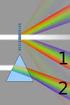
2 Refraction and Dispersion In the laboratory, a triangular prism of glass can be used to refract and separate or disperse the different wavelengths in a beam of light. A triangular prism of glass used to disperse the different wavelengths in a beam of light. You can calculate the angles at which each colour emerges from the prism if you know the angle of incidence of the light beam, the angle of the prism, and the refractive index of the glass for each wavelength. The theory involves Snell s Law of refraction, which is explained in the glossary on page 7. Interference and Diffraction Diffraction offers an easier way to display spectra and calculate wavelengths. It occurs because of the wave properties of light, in particular the wavelength, and the fact that two overlapping waves will only combine constructively if their wave troughs and peaks coincide. The technical wording for this is to say they are in phase with each other. Thomas Young was the first to show that light is actually a wave. He split a monochromatic beam (light of a single colour or wavelength) into two parts by passing it through two very narrow slits, then recombining the two beams and showing that there are a number of ways in which they can constructively recombine. 2
3 Two slits a very small distance, d, apart q Light source emitting a single wavelength, l d q q Path difference = dsinq Wall or screen far enough from light source and slits that the waves from the two slits are effectively parallel The light from the two slits reaches the screen in phase if the difference in their path lengths is a whole number of wavelengths. Some simple geometry shows that the path difference is approximately d sin q, where d is the separation of the slits and q is the angle above the straight-through direction. So, Young expected the waves to combine or interfere constructively at angles given by the equation: d sin q = nl where n could be 0, 1, 2 or any whole number A diffraction grating produces exactly the same effect as Young s two-slit experiment, but the intensity or brightness of the light in the interference maxima is much brighter. This is because a diffraction grating has many, many slits or rulings, evenly spaced only a micron (a millionth of a metre or a thousandth or a millimetre) or so apart. If d is the spacing of lines in a diffraction grating, then interference maxima occur at angles given by: d sin q = nl ; n = 0, 1, 2, 3. Suppose d = 10-6 m (1 micron), and l = 500 nm = 5 x 10⁻⁷ m (yellow light), then the equation above tells us that constructive interference occurs when sin q = 0, 0.5, 1.0 (sin q cannot be greater than 1), 3
4 and so diffraction maxima (bright spots of light) are observed at angles: q = 0 (straight through), 30 (first order maximum) and 90 (second order maximum) Glossary atomic emission colour diffraction dispersion efficiency The electrons in the space around the nucleus of an atom occupy shells or orbitals which have distinct energy levels. When an atom absorbs energy an electron is elevated to a higher energy level. This is a temporary excited state, and the electron soon drops back to a lower energy level, emitting a photon of electromagnetic radiation. The energy of the photon is equal to the difference in the electron energy levels. The retina of the human eye contains two types of light-sensitive cells: rods and cones. Rods discriminate different brightnesses, but cones are wavelength-sensitive, and transmit signals to the brain that enable us to see different wavelengths or combinations of wavelengths as different colours. The traditional colours of the rainbow are how we see the wavelengths of visible light from 400 nm (violet) to 700 nm (red). Diffraction is the interference effect of waves from many sources, for example, the lines of a diffraction grating. Different wavelengths (colours) are refracted through different angles. This separation is called dispersion. Efficiency is the ratio of the output power to the input power of a light bulb (or any other device or machine). It is easy to remember when thought of as what you want divided by what you pay for. 4
5 electromagnetic waves These are waves of coordinated, transverse / electromagnetic electric and magnetic fields that travel radiation through space at the speed of light (about 3 x 10⁸ m.s-1) without requiring any material medium for their propagation. Electromagnetic waves range from gamma rays and X-rays with wavelengths of nanometers, through ultraviolet, light and infra red to radio waves which have wavelengths of kilometres. energy fluorescence frequency halogen lamps Energy is the capacity to do work and is measured in joules. Energy comes in many different forms, for example, light and sound waves carry energy. Gravitational and kinetic energy are two forms of mechanical energy. Energy can be transformed between its different forms, but cannot be created or destroyed. Fluorescence is the property of some materials to absorb electromagnetic radiation of one wavelength and emit radiation of another, for example, the phosphor coating inside a fluorescent light bulb, which absorbs ultraviolet radiation and visible light. A fluorescent spectrum usually differs significantly from the spectra of incandescent bulbs or natural sunlight, making some colours look different. The frequency of a wave is the number of whole waves that pass a point in one second. It is measured in cycles per second or hertz. Halogen bulbs are essentially incandescent bulbs containing a small amount of halogen gas to improve efficiency and lifetime. They produce significant heat, so are not as efficient as compact fluorescent bulbs. 5
6 incandescence infrared radiation (waves) interference LED (light-emitting diode) light Incandescence is the emission of light from an object at a high temperature. (See thermal radiation.) Infrared radiation is the band of the electromagnetic spectrum with wavelengths just longer than those of visible light. Certain wavelengths of infrared radiation are absorbed strongly by the molecules of some atmospheric gasses, for example, water, carbon dioxide, methane. This leads to the greenhouse effect, and enhanced global warming, if the concentration of these gasses is allowed to rise too much. The addition of two or more waves of the same frequency and wavelength depends on the relative alignment of their peaks and troughs (their phase difference). If the peaks align, the result is constructive interference and the resultant combined wave has a maximum amplitude and intensity; if the peaks of one wave align with the troughs of the other, they cancel one another, resulting in destructive interference. A LED is a semiconductor diode that emits a narrow spectrum of light, as a result of electroluminescence. Electrons and holes recombine at the p-n junction of the diode. The electrons jump to lower energy levels in the process, releasing photon of light. Different semiconductor materials are used to make different colour LED s, e.g. the original red LED s were made from gallium arsenide, and gallium nitride is used to make green and blue LED s. Light is electromagnetic waves that are visible to the human eye. Visible light has wavelengths between 400 and 700 nm (4 x 10⁻⁷ and 7 x 10⁻⁷ m). 6
7 photon power refraction refractive index Snell s Law of Refraction When energy is transferred from light or other forms of electromagnetic radiation to matter, it does so in fixed amounts, or quanta called photons. The energy of a photon is related to the frequency, f, of the electromagnetic radiation by Planck s Constant, h (6.63 x J.s): E photon = hf. Power is the rate at which energy is released, transmitted or converted to another form; it is the rate of doing work. One watt (W) = 1 joule per second (J.s -1 ). Refraction is the bending of the direction of light as it passes from one medium or material to another, as result of the change in its speed. The refractive index of a medium or material, for example, water, glass etc. is the ratio of the speed of light in a vacuum to the speed of light in the material, for example, glass (approximately 1.5), water (approximately 1.3). When light passes from one medium (for example, air, glass, water, or even a vacuum) to another its speed changes, and this makes the direction in which it is travelling (its direction of propagation) change. The relation between the angle of incidence, i, and the angle of refraction, r, is given by Snell s Law: = = sin i speed of light medium1 refractive index medium2 sin r speed of light medium2 refractive index medium1 i r Medium 1, e.g. air Medium 2, e.g. glass Snell s Law of Refraction 7
8 thermal radiation ultraviolet radiation (waves) wavelength All objects above absolute zero emit a broad spectrum of electromagnetic waves called thermal radiation. The peak in the spectrum depends on the temperature of the object: cold bodies radiate mainly in the long wavelength infrared, hotter bodies emit short wavelength infrared and some red light (hence the term redhot), still hotter bodies (for example the Sun and stars) radiate light of all colours and so appear yellow or white. Hotter objects also emit energy (power) at a faster rate than colder ones, so you can feel the heat radiated by a glowing coal or a bar heater, but not from everyday objects at room temperature. Ultraviolet radiation is the band of the electromagnetic spectrum with wavelengths just shorter than those of visible light. Sometimes ultraviolet radiation is sub-divided into UV-A ( nm), which is harmless, UV-B ( nm), which can cause sunburn, eye damage and skin cancers, and UV-C (<280 nm) which may be lethal. The wavelength is the distance from a point on a wave to the next identical point, for example, from one peak to the next, or one trough to the next. 8
From lowest energy to highest energy, which of the following correctly orders the different categories of electromagnetic radiation?
 From lowest energy to highest energy, which of the following correctly orders the different categories of electromagnetic radiation? From lowest energy to highest energy, which of the following correctly
Physical Science Study Guide Unit 7 Wave properties and behaviors, electromagnetic spectrum, Doppler Effect
 Objectives: PS-7.1 Physical Science Study Guide Unit 7 Wave properties and behaviors, electromagnetic spectrum, Doppler Effect Illustrate ways that the energy of waves is transferred by interaction with
MAKING SENSE OF ENERGY Electromagnetic Waves
 Adapted from State of Delaware TOE Unit MAKING SENSE OF ENERGY Electromagnetic Waves GOALS: In this Part of the unit you will Learn about electromagnetic waves, how they are grouped, and how each group
After a wave passes through a medium, how does the position of that medium compare to its original position?
 Light Waves Test Question Bank Standard/Advanced Name: Question 1 (1 point) The electromagnetic waves with the highest frequencies are called A. radio waves. B. gamma rays. C. X-rays. D. visible light.
ATOMIC SPECTRA. Apparatus: Optical spectrometer, spectral tubes, power supply, incandescent lamp, bottles of dyed water, elevating jack or block.
 1 ATOMIC SPECTRA Objective: To measure the wavelengths of visible light emitted by atomic hydrogen and verify the measured wavelengths against those predicted by quantum theory. To identify an unknown
Preview of Period 3: Electromagnetic Waves Radiant Energy II
 Preview of Period 3: Electromagnetic Waves Radiant Energy II 3.1 Radiant Energy from the Sun How is light reflected and transmitted? What is polarized light? 3.2 Energy Transfer with Radiant Energy How
Review Vocabulary spectrum: a range of values or properties
 Standards 7.3.19: Explain that human eyes respond to a narrow range of wavelengths of the electromagnetic spectrum. 7.3.20: Describe that something can be seen when light waves emitted or reflected by
AP Physics B Ch. 23 and Ch. 24 Geometric Optics and Wave Nature of Light
 AP Physics B Ch. 23 and Ch. 24 Geometric Optics and Wave Nature of Light Name: Period: Date: MULTIPLE CHOICE. Choose the one alternative that best completes the statement or answers the question. 1) Reflection,
ILLUSTRATIVE EXAMPLE: Given: A = 3 and B = 4 if we now want the value of C=? C = 3 + 4 = 9 + 16 = 25 or 2
 Forensic Spectral Anaylysis: Warm up! The study of triangles has been done since ancient times. Many of the early discoveries about triangles are still used today. We will only be concerned with the "right
Waves Sound and Light
 Waves Sound and Light r2 c:\files\courses\1710\spr12\wavetrans.doc Ron Robertson The Nature of Waves Waves are a type of energy transmission that results from a periodic disturbance (vibration). They are
THE NATURE OF LIGHT AND COLOR
 THE NATURE OF LIGHT AND COLOR THE PHYSICS OF LIGHT Electromagnetic radiation travels through space as electric energy and magnetic energy. At times the energy acts like a wave and at other times it acts
Name Date Class ELECTRONS IN ATOMS. Standard Curriculum Core content Extension topics
 13 ELECTRONS IN ATOMS Conceptual Curriculum Concrete concepts More abstract concepts or math/problem-solving Standard Curriculum Core content Extension topics Honors Curriculum Core honors content Options
Light as a Wave. The Nature of Light. EM Radiation Spectrum. EM Radiation Spectrum. Electromagnetic Radiation
 The Nature of Light Light and other forms of radiation carry information to us from distance astronomical objects Visible light is a subset of a huge spectrum of electromagnetic radiation Maxwell pioneered
The Electromagnetic Spectrum
 INTRODUCTION The Electromagnetic Spectrum I. What is electromagnetic radiation and the electromagnetic spectrum? What do light, X-rays, heat radiation, microwaves, radio waves, and gamma radiation have
G482 Electrons, Waves and Photons; Revision Notes Module 1: Electric Current
 G482 Electrons, Waves and Photons; Revision Notes Module 1: Electric Current Electric Current A net flow of charged particles. Electrons in a metal Ions in an electrolyte Conventional Current A model used
Experiment #5: Qualitative Absorption Spectroscopy
 Experiment #5: Qualitative Absorption Spectroscopy One of the most important areas in the field of analytical chemistry is that of spectroscopy. In general terms, spectroscopy deals with the interactions
WAVES AND ELECTROMAGNETIC RADIATION
 WAVES AND ELECTROMAGNETIC RADIATION All waves are characterized by their wavelength, frequency and speed. Wavelength (lambda, ): the distance between any 2 successive crests or troughs. Frequency (nu,):
Spectra of Lights: An Interactive Demonstration with Diffraction Gratings
 Grades: 4 th 12 th grade Purpose: Students will explore the properties of different types of light bulbs using diffraction grating glasses to reveal the light s unique spectra or fingerprint. The goal
Study Guide for Exam on Light
 Name: Class: Date: Study Guide for Exam on Light Multiple Choice Identify the choice that best completes the statement or answers the question. 1. Which portion of the electromagnetic spectrum is used
Science In Action 8 Unit C - Light and Optical Systems. 1.1 The Challenge of light
 1.1 The Challenge of light 1. Pythagoras' thoughts about light were proven wrong because it was impossible to see A. the light beams B. dark objects C. in the dark D. shiny objects 2. Sir Isaac Newton
Blackbody Radiation References INTRODUCTION
 Blackbody Radiation References 1) R.A. Serway, R.J. Beichner: Physics for Scientists and Engineers with Modern Physics, 5 th Edition, Vol. 2, Ch.40, Saunders College Publishing (A Division of Harcourt
The Earth s Atmosphere
 THE SUN-EARTH SYSTEM III The Earth s Atmosphere Composition and Distribution of the Atmosphere The composition of the atmosphere and the way its gases interact with electromagnetic radiation determine
Interference. Physics 102 Workshop #3. General Instructions
 Interference Physics 102 Workshop #3 Name: Lab Partner(s): Instructor: Time of Workshop: General Instructions Workshop exercises are to be carried out in groups of three. One report per group is due by
Hello and Welcome to this presentation on LED Basics. In this presentation we will look at a few topics in semiconductor lighting such as light
 Hello and Welcome to this presentation on LED Basics. In this presentation we will look at a few topics in semiconductor lighting such as light generation from a semiconductor material, LED chip technology,
5. The Nature of Light. Does Light Travel Infinitely Fast? EMR Travels At Finite Speed. EMR: Electric & Magnetic Waves
 5. The Nature of Light Light travels in vacuum at 3.0. 10 8 m/s Light is one form of electromagnetic radiation Continuous radiation: Based on temperature Wien s Law & the Stefan-Boltzmann Law Light has
Overview. What is EMR? Electromagnetic Radiation (EMR) LA502 Special Studies Remote Sensing
 LA502 Special Studies Remote Sensing Electromagnetic Radiation (EMR) Dr. Ragab Khalil Department of Landscape Architecture Faculty of Environmental Design King AbdulAziz University Room 103 Overview What
12.1 What is Refraction pg. 515. Light travels in straight lines through air. What happens to light when it travels from one material into another?
 12.1 What is Refraction pg. 515 Light travels in straight lines through air. What happens to light when it travels from one material into another? Bending Light The light traveling from an object in water
Atoms Absorb & Emit Light
 Atoms Absorb & Emit Light Spectra The wavelength of the light that an element emits or absorbs is its fingerprint. Atoms emit and absorb light First Test is Thurs, Feb 1 st About 30 multiple choice questions
Radiation Transfer in Environmental Science
 Radiation Transfer in Environmental Science with emphasis on aquatic and vegetation canopy media Autumn 2008 Prof. Emmanuel Boss, Dr. Eyal Rotenberg Introduction Radiation in Environmental sciences Most
Sample Exercise 6.1 Concepts of Wavelength and Frequency
 Sample Exercise 6.1 Concepts of Wavelength and Frequency Two electromagnetic waves are represented in the margin. (a) Which wave has the higher frequency? (b) If one wave represents visible light and the
v = fλ PROGRESSIVE WAVES 1 Candidates should be able to :
 PROGRESSIVE WAVES 1 Candidates should be able to : Describe and distinguish between progressive longitudinal and transverse waves. With the exception of electromagnetic waves, which do not need a material
STAAR Science Tutorial 30 TEK 8.8C: Electromagnetic Waves
 Name: Teacher: Pd. Date: STAAR Science Tutorial 30 TEK 8.8C: Electromagnetic Waves TEK 8.8C: Explore how different wavelengths of the electromagnetic spectrum such as light and radio waves are used to
Principle of Thermal Imaging
 Section 8 All materials, which are above 0 degrees Kelvin (-273 degrees C), emit infrared energy. The infrared energy emitted from the measured object is converted into an electrical signal by the imaging
Energy Pathways in Earth s Atmosphere
 BRSP - 10 Page 1 Solar radiation reaching Earth s atmosphere includes a wide spectrum of wavelengths. In addition to visible light there is radiation of higher energy and shorter wavelength called ultraviolet
Solar Energy. Outline. Solar radiation. What is light?-- Electromagnetic Radiation. Light - Electromagnetic wave spectrum. Electromagnetic Radiation
 Outline MAE 493R/593V- Renewable Energy Devices Solar Energy Electromagnetic wave Solar spectrum Solar global radiation Solar thermal energy Solar thermal collectors Solar thermal power plants Photovoltaics
GRID AND PRISM SPECTROMETERS
 FYSA230/2 GRID AND PRISM SPECTROMETERS 1. Introduction Electromagnetic radiation (e.g. visible light) experiences reflection, refraction, interference and diffraction phenomena when entering and passing
WAVELENGTH OF LIGHT - DIFFRACTION GRATING
 PURPOSE In this experiment we will use the diffraction grating and the spectrometer to measure wavelengths in the mercury spectrum. THEORY A diffraction grating is essentially a series of parallel equidistant
CPI Links Content Guide & Five Items Resource
 CPI Links Content Guide & Five Items Resource Introduction The following information should be used as a companion to the CPI Links. It provides clarifications concerning the content and skills contained
Cosmic Journey: Teacher Packet
 Cosmic Journey: Teacher Packet Compiled by: Morehead State University Star Theatre with help from Bethany DeMoss Table of Contents Table of Contents 1 Corresponding Standards 2 Vocabulary 4 Sizing up the
Tech Bulletin. Understanding Solar Performance
 Tech Bulletin Understanding Solar Performance Bekaert solar control window films use advanced technology to benefit consumers with quality solutions that enhance comfort and decrease energy use. By understanding
Production of X-rays. Radiation Safety Training for Analytical X-Ray Devices Module 9
 Module 9 This module presents information on what X-rays are and how they are produced. Introduction Module 9, Page 2 X-rays are a type of electromagnetic radiation. Other types of electromagnetic radiation
Calculating particle properties of a wave
 Calculating particle properties of a wave A light wave consists of particles (photons): The energy E of the particle is calculated from the frequency f of the wave via Planck: E = h f (1) A particle can
8.2 Cells and Energy. What is photosynthesis? Photosynthesis takes place in the chloroplasts. CHAPTER 8. Solar cells and chloroplasts
 CHAPTER 8 CELL PROCESSES 8.2 Cells and Energy To stay alive, you need a constant supply of energy. You need energy to move, think, grow, and even sleep. Where does that energy come from? It all starts
How To Understand Light And Color
 PRACTICE EXAM IV P202 SPRING 2004 1. In two separate double slit experiments, an interference pattern is observed on a screen. In the first experiment, violet light (λ = 754 nm) is used and a second-order
AZ State Standards. Concept 3: Conservation of Energy and Increase in Disorder Understand ways that energy is conserved, stored, and transferred.
 Forms of Energy AZ State Standards Concept 3: Conservation of Energy and Increase in Disorder Understand ways that energy is conserved, stored, and transferred. PO 1. Describe the following ways in which
The photoionization detector (PID) utilizes ultraviolet
 Chapter 6 Photoionization Detectors The photoionization detector (PID) utilizes ultraviolet light to ionize gas molecules, and is commonly employed in the detection of volatile organic compounds (VOCs).
MCQ - ENERGY and CLIMATE
 1 MCQ - ENERGY and CLIMATE 1. The volume of a given mass of water at a temperature of T 1 is V 1. The volume increases to V 2 at temperature T 2. The coefficient of volume expansion of water may be calculated
INTRODUCTION FIGURE 1 1. Cosmic Rays. Gamma Rays. X-Rays. Ultraviolet Violet Blue Green Yellow Orange Red Infrared. Ultraviolet.
 INTRODUCTION Fibre optics behave quite different to metal cables. The concept of information transmission is the same though. We need to take a "carrier" signal, identify a signal parameter we can modulate,
Crystal Optics of Visible Light
 Crystal Optics of Visible Light This can be a very helpful aspect of minerals in understanding the petrographic history of a rock. The manner by which light is transferred through a mineral is a means
Code number given on the right hand side of the question paper should be written on the title page of the answerbook by the candidate.
 Series ONS SET-1 Roll No. Candiates must write code on the title page of the answer book Please check that this question paper contains 16 printed pages. Code number given on the right hand side of the
Name Class Date. spectrum. White is not a color, but is a combination of all colors. Black is not a color; it is the absence of all light.
 Exercises 28.1 The Spectrum (pages 555 556) 1. Isaac Newton was the first person to do a systematic study of color. 2. Circle the letter of each statement that is true about Newton s study of color. a.
What is Solar Control?
 A better environment inside and out. Solar, Safety and Security Window Films: Tech Bulletin Understanding Solar Performance Solar Gard solar control window films use advanced technology to benefit consumers
Photosynthesis and Light in the Ocean Adapted from The Fluid Earth / Living Ocean Heather Spalding, UH GK-12 program
 Photosynthesis and Light in the Ocean Adapted from The Fluid Earth / Living Ocean Heather Spalding, UH GK-12 program Algae, like your Halimeda, and plants live in very different environments, but they
Chemistry 111 Lab: Intro to Spectrophotometry Page E-1
 Chemistry 111 Lab: Intro to Spectrophotometry Page E-1 SPECTROPHOTOMETRY Absorption Measurements & their Application to Quantitative Analysis study of the interaction of light (or other electromagnetic
Atomic Structure Ron Robertson
 Atomic Structure Ron Robertson r2 n:\files\courses\1110-20\2010 possible slides for web\atomicstructuretrans.doc I. What is Light? Debate in 1600's: Since waves or particles can transfer energy, what is
Energy. Mechanical Energy
 Principles of Imaging Science I (RAD119) Electromagnetic Radiation Energy Definition of energy Ability to do work Physicist s definition of work Work = force x distance Force acting upon object over distance
ENERGY EFFICIENT LIGHTING
 ENERGY EFFICIENT LIGHTING Prof. Suryanarayana y Doolla IIT Bombay Dept. of Energy Science & Engineering Content 2 Basics of Illumination Types of light source, lighting Comparison of commercial lamps Energy
PHYS 222 Spring 2012 Final Exam. Closed books, notes, etc. No electronic device except a calculator.
 PHYS 222 Spring 2012 Final Exam Closed books, notes, etc. No electronic device except a calculator. NAME: (all questions with equal weight) 1. If the distance between two point charges is tripled, the
Energy and Energy Transformations Test Review
 Energy and Energy Transformations Test Review Completion: 1. Mass 13. Kinetic 2. Four 14. thermal 3. Kinetic 15. Thermal energy (heat) 4. Electromagnetic/Radiant 16. Thermal energy (heat) 5. Thermal 17.
Electromagnetic Radiation (EMR) and Remote Sensing
 Electromagnetic Radiation (EMR) and Remote Sensing 1 Atmosphere Anything missing in between? Electromagnetic Radiation (EMR) is radiated by atomic particles at the source (the Sun), propagates through
Chapter 17: Light and Image Formation
 Chapter 17: Light and Image Formation 1. When light enters a medium with a higher index of refraction it is A. absorbed. B. bent away from the normal. C. bent towards from the normal. D. continues in the
PHOTOELECTRIC EFFECT AND DUAL NATURE OF MATTER AND RADIATIONS
 PHOTOELECTRIC EFFECT AND DUAL NATURE OF MATTER AND RADIATIONS 1. Photons 2. Photoelectric Effect 3. Experimental Set-up to study Photoelectric Effect 4. Effect of Intensity, Frequency, Potential on P.E.
What is Energy? What is the relationship between energy and work?
 What is Energy? What is the relationship between energy and work? Compare kinetic and potential energy What are the different types of energy? What is energy? Energy is the ability to do work. Great, but
Light Transmission and Reflectance
 Technical information ACRYLITE cast and extruded acrylic Light Transmission and Reflectance Light and Radiation Light or electromagnetic radiation can be divided into several bands or categories each defined
Experiment #12: The Bohr Atom. Equipment: Spectroscope Hydrogen and Helium Gas Discharge Tubes, Holder, and Variac Flashlight
 Experiment #12: The Bohr Atom Purpose: To observe the visible spectrum of hydrogen and helium and verify the Bohr model of the hydrogen atom. Equipment: Spectroscope Hydrogen and Helium Gas Discharge Tubes,
PHYSICAL WORLD. Heat & Energy GOD S DESIGN. 4th Edition Debbie & Richard Lawrence
 PHYSICAL WORLD Heat & Energy GOD S DESIGN 4th Edition Debbie & Richard Lawrence God s Design for the Physical World is a complete physical science curriculum for grades 3 8. The books in this series are
Take away concepts. What is Energy? Solar Energy. EM Radiation. Properties of waves. Solar Radiation Emission and Absorption
 Take away concepts Solar Radiation Emission and Absorption 1. 2. 3. 4. 5. 6. Conservation of energy. Black body radiation principle Emission wavelength and temperature (Wein s Law). Radiation vs. distance
DETERMINING WHICH COLOR UV BEAD CHANGES COLORS THE FASTEST
 DETERMINING WHICH COLOR UV BEAD CHANGES COLORS THE FASTEST Helen C Cary Academy ABSTRACT The purpose of this experiment was to determine which color UV bead changes colors the fastest. The bead colors
6) How wide must a narrow slit be if the first diffraction minimum occurs at ±12 with laser light of 633 nm?
 Test IV Name 1) In a single slit diffraction experiment, the width of the slit is 3.1 10-5 m and the distance from the slit to the screen is 2.2 m. If the beam of light of wavelength 600 nm passes through
Physics 30 Worksheet # 14: Michelson Experiment
 Physics 30 Worksheet # 14: Michelson Experiment 1. The speed of light found by a Michelson experiment was found to be 2.90 x 10 8 m/s. If the two hills were 20.0 km apart, what was the frequency of the
Theremino System Theremino Spectrometer Technology
 Theremino System Theremino Spectrometer Technology theremino System - Theremino Spectrometer Technology - August 15, 2014 - Page 1 Operation principles By placing a digital camera with a diffraction grating
What s in the Mix? Liquid Color Spectroscopy Lab (Randy Landsberg & Bill Fisher)
 What s in the Mix? Liquid Color Spectroscopy Lab (Randy Landsberg & Bill Fisher) Introduction: There is more to a color than a name. Color can tell us lots of information. In this lab you will use a spectrophotometer
Module 2.2. Heat transfer mechanisms
 Module 2.2 Heat transfer mechanisms Learning Outcomes On successful completion of this module learners will be able to - Describe the 1 st and 2 nd laws of thermodynamics. - Describe heat transfer mechanisms.
THE EFFECT OF COLOUR FILTERS ON SOLAR PANELS. Katie Fitzgerald Expo Project Grade 7
 THE EFFECT OF COLOUR FILTERS ON SOLAR PANELS Katie Fitzgerald Expo Project Grade 7 OBSERVATION By using a solar light instead of electricity, one can assist in lightening the load on our environment. By
Conceptual Physics Review (Chapters 25, 26, 27 & 28) Chapter 25 Describe the period of a pendulum. Describe the characteristics and properties of
 Conceptual Physics Review (Chapters 25, 26, 27 & 28) Solutions Chapter 25 Describe the period of a pendulum. Describe the characteristics and properties of waves. Describe wave motion. Describe factors
Electromagnetic Radiation Energy that comes to us from the sun is transported in the form of waves known as electromagnetic energy.
 Electromagnetic Radiation Energy that comes to us from the sun is transported in the form of waves known as electromagnetic energy. This combines electricity and magnetism such that setting up an electric
Flame Tests & Electron Configuration
 Flame Tests & Electron Configuration INTRODUCTION Many elements produce colors in the flame when heated. The origin of this phenomenon lies in the arrangement, or configuration of the electrons in the
Chemistry 2 Chapter 13: Electrons in Atoms Please do not write on the test Use an answer sheet! 1 point/problem 45 points total
 Chemistry 2 Chapter 13: Electrons in Atoms Please do not write on the test Use an answer sheet! 1 point/problem 45 points total 1. Calculate the energy in joules of a photon of red light that has a frequency
Flipping the On-Switch to Energy Efficient Lighting. By Patrick J. Ritsko
 Flipping the On-Switch to Energy Efficient Lighting By Patrick J. Ritsko It always happens when you least expect it. You step foot into a dark room and lift your hand to feel the familiar wall around you
Upon completion of this lab, the student will be able to:
 1 Learning Outcomes EXPERIMENT B4: CHEMICAL EQUILIBRIUM Upon completion of this lab, the student will be able to: 1) Analyze the absorbance spectrum of a sample. 2) Calculate the equilibrium constant for
Chapter 2: Forms of Energy
 Chapter 2: Forms of Energy Goals of Period 2 Section 2.1: To describe the forms of energy Section 2.2: To illustrate conversions from one form of energy to another Section 2.3 To describe energy storage
Semester 2. Final Exam Review
 Semester 2 Final Exam Review Motion and Force Vocab Motion object changes position relative to a reference point. Speed distance traveled in a period of time. Velocity speed in a direction. Acceleration
Energy Transformations
 Energy Transformations Concept Sheet Energy Transformations PS.6: The student will investigate and understand states and forms of energy and how energy is transferred and transformed. 1. Energy is the
PHYSICS PAPER 1 (THEORY)
 PHYSICS PAPER 1 (THEORY) (Three hours) (Candidates are allowed additional 15 minutes for only reading the paper. They must NOT start writing during this time.) ---------------------------------------------------------------------------------------------------------------------
ESCI 107/109 The Atmosphere Lesson 2 Solar and Terrestrial Radiation
 ESCI 107/109 The Atmosphere Lesson 2 Solar and Terrestrial Radiation Reading: Meteorology Today, Chapters 2 and 3 EARTH-SUN GEOMETRY The Earth has an elliptical orbit around the sun The average Earth-Sun
O6: The Diffraction Grating Spectrometer
 2B30: PRACTICAL ASTROPHYSICS FORMAL REPORT: O6: The Diffraction Grating Spectrometer Adam Hill Lab partner: G. Evans Tutor: Dr. Peter Storey 1 Abstract The calibration of a diffraction grating spectrometer
Light Energy. Countdown: Experiment 1: 1 tomato paste can (without top or bottom) table lamp white poster board, 7 x 9
 Light Energy Grade Level: 5 Time Required: 1-2 class periods Suggested TEKS: Science - 5.8 Suggested SCANS: Information. Acquires and evaluates information. National Science and Math Standards Science
Using the Spectrophotometer
 Using the Spectrophotometer Introduction In this exercise, you will learn the basic principals of spectrophotometry and and serial dilution and their practical application. You will need these skills to
D.S. Boyd School of Earth Sciences and Geography, Kingston University, U.K.
 PHYSICAL BASIS OF REMOTE SENSING D.S. Boyd School of Earth Sciences and Geography, Kingston University, U.K. Keywords: Remote sensing, electromagnetic radiation, wavelengths, target, atmosphere, sensor,
Use the following image to answer the next question. 1. Which of the following rows identifies the electrical charge on A and B shown above?
 Old Science 30 Physics Practice Test A on Fields and EMR Test Solutions on the Portal Site Use the following image to answer the next question 1. Which of the following rows identifies the electrical charge
Yerkes Summer Institute 2002
 Before we begin our investigations into radio waves you should review the following material on your trip up to Yerkes. For some of you this will be a refresher, but others may want to spend more time
The Phenomenon of Photoelectric Emission:
 The Photoelectric Effect. The Wave particle duality of light Light, like any other E.M.R (electromagnetic radiation) has got a dual nature. That is there are experiments that prove that it is made up of
Q1. (a) The block diagram shows the important parts of a coal burning power station. Use words from the box to complete the block diagram
 Q. (a) The block diagram shows the important parts of a coal burning power station. Use words from the box to complete the block diagram boiler condenser furnace generator (b) The diagram shows the energy
Spectroscopy. Biogeochemical Methods OCN 633. Rebecca Briggs
 Spectroscopy Biogeochemical Methods OCN 633 Rebecca Briggs Definitions of Spectrometry Defined by the method used to prepare the sample 1. Optical spectrometry Elements are converted to gaseous atoms or
ENERGY & ENVIRONMENT
 Greenhouse molecules, their spectra and function in the atmosphere by Jack Barrett Reprinted from ENERGY & ENVIRNMENT VLUME 16 No. 6 2005 MULTI-SCIENCE PUBLISING C. LTD. 5 Wates Way, Brentwood, Essex CM15
Table of Contents. An Introduction to Hyperspectral Imaging Technology
 Table of Contents 1.0 Introduction... 1 2.0 Electromagnetic Radiation... 1 2.1 The Electromagnetic Spectrum... 2 2.2 Electromagnetic Interactions with Matter... 3 3.0 Spectroscopy... 5 3.1 Refraction and
Aesthetic Plus LASER TRAINING MANUAL FOR MEDICAL PROFESSIONALS. presents
 Aesthetic Plus presents LASER TRAINING MANUAL FOR MEDICAL PROFESSIONALS INTRODUCTION More than ever before, people are turning to laser esthetics for cosmetic purposes. This is because lasers offer a number
COLLATED QUESTIONS: ELECTROMAGNETIC RADIATION
 COLLATED QUESTIONS: ELECTROMAGNETIC RADIATION 2011(2): WAVES Doppler radar can determine the speed and direction of a moving car. Pulses of extremely high frequency radio waves are sent out in a narrow
Physics 10. Lecture 29A. "There are two ways of spreading light: to be the candle or the mirror that reflects it." --Edith Wharton
 Physics 10 Lecture 29A "There are two ways of spreading light: to be the candle or the mirror that reflects it." --Edith Wharton Converging Lenses What if we wanted to use refraction to converge parallel