
HEALTH TECHNOLOGY ASSESSMENT
|
|
|
- Rosaline Osborne
- 9 years ago
- Views:
Transcription
1 HEALTH TECHNOLOGY ASSESSMENT VOLUME 18 ISSUE 10 FEBRUARY 2014 ISSN Enhancements to angiopasty for periphera arteria occusive disease: systematic review, cost-effectiveness assessment and expected vaue of information anaysis Emma L Simpson, Benjamin Kearns, Matthew D Stevenson, Anna J Cantre, Chris Littewood and Jonathan A Michaes DOI /hta18100

2

3 Enhancements to angiopasty for periphera arteria occusive disease: systematic review, cost-effectiveness assessment and expected vaue of information anaysis Emma L Simpson, Benjamin Kearns, Matthew D Stevenson, Anna J Cantre, Chris Littewood and Jonathan A Michaes* The University of Sheffied, Schoo of Heath and Reated Research (ScHARR), Sheffied, UK *Corresponding author Decared competing interests of authors: none Pubished February 2014 DOI: /hta18100 This report shoud be referenced as foows: Simpson EL, Kearns B, Stevenson MD, Cantre AJ, Littewood C, Michaes JA. Enhancements to angiopasty for periphera arteria occusive disease: systematic review, cost-effectiveness assessment and expected vaue of information anaysis. Heath Techno Assess 2014;18(10). Heath Technoogy Assessment is indexed and abstracted in Index Medicus/MEDLINE, Excerpta Medica/EMBASE, Science Citation Index Expanded (SciSearch ) and Current Contents / Cinica Medicine.
4

5 Heath Technoogy Assessment HTA/HTA TAR ISSN (Print) ISSN (Onine) Five-year impact factor: Heath Technoogy Assessment is indexed in MEDLINE, CINAHL, EMBASE, The Cochrane Library and the ISI Science Citation Index and is assessed for incusion in the Database of Abstracts of Reviews of Effects. This journa is a member of and subscribes to the principes of the Committee on Pubication Ethics (COPE) ( Editoria contact: [email protected] The fu HTA archive is freey avaiabe to view onine at Print-on-demand copies can be purchased from the report pages of the NIHR Journas Library website: Criteria for incusion in the Heath Technoogy Assessment journa Reports are pubished in Heath Technoogy Assessment (HTA) if (1) they have resuted from work for the HTA programme, and (2) they are of a sufficienty high scientific quaity as assessed by the reviewers and editors. Reviews in Heath Technoogy Assessment are termed systematic when the account of the search appraisa and synthesis methods (to minimise biases and random errors) woud, in theory, permit the repication of the review by others. HTA programme The HTA programme, part of the Nationa Institute for Heath Research (NIHR), was set up in It produces high-quaity research information on the effectiveness, costs and broader impact of heath technoogies for those who use, manage and provide care in the NHS. Heath technoogies are broady defined as a interventions used to promote heath, prevent and treat disease, and improve rehabiitation and ong-term care. The journa is indexed in NHS Evidence via its abstracts incuded in MEDLINE and its Technoogy Assessment Reports inform Nationa Institute for Heath and Care Exceence (NICE) guidance. HTA research is aso an important source of evidence for Nationa Screening Committee (NSC) poicy decisions. For more information about the HTA programme pease visit the website: This report The research reported in this issue of the journa was funded by the HTA programme as project number 09/116/01. The contractua start date was in January The draft report began editoria review in Juy 2012 and was accepted for pubication in December The authors have been whoy responsibe for a data coection, anaysis and interpretation, and for writing up their work. The HTA editors and pubisher have tried to ensure the accuracy of the authors report and woud ike to thank the reviewers for their constructive comments on the draft document. However, they do not accept iabiity for damages or osses arising from materia pubished in this report. This report presents independent research funded by the Nationa Institute for Heath Research (NIHR). The views and opinions expressed by authors in this pubication are those of the authors and do not necessariy refect those of the NHS, the NIHR, NETSCC, the HTA programme or the Department of Heath. If there are verbatim quotations incuded in this pubication the views and opinions expressed by the interviewees are those of the interviewees and do not necessariy refect those of the authors, those of the NHS, the NIHR, NETSCC, the HTA programme or the Department of Heath. Queen s Printer and Controer of HMSO This work was produced by Simpson et a. under the terms of a commissioning contract issued by the Secretary of State for Heath. This issue may be freey reproduced for the purposes of private research and study and extracts (or indeed, the fu report) may be incuded in professiona journas provided that suitabe acknowedgement is made and the reproduction is not associated with any form of advertising. Appications for commercia reproduction shoud be addressed to: NIHR Journas Library, Nationa Institute for Heath Research, Evauation, Trias and Studies Coordinating Centre, Apha House, University of Southampton Science Park, Southampton SO16 7NS, UK. Pubished by the NIHR Journas Library ( produced by Prepress Projects Ltd, Perth, Scotand (

6 Editor-in-Chief of Heath Technoogy Assessment and NIHR Journas Library Professor Tom Waey Director, NIHR Evauation, Trias and Studies and Director of the HTA Programme, UK NIHR Journas Library Editors Professor Ken Stein Chair of HTA Editoria Board and Professor of Pubic Heath, University of Exeter Medica Schoo, UK Professor Andree Le May Chair of NIHR Journas Library Editoria Group (EME, HS&DR, PGfAR, PHR journas) Dr Martin Ashton-Key Consutant in Pubic Heath Medicine/Consutant Advisor, NETSCC, UK Professor Matthias Beck Chair in Pubic Sector Management and Subject Leader (Management Group), Queen s University Management Schoo, Queen s University Befast, UK Professor Aieen Carke Professor of Heath Sciences, Warwick Medica Schoo, University of Warwick, UK Dr Tessa Criy Director, Crysta Bue Consuting Ltd, UK Dr Peter Davidson Director of NETSCC, HTA, UK Ms Tara Lamont Scientific Advisor, NETSCC, UK Professor Eaine McCo Director, Newcaste Cinica Trias Unit, Institute of Heath and Society, Newcaste University, UK Professor Wiiam McGuire Professor of Chid Heath, Hu York Medica Schoo, University of York, UK Professor Geoffrey Meads Honorary Professor, Business Schoo, Winchester University and Medica Schoo, University of Warwick, UK Professor Jane Norman Professor of Materna and Feta Heath, University of Edinburgh, UK Professor John Powe Consutant Cinica Adviser, Nationa Institute for Heath and Care Exceence (NICE), UK Professor James Raftery Professor of Heath Technoogy Assessment, Wessex Institute, Facuty of Medicine, University of Southampton, UK Dr Rob Riemsma Reviews Manager, Keijnen Systematic Reviews Ltd, UK Professor Heen Roberts Professoria Research Associate, University Coege London, UK Professor Heen Snooks Professor of Heath Services Research, Institute of Life Science, Coege of Medicine, Swansea University, UK Pease visit the website for a ist of members of the NIHR Journas Library Board: Editoria contact: [email protected] NIHR Journas Library

7 DOI: /hta18100 HEALTH TECHNOLOGY ASSESSMENT 2014 VOL. 18 NO. 10 Abstract Enhancements to angiopasty for periphera arteria occusive disease: systematic review, cost-effectiveness assessment and expected vaue of information anaysis Emma L Simpson, Benjamin Kearns, Matthew D Stevenson, Anna J Cantre, Chris Littewood and Jonathan A Michaes* The University of Sheffied, Schoo of Heath and Reated Research (ScHARR), Sheffied, UK *Corresponding author Background: There have been rapid technoogica deveopments aimed at improving short- and ong-term resuts of percutaneous transumina baoon angiopasty (PTA) in periphera arteria occusive disease (PAD). Objectives: To assess current cinica effectiveness and cost-effectiveness evidence of additiona techniques to standard PTA for PAD, deveop a heath economic mode to assess cost-effectiveness and to identify where further research is needed. Data sources: Reevant eectronic databases, incuding MEDLINE, EMBASE and The Cochrane Library were searched from inception to 2011, between May and October Methods: Systematic reviews were conducted of cinica effectiveness and cost-effectiveness. The popuation was participants with symptomatic PAD undergoing endovascuar treatment for disease dista to the inguina igament. Interventions were modifications of and adjuncts to PTA in the periphera circuation, compared with conventiona PTA. Outcomes incuded measures of cinica effectiveness and costs. Data were extracted from randomised controed trias (RCTs), which were quaity assessed using standard criteria. Where appropriate, meta-anayses using fixed- and random-effects methods produced reative risks (RRs). A discrete-event simuation mode was deveoped to assess the reative cost-effectiveness of the interventions from a NHS perspective over a ifetime. The patient popuations of intermittent caudication (IC) and critica imb ischaemia (CLI) were modeed separatey. Univariate and probabiistic sensitivity anayses were undertaken. Resuts: In tota, 40 RCTs were incuded, many of which had sma sampe sizes. Significanty reduced restenosis rates were shown in meta-anayses of sef-expanding stents (SES) {RR 0.67 [95% confidence interva (CI) 0.52 to 0.87]}, endovascuar brachytherapy (EVBT) [RR 0.63 (95% CI 0.48 to 0.83)] at 12 months and drug-coated baoons (DCBs) at 6 months [RR 0.40 (95% CI 0.23 to 0.69)], and singe studies of stent-graft or drug-euting stent (DES), compared with PTA; a singe study showed improvements with DES versus bare-meta stents (BMSs). Compared with PTA, waking capacity was not significanty affected by cutting baoon, baoon-expandabe stents or EVBT; in SES, there was evidence of improvement in waking capacity after up to 12 months. The use of DCBs dominated both the assumed standard practice of PTA with baiout BMS and a other interventions because it owered ifetime costs and improved quaity of ife (QoL). These resuts were seen for both patient popuations (IC and CLI). Sensitivity anayses showed that the resuts were robust to different assumptions about the cinica benefits attributabe to the interventions, suggesting that the use of DCBs is cost-saving. Limitations: Differing definitions of restenosis made direct comparison across trias difficut. There were few data avaiabe for waking capacity and QoL. Queen s Printer and Controer of HMSO This work was produced by Simpson et a. under the terms of a commissioning contract issued by the Secretary of State for Heath. This issue may be freey reproduced for the purposes of private research and study and extracts (or indeed, the fu report) may be incuded in professiona journas provided that suitabe acknowedgement is made and the reproduction is not associated with any form of advertising. Appications for commercia reproduction shoud be addressed to: NIHR Journas Library, Nationa Institute for Heath Research, Evauation, Trias and Studies Coordinating Centre, Apha House, University of Southampton Science Park, Southampton SO16 7NS, UK. v
8 ABSTRACT Concusions: The evidence showed a significant benefit to reducing restenosis rates for sef-expanding and DESs, stent-graft, EVBT and DCBs. If it is assumed that patency transates into beneficia ong-term cinica outcomes, then DCB and bai-out DES are most ikey to be the cost-effective enhancements to PTA. A RCT comparing current recommended practice (PTA with bai-out BMS) with DCB and bai-out DES coud assess ong-term foow-up and cost-effectiveness. Data reating patency status to the need for reintervention and to the probabiity of symptoms returning shoud be coected, as shoud heath-reated QoL measures [European Quaity of Life-5 Dimensions (EQ-5D) and maximum waking distance]. Study registration: This study is registered as PROSPERO CRD Funding: The Nationa Institute for Heath Research Heath Technoogy Assessment programme. vi NIHR Journas Library
9 DOI: /hta18100 HEALTH TECHNOLOGY ASSESSMENT 2014 VOL. 18 NO. 10 Contents List of tabes...ix List of figures...xiii Gossary...xv List of abbreviations.... xvii Scientific summary...xix Chapter 1 Background 1 Cinica presentation 1 Anatomica distribution 2 Treatment pathway 2 Limitations of current techniques 3 Chapter 2 Definition of decision probem 5 Purpose of assessment 5 Pace of the intervention in the treatment pathway 5 Incuded interventions 5 Absorbabe stents 5 Sef-expanding stents 5 Baoon-expandabe stents 5 Drug-euting stents 5 Stent-graft 5 Atherectomy 5 Cutting baoon 6 Cryopasty 6 Radiation 6 Drug-coated baoon 6 Laser angiopasty 6 Excuded interventions 6 Pharmacoogica interventions 6 Combined surgica procedures 6 Other techniques 6 Interventions above the inguina igament (aortoiiac segment) 7 Reevant comparators 7 Popuation 7 Methods for assessment 7 Review stage 1 7 Review stage 2 7 Deveopment of a heath economic mode 7 Queen s Printer and Controer of HMSO This work was produced by Simpson et a. under the terms of a commissioning contract issued by the Secretary of State for Heath. This issue may be freey reproduced for the purposes of private research and study and extracts (or indeed, the fu report) may be incuded in professiona journas provided that suitabe acknowedgement is made and the reproduction is not associated with any form of advertising. Appications for commercia reproduction shoud be addressed to: NIHR Journas Library, Nationa Institute for Heath Research, Evauation, Trias and Studies Coordinating Centre, Apha House, University of Southampton Science Park, Southampton SO16 7NS, UK. vii

10 CONTENTS Chapter 3 Systematic review of the cinica effectiveness of enhancements to angiopasty 9 Methods 9 Identification of studies 9 Incusion criteria 10 Excusion criteria 10 Resuts 11 Quantity and quaity of studies 11 Cinica effectiveness resuts 15 Discussion 53 Chapter 4 Assessment of cost-effectiveness 55 Systematic review of existing cost-effectiveness evidence 55 Searches 55 Resuts 55 Summary 62 Independent economic assessment 62 Methods 62 Assessment of cost-effectiveness 67 Estimate of base-case mode parameters 67 Data for interventions 76 Resuts 78 Chapter 5 Discussion 91 Chapter 6 Concusions 95 Impications for practice 95 Recommendations for future research 95 Acknowedgements 97 References 99 Appendix 1 Search strategy 111 Appendix 2 Excuded studies 117 Appendix 3 Data extraction of incuded studies 119 Appendix 4 Quaity assessment of incuded studies 217 Appendix 5 Summary 229 Appendix 6 Quaity assessment forms (cost-effectiveness systematic review) 231 Appendix 7 Additiona detais for the base-case mode parameters 233 Appendix 8 Protoco 245 viii NIHR Journas Library

11 DOI: /hta18100 HEALTH TECHNOLOGY ASSESSMENT 2014 VOL. 18 NO. 10 List of tabes TABLE 1 Summary of incuded trias 12 TABLE 2 Absorbabe-meta-stent and restenosis 16 TABLE 3 Absorbabe-meta-stent and ate umen oss 17 TABLE 4 Absorbabe-meta-stent and compications 17 TABLE 5 Sef-expanding-stent and restenosis 17 TABLE 6 Sef-expanding stent and need for reintervention 21 TABLE 7 Sef-expanding stent and Rutherford cassification 22 TABLE 8 Sef-expanding stent and waking capacity 22 TABLE 9 Sef-expanding stent and QoL 23 TABLE 10 Sef-expanding stent and compications 24 TABLE 11 Baoon-expandabe stent and restenosis 25 TABLE 12 Baoon-expandabe stent and need for reintervention 27 TABLE 13 Baoon-expandabe stent and waking capacity 28 TABLE 14 Baoon-expandabe stent and compications 28 TABLE 15 Pacitaxe-euting stent and restenosis 30 TABLE 16 Pacitaxe-euting stent and surviva from adverse events 30 TABLE 17 Siroimus-euting stent and restenosis 31 TABLE 18 Siroimus-euting stent and need for reintervention 31 TABLE 19 Siroimus-euting stent and Rutherford cassification 32 TABLE 20 Siroimus-euting stent and compications 32 TABLE 21 Stent-graft and restenosis 33 TABLE 22 Stent-graft and cinica success 33 TABLE 23 Stent-graft and Rutherford cassification 34 TABLE 24 Stent-graft compications 34 TABLE 25 Atherectomy and restenosis 35 TABLE 26 Atherectomy and improvement of cinica category 35 Queen s Printer and Controer of HMSO This work was produced by Simpson et a. under the terms of a commissioning contract issued by the Secretary of State for Heath. This issue may be freey reproduced for the purposes of private research and study and extracts (or indeed, the fu report) may be incuded in professiona journas provided that suitabe acknowedgement is made and the reproduction is not associated with any form of advertising. Appications for commercia reproduction shoud be addressed to: NIHR Journas Library, Nationa Institute for Heath Research, Evauation, Trias and Studies Coordinating Centre, Apha House, University of Southampton Science Park, Southampton SO16 7NS, UK. ix
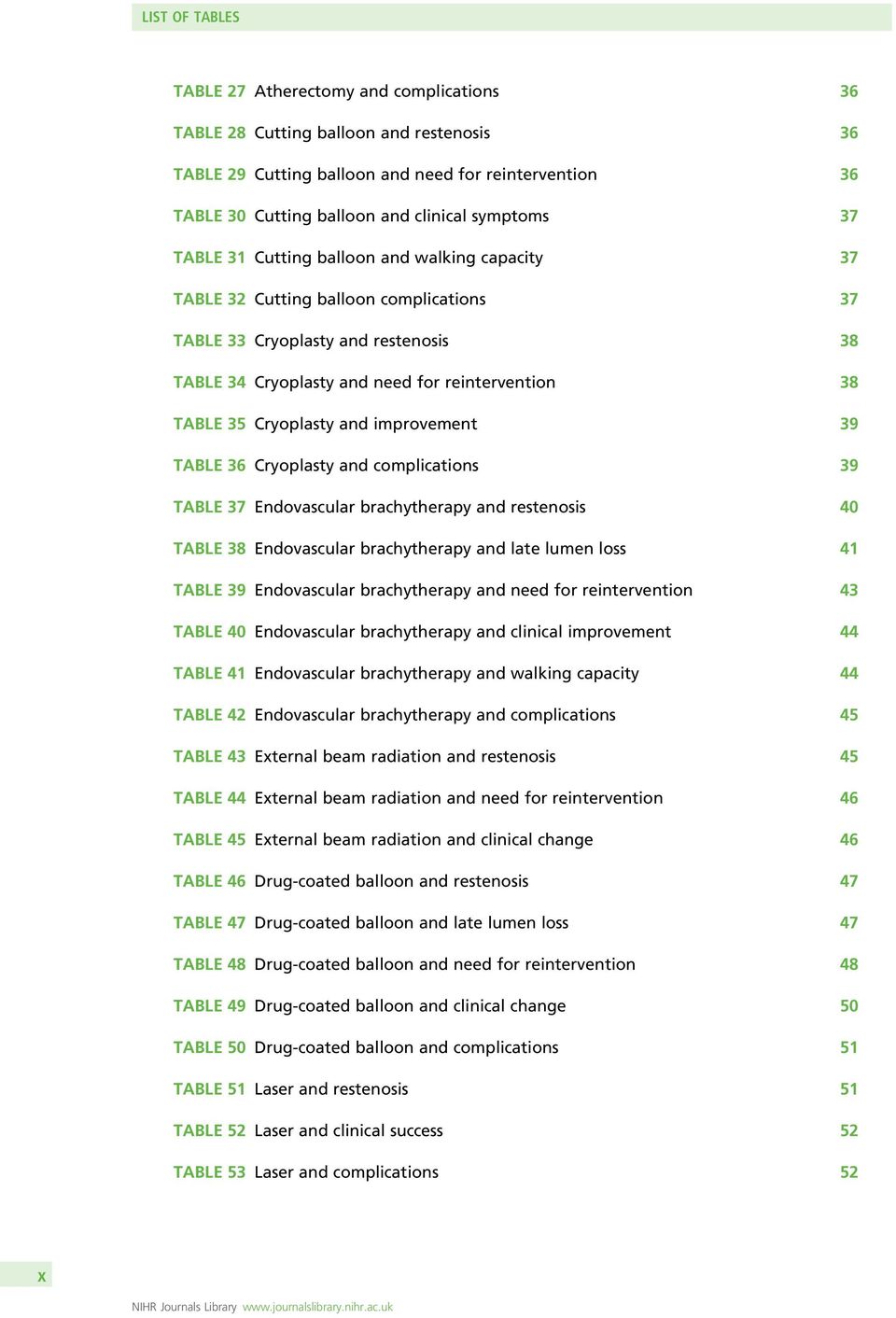
12 LIST OF TABLES TABLE 27 Atherectomy and compications 36 TABLE 28 Cutting baoon and restenosis 36 TABLE 29 Cutting baoon and need for reintervention 36 TABLE 30 Cutting baoon and cinica symptoms 37 TABLE 31 Cutting baoon and waking capacity 37 TABLE 32 Cutting baoon compications 37 TABLE 33 Cryopasty and restenosis 38 TABLE 34 Cryopasty and need for reintervention 38 TABLE 35 Cryopasty and improvement 39 TABLE 36 Cryopasty and compications 39 TABLE 37 Endovascuar brachytherapy and restenosis 40 TABLE 38 Endovascuar brachytherapy and ate umen oss 41 TABLE 39 Endovascuar brachytherapy and need for reintervention 43 TABLE 40 Endovascuar brachytherapy and cinica improvement 44 TABLE 41 Endovascuar brachytherapy and waking capacity 44 TABLE 42 Endovascuar brachytherapy and compications 45 TABLE 43 Externa beam radiation and restenosis 45 TABLE 44 Externa beam radiation and need for reintervention 46 TABLE 45 Externa beam radiation and cinica change 46 TABLE 46 Drug-coated baoon and restenosis 47 TABLE 47 Drug-coated baoon and ate umen oss 47 TABLE 48 Drug-coated baoon and need for reintervention 48 TABLE 49 Drug-coated baoon and cinica change 50 TABLE 50 Drug-coated baoon and compications 51 TABLE 51 Laser and restenosis 51 TABLE 52 Laser and cinica success 52 TABLE 53 Laser and compications 52 x NIHR Journas Library
13 DOI: /hta18100 HEALTH TECHNOLOGY ASSESSMENT 2014 VOL. 18 NO. 10 TABLE 54 Incusion criteria for the systematic review of economic evauations 56 TABLE 55 Cost-effectiveness resuts from the BASIL tria 60 TABLE 56 Cost-effectiveness resuts from the NICE CEA 62 TABLE 57 Cinica cassifications of PAD used in this assessment 63 TABLE 58 Effectiveness data, specific to patients with IC, used in the economic anaysis 68 TABLE 59 Effectiveness data, specific to patients with CLI, used in the economic anaysis 69 TABLE 60 Effectiveness data, appicabe to a patients, used in the economic anaysis 70 TABLE 61 Data on heath-reated QoL (as measured by EQ-5D) and costs (2009/10 UK pounds) used in the economic anaysis 70 TABLE 62 Detais of the two studies used for compication rates 72 TABLE 63 Costs and effects for interventions: femoropopitea arteries 76 TABLE 64 Costs and effects for interventions: infrapopitea arteries 77 TABLE 65 Evidence sources for the cinica effectiveness of each intervention 78 TABLE 66 Fu incrementa anaysis of PTA and a the potentia interventions 79 TABLE 67 Incrementa probabiity (%) of being cost-effective for specified eves of wiingness to pay 80 TABLE 68 Breakdown of costs 81 TABLE 69 Breakdown of utiities and ife-years 81 TABLE 70 Fu incrementa anaysis of PTA and a the potentia interventions 82 TABLE 71 Incrementa probabiity (%) of being cost-effective for specified eves of wiingness to pay 83 TABLE 72 Breakdown of costs 84 TABLE 73 Breakdown of utiities and ife-years 84 TABLE 74 Incrementa costs (vs. comparator) for each intervention against age in patients with IC 85 TABLE 75 Incrementa QALYs (vs. comparator) for each intervention against age in patients with IC 86 TABLE 76 Incrementa costs (vs. comparator) for each intervention against age in patients with CLI 86 Queen s Printer and Controer of HMSO This work was produced by Simpson et a. under the terms of a commissioning contract issued by the Secretary of State for Heath. This issue may be freey reproduced for the purposes of private research and study and extracts (or indeed, the fu report) may be incuded in professiona journas provided that suitabe acknowedgement is made and the reproduction is not associated with any form of advertising. Appications for commercia reproduction shoud be addressed to: NIHR Journas Library, Nationa Institute for Heath Research, Evauation, Trias and Studies Coordinating Centre, Apha House, University of Southampton Science Park, Southampton SO16 7NS, UK. xi

14 LIST OF TABLES TABLE 77 Incrementa QALYs (vs. comparator) for each intervention against age in patients with CLI 86 TABLE 78 Costs and QALYs when amputation costs are removed 87 TABLE 79 Costs and QALYs when ipsiatera disease progression is not affected by the intervention 88 TABLE 80 Costs and QALYs for interventions appied to infrapopitea arteries in patients with CLI 89 TABLE 81 Life tabe of patency for patients with IC and stenosis of the femoropopitea arteries 234 TABLE 82 Detais of the studies used in Hunink et a TABLE 83 Overview of studies reporting QoL that were considered for this economic evauation 238 TABLE 84 Overview of studies reporting procedura costs that were considered for this economic evauation 241 TABLE 85 Overview of studies reporting ong-term costs that were considered for this economic evauation 242 xii NIHR Journas Library

15 DOI: /hta18100 HEALTH TECHNOLOGY ASSESSMENT 2014 VOL. 18 NO. 10 List of figures FIGURE 1 Fow diagram of study seection (based on a revised version of the PRISMA diagram) FIGURE 2 Forest pot of comparison: 1 SES vs. PTA, restenosis 6 months fixed two studies. 19 FIGURE 3 Forest pot of comparison: 1 SES vs. PTA, restenosis 6 months random two studies. 19 FIGURE 4 Forest pot of comparison: 1 SES vs. PTA, restenosis 12 months fixed three studies. 19 FIGURE 5 Forest pot of comparison: 1 SES vs. PTA, restenosis 12 months random three studies. 19 FIGURE 6 Forest pot of comparison: 1 SES vs. PTA, restenosis 12 months fixed two studies. 20 FIGURE 7 Forest pot of comparison: 1 SES vs. PTA, restenosis 12 months random two studies. 20 FIGURE 8 Forest pot of comparison: 2 BES vs. PTA, restenosis at 12 months fixed. 26 FIGURE 9 Forest pot of comparison: 2 BES vs. PTA, restenosis at 12 months random. 26 FIGURE 10 Forest pot of comparison: 2 BES vs. PTA, restenosis at 24 months fixed. 27 FIGURE 11 Forest pot of comparison: 2 BES vs. PTA, restenosis at 24 months random. 27 FIGURE 12 Forest pot of comparison: 4 EVBT vs. PTA, restenosis at 6 months fixed two studies. 41 FIGURE 13 Forest pot of comparison: 4 EVBT vs. PTA, restenosis at 6 months random two studies. 42 FIGURE 14 Forest pot of comparison: 4 EVBT vs. PTA, restenosis at 12 months fixed three studies. 42 FIGURE 15 Forest pot of comparison: 4 EVBT vs. PTA, restenosis at 12 months random three studies. 42 FIGURE 16 Forest pot of comparison: 5 DCB vs. PTA, restenosis at 6 months fixed. 48 FIGURE 17 Forest pot of comparison: 5 DCB vs. PTA, restenosis at 6 months random. 48 FIGURE 18 Forest pot of comparison: 5 DCB vs. PTA, TLR at 6 months fixed. 49 FIGURE 19 Forest pot of comparison: 5 DCB vs. PTA, TLR at 6 months random. 49 FIGURE 20 Forest pot of comparison: 5 DCB vs. PTA, TLR at 24 months fixed. 49 Queen s Printer and Controer of HMSO This work was produced by Simpson et a. under the terms of a commissioning contract issued by the Secretary of State for Heath. This issue may be freey reproduced for the purposes of private research and study and extracts (or indeed, the fu report) may be incuded in professiona journas provided that suitabe acknowedgement is made and the reproduction is not associated with any form of advertising. Appications for commercia reproduction shoud be addressed to: NIHR Journas Library, Nationa Institute for Heath Research, Evauation, Trias and Studies Coordinating Centre, Apha House, University of Southampton Science Park, Southampton SO16 7NS, UK. xiii
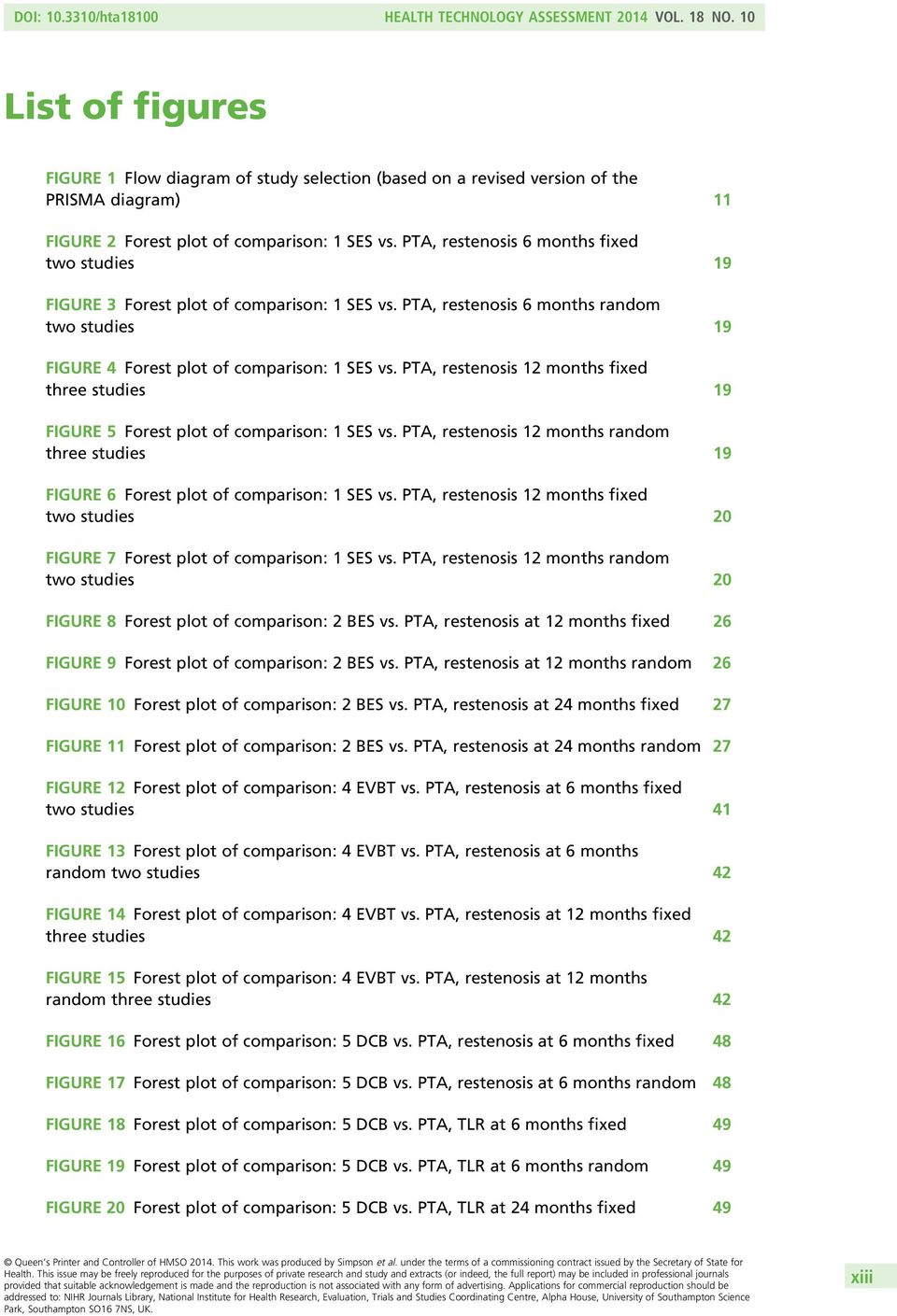
16 LIST OF FIGURES FIGURE 21 Forest pot of comparison: 5 DCB vs. PTA, TLR at 24 months random. 49 FIGURE 22 Summary of economic evauation seection and excusion. 56 FIGURE 23 Diagram of the structure of the decision mode. 64 FIGURE 24 Diagram of the heath states modeed. 65 FIGURE 25 Percutaneous transumina baoon angiopasty; cumuative faiure rates over time for the two patient popuations. Based on the meta-anaysis of Hunink et a FIGURE 26 Bypass surgery; cumuative faiure rates over time for the two patient popuations. Based on the meta-anaysis of Hunink et a FIGURE 27 Incrementa cost-effectiveness acceptabiity curve for the base-case mode resuts (a but two of the interventions have probabiities 0 for a wiingness-to-pay threshods) 79 FIGURE 28 Cost-effectiveness pane showing incrementa cinica effectiveness and costs of seected interventions vs. the comparator (base case). 80 FIGURE 29 Resuts of EVPI. 81 FIGURE 30 Incrementa cost-effectiveness acceptabiity curve for the base-case mode resuts (a but two of the interventions have probabiities 0 for a wiingness-to-pay threshods) 83 FIGURE 31 Cost-effectiveness pane showing incrementa cinica effectiveness and costs of seected interventions vs. the comparator (base case). 83 FIGURE 32 Resuts of EVPI anaysis. 85 FIGURE 33 Funne pot of studies reporting restenosis. 228 FIGURE 34 Regression anaysis of the association between the proportion of patients with an occusion and the proportion with CLI. (a) With possibe outiers [weighted by sampe size (see tabe for numbers)]; and (b) without (excuding study 4) 235 FIGURE 35 Weibu modes used to predict faiure. Conditiona faiure rates are conditiona on surviving beyond year 1. Soid ine=observed; dashed ine= modeed (Weibu). 236 FIGURE 36 Average cost by run number for patients with IC. 243 FIGURE 37 Average QALY by run number for patients with IC. 243 FIGURE 38 Average cost by run number for patients with CLI. 243 FIGURE 39 Average QALY by run number for patients with CLI. 243 xiv NIHR Journas Library

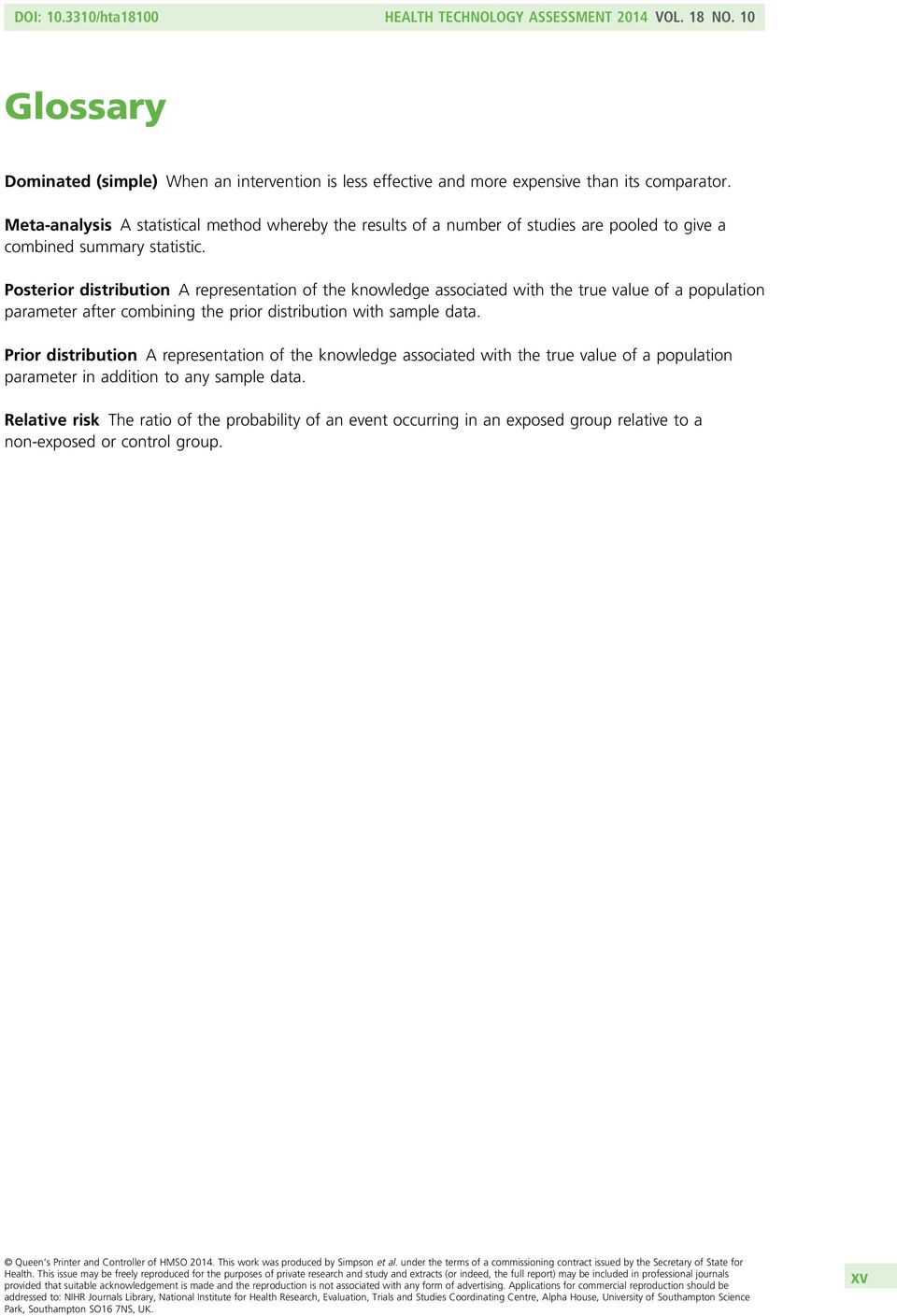
17 DOI: /hta18100 HEALTH TECHNOLOGY ASSESSMENT 2014 VOL. 18 NO. 10 Gossary Dominated (simpe) When an intervention is ess effective and more expensive than its comparator. Meta-anaysis A statistica method whereby the resuts of a number of studies are pooed to give a combined summary statistic. Posterior distribution A representation of the knowedge associated with the true vaue of a popuation parameter after combining the prior distribution with sampe data. Prior distribution A representation of the knowedge associated with the true vaue of a popuation parameter in addition to any sampe data. Reative risk The ratio of the probabiity of an event occurring in an exposed group reative to a non-exposed or contro group. Queen s Printer and Controer of HMSO This work was produced by Simpson et a. under the terms of a commissioning contract issued by the Secretary of State for Heath. This issue may be freey reproduced for the purposes of private research and study and extracts (or indeed, the fu report) may be incuded in professiona journas provided that suitabe acknowedgement is made and the reproduction is not associated with any form of advertising. Appications for commercia reproduction shoud be addressed to: NIHR Journas Library, Nationa Institute for Heath Research, Evauation, Trias and Studies Coordinating Centre, Apha House, University of Southampton Science Park, Southampton SO16 7NS, UK. xv
18

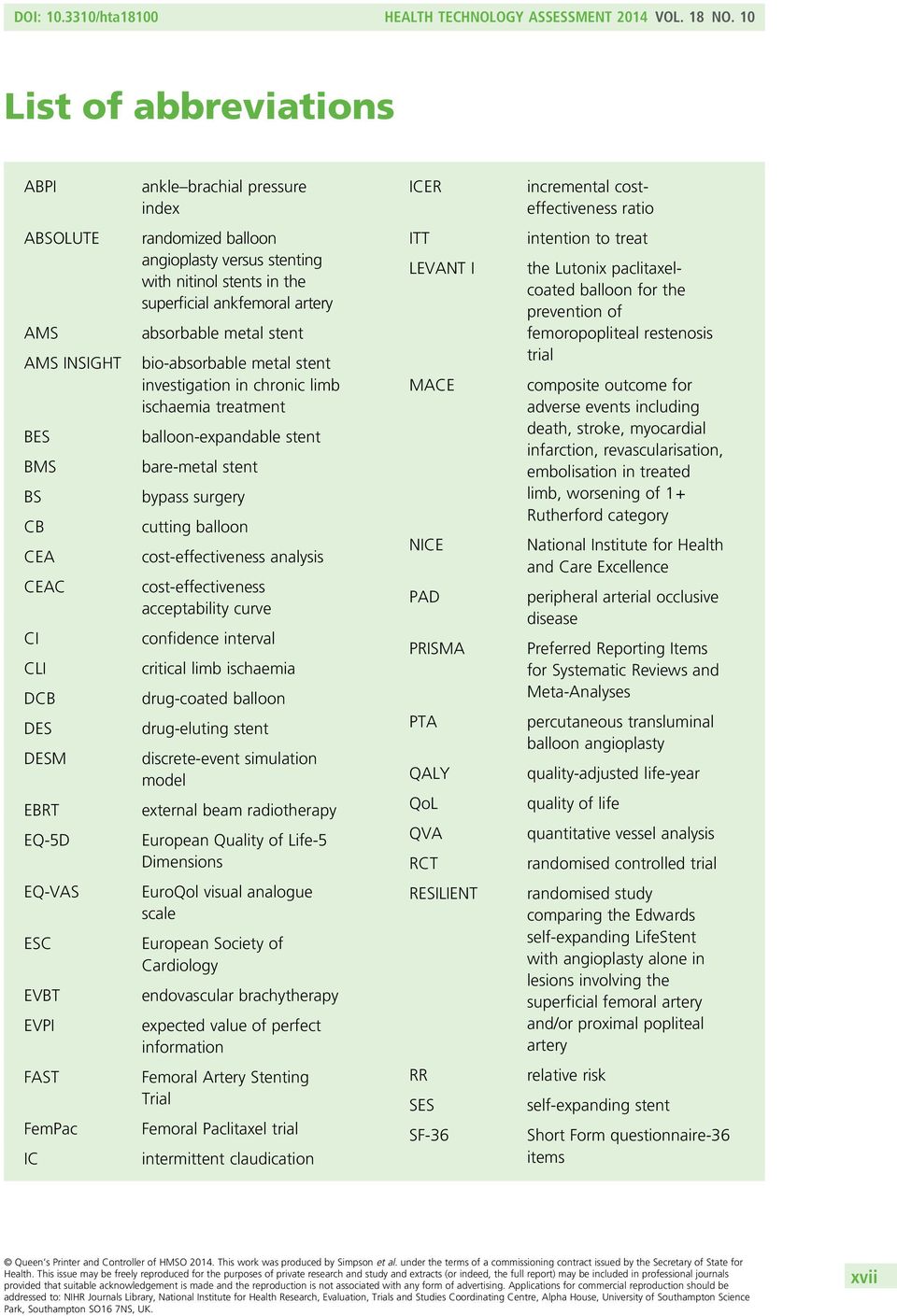
19 DOI: /hta18100 HEALTH TECHNOLOGY ASSESSMENT 2014 VOL. 18 NO. 10 List of abbreviations ABPI anke brachia pressure index ICER incrementa costeffectiveness ratio ABSOLUTE AMS AMS INSIGHT BES BMS BS CB CEA CEAC CI CLI DCB DES DESM EBRT EQ-5D randomized baoon angiopasty versus stenting with nitino stents in the superficia ankfemora artery absorbabe meta stent bio-absorbabe meta stent investigation in chronic imb ischaemia treatment baoon-expandabe stent bare-meta stent bypass surgery cutting baoon cost-effectiveness anaysis cost-effectiveness acceptabiity curve confidence interva critica imb ischaemia drug-coated baoon drug-euting stent discrete-event simuation mode externa beam radiotherapy European Quaity of Life-5 Dimensions ITT LEVANT I MACE NICE PAD PRISMA PTA QALY QoL QVA RCT intention to treat the Lutonix pacitaxecoated baoon for the prevention of femoropopitea restenosis tria composite outcome for adverse events incuding death, stroke, myocardia infarction, revascuarisation, emboisation in treated imb, worsening of 1+ Rutherford category Nationa Institute for Heath and Care Exceence periphera arteria occusive disease Preferred Reporting Items for Systematic Reviews and Meta-Anayses percutaneous transumina baoon angiopasty quaity-adjusted ife-year quaity of ife quantitative vesse anaysis randomised controed tria EQ-VAS ESC EVBT EVPI EuroQo visua anaogue scae European Society of Cardioogy endovascuar brachytherapy expected vaue of perfect information RESILIENT randomised study comparing the Edwards sef-expanding LifeStent with angiopasty aone in esions invoving the superficia femora artery and/or proxima popitea artery FAST FemPac IC Femora Artery Stenting Tria Femora Pacitaxe tria intermittent caudication RR SES SF-36 reative risk sef-expanding stent Short Form questionnaire-36 items Queen s Printer and Controer of HMSO This work was produced by Simpson et a. under the terms of a commissioning contract issued by the Secretary of State for Heath. This issue may be freey reproduced for the purposes of private research and study and extracts (or indeed, the fu report) may be incuded in professiona journas provided that suitabe acknowedgement is made and the reproduction is not associated with any form of advertising. Appications for commercia reproduction shoud be addressed to: NIHR Journas Library, Nationa Institute for Heath Research, Evauation, Trias and Studies Coordinating Centre, Apha House, University of Southampton Science Park, Southampton SO16 7NS, UK. xvii
20 LIST OF ABBREVIATIONS SF-8 SIROCCO TASC THUNDER Short Form questionnaire-8 items SIROimus-Coated COrdis sef-expandabe stent tria Trans-Atantic Inter-Society Consensus oca taxane with short exposure for reduction of restenosis in dista arteries TLR TTO TVR VARA VascuCoi VSGBI target esion revascuarisation time trade-off target vesse revascuarisation VAscuar RAdiotherapy tria intracoi femoropopitea stent tria The Vascuar Society of Great Britain and Ireand xviii NIHR Journas Library

21 DOI: /hta18100 HEALTH TECHNOLOGY ASSESSMENT 2014 VOL. 18 NO. 10 Scientific summary Background Periphera arteria occusive disease (PAD) is a cause of major morbidity in the UK. There have been rapid technoogica deveopments aimed at improving the short- and ong-term resuts of percutaneous transumina baoon angiopasty (PTA). Objectives This report aimed to assess current evidence on the cinica effectiveness and cost-effectiveness of additiona techniques designed to improve the resuts of standard transumina baoon angiopasty for PAD, to deveop a heath economic mode to assess cost-effectiveness and to identify areas where further primary research is needed. Data sources The foowing eectronic databases were searched from inception to 2011: MEDLINE; MEDLINE In-Process & Other Non-Indexed Citations (Ovid); EMBASE (Ovid); The Cochrane Library; Cumuative Index to Nursing and Aied Heath Literature (CINAHL); Science Citation Index (via ISI Web of Science); Socia Science Citation Index (via ISI Web of Science); Conference Proceedings Citation Index Science (CPCI-S) (via ISI Web of Science); UK Cinica Research Network Portfoio Database; Current Controed Trias; and CinicaTrias.gov. Searches were conducted between May and October Methods Systematic reviews were conducted of cinica effectiveness and cost-effectiveness of enhancement to angiopasty. Additiona focused searches were conducted on the natura history and quaity of ife (QoL) for PAD. The popuation was participants with symptomatic PAD undergoing endovascuar treatment for disease dista to the inguina igament. Interventions were techniques used as an adjunct to, or as a repacement for, baoon angiopasty in the periphera circuation. Conventiona PTA was the main comparator. An expert group of cinicians assisted in the identification of reevant technoogies, known trias and important outcome measures. Outcomes incuded measures of cinica effectiveness, restenosis and the need for reintervention, and costs. Data were extracted from randomised controed trias (RCTs), which were quaity assessed using standard criteria. A discrete-event simuation mode was deveoped to assess the reative cost-effectiveness of the interventions from a NHS perspective over a ifetime. The patient popuations of intermittent caudication (IC) and critica imb ischaemia (CLI) were modeed separatey. Univariate and probabiistic sensitivity anayses were undertaken. Queen s Printer and Controer of HMSO This work was produced by Simpson et a. under the terms of a commissioning contract issued by the Secretary of State for Heath. This issue may be freey reproduced for the purposes of private research and study and extracts (or indeed, the fu report) may be incuded in professiona journas provided that suitabe acknowedgement is made and the reproduction is not associated with any form of advertising. Appications for commercia reproduction shoud be addressed to: NIHR Journas Library, Nationa Institute for Heath Research, Evauation, Trias and Studies Coordinating Centre, Apha House, University of Southampton Science Park, Southampton SO16 7NS, UK. xix
22 SCIENTIFIC SUMMARY Resuts In tota, 40 RCTs were incuded, athough many had sma sampe sizes. Significanty reduced restenosis rates were shown in meta-anayses of sef-expanding stents (SES) {reative risk (RR) 0.67 [95% confidence interva (CI) 0.52 to 0.87]}, endovascuar brachytherapy (EVBT) [RR 0.63 (95% CI 0.48 to 0.83)] at 12 months and drug-coated baoons (DCBs) at 6 months [RR 0.40 (95% CI 0.23 to 0.69)], and singe studies of stent-graft or drug-euting stent (DES), compared with PTA; a singe study showed improvement of DES versus bare-meta stents (BMSs). Compared with PTA, waking capacity was not significanty affected by cutting baoon, baoon-expandabe stents or EVBT; in SES, there was evidence of improvement in waking capacity after up to 12 months. The use of DCBs dominated both the assumed standard practice of PTA with bai-out BMSs and a other interventions because it owered ifetime costs and improved QoL. These resuts were seen for both patient popuations (IC and CLI). Sensitivity anayses showed that the resuts were robust to different assumptions about the cinica benefits attributabe to the interventions, suggesting that the use of DCBs is cost-saving. Discussion Despite many studies being identified, there remains uncertainty in the resuts of the report. Cinicay, there was evidence of a significant benefit to reducing restenosis rates for SES, stent-graft, EVBT and DCB compared with PTA and for DES compared with BMS. If it is assumed that patency transates into beneficia ong-term cinica outcomes, then DCB and bai-out DES are most ikey to be the cost-effective enhancements to PTA. A RCT comparing current recommended practice (PTA with bai-out BMS) with DCB and bai-out DES coud assess ong-term foow-up and cost-effectiveness. Data reating patency status to the need for reintervention and to the probabiity of symptoms returning shoud be coected, as shoud heath-reated QoL measures [European Quaity of Life-5 Dimensions (EQ-5D) and maximum waking distance]. Study registration This study is registered as PROSPERO CRD Funding Funding for this study was provided by the Heath Technoogy Assessment programme of the Nationa Institute for Heath Research. xx NIHR Journas Library
23 DOI: /hta18100 HEALTH TECHNOLOGY ASSESSMENT 2014 VOL. 18 NO. 10 Chapter 1 Background Periphera arteria occusive disease (PAD) is a cause of major morbidity in the UK. Disease in the arteries to the egs causes a reduction in the circuation and can present cinicay as intermittent caudication (IC; pain on waking), which can severey impair ifestye. More severe disease may present as critica ischaemia with rest pain, uceration or gangrene in the ower extremities. In recent years, there has been a rapid increase in the use of endovascuar treatment, particuary percutaneous transumina baoon angiopasty (PTA). In this procedure, a device is inserted through a sma puncture under oca anaesthetic and a narrowed or bocked area of artery is opened up by the infation of baoons. There is a high demand for PTA for PAD, with in excess of 20,000 procedures per annum in Engand (based on data for ). 1 Revascuarisation strategy is individua to the patient, and treatment by vascuar speciaists, or within speciaised vascuar centres, is recommended by the European Society of Cardioogy (ESC) guideines 2 and the Vascuar Society of Great Britain and Ireand (VSGBI). 3 There have aso been rapid technoogica deveopments aimed at improving the short- and ong-term resuts of this treatment. Such deveopments incude the use of stents, drug-euting stents (DESs), drug-euting baoons, cryotherapy, atherectomy and drug treatments. Many of these techniques have been deveoped for use in the coronary circuation and extended to the periphera circuation or may be evauated in the periphera circuation with a view to using simiar methods in the coronary circuation. The purpose of this report was to evauate the range of additiona technoogies that are avaiabe and identify the cinica situations in which they are most ikey to be of benefit, or those technoogies for which further research studies are justified. When considering the introduction of new technoogies, there are a number of considerations regarding the cinica situation that may be reevant to the appicabiity and outcome of particuar techniques and may therefore be important in defining subgroups that are important in the consideration of the new technoogies. These are particuary the cinica stage or symptomatic presentation of the condition being treated, the anatomica distribution of disease and the pace of the endovascuar procedure in the treatment pathway. Cinica presentation The majority of patients with PAD wi present with symptoms of IC (pain in the musce of the eg brought about by waking). This may vary in severity from mid pain that occurs ony after considerabe exercise or when going uphi, to severe pains that stop activity after ony a few paces. It may aso affect one or both egs. More severe PAD may resut in insufficient bood suppy to the egs, even at rest. In these circumstances, the patient may deveop rest pain, particuary nocturna pain when the egs are eevated in bed and, in the more advanced stages, tissue oss, uceration and gangrene. The severity of the symptoms of PAD may be cassified using a variety of scaes, the most common being the Fontaine or Rutherford cassifications. These may be used in research settings, athough they are consistenty used in routine cinica practice. The cassifications divide up patients depending upon the severity of the condition based upon IC and critica imb ischaemia (CLI) and then further subdivide them. The Fontaine cassification uses subdivisions based upon pain-free waking distance, whereas the Rutherford cassification uses the resuts of the treadmi exercise test and anke brachia pressure index (ABPI) measurements. In addition, PAD is associated with other forms of arteria disease, particuary ischaemic heart disease and cerebrovascuar disease. In many patients with generaised atheroscerosis, there is some degree of Queen s Printer and Controer of HMSO This work was produced by Simpson et a. under the terms of a commissioning contract issued by the Secretary of State for Heath. This issue may be freey reproduced for the purposes of private research and study and extracts (or indeed, the fu report) may be incuded in professiona journas provided that suitabe acknowedgement is made and the reproduction is not associated with any form of advertising. Appications for commercia reproduction shoud be addressed to: NIHR Journas Library, Nationa Institute for Heath Research, Evauation, Trias and Studies Coordinating Centre, Apha House, University of Southampton Science Park, Southampton SO16 7NS, UK. 1
24 BACKGROUND asymptomatic PAD, and mid degrees of IC are quite common in the genera popuation: the Edinburgh Artery Study reported a prevaence of 4.5% [95% confidence interva (CI) 3.5% to 5.5%] in peope aged years. 4 Those with IC may go on to deveop worsening symptoms, athough it is quite common for symptoms to remain static for many years and ony a sma proportion, probaby around 5 10% over 5 years, 5 wi go on to deveop critica ischaemia, about a quarter of whom may eventuay require amputation. As the cinica presentation has a significant bearing on outcome and particuary the risk of reoccusion foowing an endovascuar procedure, this is an important aspect to be taken into consideration when evauating new technoogies. Anatomica distribution Both IC and CLI may be the resut of a reduction in bood fow due to narrowing or occusion of the arteries to the ower imb at any eve. From the point of view of management, the eves of arteria disease are often divided into aortoiiac, that is affecting anywhere in the aorta or common and externa iiac arteries, and infrainguina, those arteries beow the inguina igament. Disease beow the inguina igament is aso often further subdivided into femoropopitea disease, that is disease in the femora arteries and popitea artery above or beow the knee and infragenicuate or dista disease, referring to those vesses beow the popitea artery (anterior and posterior tibia and peronea arteries). Owing to the differences in arteria caibre and bood fow, the natura history and outcomes of treatments may be expected to differ among the different anatomica sites. The position, size and accessibiity of different vesses may aso give rise to particuar technica chaenges. There are many other ways in which the anatomica distribution of disease may be important in determining treatment; these incude: whether there is a partia or compete occusion of a vesse the ength of any area of disease that requires treatment the accessibiity of the diseased area of artery the eccentricity of any residua umen the presence or absence of cacification. The presence or absence of disease either proxima or dista to the area being treated is aso a major determinant of the potentia success of any procedure. It is therefore important to consider a these issues when evauating a new technoogy, particuary as some technoogies may be especiay usefu for deaing with a specific cinica situation, such as when there is cacification or a very eccentric umen. Treatment pathway Many of the new technoogies that are considered in this report have been evauated primariy in reativey simpe, short stenotic or occuded areas of a singe vesse. However, in practice, PAD is a chronic condition in which there are often mutipe areas of disease, and the patient may undergo a series of different treatments over many years. Endovascuar treatments may be used for mutipe areas of disease as an adjunct to other interventions. This may be either simutaneous or as part of a panned series of procedures for disease at different sites. They may aso be used for the retreatment of areas that have previousy been treated by endovascuar means or in the treatment of stenosis in arteria bypass grafts. Athough these are reevant areas in which some of the technoogies considered in this report may be used, these situations are often specificay excuded or simpy not represented in the cinica trias. 2 NIHR Journas Library
25 DOI: /hta18100 HEALTH TECHNOLOGY ASSESSMENT 2014 VOL. 18 NO. 10 Limitations of current techniques Percutaneous transumina angiopasty has been widey adopted and is a common and usefu procedure in the management of periphera arteria disease; however, it has certain imitations and potentia risks that may be addressed by some of the new technoogies considered in this report. The site and extent of disease may determine whether or not endovascuar treatments are possibe. Longer occusions of sma dista arteries are increasingy difficut to treat and have poor outcomes. However, there is no absoute criterion to determine suitabiity, as is demonstrated by the variabiity of cinicians readiness to randomise patients in some trias. 6 When endovascuar treatment is attempted, there may be faiure or compications at any stage of the procedure: There may be faiure to gain access to the site of the disease. It may prove impossibe to cross the occuded segment with the device used for treatment. It may prove impossibe to reopen the vesse sufficienty to obtain a suitabe umen. Procedura compications may occur, incuding beeding at the puncture site, emboisation of materia from the diseased segment of artery, dissection, perforation or immediate reoccusion. After a successfu initia procedure, there is a risk of ate restenosis and reoccusion causing recurrence of symptoms. New techniques associated with angiopasty may address any of these potentia difficuties in carrying out the procedure. The technoogies that are considered in this report are primariy concerned with either increasing the effectiveness of the initia recanaisation or preventing ate restenosis. For exampe, stents, aser and atherectomy devices are intended to improve the immediate resut, whereas DESs, drug-coated baoons (DCBs) and radiotherapy are unikey to affect the immediate anatomica resut but are aimed at reducing the rate of subsequent restenosis and reoccusion. In addition to these there are other technoogies that have not been considered in this report, such as deveopments in catheters and guide-wire technoogy, which may improve access and cosure devices, which may reduce the risk of the compication of postprocedure beeding. Queen s Printer and Controer of HMSO This work was produced by Simpson et a. under the terms of a commissioning contract issued by the Secretary of State for Heath. This issue may be freey reproduced for the purposes of private research and study and extracts (or indeed, the fu report) may be incuded in professiona journas provided that suitabe acknowedgement is made and the reproduction is not associated with any form of advertising. Appications for commercia reproduction shoud be addressed to: NIHR Journas Library, Nationa Institute for Heath Research, Evauation, Trias and Studies Coordinating Centre, Apha House, University of Southampton Science Park, Southampton SO16 7NS, UK. 3
26
27 DOI: /hta18100 HEALTH TECHNOLOGY ASSESSMENT 2014 VOL. 18 NO. 10 Chapter 2 Definition of decision probem Purpose of assessment This report aimed to answer the foowing research questions: What are the cinica effectiveness and cost-effectiveness of additiona techniques designed to improve the resuts of endovascuar treatment (standard transumina baoon angiopasty) for PAD? For which of these techniques is further primary research ikey to ead to information that wi improve the cinica effectiveness and cost-effectiveness of care for this condition? Pace of the intervention in the treatment pathway The techniques under consideration in this assessment were those that are used either as a repacement for or in conjunction with conventiona baoon angiopasty. In genera, treatments were considered that occupy the same pace as baoon angiopasty in the treatment pathway for PAD. Incuded interventions This assessment is of new endovascuar techniques that may be used to either suppement or repace existing endovascuar procedures to improve the circuation of the ower imb in cases of PAD. The foowing interventions were incuded. Absorbabe stents This is a type of stent that is bio-absorbabe. 7 Sef-expanding stents This is a type of bare-meta stent (BMS) that expands when impanted. Baoon-expandabe stents This is a type of BMS that requires expansion with a baoon. Drug-euting stents There are a number of designs of meta stents that are coated with drugs that are graduay reeased and may reduce the rate of restenosis. These incude stents that reease cytotoxic or immunosuppressant drugs. These have been quite widey used in the coronary circuation and various configurations are now avaiabe that are suitabe for use in the periphera circuation. Stent-graft Stents may be covered with graft materia, usuay eptfe (expanded poytetrafuoroethyene), to produce stent-grafts. Large stent-grafts are now commony used for treating aneurysms and smaer-diameter versions are avaiabe for use in the periphera arteries. Such devices may be inserted by a percutaneous route or may be used as a part of surgica procedures. Atherectomy Whereas conventiona baoon angiopasty or stenting does not remove the occuding materia but opens up and stretches the umen of the vesse, atherectomy is a technique that attempts to remove some of the Queen s Printer and Controer of HMSO This work was produced by Simpson et a. under the terms of a commissioning contract issued by the Secretary of State for Heath. This issue may be freey reproduced for the purposes of private research and study and extracts (or indeed, the fu report) may be incuded in professiona journas provided that suitabe acknowedgement is made and the reproduction is not associated with any form of advertising. Appications for commercia reproduction shoud be addressed to: NIHR Journas Library, Nationa Institute for Heath Research, Evauation, Trias and Studies Coordinating Centre, Apha House, University of Southampton Science Park, Southampton SO16 7NS, UK. 5
28 DEFINITION OF DECISION PROBLEM occuding materia. There are a number of proprietary devices for this technique, incuding the Simpson catheter, the Rotabator (Boston Scientific Corporation, Natick, MA, USA) and the SiverHawk (ev3 Endovascuar Inc., Pymouth, MN, USA) atherectomy device. Again, these may be divided into subgroups depending upon the mechanism of action, with avaiabe devices being either rotationa, removing materia in a concentric fashion, or directiona in nature, removing materia from one aspect of the arteria wa. Cutting baoon The cutting baoon (CB) is a device that combines a conventiona angiopasty baoon with sma bades that cut the atheroma at the time of diatation. Cryopasty This is a method that combines transumina angiopasty using a baoon with the cryotherapy by cooing the vesse wa. The technique uses infation of the baoon with a cooing mixture rather than the standard use of contrast medium. Radiation Radiation therapy has been used to try and reduce restenosis foowing angiopasty. This may be carried out through different techniques. Endovascuar brachytherapy (EVBT) uses sma radioactive probes that can be inserted through an endovascuar route. Externa beam radiotherapy (EBRT) appies radiation from outside the body. Drug-coated baoon A recent deveopment has been the use of baoons coated in drugs simiar to those used for DESs in order to deiver the agent at the time of angiopasty. Pacitaxe-coated baoons have been used esewhere and have recenty become avaiabe in the UK. Laser angiopasty There was a considerabe body of research pubished in the ate 1980s regarding the use of asers to unbock arteries. The majority of devices that were used at that time have subsequenty been withdrawn. However, there are some devices sti avaiabe that use excimer asers as part of an atherectomy procedure to abate occuding materia. Excuded interventions Pharmacoogica interventions The separate effects of pharmacoogica measures aimed at atering patency were not specificay considered, except when the use of a particuar agent was required as an integra part of a new endovascuar technique. Combined surgica procedures Some new techniques, such as remote femora endarterectomy, require a combined surgica and endovascuar approach. Many of the others may aso be combined with surgica procedures and, in some cases, may be used for different indications in patients who woud not necessariy be amenabe to conventiona endovascuar techniques. Other techniques There are a number of other new endovascuar techniques that may be used as an adjunct to angiopasty. These incude cosure devices, devices to protect from emboisation and techniques for thromboysis or thrombectomy. These wi be considered ony when they are a component of one of the other techniques referred to above. 6 NIHR Journas Library
29 DOI: /hta18100 HEALTH TECHNOLOGY ASSESSMENT 2014 VOL. 18 NO. 10 Interventions above the inguina igament (aortoiiac segment) The outcome of endovascuar treatment is aso known to be heaviy infuenced by the site and distribution of arteria occusive disease. Aortoiiac disease affects the arger vesses above the inguina igament. Conventiona angiopasty, with or without the use of stents, has been common practice in this area for some years and cinica resuts are generay good, with ower rates of restenosis or reoccusion. In view of this, the potentia advantages of new techniques to improve outcomes are ikey to be very much smaer in absoute terms, with very arge cinica studies being required to demonstrate significant cinica benefit. The current assessment wi therefore focus on disease beow the inguina igament. Reevant comparators The comparator was conventiona PTA. Bai-out stenting was incuded as a possibe comparator for any of the interventions, BMSs were considered as a comparator for DESs and sham radiation was incuded as a possibe comparator for radiation interventions. Popuation The popuation was participants with symptomatic PAD undergoing endovascuar treatment for disease dista to the inguina igament. Patients with either IC or CLI were incuded. Methods for assessment Review stage 1 A comprehensive search was undertaken to systematicay identify cinica effectiveness and cost-effectiveness iterature concerning endovascuar techniques to suppement or repace baoon angiopasty in the infrainguina arteria circuation. Systematic reviews were conducted and reported in accordance with the PRISMA (Preferred Reporting Items for Systematic Reviews and Meta-Anayses) statement. 8 The cinica effectiveness review methods and resuts are reported in Chapter 3 and Appendices 1 4. The cinica effectiveness review is registered as Prospero registration number CRD ( The cost-effectiveness review is reported in Chapter 4. Review stage 2 Where utiity data were unavaiabe from studies identified in review stage 1, iterature reviews were conducted to provide data to popuate the economic mode. This comprised data on the utiities associated with heath states reating to the natura history of treated and untreated PAD. The resuts of this review are reported in Chapter 4. Deveopment of a heath economic mode A new economic evauation of the cost-effectiveness of technoogies for the management of PAD was deveoped. The mode is reported in Chapter 4. Queen s Printer and Controer of HMSO This work was produced by Simpson et a. under the terms of a commissioning contract issued by the Secretary of State for Heath. This issue may be freey reproduced for the purposes of private research and study and extracts (or indeed, the fu report) may be incuded in professiona journas provided that suitabe acknowedgement is made and the reproduction is not associated with any form of advertising. Appications for commercia reproduction shoud be addressed to: NIHR Journas Library, Nationa Institute for Heath Research, Evauation, Trias and Studies Coordinating Centre, Apha House, University of Southampton Science Park, Southampton SO16 7NS, UK. 7
30
31 DOI: /hta18100 HEALTH TECHNOLOGY ASSESSMENT 2014 VOL. 18 NO. 10 Chapter 3 Systematic review of the cinica effectiveness of enhancements to angiopasty Methods Identification of studies A comprehensive search was undertaken to systematicay identify cinica effectiveness iterature concerning enhancement to angiopasty in aduts with PAD. The search invoved combining terms for the popuation (PAD) with terms for the interventions and then combining these terms with fiters designed to retrieve systematic reviews, randomised contro trias (RCTs) and economic evauations as appropriate. The search strategy comprised the foowing main eements: searching of eectronic databases contact with experts in the fied scrutiny of bibiographies of retrieved papers. The preiminary ist of interventions incuded the foowing: BMSs, DESs, drug-euting baoons, stent-grafts, cryotherapy, brachytherapy, externa beam radiation, CBs and atherectomy. Foowing consutation with experts and scoping searches, the search terms of scoring baoons and utrasonic angiopasty were added. The foowing eectronic databases were searched from inception for pubished and unpubished research evidence: MEDLINE (Ovid) 1950 present MEDLINE In-Process & Other Non-Indexed Citations (Ovid) (for atest pubications) EMBASE (Ovid) 1980 present The Cochrane Library incuding the Cochrane Systematic Reviews Database, Cochrane Controed Trias Register, Database of Abstracts of Reviews of Effects (DARE), Heath Technoogy Assessment (HTA) and NHS Economic Evauation Database (NHS EED) databases 1991 present Cumuative Index to Nursing and Aied Heath Literature (CINAHL) (EBSCO) 1982 present Science Citation Index (via ISI Web of Science) 1900 present Socia Science Citation Index (via ISI Web of Science) 1956 present Conference Proceedings Citation Index-Science (CPCI-S) (via ISI Web of Science) 1990 present UK Cinica Research Network (UKCRN) Portfoio Database Current Controed Trias CinicaTrias.gov. Other onine searches incuded the US Food and Drug Administration s website, the European Medicines Agency s website and reevant conference proceedings. These incuded the proceedings of the VSGBI, the European Society of Vascuar and Endovascuar Surgery, the British Society of Interventiona Radioogy, the Cardiovascuar and Interventiona Radioogica Society of Europe, the Society of Interventiona Radioogy and the Society for Vascuar Surgery. Searches for cinica effectiveness studies were performed by an information speciaist (AC) in May References were coected in a database, and dupicates removed. Searches for cost-effectiveness were conducted in May 2011 and are discussed in Chapter 4. Additiona focused searches were conducted on MEDLINE to find iterature on the natura history of PAD and Queen s Printer and Controer of HMSO This work was produced by Simpson et a. under the terms of a commissioning contract issued by the Secretary of State for Heath. This issue may be freey reproduced for the purposes of private research and study and extracts (or indeed, the fu report) may be incuded in professiona journas provided that suitabe acknowedgement is made and the reproduction is not associated with any form of advertising. Appications for commercia reproduction shoud be addressed to: NIHR Journas Library, Nationa Institute for Heath Research, Evauation, Trias and Studies Coordinating Centre, Apha House, University of Southampton Science Park, Southampton SO16 7NS, UK. 9
32 SYSTEMATIC REVIEW OF THE CLINICAL EFFECTIVENESS OF ENHANCEMENTS TO ANGIOPLASTY iterature on restenosis and quaity of ife (QoL) in October Pubished data were used, and tria authors were not contacted. Bibiographies of incuded studies were searched for potentia additiona trias. The search strategy for MEDLINE is provided in Appendix 1. Incusion criteria Popuation The popuation was participants with symptomatic PAD undergoing endovascuar treatment for disease dista to the inguina igament. Patients with either IC or CLI were incuded. Interventions Interventions were techniques used as an adjunct to, or as a repacement for, baoon angiopasty in the periphera circuation. These were as foows: absorbabe stents, sef-expanding stents (SESs), baoon-expandabe stents (BESs), DESs, stent-graft, atherectomy, CB, cryopasty, radiation by EVBT or EVRT, DCB and aser angiopasty. Comparator The comparator was conventiona PTA. Bai-out stenting was incuded as a possibe comparator for any of the interventions, BMSs were considered as a comparator for DESs, and sham radiation was incuded as a possibe comparator for radiation interventions. Outcomes Reported outcomes incuded patency or restenosis measures, need for reintervention, disease-specific and generic measures of QoL, cinica status, exercise toerance or waking distance, pain (patient-reported pain scores and anagesic use), imb savage, compications and adverse events. Cost outcomes are discussed in Chapter 4. Study design Initiay, RCTs were searched. As data were avaiabe from these, other study types from further down the accepted hierarchy of evidence were not sought. Meta-anayses and systematic reviews of RCTs were sought to identify RCTs that met the incusion criteria of this review. Excusion criteria Interventions Pharmacoogica interventions, combined surgica procedures and devices that have been withdrawn, such as oder aser angiopasty devices, were not considered, as we as interventions above the inguina igament (aortoiiac segment). Pubication types Studies that were pubished ony in anguages other than Engish, studies based on anima modes, and precinica and bioogica studies were excuded, as were narrative reviews, editorias and opinion pieces. Reports pubished as meeting abstracts were excuded ony when insufficient detais were reported to aow incusion. Study seection was made by one reviewer and checked by another, based on the above incusion and excusion criteria. Citations were sifted by tite and abstract, and those remaining after abstract sift were sifted by fu papers. Studies excuded at fu-paper screening were paced in Appendix NIHR Journas Library
33 DOI: /hta18100 HEALTH TECHNOLOGY ASSESSMENT 2014 VOL. 18 NO. 10 Data extraction, critica appraisa and synthesis Data were extracted by one reviewer and checked by another, using a standardised form. The forms are shown in Appendix 3. Data were extracted with no binding to authors or journa. Quaity was assessed according to criteria based on NHS Centre for Reviews and Dissemination (CRD) Report No Quaity assessment forms are shown in Appendix 4. Prespecified outcomes were tabuated and discussed within a descriptive synthesis. For some interventions, meta-anayses were precuded as a resut of differences in outcomes. For exampe, definitions of patency varied across trias and there were aso differences in popuations, interventions and ength of foow-up. When appropriate, meta-anayses were undertaken using fixed- and random-effects methods. Meta-anayses were carried out using Review Manager 5.1 (The Nordic Cochrane Centre, Copenhagen, Denmark). The Mante Haensze methods have been shown to be more reiabe than other methods when there are reativey few studies with sma sampe sizes, so these were empoyed, with both fixed and random effects, as recommended by the Cochrane Coaboration. 10 Resuts Quantity and quaity of studies Study seection The search of eectronic databases yieded 9501 artice citations with dupicates removed. Additiona searching yieded one reference and two conference presentations. The sifting process is shown in Figure 1, afow diagram adapted from PRISMA recommendations. 8 Tite sifting excuded 8175 citations. There were 1329 abstracts sifted. In tota, 95 references were fu-text screened. Appendix 2 shows 34 studies that were excuded at the fu-paper sifting stage with reasons for excusions. There were 40 RCTs accepted into the review, pubished in 61 references, comprising 53 artices from peer-reviewed journas with additiona data in eight conference presentations (Tabe 1). Foowing iterature Artices identified through database searching with dupicates removed (n = 9501) Additiona reevant artices identified through other sources (n = 3) Artices screened by tite (n = 9504) Artices excuded (n = 8175) Artices screened by abstract (n = 1329) Artices excuded (n = 1234) Artices screened by fu text (n = 95) Artices excuded (n = 34) Artices incuded in narrative review (n = 61 artices describing 40 RCTs) FIGURE 1 Fow diagram of study seection (based on a revised version of the PRISMA diagram). 8 Queen s Printer and Controer of HMSO This work was produced by Simpson et a. under the terms of a commissioning contract issued by the Secretary of State for Heath. This issue may be freey reproduced for the purposes of private research and study and extracts (or indeed, the fu report) may be incuded in professiona journas provided that suitabe acknowedgement is made and the reproduction is not associated with any form of advertising. Appications for commercia reproduction shoud be addressed to: NIHR Journas Library, Nationa Institute for Heath Research, Evauation, Trias and Studies Coordinating Centre, Apha House, University of Southampton Science Park, Southampton SO16 7NS, UK. 11
34 SYSTEMATIC REVIEW OF THE CLINICAL EFFECTIVENESS OF ENHANCEMENTS TO ANGIOPLASTY TABLE 1 Summary of incuded trias Tria (tria name, author, date) Sampe size Intervention Comparator Foow-up Outcomes reported AMS INSIGHT, Bosiers 117 CLI AMS PTA 6 months Patency, ate umen et a oss, compications Dick et a (of whom 69 IC, 4 CLI) SES PTA 12 months Restenosis, waking capacity, compications VascuCoi, Greenberg 266 et a symptomatic eg ischaemia SES (IntraCoi, Suzer/ IntraTherapeutics, St. Pau, MN, USA) PTA 9 months TLR, compications FAST, Krankenberg et a (of whom 226 IC, 7 CLI, 11 data unavaiabe) SES (nitino) PTA 12 months Restenosis, TLR, Rutherford category, waking capacity, compications RESILIENT, Laird et a. 206 IC SES PTA 12 months Restenosis, TLR/TVR, waking capacity, QoL, compications ABSOLUTE, Schiinger et a. 2006, , 17 Sabeti et a (of whom 91 IC, 13 CLI) SES (nitino) PTA 24 months Restenosis, reintervention, Rutherford category, waking capacity, QoL, compications Becquemin et a. 227 (of whom IC, 47 CLI) BES (Pamaz, Cordis, a Johnson & Johnson interventiona systems company) PTA 12 months Restenosis, compications Cejna et a (154 imbs of which 108 IC, 46 CLI) BES (Pamaz) PTA 24 months Patency, compications Grimm et a IC BES (Pamaz) PTA 24 months Patency, need for reintervention, waking capacity, compications Rand et a CLI BES (Carbostent, Sorin, Biomedica, Itay) PTA 6 months Patency, compications Vroegindeweij et a. 51 IC BES (Pamaz) PTA 12 months Patency, compications Zdanowski et a. 32 CLI BES (tantaum) PTA 12 months Restenosis, need for reintervention, compications Ziver PTX, Dake et a. 2010, 25 Anse 2011, 26 Dake et a (Rutherford category 2 or above) DES (pacitaxe) PTA (with potentia second randomisation to DES or BMS) 12 months Patency, compications 12 NIHR Journas Library
35 DOI: /hta18100 HEALTH TECHNOLOGY ASSESSMENT 2014 VOL. 18 NO. 10 TABLE 1 Summary of incuded trias (continued) Tria (tria name, author, date) Sampe size Intervention Comparator Foow-up Outcomes reported SIROCCO, Duda et a. 2002, , (of whom 46 Rutherford category 1 or 2, 47 Rutherford category 3 or 4) DES (siroimus) SES 24 months Restenosis, TLR/TVR, compications Rastan et a (of whom 86 IC, 75 CLI) DES (siroimus) BMS (pacebo coated) 12 months Patency, TLR, Rutherford category, compications Saxon et a. 2003, (of whom IC, 21 CLI, 1 unknown) Stent-graft (nitino covered) PTA 12 months Patency, Rutherford category, compications Nakamura et a IC Atherectomy (transcutaneous extraction catheter) PTA 6 months Patency, compications Vroegindeweij et a. 1992, , 36 Tiebeck et a IC Atherectomy (directiona) PTA 24 months Patency, Rutherford category, compications Amighi et a Dick et a Jahnke et a (of whom 35 IC, 8 CLI) 39 (of whom 30 IC, 9 CLI) 86 (of whom 66 IC, 20 CLI) CB PTA 6 months Restenosis, symptoms, waking capacity, compications CB PTA 6 months Restenosis, need for reintervention, waking capacity, compications Cryopasty PTA 9 months Patency, symptoms, compications Spiiopouos et a. 50 (60 imbs incuded, of which 36 IC, 24 CLI) Cryopasty PTA 36 months Patency, TLR, compications Gaino et a. 2004, 42 Bonvini et a (resuts of Diehm et a and Zehnder et a ) 156 IC (in two arms reevant to this review, from four-arm tria) Radiation (EVBT) pus PTA PTA and pacebo drug 36 months Patency, need for reintervention, Rutherford category, compications Zehnder et a (resuts of Diehm et a and Gaino et a / Bonvini et a ) 100 (of whom 92 IC, 8 CLI) Radiation (EVBT) pus PTA PTA and pacebo drug 36 months Restenosis, need for reintervention, Rutherford category Hagenaars et a. 24 (of whom IC, 12 CLI) Radiation (EVBT) pus PTA PTA 6 months Restenosis, ate umen oss Krueger et a. 2002, (uncear how many IC/CLI; a Fontaine 2a-3) Radiation (EVBT) pus PTA PTA pus sham radiation 24 months Restenosis, need for reintervention, waking capacity Vienna-2, Wofram et a. 2006, 49 Minar et a. 2000, 50 Wofram et a (of whom 88 IC, 25 CLI) Radiation (EVBT) pus PTA PTA 60 months Restenosis, TLR/TVR continued Queen s Printer and Controer of HMSO This work was produced by Simpson et a. under the terms of a commissioning contract issued by the Secretary of State for Heath. This issue may be freey reproduced for the purposes of private research and study and extracts (or indeed, the fu report) may be incuded in professiona journas provided that suitabe acknowedgement is made and the reproduction is not associated with any form of advertising. Appications for commercia reproduction shoud be addressed to: NIHR Journas Library, Nationa Institute for Heath Research, Evauation, Trias and Studies Coordinating Centre, Apha House, University of Southampton Science Park, Southampton SO16 7NS, UK. 13
36 SYSTEMATIC REVIEW OF THE CLINICAL EFFECTIVENESS OF ENHANCEMENTS TO ANGIOPLASTY TABLE 1 Summary of incuded trias (continued) Tria (tria name, author, date) Sampe size Intervention Comparator Foow-up Outcomes reported Vienna-3, Pokrajac et a. 2005, , 53 Wofram et a (of whom 77 IC, 19 CLI) Radiation (EVBT) pus PTA PTA pus sham radiation 12, 24 months Restenosis, TLR/TVR, compications VARA, van Tongeren et a (of whom 52 IC, 8 CLI) Radiation (EVBT) pus PTA PTA 12 months Restenosis, need for reintervention, Rutherford category, compications Wyttenbach et a. 20 (uncear how 2007, many IC/CLI, but a Rutherford category 3 or above) Radiation (EVBT) pus PTA PTA 3, 24 months Late umen oss Fritz et a (of whom 94 IC, 1 CLI) Radiation (externa beam) pus PTA PTA pus sham radiation 12 months Restenosis, Fontaine stage Therasse et a (of whom 27 IC, 72 CLI) Radiation (externa beam, three doses) pus PTA PTA pus sham radiation 12 months Restenosis, need for reintervention LEVANT I, Scheinert et a , (of whom 94 IC, 7 CLI) DCB (pacitaxe) PTA with uncoated baoon 6 months Late umen oss, TLR THUNDER, Tepe et a. 102 (in two reevant arms of three-arm tria), Rutherford categories 1 5 DCB (pacitaxe) PTA with uncoated baoon 24 months Restenosis, ate umen oss, TLR, Rutherford category, compications FemPac, Werk et a. 87 (of whom IC, 5 CLI) DCB (pacitaxe) PTA with uncoated baoon 24 months Restenosis, TLR, Rutherford category, compications Bei et a ,66 68 (of whom 48 IC, 20 CLI) Laser angiopasty (therma) PTA 12 months Symptoms, compications Fisher et a (of whom 76 IC, 6 CLI) Laser angiopasty (hot-tip) PTA 24 months Restenosis Lammer et a (of whom 84 IC, 32 CLI) (1) Laser angiopasty (pused XeCI); or (2) aser angiopasty (Nd: YAG, therma) PTA 12 months Patency, compications Spies et a IC Laser angiopasty (Nd:YAG, therma) PTA 2 weeks Compications Tobis et a (of whom 35 IC, 5 CLI) Laser angiopasty PTA 12 months Patency, compications AMS, absorbabe meta stent; FemPac, Femora Pacitaxe tria; SIROCCO, SIROimus-Coated COrdis sef-expandabe stent tria; TLR, target esion revascuarisation; TVR, target vesse revascuarisation; VARA, VAscuar RAdiotherapy tria. 14 NIHR Journas Library
37 DOI: /hta18100 HEALTH TECHNOLOGY ASSESSMENT 2014 VOL. 18 NO. 10 searches, the Ziver PTX tria pubished an additiona paper, 71 which confirmed the resuts incuded from abstracts. There was one RCT of absorbabe meta stents (AMSs), five RCTs of SESs and six RCTs of BESs. There were three trias of DESs, of which one concerned pacitaxe and two siroimus. There was one tria of stent-graft, two of atherectomy, two of CB and two of cryopasty. Of the 10 RCTs of radiation, eight empoyed EVBT and two empoyed EBRT. Three RCTs of DCB were incuded and five RCTs of aser angiopasty. Trias of stents, stent-graft, CB, cryopasty and DCB versus PTA aowed bai-out stenting in the PTA group, when deemed medicay necessary. Bai-out atherectomy was permitted in one atherectomy tria (Vroegindeweij et a. 36 ), and, of the radiation trias, the comparator PTA group had ora pacebo in two RCTs (Gaino et a., 42 Zehnder et a. 45 ) and sham radiation in four RCTs (Krueger et a., 47,48 Vienna-3, Fritz et a., 57 Therasse et a. 58 ). Further study detais are shown in Appendix 3. Critica appraisa Appendix 4 shows the quaity assessment for the incuded studies. Method of aocation conceament was considered adequate in 11 of the trias [AMS INSIGHT (bio-absorbabe meta stent investigation in chronic imb ischaemia treatment), 11 Becquemin et a., 19 Grimm et a., 21 Rand et a., 22 Vroegindeweij et a., 23,35,36 Rastan et a., 31 Tiebeck et a., 36 Amighi et a., 38 Dick et a., 39 VARA (VAscuar RAdiotherapy tria), 54 FemPac (Femora Pacitaxe tria) 64 ]. Both the method used to generate aocation sequences and the method of aocation conceament were considered adequate in seven of these trias (AMS INSIGHT, 18 Becquemin et a., 19 Grimm et a., 21 Rastan et a., 31 Amighi et a., 38 Dick et a., 39 VARA, 54 FemPac 64 ). For other trias, reporting of randomisation methods was uncear. There was binding for assessors in at east one of the study outcomes in 20 trias [Dick et a., 12 FAST (Femora Artery Stenting Tria), 14 ABSOLUTE (randomized baoon angiopasty vs. stenting with nitino stents in the superficia femora artery), Becquemin et a., 19 Rand et a., 22 SIROCCO (SIROimus-Coated COrdis sef-expandabe stent tria), Rastan et a., 31 Amighi et a., 38 Spiiopouous et a., 41 Diehm et a. 44 anaysis of Gaino et a. 42 and Zehnder et a. 45 trias, Krueger et a., 47,48 Vienna-3, Wyttenbach et a., 55,56 Fritz et a., 57 Therasse et a., 58 THUNDER (oca taxane with short exposure for reduction of restenosis in dista arteries), FemPac, 64 Lammer et a. 68 ]. Binding of cinicians to the endovascuar techniques used in these studies woud have been difficut or impossibe. One tria (FemPac 64 ) mentioned that the binding of cinicians was attempted, but the difference in appearance of DCB and uncoated baoons meant that cinicians were ikey to know which intervention was being used. There was expicit binding of patients in eight trias (SIROCCO, Rastan et a., 31 Krueger et a., 47,48 Vienna-3, Fritz et a., 57 Therasse et a., 58 THUNDER, FemPac 64 ). Intervention and contro groups were argey comparabe at baseine in a trias. Some trias reported one variabe that was not equa across treatment groups at baseine [AMS INSIGHT, 11 Dick et a., 12 RESILIENT (randomised study comparing the Edwards sef-expanding LifeStent with angiopasty aone in esions invoving the superficia femora artery and/or proxima popitea artery), 15 Ziver PTX, SIROCCO, Rastan et a., 31 Nakamura et a., 34 Vroegindeweij s group, THUNDER, Fisher et a. 67 ]. When studies measured more outcomes than they reported, this was because of future expected reports [LEVANT I (the Lutonix pacitaxe-coated baoon for the prevention of femoropopitea restenosis tria), 59,60 Spies et a. 69 ]. Ony one tria had an imbaance in dropouts between treatment groups (Hagenaars et a. 46 ). An anaysis of patients in their aocated groups according to the intention-to-treat (ITT) principe was avaiabe for a trias, athough for two trias (Gaino et a., 42 Zehnder et a. 45 ) this was ony avaiabe for the combined anaysis of these two trias (Diehm et a. 44 ). Cinica effectiveness resuts Resuts are presented according to the 11 incuded interventions (see Appendix 5). Queen s Printer and Controer of HMSO This work was produced by Simpson et a. under the terms of a commissioning contract issued by the Secretary of State for Heath. This issue may be freey reproduced for the purposes of private research and study and extracts (or indeed, the fu report) may be incuded in professiona journas provided that suitabe acknowedgement is made and the reproduction is not associated with any form of advertising. Appications for commercia reproduction shoud be addressed to: NIHR Journas Library, Nationa Institute for Heath Research, Evauation, Trias and Studies Coordinating Centre, Apha House, University of Southampton Science Park, Southampton SO16 7NS, UK. 15
38 SYSTEMATIC REVIEW OF THE CLINICAL EFFECTIVENESS OF ENHANCEMENTS TO ANGIOPLASTY Absorbabe meta stent One RCT identified compared AMS with PTA (AMS INSIGHT 11 ) in CLI patients. The AMS INSIGHT 11 tria provided patency data on 94 esions at 6-month foow-up (Tabes 2 and 3). AMS fared significanty worse than PTA (p = 0.013) in terms of restenosis measured by core-ab quantitative vesse anaysis (QVA). A patency measure incuding major amputation or target esion revascuarisation (TLR) as faiure showed no significant difference between treatment groups. For adverse events, a measure incuding major amputation or death did not find any significant difference between groups at 1-month foow-up (Tabe 4). Sef-expanding stent Five RCTs compared SESs with PTA. The popuations comprised mosty IC patients, but aso some CLI patients. Three RCTs (Dick et a., 12 RESILIENT, 15 ABSOLUTE ) showed an advantage for SES over PTA in terms of restenosis (Tabe 5). Of these, one study (ABSOLUTE ) had ony a trend favouring SES at 6 months but significant resuts at 1 and 2 years, whereas the other studies reached and maintained significance at 3 6 months (Dick et a. 12 ) and 6 12 months (RESILIENT 15 ). One RCT found no significant difference between groups at 1-year foow-up (FAST 14 ). Meta-anaysis (Figures 2 7) for restenosis at 6 months TABLE 2 Absorbabe-meta-stent and restenosis Study Foow-up Definition of restenosis/ patency PTA esions anaysed (n) PTA esions with restenosis (%) AMS esions anaysed (n) AMS esions with restenosis (%) Comparative statistic AMS INSIGHT (Bosiers et a ) 6 months Patency was defined as the absence of a haemodynamicay significant restenosis (> 50%) documented by digita subtraction angiography and confirmed by the core-ab QVA Primary patency rates determined by coour-fow Dopper utrasound and defined as the absence of a haemodynamicay significant restenosis (> 50%), derived from the ratio of the PSV at the esion segment to that at the proxima part, a major amputation or a TLR a a p = a a p = PSV, peak systoic veocity. a Restenosis rates cacuated from reported patency. 16 NIHR Journas Library
39 DOI: /hta18100 HEALTH TECHNOLOGY ASSESSMENT 2014 VOL. 18 NO. 10 TABLE 3 Absorbabe-meta-stent and ate umen oss Study Foow-up Definition of ate umen oss PTA esions anaysed (n) PTA size (mm; mean ± SD) AMS esions anaysed (n) AMS size (mm; mean ± SD) Comparative statistic AMS INSIGHT 11 6 months Difference between the in-stent MLD post procedure and the MLD at foow-up measured with angiography ± ± 0.8 p < MLD, minima umen diameter; SD, standard deviation. TABLE 4 Absorbabe-meta-stent and compications Study Foow-up Definition of compication PTA anaysed (n) PTA patients with compications (%) AMS anaysed (n) AMS patients with compications (%) Comparative statistic 1 month Major AMS p = 1.0 INSIGHT 11 amputation and/ or death within 30 days of intervention TABLE 5 Sef-expanding-stent and restenosis Study Foow-up Definition of restenosis/ patency PTA anaysed (n) PTA patients with restenosis (%) SES anaysed (n) SES patients with restenosis (%) Comparative statistic Dick et a months Restenosis defined as a > 50% umen diameter reduction at the most narrow site within the imits of the treated segment pus the adjacent 10 mm proxima and dista to the treated segment by computed tomography angiography p = continued Queen s Printer and Controer of HMSO This work was produced by Simpson et a. under the terms of a commissioning contract issued by the Secretary of State for Heath. This issue may be freey reproduced for the purposes of private research and study and extracts (or indeed, the fu report) may be incuded in professiona journas provided that suitabe acknowedgement is made and the reproduction is not associated with any form of advertising. Appications for commercia reproduction shoud be addressed to: NIHR Journas Library, Nationa Institute for Heath Research, Evauation, Trias and Studies Coordinating Centre, Apha House, University of Southampton Science Park, Southampton SO16 7NS, UK. 17
40 SYSTEMATIC REVIEW OF THE CLINICAL EFFECTIVENESS OF ENHANCEMENTS TO ANGIOPLASTY TABLE 5 Sef-expanding-stent and restenosis (continued) Study Foow-up Definition of restenosis/ patency PTA anaysed (n) PTA patients with restenosis (%) SES anaysed (n) SES patients with restenosis (%) Comparative statistic 3 months Secondary end point restenosis measured by utrasound binary restenosis > 50% by dupex utrasonography defined as PSV of at east p = months a/a p = months a/a p = FAST months The primary study end point was binary restenosis, defined as a PVR proxima 2.4 on dupex utrasound RESILIENT 15 6 months Restenosis was defined as a oss of primary patency, i.e. PSVR 2.5, suggesting > 50% reduction in umina diameter p = a a p < months a/a a a p < ABSOLUTE months Restenosis was defined as > 50% restenosis measured by dupex utrasound p = months a/a p = months a/a p = a/a, as above; PSV, peak systoic veocity; PSVR, peak systoic veocity ratio; PVR, peak veocity ratio. a Restenosis rates cacuated from reported patency. 18 NIHR Journas Library
41 DOI: /hta18100 HEALTH TECHNOLOGY ASSESSMENT 2014 VOL. 18 NO. 10 Study or subgroup ABSOLUTE Dick SES PTA RR RR Events Tota Events Tota Weight M-H, fixed, 95% CI M-H, fixed, 95% CI 55.8% 0.56 (0.32 to 0.98) 44.2% 0.40 (0.19 to 0.83) Tota (95% CI) % 0.49 (0.32 to 0.76) Tota events Heterogeneity: χ 2 = 0.53, df = 1 ( p = 0.47); I 2 = 0% Test for overa effect: z = 3.16 ( p = 0.002) Favours SES Favours PTA FIGURE 2 Forest pot of comparison: 1 SES vs. PTA, restenosis 6 months fixed two studies. Study or subgroup ABSOLUTE Dick SES PTA RR RR Events Tota Events Tota Weight M-H, random, 95% CI M-H, random, 95% CI 63.2% 0.56 (0.32 to 0.98) 36.8% 0.40 (0.19 to 0.83) Tota (95% CI) % 0.50 (0.32 to 0.77) Tota events Heterogeneity: τ 2 = 0.00, χ 2 = 0.53, df = 1 ( p = 0.47); I 2 = 0% Test for overa effect: z = 3.11 ( p = 0.002) Favours SES Favours PTA FIGURE 3 Forest pot of comparison: 1 SES vs. PTA, restenosis 6 months random two studies. Study or subgroup ABSOLUTE Dick FAST SES PTA RR RR Events Tota Events Tota Weight 35.0% 22.4% 42.6% M-H, fixed, 95% CI 0.58 (0.38 to 0.88) 0.57 (0.33 to 1.00) 0.82 (0.56 to 1.20) M-H, fixed, 95% CI Tota (95% CI) % 0.68 (0.53 to 0.87) Tota events Heterogeneity: χ 2 = 1.87, df = 2 ( p = 0.39); I 2 = 0% Test for overa effect: z = 3.01 ( p = 0.003) Favours SES Favours PTA FIGURE 4 Forest pot of comparison: 1 SES vs. PTA, restenosis 12 months fixed three studies. Study or subgroup ABSOLUTE Dick FAST SES PTA RR RR Events Tota Events Tota Weight 35.5% 20.2% 44.3% M-H, random, 95% CI 0.58 (0.38 to 0.88) 0.57 (0.33 to 1.00) 0.82 (0.56 to 1.20) M-H, random, 95% CI Tota (95% CI) % 0.67 (0.52 to 0.87) Tota events Heterogeneity: τ 2 = 0.00, χ 2 = 1.87, df = 2 ( p = 0.39); I 2 = 0% Test for overa effect: z = 3.08 ( p = 0.002) Favours SES Favours PTA FIGURE 5 Forest pot of comparison: 1 SES vs. PTA, restenosis 12 months random three studies. Queen s Printer and Controer of HMSO This work was produced by Simpson et a. under the terms of a commissioning contract issued by the Secretary of State for Heath. This issue may be freey reproduced for the purposes of private research and study and extracts (or indeed, the fu report) may be incuded in professiona journas provided that suitabe acknowedgement is made and the reproduction is not associated with any form of advertising. Appications for commercia reproduction shoud be addressed to: NIHR Journas Library, Nationa Institute for Heath Research, Evauation, Trias and Studies Coordinating Centre, Apha House, University of Southampton Science Park, Southampton SO16 7NS, UK. 19
42 SYSTEMATIC REVIEW OF THE CLINICAL EFFECTIVENESS OF ENHANCEMENTS TO ANGIOPLASTY Study or subgroup ABSOLUTE Dick SES PTA RR RR Events Tota Events Tota Weight M-H, fixed, 95% CI M-H, fixed, 95% CI 61.0% 0.58 (0.38 to 0.88) 39.0% 0.57 (0.33 to 1.00) Tota (95% CI) % 0.58 (0.41 to 0.81) Tota events Heterogeneity: χ 2 = 0.00, df = 1 ( p = 0.98); I 2 = 0% Test for overa effect: z = 3.20 ( p = 0.001) Favours SES Favours PTA FIGURE 6 Forest pot of comparison: 1 SES vs. PTA, restenosis 12 months fixed two studies. Study or subgroup ABSOLUTE Dick SES PTA RR RR Events Tota Events Tota Weight M-H, random, 95% CI M-H, random, 95% CI 63.8% 0.58 (0.38 to 0.88) 36.2% 0.57 (0.33 to 1.00) Tota (95% CI) % 0.58 (0.41 to 0.81) Tota events Heterogeneity: τ 2 = 0.00, χ 2 = 0.00, df = 1 ( p = 0.98); I 2 = 0% Test for overa effect: z = 3.20 ( p = 0.001) Favours SES Favours PTA FIGURE 7 Forest pot of comparison: 1 SES vs. PTA, restenosis 12 months random two studies. using the studies ABSOLUTE and Dick et a. 12 produced a reative risk (RR) for SES with reference to PTA of 0.49 with a 95% CI of 0.32 to 0.76 by fixed-effect anaysis. By random-effect anaysis, the RR was 0.50 (95% CI 0.32 to 0.77). Both anayses significanty favoured SES over PTA (p = 0.002). Restenosis at 12 months, using the studies ABSOLUTE, Dick et a. 12 and FAST 14, produced a RR of 0.68 (95% CI 0.53 to 0.87) by fixed-effect anaysis (p = 0.003). By random-effect anaysis, the RR was 0.67 (95% CI 0.52 to 0.87), significanty favouring SES over PTA (p = 0.002). Of the four RCTs that reported a need for reintervention, three showed no significant difference between groups [VascuCoi (intracoi femoropopitea stent tria), 13 FAST, 14 ABSOLUTE ](Tabe 6). One study found an advantage for SES over PTA, with fewer SES participants needing TLR/target vesse revascuarisation (TVR) at 6 12 months foowing the procedure (RESILIENT 15 ). Rutherford category was studied by two RCTs, neither of which found a significant difference between SES and PTA treatment groups (FAST, 14 ABSOLUTE )(Tabe 7). Treadmi protocos were used by two studies (FAST, 14 ABSOLUTE ) to assess waking capacity (Tabe 8) and both found a significant advantage for SES over PTA at 6 12 months. ABSOLUTE found that by 24 months the difference between treatment groups was no onger significant. Maximum waking capacity, as reported by the patients, was reported as significanty better with SES than PTA in one study (Dick et a. 12 ). One study (RESILIENT 15 ) found no significant difference between groups, as measured by the waking impairment questionnaire, as both groups improved significanty from baseine. RESILIENT 15 reported that the PTA group reported more caudication pain at 12 months (p = 0.009). 20 NIHR Journas Library
43 DOI: /hta18100 HEALTH TECHNOLOGY ASSESSMENT 2014 VOL. 18 NO. 10 TABLE 6 Sef-expanding stent and need for reintervention Study Foow-up Definition of reintervention PTA anaysed (n) PTA patients undergoing reintervention (%) SES anaysed (n) SES patients undergoing reintervention (%) Comparative statistic VascuCoi 13 9 months TLR Reported as NS ony FAST months TLR p = RESILIENT 15 6 months TLR/TVR p < months TLR/TVR p < ABSOLUTE months Need for ipsiatera reintervention within 12 months; PTA, stent impantation or bypass surgery NS (PTA p = 0.45, stent p = 0.99, bypass p = 0.22) 24 months a/a p = 0.14 a/a, as above; NS, non-significant. Queen s Printer and Controer of HMSO This work was produced by Simpson et a. under the terms of a commissioning contract issued by the Secretary of State for Heath. This issue may be freey reproduced for the purposes of private research and study and extracts (or indeed, the fu report) may be incuded in professiona journas provided that suitabe acknowedgement is made and the reproduction is not associated with any form of advertising. Appications for commercia reproduction shoud be addressed to: NIHR Journas Library, Nationa Institute for Heath Research, Evauation, Trias and Studies Coordinating Centre, Apha House, University of Southampton Science Park, Southampton SO16 7NS, UK. 21
44 SYSTEMATIC REVIEW OF THE CLINICAL EFFECTIVENESS OF ENHANCEMENTS TO ANGIOPLASTY TABLE 7 Sef-expanding stent and Rutherford cassification Study Foow-up Definition of pain PTA anaysed (n) PTA outcome SES anaysed (n) SES outcome Comparative statistic FAST months Rutherford category improvement 75 91% of patients improved 61 89% of patients improved Reported as NS between groups ABSOLUTE months Rutherford category % CLI % CLI p = 0.74 NS, non-significant. TABLE 8 Sef-expanding stent and waking capacity Study Foow-up Definition of waking capacity PTA anaysed (n) PTA outcome SES anaysed (n) SES outcome Comparative statistic Dick et a months Maximum waking capacity (m) (mean) (as reported by patient) p = months a/a p = FAST months Absoute waking distance (median) (treadmi test 2 mph on a 12% incine) RESILIENT months Improvement from baseine as defined by the waking impairment questionnaire ABSOLUTE months Maxima treadmi waking capacity (m) (median) (3.2 km/h, 12-degree sope) p = ± ± 34.6 NS p = a/a, as above; NS, non-significant. 12 months a/a p = months a/a p = NIHR Journas Library
45 DOI: /hta18100 HEALTH TECHNOLOGY ASSESSMENT 2014 VOL. 18 NO. 10 The two RCTs investigating QoL (RESILIENT, 15 ABSOLUTE ) found no significant differences between treatment groups SES and PTA on measures of Short Form questionnaire-8 items (SF-8) or Short Form questionnaire-36 items (SF-36) by ITT anaysis (Tabe 9). There were no significant differences between treatment groups SES and PTA in terms of compications, in any of the five incuded RCTs (Dick et a., 12 VascuCoi, 13 FAST, 14 RESILIENT, 15 ABSOLUTE )(Tabe 10). Meta-anayses Sef-expanding stent versus percutaneous transumina baoon angiopasty Restenosis at 6 months: using the studies ABSOLUTE and Dick et a., 12 there was no substantia heterogeneity between studies. Fixed- and random-effect anayses gave simiar resuts (see Figures 2 and 3). Restenosis at 12 months: using the studies ABSOLUTE, Dick et a. 12 and FAST, 14 there was no significant heterogeneity among studies. The overa effect was simiar for fixed- and random-effect anayses (see Figures 4 and 5). Restenosis at 12 months using the studies ABSOLUTE and Dick 2009, 12 which had been used for the 6-month restenosis anayses gave non-significant heterogeneity. Overa effect was simiar for fixed- and random-effect anayses (see Figures 6 and 7). Baoon-expandabe stent Six RCTs compared BESs with PTA. A six incuded RCTs reported restenosis, and four of these studies, of which two had ony IC patients and two had approximatey twice as many IC as CLI patients (Becquemin et a., 19 Cejna et a., 20 Grimm et a., 21 Vroegindeweij et a. 23 ), found no significant difference between BES and PTA (Tabe 11). One study of CLI patients (Rand et a. 22 ) reported a significant advantage for BES over PTA, whereas one study of CLI patients (Zdanowski et a. 24 ) reported that PTA had an advantage over BES. Meta-anayses for restenosis at 6 months, using the studies of Cejna et a. 20 and Rand et a., 22 gave a RR of 0.49 (95% CI 0.24 to 1.02) for both fixed- and random-effect anayses, with a non-significant trend favouring BES (p =0.06)(Figures 8 11). TABLE 9 Sef-expanding stent and QoL Study Foow-up Definition of QoL PTA anaysed (n) PTA outcome SES anaysed (n) SES outcome Comparative statistic RESILIENT months Improvement from baseine defined by SF-8 ABSOLUTE months SF-36 physica component summary [median (IQR)] 12 months SF-36 menta component summary [median (IQR)] ± ± 11.2 Statisticay significant changes within groups, but not between group (27 49) (30 48) p = (35 58) (45 59) p = 0.1 IQR, interquartie range. Queen s Printer and Controer of HMSO This work was produced by Simpson et a. under the terms of a commissioning contract issued by the Secretary of State for Heath. This issue may be freey reproduced for the purposes of private research and study and extracts (or indeed, the fu report) may be incuded in professiona journas provided that suitabe acknowedgement is made and the reproduction is not associated with any form of advertising. Appications for commercia reproduction shoud be addressed to: NIHR Journas Library, Nationa Institute for Heath Research, Evauation, Trias and Studies Coordinating Centre, Apha House, University of Southampton Science Park, Southampton SO16 7NS, UK. 23
46 SYSTEMATIC REVIEW OF THE CLINICAL EFFECTIVENESS OF ENHANCEMENTS TO ANGIOPLASTY TABLE 10 Sef-expanding stent and compications Study Foow-up Definition of compication PTA anaysed (n) PTA patients with compications (%) SES anaysed (n) SES patients with compications (%) Comparative statistic Dick et a day (perioperative) Presence of sma pseudoaneurysm at the puncture site NS VascuCoi 13 9 months Death Reported as NS ony Myocardia infarction Reported as NS ony Amputation Reported as NS ony Major beeding Reported as NS ony Abrupt cosure Reported as NS ony Rena faiure Reported as NS ony Major vascuar compications Reported as NS ony FAST months Stent fracture n/a n/a n/a Perioperative Procedura compications RESILIENT 15 6 months MACE: death within 30 days, stroke, myocardia infarction, significant dista emboisation, emergent surgica revascuarisation of target imb, thrombosis and worsening Rutherford category p = months MACE; a/a p = 0.88 Amputation ABSOLUTE months Stent fracture p = months a/a p = months Amputation months a/a months Death months a/a p = 0.99 a/a, as above; n/a, not appicabe; NS, non-significant. 24 NIHR Journas Library
47 DOI: /hta18100 HEALTH TECHNOLOGY ASSESSMENT 2014 VOL. 18 NO. 10 TABLE 11 Baoon-expandabe stent and restenosis Study Foow-up Definition of restenosis/ patency PTA anaysed (n) PTA patients with restenosis (%) BES anaysed (n) BES patients with restenosis (%) Comparative statistic Becquemin et a months Presence of > 50% stenosis at 1-year angiographic foow-up Cejna et a month Presence of 70% stenosis as defined by angiography a a p = imbs 16 a 38 imbs 8 a 6 months a/a 29 imbs 27 a 25 imbs 16 a 12 months a/a 16 imbs 37 a 17 imbs 37 a 24 months a/a 11 imbs 47 a 8 imbs 47 a p = 0.09 Grimm et a. 12 months Primary patency, narrowing 20% a a p > months a/a a a p > months a/a a a p > 0.41 Rand et a months Stenosis > 70% as defined by angiography; critica 20 (32 esions) (25 (esions) a esions) 16.3 p = 0.02 (esions) a 6 months Stenosis > 50% as defined by angiography; subcritica 20 (32 esions) (25 (esions) a esions) 20.3 p = 0.02 (esions) a Vroegindeweij et a months Primary patency was determined by coour-fow dupex surveiance. A esions that recurred during foow-up within the same treated arteria segment are considered restenoses. Progression of disease in untreated arteria segments is considered as new esions. These esions are not considered for the anaysis of patency a a p = 0.22 continued Queen s Printer and Controer of HMSO This work was produced by Simpson et a. under the terms of a commissioning contract issued by the Secretary of State for Heath. This issue may be freey reproduced for the purposes of private research and study and extracts (or indeed, the fu report) may be incuded in professiona journas provided that suitabe acknowedgement is made and the reproduction is not associated with any form of advertising. Appications for commercia reproduction shoud be addressed to: NIHR Journas Library, Nationa Institute for Heath Research, Evauation, Trias and Studies Coordinating Centre, Apha House, University of Southampton Science Park, Southampton SO16 7NS, UK. 25
48 SYSTEMATIC REVIEW OF THE CLINICAL EFFECTIVENESS OF ENHANCEMENTS TO ANGIOPLASTY TABLE 11 Baoon-expandabe stent and restenosis (continued) Study Foow-up Definition of restenosis/ patency PTA anaysed (n) PTA patients with restenosis (%) BES anaysed (n) BES patients with restenosis (%) Comparative statistic Zdanowski et a months Restenosis was defined if the inner diameter was decreased by > 50% compared with the state immediatey after stenting defined by angiography p = a/a, as above. a Restenosis rates cacuated from reported patency. BES PTA RR RR Study or subgroup Events Tota Events Tota Weight M-H, fixed, 95% CI M-H, fixed, 95% CI Becquemin Cejna Grimm Vroegindeweij Zdanowski % 14.6% 10.7% 15.6% 5.7% 1.07 (0.67 to 1.72) 0.94 (0.38 to 2.32) 1.34 (0.45 to 4.04) 1.45 (0.64 to 3.29) 2.00 (0.53 to 7.54) Tota (95% CI) % 1.19 (0.85 to 1.68) Tota events Heterogeneity: χ 2 = 1.30, df = 4 ( p = 0.86); I 2 = 0% Test for overa effect: z = 1.02 ( p= 0.31) Favours BES Favours PTA FIGURE 8 Forest pot of comparison: 2 BES vs. PTA, restenosis at 12 months fixed. BES PTA RR RR Study or subgroup Events Tota Events Tota Weight M-H, random, 95% CI M-H, random, 95% CI Becquemin Cejna Grimm Vroegindeweij Zdanowski % 14.2% 9.5% 17.2% 6.6% 1.07 (0.67 to 1.72) 0.94 (0.38 to 2.32) 1.34 (0.45 to 4.04) 1.45 (0.64 to 3.29) 2.00 (0.53 to 7.54) Tota (95% CI) % 1.18 (0.84 to 1.66) Tota events Heterogeneity: τ 2 = 0.00, χ 2 = 1.30, df = 4 ( p = 0.86); I 2 = 0% Test for overa effect: z = 0.95 ( p = 0.34) Favours BES Favours PTA FIGURE 9 Forest pot of comparison: 2 BES vs. PTA, restenosis at 12 months random. 26 NIHR Journas Library
49 DOI: /hta18100 HEALTH TECHNOLOGY ASSESSMENT 2014 VOL. 18 NO. 10 BES PTA RR RR Study or subgroup Events Tota Events Tota Weight M-H, fixed, 95% CI M-H, fixed, 95% CI 20 Cejna 2001 Grimm % 57.3% 1.10 (0.43 to 2.84) 1.23 (0.46 to 3.26) Tota (95% CI) % 1.17 (0.59 to 2.35) Tota events Heterogeneity: χ 2 = 0.03, df = 1 ( p = 0.87); I 2 = 0% Test for overa effect: z = 0.45 ( p = 0.65) Favours BES Favours PTA FIGURE 10 Forest pot of comparison: 2 BES vs. PTA, restenosis at 24 months fixed. BES PTA RR RR Study or subgroup Events Tota Events Tota Weight M-H, random, 95% CI M-H, random, 95% CI Cejna Grimm % 48.5% 1.10 (0.43 to 2.84) 1.23 (0.46 to 3.26) Tota (95% CI) % 1.16 (0.59 to 2.29) Tota events Heterogeneity: τ 2 = 0.00, χ 2 = 0.03, df = 1 ( p = 0.87); I 2 = 0% Test for overa effect: z = 0.43 ( p= 0.67) Favours BES Favours PTA FIGURE 11 Forest pot of comparison: 2 BES vs. PTA, restenosis at 24 months random. Restenosis at 12 months, using the studies Becquemin et a., 19 Cejna et a., 20 Grimm et a., 21 Vroegindeweij et a. 23 and Zdanowski et a., 24 gave a non-significant treatment group difference by fixed-effect (RR 1.19; 95% CI 0.85 to 1.68; p = 0.31) and random-effect anayses (RR 1.18; 95% CI 0.85 to 1.66; p = 0.34). Restenosis at 24 months, using the studies of Cejna et a. 20 and Grimm et a., 21 gave a non-significant treatment group difference by fixed-effect (RR 1.17; 95% CI 0.59 to 2.35; p = 0.65) and random-effect anayses (RR 1.16; 95% CI 0.59 to 2.29; p = 0.67). Neither of the two studies (Grimm et a., 21 Zdanowski et a. 24 ) that reported a need for reintervention found a significant difference between BES and PTA treatment groups (Tabe 12). One study (Grimm et a. 21 ) investigated waking distance, and found simiar resuts between groups. Athough the PTA group had a sighty arger increase in waking distance, no statistic for the difference between groups was reported (Tabe 13). A six incuded RCTs reported compications (Tabe 14), and none of the studies showed a significant difference between groups for BES and PTA. TABLE 12 Baoon-expandabe stent and need for reintervention Study Foow-up Definition of reintervention PTA anaysed (n) PTA patients undergoing reintervention (%) BES anaysed (n) BES patients undergoing reintervention (%) Comparative statistic Grimm et a Within 12 months Need for second angiopasty p = 0.3 Zdanowski et a Within 7 months Underwent femorodista bypass Queen s Printer and Controer of HMSO This work was produced by Simpson et a. under the terms of a commissioning contract issued by the Secretary of State for Heath. This issue may be freey reproduced for the purposes of private research and study and extracts (or indeed, the fu report) may be incuded in professiona journas provided that suitabe acknowedgement is made and the reproduction is not associated with any form of advertising. Appications for commercia reproduction shoud be addressed to: NIHR Journas Library, Nationa Institute for Heath Research, Evauation, Trias and Studies Coordinating Centre, Apha House, University of Southampton Science Park, Southampton SO16 7NS, UK. 27
50 SYSTEMATIC REVIEW OF THE CLINICAL EFFECTIVENESS OF ENHANCEMENTS TO ANGIOPLASTY TABLE 13 Baoon-expandabe stent and waking capacity Study Foow-up Definition of waking capacity PTA anaysed (n) PTA outcome BES anaysed (n) BES outcome Grimm et a. Within months Change in mean waking distance (m) TABLE 14 Baoon-expandabe stent and compications Study Foow-up Definition of compication PTA anaysed (n) PTA patients with compications (%) BES anaysed (n) BES patients with compications (%) Comparative statistic Becquemin Perioperative Perioperative et a compications p = month Death months Death month Minor compications at the puncture site 1 month Major amputation 1 month Minor amputation 12 months Number of faied procedures (death or > 50% stenosis) Cejna et a month Major compications: defined as causing a change in the eve of care, surgery or proonged stay in the hospita or death 1 month Procedurereated compications p = % 89 34% p = imbs imbs 1.3 p = imbs imbs month Minor amputations 77 imbs 5.2 (digita amputations) 77 imbs 2.6 (crura amputations) 1 month Periphera emboism < 30 days post intervention 77 imbs imbs 5.2 (Any minor compications at 1 month, p = 0.55) 28 NIHR Journas Library
51 DOI: /hta18100 HEALTH TECHNOLOGY ASSESSMENT 2014 VOL. 18 NO. 10 TABLE 14 Baoon-expandabe stent and compications (continued) Study Foow-up Definition of compication PTA anaysed (n) PTA patients with compications (%) BES anaysed (n) BES patients with compications (%) Comparative statistic Grimm et a month Major compications: events requiring therapy and proonged hospitaisation (> 24 hours) and/or an unpanned increase in the eve of care or permanent adverse sequeae or death Rand et a. 1 month Major amputation 53 esions 0 42 esions month Minor amputation 53 esions esions 2.4 Vroegindeweij et a Within 1 month Occurrence of embous month Occurrence of thrombus Zdanowski et a Perioperative Major compications: myocardia infarction, beeding, emboi % Meta-anayses Baoon-expandabe stent versus percutaneous transumina baoon angiopasty Restenosis at 12 months: using the studies of Becquemin et a., 19 Cejna et a., 20 Grimm et a., 21 Vroegindeweij et a. 23 and Zdanowski et a., 24 there was no significant heterogeneity. The overa effect was simiar for fixed- and random-effect anayses (see Figures 8 and 9). Restenosis at 24 months: using the studies of Cejna et a. 20 and Grimm et a., 21 there was no significant heterogeneity. The overa effect was simiar for fixed- and random-effect anayses (see Figures 10 and 11). Drug-euting stent Three RCTs of DESs were incuded. One RCT compared pacitaxe-euting stents with PTA, with participants in the PTA arm having the potentia to be further randomised to DES or BMS. 25 One RCT compared siroimuseuting stents with SESs. 30 One RCT compared siroimus-euting stents with stents coated with pacebo. 31 The RCT of pacitaxe-euting stents (Ziver PTX, Cook Medica, Boomington, IN, USA) reported a significant advantage for DES over PTA for restenosis at 12 months (Tabe 15), and aso for surviva free of amputation, TLR or worsening of Rutherford category (Tabe 16). Of the two RCTs of siroimus-euting stents, one study found no treatment effect for DES and BMS for restenosis (SIROCCO ), and the other found a significant advantage of DES over BMS for umina narrowing (Rastan et a. 31 )(Tabe 17). Neither of these studies found significant differences between groups in terms of the need for reintervention (Tabe 18). Queen s Printer and Controer of HMSO This work was produced by Simpson et a. under the terms of a commissioning contract issued by the Secretary of State for Heath. This issue may be freey reproduced for the purposes of private research and study and extracts (or indeed, the fu report) may be incuded in professiona journas provided that suitabe acknowedgement is made and the reproduction is not associated with any form of advertising. Appications for commercia reproduction shoud be addressed to: NIHR Journas Library, Nationa Institute for Heath Research, Evauation, Trias and Studies Coordinating Centre, Apha House, University of Southampton Science Park, Southampton SO16 7NS, UK. 29
52 SYSTEMATIC REVIEW OF THE CLINICAL EFFECTIVENESS OF ENHANCEMENTS TO ANGIOPLASTY TABLE 15 Pacitaxe-euting stent and restenosis Study Foow-up Definition of restenosis/patency a Ziver PTX months Patency: dupex utrasonography, patent = PSVR < 2.0 (or angiography, if avaiabe; patent = diameter stenosis < 50%). Group randomised to PTA, with second randomisation to stents Patency: Dupex utrasonography, patent = PSVR < 2.0 (or angiography if avaiabe, patent = diameter stenosis < 50%). Patients receiving ony PTA not undergoing second randomisation a/a, as above; PSVR, peak systoic veocity ratio. a Restenosis rates cacuated from reported patency. TABLE 16 Pacitaxe-euting stent and surviva from adverse events Study Foow-up Definition of adverse events Ziver PTX months Event-free surviva; freedom from death, amputation, TLR, worsening Rutherford cassification a 0.9% stent fracture rate for a stents incuding DES and BMS. PTA anaysed (n) PTA patients with restenosis (%) Pacitaxe-euting stent anaysed (n) Pacitaxe-euting stent patients with restenosis (%) Comparative statistic 251 esions (n = 236) 67.2 a 247 esions (n = 235) 16.9 a p = esions (on treatment, PTA aone) 34.7 a (PTA aone) a/a a/a p < 0.01 PTA anaysed (n) PTA patient surviva (%) Pacitaxe-euting stent anaysed (n) Pacitaxe-euting stent patient surviva (%) Comparative statistic p < NIHR Journas Library
53 DOI: /hta18100 HEALTH TECHNOLOGY ASSESSMENT 2014 VOL. 18 NO. 10 TABLE 17 Siroimus-euting stent and restenosis Study Foow-up Definition of restenosis/patency BMS anaysed (n) BMS patients with restenosis [% (95% CI)] Siroimuseuting stent anaysed (n) Siroimus-euting stent patients with restenosis [% (95% CI)] Comparative statistic SIROCCO months Restenosis defined as > 50% stenosis as determined by dupex utrasonography (0.6 to 16.2) (0.6 to 16.2) NS 9 months a/a (1.5 to 19.5) (3.1 to 26.1) 12 months a/a (7.7 to 34.3) (4.3 to 27.4) 24 months a/a (10.4 to 40.1) (9.6 to 37.3) p = 1.0 Rastan et a. 6 months Lumina narrowing of 50% detected with dupex utrasound if not appropriate with angiography a a p = months a/a a a p = a/a, as above; NS, non-significant. a Restenosis rates cacuated from reported patency. TABLE 18 Siroimus-euting stent and need for reintervention Study Foow-up Definition of reintervention BMS anaysed (n) BMS patients undergoing reintervention (%) Siroimuseuting stent anaysed (n) Siroimus-euting stent patients undergoing reintervention (%) Comparative statistic SIROCCO months TLR 46 SES 13 SES 47 6 p = months TVR 46 SES 22 SES p = 0.33 Rastan et a. 12 months Target imb reintervention p = Queen s Printer and Controer of HMSO This work was produced by Simpson et a. under the terms of a commissioning contract issued by the Secretary of State for Heath. This issue may be freey reproduced for the purposes of private research and study and extracts (or indeed, the fu report) may be incuded in professiona journas provided that suitabe acknowedgement is made and the reproduction is not associated with any form of advertising. Appications for commercia reproduction shoud be addressed to: NIHR Journas Library, Nationa Institute for Heath Research, Evauation, Trias and Studies Coordinating Centre, Apha House, University of Southampton Science Park, Southampton SO16 7NS, UK. 31
54 SYSTEMATIC REVIEW OF THE CLINICAL EFFECTIVENESS OF ENHANCEMENTS TO ANGIOPLASTY One study (Rastan et a. 31 ) found a significant advantage for SES over BMS for improving Rutherford category (Tabe 19), athough this advantage appeared at 12 months and was not seen 6 months post intervention. The two RCTs of siroimus-euting stents found no significant differences between groups for adverse events (Tabe 20). Stent-graft One RCT was identified that compared stent-graft with PTA (Saxon et a. 32,33 ). IC and CLI patients were incuded, with most having IC. This RCT reported significanty superior resuts for stent-graft compared with PTA in terms of restenosis, after up to 24 months foow-up (Tabe 21). This RCT aso reported significanty superior resuts for stent-graft compared with PTA in terms of cinica status (Tabes 22 and 23). Compications were simiar between treatment groups, athough there was a borderine significant effect of increased rates of thigh pain for stent-graft compared with PTA (Tabe 24). TABLE 19 Siroimus-euting stent and Rutherford cassification Study Foow-up Definition of cinica status BMS anaysed (n) BMS outcome Siroimuseuting stent anaysed (n) Siroimuseuting stent outcome Comparative statistic Rastan et a months Change in Rutherford Becker cassification [median (IQR)] 67 1 ( 2 to0) 64 2 ( 3 to 1) p = months a/a 62 1 ( 2 to 0) 63 2 ( 3 to 1) p = a/a, as above; IQR, interquartie range. TABLE 20 Siroimus-euting stent and compications Study Foow-up Definition of compication BMS anaysed (n) BMS patients with compications (%) Siroimuseuting stent in anaysis (n) Siroimuseuting stent patients with compications (%) Comparative statistic SIROCCO months Serious adverse event reated to procedure (death or proonged hospitaisation) 18 months Device-reated adverse events and minor compications (reated to stent fractures) a p = Rastan et a. 12 months Death p = Major amputation Minor amputation a Deaths not reated to the procedure. 32 NIHR Journas Library
55 DOI: /hta18100 HEALTH TECHNOLOGY ASSESSMENT 2014 VOL. 18 NO. 10 TABLE 21 Stent-graft and restenosis Study Foow-up Definition of restenosis/patency PTA anaysed (n) PTA patients with restenosis (%) Stentgraft anaysed (n) Stentgraft patients with restenosis (%) Comparative statistic Saxon et a. 2003, months; n = 28 from report of singe-centre study > 50% stenosis on dupex utrasound a 15 7 a p = months; n = 28 from report of singe-centre study > 50% stenosis on dupex utrasound a a p = months b No TVR; no evidence of restenosis or occusion within treated vesse from Dopper utrasound (where target esion not identified, vesse patency from SFA to popitea artery was appied); angiography demonstrating < 30% residua diameter stenosis a a p = SFA, superficia femora artery. a Restenosis rates cacuated from reported patency. b From entire muticentre study. TABLE 22 Stent-graft and cinica success Study Foow-up Definition of cinica status PTA anaysed (n) PTA patients with cinica success (%) Stentgraft anaysed (n) Stentgraft patients with cinica success (%) Comparative statistic Saxon et a. 2003, months Cinica success rate via Rutherford Becker cassification. Where change in cinica status was improved =+3to +1, no change =0, worse = 1 to p = Queen s Printer and Controer of HMSO This work was produced by Simpson et a. under the terms of a commissioning contract issued by the Secretary of State for Heath. This issue may be freey reproduced for the purposes of private research and study and extracts (or indeed, the fu report) may be incuded in professiona journas provided that suitabe acknowedgement is made and the reproduction is not associated with any form of advertising. Appications for commercia reproduction shoud be addressed to: NIHR Journas Library, Nationa Institute for Heath Research, Evauation, Trias and Studies Coordinating Centre, Apha House, University of Southampton Science Park, Southampton SO16 7NS, UK. 33
56 SYSTEMATIC REVIEW OF THE CLINICAL EFFECTIVENESS OF ENHANCEMENTS TO ANGIOPLASTY TABLE 23 Stent-graft and Rutherford cassification Study Foow-up Definition of cinica status PTA anaysed (n) PTA outcome Stentgraft anaysed (n) Stentgraft outcome Comparative statistic Saxon et a. 2003, months; n = 28 from report of singe-centre study Mean cinica status via Rutherford Becker cassification (95% CI 1.02 to 2.78) (95% CI 2.46 to 3.14) p = 0.08 TABLE 24 Stent-graft compications Study Foow-up Definition of compication PTA (n) PTA patients with compications (%) Stentgraft (n) Stent-graft patients with compications (%) Comparative statistic Saxon et a. 2003, month Major adverse event Reported as NS 12 months a/a Reported as NS 1 month Minor adverse event: haematoma 1 month Minor adverse event: thigh pain p = p = a/a, as above; NS, non-significant. Atherectomy Two RCTs comparing atherectomy with PTA in IC patients were incuded. One RCT (Nakamura et a. 34 ) found no significant difference in restenosis rates between atherectomy and PTA at 6 months (Tabe 25). One RCT (Vroegindeweij et a., 35,36 Tiebeek et a. 37 ) found an advantage for PTA over atherectomy for restenosis at 1-year foow-up, athough this no onger reached significance at 2-year foow-up. One RCT (Vroegindeweij et a., 35,36 Tiebeek et a. 37 ) found no significant difference in cinica status between atherectomy and PTA, with both groups showing improvement after 1 month, and some continuation of improvement after 12 months (Tabe 26). Between-group statistics were not reported for compications (Tabe 27), but neither study (Nakamura et a., 34 Vroegindeweij et a., 35,36 Tiebeek et a. 37 ) suggests significant differences between atherectomy and PTA. Cutting baoon Two RCTs were identified that compared CB with PTA, with mosty IC, but some CLI, patients. A patients in the tria of Dick et a. 39 had prior stents and the study investigated femoropopitea in-stent restenosis, whereas the study of Amighi et a. 38 ooked at short de novo superficia femora artery esions. One RCT (Amighi et a. 38 ) showed a borderine significant trend favouring PTA over CB for restenosis. The other RCT (Dick et a. 39 ) found no significant difference in restenosis between CB and PTA (Tabe 28). One study (Dick et a. 39 ) showed simiar rates of need for reintervention for CB and PTA groups (Tabe 29). One RCT (Amighi et a. 38 ) showed a trend favouring PTA over CB for rates of asymptomatic patients (Tabes 30 and 31). Both studies (Amighi et a. 38 and Dick et a. 39 ) showed simiar eves of compications between CB and PTA groups (Tabe 32). 34 NIHR Journas Library
57 DOI: /hta18100 HEALTH TECHNOLOGY ASSESSMENT 2014 VOL. 18 NO. 10 TABLE 25 Atherectomy and restenosis Study Foow-up Definition of restenosis/ patency PTA anaysed (n) PTA patients with restenosis (%) Atherectomy anaysed (n) Atherectomy patients with restenosis (%) Comparative statistic Nakamura months Patency was defined as improvement in cinica symptoms as we as sustained improvement in the ABPI a 2.7-mm TEC, n = 13; 4.0-mm TEC, n =8 With 2.7-mm TEC: 54 a. With 4.0-mm TEC: 62 a p = 0.16 Vroegindeweij s group months PSV index = ratio of PSV stenosis to PSV artery. PSV index 0.5 indicates 50% diameter reduction. Assessed by coour-fow dupex scanning 24 months PSVR 2.5 assessed by coour-fow dupex scanning Angiographicay determined diameter reduction 50% a a p = a a p = a a p = 0.06 PSV, peak systoic veocity; PSVR, peak systoic veocity ratio; TEC, transcutaneous extraction catheter. a Restenosis rates cacuated from reported patency. TABLE 26 Atherectomy and improvement of cinica category Study Foow-up Definition of cinica status PTA anaysed (n) PTA outcome (%) Atherectomy anaysed (n) Atherectomy outcome (%) Comparative statistic Vroegindeweij s group month Improvement defined by the Society for Vascuar Surgery/ Internationa Society for Cardiovascuar Surgery criteria 12 months Maintenance of cinica category according to Society for Vascuar Surgery/ Internationa Society for Cardiovascuar Surgery criteria Reported as NS p = 0.52 NS, non-significant. Queen s Printer and Controer of HMSO This work was produced by Simpson et a. under the terms of a commissioning contract issued by the Secretary of State for Heath. This issue may be freey reproduced for the purposes of private research and study and extracts (or indeed, the fu report) may be incuded in professiona journas provided that suitabe acknowedgement is made and the reproduction is not associated with any form of advertising. Appications for commercia reproduction shoud be addressed to: NIHR Journas Library, Nationa Institute for Heath Research, Evauation, Trias and Studies Coordinating Centre, Apha House, University of Southampton Science Park, Southampton SO16 7NS, UK. 35
58 SYSTEMATIC REVIEW OF THE CLINICAL EFFECTIVENESS OF ENHANCEMENTS TO ANGIOPLASTY TABLE 27 Atherectomy and compications Study Foow-up Definition of compication PTA anaysed (n) PTA patients with compications (%) Atherectomy anaysed (n) Atherectomy patients with compications (%) Nakamura Perioperative Minor procedura compication mm TEC, n = 13; 4.0-mm or 4.7-mm TEC, n = mm TEC, 0; 4.0-mm or 4.7-mm TEC, 38.5 Vroegindeweij s group Perioperative Minor procedurereated compications; dissections Major procedurereated compications TEC, transcutaneous extraction catheter. TABLE 28 Cutting baoon and restenosis Study Foow-up Definition of restenosis/ patency PTA anaysed (n) PTA patients with restenosis (%) CB anaysed (n) CB patients with restenosis (%) Comparative statistic Amighi et a months > 50% restenosis of the treated vesse segment determined by dupex utrasound p = Dick et a month a/a p = months a/a p = months a/a (95% CI 54 to 92) (95% CI 42 to 88) p = 0.73 a/a, as above. TABLE 29 Cutting baoon and need for reintervention Study Foow-up Definition of reintervention PTA anaysed (n) PTA patients undergoing reintervention (%) CB anaysed (n) CB patients undergoing reintervention (%) Dick et a months Ipsiatera reintervention with repeat baoon angiopasty or bypass surgery NIHR Journas Library
59 DOI: /hta18100 HEALTH TECHNOLOGY ASSESSMENT 2014 VOL. 18 NO. 10 TABLE 30 Cutting baoon and cinica symptoms Study Foow-up Definition of cinica status PTA anaysed (n) PTA outcome (%) CB anaysed (n) CB outcome (%) Comparative statistic Amighi et a. 6 months Cinicay asymptomatic p = TABLE 31 Cutting baoon and waking capacity Study Foow-up Definition of waking capacity PTA anaysed (n) PTA outcome CB anaysed (n) CB outcome Comparative statistic Amighi et a months Pain-free waking distance (m) [median (IQR)] 22 > 1000 (200 to > 1000) (100 to > 1000) p = 0.17 Dick et a months Maximum waking capacity on the treadmi (m) p = 0.97 IQR, interquartie range. TABLE 32 Cutting baoon compications Study Foow-up Definition of compication PTA anaysed (n) PTA patients with compications (%) CB anaysed (n) CB patients with compications (%) Comparative statistic Amighi et a months Minor procedurereated compications: periphera emboism or pseudoaneurysm Dick et a Perioperative Major compications: access site compications requiring surgica intervention, beeding compications, amputation, macroemboism, death Minor compications: spontaneousy resoving p = 0.99 Queen s Printer and Controer of HMSO This work was produced by Simpson et a. under the terms of a commissioning contract issued by the Secretary of State for Heath. This issue may be freey reproduced for the purposes of private research and study and extracts (or indeed, the fu report) may be incuded in professiona journas provided that suitabe acknowedgement is made and the reproduction is not associated with any form of advertising. Appications for commercia reproduction shoud be addressed to: NIHR Journas Library, Nationa Institute for Heath Research, Evauation, Trias and Studies Coordinating Centre, Apha House, University of Southampton Science Park, Southampton SO16 7NS, UK. 37
60 SYSTEMATIC REVIEW OF THE CLINICAL EFFECTIVENESS OF ENHANCEMENTS TO ANGIOPLASTY Cryopasty Two RCTs were incuded that compared cryopasty with PTA in IC and CLI patients. Neither RCT (Jahnke et a., 40 Spiiopouos et a. 41 ) found a significant treatment group effect between cryopasty and PTA for restenosis (Tabe 33). One study (Spiiopouos et a. 41 ) found a significant advantage for PTA over cryopasty, in terms of fewer patients needing reintervention (Tabe 34). One study (Jahnke et a. 40 ) showed simiar eves of improvement in cinica status for cryopasty and PTA (Tabe 35). Both studies (Jahnke et a., 40 Spiiopouos et a. 41 ) showed simiar eves of compications between cryopasty and PTA groups (Tabe 36). Radiation In this review, 10 RCTs were incuded that compared radiation with PTA in majority IC and CLI patients. Of these, eight empoyed EVBT, and two used EBRT. TABLE 33 Cryopasty and restenosis Study Foow-up Definition of restenosis/ patency PTA anaysed (n) PTA patients with restenosis (%) Cryopasty anaysed (n) Cryopasty patients with restenosis (%) Comparative statistic Jahnke et a months > 2.5-fod increase in PSVR across the treated segment indicative of > 50% umina narrowing a a 6 months a/a a a 9 months a/a a a p = 0.14 Spiiopouos 12 months Binary in-esion et a restenosis > 50% 31 imbs 32.4 a 29 imbs 33.4 a 24 months a/a 31 imbs 45.4 a 29 imbs 40.8 a 36 months a/a 31 imbs 45.4 a 29 imbs 40.8 a p = a/a, as above; PSVR, peak systoic veocity ratio. a By og-rank test. TABLE 34 Cryopasty and need for reintervention Study Foow-up Definition of reintervention PTA anaysed (n) PTA patients undergoing reintervention (%) Cryopasty anaysed (n) Cryopasty patients undergoing reintervention (%) Comparative statistic Spiiopouos 36 months TLR 31 imbs imbs 66.5 p < 0.04 et a NIHR Journas Library
61 DOI: /hta18100 HEALTH TECHNOLOGY ASSESSMENT 2014 VOL. 18 NO. 10 TABLE 35 Cryopasty and improvement Study Foow-up Definition of cinica status PTA anaysed (n) PTA mean score Cryopasty anaysed (n) Cryopasty mean score Comparative statistic Jahnke et a months Improvement defined by the Society for Vascuar Surgery/ Internationa Society for Cardiovascuar Surgery criteria for ower-imb ischaemia ranging from 3 (markedy worse) to +3 (markedy improved) ± ± 0.55 Ony withingroup anaysis offered TABLE 36 Cryopasty and compications Study Foow-up Definition of compication PTA anaysed (n) PTA patients with compications (%) Cryopasty anaysed (n) Cryopasty patients with compications (%) Comparative statistic Jahnke et a Perioperative Major compication: dista emboisation, side branch perforation Minor compication: groin haematoma Spiiopouos Perioperative Minor puncturesite-reated et a compications Major puncturesite-reated compications Procedurereated adverse events Minor amputation imbs imbs 3.5 p = imbs 0 29 imbs 0 NS 31 imbs 0 29 imbs 0 NS 31 imbs imbs 6.9 p = 0.3 NS, non-significant. Endovascuar brachytherapy studies For restenosis (Tabe 37), three studies (Zehnder et a., 45 Krueger et a., 47,48 Vienna ) showed a significant advantage for EVBT over PTA, athough, for one of these studies (Krueger et a. 47,48 ), the advantage at 6 months was not maintained at 2 years, and two studies (Gaino et a., 42 Hagenaars et a. 46 ) Queen s Printer and Controer of HMSO This work was produced by Simpson et a. under the terms of a commissioning contract issued by the Secretary of State for Heath. This issue may be freey reproduced for the purposes of private research and study and extracts (or indeed, the fu report) may be incuded in professiona journas provided that suitabe acknowedgement is made and the reproduction is not associated with any form of advertising. Appications for commercia reproduction shoud be addressed to: NIHR Journas Library, Nationa Institute for Heath Research, Evauation, Trias and Studies Coordinating Centre, Apha House, University of Southampton Science Park, Southampton SO16 7NS, UK. 39
62 SYSTEMATIC REVIEW OF THE CLINICAL EFFECTIVENESS OF ENHANCEMENTS TO ANGIOPLASTY TABLE 37 Endovascuar brachytherapy and restenosis Study Foow-up Definition of restenosis/patency PTA anaysed (n) PTA patients with restenosis (%) Radiation anaysed (n) Radiation patients with restenosis (%) Comparative statistic Gaino et a. 2004, 42 Bonvini et a. 2003, 43 Diehm et a Zehnder et a. 2003, 45 Diehm et a months > 50% restenosis measured by dupex utrasound 12 months > 50% recurrent obstruction defined by dupex utrasound a a p < Gaino et a. 2004, 42 Zehnder et a. 2003, 45 Diehm et a months 50% or more diameter reduction by digita subtraction angiography a a p = months a/a a a p = months a/a a a p = 0.16 Hagenaars 6 months > 50% diameter et a stenosis defined by angiography Krueger et a. 2002, ,48 6 months > 50% diameter reduction within the former stenotic section defined by angiography p = p = months a/a p = months a/a p = 0.39 Vienna months Angiographicay verified stenosis of > 50% narrowing of the umina diameter within the recanaised segment compared with the diameters of norma segments. In a patient who ony underwent dupex utrasound a PSVR 2.4 was used to indicate restenosis months a/a Vienna months > 50% reduction of arteria umen determined angiographicay or, when patients refused, with dupex utrasound. PSVR > 2.4 indicated 50% restenosis VARA 54 6 months 50% restenosis of the treated segment p < p = NIHR Journas Library
63 DOI: /hta18100 HEALTH TECHNOLOGY ASSESSMENT 2014 VOL. 18 NO. 10 showed a trend favouring EVBT (Gaino et a. 42 tria significance vaue not cacuated between two arms presented here, as it was part of a four-arm tria). Two studies (Vienna-2, VARA 54 ), and one combined anaysis with ong-term foow-up of two incuded studies (Diehm et a. 44 anaysis of Gaino et a. 42 and Zehnder et a. 45 trias), found no significant difference between EVBT and PTA (Tabe 38). Meta-anayses of restenosis at 6 months using VARA 54 and Vienna trias (Figures 12 15) gave a RR of 0.93 (95% CI 0.62 to 1.39; p = 0.72) by fixed-effect anaysis. By random-effect anaysis, the RR was 1.00 (95% CI 0.70 to 1.44; p = 1.00). At 12-month foow-up, restenosis rates based on the meta-anayses of Diehm et a., 44 VARA 54 and Vienna had a RR of 0.63 (95% CI 0.48 to 0.83) by both fixed-effect (p = 0.001) and random-effect (p = ) anayses, significanty favouring EVBT over PTA. TABLE 38 Endovascuar brachytherapy and ate umen oss Study Foow-up Definition of ate umen oss PTA anaysed (n) PTA umen Radiation anaysed (n) Radiation umen Comparative statistic Hagenaars et a months Change in umen area from immediatey post procedure to 6-month foow-up (mm 2 ) 16 mean 1.6 mm (SD 5.1) 8 mean 4.3 mm (SD 6.8) p = 0.03 Wyttenbach et a. 2004, ,56 24 hours Lumen area gain (%) from baseine detected via cross-sectiona MRI 10 86% 10 67% Reported as NS 3 months a/a 10 40% % p = months a/a 10 30% 10 82% p = a/a, as above; MRI, magnetic resonance imaging; NS, non-significant; SD, standard deviation. EVBT PTA RR RR Study or subgroup Events Tota Events Tota Weight M-H, fixed, 95% CI M-H, fixed, 95% CI VARA 54 Vienna-2 49, % 63.1% 0.70 (0.27 to 1.80) 1.06 (0.72 to 1.57) Tota (95% CI) % 0.93 (0.62 to 1.39) Tota events Heterogeneity: χ 2 = 0.80, df = 1 ( p = 0.37); I 2 = 0% Test for overa effect: z = 0.36 ( p = 0.72) Favours EVBT Favours PTA FIGURE 12 Forest pot of comparison: 4 EVBT vs. PTA, restenosis at 6 months fixed two studies. Queen s Printer and Controer of HMSO This work was produced by Simpson et a. under the terms of a commissioning contract issued by the Secretary of State for Heath. This issue may be freey reproduced for the purposes of private research and study and extracts (or indeed, the fu report) may be incuded in professiona journas provided that suitabe acknowedgement is made and the reproduction is not associated with any form of advertising. Appications for commercia reproduction shoud be addressed to: NIHR Journas Library, Nationa Institute for Heath Research, Evauation, Trias and Studies Coordinating Centre, Apha House, University of Southampton Science Park, Southampton SO16 7NS, UK. 41
64 SYSTEMATIC REVIEW OF THE CLINICAL EFFECTIVENESS OF ENHANCEMENTS TO ANGIOPLASTY EVBT PTA RR RR Study or subgroup Events Tota Events Tota Weight M-H, random, 95% CI M-H, random, 95% CI 54 VARA Vienna % 85.4% 0.70 (0.27 to 1.80) 1.06 (0.72 to 1.57) Tota (95% CI) % 1.00 (0.70 to 1.44) Tota events Heterogeneity: τ 2 = 0.00, χ 2 = 0.80, df = 1 ( p = 0.37); I 2 = 0% Test for overa effect: z = 0.00 ( p = 1.00) Favours EVBT Favours PTA FIGURE 13 Forest pot of comparison: 4 EVBT vs. PTA, restenosis at 6 months random two studies. EVBT PTA RR RR Study or subgroup Events Tota Events Tota Weight M-H, fixed, 95% CI M-H, fixed, 95% CI Diehm VARA 54 Vienna % 14.2% 58.0% 0.57 (0.30 to 1.06) 0.78 (0.39 to 1.58) 0.62 (0.45 to 0.86) Tota (95% CI) % 0.63 (0.48 to 0.83) Tota events Heterogeneity: χ 2 = 0.48, df = 2 ( p = 0.79); I 2 = 0% Test for overa effect: z = 3.30 ( p = ) Favours EVBT Favours PTA FIGURE 14 Forest pot of comparison: 4 EVBT vs. PTA, restenosis at 12 months fixed three studies. EVBT PTA RR RR Study or subgroup Events Tota Events Tota Weight M-H, random, 95% CI M-H, random, 95% CI Diehm VARA 54 Vienna % 14.7% 66.8% 0.57 (0.30 to 1.06) 0.78 (0.39 to 1.58) 0.62 (0.45 to 0.86) Tota (95% CI) % 0.63 (0.48 to 0.83) Tota events Heterogeneity: τ 2 = 0.00, χ 2 = 0.48, df = 2 ( p = 0.79); I 2 = 0% Test for overa effect: z = 3.34 ( p = ) Favours EVBT Favours PTA FIGURE 15 Forest pot of comparison: 4 EVBT vs. PTA, restenosis at 12 months random three studies. 42 NIHR Journas Library
65 DOI: /hta18100 HEALTH TECHNOLOGY ASSESSMENT 2014 VOL. 18 NO. 10 Need for reintervention rates were not significanty different between EVBT and PTA (Gaino et a., 42 Krueger et a., 47,48 Vienna-2, Vienna-3, VARA, 54 and the combined Gaino et a. 42 /Zehnder et a. 45 anaysis reported by Diehm et a. 44 )(Tabe 39). One RCT (VARA 54 ) and one combined anaysis with ong-term foow-up of two incuded studies (Diehm et a. 44 anaysis of Gaino et a. 42 and Zehnder et a. 45 trias) found no significant difference between EVBT and PTA in terms of cinica improvement (Tabe 40). The RCT (Krueger et a. 47,48 ) reporting waking capacity found no significant differences between groups for EVBT and PTA on measures of pain-free waking distance or tota waking distance up to 12 months post intervention (Tabe 41), with simiar resuts up to 24 months. The patient-reported eg pain scores TABLE 39 Endovascuar brachytherapy and need for reintervention Study Foow-up Definition of reintervention PTA anaysed (n) PTA patients undergoing reintervention (%) Radiation anaysed (n) Radiation patients undergoing reintervention (%) Gaino et a. 2004, 42 Bonvini et a. 2003, 43 Diehm et a months Revascuarisation needed Zehnder et a. 12 months Repeat diatation or surgery Krueger et a. 6 months TLR , ,48 12 months a/a months a/a months TVR months a/a months a/a Vienna months TLR months TVR Vienna months TLR months TVR months Bypass surgery VARA months Mandatory TLR; PTA or bypass surgery a/a, as above. Queen s Printer and Controer of HMSO This work was produced by Simpson et a. under the terms of a commissioning contract issued by the Secretary of State for Heath. This issue may be freey reproduced for the purposes of private research and study and extracts (or indeed, the fu report) may be incuded in professiona journas provided that suitabe acknowedgement is made and the reproduction is not associated with any form of advertising. Appications for commercia reproduction shoud be addressed to: NIHR Journas Library, Nationa Institute for Heath Research, Evauation, Trias and Studies Coordinating Centre, Apha House, University of Southampton Science Park, Southampton SO16 7NS, UK. 43
66 SYSTEMATIC REVIEW OF THE CLINICAL EFFECTIVENESS OF ENHANCEMENTS TO ANGIOPLASTY TABLE 40 Endovascuar brachytherapy and cinica improvement Study Foow-up Definition of cinica status PTA anaysed (n) PTA outcome (95% CI) Radiation anaysed (n) Radiation outcome (95% CI) Comparative statistic Gaino et a. 2004, 42 Zehnder et a. 2003, 45 Diehm et a months Sustained cinica improvement was defined as surviva without repeat revascuarisation and with an ABPI > 0.1 and/or an upwards categorica shift in cinica symptoms according to the Rutherford cassification (72.7 to 91.3) (71.1 to 89.6) p = 0.26 by og-rank (cumuative rates) 24 months a/a (69.8 to 89.8) 36 months a/a (62 to 86) (56.5 to 79.7) (53.9 to 77.9) p = 0.26 by og-rank (cumuative rates) p = 0.26 by og-rank (cumuative rates) VARA 54 6 months Change in Rutherford cassification (median) p = months a/a p = 0.39 a/a, as above. TABLE 41 Endovascuar brachytherapy and waking capacity Study Foow-up Definition of waking capacity PTA anaysed (n) PTA outcome Radiation anaysed (n) Radiation outcome Comparative statistic Krueger et a. 2002, ,48 1 month Pain-free waking distance (m) (mean) (treadmi 3 km/h, sope 12 degrees) ± ± p = months a/a ± ± months a/a ± ± p = month Tota waking distance (m) (mean) (treadmi 3 km/h, sope 12 degrees) ± ± p = months a/a ± ± months a/a ± ± p = month Waking distance eg pain scores at interview (max. 35) ± ± 4.5 p = months a/a ± ± 5.3 p = months a/a ± ± 3.7 p = 0.05 a/a, as above. 44 NIHR Journas Library
67 DOI: /hta18100 HEALTH TECHNOLOGY ASSESSMENT 2014 VOL. 18 NO. 10 (Krueger et a. 47,48 ) were aso simiar between EVBT and PTA foowing intervention, athough there was a borderine significant trend (p = 0.05) at 12 months favouring EVBT over radiation. Reported compications (Tabe 42) were simiar for EVBT and PTA (Gaino et a., 42 Vienna-3, VARA 54 ). Externa beam radiotherapy studies Two RCTs (Fritz et a., 57 Therasse et a. 58 ) found no significant treatment group effect for restenosis rates between EBRT and PTA (Tabe 43). One of these studies (Therasse et a. 58 ) reported a treatment group effect for minimum umen diameter, which was significanty arger in the 14 Gy dose EBRT group than in the PTA group for the diated zone (p = ) and the irradiated zone (p = 0.037). TABLE 42 Endovascuar brachytherapy and compications Study Foow-up Definition of compication PTA anaysed (n) PTA patients with compications (%) Radiation anaysed (n) Radiation patients with compications (%) Gaino et a. 2004, 42 Bonvini et a months Late acute thrombotic occusion Vienna months Amputation VARA 54 Perioperative Vesse thrombosis/ eary occusion TABLE 43 Externa beam radiation and restenosis Study Foow-up Definition of restenosis/ patency PTA anaysed (n) PTA patients with restenosis (%) Radiation anaysed (n) Radiation patients with restenosis (%) Comparative statistic Fritz et a months Restenosis was assumed if the ABPI was < 0.8 and ony a max. of 0.2 > the vaue before PTA. If the ABPI was not meaningfu, then the peak veocity ratio determined by dupex utrasound or the resuting stenosis using a nomogram and the cinica stage according to Fontaine. > 50% restenosis was regarded as significant p = continued Queen s Printer and Controer of HMSO This work was produced by Simpson et a. under the terms of a commissioning contract issued by the Secretary of State for Heath. This issue may be freey reproduced for the purposes of private research and study and extracts (or indeed, the fu report) may be incuded in professiona journas provided that suitabe acknowedgement is made and the reproduction is not associated with any form of advertising. Appications for commercia reproduction shoud be addressed to: NIHR Journas Library, Nationa Institute for Heath Research, Evauation, Trias and Studies Coordinating Centre, Apha House, University of Southampton Science Park, Southampton SO16 7NS, UK. 45
68 SYSTEMATIC REVIEW OF THE CLINICAL EFFECTIVENESS OF ENHANCEMENTS TO ANGIOPLASTY TABLE 43 Externa beam radiation and restenosis (continued) Study Foow-up Definition of restenosis/ patency PTA anaysed (n) PTA patients with restenosis (%) Radiation anaysed (n) Radiation patients with restenosis (%) Comparative statistic Therasse et a months > 50% reduction of umen diameter within the diated segment determined angiographicay Gy, n = 23; 10.5 Gy, n = 23; 14 Gy, n =20 7 Gy, 65; 10.5 Gy, 48; 14 Gy, 25 p = > 50% reduction of umen diameter within the irradiated zone determined angiographicay Gy, n = 23; 10.5 Gy, n = 23; 14 Gy, n =20 7 Gy, 65; 10.5 Gy, 48; 14 Gy, 30 p = 0.15 There was no significant treatment effect for the need for reintervention (Tabe 44) between EBRT and PTA at 18 months post intervention (Therasse et a. 58 ). Cinica change reported by one RCT (Fritz et a. 57 ) showed simiar improvement in Fontaine stage in EBRT and PTA groups (Tabe 45). One RCT (Therasse et a. 58 ) reported that there were no major compications in either EBRT or PTA treatment groups. Meta-anayses Endovascuar brachytherapy versus percutaneous transumina baoon angiopasty Restenosis at 6 months: a meta-anaysis using the VARA 54 and Vienna studies gave non-significant heterogeneity. The overa effect was simiar for fixed- and random-effect anayses. Restenosis at 12 months: using the trias Diehm et a. 2005, 44 VARA 54 and Vienna-3, there was no significant heterogeneity. The overa effect was simiar for fixed- and random-effect anayses. TABLE 44 Externa beam radiation and need for reintervention Study Foow-up Definition of reintervention PTA anaysed (n) PTA patients undergoing reintervention (%) Radiation anaysed (n) Radiation patients undergoing reintervention (%) Comparative statistic Therasse et a months Repeat PTA or surgery in 14 Gy group: 12 p = 0.24 TABLE 45 Externa beam radiation and cinica change Study Foow-up Definition of cinica status PTA anaysed (n) PTA outcome Radiation anaysed (n) Radiation outcome Fritz et a. 12 months Mean change in Fontaine cassification NIHR Journas Library
69 DOI: /hta18100 HEALTH TECHNOLOGY ASSESSMENT 2014 VOL. 18 NO. 10 Drug-coated baoon Three RCTs were identified that compared DCB angiopasty with conventiona (uncoated baoon) PTA. For a studies, the type of drug utiised was pacitaxe. Most of the patients across the studies had IC, athough some had CLI. Two studies (THUNDER, FemPac 64 ) reported a significant advantage for DCB over PTA for restenosis rates (Tabe 46). When meta-anaysed for restenosis at 6-month foow-up, these studies gave an RR of 0.40 (95% CI 0.23 to 0.69; p = 0.001), by both fixed- and random-effect anayses. Late umen oss (LEVANT I 59,60 ) and postintervention umen diameter difference (THUNDER ) showed a significant treatment effect favouring DCB over PTA (Tabe 47). TABLE 46 Drug-coated baoon and restenosis Study Foow-up Definition of restenosis/patency PTA anaysed (n) PTA patients with restenosis (%) DCB anaysed (n) DCB patients with restenosis (%) Comparative statistic THUNDER months Angiographicay determined 50% stenosis of the diameter of the reference-vesse segment p = months a/a NR FemPac 64 6 months Angiographicay determined 50% stenosis in the treated esion p = a/a, as above; NR, not reported. TABLE 47 Drug-coated baoon and ate umen oss Study Foow-up Definition of ate umen oss PTA anaysed (n) PTA ate umen oss (mm; mean) DCB anaysed (n) DCB ate umen oss (mm; mean) Comparative statistic LEVANT I 59,60 6 months Late umen oss (mm) p = THUNDER months The difference between the minimum umen diameters after diatation and at the 6-month foow-up ± ± 1.2 p < Queen s Printer and Controer of HMSO This work was produced by Simpson et a. under the terms of a commissioning contract issued by the Secretary of State for Heath. This issue may be freey reproduced for the purposes of private research and study and extracts (or indeed, the fu report) may be incuded in professiona journas provided that suitabe acknowedgement is made and the reproduction is not associated with any form of advertising. Appications for commercia reproduction shoud be addressed to: NIHR Journas Library, Nationa Institute for Heath Research, Evauation, Trias and Studies Coordinating Centre, Apha House, University of Southampton Science Park, Southampton SO16 7NS, UK. 47
70 SYSTEMATIC REVIEW OF THE CLINICAL EFFECTIVENESS OF ENHANCEMENTS TO ANGIOPLASTY Need for reintervention rates were ower in DCB than in PTA treatment groups (Tabe 48), significanty favouring DCB over PTA in two RCTs (THUNDER, FemPac 64 ); the significance eve was not reported in the other study (LEVANT I 59,60 ) for TLR. Rates of TVR were aso ower in the DCB than in the PTA group (LEVANT I 59,60 ). TLR at 6-month foow-up, by meta-anaysis of FemPac, 64 LEVANT I 59,60 and THUNDER trias, which showed some heterogeneity (Figures 16 21), produced a RR of 0.26 (95% CI 0.10 to 0.68; p = 0.006) by random-effect anaysis. This significanty favoured DCB over PTA, which was aso the case at 24-month foow-up using the FemPac 64 and THUNDER trias (RR 0.27; 95% CI 0.16 to 0.47; p < ). TABLE 48 Drug-coated baoon and need for reintervention Study Foow-up Definition of reintervention PTA anaysed (n) PTA patients undergoing reintervention (%) DCB anaysed (n) DCB patients undergoing reintervention (%) Comparative statistic LEVANT I 59,60 6 months TLR NR THUNDER months a/a p < months a/a months a/a p < FemPac 64 6 months a/a p = months a/a p = a/a, as above; NR, not reported. DCB PTA RR RR Study or subgroup Events Tota Events Tota Weight M-H, fixed, 95% CI M-H, fixed, 95% CI FemPac 64 THUNDER % 55.9% 0.41 (0.18 to 0.92) 0.39 (0.18 to 0.82) Tota (95% CI) % 0.40 (0.23 to 0.69) Tota events Heterogeneity: χ 2 = 0.01, df = 1 ( p = 0.93); I 2 = 0% Test for overa effect: z = 3.29 ( p = 0.001) Favours DCB Favours PTA FIGURE 16 Forest pot of comparison: 5 DCB vs. PTA, restenosis at 6 months fixed. DCB PTA RR RR Study or subgroup Events Tota Events Tota Weight M-H, random, 95% CI M-H, random, 95% CI FemPac % 0.41 (0.18 to 0.92) THUNDER % 0.39 (0.18 to 0.82) Tota (95% CI) % 0.40 (0.23 to 0.69) Tota events Heterogeneity: τ 2 = 0.00, χ 2 = 0.01, df = 1 ( p = 0.93); I 2 = 0% Test for overa effect: z = 3.29 ( p = 0.001) Favours DCB Favours PTA FIGURE 17 Forest pot of comparison: 5 DCB vs. PTA, restenosis at 6 months random. 48 NIHR Journas Library
71 DOI: /hta18100 HEALTH TECHNOLOGY ASSESSMENT 2014 VOL. 18 NO. 10 DCB PTA Risk ratio Risk ratio Study or subgroup Events Tota Events Tota Weight M-H, fixed, 95% CI M-H, fixed, 95% CI FemPac 64 LEVANT I 59,60 THUNDER % 21.9% 44.2% 0.20 (0.06 to 0.65) 0.57 (0.21 to 1.54) 0.11 (0.03 to 0.46) Tota (95% CI) % 0.24 (0.13 to 0.46) Tota events Heterogeneity: χ 2 = 4.16, df = 2 ( p = 0.12); I 2 = 52% Test for overa effect: z = 4.29 ( p < ) Favours DCB Favours PTA FIGURE 18 Forest pot of comparison: 5 DCB vs. PTA, TLR at 6 months fixed. DCB PTA RR RR Study or subgroup Events Tota Events Tota Weight M-H, random, 95% CI M-H, random, 95% CI FemPac 64 LEVANT I 59,60 THUNDER % 38.8% 27.8% 0.20 (0.06 to 0.65) 0.57 (0.21 to 1.54) 0.11 (0.03 to 0.46) Tota (95% CI) % 0.26 (0.10 to 0.68) Tota events Heterogeneity: τ 2 = 0.39, χ 2 = 4.16, df = 2 ( p = 0.12); I 2 = 52% Test for overa effect: z = 2.72 ( p = 0.006) Favours DCB Favours PTA FIGURE 19 Forest pot of comparison: 5 DCB vs. PTA, TLR at 6 months random. DCB PTA RR RR Study or subgroup Events Tota Events Tota Weight M-H, fixed, 95% CI M-H, fixed, 95% CI FemPac 64 THUNDER % 54.8% 0.27 (0.12 to 0.60) 0.28 (0.14 to 0.58) Tota (95% CI) % 0.27 (0.16 to 0.47) Tota events Heterogeneity: χ 2 = 0.01, df = 1 ( p = 0.92); I 2 = 0% Test for overa effect: z = 4.68 ( p < ) Favours DCB Favours PTA FIGURE 20 Forest pot of comparison: 5 DCB vs. PTA, TLR at 24 months fixed. DCB PTA RR RR Study or subgroup Events Tota Events Tota Weight M-H, random, 95% CI M-H, random, 95% CI FemPac 64 THUNDER % 54.7% 0.27 (0.12 to 0.60) 0.28 (0.14 to 0.58) Tota (95% CI) % 0.27 (0.16 to 0.47) Tota events Heterogeneity: τ 2 = 0.00, χ 2 = 0.01, df = 1 ( p = 0.92); I 2 = 0% Test for overa effect: z = 4.68 ( p < ) Favours DCB Favours PTA FIGURE 21 Forest pot of comparison: 5 DCB vs. PTA, TLR at 24 months random. Queen s Printer and Controer of HMSO This work was produced by Simpson et a. under the terms of a commissioning contract issued by the Secretary of State for Heath. This issue may be freey reproduced for the purposes of private research and study and extracts (or indeed, the fu report) may be incuded in professiona journas provided that suitabe acknowedgement is made and the reproduction is not associated with any form of advertising. Appications for commercia reproduction shoud be addressed to: NIHR Journas Library, Nationa Institute for Heath Research, Evauation, Trias and Studies Coordinating Centre, Apha House, University of Southampton Science Park, Southampton SO16 7NS, UK. 49
72 SYSTEMATIC REVIEW OF THE CLINICAL EFFECTIVENESS OF ENHANCEMENTS TO ANGIOPLASTY Two studies reported Rutherford category (Tabe 49). One study found no treatment group effect (THUNDER ), and one study (FemPac 64 ) reported a borderine significant group difference, with more patients improving in the DCB group than in the PTA group at 6 months. However, in the atter study, by months post intervention there was no significant difference between the groups, with the PTA group remaining stabe and the improvement essening in the DCB group, athough both groups sti improved from pre intervention. Compications and adverse events (Tabe 50) showed no significant treatment effects between DCB and PTA groups (LEVANT I, 59,60 THUNDER, FemPac 64 ). Meta-anayses Drug-coated baoon versus percutaneous transumina baoon angiopasty Restenosis at 6 months: using the trias FemPac 64 and THUNDER, there was no significant heterogeneity. The overa effect was simiar for fixed- and random-effect anayses. TLR at 6 months: there was some heterogeneity across the three incuded trias, athough this did not reach significance. TLR at 24 months: non-significant heterogeneity was found using FemPac 64 and THUNDER trias. The overa effect was simiar for fixed- and random-effect anayses. Laser angiopasty Five RCTs were incuded that compared aser angiopasty with PTA. Restenosis at 12-month foow-up was reported by one tria (Lammer et a. 68 ), which found no significant treatment effect between aser and PTA (Tabe 51). One study reported cinica success (Bei et a. 65,66 ) measured by symptoms and periphera puses, and found a borderine significant trend favouring PTA over aser angiopasty (Tabe 52). Procedura compications were simiar in aser and PTA groups (Bei et a., 65,66 Lammer et a., 68 Spies et a., 69 Tobis et a. 70 ), with the exception of dissection, which was significanty more frequent with aser angiopasty than with PTA (Tabe 53). TABLE 49 Drug-coated baoon and cinica change Study Foow-up Definition of cinica status PTA anaysed (n) Cinica status of PTA patients DCB anaysed (n) Cinica status of DCB patients Comparative statistic THUNDER months Change in Rutherford category from baseine to foow-up (mean) Reported as NS FemPac 64 6 months Improvement in Rutherford category from baseine to foow-up 42 36% of patients improved 45 58% of patients improved months Improvement in Rutherford category from baseine to foow-up 42 36% of patients improved 35 35% of patients improved 0.98 NS, non-significant. 50 NIHR Journas Library
73 DOI: /hta18100 HEALTH TECHNOLOGY ASSESSMENT 2014 VOL. 18 NO. 10 TABLE 50 Drug-coated baoon and compications Study Foow-up Definition of compication PTA anaysed (n) PTA patients with compications (%) DCB anaysed (n) DCB patients with compications (%) Comparative statistic LEVANT I 59,60 1 month Adverse device effects THUNDER < 2 weeks Emboic compication or thrombosis 52 NR 49 NR NS months Amputation p = months Death p = 0.59 FemPac 64 6 months Major amputation of target eg, excuding toes p = months Major amputation of target eg, excuding toes p = months Death p = months Death p = 0.49 Perioperative Adverse events: PE, skin rash, aergic reaction, temporary serum creatinine increase NR, not reported; NS, non-significant; PE, periphera emboism. TABLE 51 Laser and restenosis Study Foow-up Definition of restenosis/ patency PTA anaysed (n) PTA patients with restenosis (%) Laser anaysed (n) Laser patients with restenosis (%) Comparative statistic Lammer et a months Angiographic reobstruction was defined as an increase in diameter stenosis > 30%, an immediate post-pta diameter stenosis of < 50% increasing to > 70% at foow-up, an increase in stenosis severity to 10% of prediation obstruction and a oss of > 50% of the gain in umina diameter achieved by PTA Uncear (77 across a groups) 50* Uncear (77 across a groups) Pused, 55; continuous, 64 NS NS, non-significant. Queen s Printer and Controer of HMSO This work was produced by Simpson et a. under the terms of a commissioning contract issued by the Secretary of State for Heath. This issue may be freey reproduced for the purposes of private research and study and extracts (or indeed, the fu report) may be incuded in professiona journas provided that suitabe acknowedgement is made and the reproduction is not associated with any form of advertising. Appications for commercia reproduction shoud be addressed to: NIHR Journas Library, Nationa Institute for Heath Research, Evauation, Trias and Studies Coordinating Centre, Apha House, University of Southampton Science Park, Southampton SO16 7NS, UK. 51
74 SYSTEMATIC REVIEW OF THE CLINICAL EFFECTIVENESS OF ENHANCEMENTS TO ANGIOPLASTY TABLE 52 Laser and cinica success Study Foow-up Definition of cinica status PTA anaysed (n) Cinica status of PTA patients (%) Laser anaysed (n) Cinica status of aser patients (%) Bei et a ,66 1 month Cinica success was defined as reief of symptoms and improved periphera puses months a/a months a/a months a/a a/a, as above. TABLE 53 Laser and compications Study Foow-up Definition of compication PTA anaysed (n) PTA patients with compications (%) Laser anaysed (n) Laser patients with compications (%) Bei et a. Perioperative Sma embous ,66 Spasm Lammer et a Perioperative Embous Pused, n = 37; continuous, n =40 Dissection Pused, n = 37; continuous, n =40 Perforation Pused, n = 37; continuous, n =40 Spasm Pused, n = 37; continuous, n =40 Spies et a. Perioperative Embous procedures Pused, 0; continuous, 5 Pused, 35.1; continuous, 20 Pused, 5.4; continuous, 5 Pused, 0; continuous, Tobis et a. Perioperative Procedura compication; arteria wa perforation NIHR Journas Library
75 DOI: /hta18100 HEALTH TECHNOLOGY ASSESSMENT 2014 VOL. 18 NO. 10 Discussion Data were avaiabe from RCTs for the technoogies AMSs, SESs, BESs, DES, stent-graft, atherectomy, CB, cryopasty, radiation by EVBT or EBRT, DCBs and aser angiopasty. The trias of atherectomy and aser angiopasty were oder than those of other technoogies. An ITT anaysis was avaiabe from a trias, and treatment groups within trias were comparabe at baseine. Of the 40 RCTs incuded, 20 incuded binding for assessors for at east one of the study outcomes. Method of aocation conceament was considered adequate in 11 of the trias, with uncear reporting in the others. Most trias had sma sampe sizes and short durations. Most trias reported measures of restenosis in terms of rates of restenosis or patency, athough there was some variation of definitions of patency or restenosis, making direct comparison difficut. Direct comparison was aso imited by differences in esion types between trias. Most trias reported compications or adverse events for the procedures. Some trias reported the need for reintervention and cinica symptoms, and a few trias reported waking capacity or QoL. Not a outcomes were reported for a technoogies. Most trias had a majority of IC participants with few CLI participants. Most of the trias recruited participants requiring angiopasty to the superficia femora arteries or femoropopitea arteries. There was evidence of a significant benefit to reducing restenosis rates for SES, stent-graft, EVBT and DCB compared with PTA and for DES compared with BMS. In addition, significanty ower rates of the need for reintervention were reported for DCB, as we as a significant benefit in cinica stage for stent-graft, and a significant benefit to waking capacity at up to 1-year foow-up for SES compared with PTA. PTA was reported as having a significant advantage over AMS for restenosis rates, and over cryopasty in terms of the need for reintervention. No significant differences for restenosis rates between technoogies and PTA were reported for BES, atherectomy, CB, cryopasty, EBRT and aser angiopasty. There were aso simiar resuts between treatment groups in terms of the need for reintervention for AMS, SES, BES, DES, CB, EVBT and EBRT and in terms of measures of cinica symptoms for SES, DES, atherectomy, cryopasty, EVBT, EBRT and DCB. Waking capacity did not differ significanty between PTA and BES or EVBT; nor was QoL found to differ significanty between SES and PTA. None of the studies reported significant differences between groups for procedura compications. A Cochrane review of RCTs regarding stents for IC found no significant advantage for stents over PTA. 72 However, as this was restricted to trias of IC aone, the Cochrane review incuded ony two RCTs of BESs 72 (Grimm et a. 21 and Vroegindeweij et a. 23 ), meaning the ack of positive findings for BESs in this report concurs with the findings of the Cochrane review. 72 Another Cochrane review ooked at RCT regarding stents for superficia femora artery esions 73 and reported a sma but statisticay significant improvement in patency at 6 months, but non-significant improvement at 12 and 24 months. This Cochrane review incuded six RCTs of BESs (Becquemin et a., 19 Cejna et a., 20 Grenacher 2004, 74 Grimm et a., 21 Vroegindeweij et a., 23 Zdanowski et a. 24 ) and two RCTs (FAST, 14 ABSOLUTE ) of SESs. 73 A systematic review of stents in femoropopitea esions 75 found a non-significant trend favouring stents for restenosis rates; however, this was based on combining SES, BES and stent-graft trias. The positive finding for SESs in this report concurs with ESC guideines, 2 which recommend primary nitino stenting as the first-ine intervention for intermediate ength, superficia femora artery esions. ESC guideines 2 recommend that, for infrapopitea arteries, stents are used where PTA has been suboptima, athough they refer to favourabe outcomes for DES based on evidence from a non-randomised study. ESC guideines aso suggest that, owing to difficuties in producing RCTs for the rapidy deveoping endovascuar treatment options, IC and CLI patients undergoing angiopasty shoud be entered into a cinica surveiance programme. 2 Queen s Printer and Controer of HMSO This work was produced by Simpson et a. under the terms of a commissioning contract issued by the Secretary of State for Heath. This issue may be freey reproduced for the purposes of private research and study and extracts (or indeed, the fu report) may be incuded in professiona journas provided that suitabe acknowedgement is made and the reproduction is not associated with any form of advertising. Appications for commercia reproduction shoud be addressed to: NIHR Journas Library, Nationa Institute for Heath Research, Evauation, Trias and Studies Coordinating Centre, Apha House, University of Southampton Science Park, Southampton SO16 7NS, UK. 53
76
77 DOI: /hta18100 HEALTH TECHNOLOGY ASSESSMENT 2014 VOL. 18 NO. 10 Chapter 4 Assessment of cost-effectiveness Systematic review of existing cost-effectiveness evidence Searches A systematic iterature search was undertaken to identify economic evauations of techniques used as an adjunct to, or as a repacement for, PTA in peope with PAD. The methods of the search strategy used (incuding incusion and excusion criteria) and databases searched are the same as those for the assessment of cinica effectiveness, as described in Methods in Chapter 3. Key detais are reproduced in Tabe 54. Resuts The iterature searches identified 1306 potentiay reevant citations. Of these, ony 102 appeared to reate to an economic evauation comparing the use of PTA with an aternative in the treatment of PAD. In tota, 16 fu papers were screened, ony one of which (Scupher et a. 76 ) met the incusion criteria. The other 15 studies were excuded for being abstracts (five), being in a foreign anguage (two), reating to an excuded popuation (coronary; one) or having ony an excuded comparator (seven). Figure 22 shows the summary of the study seection and excusion empoyed. The studies accepted were evauated using both the Drummond Jefferson quaity assessment criteria and CHEC-ist criteria (detais of this evauation are presented in Appendix 6). As ony one study was identified, the incusion criteria were reaxed to aso incude bypass surgery (BS) as an intervention. This intervention was incuded because it was decided that BS shoud be considered as a possibe second-ine treatment (foowing faiure of the initia treatment). The ony other second-ine treatment considered was PTA. This identified a further five economic evauations (Hunink et a., 77 de Vries et a., 78 Hoer et a., 79 Muradin and Myriam Hunink, 80 Visser et a. 81 ). In addition, two further economic evauations were manuay identified: the BASIL tria (Forbes et a. 82 ) and the Nationa Institute for Heath and Care Exceence (NICE) cost-effectiveness anaysis (CEA), 83 which is part of the draft NICE guideines on ower imb periphera arteria disease (reeased for consutation). Neither of these evauations was avaiabe at the time of the origina systematic review. The research team were aware of the pending NICE guideines; when they were reeased for consutation, they were used to identify the journa artice by Forbes et a. 82 In two instances, two economic evauations were generated based on the same underying mode. In the first instance, Muradin and Hunink 80 use the mode of Hunink et a. 77 to ook at the cost-effective price required for a hypothetica new endovascuar device. In the second instance, Visser et a. 81 extended the economic evauation of de Vries et a. 78 to incude diagnostic imaging. In both instances the extended evauations are not of reevance to this study and thus ony the origina evauation is considered. In tota, six existing economic evauations were used to inform this economic evauation; they are briefy summarised beow. Hunink et a. 77 Indication: IC and CLI. Lesion type: stenosis and occusion. Site: femoropopitea. Comparator: PTA. Interventions: BS or no treatment. Queen s Printer and Controer of HMSO This work was produced by Simpson et a. under the terms of a commissioning contract issued by the Secretary of State for Heath. This issue may be freey reproduced for the purposes of private research and study and extracts (or indeed, the fu report) may be incuded in professiona journas provided that suitabe acknowedgement is made and the reproduction is not associated with any form of advertising. Appications for commercia reproduction shoud be addressed to: NIHR Journas Library, Nationa Institute for Heath Research, Evauation, Trias and Studies Coordinating Centre, Apha House, University of Southampton Science Park, Southampton SO16 7NS, UK. 55
78 ASSESSMENT OF COST-EFFECTIVENESS TABLE 54 Incusion criteria for the systematic review of economic evauations Study design Popuation Comparator Interventions Outcome Cost consequence anaysis, cost benefit anaysis, cost-effectiveness anaysis or cost utiity anaysis Patients with PAD (any type) PTA BMSs, DESs, stent-grafts, atherectomy, cryopasty, radiation therapy, CB, DEB, aser angiopasty Cost-effectiveness Potentiay reevant artices identified and screened n = 1306 Papers rejected at the tite stage n = 1204 Tota abstracts screened n = 102 Papers rejected at the abstract stage n = 86 Tota fu papers screened n = 16 Fu papers excuded n = 15 Tota fu papers accepted n = 1 Papers incuding bypass surgery (n = 5), considering ony unique modes n = 3 Papers identified and accepted after the systematic review n = 2 Tota number of papers accepted n = 6 (See narrative for additiona detais) Abstracts n = 5 Foreign n = 2 Papers rejected at the abstract stage n = 86 Coronary n = 1 Aorto-iiac n = 1 Thromboytic drug n = 1 Bypass surgery n = 5 FIGURE 22 Summary of economic evauation seection and excusion. Costs: 1990 US doars. Heath utiities: Torrance mutiattribute scae. (1990 US doars presented in Hunink et a. 77 These vaues were updated to 1999 US doars in Muradin and Hunink. 80 ) 56 NIHR Journas Library
79 DOI: /hta18100 HEALTH TECHNOLOGY ASSESSMENT 2014 VOL. 18 NO. 10 Together the comparator and interventions constitute three treatments. Six specific treatment strategies were compared. Initia PTA coud be foowed by any of the three treatments. Initia BS coud be foowed ony by NT or graft revision. No treatment competed the strategies under consideration. A maximum of two treatments per patient were modeed. The authors used a patient-eve mutistate transition mode using a ifetime horizon programmed in Borand C (Borand, Scotts Vaey, CA, USA). The perspective was that of the heath-care system. Input and resuts were disaggregated by esion type and graft materia. CLI was subdivided into rest pain and necrosis. Costs for repeat procedures are assumed to be equa to the initia procedure cost. Annua foow-up costs are aso provided, depending on whether or not the patient maintained patency, or if they had an amputation. Quaity of ife was based on the Torrance mutiattribute scae as vaued by two vascuar surgeons, two interventiona radioogists and an internist. Utiity vaues are based on the patient s indication, and are aso atered if the patient receives successfu treatment or if the patient receives an amputation. These states are further divided depending on whether or not major morbidity (see beow) is present. Procedure-specific decrements are aso appied. Initia success and patency rates are based on a previous systematic review. Disease progression was not modeed. Operative mortaity rates were based on 26 studies, and depended on the type of operation and whether or not the patient was high risk defined as being aged 65 years and over with CLI and/or documented coronary artery disease. Procedure-reated compications were modeed as the deveopment of non-fata systemic morbidity (which incudes major cardiopumonary, rena or cerebrovascuar compications). Long-term mortaity was modeed as an excess per cent, based on the ABPI (2% above the annua risk for individuas with ABPI > 0.3, 12% above the annua risk for individuas with ABPI 0.3). For a sensitivity anaysis, a RR of 3.1 is used, regardess of indication. Based on an incrementa cost-effectiveness ratio (ICER) threshod of US$50,000 per quaity-adjusted ife-year (QALY), the authors come to the foowing concusions: Initia PTA is recommended for a patients with stenoses, and caudicants with occusive esions. Initia BS is recommended for patients with both CLI and occusions. The authors ony presented seected resuts. QALYs gained range from 2.7 to 7.4 for stenosis and 2.6 to 7.0 for occusions. Costs range from US$15,000 to US$43,000 for stenosis and US$24,000 to US$51,000 for occusions. A variety of univariate sensitivity anayses were performed, with most of the parameters varied according to observed ranges within the iterature. Mutiway sensitivity anayses considered optimistic and pessimistic scenarios. Resuts were found to be most sensitive to procedura mortaity and morbidity rates. Scupher et a. 76 Indication: IC and CLI. Lesion type: occusions. Site: not stated. Comparator: PTA. Interventions: PTA with aser-assisted PTA on acute faiure. Costs: 1993/94 UK pounds. Heath utiities: European Quaity of Life-5 Dimensions (EQ-5D) used; SF-36 vaues aso avaiabe. (Intervention uses data from a study on disease in the femoropopitea arteries.) Queen s Printer and Controer of HMSO This work was produced by Simpson et a. under the terms of a commissioning contract issued by the Secretary of State for Heath. This issue may be freey reproduced for the purposes of private research and study and extracts (or indeed, the fu report) may be incuded in professiona journas provided that suitabe acknowedgement is made and the reproduction is not associated with any form of advertising. Appications for commercia reproduction shoud be addressed to: NIHR Journas Library, Nationa Institute for Heath Research, Evauation, Trias and Studies Coordinating Centre, Apha House, University of Southampton Science Park, Southampton SO16 7NS, UK. 57
80 ASSESSMENT OF COST-EFFECTIVENESS For this cost utiity anaysis, a two-part mode was used, with a decision tree for initia revascuarisation outcomes; these outcomes are then used as the starting heath states in a Markov mode that empoyed a ifetime horizon. Ony the decision tree expicity modeed the effects of the intervention. With the exception of death, a probabiities in the decision tree were taken from a singe RCT (Lammer et a. 68 ). This RCT aso showed that primary aser-assisted PTA was dominated by primary PTA, so this intervention was not considered. If the initia operation (with or without aser assistance) faied, then patients may have BS and/or an amputation. There does not seem to be a imit on the number of BS operations that a patient may receive; in addition, patients with IC are abe to receive repeat PTA (with or without aser assistance). Biatera disease is not considered. A crucia imitation concerning the cost-effectiveness data is that the cost-effectiveness of the aser when used as a secondary intervention (on immediate faiure) is based on ony seven patients. Long-term cost-effectiveness is based on a Markov mode with a cyce ength of 1 month, with a time horizon of 25 years. Disease progression was not modeed. Genera mortaity is based on a Gompertz function, adjusted for an increased RR owing to having PAD (RR = 2 for IC and 3 for CLI). A other transition probabiities are independent of time and based on a mixture of pubished studies, an audit of patients notes at John Radciffe Hospita in Oxford (where a co-author worked) or the cinica judgement of one of the co-authors. The paper does not state which probabiities came from which source. Procedure-reated mortaity is dependent on indication (IC or CLI) for BS but not for PTA. The secondary use of the aser is assumed not to resut in any procedure-reated deaths. Procedure-reated compications are not modeed. Utiity vaues were eicited for four heath states (IC, CLI and amputation above/beow the knee) using both the time trade-off (TTO) method and the EuroQo visua anaogue scae (EQ-VAS). Vaues for successfuy treated patients were assumed to equa one. Two sampes were used during eicitation: one of 36 heath-care professionas (with a 100% response rate), and a random sampe of the pubic (size not stated). As the vaues eicited were very simiar for the two sampes, ony the resuts from the atter are used. In the base case, TTO vaues were used, with EQ-VAS vaues used in a sensitivity anaysis; this did not have a noticeabe impact on the resuts. Costs are broken down into one-off costs based on procedure type (with an additiona cost of angiography for any procedures during the Markov mode) and monthy costs based on heath state (cured, IC, CLI, amputee). For one-off costs, a breakdown of inpatient and outpatient costs is presented. For each indication, the numbers in each heath state and the numbers receiving a repeat operation (PTA or BS) are presented in 5-yeary increments. For IC, the secondary use of a aser increases ife-years from 6.78 to 6.79 and QALYs from 5.78 to 5.87, whie increasing cost from 3669 to This gives an ICER of 3040 per QALY. For CLI, the secondary use of a aser increases ife-years from 5.44 to 5.46 and QALYs from 4.40 to 4.46, whie increasing cost from 8716 to This gives an ICER of 1180 per QALY. Sensitivity anayses showed that the foowing uncertainties had the greatest effect on resuts: The proportion of patients cured foowing a successfu operation (assumed = 100%). Annua utiisation of the aser (affecting its cost per operation). The proportion of patients in whom CLI recurs after reoccusion (assumed = 100%). Patency rates foowing PTA among CLI patients. The effectiveness of the aser. 58 NIHR Journas Library
81 DOI: /hta18100 HEALTH TECHNOLOGY ASSESSMENT 2014 VOL. 18 NO. 10 de Vries et a. 78 Indication: IC. Lesion type: stenosis and occusion. Site: above tibia. Comparator: PTA. Interventions: exercise and bypass surgery. Costs: 1995 US doars. Heath utiities: EQ-5D. The authors compared five different treatment strategies invoving sequences of exercise and PTA. BS was aso incuded as an option in some of the strategies when PTA was deemed to be unsuitabe. Exercise is an excuded intervention in our research, so resuts for this are not discussed here. The study presented an in-depth breakdown of outcomes for PTA and BS, broken down by site and esion type, which are discussed here. The authors presented resuts at both the aortoiiac eve and the femoropopitea eve; the atter are of interest for this report. Rates of procedura mortaity and systemic compications are taken from Hunink et a., 77 as previousy described. In addition, de Vries et a. 78 aso incude rates for angiographic investigations. For an amputation, mortaity rates are presented separatey for patients beow and above the age of 75 years; rates for systemic compications were assumed not to vary with age. As regards patency data, ony 2-year resuts are provided. These are broken down by indication and intervention (PTA or BS). For BS, there is a further subdivision by graft type and, for PTA, there is a further subdivision by esion type. The vaues used for the femoropopitea eve are taken from Hunink et a. 77 Heath utiity vaues for amputation and CLI are taken from Scupher et a. 76 Vaues for IC and asymptomatic disease are taken from two other studies. Utiity vaues associated with systemic compications are based on reported vaues for myocardia infarction survivors. Costs are taken from a mixture of pubished studies and the Medicare database. They are different from the costs used in any of the previous economic evauations. Hoer et a. 79 Indication: CLI. Lesion type: occusions. (Not entirey cear.) Site: not stated. Comparator: PTA. Interventions: BS, prostagandin E 1 (PGEI) or no treatment. Costs: euros, year not stated. Heath utiities: EQ-5D. This study ooked at treatment strategies, with patients abe to experience a maximum of two treatments. As PGE1 is an excuded intervention, ony the information provided for PTA and BS are considered. Cost-effectiveness data were based on a systematic review of German- and Engish-anguage iterature. Vaues from studies were weighted by their sampe size and the median vaue was taken. The probabiity of staying within the same heath state (CLI or IC) is cacuated based on the ogica constraint that transition probabiities must sum to one. For patients with IC, the probabiity of dying was assumed to be the same as that for a 70-year-od German mae (taken from ife tabes). Mortaity rates vary depending on the initia treatment, uness a patient receives an amputation, in which case the probabiity of mortaity is independent of initia treatment. It is assumed that patients with IC do not have an amputation. Queen s Printer and Controer of HMSO This work was produced by Simpson et a. under the terms of a commissioning contract issued by the Secretary of State for Heath. This issue may be freey reproduced for the purposes of private research and study and extracts (or indeed, the fu report) may be incuded in professiona journas provided that suitabe acknowedgement is made and the reproduction is not associated with any form of advertising. Appications for commercia reproduction shoud be addressed to: NIHR Journas Library, Nationa Institute for Heath Research, Evauation, Trias and Studies Coordinating Centre, Apha House, University of Southampton Science Park, Southampton SO16 7NS, UK. 59
82 ASSESSMENT OF COST-EFFECTIVENESS Cost data are based on a survey of a patient sampe (time period and setting not stated), which incuded 147 patients with IC, 92 with CLI and 40 who had had an amputation. Treatment costs are appied on a yeary basis, and are different for the two indications. The cost of an amputation is independent of the initia treatment. Data on QoL are based on the EQ-5D questionnaire given to a sampe of 280 patients with PAD. Separate vaues are given depending on initia treatment and indication. As with cost, the vaue for having had an amputation is independent of the initia treatment. The BASIL tria (Forbes et a. 82 ) Indication: Severe ischaemia. (CLI, but without the restriction that ABPI < 50 mmhg.) Lesion type: stenosis and occusion. Site: infrainguina. Comparator: PTA. Interventions: BS. Costs: 2006/07 US doars. Heath utiities: EQ-5D used; SF-36 vaues aso avaiabe. This is the ony economic evauation that was conducted aongside a cinica tria (ISRCTN ). Detaied 12-month outcomes for the BASIL tria have been pubished (Bradbury et a. 84 ). Data from further foow-up have been presented in a number of pubications (Forbes et a., 82 Bradbury et a ). The authors note that their incusion criteria are different from the technica definition of CLI, but it was fet by our cinica expert (JAM) that they refect CLI as defined in every-day practice, and thus the resuts of the BASIL tria are assumed for this evauation to appy to CLI patients. Between August 1999 and June 2004, the BASIL tria randomised 452 patients to a treatment strategy of either PTA first or BS first. There were a sma number of crossovers; the economic evauation uses an ITT anaysis. A of the data used in the mode come from the BASIL tria. QoL was measured using the Vascuar Quaity of Life Questionnaire, the generic SF-36 heath survey and EQ-5D. The EQ-5D is used within the economic evauation. Cost data are based on hospita-reated activity ony. Both costs and utiities are discounted at 3.5% per annum. Statistica regression methods were used to cacuate incrementa costs and incrementa QALYs, with non-parametric bootstrapping used to assess uncertainty. As the costs data exhibited a heavy skew, the resuts from three different regression methods were reported. These are reproduced in Tabe 55, aong with the corresponding ICERs. Athough the resuts are not presented in UK pounds, it is cear that BS woud not be considered cost-effective by decision-makers such as NICE using any of the three methods given current, and historic, exchange rates. TABLE 55 Cost-effectiveness resuts from the BASIL tria BS vs. PTA a Least squares Robust regression Median regression Incrementa costs ,507 Incrementa QALYs Incrementa cost per QALY 184, , , /7 US doars. n = 448. a Positive vaues indicate that surgery is more costy/more effective. 60 NIHR Journas Library
83 DOI: /hta18100 HEALTH TECHNOLOGY ASSESSMENT 2014 VOL. 18 NO. 10 The Nationa Institute for Heath and Care Exceence cost-effectiveness anaysis 83 Indication: IC. Lesion type: stenosis and occusion. Site: iiac/femoropopitea. (Anaysed separatey; ony the atter is considered here.) Comparator: PTA (with seective stenting). Interventions: PTA (with primary stenting), unsupervised exercise, supervised exercise, BS. Costs: 2009/10 UK pounds. Heath utiities: EQ-5D. This economic evauation considered two-stage treatment strategies. BS is considered ony as a second-ine treatment (giving four different first-ine treatments). Neither PTA with primary stenting nor unsupervised exercise is considered as a second-ine treatment (giving three different second-ine treatments), resuting in (3 4) 12 different treatment strategies. A 13th strategy of PTA with seective stenting and supervised exercise (and no secondary treatment) is aso evauated. A Markov mode is empoyed using 3-monthy cyces. The anaysis takes the perspectives of the NHS and persona socia services. Both costs and QALYs are discounted at 3.5% per year. Procedura costs (for PTA, BS and amputation) were taken from 2009/10 NHS Reference Costs. 89 For PTA and BS, the proportion of procedures that were eective or non-eective was based on expert opinion, with sight differences between the initia and repeat procedures. Ongoing costs were modeed ony for patients who had undergone an amputation. Costs incurred in the first year were different from those incurred in foow-up years; both were based on a mixture of expert opinion and the 2010 Persona Socia Services Research Unit. 90 Quaity of ife data for patients with IC were based on the vaues reported by the studies incuded in the evauation. Ony reports of EQ-5D or SF-36 (when sufficient data were avaiabe for them to be mapped to EQ-5D) were incuded, the fina vaues used being the average of the incuded vaues. Data for patients with CLI or an amputation were taken from Scupher et a. 76 It is assumed that PTA does not affect subsequent rates of mortaity or morbidity and that repeat procedures have the same effectiveness as the initia procedure. Faiure was taken to incude both a oss of patency and symptom deterioration requiring reintervention. Perioperative compications, amputations and deaths were taken from an audit reported by the Roya Coege of Surgeon s of Engand. 91 For patients with IC, there were no amputations or deaths. Based on expert opinion, these probabiities were fet to be non-zero, and therefore vaues of 0.5 amputations and 0.5 deaths were added to the numerator (and subtracted from the denominator) of the audit. Rates of faiure and the amount of patients needing a reintervention are based on expert opinion and are modeed as fixed (time-invariant) amounts. The requirement for reintervention is assumed to vary depending on esion type (stenosis or occusion); the prevaence of esions among patients with IC is based on expert opinion. Progression to CLI was assumed to be independent of treatment strategy, with a 3-month probabiity of 0.1% (based on a vaue of 2% over 5 years). It was assumed that 25% of patients with CLI wi receive an amputation as a primary intervention and that 25% wi die each year (modeed by 3-month probabiities of 6.9% and 3.9%, respectivey). For patients with IC and femoropopitea disease, the NICE CEA concuded that there were ony four treatment strategies that were neither dominated nor extendedy dominated. These are detaied in Tabe 56. Queen s Printer and Controer of HMSO This work was produced by Simpson et a. under the terms of a commissioning contract issued by the Secretary of State for Heath. This issue may be freey reproduced for the purposes of private research and study and extracts (or indeed, the fu report) may be incuded in professiona journas provided that suitabe acknowedgement is made and the reproduction is not associated with any form of advertising. Appications for commercia reproduction shoud be addressed to: NIHR Journas Library, Nationa Institute for Heath Research, Evauation, Trias and Studies Coordinating Centre, Apha House, University of Southampton Science Park, Southampton SO16 7NS, UK. 61
84 ASSESSMENT OF COST-EFFECTIVENESS TABLE 56 Cost-effectiveness resuts from the NICE CEA Strategy Tota cost ( ) Incrementa cost ( ) Tota QALYs Incrementa QALYs Cost-effectiveness ( ) UE SE 4059 Baseine Baseine Baseine SE SE SE PTA ,024 PTA PTA ,898 SE, supervised exercise; UE, unsupervised exercise. A divides initia and secondary treatment. A the isted PTA procedures are with secondary stenting. Summary There are currenty no economic evauations that incude a of the reevant interventions considered in this report. There is ony one economic evauation (Scupher et a. 76 ) that incudes any of the reevant interventions, but this incudes ony a subgroup of the reevant popuation. A de novo economic evauation is therefore required. Independent economic assessment Methods This section provides detais of a mode deveoped by the assessment team and used to evauate the cost-effectiveness of enhancements to angiopasty in the treatment of PAD. Mode description A discrete-event simuation mode (DESM) was deveoped in Simu (Simu8 Corporation, Boston, MA, USA) to determine the cost-effectiveness of each enhancement compared with conventiona angiopasty aone. A DESM was used in preference to a state-transition mode primariy because of the arge number of patient characteristics that required tracking over time. A DESM aso more appropriatey modes time to event based on stochastic distributions. Patient popuation The popuation considered was patients with symptomatic PAD suitabe for endovascuar treatment for disease dista to the inguina igament. A ifetime horizon was used. The patient popuation was subdivided into those with IC and those with CLI. The cinica cassifications of these subgroups are presented in Tabe 57. Differences in anatomica features were not expicity modeed. These incude features such as proximity to bifurcations, stenosis versus compete occusions and ength of occusion. These differences were not considered because of a ack of avaiabe evidence for the comparator and interventions. With two exceptions, the effectiveness of a interventions was evauated in the femoropopitea arteries. The exceptions were BMSs, which were evauated in both the femoropopitea and infrapopitea arteries, and siroimus-euting stents, which were evauated in the infrapopitea arteries. As base-case data (for PTA) were avaiabe ony for the femoropopitea arteries, the resuts of evauations considering the infrapopitea arteries shoud be viewed as exporatory. 62 NIHR Journas Library
85 DOI: /hta18100 HEALTH TECHNOLOGY ASSESSMENT 2014 VOL. 18 NO. 10 TABLE 57 Cinica cassifications of PAD used in this assessment Cinica stage (indication) Fontaine cassification Rutherford cassification Grade Category Cassification used in this evauation Asymptomatic Stage I 0 0 Asymptomatic Mid caudication Stage II I 1 IC Moderate caudication 2 Severe caudication 3 Ischaemic rest pain Stage III II 4 CLI Minor tissue oss Stage IV III 5 Major tissue oss 6 Interventions and comparators The base-case anaysis considers patients receiving conventiona PTA with secondary bare-meta stenting if immediate (acute) faiure occurs. Acute faiure is defined as either faiure of the operation or restenosis within 30 days of the operation. The interventions considered for this research are isted and described in Cinica effectiveness resuts in Chapter 3 on cinica effectiveness. Based on the resuts of the cinica effectiveness research, it was decided that there woud be itte vaue in incuding some of the interventions in the economic evauation, as they were ikey to be dominated by either the base case or a comparator (as they were ess effective and ikey to be more costy). Expicit costs for these comparators were not cacuated; instead, it was noted that, because they are a enhancements to PTA, they wi be more expensive than PTA. Hence, the foowing interventions were immediatey excuded in the assessment of cost-effectiveness (the sections describing their cinica effectiveness can be found in Cinica effectiveness resuts in Chapter 3): AMSs atherectomy EBRT aser angiopasty. No distinction was made between SESs and BESs, as (in genera) use of the former has repaced use of the atter. As with the NICE CEA, the use of either of these stents is referred to as use of BMSs. CBs were not incuded in the economic evauation, as they were recaed by their manufacturer because of a potentia shaft separation of the catheter during operation ( RecasCorrectionsRemovas/ListofRecas/ucm htm referenced in White and Grey 92 ). The two patient popuations (IC and CLI) are anaysed separatey. Owing to a ack of evidence, the treatment effect of each intervention is assumed to be the same for the two patient popuations. It shoud be noted that in most trias the majority of participants have IC. Natura history data for the two patient popuations (for exampe, patency rates for the comparator and time to amputation) vary. The effectiveness of BS (modeed as a second-ine treatment) aso varies by patient popuation. Each intervention may be used as the initia treatment instead of (or with) PTA, with secondary stenting if required. In addition, the use of conventiona PTA with secondary DESs (pacitaxe) was aso reported in one study (Dake et a. 71 ). Because of this, pacitaxe-euting stents were incuded as two interventions: one for their use as the initia treatment (no secondary stenting was required, so no distinction is made for this intervention) and one for their use ony on acute faiure. Queen s Printer and Controer of HMSO This work was produced by Simpson et a. under the terms of a commissioning contract issued by the Secretary of State for Heath. This issue may be freey reproduced for the purposes of private research and study and extracts (or indeed, the fu report) may be incuded in professiona journas provided that suitabe acknowedgement is made and the reproduction is not associated with any form of advertising. Appications for commercia reproduction shoud be addressed to: NIHR Journas Library, Nationa Institute for Heath Research, Evauation, Trias and Studies Coordinating Centre, Apha House, University of Southampton Science Park, Southampton SO16 7NS, UK. 63
86 ASSESSMENT OF COST-EFFECTIVENESS To summarise, the base-case comparator and incuded interventions in the femoropopitea arteries are: PTA with secondary BMSs (base case) primary BMSs PTA using a DCB primary DESs (pacitaxe) PTA with secondary DESs (pacitaxe) stent-graft cryopasty EVBT. In the infrapopitea arteries they are: PTA with secondary BMSs (base case) primary BMSs primary DESs (siroimus). Outcomes The main mode outcome is the incrementa cost per QALY gained. A secondary outcome of incrementa cost per ife-year gained is aso presented. Mode structure The structure of the decision mode is presented in Figure 23. Events are modeed such that each event triggers changes in a patient s heath state. Patients can enter the mode with either one eg or two; if the patient has two egs, the status of both egs is modeed. For simpicity, on receiving an amputation (to either eg), the ony possibe events for a patient are procedure-reated death or genera mortaity. Patients can enter the mode with either IC or CLI; these two groups are modeed and anaysed separatey. Enter mode PTA or comparator PTA or BS Amputation Reintervention 30-day outcomes Acute faiure Genera mortaity Procedure-reated mortaity Aive and patent Genera mortaity Procedure-reated mortaity On oss of patency Deveop contraatera symptoms 2 Reintervention Whie patent Deveop contraatera symptoms Amputate Genera mortaity 3 Disease progression Late faiure Genera mortaity 2 FIGURE 23 Diagram of the structure of the decision mode. 64 NIHR Journas Library
87 DOI: /hta18100 HEALTH TECHNOLOGY ASSESSMENT 2014 VOL. 18 NO. 10 For iustrative purposes, Figure 23 has been depicted with three groups of events, entited 30-day outcomes, Whie patent and On oss of patency. On entering a group, the time to each event (or the probabiity that it occurs) is cacuated, with the event occurring first being the next simuated event. For exampe, upon entering the On oss of patency group, the time to deveop contraatera symptoms and experience disease progression and time to genera mortaity are a cacuated. The probabiities of requiring and receiving a reintervention are aso cacuated and compared with random numbers (drawn from the uniform distribution on [0,1]) to see if they occur. If a patient were modeed as receiving a reoperation, this is given a time to event of 1 week. The event with the shortest time to occurrence then becomes the next simuated event. In the foowing discussion, a reoperation refers to receiving PTA or BS ony; it does not incude receiving an amputation. For the purposes of brevity, the term reoperation is aso used to incude the situation in which an individua receives an operation on a contra-atera imb whie the first imb remains asymptomatic. The structure of the mode from the perspective of a patient is presented in Figure 24, which shows the heath states modeed. Patients enter the mode with either IC or CLI. It is assumed that after a successfu operation patients move into the asymptomatic heath state, where they remain unti they either die or suffer a oss of patency (faiure). If a faiure occurs, then, as with Scupher et a. 76 and Hunink et a., 77 it is assumed that the patient returns to their heath status prior to the operation. As with Scupher et a. 76 and Hunink et a. 77 it is assumed that spontaneous improvement from CLI to IC (in the absence of an operation) does not occur. It shoud be noted that, if a patient s operation fais (at any time), then they return to their heath state prior to the operation, not their heath state when entering the mode. This affects IC patients; if they progress to CLI, then it is not possibe for them to enter the IC heath state again. Patients may aso deveop contraatera symptoms (PAD in their other eg), so, for exampe, a patient with CLI in one eg may aso deveop IC in their other eg. As the status of each eg is tracked separatey, Figure 24 actuay represents the heath states (and permissibe transitions) for each eg. Patients enter the mode when undergoing their initia endovascuar operation (which varies depending on the intervention or comparator considered). During the 30 days foowing an operation (the perioperative period), the foowing events may occur: 1. mortaity attributabe to the intervention or comparator 2. mortaity not attributabe to the intervention or comparator (genera mortaity) 3. acute faiure (oss of patency) 4. success; defined as none of the above. Asymptomatic Intermittent caudication Critica imb ischaemia Dead Amputation FIGURE 24 Diagram of the heath states modeed. Queen s Printer and Controer of HMSO This work was produced by Simpson et a. under the terms of a commissioning contract issued by the Secretary of State for Heath. This issue may be freey reproduced for the purposes of private research and study and extracts (or indeed, the fu report) may be incuded in professiona journas provided that suitabe acknowedgement is made and the reproduction is not associated with any form of advertising. Appications for commercia reproduction shoud be addressed to: NIHR Journas Library, Nationa Institute for Heath Research, Evauation, Trias and Studies Coordinating Centre, Apha House, University of Southampton Science Park, Southampton SO16 7NS, UK. 65
88 ASSESSMENT OF COST-EFFECTIVENESS In addition, there is a probabiity of the patient deveoping a compication during the perioperative period. This is assumed to resut in a (ongoing) utiity decrement and cost, but it does not affect subsequent transitions, so it is not modeed as a separate event. Once a patient deveops a compication, it is assumed that they remain with this compication for ife. Genera mortaity is taken from ife tabes. 93 Mortaity attributabe to the intervention or comparator is not removed from the ife tabes, as the numbers are sma. The ife tabes are adjusted to refect an increased RR of dying due to having PAD. Separate RRs are modeed for IC and CLI. It is assumed that this excess risk remains even if a patient experiences a successfu operation, as it is based on the patient s disease prior to the operation. If the initia operation is a success, then the patient moves into the asymptomatic PAD heath state, and postprocedura events-whie-patent are modeed: 1. Late faiure (oss of patency). 2. Deveop contraatera symptoms: these may be either IC or CLI and are infuenced by the patient s disease prior to their ast operation. 3. Amputation: this is the risk of amputation owing to progression of disease in the imb (not owing to the resut of oss of patency at the treated site). 4. Genera mortaity. If a patient suffers a faiure (oss of patency) at any time point, then the foowing events are possibe: 1. A reintervention (PTA, BS or amputation) is required and received. 2. The patient s disease progresses to CLI. (This is appicabe ony for patients with IC.) 3. The patient deveops contraatera symptoms (as previousy described). 4. Genera mortaity. There are three situations for which a patient may require a reoperation: 1. After oss of patency, a proportion of patients are modeed as experiencing the (immediate) return of symptoms. If symptoms do return, then the patient requires a reintervention. 2. The patient deveops contraatera symptoms. 3. The patient experiences disease progression (to CLI). It shoud be noted that oss of patency on its own is not sufficient to require a reoperation; the patient must aso experience a return of symptoms. In contrast, the data used to inform the transition probabiities for deveoping contraatera disease or disease progression both impy that a reoperation wi be required as a resut of the event. If patency is ost, the probabiity of experiencing a return of symptoms is modeed as an immediate event and is independent of the type of operation received. It does, however, depend on the patient s heath state prior to the operation. If symptoms do return, then the patient moves into their heath state prior to the operation. If symptoms do not return (but patency is ost), then patients with prior IC remain in the asymptomatic heath state, but patients with prior CLI return to the CLI heath state. This is because there is evidence to suggest that aternative forms of therapy (exercise and pharmacotherapy) are effective in improving the QoL of patients with IC but not patients with CLI. 83,94 There are three situations for which a patient may require a reoperation but not receive it (for further detais, see the section Probabiity of reintervention foowing faiure ): 1. The patient dies before the operation is received. 2. The assumed maximum number of permissibe reoperations (two) has aready been reached. 3. The patient s esion is not suitabe for reoperation. 66 NIHR Journas Library
89 DOI: /hta18100 HEALTH TECHNOLOGY ASSESSMENT 2014 VOL. 18 NO. 10 Patients may receive an amputation at any time, with higher rates of amputation observed for patients with CLI. It is assumed that the ow risk of amputation for those with IC is a resut of the progression of disease, rather than being directy attributabe to restenosis at the site of the origina esion causing IC. The mode does not distinguish between beow-knee and above-knee amputations but uses average costs and utiities for amputation based upon the proportions in the BASIL Tria. 84 Time horizon, perspective and discounting The time horizon of the mode was 100 years to ensure that a differences in costs and benefits are captured within the mode. The anaysis takes the perspectives of the NHS and persona socia services. Both costs and QALYs were discounted at a rate of 3.5% per year. Assessment of cost-effectiveness The main resuts are an estimate of the ifetime costs and tota QALYs of each intervention and the comparator, and the ICERs, presented as cost per QALY gained and cost per ife-year gained. Resuts are reported separatey for the IC and CLI popuations. In incrementa anayses, one intervention may be dominated or extendedy dominated by another. Dominance is defined to occur when an intervention is ess effective and more expensive than another intervention. Extended dominance is defined to occur when the ICER for a given treatment aternative is higher than that of the next most effective intervention. 95 To estimate costs and QALYs, 1000 probabiistic sensitivity anaysis runs were impemented. A cost-effectiveness acceptabiity curve (CEAC) and a cost-effectiveness pane are incuded to give a measure of the uncertainty incorporated into the mode. To expore the sensitivity of the mode resuts to parameter vaues and assumptions, a range of univariate sensitivity anayses were performed. These sensitivity anayses are: exporing the sensitivity of the resuts to different starting ages no amputation-reated costs assume no intervention effect except for ower reintervention rates resuts for the infrapopitea arteries. Estimate of base-case mode parameters Detais of the parameters used, their distributions and their sources are discussed on the foowing pages and summarised in Tabes Additiona detais are provided in Appendix 7. For the probabiistic sensitivity anayses, a parameters were independenty samped. Starting age The starting age was based on data reported from the Swedish Vascuar Registry, 96 which was the ony identified source that gave stratified estimates by indication (IC or CLI). The average (mean) age of a patient with IC receiving PTA was 66 years; for patients with CLI, the average age was 74 years. For comparison, where economic evauations use (or state) their starting ages, for IC they range from 60 (de Vries et a. 78 ) to 67 (NICE CEA 83 ). Neither Scupher et a. 76 nor Hunink et a. 77 stratify their starting age by indication, both use a vaue of 65 years. Starting/average ages for CLI patients are not stated in the Hoer et a. 79 and BASIL trias. 82 Starting age was not varied in probabiistic sensitivity anaysis; the sensitivity of the base-case resuts to starting age was expored in a sensitivity anaysis. For this, the variation reported in the Swedish Vascuar Registry data 96 was used to estimate a pausibe range of ages. For patients with IC, a standard deviation of 10.4 about the mean of 66 was reported. For patients with CLI, a standard deviation of 9.3 about the mean of 74 was reported. Genera mortaity and excess risk Patients with PAD were assumed to be at greater risk of genera mortaity than patients without PAD. In the majority of economic evauations, this increased mortaity was modeed as a RR, athough the vaues empoyed, or suggested by the iterature, can vary substantiay. Further detais are provided in Appendix 7. Queen s Printer and Controer of HMSO This work was produced by Simpson et a. under the terms of a commissioning contract issued by the Secretary of State for Heath. This issue may be freey reproduced for the purposes of private research and study and extracts (or indeed, the fu report) may be incuded in professiona journas provided that suitabe acknowedgement is made and the reproduction is not associated with any form of advertising. Appications for commercia reproduction shoud be addressed to: NIHR Journas Library, Nationa Institute for Heath Research, Evauation, Trias and Studies Coordinating Centre, Apha House, University of Southampton Science Park, Southampton SO16 7NS, UK. 67
90 ASSESSMENT OF COST-EFFECTIVENESS TABLE 58 Effectiveness data, specific to patients with IC, used in the economic anaysis Parameter Vaue Range used in probabiistic sensitivity anaysis Source Starting age 66 Fixed Bergqvist et a Mortaity: RR (compared to genera popuation) 3.1 Fixed Criqui et a PTA faiure Perioperative period 6.6% Beta(42,592) Hunink et a Year % Beta(115,443) Hunink et a After year 1 Weibu (1.415, ) Ony varying beta parameter: Beta(5.35,1.65) scaed to be between 9.97 and Hunink et a Compications during 0.51% Beta(4.29,841) a Axisa et a PTA a 30-day mortaity foowing PTA 0.2% b Log-norma[n(0.2),1.30] Hunink et a BS faiure Perioperative period Fixed probabiity (0%) Beta(0.5,1194.5) Hunink et a Post-perioperative period Weibu (0.612, ) Ony varying beta parameter: Beta(5.35,1.65) scaed to be between and d Hunink et a day mortaity foowing BS Probabiity of requiring reintervention foowing faiure c Probabiity of not being suitabe for a reintervention 0.8% b Log-norma(n[0.8],0.70) Hunink et a % Beta(62.44,160.56) NICE CEA % Beta(5,95) d de Vries et a Time to amputation Exponentia (400) Exponentia parameter varied by ± 20% d TASC-II, 99 ACC/AHA 100 Annua rate of progression to CLI Exponentia (28.65) Exponentia parameter varied by ± 20% d Scupher et a a Conditiona on the corresponding vaues for CLI (see Appendix 7 for more detais). b If a patient deveops a compication or is aged over 65 years, then his or her mortaity owing to either PTA or BS is the same as a patient with CLI. c Foowing faiure during the perioperative period, the probabiity of reintervention is 100% and it is aways BS (or the comparator, if appicabe). d Arbitrary variation. Reative risks for IC (compared with the genera popuation) vary from 1.6 to 4. The vaue of 3.1 quoted by Criqui et a. 97 is used for the base case; this source was aso used by Hunink et a. 77 and in the NICE CEA. 83 It is aso very simiar to the vaue of 3.14 used by de Vries et a. 78 To ensure that patients with CLI do not have a ower probabiity of death than patients with IC, the RR of mortaity for CLI is compared to that for IC. Two economic evauations (de Vries et a. 78 and 68 NIHR Journas Library
91 DOI: /hta18100 HEALTH TECHNOLOGY ASSESSMENT 2014 VOL. 18 NO. 10 TABLE 59 Effectiveness data, specific to patients with CLI, used in the economic anaysis Parameter Vaue Range used in probabiistic sensitivity anaysis Source Starting age 74 Fixed Bergqvist et a Mortaity: RR (compared to patients with IC) 2 Fixed Norgren et a PTA faiure Perioperative period 23.9% Beta(88,281) Hunink et a Year % Beta(193,131) Hunink et a After year 1 Weibu (1.369, 6.871) Ony varying beta parameter: Beta (0.75,6.25) scaed to be between 6.12 and Hunink et a Compications during PTA 6.75% Beta(16,221) Bradbury et a day mortaity foowing PTA 3.2% Log-norma(n[3.2],1) Hunink et a BS faiure Perioperative period Fixed probabiity (0%) Beta(0.5,1194.5) Hunink et a Post-perioperative period Weibu (0.608, ) Ony varying beta parameter: Beta (0.75,6.25) scaed to be between and c Hunink et a day mortaity foowing BS 4.7% Log-norma(n[4.7],0.71) Hunink et a Probabiity of requiring reintervention foowing faiure a 72.7% Beta(72,27) Bradbury et a., Hunink et a Probabiity of not being 1.55% Beta(7,445) Bradbury et a suitabe for a reintervention b Time to amputation Within first 2 years Weibu (0.536, 7.239) Ony varying beta parameter: Beta (0.75,6.25) scaed to be between 6.45 and c Bradbury et a After 2 years Exponentia (4.86) Exponentia parameter varied by ± 20% c Bradbury et a a Foowing faiure during the perioperative period, the probabiity of reintervention is 100% and it is aways BS (or the comparator, if appicabe). b Based on the probabiity of not being suitabe for any initia intervention, foowing randomisation. c Arbitrary variation. Hunink et a. 77 ) assume that this RR is 0; other vaues reported impy that the RR may be as high as 2.8. For the base case, a RR of 2 is used [based on data presented in the TASC-II (Trans-Atantic Inter-Society Consensus II) guideines (Norgren et a. 99 )]. The RRs were incuded in the mode by modifying 2009/10 UK ife tabes. 93 For the majority of the economic evauations, it is not cear whether a successfu operation reduces or removes any of this excess risk. The NICE CEA 83 assumes that it does not reduce the risk at a, a view shared by our cinica expert (JAM). Hence, RRs after an operation (incuding amputation) remain the same Queen s Printer and Controer of HMSO This work was produced by Simpson et a. under the terms of a commissioning contract issued by the Secretary of State for Heath. This issue may be freey reproduced for the purposes of private research and study and extracts (or indeed, the fu report) may be incuded in professiona journas provided that suitabe acknowedgement is made and the reproduction is not associated with any form of advertising. Appications for commercia reproduction shoud be addressed to: NIHR Journas Library, Nationa Institute for Heath Research, Evauation, Trias and Studies Coordinating Centre, Apha House, University of Southampton Science Park, Southampton SO16 7NS, UK. 69
92 ASSESSMENT OF COST-EFFECTIVENESS TABLE 60 Effectiveness data, appicabe to a patients, used in the economic anaysis Parameter Vaue Range used in probabiistic sensitivity anaysis Source RR of compications (BS vs. PTA) 1.80 Log-norma(n[1.80],0.09) Bradbury et a Mortaity during amputation Age < % Norma(9.8,0.011) de Vries et a Age % Norma(14.7,0.017) de Vries et a Annua rate of deveoping contraatera disease Exponentia (16.42) Exponentia parameter varied by ± 20% a de Vries et a Probabiity that contraatera disease is CLI Patient has IC: 10% Beta(15,135) de Vries et a Patient has CLI: 67% Beta(257,126) de Vries et a a Arbitrary variation. TABLE 61 Data on heath-reated QoL (as measured by EQ-5D) and costs (2009/10 UK pounds) used in the economic anaysis Parameter Vaue Range used in probabiistic sensitivity anaysis Source QoL data IC (requiring intervention) 0.70 Norma(0.70,0.23/280) Scupher et a CLI (any) 0.35 Norma(0.35,0.23/280) Scupher et a Above-knee amputation 0.20 Norma(0.20,0.22/280) Scupher et a Beow-knee amputation 0.61 Norma(0.61,0.20/280) Scupher et a Proportion of amputations above knee 31.7% Norma(0.70,0.23/280) Bradbury et a Asymptomatic a Age-matched UK popuation norms Fixed Ara and Brazier Systemic compication b 0.72 Log-norma(n[0.72],0.10) de Vries et a (2002) 78 Costs data PTA no compications 3661 Norma(3661,581) NICE CEA PTA with compications 9367 Norma(9367,3079) NICE CEA BS no compications 5988 Norma(5988,665) NICE CEA BS with compications 7139 Norma(7139,882) NICE CEA Amputation operation 9224 Norma(9224,923) NICE CEA Angiography no compications 2169 Norma(2169,380) NHS reference costs 2009/ NIHR Journas Library
93 DOI: /hta18100 HEALTH TECHNOLOGY ASSESSMENT 2014 VOL. 18 NO. 10 TABLE 61 Data on heath-reated QoL (as measured by EQ-5D) and costs (2009/10 UK pounds) used in the economic anaysis (continued) Parameter Vaue Range used in probabiistic sensitivity anaysis Source Angiography with compications 6270 Norma(6270,1205) NHS reference costs 2009/10 89 Monthy costs IC 102 Norma(305,40.61)/3 c Scupher et a Monthy costs CLI 321 Norma(305,40.61) + Norma (14.56,1.13) 13/12 c Scupher et a Monthy costs amputee Gamma(400,50.756) NICE CEA Monthy costs compication 141 Fixed NICE CEA a After a successfu operation. Aso incudes IC not requiring an intervention. b This is a mutipicative effect. c Updated with NHS reference costs 2009/10. as before the operation. It shoud be noted that this is a potentia imitation; for exampe, for patients with CLI, successfu treatment shoud remove some of the effects reated to ischaemia of the imb. Percutaneous transumina baoon angiopasty faiure The meta-anaysis of Hunink et a. 98 is empoyed in this evauation; it was aso used in four of the six economic evauations. Of the aternatives, the NICE CEA 83 bases its vaue on expert opinion and uses a fixed annua rate, whereas the BASIL tria 82 reports faiures ony at 1 and 3 years. Further detais of the Hunink et a. 98 meta-anaysis are presented in Appendix 7. Faiure is defined as oss of patency; estimated faiure rates over time are reproduced in Figure 25. To improve fit, faiure during the perioperative period is modeed as a probabiity, as is faiure during the first year (conditiona on not faiing during the perioperative period). Faiure after the first year is modeed using a Weibu distribution (conditiona on not faiing during the first year). It shoud be noted that, if PTA fais during the perioperative period, then it is assumed that BS is aways required and received. This assumption was empoyed in the economic evauation of Hunink et a., 77 and is used to refect the fact that faiures during the perioperative period usuay indicate that repeat PTA woud not be feasibe (but it may be for onger-term faiure) Faiure (%) CLI IC Years FIGURE 25 Percutaneous transumina baoon angiopasty; cumuative faiure rates over time for the two patient popuations. Based on the meta-anaysis of Hunink et a. 98 Queen s Printer and Controer of HMSO This work was produced by Simpson et a. under the terms of a commissioning contract issued by the Secretary of State for Heath. This issue may be freey reproduced for the purposes of private research and study and extracts (or indeed, the fu report) may be incuded in professiona journas provided that suitabe acknowedgement is made and the reproduction is not associated with any form of advertising. Appications for commercia reproduction shoud be addressed to: NIHR Journas Library, Nationa Institute for Heath Research, Evauation, Trias and Studies Coordinating Centre, Apha House, University of Southampton Science Park, Southampton SO16 7NS, UK. 71
94 ASSESSMENT OF COST-EFFECTIVENESS 30-day mortaity foowing percutaneous transumina baoon angiopasty or bypass surgery Hunink et a. 77 provide the ony economic evauation to stratify mortaity rates by patient status; this stratification is used within the mode. Patients are deemed to be at high risk of mortaity if they are aged over 65, if they have a compication (as defined beow) or if they have CLI; otherwise, they are at ow risk of mortaity. High-risk patients have a probabiity of 30-day mortaity foowing PTA of 3.2% and foowing BS of 4.7%. For ow-risk patients, these vaues are 0.2% and 0.8%, respectivey. It shoud be noted that, as the starting age of patients with IC is 65 years, a patients in the base case start with a high risk of mortaity. The range of aternatives reported by Hunink et a. 77 is used to mode uncertainty in these probabiities. Compications during percutaneous transumina baoon angiopasty or bypass surgery A compication is defined as a non-fata systemic compication (such as stroke, myocardia infarction and rena faiure). For PTA, the BASIL tria (Bradbury et a. 84 ) is used to estimate the probabiity of a compication for the CLI popuation (6.75%), whereas the Roya Coege of Surgeon s audit (Axisa et a. 91 ) is used for the IC popuation. These two sources are used because they refect observed rates of compications. Axisa et a. 91 do not break down the compications by IC or CLI status, but the number of operations is broken down. This information is used with data from the BASIL tria 84 to estimate a rate for IC (0.51%). For more detais, see Appendix 7. The number of compications reported by these two studies is reproduced in Tabe 62. Estimates of compications during BS were modeed using a RR of 1.80, taken from the BASIL tria. 84 Athough these data ony reate to patients with CLI, they were used as it was fet that they provided the most pausibe estimates. See Appendix 7 for more detais. Bypass surgery faiure This is modeed using the same meta-anaysis as was used to mode PTA faiure. 98 This source was aso used in four of the six economic evauations. Of the aternatives, the NICE CEA 83 did not mode BS faiure, and the BASIL tria 84 reports faiures ony at 1 and 3 years. As with PTA, ife tabe estimates of patency for patients with IC and stenosis were presented. For BS, there was no statisticay significant difference in patency by esion type (hazard ratio not reported), so ony the RR associated with having CLI was empoyed. The resuts are presented in Figure 26. The meta-anaysis 98 aso found that there was no difference between above-knee and beow-knee operations, but that the type of graft materia used affected the operation (with separate ife tabes presented for different graft types). Vaues for saphenous vein bypass are used in this anaysis for two reasons: This type of operation was the most frequent in the BASIL tria (76%; 136/179). 84 The NICE guideines for PAD recommend using this type of graft when possibe. 83 It shoud be noted that BS has a modeed perioperative faiure rate of 0%. TABLE 62 Detais of the two studies used for compication rates Bradbury et a (PTA and CLI) Axis et a (PTA and IC and CLI) Sampe: 237 Sampe: 717 Stroke/TIA: 3 (1.3%) Stroke/TIA: 1 (0.1%) Angina: 5 (2.1%) Rena faiure: 5 (0.7%) Myocardia infarction: 8 (3.4%) Myocardia infarction: 5 (0.7%) Bronchopneumonia: 6 (0.8%) TIA, transient ischaemic attack. 72 NIHR Journas Library
95 DOI: /hta18100 HEALTH TECHNOLOGY ASSESSMENT 2014 VOL. 18 NO Faiure (%) CLI IC Years FIGURE 26 Bypass surgery; cumuative faiure rates over time for the two patient popuations. Based on the meta-anaysis of Hunink et a. 98 Probabiity of reintervention foowing faiure It is assumed that, foowing faiure during the perioperative period, a reintervention aways occurs and it is aways BS. If a patient experiences ate faiure, then three criteria must be met for a reintervention to take pace: 1. Symptoms must return. For patients with IC, the vaues from the NICE CEA 83 are used. It is assumed that 17.3% of patients with IC have an occusion, as opposed to the 20% assumed by the NICE CEA 83 (for more detais, see Appendix 7: Percutaneous transumina baoon angiopasty faiure). This gives a probabiity of 28.3% that symptoms wi return. For patients with CLI there are no direct data on the probabiity of symptoms returning foowing faiure. The BASIL tria 84 detais the number of patients whose symptoms return, but not the number who ost patency. Instead, the faiure rates used in this mode are appied to the BASIL data, giving a probabiity of 72.7% that symptoms wi return. 2. The individua must be eigibe for a reintervention. Patients may be ineigibe either because they have aready received the maximum aowabe number of interventions or because they are deemed to be physicay ineigibe. Based on discussions with our cinica expert (JAM), the maximum number of interventions (incuding the initia operation) was set at three; this is aso the same number as was used by de Vries et a. 78 Probabiities for being physicay ineigibe were taken from the ony avaiabe evidence. de Vries et a. 78 assume that 5% of individuas with IC wi be unsuitabe for a reintervention. For patients with CLI, the most reevant data come from the BASIL tria, 84 which states that, of 452 patients randomised to receive either PTA or BS, 14 did not receive any form of treatment. Removing the seven patients who did not receive a treatment because they died, the proportion ineigibe is 1.55%. 3. The individua must not die before the panned reintervention occurs. Based on discussions with our cinica expert (JAM), it was assumed that the average time of reintervention foowing the return of symptoms was 1 week for patients with CLI and 1 month for patients with IC. Type of reintervention and effectiveness It is assumed that reinterventions are either PTA or BS. As previousy mentioned, acute faiure is aways foowed by a reintervention of BS. For the base-case anaysis, reinterventions foowing ate faiure are aways PTA; in a scenario anaysis, this is changed to be aways BS. The BASIL tria 86 is the ony economic evauation to compare the effectiveness of interventions when used as either the initia (first-ine) or a foow-up (post-first-ine) intervention. There was no evidence to suggest that there is any difference in patency rates between first-ine and post-first-ine interventions. This appied to both PTA and BS; for further detais, see Appendix 7. Queen s Printer and Controer of HMSO This work was produced by Simpson et a. under the terms of a commissioning contract issued by the Secretary of State for Heath. This issue may be freey reproduced for the purposes of private research and study and extracts (or indeed, the fu report) may be incuded in professiona journas provided that suitabe acknowedgement is made and the reproduction is not associated with any form of advertising. Appications for commercia reproduction shoud be addressed to: NIHR Journas Library, Nationa Institute for Heath Research, Evauation, Trias and Studies Coordinating Centre, Apha House, University of Southampton Science Park, Southampton SO16 7NS, UK. 73
96 ASSESSMENT OF COST-EFFECTIVENESS Disease progression This is assumed to occur ony foowing faiure. Data from the anaysis of Scupher et a. 76 are used, as, of the evauations that mode disease progression, their assumptions regarding faiure and disease progression are the cosest to those used in this mode. For further detais, see Appendix 7. Deveoping contraatera symptoms Data were taken from an artice by de Vries et a., 100 as used in the economic evauation of de Vries et a. 78 This is the ony evauation to consider contraatera symptoms. Vaues for contraatera symptoms requiring a reintervention are used, and adjusted to account for the fact that ony 87% of contraatera symptoms (foowing infrainguina disease) wi aso be in the infrainguina arteries. de Vries et a. 78 state that, for patients with previous CLI, 67% of the contraatera symptoms are CLI (the rest being IC), whereas, for patients with previous IC, 10% of the symptoms are CLI. These vaues are used in this anaysis. The deveopment of contraatera symptoms is independent of the patient s patency status. Transition probabiities for a patient with CLI or IC are independent of how the disease was deveoped. Amputations The handing of amputation varies markedy across the economic evauations. For this anaysis, there are two key questions regarding the modeing of amputations. Do patients with IC receive an amputation? Five of the economic evauations considered this; two (de Vries et a., 78 Hoer et a. 79 ) assumed that it does not happen. Hunink et a. 77 appied an annua rate foowing faiure, the NICE CEA 83 appied a fixed probabiity during PTA and Scupher et a. 76 appied separate rates depending on whether or not patency was maintained. In this evauation, patients with IC are modeed as receiving amputations; this is in agreement with expert opinion (JAM), the majority of the economic evauations and TASC-II guidance, which states that The concept that a patients who require an amputation have steadiy progressed through increasingy severe caudication to rest pain, ucers and, utimatey, amputation is incorrect. What is the reationship between patency and amputation? Hunink et a. 77 assume that amputations ony occur foowing faiure. Scupher et a. 76 stratify their rates by whether or not patency was maintained. It is uncear how De Vries et a. handed this. 78 The BASIL tria 84 did not expore this reationship. Both the NICE CEA 83 and Hoer et a. 79 appy fixed probabiities irrespective of patency status for CLI patients (their handing of IC patients has been previousy described). Cinica guideines 2 indicate that amputation may be a resut of either faiure (if reintervention is not possibe) or infection or gangrene, irrespective of patency. As there is no direct evidence that any of the interventions reduce amputation rates, time to amputation is modeed independenty of patency status. For patients with CLI, time to amputation is based on data reported by the BASIL tria. 86 For patients with IC, an exponentia distribution is used, based on vaues reported in cinica guideines: TASC-II guidance 99 states that after 5 years 1% to 3.3% of patients with IC wi experience an amputation, whereas ACC/AHA guideines 102 say that ony 2% of caudicants wi ever require amputation. With the fitted distribution, 1.2% of caudicants receive an amputation after 5 years, with this vaue increasing to 2.4% after 10 years. Amputation-reated mortaity Ony three economic evauations provide data on procedura mortaity (Hunink et a., 77 de Vries et a., 78 NICE CEA 83 ). There are no reported differences in rates between patients with IC and patients with CLI. Hunink et a. 77 use a vaue of 11.5%, and the NICE CEA 83 uses a vaue of 12.9%. de Vries et a. 78 stratify 74 NIHR Journas Library
97 DOI: /hta18100 HEALTH TECHNOLOGY ASSESSMENT 2014 VOL. 18 NO. 10 their rates by age, with a rate of 9.8% among patients beow the age of 75 years, and 14.7% above; these vaues are used in the mode. The NICE CEA 83 is the ony evauation to mode a change in the rates of genera mortaity foowing an amputation. Whereas the annua mortaity rate of patients with CLI is 25%, patients experience a mortaity rate of 35% in the first year foowing an amputation, foowed by an annua rate of 19%. For this mode, it is assumed that there is no difference in genera mortaity rates foowing an amputation. Quaity of ife There was wide variation in the QoL vaues empoyed in the existing economic evauations. A detaied discussion of these is presented in Appendix 7. The vaues of Hunink et a. 77 are not used, as they were based on the abbreviated form of the Torrance mutiattribute scae. A other evauations used the EQ-5D. Baseine (pre-treatment) vaues are taken from the anaysis of Scupher et a. 76 It is assumed that foowing patency faiure an individua s QoL returns to his or her pre-treatment vaue. For IC, the vaue eicited by Scupher et a. 76 (0.70) is neary identica to those eicited by de Vries et a. 78 (0.71) and Hoer et a. 79 (0.70). The vaue used by the NICE CEA 83 is much ower (0.57 this is the average of two studies); Spronk et a. 103 provide a vaue simiar to that of Scupher et a. 76 (12-month vaue: 0.77), whereas the vaue provided by Greenhagh et a. 104 is much ower (12-month vaue: 0.48) this is the ony study to not directy measure EQ-5D (vaues are mapped from SF-36). There is much variation in the reported vaues for CLI. The BASIL tria 82 (0.26) reports the most recent data, and directy eicits its vaues from CLI patients. However, there were high eves of comorbid cardiovascuar disease in these patients. As the effect of cardiovascuar disease is separatey modeed, use of this data may not be appropriate. Scupher et a. 76 eicited their vaue (0.35) from the genera pubic, and thus the effect of comorbid disease shoud be ess pronounced. This vaue was aso used by de Vries et a. 78 and in the NICE CEA. 83 Hoer et a. 79 eicited their vaue (0.60) from CLI patients; it is noted that this vaue is over twice that reported by the BASIL tria. 82 Quaity of ife foowing an amputation is taken from the anaysis of Scupher et a., 76 who separate their vaues by above-knee (0.20) and beow-knee amputations (0.61). The proportions of these are taken from the BASIL tria (out of 41 amputations, 13 were above the knee and 28 were beow the knee 84 ). Both de Vries et a. 78 and the NICE CEA 83 use the vaues of Scupher et a. 76 The ony other evauation to report EQ-5D vaues foowing an amputation is that of Hoer et a. 79 (0.52), athough it does not state the proportion of above- and beow-knee amputations. The effect of systemic compications is assumed to have a mutipicative decrement on QoL. Ony the NICE CEA 83 and de Vries et a. 78 report the effects of these. The NICE CEA 83 reports the effect of both myocardia infarction and stroke, with separate vaues for the first and subsequent years. Vaues foowing the first year are based on the arbitrary assumption that they are haf that of the first year. de Vries et a. 78 ony report the effect of myocardia infarction, assuming a constant effect. The utiity decrement reported by de Vries et a. 78 is used. This is primariy to keep the mode simpe, as there are no data to suggest that any of the interventions aters the probabiity of experiencing a systemic compication. In addition: Both Axisa et a. 91 and the BASIL tria 84 indicate that an myocardia infarction is much more ikey to occur than a stroke. The NICE CEA 83 states that the derived decrement foowing the first year is based on the arbitrary assumption that it is haf that of the first year. Queen s Printer and Controer of HMSO This work was produced by Simpson et a. under the terms of a commissioning contract issued by the Secretary of State for Heath. This issue may be freey reproduced for the purposes of private research and study and extracts (or indeed, the fu report) may be incuded in professiona journas provided that suitabe acknowedgement is made and the reproduction is not associated with any form of advertising. Appications for commercia reproduction shoud be addressed to: NIHR Journas Library, Nationa Institute for Heath Research, Evauation, Trias and Studies Coordinating Centre, Apha House, University of Southampton Science Park, Southampton SO16 7NS, UK. 75
98 ASSESSMENT OF COST-EFFECTIVENESS Costs The NICE CEA 83 vaues costs using the same perspective and time frame (2009/10 NHS reference costs 89 ) as this economic evauation, so costs are taken from this with the foowing exceptions: The NICE CEA 83 assumes no ong-term costs for patients with IC or CLI. In contrast, Hunink et a. 77, Scupher et a. 76 and Hoer et a. 79 a assume that there are costs. Of these, Scupher et a. 76 is the ony evauation to base their costs on assumed resource use. The costs of these are updated using 2009/10 costs 89 and used in the mode. For further detais see Appendix 7. The ong-term costs for patients foowing an amputation are 20.3% higher in the first year than in subsequent years in the NICE CEA. 83 To keep this mode simpe ony the ong-term costs are empoyed (these are appied at a years). The NICE CEA 83 uses a sight increase in the cost of repeat PTA procedures (ess than 1%) due to an (assumed) increased number of non-eective admissions. In this evauation a repeat PTAs cost the same as the initia PTA, with the weight given to non-eective admissions based on their observed frequency of occurrence in the NHS reference costs data. The cost of systemic compications is divided into myocardia infarction and stroke, with an increased cost in the first 3 months in the NICE CEA. 83 Ony the costs for myocardia infarction are used in this evauation for the reason described in the QoL section. As the presence of compications resuts in an increased procedura cost, the increased cost in the first 3 months is not incuded, as this may ead to doube counting. Data for interventions Interventions are assumed to affect ony the transition probabiities for acute faiure, ate faiure and the return of symptoms foowing faiure (oss of patency). The effects of interventions are assessed for two different sites: femoropopitea (Tabe 63) and infrapopitea (Tabe 64) arteries. In Tabes 63 and 64 interventions are ranked by their procedura cost. For both sites, the base case is PTA with baiout stenting. The effect of each intervention is assumed to be the same for patients with IC and CLI. From the preceding tabes it can be seen that interventions D to G are dominated by intervention C. However, as a resut of the uncertainty in assuming mid-point vaues for the estimates of effectiveness, there is sti a possibiity that they may represent cost-effective options for the treatment of PAD. Therefore, they are retained in the anaysis. TABLE 63 Costs and effects for interventions: femoropopitea arteries RR Intervention Acute faiure Late faiure Return of symptoms Cost, no compications ( ) X(f) Base case (PTA with bai-out BMSs) A PTA, no bai-out stenting B PTA with bai-out pacitaxe-euting stents C Pacitaxe-coated baoon D BMSs E Pacitaxe-euting stent F EVBT G Stent-graft H Cryopasty NIHR Journas Library
99 DOI: /hta18100 HEALTH TECHNOLOGY ASSESSMENT 2014 VOL. 18 NO. 10 TABLE 64 Costs and effects for interventions: infrapopitea arteries RR Intervention Acute faiure Late faiure Return of symptoms Cost, no compications ( ) X(i) Base case (PTA with bai-out stenting) α BMSs β Siroimus-euting stent The effects of compications There were no data avaiabe that showed how cinica effectiveness, QoL or costs were affected by the presence of a compication. Hence, these are assumed to have the same effect on interventions as they have on PTA, namey they: do not ater subsequent transition probabiities have a mutipicative decrement on QoL increase procedura costs by 91.7%. (In comparison the costs for BS increase by 44.2%.) Data on costs Costs data were derived from two main sources. The cost of interventions invoving stents (A, B, D, E, α and β) is based on the base-case cost of PTA with bai-out stents ( 3348), adjusted for the cost of a stent ( 900 for DESs and 500 for BMSs) and their frequency of use (two per patient when used as the primary procedure, per patient when used as a bai-out procedure). These data are taken from the NICE CEA. 83 It shoud be noted that both types of DES are assumed to have the same procedura cost; however, as the two are appied to different sites, it is not possibe to compare the two. It is assumed that the cost of C (pacitaxe-coated baoon) is equa to the base case pus the incrementa cost of drug coating (taken to be the difference in costs between a DES and a BMS). Data for the remaining interventions (EVBT, stent-grafts and cryopasty) were taken from the iterature Instead of adjusting quoted costs to 2009/10 UK pounds, the costs were compared to the quoted costs for the base case and the excess cost appied as a ratio to the base-case cost empoyed in this evauation. Data on cinica effectiveness With two exceptions, the data on cinica effectiveness come from studies previousy discussed in the assessment of cinica effectiveness (see Chapter 3, Resuts) and, therefore, wi not be discussed further here. For each intervention, if mutipe studies were avaiabe, these were meta-anaysed, with the resuts presented in Resuts in Chapter 3. Sometimes there were mutipe time points with data that coud be used to inform cinica effectiveness data. In a instances, the data were judged to be consistent over time, and thus ony one resut was used, typicay the 12-month vaues. For exampe, resuts of the meta-anaysis of TLR for DCBs were avaiabe for 6 months and 12 months, with RRs of 0.24 and 0.27, respectivey the atter vaue is used in this evauation. Differences in ate faiure rates are conditiona on any differences in acute faiure and any differences in the return of symptoms are conditiona on any differences in faiure. For exampe, for DCBs a TLR RR of 0.27 is used as a proxy vaue for the RR of the return of symptoms. As DCBs have a RR for ate faiure of 0.40, the RR for return of symptoms is cacuated as 0.27/0.40 = Queen s Printer and Controer of HMSO This work was produced by Simpson et a. under the terms of a commissioning contract issued by the Secretary of State for Heath. This issue may be freey reproduced for the purposes of private research and study and extracts (or indeed, the fu report) may be incuded in professiona journas provided that suitabe acknowedgement is made and the reproduction is not associated with any form of advertising. Appications for commercia reproduction shoud be addressed to: NIHR Journas Library, Nationa Institute for Heath Research, Evauation, Trias and Studies Coordinating Centre, Apha House, University of Southampton Science Park, Southampton SO16 7NS, UK. 77
100 ASSESSMENT OF COST-EFFECTIVENESS Data on the cinica effectiveness (ate faiure and return of symptoms) of cryopasty were taken from the tria of Spiiopouos et a. 45 Athough this study is incuded in the assessment of cinica effectiveness, the resuts used here are adjusted for other variabes (as reported in tabe 5 of the paper of Spiiopouos et a. 45 ), and therefore differ from the unadjusted resuts reported in Resuts in Chapter 3 of this evauation. Data on pacitaxe-euting stents are taken from a 2012 pubication by Dake et a., 71 pubished after a systematic review of cinica effectiveness was undertaken. Sources of evidence on each interventions used in the modeing are summarised in Tabe 65. Resuts Cost utiity anaysis: base case Intermittent caudication: femoropopitea arteries Tota costs and tota QALYs for each intervention are dispayed in Tabe 66, which is sorted by ascending price. Because the options are mutuay excusive, ICERs are presented based on a fuy incrementa anaysis. Intervention C, pacitaxe (drug)-coated baoons, is both ess expensive and more cinicay effective than a of the other options and, therefore, it dominates them. Interventions C and B both dominate the comparator, whereas interventions A and H are dominated by it. The ICERs for the remaining interventions (vs. assumed standard care) are: D ( 11,979), E ( 28,701), F ( 4150) and G ( 46,318). Any decisions regarding which interventions to adopt or fund woud be based on the point estimates presented in Tabe 66. It is aso important to ook at uncertainty in the decision to adopt. TABLE 65 Evidence sources for the cinica effectiveness of each intervention Intervention RR Source A PTA, no bai-out stenting Acute faiure: 2.00 Cejna et a B PTA with bai-out pacitaxe-euting stents Late faiure: 0.82 Dake et a Return of symptoms: 0.66 C Pacitaxe-coated baoon Late faiure: 0.40 Meta-anaysis of THUNDER and FemPac 64 RCTs; Return of vaue for 12 months (see Chapter 3, Resuts) symptoms: 0.68 D BMSs Late faiure: 0.58 Meta-anaysis of ABSOLUTE and Dick et a. 12 RCTs; vaue for 12 months (see Chapter 3, Resuts) E Pacitaxe-euting stent Late faiure: 0.53 Dake et a F EVBT Late faiure: 0.63 Meta-anaysis of Vienna-3, VARA 54 and Dick et a. RCTs; vaue for 12 months (see Chapter 3, Resuts) G Stent-graft Late faiure: 0.58 Saxon et a (12-month resuts) H Cryopasty Acute faiure: 0.35 Jahnke et a Late faiure: 2.20 Spiiopouos et a. 41 (Tabe 5) α BMSs Late faiure: 0.43 Rand et a. 22 β Siroimus-euting stent Late faiure: 0.18 Rastan et a (12-month resuts) 78 NIHR Journas Library
101 DOI: /hta18100 HEALTH TECHNOLOGY ASSESSMENT 2014 VOL. 18 NO. 10 TABLE 66 Fu incrementa anaysis of PTA and a the potentia interventions Intervention Costs ( ) QALYs Incrementa anaysis C Pacitaxe-coated baoon 12, B PTA with bai-out pacitaxe-euting stents 13, Dominated by C X(f) PTA with bai-out BMSs 14, Dominated by C A PTA, no bai-out stenting 14, Dominated by C D BMSs 15, Dominated by C E Pacitaxe-euting stent 15, Dominated by C F EVBT 15, Dominated by C G Stent-graft 16, Dominated by C H Cryopasty 17, Dominated by C These uncertainties are expored in the foowing sections. As part of the estimate of uncertainty, probabiistic sensitivity anaysis was performed, with 1000 runs. Figure 27 presents the incrementa CEAC for the interventions and assumed standard care. This shows the probabiity of each procedure being cost-effective at various eves of wiingness to pay (maximum acceptabe ICER). Threshods from 0 to 100,000 were tested. Of a the procedures, use of a DCB has the highest probabiity of being most cost-effective, and use of baiout DESs has the second highest probabiity of being most cost-effective for a wiingness-to-pay threshods. The probabiity of any of the other interventions being cost-effective is never greater than 1%. The actua probabiities for each procedure are presented in Tabe 67 for seected wiingness-to-pay threshods of 20,000, 30,000 and 50,000. Based on the vaues presented in Tabe 67, interventions C and B have the highest probabiity of being the most cost-effective. The cost-effectiveness pane for these interventions is presented in Figure 28, which shows the incrementa cinica effectiveness and incrementa costs of these interventions versus the comparator. The cost-effectiveness pane shows that both of the presented interventions fa in a four quadrants, suggesting that there is a non-zero probabiity that each intervention coud be dominated by the comparator (represented by points faing in the top-eft quadrant). 70 Probabiity cost-effective (%) Wiingness to pay ( 000) Base case A: PTA, no bai-out stenting B: PTA with bai-out DES C: DCB D: BMS E: DES F: EVBT G: Stent graft H: Cryopasty FIGURE 27 Incrementa cost-effectiveness acceptabiity curve for the base-case mode resuts (a but two of the interventions have probabiities 0 for a wiingness-to-pay threshods). Queen s Printer and Controer of HMSO This work was produced by Simpson et a. under the terms of a commissioning contract issued by the Secretary of State for Heath. This issue may be freey reproduced for the purposes of private research and study and extracts (or indeed, the fu report) may be incuded in professiona journas provided that suitabe acknowedgement is made and the reproduction is not associated with any form of advertising. Appications for commercia reproduction shoud be addressed to: NIHR Journas Library, Nationa Institute for Heath Research, Evauation, Trias and Studies Coordinating Centre, Apha House, University of Southampton Science Park, Southampton SO16 7NS, UK. 79
102 ASSESSMENT OF COST-EFFECTIVENESS TABLE 67 Incrementa probabiity (%) of being cost-effective for specified eves of wiingness to pay Intervention Threshod ( ) C B X(f) E D A G F H 20, , , Incrementa costs ( 000) B: PTA with bai-out drug-euting stents ( ) C: Drug-coated baoon ( ) 6 8 Incrementa QALYs FIGURE 28 Cost-effectiveness pane showing incrementa cinica effectiveness and costs of seected interventions vs. the comparator (base case). Additiona detais of the two interventions B and C, aong with the comparator, are presented in Tabes 68 and 69. These show the main drivers for the observed differences in cinica and cost-effectiveness outcomes. Tabe 68 shows that, athough interventions B and C are both more expensive than the comparator, a arge component of their cost saving comes from avoiding repeat procedures (by proonging patency). These interventions aso save costs by keeping patients out of the IC heath state for onger. Tabe 69 shows that, athough there is no difference in extension to ife offered by the interventions, they keep patients out of the IC heath state for onger, resuting in greater QoL. For both tabes, differences in amputation outcomes are minima, as expected given the assumption that a of the interventions are assumed to have no impact on time to amputation. As amputations are associated with arge costs and decrements to QoL, if there is an effect of interventions on reducing these, the cost savings and increases in QoL shown here are ikey to be even greater. An anaysis of the expected vaue of perfect information (EVPI) based on the method described in Caxton and Posnett 109 was undertaken and the resuts are shown in Figure 29. Figure 29 may be interpreted as showing that there is uncertainty in which treatment is more efficacious, with the resut that EVPI increases as wiingness to pay increases. Often one treatment is more efficacious and, thus, EVPI reaches a maximum; its vaue decreases as wiingness to pay increases and the more efficacious treatment is adopted. In this situation, the decision of which treatment is the most cost-effective does not appear to be dependent upon wiingness to pay (the maximum acceptabe ICER to a decision-maker). Instead, the most cost-effective treatment is dependent on the cinica effectiveness of the various treatments, and the uncertainty about these treatment effects. This is shown by the CEAC of 80 NIHR Journas Library
103 DOI: /hta18100 HEALTH TECHNOLOGY ASSESSMENT 2014 VOL. 18 NO. 10 TABLE 68 Breakdown of costs Average costs per patient ( ) Type of procedure Comparator Bai-out DESs DCB A procedures a First procedure Foow-up procedures Amputations Amputees IC CLI a Procedures excude amputations. TABLE 69 Breakdown of utiities and ife-years Average vaues per patient Heath state Comparator Bai-out DESs DCB Life-years gained QALYs Asymptomatic IC Amputees CLI Expected vaue of perfect information ( ) FIGURE 29 Resuts of EVPI Maximum acceptabe ICER ( 000) Figure 27, as the two treatments with non-negigibe probabiities of cost-effectiveness have essentiay fat curves. Because of this, increasing the maximum acceptabe ICER wi ead to an increase in the EVPI, as shown in Figure 29. This is in contrast to more commony seen figures in which there is a trade-off between the cost of an intervention and its efficacy. It is estimated that about 7% of persons aged 60 years have IC. 2 Appying this vaue to 2010 mid-year popuation estimates for the UK, 1 and assuming that the information from this report wi be of benefit for a 10-year horizon, gives a mutipier for the EVPI vaues of 9,847,740. Queen s Printer and Controer of HMSO This work was produced by Simpson et a. under the terms of a commissioning contract issued by the Secretary of State for Heath. This issue may be freey reproduced for the purposes of private research and study and extracts (or indeed, the fu report) may be incuded in professiona journas provided that suitabe acknowedgement is made and the reproduction is not associated with any form of advertising. Appications for commercia reproduction shoud be addressed to: NIHR Journas Library, Nationa Institute for Heath Research, Evauation, Trias and Studies Coordinating Centre, Apha House, University of Southampton Science Park, Southampton SO16 7NS, UK. 81
104 ASSESSMENT OF COST-EFFECTIVENESS Critica imb ischaemia: femoropopitea arteries Tota costs and tota QALYs for each intervention are dispayed in Tabe 70, which is sorted by ascending price. Because the options are mutuay excusive, ICERs are presented based on a fuy incrementa anaysis. As with the resuts for patients with IC, intervention C, pacitaxe (drug)-coated baoons, is both ess expensive and more cinicay effective than a of the other options and, therefore, it dominates them. Interventions A and H are again dominated by the comparator, being both more expensive and ess cinicay effective. Procedures which incude some form of drug and/or the primary use of stents (interventions B to E) are both ess expensive and more effective than the comparator of PTA with baiout stenting. Endovascuar procedures that have a different mechanism of action from the comparator (interventions F, G and H) are a more expensive. Ony intervention H (cryopasty) is aso ess effective. However, the majority of the excuded interventions (atherectomy, EBRT and aser) simiary have a different mechanism of action from the base case, but were excuded because they were known to be both more expensive and ess effective. The ICERs for interventions G and F (vs. the comparator) are 6681 (G) and 8341 (F). Any decisions regarding which interventions to adopt or fund woud be based on the point estimates presented in Tabe 70. It is aso important to ook at uncertainty in the decision to adopt. These uncertainties are expored in the foowing sections. As part of the estimate of uncertainty, probabiistic sensitivity anaysis was performed, with 1000 runs. Figure 30 presents the incrementa CEAC for the interventions and comparator. This shows the probabiity of each procedure being cost-effective at various eves of wiingness to pay (maximum acceptabe ICER). Threshods from 0 to 100,000 were tested. Of a the procedures, use of a DCB has the highest probabiity of being most cost-effective and use of baiout DESs has the second highest probabiity of being most cost-effective for a wiingness-to-pay threshods. The probabiity of any of the other interventions being cost-effective is never greater than 0.5%. The actua probabiities for each procedure are presented in Tabe 71 for seected wiingness-to-pay threshods of 20,000, 30,000 and 50,000. Based on the vaues presented in Tabe 71, interventions C and B have the highest probabiity of being the most cost-effective. The cost-effectiveness pane for these interventions is presented in Figure 31, which shows the incrementa cinica effectiveness and incrementa costs of these interventions versus the comparator. TABLE 70 Fu incrementa anaysis of PTA and a the potentia interventions Intervention Costs ( ) QALYs Incrementa anaysis C Pacitaxe-coated baoons 49, B PTA with bai-out pacitaxe-euting stents 52, Dominated by C D BMSs 54, Dominated by C E Pacitaxe-euting stent 55, Dominated by C X(f) PTA with bai-out BMSs 55, Dominated by C G Stent-graft 55, Dominated by C F EVBT 55, Dominated by C A PTA, no bai-out stenting 56, Dominated by C H Cryopasty 58, Dominated by C 82 NIHR Journas Library
105 DOI: /hta18100 HEALTH TECHNOLOGY ASSESSMENT 2014 VOL. 18 NO. 10 Probabiity cost-effective (%) Maximum acceptabe ICER ( 000) Base case A: PTA, no bai-out stenting B: PTA with bai-out DES C: DCB D: BMS E: DES F: EVBT G: Stent-graft H: Cryopasty FIGURE 30 Incrementa cost-effectiveness acceptabiity curve for the base-case mode resuts (a but two of the interventions have probabiities 0 for a wiingness-to-pay threshods). TABLE 71 Incrementa probabiity (%) of being cost-effective for specified eves of wiingness to pay Intervention Threshod ( ) C B E D F G X(f) A H 20, , , Incrementa costs ( 000) B: PTA with bai-out DES ( ) C: DCB ( ) 16 Incrementa QALYs FIGURE 31 Cost-effectiveness pane showing incrementa cinica effectiveness and costs of seected interventions vs. the comparator (base case). The cost-effectiveness pane shows that, for some reaisations of intervention B (but not intervention C), resuts fa in the top-eft quadrants, suggesting that there is a non-zero probabiity that it coud be dominated by the comparator. Additiona detais of the two interventions B and C, aong with the comparator, are presented in Tabes 72 and 73. These show the main drivers for the observed differences in cost-effectiveness outcomes. Tabe 72 shows that, athough interventions B and C are both more expensive than the comparator, a arge component of their cost saving comes from avoiding repeat procedures (by proonging patency). These interventions aso save costs by keeping patients out of the CLI heath state for onger. Queen s Printer and Controer of HMSO This work was produced by Simpson et a. under the terms of a commissioning contract issued by the Secretary of State for Heath. This issue may be freey reproduced for the purposes of private research and study and extracts (or indeed, the fu report) may be incuded in professiona journas provided that suitabe acknowedgement is made and the reproduction is not associated with any form of advertising. Appications for commercia reproduction shoud be addressed to: NIHR Journas Library, Nationa Institute for Heath Research, Evauation, Trias and Studies Coordinating Centre, Apha House, University of Southampton Science Park, Southampton SO16 7NS, UK. 83
106 ASSESSMENT OF COST-EFFECTIVENESS TABLE 72 Breakdown of costs Average costs per patient Type of procedure Comparator ( ) Bai-out DESs ( ) DCB ( ) A procedures a 14,949 13,685 12,432 First procedure Foow-up procedures Amputations Amputees 32,478 33,731 32,600 IC CLI a Procedures excude amputations. TABLE 73 Breakdown of utiities and ife-years Average vaues per patient Heath state Comparator Bai-out DESs DCB Life-years gained QALYs Asymptomatic IC Amputees CLI Whereas the costs for amputees are of simiar magnitude for the comparator and both interventions, the increased costs for intervention B (owing to natura variation) are amost the same as the decreased procedura costs (owing to intervention effect). Therefore, setting amputation costs to zero wi resut in even greater cost savings for intervention B reative to the comparator. Setting amputation costs to zero wi not make intervention B cheaper than intervention C however. Tabe 73 shows that the main driver for differences in QoL is keeping patients out of the CLI heath state and in the asymptotic heath state for onger. An anaysis of the EVPI based on the method described in Caxton and Posnett 109 was undertaken and the resuts are shown in Figure 32. The resuts of the EVPI anaysis for patients with CLI are very simiar to the resuts of the anaysis for patients with IC. Again, there is an indication of some uncertainty over the resuts, with EVPI increasing as wiingness to pay increases. In this situation, the decision of which treatment is the most cost-effective does not appear to be dependent upon wiingness to pay (the maximum acceptabe ICER to a decision-maker). Instead, the most cost-effective treatment is dependent on the inherent effectiveness of the various treatments, and the uncertainty about these treatment effects. This is shown by the CEAC of Figure 30, as the two treatments with non-negigibe probabiities of cost-effectiveness have essentiay fat curves. Because of this, increasing the maximum acceptabe ICER wi ead to an increase in the EVPI, as 84 NIHR Journas Library
107 DOI: /hta18100 HEALTH TECHNOLOGY ASSESSMENT 2014 VOL. 18 NO Expected vaue of perfect information ( ) Maximum acceptabe ICER ( 000) FIGURE 32 Resuts of EVPI anaysis. shown in Figure 31. This is in contrast to more commony seen figures in which there is a trade-off between the cost of an intervention and its efficacy. It is estimated that about 0.4% of persons aged 60 years have CLI. 2 Appying this vaue to 2010 mid-year popuation estimates for the UK, 1 and assuming that the information from this report wi be of benefit for a 10-year horizon, gives a mutipier for the EVPI vaues of 562,728. Scenario anaysis 1: varying age In the base-case anaysis, the starting age for patients was 66 for those with IC and 74 for those with CLI. These vaues were not varied within probabiistic sensitivity anayses; instead, the sensitivity of the concusions reached in the base case to starting age are expored here. Incrementa costs and incrementa QALYs for each intervention reative to the comparator are shown in Tabes As many interventions either dominate or are dominated by the comparator, ICERs are not presented. No intervention aters ife-years gained; their effect on costs is to avoid repeat reinterventions and their effect on QALYs is to keep patients in the asymptomatic heath state for onger. For QALYs, effectiveness (or ack of it) shows a mosty smooth reationship with age, with effects becoming more (ess) pronounced at younger (oder) ages. This pattern can be seen for both patient popuations. TABLE 74 Incrementa costs (vs. comparator) for each intervention against age in patients with IC Intervention Age (years) A B C D E F G H Queen s Printer and Controer of HMSO This work was produced by Simpson et a. under the terms of a commissioning contract issued by the Secretary of State for Heath. This issue may be freey reproduced for the purposes of private research and study and extracts (or indeed, the fu report) may be incuded in professiona journas provided that suitabe acknowedgement is made and the reproduction is not associated with any form of advertising. Appications for commercia reproduction shoud be addressed to: NIHR Journas Library, Nationa Institute for Heath Research, Evauation, Trias and Studies Coordinating Centre, Apha House, University of Southampton Science Park, Southampton SO16 7NS, UK. 85
108 ASSESSMENT OF COST-EFFECTIVENESS TABLE 75 Incrementa QALYs (vs. comparator) for each intervention against age in patients with IC Intervention Age (years) A B C D E F G H TABLE 76 Incrementa costs (vs. comparator) for each intervention against age in patients with CLI Intervention Age (years) A B C D E F G H TABLE 77 Incrementa QALYs (vs. comparator) for each intervention against age in patients with CLI Intervention Age (years) A B C D E F G H NIHR Journas Library
109 DOI: /hta18100 HEALTH TECHNOLOGY ASSESSMENT 2014 VOL. 18 NO. 10 A simiar pattern can be seen for costs, athough it is ess pronounced particuary for patients with CLI. This is ikey to be a resut of the effect of amputations, which are both very costy and independent of the intervention used. The tabes show that interventions B and C dominate the comparator for a ages and for both patient popuations. For patients with IC, this effect becomes very sma after the age of (about) 80; for patients with CLI, the effect becomes very sma after the age of (about) 85. Scenario anaysis 2: no amputation costs The average costs of the interventions considered range from 3837 (A) to 7367 (H), whereas monthy costs for IC are 15 and for CLI are 52. In contrast, an amputation procedure costs an average of 9733, with foow-up monthy costs just under The high costs associated with receiving an amputation mean that any variations in the rates of its occurrence are ikey to overwhem any intervention effects (with respect to costs). Convergence tests were performed to ensure that natura variation is unikey to be an issue, and it is assumed that interventions do not affect time to amputation (as there is not enough evidence to suggest otherwise). Care was taken to minimise any indirect effects of interventions on amputation rates. For exampe, patent patients cannot experience ipsiatera disease progression and, hence, interventions proonging patency aso resut in ower rates of progression to CLI. As patients with CLI have a shorter time to amputation, this coud resut in an indirect intervention effect on amputation rates. To avoid this, time to amputation is set based on a patient s characteristics at mode entry, and is not changed upon disease progression (the same appies to time to genera mortaity). There remains in the mode one indirect intervention effect on amputation rates. Patency avoids the need for reinterventions and thus avoids the sight mortaity risk associated with a reintervention. Because of this, more effective interventions wi (on average) keep patients aive for a sighty onger time, meaning that patients are sighty more ikey to receive an amputation. This scenario anaysis ooks at the impacts on the base-case resuts when amputation-reated costs are removed. Costs and QALYs for the comparator and each intervention are shown for each patient popuation in Tabe 78. As with the base-case, resuts are ordered by ascending price. TABLE 78 Costs and QALYs when amputation costs are removed IC CLI Intervention Costs QALYs Intervention Costs ( ) QALYs C Pacitaxe-coated baoons C Pacitaxe-coated baoons 16, B PTA with bai-out pacitaxe-euting stents B PTA with bai-out pacitaxe-euting stents 18, A PTA, no bai-out stenting D BMSs 18, X(f) PTA with bai-out BMSs X(f) PTA with bai-out BMSs 18, D BMSs E Pacitaxe-euting stent 18, E Pacitaxe-euting stent A PTA, no bai-out stenting 18, F EVBT F EVBT 19, G Stent-graft 10, G Stent-graft 19, H Cryopasty 12, H Cryopasty 22, Queen s Printer and Controer of HMSO This work was produced by Simpson et a. under the terms of a commissioning contract issued by the Secretary of State for Heath. This issue may be freey reproduced for the purposes of private research and study and extracts (or indeed, the fu report) may be incuded in professiona journas provided that suitabe acknowedgement is made and the reproduction is not associated with any form of advertising. Appications for commercia reproduction shoud be addressed to: NIHR Journas Library, Nationa Institute for Heath Research, Evauation, Trias and Studies Coordinating Centre, Apha House, University of Southampton Science Park, Southampton SO16 7NS, UK. 87
110 ASSESSMENT OF COST-EFFECTIVENESS There are some sight differences from the base-case resuts in the order of interventions ranked near the midde. For exampe, for patients with IC, in the base case intervention A was 150 more expensive than the comparator, but, in this anaysis, it is now 67 cheaper. The main concusions of the base case that intervention C dominates a others and intervention B aso dominates the comparator remain unchanged. This is to be expected, given that interventions are not assumed to effect amputation rates. Scenario anaysis 3: reduced cinica benefit owing to patency and cost-minimisation approach The effects of interventions on proonging patency are taken from the iterature. However, there is some concern over the ink between patency and cinica outcomes, such as the need for reinterventions and the effect on QoL. The avaiabe iterature inking these two is very sparse, and the NICE CEA 83 did not incude differences in patency because of a ack of evidence. In the base-case anaysis, proonging patency has the foowing effects: (a) It improves QOL by stopping the return of symptoms (either IC or CLI). (b) It saves future costs by preventing the need for a reintervention. (c) It stops patients with IC experiencing ipsiatera disease progression. It is worth noting that each of these effects is diuted: 1. After osing patency, not a individuas wi experience a return of symptoms. 2. After osing patency, not a individuas wi require a reintervention. 3. Patients with IC can experience contraatera disease progression at any point. This sensitivity anaysis ooks at the impact on the base-case resuts if assumptions C and A are removed. Assumption C was removed by setting time to ipsiatera progression at mode entry, using an exponentia distribution with a parameter of (this is based on the rate of disease progression modeed in the NICE CEA). Resuts from this are shown in Tabe 79. TABLE 79 Costs and QALYs when ipsiatera disease progression is not affected by the intervention IC Intervention CLI Costs ( ) QALYs Intervention Costs ( ) QALYs C Pacitaxe-coated baoons 10, C Pacitaxe-coated baoons 48, B PTA with bai-out pacitaxe-euting stents 10, B PTA with bai-out pacitaxe-euting stents 49, A PTA, no bai-out stenting 11, D BMSs 50, D BMSs 12, E Pacitaxe-euting stent 51, X(f) PTA with bai-out BMSs 12, F EVBT 51, F EVBT 12, X(f) PTA with bai-out BMSs 51, E Pacitaxe-euting stent 13, G Stent-graft 51, G Stent-graft 13, A PTA, no bai-out stenting 52, H Cryopasty 14, H Cryopasty 54, NIHR Journas Library
111 DOI: /hta18100 HEALTH TECHNOLOGY ASSESSMENT 2014 VOL. 18 NO. 10 Reative to the base-case resuts, costs are sighty reduced and there are some sight differences in the ordering of the interventions near the midde. However, the main concusions that intervention C dominates a others and intervention B aso dominates the comparator remain unchanged. If assumption A is removed, the effect woud be that a interventions have the same QALYs. The ony differences woud then be in cost, with the cheapest intervention being chosen. Again, this woud ead to intervention C being chosen, with intervention B the second cheapest (this concusion hods for both the base case and the remova of assumption C. Scenario anaysis 4: resuts for the infrapopitea arteries The base case uses an underying natura history (time to patency for the comparator) mode for PAD in the femoropopitea arteries. This natura history is then affected by the interventions, with different underying natura histories for the two patient popuations (IC and CLI). Data for each intervention considered in the base case were taken from studies that were identified in the systematic review and that ooked at the roe of the intervention in the femoropopitea arteries, popitea artery or superficia femora artery. Data for siroimus-euting stents were ony avaiabe for the infrapopitea arteries. After discussions with our cinica expert (JAM), it was fet that these shoud be anaysed separatey, as the underying natura history was ikey to be very different for this anatomica area. This scenario anaysis ooks at the resuts for siroimus-euting stents versus the comparator. It shoud be stressed that these resuts shoud be seen as exporatory in nature, as data for the comparator are based on outcomes observed in the femoropopitea arteries. Ony one study was found that considered the cost-effectiveness of siroimus-euting stents (Rastan et a. 108 ). However, the comparator in this study was BMSs. One study identified in the systematic review considered the cost-effectiveness of BMSs in the infrapopitea arteries (Rand et a. 22 ); the cost-effectiveness of siroimus-euting stents reative to the comparator used in this anaysis is indirecty estimated using the resuts of Rand et a. 22 BMSs are aso incuded as an additiona intervention (using ony cost-effectiveness data from Rand et a. 22 ). As the Rand et a. 22 study ony considers patients with CLI, ony resuts for this patient popuation are considered. Resuts for this scenario anaysis are shown in Tabe 80. Assuming the same natura history mode as observed in femoropopitea arteries, the use of BMSs in infrapopitea arteries dominates the comparator. Reative to BMSs, the use of siroimus-euting stents generates 0.23 additiona QALYs at an additiona cost of 2416, giving an ICER of 10,571. TABLE 80 Costs and QALYs for interventions appied to infrapopitea arteries in patients with CLI Intervention Costs ( ) QALYs α BMSs 48, X(f) PTA with bai-out BMSs 49, β Siroimus-euting stents 51, Resuts for the comparator are based on the femoropopitea arteries. Queen s Printer and Controer of HMSO This work was produced by Simpson et a. under the terms of a commissioning contract issued by the Secretary of State for Heath. This issue may be freey reproduced for the purposes of private research and study and extracts (or indeed, the fu report) may be incuded in professiona journas provided that suitabe acknowedgement is made and the reproduction is not associated with any form of advertising. Appications for commercia reproduction shoud be addressed to: NIHR Journas Library, Nationa Institute for Heath Research, Evauation, Trias and Studies Coordinating Centre, Apha House, University of Southampton Science Park, Southampton SO16 7NS, UK. 89
112
113 DOI: /hta18100 HEALTH TECHNOLOGY ASSESSMENT 2014 VOL. 18 NO. 10 Chapter 5 Discussion The review identified a arge number of studies covering most of the technoogies that have been incuded in the scope. However, many trias were sma and the popuations, cinica indications and nature of the esions varied among studies. Athough the review aimed to consider a range of potentia outcome measures, very itte evidence was found regarding disease-specific or generic measures of QoL and cinica outcomes such as waking distance or imb oss. For these outcomes and for compications and adverse events, there were no significant differences reported between any of the new technoogies and PTA. This may refect the imited outcome data coected in the trias and that the trias were not sufficienty arge to be powered for identification of such outcomes. In addition, neary a comparisons were with PTA, meaning that it was not possibe to conduct a network meta-anaysis. The ony exceptions are the studies that ooked at DESs; these incuded a comparison with BMSs. However, the studies considered different drugs and, therefore, incuding these in a network meta-anaysis woud not have been usefu. The main outcomes reported in the majority of trias were measures of patency or restenosis and the need for reintervention. Based upon this specific outcome, one technoogy, AMSs, was reported as being significanty worse than PTA and six others: BESs, atherectomy, CB, cryopasty, EBRT and aser angiopasty showed no significant differences from PTA. There was, however, a group of technoogies for which there was evidence of a significant benefit in reducing restenosis rates. These technoogies were SESs, stentgrafts, EVBT and DCBs. Studies of DESs versus BMSs aso demonstrated an advantage in terms of restenosis rates for DESs. The heath economic anaysis considered the effects of eight interventions (PTA with no bai-out stenting, PTA with bai-out pacitaxe-euting stents, pacitaxe-coated baoons, primary BMSs, primary pacitaxeeuting stents, EVBT, stent-grafts and cryopasty) in the femoropopitea arteries, aong with the comparator (PTA with bai-out BMSs). Two interventions (primary BMSs and primary siroimus-euting stents) were aso considered in the infrapopitea arteries, athough the resuts for these can be interpreted ony as an exporatory sensitivity anaysis as data for both the comparator and natura history of PAD were based on the femoropopitea arteries. Resuts for the base-case anaysis suggest that the use of pacitaxe-coated baoons dominates both the comparator and a other interventions. Taking account of the uncertainty in this resut, of the other interventions, ony the use of bai-out pacitaxe-euting stents (which aso dominate the comparator and a other comparators except for pacitaxe-coated baoons) is ikey to be the most cost-effective intervention (a other interventions had probabiities of being the most cost-effective that were aways ess than 1% for wiingness-to-pay vaues between 0 and 100,000). Exporatory resuts for the infrapopitea arteries suggest that the use of BMSs wi be cost saving reative to the comparator, and it wi aso improve QoL for patients. Reative to BMSs, the use of siroimus-euting stents is associated with an ICER of 10,571. A particuar strength of this anaysis was its consideration of a arge number of interventions for periphera arteria disease. Comparing a of the interventions in a singe economic evauation reduces uncertainty in the recommendations, as a of the aternatives are evauated in a consistent manner. The use of discrete-event simuation is aso a strength. Previous studies mainy used Markov modes; the use of discrete-event simuation meant that, for this anaysis, a arge number of patient characteristics (such as both ipsiatera and biatera disease progression) coud be tracked over time, whie sti keeping the mode reativey transparent. The main weakness of this study is the ack of evidence and data. Many of the trias identified by the cinica systematic review were sma, meaning that some potentiay important intervention effects were Queen s Printer and Controer of HMSO This work was produced by Simpson et a. under the terms of a commissioning contract issued by the Secretary of State for Heath. This issue may be freey reproduced for the purposes of private research and study and extracts (or indeed, the fu report) may be incuded in professiona journas provided that suitabe acknowedgement is made and the reproduction is not associated with any form of advertising. Appications for commercia reproduction shoud be addressed to: NIHR Journas Library, Nationa Institute for Heath Research, Evauation, Trias and Studies Coordinating Centre, Apha House, University of Southampton Science Park, Southampton SO16 7NS, UK. 91
114 DISCUSSION not detected due to a ack of power. For exampe, many trias measured differences in adverse events or mortaity, but none found a significant difference. Moreover, trias varied in the patient popuations, particuary as regards the anatomica distribution and extent of disease and the cinica indications for intervention. In the absence of these data, the modeing required a number of assumptions, which adds to the uncertainty around the resuts. This anaysis modeed the effect of the interventions by their impact on patency; the ack of evidence inking patency and cinica outcomes, such as caudication distance, QoL and reintervention, is a imitation to the current anaysis. It appears to be common for research in this fied to use patency as a surrogate for cinica effectiveness; however, this ink was not accepted for most interventions in the recent NICE guidance on periphera arteria disease. 81 There are considerabe concerns about the vaidity of this assumption. Whereas it seems pausibe that this reationship may hod for interventions that have very simiar mechanica effects, for exampe two identica stents, with and without drug coating, it is ess cear that the degree of restenosis within a stent wi have the same cinica impications as a simiar degree of stenosis in an area treated by baoon aone or atherectomy. A further probem with the assumption that cinica outcomes can be impied from patency rates is that there was itte evidence on which to base assumptions regarding the costs and cinica effectiveness of retreatment. As the options for retreatment and the outcomes may vary among different primary treatments, it is possibe restenosis wi have differing impications for downstream costs and outcomes. In the absence of evidence on this, the mode assumes a reationship between patency and retreatment that is independent of the primary procedure. In addition, the reationships between patency of the index esion and cinica outcomes may not be constant over time, as assumed in the anaysis. For exampe, ate adverse outcomes of PAD in patients with caudication wi often reate to progressive disease at sites other that the site of initia treatment. This is party accommodated by modeing contraatera disease progression, which patients may experience at any time (i.e. independenty of patency status). In a scenario anaysis in which ipsiatera disease progression was aso assumed to be independent of patency, the main concusions of the base-case anaysis were unchanged. In addition, the effects of stents (either BMSs or DESs) on the target vesse are very different from those of other interventions such as stent-grafts and cryopasty. Because of this, the nature of the reationship between vesse diameter (patency) and cinica outcomes may vary for different interventions. As the use of pacitaxe-coated baoons is ess expensive than the comparator, the resuts of this study sti support its use even if it is assumed that there is no ink between patency and QoL. This decision remains if the more pessimistic scenario of no ink between patency and ipsiatera disease progression is incuded. However, it does assume that proonged patency wi ead to cost savings as a resut of fewer reinterventions. This is based on reativey itte direct evidence, athough the frequency with which patency is measured in trias of endovascuar treatments for PAD suggests that it is an important consideration when deciding on whether or not to perform a reintervention. In addition, it is noted that in the mode faied patency wi not immediatey require a reintervention; on average, 26.9% of patients with IC and 71.6% of patients with CLI wi receive a reintervention foowing faiure. The mode aso assumes that, whie patency reates to the rate of reintervention, the nature of reinterventions, and thus their cost and outcome, is independent of the initia intervention. There was no data identified that woud confirm or refute this assumption. After the acute (30 days foowing operation) period, the effects of each intervention on patency are assumed to be constant over time; in other words, they are assumed to foow a proportiona hazards mode. Whie there were no data to suggest that the proportiona hazards assumption woud not hod, this was mosty because of a ack of data on the cinica effectiveness of interventions over time. It is pausibe that the modeed benefits (in particuar, for the two most cost-effective interventions: pacitaxe-coated baoons and bai-out pacitaxe-euting stents) reduce over time, as the effect of the drug 92 NIHR Journas Library
115 DOI: /hta18100 HEALTH TECHNOLOGY ASSESSMENT 2014 VOL. 18 NO. 10 may be expected to be most effective immediatey after the initia treatment. The possibe effects of this on the base-case resuts have not been expored. Reative to the costs of the interventions, costs reated to amputation are very arge. For exampe, the cost of an amputation is between 32% and 154% greater than the intervention costs, and the yeary cost of being an amputee is between 219% and 513% greater. Because of this, any differences in amputation rates due to intervention are ikey to overwhem differences in any other costs. None of the trias reviewed showed any effect on amputation rates, but they had not been powered to demonstrate such an effect. Thus, assumptions about the reationship between amputation and patency have the potentia to drive the resuts of modeing. In the base-case anaysis, the ony effect of interventions on amputations was due to higher/ower rates of reinterventions, which resut in sooner/ater deaths (owing to procedura-reated deaths) and, therefore, a sight decrease/increase in the potentia for progressing to amputation. It is noted that this wi disfavour more cinicay effective treatments. When amputation-reated costs were removed from the base case, the interpretations of cost-effectiveness remained unchanged. The main uncertainties about the resuts presented are the assumed associations between patency and cinica outcomes. Whie scenario anayses have showed that the base-case resuts remain fairy robust to changes in these assumptions, further study into these associations woud aow for more accurate modeing of the potentia cost-effectiveness of the interventions, in particuar for pacitaxe-coated baoons and pacitaxe-euting stents. Queen s Printer and Controer of HMSO This work was produced by Simpson et a. under the terms of a commissioning contract issued by the Secretary of State for Heath. This issue may be freey reproduced for the purposes of private research and study and extracts (or indeed, the fu report) may be incuded in professiona journas provided that suitabe acknowedgement is made and the reproduction is not associated with any form of advertising. Appications for commercia reproduction shoud be addressed to: NIHR Journas Library, Nationa Institute for Heath Research, Evauation, Trias and Studies Coordinating Centre, Apha House, University of Southampton Science Park, Southampton SO16 7NS, UK. 93
116
117 DOI: /hta18100 HEALTH TECHNOLOGY ASSESSMENT 2014 VOL. 18 NO. 10 Chapter 6 Concusions Impications for practice Despite many studies being identified, there remains uncertainty in the resuts of the report. Cinicay, there was evidence of a significant benefit to reducing restenosis rates for SESs, stent-graft, EVBT and DEB compared with PTA and for DESs compared with BMSs. If it is assumed that patency transates into beneficia ong-term cinica outcomes, then DCBs and baiout DESs are most ikey to be the cost-effective enhancements to PTA. Of these, the use of DCBs resuted in the owest ifetime costs and greatest improvement in QoL of a the interventions, hence dominating them. Current NICE guidance recommends PTA with baiout BMSs. 83 The NICE guidance does not consider many of the interventions considered in this report, and hence this report does not ca for changes to the NICE advice for practice, but suggests areas for further research. Research into these areas is important, as a key component of the economic evauation is the assumption that proonged patency was associated with improved cinica outcomes; this assumption was not used in the NICE guideines. Recommendations for future research A RCT comparing current recommended practice (PTA with bai-out BMSs) with DCBs and baiout DESs coud assess ong-term foow-up and cost-effectiveness. In addition to patency, the incusion of heath-reated QoL measures EQ-5D and maximum waking distance woud be usefu. Our study aso indicates that, of the interventions considered, AMSs, atherectomy, EBRT, aser angiopasty, EVBT, stent-grafts and cryopasty are a unikey to warrant further investigation. Queen s Printer and Controer of HMSO This work was produced by Simpson et a. under the terms of a commissioning contract issued by the Secretary of State for Heath. This issue may be freey reproduced for the purposes of private research and study and extracts (or indeed, the fu report) may be incuded in professiona journas provided that suitabe acknowedgement is made and the reproduction is not associated with any form of advertising. Appications for commercia reproduction shoud be addressed to: NIHR Journas Library, Nationa Institute for Heath Research, Evauation, Trias and Studies Coordinating Centre, Apha House, University of Southampton Science Park, Southampton SO16 7NS, UK. 95
118
119 DOI: /hta18100 HEALTH TECHNOLOGY ASSESSMENT 2014 VOL. 18 NO. 10 Acknowedgements The authors woud ike to thank the cinica experts who provided suggestions for interventions to be incuded in the project: Sumaira MacDonad, Consutant Vascuar Radioogist, Freeman Hospita, Newcaste Upon Tyne; David Kesse, Consutant Vascuar Radioogist, Leeds Teaching Hospitas, Leeds; and Trevor Ceveand, Consutant Vascuar Radioogist, Sheffied Teaching Hospitas, Sheffied. The authors woud aso ike to thank the Project Administrator, Katheen Wison. Contributions of authors Jonathan A Michaes was the principa investigator and was invoved in designing the project. Anna J Cantre conducted the iterature searches. Emma L Simpson and Chris Littewood conducted the cinica effectiveness review. Benjamin Kearns and Matthew D Stevenson conducted the cinica effectiveness modeing. Queen s Printer and Controer of HMSO This work was produced by Simpson et a. under the terms of a commissioning contract issued by the Secretary of State for Heath. This issue may be freey reproduced for the purposes of private research and study and extracts (or indeed, the fu report) may be incuded in professiona journas provided that suitabe acknowedgement is made and the reproduction is not associated with any form of advertising. Appications for commercia reproduction shoud be addressed to: NIHR Journas Library, Nationa Institute for Heath Research, Evauation, Trias and Studies Coordinating Centre, Apha House, University of Southampton Science Park, Southampton SO16 7NS, UK. 97
120
121 DOI: /hta18100 HEALTH TECHNOLOGY ASSESSMENT 2014 VOL. 18 NO. 10 References 1. Office for Nationa Statistics. Popuation estimates for UK, Engand and Waes, Scotand and Northern Ireand, Mid Office for Nationa Statistics, URL: pubications/re-reference-tabes.htm?edition=tcm%3a (accessed Juy 2012). 2. Tendera M, Aboyans V, Barteink ML, Baumgartner I, Cement D, Coet JP, et a. ESC guideines on the diagnosis and treatment of periphera artery diseases. Eur Heart J 2011;32: The Vascuar Society of Great Britain and Ireand (VSGBI). The Provision of Services for Patients with Vascuar Disease. Edinburgh: VSGBI; Fowkes FGR, Housey E, Cawood EHH, MacIntyre CCA, Ruckey CV, Prescott RJ. Edinburgh Artery Study: prevaence of asymptomatic and symptomatic periphera arteria disease in the genera popuation. Int J Epidemio 1991;20: Trans-Atantic Inter-society Consensus. Trans-Atantic Inter-society Consensus document II on periphera arteria disease TASC II. Acta Chir Beg 2007;107:S Bradbury AW, Be J, Lee AJ, Prescott RJ, Giespie I, Stansby G, et a. Bypass or angiopasty for severe imb ischaemia? A Dephi Consensus Study. Eur J Vasc Endovasc Surg 2002;24: Peeters P, Keirse K, Verbist J, Deoose K, Bosiers M. Are bio-absorbabe stents the future of SFA treatment? J Cardiovasc Surg 2010;51: Moher D, Liberati A, Tetzaff J, Atman DG, the PRISMA Group. Preferred reporting items for systematic reviews and meta-anayses: the PRISMA statement. Ann Intern Med 2009;151: Centre for Reviews and Dissemination. Systematic Reviews: CRD s Guidance for Undertaking Reviews in Heath Care. 3rd edn. York: University of York; Cochrane Coaboration. Cochrane handbook for systematic reviews of interventions. URL: www. cochrane-handbook.org/ (accessed Apri 2012). 11. Bosiers M, Peeters P, D Archambeau O, Hendriks J, Piger E, Duber C, et a. AMS INSIGHT absorbabe meta stent impantation for treatment of beow-the-knee critica imb ischemia: 6-month anaysis. Cardiovasc Intervent Radio 2009;32: Dick P, Waner H, Sabeti S, Loewe C, Mekusch W, Lammer J, et a. Baoon angiopasty versus stenting with nitino stents in intermediate ength superficia femora artery esions. Catheter Cardiovasc Interv 2009;74: Greenberg D, Rosenfied K, Garcia LA, Berezin RH, Lavee T, Fogeman S, et a. In-hospita costs of sef-expanding nitino stent impantation versus baoon angiopasty in the femoropopitea artery (the VascuCoi Tria). J Vasc Interv Radio 2004;15: RVI Krankenberg H, Schuter M, Steinkamp HJ, Burgein K, Scheinert D, Schute KL, et a. Nitino stent impantation versus percutaneous transumina angiopasty in superficia femora artery esions up to 10 cm in ength: the femora artery stenting tria (FAST). Circuation 2007;116: Laird JR, Katzen BT, Scheinert D, Lammer J, Carpenter J, Buchbinder M, et a. Nitino stent impantation versus baoon angiopasty for esions in the superficia femora artery and proxima popitea artery: tweve-month resuts from the RESILIENT randomized tria. Circ Cardiovasc Interv 2010;3: Queen s Printer and Controer of HMSO This work was produced by Simpson et a. under the terms of a commissioning contract issued by the Secretary of State for Heath. This issue may be freey reproduced for the purposes of private research and study and extracts (or indeed, the fu report) may be incuded in professiona journas provided that suitabe acknowedgement is made and the reproduction is not associated with any form of advertising. Appications for commercia reproduction shoud be addressed to: NIHR Journas Library, Nationa Institute for Heath Research, Evauation, Trias and Studies Coordinating Centre, Apha House, University of Southampton Science Park, Southampton SO16 7NS, UK. 99
122 REFERENCES 16. Schiinger M, Sabeti S, Loewe C, Dick P, Amighi J, Mekusch W, et a. Baoon angiopasty versus impantation of nitino stents in the superficia femora artery. N Eng J Med 2006;354: Schiinger M, Sabeti S, Dick P, Amighi J, Mekusch W, Schager O, et a. Sustained benefit at 2 years of primary femoropopitea stenting compared with baoon angiopasty with optiona stenting. Circuation 2007;115: Sabeti S, Czerwenka-Wenkstetten A, Dick P, Schager O, Amighi J, Mekusch I, et a. Quaity of ife after baoon angiopasty versus stent impantation in the superficia femora artery: findings from a randomized controed tria. J Endovasc Ther 2007;14: (2007)14[431:QOLABA]2.0.CO;2 19. Becquemin JP, Favre JP, Marzee J, Nemoz C, Corsin C, Leizorovicz A. Systematic versus seective stent pacement after superficia femora artery baoon angiopasty: a muticenter prospective randomized study. J Vasc Surg 2003;37: Cejna M, Thurnher S, Iiasch H, Horvath W, Wadenberger P, Hornik K, et a. PTA versus Pamaz stent pacement in femoropopitea artery obstructions: a muticenter prospective randomized study. J Vasc Interv Radio 2001;12: Grimm J, Muer-Husbeck S, Jahnke T, Hibert C, Brossmann J, Heer M. Randomized study to compare PTA aone versus PTA with Pamaz stent pacement for femoropopitea esions. J Vasc Interv Radio 2001;12: Rand T, Basie A, Cejna M, Feischmann D, Funovics M, Gschwendtner M, et a. PTA versus carbofim-coated stents in infrapopitea arteries: piot study. Cardiovasc Interv Radio 2006;29: Vroegindeweij D, Vos LD, Tiebeek AV, Buth J, vd Bosch HC. Baoon angiopasty combined with primary stenting versus baoon angiopasty aone in femoropopitea obstructions: a comparative randomized study. Cardiovasc Interv Radio 1997;20: s Zdanowski Z, Abrechtsson U, Lundin A, Jonung T, Ribbe E, Thorne J, et a. Percutaneous transumina angiopasty with or without stenting for femoropopitea occusions? A randomized controed study. Int Angio 1999;18: Dake M, Anse G, Jaff M, Ohki T, Saxon R, Smouse HB, et a. Ziver PTX: a prospective, randomized tria of the poymer-free paditaxe-euting stent compared to baoon angiopasty with provisiona bare meta steating in patients with superficia femora artery disease. Journa of the American Coege of Cardioogy Conference, 22nd Annua Symposium of the Transcatheter Cardiovascuar Therapeutics, Washington DC, September J Am Co Cardio 2010;56(Supp. B):xiii. 26. Anse G. Ziver PTX randomized tria of pacitaxe-euting stents for femoropopitea artery disease: 24-month update. Catheterization and Cardiovascuar Interventions Conference, 34th Annua Scientific Sessions of the Society for Cardiovascuar Angiography and Interventions, Batimore, MD, 4 7 May Dake M, Anse G, Ragheb A. Interim report on the Ziver PTX cinica tria. Cardiovascuar and Interventiona Radioogica Society of Europe Annua Meeting Abstracts, Copenhagen, Denmark, September Duda SH, Pusich B, Richter G, Landwehr P, Oiva VL, Tiebeek A, et a. Siroimus-euting stents for the treatment of obstructive superficia femora artery disease: six-month resuts. Circuation 2002;106: NIHR Journas Library
123 DOI: /hta18100 HEALTH TECHNOLOGY ASSESSMENT 2014 VOL. 18 NO Duda SH, Bosiers M, Lammer J, Scheinert D, Zeer T, Tiebeek A, et a. Siroimus-euting versus bare nitino stent for obstructive superficia femora artery disease: the SIROCCO II tria. J Vasc Interv Radio 2005;16: Duda SH, Bosiers M, Lammer J, Scheinert D, Zeer T, Oiva V, et a. Drug-euting and bare nitino stents for the treatment of atheroscerotic esions in the superficia femora artery: ong-term resuts from the SIROCCO tria. J Endovasc Ther 2006;13: Rastan A, Tepe G, Krankenberg H, Zahorsky R, Beschorner U, Noory E, et a. Siroimus-euting stents vs. bare-meta stents for treatment of foca esions in infrapopitea arteries: a doube-bind, muti-centre, randomized cinica tria. Eur Heart J 2011;32: eurheartj/ehr Saxon RR, Coffman JM, Gooding JM, Natuzzi E, Ponec DJ. Long-term resuts of eptfe stent-graft versus angiopasty in the femoropopitea artery: singe center experience from a prospective, randomized tria. J Vasc Interv Radio 2003;14: RVI d0 33. Saxon RR, Dake MD, Vogezang RL, Katzen BT, Becker GJ. Randomized, muticenter study comparing expanded poytetrafuoroethyene-covered endoprosthesis pacement with percutaneous transumina angiopasty in the treatment of superficia femora artery occusive disease. J Vasc Interv Radio 2008;19: Nakamura S, Conroy RM, Gordon IL, Deutsch LS, Maheswaran B, Antone CS, et a. A randomized tria of transcutaneous extraction atherectomy in femora arteries: intravascuar utrasound observations. J Cin Utrasound 1995;23: Vroegindeweij D, Kemper FJ, Tiebeek AV, Buth J, Landman G. Recurrence of stenoses foowing baoon angiopasty and Simpson atherectomy of the femoro-popitea segment. A randomised comparative 1-year foow-up study using coour fow dupex. Eur J Vasc Surg 1992;6: Vroegindeweij D, Tiebeek AV, Buth J, Scho FP, Hop WC, Landman GH. Directiona atherectomy versus baoon angiopasty in segmenta femoropopitea artery disease: two-year foow-up with coor-fow dupex scanning. J Vasc Surg 1995;21: (95) Tiebeek AV, Vroegindeweij D, Buth J, Landman GH. Comparison of baoon angiopasty and Simpson atherectomy for esions in the femoropopitea artery: angiographic and cinica resuts of a prospective randomized tria. J Vasc Interv Radio 1996;7: S (96) Amighi J, Schiinger M, Dick P, Schager O, Sabeti S, Mekusch W, et a. De novo superficia femoropopitea artery esions: periphera cutting baoon angiopasty and restenosis rates randomized controed tria. Radioogy 2008;247: radio Dick P, Sabeti S, Mekusch W, Schager O, Amighi J, Haumer M, et a. Conventiona baoon angiopasty versus periphera cutting baoon angiopasty for treatment of femoropopitea artery in-stent restenosis: initia experience. Radioogy 2008;248: radio Jahnke T, Mueer-Huesbeck S, Charaambous N, Trentmann J, Jamii A, Huemme TH, et a. Prospective, randomized singe-center tria to compare cryopasty versus conventiona angiopasty in the popitea artery: midterm resuts of the COLD study. J Vasc Interv Radio 2010;21: Queen s Printer and Controer of HMSO This work was produced by Simpson et a. under the terms of a commissioning contract issued by the Secretary of State for Heath. This issue may be freey reproduced for the purposes of private research and study and extracts (or indeed, the fu report) may be incuded in professiona journas provided that suitabe acknowedgement is made and the reproduction is not associated with any form of advertising. Appications for commercia reproduction shoud be addressed to: NIHR Journas Library, Nationa Institute for Heath Research, Evauation, Trias and Studies Coordinating Centre, Apha House, University of Southampton Science Park, Southampton SO16 7NS, UK. 101
124 REFERENCES 41. Spiiopouos S, Katsanos K, Karnabatidis D, Diamantopouos A, Kagadis GC, Christeas N, et a. Cryopasty versus conventiona baoon angiopasty of the femoropopitea artery in diabetic patients: ong-term resuts from a prospective randomized singe-center controed tria. Cardiovasc Interv Radio 2010;33: Gaino A, Do DD, Aerci M, Baumgartner I, Cozzi L, Segatto JM, et a. Effects of probuco versus aspirin and versus brachytherapy on restenosis after femoropopitea angiopasty: the PAB randomized muticenter tria. J Endovasc Ther 2004;11: MR Bonvini R, Baumgartner I, Do DD, Aerci M, Segatto JM, Tutta P, et a. Late acute thrombotic occusion after endovascuar brachytherapy and stenting of femoropopitea arteries. J Am Co Cardio 2003;41: Diehm N, Sivestro A, Do DD, Greiner R, Trier J, Maher F, et a. Endovascuar brachytherapy after femoropopitea baoon angiopasty fais to show robust cinica benefit over time. J Endovasc Ther 2005;12: Zehnder T, von Brie C, Baumgartner I, Trier J, Greiner R, Maher F, et a. Endovascuar brachytherapy after percutaneous transumina angiopasty of recurrent femoropopitea obstructions. J Endovasc Ther 2003;10: <0304:EBAPTA>2.0.CO;2 46. Hagenaars T, If AP, van Sambeek MR, Coen VL, van Tongeren RB, Gescher FM, et a. Gamma radiation induces positive vascuar remodeing after baoon angiopasty: a prospective, randomized intravascuar utrasound scan study. J Vasc Surg 2002;36: /mva Krueger K, Landwehr P, Bende M, Note M, Stuetzer H, Bongartz R, et a. Endovascuar gamma irradiation of femoropopitea de novo stenoses immediatey after PTA: interim resuts of prospective randomized controed tria. Radioogy 2002;224: radio Krueger K, Zaehringer M, Bende M, Stuetzer H, Strohe D, Note M, et a. De novo femoropopitea stenoses: endovascuar gamma irradiation foowing angiopasty angiographic and cinica foow-up in a prospective randomized controed tria. Radioogy 2004;231: Wofram RM, Budinsky AC, Pokrajac B, Potter R, Minar E. Endovascuar brachytherapy for prophyaxis of restenosis after femoropopitea angiopasty: five-year foow-up prospective randomized study. Radioogy 2006;240: Minar E, Pokrajac B, Maca T, Ahmadi R, Fener C, Mittbock M, et a. Endovascuar brachytherapy for prophyaxis of restenosis after femoropopitea angiopasty: resuts of a prospective randomized study. Circuation 2000;102: Wofram RM, Budinsky AC, Pokrajac B, Potter R, Minar E. Endovascuar brachytherapy: restenosis in de novo versus recurrent esions of femoropopitea artery the Vienna experience. Radioogy 2005;236: [Erratum pubished in Radioogy 2006;239:613.] radio Pokrajac B, Potter R, Wofram RM, Budinsky AC, Kirisits C, Lieg B, et a. Endovascuar brachytherapy prevents restenosis after femoropopitea angiopasty: resuts of the Vienna-3 randomised muticenter study. Radiother Onco 2005;74: j.radonc NIHR Journas Library
125 DOI: /hta18100 HEALTH TECHNOLOGY ASSESSMENT 2014 VOL. 18 NO Pokrajac B, Potter R, Maca T, Fener C, Mittbock M, Ahmadi R, et a. Intraarteria 192 Ir high-doserate brachytherapy for prophyaxis of restenosis after femoropopitea percutaneous transumina angiopasty: the prospective randomized Vienna-2-tria radiotherapy parameters and risk factors anaysis. Int J Radiat Onco Bio Phys 2000;48: van Tongeren RB, van Sambeek MR, van OH, Coen VL, Schmitz PI, Gescher FM, et a. Endovascuar brachytherapy for the prevention of restenosis after femoropopitea angiopasty. Resuts of the VARA Tria. J Cardiovasc Surg 2005;46: Wyttenbach R, Corti R, Aerci M, Cozzi L, Di VM, Segatto JM, et a. Effects of percutaneous transumina angiopasty and endovascuar brachytherapy on vascuar remodeing of human femoropopitea artery: 2 years foow-up by noninvasive magnetic resonance imaging. Eur J Vasc Endovasc Surg 2007;34: Wyttenbach R, Gaino A, Aerci M, Maher F, Cozzi L, Di VM, et a. Effects of percutaneous transumina angiopasty and endovascuar brachytherapy on vascuar remodeing of human femoropopitea artery by noninvasive magnetic resonance imaging. Circuation 2004;110: Fritz P, Stein U, Hassacher C, Zierhut D, Wannenmacher M, Pritsch M. Externa beam radiotherapy fais to prevent restenosis after iiac or femoropopitea percutaneous transumina angiopasty: resuts of a prospective randomized doube-bind study. Int J Radiat Onco Bio Phys 2004;59: Therasse E, Donath D, Lesperance J, Tardif JC, Guertin MC, Oiva VL, et a. Externa beam radiation to prevent restenosis after superficia femora artery baoon angiopasty. Circuation 2005;111: Scheinert D, Zeer T, Duda S, Ricke J, Bosiers M. Six month foow-up from a prospective, randomized tria comparing a pacitaxe-coated baoon catheter to a noncoated baoon catheter in patients with femoropopitea disease. Cardiovascuar and Interventiona Radioogy Conference, Cardiovascuar and Interventiona Radioogica Society of Europe, Vaencia, Spain, 2 6 January 2010, p Scheinert D, Zeer T, Duda S, Krankenberg H, Ricke J, Bosiers M. A prospective, muticenter, singe bind, randomized, controed tria comparing the Lutonix catheter vs. standard baoon angiopasty for treatment of femoropopitea arteries with and without stenting (LEVANT I). Journa of the American Coege of Cardioogy Conference, 22nd Annua Symposium of the Transcatheter Cardiovascuar Therapeutics, Washington DC, September 2010, p. xv. 61. Tepe G, Zeer T, Abrecht T, Heer S, Schwarzwader U, Beregi JP, et a. Loca deivery of pacitaxe to inhibit restenosis during angiopasty of the eg. N Eng J Med 2008;358: Tepe G, Zeer T, Abrecht T, Speck U. Drug-coated baoons for the prevention of restenosis in periphera arteries. Angiographic and cinica two-year foow-up of the THUNDER tria. Am J Cardio 2008;102:219I. 63. Tepe G, Zeer T, Abrecht T, Speck U. Persistent benefit of drug coated baoons for prevention of restenosis in periphera arteries: angiographic foow-up after 6 and 12 months. Cardiovascuar and Interventiona Radioogica Society of Europe Annua Meeting Abstracts, September 2008, Copenhagen, Denmark. 64. Werk M, Langner S, Reinkensmeier B, Boettcher HF, Tepe G, Dietz U, et a. Inhibition of restenosis in femoropopitea arteries: pacitaxe-coated versus uncoated baoon: femora pacitaxe randomized piot tria. Circuation 2008;118: CIRCULATIONAHA Queen s Printer and Controer of HMSO This work was produced by Simpson et a. under the terms of a commissioning contract issued by the Secretary of State for Heath. This issue may be freey reproduced for the purposes of private research and study and extracts (or indeed, the fu report) may be incuded in professiona journas provided that suitabe acknowedgement is made and the reproduction is not associated with any form of advertising. Appications for commercia reproduction shoud be addressed to: NIHR Journas Library, Nationa Institute for Heath Research, Evauation, Trias and Studies Coordinating Centre, Apha House, University of Southampton Science Park, Southampton SO16 7NS, UK. 103
126 REFERENCES 65. Bei AM, Cumberand DC, Procter AE, Wesh CL. Foow-up of conventiona angiopasty versus aser therma angiopasty for tota femoropopitea artery occusions: resuts of a randomized tria. J Vasc Interv Radio 1991;2: Bei AM, Cumberand DC, Procter AE, Wesh CL. Tota periphera artery occusions: conventiona versus aser therma recanaization with a hybrid probe in percutaneous angiopasty resuts of a randomized tria. Radioogy 1991;181: Fisher CM, Fetcher JP, May J, White GH, Lord RS, Crozier J, et a. No additiona benefit from aser in baoon angiopasty of the superficia femora artery. Eur J Vasc Endovasc Surg 1996;11: Lammer J, Piger E, Decrinis M, Quehenberger F, Kein GE, Stark G. Pused excimer aser versus continuous-wave Nd:YAG aser versus conventiona angiopasty of periphera arteria occusions: prospective, controed, randomised tria. Lancet 1992;340: Spies JB, LeQuire MH, Brantey SD, Wiiams JE, Beckett WC, Mis JL. Comparison of baoon angiopasty and aser therma angiopasty in the treatment of femoropopitea atheroscerotic disease: initia resuts of a prospective randomized tria. Work in progress. J Vasc Interv Radio 1990;1: Tobis JM, Conroy R, Deutsch LS, Gordon I, Honye J, Andrews J, et a. Laser-assisted versus mechanica recanaization of femora arteria occusions. Am J Cardio 1991;68: Dake MD, Anse G, Jaff M, Ohki T, Saxon R, Smouse HB, et a. Pacitaxe-euting stents show superiority to baoon angiopasty and bare meta stents in femoropopitea disease: tweve month Ziver PTX randomized study resuts. Circuation 2011;4: CIRCINTERVENTIONS Bachoo P, Thorpe PA, Maxwe H, Wech K. Endovascuar stents for intermittent caudication. Cochrane Database Syst Rev 2010;1:CD Twine CP, Couston J, Shanda A, McLain AD. Angiopasty versus stenting for superficia femora artery esions. Cochrane Database Syst Rev 2009;2:CD CD Grenacher L, Saam T, Geier A, Muer-Husbeck S, Cejna M, Kauffmann GW, et a. [PTA versus Pamaz stent pacement in femoropopitea artery stenoses: resuts of a muticenter prospective randomized study (REFSA)]. Fortschr Röntgenstr 2004;176: Kasapis C, Henke PK, Chetcuti SJ, Koenig GC, Rectenwad JE, Krishnamurthy VN, et a. Routine stent impantation vs. percutaneous transumina angiopasty in femoropopitea artery disease: a meta-anaysis of randomized controed trias. Eur Heart J 2009;30: /eurheartj/ehn Scupher M, Michaes J, McKenna M, Minor J. A cost-utiity anaysis of aser-assisted angiopasty for periphera arteria occusions. Int J Techno Assess Heath Care 1996;12: org/ /s Hunink MG, Wong JB, Donadson MC, Meyerovitz MF, de Vries J, Harrington DP. Revascuarization for femoropopitea disease. A decision and cost-effectiveness anaysis. JAMA 1995;274: de Vries SO, Visser K, de Vries JA, Wong JB, Donadson MC, Hunink MG. Intermittent caudication: cost-effectiveness of revascuarization versus exercise therapy. Radioogy 2002;222: Hoer D, Caes C, Von Der SJM. Cost utiity anaysis of treating severe periphera arteria occusive disease. Int J Angio 2006;15: NIHR Journas Library
127 DOI: /hta18100 HEALTH TECHNOLOGY ASSESSMENT 2014 VOL. 18 NO Muradin GS, Myriam Hunink MG. Cost and patency rate targets for the deveopment of endovascuar devices to treat femoropopitea arteria disease. Radioogy 2001;218: Visser K, de Vries SO, Kitsaar PJ, van Engeshoven JM, Hunink MG. Cost-effectiveness of diagnostic imaging work-up and treatment for patients with intermittent caudication in the Netherands. Eur J Vasc Endovasc Surg 2003;25: ejvs Forbes JF, Adam DJ, Be J, Fowkes FG, Giespie I, Raab GM, et a. Bypass versus Angiopasty in Severe Ischaemia of the Leg (BASIL) tria: heath-reated quaity of ife outcomes, resource utiization, and cost-effectiveness anaysis. J Vasc Surg 2010;51(Supp. 5): /j.jvs Nationa Institute for Heath and Care Exceence. Lower Limb Periphera Arteria Disease: Diagnosis and Management. (Cinica Guideine 147) URL: org.uk/cg147. (accessed 27 January 2014). 84. Bradbury AW, Ruckey CV, Fowkes FGR, Forbes JF, Giespie I, Adam DJ, et a. Bypass versus angiopasty in severe ischaemia of the eg (BASIL): muticentre, randomised controed tria. Lancet 2005;366: Bradbury AW, Adam DJ, Be J, Forbes JF, Fowkes FG, Giespie I, et a. Bypass versus Angiopasty in Severe Ischaemia of the Leg (BASIL) tria: an intention-to-treat anaysis of amputation-free and overa surviva in patients randomized to a bypass surgery-first or a baoon angiopasty-first revascuarization strategy. J Vasc Surg 2010;51(Supp. 5): j.jvs Bradbury AW, Adam DJ, Be J, Forbes JF, Fowkes FG, Giespie I, et a. Bypass versus Angiopasty in Severe Ischaemia of the Leg (BASIL) tria: anaysis of amputation free and overa surviva by treatment received. J Vasc Surg 2010;51(Supp. 5): j.jvs Bradbury AW, Adam DJ, Be J, Forbes JF, Fowkes FG, Giespie I, et a. Bypass versus Angiopasty in Severe Ischaemia of the Leg (BASIL) tria: a surviva prediction mode to faciitate cinica decision making. J Vasc Surg 2010;51(Supp. 5): jvs Bradbury AW, Adam DJ, Be J, Forbes JF, Fowkes FG, Giespie I, et a. Bypass versus Angiopasty in Severe Ischaemia of the Leg (BASIL) tria: A description of the severity and extent of disease using the Boinger angiogram scoring method and the TransAtantic Inter-Society Consensus II cassification. J Vasc Surg 2010;51(Supp. 5): [Erratum pubished in J Vasc Surg 2010;52:1751.] Department of Heath reference costs pubication. Department of Heath; URL: DH_ (accessed October 2013). 90. Persona Socia Services Research Unit. Unit costs of heath and socia care Persona Socia Services Research Unit; URL: (accessed October 2013). 91. Axisa B, Fishwick G, Boia A, Thompson MM, London NJM, Be PRF, et a. Compications foowing periphera angiopasty. Ann Roya Co Surg Eng 2002;84: White CJ, Gray WA. Endovascuar therapies for periphera arteria disease an evidence-based review. Circuation 2007;116: Government Actuary s Department. Life Tabes Index. Government Actuary s Department; URL: (accessed October 2013). Queen s Printer and Controer of HMSO This work was produced by Simpson et a. under the terms of a commissioning contract issued by the Secretary of State for Heath. This issue may be freey reproduced for the purposes of private research and study and extracts (or indeed, the fu report) may be incuded in professiona journas provided that suitabe acknowedgement is made and the reproduction is not associated with any form of advertising. Appications for commercia reproduction shoud be addressed to: NIHR Journas Library, Nationa Institute for Heath Research, Evauation, Trias and Studies Coordinating Centre, Apha House, University of Southampton Science Park, Southampton SO16 7NS, UK. 105
128 REFERENCES 94. Brass EP, Anthony R, Dormandy J, Hiatt WR, Jiao J, Nakanishi A, et a. Parentera therapy with ipo-ecraprost, a ipid-based formuation of a PGE1 anaog, does not ater six-month outcomes in patients with critica eg ischemia. J Vasc Surg 2006;43: j.jvs Briggs A, Scupher M, Caxton K. Decision Modeing for Heath Economic Evauation. 1st edn. Oxford: Oxford University Press; Bergqvist D, Troeng J, Efstrom B, Hedberg K, Ljungstrom G, Norgren L, et a. Auditing surgica outcome: ten years with the Swedish vascuar registry Swedvasc. Eur J Surg 1998; 164(Supp. 7): Criqui MH, Langer RD, Fronek A, Feigeson HS, Kauber MR, McCann TJ, et a. Mortaity over a period of 10 years in patients with periphera arteria disease. N Eng J Med 1992;326: Hunink MG, Wong JB, Donadson MC, Meyerovitz MF, Harrington DP. Patency resuts of percutaneous and surgica revascuarization for femoropopitea arteria disease. Med Decis Making 1994;14: Norgren L, Hiatt WR, Dormandy JA, Neher MR, Harris KA, Fowkes FGR, et a. Inter-society consensus for the management of periphera arteria disease. Int Angio 2007;26: de Vries SO, Magruder MC, Hunink MGM. Contraatera symptoms after uniatera intervention for periphera occusive disease. J Vasc Surg 1998;27: S (98) Ara R, Brazier JE. Popuating an economic mode with heath state utiity vaues: moving toward better practice. Vaue Heath 2010;13: Hirsch AT, Haska ZJ, Hertzer NR, Baka CW, Creager MA, Haperin JL, et a. ACC/AHA 2005 practice guideines for the management of patients with periphera arteria disease (ower extremity, rena, mesenteric, and abdomina aortic): Executive summary A coaborative report from the American association for vascuar surgery/society for vascuar surgery, society for cardiovascuar angiography and interventions, society for vascuar medicine and bioogy, society of interventiona radioogy, and the ACC/AHA task force on practice guideines (Writing committee to deveop guideines for the management of patients with periphera arteria disease). Circuation 2006;113: Spronk S, Bosch JL, den Hoed PT, Veen HF, Pattynama PM, Hunink MG. Cost-effectiveness of endovascuar revascuarization compared to supervised hospita-based exercise training in patients with intermittent caudication: a randomized controed tria. J Vasc Surg 2008;48: Greenhagh RM, Bech JJ, Brown LC, Gaines PA, Gao L, Reise JA, et a. The adjuvant benefit of angiopasty in patients with mid to moderate intermittent caudication (MIMIC) managed by supervised exercise, smoking cessation advice and best medica therapy: resuts from two randomised trias for stenotic femoropopitea and aortoiiac arteria disease. Eur J Vasc Endovasc Surg 2008;36: Gorenoi V, Dintsios CM, Schonermark MP, Hagen A. Intravascuar brachytherapy for periphera vascuar disease. GMS Heath Techno Assess 2008;4:Doc Saman M, Asif A. Stent graft for nephroogists: concerns and consensus. Cin J Am Soc Nephro 2010;5: Schmieder GC, Carro M, Panneton JM. Poor outcomes with cryopasty for ower extremity arteria occusive disease. J Vasc Surg 2010;52: NIHR Journas Library
129 DOI: /hta18100 HEALTH TECHNOLOGY ASSESSMENT 2014 VOL. 18 NO Rastan A, Tepe G, Krankenberg H, Zahorsky R, Schwarzwader U, Noory E, et a. Siroimus-euting stents versus bare-meta stents for treatment of infrapopitea arteries: A doube bind, muticentre randomised cinica tria. Journa of the American Coege of Cardioogy, 22nd Annua Symposium of the Transcatheter Cardiovascuar Therapeutics, Washington DC, September 2010, pp. xv xvi Caxton K, Possati G. An economic approach to cinica tria design and research priority-setting. Heath Econ 1996;5: HEC237>3.0.CO; Agostoni P, Vermeersch P, Semeraro O, Verheye S, Van LG, Van den Heuve P, et a. Intravascuar utrasound comparison of siroimus-euting stent versus bare meta stent impantation in diseased saphenous vein grafts (from the RRISC [reduction of restenosis in saphenous vein grafts with cypher siroimus-euting stent] tria). Am J Cardio 2007;100: j.amjcard Ahn SS, Eton D, Yeatman LR, Deutsch LS, Moore WS. Intraoperative periphera rotary atherectomy: eary and ate cinica resuts. Ann Vasc Surg 1992;6: /BF Adea GS, Gaudiani JA, Shapira OM, O Gara P, Bao Y, Lazar HL, et a. Comparison of risk profie and outcomes in patients undergoing surgica and catheter-based revascuarization. J Card Surg 1998;13: Aaqaband S, Kirvaitis R, Jan F, Bajwa T. Endovascuar treatment of periphera vascuar disease. Curr. Prob Cardio 2009;34: Aoki J, Mintz GS, Weissman NJ, Mann JT, Cannon L, Greenberg J, et a. Chronic arteria responses to overapping pacitaxe-euting stents: insights from seria intravascuar utrasound anayses in the TAXUS-V and -VI trias. JACC Cardiovasc Interv 2008;1: Carreira JM, Reyes R, Gude F, Gorriz E, Gaardo L, Pardo MD, et a. Long-term foow-up of Symphony nitino stents in iiac arterioscerosis obiterans. Minim Invasive Ther Aied Techno 2008;17: Daainas I, Nano G, Kashyap A, Anand KP, Kashyap S, Goedge J, et a. Baoon angiopasty or nitino stents for periphera-artery disease. N Eng J Med 2006;355: Das TS. Percutaneous periphera revascuarisation with excimer aser: equipment, technique and resuts. Lasers Med Sci 2001;16: Diehm N, Baumgartner I, Juni P. Loca pacitaxe deivery in periphera vascuar disease. N Eng J Med 2008;358: Comment and author repy: N Eng J Med 2008;358: Dieter RS, Nanjundappa A, Lopez JJ. Drug-euting stents for critica imb ischemia. J Am Co Cardio 2010;56: Feisher HLIII, Thompson BW, McCowan TC, Ferris EJ, Reifsteck JE, Barnes RW. Human percutaneous aser angiopasty. Patient seection criteria and eary resuts. Am J Surg 1987;154: Gaines PA, Schute KL, Muer-Husbeck S, Seeen J, Maeux G, van Overhagen H, et a. A muticentre evauation of the Medtronic AVE Fexibe Iiac Bridge Stent in the iiac arteries (the first study). Eur J Vasc Endovasc Surg 2005;29: Ha P, Gagione A, Giordano M, Coombo A. Periphera angiopasty and interventions. Int Angio 1993;12(Supp. 3):32 9. Queen s Printer and Controer of HMSO This work was produced by Simpson et a. under the terms of a commissioning contract issued by the Secretary of State for Heath. This issue may be freey reproduced for the purposes of private research and study and extracts (or indeed, the fu report) may be incuded in professiona journas provided that suitabe acknowedgement is made and the reproduction is not associated with any form of advertising. Appications for commercia reproduction shoud be addressed to: NIHR Journas Library, Nationa Institute for Heath Research, Evauation, Trias and Studies Coordinating Centre, Apha House, University of Southampton Science Park, Southampton SO16 7NS, UK. 107
130 REFERENCES 123. Hartne GG, Jones AM, Murphy P. Do hydrophiic guidewires affect the technica success rates of percutaneous angiopasty? Angioogy 1995;46: Hassan AK, Bergheanu SC, Stijnen T, van der Hoeven BL, Snoep JD, Pevier JW, et a. Late stent maapposition risk is higher after drug-euting stent compared with bare-meta stent impantation and associates with ate stent thrombosis. Eur Heart J 2010;31: /eurheartj/ehn Kaneda H, Ako J, Terashima M, Waseda K, Yock PG, Fitzgerad PJ. Distribution pattern of neointima hyperpasia foowing siroimus-euting stent impantation assessed by 3-dimensiona intravascuar utrasound. Int J Cardio 2009;135: j.ijcard Kiewich LA. Improving functiona status and quaity of ife in edery patients with periphera arteria disease. J Am Co Surg 2006;202: jamcosurg Jahnke T, Voshage G, Muer-Husbeck S, Grimm J, Heer M, Brossmann J. Endovascuar pacement of sef-expanding nitino coi stents for the treatment of femoropopitea obstructive disease. J Vasc Interv Radio 2002;13: Jahnke T, Andresen R, Muer-Husbeck S, Schafer FK, Voshage G, Heer M, et a. Hemobahn stent-grafts for treatment of femoropopitea arteria obstructions: midterm resuts of a prospective tria. J Vasc Interv Radio 2003;14: RVI cb 129. Jeans WD, Murphy P, Hughes AO, Horrocks M, Baird RN. Randomized tria of aser-assisted passage through occuded femoro-popitea arteries. Br J Radio 1990;63: / Lammer J, Dake MD, Beyn J, Katzen BT, Cejna M, Piquet P, et a. Periphera arteria obstruction: prospective study of treatment with a transuminay paced sef-expanding stent-graft. Internationa Tria Study Group. Radioogy 2000;217: London NJ, Boia A, Be PR. Subintima angiopasty for femoropopitea artery occusion. Lancet 1993;341: Nichoson T. Percutaneous transumina angiopasty and encosed thromboysis versus percutaneous transumina angiopasty in the treatment of femoropopitea occusions: resuts of a prospective randomized tria. Cardiovasc Interv Radio 1998;21: s Randon C, Jacobs B, De Ryck F, Vermassen F. Angiopasty or primary stenting for infrapopitea esions: resuts of a prospective randomized tria. Cardiovasc Interv Radio 2010;33: Roubin GS. Part II: endovascuar therapy: revascuarization/primary therapy. J Interv Cardio 1997;10: Sen SS, Khandker RK, Roth DA, Thomas J. A one-year comparison of cost and outcomes of angiopasty in stent and nonstent patients. Am J Ther 2005;12: Sgura FA, Di Mario C, Liistro F, Montorfano M, Coombo A, Grube E. The unar stent characteristics and cinica resuts. Herz 2002;27: Tanabe K, Serruys PW, Degertekin M, Guagiumi G, Grube E, Chan C, et a. Chronic arteria responses to poymer-controed pacitaxe-euting stents: comparison with bare meta stents by seria intravascuar utrasound anayses: data from the randomized TAXUS-II tria. Circuation 2004;109: NIHR Journas Library
131 DOI: /hta18100 HEALTH TECHNOLOGY ASSESSMENT 2014 VOL. 18 NO Tay K, Taneja M, Irani F, Teo T, Khoo L, Burgmans M, et a. Angiopasty first approach for imb savage in patients with critica imb ischemia. J Vasc Interv Radio 2011;22(Supp. 3):S39, abstract no Turco MA, Buchbinder M, Popma JJ, Weissman NJ, Mann T, Doucet S, et a. Pivota, randomized U.S. study of the Symbiottrade mark covered stent system in patients with saphenous vein graft disease: eight-month angiographic and cinica resuts from the Symbiot III tria. Catheter Cardiovasc Interv 2006;68: Whyman MR, Fowkes FG, Kerracher EM, Giespie IN, Lee AJ, Housey E, et a. Is intermittent caudication improved by percutaneous transumina angiopasty? A randomized controed tria. J Vasc Surg 1997;26: Wofram RM, Budinsky AC, Pokrajac B, Potter R, Minar E. Vascuar brachytherapy with 192Ir after femoropopitea stent impantation in high-risk patients: tweve-month foow-up resuts from the Vienna-5 tria. Radioogy 2005;236: Zabakis P, Kardamakis DM, Siabis D, Kaogeropouou C, Karnabatidis D, Maatara G, et a. Externa beam radiation therapy reduces the rate of re-stenosis in patients treated with femora stenting: resuts of a randomised study. Radiother Onco 2005;74: /j.radonc Drummond M, Jefferson TO. Guideines for authors and peer reviewers of economic submissions to the BMJ. BMJ 1996;313: Evers S, Goossens M, De Vet H, Van Tuder M, Ament A. Criteria ist for assessment of methodoogica quaity of economic evauations: Consensus on Heath Economic Criteria. Int J Techno Assess Heath Care 2005;21: Dormandy J, Maha E, Ascani A, Basano F, de Leeuw PW, Bombery P, et a. Fate of patients with chronic eg ischaemia. J Cardiovasc Surg 1989;30: Squires H, Simpson E, Meng Y, Harnan S, Stevens JW, Wong R, et a. A systematic review and economic evauation of ciostazo, naftidrofury oxaate, pentoxifyine and inosito nicotinate for the treatment of intermittent caudication in peope with periphera arteria disease. Heath Techno Assess 2011;15(40) Jenes R, Gaardsting O, Hougaard-Jensen K, Baekgaard N, Tonnesen KH, Schroeder T. Fate in intermittent caudication: outcome and risk factors. BMJ 1986;293: /bmj Levy PJ. Epidemioogy and pathophysioogy of periphera arteria disease. Cin Cornerstone 2002;4: Johnston KW. Femora and popitea arteries: reanaysis of resuts of baoon angiopasty. Radioogy 1992;183: Capek P, McLean GK, Berkowitz HD. Femoropopitea angiopasty: factors infuencing ong-term success. Circuation 1991;83(Supp. I):I Hunink MG, Donadson MC, Meyerovitz MF, Poak JF, Whittemore AD, Kandarpa K, et a. Risks and benefits of femoropopitea percutaneous baoon angiopasty. J Vasc Surg 1993;17: Jørgensen B, Henriksen LO, Kare A, Sager P, Hostein PE, Tonnesen KH. Percutaneous transumina angiopasty of iiac and femora arteries in severe ower-imb ischemia. Acta Chir Scand 1988;154: Henriksen LO, Jørgensen B, Hostein PE, Tonnesen KH, Kare A, Sager P. Percutaneous transumina angiopasty of infrarena arteries in intermittent caudication. Acta Chir Scand 1988;154: Queen s Printer and Controer of HMSO This work was produced by Simpson et a. under the terms of a commissioning contract issued by the Secretary of State for Heath. This issue may be freey reproduced for the purposes of private research and study and extracts (or indeed, the fu report) may be incuded in professiona journas provided that suitabe acknowedgement is made and the reproduction is not associated with any form of advertising. Appications for commercia reproduction shoud be addressed to: NIHR Journas Library, Nationa Institute for Heath Research, Evauation, Trias and Studies Coordinating Centre, Apha House, University of Southampton Science Park, Southampton SO16 7NS, UK. 109
132 REFERENCES 154. Waden R, Siege Y, Rubinstein ZJ, Morag B, Bass A, Adar R. Percutaneous transumina angiopasty. A suggested method for anaysis of cinica, arteriographic, and hemodynamic factors affecting the resuts of treatment. J Vasc Surg 1986;3: mva.1986.avs Jeans WD, Armstrong S, Coe SE, Horrocks M, Baird RN. Fate of patients undergoing transumina angiopasty for ower-imb ischemia. Radioogy 1990;177: Krepe VM, van Ande GJ, van Erp WF, Bresau PJ. Percutaneous transumina angiopasty of the femoropopitea artery: initia and ong-term resuts. Radioogy 1985;156: Samson RH, Sprayregen S, Veith FJ, Scher LA, Gupta SK, Ascer E. Management of angiopasty compications, unsuccessfu procedures and eary and ate faiures. Ann Surg 1984;199: Murray RR, Hewes RC, White RI, Jr, Mitche SE, Auster M, Chang R, et a. Long-segment femoropopitea stenoses: is angiopasty a boon or a bust? Radioogy 1987;162: Dumvie JC, Lee AJ, Smith FB, Fowkes FGR. The heath-reated quaity of ife of peope with periphera arteria disease in the community: the Edinburgh Artery Study. Br J Gen Pract 2004;1: Sprengers RW, Teraa M, Mo FL, de Wit GA, van der Graaf Y, Verhaar MC. Quaity of ife in patients with no-option critica imb ischemia underines the need for new effective treatment. J Vasc Surg 2010;52: Suivan PW, Sejko JF, Scupher MJ, Ghushchyan V. Cataogue of EQ-5D Scores for the United Kingdom. Med Decis Making 2011;31: NIHR Journas Library
133 DOI: /hta18100 HEALTH TECHNOLOGY ASSESSMENT 2014 VOL. 18 NO. 10 Appendix 1 Search strategy Databases searched Database Host/system Date searched No. of hits CENTRAL/CCTR Cochrane Library 24 May CDSR Cochrane Library 24 May CINAHL 1982 EBSCO 1074 Citation Indexes (Science and Socia Sciences) Web of Science RCTs 2000; systematic reviews 203; economics evauations 703 DARE Cochrane Library 24 May EMBASE 1980 Ovid RCTs 4428; systematic reviews 453; economics evauations 761 MEDLINE 1966 Ovid 24 May 2011 RCTs 1311; systematic reviews 74; economics evauations 181 NHS EED Cochrane Library 123 NHS HTA Cochrane Library 24 May MEDLINE In-Process & Other Non-Indexed Citations Ovid 24 May 2011 RCTs 10; systematic reviews 3; economics evauations 4 CCTR, Cochrane controed trias reports; CDSR, Cochrane Database of Systematic Reviews; CENTRAL, Cochrane Centra Register of Controed Trias; DARE, Database of Abstracts of Reviews of Effects. Other sources searched Other source Date searched CinicaTrias.gov ( May 2011 Current Controed Trias ( May 2011 EMEA ( May 2011 FDA ( May 2011 Nationa Research Register Archive ( May 2011 NIHR Cinica Research Network Portfoio Database ( May 2011 FDA, Food and Drug Administration. Queen s Printer and Controer of HMSO This work was produced by Simpson et a. under the terms of a commissioning contract issued by the Secretary of State for Heath. This issue may be freey reproduced for the purposes of private research and study and extracts (or indeed, the fu report) may be incuded in professiona journas provided that suitabe acknowedgement is made and the reproduction is not associated with any form of advertising. Appications for commercia reproduction shoud be addressed to: NIHR Journas Library, Nationa Institute for Heath Research, Evauation, Trias and Studies Coordinating Centre, Apha House, University of Southampton Science Park, Southampton SO16 7NS, UK. 111
134 APPENDIX 1 Reevant conference proceedings, as determined by the project team, were searched May Proceedings of the VSGBI, the European Society of Vascuar and Endovascuar Surgery, the British Society of Interventiona Radioogy, the Cardiovascuar and Interventiona Radioogica Society of Europe, the Society for Interventiona Radioogy and the Society for Vascuar Surgery. MEDLINE search strategy Popuation and intervention terms 1. Periphera Arteria Disease/ 2. periphera arter$ occusive disease$.tw. 3. periphera occusive arter$ disease$.tw. 4. paod.tw. 5. periphera arter$ disease$.tw. 6. Arteria Occusive Diseases/ 7. Periphera Vascuar Diseases/ 8. periphera vascuar disease$.tw. 9. pad.tw. 10. pvd.tw. 11. Anke Brachia Index/ 12. critica imb isch?emia.tw. 13. imb savage.tw. 14. Limb Savage/ 15. Intermittent Caudication/ 16. caudicat$.tw. 17. Constriction, Pathoogic/ 18. femora artery/ or popitea artery/ or tibia arteries/ and (narrow$ or obstruct$ or harden$ or steno$ or resteno$ or constric$ or occus$).tw. 21. femora arter$.tw. 22. eg arter$.tw. 23. periphera arter$.tw. 24. popitea.tw. 25. infrapopitea.tw. 26. femoropopitea.tw. 27. or/ and Atheroscerosis/ 30. Arterioscerosis/ 31. atheroma/ 32. atheroscero$.tw. 33. (arterioscero$ or athereoscero$ or atheroma$).tw. 34. or/ and and and and femora atheroma$.tw. 40. angiotome.tw. 41. or/1 16,19,28, NIHR Journas Library
135 DOI: /hta18100 HEALTH TECHNOLOGY ASSESSMENT 2014 VOL. 18 NO endovascuar procedures/ or angiopasty, baoon/ or angiopasty, baoon, aser-assisted/ or angiopasty, aser/ or atherectomy/ or catheterization, periphera/ 43. stents/ or drug-euting stents/ 44. stent$.tw. 45. drug euting.tw. 46. stent graft$.tw. 47. siroimus pacitaxe.tw. 48. pacitaxe-euting stent$.tw. 49. siroimus-euting stent$.tw. 50. nitino.tw. 51. pamaz.tw. 52. viabahn.tw. 53. pusar-18.tw. 54. ifestent.tw. 55. protege.tw. 56. absoute.tw. 57. xpert.tw. 58. ziver.tw. 59. haemobahn.tw. 60. turbo eite.tw. 61. atherectomy.tw. 62. siverhawk.tw. 63. turbohawk.tw. 64. whoey.tw. 65. hi-torque.tw. 66. oc.tw. 67. tad.tw. 68. atherocath.tw. 69. transumina extraction catheter.tw. 70. tec.tw. 71. predator 360 pad system$.tw. 72. dimondback 360 pad system$.tw. 73. dimondback.tw. 74. pad system$.tw. 75. baoon$.tw. 76. cutting baoon$.tw. 77. scoring baoon$.tw. 78. high pressure baoon$.tw. 79. drug-euting baoon$.tw. 80. cryopasty.tw. 81. poarcath.tw. 82. paccocath.tw. 83. dior.tw. 84. genie.tw. 85. advance 18 ptx.tw. 86. advance 18.tw. 87. aser angiopasty.tw. 88. spectranetics.tw. 89. radiotherapy/ or brachytherapy/ 90. radiotherap$.tw. 91. brachytherap$.tw. 92. utraso$.tw. 93. radioisotopes.tw. Queen s Printer and Controer of HMSO This work was produced by Simpson et a. under the terms of a commissioning contract issued by the Secretary of State for Heath. This issue may be freey reproduced for the purposes of private research and study and extracts (or indeed, the fu report) may be incuded in professiona journas provided that suitabe acknowedgement is made and the reproduction is not associated with any form of advertising. Appications for commercia reproduction shoud be addressed to: NIHR Journas Library, Nationa Institute for Heath Research, Evauation, Trias and Studies Coordinating Centre, Apha House, University of Southampton Science Park, Southampton SO16 7NS, UK. 113
136 APPENDIX or/ and 94 Terms 1 41 were terms for the popuation and terms were terms for the different interventions. These terms were combined together to find reevant iterature and then combined with fiters designed to retrieve systematic reviews, RCTs and economic evauations, as appropriate. The fiters for MEDLINE are provided beow. Randomised controed tria fiter 1. randomized controed tria.pt. 2. controed cinica tria.pt. 3. randomized controed trias/ 4. random aocation/ 5. doube bind method/ 6. singe bind method/ 7. cinica tria.pt. 8. exp Cinica Tria/ 9. (cin$ adj25 tria$).ti,ab. 10. ((sing$ or doub$ or treb$ or trip$) adj25 (bind$ or mask$)).ti,ab. 11. pacebos/ 12. pacebos.ti,ab. 13. random.ti,ab. 14. research design/ 15. or/1 14 Systematic review fiter 1. Meta anaysis/ 2. Meta anays$.tw. 3. Metaanay$.tw. 4. exp Literature review/ 5. (systematic adj (review or overview)).tw. 6. or/ Commentary.pt. 8. Letter.pt. 9. Editoria.pt. 10. Animas/ 11. or/ not 11 Economic evauations fiter 1. Economics/ 2. "costs and cost anaysis"/ 3. Cost aocation/ 4. Cost-benefit anaysis/ 5. Cost contro/ 6. cost savings/ 7. Cost of iness/ 114 NIHR Journas Library
137 DOI: /hta18100 HEALTH TECHNOLOGY ASSESSMENT 2014 VOL. 18 NO Cost sharing/ 9. "deductibes and coinsurance"/ 10. Heath care costs/ 11. Direct service costs/ 12. Drug costs/ 13. Empoyer heath costs/ 14. Hospita costs/ 15. Heath expenditures/ 16. Capita expenditures/ 17. Vaue of ife/ 18. exp economics, hospita/ 19. exp economics, medica/ 20. Economics, nursing/ 21. Economics, pharmaceutica/ 22. exp "fees and charges"/ 23. exp budgets/ 24. (ow adj cost).mp. 25. (high adj cost).mp. 26. (heath?care adj cost$).mp. 27. (fisca or funding or financia or finance).tw. 28. (cost adj estimate$).mp. 29. (cost adj variabe).mp. 30. (unit adj cost$).mp. 31. (economic$ or pharmacoeconomic$ or price$ or pricing).tw. 32. or/1 31 Queen s Printer and Controer of HMSO This work was produced by Simpson et a. under the terms of a commissioning contract issued by the Secretary of State for Heath. This issue may be freey reproduced for the purposes of private research and study and extracts (or indeed, the fu report) may be incuded in professiona journas provided that suitabe acknowedgement is made and the reproduction is not associated with any form of advertising. Appications for commercia reproduction shoud be addressed to: NIHR Journas Library, Nationa Institute for Heath Research, Evauation, Trias and Studies Coordinating Centre, Apha House, University of Southampton Science Park, Southampton SO16 7NS, UK. 115
138
139 DOI: /hta18100 HEALTH TECHNOLOGY ASSESSMENT 2014 VOL. 18 NO. 10 Appendix 2 Excuded studies Reference Agostoni et a Ahn et a Adea et a Aaqaband et a Aoki et a Carreira et a Daainas et a Das Diehm et a Dieter et a Feisher et a Gaines et a Ha et a Hartne et a Hassan et a Kaneda et a Kiewich Jahnke et a Jahnke et a Jeans et a Lammer et a London et a Nichoson Randon et a Roubin et a Sen et a Sgura et a Tanabe et a Tay et a Turco et a Whyman et a Wofram et a Zabakis et a Reason for excusion Popuation not PAD Study design not RCT Popuation not PAD Study design not RCT Popuation not PAD Study design not RCT and popuation aortoiiac Study design not RCT Study design not RCT Study design not RCT Study design not RCT Study design not RCT Popuation aortoiiac Study design not RCT Intervention access device Popuation not PAD Popuation not PAD Study design not RCT Study design not RCT Study design not RCT Intervention access device, and study design aocation to groups not random Study design not RCT Study design not RCT Intervention pharmacoogica, thromboysis Interventions combined with other interventions that were not part of randomised aocation; no separate data for individua interventions Popuation not PAD Popuation not PAD Popuation not PAD Popuation not PAD Study design not RCT Popuation not PAD Comparator medica treatment ony Comparator combined PTA pus stent pus sham irradiation; intervention combined stent pus radiation Comparator combined PTA pus stent; intervention combined stent pus radiation Queen s Printer and Controer of HMSO This work was produced by Simpson et a. under the terms of a commissioning contract issued by the Secretary of State for Heath. This issue may be freey reproduced for the purposes of private research and study and extracts (or indeed, the fu report) may be incuded in professiona journas provided that suitabe acknowedgement is made and the reproduction is not associated with any form of advertising. Appications for commercia reproduction shoud be addressed to: NIHR Journas Library, Nationa Institute for Heath Research, Evauation, Trias and Studies Coordinating Centre, Apha House, University of Southampton Science Park, Southampton SO16 7NS, UK. 117
140
141 DOI: /hta18100 HEALTH TECHNOLOGY ASSESSMENT 2014 VOL. 18 NO. 10 Appendix 3 Data extraction of incuded studies Queen s Printer and Controer of HMSO This work was produced by Simpson et a. under the terms of a commissioning contract issued by the Secretary of State for Heath. This issue may be freey reproduced for the purposes of private research and study and extracts (or indeed, the fu report) may be incuded in professiona journas provided that suitabe acknowedgement is made and the reproduction is not associated with any form of advertising. Appications for commercia reproduction shoud be addressed to: NIHR Journas Library, Nationa Institute for Heath Research, Evauation, Trias and Studies Coordinating Centre, Apha House, University of Southampton Science Park, Southampton SO16 7NS, UK. 119
142 APPENDIX 3 Absorbabe meta stent Study detais Tria Objective AMS INSIGHT 11 To investigate the safety of AMSs in the infrapopitea arteries based on 1- and 6-month cinica foow-up and efficacy based on 6-month angiographic patency; and to prove the superiority of the AMS stent over PTA aone for infrapopitea indications Study design RCT, prospective, muticentre Pubication type Fu report in peerreviewed journa Language of pubication Sources of funding Engish The sponsor, BIOTRONIK AG, funded the tota study costs and was responsibe for the study administration and monitoring of the study Country of corresponding author Intervention site(s) Begium Begium, the Netherands, Austria and Germany Length of foow-up Outcomes reported at 1 and 6 months; study foow-up 12 months 120 NIHR Journas Library
143 DOI: /hta18100 HEALTH TECHNOLOGY ASSESSMENT 2014 VOL. 18 NO. 10 Interventions Tria Focus of interventions (comparisons) T1: intervention group T2: contro group AMS INSIGHT 11 AMSs vs. PTA AMS: after measurement and then seection of a suitabe baoon ength, the esion was pre-diated with the Peon Exporer (BIOTRONIK AG, Switzerand) baoon under angiographic contro. Pre-diatation was mandatory in this study. After diatation, the stenosed area was treated by one AMS impant. Post-diatation was aowed at the discretion of the physician, for cases in which angiographic contro reveaed suboptima apposition of the AMS to the vesse wa or fow-imiting residua stenosis PTA: the esion was diated with the Peon Exporer baoon under angiographic contro. In cases in which the residua stenosis after procedure was estimated to be > 50%, baoon infation was repeated and proonged. If the stenosis persisted to be > 50% or a fow-imiting dissection occurred, the patient underwent impantation of the AMS study stent and ended up in the crossover group Popuation incusion Tria Target popuation Incusion/excusion criteria Recruitment AMS INSIGHT 11 The study popuation consisted of patients with symptomatic CLI (Rutherford categories 4 and 5). They were eigibe if they had de novo stenotic (> 50%) or occusive atheroscerotic disease of the infrapopitea arteries and presented with a reference vesse diameter of between 3.0 and 3.5 mm and a esion ength of < 15 mm (i.e. ess than one stent ength) Incusion criteria: Stenotic (> 50%) or occusive atheroscerotic disease of the infrapopitea arteries Length of esion < 15 mm (ess than one stent ength, changed during study to < 20 mm) Reference vesse diameter mm A maximum of two esions in one infrapopitea vesse treated in the study, or in two vesses of two different egs (modified to aow PTA treatment of other infrapopitea esions in non-target vesses outside of the current study) Symptomatic CLI (Rutherford categories 4 and 5) Patient 50 years Life expectancy of > 6 months No chid-bearing potentia or negative serum pregnancy test within 7 days of the index procedure Patient wiing and abe to return at the appropriate foow-up times for the duration of the study Patient provision of written patient informed consent that is approved by the ethics committee Excusion criteria: Patient refusa of treatment Reference segment diameter not suitabe for avaiabe stent design Length of esion requiring more than one stent impantation Previousy impanted stent(s) or PTA at the same esion site Lesion ying within or adjacent to an aneurysm Infow-imiting arteria esions eft untreated Queen s Printer and Controer of HMSO This work was produced by Simpson et a. under the terms of a commissioning contract issued by the Secretary of State for Heath. This issue may be freey reproduced for the purposes of private research and study and extracts (or indeed, the fu report) may be incuded in professiona journas provided that suitabe acknowedgement is made and the reproduction is not associated with any form of advertising. Appications for commercia reproduction shoud be addressed to: NIHR Journas Library, Nationa Institute for Heath Research, Evauation, Trias and Studies Coordinating Centre, Apha House, University of Southampton Science Park, Southampton SO16 7NS, UK. 121
144 APPENDIX 3 Tria Target popuation Incusion/excusion criteria Recruitment Patient has a known aergy to heparin, aspirin or other anticoaguant/antipateet therapies, or a beeding diatheses, or is unabe, or unwiing, to toerate such therapies Patient taking phenprocoumon (Marcumar, MEDA, Germany) Patient history of prior ife-threatening contrast medium reaction Patient currenty enroed in another investigationa device or drug tria Patient currenty breastfeeding, pregnant or intending to become pregnant Patient had earning disabiity or menta heath probems Patient iabe for miitary or civiian service 122 NIHR Journas Library
145 DOI: /hta18100 HEALTH TECHNOLOGY ASSESSMENT 2014 VOL. 18 NO. 10 Sampe size Tria Numbers randomised Number of participants in T1 (AMS) Number of participants in T2 (PTA) Power cacuation (a priori sampe cacuation) Attrition/oss to foow-up Number foowed up from each condition AMS INSIGHT patients with 149 esions 60 (74 esions) 57 (of whom 7 crossed over to AMS) (75 esions) The sampe size cacuation for this study was based on the hypothesis of a superior efficacy of the first-generation AMS system in maintaining a patent vesse umen at 6 months vs. PTA aone. The foowing were assumed at 6 months: a patency rate of 50% in the PTA arm and a cinica reevance effect of 25% in the AMS arm. With acceptance of a 10% dropout rate, a crossover rate of 30% in the PTA arm, a two-sided significance eve of 0.05, and 80% statistica power, a tota of 117 patients were required Cinica foow-up at 6 months was assessed in 41 of 57 (71.9%) and 39 of 60 (65.0%) initiay enroed PTA and AMS patients, respectivey. The number of patients who refused the 6-month angiogram was reativey high in both groups. Reasons for decination were diverse: patient renunciation to repeat angiography (16 patients), patient death (9 patients), major amputation (7 patients), heath issues making the angiographic contro probematic (5 patients) and difficuties anaysing angiograms at the core ab (3 patients). One patient randomised for stenting (1/60) with a doube esion (2/74) underwent impantation of a non-study stent (SES) because of severe tortuosity of the iiac artery. Therefore, this patient is not considered in the on-treatment anaysis 100% at 1-month foow-up. 6-month QVA resuts (reguar or deayed foow-up or cinicay indicated visits) were avaiabe for 50 PTA esions (40 patients, 70%) and 44 AMS esions (37 patients, 62%) Queen s Printer and Controer of HMSO This work was produced by Simpson et a. under the terms of a commissioning contract issued by the Secretary of State for Heath. This issue may be freey reproduced for the purposes of private research and study and extracts (or indeed, the fu report) may be incuded in professiona journas provided that suitabe acknowedgement is made and the reproduction is not associated with any form of advertising. Appications for commercia reproduction shoud be addressed to: NIHR Journas Library, Nationa Institute for Heath Research, Evauation, Trias and Studies Coordinating Centre, Apha House, University of Southampton Science Park, Southampton SO16 7NS, UK. 123
146 APPENDIX 3 Baseine characteristics Tria Age Gender Cassification of PAD Presence of cardiovascuar risk factors AMS INSIGHT 11 The mean age of patients enroed in the study was 73.1 ± 8.5 (range, 53 91) and 74.7 ± 7.8 (55 87) years in the PTA and AMS groups, respectivey The baseine characteristics of the randomised patients are statisticay not different in the two treatment groups except for gender (p = 0.04) (71.9% mae PTA, 51.7% mae AMS). Rutherford category 4, 28.1% PTA and 26.7% AMS; category 5, 71.9% PTA and 73.3% AMS Nicotine abuse was noted in 26 (45.6%) and 24 (40.0%) patients in the PTA and AMS groups, respectivey. Comorbidities were arteria hypertension in 51 (89.5%) and 51 (85.0%), hyperipidaemia in 35 (61.4%) and 32 (53.3%), and diabetes meitus in 39 (68.4%) and 43 (71.7%) patients in the PTA and AMS groups, respectivey Outcomes Tria Compications incuding amputation Patency measures AMS INSIGHT 11 The primary safety end point of the AMS INSIGHT was defined as the absence of cinica compications at 1 month post procedure. Compications were defined as major amputations or any cause of death. Major amputations were defined as amputations at or above the anke. Secondary end point imb savage was defined as ack of major amputations at the different preschedued foow-up visits unti 12 months after index intervention The primary efficacy end point of this study was to anayse and compare the 6-month angiographic patency rate after PTA aone or PTA foowed by AMS impantation in patients with stenotic or occusive atheroscerotic disease of the infrapopitea arteries. Patency was defined as the absence of a haemodynamicay significant restenosis (> 50%), documented by digita subtraction angiography and confirmed by the core-ab QVA. The secondary end point was the primary patency rates at each visit as determined by coour-fow Dopper utrasound and defined as either the absence of a haemodynamicay significant restenosis (> 50%) derived from the ratio of the PSV at the esion segment to that at the proxima part, a major amputation, or a TLR PSV, peak systoic veocity. 124 NIHR Journas Library
147 DOI: /hta18100 HEALTH TECHNOLOGY ASSESSMENT 2014 VOL. 18 NO. 10 Resuts Tria Resuts Compications AMS INSIGHT 11 Patency: the study s primary efficacy end point was the 6-month angiographic patency rate. Six-month QVA resuts avaiabe for 50 PTA esions (40 patients) and 44 AMS esions (37 patients); ITT 58.0% (29/50 esions) for the PTA, and 31.8% (14/44 esions) for the AMS group (p = 0.013). Secondary end point was coour-fow Dopper utrasound patency, Kapan Meier estimation of the primary patency rate, 6-month primary patency, ITT 88.1% for PTA ony and 80.2% for AMS impantation (p = 0.270). Kapan Meier anaysis of the QVA measurements resuted in an ITT-based primary patency of 61.2% after PTA and 47.2% after AMS (p = 0.180). Limb savage (see aso adverse events), according to the Kapan Meier estimation: 6-month cumuative patient imb savage rates were cacuated on an ITT basis as 92.4% PTA and 87.6% AMS (p = 0.434) Revascuarisation: considering the ITT anaysis, the incidence of TLR at 6 months was 16.0% (12/75) in the PTA group and 31.1% (23/74) in the AMS group (p = 0.052), where, for PTA, 66.7% (8/12) and, for AMS, 78.3% (18/23) of esion revascuarisations were cinicay indicated The primary safety end point, i.e. absence of major amputation and/or death within 30 days after index intervention, was not significanty different between the AMS study group and the PTA contro group. At 1 month, major amputation was undertaken in four patients: two in the PTA group (2/57) and two in the AMS arm (2/60). 1 of 57 PTA patients and 1 of 60 AMS patients died before the 1-month foow-up. The ITT anaysis of the compication rate within 30 days yieded vaues of 5.3% (3/57) and 5.0% (3/60) in patients randomised for PTA aone and PTA foowed by AMS impantation, respectivey (p = 1.0) Queen s Printer and Controer of HMSO This work was produced by Simpson et a. under the terms of a commissioning contract issued by the Secretary of State for Heath. This issue may be freey reproduced for the purposes of private research and study and extracts (or indeed, the fu report) may be incuded in professiona journas provided that suitabe acknowedgement is made and the reproduction is not associated with any form of advertising. Appications for commercia reproduction shoud be addressed to: NIHR Journas Library, Nationa Institute for Heath Research, Evauation, Trias and Studies Coordinating Centre, Apha House, University of Southampton Science Park, Southampton SO16 7NS, UK. 125
148 APPENDIX 3 Sef-expanding stent Study detais Tria Objective Dick et a To investigate whether primary nitino stenting is associated with a morphoogica and cinica benefit when compared with PTA with optiona stenting in intermediate-ength esions VascuCoi 13 To estimate and compare hospita costs associated with PTA and stent pacement for patients with symptomatic periphera arteria disease; the authors performed a prospective economic evauation in conjunction with the Intracoi femoropopitea stent tria (VascuCoi) FAST 14 Designed to investigate the impact of nitino stenting of SFA esions, with a maximum ength of 10 cm, on restenosis and cinica outcomes at 1 year RESILIENT 15 To compare a new, fexibe nitino stent to PTA for the treatment of obstructive esions of the SFA and the proxima popitea artery in patients with IC ABSOLUTE To determine whether primary impantation of a sef-expanding nitino (nicke titanium) stent yieded anatomica and cinica benefits superior to those afforded by PTA with optiona secondary stenting NR, not reported; SFA, superficia femora artery. Study design RCT, prospective, muticentre RCT, prospective, muticentre RCT, prospective, muticentre RCT, prospective, muticentre RCT, prospective, singe centre Pubication type Fu report in peerreviewed journa Fu report in peerreviewed journa Fu report in peerreviewed journa Fu report in peerreviewed journa Fu report in peerreviewed journa Language of pubication Sources of funding Country of corresponding author Intervention site(s) Length of foow-up Engish NR Austria Austria Outcomes at 3, 6 and 12 months Engish Supported in part by a grant from IntraTherapeutics, St Pau, MN, USA, the funding agreement ensured the authors independence USA USA Outcomes at 30 days and 9 months Engish Sponsored by C.R. Bard Inc., Murray Hi, NJ, USA Germany 11 European centres, Germany, Austria, Begium, Switzerand 12 months Engish From CinicaTrias.gov; sponsored by C.R. Bard CardioVascuar Research Foundation, Korea USA 24 centres in the United States and Europe (Germany, Austria) 12 months Engish Supported by the Medica University of Vienna and the Vienna Genera Hospita (The authors have no commercia, proprietary or financia interest in any products or companies) Austria Austria Outcomes at 6 months, 12 months and 24 months 126 NIHR Journas Library
149 DOI: /hta18100 HEALTH TECHNOLOGY ASSESSMENT 2014 VOL. 18 NO. 10 Interventions Tria Focus of interventions (comparisons) T1: intervention group T2: contro group Dick et a. Primary nitino stenting is associated with a morphoogica and cinica benefit when compared with PTA with optiona stenting Stent group: sef-expandabe nitino stents (Astron, Biotronik GmbH, Berin, Germany) with a nomina diameter of 6 mm were used. Pre-diatation with undersized baoons was performed restrictivey in patients with very tight stenosis or heaviy cacified esions that did not aow primary passage with the stent introducer device. Stents were impanted to extend 10 mm proxima and dista to the margins of the target esion. Mutipe stents were overapped for 10 mm. Post-diatation after stenting was performed stricty within the stented segment with up to 10% oversizing of the post-diatation baoon PTA group: the minima time for each baoon infation was 2 minutes at atm. After diatation of the entire target segment, bipane contro angiograms were obtained. In cases with a suboptima primary resut, defined as a residua stenosis > 30% or presence of a fow-imiting dissection in the worst angiographic view, a second proonged baoon diatation (> 2 minutes) of the target segment was performed. In patients with a persistent suboptima resut after the second baoon diatation, secondary stenting was performed VascuCoi 13 PTA vs. IntraCoi stent IntraCoi stent PTA aone FAST 14 Nitino stenting vs. PTA Direct impantation without esion pre-diatation was preferaby performed. In tight stenoses and totay occuded esions that precuded stent advancement, angiopasty with a 3-mm-diameter baoon was done to enabe stent pacement. The stent dimensions were chosen such that the nomina diameter exceeded the reference vesse diameter by 1 mm and the ength exceeded the esion ength by 5 10 mm proxima and dista. The intention was to cover the entire esion with a singe stent. Protoco-mandated post-diatation utiised a baoon shorter than the stent. Technica success was defined on-site as a residua diameter stenosis < 30% by visua estimate. Depoyment of a second study stent abutting the index stent was aowed in cases in which the atter was positioned incorrecty or a dissection extended beyond the stent margins An over-the-wire PTA baoon was advanced into the esion. Its nomina diameter had to be roughy the same as the reference vesse diameter, and its ength had to match the esion ength, with a maximum proxima and dista baoon overhang of 5 mm. The baoon was graduay infated unti the esion diameter appeared to be visuay identica to the reference vesse diameter. When vesse recoi after baoon defation was taken into account, the procedure was regarded as technicay successfu by the investigator if the residua diameter stenosis was estimated at < 50% (ater vaidated off-site by independent utrasound anaysis). In cases in which this end point was not reached or a fow-imiting dissection occurred, baoon infation was repeated once for at east 5 minutes. If technica faiure persisted after repeat angiopasty, the patient underwent impantation of the study stent Queen s Printer and Controer of HMSO This work was produced by Simpson et a. under the terms of a commissioning contract issued by the Secretary of State for Heath. This issue may be freey reproduced for the purposes of private research and study and extracts (or indeed, the fu report) may be incuded in professiona journas provided that suitabe acknowedgement is made and the reproduction is not associated with any form of advertising. Appications for commercia reproduction shoud be addressed to: NIHR Journas Library, Nationa Institute for Heath Research, Evauation, Trias and Studies Coordinating Centre, Apha House, University of Southampton Science Park, Southampton SO16 7NS, UK. 127
150 APPENDIX 3 Popuation incusion Tria Target Popuation Incusion/excusion criteria Recruitment Dick et a. The cinica criterion for study entry was symptomatic PAD with either severe IC (Rutherford category 3) or chronic CLI with rest pain (Rutherford category 4) or ischaemic ucers (Rutherford category 5) The cinica criterion for study entry was symptomatic PAD with either severe IC (Rutherford category 3) or chronic CLI with rest pain (Rutherford category 4) or ischaemic ucers (Rutherford category 5). Anatomica incusion criteria, based upon findings on bipane digita subtraction angiography at the time of intervention, were a > 50% stenosis or occusion of the SFA with a target esion ength between 30 and 200 mm, and at east one patent (< 50% stenosis) tibioperonea run-off vesse. Excusion criteria were acute CLI, previous BS or stenting of the SFA, untreated infow disease of the ipsiatera pevic arteries (> 50% stenosis or occusion) and known intoerance of study medications or contrast agent Consecutive patients; year NR VascuCoi 13 Patients with stenotic or occuded superficia femora or popitea arteries Eigibe patients were candidates for PTA with symptomatic eg ischaemia, requiring treatment of superficia femora or popitea vesse with an occuded esion ength of at east 12 cm or stenotic esion ength of at east 15 cm, and ocated proxima to the bifurcation of the tibia artery Between May 1997 and December 1999 FAST 14 A singe SFA esion and CLI Patients were eigibe for enroment if they were 21 years and had a de novo SFA esion ocated at east 1 cm from the SFA origin with a ength between 1 and 10 cm. Target esion diameter stenosis had to be 70% by visua estimate. The popitea artery as we as one of the infrapopitea (beow-the-knee) vesses had to be continuousy patent for sustained dista runoff. Cinicay, the patients had to suffer from CLI of at east Rutherford category 2 (moderate caudication). Major excusion criteria were a target esion that required pretreatment with adjunctive devices such as asers or debuking catheters; a target esion that extended into the popitea artery; previous stent impantation in the targeted SFA; mutipe esions exceeding a tota ength of 10 cm; acute or subacute ( 4 weeks) thrombotic occusion; an untreated ipsiatera iiac artery stenosis; ongoing diaysis treatment; and treatment with ora anticoaguants other than antipateet agents NIHR Journas Library
151 DOI: /hta18100 HEALTH TECHNOLOGY ASSESSMENT 2014 VOL. 18 NO. 10 Tria Target Popuation Incusion/excusion criteria Recruitment RESILIENT 15 Patients with obstructive esions of the SFA, proxima popitea artery or both Patients eigibe for incusion in the study were aged 18 years; had symptoms of IC (Rutherford categories 1 3); were candidates for angiopasty or stenting; had de novo stenotic, occusive, or restenotic esions in the SFA, proxima popitea artery, or both; and had at east one patent infrapopitea runoff vesse to the foot. The treatment area in the SFA and popitea artery extended from 1 cm beow the origin of the profunda femoris artery to approx. 3 cm above the intercondyar notch of the femur. Target esions were examined angiographicay to verify stenosis or restenosis 50% and a tota esion ength of 150 mm. More than one esion in the target vesse coud be treated as ong as the tota ength of the esions did not exceed 150 mm. To aow for proper stent sizing, the reference vesse diameter was required to be between 4 and 6.5 mm. If a restenosed or reoccuded esion was treated, the previous intervention must have occurred > 6 months before the study procedure and must not have incuded stenting. If a patient had mutipe esions in the SFA and popitea arteries of both imbs (i.e. biatera disease), ony one imb coud be enroed in the study. Excusion criteria incuded a sensitivity to contrast media that was not amenabe to pretreatment with steroids, antihistamines or both; known aergies to study medications or materias; rena faiure (serum creatinine > 2.0 mg/d) or hepatic insufficiency; previous BS of the target imb; extensive periphera vascuar disease that precuded safe insertion of an introducer sheath; aneurysma disease in the vesse segment to be treated; thrombus in the area to be treated that coud not be resoved; or angiographic evidence of poor infow that was inadequate to support vascuar bypass or patients who were receiving diaysis or immunosuppressive therapy Between December 2004 and August 2006 ABSOLUTE Patients who had severe caudication or CLI due to stenosis or occusion of the SFA The cinica criteria for study entry were symptomatic periphera artery disease with severe IC (Rutherford category 3), chronic CLI with pain whie the patient was at rest (Rutherford category 4), or chronic CLI with ischaemic ucers (Rutherford category 5). The anatomica incusion criteria, based on bipane digita subtraction angiography performed at the time of intervention, were stenosis of > 50% or occusion of the ipsiatera SFA, a target esion ength of > 30 mm, and at east one patent (< 50% stenosed) tibioperonea runoff vesse. The excusion criteria were acute CLI, previous BS or stenting of the SFA, untreated infow disease of the ipsiatera pevic arteries (> 50% stenosis or occusion) and known intoerance to study medications or contrast agents From June 2003 through August 2004, consecutive patients. A tota of 252 patients were screened for participation in the study. Of these, 143 did not meet the incusion criteria NR, not reported; SFA, superficia femora artery. Queen s Printer and Controer of HMSO This work was produced by Simpson et a. under the terms of a commissioning contract issued by the Secretary of State for Heath. This issue may be freey reproduced for the purposes of private research and study and extracts (or indeed, the fu report) may be incuded in professiona journas provided that suitabe acknowedgement is made and the reproduction is not associated with any form of advertising. Appications for commercia reproduction shoud be addressed to: NIHR Journas Library, Nationa Institute for Heath Research, Evauation, Trias and Studies Coordinating Centre, Apha House, University of Southampton Science Park, Southampton SO16 7NS, UK. 129
152 APPENDIX 3 Sampe size Tria Numbers incuded in the study Number of participants in T1 Number of participants in T2 Power cacuation (a priori sampe cacuation) Number (%) foowed up from each condition (or attrition) Dick et a nitino stent 39 PTA (of whom 10 had stenting) A sampe size of patients was estimated necessary assuming a 6-month restenosis rate of 60% in the PTA group vs. 25% in the nitino stent group. A two-sided p-vaue of 0.05 was considered statisticay significant and a power of 80% was required with a 10% maximum dropout rate Compete foow-up data coud be obtained for 71 of 73 patients (97%) at 3 months, and in 68 of 73 patients (93%) at 6 and 12 months, respectivey. Foow-up data were not avaiabe in two patients at 3 months (one died and one refused re-evauation) and in five patients at 6 and 12 months (three died, two refused re-evauation) VascuCoi stent (177 esions) 131 PTA (175 esions) FAST stent 121 PTA (13 of whom crossed over to stent) The sampe size cacuation for this tria was based on the assumptions of 12-month binary restenosis rates of 45% in the PTA arm and 25% in the stent arm (an absoute difference of 20%). With acceptance of a 15% ost to foow-up rate, a two-sided significance eve of 0.05, and 80% statistica power, a tota of 244 patients had to be enroed Cinica foow-up at 12 months was assessed in 115 PTA group patients (95%) and 114 stent group patients (93%). The change in the patients cinica and haemodynamic statuses, in terms of absoute waking distance, ABPI at rest and Rutherford category, was assessed in a subset of 61 stent group patients (50%) and 75 PTA group patients (62%) who were abe to undergo treadmi testing both at baseine and at 12 months 130 NIHR Journas Library
153 DOI: /hta18100 HEALTH TECHNOLOGY ASSESSMENT 2014 VOL. 18 NO. 10 Tria Numbers incuded in the study Number of participants in T1 Number of participants in T2 Power cacuation (a priori sampe cacuation) Number (%) foowed up from each condition (or attrition) RESILIENT stent 72 PTA [of whom 29 (40.3%) underwent a secondary bai-out stenting procedure because of an inadequate PTA resut] ABSOLUTE stent 53 PTA [of whom 17 (32%) underwent secondary stenting] A minimum sampe size of 206 patients was needed to detect a 14% difference in the TVR and TLR rate at 6 months post procedure with a statistica power of 80% (one-sided simpe og-rank test with a significance eve of 0.05). The 14% difference was based on cacuated TVR rates of 26% for the contro group and 12% for the test group at 6 months post procedure. A crossover rate of 16% was assumed for the RESILIENT 15 tria. A dropout rate of 7% (2% death; 5% ost to foow-up) was assumed for the og-rank-testbased sampe size cacuation We estimated that patients woud need to be enroed for the study to have a statistica power of 80% to detect an absoute difference in restenosis rates of 25%, given 6-month rates of restenosis of 50% in the angiopasty group and 25% in the stent group and a maxima dropout rate of 10% Foow-up data were avaiabe on 87% of patients at 12 months (87.5% for the stent group and 86.8% for the angiopasty group). Seven patients died, nine patients withdrew consent to be evauated, and three patients were ost to foow-up Compete foow-up data were obtained from a 104 patients at 3 and 6 months. Data were not avaiabe for three patients at 12 months (one died and two decined to be re-evauated) Queen s Printer and Controer of HMSO This work was produced by Simpson et a. under the terms of a commissioning contract issued by the Secretary of State for Heath. This issue may be freey reproduced for the purposes of private research and study and extracts (or indeed, the fu report) may be incuded in professiona journas provided that suitabe acknowedgement is made and the reproduction is not associated with any form of advertising. Appications for commercia reproduction shoud be addressed to: NIHR Journas Library, Nationa Institute for Heath Research, Evauation, Trias and Studies Coordinating Centre, Apha House, University of Southampton Science Park, Southampton SO16 7NS, UK. 131
154 APPENDIX 3 Baseine characteristics Tria Age (years) [mean (SD)] Gender Cassification of PAD Dick et a Stent 69 (9), PTA 69 (10) Stent 74% mae; PTA 64% mae Cinica stage of PAD (Rutherford): category 3 (IC), stent n = 31 (91%), PTA 38 (97%); category 4 (ischaemic rest pain), stent 1 (3%), PTA 0; category 5 (ischaemic ucers) stent 2 (6%), PTA 1 (3%) Number of patients who have undergone previous revascuarisation procedures [n (%)] Presence of cardiovascuar risk factors [n (%)] Famiy history of atheroscerosis: stent 14 (42), PTA 19 (50) Hypertension: stent 27 (79), PTA 33 (85) Antihypertensive medication at baseine: stent 28 (82), PTA 31 (80) Hyperipidaemia: stent 31 (91), PTA 36 (92) Statin treatment at baseine: stent 28 (82), PTA 32 (82) Diabetes meitus: stent 10 (29), PTA 12 (31) Smoking at baseine: stent 12 (35), PTA 17 (44) Symptomatic coronary artery disease: stent 12 (35), PTA 12 (31) History of myocardia infarction: stent 7 (15), PTA 6 (15) History of stroke: stent 2 (6), PTA 2 (5) Leve of exercise toerance Maximum waking distance (m): stent mean 131 (SD 188), PTA 103 (92). Waking distance was assumed 0 in patients with CLI and ischaemic rest pain or ischaemic ucers Other reevant information Mean esion ength (SD) (mm): stent group 82 (67); PTA group 65 (46) 132 NIHR Journas Library
155 DOI: /hta18100 HEALTH TECHNOLOGY ASSESSMENT 2014 VOL. 18 NO. 10 Tria Age (years) [mean (SD)] Gender Cassification of PAD VascuCoi 13 Stent 66.8 (10.6); PTA 68.1 (10.2) Stent, 67.4% mae; PTA, 63.4% mae FAST (10) 168 men (69%), 76 women Rutherford category of PAD; data avaiabe from 119 stent and 114 PTA patients: 1. 0 asymptomatic: stent 0.8%, PTA 0.9% 2. 2 mid/moderate caudication: stent 35/119 (29.4%), PTA 36/114 (31.6%) 3. 3 severe caudication: stent 80/119 (67.2%), PTA 73/114 (64.0%) 4. 4 ischaemic pain at rest: stent 1/119 (0.8%), PTA 3/114 (2.6%) 5. 5 minor tissue damage: 2/119 (1.7), 1/114 (0.9) Number of patients who have undergone previous revascuarisation procedures [n (%)] Prior periphera vascuar intervention: stent 42 (34.1), PTA 49 (40.5) Presence of cardiovascuar risk factors [n (%)] Diabetes meitus: stent 35%, PTA 37.4% History of smoking: stent 81.9%, PTA 80% Prior myocardia infarction: stent 37.2%, PTA 29.1% Diabetes meitus: stent 44 (35.8), PTA 37 (30.6) Insuin-dependent diabetes meitus: stent 12 (9.8), PTA 12 (9.9) Non-insuin-dependent diabetes meitus: stent 32 (26.0), PTA 25 (20.7) Hypertension: stent 102 (82.9), PTA 100 (82.6) Hyperipidaemia: stent 74 (60.2), PTA 74 (61.2) Smoking (past/current): stent 84 (68.3), PTA 88 (72.7) Rena insufficiency: stent 18 (14.6), PTA 7 (5.8) History of coronary artery disease: stent 52 (42.3), PTA 38 (31.4) History of stroke/tia: stent 13 (10.6), PTA 7 (5.8) Leve of exercise toerance Absoute waking distance (m) [median (IQR)]: stent 110 (68 163) (n = 97), PTA 100 (60 150) (n = 99) Other reevant information Tota occusion: stent 22.7%, PTA 16.8% In both treatment groups the mean esion ength was 45 mm Queen s Printer and Controer of HMSO This work was produced by Simpson et a. under the terms of a commissioning contract issued by the Secretary of State for Heath. This issue may be freey reproduced for the purposes of private research and study and extracts (or indeed, the fu report) may be incuded in professiona journas provided that suitabe acknowedgement is made and the reproduction is not associated with any form of advertising. Appications for commercia reproduction shoud be addressed to: NIHR Journas Library, Nationa Institute for Heath Research, Evauation, Trias and Studies Coordinating Centre, Apha House, University of Southampton Science Park, Southampton SO16 7NS, UK. 133
156 APPENDIX 3 Tria Age (years) [mean (SD)] Gender Cassification of PAD RESILIENT 15 Stent 68 (10), PTA 66 (9) Stent, 95 men (70.9%); PTA, 48 men (66.7%) Rutherford category: 1. 1 mid caudication: stent 4 (3.0%), PTA 5 (6.9%) 2. 2 moderate caudication: stent 48 (35.8%), PTA 30 (41.7%) 3. 3 severe caudication: stent 82 (61.2%), PTA 36 (50.0%) ABSOLUTE Stent 65 (10), PTA 68 (10) Stent, 30 men (59%); PTA, 25 men (47%) Rutherford category of PAD [n (%)]: category 3 stent 45 (88), PTA 46 (87); category 4 stent 1 (2), PTA 2 (4); category 5 stent 5 (10), PTA 5 (9) IQR, interquartie range; SD standard deviation; TIA, transient ischaemic attack. Number of patients who have undergone previous revascuarisation procedures [n (%)] Patients with restenosis: stent 4 (2.6), PTA 2 (2.5) Presence of cardiovascuar risk factors [n (%)] Hypertension stent: 112 (83.6), PTA 68 (94.4) Hyperchoesteroaemia: stent 107 (79.9), PTA 55 (76.4) Diabetes: stent 51 (38.1), PTA 28 (38.9) Smoking status (current/past): stent 96 (71.6), PTA 60 (83.3) Coronary artery disease: stent 75 (56.0), PTA 39 (54.2) Myocardia infarction: stent 27 (20.1), PTA 19 (26.4) Hypertension: stent 48 (94), PTA 47 (89). Hyperipidaemia: stent 47 (92), PTA 46 (87) Diabetes meitus: stent 22 (43), PTA 17 (32) Smoking at baseine: stent 27 (53), PTA 19 (36) Coronary artery disease: stent 34 (67), PTA 40 (75) History of myocardia infarction: stent 10 (20), PTA 4 (8) History of stroke: stent 2 (4), PTA 5 (9) Leve of exercise toerance Other reevant information Mean esion ength (SD) (mm): stent group 70.5 (44.3); PTA group 64.4 (40.7) Mean esion ength (SD) (mm): stent group 132 (71); PTA group 127 (55) 134 NIHR Journas Library
157 DOI: /hta18100 HEALTH TECHNOLOGY ASSESSMENT 2014 VOL. 18 NO. 10 Outcomes Tria QoL (disease specific or generic) Exercise toerance/ waking distance Pain/ cinica status Compications incuding amputation Patency measures Dick et a Maximum waking capacity as reported by the patient (3, 6 and 12 months) Amputation and death (unti 12 months) The primary study end point was the occurrence of restenosis in the treated segment within 6 months post intervention by CTA. Restenosis was defined as a > 50% umen diameter reduction at the most narrow site within the imits of the treated segment pus the adjacent 10 mm proxima and dista to the treated segment. Secondary end point was restenosis measured by utrasound binary restenosis of > 50% by dupex utrasound defined as PSV of at east 2.4 VascuCoi 13 Death, myocardia infarctions, amputation, adverse events FAST 14 Absoute waking distance Rutherford category Compications The primary study end point was binary restenosis, defined as a proxima PVR 2.4 on dupex utrasound Need for reintervention or recurrence rate TLR TLRs were performed ony if two conditions were met: (1) the patient compained of recurrent caudication, and (2) on-site dupex utrasound reveaed target esion restenosis Queen s Printer and Controer of HMSO This work was produced by Simpson et a. under the terms of a commissioning contract issued by the Secretary of State for Heath. This issue may be freey reproduced for the purposes of private research and study and extracts (or indeed, the fu report) may be incuded in professiona journas provided that suitabe acknowedgement is made and the reproduction is not associated with any form of advertising. Appications for commercia reproduction shoud be addressed to: NIHR Journas Library, Nationa Institute for Heath Research, Evauation, Trias and Studies Coordinating Centre, Apha House, University of Southampton Science Park, Southampton SO16 7NS, UK. 135
158 APPENDIX 3 Tria QoL (disease specific or generic) Exercise toerance/ waking distance Pain/ cinica status Compications incuding amputation Patency measures RESILIENT 15 Short Form 8 Question Heath Survey Waking Impairment Questionnaire Adverse events composite measure (MACE) Radiographs of the stented imbs were taken 6 and 12 months post procedure and assessed for stent fractures by the angiographic core aboratory ABSOLUTE SF-36 Maxima waking capacity on the treadmi Rutherford category of PAD Compications: amputation by 6 or 12 months; and death by 6 or 12 months The primary study end point was the rate of binary restenosis (stenosis of 50% of the umina diameter) in the treated segment 6 months after intervention, as determined by CTA or digita subtraction angiography Restenosis was defined as a reduction in the umina diameter of > 50% according to the worst angiographic view at the narrowest site within the treated segment pus the 10-mm segments proxima and dista to the treated segment. The anatomica end points were restenosis of > 50%, as determined by dupex utrasound at 3, 6 and 12 months; the angiographic degree of restenosis (the per cent reduction in diameter at 6 months); and the occurrence of stent fractures, as determined by bipane radiography at 6 and 12 months CTA, computed tomographic angiography; PSV, peak systoic veocity; PVR, peak veocity ratio. Need for reintervention or recurrence rate Surviva from TLR/TVR Need for ipsiatera PTA/stent/BS 136 NIHR Journas Library
159 DOI: /hta18100 HEALTH TECHNOLOGY ASSESSMENT 2014 VOL. 18 NO. 10 Resuts Tria Resuts Compications Dick et a. Restenosis: at 6 months the angiographic binary restenosis rate by CTA was 21.9% in the stent group vs. 55.6% in the PTA group (p = 0.005) as anaysed by ITT. By utrasound, restenosis rates in the stent and PTA groups at 3, 6 and 12 months were 2.9% vs. 18.9% (p = 0.033), 18.2% vs. 50.0% (p = 0.006) and 34.4% vs. 61.1% (p = 0.028), respectivey. Waking: Patients in the stent group reported a significanty higher maximum waking capacity than those in the PTA group at 6 months (average 800 m vs. 600 m, p = 0.002) and at 12 months (average 800 m vs. 550 m, p = 0.042) VascuCoi 13 Incidence of TLR (9 months): stent 0.7%, PTA 1.5%. Incidence of amputation: stent 0.0%, PTA 0.8% In the PTA group, one sma pseudoaneurysm at the puncture site was observed at day 1 after the intervention. This minor compication was resoved by proonged utrasound-guided compression without cinica sequeae. No major compication was encountered in either treatment group Death (uncear if 30 days or 9 months): stent 0.0%, PTA 0.8%. Myocardia infarctions: stent 0.0%, PTA 0.0%. Major beeding compications: stent 0.7%, PT 0.8%. Rena faiure: stent 0.0%, PTA 0.8%. Major vascuar compications: stent 3.0%, PTA 4.6%. Abrupt cosure: stent 0.0%, PTA 1.5%. Subacute cosure: stent 0.7%, PTA 1.5%. Abrupt and subacute cosure were non-significant between groups FAST 14 Limb savage: ower-imb amputations because of pre-existing gangrene had to be performed in two stent group patients (1.8%). Waking: at 12 months, PTA and stent group patients were abe to maximay wak a median of 185 m and 150 m, respectivey, on the treadmi, which corresponded to a statisticay significant difference in median waking distance improvement (52 vs. 20 m, respectivey; ANCOVA p = 0.028). Restenosis: dupex utrasound recordings at 12 months were avaiabe from 101 PTA group patients (83%) and 101 stent group patients (82%). Intention-to-treat anaysis yieded binary restenosis rates of 38.6% (39 patients) in the stent group and 31.7% (32 patients) in the PTA group (absoute treatment difference, 6.9%; 95% CI, 19.7% to 6.2%; p = 0.377). Revascuarisation: the cumuative incidence of TLRs at 12 months was 18.3% (21 patients) in the PTA group and 14.9% (17 patients) in the stent group (absoute treatment difference, 3.4%; 95% CI, 13.0% to 6.4%; p = 0.595). Disease state: an improvement by 1 Rutherford category of periphera arteria disease was observed at 12 months in a tota of 122 patients (90%), with no statisticay significant difference between treatment modaities Mortaity: There was one death (of a carcinoma) at 11.6 months in the PTA group (0.9%), and four deaths (3.5%) occurred at a median of 8.0 months (IQR, months) in the stent group. The cause of death in the atter patients was a carcinoma, mutipe organ faiure and severe three-vesse coronary artery disease; the cause remains unknown in one patient. Stent integrity at 12 months was assessed in 83 of 101 patients; stent fractures were detected in 10 of 83 patients. Procedura compications: stent n = 8 (7%), PTA n = 5 (4%) Queen s Printer and Controer of HMSO This work was produced by Simpson et a. under the terms of a commissioning contract issued by the Secretary of State for Heath. This issue may be freey reproduced for the purposes of private research and study and extracts (or indeed, the fu report) may be incuded in professiona journas provided that suitabe acknowedgement is made and the reproduction is not associated with any form of advertising. Appications for commercia reproduction shoud be addressed to: NIHR Journas Library, Nationa Institute for Heath Research, Evauation, Trias and Studies Coordinating Centre, Apha House, University of Southampton Science Park, Southampton SO16 7NS, UK. 137
160 APPENDIX 3 Tria Resuts Compications RESILIENT 15 Reintervention: freedom from TLR at 6 months post procedure was significanty better for the stent group than for the angiopasty group (98.5% vs. 52.6%; p = ) and remained significanty better for the stent group (87.3% vs. 45.1%; p = ) at 12 months. Patency: primary patency, a combination of utrasound-confirmed patency and absence of TLR, was significanty better for the stent group than for the angiopasty group at 6 months and 12 months post procedure (p = ). The 6-month primary patency rate for the stent group was 94.2% compared with 47.4% for the angiopasty group, whereas the 12-month primary patency rate was 81.3% for the stent group vs. 36.7% for the angiopasty group. QoL: both treatment groups demonstrated a significant improvement in a QOL measures (i.e. both SF-8 Question Heath Survey and Waking Impairment Questionnaire) at 6 and 12 months compared with baseine. The baseine SF-8 Question Heath Survey physica score was 41.0 (SD 10.5) in the angiopasty group and 41.4 (SD 9.2) in the stent group. At 12 months, the Short Form 8 Question Heath Survey scores had increased simiary in both groups [5.9 (SD 11.2) vs. 5.7 (SD 11.2); p < vs. baseine]. Waking distance: the 12-month waking distance score was 22.3 (SD 23.2) in the angiopasty group and 22.8 (SD 24.2) in the stent group. At 12 months, waking distance scores had increased simiary in both groups [29.4 (SD 37.4) vs (SD 34.6); p < vs. baseine]. Patients in the angiopasty group reported more caudication pain at 12 months than patients in the stent group (Waking Impairment Questionnaire evauation, p = 0.009), but there were no other significant differences in QOL measures between treatment groups (t-test p > 0.05) No patients in either arm of the study died within 30 days of the procedure. There was no statisticay significant difference between the MACE rates for the treatment groups Freedom from MACE at 6 months for the stent group was 93.1% and for the angiopasty group 92.8% (p = 0.95). At 12 months, freedom from MACE was 85.8% for the stent group and 86.6% for the angiopasty group (p = 0.88). There were two unpanned amputations reported in the angiopasty group over 12 months. Both were minor, beow-the-eve-of-the anke (singe-toe) amputations. No amputations were reported in the stent group 138 NIHR Journas Library
161 DOI: /hta18100 HEALTH TECHNOLOGY ASSESSMENT 2014 VOL. 18 NO. 10 Tria Resuts Compications ABSOLUTE Restenosis: at 6 months, the rate of restenosis on angiography was 24% in the stent group and 43% in the angiopasty group, according to the ITT (p = 0.05). At 6 months, the rate of restenosis on dupex utrasonography was 25% in the stent group and 45% in the angiopasty group (p = 0.06). At 12 months, the restenosis rate on dupex utrasonography was 37% in the stent group and 63% in the angiopasty group (p = 0.01). Mutivariabe anaysis adjusted for age, sex, presence or absence of diabetes, smoking status, stage of PAD and esion ength confirmed that, as compared with patients who underwent angiopasty, patients who underwent stenting had a reduced risk of restenosis at 6 months (adjusted RR, 0.45; 95% CI, 0.20 to 0.94) and 12 months (adjusted RR, 0.40; 95% CI, 0.19 to 0.80). There was no significant interaction between treatment assignment and the risk of restenosis according to the stage of PAD or the ength of the esion, indicating that the benefit of stenting did not vary according to these strata. Restenosis rates at 2 years were 45.7% (21 of 46) vs. 69.2% (36 of 52) in favour of primary stenting over baoon angiopasty with optiona secondary stenting by an ITT anaysis (p = 0.031). Reintervention rates at 1 year tended to be ower after primary stenting [17 of 46 (37.0%) vs. 28 of 52 (53.8%); p = 0.14). At 2 years, reintervention rates tended to be ower after stenting than after baoon angiopasty, but this aso was not statisticay significant [26 of 63 (41.3%) vs. 19 of 35 (54.3%); p = 0.30). Waking distance: patients in the stent group were abe to wak significanty further on a treadmi than those in the angiopasty group at 6 months (average distance, 363 vs. 270 m; p = 0.04) and 12 months (average distance, 387 vs. 267 m; p = 0.04). Cinica worsening was rare in both groups. Cinicay, Rutherford categories of PAD at 2 years were not significanty different between the two groups. Stent vs. baoon QoL, anaysed according to the ITT: no significant difference for any parameter of QoL at any time interva between the baoon angiopasty and stent groups when comparing the 51 patients with primary stenting vs. the 53 patients with baoon angiopasty and optiona secondary stenting in 17 patients (roe-emotiona was ower for PTA than stent with borderine significance eve; p = 0.04) ANCOVA, anaysis of covariance; CTA, computed tomographic angiography; IQR, interquartie range; SD, standard deviation. Queen s Printer and Controer of HMSO This work was produced by Simpson et a. under the terms of a commissioning contract issued by the Secretary of State for Heath. This issue may be freey reproduced for the purposes of private research and study and extracts (or indeed, the fu report) may be incuded in professiona journas provided that suitabe acknowedgement is made and the reproduction is not associated with any form of advertising. Appications for commercia reproduction shoud be addressed to: NIHR Journas Library, Nationa Institute for Heath Research, Evauation, Trias and Studies Coordinating Centre, Apha House, University of Southampton Science Park, Southampton SO16 7NS, UK. 139
162 APPENDIX 3 Baoon-expandabe stent Study detais Tria Objective Becquemin et a To compare resuts of systematic or seective stenting of the superficia femora artery after baoon angiopasty in patients with esions < 7 cm and disabing caudication or ower imb critica ischaemia Cejna et a To evauate if stent pacement is superior to PTA in the treatment of chronic symptoms in short femoropopitea arteria esions Grimm et a To evauate whether PTA combined with Pamaz stent pacement provides ong-term advantages compared with PTA aone after 34 months of foow-up in the femoropopitea region Study design RCT, prospective, muticentre RCT, prospective, muticentre RCT, prospective, singe centre Pubication type Fu report in peerreviewed journa Fu report in peerreviewed journa Fu report in peerreviewed journa Language of pubication Sources of funding Engish Supported by grants from Cordis, a Johnson & Johnson company, Miami Lakes, FL, USA; Lafon; Aventis; and Societe Francaise de Chirurgie Vascuaire Country of corresponding author Intervention site(s) Length of foow-up France France Outcomes at 1 and 4 years. Median foow-up was 2.43 years (SE 0.08), ranging from 8 days to 4 years Engish Supported by the Ludwig Botzmann Institute for Radioogica Tumour Diagnosis and Johnson & Johnson Interventiona Systems, Warren, NJ, USA Austria Four hospitas in Austria Outcomes at 6, 12 and 36 months. Mean foow-up time was 352 days (range, days) for PTA group and 353 days (range, days) for the stent pacement group Engish NR Germany Germany Maximum study foow-up 39 months; mean stent 29.1 months, PTA 33.8 months 140 NIHR Journas Library
163 DOI: /hta18100 HEALTH TECHNOLOGY ASSESSMENT 2014 VOL. 18 NO. 10 Tria Objective Rand et a To determine the primary success and short-term patency of stent appication as a primary treatment modaity for high-grade esions of the infrapopitea arteries compared with treatment with PTA in CLI Vroegindeweij et a To evauate whether baoon angiopasty combined with stenting of symptomatic femoropopitea disease woud provide better resuts than baoon angiopasty aone Zdanowski et a To investigate the 1-year outcome of PTA and stenting and PTA aone for femoropopitea occusions NR, not reported; SE, standard error. Study design RCT, prospective, muticentre (piot study) RCT, prospective RCT, prospective Pubication type Fu report in peerreviewed journa Fu report in peerreviewed journa Fu report in peerreviewed journa Language of pubication Sources of funding Country of corresponding author Intervention site(s) Length of foow-up Engish This study was supported by the Ludwig Botzmann Institute for Radioogica Tumour Diagnosis and the Ludwig Botzmann Institute of Interdiscipinary Vascuar Research Austria Austria. 44 patients were consecutivey investigated and randomised at one centre to treatment of esions by either PTA or stent appication. Seven patients were enroed from two other centres. (It is uncear whether the other centres were in Austria or the USA) Outcomes at 6 months Engish NR Netherands Netherands Outcomes at 1 year reported (surviva curves up to 18 months). Median of 14.1 months (range 0 31 months) in patients with PTA and 13.4 months (range 0 27 months) in stent patients Engish NR Sweden Sweden The foow-up incuded cinica examination, measurement of ABPI and contro angiography at 12 months or earier when necessary (20 patients) Queen s Printer and Controer of HMSO This work was produced by Simpson et a. under the terms of a commissioning contract issued by the Secretary of State for Heath. This issue may be freey reproduced for the purposes of private research and study and extracts (or indeed, the fu report) may be incuded in professiona journas provided that suitabe acknowedgement is made and the reproduction is not associated with any form of advertising. Appications for commercia reproduction shoud be addressed to: NIHR Journas Library, Nationa Institute for Heath Research, Evauation, Trias and Studies Coordinating Centre, Apha House, University of Southampton Science Park, Southampton SO16 7NS, UK. 141
164 APPENDIX 3 Interventions Tria Focus of interventions (comparisons) T1: intervention group T2: contro group Becquemin et a BESs vs. PTA (with seective stent) Baoon expandabe Pamaz stents (Cordis or Johnson & Johnson interventiona systems) of various sizes. In the group of patients aocated to undergo primary stenting, the stent was paced either before or after diatation of the esion. Two stents were paced in esions > 5 cm Lesions were approached through an ipsiatera femora puncture. With angiographic guidance, a 0.89-mm Terumo (Leuven, Begium) guide wire was passed through the esion. A baoon diating catheter was paced in the esion and infated to 8 12 atm. Non-compiant baoon catheters (Utra-thin, Meditech, Boston Scientific, Boston, MA, USA) were used in 82% of patients, and Obert baoon catheters (Cordis) were used in 18% of patients. Haf a miigram per kiogram of body weight of standard heparin was administered before diatation. In the group of patients randomised to undergo baoon angiopasty, if resuts were suboptima as demonstrated on the contro angiogram, i.e. residua stenosis > 30% or dissection, the baoon was infated one more time in an attempt to mode the esions. According to the resuts, the physician had the choice of retracting the baoon catheter without any further intervention or pacing a stent Cejna et a. PTA vs. PTA foowed by impantation of baoon expandabe Pamaz stents BESs: the Pamaz stent (P294 or P394, Johnson & Johnson Interventiona Systems, Warren, NJ, USA) was mounted on an Obert baoon (4 6 mm diameter, 4 cm ength). The stent was pressed under high-pressure conditions against the stenotic esion for 30 seconds. In ong esions (4 5 cm in ength), a second stent was paced overapping the first by at east 5 mm PTA: a interventions were performed with use of digita subtraction angiographic equipment. After antegrade puncture of the common femora artery by means of the Sedinger technique, a 7-F introducer sheath was inserted into the superficia femora artery units of heparin were administered intra-arteriay. The esion was crossed with the use of a Bentson guide wire (Boston Scientific/ Meditech, Natick, MA, USA) or a Terumo wire (Radifocus, Terumo Europe, Leuven, Begium) with use of road mapping. Once the esion was crossed, baoon diatation was performed for 30 seconds with use of a Gruentzig-type baoon (2 or 4 cm ength) 4 6 mm in diameter under high pressure (8 12 atm) (Smash baoon, Gidex baoon, Boston Scientific/Meditech). Bipane angiography was performed to evauate technica success 142 NIHR Journas Library
165 DOI: /hta18100 HEALTH TECHNOLOGY ASSESSMENT 2014 VOL. 18 NO. 10 Tria Focus of interventions (comparisons) T1: intervention group T2: contro group Grimm et a. Baoon expandabe Pamaz stent vs. PTA Rand et a. PTA vs. carbofim-coated (and baoon expandabe) stents in infrapopitea arteries Stent: A baoon expandabe Pamaz stent (P294, Cordis, Roden, The Netherands) made from stainess stee (aoy 316L) was used. The thickness of its struts was 0.14 mm and its ength, if not expanded, was 29 mm. Expanding the stent to a diameter of 5 or 6 mm eads to a reduction of its ength to 28.7 or 27.8 mm, respectivey. After a 7-F sheath (Super Arrow, Fex, 65 cm, Arrow, Reading, PA, USA) was paced via antegrade puncture of the common femora artery, the femoropopitea esion was passed with a hydrophiic guide wire (0.81 mm, curved tip; Terumo, Tokyo, Japan) and a mutipurpose catheter (5-F, 0.89-mm interior diameter, open tip; Cordis). The sheath was fushed continuousy with heparinised (1 IU/m) saine. Each esion was diated with a baoon catheter (5 or 6 mm in diameter, 20 or 40 mm in ength, depending on the vesse diameter proxima and ocation of the esion; Meditech/Boston Scientific, Watertown, MA, USA). After removing the catheter, the sheath was paced dista to the esion and the stent (4 cm in ength) was mounted on the appropriate baoon catheter and paced within the esion inside the covering sheath. After cautiousy retracting the sheath, the stent was depoyed by infating the baoon The Carbostent is a baoon expandabe, stainess stee tubuar stent with innovative muticeuar design and a carbon coating. Stent appications were performed using a 0.36-mm guide wire (HI-Torque, Spartacore 14, Guidant Corporation, Santa Cara, CA, USA) and Carbostents with a diameter range of mm and a ength of mm. Primary stenting was performed. Adjunct therapy for the stent group consisted of copidogre (Pavix), administered as a bous of 300 mg on the day of the procedure and 75 mg per day oray for 4 weeks, and acetysaicyic acid (ASA, ThromboAss) medication permanenty PTA (angiopasty as for intervention without stent) PTA: an ipsiatera, femora antegrade puncture technique was primariy used (4-Fr or 5-Fr haemostatic introducer; Cook introducer set, Wiiam Cook, Europe and Utimum, St. Jude Medica Diagnostic Division, Minnetonka, MN, USA). Contraatera femora access was used ony if the antegrade access was unsuitabe. After arteria cannuation with an introducer sheath, 5000 units of heparin were administered intra-arteriay. The esions were assessed visuay by the interventiona radioogist and the baoon diameter was seected to equa the diameter of the artery. Lesions were routiney treated with a 5-Fr conventiona baoon angiopasty catheter and guide wire. Postinterventiona anticoaguation therapy for the PTA group consisted of ow-moecuar-weight heparin (Enoxoparin 2 40 mg) for 3 days and acetysaicyic acid (ASA; ThromboAss, 100 mg per day permanenty) Queen s Printer and Controer of HMSO This work was produced by Simpson et a. under the terms of a commissioning contract issued by the Secretary of State for Heath. This issue may be freey reproduced for the purposes of private research and study and extracts (or indeed, the fu report) may be incuded in professiona journas provided that suitabe acknowedgement is made and the reproduction is not associated with any form of advertising. Appications for commercia reproduction shoud be addressed to: NIHR Journas Library, Nationa Institute for Heath Research, Evauation, Trias and Studies Coordinating Centre, Apha House, University of Southampton Science Park, Southampton SO16 7NS, UK. 143
166 APPENDIX 3 Tria Focus of interventions (comparisons) T1: intervention group T2: contro group Vroegindeweij et a Stent: Pamaz stents were paced at angiographicay identified esions and expanded by baoon angiopasty. The esions were not pre-diated before stent pacement. We attempted to cover the entire diseased section of the vesse with one stent. The ength of the stents ranged from mm. Heparin was continued for 48 hours and unti the anticoaguation therapy was within the therapeutic eve, according to the internationa normaised ratio. After the procedure, a patients started on ora warfarin (Coumadin). Anticoaguation treatment was continued during the first 3 months, then the treatment was changed to aspirin 80 mg/day indefinitey PTA: standard technique (described in another pubication) Zdanowski et a To investigate the 1-year outcome of PTA and stenting and PTA aone for femoropopitea occusions Strecker stent: 6-mm stents (ength 40 mm or 80 mm) were impanted with an overap of about 5 mm. Size and number of stents chosen to fuy cover diatation of vesse PTA: common femora artery was punctured and the superficia femora artery catheterised with a 5-F or 6-F straight catheter. Occusion passed with straight stiff or Terumo guide wire, catheter changed to 8-F introducer and an Obert baoon with 6 mm diameter 144 NIHR Journas Library
167 DOI: /hta18100 HEALTH TECHNOLOGY ASSESSMENT 2014 VOL. 18 NO. 10 Popuation incusion Tria Target popuation Incusion/excusion criteria Recruitment Becquemin et a Patients with esions < 7 cm and disabing caudication or ower imb critica ischaemia Patients of either sex with severe caudication or imb-threatening ischaemia [stage IIb, III or IV (SVS- ISCVS)] and who had stenosis or occusion of the superficia femora artery, as demonstrated on a pre-treatment angiogram, were eigibe. Incusion criteria incuded infow vesses free of significant esion; singe superficia femora artery esion ocated between 1 cm from the origin of the superficia artery and 5 cm proxima to the projection of the knee joint on anteroposterior angiographic views; esion ength between 1 and 7 cm; and sufficient outfow, with at east one patent eg artery. Excusion criteria incuded pregnancy, acute ischaemia, previous endovascuar or open surgery in the treated superficia femora or popitea artery, aergy to iodine, haemorrhagic diathesis, hypercoaguation and enroment in an ongoing tria. For each patient, ony one eg was incuded in the tria June 1995 and December In 24 of 251 eigibe patients, the guide wire coud not be paced through the esion Cejna et a. Incuded were patients aged years, with a history of caudication (SVS-ISCVS categories 1 3) or chronic CLI (SVS-ISCVS categories 4 5) The incusion criteria aowed up to three esions (stenosis and/or occusions), 5 cm in ength, ocated in the superficia femora artery or in the above-knee segment of the popitea artery At east one run-off vesse had to be patent at angiography. Excuded were pregnant women, or patients with an acute onset of symptoms (with an angiographic appearance resembing an acute thromboemboism). Furthermore, patients who had previous vascuar surgery in the treated segments, with an untreated obstruction of the infow vesses (e.g. iiac and common femora arteries), or patients who were unabe or unwiing to participate in foow-up examinations and drug therapy, were aso excuded from the study February 1994 and Apri Of 838 imbs treated for femoropopitea obstruction between February 1994 and Apri 1997, 523 fufied the anatomica incusion criteria Queen s Printer and Controer of HMSO This work was produced by Simpson et a. under the terms of a commissioning contract issued by the Secretary of State for Heath. This issue may be freey reproduced for the purposes of private research and study and extracts (or indeed, the fu report) may be incuded in professiona journas provided that suitabe acknowedgement is made and the reproduction is not associated with any form of advertising. Appications for commercia reproduction shoud be addressed to: NIHR Journas Library, Nationa Institute for Heath Research, Evauation, Trias and Studies Coordinating Centre, Apha House, University of Southampton Science Park, Southampton SO16 7NS, UK. 145
168 APPENDIX 3 Tria Target popuation Incusion/excusion criteria Recruitment Grimm et a. Caudication in the femoropopitea region, occusion or severe stenosis of the superficia femora artery incuding the P1 segment of the popitea artery Incusion criteria: The esion had to be situated at east 1 cm dista from the femora bifurcation in the superficia femora artery and coud incude the P1 segment (proxima third part, above the knee joint space) of the popitea artery. The P2 segment (midde part of the popitea artery at the height of the knee joint space) had to be free of disease at the time of the study. The ength of the stenosis coud not exceed 5 cm; the percentage of stenosis had to be > 70%. At east two patent vesses in the ower imb had to provide sufficient run-off. To ensure proper pacement of the stent, the vesse diameter had to be between 4 and 8 mm. Significant stenoses in the iiac or popitea vesses had to be treated before stent pacement Excusion criteria: esions > 5 cm in ength requiring more than two stents, mutifoca disease or compete obstruction (that coud not be passed with the guide wire) of the superficia femora artery, haemodynamicay reevant stenoses in the ower imb previousy untreated, occusion of more than two arteries in the ower imb, esions dista to the P1 segment or incuding the femora bifurcation, thrombus within the superficia femora artery and existing contraindications for vascuar surgery or anticoaguation 146 NIHR Journas Library
169 DOI: /hta18100 HEALTH TECHNOLOGY ASSESSMENT 2014 VOL. 18 NO. 10 Tria Target popuation Incusion/excusion criteria Recruitment Rand et a. Chronic CLI stages III and IV of the Fontaine cassification Incusion criteria: (1) patients suffering from chronic CLI stages III and IV of the Fontaine cassification; (2) patients with isoated stenosis > 70% or occusion of the tibia arteries; (3) patients with up to three esions; and (4) esions that were 3 cm with a cumuative esion ength of 9 cm, incuding the tibiofibuar trunk, anterior and posterior tibia arteries, and peronea artery Excusion criteria: patients with a significant infow obstruction at the pevic or superficia femora artery eve, patients with evidence of a systemic coaguopathy in whom anticoaguant and antipateet treatment was contraindicated, patients with previousy impanted stents in the target esion, patients with tota occusion in the target vesse foowing the target esion, patients without dista run-off, patients with infammatory vascuar disease, patients with peptic ucer or gastric/intestina beeding in the previous 6 months and patients with a cinicay assessed intoerance to contrast medium Patients were enroed during a period of 16 months Vroegindeweij et a Patients with femoropopitea obstructive disease Incusion criteria: (1) esions confined to the femoropopitea artery, excuding beow-knee esions; (2) esions eigibe for baoon angiopasty aone and baoon angiopasty combined with stenting, which excuded a patients with mutisegmenta disease and with no run-off; and (3) maxima ength of the esion 5 cm. No patients had undergone any previous endovascuar or operative interventions in the ipsiatera femora artery. Ony patients who woud be abe to compy with the frequent foow-up study visits required by the coour-fow dupex surveiance protoco were seected Between January 1993 and December 1995 Zdanowski et a Patients with femoropopitea occusions or who had CLI Patients with femoropopitea occusions or who had CLI During 3 years SVS-ISCVS, Society for Vascuar Surgery/Internationa Society for Cardiovascuar Surgery cassification. Queen s Printer and Controer of HMSO This work was produced by Simpson et a. under the terms of a commissioning contract issued by the Secretary of State for Heath. This issue may be freey reproduced for the purposes of private research and study and extracts (or indeed, the fu report) may be incuded in professiona journas provided that suitabe acknowedgement is made and the reproduction is not associated with any form of advertising. Appications for commercia reproduction shoud be addressed to: NIHR Journas Library, Nationa Institute for Heath Research, Evauation, Trias and Studies Coordinating Centre, Apha House, University of Southampton Science Park, Southampton SO16 7NS, UK. 147
170 APPENDIX 3 Sampe size Tria Numbers randomised Number of participants in T1 (stent) Number of participants in T2 (PTA) Power cacuation Number of patients foowed up (or attrition) Becquemin (systematic et a stent) 112 (PTA with seective stenting) [of whom, in the PTA group, 15 patients (13%) required stent pacement because of unsatisfactory resuts after angiopasty aone] NR At 1 year, 81 patients (80%) in the angiopasty ony group and 83 patients (75.5%) in the angiopasty pus stent group had, respectivey, 65 and 75 angiograms avaiabe for evauation Cejna et a. 141 patients (154 imbs) 77 imbs 77 imbs (10 patients after PTA had secondary stent pacement because of primary technica faiures) The cinica estimate was that stent pacement might raise the 1-year patency rate from 60% with PTA to 80%. Thus, 148 esions were cacuated to be necessary for a power of 80% (α-error, β-error; p < 0.05) Angiographic foow-up within 12 months was avaiabe in 91 of 154 imbs (59.1%) (45 imbs in the PTA group, 46 imbs in the stent pacement group). 111 imbs (55 imbs in the PTA group vs. 56 in the stent pacement group) had angiographic foow-up within 24 months Grimm et a NR Six patients were ost to foow-up (and six deaths) Rand et a. 95 esions in patients 42 esions in 24 patients 53 esions in 27 patients (one esion secondary stenting) NR 37 patients underwent a foow-up study in which 57 esions had been treated by PTA (32 procedures in 20 patients) or stent appication (25 procedures in 17 patients) Of the 51 patients, 2 patients died, 3 patients underwent amputation, 1 patient underwent major heart surgery, which did not aow further foow-up, and 8 patients were ost to foow-up 148 NIHR Journas Library
171 DOI: /hta18100 HEALTH TECHNOLOGY ASSESSMENT 2014 VOL. 18 NO. 10 Tria Numbers randomised Number of participants in T1 (stent) Number of participants in T2 (PTA) Power cacuation Number of patients foowed up (or attrition) Vroegindeweij et a [four patients (8%) had a crossover from the randomised technique (stent) to the opposite treatment] 27 NR Uncear Zdanowski et a NR A patients avaiabe for anayses of technica success and compications; 20 patients avaiabe for angiography (8 PTA, 12 stent) NR, not reported. Angiography refused by seven patients in PTA group (47%) and two patients in the stent group (14%) because of cinica improvement Queen s Printer and Controer of HMSO This work was produced by Simpson et a. under the terms of a commissioning contract issued by the Secretary of State for Heath. This issue may be freey reproduced for the purposes of private research and study and extracts (or indeed, the fu report) may be incuded in professiona journas provided that suitabe acknowedgement is made and the reproduction is not associated with any form of advertising. Appications for commercia reproduction shoud be addressed to: NIHR Journas Library, Nationa Institute for Heath Research, Evauation, Trias and Studies Coordinating Centre, Apha House, University of Southampton Science Park, Southampton SO16 7NS, UK. 149
172 APPENDIX 3 Baseine characteristics Tria Age (mean, years) Gender Cassification of PAD Becquemin et a PTA (SD 11.7), stent (SD 11.15) Angiopasty group, 66 (59%) men; angiopasty pus stent group, 76 (66%) men (p = 0.265) PTA group: 89 patients (79%) had caudication, 7 patients (6.25%) had rest pain and 16 patients (14.29%) had gangrene or ucer. Stent group: 91 patients (79%) had caudication, 7 patients (6.09%) had rest pain, and 17 patients (14.78%) had gangrene or ucer Cejna et a PTA 65.5 (range ), stent 68.6 (range ) PTA group, 46 (59.8%) men; stent group 49 (63.6%) men SVS-ISCVS categories: mid and moderate PTA 13 (16.9%), stent 11 (14.3%); severe caudication PTA 45 (58.4%), stent 39 (50.6%); ischaemic rest pain PTA 7 (9.0%), stent 11 (14.2%); minor tissue oss PTA 12 (15.6%), stent 16 (20.8%) Grimm et a Pamaz stent group 71 (SD 10), PTA group 68 (SD 8) Stent group, 22 men and 8 women; PTA group, 10 men and 13 women Fontaine cassification: stent, 2.6 (SD 0.5); PTA, 2.8 (SD 0.4). Rutherford cassification: stent, 2.4 (SD 0.7); PTA, 2.1 (SD 0.7) Number of patients who have undergone previous revascuarisation procedures [n (%)] Previous vascuar surgery (contraatera imb, aortoiiac segment, carotid artery): PTA 36 (32), stent 24 (20) Presence of cardiovascuar risk factors [n (%)] Previous stroke: PTA 10 (9), stent 6 (7) Hypertension: PTA 57 (51), stent 61 (53) Diabetes: PTA 16 (14), stent 11 (10) Dysipidaemia: PTA 48 (44), stent 43 (38) Smoking: PTA 69 (60), stent 79 (59) History of smoking: PTA 43 (61), stent 49 (62.4) Hypertony: PTA 36 (44.2), stent 31 (36.4) Diabetes: PTA 31 (40.2), stent 32 (39.0) Hyperchoesteroaemia: PTA 37 (46.8), stent 32 (35.0) Adiposity: PTA 19 (24.6), stent 23 (31.2) Leve of exercise toerance Other reevant information Mean esion ength in the two groups: PTA mm (SD 17.8 mm) (range, mm), stent mm (SD 18 mm) (range mm) In the PTA group, esion ength 2 cm was found in 46 patients, compared with 38 patients in the stent pacement group. The average esion ength for the PTA group was 2.2 cm (SD 1.2 cm), compared to 2.6 cm (SD 1.4 cm) in the stent pacement group (non-significant between groups) Preoperative caudication distance (m): stent, (SD 140.1); PTA (SD 160.5) 150 NIHR Journas Library
173 DOI: /hta18100 HEALTH TECHNOLOGY ASSESSMENT 2014 VOL. 18 NO. 10 Tria Age (mean, years) Gender Cassification of PAD Number of patients who have undergone previous revascuarisation procedures [n (%)] Presence of cardiovascuar risk factors [n (%)] Rand et a (range 47 80) (across both groups) Fontaine III: PTA 8, stent 4. Fontaine IV: PTA 19, stent 20 Insuin-dependent diabetes meitus: PTA 13, stent 11 Non-insuin-dependent diabetes meitus: PTA 6, stent 5 Smoking: PTA 17, stent 14 Cardiac disease: PTA 11, stent 9 Rena faiure: PTA 3, stent 5 Vroegindeweij et a PTA 64 (range 41 82), stent 65 (range 46 78) PTA group, 19 men; stent group, 17 men 22 patients randomised for baoon angiopasty aone had mid to moderate IC (cass I1 2) and five patients had severe caudication (cass I3). 20 patients randomised for primary stenting had mid to moderate IC (cass I1 2) and four patients had severe caudication (cass I3) Coronary heart disease: PTA 9, stent 6 Diabetes meitus: PTA 3, stent 3 Smoking: PTA 18, stent 14 Hypertension: PTA 6, stent 3 Hyperchoesteroaemia: PTA 7, stent 9 Zdanowski et a Median age: stent 72, PTA 71 Stent group, 10 men and 5 women; PTA group, 4 men and 13 women Across groups, a patients had CLI, 66% had tissue oss, 19% had rest pain and 15% had disabing caudication. The median ABPI was The occusion was confined to the superficia femora artery in 30 cases and to the popitea artery in two cases (both in PTA group). The median ength of the occusions was 7.3 cm Smoking: stent 5/15, PTA 6/17 Diabetes: stent 5/15, PTA 5/17 Hypertension: stent 4/15, PTA 4/17 SD, standard deviation; SVS-ISCVS, Society for Vascuar Surgery/Internationa Society for Cardiovascuar Surgery cassification. Leve of exercise toerance Other reevant information Occusion in four PTA patients and two stent patients Occusion in five PTA and four stent patients Queen s Printer and Controer of HMSO This work was produced by Simpson et a. under the terms of a commissioning contract issued by the Secretary of State for Heath. This issue may be freey reproduced for the purposes of private research and study and extracts (or indeed, the fu report) may be incuded in professiona journas provided that suitabe acknowedgement is made and the reproduction is not associated with any form of advertising. Appications for commercia reproduction shoud be addressed to: NIHR Journas Library, Nationa Institute for Heath Research, Evauation, Trias and Studies Coordinating Centre, Apha House, University of Southampton Science Park, Southampton SO16 7NS, UK. 151
174 APPENDIX 3 Outcomes Tria Exercise toerance/ waking distance Compications incuding amputation Patency measures Need for reintervention or recurrence rate Becquemin et a Surviva; occurrence of cinica disorders incuding cardiac events, transient ischaemic attack, stroke, deep venous thrombosis or pumonary emboism, pumonary or rena compications and misceaneous ife-threatening compications; occurrence, according to time of foow-up, of vascuar events in the treated eg incuding acute ischaemia, worsening of cinica stage, trash foot and need for another vascuar procedure or major amputation; and number of faied procedures at 1 year, defined as > 50% restenosis or death The primary end point was the presence of > 50% stenosis at 1-year postoperative angiography Cejna et a. Primary technica success rate, compication rate. Cinica success was defined by an improvement in the SVS-ISCVS category. Reobstruction at foow-up was defined either as occusion or stenosis of 70% within the treated area, as defined by angiography The primary end point was the 12-month primary patency rate. Technica success was defined as a successfu PTA or stent pacement procedure with maxima 30% residua stenosis of vesse umen diameter, as defined by bipane angiography Grimm et a. Caudication distance Major compications Primary patency rates, secondary patency rates Reintervention Rand et a Major amputation The primary end point was the angiographic patency rate of treated esions. Evauation of the primary patency rate referred to esion reoccusion, which was defined as stenosis of > 70% (threshod 1: critica stenosis) or > 50% (threshod 2: subcritica stenosis) 152 NIHR Journas Library
175 DOI: /hta18100 HEALTH TECHNOLOGY ASSESSMENT 2014 VOL. 18 NO. 10 Tria Exercise toerance/ waking distance Compications incuding amputation Patency measures Need for reintervention or recurrence rate Vroegindeweij et a Compications Late anatomica success or primary patency was determined by coour-fow dupex surveiance. A esions that recurred during foow-up within the same treated arteria segment were considered restenoses. Progression of disease in untreated arteria segments was considered as new esions. These esions were not considered for the anaysis of patency. Symptoms due to new esions in an untreated segment were considered not to be a cinica faiure Patency rates were determined by the ife tabe method, restenosis or occusion being the end point. Ony primary patency was considered; the success of reinterventions was not part of this anaysis Technica success was defined as a residua stenosis of < 30% diameter reduction on the competion arteriogram by visua estimation on two projections taken at right anges. Cinica and haemodynamic outcomes were cassified according to the SVS/ISCVS criteria Zdanowski et a Major compications Restenosis was defined as a decrease by > 50% of the inner diameter compared with the state immediatey after stenting. Cinica improvement required caudication distance to improve by 50%, resoution of rest pain or heaing ucers Need for reintervention SVS-ISCVS, Society for Vascuar Surgery/Internationa Society for Cardiovascuar Surgery cassification. Queen s Printer and Controer of HMSO This work was produced by Simpson et a. under the terms of a commissioning contract issued by the Secretary of State for Heath. This issue may be freey reproduced for the purposes of private research and study and extracts (or indeed, the fu report) may be incuded in professiona journas provided that suitabe acknowedgement is made and the reproduction is not associated with any form of advertising. Appications for commercia reproduction shoud be addressed to: NIHR Journas Library, Nationa Institute for Heath Research, Evauation, Trias and Studies Coordinating Centre, Apha House, University of Southampton Science Park, Southampton SO16 7NS, UK. 153
176 APPENDIX 3 Resuts Tria Resuts Compications Becquemin et a The number of faied procedures at 1 year (death or > 50% stenosis) was as foows: PTA 29 of 86 (33%) and stent 30 of 89 (34%) (non-significant p = 0.9). At 1 year, 21 procedures (32%) in the PTA group and 26 (34%) in the stent group fufied the criteria for faiure (p = 0.85). Tota occusion of the treated site was noted in seven patients (11%) and 12 patients (16%), respectivey (p = 0.3). The differences were not statisticay different. In 23 patients for whom no angiograms were avaiabe, a dupex scan was avaiabe at 1 year. 2 of 13 patients in the PTA group and 1 of 10 patients in the stent group had > 50% stenosis of the treated artery Perioperative compications in the PTA and stent groups occurred, respectivey, in 5 patients (4.9%) and 10 patients (8.6%) (p = 0.2) and incuded thrombosis [two patients (1.7%) vs. two patients (1.7%)], emboism [two patients (1.7%) vs. five patients (4%)], arteria rupture [one patient (0.9%) vs. 0 patients] and introducer site probems, defined as difficuty in puncturing the artery or in pacing the introducer sheath or guide wire [0 patients vs. three patients (2.6%)]. Additiona procedures to treat compications were performed on 20 PTA and 10 stent group patients. There were no statisticay significant differences between the two groups (p = 0.341). Mortaity (4 years): 29 patients died during foow-up, 16 (14%) in the PTA group and 13 (11%) in the stent group. Cumuative surviva rate free of vascuar events: there were more events in the PTA pus stent group (p = 0.017). Major amputation: one in each group Cejna et a. Patency: the cumuative 1- and 2-year angiographic primary patency rates were 63% and 53%, respectivey, for both groups. The secondary 1- and 2-year angiographic patency rates were 86% and 74% in the PTA group vs. 79% and 73% in the stent group (p = 0.5). The cumuative primary angiographic patency rates in the PTA vs. stent pacement groups were 84%, 73%, 63% and 53% vs. 92%, 84%, 63% and 53% after 30, 180, 360 and 720 days, respectivey (p = 0.09). Secondary patency measure: secondary angiographic patency rates were 100%, 94%, 86% and 74% for the PTA group and 95%, 93%, 79% and 73% for the stent pacement group after 30, 180, 360 and 720 days, respectivey (non-significant, p = 0.43). Reintervention: in the stent pacement group, seven patients underwent femoropopitea bypass graft surgery after angiographicay demonstrated reoccusion, compared with four patients in the PTA group. In one patient of the PTA group, a popiteopeda bypass had to be created. 12 patients in the PTA group had a second intervention in the treated imb, in three cases because of deveopment of a new stenosis (unreated to the prior intervention site), compared with 21 patients in the stent pacement group (six new stenosis). Cinica: there was no difference between groups of treatment haemodynamic/cinica success at 1 and 2 years in the PTA group was 72% and 65% vs. 77% and 65% in the stent group (p = 0.26) There were 12 primary faiures in the PTA group, resuting in a technica success rate of 84.4%, and the technica success rate of secondary stent impantation (i.e. in PTA group) was 100%. In the stent pacement group, ony one primary faiure was observed (technica success rate 98.7%), after incorrect crimping of a stent on the baoon. Major compications or death occurred in four (2.6%) of the PTA group compared with 2 (1.3%) of the stent group. Within 30 days of intervention, three eary stent thromboses were observed (3.9%) compared with one eary PTA thrombosis (1.3%). During the 36-month foow-up period, seven patients died in the PTA group compared with 12 patients in the stent pacement group 154 NIHR Journas Library
177 DOI: /hta18100 HEALTH TECHNOLOGY ASSESSMENT 2014 VOL. 18 NO. 10 Tria Resuts Compications Grimm et a. Waking distance: the mean waking distance increased in the PTA group from m (SD m) to m (SD m) (p = 0.18), and in the Pamaz group from m (SD m) to m (SD m) (p = 0.04). Reintervention: a second intervention was necessary in seven patients in the PTA group after 11 months and eight patients in the Pamaz stent group after 7 months, but this difference was not significant (p = 0.3). Stenosis: after diatation or stent pacement, respectivey, the remaining stenosis percentage was 19.5% (SD 9.9%) in the PTA group and ony 2.6% (SD 7.0%) in the Pamaz stent group. This difference of 17% is highy significant (p = ) and independent from the initia degree of stenosis because no correation coud be found between the degree of stenosis before and after intervention in both groups. Patency: after 12 months, the primary patency rates were 75% in the Pamaz stent group and 84.2% in the PTA group; after 24 months, they were 72.4% in the Pamaz stent group and 77.2% in the PTA group; after 39 months, they were 73.3% in the Pamaz stent group and 69.6% in the PTA group. There was no significant difference at any time (p > 0.41). Secondary patency rates at 12 months were 90% in the Pamaz stent group and 100% in the PTA group; after 24 months, they were 90% in the Pamaz stent group and 90.9% in the PTA group; after 39 months, they were 92.8% in the Pamaz stent group and 91.3% in the PTA group, again with no significant difference at any time (p > 0.7). To excude a bias in favour of PTA (caused by the higher number of occusions in the Pamaz stent group; 13 vs. 3), the subgroup of patients with a non-occusive stenosis were compared, but, again, no significance between the patency rates in the Pamaz stent and PTA groups at 12 (p = 0.83), 24 (p = 0.81) and 39 (p = 0.77) months was found Rand et a. Patency: for the stent group the cumuative primary patency at 6 months was 83.7% at the 70% restenosis threshod, and 79.7% at the 50% restenosis threshod. For PTA, the primary patency at 6 months was 61.1% at the 70% restenosis threshod and 45.6% at the 50% restenosis threshod. Both resuts were statisticay significant (p = 0.02). Tota reoccusion was observed in two esions (one PTA, one stent). Primary technica success: in one patient, stent appication faied because the stent coud not pass through a heaviy cacified stenosis. In one esion, PTA aone ended with a high-grade dissection and was unsatisfactory. This esion was treated by secondary stenting (Six patients died during the foow-up period; a deaths were unreated to the procedure and occurred > 30 days after the procedure) Amputation: one major amputation and one minor amputation were performed on patients in the stent group. One minor amputation was performed in a patient undergoing PTA. The comparison of cumuative imb savage in the two groups using the Kapan Meier method reveaed no significant difference between them Queen s Printer and Controer of HMSO This work was produced by Simpson et a. under the terms of a commissioning contract issued by the Secretary of State for Heath. This issue may be freey reproduced for the purposes of private research and study and extracts (or indeed, the fu report) may be incuded in professiona journas provided that suitabe acknowedgement is made and the reproduction is not associated with any form of advertising. Appications for commercia reproduction shoud be addressed to: NIHR Journas Library, Nationa Institute for Heath Research, Evauation, Trias and Studies Coordinating Centre, Apha House, University of Southampton Science Park, Southampton SO16 7NS, UK. 155
178 APPENDIX 3 Tria Resuts Compications Vroegindeweij et a Patency: the cumuative 1-year patency, determined by restenosis or occusion in the overa group (ITT), was 69% (SE 9%) for a patients, 74% (SE 8%) in the PTA group and 62% (SE 9%) in the patients randomised to stent (p = 0.22). This difference did not reach statistica significance. Overa 19 (37%) of the patients deveoped a PSVR of 2.5 in an initiay treated segment: eight baoon angiopasty patients after a mean foow-up of 7 months (range 1 18 months) and 11 stent patients after 6 months (range 0 15 months). Tota occusion occurred in two (7%) PTA patients and five (21%) stent patients. In eight patients (30%) treated by PTA and in nine patients (43%) treated by stent, a cinica deterioration occurred after 1 year of foow-up. When anaysed by ife tabe anaysis, the cumuative rate of maintained improvement (cass +1 or more according to the SVS/ISCVS criteria) after 1 year of foow-up was 80% (SE 9%) in a patients, 85% (SE 7%) in the baoon angiopasty group and 74% (SE 9%) in the stent group (non-significant, p = 0.25) In one patient treated by stent an embous occurred 10 days after stent pacement, which was successfuy managed with streptokinase. In one PTA patient a thrombosis occurred which was aso successfuy managed with thromboysis Zdanowski Cinica: the rate of cinica improvement was 71% et a after PTA and stent and 60% after PTA aone (p = 0.17). Restenosis: angiographic reoccusions were seen in 33% and 75% in the stent and PTA groups, respectivey (p = 0.17), whie the rate of restenosis was significanty higher in the stent group (50% vs. 25%) (p = 0.033) No technica faiure and no imb oss. In the PTA group, one patient had a myocardia infarction and three patients needed arteriography owing to beeding. In the stent group, one patient required arteriography and emboectomy. The 1-year mortaity was 6% (two patients, group not specified)and there were no amputations. Four patients (two in each group) were operated on with a femorodista bypass PSVR, peak systoic veocity ratio; SD, standard deviation; SE, standard error; SVS-ISCVS, Society for Vascuar Surgery/ Internationa Society for Cardiovascuar Surgery cassification. 156 NIHR Journas Library
179 DOI: /hta18100 HEALTH TECHNOLOGY ASSESSMENT 2014 VOL. 18 NO. 10 Drug-euting stent Study detais Tria Objective Study design Pubication type Ziver PTX 25,26 RCT, prospective, muticentre Dake sides onine (not peer reviewed)/ Anse abstract ony SIROCCO To review cinica outcomes of patients with CLI and TASC type C esions treated with siroimus-euting vs. bare SMART (Cordis) nitino SESs RCT, prospective, muticentre. SIROCCO tria conducted in two phases: phase one, Duda pubication; phase two, Duda pubication; and compete resuts presented in Duda pubication Fu report in peerreviewed journa, three pubications Rastan et a The rationae of this doube-binded randomised study was to prove the concept of using siroimus-euting stents to improve primary patency rates after interventiona therapy of foca esions of infrapopitea arteries RCT, prospective, muticentre Fu report in peerreviewed journa NR, not reported. Language of pubication Sources of funding Country of corresponding author Intervention site(s) Length of foow-up Engish Cook Medica USA USA, Japan, Germany. 55 sites Outcomes at 12 months (ongoing foow-up through 5 years) Engish The study was sponsored by Cordis Corporation, a Johnson & Johnson company Germany Germany, Austria, Begium, Canada, the Netherands, Austraia, the USA, France Mean 24 months Engish NR Germany Germany Outcomes at 6 months and 12 months Queen s Printer and Controer of HMSO This work was produced by Simpson et a. under the terms of a commissioning contract issued by the Secretary of State for Heath. This issue may be freey reproduced for the purposes of private research and study and extracts (or indeed, the fu report) may be incuded in professiona journas provided that suitabe acknowedgement is made and the reproduction is not associated with any form of advertising. Appications for commercia reproduction shoud be addressed to: NIHR Journas Library, Nationa Institute for Heath Research, Evauation, Trias and Studies Coordinating Centre, Apha House, University of Southampton Science Park, Southampton SO16 7NS, UK. 157
180 APPENDIX 3 Interventions Tria Focus of interventions (comparisons) T1: intervention group T2: contro group Ziver PTX 25,26 Pacitaxe-euting stent vs. PTA (or BMS) Ziver pacitaxe-euting stent (PTX): pacitaxe 3 µg/mm 2 dose density, no poymer or binder PTA: if suboptima PTA (> 30% residua stenosis), then secondary randomisation to BMS or PTX SIROCCO Siroimus-euting vs. bare SMART nitino SESs Siroimus-euting stent impantation procedure (for both groups): six or seven 80-mm stents impanted through a 7-F introducer sheath. A maximum of three stents were impanted in SIROCCO I and two stents in the SIROCCO II study. Patients not aready on aspirin were to receive a 300-mg oading dose the day before the procedure; a received intra-arteria heparin bouses ( units) at the time of the procedure, foowed by a 750- to 1000-U/h infusion, as necessary. Overnight (24-hour) treatment with heparin was aso permitted. After the procedure, either ticopidine or copidogre was recommended for 4 weeks in addition to aspirin, which was continued for at east 12 months Bare SMART nitino SESs (Cordis) (impantation procedure as for T1) Rastan et a. Siroimus-euting stents vs. BMSs A poymer-free siroimus-euting stent (Yukon, Transumina, Hechingen, Germany) was used. The poymer-free siroimus-euting stent was coated with a 2% siroimus-containing soution The BMS was coated with ethano (pacebo) 158 NIHR Journas Library
181 DOI: /hta18100 HEALTH TECHNOLOGY ASSESSMENT 2014 VOL. 18 NO. 10 Popuation incusion Tria Target popuation Incusion/excusion criteria Recruitment Ziver PTX 25,26 SFA, symptomatic disease of the above-the-knee femoropopitea artery Incusion criteria: Rutherford category 2 or greater, proxima 1 cm beow bifurcation, dista media femora epicondye, reference vesse diameter 4 9 mm SIROCCO Symptomatic periphera artery disease cassified as Rutherford categories 1 (mid caudication) to 4 (rest pain) Eigibe patients were 30 years of age with symptomatic PAD cassified as Rutherford categories 1 (mid caudication) to 4 (rest pain). A had obstructive ( 70%) de novo or restenotic esions in the native SFA. The reference vesse diameter was 4 6 mm. The stenotic esions varied in ength from 7 to 20 cm in the first phase of the study and from 7 to 14.5 cm in the second phase. The occusions varied in ength from 4 to 20 cm in the first phase of the study and from 4 to 14.5 cm in the second phase. A esions treated in SIROCCO I and II trias were cassified as TASC type C. Signed informed consent Phase one February to Juy 2001, phase two August to December 2001 Excusion criteria incuded poor aortoiiac or common femora infow; uraemia; aneurysm in the target vesses; tandem esions; previousy stented esions; ischaemic tissue oss; deep venous thrombosis; pregnancy; hepatic insufficiency; end-stage rena faiure requiring diaysis; immunosuppressant therapy; recent haemorrhagic stroke (within the past 3 months); severe cacification that was deemed resistant to stenting; vesse tortuosity; revascuarisation invoving the same imb within 30 days; tota occusions of the iiac artery on the same side; requirement for stent in the popitea artery; aergies to aspirin, heparin, siroimus, nitino, anticoaguants, antipateet therapy or contrast media; known or suspected active infection; presence of an aortic, iiac or femora vascuar prosthesis; and a ife expectancy of < 2 years. Femae patients of chidbearing potentia had a documented negative pregnancy test within 3 days prior to randomisation Queen s Printer and Controer of HMSO This work was produced by Simpson et a. under the terms of a commissioning contract issued by the Secretary of State for Heath. This issue may be freey reproduced for the purposes of private research and study and extracts (or indeed, the fu report) may be incuded in professiona journas provided that suitabe acknowedgement is made and the reproduction is not associated with any form of advertising. Appications for commercia reproduction shoud be addressed to: NIHR Journas Library, Nationa Institute for Heath Research, Evauation, Trias and Studies Coordinating Centre, Apha House, University of Southampton Science Park, Southampton SO16 7NS, UK. 159
182 APPENDIX 3 Tria Target popuation Incusion/excusion criteria Recruitment Rastan et a. Foca esions of infrapopitea arteries SFA, superficia femora artery. Patients were eigibe for the study if they were 21 years od, were not pregnant and suffered from PAD with a Rutherford Becker cass (RC) of 3 5. Patients with ifestye-imiting caudication, RC 2, coud aso be incuded after successfu intervention of TASC A (singe stenosis < 3 cm of the SFA or popitea artery) femoropopitea esions to improve run-off status. Angiographic eigibiity criteria were the presence of a singe primary target esion in a native infrapopitea artery that was mm in diameter and that did not exceed 45 mm in ength to assure compete esion coverage by the treatment with a maximum of two stents with a stent ength of 25 mm; diameter stenosis of > 70%, as estimated by dupex-utrasound and visuay on angiography. Major excusion criteria were a visibe thrombus within the target esion, known systemic coaguopathy, Buerger s disease, acute imb ischaemia and ife expectancy of < 1 year, or an intoerance to aspirin, copidogre and heparin Between Apri 2006 and Apri NIHR Journas Library
183 DOI: /hta18100 HEALTH TECHNOLOGY ASSESSMENT 2014 VOL. 18 NO. 10 Sampe size Tria Number of patients incuded in the study Number of patients in T1 Number of patients in T2 Power cacuation (a priori sampe cacuation) Number of patients foowed up from each condition (or attrition) Ziver PTX 25, PTX, 241 from first randomisation; data presented from 238 PTA 238, of whom 120 unsuccessfu and 61 aocated to PTX and 59 to BMS (anaysed in PTA group); data presented from 236 Safety data from 236 PTA (of whom some had stents at second randomisation) and 235 PTX patients. Patency data from 251 esions in PTA group, and 247 esions in PTX group SIROCCO (36 from phase one, 57 from phase two of tria) Siroimuseuting stent, 47 Bare meta SES, 46 Panned sampe size: 74 patients, which woud provide 90% statistica power to detect 0.8-mm difference between groups at 6 months assuming SD of 1.0 mm in each group DES: at 6 months 42/47, at 2 months 35/47. BMS: at 6 months 44/46, at 24 months 38/46 Rastan et a SES, 82 BMS, 79 Based on the pubished data, a patency rate of 50% was assumed with BMS. The study was designed to have a power of 95% to detect an eevation of the patency rate by the SES to 75% with a two-sided p < Considering a dropout rate of 30%, tota sampe size of 155 patients 62 (76.5%) patients in the SES group and 63 (79.7%) patients in the BMS group competed 1-year foow-up. Owing to inappropriate dupex-utrasound or TLR, angiography was performed in 55 (44%) patients 25 (15.5%) patients died, 8 (4.9%) patients were ost during the foow-up period, and 3 (1.9%) patients coud ony be contacted by teephone because of care dependency PTX, pacitaxe-euting stent; SD, standard deviation. Queen s Printer and Controer of HMSO This work was produced by Simpson et a. under the terms of a commissioning contract issued by the Secretary of State for Heath. This issue may be freey reproduced for the purposes of private research and study and extracts (or indeed, the fu report) may be incuded in professiona journas provided that suitabe acknowedgement is made and the reproduction is not associated with any form of advertising. Appications for commercia reproduction shoud be addressed to: NIHR Journas Library, Nationa Institute for Heath Research, Evauation, Trias and Studies Coordinating Centre, Apha House, University of Southampton Science Park, Southampton SO16 7NS, UK. 161
184 APPENDIX 3 Baseine characteristics Tria Age (mean, years) Gender Cassification of PAD Number of patients who have undergone previous revascuarisation procedures Presence of cardiovascuar risk factors Ziver PTX 25,26 PTA 68 (SD 11), PTX 68 (SD 10) PTA 64% mae, PTX 66% mae Diabetes: PTA 42%, PTX 49% High choestero: PTA 70%, PTX 76% Hypertension: PTA 82%, PTX 89% Past/current smoker: PTA 84%, PTX 86% SIROCCO patients [mean age 66.3 (SD 9.1), range 50 84] received the siroimuseuting SMART stent and 46 patients [mean age 65.9 (SD 10.8), range 38 83) received a bare SMART nitino stent 47 patients (31 men; 66%) received the siroimus-euting SMART stent and 46 patients (36 men; 78%) received a bare SMART nitino stent Rutherford categories 1 and 2: DES 20 (43%), BMS 26 (57%) Rutherford categories 3 and 4: DES 27 (57%), BMS 20 (43%) Type of esion de novo: DES 42 (89), BMS 44 (96) Type of esion restenotic: DES 5 (11), BMS 2 (4) Cardiomyopathy: DES 23 (49%), BMS 18 (39%) Diabetes: DES 20 (43%), BMS 16 (35%) Hyperipidaemia: DES 30 (64%), BMS 29 (63%) Hypertension: DES 32 (68%), BMS 32 (70%) Current smoker: DES 22 (47%), BMS 14 (30%) Rastan et a. SES, 73.4 (SD 8); BMS, 72.3 (SD 9) SES 67.9% mae, BMS 64.9% mae CLI: SES 51.2%, BMS 41.8% Diabetes meitus: SES 56.8%, BMS 50.6% Dysipidaemia: SES 76.5%, BMS 76.6% Hypertension: SES 91.4%, BMS 88.3% Current smoker: SES 28.4%, BMS 28.6% PTX, pacitaxe-euting stent; SD, standard deviation. 162 NIHR Journas Library
185 DOI: /hta18100 HEALTH TECHNOLOGY ASSESSMENT 2014 VOL. 18 NO. 10 Outcomes Tria Cinica status Compications incuding amputation Patency measures Need for reintervention or recurrence rate Ziver PTX 25,26 Primary safety end point: 12-month event-free surviva freedom from death, amputation, TLR or worsening Rutherford category (by two casses or to cass 5 or 6), per-protoco cohort, Kapan Meier p-vaues from og-rank test Primary effectiveness end point: 12-month primary patency dupex utrasonography, patent = PSVR < 2.0 (or angiography if avaiabe, patent = diameter stenosis < 50%), intent-to-treat cohort, Kapan Meier p-vaues from og-rank test SIROCCO Adverse events Primary end point was in-stent mean umen diameter stenosis at 6 months as determined by QA. The in-esion segment was defined as the in-stent segment pus 5 mm proxima and dista to the stent. Restenosis as determined by QA (> 50% stenosis) was defined as haemodynamic faiure of the stented esion (increase in PSV > 100% by dupex in the stenotic segment when compared with a reference segment proxima to the stenosis or absence of a Dopper signa) or incidence of serious adverse events (death or proonged hospitaisation) TLR/TVR Rastan et a. Rutherford Becker cassification Death, major and minor amputations, TLR incuding need for surgica revascuarisation and myocardia infarction were defined as major adverse events The main study end point was primary patency rate after 1 year, defined as freedom from in-stent restenosis (umina narrowing of < 50%) detected with dupex utrasonography or angiography if appropriate. The definition of 50% restenosis was based on a PSVR (PSV within the stent divided by PSV 1 cm proxima of the stent in a heathy vesse segment) > 2.4. The presence of a significant restenosis was confirmed by intra-arteria angiography during cinicay driven TLR in a cases Secondary end points incuded primary patency rate after 6 months and secondary patency rate, defined as patency foowing successfu TLR after 12 months Target imb reintervention PSV, peak systoic veocity; PSVR, peak systoic veocity ratio; QA, quantitative angiography. Queen s Printer and Controer of HMSO This work was produced by Simpson et a. under the terms of a commissioning contract issued by the Secretary of State for Heath. This issue may be freey reproduced for the purposes of private research and study and extracts (or indeed, the fu report) may be incuded in professiona journas provided that suitabe acknowedgement is made and the reproduction is not associated with any form of advertising. Appications for commercia reproduction shoud be addressed to: NIHR Journas Library, Nationa Institute for Heath Research, Evauation, Trias and Studies Coordinating Centre, Apha House, University of Southampton Science Park, Southampton SO16 7NS, UK. 163
186 APPENDIX 3 Resuts Tria Resuts Compications Ziver PTX 25,26 SIROCCO Primary patency (PSVR < 2.0) at 12 months: PTX group 83.1%, PTA group (of 126 patients who actuay had PTA aone) 65.3% (p < 0.01; significanty ower than PTX); PTA group of 125 esions with stent impantation (bare meta or PTX) 32.8% (significanty ower than those randomised to PTX, p < 0.01); for the 62 esions from patients randomised to PTA then BMS 67% patency at 12 months (significanty ower than those randomised to PTX, p < 0.01) this group had a reported restenosis rate of 33% at 12 months, whereas the PTX restenosis rate was 12.9% (49% reduction). At 24 months, the patency rate of PTX vs. BMS was 81.2% vs. 62.7% (p < 0.01). Author notes reativey high acute PTA faiure rate, and, for esions < 14 cm, no in-stent restenosis Restenosis: at 24 months, the cumuative in-stent restenosis rates according to dupex utrasound were 4.7%, 9.0%, 15.6% and 21.9%, respectivey, at 6, 9, 18 and 24 months. The rates did not differ significanty between the treatment groups (dupex utrasound restenosis rates and 95% CI): at 6 months DES 4.8%, 0.6% to 16.2% (n = 42), and BMS 4.5%, 0.6% to 15.5% (n = 44); at 9 months DES 7.1%, 1.5% to 19.5% (n = 42), and BMS 11.1%, 3.1% to 26.1% (n = 36); at 18 months DES 18.4%, 7.7% to 34.3% (n = 38), and BMS 12.8%, 4.3% to 27.4% (n = 39); at 24 months DES 22.9%, 10.4% to 40.1% (n = 35), and BMS 21.1%, 9.6% to 37.3% (n = 38); at 24 months TVR DES n = 6 (13%) and BMS n = 10 (22%), TLR DES n = 3 (6%), BMS n =6 (13%). In both groups at 24 months, no amputations were performed as a compication of the stent procedure. Both groups of patients showed an improvement in Rutherford cassification immediatey after impantation of the stent, which was sustained over the 24-month foow-up PTX and BMSs: 0.9% stent fracture rate over 12 months. Safety anaysis event-free surviva at 12 months: PTX 90.4%, PTA 82.6% (p < 0.01) Seven patients died owing to stroke (n = 1), ung emboi (n = 1), cancer (n = 1), cardiac disease (n = 2) and natura causes (n = 2) in the siroimus-euting group, whereas ony two patients died in the BMS group (compications of coronary BS and progressive cardiac faiure). Stent fractures (defined as one broken strut) were detected by the independent angiographic and radiographic core aboratory 18 months post procedure in eight patients in the BMS group and 9 in the siroimus stent group (p = 0.245) Rastan et a. Restenosis: the rates of 50% target esion restenosis after 1 year were 19.4% (n = 2) for the SES group and 44.4% (n = 28) for the BMS group. Patency: the 1-year primary patency rates were 80.6% (n = 50) and 55.6% (n = 35; p = 0.004), and 6-month primary patency rates were 85.9% (n = 55) and 68.7% (n = 46; p = 0.02), respectivey. The secondary 1-year patency rates were 91.9% (n = 57) for the SES group and 71.4% (n = 45; p = 0.005) for the BMS group. The BMS hazard ratio for restenosis was 3.2 (95% CI 1.5 to 6.7; p = 0.003) compared with SES after 1 year. The risk of restenosis associated with BMS prevaied after adjustment for diabetes meitus, smoking status and body mass index. The corresponding adjusted hazard ratio was 3.0 (95% CI 1.4 to 6.4; p = 0.005). No significant interaction coud be observed between stent type and stage of disease (CLI or IC). Cinica: the median (IQR) Rutherford category decreased from 4 (3 5) in the SES group and 3 (3 5) in the BMS group (p = 0.40) at baseine to 1 (1 3) and 2 (1 3; p = 0.37) at 6 months and 2 (0.75 3) and 2 (1 3; p = 0.01) at 1 year, respectivey. Moreover, the median (IQR) change in Rutherford category in the SES and BMS groups was 2 ( 3 to 1) and 1 ( 2 to0;p = 0.12) at 6 months and 2 ( 3 to 1) and 1 ( 2 to 0) at 1 year, respectivey (p = 0.004). TLR: TLR was performed in 6 patients (9.7%) in the SES group and in 11 patients (17.5%) in the BMS group (p = 0.29) Owing to study stent disocation in one (1.2%) patient of the SES group and two (2.5%) patients of the BMS group, three stents had to be impanted to cover the target esion. Adverse events: a tota of 51 (31.5%) adverse events occurred, 22 (27.1%) in the SES group, and 29 (36.7%) in the BMS group. 14 patients (17.1%) in the SES group and 11 patients (13.9%, p = 0.66) in the BMS group died during the foow-up period: eight patients (5%) died because of major cardiac events (myocardia infarction, heart faiure); five patients (3.1%) died as a resut of gastrointestina and pumonary infections; and one patient (0.6%) had ung cancer. In 11 patients (6.8%) the cause of death remained uncertain. Limb savage: owing to insufficienty controed wound infection despite adequate antibiotic treatment, one ower-eg major amputation and one minor toe amputation of the target imb in the SES group (3.2%), and two ower-eg major amputations and two minor toe amputations in the BMS group (6.4%), were documented. Hence, the imb savage rate was 98.4% in the SES group and 96.8% in the BMS group after 12 months (p = 0.61) IQR, interquartie range; PSVR, peak systoic veocity ratio; PTX, pacitaxe-euting stent. 164 NIHR Journas Library
187 DOI: /hta18100 HEALTH TECHNOLOGY ASSESSMENT 2014 VOL. 18 NO. 10 Stent graft Study detais Tria Objective Study design Pubication type Language of pubication Sources of funding Country of corresponding author Intervention site(s) Length of foow-up Saxon et a. 2003, ,33 To compare the safety and effectiveness of the Viabahn endoprosthesis (W. L. Gore, Fagstaff, AZ, USA) (eptfe-covered stent) with those of PTA aone in the treatment of symptomatic periphera arteria disease affecting the SFA RCT, prospective, muticentre Fu report in peerreviewed journa Engish NR (singe-centre reference impies Gore and associates) USA USA, 25 centres Outcomes at 12 months eptfe, expanded poytetrafuoroethyene; NR, not reported; SFA, superficia femora artery. Interventions Tria Focus of interventions (comparisons) T1: intervention group T2: contro group Saxon et a. 2003, ,33 Viabahn endoprosthesis (eptfecovered stent graft) vs. PTS Viabahn endoprosthesis stent graft pacement (eptfe/nitino SES graft): stent grafts were oversized 5 20% reative to native vesse diameter, paced preferaby from a retrograde over-the-bifurcation approach, but aso from antegrade approach. An angiopasty baoon with diameter equa to that of stent graft was infated throughout entire ength of device. Antipateet therapy at discretion of operator (aspirin, occasiona ticopidine) PTA: patients with 30% residua stenosis after PTA coud have uncovered stent as bai-out (no crossover to eptfe stent graft). In genera, PTA was performed with 6-F sheaths. Patients in both groups given heparin during procedure eptfe, expanded poytetrafuoroethyene. Queen s Printer and Controer of HMSO This work was produced by Simpson et a. under the terms of a commissioning contract issued by the Secretary of State for Heath. This issue may be freey reproduced for the purposes of private research and study and extracts (or indeed, the fu report) may be incuded in professiona journas provided that suitabe acknowedgement is made and the reproduction is not associated with any form of advertising. Appications for commercia reproduction shoud be addressed to: NIHR Journas Library, Nationa Institute for Heath Research, Evauation, Trias and Studies Coordinating Centre, Apha House, University of Southampton Science Park, Southampton SO16 7NS, UK. 165
188 APPENDIX 3 Popuation incusion Tria Target popuation Incusion/excusion criteria Recruitment Saxon et a. 2003, Patients with ,33 symptomatic SFA PAD Incusion criteria: De novo or restenotic atheroscerotic or occusive esion of SFA up to 13 cm in ength, chronic ifestyeatering caudication or chronic ower imb ischaemia. Excusion criteria: prior, panned or concurrent imb BS, intoerance to antipateet therapy, beeding disorders, rena faiure, bacteraemia, esion within 0.5 cm of profunda femoris artery origin, prior stent impantation in target esion, fewer than one continuousy patent run-off infrapopitea artery with stenosis of 50% diameter From 1998 to 1999 SFA, superficia femora artery. Sampe size Tria Number incuded in the study Number of patients in T1 Number of patients in T2 Power cacuation (a priori sampe cacuation) Attrition Number foowed up from each condition Saxon et a. 197 Stent graft, 97 PTA, 100 Originay designed to enro a maximum of 415 patients and 2003, ,33 was statisticay powered to show 15% increase in patency in the stent graft group At 1 year patency resuts for 69/100 PTA and 78/97 stent graft patients 166 NIHR Journas Library
189 DOI: /hta18100 HEALTH TECHNOLOGY ASSESSMENT 2014 VOL. 18 NO. 10 Baseine characteristics Tria Age (mean, years) Gender (M/F) Cassification of PAD Presence of cardiovascuar risk factors (% of patients) Saxon et a. 2003, PTA 67 (range , ), stent graft 67 (46 88) PTA 70/30, stent graft 80/17 PTA: 88% caudication; 12% CLI. Stent graft: 91% caudication; 9% CLI Smokers: PTA 51%, stent graft 46% Coronary artery disease: PTA 46%, stent graft 49% Prior myocardia infarction: PTA 30%, stent graft 24% Congestive heart faiure: PTA 8%, stent graft 14% Stroke: PTA 7%, stent graft 10% Hypertension: PTA 68%, stent graft 65% Diabetes meitus: PTA 34%, stent graft 37% F, femae; M, mae. Outcomes Tria Pain/cinica status Compications incuding amputation Patency measures Saxon et a. 2003, ,33 Rutherford Becker cassification Major and minor adverse events Primary outcome was primary patency at 12 months, which was defined as technica success without interrupted bood fow and no procedures performed (any major adverse events within 30 days ed to a oss of primary patency), and > 50% stenosis on dupex utrasound. Redefined during study to: no TVR, no evidence of restenosis or occusion within treated vesse from Dopper utrasound, where target esion not identified vesse patency from SFA to popitea artery was appied, angiography demonstrating < 30% residua diameter stenosis. Technica success defined as treatment success with no major adverse events within 30 days and improvement in imb pressure indexes of 0.15 reative to pre treatment. Redefined during study to: successfu competion of randomised treatment with no rescue procedure on day of treatment and angiography demonstrating < 30% residua diameter stenosis SFA, superficia femora artery. Resuts Tria Resuts Compications Saxon et a. 2003, ,33 Technica success: the stent graft group had a significanty higher technica success rate (95% vs. 66%, p < ). Subgroup anaysis non-significant for esions < 3cm in ength. Patency: the stent graft group had a significanty higher 1-year primary vesse patency rate at dupex utrasonography (65% vs. 40%, p = ). A patency benefit was seen for esions 3 cm in ength. Cinica: at 12 months, chronic imb ischaemia status was 15% further improved for the stent graft group (p = 0.003) There were no significant differences between treatment groups with regard to the occurrence of eary or ate major adverse events. 21 major adverse events for PTA group, and 20 in the stent graft group. Thigh pain in 10 cases in stent graft group and 3 in PTA group (p = 0.047); pain was transient and resoved within 2 months Queen s Printer and Controer of HMSO This work was produced by Simpson et a. under the terms of a commissioning contract issued by the Secretary of State for Heath. This issue may be freey reproduced for the purposes of private research and study and extracts (or indeed, the fu report) may be incuded in professiona journas provided that suitabe acknowedgement is made and the reproduction is not associated with any form of advertising. Appications for commercia reproduction shoud be addressed to: NIHR Journas Library, Nationa Institute for Heath Research, Evauation, Trias and Studies Coordinating Centre, Apha House, University of Southampton Science Park, Southampton SO16 7NS, UK. 167
190 APPENDIX 3 Atherectomy Study detais Tria Objective Nakamura et a To test the hypothesis that, in occusions of the superficia femora artery, remova of atheroscerotic paque woud resut in a higher ong-term patency rate than that resuting from baoon diatation aone. A secondary hypothesis was that ong-term patency woud be proportiona to the amount of paque removed Vroegindeweij et a. 1992, 1995, 35,36 Tiebeek et a To evauate whether directiona atherectomy woud provide better resuts than conventiona baoon angiopasty in symptomatic femoropopitea disease NR, not reported. Study design RCT, prospective, singe centre RCT, prospective, singe centre Pubication type Fu report in peerreviewed journa Fu report in peerreviewed journa Language of pubication Sources of funding Country of corresponding author Intervention site(s) Length of foow-up Engish Supported in part by an NIH grant USA USA Outcomes at 6 months Engish NR Netherands Netherands Outcomes at 2 years (median foow-up duration was 13 months) 168 NIHR Journas Library
191 DOI: /hta18100 HEALTH TECHNOLOGY ASSESSMENT 2014 VOL. 18 NO. 10 Interventions Tria Focus of interventions (comparisons) T1: intervention group T2: contro group Nakamura et a. Atherectomy (TEC) vs. PTA, with 2 groups of TEC (2.7 or 4.0/4.7 mm) Two groups of atherectomy: (1) a 2.7-mm or (2) a arger (4.0 or 4.7 mm) TEC atherectomy device foowed by PTA. TEC: after successfu recanaisation, guide wire inserted into femora artery, a 2.7-mm atherectomy cutter was inserted and the rotating cutter was sowy advanced under fuoroscopic contro. For patients in the arge TEC group, TEC atherectomy was then performed with a 4- or 4.7-mm cutter. For both groups, the patients then had baoon diatation with a 6- or 7-mm-diameter catheter PTA: common femora artery punctured in antegrade direction, 7.5-F sheath, heparin administered, 8-F introducing sheath. Baoon angiopasty performed using a baoon catheter 6 or 7 mm in diameter by 10 mm in ength Vroegindeweij et a. 1992, 1995, 35,36 Tiebeek et a DA vs. PTA DA: the DA device consists of a hoow cutting cyinder with a window on one side and a baoon on the opposite side. Infation of the baoon pushes the window against the diseased arteria wa, and obstructing paque protrudes into the cyinder. A high-speed rotating cutter shaves off the paque and pushes it into a coection chamber. An introducer sheath is advanced in an antegrade fashion through an arteria puncture in the common femora artery either percutaneousy (in the angiography suite) or via a cut down approach (in the operating room). The patient receives 5000 IU of heparin intra-arteriay, and, under fuoroscopic guidance, a 6-F to 8-F atherectomy catheter (Simpson s Atherocath, Devices for Vascuar Intervention, Inc., Redwood City, CA) is advanced distay. The size of the atherectomy catheter was chosen so that the working diameter, with the baoon infated, was equa to sighty greater than a norma adjacent artery segment PTA: introducing a 5-F non-compiant baoon catheter via a 6-F sheath, baoon ength 2 cm except two cases of 4 cm, baoon diameter 5 7 mm. Use of ony the technique seected by randomisation was attempted, athough crossover was permitted if an acceptabe resut coud be obtained ony by the opposite technique or by combined techniques DA, directiona atherectomy; TEC, transcutaneous extraction catheter. Queen s Printer and Controer of HMSO This work was produced by Simpson et a. under the terms of a commissioning contract issued by the Secretary of State for Heath. This issue may be freey reproduced for the purposes of private research and study and extracts (or indeed, the fu report) may be incuded in professiona journas provided that suitabe acknowedgement is made and the reproduction is not associated with any form of advertising. Appications for commercia reproduction shoud be addressed to: NIHR Journas Library, Nationa Institute for Heath Research, Evauation, Trias and Studies Coordinating Centre, Apha House, University of Southampton Science Park, Southampton SO16 7NS, UK. 169
192 APPENDIX 3 Popuation incusion Tria Target popuation Incusion/excusion criteria Recruitment Nakamura et a. Patients with occuded superficia femora arteries Incusion criteria: symptoms of caudication, evidence of periphera vascuar disease by diminished puses and decreased ABPI, angiographic evidence of compete occusion of an SFA. Excusion criteria: prior periphera bypass, insufficient dista run-off vesses Vroegindeweij et a. 1992, 1995, 35,36 Tiebeek et a A patients had segmenta esions of the femoropopitea arteries Eigibe patients incuded those with IC of 3 months duration and obstructive esions of the femoropopitea arteries that appeared suitabe for either atherectomy or baoon angiopasty, that is, esions with a maximum ength of 5 cm. This restriction was because atherectomy is appicabe ony in discrete stenoses or short occusions. Therefore, any patient with a diffusey diseased femoropopitea artery with a stenosis extending > 5 cm or an occusion > 2 cm in ength was not considered a good candidate for the tria and was reegated to an obigatory baoon diatation. Ony de novo esions were admitted, and any previous ipsiatera femoropopitea endovascuar or operative intervention was considered an excusion criterion, irrespective of whether this treatment had concerned a different segment from the one considered for intervention at the time of the study. Ony patients were seected who woud be abe to compy with the frequent foow-up visits required by the invoved coour-fow dupex surveiance protoco From January 1990 unti May 1993; 187 patients undergoing endovascuar treatment; 114 did not meet incusion criteria or refused to participate Sampe size Tria Numbers incuded in the study Number of patients in T1 Number of patients in T2 Power cacuation (a priori sampe cacuation) Number foowed up from each condition (or attrition) Nakamura et a TEC 2.7 mm, 13; TEC 4.0/ 4.7 mm, 13 PTA, 13 NR 6 months patency avaiabe from those with procedura success: PTA, 10/13; TEC 2.7 mm, 13/13; TEC 4.0/4.7 mm, 8/13 Vroegindeweij et a. 1992, 1995, 35,36 Tiebeek et a DA, 38 PTA, 35 NR Foow-up ended because of death in three and because of surgica intervention for severe caudication or conversion to the stage of critica ischaemia in three patients. 19 patients had repeat endovascuar treatment, and two of the patients were ost to foow-up DA, directiona atherectomy; NR, not reported. 170 NIHR Journas Library
193 DOI: /hta18100 HEALTH TECHNOLOGY ASSESSMENT 2014 VOL. 18 NO. 10 Baseine characteristics Tria Age (mean, years) Gender (mae) Cassification of PAD [n (%)] Presence of cardiovascuar risk factors Other reevant information Nakamura PTA, 61 (SD 0.1); et a TEC 2.7 mm, 64 (SD 6); TEC 4.0/ 4.7 mm 70 (SD 6) PTA 13/13; TEC 2.7 mm, 12/13; TEC 4.0/ 4.7 mm, 13/13 Diabetes: PTA, 3/13; TEC 2.7 mm, 4/13; TEC 4.0/ 4.7 mm, 4/13 Hypertension: PTA, 8/13; TEC 2.7 mm, 5/13; TEC 4.0/ 4.7 mm, 7/13 History of smoking: PTA, 11/13; TEC 2.7 mm, 11/13; TEC 4.0/ 4.7 mm, 13/13 The mean occusion ength was 19.4 cm (SD 11.7 cm) Vroegindeweij et a. 1992, 1995, 35,36 Tiebeek et a (range 49 77) in patients treated with atherectomy and 64 (range 80) in the PTA group DA, 28 (74%); PTA, 27 (77%) Mid to moderate caudication: DA 26 (68), PTA 27 (77) Severe caudication: 12 (32), PTA 8 (23) Diabetes meitus DA 4 (10%), PTA 3 (9%) Hypertension DA 8 (21%), PTA 4 (11%) History of smoking DA 19 (50%), PTA 20 (57%) Hyperipidaemia DA 11 (29%), PTA 8 (23%) Coronary artery disease DA 15 (39%), PTA 15 (43%) Occusion: DA 3%, PTA 6%. It shoud be noted that the patients in this study comprised a primariy favourabe group, with ony IC and with esions ess than 5 cm in ength DA, directiona atherectomy; SD, standard deviation. Queen s Printer and Controer of HMSO This work was produced by Simpson et a. under the terms of a commissioning contract issued by the Secretary of State for Heath. This issue may be freey reproduced for the purposes of private research and study and extracts (or indeed, the fu report) may be incuded in professiona journas provided that suitabe acknowedgement is made and the reproduction is not associated with any form of advertising. Appications for commercia reproduction shoud be addressed to: NIHR Journas Library, Nationa Institute for Heath Research, Evauation, Trias and Studies Coordinating Centre, Apha House, University of Southampton Science Park, Southampton SO16 7NS, UK. 171
194 APPENDIX 3 Outcomes Tria Cinica status Compications incuding amputation Patency measures Nakamura et a Procedura compications Improvement in cinica symptoms as we as sustained improvement in ABPI Vroegindeweij et a. 1992, 1995, 35,36 Tiebeek et a Cinica and haemodynamic outcome was cassified according to Society for Vascuar Surgery/Internationa Society for Cardiovascuar Surgery criteria on a scae from 1 to 3 for deterioration of symptoms and ABPI: 0 for unchanged symptoms, +1 for either a categorica improvement of cinica cassification of caudication or increase of ABPI > 0.10, +2 for at east a singe category improvement of caudication combined with ABPI increase of > 0.10 and +3 for markedy improved symptoms combined with an ABPI > 0.90 Procedura compications Primary patency ended if a restenosis with 50% diameter reduction deveoped Late anatomica success or patency was determined by coour-fow dupex surveiance. As a baseine characteristic, the severest esion is considered the index esion. A esions that recurred during foow-up within the same arteria segment are considered restenoses. Lesions in different segments that are treated at the same time are associate esions, and their recurrences aso are defined as restenoses. The severest of the restenoses is the esion whose veocity vaues are used for the patency anaysis. When studied as a dichotomous variabe, a PSV ratio greater than 2.5 was the criterion for restenosis. Progression of disease in non-treated arteria segments is defined as new esions. These esions are not considered for the anaysis of ate patency. The rate of restenosis or occusion was assessed by use of coour-fow dupex scanning. Restenosis was defined on the basis of a PSVR of 2.5, and occusion of the treated segment was diagnosed if fow signas were absent, that is, oss of patency PSV, peak systoic veocity; PSVR, peak systoic veocity ratio. 172 NIHR Journas Library
195 DOI: /hta18100 HEALTH TECHNOLOGY ASSESSMENT 2014 VOL. 18 NO. 10 Resuts Tria Resuts Compications Nakamura et a. Across groups, the mean umen area increased from 4.7 to 15.1 mm 2, primariy because of baoon diatation, but the mean atheroma area of 19.8 mm 2 did not change with either size of TEC device. Athough the initia procedure success rate was high (79%), the 6-month patency was ony 45%. There was no difference in 6-month patency between the groups; at 6 months, the percentages of patients sti patent were as foows: PTA, 50%; TEC 2.7 mm, 46%; TEC 4.0/4.7 mm, 38% (p = 0.16) PTA: three perforations due to guide wire manipuation (no haematoma formation). TEC 4.0/4.7 mm: one perforation and two cases of dista emboisation with 4.7-mm device (4.0 mm used for a further patients) Vroegindeweij et a. 1992, 1995, 35,36 Tiebeek et a The patency rate at 2 years of treated segments was 34% in the atherectomy group and 56% in PTA patients (non-significant, p = 0.07). In patients with esions > 2 cm, the 1-year patency rate of atherectomy was significanty ower than that of baoon angiopasty (p = 0.03). Stenosis: residua stenoses ( 30% diameter reduction) resuted in five patients (13%) undergoing atherectomy and three patients (9%) undergoing baoon angiopasty. Cinica: at 1 month, cinica and haemodynamic improvement by Society for Vascuar Surgery/ Internationa Society for Cardiovascuar Surgery criteria for ower-imb ischaemia was observed in 34 patients (89%) treated with atherectomy and in 34 (97%) treated with baoon angiopasty. By ife tabe anaysis, the cumuative rate of cinica and haemodynamic success at 2 years was 52% in patients treated with atherectomy and 87% in patients treated with baoon angiopasty (p = 0.06) DA: one sma dissection, one arge dissection, one faiure to pass guide wire, one thrombosis/ emboisation. PTA: five sma dissections. Residua stenoses of 30% diameter reduction were seen in five patients treated with atherectomy and three treated with PTA. However, in none of these cases was the residua stenosis > 50% diameter reduction. Immediate operative intervention was not required in any patient DA, directiona atherectomy. Queen s Printer and Controer of HMSO This work was produced by Simpson et a. under the terms of a commissioning contract issued by the Secretary of State for Heath. This issue may be freey reproduced for the purposes of private research and study and extracts (or indeed, the fu report) may be incuded in professiona journas provided that suitabe acknowedgement is made and the reproduction is not associated with any form of advertising. Appications for commercia reproduction shoud be addressed to: NIHR Journas Library, Nationa Institute for Heath Research, Evauation, Trias and Studies Coordinating Centre, Apha House, University of Southampton Science Park, Southampton SO16 7NS, UK. 173
196 APPENDIX 3 Cutting baoon Study detais Tria Objective Amighi et a To prospectivey determine, in a RCT, whether CBA yieds superior morphoogica and cinica outcomes at 6 months compared with the 6-month outcomes after conventiona PTA in patients with short de novo SFA esions Study design RCT, prospective, two centres Dick et a To prospectivey determine whether CBA, when compared with conventiona baoon angiopasty, improves morphoogica and cinica outcomes in patients with femoropopitea in-stent restenosis RCT, prospective, singe centre CBA, CB angiopasty; NR, not reported; SFA, superficia femoropopitea artery. Pubication type Fu report in peerreviewed journa Fu report in peerreviewed journa Language of pubication Sources of funding Engish (From CinicaTrias.gov. Sponsored by Medica University of Vienna, Vienna) Country of corresponding author Intervention site(s) Austria Austria, 2 centres Length of foow-up Outcomes at 6 months Engish NR Austria Austria Outcomes at 1, 3 and 6 months 174 NIHR Journas Library
197 DOI: /hta18100 HEALTH TECHNOLOGY ASSESSMENT 2014 VOL. 18 NO. 10 Interventions Tria Focus of interventions (comparisons) T1: intervention group T2: contro group Amighi et a CBA vs. PTA CBA: the diameter of the baoon for PTA or CBA corresponded to the proxima non-diseased vesse area in a 1 : 1 ratio. The CBs were infated sowy to a pressure of up to 8 atm according to manufacturer (Boston Scientific, Natick, MA) recommendations inch periphera CBs (5 6 mm in diameter, 10 or 20 mm in ength) were used over a standard inch guide wire. For 4-mm esions, inch CBs (15 mm in ength) were used over a standard inch guide wire Dick et a PCBA vs. PTA PCBA: PCBA was performed by using a periphera CB (Boston Scientific). The baoon diameter in both groups corresponded to the proxima non-diseased vesse area. Bai-out stenting using sef-expanding nitino stents was performed in patients with a residua stenosis of > 30% or fow-imiting dissection. A patients continuousy received 100 mg of aspirin daiy, in addition to 75 mg of copidogre daiy for 1 month after intervention PTA: experienced staff interventionists with 6 15 years experience in periphera vascuar intervention performed PTA by foowing a standardised protoco invoving an antegrade or over-the-bifurcation approach with use of 5- to 7-F sheaths. Heparin (5000 IU) was routiney administered intra-arteriay. The diameter of the baoon for PTA or CBA corresponded to the proxima non-diseased vesse area in a 1 : 1 ratio. The reguar baoons were infated to 8 10 atm for 2 minutes. As a bai-out procedure, sef-expandabe nitino stent impantation was performed in patients who had > 30% residua stenosis after repeated angiopasty or because of fow-imiting dissection or eastic recoi in the worst angiographic view PTA: interventions were performed percutaneousy by one of three experienced interventionists from an over-the-bifurcation approach. After insertion of a 7-F sheath, 5000 IU of heparin was administered intra-arteriay. Bai-out stenting using sef-expanding nitino stents was performed in patients with a residua stenosis of > 30% or fow-imiting dissection. A patients continuousy received 100 mg of aspirin daiy, in addition to 75 mg of copidogre daiy for 1 month after intervention CBA, CB angiopasty; PCBA, periphera CB angiopasty. Queen s Printer and Controer of HMSO This work was produced by Simpson et a. under the terms of a commissioning contract issued by the Secretary of State for Heath. This issue may be freey reproduced for the purposes of private research and study and extracts (or indeed, the fu report) may be incuded in professiona journas provided that suitabe acknowedgement is made and the reproduction is not associated with any form of advertising. Appications for commercia reproduction shoud be addressed to: NIHR Journas Library, Nationa Institute for Heath Research, Evauation, Trias and Studies Coordinating Centre, Apha House, University of Southampton Science Park, Southampton SO16 7NS, UK. 175
198 APPENDIX 3 Popuation incusion Tria Target popuation Incusion/excusion criteria Recruitment Amighi et a. Patients with short ( 5cm) de novo SFA esions Dick et a. Femoropopitea in-stent restenosis (angiographic stenosis of > 50% of the vesse umen diameter) Patients with SFA esions 5cmin ength who were referred for endovascuar treatment of the SFA owing to IC or chronic CLI. Incusion criteria: the cinica criterion for study entry was symptomatic PAD with severe IC (Fontaine stage IIb) or chronic CLI (Fontaine stage III or IV). The anatomica incusion criterion was a singe SFA target esion specificay, a SFA with > 50% stenosis or occusion 5cmin ength. Excusion criteria were previous BS or stent pacement at the ipsiatera ower imb; history of intoerance to antipateet therapy, heparin or contrast media; beeding diathesis; active systemic bacteria infection; and severey impaired rena function (serum creatinine eve > 2.5 mg/d) Entry criteria incuded symptomatic PAD with IC or CLI reated to a recurrent stenosis in a previousy stented segment of 20 cm in ength. Ony patients with a restenosis of a sef-expanding nitino stent (Absoute/Dynaink, Abbott Vascuar, Abbott Park, IL, USA; Protege, EV3, Paris, France; Sentino, Boston Scientific, Gaway, Ireand; or SMART CONTROL, Cordis, Miami Lakes, FL, USA) impanted at our institution or others were eigibe. Excusion criteria were a history of intoerance to antipateet therapy, an adverse reaction to heparin, beeding diathesis, a creatinine eve of > 2.5 mg/d, haemodiaysis, active bacteria infection, aergy to contrast media, pregnancy; patients with stent fractures were not incuded in the study, as treatment of fractured stents frequenty requires repeat stenting of the esion. Patients with acute stent thrombosis were aso not eigibe, as these patients were treated with thromboysis prior to angiopasty From August 2004 to June 2006; 45 recruited; two patients (one treated with CBA and one treated with PTA) had to be excuded because of their withdrawa from foow-up examinations Consecutive patients with femoropopitea in-stent restenosis (angiographic stenosis of > 50% of the vesse umen diameter) were enroed from November 2004 to March enroed, one ost to foow-up CBA, CB angiopasty; SFA, superficia femoropopitea artery. 176 NIHR Journas Library
199 DOI: /hta18100 HEALTH TECHNOLOGY ASSESSMENT 2014 VOL. 18 NO. 10 Sampe size Tria Number incuded in the study Number of patients in T1 Number of patients in T2 Power cacuation (a priori sampe cacuation) Number foowed up from each condition (or attrition) Amighi et a CBA 21 (of whom four had secondary stent pacement) PTA 22 (of whom four had secondary stent pacement) Estimated that a sampe size of patients woud be necessary to demonstrate any superiority of CBA over PTA. On the basis of data in the iterature, expected restenosis rates of 40% in the PTA group (iterature-reported restenosis rates of 35 45% in patients with short esions) and 10 20% in the CBA group (estimated) 6-month outcomes for 22/23 enroed for PTA, and 21/22 for CBA Dick et a (40, 1 ost to foow-up) PCBA 17 PTA 22 NR One patient ost to foow-up, group not specified CBA, CB angiopasty; NR, not reported; PCBA, periphera CB angiopasty. Queen s Printer and Controer of HMSO This work was produced by Simpson et a. under the terms of a commissioning contract issued by the Secretary of State for Heath. This issue may be freey reproduced for the purposes of private research and study and extracts (or indeed, the fu report) may be incuded in professiona journas provided that suitabe acknowedgement is made and the reproduction is not associated with any form of advertising. Appications for commercia reproduction shoud be addressed to: NIHR Journas Library, Nationa Institute for Heath Research, Evauation, Trias and Studies Coordinating Centre, Apha House, University of Southampton Science Park, Southampton SO16 7NS, UK. 177
200 APPENDIX 3 Baseine characteristics Tria Age (years) Gender (mae) Cassification of PAD [n (%)] Presence of cardiovascuar risk factors [n (%)] Leve of exercise toerance [median (IQR)] Other reevant information Amighi et a Median PTA, 71.4 (IQR ); median CBA, 67.4 ( ) PTA 14 (64%); CBA 12 (57%) Caudication: PTA 17 (77), CBA 18 (86) Rest pain: PTA 1 (4.5), CBA 0 (0) Ischaemic ucers: PTA 4 (18), CBA 3 (14) Hypertension: PTA 20 (91), CBA 20 (95) Diabetes meitus: PTA 13 (59), CBA 11 (52) Smoker at baseine: PTA 13 (59), CBA 8 (38) Hyperipidaemia: PTA 19 (86), CBA 19 (91) Pain-free waking distance (m): PTA 100 (0 200), CBA 100 (10 150) Occusion in 23% of PTA and 29% of CBA group. Across groups, mean ength of the treated segments was 2.5 cm, and the mean degree of stenosis was 90%. Four (18%) patients in the PTA group vs. one (5%) patient in the CBA group (p = 0.17) underwent secondary stent pacement owing to fow-imiting dissection or residua stenosis Dick et a Mean PCBA, 70 (SD 10); mean PTA, 66 (SD 10) PCBA 65%; PTA 55% Cinica (Rutherford) cassification of PAD: Stage 3 (IC): PCBA 14 (82), PTA 16 (73) Stage 4 (ischaemic rest pain): PCBA 2 (12), PTA 2 (9) Stage 5 (ischaemic ucers): PCBA 1 (6), PTA 4 (18) Hypertension: PCBA 17 (100), PTA 20 (91) Antihypertensive medication at baseine: PCBA 17 (100), PTA 20 (91) Hyperipidaemia: PCBA 17 (100), PTA 19 (86) Statin treatment at baseine: PCBA 15 (88), PTA 16 (73) Diabetes meitus: PCBA 7 (41), PTA 8 (36) Smoking at baseine: PCBA 3 (18), PTA 4 (18) History of myocardia infarction: PCBA 0, PTA 3 (14) History of stroke: PCBA 1 (6), PTA 2 (9) Maximum waking distance on treadmi (m): PCBA 42 (23 100), PTA 55 (10 92) Average esion ength was 80 mm (SD 68). Average ength of the treated segments was 85 mm (SD 70), with no significant difference between the two groups. Chronic occusion: PCBA 12%, PTA 9% CBA, CB angiopasty; IQR, interquartie range; PCBA, periphera CB angiopasty; SD, standard deviation. 178 NIHR Journas Library
201 DOI: /hta18100 HEALTH TECHNOLOGY ASSESSMENT 2014 VOL. 18 NO. 10 Outcomes Tria Exercise toerance/ waking distance Pain/ cinica status Compications incuding amputation Patency measures Need for reintervention or recurrence rate Amighi et a Patient-reported pain-free waking distance Cinica stage of PAD Compications, adverse events The primary study end point was the occurrence of a dupexutrasonography-assessed reevant (> 50%) restenosis in the treated vesse segment(s) 6 months after treatment. Restenosis was defined according to haemodynamic criteria as a > 50% reduction in vesse diameter at the eve of the previousy treated esion. A foca increase in PSV of 140% (corresponding to a PSVR of 2.4) was considered to be indicative of > 50% stenosis at that site Dick et a Maximum waking capacity on the treadmi (no further detais of treadmi protoco) Compications were cassified as either major or minor. Major compications were access site compications requiring surgica interventions, beeding compications with a decrease of serum haemogobin of > 2 g/d, amputation, macroemboism with the need for further revascuarisation and any death before discharge. Minor compications were those that resoved spontaneousy (e.g. superficia haematoma and groin pain owing to nerve injury) The primary study end point was the occurrence of a > 50% restenosis at the treated segment at 6 months after intervention, as determined by dupex utrasonography Reintervention at the site of the treated segment or BS was aso defined as a restenosis and oss of primary patency PSV, peak systoic veocity; PSVR, peak systoic veocity ratio. Queen s Printer and Controer of HMSO This work was produced by Simpson et a. under the terms of a commissioning contract issued by the Secretary of State for Heath. This issue may be freey reproduced for the purposes of private research and study and extracts (or indeed, the fu report) may be incuded in professiona journas provided that suitabe acknowedgement is made and the reproduction is not associated with any form of advertising. Appications for commercia reproduction shoud be addressed to: NIHR Journas Library, Nationa Institute for Heath Research, Evauation, Trias and Studies Coordinating Centre, Apha House, University of Southampton Science Park, Southampton SO16 7NS, UK. 179
202 APPENDIX 3 Resuts Tria Resuts Compications Amighi et a. Restenosis: 6-month restenosis rate was 32% (seven patients) in the PTA group vs. 62% (13 patients) in the CBA group (p = 0.048). Cinica: 16 (73%) PTA group patients vs. 8 (38%) CBA group patients were asymptomatic at foow-up (p = 0.059). Waking distance: there was no significant difference for pain-free waking distance (median > 1000 m vs. 600 m for PTA vs. CBA group, respectivey; p = 0.17) between the two groups. Pain-free waking distance (m) [median (IQR)]: PTA 1000 (200 to > 1000), CBA 600 (100 to > 1000) (non-significant, p = 0.17) Dick et a. Maximum waking capacity at 6 months, on the treadmi: PCBA 117 m vs. PTA 103 m (non-significant, p = 0.97). Restenosis: restenosis rates at 6 months were 65% (11 of 17; 95% CI 42% to 88%) after PCBA vs. 73% (16 of 22; 95% CI 54% to 92%) after PTA (non-significant, p = 0.73). Earier restenosis rates in the PCBA vs. CBA groups were 12% (2 of 17; 95% CI 3% to 27%) vs. 27% (6 of 22; 95% CI 8% to 46%) at 1 month (p = 0.42); and 47% (8 of 17; 95% CI 23% to 71%) vs. 41% (9 of 22; 95% CI 20% to 62%) at 3 months (p = 0.75). Cinica: comparabe outcomes between PCBA and CBA were observed unti 6 months after intervention. Deterioration at 6 months: 1% PCBA, 3% PTA One patient randomy assigned to undergo CBA had the minor compication of periphera emboism of the tibioperonea trunk, which was successfuy resoved with thrombus aspiration during the intervention without cinica sequeae. No patient died during the foow-up period. Three patients (group not specified) a with CLI underwent minor amputations (toe to dista forefoot) within 14 days of angiopasty Technica success coud be achieved in a patients. No major compications were observed. Bai-out stenting was done infrequenty in both groups (12% PCBA, 5% PTA). No amputations and no deaths at 6 months. Thrombosis and/or reoccusions at 6 months: PCBA 6%, PTA 23%. Ipsiatera reinterventions by 6 months: PCBA 41%, PTA 36% CBA, CB angiopasty; IQR, interquartie range; PCBA, periphera CB angiopasty. 180 NIHR Journas Library
203 DOI: /hta18100 HEALTH TECHNOLOGY ASSESSMENT 2014 VOL. 18 NO. 10 Cryopasty Study detais Tria Objective Jahnke et a To evauate safety and efficacy of cryopasty vs. conventiona angiopasty for foca popitea arteria occusive disease Spiiopouos et a To investigate the immediate and ong-term resuts of cryopasty vs. conventiona baoon angiopasty in the femoropopitea artery of diabetic patients NR, not reported; SD, standard deviation. Study design RCT, prospective, singe centre RCT, prospective, singe centre Pubication type Fu report in peerreviewed journa Fu report in peerreviewed journa Language of pubication Sources of funding Country of corresponding author Intervention site(s) Length of foow-up Engish NR Germany Germany Outcomes reported at 9 months Engish NR Greece Greece Foow-up visits at 6 months, 1 year and annuay thereafter. The mean angiographic foow-up period was 23.5 months (SD 1.9 months) for the cryopasty group vs months (SD 2.0 months) in the PTA group (p = 0.6), whereas the mean cinica foow-up period was 32 months (SD 9 months) in the cryopasty group vs. 32 months (SD 2 months) in the PTA group (p = 0.7), with no significant differences in patient compiance between the two groups Queen s Printer and Controer of HMSO This work was produced by Simpson et a. under the terms of a commissioning contract issued by the Secretary of State for Heath. This issue may be freey reproduced for the purposes of private research and study and extracts (or indeed, the fu report) may be incuded in professiona journas provided that suitabe acknowedgement is made and the reproduction is not associated with any form of advertising. Appications for commercia reproduction shoud be addressed to: NIHR Journas Library, Nationa Institute for Heath Research, Evauation, Trias and Studies Coordinating Centre, Apha House, University of Southampton Science Park, Southampton SO16 7NS, UK. 181
204 APPENDIX 3 Interventions Tria Focus of interventions (comparisons) T1: intervention group T2: contro group Jahnke et a. Cryopasty vs PTA Cryopasty: from an ipsiatera antegrade puncture of the femora artery, pacement of 7-F sheath (Terumo, Tokyo, Japan) esions were recanaised with guide wire and 5-F catheter (Berenstein, Cordis, Roden, the Netherands). Correct intraumina position verified with contrast medium, guide wire repaced with 0.9-mm Radifocus Gidewire, heparin administered. Cryopasty baoon sizes chosen to be the same size as reference vesse diameter, and aowed to exceed umina diameter of nearest norma appearing vesse by 20%, thus baoon-to-vesse ratios of 1.5 : 1 to 1.25 : 1. PoarCath Periphera Diatation System (Boston Scientific, Natick, MA, USA) used. In the event of residua stenosis, conventiona baoon angiopasty was performed; if persistent faiure with > 30% residua stenosis, then a SES was impanted PTA: from an ipsiatera antegrade or retrograde crossover approach, pacement of 5- or 6-F sheath esions were recanaised with guide wire and 5-F catheter. Correct intraumina position verified with contrast medium, heparin administered, angiopasty with Stering Baoon (Boston Scientific). Baoon sizes chosen to be the same size as reference vesse diameter, and aowed to exceed umina diameter of nearest norma appearing vesse by 20%, thus baoon-to-vesse ratios of 1.5 : 1 to 1.25 : 1. In the event of residua stenosis, the baoon of next greatest diameter used or device infated again for 3 5 minutes. If persistent faiure with > 30% residua stenosis, then SES was impanted Spiiopouos et a Cryopasty vs. PTA Cryopasty: cryopasty therapy was performed with the use of the PoarCath Periphera Diatation System, which incudes an over-the-wire, doube-umen diatation baoon catheter manufactured of Pebax (Atochem Inc., PA, USA) and an infation system consisting of a microprocessor unit and a nitrous oxide cartridge. The cryopasty catheter is formed by three ayers (inner, midde and outer), and its fuoroscopic visibiity is attained by radioopaque markers paced in the midde ayer. Baoon infation is achieved by a speciay designed apparatus that reeases iquid nitrous oxide from the speciay designed high-pressure cartridge through the catheter umen and into the ower-pressure baoon chamber, where it changes state from iquid to gas and expands its voume PTA: conventiona baoon angiopasty with commerciay avaiabe semi-compiant or non-compiant baoon catheters (infation period seconds). In a cases, baoon size was chosen according to reference vesse diameter per visua estimate. Baoon ength was chosen to match esion ength, and, if that was not possibe, to sighty exceed it, according to routine cinica practice. Stenting was reserved for bai-out in case of eastic recoi, post-diatation residua stenosis > 30% or severe fow-imiting dissection (type C). An antegrade or retrograde femora artery access using an appropriatey sized sheath (6 F to 7 F) was performed. A bous dose of unfractionated heparin ( IU) was administered immediatey after sheath pacement, and an infusion rate of 1000 U/h was maintained during the rest of the procedure. Routine endovascuar manoeuvres using standard guide wires and catheters were used to cross the SFA and/or the popitea artery esion as needed SFA, superficia femoropopitea artery. 182 NIHR Journas Library
205 DOI: /hta18100 HEALTH TECHNOLOGY ASSESSMENT 2014 VOL. 18 NO. 10 Popuation incusion Tria Target popuation Incusion/excusion criteria Recruitment Jahnke et a. Patients with foca atheroscerotic stenoses and occusions of the popitea artery Incusion criteria: ifestye-imiting caudication (Rutherford Becker 1 3), rest pain or ischaemic skin changes of the feet (Rutherford Becker 4 or 5) induced by foca atheroscerotic stenoses or occusions of popitea artery. Excusion criteria: haemodynamicay reevant esions (> 50% umina stenosis) of the arteria in/out-fow, prior stent or graft pacement into popitea artery, esions induced by former vascuar surgery, fresh emboic occusions, contraindications to contrast media, rena faiure, hyperthyroidism, aergic diathesis Over 2.5 years Spiiopouos et a Diabetic patients with femoropopitea arteria occusive disease Incusion criteria: non-insuin-dependent diabetes meitus or insuin-dependent diabetes meitus, severe caudication or CLI (Rutherford categories 3 6), stenosis 70% or occusion of the SFA and/or the popitea artery and de novo and in-stent restenotic esions. Excusion criteria: diet-controed diabetes, history of severe contrast aergy or hypersensitivity, intoerance to aspirin and/or copidogre, systemic coaguopathy or hypercoaguation disorders, acute imb ischaemia, Buerger s disease, deep-vein thrombosis, infected tissue oss and absent peda arch run-off Between January 2005 and October 2007 Sampe size Tria Numbers incuded in the study Number of patients in T1 Number of patients in T2 Power cacuation (a priori sampe cacuation) Number foowed up from each condition (or attrition) Jahnke et a Cryopasty, 40 (crossover to ong-term angiopasty in n = 23, 58%; bai-out stent pacement n = 12, 30%) Spiiopouos 50 Cryopasty, 24 patients with et a esions NR, not reported. PTA, 46 (bai-out stent pacement n = 18, 39%) PTA, 26 patients with 34 esions NR At time of pubication, 23/40 cryopasty and 23/46 PTA patients have reached 9 months foow-up NR Ony one patient (1 of 24; 4.16%) assigned to the cryopasty group was ost from angiographic but not from cinica foow-up after 6 months. This was due to an ischaemic stroke Queen s Printer and Controer of HMSO This work was produced by Simpson et a. under the terms of a commissioning contract issued by the Secretary of State for Heath. This issue may be freey reproduced for the purposes of private research and study and extracts (or indeed, the fu report) may be incuded in professiona journas provided that suitabe acknowedgement is made and the reproduction is not associated with any form of advertising. Appications for commercia reproduction shoud be addressed to: NIHR Journas Library, Nationa Institute for Heath Research, Evauation, Trias and Studies Coordinating Centre, Apha House, University of Southampton Science Park, Southampton SO16 7NS, UK. 183
206 APPENDIX 3 Baseine characteristics Tria Age (mean, years) Gender (%mae) Cassification of PAD Presence of cardiovascuar risk factors Other reevant information Jahnke et a Across groups 72 (range, 50 94); cryopasty group 73.6 (SD 9.7); PTA group 70.6 (SD 10.2) Cryopasty 43%, PTA 49% Caudication: cryopasty 72.5%, PTA 80.% CLI: cryopasty 27.5%, PTA 19.6% Smoking cryopasty: 38%, PTA 46% Arteria hypertension: cryopasty 85%, PTA 78% Diabetes meitus: cryopasty 28%, PTA 33% Mean esion ength (mm): cryopasty 35 (SD 28.8), PTA 36.5 (SD 28.5) Spiiopouos et a Cryopasty 65.3 (SE 10.4), PTA 70.3 (SE 7.8) Cryopasty 87.5%, PTA 84.6% 41.4% of patients in the cryopasty group and 38.7% in the PTA group suffered from CLI (p = 0.41). Rutherford category of PAD: Stage 3: cryopasty 17 (58.6%), PTA 19 (61.3%) (p = 0.42) Stage 4: cryopasty 10 (34.5%), PTA 6 (19.4%) (p = 0.09) Stage 5: cryopasty 1 (3.4), PTA 4 (12.9) (p = 0.09) Stage 6: cryopasty 1 (3.4), PTA 2 (6.5) (p = 0.29) Smoking habit: cryopasty 12 (50%), PTA 11 (42.3%) Insuindependent diabetes meitus: cryopasty 10 (41.7%), PTA 9 (34.6%) Hyperipidaemia: cryopasty 17 (71.0%), PTA 15 (58.0%) Arteria hypertension: cryopasty 23 (95.8%), PTA 23 (88.5%) Cardiac disease: cryopasty 7 (29.2%), PTA 10 (38.5%) 61.3% (19 of 31) of cryopasty group esions and 52.9% (18 of 34) of PTA group esions were de novo esions. > 70% of the esions were TASC B and C in both groups. The average esion ength was 11.9 cm (SD 5 cm) in the cryopasty group and 12.0 cm (SD 6 cm) in the PTA group (p > 0.05) SD, standard deviation; SE, standard error. 184 NIHR Journas Library
207 DOI: /hta18100 HEALTH TECHNOLOGY ASSESSMENT 2014 VOL. 18 NO. 10 Outcomes Tria Pain/cinica status Compications incuding amputation Patency measures Need for reintervention or recurrence rate Jahnke et a. Improvement defined by Society for Vascuar Surgery/Internationa Society for Cardiovascuar Surgery criteria for owerimb ischaemia ranging from 3 (markedy worse) to +3 (markedy improved) Procedura compications The primary objective was target esion patency. > 2.5-fod increase in PSVR across the treated segment indicative of > 50% umina narrowing Spiiopouos et a Procedura compications Primary patency was defined as angiographic visuaisation of a nonoccuded esion and no need for any additiona repeat interventiona procedure within the previousy treated esion. Absent or thread-ike bood fow was cassified as vascuar occusion. Binary in-esion restenosis (> 50%) Freedom from target esion recanaisation. TLR incuded any additiona recanaisation procedure within the area of the treated femoropopitea esion because of cinica deterioration and reapse of symptoms (i.e. cinicay driven repeat procedures) PSVR, peak systoic veocity ratio. Resuts Tria Resuts Compications Jahnke et a. Patency: the mean target esion patency at 9 months was 79.3% (SD 7.5) for cryopasty and 66.7% (SD 8.1) for conventiona angiopasty (non-significant, p = 0.14). At 6 months, target esion patency was 82.9% (SD 7.0) for cryopasty and 79.8% (SD 6.4) for conventiona angiopasty (non-significant). Cinica: improvement of cinica stage at 9 months cryopasty (SD 0.55), PTA (SD 1.16) (non-significant, p = 0.29). Optiona ong-term PTA was performed in 58% of cryopasty patients. The rate of stent pacement for dissection and/or residua stenosis was 30% after cryopasty (incuding ong-term diatation) and 39% after conventiona angiopasty (p = 0.34) Initia success was 35% for cryopasty vs. 54% for conventiona angiopasty (p = 0.02). Minor compications: 2.5% cryopasty, 2.7% PTA. Major compications: 5% cryopasty, 2.7% PTA Spiiopouos et a Restenosis: there was a non-significant trend of increased binary restenosis in the cryopasty group (HR 1.3; 95% CI 0.6 to 2.6; p = 0.45). Reintervention: significanty more repeat intervention events because of recurrent symptoms were required in the cryopasty group (HR 2.5; 95% CI 1.2 to 5.3; p = 0.01). Patency: primary patency was significanty ower in the cryopasty group than in the PTA group (HR 2.2; 95% CI 1.1 to 4.3; p = 0.02). Cox mode adjusted for insuin-dependent diabetes meitus, rena disease, smoking, hyperipidaemia, esion grade, esion type (de novo or in-stent restenotic), heavy cacifications, TASC cassification and type of treatment (cryopasty or PTA) Immediate technica success rate was 58.0% in cryopasty group vs. 64.0% in PTA group (p = 0.29). According to 3-year Kapan Meier estimates, there were no significant differences with regard to patient surviva (86.8% in cryopasty group vs. 87.0% in PTA group; p = 0.54) and imb savage (95.8% vs. 92.1% in cryopasty and PTA groups, respectivey; p = 0.60). None of the deaths was reated to the procedure. Minor amputation rates were simiar in the two study arms (6.9% in cryopasty group vs. 9.7% in PTA group, p = 0.3) HR, hazard ratio; SD, standard deviation. Queen s Printer and Controer of HMSO This work was produced by Simpson et a. under the terms of a commissioning contract issued by the Secretary of State for Heath. This issue may be freey reproduced for the purposes of private research and study and extracts (or indeed, the fu report) may be incuded in professiona journas provided that suitabe acknowedgement is made and the reproduction is not associated with any form of advertising. Appications for commercia reproduction shoud be addressed to: NIHR Journas Library, Nationa Institute for Heath Research, Evauation, Trias and Studies Coordinating Centre, Apha House, University of Southampton Science Park, Southampton SO16 7NS, UK. 185
208 APPENDIX 3 Radiation Study detais Tria Objective Gaino et a. 2004, 42 Bovini et a. 2003, 43 Diehm et a To evauate the effect of probuco and/ or EVBT on restenosis after PTA of femoropopitea arteries Diehm et a. 2005, 44 Zehnder et a To evauate the effect of EVBT on restenosis foowing secondary angiopasty of femoropopitea segment Hagenaars et a To evauate the effect of EVBT on the extent of paque growth and vascuar remodeing after PTA of the femoropopitea artery Krueger et a. 2002, ,48 To evauate whether centred endovascuar irradiation after PTA for de novo femoropopitea stenoses reduces restenosis Vienna-2 49,50 To evauate the efficacy of EVBT for prophyaxis of restenosis after femoropopitea PTA. Vienna-3 52 To evauate the effect of EVBT on restenosis after femoropopitea angiopasty Study design Pubication type Language of pubication Sources of funding Country of corresponding author Intervention site(s) Length of foow-up RCT Fu report Engish Swiss Heart Foundation Switzerand Switzerand 0-, 3-, 6-, 12- and 24-month foow-up post intervention RCT Fu report Engish Not discosed Switzerand Switzerand 1-day and 3-, 6-, 9- and 12-month foow-up post intervention. Annuay up to 5 years (Diehm et a. 44 combined resuts of Gaino et a. 43 and Zehnder et a. 45 ) RCT Fu report Engish The Revoving Fund and Interuniversity Cardioogy Institute of the Netherands Netherands Netherands 6 months RCT Fu report Engish Coogne Fortune Germany Germany 6, 12 and 24 months RCT Fu report Engish Not discosed Austria Austria 1 day, 1, 3, 6, 12, 18, 24 months and 5 years post procedure RCT Fu report Engish Not discosed Austria Austria The primary end point of the study was arteria patency of the recanaised segment after 12 months and mean foow-up was 15.7 months 186 NIHR Journas Library
209 DOI: /hta18100 HEALTH TECHNOLOGY ASSESSMENT 2014 VOL. 18 NO. 10 Tria Objective VARA 54 To evauate the efficacy of EVBT for prophyaxis of restenosis after femoropopitea PTA Wyttenbach et a. 2004, ,56 To evauate the short- and ong-term effects of PTA on severey stenotic femoropopitea esions as we as the effect of brachytherapy on restenosis by means of seria MRI Fritz et a. To evauate the effect of hypofractionated EBRT as a prophyaxis for restenosis Therasse et a. To evauate whether externa beam radiation can prevent stenosis after femoropopitea PTA MRI, magnetic resonance imaging. Study design Pubication type Language of pubication Sources of funding Country of corresponding author Intervention site(s) Length of foow-up RCT Fu report Engish The Professor Michaë-van Voten Foundation Netherands Begium/ Netherands 6 and 12 months. The primary end point was a 50% restenosis at dupex utrasound of the treated segment after 12 months RCT Fu report Engish Swiss Heart Foundation Switzerand Switzerand 24 hours, 3 and 24 months RCT Fu report Engish Not discosed Germany Germany 1 day, 3, 6 and 12 months RCT Fu report Engish The study was supported by a grant from the Fonds de a recherche en sante du Quebec Canada Canada The main study end point was the minimum umen diameter within the diated vesse segment 1 year after PTA Queen s Printer and Controer of HMSO This work was produced by Simpson et a. under the terms of a commissioning contract issued by the Secretary of State for Heath. This issue may be freey reproduced for the purposes of private research and study and extracts (or indeed, the fu report) may be incuded in professiona journas provided that suitabe acknowedgement is made and the reproduction is not associated with any form of advertising. Appications for commercia reproduction shoud be addressed to: NIHR Journas Library, Nationa Institute for Heath Research, Evauation, Trias and Studies Coordinating Centre, Apha House, University of Southampton Science Park, Southampton SO16 7NS, UK. 187
210 APPENDIX 3 Interventions Tria Focus of interventions (comparisons) T1: intervention group T2: contro group Gaino et a. 2004, 42 Bovini et a. 2003, 43 Diehm et a PTA + EVBT vs. PTA + pacebo drug. A groups received aspirin 100 mg/day PTA with ipsiatera antegrade puncture and 6-F introducer sheath (Cordis Europe, Roden, The Netherands) with 5- or 7-mm baoon catheters (Smash, Schneider Europe, Buach, Switzerand) + EVBT with gamma irradiation ( 192 iridium, 14 Gy, 5-mm reference depth) PTA + pacebo drug given 1 g/day oray from 1 month before PTA and continued for 6 months post PTA Diehm et a. 2005, 44 Zehnder et a PTA + EVBT vs. PTA aone PTA with ipsiatera antegrade approach to the common femora artery using a 6-F sheath with 4- to 6-mm baoons. Stents were inserted if residua stenosis > 30% persisted or fow was obstructed. High-dose EVBT ( 192 iridium, 12-Gy reference dose, 5-mm reference depth) without a centring device PTA as for intervention Hagenaars et a. PTA + EVBT vs. PTA aone Krueger et a. PTA + endovascuar 2002, ,48 irradiation vs. PTA aone Standard PTA + EVBT ( 192 iridium, dose of 14 Gy with centring baoon) with an over-the-wire deivery catheter PTA performed according to conventiona practice using an ipsiatera or crossover approach with a short 8-F or fexibe 8-F sheath, respectivey. The baoon diameter was between 5 and 6 mm. EVBT was 192 iridium, 14 Gy, centred PTA as for intervention PTA as for intervention Vienna-2 49,50 Wofram 2006 PTA + EVBT vs. PTA aone PTA using an ipsiatera anterograde puncture and 6-F introducer sheath with 5- or 6-mm baoon catheters + EVBT ( 192 iridium, 12-Gy dose, 3 mm from the source axis, uncentred) PTA as for intervention Vienna-3 52 PTA + EVBT vs. PTA + sham irradiation PTA using an ipsiatera anterograde puncture and 6-F introducer sheath with 4- to 6-mm baoon catheters + EVBT ( 192 iridium, 18-Gy dose, 7-F centring catheter) PTA as for intervention + sham irradiation, but no further detai about this process was reported VARA 54 PTA + EVBT vs. PTA aone PTA via an ipsiatera antegrade puncture, 5-F catheter, 5- to 7-mm baoon. EVBT using 192 iridium, a dose of 14 Gy PTA as for intervention Wyttenbach et a. PTA + EVBT vs. PTA 2004, ,56 aone PTA via an ipsiatera anterograde puncture of the common femora artery, 6-F introducer sheath, 5- to 6-mm baoon. EVBT using 192 iridium, reference dose of 14 Gy, non-centred PTA as for intervention Fritz et a PTA + EBRT vs. PTA + sham EBRT PTA using conventiona baoon catheter techniques with ipsiatera (femoropopitea) or retrograde (iiac) puncture with baoon catheters 4 9 mm in diameter using a 6-F introducer sheath + EBRT daiy in 3-Gy fractions to a tota dose of 21 Gy PTA as for intervention + sham ERBT Therasse et a. PTA + 7-Gy, 10.5-Gy, Gy EBR vs. PTA + 0-Gy EBR EBR, externa beam radiation. PTA + 7-Gy, 10.5-Gy, 14-Gy EBR (three groups) deivered in a singe session 24 hours post PTA PTA + 0-Gy EBR 188 NIHR Journas Library
211 DOI: /hta18100 HEALTH TECHNOLOGY ASSESSMENT 2014 VOL. 18 NO. 10 Popuation incusion Tria Target popuation Incusion/excusion criteria Recruitment Gaino et a. 2004, 42 Bovini et a. 2003, 43 Diehm et a Patients with IC of the femoropopitea arteries Incusion criteria: (1) age > 50 years, (2) chronic, moderate to severe IC (Rutherford category 2 or 3), referabe to > 50% stenosis or tota occusion. Excusion criteria: (1) rest pain or CLI, (2) non-atheroscerotic arteria occusive disease, (3) vascuar surgery during the preceding 6 months, (4) uncontroed arteria hypertension, (5) haemorrhagic diathesis, (6) iver disease, (7) impaired rena function (serum creatinine eve > 180 µmo/), (8) a proonged corrected QT interva ( 480 ms) on eectrocardiogram, (9) ife expectancy < 6 months, (10) questionabe compiance or an insufficient insonation window over the target esion at dupex utrasound, (11) patients who were non-compiant (> 20% of unused study drug at 4 weeks foow-up) during the run-in phase before angiopasty Not reported Diehm et a. 2005, 44 Zehnder et a Patients with restenosis or reoccusion after primariy successfu femoropopitea PTA Incusion criteria: (1) restenosis > 50% after previousy successfu femoropopitea PTA, (2) IC or CLI, (3) age > 50 years, (4) wiingness to consent. Excusion criteria: (1) acute or subacute occusion of the vesse, (2) non-atheroscerotic occusive disease, (3) vascuar surgery or angiopasty during the preceding 3 months, (4) ife expectancy < 6 months, (5) inadequate visuaisation of the esion on dupex images Patients referred and meeting criteria Hagenaars et a. Patients with disabing caudication due to femoropopitea arteria stenosis Krueger et a. Patients with de novo 2002, ,48 femoropopitea stenosis Fontaine stage 2a to 3 Incusion criteria: (1) angiographicay proven femoropopitea stenosis (> 50%) or occusion, (2) esion ength < 10 cm, (3) age years, (4) no infow obstruction or significant stenosis in the iiac artery. Excusion criteria: (1) impaired rena function, (2) acute ischaemia, (3) pregnancy, (4) ife expectancy < 12 months Incusion criteria: (1) age > 50 years, (2) femoropopitea arteria occusive disease Fontaine stage 2a to 3, (3) de novo stenosis of maximum ength 8 cm. Excusion criteria: (1) patients with untreated stenosis proxima to the region of PTA or with ess than one run-off vesse, (2) exposure to endovascuar treatments other than PTA, (3) patients with maignant disease Consecutive patients Queen s Printer and Controer of HMSO This work was produced by Simpson et a. under the terms of a commissioning contract issued by the Secretary of State for Heath. This issue may be freey reproduced for the purposes of private research and study and extracts (or indeed, the fu report) may be incuded in professiona journas provided that suitabe acknowedgement is made and the reproduction is not associated with any form of advertising. Appications for commercia reproduction shoud be addressed to: NIHR Journas Library, Nationa Institute for Heath Research, Evauation, Trias and Studies Coordinating Centre, Apha House, University of Southampton Science Park, Southampton SO16 7NS, UK. 189
212 APPENDIX 3 Tria Target popuation Incusion/excusion criteria Recruitment Vienna-2 49,50 Patients with de novo or recurrent femoropopitea esions Incusion criteria: (1) age > 40 years, (2) history of caudication (Rutherford category 2 or 3) for > 3 months or CLI with pain at rest with or without tissue damage, (3) de novo esion in the femoropopitea region with a minima esion ength of 5 cm or a recurrent esion (after former PTA) of any ength, (4) technica success of the angiopasty procedure, which required angiographic patency with residua stenosis of > 30% diameter reduction, (5) no further stent impantation Consecutive patients Vienna-3 52 Patients with de novo or recurrent femoropopitea esions Incusion criteria: (1) age > 45 years, (2) history of caudication (Rutherford category 2), (3) stenosis of 50%, (4) de novo esion of 5cmor recurrent esion after prior angiopasty of any ength, (5) successfu angiopasty of < 30% residua stenosis. Excusion criteria: (1) stenting and crossover approach, (2) in-stent restenosis, (3) former irradiation of superficia femoropopitea artery, (4) ife expectancy < 12 months, (5) thromboysis at the time of randomisation A patients admitted to the tria s host institutions with femoropopitea esions VARA 54 Patients with symptomatic stenotic or totay occuding esions in the femoropopitea artery Incusion criteria: (1) age between 40 and 80 years, (2) caudication or non-acute CLI (Rutherford category 2), (3) esion in the femoropopitea artery with a maximum ength of 10 cm, (4) reference diameter of the segment 4 8 mm, (5) no significant haemodynamic iiac stenosis, (6) written informed consent. Excusion criteria: (1) after randomisation of the revascuarisation was unsuccessfu; (2) where the maximum esion ength is 10 cm the diated segment shoud not exceed 13 cm Patients accessing the participating hospitas Wyttenbach et a. Patients with severe superficia 2004, ,56 femoropopitea artery stenosis cassified as Rutherford category 3 Patients were not eigibe for the study if they had non-atheroscerotic occusive disease, vascuar surgery during the preceding 6 months, uncontroed hypertension, haemorrhagic diathesis, impaired rena function (creatinine eve 180 mmo/), aifeexpectancyof<6monthsora contraindication for MRI Consecutive patients 190 NIHR Journas Library
213 DOI: /hta18100 HEALTH TECHNOLOGY ASSESSMENT 2014 VOL. 18 NO. 10 Tria Target popuation Incusion/excusion criteria Recruitment Fritz et a Patients who underwent successfu PTA for caudication or CLI with Fontaine stage II to IV Incusion criteria: (1) age > 50 years, (2) caudication or CLI (Fontaine stage II to IV), (3) ABPI < 0.8 at rest, (4) foca de novo or recurrent esion in the iiac or femoropopitea region with a maxima esion ength of 10 cm, (5) PTA success, (6) no stent impantation or surgica intervention after PTA Therasse et a. Patients with symptomatic, ifestye-imiting vascuar insufficiency, either caudication or CLI secondary to a de novo atheroscerotic obstructive esion of the femoropopitea artery MRI, magnetic resonance imaging. Incusion criteria: (1) stenosis or occusion of the femoropopitea artery with a diameter reduction of 50% and ABPI < 0.9. Excusion criteria: (1) age < 45 years, (2) women of chid bearing age, (3) patients who had received a radiosensitising agent or radiation therapy to the ower imb in the past, (4) previous stent impantation, (5) residua stenosis > 50% after PTA Patients referred for PTA by their physicians Queen s Printer and Controer of HMSO This work was produced by Simpson et a. under the terms of a commissioning contract issued by the Secretary of State for Heath. This issue may be freey reproduced for the purposes of private research and study and extracts (or indeed, the fu report) may be incuded in professiona journas provided that suitabe acknowedgement is made and the reproduction is not associated with any form of advertising. Appications for commercia reproduction shoud be addressed to: NIHR Journas Library, Nationa Institute for Heath Research, Evauation, Trias and Studies Coordinating Centre, Apha House, University of Southampton Science Park, Southampton SO16 7NS, UK. 191
214 APPENDIX 3 Sampe size Tria Number incuded in the study Gaino et a. 2004, 42 Bovini et a. 2003, 43 Diehm et a (incudes a four treatments arms ony data reated to two arms extracted here) Diehm et a. 2005, (Diehm Zehnder et a et a., ) Number of patients in T1 EVBT + pacebo drug immediatey after femoropopitea PTA, (Diehm et a., 44 72) Number of patients in T2 Power cacuation (a priori sampe cacuation) Attrition Pacebo drug, 75 Assuming a 35% recurrence rate within 6 months, and treatment effect of 20% with α = 0.05 and β = 0.1 and anticipating 10% oss to foow-up, it was estimated that 90 participants per group woud be required PTA + EVBT: 12/81 (14.8%) oss to foow-up. Contro/ pacebo: 9/75 (12%) oss to foow-up. These figures incude those excuded from fina anaysis owing to per protoco requirements (54). The authors report that six were ost to foow-up, but do not specify the arms from which they were ost. Ony data for participants who competed the tria satisfactoriy were anaysed 49 (Diehm et a., 44 75) Not reported 12-month foow-up: 56/100. This is quaified as excuding patients with additiona interventions. The group distribution is uncear. Moreover, seven participants who did not receive adequate EVBT were added to the contro group. [Diehm et a.: 44 at 31.8 months (range 12 days to 77.5 months) 30/72 from T1 (41.7%) and 34/75 from T2 (45.3%) were ost to foow-up.] Participants who did not provide foow-up data appear to have been excuded Number foowed up from each condition PTA + EVBT: 69/81 (85.2%). Contro/pacebo: 66/75 (88.0%) For per protoco anaysis, T1 44 (86.3%), T2 56 (114.3%; 49 randomised to PTA aone, and 7 originay randomised to EVBT). [Diehm et a., 44 ITT: at 31.8 months (range 12 days to 77.5 months) T1 42/72 (58.3%) and T2 41/ 75 (54.7%)] 192 NIHR Journas Library
215 DOI: /hta18100 HEALTH TECHNOLOGY ASSESSMENT 2014 VOL. 18 NO. 10 Tria Number incuded in the study Number of patients in T1 Number of patients in T2 Power cacuation (a priori sampe cacuation) Attrition Hagenaars et a Not reported 14/38 were excuded or ost to foow-up: T1 = 10/18, T2 = 4/20. Data concerning those ost to foow-up were excuded from anaysis Krueger et a The report refers to requiring 2002, ,48 40 participants, but no further detai is provided Minima: 2/30 (6.7%) at 24-month foow-up Vienna-2 49, Assuming a 30% absoute difference between treatment arms with α = 0.05 and β = 0.15, it was estimated that 82 patients woud be needed 4/117 were excuded from further foow-up: one refused brachytherapy and three (T1 = 2, T2 = 1) suffered eary recurrence within 24 hours. Subsequenty, 107 patients were foowed up with regards to 6-month patency. Missing data were excuded Vienna-3 52 Ony detai offered is that 134 were randomised Not reported 38/134 were excuded for various reasons but maintained in the ITT. No additiona attrition is reported. A excuded patients were treated as faiures VARA Assuming an incidence of restenosis of 50% in T2 and 20% in T1 with α = 0.05 and power = 0.8, 38 participants per group were required 53/60 (88.3%). Missing data were excuded Number foowed up from each condition T1: 8/18 (44.4%). T2: 16/20 (80.0%) 14/15 (93.3%) foowed up in both groups. One participant in the contro group refused and one participant in the intervention group died through gastric beeding 15 months after randomisation T1: 53/60 (88.3%). T2: 54/57 (94.7%). At 5-year foow-up: T1 51/60 (85.0%); T2 51/57 (89.5%) T1: 50/67 (74.6%). T2: 46/67 (68.7%) T1: 23/27 (85.2%). T2: 30/33 (90.9%) Queen s Printer and Controer of HMSO This work was produced by Simpson et a. under the terms of a commissioning contract issued by the Secretary of State for Heath. This issue may be freey reproduced for the purposes of private research and study and extracts (or indeed, the fu report) may be incuded in professiona journas provided that suitabe acknowedgement is made and the reproduction is not associated with any form of advertising. Appications for commercia reproduction shoud be addressed to: NIHR Journas Library, Nationa Institute for Heath Research, Evauation, Trias and Studies Coordinating Centre, Apha House, University of Southampton Science Park, Southampton SO16 7NS, UK. 193
216 APPENDIX 3 Tria Number incuded in the study Number of patients in T1 Number of patients in T2 Power cacuation (a priori sampe cacuation) Attrition Wyttenbach et a Not reported No apparent oss to foow-up 2004, ,56 at 3 months. At 24 months, 3/20 (15%) attrition Fritz et a Uncear whether an a priori cacuation was undertaken, but the report states that a sampe of 100 patients enabes the detection of an absoute reduction in the faiure rate from 40% to 15% with α = 0.05 and β = 0.2 5/100 dropped out foowing first foow-up examination and were excuded from the anaysis. Reason for attrition is not stated. One patient in the EBRT group had a stroke and was aso excuded. Minima attrition, but participants excuded from the anaysis Therasse et a Gy, 24; Gy, 26; 14 Gy, With power of 0.80 and a two-taied significance eve of 0.05 to detect an effect size of 0.40 between the contro group and one of the EBR groups, 19 patients were required per group. To compensate for noncompiant patients and for those ost to foow-up, the sampe size was increased to a tota of 99 patients 88/99 (88.9%). Missing data were excuded for most anayses except the rate of restenosis of diated segments EBR, externa beam radiation. Number foowed up from each condition 100% at 3 months in both groups. At 24 months: T1 9/10 (90%); T2 8/10 (80%) Uncear because the number randomised to each group prior to first round of dropouts was not reported, but 94/100 foowed up with regards to faiure See attrition 194 NIHR Journas Library
217 DOI: /hta18100 HEALTH TECHNOLOGY ASSESSMENT 2014 VOL. 18 NO. 10 Baseine characteristics Tria Age (mean, years) Gender (mae) Cassification of PAD Gaino et a. 2004, 42 Bovini et a. 2003, 43 Diehm et a Rutherford categories 2 and 3 referabe to > 50% stenosis or tota occusion of the femoropopitea arteries Diehm et a. 2005, 44 T1: 70.8 (± 8.0). Zehnder et a T2: 70.7 (±9.0) T1: 31 (62%). T2: 27 (55%) IC or chronic imb ischaemia, > 50% restenosis documented by angiography or dupex utrasound Hagenaars et a. T1: 60.0 (±9.8) T2: 65.9 (± 9.9) T1: 6/8 (75%). T2: 11/16 (68.8%) Fontaine stages II to IV (T1: 6/1/1, respectivey) (T2: 6/6/4, respectivey) Number of patients who have undergone previous revascuarisation procedures Presence of cardiovascuar risk factors [n (%)] Not reported EVBT: diabetes meitus 28 (35%), smoking 21 (26), hypertension 59 (73), hyperchoesteroaemia 27 (53). PTA: diabetes meitus 25 (30), smoking 26 (31), hypertension 50 (59), hyperchoesteroaemia 41 (49) At east one, but not reported more specificay T1: diabetes meitus 12 (23), smoking 21 (41), hypertension 32 (62), dysipidaemia 27 (53). T2: diabetes meitus 14 (29), smoking 19 (39), hypertension 29 (59), dysipidaemia 25 (51) Not reported T1: diabetes meitus 2 (25), smoker 7 (88.8), systemic hypertension 5 (63), hyperchoesteroaemia 5 (63). T2: diabetes meitus 3 (19), smoker 10 (63), systemic hypertension 7 (44), hyperchoesteroaemia 4 (25) Leve of exercise toerance Not reported Not reported Not reported Queen s Printer and Controer of HMSO This work was produced by Simpson et a. under the terms of a commissioning contract issued by the Secretary of State for Heath. This issue may be freey reproduced for the purposes of private research and study and extracts (or indeed, the fu report) may be incuded in professiona journas provided that suitabe acknowedgement is made and the reproduction is not associated with any form of advertising. Appications for commercia reproduction shoud be addressed to: NIHR Journas Library, Nationa Institute for Heath Research, Evauation, Trias and Studies Coordinating Centre, Apha House, University of Southampton Science Park, Southampton SO16 7NS, UK. 195
218 APPENDIX 3 Tria Age (mean, years) Gender (mae) Cassification of PAD Number of patients who have undergone previous revascuarisation procedures Presence of cardiovascuar risk factors [n (%)] Krueger et a. 2002, T1: 60.4 (SD 5.7). T2: , (SD 5.4) T1: 12/15 (80.0%). T2: 11/15 (73.3%) Fontaine stage 2a to 3 None, de novo esions incuded ony T1: diabetes meitus 5 (33.3), smoker 8 (53.3), arteria hypertension 9 (60), hyperchoesteroaemia 10 (66.7). T2: diabetes meitus 4 (26.7%), smoker 9 (60), arteria hypertension 8 (53.3), hyperchoesteroaemia 7 (46.7) Vienna-2 49,50 71 (range 43 to 89) for whoe group ony reported T1: 29/57 (50.9%). T2: 34/56 (60.7%) Rutherford category 2 or 3 for > 3 months or CLI with pain at rest with or without tissue damage. Duration of symptoms: T1 = 6 months (±6), T2 = 6 months (±5) Recurrent stenosis foowing previous PTA: T1, 27/57 (47.4%); T2, 28/56 (50%) T1: diabetes meitus 26 (45.6), smoker 12 (21.1), arteria hypertension 42 (73.7). T2: diabetes meitus 29 (51.8), smoker 13 (23.2), arteria hypertension 27 (48.2) Vienna-3 52 Not reported T1: 34/50 (68.0%). T2: 28/46 (60.9%) Rutherford category 2, 3, 4 or 5. T1: n = 2/40/ 2/6. T2: n = 1/34/5/6 T1: 13/50 (26%) had recurrent esions with previous angiopasty. T2: 8/46 (17.4%) had recurrent esions with previous angiopasty T1: diabetes meitus 21 (42), smoker 16 (32), arteria hypertension 38 (76). T2: diabetes meitus 22 (47.8), smoker 7 (15.2), arteria hypertension 37 (80.4) VARA 54 T1: 63.2 (range 43 to 76). T2: 64.7 (range 50 to 85) T1: 18 (63.0%). T2: 22 (67.0%) Rutherford category 2. A had de novo stenosis None T1: diabetes meitus 5 (19), smoker 24 (89), hypertension 9 (33), hyperchoesteroaemia 10 (37). T2: diabetes meitus 7 (21), smoker 30 (91), hypertension 14 (42), hyperchoesteroaemia 11 (33) Leve of exercise toerance Treadmi testing undertaken pre intervention: mean pain-free waking distance for T1/T2 = 92.2m (SD 113.1m)/95.9m (SD 123.2m) (p = 0.83) Not reported Not directy reported Rutherford cassification reported Ony the Rutherford cassification reported 196 NIHR Journas Library
219 DOI: /hta18100 HEALTH TECHNOLOGY ASSESSMENT 2014 VOL. 18 NO. 10 Tria Age (mean, years) Gender (mae) Cassification of PAD Number of patients who have undergone previous revascuarisation procedures Presence of cardiovascuar risk factors [n (%)] Wyttenbach et a. T1: 68.7 ± , ,56 T2: 73.4 ± 6.6 T1: 7/10 (70%). T2: 7/10 (70%) Rutherford category 3 or 4. T1: n = 9/1. T2: n = 7/3. Duration: T1, 6.3 months (± 5.5); T2, 5.9 months (± 5.0) Ony de novo esions incuded T1: diabetes meitus 4 (40), smoker 5 (50), arteria hypertension 6 (60). T2: diabetes meitus 6 (60), smoker 7 (70), arteria hypertension 6 (60) Fritz et a T1: 67.6 (± 8.3). T2: 69.3 (± 9.5) T1: 30 (63.8%). T2: 22 (45.8%) (p = 0.1) Fontaine stages II to IV Former PTA: T1, 4/47 (8.5%); T2, 8/48 (16.7%) T1: diabetes meitus 17 (36.2), smoker 17 (36.2), arteria hypertension 29 (61.7). T2: diabetes meitus 20 (41.7), smoker 18 (37.5), arteria hypertension 30 (62.5) Therasse et a (± 8.7) 65% Patients with symptomatic, ifestye-imiting vascuar insufficiency, either caudication or CLI secondary to a de novo atheroscerotic obstructive esion of the femoropopitea artery Not reported Dysipidaemia 62%, diabetes meitus 31%, hypertension 65%, smoker 87% SD, standard deviation. Leve of exercise toerance Ony the Rutherford cassification reported Not reported Not reported Queen s Printer and Controer of HMSO This work was produced by Simpson et a. under the terms of a commissioning contract issued by the Secretary of State for Heath. This issue may be freey reproduced for the purposes of private research and study and extracts (or indeed, the fu report) may be incuded in professiona journas provided that suitabe acknowedgement is made and the reproduction is not associated with any form of advertising. Appications for commercia reproduction shoud be addressed to: NIHR Journas Library, Nationa Institute for Heath Research, Evauation, Trias and Studies Coordinating Centre, Apha House, University of Southampton Science Park, Southampton SO16 7NS, UK. 197
220 APPENDIX 3 Outcomes Tria Pain/cinica status Compications incuding amputation Patency measures Need for reintervention or recurrence rate Gaino et a. 2004, 42 Bovini et a. 2003, 43 Diehm et a Rutherford cassification Adverse events > 50% restenosis on dupex utrasonography Revascuarisation needed Diehm et a. 2005, 44 Rutherford cassification > 50% restenosis on dupex utrasonography Repeat diatation or surgery Zehnder et a Hagenaars et a. > 50% restenosis. Change in umen, vesse and paque area and paque dissections through an intravascuar utrasound scan Krueger et a. 2002, ,48 Treadmi test for absoute and caudication distances; pain scores at structured interview > 50% diameter reduction by angiography. Mean absoute change in degree of stenosis; rate of target esion restenosis Need for target esion retreatment, TLR/TVR Vienna-2 49,50 > 50% diameter reduction by angiography, Dopper utrasound, coour-fow dupex utrasonography PSV TVR was defined as further PTA or surgica bypass of the target vesse required because of the presence of > 50% diameter stenosis of the target esion Vienna-3 52 Amputation Restenosis was defined as > 50% reduction of arteria umen. Arteria patency at 12 months was assessed angiographicay or, if patients refused, with dupex utrasonography. ABPI TLR was defined as cinicay manifested stenosis within intervention ength which needed new recanaisation VARA 54 Rutherford cassification Compications > 50% diameter reduction by angiography, Dopper utrasound; PSVR > 2.4 Defined as need for further PTA or BS Wyttenbach et a. Lumen area and tota vesse area by MRI 2004, ,56 Fritz et a Fontaine stage > 50% diameter reduction Therasse et a > 50% diameter reduction by angiogram Repeat ower-imb angiopasty MRI, magnetic resonance imaging; PSV, peak systoic veocity; PSVR, peak systoic veocity ratio. 198 NIHR Journas Library
221 DOI: /hta18100 HEALTH TECHNOLOGY ASSESSMENT 2014 VOL. 18 NO. 10 Resuts Tria Resuts Compications Gaino et a. 2004, 42 Bovini et a. 2003, 43 Diehm et a Diehm et a. 2005, 44 Zehnder et a After successfu PTA, 6-month patency according to the Kapan Meier ife tabe method was 83% in the EVBT group and 58% in the contro/pacebo group ABPI: within-group improvement reported but no between-group differences. The per protoco ife tabe anaysis showed a onger recurrence-free time, 7.0 months (SD 2.2 months), for T1 than for T2, 5.8 months (SD 2.8 months) (p = 0.028). 33/100 needed reintervention owing to recurrent stenosis > 50% before the end of foow-up (T1 = 16, T2 = 17). But, per protoco anaysis: T1 = 10 (23%), T2 = 23 (42%) (p = 0.028). [Diehm et a. 44 T1: cumuative sustained cinica success rates at 1, 2 and 3 years 82.4% (95% CI 71.1% to 89.6%), 69.8% (95% CI 56.5% to 79.7%), 67.5% (95% CI 53.9% to 77.9%). T2: cumuative sustained cinica success rates at 1, 2 and 3 years 84.3% (95% CI 72.7% to 91.3%), 82.1% (95% CI 69.8% to 89.8%), 76.4% (95% CI 62.0% to 86.0%) (p = 0.26). T1: freedom from restenosis at 1, 2 and 3 years 82.7% (95% CI 67.1% to 91.4%), 64.3% (95% CI 47.2% to 77.2%) and 64.3% (95% CI 47.2% to 77.2%). T2: freedom from restenosis at 1, 2 and 3 years 70.7% (95% CI 54.3% to 82.2%), 63.1% (95% CI 46.3% to 57.9%) and 47.1% (95% CI 31.0% to 61.7%) (p = 0.16)] Late occusion, QTc. Late occusion occurred excusivey in patients receiving EVBT foowing stenting and aways in concert with eimination of copidogre from the antipateet regimen. No other major EVBT-associated side effects were detected No adverse events reported Hagenaars et a. Lumen area change in mm 2 : T1/T2, (± 6.8)/ 1.6 (± 5.1) (p = 0.03). Vesse area change in mm 2 : T1/T2, +6.9 (± 8.7)/+ 0.8 (± 5.5) (p = 0.05). Change in paque area in mm 2 : T1/T2, +2.8 (± 6.0)/+2.2 (± 4.0) (p = 0.80) Krueger et a. 2002, Mean absoute individua changes in degree ,48 of stenosis compared with the degree of stenosis shorty after PTA at 6 months, T1/T2 10.6% (± 22.3)/39.6% (± 24.6) (p < 0.001); at 12 months, T1/T2 2.0% (± 34.2)/40.6% (± 32.6) (p = 0.002); at 24 months, T1/T2 7.4% (± 43.2)/37.7% (± 34.5) (p = 0.043). Rate of target esion restenosis at 6 months, T1/T2 0/15 = 0%/7/15 = 46.7% (p = 0.006); at 12 months, T1/T2 0/15 = 0%/5/ 15 = 33.3% (p = 0.042); at 24 months, T1/T2 2/15 = 13.3%/5/15 = 33.3% (p = 0.39). Target esion retreatment at 24 months T1/T2 1/15 = 6.6%/2/15 = 13.3%. Target vesse retreatment at 24 months T1/T2 4/ 15 = 26.7%/2/15 = 13.3%. No significant differences in interview or treadmi testing between the groups One patient deveoped a ower-imb thromboemboic occusion during the procedure of brachytherapy Queen s Printer and Controer of HMSO This work was produced by Simpson et a. under the terms of a commissioning contract issued by the Secretary of State for Heath. This issue may be freey reproduced for the purposes of private research and study and extracts (or indeed, the fu report) may be incuded in professiona journas provided that suitabe acknowedgement is made and the reproduction is not associated with any form of advertising. Appications for commercia reproduction shoud be addressed to: NIHR Journas Library, Nationa Institute for Heath Research, Evauation, Trias and Studies Coordinating Centre, Apha House, University of Southampton Science Park, Southampton SO16 7NS, UK. 199
222 APPENDIX 3 Tria Resuts Compications Vienna-2 49,50 Cumuative patency rates at 12 months: T1/ T2 63.6%/35.3% (p < 0.005). Recurrence rate after 6 months: T1/T2 15/53 = 28.3%/ 29/54 = 53.7% (p < 0.05). The mean ABPI increased from 0.50 (range 0.18 to 0.91) in the PTA group and 0.51 (range 0.1 to 0.92) in the PTA + brachytherapy group before PTA to 0.79 (range 0.40 to 1.13) and 0.85 (range 0.48 to 1.09), respectivey, the day after PTA. Foow-up examinations demonstrated mean vaues of 0.77 (range 0.15 to 1.14) and 0.88 (range 0.47 to 1.20) in the PTA and PTA + brachytherapy groups, respectivey, after 3 months and 0.74 (range 0.21 to 1.25) and 0.84 (range 0.27 to 1.25), respectivey, after 6 months. (Vaues for patients with secondary interventions because of recurrence are not incuded.) TLR was performed during a mean foow-up period of 12 months in 22 patients (in 20 patients by further PTA and in two patients by BS) in the PTA group and in 14 patients (a with PTA) in the PTA + brachytherapy group. At 5-year foow-up, recurrence rate was 72.5% in each group (p > 0.99) but time to recurrence was significanty deayed in the PTA + EVBT group, 17.5 months (± 14.7) vs. 7.4 months (± 6.8) for the PTA aone group (p < 0.05). The mean PVR decreased from 7.3 (range 3.0 to 12.1) in the PTA group and 6.3 (range 2.7 to 11.9) in the PTA + brachytherapy group before PTA to 1.7 (range 1.05 to 2.2) and 1.7 (range 1.0 to 2.15), respectivey, the day after PTA. The mean foow-up vaues were 2.50 (range 1.0 to 10.6) and 1.93 (range 1.0 to 11.8), respectivey, after 3 months and 3.05 (range 1.1 to 9.8) and 2.41 (range 1.0 to 9.9), respectivey, after 6 months. (Vaues for patients with secondary interventions because of recurrence are not incuded. Furthermore, in patients with occusion, no PVR vaue can be cacuated) Vienna-3 52 The binary restenosis rate was 41.7% (28/67 patients) in brachytherapy cohort and 67.1% (45/67 patients) in pacebo cohort (χ 2 test, p < 0.05). The cumuative patency rates of the treated segment on intent-to-treat anaysis, cacuated by the Kapan Meier method at 24 months, were 54% in the brachytherapy group and 27% in the pacebo group (p < 0.005). PVR improved from mean 6.0 (range ) to mean 1.8 (range ) in the pacebo group the day after treatment. In the brachytherapy group, PVR decreased from mean 8.0 (range 3.0 to 12.0) to mean 1.8 (range 1.0 to 2.2). At 6 months, mean PVR in the pacebo cohort was 1.8 (range 1.1 to 3.0) and at 12 months 2.4 (range 1.1 to 8.6). Mean PVR in the brachytherapy cohort was at 6 months 1.7 (range 1.1 to 4.3) and at 12 months 1.9 (range 1.0 to 4.8). A tota of 14 patients in the pacebo group and five in the brachytherapy group needed TLR (i.e. recurrence within treated segment) at 12 months. Further, two patients in the The report suggests that no adverse events were encountered in reation to brachytherapy, but describes two patients (one in each group) who deveoped sma pseudoaneurysms at the puncture site and a further two patients (one in each group) who had haematoma at the puncture site Late thrombosis characterised by acute onset of symptoms was not diagnosed in this tria. Two of five patients in one centre treated with brachytherapy deveoped minor periphera emboism post intervention 200 NIHR Journas Library
223 DOI: /hta18100 HEALTH TECHNOLOGY ASSESSMENT 2014 VOL. 18 NO. 10 Tria Resuts Compications brachytherapy group had TVR (recurrence outside the initiay treated segment) because of disease progression. No patient in pacebo cohort had TVR. BS was necessary in one patient from brachytherapy cohort and amputation in one patient from pacebo cohort VARA 54 At 6 months, the restenosis rate was 9/29 (31%) in the PTA group vs. 5/23 (22%) in the PTA + EVBT group (p = 0.045). At 12 months, the restenosis rate was 12/27 (44%) in the PTA group vs. 8/23 (35%) in the PTA + EVBT group (p = 0.049). After 12 months, 6/29 (21%) in the PTA group and 4/22 (18%) in the PTA + EVBT group required revascuarisation (p = 0.82). The ateration of the median Rutherford categories at 6 and 12 months compared with the pre-procedura score was not significanty different between the groups. ABPI and PSVR were not significanty different between groups Wyttenbach et a. At 24 hours, umen area (86% and 67%), 2004, ,56 tota vesse area (47% and 34%) and vesse wa area (37% and 25%) increased simiary in the PTA and PTA + EVBT groups (respectivey) compared with baseine (reported as not significant but no p-vaue). At 3 months, there was a significant difference in umen area change between the PTA and PTA + EVBT groups (40% and 106%, respectivey; p = 0.026) and in the tota vesse area (14% and 39%, respectivey; p = 0.018). At 24 months, umen area gain compared with baseine was + 30% in PTA vs. + 82% in PTA + EVBT (p < 0.047). Tota vesse area returned to pre-treatment vaues in both groups; the difference was not significant In two patients in the PTA + EVBT group a stent was paced owing to severe dissection with partia umina obstruction. One patient in the PTA + EVBT group suffered from thrombosis of the treated vesse within 24 hours and an eary occusion was aso seen in one patient in the PTA aone group A patients showed severe spitting of the atheroscerotic paque, resuting in an irreguary shaped umen. At 3 months, paque disruption was sti present in 50% of the patients treated with PTA + EVBT. Otherwise, there were no procedura or radiation-reated compications Fritz et a Therasse et a No statisticay significant differences between the groups. The day foowing the procedure, T1 ABPI increased from 0.59 (SD 0.12) to 0.92 (SD 0.12). T2 ABPI increased from 0.57 (SD 0.14) to 0.92 (SD 0.11). T1 faiures 21 (45.7%), T2 faiures 16 (33.3%) (p = 0.292) The minimum umen diameter in the diated vesse segments (the primary efficacy end point) was significanty arger in the 14-Gy group (2.91 ± 1.32 mm) than in the pacebo group (1.92 ± 1.22 mm, p = ), the 7-Gy group (1.64 ± 1.05 mm, p < 0.001) and the 10.5-Gy group (1.92 ± 0.95 mm, p = ). The difference between the 14-Gy and pacebo groups was 0.98 mm, with a 95% CI of 0.27 to 1.69 mm. Reinterventions were performed in 6 of 24 (25%) patients in the pacebo group (four PTAs and two surgeries) vs. 3 of 25 (12%) patients in the 14-Gy group (one PTA and two surgeries) at 18-months foow-up (p = 0.24) One patient in the EBRT group had a stroke Two patients in the 14-Gy group had transient thigh pain 2 4 months after EBR. The pain asted a few months EBR, externa beam radiation; PSVR, peak systoic veocity ratio; PVR, peak veocity ratio; SD, standard deviation. Queen s Printer and Controer of HMSO This work was produced by Simpson et a. under the terms of a commissioning contract issued by the Secretary of State for Heath. This issue may be freey reproduced for the purposes of private research and study and extracts (or indeed, the fu report) may be incuded in professiona journas provided that suitabe acknowedgement is made and the reproduction is not associated with any form of advertising. Appications for commercia reproduction shoud be addressed to: NIHR Journas Library, Nationa Institute for Heath Research, Evauation, Trias and Studies Coordinating Centre, Apha House, University of Southampton Science Park, Southampton SO16 7NS, UK. 201
224 APPENDIX 3 Drug-coated baoon Study detais Tria Objective Study design Pubication type Language of pubication Sources of funding LEVANT I 59,60 To evauate the safety and efficacy of a pacitaxe + excipientcoated baoon vs. an uncoated baoon catheter for the treatment of femoropopitea disease RCT Abstracts + PowerPoint deivered at the Transcatheter Cardiovascuar Therapeutics conference 2010 Engish Lutonix, Inc. (Minneapois, MN, USA) THUNDER (Tepe et a ) To evauate the effect of pacitaxe on restenosis after angiopasty of stenotic or occuded superficia femora or popitea arteries RCT (three-arm; one incuding uncoated baoon with pacitaxe dissoved in the contrast medium, which has been excuded from further data extraction) One fu report, pus abstracts Engish Sponsored by the Bavaria Medizin Technoogie, Oberpfaffenhofen, and Schering, Berin, Germany FemPac 64 To evauate the efficacy and safety of PTA baoons (Indena, Mian, Itay) coated with pacitaxe compared with conventiona uncoated baoon catheters (Bavaria Medizin Technoogie) in a patient popuation with short femoropopitea artery occusion or stenosis RCT Fu report Engish The authors received baoon catheters for the study from Bavaria Medizin Technoogie, Oberpfaffenhofen, Germany, and financia support from Bayer- Schering-Pharma AG, Berin, Germany Country of corresponding author Intervention site(s) Length of foow-up Germany Germany 6 months Germany Germany The primary end point was ate umen oss, defined as the difference between the minimum umen diameters after diatation and at the 6-month foow-up Germany Germany The primary end point was ate umen oss at 6 months 202 NIHR Journas Library
225 DOI: /hta18100 HEALTH TECHNOLOGY ASSESSMENT 2014 VOL. 18 NO. 10 Interventions Tria Focus of interventions (comparisons) T1: intervention group T2: contro group LEVANT I 59,60 Pacitaxe-coated baoon vs. uncoated baoon catheter Pacitaxe + excipient-coated baoon catheter Uncoated baoon catheter THUNDER Standard baoon catheters coated with pacitaxe vs. uncoated baoon without pacitaxe Baoon diatation of the target esion was performed with baoon catheters provided by Bavaria Medizin Technoogie. The baoons were coated with pacitaxe at a dose of 3 μg/mm 2 baoon surface. To restore the reference diameter of the vesse, the baoons were infated with a maximum of 12 atm for a standardised infation time of 1 minute. A study baoons were infated ony once. Additiona study baoons were used for esions exceeding the ength of the first baoon. If angiography after the procedure showed residua stenosis of > 30%, infation with a conventiona non-study baoon was repeated for 5 minutes. Nitino stents were impanted in esions that had persistent residua stenosis or as cinicay needed Uncoated baoon but, otherwise, as for intervention FemPac 64 Pacitaxe-coated baoon catheters vs. uncoated baoon catheters Reguar commercia PTA baoon catheters produced by Bavaria Medizin Technoogie GmbH were used. Baoons were coated with pacitaxe at a dose of 3 μg/mm 2 baoon surface As described for intervention, but uncoated baoons Queen s Printer and Controer of HMSO This work was produced by Simpson et a. under the terms of a commissioning contract issued by the Secretary of State for Heath. This issue may be freey reproduced for the purposes of private research and study and extracts (or indeed, the fu report) may be incuded in professiona journas provided that suitabe acknowedgement is made and the reproduction is not associated with any form of advertising. Appications for commercia reproduction shoud be addressed to: NIHR Journas Library, Nationa Institute for Heath Research, Evauation, Trias and Studies Coordinating Centre, Apha House, University of Southampton Science Park, Southampton SO16 7NS, UK. 203
226 APPENDIX 3 Popuation incusion Tria Target popuation Incusion/excusion criteria LEVANT I 59,60 Incusion criteria: (1) Rutherford categories 2 5, (2) > 70% stenosis, (3) esion ength 4 15 cm, (4) reference vesse diameter 4 6 mm. Excusion criteria: (1) inadequate dista outfow, (2) severe cacification, (3) previous surgery of target esion, (4) acute/subacute thrombosis THUNDER FemPac 64 Patients with stenotic or occuded superficia femora or popitea arteries Patients with short femoropopitea artery occusion or stenosis Eigibe patients were between 18 and 95 years of age and had symptomatic PAD (Rutherford categories 1 5). A patients had one or more obstructive esions, either new esions or restenoses, 70% of vesse diameter and 2 cm in ength, in the superficia femora artery, the popitea artery or both. If more than one esion required intervention, ony one was treated as the study esion. Excusion criteria incuded poor infow, absence of a patent crura artery, acute onset of symptoms, pregnancy, ife expectancy of < 1 year and contraindications to required medication Eigibe patients had an occusion or stenosis 70% diameter of the superficia femora artery and/or popitea artery with cinica Rutherford categories 1 5. Study entry criteria aso incuded adut age (18 90 years) and successfu guide wire passage of the esion. The main excusion criteria were acute symptoms with an indication for thromboytic therapy or operation, eg-threatening ischaemia, dista outfow over < 1 vesse, manifest hyperthyroidism, rena insufficiency (creatinine > 2.0 mg/d) and major gastrointestina beeding within the ast 6 months. Patients with known intoerance to study medications or contrast agents and additiona severe disease that may have ead to non-compiance or was associated with reduced ife expectancy (< 2 years) aso were excuded. Further excusion criteria were conditions requiring different treatment, serious safety concerns regarding the procedure or doubtfu wiingness or capabiity of patients to undergo the 6-month foow-up 204 NIHR Journas Library
227 DOI: /hta18100 HEALTH TECHNOLOGY ASSESSMENT 2014 VOL. 18 NO. 10 Sampe size Tria Numbers incuded in the study Number of patients in T1 Number of patients in T2 Power cacuation (a priori sampe cacuation) Attrition LEVANT I 59, Not reported With regards to primary study end point at 6 months, 20% were ost in T1 and 31% in T2 (angiographic findings) THUNDER were enroed into the three-arm RCT. Data reating to the two reevant arms (n = 102) was extracted It was estimated that 45 patients woud have to be enroed in each group to yied a statistica power of 80% for the detection of an absoute difference in ate umen oss of 15% of the reference diameter between study groups at a p-vaue of < These cacuations assumed a standard deviation for ate umen oss of 20% of the reference diameter and a 20% oss of patients to angiographic foow-up It is reported that 128/154 (83%) underwent angiography at 6-month foow-up. No patients were excuded unti they reached one of the defined end points FemPac To detect a 15% difference in ate umen oss between the equay sized treatment groups, which is considered to be cinicay meaningfu, e.g mm for a reference diameter of 5 mm at a eve of p < 0.05 with a power of 80%, a standard deviation of ± 1.0 mm for ate umen oss was estimated to resut in a raw tota sampe size of 58 patients. Assuming a oss to foow-up of 20%, at east 74 patients were to be enroed. The ethics committee approved incusion of up to 90 patients Across both groups, at 6 months, 74.7% were foowed up, and at months 31% were foowed up. Missing data were excuded Number foowed up from each condition T1 at 30 days = 100%, angiographic at 6 months 80%, cinica at 6 months 96%. T2 at 30 days = 92%, angiographic at 6 months 69%, cinica at 6 months 87% See attrition The 6-month foow-up angiography was performed in 31 of 45 (T1) and 34 of 42 (T2) patients Queen s Printer and Controer of HMSO This work was produced by Simpson et a. under the terms of a commissioning contract issued by the Secretary of State for Heath. This issue may be freey reproduced for the purposes of private research and study and extracts (or indeed, the fu report) may be incuded in professiona journas provided that suitabe acknowedgement is made and the reproduction is not associated with any form of advertising. Appications for commercia reproduction shoud be addressed to: NIHR Journas Library, Nationa Institute for Heath Research, Evauation, Trias and Studies Coordinating Centre, Apha House, University of Southampton Science Park, Southampton SO16 7NS, UK. 205
228 APPENDIX 3 Baseine characteristics Tria Age (mean, years) Gender (mae) LEVANT I 59,60 T1: 67 ± 8. T2: 70 ± 10 T1: 69%. T2: 58% THUNDER T1: 69 ± 8. T2: 68 ± 9 T1: 31 (65%). T2: 34 (63%) FemPac 64 T1: median age, 67.3 years. T2: median age, 70.2 years T1: 27 (60%). T2: 25 (60%) Cassification of PAD Rutherford category 2, 3, 4 or 5: T1, 22%/ 71%/2%/4%; T2, 21%/71%/4%/4% Rutherford categories 1 5. Mean score at baseine: T1, 3.4 ± 0.8; T2, 3.1 ± 0.8 (p = 0.03) Rutherford categories 1 4. Rutherford 1, 2, 3 or 4: T1, n = 2/10/ 31/2; T2, n = 1/7/31/3 Number of patients who have undergone previous revascuarisation procedures Presence of cardiovascuar risk factors Uncear, but participants had not had any previous surgery to the target esion. T1 presented 11% restenosis and T2 12% T1: smoker 68%, diabetes meitus 45%, hypertension 96%, dysipidaemia 59%. T2: smoker 70%, diabetes meitus 50%, hypertension 87%, dysipidaemia 69% Not reported T1: diabetes meitus 24 (50%), smoker 11 (23%), hyperipidaemia 33 (69%), hypertension 38 (79%). T2: diabetes meitus 25 (46%), smoker 12 (22%), hyperipidaemia 34 (63%), hypertension 45 (83%) In T1 14/45 (31%) and in T2 10/42 (24%) presented with restenosis foowing previous PTA T1: diabetes meitus 18 (40%), smoker 21 (47%), hypertension 35 (78%), hyperchoesteroaemia 26 (58%). T2: diabetes meitus 23 (55%), smoker 15 (36%), hypertension 34 (81%), hyperchoesteroaemia 24 (59%) Leve of exercise toerance Not reported Rutherford cassification ony reported Rutherford cassification ony reported 206 NIHR Journas Library
229 DOI: /hta18100 HEALTH TECHNOLOGY ASSESSMENT 2014 VOL. 18 NO. 10 Outcomes Tria Pain/cinica status Compications incuding amputation Patency measures Need for reintervention or recurrence rate LEVANT I 59,60 Late umen oss at 6 months TLR THUNDER Rutherford category Amputation or death > 50% restenosis on angiographic evauation, ate umen oss Incidence of TLR FemPac 64 Rutherford category Amputation or death, adverse events Late umen oss was defined as the difference between the minima umina diameter after the procedure and at 6 months by quantitative angiography. Restenosis rate (defined as incidence of stenosis 50%) in the treated esion at the 6-month foow-up angiography TLR Resuts Tria Resuts Compications LEVANT I 59,60 THUNDER Late umen oss at 6 months: T mm vs. T mm (p = 0.016). TLR: T1 13% vs. T2 22%. 30-day safety was equa between the two groups (no data provided) The mean Rutherford category improved after the intervention from 3.1 ± 0.8 to 1.2 ± 1.5 in the contro group, and from 3.4 ± 0.8 to 1.1±1.2 in the group treated with pacitaxe-coated baoons. The primary end point of mean ate umen oss was significanty ower in the group treated with pacitaxe-coated baoons than in the contro group (0.4 ± 1.2 mm vs. 1.7 ± 1.8 mm; p < 0.001). The angiographic restenosis rate was significanty ower among patients treated with pacitaxe-coated baoons than among patients in the contro group (17% vs. 44%; p = 0.01) at 6 months and (24% vs. 50%) at 12 months. There were no significant differences in the primary patency rate at 6 months between groups. TLR was performed in 20 of 54 patients in the contro group (37%), and 2 of 48 patients in the group treated with pacitaxe-coated baoons (4%; p < 0.001). The rate of TLR at 12 months remained ow in the group treated with pacitaxe-coated baoons. In this group, 5 of 48 patients (10%) underwent TLR during the first year, as compared with 26 of 54 (48%) in the contro group. Ony a few additiona TLRs were reported between 12 and 24 months, for a tota of 28 of 54 in the contro group (52%) compared with 7 of 48 in the group treated with pacitaxe-coated baoons (15%; p < 0.001). Amputation of the target eg above the foot at 6 months was 0 in the contro group and 2 (4%) in T1 (p = 0.22) Brief report suggesting no reported incidents of acute or ate thrombosis in T1 Emboic compications during the procedure or thrombosis 2 weeks afterwards occurred in three patients in the contro group and two patients in the group treated with pacitaxecoated baoons. No ate thrombosis was recorded in any patient. During the period from 2 weeks after the intervention unti foow-up angiography, 46% to 58% of patients in the three treatment groups had a serious adverse event (p > 0.05); most events were reated to progression of atheroscerosis or underying disease. In 75 of 80 patients, these events were judged by the investigators to be unreated to the study medication. By 6 months after the intervention, five patients had died and four had undergone major amputation (above the foot or higher) Queen s Printer and Controer of HMSO This work was produced by Simpson et a. under the terms of a commissioning contract issued by the Secretary of State for Heath. This issue may be freey reproduced for the purposes of private research and study and extracts (or indeed, the fu report) may be incuded in professiona journas provided that suitabe acknowedgement is made and the reproduction is not associated with any form of advertising. Appications for commercia reproduction shoud be addressed to: NIHR Journas Library, Nationa Institute for Heath Research, Evauation, Trias and Studies Coordinating Centre, Apha House, University of Southampton Science Park, Southampton SO16 7NS, UK. 207
230 APPENDIX 3 Tria Resuts Compications FemPac 64 The 6-month foow-up angiography showed ess ate umen oss in the coated baoon group (0.5 ± 1.1 vs. 1.0 ± 1.1 mm; p = 0.031). The number of TLRs was ower in the pacitaxecoated baoon group than in the contro group (3 of 45 vs. 14 of 42 patients; p = 0.002). Improvement in Rutherford category was greater in the coated baoon group (p = 0.045), whereas the improvements in ABPI were not different. The difference in TLRs between treatment groups was maintained up to > 18 months During and shorty after the intervention, four adverse events were reported: two events in the pacitaxe-coated baoon group (periphera emboism, skin rash) and two in the contro group (aergic reaction, temporary serum creatinine increase) During the 6-month foow-up period, one patient in the pacitaxe-coated baoon group died as a resut of mutipe organ faiure, which was not reated to the study medication or PTA. In one patient in the uncoated baoon group, biatera beow-knee amputation had to be performed within this time period. A comparabe number of serious adverse events, incuding any hospitaisation or proongation of hospitaisation according to the common definition (serious adverse events), were reported in the treatment groups: 22 patients (48.9%) in the pacitaxecoated baoon group and 22 patients (52.4%) in the uncoated baoon group. Most of these serious adverse events were due to vascuar disorders, incuding TLR, which was significanty more frequent in the contro group (14 of 42, 33%) than in the coated baoon group (3 of 45, 7%) (p = 0.002). The majority of TLRs (10 of 14 in the contro group and two of three in the coated baoon group) were stimuated by documented compaints the patients had before contro angiography was performed; in the remaining cases, the decision was based on the angiographic resut Neither of the two treatment groups showed unexpected adverse events or an unusua frequency of adverse events A uncertainties are standard deviations. 208 NIHR Journas Library
231 DOI: /hta18100 HEALTH TECHNOLOGY ASSESSMENT 2014 VOL. 18 NO. 10 Laser angiopasty Study detais Tria Objective Bei et a ,66 To evauate the efficacy of aser therma recanaisation vs. conventiona PTA in tota occusions of the femoropopitea artery Fisher et a To evauate the efficacy of aser-assisted baoon angiopasty compared with conventiona baoon angiopasty aone in the treatment of ocaised disease in the superficia femora artery Lammer et a To evauate the efficacy of pused XeCI excimer aser vs. Nd:YAG aser vs. conventiona PTA in patients with segmenta femoropopitea artery occusions Spies et a To evauate the efficacy of aser therma angiopasty vs. standard baoon angiopasty in the femoropopitea artery Tobis et a To evauate the efficacy of aser-assisted angiopasty vs. standard guide wire and catheter techniques and to see whether there is additiona vaue in using therma energy during aser intervention Study design Pubication type Language of pubication Sources of funding Country of corresponding author Intervention site(s) Length of foow-up RCT Fu report Engish Not discosed Engand Engand 12 months RCT Fu report Engish New South Waes Department of Heath, Austraia Austraia Austraia Immediatey post intervention and 1, 3 and 6 months. Median duration of foow-up was 350 days; for imbs with treatment success this was 430 days RCT Fu report Engish Not discosed Austria Austria 12 months RCT Fu report initia resuts of a randomised tria Engish Not discosed USA USA Uncear reported as initia technica success RCT Fu report Engish Nationa Institutes of Heath, Bethesda, MD, USA, and from the Office of Nava Research, Arington, VA, USA USA The study reports initia comparative technica success, and describes overa up to 12 months but offers no comparative anaysis for these data Queen s Printer and Controer of HMSO This work was produced by Simpson et a. under the terms of a commissioning contract issued by the Secretary of State for Heath. This issue may be freey reproduced for the purposes of private research and study and extracts (or indeed, the fu report) may be incuded in professiona journas provided that suitabe acknowedgement is made and the reproduction is not associated with any form of advertising. Appications for commercia reproduction shoud be addressed to: NIHR Journas Library, Nationa Institute for Heath Research, Evauation, Trias and Studies Coordinating Centre, Apha House, University of Southampton Science Park, Southampton SO16 7NS, UK. 209
232 APPENDIX 3 Interventions Tria Focus of interventions (comparisons) T1: intervention group T2: contro group Bei et a. Laser treatment vs ,66 conventiona PTA Fisher et a. Laser-assisted baoon angiopasty vs. conventiona baoon angiopasty aone Lammer et a. Pused XeCI aser vs. Nd: YAG aser vs. conventiona PTA Laser therma angiopasty using a 2.5-mm hybrid aser probe (Spectraprobe PLR, Trimedyne, Santa Ana, CA, USA). During the initia study period (October 1988 to May 1989), the aser source was a continuous wave argon aser generator and between June 1989 and May 1990 the source was a continuous wave neodymium: yttrium auminium garnet (Nd: YAG) generator. In both cases, W of aser energy was used to heat the probe. Baoon diatation was subsequenty performed Laser-assisted baoon angiopasty using a Trimedyne argon or Nd:YAG over-the-wirehot-tip aser system Excimer aser-assisted angiopasty: 308-nm XeCL excimer aser (MAX 10, Technoas, Grafeing, Germany) with a puse width of ns and a repetition rate of 20 Hz. A 2.2-mm catheter with 30 fibres, 200 µm in diameter. The energy fuence per puse at the fibre tip was mj/mm 2. Nd:YAG aser-assisted angiopasty: continuous-wave aser (CL 60, Surgica Laser Technoogies, Mavern, PA, USA) via a nm aser. Exposure time of s and a repetition rate of 0.5 Hz. A 2.2-mm singe fibre catheter (600 µm) was used with a sapphire contact probe. The energy fuence per puse at the fibre tip was 35 J/mm 2. A procedures were carried out percutaneousy through a 7-F introducer sheath. A patients had additiona angiopasty with a 4- to 6-mm baoon Conventiona treatment incuded crossing the occusion with a guide wire of the operators choice before diatation with a 7-F baoon catheter No detai was provided in reation to conventiona baoon angiopasty aone Conventiona angiopasty: recanaisation via steerabe guide wire foowed by baoon angiopasty 210 NIHR Journas Library
233 DOI: /hta18100 HEALTH TECHNOLOGY ASSESSMENT 2014 VOL. 18 NO. 10 Tria Focus of interventions (comparisons) T1: intervention group T2: contro group Spies et a. Laser therma angiopasty (Nd:YAG aser, Optiase 1000, Trimedyne) vs. standard baoon angiopasty Tobis et a. Laser-assisted angiopasty vs. standard guide wire and catheter techniques Laser therma angiopasty: a standard catheter and wire were initiay used to cross the esion foowed by use of the aser probe (2.5-mm PLR Fex, Trimedyne) over it. Lasing asted seconds at W foowed by digita subtraction angiography. Then a standard baoon catheter was passed and infated in the diseased segment in the standard fashion Laser-assisted angiopasty: initiay the aser probe was used as a cod, mechanica device without turning the aser on. The aser probe was a 1.5-mmdiameter aser probe mode PLRpus. Two different aser generating systems were used: an argon aser (Optiase mode 900, Trimedyne) or a KTP-YAG aser mode 532 (Laserscope, San Jose, CA, USA). The probe was inserted through a Y connector and passed aong through the introducer sheath. Under fuoroscopic guidance, the probe was pushed into the occusion, without activating the aser, with increasing force subjectivey determined by the operator. If successfu recanaisation was achieved, baoon diatation angiopasty was then performed with a 4- to 7-mm-diameter baoon. If recanaisation was unsuccessfu with the aser probe as a cod, mechanica device, then the aser was turned on at W and gente pressure was maintained at the eve of occusion for 5 10 seconds Standard baoon angiopasty: an angiographic wire was passed through the esion and angiopasty was performed with use of standard techniques Standard guide wire and catheter: a variety of guide wires were inserted through a 6-F or 7-F pastic catheter. The occusion was probed under fuoroscopic guidance and the catheter was advanced over the guide wire as it progressed through the occusion. Baoon angiopasty was undertaken as in intervention Queen s Printer and Controer of HMSO This work was produced by Simpson et a. under the terms of a commissioning contract issued by the Secretary of State for Heath. This issue may be freey reproduced for the purposes of private research and study and extracts (or indeed, the fu report) may be incuded in professiona journas provided that suitabe acknowedgement is made and the reproduction is not associated with any form of advertising. Appications for commercia reproduction shoud be addressed to: NIHR Journas Library, Nationa Institute for Heath Research, Evauation, Trias and Studies Coordinating Centre, Apha House, University of Southampton Science Park, Southampton SO16 7NS, UK. 211
234 APPENDIX 3 Popuation incusion Tria Target popuation Incusion/excusion criteria Recruitment Bei et a ,66 Patients with tota occusions of the femoropopitea artery Incusion criteria: (1) tota occusion of the femoropopitea artery, (2) patients suitabe for PTA via an ipsiatera approach. Excusion criteria: patients in whom PTA was via a contraatera approach Patients recruited but process is uncear Fisher et a Patients with ower-imb PAOD Incusion criteria: patients with isoated occusions < 3 cm or stenoses > 50% in the SFA, and with popitea and two or three caf-vesse run-offs. Excusion criteria: patients with iiac or popitea artery occusion or significant stenosis Lammer et a Patients with segmenta femoropopitea artery occusions Incusion criteria: (1) femoropopitea artery occusion, (2) suitabe for PTA, (3) unsuccessfu conservative treatment, (4) symptoms for > 4 months, (5) ength of obstruction between 1 and 20 cm, (6) anticoaguation therapy feasibe. Excusion criteria: (1) stenoses without occusion, (2) acute thrombotic or emboic occusions, (3) incompete angiographic demonstration of run-off arteries, (4) cardiac or rena faiure, (5) insuin-dependent diabetes meitus Consecutive symptomatic patients Spies et a Patients presenting with treatment for IC Incusion criteria: (1) patients with IC, norma femora puses and either abnorma resting ABPI or a significant drop in ABPI after exercise, (2) no haemodynamicay significant iiac stenosis or occusion, (3) no more than three atheroscerotic esions in the SFA or popitea artery, (4) > 50% narrowing of the vesse, (5) maximum esion ength of 10 cm, (5) a esion at east 2 cm proxima to the tibia trifurcation, (6) at east one continuous run-off vesse Not reported Tobis et a Patients with symptoms of caudication and angiographic evidence of an occuded SFA Incusion criteria: (1) patients with compete occusions on angiography, (2) at east one patent tibia vesse for run-off. Excusion criteria: stenotic esions Not reported SFA, superficia femora artery. 212 NIHR Journas Library
235 DOI: /hta18100 HEALTH TECHNOLOGY ASSESSMENT 2014 VOL. 18 NO. 10 Sampe size Tria Number incuded in the study Number of patients in T1 Number of patients in T2 Power cacuation (a priori sampe cacuation) Attrition Number foowed up from each condition Bei et a , Not reported At 6 months: 12/68 (17.6%). At 12 months: 18/68 (26.5%) At 6 months: T1, 30/34 (88%); T2, 8/34 (76%). At 12 months: T1, 26/34 (76%); T2, 24/34 (71%) Fisher et a (90 imbs) Not reported Not reported Not reported Not reported Not reported Lammer et a (group 2, 40) 39 To demonstrate a difference between 65% and 85% in the primary recanaisation rate at 79% power and α = 0.05, 40 participants woud be required in each group At 3, 6 and 12 months, 103/116 (89%) for cinica data; foow-up angiography within 14 months was avaiabe in 80/116 (69%) See attrition Spies et a patients, 27 procedures 14 procedures 13 procedures Not reported None 100% Tobis et a Not reported None, the primary end point was immediate technica success 100%. This reduced at ater foow-up, but individua group data were not pubished, ony an overa summary Queen s Printer and Controer of HMSO This work was produced by Simpson et a. under the terms of a commissioning contract issued by the Secretary of State for Heath. This issue may be freey reproduced for the purposes of private research and study and extracts (or indeed, the fu report) may be incuded in professiona journas provided that suitabe acknowedgement is made and the reproduction is not associated with any form of advertising. Appications for commercia reproduction shoud be addressed to: NIHR Journas Library, Nationa Institute for Heath Research, Evauation, Trias and Studies Coordinating Centre, Apha House, University of Southampton Science Park, Southampton SO16 7NS, UK. 213
236 APPENDIX 3 Baseine characteristics Tria Age (mean, years) Gender (mae) Cassification of PAD Bei et a. Not reported T1: 24/34 (70.6%) ,66 T2: 21/34 (61.8%) T1: 24/34 (70.6%) IC; 10/34 (29.4%) rest ischaemia. T2: 24/34 (70.6%) IC; 10/34 (29.4%) rest ischaemia Fisher et a. For whoe group: ± 9 Not reported adequatey 44 patients were mid caudicants (Fontaine cass IIa), 32 severe caudicants (Fontaine IIb), six had either rest pain or tissue oss (Fontaine III or IV) Lammer et a. T1: 68 ± T2: 63 ± T3: 66 ± 8.6 T1: 25/37 (67.6%). T2: 30/40 (75.0%). T3: 22/39 (56.4%) Fontaine stage IIa, IIb, III or IV: T1 n = 9/11/6/11; T2 n = 13/ 22/1/4; T3 n = 7/22/2/8 Spies et a. Age range 45 to years 16/25 (64%) Two patients had mid caudication, 23 had severe caudication Tobis et a (range 42 to 83) 36/40 (90%) A patients had symptoms of caudication, but five patients had pain at rest without gangrene or an active skin ucer due to vascuar insufficiency. Duration range: 3 months to 17 years Number of patients who have undergone previous revascuarisation procedures Presence of cardiovascuar risk factors Leve of exercise toerance Not reported T1: diabetes meitus 3 (8.8%), current smoker 10 (29.4%). T2: diabetes meitus 9 (26.5%), current smoker 4 (11.8%) Not reported Not reported A five patients with diabetes meitus were randomised to T1; otherwise, the data were inadequatey reported Not reported Not reported T1: diabetes meitus 7 (18.9%), hyperipidaemia 11 (29.7%), hypertension 16 (43.2%), smoking 24 (64.9%). T2: diabetes meitus 9 (22.5%), hyperipidaemia 18 (45.0%), hypertension 10 (25.0%), smoking 31 (77.5%). T1: diabetes meitus 13 (33.3%), hyperipidaemia 10 (25.6%), hypertension 17 (43.6%), smoking 28 (71.8%) Not reported Not reported Not reported Not reported Not reported For the whoe group (n = 40): diabetes meitus 10 (25%), smokers 100% Not reported 214 NIHR Journas Library
237 DOI: /hta18100 HEALTH TECHNOLOGY ASSESSMENT 2014 VOL. 18 NO. 10 Outcomes Tria Pain/cinica status Compications incuding amputation Patency measures Bei et a ,66 Cinica success was defined as reief of symptoms and improved periphera puses Procedura compications Fisher et a Treatment faiure was defined as restenosis of the origina esion to > 50% diameter stenosis or occusion Lammer et a Procedura compications Angiographic reobstruction was defined as an increase in diameter stenosis > 30%, an immediate post-pta diameter stenosis of < 50% increasing to > 70% at foow-up, an increase in stenosis severity to 10% of pre-diatation obstruction, and a oss of > 50% of the gain in umina diameter achieved by PTA Spies et a Tobis et a Procedura compications Procedura compications Queen s Printer and Controer of HMSO This work was produced by Simpson et a. under the terms of a commissioning contract issued by the Secretary of State for Heath. This issue may be freey reproduced for the purposes of private research and study and extracts (or indeed, the fu report) may be incuded in professiona journas provided that suitabe acknowedgement is made and the reproduction is not associated with any form of advertising. Appications for commercia reproduction shoud be addressed to: NIHR Journas Library, Nationa Institute for Heath Research, Evauation, Trias and Studies Coordinating Centre, Apha House, University of Southampton Science Park, Southampton SO16 7NS, UK. 215
238 APPENDIX 3 Resuts Tria Resuts Compications Bei et a ,66 Cumuative cinica success (immediatey and 1, 3, 6, 12 months): T1 88, 79, 56, 42, 39; T2 88, 82, 72, 56, 47, respectivey. Kapan Meier anaysis: no significant difference between the groups (p = 0.81). Cinica success at 2 weeks according to group to which they were randomised: T1 (n = 29) 85%; T2 (n = 30) 88% (p = 0.67). In T1, three (9%) received both interventions and in T2 six (18%). Technica success was reported as 91% in both groups when anaysed according to the group to which they were randomised Fisher et a Treatment faied in 40 imbs during foow-up distribution between groups uncear. Median time to faiure was 220 days. 21 imbs underwent repeat intervention In three cases (two conventiona group, one aser) a sma embous was detected in the caf vesses. Spasm was induced in four patients (two conventiona group, two aser). Haematoma formation, dissection and perforation were not considered significant compications uness they necessitated proonged hospita stay or operative intervention or worsened the patient s cinica grade No direct adverse events were reported Lammer et a Spies et a Tobis et a Primary recanaisation rate by excimer aser (18/37, 49%) was ower than with Nd:YAG aser (31/40, 78%; p < 0.01) or PTA (32/39, 82%; p < 0.003). No significant difference between Nd:YAG and PTA. After excimer aser, there was no residua stenosis in 8/37, < 50% in 9/37 and 50% stenosis in one patient. For Nd: YAG the resuts are 21/40, 9/40 and 1/40, respectivey, and for PTA 25/39, 5/39 and 2/39. Secondary recanaisation: PTA was successfu in 13/19 patients in whom excimer aser faied and in 5/9 in whom Nd:YAG aser faied. Laser angiopasty was successfu in 4/7 patients in whom PTA faied. At 12-month foow-up one patient had beow-the-knee amputation, 13 had femoropopitea bypass, eight had PTA for recurrent stenosis individua group data not reported. Life tabe anaysis based on cinica symptoms reveaed a 12-month patency rate of 64% for patients treated successfuy with excimer aser, 70% for Nd:YAG and 71% PTA. Life tabe anaysis reveaed a 12-month patency rate after successfu primary recanaisation with excimer aser, Nd:YAG and PTA of 45%, 36% and 50%, respectivey Laser: 9/14 initia technica success. Standard baoon angiopasty: 10/13 initia technica success. Of the five aser faiures three were subsequenty successfuy treated with standard baoon angiopasty. Of the three standard baoon faiures, none were subsequenty successfuy treated with aser The primary end point was recanaisation of the occuded segment of the artery with angiographic evidence of direct fow between the proxima and dista umens. In T1 the success rate was 15/20 (75%), and in T2 it was 19/20 (95%). This difference was reported as not being statisticay significant. No patient from T2 required crossover to T1. T1 initiay used as a cod, mechanica device resuted in 13/20 (65%) successes with a further two successes when the probe was heated Excimer aser, 15/37: embous 0, dissection 13, perforation 2, spasm 0. Nd:YAG, 12/40: 2, 8, 2, 0, respectivey. PTA 13/39: 3, 6, 3, 1. The number of dissections in the PTA group was significanty ower (p = 0.005) One patient in the aser group suffered an embous and one further patient in the embous group compained of severe procedura discomfort Perforation of the arteria wa occurred in one patient in T2 and five patients in T1. Other adverse events incuded deveopment of three arteriovenous fistuas, but it is uncear which groups these deveoped in. Haematomas deveoped in a further two patients 216 NIHR Journas Library
239 DOI: /hta18100 HEALTH TECHNOLOGY ASSESSMENT 2014 VOL. 18 NO. 10 Appendix 4 Quaity assessment of incuded studies Quaity was assessed according to criteria based on NHS CRD Report No Queen s Printer and Controer of HMSO This work was produced by Simpson et a. under the terms of a commissioning contract issued by the Secretary of State for Heath. This issue may be freey reproduced for the purposes of private research and study and extracts (or indeed, the fu report) may be incuded in professiona journas provided that suitabe acknowedgement is made and the reproduction is not associated with any form of advertising. Appications for commercia reproduction shoud be addressed to: NIHR Journas Library, Nationa Institute for Heath Research, Evauation, Trias and Studies Coordinating Centre, Apha House, University of Southampton Science Park, Southampton SO16 7NS, UK. 217
240 APPENDIX 4 Absorbabe meta stent Tria name/ Study authors and year Method of randomisation Was the method used to generate random aocations adequate? Method of aocation conceament AMS INSIGHT 11 Computergenerated randomisation ist Adequate Numbered, seaed enveopes Was the aocation adequatey conceaed? Binding Were intervention and contro groups comparabe? Adequate Unbinded Yes, apart from gender (p = 0.04): 71.9% mae PTA, 51.7% mae AMS Were there any unexpected imbaances in dropouts between groups? Is there any evidence to suggest that the authors measured more outcomes than they reported? Were effectiveness outcomes anaysed in aocated group according to ITT principe? No No Yes 218 NIHR Journas Library
241 DOI: /hta18100 HEALTH TECHNOLOGY ASSESSMENT 2014 VOL. 18 NO. 10 Sef-expanding stent Tria name/ Study authors and year Method of randomisation Was the method used to generate random aocations adequate? Method of aocation conceament Was the aocation adequatey conceaed? Binding Were intervention and contro groups comparabe? Were there any unexpected imbaances in dropouts between groups? Is there any evidence to suggest that the authors measured more outcomes than they reported? Were effectiveness outcomes anaysed in aocated group according to ITT principe? Dick et a Computergenerated randomisation ist Adequate Seaed enveopes Uncear Outcome assessors binded. Patients and cinicians unbinded Yes, apart from the average ength of the treated segments, which was 98 ± 54 mm and 71 ± 43 mm in the stent and PTA groups (p = 0.011), respectivey No No Yes VascuCoi 13 Uncear Uncear Uncear Uncear Uncear Yes No No Yes FAST 14 Uncear Uncear Centra aocation Adequate Unbinded, but binded assessors for utrasound anaysis Yes No No Yes RESILIENT 15 Computergenerated randomisation ist Adequate Uncear Uncear Unbinded Yes, apart from more patients with hypertension in the PTA group No No Yes ABSOLUTE Computergenerated randomisation ist Adequate Seaed enveopes Uncear Outcome assessors binded. Patients and cinicians unbinded Yes No No Yes Queen s Printer and Controer of HMSO This work was produced by Simpson et a. under the terms of a commissioning contract issued by the Secretary of State for Heath. This issue may be freey reproduced for the purposes of private research and study and extracts (or indeed, the fu report) may be incuded in professiona journas provided that suitabe acknowedgement is made and the reproduction is not associated with any form of advertising. Appications for commercia reproduction shoud be addressed to: NIHR Journas Library, Nationa Institute for Heath Research, Evauation, Trias and Studies Coordinating Centre, Apha House, University of Southampton Science Park, Southampton SO16 7NS, UK. 219
242 APPENDIX 4 Baoon-expandabe stent Tria name/ Study authors and year Method of randomisation Was the method used to generate random aocations adequate? Method of aocation conceament Was the aocation adequatey conceaed? Binding Were intervention and contro groups comparabe? Were there any unexpected imbaances in dropouts between groups? Is there any evidence to suggest that the authors measured more outcomes than they reported? Were effectiveness outcomes anaysed in aocated group according to ITT principe? Becquemin et a Computergenerated randomisation ist Adequate Centra aocation Adequate Outcome assessors binded. Patients and cinicians unbinded Yes No No Yes Cejna et a. Uncear Uncear Cosed enveopes Uncear Unbinded Yes No No Yes Grimm et a. Randomisation ist Adequate Numbered, seaed enveopes Adequate Unbinded Yes No No Yes Rand et a. Uncear Uncear Numbered, seaed enveopes Adequate Outcome assessors binded. Patients and cinicians unbinded Yes No No Yes Vroegindeweij Uncear Uncear Numbered, et a seaed enveopes Adequate Unbinded Yes No No Yes Zdanowski et a Computergenerated randomisation ist Adequate Uncear Uncear Unbinded Yes No No Yes 220 NIHR Journas Library
243 DOI: /hta18100 HEALTH TECHNOLOGY ASSESSMENT 2014 VOL. 18 NO. 10 Drug-euting stents Tria name/ Study authors and year Method of randomisation Was the method used to generate random aocations adequate? Method of aocation conceament Was the aocation adequatey conceaed? Binding Were intervention and contro groups comparabe? Ziver PTX 25,26 Uncear Uncear Uncear Uncear Uncear Yes, apart from more patients with hypertension in pacitaxe-euting stent group (p = 0.02) SIROCCO Uncear Uncear Uncear Uncear Outcome assessors and patients binded. Cinicians unbinded Yes, apart from more severe cacification for DES group. Cacification (moderate and severe): DES 27 (57%), BMS 16 (35%) (p = 0.03) Rastan et a. Computergenerated randomisation Adequate Centra aocation Adequate Outcome assessors and patients binded. Cinicians unbinded Yes, with the exception of a significanty higher body mass index in the SES group Were there any unexpected imbaances in dropouts between groups? Is there any evidence to suggest that the authors measured more outcomes than they reported? Were effectiveness outcomes anaysed in aocated group according to ITT principe? No No Yes No No Yes No No Yes Queen s Printer and Controer of HMSO This work was produced by Simpson et a. under the terms of a commissioning contract issued by the Secretary of State for Heath. This issue may be freey reproduced for the purposes of private research and study and extracts (or indeed, the fu report) may be incuded in professiona journas provided that suitabe acknowedgement is made and the reproduction is not associated with any form of advertising. Appications for commercia reproduction shoud be addressed to: NIHR Journas Library, Nationa Institute for Heath Research, Evauation, Trias and Studies Coordinating Centre, Apha House, University of Southampton Science Park, Southampton SO16 7NS, UK. 221
244 APPENDIX 4 Stent graft Tria name/ Study author and year Method of randomisation Was the method used to generate random aocations adequate? Method of aocation conceament Was the aocation adequatey conceaed? Binding Were intervention and contro groups comparabe? Were there any unexpected imbaances in dropouts between groups? Is there any evidence to suggest that the authors measured more outcomes than they reported? Were effectiveness outcomes anaysed in aocated group according to ITT principe? Saxon et a. 2003, ,33 Uncear Uncear Uncear Uncear Unbinded Yes No No Yes Atherectomy Tria name/ Study authors and year Method of randomisation Was the method used to generate random aocations adequate? Method of aocation conceament Was the aocation adequatey conceaed? Binding Were intervention and contro groups comparabe? Were there any unexpected imbaances in dropouts between groups? Is there any evidence to suggest that the authors measured more outcomes than they reported? Were effectiveness outcomes anaysed in aocated group according to ITT principe? Nakamura Random et a number tabe Adequate Uncear Uncear Unbinded yes, except mean age oder for TEC4mm than other groups No No Yes Vroegindeweij et a. 1992, , 36 Tiebeek et a Uncear Uncear Numbered, seaed enveopes Adequate Unbinded Yes, athough more patients in directiona atherectomy group had hypertension No No Yes 222 NIHR Journas Library
245 DOI: /hta18100 HEALTH TECHNOLOGY ASSESSMENT 2014 VOL. 18 NO. 10 Cutting baoon Tria name/ Study authors and year Method of randomisation Was the method used to generate random aocations adequate? Method of aocation conceament Amighi et a Computergenerated randomisation ist Adequate Numbered, seaed enveopes Dick et a Computergenerated randomisation ist Adequate Numbered, seaed enveopes Cryopasty Tria name/ Study authors and year Method of randomisation Was the method used to generate random aocations adequate? Method of aocation conceament Jahnke Uncear Uncear Seaed et a enveopes Spiiopouos Uncear Uncear Seaed et a enveopes Was the aocation adequatey conceaed? Binding Were intervention and contro groups comparabe? Were there any unexpected imbaances in dropouts between groups? Is there any evidence to suggest that the authors measured more outcomes than they reported? Were effectiveness outcomes anaysed in aocated group according to ITT principe? Adequate Outcome assessors binded. Patients and cinicians unbinded Yes No No Yes Adequate Unbinded, but binded outcome assessors for utrasound anaysis Yes No No Yes Was the aocation adequatey conceaed? Binding Were intervention and contro groups comparabe? Were there any unexpected imbaances in dropouts between groups? Is there any evidence to suggest that the authors measured more outcomes than they reported? Were effectiveness outcomes anaysed in aocated group according to ITT principe? Uncear Unbinded Yes No No Yes Uncear Unbinded, but independent angiographic image anaysis Yes No No Yes Queen s Printer and Controer of HMSO This work was produced by Simpson et a. under the terms of a commissioning contract issued by the Secretary of State for Heath. This issue may be freey reproduced for the purposes of private research and study and extracts (or indeed, the fu report) may be incuded in professiona journas provided that suitabe acknowedgement is made and the reproduction is not associated with any form of advertising. Appications for commercia reproduction shoud be addressed to: NIHR Journas Library, Nationa Institute for Heath Research, Evauation, Trias and Studies Coordinating Centre, Apha House, University of Southampton Science Park, Southampton SO16 7NS, UK. 223
246 APPENDIX 4 Radiation Tria name/study authors and year Method of randomisation Was the method used to generate random aocations adequate? Method of aocation conceament Was the aocation adequatey conceaed? Binding Were intervention and contro groups comparabe? Were there any unexpected imbaances in dropouts between groups? Is there any evidence to suggest that the authors measured more outcomes than they reported? Were effectiveness outcomes anaysed in aocated group according to ITT principe? Gaino et a. 2004, 42 Bonvini et a. 2003, 43 Diehm et a Uncear Uncear Uncear Uncear Unbinded (but binded outcome assessors for angiographic anaysis of Gaino et a. 42 and Zehnder et a. 45 trias in Diehm et a. 44 ) Yes No No No (but ITT anaysis of Gaino et a. 42 and Zehnder et a. 45 trias in Diehm et a. 44 ) Diehm et a. 2005, 44 Zehnder et a Uncear Uncear Uncear Uncear Uncear (but binded outcome assessors for angiographic anaysis of Gaino et a. 42 and Zehnder et a. 45 trias in Diehm et a. 44 ) Yes No No No (ony baseine characteristics anaysed in ITT anaysis) (but ITT anaysis of Gaino et a. 42 and Zehnder et a. 45 trias in Diehm et a. 44 ) Hagenaars et a Uncear Uncear Uncear Uncear Uncear Yes Yes, more dropouts in radiation group No Yes Krueger et a. 2002, ,48 Computergenerated randomisation ist Adequate Seaed enveopes Uncear Outcome assessors and patients binded. Cinicians unbinded Yes No No Yes 224 NIHR Journas Library
247 DOI: /hta18100 HEALTH TECHNOLOGY ASSESSMENT 2014 VOL. 18 NO. 10 Tria name/study authors and year Method of randomisation Was the method used to generate random aocations adequate? Method of aocation conceament Was the aocation adequatey conceaed? Binding Were intervention and contro groups comparabe? Were there any unexpected imbaances in dropouts between groups? Is there any evidence to suggest that the authors measured more outcomes than they reported? Were effectiveness outcomes anaysed in aocated group according to ITT principe? Vienna-2 49,50 Uncear Uncear Uncear Uncear Uncear Yes No No Yes Vienna-3 52 Uncear Uncear Uncear Uncear Outcome assessors and patients binded. Cinicians unbinded Yes No No Yes VARA 54 Computergenerated randomisation ist Adequate Centra aocation Adequate Uncear Yes No No Yes Wyttenbach et a. Uncear Uncear Uncear Uncear Outcome assessors 2004, ,56 binded. Patients and cinicians unbinded Yes No No Yes Fritz et a Uncear Uncear Uncear Uncear Outcome assessors and patients binded. Cinicians unbinded Yes No No Yes Therasse et a. Random number tabe Adequate Seaed enveopes Uncear Outcome assessors and patients binded. Cinicians unbinded Yes No No Yes Queen s Printer and Controer of HMSO This work was produced by Simpson et a. under the terms of a commissioning contract issued by the Secretary of State for Heath. This issue may be freey reproduced for the purposes of private research and study and extracts (or indeed, the fu report) may be incuded in professiona journas provided that suitabe acknowedgement is made and the reproduction is not associated with any form of advertising. Appications for commercia reproduction shoud be addressed to: NIHR Journas Library, Nationa Institute for Heath Research, Evauation, Trias and Studies Coordinating Centre, Apha House, University of Southampton Science Park, Southampton SO16 7NS, UK. 225
248 APPENDIX 4 Drug-coated baoon Tria name/ Study authors and year Method of randomisation Was the method used to generate random aocations adequate? Method of aocation conceament Was the aocation adequatey conceaed? Binding LEVANT I 59,60 Uncear Uncear Uncear Uncear Singe bind, uncear if outcome assessors or patients binded THUNDER Lot-generated random ist Adequate Uncear Uncear Outcome assessors and patients binded. Cinicians unbinded FemPac 64 Random number ist Adequate Centra aocation Adequate Patients binded, angiographic image assessors binded (6-month outcome). Binding of investigators attempted, but unikey because of difference in appearance of baoons Were intervention and contro groups comparabe? Were there any unexpected imbaances in dropouts between groups? Is there any evidence to suggest that the authors measured more outcomes than they reported? Were effectiveness outcomes anaysed in aocated group according to ITT principe? Yes No Yes (but for future report) Yes Yes, apart from some difference in baseine Rutherford cassification No No Yes Yes No No Yes 226 NIHR Journas Library
249 DOI: /hta18100 HEALTH TECHNOLOGY ASSESSMENT 2014 VOL. 18 NO. 10 Laser Tria name/ Study authors and year Method of randomisation Was the method used to generate random aocations adequate? Method of aocation conceament Bei et a ,66 Uncear Uncear Bind seection of a pre-marked card from a box Was the aocation adequatey conceaed? Binding Were intervention and contro groups comparabe? Were there any unexpected imbaances in dropouts between groups? Is there any evidence to suggest that the authors measured more outcomes than they reported? Uncear Unbinded Yes No No Yes Were effectiveness outcomes anaysed in aocated group according to ITT principe? Fisher et a Uncear Uncear Uncear Uncear Unbinded Yes, except for diabetes meitus, as a (n =5) diabetes meitus patients in aser group No No Yes Lammer et a Uncear Uncear Uncear Uncear Outcome assessors binded. Patients and cinicians unbinded No No No Yes Spies et a. Coin toss Adequate Uncear Uncear Unbinded Uncear No Yes (but for future report) Ony safety data reported, ITT Tobis et a Computergenerated randomisation ist Adequate Uncear Uncear Unbinded Yes No No Yes Queen s Printer and Controer of HMSO This work was produced by Simpson et a. under the terms of a commissioning contract issued by the Secretary of State for Heath. This issue may be freey reproduced for the purposes of private research and study and extracts (or indeed, the fu report) may be incuded in professiona journas provided that suitabe acknowedgement is made and the reproduction is not associated with any form of advertising. Appications for commercia reproduction shoud be addressed to: NIHR Journas Library, Nationa Institute for Heath Research, Evauation, Trias and Studies Coordinating Centre, Apha House, University of Southampton Science Park, Southampton SO16 7NS, UK. 227
250 APPENDIX 4 There were too few studies for each comparison to produce funne pots. Taking studies with any intervention that provided resuts for the outcome of restenosis, it appears that there is a spread of resuts from the arger studies, athough overa they sighty favour intervention over PTA aone (Figure 33). The two sma studies that favoured intervention were EVBT trias (Hagenaars et a and Krueger et a. 2002, ) with very sma sampe sizes (n = 24 and n = 30, respectivey). Given the differing interventions, and that not a studies reported the same outcomes, we cannot draw definite concusions about the possibiity of pubication bias SE [og(rr)] RR FIGURE 33 Funne pot of studies reporting restenosis. 228 NIHR Journas Library
251 DOI: /hta18100 HEALTH TECHNOLOGY ASSESSMENT 2014 VOL. 18 NO. 10 Appendix 5 Summary Intervention Tria (tria name, first author, date) Sampe size Resuts (more detaied resuts shown in Chapter 3, Resuts) AMS AMS INSIGHT, Bosiers 117 CLI Restenosis: AMS significanty worse than PTA (p = 0.013) SES Dick (of whom 69 IC, 4 CLI) Restenosis: SES significanty better than PTA (p = 0.006) SES SES VascuCoi, Greenberg 266 symptomatic eg ischaemia FAST, Krankenberg 244 (of whom 226 IC, 7 CLI, data unavaiabe) TLR: non-significant between treatment groups Restenosis: non-significant between treatment groups. TLR: non-significant between treatment groups SES RESILIENT, Laird IC Restenosis: SES significanty better than PTA (p < ). TLR/TVR: SES significanty better than PTA (p < ) SES ABSOLUTE, Schiinger 2006, , 17 Sabeti (of whom 91 IC, 13 CLI) Restenosis: SES significanty better than PTA at 12 months (p = 0.01). TLR: non-significant between treatment groups BES Becquemin (of whom 180 IC, 47 CLI) Restenosis: non-significant between treatment groups BES Cejna (154 imbs, of which 108 IC, 46 CLI) Restenosis: non-significant between treatment groups BES Grimm IC Restenosis: non-significant between treatment groups. TLR: non-significant between treatment groups BES Rand CLI Restenosis: BES significanty better than PTA (p = 0.02) BES Vroegindeweij IC Restenosis: non-significant between treatment groups BES Zdanowski CLI Restenosis: PTA significanty better than BES (p = 0.033) DES (pacitaxe) Ziver PTX, Dake 2008, , 25 Anse Rutherford category 2 or above DES (siroimus) SIROCCO, Duda 2002, , (of whom 46 Rutherford category 1 or 2, 47 Rutherford category 3 or 4) Restenosis: DES significanty better than PTA (p < 0.01) Restenosis: non-significant between treatment groups. TLR: non-significant between treatment groups (DES, BMS) DES (siroimus) Rastan (of whom 86 IC, 75 CLI) Restenosis: DES significanty better than PTA (p = 0.02). TLR: non-significant between treatment groups (DES, BMS) Stent graft Saxon 2003, (of whom 175 IC, 21 CLI, 1 unknown) Restenosis: stent graft significanty better than PTA (p = ) Atherectomy Nakamura IC Restenosis: non-significant between treatment groups Atherectomy Vroegindeweij 1992, , 36 Tiebeck IC Restenosis: non-significant between treatment groups Queen s Printer and Controer of HMSO This work was produced by Simpson et a. under the terms of a commissioning contract issued by the Secretary of State for Heath. This issue may be freey reproduced for the purposes of private research and study and extracts (or indeed, the fu report) may be incuded in professiona journas provided that suitabe acknowedgement is made and the reproduction is not associated with any form of advertising. Appications for commercia reproduction shoud be addressed to: NIHR Journas Library, Nationa Institute for Heath Research, Evauation, Trias and Studies Coordinating Centre, Apha House, University of Southampton Science Park, Southampton SO16 7NS, UK. 229
252 APPENDIX 5 Intervention Tria (tria name, first author, date) Sampe size Resuts (more detaied resuts shown in Chapter 3, Resuts) CB Amighi (of whom 35 IC, 8 CLI) Restenosis: CB significanty better than PTA (p = 0.048) CB Dick (of whom 30 IC, 9 CLI) Restenosis: non-significant between treatment groups. TLR: non-significant between treatment groups Cryopasty Jahnke (of whom 66 IC, 20 CLI) Restenosis: non-significant between treatment groups Cryopasty Spiiopouos (60 imbs incuded, of which 36 IC, 24 CLI) Restenosis: non-significant between treatment groups. TLR: cryopasty significanty better than PTA (p < 0.04) Radiation (EVBT) Diehm (resuts of Gaino and Zehnder ) Gaino 2004: 42 n = 156. Zehnder 2003: 45 n = 100 Restenosis: EVBT significanty better than PTA (p = 0.16). TLR: non-significant between treatment groups Radiation (EVBT) Hagenaars (of whom 12 IC, 12 CLI) Restenosis: EVBT significanty better than PTA (p = 0.08) Radiation (EVBT) Krueger 2002, (uncear how many IC/CLI, a Fontaine 2a to 3) Restenosis: EVBT significanty better than PTA (p = 0.006). TLR: non-significant between treatment groups Radiation (EVBT) Radiation (EVBT) Vienna-2, Wofram 2005, , 49 Minar Vienna-3, Pokrajac 2000, , 52 Wofram (of whom 88 IC, 25 CLI) Restenosis: non-significant between treatment groups. TLR: non-significant between treatment groups 96 (of whom 77 IC, 19 CLI) Restenosis: EVBT significanty better than PTA (p < 0.05). TLR: non-significant between treatment groups Radiation (EVBT) Radiation (externa beam) Radiation (externa beam, three doses) DCB (pacitaxe) VARA, van Tongeren 60 (of whom 52 IC, 8 CLI) Restenosis: non-significant between treatment groups. TLR: non-significant between treatment groups Fritz (of whom 94 IC, 1 CLI) Restenosis: non-significant between treatment groups Therasse (of whom 27 IC, 72 CLI) Restenosis: EBRT significanty better than PTA (p = 0.072). TLR: non-significant between treatment groups LEVANT I, Scheinert 101 (of whom 94 IC, 7 CLI) TLR: non-significant between treatment ,60 groups DCB (pacitaxe) THUNDER, Tepe (in two reevant arms of three-arm tria) (Rutherford categories 1 5) Restenosis: DCB significanty better than PTA (p = 0.01). TLR: DCB significanty better than PTA (p < 0.001) DCB (pacitaxe) Laser angiopasty FemPac, Werk (of whom 82 IC, 5 CLI) Restenosis: DCB significanty better than PTA (p = 0.035). TLR: DCB significanty better than PTA (p = ) Lammer (of whom 84 IC, 32 CLI) Restenosis: non-significant between treatment groups 230 NIHR Journas Library
253 DOI: /hta18100 HEALTH TECHNOLOGY ASSESSMENT 2014 VOL. 18 NO. 10 Appendix 6 Quaity assessment forms (cost-effectiveness systematic review) Drummond-adapted criteria (Drummond et a. 143 ) Hunink et a. Scupher et a. 76 de Vries et a Hoer et a BASIL tria (Forbes et a ) NICE CEA (1) Was a we-defined question posed in answerabe form? (2) Was a comprehensive description of the competing aternatives given? (3) Was the effectiveness of the programme or services estabished? (4) Were a the important and reevant costs and consequences for each aternative identified? (5) Were costs and consequences measured accuratey in appropriate physica units? (6) Were the cost and consequences vaued crediby? (7) Were costs and consequences adjusted for differentia timing? (8) Was an incrementa anaysis of costs and consequences of aternatives performed? (9) Was aowance made for uncertainty in the estimates of costs and consequences? (10) Did the presentation and discussion of study resuts incude a issues of concern to users? Yes Partia Partia Yes Yes Yes Yes Yes Yes Yes Yes Yes Yes Partia Yes Partia Partia Partia Yes Partia Partia No Yes Yes Yes Yes Yes No Yes Yes Partia Yes Yes Partia Yes Yes Yes Yes Yes No Yes Yes Yes Yes Yes Yes Yes Yes Partia Yes Partia Partia Partia Yes Yes Yes Yes Partia Yes Yes Queen s Printer and Controer of HMSO This work was produced by Simpson et a. under the terms of a commissioning contract issued by the Secretary of State for Heath. This issue may be freey reproduced for the purposes of private research and study and extracts (or indeed, the fu report) may be incuded in professiona journas provided that suitabe acknowedgement is made and the reproduction is not associated with any form of advertising. Appications for commercia reproduction shoud be addressed to: NIHR Journas Library, Nationa Institute for Heath Research, Evauation, Trias and Studies Coordinating Centre, Apha House, University of Southampton Science Park, Southampton SO16 7NS, UK. 231
254 APPENDIX 6 Consensus on Heath Economic Criteria ist (Evers et a. 144 ) Hunink et a. Scupher et a. 76 de Vries et a Hoer et a BASIL tria (Forbes et a ) NICE CEA (1) Is the study popuation ceary described? Yes Partia Partia Yes Yes Yes (2) Are competing aternatives ceary described? (3) Is a we-defined research question posed in answerabe form? (4) Is the economic study design appropriate to the stated objective? (5) Is the chosen time horizon appropriate to incude reevant costs and consequences? (6) Is the actua perspective chosen appropriate? (7) Are a important and reevant costs for each aternative identified? (8) Are a costs measured appropriatey in physica units? Yes Yes Yes Yes Yes Yes Yes Partia Yes Yes Yes Yes Yes Yes Yes Partia Yes Yes Yes Yes Yes No Partia Yes Yes Yes Yes Uncear Yes Yes Yes Partia Partia Yes Yes Yes Yes Yes Yes No Yes Yes (9) Are costs vaued appropriatey? Yes Yes Yes Uncear Yes Yes (10) Are a important and reevant outcomes for each aternative identified? Yes Yes Yes Yes Yes Yes (11) Are a outcomes measured appropriatey? Yes Yes Yes Yes Yes Yes (12) Are outcomes vaued appropriatey? Partia Yes Yes Yes Yes Yes (13) Is an incrementa anaysis of costs and outcomes of aternatives performed? (14) Are a future costs and outcomes discounted appropriatey? (15) Are a important variabes, whose vaues are uncertain, appropriatey subjected to sensitivity anaysis? (16) Do the concusions foow from the data reported? (17) Does the study discuss the generaisabiity of the resuts to other settings and patient/ cient groups? (18) Does the artice indicate that there is no potentia confict of interest of study researcher(s) and funder(s)? (19) Are ethica and distributiona issues discussed appropriatey? Yes Yes Yes Yes Yes Yes Yes Yes Yes No Yes Yes Partia Yes Partia Partia Partia Yes Partia Yes Yes Partia Yes Yes Yes Yes Yes No Yes Yes Yes Yes Yes No Yes Not appicabe Yes Yes Yes Yes Yes Yes 232 NIHR Journas Library
255 DOI: /hta18100 HEALTH TECHNOLOGY ASSESSMENT 2014 VOL. 18 NO. 10 Appendix 7 Additiona detais for the base-case mode parameters This section provides additiona information about the parameters used in the mode deveoped for the independent economic assessment. Genera mortaity; excess risk Hoer et a. 79 mode genera mortaity as fixed transition probabiities, depending on indication and initia operation. A the other evauations mode genera mortaity by appying an additiona risk to genera mortaity rates. Hunink et a. 77 appy an excess mortaity risk, stratified by eve of ABPI; in a sensitivity anaysis, they use a RR of 3.1, as reported by Criqui et a. 97 de Vries et a. 78 appy a RR of mortaity of 3.14 for having PAD. Five references are provided for this vaue (none of them is Criqui et a., 97 which aso ony reported the vaue to one decima pace). It is uncear how the RR of 3.14 was derived. Neither Hunink et a. 77 nor de Vries et a. 78 use separate RRs for patients with CLI, even though their referenced studies are a for patients with IC ony. The NICE CEA 83 aso uses the RR quoted by Criqui et a. 97 for patients with IC (athough this is misquoted as 3.14). For CLI, the NICE CEA 83 uses an annua mortaity rate of 25%, assuming that 70% of the popuation is mae. Appying this proportion to genera popuation ife taes gives an annua probabiity of death of 2.87% for a 74-year-od. This is equivaent to assuming a RR of 8.7 for patients with CLI. TASC II 99 suggests that the annua mortaity rate is actuay 20%; this gives a reative of 7 for patients with CLI. Scupher et a. 76 use RRs of 2 for patients with IC and 3 for patients with CLI, based on data presented in Dormandy et a. 145 In a previous HTA report ooking at the use of drugs for treating patients with IC, Squires et a. 146 appy a RR of 1.6. TASC II 99 present data (see figure A8 in TASC II 99 ) that suggest that the RRs for IC and CLI are about 3 and 6, respectivey. Other journa artices have aso reported different RRs; the foowing are a for IC: in addition to the vaue aready quoted from Criqui et a. 97 (3.1), Jenes et a. 147 say that the vaue is about 2, whereas Levy 148 quotes studies for which the vaues were about 3 and 4. There is itte evidence of mortaity rates being affected by esion type. For the base case, a RR (compared with the genera popuation) of mortaity due to having IC of 3.1 (Criqui et a. 97 ) is used. It is fet that patients with CLI wi have a RR at east equa to that of patients with IC, if not higher. Compared with patients with IC, patients with CLI have a RR of death of 0 (de Vries et a., 78 Hunink et a. 77 ), 1.5 (Schupher et a. 76 ), 2 (see figure A8 in TASC II 99 ), 2.2 (TASC II 99 annua mortaity of 20%) or 2.8 (NICE CEA 83 annua mortaity of 25%). For the base case, the RR of 2 is used; this is equivaent to CLI patients having a RR of mortaity of 6.2 compared with the genera popuation. PTA faiure The meta-anaysis used in this evauation (Hunink et a. 98 ) uses data from 11 studies. A ife tabe of yeary patency foowing PTA for 5 years is presented (patency at haf a year and immediate technica and cinica faiures are aso incuded) for patients with IC and stenosis. The effects of having CLI or occusions are assumed to act independenty and foow a proportiona hazards mode. Hazard ratios for these two risk factors are presented and were used to derive yeary patency rates depending on indication (IC or CLI) and esion type (stenosis or occusion). These data are presented in Tabe 81. Queen s Printer and Controer of HMSO This work was produced by Simpson et a. under the terms of a commissioning contract issued by the Secretary of State for Heath. This issue may be freey reproduced for the purposes of private research and study and extracts (or indeed, the fu report) may be incuded in professiona journas provided that suitabe acknowedgement is made and the reproduction is not associated with any form of advertising. Appications for commercia reproduction shoud be addressed to: NIHR Journas Library, Nationa Institute for Heath Research, Evauation, Trias and Studies Coordinating Centre, Apha House, University of Southampton Science Park, Southampton SO16 7NS, UK. 233
256 APPENDIX 7 TABLE 81 Life tabe of patency for patients with IC and stenosis of the femoropopitea arteries Interva (years) Number at risk Censored Faiures Interva patency (%) Cumuative patency (%) Hazard ratios; CLI vs. IC, 2.0; occusion vs. stenosis, 2.7. The authors do not present data on the prevaence of each esion type for each indication; this was derived using the data presented for the 11 studies in Hunink et a. 98 These data are reproduced in Tabe 82. An ordinary east squares regression was performed to judge the association between the proportion of patients with CLI and the proportion with occusions. None of the studies reported restricting its sampe by esion type, but based on cinica opinion (JAM) the vaues from study 10 seen highy impausibe, so this study is excuded from the anaysis. The ogit of occusions (which was taken as the outcome variabe) was used, where the ogit is defined as foows: n[occ/(1 Occ)], where Occ is the proportion with occusions. The resuts are presented in Figure 34. The initia resuts are shown on the eft; they predict that CLI does not have a statisticay significant association with the percentage of occusions. Using this mode, it is predicted that 17.8% of caudicants and 27.1% of patients with CLI wi have occusions. The vaue for CLI was fet by our cinica expert (JAM) to not be pausibe. As the studies 4 and 5 were potentiay outiers, the anaysis was repeated omitting TABLE 82 Detais of the studies used in Hunink et a. 98 Study Size CLI (%) Occusions (%) (1) Gaino et a (2) Johnston (3) Capek et a (4) Hunink et a (5) Jørgenson et a (6) Henriksen et a (7) Waden et a (8) Jeans et a (9) Krepe et a (10) Samson et a (11) Murray et a NIHR Journas Library
257 DOI: /hta18100 HEALTH TECHNOLOGY ASSESSMENT 2014 VOL. 18 NO. 10 (a) Logit % with occusions % with CLI Coefficients (standard errors) Intercept (0.244) Unit increase in % CLI (0.517) Adjusted R Root-mean-square error Logit % occusions Fitted vaues (b) Logit % with occusions % with CLI Coefficients (standard errors) Intercept (0.239) Unit increase in % CLI (0.617) Adjusted R Root-mean-square error Logit % occusions Fitted vaues FIGURE 34 Regression anaysis of the association between the proportion of patients with an occusion and the proportion with CLI. (a) With possibe outiers [weighted by sampe size (see tabe for numbers)]; and (b) without (excuding study 4). these, giving the resuts on the right. Using these it is predicted that among patients with IC, about 17.3% wi have occusions, with this vaue rising to 90.6% in the CLI popuation. These vaues are used in the base case. In comparison, the NICE CEA 83 (reeased after this anaysis was performed) assumes that 20% of patients with IC wi have occusions, based on expert opinion. The vaue of 17.3% for patients with IC estimated in this report is used for consistency with the vaue used for patients with CLI. To extrapoate beyond the 5 years presented by Hunink et a., 77 parametric surviva modes were fitted to the data (the parametric modes were used to predict faiure after the first year). Both Weibu and og-norma modes were fitted; the mode which resuted in the smaest sum of squared residuas was seected. For both IC and CLI, a Weibu mode was seected. Detais of the fitted Weibu modes are presented in Figure 35. In comparison, in their economic evauation Hunink et a. 77 state that for extrapoating faiure beyond 5 years they use a constant rate (of faiure), but this rate is not stated. Queen s Printer and Controer of HMSO This work was produced by Simpson et a. under the terms of a commissioning contract issued by the Secretary of State for Heath. This issue may be freey reproduced for the purposes of private research and study and extracts (or indeed, the fu report) may be incuded in professiona journas provided that suitabe acknowedgement is made and the reproduction is not associated with any form of advertising. Appications for commercia reproduction shoud be addressed to: NIHR Journas Library, Nationa Institute for Heath Research, Evauation, Trias and Studies Coordinating Centre, Apha House, University of Southampton Science Park, Southampton SO16 7NS, UK. 235
258 APPENDIX Faiure (%) CLI IC Years Subpopuation, Weibu parameters (apha, beta) CLI (0.42, 1.73) IC (0.40, 53.31) FIGURE 35 Weibu modes used to predict faiure. Conditiona faiure rates are conditiona on surviving beyond year 1. Soid ine = observed; dashed ine = modeed (Weibu). Compication during an operation Hunink et a., 77 the NICE CEA 83 and the BASIL tria 82 are the ony economic evauations to expicity consider compications as a resut of an operation. The vaues used by Hunink et a. 77 are aso used by de Vries et a. 78 Both Hunink et a. 77 and the NICE CEA 83 define a procedure-reated compication as a non-fata systemic compication (such as stroke, myocardia infarction and rena faiure). Hunink et a. 77 use a vaue of 1.3%; the NICE CEA 83 uses a rate of 2.4%. Aongside their vaue of 1.3%, Hunink et a. 77 aso use a range of 0.2% to 11%. In tota, 14 studies are referenced, but it is uncear where the vaue of 1.3% comes from. The authors state that this vaue incudes major cardiopumonary, rena or cerebrovascuar compications. The NICE CEA 83 vaue of 2.4% comes from an audit pubished by the Roya Coege of Surgeon s of Engand in This report incudes a breakdown of the types of compication experienced; of 717 PTA procedures, 1 (0.14%) was a stroke or transient ischaemic attack, rena faiure and myocardia infarction both occurred 5 (0.70%) times and the remaining 6 (0.84%) were bronchopneumonia. The BASIL tria provides a detaied breakdown of the compications encountered during the perioperative period. 84 Foowing PTA (237 operations), an angina, myocardia infarction or stroke occurred 16 times, giving a probabiity of 6.75%. For BS, the probabiity is 12.18% (24/197). Hunink et a. 77 use a base-case vaue of 8.5% for BS, aong with a range of 2.7% to 13%. As with PTA, it is uncear where the base-case vaue comes from. For BS, the NICE CEA 83 appy a RR of However, there are weaknesses with this vaue; it is based on a singe study that reports a sma number of compications (4/40 for PTA and 3/46 for BS), none of which is a systemic compication (as defined here). This vaue aso contradicts both the Hunink et a. 77 evauation and the BASIL tria, 84 for which BS is associated with higher eves of compication. The audit reported by the Roya Coege of Surgeon s for PTA 91 does not break down its resuts by indication. However, it does give the information that (excuding maintenance operations) 30.3% of PTAs were for CLI, with the remainder for IC. Appying the compication rate observed in the BASIL tria 84 to the 236 NIHR Journas Library
259 DOI: /hta18100 HEALTH TECHNOLOGY ASSESSMENT 2014 VOL. 18 NO. 10 CLI popuation resuts in a compication rate of 0.51% for patients with IC. Appying the RR from the BASIL tria for BS (12.18/6.75 = 1.80) gives a compication rate of 0.92% for patients with IC. As the BASIL tria 84 and the Roya Coege of Surgeon s audit 91 both use patients in the United Kingdom, and both are reativey recent (since 2000), they are used together to derive the compication rates. Effectiveness of reintervention With the exception of the BASIL tria 82, a the economic evauations assumed that subsequent treatments were as effective as the initia treatment. In the BASIL tria, 84 the 12-month success rate for initia PTA was 49.54% (107/216), and for repeat PTA it was 69.23% (9/13). This difference is not tested by the authors, but it is not statisticay significant (p = 0.168, two-sided test). The authors did compare initia BS with BS foowing a faied PTA. They found that both amputation-free surviva and overa surviva were both statisticay significanty ower in the atter group. However, it is uncear whether these differences are due to the procedures or due to differing patient characteristics. The 12-month success rate for initia BS was 56.41% (110/195), and for BS foowing faied PTA it was 45.65% (21/46). This difference is not tested by the authors, but it is not statisticay significant (p = 0.188, two-sided test). Hence, it is assumed that subsequent PTA reinterventions are as effective, with regards to maintaining patency, as the initia PTA intervention. Patency foowing BS is taken from the same meta-anaysis used to derive patency foowing PTA. 98 Vaues for saphenous vein bypass are used as these were most commony experienced in the BASIL tria (76%; 136/179). 84 The meta-anaysis reported differences in patency by indication (CLI or IC), but not by esion status (stenosis or occusion) or by site (above or beow knee). Disease progression Ony Scupher et a. 76 and de Vries et a. 78 specificay mode the progression from IC to CLI after PTA faiure. Scupher et a. 76 use a monthy probabiity of %, giving a yeary probabiity of 3.43% in the absence of any other events. de Vries et a. 78 use a 5-week probabiity of 6.2%. It is uncear whether this probabiity is appied as a one-off or every 5 weeks. If the atter is the case, then it gives a yeary probabiity of 48.61% in the absence of any other events. The NICE CEA 83 assumes that progression is independent of treatment, and uses a 5-yeary probabiity of 2%, giving a yeary probabiity of 0.4%. In addition, a yeary rate of 5.6% is used to mode patients with IC whose symptoms deteriorate to the point where they require an operation. The yeary probabiity of 3.43% from Scupher et a. 76 is used because, of the three economic evauations, the reated assumptions empoyed by Scupher et a. 76 are the most simiar to the assumptions used in this anaysis: Scupher et a. 76 are the ony ones to assume that on faiure the patient returns to their pre-operation heath state, and that progression to CLI varies depending on whether or not the patient is patent. These two assumptions are aso empoyed in this anaysis. The NICE CEA 83 assumes that progression to CLI is independent of patency. de Vries et a. 78 assume that on faiure the patient is sti asymptotic. To mode a yeary probabiity of 3.43%, an exponentia distribution (mean: 28.65) is used. Queen s Printer and Controer of HMSO This work was produced by Simpson et a. under the terms of a commissioning contract issued by the Secretary of State for Heath. This issue may be freey reproduced for the purposes of private research and study and extracts (or indeed, the fu report) may be incuded in professiona journas provided that suitabe acknowedgement is made and the reproduction is not associated with any form of advertising. Appications for commercia reproduction shoud be addressed to: NIHR Journas Library, Nationa Institute for Heath Research, Evauation, Trias and Studies Coordinating Centre, Apha House, University of Southampton Science Park, Southampton SO16 7NS, UK. 237
260 APPENDIX 7 Quaity of ife An overview of the use of QoL vaues in the economic evauations is presented in Tabe 83. In addition, two additiona papers that were known to the authors are incuded. TABLE 83 Overview of studies reporting QoL that were considered for this economic evauation Study Method Heath states and vaues Hunink et a. 77 Abbreviated form of the Torrance mutiattribute scae Vaues estimated by two vascuar surgeons, two interventiona radioogists and an internist de Vries et a. 78 A vaues from previous artices Vaues from CLI and amputation taken from Scupher et a. 76 Vaues for IC and asymptomatic from time trade-off (based on EuroQo questionnaire, n = 92) The two types of compication are based on the resuts for myocardia infarction survivors (time trade-off, n = 80) Hoer et a. 79 EQ-5D; 280 PAD patients For carity, ony two decima paces shown; artice reports vaues to four decima paces Scupher et a. 76 Time trade-off. Vaues aso eicited for EQ-VAS (shown in brackets). Vaues were eicited from the genera pubic (the sampe size for these was not reported). It was stated that the resuting vaues were very simiar to those eicited from 36 heath-care professionas (the vaues for this group were not reported) Vaues for asymptomatic assumed Overa amputation vaue not estimated cacuated assuming a ratio of 0.84 (above) : 1 (beow) BASIL tria 82 Patients with CLI ony EQ-5D vaues (brackets: EQ-VAS) Standard deviations for both measures aso presented in the anaysis NICE CEA 83 IC: weighted average of EQ-5D data from trias. Where possibe, SF-36 vaues were mapped to EQ-5D It is not expicity stated, but it is assumed, that baseine scores refect unsupervised exercise. A differences are reative to unsupervised exercise Owing to a ack of EQ-5D data foowing BS, vaues were assumed to be the same as foowing PTA with primary stenting Successfu treatment: 0.93 IC: 0.57 Rest pain: 0.33 Necrosis: 0.21 Amputation: 0.19 No PAD symptoms, but MM: 0.30 IC and MM: 0.26 Rest pain and MM: 0.24 Necrosis and MM: 0.12 Amputation and MM: 0.03 Asymptomatic: 0.79 IC: 0.71 CLI: 0.35 Amputation Beow knee: 0.61 Above knee: 0.20 Mutipicative effects Systemic compication: 0.72 Angina pectoris: 0.90 Amputation: 0.52 IC, no treatment: 0.70 CLI, no treatment: 0.60 IC and PTA: 0.57 CLI and PTA: 0.60 IC and BS: 0.66 CLI and BS: 0.53 Asymptomatic: 1.00 (1.00) IC: 0.70 (0.69) CLI: 0.35 (0.41) Amputation overa: 0.42 (0.47) beow knee: 0.61 (0.62) above knee: 0.20 (0.30) Baseine: 0.26 (0.53) 3 months: 0.53 (0.60) 12 months: 0.56 (0.60) 36 months: 0.61 (0.63) IC: (Additive) Differences between PTA and seective stents: 3 months: months: months: months: NIHR Journas Library
261 DOI: /hta18100 HEALTH TECHNOLOGY ASSESSMENT 2014 VOL. 18 NO. 10 TABLE 83 Overview of studies reporting QoL that were considered for this economic evauation (continued) Study Method Heath states and vaues Amputation vaues taken from Scupher et a., 76 assuming that 52% are above the knee The source of CLI vaues is not stated but appears to be Scupher et a. 76 Mutipiers for cardiovascuar events are based on the assumption that fu heath has an EQ-5D vaue of 1 (as used in the NICE guidance for hypertension). Mutipiers are ony appied to IC patients BS/PTA and primary stents: 3 months: months: months: months: Amputation: CLI: (Mutipicative) effects: MI: Post MI: Stroke: Post stroke: Dumvie et a. 159 Report that QoL among patients with asymptomatic PAD is no different from QoL among patients without PAD Sprengers et a. 160 Patients with CLI unsuitabe for operation Both SF-36 and EQ-5D vaues presented; ony EQ-5D reported here (with 95% CI) CLI: 0.34 (0.24 to 0.44) MI, myocardia infarction; MM, major morbidity. In the foowing discussion, the vaues presented by Hunink et a. 77 are not used, as it was not possibe to map the Torrance mutiattribute scae to EQ-5D. Baseine vaues For patients with IC, Hoer et a. 79 and Scupher et a. 76 both eicit vaues of 0.7, whereas de Vries et a. 78 eicit a vaue of This is consideraby higher than the vaue used in the NICE CEA (0.573). A vaue of 0.7 is used in the base case, with the NICE CEA vaue (which is based on the average of the RCTs used in the evauation) used in a scenario anaysis. There is more variation in the baseine vaues used for CLI: Scupher et a. 76 eicit a vaue of 0.35 (with this vaue used by de Vries et a. 78 and the NICE CEA 83 ), Hoer et a. 79 eicit a vaue of 0.60 and the BASIL tria 82 reports a vaue of In this tria, 75% of patients had tissue oss; the remainder had rest pain. As the vaue reported by Scupher et a. 76 was aso observed in the JUVENTAS tria (as reported by Sprengers et a. 160 ), and appears to refect a simiar decrement (reative to an IC vaue of 0.7) to that reported by Hunink et a., 77 this vaue is used in the base case. In addition, the Scupher et a. 76 vaues were eicited by members of the genera pubic, and thus can be assumed to refect patients with CLI without any comorbidities. In the BASIL tria 84 comorbidities were generay high (with the prevaence of angina, previous myocardia infarction and previous stroke a being about 20%); this may be part of the reason for the ower observed EQ-5D vaues. Vaues foowing successfu treatment Scupher et a., 76 de Vries et a. 78 and Hunink et a. 77 a assume that the vaues for asymptomatic patients are independent of the patients prior disease, athough the ast two evauations appy a utiity decrement for having major morbidity or compications. Queen s Printer and Controer of HMSO This work was produced by Simpson et a. under the terms of a commissioning contract issued by the Secretary of State for Heath. This issue may be freey reproduced for the purposes of private research and study and extracts (or indeed, the fu report) may be incuded in professiona journas provided that suitabe acknowedgement is made and the reproduction is not associated with any form of advertising. Appications for commercia reproduction shoud be addressed to: NIHR Journas Library, Nationa Institute for Heath Research, Evauation, Trias and Studies Coordinating Centre, Apha House, University of Southampton Science Park, Southampton SO16 7NS, UK. 239
262 APPENDIX 7 Scupher et a. 76 assume that patients move to fu heath (EQ-5D = 1), which does not seem pausibe. Neither do the vaues presented by Hoer et a., 79 which suggest that QoL reduces foowing successfu treatment. The NICE CEA 83 suggests ony moderate gains to QoL. However, there are aso some possibe probems with these vaues. They are taken from two sources, the RCTs of Greenhagh et a. 104 and Spronk et a. 103 The increases in QoL modeed by NICE range from to In the Spronk et a. 103 RCT the increases observed range from to +0.16, whereas in the Greenhagh et a. 104 RCT they ranged from to de Vries et a. 78 use a vaue of This is based on patients with previous IC, and excudes those with severe comorbidities. The average age of the patients was 60. Popuation norms for the and years age groups are and 0.774, respectivey (median vaues for both, Suivan et a. 161 ), suggesting that foowing a successfu operation patients QoL is comparabe to that of the genera popuation. This finding is supported by Dumvie et a. 159 The vaues foowing treatment with PTA reported in the BASIL tria 82 are much ower than those reported by de Vries et a. 78 This wi be for two reasons; the BASIL tria 82 participants had major comorbidities and the treatment faiures are incuded in the vaues. For exampe, at 12 months, a vaue of 0.56 is reported. This is based on a faiure rate (among those sti aive) of approximatey 19% (about 35/180). Assuming that faiures have the pre-treatment vaue of 0.26, the vaue for successfuy treated patients is about Vaues foowing amputation Hunink et a., 77 Scupher et a. 76 and Hoer et a. 79 provide three separate estimates of the QoL associated with amputation. Scupher et a. 76 eicited vaues based on whether the amputation was above or beow the knee, and combined these to obtain an average vaue for the QoL associated with an amputation by using a ratio of above : beow knee amputations of 0.84 : 1. de Vries et a. 78 used the same EQ-5D vaues and ratio, and the NICE CEA 83 used the same ED-5D vaues, but a ratio of 13 : 12. The BASIL tria 82 does not expicity report EQ-5D vaues, but (based on an ITT anaysis of a patients) reports that, from 3 months onwards, vaues are consistenty ower by about 0.06 (regardess of initia treatment); this woud give a 12-month vaue of about 0.5 (there was no statisticay significant difference in post-treatment vaues between PTA and BS). Of those aive at 12 months, 28 had a beow-knee amputation, and 13 an above-knee amputation (patients who progressed from beow to above are ony incuded in the atter count). Appying these proportions to the EQ-5D vaues reported by Scupher et a. 76 resuts in a vaue of As the QoL foowing an amputation reported in the BASIL tria 82 seems to be simiar to that eicited by Scupher et a., 76 these vaues are used. As the ratio of above : beow knee amputations used by the NICE CEA 83 is not referenced, the vaues observed in the BASIL tria 84 are used, giving a base-case vaue of It is noted that whereas Scupher et a. 76 and the BASIL tria 82 both report that QoL foowing an amputation is higher than baseine QoL with CLI, Hunink et a. 77 and Hoer et a. 79 report that it is ower (by 21% and 13%, respectivey). The effect of systemic compication Both de Vries et a. 78 and the NICE CEA 83 assume that systemic compications have a mutipicative effect on QoL. The former use a vaue of 0.72 (based on survivors of myocardia infarction), whereas the atter use vaues between and 0.880, depending on the type and timing of compication. Of the systemic compications observed by Axisa et a., 91 myocardia infarctions were five times more ikey to occur than a stroke, so ony the effect of the former are considered in the mode. 240 NIHR Journas Library
263 DOI: /hta18100 HEALTH TECHNOLOGY ASSESSMENT 2014 VOL. 18 NO. 10 In the NICE CEA 83 it is stated that the effect of myocardia infarction after the first year is based on an arbitrary reduction in the effect of 50% reative to the first year. The (constant) effect of myocardia infarction reported by de Vries et a. 78 is in between the first-year and subsequent-year effects used by the NICE CEA, 83 so this effect is used at a time points in the mode. Costs The NICE CEA 83 vaues costs using the same perspective and time frame as this economic evauation, so, where possibe, costs are based on it. Procedure-reated costs The costs stated incude the subsequent hospita stay. Costs from the BASIL tria 82 are not incuded, as they are not broken down into cost per procedure. Other sources of procedura costs are summarised in Tabe 84. Both Hunink et a. 77 and Hoer et a. 79 provide separate procedura costs for patients with IC and with CLI. In both of these anayses, it is assumed that the procedura cost is the same regardess of compication. Both the NICE CEA 83 and de Vries et a. 78 provide separate procedura costs for whether or not the patient has a compication. This approach is used in the mode; it is assumed that the difference in cost between IC and CLI patients modeed by Hunink et a. 77 and Hoer et a. 79 is a resut of patients with CLI having more compications. Subsequent operations are assumed to cost the same as the initia operation (uness the patient has deveoped a compication). This is the same assumption as that used by a of the economic evauations, apart from the NICE CEA 83 for PTA, for which subsequent operations cost either 3695 (no compications) or 9385 (with a compication). Any reinterventions are aso assumed to be preceded by angiography. NHS 2009/10 reference costs 89 are used, which price diagnostic angiography at 202 (no compications) and 5101 (with a compication). TABLE 84 Overview of studies reporting procedura costs that were considered for this economic evauation Procedura costs Study (costs detai) PTA BS Amputation Scupher et a. 76 (1993/94 UK pounds) Hunink et a. 77 (1999 US doars a ) 10,168 (18,171) a 20,531 (25,881) a 34,384 de Vries et a. 78 (1998 US doars a ) 4170 (13,940) c 16,490 (26,260) c 14,420 (7790) b Hoer et a. 79 (euros, year not stated) 2328 (3916) a 5309 (7778) a 4964 NICE CEA 83 (2009/10 UK pounds) 3661 (9367) c 5988 (7139) c 9733 (14,044) c a First vaue is for patients with IC; vaue in brackets is for patients with CLI. b First vaue is for above the knee; vaue in brackets is for beow the knee. c First vaue is for no compications; vaue in brackets is with compications. Queen s Printer and Controer of HMSO This work was produced by Simpson et a. under the terms of a commissioning contract issued by the Secretary of State for Heath. This issue may be freey reproduced for the purposes of private research and study and extracts (or indeed, the fu report) may be incuded in professiona journas provided that suitabe acknowedgement is made and the reproduction is not associated with any form of advertising. Appications for commercia reproduction shoud be addressed to: NIHR Journas Library, Nationa Institute for Heath Research, Evauation, Trias and Studies Coordinating Centre, Apha House, University of Southampton Science Park, Southampton SO16 7NS, UK. 241
264 APPENDIX 7 Long-term costs It is assumed that patent patients have no ong-term costs. This assumption is aso used by the NICE CEA, 83 de Vries et a. 78 and Scupher et a. 76 In contrast, Hoer et a. 79 and Hunink et a. 77 do mode ong-term costs for patent patients. Long-term costs for each of the heath states (other than asymptomatic) are summarised in Tabe 85. Costs from the BASIL tria 82 are not incuded, as no breakdown (by heath state or patency status) is provided. With the exception of Scupher et a., 76 the reported ong-term costs are based on empirica (observed) data. Scupher et a. 76 assume that ong-term costs for IC patients take the form of an outpatient appointment once every 3 months. For CLI patients, it is assumed that there is an outpatient appointment once a month and haf-an-hour of a Grade F (agenda for change 6; assume point 24) nurse s time used every 2 weeks. This gives annua costs in 2009/10 UK pound of 1220 for IC and 3849 for CLI (it was not possibe to update the costs for amputees). For the base-case anaysis, ong-term costs for patients with IC or CLI are taken from the updated Scupher et a. 76 vaues. After an amputation, a constant vaue of 23,502 is used for patients (the increased costs in the first year after an amputation are not modeed to keep the mode simpe). As with QoL, it is assumed that any systemic compications are myocardia infarctions. Using the vaues reported by the NICE CEA, 83 this costs 5395 in the first year and 1692 in subsequent years. It is assumed that the initia high cost of having myocardia infarction is captured by the increased cost of any intervention (incuding angiography) due to having a compication. Hence, for the mode ony the fixed yeary cost of 1692 is used. Number of runs required for stabe resuts. Figures present the average costs and QALYs by run number for both patient popuations considered in this anaysis. Numerica resuts for the standard errors of each estimate are as foows: Costs: IC, (mean: 14,637); CLI, (mean: 55,199). QALYs: IC, (mean: 5.956); CLI, (mean: 3.047). TABLE 85 Overview of studies reporting ong-term costs that were considered for this economic evauation Yeary costs Study (costs detai) IC CLI Amputee Systemic compication Scupher et a. 76 (1993/94 UK pounds) Hunink et a. 77 (1999 US doars a ) , de Vries et a. 78 (1998 US doars) ,920 10,780 Hoer et a. 79 (euros, year not stated) NICE CEA 83 (2009/10 UK pounds) 0 0 Year 1: 28,270. After year 1: 23,502 a a Myocardia infarction (first 3 months, 4972; subsequent 3 months, 141). Stroke (first 3 months, 9630; subsequent 3 months, 559). 242 NIHR Journas Library
265 DOI: /hta18100 HEALTH TECHNOLOGY ASSESSMENT 2014 VOL. 18 NO ,000 14,500 Average cost ( ) 14,000 13,500 13,000 12,500 12,000 11, Number of runs FIGURE 36 Average cost by run number for patients with IC Average QALY Number of runs FIGURE 37 Average QALY by run number for patients with IC. Average cost ( ) 57,000 56,000 55,000 54,000 53,000 52,000 51,000 50,000 49,000 48,000 47, Number of runs FIGURE 38 Average cost by run number for patients with CLI Average QALY Number of runs FIGURE 39 Average QALY by run number for patients with CLI. Queen s Printer and Controer of HMSO This work was produced by Simpson et a. under the terms of a commissioning contract issued by the Secretary of State for Heath. This issue may be freey reproduced for the purposes of private research and study and extracts (or indeed, the fu report) may be incuded in professiona journas provided that suitabe acknowedgement is made and the reproduction is not associated with any form of advertising. Appications for commercia reproduction shoud be addressed to: NIHR Journas Library, Nationa Institute for Heath Research, Evauation, Trias and Studies Coordinating Centre, Apha House, University of Southampton Science Park, Southampton SO16 7NS, UK. 243
266
267 DOI: /hta18100 HEALTH TECHNOLOGY ASSESSMENT 2014 VOL. 18 NO. 10 Appendix 8 Protoco ENHANCEMENTS TO ANGIOPLASTY FOR PERIPHERAL ARTERIAL OCCLUSIVE DISEASE (PAOD): SYSTEMATIC REVIEW, COST-EFFECTIVENESS ASSESSMENT AND EXPECTED VALUE OF INFORMATION ANALYSIS. Decision probem Purpose of assessment The panned assessment is to answer the foowing research questions: What is the cinica and cost effectiveness of additiona techniques designed to improve the resuts of endovascuar treatment (standard transumina baoon angiopasty) for periphera arteria disease? In which of these techniques is further primary research ikey to ead to information that wi improve the effectiveness and cost effectiveness of care in this condition? Definition of interventions This assessment is of new endovascuar techniques that may be used to either suppement or repace existing endovascuar procedures to improve the circuation of the ower imb in cases of PAOD. Pace of the intervention in the treatment pathway The techniques under consideration in this assessment wi be those that are either used as a repacement for, or in conjunction with, conventiona baoon angiopasty. These cover a variety of different cinica settings and subgroups (see beow). In genera, treatments wi be considered that occupy the same pace as baoon angiopasty in the treatment pathway for PAOD. There are however severa different potentia situations that may need to be considered separatey, particuary in reation to the assumptions of an economic mode: A technique intended to be used as a repacement or adjunct in a primary procedures; A procedure or device that is intended to be used seectivey in a subgroup of patients based upon anatomica or radioogica features or an inadequate response to the initia baoon procedure; Those procedures intended to be used in cases of restenosis or faiure of the primary procedure. The specific pace in the pathway wi therefore need to be considered individuay for each of the technoogies, depending upon their intended use and the avaiabe evidence. Excuded interventions In order for the review to be practicabe some imitations wi be paced on the interventions and devices that wi be considered. Pharmacoogica interventions The separate effects of pharmacoogica measures aimed at atering patency wi not be specificay considered, except where the use of a particuar agent is required as an integra part of a new endovascuar technique. Combined surgica procedures Some new techniques, such as remote femora endarterectomy, require a combined surgica and endovascuar approach. Many of the others may aso be combined with surgica procedures and, in some cases, may be used for different indications in patients who woud not necessariy be amenabe to Queen s Printer and Controer of HMSO This work was produced by Simpson et a. under the terms of a commissioning contract issued by the Secretary of State for Heath. This issue may be freey reproduced for the purposes of private research and study and extracts (or indeed, the fu report) may be incuded in professiona journas provided that suitabe acknowedgement is made and the reproduction is not associated with any form of advertising. Appications for commercia reproduction shoud be addressed to: NIHR Journas Library, Nationa Institute for Heath Research, Evauation, Trias and Studies Coordinating Centre, Apha House, University of Southampton Science Park, Southampton SO16 7NS, UK. 245
268 APPENDIX 8 conventiona endovascuar techniques. Incusion woud consideraby extend the scope of the proposed reviews and require additiona modeing. These wi therefore be excuded from the current review. Other techniques There are a number of other new endovascuar techniques that may be used as an adjunct to angiopasty. These incude cosure devices, devices to protect from emboisation and techniques for thromboysis or thrombectomy. These wi ony be considered where they are a component of one of the other techniques referred to above. Reevant comparators There are a arge number of potentia new technoogies, many of which are mutuay excusive aternatives for the endovascuar treatment of PAOD. The starting point for the evauation wi be direct comparisons with baoon angiopasty but where severa treatments are appropriate to the same cinica subgroups mixed treatment comparisons wi be carried out to compare a reevant technoogies. Popuation and subgroups There are a number of different subgroups of popuation that may need to be considered separatey within the review and modeing as they may have different cinica and economic impications. Subgroups wi be identified where possibe, within the pubished iterature. Modeing wi incude a consideration of appropriate subgroups as regards cinica presentation, anatomica site, demographic features and comorbidities. Severa of these represent potentiay important issues that wi need to be addressed within the review. Symptomatic presentation Patients with PAOD may present either with intermittent caudication (pain on exercise) or with critica ischaemia which incudes uceration, gangrene and ischaemic rest pain. The Trans-Atantic Inter-Society Consensus (TASC) has standardised the anatomica and symptomatic definitions of vascuar disease, incuding the use of the Rutherford cassification, which is often used to categorise the severity of ischaemia. The symptomatic cassification has significant impications both for the appropriate treatment modaities and comparators and the ikey outcome of treated and untreated disease. It is aso cosey reated to the utiities associated with the reevant heath states. It wi therefore be necessary to consider separate subgroups within the review, and economic anaysis wi be based upon these factors. Anatomica features The outcome of endovascuar treatment is aso known to be heaviy infuenced by the site and distribution of arteria occusive disease. Aortoiiac disease affects the arger vesses above the inguina igament. Conventiona angiopasty, with or without the use of stents, has been common practice in this area for some years and cinica resuts are generay good with a ower rates of restenosis or reoccusion. In view of this, the potentia advantages of new techniques to improve outcomes are ikey to be very much smaer in absoute terms, with very arge cinica studies being required to demonstrate significant cinica benefit. The current assessment wi therefore focus on disease beow the inguina igament. The assessment wi incude a infrainguina disease, but it is recognised that some technoogies are used or designed specificay for certain areas within this and, where the evidence aows, subgroups wi be considered separatey for femora, popitea and infragenicuate disease. 246 NIHR Journas Library
269 DOI: /hta18100 HEALTH TECHNOLOGY ASSESSMENT 2014 VOL. 18 NO. 10 Key factors to be addressed The specific objectives of the review are: 1. To investigate by systematic review the effectiveness and cost effectiveness of endovascuar techniques to suppement or repace baoon angiopasty in the infrainguina arteria circuation (Review 1). 2. To investigate by systematic review the utiities associated with heath states reating to the natura history of treated and untreated PAOD (Review 2). 3. To estimate the incrementa cost effectiveness of the new technoogies identified in Review To assess the potentia vaue and optimum design for further research studies to coect data on areas of uncertainty identified by the above reviews. Methods for synthesis of evidence Description of reviews Review stage 1: A comprehensive search wi be undertaken to systematicay identify cinica and cost effectiveness iterature concerning endovascuar techniques to suppement or repace baoon angiopasty in the infrainguina arteria circuation. Review stage 2: Where utiity data are unavaiabe from studies identified in review stage 1, iterature reviews wi be conducted to provide data to popuate the economic mode. This wi comprise data on the utiities associated with heath states reating to the natura history of treated and untreated PAOD. This is ikey to be necessary as it is expected that most pubished cinica research in this area wi provide surrogate end points such as vesse patency or symptomatic and disease specific end points such as exercise toerance, symptomatic state or amputation rates. Identifying and systematic reviewing of cinica effectiveness evidence Popuation The popuation wi be patients with symptomatic PAOD undergoing endovascuar treatment for disease dista to the inguina igament. Interventions Cinica studies that evauate techniques used as an adjunct to, or as a repacement for baoon angiopasty in the periphera circuation. The identified procedures incude but are not imited to those procedures identified in the incusion criteria beow. Search strategy The search strategy for both reviews wi comprise the foowing main eements: searching of eectronic databases; contact with experts in the fied; scrutiny of bibiographies of retrieved papers. The eectronic databases to be searched from inception wi incude MEDLINE; Medine in Process (for atest pubications); EMBASE; Cochrane Database of Systematic Reviews; Cochrane Controed Trias Register; CINAHL; NHS EED, DARE, and HTA databases; NIHR Cinica Research Network Portfoio database; NRR (Nationa Research Register) Archive; Web of Science Proceedings; Science Citation Index; Current Controed Trias; Cinica Trias.gov; FDA website; EMEA website; and reevant conference proceedings. These wi incude the proceedings of the Vascuar Society of Great Britain and Ireand, The European Society of Vascuar and Endovascuar Surgery, The British Queen s Printer and Controer of HMSO This work was produced by Simpson et a. under the terms of a commissioning contract issued by the Secretary of State for Heath. This issue may be freey reproduced for the purposes of private research and study and extracts (or indeed, the fu report) may be incuded in professiona journas provided that suitabe acknowedgement is made and the reproduction is not associated with any form of advertising. Appications for commercia reproduction shoud be addressed to: NIHR Journas Library, Nationa Institute for Heath Research, Evauation, Trias and Studies Coordinating Centre, Apha House, University of Southampton Science Park, Southampton SO16 7NS, UK. 247
270 APPENDIX 8 Society of Interventiona Radioogy, Cardiovascuar and Interventiona Radioogica Society of Europe, The Society for Interventiona Radioogy and the Society for Vascuar Surgery. Searches wi not be restricted by pubication type, study design, date or anguage. In addition citations within reevant papers wi be checked and hand searching of reevant journas, using the search strategy described by the Cochrane Periphera Vascuar Diseases Group, wi be performed (Cochrane Coaboration 2006). An initia draft search strategy based upon the identified technoogies and reevant anatomica sites identified over 5,000 references. Standard methodoogica fiters wi be used to imit this to systematic reviews, randomised and controed trias and cost effectiveness anayses. This is sti expected to identify a arge number of potentiay reevant papers. Further imitation may be required to excude papers referring to angiopasty at other sites. Limitation by pubication date may aso be necessary, but is ikey to be different for individua technoogies based upon expert advice regarding technoogica deveopments (see beow). Study seection In both stages of the review citations wi be imported into reference management software and screened for incusion, based on incusion/excusion criteria beow. Tites and abstracts wi be examined for incusion by one reviewer. Two reviewers wi independenty make decisions on incusion of studies at fu text stage and any discrepancies resoved by discussion. Incusion criteria Interventions Transumina baoon angiopasty, sef-expanding and baoon-expandabe stent, drug euting stent, drug euting baoon angiopasty, percutaneous stent-graft insertion, aser angiopasty, atherectomy, cryopasty, cutting baoon angiopasty, brachytherapy and externa beam radiotherapy and other techniques used as an adjunct to, or repacement for, baoon angiopasty in the periphera circuation. Popuation Adut patients with symptomatic PAOD suitabe for endovascuar treatment for disease dista to the inguina igament. Where data aows, patients with critica ischaemia wi be considered as a separate group to those with ony caudication. Other important subgroups wi be identified from the incuded studies. Comparator Conventiona baoon angiopasty. Other comparators wi be considered if incuded interventions are specificay designed as aternatives to angiopasty for patients in whom conventiona angiopasty has faied or is contraindicated, in which case the comparator wi be current standard care as determined by the cinica evidence and expert advice. Setting Secondary care Outcomes Outcome measures wi incude: Disease-specific and generic measures of quaity of ife, exercise toerance, pain (patient reported pain scores and anagesic use), imb savage (for patients with critica ischaemia), 248 NIHR Journas Library
271 DOI: /hta18100 HEALTH TECHNOLOGY ASSESSMENT 2014 VOL. 18 NO. 10 waking distance (for patients with caudication), patency measures, need for reintervention, compications, costs. Study types According to the accepted hierarchy of evidence, randomised controed trias and meta-anayses from systematic reviews wi be searched initiay, as they provide the most authoritative forms of evidence. If data are not avaiabe from these, other study types wi be incuded. Excusion criteria Interventions: Pharmacoogica interventions, combined surgica procedures, devices that have been withdrawn, such as oder aser angiopasty devices. Pubication types: Studies which are ony pubished in anguages other than Engish; studies based on anima modes; precinica and bioogica studies; narrative reviews, editorias, opinions; and reports pubished as meeting abstracts ony where insufficient detais are reported to aow incusion. Data extraction and critica appraisa Data wi be extracted with no binding to authors or journa. Data wi be extracted by one reviewer using a standardised form. A standard proforma wi be used and the data checked by a second reviewer. Discrepancies wi be resoved by discussion, with invovement of a third reviewer when necessary. Quaity assessment wi be subject to the types of studies identified but wi be undertaken using appropriate and estabished toos, for exampe randomised controed trias wi be assessed according to criteria based on NHS CRD Report No.424 ( The purpose of such quaity assessment is to provide a narrative account of tria quaity for the reader and, where meta-anaysis is appropriate, inform potentia excusions from any sensitivity anaysis. Data synthesis Prespecified outcomes wi be tabuated and discussed within a descriptive synthesis. Where statistica synthesis is appropriate, meta-anaysis wi be conducted using fixed and random effect modes, using RevMan software. If sufficient trias are avaiabe, a sensitivity anaysis wi be undertaken to see if the remova of poor quaity trias affects the resuts. Mixed treatment comparisons If it is deemed appropriate a mixed treatment comparison wi be undertaken to synthesise the direct and indirect evidence in a singe network, and to provide an indirect comparison where head-to-head trias are not avaiabe. Methods for synthesising cost effectiveness evidence Identifying and reviewing pubished cost effectiveness studies The review above wi be used to identify studies of cost effectiveness of baoon angiopasty and the new technoogies. An economic search fiter wi be incorporated into the search strategy to identify reevant studies. Identified economic iterature wi be criticay appraised and quaity assessed using the critica appraisa checkist for economic evauations proposed by Drummond et a (2005). Existing cost effectiveness anayses wi aso be used to identify Queen s Printer and Controer of HMSO This work was produced by Simpson et a. under the terms of a commissioning contract issued by the Secretary of State for Heath. This issue may be freey reproduced for the purposes of private research and study and extracts (or indeed, the fu report) may be incuded in professiona journas provided that suitabe acknowedgement is made and the reproduction is not associated with any form of advertising. Appications for commercia reproduction shoud be addressed to: NIHR Journas Library, Nationa Institute for Heath Research, Evauation, Trias and Studies Coordinating Centre, Apha House, University of Southampton Science Park, Southampton SO16 7NS, UK. 249
272 APPENDIX 8 sources of evidence to inform structura modeing assumptions and parameter vaues for the de novo economic mode. Deveopment of a heath economic mode A new economic evauation of the cost effectiveness of technoogies for the management of PAOD wi be deveoped. Cost effectiveness modeing wi take account of potentia benefits and harms of the new treatment and wi identify subgroups of patients based upon the anatomica, radioogica, symptomatic and other features discussed above where the data aows this. The primary outcome from the mode wi be an estimate of the incrementa cost per additiona quaity-adjusted ife-year (QALY) gained associated with the use of new technoogies to improve outcomes, used aongside or as aternatives for conventiona baoon angiopasty of the infrainguina arteries. A ifetime time horizon wi be used in order to refect the chronic effects of arteria disease and the on-going risk of vesse reoccusion, symptomatic deterioration, amputation and potentia mortaity. The perspective used wi be that of the Nationa Heath Services and Persona Socia Services. Costs and QALYS wi be discounted at 3.5% as recommended in current guideines. Modeing assumptions wi be taken from the iterature, suppemented by cinica expert opinion where required. The ScHARR modeing team have pubished papers using different modeing techniques (such as discrete event simuation, transition state modeing and meta-modeing). The mode structure and software used to construct the mode wi be determined foowing data coection in order that the most appropriate technique is used for this particuar assessment. The expert advisory group wi be consuted at the conceptua stage to ensure that the structure of the mode is appropriate to cinica practice. Ideay, heath reated quaity of ife evidence wi be avaiabe directy from the review of the iterature. In the absence of such evidence, the mathematica mode may use indirect evidence on quaity of ife from aternative sources. Quaity of ife data wi be reviewed and used to generate the quaity adjustment weights required for the mode. In addition to the reviewed iterature, nationa sources (e.g. NHS reference costs, nationa unit costs, British Nationa Formuary ( and manufacturers ist prices wi be used to estimate unit costs for use in the economic mode. Where data on resource use associated with the new technoogies are not avaiabe from the iterature, advice wi be sought from the expert advisory pane in the first instance. If uncertainty remains regarding the resources required for specific procedures, arrangements wi be made for a member of the research team to observe and record the resource use associated with the procedures. It is anticipated that there may be imited evidence for some of the parameters that wi be incuded in the economic mode. Therefore, the uncertainty around the parameter estimates wi be modeed to take this into account. The uncertainty in the centra vaue for each required parameter wi be represented by a distribution, enabing probabiistic sensitivity anaysis to be undertaken. This wi aow an assessment of the uncertainty to be made. Vaue of information techniques wi be undertaken within the work. The expected vaue of perfect information (EVPI) wi be expicity cacuated. EVPI is defined as the maximum investment a decisionmaker woud be wiing to pay to eiminate a uncertainty from the decision probem. It is initiay cacuated in terms of a defined unit (typicay per patient) and then mutipied by the number of peope expected to benefit from eiminating a uncertainty to form an estimate of tota EVPI. EVPI per person is reativey high where there is arge uncertainty in the adoption decision; conversey where there is ony a sma probabiity of error and the impact of an incorrect decision is sma the EVPI per person wi be reativey ow. Depending upon the resources required more compex methodoogies (the expected vaue of partia perfect information (EVPPI) and the expected vaue of sampe information (EVSI)) may be undertaken. EVPPI differs from EVPI as it evauates the maximum vaue of removing a uncertainty in one, or a 250 NIHR Journas Library
273 DOI: /hta18100 HEALTH TECHNOLOGY ASSESSMENT 2014 VOL. 18 NO. 10 subset of parameters, but it is more computationay expensive as it requires two nested Monte Caro samping eves. EVSI is more advanced methodoogy for determining the vaue of information, which expicity takes into account that uncertainty wi not be removed even with arge sampe sizes. The EVSI methodoogy simuates the resuts from the proposed research and synthesises the simuated data with prior knowedge to form a posterior distribution: the arger the tria size the more the posterior distribution resembes the simuated data which is then used in probabiistic sensitivity anayses. The optima tria size from the options evauated can then be estimated based on the costs of conducting the tria and the expected net benefit of the samped information. The appication of EVSI is becoming more widespread and case studies empoying this methodoogy have been pubished. Queen s Printer and Controer of HMSO This work was produced by Simpson et a. under the terms of a commissioning contract issued by the Secretary of State for Heath. This issue may be freey reproduced for the purposes of private research and study and extracts (or indeed, the fu report) may be incuded in professiona journas provided that suitabe acknowedgement is made and the reproduction is not associated with any form of advertising. Appications for commercia reproduction shoud be addressed to: NIHR Journas Library, Nationa Institute for Heath Research, Evauation, Trias and Studies Coordinating Centre, Apha House, University of Southampton Science Park, Southampton SO16 7NS, UK. 251
274
275 QUERY TO THE AUTHOR
276 EME HS&DR HTA PGfAR PHR Part of the NIHR Journas Library This report presents independent research funded by the Nationa Institute for Heath Research (NIHR). The views expressed are those of the author(s) and not necessariy those of the NHS, the NIHR or the Department of Heath Pubished by the NIHR Journas Library
HEALTH TECHNOLOGY ASSESSMENT
 HEALTH TECHNOLOGY ASSESSMENT VOLUME 19 ISSUE 65 AUGUST 2015 ISSN 1366-5278 Dua-chamber pacemakers for treating symptomatic bradycardia due to sick sinus syndrome without atrioventricuar bock: a systematic
Department of Eye and Vision Science, Institute of Ageing and Chronic Disease, University of Liverpool, Liverpool, UK 3
 A randomised controed tria to assess the cinica effectiveness and cost-effectiveness of aternative treatments to Inhibit VEGF in Age-reated choroida Neovascuarisation (IVAN) Usha Chakravarthy, 1* Simon
HEALTH SERVICES AND DELIVERY RESEARCH
 HEALTH SERVICES AND DELIVERY RESEARCH VOLUME 2 ISSUE 34 OCTOBER 2014 ISSN 2050-4349 Targeting the Use of Reminders and Notifications for Uptake by Popuations (TURNUP): a systematic review and evidence
HEALTH TECHNOLOGY ASSESSMENT
 HEALTH TECHNOLOGY ASSESSMENT VOLUME 19 ISSUE 6 JANUARY 2015 ISSN 1366-5278 The effectiveness and cost-effectiveness of diversion and aftercare programmes for offenders using cass A drugs: a systematic
HEALTH TECHNOLOGY ASSESSMENT
 HEALTH TECHNOLOGY ASSESSMENT VOLUME 17 ISSUE 54 NOVEMBER 2013 ISSN 1366-5278 Lithium or an atypica antipsychotic drug in the management of treatment-resistant depression: a systematic review and economic
Strengthening And stretching for Rheumatoid Arthritis of the Hand (SARAH). A randomised controlled trial and economic evaluation
 Strengthening And stretching for Rheumatoid Arthritis of the Hand (SARAH). A randomised controlled trial and economic evaluation Mark A Williams, 1* Esther M Williamson, 1 Peter J Heine, 1 Vivien Nichols,
HEALTH SERVICES AND DELIVERY RESEARCH
 HEALTH SERVICES AND DELIVERY RESEARCH VOLUME 4 ISSUE 1 JANUARY 2016 ISSN 2050-4349 Deveoping a methodoogica framework for organisationa case studies: a rapid review and consensus deveopment process Mark
HEALTH SERVICES AND DELIVERY RESEARCH
 HEALTH SERVICES AND DELIVERY RESEARCH VOLUME 2 ISSUE 2 JANUARY 2014 ISSN 2050-4349 Impications for the NHS of inward and outward medica tourism: a poicy and economic anaysis using iterature review and
Australian Bureau of Statistics Management of Business Providers
 Purpose Austraian Bureau of Statistics Management of Business Providers 1 The principa objective of the Austraian Bureau of Statistics (ABS) in respect of business providers is to impose the owest oad
PUBLIC HEALTH RESEARCH
 PUBLIC HEALTH RESEARCH VOLUME 1 ISSUE 3 SEPTEMBER 2013 ISSN 2050-4381 Reducing acoho-reated harm in disadvantaged men: deveopment and feasibiity assessment of a brief intervention deivered by mobie teephone
The delivery of chemotherapy at home: an evidence synthesis
 The delivery of chemotherapy at home: an evidence synthesis Mark Corbett, 1 Morag Heirs, 1 Micah Rose, 1 Alison Smith, 1 Lisa Stirk, 1 Gerry Richardson, 2 Daniel Stark, 3 Daniel Swinson, 4 Dawn Craig 1
HEALTH TECHNOLOGY ASSESSMENT
 HEALTH TECHNOLOGY ASSESSMENT VOLUME 17 ISSUE 59 DECEMBER 2013 ISSN 1366-5278 The Percutaneous shunting in Lower Urinary Tract Obstruction (PLUTO) study and randomised controed tria: evauation of the effectiveness,
HEALTH TECHNOLOGY ASSESSMENT
 HEALTH TECHNOLOGY ASSESSMENT VOLUME 19 ISSUE 75 SEPTEMBER 2015 ISSN 1366-5278 Does home oxygen therapy (HOT) in addition to standard care reduce disease severity and improve symptoms in peope with chronic
Strengthening Human Resources Information Systems: Experiences from Bihar and Jharkhand, India
 Strengthening Human Resources Information Systems: Experiences from Bihar and Jharkhand, India Technica Brief October 2012 Context India faces critica human resources (HR) chaenges in the heath sector,
effect on major accidents
 An Investigation into a weekend (or bank hoiday) effect on major accidents Nicoa C. Heaey 1 and Andrew G. Rushton 2 1 Heath and Safety Laboratory, Harpur Hi, Buxton, Derbyshire, SK17 9JN 2 Hazardous Instaations
CI/SfB Ro8. (Aq) September 2012. The new advanced toughened glass. Pilkington Pyroclear Fire-resistant Glass
 CI/SfB Ro8 (Aq) September 2012 The new advanced toughened gass Pikington Pyrocear Fire-resistant Gass Pikington Pyrocear, fire-resistant screens in the façade: a typica containment appication for integrity
3.3 SOFTWARE RISK MANAGEMENT (SRM)
 93 3.3 SOFTWARE RISK MANAGEMENT (SRM) Fig. 3.2 SRM is a process buit in five steps. The steps are: Identify Anayse Pan Track Resove The process is continuous in nature and handed dynamicay throughout ifecyce
HEALTH SERVICES AND DELIVERY RESEARCH
 HEALTH SERVICES AND DELIVERY RESEARCH VOLUME 2 ISSUE 6 MARCH 2014 ISSN 2050-4349 Making sense of evidence in management decisions: the roe of research-based knowedge on innovation adoption and impementation
Internal Control. Guidance for Directors on the Combined Code
 Interna Contro Guidance for Directors on the Combined Code ISBN 1 84152 010 1 Pubished by The Institute of Chartered Accountants in Engand & Waes Chartered Accountants Ha PO Box 433 Moorgate Pace London
Program Management Seminar
 Program Management Seminar Program Management Seminar The word s best management schoos are noted for their superior program execution, high eves of customer satisfaction, and continuous program improvements.
CERTIFICATE COURSE ON CLIMATE CHANGE AND SUSTAINABILITY. Course Offered By: Indian Environmental Society
 CERTIFICATE COURSE ON CLIMATE CHANGE AND SUSTAINABILITY Course Offered By: Indian Environmenta Society INTRODUCTION The Indian Environmenta Society (IES) a dynamic and fexibe organization with a goba vision
Undergraduate Studies in. Education and International Development
 Undergraduate Studies in Education and Internationa Deveopment Wecome Wecome to the Schoo of Education and Lifeong Learning at Aberystwyth University. Over 100 years ago, Aberystwyth was the first university
professional indemnity insurance proposal form
 professiona indemnity insurance proposa form Important Facts Reating To This Proposa Form You shoud read the foowing advice before proceeding to compete this proposa form. Duty of Discosure Before you
CONTRIBUTION OF INTERNAL AUDITING IN THE VALUE OF A NURSING UNIT WITHIN THREE YEARS
 Dehi Business Review X Vo. 4, No. 2, Juy - December 2003 CONTRIBUTION OF INTERNAL AUDITING IN THE VALUE OF A NURSING UNIT WITHIN THREE YEARS John N.. Var arvatsouakis atsouakis DURING the present time,
A Guide to Understanding the Implications of the Ionising Radiation (Medical Exposure) Regulations in Radiotherapy
 IPEM A Guide to Understanding the Impications of the Ionising Radiation (Medica Exposure) Reguations in Radiotherapy The Society and Coege of Radiographers The Roya Coege of Radioogists Institute of Physics
SELECTING THE SUITABLE ERP SYSTEM: A FUZZY AHP APPROACH. Ufuk Cebeci
 SELECTING THE SUITABLE ERP SYSTEM: A FUZZY AHP APPROACH Ufuk Cebeci Department of Industria Engineering, Istanbu Technica University, Macka, Istanbu, Turkey - [email protected] Abstract An Enterprise
Qualifications, professional development and probation
 UCU Continuing Professiona Deveopment Quaifications, professiona deveopment and probation Initia training and further education teaching quaifications Since September 2007 a newy appointed FE ecturers,
Learning from evaluations Processes and instruments used by GIZ as a learning organisation and their contribution to interorganisational learning
 Monitoring and Evauation Unit Learning from evauations Processes and instruments used by GIZ as a earning organisation and their contribution to interorganisationa earning Contents 1.3Learning from evauations
Education Quality Improvement Framework
 Education Quaity Improvement Framework for Undergraduate and Postgraduate Medica Education and Training in the UK The duties of a doctor registered with the Genera Medica Counci Patients must be abe to
Frequently Asked Questions
 Community Heathcare Organisations Report & Recommendations of the Integrated Service Area Review Group Frequenty Asked Questions 1. What are Community Heathcare Services? Community Heathcare Services are
Understanding. nystagmus. RCOphth
 Understanding nystagmus RCOphth RNIB s understanding series The understanding series is designed to hep you, your friends and famiy understand a itte bit more about your eye condition. Other tites in the
Advertising opportunities with the Irish National Teachers Organisation (INTO)
 Advertising opportunities with the Irish Nationa Teachers Organisation (INTO) 1. InTouch Magazine 2. Website 3. E Newsetter 4. INTO Members Diary: Advertising and sponsorship opportunities 5. Tips for
ICAP CREDIT RISK SERVICES. Your Business Partner
 ICAP CREDIT RISK SERVICES Your Business Partner ABOUT ICAP GROUP ICAP Group with 56 miion revenues for 2008 and 1,000 empoyees- is the argest Business Services Group in Greece. In addition to its Greek
Introduction the pressure for efficiency the Estates opportunity
 Heathy Savings? A study of the proportion of NHS Trusts with an in-house Buidings Repair and Maintenance workforce, and a discussion of eary experiences of Suppies efficiency initiatives Management Summary
Let s get usable! Usability studies for indexes. Susan C. Olason. Study plan
 Let s get usabe! Usabiity studies for indexes Susan C. Oason The artice discusses a series of usabiity studies on indexes from a systems engineering and human factors perspective. The purpose of these
Fast Robust Hashing. ) [7] will be re-mapped (and therefore discarded), due to the load-balancing property of hashing.
![Fast Robust Hashing. ) [7] will be re-mapped (and therefore discarded), due to the load-balancing property of hashing.](/thumbs/26/8145567.jpg "Fast Robust Hashing. ) [7] will be re-mapped (and therefore discarded), due to the load-balancing property of hashing.") Fast Robust Hashing Manue Urueña, David Larrabeiti and Pabo Serrano Universidad Caros III de Madrid E-89 Leganés (Madrid), Spain Emai: {muruenya,darra,pabo}@it.uc3m.es Abstract As statefu fow-aware services
Fast Robust Hashing Manue Urueña, David Larrabeiti and Pabo Serrano Universidad Caros III de Madrid E-89 Leganés (Madrid), Spain Emai: {muruenya,darra,pabo}@it.uc3m.es Abstract As statefu fow-aware services
Hamstring strains. What is a hamstring strain? How do hamstring strains occur? what you ll find in this brochure
 what you find in this brochure What is a hamstring strain? How do hamstring strains occur? What you shoud do if a hamstring strain occurs. What rehabiitation you shoud do. Exampe of a return to pay strategy.
LADDER SAFETY Table of Contents
 Tabe of Contents SECTION 1. TRAINING PROGRAM INTRODUCTION..................3 Training Objectives...........................................3 Rationae for Training.........................................3
Best Practices for Push & Pull Using Oracle Inventory Stock Locators. Introduction to Master Data and Master Data Management (MDM): Part 1
 SPECIAL CONFERENCE ISSUE THE OFFICIAL PUBLICATION OF THE Orace Appications USERS GROUP spring 2012 Introduction to Master Data and Master Data Management (MDM): Part 1 Utiizing Orace Upgrade Advisor for
TERM INSURANCE CALCULATION ILLUSTRATED. This is the U.S. Social Security Life Table, based on year 2007.
 This is the U.S. Socia Security Life Tabe, based on year 2007. This is avaiabe at http://www.ssa.gov/oact/stats/tabe4c6.htm. The ife eperiences of maes and femaes are different, and we usuay do separate
Class II Special Controls Guidance Document: Root-form Endosseous Dental Implants and Abutments; Draft Guidance for Industry and FDA
 Cass II Specia Contros Guidance Document: Root-form Endosseous Denta Impants and Abutments; Draft Guidance for Industry and FDA Draft Guidance - Not for Impementation This guidance document is being distributed
Human Capital & Human Resources Certificate Programs
 MANAGEMENT CONCEPTS Human Capita & Human Resources Certificate Programs Programs to deveop functiona and strategic skis in: Human Capita // Human Resources ENROLL TODAY! Contract Hoder Contract GS-02F-0010J
Early access to FAS payments for members in poor health
 Financia Assistance Scheme Eary access to FAS payments for members in poor heath Pension Protection Fund Protecting Peope s Futures The Financia Assistance Scheme is administered by the Pension Protection
SABRe B2.1: Design & Development. Supplier Briefing Pack.
 SABRe B2.1: Design & Deveopment. Suppier Briefing Pack. 2013 Ros-Royce pc The information in this document is the property of Ros-Royce pc and may not be copied or communicated to a third party, or used
Chapter 3: e-business Integration Patterns
 Chapter 3: e-business Integration Patterns Page 1 of 9 Chapter 3: e-business Integration Patterns "Consistency is the ast refuge of the unimaginative." Oscar Wide In This Chapter What Are Integration Patterns?
Fixed income managers: evolution or revolution
 Fixed income managers: evoution or revoution Traditiona approaches to managing fixed interest funds rey on benchmarks that may not represent optima risk and return outcomes. New techniques based on separate
CODE OF PRACTICE for the PHARMACEUTICAL INDUSTRY 2015
 CODE OF PRACTICE for the PHARMACEUTICAL INDUSTRY 2015 CODE OF PRACTICE for the PHARMACEUTICAL INDUSTRY 2015 together with the PRESCRIPTION MEDICINES CODE OF PRACTICE AUTHORITY Constitution and Procedure
A Supplier Evaluation System for Automotive Industry According To Iso/Ts 16949 Requirements
 A Suppier Evauation System for Automotive Industry According To Iso/Ts 16949 Requirements DILEK PINAR ÖZTOP 1, ASLI AKSOY 2,*, NURSEL ÖZTÜRK 2 1 HONDA TR Purchasing Department, 41480, Çayırova - Gebze,
ASSET MANAGEMENT OUR APPROACH
 ASSET MANAGEMENT OUR APPROACH CONTENTS FOREWORD 3 INTRODUCTION 4 ASSET MANAGEMENT? 6 THE NEED FOR CHANGE 6 KEY PRINCIPLES 7 APPENDIX 1 19 GLOSSARY 20 2 FOREWORD Few things affect our customers ives as
Teamwork. Abstract. 2.1 Overview
 2 Teamwork Abstract This chapter presents one of the basic eements of software projects teamwork. It addresses how to buid teams in a way that promotes team members accountabiity and responsibiity, and
endorsed programmes With our expertise and unique flexible approach NOCN will work with you to develop a product that achieves results.
 endorsed programmes With our expertise and unique fexibe approach NOCN wi work with you to deveop a product that achieves resuts. NOCN is a eading reguated UK awarding organisation that has been creating
HEALTH SERVICES AND DELIVERY RESEARCH
 HEALTH SERVICES AND DELIVERY RESEARCH VOLUME 1 ISSUE 4 JUNE 2013 ISSN 2050-4349 How do they manage? A quaitative study of the reaities of midde and front-ine management work in heath care DA Buchanan,
Pay-on-delivery investing
 Pay-on-deivery investing EVOLVE INVESTment range 1 EVOLVE INVESTMENT RANGE EVOLVE INVESTMENT RANGE 2 Picture a word where you ony pay a company once they have deivered Imagine striking oi first, before
Business Banking. A guide for franchises
 Business Banking A guide for franchises Hep with your franchise business, right on your doorstep A true understanding of the needs of your business: that s what makes RBS the right choice for financia
DECEMBER 2008. Good practice contract management framework
 DECEMBER 2008 Good practice contract management framework The Nationa Audit Office scrutinises pubic spending on behaf of Pariament. The Comptroer and Auditor Genera, Tim Burr, is an Officer of the House
Vendor Performance Measurement Using Fuzzy Logic Controller
 The Journa of Mathematics and Computer Science Avaiabe onine at http://www.tjmcs.com The Journa of Mathematics and Computer Science Vo.2 No.2 (2011) 311-318 Performance Measurement Using Fuzzy Logic Controer
Ricoh Healthcare. Process Optimized. Healthcare Simplified.
 Ricoh Heathcare Process Optimized. Heathcare Simpified. Rather than a destination that concudes with the eimination of a paper, the Paperess Maturity Roadmap is a continuous journey to strategicay remove
Preparing for specialty recruitment Interview Practice. Lisa Stone STFS Careers Department [email protected]
 Preparing for speciaty recruitment Interview Practice Lisa Stone STFS Careers Department [email protected] Overview Timeines and recruitment speciaty evenings Recap of 4 stage mode: Sef-assessment
Safety Simplified TERZETTO PHARMA METRICS PVT. LTD., Contact Safety Organisation
 Safety Simpified TERZETTO PHARMA METRICS PVT. LTD., Contact Safety Organisation Specific soutions to monitor the safety of the drugs a over the gobe About us We provide specific soutions to monitor the
Message. The Trade and Industry Bureau is committed to providing maximum support for Hong Kong s manufacturing and services industries.
 Message The Trade and Industry Bureau is committed to providing maximum support for Hong Kong s manufacturing and services industries. With the weight of our economy shifting towards knowedge-based and
A Description of the California Partnership for Long-Term Care Prepared by the California Department of Health Care Services
 2012 Before You Buy A Description of the Caifornia Partnership for Long-Term Care Prepared by the Caifornia Department of Heath Care Services Page 1 of 13 Ony ong-term care insurance poicies bearing any
APPENDIX 10.1: SUBSTANTIVE AUDIT PROGRAMME FOR PRODUCTION WAGES: TROSTON PLC
 Appendix 10.1: substantive audit programme for production wages: Troston pc 389 APPENDIX 10.1: SUBSTANTIVE AUDIT PROGRAMME FOR PRODUCTION WAGES: TROSTON PLC The detaied audit programme production wages
The BBC s management of its Digital Media Initiative
 The BBC s management of its Digita Media Initiative Report by the Comptroer and Auditor Genera presented to the BBC Trust s Finance and Compiance Committee, 13 January 2011 Department for Cuture, Media
IT Governance Principles & Key Metrics
 IT Governance Principes & Key Metrics Smawood Maike & Associates, Inc. 9393 W. 110th Street 51 Corporate Woods, Suite 500 Overand Park, KS 66210 Office: 913-451-6790 Good governance processes that moves
Setting up the Forensic Laboratory
 Chapter 3 Setting up the Forensic Laboratory Tabe of Contents 3.1 Setting Up the Forensic Laboratory 25 3.1.1 Forensic Laboratory Terms of Reference 26 3.1.2 The Status of the Forensic Laboratory 26 3.1.3
Business schools are the academic setting where. The current crisis has highlighted the need to redefine the role of senior managers in organizations.
 c r o s os r oi a d s REDISCOVERING THE ROLE OF BUSINESS SCHOOLS The current crisis has highighted the need to redefine the roe of senior managers in organizations. JORDI CANALS Professor and Dean, IESE
Integrating Risk into your Plant Lifecycle A next generation software architecture for risk based
 Integrating Risk into your Pant Lifecyce A next generation software architecture for risk based operations Dr Nic Cavanagh 1, Dr Jeremy Linn 2 and Coin Hickey 3 1 Head of Safeti Product Management, DNV
Protection Against Income Loss During the First 4 Months of Illness or Injury *
 Protection Against Income Loss During the First 4 Months of Iness or Injury * This note examines and describes the kinds of income protection that are avaiabe to workers during the first 6 months of iness
Management Accounting
 Management Accounting Course Text Professiona, Practica, Proven www.accountingtechniciansireand.ie Tabe of Contents FOREWORD...v SYLLABUS: MANAGEMENT ACCOUNTING...vii PART 1 INTRODUCTION Chapter 1: Introduction
SCHOOL OF FORENSIC AND INVESTIGATIVE SCIENCES
 SCHOOL OF FORENSIC AND INVESTIGATIVE SCIENCES Wecome to the Schoo of Forensic and Investigative Sciences The Schoo of Forensic and Investigative Sciences strives to be internationay-recognised for exceence
Overview of Health and Safety in China
 Overview of Heath and Safety in China Hongyuan Wei 1, Leping Dang 1, and Mark Hoye 2 1 Schoo of Chemica Engineering, Tianjin University, Tianjin 300072, P R China, E-mai: [email protected] 2 AstraZeneca
Income Protection Solutions. Policy Wording
 Income Protection Soutions Poicy Wording Wecome to Aviva This booket tes you a you need to know about your poicy, incuding: what to do if you need to caim what s covered, and expanations of some of the
Degree Programs in Environmental Science/Studies
 State University Memorandum of New York to Presidents Date: June 30, 2000 Vo. 00 No. I From: Office of the Provost and Vice Chanceor for Academic Affairs SLbject: Guideines for the Consideration o New
l l ll l l Exploding the Myths about DETC Accreditation A Primer for Students
 Expoding the Myths about DETC Accreditation A Primer for Students Distance Education and Training Counci Expoding the Myths about DETC Accreditation: A Primer for Students Prospective distance education
German Auditors and Tax Advisors for foreign clients
 München Regensburg Dachau German Auditors and Tax Advisors for foreign cients Economy Finance Financia Reports Taxes Strategies München Regensburg Dachau SH+C has focussed on consuting foreign cients with
Quality Monitor HEALTH QUALITY ONTARIO 2012 REPORT ON ONTARIO S HEALTH SYSTEM
 Quaity Monitor HEALTH QUALITY ONTARIO 2012 REPORT ON ONTARIO S HEALTH SYSTEM This report is a too for driving a cuture of quaity, vaue, transparency and accountabiity throughout the heath system in Ontario.
Oracle Hyperion Tax Provision. User's Guide Release 11.1.2.2
 Orace Hyperion Tax Provision User's Guide Reease 11.1.2.2 Tax Provision User's Guide, 11.1.2.2 Copyright 2013, Orace and/or its affiiates. A rights reserved. Authors: EPM Information Deveopment Team Orace
How to deal with personal financial problems
 How to dea with persona financia probems D I S P U T E R E S O L U T I O N Introduction Heping you face the future with confidence In 2014, the eve of consumer debt in the UK grew to reach a seven-year
MARKETING INFORMATION SYSTEM (MIS)
 LESSON 4 MARKETING INFORMATION SYSTEM (MIS) CONTENTS 4.0 Aims and Objectives 4.1 Introduction 4.2 MIS 4.2.1 Database 4.2.2 Interna Records 4.2.3 Externa Sources 4.3 Computer Networks and Internet 4.4 Data