
BIG DATA. Big Data: Insight and impact. No. 39 Winter 2013 / 2014
|
|
|
- Irene Mason
- 10 years ago
- Views:
Transcription
1 No. 39 Winter 2013 / 2014 BIG DATA Big Data: Insight and impact The use of Big Data, the technical term for the vast amounts of transactional data that flood the information superhighway, was once the luxury of giants such as Google or Amazon. As technology develops, new methods and tools are becoming available to afford lotteries the possibility of making maximum use of the transactional data that they have at their disposal through gaming systems and customer databases. In this issue we look at three WLA member lotteries that are pioneers in the implementation of Big Data and how they have used it to improve their marketing capabilities and to better serve their customers.

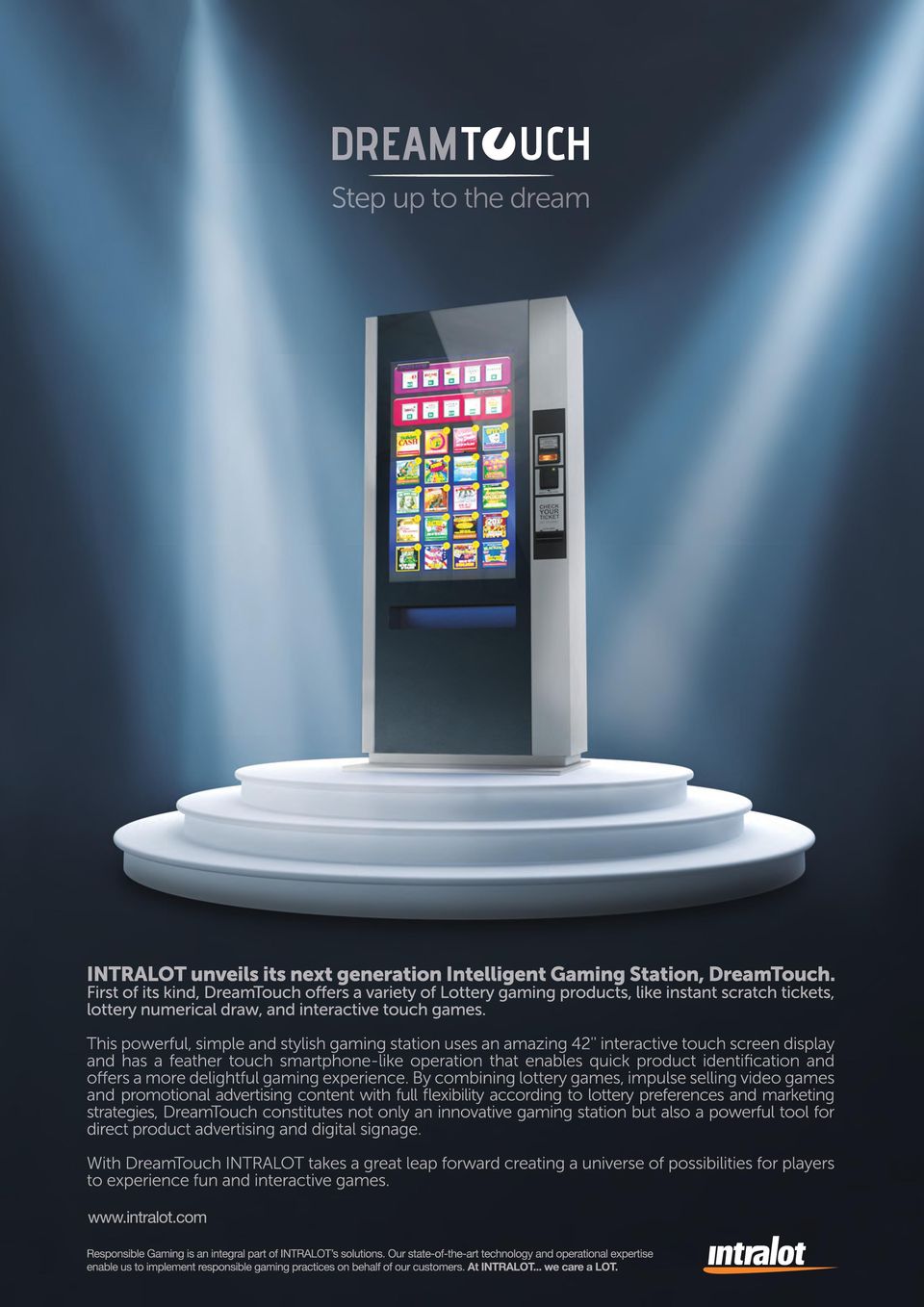
2 Step up to the dream
3 Contents 4 6 Interview with the President 7 11 Association business Selected news from the WLA, its members, and the regional associations Lotteries and Big Data Big Data is making big changes to the way lotteries market their products. The WLA looks at three lotteries pioneering the use of Big Data U.S. lotteries in 2013 A close look at four major trends emerging in the U.S. lottery market New gtlds are on the way The Internet Domain Name System is changing. How will this affect the lottery industry? The relaunch of America s Mega Millions The U.S. block game Mega Millions has been energized with a matrix change, a revamped prize structure, a new annuity schedule, and an enhanced Megaplier Camelot and corporate social responsibility Camelot s leadership in corporate social responsibility has brought it not only international respect, but has also enabled a growth in their lottery sales Responsible Gaming at BCLC The British Colombia Lottery Corporation has been recertified to the WLA-RGF at level 4. The WLA relates how they have remained on a path of continuous improvement and what they have learned along the way The ISO revamped A brief introduction to the new version of ISO 27001, the international information security management system standard and basis for the WLA-SCS: The Singaporean punter The colorful culture of betting in ethnically diverse Singapore Corporate news News from members of the WLA Contributors Program and other WLA Associate Members. Marketing is dead serious for all lotteries Just as with any business, marketing is essential for the long-term survival of a lottery. Without players, a lottery is destined to fail in its mission to raise money for good causes. A lottery needs to communicate to its players that it has entertaining and exciting games for sale. For instance, a mega-jackpot up for grabs is part of the essence that makes the lottery business so exciting, but it is only a sensation to the degree that the public is aware of it. At the same time the public needs to be made aware of the vital role that lotteries play in improving the quality of life in the communities in which they operate. Internationally, the amount of money raised by state lotteries to support good causes annually is estimated at more than one hundred billion Euros. And those spending their hard earned cash on lottery products need to know that their money has gone to support worthy causes. But a lottery s right to market its products should not be taken for granted. In parts of the world it is still forbidden by law to advertise the sale of gaming products. Anti-gambling advocates who view the lottery as a passive form of gambling are always at work to counter the efforts of lotteries despite the benefits that lotteries provide to society. In 2007 a state treaty banning Internet gambling and most lottery advertising was signed into law in Germany. The law became effective in 2008 and lasted until it was overturned in The German state-lotteries ability to promote their products was greatly impinged upon by this four-year ban. In a world where illegal off-shore gambling sites are competing for a player s discretionary money, society s welfare is not promoted by ill-conceived legislation that hinders our efforts to market our products. It is therefore vital that lawmakers around the globe are made aware of our efforts to raise money for good causes. The WLA, as well as the regional lottery associations, exist in part to enlighten the world as to the mission and vision of the state lotteries. As 2013 comes to an end, I would like to thank each WLA member around the world for their support and cooperation in making the WLA the global organization that it is. The membership is the life blood of the association and the reason for our existence. The many seminars that we have held this year around the world in cooperation with our regional partners have been a great success owing in large part to your participation. Our two certification standards, the WLA Security Control Standard (WLA-SCS) and the WLA Responsible Gaming Framework (WLA-RGF), continue to grow with 54 lotteries and nine suppliers certified at present to the WLA-SCS and 60 lotteries currently certified to the WLA-RGF at level 2 or higher. As you might know the WLA will be holding its biennial convention and trade show in cooperation with Lottomatica in Rome, Italy from November 2 5, I look forward to greeting you there once again. I wish you all the best for the holiday season The learning curve News from the WLA training and education program. Jean Jorgensen, WLA Executive Director WLA magazine No. 39 Winter 2013 /

4 NTERVIEW WITH PRESIDENT Interview with THE PRESIDENT I Marketing for lotteries promoting entertaining games of chance in a socially responsible way From boosting sales through to increasing the public s understanding of the role played by lotteries in sustaining the social good, marketing is crucial to lotteries. In recognition of this, for the past ten years the WLA, in cooperation with the European Lotteries, has held a marketing seminar at the beginning of each calendar year. The seminar is traditionally held in London, a world center of marketing, advertising, and finance. In this issue, we talk with WLA President Jean-Luc Moner-Banet about the importance of marketing for lotteries, and what the future holds for lottery marketing, particularly in the advent of online gaming and Big Data collection. What do you consider the three most important aspects of successful lottery marketing? It is important that a lottery gets the following three messages across to its public. First, your public needs to be clear on your lottery s role in raising money for good causes. Second, your public should have absolute trust in the integrity of your operations, both with respect to social responsibility and the fairness of your games. Third, your customers should understand that by playing the lottery, they have a chance at fulfilling a dream of wealth and happiness. Each of these components are equally important and should be a part of any lottery marketing strategy. Between marketing lottery products, marketing lottery winners, and marketing good causes, where would you put the most emphasis? You need to maintain a balance between all three marketing aspects. Certainly you want to have exciting and entertaining games. At the same time, selling the dream of instant wealth is important, as it is one of the strongest motivating factors for playing the lottery. And what better way is there to sell this dream than by showing the winners, people that are actually living the dream because they invested a few Euros on a lottery ticket? Finally, you have to keep your players informed as to where the money spent on lottery products goes. This is important for your brand and for the image of your organization as a whole. It is what distinguishes us from the private gambling businesses. Do you feel that marketing is an analytical process or a creative process? Both. Market research is a key element in building an effective marketing mix. The classic components of the marketing mix are the four P s : product, price, place, and promotion. To these one could add a fifth P : people or public. Market research efforts, which are typically analytically driven, should focus on identifying the people who purchase our product in this instance, our players and understanding their needs. Advertising, which is a key channel for promoting our products, requires creativity to engage people in a fun yet effective way, to get them to understand our products, and why they should purchase them and support our business. Big Data collection as a tool in developing marketing strategies is catching on. Do you foresee a time when software will dictate our marketing decisions? Not in the foreseeable future. Data collection is merely a tool, albeit a valuable one. It can assist you greatly in your market research, for example in gathering information about the four P s, like the 4 WLA magazine No. 39 Winter 2013 / 2014

5 NTERVIEW WITH PRESIDENT Interview with THE PRESIDENT places your customers buy your products through the retail network or online. But, someone must interpret that data, and decide how to respond to the trends uncovered through its analysis. While it could very well be that we will increasingly depend on software to make our decisions in the future, the ultimate responsibility for marketing decisions will continue to rest with us as lottery professionals for the time being. How does one effectively market lottery products in a socially responsible way? It is the responsibility of lotteries to ensure that the natural demand for games of chance is primarily channelled through legal, supervised lottery retail and online networks. To fulfill this mission, lotteries must use a variety of media and other means to market their products with dignity and integrity. First and foremost, this means following marketing regulations relating to the advertising and sale of gaming products in your jurisdiction. Second, the WLA has long offered a set of marketing guidelines to its members. The WLA Marketing Guidelines discuss how lottery products can be promoted and marketed in a socially responsible way. The guidelines discuss general marketing principles that should be adhered to, appropriate tone for advertisements, corporate social responsibility aspects, and so forth. By following both local regulations, and the WLA Marketing Guidelines, the producers and marketers of lottery products can encourage responsible decision making regarding play by adults, while simultaneously discourage abuse of their products. What is the best way for a lottery s brand to increase the demand for the products that it sells? In the long term, the best way to increase demand is to retain existing players while attracting new players, such as the crucial years old demographic. In the short term we have also seen that the excitement that higher jackpots stir up, as with Mega Millions and Powerball in the U.S. and Euro Millions in Europe, can bring quite a spike in sales. The trend toward block games and mega-jackpots is gaining momentum. How can public awareness programs strengthen a lottery s brand? By having your lottery staff get out in the community and actively support good causes you put a human face on your brand. This gives credence to the mission and vision of your organization. Your support for good causes is no longer just a number on a piece of paper. Direct contact with your public will go a long way towards earning their trust and in so doing, making your brand one to remember. How important is social media presence in maintaining a lottery s brand? Social media is a relatively new phenomenon and the jury is still out on its ultimate importance. Nonetheless, it is good to be where the people currently are. At the moment, a large segment of the population spends a good portion of their time using using social media. It is popular now but ten years down the road people may find other ways to spend their time. But, why not use it as a platform now to promote your brand? What kind of information can one glean from players social networks that would help a lottery market products specifically to them? Social media offers a wealth of information on an individual s likes and dislikes, their political leanings, their sense of humor, and how they spend their free time. Theoretically, this information could be used to create custom-designed products for various segments of the population. For instance, scratch cards that feature the trendiest rock stars could appeal to the younger player, whereas scratch cards revolving around game shows tailored to family viewers could be aimed at a slightly older demographic. Transparency and trust will always remain essential in winning a player s loyalty. How could social media be used to deliver on these player expectations? Social media has augmented traditional news media platforms. It is in some ways more flexible and dynamic than traditional mainstream media formats, but is arguably less authoritative. The upshot is that nowadays, many people use Facebook or Twitter as their main source of news. In any case, social media should be used in much the same way that traditional media has been used to communicate with the public. A lottery s social engage ment programs or their contribution to good causes can be easily portrayed through these platforms. Social media is a reality and should be an integral part of any lottery s communication strategy. Has government regulation hindered effective marketing of lottery products in some jurisdictions? Indeed it has. For instance, from 2008 until the middle of 2012, a treaty was enacted in Germany that banned the sale of products over the Internet, forbid the marketing of gaming products on television and the Internet, and required the forms of marketing that were allowable be purely informational in nature explicitly motivating the customer in the permitted forms of advertising was prohibited. In July 2012, a new treaty was negotiated. The new treaty once again permits the sale of products over the Internet, allows advertising on television and the Internet, and permits lotteries offering not more than two draws a week to advertise their products in an attractive way. The earlier treaty had a devastating effect on the ability of lotteries in Germany to market their products, and a consequent knock-on WLA magazine No. 39 Winter 2013 /

6 NTERVIEW WITH PRESIDENT Interview with THE PRESIDENT I It is important that the state lotteries get the message across that the vast majority of their revenue goes to support good causes. It is important that we highlight this fact and make it a big part of our marketing strategies. Jean-Luc Moner-Banet, WLA President effect on sales. Sales decreased from circa million Euros per year on average in the eight years prior to 2008, to circa million Euros per year on average in the five years from 2008 onwards. What advice can you give to lotteries that operate in jurisdictions where restrictions on the marketing of lottery products are in place? Appeal to your governments. It is essential that your government leaders understand the mission of your lottery and the role that it plays in financing and promoting social causes within your respective countries. Government leaders need to recognize that marketing is vitally important for your operation. As in the German case, impinging upon your lottery s right to advertise will have an adverse affect on your ability to contribute to society. Who is directly competing with the lotteries for consumer group loyalty? Probably, the biggest threat comes from the private for-profit gambling industry. They offer the players the thrill of winning, but the money that private gambling operators take in is solely for their own benefit. That is why it is important that the state lotteries get the message across that the vast majority of their revenue goes to support good causes. This is the one of the main distinguishing factors that holds us above the private operators. It is important that we highlight this fact and make it a big part of our marketing strategies. How do the general behaviors and preferences of the online player differ from those of players at the point of sale? At the point of sale, a lottery purchase is often spontaneous. Customers come to the point of sale with other intended purchases and buy a lottery ticket or a scratch card on a whim. That is why strong point-of-sale marketing is important. The online player is more dedicated. The online player goes directly to your website with the intention of playing the lottery. Do you find retail marketing and Internet marketing at odds with one another or do you feel they complement each other well? When online sales were new there was a general fear that they would cannibalize the retail channels. What has been reported at WLA marketing seminars is quite the opposite. In many cases Internet marketing has enhanced retail sales. Many lotteries have further augmented this by establishing marketing programs that create interaction between the Internet and retailer channels. Working between the two channels the marketing potential is enormous. In what areas can the sharing of knowledge between lotteries improve the marketing of lottery products around the world? One of the main goals of the WLA, through its educational program, is to bring lottery professionals from around the globe together, to share their knowledge with their international peers. We see marketing as an important educational topic. Each lottery is faced with different challenges and operates in a cultural environment different than our own. How they approach marketing is unique to their jurisdictions. It is important that we share our experiences, both the successes and the failures, because in so doing we can learn a great deal from each other. The WLA is here to ensure that the community of world lotteries grows together as one spirit as we all share the same mission and vision. Advertisement 6 WLA magazine No. 39 Winter 2013 / 2014

7 ASSOCIATION ASSOCIATION BUSINESS Theo Gossner appointed to WLA Executive Committee Mr. Theo Gossner, managing director of Westdeutsche Lotterie GmbH & Co. OHG, was appointed to the WLA Executive Committee in September, Mr. Gossner replaces outgoing WLA Executive Committee member Dr. Rolf Stypmann, who is retiring. The WLA President, on behalf of the entire Executive Committee, thanks Dr. Stypmann for his great service to the WLA, and for his service to the lottery community at large over many years. Theo Gossner was born in After studying macroeconomics and politics in Munich, Mr. Gossner held several portfolios in the Westdeutsche Landesbank (WestLB) and the NRW.BANK, including positions as key account manager for public customers and managing director for the financing of medium-sized companies and infrastructure projects. In 2010, Mr. Gossner joined Westdeutsche Lotterie GmbH & Co. OHG as deputy managing director. He became managing director of Westdeutsche Lotterie GmbH & Co. OHG at the beginning of A member of the foundation board of the Nordrhein-Westfalen Foundation and the board of trustees of the foundation, Mr. Gossner is married with two adult children. José Miguel Martínez Martínez steps down from the WLA Executive Committee Mr. José Miguel Martínez Martínez, formerly Chief Executive Officer at Sociedad Estatal de Loterías y Apuestas (SELAE), Spain, has resigned from the WLA Executive Committee. Mr Martínez Martínez stepped down from the Executive Committee on the occasion of his resignation as CEO of SELAE in August, 2013 for health reasons. The WLA thanks Mr. Martínez Martínez for the commitment and support he showed to the WLA throughout his tenure on the Executive Committee. In order to maintain the balance of regional members on the Executive Committee, a representative from a European lottery will be privileged to replace Mr. Martínez Martínez. The appointment of the new Executive Committee member was still pending as this magazine went to press; the vacancy will be filled at the next WLA Executive Committee meeting in Versailles, France, in December WLA magazine No. 39 Winter 2013 /

8 ASSOCIATION ASSOCIATION BUSINESS New WLA Members At the last meeting of the WLA Executive Committee in Marrakech on September 26, 2013, the WLA provisionally accepted two new members into the association, subject to ratification by the membership at the next WLA General Meeting in Rome, WLA members are organizations licensed or authorized to conduct lotteries and/ or sports betting operations by a jurisdiction domiciled in a state recognized by the United Nations. Sales of games of chance and/or skill must account for the majority of the organization s total annual gross revenues, and the majority of the organization s net revenues must be dedicated to the public good. Applications for WLA membership must be approved by the WLA Executive Committee, at which point applicants are provisionally accepted into the association. Membership of the organization is provisional until it is ratified by the membership at the following WLA General Meeting. The new members provisionally accepted by the WLA into the association are: Development Lotteries Board, Sri Lanka. The Development Lotteries Board of Sri Lanka, one of the two state-authorized Sri Lankan lotteries, began selling lottery games to the public in Incorporated by parliamentary act in 1997, and reporting to the Ministry of Finance and Planning, the lottery is licensed to sell instant and number games to the public through retail points of sale. One hundred percent of the lottery s net profits are returned to society through contributions to the President s Fund and the Mahapola Higher Educational Trust Fund. The President s Fund contributes to various social welfare activities such as health (including serious medical surgeries), education, sports, and culture, while the Mahapola Higher Education Trust Fund assists university students in need in continuing their education. Liberia National Lotteries Corporation, Liberia. The Liberian National Lotteries Corporation is the state-authorized lottery of Liberia. Founded in 1993, the lottery is one of five gaming concerns currently operating in the jurisdiction. The lottery operates under the auspices of the Office of the Vice President of the Republic of Liberia, and offers traditional lotto games to the Liberian public through retail points of sale. Part of the lottery s net profit is returned to society, with the beneficiaries including charitable organizations, and scientific, cultural, and educational projects. Advertisement Unleash the world s greatest gaming experience Building on six decades of engaging, entertaining and innovative gaming, Aristocrat has a wealth of unique, popular games delivering across diverse global gaming segments. Coupled with our range of proven video lottery hardware and systems solutions, players can enjoy the very best gaming experience in a format and style most appropriate to their needs and environment. To discover how Aristocrat can bring greater benefit to your gaming operation, call today on +46 (0) Aristocrat Technologies Australia Pty Limited. Aristocrat and the Aristocrat logo 8are trademarks or registered trademarks of Aristocrat Technologies Australia Pty Limited. WLA magazine No. 39 Winter 2013 / 2014

9 ASSOCIATION ASSOCIATION BUSINESS New WLA Associate Members At the last meeting of the WLA Executive Committee in Marrakech on September 26, 2013, the WLA approved and accepted two organizations as new associate members. Associate membership of the WLA is open to any supplier or prospective supplier of goods or services to state-controlled lottery or sports-betting operators whose business practices are compatible with the aims and objectives of the association. Applications for associate membership must be endorsed by at least two WLA member lottery or sports-betting operators and receive final approval from the WLA Executive Committee. The two organizations accepted by the WLA as new associate members are: Inspired Gaming Group, United Kingdom. Inspired Gaming Group (Inspired) is a leading supplier of VLTs and virtual sports to state lotteries and private operators around the world. World leaders in server-based gaming technology, the company has over 35,000 endpoints on its Open Core SBG/VLT platform. Its virtual sports products are live in over 20,000 venues, spread across 22 countries around the globe. Employing over 1,000 people in ten offices worldwide, its customers include Sisal, Lottomatica, NSLAC, OPAP, William Hill, Ladbrokes, Betfred, Paddy Power, and Bet365. Beijing Zhongcai Printing Co. Ltd., China. Established in 1993, Beijing Zhongcai Printing Co. Ltd. is the most advanced instant lottery ticket printing enterprise in China. Offering high-quality and high-security printed products including instant scratch-off lottery tickets, packaging printing, and direct mail products, the company is jointly invested and incorporated by China Welfare Lottery, International Des Jeux of France, and Berjaya of Malaysia. ISO9000, ISO14001, and ISO27001 certified, Beijing Zhongcai Printing Co. Ltd. currently prints over 250 million instant lottery tickets per month for clients in Asia, Africa, and Europe. Luis Gama elected president of CIBELAE The XIV CIBELAE Congress, which took place from October, 2013 in Panama City, Panama, witnessed the appointment of a new board of directors of CIBELAE for the period , as well as the approval of new statutes and regulations. The officers of the new board comprise Luis Gama, Director of Dirección Nacional de Loterías y Quinielas, Uruguay, who was appointed president; Sergio González Ruiz, General Director of Lotería Nacional De Beneficencia, Panama, who was appointed first vice president; and José Francisco Peña, Administrador General of Lotería Nacional Dominicana, Dominican Republic, who was appointed second vice president. The outgoing president of CIBELAE, Fabio Cleto, vice president of government funds at Caixa Econômica Federal, Brazil, remains on the CIBELAE board. The new president of CIBELAE, Mr. Gama, comes to the presidency with a background in public administration and a special interest in international humanitarian aid. A public servant by profession, he has worked for the Uruguayan public service since April Over this time, he has held a variety of positions in the area of finance and budgets. He was involved in the International Public Budget Seminar in San Juan, Puerto Rico, in 1998, and the Latin American Programs in Municipal Financial Training held in Madrid in 2000 and In 2007 and 2008 he worked as advisor to the State Administration of Sanitary Works, being the Director of the Financial Accounting and a member of various working committees. In 2008, he served as a member of a monitoring humanitarian mission that traveled to Peru and Venezuela. In October of the same year, he was appointed as advisor to the general director of State Casinos under the aegis of the Ministry of Economy and Finance. He served as director ad interim in the absence of the incumbent director and in April 2010 was appointed commercial manager. On February 6, 2013, Mr. Gama was appointed as the Director of Dirección Nacional de Loterías y Quinielas by the president of the Republic of Uruguay, José Mujica. At the same time, he was elevated to the board of CIBELAE. Following his appointment as president of CIBELAE in October, 2013, Mr. Gama said, The road ahead will be a continuation of the presidency of Fabio Cleto. Our challenge is to promote greater integration, participation, and exchange because we have common problems. We should work together as a team on the road ahead of us. One of the new statutes approved at the XIV CIBELAE Congress marked a milestone for ALEA, the Asociación de Loterías, Quinielas y Casinos Estatales de Argentina. The new statute creates a branch of CIBELAE in Latin America that will be based at the offices of ALEA in Buenos Aires, under the direction of ALEA Executive Director Dr. Nestor Cotignola. In creating a common office, CIBELAE and ALEA hope that together, they will bring their experience, contacts, and knowledge to enhance the common scope of both entities and contribute to the growth of members of both organizations. WLA magazine No. 39 Winter 2013 /

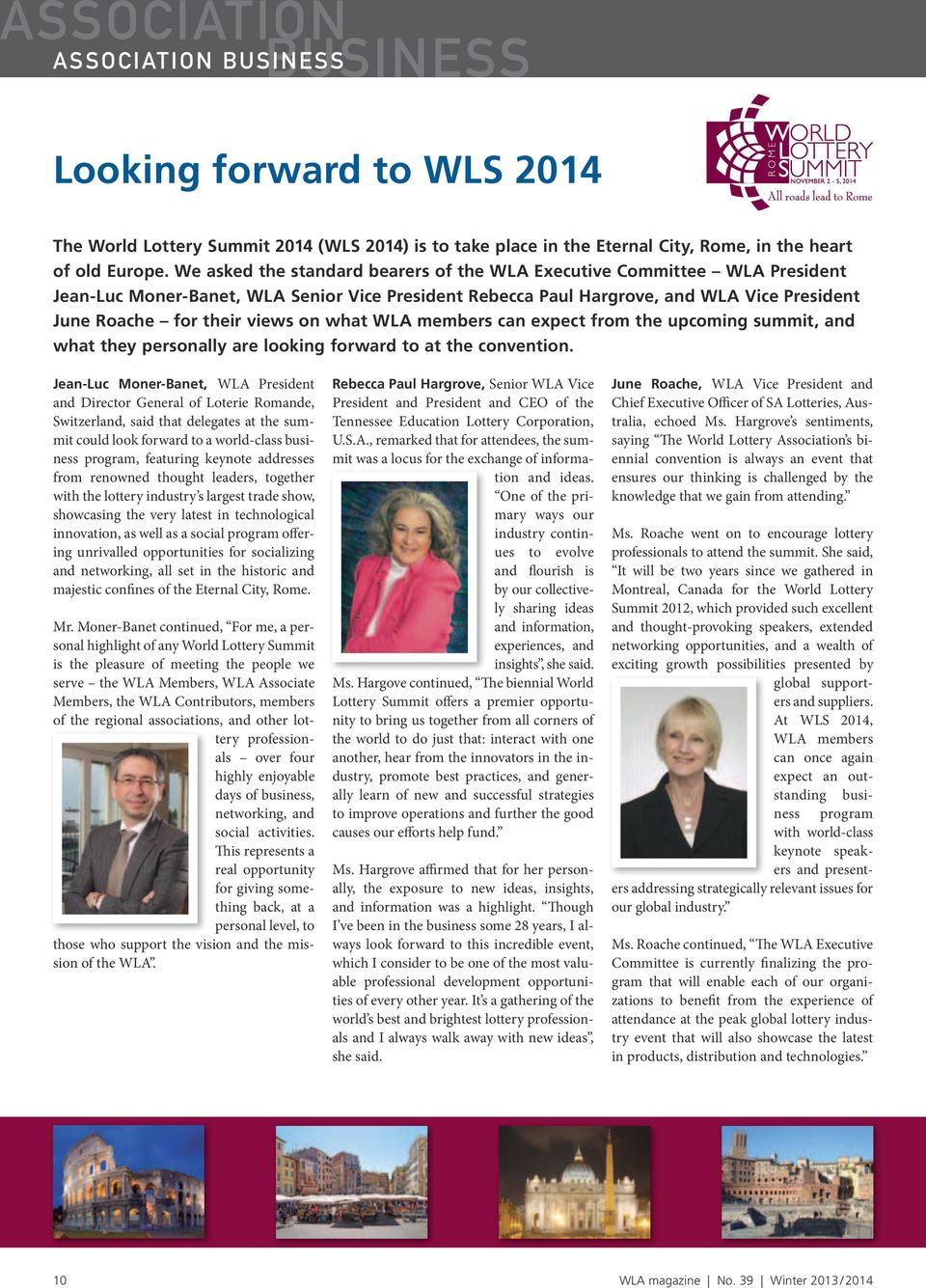
10 ASSOCIATION ASSOCIATION BUSINESS Looking forward to WLS 2014 The World Lottery Summit 2014 (WLS 2014) is to take place in the Eternal City, Rome, in the heart of old Europe. We asked the standard bearers of the WLA Executive Committee WLA President Jean-Luc Moner-Banet, WLA Senior Vice President Rebecca Paul Hargrove, and WLA Vice President June Roache for their views on what WLA members can expect from the upcoming summit, and what they personally are looking forward to at the convention. Jean-Luc Moner-Banet, WLA President and Director General of Loterie Romande, Switzerland, said that delegates at the summit could look forward to a world-class business program, featuring keynote addresses from renowned thought leaders, together with the lottery industry s largest trade show, showcasing the very latest in technological innovation, as well as a social program offering unrivalled opportunities for socializing and networking, all set in the historic and majestic confines of the Eternal City, Rome. Mr. Moner-Banet continued, For me, a personal highlight of any World Lottery Summit is the pleasure of meeting the people we serve the WLA Mem bers, WLA Asso ciate Mem bers, the WLA Con trib utors, members of the regional associations, and other lottery professionals over four highly enjoyable days of business, networking, and social activities. This represents a real opportunity for giving something back, at a personal level, to those who support the vision and the mission of the WLA. Rebecca Paul Hargrove, Senior WLA Vice President and President and CEO of the Tennessee Education Lottery Corporation, U.S.A., remarked that for attendees, the summit was a locus for the exchange of information and ideas. One of the primary ways our industry continues to evolve and flourish is by our collectively sharing ideas and information, experiences, and insights, she said. Ms. Hargove continued, The biennial World Lottery Summit offers a premier opportunity to bring us together from all corners of the world to do just that: interact with one another, hear from the innovators in the industry, promote best practices, and generally learn of new and successful strategies to improve operations and further the good causes our efforts help fund. Ms. Hargrove affirmed that for her personally, the exposure to new ideas, insights, and information was a highlight. Though I ve been in the business some 28 years, I always look forward to this incredible event, which I consider to be one of the most valuable professional development opportunities of every other year. It s a gathering of the world s best and brightest lottery professionals and I always walk away with new ideas, she said. June Roache, WLA Vice President and Chief Executive Officer of SA Lotteries, Australia, echoed Ms. Har grove s sentiments, say ing The World Lot tery As so ci a tion s biennial convention is al ways an event that ensures our thinking is challenged by the knowledge that we gain from attending. Ms. Roache went on to encourage lottery professionals to attend the summit. She said, It will be two years since we gathered in Montreal, Canada for the World Lottery Sum mit 2012, which provided such excellent and thought-provoking speakers, extended networking opportunities, and a wealth of exciting growth possibilities presented by global supporters and suppliers. At WLS 2014, WLA members can once again expect an outstanding business program with world-class keynote speakers and presenters addressing strategically relevant issues for our global industry. Ms. Roache continued, The WLA Executive Committee is currently finalizing the program that will enable each of our organizations to benefit from the experience of attendance at the peak global lottery industry event that will also showcase the latest in products, distribution and technologies. 10 WLA magazine No. 39 Winter 2013 / 2014
11 ASSOCIATION ASSOCIATION BUSINESS WLS 2014 Provisional business program The WLA Executive Committee is currently finalizing the business program for WLS To whet the appetite for 2014 s premier lottery event, we provide an overview of the provisional business program for the summit below. Friday, October 31 Time Activity 00:01 08:00 08:00 24:00 Decorator preparations Exhibitor build Trade show (for Contributors only) 19:30 22:30 Volunteers welcome reception Saturday, November 1 08:00 24:00 Exhibitor build Trade show 08:00 10:00 Volunteers briefing 13:00 16:00 Discover Rome tour (Delegates / Partners) 13:00 18:00 Networking activity for Executive Committees and Contributors (by invitation only) 14:00 17:00 Registration desk open Evening Evening free Sunday, November 2 09:00 12:30 Discover Rome tour (Delegates / Partners) (Repetition of Saturday s tour) 10:30 13:00 WLA Executive Committee Meeting 15:00 18:00 Registration desk open 17:30 18:30 Welcome addresses Keynote 1 18:45 20:00 Trade show opening and cocktails 20:00 24:00 Opening dinner Monday, November 3 08:00 16:30 Registration desk open 09:00 12:30 Accompanying persons program 09:00 10:00 Official opening WLS 2014 Marco Sala, President and CEO of Lottomatica Jean-Luc Moner-Banet, WLA President 10:00 11:00 Keynote 2 11:00 11:30 Coffee break 11:30 13:00 Keynote 3 13:00 14:30 Trade show and lunch 14:30 15:30 Parallel Session 1 Social media and best practice 15:30 16:00 Coffee break 16:00 17:00 Parallel Session 4 Driving sustainable advertising 17:00 18:30 Trade show and cocktails Evening Contributors event Parallel Session 2 Towards global convergence of regulation or not? Parallel Session 5 Lottery apps for smartphones and tablets Parallel Session 3 Internet Parallel Session 6 Electronic gaming machines Tuesday, November 4 Time Activity 09:00 12:30 Accompanying persons program 09:00 10:00 Keynote 4 10:00 11:00 Panel: Preserving the integrity of sports. Global status. 11:00 11:30 Coffee break 11:30 13:00 Platinum Contributor session 13:00 16:00 Trade show lunch and afternoon 16:00 17:00 Parallel Session 7 Draw based games: How to make them grow? Parallel Session 8 Sustainability of instant tickets in an online world Parallel Session 9 Debate of the day: Lottery sports betting monopolies make more profit than lotteries operating in a competitive environment. Evening Evening free Wednesday, November 5 09:00 10:00 Keynote 5 10:00 10:45 WLA Advertising Awards Interactive awards sessions 10:45 11:15 Coffee break 11:15 12:30 Lotteries Summit and Pep-talk 12:30 14:00 Trade show activity, lunch, and official closing of trade show 14: Break and document handout for the WLA General Meeting 14: WLA General Meeting Including Regional Associations reports and Responsible Gaming Award 17:30 18:00 New WLA Executive Committee meeting 19:30 02:00 Closing dinner, Best of the Best Award, and party Thursday, November 6 8:30 17:00 Optional networking day Please note that at the time of writing, the overview shown is provisional and may be subject to change. For the latest edition of the business program, and for further information related to WLS 2014, including practicalities about accommodation, transportation, and things to see and do in Rome, please see the WLS 2014 website at WLA magazine No. 39 Winter 2013 /

12 Let s do the numbers: Big Data and the lottery industry Lotteries around the world have access to enormous amounts of data through their gaming systems and for those with loyalty programs through their customer databases. With the advent of Big Data, new tools and methods are now available to delve into this mine of information and extract new insights about player preferences and behaviors. Photobank - Fotolia.com BIG DATA 12 WLA magazine No. 39 Winter 2013 / 2014

13 Companies and operators in almost every sector are producing growing volumes of transactional data, capturing trillions of bytes of information about their customers, suppliers, and operations. Social media sites, smartphones, and other consumer devices are contributing to the amount of data, both structured and unstructured, that is available. Added to that, in a hyperconnected world, systems and devices can communicate automatically with each other, generating even more data that can be cross-cued, compared, and correlated to extract potentially usable information. The ability to turn these masses of information into actionable intelligence has enormous potential for marketers but also for planners and policy makers in almost every walk of life. For many people, this systematic collection of information and number-crunching by armies of machines outside their control is little more than an invasion of privacy and a threat to their personal freedoms. Even so, the McKinsey Global Institute argues, Big Data can play a significant economic role to the benefit not only of private commerce but also of national economies and their citizens. What is Big Data? According to the McKinsey Global Institute, Big Data refers to datasets whose size is beyond the ability of typical database software tools to capture, store, manage, and analyze. As technology advances over time, the size of datasets that qualify as Big Data will also increase, but in many sectors today the volumes of data involved will range from a few dozen terabytes (thousands of gigabytes) to multiple petabytes (thousands of terabytes). Data is not information, information is not knowledge, knowledge is not understanding, understanding is not wisdom. The right stuff In many sectors, the Big Data revolution is about to change the economic landscape as pioneering companies and even governments harness Big Data to new technologies to create value for their stakeholders. But considerable challenges lie ahead. For example, there is a significant shortage of the analytical and managerial talent necessary to make the most of Big Data. The right infrastructure also needs to be available, and the benefits to users and organizations must be fully understood. Importantly, safeguards need to be in place to address public concerns about privacy and personal freedoms. A game-changer for lotteries? We asked three early adopters of Big Data in the lottery industry Tatts Lotteries in Australia, Veikkaus Oy in Finland, and HKJC Lotteries Ltd. in Hong Kong how they got started in the world of Big Data, how the approach has impacted their organizations, and where the risks and opportunities lie. Tatts Lotteries: Actionable intelligence Player card registration and loyalty programs have been a part of lotteries in Australia since at least the 1990s. By interrogating its data through reporting, analytics, and modeling, Tatts Lotteries has developed a deep understanding of its business and of the nature of its customer segments over an extended period of time. Of real value to Tatts Lotteries in using data is the ability to predict future customer behavior. By anticipating what might happen next, what the customer may do next, or what the customer might want next, Tatts is able to tailor its communications and offers to best appeal to the customer. The outcome of leveraging Big Data is that Tatts Lotteries has been able to provide better services, better products, more relevant offers, and more personalized marketing to drive increased revenue for the business. Integration of the lottery system and customer database A key strategic asset of Tatts Group is the TattsTech gaming system, which was developed in-house and tailored to meet the needs of the business. The integration of the lottery system and customer database means Tatts has a single customer view and an intimate Clifford Stoll, American astronomer and author understanding of customers and their purchases made through each sales channel. Tatts Lotteries has also developed a behavioral segmentation model using the transactional data collected by TattsTech. This involved utilizing modeling techniques to group like customers together into a homogenous group of relatively like behaviors. Targeting players according to their behavior The dual objectives behind the modeling work conducted have been, first, to move to a more real-time and deeper understanding of customers, and second, to provide the ability to target communications at players according to their behavior, whether that is specifically by business issue or more broadly by behavioral segments. A player will only receive communications that have been determined as relevant to them through output of the data analysis. For example, if they are a regular Saturday lotto player, and also play Powerball when it jackpots above AUD 20 million, the communications they receive will be about activities related to those behavior preferences. The key to the effectiveness of these models lies in how actionable they are for marketing activities. Do they describe or do they direct the activity? The behavioral segmentation model, for example, describes a segment of players what they like, how they play, what their favorite games are, how long they have been members. What this does not provide is information on when we should contact players because their behavior has changed. Time-sensitive targeting This is where the predictive models provide very effective output. The output of these models can be specific and timely in the case of Tatts Lotteries they are designed to measure each player independently and provide output on when to contact each player and what they should be offered. In this sense, the nature of these models is one of actionable insight. They have campaigning built into their output. WLA magazine No. 39 Winter 2013 /

14 It is this timeliness the ability to identify in real time when player behavior is changing that delivers better outcomes in attempts to re-engage players through an offer or communication. So the models developed by Tatts are delivering to the core of what direct marketing and Customer Relationship Management (CRM) is about the right offer to the right player at the right time. Maintaining a deep understanding of players is seen as integral to Tatts Lotteries overall marketing approach. Accessing meaningful data and leveraging this data to deliver on-target marketing campaigns is an ongoing quest. Whilst Tatts Lotteries has been at the forefront of engaging in player card programs, loyalty programs, and direct marketing in the lottery industry, it continues to focus on further development and continual improvement in this area, because the process of turning data into under standing and wisdom comes through on going analysis of the data and the application of what has been learned for future benefit. It is through this constant feedback loop, where in data is transformed into information upon which activity is enacted and measured, that organizations can transform data into wisdom. Veikkaus: The 360 customer view Back in 1996, the Finnish lottery Veikkaus was the first lottery organization in the world to adopt a systematic approach to large-scale data analytics. Today, the majority of the lottery s sales come from identified gaming, and a Big Data approach has become one of the pillars of the strategic vision of Veikkaus. When Veikkaus first got involved in largescale data analysis, the tools and methods weren t nearly as sophisticated as they are now indeed the term Big Data had not even been coined. But even then, the Finnish lottery had a large proportion of customers playing online, so it was a logical candidate to be an early adopter. Veikkaus had to build its first Big Data platform itself, and at a certain stage the system became obsolete and had to go through massive renewals. Of course, the same aging process would have happened in any case at some point, even with a more modern product. And in the early days, when user numbers were lower than they are today, the analytics team at Veikkaus had more time to practice and scale up operations progressively, which helped to reduce costs and one-time investments. All in all, the learning process was most instructive for Veikkaus, and today the lottery is happy to share its experience with others. Systematic data capture Veikkaus captures basic personal and demographic data on customers during the registration process. Then, all the gaming data of registered customers is recorded as is the transaction data of non-registered custom- fotoliaxrender - Fotolia.com 14 WLA magazine No. 39 Winter 2013 / 2014

15 Getting technical A relational (or SQL) database organizes data as a collection of tables, all of which are formally described and organized according to a database schema. The schema, which is highly structured, helps guarantee the integrity of the data in the database. The relational database model, which originated in the 1970s, was never designed to handle the very large volumes of data produced by today s web technologies. It turns out that, as data volumes expand, the highly structured nature of the database schema actually constrains a relational database in its transaction processing, to the point where new technologies are needed to help process the volume of data in question. The advent of web technologies and Big Data led to the development of new technologies for storing and manipulating data. Among the best known of these technologies are NoSQL (Not Only SQL) databases, which eliminate database schemas at the expense of relaxing data integrity principles. New distributed file system technologies, such as the Hadoop open-source software framework, are also coming to the fore. One feature Hadoop provides is the ability to work with data that is unstructured, that is, data that is not organized in a pre-defined manner. The ability to work with unstructured data offers tremendous advantages to business, because, according to a rule of thumb due to Merrill Lynch, somewhere around 80 90% of all potentially usable business information may originate in unstructured form. Techniques such as data mining can be used to find patterns in unstructured data, allowing data that cannot easily be captured under the traditional relational database model to be turned into actionable insights. ers. In addition, every action taken in the web store (where customers browse and purchase lottery products) is recorded, and contact and response information for all CRM campaigns is carefully captured and analyzed. All this information is stored daily in the Veikkaus data warehouse, the organization s central repository of data. The data warehouse is divided into data marts for improved performance and ease of use within a given area. The Veikkaus customer data mart, for example, includes extensive information on customers, which may be viewed from various angles. For instance, it is possible to generate a complete 360-degree customer view, or, at enterprise level, a view of behavioral gambling data that is as accurate as possible. Veikkaus is constantly enriching its customer data mart by developing new variables and fetching the necessary variables from the data warehouse. Veikkaus uses software tools developed by SAS Institute Inc., a U.S. software house specializing in advanced analytics, to make the results both understandable for internal use within the company and easier for the analysts to analyze. This requires basic knowledge of data analysis techniques and an in-depth knowledge of the software. The extraction, transformation, and cleaning processes from the data warehouse to the customer data mart are also done with SAS software. Segments of one Several different customer segmentation models are used. One is traditional and based on demographics (such as age and sex). But accurate segmentation is a top priority for Veikkaus, not only to avoid sending non-relevant messages to customers, but also to personalize the experience on the website based on player types and individual customer reactions to messages (through clicks, opens, and other actions). Inside a particular segment or category, especially in sports betting, individual gaming history is used to achieve even greater granularity. Ultimately Veikkaus marketers and data analysts are aiming for segments of one to fine tune their analysis of customer preferences and behaviors and to meet each player s needs and expectations as closely as possible. More and more often, the team uses trigger-based CRM, wherein a customer s behavior launches a trigger. The trigger thus constitutes the primary reason for contact, and a well-structured contact policy is in place to set the rules for making contacts. In the Veikkaus web store, personalization is based on customer behavior and models are refined continuously to help achieve the main objectives, which include serving customers well, making lottery services easy to access and use, and expanding cross-selling opportunities when appropriate. Measurable results Thanks to effective data analysis, the added value and click rates of CRM operations have steadily risen and, at the same time, the number of s sent has decreased as marketers have learned to target messages more effectively. This has meant that customers benefit from improved customer service and from offers that are better targeted to meet individual needs. Like many other lottery organizations, Veikkaus has reallocated large amounts of its marketing spend from traditional advertising to online media and social networks. As the skills needed in the marketing department have changed, the lottery has invested heavily in its people to develop their competencies and to stay abreast of new requirements. Every analyst at Veikkaus is coming to understand the complexity of customer behavior. Every customer is different, even if they might seem similar from one angle, and even if they might seem to belong to a homogenous group of people. The Big Data approach offers enormous opportunities for developing a more rounded view of players and their behaviors, and for serving customers in more relevant, more appro priate ways. A strategic enabler The new Veikkaus strategy is based completely on utilizing Big Data to optimize the customer base, serve customers better, and reach optimal growth through up-selling and cross-selling and churn minimization. In addition, the lottery has developed a preventive model to detect signs that might lead to problem gambling. Problem gamblers are excluded from all CRM marketing and personalization projects as part of the lottery s commitment to responsible gaming and responsible business growth. These strategies seems to be working. Over the past few years, practically all the lottery s growth has come from its existing customer base. WLA magazine No. 39 Winter 2013 /

16 Business case: One trend that HKJC would not have spotted without Big Data Via data mining, we identified a group of high-value customers with a specific absenteeism pattern for race meetings held on Wednesdays. After delving into the root cause, we discovered they needed to travel overseas regularly during weekdays which is very common for Hong Kong business people. Hence, they found it very inconvenient to access Hong Kong racing information. We then addressed their specific needs with tailor-made services, such as access to overseas information, to ensure they could follow our racing sports. Without the use of Big Data, it would have been difficult to identify such an opportunity. HKJC: The power of machines, the insights of humans HKJC Lotteries Ltd. (HKJC Lotteries) was one of the first lotteries in the world to work with Big Data. Today the organization has a database of over two million account customers and has built up its expertise in data mining and analy sis to develop effective customer seg men tation and CRM as part of its commit ment to responsible marketing and customer care. Being an early adopter of new technology is always difficult. Apart from the technology cost, there is a need to manage the change in processes, to develop new technical skills in the workforce and, in some cases, to undergo an organizational transformation. However, being focused on the long-term value of sustainable customer relationships, HKJC has always recognized the importance of building such relationships early. The organization was quick to realize that new technology would allow it to achieve these goals better and faster, and was therefore prepared to embrace Big Data before its use was widespread in the lottery industry. Transforming data into actions At HKJC, it is not the volume of data that matters. It is about how you go from data to insights to actions that drive total customer satisfaction continuously in a socially responsible manner, says Richard Cheung, executive director, customer and marketing at HKJC. carloscastilla - Fotolia.com 16 WLA magazine No. 39 Winter 2013 / 2014

17 HKJC validates and captures data on age and demographics to create a mosaic profile of each customer at account opening. As well, they build up real-time betting patterns across all wagering entertainments (horse racing, football betting, lottery) and account betting platforms. Data is also captured on other dynamic wagering metrics like spend pattern, product preference, activity time, and even subchannel usage (for instance, regularity of play from a mobile device) to form a complete view on each customer in the wagering world. To systematically transform the captured data into information, HKJC has invested in a purpose-built enterprise data warehouse to support efficient data mining and customer segmentation. Targeted communications The organization s customer base is divided into segments to perform segment-specific CRM. Each segment is managed by a dedicated segment team, with expert analysts translating segment-specific data into insights and determining how information, services, and programs can be targeted at the right customers in the right tone and manner, in the right place and at the right time. Big Data and responsible gaming: risks and opportunities Information is power, said Keith Whyte, executive director of the National Council on Problem Gambling back in April 2007 at a WLA best practices seminar on responsible gaming. The head of America s oldest and most impartial organization on problem gambling issues spoke of the importance of tracking player behaviors, particularly through loyalty programs but also by polling consumers and retailers and analyzing sales data. He called on the industry to use its data to devise new metrics that could provide a basis for social norms and help to identify patterns of problem gambling. And he spoke of the power of the predictive data models that could be developed and their potential to stop problem gambling in its tracks. Fast forward to the U.S. Senate hearings in July 2013 on consumer protection and the expansion of Internet gambling, when Mr. Whyte submitted testimony describing some of the free games played on Facebook and other social networks. These games are aggressively monetized and marketed yet completely unregulated, the executive director wrote. There is little consumer protection or disclosure in general in this space. While Keith Whyte s submission was aimed at regulators and legislators, his concerns over consumer protection, the prevention of problem gaming, and the possible abuse of online data resonate with lottery operators too. As Mr. Whyte pointed out in the session An opportunity to benefit from corporate governance & CSR at the World Lottery Summit in Montreal in 2012, online gaming operators have total control over the environment, and the scope to intervene to prevent or predict problem gambling behaviors is therefore unlimited. Lottery operators that have embraced Big Data and advanced analytics techniques therefore have a head start in making their commitment to responsible gaming a reality in the online space. Digital communications, for example, have expanded significantly, with the share of HKJC s media spend on digital increasing from 10% three years ago to 40% today. New skills for marketing personnel Although HKJC has built a team of experts in data analytics, the organization s philosophy is that each member of the marketing team needs to learn how to interpret and apply Big Data, rather than just relying on data scientists. Marketing personnel need to be well trained to apply marketing sense when interpreting Big Data. They can refer to analytics experts whenever they need to differentiate correlation from causation for example and findings are also validated with front-line customer relationship officers based on their customer interactions. HKJC has invested heavily to develop its Big Data infrastructure, but at the end of the day the organization is well aware that it is people, not machines, who drive and derive insights from Big Data. Cross-selling when appropriate In some ways, HKJC uses Big Data in the same way as Amazon or Facebook. For example, they share the same vision of a one customer view, trying therefore to collect data from multiple transaction touch points. Big Data analytics allows HKJC to understand their customers more holistically, to assess both cross-product engagement (horse racing, football betting, and lottery products) and cross-channel engagement (on-premise, telephone, online, and mobile wagering). This deeper understanding of customers improves product and channel cross-selling opportunities as well as helping the organization to personalize its services and informa tion according to the specific needs of each customer for better customer retention. However, lotteries are not the same as other retailers or media channels. Online retailers like Amazon, for example, will also capture data that may not be directly related to their business. HKJC deliberately confines the scope of the data captured to only the information needed for driving customer segmentation and total customer satisfaction in the wagering world. This is part of the organization s commitment to the highest standards of responsible marketing. Indeed, Big Data potentially offers lotteries new opportunities to detect early signs of problem gambling behaviors and to take steps to avoid promoting certain sorts of entertainment to certain player profiles. Overall, the use of Big Data techniques has enabled HKJC to better understand its player base, improve segmentation, and enhance the ability of HKJC to meet the specific needs of each segment. The organization is convinced that its experience as an early adopter of Big Data has been instrumental in driving record-breaking turnover for five consecutive years. This record-breaking turnover has translated into maximized returns to the community, which reached an impressive USD 2.7 billion last year. WLA magazine No. 39 Winter 2013 /

18 U.S. lotteries in 2013: The state of play A truly informative lottery map of the United States would need many colors. In addition to the usual need to show where one jurisdiction ends and another one begins, such a map ought to convey how the range of lottery products changes as state lines are crossed. The map is being re-colored as you read, and the palette required is growing. In the U.S., 43 of the 50 states now have state lotteries. State lotteries began in the northeast and spread gradually across the country. The most recent additions have been in the south (Arkansas) and west (Wyoming). The biggest variety of lottery products is sold in the northeast, where the product mix has long included both instant games and traditional draw games sold just within the state. After many states had established their own lotto games, some states began to cooperate to offer lotto games in bigger versions. Two multi-state block games Powerball and Mega Millions developed. In sparselypopulated Wyoming, where a lottery was first instituted in 2013, only the block games are on offer. Several state lotteries also have Video Lottery Terminals (VLTs) as part of their product mix. In some states these are concentrated in gambling destinations like racetracks or casinos, while in others they can be found in convenience stores. Until very recently, no U.S. state lottery offered any product for sale over the World Wide Web ( the web ). This began to change in 2012, after U.S. Federal Government regulations were reinterpreted. Sports betting in general has largely been avoided by U.S. lotteries. Currently there are four major trends to watch in U.S. lotteries. First and probably most significant is the exploration of web commerce and even sports betting by some lotteries. Second is the continued development of multi-state lotto games. Third, the instant game business based on paper tickets has recovered from the financial crisis of Fourth, state governments have continued to make management agreements with private contractors about the outsourcing of lottery operations. We consider each of these developments in turn. Exploring the web The individual states have been exploring territory that was opened up by the reinterpretation, at the end of 2011, of the Federal Government s Wire Act of For many years, this law was interpreted as forbidding, for most kinds of wagering, the use of any electronic communications that cross state lines. Since the paths taken by data packets in our world of modern web-based communications very often cross state lines, the sale of lottery products through web-based commerce was believed to be prohibited. Under the 2011 interpretation, however, the Wire Act is understood to be limited in its scope to sporting events, races, and the like. Thus, on current understanding, no federal law prevents lotteries from selling their products over the web. The question of whether to pursue development of lottery commerce on the web is therefore now up to the individual state lotteries. Delaware is the early leader in this field, having launched the first state-authorized web gaming systems in the country in October New Jersey passed legislation permitting similar systems in 2013 and is currently working to implement them. 18 WLA magazine No. 39 Winter 2013 / 2014

19 Some other states are moving in the direction of web sales of more traditional lottery products. However, there is significant political opposition even to this trend. Convenience stores as a category (including those whose major sales volume is in motor fuels) account for more than 60% of lottery sales in the U.S., and the National Association of Convenience Stores has lobbied vigorously against web sales of lottery games. Other legal gaming operators, including some of the federally-recognized Native American tribes, have voiced opposition. In general, web commerce in lottery tickets is seen by many who oppose gaming as a significant expansion of gambling. The balance among these interests varies from state to state. Now that the uniform federal prohibition is lifted, there is reason to expect diversity in practice across the various jurisdictions. Delaware is also taking an early lead in legitimizing the involvement of state lotteries in betting on sports. Sports betting across state lines is still understood to be prohibited by the Wire Act, so Delaware has taken care to keep its communications strictly within the state. As with gambling on the web, there is significant social opposition to government involvement in sports betting. Block games produce record jackpots The past few years in the U.S. have seen significant developments in two lotto-type games, Powerball and Mega Millions, that are intended to produce extremely large jackpots. These games are able to promote large jackpots because they are offered not to a single state, but to blocks of states whose populations collectively total in the hundreds of millions, and have top prize odds that support long jackpot progressions. Up until January 2010, most U.S. lotteries offered either Powerball or Mega Millions, with no state offering both. However since January 2010, nearly all the participating jurisdictions have offered both games. The combined population base of each game has consequently expanded. Since the advent of cross-selling, the governing bodies of the games have closely monitored the performance of the games. Initially, players showed a striking degree of brand loyalty toward the game more familiar to them. Consequently, cross-selling did not instantly expand the player base. However with time and increasing participation, the effective player base has expanded, prompting the governing bodies to modify game rules in order to preserve the likelihood of long jackpot progressions. In the case of Powerball, the price of a single wager was doubled (to USD 2) in January 2012, and the starting jackpot was set at USD 40 million. The value of the second-tier prize was increased to USD 1 million. Other changes to the structure of the game were relatively minor. By the end of FY13, these changes were generally regarded as a great success. The number of wagers placed at low jackpots (that is, less than USD 200 million!) declined shortly after the price was doubled, but the net effect was an increase in dollars wagered even at low jackpots, and a decreased likelihood of drawing a winner. Of course, jackpots can still be won even when no one has bet on most of the possible combinations, and this in fact happened several times immediately after the price change. Nonetheless, within 18 months, the game produced jackpots of over USD 200 million seven times. Jackpots of this size have been accompanied by much attention in the popular media and an associated spike in wagers. The spikes have been exciting for the players and profitable for the lotteries. The highest Powerball jackpot, with an advertised value of USD 600 million, was won on May 18, moonlight31- Fotolia.com, istock.com / zentilia Les Cunliffe - Fotolia.com WLA magazine No. 39 Winter 2013 /
20 Les Cunliffe - Fotolia.com The Mega Millions game actually produced a bigger jackpot, with no change in its basic structure, during the first few months after the Powerball price change. However in the 17 months after its record USD 656 million jackpot of March 31, 2012, Mega Millions did not produce any jackpots over USD 200 million. Meanwhile, the player loyalty that was so apparent right after cross-selling started seemed to decline, to Mega Millions disadvantage. The governing body of the game changed the game matrix in October 2013, maintaining a USD 1 per wager price while increasing the size of the game matrix to decrease coverage, and making the second-tier prize USD 1 million. For further details about these recent changes to the Mega Millions games, see the article America s Mega Millions relaunches, looking for more mega jackpots on pages In a period as short as a single fiscal year, results from either one of these big jackpot games can depart significantly from longterm expectation. There is a substantial advantage in year-to-year stability in having two such games, operating independently. The participating lotteries earn the same net win from each game. Keeping both games healthy is a management priority of the participating lotteries. Instant game business rebounds from the recession Many state lotteries had record sales of printed instant games in fiscal year 2013 (FY13), which ended for most U.S. lotteries on June 30, Significantly, this is the WLA Holiday Ad 2013.ai Friday, 8 November, 2013, 10:09 AM REV:04 Advertisement Dazzling FX, Dazzling Results! Shine at retail with Pollard Banknote s exclusive Scratch FX Proven industry success: Over 275 Scratch FX games have been launched by 39 lotteries worldwide Scratch FX games have generated over $3.8 billion in retail sales Contact us today! or visit for information on how to add Scratch FX to your instant ticket lineup! 20 WLA magazine No. 39 Winter 2013 / 2014

21 first fiscal year since the start of the financial crisis of 2008 and the accompanying recession in which the profit from sales of instant games had greater buying power than it did in FY08, the last pre-recession year. The instant ticket business may now be said to have truly recovered from the recession. This is not to say, however, that sales of instant games have lagged all this time. By FY11, sales had, in fact, exceeded their FY08 levels. However, the net win (sales minus prize expense) from these sales was reduced by two factors: generally increased prize expense of the games offered by lotteries, and migration of player dollars across categories having different prize expense. These two factors kept the net win of the instant game business below the level that would have kept pace with general price inflation, until FY13. The preceding conclusion is based on a detailed analysis of the instant game business of 32 U.S. lotteries 1. The chart below shows the development of aggregate instant sales and net win across these 32 lotteries. The prerecession year FY08 is contrasted with the recent years of recovery, with the early years of the recession being eliminated for simplicity. Between FY08 and FY11, growth in sales occurred primarily in the USD 5 price category. Also in this time period, the proportion of the sales price paid back to players as prizes increased in every prize category. The net effect was that although sales increased between FY08 and FY11, net win actually decreased. Since FY11, sales growth has occurred exclusively in games priced at USD 5 and higher. Prize expense within categories has been stable. In FY13, fully 63% of the net win of these U.S. lotteries came from sales of games with a prize expense of at least 70%. State governments make management agreements with private contractors Perhaps the most discussed trend of the past few years in the U.S. lottery world has been the initiative of state governments to shift substantial management responsibility for state lotteries onto private-sector contractors. Three states Illinois, Indiana, and New Jersey have implemented contracts that place operational management in the hands of a private contractor, while maintaining oversight through a reduced staff of lottery employees. In other states, including Pennsylvania, the executive branch of government has proposed similar arrangements. No such arrangement has been implemented without approval of the legislative branch of state government. Private management agreements bring new significance to some of the opportunities and challenges that every lottery deals with. For instance, state legislatures have imposed limits on the types of games that can be offered by a state s lottery. These limits may be perceived as restricting the potential earnings of the lottery. The performance of the lottery may also be limited by the inability of a quasi-government entity to do things that require substantial capital commitments, in the way a private business might. A private manager may be willing to commit capital in a way that a quasi-government entity will not, but may nevertheless find its scope of action limited by legislation and public policy. While the balance between a profit imperative and other public policy con siderations has always been important in U.S. lotteries, the private management agreement is a spotlight that shows up any imbalance. Instant game sales and net win (32 U.S. lotteries) USD Million 40,000 35,000 30,000 25,000 20,000 15,000 10,000 5,000 0 Sales Net Win FY08 FY11 FY12 FY13 Instant games sales and net win, FY08 FY13 (FY09 FY10 omitted for brevity). By FY11, the sales volume of instant games in the U.S. had largely recovered from the financial crisis of It has taken almost another two years, however, before net win (inflation adjusted) from instant games has returned to pre-recession levels. Each instance of private lottery management currently operating in the U.S. has major participation by the multinational supplier of lottery infrastructure, GTECH S.p.A. In the long run, standardization of operating infrastructure across many jurisdictions may enable economies of scale that have not, up to this time, been fully realized and beyond As each of these four movements in the U.S. market continues to evolve, 2014 and beyond should witness developments along each front. The instant game business may continue to expand as players become accustomed to the more generous prize structures of higher-priced games, while the luck of the draw will continue to be a big factor in the block games. Private management agreements are offering new features with each subsequent iteration. Most significantly, all U.S. lotteries realize that the opportunity of web-based commerce calls for games specifically designed for that environment. 1 The 32 states are: Arizona, California, Colorado, Connecticut, Florida, Georgia, Idaho, Illinois, Indiana, Kentucky, Louisiana, Maine, Maryland, Massachusetts, Michigan, Minnesota, Missouri, Montana, N. Carolina, Nebraska, New York, Ohio, Oregon, Pennsylvania, Rhode Island, S. Carolina, Texas, Vermont, Virginia, Washington, West Virginia, and Wisconsin. Details of the study are posted on the web at: WLA magazine No. 39 Winter 2013 /
22 New Internet gtlds are coming Starting in 2013, the Internet Corporation for Assigned Names and Numbers is introducing new generic Top-Level Domains (gtlds) into the Internet Domain Name System (DNS) to complement the existing top-level domain names of.com,.gov, and the like. The addition of new gtlds to the DNS represents the biggest shake-up to the way in which the Internet operates in many years. In this article, we review the coming changes and look closely at the proposed new.lotto gtld, whose adoption could have widespread implications for the lottery industry. 22 WLA magazine No. 39 Winter 2013 / 2014
23 Computers on the Internet communicate with one another via IP (Internet Protocol) addresses. Every computer, server, or other resource connected to the Internet has an IP address, consisting of a series of numbers and letters like or 2001:503:A83:0:0:2:30. As with telephone numbers, however, such long strings of numbers and letters have no intrinsic significance and are difficult for humans to remember. The Domain Name System (DNS) performs the simple, straightforward function of mapping IP addresses to human-readable strings. Effectively, the DNS acts as a reverse phone book for the Internet, allowing people to use meaningful names instead of random numbers and letters to reach websites and to send messages. Thus for example, to access the WLA s website, a user enters into their browser, rather than , the website s underlying IP address. on behalf of the U.S. government. In particular, one of ICANN s responsibilities is maintaining the DNS root zone. Until June 20, 2011, gtlds were highly restricted by ICANN. However, on June 20, 2011, after eight years of consultation, ICANN voted to end most of the restrictions on generic top-level domain names. In consequence, companies and organizations will be able to have essentially arbitrary top-level Internet domains from 2013 onwards. Examples of essentially arbitrary gtlds include: Brand names, such as.coke,.iphone,.mcdonalds, and.nike; Generic category names like.books,.films,.gaming, and.sports; and Names containing non-latin characters (for example, from the Cyrillic, Arabic, or Chinese).. 游 戏 ( Game(s) in Chinese).сайт ( Web site in Russian).онлайн ( Online in Russian) Arabic) ( Web or Network in ةكبش. The business case for new gtlds The most prominent reason for applying for a new gtld is to obtain industry leadership and market dominance within a particular industry segment. By purchasing a.brand domain, companies obtain exclusive leadership of that brand through their 100% ironclad ownership of the.brand name identity. Some marketing professionals predict that the DNS will develop into a directory of leading corporations and that Internet users will become accustomed to associate toplevel branded sites with greater prestige and authority. Still other marketing thought leaders suggest that gtld owners will be able to build an Internet-based island, controlling all access and content related to the gtld. Architecturally, the DNS is implemented as a hierarchical distributed database. A Top-Level Domain (TLD) is one of the domains at the highest level in the DNS hierarchy. Here, a domain is simply a realm of administrative autonomy, authority, or control on the Internet. A domain name is a string identifying a domain. There are several classes of top-level domains, of which the two most important are: Country-code TLDs (cctlds): These are two-letter TLDs associated with states and countries. Examples of cctlds include.de (for Germany),.uk (for the United Kingdom), and.nl (for the Netherlands). Generic TLDs (gtlds): These are TLDs having three or more characters. Wellknown examples of gtlds include.com (denoting commercial organizations),.org (for organizations), and.net (signifying networks). Currently, there are just 22 gtlds (and over 250 cctlds). Under a recent program put forward by the body overseeing the management of the DNS, this number is set to greatly expand. ICANN s new gtld program The ultimate responsibility for management of top-level domains lies with ICANN, the Internet Corporation for Assigned Names and Numbers. A non-profit organization based in California, ICANN oversees several critical Internet tasks previously performed The most prominent reason for applying for a new gtld is to obtain industry lead ership and market dominance within a particular in dus try segment. By pur chasing a.brand domain, compa nies obtain exclusive lead ership of that brand through their 100% ironclad own ership of the.brand name identity. ICANN is introducing new gtlds in the belief that they will give companies and consumers more choices, foster diversity, promote innovation, and enhance the utility of the DNS, all without compromising Internet security and stability. For instance, compare the utility of: chicago.taxi versus windycitytaxiinc.com, or theater.tickets versus broadwaytixnyc.net The first batch of new gtlds is expected to be operational by the beginning of In fact, the first four new gtlds have already been approved. These are: Additional reasons for investing in the new gtlds include: Enabling focused marketing: With the advent of new top-level domain names, the opportunity exists to target specific consumer groups through the judicious choice of gtlds. For instance, one possibility could be to appeal to groups defined by location or language, through gtlds like.paris. Another is to position brands within a specific sector, via gtlds like.fashion. Anti-counterfeiting measures: Brand owners applying for new gtlds will be able to approve and monitor all sub-domain registrations made under that gtld. By enhancing brand owners control over their channels of distribution, the introduction of new top-level domains has the potential to significantly disrupt the ability of counterfeiters to distribute counterfeit goods and services and the ability of unlicensed content providers to distribute protected content, thereby bolstering brand purity. Enhanced social media presence: New gtlds give organizations the opportunity to build branded special-interest platforms, enabling organizations to build a social media connection with targeted groups of consumers that have explicit interests in an organization s line of business. Increased visibility: VeriSign reports that Google, Bing, and Yahoo, the three largest search engines, will adjust their search algorithms accordingly to incorporate new gtlds, provided that the new WLA magazine No. 39 Winter 2013 /
24 gtlds make it easier for consumers to acquire the content for which they are searching. Among other benefits, this may lead to greater advertising visibility and greater advertising revenue for the holders of the new gtlds. Income through second-level domains: gtld owners will have the opportunity to control and sell second-level domains to third parties as well as have the ability to exert significant control over the guidelines of who can register for these domains. If public uptake of a new gtld is strong, the license and sale of secondlevel domains, together with the creation of new branded domain names of commercial value, could bring a strong return on investment. It is easy to envisage scenarios realizing some or all of the above benefits. For example, banks and other financial institutions could use gtlds to reinforce security. Customers would know that domains ending in.bank, or, for instance,.jpmc (for JP Morgan Chase), are certified safe for making transactions. Or take sales: an automobile company like Volkswagen could create separate secondlevel domains, such as golf.volkswagen or golf.vw, for each of their car models. Another widespread application will likely be to customer personalization. A company such as Nike could give each customer their own.nike site, where consumers could customize merchandise and maintain an account. Similarly, a company like Canon, the camera manufacturer, could give every customer a.canon website. The user s camera, once it finds a wifi location, could upload every thing to their personalized domain name automating transfer of pictures to their personalized website. The range of applications seems vast, and could include novel and as yet unanticipated uses of the Internet and World Wide Web. Although the benefits of the new gtlds ranging from new branding and marketing opportunities to enhanced security are potentially substantial, they also come with high costs and potential risk. On the one hand, Charge First year (USD) Annual (USD) ICANN application fee 185,000 Application consultants 75,000 ICANN annual fee 25,000 25,000 Registry operator 100, ,000 Data escrow provider 20,000 20,000 Brand monitoring and/or legal support 0 100,000 Total 405, , ,000 A conservative estimate of the costs involved in owning and operating a new gtld. ICANN charges a one-time application fee of USD 185,000 to apply for a new gtld, with registry operating costs estimated at a minimum of USD 145,000 per year thereafter. Our agents needed a fast, secure method of tracking lottery sales on their own accounting systems, so they could accurately distinguish lottery revenues from other revenue. GTECH designed and implemented a barcode solution that lets agents rapidly scan and accurately GTECH is an advocate of socially responsible gaming. Our business solutions empower customers to develop parameters and practices, appropriate to their needs, that become the foundation of their responsible gaming programs. 24 WLA magazine No. 39 Winter 2013 / 2014
25 acquiring a new gtld requires significant capital investment up-front, both because ICANN will charge organizations for the privilege of owning and operating a gtld (the fee for submitting a new gtld application alone in 2012 was USD 185,000) and because operating a gtld involves running a significant part of Internet infrastructure, with all the attendant expense. An estimate of annualized costs is presented in the table shown on the previous page. On the other hand, there is no guarantee of a substantial return on investment (ROI), because a substantial ROI demands a paradigm shift in end-user behavior, with end users migrating from existing gtlds, such as.com, to new gtlds such as.lotto. Current ly, industry analysts are uncertain how the public will react to the introduction of the new gtlds in 2013, and are unsure whether there will be a significant take-up of the new gtlds by the wider community. Indeed, some analysts are anticipating wide resistance both from consumers and from advocacy groups. Beyond high start-up expenses and potential loss of investment through consumer resistance, other costs of new gtlds include: Cost of promoting new gtlds: Orga nizations will need to be very pro-active in promoting new.brand domains in place of the traditional.com domains, with all the attendant expense. According to a recent UK YouGov poll, knowledge of the forthcoming new gtlds was less than 22% across all demographics. Cost to protect existing brands: Companies, at great expense, may need to reg is ter new brand sites defensively as a way to prevent trademark infringement (consider a third party unrelated to Camelot UK Ltd. owning camelot. lottery), phish ing at tacks on customers using look-alike do main names, cyber-squatting by individuals or companies seeking to turn a profit, and negative publicity. This last is especially per tinent: three separate groups have applied for the.sucks domain, presumably with the idea of selling second-level domains to disgruntled consumers or entities (consider a discontented player of the lottery owning and operating lottery.sucks). Anti-competition costs: Organizations may wish to acquire gtlds to stop competitors from acquiring the same gtlds. By preventing competitors from acquiring a gtld, an organization may prevent customer confusion, brand dilution, and loss of market share. For example, the acquisition of lottery-related gtlds by the WLA for its members could help prevent other organizations in the gaming sector from encroaching on the territory of lotteries. Regulatory uncertainty: The proposed gtld expansion program faces possible legal challenges from advocacy groups and governments opposed to ICANN s top-level domain expansion program. Among the most prominent of the organizations fighting against the introduction of new gtlds is CRIDO, the Coalition for Responsible Internet Domain Oversight, an advocacy group formed by the U.S. Association of National Advertisers. CRIDO s members include: Advertisement capture the the value of of their lottery purchases on on their own cash register. Now our our agents have a a clear and and integrated view of of their sales by by product line, and and The The Lottery retains full full visibility of of lottery product sales. Jim Jim O Connor, Key Key Account Manager, The The National Lottery, Ireland For For more about this this story and and others like like it, it, visit us us at at gtech.com/testimonials. WLA magazine No. 39 Winter 2013 /
26 American Express Ford Motor Company General Electric Company U.S. Chamber of Commerce The Coca-Cola Company Walmart CRIDO is deeply committed to opposing ICANN s gtld expansion program, citing its (in their view) inherently flawed justification, excessive cost, harm to brand owners, and failure to act in the public interest. Beyond the efforts of CRIDO, several arms of the U.S. government including the U.S. Department of Commerce and the U.S. Federal Trade Commission have also expressed their concern about ICANN s plans to expand the DNS root zone. Who s applied for what? Applications for new gtlds opened Jan u ary 12, 2012 and closed April 26, ICANN received 1,930 applications for new gtlds, with 1,745 applications passing the initial evaluation process. Examples of gtlds applied for include.americanexpress, book,.microsoft,.mосква (Moscow),.sport,.website, and.yoga. Google submitted 101 new gtld applications, including applications for brand names (.google,.android,.chrome,.gmail, and.youtube), generic keywords (.cloud,.car,.map, and.mail), lifestyle-related terms (.dad,.kid,.baby,.family, and.mom), and creative expressions (.lol,.love,.fun,.foo, and.boo). Google s new gtld bids alone constitute approximately five times the number of gtlds currently in operation! Amazon submitted 76 applications for new gtlds, including several for brand names (.amazon,.kindle), as well as others for generic keywords (.app,.cloud,.free,.game,.search, and.shop). Speculators registered of a range of generic names in the hope of striking it rich. They bid for.art,.church,.dentist,.media,.phone,.taxi, and.vet, among a range of generic dictionary words (typically common nouns). Donuts Inc., was the most prominent of the speculators, outlaying USD 57 million on 307 new gtld applications. Among the 1,930 applications received, a number were gaming-related. A (partial) list of lottery-related gtlds that have been applied for includes: Google s applications for new gtlds. Google submitted 101 new gtld applications ranging from generic keywords like.home, through to creative expressions like.lol. With just 22 gtlds currently in operation, Google s new gtld bids would, if approved, by themselves expand the size of the existing DNS root zone almost fivefold..bet (Ladbrokes PLC, Gibraltar).bid.bingo.casino.football.game (Amazon EU).juegos.lacaixa.ladbrokes.lotte.lotto (Afilias Ltd., Ireland).play.poker.soccer.games.sport (SportAccord).sports.spreadbetting Objections can and have been raised to the acquisition of many of the applied-for gtlds, on a number of counts. For example, string contention refers to the scenario in which there is more than one qualified application for identical gtld strings or for similar gtld strings. Here, similar means strings so similar that they create a probability of user confusion if more than one of the strings is delegated into the DNS root zone. For example, both Amazon and Google bid for.cloud, while applications received for. game and.games are sufficiently similar that they could cause user confusion. Parties were also able to object when they believed they had a pre-existing vested interest in the string being applied for, or when they asserted that they held legal rights over an applied-for gtld string. Objections To resolve issues such as these, ICANN instituted formal objection procedures for individuals and organizations wishing to object to new gtld applications. During 2012, parties with standing to object were able to file formal objections to applications for new gtlds on any of four enumerated grounds string confusion, legal rights, community interest, or limited public interest. In all but exceptional circumstances, formal objections were managed by independent expert Dispute Resolution Service Providers (DRSPs), who initiated, adjudicated, and concluded proceedings based on the objections received. Obviously, costs were associated with filing an objection, with filing fees alone costing USD 5,000 (or more) per party per proceeding. The filing fees do not take into account the costs involved in preparing an objection. All up, the total cost of filing a formal objection to a gtld application was typically at least USD 50,000. The.lotto gtld As already observed, among the 1,930 bids received by ICANN for new gtlds was an 26 WLA magazine No. 39 Winter 2013 / 2014
27 application for the.lotto gtld by Afilias, Ltd. The second-largest Internet registry operator in the world, Afilias, Ltd. already runs the existing.info,.mobi, and.pro gtlds. Afilias rationale in bidding for a lottery-related gtld is to launch and sustain.lotto to support the needs of lottery stakeholders. Afilias, Ltd. s intention in operating the.lotto gtld is to run an open or unrestricted toplevel domain. This means that anyone will be able to register a.lotto domain name upon paying the requisite subscription fees. Afilias proposed fees for general availability names are USD 500 per domain name per year for the first year. (Per ICANN s regulations for the administration of new gtlds, there will be a sunrise period during which existing trademark owners can register their trademarks with ICANN.) Premium names will cost more. Afilias aims to have 5,000 domains under management by the third year of operation. Disturbed by the potential for harm to the lottery brand caused by a third-party running a lottery-related unrestricted top-level domain, the European Lotteries (EL) with the support of the WLA filed a communitybased objection at the end of 2012 to Afilias Ltd. s bid for the.lotto gtld. At the time this magazine went to press, the DRSP independent expert was still to rule on the EL/ WLA s objection. To succeed, the objection must establish (among other things) that there is substantial opposition to the gtld bid from a significant portion of the lottery community, and moreover, that the application creates a likelihood of material detriment to the rights or legitimate interests of members of this community. The EL/WLA s objection, if successful, would result in the rejection of Afilias Ltd. s application for the.lotto gtld. It would not transfer the.lotto gtld to the EL or to the WLA. Instead, the.lotto gtld would simply lie unclaimed until a subsequent round of new gtld applications was flagged by ICANN. Possible scenarios going forward If the EL/WLA s objection to Afilias Ltd. s application for the.lotto gtld is overturned, then the first thing lotteries must do is to pro-actively protect their trademarks and brands. Trademark owners should register their trademarks as domain names with ICANN s Trademark Clearinghouse during the new gtld sunrise periods. Trademarks and brands are not protected if they are not registered with ICANN. Going forward, each lottery will then need to take further measures to both protect itself and take advantage of the new.lotto gtld. If the EL/WLA s objection to Afilias Ltd. s application for the.lotto gtld is sustained, then, as explained above,.lotto remains unclaimed until the next round of new gtld applications. In any new round of gtld applications, the EL/WLA would then need to decide whether to apply for the.lotto gtld themselves, to reserve the domain name exclusively for the use of lotteries (at an ongoing cost of circa USD 250,000 per year), or alternatively, whether or not to object again to any application for the.lotto gtld by a third party at any new round of gtld applications invoked by ICANN. New gtld Program Timeline Initial Evaluation Results Published Extended Evaluation String Contention Resolution Board Addresses First 15 Items of GAC Advice Board Continues to Address GAC Advice (TBD) Registrar Accreditation Agreement Approved Registry Agreement Approved Contracting Pre-Delegation Beta Testing Pre-Delegation Testing Rights Protection Mechanisms Operational Support Mechanisms Jun 2013 Jul 2013 Aug 2013 Sep 2013 Oct 2013 Nov 2013 Dec 2013 Jan 2014 ICANN s proposed timeline for the implementation of new GTLDs. Hypothetically, the first of the new gtlds could have been in operation as early as September In reality, the first four new gtlds Game(s) in Chinese, Web site in Russian, Online in Russian, and Web or Network in Arabic were delegated into the DNS root zone on October 23, WLA magazine No. 39 Winter 2013 /
28 America s Mega Millions relaunches, looking for more mega jackpots Mega Millions, one of two American block games, underwent a complete makeover in October. A matrix change, revamped prize structure and new annuity schedule, together with an enhanced Megaplier option, should invigorate the game. It holds the world record for a single lotto jackpot at USD 656 million, resetting the bar with respect to lottery jackpots when it reached that level in late March But a subsequent string of unlucky draws led to frequent Mega Millions jackpot hits at very low levels, and sales sagged dramatically. In fact, the jackpot has failed to surpass USD 200 million a big tipping point for American players since that record draw. Officials knew it was time for a change. After all, Mega Millions hadn t been updated since June 2005, despite an influx of population in January 2010 with the introduction of cross-selling. That milestone allowed all American lotteries to sell both Mega Millions and Powerball; previously a lottery could only sell one of the two multi-jurisdictional games. Today, many lotteries rely heavily on the two games in their product mix and their performance impacts overall sales and revenue. White Balls MEGA Ball Prize (USD)* Chances Jackpot 1 in 258,890, ,000,000 1 in 18,492, ,000 1 in 739, in 52, in 10, in in in in 21 Overall chances of winning any prize: 1 in 14.7 * In California all prizes are pari-mutuel, meaning payouts are based on sales and the number of winners. All other Mega Millions states set the 2 nd through 9 th prizes at pre-determined amounts. So we started to think about what we needed to do, said Paula Otto, Executive Director of the Virginia Lottery and Lead Director of the Mega Millions group. We looked at what we could control versus what we couldn t control. For example, lotteries can t control jackpot luck, but they can control the matrix, the odds and what percentage of sales feeds the jackpot. Those things can also impact the perception of winnability. Lotteries can t control interest rates, but they can control the annuity structure that determines the advertised jackpot. They can t control the level of media attention given the game, but they can design a game with more noteworthy prizes. Research was key Before any lottery introduces any new game or changes an existing game, it generally conducts research to help determine the best course of action. Early this year, the Mega Millions directors approved extensive market research to help them understand player perceptions of the existing game and opinions of potential new games. Leading market 28 WLA magazine No. 39 Winter 2013 / 2014
29 Executive Director of the Virginia Lottery and Lead Director of the Mega Millions group Paula Otto, together with Wawa convenience chain store Area Manager Rick Waite, celebrating the world record-breaking USD 656 million Mega Millions draw of 30 March, WLA magazine No. 39 Winter 2013 /
30 research firm KS&R surveyed 8,335 consumers in all 45 lottery jurisdictions. We found that most players couldn t tell us very many specific details about the game and how it works it s clearly very jackpot driven, said Otto. Yet overwhelmingly, they really liked the game. So we didn t feel like we had a broken game, but felt like we could build on an already popular game. One thing that came out of the research was that players really liked the USD 1 price point, so it was important to keep that ticket price for the new game design, which also helps differentiate Mega Millions from Powerball. And even though most players couldn t identify key details about the game, they still said it was easy to understand. So the basic play action selecting from two groups of numbers should also stay the same. Consumer opinions on other aspects of the game provided clues for what did need to change. Players were pretty satisfied about the speed with which the jackpot grew, but we knew that pretty satisfied isn t good enough, said Otto. We want them really excited about the jackpot growing. Players also said the existing game was fun to play, and it was clear that by providing more winning experienc es, it would be perceived as being even more fun. And even though players liked the existing USD 250,000 second-tier prize, there was no doubt that an increase to USD 1 million would have a strong positive impact. From the research came an all-new Mega Millions game with the following features (as compared to the previous game): A starting jackpot of USD 15 million (up from USD 12 million). A second-tier prize of USD 1 million (up from USD 250,000). The field of numbers in the first matrix is 1 through 75 (previously 1 through 56). The MEGA ball is chosen from a field of 1 through 15 (previously 1 through 46). The jackpot annuity payout is a graduated 30 years, increasing over time (from an equal 26-year payout). The contribution of sales to the jackpot is percent (up from 31.8 percent). The overall odds of winning any prize is 1 in 15 (down from 1 in 40). The odds of winning the jackpot are 1 in 259 million (up from 1 in 176 million). When given the parameters of the proposed new Mega Millions, 74 percent of those surveyed said they like the new game as much or better than the existing game. And 51 percent said they liked the improved odds of winning any prize. Additional research was conducted specific to the Megaplier, the USD 1 extra option that multiplies non-jackpot winnings by a random factor. The most popular option proved to be a Megaplier that would range from 2x to 5x and would apply to all non-jackpot prizes, meaning that the second-tier prize could reach an attention-getting USD 5 million. We think the best value proposition in the new game is that second Megaplier dollar to get to that USD 2 million to USD 5 million second prize, said Otto. Lead Director of the Mega Millions group Paula Otto says the revamped Mega Millions game feels like it s doing exactly what we hoped it would do. Meeting the objectives The new Mega Millions was designed to fulfill three major objectives bigger jackpots, greater awareness, and greater involvement. They all lead to a fourth goal, greater spend, explained Otto. We hope people will play more and spend more. Bigger jackpots. With sales so dependent on jackpot size, this was perhaps the most im portant objective. By creating a matrix with longer odds of winning the jackpot, by lengthening the annuity period and by adding more cash to the top prize, the jackpot will grow more quickly. Greater awareness. American lotteries had experienced great success with Powerball s USD 1 million second prize, so it was important to have Mega Millions offer a similarly exciting prize. Not only does the new game offer that prize, but the Megaplier option could push that up to USD 5 million. Those are prize levels that should trigger media coverage and press conferences for lotteries with second-tier winners. Greater involvement. The new Mega Millions is designed to provide more overall win ning experiences for players. One reason for shrink ing the field for the MEGA ball was that research showed most players did know that if they hit that number, they would win something. By having only 15 MEGA balls, there would be a lot more people winning. Our overall odds dropped from 1 in 40 to 1 in 15, said Otto. Even though the top prizes are harder to win, we are going to have more winning experiences. Initial results Sales for the new game began after the October 19 th, 2013 draw. While it s far too early to come to any conclusions that won t be warranted for another few months Otto did offer some initial observations. Through the November 8 th draw, the jackpot continued to roll and reached USD 132 million for the November 12 th draw. That was only the third time in almost 20 months that the jackpot had climbed past USD 120 million. And it reached near the USD 100 million level two draws earlier than the previous jack pot run. That early result appeared in line with the goal of developing larger jackpots faster. Based on sales through November 8 th, Mega Millions has been extra lucky for players even without a jackpot win there were eight USD 1 million second-tier prize winners, slightly exceeding the number predicted by mathe matics. Those winners help generate the ad di tional awareness anticipated by the matrix change. Otto noted that while there was a bit of minor player confusion about the new matrix at the start, the transition has been pretty smooth. When the jackpot gets to the magic USD 300 or USD 400 million level, there might be more questions as the infrequent players jump in, but the lotteries have generally done a good job educating players, utilizing websites and social media and also providing points of sale materials at retail. It s still early, and a lot needs to play out, said Otto. But Mega Millions feels like it s doing exactly what we had hoped it would do. We think we ve designed a good game. 30 WLA magazine No. 39 Winter 2013 / 2014
31 How being a world leader in corporate responsibility enables lottery sales growth Cast your mind back to last year, to the London 2012 Olympic and Paralympic Games. The entire world watched as events unfolded across the UK: people waving their national flags, crossing their fingers, hoping their athletes would perform well. These are dreams that will not be forgotten. These are dreams that inspired and brought pride to a nation. These are dreams that became a reality thanks to lotteries. Lotteries throughout the world are set up to raise money for society. In the UK where Camelot operates, players of National Lottery products draw-based games, scratch cards, and instant win games have raised over US$45 billion for good causes since One good cause successfully funded by National Lottery money was the 2012 Olympics, which became a source of nationwide pride in Indeed, the National Lottery contributed US$3.3 billion towards the cost of staging the London 2012 Olym pic and Para lym pic Games, with Camelot achiev ing its target of rais ing US$1.140 million towards this sum ahead of schedule through sales of specially-designated lottery games. You may be wondering, What has this to do with being a world leader in corporate responsibility? The answer is: a lot. Generating sales through corporate responsibility Although lotteries are in the business of making dreams come true, it is critical to maximize returns to good causes by selling products in a socially responsible way. The key to reaching a large market penetration (Camelot holds around 70% market share in the UK) is through pride in buying the product, sharing emotions with friends and family, and buying a little on a regular basis. All this requires a partnership in trust. If the front page of newspapers were to highlight a problem gambler class action against a lottery, it could make consumers want to dissociate themselves from the harm. If an addict lost one million dollars, their entire life savings, on lottery tickets, the loss in trust and pride that lotteries rely on as a business might be insupportable. The consequences could be huge. For instance, draws or advertisements might no longer be able to be shown on TV one of the known drivers of sales as is the case in Sweden and Morocco. In many countries, it is already hard to get big players to agree to publicize their wins as playing the lottery may be against their cultural mores or traditional lifestyle; adverse publicity for a lottery could make this even harder. So how did Camelot get to the point whereby they could sell a product that consumers, athletes, politicians, and charities alike are proud of, a product such that people and organizations are proud to showcase their association with the National Lottery through a cross-fingers logo or gesture? One of the fun da mental reasons Camelot is seen as a world leader in the lottery space is that the organization puts corporate responsibility at the heart of everything it does. Camelot understands the realities associated with the types of games its players are buying. There is no running away from the fact that, when misused, lottery products can be a source of harm. Our responsibility as members of the lottery community is to prevent this from happening, in order to keep the dream alive. Camelot believes, and it is their experience that, responsibility and growth go hand in hand. You can t have one without the other. This is why the basis for Camelot s spectacular growth lies in stringent corporate responsibility and Responsible Gaming (RG) measures that allow it to look at longterm growth based on trust by consumers, retailers, regulators, and other key stakeholders. At every stage, corporate responsibility and responsible gaming are considered. For example, WLA magazine No. 39 Winter 2013 /
32 Camelot uses tools in its game design process that clarify early on whether or not a game fits Camelot s responsibility and sales potential requirements. Camelot does not let a risky game go through this first stage of evaluation. Moreover, the tools and processes used in such determinations are regularly refreshed with the help of experts and are based on the latest innovations in RG areas. In stores, over 10,000 mystery (undercover) shopping visits are done every year, on an estate of around 37,000 retailers, to ensure that retailers comply with requirements not to sell games to underage persons. With regards to treatment referral, Camelot works closely with treatment organizations to ensure that anyone who needs care has access to the right support. These are only three examples of Camelot s extensive RG strategy, which is continuously evolving based on the organization s long experience of leading the way on this theme. To read more, please visit Corporate responsibility at work One of Camelot s latest examples linking sales innovation and responsibility has come from its online e-commerce team. Camelot manages the largest online lottery within a heavily regulated context. By implementing a means of monitoring player behavior, and by targeting messages at players who may have an unusual pattern of play, the UK regulator agreed to relax one of its online license clauses. This resulted in more money raised for good causes. WLA President Jean-Luc Moner-Banet presents Mr. Younes El Mechrafi, CEO of La Marocaine des Jeux et des Sports with the WLA-RGF Level 4 certificate. Camelot s need to innovate has driven it to evaluate not just the means of reducing the impact of its products on vulnerable groups but also the resilience and scale of these groups. This has resulted in Camelot implementing schemes aimed at tackling the root causes of excessive play and preventing any problems occurring, even before individuals come into contact with its games. For example, in the UK, where youth unemployment is a priority, Camelot has created a work skills program that brings unemployed year olds together to build relationships, gain work experience, and build the skills needed to find and sustain gainful employment. In combating youth unemployment, Camelot helps to minimize the impact of its products on a vulnerable group by working to eliminate the key factor in the group s vulnerability. This unique approach has come from Camelot s commitment to its players and the communities in which we all work and live. Given all these developments, is not surprising, then, that Camelot won the World Lottery Association s Responsible Gaming Award for Only three WLA member lottery organizations since 2008 have been honored with this prestigious award, which recognizes outstanding achievements in the area of responsible gaming. Case Study: La Marocaine des Jeux et des Sports (Morocco) Camelot provides support to lotteries on how to grow responsibly. Recently, it assisted MDJS, enabling it to obtain Level 4 of the World Lottery Association s RGF certification in June 2013, less than six months after the two organizations started working together. MDJS is the first African lottery to attain Level 4 of the WLA RGF. Camelot worked closely with the strategic development team of MDJS to create an RG strategy that enables every stakeholder to be engaged in growing sales responsibly. Camelot s support was strategic as well as tactical and covered the ten elements that form part of the WLA RGF program: 1. Research: Camelot assisted with conducting, integrating, and disseminating RGrelated research. 2. Employee training: This was provided to the entire staff of MDJS with regards to the application of RG principles in their roles. 3. Retailer program: Best practices were shared with MDJS to support the efficient and effective application of RG principles by retailers and their front-line staff. 4. Game design: Camelot shared detailed information on game design principles. 5. Remote gaming channels: Camelot reviewed and advised on interactive safeguards to have in place in order to protect players while growing sales. 6. Advertising and marketing communications: Worldwide best practices regarding marketing and communications in the lottery sector were shared with MDJS. Camelot also provided support in the development of policies and programs. 7. Player education: Camelot shared best practices on approaches to support, integrate and disseminate information in responsible play ( informed player choice ) and treatment referral. 8. Treatment referral: Camelot used its contacts to put MDJS in touch with experts and to start the creation of a treatment referral centre. 9. Stakeholder engagement: Camelot provided support in stakeholder engagement on topics linked to RG. 10. Reporting and measurement: Camelot shared best practices on RG measurement and reporting of commitments, actions and progress to relevant internal and external stakeholders. Following this success story, Loterie Nationale, Morocco s other lottery, asked Camelot to support them in doing the same work, with the objective of reaching both The European Lotteries and the World Lottery Association responsible gaming certifications by the end of WLA magazine No. 39 Winter 2013 / 2014
33 Julian Price (second from left), Corporate Responsibility Director, Camelot Group, receives the WLA Responsible Gaming Award 2012 from the WLA Responsible Gaming Independent Assessment Panel. Helping others Camelot also provides support for other lotteries to learn from its experience, helping them to implement the right measures in their jurisdictions to enable corporate responsibili ty to walk hand in hand with sales growth. In Morocco for example, Camelot has worked closely with La Marocaine des Jeux et des Sports (LMJS) on responsibility measures, with the result that LMJS has achieved the highest level of certification in the area of RG after six months of hard but rewarding work. They are now the first and only lottery to be certified to the WLA Responsible Gaming Framework (WLA RGF) in Africa, and can even say that they have measures in place that some lotteries in the western world still have not implemented. (For details, please see the accompanying case study.) Most lotteries today are under increasing pressure to maximize returns to society. It is crucial, however, that this is done in a responsible way. When it is time to reaffirm to the regulator and the public that a national lottery is the trusted place to buy into a dream and that as a lottery you care about your players and want a long-term relationship with them obtaining the WLA RGF certification is a key means of helping to prove to stakeholders that you understand the importance of the issues involved. It is also a way to learn and implement good practices. In conclusion, it is important to remember why lotteries exist. Lotteries are here to support the public good, raising money for good causes. The only way to legitimize a monopoly, to build a long-term relationship with players, and to be allowed to launch new games, is to grow in a responsible way. When Mo Farah, Great Britain s double Olympic gold medalist, crossed the 5,000 and 10,000 meters line at the London 2012 Olympic stadium and made everybody in the stadium dream, Camelot was proud to say that it was in a National Lottery funded stadium, with National Lottery players watching a National Lottery funded athlete, and in the knowledge that these moments will be happening again and again thanks to them. By Julian Price, Corporate Respon sibility Director, Camelot Group Advertisement WLA magazine No. 39 Winter 2013 /
34 British Columbia Lottery Corporation, Canada WLA Responsible Gaming Framework Recertification what have we learned? Paul Smith, Corporate Social Responsibility Director of British Columbia Lottery Corporation (BCLC), shares experiences and lessons learned during BCLC s quest for WLA Responsible Gaming Framework (WLA-RGF) certification. From Level 2 certification to recertification at Level 4 and beyond, he reports that BCLC has come to appreciate the value of WLA-RGF certification in maintaining their responsible gaming operations on a path of continuous improvement. In 2008 BCLC first sought to achieve certification under the WLA s newly unveiled Respon si ble Gaming Framework (WLA-RGF). We were not certain how to approach the challenge, as at the time of our submission no other jurisdictions had achieved certification, so there were few resources available to guide us through the process. We opted to seek Level 3 (Planning and Imple men tation), thinking that would allow us the op por tunity to itemize our core programming and at the same time identify areas for future focus. To our disappointment, we were notified in April 2009 that we did not meet the Level 3 certification requirements. Our application had failed to convince the WLA Independent Assessment Panel (IAP) that our overall program lived up to the standards they were looking for to merit Level 3 certification. On many points, we demonstrated good programming, but failed to tell the story of a comprehensive and strategic approach to responsible gaming. Rather than granting us Level 3 certification, the panel determined we were better qualified for certifications at Level 2 (Self-assessment and Gap Analysis). In our defense, much of our programming was still in its infancy. We had a fairly good gaming employee training program, had been rolling out our Responsible Gaming In for mation Centres at all 17 casino locations in the province, had a broad suite of printed communication tools around initiatives to support those whose struggling to gamble responsibly (voluntary self-exclusion, referral to treatment services through the problem gambling help line), and we had initiated or participated in a number of research projects intended to spotlight additional needs and program opportunities. The fact that we did not achieve our initial goal of Level 3 certification taught us two things. First, this was a serious process, and the panel was not going to award certification at any level unless they were convinced the applying jurisdiction did indeed meet the requirements. Second, we had to think about telling our story by offering more than a catalogue of programs. We had to demonstrate how the programming supported a long term strategy for responsible gaming, and included continuous re-evaluation to improve overall effectiveness. Recognizing that our fundamental programming was growing stronger, the IAP Chair encouraged us to skip Level 3, and to go after Level 4 as soon as we felt ready. Following the launch of our responsible gaming brand GameSense, which refocused our overall approach, we decided to submit a new application and in 2010 we received the news we d hoped for: certification at Level 4. The report provided by the IAP provided both recognition for areas in which we were thought to be particularly strong (our research agenda was singled out in particular), and a number of recommendations for future improvements (such as expanded stakeholder engagement). Level 4 is focused on continuous improvement, and once achieved marks only a milestone on the continuing journey to socially responsible gaming. The WLA s expectations are that BCLC will continue to advance its practices in ways to develop more fully-informed consumers and increasingly better risk-managed gaming entertainment. As certification at any level expires after three years, earlier this year we completed our submission for Level 4 recertification. The sub mission process was less demanding than the first time through, although only moderately. We possessed better knowledge of what we were in for, and we had already developed a roadmap for drafting the content and engaging our third party assessor, KPMG, an international audit and consulting firm. The process still required every bit as much effort and attention to detail as it did at first. The final document consisted of 130 pages, not including the assessor s report or the extensive documentation required to support our application. As a measure of just how far our responsible gaming program had developed, the submission document continues to be exceptionally informative, even for those of us who spend our day-to-day jobs engaged in BCLC s responsible gaming programming development and delivery. Highlights of some of the newer elements in our submission this year include: Extending our responsible gaming messaging platforms with improved online presence; (BCLC.com and GameSense.ca) and establishing a new social media presence through Twitter, Facebook, You Tube, Google+, and a corporate blog focused exclusively on responsible gambling (blogs. bclc.com); Developing new video educational tools; 34 WLA magazine No. 39 Winter 2013 / 2014
35 Creating a new Voluntary Self-Exclusion (VSE) Integration team comprising senior leadership members from across BCLC to maximize the effectiveness of our VSE program; Introducing new rules making self-exclud ed gamblers ineligible to receive slot machine jackpot prizes, thereby reducing the incentive to return to a casino to gamble; Expanding our community engagement initiatives with a Responsible Gambling Aware ness Month; Establishing the New Horizons in Respon si ble Gambling annual conference; Announcing multi-year funding for the new Centre for Gambling Research at the Uni ver si ty of British Columbia; Creating an online community of British Columbians interested in participating in ongoing BCLC research projects, including responsible gaming research; Creating a mandatory online course for the BCLC staff Where s Your Game Sense? ; Developing specialized Appropriate Response Training (ART) programs for BCLC s customer support, egaming, and social media community managers; Expanding our GameSense Info Centres program to include six new Community Gaming Centres for a total of 36 venues; Increasing day-to-day responsible gaming promotional programming so that the total number of player interactions increased from 34,900 in 2010 to 43,800 last year; Updating our interactive kiosks to include translated materials in both French and Chi nese, with additional languages planned; and Developing and launching a new Game- Sense for Parents program. One emerging factor at BCLC is the level of engagement now taking place beyond the responsible gaming team. There are initiatives documented that engage staff from IT, corporate marketing, human resources, research, and of course each of the lottery, casino, and egaming divisions. Thanks in part to our WLA-RGF Certification, responsible gaming has woven its way into the very core of how we do business at BCLC. BCLC s inaugural New Horizons conference on Responsible Gaming took place on January 28 29, 2013 in Vancouver, B.C., Canada. It was attended by 238 inter national delegates and featured 17 renowned responsible gaming experts. The second annual New Horizons in Responsible Gambling Conference will take place from January 27 29, 2014 in Vancouver, B.C., Canada. Go to horizonsrg.bclc.com for more information on this important responsible gaming event. WLA magazine No. 39 Winter 2013 /
36 ISO/IEC 27001:2013 Keeping pace with an evolving threat environment The revised version of the popular ISO information security management system standard, ISO/IEC 27001:2013, is now available. This is the first-ever update to the standard, designed to help companies across all sectors to secure their information assets in a world that is increasingly under threat from cyber-attacks of all descriptions. The ISO standard also forms the basis for the WLA s Security Control Standard (WLA-SCS), and in the coming months the WLA-SCS:2012 will be updated to properly align with the ISO/IEC 27001:2013. Together, the two standards will continue to help keep lotteries and lottery suppliers on the leading edge of security management. of standards and author of a new book on the subject (see box Published guides). The new version of the standard is also better aligned with the risk management standard ISO 31000, which is also helpful because organizations can apply the same risk assessment methodology across several disciplines. The latest research 1 not to mention almost daily media coverage confirms that more and more organizations are sustaining security or data breaches, and that much of the increase is connected with the use of new technologies, social networking sites, smartphones, and tablets. Added to that, the types of cyber attack that lottery operators could face today are becoming increasingly sophisticated. ISO/IEC 27001:2013 ISO/IEC 27001:2013 is the first revision of ISO/IEC 27001, which was initially published in It specifies the requirements for establishing, implementing, maintaining and continually improving an information security management system (ISMS) for any organization, regardless of type or size. The revised ISO standard (ISO/IEC 27001:2013) reflects these changes and ensures that the standard is able to deal with today s risks, namely identity theft, risks related to mobile devices and other online vulnerabilities, says Edward Humphries, convener of the ISO working group responsible for developing and maintaining the standard. Easier integration with other management systems One major change to the standard is the fact that it now fits the new high-level structure used in all management system standards. This has been put in place to help organizations that are implementing more than one management system standard at a time. It will also be of benefit to auditors who certify organizations that are using more than one such standard. This is good news for organizations operating management systems that conform to several standards, such as ISO 9001 (quality), ISO (business continuity) as well as ISO/IEC 27001, according to David Brewer, a member of the ISO committee responsible for the ISO/IEC series 1 The 2013 Information security breaches survey conducted by PriceWaterhouseCoopers is available at As a result, ISO/IEC 27001:2013 looks very different to ISO/IEC 27001:2005. In addition, there are no duplicate requirements, and the requirements are phrased in a way that makes implementation more flexible. Importantly, the standard now makes it clearer that controls are not to be selected from Annex A, but are determined through the process of risk treatment. Nevertheless, managers and auditors can continue to use Annex A to ensure that no necessary controls have been overlooked. The new version includes additional controls related to cryptography and supplier relations, and lays greater emphasis on setting objectives, monitoring performance, and metrics Published guides An introduction to ISO/IEC 27001:2013 by David Brewer (publication date: November 2013) shares practical guidance on how to meet the requirements of ISO/IEC 27001:2013 and is available through the BSI bookshop at shop.bsigroup.com/. BSI has also published a Transition Guide to help security managers understand the differences between the two versions of ISO/IEC WLA magazine No. 39 Winter 2013 / 2014
37 Lottery security standard and other WLA guidance The WLA Security Control Standard (WLA- SCS) was introduced in The first major revision of the WLA-SCS occurred in The 2006 revision of the standard (WLA-SCS:2006) was designed around ISO/ IEC 27001:2005 to exploit the Information Security Management System (ISMS) requirements and the concept of continuous improvement built into the latter standard. Today, it is the lottery sector s only internationally recognized security management standard and is progressively gaining traction among lottery operators and suppliers alike. The WLA standard is organized into two parts. The first part (Annex A) incorporates ISMS requirements, including WLA-SCS certification A total of 54 WLA Member Lotteries from around the world are certified to the WLA-SCS. Since 2008, certification has also been open to WLA Associate Members (lottery suppliers). A total of nine lottery suppliers are presently certified to WLA-SCS. global-scope compliance requirements and an additional 21 general requirements derived from ISO/IEC 27001:2005. The second part (Annex B) provides an additional 90 lottery and gaming specific objectives and controls representing current security and integrity control best practices. The latest version (WLA-SCS:2012), which was approved at the General Meeting in Montreal in September 2012, incorporates sectorspecific controls for the secure operation of Internet and interactive sales and gaming services, as well as the secure handling of sports betting operations. Anticipating the new edition of IEC/ ISO 27001, the WLA s Security and Risk Management Committee has been working to ensure that the structure of WLA-SCS continues to evolve to reflect changes to the ISO standard. This is in addition to the Committee s ongoing work to make sure that the lottery-specific controls in the WLA standard continue to represent the state of the art in lottery security management, and remain relevant as consumer demand, network architectures and the cyber threat environment evolve. In recent years, the WLA has published a number of supplemental security guidelines for members. These include specific recommendations about fraud and scam prevention, mobile phone operations, scratchcard testing and design, sports betting, anti-money laundering measures and Internet gaming security, which can be accessed in the Security section of the WLA website. These guidelines are intended as a way to help WLA members to stay abreast of the challenges faced by the industry. Future versions of the WLA-SCS may incorporate elements of these guidelines, which will be regularly updated as needs dictate. WLA SRMC Chair, Thierry Pujol on the ISO/IEC 27001:2013 1) Will the new edition of the ISO standard have an impact on my organization s existing certification to WLA-SCS? Since ISO certi fi ca tion is man dato ry for WLA-SCS certi fi ca tion, an orga nization s existing Thierry Pujol WLA-SCS cer ti fi ca tion shall comply to the new ISO version (ISO/ IEC 27001:2013) instead of the old one (ISO/IEC 27001:2005). There will be no impact on the part of the standard that is additional to the ISMS controls. The prescriptive criteria related to lotteries are not impacted. 2) What do I need to do if my organization is planning to start the certification process or if recertification is due? There are two possibilities: a) If the organization is not yet certified, it needs to run the first cycle of continuous improvement (the well-known Deming wheel: plan do check act). This cycle could be initiated by a preaudit assessment or a gap analysis on the whole scope of the ISMS. b) If the organization is seeking recertification, the ISO certificate must be valid for the full three-year period lasting up until the subsequent WLA- SCS recertification. Early adoption of the ISO 27001:2013 is recommended to keep the two standards in sync. 3) Can you remind us about the main advantages of being certified to the WLA-SCS in addition to ISO 27001? Despite the pre dom i nance of statelottery mo nop olies, we are operating in an ever compet itive world. The devel op ment of the In ter net, which increas ing ly fa cil i tates the ex change of in for ma tion, obliges us to be clear efficient, and thought ful to our players. The WLA-SCS affords WLA Members and Associate Members, an information security management system particularly adapted and re active to this new situation. In Europe for a lottery organization to participate in multi-jurisdictional games such as Euro Millions, Viking Lotto or, Euro Jackpot, it must first be WLA-SCS certified. This guarantees that a lottery s processes are properly managed, in particular that they are properly managed as it applies to the operation of the specific multi-jurisdictional games. This gives added value to our players in terms of transparency and governance. 4) For lottery suppliers, do you think certification to the WLA-SCS represents a competitive advantage? Yes of course at least for those that are interested in the market of operational processes outsourced by lotteries. WLA magazine No. 39 Winter 2013 /
38 Cultural peculiarities of the Singaporean punter When it comes to playing the lottery in multi-ethnic Singapore, any kind of occurrence or incident, no matter how irrational or idio syncratic it seems, can be an instant inspiration to seek a little flutter. A man was inspired to place a bet when he saw the uncommon sight of a car parked high up on a grass slope, probably after a small accident. The food stall owner became the sole winner of the S$2.78 million TOTO jackpot prize in June The winning number combination was derived from that car number, the apartment block number behind the grass slope, his age, his wife s age and lastly his favorite number. Numbers by themselves also hold different meanings and significance for the ethnic Chinese. For instance, punters would go out of their way to avoid certain numbers because of the inauspicious connotations in the Cantonese dialect. For example, the number 4 sounds like 死 which means to die and 58 sounds similar to 不 发 which means will not prosper in the Cantonese dialect. Instead, they would choose numbers such as 84, which sounds similar to prosperous till death or 18 which signifies definitely prosper. Indeed, the Chinese associate the number 8 with good fortune, while the number 4 is synonymous with death. Another punter once dreamt of his late father mentioning the number It was all it took for him to wager a few thousand dollars on a 4-D bet on the number. Fortu itously, the number was drawn as the first prize in September Local newspaper reported that he won S$15 million in prize money. TOTO, also known as Lotto in many other countries, is a simple 6/45 numbers game. Conducted twice weekly, six numbers plus an additional number are drawn. If four or more numbers on a ticket matches the seven drawn numbers, the person wins a cash prize. If all six numbers match the six numbers drawn, the person becomes a jackpot winner. It costs S$1, including Goods and Services Tax (GST), for two ordinary Toto games. Fortune by numbers Numerology that one s fortunes can be affected by certain numbers is a common strongly held tradition among certain Singaporeans. For some, personal numbers decoded from the date and time of birth, alphabets of one s English or Hanyu Pinyin names, or the number of strokes in one s Chinese names; and other number patterns make playing a popular lottery game more significant and enjoyable. The number 3 is considered an advantageous number and the number 8 is associated with good fortune. Combined, the number 38 is regarded as a lucky number. 38 WLA magazine No. 39 Winter 2013 / 2014
39 As a gaming operator in multicultural Singapore, the insight we have learnt over the years is to be sensitive to these peculiarities, no matter how odd they may seem. Indeed, employees through the ranks have learnt to handle certain situations with delicacy. Ms. Marilyn Ling, Chief Marketing Officer, Singapore Pools (Private) Limited The numbers 3, 6 and 9 are regarded as auspicious numbers that can improve one s odds of winning in gambling by combining them with an 8 or with other numbers. Such good number combinations include 1388, Cantonese for prosperity in one s lifetime, 168, prosper all the way, and 998, prosper for a long time. It is possible that Chinese ideas on gambling may have influenced other races in Singapore. One could also argue that the major ethnic groups in Singapore have developed a common body of beliefs regarding gambling over time. Some gamblers of Indian descent also believe in numerology, avoiding the numbers 4 and 8. These numbers in our astrology indicate bad omen, unless they are as so ciated in some special way to one s personal horoscope, said one Indian player. However, 5 and 6 are viewed as good numbers by Indian punters. Indeed, Singaporeans of Indian descent are known to combine their knowledge of as trol o gy, numerology and their personal horo scope to obtain their own lucky number. A Sweep winner in his early forties who regularly wins lucky draw prizes felt Lady Luck was smiling on him when he chanced upon a Sweep ticket featuring his personal lucky number on display at his favorite Singapore Pools outlet. The punter could not contain his joy when his ticket won the S$2.2 million first prize of the Singapore Sweep game in Singapore Sweep, similar to sweepstakes in other countries, is a monthly lottery game played by matching the ticket s 7- digit number to the numbers drawn to win the top prizes. Each ticket cost is S$3, including GST. As with any game of chance, unlikely numbers can also pay off in a big way. Singapore Pools made the news when its new office address won the top prize in a 4-D lottery draw, 10 days after it moved into its new premises in February Punters combined 210 digits of the office address with 2 for February to win the first prize. Those who wagered a meagre S$1 Small on 2102 would have won S$3,000. Shortly after the new offices of Singapore Pools opened in February 2013 at 210 Middle Road in Singapore, the numbers 210 and 2 for February became a winning combo for a player of the 4-D number game. 4-D is a four-digit number game. There are 10 thousand possible number combinations from 0000 to Thrice weekly, 23 winning combinations are announced during each draw across five categories: 1 st Prize; 2 nd Prize; 3 rd Prize; Starter; and Consolation. The minimum bet is S$1, including GST. The color of superstition Ang Swee Hoon, a sociologist at the National University of Singapore, told Agence France-Presse in August 2012 that even well-educated people resort to superstitious practices because of Singapore s highly competitive environment. WLA magazine No. 39 Winter 2013 /
40 Ang said the opening of two massive casinos in Singapore in 2010 further boosted superstitious practices amongst regular punters in the country, which already has horse racing, sweepstakes, numbers games and sports bet ting through the operations of Singapore Pools and Singapore Turf Club. Both are subsidiaries of the Singapore Totalisator Board. For instance, red underwear is widely considered sexy in many Western societies, but to Singaporean gamblers, it s just another way of attracting good fortune because red is regarded as a lucky color among the Chinese. Gamblers and financial traders often wear red undergarments when placing a bet or trading in stocks. Gold is another widely considered lucky color as the precious metal is highly favoured by all the major ethnic groups in Singapore. In fact, some punters would wear 24-carat gold jewelry to increase their luck in gambling, based on the belief that wealth attracts wealth. Lucky outlets and the best hour to bet The belief in Fengshui also holds sway over Singaporean punters. Literally Wind-water, Fengshui is a system of knowledge that teaches how to harness positive and negative forces, or chi, and use them to one s advantage. Whether one considers it a branch of science or purely superstition, Fengshui is nonetheless an acknowledged part of Chinese culture. As a strong believer and practitioner of Fengshui, a Singapore Sweep winner was not surprised when he won the S$2 million prize money in Despite the windfall, the father of two grown children said he planned to continue working in the construction industry and to donate a large part of his winning to charity to help the disadvantaged. Asked how he would share the prize with his family, Of course not! came the reply. If I tell them, they will finally buy the new furniture they have been asking for. This will totally change the Fengshui of my home and I will no longer be lucky! Indeed, the belief in Wind-water is so wellentrenched in Singapore that the Chineselanguage press regularly publish Fengshui masters advice on the day of a multi-million-dollar lottery draw, including the neighbourhoods that are considered lucky for punters of certain Zodiac signs, the best times for placing bets and even the food and drink to consume and color of clothing for the day. Rituals and peculiarities in gambling Lady Luck, for some, can beckon via a certain feathered friend too. During the 2010 World Cup, many football fans gathered around Mani, a fortune-telling parakeet in Singapore s Little India district, for betting predictions. Mani s owner, a then 80-yearold Indian fortune-teller, claimed the parakeet accurately forecast the 2010 World Cup s four quarter-final games and Spain s semi-final victory over Germany. Both red and gold are considered lucky colors among Chinese punters, who often wear red garments or adorn gold jewelry when placing bets. shutterstock 40 WLA magazine No. 39 Winter 2013 / 2014
41 The bird crept out of its small wooden cage and chose between two cards one hiding the flag of the Netherlands, the other Spain. Mani grabbed a card in his beak and flipped it over to reveal the flag of the Netherlands. As hindsight reveals, Spain ultimately won the World Cup that year. shutterstock AP The fortune-telling parakeet Mani and his 80-year-old master were hard at work making predictions during the 2010 World Cup. The Chinese Bagua diagram is used as a tool of divination in many schools of Fengshui, which holds sway over many Singaporean punters. Due to their own winning experiences or the track record of Singapore Pools outlets, some customers will only place their bets with their favorite outlet or from particular staffers whom they perceived as bringing them luck. Some punters have the habit of folding the tickets with the betting number facing outward so that it would open or win. Others prefer to receive their lottery tickets in red packets, or to place their lottery tickets at altars dedicated to the deity of fortune or their deceased ancestors for additional luck. On their part, retail staff are trained to be mindful and refrain from sweeping the floor whilst customers are in the shop, because having the broom touch the feet of customers is akin to sweeping their luck away in Chinese culture. Furthermore, punters are also leery of being patted on their shoulders during betting, as that is considered to be unlucky for them. And if you think wishing punters good luck or saying thank you to them at the end of the betting transaction is considered good service by all customers, think again! Saying good luck sounds like asking the punters to work harder for lottery wins in Mandarin, while expressing thanks may be construed as punters giving their money to the lottery operator without any return. Lotteries are games of chance. As chance cannot be physically controlled, Singaporean gamblers seek a metaphysical solution in a system of colloquial superstitions and beliefs. Not all who practise them necessarily chart every aspect of their lives around it, but they are nonetheless accepted as they have made the leap from mere superstition to cultural tradition. Article contributed by Singapore Pools WLA magazine No. 39 Winter 2013 /
42 Corporate News Corporate News Corporate News The Way Forward The Internet is changing businesses all over the world and the lottery industry is no exception. Jumbo Interactive Founder and CEO, Mike Veverka, shares his vision for the future of lotteries in a digital age that benefits everyone. The retail world is going through dramatic change. Customers have more choices than ever before through access to the Internet. Lotteries are prime candidates to harness the power of the Internet to grow and improve their businesses. Lotteries have been growing for many years, but now with the advent of technologies like the Internet and smartphones, lotteries need to look at interactive ways to sell their tickets, says Mike Veverka, Founder and CEO of Jumbo Interactive, a company that specializes in selling lottery tickets online. People are used to buying their lottery tickets through normal stores and they ll continue to do that for many years, but they also want the convenience that the Internet brings. Mr. Veverka expects that over the next five to ten years lotteries will become more interactive so that they appeal to younger players. Tickets will still be available through stores, but there will be a combination of stores and interactive websites using engaging gamification to make lotteries a lot more fun and convenient to play. According to Mr. Veverka, the biggest challenge facing lotteries is managing the transition to digital and warns that if lotteries aren t proactive in taking control, unregulated and unauthorized online sellers will flourish. The lottery monopoly model with sales through bricks and mortar stores is traditional in most countries around the world. This will need to evolve to overcome the current multitude of Internet rogue traders who purport to sell genuine tickets and in many cases, do not pass revenue to the lottery or prizes to customers, says Mr. Veverka. Jumbo supports an open market model with the lottery and multiple other authorized e-retailers all competing to provide customer choice, rather than a closed market lottery-only model. Building a network of authorized e-retailers is the most effective way to stamp out unregulated operators and support innovation. Once authorized, an e-retailer can sell lottery products within government regulations. Jumbo has pioneered this model, acting as an e-retailer with the attainment of our retailer accreditation from official lottery organizations, says Mr. Veverka. Regulated internet lottery e-retailers Lottery Authorised Agent Website Customer Official Ticket Jumbo v Lottery Draw Result Authorised Agent Prize Customer Prize Payment 42 WLA magazine No. 39 Winter 2013 / 2014
43 Corporate News Corporate News Corporate News We operate on a retailer commission basis. If we sell a ticket, we collect a retailer commission just as offline retailers do. If we don t sell a ticket, we don t get paid. Lottery operators find this model very attractive as it s zero cost for them and is exactly the same way they operate with offline retailers. Mr. Veverka believes that this free market model encourages competitiveness and delivers better services for customers. Lottery organizations and partner e-retailers can all compete online for customers with this model. It is win-win for the lottery, the customer and the community. Jumbo differentiates its offering through innovative play technology, smart marketing and enhanced customer service. Jumbo s investment in these areas removes this cost for lotteries while providing the benefits of increased sales and community involvement. Jumbo has proven how successful the e-retail model can be, having operated in partnership with State Lotteries in Australia for over ten years. Last year, Jumbo s Australian consumer website generated in excess of AU$109 million of legal and licensed Internet lottery sales. The free market model has recently been adopted in Germany and other countries are expected to follow. Jumbo will be launching our JumboLotto.de website in Germany this year and we look forward to competing with other online lottery e-retailers there, says Mr. Veverka. More information Mike Veverka is Founder and CEO of Jumbo Interactive. He has a proven track record in business and computing, establishing several successful startups to meet new consumer demands for online products. Mike plays an important role in providing future strategy and product innovations to the online lottery industry. To talk about the future operating model for online lotteries, contact Mike at [email protected]. Mike Veverka Founder & CEO Jumbo Interactive Unregulated internet lottery e-retailers Lottery Unauthorised Lottery Website Unguaranteed Customer Entry s Scam Lottery Draw Result Unauthorised Lottery Website Unguaranteed Customer Prize Payment WLA magazine No. 39 Winter 2013 /
44 Corporate News Corporate News Corporate News GTECH S.p.A. one company for end-to-end solutions Earlier this year, Lottomatica Group announced that it was changing its name to GTECH S.p.A. and integrating its businesses into one global organization aligned around three geographic regions: Americas, Italy, and International. All three regional business units are supported by a central Products and Services division. GTECH is now a 3.1 billion (US$4.24 billion) enterprise, employing 8,600 professionals, serving customers in over 60 countries. Walter Bugno leads GTECH s lottery, gaming, and interactive businesses throughout Europe (except Italy), as well as in the Middle East, Africa, and the Asia-Pacific region. Mr. Bugno also oversees private manager agreement opportunities across these regions. He grew up in Australia and Italy, and was previously President of Campbell Soup Company in Asia Pacific and CEO of Casinos for Tabcorp Holdings Limited, Australia s premier gambling and entertainment group, before joining GTECH S.p.A. (formerly known as Lottomatica Group) in July 2010 as President and CEO of SPIELO International (now integrated into GTECH). The WLA recently met with Mr. Bugno, President and CEO of GTECH International, to learn more about the changes and what impact it will have on lottery customers. What was the reasoning behind the change in organization structure? The decision to change our organization structure was driven by the changing needs of our customers, and allows us to better address those needs in a rapidly changing environment. Due to regulatory and technological advances, the global gaming industry has changed dramatically in the last decade, expanding beyond land-based gaming into the worlds of online, interactive, and social gaming. Customers that operated in one sector are stretching beyond their own boundaries, and our new structure enables us to cater to their converging needs. By creating common platforms, and developing solutions that work across all sectors, we are able to maximize our resources and business intelligence to create the best products and services. It also allows our cus tomers to have a single point of contact for the myriad services that we offer, not only avoiding confusion, but also allowing us to offer one integrated solution. Why change the company s name to GTECH? What happens to SPIELO and Lottomatica? Refocusing our business as one customer-facing, global, and unified company required us to consolidate under one name. After speaking with our customers, we determined that GTECH had strong global awareness and was one of the most recognized and respected brands in the gaming industry, and therefore made the most sense. With this change, the SPIELO Inter national and SPIELO G2 brands will now take on the new company-wide GTECH identity. Going forward, brands formerly described as SPIELO International or SPIELO G2 are now known as GTECH. However, SPIELO is a highly regarded and well-respected gaming brand associated with top-performing gaming machines and content. While it will be fully integrated into GTECH, because of its brand equity, we have decided to maintain SPIELO as a product brand for the gaming component of our business. So while GTECH is the umbrella company brand, SPIELO is the brand name for our gaming products. Likewise, Lottomatica will retain its name as an operator brand in Italy. Lottomatica runs the Italian instant, traditional, online, and video lottery gaming programs. Lottomatica enjoys a strong connection With its reorganization, GTECH becomes a single, unified company that provides its customers with a complete source of gaming solutions across all channels including machine gaming, systems, mobile and interactive, sports betting, and lotteries. 44 WLA magazine No. 39 Winter 2013 / 2014
45 Corporate News Corporate News Corporate News Our philosophy has always been to put our customers needs first. When we asked our customers how we could better serve them, they asked for one touch point, no matter what the product or channel. Our new corporate structure supports this approach. Walter Bugno, President and CEO of GTECH Inter national at GTECH S.p.A. with Italian consumers and therefore the name will remain. We appreciate the value and equity that these brands have built over time, and we want to leverage them in their respective segments and locations. How do these changes affect lottery customers? First of all, these changes should be seamless to our customers and should not impact our day-to-day interaction and commitments. As I mentioned earlier, these changes are being made to help us serve our customers better. Our philosophy has always been to put our customers needs first, and this allows us to do so. When we asked our customers how we could better serve them, they asked for one touch point, no matter what the product or channel. Our new corporate structure supports this approach. By realigning our business geographically, with all products and services incorporated into one entity, we can zero in on the holistic needs of each individual customer, understanding their unique circumstances, challenges, and opportu nities. We can then develop customized, integrated solutions utilizing our global infrastructure, expertise, and resources. What are some specific implications? Now that we are one single, unified, customer-facing organization, there are several benefits for our customers. First is that successful, player-tested content can be shared across different channels. Second, we can leverage our experience in both mature and developing markets around the world. Third, we can pro vide Customer Relationship Management across all gaming channels, from landbased to interactive to mobile. Will this change help lotteries interested in providing Inter active games? It certainly will, and I ll explain how. The igaming regulatory environment is dynamic, and this in turn requires nimble responses from operators, whether they are lottery- or online-focused. The landscape of vendors and their solutions is constantly evolving, placing additional challenges on lotteries that traditionally have had a limited number of providers. Lotteries are now faced with procuring solutions and services from potentially multiple sources. Integrated companies like GTECH, which offer a complete portfolio of gaming solutions across all channels, can help lotteries navigate the challenges across many fronts including contracts, certifications, finances, and market responsiveness. Lotteries have had to cope with rapid technological change, most significantly in the last three years with mobile and tablet gaming rapidly making in-roads into Internet gaming. With GTECH s status as a global solutions operator, we are well poised to support WLA customers with the convergence of gaming across multiple channels. How does this impact productdevelopment? It s a game-changer for us. By repositioning our business to reflect the way that our customers operate their businesses, we are able to offer one integrated solution, with every GTECH product available from one source. Customers are interested in products, not the company supplying them. Our ability to bring products to market is what s important. By consolidating all Products and Services into one global division, we have centralized product development, R&D, and the identification of best practices. This leverages our ability to bring a broader portfolio of products to market, offering interactive, lottery, machines, online, mobile, systems, etc. under one organization. This consolidation enables us to streamline product development and innovation and better meet the evolving needs of our customers. What are some of your business priorities going forward? Common platforms and the creation of solutions that work across all sectors is the future of this business. Our aim is to have one common platform that serves all sectors (interactive, lottery, machines, online, mobile, systems, etc.) distributing content across every sector in the most efficient manner. This will allow our customers to choose best-of-breed content with a shorter time to market. We must then effectively communicate and assist in the introduction of all the exciting new innovations coming from our global Products and Services division. The GTECH brand brings us to the onestop-shop solution that we ve long envisioned. Now we need to ensure that all of our customers are aware of the total breadth of product, technology and content capability we can bring to market, informing our lottery customers about the full extent of our product solutions, and likewise with interactive and gaming. We also need to focus on assisting our long-term customers navigate through the highly competitive online and interactive world. Our collective experience through our subsidiaries, global experience and activity in multiple sectors, gives us a unique ability to do so. Lastly, we need to expand our presence in the fast growing Asian market. Of course, China will be a major focus, but we also want to build on our successful Asian casino systems installations to work with other emerging lottery markets in the region. The industry is changing rapidly, and we are changing with it to meet the needs of our customers. We will continue to challenge ourselves to find new ways to add value, and the breadth and depth of our experience across channels and markets will serve us well in ensuring our customers success. WLA magazine No. 39 Winter 2013 /
46 Corporate News Corporate News Corporate News Services for the market in a brave new era Technology, legislation, and economy create a new environment for lottery operations. Traditional games embrace new media exploring new opportunities for expansion and innovation. Lotteries reconsider their positioning or reposition themselves to achieve their mission and business objectives within this framework. Their roadmap needs to effectively address the challenge from new en trants in the market, tap into new demographics, embrace and optimize new games and technologies and cross channel capabilities, and ensure business continuity with the traditional customer base. The spotlight frequently falls into the lotteries marketing and communication departments, which are asked to answer a simple question: How can they achieve improved sales and a high level of customer engagement by effectively using advertising money? INTRALOT designs a strategy for achieving set goals, consisting of marketing, compatible technology and, sourcing strategy. By working across five continents the challenge becomes greater. We deal with lotteries that operate in highly competitive markets, that face great barriers owing to religion, and that need to be proactive in the face of Internet gaming leak. The key to our approach is understanding local market drivers but also introducing international benchmarks and trends. Our strategy is based on four drivers: Product (WHAT), Customer (WHO), Processes & Media (HOW) and Presence (WHERE). WHO Knowing the player We provide our partners with the technology and business services to understand, manage, and ultimately engage their end customer. Our research tactics range from usage and attitudes, segmentation and tracking studies, to retail field researches and data collection, utilizing all available methods up to online terminal applications. We continuously enrich and deepen our play er understanding, by analyzing the actual behavior captured in the tens of millions of player-initiated transactions we enable globally. We know what our players buy and when and how they react to marketing content across different channels and platforms; i.e. POS monitors, lottery website, mobiles, itv. Collected data is translated into consumer knowledge, helping establish a direct communication line with players and determine product and brand preferences, as well as consumer buying trends. Through our extensive research scheme in more than 30 countries across all continents, we are developing WHO frameworks that transcend geographies and allow us to discover global insights, on which we base game development, game features, and instore solutions. WHAT Forming the games Adapting and customizing our solutions to the specific requirements of our partner is a unique selling point of INTRALOT, a differentiating aspect that is key to our corporate identity. Currently, we are overtaking gameproduct planning and launching on a yearly basis on average 25 new games and numerous game variations while our game library consists of 500 distinctive custom made games. We operate under an open game ecosystem, allowing easy, fast and seamless integration The four drivers of INTRALOT s strategy: WHAT the product, WHO the customer, HOW processes and media, and WHERE presence. 46 WLA magazine No. 39 Winter 2013 / 2014
47 Corporate News Corporate News Corporate News of high-quality external content as well as our partners own developed games. Based on in-depth market knowledge, both industry-specific and cross-industry, INTRALOT has identified four different consumer segments formed on the following purchase motivations: winnings, price, experience and simplicity. These motivations have inspired strategies with notable results around the world: Winnings : Powerball (Double-matrix 5/45 + 1/20) in South Africa that produced incremental sales of 40% Price : Kabala (Lotto 6/40) in Peru with a 97.5% sales increase in launch year Experience : Tap-N-Play (interactive touch screen games) in Washington D.C., producing an incremental increase of 26% in daily sales through self-service terminals in social venues Simplicity : 3 3 (Triple 3D that replaced a TicTacToe type game) in the Dominican Republic with a 104% increase in sales In an emerging digital environment, we introduce games that are not limited to a playslip participation through traditional channels but extend to innovative game content that focuses on delivering a truly entertaining experience. The interrelationship between technologies and channels creates a great demand for thinking in a more conceptual way to delive game content, allowing customers to experience brand and product in a consistent way across channels. WHERE Expanding the network With brick and mortar still being the predominant point of purchase for lotteries, we offer valuable experience and know-how in the design and implementation of an extensive and efficient sales network throughout the optimum coverage level being set. We have established more than 80,000 points of sale, running 100,000 terminals worldwide, 25,000 of which transmit multimedia content. The POS is transformed to a cross-screen experience allowing for draw and promotional messages through multimedia monitor screens (LOTOS Horizon platform), self-service play and information through multi functional tablets (Gablet), live betting through smartphones and social media inter actions through check-in promotions. Still, it is time that lotteries incorporate more channels into their strategies by defining new routes in their buying cycles. Our approach under this spectrum is consulting lotteries into designing a strategy that is focused on diverse channel presence, going a step further from multichannel to omnichannel. All channels work under the One-Player Management Platform, allowing players to gain the same brand experience across channels, under one single account. We therefore introduce a Universal Gaming Experience (UGE) allowing players to experience the brand and the game, not the different channel within a brand or a game. The place of purchase becomes no longer a single interaction point or channel but one of numerous interaction moments throughout the player s routine. For example, players can play through an NFC smart poster while waiting for the bus and win points that they can redeem online while being able to invite their peers through social media and share their experience and prizes. They get in the bus and pass by a POS that identifies them as a winner of NFC game and give them points to buy a free ticket at the POS. In this lucky POS the players may participate in touch-screen games by using their player club and get even more points. This allows them to become VIP club members, a privilege that is used to enter the big TV lottery game show and win big prizes. Player accounts are a rich data source of the different moments of interaction they have had with the lottery s brands and channels providing valuable market insights. HOW Planning the approach From the moment of catching the player s attention through the actual advertising approach, all the way to the announcement of the winning numbers, INTRALOT has the experience to assist Lotteries in forming the core communicating values per game type though a highly experienced in-house team of marketing professionals. Traditional media are and will be the predominant media used by high and medium spenders. However, many of our clients have a strong tool in their hands. Multimedia screens positioned in store, supported through INTRALOT technology, allow for in-store advertising that delivers timely, costless, and targeted messages to the players at the time of play. Real-time reactions come from continuous monitoring of message effectiveness. We know what content marketing is doing to generate a ROI. We even turn media buying into a quick, and real-time process. The intersection of location awareness, social media, and mobility raises the need to target customers not only at the point of decision making but where the players are searching and consuming content, where the Zero Moment of Truth occurs. We unify all elements that are generated throughout the customer gaming lifecycle, analyze preferences, and proactively propose the necessary actions to optimize revenues always respecting principles of responsible gaming. We dedicate more than 2,000 manmonths per year on game research, design, and development. By being good listeners, we develop initiatives that result in incremental sales for the lottery. WLA magazine No. 39 Winter 2013 /
48 Playing to win with coop erative services programs The MONOPOLY board game has been played by more than a billion people since its inventors took a chance in the mid-1930s and sold their new game to stores. Flash forward to 2013 when the Florida Lottery realized it could land its fiscal year on US$5 billion and played its own Chance card. Hot off an unprecedented US$1 billion growth over the last two years, the Florida Lottery had just broken the all-time record in the lottery s history in fiscal 2012 with US$2.8 billion in instant game sales. We knew that MONOPOLY was such a popular brand that if we pushed out new inventory early, we had a chance to hit $5 billion in total sales for 2013, shared Cynthia O Connell, Secretary of the Florida Lottery. What gave us the ability to know that we could reach $5 billion was predictive ordering. The ordering system allowed us to do opportunistic marketing. Point-of-sale wasn t even up yet but we pushed our new $10 MONOPOLY game out early to our largest retailers. Without predictive ordering, we would not have the opportunity to do this. The rest of the story a record-breaking US$5 billion in sales in fiscal 2013, with over US$3 billion from instant games has landed the Florida Lottery in industry headlines. Celebrating its twenty-fifth anniversary this year, the lottery will make a more than US$1.4 billion contribution to education in Florida this year. O Connell said the drivers behind the recent growth were a year-round marketing campaign focused on attracting a broad player base, and an experienced staff intent on delivering the right product mix to more than 13,000 retailers. One of the ways the lottery delivers the right product mix to retailers is through OrderCast, a predictive or der ing sys tem that is part of a Co operative Ser vic es Pro gram (CSP) with Scien tific Games. Ini tial ly de veloped with the New York Lottery in 1985, CSP was imple mented in Florida in The Flor ida Lottery Florida Lottery s new re ports US$10 Monopoly Millionaire that over instant scratch ticket. the course of the program, instant game sales have increased 391%. CSP is a full instant game category management program customized to meet an individual lottery s needs through services including game analysis and planning, inventory control, inside sales, field sales, warehousing and distribution, marketing services, retailer recruitment, game dispensers, game design, and production. Passing go There have been so many technology changes since 1988 when the Florida Lottery began, to when we started CSP with Scientific Games, to today, says O Connell. With so many changes, the vendor-partnership relationship is critical to success. So I credit Scientific Games for working with us so closely, for the great give-and-take relationship we have established. When we want to do something they think may not work, we 48 WLA magazine No. 39 Winter 2013 / 2014
49 profits for the lottery, says John Schulz, Vice President of Global Cooperative Services at Scientific Games. We provide a dedicated, instant game general manager, and in some cases, an instant products person to work onsite at the lottery. The rest of our team provides support from many different areas of expertise. That s what makes it Cooperative Services; it s not warehousing and distribution like other programs. Per capita weekly instant ticket sales for Instant ticket sales from Scientific Games Cooperative Services Program (CSP) grew rapidly from 2004 to 2007, levelling off during the recession of Sales of instant tickets from Scientific Games CSP recovered strongly in 2011 and 2012, outpacing other forms of instant ticket sales. talk about it. And when they suggest something we may not be comfortable doing, but is in our best interest, we talk about it. Scientific Games recently conducted a compre hensive analysis of Florida s instant game sales, launches, and schedules as part of the CSP services. They recommended a six-week schedule to allow the lottery to offer players bigger games and better prize structures. Scientific Games has helped us come to terms with a sixweek launch schedule and it s proving to generate sales because it gives us a longer time to promote the game in our retail outlets before we change point-of-sale and go to a new game. It gives players more time to settle into the game, says O Connell. When we enter into a CSP agreement, we do a complete instant product category assessment. It s an analytical approach to determine what services can help maximize performance and net With instant product sales up more than 36% in Florida over the last two fiscal years and 2013 instant weekly per capita sales reaching US$3.09, the lottery is working to create instant games that appeal to a new player. The lottery s product development team has also worked with Scientific Games to launch the Cash Multipliers family of games, which have consistently indexed high. The Cash Multipliers family of games has been very good; it s really caught on like another game we have called Gold Rush that is also doing very well. Our core players have come to expect these games because they know they win and there are lots of chances to win, says O Connell. They continue to attract new players. It s a great product category for us and we will probably keep it in stock for a long time. Community chest Currently, nearly two-dozen lotteries around the globe participate in Scientific Games CSP program, including five of the top ten lotteries in the world for instant per capita sales 1. CSP has changed how our customers manage their instant product category, says Schulz. The lottery can choose from a broad range of operational, administrative and marketing functions and assign some of these responsibilities to Scientific Games. The lottery can then focus their resources on organizational goals and long-term strategies while retaining policy control and final approval of all business decisions. Another one of the highest performing U.S. lotteries that has entered into a CSP agreement with Scientific Games is the Pennsylvania Lottery, which experienced over 460% growth in instant game sales since the program began in In every phase of the instant product life cycle from game development to printing, initial allocation and 1 Worldwide lotteries ranked by 2011 total PC sales (excludes VLT revenue), La Fleur s 2012 World Lottery Almanac, TLF Publications, Inc., Maryland, p WLA magazine No. 39 Winter 2013 /
50 who appreciate both that Scientific Games inside sales team contacts them weekly, and also that they have established informed relationships that recognize some stores may sell specific price points or games better than others. Different retailers need different products and different allotments of products at different times. So we re looking at blitz allocations when we launch a new group of games to make sure we serve each retailer. It s not just one size fits all, says Rucci. We re constantly tweaking, looking at each retailer s potential to sell a particular game better than another retailer. We want to ensure that the product is displayed properly. If it s not displayed properly, it s not going to help sales. So we re really getting into the granular level of the food chain. Average instant ticket sales per retailer in In 2012, average instant ticket sales per retailer from Scientific Games Cooperative Services Program outpaced average instant ticket sales from other sources. weekly replenishment, to research and sales analysis the Pennsylvania Lottery works hand-in-hand with Scientific Games to drive instant product growth. The goal: increase revenue to support older Pennsylvanians. The Pennsylvania Lottery s fiscal year 2013 closed with US$2.3 billion in instant game sales, a more than 19% growth over the last two fiscal years. Weekly instant per capita sales for 2013 rose to US$3.46 in Pennsylvania. The biggest driver behind our growth is the partnership approach to how we deliver instant games through the CSP. That cooperation comes from both the lottery and Scientific Games from product development, to vending equipment, professional inside sales and field sales staff, and getting fresh, new products delivered to retailers as soon as possible, says Todd Rucci, Executive Director of the Pennsylvania Lottery. Rucci and his staff meet several times a week with Scientific Games to plan supply chain operations and to discuss ways to help the lottery s more than 9,000 retailers display instant game products in their stores. 50 Efficiency has been the biggest reason to use CSP and it s amazing what we ve accomplished, says Rucci. The partnership is something we hang our hat on: our ability to work together to get our products to retailers and players quickly and efficiently. The Pennsylvania Lottery has received great feedback from retailers around the state Roll again Besides celebrating a record-breaking year, the Florida Lottery is focused on building their retailer base as well as increasing instant game dispensers at key existing retailers with more full-service and instant game vending machines. Working with Scientific Games, we help our retailers better understand the price points they should be selling versus the price points that aren t doing well at their store, says O Connell. They want to offer customers $1 and $2 games, but when we put $5, $10, $20 and $25 games in their stores in multiple facings, it gives both of us the opportunity to increase sales. So we re educating them through the CSP process, and that s good. The Pennsylvania Lottery has just wrapped up a stellar year but continues to tweak. We always need to be changing and delivering product in new ways for our retailers and players. We re agile, we re striving for even more efficiency and we never want to get comfortable because we always want to be the best we can be, says Rucci. We learn through Scientific Games and other lotteries about what new things are working in the industry. The partnership is something we truly strive for, we work together to make it work. This article has been republished with the permission of Public Gaming International. WLA magazine No. 39 Winter 2013 / 2014
51
52 EARNING LEARNING CURVE L WLA Academy, The WLA s ongoing educational program features six events scheduled for 2014 so far. Here, we look back on the most recent seminars held in 2013, and outline the provisional schedule of regional and interregional lottery events for September, 2013 Internet and new media seminar Seminar held in cooperation with The European Lotteries Hosted by Veikkaus Oy and RAY (Helsinki, Finland) The WLA and EL s Virtual Light Internet and new media seminar, hosted by Veikkaus Oy and RAY, saw attendees from as far away as Canada and New Zealand descend on Helsinki, Finland, for two days of business and networking. Tommi Pelkonen, Head of Media Solutions at Google, kicked off the seminar with his presentation on the topic of the move to mobile and online platforms. He put a number of relevant questions to the audience such as: What is my best brand story? How do I scale this story to reach the required number of people? And, how much am I willing to pay for an engaged eyeball? Dr. Tero Ojanperä, co-founder and managing partner of Vision+ Fund, talked about the power of mobility in gaming. He asserted that digitalization, when combined with the cloud and apps, yields a potent mix that creates explosive growth. The result is a rapidly changing digital environment, one in which gaming is already transitioning from mobile platforms to cloud multiplatforms. The pace of change is such that new winners are emerging in the global marketplace. The key factors that make gaming companies successful are the ability to reach consumers in the digital marketplace, to retain existing customers, and to successfully monetize products. Consultant, author, and speaker Tomi Ahonen predicted that the future of the computer industry is mobile. Many big organizations, including Apple, Google, Warner Bros, and the BBC, have recently come to the same conclusion. He said that from a marketing perspective, this is affecting consumer behavior in fundamental ways. All participants agreed the seminar was a success, with everyone having extended their knowledge of cutting-edge developments in Internet and new media alike. In a post-seminar workshop, participants engaged in understanding the makings of world-class gaming experiences, and how to evaluate them. Dr. Aki Järvinen, a veteran of the gaming industry, talked about the socalled free-to-play business model in mobile gaming, and introduced acquisition, engagement, and retention as the key metrics framework to be used in discussing products and their features. Participants toured four demonstration tables, discussed the games, and exchanged insights based on their own experiences. September 23 25, 2013 Responsible gaming seminar Seminar held in cooperation with The European Lotteries Hosted by La Marocaine des Jeux et des Sports and Loterie Nationale Morocco (Marrakech, Morocco) The WLA and the EL held this joint global Responsible Gaming (RG) seminar in the exotic city of Marrakesh in Morocco. The seminar was hosted by La Marocaine des Jeux et des Sports (MDJS) and Loterie Nationale Morocco. Responsible gaming is becoming a crucial component of every lottery s business, and member certification takes a high priority both at the WLA and EL. All the speakers made it very clear: acting responsibly towards customers, employees, and society is no longer an option it is a necessity. A panel discussion sought to provide answers to the question of How and why to get certified. Convincing top management to get involved, and the extent to which gaming regulators should be involved in the certification process, were two of the relevant topics discussed. MDJS explained the processes they went through to obtain the WLA RGF certification. They also showed how RG is a pow erful communications tool, especially in Morocco, where gaming is still considered taboo. Jon Grant, professor of behavioral neurosciences at the University of Chicago, gave a keynote address on biology, advertising, and problem gambling. He explained that although problem gambling can be genetic, it is mostly fostered by the environment. He also showed how much education can help with problem gaming, underlining this point through a real life story from a gambling addict. Advertising can, in this respect, potentially be problematic unless lotteries clearly show that they care about their customers well-being. Maria Sillanpaa, Chair of the WLA RG Independent Assessment Panel, presented the Associate Members corporate responsibility program to the audience. She stressed its importance and usefulness, because lotteries want to work with reliable suppliers. Three EL/WLA members shared best practice experiences, giving the 115 participants some fresh ideas and best practices to take home. 52 WLA magazine No. 39 Winter 2013 / 2014
53 EARNING LEARNING CURVE 2 4 October, 2013 Security and risk management seminar Seminar held in cooperation with The European Lotteries Hosted by ONCE (Spain, Madrid) Over 70 delegates from 28 countries, representing 45 different lottery-related organizations, gathered in Madrid, Spain, for this EL/WLA security and risk management seminar hosted by ONCE. Silvia Barreda Ibanez, Inspector, Technological Investigation Unit, the Spanish National Police, gave a presentation on the vulnerabilities in online gambling. She also described other various aspects of her work in combating credit card fraud, and emphasized the ongoing need for close co-operation between lotteries and the authorities. Thierry Pujol gave an overview of the new WLA-SCS:2012 standard and its implementation. Tremendous progress has been made with over 50 lottery organizations now certified to the standard. An auditor s perspective on certification was also presented, and a number of issues were highlighted. An explanation of the possible changes and amendments to the certification process, as occasioned by the recent publication of the 2013 version of the ISO standard, were also noted. New technology is encroaching into just about every sphere of lottery operations, raising security and integrity concerns. Anthony English, GTECH, and Paul Jay, Camelot, covered a multitude of issues on customer data protection. Presentations were also delivered on how data analysis of retailer activity has greatly increased the ability of operators to detect unusual and potential criminal behavior. Provisional schedule for all regional and interregional lottery events for 2014 Date Topic Organizer Venue / Host February 5 7 Marketing seminar EL / WLA London, UK The European Lotteries 8 15 Congress of the ALA Lottery organizations and corporate ALA Dakar, Senegal Loterie Nationale Sénégalaise social responsibility March 4 6 Public order seminar EL Paris, France Française des Jeux April 6 11 NASPL 14 Lottery leadership institute 20th anniversary NASPL St. Louis, MO, USA Missouri Lottery 29 EGMs/VLTs roundtable EL Finland RAY May Players Cards workshop EL Berlin, Germany The European Lotteries TBD Marketing and sales seminar APLA/WLA Manila, the Philippines The Philippine Charity Sweepstakes Office June 2 4 Industry days 2014 EL Lisbon, Portugal Santa Casa da Misericórdia de Lisboa NASPL 14 Spring directors meeting & dialogue NASPL Sports betting seminar CIBELAE/ EL/WLA July NASPL 14 Professional NASPL development seminar August Portsmouth, NH, USA The New Hampshire Lottery Fortaleza, Brazil The European Lotteries Myrtle Beach, SC, USA South Carolina Education Lottery 31 5 Sept ELU EL TBD The European Lotteries September TBD PR/Communication workshop EL Amsterdam, Netherlands Nederlandse Staatsloterij 30 3 Oct. NASPL 14 convention Atlantic City, NJ, USA New Jersey Lottery October 1 3 Responsible gaming seminar EL TBD Sisal S.p.A. TBD Security and risk management seminar EL/WLA Poland Totalizator Sportowy Sp. z o.o. November 2 5 World Lottery Summit 2014 WLA Rome, Italy Lottomatica 6 7 Global legal seminar EL/WLA Rome, Italy TBD TBD = to be determined Recently, sports betting security has also become a focus of concern. Thierry Pujol expounded on this subject and gave examples of match fixing and corruption around the world. In response, various sports betting controls were highlighted by a number of speakers from Europe. Another topic discussed was the growing threat posed by prize claim fraud and the need for a coordinated approach to combat the problem. Not least, the issue of money laundering was also considered. Particular attention was paid to how lotteries can implement positive measures to ensure any risk, either legal or reputational, is reduced to a minimum. WLA magazine No. 39 Winter 2013 /
54 OUR CONTRIBUTORS OUR CONTRIBUTORS OUR CONTRIBUTORS Many thanks to our PLATINUM Contributors Many thanks to our GOLD Contributors WLA MAGAZINE is published by: The World Lottery Association Lange Gasse 20 P.O. Box CH-4002 Basel, Switzerland Publication Director: Jean Jorgensen, WLA Executive Director Editor: Paul Peinado, WLA Communications Coordinator Contributing Editors: Matthew Spinks, Assistant Communications Coordinator; Patricia McQueen; and John Smellie. Print: Werner Druck & Medien AG, Basel, Switzerland Layout: 3satz GmbH, Thalwil, Switzerland 54 WLA magazine No. 39 Winter 2013 / 2014
55 Your Internet Partner Over ten years of experience and proven technology for internet lottery sales. e-retailer Innovations CO$T Zero Cost Partnership Models Turn-Key Solutions
56
AN exclusive invitation to the showcase event for the Latin American and Caribbean gaming community
 AN exclusive invitation to the showcase event for the Latin American and Caribbean gaming community se celebrara en Miami, la capital de América Latina! juegosmiami.com The heart of Latin American and
Online Advertising Agency. www.m-m-g.com
 Online Advertising Agency MOBILE ADVERTISING EMAIL MARKETING IN-GAME ADVERTISING VIDEO MARKETING SOCIAL ADVERTISING AFFILIATE MARKETING DISPLAY & BRANDING ABOUT US Mars Media Group was founded in 2003
DIGITAL MARKETING TECH EVENTS & WEBCONGRESS OFFICIAL GUIDE
 2015 DIGITAL MARKETING TECH EVENTS & WEBCONGRESS OFFICIAL GUIDE ABOUT WEBCONGRESS WebCongress is a leading source for digital marketing strategies, business and new trends in the tech industry. With a
Mining Big Data to Find New Markets
 Mining Big Data to Find New Markets featuring Manish Goyal and Homayoun Hatami Sponsored by WEBINARS Mining Big Data to Find New Markets OVERVIEW Even though companies today have limited resources, they
Be our guests on a journey of discovery at IMEX
 Frankfurt 19 21 April 2016 Be our guests on a journey of discovery at IMEX @IMEX Let s meet! INSPIRATION ON EVERY CORNER The worldwide exhibition for incentive travel, meetings and events. Why come to
5 Big Data Use Cases to Understand Your Customer Journey CUSTOMER ANALYTICS EBOOK
 5 Big Data Use Cases to Understand Your Customer Journey CUSTOMER ANALYTICS EBOOK CUSTOMER JOURNEY Technology is radically transforming the customer journey. Today s customers are more empowered and connected
CUSTOMER RELATIONSHIP MANAGEMENT AND DATA WAREHOUSING
 03-03-10 INFORMATION MANAGEMENT: STRATEGY, SYSTEMS, AND TECHNOLOGIES CUSTOMER RELATIONSHIP MANAGEMENT AND DATA WAREHOUSING Duane E. Sharp INSIDE The CRM Solution; Customer Feedback; Defining the Customer;
NO LUCK NEEDED. How the Right Data Can Improve Casino Marketing Campaigns
 GAMING/CASINO DATA MARKETING WHITE PAPER NO LUCK NEEDED. How the Right Data Can Improve Casino Marketing Campaigns V12 Group 141 West Front Street Suite 410 Red Bank, NJ 07701 1-866-842-1001 www.v12groupinc.com
How Big Is Big Data Adoption? Survey Results. Survey Results... 4. Big Data Company Strategy... 6
 Survey Results Table of Contents Survey Results... 4 Big Data Company Strategy... 6 Big Data Business Drivers and Benefits Received... 8 Big Data Integration... 10 Big Data Implementation Challenges...
Why Buy GoldMine Premium Edition 9.2?
 Why Buy GoldMine Premium Edition 9.2? The Top Reasons Why to Buy GoldMine Premium Edition with New Items in Version 9.2 GoldMine is a leading provider of relationship management solutions for small businesses
FOR MORE INFORMATION, CONTACT ANDREW IANNI, EVENT CHAIRMAN [email protected]
 The APPNATION stage has been home to some of the world's leading app visionaries and emerging players who are defining the business of apps in today's rapidly growing market. The APPNATION NYC + TV 3.0
High impact recruitment solutions
 High impact recruitment solutions Talent with impact About Futurestep We are the global industry leader in high impact recruitment solutions; offering fully customized, flexible services to help organizations
Powerful Partner Program
 GREATER BOSTON ASSOCIATION OF REALTORS 2013 Powerful Partner Program An Affiliate Resource to Valuable Exposure 2013 PLATINUM PARTNER- $10,000 Five Complimentary Affiliate Memberships Free use of the GBAR
THE ULTIMATE ACCESS TO EUROPE S BIG DATA ANALYTICS LEADERS, EXPERTS, AND BUYERS ACROSS TOP INDUSTRY VERTICALS. 29-30 November 2016 RAI Amsterdam
 29-30 November 2016 RAI Amsterdam THE ULTIMATE ACCESS TO EUROPE S BIG DATA ANALYTICS LEADERS, EXPERTS, AND BUYERS ACROSS TOP INDUSTRY VERTICALS #AWCongress www.analytics-world-congress.com brought to you
Content marketing strategy in five simple steps.
 Content marketing strategy in five simple steps. Content marketing works. By providing a clearly targeted audience with information that s useful and relevant, it helps establish long-term relationships
Magaseek embraces data-driven decision making to enhance site design.
 Magaseek embraces data-driven decision making to enhance site design. E-commerce site uses Adobe Analytics and Adobe Target to optimize websites, improve sales, and better serve both consumers and brands.
Big Data Analytics. Optimizing Operations and Enabling New Business Models
 Big Data Analytics Optimizing Operations and Enabling New Business Models By Sudeep Tandon Big Data has been the it term in business for nearly half a decade but few organizations have really leveraged
INDUSTRY GUIDE TO FINANCIAL PLANNING WEEK
 INDUSTRY GUIDE TO FINANCIAL PLANNING WEEK Tips, Tools & Opportunities to Help Your Organization Make the Most of Financial Planning Week FINANCIAL PLANNING WEEK provides a significant opportunity for your
Introduction...03. The Evolution of Email...04. 4 Reasons to Target Email Subscribers in Social...05. Campaign Tactics...06
 Table of Contents Introduction...03 The Evolution of Email...04 4 Reasons to Target Email Subscribers in Social...05 Campaign Tactics...06 Turning Email into Social...07 Creating Social Ads that Convert...
Insurance customer retention and growth
 IBM Software Group White Paper Insurance Insurance customer retention and growth Leveraging business analytics to retain existing customers and cross-sell and up-sell insurance policies 2 Insurance customer
Paid Search: What Marketers Should Focus on in 2014
 [Type text] Paid Search: What Marketers Should Focus on in 2014 NETBOOSTER.COM Sergio Borzillo, Head of PPC (UK) Paid Search: What Marketers The 4 main areas to focus on for your Paid Search strategy in
www.questevents.com.au
 and the implications for Australian gas exports and project viability Sponsorship and Exhibition Opportunities Organised by: EXAMINING THE IMPLICATIONS OF GLOBAL ENERGY MARKET MOVEMENTS FOR AUSTRALIAN
CONNECTICUT LOTTERY CORPORATION. Minutes of the Board Meeting. held on Thursday, February 28, 2013 at 1:00 p.m.
 CONNECTICUT LOTTERY CORPORATION Minutes of the Board Meeting held on Thursday, February 28, 2013 at 1:00 p.m. at the Connecticut Lottery Corporation 777 Brook Street Rocky Hill, Connecticut 06067 Board
White Paper Service Excellence: Transforming the Customer Experience
 White Paper Service Excellence: Transforming the Customer Experience Telephone: +44 (0)20 7960 4197 Email: [email protected] makepositive.com Are we really getting the most from technology? Hello from
Louis Gudema: Founder and President of Revenue + Associates
 The Interview Series - Presented by SmartFunnel Interviews of Sales + Marketing Industry Leaders Louis Gudema: Founder and President of Revenue + Associates PETER: Hello folks this is Peter Fillmore speaking.
ecommerce Industry Outlook 2016 Satisfying shoppers who want anything, anywhere, anytime!
 ecommerce Industry Outlook 2016 Satisfying shoppers who want anything, anywhere, anytime! Here s to a fantastic 2016! 2016 will be another amazing year for the ecommerce industry, as consumers increasingly
Sponsorship Proposal. Colorado Small Business Event October 13th & 14th, 2015 Denver, Colorado
 Sponsorship Proposal Colorado Small Business Event October 13th & 14th, 2015 Denver, Colorado The average annual revenue of a small business is $3.6 million. The average annual revenue of a small business
MISSION. Fantasy Sports Trade Association // 2016 Marketing Planning Kit
 MISSION Fantasy Sports Trade Association (FSTA), established in 1997, is the association and arm for research and promotion of the fantasy sports industry. FSTA promotes, protects and advances the broader
BCLC Submission to the Standing Senate Committee on Legal and Constitutional Affairs Bill C-290
 BCLC Submission to the Standing Senate Committee on Legal and Constitutional Affairs Bill C-290 OCTOBER 22, 2012 Summary of submission: This submission is presented by British Columbia Lottery Corporation
NICE MULTI-CHANNEL INTERACTION ANALYTICS
 NICE MULTI-CHANNEL INTERACTION ANALYTICS Revealing Customer Intent in Contact Center Communications CUSTOMER INTERACTIONS: The LIVE Voice of the Customer Every day, customer service departments handle
INSIGHTS FROM OPERA MEDIAWORKS
 INSIGHTS FROM OPERA MEDIAWORKS The first mobile ad platform built for brands, delivering breakthrough marketing at scale 90% of the top AD AGE GLOBAL ADVERTISERS 850 million+ UNIQUE USERS Over 18,000 SITES
2014 EXHIBITOR PROSPECTUS ASIAN ATTRACTIONS EXPO 2014 BEIJING, CHINA
 2014 EXHIBITOR PROSPECTUS POWERFUL partnerships PROVEN solutions ASIAN ATTRACTIONS EXPO 2014 BEIJING, CHINA CONFERENCE: 17 20 JUNE 2014 TRADE SHOW: 18 20 JUNE 2014 China National Convention Center www.iaapa.org/asianattractionsexpo
Reaping the Rewards of Big Data
 Reaping the Rewards of Big Data TABLE OF CONTENTS INTRODUCTION: 2 TABLE OF CONTENTS FINDING #1: BIG DATA PLATFORMS ARE ESSENTIAL FOR A MAJORITY OF ORGANIZATIONS TO MANAGE FUTURE BIG DATA CHALLENGES. 4
DIGITAL WEALTH MANAGEMENT FOR MASS-AFFLUENT INVESTORS
 www.wipro.com DIGITAL WEALTH MANAGEMENT FOR MASS-AFFLUENT INVESTORS Sasi Koyalloth Connected Enterprise Services Table of Contents 03... Abstract 03... The Emerging New Disruptive Digital Business Model
Lead the Retail Revolution.
 Lead the Retail Revolution. The retail industry is at the center of a dramatic shift in the way consumers shop and interact with their retailers. After hundreds of years of customers going to the store,
Experian Hitwise The Online Gambling Landscape October 2010
 Experian Hitwise The Online Gambling Landscape October 2010 The Online Gambling Landscape The online gambling industry is a rapidly growing market. In the last year there was a 32% uplift in the number
Polygon. Media Kit 2014
 Polygon Media Kit 2014 TABLE OF CONTENTS Why advertise on Polygon? 3 Tradeshow Advertising 4-5 Newsletter Advertising 6-7 Online Advertising 8-9 2 WWW.POLYGON.NET Media Kit 2014 WHY ADVERTISE ON POLYGON?
AIA Michigan s Social Media Marketing Course
 AIA Michigan s Social Media Marketing Course Welcome to the AIA Michigan s Social Media Marketing Course You are now officially on your way to getting a strong foundation of how you can market your business
Salesforce Advertising Index
 Salesforce Advertising Index Annual Report 2015 Table of Contents Introduction Executive Summary Facebook Trends Instagram Trends Twitter Trends LinkedIn Trends Credits & Appendix 1 2 3 10 11 12 13 Introduction
How To Use Social Media To Improve Your Business
 IBM Software Business Analytics Social Analytics Social Business Analytics Gaining business value from social media 2 Social Business Analytics Contents 2 Overview 3 Analytics as a competitive advantage
The Asian media landscape is turning digital
 The Asian media landscape is turning digital How can marketers maximise their opportunities? Copyright 2012 The Nielsen Company. i The Asian media landscape is turning digital. How can marketers maximise
ANNUAL GENERAL MEETING 2012
 ANNUAL GENERAL MEETING 2012 ANNUAL GENERAL MEETING 2012 Alan Jackson Chairman New Zealand Racing Board Financial highlights 2011 2012 Betting turnover $1.533b $1.622b Net betting revenue $228m $238m Operating
SWIM INTO DATA TO BEST SUPPORT TOP MANAGEMENT DECISION IN A DYNAMIC AND COMPETITIVE MARKET
 SWIM INTO DATA TO BEST SUPPORT TOP MANAGEMENT DECISION IN A DYNAMIC AND COMPETITIVE MARKET SAS SeUGI 20 Paris, June 13th 2002 Cristiano Portas -Arena GroupCEO 1 Agenda 2 Subject Who Timing Introduction
The six key marketing challenges facing recruitment firms today
 The six key marketing challenges facing recruitment firms today September job opportunities across the UK were up by 16% year-on-year according to research statistics from Reed, and while the British economy
An insight report by Kantar Worldpanel ComTech THE SMARTPHONE PURCHASE EXPERIENCE
 An insight report by Kantar Worldpanel ComTech THE SMARTPHONE PURCHASE EXPERIENCE THE SMARTPHONE PURCHASE EXPERIENCE Introduction As the smartphone market heads towards maturity across the globe, future
CONTENT INSURANCE CORE WITHIN CRM 1.1. 1.2. 1.3. 1.4. 1.5. 1.6. LEVERAGE 5.1. 5.2. 5.3. 5.4.
 CONTENT INSURANCE CORE WITHIN CRM 1.1. 1.2. 1.3. 1.4. 1.5. 1.6. PROVEN INSURANCE DATA MODEL...6 GENERIC INTEGRATION INTERFACE...6 COMMUNICATION CHANNEL CENTRALIZATION...7 LOCALIZATION...7 MOBILE CRM INSURANCE2...8
Understanding your customer s lifecycle journey
 IBM Software Thought Leadership White Paper Customer Analytics Understanding your customer s lifecycle journey Shorten digital purchase cycles by solving conversion struggles 2 Understanding your customer
penguins penguins event apps: the current statistics
 penguins penguins event apps: the current statistics event apps: the current statistics In the information age, the roles played by technology and data have transformed industries of every kind. Not only
Research Brief. Using the Model. Category One: Strategy
 The Sirius Directions in Services Model The Sirius Directions in Services Model groups sales, marketing and product service providers and agencies into five categories: strategy, reputation, demand, sales
At a recent industry conference, global
 Harnessing Big Data to Improve Customer Service By Marty Tibbitts The goal is to apply analytics methods that move beyond customer satisfaction to nurturing customer loyalty by more deeply understanding
Banking On A Customer-Centric Approach To Data
 Banking On A Customer-Centric Approach To Data Putting Content into Context to Enhance Customer Lifetime Value No matter which company they interact with, consumers today have far greater expectations
Powering Performance with Customer Intelligence. Are you ready to make Customer Intelligence your performance advantage to outpace the competition?
 Powering Performance with Customer Intelligence Are you ready to make Customer Intelligence your performance advantage to outpace the competition? Frequently Asked Questions (FAQs) PNT Marketing Services
BOOSTING TARGETED ACQUISITION THROUGH AN INTEGRATED ONLINE STRATEGY
 BOOSTING TARGETED ACQUISITION THROUGH AN INTEGRATED ONLINE STRATEGY Presented By: Deanna Dobson Manager of Client Relations Marketing & Content Services Income Access June 19 th, 2013 THE CANADIAN GAMING
CHINA ONLINE TRADING SUMMIT 2014
 CHINA ONLINE TRADING SUMMIT 2014 Oct 30-31, 2014 Shanghai Exhibition Center Dear Industry Colleagues, 2013 witnessed a dramatic development in trading environment of China s forex market. Internationally,
HOW MUCH DOES AN APP INSTALLATION COST AROUND THE WORLD?
 HOW MUCH DOES AN APP INSTALLATION COST AROUND THE WORLD? FEBRUARY 2015 A PUBLICATION OF WITH THE SUPPORT OF EXECUTIVE SUMMARY 3 CPI REPORT 4 HIGHLIGHTS OF REPORT 6 WHAT IS GEENAPP 9 APPENDIX TO THE CPI
Hadoop Market - Global Industry Analysis, Size, Share, Growth, Trends, and Forecast, 2012 2018
 Transparency Market Research Hadoop Market - Global Industry Analysis, Size, Share, Growth, Trends, and Forecast, 2012 2018 Buy Now Request Sample Published Date: July 2013 Single User License: US $ 4595
Big Data Management and Predictive Analytics as-a-service for the Retail Industry
 Big Data Management and Predictive Analytics as-a-service for the Retail Industry Serendio Predictive Analytics for the Retail Industry 2 Executive Summary The biggest and most successful retailers today,
Best Practices for Relationship Marketing
 WebTrends 851 SW 6th Ave., Suite 600 Portland, OR 97204 1.503.294.7025 1.503.294.7130 fax US Toll Free 1-877-WebTrends (1-877-932-8736) WebTrends Sales 1.888.932.8736 [email protected] Europe, Middle
Targeted measurable marketing
 Targeted measurable marketing Plan, execute, and measure your campaigns An invaluable tool for marketers, Sage CRM enables your marketing teams to plan, execute, and measure the success of every marketing
Contextualized E-Commerce: The key to an optimized e-commerce channel. www.coremedia.com
 Business Solutions Guide: contextualized e-commerce www.coremedia.com Contextualized E-Commerce: The key to an optimized e-commerce channel CoreMedia Business Solutions Guides are intended for operational
MAXIMISING VALUE FROM DIRECT MARKETING: CUSTOMER ENGAGEMENT
 MAXIMISING VALUE FROM DIRECT MARKETING: CUSTOMER ENGAGEMENT DATE: October 2013 Tim Gilmour Chief Marketing Officer aegon.com AEGON DIRECT & AFFINITY MARKETING SERVICES ADAMS (AND ITS SISTER COMPANIES WORLDWIDE)
SYMPOSIUM PROGRAM DAY ONE
 Tuesday 26 th August 2014 9.00am - 5.30pm RACV City Club, Melbourne SYMPOSIUM PROGRAM DAY ONE 8:30am Registration Opens Location: Foyer Level 2 9:00am 9:10am Symposium Welcome Speaker: Tom Garcia, Chief
THE GREEK GAMING LEGISLATIVE FRAMEWORK
 THE GREEK GAMING LEGISLATIVE FRAMEWORK Dimitris Panageas Legal Counsel, Club Hotel Loutraki S.A. European Association for the Study of Gambling (EASG) 9 th European Conference on Gambling Studies and Policy
HARNHAM DATA & ANALYTICS SALARY GUIDE 2013 The definitive source of salary information for the UK Data & Analytics market
 HARNHAM DATA & ANALYTICS SALARY GUIDE 2013 The definitive source of salary information for the UK Data & Analytics market HARNHAM SALARY GUIDE 2013 - PAGE 2 SEEKING ROLES THIS YEAR SALARY GUIDE INTRODUCTION
Targeted measurable marketing
 Targeted measurable marketing Plan, execute, and measure your campaigns An invaluable tool for marketers, Sage CRM enables your marketing teams to plan, execute, and measure the success of every marketing
6 BEST PRACTICES FOR INFLUENCER MARKETING
 TIP SHEET 6 BEST PRACTICES FOR INFLUENCER MARKETING Influencer marketing isn t a new concept. Getting the right people excited, engaged, and talking about your brand has always been one of the best ways
Whatever your company s advertising needs may encompass, Silver Barrel delivers the creative solutions that are functional and look great.
 Website Content Creation Silver Barrel Solutions http://www.silverbarrel.com Welcome! Silver Barrel Solutions is a creative advertising agency based in Victoria, British Columbia that takes the difficulty
4.5% 2014 Digital Marketing Optimization Survey results > 4.5% Top lessons learned from the leaders
 2014 Digital Marketing Optimization Survey results Top lessons learned from the leaders Table of contents 1: Introduction 2: Five lessons from the top 20% #1: They test to make decisions 3: #2: They put
QLIKVIEW DEPLOYMENT FOR BIG DATA ANALYTICS AT KING.COM
 QLIKVIEW DEPLOYMENT FOR BIG DATA ANALYTICS AT KING.COM QlikView Technical Case Study Series Big Data June 2012 qlikview.com Introduction This QlikView technical case study focuses on the QlikView deployment
Football Lotto. www.lottonetwork.com
 Football Lotto Overview Who are Lotto Network? Lotto Network is a brand of MyLotto24 Ltd, part of the Tipp24 group of companies. Tipp24 is Europe s largest lottery broker and was established in 1999. It
The Definitive Guide to Data Blending. White Paper
 The Definitive Guide to Data Blending White Paper Leveraging Alteryx Analytics for data blending you can: Gather and blend data from virtually any data source including local, third-party, and cloud/ social
Customer Experience Management
 Customer Experience Management Best Practices for Voice of the Customer (VoC) Programmes Jörg Höhner Senior Vice President Global Head of Automotive SPA Future Thinking The Evolution of Customer Satisfaction
Where Is Interactive Marketing Heading?
 Trend Report Changhee Han _ [email protected] Chakyung Bae _ [email protected] 2013 ad:tech London Where Is Interactive Marketing Heading? ad:tech is an international seminar on interactive marketing
THE INTERNATIONAL FEDERATION OF PURCHASING AND SUPPLY MANAGEMENT. Your global network of procurement professionals
 THE INTERNATIONAL FEDERATION OF PURCHASING AND SUPPLY MANAGEMENT Your global network of procurement professionals A Global Network Do you want to reach a market of 250,000 procurement professionals internationally?
Customer Lifecycle Management How Infogix Helps Enterprises Manage Opportunity and Risk throughout the Customer Lifecycle
 Customer Lifecycle Management How Infogix Helps Enterprises Manage Opportunity and Risk throughout the Customer Lifecycle Analytics can be a sustained competitive differentiator for any industry. Embedding
White Paper. Shipping and return as marketing tools for B2C e-commerce
 White Paper Shipping and return as marketing tools for B2C e-commerce Shipping and return as marketing tools for B2C e-commerce 2 The inexorable rise of e-commerce Contents The inexorable rise of e-commerce
SEYMOUR SLOAN IDEAS THAT MATTER
 SEYMOUR SLOAN IDEAS THAT MATTER The value of Big Data: How analytics differentiate winners A DATA DRIVEN FUTURE Big data is fast becoming the term keeping senior executives up at night. The promise of
LOGO. Racing s Lifeblood The Future Landscape for Wagering
 LOGO Racing s Lifeblood The Future Landscape for Wagering LOGO Racing s Lifeblood The Future Landscape for Wagering Speaker: Research Consultant, Aspire Wealth Management Pty Limited The Future Landscape
RetailSuite. The world s leading retail banking solution.
 The world s leading retail banking solution. We are set up now such that our sales agents have the capability and the discretion, within controllable limits, to set the terms and conditions of our products
CFO. The Next Stage in Creating the Value-Added Finance Function. research TURNING DATA INTO INSIGHT AND BUSINESS ACTIONS
 A report prepared by CFO Research CFO research The Next Stage in Creating the Value-Added Finance Function TURNING DATA INTO INSIGHT AND BUSINESS ACTIONS Contents About this Report 3 Enabling Innovation
Global Online Gambling and Betting Market 2015
 Brochure More information from http://www.researchandmarkets.com/reports/3215407/ Global Online Gambling and Betting Market 2015 Description: The latest publication Global Online Gambling and Betting Market
EXCLUSIVE INTERVIEW A BEHIND THE SCENES LOOK AT TELEFÓNICA S EVOLVING BIG DATA EXTERNAL MONETISATION MODEL
 We ve never told our in-depth story like this before: looking at the history, lessons learnt and the challenges faced on our Big Data journey. Lorraine Stone EXCLUSIVE INTERVIEW A BEHIND THE SCENES LOOK
AMP Graduate Program 2017: Global Distribution & Business Management
 AMP Graduate Program 2017: Global Distribution & Business Management The AMP Promise The AMP Promise is Helping people own tomorrow, which means delivering the right balance of security and performance.
Social Media Marketing for Local Businesses
 Social Media Marketing for Local Businesses The average number of hours a U.S. consumer spends on social media per week. - PQ Media, 2013 Social is the Norm A lot has changed in the 10 years since Facebook
About WGBH: TV, Radio, Web, and More
 About WGBH: TV, Radio, Web, and More Boston public broadcaster WGBH informs, inspires, and entertains millions of people throughout New England, across the country and around the world at home, at work,
SPONSORSHIP 2016. 27th ANNUAL WORLD CONGRESS REGIONAL NETWORKING EVENTS. The world s premier networking event for Cyber Security leaders
 SPONSORSHIP 2016 27th ANNUAL WORLD CONGRESS 22 25 October, Berlin, Germany REGIONAL NETWORKING EVENTS Over 50 meetings worldwide including UK, Germany, Benelux, the Nordics, USA, Canada, the Middle East
Engage your customers
 Business white paper Engage your customers HP Autonomy s Customer Experience Management market offering Table of contents 3 Introduction 3 The customer experience includes every interaction 3 Leveraging
Sentiment Analysis on Big Data
 SPAN White Paper!? Sentiment Analysis on Big Data Machine Learning Approach Several sources on the web provide deep insight about people s opinions on the products and services of various companies. Social
Outlook 2011: Survey Report
 Web Analytics Association Outlook 2011: Survey Report page 1 Web Analytics Association Outlook 2011: Survey Report Prepared by the Web Analytics Association February 2011 All Rights Reserved Web Analytics