
7TH GRADE WORLD GEOGRAPHY UNIT ONE: INTRODUCTION TO GEOGRAPHY
|
|
|
- Antonia Carson
- 9 years ago
- Views:
Transcription
1 7TH GRADE WORLD GEOGRAPHY UNIT ONE: INTRODUCTION TO GEOGRAPHY The first unit we cover in this class is an introduction to geography and the five themes of geography. Everything we learn in this unit is based on chapter one in the textbook, however, we have activities included in this packet that are outside of the book. This chapter will stress knowledge and skills that will be used in later units. Each chapter in the year should build upon the next and what you learn in this chapter will be important to what we learn for the remainder of this school year. TOPIC PAGE DATE Course Outline 2 Aug. 17 If We Made the Rules 3 Aug Pay It Forward 4 Aug. 22 Continents and Oceans 5 Aug. 23 Five Themes Notes 6 Aug. 24 Direction and Distance Internet Lesson #1 Locating Using a Grid Aug. 27 Aug. 28 Aug. 29 Locating Using a Grid Introduction to Graphs Hands on Quiz Latitude and Longitude Orange Activity 13 Climate Charts Handout Intro to Latitude and Longitude Activity Aug. 30 Aug. 31 Sept. 4 Sept. 4 Sept. 5 Sept. 6 Geographer s Tools Cartography Sept. 7 Map Projections 5 Color Population Map 24 Sept. 10 Sept 11 Orange Activity Presentations Direction and distance Activity Dancing Matt Handout Review Unit 1 Test Sept Sept. 14 Sept. 17 Sept. 18 Sept. 19 1

2 COURSE OUTLINE Mr. Belter s Expectations It is my expectation that every student come prepared to contribute to the class in a positive manner on that particular day. It is also my expectation that students participate willingly in class discussions and projects. Classroom Behavior It is my expectation that all students act in a civilized manner while in my classroom in accordance with the policy outlined in the student handbook. Above the rules outlined in the handbook, a list of rule will be developed by the class in the first week. Grading Procedure Your final grade will be based on 4 different categories. The categories will be weighted as follows: Tests and quizzes will account for 50% of your total grade. Daily Work will account for 20% of your total grade. Maps and activities will account for 20% of your total grade. Current Events will account for the final 10%. This course will be graded using the following scale: 100%-90% A 89%-80% B 79%-70% C 69%-60% D 60% & below-f 2

3 IF WE MADE THE RULES In this activity students have a chance to express how they would like class to run. Students should consider those things that make classes successful or easy to learn in. The relationship between fellow students and the teacher can be defined by the rules developed. It is extremely important to understand that this is not only a list of things not to do, but an example of ways that students can behave positively to effect class. Students would be encouraged to Students would not be allowed to Teachers would be encouraged to Teachers would not be allowed to

4 PAY IT FORWARD Name Hour Due Date Score / We will begin the year by discussing exactly what geography and 7th grade social studies will be about. We will watch clips from the movie Pay it Forward to help us begin to understand the importance of social studies to our everyday lives. Along with the small clips of the movie, we will answer questions and discuss the world around us. This is also an opportunity for the class to begin to contribute and share ideas in an orderly fashion. Before watching the clips, think about and answer the following. 1. What is social studies? 2. Why, if at all, do you think it is important to learn social studies? 3. What, if anything, would you like to or expect to learn in this social studies class? After or while watching the clips, answer the following questions: 1. What do you think Mr. Simonet means by the Middle School Bridge? 2. How does Mr. Simonet describe social studies? 3. Do you believe it is true that the world expects nothing of 11 year olds? Explain. 4. What do you think about Trevor s idea to change the world? Do you think it would work? Explain 4

5 WHAT ARE CONTINENTS? Name Hour Due Date Score / With all the drifting and crashing of the continents, it s a wonder they ve stood still long enough for people to give them names. The breakup of the ancient super continents left us with seven so-called continents. They are defined as the large unbroken masses of land into which the Earth s surface is divided. But that provides a lot of leeway and provokes some logical questions. Is Europe really a continent? Why isn t India one? How can islands be a part of a continent if they re not connected to the mainland? From ancient times to relatively recent ones, people acknowledged only three continents: Europe, Asia, and Africa. The next two, North and South America, weren t recognized until after Columbus s voyages although evidence proves travelers had visited the America s prior to Columbus. Australia and Antarctica, which existed only in theory as Terra Australia Incognita since the time of Ptolemy, went undiscovered and unmapped by Europeans for centuries. Australia wasn t named and put on the maps until the nineteenth century. Antarctica was discovered in 1820, when Nathanial Palmer, an American whaling captain found islands off the mainland, and a Russian admiral named von Bellingshausen reached the continental mainland of Antarctica in Use the map below to label the seven continents and five oceans. 5

6 FIVE THEMES OF GEOGRAPHY 6

7 DIRECTION AND DISTANCE ACTIVITY Name Hour Due Date Score / Have you ever drawn a map in the dirt to show someone where you live? Such drawings were some of the earliest maps. Other early maps were made of sticks tied together, or pieces of wood sewn to a piece of sealskin. People have used maps for thousands of years to show where places are, how far it is from one place to another, and the direction to travel to get from here to there. Maps are important tools. Maps tell us where to catch a bus and where that bus will take us. Maps help us find our friend s house in a part of town or state to which we are moving. Direction is one of the most important things we can learn from a map. You use direction every day- left, right, forward, back, up, down. But these directions depend on where you are and which way you are facing. Maps use the directions north, south, east, and west. These directions don t change. North will always be towards the north pole of the earth. Therefore, If you stand facing the North Pole, east will be to your right hand side. West will be to your left. South will be behind you. Usually, north will be at the top of a map. However, this is not always true. You must check to be sure. Mapmakers use a compass rose or north arrow to show directions. In this class we will also call the indication of direction by the term orientation. If there is no compass rose or north arrow, or other symbol north should be at the top of the map. All maps that we will make as a class must include some form of orientation. Fill in the missing directions on these compass roses. Notice that north is not always in the same place. N N SW W S 7

8 A map is a drawing of part of the earth. Maps are drawn so that a certain distance on the map represents a much larger distance on the earth. This makes it possible to show the whole earth on a piece of paper the size of this page. Not all maps are the size of this page, of course. Look at the maps on the wall of the classroom. Each map is a different size and shows a different size area of the earth s surface. What ties them all together is fact that they show the same earth. In order to tell us what distance they represent, each map must have a scale. Here are some examples of map scales. Notice that all lines are the same length, but that each line represents a different distance. 0 Miles 1 0 Miles Miles 1000 Using a scale to measure distances between places on a map is easy. Use a piece of paper, just put the edge of the paper between the two points you wish to measure. Make a mark on the paper at each point. Then put the piece of paper on the map scale with one mark at zero. Note where the other point falls on the scale. This measurement gives you the distance. If the scale is not long enough mark the paper where it ends on the paper. Then slide the paper to the left to line up the new mark with zero. Do this as many times as necessary. Then multiply the number of spaces between marks times the distance each length of the scale represents. For example, if the scale represents 100 miles, and you marked off three spaces, multiply 3 times 100. The distance between the two points on the map is 300 miles. Use the following map to answer questions concerning direction and distance that are on the following page. N 8

9 INTERNET LESSON # 1 Name Hour Due Date Score / Today we will be using Google Maps to take a virtual tour of some cities around the world. We will begin in a very familiar place. After you have logged on to Google Maps, search to find Lawton, Ok. Begin your trip around Lawton by locating the intersection of Euclid Ave and Homestead Dr., near Tomlinson Middle School, 702 NW Homestead Dr. Lawton, OK From the corner of Euclid and Homestead walk east 3 blocks, look north, what bank do you see? 2. What is the approximate address of the bank? 3. How many cars do you see in the parking lot(ignore any you cannot see clearly) around the bank? 4. What are the colors of the cars? 5. Start walking south, 3.5 blocks, look west what is the name of the shopping center? 6. Continue to walk south another 1.5 blocks, what the name of the resturant/drive inn? What is your favorite drink? 7. Walk north.5 block an turn east on Gore Blvd. Walk approximately 18 blocks and look south what park do you see? 8. Turn south, walk 3 blocks, when was the last time your were a the building on the south side of the street? 9. Walk west on C st, 2.5 blocks, what is on the south side of the street? 9

10 LOCATING PLACES USING A GRID Name Hour Due Date Score / In order to start locating places on a map we must first develop basic skills in using a grid. Reading a map can be very difficult. Suppose for instance I asked you to find the location of Warsaw, Poland on a map. How would you find it? By looking at the map of Poland, you would notice that it seems as though every town s name has a bunch of w s, c s, and z s. You need something to tell you about where Warsaw is located. The something you need is called a grid. A grid is a set of lines used to identify locations on a map. Letters and numbers around the edges of the map label the areas marked on the map. Look at the example below. Place your left index finger on the letter B on the left side of your grid. Place your right index finger on the number 3 at the bottom of the grid. Move your left finger straight across and your right finger straight up until they meet. There should be a wolf at your fingertips. A B C D E The five spaces to the right of the letter B are in the row. We call this row B. The five spaces above the number 3 are in a column. We call this column 3. The area where a row and a column meet is called a cell. Notice that only one cell can be at the area where row B and column 3 meet. We call this cell B-3. Practice using the grid by locating the following cells and executing the instructions a. Locate cell D-1 and draw a circle. b. Locate cell A-4 and draw a star. c. Locate cell C-2 and draw a triangle 10


11 LOCATING PLACES USING A GRID Name Hour Due Date Score / Use the map on the previous page to create an index or key. Use the nine locations that are on the map as a starting point. Also include seven different locations of your own (i.e. the church near the school, your home or friends home, baseball field, different stores, etc.). Mark the locations on your map and include them in the index. A. B. C. D. E. F. G

12 INDEX Coordinates Point of Interest 1. D-4 Tomlinson Middle School 2. Hampton Inn 3. Sheridan Mall 4. F-3 5. C-1 6. Wal-Mart 7. Long John Silvers 8. C-5 9. A

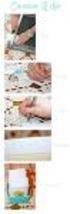
13 ORANGE MAP Name Hour Due Date Score / Every cartographer is faced with the problem of transforming the curved surface of the earth onto a flat plane with a minimum of distortion. The systematic transformation of locations on the earth (spherical surface) to locations on a map (flat surface) is called projection. It is not possible to represent, on a flat map, the spatial relationships of angle, distance, direction and area that only a glob can show faithfully. As a result, projection systems inevitably involve some distortion. There are an infinite number of possible map projections, all of which distort one or more of the characteristics at the globe in varying degrees. Each projection represents the earths round surface in a different way and has a different purpose. The orange activity is an example of how the earths round surface can be represented on a flat surface. The steps are as follows: 1. Imagine the orange as the earth and note where different continents and oceans would be located. 2. Peel the orange and attempt to keep the peel in one piece. 3. Place the peel on your blank piece of paper and flatten it out. You will be creating a map of the world with your peel as an outline. The area that the peel covers represents the entire area of the surface of the earth. All land masses and water should be accounted for on the map. 4. Begin your map of the world by locating and drawing the following important lines of latitude and longitude. a. Equator b. Prime meridian c. International date line d. Tropic of Cancer e. Tropic of Capricorn 5. Continue by drawing and labeling the seven continents as well as the oceans. a. North America b. South America c. Europe d. Asia e. Africa f. Australia g. Antarctica 6. Include TODALS on your map. a. Title b. Orientation c. Date d. Author e. Legend f. Scale 13

14 INTRO TO LATITUDE AND LONGITUDE Name Hour Due Date Score / The grid system we just learned about gives us a way to locate the exact position of different places on a map. A similar system covers the entire earth so that at any given point we can be said to have an absolute or exact location. We know that a grid is made up of two sets of lines. These lines cross each other. The grid system we use on earth is known as latitude and longitude. Use the following chart to begin to understand the basics of latitude and longitude. What is latitude? How is it measured? Lines of latitude are imaginary lines that run completely around the globe-full circles. If you travel along any of these lines you are going east and west. The equator is numbered 0 degrees or 0. The equator divides the world into two halves or hemispheres: the Northern Hemisphere and the Southern Hemisphere. All places that are north of the equator are said to have north latitude. All of the places south of the equator are said to have south latitude. All lines of latitude are parallel. This means that no matter how far two lines of latitude are extended they would never meet. Because of this fact, sometimes lines of latitude are also called parallels. In order to prevent maps from becoming too cluttered with lines, map makers show only a few degree lines of latitude, generally 10 or 20 degrees apart. The diagram below shows lines of latitude that are 10 apart. Starting from 0, the equator, the lines of latitude are numbered north and south to 90. The North Pole is 90 N, and the South Pole is 90 S. Identify the latitude of the following locations on the simple diagram. A. B. C. D. E. F. G. H. I. J. K. L. M. You can easily determine how many degrees separate one place from another place. For example, M is on the 50 N line of latitude; C is on the 10 N line of latitude. By subtracting, we find that M is 40 further north than C. How many degrees of latitude separate the following? E from J? M from H? L from G? A from C? D from B? K from I? 14

15 What is longitude? How is it measured? To locate places exactly on a globe or map it is necessary to have north-south lines-lines of longitude-that cross with the east-west lines of latitude. Once it is known where the lines cross, any place on the globe can be given an exact location. Lines of longitude are imaginary lines that extend from the North Pole to the South Pole. Lines of longitude are not parallel. All the lines meet at the North Pole and the South Pole. All of same-numbered east or west lines of longitude are equidistant apart at the equator. All lines of longitude are measured east or west of the prime meridian. Prime meridian is another way of saying the 0 line of longitude. Lines of longitude are often shown on maps as being 10 apart at the equator. Sometimes they are shown as being 15 apart, or even 30 apart. How they are spaced and numbered depends on the purpose of the map. The numbering of the lines continues for 180 to the east and 180 to the west, for a total of 360, a full circle. The prime meridian and its continuation on the other side of the world, 180, divide the world into two equal parts: The Eastern Hemisphere and the Western Hemisphere. Identify the missing numbers and the longitude of the following points on the map. A. B. C. D. E. F. G. H. I. J. 15

16 INTRO TO LATITUDE AND LONGITUDE Name Hour Due Date Score / Directions: Use the map on the next page to find the latitude and longitude for the following Canberra, Australia 2. Madrid, Spain 3. Kingston, Jamaica 4. Santiago, Chile 5. Moscow, Russia 6. Colombo, Sri Lanka 7. Athens, Greece 8. Tokyo, Japan 9. Accra, Ghana Lima, Peru Baghdad, Iraq 12. Kabul, Afghanistan 13. Washington D.C., U.S How far? Latitude N or S? How far Longitude? E or W? Directions: Use the latitude and longitude coordinates from the maps to find the following... City Continent N 116 E S 47 W N 77 W N 11 E 5. 3 S 38 E S 19 E N 1 W N 99 W 16

17 17

18 THE GEOGRAPHER S TOOLS Name Hour Due Date Score / Maps and Globes A geographer s tools include maps, globes, and data that can be displayed in a variety of ways. The oldest known map is a Babylonian clay tablet created about 2,500 years ago. The tablet is about four inches high and shows the Babylonian world surrounded by water. Over the centuries, mapmaking evolved into a very complex task. However, a map s function has remained the same to show locations of places, landforms, and bodies of water, and where they are in relation to other parts of the earth. Two Dimensions or Three A globe is a three-dimensional representation of the earth. It provides a way to view the earth as it travels through space. But since the earth is a sphere, we can see only one half of it at any time. For certain tasks, globes are not very practical because they are not easily portable. People often prefer to use maps, which are two-dimensional graphic representations of selected parts of the earth s surface. Maps are easily portable and can be drawn to any scale needed. The disadvantage of a map is that distortion occurs as the earth s surface is flattened to create the map. A cartographer, or mapmaker, reduces some types of distortion by using different types of map projections. A map projection is a way of drawing the earth s surface that reduces distortion caused by presenting a round earth on flat paper. Types of Maps The three types of maps are general reference maps, thematic maps, and navigational maps. A general reference map is sometimes called a topographic map, which is a representation of natural and man made features on the earth. Thematic maps emphasize specific kinds of information, such as climate or population density. Sailors and pilots use the third type of mapnavigation maps. The Science of Mapmaking A cartographer decides what type of map to create by considering how the map will be used. Keeping that purpose in mind, he or she then determines how much detail to show and what size the map should be. Surveying The first step in making a map is to complete a field survey. Surveyors observe, measure, and record what they see in a specific area. Today, most mapping is done by remote sensing, the gathering of geographic information from a distance by an instrument that is not physically in contact with the mapping site. These data are gathered primarily by aerial photography or by satellites. The data gathered includes information such as elevation, differences in land cover, and variations in temperature. This information is recorded and converted to a gray image. Cartographers then use these data and computer software to construct maps. Satellites Today, geographers rely heavily on satellites to provide geographic data. Two of the best-known satellites are Landsat and GOES. Landsat is actually a series of satellites that orbit more than 100 miles above the earth. Each time a satellite makes an orbit, it picks up data in an area 115 miles wide. Landsat can scan the entire earth in 16 days. Geostationary Operational Environment Satellite (GOES) is a weather satellite. This satellite flies in orbit at the same speed as the earth s rotation. By doing so, it always views the same area. It gathers images of atmospheric conditions those are useful in forecasting the weather. 18

19 Geographic Information Systems The newest tool in the geographer s toolbox is Geographic Information Systems (GIS). GIS stores information about the world in a digital database. GIS has the ability to combine information from a variety of sources and display it in ways that allow the user to visualize the use of space in different ways. When using the system, geographers must look at a problem and decide what types of geographic information would help them solve the problem. The information could include maps, aerial photographs, satellite images, or other data. Next, they select the appropriate Layers of information. Then, GIS creates a composite map combining the information. Global Positioning System A familiar tool of geographers is GPS or Global Positioning System. It was originally developed to help military forces Know exactly where they were on the earth s surface. The system uses a series of 24 satellites called Navstars, which beam information to the earth. The exact position latitude, longitude, altitude, and time is displayed on a hand held receiver. Hikers, explorers, sailors, and drivers use GPS devices to determine location. They are also used to track animals. Geographers use a variety of other tools including photographs, cross sections, models, cartograms, and population pyramids. These tools help geographers to visualize and display information for analysis. They are looking for patterns and connections in the data they find How long ago was the first map created? What function of maps has remained the same over time? 1. A 3 dimensional representation of the earth is called a. 2. A 2 dimensional representation of the earth or selected potions of the earth s surface is called a? 3. What advantages do maps have compared to a globe? 4. What is distortion? What things on a map can be distorted? 5. What is a cartographer? 6. The process of putting the round earth on a flat surface is called. 7. What are the 3 types of maps mentioned in the text? 8. Based on what you know and what you read in section 2, how do you think mapmaking has changed over time? 19

20 THE GEOGRAPHER S TOOLS Name Hour Due Date Score / Maps have guided humans through the world for almost all of time. They are considered one of the longest lasting and simplest forms of communication. Maps can contain an enormous amount of power. Power is the ability to do work. Which is what maps do: They work. They work in at least two ways. In the first, they operate effectively. They work, that is... they don t fail. On the contrary, they succeed, they achieve effects, and they get things done. Hey! It works! But of course to do this maps must work in the other way as well, that is, toil, that is labor. Map sweat, they strain, they apply themselves. The ends achieved with so much effort, the ceaseless reproduction of the culture that brings them into being. Maps are representations and simplifications of the earth s surface. Each map is made with a specific purpose in mind. Each map is intended to show something. What the map shows is a choice mad by the cartographer or person making the map? Compile a list of possible reasons to make or use a map. Be creative and try to be as specific as possible. Maps are representations and simplifications of the earth s surface. Each map is made with a specific purpose in mind. Each map is intended to show something. What the map shows is a choice mad by the cartographer or person making the map? Compile a list of possible reasons to make or use a map. Be creative and try to be as specific as possible In order to communicate, every map must include six essential components. On every map that we will make in this class we must include TODALS. T O D A L S 20

21 21
22 22
23 Projection Name Drawing (Looks Like) Used For What (BestQuality) Planar (Azimuthal) Distortions Conic Cylindrical (Merecator) Cylindrical (Interrupted) Robinson 23
24 WORLD POPULATION MAP Name Hour Due Date Score / The five color population map is an example of a special purpose map called a choropleth map. 1. Plot the data on the graph. Before we locate countries or label anything on the map, we must determine what our categories will be. Use the data from the countries ranked by population to create a line graph that shows the distribution of the countries. 2. Create 5 categories (Groups), when all the data has been plotted, create 5 categories by looking for gaps in the data. Categories should indicate that the nations of that color have something in common. 3. Locate nations on the map, and color them based on the category (population size) they are in. After you have created 5 groups, begin locating all countries in group #1 and color all of them the same color. It is necessary to write the name of each country on the map, and color the country based on the group it falls into. Latitude and longitude are include to help in locating each country. 4. Include all essential parts of the map. Title Orientation Date Author Legend Scale Country Population Continent Latitude Longitude 1 China 1,339,170,000 Asia 40 N 100 E 2 India 1,184,597,000 Asia 20 N 80 E 3 Nigeria 158,259,000 Africa 10 N 10 E 4 Japan 127,380,000 Asia 40 N 140 E 5 France 65,447,374 Europe 45 N 0 6 Thailand 63,525,062 Asia 15 N 100 E 7 South Korea 49,773,145 Asia 35 N 130 E 8 Spain 46,951,532 Europe 40 N 4W 9 North Korea 23,991,000 Asia 40 N 127 E 10 Mozambique 23,406,000 Africa 18 S 35 E In Millions 1 Billion Mozambique North Korea Spain South Korea Thailand France Japan Nigeria India China 24
25 25
26 DIRECTION AND DISTANCE ACTIVITY Name Hour Due Date Score / 1. What on the map indicates direction? 2. What on the map indicates distance? 3. If you were in Lawton, in which direction would you travel to reach each of the following destinations? Use directions such as northwest when necessary. A. Burkburnett, Texas B. Frederick, Oklahoma C. Duncan, Oklahoma D. Vernon, Texas E. Altus, Oklahoma F. Ft. Sill, Oklahoma G. Marlow, Oklahoma H. Anadarko, Oklahoma I. Electra, Texas J. Waurika, Oklahoma K. Chickasha, Oklahoma L. Hobart, Oklahoma 4. Using the scale on the map, find the distance between the following locations. A. Lawton and Hobart B. Burkburnett and Marlow C. Ft. Sill and Vernon D. Duncan and Altus E. Electra and Frederick F. Chickasha and Waurika G. Hobart and Vernon H. Marlow and Lawton I. Hobart and Altus J. Duncan and Anadarko K. Electra and Lawton 26
Introduction to Geography
 High School Unit: 1 Lesson: 1 Suggested Duration: 3 days Introduction to Lesson Synopsis: The purpose of this lesson is to introduce students to geography and geography terminology, to teach students about
SECOND GRADE 1 WEEK LESSON PLANS AND ACTIVITIES
 SECOND GRADE 1 WEEK LESSON PLANS AND ACTIVITIES UNIVERSE CYCLE OVERVIEW OF SECOND GRADE UNIVERSE WEEK 1. PRE: Discovering stars. LAB: Analyzing the geometric pattern of constellations. POST: Exploring
Stage 4. Geography. Blackline Masters. By Karen Devine
 1 Devine Educational Consultancy Services Stage 4 Geography Blackline Masters By Karen Devine Updated January 2010 2 This book is intended for the exclusive use in NSW Secondary Schools. It is meant to
The Globe Latitudes and Longitudes
 INDIAN SCHOOL MUSCAT MIDDLE SECTION DEPARTMENT OF SOCIAL SCIENCE The Globe Latitudes and Longitudes NAME: CLASS VI SEC: ROLL NO: DATE:.04.2015 I NAME THE FOLLOWING: 1. A small spherical model of the Earth:
EARTH SCIENCES - TYPES OF MAPS TEACHER GUIDE
 EARTH SCIENCES - TYPES OF MAPS TEACHER GUIDE MATERIALS: Electronic Reader - Maps 5 different types of maps (see lab) inflatable globes local topographical map Objective: To understand the uses and importance
FIRST GRADE 1 WEEK LESSON PLANS AND ACTIVITIES
 FIRST GRADE 1 WEEK LESSON PLANS AND ACTIVITIES UNIVERSE CYCLE OVERVIEW OF FIRST GRADE UNIVERSE WEEK 1. PRE: Describing the Universe. LAB: Comparing and contrasting bodies that reflect light. POST: Exploring
Lines on Maps and Globes. Cross Curricular Writing Activity Social Studies Grade 4
 Lines on Maps and Globes Cross Curricular Writing Activity Social Studies Grade 4 Fourth Grade Social Studies Standard Map: Chart/Globe The learner will be able to use maps, charts, graphs, and globes
Motion & The Global Positioning System (GPS)
 Grade Level: K - 8 Subject: Motion Prep Time: < 10 minutes Duration: 30 minutes Objective: To learn how to analyze GPS data in order to track an object and derive its velocity from positions and times.
Geography I Pre Test #1
 Geography I Pre Test #1 1. The sun is a star in the galaxy. a) Orion b) Milky Way c) Proxima Centauri d) Alpha Centauri e) Betelgeuse 2. The response to earth's rotation is a) an equatorial bulge b) polar
Send all inquiries to: Glencoe/McGraw-Hill 8787 Orion Place Columbus, Ohio 43240-4027 ISBN 0-07-824996-1. Printed in the United States of America
 Copyright by The McGraw-Hill Companies, Inc. All rights reserved. Permission is granted to reproduce the material contained herein on the condition that such material be reproduced only for classroom use;
Basic Coordinates & Seasons Student Guide
 Name: Basic Coordinates & Seasons Student Guide There are three main sections to this module: terrestrial coordinates, celestial equatorial coordinates, and understanding how the ecliptic is related to
Pre and post-visit activities - Navigating by the stars
 Pre and post-visit activities - Navigating by the stars Vocabulary List Adult Education at Scienceworks Pre-visit Activity 1: What is longitude and latitude? Activity 2: Using the Southern Cross to find
Week 1. Week 2. Week 3
 Week 1 1. What US city has the largest population? 2. Where is Aachen? 3. What is the capitol of Florida? 4. What is the longest mountain range in Spain? 5. What countries border Equador? Week 2 1. What
Solar Angles and Latitude
 Solar Angles and Latitude Objectives The student will understand that the sun is not directly overhead at noon in most latitudes. The student will research and discover the latitude ir classroom and calculate
Celestial Observations
 Celestial Observations Earth experiences two basic motions: Rotation West-to-East spinning of Earth on its axis (v rot = 1770 km/hr) (v rot Revolution orbit of Earth around the Sun (v orb = 108,000 km/hr)
World Map Lesson 4 - The Global Grid System - Grade 6+
 World Map Lesson 4 - The Global Grid System - Grade 6+ Activity Goal To use the global grid system of latitude and longitude to find specific locations on a world map. Materials Needed: A pencil, a ruler,
11A Plate Tectonics. What is plate tectonics? Setting up. Materials
 11A Plate Tectonics What is plate tectonics? Earth s crust plus the upper mantle forms the lithosphere. Earth s lithosphere is broken in a number of different pieces. How these pieces move and interact
OBJECTIVES. Identify the means by which latitude and longitude were created and the science upon which they are based.
 Name: Key OBJECTIVES Correctly define: isolines, gradient, topographic map, contour interval, hachured lines, profile, latitude, longitude, hydrosphere, lithosphere, atmosphere, elevation, model EARTH
Measuring Your Latitude from the Angle of the Sun at Noon
 Measuring Your Latitude from the Angle of the Sun at Noon Background: You can measure your latitude in earth's northern hemisphere by finding out the altitude of the celestial equator from the southern
SESSION 8: GEOGRAPHIC INFORMATION SYSTEMS AND MAP PROJECTIONS
 SESSION 8: GEOGRAPHIC INFORMATION SYSTEMS AND MAP PROJECTIONS KEY CONCEPTS: In this session we will look at: Geographic information systems and Map projections. Content that needs to be covered for examination
compass Encyclopedic Entry
 This website would like to remind you: Your browser (Apple Safari 7) is out of date. Update your browser for more security, comfort and the best experience on this site. Encyclopedic Entry compass For
Seventh Grade Social Studies. Unit 1: Geography of the Eastern Hemisphere
 Seventh Grade Social Studies Unit 1: Big Picture Graphic Overarching Question: How can the fundamental themes of geography be used to describe the Eastern Hemisphere? Previous Unit: Grade 6 Australia and
Discovering Math: Exploring Geometry Teacher s Guide
 Teacher s Guide Grade Level: 6 8 Curriculum Focus: Mathematics Lesson Duration: Three class periods Program Description Discovering Math: Exploring Geometry From methods of geometric construction and threedimensional
Unit One Study Guide
 Unit One Study Guide Terms BCE: Before the Common Era. Referring to the time before Christ s birth. CE: Common Era. Referring to the time after Christ s birth. BC: Before Christ. Referring to the time
MD5-26 Stacking Blocks Pages 115 116
 MD5-26 Stacking Blocks Pages 115 116 STANDARDS 5.MD.C.4 Goals Students will find the number of cubes in a rectangular stack and develop the formula length width height for the number of cubes in a stack.
SOUTH AMERICA CONTENTS. What s in This Book... 2. Section 1: South America in the World... 3. Section 2: Political Divisions of South America...
 SOUTH CONTENTS What s in This Book 2 Section 1: 3 Section 2: Political Divisions of 1 Section 3: Physical Features of 41 Section 4: Valuable Resources of 67 Section : n Culture 89 Section 6: Assessment
Numeracy and mathematics Experiences and outcomes
 Numeracy and mathematics Experiences and outcomes My learning in mathematics enables me to: develop a secure understanding of the concepts, principles and processes of mathematics and apply these in different
Earth Coordinates & Grid Coordinate Systems
 Earth Coordinates & Grid Coordinate Systems How do we model the earth? Datums Datums mathematically describe the surface of the Earth. Accounts for mean sea level, topography, and gravity models. Projections
Coordinate Systems. Orbits and Rotation
 Coordinate Systems Orbits and Rotation Earth orbit. The earth s orbit around the sun is nearly circular but not quite. It s actually an ellipse whose average distance from the sun is one AU (150 million
The Earth Really is Flat! The Globe and Coordinate Systems. Long History of Mapping. The Earth is Flat. Long History of Mapping
 The Earth Really is Flat! The Globe and Coordinate Systems Intro to Mapping & GIS The Earth is Flat Day to day, we live life in a flat world sun rises in east, sets in west sky is above, ground is below
Exploring Our World with GIS Lesson Plans Engage
 Exploring Our World with GIS Lesson Plans Engage Title: Exploring Our Nation 20 minutes *Have students complete group work prior to going to the computer lab. 2.List of themes 3. Computer lab 4. Student
Grades 3-5. Benchmark A: Use map elements or coordinates to locate physical and human features of North America.
 Grades 3-5 Students use knowledge of geographic locations, patterns and processes to show the interrelationship between the physical environment and human activity, and to explain the interactions that
Direction and Distance
 Lesson 1 hat You ill Learn To identify direction and distance information from maps Reading trategy Create a diagram like the one below to list the cardinal and intermediate directions. arth Terms to Know
MAPS AND GLOBES: WHERE IN THE WORLD ARE WE?
 MAPS AND GLOBES: WHERE IN THE WORLD ARE WE? Grade Level: Kindergarten Presented by: Karen Davis and Tamara Young, Tate Elementary, Van Buren, AR Length of unit:5 lessons I. ABSTRACT A. This unit focuses
The following words and their definitions should be addressed before completion of the reading:
 Seasons Vocabulary: The following words and their definitions should be addressed before completion of the reading: sphere any round object that has a surface that is the same distance from its center
Maps and Cartography
 Maps and Cartography GIS Research & Map Collection Maps Tutorial: The Elements of a Map Ball State University Libraries A destination for research, learning, and friends The Map: A Geographer s Most Important
WE VE GOT THE WHOLE WORLD IN OUR HANDS: Geography Spatial Sense
 WE VE GOT THE WHOLE WORLD IN OUR HANDS: Geography Spatial Sense Grade Level: Written by: Length of Unit: Third Grade Wendy S. Hyndman, The Classical Academy, Colorado Springs, CO Doreen W. Jennings, Lincoln
The Basics of Navigation
 The Basics of Navigation Knowledge of map reading and the use of the compass is an indispensable skill of bushcraft. Without this skill, a walker is a passenger and mere follower on a trip. To become a
SECOND GRADE PLATE TECTONICS 1 WEEK LESSON PLANS AND ACTIVITIES
 SECOND GRADE PLATE TECTONICS 1 WEEK LESSON PLANS AND ACTIVITIES PLATE TECTONIC CYCLE OVERVIEW OF SECOND GRADE VOLCANOES WEEK 1. PRE: Investigating the parts of a volcano. LAB: Comparing the parts of a
The Size & Shape of the Galaxy
 name The Size & Shape of the Galaxy The whole lab consists of plotting two graphs. What s the catch? Aha visualizing and understanding what you have plotted of course! Form the Earth Science Picture of
CELESTIAL CLOCK - THE SUN, THE MOON, AND THE STARS
 INTRODUCTION CELESTIAL CLOCK - THE SUN, THE MOON, AND THE STARS This is a scientific presentation to provide you with knowledge you can use to understand the sky above in relation to the earth. Before
Geometry Notes PERIMETER AND AREA
 Perimeter and Area Page 1 of 57 PERIMETER AND AREA Objectives: After completing this section, you should be able to do the following: Calculate the area of given geometric figures. Calculate the perimeter
Plotting and Adjusting Your Course: Using Vectors and Trigonometry in Navigation
 Plotting and Adjusting Your Course: Using Vectors and Trigonometry in Navigation ED 5661 Mathematics & Navigation Teacher Institute August 2011 By Serena Gay Target: Precalculus (grades 11 or 12) Lesson
Grade 4 Unit 3: Multiplication and Division; Number Sentences and Algebra
 Grade 4 Unit 3: Multiplication and Division; Number Sentences and Algebra Activity Lesson 3-1 What s My Rule? page 159) Everyday Mathematics Goal for Mathematical Practice GMP 2.2 Explain the meanings
Where in the World is the arctic?
 Where in the World is the arctic? Summary: Students map the arctic in relation to their home in order to learn the location and countries of the arctic. Grade Level: 3-4; 5-8; K-2 Time one class period.
Phases of the Moon. Preliminaries:
 Phases of the Moon Sometimes when we look at the Moon in the sky we see a small crescent. At other times it appears as a full circle. Sometimes it appears in the daylight against a bright blue background.
Lesson #13 Congruence, Symmetry and Transformations: Translations, Reflections, and Rotations
 Math Buddies -Grade 4 13-1 Lesson #13 Congruence, Symmetry and Transformations: Translations, Reflections, and Rotations Goal: Identify congruent and noncongruent figures Recognize the congruence of plane
Step 2: Learn where the nearest divergent boundaries are located.
 What happens when plates diverge? Plates spread apart, or diverge, from each other at divergent boundaries. At these boundaries new ocean crust is added to the Earth s surface and ocean basins are created.
UTM: Universal Transverse Mercator Coordinate System
 Practical Cartographer s Reference #01 UTM: Universal Transverse Mercator Coordinate System 180 174w 168w 162w 156w 150w 144w 138w 132w 126w 120w 114w 108w 102w 96w 90w 84w 78w 72w 66w 60w 54w 48w 42w
What Causes Climate? Use Target Reading Skills
 Climate and Climate Change Name Date Class Climate and Climate Change Guided Reading and Study What Causes Climate? This section describes factors that determine climate, or the average weather conditions
1. I have 4 sides. My opposite sides are equal. I have 4 right angles. Which shape am I?
 Which Shape? This problem gives you the chance to: identify and describe shapes use clues to solve riddles Use shapes A, B, or C to solve the riddles. A B C 1. I have 4 sides. My opposite sides are equal.
N Q.3 Choose a level of accuracy appropriate to limitations on measurement when reporting quantities.
 Performance Assessment Task Swimming Pool Grade 9 The task challenges a student to demonstrate understanding of the concept of quantities. A student must understand the attributes of trapezoids, how to
Lines of Latitude and Longitude
 ED 5661 Mathematics & Navigation Teacher Institute Keith Johnson Lesson Plan Lines of Latitude and Longitude Lesson Overview: This lesson plan will introduce students to latitude and longitude along with
Allison Gallahan s Early Childhood Lesson Plan
 Allison Gallahan s Early Childhood Lesson Plan Lesson: Big Book: Reading Maps Length: 20-30 minutes Age or Grade Level Intended: 2 nd Grade Academic Standard(s): Social Studies 2.3.2: The World in Spatial
Lecture 2. Map Projections and GIS Coordinate Systems. Tomislav Sapic GIS Technologist Faculty of Natural Resources Management Lakehead University
 Lecture 2 Map Projections and GIS Coordinate Systems Tomislav Sapic GIS Technologist Faculty of Natural Resources Management Lakehead University Map Projections Map projections are mathematical formulas
Searching Land Records thru the BLM General Land Office Records.
 Searching Land Records thru the BLM General Land Office Records. Land Records can be an exciting addition to your family history search. The United States Government transferred ownership of land to millions
Geography at GISSV: An Introduction to the Curriculum
 Geography at GISSV: An Introduction to the Curriculum Classes Geography is taught for two hours per week in Grades 5-9. The only exception is in Grade 8, where class is taught for one hour per week for
Previous Letterland at Tweetsie Railroad Motivation and reward Letterland at Tweetsie Curriculum Guides
 Previous Letterland at Tweetsie Railroad Each May since 2007, children from all over North Carolina (and Texas and Georgia) have come to Letterland at Tweetsie Railroad, where we have transformed our theme
Activity 10 - Universal Time
 Activity 10 - Universal Time Teacher s Guide Scientists use the Universal Time reference to talk about data that is taken around the globe. Universal Time is the time kept in the time zone centered on
An Introduction to Coordinate Systems in South Africa
 An Introduction to Coordinate Systems in South Africa Centuries ago people believed that the earth was flat and notwithstanding that if this had been true it would have produced serious problems for mariners
Intermediate PowerPoint
 Intermediate PowerPoint Charts and Templates By: Jim Waddell Last modified: January 2002 Topics to be covered: Creating Charts 2 Creating the chart. 2 Line Charts and Scatter Plots 4 Making a Line Chart.
DATA VISUALIZATION GABRIEL PARODI STUDY MATERIAL: PRINCIPLES OF GEOGRAPHIC INFORMATION SYSTEMS AN INTRODUCTORY TEXTBOOK CHAPTER 7
 DATA VISUALIZATION GABRIEL PARODI STUDY MATERIAL: PRINCIPLES OF GEOGRAPHIC INFORMATION SYSTEMS AN INTRODUCTORY TEXTBOOK CHAPTER 7 Contents GIS and maps The visualization process Visualization and strategies
Lesson 26: Reflection & Mirror Diagrams
 Lesson 26: Reflection & Mirror Diagrams The Law of Reflection There is nothing really mysterious about reflection, but some people try to make it more difficult than it really is. All EMR will reflect
Chapter 4: The Concept of Area
 Chapter 4: The Concept of Area Defining Area The area of a shape or object can be defined in everyday words as the amount of stuff needed to cover the shape. Common uses of the concept of area are finding
Tropical Horticulture: Lecture 2
 Lecture 2 Theory of the Tropics Earth & Solar Geometry, Celestial Mechanics The geometrical relationship between the earth and sun is responsible for the earth s climates. The two principal movements of
Geometry Notes VOLUME AND SURFACE AREA
 Volume and Surface Area Page 1 of 19 VOLUME AND SURFACE AREA Objectives: After completing this section, you should be able to do the following: Calculate the volume of given geometric figures. Calculate
STANDARD 3.1 Greece & Rome. STANDARD 3.2 - Mali
 2008 Curriculum Framework Grade Three Social Studies Standards Condensed format created by SOLpass. www.solpass.org Key: red text highlights NEW (2008 revision) content; crossout indicates content cut
Give students a lesson in navigation from the points of the compass to GPS mapping.
 Lesson 5: Teaching Directions, Maps, and Coordinates Give students a lesson in navigation from the points of the compass to GPS mapping. by Jenny Parma; curriculum by Diane Petersen and Karen Dvornich
4 The Rhumb Line and the Great Circle in Navigation
 4 The Rhumb Line and the Great Circle in Navigation 4.1 Details on Great Circles In fig. GN 4.1 two Great Circle/Rhumb Line cases are shown, one in each hemisphere. In each case the shorter distance between
Unit 1 Number Sense. In this unit, students will study repeating decimals, percents, fractions, decimals, and proportions.
 Unit 1 Number Sense In this unit, students will study repeating decimals, percents, fractions, decimals, and proportions. BLM Three Types of Percent Problems (p L-34) is a summary BLM for the material
Investigation 6: What happens when plates collide?
 Tectonics Investigation 6: Teacher Guide Investigation 6: What happens when plates collide? In this activity, students will use the distribution of earthquakes and volcanoes in a Web GIS to learn about
PUSD High Frequency Word List
 PUSD High Frequency Word List For Reading and Spelling Grades K-5 High Frequency or instant words are important because: 1. You can t read a sentence or a paragraph without knowing at least the most common.
Grade 1 Geometric Shapes Conceptual Lessons Unit Outline Type of Knowledge & SBAC Claim Prerequisite Knowledge:
 Grade 1 Geometric Shapes Conceptual Lessons Unit Outline Type of Knowledge & SBAC Claim Prerequisite Knowledge: Standards: Lesson Title and Objective/Description Shape names: square, rectangle, triangle,
Space Exploration Classroom Activity
 Space Exploration Classroom Activity The Classroom Activity introduces students to the context of a performance task, so they are not disadvantaged in demonstrating the skills the task intends to assess.
Minnesota Academic Standards
 A Correlation of to the Minnesota Academic Standards Grades K-6 G/M-204 Introduction This document demonstrates the high degree of success students will achieve when using Scott Foresman Addison Wesley
BASICS OF PRECISION AGRICULTURE (PA)
 BASICS OF PRECISION AGRICULTURE (PA) specific production on particular place specific production, from foot to foot... Same sense: data collection and decision making for small pieces of the field. Particular
Topographic Maps Practice Questions and Answers Revised October 2007
 Topographic Maps Practice Questions and Answers Revised October 2007 1. In the illustration shown below what navigational features are represented by A, B, and C? Note that A is a critical city in defining
Allows teachers to print reports for individual students or an entire class.
 Map and Globe Skills Developed by teachers and geography specialists, Map and Globe Skills provides the strategies, skills and practice your students need to develop a strong understanding of basic mapping
Revision Notes Adult Numeracy Level 2
 Revision Notes Adult Numeracy Level 2 Place Value The use of place value from earlier levels applies but is extended to all sizes of numbers. The values of columns are: Millions Hundred thousands Ten thousands
Earth Science & Environmental Science SOL
 Earth Science & Environmental Science SOL THE SOL FOR GRADE 6 The Virginia Science SOL for Grades K 6 are organized according to a set of strands, with the SOL in each strand developed progressively through
Lab Activity on the Causes of the Seasons
 Lab Activity on the Causes of the Seasons 2002 Ann Bykerk-Kauffman, Dept. of Geological and Environmental Sciences, California State University, Chico * Objectives When you have completed this lab you
Exercise 5.0 LUNAR MOTION, ELONGATION, AND PHASES
 Exercise 5.0 LUNAR MOTION, ELONGATION, AND PHASES I. Introduction The Moon's revolution in orbit around the center of gravity (barycenter) of the Earth- Moon System results in an apparent motion of the
CONTENTS. Page 3 What is orienteering? Page 4 Activity: orienteering map bingo. Page 5 Activity: know your colours. Page 6 Choosing your compass
 THE RIGHT DIRECTION SCOUT ORIENTEER ACTIVITY BADGE CONTENTS Page What is orienteering? Page 4 Activity: orienteering map bingo Page 5 Activity: know your colours Page 6 Choosing your compass Page 7 Activity:
Shape Dictionary YR to Y6
 Shape Dictionary YR to Y6 Guidance Notes The terms in this dictionary are taken from the booklet Mathematical Vocabulary produced by the National Numeracy Strategy. Children need to understand and use
Mathematics K 6 continuum of key ideas
 Mathematics K 6 continuum of key ideas Number and Algebra Count forwards to 30 from a given number Count backwards from a given number in the range 0 to 20 Compare, order, read and represent to at least
Lecture 3: Models of Spatial Information
 Lecture 3: Models of Spatial Information Introduction In the last lecture we discussed issues of cartography, particularly abstraction of real world objects into points, lines, and areas for use in maps.
Map Patterns and Finding the Strike and Dip from a Mapped Outcrop of a Planar Surface
 Map Patterns and Finding the Strike and Dip from a Mapped Outcrop of a Planar Surface Topographic maps represent the complex curves of earth s surface with contour lines that represent the intersection
READING THE NEWSPAPER
 READING THE NEWSPAPER Outcome (lesson objective) Students will comprehend and critically evaluate text as they read to find the main idea. They will construct meaning as they analyze news articles and
6. The greatest atmospheric pressure occurs in the 1) troposphere 3) mesosphere 2) stratosphere 4) thermosphere
 1. The best evidence of the Earth's nearly spherical shape is obtained through telescopic observations of other planets photographs of the Earth from an orbiting satellite observations of the Sun's altitude
Sun Earth Relationships
 1 ESCI-61 Introduction to Photovoltaic Technology Sun Earth Relationships Ridha Hamidi, Ph.D. Spring (sun aims directly at equator) Winter (northern hemisphere tilts away from sun) 23.5 2 Solar radiation
Sample Pages. Free E-mail Newsletter Sign up Today! Learn Through Experience
 Learn Through Experience Sample Pages Sample pages from this product are provided for evaluation purposes. The entire product is available for purchase at www.socialstudies.com or www.teachinteract.com
How Do Oceans Affect Weather and Climate?
 How Do Oceans Affect Weather and Climate? In Learning Set 2, you explored how water heats up more slowly than land and also cools off more slowly than land. Weather is caused by events in the atmosphere.
Orientation to the Sky: Apparent Motions
 Chapter 2 Orientation to the Sky: Apparent Motions 2.1 Purpose The main goal of this lab is for you to gain an understanding of how the sky changes during the night and over the course of a year. We will
Full credit for this chapter to Prof. Leonard Bachman of the University of Houston
 Chapter 6: SOLAR GEOMETRY Full credit for this chapter to Prof. Leonard Bachman of the University of Houston SOLAR GEOMETRY AS A DETERMINING FACTOR OF HEAT GAIN, SHADING AND THE POTENTIAL OF DAYLIGHT PENETRATION...
Experiment 5: Magnetic Fields of a Bar Magnet and of the Earth
 MASSACHUSETTS INSTITUTE OF TECHNOLOGY Department of Physics 8.02 Spring 2005 Experiment 5: Magnetic Fields of a Bar Magnet and of the Earth OBJECTIVES 1. To examine the magnetic field associated with a
Session 6 Number Theory
 Key Terms in This Session Session 6 Number Theory Previously Introduced counting numbers factor factor tree prime number New in This Session composite number greatest common factor least common multiple
Magnetic Storm PROGRAM OVERVIEW
 Magnetic Storm PROGRAM OVERVIEW NOVA explores what creates Earth s magnetic field and why it might be headed for a reversal. Solar Wind Earth The program: explains how scientists think Earth s magnetic
CLIMATE, WATER & LIVING PATTERNS THINGS
 CLIMATE, WATER & LIVING PATTERNS NAME THE SIX MAJOR CLIMATE REGIONS DESCRIBE EACH CLIMATE REGION TELL THE FIVE FACTORS THAT AFFECT CLIMATE EXPLAIN HOW THOSE FACTORS AFFECT CLIMATE DESCRIBE HOW CLIMATES
6 th Grade Vocabulary-ALL CAMPUSES
 6 th Grade Vocabulary-ALL CAMPUSES 6.1 History. The student understands that historical events influence contemporary events. (B) analyze the historical background of the United States to evaluate relationships
Which month has larger and smaller day time?
 ACTIVITY-1 Which month has larger and smaller day time? Problem: Which month has larger and smaller day time? Aim: Finding out which month has larger and smaller duration of day in the Year 2006. Format