
Computer Network Foundation. Chun-Jen (James) Chung. Arizona State University
|
|
|
- Magnus Wells
- 9 years ago
- Views:
Transcription
1 Computer Network Foundation Chun-Jen (James) Chung 1

2 Outline Network Addressing Subnetting Classless Inter-Domain Routing (CIDR) Route Aggregation
3 Network Addressing How does the network decide where to send a packet??? All Hosts on the network have an address that can be used to route the packet.

4 IP Address (As Originally Specified) Two levels IP address (32-bits) Network Number (Net ID) Host Number (Node ID) Class A Class B Class C Class D Class E Network Number Host Number Network Number Host Number Network Number (21 bits) Host Number Multicast group ID (28 bits) Reserved for future use (27 bits)

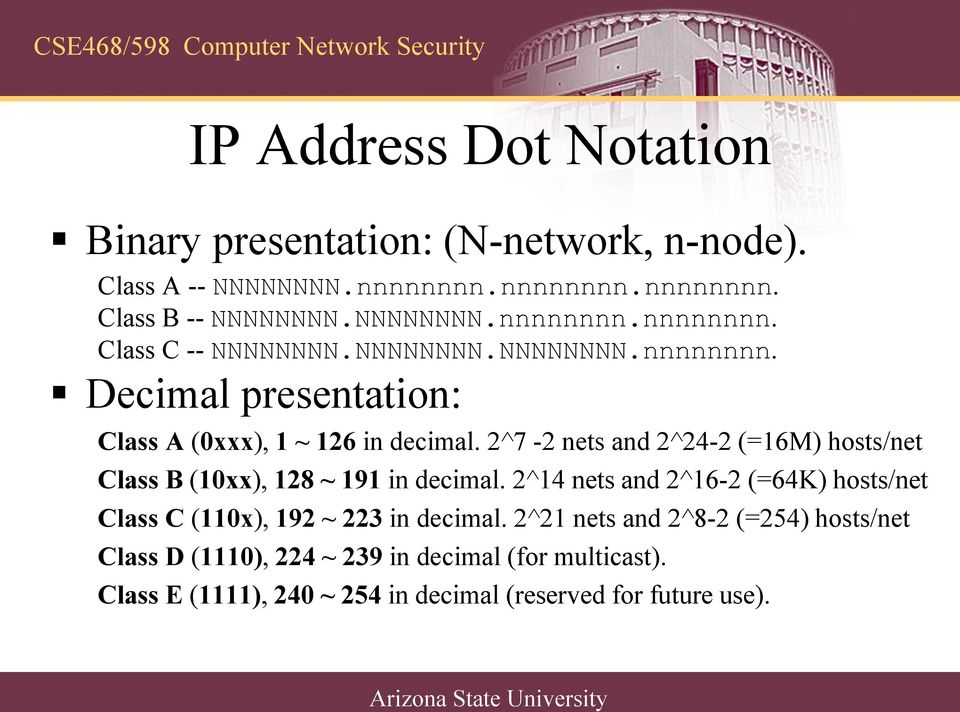
5 IP Address Dot Notation Binary presentation: (N-network, n-node). Class A -- NNNNNNNN.nnnnnnnn.nnnnnnnn.nnnnnnnn. Class B -- NNNNNNNN.NNNNNNNN.nnnnnnnn.nnnnnnnn. Class C -- NNNNNNNN.NNNNNNNN.NNNNNNNN.nnnnnnnn. Decimal presentation: Class A (0xxx), 1 ~ 126 in decimal. 2^7-2 nets and 2^24-2 (=16M) hosts/net Class B (10xx), 128 ~ 191 in decimal. 2^14 nets and 2^16-2 (=64K) hosts/net Class C (110x), 192 ~ 223 in decimal. 2^21 nets and 2^8-2 (=254) hosts/net Class D (1110), 224 ~ 239 in decimal (for multicast). Class E (1111), 240 ~ 254 in decimal (reserved for future use).
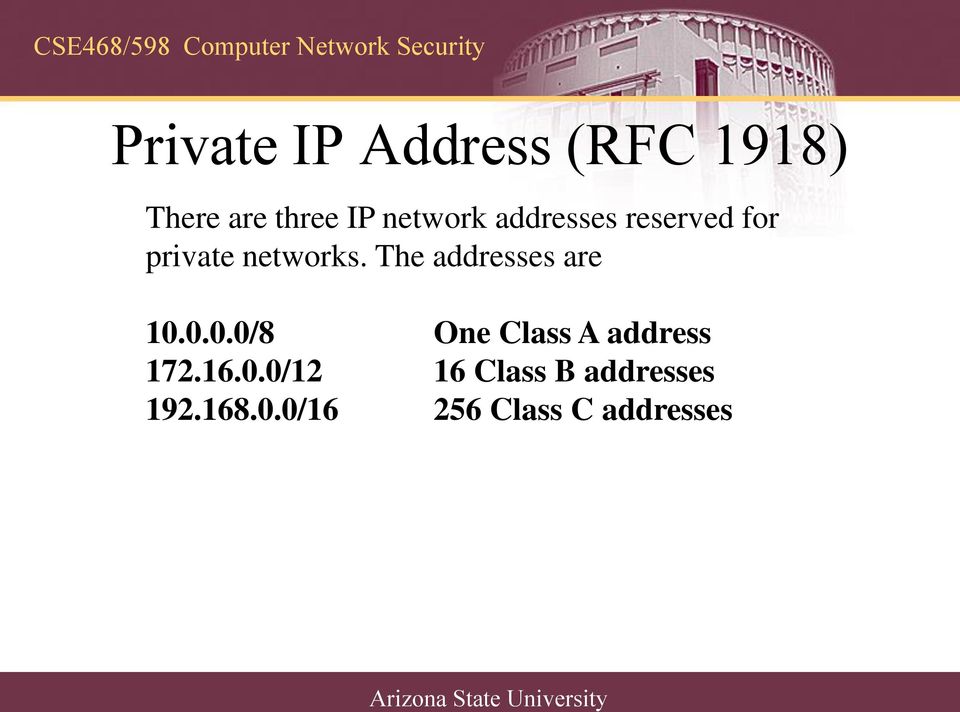
6 Private IP Address (RFC 1918) There are three IP network addresses reserved for private networks. The addresses are /8 One Class A address /12 16 Class B addresses / Class C addresses
7 Limitations of Classful IP Addressing Designed almost 40 years later Only 3 classes of networks Address space used inefficiently For example, if a network needs to support 260 hosts, which class of address it requires? How many addresses waste?

8 Subnetting IETF RFC 950: Create multiple logical networks that exist within a single class. Two levels classful hierarchy Network Prefix Host Number Three levels subnet hierarchy Network Prefix Subnet Number Host Number Extended Network Pre-fix (network Identifier) Network Prefix Subnet Number Host Number

9 Subnet Masking Applying a subnet mask to an IP address allows you to identify the network and node parts of the address. The network bits are represented by the 1s in the mask, and the node bits are represented by the 0s. Performing a bitwise logical AND operation between the IP address and the subnet mask results in the Network Address or Identifier. & ) Example: Class B IP Address Default Class B Subnet Mask Network Address

10 Subnetting Presentation: Binary Presentation: Class A Class B Class C Decimal Presentation: Class A Class B Class C / or Length presentation (CIDR notation) Class A - /8 Class B - /16 Class C - /24

11 Extended Network Prefix Subnet Masks A subnet address cannot be all "0"s or all "1"s. This also implies that a 1 bit subnet mask is not allowed Example: Extended Network Prefix Network Prefix IP Address Subnet Mask Subnet Address Broadcast Address /19 How many subnets do we have from above example?

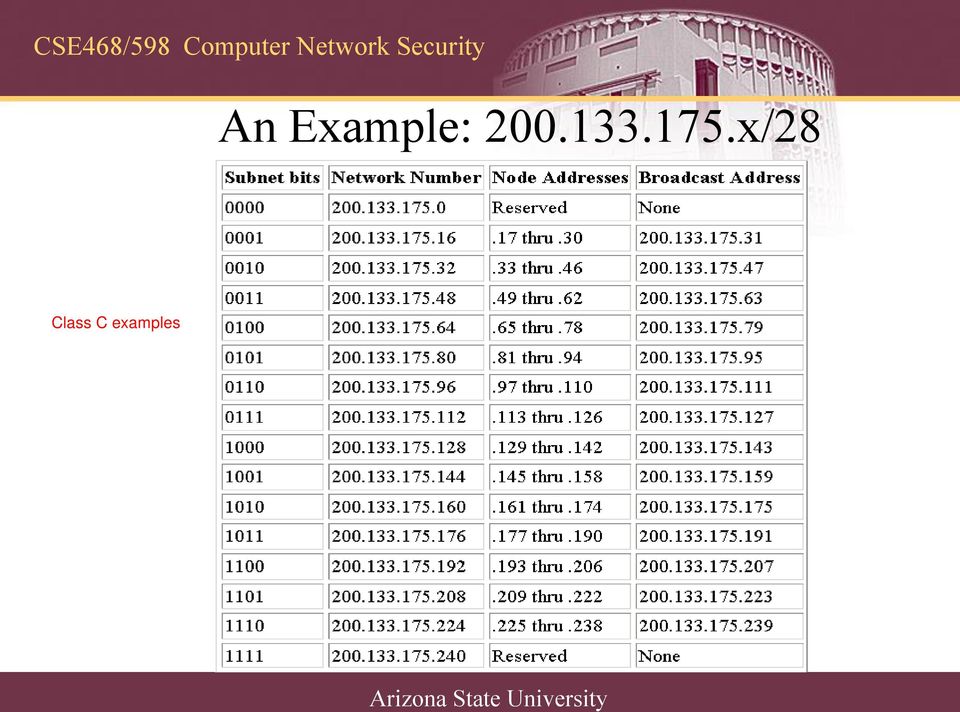
12 An Example: x/28
13 Subnet Design Considerations 1) How many total subnets does the organization need today? 2) How many total subnets will the organization need in the future? 3) How many hosts are there on the organization's largest subnet today? 4) How many hosts will there be on the organization's largest subnet in the future?

14 Design Examples Subnet Example #1 Given An organization has been assigned the network number /24 and it needs to define 6 subnets. The largest subnet is required to support 25 hosts.

15 Design Examples - Continued Base Net: = /24 Subnet #0: = /27 Subnet #1: = /27 Subnet #2: = /27 Subnet #3: = /27 Subnet #4: = /27 Subnet #5: = /27 Subnet #6: = /27 Subnet #7: = /27

16 Defining Host Address for Each Subnet The all-1s host-number and all 0s host-number are both reserved. In our current example, there are 5 bits in the host-number field of each subnet address. This means that each subnet represents a block of 30 host addresses. The hosts on each subnet are numbered 1 through 30.

17 Defining Host Address for Each Subnet Subnet #2: = /27 Host #1: = /27 Host #2: = /27 Host #3: = /27 Host #4: = /27 Host #5: = /27.. Host #15: = /27 Host #16: = /27.. Host #27: = /27 Host #28: = /27 Host #29: = /27 Host #30: = /27 Defining the Broadcast Address for Subnet #2 The broadcast address for Subnet #2 is the all 1's host address or: =

18 Design Examples Subnet Example #2 Given An organization has been assigned the network number /16 and it needs to create a set of subnets that supports up to 60 hosts on each subnet / /16 How many subnets can be created?

19 Design Examples - Continued Subnet Example #2 Given An organization has been assigned the network number /16 and it needs to create a set of subnets that supports up to 60 hosts on each subnet / /26 subnet #1, host /26 etc. How many hosts for each subnet?

20 An Example / / / / / / / / / / /19

21 Pros and Cons of Subnetting Advantages Assign IP address more efficiently Speeds up the network (reduce the size of broadcast domain) Easy to organize the network resources Improve security Disadvantages Added layer of complexity (more routers) Difficult to change once hierarchy is established. 21
22 Internet Scaling Problem 1 The eventual depletion of the IP address space.
23 Internet Scaling Problem 2 The rapid growth in the size of the Internet routing This makes the routers both slower (in terms of identifying routes) and more expensive (because of the increased routing table capacity)
24 CIDR -- Classless InterDomain Routing CIDR was officially documented in September 1993 in RFC 1517, 1518, 1519, and CIDR : Breaks the rigid boundaries between class A, B, C Allocate IPv4 address more efficiently Supports Route Aggregation Single routing entry in the routing table to specify how to route traffic to many individual network addresses.
25 CIDR -- Classless InterDomain Routing Superneting Example: /24 ( ) Class C address /24 ( ) Class C address /24 ( ) Class C address /24 ( ) Class C address /22 ( ) Supernet ( ) Supernet Mask ( ) Broadcast address So classful addresses can easily be written in CIDR notation (Class A = /8, Class B = /16, and Class C = /24)
26 CIDR Address Blocks Example CIDR Dotted-Decimal mask # of addresses # of Classful Networks / K 8 Bs or 2048 Cs / K 4 Bs or 1024 Cs / K 2 Bs or 512 Cs / K 1 B or 256 Cs / K 128 Cs / K 64 Cs / K 32 Cs / K 16 Cs / C / ½ C 26
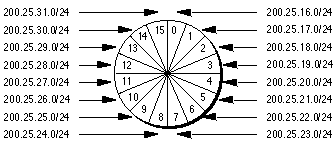
27 CIDR Address Allocation Example Assume that an ISP owns the address block /16. This block represents 65, 536 (2^16) IP addresses (or 256 /24s). If the ISP wants to allocate the /20 address block. In a classful environment, this smaller block represents 4,096 (2^12) IP addresses (or 16 /24s). In a classless environment, the ISP is free to cut up the pie any way it wants. One-half of the address space for Organization A One-fourth of the address space for Organization B One-eight of the address space for Organization C and Organization D
28 CIDR Example - Continued Step #1: Divide the address block /20 into two equal size slices. Each block represents one-half of the address space or 2,048 (2^11) IP addresses. ISP's Block /20 Org A: /21 Reserved: /21 Step #2: Divide the reserved block ( /21) into two equal size slices. Each block represents one-fourth of the address space or 1,024 (2^10) IP addresses. Reserved /21 Org B: /22 Reserved /22 Step #3: Divide the reserved address block ( /22) into two equal size blocks. Each block represents one-eight of the address space or 512 (2^9) IP addresses. Reserved /22 Org C: /23 Org D: /23 28

29 Route Aggregation
30 Longest Prefix Match Forwarding Forwarding tables in IP routers Maps each IP prefix to next-hop link(s) Destination-based forwarding Packet has a destination address in the IP Header Router identifies longest-matching prefix destination forwarding table / / / / /24 outgoing link Serial0/0.1

31 IP Forwarding Routing table of R2

32 IP Forwarding - Continued Routing table of the center router
33 Summary Protocol Stacks and Layering Network Addressing Subnetting CIDR Route Aggregation IPv6 is the future?
Tutorial (03) IP addresses & Sub netting
 Tutorial (03) IP addresses & Sub netting Dr. Ahmed M. ElShafee ١ Agenda IP Addressing Conventions Original IPv4 Address Classes Subnetting CIDR (Classless InterDomain Routing) ٢ IP Addressing Conventions
CE363 Data Communications & Networking. Chapter 6 Network Layer: Logical Addressing
 CE363 Data Communications & Networking Chapter 6 Network Layer: Logical Addressing TCP/IP and OSI model APPLICATION APPLICATION PRESENTATION SESSION TRANSPORT NETWORK Host-Network TRANSPORT NETWORK DATA
IP Addressing. IP Addresses. Introductory material.
 IP Addressing Introductory material. An entire module devoted to IP addresses. IP Addresses Structure of an IP address Classful IP addresses Limitations and problems with classful IP addresses Subnetting
APPENDIX B. Routers route based on the network number. The router that delivers the data packet to the correct destination host uses the host ID.
 APPENDIX B IP Subnetting IP Addressing Routers route based on the network number. The router that delivers the data packet to the correct destination host uses the host ID. IP Classes An IP address is
IP Addressing Introductory material.
 IP Addressing Introductory material. A module devoted to IP addresses. Addresses & Names Hardware (Layer 2) Lowest level Ethernet (MAC), Serial point-to-point,.. Network (Layer 3) IP IPX, SNA, others Transport
Advanced IP Addressing
 Advanced IP Addressing CS-765 A Aspects Of Systems Administration Spring-2005 Instructure: Jan Schauman Stevens Institute Of Technology, NJ. Prepared By: Modh, Jay A. M.S. NIS SID: 999-14-0352 Date: 05/02/2005
Classful IP Addressing (cont.)
 Classful IP Addressing (cont.) 1 Address Prefix aka Net ID defines the network Address Suffix aka Host ID defines the node In Classful addressing, prefix is of fixed length (1, 2, or 3 bytes)! Classful
Chapter 19 Network Layer: Logical Addressing 19.1
 Chapter 19 Network Layer: Logical Addressing 19.1 Copyright The McGraw-Hill Companies, Inc. Permission required for reproduction or display. 19-1 IPv4 ADDRESSES An IPv4 address is a 32-bit address that
1. How many unique network IDs are there in class A addresses? # of unique hosts?
 CS445: IPv4 Addresses In-class activity Names: Part 1: Address Classes Original three classes of IPv4 addresses: A: 0 network (7 bits) host (24 bits) B: 10 network (14 bits) host (16 bits) C: 110 network
How To Make A Network Address Prefix Smaller
 CSC521 Communication Protocols 網 路 通 訊 協 定 Ch.9 Classless And Subnet Address Extensions (CIDR) 吳 俊 興 國 立 高 雄 大 學 資 訊 工 程 學 系 Outline 1. Introduction 2. Review Of Relevant Facts 3. Minimizing Network Numbers
PART IV. Network Layer
 PART IV Network Layer Position of network layer Network layer duties Internetworking : heterogeneous Physical Networks To look Like a single network to he upper layers The address at Network layer must
CCNA Tutorial Series SUBNETTING
 CCNA Tutorial Series This document contains the Course Map For The Interactive flash tutorial at: http://www.semsim.com/ccna/tutorial/subnetting/subnetting.html HOME PAGE Course Objectives Pre-test By
IP Addressing A Simplified Tutorial
 Application Note IP Addressing A Simplified Tutorial July 2002 COMPAS ID 92962 Avaya Labs 1 All information in this document is subject to change without notice. Although the information is believed to
IP Addressing. -Internetworking (with TCP/IP) -Classful addressing -Subnetting and Supernetting -Classless addressing
 IP Addressing -Internetworking (with TCP/IP) -Classful addressing -Subnetting and Supernetting -Classless addressing Internetworking The concept of internetworking: we need to make different networks communicate
WHITE PAPER. Understanding IP Addressing: Everything You Ever Wanted To Know
 WHITE PAPER Understanding IP Addressing: Everything You Ever Wanted To Know Understanding IP Addressing: Everything You Ever Wanted To Know CONTENTS Internet Scaling Problems 1 Classful IP Addressing 3
Lab#2: IP Addressing and Subnetting
 IP Addressing Lab#2: IP Addressing and Subnetting Each Network Interface Card (NIC or Network card) present in a PC is assigned one Network address called as IP address. This IP address is assigned by
Internetworking and Internet-1. Global Addresses
 Internetworking and Internet Global Addresses IP servcie model has two parts Datagram (connectionless) packet delivery model Global addressing scheme awaytoidentifyall H in the internetwork Properties
Guide to TCP/IP, Third Edition. Chapter 2: IP Addressing and Related Topics
 Guide to TCP/IP, Third Edition Chapter 2: IP Addressing and Related Topics Objectives Understand IP addressing, anatomy and structures, and addresses from a computer s point of view Recognize and describe
Internet Protocol Address
 SFWR 4C03: Computer Networks & Computer Security Jan 17-21, 2005 Lecturer: Kartik Krishnan Lecture 7-9 Internet Protocol Address Addressing is a critical component of the internet abstraction. To give
We Are HERE! Subne\ng
 TELE 302 Network Design Lecture 21 Addressing Strategies Source: McCabe 12.1 ~ 12.4 Jeremiah Deng TELE Programme, University of Otago, 2013 We Are HERE! Requirements analysis Flow Analysis Logical Design
ICS 351: Today's plan
 ICS 351: Today's plan Quiz, on overall Internet function, linux and IOS commands, network monitoring, protocols IPv4 addresses: network part and host part address masks IP interface configuration IPv6
Subnet + CIDR. Internet Networking recitation #1. 11:02 236341, Internet Networking, 2015 1
 Subnet + CIDR Internet Networking recitation #1 11:02 236341, Internet Networking, 2015 1 Administrative Information Course site: webcourse.cs.technion.ac.il/236341 Grading policy: 15% homeworks + 85%
Internet Addresses (You should read Chapter 4 in Forouzan)
 Internet Addresses (You should read Chapter 4 in Forouzan) IP Address is 32 Bits Long Conceptually the address is the pair (NETID, HOSTID) Addresses are assigned by the internet company for assignment
Network and Host Addresses 1.3. 2003, Cisco Systems, Inc. All rights reserved. INTRO v1.0a 6-4
 IP Addressing To facilitate the routing of packets over a network, the TCP/IP protocol suite uses a 32-bit logical address known as an IP address. This topic introduces the components of an IP address.
Future Internet Technologies
 Future Internet Technologies Traditional Internet Dr. Dennis Pfisterer Institut für Telematik, Universität zu Lübeck http://www.itm.uni-luebeck.de/people/pfisterer Internet Protocol v4 (IPv4) IPv4 Model
TCP/IP Addressing and Subnetting. an excerpt from: A Technical Introduction to TCP/IP Internals. Presentation Copyright 1995 TGV Software, Inc.
 TCP/IP Addressing and Subnetting an excerpt from: A Technical Introduction to TCP/IP Internals Presentation Copyright 1995 TGV Software, Inc. IP Addressing Roadmap Format of IP Addresses Traditional Class
Subnetting/Supernetting and Classless Addressing
 Chapter 5 Subnetting/Supernetting and Classless Addressing SUBNETTING SUPERNETTING CLASSLESS ADDRSSING The McGraw-Hill Companies, Inc., 2000 1 5.1 SUBNETTING The McGraw-Hill Companies, Inc., 2000 2 A network
CS 348: Computer Networks. - IP addressing; 21 st Aug 2012. Instructor: Sridhar Iyer IIT Bombay
 CS 348: Computer Networks - IP addressing; 21 st Aug 2012 Instructor: Sridhar Iyer IIT Bombay Think-Pair-Share: IP addressing What is the need for IP addresses? Why not have only MAC addresses? Given that
Efficient Addressing. Outline. Addressing Subnetting Supernetting CS 640 1
 Efficient Addressing Outline Addressing Subnetting Supernetting CS 640 1 IPV4 Global Addresses Properties IPv4 uses 32 bit address space globally unique hierarchical: network + host 7 24 Dot Notation 10.3.2.4
Computer Networks. Introduc)on to Naming, Addressing, and Rou)ng. Week 09. College of Information Science and Engineering Ritsumeikan University
 Computer Networks Introduc)on to Naming, Addressing, and Rou)ng Week 09 College of Information Science and Engineering Ritsumeikan University MAC Addresses l MAC address is intended to be a unique identifier
VLSM and CIDR Malin Bornhager Halmstad University
 VLSM and CIDR Malin Bornhager Halmstad University Session Number 2002, Svenska-CNAP Halmstad University 1 Objectives Classless routing VLSM Example of a VLSM calculation 2 Classless routing CIDR (Classless
Computer Networks By Bahaa Q. Al-Mussawi Subnetting Basics Reduced network traffic Optimized network performance Simplified management
 Subnetting Basics You learned previously how to define and find the valid host ranges used in a Class A, Class B, and Class C network address by turning the host bits all off and then all on. This is very
SUBNETS, CIDR, AND CLASSLESS ADDRESSING
 Announcements SUBNETS, CIDR, AND CLASSLESS ADDRESSING Internet Protocols CSC / ECE 573 Fall, 005 No office hours tomorrow (Wednesday) out of town No class on Thursday Fall break! Midterm exam next Tuesday!
Introduction. Internet Address Depletion and CIDR. Introduction. Introduction
 Introduction Internet Address Depletion and A subnet is a subset of class A, B, or C networks IP addresses are formed of a network and host portions network mask used to separate the information Introduction
Savera Tanwir. Internet Protocol
 Savera Tanwir Internet Protocol The IP Protocol The IPv4 (Internet Protocol) header. IP Packet Details Header and payload Header itself has a fixed part and variable part Version IPv4, IPv5 or IPv6 IHL,
Chapter 5. IPv4 Addresses. TCP/IP Protocol Suite 1 Copyright The McGraw-Hill Companies, Inc. Permission required for reproduction or display.
 Chapter 5 IPv4 Addresses TCP/IP Protocol Suite 1 Copyright The McGraw-Hill Companies, Inc. Permission required for reproduction or display. Chapter Outline TCP/IP Protocol Suite 2 5-1 INTRODUCTION The
TCP/IP Basis. OSI Model
 TCP/IP Basis 高 雄 大 學 資 訊 工 程 學 系 嚴 力 行 Source OSI Model Destination Application Presentation Session Transport Network Data-Link Physical ENCAPSULATION DATA SEGMENT PACKET FRAME BITS 0101010101010101010
Internet Protocol (IP) IP - Network Layer. IP Routing. Advantages of Connectionless. CSCE 515: Computer Network Programming ------ IP routing
 Process Process Process Layer CSCE 515: Computer Network Programming ------ IP routing Wenyuan Xu ICMP, AP & AP TCP IP UDP Transport Layer Network Layer Department of Computer Science and Engineering University
8.2 The Internet Protocol
 TCP/IP Protocol Suite HTTP SMTP DNS RTP Distributed applications Reliable stream service TCP UDP User datagram service Best-effort connectionless packet transfer Network Interface 1 IP Network Interface
How to Create Subnets To create subnetworks, you take bits from the host portion of the IP address and reserve them to define the subnet address.
 SUBNET MASK To define the network and host portions of an address, the devices use a separate 32-bit pattern called a subnet mask. We express the subnet mask in the same dotted decimal format as the IPv4
2. What is the maximum value of each octet in an IP address? A. 28 B. 255 C. 256 D. None of the above
 CCNA1 V3.0 Mod 10 (Ch 8) 1. How many bits are in an IP C. 64 2. What is the maximum value of each octet in an IP A. 28 55 C. 256 3. The network number plays what part in an IP A. It specifies the network
Lecture Computer Networks
 Prof. Dr. H. P. Großmann mit M. Rabel sowie H. Hutschenreiter und T. Nau Sommersemester 2012 Institut für Organisation und Management von Informationssystemen Thomas Nau, kiz Lecture Computer Networks
CIDR: Classless Interdomain Routing
 1/10 CIDR: Classless Interdomain Routing Surasak Sanguanpong [email protected] http://www.cpe.ku.ac.th/~nguan Last updated: July 9, 2002 Address allocation problem 2/10 Exhaustion of the class B network address
IP addressing. Interface: Connection between host, router and physical link. IP address: 32-bit identifier for host, router interface
 IP addressing IP address: 32-bit identifier for host, router interface Interface: Connection between host, router and physical link routers typically have multiple interfaces host may have multiple interfaces
Chapter 4. IP Addresses: Classful Addressing
 Chapter 4 IP Addresses: Classful Addressing The McGraw-Hill Companies, Inc., 2000 1 CONTENTS INTRODUCTION CLASSFUL ADDRESSING OTHER ISSUES A SAMPLE INTERNET The McGraw-Hill Companies, Inc., 2000 2 4.1
SNMP/HTTP Access Control User Manual
 SNMP/HTTP Access Control User Manual 1. Security Control Configuration... 3 1.1. HTTP Security... 3 1.1.1. HTTP Security disabled... 3 1.1.2. HTTP Security enabled... 4 1.1.3. HTTP Security Control...
Computer Networks. Lecture 3: IP Protocol. Marcin Bieńkowski. Institute of Computer Science University of Wrocław
 Computer Networks Lecture 3: IP Protocol Marcin Bieńkowski Institute of Computer Science University of Wrocław Computer networks (II UWr) Lecture 3 1 / 24 In previous lectures We learned about layer 1
Understanding IP Addressing: Everything You Ever Wanted To Know
 Understanding IP Addressing: Everything You Ever Wanted To Know Class C CIDR All-1s Prefix -Length Network-Prefix Mask /24 All-0s Class A Subnetting Supernetting Extended-Network Prefix /8 VLSM Longest
256 4 = 4,294,967,296 ten billion. 256 16 = 18,446,744,073,709,551,616 ten quintillion. IP Addressing. IPv4 Address Classes
 IP Addressing With the exception of multicast addresses, Internet addresses consist of a network portion and a host portion. The network portion identifies a logical network to which the address refers,
IP Subnetting and Addressing
 Indian Institute of Technology Kharagpur IP Subnetting and Addressing Prof Indranil Sengupta Computer Science and Engineering Indian Institute of Technology Kharagpur Lecture 6: IP Subnetting and Addressing
Internet Protocols Fall 2005. Lectures 7-8 Andreas Terzis
 Internet Protocols Fall 2005 Lectures 7-8 Andreas Terzis Outline Internet Protocol Service Model Fragmentation Addressing Original addressing scheme Subnetting CIDR Forwarding ICMP ARP Address Shortage
Chapter 3: Review of Important Networking Concepts. Magda El Zarki Dept. of CS UC Irvine [email protected] http://www.ics.uci.
 Chapter 3: Review of Important Networking Concepts Magda El Zarki Dept. of CS UC Irvine [email protected] http://www.ics.uci.edu/~magda 1 Networking Concepts Protocol Architecture Protocol Layers Encapsulation
Table of Contents. Cisco IP Addressing and Subnetting for New Users
 Table of Contents IP Addressing and Subnetting for New Users...1 Introduction...1 Before You Begin...1 Conventions...1 Prerequisites...1 Components Used...1 Additional Information...1 Understanding IP
2.1.2.2.2 Variable length subnetting
 2.1.2.2.2 Variable length subnetting Variable length subnetting or variable length subnet masks (VLSM) allocated subnets within the same network can use different subnet masks. Advantage: conserves the
Scaling the Network: Subnetting and Other Protocols. Networking CS 3470, Section 1
 Scaling the Network: Subnetting and Other Protocols Networking CS 3470, Section 1 Today CIDR Subnetting Private IP addresses ICMP, IMAP, and DHCP Protocols 2 Packet Encapsulation ** Creative Commons: http://en.wikipedia.org/wiki/file:udp_encapsulation.svg
Topics. Subnetting. The Basics of Subnetting Subnet Mask Computing subnets and hosts Subnet Routing Creating a Subnet Example of Subnetting 1/37
 1/37 Subnetting Surasak Sanguanpong [email protected] http://www.cpe.ku.ac.th/~nguan Last updated: 27 June 2002 Topics 2/37 The Basics of Subnetting Subnet Mask Computing subnets and hosts Subnet Routing
Internetworking and IP Address
 Lecture 8 Internetworking and IP Address Motivation of Internetworking Internet Architecture and Router Internet TCP/IP Reference Model and Protocols IP Addresses - Binary and Dotted Decimal IP Address
IP Subnetting. Subnetting
 IP Subnetting Shailesh N. Sisat Prajkta S. Bhopale Vishwajit K. Barbudhe Abstract - Network management becomes more and more important as computer-networks grow steadily. A critical skill for any network
CLASSLESS INTER DOMAIN ROUTING - CIDR
 CLASSLESS INTER DOMAIN ROUTING - CIDR Marko Luoma Helsinki University of Technology Laboratory of Telecommunications Technology [email protected] ABSTRACT As the Internet evolved and become more familiar
Network layer: Overview. Network layer functions IP Routing and forwarding
 Network layer: Overview Network layer functions IP Routing and forwarding 1 Network layer functions Transport packet from sending to receiving hosts Network layer protocols in every host, router application
Lecture 10. Subnetting & Supernetting. Supernetting. Subnetting. Outline. medium org: N x class C? Class B? Variable Length Subnet Mask (VLSM)
 Lecture 10. Subnetting & Supernetting Outline Subnetting Variable Length Subnet Mask (VLSM) Supernetting Classless Inter-Domain Routing (CIDR) medium org: N x class C? Class B? R2 130.11.0.7 Net 130.11.0.0
Lecture 15. IP address space managed by Internet Assigned Numbers Authority (IANA)
 Lecture 15 IP Address Each host and router on the Internet has an IP address, which consist of a combination of network number and host number. The combination is unique; no two machines have the same
http://computernetworkingnotes.com/ccna-study-guide/basic-of-network-addressing.html
 Subnetting is a process of dividing large network into the smaller networks based on layer 3 IP address. Every computer on network has an IP address that represent its location on network. Two version
Objectives. Upon completing this chapter, you will be able to
 1358_fmi.book Page 30 Thursday, May 27, 2004 2:21 PM Objectives Upon completing this chapter, you will be able to Create and configure IPv4 addresses Understand and resolve IP addressing crises Assign a
IP Addressing and Subnetting for New Users
 IP Addressing and Subnetting for New Users Document ID: 13788 Contents Introduction Prerequisites Requirements Components Used Additional Information Conventions Understanding IP Addresses Network Masks
Subnetting Study Guide
 Subnetting Study Guide by Boson Software, LLC An octet is a binary number of 8 bits, with the lowest possible number being 00000000 and the highest possible number being 11111111, or 28. The binary number
Lecture 10. Subnetting & Supernetting
 Lecture 10. Subnetting & Supernetting Outline Subnetting Variable Length Subnet Mask (VLSM) Supernetting Classless Inter-Domain Routing (CIDR) medium org: N x class C? Class B? Class C addresses: Undersized
IP Networking Part 3- IP Address Management A webinar to help you prepare for the CBNE Certification
 IP Networking Part 3- IP Address Management A webinar to help you prepare for the CBNE Certification Wayne M. Pecena, CPBE, CBNE Texas A&M Information Technology Educational Broadcast Services IP Networking,
Subnetting and Network Management Omer F. Rana. Networks and Data Communications 1
 Subnetting and Network Management Omer F. Rana Networks and Data Communications 1 Subnetting Subnetting is an important concept in establishing TCP/IP based networks important in integrating small Local
CONFIGURING TCP/IP ADDRESSING AND SECURITY
 1 Chapter 11 CONFIGURING TCP/IP ADDRESSING AND SECURITY Chapter 11: CONFIGURING TCP/IP ADDRESSING AND SECURITY 2 OVERVIEW Understand IP addressing Manage IP subnetting and subnet masks Understand IP security
Module 2: Assigning IP Addresses in a Multiple Subnet Network
 Module 2: Assigning IP Addresses in a Multiple Subnet Network Contents Overview 1 Lesson: Assigning IP Addresses 2 Lesson: Creating a Subnet 19 Lesson: Using IP Routing Tables 29 Lesson: Overcoming Limitations
Lab 10.4.1 IP Addressing Overview
 Lab 10.4.1 IP ing Overview Estimated time: 30 min. Objectives: Background: This lab will focus on your ability to accomplish the following tasks: Name the five different classes of IP addresses Describe
Expert Reference Series of White Papers. Basics of IP Address Subnetting
 Expert Reference Series of White Papers Basics of IP Address Subnetting 1-800-COURSES www.globalknowledge.com Basics of IP Address Subnetting Norbert Gregorio, Global Knowledge Instructor Introduction
The Subnet Training Guide
 The Subnet Training Guide A Step By Step Guide on Understanding and Solving Subnetting Problems by Brendan Choi v25 easysubnetcom The Subnet Training Guide v25 easysubnetcom Chapter 1 Understanding IP
IP address format: Dotted decimal notation: 10000000 00001011 00000011 00011111 128.11.3.31
 IP address format: 7 24 Class A 0 Network ID Host ID 14 16 Class B 1 0 Network ID Host ID 21 8 Class C 1 1 0 Network ID Host ID 28 Class D 1 1 1 0 Multicast Address Dotted decimal notation: 10000000 00001011
5. Classless and Subnet Address Extensions 최 양 희 서울대학교 컴퓨터공학부
 5. Classless and Subnet Address Extensions 최 양 희 서울대학교 컴퓨터공학부 1 Introduction In the original IP addressing scheme, each physical network is assigned a unique network address Individual sites can have the
Lecture 8. IP Fundamentals
 Lecture 8. Internet Network Layer: IP Fundamentals Outline Layer 3 functionalities Internet Protocol (IP) characteristics IP packet (first look) IP addresses Routing tables: how to use ARP Layer 3 functionalities
Table of Contents 1 IP Addressing Configuration 1-1
 Table of Contents 1 IP Addressing Configuration 1-1 IP Addressing Overview 1-1 IP Address Classes 1-1 Special IP Addresses 1-2 Subnetting and Masking 1-2 Configuring IP Addresses 1-3 Assigning an IP Address
TCP/IP Cheat Sheet. A Free Study Guide by Boson Software, LLC
 boson_logo_tcpip.pdf 9/23/2010 11:28:19 AM TCP/IP Cheat Sheet A Free Study Guide by Boson Software, LLC Table 1 Address Class Summary Class s Hosts per Range of Network IDs (First Octet) Class A 126 16,777,214
Network layer. Assignment 3
 Network layer Chapter 4 in the textbook Assignment 3 UWO Abstractly, your server is essentially a simple router Maybe more of a switch than a router Your server gets messages ( packets ) These messages
Number of bits needed to address hosts 8
 Advanced Subnetting Example 1: Your ISP has assigned you a Class C network address of 198.47.212.0. You have 3 networks in your company with the largest containing 134 hosts. You need to figure out if
IP Addressing and Subnetting. 2002, Cisco Systems, Inc. All rights reserved.
 IP Addressing and Subnetting 2002, Cisco Systems, Inc. All rights reserved. 1 Objectives Upon completion, you will be able to: Discuss the Types of Network Addressing Explain the Form of an IP Address
ITRI CCL. IP Routing Primer. Paul C. Huang, Ph.D. ITRI / CCL / N300. CCL/N300; Paul Huang 1999/6/2 1
 IP Routing Primer Paul C. Huang, Ph.D. ITRI / / N300 /N300; Paul Huang 1999/6/2 1 Basic Addressing / Subnetting Class A 0 Network Host Host Host 127 networks / 16,777,216 hosts Class A natural mask 255.0.0.0
Chapter 4 IP Addresses: Classful Addressing
 Chapter 4 IP Addresses: Classful Addressing CONTENTS INTRODUCTION CLASSFUL ADDRESSING OTHER ISSUES A SAMPLE INTERNET 4.1 INTRODUCTION An IP address is a 32-bit address. The IP addresses are unique. Address
Module 10 Subnetting Class A, B and C addresses. Solutions to the Lab Exercises 10.3.5a, 10.3.5b, 10.3.5c and 10.3.5d
 Module 10 Subnetting Class A, B and C addresses Solutions to the Lab Exercises 10.3.5a, 10.3.5b, 10.3.5c and 10.3.5d 10.3.5a Basic Subnetting Use the following information and answer the following subnet
1 Data information is sent onto the network cable using which of the following? A Communication protocol B Data packet
 Review questions 1 Data information is sent onto the network cable using which of the following? A Communication protocol B Data packet C Media access method D Packages 2 To which TCP/IP architecture layer
Internet Protocols. Addressing & Services. Updated: 9-29-2012
 Internet Protocols Addressing & Services Updated: 9-29-2012 Virtual vs. Physical Networks MAC is the part of the underlying network MAC is used on the LAN What is the addressing mechanism in WAN? WAN is
IPv4 Addressing Simplified. by Ken Foster B.S. IT Information; Security and Forensics Kaplan University January 23, 2011
 IPv4 Addressing Simplified by Ken Foster B.S. IT Information; Security and Forensics Kaplan University January 23, 2011 The concept of IP Addressing is foundational to overall routing in general. Without
CS 43: Computer Networks IP. Kevin Webb Swarthmore College November 5, 2013
 CS 43: Computer Networks IP Kevin Webb Swarthmore College November 5, 2013 Reading Quiz IP datagram format IP protocol version number header length (bytes) type of data max number remaining hops (decremented
(Refer Slide Time: 02:17)
 Internet Technology Prof. Indranil Sengupta Department of Computer Science and Engineering Indian Institute of Technology, Kharagpur Lecture No #06 IP Subnetting and Addressing (Not audible: (00:46)) Now,
Ref: A. Leon Garcia and I. Widjaja, Communication Networks, 2 nd Ed. McGraw Hill, 2006 Latest update of this lecture was on 16 10 2010
 IPv4 Addressing There are several non-profit organizations in the world that have the authority for assigning IP addresses to institutions that need access to the Internet. These organizations are (for
Subnetting IPv4 and IPv6
 Subnetting IPv4 and IPv6 Advanced Networking: Routing & Switching 1 Chapter 9 Copyleft 2013 Hacklab Cosenza (http://hlcs.it) Released under Creative Commons License 3.0 By-Sa Cisco name, logo and materials
Introduction to IP v6
 IP v 1-3: defined and replaced Introduction to IP v6 IP v4 - current version; 20 years old IP v5 - streams protocol IP v6 - replacement for IP v4 During developments it was called IPng - Next Generation
CS268 Exam Solutions. 1) End-to-End (20 pts)
 CS268 Exam Solutions General comments: ) If you would like a re-grade, submit in email a complete explanation of why your solution should be re-graded. Quote parts of your solution if necessary. In person
Classless Subnetting Explained
 Classless Subnetting Explained When given an IP Address, Major Network Mask, and a Subnet Mask, how can you determine other information such as: The subnet address of this subnet The broadcast address