
Mikrosystemtechnik in Deutschland. Microsystems Technology
|
|
|
- Gervais Glenn
- 10 years ago
- Views:
Transcription
1 Mikrosystemtechnik in Deutschland 2014 Microsystems Technology in Germany 2014

2 Impressum Publisher/Herausgeber trias Consult Johannes Lüders Crellestraße 31 D Berlin Phone +49 (0) Mail [email protected] Web Layout Uta Eickworth, Dammerstorf Mail [email protected] Web Printing/Druck Grafisches Centrum Cuno, Calbe 2014, Printed in Germany ISSN Picture Credits/Bildnachweis Title/Titel With the BionicOpter, Festo has technically mastered the highly complex flight characteristics of the dragonfly Mit dem BionicOpter hat Festo die hochkomplexen Flugeigenschaften der Libelle technisch umgesetzt Source/Quelle: Festo AG & Co. KG Page/Seite 8 Integration processes using polyurethane enable not only flexible but also stretchable electronics Integrationsprozesse auf Polyurethan machen Elektronik nicht nur flexibel, sondern auch dehnbar Source/Quelle: Fraunhofer IZM 14 Assembled flex PCB and thin pitch adapter at LHCb in CERN Assemblierte flexible Leiterplatte und Dünnschicht Pitchadapter am LHCb in CERN Source/Quelle: Cicor RHe Microsystems GmbH 50 Optical inspection of micro structures for 3D integration Optische Untersuchung von Mikrostrukturen für die 3D-Integration Source/Quelle: Fraunhofer IZM 62 Implantable microelectrode system for measuring brain signals Implantierbares Elektrodensystem für Hirnstrommessungen Source/Quelle: NMI Reutlingen 79 Structured wafer for sensor application. Strukturierter Wafer für Sensor-Anwendungen. Source/Quelle: SCHOTT AG 95 Sensors for highly dynamic and precise current measurement Sensoren zur hochdynamischen und präzisen Strommessung Source/Quelle: Sensitec GmbH

3 Table of Contents 6 Welcoming Address Grußwort Holger Reinecke, Director of IMTEK, University of Freiburg Executive Board HSG-IMIT, Villingen-Schwenningen Microsystems Technology Added Value for SMEs Mikrosystemtechnik mehr Wert für den Mittelstand 8 Positioning in International Competition Positionierung im internationalen Wettbewerb 10 Germany Trade and Invest GmbH: Germany: Europe s Key Market and Leading Innovator 12 VDE/VDI-GMM: Microsystems Technology a Key Technology of Great Strategic Importance 14 Contributions to Topical Fields of Innovation Beiträge zu aktuellen Innovationsfeldern 16 Klaus Meder, Robert Bosch GmbH: MEMS Enabler for the Internet of Things and Services 18 Markus Wächter, devolo AG: Security for Smart Grids in Germany 20 Volker Nestle, Festo AG & Co. KG: Microsystems Technology for Integrated Production 22 Dirk Schlenker, Fraunhofer IPA: Microsystem Technology as a Basis for Integrated Manufacturing 24 Klaus-Peter Hoffmann, Thomas Velten, Fraunhofer IBMT: Microsystems Technology in Implantable Medical Devices 26 Jürgen Spinke, Roche Diagnostics GmbH: Smart Reagent Dosing Novel Cartridge Concept for In-Vitro Diagnostic Applications 28 Thomas Gessner, Fraunhofer ENAS: From Microsystems to Smart Integrated Systems 30 Andreas Schuetze, Saarland University: Current Trends in Sensor Technology and Sensor Systems 32 Peter Krause, First Sensor AG: Trends in Sensor Technology 34 Rolf Slatter, Sensitec GmbH: High Bandwidth Magnetoresistive Current Sensors Open up New Possibilities in Power Electronics 36 Jan-Henning Dirks, MPI for Intelligent Systems, et al.: nano.ar Biomimetic Anti-Reflective Surface Coatings 3

4 Table of Contents 38 The German Congress on Microsystem Technologies 2013 Der Deutsche Mikrosystemtechnik-Kongress Bastian Memering, RWTH Aachen, et al.: Roll-to-Roll-Production of Micro Structures in Polymer Foils by Ultrasonic Hot Embossing 42 Jürgen Keck, HSG-IMAT, et al.: Printed Ferrite-Based Toroidal Core Coils as Magnetic Field Sensors 44 Simon Herrlich, HSG-IMIT, et al.: Clinical Evaluation of a Telemedically Linked Intraoral Drug Delivery System 46 Jürgen Wolf, Würth Elektronik GmbH & Co. KG, et al.: Ultra-thin Silicon Chips in Flexible Microsystems 48 Marcel Tondorf, IMTEK, University of Freiburg, et al.: Self-assembly of MEMS Using Electrostatic Forces 52 Adrian Grewe, Technische Universität Ilmenau, et al.: Opto-mechanical Microsystems for Hyperspectral Imaging Sensors 54 Christian Helke, Technische Universität Chemnitz, et al.: Integration of Rolled-up Nano Membranes with MEMS- and Lasertechnology 56 Alexander Rockenbach, RWTH Aachen, et al.: Fluidic Particle Transport at Interfaces through Actuated Micro-hairs with Switchable Nano Structure 58 Maziar Afshar, Universität des Saarlandes, et al.: Novel Laser Induced ITO Nanowires for Gas Sensor Applications 60 Nadine Winkin, RWTH Aachen, et al.: Nano-Modified Flexible Micro-Electrode Array with an Integrated Flexible CMOS-Chip for Biological and Medical Applications 62 Results and Portfolios of Research Institutions Ergebnisse und Leistungen aus Forschungseinrichtungen 64 Fraunhofer ENAS: Reliability of Smart Integrated Systems 66 Fraunhofer ICT-IMM 68 Fraunhofer IOF: Solutions with Light Embedded Optical Systems as Multifunctional Tools 70 Fraunhofer ISIT: Silicon Microsystems From Research & Development to Industrialization 72 Hahn-Schickard-Gesellschaft für angewandte Forschung e.v. 74 NMI Reutlingen: Microsystems for Life Sciences: Artificial micro organs, biosensors and electronic implants 76 Technische Universität Ilmenau: Micro-Nano-Integration at IMN MacroNano 78 Fraunhofer IPA: Solutions for Reliable Automated Microsystem Manufacture 4

5 Inhaltsverzeichnis 79 Innovations and Competencies of Companies Innovationen und Kompetenzen aus Unternehmen 80 2E mechatronic GmbH & Co. KG: 2E mechatronic: MID Specialist with High Innovation Potential 81 AIM Micro Systems GmbH: Innovative Optopackaging with MicRohCell compact 82 AMO GmbH: From MEMS to NEMS 83 Cicor Microelectronics Reinhardt Microtech GmbH: Cicor Microelectronics: Innovative Manufacturing Methods for Flexible Thin Film Substrates 84 ix-factory GmbH: Glass and Silicon for MEMS and Microfluidic Devices 86 Jobst Technologies GmbH: Lab on Chip for Life Sciences 87 mechonics ag: Competence in Micropositioning for more than 10 Years 88 Micro Systems Engineering GmbH: Micro Systems Engineering GmbH Partner and Specialist for Advanced Electronics 90 Micro-Hybrid Electronic GmbH: Infrared Expertise Maximum Performance IR Components 91 microworks GmbH: X-Ray LIGA a New Mainstream Appeal 92 Physik Instrumente (PI) GmbH & Co. KG: Raman Microscopy, Atomic Force Microscopy (AFM) and Piezo-Based Sample Positioning: A Combination of Methods for High-Precision Optical, Topographic and Molecular Analyses 93 Polytec GmbH: Optical Analysis of 3-D Mechanical Motions of Micro Systems with High Displacement Resolution 94 Advanced Optics SCHOTT AG: Glass Wafers 95 Networks between Research and Industry Netzwerke zwischen Forschung und Industrie 96 ZVEI Fachverband Electronic Components and Systems 98 VDMA Micro Technology Association 100 IVAM Microtechnology Network 102 AMA Verband für Sensorik und Messtechnik e. V. 104 MST BW Mikrosystemtechnik Baden-Württemberg e.v. 106 Berlin Partner für Wirtschaft and Technologie GmbH 5

6 Preface Microsystems Technology Added Value for SMEs Holger Reinecke Director of IMTEK, University of Freiburg Mechanics and electronics, chemistry and physics, materials engineering and computer science, optics and fluidics, biology and medicine, energy and the environment microsystems technology uses and combines scientific results of individual disciplines and thereby generates innovations which serve diverse markets. Microsystems technology is the driver for future systems referred to as cyber physical systems, smart systems integration or industry 4.0. These systems reliably accomplish their dedicated tasks, are self-adaptive and show remarkable cognitive functionalities. In recent decades microelectronics created the basis for technological progress. Through global standardization further developments and influences to new products were predictable. With the Road Map mass quantities as well as efficient manufacturing facilities became possible. The concentration on a few enterprises controlling the global market and the continued outsourcing of jobs to low-wage countries are negative side effects. In contrast, especially for SMEs, microsystems technology offers opportunities to operate across the value chain and to occupy market niches. The production of smaller quantities, the refinement of mass products by specific adjustments or the intelligent combination of methods, materials and intermediate products open up new prospects for the SMEs and generate knowledgebased jobs in different industries. As a result highly specialized jobs for professionals in development, production, sales and service will be generated. In microelectronics the approach of a specific refinement of components referred to as More than Moore creates value independent of the constant miniaturization of chips. The impact and potential of microsystems technology already today goes far beyond the options of microelectronics. In this sense, microsystems technology can certainly be considered as a forerunner for microelectronics industry, particularly in countries with high labour costs, such as Europe, Japan or the United States: the microelectronics could be described as a discipline of microsystems technology. As foolhardy this idea seems to be, so impressive are the implications for the strategic direction of science, business and politics. Physics, chemistry, mechanical engineering, electrical engineering, computer science or biology, these are the essential core areas for future creation of knowledge. Across disciplines microsystems technology is the platform for transferring the knowledge base into products and services for different markets and creates jobs for people with different trainings and skills. Hopefully you will enjoy reading Microsystems Technology in Germany and generate many new ideas. With best regards Holger Reinecke Director of IMTEK, University of Freiburg Executive Board HSG-IMIT, Villingen-Schwenningen 6

7 Grußwort Mikrosystemtechnik mehr Wert für den Mittelstand Mechanik und Elektronik, Chemie und Physik, Werkstofftechnik und Informatik, Optik und Fluidik, Biologie und Medizin, Energie und Umwelt die Mikrosystemtechnik nutzt und verbindet wissenschaftliche Erkenntnisse der einzelnen Disziplinen und generiert dadurch Innovationen für unterschiedlichste Märkte. Auf dem Weg zu Systemen, die sich gegenseitig identifizieren, synchronisieren und ihre dezidierten Aufgaben zuverlässig erfüllen, wird die Mikrosystemtechnik zum Treiber für Industrie 4.0, Cyber Physical Systems und Smart Systems Integration. Die Mikroelektronik schuf in den letzten Jahrzehnten die Grundlagen für technologischen Fortschritt. Durch weltweite Standardisierung wurden weitere Entwicklungen berechenbar, zukünftige Produkte frühzeitig planbar und eine Road Map für Massenstückzahlen sowie effiziente Fertigungsstätten erst möglich. Die Konzentration auf wenige, den Weltmarkt beherrschende Konzerne und die fortwährende Verlagerung von Arbeitsplätzen in Niedriglohnländer sind die negativen Begleiterscheinungen. Dahingegen ermöglicht die Mikrosystemtechnik es vor allem kleineren und mittelständischen Unternehmen innerhalb der Wertschöpfungskette zu agieren und Marktnischen zu besetzen. Die Produktion kleinerer Stückzahlen, die Verfeinerung von Massenprodukten durch spezifische Anpassungen oder auch die intelligente Kombination von Verfahren, Materialien und Zwischenprodukten eröffnen ganz neue Perspektiven für den Mittelstand und generieren wissensbasierte Arbeitsplätze in unterschiedlichsten Branchen. In deren Folge können hochspezialisierte Arbeitsplätze für Fachkräfte in Entwicklung, Produktion, Vertrieb und Service entstehen. Die Mikroelektronik verfolgt mit dem Ansatz More than Moore die spezifische Verfeinerung von Bauteilen, die Mehrwert unabhängig von der ständigen Verkleinerung der Chips schafft. Der Einfluss und die Potentiale der Mikrosystemtechnik gehen dabei schon heute deutlich über die Optionen der Mikroelektronik hinaus. In diesem Sinne kann die Mikrosystemtechnik durchaus als Wegbereiter für die Mikroelektronik insbesondere in Industrieländern mit hohen Lohnkosten wie Europa, Japan oder den USA betrachtet werden: die Mikroelektronik wird zur Teildisziplin der Mikrosystemtechnik. So vermessen dieser Gedanke erscheint, so beeindruckend ist die Folge für die strategische Ausrichtung für Wissenschaft, Wirtschaft und Politik. Physik, Chemie, Maschinenbau, Elektrotechnik, Informatik oder Biologie, dies sind die wesentlichen Kernbereiche der zukünftigen Wissensgenerierung. Die Mikrosystemtechnik stellt die Plattform zur Umsetzung der Wissensbasis in Produkte und Dienstleistungen für unterschiedlichste Märkte über die Disziplinen hinweg und schafft Arbeitsplätze für Menschen mit unterschiedlichsten Ausbildungen und Fähigkeiten. Ich wünsche bei der Lektüre Mikrosystemtechnik in Deutschland viele neue Ideen. Mit besten Grüßen Holger Reinecke Institutsleiter IMTEK Universität Freiburg Institutsleitung HSG-IMIT, Villingen-Schwenningen 7

8 Positionierung im internationalen Wettbewerb

9 Positioning in International Competition

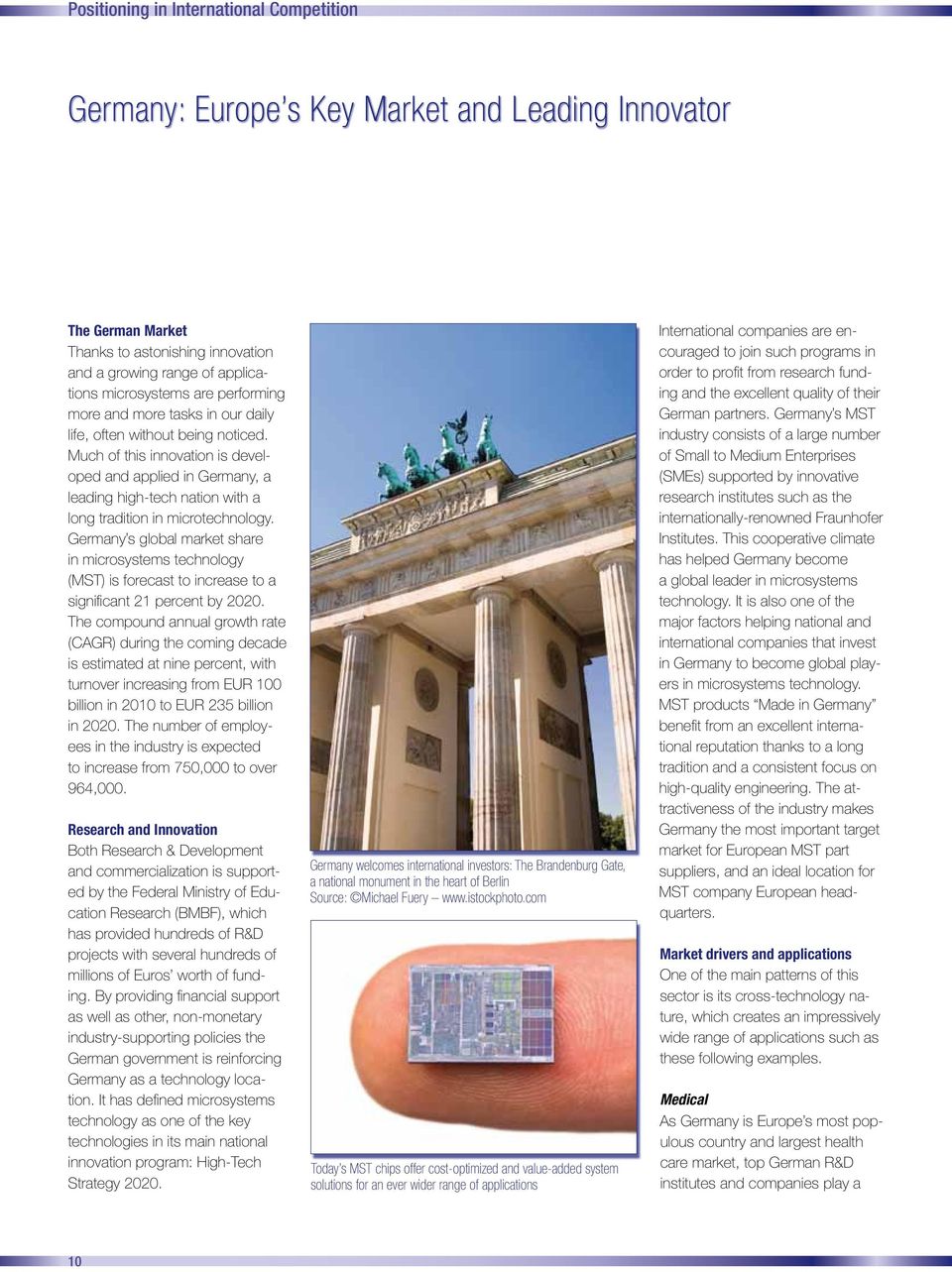
10 Positioning in International Competition Germany: Europe s Key Market and Leading Innovator The German Market Thanks to astonishing innovation and a growing range of applications microsystems are performing more and more tasks in our daily life, often without being noticed. Much of this innovation is developed and applied in Germany, a leading high-tech nation with a long tradition in microtechnology. Germany s global market share in microsystems technology (MST) is forecast to increase to a significant 21 percent by The compound annual growth rate (CAGR) during the coming decade is estimated at nine percent, with turnover increasing from EUR 100 billion in 2010 to EUR 235 billion in The number of employees in the industry is expected to increase from 750,000 to over 964,000. Research and Innovation Both Research & Development and commercialization is supported by the Federal Ministry of Education Research (BMBF), which has provided hundreds of R&D projects with several hundreds of millions of Euros worth of funding. By providing financial support as well as other, non-monetary industry-supporting policies the German government is reinforcing Germany as a technology location. It has defined microsystems technology as one of the key technologies in its main national innovation program: High-Tech Strategy Germany welcomes international investors: The Brandenburg Gate, a national monument in the heart of Berlin Source: Michael Fuery Today s MST chips offer cost-optimized and value-added system solutions for an ever wider range of applications International companies are encouraged to join such programs in order to profit from research funding and the excellent quality of their German partners. Germany s MST industry consists of a large number of Small to Medium Enterprises (SMEs) supported by innovative research institutes such as the internationally-renowned Fraunhofer Institutes. This cooperative climate has helped Germany become a global leader in microsystems technology. It is also one of the major factors helping national and international companies that invest in Germany to become global players in microsystems technology. MST products Made in Germany benefit from an excellent international reputation thanks to a long tradition and a consistent focus on high-quality engineering. The attractiveness of the industry makes Germany the most important target market for European MST part suppliers, and an ideal location for MST company European headquarters. Market drivers and applications One of the main patterns of this sector is its cross-technology nature, which creates an impressively wide range of applications such as these following examples. Medical As Germany is Europe s most populous country and largest health care market, top German R&D institutes and companies play a 10
11 Positioning in International Competition Jonathan Schoo Manager Investment Electronics & Microtechnology leading role in developing eversmaller applications in preventative health care, diagnostics or microsurgery. Modern lab on a chip diagnosis techniques deliver reliable analyses in no time, while new devices can monitor and prevent diseases without the patient being admitted to a hospital. Drugs specifically prescribed according to individually conducted, highly accurate tests could make the treatments of widespread diseases such as Alzheimer s or cardiovascular diseases far more successful timeous and efficient. Underlining its long standing as a global leader in the industry, Germany s medical MST community has generated a turnover of EUR 12.9 billion in 2010, which is expected to double by Mobility MST is also revolutionizing mobility, both in Germany and elsewhere. In logistics, innovations such as Radio Frequency Identification (RFID) labels allow data on goods to be transmitted, read and stored through radio signals. Advanced driver assistance systems avoid collisions on the road, saving lives and easing transportation for millions of people. The world-renowned German automotive industry and its national and international suppliers are already integrating these systems into their products. Automotive MST has a market volume of more than EUR 30 billion in Germany MST-supported parking assistance systems make cars more comfortable and safer to drive today and this is forecast to increase by 200% by Industry Industry is another important MST application area. The importance of micro process engineering and functional systems in sectors such as machinery and equipment, chemistry and pharmaceuticals, and nanotechnology cannot be underestimated. Thanks to progress in areas such as mounting and connecting technology, micro-nano integration and technical cognition among many others, the industrial sector is another beneficiary of the innovation taking place in microsystems technology. In Germany, microsystems technology turnover for industry applications in 2020 will have increased threefold from 2010, amounting to EUR 47.1 billion. Germany Trade & Invest Germany Trade & Invest is the foreign trade and inward investment agency of the Federal Republic of Germany. Our mission is to promote Germany as a location for investments and to advise foreign companies on how to invest in German markets. With our team of industry experts, incentive specialists, and other investment-related services we assist companies in setting up business operations in Germany. At the same time, we also provide information on foreign markets for companies based in Germany, making Germany an ideal location for European headquarters. All investment services are treated with the utmost confidentiality and provided free of charge. Germany Trade and Invest GmbH Friedrichstraße 60 D Berlin Phone +49 (0) Fax +49 (0) Mail [email protected] Web 11

12 Positioning in International Competition Microsystems Technology a Key Technology of Great Strategic Importance Dipl.-Ing. Dipl. Wirtsch.-Ing. Dirk Friebel, Chairman VDE / VDI Society of Microelectronics, Microsystems and Precision Engineering (GMM), Interim Manager, Neuss In recent decades, microsystems technology (MST) has developed into one of the most important interdisciplinary technologies. With double-digit growth rates, major leverage effects and steadily growing application potential, it numbers among the most important drivers of innovation and growth. It is a decisive factor for the competitiveness of many industrial application industries and thus has enormous strategic importance for Germany s industrial strength. Only those who master MST technologies and systems can prevail in global innovation competition, successfully develop new products for key markets of the future, and thus contribute to growth and employment in key industries. With its integration of sensor technology, evaluation electronics and actuation systems as well as miniaturization and software, MST makes possible innovative systems solutions for virtually all social, business and industrial applications. Fig.1: 300mm-wafer. Source: ST-Leti In particular, these include the key areas of energy/climate, mobility and communication, healthcare and aging societies, safety, production and logistics. Fig.2: Chip-to-Wafer Stock for 3D Integration Source: Fraunhofer IZM In automotive electronics, MST contributes to the reduction of CO2, increases safety and comfort with the help of innovative driver assistant systems, and supports the optimization of traffic flows through car-to-car communication. In medical engineering, MST solutions are becoming increasingly important for implants as well as for diagnostic and monitoring systems. In telecommunications, MST modules provide the basis for new functions and the evolution of mobile phones into intelligent mobile assistants. In industrial electronics, MST plays a growing role in wireless installation systems, building monitoring and the increasing use of sensor technology in machines and plants. The vision Industry 4.0 can t be realized without MST. In safety systems and logistics, countless MST-based solutions are 12

13 Positioning in International Competition Dr. Ronald Schnabel VDE/VDI Society of Microelectronics, Microsystems and Precision Engineering (GMM) Here, the VDE/VDI Society of Microelectronics, Microsystems and Precision Engineering (GMM) is playing an important role as a broadly-based expert platform for knowledge transfers, and is making major contributions to the strengthening of MST in Germany through position papers, workshops, conferences and initiatives. Fig.3: TU Darmstadt being developed or are already in use, such as in smart cards, secure authentication systems as well as in various RFID solutions for identifying goods. New MST applications are also opening up in micro-optics, the aerospace industry and in measuring and control systems. Germany s research and industry holds a very solid position in MST in international comparison. The fact that the importance of MST for German industry is growing is reflected by steadily increasing MST market volumes. By far the biggest customer industry here is automotive electronics, followed by industrial electronics, data processing and telecommunications as well as consumer electronics. The VDE believes the fields of energy efficiency and assistance systems for aging populations, in particular, will be important MST growth drivers in the future. Important technology trends in coming years will be selfsufficient microsystems with their own energy supply and wireless communication, the replacement of mechanical/ hydraulic systems with microelectronic solutions, on-board diagnostic systems, and multifunctional highly integrated solutions. The VDE and the German Federal Ministry of Education and Research (BMBF) are very successfully cooperating in the field of microsystems technology both in the framework of the VDE/BMBF Microsystems Technology Congress as well as in pre-competitive network projects to utilize the great innovation potential of MST in Germany for industry. The GMM believes one of the challenges in the future will be to support innovative small and mid-sized enterprises that are shaping Germany s industrial structure in the field of MST and that contribute to Germany s leading position for innovation in turning the results of their basic research into marketable products. Other challenges will be to reduce bureaucratic hurdles to innovation, expand knowledge networks and increase support for young talents and research. The VDE believes the goal of a far-sighted and future-oriented MST engagement is to rigorously utilize the great potential of MST and strategically strengthen Germany s competitive position in other key technologies and leading markets. VDE/VDI Society of Microelectronics, Microsystems and Precision Engineering (GMM) Dr. Ronald Schnabel Stresemannallee 15 D Frankfurt Phone +49 (0) Fax +49 (0) Mail [email protected] Web 13

14 Positioning in International Competition 14

15 Beiträge zu aktuellen Innovationsfeldern Contributions to Topical Fields of Innovation

16 Contributions to Topical Fields of Innovation MEMS Enabler for the Internet of Things and Services When Robert Bosch in 1886 launched its Workshop for Precision Mechanics and Electrical Engineering, the company that today is the world s largest supplier of automotive electronics, already followed an interdisciplinary approach: Electrical Engineering and Fine Mechanics. This combination already describes two of the most pronounced genes in Bosch s DNA. Today, Bosch is manufacturer of one of the world s most diversified MEMS product ranges with new applications adding to the already impressive spectrum of possible uses. With their set of properties, MEMS are at the heart of today s most sophisticated technology developments and play a crucial role as enablers to the Internet of Things. MEMS are space-saving devices and thus can be integrated into even the smallest gadgets and consumer devices. They are easy to combine and impressively versatile, measuring many physical values from acceleration to rotation rate or magnetic field. An example could be Bosch s BNO055 an Application-Specific Sensor Node with Absolute Orientation-sensing using an integrated 32-bit microcontroller for Fig. 1: MEMS micro-electro-mechanical systems Figure 2: Bosch sets size, performance and integration benchmarks in consumer MEMS sensor fusion and signal pre-processing tasks. Being the world s largest automotive supplier, it is consequential that Bosch s first MEMS product, a pressure sensor, was designed for the automotive industry. Today, Bosch manufacturers a broad range of MEMS sensors for usage in vehicles from pressure and mass flow sensors to acceleration and angular rate sensors, enabling carmakers to improve the safety, fuel efficiency, and comfort of their vehicles. Current premium cars accommodate about 50 MEMS sensors a figure that highlights the versatility and significance of MEMS for automotive technology. This significance will even increase for coming car generations. MEMS sensors will be at the heart of future Advanced Driver Assistance Systems (ADAS), from Adaptive Cruise Control to Drowsiness Detection, Automated Parking and, eventually, semi- and fully automated driving functions. But over the past years, a new market segment for MEMS has emerged that grows even faster than automotive. Many modern consumer appliances and devices such as electronic games or smartphones are inconceivable without these sensors. With their ability to capture all kinds of physical movement, they enable system designers to implement innovative HMI concepts with constituents like scrolling, context awareness and even Augmented Reality. Cool functions like motion detection, portrait-landscape orientation switching, flat detection tap/double-tap sensing or free-fall detection are based on MEMS sensors. Even microphones, indispensable ingredient for voice control functions as another element of modern HMIs, are implemented as MEMS sensors. With its complete portfolio of such sensors, Bosch literally enables 16

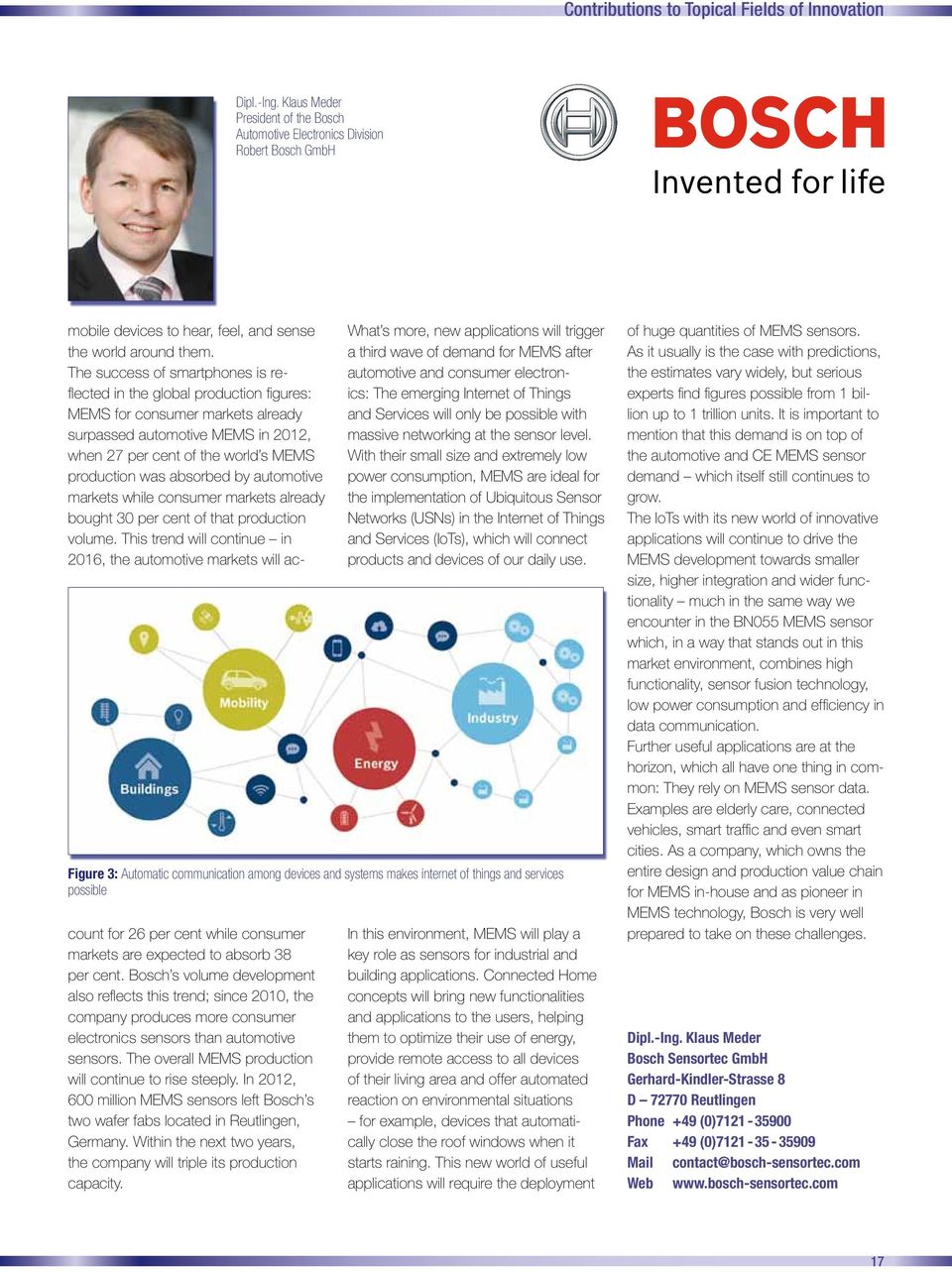
17 Contributions to Topical Fields of Innovation Dipl.-Ing. Klaus Meder President of the Bosch Automotive Electronics Division Robert Bosch GmbH mobile devices to hear, feel, and sense the world around them. The success of smartphones is reflected in the global production figures: MEMS for consumer markets already surpassed automotive MEMS in 2012, when 27 per cent of the world s MEMS production was absorbed by automotive markets while consumer markets already bought 30 per cent of that production volume. This trend will continue in 2016, the automotive markets will account for 26 per cent while consumer markets are expected to absorb 38 per cent. Bosch s volume development also reflects this trend; since 2010, the company produces more consumer electronics sensors than automotive sensors. The overall MEMS production will continue to rise steeply. In 2012, 600 million MEMS sensors left Bosch s two wafer fabs located in Reutlingen, Germany. Within the next two years, the company will triple its production capacity. What s more, new applications will trigger a third wave of demand for MEMS after automotive and consumer electronics: The emerging Internet of Things and Services will only be possible with massive networking at the sensor level. With their small size and extremely low power consumption, MEMS are ideal for the implementation of Ubiquitous Sensor Networks (USNs) in the Internet of Things and Services (IoTs), which will connect products and devices of our daily use. Figure 3: Automatic communication among devices and systems makes internet of things and services possible In this environment, MEMS will play a key role as sensors for industrial and building applications. Connected Home concepts will bring new functionalities and applications to the users, helping them to optimize their use of energy, provide remote access to all devices of their living area and offer automated reaction on environmental situations for example, devices that automatically close the roof windows when it starts raining. This new world of useful applications will require the deployment of huge quantities of MEMS sensors. As it usually is the case with predictions, the estimates vary widely, but serious experts find figures possible from 1 billion up to 1 trillion units. It is important to mention that this demand is on top of the automotive and CE MEMS sensor demand which itself still continues to grow. The IoTs with its new world of innovative applications will continue to drive the MEMS development towards smaller size, higher integration and wider functionality much in the same way we encounter in the BN055 MEMS sensor which, in a way that stands out in this market environment, combines high functionality, sensor fusion technology, low power consumption and efficiency in data communication. Further useful applications are at the horizon, which all have one thing in common: They rely on MEMS sensor data. Examples are elderly care, connected vehicles, smart traffic and even smart cities. As a company, which owns the entire design and production value chain for MEMS in-house and as pioneer in MEMS technology, Bosch is very well prepared to take on these challenges. Dipl.-Ing. Klaus Meder Bosch Sensortec GmbH Gerhard-Kindler-Strasse 8 D Reutlingen Phone +49 (0) Fax +49 (0) Mail [email protected] Web 17
18 Contributions to Topical Fields of Innovation Security for Smart Grids in Germany The power grid is currently undergoing changes, moving towards a model of highly volatile and localised energy production and storage, supported by IT and communication components. Smart metering enables the detailed measurement and automatic remote reading of consumption and production levels. It supports flexible tariffing and dynamic load optimisation, ultimately aiming to achieve cost and consumption reduction. The security requirements surrounding smart metering are mainly authenticity, integrity and privacy of data. Even more challenging is grid automation, which is critical for the safety and availability of the grid. The overall situation calls for an integrated security architecture that not only addresses all relevant security threats, but also satisfies functional, safety, performance, process integration and economic side conditions. An essential element of a smart grid is the smart metering system that monitors the consumption or production of certain commodities at the user s side and facilitates sending of consumption or production information to external entities. This data is then used as the basis for activities such as billig or management of supply. In Germany, the amendment of the Energy Industry Act makes the evaluation of smart metering systems mandatory. Therefore, the Federal Ministry of Economics and Technology (BMWi) has asked the Federal Agency for IT security (BSI), to develop a security concept for a smart meter gateway (SMGW). Technically the BSI decided to implement the protection profile (PP) according to the Common Criteria standard [1] and set the minimum assurance level for this PP to the EAL 4+. This standard is internationally acknowledged and therefore nables adoption in other countries. The protection profile describe the function of the device on an abstract level and is not a detailed device specification. The functional environment of the SMGW is depicted in Fig. 1. The SMGW is going to be placed on the premises of private or commercial customers and serves as a central communication hub for local devices. The SMGW has three distinct physically separated interfaces: The local metrological network (LMN) connects to different smart meters (for different energy sources). The home area network (HAN) provides private households and businesses with real-time analysis of their energy consumption. Tablet-computers at home turn into monitoring devices that show usage levels. Fig. 1: Application scenario for the smart meter gateway with its three distinct interfaces to the local metrological network (LMN), to the home area network (HAN) and to the wide area network (WAN). 18

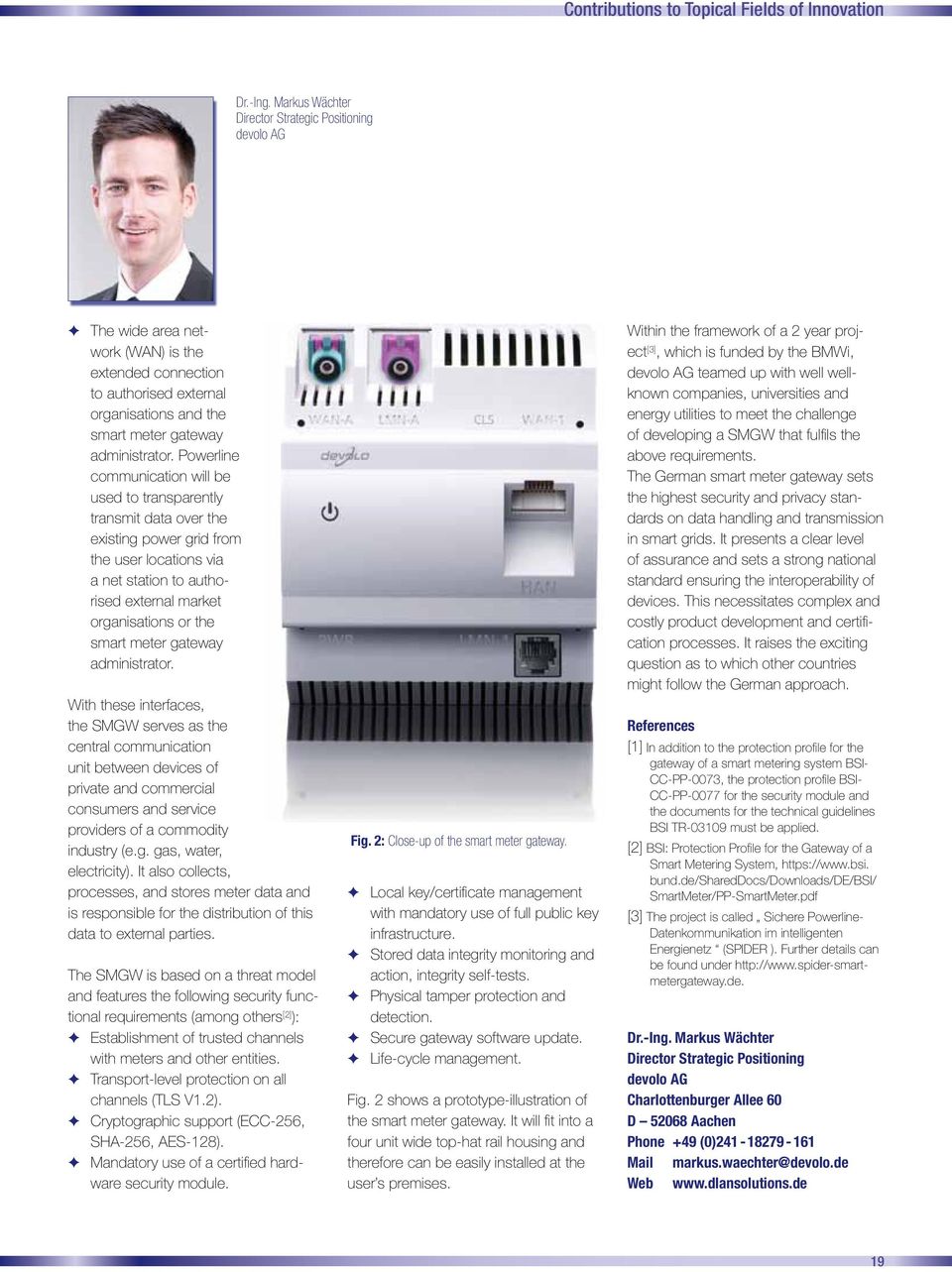
19 Contributions to Topical Fields of Innovation Dr.-Ing. Markus Wächter Director Strategic Positioning devolo AG The wide area network (WAN) is the extended connection to authorised external organisations and the smart meter gateway administrator. Powerline communication will be used to transparently transmit data over the existing power grid from the user locations via a net station to authorised external market organisations or the smart meter gateway administrator. With these interfaces, the SMGW serves as the central communication unit between devices of private and commercial consumers and service providers of a commodity industry (e.g. gas, water, electricity). It also collects, processes, and stores meter data and is responsible for the distribution of this data to external parties. The SMGW is based on a threat model and features the following security functional requirements (among others [2] ): Establishment of trusted channels with meters and other entities. Transport-level protection on all channels (TLS V1.2). Cryptographic support (ECC-256, SHA-256, AES-128). Mandatory use of a certified hardware security module. Fig. 2: Close-up of the smart meter gateway. Local key/certificate management with mandatory use of full public key infrastructure. Stored data integrity monitoring and action, integrity self-tests. Physical tamper protection and detection. Secure gateway software update. Life-cycle management. Fig. 2 shows a prototype-illustration of the smart meter gateway. It will fit into a four unit wide top-hat rail housing and therefore can be easily installed at the user s premises. Within the framework of a 2 year project [3], which is funded by the BMWi, devolo AG teamed up with well wellknown companies, universities and energy utilities to meet the challenge of developing a SMGW that fulfils the above requirements. The German smart meter gateway sets the highest security and privacy standards on data handling and transmission in smart grids. It presents a clear level of assurance and sets a strong national standard ensuring the interoperability of devices. This necessitates complex and costly product development and certification processes. It raises the exciting question as to which other countries might follow the German approach. References [1] In addition to the protection profile for the gateway of a smart metering system BSI- CC-PP-0073, the protection profile BSI- CC-PP-0077 for the security module and the documents for the technical guidelines BSI TR must be applied. [2] BSI: Protection Profile for the Gateway of a Smart Metering System, bund.de/shareddocs/downloads/de/bsi/ SmartMeter/PP-SmartMeter.pdf [3] The project is called Sichere Powerline- Datenkommunikation im intelligenten Energienetz (SPIDER ). Further details can be found under Dr.-Ing. Markus Wächter Director Strategic Positioning devolo AG Charlottenburger Allee 60 D Aachen Phone +49 (0) Mail [email protected] Web 19
20 Contributions to Topical Fields of Innovation Microsystems Technology for Integrated Production In recent publications about future production, integrated production systems increasingly attract attention and are considered to deliver answers to the upcoming questions about possible applications and requirements of Cyber Physical Systems in a broader sense. But irrespective of its popularity, it can be stated that the term integrated production itself is used inflationary and that the technological challenges that lie behind it are often overlooked. Hence, it very well makes sense to resolve the term of integrated production and assess the main activities that drive industrial research at present and will do so in the future. There are three vital aspects that can be associated with the term integration. Two of them describe the technological challenges that arise out of a strong demand on increased flexibility, adaptivity and cost efficiency of future production systems: integrated components like shown in Picture 1 with enhanced physical capabilities (sensing, acting, processing and communication) on the one hand and a virtual integration of capabilities of the Enterprise Resource Planning and Manufacturing Execution System (ERP and MES) onto the component level on the other hand. The third aspect of integration considers the role and working environment of human in future production systems and likewise represents a socio-economical perspective on the topic. Interestingly enough, each of these three aspects shows a clear link to Microsystems Technology: From a bottom-up perspective, intelligent components integrate sensors, actuators and controllers to provide a real-time image of the production process and to allow fast reconfiguration and adaptation as well as self optimization capabilities. For this purpose, the basic physical functionalities as well as media and data interfaces have to be integrated in a holistic approach on the micro level in smart and embedded systems. Moreover, to facilitate cost efficiency and functionality on the component level, the multiple use of basic functionalities has to be pursued. Fig. 1: Integrated Pneumatic Drive (Source: Festo) From a top-down perspective, the virtual integration of the functionality of control levels from ERP and MES enhances the decentralized intelligence of components. Adaptive production systems make use of agent technologies to ensure a maximum of flexibility and cost efficiency on the shop-floor level. Beyond the technological challenges of data processing on intelligent components, there is a strong need for action in the field of data interfaces and standardization of transfer protocols to allow a proper exchange of data between control levels and components vice versa. Adaptive production as well as inte- 20

21 Contributions to Topical Fields of Innovation Dr. Volker Nestle Head of Future Technology Festo AG & Co. KG grated data concepts can be seen as prerequisites for an economical production of highly individualized products in numerous variants and will facilitate the step from integrated production towards integrated industry, using cross-industrial innovation potentials and integrating customers in product design of industrial goods more intensively. Due to the striking technological changes mentioned above, future factory concepts require a reconsideration of the way how human workforce is integrated in the production process. In a different way from today s working environment, humanmachine-interaction will increase considerably. As a consequence, human-machine interfaces which encapsulate technological complexity have to be established. In this context, Microsystems Technology is requested to point out solutions for intelligent object detection and integrated vision systems, smart operating controls (see e.g. Picture 2) and operational security. Furthermore it is obvious that integrated production will also require new approaches to education and training of human beings when job profiles change crucially. It will be one of the challenging questions how human-machine culture can be shaped in an ethical and humane way. Fig. 2: Touchless user interface in organic electronics and e-paper display for sensor applications at Festo (Source: 3PLAST / Joanneum Research) It is easy to acknowledge that Microsystems Technology represents one of the key enabling technologies for integrated production. Decentralization and virtualization will generate more flexibility and cost efficiency, but also more complex value chains throughout the production landscape. As a consequence, individual companies will decreasingly be able to provide all required resources along those complex value chains. For industrial players, competitiveness will therefore more and more depend on network capabilities and the willingness to open innovation processes. Today, the economic impacts of distributed production are not yet predictable. Beside the opportunities for new business models on the base of cooperative innovation processes it will be interesting to observe how traditional locational advantages of agglomeration economics bear up with the vast opportunities of decentralization. Regardless of this potential paradigm shift in the production landscape, Microsystems Technology will remain the vital driver for innovation to cope with the upcoming technological challenges and still constitute a core competence in German industry, business and academia. Dr. Volker Nestle Head of Future Technology Festo AG & Co. KG Ruiter Str. 82 D Esslingen Phone +49 (0) Mail [email protected] Web 21
22 Contributions to Topical Fields of Innovation Microsystem Technology as a Basis for Integrated Manufacturing Due to the trend towards highly-integrated manufacturing solutions, the demand is rising for tools and equipment that include many functions that are not available with today s systems. In order to ascertain the conditions of the tools used (e.g. wear), of the working environment and of the workpiece to be processed, networked sensors are one of the things that need to be integrated. In addition to these, increasing quality levels require process parameters and environments to be monitored by sensors before and during processing. There is also a demand to equip future systems with intelligence to enable sensor data to be processed directly, active elements to be controlled and communication to take place inside the system and with the environment. In a rising number of cases, there is also a requirement to integrate actuators. The respective features would enable tools to adapt independently not only to the application concerned but also to external process influences. Furthermore, there is a demand to influence processing actively. Examples of this are grippers that adapt to components and workpiece holders that manipulate components. The reasons behind the demand for the increased functionality of tools and equipment include rising quality requirements, improved performance expectations and the desire to increase productivity. In order to implement these intelligent and active systems, among other things multifunctional integrable sensors and actuators are needed. Microsystem technology represents a key technology in this respect. The following two use cases illustrate current trends and their related challenges. Intelligent dispensing tools for system integration One example of integrated manufacturing is the combination of additive manufacturing technologies with hybrid integration technologies to fabricate Fig. 1: IPA.VALVE from macro (left) to micro (right) scalable dosing valve (source: Fraunhofer IPA) Fig. 2: Multiple dosing head with integrated micro-valve technology (source: Fraunhofer IPA) multifunctional assemblies. Here, the principle system-related challenges lie in combining different process steps and integrating a wide range of related functional elements and assemblies into the tools concerned. For example, a combined heating and dispensing tool to apply the medium and a measuring and positioning tool to integrate hybrid functional elements directly into the structures created. Among others, micro-valves (see e.g. picture 1) represent a basis for developing this type of system solution. Due to their small size, they allow the construction of compact systems, such as the dosing head for applying liquids in parallel that is shown in Fig. 2. Combined with a micro-manufactured internal heating layer to warm fluids, the valve technology integrated into this system enables tiny quantities of liquids to be applied highly accurately in a defined pattern. With the ability to extend the system by adding an adaptable microfluidic unit for the storage and pumping of the liquids used, a micro-sensor unit for process monitoring and a miniaturized 22
23 Contributions to Topical Fields of Innovation Dipl.- Ing. (FH) Dirk Schlenker control and regulation unit, an efficient and intelligent system can be realized as a solution for future integrated manufacturing. Intelligent workpiece carrier for integrated manufacturing The demand for enhanced system functionality is also reflected in the aspects of component transport and feeding, e.g. in workpiece carrier technology. Because their level of functionality is low, it will only be possible to utilize conventional systems to a limited extent in the future. This is especially the case regarding the increasing sensitivity of products and processes, rising quality standards and the trend towards cyber physical systems. As well as fixing components in place, other functionalities are also required, as shown in the solution approach of the innovative workpiece carrier system smartwt in Fig. 3. Its development is founded by the Federal Ministry of Education and Research (BMBF) within the leading-edge cluster MicroTEC Südwest. The intelligent, pro-process workpiece carrier integrates and combines a number of micro-sized functional elements and assemblies. For example, several networked micro-sensors are built into the system. These enable workpiece status and environmental conditions to be recorded during transport and processing steps. Data processing, storage as well as communication inside Fig. 4: Miniaturized analysis electronics for integration into tools and components (source: efm-systems GmbH) Fig. 3: Workpiece carrier concept smartwt with integrated microsystem technology (source: Fraunhofer IPA) the system and with the environment are taken over by a micro-control unit, such as the one depicted in Fig. 4. All these features allow the construction of closed control loops for quality enhancement and assurance. Depending on the system configuration and performance requirements micro technology components will be used for the energy transmission and storage. A pre-requisite for implementing such multifunctional systems is the availability of numerous micro solutions, such as those which have been developed in recent years as a result of advances in microsystem technology. The examples described here illustrate types of innovative and multifunctional tools and equipment that can be realized through microsystem technology, thus emphasizing the decisive role this cross-sectional technology is playing with regard to the implementation of current and future integrated manufacturing solutions. Dipl.- Ing. (FH) Dirk Schlenker Gruppenleiter Präzisionsmontage und -auftragstechnik Fraunhofer-Institut für Produktionstechnik und Automatisierung IPA Abteilung Reinst- und Mikroproduktion Nobelstrasse 12 D Stuttgart Phone +49 (0) Fax +49 (0) Mail [email protected] Web
24 Contributions to Topical Fields of Innovation Microsystems Technology in Implantable Medical Devices Klaus-Peter Hoffmann, Thomas Velten Innovations in Biomedical Devices are joined with miniaturization, computerization, molecularization and personalized medicine. Especially implantable devices for human assistance should be small, light and smart. The surface of these devices has to be adapted to the surrounding biological tissue. Biocompatibility as well as the long-term stability of sensors and actuators is an essential demand for the application. All these questions are very closely combined with the facilities of microsystems technology. In collaboration with Otto Bock Healthcare, University of Technology Hamburg and Vienna University a fully implantable multi-channel measurement system for acquisition of muscle activity was developed and fabricated (see Figure 1). The bioelectric signals from different muscles of an amputee s forearm should, after classification, be used to control bionic hand prostheses. Using implantable epimysial silicone electrodes the system was successfully evaluated in vivo for a period of nine months. The implantable system includes a microchip (ASIC), a microcontroller and a RF transceiver. The wireless communication between implant and base station uses the MICS band. The system should work online with a reaction time of about 100 ms between starting of the myoelectric activity and movement of the hand prostheses. The data transmission rate is 260 kbit/s with a latency of 23±7 ms. The power supply is designed as wireless inductive power transmission. This principle was preferred to a batteryoperated one. An important reason for this is the possibility to avoid restrictions of implant service life due to the battery lifespan. On the other hand, it should be possible to implant the device into the patient s forearm. An implant battery with sufficient capacity would be too bulky, whereas a target size of a 2-Euro coin was considered. This also goes along with the requirement that the power supply should be located in or at the forearm/hand prosthesis. The power consumption should be limited to as low as about 100 mw. As a consequence of the above-mentioned requirements, a very high efficiency of Fig. 1: Fully implantable multi-channel measurement system for acquisition of muscle activity. Epimysial electrodes (left), device for signal filtering, acquisition and wireless transmission (right) 24
25 Contributions to Topical Fields of Innovation Prof. Dr.-Ing. Klaus-Peter Hoffmann Head of Department Medical Engineering & Neuroprosthetics Dr.-Ing. Thomas Velten Head of Department Biomedical Microsystems patient exists due to heating-up. At the implant site, a temperature increase of more than 2 K is considered problematic. The flexible encapsulation of the implant was made of silicone after preparation of the surface using a silicone primer. This biocompatible encapsulation can be used for application times of up to one year. Fig. 2: Laboratory setup to characterize the wireless power supply and signal transmission Future work will include biofunctionalized all-polymer electrodes. Using this kind of electrodes will minimize mechanical stress and could increase the biological interactions between the implant and the tissue. energy transmission is of paramount importance, especially in human applications. In addition to the fact that special attention needs to be paid to the power consumption of both the electronics in the primary and secondary site, the energy transmission via the inductive path has to take place at a very high efficiency in order to avoid unnecessary load on the batteries of the prosthesis. Therefore, the assessment of the power consumption refers to the overall system power consumption. The total input power consumption includes clock-pulse generation, amplification etc. at an unobstructed distance of 3 cm between the coils. On the primary coil site (see green spiral coil in Figure 2), the DC power consumption was 20 ma at 4 V. Thus, the DC input power of the system was 80 mw. On the implant site, a DC output voltage of 3.22 V was obtained, which in turn resulted in a load current of 10.3 ma in load resistance of 310 Ohms. Thus, the secondary DC power obtained in the implant was about 33 mw. This represents in an efficiency of 41 %, which is, measured in terms of the distance between and the size of the coils, a considerable achievement. Especially for medical applications, it is important that neither primary nor secondary (implant) site will excessively heat up. Since an electric current always and inevitably leads to a temperature increase of the respective conductor, it is important to prove that no risk for the Prof. Dr.-Ing. Klaus-Peter Hoffmann Head of Department Medical Engineering & Neuroprosthetics Phone +49 (0) Fax +49 (0) Mail klaus-peter.hoffmann@ibmt. fraunhofer.de Dr.-Ing. Thomas Velten Head of Department Biomedical Microsystems Phone +49 (0) Fax +49 (0) Mail [email protected] Fraunhofer Institut für Biomedizinische Technik Ensheimer Strasse 48 D St. Ingbert Web 25
26 Contributions to Topical Fields of Innovation Smart Reagent Dosing Novel Cartridge Concept for In-Vitro Diagnostic Applications Introduction Driving forces for in-vitro diagnostics (IVD) are mainly improvements on the medical value for the patient and on the testing efficiency. The later issue must be addressed without affecting the benefit for the patient. Increasing the testing efficiency and thus the economic advantage for the healthcare system can for example be achieved by a reduction of costs per result for IVD tests. Typical cost driving factors herein are the consumption of reagents and disposables. This leads to a clear industry trend to reduce reagent volumes on future IVD systems by improving detection techniques and liquid handling robotics. Fig. 1: Typical pipetting system on an automated IVD analyzer (cobas 6000) Most laboratory systems today are based on using automated pipetting techniques for handling the liquid workflow, such as aliquotation of sample or precise dosing of reagent (see figure 1). These pipetting techniques are well suited with respect to precision and accuracy for handling volumes above one μl. However their use is limited in the sub-μl range due to a reduced precision and increased effort to prevent carry-over of liquids. Novel micro system based dispensing technologies could overcome these limitations and potentially allow the handling of fractions of a μl by achieving the required dosing performance. A high precision (<2 %) and accuracy (<5 %) in dosing performance can be achieved for volumes down to the sub-µl range using the here presented disposable dispensing cartridge. A demonstrator of this technique was developed within the micro system technology cluster MicroTEC Südwest, funded by the Federal Ministry of Education and Research (BMBF) [1]. Working Principle The working principle of this contactfree dispenser [2] is based on positive displacement. Due to the geometrical Fig. 2: Working principle of the dispenser cartridge Fig. 3: Precision data of the dispenser cartridge with water 26
27 Contributions to Topical Fields of Innovation Dr. Jürgen Spinke, Director Enabling System Technologies, Roche Diagnostics GmbH, Mannheim definition of the displaced volume, the method is relatively independent on changes in viscosity, temperature or pressure. This is of great advantage for in-vitro diagnostic applications where hundreds of different reagents with varying rheological properties have to be dispensed with equal performance [3]. The cartridge demonstrator (see figure 2) consists of a dosing unit with nozzle, a reagent container, a two-way valve (cylinder) and a piston. All parts are mass producible at low costs and can easily be assembled. In the home position (2a), the valve opening is directed to the reagent reservoir and the connection to the nozzle is closed. The piston is in front position. By moving the piston backwards, a defined reagent volume is aspirated into the valve (cylinder) (2b). In the following, the opening position of the valve is rotated to the nozzle (2c), and the reagent volume can be ejected via the nozzle by moving the piston to the front position (2d). As a consequence the ejected volume is only dependent on the relative movement of the piston, and is freely adjustable by a self-positioning external actuator. In order to achieve a reliable fluid break-up the piston is moved by the actuator with a velocity of 0.25 m/s and an acceleration of 30 m/s 2. This demonstrator set-up is able to dispense volumes from 250 nl up to 10 μl within one stroke with excellent performance. The achieved precision and accuracy for the dosing of water is over the complete volume range below 0.5 % (see figure 3), and below 2 % for a representative set of fluids covering the complete rheological landscape of IVD reagents (see reference [3] for more details). Outlook The disposable dispensing unit can easily be implemented in a reagent cartridge design that contains all necessary liquid reagents for an IVD test. The vision of this concept is to replace traditional pipetting robotics for reagent handling by smart reagent dosing cartridges in future IVD systems (see figure 4). Besides the excellent precision and accuracy for the handling of sub-μl volumes, the concept offers some additional fundamental advantages over traditional methods: 1) The individual reagent can be dispensed contact-free out of the reservoir via an individual nozzle into a reaction vessel. The system operates Fig. 4: Illustration of a reagent cartridge and actuator for IVD application carry-over free by design, and the time and water consuming process steps for needle washing can be avoided. 2) By using sealed reagent containers (e.g. collapsing bags) the contact with ambient air is avoided, which results in improved on-board stability of the reagents (target: on-board stability = shelf-life). This allows a further increase of the reagent capacity per cartridge and saves production costs. 3) Due to the free flow an e.g. optical sensor to monitor the dispensed fluid can easily be integrated. The combination with sensors for dosing confirmation could improve the reliability and regulatory compliance for routine testing. References: [1] J. Spinke, Smart Reagent Dosing (SRD), microtec Südwest Clusterkonferenz ( microtec-suedwest.de/fileadmin/mstbw- Veranstaltungen/Clusterkonferenz_2013/ Vortraege/230413_0920_Smart_reagent_ dosing_spinke.pdf) [2] European patent application EP A1 [3] N. Losleben, J. Spinke, S. Adler, N. Oranth, and R. Zengerle: Model fluids representing aqueous in-vitro diagnostic reagents for the development of dispensing systems, Drug Discovery Today 18 (2013) Roche Diagnostics GmbH Dr. Jürgen Spinke Sandhofer Str. 116 D Mannheim Phone +49 (0) Fax +49 (0) Mail [email protected] Web 27
28 Contributions to Topical Fields of Innovation From Microsystems to Smart Integrated Systems Worldwide, research and innovation programs focus on turning scientific breakthroughs into innovative products and services that provide business opportunities and improve people s lives. Horizon 2020 sets out three strategic policy objectives raising and spreading the levels of excellence in the research base, tackling major societal challenges, and maximising competitiveness impacts of research and innovation. This supports innovative enterprises to develop viable products with real commercial potential. Smart systems hold not only an enormous potential for a wide range of applications, they are enabled by many technologies and act as enablers for many future technologies. For that reason they are crucial for the competitiveness of companies and entire industry sectors, like transport and mobility, health, manufacturing/factory automation, communication, energy, aerospace as well as environment. Power Source MEMS/ NEMS Integration & Packaging Electronic Components Communication Unit Fig. 1: Components of Smart Systems from device point of view Fig. 2: Generations of Smart Systems from the functionality point of view. Definition of Smart Systems Smart Systems are self-sufficient intelligent technical systems or subsystems with advanced functionality, enabled by underlying micro-, nano- and biosystems and other components, Fig. 1. They are able to sense, diagnose, describe, qualify and manage a given situation. Their operation is further enhanced by their ability to mutually address, identify and work in consort with each other. They are highly reliable, often miniaturized, networked, predictive and energy autonomous. Moreover, smart systems operation is based on a knowledge base. This separates them from systems which remain purely reactive. Generations of Smart Systems Microsystems exist everywhere in our daily lives in our homes, our cars, our workplaces and yet they go largely unnoticed. These microelectromechanical systems MEMS have undergone rapid development in the last two decades, evolving from miniaturized single-function systems into increasingly complex integrated smart systems, Fig. 2 and 3. The first generation of smart systems consisted of several packages of components connected on a single substrate, or printed circuit board. These devices are commercially available in medical applications such as hearing aids and pacemakers, as well as in automotive applications such as airbag systems or electronic stabilization systems. The second generation of smart systems integrates more functionality. These systems are going beyond simple signal 28
29 Contributions to Topical Fields of Innovation Thomas Gessner, Fraunhofer ENAS and Center for Microtechnologies of Technische Universität Chemnitz Currently the third generation of smart systems is under development. This generation will be the basis for the smart home, smart city, smart production, and internet of things as announced by a lot of current market studies. This generation of smart systems will be able to take over complex human perceptive and cognitive functions, will be able to establish self-organizing networks and operates completely energy autonomous. Therefore these systems will act independently and don t require necessarily human control or decision. So they will be autonomous systems and moreover the key element for interfacing the physical with the virtual world. For that reason they are also often called cyberphysical systems. Fig.3: Generations of Smart Systems from the application point of view processing and become predictive and reactive systems equipped with self-test ability. Therefore they are able to match critical environments. Moreover they are equipped with network facilities and advanced energy scavenging and management capabilities. The best-known example of this second-generation is the ubiquitous smart phone, which has seen great commercial success. Looking at research there are different tendencies to observe: As the systems combine more and more functionalities, power consumption of each system plays an important role. For that reason especially low power consuming sensors and actuators as well as wake-up receivers are under development. Moreover more and more smart materials are developed, which act e. g. as sensors on the surface lightweight structure elements. A lot of software aspects have to be taken into account, starting from data security up to handling of big data even for the knowledge data base. Outlook Smart systems have steadily evolved itself in recent decades and have to develop itself even further in their variety of technologies, materials, used physical effects, application fields... With their offered variety of solution options they are adaptable for many different application fields as well especially for the moment and even more in the future pending requirements from the Grand Challenges, mainly the climate change, a secure energy supply, the sustainable transport, the sustainable production, demographic change and securing of health and wellbeing. These capabilities of smart systems thus result in extremely high expectations; they are ultimately a key technology. These same claims generate a tremendous development pressure, by which the development will be further promoted and accelerated. Prof. Dr. Thomas Gessner Fraunhofer ENAS Technologie-Campus 3 D Chemnitz Phone +49 (0) Fax +49 (0) Mail [email protected] Web 29
30 Contributions to Topical Fields of Innovation Current Trends in Sensor Technology and Sensor Systems Sensors systems are becoming increasingly complex and intelligent with steadily improved performance at diminishing cost. Microsystems technology is still the most important basis for modern sensors. Not only does it allow integration of various functions on small scale and low-cost production of sensor elements for many applications, miniaturization also has some immediate physical effects, the most important being the reduced time constants of microsystems. The time constants of elastomechanic systems, for example, scale proportionally to the linear dimension L of the system which accounts for the great success of micromechanical inertial sensors, i.e. accelerometers and gyroscopes. The effect of miniaturization on thermal effects is even larger with time constants proportional to L²; thus, reducing the size of a system from mm to µm will speed-up the system by six orders of magnitude. Even seemingly well-known sensor principles are constantly improved. One example are Hall sensors: today they are complex integrated measurement systems with internal offset correction and noise reduction and allowing up to nine-dimensional measurements on a single chip by combining lateral and vertical Hall elements in so-called pixel cells measuring field vectors as well as 1 st and 2 nd order gradients. These systems achieve a higher robustness compared to conventional solutions by measuring field angles or gradients instead of absolute field strength, which is influenced for example by interfering fields, temperature and magnet aging [1]. Strain gauges are another example: regular metal based sensor elements show a small effect based mainly on geometric changes, piezoresistive sensors in Si show much higher sensitivity due to the additional effect of the strain on the electronic band structure, but this is accompanied by a large temperature coefficient. Novel developments are based on Fig. 1: Response of a microthermal sensor at different methanol concentrations and flow rates after a heat pulse introduced with the microheater (insert) [3]. Fig. 2: Micro flow cell with ceramic spacer defining an IR path length of 200 µm for determination of oil quality [4]. Fig. 3: Integrated multi-channel IR microsensor system for determination of oil quality [4]. 30
31 Contributions to Topical Fields of Innovation Andreas Schütze, Lab for Measurement Technology, Saarland University nanotechnological materials, for example nano-crystalline Nickel coated with diamond-like carbon to achieve a tenfold increase in sensitivity compared to normal strain gauges in combination with temperature coefficients that can be custom tailored [2]. The increasing importance of nanotechnology for (micro)sensors should not be confused with realization of nanosensors. In fact, dramatic size reduction of sensors will not improve performance and in contrast to microelectronics there are no applications requiring dense packing of hundreds or thousands of sensors. Nanotechnology will instead be used to improve certain aspects of the sensor elements, similar to making use of optical, chemical and biological technologies, all of which are combined with and integrated by microsystems technology. In addition to novel technologies measurement systems are improved by making use of certain measurement principles, for example the widely used signal difference to reduce cross sensitivities. The same principle is used in many physical sensors, e.g. all Wheatstone bridge based resistive sensors, surface micromachined pressure sensors based on active and passive pressure cells, gyroscopes with two inertial masses and opposing oscillation, magnetic field gradient sensors, but also in chemical sensors, e.g. two pellistors, one active and one passive, in bridge configuration. Another principle gaining more and more importance are active measurements: inertial gyroscopes are probably the best known example, but the same principle is used in magnetic fluxgate sensors to drive the sensor to saturation, in magnetic current sensors to compensate the measured field and in chemical sensors to increase selectivity and stability. Active excitation not only achieves better resolution and stability of the sensors, it also offers self-monitoring by evaluating the response of the sensor to the stimulus. Finally, for chemical information, physical sensor principles are increasingly used to achieve more accurate results and improved long term stability. In the field of gas measurements, this is well established with various Infrared based sensor systems, but the same approach is now used for measurements in liquids. Two specific examples are given here to highlight the trends outlined above. The first is a simple microthermal sensor for determining the mixture ratio of two liquids, for example methanol in water for Direct Methanol Fuel Cells (DMFC) or for urea in water ( AdBlue ) for DeNOx catalysts for diesel engines. Thermal properties of the liquid, i.e. thermal conductivity and heat capacity, are probed by a short heat pulse. Evaluating the temperature increase of the heater itself as well as temperature sensors placed close by allows determination of both the mixture ratio and the flow rate, Fig. 1. Due to miniaturization, only a few hundred ms and low power is required allowing integration in portable systems [3]. The second example is a multichannel IR sensor system for determination of oil quality, i.e. degradation by oxidation, additive consumption or water uptake. The system comprises a micromachined IR source, currently being improved with nano-coatings for improved emissivity, a Si micro flow cell with ceramic spacer, Fig. 2, again using nanotechnology for improved strength and optical properties, and a four channel micro IR detector. Detector channels are adapted to different oil types and degradation processes by application specific IR filters. The whole system is integrated using advanced packaging techniques to achieve a compact, robust and versatile system, Fig. 3, to be used, e.g., in off-shore wind turbines, mobile machinery or aircraft hydraulics [4]. References [1] M. Stahl-Offergeld: Robuste dreidimensionale Hall-Sensoren für mehrachsige Positionsmesssysteme, Dissertation, Universität des Saarlandes, [2] S. Uhlig, H. Schmid-Engel, T. Speicher, G. Schultes: Pressure sensitivity of piezoresistive nickel carbon Ni:a-C:H thin films, Sensors and Actuators A 193 (2013) [3] B. Schmitt, C. Kiefer, A. Schütze: Microthermal sensors for determining fluid composition and flow rate in fluidic systems, SPIE Microtechnologies 2013 Smart Sensors, Actuators, and MEMS, Grenoble, F, April 24 26, 2013, doi: / [4] T. Bley, E. Pignanelli, M. Fischer, S. Günschmann, J. Müller, A. Schütze: IR-Optical Oil Quality Sensor System for High Pressure Applications, Proc. Mechatronics 2012, Vol. 2, ISBN , Prof. Dr. Andreas Schuetze Saarland University Dept. of Mechatronics Lab for Measurement Technology University Campus Building A5 1, Room 2.33 D Saarbruecken Phone +49 (0) Fax +49 (0) Mail [email protected] Web 31
32 Contributions to Topical Fields of Innovation Trends in Sensor Technology Peter Krause, Managing Director First Sensor Technology GmbH Sensor and measuring technologies are enablers for efficient control systems. New demands for such systems and new prospects in sensor technology show extensive interaction. This can be demonstrated by analyzing the individual stages of the industrial revolution (Fig. 1). The latest stage of the industrial revolution, Industry 4.0, is characterized by the ever smarter environment (comprising smart factories, smart grids, smart buildings, etc.) through the application of cyber-physical systems and the Internet of things. This development requires a new generation of sensors: smart sensors. Such sensors provide greater data analysis for their applications, extracting the relevant information. This is enabled by sensor networks that allow an wide-ranging exchange of data. Thus, Industry 4.0 is both: a challenge and an opportunity for the sensor and measuring industry. More and more sensors are needed which target specific applications. A considerable competitive advantage can be gained by suppliers who develop new products in the information and communication technologies in combination with sensor components. The economic success of a sensor system depends largely on the degree of innovation at the individual steps in the value-added chain (sensor element, assembly and packaging, calibration, housing, device integration). The information and communication technology (ICT) plays a central role in this regard, as an analysis of the submitted projects for the AMA Innovation Award contest 2012 and 2013 has shown. Eighty-four percent of the 135 submissions concentrated their innovative development on the sensor system or measuring system and the software. However, a further detailed analysis 32
33 Contributions to Topical Fields of Innovation Example for a sensor 4.0: Inclination and temperature informations of a power line are measured with help of a self-sufficient sensor network (50 sensors and more). The data will be transferred via radio signals between the different sensors. The electric field of the power line is used for the energy harvesting. A capacity improvement of high voltage power lines can be realized with help of these online monitoring. Cooperation of MITNETZ Strom GmbH, First Sensor AG, KE-Automation GmbH, Fraunhofer Gesellschaft, TU Chemnitz has also shown that complex sensor hardware, not available commercially, was the prerequisite for 89 percent of these projects. Thus, the trend is clear: Sensor suppliers are utilizing the latest ICT developments in order to provide more sophisticated system solutions. In the process, application-dependent evaluation capabilities are often already integrated in the sensor. The cost factor is gaining in importance as the demand for increased flexibility rises. In fact, the number of sensors according to an estimate by Dr. Simmons (AMA Association for Sensors and Measurement) is doubled about every five years (growth rate approx. 15% per year) at a turnover increase of approximately 8% annually. The major drivers for further development in sensor technology are supported by innovations along all the stages of the value-added chain. Here a brief overview of the main trends: 1. Miniaturization Shrinking of sensor elements, components, and housings Increasing application of waferlevel packaging Embedded systems (e.g. components embedded in PCBs) Miniaturized, hermetically sealed packages 2. Increasing integration of functions Pattern recognition, additional acquisition of information Self-monitoring Fault detection and diagnosis Self-calibration (self-adjustment) and reconfiguration Extraction of information for preventive maintenance Integrated communication interfaces (TEDS, IEEE 1451, etc.) Plug-and-play due to increasing demand for standardization Localization (tracking) 3. Increasing system integration for mechatronic applications 4. Use of highly integrated components for real-time signal processing Fast high-resolution A/D converters Single-chip microprocessors µc, FPGA, DSSP (digital sensor signal processor) Programmable logic devices (PLDs) Semiconductor cache memory Coupling modules for electrical interfaces (wire, wireless) 5. Increasingly unified sensor design Use of new 3D design tools, FEM calculations (combined: thermalelectric, mechanical) Utilization of comprehensive and exact material data 6. Increased use of energy autarkic and wireless sensors On-demand switching Application of various microgenerator principles for autarkic energy generation Networked miniaturized measuring points 7. Coupling of physical, chemical, and biological sensor on a single sensor element E.g. for pressure measurement, ph-value (livestock), lab on a chip, lab on a disc 8. Increased application of contactless measuring principles 9. Introduction of novel measuring processes, e.g. to acquire spatially distributed measuring values, such as: Tomography for industrial application Impedance spectroscopy 10. Increasing production of sensor elements and components by specialized manufacturers (foundries and EEMS (electronic engineering and manufacturing services)) Peter Krause Managing Director First Sensor Technology GmbH Peter-Behrens-Str. 15 D Berlin Phone +49 (0) Fax +49 (0) Mail [email protected] Web 33
34 Contributions to Topical Fields of Innovation High Bandwidth Magnetoresistive Current Sensors Open up New Possibilities in Power Electronics Dr. Rolf Slatter, CEO, Sensitec GmbH, Lahnau, Germany Fig. 1: CMS3000 high bandwidth current sensor (Source: Sensitec GmbH) 1. Introduction The magnetoresistive effect is best known from the read heads of computer hard discs or from magnetic memory (MRAM) applications, but it is also well suited to uses in sensor technology. It has a long history, the anisotropic magnetoresistive (AMR) effect being first discovered in 1857 by Lord Kelvin. The AMR effect occurs in ferromagnetic materials, such as nickel-iron layers structured as strip elements, whose specific impedance changes with the direction of an applied magnetic field. Due to a special structure of the strips the resistance change is proportional to the applied magnetic field over a wide range. This means that by adept design of the sensor structure very small magnetic fields can be detected with very high accuracy. The magnetoresistive effect is also particularly attractive in the field of electrical current measurement. The very high sensitivity means that there is no need to use an iron core to concentrate the magnetic field generated by the conductor carrying the current. This means that MR-based current sensors do not suffer from hysteresis and that they have a significantly higher bandwidth. Compared to shunt resistors MR-based sensors have the benefit of galvanic isolation and dramatically lower power losses. This is particularly important in high voltage applications and where overall power efficiency is a major design driver, as in the case of electromobility or more electric aircraft (MEA) applications. 2. Magnetoresistive current sensing Sensitec has a long experience of developing MR-based current sensors for industrial applications. The increased demand for compact highly dynamic current sensors generated by recent trends in power electronics for electromobility was the driver for the development of a high bandwidth current sensor (CMS3000) comprising an AMR sensor chip, a signal conditioning circuit and two biasing permanent magnets (Fig. 1) [1]. The latter are necessary for maintaining the initial magnetization direction of the AMR structures in the case of overcurrent situations. The permanent magnet material and the AMR-sensitive sensor material are applied onto wafer substrates by a special process and thus can be processed further with standard Fig. 2: Principle of operation (Source: Sensitec GmbH) semiconductor methods, concerning singularization or assembly. The quantity to be measured is a differential magnetic field, which is the field gradient generated by two currents with opposed current flow directions. For current measurement four AMR resistors are connected to form a Wheatstone Bridge. The resistors on the silicon chip are placed so that they constitute a differential field sensor. This is necessary because interference fields can be eliminated this way. Combined with a signal conditioning and processing circuit the chip is assembled onto a ceramic substrate. The primary current conductor has a U-shape, with its straight parallel parts positioned underneath the AMR sensor chip on the other side of the substrate (Fig. 2). Furthermore, a compensation conductor is integrated on the chip, with which a magnetic field can be generated close to the resistors. The geometry of the primary conductor defines the measurement range of the current sensor. Based on the output signal from the MR chip, the signal conditioning and processing circuit generates a current I comp in the compensation conductor, which compensates the magnetic field generated by the primary conductor in the plane of the AMR resistors. With this method the signal achieves a high linearity (0.1%) and is largely independent of temperature. This compen- 34
35 Contributions to Topical Fields of Innovation sation current is directly proportional to the primary current to be measured and is used to generate the output signal from the current sensor. This closed-loop principle results in an extremely compact sensor that is largely insensitive to homogeneous interference fields and temperature changes, with a low power consumption and very high efficiency. The AMR-based current sensor exhibits no hysteresis as observed in iron core based Hall-sensor solutions and no remaining magnetic offset after overcurrent events. Due to the high sensitivity of the AMR sensor chip, a flux concentrator is not necessary. Parameter Min. Typ. Max. Unit Supply voltage ± 11.4 ± 15 ± 15.7 V Primary nominal current A Primary measuring range 1) A Nominal current consumption ma Upper cut-off frequency (-3dB) MHz Response time (s) ns Overall accuracy 2) - ± 1 - % of IPN Operating temperature range C A more detailed description of the principle of operation and the advantages of the CMS3000 can be found in [1]. This new family of high bandwidth magnetoresistive current sensors is not only Table 1: Key specifications for CMS3000 current sensor 1) Restricted to 1 s in a 60 s interval. 2) The overall accuracy includes offset, linearity and sensitivity error (εσ=εg+εoff+εlin). only enables higher switching frequencies and provides improved short-circuit protection, but also opens opportunities for the improved condition monitoring of power electronics equipment. The sensor is designed for high accuracy and very fast electronic measurement from DC up to 2 MHz AC. Contrary to Hall-effect based sensors, the described system enables differential magnetic field measurement by means of an advanced geometry of the magnetoresistive elements. Due to this construction the sensor is immune to homogeneous interference fields and hence needs no magnetic shielding as often required for Hall-effect current sensors. 3. CMS3000 high bandwidth current sensor family The key specifications of the CMS3000 current sensor are listed in Table 1. The current sensor is available in 5 different sizes, covering the rated currents 5, 15, 25, 50 and 100 A. All sizes can measure a peak current of up to 4 times rated current. Fig. 3 shows the step response of the new current sensor family, compared to a current sensor with 200 khz bandwidth. The response time is of the order of 20 to 40 ns (nano-seconds), depending on sensor size, which is almost 50 times faster than the previous product generation. The -3dB cut-offfrequency of the new current sensors is well in excess of 2 MHz. There is no frequency derating as experienced with hall-based sensors (at lower frequencies than this). This extremely rapid response can be used to protect power transistors in the event of a short-circuit. Fig. 3: Step response (Source: Sensitec GmbH) Fig. 4: Application Example: Power Module for Aerospace DC/DC Converter (Source: EADS Innovation Works) interesting for aerospace applications [2-5], but also for electric vehicles [6]. The potential applications range from DC/DC converters (Fig. 4) to rectifiers, inverters, gate drivers, switched power supplies, and power electronics for inductive, cable-less charging devices for electric vehicles. The high bandwidth not References [1] Slatter, R. et al; Highly dynamic current sensors based on Magnetoresistive (MR) technology, Proc. of PCIM Conference, Nuremberg, Germany, 17 th 19 th May 2011 [2] Slatter, R.; Highly integrated magnetoresistive sensors in aerospace applications, Proc. of Sensors 2013 Conference, Nuremberg, Germany, 14 th 16 th May 2013 [3] Kaiser, A. et al. Design of a lightweight DC/ DC converter providing fault tolerance by series connection of low voltage sources, Proc. of 1st Aerospace Sensors Conference, Frankfurt / Main, 7 th 8 th November 2012 [4] Kaiser, A. et al; Design of a Lightweight DC/DC Converter Providing Fault Tolerance by Series Connection of Low Voltage Sources, Proc. of More Electric Aircraft Conference, Bordeaux, France, 20 th -21 st November 2012 [5] Hartmann, M.; Ultra-Compact and Ultra-Efficient Three-Phase PWM Rectifier Systems for More Electric Aircraft, PhD Dissertation, ETH Zürich, 2011 [6] Bockstette, J. et al; Bidirectional current controller for combination of different energy systems in HEV / EV, Proc. of 5 th International Conference on Power Electronics, Machines and Drives (PEMD), Bristol, UK, 27 th 29 th March 2012 Sensitec GmbH Dr. Rolf Slatter Georg-Ohm-Straße 11 D Lahnau Phone +49 (0) Mail [email protected] Web 35
36 Contributions to Topical Fields of Innovation nano.ar Biomimetic Anti-Reflective Surface Coatings Jan-Henning Dirks, Wenwen Chen, Joachim P. Spatz, Max Planck Institute for Intelligent Systems Robert Brunner, University of Applied Sciences, Jena Optical lenses are an important part of many modern-day technical appliances: starting from miniature cameras in mobile phones, to endoscopic medical devices and high performance sensors in industrial applications and robotics. Regardless of the application, a common problem of all these optical elements is the unwanted reflection of light. When light passes through a typical lens, its initial intensity is reduced by about 8%. As most optical systems consist of several lenses, this inevitably results in a notable loss of image brightness. In addition, unwanted reflections can create double images, reducing image quality, and in cases of high laser powers might even inflict severe damage to the optical equipment. The Max Planck Institute for Intelligent Systems in Stuttgart and the University of Applied Sciences in Jena have now developed nano.ar, a new and cost-efficient anti-reflective surface coating. Classic anti-reflective coatings Whilst conducting their original optical experiments in the 19th century, Joseph Fraunhofer and later Lord Rayleigh already discovered that older, tarnished glass substrates reflect less light than freshly polished substrates. Both researchers explained this effect by the presence of an additional thin optical layer with a different refractive index. It then took until the 1930s until first antireflective coatings were developed by controlled deposition of thin metal layers on top of optical elements, causing destructive optical interference. Until today, the anti-reflective coatings found on most modern optical elements are based on this principle. However, these classic anti-reflective coatings show profound disadvantages. First of all, their efficiency is restricted to a relative small band of wavelengths. Thin films also only work within a small angle of incidence and have limited durability and temperature stability. Depending on the optical and material properties of the substrate, also often very elaborate, complex and thus expensive multi-layer coatings have to be designed to sufficiently reduce reflectivity. An old solution for the problem Some insects have solved the problem of unwanted light reflections already millions of years ago. In the 1960s researchers found that the surface of moth-eyes is densely covered with Fig. 1: The surface of a moth eye is densely covered by a regular pattern of nano-pillars. The almost perfect anti-reflective properties of these pillars increase the light-sensitivity of the moth s eye. Fig. 2: Using Block Copolymer Micellar Nanolithography to create biomimetic nano-pillars: 1. The transparent substrate is spin- or dip-coated with polymer micelles, filled with gold salt. 2. Plasma-cleaning is used to remove the polymer and reduce the gold salt, leaving only a regular pattern of gold-dots behind. 3. The surface with the mask of gold-dots is then etched using reactive ion etching (RIE). 4. Cyclic repeating of the etching process allows creating pillars with a length of up to approx. 350 nm and a high aspect ratio. Fig. 3: Photo composition showing the pillars on a moth s eye (foreground) and artificial nano-pillars (background). 36
37 Contributions to Topical Fields of Innovation Dr. Jan-Henning Dirks, Max Planck Institute for Intelligent Systems a highly regular pattern of nano-sized pillars (see figure 1). These pillars, with a lateral distance smaller than half of the light s wavelength, create a gradual change of the refractive index from the air to the eye. The resulting almost perfect anti-reflective properties increase the eyes sensitivity to light and hence notably improve the moth s night vision. In contrast to the classic anti-reflective coating, this pillar-based design is extremely efficient across a very wide range of wavelengths and is also almost independent of the angle of incidence. However, discrete manufacturing of such nano-pillars, in particular on curved substrates, is usually very expensive and time consuming. Hence to date, conventional mass-production of pillar-based anti-reflective coatings was expensive and economically unviable. nano.ar a biomimetic anti-reflective coating The Block Copolymer Micellar Nanolithography (BCML) technology is a very versatile tool, used in many biological, medical and materials science applications. Its particular advantage is the possibility to create self-organising highly ordered patterns of nano-particles with a small lateral spacing. Special block-polymers, where each of the two parts has a different solubility, form spherical micelles when dissolved. When a metal-salt, for example gold, is then added to the solution, the metal diffuses into the micelles. Using spin- or dip-coating methods, the gold-loaded micelles are then transferred onto the substrates. The length of the polymerchain determines the distance between Fig. 4: Transmission of light through planar substrates with no coating, a conventional anti-reflective coating and a moth eye structure. Note the higher transmission and the broader range of the moth-eye structures (adapted from Morhard et al., 2010). Fig. 5: A moth-eye-structured glass substrate (left) shows notably less reflection compared to a plain substrate (right). each gold particle. A plasma-cleaning step is then used to remove the polymer chains, leaving behind a very regular, self-organized quasi-hexagonal pattern of gold-dots. Recently, researchers at the Max Planck Institute for Intelligent Systems have advanced this BCML technology to be used on various optical substrates. Consecutive etching steps are used to create precisely defined nano-pillars from the gold-dot pattern (see figure 2). This approach enables us to create large areas with highly ordered and regular nano-pillars on optical elements with almost any surface geometry (see figure 3). To achieve optimal optical properties, our technology also allows us to easily adapt period, size and geometry of the nano-structures. Here, the design and manufacturing of the pillars at the Max Planck Institute is accompanied by theoretical investigations and optimizations using rigorous models at the University of Applied Sciences Jena. First experiments confirm that our nanopillars have not only superior optical properties compared to most conventional coatings (see figures 4 and 5); moreover they have a higher thermal and mechanical stability. Our nano.ar method has the potential to be easily extended to produce large, commercially interesting volumes of highly effective, versatile and durable anti-reflective coatings on various highquality optical elements. Dr. Jan-Henning Dirks Department of New Materials and Biosystems Max Planck Institute for Intelligent Systems Heisenbergstr. 3 D Stuttgart Phone +49 (0) Fax +49 (0) Mail [email protected] Web 37
38 A Joint Event of: Organization:
39 The German Congress on Microsystems Technology 2013
40 The German Congress on Microsystems Technology 2013 Roll-to-Roll-Production of Micro Structures in Polymer Foils by Ultrasonic Hot Embossing B. Memering, C. Gerhardy, W.K. Schomburg RWTH Aachen University, Konstruktion und Entwicklung von Mikrosystemen (KEmikro) Abstract Micro structures are produced from stacks of thermoplastic polymer foils with cycle times of a few seconds by ultrasonic hot embossing. Micro structures with dimensions from 10 µm to 2 mm can be realised. The investment costs required for the fabrication process are a few , a design change can be done in 1 h and a change of material in a few minutes. The development of a roll-to-roll-production demonstrated now that also a serial production by ultrasonic hot embossing is possible. Micro structures which are milled in a metal tool have been automatically embossed into a stack of up to 6 polymer foils. After embossing the stack has been winded up onto a takeup. The tested micro structures were produced in cycle times between 3 and 6 seconds without cooling of tool and sonotrode. 1 Introduction By ultrasonic hot embossing micro structures can be embossed into thermoplastic polymer foils [1]. The advantages of ultrasonic hot embossing over other shaping processes are low cycle times, low production and investment costs as well as a very flexible production economic even for small scales. This paper shows that ultrasonic hot embossing is also suitable for serial production. 1.1 Ultrasonic hot embossing Ultrasonic hot embossing consists of 5 steps. The sonotrode moves on a stack of foils fixed on a tool and builds up a force (Fig. 1). After reaching the trigger force, ultrasound is turned on. The acoustic energy is absorbed by friction generating heat and melting the polymer. The melting mainly takes place where the tool is in contact with the polymer, so the polymer does not need to be melted completely. The melt is pressed into the mold and after turning off the ultrasound the polymer cools down again and is demolded after solidification. The positioning, fixing and demolding is usually done by hand, thus cycle times up to 1 minute are common. 1.2 Applications Several microsystems such as heat exchangers [2], flow sensors and oxygen sensors have been fabricated by ultrasonic hot embossing and welding [1]. In Fig. 2 a micro heat exchanger from polyvinylidene fluoride (PVDF) is shown. It contains three layers of micro channels. Through the upper and the lower layer there is conducted water at a desired temperature while in the middle layer a chemical reaction can take place at a Fig.1: well-defined temperature. The crosssection of the micro channels is µm². PVDF was chosen for the heat exchanger because it is chemically inert. In principle all thermoplastic polymers can be employed allowing choosing from a very large material class. A micro mixer and an oxygen sensor from polycarbonate (PC) are shown in Fig. 3. This polymer was chosen because it is very transparent for visible light allowing observing chemical reactions in the mixer and the colour of the sensor indicating the oxygen concentration. 2 Automation To reduce cycle times and the manual effort, the process was automated. The automatic machine allows the production of many microstructures from roll-toroll in a relatively short time. 2.1 Setup In addition to an ultrasonic welding machine the automatic system consists of an unwind unit, a fixing unit and a take-up unit. 40
41 The German Congress on Microsystems Technology 2013 Fig.2: Fig.3: The unwind unit is located on the left side of the automatic machine (Fig. 4). From several rolls the untreated foils are unwound and guided to the fixing unit. Up to 6 rolls of foils can be applied in the shown setup. The foil stack is positioned over the tool and fixed by a clamping frame before the ultrasonic hot embossing process begins. After embossing the microstructure is demolded and transported a certain distance so that the next cycle can start. The micro structured foil stack is rewound onto the take-up. The tools need to show the inverse of the micro structure to be embossed and are usually fabricated by milling into aluminum plates. Milling is done in 1 to 10 hours as a function of complexity and size of the desired micro structures. Fig.4: 2.2 Experiments For the experiments HDPE foils (high density polyethylene), 150 µm in thickness, were used. The cycle time is mainly limited by the heating of tool and sonotrode. If the next embossing cycle begins too shortly after the previous one, tool and sonotrode are still at an elevated temperature affecting embossing results. The automatic roll-to-roll production of ultrasonic hot embossed micro systems was tested with various micro channel designs. E.g. a simple straight channel (20 x 3 x 0.4 mm³) or larger and more complex structures such as a heat exchanger channel [2] or a T-mixer channel (28 x 20 x 0.5 mm³) (Fig. 3). The simple channel was produced with a cycle time of 3 s. The largest structure (T-mixer) requires minimum 6 s. With a cycle time of 4.5 s 130 heat exchanger structures were embossed in 10 minutes. All structures were embossed completely and without damages. 3 Conclusions Ultrasonic hot embossing enables costeffective production of microstructures and is very flexible in terms of design and material. Even a small scale production can be economic and the necessary investments are affordable for small enterprises. This opens up the door for a lot of new applications for which micro systems from silicon are too expensive. The presented results show that even a mass production is possible employing a process developed on a small scale. The cycle times are primarily limited by the dissipation of process heat. Therefore, a further reduction of cycle time appears to be possible by controlling the temperatures of tool and sonotrode. 4 References [1] Schomburg W.K., Burlage K., Gerhardy C.: Ultrasonic hot embossing. Micromachines vol. 2, pp , 2011 ISSN: X DOI: /mi [2] Burlage K, Gerhardy C, Schomburg WK. PVDF micro heat exchanger manufactured by ultrasonic hot embossing and welding, Proc. 21st MicroMechanics Europe Workshop, MME 2010, Enschede, Netherlands, September 25-27, 2010, C09, ISBN: Dipl.-Ing. Bastian Memering RWTH Aachen Konstruktion und Entwicklung von Mikrosystemen (KEmikro) Herwart Opitz Haus Steinbachstr. 53B D Aachen Phone +49 (0) Fax +49 (0) Mail [email protected] Web 41
42 The German Congress on Microsystems Technology 2013 Printed Ferrite-Based Toroidal Core Coils as Magnetic Field Sensors J. Keck, B. Polzinger, W. Eberhardt, H. Kück; HSG-IMAT M. Giousouf, A. Kießling; Festo AG & Co.KG A. Schreivogel, J. Kostelnik; Würth Elektronik GmbH & Co.KG 2 Fabrication and Characterization of Printed Toroidal Core Coils Different types of PCB-based substrates with suitable interconnecting structures were used to fabricate toroidal core coils. Especially substrates with milled circular or oval cavities were used (Fig. 2). The cavities, approx. 300 µm deep, are intended to serve as containers for the ferrite core thus enabling a higher amount of magneto-sensitive material to be placed accurately on the substrate. The following steps were carried out to obtain the toroidal core coils: Printing of the first layer of coil windings with Aerosol Jet [2] using nanoparticle silver or copper ink. Electroless plating of the printed structures in order to increase their electric conductivity. Screen printing or dispensing of Mn-Zn based ferrite paste to form the magneto-sensitive core. Printing of the second layer of coil windings (analogous to step 1) to complete the coil structure. Fig.2: Schematic of a printed core coil Electroless plating of the printed structures (analogous to step 2). Protection of the coil by inkjet printing of coating (optional). A series of coils with winding numbers between 9 and 39 was fabricated in this manner (Fig. 3). Coils of comparable size fabricated by means of the so-called microvia technology [3] usually have only 8 16 windings. This demonstrates the potential of printing technologies to generate coils with higher winding numbers thus promising increased magnetic field sensitiv- Fig.1: Pneumatic drive train with position sensor 1 Introduction Nowadays electromechanical devices for sophisticated applications e.g in the field of automation, automotive or medical technology are fabricated as discrete components, hybrid circuits, or as MEMS with ASIC. Increasing global competition is complicating the development of such products in Germany with respect to cost-efficiency, energy consumption, and environmental considerations. In order to meet the future demands regarding functionality, miniaturization, robustness and cost, inductive magnetic field sensors based on ferrite cores could be a promising application, especially in combination with cost-efficient manufacturing technologies such as fully additive printing processes. In this paper the fabrication of magnetic field sensors using printable functional materials, which could be applied e.g. for the position detection in pneumatic drive trains (Fig. 1), is described. Therefore a measuring principle based on an LC oscillator containing a magnetosensitive toroidal coil is used. When high-frequency AC is applied to the coil its inductance and serial resistance are altered in the presence of an external magnetic field thus enabling position detection by means of a specially designed oscillator circuit [1]. Fig.3: Printed core coils with 9, 14, and 26 windings on PCB substrate with milled cavity (above); with 14, 18, and 39 windings on a PCB substrate without cavity (below). 42
43 The German Congress on Microsystems Technology 2013 Dr. Jürgen Keck ity. Printing copper ink instead of silver ink has proven advantageous for the reliability of the subsequent electroless plating step. Furthermore, copper inks are considerably cheaper. However, they cannot be cured thermally in the presence of air due to oxidation issues. Therefore photonic sintering methods have to be used. magnetic field strengths as coils fabricated conventionally. Since the printed coils show a steady linear behaviour in the measured range up to 15 ka/m, they could be used as analogous position sensors especially for larger distances [1]. Unexpectedly, the printed coil with 39 windings did not show any improved magneto-sensitivity. Probably, Fig.4 a) Change of series inductance with external magnetic field of various toroidal core coils; b) Demonstrator of a magnetic field sensor based on a printed core coil number of coil windings is considerably higher than for coils made by conventional processes. Modern cost-efficient printing technologies show the potential to open up a pathway to innovative functional electronic components with higher integration density. Here, the usage of copper ink instead of silver ink can generate technological and economic advantages within an additive fabrication process. 4 Acknowledgement This work was carried out within the BMBF project ORFUS (BMBF-Vorhaben V3POL112 Organische Multifunktionssensorsysteme). We thank BMBF and VDI/VDE for financial and administrative support. The coil windings show line widths of about 70 µm and layer thicknesses of 5 10 µm after the electroless plating step. Typical electric resistances of the coils are between 3 20 Ω depending on the number of windings. Various coil types were characterized with respect to their magnetic properties. Fig. 4a illustrates the behaviour of printed coils at different magnetic field strengths as compared to a sample fabricated by microvia technology and furthermore a coil with its windings applied manually. It is shown that the printed coils are equally usable at higher the amount of ferrite material was not sufficient with the core geometry of this coil thus annihilating the advantage of its high number of windings. A demonstrator of an analogous magnetic field sensor based on a printed core coil was assembled (Fig.4b). The oscillator circuit controls the brightness of the LED which varies with the distance of the printed coil from a magnetic field. 3 Conclusion Ferrite-based magnetic field sensors were fabricated successfully by means of printing technologies. The obtainable 5 Literature [1] Schreivogel, A.; Kostelnik, J.; Giousouf, M; Kießling, A.; Keck, J.; Polzinger, B.; Kück, H.: Gedruckte Spule als Sensorelement für die Positionsmessungen; E&E Kompendium 2014, to be published [2] Hedges, M.; Kardos, M.; King, B.; Renn, M.: Aerosol-Jet Printing for 3D Interconnects, Flexible Substrates And Embedded Passives; Proceedings of the 3 rd International Wafer Level Packaging Congress IWLCP 2006, San Jose, 1-3. Nov 2006 [3] produkte_/microvia_hdi_leiterplatten/einleitung_hdi. php; Stand7/2013 Dr. Jürgen Keck HSG-IMAT Allmandring 9 B D Stuttgart Phone: +49 (0) [email protected] Web: www. hsg-imat.de 43
44 The German Congress on Microsystems Technology 2013 Clinical Evaluation of a Telemedically Linked Intraoral Drug Delivery System Simon Herrlich Simon Herrlich 1, Andy Wolff 2, Rachid Nouna 1, Sven Spieth 1, Ben Z. Beiski 2, Roberto Monastero 3, Giuseppina Campisi 3, Roland Zengerle 1 1 HSG-IMIT, Villingen-Schwenningen, Germany 2 Peh-Med Ltd., Harutzim, Israel 3 Università degli Studi di Palermo, Italy The miniaturized intraoral drug delivery system BuccalDose is composed of a replaceable cartridge which is worn in a removable prosthesis and an external base station for telemedical therapy monitoring. The system has now been tested for the first time with Parkinson s disease (PD) patients. The study evaluated the usability of the entire system, the functionality of the telemedical transmission path and the functionality of the cartridge, which uses an osmotic pumping principle to release a liquid drug formulation to the buccal mucosa. The BuccalDose system was generally considered to be easy to handle, even with movement disorders, up to a mild-moderate disease stage. In addition, the obtained in vivo release rates of the cartridges confirmed the previously achieved in vitro release behavior. The BuccalDose system The drug delivery system BuccalDose is worn as a replaceable cartridge in a removable intraoral appliance (Fig. 1). During the manufacturing process, special attention is given to the installation procedures of a cartridge carrier into the appliance body, as its original functional capabilities (i.e. stability, durability, and occlusion) must be maintained [1]. The replaceable cartridge is fabricated from biocompatible materials with customized assembly & packaging technologies [2]. During operation, water from saliva in the mouth generates a volumetric flow rate across the semipermeable membrane of the cartridge by dissolving salt. Thereby, a flexible barrier membrane is deflected and the separately stored drug is ejected (Fig. 2). Fig.1: Intraoral BuccalDose cartridge integrated in a removable partial prosthesis. For the phase I clinical evaluation, no drug has been used and air was instead ejected. In early stages of the disease, BuccalDose could administer dopamine agonists such as pramipexole or ropinirole [4], while in the later stages levodopa derivatives [5] are promising drug candidates. The current design of the cartridge is in principle further miniaturizable as osmotic pumps in general [6]. On the other hand, the storable amount of active ingredients is then also reduced. The entire Buccal- Dose system is completed by a telemedically linked base station, a mobile gateway, and an assistive tool (Fig. 3). With the assistive tool, PD patients with limited motor skills are able to insert and remove the magnetically attachable cartridge into the prosthesis and into the base station, respectively. In addition, the assistive tool serves as a storage container for the cartridges. The base station measures automatically the fill level and reads out a RFID minitag when the cartridge is inserted [6]. This data is then transmitted together with a time stamp via ZigBee to a mobile gateway (smartphone) and from there via mobile internet to a medical service center. The released amount of drug as well as additional information, such as compliance to the therapy plan, can be used for therapy adjustment. Clinical trials The phase I study without drug was performed in two steps with 4 and 5 patients of Hoehn & Yahr stages 1-2 in Tel Aviv (IL) and in Palermo (I), respectively. In the first step, the patients were observed over 1 day in a clinical environment, while during the second step they evaluated the system over 3 subsequent days in their home environment. The serial data transfer from the cartridge to the medical service center was successful in 71 of 72 performed measurements. Thereby, the non-redundant transmission path is able to cache and resend data at different times, if the connection is interrupted. The usability of the BuccalDose system in daily life was evaluated in relation to the disease stage using a patient questionnaire. The usability of the base station and the assistive tool was mainly perceived as easy, while operation tends to be more difficult in higher disease stages. The wearing comfort was independent from the disease stage and consistently considered to be comfortable. However, the removal of the cartridge from the prosthesis with the assistive tool was difficult for patients with more limited motor skills in moderate or advanced disease stages. The osmotic pumping principle was charac- 44
45 The German Congress on Microsystems Technology 2013 terized by the cumulative weight gain of each cartridge, which would be similar to its cumulative release rate. On average, the measured cumulative weight gain was 1.65 ± 0.3 mg/h in vivo, which is comparable to previously obtained in vitro results (1.85 ± 0.02 mg/h). From the application and hygienic point of view, the cartridges should not be reused after removal, e.g. during night periods. Therefore, the release rates are ideally adapted to last for a period of one daytime as the cartridge should be completely depleted. Conclusion & Outlook The idea of the entire system was thereby considered by the patients as very good. The clinical evaluation provided important information on the necessary functional design features that are required for a miniaturized drug delivery device operated by patients with movement disorders. The present version of the system seems to be usable up to a mild-moderate disease stage in patients with medium to high education level. However, in advanced PD, intensive training for correct usage may be necessary and for PD patients with limited cognitive functions it appears to be not suitable. The next step is the implementation of a new and improved version of the BuccalDose system which can be handled more intuitively with less operation steps, i.e. by integration of the mobile gateway into the base station. In the framework of the EUREKA project OPTIMED, a new and miniaturized version of the cartridge is being developed that can be also worn on the teeth. Fig.2: (a) Functional principle of the osmotic drug delivery cartridge; *drug chamber was empty for clinical evaluation. (b) Exemplary membrane deflection during operation. (c) Integration of the cartridge into a splint or into a removable partial prosthesis during clinical evaluation. Fig.3: (a) Telemedically linked base station and assistive tool for use with BuccalDose cartridge. (b) Clinical evaluation of the entire BuccalDose system by PD patient. Acknowledgement This work was supported in part by the German Federal Ministry of Education and Research (BMBF) under Grant 16SV3797 and by the European Commission within the framework of the AAL Joint Programme, 1st call, aal References [1] S. Herrlich et al.: Mikrosystemintegration im herausnehmbaren Zahnersatz, Biomedical Engineering / Biomedizinische Technik, vol 58, no. SI-1, 4p, [2] S. Herrlich et al.: Solvent Bonding of a Drug Delivery Device by Using Hansen Solubility Parameters. In Proc. of 8th International Conference on Multi-Material Micro Manufacture, Stuttgart, D, November 2011, pp [3] V. de Caro et al.: New prospective in treatment of Parkinson s disease: Studies on permeation of ropinirole through buccal mucosa. International Journal of Pharmaceutics, vol. 429, no. 1, pp , [4] V. de Caro et al.: Transbuccal delivery of L-Dopa Methyl Ester: Ex vivo permeation studies, 8th World Meeting on Pharmaceutics, Biopharmaceutics and Pharmaceutical Technology, Istanbul, TR, March, [5] S. Herrlich et al., Osmotic micropumps for drug delivery, Advanced Drug Delivery Reviews, vol. 64, no. 14, pp , [6] S. Herrlich et al.: Miniaturized osmotic pump for oromucosal drug delivery with external readout station, in Proc. of IEEE-EMBC, Boston, USA, 30. August-3. September 2011, pp Hahn-Schickard-Gesellschaft für angewandte Forschung e.v. Institut für Mikro- und Informationstechnik Simon Herrlich Wilhelm-Schickard-Str. 10 D Villingen-Schwenningen Phone +49 (0) Fax +49 (0) Mail [email protected] Web 45
46 The German Congress on Microsystems Technology 2013 Ultra-thin Silicon Chips in Flexible Microsystems Jürgen Wolf Abstract With the growing demand for mechanically flexible electrical systems and the increasing level of integration of electrical assemblies, hybrid build-ups combining polymer substrates and ultrathin flexible silicon chips (system-in-foil) are getting more and more important. These systems need thin chips which maintain their functionality even in bent condition as well as reliable handling and assembly processes. A consortium composed of companies and research institutes 1 Introduction The technology for flexible printed circuit boards is facing another step in evolution: as the embedding of components into rigid printed circuit boards is spreading more and more, thin active components are also increasingly being embedded into flexible substrates. By the use a patented technology, ultrathin ICs having a thickness of less than 20 µm may be produced economically and reliably. Novel handling and assembly concepts are used to assemble these ICs onto semi-manufactured substrates and to manufacture Systemin-Foils. 2 Ultrathin chips Chipfilm As a part of the intelligent foils, ultrathin silicon dies ( 20 µm) are applied, which have been fabricated in the Chipfilm -process [1]. In this process, buried cavities and anchor structures are defined on a wafer in a pre-process prior to the CMOS-process. The thickness Fig. 1: 18 µm chip embedded in liquid crystal polymer ECT (Embedded Component Technology) build-up, a single-side copper-clad liquid crystal polymer is being used. The ultrathin die is assembled in a thermal compression process with its active side towards the thermoplastic substrate (face-down). A second single-side copper-clad liquid crystal polymer substrate which melts at a lower temperature is thermally pressed onto the assembled substrate to realize a double-layer flexible substrate. Afterwards the pads of the die are opened in a laser step and connected has researched and tested novel technologies within the framework of a leading-edge cluster called MicroTEC Südwest in Germany. Fig. 2: Chip with printed contacts of the epitaxial grown silicon above the buried cavity defines the final thickness of the dies. A post-process dry trench etching process generates separated dies which are only mechanically connected to the wafer through pre-defined anchor structures. The dies are lifted off and assembled with a Pick & Place tool breaking the anchor structures and releasing the chip. 3 Assembly, interconnection and packaging 3.1 Chip-in-Flex with microvia-contacts For the so called ThinECT-µVia build-up, the pads of the active, ultrathin dies are contacted by copper microvia [3]. For this in a copper plating process. At the end, the fully deposited copper is structured in a photolithographic step (Figure 1). 3.2 Flip Chip-in-Flex In a first step, this interconnection technology uses a flexible film substrate with etched tracks on which a flexible foil adhesive is applied. A bumped die is placed face down onto this adhesive. A predefined bonding pressure pushes the bumps through the adhesive onto the contact pads of the substrate and realizes the electrical connection. The simultaneously running temperature process cures the adhesive and the chip is permanently fixed. 46
47 The German Congress on Microsystems Technology 2013 Jürgen Wolf 1, Kristina Berschauer 2, Thomas Gneiting 3, Christine Harendt 4, Jan Kostelnik 1, Andreas Kugler 2, Enno Lorenz 2, Horst Rempp 4 1 Würth Elektronik GmbH & Co. KG, Rot am See 2 Robert Bosch GmbH, Waiblingen 3 AdMOS GmbH, Frickenhausen 4 Institut für Mikroelektronik Stuttgart, Stuttgart Fig. 3: Resistance vs. bending cycles of a Chip-in-Flex build-up with microvia contacts. Fig. 4: Simulated stress ρ YY based on a bending radius R=10 along pillar bumps of the chip 3.3 Chip-in-Flex with printed contacts In this case, the chips are assembled face-up onto a flexible substrate by the use of flexible foil adhesives. To realize electrical connections between chip and substrate, thin tracks are printed with a highly conductive ink to connect the pads of the chip with the tracks on the substrate using Aerosol-Jet technology (Figure 2). Due to the thicknesses of adhesive and silicon, a height step from substrate to chip cannot be compensated by the thin printed tracks and may lead to missing electrical contacts. Therefore, an underfill material is applied surrounding the chip to realize a smooth transition from the surface of the substrate to the surface of the chip. 4 Electrical characterisation through cyclic mechanical load The characterisation of the build-up flexible circuits takes place in a specifically developed bending machine. This fully automated machine allows the foils to be electrically measured tensionless during the bending cycles. Daisy chain chips are integrated into the flexible substrates to be characterised and the resistance of the electrical connections between substrate and chip is measured. In addition to the electrical measurements, lock-in-thermography is used before and after the bending cycles to locate failures. As an example, Figure 3 shows the bending cycles of a Chip-in-Flex with microvia contacts. After 1000 cycles a small noise on the signal is recognizable which slightly increases towards the end of the measurement after 5000 cycles. 5 Mechanical simulation of the flexible build-ups Specific focus has been on the simulation of flexible systems regarding the influence of mechanical stress on the electrical behaviour of the MOS transistors as well as the mechanical bending behaviour of the flexible build-ups [4] with focus on the contact elements of the FEM simulation. Figure 4 shows the mechanical stress in the connection area based on a given bending radius of the Flip Chip-in-Flex build-up of section 3.2 [5]. 6 Conclusion and Acknowledgement Different technologies to integrate ultrathin chips into flexible substrates have been shown and these build-ups and systems have been investigated and characterized. This work is funded by the Federal Ministry of Education and Research, Germany, supported by the framework of the leading-edge cluster MicroTEC Südwest, Germany, as well as VDI/VDE IT GmbH, Germany and contributes to the project ULTIMUM Ultradünne Chips zum Einsatz in µsystemen. 7 References [1] M. Zimmermann et al.: A Seamless Ultra- Thin Chip Fabrication and Assembly Process, International Electron Device Meeting (IEDM), 2006, pp [2] S. Endler et al.: Mechanical Characterisation of Ultra-Thin Chips, European Solid-State Device Research Conference (ESSDERC), 2011, pp. 279ff [3] J. Wolf et. al.: Flexible Schaltungsträger mit eingebetteten, flexiblen ICs, Elektronische Baugruppen und Leiterplatten (EBL), 2012 [4] CST 2013 MPhysics User Guide, 2013 [5] T. Gneiting: Design und Simulation: Thermomechanischer Stress und elektrisches Verhalten beim Leiterplatten-Embedding, 3. GMM Workshop Packaging von Mikrosystemen (PackMEMS), 2012 Würth Elektronik GmbH & Co. KG Forschung und Entwicklung Jürgen Wolf Rudolf-Diesel-Straße 10 D Rot am See Phone +49 (0) Mail [email protected] Web 47
48 The German Congress on Microsystems Technology 2013 Self-assembly of MEMS Using Electrostatic Forces Marcel Tondorf, Konstantinos Mouselimis, Yifei Gan, Jürgen Wilde Albert-Ludwigs-Universität Freiburg, Institut für Mikrosystemtechnik (IMTEK) Abstract For micro-assembly often very expensive machines must be utilized, when an accuracy of placement below 10 µm is required. In this work, a method is presented, by which a component is self-aligned in an electrical field and the die attachment material is subsequently hardened in situ. Introduction The process cycle comprises three steps of adhesive dispensing (1), component placement and self-alignment (2) and hardening (3). On the top side of the mounting substrate and on the bottom of the device electrode pairs have been formed, which are electrically equivalent to two co-planar capacitors switched in a series. If a voltage is fed to the substrate electrodes, three-dimensional electrical fields will be generated, which also induce lateral in-plane forces in the electrodes. As the devices have been placed on a film of low-viscosity adhesive, they are movable. They will swim towards the center position where the electrode pairs overlap. In the last step, the UV-hardening adhesive will be exposed to radiation and the device is fixed in this way. In this contribution we will first present the process sequence. The relevant influencing parameters of the process are analyzed and modeled. Furthermore structures for self-alignment as well as an experimental self-assembly bonding machine are exhibited and first application examples are shown. Experimental setup and fabrication The misplacement relative to the substrate should be less than a few micrometers. The structures must be supplied with an electrical potential via probing devices. The setup should also comprise a dispenser for liquid adhesives. It is essential to harden these in Fig. 1: Schematic of the self-assembly setup Fig. 2: Picture of the equipment configuration situ by photo-polymerization with UVlight avoiding sample shifting. A schematic representation of the specified self-assembly system is shown in fig. 1, a photograph in fig. 2. A high-voltage source can provide DC or AC voltages up to 1 kv. The control signal with frequencies up to 20 MHz is formed by a function generator and is monitored with an oscilloscope. The experiments are visualized with a stereo-microscope and a high resolution camera. Fig. 3: (a) detail of the alignment structures (b) structure before assembly (c) structure after assembly 48
49 The German Congress on Microsystems Technology 2013 Marcel Tondorf The coarse placement of the device chips is done manually. The hardening of the glue is induced by a LED-based UV-light system, which was specifically designed and assembled at IMTEK. A profile of the alignment structure can be seen in fig. 3. Aluminum pads are used to apply the voltage to the structure. A passivation layer of Si x N y was plasma-deposited all over the rest of the substrate in order to avoid short circuits. Accuracy after self-positioning and hardening Variables of the experiments are the profiles (square or hexagonal), the dimensions ( µm) and the spacing between the pads ( µm). To compare the different structures the ratio between pad size and gap width is used as an auxiliary parameter, fig. 4. A structure was taken as successfully adjusted when the lateral mismatch was < 4 µm. Therefore alignment tests were repetitively performed. A correlation between the geometry and the applied voltage could be verified. If the applied voltage is > 270 V all geometries behave equivalent and all of the structures are assembled. Below this voltage significant differences appear. If the area portion of the active pad structures is small, the forces will be low. The consequences are structures which are not precisely aligned in some cases. Although higher voltages are generally better for the precision of positioning, all alignment tests with the appropriate structures were successful above voltages of 75 V, fig. 4. The time for self-aligning is around one second. Presently, typical accuracies of few micrometers and below are achieved. The hardening must be started immediately after the self-assembly. The sensitivity curve of the curing adhesive has been matched with the wavelength of the UV-LED in order to reach a most efficient hardening. The UV power density must be constant all over the chip. Otherwise the adhesive will be hardened unequally and a displacement of the chip due to hardening shrinkage might be the consequence. Presently, the research program is aimed at this point in order to analyze the influences on the hardening process and on position accuracy after UVcuring. Another aspect is how electrical interconnections between substrate and chip can be generated in situ. Conclusion A test system for the proof-of-concept of self-assembly with in situ hardening has been constructed. Cost-efficient LED-based illumination systems have been designed to harden the adhesive via UV light. After the self-assembly of the chips the accuracy lies in the range of a few micrometers. If the design of the structures is appropriate, successful alignment can be achieved with field voltages below than 100 V. Hence the principle of electrostatic self-assembly is practicable. Possible applications of this process are the production of LEDs or RFIDs with bare-chip assembly. Elements with Fig. 4: Dependency of the success of assembly on the geometrical design of the chips sensitive surface structures can be assembled and fixed with high precision without the need of touching them after the first placement. So, expensive high precision systems could be replaced by a cheaper alternative. Acknowledgements The work was done within the Project Self-Assembly funded by the AiF with the project No N in the framework of sponsorship of the industrial collective research of the Federal Ministry of Economics and Technology. We would like to thank for the support. Marcel Tondorf Albert-Ludwigs-Universität Freiburg IMTEK Institut für Mikrosystemtechnik Professur für Aufbau- und Verbindungstechnik Georges-Köhler-Allee D Freiburg Phone +49 (0) Fax +49 (0) Mail [email protected] Web 49
50
51
52 The German Congress on Microsystems Technology 2013 Opto-mechanical Microsystems for Hyperspectral Imaging Sensors Adrian Grewe Hyperspectral Imaging Light emitted, scattered or reflected by an object contains useful information about the object s characteristics. By analyzing the spectral composition of this light, it is possible to determine e.g. the material of the object under test or the state of biological samples as food freshness. Often such analyses are performed with the help of single channel spectrometers which allow to evaluate a single object point only. This way, spatially resolved measurements are only achieved by excessive scanning procedures. Hyperspectral imaging (HSI) combines both, high spatial and spectral resolution, with minimized scanning effort. We present two approaches to realize HSI systems by means of active optical microsystems. Filter Systems The first system is based on the widely known principle of the Bayer matrix used in most color image sensors. Each pixel of the detector is addressed by a spectral filter. In RGB sensors, the signals of four pixels with different filters are combined to form an image point containing 3 broad spectral bands. Modern high resolution imaging sensors allow the combination of many more pixels into one image point though still providing a sufficient spatial resolution. To realize filter elements with narrow band characteristics, nano-structures known as resonant waveguide gratings are used. These binary gratings, shown in Fig.1, feature periods of less than 500 nm and reflect light of a specific wavelength and angle of incidence with an efficiency of almost 100 % [1]. For optimum performance the filter array has to be illuminated at oblique angles. The illumination and detection paths are realized with an integrated off-axis system fabricated by ultra-precision milling. Chromatic Confocal Systems A second approach is based on the concept of chromatic confocal sensing. To this end, we design specific hyperchromatic imaging optics with extended axial chromatic aberration. These are used to focus light at different positions along the optical axis depending on the Fig.1: SEM image of the manufactured filter array and grating profile. Fig.2: Optical layout of a confocal HSI system. The intermediate image on the pinhole array is spectrally separated by a hyperchromatic tunable lens. wavelength. A pinhole, placed in the focal plane of a specific wavelength, will primarily transmit this wavelength, while effectively attenuating light of the other wavelengths, which is strongly defocussed at this axial position [2]. By combining this concept with tunable optical elements (with variable focal length), different wavelengths can be focused onto the pinhole. To parallelize the principle and thus achieve imaging performance, the single pinhole is replaced by a pinhole array. As depicted in Fig. 2, the main components of the system are the tunable hyperchromatic optics based on Alvarez- Lohmann lenses or hybrid tunable fluid lenses and the pinhole array. Micromechanical actuators will be integrated for shifting the pinhole array laterally to increase the spatial resolution. Hybrid Fluidic Lenses Fluidic lenses are micro optical elements with tunable focal length [3]. As a demonstrator system we used a hybrid lens consisting of a diffractive optical element and a refractive liquid-filled membrane-lens. An integrated magnetic actuator enables hydraulic tuning of the membrane curvature and hence the variation of the systems focal length. A prototype of the lens is shown in Fig.3, top. The suitability of this 52
53 The German Congress on Microsystems Technology 2013 A. Grewe 1, C. Endrödy 2, R. Fütterer 3, P.-H. Cu-Nguyen 4, S.Steiner 5, M. Hillenbrand 1, M. Correns 3, M. Hoffmann 2, G. Linß 3, H.Zappe 4, A.Seifert 4, E. B. Kley 5 and S. Sinzinger 1 1 Technische Universität Ilmenau, (IMN MacroNano ), FG Technische Optik, 2 Technische Universität Ilmenau, (IMN MacroNano ), FG Mikromechanische Systeme 3 Technische Universität Ilmenau, FG Qualitätssicherung und Industrielle Bildverarbeitung 4 University of Freiburg, Department of Microsystems Engineering IMTEK, Germany 5 Institut für Angewandte Physik, Abbe-Center of Photonics, Friedrich-Schiller-Universität lens was demonstrated in a HSI system with an angle of view of 1.32 and 11 by 11 measurement points. In the lower part of Fig. 3, the spectral resolution of a single point is plotted over the visual spectral range. The spatial resolution of the system can be increased by combining multiple fluidic lenses into an array. initial position (Fig. 4, left). Now the system is ready to move the array by another step. The achieved step size of 10 µm corresponds to the geometry of the used pinhole arrays. With a gripping mechanism transferred in the wafer plane, a similar designed 2D actuator can be realized on an area of about 1 cm² (compare Fig.4, right). Fig.3: Top: Tunable hybrid diffractive-refractive fluidic lens ; bottom: spectral response of the HIS system at different actuator currents Acknowledgments The presented works were funded by the Deutschen Ministerium für Bildung und Forschung within the projects Op- MiSen (FKZ: 16SV5575K) and OptiMi (FKZ: PE , B ). Fig.4: Left: Movement scheme of the electrostatic microstepper; right: photo of a 1-D actuator (without pinholes) Actuated Pinhole Arrays Due to the chromatic confocal concept, the spatial resolution of our system is limited by the number of pinholes in the used array. Object points between the pinholes are recorded by a horizontal and vertical scan of the array over the object field. We developed a novel, highly accurate micromechanical stepper stage with scan ranges of 240 µm for the 2D lateral displacement of the pinhole arrays. Electrostatic actuators are used to realize the stepping sequence. First, the pinhole array is fixed between two side actuators and moved by one step. The array is released and the side actuators are brought to their Conclusion and Outlook We presented two approaches for hyperspectral imaging systems incorporating different micromechanical and micro-optical components. A filter-based system using resonant waveguide grating arrays will be able to provide all desired data in one measurement without moving elements. The confocal approach allows more flexible applications since it records all wavelengths in a designed spectral range without discrete steps. Both systems are designed to be miniaturized to handheld size. Feasibility studies of the concepts are finished and first systems are characterized. Literature [1] S. Steiner, S. Kroker, T. Käsebier, E.B. Kley and A. Tünnermann; Angular bandpass filters based on dielectric resonant waveguide gratings, Optics Express Vol. 20, 2012 [2] H. Hillenbrand, B. Bitschunas, Ch. Wenzel, A. Grewe, X. Ma, P. Feßer, M. Bichra and S. Sinzinger; Hybrid hyperchromats for chromatic confocal sensor systems, Advanced Optical Technologies Vol.1, 2012 [3] P.H. Cu-Nguyen, A. Grewe, M. Hillenbrand, S. Sinzinger, A. Seifert and H. Zappe; Tunable hyperchromatic lens system for confocal hyperspectral sensing, Optics Express Vol. 21, 2013 Adrian Grewe Technische Universität Ilmenau Fakultät für Maschinenbau Fachgebiet Technische Optik Postfach D Ilmenau Phone +49 (0) Fax +49 (0) Mail [email protected] Web tu-ilmenau.de 53
54 The German Congress on Microsystems Technology 2013 Integration of Rolled-up Nano Membranes with MEMS- and Lasertechnology Christian Helke Introduction In contrast to conventional laboratory based analysis methods Lab-on-a-Chip (LoC) systems reveal their advantage of performing complex bio-assays on very limited space right at the point of care (PoC). Therefore they contain all necessary steps from sample preparation until evaluation. Novel sensor elements (microtubes, see Fig. 1), fabricated by utilizing rolled-up nanotech method, have been developed recently. These microtubes can be realized by releasing and rollingup of two different stressed nano membranes from a substrate while selectively under etching a sacrificial layer. In detail, the nano membranes are working as transparent tubular optofluidic sensors with a high sensitivity to the analyte which is up to 880 nm/refractive index units (RIU) and belongs to the highest reported values of such kind of tubular sensors. Therefore a straight forward integration technique regarding specific applications, based on dry integration steps, is essential to avoid negative effects like removing of a biofunctionalization at the inner side of the sensor element. Micro-electro-mechanical systems (MEMS) and Lasertechnology based structures are used in this dry integration method on the one hand to manufacture the integration and microfluidic structures and on the other hand to encapsulate both the integrated sensor elements and the fluidic channels. The transfer of the sensor elements (10µm in diameter and 200µm in length) from a mother substrate into the integration structures is carried out by ultra-sharp probes and a micromanipulation tool. MEMS based integration method The MEMS based lithographically manufactured structures on wafer scale up to 150mm are made of the negative photo resist SU8 and enable reproducible and precisely achievable dimensions down to channel widths of 15µm and lengths of 150µm (fitting to the used rolled-up nano membranes). A two layer system on silicon and glass is shown in Figure 2a. It illustrates that one layer belongs Fig. 1: SEM picture of a tube. a) With its three segments (i, ii and iii). b) Shows the freestanding of the tube. (c) Close-up of a tube end. to the tube integration layer (yellow) and the other one is the microfluidic layer (grey) connecting the integrated sensor element to the inlet and the outlet of the LoC system. Furthermore, the microfluidic layer and the above glass part are sealing the whole system and simultaneously leaving a capillary slit. By using an ultra short pulse Laser four 500µm holes are drilled into the glass wafer (see Fig. 2b) to create a fluidic contact Fig. 2: a) Shematic of the MEMS based LoC system. b) Lightmicroscopic view of the Laser micromachined holes in glass. c) Integrated tube (10µm Ø and 200µm in length) in the MEMS based LoC system. 54
55 The German Congress on Microsystems Technology 2013 Tom Enderlein Christian Helke 1, Tom Enderlein 1, Stefan M. Harazim 2, Jörg Nestler 1, Oliver G. Schmidt 2, Thomas Otto 1,3, Thomas Gessner 1,3 1 TU Chemnitz, Zentrum für Mikrotechnologien 2 IFW Dresden 3 Fraunhofer ENAS, Chemnitz to the capillary slit and the microfluidic channels. By applying not cross linked SU8 to the designated glass hole, the capillary slit is filled and the tube will be surrounded by SU8. After applying a 120 C curing step, both, the silicon and the glass wafer are bonded together by simultaneously fixating the tube in the integration structure. Laser based integration method The Laser based integration method focuses on the realization of the integration structures and welding of polymer substrates using an ultra short pulse Laser system. To get a uniform material composition, the integration of the tubes into a polymer based substrate is desirable. This leads to two basic integration ideas. On the one hand, a sensor module can be realized, which then can be connected to existing fully integrated LoC systems [1]. And on the other hand a direct integration of the tube into such systems is also possible. The ultra short pulse Laser reveals its advantages in high intensities in a very short time scale of about 10 picoseconds, which leads to a so called cold ablation without significant amount of melted material during structuring of thermoplastic polymers. Furthermore using special optic elements like beam expanders, focus spots of about 5µm can be achieved, which are necessary for the realization of the desired micro channels. The design for the integration structures (Fig. 3a) is closely related to the design developed in the MEMS based integration method. The bottom substrate, consisting of an absorbing thermoplastic polymer, contains the fluidic channels, the holding fixture for the tube and capillary channels for an adhesive (Fig. 3b). The top substrate is made of a transparent thermoplastic polymer and provides through holes for the fluidic contacts and for the capillary filling. It offers different possible steps of the integration procedure though, which basically differ in the fixation of the tube itself, whether it is fixated by the adhesive or by the melt during the final Laser welding step. First experiments show promising results for the first step of fixation of a tube by applying an adhesive to the capillary channels (Fig 3c). For sealing the system, Laser welding is used, which also showed comparable results in the past. Conclusion and Outlook Two different integration techniques and first tests with encapsulating of the novel rolled-up sensor elements could be proven by the positive implementation of the theoretic aspects. Next necessary steps for an evaluation are the bonding and characterization of the integrated tubes as sensing elements. Acknowledgement This work has been done within the Research Unit 1713 (Sensoric Micro- and Nanosystems) which is funded by the German Research Association (DFG). [1] Schumacher,S. et al: Highly-integrated lab-on-chip system for point-of-care multiparameter analysis, Lab Chip, 12, 3 (2012) pp Fig. 3: a) Schematic of the Laser based integration. b) Close-up of an integrated rolled-up tube for micro fluidic contacting. c) Lightmicroscopic image of an integrated tube in a Laser structured polymer substrate. Christian Helke Technische Universität Chemnitz Zentrum für Mikrotechnologien (ZfM) Reichenhainer Str. 70 D Chemnitz Phone +49 (0) Mail [email protected] Web 55
56 The German Congress on Microsystems Technology 2013 Fluidic Particle Transport at Interfaces through Actuating Micro-hairs with Switchable Nano Structure A. Rockenbach 1, C. Brücker 2, M. Kunder 2, P. Uhlmann 3, U. Schnakenberg 1 1 RWTH Aachen University, Germany 2 TU Bergakademie Freiberg, Germany 3 Leibniz Institute of Polymer Research Dresden e.v., Germany There exist a couple of methods to transport and separate particles in closed channels, like electrophoresis, electromagnetism, or peristalsis. However, some problems require particle transport in open channels (absence of second wall or large distance between the walls). Common applications are anti-fouling surfaces, micro processing of open systems, or the prevention of concretion in biological systems. In these cases the traditional transport mechanisms are not applicable due to the absence of a second boundary. Introduction Transportation of a fluid along a surface can be achieved by using cilia like structures to push the fluid along the surface. Our approach mimics the propelling system of ctenophores, which moves by actuation of eight comb rows along their body in a metachronal wave [1]. The biomimetic concept is shown in Figure 1. Rows of flaps are deflected by an induced pneumatic pressure which bends the supporting soft membranes. This membrane movement is converted to small movements of the flaps in z-axis in combination with large deflection angles. In addition, a high aspect ratio of the flaps (height: 500µm, width: 50µm) enables a fluid Fig.1: Cross section of the biomimetic particle transport concept. Rows of flaps are asymmetrically located on movable membranes which are pneumatically actuated by applying pressure from the bottom. A positive pressure leads to a convex bending of the membrane, whereas a negative pressure induces a concave deflection. In both cases the flap passes an angle sector. movement parallel to the surface. In Figure 1 the principle of the membrane and flap movement is displayed. The left membrane shows a rising pressure and the corresponding tilting of the flap, whereas the membrane on the right side, with a negative differential pressure, tilts clockwise. Simulation The design of membrane and flap configuration was optimized by using Finite- Element- Method- simulations. Simulations were carried out using ANSYS Structural in two-way coupling with CFX program. Both models were connected by ANSYS internal Fluid-Solid-Interaction (FSI) module. Optimum membrane bending conditions were determined for a 600 µm wide and 100 µm thick PDMS membrane. The width of the supporting structure between two membranes was set to 400 µm. The optimum flap position on the membrane is characterized by a maximum angle rotation of the flap, which was found in a range of 75 µm to 100 µm away from the fixation of the membrane. Figure 2 shows details of two membrane and flap positions in combination with different streamline profiles. Significant transportation is achieved in the region above the flaps. In the direct vicinity to the flaps a flow up to 40 µm/s is possible, whereas in a distance of 500 µm above the flaps the flow stops almost completely [2]. Fabrication The membrane and the flaps were fabricated in silicone by casting silicone (polydimethlysiloxane, PDMS) on structured SU-8 masters. Both molds were assembled before the silicone is cured, by using small self-assembling structures in the molds, which reduce the angle adjustment failure to less than Experimental Setup The casted silicone was glued to an adapter, called port. The port contains twenty channels pneumatically connected to a custom-made valve-station, capable of switching the pressure in each channel between a negative and a positive pressure separately. By applying predefined pressure profiles with a short delay between neighboring channels a metachronal wave is induced into the system. To gain an effective fluid flow, the membrane movement is reinforced by the tilting of the flaps. The resulting fluid flow transports the particles suspended in the fluid. Results Figure 3 shows details of the realized device from the top. The borders of the flaps are marked by rectangles. The flaps are located asymmetrically on the membranes, which are arranged vertical in figure 2. Particles are shown in different distances of the focus depth of the used microscope. Blurred 56
57 The German Congress on Microsystems Technology 2013 Dipl.-Ing. Alexander Rockenbach Fig. 2: The figures show details of the FSI simulation. The membranes and the flaps are located at the bottom of the figure. Above the flaps a single particle is shown in each figure. The coloured lines are streamlines of the fluid. The flow slows down rapidly above the flaps. The figures show two different, but characteristic stream line profiles. Left: Two rotating flows at the flaps tip. Right: One rotating flow at the moving flap and a laminar stream over the flap in rest position. particles are in a higher z-position, compared to sharp particles, which are located near to the surface. The induced metachronal wave is illustrated by particle tracks shown as blue and red lines. The marked particle moved with a velocity of about 30 µm/s in an almost linear track. This result is comparable to velocities obtained by simulations [2]. Fig. 4: Switching of the wettability character of the polymer-brushes. Fig. 3: Top view on the realized device. Paths (blue and red) of moving particles (light spots). Particles move by induced metachronal wave. Rectangles (light blue) mark flaps. Optimization Effort The pneumatic particle transport can be optimized by surface modifications of the flaps by using nano-sized polymer brushes. The polymer brushes can be reversibly switched by different stimuli, like temperature, solvent, or ph-value [3]. Temperature sensitive polymers like e.g. Poly-N-isopropylacrylamid (PNiPAAm) [4] were covalently bonded to the flaps. Using a combined and correlated actuation of flaps and polymer brushes it is assumed that the particle transport will be optimized. Conclusion The described biomimetic concept is a pneumatically driven micro system which is able to transport fluids and particles. The main part of the system is a three dimensional shaped PDMS-foil, which is glued on a custom pneumatic adapter. A controller-unit, consisting of valves, amplifier, and real-time controller is used to actuate the membranes and flaps to obtain a metachronal wave for particle transportation. Acknowledgments This work is supported by the German Federal Ministry of Education and Research under grant #16SV5341 (PaTra). References [1] L. Tamm, J. exp. Biol. 113, (1984) [2] A. Rockenbach, C. Brücker, U. Schnakenberg, MME 2012, 23th MICROMECHAN- ICS AND MICROSYS-TEMS EUROPE WORKSHOP, Sept. 9-12, 2012, Ilmenau, Germany (2012) [3] P. Uhlmann; H. Merlitz; J.-U. Sommer; M. Stamm, Macromol. Rapid Comm. 2009, (39), [4] Bittrich, E.; Burkert, S.; Müller, M.; Eichhorn, K.-J.; Stamm, M.; Uhlmann, P. Langmuir 28 (2012) Alexander Rockenbach Institut für Werkstoffe der Elektrotechnik 1 RWTH Aachen Sommerfeldstraße 24 D Aachen Phone +49 (0) Fax +49 (0) Mail [email protected] Web 57
58 The German Congress on Microsystems Technology 2013 Novel Laser Induced ITO Nanowires for Gas Sensor Applications 1 Introduction Favorable physical properties such as high sensitivity and low power consumption make nanostructured resistive gas sensors very attractive. The gas sensitive behavior of individual crystalline metal oxide nanowires (NW) grown by CVD techniques has been reported in [1,2]. These sensors show an extremely low energy demand benefiting from the self-heating effect. The contacting of such single NWs was done by electron beam lithography and by focused ion beam technique which are not applicable for mass production. In this work we present a new method to fabricate polycrystalline indium tin oxide (ITO) NWs by a combination of laser writing and subsequent etching [3,4]. The experiments were performed using a near-infrared Ti:sapphire laser with 85 MHz repetition rate and a pulse length of sub-15 fs with a wavelength range of nm for modifying a reactively sputtered ITO thin film with a maximum pulse energy (E p ) of 0.3 nj. 2 Fabrication Polycrystalline ITO films were sputtered with a thickness of about 130 nm on a 150 µm thick glass substrate by magnetron sputtering in a reactive DC process using an indium:tin target (90:10) and an Ar/O 2 plasma. The deposition conditions were optimized with respect to crystal structure and opto-electrical properties (charge carrier density of cm -3 ). Samples were prepared with 3.3 percent oxygen in a total gas flow of 60 sccm at a defined chamber pressure of mbar. Gold electrodes were formed on top of the ITO layer in a lift-off process. Gold as a noble metal is insensitive to the ITOetchant (HCl) and to gases such as NO 2. The laser beam was focused through an oil immersion objective (40x, NA=1.3) mounted on a piezoelectric actuator to control the focal plane vertically with nanometer accuracy. The ITO layer was irradiated through the substrate with linearly polarized light and different scanning parameters over galvo-scanners. From previous studies [3,4] it is known, at which fluences below the ablation threshold laser modification of ITO occurs. The lateral dimension of the structures may be defined by the optimization of this fluence in focal volume. In these experiments we used a mean power of 14 and 17 mw and a scanning speed of 300 µm/s to produce 500 nm and 700 nm wide structures with a length of 90 µm and 200 µm. After the laser processing, the initial non-irradiated layer can be etched at room temperature in 10% HCl. The laser-modified regions with a higher crystallinity have a significantly lower etching rate and are not attacked. Fig. 1 shows a finished gas sensor after dicing and wire bonding on a TO-8 holder. 3 FEM-Simulation Self-heating of such a NW was simulated by finite element method in Comsol. Fig. 2a shows FEM-simulation curves of the self-heating in the air over a voltage range of 0 to 7 V for a reference NW (w ~ 700 nm, l ~ 200 µm, t ~ 100 nm) on the substrate with gold pads. In one case (dotted line), the temperature of the substrate back surface is kept constant at room temperature in the other case (solid line), a heat transfer to the surrounding air with 1 W/m 2 K and 5 W/m 2 K was assumed. The calculated values from I-V measurements in air regarding the thermal coefficient of NW have shown that the real behavior is more close to the assumption of 1 W/m 2 K. The experimental values show the same trend as the a) b) Figure 1: a-b) An SEM graph of the nanowire between gold elec trodes. c) A photo of the fabricated sensor after dicing and wire bonding. Figure 2: a) Simulation curves of transient thermal behavior of sensor. b) Thermal behavior of the sensor for different heat transfer constants in comparison to calculated values from a measurement. 58
59 The German Congress on Microsystems Technology 2013 M. Afshar 1, E. Preiß 1, T. Sauerwald 2, D. Feili 1, A. Schütze 2, and H. Seidel 1 1 Universität des Saarlandes, Lehrstuhl für Mikromechanik, Mikrofluidik/ Mikroaktorik 2 Universität des Saarlandes, Lehrstuhl für Messtechnik Maziar Afshar simulation up to 3 V. The difference over 3 V is caused by the time of measurement (~6 s) which was shorter than the thermal saturation time constant (~200 s cf. Fig. 2b). These studies show a temperature increase on the NW of more than 150 C at 5 V. 4 Measurement The conductivity of the layer was investigated by four-probe measurements and yielded Ωcm. The temperature coefficient of resistance (α) was measured between 0 and 90 C, changing from K -1 as deposited to K -1 after laser processing. An electrical measurement in vacuum yields a mostly linear current-voltage characteristic in the range of -5-5 V (Fig. 3a). The slight nonlinearity for higher voltages is due to Joule heating. It can be approximated by including a correction term proportional to U² (Fig. 3b). The sensors were exposed to NO 2 at various concentrations in synthetic air with 50% relative humidity (RH) and a total gas flow of 200 sccm. First gas measurements were carried out using a 2430 Ω NW by a very small power consumption of 2 nw (~ 2 mv, 970 na). The sensor shows an accumulating behavior. Using a desorption theory (exponential decay process) a time constant of s was found for the sensor-relaxation. A higher power of ~8 mw at 5 V caused increased self-heating, leading to a significantly increased sensor response time and a sharply reduced relaxation time. Using two exponential functions we obtain two time constants for sensor-excitation (τ s1 ~60 s, τ s2 ~1000 s) and another two for sensor-relaxation (τ r1 ~100 s, τ r2 ~500 s). This indicates at least two desorption processes with different activation energies. Measurements with low gas concentrations of 1 and 2 ppm show the high sensitivity of the sensor (Fig. 4a). The sensor response for various gas concentrations is shown in Fig. 4b. 5 Conclusion and Outlook The results show a high sensitivity of the sensor to NO 2 in the low ppm range, probably extending into the ppb range. It works as an integrating sensor at room temperature and as a direct gas sensor at elevated temperatures. Further improvements are expected by making freely suspended NWs with even smaller dimensions. Acknowledgement We thank the German Research Council (Deutsche Forschungsgemeinschaft, DFG) for financial support of this project in priority program SPP Literature [1] M. Law, H. Kind, B. Messer, F. Kim, P. Yang; Angew. Chem. Int. Ed. 41 (2002) [2] F. Hernandez-Ramirez, J. Rodriguez, O. Casals, E. Russinyol, A. Vila, A. Romano-Rodriguez, J.R. Morante, M. Abid; Sensors and Actuators B 118 (2006) [3] M. Afshar, M. Straub, H. Völlm, D. Feili, K. König, H. Seidel; Optics Letters 37, Iss. 4 (2012) [4] M. Afshar, M. Straub, H. Völlm, D. Feili, K. König, H. Seidel; Proceedings of the IEEE International Conference on Nano/ Micro Engineered and Molecular Systems, March 5-8 (2012). Maziar Afshar Universität des Saarlandes Lehrstuhl für Mikromechanik, Mikrofluidik/Mikroaktorik Uni Campus, Gebäude A5.1 D Saarbrücken Phone +49 (0) Fax +49 (0) Mail [email protected] Web a) b) a) b) Figure 3: a) I-V measurement of the sensor. b) Calculated temperature increase from I-V measurement. Figure 4: a) Sensor signal after exposure to 1 and 2 ppm of NO 2 at 5 V and a constant power. b) Sensor response to various gas concentrations of NO 2. 59
60 The German Congress on Microsystems Technology 2013 Nano-Modified Flexible Micro-Electrode Array with an Integrated Flexible CMOS-Chip for Biological and Medical Applications N. Winkin 1, U. Gierth 2, A. Michaelis 2, W. Mokwa 1 and T. Rabbow 2 1 RWTH Aachen University, Institute of Materials in Electrical Engineering 1, Aachen, Germany 2 Fraunhofer Institute for Ceramic Technologies and Systems IKTS, Electrochemistry, Dresden, Germany 1 Introduction Micro-electrodes and micro-electrode arrays (MEAs) are essential in a variety of biological and medical applications for recording action potentials or stimulation of neurons. In order to apply them medically or biologically, it is necessary to achieve high resolution and sensitivity. To get high resolution a high electrode count is needed, while to get high sensitivity, the contact between the electrode and the tissue must be very close. A flexible MEA with a large area and a large number of electrodes is therefore desirable. In this work, a flexible MEA with an integrated CMOS-chip was designed and fabricated ( Intelligent electrode ). In order to ensure the flexibility, the CMOS-chip was thinned to a thickness of 20 µm before it was integrated. By connecting several of these intelligent MEAs via a bus system, the number of addressable electrodes and therefore the resolution can be increased significantly by only a few additional interconnection lines (Figure 1). Furthermore, by coating of the electrodes with multi-walled carbon nanotubes (MWCNT) by electrophoretic deposition (EPD) the electrode capacitance can be increased significantly. was deposited, and a cavity of about 2790 µm x 2170 µm x 25 µm was created to place the thinned CMOS-chip into it. During the development phase a silicon test chip with aluminum pads on top of them was used. Pad dimensions and spacings were identical to those of the CMOS-stimulator chips which were used in the wireless epiretinal retina implant of Roessler et al. [1]. The thinned chip was placed into the cavity, centered, fixed, and then enclosed entirely with a third 2 µm thick polyimide layer. Within this layer, contact holes were processed to connect the pads of the chip to gold electrodes by electroplating. These gold electrodes were then coated with iridium oxide which has a high charge-delivery-capacitance of about 95 mc/cm 2 after electrochemical activation [2]. For electrical isolation, parylene C was deposited with a thickness of 3.5 µm. Electrode openings of 100 µm in diameter were obtained afterwards by reactive dry etching. Finally, our flexible MEA, also called Flex-MEA was separated from the handle wafer (Figure 2). 3 MWCNT Modified Gold Surfaces 3.1 Motivation The surface area of each individual electrode has to decrease with an increasing number of electrodes. To achieve high sensitivity, a high effective surface area has to be built up [3]. The effective surface area of each individual electrode increases significantly by coating with MWCNT. Since the parylene layer of Flex-MEA is only stable below a temperature of about 125 C, the coating must be carried out at lower temperatures. Therefore, the EPD of MWCNT was used in the present work. 3.2 Experiments EPD is associated with particle movement in an electric field and therefore a functionalization of the MWCNT surface was necessary. The functionalized MWCNT were dispersed in aqueous solution by ultrasonic desintegration (c = 0.4 g/l). The Flex- MEA (working electrode) and a platinum grid (counter electrode) were located in the prepared dispersion. The electrode 2 Design and Fabrication To obtain a flexible MEA, polyimide PI2611 was used as a carrier film. The photo-sensitive PI2611 was spin-coated onto a handle wafer. By photolithography and wet chemical patterning, polyimide carrier substrates with a size of 7000 µm x 7000 µm x 3 µm were defined. Next, a second polyimide layer with a thickness of 25 µm Fig. 1: Flexible micro-electrode array with distributed electrodes and CMOSchips. 60
61 The German Congress on Microsystems Technology 2013 Nadine Winkin distance amounted to 0.25 cm. A voltage of 4.2 V was applied. The effective surface area was estimated by the capacitance of the electrochemical double layer measured Fig. 2: Flex-MEA. barrier effect of the polymer seems to be too low to avoid the over-coating completely. The determination of the double layer capacitance on the bare gold surface results to approximately Acknowledgement This work was supported by the German Federal Ministry of Education and Research (BMBF) under grant No. 16SV5322K. by Electrochemical Impedance Spectroscopy (EIS). The EIS was carried out in 0.1 M potassium chloride (frequency range from 10 khz to 50 mhz). The ac-amplitude was 10 mv and the dcpotential was 437 mv which was very close to the open circuit potential. A saturated calomel electrode served as a reference, whereas platinum grid worked as counter electrode. 3.3 Results Figure 3 shows an electrophoretic deposited MWCNT layer on a gold electrode. The shape of the layer reflects the shape of the gold electrode. However, the geometric area of the circular shaped coating is larger than the area of the gold electrode. A partial over-coating of the polymer resist around the electrode could not be avoided. This phenomenon might be caused by the high field strength according to the applied voltage. The mf/cm². The capacitance increases to approximately 3.4 mf/cm² after the electrophoretic deposition of the CNT. Consequently, the effective surface is enlarged to approximately three orders of magnitude. Fig. 3: CNT-coated electrode. References [1] G. Roessler et al., Implantation and Explantation of a Wireless Epiretinal Retina Implant Device: Observations during the EPIRET3 Prospective Clinical Trial, Investigative Ophthalmology & Visual Science, vol. 50, no.6, pp , [2] E. Slavcheva et al., Sputtered Iridium Oxide Films as Charge Injection Material for Functional Electrostimulation, J. Electrochem. Soc., vol. 151, no. 7, pp. E226-E237, [3] R. Pizzi et al., Learning in human neural networks on microelectrode arrays, Bio- Systems, vol 88, p.p. 1-15, Nadine Winkin RWTH Aachen University Institute of Materials in Electrical Engineering 1 Sommerfeldstraße 24 D Aachen Phone +49 (0) Fax +49 (0) Mail [email protected] Web 61
62 Ergebnisse und Leistungen aus Forschungseinrichtungen
63 Results and Portfolios of Research Institutions
64 Results and Portfolios of Research Institutions Reliability of Smart Integrated Systems Sven Rzepka 1,2 and Thomas Gessner 1,2 1 Fraunhofer ENAS 2 Technische Universität Chemnitz Introduction Fraunhofer Institute for Electronic Nano Systems ENAS is your partner for applied research on smart systems. We accompany your project from specification and design to technology development and to product prototyping. The research and service portfolio of Fraunhofer ENAS covers: High-precision sensors for industrial applications Sensor and actuator systems with control units and evaluation electronics Printed functionalities like antennas and batteries System integration technologies, waferbonding Metallization and interconnect systems for micro and nano electronics and 3D integration Material and reliability research for micro electronics and micro system technologies. Applications are found in all sectors: semiconductor industry, medical technologies, automotive industry, logistics and aeronautics, production tools and line control as well as energy generation, transmission and consumption including lighting. Reliability research at Fraunhofer ENAS Founded by Prof. Bernd Michel, the Micro Materials Center at today s Fraunhofer ENAS has 20 years of experiences in research and services dedicated to functional safety and reliability of future microelectronics and smart systems. Best in class numerical simulation seamlessly combined with innovative experimental analyses are employed to let novel ideas on smart systems architectures and technologies become real industrial products. Other than research demonstrators, real products need to provide their full functionality safely for the entire lifetime as promised to the customer under all operational and environmental conditions they are specified for. Design for reliability by virtual prototyping based on physics of failure strategies is the path to reach this goal in minimum time. New quality of reliability challenges EPoSS, the European technology platform of smart systems integration, and EUCEMAN, the European center for micro and nano reliability, have triggered a thorough assessment of the status and the needs of reliability research for future smart systems. These systems of 2 nd and 3 rd generation consist of an increasing number and variety of features like MEMS/ NEMS, sensors, signal processing units, interfaces for wireless communication and energy supply as well as power stages. Consequently, the possible degradation mechanism that may affect these systems during fabrication and service grow in complexity, diversity, and severity at the same pace. In addition, the new solutions will mostly be exposed to harsher environmental conditions than the current ones while they need to show a higher functional safety at the same time. The Micro Materials Center at Fraunhofer ENAS has the right answers to this steep increase in reliability challenges and requirements. New reliability testing methods Deduced from the actual mission profiles of the prospective products, the Micro Materials Center develops comprehensive test schemes that cover the actual load situation highly efficiently. They respond to two major trends seen in future smart systems: Fig. 1: The gap between multi-load effects in service life and single-load testing 64
65 Results and Portfolios of Research Institutions Fig. 2: High-temperature shock test system (-70 C C). Higher power dissipation in new smart systems leading to maximum operational temperatures of 300 C and more when directly controlling motors and devices of 1 >100 kw or even parts of transregional electrical power grids. At the same place, these smart systems require sophisticated micro/nano-scale sensor and communication features dealing with pw mw signals. Multiple loads of critical magnitude occur simultaneously. Today s tests focus on each load sequentially. This takes much time and still can not cover the interactions between moisture, temperature, electrical, or mechanical stresses etc. as they occur in real smart systems (Fig. 1). The new test methods allow studying the true failure mechanisms including all significant interactions in an accelerated way fitting to the industrial R&I schedule. They also provide the input needed for accurate lifetime models and virtual prototyping schemes saving much development time. New equipment for thermal cycles between -70 C and 500 C In order to meet the increased demands of the industry with respect to the maximum operation temperature, a new high-temperature test system was established at Fraunhofer ENAS, where testing temperatures of up to 500 C can be realized (Fig. 2). The system consists of a two-zone thermal shock test chamber, specified for a temperature range between -70 and 250 C (cold chamber: C, warm chamber: C), and an industrial high-temperature furnace for a temperature range between room temperature and 500 C. A handling system, consisting of an industrial robot and a specially design sample rack, transfers the DUT between the different thermal chambers. That way, thermal shocks of new smart system structures can be performed in a temperature range as wide as -70 to 500 C meeting all requirements of the desired accelerated cyclic tests. New test stages for multi-load cyclic tests According to the real situation, reliability stress tests shall also apply several loads simultaneously. Favorite combinations could -for example- apply mechanical pulses and thermal cycles at different moisture levels or passive thermal cycles and electrical power pulses at the same time, respectively. Micro Materials Center at Fraunhofer ENAS has all the equipment developed and in place to perform these multi-load tests (Fig. 3). Together with our partners from industry and academia, we are now specifying the minimum set of most appropriate tests and implement it into regular industrial practice. Fraunhofer Institute for Electronic Nano Systems Prof. Sven Rzepka Technologie-Campus 3 D Chemnitz Phone +49 (0) Mail [email protected] Web enas.fraunhofer.de Fig. 3: Multi-load test systems: a) Temperature, humidity, vibration; b) Active and passive thermal cycles. 65
66 Results and Portfolios of Research Institutions Fraunhofer ICT-IMM For more than 20 years people have known us as the Institut fuer Mikrotechnik Mainz GmbH, a research-intensive company building a bridge between basic research and application, owned by the federal state of Rhineland-Palatinate. It is our mission to know our customers and partners needs at any time so that we are able to offer them application-and customer-oriented solutions to ensure their competitiveness. In doing so we always strive for the responsible handling of new technologies and for sustainable solutions for society and economy. In the future, we will keep on working on this mission. Our high standards will stay the same, the parameters will change. Since September 18th 2013 we are part of the Fraunhofer-Gesellschaft zur Foerderung der angewandten Forschung e.v. (FhG). From January 1st 2014 on we will start into an integration phase with the Institut fuer Chemische Technologie ICT as our partner institute. At the end of these four years of integration we will emerge as a strong independent partner within the FhG. For which contents did IMM stand for so far and in which way do we want to position ourselves as ICT-IMM? The five bearing pillars are: Decentralized and mobile energy technology, Continuous chemical process engineering (Flow Chemistry), Microfluidic analysis systems, Medical sensors and technical sensor systems, Microtechnology for nanoparticles. Decentralized and mobile energy technology One of our main focuses is the production of hydrogen out of diverse fossil and renewable resources as well as its clean-up as a fuel for different types of fuel cells. Our scientists develop reactors and reformer systems which provide power through APU s (Auxiliary Power Units) if and only if the means of transportation stops or something on board drops out. This is a question of comfort but also of security, for example when the jet engines of a plane fail. Projects across the themes of fuel supply and fuel production (e. g. the production of biodiesel in a supercritical process using a heterogeneous catalyst) complete the portfolio. Continuous chemical process engineering We deal with the optimization of chemical production processes with respect to quality, sustainability, security, and Fig. 1: Prototype of bolometer-detector developed by IMM competitiveness. More clean products with less waste and less demand for energy in the end preserve our natural resources. In the EU-project COPIRIDE coordinated by the IMM we also work on the aspect of flexible on-site production. Our approach is a container solution, which provides the entire plant periphery and controls for the production process. The vision behind this approach is a mobile plant which allows the realization of economic and highly efficient production processes. Microfluidic analysis systems Key words are antibiotic resistance and circulating tumor cells. Our scientists are interested in questions such as: How do I detect single tumor cells on their way in the blood of a body? We want to learn where these cells come from and how they cause a metastazation of the primary tumor. Only with the help of these findings we are able to control and actively affect the success of a therapy. At present we are surrounded by the issue of antibiotic resistance in the media. At IMM, this current development was taken up in an EU-project where an automated Point-of-Care-Test is being developed. With this test, a multiple pathogen detection can be realized which distinguishes between bacte- 66
67 Results and Portfolios of Research Institutions rial and viral infections, detects existing resistances, and all this in less than 30 minutes. Thus you can respond to especially urgent cases very quickly and consequently save lives. Medical sensors We particularly address two important problem areas: spinal cord damages and Parkinson s disease. We develop sensors to detect damaged areas and to record and decode signals out of these areas. Besides the classical pharmaceutical treatment of Parkinson s disease, surgical techniques come into operation. The last surgical option is the implantation of a brain stimulator. Here micro technology can provide a useful contribution as well. Within the EU-project NEUWALK, which IMM leads as coordinator, we are working on a neuroprosthetic interface system between brain and spinal cord. To bridge the defect at the spine, the signal has to be transported above the disruption. This happens with the help of micro electrodes which are exactly fitted to the application. Furthermore, we are working on the continuous detection of the glucose reading in the blood to be able to derive the appropriate diabetes related therapeutic method. Technical sensor systems In cooperation with the company Inficon we developed a system which is able to detect leaks in cooling circuits. Another application is used to monitor the quality of gear oil. Particularly in ship s engines, the manual control of the oil is complex and time-consuming because you have to stop the engine for this purpose. With our system we aim for a monitoring while the engine is running, so that the oil is changed only in case of need. Microtechnology for nanoparticles A complex micro- and nanoscopical structure of the surface, which naturally is found at lotus, by now is a prototype for many applications and one of the best known nano-based examples in everyday s life. In this field we are dealing with the production and characterization of nanoparticles with diverse attributes and application possibilities in medicine, pharmacy as well as in the consumer goods industry. Our product range is completed by expertise in electrical discharge machining (EDM), laser material processing and last but not least by a number of cleanroombased chemical and physical structuring processes. Fraunhofer ICT-IMM Carl-Zeiss-Straße D Mainz Phone +49 (0) Fax +49 (0) Mail [email protected] Web Fig. 2: Demonstrating device for a moving plug PCR module Fig. 3: Reactor for laboratory exhaust cleaning application 67
68 Results and Portfolios of Research Institutions Solutions with Light Embedded Optical Systems as Multifunctional Tools The Fraunhofer Institute of Applied Optics and Precision Engineering IOF conducts application oriented research in the field of optical systems engineering on behalf of its clients from industry and within publicly-funded collaborative projects. The objective is to develop innovative optical systems to control light, from its generation to its application in the cutting-edge fields of energy, environment, information, health and safety. To achieve these goals, the Fraunhofer IOF covers the entire process chain, starting from system design to manufacture of prototype optical, opto-mechanical and opto-electronic systems. The close cooperation with the Institute of Applied Physics (IAP) at the Friedrich Schiller University is of particular strategic importance to the scientific leadership and training of young scientists. Batch fabrication of micro-optical imaging modules As impressively demonstrated by microelectronics, parallelized fabrication on wafer-level can lead to reduced costs and improved miniaturization. The basic concept of processing wafers is also used in the fabrication of micro-optical components, where manufacturing techniques such as lithography and etching and the necessary equipment have been adopted from microelectronics fabrication. The replication of polymer materials is used for the fabrication of lenses. An established method for the generation of refractive micro-lenses is based on melting photoresist. Therefore, a layer of photoresist is lithographically structured. Subsequently, the cylinders resulting after the development are melted and form spherical structures which can be used as lenses. In the meantime by the use of new photoresists and adapted processes, sag heights of 250 μm can be achieved using 8 wafers as substrates. These lenses are especially beneficial for the realization of sensor modules with high sensitivity. In the case of micro-optical imaging modules, lenses with aspherical profiles are required in order to meet the desired level of imaging quality. Therefore, the step & repeat process is used, relying on the generation of copies of the single lens stamp by laterally sequential replication in UV curing polymers on a common substrate. The single lens stamp can easily be manufactured by diamond turning and can possess an aspherical profile. Complex micro-objectives can be generated in a batch by stacking of different lens and spacer wafers. Precision positioning system New lithography tools such as Multi Shaped Beam Lithography require the accurate positioning of beam shaping elements with respect to the electron beam. Due to calibration procedures, the beam shaping elements have to be placeable on different functional positions with reproducibility of less than 1 μm. During the lithography procedure, the positions have to be stable on a scale better than 10 nm over a time period of 10 minutes. Thus, the requirements on the positioning system are long-term stability in the low nm-range, bidirectional reproducibility better than 1 μm, compatibility with high vacuum conditions (10-5 Pa) and no magnetic or electrostatic interference with the electron beam caused by positioning system components. The Fig. 1: Diced objectives of microoptical-sensor modules with 250 µm vertex height. 68
69 Results and Portfolios of Research Institutions Fig. 3: Precision positioning system for electron beam applications. travel range for each axis is defined to be 12 mm. A two-axis positioning system, consisting of a mounting frame to attach the assembly with beam shaping elements, actuators, an optical measuring system, and ceramic roller bearings, was developed to meet the above requirements. The characterization of the positioning system was performed under standard atmosphere and vacuum conditions. The comparison of the test results on standard atmosphere and vacuum conditions shows a good correlation of the measured step width. Positioning steps down to 3 nm could be demonstrated. The positioning stability shows an overall drift of less than 10 nm over a measuring period of 10 minutes. Depending on the thermal stability, the thermally induced deviations are higher at standard atmosphere because of the influences of convective heat transfer. The performance data show a positioning accuracy of 1 μm and a bidirectional repeatability of 0.1 μm. Fig. 2 Cross section of a dielectric reflective pulse compression grating comprising a conformal TiO 2 overcoating by ALD. High performance gratings with ALD-coatings The development of high-performance gratings for spectroscopic and laser applications is a key area of the work carried out at the Center for Advanced Micro- and Nano-Optics (CMN-Optics). The underlying technology is based on highly efficient electron beam lithography and reactive ion-etching processes for the transfer of the grating structures into fused silica substrates. In the last two years, novel grating concepts have been developed based on a conformal overcoating of the SiO 2 -structures with different materials. A method suitable for realizing such special coatings with high accuracy is the atomic layer deposition (ALD) process known from the semiconductor industry. Of special interest for the grating fabrication are layers of high-refractive index material such as Ta 2 O 5, TiO 2 or Al 2 O 3. They can offer huge advantages for parameters like the achievable diffraction efficiency, bandwidth, and polarization sensitivity of the gratings. However, such materials can typically not patterned with the required quality by common etching processes. The ALD-process overcomes this limitation. Consequently, the basic structure of the grating is realized in a fused-silica substrate or a SiO 2 -layer. This template is then functionalized by the ALD coating in a specific pre-defined manner. This approach opened up a huge variety of new options for the realization of gratings whose fabrication would otherwise be far beyond our lithographic capabilities. Fraunhofer Institute for Applied Optics and Precision Engineering IOF Dr. Kevin Füchsel Albert-Einstein-Str. 7 D Jena Phone +49 (0) Mail [email protected] Web 69
70 Results and Portfolios of Research Institutions Silicon Microsystems From Research & Development to Industrialization For more than 30 years researchers of Fraunhofer ISIT have established specific knowledge and technology platforms to provide customers with most advanced MEMS solutions. ISIT currently employs 160 staff members and covers the complete MEMS development chain starting from simulation and design, technology and component development up to waferlevel testing, packaging and reliability testing. ISIT also offers process qualification, prototyping and pilot production of MEMS components on 200mm wafer equipment. Beyond technology dedicated electronic circuits for driving/readout of MEMS components are designed and implemented. The ASIC design team is specialized on the design of analog/digital circuits to be integrated in smart systems. Sophisticated MEMS designs are modelled using multiphysics FEM and behavioural modelling simulation tools. MEMS devices and applications Applications address, among others, the automotive, consumer, life-science, communication, and automation industry. The focus is put on physical sensors and actuators, radio frequency microsystems (RF-MEMS), biosensors, optical microsystems, and on energy harvesting. In the field of sensor systems strong activities are on multi-axial inertial sensors (accelerometer, gyroscopes) and sensors for magnetic fields, mass flow and infrared radiation. For applications in wireless reconfigurable communication networks RF-MEMS switches are developed. In the field of optical MEMS devices, ISIT is active in the development of micro mirrors for laser projection displays and optical measurement systems based on scanning micro mirrors, e.g. LIDAR. A specific activity concentrates on the development of MEMS components for 20 nm multi e- beam lithography tools. Infrastructure and technologies ISIT operates a semiconductor frontend cleanroom (2000 m²) and a separate backend of line cleanroom (1000 m²) with dedicated 200 mm wafer MEMS specific equipment and processes. The lithographic capabilities include widefield MEMS gyroscopes with waferlevel vacuum packaging steppers, front/backside mask aligner, spin and spray coating and thick (up to 100 µm) resist processing. CVD, PVD and ALD tools for the deposition of poly- Si, thick poly-si, SiGe, SiO 2, SiN, Ge, Au, Pt, Ir, Ag, Al, Cu, Ni, Cr, Mo, Ta, Ti, TiN, TiW, Al 2 O 3, AlN, PZT and other thin films are available. The wet processing area comprises anisotropic etching of Si, automated tools for metal etching and electroplating of Au, Cu, Ni and Sn. In case of dry etching, fluorine and chlorine based equipment for RIE of Si, metals and dielectric materials is available. MEMS release etching can be performed using HF and XeF 2 gas phase etching or wet etching followed by critical point drying. A specific focus is given to hermetic and vacuum waferlevel packaging (WLP) of MEMS using metallic, anodic or glass frit waferbonding technologies. Wafer grinding and temporary wafer bonding are key processes for thin wafer handling and 3D integration including through silicon vias (TSV). Of high importance for many MEMS and microelectronic com- Micromirror with waferlevel packaged inclined window 70
71 Results and Portfolios of Research Institutions New Fraunhofer ISIT MEMS cleanroom building starting operation mid ponents is the capability in chemical-mechanical polishing (CMP) of Si, Si oxides, W and Cu. Technology platforms In addition to the single processes, ISIT has established several qualified technology platforms which are ready-to-use for numerous MEMS sensors and actuator components. A first example is a silicon surface micromachining platform for capacitive sensors and electrostatic actuators using a µm thick poly-si structural layer and waferlevel packaging. A second important technology platform is on piezoelectric MEMS. In this case sputtered thin PZT (lead zirconate titanate) or AlN layers with suitable bottom and top electrodes are integrated in a surface or bulk micromachining MEMS process flow. PZT with its high piezoelectric coefficients is especially applicable for microactuators whereas the low-noise material AlN is more appropriate for piezoelectric sensors. Applications of the piezo- MEMS platform include optical MEMS, RF-MEMS, ultrasound transducers, magnetoelectric sensors and energy harvesting devices. Further technology platform activities are on monolithic integration of electronics and MEMS by post-processing of CMOS wafers. ISIT cleanroom view Pathway to volume production Fraunhofer ISIT is offering MEMS research and development services up to a prototyping and pilot volume stage. For the subsequent industrialization and production on medium and high volume scale a joint venture with X-FAB MEMS Foundry Itzehoe GmbH (MFI) has been established. MFI as a pure-play MEMS foundry operates within the Fraunhofer cleanroom facilities in Itzehoe. In close cooperation MFI and Fraunhofer ISIT offer a complete one-stop shop for MEMS products which includes all stages of a product cycle from the basic concept up to sustainable high volume production. This service offer aims at shortening the time to market of customer specific developments but also accelerates the exploitation and commercialization of existing and emerging technologies, applications and intellectual property. The unique on-site interaction of R&D and production of MEMS offers outstanding opportunities for MEMS players worldwide. Fraunhofer-Institut für Siliziumtechnologie, ISIT Fraunhoferstraße 1 D Itzehoe Prof. Dr. Wolfgang Benecke Prof. Dr. Bernhard Wagner Dr. Klaus Reimer Phone +49 (0) [email protected] Web Microactuators with integrated thinfilm piezoelectric drive 71
72 Results and Portfolios of Research Institutions Institut für Mikroaufbautechnik der Hahn-Schickard-Gesellschaft für angewandte Forschung e.v. The Hahn-Schickard-Institute for Micro Assembly Technology (HSG-IMAT) is specialized in assembly and packaging technologies for microsystems and miniaturized systems based on plastic devices, particularly in Molded Interconnect Devices (MID). 3D Magnetic Field Sensor Printed Sensor Structure Areas of operation Plastic Components for Micro Devices Precision tool making Micro and two shot injection molding Thermoset injection molding Film assisted transfer molding Ultra precision machining Micro optical and micro fluidic devices MID Technologies Laser MID technology Electroless plating Hot embossing MID technology Alternative substrates (thermoset, ceramic) Printed Microstructures Conductor crossover Interconnection of ultra thin chips Passive devices Sensor structures Hotmelt masks Solder resist Micro Assembly Wire bonding Flip chip techniques Lead free SMD assembly (soldering, bonding) Resistance welding 3D assembly Optical components Sensors and Actuators Pressure sensors Incliniation sensors Capacitive sensors Rotary encoders Contamination free pumps Modeling and Reliability Injection molding Thermomechanical simulation Multi physics modeling Characterization of materials Failure analysis Environmental testing HSG-IMAT Allmandring 9 B D Stuttgart Phone +49 (0) Fax +49 (0) Mail [email protected] Web The Institute offers a professional range of services such as construction, simulation, tool making, injection molding, laser structuring, metal coating, assembling, testing and the infrastructure according to the industrial requirements. Therefore HSG-IMAT can offer holistic and continuous research and development services from the idea to tested prototypes and small series. HSG-IMAT is certified according to the new process oriented management system ISO 9001:2008. Injection Molded Micro Needles 72
73 Results and Portfolios of Research Institutions Institut für Mikro- und Informationstechnik der Hahn-Schickard-Gesellschaft für angewandte Forschung e.v. HSG-IMIT stands for industry and application oriented research, development and production in microsystems technology. In close cooperation with the industry HSG- IMIT implements innovative products and technologies in future oriented fields such as sustainable mobility, protection of the environment and conserving resources, health and care, information and communication. The service center provides specific consulting, advanced training, technological services, feasibility studies, prototyping, small scale production as well as serial production in cooperation with industrial companies. HSG-IMIT is certified according to the new process oriented management system DIN ISO 9001:2008. Areas of operation Sensors Flow Humidity Differential Pressure Properties of Gases Angular Rate Acceleration Inclination Force Microfluidics Lab-on-a-Chip Systems Microfluidic Design Prototyping Assay Implementation Characterization Microdosage Pumps Valves Dispensers Microelectronics Energy Autonomous Systems Energy Harvesters Sensors and Actuators Wireless Communication Low-Power Electronics Micro Medical Technology Drug Delivery Motion Monitoring Blood Analysis System Solutions Dosage Systems Telemetric Data Logger Navigation and Positioning Sensor Networks Prototyping & Production Silicon micromachining CVD: Poly-Si, Si 3 N 4, SiO 2 Dry Etching: RIE, Si-DRIE Wet Etching Wafer Bonding Prototypes and Small-Scale Production Polymer micromachining Micro Mould Design and Fabrication Hot Embossing Foil Based Microsystems Packaging Wafer Level Packaging Hybrid Integration Application-Specific Solutions Laser technology Cutting and Welding of Foils Customized Soldering Solutions Autonomous Sensor Modules Mixed Signal Microelectronics Embedded Systems Analog / Digital Electronics Circuit Design Embedded Software Man-Machine Interface Android Apps Visualization Engineering Services Measurement Automation Failure Analysis Modelling & Design (FEA) HSG-IMIT Wilhelm-Schickard-Str 10 D Villingen-Schwenningen Phone +49(0) Fax +49(0) Mail [email protected] Web 73
74 Results and Portfolios of Research Institutions Microsystems for Life Sciences: Artificial micro organs, biosensors and electronic implants NMI performs application-oriented research at the interface of life sciences and materials science in its business areas pharma / biotechnology, biomedical engineering and interface technology, with strong emphasis on technology transfer and industrial collaborations. NMI has extensive experience in the development and production of microsystems (neurochips, microfluidic chips, biosensors, microelectronic implants), nanoprobes (NSOM/TERS probes), and in development and application of analytical techniques (SEM, (Cryo) FIB/SEM, TEM, SIMS). The capabilities of NMI cover the entire value added chain from the idea to standardized small series production. Application-oriented research and development The close interdisciplinary interaction of scientists and engineers with a variety of backgrounds in life and materials sciences provides for application-specific microsystems solutions as well as for development and test of assays and applications under conditions of use. Microsystems currently under development at the NMI address a variety of applications such as BioMEMS-based test systems for drug screening, safety pharmacology, neurobiology and cardiovascular research, medical diagnosis, electronic implants, biomaterial screening, and sensors for bioprocess monitoring. Design, modelling and rapid prototyping A comprehensive set of software tools is employed for the design, modelling and numerical simulation of a variety of phenomena in microsystems. A micromilling facility allows rapid prototyping of functional samples prior to fabrication of expensive injection moulds. Thus, designs may be optimized for the desired function even before the first prototype is made, providing significant savings of time and cost during the development phase. Micro- and Nanotechnology The availability of state of the art thin film, nanopatterning and microfabrication facilities in combination with unconventional fabrication methods which are particularly well suited for biocompatible, often polymeric materials enables researchers at the NMI to develop and fabricate microsystems for various applications in the life sciences. A main focus of the R&D work performed at the NMI is the encapsulation of active electronic microimplants with long-term biostable and biocompatible materials. cell culture gaps electrodes HepaChip artificial micro organ on a chip. Left: Multi-physics simulation of particle trajectories in a microfluidic cell chamber under the influence of electrical and hydrodynamic forces. Center: Microfluidic cell chamber injection moulded from COP with integrated electrodes (scale bar 1000 µm). Right: Cell chamber with human liver cell culture (green: hepatocytes, red: endothelial cells, scale bar 200 µm). 74
75 Results and Portfolios of Research Institutions Left: Carbon nanotube microelectrode (diameter: 30 µm) on a quartz substrate. Center: high-density TiN electrode array (electrode spacing 30 µm, electrode diameter 8 µm). Right: Brain slice on a microelectrode array retina tissue Microstructure analysis at the interface material / biology NMI s micro- and nano-analytical techniques are particularly well suited for the investigation of the interface between biological tissues and technical materials. This includes methods for chemical fixation, cryo-preparation and embedding as well as preparation of single cross-sections or of entire tomography data sets by FIB (focused ion beam) milling and SEM (scanning electron microscope) imaging at room temperature or under cryo conditions. electrode FIB-SEM tomography: Retinal tissue in contact with a microelectrode of a retinal implant (volume size 47,1µm x 33,8 µm x 32,6 µm, voxel size 59,7nm x 59.4 nm x 60.0 nm) Small series production Once proof of principle for a certain microsystem application has been achieved, microsystems can be produced in prototype or small volume series. The NMI thus fills in the gap between pure R&D work and large scale production. electronic chip NMI Naturwissenschaftliches und Medizinisches Institut an der Universität Tübingen NMI Natural and Medical Sciences Institute at the University of Tuebingen Markwiesenstr. 55 D Reutlingen Phone +49 (0) Web BioMEMS & Sensoric: Dr. Martin Stelzle Mail [email protected] Microsystems-/Nanotechnology: Dr. Claus J. Burkhardt Mail [email protected] 75
76 Results and Portfolios of Research Institutions Micro-Nano-Integration at IMN MacroNano The Institute of Micro- and Nanotechnologies (IMN MacroNano ) is a multidisciplinary scientific institute of the Technische Universität llmenau dedicated to research in the areas life science, energy efficiency and photonics. Founded in 2006, the IMN MacroNano today comprises more than 40 research groups with competences from fundamental to applied research. The Center for Micro- and Nanotechnologies provides the technical platform with a variety of materials and process technologies available for interdisciplinary research without structural barriers. Numerous research projects at the IMN MacroNano are dealing with various subdomains of the Micro-Nano-Integration to answer questions such as, how three-dimensional nno structures can be applied in microsystems with high reproducibility or how to functionalize microscopic structures to achieve a completely new physical behavior. The following research topics are examples of ongoing work. An efficient template-based 3D nanostructuring technique has been developed and functional 3D nanostructures have been realized for different applications including energy-related, biosensing and optical devices. Moreover, innovative designs for micro-integrating 3D nanostructures using cost-effective and reliable processes are carried out so as to realize high performance nanodevices. An example for micro-integrating 3D nanostructures is an addressing system with nano-scale resolution (Fig. 1), which could be used to investigate properties of individual nano-units within a large array. In the department Photovoltaics, preparative and analytical work is devoted to preparing new highly efficient solar cells in the form of epitaxial multi-layer systems of Si, Ge, or III-V materials, including core-shell nanowire solar cell components and addressing solar fuel production. Novel solar cell concepts and new routes of high-performance solar cells are prepared applying the metal organic chemical vapour deposition (MOCVD) technique. Recently the Photovoltaics group has jointly achieved a new world record efficiency of 44,7% together with Fraunhofer ISE, Soitec, and CEA-Leti for energy conversion of sunlight into electrical energy utilizing a new solar cell structure with four different subcells. With decreasing size of device structures surface and interface properties Fig. 2: 4-point I-V measurement of a free-standing GaAs-nanowire observed with SEM gain more and more importance. Consequently, the characterization of surface and interface properties as well as of their interaction with its environment is one of the topics intensively investigated in the Institute of Micro- and Nano- Fig. 1. Micro-integrating addressing system with 3D nano-scale resolution. 76
77 Results and Portfolios of Research Institutions Fig. 3: Combination of a mesoporous structure (bottom) and an array of porous Si pillars technologies. For a detailed analysis a modern pool of microscopic and spectroscopic techniques is available. Typical examples of the ongoing research activities are the analysis of group III-nitrides and -oxides, which have their application in high power and high frequency applications as well as in sensor applications, and the study of materials relevant for photovoltaics. Multilevel nanostructures and nanostructured nanocomposites can improve the performance and even broaden the range of functionalities of devices due to the additional structural and synergetic effects. Therefore, the development of such complicated and hierarchical structures is an important challenge for micro-nano-integration techniques. The picture shows arrays of porous Si pillars with two level nanostructures: one level of the pillar arrays and a lower level of a mesoporous structure (Fig. 3). Assembly using processes of selfassembly is a dramatically different approach that could be employed to assemble semiconductor chips in large number which is the subject of current research at the TU Ilmenau. The goal is to invent and develop self-assembly machines that assemble and interconnect microscopic and nanoscopic semiconductor devices on flexible substrates over large areas in a role-to-role type fashion (Fig. 4). The research will close the gap between nanoscopic devices that need to be integrated into macroscopic system. By using modified thin film technologies the Chair for Micromechanical Systems is able to fabricate subtractive and additive nanostructures on silicon. Silicon grass, an extended type of black silicon, is fabricated by a self-masking deep reactive ion etching process. It is currently mainly used for assembly processes, Fig. 4: Concept of role-to-role self-assembly but also for antireflective surface modification of silicon in the infrared range. If a thin layer of metal is evaporated on these grass-like structures, the surface becomes highly absorbing for infrared radiation: whereas the metal forms a smooth film on flat silicon, it becomes nanocrystalline on the silicon grass with an extremely high emission / absorption coefficient (Fig. 5). Another additive nanomaterial are oriented aluminium nitride thin films that are piezoelectric and mechanically stable. An optimized sputtering process allows defined stress and stress gradient control for pure AlN membranes and cantilever applications. More detailed information is provided in the actual scientific report which is available under Technische Universität Ilmenau IMN MacroNano Gustav-Kirchhoff-Straße 7 D llmenau Phone +49 (0) Fax +49 (0) Mail [email protected] Web Fig. 5: Highly IR absorbing Pt nanocrystals on Si grass 77
78 Results and Portfolios of Research Institutions Solutions for Reliable Automated Microsystem Manufacture The Fraunhofer Institute for Manufacturing Engineering and Automation IPA develops customized processes, equipment and methods for efficiently and reliably manufacturing miniaturized and contamination-sensitive products. With its comprehensive R&D services, Fraunhofer IPA provides support ranging from feasibility studies, through the development, automation and qualification of processes and equipment right up to integrating developed solutions into production facilities. As a result, it is often an enabler for producing innovative electronic microsystems. It sees itself as a partner for dealing with challenging tasks featuring a high degree of network integration (not only in the research environment but also in industry). Our specific R&D topics are: Fig. 1: Purity analysis of microstructures with a scanning electron microscope Fig. 2 Selective cleaning of a precision forming tools with CO 2 snow-jet Surface cleaning and coating Cleaning und activating localized surface areas using CO 2 snow-jet cleaning, plasma technology and IPA.SelectiveCLEANING Selective coating with conductive or non-conductive substances based on 2-D/3-D digital printing technology (inkjet and electro-photographic printing) and IPA.SelectiveCOATING Electroplating processes Additive technologies (3-D printing) for micro components and technical applications Synthesis and quality assurance of functional particles, such as carbon nanotubes and graphenes, and the development of innovative particulate materials and binders Handling & microassembly Separation, transport, storage and feeding of thin or small parts, e.g. wafers, chips, lenses, and tool qualification, e.g. feeders and grippers High precision mounting and bonding of micro components into highly integrated multifunctional 2D/3Ddevices Fluid based self-assembly of micro parts Application of tiny volumes (μl nl pl) of low- to high-viscosity fluids, e.g. conductive adhesive or paste, using the IPA.VALVE, for example Surface measurement & control Analytical analysis and characterization of contamination (particles, Fig. 3 High precision assembling of a micro fiber with 100µm ayers, germs, materials, size distribution) 2D/3D-image processing, computed tomography (CT) as a tool for 3D-digitization and metrological analysis Fraunhofer TESTED DEVICE certification Planning, design and qualification of equipment for use in contaminationcritical manufacturing Planning & optimization Designing customized cleanroom systems and media supply systems IT solutions for semiconductor & microsystems production Factory and material-flow simulation Improving production processes to save energy and resources Customized processes complying with environmental product legislation (REACH, Rohs, ERP, WEEE). Fraunhofer Institute for Manufacturing Engineering and Automation IPA Nobelstr. 12 D Stuttgart Phone +49 (0) Mail [email protected] Web elektromikro 78
79 Innovationen und Kompetenzen aus Unternehmen Innovations and Competencies of Companies
80 Innovations and Competencies of Companies 2E mechatronic: MID Specialist with High Innovation Potential 2E has been involved in MID technology for more than a decade. The term MID stands for Moulded Interconnect Devices, describing both the method of production as well as the function of the component. Since 2004 the world s first mass-produced MID component for the automobile industry has been produced on a fully automated production line for hot-embossed MID assembly groups. Further well-established production processes for MID components are 2-Shot Injection Moulding (2C) and Laser Direct Structuring (LDS) which was developed and patented by LPKF. Due to high tool costs and low flexibility with regard to layout modification the 2-Shot process is only suitable for very large quantities. In contrast, the LDS process can be used economically even in the production of small quantities. The basic principle is the use of precision moulded components made of laser-activated substrate. The layout of the conductor path is written directly onto the injection moulded component by laser. A compounded additive is simultaneously activated in the plastic Fig.1: Flow sensor material. During the subsequent currentfree metallization the conductor paths with the required width and layer thickness are formed exactly on the previously layered track. In addition all established mounting and connection processes such as SMT, soldering or bonding with conductive adhesives are applicable as required. With the appropriate design the end product itself could be an SMD. From feasibility analysis to support in the design of MID-suitable components, construction of prototypes and even mass production, 2E offers the complete chain of processes from one single source. Multifunctional, miniaturised, micro systems technology products are thus developed which provide the user with a high level of flexibility and design freedom and can therefore be optimally adapted to meet the requirements. Examples include LED lighting elements for medical technology, OLED lighting elements for designer lamps or even thermic flow sensors used, for example, in air-conditioning technology. 2E mechatronic GmbH & Co. KG Stephan Huttenlocher Maria-Merian-Str. 29 D Kirchheim unter Teck Phone +49 (0) Fax +49 (0) Mail [email protected] Web Fig.2: LED lighting elements Fig.3: OLED 80
81 Innovations and Competencies of Companies Innovative Optopackaging with MicRohCell compact The goal of Rohwedder Micro Assembly GmbH and AIM Micro Systems GmbH is to develop the innovative technology of MicRohCell compact. The center stage takes the integration of micro optic on optoelectronic modules. It succeeded to integrate classical technologies of packaging of integrated circuits as well as die and wire bonding into the MicRohCell compact. Thus they can be combined with the active positioning of micro optics to the optical active areas of the chips. That s how the AIM group is able to expand their service offers. The AIM Micro Systems itself produces on machines made by Rohwedder Micro Assembly that contributes to the flexibility of MicRohCell compact to expand the service portfolio of AIM. The customer is able to order a MicRohCell compact including the process, a product specific MicRohFlex and can commission the assembly at AIM Micro Systems or if the figures are rather low, to run a contract manufacturing of the products on the machines of AIM Micro Systems. The MicRohCell compact distinguishes itself from others through its high level of flexibility. The basic machine is extended and/or adapted with an accordingly equipped modular exchangeable MicRohFlex assembly plate, depending on the specific application and customer request. The top precision of our original machine easily offers processstable equipment and problemfree-accuracy of <2 µm in its main axes. It can carry out micro adjustments from <0.05 µm and has an extremely high exactness of repetition of up to <0.15 µm. MIS Micro Fab consists out of three MicRohCell compact as base for the production of micro optical components and modules. The MicroFab allows the integrated assembly of chip on board (COB) and optopackaging solutions. AIM Micro Systems GmbH The AIM Micro Systems offers the whole product development process from the development through validation to series production for customized, miniaturized and complex optoelectronic modules and micro-optical components. AIM Micro Systems GmbH Im Bresselsholze 8 D Triptis Phone +49 (0) Fax +49 (0) Mail [email protected] Web 81
82 Innovations and Competencies of Companies From MEMS to NEMS MEMS technology has been established in many application fields throughout the last years. Products in the area of medical technology, biotechnology and analytics became more versatile, more intelligent, smaller and, last but not least, more efficient. We find a particular challenge with outstanding chances for improvements in transferring MEMS to NEMS. By shrinking microsystems into the nanometres range many advantages and new application areas can be expected. Due to its compatibility, an integration of MEMS and NEMS processes into established CMOS processes opens up. In the opinion of experts, scaling down MEMS to NEMS will result in reduced energy consumption, increased integration densities and thus smaller footprint. Here AMO, being a technology venture with 20 years experience in nanotechnology, expects a multitude of novel and interesting fields of activities. AMO offers activities in development and production based on its state of the art CMOS-clean room, i. a. with special tools for nanolithography processes as Ebeam, deep UV interference lithography and UV (SCIL) nanoimprint. All processes are steadily refined and adapted to the demands of a permanently changing and challenging market. Currently, the main focus of AMO is to be found in the fields of silicon photonics and graphene. We realized a variety of processes and system solutions, integrated into our service portfolio, for our partners and customers. Amongst others, silicon nanowires for sensor applications, graphene field effect transistors, active and passive nanophotonic components for datacom and telecom applications, NOMS sensors and biomedical applications have been put into practice. Here and within many other application areas of NEMS, AMO with its long term experience in CMOS technology stands prepared for prototyping MEMS to NEMS and transforming innovation as a partner for the MEMS sector. AMO GmbH can contribute essentially to the cumulative diversification of application ranges and thus emphasize the ongoing innovative capacity of CMOS technology. We would be happy if we have piqued your interest and you intend to take advantage of the experience and technology of the AMO to explore new concepts and components in the field of MEMS-NEMS. We place ourselves anytime at your disposal for requests. AMO GmbH Otto-Blumenthal-Straße 25 D Aachen Phone +49 (0) Fax +49 (0) Mail [email protected] Web 82
83 Innovations and Competencies of Companies Cicor Microelectronics: Innovative Manufacturing Methods for Flexible Thin Film Substrates gold. By subsequently repeating these steps a multilayer circuit is built-up. The second way for manufacturing flexible thin film circuits is using solid foils like for example LCP (Liquid Crystal Polymer) as base material. In the first step after the substrate preparation, which might include possible removal of a present copper cladding, is the drilling of via holes (if needed) in the substrate. This can be either done mechanically, or by applying laser drilling, depending on the geometries and design of the circuit. Sputter deposition, lithography and plating are again used to define the metal features on both sides of such a flexible foil. Arbitrary shapes of the circuit can be achieved by using laser machining of the outline. Cicor Microelectronics is the leading manufacturer of sophisticated microelectronics including circuit boards (thin & thick film), assembly (SMD, flip-chip, wire bonding, die attach), packaging, design and test. By using innovative technologies Cicor Microelectronics also became a competent partner for manufacturing of flexible thin film substrates. The main advantage of using thin film technology vs. standard PCB-type processes is the nearly free choice of materials which can be combined in the manufacturing of such circuits. Furthermore, smaller geometries in regards of line width and spacing, which can go down to 10 µm or below, can be achieved. For the manufacturing of the flexible thin film circuits two different fabrication methods have been established: One method is the build-up of flexible circuits using liquid spin-on polyimide. This process starts on a rigid temporary carrier which is removed at the end of the processing cycle. The circuit stack consists of at least one insulating layer at the bottom and the carrier layer of the circuit itself. The insulating layers are formed by applying liquid polyimide with spin-coating technique that allows excellent control of the thickness, which typically is around 6 µm per coating step. Thereafter, metal patterns are defined on the insulator to form the electrical lines. Typical metals used are e.g. copper or for medical applications also Over the last years different applications based on flexible substrates have been realized by Cicor Microelectronics such as complex multilayer circuits for medical applications like heart catheters, blood sugar sensors and retinal implants. Additionally, multilayer circuits for high-density fan-outs and other telecommunication applications have been manufactured. Cicor Microelectronics Reinhardt Microtech GmbH Sedanstrasse 14 D Ulm Phone +49 (0) Fax +49 (0) Mail [email protected] Web 83
84 Innovations and Competencies of Companies Glass and Silicon for MEMS and Microfluidic Devices What makes the difference? In addition to state-of-the-art-equipment process knowledge plays a key role. Due to the great experience of manufacturing for different markets and applications, the various complex technologies can be combined multidisciplinarily and thus customised solutions can be designed and fabricated. The advantages of glass chemical, temperature and pressure resistance, transparency and inert, among others to oxygen can be combined with the higher design freedom and aspect ratio in silicon into multifunctional components. Whether pure glass or silicon or a combination of both meet the requirements of the applications is reasoned in custom technical discussions with our experts. The core part is the lithography, which is supplemented with other technologies such as thin-film technology, wet chemical etching (KOH, HF) and dry etching (RIE and DRIE). Besides MEMS processes, in microfluidics wafer bonding and wafer-level packaging are the most important processes (Fig. 2). To cover all customers needs ix-factory uses a wide range of technologies. In the field of lithography structures diverse sizes can be realised: a few nanometres through Nano Imprint (Fig. 3), a few Fig.1: BioMEMS chip by the RUB with 5000 electrodes. Application: digital droplets ix-factory microns by means of UV lithography and in the region of several 100 µm thick resist lithography can be implemented for high aspect ratio structures (SU-8) processes. The patterning of the unmasked areas on glass or silicon is carried out by etching (Fig. 4). For this purpose, various Technology Glass Silicon Dry etching Anisotropic profile, profile control Depth: ~ 60 µm Anisotropic profile, profile control, high aspect ratio Bosch process (90 ), Depth: through wafer Wet etching Isotropic profile Depth: ~ 1000 µm Anisotropic profile, 54.7 (<100> silicon) Depth: through wafer Micro powderblasting Anisotropic profile below angle Depth:150 µm through wafer Anisotropic profile below angle Depth:150 µm through wafer 84
85 Innovations and Competencies of Companies Fig.2: MultiStack layers of glass. Application: microreactor or micromixer ix-factory Fig.3: Nano imprint structures. Application: BioMEMS ix-factory Fig.4: Silicon comb structure. Application: movable mirrors ix-factory technologies are available, which are compared in the table below. Powderblasting is not a classical etching process, but it allows roughening the surfaces and the manufacturing of other structures, such as channels or holes. Since for powderblasting a UV-lithography is done, an adaption with accuracy of 5 µm to other structures can be achieved by using a mask aligner. The advantage of the sequential method is that the structure geometry can vary and one is independent of the number of structures (Fig. 5). In combination with the technologies shown above passivation layers (nitride, oxide, ONO) and metal layers (such as biocompatible metals: Au, Pt but also semiconductor compatible metals: Al, W) can be integrated as functional layers in the devices. These layers can be deposited in a range from a few nanometres to a few micrometres (Fig. 1). Depending on the previous technology steps bonding can connect several layers of glass and/or silicon. ix-factory uses the classical processes, such as anodic, eutectic, adhesive and direct bonding. For special applications, individual processes have been developed e.g. an anodic low-temperature process (<250 C). This enables the integration of temperaturesensitive layers. Another special process is the bonding of thin nitride membranes on pre-patterned wafers. Bondability of membranes starts from 20 nm thickness. They can be structured according to the application with holes, needles or conductors (Fig. 6). Dicing completes the process cycle of the manufacturing of small chips (Fig. 7). We, at ix-factory are a very experienced team of specialists that supports researchers from industry and academia in their developments. And just when it gets complicated, we are adaptable and reliable to take care of the project implementation. Our services: Exclusive project work and manufacturing to your exact requirements with interdisciplinary technologies in our own clean room. Individual chips of glass and silicon precisely according to your needs flexible in the amount you need. Expert advice and optimal implementation through specialized expertise and years of experience. Reliable processes are certified to ISO 9001 and transparent your wishes will always be implemented optimally. In the future, we will continue to be benchmark to meet the high demand of miniaturization of micro and nanotechnology worldwide. ix-factory GmbH Dominique Bouwes Konrad-Adenauer-Allee 11 D Dortmund Phone +49 (0) Mail [email protected] Web Fig.5 Channel in glass substrate which was etched by HF and a hole for the supply of liquids or gases in the cover plate by powderblasting. Glass substrate and glass cover plate were connected by fusion bonding. Application: microfluidic sensor ix-factory Fig.6 Oxide membrane on silicon. Application: Pressure sensors ix-factory Fig. 7: Glass microfluidic chip with integrated electrodes and side inlets for chip connection Application: Lab-on-a-Chip for cell analysis ix-factory 85
86 Innovations and Competencies of Companies Lab on Chip for Life Sciences Jobst Technologies is a technology orientated enterprise offering its core competencies in the overlap between micro systems technology, (bio)electrochemical analytics, and microfluidics both as service and products to his customers. The company is unrivalled competence leader in bioanalytical monitoring applications with OEM products in clinical routine and biotechnology as well as with his own products for R&D applications. B2B contract development together with participation in EU research projects provides permanent extension of the company s technology and product portfolio. Multi-parameter monitoring at nanoliter volumes and at low flow rates is one outstanding specialty the company offers. Microsystem based complete monitoring solutions comprise of (bio)sensor arrays, microfluidics, electronics, and software. Microsystem technology A generic technology platform based on polymer laminate technologies with integrated electro-chemical biosensors utilizing nano-composite membranes allows the fabrication of fully flexible devices comprising bio- and flow rate sensors and pumps. Manufacture of the devices utilizes a hybrid combination of thin film-, laminate-, galvanic-, and mechanical machining technologies. Wafer-level µfluidics biocompatible packaging of the disposable devices is enabling for single use and therefore for biotechnology and biomedical application (Figure 1). Fig. 1 On wafer level biocompatible packaging Biosensors Devices for the simultaneous monitoring of lactate, glucose, glutamate, glutamine, and of flow rate were realized with a flow-through device with a total internal volume of 100 nanoliters and with a sensing surface footprint of 3.5 mm². A 100% wet-functional test on wafer level (along with unique device IDs) allows to push the accuracy limits of calibration free biosensors beyond the known batch calibration approaches (Figure 2). Integrated Pumps Peristaltic pumps by three periodically hydraulically displaced PDMS membranes within a polymer laminate stack provide a self-priming capability equivalent to 4 meters (!) of water with at active footprint of just 3.5mm² and a total thickness of 200 microns. A linear frequency dependence of flow rate is found in the flow rate range up to 80µl/min at 40 nanoliters per stroke. Fig. 2 Shown are: backside of a biosensor chip with bar code, assembled microsystem with tubing standing on a wafer with biosensor-arrays. Biosensor signals of separate glucose, lactate, glutamate, and glutamine solutions and of a mixture of all are shown. Six One is JT s 6 channel potentiostat. Jobst Technologies GmbH Engesserstr. 4b D Freiburg Phone +49 (0) Fax +49 (0) Mail [email protected] Web 86
87 Innovations and Competencies of Companies Competence in Micropositioning for more than 10 Years Ultra-high precision spatial positioning of objects is of prime importance in the emerging field of nanotechnology. mechonics patented new type of precision-positioning technology is based on an innovative concept that meets those market demands. The ultra-compact translation stages allow operation under ambient and extreme environmental conditions such as cryogenic temperatures (4 K) and ultra high vacuum environments (10-9 mbar). These features present a revolutionary advancement for the positioning market leading to new research in numerous areas. Applications of these outstanding nanopositioning modules, well-known in many labs around the world, include open and closed loop nanopositioning stages with resolution up to 1 nm, ultra compact 3D-positioner with up to 10 mm in travel, or monomode coupler for fibres, to name just a few. Furthermore, they are suitable for general beam manipulation applications involving optical fibers and solid state waveguides. The product line of mechonics ag ranges from these stand-alone simple positioning components for laboratory applications to complete automated and integrated solutions. The product range includes different sizes and travel of the stages for ambient temperature up to low temperature operation. The product range is completed by innovative and highly flexible control systems for multiple axes operation. As a market leader for micro-/ nanopositioning devices we continuously work on supporting our customers to achieve reliable scientific results efficiently. Thus, our aim is to open up new possibilities ranging from scientific research to industrial applications. Linear positioners are available with travel ranges up to 50 mm for ambient temperatures and UHV applications, for cryogenic application linear stages up to 20 mm can be delivered. Together with the open or closed loop controllers you can reach a repeatability up to 1 nm over the total travel range. Range of standard products New: Multiphase Micropositioner DSP 50 with 1 nm resolution and 15 N driving force New: Nova Controller for mixing of open and closed loop stages ( stepper motor driven and ultra-low temperature stages can be integrated as well) Linear stages up to 30 mm travel Ultra compact 3D-stages (travels 2 and 10 mm) Monomode coupler (travel 2 mm) Ultra low temperature stages (4 K) Ultra high vacuum stages (10-9 mbar) Mirror mounts for transmitting optics (tilt ± 3 deg.) Linear measuring systems (resolution up to 1 nm) Handheld battery driven controller USB-controller (open or closed loop) mechonics ag Unnuetzstr. 2/B D Munich Phone +49 (0) Fax +49 (0) Mail [email protected] Web 87
88 Innovations and Competencies of Companies Micro Systems Energeering GmbH Partner and Specialist for Advanced Electronics Founded in 1984 as a supplier of electronic modules for active medical implants (pacemakers), Micro Systems Engineering GmbH located in Berg/Bavaria is now as part of the MST group an important partner and specialist for the international electronics industry, providing sophisticated solutions for advanced electronics at the highest quality level. Fig.1: Sensor module (SMD side) Today MSE is the European market leader for LTCC (Low Temperature Cofired Ceramic). LTCC is characterized by a multilayer structure of a combination of single ceramic tapes in a 3D design. LTCC technology offers a variety of beneficial features such as: High density of interconnects and wiring, combined with low resistance and superior RF and Microwave properties due to metallization like Au, Ag, or AgPd and low dielectric losses The possibility to integrate cavities and channels Embedded passive components (resistors, capacitors, inductors) Robust and heat-proof structures (up to 400 C) Hermetic packages and heat sinks Very high reliability. In addition to the extensive know-how in the field of ceramic multilayer substrates, MSE is also a leader in advanced packaging technology. The development and production capabilities of MSE for assembly, packaging, and test cover the full portfolio from design to the finished product. MSE has a broad range of experience with processes like die attach, wire bonding, and flip-chip assembly. CSP and standard SMT processes using solder paste or adhesives as well as proprietary packaging technologies are important parts of our expertise. Many medical devices mandate low power consumption and extreme packaging miniaturization and require therefore special know-how. Key processes used in serial production at MSE include: High precision die bonding (soldering, gluing, and thermo compression) Wire bonding (ball-wedge and wedge-wedge) using all bonding wire materials available on the market including coated bonding wires Automated, AOI controlled SMT processes on organic and ceramic substrates materials Solder sphere attachment Flip-Chip assembly of dies with solder bumps down to 30 µm diameter Chip protection (glob top, junction coating, underfill, and hermetic packaging). Beyond the know-how in advanced packaging technologies, MSE specializes in the subsequent integration of electronic modules as well. Serial products include Systems in Package (SiP), complex micro systems, and devices that require high precision mechanical and optical assembly. In many cases these systems need besides electrical interconnects sensors for radiation, pressure, temperature, magnetic fields, or acceleration. Over time, a large variety of substrates, components, and modules has been successfully developed and manufactured. Based on a rich experience, MSE with its 250 highly skilled employees will continue to strengthen its market position by working with demanding customers on challenging products. Ball Grid Array (BGA) packaging for integrated circuits permits to address many standard electronic applications with the advantages of low cost, design flexibility and high electrical, thermal, and me- 88
89 Innovations and Competencies of Companies Fig.2: Hybrid circuits based on LTCC Fig.3: Stacked dies chanical performance. However, standard BGA technology is reaching limits for the latest and future high speed, RF, and small form factor applications as well as medium quantities. These key points require special technology choices that can be addressed by our engineering team. MSE offers Stacked Die BGAs that combine two ore more chips in one plastic package. To help to provide this packaging service we offer PCB design, die attach for chips with 0.17 mm 2 to 50 mm 2 in size, with an accuracy of 10 3s, fine pitch wire bonding with gold wire, transfer molding, laser marking, solder ball attach, and package dicing. In order to achieve the highest quality levels we use post bond inspection and bond integrity test systems for bond quality monitoring, CSAM analysis, SPI, AOI, and if required by the customer, X-ray analysis and electrical test. Equipment integration software, full traceability and a strict quality management system enable the high quality levels required for medical applications. Fig.4: LTCC module Micro Systems Engineering GmbH Schlegelweg 17 D Berg/Ofr. Phone +49 (0) Fax +49 (0) Mail [email protected] Web 89
90 Innovations and Competencies of Companies Infrared Expertise Maximum Performance in IR Components Pyropile Newly developed pyroelectrical detector with highest detectivity Micro-Hybrid Electronic GmbH has relaunched pyroelectrical detectors working in voltage mode. Our new detectors avoid the low output voltage caused by the big capacity of the PZT material. The active material is divided into smaller pixels which are connected in series. Thereby our Pyropile detectors generate an almost 10 times higher output signal at a low noise level compared to standard PZT material. These exceptional detectors are available with one, two and four channels. Brilliant signal to noise ratio detectivity up to 2.1 *10 8 cm Hz1/2/ W Low time constant 32 ms thermal time constant Low thermal drift and thermal noise given by low mass and the special material of the pyro chip Resistant against thermal shock no additional thermal compensation chip necessary Pyropile Low microphone effect ~50µV/g given by low mass of the pyro chip membrane Small packaging size four-channel detector also available in TO39 Efficient design for our automatic production process realizing a short delivery time. MEMS-based IR sources Micro-Hybrid Electronic GmbH offers infrared sources with outstanding characteristics. Our well-established IR sources of the types JSIR and JSIR are equipped with a new MEMS-chip. The chips with an active area made of nanoamorphous carbon (NAC) are developed and produced in the USA by a venture company. The progression of the existing technology enables us to provide IR sources with the best performance on the market: Faster chip, low time constant (15 ms), modulation frequency of ca Hz allows for high copper frequencies Membrane temperatures of up to 750 C generate outstanding radiation characteristics across a wide wavelength range An extremely low power consumption due to a special protective gas filling makes the IR sources especially suitable for mobile applications such as breath analysis, measurement of alcohol, CO 2 or methane. The IR sources of the Micro-Hybrid are characterized by an excellent signal / noise ratio. Thus, they are optimal for NDIR gas analysis and can be perfectly used together with our pyroelectric IR source detectors. The new IR sources are available in two chip sizes, in classical TO housing and as SMD component. Company Micro-Hybrid Micro-Hybrid Electronic GmbH is a hightechnology company for micro system technology. Micro-Hybrid develops custom microelectronics, mechanical systems and LTCC technology for core global markets such as medical, automotive manufacturing, environmental technology and aviation. The infrared components and systems of the Micro- Hybrid are world leaders. Micro-Hybrid is part of the Micro-Epsilon Group. Micro-Hybrid Electronic GmbH Heinrich-Hertz-Straße 8 D Hermsdorf Phone +49 (0) Fax +49 (0) Mail [email protected] Web 90
91 Innovations and Competencies of Companies X-Ray LIGA a New Mainstream Appeal The LIGA process (LIthographie, Galvanik und Abformung, lithography, electroplating and molding) enables the production of unique microstructures with a plethora of applications. Owing to three new developments, this technology well known for its superior potential to make tall and narrow microstructures now becomes attractive to industry through significantly reduced costs and delay times. By X-ray LIGA, microstructures with minimum lateral dimensions well below 1µm, structure heights up to 1000µm or more and aspect ratios (height to width ratio) up to 100 with optically smooth sidewalls, can be made. This goes along with extreme precision, full 2D freedom and a high reproducibility. A new resist was developed within a joint research project of micro resist technology GmbH, Berlin, Forschungszentrum Karlsruhe (today KIT), Deutsches Kunststoffinstitut, Darmstadt (today FhG-LBF) and BESSY, Berlin (today HZB) with financial support from the German Federal Ministry of Research and Technology (INNOLIGA). Thanks to this, a very stable, reproducible, sensitive and high-contrast X-ray resist based on epoxy resin is now commercially available. Due to this resist the aspect ratio of metallic lamellar structures could be raised to 100. In comparison to the previously established PMMA resist, the cost of exposure is now reduced by more than 90%, reports an apparently pleased Dr. Joachim Schulz, Managing Director of microworks. Furthermore, LIGA technology now catches up with the 6-inch substrate sizes of the MEMS market. A new type of masks was introduced by microworks which allows for layout diameters of 100mm or more. The large area does require a little more exposure time, nonetheless the costs for released structures are reduced significantly, says Dr. Joachim Schulz. The third development is also related to mask making. The absorbers for classical X-ray masks are patterned by expensive electron beam lithography. Now, direct laser writing allows the patterning of masks with just 1/10 th of the patterning costs, emphasizes Dr. Joachim Schulz. X-ray masks are now available from microworks in three categories apertures, microwave resonators and cavities, high resolution encoder discs, X-ray phase shift elements and gratings or even classical gears is now a reliable technology for industrial customers. microworks GmbH microworks was founded in 2007 as a spin-off of the Institute for Microstructure Technology of the Karlsruhe Institute of Technology (KIT). microworks produces micro components made of metal with the highest precision by means of LIGA technology. The great advantage of microworks: the entire process chain starting from layout and mask making over UV-and X-ray lithography to electroplating and surface treatment is located under one roof. with 8µm, 2.5µm and 1µm minimum feature sizes. All three new developments, new resist material, large masks and direct write laser lithography, made it possible for microworks to reduce costs and delay times of X-ray LIGA parts. X-ray LIGA with its unique potential to make such diverse products as high precision holes, optical and X-ray microworks GmbH Schnetzlerstr. 9 D Karlsruhe Phone +49 (0) Fax +49 (0) Mail [email protected] Web 91
92 Innovations and Competencies of Companies Raman Microscopy, Atomic Force Microscopy (AFM) and Piezo-Based Sample Positioning: A Combination of Methods for High-Precision Optical, Topographic and Molecular Analyses Fig. 1: For high-precision and dynamic sample positioning, piezo-based scanning stages are a good solution: With their compact dimensions, they can easily be integrated in microscopes Fig. 2: Easy integration of the piezo scanner in a modular microscopy system from WITec, which makes it possible to combine a confocal Raman microscope with atomic force microscopy (AFM) In pharmaceutical research, living cell investigations, nanophotonics or analyses in photovoltaics or semiconductor technology, classical microscopic methods are often no longer sufficient in terms of optical resolution or information content. To obtain more extensive and more accurate measurement data of a sample, it is nowadays possible to combine different microscopic methods with one another. However, this combination of methods not only makes high demands on the individual components of the microscopes, but also on the systems used for sample positioning. For example, piezo-based positioning stages (Figure 1) work with position resolutions in the sub-nanometer range and response times of less than one millisecond. With this, dynamic operation at scanning frequencies of up to one thousand hertz is possible. The high dynamics in the Z axis for focusing processes or topography scans allows high-speed scanning of the sample in the X and Y directions. This shortens measuring times, increases throughput, and reduces time-dependent impacts on the measurement. Moreover, thanks to their compact design, the stages can be readily integrated into microscopes. An application example of piezo-based scanning stages is a microscopic system of modular design, combining a Raman microscope with atomic force microcopy (AFM) (Figure 2). Raman microscopy is based on a confocal, optical microscope and a Raman spectrometer. The sample is scanned point by point and line by line. The lateral resolution is approximately 200 nm with green excitation light. During the measurement, a complete Raman spectrum is recorded for each pixel. These Raman spectra are like a specific fingerprint for each type of molecule, so that the chemical components of a sample can be identified for each pixel and their distribution in the sample can be displayed. The scanning stage used for the sample positioning is designed for working distances of 100 or 200 µm in the axes of the scanning plane and 20 µm in the direction of the Z axis. It allows a position resolution of better than 2 nm. With the AFM method, a measuring tip is moved over the sample surface line by line in a defined grid. It measures the forces between a very thin measuring tip and the surface of the object. In doing so, it gives information on the topography of the surface at a lateral resolution capacity of 10 nm. Since the distance between the measuring tip and the surface has to be kept constant, the position of the sample must be readjusted in the Z direction. This task is performed by the scanning stage. The variation of the Z position together with the relevant X and Y coordinates for the spatial resolution then provides the high-precision topography information on the samples. The AFM and Raman images are recorded in succession and then superimposed and related to one another. Precise positioning in all three axes and path accuracy during the scan are indispensable for achieving high-quality images which provide molecular, highresolution topographic information on the sample surface. Physik Instrumente (PI) GmbH & Co. KG Auf der Roemerstrasse 1 D Karlsruhe Phone +49 (0) Fax +49 (0) Mail [email protected] Web 92
93 Innovations and Competencies of Companies Optical Analysis of 3-D Mechanical Motions of Micro Systems with High Displacement Resolution The characterization of the dynamics of micro-devices like MEMS becomes more and more important for development departments as well as for routine measurements on wafer level. Laser Doppler Vibrometry as a non-contact optical measurement technique has been established as an essential tool for such measurements, because the complete frequency spectrum is obtained reaction-free and phase-resolved within real time. Thus periodic motions as well as transients or relaxations can be investigated in an easy way. For micro systems however, the method up to now was restricted to the measurement of out-of-plane (OOP) vibrations only, whereas for macroscopic objects Laser-Doppler-Vibrometry already is a standard method to study real-time 3-D mechanical vibrations, that means both the out-of-plane and in-plane contributions. But also micro systems and other small objects with complex motion patterns require acquisition and analysis of three motion directions simultaneously. In the past the in-plane motion was captured with other methods based Fig.2: Out-of-plane and in-plane deflection shapes of a MEMS cantilever device on high-speed image processing like stroboscopic video microscopy but with resolution limited to the nm range. A new measurement system from Polytec effectively meets the requirement regarding in-plane measurement capability for MEMS by a revolutionary new approach in Laser Doppler Vibrometry by measuring local sample vibration from different directions to derive genuine 3-D vibration data in real time. This allows now to measure in-plane vibrations with a resolution down to the picometer (pm). For MEMS R&D this is extremely important since many MEMS devices have their dominant motion components in the plane of the device as is the case e.g. for gyroscopic sensors and accelerometers. High spatial resolution measurements are no problem due to < 4 μm spot size. The large stand-off distance of the new instrument facilitates measurements on deep, structured samples. 2 integrated video cameras provide crisp real-time images and make system set-up easy. A wide range of hardware and software options adapt the instrument to the specific needs of the application. In addition, full-field Fig.1: The MSA-100-3D Micro System Analyzer from Polytec measurements of 3D deflection shapes of micro systems are easily possible with a scanning option for the new Micro System Analyzer. As a typical example fig. 2 visualizes the out-of-plane and in-plane modes of a MEMS cantilever device. The MSA-100-3D is designed for optional integration into a probe-station for semi-automated or fully automated testing of MEMS on wafer level. The long working distance and the special form of the instrument, together with a removable compensation glass make the instrument ideal for measurements on a vacuum probe station. The innovative solution opens completely new possibilities for the development and testing of MEMS devices and of other tiny precision mechanical components as e.g. from the data storage industry and from other fields. Dr. Heinrich Steger Polytec GmbH Polytec-Platz 1-7 D Waldbronn Phone +49 (0) Mail [email protected] Web 93
94 Innovations and Competencies of Companies Glass Wafers Structured glasses play an important role in the semiconductor industry. When people first hear the word wafer, semiconductors generally come to mind not glass. That being said, glass plays an important role in the semiconductor industry, because the demand for glass-based sensors and micro-electromechanical systems (MEMS) continues to grow. For instance, pressure, speed and location sensors once used only in cars are now found in smartphones, gameconsole controls, cameras and many other devices. Borosilicate glasses like the SCHOTT MEMpax product not only stabilize sensors, but also protect against environmental influences. Because glass and semiconductors have the same coefficients of thermal expansion, they can be permanently bonded together. This can be done by anodic bonding or with thermally sensitive sensors by using a type of adhesive. This adhesive can then be cured in a process similar to how dental fillings are produced using ultraviolet light. Ever-thinner components are needed, especially in the area of modern entertainment electronics. For example, in order for smartphone manufacturers to integrate more and more MEMS into their hardware while making the devices slimmer, glass thicknesses must be Structured wafer for sensor application. reduced further. Whereas they used to be 0.7 mm thick only five years ago, SCHOTT now offers glasses starting at 0.1 mm that are manufactured using a down-draw method. This calls for highly homogeneous molten glass to be pulled down from the tank through an outlet nozzle. Glass thicknesses can be set to between 25 μm and 1.1 mm by adjusting the drawing speed. The rawness of the glass s fire polished surface is less than one nanometer and therefore doesn t need to be polished. Unprocessed glass is often of little benefit to semiconductor manufacturers. For instance, the glass layer would produce a hermetic seal over a pressure sensor and prevent it from working properly. That s why SCHOTT has developed many different techniques to supply its customers with just the right wafers, including the use of ultrasound drills to produce small holes in glass wafers for pressure sensors. Structuring glass wafers for use in biotechnology is even more complex. Tiny MEMS-based insulin pumps and flow cells for performing DNA analysis are produced here. The inert material also serves as an optical system and a miniature laboratory for performing chemical analyses. SCHOTT supplies all of these systems using glass that generally consists of two layers. One layer contains the boreholes, hollows and cavities, while the other serves as a substrate and cover. Both are permanently bonded together by melting a metallized boundary layer with a laser. SCHOTT also plans to use lasers to create even finer structures in the future, using the most appropriate type of laser based on the application. Advanced Optics SCHOTT AG Hattenbergstrasse 10 D Mainz Phone +49 (0) Fax +49 (0) Mail [email protected] Web 94
95 Networks between Research and Industry Netzwerke zwischen Forschung und Industrie
96 Networks between Research and Industry ZVEI German Electrical and Electronic Manufacturers Association Micro-electro-mechanical systems (MEMS) are intelligent miniature products combining materials, components and functions. They are used for processing data and are also connected to their natural environment through sensors and actuators. Germany has a leading position in the MEMS world market. Control and automation requirements of industrial and automotive customers are steadily increasing and the intensified use of MEMS in medical applications will further foster this development. MEMS contribute significantly to the competitiveness of the German industry and enable and secure future-oriented jobs in Germany. The MEMS companies within the ZVEI - German Electrical and Electronic Manufacturers Association confirm the positive outlook. The group of companies represents leading automotive suppliers, semiconductor manufacturers, MEMS suppliers and small and medium sized companies. Source: HARTING AG Source: First Sensor Technology GmbH The group activities of the ZVEI membership focus on the development of basic technologies and tools representing key drivers for innovation. The aim of these activities is to further strengthen microsystem technology in Germany and to facilitate a sustainable growth of this young technology by partnering in the pre-competitive phase. The ZVEI Electronic Components and Systems Association hosts an own industry group for MEMS technology which is an ideal platform for the representatives of the branch to share experience and to be kept up to date with the latest developments. Furthermore the group develops position papers in order to advise involved decision makers about the position of the industry. The efficiency of the ZVEI in this respect is indeed a valuable asset. The partner organisations AMA Association for Sensor Technology and IVAM Microtechnology Network further strengthen the cooperation of all companies related to MEMS. Furthermore, this makes it possible to transport nationally generated content in a larger, international context through the pro-active input of our membership on European level. The many success stories underline the strong activities of the association for and together with the member companies and show the great importance of the association for the industry. 96
97 Networks between Research and Industry ZVEI Zentralverband Elektrotechnik- und Elektronikindustrie e.v. Die Mikrosystemtechnik verknüpft Materialien, Komponenten und Funktionen zu intelligenten miniaturisierten Gesamtsystemen. Diese dienen der Informationsverarbeitung und sind zudem über Sensoren und Aktoren mit der natürlichen Umgebung verbunden. Deutschland hat im Bereich der Mikrosysteme eine führende Position auf dem Weltmarkt. Der zunehmende Regelungs- und Automatisierungsbedarf der Industrie- und der Automobiltechnik sowie der vermehrte Einsatz von Mikrosystemen in der Medizintechnik wird diese Stellung weiter fördern. Die Mikrosystemtechnik leistet somit einen wichtigen Beitrag zur Wettbewerbsfähigkeit der deutschen Industrie und ermöglicht die Schaffung und Sicherung zukunftsorientierter Arbeitsplätze in Deutschland. Dieses positive Bild bestätigen die im ZVEI Zentralverband Elektrotechnikund Elektronikindustrie e. V. organisierten Mikrosystemtechnikunternehmen. Hierzu gehören neben großen Kfz- Zulieferern und Halbleiterunternehmen auch industrielle Mikrosystemtechnik- Anbieter bis hin zu hoch spezialisierten Source: NXP Semiconductors Germany GmbH Klein- und Mittelstandsunternehmen (KMU). Im Vordergrund des Verbandsengagements steht das Ziel, die Basistechnologien und Werkzeuge gemeinsam weiterzuent wickeln sowie Innovation zu unterstützen. Ziel ist es, eine weitere Stärkung der Mikrosystemtechnik in Deutschland und das langfristige Wachstum dieser noch jungen Technik im vorwettbewerblichen Umfeld partnerschaftlich zu fördern. Der ZVEI bietet hierzu mit der Fachgruppe Mikrosystemtechnik im Fachverband Electronic Components and Systems eine geeignete Plattform, die den Vertretern der Branche einen intensiven Erfahrungsaustausch ermöglicht. Hier werden Positionspapiere erarbeitet, die wirkungsvoll bei politischen Entscheidungsträgern platziert werden. Hierbei konnte sich der ZVEI als Vertreter der Branche bewähren. Durch die Partner AMA Fachverband für Sensorik e.v. und IVAM e.v. Fachverband für Mikrotechnik wird die Zusammenarbeit aller in Deutschland an der Mikrosystemtechnik interessierten Unternehmen weiter gestärkt. Darüber hinaus können national erarbeitete Verbandsthemen auch im internationalen Kontext durch die Aktivität der Mitgliedsfirmen auf europäischer Ebene verfolgt werden. Die Erfolge engagierter Verbandsarbeit, welche zusammen mit und für die Mitgliedsunternehmen erzielt wurden, zeigen die Attraktivität der Verbandsaktivität für die Industrie. Source: Sensitec GmbH Source: Infineon Technologies AG ZVEI Zentralverband Elektrotechnikund Elektronikindustrie e.v. Fachverband Electronic Components and Systems Christoph Stoppok, Geschäftsführer Lyoner Straße 9 D Frankfurt am Main Phone +49(0) Fax +49(0) Mail [email protected] Web 97
98 Networks between Research and Industry VDMA The German Engineering Federation Internal rotor of micro annular gear pump mounted with tweezers. Montage des Innenrotors von Mikrozahnpumpen. Source/Quelle: HNP Mikrosysteme GmbH Modular MicroReaction System for chemical / pharmaceutical R&D. Modulares MikroReaktionsSystem für F&E in Chemie und Pharma. Source/Quelle: Quelle Ehrfeld Mikrotechnik GmbH FlowPlateTM Lab 2013 The modern world is expanded by micro technologies which pave the way to new-hence unknown-realms of feasibility. Altogether new applications of existing products become possible in the capital goods, pharmaceutical, life science and automotive and electrical industries, to name only a few. Yet, the wide-ranging usage of these components and subsystems in the different fields of the engineering sector, and this is true for many others technology sectors are growing. The German Engineering Federation (VDMA) represents more than 3100 companies most of them small and medium sized companies. These companies employed people (2013, June) in Germany and generated a turnover about 207 Billion (2012). The German machinery industries employees the most people and are one of the leading industry branches in Germany. The activities of the VDMA Micro Technology members focus on marketing, innovation and sustainability. The aim of these activities is to further strengthen, to develop and support the micro technologies. The member companies analyse markets of specific importance, tap them jointly and use the VDMA network as a forum for a mutually beneficial dialogue between the players of the industry. Next to the dialog as partners with other industry sectors stands the dialog with new scientific areas and the science community. The aim of all these activities and meetings of experts from the industry is to further support and strengthen the growth of micro technologies and to facilitate sustainable growth by partnering in the pre-competitive phase. Micro technologies are characterized by innovations. The VDMA Micro Technology is supporting research in the pre-competitive phase and fostering cooperation between research institutes and member companies. The member companies activities extend to the various micro product markets and the specific markets for micro production engineering and micro metrology. The VDMA Micro Technology is promoting the potentials and the opportunities of micro technologies into the public and towards politicians. Without micro and microsystems technologies fundamental questions and challenges of our future cannot be solved. Furthermore the nationally generated content of VDMA Micro Technology can be transferred via the VDMA network on the European level. The European and international activities of our member companies are supported by VDMA offices located in Japan, China, India, Russia and Brazil. VDMA The German Engineering Federation Micro Technology Association Klaus Zimmer Lyoner Str. 18 D Frankfurt Phone +49 (0) Fax +49 (0) Mail [email protected] Web 98
99 Networks between Research and Industry VDMA Verband Deutscher Maschinen- und Anlagenbau e.v. Die moderne Welt ist durch die Mikrotechniken und die Mikrosystemtechnik, die unsere bisherigen Grenzen des Machbaren durchbrochen haben, größer geworden. Das ermöglicht völlig neue Anwendungen in zahlreichen Industrie branchen: Maschinen- und Anlagenbau, Chemie, Pharmazie, Life-Science Industrien, Automobil, Elektrotechnik, Elektronik, um nur einige zu nennen. Die breitgefächerte Nutzung der Mikrotechniken in vielen verschiedenen Technologiefeldern der Investitionsgüterindustrie hat an Fahrt und Gewicht zugenommen. Der Verband Deutscher Maschinen- und Anlagenbau (VDMA) vertritt über Unternehmen des mittelständisch geprägten Maschinen- und Anlagenbaus. Mit aktuell rund Beschäftigten (Juni 2013) im Inland und einem Umsatz von ca. 207 Milliarden Euro (2012) ist die Branche größter industrieller Arbeitgeber und einer der führenden deutschen Industriezweige insgesamt. Sowohl der VDMA, als auch die im Fachverband VDMA Micro Technology organisierten Unternehmen der Mikrotechnik-Industrien sind vom enormen Potenzial der Mikrotechniken und der Mikrosystemtechnik überzeugt. Im Mittelpunkt des Verbandsengagements der Mitglieder des VDMA Micro Technology stehen die Themen Marketing, Innovation und Nachhaltigkeit, die es gilt, gemeinsam weiterzuentwickeln und zu unterstützen. Daraus entstehen Aktivitäten, wie z.b. gezielt Märkte zu analysieren und gemeinsam zu erschließen. Dabei lässt sich das Netzwerk VDMA im Sinne eines sich gegenseitig befruchtenden Branchendialogs nutzen. Neben dem partnerschaftlichen Gespräch mit anderen Industriebranchen steht der Dialog mit neuen Wissensgebieten und den Wissenschaften. Ziel der Fachgespräche zu ganz konkreten Fragestellungen ist es, das langfristige Wachstum der Mikrotechnologien im vorwettbewerblichen Umfeld zu fördern und zu stärken. Manufacturing the finest structures for mold and die production. Fertigung feinster Strukturen im Formenbau. Source/Quelle: SCHUNK GmbH & Co. KG. Where the experts meet Roadshow Microfluidic. Expertentreffen Roadshow Mikrofluidic. Source/Quelle: VDMA Micro Technology 2013 Mikrotechniken sind ein durch Innovationen geprägtes Thema. Der VDMA Micro Technology setzt sich dafür ein, Forschung im vorwettbewerblichen Umfeld zu fördern und Kooperationen mit entsprechenden Forschungsstellen zu pflegen. Die Mitgliedsunternehmen sind in den vielfältigen Märkten für die Mikrokomponenten, den speziellen Märkten für Mikroproduktionsanlagen und -maschinen und in der Prüf- und Messtechnik tätig. Für den VDMA Micro Technology gilt es, diese Potenziale immer wieder der Gesellschaft und Politik bewusst zu machen, da ohne die Mikrotechniken und die Mikrosystemtechnik grundlegende Fragen und Probleme unser aller Zukunft nicht gelöst werden können. Darüber hinaus werden national erarbeitete Themen des VDMA Micro Technology im Rahmen des VDMA Netzwerks auf der europäischen Ebene zur Sprache gebracht und die europäischen wie internationalen Aktivitäten der Mitgliedsunternehmen durch eigene Büros des VDMA in Japan, China, Indien, Russland und Brasilien unterstützt. 99
100 Networks between Research and Industry IVAM Microtechnology Network Microsystems technology offers a tremendous bandwidth of application opportunities in fields such as medical technology, automotive industry, and consumer goods. Companies and institutes meet the challenge to bring such complex high-tech innovations to market day by day. They are supported by organizations like the IVAM Microtechnology Network. IVAM unites companies and institutes from the fields of microtechnology, nanotechnology and advanced materials. As a communicative bridge IVAM accelerates the transfer from innovative ideas into profitable products. Besides technology marketing, IVAM s activities include lobbying and opening up international markets. Publications and economic data As editor of the high-tech magazine»inno«and the newsletters Mikro- Media and NeMa-News, IVAM presents the latest products from microtechnology, nanotechnology and the materials sector. With these publications IVAM gets in touch with about 16,000 subscribers all over the world. The IVAM directory online contains profiles, videos and contact details from all the members, and is used as a data base by potential customers and partners. At interested persons can select by industries and technologies. Anybody looking for the latest economic data and trends will find it under Here, the market research division of IVAM provides surveys and studies on micro and nanotechnology. Trade shows and events The IVAM joint pavilion High-tech for Medical Devices at COMPAMED presents innovative solutions for medical technology. It has become an international leading trade fair for the supplier market of medical manufacturing. Furthermore, IVAM organizes a diverse range of events in the form of regional, national or international conferences, workshops, symposia and seminars. These events offer an opportunity for effective marketing by introducing innovations, products and expertise to a broad audience. Even during breaks, suppliers and service providers can make business with potential customers through networking and professional exchange. Internationalization IVAM maintains contacts to partner associations in Asia and the USA, supports its members concerning export issues, provides country-specific information, organizes delegation tours and initiates business-to-business contacts at trade shows and conferences abroad. International activities planned for 2014 are, for example, exhibitions and lecture events in the USA, Japan, Singapore, and the Netherlands. IVAM Microtechnology Network Joseph-von-Fraunhofer-Straße 13 D Dortmund Phone +49 (0) Mail [email protected] Web new developments and technological trends in microtechnology, nanotechnology and advanced materials. IVAM organizes joint pavilions on international trade fairs for enterprises and research institutes. 100
101 Networks between Research and Industry IVAM Fachverband für Mikrotechnik Netzwerk für Nano und Mikro IVAM initiates contacts to Asia for its members Conferences and workshops offer the opportunity to get in contact with potential customers and partners. Die Mikrosystemtechnik bietet eine ungeheure Bandbreite an Anwendungsmöglichkeiten von der Medizintechnik über den Automobilbereich bis hin zu Konsumgütern. Tagtäglich stellen sich Unternehmen und Institute der Herausforderung, ihre komplexen Hightech-Produkte zu vermarkten. Unterstützung erhalten sie dabei durch Netzwerke wie den IVAM Fachverband für Mikrotechnik. Unter dem Dach von IVAM sind Unternehmen und Institute aus den Bereichen Mikrotechnik, Nanotechnik und Neue Materialien organisiert. Als kommunikative Brücke zwischen Technologieanbietern und -anwendern beschleunigt IVAM die Umsetzung innovativer Ideen in marktfähige Produkte. Neben dem Technologiemarketing gehören Lobby arbeit, Marktanalysen und die Erschließung internationaler Märkte zu den wichtigsten Aktivitäten des Verbandes. Publikationen und Wirtschaftsdaten Als Herausgeber des Hightech-Magazins»inno«und der -Newsletter MikroMedia und NeMa-News stellt IVAM neue Produkte aus der Mikro-, Nano- und Werkstofftechnikbranche vor. Mit diesen Veröffentlichungen erreicht IVAM rund Abonnenten weltweit. Das IVAM directory online enthält Profile, Videos und Kontaktdaten aller Mitglieder und wird von potenziellen Kunden und Partnern als Datenbank genutzt. Unter können Interessenten gezielt nach Branchen und Technologien suchen. Wer hingegen nach aktuellen Wirtschaftsdaten und Trends sucht, wird unter fündig. Hier bietet der Marktforschungsbereich von IVAM Studien zum Thema Mikro- und Nanotechnik an. Messen und Events Hightech-Lösungen für die Medizintechnikbranche finden Fachbesucher auf dem IVAM-Gemeinschaftsstand Hightech for Medical Devices im Rahmen der COMPAMED in Düsseldorf. Die Messe und hat sich in den vergangenen Jahren zum international führenden Marktplatz für Zulieferer der medizinischen Fertigung entwickelt. Darüber hinaus organisiert IVAM ein vielfältiges Veranstaltungsangebot in Form von regionalen, bundesweiten oder internationalen Kongressen, Workshops, Symposien und Seminaren. Hier bietet sich die Gelegenheit für effektives Marketing, um Innovationen, Produkte und Know-how einem breiten Fachpublikum vorzustellen. Beim fachlichen Austausch in den Netzwerkpausen kommen Zulieferer und Dienstleister mit potenziellen Kunden ins Gespräch. Internationalisierung IVAM pflegt Kontakte zu Partnerverbänden in Asien und den USA, unterstützt seine Mitglieder bei Exportfragen und mit länderspezifischen Informationen, organisiert Delegationsreisen und initiiert internationale Geschäftsanbahnung auf Messen und bei Fachsymposien im Ausland. Um Kontaktaufbau in Asien zu erleichtern, organisiert IVAM z.b. Business-Workshops und Vortragsreihen auf Messen und Veranstaltungen in Japan, Korea und China. Internationale Aktivitäten für das Jahr 2014 umfassen z.b. Messebeteiligungen und Vortragsveranstaltungen in den USA, Japan, Singapur und den Niederlanden. 101
102 Networks between Research and Industry Technological Innovations: Opportunity and Challenge for the Sensor Industry The AMA Association for Sensors and Measurement links Innovators Just how flexible is a machine that cannot detect its own position parameters, that of its work pieces, or other relevant information in its environment? Identifying and evaluating data from the external and internal environment is as important for machines as it is for us humans. Microsystem, sensor, and measuring technology enable the most diverse branches of industry to acquire and evaluate necessary data. Technological advance would be inconceivable today without the continuous development of microsystem, sensor, and measuring technology as a key industry for technical innovation. Today s megatrends demand innovative approaches to attain solutions in energy supply, mobility, environment, medical technology, and ever-increasing automation. Interface and binary code Female Photographer / Fotolia Smart Sensors: The New Generation The fourth stage of industrialization, currently under much discussion, is characterized by cyber-physical systems. It demands a new generation of sensors: smart sensors. An essential characteristic of this generation of sensors is the increasing use of data analysis. This allows important information for the application to be filtered out of the plethora of data and to be further processed. Sensor networks are being used more and more for this purpose since they are able to exchange data among their nodes as necessary. New mechanisms for autonomous control, however, also require a significant increase in sensor functions. This results in a much greater need for cooperation among sensors, signal processing, and early communication among all participants: the sensor and measuring technology suppliers, the system integrators, and the users of these autonomous systems. In the future, sensor signals will require an even more efficient preprocessing that supports a context-aware real-time capability. Tomorrow s sensors will integrate more application-specific system knowledge. Early cooperation and communication of all players involved in the process is a challenge as well as one of the most crucial success factors for the implementation of future solutions. Whatever direction modern industrial development takes, microsystems and sensors are the key technologies that make technical advance possible. Its success depends largely on early crossindustry and cross-discipline communication of the participants. Microtechnology plays an especially critical role for sensor and measuring technology, because it enables state-of-the-art sensors and their measuring elements. Networking and Exchange of Information The AMA Association for Sensors and Measurement (AMA) represents the sensor and measurement industry and regards linking up manufacturers, scientists, and user industries to be one of its core tasks along with facilitating the exchange of information among all. The AMA was founded more than 30 years ago as the Working Group for 102
103 Networks between Research and Industry Logistics Industrieblick / Fotolia Transducers and is now the first contact for all topics dealing with sensor and measuring technology as well as the leading network and representative of interests of the key industry for technical innovation. The AMA offers all players involved in the wide spectrum of sensors and measurement diverse communication platforms: The Association s SENSOR+TEST trade fair invites all to an annual innovation dialog, AMA Centers offer an opportunity for the sensor industry to present its products and services at the major fairs worldwide. The AMA Science Board invites representatives from industry and science twice a year to discuss current topics and it publishes the SENSOR TRENDS review. The Association organizes the scientific conferences SENSOR and IRS² every second year. The AMA also publishes the Journal of Sensors and Sensor Systems, featuring the latest research results in sensor and measuring technology. Every year the AMA presents the coveted AMA Innovation Award. Bestowed with 10,000 euros, the prize is conferred for innovative, market-relevant developments in sensor and measuring technology. A sensor industry directory is also published annually that provides an easy-to-find, highly structured overview of products and services provided by each of the AMA members. The AMA Vocational Training Facilities offer a wide range of advanced training opportunities concentrating on sensor, measuring, and microsystem technologies. Robots Natalia Hora / Fotolia AMA Verband für Sensorik und Messtechnik e.v. Sophie-Charlotten-Str. 15 D Berlin Phone +49 (0) Mail [email protected] Web 103
104 Networks between Research and Industry MicroTEC Südwest The Cluster for Smart Solutions Micro-electro-mechanical systems (MEMS) are a fascinating technology offering great economic opportunities due to its applicability to different sectors. MicroTEC Südwest is one of the largest MEMS clusters in Europe, located in the state of Baden-Württemberg in the southwest of Germany, one of Europe s high-performance areas of science and industry. Baden-Württemberg represents a wealth of ideas, perfection, and high competence in system integration and is one of the most attractive business and research regions worldwide. The cluster MicroTEC Südwest unites more than 350 companies, institutions, universities, and research facilities with more than 1,200 scientists. MicroTEC Südwest is thus one of the largest technology networks in Europe. MicroTEC Südwest maintains a worldwide leading-edge position in microsystem solutions. The continuous value-added process chain ensures innovations through cluster partners. Large companies in the cluster can build up global leading markets and hence support market access for mediumsized companies as well. MicroTEC Südwest has won the Spitzencluster (leading-edge cluster) competition launched by the German Federal Ministry of Research and Education (BMBF) in The BMBF sponsors half the amount of the total project volume of about 80 million euros for 40 projects operated between 2010 and The state of Baden-Württemberg supports the infrastructural measures to strengthen the cluster and its management with additional 5 million euros. MicroTEC Südwest focuses on the application fields: mobility and sensor systems life sciences and medical technology mechanical engineering and process technology resources, energy, and environment. These fields have special potentials for microsystems technology and high potentials with regard to world markets and innovation. In the domain robust and efficient sensors, innovative sensor applications for the automotive industry are developed with the international market leader Robert Bosch. These high-performance sensors have become indispensable for the development of clean and resource-saving drive technology and the early recognition of human beings in driver assistant systems. The sensors make a major contribution to reducing energy consumption and emissions and therefore increase safety in road traffic. The domain In-vitro diagnostics (IVD) is becoming more and more important. Together with the international market leader Roche Diagnostics applications have been developed to improve the quality of life of patients also with regard to medical quality and cost effectiveness. It is estimated that a 1% increase in expenses for in-vitro diagnostic leads to savings of about 5% in the healthcare system. In Germany, this could save more than 10 billion euros per year. Facts and Figures: The cluster region Both focal points are accompanied by two technology platforms: 1. Smart Systems Integration Platform (SSI) SSI integrates future-oriented issues as energy conversion, energy storage and wireless communications in miniaturized systems, thus generating innovations with cyber physical systems (CPS). SSI leads through the standardization of technological and organizational interfaces to an acceleration of innovation and provides the base for Cross Industry Innovation and the expansion of existing and creation of new beacons in the areas of Health Mobility Smart Buildings Automation. 104
105 Networks between Research and Industry Enhancing the strengths for a sustainable future Thin chip IMS CHIPS The new technologies and business models within the internet of things require that expertise will be bundled. This applies to intelligent, cross-linked, miniaturized systems, so-called cyber physical systems, but also to middleware, applications and more complex software development. In close cooperation with Baden-Württemberg: connected e.v., MST BW has implemented a new platform for new solutions in these technology fields for medium enterprises in Baden-Württemberg. Implantable electrode array IMTEK/Bernd Mueller 2. Production Platform (PRONTO) PRONTO is a platform for the production of pilot and small-scale series of complex microsystems. PRONTO can be used by companies that do not have development and production facilities of their own to implement ideas for microsystems in concrete solutions. Both cross-functional platforms help medium-sized companies and start-ups to develop intelligent microsystem solutions and introduce them into the market with a view to cost effectiveness. Moreover, the cluster has implemented projects focusing on the cluster development on a regional, national and also on an international base. With them, the strategic alignment of MicroTEC Südwest guarantees sustainability and success. As a result from the MicroTEC Südwest roadmap, jointly developed with cluster members between 2011 and 2013, special subject areas were identified, including the application-oriented special interest groups point of care, smart implant, smart tools, the technology oriented groups smart systems / CPS, (biocompatible) surfaces, printing technologies, energy efficiency and energy supply for microsystems as well as a cross-sectional group on cooperative innovation processes. Within these groups MicroTEC Südwest intends to realize new projects to move forward on its roadmap MicroTEC Südwest The cluster management MST BW (Mikrosystemtechnik Baden-Württemberg e.v.) implements the strategy developed with the cluster partners, vigorously promotes the projects, and assists in networking the stakeholders. This approach strengthens Germany as a base for high technology, creates future jobs, and addresses global challenges. It therefore enjoys the full support of the German government. The cluster management Mikrosystemtechnik Baden-Württemberg (MST BW) was founded in 2005 in cooperation with the Ministry of Economic Affairs of Baden-Württemberg, Germany. With its mission as innovation accelerator it represents the interests of industry, research establishments, universities and institutions in Baden-Württemberg in the area of miniaturization especially in the field of micro technologies and related areas. The professional association MST BW is commissioned by the state of Baden- Württemberg to act as the central contact point for microsystems technology and as coordinator of MicroTEC Südwest. MST BW aims to boost the strength and economic success of Baden-Württemberg. The members of MST BW bring in their competencies and guarantee a long-lasting continuity and quality with reference to the development of technology in Baden- Württemberg. With their help, innovations can be formulated and converted into action. CLUSTERMANAGEMENT MST BW Mikrosystemtechnik Baden-Württemberg e.v. Emmy-Noether-Sraße 2 D Freiburg Phone +49 (0) Fax +49 (0) Mail [email protected] Web 105
106 Networks between Research and Industry Microsystems Technology in the German Capital Region Identified as key enabling technology, microsystems technology is one of the most important innovation drivers, and together with the closely related optical technologies, it builds key industries in the Berlin-Brandenburg region under the framework of the German Capital Region Photonics Cluster. Its innovative core consists of more than 400 companies and 36 research institutes, employing over highly qualified specialists (with rising tendency), and offering widely ranged competencies. A very dynamic development makes the German Capital Region one of the most interesting industry sites which is underlined by the newly created industrial jobs over the past 10 years, the annual average growth of about 8%. Semiconductor Technologies for a bright future Advanced UV for Life represents the latest flagship project of the Photonics Cluster Berlin Brandenburg, as well as one of the winning concepts in the Zwanzig20 competition, funded by the Federal Ministry of Education and Research with up to 45 million Euros for the next five years. This consortium is coordinated by the Berlin-based Ferdinand- Braun-Institute, pursuing the objective of bringing tailored ultraviolet (UV) light sources for medicine, water treatment, Light Emitting Diode (LED) in the Ultraviolet Spectral Range. FBH/schurian.com production technology, and sensors into the market. Today, 23 partners from research and industry crosslink their expertise from materials to components to systems. Thus, major partners in the field of UV light sources joined forces to develop the required UV technology for new applications. Novel semiconductor-based UV LEDs are particularly advantageous since they do not change odor, flavor, and ph value of materials during usage. An additional asset is that no substantial additives are left behind. Therefore, the novel light sources are ideally suited for water purification, especially for point-of-use systems to obtain drinkable water even in countries with underdeveloped infrastructure. Applications in medicine include mobile devices to detect multiresistant bacteriogenic pathogens that cause infections in hospitals and effective as well as gentle methods for phototherapy of widespread diseases like psoriasis and vitiligo (skin depigmentation). In production technology the UV emitters can be used for surface treatment of polymers and synthetic resins, resist curing, and hardening of paints. UV detectors also ensure, for example, safe process monitoring in chemical industry and in-line control of combustion processes in power plants. As developments of UV devices are expected to significantly advance, further applications and new systems solutions will emerge. A particular focus within Advanced UV for Life is therefore on further advancing AlGaN technology to improve efficiency and output power of the UV LEDs. For further information about other cluster actors and projects visit the Cluster Photonics internet portal Gerrit Roessler Cluster Manager Photonics Berlin Partner for Business and Technology Fasanenstr. 85 D Berlin Phone +49 (0) Mail [email protected] Web
107
108 ISSN
Challenges of the Internet of Things for Sensor and Actuator Applications
 Challenges of the Internet of Things for Sensor and Actuator Applications Thomas Gessner, Torsten Thieme SEMICON Moscow 2015 Smart Systems Integration Session June 17 th, 2015 Source: Journal Internet
ERÖFFNUNG DES INNOVATIONSZENTRUMS ADAPTSYS
 ERÖFFNUNG DES INNOVATIONSZENTRUMS ADAPTSYS Cyber Physical Systems Sicherheit für eine Welt im Wandel Harald Pötter RF & Smart Sensor Systems Cyber Physical Systems Sicherheit für eine Welt im Wandel Agenda
CYBER PHYSICAL SYSTEMS@FRAUNHOFER IIS
 F R A U N H O F E R I N S T I T U T E F O R I N T E G R AT E D C I R C U I T S I I S CYBER PHYSICAL SYSTEMS@FRAUNHOFER IIS CPS@FRAUNHOFER IIS Cyber physical systems: it is no longer possible to separate
NetVision. NetVision: Smart Energy Smart Grids and Smart Meters - Towards Smarter Energy Management. Solution Datasheet
 Version 2.0 - October 2014 NetVision Solution Datasheet NetVision: Smart Energy Smart Grids and Smart Meters - Towards Smarter Energy Management According to analyst firm Berg Insight, the installed base
Clean area technology and cleanroom technology in manufacturing and assembly environments
 FRAUNHOFER INSTITUTE FOR MANUFACTURING ENGINEERING AND AUTOMATION IPA Clean area technology and cleanroom technology in manufacturing and assembly environments 1 Starting point Cleanroom technology is
Sensor Devices and Sensor Network Applications for the Smart Grid/Smart Cities. Dr. William Kao
 Sensor Devices and Sensor Network Applications for the Smart Grid/Smart Cities Dr. William Kao Agenda Introduction - Sensors, Actuators, Transducers Sensor Types, Classification Wireless Sensor Networks
WaveHandling. Conveying and sorting in one
 WaveHandling Conveying and sorting in one Modular conveyor with intelligent subsystems The WaveHandling system from Festo is a pneumatic conveyor for the targeted transportation and simultaneous sorting
What is Industrie 4.0
 What is Industrie 4.0 Prof. Dr.-Ing. Reiner Anderl Computer Integrated Design (Datenverarbeitung in der Konstruktion, DiK) Fachbereich Maschinenbau Technische Universität Darmstadt Otto-Berndt-Straße 2
Non-Stop Manufacturing Excellence. Automotive. Answers for industry.
 Non-Stop Manufacturing Excellence. Automotive Answers for industry. Answers to your challenges How can the potential of emerging markets be best economically tapped? What possibilities are there of reducing
Hydraulic Control Technology for Wind Turbine Generators
 Industrial Hydraulics Electric Drives and Controls Linear Motion and Assembly Technologies Pneumatics Service Automation Mobile Hydraulics Hydraulic Control Technology for Wind Turbine Generators Extra
Circuit Protection is Key in Maintaining Growth for The Internet of Things
 Circuit Protection is Key in Maintaining Growth for The Internet of Things INTRODUCTION The Internet of Things (IoT) promises a future that networks billions of smart, connected devices. The value of this
The Internet of Things (IoT)
 The Internet of Things (IoT) The New New Thing October 2014 Smart Planet Green Environment Environmental Sensors Water, power leak detection Pollution, weather monitoring Smart Cities Connected Communities
Smart Grids initiative. Electrical Engineering Institute of Renewable Energies Dipl.-Wirtsch.-Ing. Alexander von Scheven 1
 - Smart Grids initiative Electrical Engineering Institute of Renewable Energies Dipl.-Wirtsch.-Ing. Alexander von Scheven 1 Agenda in Germany - the German Smart Grids initiative 4. First - 5. Outlook and
From Big Data to Smart Data Thomas Hahn
 Siemens Future Forum @ HANNOVER MESSE 2014 From Big to Smart Hannover Messe 2014 The Evolution of Big Digital data ~ 1960 warehousing ~1986 ~1993 Big data analytics Mining ~2015 Stream processing Digital
Lab-on-a-Chip Design + Foundry Service
 Lab-on-a-Chip Design + Foundry Service Visions to Products Assay Integration Automation and miniaturization of biochemical assays The Lab-on-a-Chip Design + Foundry-Service offers a shortcut to lab-on-a-chip
Flexible Mehrlagen-Schaltungen in Dünnschichttechnik:
 Flexible Mehrlagen-Schaltungen in Dünnschichttechnik: Technologie-Plattform für Intelligente Implantate A. Kaiser, S. Löffler, K. Rueß, P. Matej, C. Herbort, B. Holl, G. Bauböck Cicor Advanced Microelectronics
T r a n s f o r m i ng Manufacturing w ith the I n t e r n e t o f Things
 M A R K E T S P O T L I G H T T r a n s f o r m i ng Manufacturing w ith the I n t e r n e t o f Things May 2015 Adapted from Perspective: The Internet of Things Gains Momentum in Manufacturing in 2015,
RAILWAY TECHNOLOGY INDUCTIVE COMPONENTS INDUKTIVE KOMPONENTEN FÜR DIE BAHNTECHNIK
 EN DE 2014/15 Ausgabe 1 Edition 1 RAILWAY TECHNOLOGY INDUCTIVE COMPONENTS INDUKTIVE KOMPONENTEN FÜR DIE BAHNTECHNIK BLOCK custom and standard products for railway technology BLOCK Sonderlösungen und Standardprodukte
Automation - future trends and innovation
 Automation - future trends and innovation Dr. Gerd-Ulrich Spohr Siemens I IA Strategy Innovation & Technology VDI October, 6th 2009 in Karlsruhe Contents Automation - future trends and innovations Contents
PROVIDING TECHNICAL SOLUTIONS FOR BIOLOGICAL PROCESSES AND MEDICAL DEVICES
 PROVIDING TECHNICAL SOLUTIONS FOR BIOLOGICAL PROCESSES AND MEDICAL DEVICES ABOUT LIFE SCIENCES ENGINEERING The joint Life Sciences Engineering business unit of Fraunhofer IPT and CMI has offices in Boston,
In the pursuit of becoming smart
 WHITE PAPER In the pursuit of becoming smart The business insight into Comarch IoT Platform Introduction Businesses around the world are seeking the direction for the future, trying to find the right solution
Connecting things. Creating possibilities. A point of view
 Connecting things. Creating possibilities. A point of view Is the next technological revolution already here? The Internet of Things is already transforming our daily lives, our health, education and businesses.
White Paper Product Quality Fujitsu ESPRIMO PCs, Fujitsu CELSIUS workstations, Fujitsu FUTRO thin clients
 White Paper Product Quality Fujitsu ESPRIMO PCs, Fujitsu CELSIUS workstations, Fujitsu FUTRO thin clients Quality from beginning to end is the principle that guides Fujitsu from the design and planning
Industry 4.0 Challenges and Opportunities
 Industry 4.0 Challenges and Opportunities Institute of Industrial Management and Innovation Research Graz University of Technology 14 th International Conference on Knowledge Technologies and Data-driven
DEMANDS ON MANUFACTURING METROLOGY AND SOLUTIONS
 DEMANDS ON MANUFACTURING METROLOGY AND SOLUTIONS T. Pfeifer and D. Effenkammer Laboratory for Machine Tools and Production Engineering (WZL) Chair of Metrology and Quality Management, University Aachen,
Linear Motion System: Transport and positioning for demanding applications
 Linear Motion System: Transport and positioning for demanding applications 2 The Perfect Concept for a variety of applications The Linear Motion System (LMS) from Rexroth is a unique technical solution
exceet Secure Solutions Smart & Secure Network From Vision to Reality
 exceet Secure Solutions Smart & Secure Network From Vision to Reality Agenda 1. About exceet 2. Entering the World of Smart Connected Products 3. exceet s Transformation Developing New Competencies 4.
OPTIMIZATION OF PROCESS INTEGRATION
 1 OPTIMIZATION OF PROCESS INTEGRATION ODVA S VISION OF A UNIFIED COMMUNICATION SOLUTION FOR THE PROCESS INDUSTRIES CONVERGENT COMPATIBLE SCALABLE OPEN Executive Summary Today s process industries share
White paper The future role of ethernet and the trend to decentralised control solutions
 White paper The future role of ethernet and the trend to decentralised control solutions The driving force behind progress in Industrial automation in the last 10 years has without doubt been the networking
Smart Cities. Smart partners in tomorrow s cities
 DNV KEMA serving the energy industry Smart Cities Smart partners in tomorrow s cities Experience, knowledge and advanced methods & tools for smart city planning and implementation 02 I DNV KEMA SERVING
EBERSPÄCHER ELECTRONICS automotive bus systems
 EBERSPÄCHER ELECTRONICS automotive bus systems YOUR PARTNER FOR IN-VEHICLE NETWORKING DRIVING THE MOBILITY OF TOMORROW 2 AUTOmotive bus systems EBERSPÄCHER ELECTRONICS: THE EXPERTS IN AUTOMOTIVE BUS SYSTEMS
Industrie 4.0. Towards a Holistic Approach for Cyber Safety and Security
 Industrie 4.0 Towards a Holistic Approach for Cyber Safety and Security Prof. Dr.-Ing. Reiner Anderl Marco Grimm, M.Sc. Datenverarbeitung in der Konstruktion (DiK) Fachbereich Maschinenbau Technische Universität
What is Industrie 4.0 and how will it create the new growth?
 What is Industrie 4.0 and how will it create the new growth? Prof. Dr.-Ing. Reiner Anderl Computer Integrated Design (Datenverarbeitung in der Konstruktion, DiK) Fachbereich Maschinenbau Technische Universität
European Distribution System Operators for Smart Grids. Position paper on Electric Vehicles Charging Infrastructure
 European Distribution System Operators for Smart Grids Position paper on Electric Vehicles Charging Infrastructure European Distribution System Operators for Smart Grids Position paper on ELECTRIC VEHICLES
Overview of the Internet of Things {adapted based on Things in 2020 Roadmap for the Future by EU INFSO D.4 NETWORKED ENTERPRISE & RFID}
 Overview of the Internet of Things {adapted based on Things in 2020 Roadmap for the Future by EU INFSO D.4 NETWORKED ENTERPRISE & RFID} John Soldatos Associate Professor, Athens Information Technology
IoT Prospects of Worldwide Development and Current Global Circumstances
 IoT Prospects of Worldwide Development and Current Global Circumstances Dr. Bilel Jamoussi Chief Study Groups Department Telecommunication Standardization Bureau, ITU www.itu.int/itu-t/go/iot 1 IoT in
HARTING Auto-ID System Integration
 HARTING Auto-ID System Integration HARTING integrated Auto-ID solutions Mobile Reader Business Application Framework Enterprise Service Bus Auto-ID Transponder Middleware Backend System Stationary Reader
The Impact of IoT on Semiconductor Companies
 Advisory The Impact of IoT on Semiconductor Companies Rajesh Mani Director, Strategy and Operations April 15, 2015 The Internet of Things (IoT) has been defined in multiple ways here s our take! The collection
M2M The Next Industrial Revolution & Energy Transition Driver. M2M+ Visions, April 30, 2015, Milano Edmund Hain, Managing Director, MarComSo
 M2M The Next Industrial Revolution & Energy Transition Driver M2M+ Visions, April 30, 2015, Milano Edmund Hain, Managing Director, MarComSo MarComSo Short Profile Founded in 1997 Focus on M2M/IoT-, IT
MEPTEC. Ecosystem for MCU, Sensors and MEMS for IoT Tony Massimini Chief of Technology Semico Research Corp. May 20, 2015 tonym@semico.
 MEPTEC Ecosystem for MCU, Sensors and MEMS for IoT Tony Massimini Chief of Technology Semico Research Corp. May 20, 2015 [email protected] Outline Impact of Sensors Basic Building Blocks for IoT Sensors
White Paper: Pervasive Power: Integrated Energy Storage for POL Delivery
 Pervasive Power: Integrated Energy Storage for POL Delivery Pervasive Power Overview This paper introduces several new concepts for micro-power electronic system design. These concepts are based on the
Photonics Industry report 2013
 Key Data Photonics Industry report 2013 Imprint In Charge of Content/ Publisher Workgroup Market Research Photonics Mike Bähren SPECTARIS e.v., Berlin Harald Hartmann SPECTARIS e.v., Berlin Gerhard Hein
Kepware Whitepaper. Enabling Big Data Benefits in Upstream Systems. Steve Sponseller, Business Director, Oil & Gas. Introduction
 Kepware Whitepaper Enabling Big Data Benefits in Upstream Systems Steve Sponseller, Business Director, Oil & Gas Introduction In the Oil & Gas Industry, shifting prices mean shifting priorities. With oil
Java-based Functionality and Data Management in the Automobile. Prototyping at BMW Car IT GmbH. by Alexandre Saad, BMW Car IT GmbH, Munich/Germany
 Java-based Functionality and Data Management in the Automobile. Prototyping at BMW Car IT GmbH. by Alexandre Saad, BMW Car IT GmbH, Munich/Germany The amount of electronic and software elements in vehicles
Connected Transport. Steve Brown SVP Telematics. 29 October 2015
 Connected Transport Steve Brown SVP Telematics 29 October 2015 Driving Greater Safety, Efficiency and Mobility EIoT along with socio-economic factors and policy are transforming the transportation industry
LTE Solution and Requirements for Smart Grids
 2014 年 11 月 10 日 星 期 一 LTE Solution and Requirements for Smart Grids 11 th November 2014 Markus Dillinger Head of Wireless Internet Technologies Huawei European Research Centre Munich, Germany Outline
Convenient Charging of Electric Vehicles
 Technical Article Convenient Charging of Electric Vehicles Smart Charging with MICROSAR IP enables flexible charging processes and easy payment Compared to conventionally powered vehicles, electric vehicles
Next-Generation Building Energy Management Systems
 WHITE PAPER Next-Generation Building Energy Management Systems New Opportunities and Experiences Enabled by Intelligent Equipment Published 2Q 2015 Sponsored By Daikin Applied and Intel Casey Talon Senior
Crucial Role of ICT for the Reinvention of the Car
 Joint EC / EPoSS / ERTRAC Expert Workshop 2011 Electric Vehicle System Integration and Architecture Crucial Role of ICT for the Reinvention of the Car Karl-Josef Kuhn Siemens Corporate Research and Technologies
Dual Integration - Verschmelzung von Wafer und Panel Level Technologien
 ERÖFFNUNG DES INNOVATIONSZENTRUMS ADAPTSYS Dual Integration - Verschmelzung von Wafer und Panel Level Technologien Dr. Michael Töpper BDT Introduction Introduction Why do we need such large machines to
Bionic Handling Assistant
 Bionic Handling Assistant Platform for the development of new technologies Systematic expertise through continuous further development Platform for innovations from the Festo range of products Flexible
Growth through partnerships and licensing technologies
 Growth through partnerships and licensing technologies Standards support Innovation Jens N. Albers, CEO AIM-D board member International Conference on Standardization and Innovation @ CERN, Geneva Overview
A Generic Business Logic for Energy Optimization Models
 A Generic Business Logic for Energy Optimization Models Sabrina Merkel 1, Christoph Schlenzig 1, Albrecht Reuter 2 1 Seven2one Informationssysteme GmbH, Waldstr. 41-43, 76133, Karlsruhe, Germany (sabrina.merkel,
FOR HIGH-TECH PRODUCTION
 AUTOMATION & METROLOGY AUTOMATION & METROLOGY SOLUTIONS FOR HIGH-TECH PRODUCTION key technologies for multiple industries MANZ AG /// hightech solutions /// 5 2015 Acquisition of KLEO, a company of the
Motion and Positioning
 Motion and Positioning The Broadest and Deepest Portfolio WWW.PI.ws Technology The Broadest and Deepest Portfolio Core Technologies n Piezo components, actuators and motors n Magnetic drives n Guiding
The energy self-sufficient family home of the future
 The energy self-sufficient family home of the future Fluctuating energy levels, as is often the case with power obtained through photovoltaics (PV), result in only a partial correlation between generation
The Internet of Things: Opportunities & Challenges
 The Internet of Things: Opportunities & Challenges What is the IoT? Things, people and cloud services getting connected via the Internet to enable new use cases and business models Cloud Services How is
Medical technology Innovation for success Customized solutions in medical technology
 Medical technology Innovation for success Customized solutions in medical technology Innovation for success The challenges in medical technology The purpose of medical technology is, in particular, to
Technologies for Data Centres
 Technologies for Data Centres BlueNet at a glance // PHILOSOPHY A passion for innovation page 5 // ENERGY MANAGEMENT The latest in efficiency page 7 // HIGH AVAILABILITY Seamless and systematic security
METER DATA MANAGEMENT FOR THE SMARTER GRID AND FUTURE ELECTRONIC ENERGY MARKETPLACES
 METER DATA MANAGEMENT FOR THE SMARTER GRID AND FUTURE ELECTRONIC ENERGY MARKETPLACES Sebnem RUSITSCHKA 1(1), Stephan MERK (1), Dr. Heinrich KIRCHAUER (2), Dr. Monika STURM (2) (1) Siemens AG Germany Corporate
A. Background. In this Communication we can read:
 On RFID The Next Step to THE INTERNET OF THINGS Information of the Presidency 2832nd Council meeting, Competitiveness (Internal Market, Industry and Research), Brussels, 22-23 November 2007 A. Background
FACOGAZ Association of European Gas Meter Manufacturers
 Page 1 of 13 GAS SMART METERING SYSTEM DRAFT MARCOGAZ/FACOGAZ POSITION PAPER FINAL 1. Introduction Marcogaz Members representing more than 100 million installed domestic gas meter in Europe owned by Distribution
Future for industrial policies
 Future for industrial policies Dr. Alexander Tettenborn Federal Ministry of Economics and Energy The German Digital Economy 228 bn. Sales volume (ICT branch) 79 bn. Sales volume (internet economy) 4.9
The Internet of Things and the future of manufacturing
 JUNE 2013 Josh Cochran b u s i n e s s t e c h n o l o g y o f f i c e The Internet of Things and the future of manufacturing Executives at Robert Bosch and McKinsey experts discuss the technology-driven
Innovation @Vodafone 5G & Internet of Things. Hartmut Kremling Vodafone Ambassador Dresden, 07.10.15
 Innovation @Vodafone 5G & Internet of Things Hartmut Kremling Vodafone Ambassador Dresden, 07.10.15 Merger of Vodafone and Kabel Deutschland done Best converged offer & customer service Products Connectivity
FRAUNHOFER IZM RESEARCH FOR TOMORROW S PRODUCTS
 FRAUNHOFER IZM RESEARCH FOR TOMORROW S PRODUCTS Name Klaus-Dieter Lang Abteilung Institutsleiter Overview Fraunhofer Gesellschaft 66 institutes 22,000 employees app. 1.9 billion turnover app. 70% contract
Master Embedded Systems Engineering
 Master Embedded Systems Engineering Prof. Dr. Thomas Stieglitz Faculty of Engineering October 16th, 2014 Overview Our Faculty of Engineering Embedded Systems as a study course The Master study program
Demystifying Wireless for Real-World Measurement Applications
 Proceedings of the IMAC-XXVIII February 1 4, 2010, Jacksonville, Florida USA 2010 Society for Experimental Mechanics Inc. Demystifying Wireless for Real-World Measurement Applications Kurt Veggeberg, Business,
Continental, A*STAR s Institute for Infocomm Research (I²R) & TUM CREATE collaborate in an Intelligent Transport Systems (ITS) Lab
 - 1 - Continental, A*STAR s Institute for Infocomm Research (I²R) & TUM CREATE collaborate in an Intelligent Transport Systems (ITS) Lab MOU to set up first tri-party ITS collaboration to research, study
Security concept for gateway integrity protection within German smart grids
 ASE 2014, ECSaR-Workshop Security concept for gateway integrity protection within German smart grids Prof. Dr. Kai-Oliver Detken 1, Carl-Heinz Genzel 2, Olav Hoffmann 3, Prof. Dr. Richard Sethmann 4 1
Big Data Vendor Benchmark 2015 A Comparison of Hardware Vendors, Software Vendors and Service Providers
 A Comparison of Hardware Vendors, Software Vendors and Service Providers The digital world is becoming a reality. Mit jedem Tag ein bisschen mehr. ECommerce, Online- Werbung, mobile Applikationen und soziale
from mind to motion Automotive Your partner for mechatronics
 from mind to motion Automotive Your partner for mechatronics From mind to motion Your partner for mechatronics Sonceboz s core competencies consist of design, development and production of mechatronic
Two Novel Technologies Enabling IoT: Mobile Clouds and Visible Light Communications. Centre for Wireless Communications University of Oulu, Finland
 Two Novel Technologies Enabling IoT: Mobile Clouds and Visible Light Communications Marcos Katz Centre for Wireless Communications University of Oulu, Finland Introduction: Internet of Things (IoT) What
Social Innovation through Utilization of Big Data
 Social Innovation through Utilization of Big Data Hitachi Review Vol. 62 (2013), No. 7 384 Shuntaro Hitomi Keiro Muro OVERVIEW: The analysis and utilization of large amounts of actual operational data
Encoders for Linear Motors in the Electronics Industry
 Technical Information Encoders for Linear Motors in the Electronics Industry The semiconductor industry and automation technology increasingly require more precise and faster machines in order to satisfy
(A) DESNET (DEmand & Supply NETwork) Identification. Cirp RP Supplier Network. Identification
 V-LAB-Instruction Ver 4.0.doc (A) DESNET (DEmand & Supply NETwork) Identification Name Address Web site E - mail Cirp RP Supplier Network Cirp GmbH, Röntgenstrasse 31, D-71229 Leonberg-Höfingen www.cirp.de
Big Data Collection and Utilization for Operational Support of Smarter Social Infrastructure
 Hitachi Review Vol. 63 (2014), No. 1 18 Big Data Collection and Utilization for Operational Support of Smarter Social Infrastructure Kazuaki Iwamura Hideki Tonooka Yoshihiro Mizuno Yuichi Mashita OVERVIEW:
Research in Nanotechnologies and Sensing
 Eemeli työpaja nro 12, Micronova Research in Nanotechnologies and Sensing Tapani Ryhänen Nokia Research Center, Sensor and Material Technologies Laboratory (Cambridge, Otaniemi, Skolkovo) November 12,
PERFECT ELECTRONIC TECHNOLOGY FOR MEASURING AND CONTROL.
 PERFECT ELECTRONIC TECHNOLOGY FOR MEASURING AND CONTROL. Made in Germany. 2 Responsibility and Commitment GOOD IDEAS AND HARD WORK FROM OUR TEAM IN STUTTGART RESULT IN SUPERIOR, RELIABLE PRODUCTS Störk-Tronic
Vortex White Paper. Simplifying Real-time Information Integration in Industrial Internet of Things (IIoT) Control Systems
 Vortex White Paper Simplifying Real-time Information Integration in Industrial Internet of Things (IIoT) Control Systems Version 1.0 February 2015 Andrew Foster, Product Marketing Manager, PrismTech Vortex
The firm. of the future. Accelerating sustainable progress. Your business technologists. Powering progress
 The firm of the future Accelerating sustainable progress Your business technologists. Powering progress At Atos we strive to create the firm of the future. We believe that bringing together people, technology
ENERGY HARVESTED ELECTRONIC SHELF LABEL
 ENERGY HARVESTED ELECTRONIC SHELF LABEL Ranajay Mallik, Jitendra Jain, Neha Kochhar, STMicroelectronics - IMS Systems Lab and Technical Marketing Abstract: This article explains the concept of electronic
Corporate Network Services of Tomorrow Business-Aware VPNs
 Corporate Network Services of Tomorrow Business-Aware VPNs Authors: Daniel Kofman, CTO and Yuri Gittik, CSO Content Content...1 Introduction...2 Serving Business Customers: New VPN Requirements... 2 Evolution
NATIONAL SUN YAT-SEN UNIVERSITY
 NATIONAL SUN YAT-SEN UNIVERSITY Department of Electrical Engineering (Master s Degree, Doctoral Program Course, International Master's Program in Electric Power Engineering) Course Structure Course Structures
ehealth Interoperability Lab
 MOTION Modeling and Testing for System and Service Solutions ehealth Interoperability Lab The Intelligent Medical Technology for Tomorrow » The key problem of ehealth is lack of interoperability. Systems
VON BRAUN LABS. Issue #1 WE PROVIDE COMPLETE SOLUTIONS ULTRA LOW POWER STATE MACHINE SOLUTIONS VON BRAUN LABS. State Machine Technology
 VON BRAUN LABS WE PROVIDE COMPLETE SOLUTIONS WWW.VONBRAUNLABS.COM Issue #1 VON BRAUN LABS WE PROVIDE COMPLETE SOLUTIONS ULTRA LOW POWER STATE MACHINE SOLUTIONS State Machine Technology IoT Solutions Learn
Transforming industries: energy and utilities. How the Internet of Things will transform the utilities industry
 Transforming industries: energy and utilities How the Internet of Things will transform the utilities industry GETTING TO KNOW UTILITIES Utility companies are responsible for managing the infrastructure
"Increasing demand for intelligent cities and IoT devices is expected to drive the Internet of Things (IoT) in smart cities market"
 Brochure More information from http://www.researchandmarkets.com/reports/3618647/ Internet of Things (IoT) in Smart Cities Market by Solutions (Remote Monitoring, Data Management) Platform (Application