
Multivariate Analysis of Ecological Communities in R: vegan tutorial
|
|
|
- Jayson Waters
- 9 years ago
- Views:
Transcription
1 Multivariate Analysis of Ecological Communities in R: vegan tutorial Jari Oksanen June 10, 2015 Abstract This tutorial demostrates the use of ordination methods in R package vegan. The tutorial assumes familiarity both with R and with community ordination. Package vegan supports all basic ordination methods, including non-metric multidimensional scaling. The constrained ordination methods include constrained analysis of proximities, redundancy analysis and constrained correspondence analysis. Package vegan also has support functions for fitting environmental variables and for ordination graphics. Contents 1 Introduction 2 2 Ordination: basic method 2.1 Non-metric Multidimensional scaling Community dissimilarities Comparing ordinations: Procrustes rotation Eigenvector methods Detrended correspondence analysis Ordination graphics Environmental interpretation 14.1 Vector fitting Surface fitting Factors Constrained ordination Model specification Permutation tests Model building Linear combinations and weighted averages Biplot arrows and environmental calibration Conditioned or partial models

2 1 INTRODUCTION 5 Dissimilarities and environment adonis: Multivariate ANOVA based on dissimilarities Homogeneity of groups and beta diversity Mantel test Protest: Procrustes test Classification Cluster analysis Display and interpretation of classes Classified community tables Introduction This tutorial demonstrates typical work flows in multivariate ordination analysis of biological communities. The tutorial first discusses basic unconstrained analysis and environmental interpretation of their results. Then it introduces constrained ordination using constrained correspondence analysis as an example: alternative methods such as constrained analysis of proximities and redundancy analysis can be used (almost) similarly. Finally the tutorial describes analysis of species environment relations without ordination, and briefly touches classification of communities. The examples in this tutorial are tested: This is a Sweave document. The original source file contains only text and R commands: their output and graphics are generated while running the source through Sweave. However, you may need a recent version of vegan. This document was generetated using vegan version 2.-0 and R Under development (unstable) ( r68498). The manual covers ordination methods in vegan. It does not discuss many other methods in vegan. For instance, there are several functions for analysis of biodiversity: diversity indices (diversity, renyi, fisher.alpha), extrapolated species richness (specpool, estimater), species accumulation curves (specaccum), species abundance models (radfit, fisherfit, prestonfit) etc. Neither is vegan the only R package for ecological community ordination. Base R has standard statistical tools, labdsv complements vegan with some advanced methods and provides alternative versions of some methods, and ade4 provides an alternative implementation for the whole gamme of ordination methods. The tutorial explains only the most important methods and shows typical work flows. I see ordination primarily as a graphical tool, and I do not show too much exact numerical results. Instead, there are small vignettes of plotting results in the margins close to the place where you see a plot command. I suggest that you repeat the analysis, try different alternatives and inspect the results more thoroughly at your leisure. The functions are explained only briefly, and it is very useful to check the corresponding help pages for a more thorough explanation of methods. The methods also are only briefly explained. It is best to consult a textbook on ordination methods, or my lectures, for firmer theoretical background. 2
3 2 ORDINATION: BASIC METHOD 2 Ordination: basic method 2.1 Non-metric Multidimensional scaling Non-metric multidimensional scaling can be performed using isomds function in the MASS package. This function needs dissimilarities as input. Function vegdist in vegan contains dissimilarities which are found good in community ecology. The default is Bray-Curtis dissimilarity, nowadays often known as Steinhaus dissimilarity, or in Finland as Sørensen index. The basic steps are: > library(vegan) > library(mass) > data(varespec) > vare.dis <- vegdist(varespec) > vare.mds0 <- isomds(vare.dis) initial value iter 5 value final value converged The default is to find two dimensions and use metric scaling (cmdscale) as the starting solution. The solution is iterative, as can be seen from the tracing information (this can be suppressed setting trace = F). The results of isomds is a list (items points, stress) for the configuration and the stress. Stress S is a statistic of goodness of fit, and it is a function of and non-linear monotone transformation of observed dissimilarities θ(d) and ordination distances d. Nmds maps observed community dissimilarities nonlinearly onto ordination space and it can handle nonlinear species responses of any shape. We can inspect the mapping using function Shepard in MASS package, or a simple wrapper stressplot in vegan: S = i j [θ(d ij) d ij ] 2 d i j 2 ij > stressplot(vare.mds0, vare.dis) Function stressplot draws a Shepard plot where ordination distances are plotted against community dissimilarities, and the fit is shown as a monotone step line. In addition, stressplot shows two correlation like statistics of goodness of fit. The correlation based on stress is R 2 = 1 S 2. The fit-based R 2 is the correlation between the fitted values θ(d) and ordination distances d, or between the step line and the points. This should be linear even when the fit is strongly curved and is often known as the linear fit. These two correlations are both based on the residuals in the Shepard plot, but they differ in their null models. In linear fit, the null model is that all ordination distances are equal, and the fit is a flat horizontal line. This sounds sensible, but you need N 1 dimensions for the null model of N points, and this null model is geometrically impossible in the ordination space. The basic stress uses the null model where all observations are put in the same point, which is geometrically possible. Finally a word of warning: you sometimes see that people use correlation between community dissimilarities and ordination distances. This is dangerous and misleading since nmds is a nonlinear method: an improved Ordination Distance Non metric fit, R 2 = 0.99 Linear fit, R 2 = Observed Dissimilarity

4 2.1 Non-metric Multidimensional scaling 2 ORDINATION: BASIC METHOD Dim2 NMDS Cladcerv Flavniva Cladamau Dim1 Dicrpoly Cetrisla 24 Cladstel 11 2 Cladchlo Pinusylv Barbhatc Pohlnuta Ptilcili 21 Cladbotr 9 Dicrsp Empenigr Vaccviti Cladrang Cladunci Peltapht Cladcris Cladgrac Betupube Polypili Pleuschr Cetreric Callvulg 6 Cladcorn Claddefo Cladfimb Vaccmyrt 15 Rhodtome 18 Cladsp 16 Cladarbu Cladcocc Polyjuni Hylosple 14 Polycomm Stersp Descflex 5 Diphcomp Dicrfusc Icmaeric Cladphyl Vacculig Nepharct NMDS ordination with more nonlinear relationship would appear worse with this criterion. Functions scores and ordiplot in vegan can be used to handle the results of nmds: > ordiplot(vare.mds0, type = "t") Only site scores were shown, because dissimilarities did not have information about species. The iterative search is very difficult in nmds, because of nonlinear relationship between ordination and original dissimilarities. The iteration easily gets trapped into local optimum instead of finding the global optimum. Therefore it is recommended to use several random starts, and select among similar solutions with smallest stresses. This may be tedious, but vegan has function metamds which does this, and many more things. The tracing output is long, and we suppress it with trace = 0, but normally we want to see that something happens, since the analysis can take a long time: > vare.mds <- metamds(varespec, trace = FALSE) > vare.mds Call: metamds(comm = varespec, trace = FALSE) global Multidimensional Scaling using monomds Data: wisconsin(sqrt(varespec)) Distance: bray Dimensions: 2 Stress: Stress type 1, weak ties No convergent solutions - best solution after 20 tries Scaling: centring, PC rotation, halfchange scaling Species: expanded scores based on wisconsin(sqrt(varespec)) > plot(vare.mds, type = "t") We did not calculate dissimilarities in a separate step, but we gave the original data matrix as input. The result is more complicated than previously, and has quite a few components in addition to those in isomds results: nobj, nfix, ndim, ndis, ngrp, diss, iidx, jidx, xinit, istart, isform, ities, iregn, iscal, maxits, sratmx, strmin, sfgrmn, dist, dhat, points, stress, grstress, iters, icause, call, model, distmethod, distcall, data, distance, converged, tries, engine, species. The function wraps recommended procedures into one command. So what happened here? 1. The range of data values was so large that the data were square root transformed, and then submitted to Wisconsin double standardization, or species divided by their maxima, and stands standardized to equal totals. These two standardizations often improve the quality of ordinations, but we forgot to think about them in the initial analysis. 4

5 2 ORDINATION: BASIC METHOD 2.2 Community dissimilarities 2. Function used Bray Curtis dissimilarities.. Function run isomds with several random starts, and stopped either after a certain number of tries, or after finding two similar configurations with minimum stress. In any case, it returned the best solution. 4. Function rotated the solution so that the largest variance of site scores will be on the first axis. 5. Function scaled the solution so that one unit corresponds to halving of community similarity from the replicate similarity. 6. Function found species scores as weighted averages of site scores, but expanded them so that species and site scores have equal variances. This expansion can be undone using shrink = TRUE in display commands. The help page for metamds will give more details, and point to explanation of functions used in the function. 2.2 Community dissimilarities Non-metric multidimensional scaling is a good ordination method because it can use ecologically meaningful ways of measuring community dissimilarities. A good dissimilarity measure has a good rank order relation to distance along environmental gradients. Because nmds only uses rank information and maps ranks non-linearly onto ordination space, it can handle non-linear species responses of any shape and effectively and robustly find the underlying gradients. The most natural dissimilarity measure is Euclidean distance which is inherently used by eigenvector methods of ordination. It is the distance in species space. Species space means that each species is an axis orthogonal to all other species, and sites are points in this multidimensional hyperspace. However, Euclidean distance is based on squared differences and strongly dominated by single large differences. Most ecologically meaningful dissimilarities are of Manhattan type, and use differences instead of squared differences. Another feature in good dissimilarity indices is that they are proportional: if two communities share no species, they have a maximum dissimilarity = 1. Euclidean and Manhattan dissimilarities will vary according to total abundances even though there are no shared species. Package vegan has function vegdist with Bray Curtis, Jaccard and Kulczyński indices. All these are of the Manhattan type and use only first order terms (sums and differences), and all are relativized by site total and reach their maximum value (1) when there are no shared species between two compared communities. Function vegdist is a drop-in replacement for standard R function dist, and either of these functions can be used in analyses of dissimilarities. There are many confusing aspects in dissimilarity indices. One is that same indices can be written with very different looking equations: two alternative formulations of Manhattan dissimilarities in the margin serve 5 d jk = N (x ij x ik ) 2 Euclidean d jk = i=1 N x ij x ik Manhattan i=1 N N A = x ij B = J = i=1 N min(x ij, x ik ) i=1 d jk = A B 2J d jk = A B 2J A B d jk = A B 2J d jk = A B J ( J A J ) B i=1 x ik Manhattan Bray Jaccard Kulczyński

6 2.2 Community dissimilarities 2 ORDINATION: BASIC METHOD for A = B d AB = 0 for A B d AB > 0 d AB = d BA d AB d Ax d xb as an example. Another complication is naming. Function vegdist uses colloquial names which may not be strictly correct. The default index in vegan is called Bray (or Bray Curtis), but it probably should be called Steinhaus index. On the other hand, its correct name was supposed to be Czekanowski index some years ago (but now this is regarded as another index), and it is also known as Sørensen index (but usually misspelt). Strictly speaking, Jaccard index is binary, and the quantitative variant in vegan should be called Ružička index. However, vegan finds either quantitative or binary variant of any index under the same name. These three basic indices are regarded as good in detecting gradients. In addition, vegdist function has indices that should satisfy other criteria. Morisita, Horn Morisita, Raup Cric, Binomial and Mountford indices should be able to compare sampling units of different sizes. Euclidean, Canberra and Gower indices should have better theoretical properties. Function metamds used Bray-Curtis dissimilarity as default, which usually is a good choice. Jaccard (Ružička) index has identical rank order, but has better metric properties, and probably should be preferred. Function rankindex in vegan can be used to study which of the indices best separates communities along known gradients using rank correlation as default. The following example uses all environmental variables in data set varechem, but standardizes these to unit variance: > data(varechem) > rankindex(scale(varechem), varespec, c("euc","man","bray","jac","kul")) euc man bray jac kul are non-linearly related, but they have identical rank orders, and their rank correlations are identical. In general, the three recommended indices are fairly equal. I took a very practical approach on indices emphasizing their ability to recover underlying environmental gradients. Many textbooks emphasize metric properties of indices. These are important in some methods, but not in nmds which only uses rank order information. The metric properties simply say that 1. if two sites are identical, their distance is zero, 2. if two sites are different, their distance is larger than zero,. distances are symmetric, and 4. the shortest distance between two sites is a line, and you cannot improve by going through other sites. These all sound very natural conditions, but they are not fulfilled by all dissimilarities. Actually, only Euclidean distances and probably Jaccard index fulfill all conditions among the dissimilarities discussed here, and are metrics. Many other dissimilarities fulfill three first conditions and are semimetrics. There is a school that says that we should use metric indices, and most naturally, Euclidean distances. One of their drawbacks was that 6

7 2 ORDINATION: BASIC METHOD 2.2 Community dissimilarities they have no fixed limit, but two sites with no shared species can vary in dissimilarities, and even look more similar than two sites sharing some species. This can be cured by standardizing data. Since Euclidean distances are based on squared differences, a natural transformation is to standardize sites to equal sum of squares, or to their vector norm using function decostand: > dis <- vegdist(decostand(varespec, "norm"), "euclid") This gives chord distances which reach a maximum limit of 2 when there are no shared species between two sites. Another recommended alternative is Hellinger distance which is based on square roots of sites standardized to unit total: > dis <- vegdist(decostand(varespec, "hell"), "euclidean") Despite standardization, these still are Euclidean distances with all their good properties, but for transformed data. Actually, it is often useful to transform or standardize data even with other indices. If there is a large difference between smallest non-zero abundance and largest abundance, we want to reduce this difference. Usually square root transformation is sufficient to balance the data. Wisconsin double standardization often improves the gradient detection ability of dissimilarity indices; this can be performed using command wisconsin in vegan. Here we first divide all species by their maxima, and then standardize sites to unit totals. After this standardization, many dissimilarity indices become identical in rank ordering and should give equal results in nmds. You are not restricted to use only vegdist indices in vegan: vegdist returns similar dissimilarity structure as standard R function dist which also can be used, as well as any other compatible function in any package. Some compatible functions are dsvdis (labdsv package), daisy (cluster package), and distance (analogue package), and beta diversity indices in betadiver in vegan. Morever, vegan has function designdist where you can define your own dissimilarity indices by writing its equation using either the notation for A, B and J above, or with binary data, the 2 2 contingency table notation where a is the number of species found on both compared sites, and b and c are numbers of species found only in one of the sites. The following three equations define the same Sørensen index where the number of shared species is divided by the average species richness of compared sites: > d <- vegdist(varespec, "bray", binary = TRUE) > d <- designdist(varespec, "(AB-2*J)/(AB)") > d <- designdist(varespec, "(bc)/(2*abc)", abcd=true) Quadratic terms J = A = B = N i=1 x ijx ik N i=1 x2 ij N i=1 x2 ik Minimum terms J = A = B = N N i=1 x ij i=1 min(x ij, x ik ) N i=1 x ik Binary terms J = A = B = Shared species No. of species in j No. of species in k Site k present absent Site j present a b absent c d J = a A = a b B = a c Function betadiver defines some more binary dissimilarity indices in vegan. Most published dissimilarity indices can be expressed as designdist formulae. However, it is much easier and safer to use the canned alternatives in existing functions: it is very easy to make errors in writing the dissimilarity equations. 7

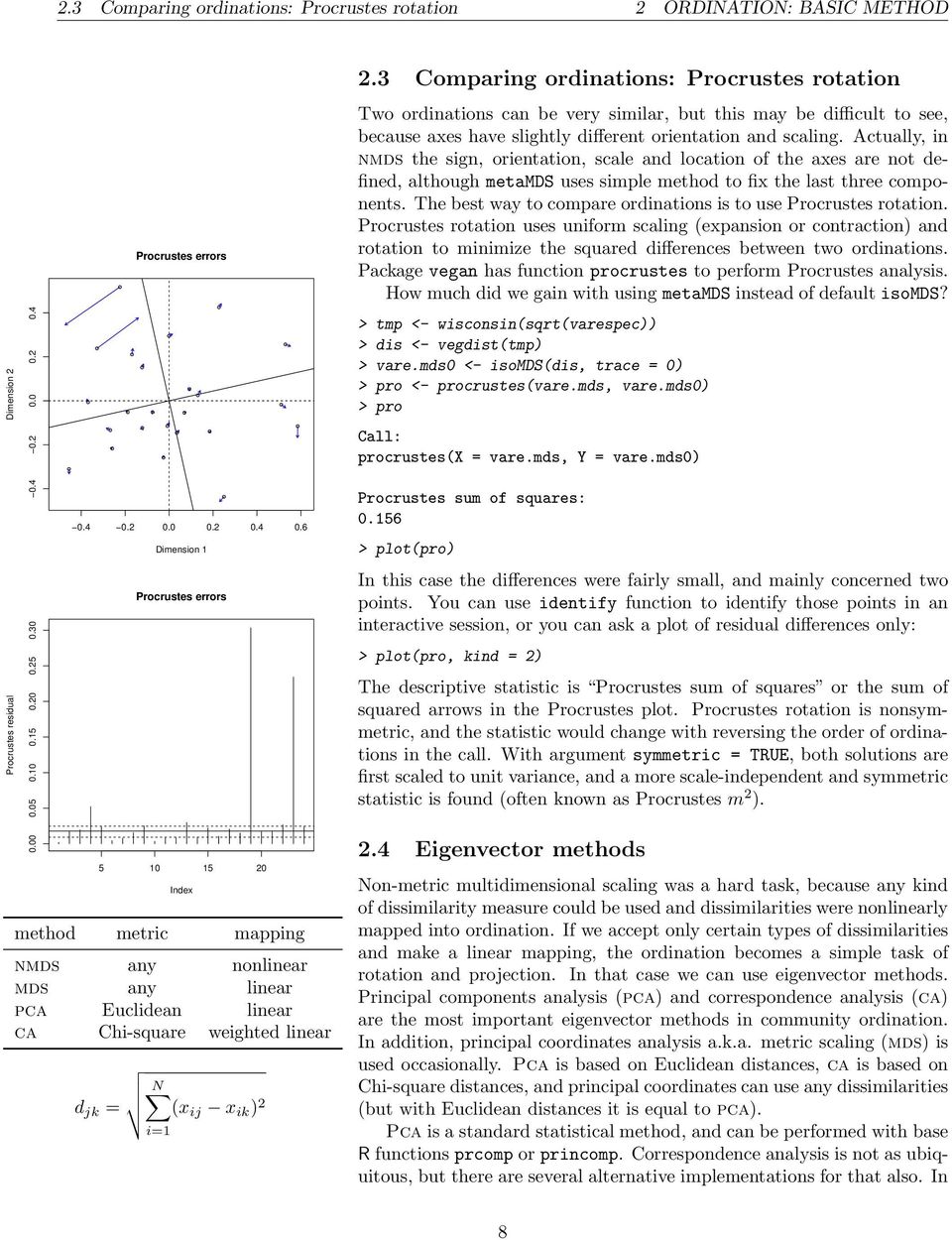
8 2. Comparing ordinations: Procrustes rotation 2 ORDINATION: BASIC METHOD Dimension 2 Procrustes residual Procrustes errors Dimension 1 Procrustes errors Index method metric mapping nmds any nonlinear mds any linear pca Euclidean linear ca Chi-square weighted linear 2. Comparing ordinations: Procrustes rotation Two ordinations can be very similar, but this may be difficult to see, because axes have slightly different orientation and scaling. Actually, in nmds the sign, orientation, scale and location of the axes are not defined, although metamds uses simple method to fix the last three components. The best way to compare ordinations is to use Procrustes rotation. Procrustes rotation uses uniform scaling (expansion or contraction) and rotation to minimize the squared differences between two ordinations. Package vegan has function procrustes to perform Procrustes analysis. How much did we gain with using metamds instead of default isomds? > tmp <- wisconsin(sqrt(varespec)) > dis <- vegdist(tmp) > vare.mds0 <- isomds(dis, trace = 0) > pro <- procrustes(vare.mds, vare.mds0) > pro Call: procrustes(x = vare.mds, Y = vare.mds0) Procrustes sum of squares: > plot(pro) In this case the differences were fairly small, and mainly concerned two points. You can use identify function to identify those points in an interactive session, or you can ask a plot of residual differences only: > plot(pro, kind = 2) The descriptive statistic is Procrustes sum of squares or the sum of squared arrows in the Procrustes plot. Procrustes rotation is nonsymmetric, and the statistic would change with reversing the order of ordinations in the call. With argument symmetric = TRUE, both solutions are first scaled to unit variance, and a more scale-independent and symmetric statistic is found (often known as Procrustes m 2 ). 2.4 Eigenvector methods Non-metric multidimensional scaling was a hard task, because any kind of dissimilarity measure could be used and dissimilarities were nonlinearly mapped into ordination. If we accept only certain types of dissimilarities and make a linear mapping, the ordination becomes a simple task of rotation and projection. In that case we can use eigenvector methods. Principal components analysis (pca) and correspondence analysis (ca) are the most important eigenvector methods in community ordination. In addition, principal coordinates analysis a.k.a. metric scaling (mds) is used occasionally. Pca is based on Euclidean distances, ca is based on d jk = N Chi-square distances, and principal coordinates can use any dissimilarities (x ij x ik ) 2 (but with Euclidean distances it is equal to pca). i=1 Pca is a standard statistical method, and can be performed with base R functions prcomp or princomp. Correspondence analysis is not as ubiquitous, but there are several alternative implementations for that also. In 8
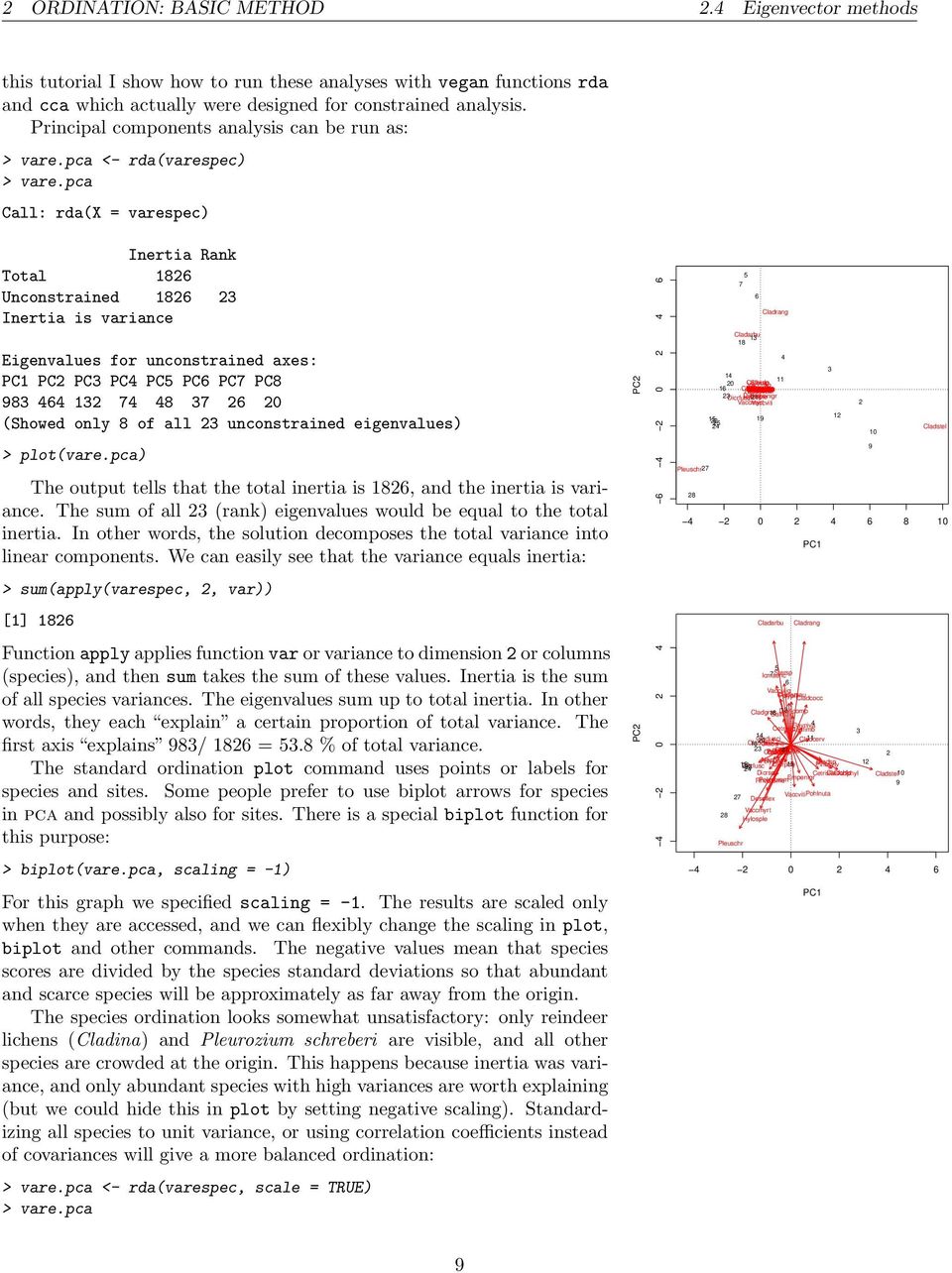
9 2 ORDINATION: BASIC METHOD 2.4 Eigenvector methods this tutorial I show how to run these analyses with vegan functions rda and cca which actually were designed for constrained analysis. Principal components analysis can be run as: > vare.pca <- rda(varespec) > vare.pca Call: rda(x = varespec) Inertia Rank Total 1826 Unconstrained Inertia is variance Eigenvalues for unconstrained axes: PC1 PC2 PC PC4 PC5 PC6 PC7 PC (Showed only 8 of all 2 unconstrained eigenvalues) > plot(vare.pca) The output tells that the total inertia is 1826, and the inertia is variance. The sum of all 2 (rank) eigenvalues would be equal to the total inertia. In other words, the solution decomposes the total variance into linear components. We can easily see that the variance equals inertia: PC Cladrang Cladarbu Callvulg Vacculig Stersp Cladunci Rhodtome Polycomm Cladamau Diphcomp Nepharct Betupube Claddefo Descflex Cladcorn Cladcocc Cladgrac Barbhatc Polyjuni Cladcerv Cladfimb Pohlnuta Cladchlo Icmaeric Cladbotr Cladcris Cladphyl Dicrpoly Peltapht Cetreric Pinusylv Cetrisla Flavniva Polypili Cladsp Ptilcili 2Dicrfusc Hylosple Dicrsp Empenigr 21 Vaccmyrt Vaccviti Cladstel 10 9 Pleuschr PC1 > sum(apply(varespec, 2, var)) [1] 1826 Cladarbu Cladrang Function apply applies function var or variance to dimension 2 or columns (species), and then sum takes the sum of these values. Inertia is the sum of all species variances. The eigenvalues sum up to total inertia. In other words, they each explain a certain proportion of total variance. The first axis explains 98/ 1826 = 5.8 % of total variance. The standard ordination plot command uses points or labels for species and sites. Some people prefer to use biplot arrows for species in pca and possibly also for sites. There is a special biplot function for this purpose: PC Icmaeric 7Stersp 5 6 Vacculig Cladamau Polypili Cladcocc Cladgrac 18 Diphcomp 1 Callvulg Flavniva 4 Cetreric Cladfimb Cladunci 14 Cladcerv Claddefo Cladcris 2 Cladcorn Peltapht Cladbotr Betupube Barbhatc Ptilcili 21 2 Polyjuni Nepharct 15 Dicrfusc Dicrpoly 19 Pinusylv Cladsp Dicrsp Cetrisla Cladchlo Cladphyl Cladstel10 Rhodtome PolycommEmpenigr 9 VaccvitiPohlnuta 27 Descflex Vaccmyrt 28 Hylosple Pleuschr > biplot(vare.pca, scaling = -1) For this graph we specified scaling = -1. The results are scaled only when they are accessed, and we can flexibly change the scaling in plot, biplot and other commands. The negative values mean that species scores are divided by the species standard deviations so that abundant and scarce species will be approximately as far away from the origin. The species ordination looks somewhat unsatisfactory: only reindeer lichens (Cladina) and Pleurozium schreberi are visible, and all other species are crowded at the origin. This happens because inertia was variance, and only abundant species with high variances are worth explaining (but we could hide this in plot by setting negative scaling). Standardizing all species to unit variance, or using correlation coefficients instead of covariances will give a more balanced ordination: > vare.pca <- rda(varespec, scale = TRUE) > vare.pca PC1 9
10 2.4 Eigenvector methods 2 ORDINATION: BASIC METHOD Call: rda(x = varespec, scale = TRUE) PC Cladphyl 10 Pohlnuta Cladcocc Cladstel Cladchlo Pinusylv Cetrisla Cladsp Cladgrac Polypili Cetreric Cladcris Cladfimb 2 12 Vaccviti Cladrang 1418 Claddefo 5 Cladarbu Stersp 6 Diphcomp Cladunci Cladcorn Peltapht Dicrpoly Cladamau 1 24 Ptilcili Icmaeric Callvulg Betupube Cladbotr Barbhatc Flavniva Dicrsp Empenigr 4 Vacculig Cladcerv Dicrfusc Polyjuni 2Nepharct 19 Polycomm Rhodtome Descflex Pleuschr Hylosple Vaccmyrt PC1 21 Inertia Rank Total 44 Unconstrained 44 2 Inertia is correlations Eigenvalues for unconstrained axes: PC1 PC2 PC PC4 PC5 PC6 PC7 PC (Showed only 8 of all 2 unconstrained eigenvalues) > plot(vare.pca, scaling = ) Now inertia is correlation, and the correlation of a variable with itself is one. Thus the total inertia is equal to the number of variables (species). The rank or the total number of eigenvectors is the same as previously. The maximum possible rank is defined by the dimensions of the data: it is one less than smaller of number of species or number of sites: > dim(varespec) [1] If there are species or sites similar to each other, rank will be reduced even from this. The percentage explained by the first axis decreased from the previous pca. This is natural, since previously we needed to explain only the abundant species with high variances, but now we have to explain all species equally. We should not look blindly at percentages, but the result we get. Correspondence analysis is very similar to pca: CA Cladphyl Cladstel Flavniva 4 Cetrisla Cladchlo PinusylvPohlnuta Cladsp Empenigr Vaccviti Cladcerv 11 Diphcomp Cladrang Polypili Cladcris Claddefo Cladcocc 20 Cetreric CladamauCladarbu 18 Vacculig Callvulg 5 6 Stersp Barbhatc Betupube Hylosple Ptilcili Vaccmyrt Dicrpoly Rhodtome Polycomm 27 Descflex Cladbotr Peltapht Cladfimb Cladcorn 2 Cladgrac Icmaeric Pleuschr Dicrsp Nepharct Polyjuni Cladunci 15 Dicrfusc > vare.ca <- cca(varespec) > vare.ca Call: cca(x = varespec) Inertia Rank Total 2.08 Unconstrained Inertia is mean squared contingency coefficient Eigenvalues for unconstrained axes: CA1 CA2 CA CA4 CA5 CA6 CA7 CA (Showed only 8 of all 2 unconstrained eigenvalues) CA1 > plot(vare.ca) Now the inertia is called mean squared contingency coefficient. Correspondence analysis is based on Chi-squared distance, and the inertia is the Chi-squared statistic of a data matrix standardized to unit total: > chisq.test(varespec/sum(varespec)) Pearson's Chi-squared test data: varespec/sum(varespec) X-squared = 2.1, df = 990, p-value = 1 10

11 2 ORDINATION: BASIC METHOD 2.5 Detrended correspondence analysis You should not pay any attention to P -values which are certainly misleading, but notice that the reported X-squared is equal to the inertia above. Correspondence analysis is a weighted averaging method. In the graph above species scores were weighted averages of site scores. With different scaling of results, we could display the site scores as weighted averages of species scores: > plot(vare.ca, scaling = 1) We already saw an example of scaling = or symmetric scaling in pca. The other two integers mean that either species are weighted averages of sites (2) or sites are weighted averages of species (1). When we take weighted averages, the range of averages shrinks from the original values. The shrinkage factor is equal to the eigenvalue of ca, which has a theoretical maximum of 1. CA Cladphyl Cladstel Cetrisla Cladchlo CladamauCladarbu Vacculig Callvulg Barbhatc Betupube Hylosple Ptilcili Vaccmyrt Rhodtome Dicrpoly Polycomm Descflex Cladbotr PinusylvPohlnuta Pleuschr 2Cladsp Empenigr Vaccviti 19 Dicrsp Nepharct Polyjuni Cladcerv 11 Peltapht 2 Cladfimb Cladcorn Cladgrac 16 Cladcris Claddefo Cladcocc 18 Dicrfusc Cetreric14 Flavniva 6 1 Diphcomp Cladrang7 Cladunci Polypili 5 Stersp Icmaeric CA1 2.5 Detrended correspondence analysis Correspondence analysis is a much better and more robust method for community ordination than principal components analysis. However, with long ecological gradients it suffers from some drawbacks or faults which were corrected in detrended correspondence analysis (dca): Single long gradients appear as curves or arcs in ordination (arc effect): the solution is to detrend the later axes by making their means equal along segments of previous axes. Sites are packed more closely at gradient extremes than at the centre: the solution is to rescale the axes to equal variances of species scores. Rare species seem to have an unduly high influence on the results: the solution iss to downweight rare species. All these three separate tricks are incorporated in function decorana which is a faithful port of Mark Hill s original programme with the same name. The usage is simple: > vare.dca <- decorana(varespec) > vare.dca Call: decorana(veg = varespec) Detrended correspondence analysis with 26 segments. Rescaling of axes with 4 iterations. DCA1 DCA2 DCA DCA4 Eigenvalues Decorana values Axis lengths > plot(vare.dca, display="sites") 11

12 2.6 Ordination graphics 2 ORDINATION: BASIC METHOD DCA DCA1 Function decorana finds only four axes. Eigenvalues are defined as shrinkage values in weighted averages, similarly as in cca above. The Decorana values are the numbers that the original programme returns as eigenvalues I have no idea of their possible meaning, and they should not be used. Most often people comment on axis lengths, which sometimes are called gradient lengths. The etymology is obscure: these are not gradients, but ordination axes. It is often said that if the axis length is shorter than two units, the data are linear, and pca should be used. This is only folklore and not based on research which shows that ca is at least as good as pca with short gradients, and usually better. The current data set is homogeneous, and the effects of dca are not very large. In heterogeneous data with a clear arc effect the changes often are more dramatic. Rescaling may have larger influence than detrending in many cases. The default analysis is without downweighting of rare species: see help pages for the needed arguments. Actually, downweight is an independent function that can be used with cca as well. There is a school of thought that regards dca as the method of choice in unconstrained ordination. However, it seems to be a fragile and vague back of tricks that is better avoided. 2.6 Ordination graphics We have already seen many ordination diagrams in this tutorial with one feature in common: they are cluttered and labels are difficult to read. Ordination diagrams are difficult to draw cleanly because we must put a large number of labels in a small plot, and often it is impossible to draw clean plots with all items labelled. In this chapter we look at producing cleaner plots. For this we must look at the anatomy of plotting functions in vegan and see how to gain a better control of default functions. Ordination functions in vegan have their dedicated plot functions which provides a simple plot. For instance, the result of decorana is displayed by function plot.decorana which behind the scenes is called by our plot function. Alternatively, we can use function ordiplot which also works with many non-vegan ordination functions, but uses points instead of text as default. The plot.decorana function (or ordiplot) actually works in three stages: 1. It draws an empty plot with labelled axes, but with no symbols for sites or species. 2. It uses functions text or points to add species to the empty frame. If the user does not ask specifically, the function will use text in small data sets and points in large data sets.. It adds the sites similarly. For better control of the plots we must repeat these stages by hand: draw an empty plot and then add sites and/or species as desired. In this chapter we study a difficult case: plotting the Barro Colorado Island ordinations. 12

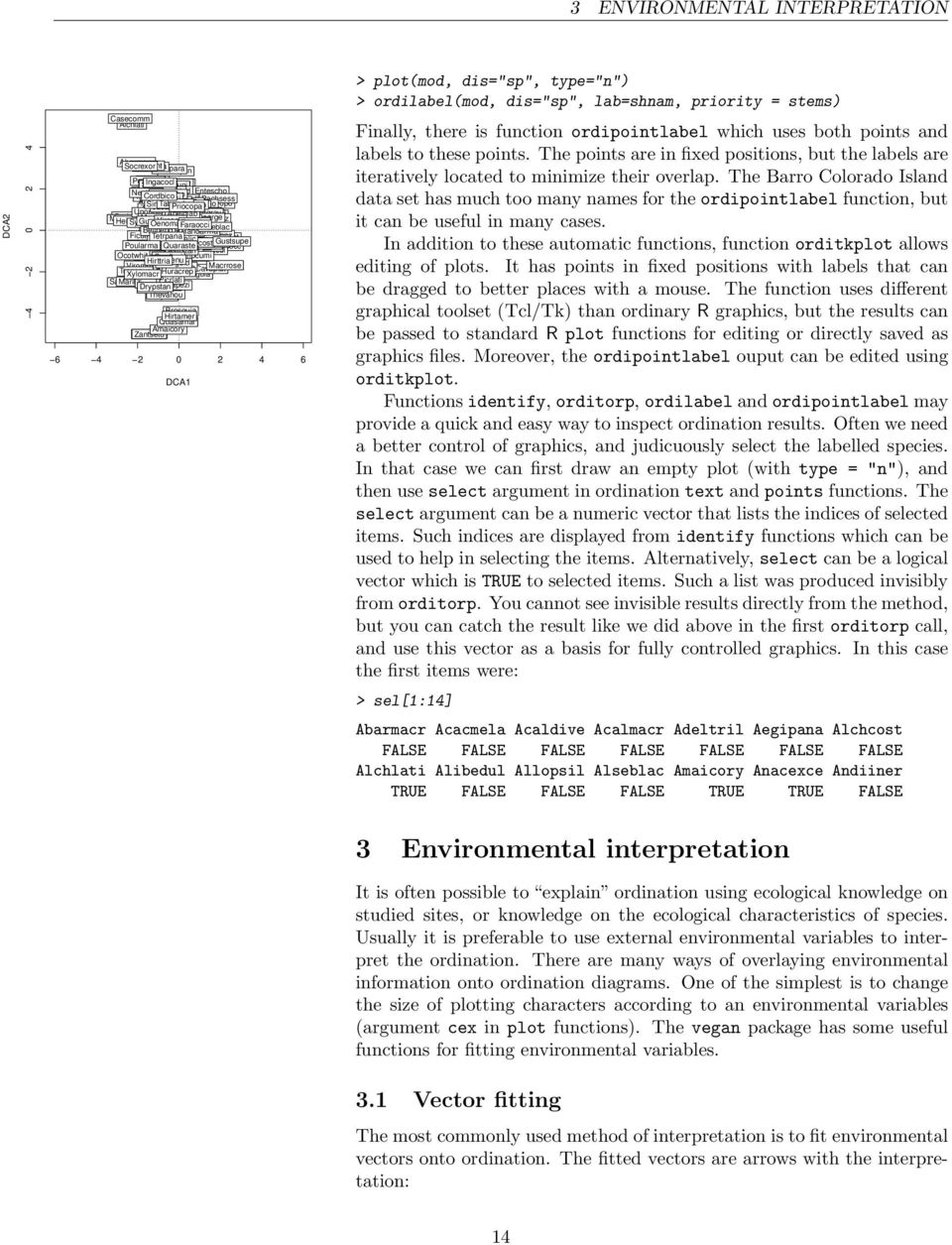
13 2 ORDINATION: BASIC METHOD 2.6 Ordination graphics > data(bci) This is a difficult data set for plotting: it has 225 species and there is no way of labelling them all cleanly unless we use very large plotting area with small text. We must show only a selection of the species or small parts of the plot. First an ordination with decorana and its default plot: > mod <- decorana(bci) > plot(mod) There is an additional problem in plotting species ordination with these data: > names(bci)[1:5] [1] "Abarema.macradenia" "Acacia.melanoceras" [] "Acalypha.diversifolia" "Acalypha.macrostachya" [5] "Adelia.triloba" The data set uses full species names, and there is no way of fitting those in ordination graphs. There is a utility function make.cepnames in vegan to abbreviate Latin names: > shnam <- make.cepnames(names(bci)) > shnam[1:5] [1] "Abarmacr" "Acacmela" "Acaldive" "Acalmacr" "Adeltril" The easiest way to selectively label species is to use interactive identify function: when you click next to a point, its label will appear on the side you clicked. You can finish labelling clicking the right mouse button, or with handicapped one-button mouse, you can hit the esc key. > pl <- plot(mod, dis="sp") All vegan ordination plot functions return invisibly an ordiplot object which contains information on the points plotted. This invisible result can be caught and used as input to identify. The following selectively labels some extreme species as clicked: > identify(pl, "sp", labels=shnam) There is an ordination text or points function orditorp in vegan. This function will label an item only if this can be done without overwriting previous labels. If an item cannot be labelled with text, it will be marked as a point. Items are processed either from the margin toward the centre, or in decreasing order of priority. The following gives higher priority to the most abundant species: > stems <- colsums(bci) > plot(mod, dis="sp", type="n") > sel <- orditorp(mod, dis="sp", lab=shnam, priority=stems, pcol = "gray", pch="") We also can zoom into some parts of the ordination diagrams by setting xlim and ylim, and we can see more details. An alternative to orditorp is function ordilabel which draws text on opaque labels that cover other labels below them. All labels cannot be displayed, but at least the uppermost are readable. Argument priority works similarly as in orditorp and can be used to select which of the labels are most important to show: DCA2 DCA2 DCA Casecomm Alchlati DCA1 Abarmacr Socrexor Pachquin Pourbico Nectciss Entescho Pachsess Ficuyopo Margnobi Gustsupe Poularma Ocotwhit Macrrose Tropcauc Cavaplat Sapibroa Thevahou Brosguia Quasamar Senndari Amaicory Casecomm Alchlati Socrexor DCA1 Ingacocl Garcmadr Entescho Cordbico Zantpana Pachsess Ficuyopo Cocccoro Priocopa Unonpitt Apeiglab Astrgrav Heisacum Virosebi Handguay Tachvers Faraocci Beilpend Randarma Tetrpana SapiglanFicuinsi Gustsupe Poularma Quaraste Garcinte Sloatern Astrstan Caseacul Ocotwhit Tripcumi Hirttria Viromult Anacexce Macrrose Xylomacr Huracrep Marilaxi Picrlati Drypstan Thevahou Schipara Brosguia Hirtamer Quasamar Amaicory DCA1 1

14 ENVIRONMENTAL INTERPRETATION > plot(mod, dis="sp", type="n") > ordilabel(mod, dis="sp", lab=shnam, priority = stems) DCA Casecomm Alchlati Abarmacr Socrexor Perexant Ochrpyra Schipara Pachquin Pourbico Ficucolu Sipaguia Sipapauc Laetproc Ingacocl Lafopuni Cupacine Micoelat Nectciss Myrcgatu Garcmadr Micohond Entescho Tricgale Ocotpube Cordbico Desmpana Laettham Dendarbo Zantjuni Cecrinsi MicoaffiPachsess Cocccoro Simaamar Ficuyopo Hampappe Cupaseem Zantpana Plateleg Guargran Ormoamaz Cuparufe Cedrodor Ingaspec Spacmemb Coluglan Chimparv Margnobi Ingaumbe Licahypo Zantekma Cinntrip Diptolei Jacacopa Tabearbo Mosagarw Cecrobtu Protpana Platpinn Priocopa Casearbo UnonpittSponmomb Alibedul Talinerv Heisacum Nectpurp Aegipana Laciaggr Solahaye Ocotcern Astrgrav Chryarge Turpocci Cassguia Sponradl Lonchept Maqucost Sympglob Chamschi Tricgiga Macltinc Ingaoers Ficupope Erytmacr Pipereti Annospra Cordalli Protcost Hassflor Handguay Termamaz Poutstip Eugenesi Apeiglab Guatdume Micoarge Oenomapo Virosebi Swarcont Tremmicr Ceibpent Lacmpana Couscurv Tricpall TachversElaeolei Ingagold Crotbill Ingasapi Poutreti Swargran Eugeoers Faraocci Trictube Beilpend Acalmacr Guetfoli Alseblac Ficutond Poutfoss Tocopitt Taliprin Ingapunc Ficuinsi Ingaruiz Ormomacr Tetrjoha Coccmanz Pseusept Theocaca Maytschi Trataspe Calolong Guapmyrt Randarma Celtschi TetrpanaSapiglan Zuelguid Troprace Nectline Chrycain Eugegala Vochferr ApeitiboAcaldive Erytcost Andiiner Guarfuzz Diosarta Sterapet Ingasemi Brosalic Allopsil Casesylv Ficucost Acacmela Guazulmi Ingalaur Ormococc Soroaffi Inganobi Lindlaur Myrofrut Geniamer Attabuty Hieralch Sloatern Banaguia Psycgran Ocotoblo Pterrohr Eugeflor Alchcost Adeltril Garcinte Luehseem Gustsupe PoularmaHeisconc Quaraste AstrstanCaseacul Ocotwhit Virosuri Ficumaxi Ficuobtu Taberose Aspidesm Tripcumi Hirttria Cordlasi Prottenu Viromult Guarguid Psidfrie AnacexceCavaplat Macrrose Tropcauc Xylomacr Ingaacum Huracrep Caseguia Vismbacc Cupalati Sapibroa Marilaxi Termoblo Ficutrig Picrlati Licaplat Drypstan Cespmacr Posolati Ingapezi Chryecli Thevahou Brosguia Hirtamer Quasamar Amaicory Senndari Zantsetu DCA1 Finally, there is function ordipointlabel which uses both points and labels to these points. The points are in fixed positions, but the labels are iteratively located to minimize their overlap. The Barro Colorado Island data set has much too many names for the ordipointlabel function, but it can be useful in many cases. In addition to these automatic functions, function orditkplot allows editing of plots. It has points in fixed positions with labels that can be dragged to better places with a mouse. The function uses different graphical toolset (Tcl/Tk) than ordinary R graphics, but the results can be passed to standard R plot functions for editing or directly saved as graphics files. Moreover, the ordipointlabel ouput can be edited using orditkplot. Functions identify, orditorp, ordilabel and ordipointlabel may provide a quick and easy way to inspect ordination results. Often we need a better control of graphics, and judicuously select the labelled species. In that case we can first draw an empty plot (with type = "n"), and then use select argument in ordination text and points functions. The select argument can be a numeric vector that lists the indices of selected items. Such indices are displayed from identify functions which can be used to help in selecting the items. Alternatively, select can be a logical vector which is TRUE to selected items. Such a list was produced invisibly from orditorp. You cannot see invisible results directly from the method, but you can catch the result like we did above in the first orditorp call, and use this vector as a basis for fully controlled graphics. In this case the first items were: > sel[1:14] Abarmacr Acacmela Acaldive Acalmacr Adeltril Aegipana Alchcost FALSE FALSE FALSE FALSE FALSE FALSE FALSE Alchlati Alibedul Allopsil Alseblac Amaicory Anacexce Andiiner TRUE FALSE FALSE FALSE TRUE TRUE FALSE Environmental interpretation It is often possible to explain ordination using ecological knowledge on studied sites, or knowledge on the ecological characteristics of species. Usually it is preferable to use external environmental variables to interpret the ordination. There are many ways of overlaying environmental information onto ordination diagrams. One of the simplest is to change the size of plotting characters according to an environmental variables (argument cex in plot functions). The vegan package has some useful functions for fitting environmental variables..1 Vector fitting The most commonly used method of interpretation is to fit environmental vectors onto ordination. The fitted vectors are arrows with the interpretation: 14
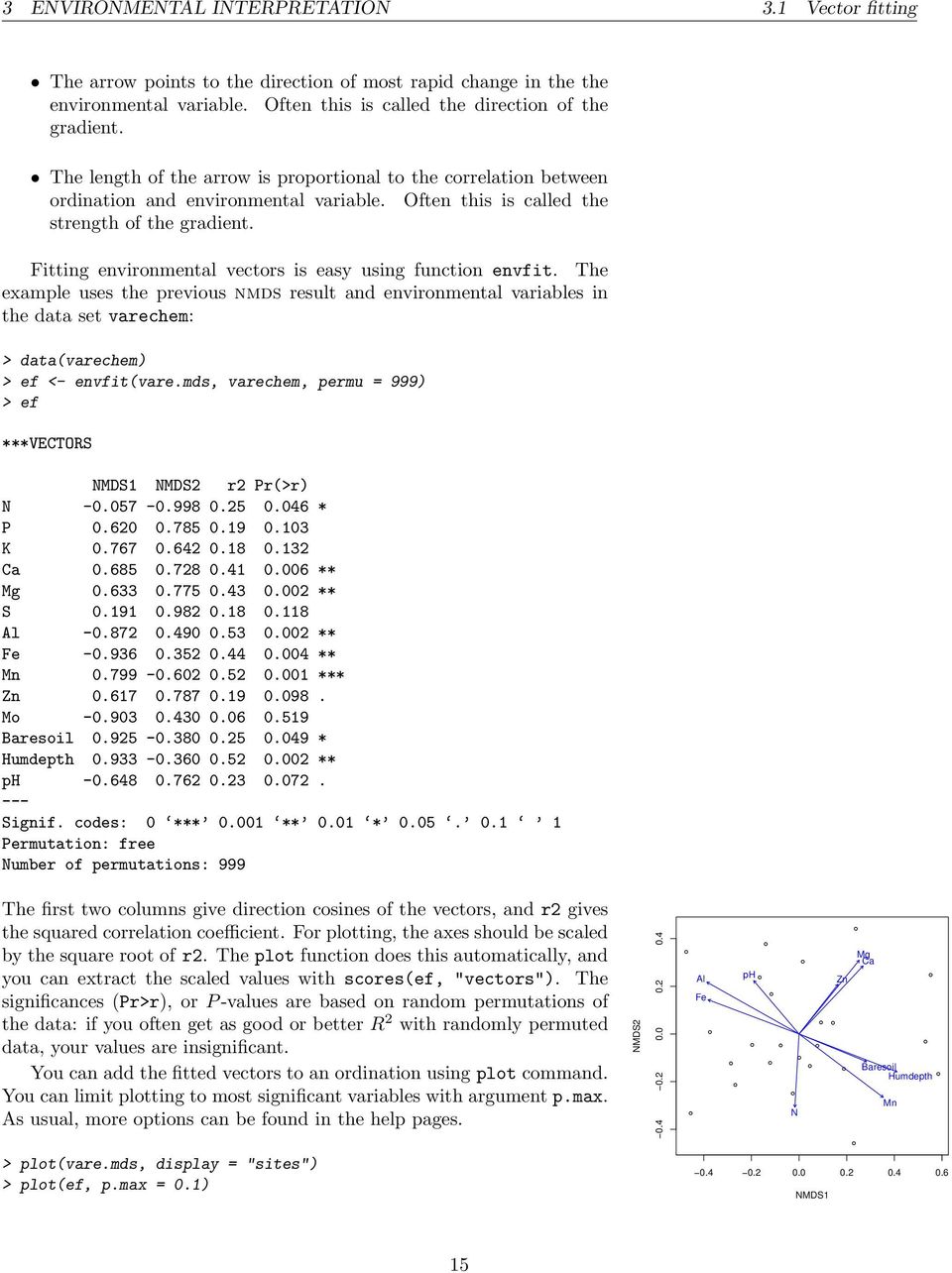
15 ENVIRONMENTAL INTERPRETATION.1 Vector fitting The arrow points to the direction of most rapid change in the the environmental variable. Often this is called the direction of the gradient. The length of the arrow is proportional to the correlation between ordination and environmental variable. Often this is called the strength of the gradient. Fitting environmental vectors is easy using function envfit. The example uses the previous nmds result and environmental variables in the data set varechem: > data(varechem) > ef <- envfit(vare.mds, varechem, permu = 999) > ef ***VECTORS NMDS1 NMDS2 r2 Pr(>r) N * P K Ca ** Mg ** S Al ** Fe ** Mn *** Zn Mo Baresoil * Humdepth ** ph Signif. codes: 0 *** ** 0.01 * Permutation: free Number of permutations: 999 The first two columns give direction cosines of the vectors, and r2 gives the squared correlation coefficient. For plotting, the axes should be scaled by the square root of r2. The plot function does this automatically, and you can extract the scaled values with scores(ef, "vectors"). The significances (Pr>r), or P -values are based on random permutations of the data: if you often get as good or better R 2 with randomly permuted data, your values are insignificant. You can add the fitted vectors to an ordination using plot command. You can limit plotting to most significant variables with argument p.max. As usual, more options can be found in the help pages. NMDS Al Fe ph N Zn Mg Ca Baresoil Humdepth Mn > plot(vare.mds, display = "sites") > plot(ef, p.max = 0.1) NMDS1 15
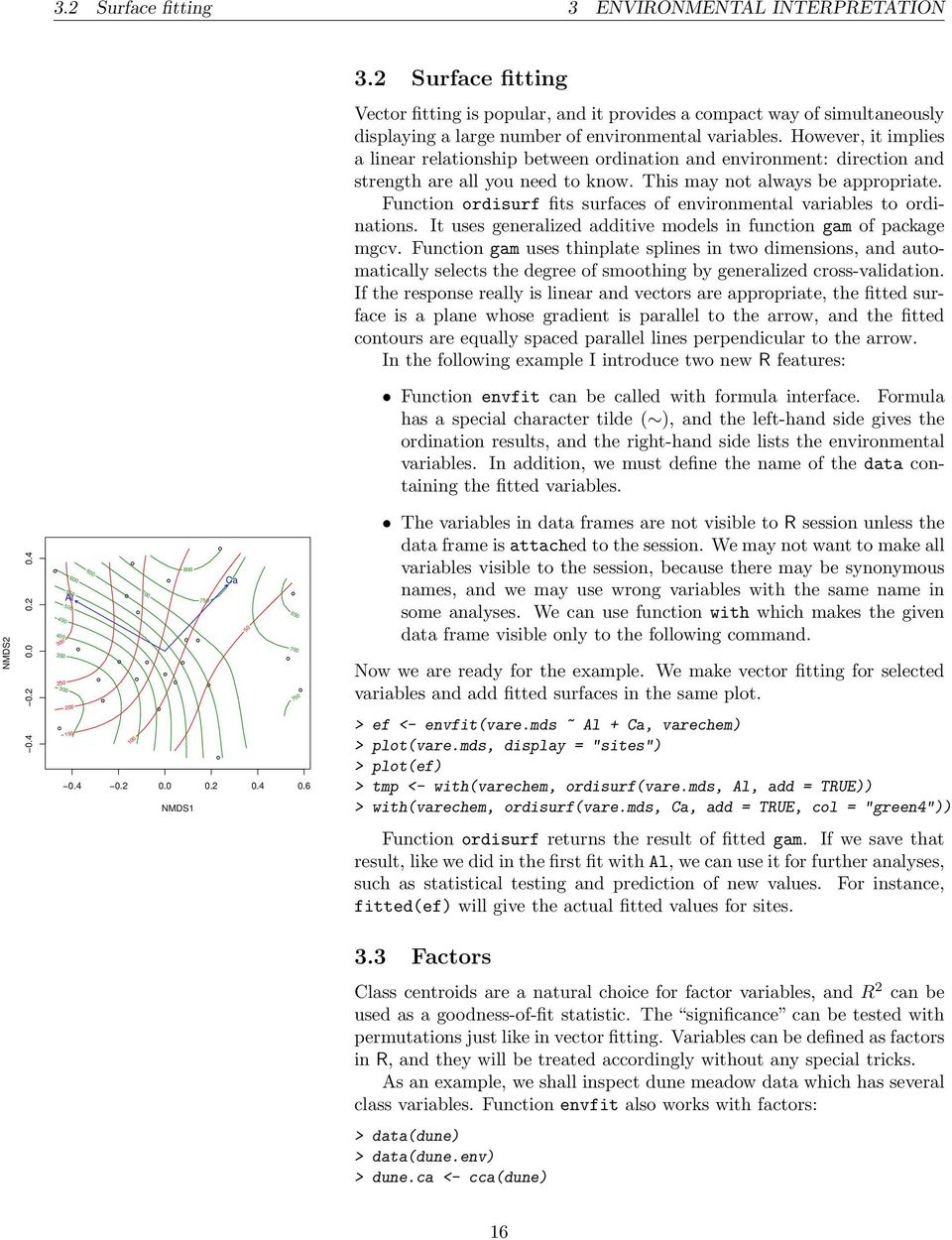
16 .2 Surface fitting ENVIRONMENTAL INTERPRETATION.2 Surface fitting Vector fitting is popular, and it provides a compact way of simultaneously displaying a large number of environmental variables. However, it implies a linear relationship between ordination and environment: direction and strength are all you need to know. This may not always be appropriate. Function ordisurf fits surfaces of environmental variables to ordinations. It uses generalized additive models in function gam of package mgcv. Function gam uses thinplate splines in two dimensions, and automatically selects the degree of smoothing by generalized cross-validation. If the response really is linear and vectors are appropriate, the fitted surface is a plane whose gradient is parallel to the arrow, and the fitted contours are equally spaced parallel lines perpendicular to the arrow. In the following example I introduce two new R features: Function envfit can be called with formula interface. Formula has a special character tilde ( ), and the left-hand side gives the ordination results, and the right-hand side lists the environmental variables. In addition, we must define the name of the data containing the fitted variables. NMDS Al NMDS1 750 Ca The variables in data frames are not visible to R session unless the data frame is attached to the session. We may not want to make all variables visible to the session, because there may be synonymous names, and we may use wrong variables with the same name in some analyses. We can use function with which makes the given data frame visible only to the following command. Now we are ready for the example. We make vector fitting for selected variables and add fitted surfaces in the same plot. > ef <- envfit(vare.mds ~ Al Ca, varechem) > plot(vare.mds, display = "sites") > plot(ef) > tmp <- with(varechem, ordisurf(vare.mds, Al, add = TRUE)) > with(varechem, ordisurf(vare.mds, Ca, add = TRUE, col = "green4")) Function ordisurf returns the result of fitted gam. If we save that result, like we did in the first fit with Al, we can use it for further analyses, such as statistical testing and prediction of new values. For instance, fitted(ef) will give the actual fitted values for sites.. Factors Class centroids are a natural choice for factor variables, and R 2 can be used as a goodness-of-fit statistic. The significance can be tested with permutations just like in vector fitting. Variables can be defined as factors in R, and they will be treated accordingly without any special tricks. As an example, we shall inspect dune meadow data which has several class variables. Function envfit also works with factors: > data(dune) > data(dune.env) > dune.ca <- cca(dune) 16
17 ENVIRONMENTAL INTERPRETATION. Factors > ef <- envfit(dune.ca, dune.env, permutations = 999) > ef ***VECTORS CA1 CA2 r2 Pr(>r) A * --- Signif. codes: 0 *** ** 0.01 * Permutation: free Number of permutations: 999 ***FACTORS: Centroids: CA1 CA2 Moisture Moisture Moisture Moisture ManagementBF ManagementHF ManagementNM ManagementSF UseHayfield UseHaypastu UsePasture Manure Manure Manure Manure Manure Goodness of fit: r2 Pr(>r) Moisture ** Management *** Use Manure ** --- Signif. codes: 0 *** ** 0.01 * Permutation: free Number of permutations: 999 CA UseHayfield ManagementNM Manure0 6 UsePasture 10 ManagementBF Moisture1 5 7Moisture2 Manure1 ManagementHF 8 Manure2 Manure UseHaypastu 2 ManagementSF 12 Moisture4 4 9 Manure4 1 1 Moisture A1 > plot(dune.ca, display = "sites") > plot(ef) CA1 The names of factor centroids are formed by combining the name of the factor and the name of the level. Now the axes show the centroids for the level, and the R 2 values are for the whole factor, just like the significance test. The plot looks congested, and we may use tricks of 2.6 (p. 12) to make cleaner plots, but obviously not all factors are necessary in interpretation. Package vegan has several functions for graphical display of factors. Function ordihull draws an enclosing convex hull for the items in a 17

18 4 CONSTRAINED ORDINATION CA NM BF HF SF class, ordispider combines items to their (weighted) class centroid, and ordiellipse draws ellipses for class standard deviations, standard errors or confidence areas. The example displays all these for Management type in the previous ordination and automatically labels the groups in ordispider command: > plot(dune.ca, display = "sites", type = "p") > with(dune.env, ordiellipse(dune.ca, Management, kind = "se", conf = 0.95)) > with(dune.env, ordispider(dune.ca, Management, col = "blue", label= TRUE)) > with(dune.env, ordihull(dune.ca, Management, col="blue", lty=2)) Correspondence analysis is a weighted ordination method, and vegan functions envfit and ordisurf will do weighted fitting, unless the user specifies equal weights. CA1 4 Constrained ordination In unconstrained ordination we first find the major compositional variation, and then relate this variation to observed environmental variation. In constrained ordination we do not want to display all or even most of the compositional variation, but only the variation that can be explained by the used environmental variables, or constraints. Constrained ordination is often known as canonical ordination, but this name is misleading: there is nothing particularly canonical in these methods (see your favorite Dictionary for the term). The name was taken into use, because there is one special statistical method, canonical correlations, but these indeed are canonical: they are correlations between two matrices regarded to be symmetrically dependent on each other. The constrained ordination is non-symmetric: we have independent variables or constraints and we have dependent variables or the community. Constrained ordination rather is related to multivariate linear models. The vegan package has three constrained ordination methods which all are constrained versions of basic ordination methods: Constrained analysis of proximities (cap) in function capscale is related to metric scaling (cmdscale). It can handle any dissimilarity measures and performs a linear mapping. Redundancy analysis (rda) in function rda is related to principal components analysis. It is based on Euclidean distances and performs linear mapping. Constrained correspondence analysis (cca) in function cca is related to correspondence analysis. It is based on Chi-squared distances and performs weighted linear mapping. We have already used functions rda and cca for unconstrained ordination: they will perform the basic unconstrained method as a special case if constraints are not used. All these three vegan functions are very similar. The following examples mainly use cca, but other methods can be used similarly. Actually, the results are similarly structured, and they inherit properties from each 18

19 4 CONSTRAINED ORDINATION 4.1 Model specification other. For historical reasons, cca is the basic method, and rda inherits properties from it. Function capscale inherits directly from rda, and through this from cca. Many functions, are common with all these methods, and there are specific functions only if the method deviates from its ancestor. In vegan version 2.-0 the following class functions are defined for these methods: cca: add1, alias, anova, as.mlm, biplot, bstick, calibrate, coef, deviance, drop1, eigenvals, extractaic, fitted, goodness, model.frame, model.matrix, nobs, permutest, plot, points, predict, print, residuals, RsquareAdj, scores, screeplot, simulate, stressplot, summary, text, tolerance, weights rda: as.mlm, biplot, coef, deviance, fitted, predict, RsquareAdj, scores, simulate, stressplot, weights capscale: fitted, print, RsquareAdj, simulate, stressplot. Many of these methods are internal functions that users rarely need. 4.1 Model specification The recommended way of defining a constrained model is to use model formula. Formula has a special character, and on its left-hand side gives the name of the community data, and right-hand gives the equation for constraints. In addition, you should give the name of the data set where to find the constraints. This fits a cca for varespec constrained by soil Al, K and P: > vare.cca <- cca(varespec ~ Al P K, varechem) > vare.cca Call: cca(formula = varespec ~ Al P K, data = varechem) Inertia Proportion Rank Total Constrained Unconstrained Inertia is mean squared contingency coefficient Eigenvalues for constrained axes: CCA1 CCA2 CCA Eigenvalues for unconstrained axes: CA1 CA2 CA CA4 CA5 CA6 CA7 CA (Showed only 8 of all 20 unconstrained eigenvalues) The output is similar as in unconstrained ordination. Now the total inertia is decomposed into constrained and unconstrained components. There were three constraints, and the rank of constrained component is three. The rank of unconstrained component is 20, when it used to be 2 in the previous analysis. The rank is the same as the number of axes: you have constrained axes and 20 unconstrained axes. In some 19

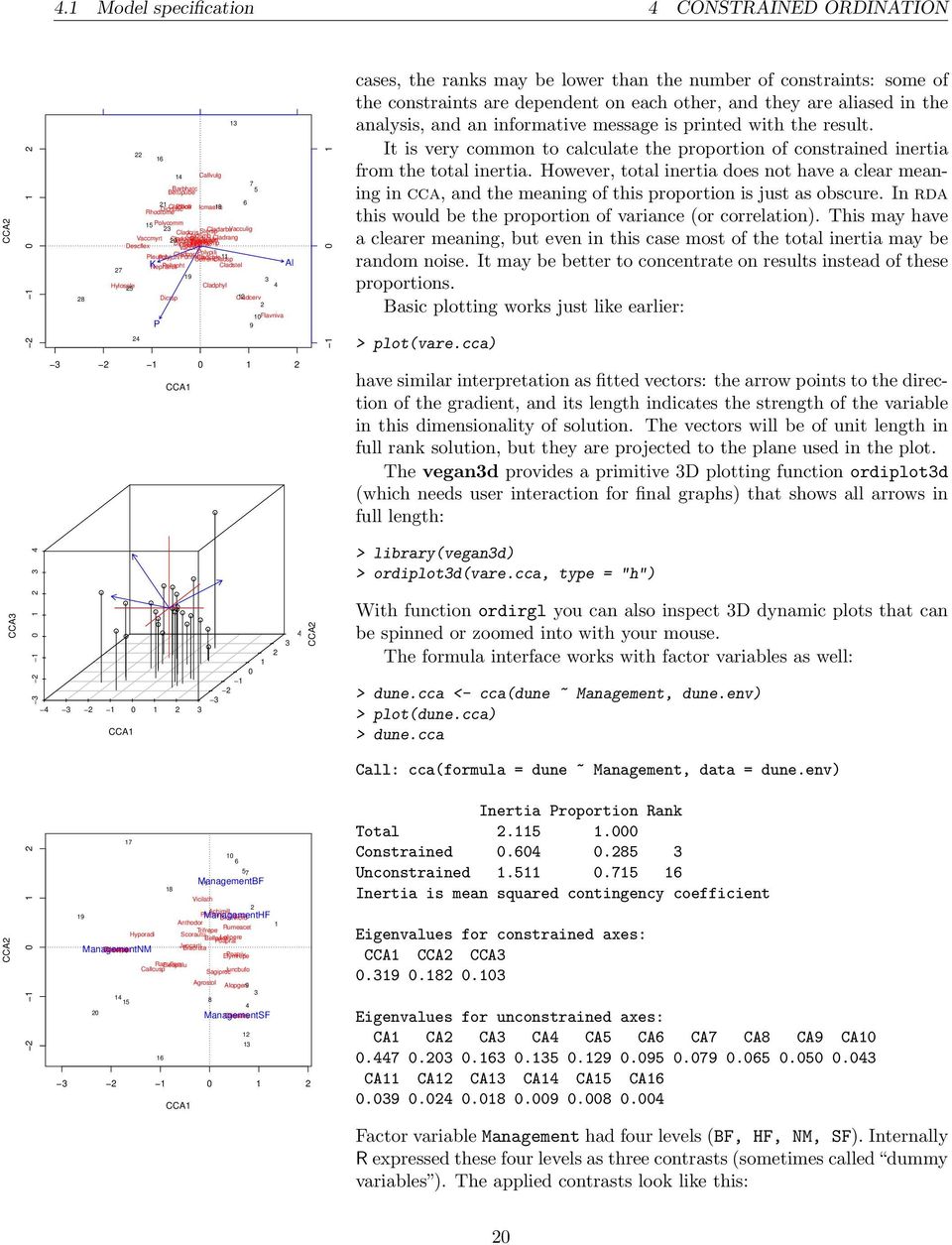
20 4.1 Model specification 4 CONSTRAINED ORDINATION CCA Callvulg 7 Barbhatc Betupube Dicrfusc Cladbotr Ptilcili Icmaeric 18 Rhodtome 15 Polycomm 2 CladarbuVacculig Cladcris Stersp Vaccmyrt Cladfimb Empenigr Cladrang 20 Claddefo Cladamau Pinusylv Diphcomp Descflex Dicrpoly Cladunci Cladgrac Cetrisla Cladcocc Vaccviti Polypili Pleuschr Cladcorn PolyjuniPohlnuta Cetreric Cladchlo Cladsp 11 KNepharct Peltapht Cladstel Al Hylosple Cladphyl 4 25 Dicrsp Cladcerv Flavniva P cases, the ranks may be lower than the number of constraints: some of the constraints are dependent on each other, and they are aliased in the analysis, and an informative message is printed with the result. It is very common to calculate the proportion of constrained inertia from the total inertia. However, total inertia does not have a clear meaning in cca, and the meaning of this proportion is just as obscure. In rda this would be the proportion of variance (or correlation). This may have a clearer meaning, but even in this case most of the total inertia may be random noise. It may be better to concentrate on results instead of these proportions. Basic plotting works just like earlier: > plot(vare.cca) CCA1 have similar interpretation as fitted vectors: the arrow points to the direction of the gradient, and its length indicates the strength of the variable in this dimensionality of solution. The vectors will be of unit length in full rank solution, but they are projected to the plane used in the plot. The vegand provides a primitive D plotting function ordiplotd (which needs user interaction for final graphs) that shows all arrows in full length: CCA CCA CCA2 > library(vegand) > ordiplotd(vare.cca, type = "h") With function ordirgl you can also inspect D dynamic plots that can be spinned or zoomed into with your mouse. The formula interface works with factor variables as well: > dune.cca <- cca(dune ~ Management, dune.env) > plot(dune.cca) > dune.cca Call: cca(formula = dune ~ Management, data = dune.env) CCA ManagementBF Vicilath 2 Achimill 19 Planlanc ManagementHF Bromhord Trifprat Anthodor Rumeacet 1 Trifrepe Hyporadi Scorautu Bellpere Lolipere Poaprat Juncarti ManagementNM Comapalu Empenigr Airaprae Salirepe Bracruta Elymrepe Poatriv Ranuflam Eleopalu Callcusp Sagiproc Juncbufo Agrostol Alopgeni ManagementSF Chenalbu Cirsarve CCA1 Inertia Proportion Rank Total Constrained Unconstrained Inertia is mean squared contingency coefficient Eigenvalues for constrained axes: CCA1 CCA2 CCA Eigenvalues for unconstrained axes: CA1 CA2 CA CA4 CA5 CA6 CA7 CA8 CA9 CA CA11 CA12 CA1 CA14 CA15 CA Factor variable Management had four levels (BF, HF, NM, SF). Internally R expressed these four levels as three contrasts (sometimes called dummy variables ). The applied contrasts look like this: 20
21 4 CONSTRAINED ORDINATION 4.2 Permutation tests ManagementHF ManagementNM ManagementSF SF BF HF NM We do not need but three variables to express four levels: if there is number one in a column, the observation belongs to that level, and if there is a whole line of zeros, the observation must belong to the omitted level, or the first. The basic plot function displays class centroids instead of vectors for factors. In addition to these ordinary factors, R also knows ordered factors. Variable Moisture in dune.env is defined as an ordered four-level factor. In this case the contrasts look different: Moisture.L Moisture.Q Moisture.C R uses polynomial contrasts: the linear term L is equal to treating Moisture as a continuous variable, and the quadratic Q and cubic C terms show nonlinear features. There were four distinct levels, and the number of contrasts is one less, just like with ordinary contrasts. The ordination configuration, eigenvalues or rank do not change if the factor is unordered or ordered, but the presentation of the factor in the results may change: > vare.cca <- cca(dune ~ Moisture, dune.env) > plot(vare.cca) Now plot shows both the centroids of factor levels and the contrasts. If we could change the ordered factor to a continuous vector, only the linear effect arrow would be important. If the response to the variable is nonlinear, the quadratic (and cubic) arrows would be long as well. I have explained only the simplest usage of the formula interface. The formula is very powerful in model specification: you can transform your contrasts within the formula, you can define interactions, you can use polynomial contrasts etc. However, models with interactions or polynomials may be difficult to interpret. CCA Moisture.Q Moisture.C Salirepe Comapalu Empenigr Ranuflam Chenalbu Eleopalu Callcusp Moisture1 Trifprat Moisture5 5Planlanc Hyporadi Vicilath 7Achimill Anthodor Airaprae Bromhord Bellpere LolipereScorautu Poaprat 2 CirsarveTrifrepe Bracruta Poatriv Agrostol 1 Moisture2 Rumeacet Juncarti 8 Moisture.L Elymrepe Sagiproc Alopgeni 4 Juncbufo 1 9 Moisture CCA Permutation tests The significance of all terms together can be assessed using permutation tests: the dat are permuted randomly and the model is refitted. When constrained inertia in permutations is nearly always lower than observed constrained inertia, we say that constraints are significant. The easiest way of running permutation tests is to use the mock anova function in vegan: > anova(vare.cca) Permutation test for cca under reduced model Permutation: free Number of permutations:
22 4.2 Permutation tests 4 CONSTRAINED ORDINATION Model: cca(formula = dune ~ Moisture, data = dune.env) Df ChiSquare F Pr(>F) Model *** Residual Signif. codes: 0 *** ** 0.01 * The Model refers to the constrained component, and Residual to the unconstrained component of the ordination, ChiSquare is the corresponding inertia, and Df the corresponding rank. The test statistic F, or more correctly pseudo-f is defined as their ratio. You should not pay any F = 0.628/ 1.487/16 = attention to its numeric values or to the numbers of degrees of freedom, since this pseudo-f has nothing to do with the real F, and the only way to assess its significance is permutation. In simple models like the one studied here we could directly use inertia in testing, but the pseudo-f is needed in more complicated model including partialled terms. The number of permutations was not specified in the mock anova function. The function tries to be lazy: it continues permutations only as long as it is uncertain whether the final P -value will be below or above the critical value (usually P = 0.05). If the observed inertia is never reached in permutations, the function may stop after 200 permutations, and if it is very often exceeded, it may stop after 100 permutations. When we are close to the critical level, the permutations may continue to thousands. In this way the calculations are fast when this is possible, but they are continued longer in uncertain cases. If you want to have a fixed number of iterations, you must specify that in anova call or directly use the underlying function permutest.cca In addition to the overall test for all constraints together, we can also analyse single terms or axes by setting argument by. The following command analyses all terms separately in a sequential ( Type I ) test: > mod <- cca(varespec ~ Al P K, varechem) > anova(mod, by = "term", step=200) Permutation test for cca under reduced model Terms added sequentially (first to last) Permutation: free Number of permutations: 999 Model: cca(formula = varespec ~ Al P K, data = varechem) Df ChiSquare F Pr(>F) Al *** P ** K * Residual Signif. codes: 0 *** ** 0.01 * All terms are compared against the same residuals, and there is no heuristic for the number permutations. The test is sequential, and the order of terms will influence the results, unless the terms are uncorrelated. In this case the same number of permutations will be used for all terms. The 22
23 4 CONSTRAINED ORDINATION 4. Model building sum of test statistics (ChiSquare) for terms is the same as the Model test statistic in the overall test. Type III tests analyse the marginal effects when each term is eliminated from the model containing all other terms: > anova(mod, by = "margin", perm=500) Permutation test for cca under reduced model Marginal effects of terms Permutation: free Number of permutations: 999 Model: cca(formula = varespec ~ Al P K, data = varechem) Df ChiSquare F Pr(>F) Al *** P * K * Residual Signif. codes: 0 *** ** 0.01 * The marginal effects are independent of the order of the terms, but correlated terms will get higher ( worse ) P -values. Now the the sum of test statistics is not equal to the Model test statistic in the overall test, unless the terms are uncorrelated. We can also ask for a test of individual axes: > anova(mod, by="axis", perm=1000) Permutation test for cca under reduced model Marginal tests for axes Permutation: free Number of permutations: 999 Model: cca(formula = varespec ~ Al P K, data = varechem) Df ChiSquare F Pr(>F) CCA *** CCA ** CCA Residual Signif. codes: 0 *** ** 0.01 * Model building It is very popular to perform constrained ordination using all available constraints simultaneously. Increasing the number of constraints actually means relaxing constraints: the ordination becomes more similar to the unconstrained one. When the rank of unconstrained component reduces towards zero, there are absolutely no constraints. However, the relaxation of constraints often happens much earlier in first ordination axes. If we do not have strict constraints, it may be better to use unconstrained ordination with vector fitting (or surface fitting), which allows detection of compositional variation for which we have not observed environmental 2
24 4. Model building 4 CONSTRAINED ORDINATION variables. In constrained ordination it is best to reduce the number of constraints to just a few, say three to five. I do not want to encourage using all possible environmental variables together as constraints. However, there still is a shortcut for that purpose in formula interface: > mod1 <- cca(varespec ~., varechem) > mod1 Call: cca(formula = varespec ~ N P K Ca Mg S Al Fe Mn Zn Mo Baresoil Humdepth ph, data = varechem) Dimension Procrustes errors Dimension 1 Inertia Proportion Rank Total Constrained Unconstrained Inertia is mean squared contingency coefficient Eigenvalues for constrained axes: CCA1 CCA2 CCA CCA4 CCA5 CCA6 CCA7 CCA8 CCA9 CCA CCA11 CCA12 CCA1 CCA Eigenvalues for unconstrained axes: CA1 CA2 CA CA4 CA5 CA6 CA7 CA8 CA This result probably is very similar to unconstrained ordination: > plot(procrustes(cca(varespec), mod1)) For heuristic purposes we should reduce the number of constraints to find important environmental variables. In principle, constrained ordination only should be used with designed a priori constraints. All kind of automatic tools of model selection are dangerous: There may be several alternative models which are nearly equally good; Small changes in data can cause large changes in selected models; There may be no route to the best model with the adapted strategy; The model building has a history: one different step in the beginning may lead into wildly different final models; Significance tests are biased, because the model is selected for the best test performance. After all these warnings, I show how vegan can be used to automatically select constraints into model using standard R function step. The step uses Akaike s information criterion (aic) as the selection criterion. Aic is a penalized goodness-of-fit measure: the goodness-of-fit is basically derived from the residual (unconstrained) inertia penalized by the rank of the constraints. In principle aic is based on log-likelihood that ordination does not have. However, a deviance function changes the unconstrained inertia to Chi-squared in cca or sum of squares in rda and capscale. This deviance is treated like sum of squares in Gaussian models. If we have only continuous (or 1 d.f.) terms, this is the same as selecting variables by their contributions to constrained eigenvalues (inertia). With factors the situation is more tricky, because factors must be 24
25 4 CONSTRAINED ORDINATION 4. Model building penalized by their degrees of freedom, and there is no way of knowing the magnitude of penalty. The step function may still be useful in helping to gain insight into the data, but it should not be trusted blindly (or at all), but only regarded as an aid in model building. After this longish introduction the example: using step is much simpler than explaining how it works. We need to give the model we start with, and the scope of possible models inspected. For this we need another formula trick: formula with only 1 as the constraint defines an unconstrained model. We must define it like this so that we can add new terms to initially unconstrained model. The aic used in model building is not based on a firm theory, and therefore we also ask for permutation tests at each step. In ideal case, all included terms should be significant and all excluded terms insignificant in the final model. The scope must be given as a list a formula, but we can extract this from fitted models using function formula. The following example begins with an unconstrained model mod0 and steps towards the previously fitted maximum model mod1: > mod0 <- cca(varespec ~ 1, varechem) > mod <- step(mod0, scope = formula(mod1), test = "perm") Start: AIC=10.1 varespec ~ 1 Df AIC F Pr(>F) Al ** Mn ** Humdepth ** Baresoil * Fe * P * Zn <none> 10.1 Mg K * Ca ph S N Mo Signif. codes: 0 *** ** 0.01 * Step: AIC= varespec ~ Al Df AIC F Pr(>F) P ** K ** S * Zn * Mn * <none> Mg
26 4. Model building 4 CONSTRAINED ORDINATION N Baresoil Ca Humdepth Mo ph Fe Al ** --- Signif. codes: 0 *** ** 0.01 * Step: AIC= varespec ~ Al P Df AIC F Pr(>F) K * <none> Baresoil N S Mn Zn Humdepth P * Mo Mg ph Fe Ca Al ** --- Signif. codes: 0 *** ** 0.01 * Step: AIC= varespec ~ Al P K Df AIC F Pr(>F) <none> N Baresoil Zn S K * Mo P * Mg Mn Humdepth Fe ph Ca Al ** --- Signif. codes: 0 *** ** 0.01 *
27 4 CONSTRAINED ORDINATION 4. Model building > mod Call: cca(formula = varespec ~ Al P K, data = varechem) Inertia Proportion Rank Total Constrained Unconstrained Inertia is mean squared contingency coefficient Eigenvalues for constrained axes: CCA1 CCA2 CCA Eigenvalues for unconstrained axes: CA1 CA2 CA CA4 CA5 CA6 CA7 CA (Showed only 8 of all 20 unconstrained eigenvalues) We ended up with the same familiar model we have been using all the time (and now you know the reason why this model was used in the first place). The aic was based on deviance, and penalty for each added parameter was 2 per degree of freedom. At every step the aic was evaluated for all possible additions () and removals (-), and the variables are listed in the order of aic. The stepping stops when <none> or the current model is at the top. Model building with step is fragile, and the strategy of model building can change the final model. If we start with the largest model (mod1), the final model will be different: > modb <- step(mod1, scope = list(lower = formula(mod0), upper = formula(mod1)), trace = 0) > modb Call: cca(formula = varespec ~ P K Mg S Mn Mo Baresoil Humdepth, data = varechem) Inertia Proportion Rank Total Constrained Unconstrained Inertia is mean squared contingency coefficient Eigenvalues for constrained axes: CCA1 CCA2 CCA CCA4 CCA5 CCA6 CCA7 CCA Eigenvalues for unconstrained axes: CA1 CA2 CA CA4 CA5 CA6 CA7 CA8 CA CA10 CA11 CA12 CA1 CA14 CA The aic of this model is which is higher (worse) than reached in forward selection (127.44). We supressed tracing to save some pages of output, but step adds its history in the result: 27
28 4.4 Linear combinations and weighted averages 4 CONSTRAINED ORDINATION > modb$anova Step Df Deviance Resid. Df Resid. Dev AIC 1 NA NA Fe Al N ph Ca Zn Variable Al was the first to be selected in the model in forward selection, but it was the second to be removed in backward elimination. Variable Al is strongly correlated with many other explanatory variables. This is obvious when looking at the variance inflation factors (vif) in the full model mod1: > vif.cca(mod1) N P K Ca Mg S Al Fe Mn Zn Mo Baresoil Humdepth ph A common rule of thumb is that vif > 10 indicates that a variable is strongly dependent on others and does not have independent information. On the other hand, it may not be the variable that should be removed, but alternatively some other variables may be removed. The vifs were all modest in model found by forward selection, including Al: > vif.cca(mod) Al P K Linear combinations and weighted averages There are two kind of site scores in constrained ordinations: 1. Linear combination scores lc which are linear combinations of constraining variables. 2. Weighted averages scores wa which are weighted averages of species scores. These two scores are as similar as possible, and their (weighted) correlation is called the species environment correlation: > spenvcor(mod) CCA1 CCA2 CCA Correlation coefficient is very sensitive to single extreme values, like seems to happen in the example above where axis has the best correlation simply because it has some extreme points, and eigenvalue is a more appropriate measure of similarity between lc and wa socres. 28
29 4 CONSTRAINED ORDINATION 4.5 Biplot arrows and environmental calibration The opinions are divided on using lc or wa as primary results in ordination graphics. The vegan package prefers wa scores, whereas the major commercial programme for cca prefers lc scores. The vegan package comes with a separate document ( vegan FAQ ) which studies the issue in more detail, but I will briefly discuss the subject here also, and show how you can circumvent my decisions. The practical reason to prefer wa scores is that they are more robust against random error in environmental variables. All ecological observations have random error, and therefore it is better to use scores that are resistant to this variation. Another point is that I see lc scores as constraints: the scores are dependent only on environmental variables, and community composition does not influence them. The wa scores are based on community composition, but so that they are as similar as possible to the constraints. This duality is particularly clear when using a single factor variable as constraint: the lc scores are constant within each level of the factor and fall in the same point. The wa scores show how well we can predict the factor level from community composition. The vegan package has a graphical function ordispider which (among other alternatives) will combine wa scores to the corresponding lc score. With a single factor constraint: > dune.cca <- cca(dune ~ Management, dune.env) > plot(dune.cca, display = c("lc", "wa"), type = "p") > ordispider(dune.cca, col="blue") The interpretation is similar as in discriminant analysis: lc scores give the predicted class centroids, and wa scores give the predicted values. For distinct classes, there is no overlap among groups. In general, the length of ordispider segments is a visual image of species environment correlation. CCA CCA1 4.5 Biplot arrows and environmental calibration Biplot arrows are an essential part of constrained ordination plots. The arrows are based on (weighted) correlation of lc scores and environmental variables. They are scaled to unit length in the constrained ordination of full rank. When these arrows are projected onto 2D ordination plot, they look shorter if they go off the plane. In vegan the biplot arrows are always scaled similarly irrespective of scaling of sites or species. With default scaling = 2, the biplot arrows have optimal relation to sites, but with scaling = 1 they rather are related to species. The standard interpretation of biplot arrows is that a site should be perpendicularly projected onto the arrow to predict the value of the variable. The arrow starts from the (weighted) mean of the environmental variable, and the values increase towards the arrow head, and decrease to the opposite direction. Then we still should figure out the unit of change. Function calibrate.cca performs this automatically in vegan. Let us inspect the result of the step function with three constraints: > pred <- calibrate(mod) > head(pred) 29
30 4.6 Conditioned or partial models 4 CONSTRAINED ORDINATION Al P K Prediction Error Al Actually, this is not based on biplot arrows, but on regression coefficients used internally in constrained ordination. Biplot arrows should only be seen as a visual approximation. The fitting is done in full constrained rank as default and for all constraints simultaneously. The example draws a residual plot of predictions: > with(varechem, plot(al, pred[,"al"] - Al, ylab="prediction Error")) > abline(h=0, col="grey") The vegan package provides function ordisurf which is based on gam in the mgcv package, and can automatically detect the degree of smoothness needed, and can be used to check the linearity hypothesis of the biplot method. Function performs weighted fitting, and the model should be consistent with the one used in arrow fitting. Aluminium was the most important of three constraints in our example. Now we should fit the model to the lc scores, just like the arrows: CCA K CCA P Al > plot(mod, display = c("bp", "wa", "lc")) > ef <- with(varechem, ordisurf(mod, Al, display = "lc", add = TRUE)) The results are not like we expected: we get curves instead of parallel lines perpendicular to the Al arrow. It seems that we cannot use linear projection in this case. Linear projection actually works, but only in the full constrained rank, or in three dimensions. When we project the multidimensional solution onto a plane, we get the distortion observed. Projections become unrealiable as soon as we have more than two constrained axes but sometimes they may work quite well. In this case, P would display a linear response surface, although it was less important than Al in model building. 4.6 Conditioned or partial models The effect of some environmental variables can be removed from the ordination before constraining with other variables. The analysis is said to be conditioned on variables, or in other words, it is partial after removing variation caused by some variables. These conditioning variables typically are random or background variables, and their effect is removed from the analysis based on fixed or interesting variables. In vegan, the formula for constrained ordination can contain a Condition which specifies the variable or variables whose effect is removed from the analysis before constraining with other variables. As an example, let us inspect what would be the effect of designed Management after removing the natural variation caused by Moisture: > dune.cca <- cca(dune ~ Management Condition(Moisture), dune.env) > plot(dune.cca) > dune.cca 0
31 4 CONSTRAINED ORDINATION 4.6 Conditioned or partial models Call: cca(formula = dune ~ Management Condition(Moisture), data = dune.env) Inertia Proportion Rank Total Conditional Constrained Unconstrained Inertia is mean squared contingency coefficient Eigenvalues for constrained axes: CCA1 CCA2 CCA Eigenvalues for unconstrained axes: CA1 CA2 CA CA4 CA5 CA6 CA7 CA8 CA9 CA CA11 CA12 CA CCA ManagementHF Trifprat 7 Rumeacet Anthodor15 Planlanc 9 Juncarti Airaprae Cirsarve Achimill Elymrepe Eleopalu Poaprat Poatriv 16 Bracruta Comapalu Empenigr Ranuflam Lolipere Agrostol Juncbufo ManagementNM Scorautu Trifrepe Salirepe Bromhord SagiprocAlopgeni Hyporadi Callcusp Bellpere 1 ManagementSF 12 4 Chenalbu 14 Vicilath ManagementBF CCA1 Now the total inertia is decomposed into three components: inertia explained by conditions, inertia explained by constraints and the remaining unconstrained inertia. We previously fitted a model with Management as the only constraint, and in that case constrained inertia was clearly higher than now. It seems that different Management was practised in different natural conditions, and the variation we previously attributed to Management may be due to Moisture. We can perform permutation tests for Management in conditioned model, and Management alone: > anova(dune.cca, perm.max = 2000) Permutation test for cca under reduced model Permutation: free Number of permutations: 999 Model: cca(formula = dune ~ Management Condition(Moisture), data = dune.env) Df ChiSquare F Pr(>F) Model * Residual Signif. codes: 0 *** ** 0.01 * > anova(cca(dune ~ Management, dune.env)) Permutation test for cca under reduced model Permutation: free Number of permutations: 999 Model: cca(formula = dune ~ Management, data = dune.env) Df ChiSquare F Pr(>F) Model *** Residual Signif. codes: 0 *** ** 0.01 *
32 5 DISSIMILARITIES AND ENVIRONMENT Inspected alone, Management seemed to be very significant, but the situation is much less clear after removing the variation due to Moisture. The anova function (like any permutation test in vegan) can be restricted so that permutation are made only within strata or within a level of a factor variable: > with(dune.env, anova(dune.cca, strata = Moisture)) Permutation test for cca under reduced model Blocks: strata Permutation: free Number of permutations: 999 Model: cca(formula = dune ~ Management Condition(Moisture), data = dune.env) Df ChiSquare F Pr(>F) Model ** Residual Signif. codes: 0 *** ** 0.01 * Conditioned or partial models are sometimes used for decomposition of inertia into various components attributed to different sets of environmental variables. In some cases this gives meaningful results, but the groups of environmental variables should be non-linearly independent for unbiased decomposition. If the groups of environmental variables have polynomial dependencies, some of the components of inertia may even become negative (that should be impossible). That kind of higher-order dependencies are almost certain to appear with high number of variables and high number of groups. However, varpart performs decomposition of rda models among two to four components. 5 Dissimilarities and environment We already discussed environmental interpretation of ordination and environmentally constrained ordination. These both reduce the variation into an ordination space, and mainly inspect the first dimensions. Sometimes we may wish to analyse vegetation environment relationships without ordination, or in full space. Typically these methods use the dissimilarity matrix in analysis. The recommended method in vegan is adonis which implements a multivariate analysis of variances using distance matrices. Function adonis can handle both continuous and factor predictors. Other methods in vegan include multiresponse permutation procedure (mrpp) and analysis of similarities (anosim). Both of these handle only class predictors, and they are less robust than adonis. 5.1 adonis: Multivariate ANOVA based on dissimilarities Function adonis partitions dissimilarities for the sources of variation, and uses permutation tests to inspect the significances of those partitions. With Euclidean distances the results are similar as in rda and its anova permutation tests, but adonis can handle any dissimilarity objects. 2
33 5 DISSIMILARITIES AND ENVIRONMENT 5.1 adonis: Multivariate ANOVA based on dissimilarities The example uses adonis to study beta diversity between Management classes in the dune meadow data. We define beta diversity as the slope of species-area curve, or the exponent z of the Arrhenius model where the number of species S is dependent on the size X of the study area. For pairwise comparison of sites the slope z can be found from the number of species shared between two sites (a) and the number of species unique to each sites (b and c). It is commonly regarded that z 0. implies random sampling variability, and only higher values mean real systematic differences. The Arrhenius z can be directly found with function betadiver that also provided many other indices of pairwise beta diversity. > betad <- betadiver(dune, "z") Function adonis can use formula interface, and the dependent data can be either dissimilarities or data frame, and in the latter case adonis uses vegdist to find the dissimilarities. > adonis(betad ~ Management, dune.env, perm=200) Call: adonis(formula = betad ~ Management, data = dune.env, permutations = 200) S =kx z z =[log(2) log(2a b c) log(a b c)]/ log(2) Permutation: free Number of permutations: 200 Terms added sequentially (first to last) Df SumsOfSqs MeanSqs F.Model R2 Pr(>F) Management ** Residuals Total Signif. codes: 0 *** ** 0.01 * The models can be more complicated, and sequential test of permutational ANOVA is performed if there are several parameters: > adonis(betad ~ A1*Management, dune.env, perm = 200) Call: adonis(formula = betad ~ A1 * Management, data = dune.env, permutations = 200) Permutation: free Number of permutations: 200 Terms added sequentially (first to last) Df SumsOfSqs MeanSqs F.Model R2 Pr(>F) A ** Management A1:Management Residuals Total Signif. codes: 0 *** ** 0.01 *
34 5.2 Homogeneity of groups and beta diversity 5 DISSIMILARITIES AND ENVIRONMENT 5.2 Homogeneity of groups and beta diversity Function adonis studied the differences in the group means, but function betadisper studies the differences in group homogeneities. Function adonis was analogous to multivariate analysis of variance, and betadisper is analogous to Levene s test of the equality of variances. The example continues the analysis of the previous section and inspects the beta diversity. The function can only use one factor as an independent variable, and it does not know the formula interface, so that we need to attach the data frame or use with to make the factor visible to the function: > mod <- with(dune.env, betadisper(betad, Management)) > mod Homogeneity of multivariate dispersions Call: betadisper(d = betad, group = Management) PCoA mod No. of Positive Eigenvalues: 12 No. of Negative Eigenvalues: 7 Average distance to median: BF HF NM SF Eigenvalues for PCoA axes: PCoA1 PCoA2 PCoA PCoA4 PCoA5 PCoA6 PCoA7 PCoA The function has plot and boxplot methods for graphical display PCoA 1 method = "beta.z" > plot(mod) > boxplot(mod) The significance of the fitted model can be analysed either using standard parametric anova or permutation tests (permutest): > anova(mod) Distance to centroid BF HF NM SF Analysis of Variance Table Response: Distances Df Sum Sq Mean Sq F value Pr(>F) Groups Residuals > permutest(mod) Permutation test for homogeneity of multivariate dispersions Permutation: free Number of permutations: 999 Response: Distances Df Sum Sq Mean Sq F N.Perm Pr(>F) Groups Residuals
35 5 DISSIMILARITIES AND ENVIRONMENT 5. Mantel test Moreover, it is possible to analyse pairwise differences between groups using parametric Tukey s HSD test: > TukeyHSD(mod) Tukey multiple comparisons of means 95% family-wise confidence level Fit: aov(formula = distances ~ group, data = df) $group diff lwr upr p adj HF-BF NM-BF SF-BF NM-HF SF-HF SF-NM Mantel test Mantel test compares two sets of dissimilarities. Basically, it is the correlation between dissimilarity entries. As there are N(N 1)/2 dissimilarities among N objects, normal significance tests are not applicable. Mantel developed asymptotic test statistics, but vegan function mantel uses permutation tests. In this example we study how well the lichen pastures (varespec) correspond to the environment. We have already used vector fitting after ordination. However, the ordination and environment may be non-linearly related, and we try now with function mantel. We first perform a pca of environmental variables, and then compute dissimilarities for first principal components. We use standard R function prcomp, but princomp or rda will work as well. Function scores in vegan will work with all these methods. The following uses the same standardizations for community dissimilarities as previously used in metamds. > pc <- prcomp(varechem, scale = TRUE) > pc<- scores(pc, display = "sites", choices = 1:4) > edis <- vegdist(pc, method = "euclid") > vare.dis <- vegdist(wisconsin(sqrt(varespec))) > mantel(vare.dis, edis) Mantel statistic based on Pearson's product-moment correlation Call: mantel(xdis = vare.dis, ydis = edis) Mantel statistic r: 0.81 Significance: Upper quantiles of permutations (null model): 90% 95% 97.5% 99% Permutation: free Number of permutations: 999 5
36 5.4 Protest: Procrustes test 5 DISSIMILARITIES AND ENVIRONMENT We could use a selection of environmental variables in pca, or we could use standardized environmental variables directly without pca tastes vary. Function bioenv gives an intriguing alternative for selecting optimal subsets for comparing ordination and environment. There also is a partial Mantel test where we can remove the influence of third set dissimilarities from the analysis, but its results often are difficult to interpret. Function mantel does not have diagnostic plot functions, but you can directly plot two dissimilarity matrices against each other: > plot(vare.dis, edis) Everything is O.K. if the relationship is more or less monotonous, or even linear and positive. In spatial models we even may observe a hump which indicates spatial aggregation vare.dis edis 5.4 Protest: Procrustes test Procrustes test or protest compares two ordinations using symmetric Procrustes analysis. It is an alternative to Mantel tests, but uses reduced space instead of complete dissimilarity matrices. We can repeat the previous analysis, but now with the solution of metamds and two first principal components of the environmental analysis: > pc <- scores(pc, choices = 1:2) > pro <- protest(vare.mds, pc) > plot(pro) > pro Call: protest(x = vare.mds, Y = pc) Procrustes Sum of Squares (m12 squared): 0.5 Correlation in a symmetric Procrustes rotation: 0.68 Significance: Permutation: free Number of permutations: 999 The significance is assessed by permutation tests. The statistic is now Procrustes correlation r derived from the symmetric Procrustes residual m 2. The correlation is clearly higher than the Mantel correlation Procrustes errors Dimension 1 Dimension 2 r = 1 m 2 for the corresponding dissimilarities. In lower number of dimensions we remove noise from the data which may explain higher correlations (as well as different methods of calculating the correlation). However, both methods are about as significant. Significance often is not a significant concept: even small deviations from randomness may be highly significant in large data sets. Function protest provides graphical presentations ( Procrustes superimposition plot ) which may be more useful in evaluating the congruence between configurations. Protest (as ordinary Procrustes analysis) is often used in assessing similarities between different community ordinations. This is known as analysis of congruence. 6
37 6 CLASSIFICATION 6 Classification The vegan mainly is a package for ordination and diversity analysis, and there is only a scanty support to classification. There are several other R packages with more extensive classification functions. Among community ecological packages, labdsv package by Dave Roberts is particularly strong in classification functions. This chapter describes performing simple classification tasks in community ecology that are sufficient to many community ecologists. Cluster Dendrogram 6.1 Cluster analysis Hierarchic clustering can be perfomed using standard R function hclust. In addition, there are several other clustering packages, some of which may be compatible with hclust. Function hclust needs a dissimilarities as input. Function hclust provides several alternative clustering strategies. In community ecology, most popular are single linkage a.k.a. nearest neighbour, complete linkage a.k.a. furthest neighbour, and various brands of average linkage methods. These are best illustrated with examples: > dis <- vegdist(dune) > clus <- hclust(dis, "single") > plot(clus) Some people prefer single linkage, because it is conceptually related to minimum spanning tree which nicely can be represented in ordinations, and it is able to find discontinuities in the data. However, single linkage is prone to chain data so that single sites are joined to large clusters. > cluc <- hclust(dis, "complete") > plot(cluc) Some people prefer complete linkage because it makes compact clusters. However, this is in part an artefact of the method: the clusters are not allowed to grow, because the complete linkage criterion would be violated. > clua <- hclust(dis, "average") > plot(clua) Height Height dis hclust (*, "single") Cluster Dendrogram Some people (I included) prefer average linkage clustering, because it seems to be a compromise between the previous two extremes, and more neutral in grouping. There are several alternative methods loosely connected to average linkage family. Ward s method seems to be popular in publications. It approaches complete linkage in its attempt to minimize variances in agglomeration. The default "average" method is the one often known as upgma which was popular in old-time genetics. All these clustering methods are agglomerative. They start with combining two most similar sites to each other. Then they proceed by combining points to points or to groups, or groups to groups. The fusion criteria vary. The vertical axis in all graphs shows the level of fusion. The numbers vary among methods, but all are based on the same dissimilarities with range: > range(dis) Height dis hclust (*, "complete") Cluster Dendrogram dis hclust (*, "average")
38 6.2 Display and interpretation of classes 6 CLASSIFICATION [1] The first fusion is between the same two most similar sites in all examples, and at the same minimum dissimilarity. In complete linkage the last fusion combines the two most dissimilar sites, and it is at the maximum dissimilarity. In single linkage the fusion level always is at the smallest gap between groups, and the reported levels are much lower than with complete linkage. Average linkage makes fusions between group centre points, and its fusion levels are between the previous two trees. The estimated dissimilarity between two points is the level where they are fused in a tree. Function cophenetic finds this estimated dissimilarity from a tree for evey pair of points the name of the function reflects the history of clustering in numerical taxonomy. Cophenetic correlation measures the similarity between original dissimilarities and dissimilarities estimated from the tree. For our three example methods: > cor(dis, cophenetic(clus)) [1] > cor(dis, cophenetic(cluc)) [1] > cor(dis, cophenetic(clua)) [1] Approximating dissimilarities is the same task that ordinations perform, and average linkage is the best performer. 6.2 Display and interpretation of classes Height Cluster Dendrogram dis hclust (*, "complete") Cluster analysis performs a hierarchic clustering, and its results can be inspected at as many levels as there are points: the extremes are that every point is in its private cluster, or that all points belong to the same cluster. We commonly want to inspect clustering at a certain level, as a non-hierarchic system of certain number of clusters. The flattening of the clustering happens by cutting the tree at some fusion level so that we get a desired number of clusters. Base R provides function rect.hclust to visualize the cutting, and function cutree to make a classification vector with certain number of classes: > plot(cluc) > rect.hclust(cluc, ) > grp <- cutree(cluc, ) The classification vector can be used as any other factor variable. A natural way of inspecting the goodness of community classification is to see how well it predicts external environmental variables that were not used in clustering. The only continuous variable in the Dune data is the thickness of the A1 horizon: > boxplot(a1 ~ grp, data=dune.env, notch = TRUE) 8
39 6 CLASSIFICATION 6.2 Display and interpretation of classes If we wish, we may use all normal statistical methods with factors, such as functions lm or aov for formal testing of significance of clusters. Classification can be compared against external factor variables as well. However, vegan does not provide any tools for this. It may be best to see the labdsv package and its tutorial for this purpose. The clustering results can be displayed in ordination diagrams. All usual vegan functions for factors can be used: ordihull, ordispider, and ordiellipse. We shall see only the first as an example: > ord <- cca(dune) > plot(ord, display = "sites") > ordihull(ord, grp, lty = 2, col = "red") It is said sometimes that overlaying classification in ordination can be used as a cross-check: if the clusters look distinct in the ordination diagram, (both) analyses probably were adequate. However, the classes can overlap and the analyses can still be good. It may be that you need three or more axes to display the multivariate class structure. In addition, ordination and classification may use different criteria. In our example, ca uses weighted Chi-squared criteria, and the clustering uses Bray Curtis dissimilarities which may be quite different. Function ordirgl with its support function orglspider can be used to inspect classification using dynamic D graphics. The vegan package has function ordicluster to overlay hclust tree in an ordination: > plot(ord, display="sites") > ordicluster(ord, cluc, col="blue") The function combines points and cluster midpoints similarly as in the original cluster dendrogram. Single linkage clustering is the method most often used with with ordination diagrams. Single linkage clustering is special among the clustering algorithms, because it always combines points to points: it is only the nearest point that is recognized and no information on its cluster membership is used. The dendrogram, however, hides this information: it only shows the fusions between clusters, but does not show which were the actual points that were joined. The tree connecting individual points is called a minimum spanning tree (mst). In graph theory, tree is a connected graph with no loops, spanning tree is tree that connects all points, and minimum spanning tree is the one where the total length of connecting segments is shortest. Function spantree in vegan find this tree, and it has a lines function to overlay the tree onto ordination: > mst <- spantree(dis, toolong = 1) > plot(mst, ord=ord, pch=21, col = "red", bg = "yellow", type = "t") In our dissimilarity index, distance = 1 means that there is nothing in common with two sample plots. Function spantree regards these maximum dissimilarities as missing data, and does not use them in building the tree. If all points cannot be connected because of these missing values, the result will consist of disconnected spanning trees. In graph theory this is known as a forest. Mst is used sometimes to cross-check ordination: if the tree is linear, the ordination might be good. A curved tree may 9 CA2 CA2 CA CA CA
40 6. Classified community tables 6 CLASSIFICATION indicate arc or horseshoe artefacts, and a messy tree a bad ordination, or a need of higher number of dimensions. However, the results often are difficult to interpret Classified community tables The aim of classification often is to make a classified community table. For this purpose, both sites and species should be arranged so that the table looks structured. The original clustering may not be ideally structured, because the ordering of sites is not strictly defined in the cluster dendrogram. You can take any branch and rotate it around its base, and the clustering is the same. The tree drawing algorithms use heuristic rules to make the tree look aesthetically pleasing, but this ordering may not be the best one for a structured community table. Base R has a general tree class called dendrogram which is intended as a common base for any tree-like presentations. This class has a function to reorder a tree according to some external variable. The hclust result can be changed into dendrogram with function as.dendrogram, and this can be reorderd with function reorder. The only continuous variable in the Dune data is the thickness of A1 horizon, and this could be used to arrange the tree. However, for a nicely structured community table we use another trick: ca is an ordination method that structures table optimally into a diagonal structure, and we can use its first axis to reorder the tree: > wa <- scores(ord, display = "sites", choices = 1) > den <- as.dendrogram(clua) > oden <- reorder(den, wa, mean) The results really change, and it may take some effort to see that these two trees really are identical, except for the order of leaves. > op <- par(mfrow=c(2,1), mar=c(,5,1,2).1) > plot(den) > plot(oden) > par(op) Function vegemite in vegan produces compact vegetation tables. It can take an argument use to arrange the sites (and species, if possible). This argument can be a vector used to arrange sites, or it can be an ordination result, or it can be an hclust result or a dendrogram object. > vegemite(dune, use = oden, zero = "-") Airaprae Empenigr Hyporadi Anthodor Trifprat Achimill Planlanc Rumeacet Bromhord
41 6 CLASSIFICATION 6. Classified community tables Lolipere Bellpere Vicilath Elymrepe Poaprat Scorautu Trifrepe Poatriv Bracruta Sagiproc Salirepe Cirsarve Juncbufo Alopgeni Agrostol Chenalbu Juncarti Comapalu Ranuflam Eleopalu Callcusp sites species 20 0 The dendrogram had no information on species, but it uses weigthed averages to arrange them similarly as sites. This may not be optimal for a clustering results, but if the clusters are reorderd nicely, the results may be very satisfactory with a nicely structured community table. The vegemite output is very compact (hence the name), and it uses only one column for sites. In this case this was automatic, since Dune meadow data uses class scales. Percent cover scale can be transformed to traditional class scales, such as Braun-Blanquet, Domin or Hult Sernander Du Rietz. Session Info R Under development (unstable) ( r68498), x86_64-unknown-linux-gnu Locale: LC_CTYPE=en_IE.UTF-8, LC_NUMERIC=C, LC_TIME=en_IE.UTF-8, LC_COLLATE=en_IE.UTF-8, LC_MONETARY=en_IE.UTF-8, LC_MESSAGES=en_IE.UTF-8, LC_PAPER=en_IE.UTF-8, LC_NAME=C, LC_ADDRESS=C, LC_TELEPHONE=C, LC_MEASUREMENT=en_IE.UTF-8, LC_IDENTIFICATION=C Base packages: base, datasets, graphics, grdevices, methods, stats, utils Other packages: lattice , MASS 7.-40, permute 0.8-, vegan 2.-0, vegand Loaded via a namespace (and not attached): cluster 2.0.1, grid..0, Matrix 1.2-0, mgcv 1.8-6, nlme.1-120, parallel..0, rgl , scatterplotd 0.-5, tools..0 41
42 Index A adonis, 2 4 AIC, 24, 25, 27 anosim, 2 anova, 21, 22, 2, 4 aov, 9 apply, 9 arc effect, 11, 12 as.dendrogram, 40 attach, 16, 4 B beta diversity, 7,, 4 betadisper, 4 betadiver, 7, bioenv, 6 biplot, 9 C calibrate.cca, 29 capscale, 18, 19, 24 cca, 9, 12, 18, 19, 24 clustering, 7 9 cmdscale,, 18 constrained analysis of proximities, 18 constrained correspondence analysis, 18, 20 constrained ordination, 18, 19, 21, 2, 28 contrasts, 20, 21 cophenetic, 8 correspondence analysis, 8, 10 12, 18, 40 cutree, 8 D daisy, 7 decorana, 11 1 decostand, 7 dendrogram, 40, 41 designdist, 7 detrended correspondence analysis, 11, 12 deviance, 24 dissimilarity Arrhenius, binomial, 6 Bray-Curtis,, 5, 6 Canberra, 6 Chi-square, 8, 10, 18 chord, 7 Czekanowski, 6 Euclidean, 5 8, 18, 2 Gower, 6 Hellinger, 7 Horn-Morisita, 6 Jaccard, 5, 6 Kulczyński, 5 Manhattan, 5 metric properties, 6 Morisita, 6 Mountford, 6 Raup-Crick, 6 Ružička, 6 semimetric, 6 Sørensen, 6, 7 Steinhaus,, 6 dist, 5, 7 distance, 7 downweight, 12 downweighting, 11, 12 dsvdis, 7 E envfit, 15, 16, 18 F factor fitting, 16 formula, 16, 19, 21, 24, 25 G gam, 16, 0 H half-change scaling, 5 hclust, 7, 9, 40 I identify, 8, 1, 14 inertia, 9 11, 19 22, 24 isomds, 5, 8 L LC scores,
43 INDEX INDEX Levene s test, 4 lm, 9 local optimum, 4 M make.cepnames, 1 mantel, 5, 6 Mantel test, 5, 6 partial, 6 metamds, 4 6, 8, 6 metric scaling,, 8, 18 minimum spanning tree, 9 mrpp, 2 N non-metric multidimensional scaling, 8, 15 O ordered factors, 21 ordicluster, 9 ordiellipse, 18, 9 ordihull, 17, 9 ordilabel, 1, 14 ordiplot, 4, 12, 1 ordiplotd, 20 ordipointlabel, 14 ordirgl, 20, 9 ordispider, 18, 29, 9 ordisurf, 16, 18, 0 orditkplot, 14 orditorp, 1, 14 orglspider, 9 P package analogue, 7 cluster, 7 labdsv, 7, 7, 9 MASS, mgcv, 16, 0 partial ordination, 0 permutation tests, 21, 6 permutest, 4 permutest.cca, 22 points, 12, 14 prcomp, 8, 5 principal components analysis, 8, 9, 12, 5 principal coordinates analysis, 8 princomp, 8, 5 procrustes, 8 Procrustes analysis, 6 Procrustes rotation, 8 protest, 6 R rankindex, 6 rda, 9, 18, 19, 24, 2, 5 rect.hclust, 8 redundancy analysis, 18, 20 reorder, 40 S scores, 4 Shepard, spantree, 9 species space, 5 species environment correlation, 28, 29 splines, 16 standardization Hellinger, 7 norm, 7 Wisconsin, 4, 7 step, 24, 25, 27, 29 stress, stressplot, surface fitting, 16 T Tcl/Tk, 14 text, 12, 14 transformation square root, 4, 7 Tukey s HSD, 5 V var, 9 variance inflation factor, 28 varpart, 2 vector fitting, 14 vegdist,, 5 7, vegemite, 40, 41 W WA scores, 28, 29 weighted averages, 5, 11, 28 wisconsin, 7 with, 16, 4 4
Steven M. Ho!and. Department of Geology, University of Georgia, Athens, GA 30602-2501
 PRINCIPAL COMPONENTS ANALYSIS (PCA) Steven M. Ho!and Department of Geology, University of Georgia, Athens, GA 30602-2501 May 2008 Introduction Suppose we had measured two variables, length and width, and
Design & Analysis of Ecological Data. Landscape of Statistical Methods...
 Design & Analysis of Ecological Data Landscape of Statistical Methods: Part 3 Topics: 1. Multivariate statistics 2. Finding groups - cluster analysis 3. Testing/describing group differences 4. Unconstratined
Computer program review
 Journal of Vegetation Science 16: 355-359, 2005 IAVS; Opulus Press Uppsala. - Ginkgo, a multivariate analysis package - 355 Computer program review Ginkgo, a multivariate analysis package Bouxin, Guy Haute
Dimensionality Reduction: Principal Components Analysis
 Dimensionality Reduction: Principal Components Analysis In data mining one often encounters situations where there are a large number of variables in the database. In such situations it is very likely
NCSS Statistical Software Principal Components Regression. In ordinary least squares, the regression coefficients are estimated using the formula ( )
 Chapter 340 Principal Components Regression Introduction is a technique for analyzing multiple regression data that suffer from multicollinearity. When multicollinearity occurs, least squares estimates
15.062 Data Mining: Algorithms and Applications Matrix Math Review
 .6 Data Mining: Algorithms and Applications Matrix Math Review The purpose of this document is to give a brief review of selected linear algebra concepts that will be useful for the course and to develop
How To Understand Multivariate Models
 Neil H. Timm Applied Multivariate Analysis With 42 Figures Springer Contents Preface Acknowledgments List of Tables List of Figures vii ix xix xxiii 1 Introduction 1 1.1 Overview 1 1.2 Multivariate Models
Multivariate Analysis of Ecological Data
 Multivariate Analysis of Ecological Data MICHAEL GREENACRE Professor of Statistics at the Pompeu Fabra University in Barcelona, Spain RAUL PRIMICERIO Associate Professor of Ecology, Evolutionary Biology
Regression III: Advanced Methods
 Lecture 16: Generalized Additive Models Regression III: Advanced Methods Bill Jacoby Michigan State University http://polisci.msu.edu/jacoby/icpsr/regress3 Goals of the Lecture Introduce Additive Models
Data Analysis Tools. Tools for Summarizing Data
 Data Analysis Tools This section of the notes is meant to introduce you to many of the tools that are provided by Excel under the Tools/Data Analysis menu item. If your computer does not have that tool
Nonlinear Iterative Partial Least Squares Method
 Numerical Methods for Determining Principal Component Analysis Abstract Factors Béchu, S., Richard-Plouet, M., Fernandez, V., Walton, J., and Fairley, N. (2016) Developments in numerical treatments for
Review Jeopardy. Blue vs. Orange. Review Jeopardy
 Review Jeopardy Blue vs. Orange Review Jeopardy Jeopardy Round Lectures 0-3 Jeopardy Round $200 How could I measure how far apart (i.e. how different) two observations, y 1 and y 2, are from each other?
Component Ordering in Independent Component Analysis Based on Data Power
 Component Ordering in Independent Component Analysis Based on Data Power Anne Hendrikse Raymond Veldhuis University of Twente University of Twente Fac. EEMCS, Signals and Systems Group Fac. EEMCS, Signals
Principal Component Analysis
 Principal Component Analysis ERS70D George Fernandez INTRODUCTION Analysis of multivariate data plays a key role in data analysis. Multivariate data consists of many different attributes or variables recorded
Steven M. Ho!and. Department of Geology, University of Georgia, Athens, GA 30602-2501
 CLUSTER ANALYSIS Steven M. Ho!and Department of Geology, University of Georgia, Athens, GA 30602-2501 January 2006 Introduction Cluster analysis includes a broad suite of techniques designed to find groups
Subspace Analysis and Optimization for AAM Based Face Alignment
 Subspace Analysis and Optimization for AAM Based Face Alignment Ming Zhao Chun Chen College of Computer Science Zhejiang University Hangzhou, 310027, P.R.China [email protected] Stan Z. Li Microsoft
Didacticiel - Études de cas
 1 Topic Linear Discriminant Analysis Data Mining Tools Comparison (Tanagra, R, SAS and SPSS). Linear discriminant analysis is a popular method in domains of statistics, machine learning and pattern recognition.
Least-Squares Intersection of Lines
 Least-Squares Intersection of Lines Johannes Traa - UIUC 2013 This write-up derives the least-squares solution for the intersection of lines. In the general case, a set of lines will not intersect at a
Introduction to Principal Components and FactorAnalysis
 Introduction to Principal Components and FactorAnalysis Multivariate Analysis often starts out with data involving a substantial number of correlated variables. Principal Component Analysis (PCA) is a
Section 1.1. Introduction to R n
 The Calculus of Functions of Several Variables Section. Introduction to R n Calculus is the study of functional relationships and how related quantities change with each other. In your first exposure to
Simple Predictive Analytics Curtis Seare
 Using Excel to Solve Business Problems: Simple Predictive Analytics Curtis Seare Copyright: Vault Analytics July 2010 Contents Section I: Background Information Why use Predictive Analytics? How to use
Tutorial for proteome data analysis using the Perseus software platform
 Tutorial for proteome data analysis using the Perseus software platform Laboratory of Mass Spectrometry, LNBio, CNPEM Tutorial version 1.0, January 2014. Note: This tutorial was written based on the information
4.7. Canonical ordination
 Université Laval Analyse multivariable - mars-avril 2008 1 4.7.1 Introduction 4.7. Canonical ordination The ordination methods reviewed above are meant to represent the variation of a data matrix in a
Chapter 2 Exploratory Data Analysis
 Chapter 2 Exploratory Data Analysis 2.1 Objectives Nowadays, most ecological research is done with hypothesis testing and modelling in mind. However, Exploratory Data Analysis (EDA), which uses visualization
Medical Information Management & Mining. You Chen Jan,15, 2013 [email protected]
 Medical Information Management & Mining You Chen Jan,15, 2013 [email protected] 1 Trees Building Materials Trees cannot be used to build a house directly. How can we transform trees to building materials?
How To Cluster
 Data Clustering Dec 2nd, 2013 Kyrylo Bessonov Talk outline Introduction to clustering Types of clustering Supervised Unsupervised Similarity measures Main clustering algorithms k-means Hierarchical Main
Multivariate Normal Distribution
 Multivariate Normal Distribution Lecture 4 July 21, 2011 Advanced Multivariate Statistical Methods ICPSR Summer Session #2 Lecture #4-7/21/2011 Slide 1 of 41 Last Time Matrices and vectors Eigenvalues
Manifold Learning Examples PCA, LLE and ISOMAP
 Manifold Learning Examples PCA, LLE and ISOMAP Dan Ventura October 14, 28 Abstract We try to give a helpful concrete example that demonstrates how to use PCA, LLE and Isomap, attempts to provide some intuition
Factor Analysis. Chapter 420. Introduction
 Chapter 420 Introduction (FA) is an exploratory technique applied to a set of observed variables that seeks to find underlying factors (subsets of variables) from which the observed variables were generated.
Mathematics (MAT) MAT 061 Basic Euclidean Geometry 3 Hours. MAT 051 Pre-Algebra 4 Hours
 MAT 051 Pre-Algebra Mathematics (MAT) MAT 051 is designed as a review of the basic operations of arithmetic and an introduction to algebra. The student must earn a grade of C or in order to enroll in MAT
Assumptions. Assumptions of linear models. Boxplot. Data exploration. Apply to response variable. Apply to error terms from linear model
 Assumptions Assumptions of linear models Apply to response variable within each group if predictor categorical Apply to error terms from linear model check by analysing residuals Normality Homogeneity
Tutorial on Exploratory Data Analysis
 Tutorial on Exploratory Data Analysis Julie Josse, François Husson, Sébastien Lê julie.josse at agrocampus-ouest.fr francois.husson at agrocampus-ouest.fr Applied Mathematics Department, Agrocampus Ouest
Bindel, Spring 2012 Intro to Scientific Computing (CS 3220) Week 3: Wednesday, Feb 8
 Spaces and bases Week 3: Wednesday, Feb 8 I have two favorite vector spaces 1 : R n and the space P d of polynomials of degree at most d. For R n, we have a canonical basis: R n = span{e 1, e 2,..., e
Overview of Factor Analysis
 Overview of Factor Analysis Jamie DeCoster Department of Psychology University of Alabama 348 Gordon Palmer Hall Box 870348 Tuscaloosa, AL 35487-0348 Phone: (205) 348-4431 Fax: (205) 348-8648 August 1,
An introduction to using Microsoft Excel for quantitative data analysis
 Contents An introduction to using Microsoft Excel for quantitative data analysis 1 Introduction... 1 2 Why use Excel?... 2 3 Quantitative data analysis tools in Excel... 3 4 Entering your data... 6 5 Preparing
SAS Software to Fit the Generalized Linear Model
 SAS Software to Fit the Generalized Linear Model Gordon Johnston, SAS Institute Inc., Cary, NC Abstract In recent years, the class of generalized linear models has gained popularity as a statistical modeling
There are a number of different methods that can be used to carry out a cluster analysis; these methods can be classified as follows:
 Statistics: Rosie Cornish. 2007. 3.1 Cluster Analysis 1 Introduction This handout is designed to provide only a brief introduction to cluster analysis and how it is done. Books giving further details are
Introduction to Matrix Algebra
 Psychology 7291: Multivariate Statistics (Carey) 8/27/98 Matrix Algebra - 1 Introduction to Matrix Algebra Definitions: A matrix is a collection of numbers ordered by rows and columns. It is customary
Lecture 10: Regression Trees
 Lecture 10: Regression Trees 36-350: Data Mining October 11, 2006 Reading: Textbook, sections 5.2 and 10.5. The next three lectures are going to be about a particular kind of nonlinear predictive model,
State of Stress at Point
 State of Stress at Point Einstein Notation The basic idea of Einstein notation is that a covector and a vector can form a scalar: This is typically written as an explicit sum: According to this convention,
Vectors 2. The METRIC Project, Imperial College. Imperial College of Science Technology and Medicine, 1996.
 Vectors 2 The METRIC Project, Imperial College. Imperial College of Science Technology and Medicine, 1996. Launch Mathematica. Type
Partial Least Squares (PLS) Regression.
 Partial Least Squares (PLS) Regression. Hervé Abdi 1 The University of Texas at Dallas Introduction Pls regression is a recent technique that generalizes and combines features from principal component
Machine Learning and Pattern Recognition Logistic Regression
 Machine Learning and Pattern Recognition Logistic Regression Course Lecturer:Amos J Storkey Institute for Adaptive and Neural Computation School of Informatics University of Edinburgh Crichton Street,
Eigenvalues and Eigenvectors
 Chapter 6 Eigenvalues and Eigenvectors 6. Introduction to Eigenvalues Linear equations Ax D b come from steady state problems. Eigenvalues have their greatest importance in dynamic problems. The solution
Data exploration with Microsoft Excel: analysing more than one variable
 Data exploration with Microsoft Excel: analysing more than one variable Contents 1 Introduction... 1 2 Comparing different groups or different variables... 2 3 Exploring the association between categorical
Cluster Analysis. Isabel M. Rodrigues. Lisboa, 2014. Instituto Superior Técnico
 Instituto Superior Técnico Lisboa, 2014 Introduction: Cluster analysis What is? Finding groups of objects such that the objects in a group will be similar (or related) to one another and different from
Linear Models and Conjoint Analysis with Nonlinear Spline Transformations
 Linear Models and Conjoint Analysis with Nonlinear Spline Transformations Warren F. Kuhfeld Mark Garratt Abstract Many common data analysis models are based on the general linear univariate model, including
STATISTICA Formula Guide: Logistic Regression. Table of Contents
 : Table of Contents... 1 Overview of Model... 1 Dispersion... 2 Parameterization... 3 Sigma-Restricted Model... 3 Overparameterized Model... 4 Reference Coding... 4 Model Summary (Summary Tab)... 5 Summary
Lecture 2: Descriptive Statistics and Exploratory Data Analysis
 Lecture 2: Descriptive Statistics and Exploratory Data Analysis Further Thoughts on Experimental Design 16 Individuals (8 each from two populations) with replicates Pop 1 Pop 2 Randomly sample 4 individuals
Example: Credit card default, we may be more interested in predicting the probabilty of a default than classifying individuals as default or not.
 Statistical Learning: Chapter 4 Classification 4.1 Introduction Supervised learning with a categorical (Qualitative) response Notation: - Feature vector X, - qualitative response Y, taking values in C
Factor Analysis. Principal components factor analysis. Use of extracted factors in multivariate dependency models
 Factor Analysis Principal components factor analysis Use of extracted factors in multivariate dependency models 2 KEY CONCEPTS ***** Factor Analysis Interdependency technique Assumptions of factor analysis
Understand the Sketcher workbench of CATIA V5.
 Chapter 1 Drawing Sketches in Learning Objectives the Sketcher Workbench-I After completing this chapter you will be able to: Understand the Sketcher workbench of CATIA V5. Start a new file in the Part
Solving Simultaneous Equations and Matrices
 Solving Simultaneous Equations and Matrices The following represents a systematic investigation for the steps used to solve two simultaneous linear equations in two unknowns. The motivation for considering
Lecture 3: Linear methods for classification
 Lecture 3: Linear methods for classification Rafael A. Irizarry and Hector Corrada Bravo February, 2010 Today we describe four specific algorithms useful for classification problems: linear regression,
A Brief Introduction to Factor Analysis
 1. Introduction A Brief Introduction to Factor Analysis Factor analysis attempts to represent a set of observed variables X 1, X 2. X n in terms of a number of 'common' factors plus a factor which is unique
Eigenvalues, Eigenvectors, Matrix Factoring, and Principal Components
 Eigenvalues, Eigenvectors, Matrix Factoring, and Principal Components The eigenvalues and eigenvectors of a square matrix play a key role in some important operations in statistics. In particular, they
Linear Threshold Units
 Linear Threshold Units w x hx (... w n x n w We assume that each feature x j and each weight w j is a real number (we will relax this later) We will study three different algorithms for learning linear
Statistical Machine Learning
 Statistical Machine Learning UoC Stats 37700, Winter quarter Lecture 4: classical linear and quadratic discriminants. 1 / 25 Linear separation For two classes in R d : simple idea: separate the classes
Exploratory data analysis for microarray data
 Eploratory data analysis for microarray data Anja von Heydebreck Ma Planck Institute for Molecular Genetics, Dept. Computational Molecular Biology, Berlin, Germany [email protected] Visualization
Auxiliary Variables in Mixture Modeling: 3-Step Approaches Using Mplus
 Auxiliary Variables in Mixture Modeling: 3-Step Approaches Using Mplus Tihomir Asparouhov and Bengt Muthén Mplus Web Notes: No. 15 Version 8, August 5, 2014 1 Abstract This paper discusses alternatives
NEW YORK STATE TEACHER CERTIFICATION EXAMINATIONS
 NEW YORK STATE TEACHER CERTIFICATION EXAMINATIONS TEST DESIGN AND FRAMEWORK September 2014 Authorized for Distribution by the New York State Education Department This test design and framework document
Chapter 6: The Information Function 129. CHAPTER 7 Test Calibration
 Chapter 6: The Information Function 129 CHAPTER 7 Test Calibration 130 Chapter 7: Test Calibration CHAPTER 7 Test Calibration For didactic purposes, all of the preceding chapters have assumed that the
Thnkwell s Homeschool Precalculus Course Lesson Plan: 36 weeks
 Thnkwell s Homeschool Precalculus Course Lesson Plan: 36 weeks Welcome to Thinkwell s Homeschool Precalculus! We re thrilled that you ve decided to make us part of your homeschool curriculum. This lesson
How To Understand And Solve A Linear Programming Problem
 At the end of the lesson, you should be able to: Chapter 2: Systems of Linear Equations and Matrices: 2.1: Solutions of Linear Systems by the Echelon Method Define linear systems, unique solution, inconsistent,
Chapter 17. Orthogonal Matrices and Symmetries of Space
 Chapter 17. Orthogonal Matrices and Symmetries of Space Take a random matrix, say 1 3 A = 4 5 6, 7 8 9 and compare the lengths of e 1 and Ae 1. The vector e 1 has length 1, while Ae 1 = (1, 4, 7) has length
3.2 Sources, Sinks, Saddles, and Spirals
 3.2. Sources, Sinks, Saddles, and Spirals 6 3.2 Sources, Sinks, Saddles, and Spirals The pictures in this section show solutions to Ay 00 C By 0 C Cy D 0. These are linear equations with constant coefficients
December 4, 2013 MATH 171 BASIC LINEAR ALGEBRA B. KITCHENS
 December 4, 2013 MATH 171 BASIC LINEAR ALGEBRA B KITCHENS The equation 1 Lines in two-dimensional space (1) 2x y = 3 describes a line in two-dimensional space The coefficients of x and y in the equation
Local outlier detection in data forensics: data mining approach to flag unusual schools
 Local outlier detection in data forensics: data mining approach to flag unusual schools Mayuko Simon Data Recognition Corporation Paper presented at the 2012 Conference on Statistical Detection of Potential
Exercise 1.12 (Pg. 22-23)
 Individuals: The objects that are described by a set of data. They may be people, animals, things, etc. (Also referred to as Cases or Records) Variables: The characteristics recorded about each individual.
GeoGebra. 10 lessons. Gerrit Stols
 GeoGebra in 10 lessons Gerrit Stols Acknowledgements GeoGebra is dynamic mathematics open source (free) software for learning and teaching mathematics in schools. It was developed by Markus Hohenwarter
ANALYTIC HIERARCHY PROCESS (AHP) TUTORIAL
 Kardi Teknomo ANALYTIC HIERARCHY PROCESS (AHP) TUTORIAL Revoledu.com Table of Contents Analytic Hierarchy Process (AHP) Tutorial... 1 Multi Criteria Decision Making... 1 Cross Tabulation... 2 Evaluation
FACTOR ANALYSIS. Factor Analysis is similar to PCA in that it is a technique for studying the interrelationships among variables.
 FACTOR ANALYSIS Introduction Factor Analysis is similar to PCA in that it is a technique for studying the interrelationships among variables Both methods differ from regression in that they don t have
THREE DIMENSIONAL GEOMETRY
 Chapter 8 THREE DIMENSIONAL GEOMETRY 8.1 Introduction In this chapter we present a vector algebra approach to three dimensional geometry. The aim is to present standard properties of lines and planes,
Multiple Regression in SPSS This example shows you how to perform multiple regression. The basic command is regression : linear.
 Multiple Regression in SPSS This example shows you how to perform multiple regression. The basic command is regression : linear. In the main dialog box, input the dependent variable and several predictors.
Business Statistics. Successful completion of Introductory and/or Intermediate Algebra courses is recommended before taking Business Statistics.
 Business Course Text Bowerman, Bruce L., Richard T. O'Connell, J. B. Orris, and Dawn C. Porter. Essentials of Business, 2nd edition, McGraw-Hill/Irwin, 2008, ISBN: 978-0-07-331988-9. Required Computing
7 Time series analysis
 7 Time series analysis In Chapters 16, 17, 33 36 in Zuur, Ieno and Smith (2007), various time series techniques are discussed. Applying these methods in Brodgar is straightforward, and most choices are
Package MDM. February 19, 2015
 Type Package Title Multinomial Diversity Model Version 1.3 Date 2013-06-28 Package MDM February 19, 2015 Author Glenn De'ath ; Code for mdm was adapted from multinom in the nnet package
A Solution Manual and Notes for: Exploratory Data Analysis with MATLAB by Wendy L. Martinez and Angel R. Martinez.
 A Solution Manual and Notes for: Exploratory Data Analysis with MATLAB by Wendy L. Martinez and Angel R. Martinez. John L. Weatherwax May 7, 9 Introduction Here you ll find various notes and derivations
POLYNOMIAL AND MULTIPLE REGRESSION. Polynomial regression used to fit nonlinear (e.g. curvilinear) data into a least squares linear regression model.
 Polynomial Regression POLYNOMIAL AND MULTIPLE REGRESSION Polynomial regression used to fit nonlinear (e.g. curvilinear) data into a least squares linear regression model. It is a form of linear regression
Classroom Tips and Techniques: The Student Precalculus Package - Commands and Tutors. Content of the Precalculus Subpackage
 Classroom Tips and Techniques: The Student Precalculus Package - Commands and Tutors Robert J. Lopez Emeritus Professor of Mathematics and Maple Fellow Maplesoft This article provides a systematic exposition
Geometry of Vectors. 1 Cartesian Coordinates. Carlo Tomasi
 Geometry of Vectors Carlo Tomasi This note explores the geometric meaning of norm, inner product, orthogonality, and projection for vectors. For vectors in three-dimensional space, we also examine the
Statistical Models in R
 Statistical Models in R Some Examples Steven Buechler Department of Mathematics 276B Hurley Hall; 1-6233 Fall, 2007 Outline Statistical Models Linear Models in R Regression Regression analysis is the appropriate
13 MATH FACTS 101. 2 a = 1. 7. The elements of a vector have a graphical interpretation, which is particularly easy to see in two or three dimensions.
 3 MATH FACTS 0 3 MATH FACTS 3. Vectors 3.. Definition We use the overhead arrow to denote a column vector, i.e., a linear segment with a direction. For example, in three-space, we write a vector in terms
18.06 Problem Set 4 Solution Due Wednesday, 11 March 2009 at 4 pm in 2-106. Total: 175 points.
 806 Problem Set 4 Solution Due Wednesday, March 2009 at 4 pm in 2-06 Total: 75 points Problem : A is an m n matrix of rank r Suppose there are right-hand-sides b for which A x = b has no solution (a) What
Least Squares Estimation
 Least Squares Estimation SARA A VAN DE GEER Volume 2, pp 1041 1045 in Encyclopedia of Statistics in Behavioral Science ISBN-13: 978-0-470-86080-9 ISBN-10: 0-470-86080-4 Editors Brian S Everitt & David
Maximising the value of pxrf data
 Maximising the value of pxrf data Michael Gazley Senior Research Scientist 13 November 2015 With contributions from: Katie Collins, Ben Hines, Louise Fisher, June Hill, Angus McFarlane, Jess Robertson
Introduction to General and Generalized Linear Models
 Introduction to General and Generalized Linear Models General Linear Models - part I Henrik Madsen Poul Thyregod Informatics and Mathematical Modelling Technical University of Denmark DK-2800 Kgs. Lyngby
6.4 Normal Distribution
 Contents 6.4 Normal Distribution....................... 381 6.4.1 Characteristics of the Normal Distribution....... 381 6.4.2 The Standardized Normal Distribution......... 385 6.4.3 Meaning of Areas under
Normality Testing in Excel
 Normality Testing in Excel By Mark Harmon Copyright 2011 Mark Harmon No part of this publication may be reproduced or distributed without the express permission of the author. [email protected]
11.1. Objectives. Component Form of a Vector. Component Form of a Vector. Component Form of a Vector. Vectors and the Geometry of Space
 11 Vectors and the Geometry of Space 11.1 Vectors in the Plane Copyright Cengage Learning. All rights reserved. Copyright Cengage Learning. All rights reserved. 2 Objectives! Write the component form of
LABEL PROPAGATION ON GRAPHS. SEMI-SUPERVISED LEARNING. ----Changsheng Liu 10-30-2014
 LABEL PROPAGATION ON GRAPHS. SEMI-SUPERVISED LEARNING ----Changsheng Liu 10-30-2014 Agenda Semi Supervised Learning Topics in Semi Supervised Learning Label Propagation Local and global consistency Graph
DATA MINING CLUSTER ANALYSIS: BASIC CONCEPTS
 DATA MINING CLUSTER ANALYSIS: BASIC CONCEPTS 1 AND ALGORITHMS Chiara Renso KDD-LAB ISTI- CNR, Pisa, Italy WHAT IS CLUSTER ANALYSIS? Finding groups of objects such that the objects in a group will be similar
1 VECTOR SPACES AND SUBSPACES
 1 VECTOR SPACES AND SUBSPACES What is a vector? Many are familiar with the concept of a vector as: Something which has magnitude and direction. an ordered pair or triple. a description for quantities such
Performance Metrics for Graph Mining Tasks
 Performance Metrics for Graph Mining Tasks 1 Outline Introduction to Performance Metrics Supervised Learning Performance Metrics Unsupervised Learning Performance Metrics Optimizing Metrics Statistical
MULTIVARIATE DATA ANALYSIS WITH PCA, CA AND MS TORSTEN MADSEN 2007
 MULTIVARIATE DATA ANALYSIS WITH PCA, CA AND MS TORSTEN MADSEN 2007 Archaeological material that we wish to analyse through formalised methods has to be described prior to analysis in a standardised, formalised
Simple Linear Regression Inference
 Simple Linear Regression Inference 1 Inference requirements The Normality assumption of the stochastic term e is needed for inference even if it is not a OLS requirement. Therefore we have: Interpretation
Metrics on SO(3) and Inverse Kinematics
 Mathematical Foundations of Computer Graphics and Vision Metrics on SO(3) and Inverse Kinematics Luca Ballan Institute of Visual Computing Optimization on Manifolds Descent approach d is a ascent direction
The Value of Visualization 2
 The Value of Visualization 2 G Janacek -0.69 1.11-3.1 4.0 GJJ () Visualization 1 / 21 Parallel coordinates Parallel coordinates is a common way of visualising high-dimensional geometry and analysing multivariate
MATHEMATICAL METHODS OF STATISTICS
 MATHEMATICAL METHODS OF STATISTICS By HARALD CRAMER TROFESSOK IN THE UNIVERSITY OF STOCKHOLM Princeton PRINCETON UNIVERSITY PRESS 1946 TABLE OF CONTENTS. First Part. MATHEMATICAL INTRODUCTION. CHAPTERS