
The Circular Functions and Their Graphs
|
|
|
- Frederica Manning
- 10 years ago
- Views:
Transcription
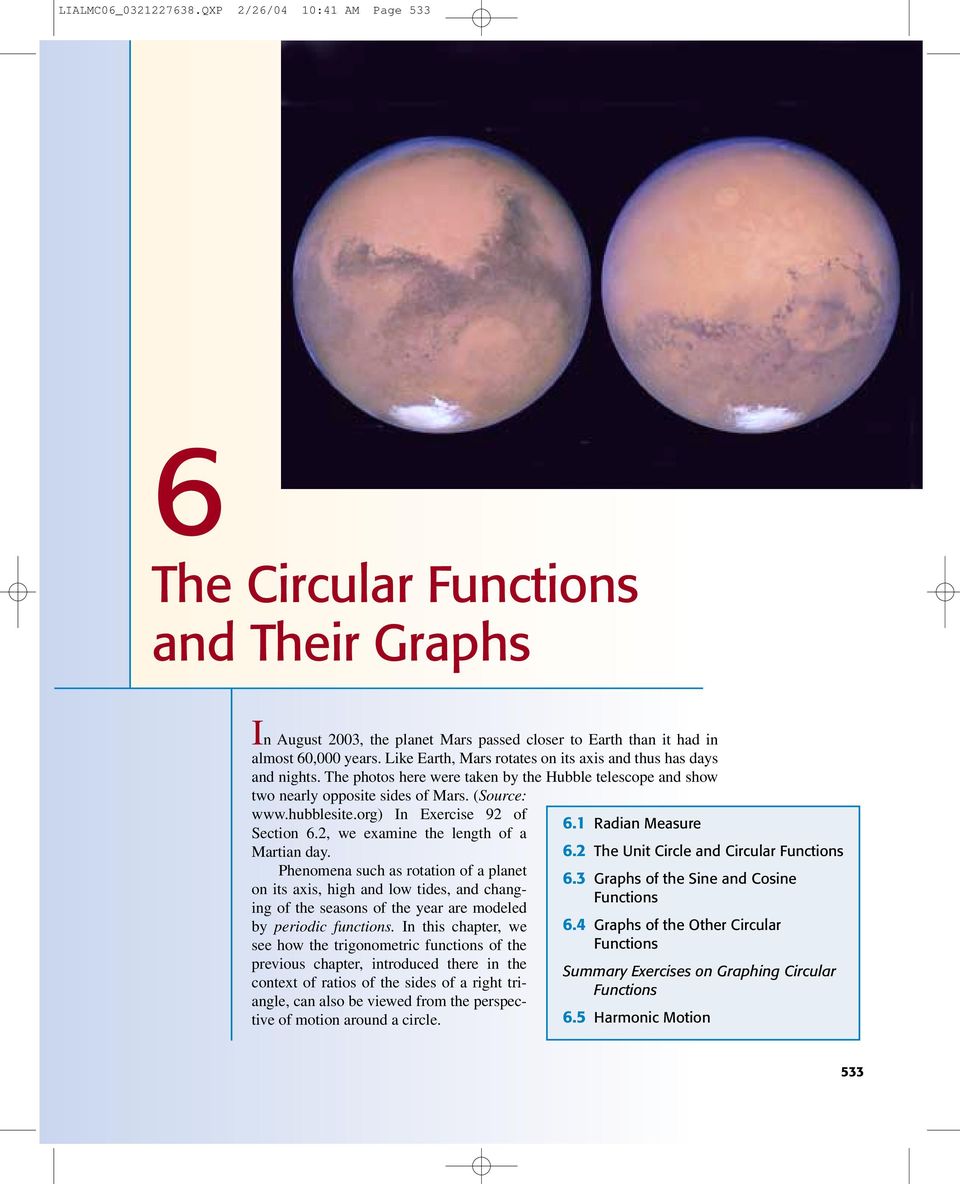
1 LIALMC_78.QXP // : AM Page 5 The Circular Functions and Their Graphs In August, the planet Mars passed closer to Earth than it had in almost, ears. Like Earth, Mars rotates on its ais and thus has das and nights. The photos here were taken b the Hubble telescope and show two nearl opposite sides of Mars. (Source: In Eercise 9 of Section., we eamine the length of a Martian da. Phenomena such as rotation of a planet on its ais, high and low tides, and changing of the seasons of the ear are modeled b periodic functions. In this chapter, we see how the trigonometric functions of the previous chapter, introduced there in the contet of ratios of the sides of a right triangle, can also be viewed from the perspective of motion around a circle.. Radian Measure. The Unit Circle and Circular Functions. Graphs of the Sine and Cosine Functions. Graphs of the Other Circular Functions Summar Eercises on Graphing Circular Functions.5 Harmonic Motion 5
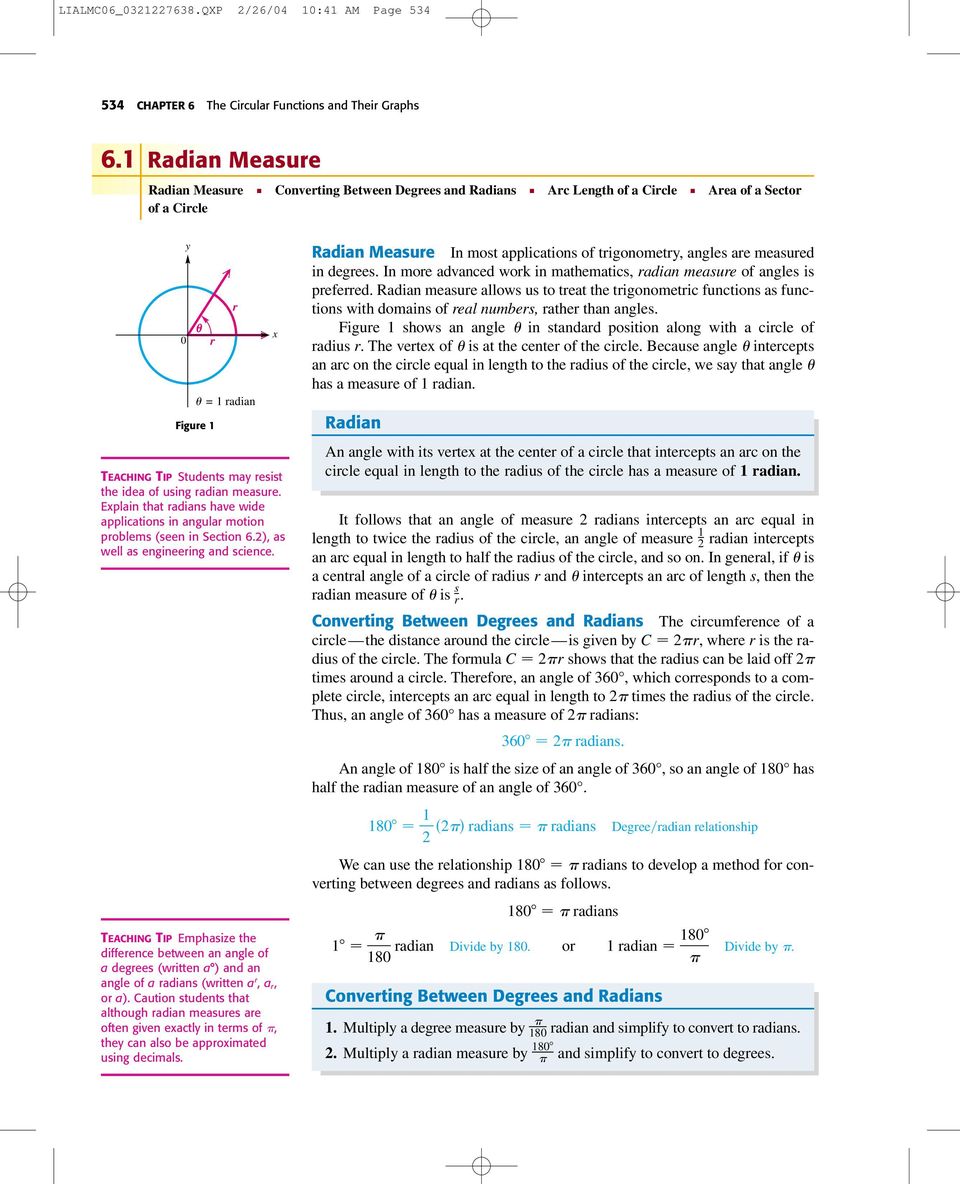
2 LIALMC_78.QXP // : AM Page 5 5 CHAPTER The Circular Functions and Their Graphs. Radian Measure Radian Measure Converting Between Degrees and Radians Arc Length of a Circle Area of a Sector of a Circle r Figure r = radian TEACHING TIP Students ma resist the idea of using radian measure. Eplain that radians have wide applications in angular motion problems (seen in Section.), as well as engineering and science. Radian Measure In most applications of trigonometr, angles are measured in degrees. In more advanced work in mathematics, radian measure of angles is preferred. Radian measure allows us to treat the trigonometric functions as functions with domains of real numbers, rather than angles. Figure shows an angle in standard position along with a circle of radius r. The verte of is at the center of the circle. Because angle intercepts an arc on the circle equal in length to the radius of the circle, we sa that angle has a measure of radian. Radian An angle with its verte at the center of a circle that intercepts an arc on the circle equal in length to the radius of the circle has a measure of radian. It follows that an angle of measure radians intercepts an arc equal in length to twice the radius of the circle, an angle of measure radian intercepts an arc equal in length to half the radius of the circle, and so on. In general, if is a central angle of a circle of radius r and intercepts an arc of length s, then the s radian measure of is r. Converting Between Degrees and Radians The circumference of a circle the distance around the circle is given b C r, where r is the radius of the circle. The formula C r shows that the radius can be laid off times around a circle. Therefore, an angle of, which corresponds to a complete circle, intercepts an arc equal in length to times the radius of the circle. Thus, an angle of has a measure of radians: An angle of 8 is half the size of an angle of, so an angle of 8 has half the radian measure of an angle of. radians. 8 radians radians Degreeradian relationship TEACHING TIP Emphasize the difference between an angle of a degrees (written a ) and an angle of a radians (written a r, a r, or a). Caution students that although radian measures are often given eactl in terms of, the can also be approimated using decimals. We can use the relationship 8 radians to develop a method for converting between degrees and radians as follows. 8 radians 8 radian Divide b 8. or radian 8 Divide b. Converting Between Degrees and Radians. Multipl a degree measure b radian and simplif to convert to radians Multipl a radian measure b and simplif to convert to degrees.
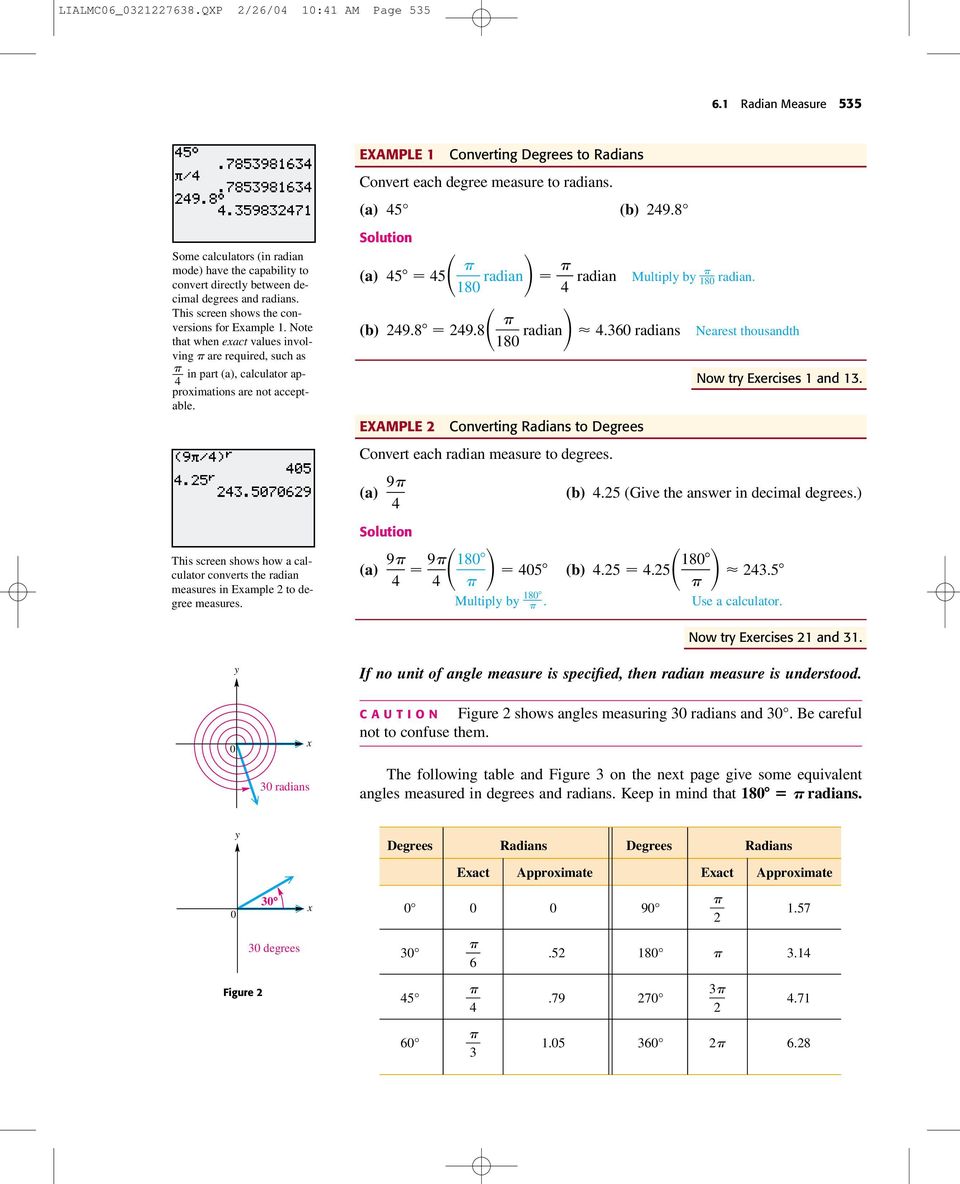
3 LIALMC_78.QXP // : AM Page 55. Radian Measure 55 EXAMPLE Converting Degrees to Radians Convert each degree measure to radians. (a) 5 (b) 9.8 Some calculators (in radian mode) have the capabilit to convert directl between decimal degrees and radians. This screen shows the conversions for Eample. Note that when eact values involving are required, such as in part (a), calculator approimations are not accept- able. Solution (a) 5 5 Multipl b 8 radian. 8 radian radian (b) Nearest thousandth 8 radian. radians Now tr Eercises and. EXAMPLE Converting Radians to Degrees Convert each radian measure to degrees. (a) 9 (b).5 (Give the answer in decimal degrees.) Solution This screen shows how a calculator converts the radian measures in Eample to degree measures. (a) Multipl b. 9 (b) Use a calculator. Now tr Eercises and. If no unit of angle measure is specified, then radian measure is understood. radians CAUTION Figure shows angles measuring radians and. Be careful not to confuse them. The following table and Figure on the net page give some equivalent angles measured in degrees and radians. Keep in mind that 8 radians. Degrees Radians Degrees Radians Eact Approimate Eact Approimate degrees Figure
4 LIALMC_78.QXP // : AM Page 5 5 CHAPTER The Circular Functions and Their Graphs Looking Ahead to Calculus In calculus, radian measure is much easier to work with than degree measure. If is measured in radians, then the derivative of f sin is f cos. = 5 = 5 = 5 8 = 9 = = 5 = = = However, if is measured in degrees, then the derivative of f sin is f cos. 8 = 7 5 = 5 = 7 = Figure 7 = 5 = = 5 We use radian measure to simplif certain formulas, two of which follow. Each would be more complicated if epressed in degrees. Arc Length of a Circle We use the first formula to find the length of an arc of a circle. This formula is derived from the fact (proven in geometr) that the length of an arc is proportional to the measure of its central angle. In Figure, angle QOP has measure radian and intercepts an arc of length r on the circle. Angle ROT has measure radians and intercepts an arc of length s on the circle. Since the lengths of the arcs are proportional to the measures of their central angles, s r. Multipling both sides b r gives the following result. T Q s r radians radian R r O r P Figure TEACHING TIP To help students appreciate radian measure, show them that in degrees the formula for arc length is s r 8. (See Eercise 5.) r Arc Length The length s of the arc intercepted on a circle of radius r b a central angle of measure radians is given b the product of the radius and the radian measure of the angle, or s r, in radians. CAUTION When appling the formula s r, the value of must be epressed in radians.

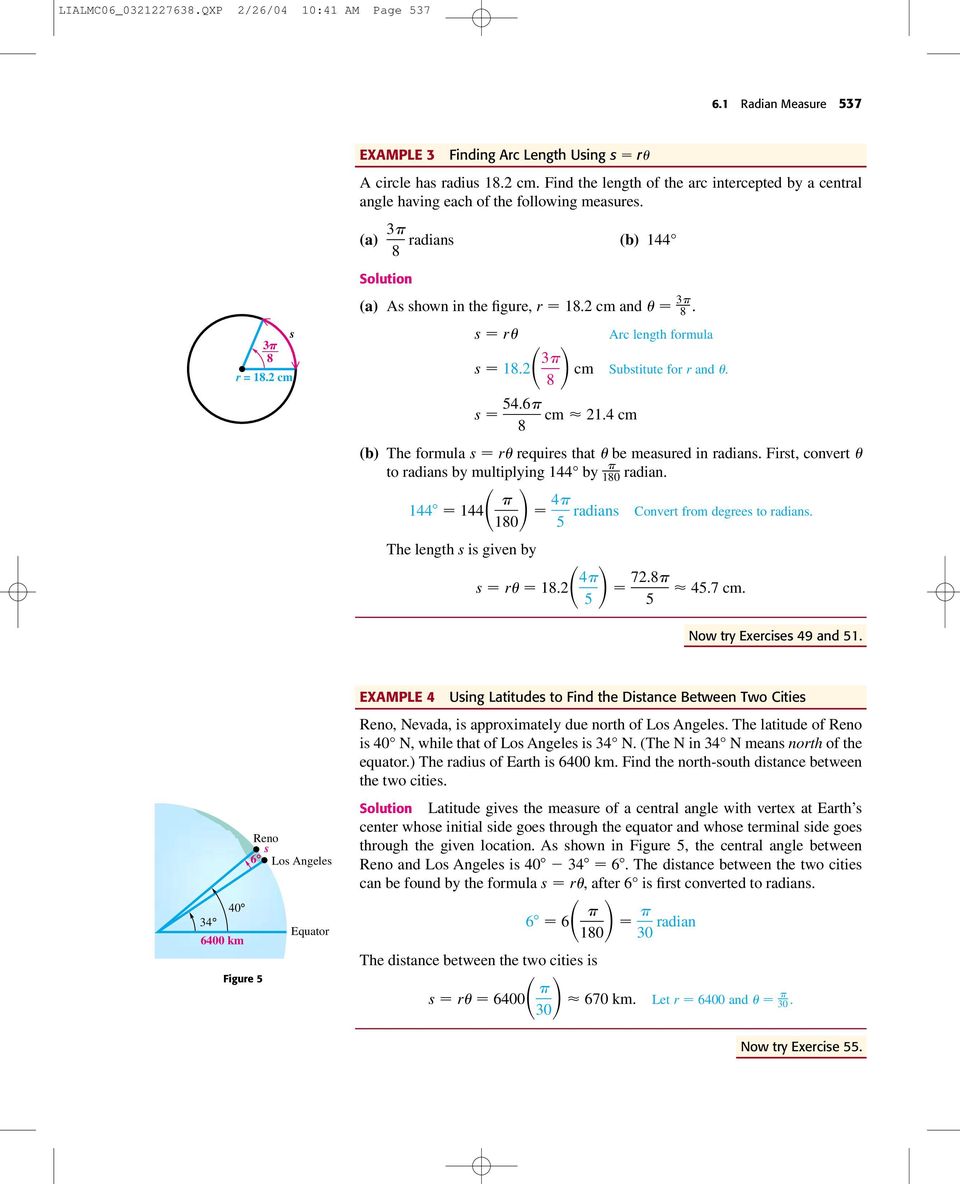
5 LIALMC_78.QXP // : AM Page 57. Radian Measure 57 EXAMPLE Finding Arc Length Using s r A circle has radius 8. cm. Find the length of the arc intercepted b a central angle having each of the following measures. (a) (b) 8 radians 8 s r = 8. cm Solution (a) As shown in the figure, r 8. cm and s r s 8. 8 cm s 5. cm. cm 8 Arc length formula Substitute for r and. (b) The formula s r requires that be measured in radians. First, convert to radians b multipling b 8 radian. Convert from degrees to radians. 8 5 radians The length s is given b s r cm Now tr Eercises 9 and 5. Reno s Los Angeles Equator km Figure 5 EXAMPLE Using Latitudes to Find the Distance Between Two Cities Reno, Nevada, is approimatel due north of Los Angeles. The latitude of Reno is N, while that of Los Angeles is N. (The N in N means north of the equator.) The radius of Earth is km. Find the north-south distance between the two cities. Solution Latitude gives the measure of a central angle with verte at Earth s center whose initial side goes through the equator and whose terminal side goes through the given location. As shown in Figure 5, the central angle between Reno and Los Angeles is. The distance between the two cities can be found b the formula s r, after is first converted to radians. 8 radian The distance between the two cities is s r 7 km. Let r and. Now tr Eercise 55.
6 LIALMC_78.QXP // : AM Page CHAPTER The Circular Functions and Their Graphs ft Figure EXAMPLE 5 Finding a Length Using s r A rope is being wound around a drum with radius.875 ft. (See Figure.) How much rope will be wound around the drum if the drum is rotated through an angle of 9.7? Solution The length of rope wound around the drum is the arc length for a circle of radius.875 ft and a central angle of 9.7. Use the formula s r, with the angle converted to radian measure. The length of the rope wound around the drum is approimatel s r ft. 8 Now tr Eercise (a)..5cm Figure 7.8 cm EXAMPLE Finding an Angle Measure Using s r Two gears are adjusted so that the smaller gear drives the larger one, as shown in Figure 7. If the smaller gear rotates through 5, through how man degrees will the larger gear rotate? Solution First find the radian measure of the angle, and then find the arc length on the smaller gear that determines the motion of the larger gear. Since 5 5 radians, for the smaller gear, s r cm. An arc with this length on the larger gear corresponds to an angle measure, in radians, where Substitute for s and.8 for r ; multipl 5 b to solve for. Converting back to degrees shows that the larger gear rotates through Convert 9 to degrees s r Now tr Eercise. r Figure 8 The shaded region is a sector of the circle. Area of a Sector of a Circle A sector of a circle is the portion of the interior of a circle intercepted b a central angle. Think of it as a piece of pie. See Figure 8. A complete circle can be thought of as an angle with measure radians. If a central angle for a sector has measure radians, then the sector makes up the fraction of a complete circle. The area of a complete circle with radius r is A r. Therefore, area of the sector r r, in radians.
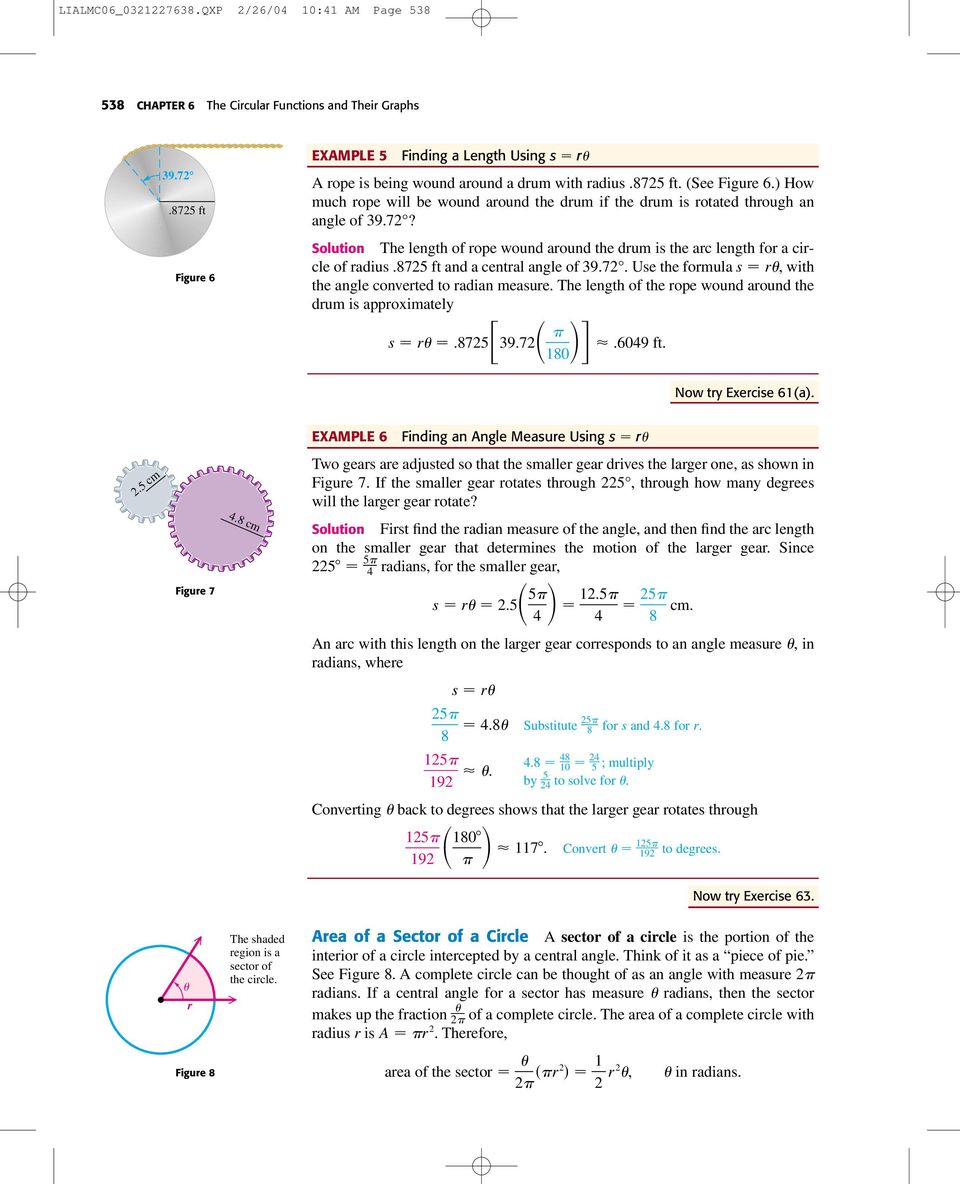
7 LIALMC_78.QXP // : AM Page 59. Radian Measure 59 This discussion is summarized as follows. Area of a Sector The area of a sector of a circle of radius r and central angle is given b A r, in radians. CAUTION As in the formula for arc length, the value of must be in radians when using this formula for the area of a sector. m Figure 9 5 EXAMPLE 7 Finding the Area of a Sector-Shaped Field Find the area of the sector-shaped field shown in Figure 9. Solution First, convert 5 to radians radian Now use the formula to find the area of a sector of a circle with radius r. A r,5 m Now tr Eercise 77.. Eercises Convert each degree measure to radians. Leave answers as multiples of. See Eample (a) Convert each degree measure to radians. See Eample (b) Concept Check In Eercises 58, each angle is an integer when measured in radians. Give the radian measure of the angle. 5.. θ θ

8 LIALMC_78.QXP // : AM Page 5 5 CHAPTER The Circular Functions and Their Graphs θ 9. In our own words, eplain how to convert (a) degree measure to radian measure; (b) radian measure to degree measure.. Eplain the difference between degree measure and radian measure. θ Convert each radian measure to degrees. See Eample (a) Convert each radian measure to degrees. Give answers using decimal degrees to the nearest tenth. See Eample (b) Relating Concepts For individual or collaborative investigation (Eercises 5) In anticipation of the material in the net section, we show how to find the trigonometric function values of radian-measured angles. Suppose we want to find sin 5. One wa to do this is to convert radians to 5, and then use the methods of Chapter 5 to evaluate:. (Section 5.) Sine is positive Reference angle in quadrant II. for 5 Use this technique to find each function value. Give eact values. 5. tan. csc 7. cot 8. cos 9. sec. sin 7. cos. tan 9 5 sin 5 sin 5 sin

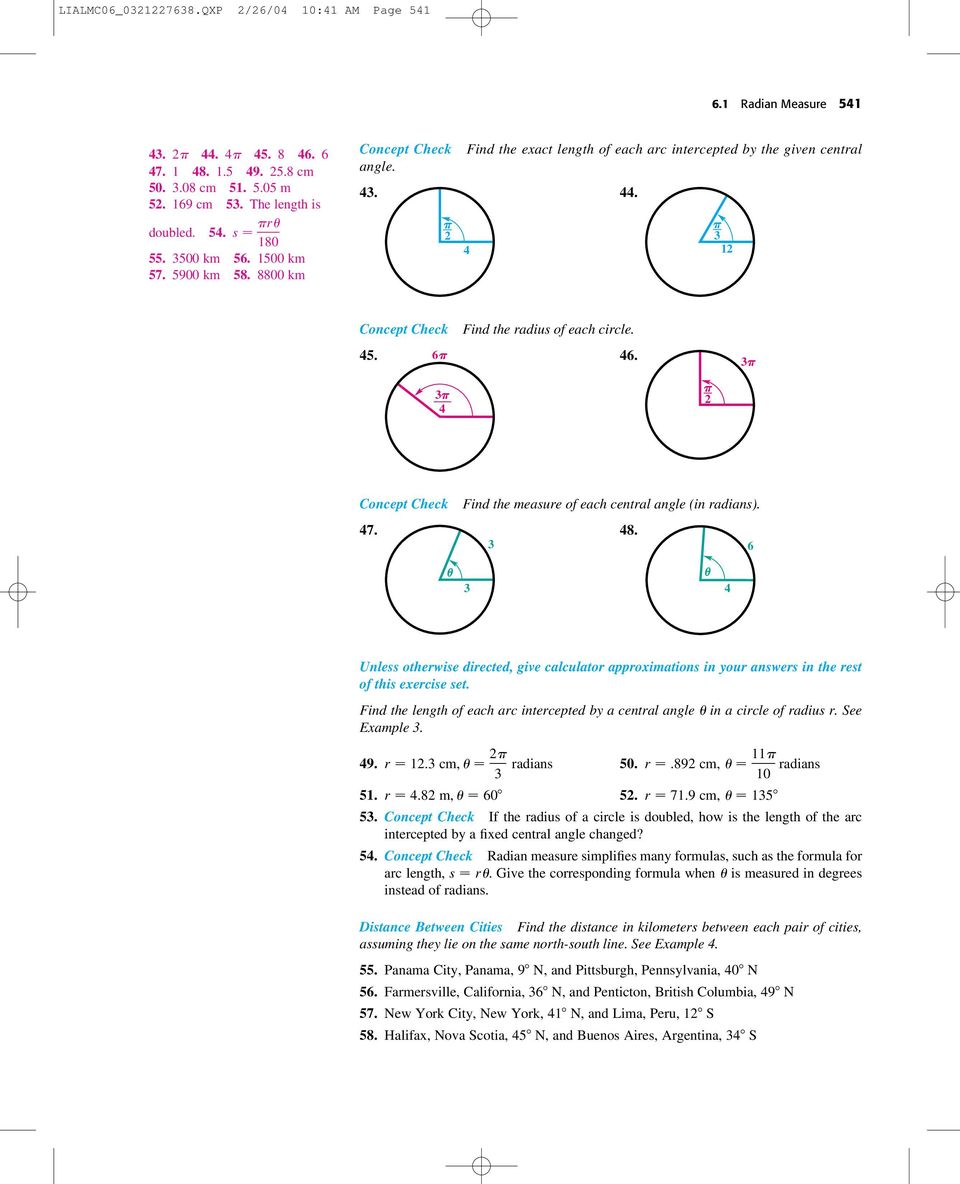
9 LIALMC_78.QXP // : AM Page 5. Radian Measure cm 5..8 cm m 5. 9 cm 5. The length is r doubled. 5. s km 5. 5 km km km Concept Check angle. Find the eact length of each arc intercepted b the given central.. Concept Check Find the radius of each circle. 5.. Concept Check Find the measure of each central angle (in radians) Unless otherwise directed, give calculator approimations in our answers in the rest of this eercise set. Find the length of each arc intercepted b a central angle Eample. in a circle of radius r. See 9. r. cm, radians 5. r.89 cm, radians 5. r.8 m, 5. r 7.9 cm, 5. Concept Check If the radius of a circle is doubled, how is the length of the arc intercepted b a fied central angle changed? 5. Concept Check Radian measure simplifies man formulas, such as the formula for arc length, s r. Give the corresponding formula when is measured in degrees instead of radians. Distance Between Cities Find the distance in kilometers between each pair of cities, assuming the lie on the same north-south line. See Eample. 55. Panama Cit, Panama, 9 N, and Pittsburgh, Pennslvania, N 5. Farmersville, California, N, and Penticton, British Columbia, 9 N 57. New York Cit, New York, N, and Lima, Peru, S 58. Halifa, Nova Scotia, 5 N, and Buenos Aires, Argentina, S 5
10 LIALMC_78.QXP // : AM Page 5 5 CHAPTER The Circular Functions and Their Graphs 59. N. N. (a). in. (b) cm cm 5. in.. (a) 9, rotations 59. Latitude of Madison Madison, South Dakota, and Dallas, Teas, are km apart and lie on the same north-south line. The latitude of Dallas is N. What is the latitude of Madison?. Latitude of Toronto Charleston, South Carolina, and Toronto, Canada, are km apart and lie on the same north-south line. The latitude of Charleston is N. What is the latitude of Toronto? Work each problem. See Eamples 5 and.. Pulle Raising a Weight (a) How man inches will the weight in the figure rise if the pulle is rotated through an angle of 7 5? (b) Through what angle, to the nearest minute, must the pulle be rotated to raise the weight in.? 9.7 in.. Pulle Raising a Weight Find the radius of the pulle in the figure if a rotation of 5. raises the weight. cm. r. Rotating Wheels The rotation of the smaller wheel in the figure causes the larger wheel to rotate. Through how man degrees will the larger wheel rotate if the smaller one rotates through.? 5. cm 8. cm. Rotating Wheels Find the radius of the larger wheel in the figure if the smaller wheel rotates 8. when the larger wheel rotates cm r 5. Biccle Chain Drive The figure shows the chain drive of a biccle. How far will the biccle move if the pedals are rotated through 8? Assume the radius of the biccle wheel is. in..8 in..7 in.. Pickup Truck Speedometer The speedometer of Terr s small pickup truck is designed to be accurate with tires of radius in. (a) Find the number of rotations of a tire in hr if the truck is driven at 55 mph.

11 LIALMC_78.QXP // : AM Page 5. Radian Measure 5. (b).9 mi; es 7.. km ft m km ft 7.,.9 d 77.. cm m mi 8. 9,85. km m (b) Suppose that oversize tires of radius in. are placed on the truck. If the truck is now driven for hr with the speedometer reading 55 mph, how far has the truck gone? If the speed limit is 55 mph, does Terr deserve a speeding ticket? If a central angle is ver small, there is little difference in length between an arc and the inscribed chord. See the figure. Approimate each of the following lengths b finding the necessar arc length. (Note: When a central angle intercepts an arc, the arc is said to subtend the angle.) Arc length length of inscribed chord Inscribed chord 7. Length of a Train A railroad track in the desert is.5 km awa. A train on the track subtends (horizontall) an angle of. Find the length of the train. 8. Distance to a Boat The mast of Brent Simon s boat is ft high. If it subtends an angle of, how far awa is it? Arc Concept Check Find the area of each sector Concept Check Find the measure (in radians) of each central angle. The number inside the sector is the area sq units 8 sq units Find the area of a sector of a circle having radius r and central angle. See Eample r 9. m, radians 7. r 59.8 km, radians 75. r. ft, radians 7. r 9. d, radians r.7 cm, 78. r 8. m, r. mi, 8. r 9. km, Work each problem. 8. Find the measure (in radians) of a central angle of a sector of area in. in a circle of radius. in. 8. Find the radius of a circle in which a central angle of radian determines a sector of area m.

12 LIALMC_78.QXP // : AM Page 5 5 CHAPTER The Circular Functions and Their Graphs 8. (a) 8. Measures of a Structure The figure shows Medicine Wheel, a Native American ; (b) 8 ft 7 structure in northern Woming. This circular structure is perhaps 5 r old. There are 7 aboriginal spokes in the wheel, all equall spaced. (c) ft (d) approimatel 7 ft in. 85. (a) ft (b) ft (c) ft 8. (a) 55 m (b) 8 m d mi (a) Find the measure of each central angle in degrees and in radians. (b) If the radius of the wheel is 7 ft, find the circumference. (c) Find the length of each arc intercepted b consecutive pairs of spokes. (d) Find the area of each sector formed b consecutive spokes. 8. Area Cleaned b a Windshield Wiper The Ford 95 Model A, built from 98 to 9, had a single windshield wiper on the driver s side. The total arm and blade was in. long and rotated back and forth through an angle of 95. The shaded region in the figure is the portion of the windshield cleaned b the 7-in. wiper blade. What is the area of the region cleaned? 85. Circular Railroad Curves In the United States, circular railroad curves are designated b the degree of curvature, the central angle subtended b a chord of ft. Suppose a portion of track has curvature. (Source: Ha, W., Railroad Engineering, John Wile & Sons, 98.) (a) What is the radius of the curve? (b) What is the length of the arc determined b the -ft chord? (c) What is the area of the portion of the circle bounded b the arc and the -ft chord? 8. Land Required for a Solar-Power Plant A -megawatt solar-power plant requires approimatel 95, m of land area in order to collect the required amount of energ from sunlight. (a) If this land area is circular, what is its radius? (b) If this land area is a 5 sector of a circle, what is its radius? 87. Area of a Lot A frequent problem in surveing cit lots and rural lands adjacent to curves of highwas and railwas is that of finding the area when one or more of the boundar lines is the arc of a circle. Find d the area of the lot shown in the figure. (Source: Anderson, J. and E. Michael, Introduction to Surveing, McGraw-Hill, 985.) d 88. Nautical Miles Nautical miles are used b ships and airplanes. The are different from statute miles, which equal 58 ft. A nautical mile is defined to be the arc length along the equator intercepted b a central angle AOB of min, as illustrated in the figure. If the equatorial radius of Earth is 9 mi, use the arc length formula to approimate the number of statute miles in nautical mile. Round our answer to two decimal places. B Nautical mile in. A O 7in. Not to scale
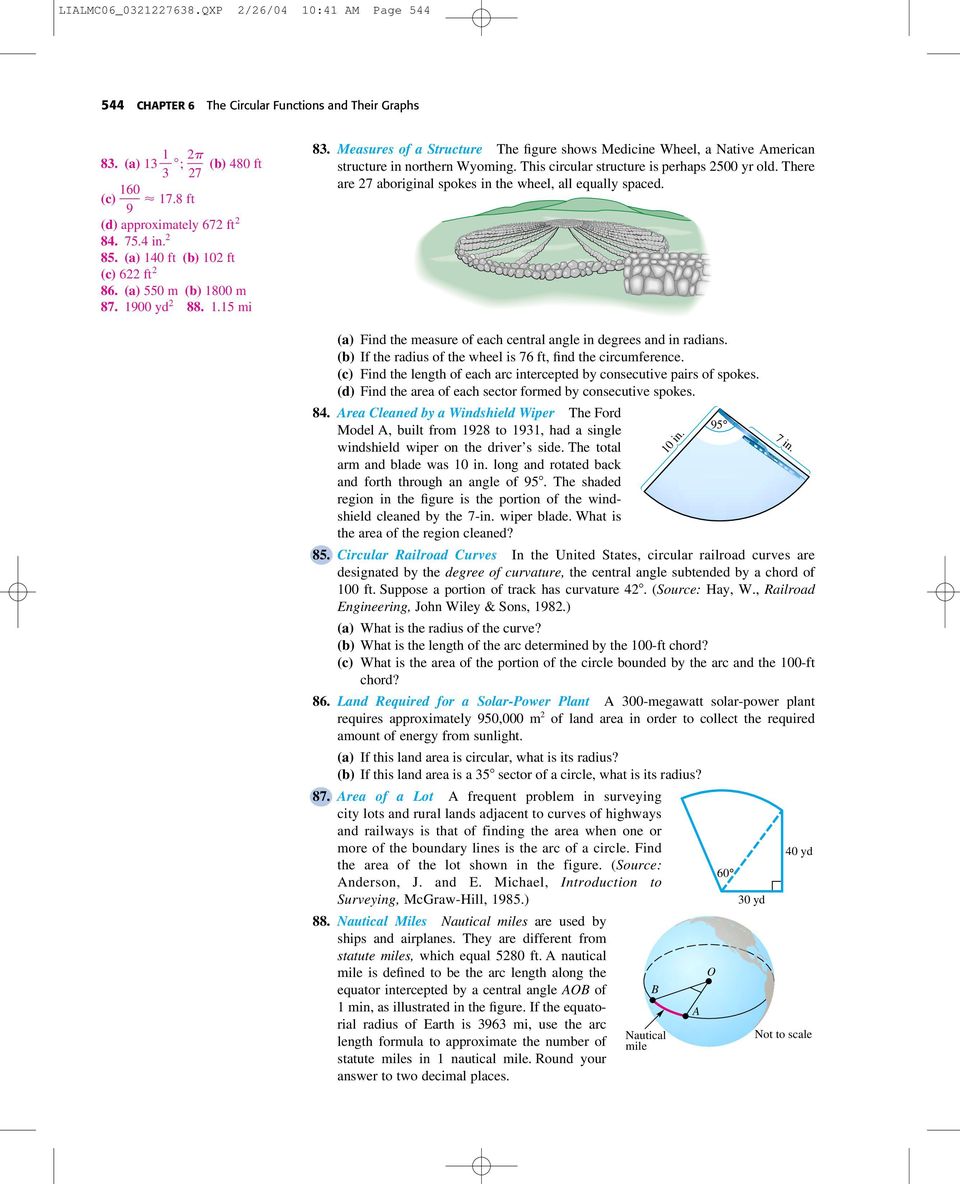
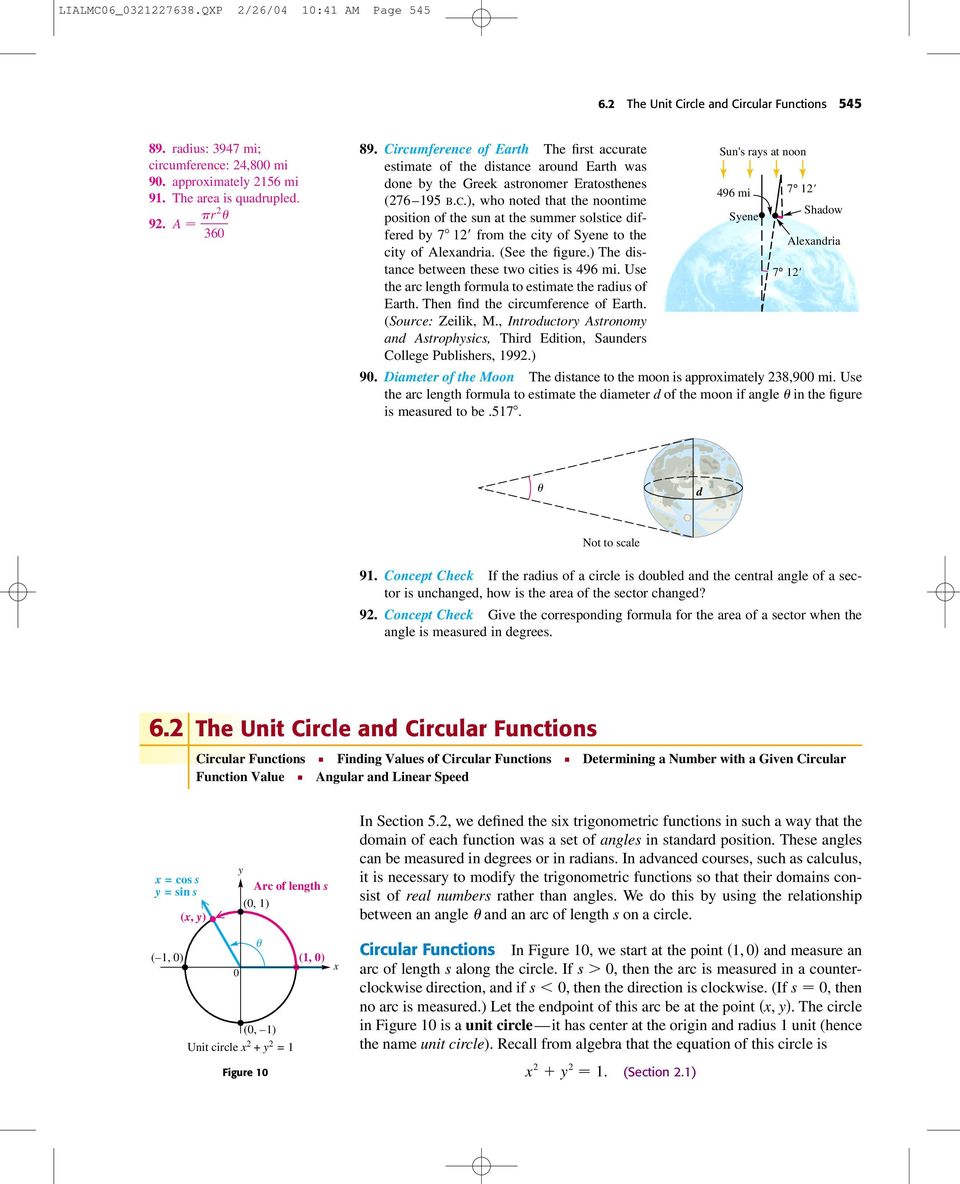
13 LIALMC_78.QXP // : AM Page 55. The Unit Circle and Circular Functions radius: 97 mi; circumference:,8 mi 9. approimatel 5 mi 9. The area is quadrupled. r 9. A 89. Circumference of Earth The first accurate Sun's ras at noon estimate of the distance around Earth was done b the Greek astronomer Eratosthenes 9 mi 7 ' (795 B.C.), who noted that the noontime Shadow position of the sun at the summer solstice differed b 7 from the cit of Sene to the Aleandria Sene cit of Aleandria. (See the figure.) The distance between these two cities is 9 mi. Use 7 ' the arc length formula to estimate the radius of Earth. Then find the circumference of Earth. (Source: Zeilik, M., Introductor Astronom and Astrophsics, Third Edition, Saunders College Publishers, 99.) 9. Diameter of the Moon The distance to the moon is approimatel 8,9 mi. Use the arc length formula to estimate the diameter d of the moon if angle in the figure is measured to be.57. d Not to scale 9. Concept Check If the radius of a circle is doubled and the central angle of a sector is unchanged, how is the area of the sector changed? 9. Concept Check Give the corresponding formula for the area of a sector when the angle is measured in degrees.. The Unit Circle and Circular Functions Circular Functions Finding Values of Circular Functions Determining a Number with a Given Circular Function Value Angular and Linear Speed = cos s = sin s (, ) Arc of length s (, ) In Section 5., we defined the si trigonometric functions in such a wa that the domain of each function was a set of angles in standard position. These angles can be measured in degrees or in radians. In advanced courses, such as calculus, it is necessar to modif the trigonometric functions so that their domains consist of real numbers rather than angles. We do this b using the relationship between an angle and an arc of length s on a circle. (, ) (, ) (, ) Unit circle + = Figure Circular Functions In Figure, we start at the point, and measure an arc of length s along the circle. If s, then the arc is measured in a counterclockwise direction, and if s, then the direction is clockwise. (If s, then no arc is measured.) Let the endpoint of this arc be at the point,. The circle in Figure is a unit circle it has center at the origin and radius unit (hence the name unit circle). Recall from algebra that the equation of this circle is. (Section.)
14 LIALMC_78.QXP // : AM Page 5 5 CHAPTER The Circular Functions and Their Graphs We saw in the previous section that the radian measure of is related to the arc length s. In fact, for measured in radians, we know that s r. Here, r, so s, which is measured in linear units such as inches or centimeters, is numericall equal to, measured in radians. Thus, the trigonometric functions of angle in radians found b choosing a point, on the unit circle can be rewritten as functions of the arc length s, a real number. When interpreted this wa, the are called circular functions. Looking Ahead to Calculus If ou plan to stud calculus, ou must become ver familiar with radian measure. In calculus, the trigonometric or circular functions are alwas understood to have real number domains. Circular Functions sin s csc s ( ) cos s sec s ( ) tan s cot s ( ) ( ) Since represents the cosine of s and represents the sine of s, and because of the discussion in Section. on converting between degrees and radians, we can summarize a great deal of information in a concise manner, as seen in Figure.* TEACHING TIP Draw a unit circle on the chalkboard and trace a point slowl counterclockwise, starting at,. Students should see that the -value (sine function) starts at, increases to (at radians), decreases to (at radians), decreases again to (at radians), and returns to after one full revolution ( radians). This tpe of analsis will help illustrate the range associated with the sine and cosine functions. (, ) (, (, ) ) 9 ( 5, (, ) ) 5 (, 5 (, ) 5 ) (, ) 8 (, ) 7 (, 5 5 (, ) ) (, (, ) ) 7 (, ) (, ) (, ) Unit circle + = Figure NOTE Since sin s and cos s, we can replace and in the equation and obtain the Pthagorean identit cos s sin s. The ordered pair, represents a point on the unit circle, and therefore and, so cos s and sin s. *The authors thank Professor Marvel Townsend of the Universit of Florida for her suggestion to include this figure.
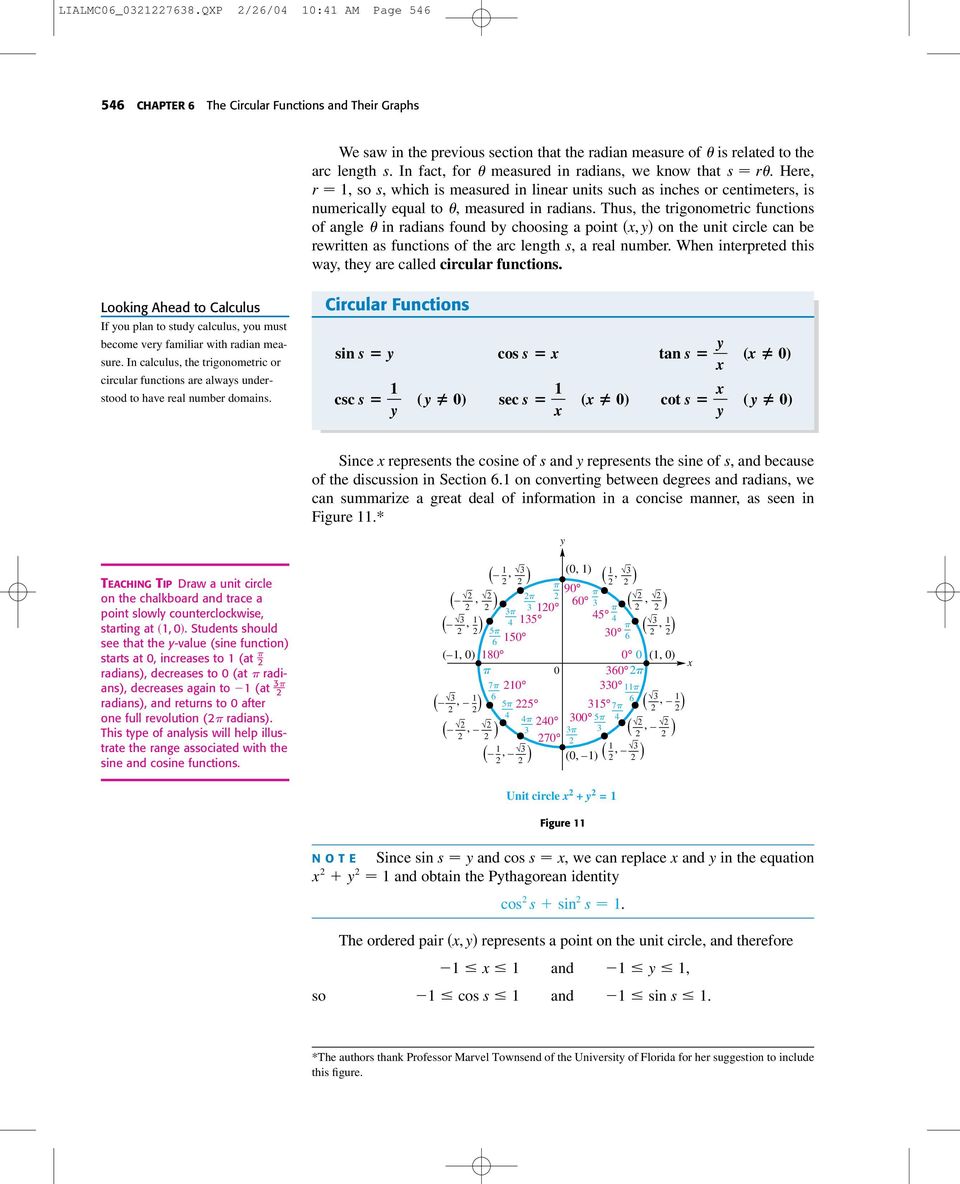
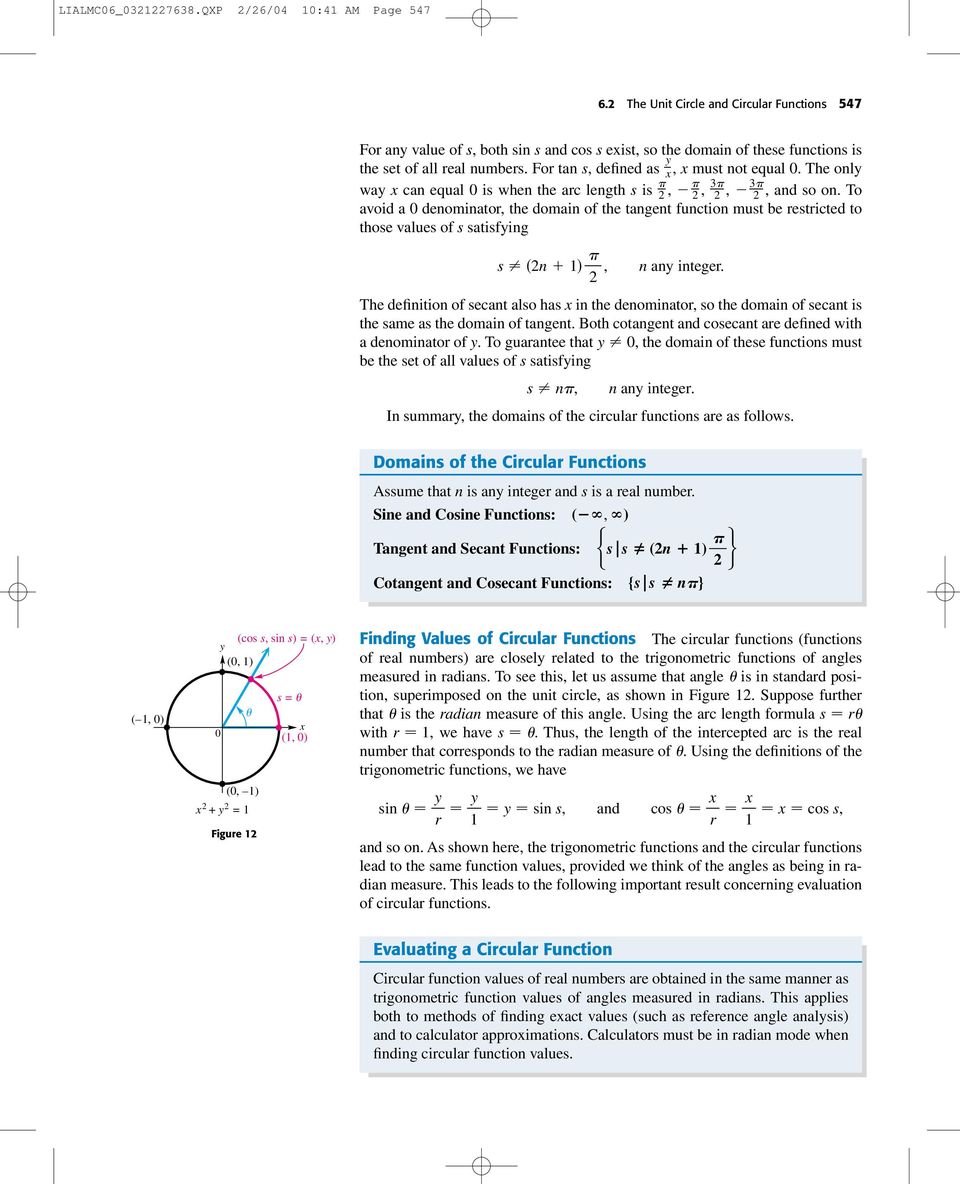
15 LIALMC_78.QXP // : AM Page 57. The Unit Circle and Circular Functions 57 For an value of s, both sin s and cos s eist, so the domain of these functions is the set of all real numbers. For tan s, defined as, must not equal. The onl wa can equal is when the arc length s is,,,, and so on. To avoid a denominator, the domain of the tangent function must be restricted to those values of s satisfing s n n an integer., The definition of secant also has in the denominator, so the domain of secant is the same as the domain of tangent. Both cotangent and cosecant are defined with a denominator of. To guarantee that, the domain of these functions must be the set of all values of s satisfing In summar, the domains of the circular functions are as follows. s n, n an integer. Domains of the Circular Functions Assume that n is an integer and s is a real number. Sine and Cosine Functions: (, ) Tangent and Secant Functions: Cotangent and Cosecant Functions: s s (n ) {s s n} (, ) (cos s, sin s) = (, ) (, ) (, ) + = Figure s = (, ) Finding Values of Circular Functions The circular functions (functions of real numbers) are closel related to the trigonometric functions of angles measured in radians. To see this, let us assume that angle is in standard position, superimposed on the unit circle, as shown in Figure. Suppose further that is the radian measure of this angle. Using the arc length formula s r with r, we have s. Thus, the length of the intercepted arc is the real number that corresponds to the radian measure of. Using the definitions of the trigonometric functions, we have sin r sin s, and cos r cos s, and so on. As shown here, the trigonometric functions and the circular functions lead to the same function values, provided we think of the angles as being in radian measure. This leads to the following important result concerning evaluation of circular functions. Evaluating a Circular Function Circular function values of real numbers are obtained in the same manner as trigonometric function values of angles measured in radians. This applies both to methods of finding eact values (such as reference angle analsis) and to calculator approimations. Calculators must be in radian mode when finding circular function values.
16 LIALMC_78.QXP // : AM Page CHAPTER The Circular Functions and Their Graphs EXAMPLE Finding Eact Circular Function Values (, ) Find the eact values of and Solution Evaluating a circular function at the real number is equivalent to evaluating it at radians. An angle of radians intersects the unit circle at the point,, as shown in Figure. Since sin, cos, tan. (, ) = (, ) sin s, cos s, and tan s, it follows that (, ) Figure sin, cos, and tan is undefined. Now tr Eercise. TEACHING TIP Point out the importance of being able to sketch the unit circle as in Figure. This will enable students to more easil determine function values of multiples of. EXAMPLE Finding Eact Circular Function Values 7 (a) Use Figure to find the eact values of cos and sin 7. (b) Use Figure to find the eact value of tan 5. (c) Use reference angles and degree/radian conversion to find the eact value of cos Solution. (a) In Figure, we see that the terminal side of circle at,. Thus, radians intersects the unit (b) Angles of radians and radians are coterminal. Their terminal sides intersect the unit circle at so tan,, 5 tan. (c) An angle of radians corresponds to an angle of. In standard position, lies in quadrant II with a reference angle of, so 5 cos 7 and sin 7. Cosine is negative in quadrant II. cos cos cos. 7 Reference angle (Section 5.) Now tr Eercises 7, 7, and. NOTE Eamples and illustrate that there are several methods of finding eact circular function values.

17 LIALMC_78.QXP // : AM Page 59. The Unit Circle and Circular Functions 59 EXAMPLE Approimating Circular Function Values Find a calculator approimation to four decimal places for each circular function value. (a) cos.85 (b) cos.59 (c) cot.9 (d) sec.9 Radian mode This is how a calculator displas the result of Eample (a), correct to four decimal digits. TEACHING TIP Remind students not to use the sin, cos, and tan, kes when evaluating reciprocal functions with a calculator. Solution (a) With a calculator in radian mode, we find cos (b) cos Use a calculator in radian mode. (c) As before, to find cotangent, secant, and cosecant function values, we must use the appropriate reciprocal functions. To find cot.9, first find tan.9 and then find the reciprocal. (d) sec.9 cot.9 tan.9.55 cos.9. Now tr Eercises, 9, and. CAUTION A common error in trigonometr is using calculators in degree mode when radian mode should be used. Remember, if ou are finding a circular function value of a real number, the calculator must be in radian mode. Determining a Number with a Given Circular Function Value Recall from Section 5. how we used a calculator to determine an angle measure, given a trigonometric function value of the angle. The calculator is set to show four decimal digits in the answer. Figure This screen supports the result of Eample (b). The calculator is in radian mode. Figure 5 EXAMPLE Finding a Number Given Its Circular Function Value (a) Approimate the value of s in the interval,, if cos s.985. (b) Find the eact value of s in the interval,, if tan s. Solution (a) Since we are given a cosine value and want to determine the real number in, having this cosine value, we use the inverse cosine function of a calculator. With the calculator in radian mode, we find (Section 5.) See Figure. (Refer to our owner s manual to determine how to evaluate the sin, cos, and tan functions with our calculator.) (b) Recall that tan, and in quadrant III tan s is positive. Therefore, and s 5. cos tan tan 5, Figure 5 supports this result. Now tr Eercises 9 and 55.

18 LIALMC_78.QXP // : AM Page CHAPTER The Circular Functions and Their Graphs CONNECTIONS A convenient wa to see the sine, cosine, and tangent trigonometric ratios geometricall is shown in Figure for in quadrants I and II. The circle shown is the unit circle, which has radius. B remembering this figure and the segments that represent the sine, cosine, and tangent functions, ou can quickl recall properties of the trigonometric functions. Horizontal line segments to the left of the origin and vertical line segments below the -ais represent negative values. Note that the tangent line must be tangent to the circle at,, for an quadrant in which lies. sin cos tan (, ) sin cos (, ) tan in quadrant I in quadrant II Figure PQ sin ; OQ cos ; For Discussion or Writing See Figure 7. Use the definition of the trigonometric functions and similar triangles to show that PQ sin, OQ cos, and AB tan. P(, ) B AB AB AB AO (b similar triangles) tan O Q Figure 7 A(, ) Angular and Linear Speed The human joint that can be fleed the fastest is the wrist, which can rotate through 9, or radians, in.5 sec while holding a tennis racket. Angular speed (omega) measures the speed of rotation and is defined b where is the angle of rotation in radians and t is time. The angular speed of a human wrist swinging a tennis racket is t.5 5 radians per sec. The linear speed v at which the tip of the racket travels as a result of fleing the wrist is given b v r, where r is the radius (distance) from the tip of the racket to the wrist joint. If r ft, then the speed at the tip of the racket is v r 5 7 ft per sec, or about 8 mph. t,

19 LIALMC_78.QXP // : AM Page 55. The Unit Circle and Circular Functions 55 In a tennis serve the arm rotates at the shoulder, so the final speed of the racket is considerabl faster. (Source: Cooper, J. and R. Glassow, Kinesiolog, Second Edition, C.V. Mosb, 98.) EXAMPLE 5 Finding Angular Speed of a Pulle and Linear Speed of a Belt A belt runs a pulle of radius cm at 8 revolutions per min. (a) Find the angular speed of the pulle in radians per second. (b) Find the linear speed of the belt in centimeters per second. TEACHING TIP Mention that, while problems involving linear and angular speed can be solved using the formula for circumference, the formulas presented in this section are much more efficient. Solution (a) In min, the pulle makes 8 revolutions. Each revolution is radians, for a total of 8 radians per min. Since there are sec in min, we find, the angular speed in radians per second, b dividing b. 8 radians per sec (b) The linear speed of the belt will be the same as that of a point on the circumference of the pulle. Thus, v r 8 5. cm per sec. Now tr Eercise 95. Suppose that an object is moving at a constant speed. If it travels a distance s in time t, then its linear speed v is given b v s t. If the object is traveling in a circle, then s r, where r is the radius of the circle and is the angle of rotation. Thus, we can write v r t. The formulas for angular and linear speed are summarized in the table. Angular Speed ( in radians per unit time, in radians) t Linear Speed v s t v r t v r

20 LIALMC_78.QXP // : AM Page CHAPTER The Circular Functions and Their Graphs km km Satellite EXAMPLE Finding Linear Speed and Distance Traveled b a Satellite A satellite traveling in a circular orbit km above the surface of Earth takes hr to make an orbit. The radius of Earth is km. See Figure 8. (a) Find the linear speed of the satellite. (b) Find the distance the satellite travels in.5 hr. Earth Figure 8 Not to scale Solution (a) The distance of the satellite from the center of Earth is (b) For one orbit,, and s r 8 km. (Section.) Since it takes hr to complete an orbit, the linear speed is v s t 8 r 8 km. 8 5, km per hr. s vt 8.5,, km Now tr Eercise 9.. Eercises. (a) (b) (c) undefined. (a) (b) (c). (a) (b) (c). (a) (b) (c) 5. (a) (b) (c). (a) (b) (c) undefined For each value of, find (a) sin, (b) cos, and (c) tan. See Eample Find the eact circular function value for each of the following. See Eample. 7. sin 7 8. cos 5 9. tan. sec. csc.. cos. tan cot cos. sec 7. sin 8. sin sec. csc. tan 5. cos Find a calculator approimation for each circular function value. See Eample.. sin.9. sin.8 5. cos.59. cos tan. 8. tan csc9.9. csc.875. sec.8. sec8.9. cot.. cot.8

21 LIALMC_78.QXP // : AM Page 55. The Unit Circle and Circular Functions negative. negative. negative. positive. positive. negative 5. sin ; cos ; tan ; cot ; sec ; csc. sin 8 ; cos 5 ; 7 7 tan 8 ; cot 5 ; 5 8 sec 7 ; csc sin ; cos 5 ; tan ; cot 5 ; 5 sec ; csc 5 8. sin ; cos ; tan ; cot ; sec ; csc Concept Check The figure displas a unit circle and an angle of radian. The tick marks on the circle are spaced at ever two-tenths radian. Use the figure to estimate each value. 5. cos.8. sin 7. an angle whose cosine is.5 8. an angle whose sine is.95 Concept Check Without using a calculator, decide whether each function value is positive or negative. (Hint: Consider the radian measures of the quadrantal angles.) 9. cos. sin. sin 5. cos. tan.9. tan.9 Concept Check Each figure in Eercises 5 8 shows angle in standard position with its terminal side intersecting the unit circle. Evaluate the si circular function values of. 5.. (, ) 5 8 (, 7 7) radian. radian. radian. radian radian (, ) (, ) Find the value of s in the interval, that makes each statement true. See Eample (a). 9. tan s. 5. cos s sin s cot s sec s.8 5. csc s.9 Find the eact value of s in the given interval that has the given circular function value. Do not use a calculator. See Eample (b). 55. ; sin s 5. ; cos s,,
22 LIALMC_78.QXP // : AM Page CHAPTER The Circular Functions and Their Graphs , , , , I. IV 7. II 8. III 9. radian per sec 7. radian per sec 5 7. min 7. 9 min radian per sec radians radians per sec 5 7. radians per sec radians per sec cm per sec cm 8. d 5 8. sec 8. radian per sec 8. radian per hr 8. radians per min cm per min 7 57., ; tan s 58., ; sin s 59., ;., tan s ; cos s Suppose an arc of length s lies on the unit circle, starting at the point, and terminating at the point,. (See Figure.) Use a calculator to find the approimate coordinates for,. (Hint: cos s and sin s.). s.5. s.. s 7.. s.9 Concept Check For each value of s, use a calculator to find sin s and cos s and then use the results to decide in which quadrant an angle of s radians lies. 5. s 5. s 9 7. s 5 8. s 79 Use the formula to find the value of the missing variable. 9. radians, t 8 sec 7. radians, t sec 5 7. radian, radian per min radians, radian per min 7. radians, t.9 sec 7. radian per min, t.87 min Use the formula v r to find the value of the missing variable. 75. v 9 m per sec, r 5 m 7. v 8 ft per sec, r ft 77. v 7.9 m per sec, r 58.7 m 78. r.95 cm, radian per sec The formula t can be rewritten as. Using t for changes s r to s rt. Use the formula s rt to find the value of the missing variable. 79. r cm, radians per sec, t 9 sec 8. r 9 d, radians per sec, t sec 5 8. s cm, r cm, radian per sec 8. s km, r km, t sec Find for each of the following. 8. the hour hand of a clock 8. a line from the center to the edge of a CD revolving times per min Find v for each of the following. t 5.79 t 85. the tip of the minute hand of a clock, if the hand is 7 cm long
23 LIALMC_78.QXP // : AM Page 555. The Unit Circle and Circular Functions cm per min m per min 88.,88 cm per min 89. sec mph 9.. hr 9. (a) radian 5 (b) radian per hr 8 (c),7 mph 9. (a) radians per da; radian per hr (b) (c),8 km per da or about 5 km per hr (d) about 8, km per da or about km per hr 95. (a). radian per sec (b). cm per sec 9. larger pulle: 5 radians per sec; 8 smaller pulle: 5 8 radians per sec 9 8. a point on the tread of a tire of radius 8 cm, rotating 5 times per min 87. the tip of an airplane propeller m long, rotating 5 times per min (Hint: r.5 m.) 88. a point on the edge of a groscope of radius 8 cm, rotating 8 times per min 89. Concept Check If a point moves around the circumference of the unit circle at the speed of unit per sec, how long will it take for the point to move around the entire circle? 9. What is the difference between linear velocit and angular velocit? Solve each problem. See Eamples 5 and. 9. Speed of a Biccle The tires of a biccle have radius in. and are turning at the rate of revolutions per min. See the figure. How fast is the biccle traveling in miles per hour? (Hint: 58 ft mi.) 9. Hours in a Martian Da Mars rotates on its ais at the rate of about.55 radian per hr. Approimatel how man hours are in a Martian da? (Source: Wright, John W. (General Editor), The Universal Almanac, Andrews and McMeel, 997.) in. 9. Angular and Linear Speeds of Earth Earth travels about the sun in an orbit that is almost circular. Assume that the orbit is a circle with radius 9,, mi. Its angular and linear speeds are used in designing solar-power facilities. (a) Assume that a ear is 5 das, and find the angle formed b Earth s movement in one da. (b) Give the angular speed in radians per hour. (c) Find the linear speed of Earth in miles per hour. 9. Angular and Linear Speeds of Earth Earth revolves on its ais once ever hr. Assuming that Earth s radius is km, find the following. (a) angular speed of Earth in radians per da and radians per hour (b) linear speed at the North Pole or South Pole (c) linear speed at Quito, Ecuador, a cit on the equator (d) linear speed at Salem, Oregon (halfwa from the equator to the North Pole) 95. Speeds of a Pulle and a Belt The pulle shown has a radius of.9 cm. Suppose it takes 8 sec for 5 cm of belt to go around the pulle. (a) Find the angular speed of the pulle in radians per second. (b) Find the linear speed of the belt in centimeters per second. 9. Angular Speed of Pulles The two pulles in the figure have radii of 5 cm and 8 cm, respectivel. The larger pulle rotates 5 times in sec. Find the angular speed of each pulle in radians per second..9 cm 5 cm 8 cm
24 LIALMC_78.QXP // : AM Page CHAPTER The Circular Functions and Their Graphs cm 98. about 9 sec radians per sec. 5 ft per sec 97. Radius of a Spool of Thread A thread is being pulled off a spool at the rate of 59. cm per sec. Find the radius of the spool if it makes 5 revolutions per min. 98. Time to Move Along a Railroad Track A railroad track is laid along the arc of a circle of radius 8 ft. The circular part of the track subtends a central angle of. How long (in seconds) will it take a point on the front of a train traveling mph to go around this portion of the track? 99. Angular Speed of a Motor Propeller A 9-horsepower outboard motor at full throttle will rotate its propeller at 5 revolutions per min. Find the angular speed of the propeller in radians per second.. Linear Speed of a Golf Club The shoulder joint can rotate at about 5 radians per sec. If a golfer s arm is straight and the distance from the shoulder to the club head is 5 ft, estimate the linear speed of the club head from shoulder rotation. (Source: Cooper, J. and R. Glassow, Kinesiolog, Second Edition, C.V. Mosb, 98.). Graphs of the Sine and Cosine Functions Periodic Functions Graph of the Sine Function Graph of the Cosine Function Graphing Techniques, Amplitude, and Period Translations Combinations of Translations Determining a Trigonometric Model Using Curve Fitting Periodic Functions Man things in dail life repeat with a predictable pattern: in warm areas electricit use goes up in summer and down in winter, the price of fresh fruit goes down in summer and up in winter, and attendance at amusement parks increases in spring and declines in autumn. Because the sine and cosine functions repeat their values in a regular pattern, the are periodic functions. Figure 9 shows a sine graph that represents a normal heartbeat. Figure 9 Looking Ahead to Calculus Periodic functions are used throughout calculus, so ou will need to know their characteristics. One use of these functions is to describe the location of a point in the plane using polar coordinates, an alternative to rectangular coordinates. (See Chapter 8). Periodic Function A periodic function is a function f such that f() f( np), for ever real number in the domain of f, ever integer n, and some positive real number p. The smallest possible positive value of p is the period of the function. The circumference of the unit circle is, so the smallest value of p for which the sine and cosine functions repeat is. Therefore, the sine and cosine functions are periodic functions with period.
25 LIALMC_78.QXP // : AM Page 557. Graphs of the Sine and Cosine Functions 557 (, ) (, ) (, ) (, ) Figure (cos s, sin s) s Unit circle + = Graph of the Sine Function In Section. we saw that for a real number s, the point on the unit circle corresponding to s has coordinates (cos s, sin s). See Figure. Trace along the circle to verif the results shown in the table. As s Increases from sin s cos s to Increases from to Decreases from to to Decreases from to Decreases from to to Decreases from to Increases from to to Increases from to Increases from to To avoid confusion when graphing the sine function, we use rather than s; this corresponds to the letters in the -coordinate sstem. Selecting ke values of and finding the corresponding values of sin leads to the table in Figure. To obtain the traditional graph in Figure, we plot the points from the table, use smmetr, and join them with a smooth curve. Since sin is periodic with period and has domain,, the graph continues in the same pattern in both directions. This graph is called a sine wave or sinusoid. SINE FUNCTION f() sin Domain:, Range:, f() = sin, f() = sin Figure The graph is continuous over its entire domain,,. Its -intercepts are of the form n, where n is an integer. Its period is. The graph is smmetric with respect to the origin, so the function is an odd function. For all in the domain, sin sin.
26 LIALMC_78.QXP // : AM Page CHAPTER The Circular Functions and Their Graphs Looking Ahead to Calculus The discussion of the derivative of a function in calculus shows that for the sine function, the slope of the tangent line at an point is given b cos. For eample, look at the graph of sin and notice that a tangent line at 5 will be,,,... horizontal and thus have slope. Now look at the graph of cos and see that for these values, cos. Graph of the Cosine Function We find the graph of cos in much the same wa as the graph of sin. In the table of values shown with Figure for cos, we use the same values for as we did for the graph of sin. Notice that the graph of cos in Figure has the same shape as the graph of sin. It is, in fact, the graph of the sine function shifted, or translated, units to the left. COSINE FUNCTION f() cos Domain:, Range:, f() = cos, f() = cos Figure The graph is continuous over its entire domain,,. Its -intercepts are of the form n, where n is an integer. Its period is. The graph is smmetric with respect to the -ais, so the function is an even function. For all in the domain, cos cos. Notice that the calculator graphs of f sin in Figure and f cos in Figure are graphed in the window, b,, with Xscl and Yscl. This is called the trig viewing window. (Your model ma use a different standard trigonometric viewing window. Consult our owner s manual.) Graphing Techniques, Amplitude, and Period The eamples that follow show graphs that are stretched or compressed either verticall, horizontall, or both when compared with the graphs of sin or cos.
27 LIALMC_78.QXP // : AM Page 559. Graphs of the Sine and Cosine Functions 559 EXAMPLE Graphing a sin Graph sin, and compare to the graph of sin. Solution For a given value of, the value of is twice as large as it would be for sin, as shown in the table of values. The onl change in the graph is the range, which becomes,. See Figure, which includes a graph of sin for comparison. sin sin The thick graph stle represents the function in Eample. Period: = sin = sin Figure The amplitude of a periodic function is half the difference between the maimum and minimum values. Thus, for both the basic sine and cosine functions, the amplitude is Generalizing from Eample gives the following. Amplitude. The graph of a sin or a cos, with a, will have the same shape as the graph of sin or cos, respectivel, ecept with range a, a. The amplitude is a. Now tr Eercise 7. TEACHING TIP Students ma think that the period of sin is. Eplain that a factor of causes values of the argument to increase twice as fast, thereb shortening the length of a period. No matter what the value of the amplitude, the periods of a sin and a cos are still. Consider sin. We can complete a table of values for the interval,. Note that one complete ccle occurs in units, not units. Therefore, the period here is, which equals Now consider sin. Look at the net table.. 8 sin 8 sin
28 LIALMC_78.QXP // : AM Page 5 5 CHAPTER The Circular Functions and Their Graphs These values suggest that a complete ccle is achieved in or units, which is reasonable since In general, the graph of a function of the form sin b or cos b, for b, will have a period different from when b. To see wh this is so, remember that the values of sin b or cos b will take on all possible values as b ranges from to. Therefore, to find the period of either of these functions, we must solve the three-part inequalit sin b b. sin. (Section.7) Divide b the positive number b. Thus, the period is B dividing the interval, b. into four equal parts, we obtain the values for which sin b or cos b is,, or. These values will give minimum points, -intercepts, and maimum points on the graph. Once these points are determined, we can sketch the graph b joining the points with a smooth sinusoidal curve. (If a function has b, then the identities of the net chapter can be used to rewrite the function so that b. ) b NOTE One method to divide an interval into four equal parts is as follows. Step Find the midpoint of the interval b adding the -values of the endpoints and dividing b. Step Find the midpoints of the two intervals found in Step, using the same procedure. EXAMPLE Graphing sin b Graph sin, and compare to the graph of sin. Solution In this function the coefficient of is, so the period is Therefore, the graph will complete one period over the interval,. The endpoints are and, and the three middle points are, which give the following -values., and,,,,,. Left First-quarter Midpoint Third-quarter Right endpoint point point endpoint We plot the points from the table of values given on page 559, and join them with a smooth sinusoidal curve. More of the graph can be sketched b repeating this ccle, as shown in Figure. The amplitude is not changed. The graph of sin is included for comparison.
29 LIALMC_78.QXP // : AM Page 5. Graphs of the Sine and Cosine Functions 5 = sin.5 = sin.5 Figure Now tr Eercise 5. Generalizing from Eample leads to the following result. Period For b, the graph of sin b will resemble that of sin, but with period b. Also, the graph of cos b will resemble that of cos, but with period b. EXAMPLE Graphing cos b Graph cos over one period. Solution The period is. We divide the interval, into four equal parts to get the following -values that ield minimum points, maimum points, and -intercepts. Figure 5 = cos 9,,,, We use these values to obtain a table of ke points for one period. cos 9 9 The amplitude is because the maimum value is, the minimum value is, and half of is. We plot these points and join them with a smooth curve. The graph is shown in Figure 5. Now tr Eercise. This screen shows a graph of the function in Eample. B choosing Xscl =, the -intercepts, maima, and minima coincide with tick marks on the -ais. NOTE Look at the middle row of the table in Eample. The method of dividing the interval, b into four equal parts will alwas give the values,,,, and for this row, resulting in values of,, or for the circular function. These lead to ke points on the graph, which can then be easil sketched.
30 LIALMC_78.QXP // : AM Page 5 5 CHAPTER The Circular Functions and Their Graphs The method used in Eamples is summarized as follows. Guidelines for Sketching Graphs of Sine and Cosine Functions To graph a sin b or a cos b, with b, follow these steps. Step Find the period, b. Start at on the -ais, and la off a distance of b. Step Divide the interval into four equal parts. (See the Note preceding Eample.) Step Evaluate the function for each of the five -values resulting from Step. The points will be maimum points, minimum points, and -intercepts. Step Plot the points found in Step, and join them with a sinusoidal curve having amplitude a. Step 5 Draw the graph over additional periods, to the right and to the left, as needed. The function in Eample has both amplitude and period affected b the values of a and b. EXAMPLE Graphing a sin b Graph sin over one period using the preceding guidelines. = sin Figure Solution Step For this function, b, so the period is The function will be graphed over the interval,.. Step Divide the interval, into four equal parts to get the -values,,,, and. Step Make a table of values determined b the -values from Step. sin sin Step Plot the points,,,,,,,, and,, and join them with a sinusoidal curve with amplitude. See Figure. Step 5 The graph can be etended b repeating the ccle. Notice that when a is negative, the graph of a sin b is the reflection across the -ais of the graph of a sin b. Now tr Eercise 9.
31 LIALMC_78.QXP // : AM Page 5. Graphs of the Sine and Cosine Functions 5 = f( + ) = f() = f( ) Horizontal translations of = f() Figure 7 Translations In general, the graph of the function defined b f d is translated horizontall when compared to the graph of f. The translation is d units to the right if d and d units to the left if d. See Figure 7. With trigonometric functions, a horizontal translation is called a phase shift. In the function f d, the epression d is called the argument. In Eample 5, we give two methods that can be used to sketch the graph of a circular function involving a phase shift. EXAMPLE 5 Graphing sin d Solution Method For the argument to result in all possible values throughout one period, it must take on all values between and, inclusive. Therefore, to find an interval of one period, we solve the three-part inequalit Divide the interval Graph sin., 7 Add A table of values using these -values follows. 7. to each part. into four equal parts to get the following -values., 5,,, 7 = sin 5 ( ) = sin Figure 8 7 sin 5 We join the corresponding points to get the graph shown in Figure 8. The period is, and the amplitude is. 7 Method We can also graph sin using a horizontal translation. The argument indicates that the graph will be translated units to the right (the phase shift) as compared to the graph of sin. In Figure 8 we show the graph of sin as a dashed curve, and the graph of sin as a solid curve. Therefore, to graph a function using this method, first graph the basic circular function, and then graph the desired function b using the appropriate translation. The graph can be etended through additional periods b repeating this portion of the graph over and over, as necessar. Now tr Eercise 7.
32 LIALMC_78.QXP // : AM Page 5 5 CHAPTER The Circular Functions and Their Graphs The graph of a function of the form c f is translated verticall as compared with the graph of f. See Figure 9. The translation is c units up if c and c units down if c. = + f() = f() = 5 + f() Vertical translations of = f() Figure 9 TEACHING TIP Students ma find it easiest to sketch c f b setting up a temporar ais at c. See Figure, for eample. EXAMPLE Graphing c a cos b Graph cos. Solution The values of will be greater than the corresponding values of in cos. This means that the graph of cos is the same as the graph of cos, verticall translated units up. Since the period of cos is, the ke points have -values, Use these -values to make a table of points.,,,. cos cos cos The ke points are shown on the graph in Figure, along with more of the graph, sketched using the fact that the function is periodic c = 7 The function in Eample is shown using the thick graph stle. Notice also the thin graph stle for = cos. = cos Figure Now tr Eercise 5.
33 LIALMC_78.QXP // : AM Page 55. Graphs of the Sine and Cosine Functions 55 Combinations of Translations A function of the form c a sin b d or c a cos b d, can be graphed according to the following guidelines. b, TEACHING TIP Give several eamples of sinusoidal graphs, and ask students to determine their corresponding equations. Point out that an given graph ma have several different corresponding equations, all of which are valid. Man computer graphing utilities have animation features that allow ou to incrementall change the values of a, b, c, and d in the sinusoidal graphs of and c a sin b d c a cos b d. This provides an ecellent visual image as to how these parameters affect sinusoidal graphs. Further Guidelines for Sketching Graphs of Sine and Cosine Functions Method Follow these steps. Step Find an interval whose length is one period b b solving the threepart inequalit b d. Step Divide the interval into four equal parts. Step Evaluate the function for each of the five -values resulting from Step. The points will be maimum points, minimum points, and points that intersect the line c ( middle points of the wave). Step Plot the points found in Step, and join them with a sinusoidal curve having amplitude a. Step 5 Draw the graph over additional periods, to the right and to the left, as needed. Method First graph the basic circular function. The amplitude of the function is a, and the period is b. Then use translations to graph the desired function. The vertical translation is c units up if c and c units down if c. The horizontal translation (phase shift) is d units to the right if d and d units to the left if d. EXAMPLE 7 Graphing c a sin b d Graph sin. Solution We use Method. First write the epression in the form c a sin b d b rewriting as : sin Step Find an interval whose length is one period. Step Divide the interval,., 8,, Rewrite as. Divide b. Subtract into four equal parts to get the -values 8,..
34 LIALMC_78.QXP // : AM Page 5 5 CHAPTER The Circular Functions and Their Graphs Step Make a table of values = + sin( + ) Figure 8 c = sin sin sin( ) Steps and 5 Plot the points found in the table and join them with a sinusoidal curve. Figure shows the graph, etended to the right and left to include two full periods. Now tr Eercise 9. Determining a Trigonometric Model Using Curve Fitting A sinusoidal function is often a good approimation of a set of real data points. EXAMPLE 8 Modeling Temperature with a Sine Function The maimum average monthl temperature in New Orleans is 8 F and the minimum is 5 F. The table shows the average monthl temperatures. The scatter diagram for a -ear interval in Figure strongl suggests that the temperatures can be modeled with a sine curve. Month F Month F Jan 5 Jul 8 Feb 55 Aug 8 Mar Sept 77 Apr 9 Oct 7 Ma 7 Nov 59 June 79 Dec 55 Source: Miller, A., J. Thompson, and R. Peterson, Elements of Meteorolog, th Edition, Charles E. Merrill Publishing Co., Figure (a) Using onl the maimum and minimum temperatures, determine a function of the form f a sinb d c, where a, b, c, and d are constants, that models the average monthl temperature in New Orleans. Let represent the month, with Januar corresponding to.
35 LIALMC_78.QXP // : AM Page 57. Graphs of the Sine and Cosine Functions 57 (b) On the same coordinate aes, graph f for a two-ear period together with the actual data values found in the table. (c) Use the sine regression feature of a graphing calculator to determine a second model for these data. Solution (a) We use the maimum and minimum average monthl temperatures to find the amplitude a. a 8 5 The average of the maimum and minimum temperatures is a good choice for c. The average is Since the coldest month is Januar, when, and the hottest month is Jul, when 7, we should choose d to be about. We eperiment with values just greater than to find d. Trial and error using a calculator leads to d.. Since temperatures repeat ever months, b is Thus, f a sinb d c sin. 8. (b) Figure shows the data points and the graph of sin 8 for comparison. The horizontal translation of the model is fairl obvious here Values are rounded to the nearest hundredth. (a) 5 5 (b) Figure Figure (c) We used the given data for a two-ear period to produce the model described in Figure (a). Figure (b) shows its graph along with the data points. Now tr Eercise 7.
36 LIALMC_78.QXP // : AM Page CHAPTER The Circular Functions and Their Graphs. Eercises. D. C. A. B 5.. = cos = sin Concept Check In Eercises, match each function with its graph.. sin A. B.. cos. sin C. D. = sin = cos. cos = sin = cos. ;. ; 5. ;. ; = cos = sin = cos 7. 8 ; 8. ; = sin = sin = sin = cos = sin 8 Graph each function over the interval,. Give the amplitude. See Eample. 5. cos. sin 7. sin cos. sin cos. sin. cos Graph each function over a two-period interval. Give the period and amplitude. See Eamples.. sin. sin 5. cos. cos 7. sin 8. sin 9. cos. 5 cos Concept Check given graph....5 In Eercises and, give the equation of a sine function having the 5 5.5
37 LIALMC_78.QXP // : AM Page 59. Graphs of the Sine and Cosine Functions ;. ; 5 There are other correct answers in Eercises and... sin. B. D 5. C. A 7. D 8. C 9. B. A. ; ; none; to the right. ; ; none; to the left. ; ; none; to the left. ; ; none; to the left 5. ; ; up ; to the right 5. ; ; down ; to the right = cos ( ) = cos = sin ( ) 5 = cos ( ) = sin ( ) 9 sin = cos ( + ) = 5 cos = cos ( ) = sin ( ) Concept Check Match each function in Column I with the appropriate description in Column II. I II. sin A. amplitude, period, phase shift. sin B. amplitude, period, phase shift 5. sin C. amplitude, period, phase shift. sin D. amplitude, period, phase shift Concept Check Match each function with its graph. A. B. 9. sin C. D.. sin sin sin Find the amplitude, the period, an vertical translation, and an phase shift of the graph of each function. See Eamples 57.. sin.. cos. 5. sin. cos Graph each function over a two-period interval. See Eample sin 8. cos 5 9. cos. sin Graph each function over a one-period interval.. sin. cos sin sin.. sin cos Graph each function over a two-period interval. See Eample. 5. cos 5. sin
38 LIALMC_78.QXP // : AM Page CHAPTER The Circular Functions and Their Graphs = sin ( + ) 9 = + sin ( + ) = cos = sin = cos = + sin = + sin ( + ) = cos ( ) 7 7. cos 8. sin Graph each function over a one-period interval. See Eample cos sin Concept Check given graph. 5. Note: Xscl. 5. (Note: Yscl.) (Modeling) In Eercises 5 and 5, find the equation of a sine function having the sin 5. cos Solve each problem. 55. Average Annual Temperature Scientists believe that the average annual temperature in a given location is periodic. The average temperature at a given place during a given season fluctuates as time goes on, from colder to warmer, and back to colder. The graph shows an idealized description of the temperature (in F) for the last few thousand ears of a location at the same latitude as Anchorage, Alaska. 5. There are other correct answers in Eercises 5 and = 5 + cos ( ) sin 5. sin (a) 8; 5 (b) 5 (c) about 5, r (d) downward Average Annual Temperature (Idealized) 5, Years ago (a) Find the highest and lowest temperatures recorded. (b) Use these two numbers to find the amplitude. (c) Find the period of the function. (d) What is the trend of the temperature now?, 5, 8 5 F 5
39 LIALMC_78.QXP // : AM Page 57. Graphs of the Sine and Cosine Functions (a) (b) (a) about hr (b) r 58. (a) t sin (b) sec 5. Blood Pressure Variation The graph gives the variation in blood pressure for a tpical person. Sstolic and diastolic pressures are the upper and lower limits of the periodic changes in pressure that produce the pulse. The length of time between peaks is called the period of the pulse. Pressure (in mm mercur) 8 Sstolic pressure Diastolic pressure Blood Pressure Variation Period =.8 sec.8. Time (in seconds) (a) Find the amplitude of the graph. (b) Find the pulse rate (the number of pulse beats in min) for this person. 57. Activit of a Nocturnal Animal Man of the activities of living organisms are periodic. For eample, the graph below shows the time that a certain nocturnal animal begins its evening activit. Activit of a Nocturnal Animal Time P.M. 8: 7: 7: : 5: 5: : : Apr Jun Aug Oct Dec Feb Apr Month (a) Find the amplitude of this graph. (b) Find the period. 58. Position of a Moving Arm The figure shows schematic diagrams of a rhthmicall moving arm. The upper arm RO rotates back and forth about the point R; the position of the arm is measured b the angle between the actual position and the downward vertical position. (Source: De Sapio, Rodolfo, Calculus for the Life Sciences. Copright 978 b W. H. Freeman and Compan. Reprinted b permission.) R R R R R R O O R Angle of arm, O O O O O Time, in seconds, t _ This graph shows the relationship between angle and time t in seconds. t (a) Find an equation of the form a sin kt for the graph shown. (b) How long does it take for a complete movement of the arm?
40 LIALMC_78.QXP // : AM Page CHAPTER The Circular Functions and Their Graphs 59. hr... approimatel.. approimatel : P.M.; approimatel. ft. approimatel 7:9 P.M.; approimatel ft. approimatel : A.M.; approimatel. ft. approimatel :8 A.M.; approimatel. ft 5. ; or. ; or 7. (a) 5; (b) (c) 5;.55;.5;.5;.55 (d) E t.7. 5 E = 5 cos t Tides for Kahului Harbor The chart shows the tides for Kahului Harbor (on the island of Maui, Hawaii). To identif high and low tides and times for other Maui areas, the following adjustments must be made. Hana: High, min,. ft; Low, 8 min,. ft Maalaea: High, :5,. ft; Low, :9,. ft Feet Use the graph to work Eercises 59. JANUARY 9 am Noon pm am Noon pm am Noon pm Makena: High, :,.5 ft; Low, :9,. ft Lahaina: High, :8,. ft; Low, :,. ft am Noon pm Source: Maui News. Original chart prepared b Edward K. Noda and Associates. 59. The graph is an eample of a periodic function. What is the period (in hours)?. What is the amplitude?. At what time on Januar was low tide at Kahului? What was the height?. Repeat Eercise for Maalaea.. At what time on Januar was high tide at Kahului? What was the height?. Repeat Eercise for Lahaina. Feet Musical Sound Waves Pure sounds produce single sine waves on an oscilloscope. Find the amplitude and period of each sine wave graph in Eercises 5 and. On the vertical scale, each square represents.5; on the horizontal scale, each square represents or. 5.. (Modeling) Solve each problem. 7. Voltage of an Electrical Circuit The voltage E in an electrical circuit is modeled b E 5 cos t, where t is time measured in seconds. (a) Find the amplitude and the period. (b) How man ccles are completed in sec? (The number of ccles (periods) completed in sec is the frequenc of the function.) (c) Find E when t,.,.,.9,.. (d) Graph E for t.
41 LIALMC_78.QXP // : AM Page 57. Graphs of the Sine and Cosine Functions (a).8; (b) (c).7;.7;.7;.7;.7 (d) E (a).5.5 E =.8 cos t L() = sin() (b) maimums:,, 9 7 ; minimums:,,,..., (a) C() = sin() (c) C sin (a) (b) 9 (c) 5 (d) 58 (e) 8 (f) t 8. Voltage of an Electrical Circuit For another electrical circuit, the voltage E is modeled b E.8 cos t, where t is time measured in seconds. (a) Find the amplitude and the period. (b) Find the frequenc. See Eercise 7(b). (c) Find E when t.,.,.8,.,.. (d) Graph one period of E. 9. Atmospheric Carbon Dioide At Mauna Loa, Hawaii, atmospheric carbon dioide levels in parts per million (ppm) have been measured regularl since 958. The function defined b L sin can be used to model these levels, where is in ears and corresponds to 9. (Source: Nilsson, A., Greenhouse Earth, John Wile & Sons, 99.) (a) Graph L in the window 5, 5 b 5, 5. (b) When do the seasonal maimum and minimum carbon dioide levels occur? 9(c) L is the sum of a quadratic function and a sine function. What is the significance of each of these functions? Discuss what phsical phenomena ma be responsible for each function. 7. Atmospheric Carbon Dioide Refer to Eercise 9. The carbon dioide content in the atmosphere at Barrow, Alaska, in parts per million (ppm) can be modeled using the function defined b C sin, where corresponds to 97. (Source: Zeilik, M. and S. Gregor, Introductor Astronom and Astrophsics, Brooks/Cole, 998.) (a) Graph C in the window 5, 5 b, 8. (b) Discuss possible reasons wh the amplitude of the oscillations in the graph of C 9 is larger than the amplitude of the oscillations in the graph of L in Eercise 9, which models Hawaii. (c) Define a new function C that is valid if represents the actual ear, where Temperature in Fairbanks The temperature in Fairbanks is modeled b T 7 sin, 5 5 where T is the temperature in degrees Fahrenheit on da, with corresponding to Januar and 5 corresponding to December. Use a calculator to estimate the temperature on the following das. (Source: Lando, B. and C. Lando, Is the Graph of Temperature Variation a Sine Curve?, The Mathematics Teacher, 7, September 977.) (a) March (da ) (b) April (da 9) (c) Da 5 (d) June 5 (e) September (f) October 7. Fluctuation in the Solar Constant The solar constant S is the amount of energ per unit area that reaches Earth s atmosphere from the sun. It is equal to 7 watts
42 LIALMC_78.QXP // : AM Page CHAPTER The Circular Functions and Their Graphs 7. (a).998 watts per (b). watts per m (c).78 watts per m (d) Answers ma var. A possible answer is N 8.5. (Since N represents a da number, which should be a natural number, we might interpret da 8.5 as noon on the 8nd da.) Answer graphs for Eercises 7(a), (b), and (e) are included on page A-8 of the answer section at the back of the tet. 7. (a) es (b) It represents the average earl temperature. (c) ; ;. (d) f sin. 5 (e) The function gives an ecellent model for the given data. (f) TI-8 Plus fied to the nearest hundredth. 7. (a) 7. (b) See the graph in part (d). (c) f 9.5 cos (d) The function gives an ecellent model for the data. f() = 9.5 cos 95 [ ( 7.) ] (e) TI-8 Plus fied to the nearest hundredth. m per square meter but varies slightl throughout the seasons. This fluctuation S in S can be calculated using the formula S.S sin 8.5 N. 5.5 In this formula, N is the da number covering a four-ear period, where N corresponds to Januar of a leap ear and N corresponds to December of the fourth ear. (Source: Winter, C., R. Sizmann, and Vant-Hunt (Editors), Solar Power Plants, Springer-Verlag, 99.) (a) Calculate S for N 8, which is the spring equino in the first ear. (b) Calculate S for N 8, which is the summer solstice in the fourth ear. (c) What is the maimum value of S? (d) Find a value for N where S is equal to. (Modeling) Solve each problem. See Eample Average Monthl Temperature The average monthl temperature (in F) in Vancouver, Canada, is shown in the table. (a) Plot the average monthl temperature over a two-ear period letting correspond to the month of Januar during the first ear. Do the data seem to indicate a translated sine graph? (b) The highest average monthl temperature is F in Jul, and the lowest average monthl temperature is F in Januar. Month Jan Feb Mar Apr Ma June F Month Jul Aug Sept Oct Nov Dec F Their average is 5F. Graph the data Source: Miller, A. and J. Thompson, together with the line 5. What Elements of Meteorolog, th Edition, does this line represent with regard to Charles E. Merrill Publishing Co., 98. temperature in Vancouver? (c) Approimate the amplitude, period, and phase shift of the translated sine wave. (d) Determine a function of the form f a sin b d c, where a, b, c, and d are constants, that models the data. (e) Graph f together with the data on the same coordinate aes. How well does f model the given data? (f) Use the sine regression capabilit of a graphing calculator to find the equation of a sine curve that fits these data. 7. Average Monthl Temperature The average monthl temperature (in F) in Phoeni, Arizona, is shown in the table. (a) Predict the average earl temperature and compare it to the actual value of 7F. (b) Plot the average monthl temperature over a two-ear period b letting correspond to Januar of the first ear. (c) Determine a function of the form f a cos b d c, where a, b, c, and d are constants, that models the data. Month Jan Feb Mar Apr Ma June F Month Jul Aug Sept Oct Nov Dec F (d) Graph f together with the data on the Source: Miller, A. and J. Thompson, same coordinate aes. How well does f Elements of Meteorolog, th Edition, model the data? Charles E. Merrill Publishing Co., 98. (e) Use the sine regression capabilit of a graphing calculator to find the equation of a sine curve that fits these data.
43 LIALMC_78.QXP // : AM Page 575. Graphs of the Other Circular Functions 575. Graphs of the Other Circular Functions Graphs of the Cosecant and Secant Functions Graphs of the Tangent and Cotangent Functions Addition of Ordinates Graphs of the Cosecant and Secant Functions Since cosecant values are reciprocals of the corresponding sine values, the period of the function csc is, the same as for sin. When sin, the value of csc is also, and when sin, then csc. Also, if sin, then csc. (Verif these statements.) As approaches, sin approaches, and csc gets larger and larger. The graph of csc approaches the vertical line but never touches it, so the line is a vertical asmptote. In fact, the lines n, where n is an integer, are all vertical asmptotes. Using this information and plotting a few points shows that the graph takes the shape of the solid curve shown in Figure 5. To show how the two graphs are related, the graph of sin is shown as a dashed curve. = sin = cos = csc Period: = sec Period: Figure 5 Figure Y = sin X Y = csc X Trig window; connected mode Figure 7 Y = cos X Y = sec X Trig window; connected mode Figure 8 A similar analsis for the secant leads to the solid curve shown in Figure. The dashed curve, cos, is shown so that the relationship between these two reciprocal functions can be seen. Tpicall, calculators do not have kes for the cosecant and secant functions. To graph csc with a graphing calculator, use the fact that csc sin. The graphs of Y sin X and Y csc X are shown in Figure 7. The calculator is in split screen and connected modes. Similarl, the secant function is graphed b using the identit sec cos, as shown in Figure 8. Using dot mode for graphing will eliminate the vertical lines that appear in Figures 7 and 8. While the suggest asmptotes and are sometimes called pseudo-asmptotes, the are not actuall parts of the graphs. See Figure 9 on the net page, for eample.
44 LIALMC_78.QXP // : AM Page CHAPTER The Circular Functions and Their Graphs COSECANT FUNCTION f() csc Domain: n, where n is an integer Range:,, undefined undefined undefined f() = csc f() = csc Dot mode Figure 9 The graph is discontinuous at values of of the form n and has vertical asmptotes at these values. There are no -intercepts. Its period is. Its graph has no amplitude, since there are no maimum or minimum values. The graph is smmetric with respect to the origin, so the function is an odd function. For all in the domain, csc csc. SECANT FUNCTION Domain: n, where n is an integer f() sec Range:,, f() = sec undefined undefined Dot mode f() = sec Figure (continued)
45 LIALMC_78.QXP // : AM Page 577. Graphs of the Other Circular Functions 577 The graph is discontinuous at values of of the form n has vertical asmptotes at these values. There are no -intercepts. Its period is. Its graph has no amplitude, since there are no maimum or minimum values. The graph is smmetric with respect to the -ais, so the function is an even function. For all in the domain, sec sec. and In the previous section, we gave guidelines for sketching graphs of sine and cosine functions. We now present similar guidelines for graphing cosecant and secant functions. Guidelines for Sketching Graphs of Cosecant and Secant Functions To graph a csc b or a sec b, with b, follow these steps. Step Graph the corresponding reciprocal function as a guide, using a dashed curve. To Graph a csc b a sec b Use as a Guide a sin b a cos b Step Sketch the vertical asmptotes. The will have equations of the form k, were k is an -intercept of the graph of the guide function. Step Sketch the graph of the desired function b drawing the tpical U-shaped branches between the adjacent asmptotes. The branches will be above the graph of the guide function when the guide function values are positive and below the graph of the guide function when the guide function values are negative. The graph will resemble those in Figures 9 and in the function boes on the previous page. Like graphs of the sine and cosine functions, graphs of the secant and cosecant functions ma be translated verticall and horizontall. The period of both basic functions is.
46 LIALMC_78.QXP // : AM Page CHAPTER The Circular Functions and Their Graphs EXAMPLE Graphing a sec b Graph sec. Solution Step This function involves the secant, so the corresponding reciprocal function will involve the cosine. The guide function to graph is cos. Using the guidelines of Section., we find that this guide function has amplitude and one period of the graph lies along the interval that satisfies the inequalit, or,. (Section.7) Dividing this interval into four equal parts gives the ke points,,,,,,,,,, which are joined with a smooth dashed curve to indicate that this graph is onl a guide. An additional period is graphed as seen in Figure (a). = cos is used as a guide. = sec (a) (b) Figure Dot mode This is a calculator graph of the function in Eample. Step Sketch the vertical asmptotes. These occur at -values for which the guide function equals, such as,,,. See Figure (a). Step Sketch the graph of sec b drawing the tpical U-shaped branches, approaching the asmptotes. See Figure (b). Now tr Eercise 7.
47 LIALMC_78.QXP // : AM Page 579. Graphs of the Other Circular Functions 579 Dot mode This is a calculator graph of the function in Eample. EXAMPLE Solution Graphing a csc d Step Use the guidelines of Section. to graph the corresponding reciprocal function shown as a red dashed curve in Figure. Step Sketch the vertical asmptotes through the -intercepts of the graph of sin. These have the form n, where n is an integer. See the black dashed lines in Figure. Step Sketch the graph of csc b drawing the tpical U-shaped branches between adjacent asmptotes. See the solid blue graph in Figure. Graph csc. = sin ( ) sin Figure, = csc ( ) 5 Now tr Eercise 9. Graphs of the Tangent and Cotangent Functions Unlike the four functions whose graphs we studied previousl, the tangent function has period. Because tan cos sin, tangent values are when sine values are, and undefined when cosine values are. As -values go from to, tangent values go from to and increase throughout the interval. Those same values are repeated as goes from to to and so on. The graph of tan from to is shown in Figure., 5, = tan Period: Figure
48 LIALMC_78.QXP // : AM Page CHAPTER The Circular Functions and Their Graphs = cot Period: Figure The cotangent function also has period. Cotangent values are when cosine values are, and undefined when sine values are. (Verif this also.) As -values go from to, cotangent values go from to and decrease throughout the interval. Those same values are repeated as goes from to, to, and so on. The graph of cot from to is shown in Figure. TANGENT FUNCTION f() tan Domain: n where n is an integer Range:, undefined undefined Figure 5 The graph is discontinuous at values of of the form n has vertical asmptotes at these values. n. Its -intercepts are of the form Its period is., f() = tan, < < Its graph has no amplitude, since there are no minimum or maimum values. The graph is smmetric with respect to the origin, so the function is an odd function. For all in the domain, tan tan. Dot mode f() = tan and COTANGENT FUNCTION f() cot Domain: n, where n is an integer Range:, f() = cot undefined undefined f() = cot, < < Dot mode Figure (continued)
49 LIALMC_78.QXP // : AM Page 58. Graphs of the Other Circular Functions 58 The graph is discontinuous at values of of the form n and has vertical asmptotes at these values. n Its -intercepts are of the form Its period is. Its graph has no amplitude, since there are no minimum or maimum values. The graph is smmetric with respect to the origin, so the function is an odd function. For all in the domain, cot cot.. The tangent function can be graphed directl with a graphing calculator, using the tangent ke. To graph the cotangent function, however, we must use one of the identities cot or cot cos tan sin since graphing calculators generall do not have cotangent kes. TEACHING TIP Emphasize to students that the period of the tangent and cotangent functions is not b, b. Guidelines for Sketching Graphs of Tangent and Cotangent Functions To graph a tan b or a cot b, with b, follow these steps. Step Determine the period, b. To locate two adjacent vertical asmptotes, solve the following equations for : For a tan b: b and b. For a cot b: b and b. Step Sketch the two vertical asmptotes found in Step. Step Divide the interval formed b the vertical asmptotes into four equal parts. Step Evaluate the function for the first-quarter point, midpoint, and thirdquarter point, using the -values found in Step. Step 5 Join the points with a smooth curve, approaching the vertical asmptotes. Indicate additional asmptotes and periods of the graph as necessar. EXAMPLE Graphing tan b Graph tan. Solution Step The period of this function is. To locate two adjacent vertical asmptotes, solve and (since this is a tangent function). The two asmptotes have equations and. Step Sketch the two vertical asmptotes, as shown in Figure 7 on the net page.
50 LIALMC_78.QXP // : AM Page CHAPTER The Circular Functions and Their Graphs into four equal parts. This gives the fol- Step Divide the interval lowing ke -values. Step Evaluate the function for the -values found in Step., first-quarter value: middle value:, third-quarter value: 8, tan = tan Period: Figure 7 Step 5 Join these points with a smooth curve, approaching the vertical asmptotes. See Figure 7. Another period has been graphed, one half period to the left and one half period to the right. Now tr Eercise. EXAMPLE Graphing a tan b = tan Period: Figure 8 Graph tan. Solution The period is. Adjacent asmptotes are at and. Dividing the interval into four equal parts gives ke -values of,, and. Evaluating the function at these -values gives the ke points.,,,,, B plotting these points and joining them with a smooth curve, we obtain the graph shown in Figure 8. Because the coefficient is negative, the graph is reflected across the -ais compared to the graph of tan. Now tr Eercise 9. NOTE The function defined b tan in Eample, graphed in Figure 8, has a graph that compares to the graph of tan as follows.. The period is larger because b, and.. The graph is stretched because a, and.. Each branch of the graph goes down from left to right (that is, the function decreases) between each pair of adjacent asmptotes because a. When a, the graph is reflected across the -ais compared to the graph of a tan b.
51 LIALMC_78.QXP // : AM Page 58. Graphs of the Other Circular Functions 58 EXAMPLE 5 Graph Graphing a cot b cot. 8 cot = Period: 8 Solution Because this function involves the cotangent, we can locate two adjacent asmptotes b solving the equations and. The lines (the -ais) and are two such asmptotes. Divide the interval, into four equal parts, getting ke -values of 8,, and 8. Evaluating the function at these -values gives the following ke points. 8,,,, 8, Figure 9 Joining these points with a smooth curve approaching the asmptotes gives the graph shown in Figure 9. Now tr Eercise. Like the other circular functions, the graphs of the tangent and cotangent functions ma be translated horizontall and verticall. EXAMPLE Graphing a Tangent Function with a Vertical Translation Graph tan. Analtic Solution Ever value of for this function will be units more than the corresponding value of in tan, causing the graph of tan to be translated units up compared with the graph of tan. See Figure 5. Graphing Calculator Solution To see the vertical translation, observe the coordinates displaed at the bottoms of the screens in Figures 5 and 5. For X.78598, Y tan X, while for the same X-value, Y tan X. = + tan Dot mode Dot mode Figure 5 Figure 5 Figure 5 Now tr Eercise 7.
52 LIALMC_78.QXP // : AM Page CHAPTER The Circular Functions and Their Graphs = cot( ) Figure 5 5 c = EXAMPLE 7 Graphing a Cotangent Function with Vertical and Horizontal Translations Solution Here b, so the period is. The graph will be translated down units (because c ), reflected across the -ais (because of the negative sign in front of the cotangent), and will have a phase shift (horizontal translation) unit to the right because of the argument. To locate adjacent asmptotes, since this function involves the cotangent, we solve the following equations:, so and, so 5. Dividing the interval 5 into four equal parts and evaluating the function at the three ke -values within the interval gives these points. Graph cot.,,,,, Join these points with a smooth curve. This period of the graph, along with the one in the domain interval,, is shown in Figure 5. Now tr Eercise 5. Addition of Ordinates New functions can be formed b adding or subtracting other functions. A function formed b combining two other functions, such as cos sin, has historicall been graphed using a method known as addition of ordinates. (The -value of a point is sometimes called its abscissa, while its -value is called its ordinate.) To appl this method to this function, we graph the functions cos and sin. Then, for selected values of, we add cos and sin, and plot the points, cos sin. Joining the resulting points with a sinusoidal curve gives the graph of the desired function. While this method illustrates some valuable concepts involving the arithmetic of functions, it is time-consuming. With graphing calculators, this technique is easil illustrated. Let Y cos X, Y sin X, and Y Y Y. Figure 5 shows the result when Y and Y are graphed in thin graph stle, and Y cos X sin X is graphed in thick graph stle. Notice that for X , Y Y Y. Figure 5 Now tr Eercise.
53 LIALMC_78.QXP // : AM Page 585. Graphs of the Other Circular Functions 585. Eercises. B. C. E. A 5. D. F = sec Concept Check In Eercises, match each function with its graph from choices A F.. csc. sec. tan. cot 5. tan. cot A. B. C. 9.. = sec = csc ( + ).. = csc( ) D. E. F = sec ( + ) = sec ( + ) = csc ( + ) 5 9 = csc ( ) = csc ( ) = sec ( + ) 7 9 Graph each function over a one-period interval. See Eamples and. 7. sec 8. sec 9. csc. csc csc 9.. sec. sec. csc 5. sec Graph each function over a one-period interval. See Eamples 5.. tan. tan. tan.. csc. sec csc sec csc 5 5 = + sec ( ) = csc ( + ). cot 5. tan. 7. cot 8. cot 9.. tan. cot. cot tan cot Graph each function over a two-period interval. See Eamples and 7.. tan. tan 5. cot
54 LIALMC_78.QXP // : AM Page CHAPTER The Circular Functions and Their Graphs = tan = tan = cot 5 = tan 9.. = = + sec ( = csc ( ) ) cot = cot = cot = tan. cot 7. tan 8. tan 9. cot. cot. tan. tan. cot. tan 5. cot. Concept Check false, tell wh. In Eercises 7 5, tell whether each statement is true or false. If 7. The smallest positive number k for which k is an asmptote for the tangent function is. 8. The smallest positive number k for which k is an asmptote for the cotangent function is. 9. The tangent and secant functions are undefined for the same values. 5. The secant and cosecant functions are undefined for the same values. 5. The graph of tan in Figure 5 suggests that tan tan for all in the domain of tan. 5. The graph of sec in Figure suggests that sec sec for all in the domain of sec. 5. Concept Check If c is an number, then how man solutions does the equation c tan have in the interval,? 5. Concept Check If c is an number such that c, then how man solutions does the equation c sec have over the entire domain of the secant function? 55. Consider the function defined b f tan. What is the domain of f? What is its range? 5. Consider the function defined b g csc. What is the domain of g? What is its range? tan = tan.. = 8 cot Answer graphs for odd-numbered Eercises 5 are included on page A-9 of the answer section at the back of the tet. = tan = cot (Modeling) Solve each problem. 57. Distance of a Rotating Beacon A rotating beacon is located at point A net to a long wall. (See the figure.) The beacon is m from the wall. The distance d is given b d tan t, where t is time measured in seconds since the beacon started rotating. (When t, the beacon is aimed at point R. When the beacon is aimed to the right of R, the value of d is positive; d is negative if the beacon is aimed to the left of R.) Find d for each time. (a) (b) (c) (d) t t. t.8 t. (e) Wh is.5 a meaningless value for t? R m A a d
55 LIALMC_78.QXP // : AM Page 587. Graphs of the Other Circular Functions = tan ( + ) = tan = + tan 7. true 8. false; The smallest such k is. 9. true 5. false; Secant values are undefined when 8 = tan ( ) = cot 8 8, while cosecant n values are undefined when n. 5. false; tan tan for all in the domain. 5. true 5. four 5. none 5 = cot ( ) 8 = + tan ( + ) Distance of a Rotating Beacon In the figure for Eercise 57, the distance a is given b a sec t. Find a for each time. (a) t (b) t.8 (c) t. 59. Simultaneousl graph tan and in the window, b, with a graphing calculator. Write a sentence or two describing the relationship of tan and for small -values.. Between each pair of successive asmptotes, a portion of the graph of sec or csc resembles a parabola. Can each of these portions actuall be a parabola? Eplain. Use a graphing calculator to graph Y, Y, and Y Y on the same screen. Evaluate each of the three functions at X, and verif that Y Y Y Y. See the discussion on addition of ordinates.. Y sin X, Y sin X. Y cos X, Relating Concepts For individual or collaborative investigation (Eercises 8) Consider the function defined b cot from Eample 7. Work these eercises in order.. What is the smallest positive number for which cot is undefined?. Let k represent the number ou found in Eercise. Set equal to k, and solve to find the smallest positive number for which cot is undefined. 5. Based on our answer in Eercise and the fact that the cotangent function has period, give the general form of the equations of the asmptotes of the graph of cot. Let n represent an integer.. Use the capabilities of our calculator to find the smallest positive -intercept of the graph of this function. 7. Use the fact that the period of this function is to find the net positive -intercept. 8. Give the solution set of the equation cot over all real numbers. Let n represent an integer. Y sec X 55. domain: n, where n is an integer ; range:, 5. domain: n, where n is an integer ; range:,, 57. (a) m (b).9 m (c). m (d). m (e) It leads to tan, which is undefined. 58. (a) m (b). m (c).7 m In Eercises and, we show the displa for Y at X n. approimatel approimatel n 5
56 LIALMC_78.QXP // : AM Page CHAPTER The Circular Functions and Their Graphs Summar Eercises on Graphing Circular Functions Answer graphs for the Summar Eercises are given on page A-9 of the answer section at the back of the tet. These summar eercises provide practice with the various graphing techniques presented in this chapter. Graph each function over a one-period interval.. sin. cos.5..5 cos. sec 5. csc.5. tan Graph each function over a two-period interval sin 8. cos 9. sin.5. sec.5 Harmonic Motion Simple Harmonic Motion Damped Oscillator Motion Simple Harmonic Motion In part A of Figure 55, a spring with a weight attached to its free end is in equilibrium (or rest) position. If the weight is pulled down a units and released (part B of the figure), the spring s elasticit causes the weight to rise a units a above the equilibrium position, as seen in part C, and then oscillate about the equilibrium position. If friction is neglected, this oscillator motion is described mathematicall b a sinusoid. Other applications of this tpe of motion include sound, electric current, and electromagnetic waves. A. B. C. a a (a, ) O Q(, ) (, a) R(, ) (, a) Figure 5 P(, ) (a, ) Figure 55 To develop a general equation for such motion, consider Figure 5. Suppose the point P, moves around the circle counterclockwise at a uniform angular speed. Assume that at time t, P is at a,. The angle swept out b ra OP at time t is given b The coordinates of point P at time t are t. a cos a cos t and a sin a sin t. As P moves around the circle from the point a,, the point Q, oscillates back and forth along the -ais between the points, a and, a. Similarl, the point R, oscillates back and forth between a, and a,. This oscillator motion is called simple harmonic motion.
57 LIALMC_78.QXP // : AM Page Harmonic Motion 589 The amplitude of the motion is a, and the period is. The moving points P and Q or P and R complete one oscillation or ccle per period. The number of ccles per unit of time, called the frequenc, is the reciprocal of the period,, where. TEACHING TIP Mention that simple harmonic motion is an important topic for students majoring in engineering or phsics. Simple Harmonic Motion The position of a point oscillating about an equilibrium position at time t is modeled b either s(t) a cos t or s(t) a sin t, where a and are constants, with The amplitude of the motion is a, the period is, and the frequenc is.. EXAMPLE Modeling the Motion of a Spring Suppose that an object is attached to a coiled spring such as the one in Figure 55. It is pulled down a distance of 5 in. from its equilibrium position, and then released. The time for one complete oscillation is sec. (a) Give an equation that models the position of the object at time t. (b) Determine the position at t.5 sec. (c) Find the frequenc. Solution (a) When the object is released at t, the distance of the object from the equilibrium position is 5 in. below equilibrium. If st is to model the motion, then s must equal 5. We use with a 5. We choose the cosine function because cos cos, and 5 5. (Had we chosen the sine function, a phase shift would have been required.) The period is, so, or Thus, the motion is modeled b (b) After.5 sec, the position is st a cos t, st 5 cos Solve for. (Section.) s.5 5 cos.5.5 in. Since.5, the object is above the equilibrium position. (c) The frequenc is the reciprocal of the period, or. t.. Now tr Eercise 9.
58 LIALMC_78.QXP // : AM Page CHAPTER The Circular Functions and Their Graphs EXAMPLE Analzing Harmonic Motion Suppose that an object oscillates according to the model st 8 sin t, where t is in seconds and st is in feet. Analze the motion. Solution The motion is harmonic because the model is of the form st a sin t. Because a 8, the object oscillates 8 ft in either direction from its starting point. The period. is the time, in seconds, it takes for one complete oscillation. The frequenc is the reciprocal of the period, so the object completes oscillation per sec..8 Now tr Eercise 5. = e = e sin.5. = e Figure 57 Damped Oscillator Motion In the eample of the stretched spring, we disregard the effect of friction. Friction causes the amplitude of the motion to diminish graduall until the weight comes to rest. In this situation, we sa that the motion has been damped b the force of friction. Most oscillator motions are damped, and the decrease in amplitude follows the pattern of eponential deca. A tpical eample of damped oscillator motion is provided b the function defined b st e t sin t. Figure 57 shows how the graph of e sin is bounded above b the graph of and below b the graph of e e. The damped motion curve dips below the -ais at but stas above the graph of. Figure 58 shows a traditional graph of st e t sin t, along with the graph of sin t. = e t = sin t s(t) = e t sin t t = e t Figure 58 Shock absorbers are put on an automobile in order to damp oscillator motion. Instead of oscillating up and down for a long while after hitting a bump or pothole, the oscillations of the car are quickl damped out for a smoother ride. Now tr Eercise.
59 LIALMC_78.QXP // : AM Page 59.5 Harmonic Motion 59.5 Eercises. (a) st cos t (b) s ; The weight is neither moving upward nor downward. At t, the motion of the weight is changing from up to down.. (a) st 5 cos t (b) s.5; upward. (a) st cos.5t (b) s ; upward. (a) st cos 5 t (b) s ; downward 5. st. cos 55t..5.. st. cos t st. cos t st. cos t (a) st cos t (b). in. (c) (Modeling) Springs Suppose that a weight on a spring has initial position s and period P. (a) Find a function s given b st a cos t that models the displacement of the weight. (b) Evaluate s. Is the weight moving upward, downward, or neither when t? Support our results graphicall or numericall.. s in.; P.5 sec. s 5 in.; P.5 sec. s in.; P.8 sec. s in.; P. sec (Modeling) Music A note on the piano has given frequenc F. Suppose the maimum displacement at the center of the piano wire is given b s. Find constants a and so that the equation st a cos t models this displacement. Graph s in the viewing window,.5 b.,.. 5. F 7.5; s.. F ; s. 7. F 55; s. 8. F ; s. (Modeling) Solve each problem. See Eamples and. 9. Spring An object is attached to a coiled spring, as in Figure 55. It is pulled down a distance of units from its equilibrium position, and then released. The time for one complete oscillation is sec. (a) Give an equation that models the position of the object at time t. (b) Determine the position at t.5 sec. (c) Find the frequenc.. Spring Repeat Eercise 9, but assume that the object is pulled down units and the time for one complete oscillation is sec.. Particle Movement Write the equation and then determine the amplitude, period, and frequenc of the simple harmonic motion of a particle moving uniforml around a circle of radius units, with angular speed (a) radians per sec (b) radians per sec.. Pendulum What are the period P and frequenc T of oscillation of a pendulum of length ft? Hint: P L, where L is the length of the pendulum in feet and P is in seconds.. Pendulum In Eercise, how long should the pendulum be to have period sec?. Spring The formula for the up and down motion of a weight on a spring is given b st a sin k. m t If the spring constant k is, what mass m must be used to produce a period of sec? 5. Spring The height attained b a weight attached to a spring set in motion is st cos 8t inches after t seconds. (a) Find the maimum height that the weight rises above the equilibrium position of. (b) When does the weight first reach its maimum height, if t? (c) What are the frequenc and period?
60 LIALMC_78.QXP // : AM Page CHAPTER The Circular Functions and Their Graphs. (a) st cos t. Spring (See Eercise.) A spring with spring constant k and a -unit mass m attached to it is stretched and then allowed to come to rest. (b). in. (c) (a) If the spring is stretched ft and released, what are the amplitude, period, and frequenc of the resulting oscillator motion?. (a) st sin t; (b) What is the equation of the motion? amplitude: ; period: ; 7. Spring The position of a weight attached to a spring is frequenc: st 5 cos t (b) st sin t; amplitude: ; inches after t seconds. period: ; frequenc: (a) What is the maimum height that the weight rises above the equilibrium position?. period: ; frequenc: (b) What are the frequenc and period? 8 (c) When does the weight first reach its maimum height?.. (d) Calculate and interpret s.. 5. (a) in. (b) after sec 8. Spring The position of a weight attached to a spring is 8 st cos t (c) ccles per sec; sec inches after t seconds.. (a) amplitude: ; (a) What is the maimum height that the weight rises above the equilibrium position? period: ; frequenc: (b) What are the frequenc and period? (b) st (c) When does the weight first reach its maimum height? sin t (d) Calculate and interpret s.. 7. (a) 5 in. (b) ccles per sec; 9. Spring A weight attached to a spring is pulled down in. below the equilibrium position. sec (c) after sec (a) Assuming that the frequenc is ccles per sec, determine a model that gives (d) approimatel ; After the position of the weight at time t seconds.. sec, the weight is about in. (b) What is the period? above the equilibrium position.. Spring A weight attached to a spring is pulled down in. below the equilibrium 5 position. 8. (a) in. (b) ccles per sec; sec 5 (c) after sec (d) approimatel ; After. sec, the weight is about in. above the equilibrium position. 9. (a) st cos t (b) sec. (a) st cos t (b) ccles per sec. ; ; The are the same.. for and :.5779 ; for and : none in, ; Because sin, e sin. e (a) Assuming that the period is sec, determine a model that gives the position of the weight at time t seconds. (b) What is the frequenc? Use a graphing calculator to graph,, and e t e t e t sin t in the viewing window, b.5,.5.. Find the t-intercepts of the graph of. Eplain the relationship of these intercepts with the -intercepts of the graph of sin.. Find an points of intersection of and or and. How are these points related to the graph of sin?
61 LIALMC_78.QXP // : AM Page 59 CHAPTER Summar 59 Chapter Summar KEY TERMS. radian sector of a circle. unit circle circular functions angular speed linear speed v. periodic function period sine wave (sinusoid) amplitude phase shift argument. addition of ordinates.5 simple harmonic motion frequenc damped oscillator motion QUICK REVIEW CONCEPTS EXAMPLES. Radian Measure An angle with its verte at the center of a circle that intercepts an arc on the circle equal in length to the radius of the circle has a measure of radian. Degree/Radian Relationship 8 radians Converting Between Degrees and Radians. Multipl a degree measure b 8 radian and simplif to convert to radians. 8. Multipl a radian measure b and simplif to convert to degrees. Convert 5 to radians radian radians Convert 5 radians to degrees. 5 radians 5 8 Arc Length The length s of the arc intercepted on a circle of radius r b a central angle of measure radians is given b the product of the radius and the radian measure of the angle, or s r, in radians. In the figure, s r so s r radian. r = s = Area of a Sector The area of a sector of a circle of radius r and central angle is given b A r, in radians. The area of the sector in the figure is A square units.
62 LIALMC_78.QXP // : AM Page CHAPTER The Circular Functions and Their Graphs CONCEPTS EXAMPLES. The Unit Circle and Circular Functions Circular Functions Start at the point, on the unit circle and la off an arc of length s along the circle, going counterclockwise if s is positive, and clockwise if s is negative. Let the endpoint of the arc be at the point,. The si circular functions of s are defined as follows. (Assume that no denominators are.) sin s csc s The Unit Circle cos s sec s tan s cot s (, ) (, (, ) ) 9 ( 5, (, ) ) 5 (, 5 (, ) 5 ) (, ) 8 (, ) 7 (, 5 5 (, ) ) (, (, ) ) 7 (, ) (, ) (, ) Use the unit circle to find each value. sin 5 cos tan csc 7 sec 7 cot Unit circle + = Formulas for Angular and Linear Speed Angular Speed ( in radians per unit time, in radians) t Linear Speed v s t v r t v r A belt runs a pulle of radius 8 in. at revolutions per min. Find the angular speed in radians per minute, and the linear speed v of the belt in inches per minute. radians per min v r 8 9 in. per min
63 LIALMC_78.QXP // : AM Page 595 CHAPTER Summar 595 CONCEPTS EXAMPLES. Graphs of the Sine and Cosine Functions Sine and Cosine Functions = sin = cos Graph sin. = sin Domain:, Domain:, Range:, Range:, Amplitude: Amplitude: Period: Period: The graph of c a sin b( d) b, has or c a cos b( d),. amplitude a,. period b,. vertical translation c units up if c or c units down if c, and. phase shift d units to the right if d or d units to the left if d. See pages 5 and 55 for a summar of graphing techniques. period: amplitude: domain:, range:, Graph cos. = cos period: amplitude: domain:, range:,. Graphs of the Other Circular Functions Cosecant and Secant Functions Domain: n, where n an integer Range:,, Period: = csc Domain: n where n an integer Range:,, Period: See page 577 for a summar of graphing techniques. = sec, Graph one period of sec. 5 period: phase shift: domain: n, where n is an integer range:,, 7 9 = sec ( + ) (continued)
64 LIALMC_78.QXP // : AM Page CHAPTER The Circular Functions and Their Graphs CONCEPTS Tangent and Cotangent Functions EXAMPLES Graph one period of tan. = tan = cot Domain: n where n is an integer Range:, Period: Domain: n, where n is an integer Range:, Period: See page 58 for a summar of graphing techniques., = tan period: domain: n, where n is an integer range:,.5 Harmonic Motion Simple Harmonic Motion The position of a point oscillating about an equilibrium position at time t is modeled b either st a cos t or where a and are constants, with. The amplitude of the motion is a, the period is, and the frequenc is. st a sin t, A spring oscillates according to st 5 cos t, where t is in seconds and st is in inches. amplitude 5 5 period frequenc Chapter Review Eercises. (a) II (b) III (c) III (d) I Consider each angle in standard position having the given radian measure. In what quadrant does the terminal side lie? (a) (b) (c) (d) 7. Which is larger an angle of or an angle of radian? Discuss and justif our answer. Convert each degree measure to radians. Leave answers as multiples of... 8 Convert each radian measure to degrees
65 LIALMC_78.QXP // : AM Page 597 CHAPTER Review Eercises (a) (b).5 ;.55 radian 8. (a) in. (b) cm. in.. d. radian. radian. sq units 5 5. sec. 8 radians 7. m per sec 8. radian per sec in 7. Railroad Engineering The term grade has several different meanings in construction work. Some engineers use the term grade to represent of a right angle and epress grade as a percent. For instance, an angle of.9 would be referred to as a % grade. (Source: Ha, W., Railroad Engineering, John Wile & Sons, 98.) (a) B what number should ou multipl a grade to convert it to radians? (b) In a rapid-transit rail sstem, the maimum grade allowed between two stations is.5%. Epress this angle in degrees and radians. 8. Concept Check Suppose the tip of the minute hand of a clock is in. from the center of the clock. For each of the following durations, determine the distance traveled b the tip of the minute hand. in. (a) min (b) hr Solve each problem. Use a calculator as necessar. 9. Arc Length The radius of a circle is 5. cm. Find the length of an arc of the circle intercepted b a central angle of radians.. Area of a Sector A central angle of radians forms a sector of a circle. Find the area of the sector if the radius of the circle is 8.9 in.. Height of a Tree A tree d awa subtends an angle of. Find the height of the tree to two significant digits.. Rotation of a Seesaw The seesaw at a plaground is ft long. Through what angle does the board rotate when a child rises ft along the circular arc? Consider the figure here for Eercises and. 7. What is the measure of in radians?. What is the area of the sector? 8 Solve each problem. 5. Find the time t if radians and 9 radians per sec.. Find angle if t sec and radians per sec. 7. Linear Speed of a Flwheel Find the linear speed of a point on the edge of a flwheel of radius 7 m if the flwheel is rotating 9 times per sec. 8. Angular Speed of a Ferris Wheel A Ferris wheel has radius 5 ft. If it takes sec for the wheel to turn radians, what is the angular speed of the wheel?
66 LIALMC_78.QXP // : AM Page CHAPTER The Circular Functions and Their Graphs 9. A r, the formula for the area of a circle (a) ; The face of the moon is not visible. (b) ; Half the face of the moon is visible. (c) ; The face of the moon is completel visible. (d) ; Half the face of the moon is visible. 9. Concept Check Consider the area-of-a-sector formula A r. What wellknown formula corresponds to the special case? Find the eact function value. Do not use a calculator.. cos. tan 7. Use a calculator to find an approimation for each circular function value. Be sure our calculator is set in radian mode.. cos.. cot.5 5. Approimate the value of s in the interval, if sin s.9. csc Find the eact value of s in the given interval that has the given circular function value. Do not use a calculator.. ; tan s 7., ; sec s, (Modeling) Solve each problem. 8. Phase Angle of the Moon Because the moon orbits Earth, we observe different phases of the moon during the period of a month. In the figure, t is called the phase angle. Moon t Earth Sun The phase F of the moon is computed b Ft cos t, and gives the fraction of the moon s face that is illuminated b the sun. (Source: Duffet-Smith, P., Practical Astronom with Your Calculator, Cambridge Universit Press, 988.) Evaluate each epression and interpret the result. (a) F (b) F (c) F (d) F 9. Atmospheric Effect on Sunlight The shortest path for the sun s ras through Earth s atmosphere occurs when the sun is directl overhead. Disregarding the curvature of Earth, as the sun moves lower on the horizon, the distance that sunlight passes through the atmosphere increases b a factor of csc, where is the angle of elevation of the sun. This increased distance reduces both the intensit of the sun and the amount of ultraviolet light that reaches Earth s surface. See the figure at the top of the net page. (Source: Winter, C., R. Sizmann, and Vant-Hunt (Editors), Solar Power Plants, Springer-Verlag, 99.)
67 LIALMC_78.QXP // : AM Page 599 CHAPTER Review Eercises (b) (c) less ultraviolet light when. B. D. ; ; none; none. not applicable; none; ; none. none; none ; ; 5. ; none; none 5 ;. ; 8; up; none 7. ; ; up; none 8. ; ; none; to the left 9. ; ; none; to the right. not applicable; ; none; 8 to the right. tangent. sine. cosine = 9. cot = tan ( ) = sin = cos 5 9 = cos ( ) = + cos 9 (a) Verif that d h csc. (b) Determine when d h. (c) The atmosphere filters out the ultraviolet light that causes skin to burn. Compare the difference between sunbathing when and when. Which measure gives less ultraviolet light?. Concept Check Which one of the following is true about the graph of sin? A. It has amplitude and period. B. It has amplitude and period. C. Its range is,. D. Its range is,.. Concept Check Which one of the following is false about the graph of cos? A. Its range is,. B. Its domain is,. C. Its amplitude is, and its period is. D. Its amplitude is, and its period is. For each function, give the amplitude, period, vertical translation, and phase shift, as applicable.. sin. tan. cos 5. sin 5. sin 7. cos 8. cos 9. sin. csc Concept Check Identif the circular function that satisfies each description.. period is, -intercepts are of the form, where n is an integer. period is, graph passes through the origin. period is, graph passes through the point Graph each function over a one-period interval.. cos 5. cot. cos Atmosphere h Earth 7. tan 8. cos 9. sin 5. Eplain how b observing the graphs of sin and cos on the same aes, one can see that for eactl two -values in,, sin cos. What are the two -values? n d,
68 LIALMC_78.QXP // : AM Page CHAPTER The Circular Functions and Their Graphs 5. (b) 5. (a). hr (b). ft (c).5 ft 5. (a) (b) (c) 75 (d) 8 (e) 8 (f) 5. (a) See the graph in part (d). (b) f 5 sin. 5 (d) The function gives an ecellent model for the data. (e) f() = 5 sin [ (.) ] d d = 5 cot 5 TI-8 Plus fied to the nearest hundredth. Solve each problem. 5. Viewing Angle to an Object Let a person h feet tall stand d feet from an object h feet tall, where h h. Let be the angle of elevation h to the top of the object. See d the figure. (a) Show that d h h cot. (b) Let h 55 and h 5. Graph d for the interval. 5. (Modeling) Tides The figure shows a function f that models the tides in feet at Clearwater Beach, Florida, hours after midnight starting (.7,.) on August, 998. (Source: Pentcheff, D., WWW Tide and Current Predictor.) (a) Find the time between high tides. (b) What is the difference in water levels between high tide and low tide? (c) The tides can be modeled b (.,.) (8.7,.) (7,.) (,.) f. cos.5.. Estimate the tides when. 5. (Modeling) Maimum Temperatures The maimum afternoon temperature in a given cit might be modeled b t cos, where t represents the maimum afternoon temperature in month, with representing Januar, representing Februar, and so on. Find the maimum afternoon temperature for each month. (a) Januar (b) April (c) Ma (d) June (e) August (f) October 5. (Modeling) Average Monthl Temperature The average monthl temperature (in F) in Chicago, Illinois, is shown in the table. (a) Plot the average monthl temperature over a two-ear period. Let correspond to Januar of the first ear. (b) Determine a model function of the form f a sin b d c, where a, b, Month Jan Feb Mar Apr F Month Jul Aug Sept Oct F c, and d are constants. Ma Nov 9 9(c) Eplain the significance of each constant. June 7 Dec 8 (d) Graph f together with the data on the same coordinate aes. How well does f Source: Miller, A., J. Thompson, and R. model the data? Peterson, Elements of Meteorolog, th (e) Use the sine regression capabilit of a Edition, Charles E. Merrill Publishing graphing calculator to find the equation Co., 98. of a sine curve that fits these data. 55. (Modeling) Pollution Trends The amount of pollution in the air fluctuates with the seasons. It is lower after heav spring rains and higher after periods of little rain. In addition to this seasonal fluctuation, the long-term trend is upward. An idealized graph of this situation is shown in the figure on the net page. Tides (in feet) 8 8 Time (in hours) h
69 LIALMC_78.QXP // : AM Page CHAPTER Test 55. (a) (b) 58 (c) (d) 9 5. amplitude: ; period: ; frequenc: 57. amplitude: ; period: ; frequenc: 58. The period is the time to complete one ccle. The amplitude is the maimum distance (on either side) from the initial point. 59. The frequenc is the number of ccles in one unit of time; ; ; 55. (continued) Circular functions can be used to model the fluctuating part of the pollution levels, and eponential functions can be used to model long-term growth. The pollution level in a certain area might be given b 7 cos e., where is the time in ears, with representing Januar of the base ear. Jul of the same ear would be represented b.5, October of the following ear would be represented b.75, and so on. Find the pollution levels on each date. (a) Januar, base ear (b) Jul, base ear (c) Januar, following ear (d) Jul, following ear An object in simple harmonic motion has position function s inches from an initial point, where t is the time in seconds. Find the amplitude, period, and frequenc. 5. st cos t 57. st sin t 58. In Eercise 5, what does the period represent? What does the amplitude represent? 59. In Eercise 57, what does the frequenc represent? Find the position of the object from the initial point at.5 sec, sec, and.5 sec. Chapter Test (a) (b) 5, cm 8. radians 9. (a) radians 5 (b) cm (c) cm per sec 9 Convert each degree measure to radians (to the nearest hundredth) Convert each radian measure to degrees (to the nearest hundredth) 7. A central angle of a circle with radius 5 cm cuts off an arc of cm. Find each measure. (a) the radian measure of the angle (b) the area of a sector with that central angle 8. Rotation of Gas Gauge Arrow The arrow on a car s gasoline gauge is in. long. See the figure. Through what angle does the arrow rotate when it moves in. on the gauge? Empt Full
70 LIALMC_78.QXP // : AM Page CHAPTER The Circular Functions and Their Graphs... undefined.. (a).97 (b) 5. (a) (b) (c), 9 (d) (e) to the left that is, = = + sin ( + ) = = cos = tan ( ) = csc 9. Angular and Linear Speed of a Point Suppose that point P is on a circle with radius cm, and ra OP is rotating with angular speed 8 radian per sec. (a) Find the angle generated b P in sec. (b) Find the distance traveled b P along the circle in sec. (c) Find the linear speed of P. Find each circular function value.. sin. cos 7. tan.. (a) Use a calculator to approimate s in the interval,, if sin s.858. (b) Find the eact value of s in the interval,, if cos s. 5. Consider the function defined b sin. (a) What is its period? (b) What is the amplitude of its graph? (c) What is its range? (d) What is the -intercept of its graph? (e) What is its phase shift? Graph each function over a two-period interval. Identif asmptotes when applicable.. cos 7. csc 8. tan 9. sin. cot. (Modeling) Average Monthl Temperature The average monthl temperature (in F) in Austin, Teas, can be modeled using the circular function defined b f 7.5 sin 7.5, sec. (a) f() = 7.5 sin [ ( ) ] = cot ( ) 5 5 (b) 7.5; ; to the right; 7.5 up (c) approimatel 5 F (d) 5 F in Januar; 85 F in Jul (e) approimatel 7.5 ; This is the vertical translation.. (a) in. (b) after sec 8 (c) ccles per sec; sec where is the month and corresponds to Januar. (Source: Miller, A., J. Thompson, and R. Peterson, Elements of Meteorolog, th Edition, Charles E. Merrill Publishing Co., 98.) (a) Graph f in the window, 5 b 5, 9. (b) Determine the amplitude, period, phase shift, and vertical translation of f. (c) What is the average monthl temperature for the month of December? (d) Determine the maimum and minimum average monthl temperatures and the months when the occur. (e) What would be an approimation for the average earl temperature in Austin? How is this related to the vertical translation of the sine function in the formula for f?. (Modeling) Spring The height of a weight attached to a spring is st cos 8t inches after t seconds. (a) Find the maimum height that the weight rises above the equilibrium position of. (b) When does the weight first reach its maimum height, if t? (c) What are the frequenc and period?
71 LIALMC_78.QXP // : AM Page CHAPTER Quantitative Reasoning Chapter Quantitative Reasoning. TI-8 Plus fied to the nearest hundredth 85 Does the fact that average monthl temperatures are periodic affect our utilit bills? In an article entitled I Found Sinusoids in M Gas Bill (Mathematics Teacher, Januar ), Cath G. Schloemer presents the following graph that accompanied her gas bill. Your Energ Usage Average monthl MCF temp ( F) D J F M A M J J A S O N D J 998 Thousands of cubic feet Notice that two sinusoids are suggested here: one for the behavior of the average monthl temperature and another for gas use in MCF (thousands of cubic feet).. If Januar 997 is represented b, the data of estimated ordered pairs (month, temperature) is given in the list shown on the two graphing calculator screens below... Use the sine regression feature of a graphing calculator to find a sine function that fits these data points. Then make a scatter diagram, and graph the function.. If Januar 997 is again represented b, the data of estimated ordered pairs (month, gas use in MCF) is given in the list shown on the two graphing calculator screens below. TI-8 Plus fied to the nearest hundredth. 9 Use the sine regression feature of a graphing calculator to find a sine function that fits these data points. Then make a scatter diagram, and graph the function.. Answer the question posed at the beginning of this eercise, in the form of a short paragraph.
D.3. Angles and Degree Measure. Review of Trigonometric Functions
 APPENDIX D Precalculus Review D7 SECTION D. Review of Trigonometric Functions Angles and Degree Measure Radian Measure The Trigonometric Functions Evaluating Trigonometric Functions Solving Trigonometric
Section 5-9 Inverse Trigonometric Functions
 46 5 TRIGONOMETRIC FUNCTIONS Section 5-9 Inverse Trigonometric Functions Inverse Sine Function Inverse Cosine Function Inverse Tangent Function Summar Inverse Cotangent, Secant, and Cosecant Functions
Trigonometry Review Workshop 1
 Trigonometr Review Workshop Definitions: Let P(,) be an point (not the origin) on the terminal side of an angle with measure θ and let r be the distance from the origin to P. Then the si trig functions
Trigonometry LESSON ONE - Degrees and Radians Lesson Notes
 210 180 = 7 6 Trigonometry Example 1 Define each term or phrase and draw a sample angle. Angle Definitions a) angle in standard position: Draw a standard position angle,. b) positive and negative angles:
Core Maths C2. Revision Notes
 Core Maths C Revision Notes November 0 Core Maths C Algebra... Polnomials: +,,,.... Factorising... Long division... Remainder theorem... Factor theorem... 4 Choosing a suitable factor... 5 Cubic equations...
Solving Quadratic Equations by Graphing. Consider an equation of the form. y ax 2 bx c a 0. In an equation of the form
 SECTION 11.3 Solving Quadratic Equations b Graphing 11.3 OBJECTIVES 1. Find an ais of smmetr 2. Find a verte 3. Graph a parabola 4. Solve quadratic equations b graphing 5. Solve an application involving
Click here for answers.
 CHALLENGE PROBLEMS: CHALLENGE PROBLEMS 1 CHAPTER A Click here for answers S Click here for solutions A 1 Find points P and Q on the parabola 1 so that the triangle ABC formed b the -ais and the tangent
D.2. The Cartesian Plane. The Cartesian Plane The Distance and Midpoint Formulas Equations of Circles. D10 APPENDIX D Precalculus Review
 D0 APPENDIX D Precalculus Review SECTION D. The Cartesian Plane The Cartesian Plane The Distance and Midpoint Formulas Equations of Circles The Cartesian Plane An ordered pair, of real numbers has as its
Downloaded from www.heinemann.co.uk/ib. equations. 2.4 The reciprocal function x 1 x
 Functions and equations Assessment statements. Concept of function f : f (); domain, range, image (value). Composite functions (f g); identit function. Inverse function f.. The graph of a function; its
MATH REVIEW SHEETS BEGINNING ALGEBRA MATH 60
 MATH REVIEW SHEETS BEGINNING ALGEBRA MATH 60 A Summar of Concepts Needed to be Successful in Mathematics The following sheets list the ke concepts which are taught in the specified math course. The sheets
ACT Math Vocabulary. Altitude The height of a triangle that makes a 90-degree angle with the base of the triangle. Altitude
 ACT Math Vocabular Acute When referring to an angle acute means less than 90 degrees. When referring to a triangle, acute means that all angles are less than 90 degrees. For eample: Altitude The height
SECTION 2.2. Distance and Midpoint Formulas; Circles
 SECTION. Objectives. Find the distance between two points.. Find the midpoint of a line segment.. Write the standard form of a circle s equation.. Give the center and radius of a circle whose equation
INVESTIGATIONS AND FUNCTIONS 1.1.1 1.1.4. Example 1
 Chapter 1 INVESTIGATIONS AND FUNCTIONS 1.1.1 1.1.4 This opening section introduces the students to man of the big ideas of Algebra 2, as well as different was of thinking and various problem solving strategies.
Angles and Quadrants. Angle Relationships and Degree Measurement. Chapter 7: Trigonometry
 Chapter 7: Trigonometry Trigonometry is the study of angles and how they can be used as a means of indirect measurement, that is, the measurement of a distance where it is not practical or even possible
Objectives After completing this section, you should be able to:
 Chapter 5 Section 1 Lesson Angle Measure Objectives After completing this section, you should be able to: Use the most common conventions to position and measure angles on the plane. Demonstrate an understanding
Find the length of the arc on a circle of radius r intercepted by a central angle θ. Round to two decimal places.
 SECTION.1 Simplify. 1. 7π π. 5π 6 + π Find the measure of the angle in degrees between the hour hand and the minute hand of a clock at the time shown. Measure the angle in the clockwise direction.. 1:0.
Graphing Trigonometric Skills
 Name Period Date Show all work neatly on separate paper. (You may use both sides of your paper.) Problems should be labeled clearly. If I can t find a problem, I ll assume it s not there, so USE THE TEMPLATE
Linear Equations in Two Variables
 Section. Sets of Numbers and Interval Notation 0 Linear Equations in Two Variables. The Rectangular Coordinate Sstem and Midpoint Formula. Linear Equations in Two Variables. Slope of a Line. Equations
1.6. Piecewise Functions. LEARN ABOUT the Math. Representing the problem using a graphical model
 . Piecewise Functions YOU WILL NEED graph paper graphing calculator GOAL Understand, interpret, and graph situations that are described b piecewise functions. LEARN ABOUT the Math A cit parking lot uses
DISTANCE, CIRCLES, AND QUADRATIC EQUATIONS
 a p p e n d i g DISTANCE, CIRCLES, AND QUADRATIC EQUATIONS DISTANCE BETWEEN TWO POINTS IN THE PLANE Suppose that we are interested in finding the distance d between two points P (, ) and P (, ) in the
1. a. standard form of a parabola with. 2 b 1 2 horizontal axis of symmetry 2. x 2 y 2 r 2 o. standard form of an ellipse centered
 Conic Sections. Distance Formula and Circles. More on the Parabola. The Ellipse and Hperbola. Nonlinear Sstems of Equations in Two Variables. Nonlinear Inequalities and Sstems of Inequalities In Chapter,
North Carolina Community College System Diagnostic and Placement Test Sample Questions
 North Carolina Communit College Sstem Diagnostic and Placement Test Sample Questions 0 The College Board. College Board, ACCUPLACER, WritePlacer and the acorn logo are registered trademarks of the College
Zero and Negative Exponents and Scientific Notation. a a n a m n. Now, suppose that we allow m to equal n. We then have. a am m a 0 (1) a m
 0. E a m p l e 666SECTION 0. OBJECTIVES. Define the zero eponent. Simplif epressions with negative eponents. Write a number in scientific notation. Solve an application of scientific notation We must have
Quadratic Equations and Functions
 Quadratic Equations and Functions. Square Root Propert and Completing the Square. Quadratic Formula. Equations in Quadratic Form. Graphs of Quadratic Functions. Verte of a Parabola and Applications In
C3: Functions. Learning objectives
 CHAPTER C3: Functions Learning objectives After studing this chapter ou should: be familiar with the terms one-one and man-one mappings understand the terms domain and range for a mapping understand the
Solutions to Exercises, Section 5.1
 Instructor s Solutions Manual, Section 5.1 Exercise 1 Solutions to Exercises, Section 5.1 1. Find all numbers t such that ( 1 3,t) is a point on the unit circle. For ( 1 3,t)to be a point on the unit circle
135 Final Review. Determine whether the graph is symmetric with respect to the x-axis, the y-axis, and/or the origin.
 13 Final Review Find the distance d(p1, P2) between the points P1 and P2. 1) P1 = (, -6); P2 = (7, -2) 2 12 2 12 3 Determine whether the graph is smmetric with respect to the -ais, the -ais, and/or the
LESSON EIII.E EXPONENTS AND LOGARITHMS
 LESSON EIII.E EXPONENTS AND LOGARITHMS LESSON EIII.E EXPONENTS AND LOGARITHMS OVERVIEW Here s what ou ll learn in this lesson: Eponential Functions a. Graphing eponential functions b. Applications of eponential
Higher Education Math Placement
 Higher Education Math Placement Placement Assessment Problem Types 1. Whole Numbers, Fractions, and Decimals 1.1 Operations with Whole Numbers Addition with carry Subtraction with borrowing Multiplication
The Distance Formula and the Circle
 10.2 The Distance Formula and the Circle 10.2 OBJECTIVES 1. Given a center and radius, find the equation of a circle 2. Given an equation for a circle, find the center and radius 3. Given an equation,
Unit 1 - Radian and Degree Measure Classwork
 Unit 1 - Radian and Degree Measure Classwork Definitions to know: Trigonometry triangle measurement Initial side, terminal side - starting and ending Position of the ray Standard position origin if the
Section 6-3 Double-Angle and Half-Angle Identities
 6-3 Double-Angle and Half-Angle Identities 47 Section 6-3 Double-Angle and Half-Angle Identities Double-Angle Identities Half-Angle Identities This section develops another important set of identities
Chapter 5: Trigonometric Functions of Angles
 Chapter 5: Trigonometric Functions of Angles In the previous chapters we have explored a variety of functions which could be combined to form a variety of shapes. In this discussion, one common shape has
Thnkwell s Homeschool Precalculus Course Lesson Plan: 36 weeks
 Thnkwell s Homeschool Precalculus Course Lesson Plan: 36 weeks Welcome to Thinkwell s Homeschool Precalculus! We re thrilled that you ve decided to make us part of your homeschool curriculum. This lesson
Colegio del mundo IB. Programa Diploma REPASO 2. 1. The mass m kg of a radio-active substance at time t hours is given by. m = 4e 0.2t.
 REPASO. The mass m kg of a radio-active substance at time t hours is given b m = 4e 0.t. Write down the initial mass. The mass is reduced to.5 kg. How long does this take?. The function f is given b f()
Algebra and Geometry Review (61 topics, no due date)
 Course Name: Math 112 Credit Exam LA Tech University Course Code: ALEKS Course: Trigonometry Instructor: Course Dates: Course Content: 159 topics Algebra and Geometry Review (61 topics, no due date) Properties
FINAL EXAM REVIEW MULTIPLE CHOICE. Choose the one alternative that best completes the statement or answers the question.
 FINAL EXAM REVIEW MULTIPLE CHOICE. Choose the one alternative that best completes the statement or answers the question. Determine whether or not the relationship shown in the table is a function. 1) -
Graphing Quadratic Equations
 .4 Graphing Quadratic Equations.4 OBJECTIVE. Graph a quadratic equation b plotting points In Section 6.3 ou learned to graph first-degree equations. Similar methods will allow ou to graph quadratic equations
Indiana University Purdue University Indianapolis. Marvin L. Bittinger. Indiana University Purdue University Indianapolis. Judith A.
 STUDENT S SOLUTIONS MANUAL JUDITH A. PENNA Indiana Universit Purdue Universit Indianapolis COLLEGE ALGEBRA: GRAPHS AND MODELS FIFTH EDITION Marvin L. Bittinger Indiana Universit Purdue Universit Indianapolis
Section 2.2 Arc Length and Sector Area. Arc Length. Definition. Note:
 Section. Arc Length and Sector Area Arc Length Definition If a central angle, in a circle of a radiu r, cut off an arc of length, then the meaure of, in radian i: r r r r ( in radian) Note: When applying
When I was 3.1 POLYNOMIAL FUNCTIONS
 146 Chapter 3 Polnomial and Rational Functions Section 3.1 begins with basic definitions and graphical concepts and gives an overview of ke properties of polnomial functions. In Sections 3.2 and 3.3 we
ax 2 by 2 cxy dx ey f 0 The Distance Formula The distance d between two points (x 1, y 1 ) and (x 2, y 2 ) is given by d (x 2 x 1 )
 SECTION 1. The Circle 1. OBJECTIVES The second conic section we look at is the circle. The circle can be described b using the standard form for a conic section, 1. Identif the graph of an equation as
Trigonometric Functions: The Unit Circle
 Trigonometric Functions: The Unit Circle This chapter deals with the subject of trigonometry, which likely had its origins in the study of distances and angles by the ancient Greeks. The word trigonometry
9.5 CALCULUS AND POLAR COORDINATES
 smi9885_ch09b.qd 5/7/0 :5 PM Page 760 760 Chapter 9 Parametric Equations and Polar Coordinates 9.5 CALCULUS AND POLAR COORDINATES Now that we have introduced ou to polar coordinates and looked at a variet
Algebra. Exponents. Absolute Value. Simplify each of the following as much as possible. 2x y x + y y. xxx 3. x x x xx x. 1. Evaluate 5 and 123
 Algebra Eponents Simplify each of the following as much as possible. 1 4 9 4 y + y y. 1 5. 1 5 4. y + y 4 5 6 5. + 1 4 9 10 1 7 9 0 Absolute Value Evaluate 5 and 1. Eliminate the absolute value bars from
SLOPE OF A LINE 3.2. section. helpful. hint. Slope Using Coordinates to Find 6% GRADE 6 100 SLOW VEHICLES KEEP RIGHT
 . Slope of a Line (-) 67. 600 68. 00. SLOPE OF A LINE In this section In Section. we saw some equations whose graphs were straight lines. In this section we look at graphs of straight lines in more detail
opp (the cotangent function) cot θ = adj opp Using this definition, the six trigonometric functions are well-defined for all angles
 Definition of Trigonometric Functions using Right Triangle: C hp A θ B Given an right triangle ABC, suppose angle θ is an angle inside ABC, label the leg osite θ the osite side, label the leg acent to
Rotated Ellipses. And Their Intersections With Lines. Mark C. Hendricks, Ph.D. Copyright March 8, 2012
 Rotated Ellipses And Their Intersections With Lines b Mark C. Hendricks, Ph.D. Copright March 8, 0 Abstract: This paper addresses the mathematical equations for ellipses rotated at an angle and how to
COMPLEX STRESS TUTORIAL 3 COMPLEX STRESS AND STRAIN
 COMPLX STRSS TUTORIAL COMPLX STRSS AND STRAIN This tutorial is not part of the decel unit mechanical Principles but covers elements of the following sllabi. o Parts of the ngineering Council eam subject
Zeros of Polynomial Functions. The Fundamental Theorem of Algebra. The Fundamental Theorem of Algebra. zero in the complex number system.
 _.qd /7/ 9:6 AM Page 69 Section. Zeros of Polnomial Functions 69. Zeros of Polnomial Functions What ou should learn Use the Fundamental Theorem of Algebra to determine the number of zeros of polnomial
15.1. Exact Differential Equations. Exact First-Order Equations. Exact Differential Equations Integrating Factors
 SECTION 5. Eact First-Order Equations 09 SECTION 5. Eact First-Order Equations Eact Differential Equations Integrating Factors Eact Differential Equations In Section 5.6, ou studied applications of differential
Core Maths C3. Revision Notes
 Core Maths C Revision Notes October 0 Core Maths C Algebraic fractions... Cancelling common factors... Multipling and dividing fractions... Adding and subtracting fractions... Equations... 4 Functions...
Grade 7 & 8 Math Circles Circles, Circles, Circles March 19/20, 2013
 Faculty of Mathematics Waterloo, Ontario N2L 3G Introduction Grade 7 & 8 Math Circles Circles, Circles, Circles March 9/20, 203 The circle is a very important shape. In fact of all shapes, the circle is
In this this review we turn our attention to the square root function, the function defined by the equation. f(x) = x. (5.1)
 Section 5.2 The Square Root 1 5.2 The Square Root In this this review we turn our attention to the square root function, the function defined b the equation f() =. (5.1) We can determine the domain and
SECTION 7-4 Algebraic Vectors
 7-4 lgebraic Vectors 531 SECTIN 7-4 lgebraic Vectors From Geometric Vectors to lgebraic Vectors Vector ddition and Scalar Multiplication Unit Vectors lgebraic Properties Static Equilibrium Geometric vectors
Higher. Polynomials and Quadratics 64
 hsn.uk.net Higher Mathematics UNIT OUTCOME 1 Polnomials and Quadratics Contents Polnomials and Quadratics 64 1 Quadratics 64 The Discriminant 66 3 Completing the Square 67 4 Sketching Parabolas 70 5 Determining
Graphing Linear Equations
 6.3 Graphing Linear Equations 6.3 OBJECTIVES 1. Graph a linear equation b plotting points 2. Graph a linear equation b the intercept method 3. Graph a linear equation b solving the equation for We are
SECTION 5-1 Exponential Functions
 354 5 Eponential and Logarithmic Functions Most of the functions we have considered so far have been polnomial and rational functions, with a few others involving roots or powers of polnomial or rational
Linear Inequality in Two Variables
 90 (7-) Chapter 7 Sstems of Linear Equations and Inequalities In this section 7.4 GRAPHING LINEAR INEQUALITIES IN TWO VARIABLES You studied linear equations and inequalities in one variable in Chapter.
I think that starting
 . Graphs of Functions 69. GRAPHS OF FUNCTIONS One can envisage that mathematical theor will go on being elaborated and etended indefinitel. How strange that the results of just the first few centuries
Chapter 8. Lines and Planes. By the end of this chapter, you will
 Chapter 8 Lines and Planes In this chapter, ou will revisit our knowledge of intersecting lines in two dimensions and etend those ideas into three dimensions. You will investigate the nature of planes
The Slope-Intercept Form
 7.1 The Slope-Intercept Form 7.1 OBJECTIVES 1. Find the slope and intercept from the equation of a line. Given the slope and intercept, write the equation of a line. Use the slope and intercept to graph
Mathematics Placement Packet Colorado College Department of Mathematics and Computer Science
 Mathematics Placement Packet Colorado College Department of Mathematics and Computer Science Colorado College has two all college requirements (QR and SI) which can be satisfied in full, or part, b taking
More Equations and Inequalities
 Section. Sets of Numbers and Interval Notation 9 More Equations and Inequalities 9 9. Compound Inequalities 9. Polnomial and Rational Inequalities 9. Absolute Value Equations 9. Absolute Value Inequalities
LINEAR FUNCTIONS OF 2 VARIABLES
 CHAPTER 4: LINEAR FUNCTIONS OF 2 VARIABLES 4.1 RATES OF CHANGES IN DIFFERENT DIRECTIONS From Precalculus, we know that is a linear function if the rate of change of the function is constant. I.e., for
Section V.2: Magnitudes, Directions, and Components of Vectors
 Section V.: Magnitudes, Directions, and Components of Vectors Vectors in the plane If we graph a vector in the coordinate plane instead of just a grid, there are a few things to note. Firstl, directions
y cos 3 x dx y cos 2 x cos x dx y 1 sin 2 x cos x dx
 Trigonometric Integrals In this section we use trigonometric identities to integrate certain combinations of trigonometric functions. We start with powers of sine and cosine. EXAMPLE Evaluate cos 3 x dx.
Section 6.1 Angle Measure
 Section 6.1 Angle Measure An angle AOB consists of two rays R 1 and R 2 with a common vertex O (see the Figures below. We often interpret an angle as a rotation of the ray R 1 onto R 2. In this case, R
Functions and their Graphs
 Functions and their Graphs Functions All of the functions you will see in this course will be real-valued functions in a single variable. A function is real-valued if the input and output are real numbers
REVIEW OF CONIC SECTIONS
 REVIEW OF CONIC SECTIONS In this section we give geometric definitions of parabolas, ellipses, and hperbolas and derive their standard equations. The are called conic sections, or conics, because the result
Answers (Anticipation Guide and Lesson 10-1)
 Answers (Anticipation Guide and Lesson 0-) Lesson 0- Copright Glencoe/McGraw-Hill, a division of The McGraw-Hill Companies, Inc. 0- NAME DATE PERID Lesson Reading Guide Midpoint and Distance Formulas Get
Exponential and Logarithmic Functions
 Chapter 6 Eponential and Logarithmic Functions Section summaries Section 6.1 Composite Functions Some functions are constructed in several steps, where each of the individual steps is a function. For eample,
Trigonometric Functions and Triangles
 Trigonometric Functions and Triangles Dr. Philippe B. Laval Kennesaw STate University August 27, 2010 Abstract This handout defines the trigonometric function of angles and discusses the relationship between
COMPONENTS OF VECTORS
 COMPONENTS OF VECTORS To describe motion in two dimensions we need a coordinate sstem with two perpendicular aes, and. In such a coordinate sstem, an vector A can be uniquel decomposed into a sum of two
6. The given function is only drawn for x > 0. Complete the function for x < 0 with the following conditions:
 Precalculus Worksheet 1. Da 1 1. The relation described b the set of points {(-, 5 ),( 0, 5 ),(,8 ),(, 9) } is NOT a function. Eplain wh. For questions - 4, use the graph at the right.. Eplain wh the graph
Trigonometry Hard Problems
 Solve the problem. This problem is very difficult to understand. Let s see if we can make sense of it. Note that there are multiple interpretations of the problem and that they are all unsatisfactory.
EQUATIONS OF LINES IN SLOPE- INTERCEPT AND STANDARD FORM
 . Equations of Lines in Slope-Intercept and Standard Form ( ) 8 In this Slope-Intercept Form Standard Form section Using Slope-Intercept Form for Graphing Writing the Equation for a Line Applications (0,
South Carolina College- and Career-Ready (SCCCR) Pre-Calculus
 South Carolina College- and Career-Ready (SCCCR) Pre-Calculus Key Concepts Arithmetic with Polynomials and Rational Expressions PC.AAPR.2 PC.AAPR.3 PC.AAPR.4 PC.AAPR.5 PC.AAPR.6 PC.AAPR.7 Standards Know
Chapter 3 & 8.1-8.3. Determine whether the pair of equations represents parallel lines. Work must be shown. 2) 3x - 4y = 10 16x + 8y = 10
 Chapter 3 & 8.1-8.3 These are meant for practice. The actual test is different. Determine whether the pair of equations represents parallel lines. 1) 9 + 3 = 12 27 + 9 = 39 1) Determine whether the pair
10.1. Solving Quadratic Equations. Investigation: Rocket Science CONDENSED
 CONDENSED L E S S O N 10.1 Solving Quadratic Equations In this lesson you will look at quadratic functions that model projectile motion use tables and graphs to approimate solutions to quadratic equations
The Mathematics of Engineering Surveying (3)
 The Mathematics of Engineering Surveing (3) Scenario s a new graduate ou have gained emploment as a graduate engineer working for a major contractor that emplos 2000 staff and has an annual turnover of
THE PARABOLA 13.2. section
 698 (3 0) Chapter 3 Nonlinear Sstems and the Conic Sections 49. Fencing a rectangle. If 34 ft of fencing are used to enclose a rectangular area of 72 ft 2, then what are the dimensions of the area? 50.
Give an expression that generates all angles coterminal with the given angle. Let n represent any integer. 9) 179
 Trigonometry Chapters 1 & 2 Test 1 Name Provide an appropriate response. 1) Find the supplement of an angle whose measure is 7. Find the measure of each angle in the problem. 2) Perform the calculation.
David Bressoud Macalester College, St. Paul, MN. NCTM Annual Mee,ng Washington, DC April 23, 2009
 David Bressoud Macalester College, St. Paul, MN These slides are available at www.macalester.edu/~bressoud/talks NCTM Annual Mee,ng Washington, DC April 23, 2009 The task of the educator is to make the
The University of the State of New York REGENTS HIGH SCHOOL EXAMINATION INTEGRATED ALGEBRA. Tuesday, January 24, 2012 9:15 a.m. to 12:15 p.m.
 INTEGRATED ALGEBRA The Universit of the State of New York REGENTS HIGH SCHOOL EXAMINATION INTEGRATED ALGEBRA Tuesda, Januar 4, 01 9:15 a.m. to 1:15 p.m., onl Student Name: School Name: Print our name and
2.6. The Circle. Introduction. Prerequisites. Learning Outcomes
 The Circle 2.6 Introduction A circle is one of the most familiar geometrical figures and has been around a long time! In this brief Section we discuss the basic coordinate geometr of a circle - in particular
THIS CHAPTER INTRODUCES the Cartesian coordinate
 87533_01_ch1_p001-066 1/30/08 9:36 AM Page 1 STRAIGHT LINES AND LINEAR FUNCTIONS 1 THIS CHAPTER INTRODUCES the Cartesian coordinate sstem, a sstem that allows us to represent points in the plane in terms
Math 259 Winter 2009. Recitation Handout 1: Finding Formulas for Parametric Curves
 Math 259 Winter 2009 Recitation Handout 1: Finding Formulas for Parametric Curves 1. The diagram given below shows an ellipse in the -plane. -5-1 -1-3 (a) Find equations for (t) and (t) that will describe
5.2 Inverse Functions
 78 Further Topics in Functions. Inverse Functions Thinking of a function as a process like we did in Section., in this section we seek another function which might reverse that process. As in real life,
SECTION 2-2 Straight Lines
 - Straight Lines 11 94. Engineering. The cross section of a rivet has a top that is an arc of a circle (see the figure). If the ends of the arc are 1 millimeters apart and the top is 4 millimeters above
1. Introduction sine, cosine, tangent, cotangent, secant, and cosecant periodic
 1. Introduction There are six trigonometric functions: sine, cosine, tangent, cotangent, secant, and cosecant; abbreviated as sin, cos, tan, cot, sec, and csc respectively. These are functions of a single
CHALLENGE PROBLEMS: CHAPTER 10. Click here for solutions. Click here for answers.
 CHALLENGE PROBLEMS CHALLENGE PROBLEMS: CHAPTER 0 A Click here for answers. S Click here for solutions. m m m FIGURE FOR PROBLEM N W F FIGURE FOR PROBLEM 5. Each edge of a cubical bo has length m. The bo
ANALYTICAL METHODS FOR ENGINEERS
 UNIT 1: Unit code: QCF Level: 4 Credit value: 15 ANALYTICAL METHODS FOR ENGINEERS A/601/1401 OUTCOME - TRIGONOMETRIC METHODS TUTORIAL 1 SINUSOIDAL FUNCTION Be able to analyse and model engineering situations
Why should we learn this? One real-world connection is to find the rate of change in an airplane s altitude. The Slope of a Line VOCABULARY
 Wh should we learn this? The Slope of a Line Objectives: To find slope of a line given two points, and to graph a line using the slope and the -intercept. One real-world connection is to find the rate
Dear Accelerated Pre-Calculus Student:
 Dear Accelerated Pre-Calculus Student: I am very excited that you have decided to take this course in the upcoming school year! This is a fastpaced, college-preparatory mathematics course that will also
Physics 53. Kinematics 2. Our nature consists in movement; absolute rest is death. Pascal
 Phsics 53 Kinematics 2 Our nature consists in movement; absolute rest is death. Pascal Velocit and Acceleration in 3-D We have defined the velocit and acceleration of a particle as the first and second
RIGHT TRIANGLE TRIGONOMETRY
 RIGHT TRIANGLE TRIGONOMETRY The word Trigonometry can be broken into the parts Tri, gon, and metry, which means Three angle measurement, or equivalently Triangle measurement. Throughout this unit, we will
CHAPTER 10 SYSTEMS, MATRICES, AND DETERMINANTS
 CHAPTER 0 SYSTEMS, MATRICES, AND DETERMINANTS PRE-CALCULUS: A TEACHING TEXTBOOK Lesson 64 Solving Sstems In this chapter, we re going to focus on sstems of equations. As ou ma remember from algebra, sstems
Parallel and Perpendicular. We show a small box in one of the angles to show that the lines are perpendicular.
 CONDENSED L E S S O N. Parallel and Perpendicular In this lesson you will learn the meaning of parallel and perpendicular discover how the slopes of parallel and perpendicular lines are related use slopes
Unit 6 Trigonometric Identities, Equations, and Applications
 Accelerated Mathematics III Frameworks Student Edition Unit 6 Trigonometric Identities, Equations, and Applications nd Edition Unit 6: Page of 3 Table of Contents Introduction:... 3 Discovering the Pythagorean