
Tri-Central High School Course Descriptions
|
|
|
- Austin Washington
- 10 years ago
- Views:
Transcription
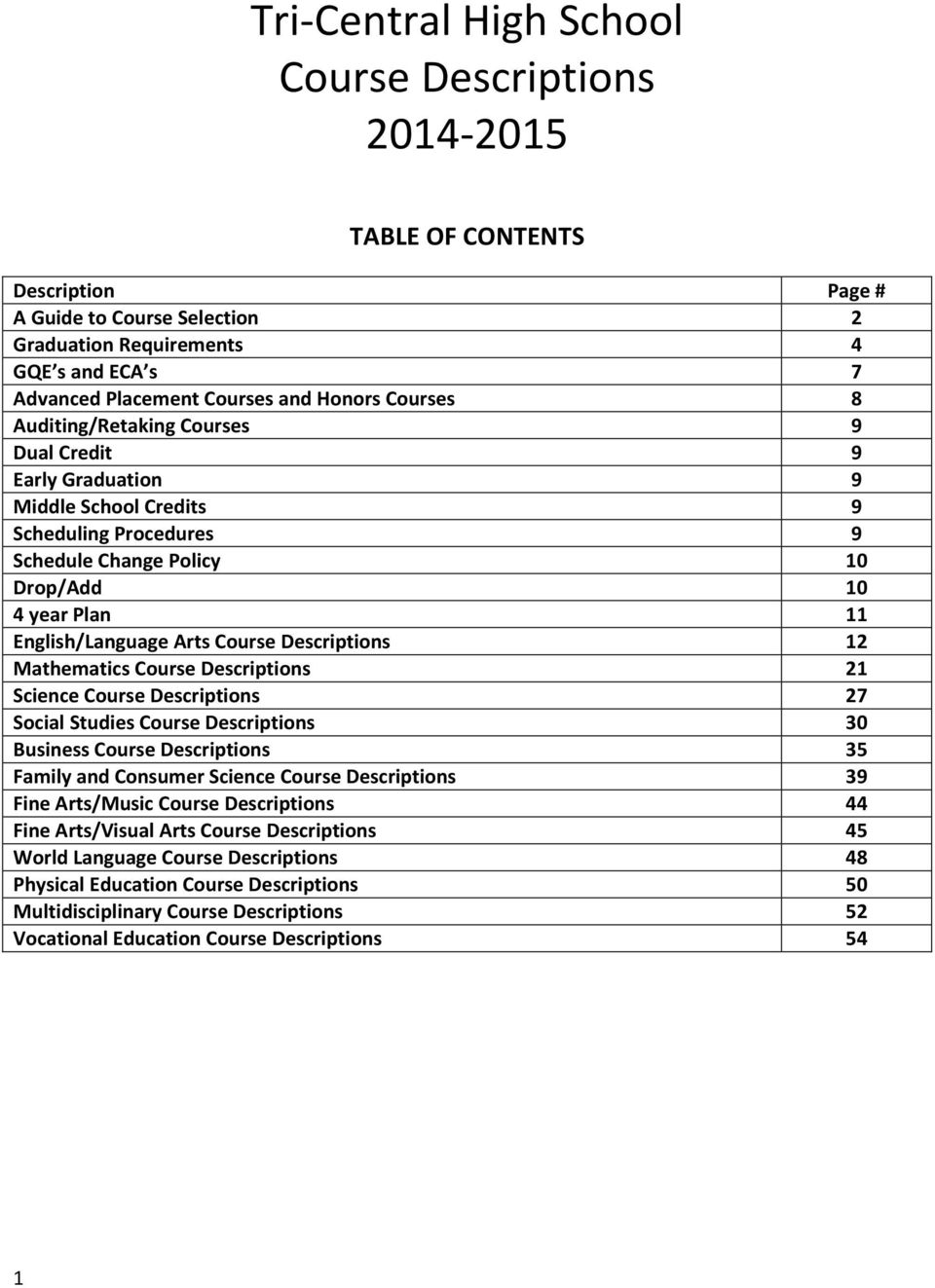
1 Tri-Central High School Course Descriptions TABLE OF CONTENTS Description Page # A Guide to Course Selection 2 Graduation Requirements 4 GQE s and ECA s 7 Advanced Placement Courses and Honors Courses 8 Auditing/Retaking Courses 9 Dual Credit 9 Early Graduation 9 Middle School Credits 9 Scheduling Procedures 9 Schedule Change Policy 10 Drop/Add 10 4 year Plan 11 English/Language Arts Course Descriptions 12 Mathematics Course Descriptions 21 Science Course Descriptions 27 Social Studies Course Descriptions 30 Business Course Descriptions 35 Family and Consumer Science Course Descriptions 39 Fine Arts/Music Course Descriptions 44 Fine Arts/Visual Arts Course Descriptions 45 World Language Course Descriptions 48 Physical Education Course Descriptions 50 Multidisciplinary Course Descriptions 52 Vocational Education Course Descriptions 54 1
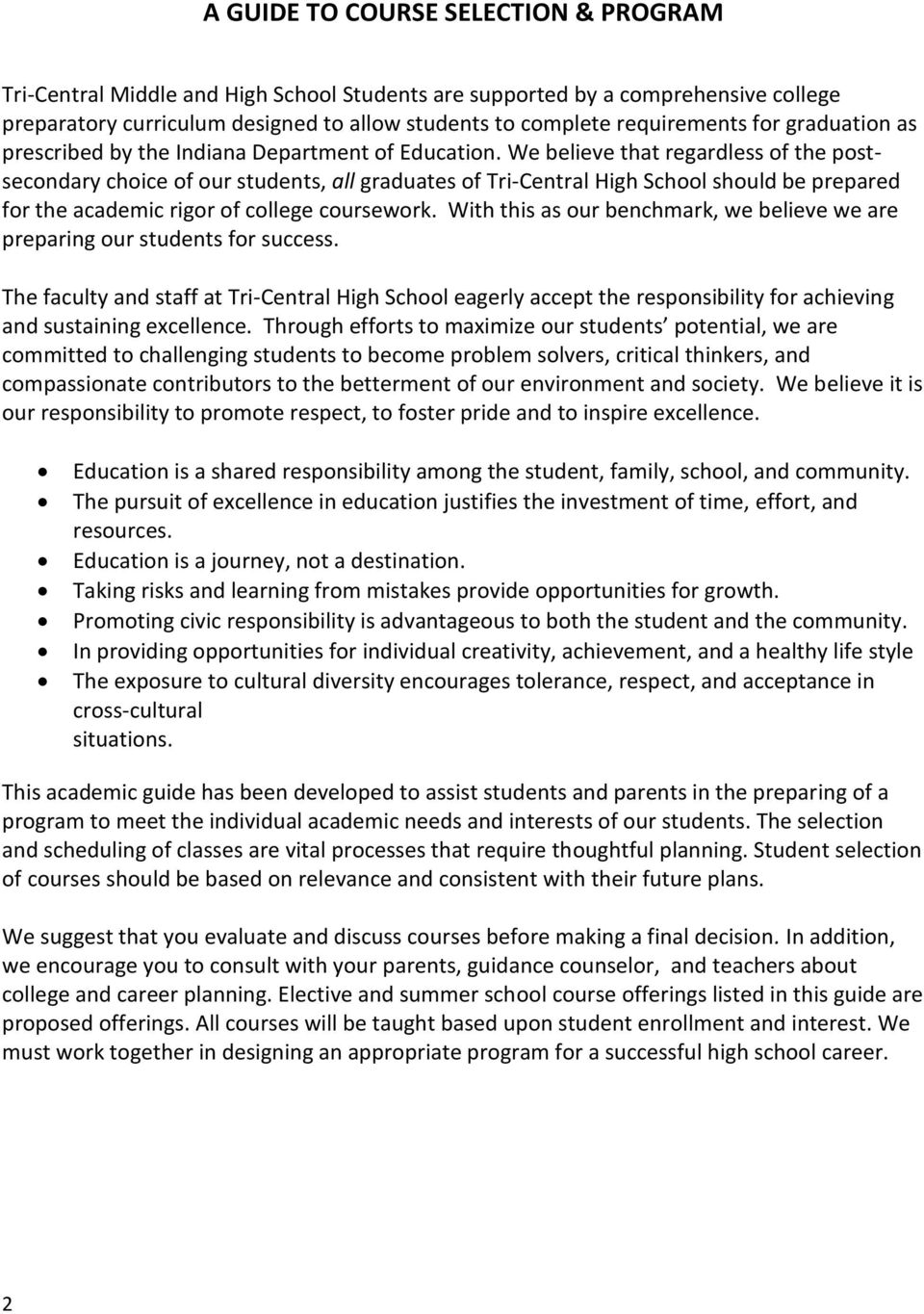
2 A GUIDE TO COURSE SELECTION & PROGRAM Tri-Central Middle and High School Students are supported by a comprehensive college preparatory curriculum designed to allow students to complete requirements for graduation as prescribed by the Indiana Department of Education. We believe that regardless of the postsecondary choice of our students, all graduates of Tri-Central High School should be prepared for the academic rigor of college coursework. With this as our benchmark, we believe we are preparing our students for success. The faculty and staff at Tri-Central High School eagerly accept the responsibility for achieving and sustaining excellence. Through efforts to maximize our students potential, we are committed to challenging students to become problem solvers, critical thinkers, and compassionate contributors to the betterment of our environment and society. We believe it is our responsibility to promote respect, to foster pride and to inspire excellence. Education is a shared responsibility among the student, family, school, and community. The pursuit of excellence in education justifies the investment of time, effort, and resources. Education is a journey, not a destination. Taking risks and learning from mistakes provide opportunities for growth. Promoting civic responsibility is advantageous to both the student and the community. In providing opportunities for individual creativity, achievement, and a healthy life style The exposure to cultural diversity encourages tolerance, respect, and acceptance in cross-cultural situations. This academic guide has been developed to assist students and parents in the preparing of a program to meet the individual academic needs and interests of our students. The selection and scheduling of classes are vital processes that require thoughtful planning. Student selection of courses should be based on relevance and consistent with their future plans. We suggest that you evaluate and discuss courses before making a final decision. In addition, we encourage you to consult with your parents, guidance counselor, and teachers about college and career planning. Elective and summer school course offerings listed in this guide are proposed offerings. All courses will be taught based upon student enrollment and interest. We must work together in designing an appropriate program for a successful high school career. 2
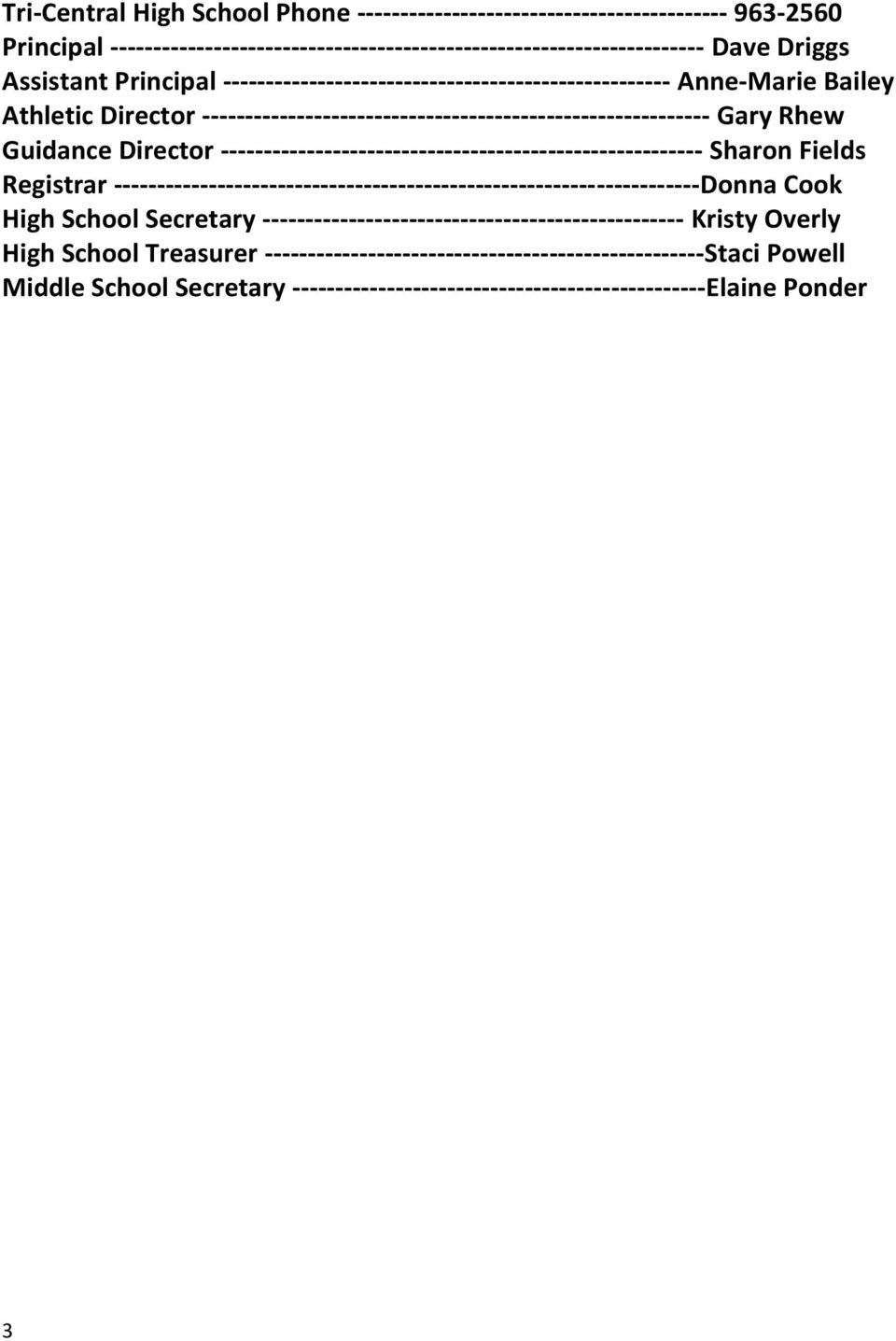
3 Tri-Central High School Phone Principal Dave Driggs Assistant Principal Anne-Marie Bailey Athletic Director Gary Rhew Guidance Director Sharon Fields Registrar Donna Cook High School Secretary Kristy Overly High School Treasurer Staci Powell Middle School Secretary Elaine Ponder 3
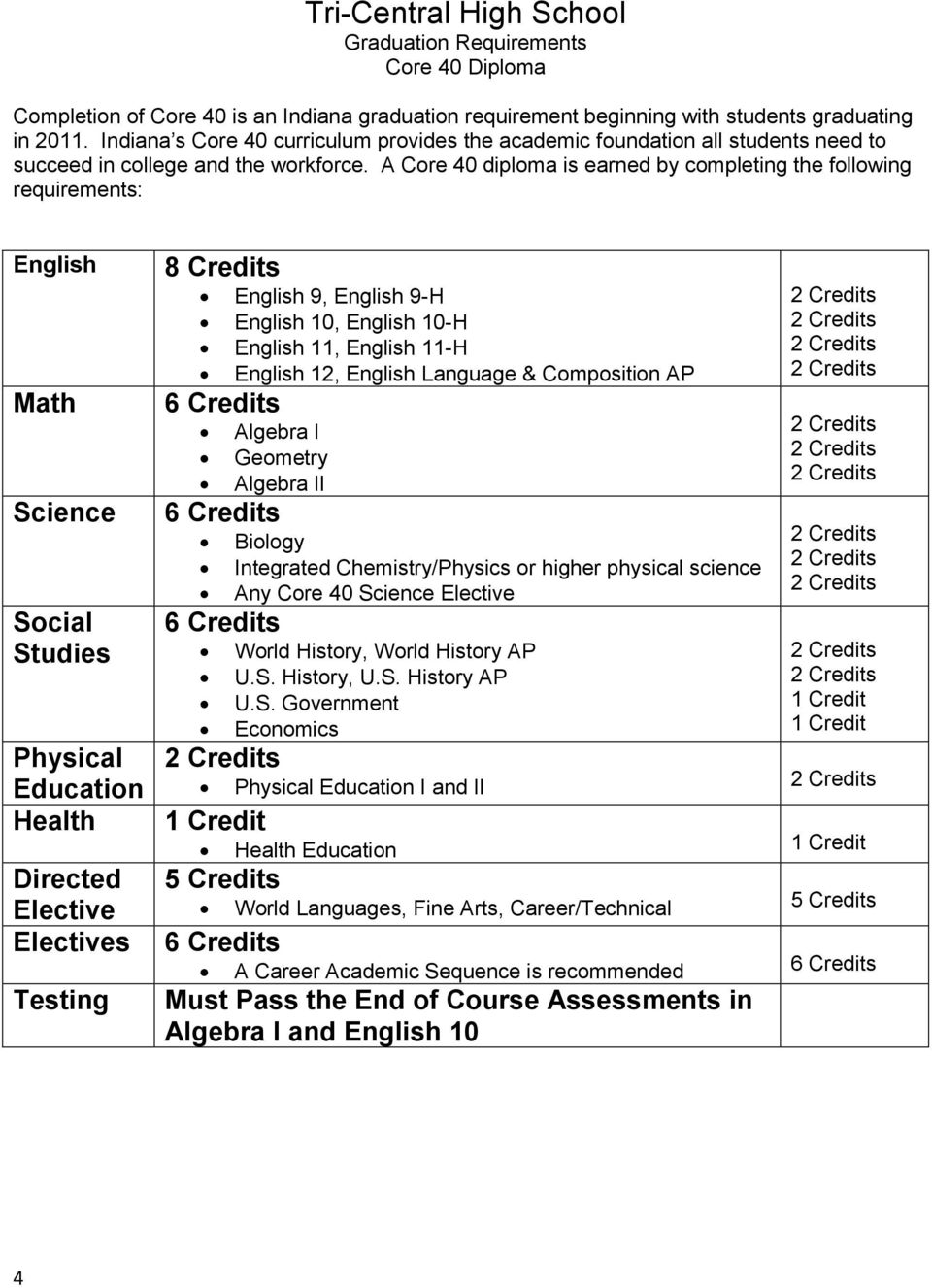
4 Tri-Central High School Graduation Requirements Core 40 Diploma Completion of Core 40 is an Indiana graduation requirement beginning with students graduating in Indiana s Core 40 curriculum provides the academic foundation all students need to succeed in college and the workforce. A Core 40 diploma is earned by completing the following requirements: English Math Science Social Studies Physical Education Health Directed Elective Electives Testing 8 Credits English 9, English 9-H English 10, English 10-H English 11, English 11-H English 12, English Language & Composition AP 6 Credits 6 Credits 6 Credits Algebra I Geometry Algebra II Biology Integrated Chemistry/Physics or higher physical science Any Core 40 Science Elective World History, World History AP U.S. History, U.S. History AP U.S. Government Economics 2 Credits 2 Credits 2 Credits 2 Credits 2 Credits 2 Credits 2 Credits 2 Credits 2 Credits 2 Credits 2 Credits 2 Credits 1 Credit 1 Credit 2 Credits Physical Education I and II 2 Credits 1 Credit Health Education 1 Credit 5 Credits World Languages, Fine Arts, Career/Technical 5 Credits 6 Credits A Career Academic Sequence is recommended 6 Credits Must Pass the End of Course Assessments in Algebra I and English 10 4
5 Tri-Central High School Graduation Requirements Core 40 Diploma with Academic Honors Students seeking a Core 40 with Academic Honors diploma must fulfill the following requirements: Complete all requirements for a Core 40 diploma Earn two additional Core 40 math credits. Earn 6 credits (three years of one language) or 8 credits (two years of one language and two years of a second language) Earn 2 Core 40 fine arts credits Earn a "C" or better in courses that will count toward the diploma Earn a grade point average of "B" or better Complete one of the following Complete AP courses (4 credits) and corresponding AP exams Complete IB HL courses (4 credits) and corresponding IB exams Earn a combined score of 1200 or higher on the SAT critical reading and mathematics (students in the class of 2016 and beyond must take the critical reading, mathematics, and writing section and score no less than 530 on each section and earn a composite score of no less than 530 on each section) Score a 26 or higher composite on the ACT (students in the class of 2016 must take the writing section) Complete dual high school/college credit courses from the Core Transfer Library (6 transferable college credits) Complete a combination of AP course (2 credits) and corresponding AP exams and dual high school/college credit course(s) from the Core Transfer Library (3 transferable college credits) Core 40 with Technical Honors Students seeking a Core 40 with Technical Honors diploma must fulfill the following requirements: Complete all requirements for a Core 40 diploma Earn a "C" or better in courses that will count toward the diploma Earn a grade point average of "B" or better Complete a career-technical program of 8 or more related credits. (students in the class of 2016 must earn six credits in a college and career pathway) Complete two of the following, one must be A or B A. Score at or above standard on WorkKeys (students in the class of 2016 may earn a minimum score on Accuplacer or on Compass) B. Complete dual high school/college credit courses in a technical area (6 college credits) C. Complete a Professional Career Internship course D. Complete an industry-based work experience E. Earn a state-approved, industry-recognized certification 5

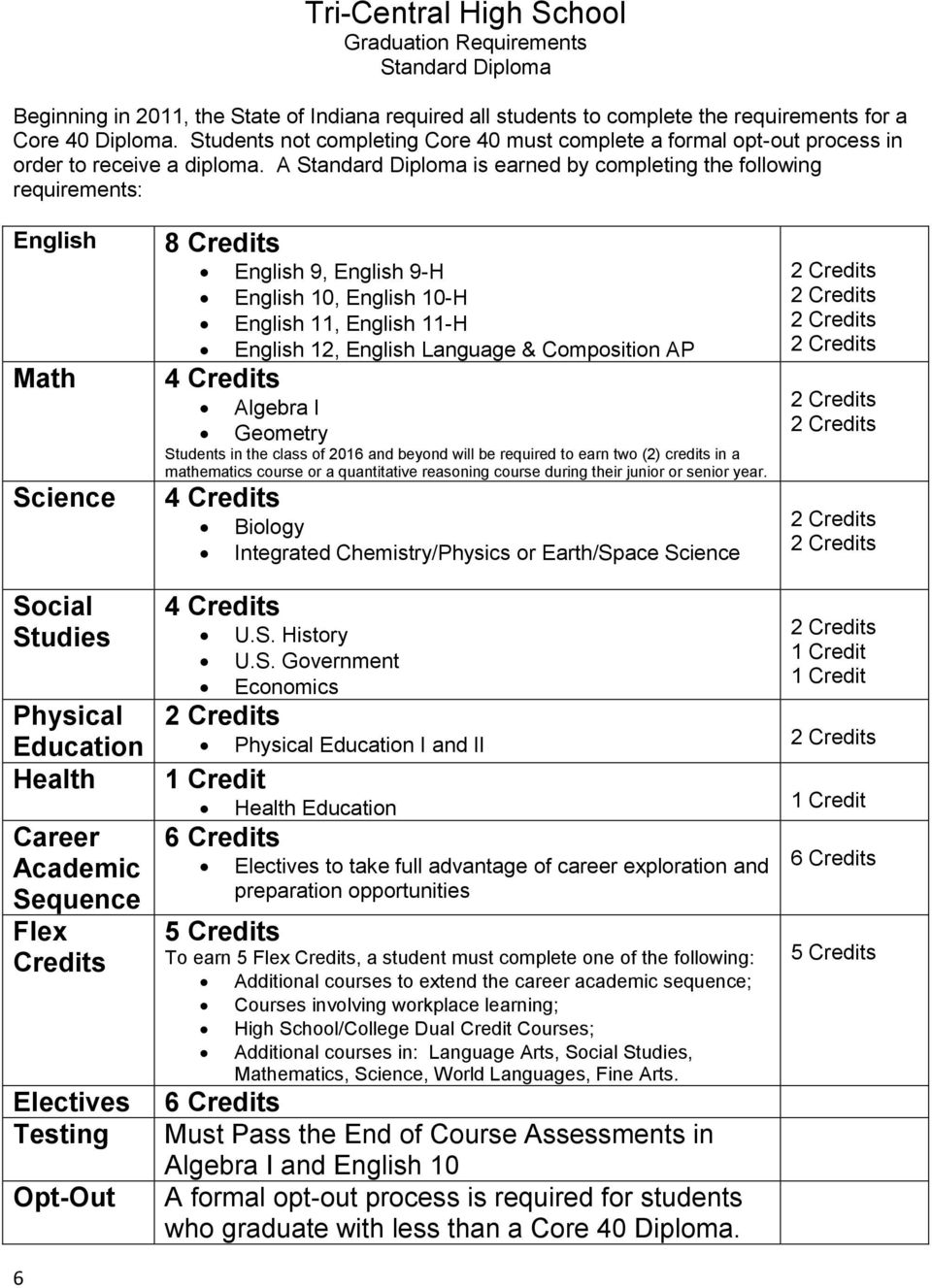
6 Tri-Central High School Graduation Requirements Standard Diploma Beginning in 2011, the State of Indiana required all students to complete the requirements for a Core 40 Diploma. Students not completing Core 40 must complete a formal opt-out process in order to receive a diploma. A Standard Diploma is earned by completing the following requirements: English Math Science 8 Credits English 9, English 9-H English 10, English 10-H English 11, English 11-H English 12, English Language & Composition AP 4 Credits Algebra I Geometry Students in the class of 2016 and beyond will be required to earn two (2) credits in a mathematics course or a quantitative reasoning course during their junior or senior year. 4 Credits Biology Integrated Chemistry/Physics or Earth/Space Science 2 Credits 2 Credits 2 Credits 2 Credits 2 Credits 2 Credits 2 Credits 2 Credits Social Studies Physical Education Health Career Academic Sequence Flex Credits Electives Testing Opt-Out 4 Credits U.S. History U.S. Government Economics 2 Credits 1 Credit 1 Credit 2 Credits Physical Education I and II 2 Credits 1 Credit Health Education 1 Credit 6 Credits 5 Credits Electives to take full advantage of career exploration and preparation opportunities To earn 5 Flex Credits, a student must complete one of the following: Additional courses to extend the career academic sequence; Courses involving workplace learning; High School/College Dual Credit Courses; Additional courses in: Language Arts, Social Studies, Mathematics, Science, World Languages, Fine Arts. 6 Credits Must Pass the End of Course Assessments in Algebra I and English 10 A formal opt-out process is required for students who graduate with less than a Core 40 Diploma. 6 Credits 5 Credits 6
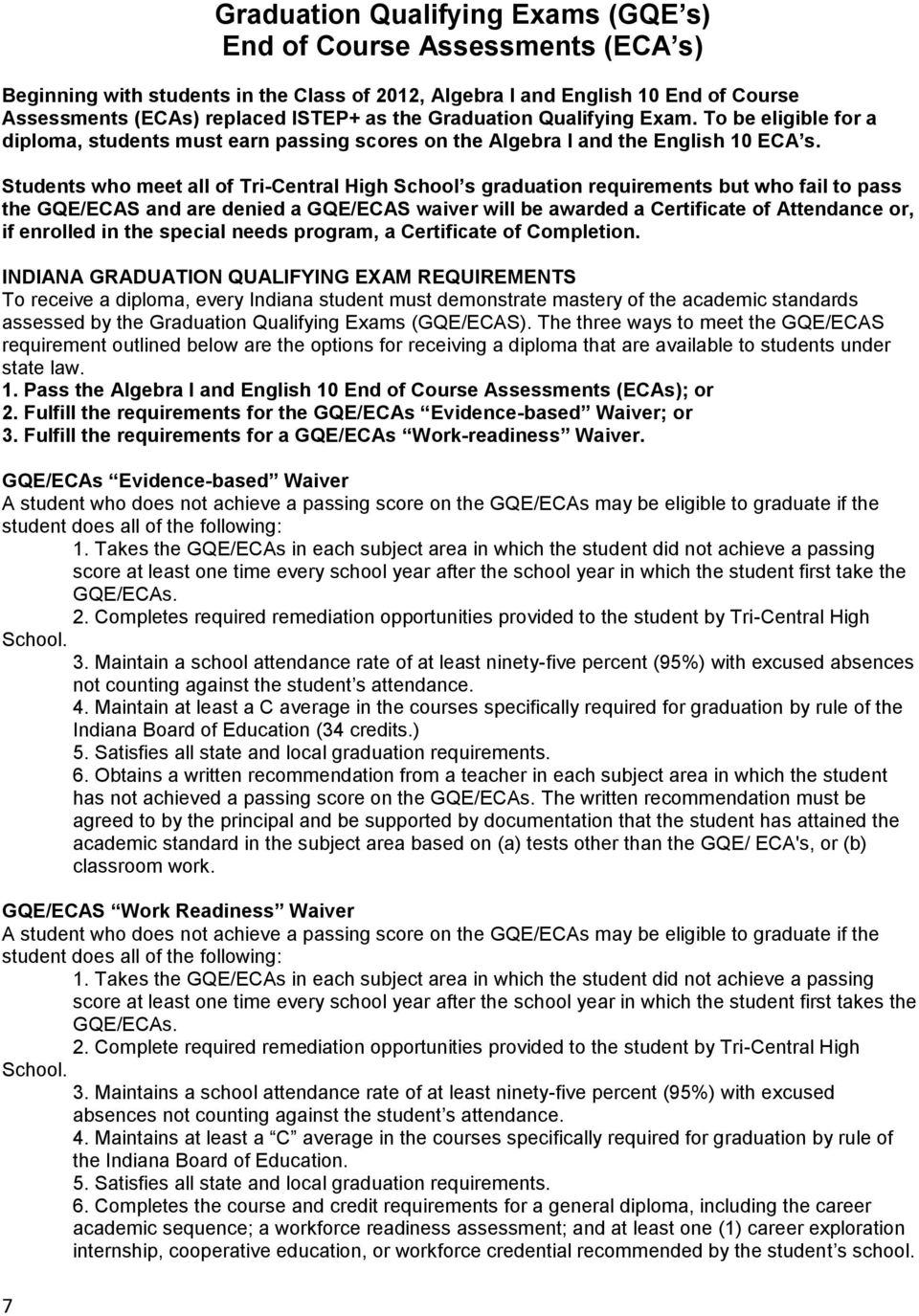
7 7 Graduation Qualifying Exams (GQE s) End of Course Assessments (ECA s) Beginning with students in the Class of 2012, Algebra I and English 10 End of Course Assessments (ECAs) replaced ISTEP+ as the Graduation Qualifying Exam. To be eligible for a diploma, students must earn passing scores on the Algebra I and the English 10 ECA s. Students who meet all of Tri-Central High School s graduation requirements but who fail to pass the GQE/ECAS and are denied a GQE/ECAS waiver will be awarded a Certificate of Attendance or, if enrolled in the special needs program, a Certificate of Completion. INDIANA GRADUATION QUALIFYING EXAM REQUIREMENTS To receive a diploma, every Indiana student must demonstrate mastery of the academic standards assessed by the Graduation Qualifying Exams (GQE/ECAS). The three ways to meet the GQE/ECAS requirement outlined below are the options for receiving a diploma that are available to students under state law. 1. Pass the Algebra I and English 10 End of Course Assessments (ECAs); or 2. Fulfill the requirements for the GQE/ECAs Evidence-based Waiver; or 3. Fulfill the requirements for a GQE/ECAs Work-readiness Waiver. GQE/ECAs Evidence-based Waiver A student who does not achieve a passing score on the GQE/ECAs may be eligible to graduate if the student does all of the following: 1. Takes the GQE/ECAs in each subject area in which the student did not achieve a passing score at least one time every school year after the school year in which the student first take the GQE/ECAs. 2. Completes required remediation opportunities provided to the student by Tri-Central High School. 3. Maintain a school attendance rate of at least ninety-five percent (95%) with excused absences not counting against the student s attendance. 4. Maintain at least a C average in the courses specifically required for graduation by rule of the Indiana Board of Education (34 credits.) 5. Satisfies all state and local graduation requirements. 6. Obtains a written recommendation from a teacher in each subject area in which the student has not achieved a passing score on the GQE/ECAs. The written recommendation must be agreed to by the principal and be supported by documentation that the student has attained the academic standard in the subject area based on (a) tests other than the GQE/ ECA's, or (b) classroom work. GQE/ECAS Work Readiness Waiver A student who does not achieve a passing score on the GQE/ECAs may be eligible to graduate if the student does all of the following: 1. Takes the GQE/ECAs in each subject area in which the student did not achieve a passing score at least one time every school year after the school year in which the student first takes the GQE/ECAs. 2. Complete required remediation opportunities provided to the student by Tri-Central High School. 3. Maintains a school attendance rate of at least ninety-five percent (95%) with excused absences not counting against the student s attendance. 4. Maintains at least a C average in the courses specifically required for graduation by rule of the Indiana Board of Education. 5. Satisfies all state and local graduation requirements. 6. Completes the course and credit requirements for a general diploma, including the career academic sequence; a workforce readiness assessment; and at least one (1) career exploration internship, cooperative education, or workforce credential recommended by the student s school.
8 Advanced Placement The Advanced Placement (AP) Program is a cooperative educational endeavor of secondary schools, colleges, and the College Board. All TCHS courses designated as AP have been approved by the College Board through their course audit process. The AP Program at TCHS provides opportunities for highly motivated high school students to take college level courses that include more in-depth study and analysis of course content. Research shows that students enrolling in challenging academic courses are far better prepared for the academic expectations at the college level. AP courses allow students to fine tune writing skills, enhance problem-solving abilities, and develop time management skills, discipline, and study habits that will be necessary for success in college. More than 90% of colleges and universities in the United States and more than 60 countries award course credit, advanced placement, or both on the basis of AP exam scores earned by students. Each May, the College Board AP examinations are offered at TCHS. Exams combine essay or problem solving and multiple choice questions and are similar in format to a cumulative final examination. In May 2013, exam fees were $87.00 per exam. In order to encourage AP course enrollment and exam completion, the State of Indiana typically subsidizes the cost of math and science exams. AP exam fees are set by the College Board and are subject to change in subsequent years. TCHS has offered and taught the following AP classes. As with all course offerings, the decision to teach a class in any given year is predicated on student enrollment. Because these classes involve collegiate level work, summer assignments may be a requirement. Before registering for these courses, please contact the department chair/teacher to discuss potential summer assignments. Biology Calculus (AB) Chemistry English Language and Composition Studio Art: Drawing Studio Art: 2D Design United States History World History HONORS COURSES The academic disciplines of English, Mathematics, and Science offer courses at the Honors level. These courses are advanced in material, pace, and rigor. We encourage all college bound students to enroll in at least one Honors course during high school. Students in Honors courses will receive additional grade point average (GPA) weighting. Recommendations and prerequisites for Honors courses are published in our Course Description Guide. However, if a student does not meet the course recommendation, students may enroll in the course. In these cases, the student, parent, counselor, and department chairperson will meet to outline enrollment procedures. Students wishing to challenge themselves academically will not be denied that opportunity. 8

9 Auditing/Retaking Classes Students who receive a grade of a C- or lower in a class may retake the class. They may retake it by either sitting in the class again, or through a pre-approved on-line course. The grade received in the retake class will become the grade of record. Any exceptions to this must be approved by the principal or their designee. Students must notify the guidance office when the replacement grade is earned. Dual Credit / Advanced College Project TCHS students may earn both high school and college/university credit by enrolling in dual credit courses. Students may enroll in a dual credit course available at TCHS or students may take a course at a college or university that TCHS may recognize. Prior approval is required for a course taken at a college or university to be counted toward a student's TCHS diploma (see Transfer of Credits below.) In either case the student is responsible for any tuition involved. Most dual credit opportunities have college admission requirements (placement tests) that may include SAT scores, GPA thresholds, and age minimums. TCHS offers the following dual credit courses: English 11, and Chemistry. Graduation in Less than Eight Semesters It is the belief of TCHS that all students benefit by completing eight semester of high school. However, a student may graduate in less than eight semesters with approval of the principal or their designee. Students seeking early graduation must have a well-structured and solidified transition plan that addresses further education or employment. Middle School Class Credit Middle school students that have completed the second level of a course sequence (Geometry, Spanish II, etc.) will be awarded high school grades and credits to appear on their transcript. Scheduling Procedures Students will select classes for the next academic year late in the first semester or early in the second semester. It is important that parents, students and counselors work together to select classes that help meet a student's academic, career, and collegiate goals. The school's master schedule is set and teaching assignments are made based upon student class selections so students should not assume that classes may be easily changed at the beginning of the school year or at the semester. Usually, a student s next year schedule will be provided in the Spring. These schedules should be carefully checked and the guidance office should be contacted before the end of the school year concerning any requests for changes. Students will be allowed to request any schedule changes before the end of the school year. The guidance department will do its best to accommodate requests for changes as class size and balance allow. 9

10 Schedule Change Policy The philosophy of Tri-Central Middle/High School in regard to schedule changes reflects the idea of teaching students to be responsible individuals by making good decisions and abiding by the consequences of those decisions. Students are encouraged to invest quality time in planning their courses for the upcoming school year. Such planning should consist of consultation with parents, school personnel (guidance counselors and teachers), fellow students, and college personnel/resources. Occasionally, there will be individual situation that arise that may result in the need for a schedule change. When presented, these situations will be reviewed by school personnel to determine whether or not a schedule change is needed. The school administration will make the final decision regarding a request for a schedule change. Only serious and necessary reasons will be considered (see list below). 1. An error made by the school in developing the schedule; 2. A need to balance classes; 3. A medical reason that is accompanied by appropriate documentation; 4. A change in program placement for students with documented learning disabilities; 5. A level change within a given course (honors to regular, regular to remedial) upon the recommendation of a department head, teacher or guidance counselor; 6. A request to take courses to qualify for the Academic Honors Diploma or Core 40 Diploma; 7. The failure of a course that is required for graduation; 8. The failure of a prerequisite; 9. The failure of a course that is required for entrance into a post-secondary institute; 10. The request to add a course that is required for college; The rationale for adhering to the above stated reasons for a schedule change is based upon: 1. Maintaining the academic rigor of the student s schedule; 2. Maintaining the expectations that both parent and student carefully choose courses relevant to the chosen diploma type and post-secondary plans; 3. Maintaining course and class balances. Drop/Add Schedule changes will not occur after the school year begins. Students may not have more than one study hall per semester. Students who are taking seven classes during a semester may drop one course for one study hall as follows: - Students may drop a course within 10 school days without notation on their transcript. Adding a replacement class may occur but is dependent upon space availability. - Students may drop a course from day 11 through the third day past midterm (4 and 1/2 weeks). A withdrawal notation will be recorded on their transcript if they are passing at the time the drop occurs. A withdrawal failure notation will be recorded on their transcript if they are failing at the time the drop occurs. These marks will not be factored into a student's GPA determination. - Students may drop a course from the fourth day past midterm (4 and 1/2 weeks). A withdrawal failure notification will be recorded on their transcript and be factored into GPA determination. 10

11 11

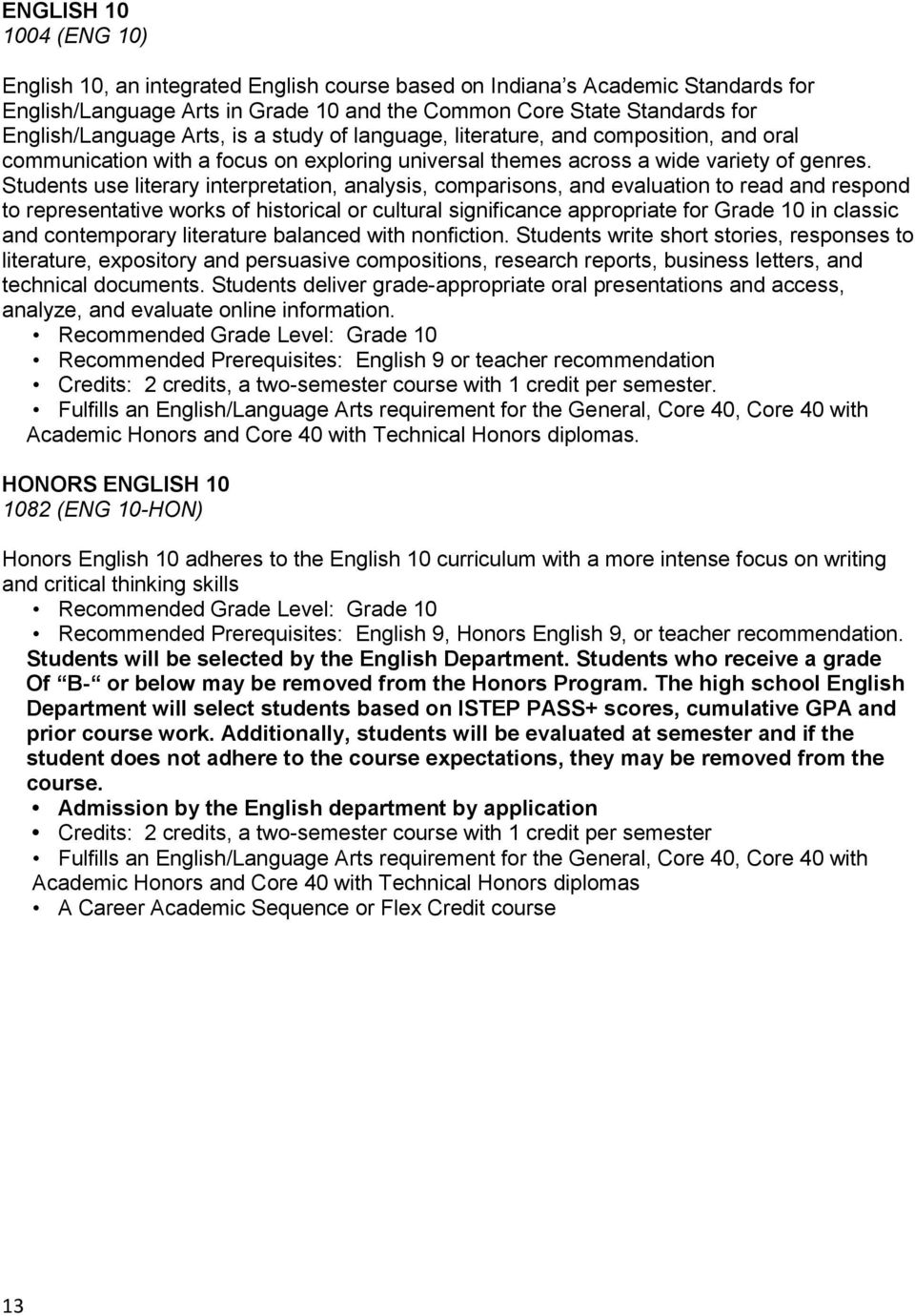
12 ENGLISH AND LANGUAGE ARTS: ENGLISH (ENG 9) English 9, an integrated English course based on Indiana s Academic Standards for English/Language Arts in Grade 9 and the Common Core State Standards for English/Language Arts, is a study of language, literature, composition, and oral communication with a focus on exploring a wide-variety of genres and their elements. Students use literary interpretation, analysis, comparisons, and evaluation to read and respond to representative works of historical or cultural significance appropriate for Grade 9 in classic and contemporary literature balanced with nonfiction. Students write short stories, responses to literature, expository and persuasive compositions, research reports, business letters, and technical documents. Students deliver grade-appropriate oral presentations and access, analyze, and evaluate online information. Recommended Grade Level: Grade 9 Recommended Prerequisites: None Credits: 2 credits, a two-semester course with 1 credit per semester Fulfills an English/Language Arts requirement for the General, Core 40, Core 40 with Academic Honors and Core 40 with Technical Honors diploma. HONORS ENGLISH (ENG 9-HON) Honors English 9 adheres to the English 9 curriculum with a more intense focus on writing and critical thinking skills. Recommended Grade Level: Grade 9 Recommended Prerequisites: Students will be selected by the English Department. Students who receive a grade of B- or below may be removed from the Honors Program. The high school English department will select students based on ISTEP PASS+ scores and prior course work. Additionally students will be evaluated at Semester and if the student does not adhere to the course expectations, they may be removed from the course. Admission by the English department by application Credits: 2 credits, a two-semester course with 1 credit per semester. Fulfills an English/Language Arts requirement for the General, Core 40, Core 40 with A Career Academic Sequence or Flex Credit course 12
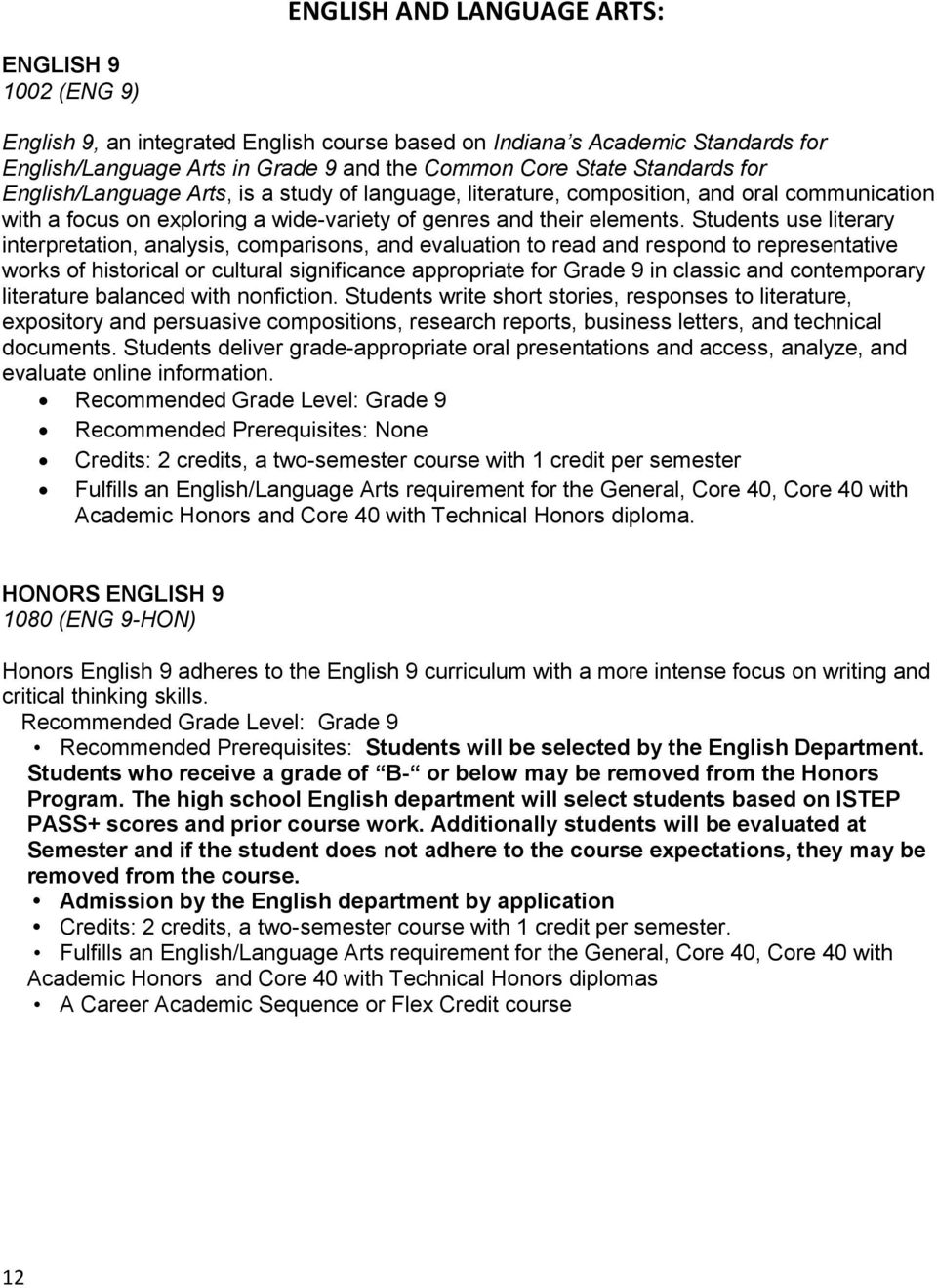
13 ENGLISH (ENG 10) English 10, an integrated English course based on Indiana s Academic Standards for English/Language Arts in Grade 10 and the Common Core State Standards for English/Language Arts, is a study of language, literature, and composition, and oral communication with a focus on exploring universal themes across a wide variety of genres. Students use literary interpretation, analysis, comparisons, and evaluation to read and respond to representative works of historical or cultural significance appropriate for Grade 10 in classic and contemporary literature balanced with nonfiction. Students write short stories, responses to literature, expository and persuasive compositions, research reports, business letters, and technical documents. Students deliver grade-appropriate oral presentations and access, analyze, and evaluate online information. Recommended Grade Level: Grade 10 Recommended Prerequisites: English 9 or teacher recommendation Credits: 2 credits, a two-semester course with 1 credit per semester. Fulfills an English/Language Arts requirement for the General, Core 40, Core 40 with. HONORS ENGLISH (ENG 10-HON) Honors English 10 adheres to the English 10 curriculum with a more intense focus on writing and critical thinking skills Recommended Grade Level: Grade 10 Recommended Prerequisites: English 9, Honors English 9, or teacher recommendation. Students will be selected by the English Department. Students who receive a grade Of B- or below may be removed from the Honors Program. The high school English Department will select students based on ISTEP PASS+ scores, cumulative GPA and prior course work. Additionally, students will be evaluated at semester and if the student does not adhere to the course expectations, they may be removed from the course. Admission by the English department by application Credits: 2 credits, a two-semester course with 1 credit per semester Fulfills an English/Language Arts requirement for the General, Core 40, Core 40 with A Career Academic Sequence or Flex Credit course 13
14 ENGLISH (ENG 11) English 11, an integrated English course based on Indiana s Academic Standards for English/Language Arts in Grade 11 and the Common Core State Standards for English/Language Arts, is a study of language, literature, composition and oral communication with a focus on exploring characterization across universal themes and a wide variety of genres. Students use literary interpretation, analysis, comparisons, and evaluation to read and respond to representative works of historical or cultural significance appropriate for Grade 11 in class and contemporary literature balanced with nonfiction. Students write fictional narratives, short stories, responses to literature, reflective compositions, historical investigation reports, resumes, and technical documents incorporating visual information in the form of pictures, graphs, and tables. Students write and deliver grade-appropriate multimedia presentations and access, analyze, and evaluate online information. Recommended Grade Level: Grade 11 Recommended Prerequisites: English 9 and English 10 or teacher recommendation Credits: 2 credits, a two-semester course with 1 credit per semester Fulfills an English/Language Arts requirement for the General, Core 40, Core 40 with. HONORS ENGLISH (ENG 11-HON) Honors English 11 is the study of American literature from its beginning and its various literary movements through 20 th century literature that reflect American culture. Instruction focuses on developing criteria for judging and analyzing literary works, speeches, essays, and poetry. Students select distinguished elements in literature that make it a reflection of the social, economics, political thinking or condition of times, analyze literature from different points of view, and identify how contemporary writing reflects tradition and movement. Students will respond critically, reflectively, and imaginatively to American Literature and recognize the relevance of this literature in today s world. Composition in Honors English 11 refines students abilities to articulate ideas in an organized manner. Students concentrate on details, point-ofview, and organization through persuasive, expository and descriptive writings. In addition, students learn the elements of effective research and produce a research paper and annotated bibliographies. Students will have the opportunity to earn DUAL CREDIT with IVY TECH COMMUNITY COLLEGE. An additional college-level text book is used with this course. This course will qualify as required English 11 credit for all diplomas. Recommended Grade Level: Grade 11 Recommended Prerequisites: Successful completion of English 9 & 10 and Accepted application. Students who receive a grade of B- or below may be Removed from the Honors Program. The high school English department will select Students based on ISTEP PASS+ scores, cumulative GPA and prior course work. Additionally, students will be evaluated at semester and if the student does not adhere to the course expectations, they may be removed from the course. Admission by the English department by application Credits: 2 credits, a two-semester course with 1 credit per semester Fulfills an English/Language Arts requirement for the General, Core 40, Core 40 with 14
15 ENGLISH (ENG 12) English 12, an integrated English course based on Indiana s Academic Standards for English/Language Arts for Grade 12 and the Common Core State Standards for English/Language Arts, is a study of language, literature, composition, and oral communication focusing on an exploration of point of view or perspective across a wide variety of genres. Students use literary interpretation, analysis, comparisons, and evaluation to read and respond to representative works of historical or cultural significance for Grade 12 in classic and contemporary literature balanced with nonfiction. Students write fictional narratives, short stories, responses to literature, reflective compositions, historical investigation reports, resumes and technical documents incorporating visual information in the form of pictures, graphs, and tables. Students write and deliver grade-appropriate multimedia presentations and access, analyze, and evaluate online information. Recommended Grade Level: Grade 12 Recommended Prerequisites: English 9, English 10, and English 11 or teacher Recommendation Credits: 2 credits, a two-semester course with 1 credit per semester Fulfills an English/Language Arts requirement for the General, Core 40, Core 40 with ENGLISH LITERATURE AND COMPOSITION, ADVANCED PLACEMENT 1058 (LIT/COMP AP) English Literature and Composition, Advanced Placement, is an advanced placement course based on content established by the College Board. An AP English course in Literature and Composition engages students in the careful reading and critical analysis of imaginative literature. Through the close reading of selected texts, students deepen their understanding of the ways writers use language to provide both meaning and pleasure for their readers. As they read, students consider a work s structure, and themes as such small-scale elements as the use of figurative language, imagery, symbolism, and tone. The course includes intensive study of representative works from various genres and periods, concentrating on works of recognized literary merit. A comprehensive description of this course can be found on the College Board AP Central Course Description web page at Recommended Grade Level: Grades 11 and 12 Recommended Prerequisites: English 9 and English 10, or other literature, language, Composition, and speech courses or teacher recommendation Fulfills an English/Language Arts requirement for the General, Core 40, Core 40 with College Board does NOT designate the grade level (Grade 11 or 12) when this course should be offered. English 12 could be incorporated into this course, if this course is offered at Grade 12 15
16 LANGUAGE ARTS LAB 1010 (LANG LAB) Language Arts Lab is a supplemental course that provides students with individualized or small group instruction designed to support success in completing language arts course work aligned with Indiana s Academic Standards for English/Language Arts in Grades 9-12 and focusing on the Writing Standards (Standards 4, 5, and 6). Recommended Grade Level: Grades Recommended Prerequisites: None Credits: 1-6 credits. The nature of this course allows for successive semesters of Instruction at advanced levels. Counts as an English/Language Arts Elective only for the General, Core 40, Core 40 with This course is for students who need additional support in all the language arts (reading, Writing, speaking and listening), especially in writing. NOTE: The course is required for any student that did not pass the Core 40 ECA In ENGLISH 10. DRAMATIC LITERATURE 1028 (DRAMA LIT) Dramatic Literature, a course based on Indiana's Academic Standards for English/Language Arts and the Common Core State Standards for English/Language Arts, is a study of plays and literary art as different from other literary genres. Students view live, televised, or filmed productions and stage scenes from plays or scripts. Students examine tragedies, comedies, melodramas, musicals or operas created by important playwrights and screenwriters representing the literary movements in dramatic literature. Students analyze how live performance alters interpretation from text and how developments in acting and production have altered the way we interpret plays or scripts. Students analyze the relationship between the development of dramatic literature as entertainment and as a reflection or influence on the culture. Recommended Grade Level: Grades 11 or 12 Recommended Prerequisites: English 9, English 10, or teacher recommendation Credits: 1 credit Fulfills an English/Language Arts requirement for the General, Core 40, Core 40 with Academic NOTE: Students are strongly encouraged to combine this course with a composition course FILM LITERATURE 1034 (FILM LIT) Film Literature, a course based on Indiana's Academic Standards for English/Language Arts and the Common Core State Standards for English/Language Arts, is a study of how literature is adapted for film or media and includes role playing as film directors for selected screen scenes. Students read about the history of film, the reflection or influence of film on the culture, and issues of interpretation, production and adaptation. Students examine the visual interpretation of literary techniques and auditory language in film and the limitations or special capacities of film versus text to present a literary work. Students analyze how films portray the human condition 16

17 and the roles of men and women and the various ethnic or cultural minorities in the past and present. FILM LITERATURE PROJECT: Students complete a project, such as doing an historical timeline and bibliography on the development of film or the creation of a short- subject film, which demonstrates knowledge, application, and progress in the Film Literature course content. Recommended Grade Level: Grades 11 or 12 Recommended Prerequisites: English 9, English 10, or teacher recommendation Credits: 1 credit Fulfills an English/Language Arts requirement for the General, Core 40, Core 40 with SHORT STORIES 1046 (SHORT STRS) Short Stories, a course based on Indiana's Academic Standards for English/Language Arts and the Common Core State Standards for English/Language Arts, is a study of the distinct features of the short story, such as being tightly focused narrative fiction. The course may be organized by historical periods, themes, or authors. Students examine short stories with modernist and contemporary themes by a variety of authors from the perspective of audience, purpose, and historical development. Students analyze what distinguishes the short story genre from other literary genres, such as the novel, epic, romance, biography, and others. Recommended Grade Level: Grades 11 or 12 Recommended Prerequisites: English 9, English 10, or teacher recommendation Credits: 1 credit Fulfills an English/Language Arts requirement for the General, Core 40, Core 40 with NOTE: Students are strongly encouraged to combine this course with a composition course that they take before, concurrently, or after the course. THEMES IN LITERATURE 1048 (THEMES LIT) Themes in Literature, a course based on Indiana's Academic Standards for English/Language Arts and the Common Core State Standards for English/Language Arts, is a study of universal themes, such as the journey of the hero, the trials of youth, the search for identity, and other themes appropriate to the level and interests of students. The course may be limited to a few important related themes. Students examine representative works in various genres by authors of diverse eras and nationalities and the way themes may be treated differently in the works because of the cultural context. Students analyze how themes illuminate humanity's struggle to understand the human condition. Recommended Grade Level: Grades 11 or 12 Recommended Prerequisites: English 9, English 10, or teacher recommendation Credits: 1 credit Fulfills an English/Language Arts requirement for the General, Core 40, Core 40 with NOTE: Students are strongly encouraged to combine this course with a composition course that they take before, concurrently, or after the course. 17

18 ETYMOLOGY 1060 (ETYMOLOGY) Etymology, a language studies course based on Indiana's Academic Standards for English/Language Arts and the Common Core State Standards for English/Language Arts, is the study and application of the derivation of English words and word families from their roots in ancient and modern languages (Latin, Greek, Germanic, Romance Languages). Students analyze meanings of English words by examining roots, prefixes, suffixes. Students analyze the connotative and denotative meaning of words in a variety of contexts and the reasons for language change. Students write about word history and semantics in texts that require etymological sensitivity, such as Renaissance poetry or works in translation. ETYMOLOGY PROJECT: Students complete a project, such as doing a case study on specific words or creating an historical timeline of the development of specific words, which demonstrates knowledge, application, and progress in Etymology course content. Recommended Grade Level: Grades11 or 12 Recommended Prerequisites: None Credits: 1 credit Fulfills an English/Language Arts requirement for the General, Core 40, Core 40 with NOTE: Students are strongly encouraged to combine this course with a literature or composition course that they take before, concurrently, or after the course. DEBATE 1070 (DEBATE) Debate, a course based on Indiana's Academic Standards for English/Language Arts and the Common Core State Standards for English/Language Arts, is the study and application of the basic principles of debate involving support for the basic types of arguments (induction, deduction, causation) and debate strategies (affirmative or negative argument construction and extension, case development, refutation or rebuttal of argument claims and evidence, and persuasive speaking). DEBATE PROJECT: Students complete a project, such as a mock debate or trial, participation in a forum, competition, or tournament, or an argument supporting or opposing different sides of a major issue, which demonstrates knowledge, application, and presentation progress in the Debate course content. Recommended Grade Level: Grades 11 or 12 Recommended Prerequisites: Speech or teacher recommendation Credits: 1 or 2 credits. The nature of this course allows for the second semester of instruction at an advanced level. Fulfills an English/Language Arts requirement for the General, Core 40, Core 40 with 18

19 SPEECH 1076 (SPEECH) Speech, a course based on Indiana's Academic Standards for English/Language Arts and the Common Core State Standards for English/Language Arts Standards, is the study and application of the basic principles and techniques of effective oral communication. Students deliver focused and coherent speeches that convey clear messages, using gestures, tone, and vocabulary appropriate to the audience and purpose. Students deliver different types of oral and multi-media presentations, including viewpoint, instructional, demonstration, informative, persuasive, and impromptu. Students use the same Standard English conventions for oral speech that they use in their writing. Recommended Grade Level: Grades 9-12 Recommended Prerequisites: None Credits: 1 or 2 credits Fulfills an English/Language Arts requirement for the General, Core 40, Core 40 with NOTE: Students are strongly encouraged to combine this course with a literature or composition course that they take before, concurrently, or after the course. STUDENT PUBLICATIONS 1086 (STDNT PUBS) Student Publications, a course based on the High School Journalism Standards and the Student Publications Standards, is the continuation of the study of journalism. Students demonstrate their ability to do journalistic writing and design for high school publications, including school newspapers and yearbooks, and a variety of media formats. Students follow the ethical principles and legal boundaries that guide scholastic journalism. Students express themselves publicly with meaning and clarity for the purpose of informing, entertaining, or persuading. Students work on high school publications or media staffs so that they may prepare themselves for career paths in journalism, communications, writing, or related fields. Recommended Grade Level: Grades 9, 10, 11, or 12 Recommended Prerequisites: Journalism, Mass Media, or teacher recommendation Credits: 1-8 credits. The nature of this course allows for successive semesters of instruction at advanced levels. May be offered over three- or four-years by subtitling the course Beginning, Intermediate, or Advanced. Counts as an Elective for the General, Core 40, Core 40 with Academic Honors and Core 40 with Technical Honors diplomas or two (2) credits accrued as an English/Language Arts requirement for the General Diploma only if the course work addresses Indiana's Academic Standards for English/Language Arts Journalism Academic Career Path form; High School Journalism Standards; Student Publications Standards: NOTE: This is the designated school newspaper or yearbook course. 19
20 COMPOSITION 1090 (COMP) Composition, a course based on Indiana's Academic Standards for English/Language Arts and the Common Core State Standards for English/Language Arts, is a study and application of the rhetorical (effective) writing strategies of narration, description, exposition, and persuasion. Using the writing process, students demonstrate a command of vocabulary, English language conventions, research and organizational skills, an awareness of the audience, the purpose for writing, and style. Students read classic and contemporary literature or articles and use appropriate works as models for writing. Students write a variety of types of compositions with a focus on fictional narratives, reflective compositions, academic essays, and responses to literature. Recommended Grade Level: Grades 11 or 12 Recommended Prerequisites: English 9, English 10, or teacher recommendation Credits: 1 credit Fulfills an English/Language Arts requirement for the General, Core 40, Core 40 with CREATIVE WRITING 1092 (CREAT WRIT) Composition, a course based on Indiana s Academic Standards for English Language Arts and the Common Core State Standards for English Language Arts, is a study and application of the rhetorical (effective) writing strategies for prose and poetry. Using the writing process, students demonstrate a command of vocabulary, the nuances of language and vocabulary, English language conventions, an awareness of the audience, the purposes for writing, and the style of their own writing. CREATIVE WRITING PROJECT: Students complete a project, such as a short story, a narrative or epic poem, a persuasive speech or letter, a book review, a script or short play, or other creative compositions, which demonstrates knowledge, application, and writing progress in the Creative Writing course content. Recommended Grade Level: Grades 11 or 12 Recommended Prerequisites: English, 9, English 10, or teacher recommendation Credits: 1 credit Fulfills an English/Language Arts requirement for the General, Core 40, Core 40 with NOTE: Students are strongly encouraged to combine this course with a literature course That they take before, concurrently, or after the course. 20

21 MATHEMATICS: ALGEBRA ENRICHMENT 2510 (ALG ENRICH) Algebra Enrichment is a mathematics support course for Algebra I. The course provides students with additional time to build the foundations necessary for high school math courses, while concurrently having access to rigorous, grade-level appropriate courses. The five critical areas of Algebra Enrichment align with the critical areas of Algebra I: Relationships between Quantities and Reasoning with Equations; Linear and Exponential Relationships; Descriptive Statistics; Expressions and Equations; and Quadratic Functions and Modeling. However, whereas Algebra I contains exclusively grade-level content, Algebra Enrichment combines standards from high school courses with foundational standards from the middle grades. Credits: A two credit course Counts as a Mathematics Course for the General Diploma only or as an Elective for the Core 40, Core 40 with Algebra Enrichment is designed as a support course for Algebra I. As such, a student taking Algebra Enrichment must also be enrolled in Algebra I during the same academic year. ALGEBRA I 2520 (ALG I) Algebra I formalizes and extends the mathematics that students learned in the middle grades. Five critical areas comprise Algebra I: Relations and Functions; Linear Equations and Inequalities; Quadratic and Nonlinear Equations; Systems of Equations and Inequalities; and Polynomial Expressions. The critical areas deepen and extend understanding of linear and exponential relationships by contrasting them with each other and by applying linear models to data that exhibit a linear trend, and students engage in methods for analyzing, solving, and using quadratic functions. The Mathematical Practice Standards apply throughout each course and, together with the content standards, prescribe that students experience mathematics as a coherent, useful, and logical subject that makes use of their ability to make sense of problem situations. Credits: a two credit course Fulfills the Algebra I/Integrated Mathematics I requirement for the General, Core 40, Core 40 with Students pursuing Core 40, Core 40 with Academics Honors, or Core 40 with Technical Honors 21
22 GEOMETRY 2532 (GEOM) Geometry formalizes and extends students geometric experiences from the middle grades. Students explore more complex geometric situations and deepen their explanations of geometric relationships, moving towards formal mathematical arguments. Six critical areas comprise the Geometry course: Congruency and Similarity; Measurement; Analytic Geometry; Circles; and Polyhedra. Close attention should be paid to the introductory content for the Geometry conceptual category found in the high school CCSS. The Mathematical Practice Standards apply throughout each course and, together with the content standards, prescribe that students experience mathematics as a coherent, useful, and logical subject that makes use of their ability to make sense of problem situations. Recommended Prerequisite: Algebra I Credits: A two credit course Fulfills the Geometry/Integrated Mathematics II requirement for the Core 40, Core 40 with and counts as a Mathematics Course for the General Diploma HONORS GEOMETRY 2554 (GEOM-HON) APPLICATION NECESSARY Geometry students examine the properties of two-and three-dimensional objects. Proof and logic, as well as investigative strategies in drawing conclusions, are stressed. Properties and relationships of geometric objects include the study of: (1) points, lines, angles and planes; (2) polygons, with a special focus on quadrilaterals, triangles, right triangles; (3) circles; and (4) polyhedral and other solids. Use of graphing calculators and computer drawing programs is encouraged. This course is considered an accelerated Geometry course, expanding on core concepts. Recommended Prerequisite: Must have a B average in Algebra I. Credits: a two credit course Fulfills the Geometry/Integrated Mathematics II requirement for the Core 40, Core 40 with and counts as a Mathematics Course for the General Diploma A Career Academic Sequence or Flex Credit course 22
23 ALGEBRA II 2522 (ALG II) Algebra II builds on work with linear, quadratic, and exponential functions and allows for students to extend their repertoire of functions to include polynomial, rational, and radical functions. Students work closely with the expressions that define the functions, and continue to expand and hone their abilities to model situations and to solve equations, including solving quadratic equations over the set of complex numbers and solving exponential equations using the properties of logarithms. The Mathematical Practice Standards apply throughout each course and, together with the content standards, prescribe that students experience mathematics as a coherent, useful, and logical subject that makes use of their ability to make sense of problem situations. Recommended Prerequisite: Algebra I Credits: A two credit course Fulfills the Algebra II/Integrated Mathematics III requirement for the Core 40, Core 40 with and counts as a Mathematics course for the General Diploma. HONORS ALGEBRA II 2556 (ALG II-HON) APPLICATION NECESSARY Algebra II is a course that extends the content of Algebra I and provides further development of the concept of a function. Topics include: (1) relations, functions, equations and inequalities; (2) conic sections; (3) polynomials; (4) algebraic fractions; (5) logarithmic and exponential functions; (6) sequences and series; and (7) counting principles and probability. This course is an accelerated version of Algebra II, extending core Algebra II concepts. Recommended Prerequisite: Geometry and Algebra I with a suggested grade of B or better. Credits: a two credit course Fulfills the Algebra II/Integrated Mathematics III requirement for the Core 40, Core 40 with and counts as a Mathematics Course for the General Diploma A Career Academic Sequence or Flex Credit course 23
24 PRE-CALCULUS/TRIGONOMETRY 2564 (PRECAL/TRIG) Pre-Calculus/Trigonometry is a two-credit course that combines the material from Trigonometry and Pre-Calculus into one course. The foundations of algebra and functions developed in previous courses will be extended to new functions, including exponential and logarithmic functions, and to higher-level sequences and series. The course provides students with the skills and understandings that are necessary for advanced manipulation of angles and measurement. Students will also advance their understanding of imaginary numbers through an investigation of complex numbers and polar coordinates. The course is designed for students who expect math to be a major component of their future college and career experiences, and as such it is designed to provide students with strong foundations for calculus and other higherlevel math courses. Recommended Prerequisite: Algebra II and Geometry or Integrated Mathematics III Credits: A two-credit course Counts as a Mathematics Course for the General, Core 40, Core 40 with Academic Honors and Core 40 with Technical Honors Diploma CALCULUS AB, ADVANCED PLACEMENT 2562 (CALC AB AP) Calculus AB, Advanced Placement is a course based on content established by the College Board. Calculus AB is primarily concerned with developing the students understanding of the concepts of calculus and providing experience with its methods and applications. The course emphasizes a multirepresentational approach to calculus, with concepts, results, and problems being expressed graphically, numerically, analytically, and verbally. The connections among these representations also are important. Topics include: (1) functions, graphs, and limits; (2) derivatives; and (3) integrals. Technology should be used regularly by students and teachers to reinforce the relationships among the multiple representations of functions, to confirm written work, to implement experimentation, and to assist in interpreting results. A comprehensive description of this course can be found on the College Board AP Central Course Description web page at: Recommended Grade Level: Grades 11 or 12 Recommended Prerequisite: Pre-Calculus Credits: A two credit course, 1 credit per semester Counts as a Mathematics Course for the General, Core 40, Core 40 with Academic Honors and Core 40 with Technical Honors Diploma 24
25 DISCRETE MATHEMATICS 2530 (DISCRETE) Discrete Mathematics is an umbrella of mathematical topics. It is a course designed for students who will undertake higher-level mathematics in college that may not include calculus. Topics include: (1) counting techniques, (2) matrices, (3) recursion, (4) graph theory, (5) social choice, (6) linear programming, and (7) game theory. Technology, such as computers and graphing calculators, should be used frequently. Recommended Prerequisite: Algebra II or Integrated Mathematics III Credits: A one or two credit course based on Indiana s Academic Standards for Discrete Mathematics (A one-credit Discrete Mathematics course includes counting techniques, matrices, and recursion with other topics included as time allows.) Counts as a Mathematics Course for the General, Core 40, Core 40 with Academic Honors and Core 40 with Technical Honors Diploma PROBABILITY AND STATISTICS 2546 (PROB/STAT) Probability and Statistics includes the concepts and skills needed to apply statistical techniques in the decision-making process. Topics include: (1) descriptive statistics, (2) probability, and (3) statistical inference. Practical examples based on real experimental data are used throughout. Students plan and conduct experiments or surveys and analyze the resulting data. The use of graphing calculators and computer programs is encouraged. Recommended Prerequisite: Algebra II or Integrated Mathematics III Credits: A one credit course Counts as a Mathematics Course for the General, Core 40, Core 40 with Academic Honors and Core 40 with Technical Honors Diploma BUSINESS MATH 4512 (BUS MATH) Business Math is a business course designed to prepare students for roles as entrepreneurs, producers, and business leaders by developing abilities and skills that are part of any business environment. A solid understanding of math including algebra, basic geometry, statistics and probability provides the necessary foundation for students interested in careers in business and skilled trade areas. The content includes mathematical operations related to accounting, banking and finance, marketing, and management. Instructional strategies should include simulations, guest speakers, tours, Internet research, and business experiences. Recommended Grade Level: Recommended Prerequisite: Algebra I Credits: A two-credit course over two semesters Fulfills a Mathematics requirement for the General Diploma only or counts as an Elective or Directed Elective for the Core 40, Core 40 with Academic Honors and Core 40 with Technical Honors Diplomas 25
26 MATHEMATICS LAB 2560 (MATH LAB) Mathematics Lab provides students with individualized instruction designed to support success in completing mathematics coursework aligned with Indiana s Academic Standards for Mathematics. It is recommended that Mathematics Lab is taken in conjunction with a Core 40 mathematics course, and the content of Mathematics Lab should be tightly aligned to the content of its corresponding course. Mathematics Lab should not be offered in conjunction with Algebra I or Integrated Mathematics I; instead, schools should offer Algebra Enrichment or Integrated Mathematics Enrichment to provide students with rigorous support for these courses. Credits: A one to eight credit elective course Counts as an Elective for the General, Core 40, Core 40 with Academic Honors and Core 40 with Technical Honors Diplomas Clarifying information can be appended to the end of the course title to denote the content covered in each course. 26
27 SCIENCE BIOLOGY I 3024 (BIO I) Biology I is a course based on the following core topics: cellular chemistry, structure and reproduction; matter cycles and energy transfer; interdependence of organisms; molecular basis of heredity; genetics and evolution. Instruction should focus on developing student understanding that scientific knowledge is gained from observation of natural phenomena and experimentation by designing and conducting investigations guided by theory and by evaluating and communicating the results of those investigations according to accepted procedures. Recommended Grade Level: 9, 10 Credits: A two credit course Fulfills the Biology requirement for the General, Core 40, Core 40 with Academic Honors and Core 40 with Technical Honors diplomas Biology I may be taken during the 8 th Grade year if students meet the following criteria: Student must be concurrently enrolled in Algebra I during the 8 th grade year; and, student must meet a minimum grade requirement of a B or higher for middle school science courses. BIOLOGY, ADVANCED PLACEMENT (L) 3020 (BIO AP) Biology, Advanced Placement is a course based on the content established by the College Board. The major themes of the course include: The process of evolution drives the diversity and unity of life, Biological systems utilize free energy and molecular building blocks to grow, to reproduce and to maintain dynamic homeostasis, Living systems store, retrieve, transmit and respond to information essential to life processes, Biological systems interact, and these systems and their interactions possess complex properties. A comprehensive description of this course can be found on the College Board AP Central Course Description web page at: Recommended Grade Level: Recommended Prerequisite: Biology I and Chemistry I Credits: A two credit course, 1 credit per semester Counts as a Science Course for the General, Core 40, Core 40 with Academic Honors and Core 40 with Technical Honors diplomas INTEGRATED CHEMISTRY-PHYSICS (L) 3108 (ICP) Integrated Chemistry-Physics is a course focused on the following core topics: motion and energy of macroscopic objects; chemical, electrical, mechanical and nuclear energy; properties of matter; transport of energy; magnetism; energy production and its relationship to the environment and economy. Instruction should focus on developing student understanding that scientific knowledge is gained from observation of natural phenomena and experimentation by 27
28 designing and conducting investigations guided by theory and by evaluating and communicating the results of those investigations according to accepted procedures Recommended Grade Level: 9 Recommended Prerequisite: Algebra I (may be taken concurrently with this course) 28 Credits: A two credit course Fulfills the 2 credit requirement for Chemistry I, Physics I, or Integrated Chemistry and Physics towards the General, Core 40, Core 40 with Academic Honors, and Core 40 with Technical Honors diplomas CHEMISTRY I (L) 3064 (CHEM I) Chemistry I is a course based on the following core topics: properties and states of matter; atomic structure; bonding; chemical reactions; solution chemistry; behavior of gases, and organic chemistry. Students enrolled in Chemistry I compare, contrast, and synthesize useful models of the structure and properties of matter and the mechanisms of its interactions. Instruction should focus on developing student understanding that scientific knowledge is gained from observation of natural phenomena and experimentation by designing and conducting investigations guided by theory and by evaluating and communicating the results of those investigations according to accepted procedures. Recommended Grade Level: Recommended Prerequisite: Algebra II (can be taken concurrently) Credits: A two credit course Fulfills the 2 credit requirement for Chemistry I for the General, Core 40, Core 40 with Academic Honors, and Core 40 with Technical Honors diplomas CHEMISTRY, ADVANCED PLACEMENT (L) 3060 (CHEM AP) Chemistry, Advanced Placement is a course based on the content established by the College Board. The content includes: (1) structure of matter: atomic theory and structure, chemical bonding, molecular models, nuclear chemistry; (2) states of matter: gases, liquids and solids, solutions; and (3) reactions: reaction types, stoichiometry, equilibrium, kinetics and thermodynamics. A comprehensive description of this course can be found on the College Board AP Central Course Description web page at: Recommended Grade Level: 12 Recommended Prerequisite: Chemistry I, Algebra II, Pre-calculus/Trigonometry Credits: A two credit course, 1 credit per semester Counts as a Science Course for the General, Core 40, Core 40 with Academic Honors and Core 40 with Technical Honors diplomas PHYSICS I (L) 3084 (PHYS I) Physics I is a course focused on the following core topics: motion and forces; energy and momentum; temperature and thermal energy transfer; electricity and magnetism; vibrations and waves; light and optics. Instruction should focus on developing student understanding that scientific knowledge is gained from observation of natural phenomena and experimentation by designing and conducting investigations guided by theory and by evaluating and communicating the results of those investigations according to accepted procedures.
29 Recommended Grade Level: Recommended Prerequisite: Algebra II Credits: A two credit course Fulfills the 2 credit requirement for Chemistry I, Physics I, or Integrated Chemistry and Physics towards the General, Core 40, Core 40 with Academic Honors, and Core 40 with Technical Honors diplomas EARTH AND SPACE SCIENCE I (L) 3044 (EAS SCI I) Earth and Space Science I is a course focused on the following core topics: study of the earth s layers; atmosphere and hydrosphere;, structure and scale of the universe; the solar system and earth processes. Students analyze and describe earth s interconnected systems and examine how earth s materials, landforms, and continents are modified across geological time. Instruction should focus on developing student understanding that scientific knowledge is gained from observation of natural phenomena and experimentation by designing and conducting investigations guided by theory and by evaluating and communicating the results of those investigations according to accepted procedures. Recommended Grade Level: 9-10 Credits: A two credit course Counts as a Science Course for the General, Core 40, Core 40 with Academic Honors and Core 40 with Technical Honors diplomas ANATOMY & PHYSIOLOGY 5276 (A & P) Anatomy & Physiology is a course in which students investigate and apply concepts associated with human anatomy and physiology. Concepts covered include the process of homeostasis and the essentials of human function at the level of genes, cells, tissues, and organ systems. Students will understand the structure, organization, and function of the various components of the healthy human body in order to apply this knowledge in all health-related fields. The course should include ample laboratory experiences that illustrate the application of the standards to the appropriate cells, tissues, organs, and organ systems. Dissection is both appropriate and necessary. Students should be able to use basic laboratory equipment such as microscopes, balances, and pipettes. Recommended Grade Level: Required Prerequisite: First-Year course of same discipline (Biology) Recommended Prerequisite: Chemistry, Introduction to Health Care Systems Credits: A two-semester course, one credit per semester Counts as a Life Science Course for the General, Core 40, Core 40 with Academic Honors, and Core 40 with Technical Honors diplomas 29
30 SOCIAL STUDIES ECONOMICS 1514 (ECON) Economics examines the allocation of resources and their uses for satisfying human needs and wants. The course analyzes economic reasoning used by consumers, producers, savers, investors, workers, voters, and government in making decisions. Key elements of the course include study of scarcity and economic reasoning, supply and demand, market structures, role of government, national income determination, the role of financial institutions, economic stabilization, and trade. Students will explain that because resources are limited, people must make choices and understand the role that supply, demand, prices, and profits play in a market economy. The functions of government in a market economy and market structures will be examined. Students will understand economic performance, money, stabilization policies, and trade of the United States. The behavior of people, societies and institutions and economic thinking is integral to this course. Recommended Grade Level: Grades 11 or 12 Recommended Prerequisites: None Credits: 1 semester course, 1 credit Fulfills the Economics requirement for the Core 40, Core 40 with Academic Honors, Core 40 with Technical Honors and International Baccalaureate diplomas, a Social Studies requirement for the General Diploma, or counts as an Elective for any diploma UNITED STATES GOVERNMENT 1540 (US GOVT) United States Government provides a framework for understanding the purposes, principles, and practices of constitutional representative democracy in the United States. Responsible and effective participation of citizens is stressed. Students will understand the nature of citizenship, politics, and governments and understand the rights and responsibilities of citizens and how these are part of local, state, and national government. Students will examine how the United States Constitution protects rights and provides the structure and functions of various levels of government. How the United States interacts with other nations and the government s role in world affairs will be examined. Using primary and secondary resources, students will articulate, evaluate, and defend positions on political issues. As a result, they will be able to explain the role of individuals and groups in government, politic, and civic activities and the need for civic and political engagement of citizens in the United States. Recommended Grade Level: Grades 11 or 12 Recommended Prerequisites: None Credits: 1 semester, 1 credit Fulfills the Government requirement for the General, Core 40, Core 40 with Academic Honors, and Core 40 with Technical Honors diplomas or counts as an Elective for any diploma 30
31 PSYCHOLOGY 1532 (PSYCH) Psychology is the scientific study of mental processes and behavior. The course is divided into six content areas and uses the scientific methods to explore research methods and ethical consideration. Developmental psychology takes a life span approach to physical, cognitive, language, emotional, social, and moral development. Cognitive aspects of the course focus on learning, memory, information processing, and language. Personality, Assessment, and Mental Health topics include psychological disorders, treatment, personality, and assessment. Sociocultural dimensions of behavior deal with topics such as conformity, obedience, perceptions, attitudes, and influence of the group on the individual. The Biological Basis focuses on the way the brain and nervous system function, including sensation, perception, motivation, and emotion. Recommended Grade Level: 11, 12 Recommended Prerequisites: None Credits: 1 or 2 semester course. 1 credit per semester. This course and corresponding exam are intended to be comparable to the corresponding one-semester college level course. Counts as an Elective for the General, Core 40, Core 40 with Academic Honors and Core 40 with Technical Honors diplomas SOCIOLOGY 1534 (SOCIOLOGY) Sociology allows students to study human social behavior from a group perspective. The sociological perspective is a method of studying recurring patterns in people s attitudes and actions and how these patterns vary across time, cultures, and in social settings and groups. Students will describe the development of sociology as a social science and identify methods of research. Through research methods such as scientific inquiry students will examine society, group behavior, and social structures. The influence of culture on group behavior is addressed through institutions such as the family, religion, education, economics, community organizations, government, and political and social groups. The impact of social groups and institutions on group and individual behavior and the changing nature of society will be examined. Influences on group behavior and social problems are included in the course. Students will also analyze the role of individuals in the community and social problems in today s world. Recommended Grade Level: Grades 11, 12 Recommended Prerequisites: None Credits: 1 semester, 1 credit Counts as an Elective for the General, Core 40, Core 40 with Academic Honors and Core 40 with Technical Honors diplomas 31
32 UNITED STATES HISTORY 1542 (US HIST) United States History builds upon concepts developed in previous studies of U.S. History. Students are expected to identify and review significant events, persons, and movements in the early development of the nation. The course then gives major emphasis to the interaction of key events, people, and political, economic, social, and cultural influences in national developments from the late nineteenth century through the present. Students are expected to trace and analyze chronological periods and examine the significant themes and concepts in U,S. History. They will develop historical thinking and research skills and use primary and secondary sources to explore topical issues and to understand the cause for changes in the nation over time. Recommended Grade Level: 11, 12 Recommended Prerequisites: None Credits: 2 semester course, 1 credit each semester Fulfills the US History requirement of the General, Core 40, Core 40 with Academic Honors, and Core 40 with Technical Honors diplomas UNITED STATES HISTORY, ADVANCED PLACEMENT 1562 (US HIST AP) United States History, Advanced Placement is a course based on the content established by the College Board. The course has a chronological frame from 1492 to the present and focuses on multiple causation and change in United States history over time. A variety of historical themes are examined in order to place the history of the United States into larger analytical contexts. Students are expected to analyze and interpret primary sources and develop awareness of multiple interpretations of historical issues in secondary sources. Historical events and issues in U.S. history are to be examined from multiple perspectives. A comprehensive description of this course can be found on the College Board AP Central Course Description web page at: Recommended Grade Level: Grades 11 or 12 Recommended Prerequisites: None Credits: A 1 or 2 semester course, 1 credit per semester Fulfills the US History requirement for the General, Core 40, Core 40 with Academic Honors and Core 40 with Technical Honors diplomas or counts as an Elective for any diploma 32
33 WORLD HISTORY AND CIVILIZATION 1548 (WLD HST/CVL) World History emphasizes events and developments in the past that greatly affected large numbers of people across broad areas and that significantly influenced peoples and places in subsequent eras. Key events related to people and places as well as transcultural interaction and exchanges are examined in this course. Students are expected to compare and contrast events and developments involving diverse peoples and civilizations in different regions of the world. They will examine examples of continuity and change, universality and particularity, and unity and diversity among various peoples and cultures from the past to the present. Students are also expected to practice skills and process of historical thinking and research and apply content knowledge to the practice of thinking and inquiry skills and processes. There will be continuous and pervasive interactions of processes and content, skills and substance, in the teaching and learning of history. Recommended Grade Level: 9, 10 Recommended Prerequisites: None Credits: 2 semester course, 1 credit per semester Fulfills a Social Studies requirement for the General, Core 40, Core 40 with Academic Honors and Core 40 with Technical Honors diplomas or counts as an Elective for any diploma WORLD HISTORY, ADVANCED PLACEMENT 1576 (WLD HST AP) World History, Advanced Placement is a course that provides students with the content established by the College Board. The course will have a chronological frame from the periods 8000 B.C.E. to the present. AP World History focuses on five overarching themes: Interaction between Humans and the Environment, Development and Interaction of Cultures, State- Building, Expansion, and Conflict, Creation, Expansion, and Interaction of Economic Systems, Development and Transformation of Social Structures. A comprehensive description of this course can be found on the College Board AP Central Course Description web page at: A comprehensive description of this course can be found on the College Board AP Central Course Description web page at: Recommended Grade Level: 10 Recommended Prerequisites: None Credits: A 1 or 2 semester course, 1 credit per semester Fulfills a Social Studies requirement for the General, Core 40, Core 40 with Academic Honors and Core 40 with Technical Honors diplomas or counts as an Elective for any diploma. 33
34 GEOGRAPHY AND HISTORY OF THE WORLD 1570 (GEO-HIST WLD) Geography and History of the World is designed to enable students to use geographical skills and historical concepts to deepen their understanding of major global themes including the origin and spread of world religions; exploration; conquest, and imperialism; urbanization; and innovations and revolutions. Geographical and historical skills include forming research questions, acquiring information by investigating a variety of primary and secondary sources, organizing information by creating graphic representations, analyzing information to determine and explain patterns and trends, and presenting and documenting findings orally and/or in writing. The historical geography concepts used to explore the global themes include change over time, origin, diffusion, physical systems, cultural landscapes, and spatial distribution and interaction. Using these skills, concepts and the processes associated with them, students are able to analyze, evaluate, and make predictions about major global developments. This course is designed to nurture perceptive, responsible citizenship, encourage and support the development of critical thinking skills and lifelong learning, and to help prepare Indiana students for the 21 st Century. Recommended Grade Level: 9, 10, Recommended Prerequisites: None Credits: 2 semester course, 1 credit per semester Fulfills a Social Studies requirement for the General, Core 40, Core 40 with Academic Honors and Core 40 with Technical Honors diplomas or counts as an Elective for any diploma 34
35 BUSINESS, MARKETING, AND INFORMATION TECHNOLOGY ACCOUNTING 4524 (ACC I) Accounting is a business course that introduces the language of business using Generally Accepted Accounting Principles (GAAP) and procedures for proprietorships and partnerships using double-entry accounting. Emphasis is placed on accounting principles as they relate to both manual and automated financial systems. This course involves understanding, analyzing, and recording business transactions and preparing, analyzing, and interpreting financial reports as a basis for decision making. Recommended Grade Level: 11, 12 Recommended Prerequisite: None Credits: 1 credit per semester, maximum of 2 semesters, maximum of 2 credits Counts as a Directed Elective or Elective for the General, Core 40, Core 40 with Qualifies as a Quantitative Reasoning course for the General diploma only BUSINESS LAW AND ETHICS 4560 (BUS LAW ETH) Business Law and Ethics is a business course that provides an overview of the legal system. Topics covered include: Basics of the Law, Contract Law, Employment Law, Personal Law, and Property Law. Application of legal principles and ethical decision-making techniques are presented through problem-solving methods and situation analysis. Recommended Grade Level: 11, 12 Recommended Prerequisite: None Credits: 1 credit per semester, maximum of 2 semesters, maximum of 2 credits Counts as a Directed Elective or Elective for the General, Core 40, Core 40 with BUSINESS MATH 4512 (BUS MATH) Business Math is a business course designed to prepare students for roles as entrepreneurs, producers, and business leaders by developing abilities and skills that are part of any business environment. A solid understanding of math including algebra, basic geometry, statistics and probability provides the necessary foundation for students interested in careers in business and skilled trade areas. The content includes mathematical operations related to accounting, banking and finance, marketing, and management. Instructional strategies should include simulations, guest speakers, tours, Internet research, and business experiences. Recommended Grade Level: 10,11 35
36 Recommended Prerequisite: Algebra I Credits: A two-credit course over two semesters Fulfills a Mathematics requirement for the General Diploma only or counts as an Elective or Directed Elective for the Core 40, Core 40 with Academic Honors and Core 40 with Technical Honors diplomas Qualifies as a Quantitative Reasoning course for the General diploma only DIGITAL CITIZENSHIP (formerly Business Computer Applications) 4530 (DIGI CITI) Digital Citizenship is a business course that provides instruction in software concepts using a Windows-based professional suite, which includes word processing, spreadsheet, database, graphics, and presentation applications. Instruction in basic computer hardware and operating systems that support software applications is provided. Additional concepts and applications dealing with software integration, Internet use, and information about future technology trends are included. Instructional strategies should include teacher demonstrations, collaborative instruction, interdisciplinary and/or culminating projects, problem-solving and critical-thinking activities, simulations, and mini-baskets/in-basket projects. Recommended Grade Level: 9 Recommended Prerequisite: None Credits: 1 credit per semester, maximum of 1 semester, maximum of 1 credit Counts as a Core 40 or Academic Honors Elective. INTRODUCTION TO BUSINESS 4518(INTRO BUS) Introduction to Business is an introductory business course that provides the framework for pursuing additional business courses. This core course acquaints students with economics, entrepreneurship, management, marketing, law, risk management, banking, personal finance, and careers in business. The importance and application of business etiquette and ethics are included. Opportunities may be provided for the student to participate in job shadowing, job mentoring, and other field experiences. Instructional strategies may include simulations, projects, and cooperative ventures between the school and the community. Recommended Grade Level: 9, 10 Recommended Prerequisite: None Credits: 1 credit per semester, maximum of 2 semesters, maximum of 2 credits Counts as a Core 40 or Academic Honors Elective. PRINCIPLES OF BUSINESS MANAGEMENT 4562 (BUS MGMT) Principles of Business Management focuses on the roles and responsibilities of managers as well as opportunities and challenges of ethically managing a business in the free enterprise system. Students will attain an understanding of management, team building, leadership, problem solving steps and processes that contribute to the achievement of organizational goals. The management of human and financial resources is emphasized. Recommended Grade Level:
37 Recommended Prerequisites: Introduction to Business Credits: 1 credit per semester, maximum of 2 semesters, maximum of 2 credits Counts as a Directed Elective or Elective for the General, Core 40, Core 40 with This course is aligned with postsecondary courses for Dual Credit ADVANCED BUSINESS MANAGEMENT 5268 (ADV BUS) Advanced Business Management prepares students to plan, organize, direct, and control the functions and processes of a firm or organization and to perform business-related functions. Students are provided opportunities to develop attitudes and apply skills and knowledge in the areas of business administration, management, and finance. Individual experiences will be based upon the student s career and educational goals. Recommended Grade Level: Grade 12 Recommended Prerequisites: Principles of Business Management or Principle of Marketing Credits: 1-2 credits per semester, maximum of 2 semesters, maximum of 4 credits Counts as a Directed Elective or Elective for the General, Core 40, Core 40 with PERSONAL FINANCIAL RESPONSIBILITY 4540 (PRS FIN RSP) Personal Financial Responsibility addresses the identification and management of personal financial resources to meet the financial needs and wants of individuals and families, considering a broad range of economic, social, cultural, technological, environmental, and maintenance factors. This course helps students build skills in financial responsibility and decision making; analyze personal standards, needs, wants, and goals; identify sources of income, saving and investing; understand banking, budgeting, record-keeping and managing risk, insurance and credit card debt. A project based approach and applications through authentic settings such as work based observations and service learning experiences are appropriate. Direct, concrete applications of mathematics proficiencies in projects are encouraged. Recommended Grade Level: Grade 9, 10, 11, 12 Recommended Prerequisites: None Credits: 1 credit per semester, maximum of 1 semester, maximum 1 credit Counts as a Directed Elective or Elective for the General, Core 40, Core 40 with PREPARING FOR COLLEGE AND CAREERS 5394 (PREP CC) Preparing for College and Careers addresses the knowledge, skills, and behaviors all students need to be prepared for success in college, career, and life. The focus of the course is the impact of today s choices on tomorrow s possibilities. Topics to be addressed include twentyfirst century life and career skills; higher order thinking, communication, leadership, and 37
38 management processes; exploration of personal aptitudes, interests, values, and goals; examining multiple life roles and responsibilities as individuals and family members; planning and building employability skills; transferring school skills to life and work; and managing personal resources. This course includes reviewing the 16 national career clusters and Indiana's College and Career Pathways, in-depth investigation of one or more pathways, reviewing graduation plans, developing career plans, and developing personal and career portfolios. A project based approach, including computer and technology applications, cooperative ventures between school and community, simulations, and real life experiences, is recommended. Recommended Grade Level: Grade 9 Recommended Prerequisites: None Credits: 1 credit per semester, maximum of 1 semester, maximum 1 credit Counts as a Core 40 or Academic Honors Elective PRINCIPLES OF MARKETING 5914 (PRN MRKT) Principles of Marketing provides a basic introduction to the scope and importance of marketing in the global economy. Emphasis is placed on oral and written communications, mathematical applications, problem solving, and critical thinking skills as they relate to advertising/promotion/selling, distribution, financing, marketing information management, pricing, and product/service management. Recommended Grade Level: Grade Recommended Prerequisites: None Credits: 1 credit per semester, maximum of 2 semesters, maximum of 2 credits Counts as a Directed Elective or Elective for the General, Core 40, Core 40 with SPORTS AND ENTERTAINMENT MARKETING 5984 (SPRT ENT MRK) Sports and Entertainment Marketing is a specialized marketing course that develops student understanding of the sport/event industries, their economic impact, and products; distribution systems and strategies; pricing considerations; product/service management, and promotion. Students acquire an understanding and appreciation for planning. Throughout the course, students are presented problem-solving situations for which they must apply academic and critical-thinking skills. Participation in cooperative education is an optional instructional method, giving students the opportunity to apply newly acquired marketing skills in the workplace. Recommended Grade Level: Grade Recommended Prerequisites: Principles of Marketing Credits: 1 credit per semester, maximum of 2 semesters, maximum of 2 credits Counts as a Directed Elective or Elective for the General, Core 40, Core 40 with 38
39 CHILD DEVELOPMENT AND PARENTING 5362 (CHLD DEV) 39 FACS Child Development and Parenting addresses the knowledge, skills, attitudes, and behaviors associated with supporting and promoting optimal growth and development of infants and children. A project-based approach that utilizes higher order thinking, communication, leadership, and management processes is recommended in order to integrate suggested topics into the study of child development and parenting. The focus is on research-based nurturing and parenting practices and skills, including brain development research, that support positive development of children. Topics include consideration of the roles, responsibilities and challenges of parenthood; human sexuality; adolescent pregnancy; prenatal development; preparation for birth; the birth process; meeting the physical, social, emotional, intellectual, moral, and cultural growth and developmental needs of infants and children; impacts of heredity, environment, and family and societal crisis on development of the child; meeting children's needs for food, clothing, shelter, and care giving; caring for children with special needs; parental resources, services, and agencies; and career awareness. Applications through authentic settings such as volunteer experiences, internships, and service learning are encouraged. This course is recommended for all students regardless of their career cluster or pathway to build basic parenting skills and is especially appropriate for students with interest in human services and education-related careers. Recommended Grade Level: Grade 9, 10 Recommended Prerequisites: None Credits: One-semester or two-semester course, one credit per semester Counts as a Directed Elective or Elective for the General, Core 40, Core 40 with One of the F&CS courses from which students may choose three to fulfill the required Health and Wellness credit ADVANCED CHILD DEVELOPMENT 5360 (ADVCHLDDEV) Advanced Child Development is a sequential course that addresses more complex issues of child development and early childhood education with emphasis on guiding physical, social, emotional, intellectual, moral, and cultural development throughout childhood, including school age children. Topics include positive parenting and nurturing across ages and stages; practices that promote long-term well-being of children and their families; developmentally appropriate guidance and intervention strategies with individuals and groups of children. Students will access, evaluate, and utilize information, including brain/learning research and other research results to meet needs of children, including children with a variety of disadvantaging conditions. Students will explore "all aspects of the industry" for selected child-related careers. Authentic applications are required through field-based or school-based experiences with children in locations such as observation/interaction laboratories, preschools, elementary schools, or daycare settings. Service learning experiences are highly recommended. A thoroughly documented student portfolio is required. This course is recommended for any student for enrichment and as a foundation for students with interests in any child-related career or profession. Recommended Grade Level: Grade 11 or 12 Recommended Prerequisites: None
40 Credits: One-semester or two-semester course, one credit per semester Counts as a Directed Elective or Elective for the General, Core 40, Core 40 with EDUCATION PROFESSIONS I 5408 (ED PROF I) Education Professions I prepares students for employment in education and related careers and provides the foundation for study in higher education in these career areas. An active learning approach that utilizes higher order thinking, communication, leadership, and management processes is recommended in order to integrate suggested topics into the study of education and related careers. The course of study includes, but is not limited to: the teaching profession, the learner and the learning process, planning instruction, learning environment, and instructional and assessment strategies. Field experiences in one or more classroom settings, resumes, and career portfolios are required components. A standards-based plan guides the students field experiences. Students are monitored in their field experiences by the Education Professions teacher. Articulation with postsecondary programs is encouraged. Recommended Grade Level: 11 Recommended Prerequisites: Child Development and Advanced Child Development or Human Development and Wellness, Nutrition and Wellness Credits: 2-3 credits per semester, maximum of 2 semesters, 6 credits maximum Counts as a Directed Elective or Elective for the General, Core 40, Core 40 with This course is aligned with postsecondary courses for Dual Credit NUTRITION AND WELLNESS 5342 (NTRN WLNS) Nutrition and Wellness enables students to realize the components and lifelong benefits of sound nutrition and wellness practices and empowers them to apply these principles in their everyday lives. A project-based approach that utilizes higher order thinking, communication, leadership, and management processes is recommended in order to integrate suggested topics into the study of individual and family issues. Topics include impact of daily nutrition and wellness practices on long-term health and wellness; physical, social, and psychological aspects of healthy nutrition and wellness choices; planning for Wellness and fitness; selection and preparation of nutritious meals and snacks based on USDA Dietary Guidelines including the Food Guide Pyramid; safety, sanitation, storage, and recycling processes and issues associated with nutrition and wellness; impacts of science and technology on nutrition and wellness issues; and nutrition and wellness career paths. Laboratory experiences which emphasize both nutrition and wellness practices are required components of this course. This course is recommended for all students regardless of their career cluster or pathway, in order to build basic nutrition and wellness knowledge and skills, and is especially appropriate for students with interest in human services, wellness/fitness, health, or food and nutrition-related career pathways. Recommended Grade Level: Grade 9 and up Recommended Prerequisites: None Credits: One-semester or two-semester course, one credit per semester. Counts as a Directed Elective or Elective for the General, Core 40, Core 40 with 40
41 PERSONAL FINANCIAL RESPONSIBILITY 4540 (PRSFINRSP) Personal Financial Responsibility addresses the identification and management of personal financial resources to meet the financial needs and wants of individuals and families, considering a broad range of economic, social, cultural, technological, environmental, and maintenance factors. This course helps students build skills in financial responsibility and decision making; analyze personal standards, needs, wants, and goals; identify sources of income, saving and investing; understand banking, budgeting, record-keeping and managing risk, insurance and credit card debt. A project based approach and applications through authentic settings such as work based observations and service learning experiences are appropriate. Direct, concrete applications of mathematics proficiencies in projects are encouraged. Recommended Grade Level: Grade 9-12 Recommended Prerequisites: None Credits: A one-credit course over one semester Counts as a Directed Elective or Elective for the General, Core 40, Core 40 with PREPARING FOR COLLEGE AND CAREERS 5394 (PRE CCS) Preparing for College and Careers addresses the knowledge, skills, and behaviors all students need to be prepared for success in college, career, and life. The focus of the course is the impact of today s choices on tomorrow s possibilities. Topics to be addressed include twentyfirst century life and career skills; higher order thinking, communication, leadership, and management processes; exploration of personal aptitudes, interests, values, and goals; examining multiple life roles and responsibilities as individuals and family members; planning and building employability skills; transferring school skills to life and work; and managing personal resources. This course includes reviewing the 16 national career clusters and Indiana's College and Career Pathways, in-depth investigation of one or more pathways, reviewing graduation plans, developing career plans, and developing personal and career portfolios. A project based approach, including computer and technology applications, cooperative ventures between school and community, simulations, and real life experiences, is recommended. Recommended Grade Level: Grade 9 Recommended Prerequisites: None Credits: A one-credit course over one semester Counts as a Directed Elective or Elective for the General, Core 40, Core 40 with One of the F&CS courses from which students may choose three to fulfill the required Health and Wellness credit 41
42 INTERPERSONAL RELATIONSHIPS 5364 (INTRP RLT) Interpersonal Relationships addresses the knowledge, skills, attitudes and behaviors all students need to participate in positive, caring, and respectful relationships in the family and with individuals at school, in the community, and in the workplace. A project-based approach that utilizes higher order thinking, communication, leadership, and management processes is recommended in order to integrate suggested topics into the study of interpersonal relationships. Topics include components of healthy relationships, roles and responsibilities in relationships; functions and expectations of various relationships; ethics in relationships; factors that impact relationships (e.g., power, conflicting interests, peer pressure, life events); establishing and maintaining relationships; building self-esteem and self-image through healthy relationships; communications styles; techniques for effective communication, leadership and teamwork; individual and group goal setting and decision making; preventing and managing stress and conflict; addressing violence and abuse; and related resources, services and agencies. Applications through authentic settings such as volunteer experiences, internships, and service learning are encouraged. Recommended Grade Level: Grade 9 and up Recommended Prerequisites: None Credits: One-semester or two-semester course, one credit per semester Counts as a Directed Elective or Elective for the General, Core 40, Core 40 with ADULT ROLES AND RESPONSIBILITIES 5330 (ADULTROLES) Adult Roles and Responsibilities builds knowledge skills, attitudes, and behaviors students will need as they prepare to take the next steps toward adulthood in today's ever-changing society. A project-based approach that utilizes higher order thinking, communication, leadership, and management is recommended in order to integrate suggested topics into the study of individual and family issues. The focus is on becoming independent, contributing, and responsible participants in family, community, and career settings. Topics include living independently and family formation; financial management; analysis of personal standards, needs, aptitudes and goals; integration of family, community, and career responsibilities; consumer choices and decision making related to nutrition and wellness, clothing, housing, and transportation; relationship of technology and environmental issues to family and consumer resources; and community roles and responsibilities of families and individuals. Applications through authentic settings such as volunteer experiences, internships, and service learning are encouraged. This course is designed for students who may not have had other FACS classes and is recommended for all students regardless of their career cluster or pathway, in order to build skills needed for assuming the roles and responsibilities they will encounter as they prepare to complete high school and enter the adult world. Recommended Grade Levels: Grades 11 or 12 Recommended Prerequisites: None Credits: One-semester or two-semester course, one credit per semester 42
43 Counts as a Directed Elective or Elective for the General, Core 40, Core 40 with One of the F&CS courses from which students may choose three to fulfill the required Health and Wellness credit CULINARY ARTS FOUNDATIONS 5438 (CULART FND) Culinary Arts Foundations is an exploratory course for students considering career pathways related to culinary arts. A project-based approach that utilizes higher order thinking, communication, leadership, and management processes is recommended in order to integrate suggested topics into the study of individual and family issues. Topics safety, sanitation, storage and recycling processes in the industry; impacts of science and technology on the industry; and culinary arts career pathways. Students are able to explore this industry in depth and examine their own career goals in light of their findings. Laboratory experiences that emphasize industry practices and develop basic industry skills are required components of this course. Students are expected to prepare for and obtain state-approved food handler certification. This course is recommended for all students regardless of their career cluster or pathway, in order to build basic culinary arts knowledge and skills. It is especially appropriate for students with interest in career clusters related to culinary arts and food and nutrition. This course is recommended as a core component of the four-year career plans for the career clusters of agriculture, food & natural resources; science, engineering & information technology; education & training; and personal & commercial services. Recommended Grade Level: Grade 9 or 10 or permission of the instructor Recommended Prerequisites: Preparing for College and Careers Credits: One or two-semester career foundations/preparation course, one credit per semester Counts as a Directed Elective or Elective for the General, Core 40, Core 40 with 43
44 BEGINNING CONCERT BAND (L) 4160 (BEG BAND) FINE ARTS/MUSIC: Beginning Concert Band is based on the Indiana Academic Standards for High School Instrumental Music. Students taking this course are provided with a balanced comprehensive study of music through the concert band, which develops skills in the psychomotor, cognitive, and affective domains. Ensemble and solo activities are designed to develop elements of musicianship including tone production, technical skills, intonation, music reading skills, listening skills, analyzing music, studying historically significant styles of literature, and integration of other applicable disciplines. Experiences include improvising, conducting, playing by ear, and sight-reading. Students develop the ability to understand and convey the composer's intent in performance of music. Time outside of the school day may be scheduled for rehearsals and performances. A limited number of public performances may serve as a culmination of daily rehearsal and musical goals. Students are required to participate in performance opportunities outside of the school day that support and extend learning in the classroom. Recommended Grade Level: 9, 10, 11, or 12 Laboratory course Credits: a 1-semester course for 1 credit. The nature of this course allows for successive semesters of instruction at an advanced level provided that defined proficiencies and content standards are utilized. Fulfills requirement for 1 of 2 Fine Arts credits for Core 40 with Academic Honors diploma Counts as a Directed Elective or Elective for the General, Core 40, Core 40 with BEGINNING CHORUS (L) 4182 (BEG CHOR) Beginning Chorus is based on the Indiana Academic Standards for High School Choral Music. Students taking Beginning Chorus develop musicianship and specific performance skills through ensemble and solo singing. This class includes the study of quality repertoire in the diverse styles of choral literature appropriate in difficulty and range for the students. Chorus classes provide opportunities for performing, creating, and responding to music. Students develop the ability to understand and convey the composer's intent in performance of music. Time outside of the school day may be scheduled for rehearsals and performances. A limited number of public performances may serve as a culmination of daily rehearsal and musical goals. Students are required to participate in performance opportunities outside of the school day that support and extend learning in the classroom. Recommended Grade Level: 10, 11, or 12 Laboratory course Credits: a 1-semester course for 1 credit. The nature of this course allows for successive semesters of instruction at an advanced level provided that defined proficiencies and content standards are utilized. Fulfills requirement for 1 of 2 Fine Arts credits for Core 40 with Academic Honors diploma Counts as a Directed Elective or Elective for the General, Core 40, Core 40 with 44
45 ADVANCED CHORUS (L) 4188 (ADV CHOR) Advanced Chorus is based on the Indiana Academic Standards for High School Choral Music. Students taking Advanced Chorus develop musicianship and specific performance skills through ensemble and solo singing. This class includes the study of quality repertoire in the diverse styles of choral literature appropriate in difficulty and range for the students. Chorus classes provide opportunities for performing, creating, and responding to music. Students develop the ability to understand and convey the composer's intent in performance of music. Time outside of the school day may be scheduled for rehearsals and performances. A limited number of public performances may serve as a culmination of daily rehearsal and musical goals. Students are required to participate in performance opportunities outside of the school day that support and extend learning in the classroom. Recommended Grade Level: 10, 11, or 12 Recommended Prerequisites: Beginning and Intermediate Chorus Laboratory course Credits: a 1-semester course for 1 credit. The nature of this course allows for successive semesters of instruction at an advanced level provided that defined proficiencies and content standards are utilized. Fulfills requirement for 1 of 2 Fine Arts credits for Core 40 with Academic Honors diploma Counts as a Directed Elective or Elective for the General, Core 40, Core 40 with FINE ARTS/VISUAL ARTS: INTRODUCTION TO TWO-DIMENSIONAL ART 4000 (2D ART) Introduction to Two-Dimensional Art is a course based on the Indiana Academic Standards for Visual Art. Students taking this course engage in sequential learning experiences that encompass art history, art criticism, aesthetics, production, and integrated studies and lead to the creation of portfolio quality works. Students explore historical and cultural background and connections; analyze, interpret, theorize, and make informed judgments about artwork and the nature of art; create two-dimensional works of art, reflect upon the outcomes, and revise their work; relate art to other disciplines and discover opportunities for integration; and incorporate literacy and presentational skills. They identify ways to utilize and support art museums, galleries, studios, and community resources. Recommended Grade Level: 9, 10, 11, or 12 Credits: a 1-semester course for 1 credit Fulfills requirement for 1 of 2 Fine Arts credits for Core 40 with Academic Honors diploma Counts as a Directed Elective or Elective for the General, Core 40, Core 40 with 45
46 ADVANCED TWO-DIMENSIONAL ART 4004 (ADV 2D ART) Advanced Two-Dimensional Art is a course based on the Indiana Academic Standards for Visual Art. Students in this course build on the sequential learning experiences of Introduction to Two-Dimensional Art that encompass art history, art criticism, aesthetics, and production and lead to the creation of portfolio quality works. Students explore historical and cultural background and connections; analyze, interpret, theorize, and make informed judgments about artwork and the nature of art; create two-dimensional works of art, reflect upon the outcomes, and revise their work; relate art to other disciplines and discover opportunities for integration; and incorporate literacy and presentational skills. They identify ways to utilize and support art museums, galleries, studios, and community resources. Recommended Grade Level: 9, 10, 11, or 12 Recommended Prerequisites: Introduction to Two-Dimensional Art (L) Fulfills requirement for 1 of 2 Fine Arts credits for Core 40 with Academic Honors diploma Credits: a 1-semester course for 1 credit. The nature of this course allows for successive semesters of instruction at an advanced level provided that defined proficiencies and content standards are utilized. Counts as a Directed Elective or Elective for the General, Core 40, Core 40 with STUDIO ART/DRAWING PORTFOLIO, ADVANCED PLACEMENT 4048 (ART DRP AP) Studio Art, Advanced Placement Drawing Portfolio is designed to address a very broad interpretation of drawing issues and media. Light and shade, line quality, rendering of form, composition, surface manipulation, and illusion of depth are drawing issues that can be addressed through a variety of means, which could include painting, printmaking, mixed media, etc. Abstract, observational, and inventive works may demonstrate drawing competence. Any work that makes use of (appropriate) other artists works (including photographs) and/or published images must show substantial and significant development beyond duplication. This is demonstrated through manipulation of the formal qualities, design, and/or concept of the source. A comprehensive description of this course can be found on the College Board AP Central Course Description web page at: Recommended Grade Level: 11 or 12 Recommended Prerequisites: Advanced laboratory visual arts courses Credits: a 2-semester course, 1 credit per semester 46 Fulfills requirement for 2 Fine Arts credits for the Core 40 with Academic Honors diploma Counts as a Directed Elective or Elective for the General, Core 40, Core 40 with STUDIO ART/2D DESIGN PORTFOLIO, ADVANCED PLACEMENT 4050 (ART 2D AP) This portfolio is intended to address two-dimensional (2-D) design issues. Design involves purposeful decision making about how to use the elements and principles of art in an integrative way. The principles of design articulated through the visual elements help
47 guide artists in making decisions about how to organize the elements on a picture plane in order to communicate content. For this portfolio, students are asked to demonstrate proficiency in 2-D design through any two-dimensional medium or process, including, but not limited to, graphic design, digital imaging, photography, collage, fabric design, weaving, illustration, painting, and printmaking. Any work that makes use of (appropriates) other artists works (including photographs) and/or published images must show substantial and significant development beyond duplication. A comprehensive description of this course can be found on the College Board AP Central Course Description web page at: Recommended Grade Level: 11 or 12 Recommended Prerequisites: Advanced laboratory 2-D visual arts courses Credits: a 2-semester course, 1 credit per semester Fulfills requirement for 2 Fine Arts credits for the Core 40 with Academic Honors diploma Counts as a Directed Elective or Elective for the General, Core 40, Core 40 with VISUAL COMMUNICATION (L) 4086 (VIS COMM) Visual Communication is a course based on the Indiana Academic Standards for Visual Art. Students in visual communication engage in sequential learning experiences that encompass art history, art criticism, aesthetics, and production and lead to the creation of portfolio quality works. They create print media utilizing graphic design, typography, illustration, and image creation with digital tools and computer technology. Students reflect upon and refine their work; explore cultural and historical connections; analyze, interpret, theorize, and make informed judgments about artwork and the nature of art; relate art to other disciplines and discover opportunities for integration; and incorporate literacy and presentational skills. Students utilize the resources of art museums, galleries, and studios, and identify art-related careers. Recommended Grade Level: 10, 11, or 12 Recommended Prerequisites: Introduction to Two-Dimensional Art (L) Credits: a 1-semester course for 1 credit. The nature of this course allows for successive semesters of instruction at an advanced level provided that defined proficiencies and content standards are utilized. Fulfills requirement for 1 of 2 Fine Arts credits for Core 40 with Academic Honors diploma Counts as a Directed Elective or Elective for the General, Core 40, Core 40 with 47
48 WORLD LANGUAGES: SPANISH I 2120 (SPAN I) Spanish I, a course based on Indiana s Academic Standards for World Languages, introduces students to effective strategies for beginning Spanish language learning, and to various aspects of Spanish-speaking culture. This course encourages interpersonal communication through speaking and writing, providing opportunities to make and respond to basic requests and questions, understand and use appropriate greetings and forms of address, participate in brief guided conversations on familiar topics, and write short passages with guidance. This course also emphasizes the development of reading and listening comprehension skills, such as reading isolated words and phrases in a situational context and comprehending brief written or oral directions. Additionally, students will examine the practices, products and perspectives of Spanish-speaking culture; recognize basic routine practices of the target culture; and recognize and use situation-appropriate non-verbal communication. This course further emphasizes making connections across content areas and the application of understanding Spanish language and culture outside of the classroom. Recommended Grade Level: 9-12 Recommended Prerequisites: None Credits: A 2-credit course Fulfills a World Language requirement for the Core 40 with Academic Honors diploma or counts as a Directed Elective or Elective for any diploma SPANISH II 2122 (SPAN II) Spanish II, a course based on Indiana s Academic Standards for World Languages, builds upon effective strategies for Spanish language learning by encouraging the use of the language and cultural understanding for self-directed purposes. This course encourages interpersonal communication through speaking and writing, providing opportunities to make and respond to requests and questions in expanded contexts, participate independently in brief conversations on familiar topics, and write cohesive passages with greater independence and using appropriate formats. This course also emphasizes the development of reading and listening comprehension skills, such as using contextual clues to guess meaning and comprehending longer written or oral directions. Students will address the presentational mode by presenting prepared material on a variety of topics, as well as reading aloud to practice appropriate pronunciation and intonation. Additionally, students will describe the practices, products and perspectives of Spanish-speaking culture; report on basic family and social practices of the target culture; and describe contributions from the target culture. This course further emphasizes making connections across content areas and the application of understanding Spanish language and culture outside of the classroom. Recommended Grade Level: 9-12 Recommended Prerequisites: Spanish I Credits: A 2-credit course Fulfills a World Language requirement for the Core 40 with Academic Honors diploma or counts as a Directed Elective for any diploma 48
49 SPANISH III 2124 (SPAN III) Spanish III, a course based on Indiana s Academic Standards for World Languages, builds upon effective strategies for Spanish language learning by facilitating the use of the language and cultural understanding for self-directed purposes. This course encourages interpersonal communication through speaking and writing, providing opportunities to initiate, sustain and close conversations; exchange detailed information in oral and written form; and write cohesive information with greater detail. This course also emphasizes the continued development of reading and listening comprehension skills, such as using cognates, synonyms and antonyms to derive meaning from written and oral information, as well as comprehending detailed written or oral directions. Students will address the presentational mode by presenting student-created material on a variety of topics, as well as reading aloud to practice appropriate pronunciation and intonation. Additionally, students will continue to develop understanding of Spanishspeaking culture through recognition of the interrelations among the practices, products and perspectives of the target culture; discussion of significant events in the target culture; and investigation of elements that shape cultural identity in the target culture. This course further emphasizes making connections across content areas as well the application of understanding Spanish language and culture outside of the classroom. Recommended Grade Level: 9-12 Recommended Prerequisites: Spanish I and II Credits: A 2-credit course Fulfills a World Language requirement for the Core 40 with Academic Honors diploma or counts as a Directed Elective or Elective for any diploma SPANISH IV 2126 (SPAN IV) Spanish IV, a course based on Indiana s Academic Standards for World Languages, provides a context for integration of the continued development of language skills and cultural understanding with other content areas and the community beyond the classroom. The skill sets that apply to the exchange of written and oral information are expanded through emphasis on practicing speaking and listening strategies that facilitate communication, such as the use of circumlocution, guessing meaning in familiar and unfamiliar contexts, and using elements of word formation to expand vocabulary and derive meaning. Additionally, students will continue to develop understanding of Spanish-speaking culture through explaining factors that influence the practices, products, and perspectives of the target culture; reflecting on cultural practices of the target culture; and comparing systems of the target culture and the student s own culture. This course further emphasizes making connections across content areas through the design of activities and materials that integrate the target language and culture with concepts and skills from other content areas. The use and influence of the Spanish language and culture in the community beyond the classroom is explored through the identification and evaluation of resources intended for native Spanish speakers. Recommended Grade Level: 9-12 Recommended Prerequisites: Spanish I, II and III Credits: A 2-credit course Fulfills a World Language requirement for the Core 40 with Academic Honors diploma or counts as a Directed Elective for any diploma 49
50 PHYSICAL EDUCATION: PHYSICAL EDUCATION I 3542 (PHYS ED) Physical Education I focuses on instructional strategies through a planned, sequential, and comprehensive physical education curriculum which provide students with opportunities to actively participate in at least four of the following: team sports; dual sport activities; individual physical activities; outdoor pursuits; self-defense and martial arts; aquatics; gymnastics; and dance, all which are within the framework of lifetime physical activities and fitness. Ongoing assessment includes both written and performance-based skill evaluation. Individual assessments may be modified for individuals with disabilities, in addition to those with IEP s and 504 plans (e.g., chronic illnesses, temporary injuries, obesity, etc.). Recommended Grade Level: 9 12 Recommended Prerequisites: Grade 8 Physical Education Credits: 1 credit per semester Fulfills part of the Physical Education requirement for the General, Core 40, Core 40 with Recommended: Classes are co-educational unless the activity involves bodily contact or groupings based on an objective standard of individual performance developed and applied without regard to gender. Adapted physical education must be offered, as needed, in the least restricted environment and must be based upon an individual assessment. As a designated laboratory course, 25% of course time must be spent in activity HEALTH & WELLNESS EDUCATION 3506 (HLTH&WELL) Health & Wellness, a course based on Indiana s Academic Standards for Health & Wellness, provides the basis to help students adopt and maintain healthy behaviors. Health education should contribute directly to a student s ability to successfully practice behaviors that protect and promote health and avoid or reduce health risks. Through a variety of instructional strategies, students practice the development of functional health information (essential concepts); determine personal values that support health behaviors; develop group norms that value a healthy lifestyle; develop the essential skills necessary to adopt, practice, and maintain healthenhancing behaviors. This course includes the application of priority areas in a planned, sequential, comprehensive health education curriculum. Priority areas include: promoting personal health and wellness, physical activity, healthy eating, promoting safety and preventing unintentional injury and violence, promoting mental and emotional health, a tobacco-free lifestyle and an alcohol- and other drug-free lifestyle and promoting human development and family health. This course provides students with the knowledge and skills of health and wellness core concepts, analyzing influences, accessing information, interpersonal communication, decision-making and goal-setting skills, health-enhancing behaviors, and health and wellness advocacy skills. Recommended Grade Level: 9 12 Recommended Prerequisites: 8th grade health education 50 Credits: 1 credit, 1 semester course Fulfills the Health & Wellness requirement for the General, Core 40, Core 40 with Academic Honors, Core 40 with Technical Honors diplomas
51 ELECTIVE PHYSICAL EDUCATION (L) 3560 (ELECT PE) Elective Physical Education, a course based on selected standards from Indiana s Academic Standards for Physical Education, identifies what a student should know and be able to do as a result of a quality physical education program. The goal of a physically educated student is to maintain appropriate levels of cardio-respiratory endurance, muscular strength and endurance, flexibility, and body composition necessary for a healthy and productive life. Elective Physical Education promotes lifetime sport and recreational activities and provides an opportunity for an in-depth study in one or more specific areas. A minimum of two of the following activities should be included: team sports; dual Sports necessary for a healthy and productive life. Elective Physical Education promotes lifetime sport and recreational activities and provides an opportunity for an in-depth study in one or more specific areas. A minimum of two of the following activities should be included: team sports; dual sports activities; individual physical activities; outdoor pursuits; self-defense and martial arts; aquatics; gymnastics; and dance. It includes the study of physical development concepts and principles of sport and exercise as well as opportunities to develop or refine skills and attitudes that promote lifelong fitness. Students have the opportunity to design and develop an appropriate personal fitness program that enables them to achieve a desired level of fitness. Ongoing assessment includes both written and performance-based skill evaluation. Individual assessments may be modified for individuals with disabilities, in addition to those with IEP s and 504 plans (e.g., chronic illnesses, temporary injuries, obesity, etc.). See 511 IAC , Recommended Grade Level: Recommended Prerequisites: Physical Education I and II Credits: 1 credit per semester, trimester or upon mastery of course standards. There is no maximum amount of credits that may be earned provided that there is no course or skill level duplication. Counts as an Elective for the General, Core 40, Core 40 with Academic Honors and Core 40 with Technical Honors diplomas Recommended: Classes are co-educational unless the activity involves bodily contact or groupings based on an objective standard of individual performance developed and applied without regard to gender. Adapted physical education must be offered, as needed, in the least restricted environment and must be based upon an individual assessment. As a designated laboratory course, 25% of course time must be spent in activity. 51
52 MULTIDISCIPLINARY PEER TUTORING 0520 (PEER TUTR) Peer Tutoring provides high school students with an organized exploratory experience to assist students in kindergarten through grade twelve (K-12), through a helping relationship, with their studies and personal growth and development. The course provides opportunities for the students taking the course to develop a basic understanding of individual differences and to explore career options in related fields. Peer Tutoring experiences are preplanned by the teacher trainer and any cooperating teacher under whom the tutoring is to be provided. It must be conducted under the supervision of a licensed teacher. The course provides a balance of class work relating to the development of and use of: (1) listening skills, (2) communication skills, (3) facilitation skills, (4) decision-making skills, and (5) teaching strategies. Recommended Grade Level: 10, 11 or 12 Recommended Prerequisites: None Credits: One credit per semester up to 2 credits Counts as an Elective for all diplomas CAREER EXPLORATION INTERNSHIP 0530 (CARR EXP) The Career Exploration Internship course is a paid or unpaid work experience in the public or private sector that provides for workplace learning in an area of student career interest. Unlike a cooperative education program where students gain expertise in a specific occupation, the career exploration internship is intended to expose students to broad aspects of a particular industry or career cluster area by rotating through various departments. In addition to their workplace learning activities, students participate in 1) regularly scheduled meetings with their classroom teacher, or 2) a regularly scheduled seminar with the teacher, for the purpose of helping the student make the connection between academic learning and their work-related experiences. Specific instructional objectives for the internship must be written to clarify the expectations of all parties the student, parent, employer, and instructor. Prerequisite: None Recommended Grade Level: 9-10 A 2-credit course over 1 semester. This course may be taken for an additional semester to allow students to explore a second career area. 150 hours of workplace and classroom activities are required for the two credits. Of the 150 hours, hours must be spent in classroom activities. Schools on block schedules may proportionately adjust the total number of hours to meet the local standard, provided that students spend at least one hour a week in classroom activities. This course is exploratory in nature and, as such, does not qualify for reimbursement under the career-technical (vocational) funding formula. CAREER INFORMATION AND EXPLORATION 0522 (CARR INFO) The course in Career Information and Exploration provides students opportunities to learn about themselves and about various traditional and nontraditional occupations and careers. Students also gain an awareness of the type of occupational preparation or training needed for various 52
53 occupations and careers. Students develop skills in: (1) employability, (2) understanding the economic process, and (3) decision making and planning. Opportunities are provided for students to observe various job situations through field trips, internships, mock interviews, and guest speakers. Resume development experience and career-related testing are also provided to students. Recommended Grade Level: 11 or 12 Recommended Prerequisites: None Credits: One or two semester, one credit per semester Counts as an Elective for all diplomas COMMUNITY SERVICE (COMM SERV) 0524 Community Service is a course created by public law IC allowing juniors and seniors the opportunity of earning up to two high school credits for completion of approved community service projects or volunteer service that relates to a course in which the student is enrolled or intends to enroll. For each student who wishes to earn credit for community service or volunteer service under this law, the student, a teacher of the student, or a community or volunteer service organization must submit an application to the high school guidance counselor including: 1. The name of the community service organization or volunteer service organization the student intends to assist. 2. The name, address, and telephone number of the director or the supervisor of the community service organization or volunteer service organization and, if different from the director or supervisor, the name, address, and telephone number of the individual assigned by the community or volunteer service organization to supervise the student at the activity site. 3. The nature of the community service or volunteer service performed by the student with a certification that the service performed by the student is voluntary. 4. The total number of hours the student intends to serve the community service organization or volunteer service organization during the school year. 5. A written statement by the director or the supervisor of the community service organization or volunteer service organization certifying that the information included in the application is an accurate reflection of: a. the student's expectations with regard to the number of hours of service contemplated to be performed; and b. the community service organization's or the volunteer service organization's need to acquire the student's service. 6. A description of: a. the educational or career exploration benefits the student and the school should expect to gain from the student's community or volunteer service participation; and b. the service and benefit the community or volunteer service organization expects to gain from the student's participation. 7. A description of how the community or volunteer service activity relates to a course in which the student is enrolled or intends to enroll. 8. The manner and frequency in which the student and the community or volunteer service activity will be evaluated. 53
54 9. The name of the certificated school employee who will be responsible for monitoring and evaluating the student's activity and performance, including assigning to the student a grade for participation under this section. 10. Any other information required by the principal. Grade Levels: Recommended Prerequisites: None A one or two credit course Counts as an Elective for the General, Core 40, Core 40 with Academic Honors and Core 40 with Technical Honors diplomas Students must submit an application for this course STUDY HALL 9992 (1 st Semester Study Hall) STUDY HALL 9993 (2 nd Semester Study Hall) 54 Vocational Education Kokomo Area Career Center (10, 11, 12) The Career Center provides exciting and rewarding opportunities for vocational and technical training for juniors and seniors who are interested in preparing for a specific occupation. The student is enrolled in three or four regular courses at the high school and one course at the vocational school. The vocational school course is equivalent to two or three regular classes. All enrollments must be done when class selections are taken for the next school year. Tuition to KACC is paid for by the school corporation. Once enrolled in a vocational school, a student must complete the entire year. If the student does not complete the entire year, they will be billed for reimbursed tuition. Bus service is not provided, so the student is responsible for their own transportation. Arts, AV Technology & Communication Interactive Media Radio & Television I Radio & Television II Computer Illustration and Graphics (Graphic Design I) Graphic Design and Layout (Graphic Design II) Commercial Photography D Computer Animation Architecture & Construction Building & Facilities Management I Construction Technology I Construction Technology II Architectural Drafting and Design I Architectural Drafting and Design II Mechanical Drafting and Design I Mechanical Drafting and Design II Health Science
55 Health Science Education I Medical Terminology Anatomy & Physiology Health Science II C.N.A Health Science II Physical Therapy Dental Careers I Dental Careers II Principles of the Biomedical Sciences (PLTW) Manufacturing (Project Lead the Way) Introduction to Engineering Design (PLTW) Principles of Engineering (PLTW) Digital Electronics (PLTW) Computer Integrated Manufacturing (PLTW) Aerospace Engineering (PLTW)4816 Civil Engineering and Architecture (PLTW) Electronics and Computer Technology I Electronics and Computer Technology II Computer Tech Support Advanced Manufacturing I Welding Technology I Welding Technology II Transportation Automotive Collision Repair Technology I Automotive Collision Repair Technology II Automotive Services Technology I Automotive Services Technology II Hospitality & Human Services Culinary Arts and Hospitality Management Advanced Culinary Arts Cosmetology I Cosmetology II Public Safety Criminal Justice I Criminal Justice II Business & Marketing Principles of Marketing Sports and Entertainment Marketing Strategic Marketing Education & Training Early Childhood Education I Early Childhood Education II
56 COOPERATIVE EDUCATION Cooperative education is a unique educational strategy that combines on-the-job learning experiences with related classroom instruction in a career cluster/pathway directly related to a student's academic preparation and career objectives. The on-the-job experiences and related instruction are no longer separate courses but are combined into a single course. The philosophy of cooperative education recognizes that classroom learning provides only part of the skills and knowledge students will need to succeed in their professions or career clusters/pathways. By creating opportunities to learn in the workplace, schools can help students develop and refine occupational competencies (attitudes, skills, and knowledge) needed to enter and succeed in a profession or career cluster/pathway, adjust to the employment environment, and advance in occupations of their choices. The primary purpose of a cooperative education program is to prepare a student for entry-level employment. However, the program could also serve as a means for a student to explore entry level work in a future career. The program combines classroom instruction with on-the-job learning experiences consistent with the student's occupational objectives. The program would have a class-related period and a regularly scheduled time that the student would be released from school two periods to be employed throughout the school year. Students enrolled in this program will attend the Kokomo Area Career Center and must make a commitment for the entire year. Once enrolled in a vocational school, a student must complete the entire year. If the student does not complete the entire year, they will be billed for reimbursed tuition. Cooperative education programs must meet the following requirements: Students shall be employed an average of not less than fifteen (15) hours per week during the school year or a total of 540 hours over two semesters. Students shall demonstrate proficiency of the academic standards taught in the related instruction portion of the class. The school shall offer the related instruction class concurrently with the student s employment, and it shall consist of approximately five hours per week of school-based instruction. Student employment shall comply with all state and federal laws pertaining to employment of youth, including minimum wage regulations. Safety is taught as an integral part of the instructional program, both in the related instruction and at the training site. Students shall be allowed time from the daily school schedule to work at the participating employers places of business. Grades and credits for related instruction and on-the-job training experiences are reflected under one course title for a total of six credits for the year. The teacher/coordinator shall have time assigned to supervise students and coordinate with work site personnel during the same time students are released for on-the-job training. Properly planned and organized student activities, coordinated with work-based learning experiences, supplement and enhance the cooperative education program. Therefore, participation in career and technical student organizations is an integral part of these programs. Leadership and career oriented activities of student organizations enhance students occupational information and technical knowledge, build self-esteem, and provide students with solid jobseeking strategies and job success skills. SELECTION CRITERIA: Each student should have a stated career objective in an occupation, be responsible for his own transportation to and from job, should be physically, emotionally, mentally, and morally capable of performing his career objective, be an incoming junior or senior, should have an acceptable attendance record, have parental consent, be willing to accept responsibility and follow instructions, and should have the ability to work with others. Each student will need to fill out an 56
57 application, provide references, and will then be interviewed by the Coordinator, Principal, and possible employer. The Coordinator will need to have a conference with the student and his parent(s). ICE - INTERDISCIPLINARY COOPERATIVE EDUCATION 5902 (ICE) Interdisciplinary Cooperative Education (ICE) spans all career and technical education program areas through an interdisciplinary approach to training for employment. This approach is especially valuable in enriching the small school s career and technical education program where a traditional cooperative program of clustered occupations cannot be identified because of varied student interest and diverse training stations. Time allocations are a minimum of fifteen hours per week of work-based learning and approximately five hours per week of school-based instruction. The following two components must be included as part of the Interdisciplinary Cooperative Education course: Related Instruction, that is classroom based, shall be organized and planned around the activities associated with the student s individual job and career objectives in a career cluster area; and shall be taught during the same semesters as the student is receiving on-the-job training. The concepts, skills, and attitudes basic to occupational competence are to be taught in school and are to be applied and tested on the job. The sequence of related instructional topics in school shall be continuously correlated with the student s job activities. Because each student s on-the-job activities will vary according to the types of occupations in which they have been placed, part of the related instructional time needs to be individualized in such ways as: (a) using group instruction, but individualizing the assignment so that the learning is applied to each student s own work experience, and (b) using individual study assignments such as projects, job study guides, and individual reading assignments. For a student to become occupationally competent and therefore employable, the related instruction should cover in varying proportions: (a) general occupational competencies, (b) specific occupational competencies, and (c) specific job competencies. On-the-Job Training is the actual work experience in an occupation in any one of the Indiana career clusters that relates directly to the student s career objectives. On-the-job, the student shall have the opportunity to apply the concepts, skills, and attitudes learned during Related Instruction, as well as the skills and knowledge that have been learned in other courses. The student shall be placed on-the-job under the direct supervision of experienced employees who serve as on-the-job trainers/supervisors in accordance with pre-determined training plans and agreements and who assist in evaluating the student s job performance. Recommended Grade Level: 12 Required Prerequisite: A minimum of 4 credits in a logical sequence of courses from program areas related to the student s career pathway Credits: Grades and credits for related instruction and on-the-job training experiences are reflected under one course title for a total of six credits for the year. If an articulation or dual-credit agreement is in effect, the student may receive credit from a postsecondary institution. Counts as a Directed Elective or Elective for the General, Core 40, Core 40 with 57
INDIANA S NEW HIGH SCHOOL COURSE AND CREDIT REQUIREMENTS
 Updated 6/15/06 Indiana State Board of Education FREQUENTLY ASKED QUESTIONS REGARDING INDIANA S NEW HIGH SCHOOL COURSE AND CREDIT REQUIREMENTS June 2006 TABLE OF CONTENTS General Information and Brief
IKF Administrative Regulation
 IKF GRADUATION REQUIREMENTS Section A. GRADUATION STANDARDS CORE 40 1. In order to be eligible to graduate from high school with a Core 40 Diploma, a student shall satisfy the following requirements: English/Language
Things You Need To Know
 Things You Need To Know Civil Rights Compliance Statement Garrett High School has a policy of providing equal opportunity. All Courses are open to all students regardless of race, color, gender, disabilities,
Indiana s. Requirements (Class of 2016 & Beyond)
 Indiana s Graduation Requirements (Class of 2016 & Beyond) The Importance of Academic Rigor A rigorous high school academic curriculum is the singlemost significant factor determining a student s success
PHILOSOPHY OF THE MATHEMATICS DEPARTMENT
 PHILOSOPHY OF THE MATHEMATICS DEPARTMENT The Lemont High School Mathematics Department believes that students should develop the following characteristics: Understanding of concepts and procedures Building
MATH. ALGEBRA I HONORS 9 th Grade 12003200 ALGEBRA I HONORS
 * Students who scored a Level 3 or above on the Florida Assessment Test Math Florida Standards (FSA-MAFS) are strongly encouraged to make Advanced Placement and/or dual enrollment courses their first choices
COURSE SELECTION PROCESS
 COURSE SELECTION PROCESS Franklin Central High School Our vision is to have the most sought after graduates by colleges, universities, and the world of work! Diploma Options Class of 2016+ Core 40 Requirements
8 th Grade Parent Meeting
 8 th Grade Parent Meeting Indiana s Graduation Requirements (Class of 2016 & Beyond) Rigorous Preparation Core 40 with Academic Honors Core 40 Core 40 with Technical Honors Postsecondary Success College
KEAN UNIVERSITY Maxine and Jack Lane Center for Academic Success Phone: (908) 737-0340 Website: http://placementtest.kean.edu
 KEAN UNIVERSITY Maxine and Jack Lane Center for Academic Success Phone: (908) 737-0340 Website: http://placementtest.kean.edu Understanding Your Test Results/Course Placements Individualized Initial Course
QUESTIONS AND ANSWERS MassCore Updated October 16, 2015
 GENERAL QUESTIONS 1. What is? is a recommended, rigorous course of study based on standards in Massachusetts s curriculum frameworks that aligns high school coursework with college and career expectations.
MATHEMATICS COURSES Grades 8-12 2015-2016
 MATHEMATICS COURSES Grades 8-12 2015-2016 Calculus III H Calculus II H A.P. Calculus BC A.P. Statistics A.P. Calculus AB A.P. Calculus BC Algebra II H* Pre-Calculus H Calculus/Stats H A.P. Calculus AB
Lebanon High School. 2015-2016 Course Description Guide
 Lebanon High School 2015-2016 Course Description Guide Kevin O'Rourke, Principal Dr. Robert Taylor, Superintendent Lebanon High School Lebanon Community School Corporation 510 Essex Drive 1810 N. Grant
This course is not open to students who have already earned credit in IT Essentials.
 COMPUTER TECH SUPPORT 1 & 2 Prerequisite: Required completion of Freshmen Algebra course Open to: 9, 10, 11, 12 This course is not open to students who have already earned credit in IT Essentials. Computer
2015-2016 Articulation Manual
 2015-2016 Articulation Manual Ringling College of Art and Design For more information please visit: www.ringling.edu Mission Ringling College of Art and Design recognizes that artists and designers play
Course Offering & Description Guide 2015-2016
 Course Offering & Description Guide 2015-2016 1 Course Offering & Description Guide 10100V ENGLISH I... 4 10200V ENGLISH II... 4 10300V ENGLISH III... 4 10340V ENGLISH III HONORS... 4 10400V ENGLISH IV...
Indiana s Graduation Requirements. (Class of 2016 & Beyond)
 Indiana s Graduation Requirements (Class of 2016 & Beyond) Education in the US The national average high school graduation rate is 70% 1/3 of students are dropping out 1/3 are graduating but are unprepared
Please start the slide show from the beginning to use links. Click here for active links to various courses
 Please start the slide show from the beginning to use links Click here for active links to various courses CLICK ON ANY COURSE BELOW TO SEE DESCRIPTION AND PREREQUISITES To see the course sequence chart
Senior Year 2016-2017 COMMUNICATION ARTS. Communication Arts ENGLISH COURSE OFFERINGS. Adlai E. Stevenson High School. for SENIORS
 Adlai E. Stevenson High School COMMUNICATION ARTS Communication Arts Senior Year Welcome to Senior Year! Having completed the three-year scope and sequence for skill building and refinement in the study
How To Learn Math At A Junior High
 MATH DEPARTMENT COURSE DESCRIPTIONS The Mathematics Department provides a challenging curriculum that strives to meet the needs of a diverse student body by: Helping the student realize that the analytical
The Partnership for the Assessment of College and Careers (PARCC) Acceptance Policy Adopted by the Illinois Council of Community College Presidents
 The Partnership for the Assessment of College and Careers (PARCC) Acceptance Policy Adopted by the Illinois Council of Community College Presidents This policy was developed with the support and endorsement
Graduation Requirements
 Graduation Requirements PROGRAMS OF INSTRUCTION The Lone Star College System offers courses and programs to suit the needs of individual students. In keeping with the mission of a community college, the
MATHEMATICS Graduation Requirement Guidance
 MATHEMATICS Graduation Requirement Guidance Table of Contents Executive Summary 3 Page Section 1: Georgia HS Graduation Requirements 5 Section 2: Mathematics Course Sequence Information 7 Section 3: High
10 Different State Diploma Structures from Across the Country. October 28, 2014
 10 Different State Diploma Structures from Across the Country October 28, 2014 Guiding Questions How do other states compare on issues of rigor, complexity of course requirements, and college and career
Dual Credit in Indiana Q & A. Version 7.8 October 30, 2012
 Dual Credit in Indiana Q & A Version 7.8 October 30, 2012 Dual Credit in Indiana Q&A GENERAL INFORMATION 1. What is dual credit? In Indiana, dual credit is the term given to courses in which high school
ROCHESTER INSTITUTE OF TECHNOLOGY COURSE OUTLINE FORM COLLEGE OF SCIENCE. School of Mathematical Sciences
 ! ROCHESTER INSTITUTE OF TECHNOLOGY COURSE OUTLINE FORM COLLEGE OF SCIENCE School of Mathematical Sciences New Revised COURSE: COS-MATH-101 College Algebra 1.0 Course designations and approvals: Required
PCHS ALGEBRA PLACEMENT TEST
 MATHEMATICS Students must pass all math courses with a C or better to advance to the next math level. Only classes passed with a C or better will count towards meeting college entrance requirements. If
Stephanie A. Mungle TEACHING PHILOSOPHY STATEMENT
 Stephanie A. Mungle TEACHING PHILOSOPHY STATEMENT I am a self-directed, enthusiastic college mathematics educator with a strong commitment to student learning and excellence in teaching. I bring my passion
Cover design by Ben Durcholz. Carmel High School
 Cover design by Ben Durcholz Carmel High School 1 TABLE OF CONTENTS Class of 2016 (and beyond) Graduation Requirements and Qualifying Exam Class of 2013, 2014, 2015 Graduation Requirements and Qualifying
GRADUATION REQUIREMENTS
 SOUTH LYON COMMUNITY SCHOOLS 5460/page 1 of 8 GRADUATION REQUIREMENTS Credits Twenty-three (23) credits in grades 9-12 are required for graduation. One-half (1/2) credit will be awarded for successful
WELCOME TO WASHINGTON HIGH SCHOOL
 WELCOME TO WASHINGTON HIGH SCHOOL CLASS OF 2019 [email protected] remember to update parent email info 1 Choices Are you ready for all of the choices that you have to make? The things you do in high
Cabrillo College Catalog 2015-2016
 MATHEMATICS Natural and Applied Sciences Division Wanda Garner, Division Dean Division Office, Room 701 Jennifer Cass, Department Chair, (831) 479-6363 Aptos Counselor: (831) 479-6274 for appointment Watsonville
House Bill 5 and High School Graduation Requirements
 House Bill 5 and High School Graduation Requirements Foundation High School Program HB 5 gives the SBOE decision-making authority in a number of areas related to the new high school graduation requirements.
Mathematics. Mathematics MATHEMATICS. 298 2015-16 Sacramento City College Catalog. Degree: A.S. Mathematics AS-T Mathematics for Transfer
 MATH Degree: A.S. AS-T for Transfer Division of /Statistics & Engineering Anne E. Licciardi, Dean South Gym 220 916-558-2202 Associate in Science Degree Program Information The mathematics program provides
Waynesboro High School Program of Studies 2014-2015
 Waynesboro High School Program of Studies 2014-2015 Waynesboro High School 1200 West Main Street Waynesboro, VA 22980 540-946-4616 School Counseling Department 540-946-4620 1 TABLE OF CONTENTS Letter from
High School Mathematics Program. High School Math Sequences
 or High School Mathematics Program High School Math Sequences 9 th Grade 10 th Grade 11 th Grade 12 th Grade *Algebra I Pre- Calculus Personal Finance 9 th Grade 10 th Grade 11 th Grade 12 th Grade Calculus
Engaging Families: Answering K-12 Family Questions About College To Career Readiness
 Engaging Families: Answering K-12 Family Questions About College To Career Readiness AUGUST 12, 2015 1 Key Topic Endorsements/ New Grad Plans/ 2015 Legislative Update Career Exploration Advanced Academics
MATHEMATICS MATHEMATICS
 MATHEMATICS MATHEMATICS 1 443 This course stresses the development of arithmetic skills and emphasizes concepts as well as computation. Proficiency is developed with each of the fundamental operations.
Sequence of Mathematics Courses
 Sequence of ematics Courses Where do I begin? Associates Degree and Non-transferable Courses (For math course below pre-algebra, see the Learning Skills section of the catalog) MATH M09 PRE-ALGEBRA 3 UNITS
LVHS DUAL CREDIT 2015-2016. STUDENT/PARENT INFORMATION November 3, 2014
 LVHS DUAL CREDIT 2015-2016 STUDENT/PARENT INFORMATION November 3, 2014 1 What is Dual Credit? Dual Credit (DC) allows a high school student to earn college credit and high school credit concurrently. Our
GRADUATION REQUIREMENTS
 GRADUATION REQUIREMENTS The Virginia Board of Education of the Commonwealth of Virginia establishes graduation requirements for all Virginia public schools. The Board of Education of the Chesapeake Public
How To Help Your Child With College Preparation
 DMS Preparing for College Parent Meeting What are some of the program options at DCHS? November 18, 2014 Welcome Thank you for coming tonight. We have several things on our agenda to accomplish tonight.
Somerset Virtual Academy COURSE CATALOG 2015-2016
 Somerset Virtual Academy COURSE CATALOG 2015-2016 Somerset Virtual Academy provides the following services and benefits to its students: ACCESS: Full access to an extremely diverse, fully-accredited course
Courses for Grade 11 Students All students are required to select eight (8) courses:
 Courses for Grade 11 Students All students are required to select eight (8) courses: ADVANCED ENGLISH 11 (compulsory or other level) Advanced English 11 is an intensive program of study that offers a challenging
Pre-Engineering INDIVIDUAL PROGRAM INFORMATION 2014 2015. 866.Macomb1 (866.622.6621) www.macomb.edu
 Pre-Engineering INDIVIDUAL PROGRAM INFORMATION 2014 2015 866.Macomb1 (866.622.6621) www.macomb.edu Pre Engineering PROGRAM OPTIONS CREDENTIAL TITLE CREDIT HOURS REQUIRED NOTES Associate of Science Pre
Diablo Valley College Catalog 2014-2015
 Mathematics MATH Michael Norris, Interim Dean Math and Computer Science Division Math Building, Room 267 Possible career opportunities Mathematicians work in a variety of fields, among them statistics,
SPEEDWAY HIGH SCHOOL CURRICULUM GUIDE 2014-15
 SPEEDWAY HIGH SCHOOL CURRICULUM GUIDE 2014-15 It is the vision of Speedway High School to prepare students for college and workforce readiness in the 21 st Century. SPEEDWAY HIGH SCHOOL DIPLOMA REQUIREMENTS
MSGP Associated Course Codes with Descriptions
 MSGP Course Codes Current Course Codes 2014-15 Course Codes 2015-16 Math 270201 Sixth Grade Mathematics 270201 Sixth Grade Mathematics 270202 Seventh Grade Mathematics 270202 Seventh Grade Mathematics
ZIONSVILLE COMMUNITY HIGH SCHOOL COURSE DESCRIPTIONS. For 2016-2017
 ZIONSVILLE COMMUNITY HIGH SCHOOL COURSE DESCRIPTIONS For 2016-2017 Updated 11-06 It is the policy of the Zionsville Community School Corporation not to discriminate on the basis of sex, race, color, age,
Global Academy Online High School Course Descriptions BUSINESS AND TECHNOLOGY
 BT124 Global Academy Online High School Course Descriptions BUSINESS AND TECHNOLOGY All courses in this department will meet the District requirement for Career and Technical Education (CTE) Credit. 21
PENN WOOD HIGH SCHOOL 100 GREEN AVENUE LANSDOWNE, PA 19050 COURSE SELECTION GUIDE
 PENN WOOD HIGH SCHOOL 100 GREEN AVENUE LANSDOWNE, PA 19050 COURSE SELECTION GUIDE 2015-2016 TABLE OF CONTENTS Vision & Mission Statement... - 2 - Course Selection... - 3 - Academic Standards... - 5 - Graduation
James F. Byrnes High School Course Directory Table of Contents
 James F. Byrnes High School Course Directory Table of Contents Registration Information General Information ----------------------------------------------------------------------------------------------------------------------------------------------
English 2 - Journalism Mitch Martin: [email protected]
 Mission English 2 - Journalism Mitch Martin: [email protected] To educate students to be self-directed learners, collaborative workers, complex thinkers, quality producers, and community contributors
Number of Credits:.5 credit per semester completion with grade of 70 or above
 1 Course Title: English I - Literary Analysis and Composition I PEIMS Course Title/Number: English I/03220100 Prerequisite: Intermediate English A and B, or equivalent Description: This course is offered
Florida s Guide to Public High School Graduation
 Florida s Guide to Public High School Graduation It s a Major Opportunity! For Students Entering Ninth Grade in 2008-2009 Florida Department of Education 2008 1 High School Graduation Programs Overview
Alamance-Burlington School System 2015-2016. High School Course Reference Guide. This document is also available online www.abss.k12.nc.
 Alamance-Burlington School System 2015-2016 High School Course Reference Guide This document is also available online www.abss.k12.nc.us Table of Contents Introduction... 2 Registration Tips and Graduation
CONCURRENT ENROLLMENT LOS ANGELES COMMUNITY COLLEGE DISTRICT ARTICULATION AGREEMENT
 CONCURRENT ENROLLMENT LOS ANGELES COMMUNITY COLLEGE DISTRICT ARTICULATION AGREEMENT *Course titles and descriptions may vary among campuses. The community college course must align with the high school
PROGRAM CONCENTRATION:
 Implementation date PROGRAM CONCENTRATION: Business & Computer Science CAREER PATHWAY: Administrative Information/Support COURSE TITLE: Business Communication and Presentation Course Description: The goal
Earning College Credit in High School Katy ISD offers three methods by which students may obtain college credit while in high school.
 Earning in High School Katy ISD offers three methods by which students may obtain college credit while in high school. The Advanced Placement Program (page 18) The Program (page 19) Articulated Credit
School COURSE DESCRIPTIONS. Riviera Preparatory School
 2015 School COURSE DESCRIPTIONS Riviera Preparatory School GEOMETRY (9-12) Geometry presents students with concepts, definitions, properties, and applications of the course topics listed below. Students
Florida s Guide to Public High School Graduation
 Florida s Guide to Public High School Graduation It s a Major Opportunity! For Students Entering Ninth Grade in 2007-2008 Florida Department of Education 2007 High School Graduation Programs Overview If
Indiana State Approved Course Titles and Descriptions
 Indiana State Approved Course Titles and Descriptions 2014-2015 School Year High School College and Career Readiness Curriculum December 2013 Table of Contents GENERAL INTORDUCTION AND RESOURCES... 1 ADVANCED
SINCLAIR COMMUNITY COLLEGE SCHOOL AND COMMUNITY PARTNERSHIPS College Credit Plus Course Descriptions 1
 College Credit Plus Course Descriptions 1 ENGLISH & SOCIAL SCIENCES COM-2201: Introduction to Mass Communication An extensive examination of media theory and social effects. Topics covered include history,
How To Get A Grade Of A In High School
 Class Registration 2014 2015 School Year Graduation Requirements Scheduling Information with Sample/Suggested Course Sequencing Course Offerings & Selection Worksheet Course Descriptions Dear TOPS Students
The changes discussed and accepted by the Core 40 Subcommittee are detailed below:
 TO: FROM: State Board of Education Members Glenda Ritz, State Superintendent of Public Instruction, Core 40 Subcommittee Co-Chair Teresa Lubbers, Commissioner for Higher Education, Core 40 Subcommittee
Communications and Composition Contact Person: Dr. Sara Sliter-Hays
 Communications and Composition Contact Person: Dr. Sara Sliter-Hays Drawing on both the rich humanistic and Jesuit traditions of Rhetoric, the Communications and Composition Department prepares students
Indiana Statewide Transfer General Education Core
 Indiana Statewide Transfer General Education Core Preamble In 2012 the Indiana legislature enacted Senate Enrolled Act 182, thereby establishing the requirements for a Statewide Transfer General Education
Coastal Carolina University Catalog 2004/2005 ADMISSIONS
 ADMISSIONS 25 ADMISSION INFORMATION The Office of Admissions is committed to marketing the University and attracting students who seek to attend a comprehensive liberal arts institution. As a team, we
MATHEMATICS Department Chair: Michael Cordova - [email protected]
 MATHEMATICS Department Chair: Michael Cordova - [email protected] Course Offerings Grade 9 Algebra I Algebra II/Trig Honors Geometry Honors Geometry Grade 10 Integrated Math II (2014-2015 only) Algebra
Florida Keys Community College Home Education Articulation Agreement
 Florida Keys Community College Home Education Articulation Agreement Program Description: The dual enrollment program for home education students consists of the enrollment of an eligible home education
How To Get To College
 Guidelines for High School Students How To Get To College A Guide to Preparing for the California State University Sponsored by: The California State University and the Boeing Company What Classes Should
Course Selection for 2016-17
 Course Selection for 2016-17 You can access Course Planner through the district website www.slcs.us select South Lyon East High School. The link Career Cruising/Course Planner is under Career Cruising
LOS ANGELES UNIFIED SCHOOL DISTRICT Policy Bulletin
 TITLE: NUMBER: ISSUER: Graduation Requirements for the Graduating Classes of 2014 and 2015 BUL-5186.0 DATE: February 11, 2011 Judy Elliott, Chief Academic Officer Office of Curriculum, Instruction, and
Michigan Merit Curriculum
 Michigan Merit Curriculum East Grand Rapids Public Schools Educating and inspiring each student to navigate successfully in a global community East Grand Rapids Public Schools 2915 Hall Street SE Grand
Minimum College Admission Standards (Revised 09/2014) College Academic Distribution Requirements
 English Distribution Requirements (CADR) Meeting the CADRs, if taken in high school Meeting the CADRs through college coursework College Academic Distribution Requirements (CADRs) coursework NOTE: Previous
CARMEL HIGH SCHOOL PROGRAM OF STUDIES
 CARMEL HIGH SCHOOL PROGRAM OF STUDIES 2013-2014 Table of Contents Class of 2016 (and beyond) Graduation Requirements and Qualifying Exam 2 Class of 2013, 2014, 2015 Graduation Requirements and Qualifying
Dual Credit in Indiana Q & A
 Dual Credit in Indiana Q & A Version 7.7 2/29/2012 4:04 PM 1 Dual Credit in Indiana Q&A GENERAL INFORMATION 1. What is dual credit? Dual credit is the term given to courses in which high school students
TO Pike Central High School
 TO Pike Central High School Principal: Mrs. Fiscus Assistant Principal: Mrs. Tharp Athletic Director: Mr. Hewig Resource Officer: Mr. McKinney Freshman Counselors: Mr. Hadley : A-J Mrs. Ruxer: K-Z Social
MATHEMATICS PLACEMENT
 MATHEMATICS PLACEMENT Am I required to take the Math Placement Exam? Students are not required to take the placement exam. Your mathematics placement is determined by your Math subscore on the ACT or SAT
Review your plan of study each year after adjusting to the current course schedule.
 Develop a Four-Year Plan of Study Your School Counselor will help you plan your four years of high school in such a manner that your course selections will meet graduation requirements and help you in
Pathway through Admission and College-level Courses
 Pathway through Admission and College-level Courses Lindsay S English Dean, Academic Affairs, Metropolitan Campus Serita McGunia Assistant Professor, Mathematics, Metropolitan Campus Trista Powers Assistant
Section 4 GRADUATION AND DEGREE REqUIREMENTS
 Section 4 GRADUATION and DEGREE Requirements 42 Catalog Rights marin.edu Catalog Rights The catalog sets forth graduation requirements for achieving an associate degree, and these requirements may change
Credit Programs and Awards
 Credit Programs and Awards The college offers programs of instruction designed to meet a variety of educational and vocational needs of students. Students who wish to earn a baccalaureate degree may complete
TABLE OF CONTENTS DEPARTMENT COURSES:
 TABLE OF CONTENTS Mission Statement of Educational Apostolate 02 Beckman System Exit Standards 03 Semester Hour Credit 04 Graduation Requirements 04 Graduation Ceremony Participation 04 Postsecondary Requirements
Indiana State Approved Course Titles and Descriptions. High School
 Indiana State Approved Course Titles and Descriptions 2012-2013 School Year Indiana Department of Education College and Career Readiness 151 West Ohio Street Indianapolis, IN 46204 October 1, 2011 TABLE
URBANA HIGH SCHOOL SUMMER SCHOOL 2015. Urbana School District #116. Summer School Principal Mr. Michael Gourley (217) 384-3505 mgourley@usd116.
 URBANA HIGH SCHOOL SUMMER SCHOOL 2015 Summer School Principal Mr. Michael Gourley (217) 384-3505 [email protected] Urbana School District #116 UHS Summer School 2015 Session 1: June 8 June 25 Session
Gainesville High School Options and Opportunities College Credit Now Dual Enrollment
 Gainesville High School Options and Opportunities College Credit Now Dual Enrollment 2014-2015 College Credit Now Advanced Placement Courses Gainesville High School Dual Academic Course Credit ACCEL University
Diploma Requirements Procedure (up to the Class of 2016) Hoover City Schools September 2013
 Note: These requirements apply to students who enrolled in the ninth (9 th ) grade before the 2013-14 school year. Graduation Credential Options The following sections describe the various options for
Applied Psychology. Dr. Marya Howell-Carter, Acting Chair Psychology Dept. Bachelor of Science Degree
 Applied Psychology Dr. Marya Howell-Carter, Acting Chair Psychology Dept. Bachelor of Science Degree The Applied Psychology program leads to a Bachelor of Science degree with a concentration in Industrial/Organizational
An International Baccalaureate World School PROFILE 2011-2012. Mission Statement
 DENTON HIGH SCHOOL An International Baccalaureate World School PROFILE 2011-2012 Mission Statement Denton High School, in partnership with the home and community, is dedicated to the development of knowledgeable,
DEPARTMENT OF HUMANITIES AND FINE ARTS
 Department of Humanities and Fine Arts / 87 DEPARTMENT OF HUMANITIES AND FINE ARTS THE BACHELOR OF ARTS DEGREE IN ENGLISH The goal of the English and Communication program is to help students develop the
Texas Private High School Certification. Admission to a Texas Public University Top 10 Percent Scholarship
 Texas Private High School Certification Admission to a Texas Public University Top 10 Percent Scholarship UPDATED 4-2014 - EFFECTIVE FALL 2014 Certification of Course Completion Equivalent BACKGROUND INFORMATION
Illinois State Board of Education. Secondary Course Catalog
 Illinois State Board of Education Secondary Course Catalog Illinois State Board of Education 100 North First Street Springfield, IL 62777-0001 May 2015 ii Table of Contents Contents Foreword... iv Introduction...
2015-2016 CURRICULUM GUIDE
 2015-2016 CURRICULUM GUIDE 19463 PHERSON PIKE WILLIAMSPORT, OHIO 43164 PHONE# (740) 986-2911 FAX# (740) 986-8897 WEB SITE: HTTP://WWW.WESTFALLSCHOOLS.COM/ ACCREDITED BY N. C. A. TABLE OF CONTENTS DEPARTMENTS...
INTERNATIONAL BACCALAUREATE MAGNET PROGRAM
 INTERNATIONAL BACCALAUREATE MAGNET PROGRAM Course Selection Guidelines for 2015-2016 Grades 10-12 Richard Montgomery High School 1 MAGNET COURSE SEQUENCE Grade 9 Grade 10 Grade 11 Grade 12 English Magnet