
Urinary Incontinence in the Elderly : Pathogenesis and Management
|
|
|
- Byron Charles
- 10 years ago
- Views:
Transcription
1 CLINICAL MEDICINE Urinary Incontinence in the Elderly : Pathogenesis and Management Gayathri Bhagwath* Abstract With increasing life spans, the average age of our elderly population is increasing. Therefore, it is important for physicians to understand the physiology of ageing and learn the management of special problems arising in this age group. Urinary incontinence is a problem that often fails to get mentioned privately in the physician s office or publicly in our society. This article aims at improving awareness and providing a brief overview regarding the management of this problem. Keywords Urinary Incontinence, Geriatrics. Urinary incontinence or the involuntary loss of urine is a very common problem facing the elderly population. It is often considered a normal part of ageing and seldom mentioned by patients, especially women, who perceive it to be very embarrassing. Affected persons may isolate themselves from society leading to social anxiety and emotional problems such as depression. Urinary incontinence can also lead to medical problems such as local skin irritation, rashes, and urinary infections. In the debilitated and bed bound patients it can lead to pressure ulcers which can increase the risk of localised and systemic infections including osteomyelitis and sepsis. Therefore it is important for physicians to understand the mechanisms of urinary incontinence in the elderly and learn about their management. Normal bladder physiology 1 The urinary bladder can be described as a hollow bag made up of smooth muscle fibres of the detrusor muscle. It stores urine, which is excreted to the exterior via the urethra. Anatomically, the urethra makes an angle with the body of the bladder, which is physiologically important to maintain continence. The urethra * Practitioner : St. Louis, Missouri 1477 Mississauga Valley Blvd, # 204 Mississauga, Ontario L5A 3Y4, Canada. is surrounded by smooth muscle fibres (internal sphincter) which are under autonomic control and the external sphincter, which is under voluntary control. Stretch receptors present in the detrusor muscle get stimulated when the bladder gets distended raising the intravesicular pressure, leading to stimulation of the parasympathetic nerves to the bladder (S 3 ). Parasympathetic stimulation leads to contraction of the detrusor muscle and relaxation of the urethra resulting in voiding. The sympathetic innervation of the bladder (from T 11 to L 2 ) has the opposite action of relaxing the bladder and contracting the urethra. Voluntary control of micturition occurs at the neurons in the second frontal gyrus with their associated descending pathways. The pathways help connect it to hypothalamic and pontine centres that facilitate micturition. The volitional mechanisms inhibit voiding till the person desires normally till the availability of appropriate opportunity and facility. The muscles of the pelvic floor also facilitate micturition by their relaxation and are controlled by the motor cells at the S 3 level in the spinal cord. Micturition occurs when there is relaxation of the voluntary control, the pelvic floor muscles, the external sphincter, and contraction of the detrusor. As the bladder contracts the
2 intravesicular pressure rises which forces the urine out with the aid of gravity. An unobstructed urethra leads to uncomplicated voiding. Pathogenesis of urinary incontinence 1-5 Incontinence can occur when there is a disturbance or malfunctioning in any of the components of micturition. Anatomical causes 1. Detrusor hyperactivity leads to involuntary loss of urine as soon as a sensation of bladder fullness is felt. A sense of urgency to urinate results, leading to the term urge incontinence. It may be isolated or due to certain associated factors. a) Infection or inflammation of the urinary tract can make the stretch receptors in the bladder oversensitive and lead to premature parasympathetic mediated contraction. b) Impaired bladder contractility leads to inefficient emptying and an overactive bladder. (detrusor hyperactivity with impaired contractility or DHIC) 6. c) Central nervous system (CNS) disorders leading to damage in the second frontal gyrus and its pathways thereby leading to loss of voluntary control over urination. Examples include tumours, meningiomas, and aneurysms of the frontal lobe, normal pressure hydrocephalus, Parkinson s disease, multisystem atrophy. 2. Detrusor laxity leads to large atonic bladders, which cannot generate sufficient intravesicular pressure that is required to initiate urination. The bladder is hyperdistended and this causes overflow incontinence. It s occurrence in isolation can be seen with diabetes mellitus, sacral spinal cord injury, pelvic malignancies or surgery, and multiple sclerosis all of which damage the nerve supply to the bladder. It can occur in combination with detrusor hyperactivity (DHIC) as mentioned above. 3. Outflow tract obstruction results in increased intravesicular pressure, overdistended bladder, and overflow incontinence. Causes include prostatic hypertrophy (either benign or malignant), urethral stricture, and cystocoele. 4. Loss of bladder urethral angle from faecal impaction, cystocoele, and uterine prolapse. 5. Pelvic floor musculature laxity results in hypermobility of bladder base and adjoining urethra. Causes include previous local surgery, trauma due to childbirth. Any increase in intra-abdominal pressure caused by coughing, sneezing, or laughing can lead to stress incontinence. 6. Detrusor sphincter dyssynergia occurs due to suprasacral spinal cord lesions from trauma, tumour, or multiple sclerosis. In these patients bladder distension is felt as sweating, pallor, hypertension, and flexor spasms leading to a work-up for phaeochromocytoma. Although uncommon in everyday practice, physicians caring for patients with spinal cord injury should be aware of this problem. Functional causes Psychological, physical, and environmental causes may prevent an elderly person from voiding urine normally. Delirium, dementia, and psychosis can interfere with a patient s ability to understand the sensation of bladder fullness and find the toilet/commode. A severely depressed patient may lack the motivation to find a suitable place for voiding. Delirium is a common cause of incontinence in hospitalised patients. Frailty, injury, illness, or surgery can also render many elderly patients immobile. Lack of easy access to toilets or prompt help are environmental causes of incontinence. Journal, Indian Academy of Clinical Medicine Vol. 2, No. 4 October-December
3 Increased production of urine Increased urine production is associated with diabetes mellitus, hypercalcaemia, congestive heart failure (CHF), and peripheral venous congestion. Certain drugs can also achieve this effect as discussed later. Even though there is no pathology in the urinary tract, these patients may be overwhelmed by the increased number of visits to the toilet leading to incontinence. Drugs Drugs are a major cause of incontinence in the elderly and can produce incontinence through any of the mechanisms mentioned above. Anticholinergics, antipsychotics, opioids, antidepressants, and calcium channel blockers can cause urinary retention and overflow incontinence. Diuretics and alcohol can cause polyuria. Angiotensin converting enzyme inhibitors induce cough and stress incontinence. Many of these drugs can also cause sedation and/or delirium leading to functional incontinence. Evaluation The aim of evaluating urinary incontinence is two fold : 1. To diagnose and treat reversible causes. 2. To improve the quality of life and prevent complications in patients with established causes. It must be noted that more than one cause of incontinence exists in many patients. Evaluation of this problem in hospitalised patients is easier when a team approach is chosen. History As most patients hesitate to mention problems due to urinary incontinence, physicians should routinely ask all elderly or high-risk patients whether they suffer from any such problem. A sympathetic but proactive approach will put the patient at ease and prevent further morbidity. Duration, pattern, and frequency of urination along with the inducing factors should be enquired. A voiding record maintained over 2-3 days is of great help to physicians. In an outpatient setting it can be done by the patient or caretaker. In a hospital, the nursing and ancillary staff can be of great help in obtaining this information. Associated symptoms such as fever, pain, haematuria, and constipation should be noted. A detailed past medical, surgical, and obstetrical history should be obtained. Medications should be reviewed. Physical examination A complete physical examination inclusive of the nervous system and a relevant mental examination must be performed. In men and women attention should be paid to prostate and pelvic examinations respectively. A digital rectal examination to evaluate sphincter tone and exclude faecal impaction is required in both sexes. The cough test to provoke stress incontinence should be done in an upright (female) patient and is particularly useful when the patient has at least 200 cc of urine in the bladder 2. If leakage of urine is immediate, weak pelvic floor musculature is the cause. If urine leaks a while after coughing, it s due to involuntary bladder contraction induced by the cough 3. Urine analysis of a clean catch mid-stream sample should be done on all patients complaining of incontinence. The post-void bladder residual urine volume (PVR) can be checked after micturition. If greater than 400 cc, it is suggestive of DHIC in women and either bladder outlet obstruction or hypoactive detrusor in men 4. PVR can also be measured by bladder ultrasound. Involuntary bladder contractions can be studied using cystometry and help in diagnosing hyperactive bladder. Complex urodynamic testing can be done to evaluate detrusor and urethral sphincter function, but their description is beyond the scope of this article. Complex testing will need specialist referral. 272 Journal, Indian Academy of Clinical Medicine Vol. 2, No. 4 October-December 2001
4 Table I : Clinical features of common causes of incontinence 1-4 Cause of incontinence Detrusor hyperactivity (urge incontinence) Detrusor underactivity Bladder outlet obstruction Faecal impaction Cystocoele, Uterine prolapse Pelvic floor musculature laxity (stress incontinence) Functional incompetence Increased urine production Drug-induced Features Intense, uncontrollable urge to urinate Usually large volume of urine leaks out Absence of stress factors Obstructive features may co-exist PVR normal but high in DHIC Most common cause of geriatric incontinence Dribbling of urine (small amounts) Urinary urgency, frequency, nocturia Urinary retention PVR high Uncommon Dribbling of urine (small amounts) after voiding Urinary urgency, frequency, hesitancy Nocturia Urinary retention PVR high Second common cause in men History of constipation Faecal incontinence Relieved with disimpaction Observed on pelvic examination Small amounts of urine loss with coughing, sneezing, laughing Absent on lying down PVR low Second common cause in women Presence of physical, mental impairment Unavailability of toilet facilities/assistance Features of CHF, ankle oedema or associated diseases. Single/multiple causative medications on review Table II : Treatment (Compiled from references 3,7, and 8). Cause Treatment Remarks Detrusor hyperactivity Behavioral therapy with voiding at Upto 50% effective. (Investigate any case regular intervals 7 associated with sterile Prompted voiding in uncooperative For dementia patients haematuria or pain for patients bladder stones / tumour) If above not helpful Urethral obstruction to be Oxybutynin 2.5 to 5 mg three to four Prefer low doses. All four medications ruled out prior to bladder times/day can cause urinary retention due to Journal, Indian Academy of Clinical Medicine Vol. 2, No. 4 October-December
5 relaxant use to avoid Terodiline 1 to 2 mg twice daily anticholinergic side effects. urinary retention Imipramine mg at bedtime Doxepin mg at bedtime Imipramine helps concurrent depression. Due to urinary infection Antibiotics Due to atrophic vaginitis local/systemic oestrogen With oral oestrogen add progesterone and urethritis in a woman with uterus. DHIC Behavioral therapy Detrusor underactivity Double voiding All measures reduce PVR Application of suprapubic pressure during voiding Intermittent or long term catheterisation Bladder-outlet obstruction Treatment of enlarged prostate with surgery or medication Terazosin 1 to 5 mg every night Tamsulosin 0.4 mg every day Doxazosin 1 to 4 mg every day Finasteride 5 mg everyday Intermittent catheterisation Stress incontinence Pelvic muscle (Kegel exercises) Biofeedback Oestrogen Vaginal pessary Surgical repair of pelvic floor, prolapse, or bladder neck suspension Functional incontinence Treat underlying cause if possible Easy access to commode with help. Increased urine production Treat underlying cause Drug-induced Avoid/change medication if possible Reduce dosage or change time of administration Behavioral therapy refers to bladder re-training. A regular timetable is set for voiding depending on the patient s ability to hold urination. As the patient improves, voiding intervals are increased. This method helps patients with both detrusor overand under-activity. In addition to the above, use of a protective pad or undergarment must be practiced to avoid social and medical problems. Management of incontinence due to neurological problems may not always be reversible but is an integral part of the patient s rehabilitation efforts. In patients with urinary catheters, asymptomatic bacteriuria need not be treated. Summary Urinary incontinence can be a debilitating problem for our elderly patients either in the community or in an in-patient setting. Any effort to cure or improve this problem has benefits that reach far beyond the clinical realm. Investigations and treatments must be chosen carefully to best help patients (beneficence) and avoid unnecessary harm (non-maleficence) 9. Physicians should be aware of the iatrogenic causes of incontinence and work towards preventing them. Medications used should be reviewed for drug interactions and side effects and used in lower doses, if possible. Catheters inserted in the acute care setting must be properly managed in a sterile manner and discontinued as soon as possible. With proper management improvement or restoration of urinary continence can significantly improve the quality of life in geriatric patients. 274 Journal, Indian Academy of Clinical Medicine Vol. 2, No. 4 October-December 2001
6 References 1. Patten JP. In : Neurological Differential Diagnosis. 2nd edition. London : Springer-Verlag Publishing Co.; 1998; Ouslander JG, Schnelle JF. Incontinence. In : Besdine RW, Rubenstein LZ, Snyder L, eds. Medical care of the nursing home resident; what physicians need to know. Philadelphia. American College of Physicians 1996; Resnick NM. Geriatric Medicine. In : Tierney LM, McPhee SJ, Papadakis MA eds. Current Medical Diagnosis and Treatment. 38th edition. Stamford : Appleton and Lange 1999; Tannenbaum C, Perrin L, DuBeau CE, Kuchel GA. Diagnosis and management of urinary incontinence. Archives of Physical Medicine and rehabilitation 2001; 82: Resnick NM. Urinary incontinence in the elderly. Medical Grand Rounds 1984; 3: Resnick NM, Yalla SV. Detrusor hyperactivity with impaired contractile function : an unrecognized but common cause of incontinence in the elderly patients. JAMA 1987; 257: McDermotl T. Optimising the medical management of benign prostatic hyperplasia. Br J Clin Practice 1997; 51 (2): Fantl JA, Newmam DK, Colling J et al. Urinary incontinence in adults: acute and chronic management. Agency for Health care Policy and Research. Clinical Practice Guideline No. 2, 1996 update. Rockville (MD): US Public Health Service, Department of Health and Human Services. March AHCPR Pub No Cassel CK. Ethical problems in geriatric medicine. In: Cassel CK, Riesenberg DE, Sorenson LD, Walsh JR, eds. Geriatric Medicine. 2nd edition. New York: Springer Publishing Co. 1990; Journal, Indian Academy of Clinical Medicine Vol. 2, No. 4 October-December
Topic review: Clinical presentation and diagnosis of urinary incontinence in the elderly. Prapa Pattrapornpisut 7 June 2012
 1 Topic review: Clinical presentation and diagnosis of urinary incontinence in the elderly Prapa Pattrapornpisut 7 June 2012 2 Urinary incontinence Definition the complaint of any involuntary leakage of
Female Urinary Disorders and Pelvic Organ Prolapse
 Female Urinary Disorders and Pelvic Organ Prolapse Richard S. Bercik, M.D. Director, Division of Urogynecology & Reconstruction Pelvic Surgery Department of Obstetrics, Gynecology & Reproductive Sciences
symptoms of Incontinence
 Types, causes and symptoms of Urinary Incontinence Aims and Objectives Aim: To have an understanding of the types and causes of urinary incontinence. Objectives: To be aware of the incidence and prevalence
URINARY INCONTINENCE IN WOMEN
 URINARY INCONTINENCE IN WOMEN Definition Urinary incontinence (UI) is defined as involuntary loss of urine that is a social or hygienic problem (International Continence Society, 1973) Magnitude of the
Urinary Incontinence in Women. Susan Hingle, M.D. Department of Medicine
 Urinary Incontinence in Women Susan Hingle, M.D. Department of Medicine Background Estimated 13 million Americans with urinary incontinence Women are affected twice as frequently as men Only 25% will seek
Overactive Bladder (OAB)
 Overactive Bladder (OAB) Overactive bladder is a problem with bladder storage function that causes a sudden urge to urinate. The urge may be difficult to suppress, and overactive bladder can lead to the
Registered Charity No. 5365
 THE MULTIPLE SCLEROSIS SOCIETY OF IRELAND Dartmouth House, Grand Parade, Dublin 6. Telephone: (01) 269 4599. Fax: (01) 269 3746 MS Helpline: 1850 233 233 E-mail: [email protected] www.ms-society.ie
FEMALE INCONTINENCE REVIEW
 200 S. Wenona Suite 298 Steven L. Jensen, M.D. 5400 Mackinaw, Suite 4302 Bay City, MI 48706 Frank H. Kim, M.D. Saginaw, MI 48604 Telephone (989) 895-2634 Adult & Pediatric Urologists (989) 791-4020 Fax
1 ST JAMAICAN PAEDIATRIC NEPHROLOGY CONFERENCE
 in association with 1 ST JAMAICAN PAEDIATRIC NEPHROLOGY CONFERENCE Jamaica Conference Centre Kingston, Jamaica October 4 th 2014 VOIDING DISORDERS IN CHILDREN Dr. Colin Abel Paediatric Urologist Bustamante
Urinary Incontinence FAQ Sheet
 Urinary Incontinence FAQ Sheet Are you reluctant to talk to your doctor about your bladder control problem? Don t be. There is help. Loss of bladder control is called urinary incontinence. It can happen
Urinary Incontinence (Involuntary Loss of Urine) A Patient Guide
 Urinary Incontinence (Involuntary Loss of Urine) A Patient Guide Urinary Incontinence (Urine Loss) This booklet is intended to give you some facts on urinary incontinence - what it is, and is not, and
Learning Resource Guide. Understanding Incontinence. 2000 Prism Innovations, Inc. All Rights Reserved
 Learning Resource Guide Understanding Incontinence 2000 Prism Innovations, Inc. All Rights Reserved ElderCare Online s Learning Resource Guide Understanding Incontinence Table of Contents Introduction
Incontinence. What is incontinence?
 Incontinence What is incontinence? Broadly speaking, the medical term incontinence refers to any involuntary release of bodily fluids, but many people associate it strongly with the inability to control
URINARY INCONTINENCE CASE PRESENTATION #1. Urinary Incontinence - History 2014/10/07. Structure of the Female Lower Urinary Tract
 Bladder pressure 2014/10/07 Structure of the Female Lower Urinary Tract Ureter URINARY INCONTINENCE Clinical Clerkship Lecture Series Outer peritoneal coat Detrusor smooth muscle Mucosa Trigone Proximal
Normal bladder function requires a coordinated effort between the brain, spinal cord, and the bladder.
 .. Urinary Incontinence Urinary incontinence is not an inevitable part of aging, and it is not a disease. The loss of bladder control - called urinary incontinence - affects between 13 and 17 million adult
Urinary Incontinence. Causes of Incontinence. What s Happening?
 National Institute on Aging AgePage Urinary Incontinence Sarah loves to spend time with her friends talking about her grandchildren and going to exercise classes with neighbors. But she s started to have
Bladder Health Promotion
 Bladder Health Promotion Community Awareness Presentation Content contributions provided by the Society of Urologic Nurses (SUNA) National Association for Continence (NAFC) Simon Foundation for Continence
CARE PROCESS STEP EXPECTATIONS RATIONALE
 URINARY INCONTINENCE CARE PROCESS STEP EXPECTATIONS RATIONALE ASSESSMENT/PROBLEM RECOGNITION 1. Did the staff and physician seek and document risk factors for urinary incontinence and any history of urinary
Urinary Continence. Second edition FAST FACTS. by Julian Shah and Gary Leach. Anatomy and physiology 7. Investigations and diagnosis 11
 FAST FACTS Urinary Continence Second edition Indispensable Guides to by Julian Shah and Gary Leach Clinical Practice Anatomy and physiology 7 Investigations and diagnosis 11 Detrusor instability 28 Primary
Urinary Incontinence Definitions
 (AADL) Program Urge Stress Overflow Functional Mixed DHIC (Detrussor hyperreflexia with impaired contractility) Reflex Incontinence Leakage of urine (usually larger volumes) because of inability to delay
Overactive bladder and urgency incontinence
 Overactive bladder and urgency incontinence As a health care provider you can make a significant difference to the quality of life of patients like these by addressing urinary incontinence, introducing
URINARY INCONTINENCE
 URINARY INCONTINENCE What is urinary incontinence? Urinary incontinence is the uncontrollable loss of urine. The amount of urine leaked can vary from only a few drops when you cough or sneeze to entirely
Bladder Health Promotion
 Bladder Health Promotion Community Awareness Presentation endorsed by the Society of Urologic Nurses (SUNA) National Association for Continence( NAFC) Simon Foundation for Continence This presentation
Information for patients. Sex and Incontinence. Royal Hallamshire Hospital
 Information for patients Sex and Incontinence Royal Hallamshire Hospital Why is sex important? We may choose to be sexual, regardless of our age, physical status or stage of life. Those with health problems
Bladder and Bowel Assessment Ann Yates Director of Continence Services. 18/07/2008 Cardiff and Vale NHS Trust
 Bladder and Bowel Assessment Ann Yates Director of Continence Services Types of continence problems Bladder Stress incontinence Urgency and urge Incontinence Mixed incontinence Obstructive incontinence
Women suffer in silence
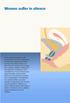 Women suffer in silence Stress urinary incontinence is the involuntary loss of urine resulting from increased intra-abdominal pressure. In people who suffer with this condition, forms of exertion such
Urodynamics in Neuro-Urology
 Urodynamics in Neuro-Urology R Hamid MD (Res), FRCS (Urol) Consultant Urologist London Spinal Injuries Unit, Stanmore & University College London Hospitals Micturition Micturition can be visualized as
Gwen Griffith Clinical Nurse Specialist Bolton NHS foundation Trust
 Gwen Griffith Clinical Nurse Specialist Bolton NHS foundation Trust Overview Setting the Scene Beginning of the journey & specialist nurse role Why people with MS experience bladder problems MS and the
Urinary Incontinence. Types
 Urinary Incontinence Leakage of urine is called urinary incontinence. It is a common problem in women. Some women occasionally leak small amounts of urine. At other times, leakage of urine is frequent
Overview of Urinary Incontinence in the Long Term Care Setting
 Overview of Urinary Incontinence in the Long Term Care Setting Management Strategies for the Nursing Assistant Ann M. Spenard RN, C, MSN Courtney Lyder ND, GNP Learning Objectives Describe common types
Adult Urodynamics: American Urological Association (AUA)/Society of Urodynamics, Female Pelvic Medicine & Urogenital Reconstruction (SUFU) Guideline
 Adult Urodynamics: American Urological Association (AUA)/Society of Urodynamics, Female Pelvic Medicine & Urogenital Reconstruction (SUFU) Guideline RECOMMENDATIONS 1 Conditional: Clinicians who are making
An illustrated guide to the management of incontinence.
 An illustrated guide to the management of incontinence. 1 The problem of incontinence The ACA describes incontinence as an involuntary loss of urine and/or bowel motion. The amount can vary from slight
Urinary Incontinence. Anatomy and Terminology Overview. Moeen Abu-Sitta, MD, FACOG, FACS
 Urinary Incontinence Anatomy and Terminology Overview Moeen Abu-Sitta, MD, FACOG, FACS Purpose Locate and describe the anatomy of the Female Urinary System Define terminology related to Incontinence Describe
Management of Neurogenic Bladder Disorders
 Management of Neurogenic Bladder Disorders Andrea Staack, MD, PhD Pelvic Reconstructive Surgery, Urinary Incontinence & Female Urology Department of Urology Loma Linda University, CA What will you learn
NICE Pathways bring together all NICE guidance, quality standards and other NICE information on a specific topic.
 Initial assessment and investigation of urinary incontinence bring together all NICE guidance, quality standards and other NICE information on a specific topic. are interactive and designed to be used
LOSS OF BLADDER CONTROL IS TREATABLE TAKE CONTROL AND RESTORE YOUR LIFESTYLE
 LOSS OF BLADDER CONTROL IS TREATABLE TAKE CONTROL AND RESTORE YOUR LIFESTYLE TALKING ABOUT STRESS INCONTINENCE (SUI) Millions of women suffer from stress incontinence (SUI). This condition results in accidental
The Well Woman Centre. Adult Urinary Incontinence
 The Well Woman Centre Adult Urinary Incontinence 1 Adult Urinary Incontinence... 3 Stress Incontinence Symptoms... 3 Urge Incontinence Symptoms... 4 Mixed Incontinence Symptoms... 5 Where to Start?...
GENUINE STRESS AND URGE INCONTINENCE PROTOCOL
 GENUINE STRESS AND URGE INCONTINENCE PROTOCOL Using the NeuroTrac ETSTM in combination of electrostimulation and EMG Biofeedback in the treatment of female urinary incontinence. Anna Pawlaczyk Specialist
NHS Professionals. CG8 Guidelines for Continence and Catheter Care. Introduction
 NHS Professionals CG8 Guidelines for Continence and Catheter Care Introduction Continence has been defined as control of bladder and bowel function and continence care is the name given to the total care
Urinary Continence Management after a. Stroke. Liz Mackey, CNC Stroke Clinical Coordinator Western Health
 Urinary Continence Management after a Stroke Liz Mackey, CNC Stroke Clinical Coordinator Western Health Royal Women s Hospital Innervation of the Bladder Neuromuscular coordination for control of both
Dr Eva Fong. Urologist Auckland
 Dr Eva Fong Urologist Auckland Urinary incontinence: Treatment options GPCME 2013 Eva Fong Urologist Urinary incontinence Is not normal part of aging or childbearing We can make it better Urinary incontinence:
PROCEDURE FOR THE ASSESSMENT OF ADULTS AND CHILDREN WITH BLADDER OR BOWEL DYSFUNCTION
 PROCEDURE FOR THE ASSESSMENT OF ADULTS AND CHILDREN WITH BLADDER OR BOWEL DYSFUNCTION First Issued Issue Version One Purpose of Issue/Description of Change Planned Review Date Procedure for the effective
Urinary Incontinence Dr. Leffler
 Urinary Incontinence Dr. Leffler The involuntary loss of urine at socially unacceptable times occurs in both women and men, but more commonly in women. It has multiple, far-reaching effects on daily activities,
Bowel and Bladder Dysfunction in MS. Tracy Walker, WOCN, MSCN, FNP C Nurse Practitioner MS Institute at Shepherd Center. Bladder Dysfunction
 Bowel and Bladder Dysfunction in MS Tracy Walker, WOCN, MSCN, FNP C Nurse Practitioner MS Institute at Shepherd Center Bladder Dysfunction Approximately 75% of people with MS experience bladder problems
Regain Control of Your Active Life Treatment Options for Incontinence and Pelvic Organ Prolapse
 Regain Control of Your Active Life Treatment Options for Incontinence and Pelvic Organ Prolapse Nearly one quarter of all women in the United States have some sort of pelvic floor disorder such as urinary
A Physical Therapist s Perspective
 You Can Do Something About INCONTINENCE A Physical Therapist s Perspective American Physical Therapy Association 1 You Can Do Something About Urinary Incontinence Incontinence, involuntary loss of bladder
Spinal Cord and Bladder Management Male: Intermittent Catheter
 Spinal Cord and Bladder Management Male: Intermittent Catheter The 5 parts of the urinary system work together to get rid of waste and make urine. Urine is made in your kidneys and travels down 2 thin
Lower Urinary Tract Symptoms (LUTS) in Middle-Aged and Elderly Men
 Prostatic Diseases Lower Urinary Tract Symptoms (LUTS) in Middle-Aged and Elderly Men JMAJ 47(12): 543 548, 2004 Tomonori YAMANISHI Associate Professor, Department of Urology, Dokkyo University School
Urinary Incontinence
 Urinary Incontinence (Involuntary Passage of Urine) Basics OVERVIEW Loss of voluntary control of urination, usually observed as involuntary urine leakage while resting SIGNALMENT/DESCRIPTION OF PET Species
THE MANAGEMENT OF URINARY INCONTINENCE WITHIN A STROKE UNIT POPULATION REENA DHAMI STROKE CNS EPSOM & ST.HELIER UNIVERSITY HOSPITALS
 THE MANAGEMENT OF URINARY INCONTINENCE WITHIN A STROKE UNIT POPULATION REENA DHAMI STROKE CNS EPSOM & ST.HELIER UNIVERSITY HOSPITALS Definition Urinary Incontinence is AN INABILITY TO HOLD URINE until
Urinary Incontinence
 Urinary Incontinence Q: What is urinary incontinence (UI)? A: UI is also known as loss of bladder control or urinary leakage. UI is when urine leaks out before you can get to a bathroom. If you have UI,
Case Based Urology Learning Program
 Case Based Urology Learning Program Resident s Corner: UROLOGY Case Number 21 CBULP 2011 068 Case Based Urology Learning Program Editor: Associate Editors: Manager: Case Contributors: Steven C. Campbell,
GLOSSARY of research terms
 GLOSSARY of research terms JLA Urinary Incontinence Working Partnership Workshop to set research priorities in Urinary Incontinence November 2008 Terms in bold are commonly used clinical/research terms.
A PRINTED copy of this guideline may not be the most recent version. The OFFICIAL version is located on IHNET at the Policies & Procedures Home Page
 A PRINTED copy of this guideline may not be the most recent version. The OFFICIAL version is located on IHNET at the Policies & Procedures Home Page IX0200: Prevention & Control of Catheter Associated
Male urinary incontinence (leakage of urine) you are not alone
 Male urinary incontinence (leakage of urine) you are not alone Delivering the best in care UHB is a no smoking Trust To see all of our current patient information leaflets please visit www.uhb.nhs.uk/patient-information-leaflets.htm
Refer to Coaptite Injectable Implant Instructions for Use provided with product for complete instructions for use.
 Questions for my Doctor Refer to Coaptite Injectable Implant Instructions for Use provided with product for complete instructions for use. INDICATIONS: Coaptite Injectable Implant is indicated for soft
Bladder and Bowel Control
 Bladder and Bowel Control Dr Sue Woodward Lecturer, Florence Nightingale School of Nursing and Midwifery 2 Why do we need to understand anatomy? Normal physiology Normal adult bladder capacity = 450-500mls
Fecal incontinence (Encopresis) It is the fecal incontinence condition observed in children with chronic constipation over 1-2 years.
 WHAT IS DYSFUNCTIONAL URINATION (URINATION FUNCTION DISORDER)? It stands for the urination phase disorders, which appear due to wrongly acquired urination habits during the toilet training of some neurologically
1 in 3 women experience Stress Urinary Incontinence.
 A PATIENT S GUIDE 1 in 3 women experience Stress Urinary Incontinence. It s time to talk about SUI Get the facts. This Patient s Guide is intended as a public resource on the issue of Stress Urinary Incontinence
Non-surgical Treatments for Urinary Incontinence. A Review of the Research for Women
 Non-surgical Treatments for Urinary Incontinence A Review of the Research for Women Is This Information Right for Me? Yes, if: You are a woman who is older than 18. You are having trouble holding your
Bladder and Bowel Management. Introduction. Bladder function. By Sala Nanthakumar
 Bladder and Bowel Management By Sala Nanthakumar Introduction Dysfunction of the bladder and/or bowel is common after stroke and maybe caused by a combination of strokerelated impairments,(e.g. weakness,
COMMITTEE FOR PROPRIETARY MEDICINAL PRODUCTS (CPMP)
 The European Agency for the Evaluation of Medicinal Products Evaluation of Medicines for Human Use London, 18 December 2002 COMMITTEE FOR PROPRIETARY MEDICINAL PRODUCTS (CPMP) NOTE FOR GUIDANCE ON THE
Overactive bladder is a common condition thought to. women, and is a serious condition that can lead to. significant lifestyle changes.
 Overactive bladder is a common condition thought to FADE UP TO WIDE SHOT OF FEMALE MODEL WITH TRANSPARENT SKIN. URINARY BLADDER VISIBLE IN PELVIC REGION affect over 16 percent of adults. It affects men
Urinary Incontinence
 Urinary Incontinence Q: What is urinary Urinary (YOOR-in-air-ee) incontinence (in-kahn-tih-nens) is when urine leaks out before you can get to a bathroom. If you have urinary incontinence, you re not alone.
Female Urinary Incontinence
 Female Urinary Incontinence Molly Heublein, MD Assistant Professor Clinical Medicine UCSF Women s Health Primary Care Disclosures I have nothing to disclose. 1 Objectives Review the problem Feel confident
Management of Urinary Incontinence. Sheri J. Ross, BSc, DVM, PhD, Dipl. ACVIM (Internal Medicine)
 Management of Urinary Incontinence Sheri J. Ross, BSc, DVM, PhD, Dipl. ACVIM (Internal Medicine) Managing Urinary Incontinence Urinary incontinence is very prevalent among older animals. In this group
Treatment for Stress Incontinence Patient Decision Aid
 Treatment for Stress Incontinence Patient Decision Aid Patient Information Author ID: JD/NS Leaflet Number: Gyn 056 Version: 1 Name of Leaflet: Treatment for stress incontinence - Patient decision aid
Management of Urinary Incontinence in Older Patients
 Management of Urinary Incontinence in Older Patients Dr. BC Tong Honorary Treasurer The Hong Kong Continence Society Council member Hong Kong Association of Gerontology Geriatrician Urinary incontinence
Appropriate Urinary Catheter Use and Management
 Appropriate Urinary Catheter Use and Management Nursing Education Material Mohamad Fakih, MD, MPH 1 This presentation This presentation targets all nurses with patient care responsibilities including the
Managing Urinary Incontinence
 Patient & Family Guide 2016 Managing Urinary Incontinence www.nshealth.ca Managing Urinary Incontinence What is the urinary system? Urine (pee) is made in the kidneys. It flows through tubes called ureters.
Urinary incontinence. The urinary system
 Urinary incontinence is defined as the involuntary loss of urine from the bladder. Although it is a common condition, most women who suffer from it do not seek help. It is thought that urinary incontinence
Chapter 30: Urinary Incontinence in the Elderly
 Chapter 30: Urinary Incontinence in the Elderly George A. Kuchel* and Catherine E. DuBeau *UConn Center on Aging, University of Connecticut Health Center, Farmington, Connecticut; and Division of Geriatric
Canine Urinary Incontinence
 Urinary Incontinence in the Bitch Laurie Edge-Hughes, BScPT, MAnimSt, CAFCI, CCRT Urinary Incontinence = Involuntary leakage of urine during storage Micturation disorders (non-neurologic): 61% = Urethral
Urinary Incontinence and Indwelling Catheters:
 Educational grant provided by Urinary Incontinence and Indwelling Catheters: CMS Guidance for Long-Term Care Read this article and answer the questions on page 56 for 1 CE contact hour. DIANE K. NEWMAN,
Urinary Incontinence Control using External Urethral Compression Devices (Clamps)
 A Patient s Guide Urinary Incontinence Control using External Urethral Compression Devices (Clamps) by Ralph Alterowitz, MEA Carol Partington, DVM Copyright 2005 TABLE OF CONTENTS Introduction... 1 Definition...
Consumer summary Minimally invasive techniques for the relief of stress urinary incontinence
 ASERNIP S Australian Safety and Efficacy Register of New Interventional Procedures Surgical Consumer summary Minimally invasive techniques for the relief of stress urinary incontinence (Adapted from the
Urinary Incontinence. Patient Information Sheet
 Urinary Incontinence Patient Information Sheet What is urinary incontinence (UI)? UI happens when you are not able to control when you urinate and you wet yourself. How common is urinary incontinence?
Normal bladder function. Aging of the bladder and urethra
 SECTION 10 Bladder and bowel control (continence) Section overview This section looks at: Normal bladder function Stroke and loss of bladder control (incontinence) Normal bowel function Stroke and bowel
Lifestyle and Behavioral Changes Improving Urinary Urgency, Frequency and Urge Incontinence
 Lifestyle and Behavioral Changes Improving Urinary Urgency, Frequency and Urge Incontinence Manage your Fluid Intake: There is no scientific evidence that states we need eight 8 oz. glasses (64 oz.) of
Overactive bladder syndrome (OAB)
 Overactive bladder syndrome (OAB) Exceptional healthcare, personally delivered What is OAB? An overactive bladder or OAB is where a person regularly gets a sudden and compelling need or desire to pass
STROKE CARE PLAN: BLADDER & BOWEL CONTINENCE
 Urinary incontinence related to loss of ability to identify and respond to need to urinate; involuntary bladder contractions, increased nightly urine production, difficulty communication need to urinate
Riesa Gusewelle, MNSc, RN, APRN, GNP-BC. OBJECTIVES Identify early warning signs of urinary tract
 Detection, Early Management & Prevention, of Urinary Tract Infections in Older Adults Riesa Gusewelle, MNSc, RN, APRN, GNP-BC OBJECTIVES Identify early warning signs of urinary tract infections (UTIs)
Primary Care Management Guidelines Female Urinary Incontinence. Overview of Lecture
 Primary Care Management Guidelines Female Urinary Incontinence Professor Don Wilson Department of Women s and Children s Health Dunedin School of Medicine University of Otago GP Teaching for Roy Morris,
Bladder Control Does Matter
 Bladder Control Does Matter Y0028_2726_0 File&Use 04092012 If you suffer from urinary incontinence, you re not alone Don t be afraid to raise your hand if you ve been struggling with the embarrassment
Women s Continence and Pelvic Health Center
 Women s Continence and Pelvic Health Center Committed to Caring 580-590 Court Street Keene, New Hampshire 03431 (603) 354-5454 Ext. 6643 URINARY INCONTINENCE QUESTIONNAIRE The purpose of this questionnaire