
Normal bladder function requires a coordinated effort between the brain, spinal cord, and the bladder.
|
|
|
- Bertha Jordan
- 9 years ago
- Views:
Transcription
1 .. Urinary Incontinence Urinary incontinence is not an inevitable part of aging, and it is not a disease. The loss of bladder control - called urinary incontinence - affects between 13 and 17 million adult Americans, with close to half of all women in the United States experiencing some degree of urinary incontinence. Approximately 11 percent of patients seeking treatment for urinary incontinence will undergo surgery. Many people endure urinary incontinence in silence, thinking they are the only ones who have a problem or that no urinary incontinence treatments exist. Incontinence is common, and it can be treated. There are a variety of urinary incontinence treatments. What causes urinary incontinence? Normal bladder function requires a coordinated effort between the brain, spinal cord, and the bladder. Urinary incontinence can appear as a side-effect of a medication prescribed for a non-urinary problem, or it can be caused by such conditions as a bladder infection. Pelvic muscle weakness after childbirth or thinning of the urethral lining after menopause cause urinary incontinence to be more common in women than men. In other situations, the bladder outlet simply may not stay closed. What are the different types of urinary incontinence? There are several types of urinary incontinence, each classified by its symptoms or by the circumstances that occur at the time of urine leakage. Stress incontinence - allows urine to leak during activities which strain or "stress" the abdomen. Stress incontinence is often caused by poor bladder support or a weak or damaged sphincter. Urge incontinence - results when an "overactive" bladder contracts unexpectedly. For example, an infection that irritates the lining of the bladder often causes it to become overactive. Overflow incontinence - occurs when the bladder weakens or a blocked urethra (the canal that carries urine from the bladder) prevents normal emptying. This type of incontinence most often develops in people with diabetes, in people who are heavy users of alcohol, or in people with certain neurological conditions. Problems with Retention - this occurs when urine is retained in the bladder and cannot be released. o You have difficulty initiating a void or only partially empty your bladder o You spend a long time in the bathroom and only produce a weak dribble or require a catheter to empty o You often lose small amounts of urine during the day (overflow incontinence) o You cannot feel when your bladder is full

2 ., Problems with Urgency-Frequency - occurs when an uncontrollable urge to urinate results in frequent, small amounts of urine voided as often as every 15 minutes. o You almost always have the feeling you need to use the bathroom (urgency) o You use the bathroom more often than the normal 4 to 7 times per day (frequency) o You have to get up several times during the night to use the bathroom o If you cannot make it to the bathroom in time, you may leak urine o You usually void very small amounts each time How is urinary incontinence evaluated? To determine the most effective urinary incontinence treatment for each patient's condition, specialists at the Women's Center for Pelvic Disorders at Cleveland Clinic offers individualized evaluations for urinary incontinence. The evaluation begins with a comprehensive history and physical examination, including a pelvic examination. To confirm the diagnosis, some of the diagnostic tests mentioned below also may be ordered: Urinalysis - A sample of your urine is examined for the presence of infection, blood or other abnormalities. Post-void residual urine measurement - This test determines whether any urine remains after you have tried to empty your bladder completely. A small, soft tube, called a catheter, may be inserted into the bladder to drain and measure remaining urine. Or, an ultrasound bladder scan may be performed. Cystoscopy -An examination of the inside of the bladder with a small viewing telescope called a cystoscope enables the physician to visually check for problems. Stress test - To find out whether stresses on the bladder cause leakage, you may be asked to cough, stand or do other activities while your bladder is full. Urodynamic testing - These tests examine bladder and urethral sphincter muscle function by inserting a small tube into the bladder or examining the bladder with X-rays. Through several such tests, it can be determined whether you have normal bladder sensation and capacity and whether your bladder fills and empties normally. Can urinary incontinence be treated? Incontinence can almost always be treated - and urinary incontinence treatment does not always mean surgery. Specialists at The Cleveland Clinic can recommend the urinary incontinence treatment that is best suited to your condition. Options include: Behavioral therapy By following an individually designed regimen of exercises and instruction, you may be able to improve your bladder control. Our physical therapists may prescribe exercises that aid in strengthening the pelvic muscles to help you regain and maintain continence and improve pelvic support. Education regarding reasonable fluid intake and advice for bladder retraining, such as

3 scheduling visits to the toilet, has helped many people with urinary incontinence. Behavioral therapy can be an effective urinary incontinence treatment. Urodynamic Testing Medication Drug therapy may be prescribed to relax the bladder. Your bladder control also can be adversely affected by certain medications that you may be taking for other conditions. In this case, our physicians will work with your primary care doctor to determine the best way to manage all of your conditions, including your urinary incontinence treatment. Collagen or other bulking agent implant This effective urinary incontinence treatment procedure, performed with a local anesthetic on an outpatient basis, helps many people avoid major surgery. Collagen injections into the lining of the urethra or the neck of the bladder act as a bulking agent by either bringing the walls of the urethra closer together or sealing off the base of the bladder. This allows the urethra to close tightly enough to prevent urine from leaking out. The result is similar to the way the body functions naturally, and in most cases, urinary control will be improved and restored. If a patient is allergic to collagen, other bulking agents are available.

4 Surgery Surgery is another urinary incontinence treatment option available to correct poor bladder support and help the urethra close properly. In women, surgery may be required to restore the support of the pelvic floor muscles or to reconstruct or compress the sphincter. Sling procedures: Sling procedures are outpatient surgeries indicated for treatment of stress urinary incontinence. The Urogynecology Team offers the full spectrum of mid urethral and bladder neck sling procedures with high cure rates. These include retropubic sling procedures (the TVT sling procedures and traditional fascial sling procedure), the transobturator tape procedures (Monarc sling, TVT-O procedure, and other transobturator sling procedures), and mini-sling procedures (TVT-Secur and Mini-Arc). Tension-Free Transvaginal Tape (TVT): When a woman has finished having children, a minimally invasive treatment can fix stress urinary incontinence (SUI), allowing her to return to a full and active life. TVT can stop urine leakage by supporting the urethra with a tape-like strip of mesh. Used in an approximately 30-minute outpatient procedure, it has shown proven results for the treatment of SUI. A mesh-like tape is inserted under the urethra to create a supportive sling. This provides support and allows the urethra to remain closed when appropriate, preventing urine loss during sudden movements or exercise. Patients may be able to go horne as early as a few hours after the procedure and patients can expect a short recovery period. The best way to determine if you are a candidate for this treatment is to ask your doctor. Transobturator Tape (TOT) Sling: First developed in Europe, the transobturator tape (TOT) sling procedure is meant to eliminate stress urinary incontinence by providing support under the urethra. The minimally-invasive procedure involves inserting a mesh tape under the urethra through three small incisions in the groin area. Studies have shown that the safer, more efficient tot sling procedure decreases the risks of bowel and bladder injury and major bleeding and has an excellent cure rate. Mini-Sling: The Mini Sling procedure is the latest and least invasive treatment for stress urinary incontinence. The five to IO-minute procedure utilizes the same concepts of the tension-free tape mid-urethral slings, but involves a single incision. This procedure has displayed a high cure rate and reduces the risk of bowel injury, bladder injury, and major bleeding because it bypasses retropubic needle passage altogether.

5 Tension-Free Vaginal Tape (TVT) Transobturator Sling

6 .. Sacral Nerve Stimulation (InterStim) This outpatient surgical procedure uses an external device to stimulate the muscles of the bladder and pelvic floor. The external device is tested for one to two weeks. If successful, the device is implanted beneath the skin. InterStim has been FDA-approved since 1997 for urge incontinence and since 1999 for urinary retention and significant symptoms of urgency-frequency. In 2011, InterStim was approved for the treatment of chronic fecal incontinence in patients who have failed or are not candidates for more conservative treatments. InterStim Therapy is not intended for patients with a urinary blockage. How It Works Sacral neuromodulation works with the sacral nerves, located near the tailbone. InterStim Therapy modulates the sacral nerves with mild electrical pulses. This helps the brain and the nerves to communicate so the bladder and related muscles can function properly. The treatment works similar for patients with fecal incontinence. The sacral nerves help control the muscles related to bowel function. If the brain and sacral nerves don't communicate correctly, bowels will not function properly. This can lead to symptoms of bowel incontinence. Medtronic Bowel Control Therapy targets these symptoms by modulating the sacral nerves with mild electrical pulses. InterStim Therapy is a reversible treatment that can be discontinued at any time by turning off or removing the device.
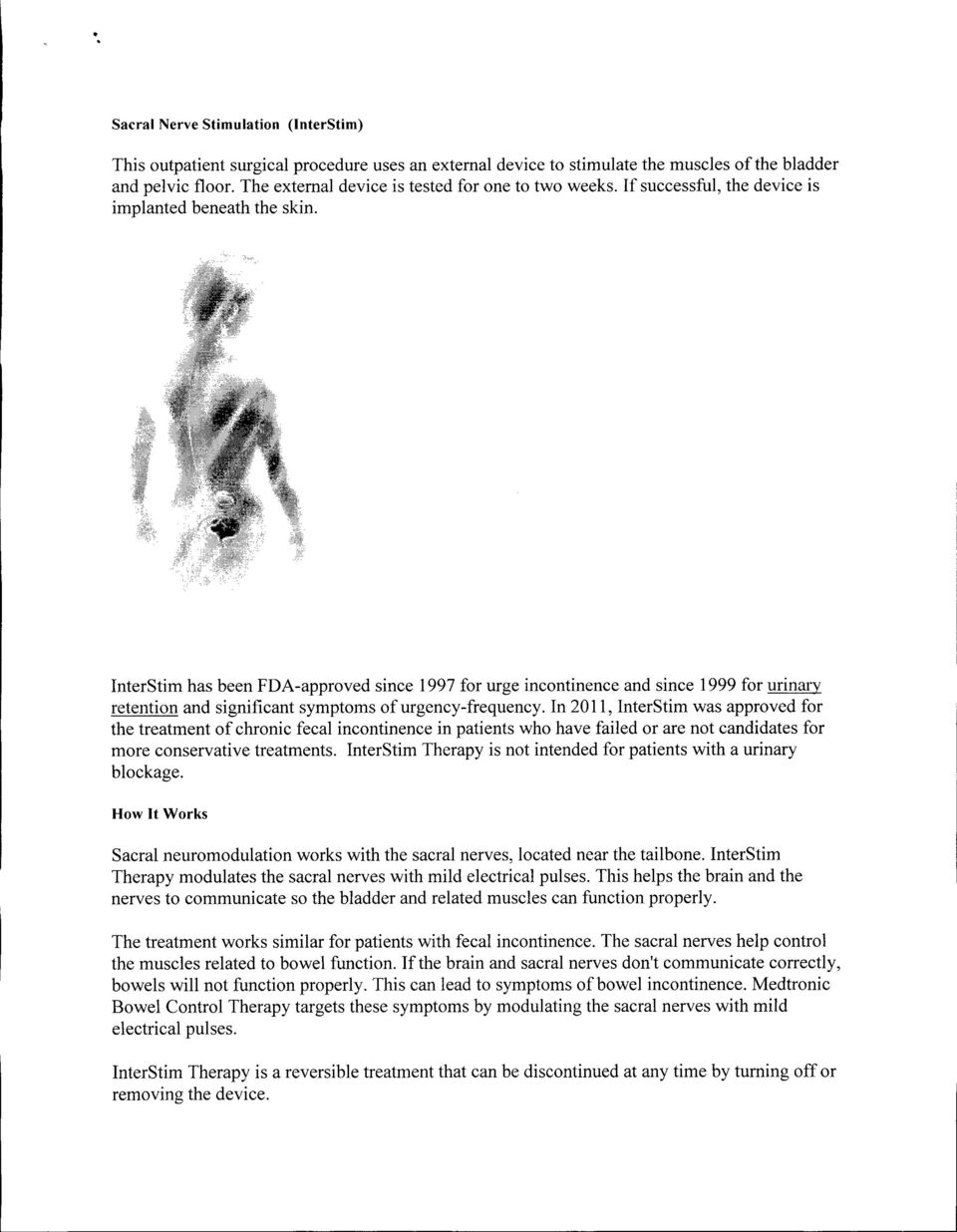
7 . Sacral neuromodulation may help you resume normal activities and help you avoid frustrating or embarrassing experiences associated with overactive bladder and fecal incontinence.

URINARY INCONTINENCE
 URINARY INCONTINENCE What is urinary incontinence? Urinary incontinence is the uncontrollable loss of urine. The amount of urine leaked can vary from only a few drops when you cough or sneeze to entirely
Urinary Incontinence FAQ Sheet
 Urinary Incontinence FAQ Sheet Are you reluctant to talk to your doctor about your bladder control problem? Don t be. There is help. Loss of bladder control is called urinary incontinence. It can happen
Urinary Incontinence (Involuntary Loss of Urine) A Patient Guide
 Urinary Incontinence (Involuntary Loss of Urine) A Patient Guide Urinary Incontinence (Urine Loss) This booklet is intended to give you some facts on urinary incontinence - what it is, and is not, and
Overactive Bladder (OAB)
 Overactive Bladder (OAB) Overactive bladder is a problem with bladder storage function that causes a sudden urge to urinate. The urge may be difficult to suppress, and overactive bladder can lead to the
Learning Resource Guide. Understanding Incontinence. 2000 Prism Innovations, Inc. All Rights Reserved
 Learning Resource Guide Understanding Incontinence 2000 Prism Innovations, Inc. All Rights Reserved ElderCare Online s Learning Resource Guide Understanding Incontinence Table of Contents Introduction
Incontinence. What is incontinence?
 Incontinence What is incontinence? Broadly speaking, the medical term incontinence refers to any involuntary release of bodily fluids, but many people associate it strongly with the inability to control
Urinary Incontinence. Types
 Urinary Incontinence Leakage of urine is called urinary incontinence. It is a common problem in women. Some women occasionally leak small amounts of urine. At other times, leakage of urine is frequent
LOSS OF BLADDER CONTROL IS TREATABLE TAKE CONTROL AND RESTORE YOUR LIFESTYLE
 LOSS OF BLADDER CONTROL IS TREATABLE TAKE CONTROL AND RESTORE YOUR LIFESTYLE TALKING ABOUT STRESS INCONTINENCE (SUI) Millions of women suffer from stress incontinence (SUI). This condition results in accidental
1 in 3 women experience Stress Urinary Incontinence.
 A PATIENT S GUIDE 1 in 3 women experience Stress Urinary Incontinence. It s time to talk about SUI Get the facts. This Patient s Guide is intended as a public resource on the issue of Stress Urinary Incontinence
Female Urinary Disorders and Pelvic Organ Prolapse
 Female Urinary Disorders and Pelvic Organ Prolapse Richard S. Bercik, M.D. Director, Division of Urogynecology & Reconstruction Pelvic Surgery Department of Obstetrics, Gynecology & Reproductive Sciences
Bard: Continence Therapy. Stress Urinary Incontinence. Regaining Control. Restoring Your Lifestyle.
 Bard: Continence Therapy Stress Urinary Incontinence Regaining Control. Restoring Your Lifestyle. Stress Urinary Incontinence Becoming knowledgeable about urinary incontinence Uterus Normal Pelvic Anatomy
Urinary Incontinence
 Urinary Incontinence Q: What is urinary Urinary (YOOR-in-air-ee) incontinence (in-kahn-tih-nens) is when urine leaks out before you can get to a bathroom. If you have urinary incontinence, you re not alone.
Regain Control of Your Active Life Treatment Options for Incontinence and Pelvic Organ Prolapse
 Regain Control of Your Active Life Treatment Options for Incontinence and Pelvic Organ Prolapse Nearly one quarter of all women in the United States have some sort of pelvic floor disorder such as urinary
Saint Mary s Hospital. Gynaecology Service Warrell Unit. Overactive Bladder. Information for Patients
 Saint Mary s Hospital Gynaecology Service Warrell Unit Overactive Bladder Information for Patients What is Overactive Bladder (OAB)? OAB is a condition that causes you to need to pass urine more often
VAGINAL TAPE PROCEDURES FOR THE TREATMENT OF STRESS INCONTINENCE
 VAGINAL TAPE PROCEDURES FOR THE TREATMENT OF STRESS INCONTINENCE AN INFORMATION LEAFLET Written by: Department of Urology May 2011 Stockport: 0161 419 5698 Website: w w w. s t o c k p o r t. n h s. u k
Bladder Health Promotion
 Bladder Health Promotion Community Awareness Presentation Content contributions provided by the Society of Urologic Nurses (SUNA) National Association for Continence (NAFC) Simon Foundation for Continence
URINARY INCONTINENCE CASE PRESENTATION #1. Urinary Incontinence - History 2014/10/07. Structure of the Female Lower Urinary Tract
 Bladder pressure 2014/10/07 Structure of the Female Lower Urinary Tract Ureter URINARY INCONTINENCE Clinical Clerkship Lecture Series Outer peritoneal coat Detrusor smooth muscle Mucosa Trigone Proximal
FEMALE INCONTINENCE REVIEW
 200 S. Wenona Suite 298 Steven L. Jensen, M.D. 5400 Mackinaw, Suite 4302 Bay City, MI 48706 Frank H. Kim, M.D. Saginaw, MI 48604 Telephone (989) 895-2634 Adult & Pediatric Urologists (989) 791-4020 Fax
Registered Charity No. 5365
 THE MULTIPLE SCLEROSIS SOCIETY OF IRELAND Dartmouth House, Grand Parade, Dublin 6. Telephone: (01) 269 4599. Fax: (01) 269 3746 MS Helpline: 1850 233 233 E-mail: [email protected] www.ms-society.ie
Surgical Treatment for Female Stress Urinary. Continence. Consumer Education
 Surgical Treatment for Female Stress Urinary Incontinence By: Amy Rosenman, MD Geffen School of Medicine at UCLA Santa Monica, California Promoting Quality Continence Care through Consumer Education Always
Having a tension-free vaginal tape (TVT) operation for stress urinary incontinence
 Having a tension-free vaginal tape (TVT) operation for stress urinary incontinence This leaflet explains more about tension-free vaginal tape (TVT) including the benefits, risks and any alternatives, and
Urinary Incontinence Dr. Leffler
 Urinary Incontinence Dr. Leffler The involuntary loss of urine at socially unacceptable times occurs in both women and men, but more commonly in women. It has multiple, far-reaching effects on daily activities,
Refer to Coaptite Injectable Implant Instructions for Use provided with product for complete instructions for use.
 Questions for my Doctor Refer to Coaptite Injectable Implant Instructions for Use provided with product for complete instructions for use. INDICATIONS: Coaptite Injectable Implant is indicated for soft
Urinary Incontinence
 Urinary Incontinence Q: What is urinary incontinence (UI)? A: UI is also known as loss of bladder control or urinary leakage. UI is when urine leaks out before you can get to a bathroom. If you have UI,
Stress Urinary Incontinence
 Saint Mary s Hospital Gynaecology Service Warrell Unit Stress Urinary Incontinence Information for patients What is Stress Incontinence? Stress incontinence is a leakage of urine occurring on physical
Do I Need to Have Surgery for Urinary Incontinence? What Kinds of Surgery Can Treat Stress Incontinence?
 Do I Need to Have Surgery for Urinary Incontinence? Excerpts from The Incontinence Solution: Answers for Women of All Ages, by William H. Parker, MD, Amy E. Rosenman, MD and Rachel Parker (Simon and Schuster,
Bladder Health Promotion
 Bladder Health Promotion Community Awareness Presentation endorsed by the Society of Urologic Nurses (SUNA) National Association for Continence( NAFC) Simon Foundation for Continence This presentation
Treatment for Stress Incontinence Patient Decision Aid
 Treatment for Stress Incontinence Patient Decision Aid Patient Information Author ID: JD/NS Leaflet Number: Gyn 056 Version: 1 Name of Leaflet: Treatment for stress incontinence - Patient decision aid
Urinary Incontinence. Anatomy and Terminology Overview. Moeen Abu-Sitta, MD, FACOG, FACS
 Urinary Incontinence Anatomy and Terminology Overview Moeen Abu-Sitta, MD, FACOG, FACS Purpose Locate and describe the anatomy of the Female Urinary System Define terminology related to Incontinence Describe
Urinary Incontinence. Causes of Incontinence. What s Happening?
 National Institute on Aging AgePage Urinary Incontinence Sarah loves to spend time with her friends talking about her grandchildren and going to exercise classes with neighbors. But she s started to have
SOGC Recommendations for Urinary Incontinence
 The quality of evidence is rated, and recommendations are made using the criteria described by the Canadian Task Force on Preventive Health Care. Clinical Practice Guidelines: The Evaluation of Stress
A Physical Therapist s Perspective
 You Can Do Something About INCONTINENCE A Physical Therapist s Perspective American Physical Therapy Association 1 You Can Do Something About Urinary Incontinence Incontinence, involuntary loss of bladder
The Well Woman Centre. Adult Urinary Incontinence
 The Well Woman Centre Adult Urinary Incontinence 1 Adult Urinary Incontinence... 3 Stress Incontinence Symptoms... 3 Urge Incontinence Symptoms... 4 Mixed Incontinence Symptoms... 5 Where to Start?...
An operation for stress incontinence Tension-free Vaginal Tape (TVT)
 Saint Mary s Hospital The Warrell Unit An operation for stress incontinence Tension-free Vaginal Tape (TVT) Information for Patients 1 Stress Incontinence Stress incontinence is a leakage of urine occurring
Treatments for Urinary Incontinence in Women
 Treatments for Urinary Incontinence in Women National Kidney and Urologic Diseases Information Clearinghouse National Institute of Diabetes and Digestive and Kidney Diseases NATIONAL INSTITUTES OF HEALTH
Consumer summary Minimally invasive techniques for the relief of stress urinary incontinence
 ASERNIP S Australian Safety and Efficacy Register of New Interventional Procedures Surgical Consumer summary Minimally invasive techniques for the relief of stress urinary incontinence (Adapted from the
Urinary Incontinence in Women. Susan Hingle, M.D. Department of Medicine
 Urinary Incontinence in Women Susan Hingle, M.D. Department of Medicine Background Estimated 13 million Americans with urinary incontinence Women are affected twice as frequently as men Only 25% will seek
Transobturator tape sling Female sling system
 Transobturator tape sling Female sling system Delivering the best in care UHB is a no smoking Trust To see all of our current patient information leaflets please visit www.uhb.nhs.uk/patient-information-leaflets.htm
Male urinary incontinence (leakage of urine) you are not alone
 Male urinary incontinence (leakage of urine) you are not alone Delivering the best in care UHB is a no smoking Trust To see all of our current patient information leaflets please visit www.uhb.nhs.uk/patient-information-leaflets.htm
What you should know about Stress Urinary Incontinence
 Gynecare TVT Stop coping. Start living. What you should know about Stress Urinary Incontinence Have you ever leaked urine when you laughed, coughed or sneezed? You are not alone. Many women suffer from
URINARY INCONTINENCE IN WOMEN
 URINARY INCONTINENCE IN WOMEN Definition Urinary incontinence (UI) is defined as involuntary loss of urine that is a social or hygienic problem (International Continence Society, 1973) Magnitude of the
Lifestyle changes. Pelvic floor muscle training
 Incontinence, urinary - Treatment Treating urinary incontinence The treatment you receive for urinary incontinence will depend on the type of incontinence you have and the severity of your symptoms. If
Information for patients. Sex and Incontinence. Royal Hallamshire Hospital
 Information for patients Sex and Incontinence Royal Hallamshire Hospital Why is sex important? We may choose to be sexual, regardless of our age, physical status or stage of life. Those with health problems
Recovery After Stroke: Bladder & Bowel Function
 Recovery After Stroke: Bladder & Bowel Function Problems with bladder and bowel function are common but distressing for stroke survivors. Going to the bathroom after suffering a stroke may be complicated
An Operation for Stress Incontinence. Tension Free Vaginal Tape - TVT (Retropubic tape)
 An Operation for Stress Incontinence Tension Free Vaginal Tape - TVT (Retropubic tape) Patient Information Leaflet BSUG Patient Information Sheet Disclaimer This patient information sheet was put together
Women s Health. The TVT procedure. Information for patients
 Women s Health The TVT procedure Information for patients What is a TVT procedure? A TVT (Tension-free Vaginal Tape) procedure is an operation to help women with stress incontinence the leakage of urine
Topic review: Clinical presentation and diagnosis of urinary incontinence in the elderly. Prapa Pattrapornpisut 7 June 2012
 1 Topic review: Clinical presentation and diagnosis of urinary incontinence in the elderly Prapa Pattrapornpisut 7 June 2012 2 Urinary incontinence Definition the complaint of any involuntary leakage of
symptoms of Incontinence
 Types, causes and symptoms of Urinary Incontinence Aims and Objectives Aim: To have an understanding of the types and causes of urinary incontinence. Objectives: To be aware of the incidence and prevalence
An Operation for Stress Incontinence. Transobturator Tape (TOT, TVT-O)
 An Operation for Stress Incontinence Transobturator Tape (TOT, TVT-O) Patient Information Leaflet BSUG Patient Information Sheet Disclaimer This patient information sheet was put together by members of
Overactive bladder syndrome (OAB)
 Overactive bladder syndrome (OAB) Exceptional healthcare, personally delivered What is OAB? An overactive bladder or OAB is where a person regularly gets a sudden and compelling need or desire to pass
Overview of Urinary Incontinence in the Long Term Care Setting
 Overview of Urinary Incontinence in the Long Term Care Setting Management Strategies for the Nursing Assistant Ann M. Spenard RN, C, MSN Courtney Lyder ND, GNP Learning Objectives Describe common types
Get the Facts, Be Informed, Make YOUR Best Decision. Pelvic Organ Prolapse
 Pelvic Organ Prolapse ETHICON Women s Health & Urology, a division of ETHICON, INC., a Johnson & Johnson company, is dedicated to providing innovative solutions for common women s health problems and to
An Operation for Stress Incontinence Transobturator Tape (TOT, TVT-O)
 An Operation for Stress Incontinence Transobturator Tape (TOT, TVT-O) Information for patients Gynaecology Department Phone no: 01625 661161 East Cheshire NHS Trust www.eastcheshire.nhs.uk @eastcheshirenhs
Operations for Stress Incontinence. Mid-Urethral Tapes (Retropubic and Obturator)
 Operations for Stress Incontinence Mid-Urethral Tapes (Retropubic and Obturator) Patient Information Leaflet BSUG Patient Information Sheet Disclaimer This patient information sheet was put together by
Adult Urodynamics: American Urological Association (AUA)/Society of Urodynamics, Female Pelvic Medicine & Urogenital Reconstruction (SUFU) Guideline
 Adult Urodynamics: American Urological Association (AUA)/Society of Urodynamics, Female Pelvic Medicine & Urogenital Reconstruction (SUFU) Guideline RECOMMENDATIONS 1 Conditional: Clinicians who are making
Periurethral bulking agent for stress urinary incontinence (macroplastique)
 PLEASE PRINT WHOLE FORM DOUBLE SIDED ON YELLOW PAPER Patient Information to be retained by patient affix patient label Who is this leaflet for? This leaflet provides information about having an injection
Bladder Control Does Matter
 Bladder Control Does Matter Y0028_2726_0 File&Use 04092012 If you suffer from urinary incontinence, you re not alone Don t be afraid to raise your hand if you ve been struggling with the embarrassment
Managing Urinary Incontinence
 Patient & Family Guide 2016 Managing Urinary Incontinence www.nshealth.ca Managing Urinary Incontinence What is the urinary system? Urine (pee) is made in the kidneys. It flows through tubes called ureters.
Palm Beach Obstetrics & Gynecology, PA
 Palm Beach Obstetrics & Gynecology, PA 4671 S. Congress Avenue, Lake Worth, FL 33461 561.434.0111 4631 N. Congress Avenue, Suite 102, West Palm Beach, FL 33407 Urinary Tract Infection About one of every
9/24/2015. Incontinence and Prolapse 2015 Primary Care Update CME Symposium. Objectives. Mark Memo, DO, FACS NEO Urology September 25-27
 Incontinence and Prolapse 2015 Primary Care Update CME Symposium Mark Memo, DO, FACS NEO Urology September 25-27 Objectives Incontinence Pelvic Organ Prolapse Vaginal Mesh Litigation 1 Urinary Incontinence
A Stress Urinary Incontinence fact sheet for
 A Stress Urinary Incontinence fact sheet for women and teenagers What is Stress Urinary Incontinence? Get to know your gusset - the science bit Stress urinary incontinence (SUI) is defined as a sudden
URINARY INCONTINENCE Information for Patients and Families Author: Chantale Dumoulin, PhD PT
 URINARY INCONTINENCE Information for Patients and Families Author: Chantale Dumoulin, PhD PT What is urinary incontinence? Urinary incontinence (UI) is the loss of the ability to hold in urine. This can
Surgery for Stress Incontinence
 Directorate of Women s Services Surgery for Stress Incontinence Tension Free Vaginal Tape Information for Patients Direct dial number Ward 40 0191 282 5640 Stress Incontinence Stress incontinence is a
Spinal Cord and Bladder Management Male: Intermittent Catheter
 Spinal Cord and Bladder Management Male: Intermittent Catheter The 5 parts of the urinary system work together to get rid of waste and make urine. Urine is made in your kidneys and travels down 2 thin
University College Hospital at Westmoreland Street. Mid urethral tension-free vaginal tape procedures
 University College Hospital at Westmoreland Street Mid urethral tension-free vaginal tape procedures Urology Directorate for women 2 3 If you would like this document in another language or format, or
The overactive bladder and bladder retraining
 Oxford University Hospitals NHS Trust The overactive bladder and bladder retraining Information for patients Normal bladder function Your bladder normally stores urine produced by your kidneys. The kidneys
Female Urinary Incontinence
 Female Urinary Incontinence Molly Heublein, MD Assistant Professor Clinical Medicine UCSF Women s Health Primary Care Disclosures I have nothing to disclose. 1 Objectives Review the problem Feel confident
150640_Brochure_B 4/12/07 2:58 PM Page 2. Patient Information. Freedom From an Enlarged Prostate
 150640_Brochure_B 4/12/07 2:58 PM Page 2 Patient Information Freedom From an Enlarged Prostate 150640_Brochure_B 4/12/07 2:58 PM Page 3 GreenLight Laser Therapy 1 150640_Brochure_B 4/12/07 2:58 PM Page
Management of Neurogenic Bladder Disorders
 Management of Neurogenic Bladder Disorders Andrea Staack, MD, PhD Pelvic Reconstructive Surgery, Urinary Incontinence & Female Urology Department of Urology Loma Linda University, CA What will you learn
Colposuspension for Stress Incontinence
 Colposuspension for Stress Incontinence Patient information Leaflet BSUG Patient Information Sheet Disclaimer This patient information sheet was put together by members of the BSUG Governance Committee
Synthetic Vaginal Mesh Mid-urethral Tape Procedure for the Surgical Treatment of Stress Urinary Incontinence in Women
 Synthetic Vaginal Mesh Mid-urethral Tape Procedure for the Surgical Treatment of Stress Urinary Incontinence in Women PATIENT INFORMATION AND CONSENT BOOKLET Patient Label Patient Information and Consent
INDEPENDENT REVIEW OF TRANSVAGINAL MESH IMPLANTS
 INDEPENDENT REVIEW OF TRANSVAGINAL MESH IMPLANTS Analysis of NHS information on surgery for stress urinary incontinence and pelvic organ prolapse in Scotland Contents 1 Introduction 1 Treatment for these
Managing Overactive Bladder
 Patient Educational Material Managing Overactive Bladder The bladder s job is pretty simple: hold urine until full, then empty when we get to a restroom. When you have an overactive bladder, the bladder
Urinary incontinence. The urinary system
 Urinary incontinence is defined as the involuntary loss of urine from the bladder. Although it is a common condition, most women who suffer from it do not seek help. It is thought that urinary incontinence
Fecal Incontinence. What is fecal incontinence?
 Scan for mobile link. Fecal Incontinence Fecal incontinence is the inability to control the passage of waste material from the body. It may be associated with constipation or diarrhea and typically occurs
Dr Eva Fong. Urologist Auckland
 Dr Eva Fong Urologist Auckland Urinary incontinence: Treatment options GPCME 2013 Eva Fong Urologist Urinary incontinence Is not normal part of aging or childbearing We can make it better Urinary incontinence:
Information for men considering a male sling procedure
 Information for men considering a male sling procedure Delivering the best in care UHB is a no smoking Trust To see all of our current patient information leaflets please visit www.uhb.nhs.uk/patient-information-leaflets.htm
Case Based Urology Learning Program
 Case Based Urology Learning Program Resident s Corner: UROLOGY Case Number 21 CBULP 2011 068 Case Based Urology Learning Program Editor: Associate Editors: Manager: Case Contributors: Steven C. Campbell,
Patient. Frequently Asked Questions. Transvaginal Surgical Mesh for Pelvic Organ Prolapse
 Patient Frequently Asked Questions Transvaginal Surgical Mesh for Pelvic Organ Prolapse Frequently Asked Questions WHAT IS PELVIC ORGAN PROLAPSE AND HOW IS IT TREATED? Q: What is pelvic organ prolapse
Botox treatment for an overactive bladder in women. Information for patients Gynaecology
 Botox treatment for an overactive bladder in women Information for patients Gynaecology What is bladder overactivity (OAB)? Bladder overactivity is a common condition, affecting around one in five people.
Bowel Control Problems
 Bowel Control Problems WOMENCARE A Healthy Woman is a Powerful Woman (407) 898-1500 Bowel control problems affect at least 1 million people in the United States. Loss of normal control of the bowels is
Lifestyle and Behavioral Changes Improving Urinary Urgency, Frequency and Urge Incontinence
 Lifestyle and Behavioral Changes Improving Urinary Urgency, Frequency and Urge Incontinence Manage your Fluid Intake: There is no scientific evidence that states we need eight 8 oz. glasses (64 oz.) of
Beverly E Hashimoto, M.D. Virginia Mason Medical Center, Seattle, WA
 Pelvic Floor Relaxation Beverly E Hashimoto, M.D. Virginia Mason Medical Center, Seattle, WA Disclosures Beverly Hashimoto: GE Medical Systems: research support and consultant (all fees given to Virginia
Colposuspension for stress urinary incontinence
 Colposuspension for stress urinary incontinence Information for patients This leaflet sheet answers some of the questions you may have about colposuspension. It explains the benefits, the risks and the
Mixed urinary incontinence - sling or not sling
 Mixed urinary incontinence - sling or not sling 吳 銘 斌 Ming-Ping Wu, M.D.,Ph.D. Director, Div. Urogynecology & Pelvic Floor Reconstruction, Chi Mei Foundation Hospital, Tainan, Taiwan Assistant Professor,
Women suffer in silence
 Women suffer in silence Stress urinary incontinence is the involuntary loss of urine resulting from increased intra-abdominal pressure. In people who suffer with this condition, forms of exertion such
Stress incontinence in Women
 Stress incontinence in Women Exceptional healthcare, personally delivered Operations for Stress Incontinence Introduction Stress incontinence is a medical word used to describe the type of leakage that
Bladder reconstruction (neo-bladder)
 Bladder reconstruction (neo-bladder) We have written this leaflet to help you understand about your operation. It is designed to help you answer any questions you may have. The leaflet contains the following
Macroplastique injection for stress urinary incontinence
 Macroplastique injection for stress urinary incontinence Information for patients This information sheet answers some of the questions you may have about having a Macroplastique injection. It explains