
Management of Neurogenic Bladder Disorders
|
|
|
- Asher Bell
- 9 years ago
- Views:
Transcription
1 Management of Neurogenic Bladder Disorders Andrea Staack, MD, PhD Pelvic Reconstructive Surgery, Urinary Incontinence & Female Urology Department of Urology Loma Linda University, CA
2 What will you learn during the next 20 min? 1. What is happening to my bladder? 2. How will I get evaluated? 3. How can I improve my symptoms? 4. Therapy with medication 5. Invasive interventions 2
3 What will you learn during the next 20 min? 1. What is happening to my bladder? 2. How will I get evaluated? 3. Simple measurements for therapy 4. Therapy with medication 5. Forms of interventions
4 1. What is happening to my bladder? You are not alone! 40-50% in the elderly population will suffer from bladder disease in the U.S. Risk increases with age Can happen out of the blue or Can have neurological causes 4
5 1. What is happening to my bladder? Dual control of urination: 1. Autonomic nervous system control Nerve coming from the spinal cord and go directly to the bladder When bladder gets fuller, signals are sent to the brain 2. Central nervous system Voluntary control to choose when to void Both can be altered by aging or neurological disease 5
6 Friedreich s ataxia and neurogenic bladder disorder BLADDER MUSCLE SPHINCTER MUSCLES INCONTINENCE Over activity: Muscles squeezes without warning Too loose: Urethra is not supported URINARY RETENTION Less or none activity: Muscle is too lazy Too tight: Urination is difficult 6
7 Uncontrolled Contraction of the Bladder Muscle Normal bladder Patients with urge or frequency Patients with urge incontinence Urethral resistance Uncontrolled bladder muscle contractions 7
8 1. What is happening to my bladder? Friedreich s ataxia and neurogenic bladder disorder: More patients will most likely develop incontinence from bladder overactivity than from difficulties to empty bladder Degenerative disease of nerve tissue in the spinal cord and peripheral nerves Exact mechanism of bladder disorders remains unclear 8
9 1. What is happening to my bladder? Overactive Bladder Symptom: Experiencing a strong urge to go to the bathroom. Urinary Urgency 9
10 1. What is happening to my bladder? Overactive Bladder Symptom: Going to the bathroom frequently. Have to go to the bathroom, where the bladder wakes me up at night. Urinary Frequency 10
11 1. What is happening to my bladder? Overactive Bladder Symptom: Loosing involuntary urine accompanied with the strong desire to void. Urge Urinary Incontinence 11
12 What will you learn during the next 20 min? 1. What is happening to my bladder? 2. How will I get evaluated? 3. Simple measurements for therapy 4. Therapy with medication 5. Forms of interventions
13 2. How will I get evaluated? Hello, incontinence helpline Can you hold?
14 2. How will I get evaluated? -History- Fluid intake pattern Number of continent and incontinence episodes Night time urgency Voiding Pattern Quality of stream Incomplete voiding Clinical Practice Guidelines: Urinary Incontinence in Adults AHCPR publication Wyman JF, et al. Obstet Gynecol. 1988;71:
15 2. How will I get evaluated? -History- Alterations in bowel habits Changes in sexual function OB/GYN history Medications Neurologic history Back pain, back surgery Stroke Numbness, weakness, balance problems
16 2. How will I get evaluated? -Quantification of symptoms- Voiding diary day and night for >24 hours: Document of fluid intake Quantification of urine output with voiding hat Uncontrolled loss of urine at day and night Degree of urge to go to the bathroom Use and number of pads Raz, S and Rodriguez, LV: Female Urology. 3 rd edition. Saunders Elsevier, 2008.
17 2. How will I get evaluated? -Physical examination- General examination Focused neurological examination Genitalia and pelvic floor examination Rectal examination Clinical Practice Guidelines: Urinary Incontinence in Adults AHCPR publication
18 2. How will I get evaluated? -Invasive Tests- Urodynamic studies assess: Uncontrolled bladder contractions Urethral competence during filling Bladder function during voiding Left-over urine after urination Clinical Practice Guidelines: Urinary Incontinence in Adults AHCPR publication
19 2. How will I get evaluated? -Laboratory tests- Urine tests To rule out blood in the urine, kidney problems, urinary tract infections Blood work as appropriate Blood sugar PSA (prostate cancer) Fantl JA et al. Agency for Healthcare Policy and Research; 1996; AHCPR Publication No
20 2. How will I get evaluated? -Invasive Tests- Bladder scanning with a camera (Cystoscopy) To rule out any growth, inflammation, or stones inside the bladder Imaging Studies Ultrasound X-ray studies with contrast fluid during MRI Clinical Practice Guidelines: Urinary Incontinence in Adults AHCPR publication
21 What will you learn during the next 20 min? 1. What is happening to my bladder? 2. How will I get evaluated? 3. How can I improve my symptoms? 4. Therapy with medication 5. Forms of interventions
22 3. How can I improve my symptoms? -Dietary changes- Adequate fluid intake: Not too much to avoid too frequency Not too little to avoid bladder irritation and urinary tract infections Reduce evening fluids to manage nighttime urination 1. Burgio KL et al. J Am Geriatr Soc. 2000;48:
23 3. How can I improve my symptoms? -Dietary changes- Certain fluids can irritate the bladder: Carbonated drinks Citrus juices Caffeinated drinks, e.g. soda, tea, coffee Alcoholic beverages 1. Burgio KL et al. J Am Geriatr Soc. 2000;48:
24 3. How can I improve my symptoms? -Dietary changes- Dietary adjustments Fruits Vegetables High fiber intake Bowel regulation Avoid constipation and straining Routine defecation schedule 1. Burgio KL et al. J Am Geriatr Soc. 2000;48:
25 3. How can I improve my symptoms? -Lifestyle changes- Stop smoking To reduce chronic coughing reduces downward pressure on the pelvic floor Weight reduction Excessive body weight affects bladder pressure, blood flow, and nerves 1. Burgio KL et al. J Am Geriatr Soc. 2000;48:
26 3. How can I improve my symptoms? -Exercises- Pelvic floor exercise: 1. Helps strengthen the muscles of the pelvic floor improves bladder stability Bladder Relaxation 2. Helps suppress the feeling of urgency Contraction 26
27 3. How can I improve my symptoms? -Exercises- Kegel exercise for men and women: 1. Find your pelvic floor muscles. 2. Squeeze your pelvic floor muscles as hard as you can and hold them (squeeze 3-5 sec and relax for 5 sec). 3. Do sets of repetitions of squeezing (start with 5 repetitions: squeeze, hold, relax). 4. Increase lengths, intensity, and repetitions every couple of days. 5. Perform Kegel exercises 3-4x during the day. 27
28 3. How can I improve my symptoms? Biofeedback therapy: Monitors correct muscular contraction to develop conscious control of pelvic musculature Voluntary contraction of the pelvic floor muscles controls urge to urinate 28
29 3. How can I improve my symptoms? Bladder training: 1. Scheduled voiding at set times during the day 2. Active use of muscles to prevent urine loss 3. Increase voiding intervals after the initial goal is achieved 4. Keep own input and output chart 5. Reward increasing volumes of urinary output 29
30 3. How can I improve my symptoms? Alternative therapies: Hypnotherapy Yoga Acupuncture 30
31 4. How can I improve my symptoms? -Summary- 6 steps for continence: 1. Drink less than 5 glasses/day (40 oz) 2. Stop drinking after dinner 3. Elevate legs 4. Timed voiding 5. Regular pelvic floor exercises 6. Voiding diary 31
32 What will you learn during the next 20 min? 1. What is happening to my bladder? 2. How will I get evaluated? 3. How can I improve my symptoms? 4. Therapy with medication 5. Forms of interventions 32
33 Each capsule contains your medication plus a treatment for each of its side effects.
34 4. Therapy with medication Drug Treatment for Overactive Bladder: Targets bladder nerves to block uncontrolled contractions Anticholinergics Not very bladder specific 34
35 4. Therapy with medication Side effects: Dry mouth Constipation Blurred vision Slow thinking Tachycardia Fatique Dizziness 35
36 4. Therapy with medication Drug interactions between anticholinergics and: Beta-blocker Drowsiness Dizziness Confusion Blurred vision Amantadine Urinary retention Dry skim 36
37 What will you learn during the next 20 min? 1. What is happening to my bladder? 2. How will I get evaluated? 3. How can I improve my symptoms? 4. Therapy with medication 5. Interventions
38 5. Interventions -Botox - Neurotoxin, Clostridium botulinum Injections into the bladder under direct vision Blocks chemically nerve ends As early as 2 days after injections it improves urgency and frequency 38
39 5. Interventions -Botox - Duration between 3-6 months Not FDA-approved for neurogenic bladder, but is widely used for failure of medical therapy Not indicated in patients with difficulties to empty their bladders 39
40 5. Interventions -Botox - Local side effects:» Excessive bladder muscle relaxation can cause urinary retention» Pain» Infections» Bleeding General side effects:» Muscular weakness» Less effective during prolonged time» Some people build up a resistance 40
41 5. Interventions -Electrical stimulation of the tibial nerve- Objective alternative to medical therapy Least invasive form of neuromodulation Indirect stimulation of bladder nerves using a nerve at the lower leg Recommended treatment is 12 weekly sessions of 30 minutes each Peters KM, et al. Randomized trial of percutaneous tibial nerve stimulation versus extended-release tolterodine: results from the overactive bladder innovative therapy trial. J Urol. 2009;182:
42 5. Interventions -Sacral Neuromodulation- Pacemaker for the bladder Treatment for urgency, frequency, urge incontinence, and urinary retention Proven efficacy in patients for whom more conventional therapy has been unsatisfactory Over 14 years FDA-approved Neurologic diseases -like MS, Parkinson's disease and SCI injuries- are undergoing sacral neuromodulation with good success 42
43 5. Interventions -Sacral Neuromodulation- How does it work? Leads float next to bladder nerves Leads are connected to a battery placed at the buttocks Leads sent mild electrical impulses out to the sacral nerves Can be discontinued at any time 43
44 5. Interventions -Sacral Neuromodulation- Side effects: Skin irritation Pain Wire movement Device problems Interaction with other devices MRI exam not possible 44
45 5. Interventions Surgery: Bladder denervation Bladder augmentation Bladder becomes enlarged with an extension made out of bowel Larger reservoir with lower bladder pressures 45
46
47 1. What is happening to my bladder? Friedreich s ataxia and neurogenic bladder disorder: 1. Overactive bladder or 2. Poor control of sphincter muscles or 3. Urine retention 47
48 Risk factors: 2. How will I get evaluated? -History- Previous surgeries Back pain History of lumbar disc prolapse History of other urological or gynecological conditions: Bladder prolapse Uterine prolapse Rectal prolapse 48
49 2. How will I get evaluated? -History- Excluding secondary causes: Diabetes Congestive heart failure Bladder cancer Urinary tract infections Pregnancy Medications Raz, S and Rodriguez, LV: Female Urology. 3 rd edition. Saunders Elsevier, 2008.
50 Normal Voiding Cycle Bladder pressure Filling & storage phase Emptying phase Bladder filling First sensation to void Normal desire to void Bladder filling Abrams P, Wein AJ. The Overactive Bladder A Widespread and Treatable Condition. Stockholm, Sweden: Erik-Sparre Medical AB; 1998.
51 2. How will I get evaluated? Medications That May Influence Bladder Function: Anti-water meds (Diuretics) Antidepressants Blood pressure meds Hypnotics Pain meds Narcotics Sedatives OTC-Sleep aids and cold remedies Antipsychotics Herbal remedies 51
52 I ve reached that age where I ve given up on Mind Over Matter and am concentrating on Mind Over Bladder.
53 2. How will I get evaluated? -Quantification of symptoms- 1. Do you have to rush to the toilet to urinate? 2. Does urine leak before you can get to the toilet? 3. How often do you pass urine during the day? 4. During the night, on average, how many times do you have to get up to urinate? 5. Does urine leak after you feel a sudden need to go to the toilet? International Consultation on Incontinence Modular Questionnaire on Overactive Bladder in Raz, S and Rodriguez, LV: Female Urology. 3 rd ed., 2008
54 2. How will I get evaluated? -Physical examination- Genitalia and pelvic floor examination: Evaluate for uterine, bladder, rectal prolapse Vaginal tissue thinning Cough test Clinical Practice Guidelines: Urinary Incontinence in Adults AHCPR publication
55 3. How can I improve my symptoms? Program to train yourself at home: 1. Regular Kegel exercise 2. Set up voiding schedule aiming to expanding voiding intervals 3. Active use of muscles to prevent urine loss 4. Dietary changes 55
URINARY INCONTINENCE
 URINARY INCONTINENCE What is urinary incontinence? Urinary incontinence is the uncontrollable loss of urine. The amount of urine leaked can vary from only a few drops when you cough or sneeze to entirely
Urinary Incontinence FAQ Sheet
 Urinary Incontinence FAQ Sheet Are you reluctant to talk to your doctor about your bladder control problem? Don t be. There is help. Loss of bladder control is called urinary incontinence. It can happen
Overactive bladder syndrome (OAB)
 Overactive bladder syndrome (OAB) Exceptional healthcare, personally delivered What is OAB? An overactive bladder or OAB is where a person regularly gets a sudden and compelling need or desire to pass
Overactive Bladder (OAB)
 Overactive Bladder (OAB) Overactive bladder is a problem with bladder storage function that causes a sudden urge to urinate. The urge may be difficult to suppress, and overactive bladder can lead to the
Normal bladder function requires a coordinated effort between the brain, spinal cord, and the bladder.
 .. Urinary Incontinence Urinary incontinence is not an inevitable part of aging, and it is not a disease. The loss of bladder control - called urinary incontinence - affects between 13 and 17 million adult
Urinary Incontinence. Causes of Incontinence. What s Happening?
 National Institute on Aging AgePage Urinary Incontinence Sarah loves to spend time with her friends talking about her grandchildren and going to exercise classes with neighbors. But she s started to have
Incontinence. What is incontinence?
 Incontinence What is incontinence? Broadly speaking, the medical term incontinence refers to any involuntary release of bodily fluids, but many people associate it strongly with the inability to control
Urinary Incontinence. Types
 Urinary Incontinence Leakage of urine is called urinary incontinence. It is a common problem in women. Some women occasionally leak small amounts of urine. At other times, leakage of urine is frequent
Bladder Health Promotion
 Bladder Health Promotion Community Awareness Presentation Content contributions provided by the Society of Urologic Nurses (SUNA) National Association for Continence (NAFC) Simon Foundation for Continence
The Well Woman Centre. Adult Urinary Incontinence
 The Well Woman Centre Adult Urinary Incontinence 1 Adult Urinary Incontinence... 3 Stress Incontinence Symptoms... 3 Urge Incontinence Symptoms... 4 Mixed Incontinence Symptoms... 5 Where to Start?...
Female Urinary Disorders and Pelvic Organ Prolapse
 Female Urinary Disorders and Pelvic Organ Prolapse Richard S. Bercik, M.D. Director, Division of Urogynecology & Reconstruction Pelvic Surgery Department of Obstetrics, Gynecology & Reproductive Sciences
Managing Overactive Bladder
 Patient Educational Material Managing Overactive Bladder The bladder s job is pretty simple: hold urine until full, then empty when we get to a restroom. When you have an overactive bladder, the bladder
Bladder Health Promotion
 Bladder Health Promotion Community Awareness Presentation endorsed by the Society of Urologic Nurses (SUNA) National Association for Continence( NAFC) Simon Foundation for Continence This presentation
Urinary Incontinence (Involuntary Loss of Urine) A Patient Guide
 Urinary Incontinence (Involuntary Loss of Urine) A Patient Guide Urinary Incontinence (Urine Loss) This booklet is intended to give you some facts on urinary incontinence - what it is, and is not, and
The overactive bladder and bladder retraining
 Oxford University Hospitals NHS Trust The overactive bladder and bladder retraining Information for patients Normal bladder function Your bladder normally stores urine produced by your kidneys. The kidneys
Urinary Incontinence
 Urinary Incontinence Q: What is urinary incontinence (UI)? A: UI is also known as loss of bladder control or urinary leakage. UI is when urine leaks out before you can get to a bathroom. If you have UI,
Bladder Control Does Matter
 Bladder Control Does Matter Y0028_2726_0 File&Use 04092012 If you suffer from urinary incontinence, you re not alone Don t be afraid to raise your hand if you ve been struggling with the embarrassment
es of Urinary Incontinence:
 Reversible Cause Urinary incontinence is a loss of control over the passing of urine. Urine loss can occur in very small amounts (enough only to dampen underwear) to very large amounts (requiring a change
symptoms of Incontinence
 Types, causes and symptoms of Urinary Incontinence Aims and Objectives Aim: To have an understanding of the types and causes of urinary incontinence. Objectives: To be aware of the incidence and prevalence
FEMALE INCONTINENCE REVIEW
 200 S. Wenona Suite 298 Steven L. Jensen, M.D. 5400 Mackinaw, Suite 4302 Bay City, MI 48706 Frank H. Kim, M.D. Saginaw, MI 48604 Telephone (989) 895-2634 Adult & Pediatric Urologists (989) 791-4020 Fax
Learning Resource Guide. Understanding Incontinence. 2000 Prism Innovations, Inc. All Rights Reserved
 Learning Resource Guide Understanding Incontinence 2000 Prism Innovations, Inc. All Rights Reserved ElderCare Online s Learning Resource Guide Understanding Incontinence Table of Contents Introduction
Registered Charity No. 5365
 THE MULTIPLE SCLEROSIS SOCIETY OF IRELAND Dartmouth House, Grand Parade, Dublin 6. Telephone: (01) 269 4599. Fax: (01) 269 3746 MS Helpline: 1850 233 233 E-mail: [email protected] www.ms-society.ie
Bowel and Bladder Dysfunction in MS. Tracy Walker, WOCN, MSCN, FNP C Nurse Practitioner MS Institute at Shepherd Center. Bladder Dysfunction
 Bowel and Bladder Dysfunction in MS Tracy Walker, WOCN, MSCN, FNP C Nurse Practitioner MS Institute at Shepherd Center Bladder Dysfunction Approximately 75% of people with MS experience bladder problems
Male urinary incontinence (leakage of urine) you are not alone
 Male urinary incontinence (leakage of urine) you are not alone Delivering the best in care UHB is a no smoking Trust To see all of our current patient information leaflets please visit www.uhb.nhs.uk/patient-information-leaflets.htm
Urinary Incontinence
 Urinary Incontinence Q: What is urinary Urinary (YOOR-in-air-ee) incontinence (in-kahn-tih-nens) is when urine leaks out before you can get to a bathroom. If you have urinary incontinence, you re not alone.
URINARY INCONTINENCE IN WOMEN
 URINARY INCONTINENCE IN WOMEN Definition Urinary incontinence (UI) is defined as involuntary loss of urine that is a social or hygienic problem (International Continence Society, 1973) Magnitude of the
Women s Continence and Pelvic Health Center
 Women s Continence and Pelvic Health Center Committed to Caring 580-590 Court Street Keene, New Hampshire 03431 (603) 354-5454 Ext. 6643 URINARY INCONTINENCE QUESTIONNAIRE The purpose of this questionnaire
Managing Urinary Incontinence
 Patient & Family Guide 2016 Managing Urinary Incontinence www.nshealth.ca Managing Urinary Incontinence What is the urinary system? Urine (pee) is made in the kidneys. It flows through tubes called ureters.
Urinary Incontinence Definitions
 (AADL) Program Urge Stress Overflow Functional Mixed DHIC (Detrussor hyperreflexia with impaired contractility) Reflex Incontinence Leakage of urine (usually larger volumes) because of inability to delay
Daily Habits and Urinary Incontinence
 Effects of Daily Habits on the Bladder Many aspects of our daily life influence bladder and bowel function. Sometimes our daily habits may not be in the best interest of the bladder. A number of surprisingly
URINARY INCONTINENCE Information for Patients and Families Author: Chantale Dumoulin, PhD PT
 URINARY INCONTINENCE Information for Patients and Families Author: Chantale Dumoulin, PhD PT What is urinary incontinence? Urinary incontinence (UI) is the loss of the ability to hold in urine. This can
Overactive bladder and urgency incontinence
 Overactive bladder and urgency incontinence As a health care provider you can make a significant difference to the quality of life of patients like these by addressing urinary incontinence, introducing
STROKE CARE PLAN: BLADDER & BOWEL CONTINENCE
 Urinary incontinence related to loss of ability to identify and respond to need to urinate; involuntary bladder contractions, increased nightly urine production, difficulty communication need to urinate
Overview of Urinary Incontinence in the Long Term Care Setting
 Overview of Urinary Incontinence in the Long Term Care Setting Management Strategies for the Nursing Assistant Ann M. Spenard RN, C, MSN Courtney Lyder ND, GNP Learning Objectives Describe common types
Spinal Cord and Bladder Management Male: Intermittent Catheter
 Spinal Cord and Bladder Management Male: Intermittent Catheter The 5 parts of the urinary system work together to get rid of waste and make urine. Urine is made in your kidneys and travels down 2 thin
Urinary Incontinence in Women. Susan Hingle, M.D. Department of Medicine
 Urinary Incontinence in Women Susan Hingle, M.D. Department of Medicine Background Estimated 13 million Americans with urinary incontinence Women are affected twice as frequently as men Only 25% will seek
Saint Mary s Hospital. Gynaecology Service Warrell Unit. Overactive Bladder. Information for Patients
 Saint Mary s Hospital Gynaecology Service Warrell Unit Overactive Bladder Information for Patients What is Overactive Bladder (OAB)? OAB is a condition that causes you to need to pass urine more often
Topic review: Clinical presentation and diagnosis of urinary incontinence in the elderly. Prapa Pattrapornpisut 7 June 2012
 1 Topic review: Clinical presentation and diagnosis of urinary incontinence in the elderly Prapa Pattrapornpisut 7 June 2012 2 Urinary incontinence Definition the complaint of any involuntary leakage of
Dr Eva Fong. Urologist Auckland
 Dr Eva Fong Urologist Auckland Urinary incontinence: Treatment options GPCME 2013 Eva Fong Urologist Urinary incontinence Is not normal part of aging or childbearing We can make it better Urinary incontinence:
BLADDER CONTROL DURING PREGNANCY AND AFTER THE BIRTH OF YOUR BABY
 BLADDER CONTROL DURING PREGNANCY AND AFTER THE BIRTH OF YOUR BABY Information Leaflet Your Health. Our Priority. Page 2 of 8 Contents Stress incontinence... 3 Pelvic floor exercises... 3 Urgency and frequency...
Urinary Incontinence. Patient Information Sheet
 Urinary Incontinence Patient Information Sheet What is urinary incontinence (UI)? UI happens when you are not able to control when you urinate and you wet yourself. How common is urinary incontinence?
Lifestyle and Behavioral Changes Improving Urinary Urgency, Frequency and Urge Incontinence
 Lifestyle and Behavioral Changes Improving Urinary Urgency, Frequency and Urge Incontinence Manage your Fluid Intake: There is no scientific evidence that states we need eight 8 oz. glasses (64 oz.) of
Bowel Control Problems
 Bowel Control Problems WOMENCARE A Healthy Woman is a Powerful Woman (407) 898-1500 Bowel control problems affect at least 1 million people in the United States. Loss of normal control of the bowels is
Female Urinary Incontinence
 Female Urinary Incontinence Molly Heublein, MD Assistant Professor Clinical Medicine UCSF Women s Health Primary Care Disclosures I have nothing to disclose. 1 Objectives Review the problem Feel confident
1 in 3 women experience Stress Urinary Incontinence.
 A PATIENT S GUIDE 1 in 3 women experience Stress Urinary Incontinence. It s time to talk about SUI Get the facts. This Patient s Guide is intended as a public resource on the issue of Stress Urinary Incontinence
Urinary Tract Infections
 1 Infections in the urinary tract are relatively common. These infections are often referred to as bladder infections. They are also known as UTI s or urinary tract infections. When an infection is confined
Fecal incontinence (Encopresis) It is the fecal incontinence condition observed in children with chronic constipation over 1-2 years.
 WHAT IS DYSFUNCTIONAL URINATION (URINATION FUNCTION DISORDER)? It stands for the urination phase disorders, which appear due to wrongly acquired urination habits during the toilet training of some neurologically
Information for patients. Sex and Incontinence. Royal Hallamshire Hospital
 Information for patients Sex and Incontinence Royal Hallamshire Hospital Why is sex important? We may choose to be sexual, regardless of our age, physical status or stage of life. Those with health problems
Case Based Urology Learning Program
 Case Based Urology Learning Program Resident s Corner: UROLOGY Case Number 21 CBULP 2011 068 Case Based Urology Learning Program Editor: Associate Editors: Manager: Case Contributors: Steven C. Campbell,
A Physical Therapist s Perspective
 You Can Do Something About INCONTINENCE A Physical Therapist s Perspective American Physical Therapy Association 1 You Can Do Something About Urinary Incontinence Incontinence, involuntary loss of bladder
Non-surgical Treatments for Urinary Incontinence. A Review of the Research for Women
 Non-surgical Treatments for Urinary Incontinence A Review of the Research for Women Is This Information Right for Me? Yes, if: You are a woman who is older than 18. You are having trouble holding your
Patient Information Incontinence & Prolapse Self Help
 Patient Information Incontinence & Prolapse Self Help Urogynaecology Introduction This leaflet is produced as a self help guide for women of East and North Herts that are experiencing issues with continence.
Urinary Incontinence. Anatomy and Terminology Overview. Moeen Abu-Sitta, MD, FACOG, FACS
 Urinary Incontinence Anatomy and Terminology Overview Moeen Abu-Sitta, MD, FACOG, FACS Purpose Locate and describe the anatomy of the Female Urinary System Define terminology related to Incontinence Describe
1 ST JAMAICAN PAEDIATRIC NEPHROLOGY CONFERENCE
 in association with 1 ST JAMAICAN PAEDIATRIC NEPHROLOGY CONFERENCE Jamaica Conference Centre Kingston, Jamaica October 4 th 2014 VOIDING DISORDERS IN CHILDREN Dr. Colin Abel Paediatric Urologist Bustamante
Urinary Incontinence Dr. Leffler
 Urinary Incontinence Dr. Leffler The involuntary loss of urine at socially unacceptable times occurs in both women and men, but more commonly in women. It has multiple, far-reaching effects on daily activities,
Managing Changes in Your Bladder Function After Cancer Treatment
 Managing Changes in Your Bladder Function After Cancer Treatment Information for cancer survivors UHN Read this resource to learn: What a urinary problem is What causes it What you can do to improve your
Regain Control of Your Active Life Treatment Options for Incontinence and Pelvic Organ Prolapse
 Regain Control of Your Active Life Treatment Options for Incontinence and Pelvic Organ Prolapse Nearly one quarter of all women in the United States have some sort of pelvic floor disorder such as urinary
OAB (Overactive Bladder)
 OAB (Overactive Bladder) PharmCon is accredited by the Accreditation Council for Pharmacy Education as a provider of continuing pharmacy education. This webcast has been supported by an educational grant
Treatments for Urinary Incontinence in Women
 Treatments for Urinary Incontinence in Women National Kidney and Urologic Diseases Information Clearinghouse National Institute of Diabetes and Digestive and Kidney Diseases NATIONAL INSTITUTES OF HEALTH
Patient Questionnaire for Men
 Patient Questionnaire for Men Please fill out the following questionnaire to the best of your ability prior to your first appointment. Your physical therapist will review your responses during your initial
Drinking fluids and how they affect your bladder
 Drinking fluids and how they affect your bladder Contact us Patient Advice and Liaison Service (PALS) To make comments or raise concerns about the Trust s services, please contact PALS. Ask a member of
Gwen Griffith Clinical Nurse Specialist Bolton NHS foundation Trust
 Gwen Griffith Clinical Nurse Specialist Bolton NHS foundation Trust Overview Setting the Scene Beginning of the journey & specialist nurse role Why people with MS experience bladder problems MS and the
Night frequency None 1 2 3 4 5 6 7 8 9 10. Not enough warning before needing to urinate. none mild moderate severe
 {Patient Label} SYMPTOMS SURVEY: FREQUENCY: How many times do you urinate during the day and get up from sleep to urinate at night? Day frequency 3 4 5 6 7 8 9 10 11 12 13 14 15 More Night frequency None
Kaiser Permanente Urinary Incontinence FINAL Video Script
 Urinary Incontinence FINAL Video Script VIDEO AUDIO NOTES 00:00-00:04 Black 00:04-00:16 Music Colorado mountain skyline with KP logo 00:16 01:04 Short testimonials as women describing their anxiety over
Bladder and Bowel Control
 Bladder and Bowel Control Dr Sue Woodward Lecturer, Florence Nightingale School of Nursing and Midwifery 2 Why do we need to understand anatomy? Normal physiology Normal adult bladder capacity = 450-500mls
Urodynamics in Neuro-Urology
 Urodynamics in Neuro-Urology R Hamid MD (Res), FRCS (Urol) Consultant Urologist London Spinal Injuries Unit, Stanmore & University College London Hospitals Micturition Micturition can be visualized as
Recovery After Stroke: Bladder & Bowel Function. Treatments
 Recovery After Stroke: Bladder & Bowel Function Problems with bladder and bowel function are common but distressing for stroke survivors. Going to the bathroom after suffering a stroke may be complicated
LOSS OF BLADDER CONTROL IS TREATABLE TAKE CONTROL AND RESTORE YOUR LIFESTYLE
 LOSS OF BLADDER CONTROL IS TREATABLE TAKE CONTROL AND RESTORE YOUR LIFESTYLE TALKING ABOUT STRESS INCONTINENCE (SUI) Millions of women suffer from stress incontinence (SUI). This condition results in accidental
An illustrated guide to the management of incontinence.
 An illustrated guide to the management of incontinence. 1 The problem of incontinence The ACA describes incontinence as an involuntary loss of urine and/or bowel motion. The amount can vary from slight
Constipation in Parkinson's Disease
 Constipation in Parkinson's Disease Constipation is an almost universal problem among patients with Parksinson's Disease. Constipation can vary from mild and bothersome to severe and very troubling. It
Quality Measures for Long-stay Residents Percent of residents whose need for help with daily activities has increased.
 Quality Measures for Long-stay Residents Percent of residents whose need for help with daily activities has increased. This graph shows the percent of residents whose need for help doing basic daily tasks
Spine University s Guide to Cauda Equina Syndrome
 Spine University s Guide to Cauda Equina Syndrome 2 Introduction Your spine is a very complicated part of your body. It s made up of the bones (vertebrae) that keep it aligned, nerves that channel down
Recovery After Stroke: Bladder & Bowel Function
 Recovery After Stroke: Bladder & Bowel Function Problems with bladder and bowel function are common but distressing for stroke survivors. Going to the bathroom after suffering a stroke may be complicated
Spine Care Centre (SCC) protocols for Multiple Sclerosis Update 1 August 2015
 Spine Care Centre (SCC) protocols for Multiple Sclerosis Update 1 August 2015 Introduction Multiple sclerosis (MS) affects nerves in the brain and spinal cord, causing a wide range of symptoms including
Women suffer in silence
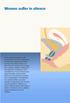 Women suffer in silence Stress urinary incontinence is the involuntary loss of urine resulting from increased intra-abdominal pressure. In people who suffer with this condition, forms of exertion such
PROCEDURE FOR THE ASSESSMENT OF ADULTS AND CHILDREN WITH BLADDER OR BOWEL DYSFUNCTION
 PROCEDURE FOR THE ASSESSMENT OF ADULTS AND CHILDREN WITH BLADDER OR BOWEL DYSFUNCTION First Issued Issue Version One Purpose of Issue/Description of Change Planned Review Date Procedure for the effective
TIBIAL NERVE STIMULATION: ONE OF SEVERAL NEW OPTIONS FOR THE MANAGEMENT OF OVERACTIVE BLADDER IN WOMEN
 TIBIAL NERVE STIMULATION: ONE OF SEVERAL NEW OPTIONS FOR THE MANAGEMENT OF OVERACTIVE BLADDER IN WOMEN Scott A Farrell MD Professor Dept of Obstetrics and Gynaecology Dalhousie University Declaration of
Treatment for Stress Incontinence Patient Decision Aid
 Treatment for Stress Incontinence Patient Decision Aid Patient Information Author ID: JD/NS Leaflet Number: Gyn 056 Version: 1 Name of Leaflet: Treatment for stress incontinence - Patient decision aid
Overactive Bladder. Advice for patients who just cannot hold on
 Overactive Bladder Advice for patients who just cannot hold on 1 Normal Bladder Function Your bladder normally stores urine produced by your kidneys. The kidneys produce urine all the time but the amount
Riesa Gusewelle, MNSc, RN, APRN, GNP-BC. OBJECTIVES Identify early warning signs of urinary tract
 Detection, Early Management & Prevention, of Urinary Tract Infections in Older Adults Riesa Gusewelle, MNSc, RN, APRN, GNP-BC OBJECTIVES Identify early warning signs of urinary tract infections (UTIs)
I can t empty my rectum without pressing my fingers in or near my vagina
 Since the birth of my baby, I can t control my bowel movements Normally bowel movements (stools) are stored in the rectum until the bowel sends a message to the brain that it is full, and the person finds
Urine Leaks After Prostate Cancer Treatment
 Managing Symptoms After Prostate Cancer Urine Leaks After Prostate Cancer Treatment Urine leaks after surgery or radiation for prostate cancer are common. The medical term for this is incontinence (say:
Tone Up Your Pelvic Floor. A regular pelvic floor exercise ( Kegel ) routine can prevent symptoms before, during, and after childbirth.
 Will Breastfeeding Affect Incontinence and Pelvic Symptoms? Yes, often for as long as you re nursing. Many breastfeeding women are unaware that a natural drop in estrogen which persists for as long as
Overactive bladder. Information for patients from Urogynaecology
 Overactive bladder Information for patients from Urogynaecology An overactive bladder (OAB) is a very common problem. It can cause distressing symptoms that are difficult to control. These can include
Pediatric Incontinence
 Alberta Aids to Daily Living P R O G R A M Pediatric Incontinence PROGRAM MANDATE: The Alberta Aids to Daily Living (AADL) program helps Albertans with a long-term disability, chronic illness or terminal
Bladder and Bowel Assessment Ann Yates Director of Continence Services. 18/07/2008 Cardiff and Vale NHS Trust
 Bladder and Bowel Assessment Ann Yates Director of Continence Services Types of continence problems Bladder Stress incontinence Urgency and urge Incontinence Mixed incontinence Obstructive incontinence
Urinary incontinence. The urinary system
 Urinary incontinence is defined as the involuntary loss of urine from the bladder. Although it is a common condition, most women who suffer from it do not seek help. It is thought that urinary incontinence
Female Urinary Incontinence
 Female Urinary Incontinence Molly Heublein, MD Assistant Professor Clinical Medicine UCSF Women s Health Primary Care Disclosures I have nothing to disclose. Objectives Which is most true? Review the problem