
Doc. no.lec-om03901a. PRODUCT NAME Programless controller Step motor (servo 24 VDC ) MODEL/ Series LECP1 Series
|
|
|
- Nigel York
- 10 years ago
- Views:
Transcription
1 Doc. no.lec-om03901a PRODUCT NAME Programless controller Step motor (servo 24 VDC ) MODEL/ Series LECP1 Series

2 Contents 2. Outlines of Product Features How to Order Structure of the product Procedure (How to start the actuator)...8 (1) Checking the contents of the package...8 (2) Mounting the Controller... 8 (3) Controller Wiring / Connection... 8 (4) Power supply Alarm check...9 (5) Data (Operation pattern) setting... 9 (6) Test run Specifications Basic specifications Details of the controller Outer dimensions (1)Mounting screw (LECP1 - ) Mounting (1) Mounting (2) Grounding (3) Location for mounting External connection CN1: Power supply connector CN2: Motor connector, CN3: Encoder connector CN4: Parallel I/O connector CN1: Power supply cable Power supply cable specification Power supply cable specification (1) Wiring of power supply (2) Wiring for the switch for forced unlocking...17 (3) Wiring for the stop switch (4) Stop the power supply for the motor CN4: Parallel I/O cable Paralles input / output Parallel input / output circuit (NPN, PNP) (1) Parallel I/O input circuit (NPN, PNP common) (2) Parallel I/O output circuit Parallel input / output signal Parallel I/O connector wiring (Example) Setting method Setting procedure Setting parameters Controller modes (A) Before returning to origin position (B) Auto mode after return to origin position...36 (C) Manual mode after retuning to origin position Test function Operations Returning to origin position Positioning Pushing operation (1) Successful pushing operation (2) Unsuccessful pushing operation (Idling)...41 (3) Workpiece moves when pushing operation is completed Jog / inching operation

3 8.5 Servo Response time for the controller input signal Operation (Example) Positioning / Return to origin position Pushing operation Stoppage during operation Generation and deactivation of alarm Initial setting value per actuator Initial setting value of LEF series Initial setting value of LEH series Initial setting value of LES series Initial setting value of LEY series Initial setting value of LER series Initial setting value of LEP series Initial setting value of LEL series Options Actuator cable [5m or less] Actuator cable [8 to 20m] Actuator cable (for sensor / lock) [5m or less] Actuator cable (for sensor / lock)[8 to 20m] Alarm detection Alarm group output Alarm Content Countermeasure Wiring of cables/common precautions Electric actuators/common precautions Design and selection Mounting Handling Operating environment Maintenance Precautions for actuator with lock Controller and its peripheral devices / Specific product precautions Design and selection Handling Installation Wiring of cables/common precautions Power supply Grounding Maintenace Troubleshooting Operation troubles Position / Speed troubles

4 LECP1 Series / Controller Safety Instructions These safety instructions are intended to prevent hazardous situations and/or equipment damage. These instructions indicate the level of potential hazard with the labels of Caution, Warning or Danger. They are all important notes for safety and must be followed in addition to International Standards (ISO/IEC), Japan Industrial Standards (JIS)*1) and other safety regulations*2). *1) ISO 4414: Pneumatic fluid power -- General rules relating to systems ISO 4413: Hydraulic fluid power -- General rules relating to systems IEC : Safety of machinery -- Electrical equipment of machines (Part 1: General requirements) ISO : Manipulating industrial robots -- Safety JIS B 8370: General rules for pneumatic equipment. JIS B 8361: General rules for hydraulic equipment. JIS B : Safety of machinery Electrical equipment for machines. (Part 1: General requirements) JIS B : Manipulating industrial robots - Safety. etc. *2) Labor Safety and Sanitation Law, etc. Caution Warning Danger Operator error could result in injury or equipment damage. Operator error could result in serious injury or loss of life. In extreme conditions, there is a possibility of serious injury or loss of life. Warning 1. The compatibility of the product is the responsibility of the person who designs the equipment or decides its specifications. Since the product specified here is used under various operating conditions, its compatibility with specific equipment must be decided by the person who designs the equipment or decides its specifications based on necessary analysis and test results. The expected performance and safety assurance of the equipment will be the responsibility of the person who has determined its compatibility with the product. This person should also continuously review all specifications of the product referring to its latest catalog information, with a view to giving due consideration to any possibility of equipment failure when configuring the equipment. 2. Only personnel with appropriate training should operate machinery and equipment. The product specified here may become unsafe if handled incorrectly. The assembly, operation and maintenance of machines or equipment including our products must be performed by an operator who is appropriately trained and experienced. 3. Do not service or attempt to remove product and machinery/equipment until safety is confirmed. The inspection and maintenance of machinery/equipment should only be performed after measures to prevent falling or runaway of the driven objects have been confirmed. When the product is to be removed, confirm that the safety measures as mentioned above are implemented and the power from any appropriate source is cut, and read and understand the specific product precautions of all relevant products carefully. Before machinery/equipment is restarted, take measures to prevent unexpected operation and malfunction. 4. Contact SMC beforehand and take special consideration of safety measures if the product is to be used in any of the following conditions. 1) Conditions and environments outside of the given specifications, or use outdoors or in a place exposed to direct sunlight. 2) Installation on equipment in conjunction with atomic energy, railways, air navigation, space, shipping, vehicles, military, medical treatment, combustion and recreation, or equipment in contact with food and beverages, emergency stop circuits, clutch and brake circuits in press applications, safety equipment or other applications unsuitable for the standard specifications described in the product catalog. 3) An application which could have negative effects on people, property, or animals requiring special safety analysis. 4) Use in an interlock circuit, which requires the provision of double interlock for possible failure by using a mechanical protective function, and periodical checks to confirm proper operation

5 LECP1 Series / Controller Safety Instructions Caution The product is provided for use in manufacturing industries. The product herein described is basically provided for peaceful use in manufacturing industries. If considering using the product in other industries, consult SMC beforehand and exchange specifications or a contract if necessary. If anything is unclear, contact your nearest sales branch. Limited warranty and Disclaimer/Compliance Requirements The product used is subject to the following Limited warranty and Disclaimer and Compliance Requirements. Read and accept them before using the product. Limited warranty and Disclaimer The warranty period of the product is 1 year in service or 1.5 years after the product is delivered.*3) Also, the product may have specified durability, running distance or replacement parts. Please consult your nearest sales branch. For any failure or damage reported within the warranty period which is clearly our responsibility, a replacement product or necessary parts will be provided. This limited warranty applies only to our product independently, and not to any other damage incurred due to the failure of the product. Prior to using SMC products, please read and understand the warranty terms and disclaimers noted in the specified catalog for the particular products. *3) Vacuum pads are excluded from this 1 year warranty. A vacuum pad is a consumable part, so it is warranted for a year after it is delivered. Also, even within the warranty period, the wear of a product due to the use of the vacuum pad or failure due to the deterioration of rubber material are not covered by the limited warranty. Compliance Requirements When the product is exported, strictly follow the laws required by the Ministry of Economy, Trade and Industry (Foreign Exchange and Foreign Trade Control Law)

6 2. Outlines of Product 2.1 Features Features of the controller. Actuator control Servo control enables the positioning and the operation with a specified thrust of the actuator. Operation and settings are available with the controller. Settings can be altered and operation can be fun from the controller. Adjustments of the position,, acceleration and test runs are available without the teaching box, PC, and PLC. Operation with specified thrust The holding force and pushing force of the actuator can be controlled in three steps. Separated power supply input Power supply input is separated into the motor power supply and control power supply. Even if the power supply for the motor is turned off, the information of the encoder position is not lost while the control power supply is on, and parallel I/O control is available. Automatic sequence function of the returning to origin position Returning to origin position is available through I/O signal combination. Alarm detection Abnormal conditions are self-detected. Alarms are displayed by LED on the controller and abnormal conditions are output to the outside by the parallel I/O terminal. 14 points positioning / pushing is available Through the combination of parallel I/O inputs, 14 points (position number 1 to 14(E)) of positioning / pushing are available. The and acceleration of the positioning can be set by the switch for each operating direction. Data input method Parameter settings, test runs, and alarm resets can be performed by the controller. Caution When the device is set up or failure occurs, please refer to the operation manual of the actuator as well as this operation manual. * Keep this operation manual accessible so it can be referred to when necessary. S - 5 -

7 2.2 How to Order How to order is shown below. Controller LECP1N - P Controller Applicable motor Step motor (servo DC24V) Step data 1 14 points (Programless) Parallel input / output type N NPN type P PNP type (Enter from the actuator model "LE" to stroke ) Ex: LEHZ10LK2-4AF-R11N1 Enter "LEHZ10LK2-4" I/O cable length Actuator Model Nil No cable 1 1.5m 3 3m 5 5m * Power cable length is 1.5m only Actuator + Controller LEHZ10LK2-4AF-R11N1 Actuator type Fill in How to Order referring to How to Order of the catalog of Actuators. Please refer to the table below for the applicable actuators. Ex. :LEHZ10LK2-4AF-R11N1 Applicable actuators Electric gripper LEH Series Electric slide table LES Series Electric actuator / Rod type LEY Series Electric actuator / Slider type LEF Series Electric actuator / Rotary type LER Series Controller Nil 1N 1P I/O cable length * Nil No cable 1 1.5m 3 3m 5 5m No controller * With programless controller (NPN) With programless controller(pnp) * If the actuator is ordered without the controller, the I/O cable type is not available. LECP6 series I/O cables cannot be used due to different specification. Caution Single controllers are also shipped after setting the actuator specification parameters. Confirm the combination of the controller and the actuator is correct

8 2.3 Structure of the product Structure of the controller. * Electric actuator * I/O cable Part no.: LEC-CK4-* PLC Input/output signal power supply * Actuator cable [Robot cable] Part no.: LE-CP-* [Standard cable] Part no. :LE-CP-*S To CN3 To CN4 To CN2 To CN1 Controller Controller input power supply 24VDC Power supply cable Part no.: LEC-CK1-1 * These items are included if you ordered using the part number for an actuator set. Warning Refer to 4. External connection (P.15) for wiring. Refer to 13. Wiring of cables/common precautions (P.65) when handling the wiring and cables

9 2.4 Procedure (How to start the actuator) Install, wire, set and operate the controller referring to the procedure below when the product is used for the first time. (1) Checking the contents of the package After unpacking everything, check the description on the label to identify the controller and the number of accessories. Part s name Quantity Power supply cable Controller (LECP1 - ) 1 pcs. Power supply cable (LEC-CK1-1) 1 pcs. I/O cable I/O cable *(LEC-CK4- ) 1 pcs. Actuator * Actuator cable * Robot cable: LE-CP- or Standard cable: LE-CP- S 1 pcs. 1 pcs. Controller Actuator cable * These items are included if you ordered using the part number for an actuator set. If parts are missing or damaged, please contact our distributor. (2) Mounting the Controller Refer to 3.4 Mounting (P. 13) to mount the controller. (3) Controller Wiring / Connection Connect cables to the controller connectors (CN1 to CN4). Refer to 4. External connection (P.15) for the wiring of the cables. Connectors - 8 -

10 (4) Power supply Alarm check Supply power 24V DC. Description LED turns on Condition PWR Green LED is on Green LED is flashing Servo is on Servo is turned off Controller ALARM Red Alarm is generated If the conditions are normal, the LED[PWR] at the front of the controller switches from a flashing to a solid light. The servo is turned on if the conditions are normal. If the LED[ALM] on the front surface of the controller turns red, the alarm goes off. When an alarm is generated Caution Confirm the content of the alarm with 7-segment LED of the controller or I/O output. Eliminate the cause referring to 12. Alarm detection (P.61). (5) Data (Operation pattern) setting Set the stop position,, acceleration, and deceleration for the operating directions with the buttons and switches on the controller. Operations other than position setting, jog/inching can be performed after returning to origin position. Refer to 7. Setting method (P.23) for the details of settings. (6) Test run Test run is performed with the buttons and switches of the controller or I/O signal. Refer to 7.1 Setting procedure (P.24) and 6.3 Parallel input / output signal (P.20) for details

11 3. Specifications 3.1 Basic specifications Basic specifications of the product. Item Controlled motor Power supply specification (*1) Parallel input Parallel output Stop points Controlled encoder Serial communication Memory Specifications Step motor(servo 24VDC) Power supply voltage: 24VDC±10% Max. current consumption: Rated 3.2A (Peak 5A)(*2) [Includes the motor power supply, control power supply, stop, unlocking] Input 6 points (Photo coupler insulation) Output 6 points (Photo coupler insulation) 14 points(location number 1 to 14(E)) Incremental A/B phase Pulse number: 800 pulse/rev RS485 (Complies with Modbus protocol) EEPROM LED display LED(Green/Red) 1 for each 1 digit, 7-segment display (red) 7-segment LED display Figures are expressed in hexadecimal (10 to 15 in decimal number are (*3) expressed as A to F) Locking With unlocking terminal Cable length I/O cable: 5m or less Actuator cable: 20m or less Cooling method Air-cooling type Operating temperature range 0 to 40 C(No condensation, no freezing) Operating humidity range 90%RH or less (No condensation) Storage temperature range -10 to 60 C(No condensation, no freezing) Storage humidity range 90%RH or less (No condensation) Insulation resistance Between the case (Heat Sink) and SG terminal: 50MΩ(500VDC) Weight 130g *1) Do not use inrush current suppressor types as the power supply for the controller input. *2) Power consumption depends on actuator. Please refer to the operation manual of actuators for details. *3)"10" to "15" in decimal number are displayed as follows in the 7-segment LED Decimal display Hexadecimal display 10 A 11 b 12 c 13 d 14 E 15 F

12 3.2 Details of the controller e d c No. Display Description Details f g i k a b h j a PWR Power supply LED b ALM Alarm LED c Cover d FG Power supply /No alarm :Green turns on Power supply /servo :Green flashes Power supply /With alarm :Red turns on Power supply /Parameter setting: Red flashes Change and protection of the mode SW (Close the cover after changing SW) Frame ground (Tighten the bolt with the nut when mounting the controller. Connect the grounding cable.) m l n e Mode switch Switch the mode(manual mode <-> Auto mode) 7-segment Stop position, the value set by h and alarm f LED information are displayed. Decide the settings or drive operation in Manual g SET Set button mode. h Position switch Assign the position to drive(1 to 14), and the origin position. i j MANU AL Forward button Reverse button Perform forward jog and inching. Perform reverse jog and inching. r q p o k l m n o SP EED ACCEL CN1 Forward switch Reverse switch Forward acceleration switch Reverse acceleration switch Power supply connector 16 forward s are available. 16 reverse s are available 16 forward acceleration steps are available. 16 reverse acceleration steps are available. Connect the power supply cable p CN2 Motor driving connector Connect the motor connector. q CN3 Encoder connector Connect the encoder connector r CN4 I/O connector Connect I/O cable

13 Caution Use a flat blade watchmaker's screwdriver of the size shown below when changing position switch h and the set value of the /acceleration switch k to n <Size> End width L :2.0 to 2.4 [mm] End thickness W :0.5 to 0.6 [mm] L W Magnified view of the end of the flat blade screwdriver 3.3 Outer dimensions The appearance of the product is shown below. (1)Mounting screw (LECP1 - )
![4 [mm] End thickness W :0.5 to 0.](/docs-images/43/8900986/images/page_13.jpg "6 [mm] L W Magnified view of the end of the flat blade screwdriver 3.")
14 3.4 Mounting (1) Mounting Details of the controller. Mounting screw (LECP1 - ) (Mounting with two M4 screws) Mounting direction Grounding cable Mounting direction (2) Grounding Tighten the bolt with the nut when mounting the ground cable as shown below. M4 screw Cable with crimping terminal Serrated washer Controller Caution M4 screws, cable with crimping terminal and serrated washer are prepared by customer. Ground the controller to reduce noise

15 Caution (1) Grounding shall be done by dedicated cable. Grounding with the ground resistance of 100Ω or less. (2) The cross sectional area of the grounding cable shall be 2mm 2 or more. Grounding location shall be in the vicinity of the controller. Keep the grounding cable short. Controller Other equipment Controller Other equipment Ground with the resistance less than 100 ohm Dedicated grounding --- Good Shared grounding --- Not acceptable (3) Location for mounting Select the size and the installation style so that the surrounding temperature of the controller is 40 o C or less. Mount the controller vertically on the wall with 60mm or more of space on top and bottom of the controller for connecting and disconnecting of the cable. Keep 60mm or more between the front of the controller and the cover (lid) so that buttons and switches can be operated. Keep enough space around the controller so that the operating temperature of the controller stays within the specification range. Avoid mounting on a panel where a vibration source such as large size electromagnetic contactor or circuit fuse breaker is also mounted. Usually : 0mm Specified product number(le ):10mm or more 30mm or more Body size 25 or more LEH is excluded Door (Lid) Controller Controller 60mm or more (Keep the space for connecting/ disconnecting the cable) 60mm or more (Keep enough space so that buttons and switches can be operated.) Caution When there are dents, bumps or warping on the mounting surface of the controller, excessive force can be applied to the case, which can cause failure. Mount on a flat surface

16 4. External connection 4. 1 CN1: Power supply connector The example of standard wiring of the controller is shown per connector (CN1 to 4). Controller CN1 Power supply cable Controller input power supply 24VDC (Controller input power supply of 24V DC is prepared by customer. Refer to 5. CN1: Power supply cable(p.16) for wiring. Caution Do not use inrush current suppressor type as the power supply for the controller input CN2: Motor connector, CN3: Encoder connector Connect the controller and the actuator with the actuator cable (LE-CP- or LE-CP- S). Controller CN3 Actuator cable Motor Actuator CN CN4: Parallel I/O connector Controller PLC etc. CN4 I/O cable (PLC is prepared by customer) * Refer to 6.4 Parallel I/O connector wiring (Example) (P.22) for wiring. * Refer to 6.3 Parallel input / output signal (P.20) for details

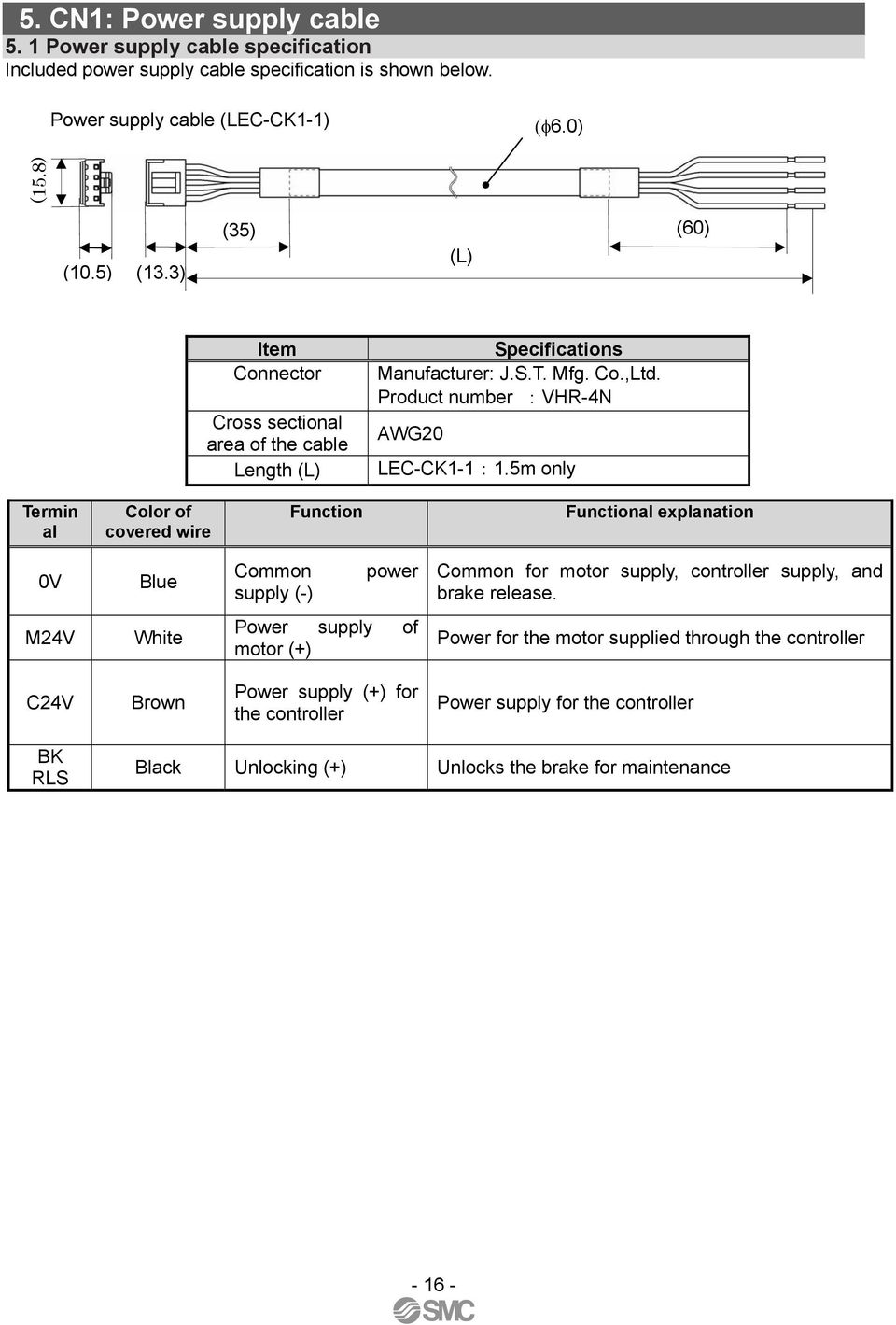
17 5. CN1: Power supply cable 5. 1 Power supply cable specification Included power supply cable specification is shown below. Power supply cable (LEC-CK1-1) 6.0) (15.8) (10.5) (13.3) (35) (L) (60) Item Connector Cross sectional area of the cable Length (L) Specifications Manufacturer: J.S.T. Mfg. Co.,Ltd. Product number :VHR-4N AWG20 LEC-CK1-1:1.5m only Termin al Color of covered wire Function Functional explanation 0V Blue Common supply (-) power Common for motor supply, controller supply, and brake release. M24V White Power supply of motor (+) Power for the motor supplied through the controller C24V Brown Power supply (+) for the controller Power supply for the controller BK RLS Black Unlocking (+) Unlocks the brake for maintenance
18 5. 2 Power supply cable specification Referring to (1) to (4), connect the power supply cable included in accessories to the controller input power supply 24VDC and insert it to the controller CN1 power supply connector. (1) Wiring of power supply Connect the plus (+) of the controller input power supply 24VDC to C24V terminal of the power supply cable, and connect the minus (-) to 0V terminal. Controller 0V M24V C24V BK RLS Caution Controller input power supply Do not use inrush current suppressor type as the power supply (24VDC) for the controller input. 0V 24V (2) Wiring for the switch for forced unlocking Install unlocking switch for the adjustment or recovery during emergency of the locking actuator. * Switch (24V DC, contact capacity 0.5A or more) is provided by customer. Connect one of unlocking switch terminals to the input power supply for the controller, and the other to BK RLS terminal of the power supply plug. Locking mechanism is released by closing the switch. Controller 0V M24V C24V BK RLS Switch for forced unlocking Caution Controller input power supply It is unnecessary to connect BK RLS terminal when the actuator does not have locking mechanism. Connect BK RLS terminal only when releasing the lock at servo or STOP is is needed. 0V 24V (3) Wiring for the stop switch Stop switch is necessary. Controller 0V M24V C24V BK RLS 0V 24V Controller input power supply The actuator stops when M24V is turned off. When M24V is turned off in the actuator operation, the alarm is detected. When the STOP signal is turned on, the actuator stops. At this time, the alarm is not detected

19 (4) Stop the power supply for the motor If it is necessary to shut off the power supply for the motor from outside, connect the relay between the input power supply for the controller 24VDC and the power supply plug for the controller M24V. Example of the circuit 24VDC Reset switch for stop Ry 0V STOP switch Ry Surge suppressor Controller 1st ptoduct 0V M24V C24V Ry 0V 24V Controller input power supply BK RLS 2nd ptoduct Controller 0V M24V C24V Ry 0V 24V Controller input power supply BK RLS Controller 3rd ptoduct 0V M24V C24V BK RLS Ry 0V 24V Controller input power supply Warning Do not perform returning to origin position neither drive operation when the the power supply for the motor (M24V) is shut off, otherwise alarm will be generated. The controller does not recognize the correct origin position with the command for returning to the origin position at the time of the shutoff of the power supply for the motor (M24V)

20 6. CN4: Parallel I/O cable 6.1 Paralles input / output Input specifications NO. Item Specifications 1 Input circuit Internal circuit and the photo coupler insulation 2 No. of inputs 6 points 3 Voltage DC24V±10% 4 Input current at 3.5mA±20%(at DC24V) 5 Input current / 1.5mA or less of current voltage at 11V or less of voltage Output specifications 6.2 Parallel input / output circuit (NPN, PNP) There are two types of parallel input / output types for this controller. NPN type (LECP1N - ) PNP type (LECP1P - ) NO. Item Specifications 1 Output circuit Internal circuit and the photo coupler insulation 2 No. of output 6 opints 3 Maximum voltage between terminals DC30V 4 Maximum output current 10mA 5 Saturation voltage between terminals 2.0V (Maximum) (1) Parallel I/O input circuit (NPN, PNP common) NPN TYPE (a) COM+ 1 Outside (b) IN0 9 ~STOP 14 (a) PNP TYPE (a) COM- 2 (b) (b) IN0 9 ~STOP 14 Inside of the controller (2) Parallel I/O output circuit NPN TYPE Inside of the controller Outside OUT0 3 ~ALARM 8 COM- 2 PNP TYPE Inside of the controller Outside COM+ 1 OUT0 3 ~ALARM

21 6.3 Parallel input / output signal I/O cable(lec-ck4- ) (16) ( 7.9) (10) (11) (30) (60) (L) Controller side PLC side Item Specifications Connector Manufacturer: J.S.T. Mfg. Co.,Ltd.Manufacturer: J.S.T. Mfg. Co.,Ltd. Product number :PADP-14V-1-S Cross sectional AWG26 area of the cable The suffix of the part number (1,3,5) specifies the length. Length (L) LEC-CK4-1: 1.5m LEC-CK4-3: 3m LEC-CK4-5: 5m Termi nal No. Insulation color Dot Mark Dot color Func tion Contents 1 Light brown Black COM+ Connect the 24V side of the power supply (24VDC) for input / output signal. 2 Light brown Red COM- Connect the 0V side of the power supply (24VDC) for input / output signal. 3 Yellow Black OUT0 Operation completion output (Output with the 4 Yellow Red OUT1 combination of OUT0 to 3) 5 Light Black OUT2 OUT3 OUT2 OUT1 OUT0 green 6 Light green Red OUT3 7 Gray Black BUSY BUSY signal (Output during operation) 8 Gray Red ALARM ALARM signal N.C. (Turned off during alarm or when servo is turned off) 9 White Black IN0 10 White Red IN1 11 Light brown 12 Light brown Black IN2 Red IN3 Operation command input (Input with thecombination of IN0 to IN3) Input return to origin position command (Turn on IN0 to 3 simultaneously) Ex. (Commands position number 5 to operate) IN3 IN2 IN1 IN0 13 Yellow Black RESET Interruption or alarm reset During operation: The is reduced from the point where signal is input until the actuator stops. (Servo stays ) Alarm is being generated: Alarm reset 14 Yellow Red STOP STOP command (Sudden deceleration to turn off servo) * Parallel I/O signal is valid in auto mode. STOP signal is valid in auto mode and manual mode. While the test function operates at manual mode, only the output is valid.
22 The change of I/O output signal under the condition of controller at auto mode. Condition of the controller Output signal OUT0 OUT1 OUT2 OUT3 BUSY ALARM Supply of power After supplying power and at the stop before returning to origin position During the returning to origin position, positioning, and pushing operation. When return to origin position is completed. During the return to origin position, positioning, and pushing *1 *1 *1 *1 operation. Stopped by RESET command Stopped by STOP command When alarm is generated *2 *2 *2 *1, of OUT0 to 3 depends on the target position *2 and of OUT0 to 3 depends on the alarm group. There is no servo signal with this controller. The servo turns off when conditions to turn off the servo are satisfied. Refer to 8.5 Servo (P.43) for details. Caution Signal is not output from I/O right after switching from manual mode to auto mode. Output from I/O is made after the next input of operation command. Output from I/O is not made if switching from auto mode to manual mode
23 6.4 Parallel I/O connector wiring (Example) Use an I/O cable (LEC-CK4- ) when connecting to PLC and CN4 parallel I/O connectors. Wiring depends on the parallel input/output of the controller (NPN, PNP type). Please wire the product referring to the wiring diagram, NPN TYPE COM + COM - IN0 IN1 IN2 IN3 RESET STOP OUT0 OUT1 OUT2 OUT3 BUSY ALARM I/O signal power supply DC24V Load PNP TYPE COM + COM - IN0 IN1 IN2 IN3 RESET STOP OUT0 OUT1 OUT2 OUT3 BUSY ALARM I/O signal power supply DC24V Load Caution Prepare separate 24VDC power supplies for the CN1 controller input power supply and CN4 input / output signal power supply
24 7. Setting method It is necessary to set the stop position and operation method using the controller in order to move the actuator to the specified position. Set data is stored in the memory in the controller Up to 14 points can be set. Set "1" to "14" with the position switch h. ("1" to "9", "A" to "E") is displayed in hexadecimal on the 7-segment LED f. f e c There are 2 types of modes on the controller (manual mode, auto mode). Setting and operating methods are different. Mode is switched by mode Switch e. Upper part of the right figure(m) : Manual mode Lower part of the right figure(a) : Auto mode g h Caution Close the cover c after the switching the mode to avoid unexpected mode changes. i j Manual mode(m) Auto mode(a) Setting of stop position (step data) O X Setting of Speed and (Only in O Acceleration adjustment)*2 Setting of operation method O X Setting parameters O X Controller operation using the button O X Operation from parallel I/O X O Positioning operation O O Pushing operation (Test function only)*1 O Output to parallel I/O (Test function only)*1 O Check the presence of alarm O O Check the content of alarm O O How to release the alarm Press set button g Turn on RESET or press set button g Turn off Servo Press Forward button i Servo method and Reverse button Turn on STOP j simultaneously for 3 sec. *1 Refer to 7.4 Test function (P.38) for details of test function. *2 Refer to 7.3 Controller modes (P.34) for details of the adjustment of the
25 7.1 Setting procedure Follow the procedure below for setting. (1)Supply of power f e c (2)Changes to Manual mode a (3)Return to origin position (4)Setting of position (5)Setting of operation method (6)Test run Repeat the same procedure for all points you would like to set. g h (7)Setting / acceleration (8)Setting completed (1)Supply of power Apply 24VDC to the power supply for the power line and the signal line. After applying the power, confirm that the power supply LED a lights green (=Servo ). Refer to 8.5 Servo (P.43) if the power supply LED a flashes green. (2) Changes to Manual mode Switch the controller mode switch e to manual mode (M). In manual mode, the 7-segment LED f indicates the value of the position switch h with high flashing. (3) Return to origin position Confirm that the 7-segment LED f display is changed to "F" by setting the position switch h to "15", then press the set button g to start the return to origin. When the return to origin is completed, the display of the 7-segment LED f changes changes from flashing to solid. Caution If you perform return to origin before the servo is turned on (Power supply LED a lights up in green) an alarm will be generated. Perform the return to origin after confirming that the servo is turned on. Refer to 8.1 Returning to origin position(p.39) for details. The direction of return to home depends on the actuator. Refer to 10. Initial setting value per actuator (P.48)
26 (4), (5) Setting of position and operation method At the manual mode after returning to origin, position can be set by (A) Jog / inching or (B) Direct teaching. Example) Setting of position number 3 (A) Setting by Jog / inching [1] Set the position switch h to the position you desire ("3" in this case). The value of position switch h flashes in high on 7-segment LED f 7-segment LED f Position switch h * Do not set "0" and "F(15)", They are not not available for position numbers. [2] Confirm that the power supply LED a is, then, press the set button g to the set position. 7-segment LED f lights up when the set position is reached. Continuing to press the set button makes the LED flash slowly. Release the set button g. * If you release the set button g the operation stops in the middle. If you release the set button g in the middle of the operation, press the button again to move on to the next procedure. 7-segment LED f Set button g Power supply LED a Alarm LED b Position switch h Caution If you perform procedure [2] before returning to origin, alarm is generated (7-segment LED f displays "C" and alarm LED b lights up) In this case, release the alarm by pressing the set button g. Set the position switch h to "F(15)" and press the set button g for retuning to origin, then perform the procedure [2]. If it is not possible to return to the position before setting due to the mechanical interference, set the position by (B)Direct teaching
27 [3] Perform Jog / inching using Forward button i, Reverse button j to move to desired position. * Jog starts by keeping pressing Forward button i or Reverse button j.refer to 8.4 Jog / inching operation (P.42) for details. Forward button i Reverse button j [4] Lock in the position by pressing the set button g. At this point, the value is not stored if the power supply is cut, it is necessary to started from procedure [1]. Set button g [5] Set the operation method of this position by pressing Forward button i or Reverse button j monitoring 7-segment LED f 7-segment LED f * Actual force of pushing force depends on the actuator. Refer to 10. Initial setting value per actuator (P.48) Pushing operation may not be possible depending on the actuator. Forward button i Reverse button j 7-segment LED display (Set operation method) Forward button i Forward button i Forward button i Positioning Reverse button j Pushing force Low Reverse button j Reverse button j Pushing force Middle Pushing force High
28 [6] Press set button g for 2 sec. to set the operation method. Once this operation is completed, 7-segment LED f display flashes quickly. The position and the operation method are stored in the controller. 7-segment LED f Set button g Positioning by jog / inching completed. Do the same for other position numbers you desire to set. Caution If you perform jog / inching before the servo is turned on (Power supply LED a lights up in green), alarm is generated. Perform jog / inching after confirming that the servo is turned on. Set operation method per position number. Refer to 8. Operations(P.39). (B) Setting by direct teaching (Ex. Position switch initial value "4") [1] Pressing the Forward button i and Reverse button j simultaneously for 3 sec will make the power supply LED flash. * The flashing of the power supply LED a indicates the servo is turned off. Forward button i Power supply LED a Reverse button j
29 [2] Set the position switch h to the position you desire ("3" in this case). The value of position switch h flashes quickly on 7-segment LED f. 7-segment LED f * Do not set "0" and "F(15)", They are not position numbers. Position switch h [3] Press and hold the set button g until 7-segment LED f changes quick flashing --> solid lighting --> slow flashing. 7-segment LED f Set button g [4] Move the actuator to desired position with external force. Lock in the position by pressing the set button g. * At this point, the position is not stored, If the power supply is cut, it is necessary to started from procedure [1]. Set button g * In case of small lead screws, the actuator may not be moved by external forced even if the servo is off. Perform positioning by (A) jog / inching
30 [5] 7-segment LED f, Set the operation method of this position by pressing the Forward button i or Reverse button j while monitoring 7-segment LED f. 7-segment LED f * Actual force of pushing force depends on the actuator. Refer to 10. Initial setting value per actuator (P.48) Pushing operation may not be possible depending on the actuator. Forward button i Reverse button j 7-segment LED display (Set operation method) Forward button i Forward button i Forward button i Positioning Reverse button j Pushing force Low Reverse button j Reverse button j Pushing force Middle Pushing force High [6] Press set button g for 2 sec. to set the operation method. Once this operation is completed, the position and the operation method are stored in the controller, and 7-segment LED f display flashes quickly. That is all for the setting by direct teaching. If you continue to set other position, start from the procedure [2]. If you perform setting with Jog / Inching or test run, press Forward button i and Reverse button j for 3 sec. simultaneously to change the power supply LED a from flashing to lighting. 7-segment LED f Set button g Forward button i Power supply LED a Reverse button j Caution Set operation method per position number. Refer to 8. Operations (P.39). The actuators with a smaller lead, it may not be moved by the external force. Perform positioning by (A) jog / inching in previous page
31 (6) Test run Operate by the controller buttons and the switches to check the operation method and the position. Operation method is as follows. f e c 1) Set the position switch h to the position number you desire. 2) Confirm that the position number flashes on the 7-segment LED f. 3) Press and hold the set button g. Operation is kept while g h the button is pressed. 7-segment LED f flashes slowly during operation. Slow flashing changes to being solid when the set position is reached. This operation confirms the stop position and the operation method. i k m j l n 4) Confirm other stop position with the same operation. * For Pushing operation, check with the test function of manual mode or auto mode. Refer to 7.4 Test function (P.38) for details of normal operation and test function. (7) Setting of Speed and Acceleration Set the and the acceleration by switch k to n per direction of actuation. The switch can be set in 16 steps. Actual value depends on the actuator. Refer to 10. Initial setting value per actuator (P.48). Operation procedure is the same as (6) Test run. (8) Completion of setting After the setting, the operation can be controlled by switching to auto mode by the mode switch e. Refer to 9. Operation (Example) (P.44) for operation of PLC. Caution Close the cover c after the switching of the mode to avoid unexpected mode change
32 7.2 Setting parameters In manual mode, it is possible to set parameters when necessary. Example. Change the jog level from "1" (default condition) to "3" (1)Switch the controller mode switch e to manual mode (M). (Example. "4" (Default value of position switch) Mode switch e (2)Press the Forward button i and Reverse button j simultaneously for 3 sec and the power supply LED a will flash. Power supply LED a Forward button i Reverse button j (3)When you set the position switch h at "0" and press the set button g for 3 sec., a "0" will be displayed with a dot in the corner of the 7-segment LED f, and alarm LED b flashes. 7-segment LED f Alarm LED b Position switch h
33 (4) If you set the position switch h to the parameter No. that you desire ("2" in this case), the value of the position switch h is displayed with a dot in the corner or the 7-segment LED f. 7-segment LED f Position switch h * Refer to the next page for the details of parameters. NO. Description Function 1 Reference for Return to origin or changing rotating direction forward / reverse 2 Jog level Adjust the jog 3 Inching level Adjustment of inching (5) The 7-segment LED f indication is turned off by pressing the set button g, and the current parameter appears. ("1" appears in this example). * If you change the value of the position switch h at this point, it returns to procedure (4). 7-segment LED f Set button g Position switch h (6) If you press the set button g for 2 sec. to change the parameter value, the 7-segment LED f changes to slow flashing. 7-segment LED f Set button g
34 (7) Press forward button i and reverse button j to adjust the parameter to the desired value ("3" in this example). Press the set button g Set for 2 sec. to set after the adjustment. button g * When this operation is completed, the 7-segment LED f display changes from slow flashing to a solid light and the set value is stored. The changes do not take effect until the power is supplied again. Forward button i Mode switch e Reverse button j * That is the end for parameter setting. If you continue to adjust other parameters, repeat the procedures (4) to (7). If you start operation in manual mode after changing the settings, set mode switch e to auto mode once, then change the mode to manual mode. Description of parameters Reference for rotating direction Jog level Inching level No. of parameters Value and the content of parameters Change the direction of the return to origin and forward and reverse. 1: CW (Default value of LEF and LEH series at the time of shipment) 2: CCW(Dafault value of LES and LEY series at the time of shipment) Adjust the jog 1: Multiplier=1 (Default value at the time of shipment) 2: Multiplier=2 3: Multiplier=3 4: Multiplier=4 Adjust the inching amount 1: Multiplier=1 (Default value at the time of shipment) 2: Multiplier=2 3: Multiplier=3 4: Multiplier=4 Jog =(Reference value per actuator) (Multiplier) Inching level =(Reference value per actuator) (Multiplier) Caution Parameter changes take effect after turning off the power supply and turning it on again. For the default value of the return to origin and the reference value of jog and the inching amount, refer to 10. Initial setting value per actuator (P.48). When you change the reference for rotating direction, change the setting of the and acceleration per direction
35 7.3 Controller modes Controller modes are divided into two types, auto mode and manual mode. There are several status types in one mode. The figure below shows how the status changes. Before retuning to origin position Auto mode Waiting condition Supply power Switching of mode SW Waiting condition Manual mode A Jog / inching After retuning to origin position Waiting condition B Positioning or pushing operation by PLC. Auto mode Switching of mode SW Waiting condition Setting of position, and acceleration Positioning Jog / using inching buttons C Manual mode Followings are the explanation of (A)(B)(C) circled with dashed line. (A) Before returning to origin position (B) Auto mode after returning to origin position (C) Manual mode after retuning to origin position Precaution Caution Signal is not output from I/O right after switching from manual mode to auto mode. Output from I/O is made after the next input of operation command. Output from I/O is not made if switching from auto mode to manual mode. (Except test function)
36 (A) Before returning to origin position The transition of the status before returning to origin is shown below. After turning on the power supply, the controller status is in waiting mode which is set by mode switch e. The operation of jog / inching at manual mode is available before retuning to origin. Auto mode Supply power Manual mode Mode switch e is on auto side Before retuning to origin position Waiting condition before retuning to origin position Mode switch e is switched Waiting condition before Retuning to origin position Mode switch e is on manual side Press manual forward or manual backward button i, j Jog / inching Release the button you are pressing. After retuning to origin position PLC commands to return to origin. Waiting condition after Retuning to origin position Command from the controller to return to origin position(position switch h is "15", press set button g ) Waiting condition after Retuning to origin position Auto mode Manual mode Refer to 8.1 Returning to origin position (P.39) for details. Refer to 8.4 Jog / inching operation (P.42) for details. e g i h j
37 (B) Auto mode after return to origin position The status of the auto mode after return to origin position is shown below. At auto mode, only the operation command such as I/O from PLC is accepted. Basically, position, operation method, and acceleration cannot be adjusted in auto mode. Waiting Before returning to origin position PLC commands to return to origin. Operation completed PLC commands to actuate Stops at set position Positioning or pushing operation. Waiting PLC commands to actuate PLC commands to stop Mode switch e is switched After returning to origin position Mode switch e is switched Waiting No operation is made for 3 min. for all button switch. Press forward and backward button of manual button simultaneously for 3sec. Mode switch e is f e c switched PLC commands to actuate Positioning or pushing operation. Waiting for adjustment PLC commands to stop Operation completed Stops at set position PLC Commands to actuate Speed adjustment g i k m h j l n Auto mode Manual mode Auto mode is presuming the operation by I/O from PLC. If you use buttons or switches other than set button g for releasing the alarm, 7-segment LED f indicates "L". When the status is moved to adjustment, followings items are become L display different from normal operation. (1)More dots of 7-segment LED f indication than normal operation. (2)Speed and acceleration adjustment become available temporarily. (3)When no operation is made for 3 min. for all buttons and switches, operation reverts back to normal mode. Caution In auto mode, changing the, acceleration switch values which are set by k to n do not take effect except during the adjustment status. If returning to auto mode after changing to manual mode, the value of the switch affects the operation. Close the cover c after the switching of the mode to avoid unexpected mode change
38 (C) Manual mode after retuning to origin position The status of the manual mode after return to origin position is shown below. In manual mode, return to origin is controlled by the operation of the controller buttons and switches. The and acceleration can be adjusted any time. It is also possible to set the position and operation method. Pushing operation is available during test function. Waiting Before returning to origin position Auto mode Wait ing Mode switch e is switched Operation completed Set the position switch h to "15" and press the set button g. Waiting for test Positioning operation Set the position by the position switch h and keep pressing the set button g. Stop at set position Press manual button i or j Waiting Set the position switch h to "0" and press the set button g for 3sec. Positioning or pushing operation Refer to 7.4 Test function (P.38) for details of normal operation and test function. Refer to 8.5 Servo (P.43) for turning off of servo. Refer to 7.2 Setting parameters (P.31) for details. Refer to 8.4 Jog / inching operation (P.42) for jog and inching. g Caution After returning to origin position Press the set button g for 2 sec. Normal operation Operation completed Press the set button g for 2sec Release the button your are pressing Jog / inching Release the button your are pressing Press the manual buttons i, j simultaneously for 3sec. Press manual button i or j Release the button you are pressing Set the position by the position switch h and keep pressing the set button g. Jog / inching Test function Close the cover c after the switching of the mode to avoid unexpected mode change. Position setting (jog / inching) Waiting for the completion of setting Press manual button i or j Stop before adjusting the position Manual mode Adjust by pressing manual button i, j Position adjustment is completed Waiting for setting of operation method Stop after adjusting the position Press the manual buttons i, j simultaneously for 3sec. Setting of parameters Set the position switch h to "0" and press the set button g for 3sec Press the set Waiting by servo off button g for 2sec Set the position switch Stop after adjusting the position Jog / inching Release manual button i or j h and adujust the position. Press the set button g Press the set button g Waiting for the completion of setting Adjusting the operation method by pushing manual button i, j Waiting for setting of operation method Servo Direct teaching Parameter setting f i k m e c h j l n
39 7.4 Test function The table below shows the difference between normal operation and test function in manual mode. To start the test function, set the position switch h to "0" while the power LED a is on (= servo ) in manual mode and the actuator stops, and press the set button g for 3sec. When test function starts, the dot on the lower right of the 7-segment LED f will light up. Normal operation Test function Availability of X O pushing operation Operation by parallel I/O input X X Output to parallel I/O X O Without dot Target position setting: 7-segment LED Quick flashing f During operation: display flashing Slow Reached the target position: Lights up Adjustment of the / acceleration Operation method using buttons O Moves towards the target position only while the set button g is pressed. With dot Target position setting: Quick flashing During operation: Slow flashing Reached the target position: Lights up O Moves towards the target position when the set button g is pressed. (Not necessary to keep pressing the button) f e c a g i k m h j l n
40 8. Operations 8.1 Returning to origin position When the power is supplied, it is necessary to return to origin for positioning or pushing of the actuator. (To ensure the position of origin) Input of the return to origin position There are 2 ways for returning to origin per mode, Manual mode : Set the position switch h at "15" and press the set button g. Auto mode : Turn on I/O IN0 to IN3 simultaneously. Returning to origin position The actuator travels to the origin position from the initial position when the power was supplied. (Origin position depends on the actuator) "(1)" in the figure below. The controller recognizes the actuator end when the slider travels to the actuator end and stops for specific time. Then, the actuator travels to the opposite to the origin with low. The position after the travel ("(2)" of the figure below) becomes the origin. Return to origin input Travels in origin position Stop traveling Reverse Origin position (Ex) Returning to origin position Motor Load M (2) Actuator Origin position (1) Actuator end Initial position Caution The direction of return to home depends on the actuator. Refer to 10. Initial setting value per actuator (P.48) for the default setting of the return to origin position
41 8.2 Positioning The actuator travels to the target position at and acceleration which are set per operating direction. Operation complete signal is output when the actuator reaches the positioning range of the target position. Ex. Positioning Speed Set Positioning range Position Motor Load M Actuator Stop position Target position 8.3 Pushing operation Perform pushing by the set and acceleration with the same procedure of positioning. Start pushing from the positioning range. Pushing is the operation in which the actuator travels from the start position of travel to the actuator end of the opposite side with low pushing force with set pushing thrust or less. Caution At manual mode, positioning is performed even if pushing is set. (Except during test function) Pushing operation may not be possible depending on the actuator. Refer to 10. Initial setting value per actuator (P.48). *The wave in the chart above is simplified. (1) Successful pushing operation Signal to indicate the operation completion is output when the thrust is more than set pushing force for specific period of time. Set thrust maintains to be generated even after the pushing is completed. Set Speed Pushing Motor Load M Position Pushing thrust Actuator * The wave in the chart on the left is simplified. Stop position Position of pushing start Position of pushing end
42 (2) Unsuccessful pushing operation (Idling) If pushing is not completed when the actautor moves from the start position until the actuator's end, it is pushed back at the actuator end and the completion signal is generated. Set Speed Pushing Position Pushing thrust Motor Load M * The velocity wave form in the chart on the left is simplified. Actuator Stop position Position Pushing of pushing start Actuator end (3) Workpiece moves when pushing operation is completed (i) When the actuator is in a pushing move and the pushing force is greater than the reaction force, the actuator will continue to move to the end of stroke and then output a signal. Set Motor Load Speed Stop position M Pushing again Position Actuator Stop position Position of pushing start Position of pushing end (ii) The workpiece moves toward the opposite of the pushing direction (The reaction force of the workpiece is too large and the actuator is pushed back) When the actuator is pushed back after the pushing move is completed the actuator is pushed until the reaction force and pushing force are balanced in the direction that the pushing started. (Completion signal stays ) An alarm is generated when the actuator is pushed back farther than the start position of pushing. (Pushing failure) Set Speed Pushing Motor Load M Stop position Position of pushing start Pushing again Position Actuator Position of pushing end Position of pushing back * The wave in the chart on the left is simplified
43 8.4 Jog / inching operation Jog / inching is available by pressing forward button i or reverse button j at manual mode. Jog / inching can be performed before retuning to origin. Operation method Inching starts and stops by pressing forward button i or reverse button j. If you keep pressing the button for 1sec. or longer after inching, jog operation starts. Jog operation stops when the button is released. Position Press Forward button Press Reverse button Press Reverse button Stop Jog Stop Stop Stop Jog Inching 1 sec. Inching 1 sec. or less 1 sec. Time Caution The travel amount of inching and jog depend on actuators. Refer to 10. Initial setting value per actuator (P.48). The travel amount of inching and jog can be changed. Refer to 7.2 Setting parameters (P.31) for details. i j
44 8.5 Servo Servo signal is not assigned to the parallel I/O of this controller. The power supply LED a changes flashing to lighting after specific period of time after power supply and the servo turns on. The table below shows conditions for servo Conditions for servo Indication of servo Manual Alarm is generated, or servo Power supply LED a : Flashing mode by pressing Forward Alarm: button i and Reverse button j simultaneously for 3sec. Auto Alarm is generated, or servo Power supply LED a : Flashing mode by inputting I/O STOP signal. i a j 8.6 Response time for the controller input signal Response delay due to the controller input signal contains following factors. (1)Controller input signal scan delay (2)Delay due to input signal analysis (3)Delay of command analysis Process delay of PLC or scanning delay of the controller may occur. Keep the input signal combination for 15ms or longer (the recommendation is 30ms). Initialize the input signal conditioning the response signal to the input signal. When one command is made by inputting several I/O simultaneously, time difference between signals has to be 3ms or less. If the time difference is longer than 3ms, it is recognized as another signal and start the operation. For example, when IN0 and IN1 are commanded to move to (position number 3) simultaneously and the time difference between them is large, only the first command is recognized (Only IN0 input is recognized). IN0 IN1 OF OF Time If the time difference is large, only IN0 input is recognized
45 9. Operation (Example) 9.1 Positioning / Return to origin position Ex). If the operation pattern is Return to origin --> Position 1 --> Position 2 --> Position 1, Forward: Speed 5, acceleration 3 (Switch value) Reverse: Speed 9, acceleration 7 (Switch value) (1) Reverse direction (4) (3) Forward direction Start position End position Operating direction acceler ation Operation method (1) Undecided Origin Forward Fixed Fixed Return to position origin position (2) Origin NO.1 Reverse 9 7 Positioning position (3) NO.1 NO.2 Reverse 9 7 Positioning (4) NO.2 NO.1 Forward 5 3 Positioning * Even for the same position number 1, the travel and the acceleration may vary due to the operating direction. Origin Actuator end Initial position Position NO.1 Position No.2 Example) I/O timing chart when the actuator is operated by PLC. Please translate the boxes IN0 bit_0 IN1 bit_1 IN2 bit_2 IN3 bit_3 RESET STOP OUT0 bit_0 OUT1 bit_1 OUT2 bit_2 OUT3 bit_3 BUSY ALARM + Speed 0 - (1) Return to origin position (2) To NO.1 (3) To NO.2 (2) (4) To NO.1 <Procedure> [1] The servo turns on after supplying the power, and the ALARM turns on. [2] Confirming that the ALARM turned on, turn on IN0 to 3 to perform (1)Return to origin. [3] When return to origin starts, BUSY turns on. [4] Turn IN0 to 3 after confirming BUSY is. [5] BUSY turns when return to origin is completed. OUT0 to 3 turns. [6] When OUT0 to 3 turn, turn on IN0, and start operation to the position no,1. [7] BUSY turns when the operation starts, and OUT0 to 3 turn. [8] When BUSY turns, turn IN0. [9] BUSY turns when the operation is completed, and OUT0 turns. [10] Do the same for the travel for position No.2 and position No
46 9.2 Pushing operation Ex.) If the operation pattern is Position 3 --> Position 4 --> Position 3 --> Position 5. Forward: Speed 5, acceleration 3 (Switch value) Actuator end Reverse: Speed 9, acceleration 7 (Switch value Position NO.3 Position NO.4 Reverse direction (2) (3) (1) forward direction Position at which pushing to the reverse direction from position No.4 is completed Position NO.5 Position at which pushing to the reverse direction from position No.5 is completed Start position End position Operating direction acceleration Operation method (1) NO.3 NO.4 Reverse 9 7 Pushing (2) NO.4 NO.3 Forward 5 3 Positioning (3) NO.3 NO.5 Reverse 9 7 Pushing Example) I/O timing chart when the actuator is operated by PLC IN0 bit_0 IN1 bit_1 IN2 bit_2 IN3 bit_3 RESET STOP (1) To NO.4 (2) To NO.3 (3) To NO.5 <Procedure> [1] When OUT0 and 1 turn on, turn IN2 and start operation(1) to position No.4. [2] BUSY turns when the operation starts, and OUT0 and 1 turn. [3] When BUSY turns, turn IN2. [4] BUSY turns when the operation is completed, and OUT2 turns. [5] Do the same for the travel for position No.3 and position No.5. OUT0 bit_0 OUT1 bit_1 OUT2 bit_2 OUT3 bit_3 BUSY ALARM Speed
47 9.3 Stoppage during operation Ex.) Position No.6 -> Stop by inputting the RESET signal while the actuator is traveling to position No.7 -> Position No.8 -> Stop by inputting the STOP signal while the actuator is traveling to position No.7 -> Position No.9 Actuator end Forward: Speed 5, acceleration 3 (Switch value) Reverse : Speed 9, acceleration 7 (Switch value) Position NO.6 (3) Position NO.7 Reverse direction Start position End position Operatin g direction acceler ation Operation method (1) NO.6 NO.7 Reverse 9 7 Positioning (2) - NO.8 Reverse 9 7 Positioning (3) NO.8 NO.7 Forward 5 3 Positioning (4) NO.7 NO.9 Reverse 9 7 Positioning * Even for the same position number 7, the travel and the acceleration may vary due to the operating direction. Example) I/O timing chart when the actuator is operated by PLC. IN0 bit_0 IN1 bit_1 IN2 bit_2 IN3 bit_3 RESET STOP OUT0 bit_0 OUT1 bit_1 OUT2 bit_2 OUT3 bit_3 BUSY ALARM + Speed 0 - (1)Reset stops during NO.7 (2) (4) (2) To NO.8 (1) (3)STOP during NO.7 Forward direction (4) To NO.9 Position at which stops during traveling to position No.7 Position No.8 Position No.9 <Procedure> [1] When OUT2 and 3 turn on, turn IN0 to 2 and start operation(1) to position No.7. [2] BUSY turns when the operation starts, and OUT0 and 1 turn. [3] When BUSY turns, turn IN2. [4] Input RESET during operation [5] Stops by reducing. BUSY turns. [6] When BUSY turns, turn RESET. [7] Turn IN3 to start travel to position No.8. [8] When the operation starts, BUSY turns on. [9] When BUSY turns, turn IN3. [10] BUSY turns when the operation is completed, and OUT3 turns. [11] When OUT3 turns on, turn IN0 to 2 and start operation(3) to position No.7. [12] BUSY turns when the operation starts, and OUT3 turns. [13] Input STOP during operation [14] Speed is reduced to stop. Servo is turned off. BUSY and ALARM turn. [15] When BUSY and ALARM turn, turn STOP. [16] Servo turns on, then ALARM turns. [17] When ALARM turns on, turn IN0 and 3 and start operation to position No.9.
48 9.4 Generation and deactivation of alarm Ex.) Position No.10 Alarm generated during the travel to Position No. 11 Troubleshoot, deactivate the alarm Travels to position No.11 Travels to Position No.10 Forward: Speed 5, acceleration 3 (Switch value) Reverse: Speed 9, acceleration 7 (Switch value) Actuator end (1) Position No.10 Position No.11 Reverse direction Start position (2) End position Operatin g direction acceler ation Operation method (1) NO.10 NO.11 Reverse 9 7 Positioning (2) - NO.11 Reverse 9 7 Positioning (3) NO.11 NO.10 Forward 5 3 Positioning Example) I/O timing chart when the actuator is operated by PLC. (3) Forward direction Position at which alarm was generated during travelling to position No.11 IN0 bit_0 IN1 bit_1 IN2 bit_2 IN3 bit_3 RESET STOP OUT0 bit_0 OUT1 bit_1 OUT2 bit_2 OUT3 bit_3 BUSY ALARM + Speed 0 - (1)Alaram is generated during NO.11 then deactivated (2)To NO.11 (3) To NO.10 <Procedure> [1] When OUT1 and 3 turn on, turn IN0, 1, 3 and start operation(1) to position No.11. [2] BUSY turns when the operation starts, and OUT1 and 3 turn. [3] When BUSY turns, turn IN3. [4] Alarm is generated during the operation, and ALARM and BUSY turn, then stop. [5] Turn RESET after troubleshooting the alarm. [6] Alarm is deactivated. ALARM is turned. [7] When ALARM turns, turn RESET. [8] Turn IN0, 1, 3. Then, start the operation(2) to position No.11. [9] When the operation starts, BUSY turns on. [10] When BUSY turns, turn IN3. [11] BUSY turns when the operation is completed, and OUT0, 1, 3 turn. [12] When OUT0, 1, 3 turn, turn on IN1, 3 and start operation to the position no. 10. [13] BUSY turns when the operation starts, and OUT0, 1 and 3 turn. [14] When BUSY turns, turn IN1, 3. [15] BUSY turns when the operation is completed, and OUT1, and 3 turn
49 10. Initial setting value per actuator 10.1 Initial setting value of LEF series Initial setting value of LEF series Refer to the table below for the initial setting of the Return to origin, jog and inching. LEFB LEFS 16,25,32 16A 16B 25A 25B 32A 32B 40A 40B common Direction Side of the motor Return to Speed [mm/s] origin Acceleration 1000 Speed [mm/s] Jog Acceleration 1000 Inching Distance [mm] 5 1 Pushing is not available for LEF series. Even if pushing is set on the the 7-segment LED f of the controller, it becomes positioning. Refer to the table below for the and the acceleration table of the LEFB series. LEFB16 LEFB25 LEFB32 Speed [mm/s] Acceleration Speed [mm/s] Acceleration Speed [mm/s] Acceleration
50 Refer to the table below for the and the acceleration table of the LEFS series. [mm/s] LEFS16A LEFS16B LEFS25A LEFS25B acceleratio acceleratio acceleratio n n n [mm/s 2 [mm/s] ] [mm/s 2 [mm/s] ] [mm/s 2 [mm/s] ] acceleration LEFS32A LEFS32B LEFS40A LEFS40B [mm/s] acceleration [mm/s] acceleration [mm/s] acceleration [mm/s] acceleration
51 10.2 Initial setting value of LEH series Initial setting value of LEF series Refer to the table below for the initial setting of Return to origin, jog and inching. Common with LEHF series Common with LEH(S, Z) series Direction Side to be closed (Clamped side) Return to [mm/s] 10 origin acceleration 2000 [mm/s] 10 Jog acceleration 1000 Inching Distnace[mm] 5 1 Refer to the table below for the set value for 3 levels of pushing force of LEHF series. Pushing force is fixed to 5mm/s. LEHF10 LEHF20 LEHF32 LEHF40 Low Pushing force [N] Middle High *Pushing force accuracy--> LEHS10:±30%F.S., LEHS20:±25%F.S., LEHS32,40: ±20%F.S. Refer to the operation manual of the actuator for details. Refer to the table below for the set value for 3 levels of pushing force of the LEHZ series. Pushing is fixed to 5mm/s. LEHS10 LEHS20 LEHS LEHS Basic Compact Basic Compact Low Pushing force [N] Middle High *Pushing force accuracy--> LEHS10:±30%F.S., LEHS20:±25%F.S., LEHS32,40: ±20%F.S. Refer to the operation manual of the actuator for details. Refer to the table below for the set value for 3 levels of pushing force of the LEHZ series. Pushing is fixed to 5mm/s. LEHZ10 LEHZ16 LEHZ20 25 LEHZ LEHZ Basic Compact Basic Compact Basic Compact Low 6 2(3) 6 3(4) Pushing Middle force [N] High *Pushing force accuracy--> LEHZ10, 16:±30%F.S., LEHZ20, 25:±25%F.S., LEHZ32,40: ±20%F.S. Refer to the operation manual of the actuator for details. *The value in bracket ( ) indicates dust cover type (LEHZJ series). The value without ( ) is common value
52 Refer to the table below for the / acceleration of LEHF series. LEHF10 LEHF20 LEHF32 LEHF40 acceler acceler acceler ation ation ation [mm/s] [mm/s 2 [mm/s] ] [mm/s 2 [mm/s] ] [mm/s 2 [mm/s] ] accele ration Refer to the table below for the / acceleration of LEHS series. LEHS10 LEHS20 LEHS32 LEHS40 [mm/s] acceleration [mm/s] acceleration [mm/s] acceleration [mm/s] acceleration
53 Refer to the table below for the / acceleration of LEHZ series. LEHZ10 LEHZ16 LEHZ20 LEHZ25 [mm/s] acceleration [mm/s] acceleration [mm/s] acceleration [mm/s] acceleration LEHZ32 LEHZ40 [mm/s] acceleration [mm/s] acceleration
54 10.3 Initial setting value of LES series Initial setting value of LES series Refer to the table below for initial setting of Return to origin, jog and inching. Common for all series of LES Direction Side to be retracted Return to origin [mm/s] 20 acceleration 100 Jog [mm/s] 20 acceleration 500 Inching Distance[mm] 1 Refer to the table below for the set value for 3 levels of pushing force. Pushing is fixed to 20mm/s for LESH, 10mm/s for LESH LESH8R LESH16R LESH25R J K J K J K Low Pushing force [N] Middle High *Pushing force accuracy is ±20%F.S. Refer to the operation manual of the actuator for details. Refer to the table below for the and the acceleration table of the LES series. LESH8,16RJ LESH8,16RK LESH25RJ LESH25RK [mm/s] acceleration [mm/s] acceleration [mm/s] acceleration [mm/s] acceleration
55 10.4 Initial setting value of LEY series Initial setting value of LEY series. Refer to the table below for initial setting of Return to origin, jog and inching. Common for all series of LEY Direction Side to be retracted Return to home [mm/s] 20 origin acceleration 1000 [mm/s] 10 Jog acceleration 1000 Inching Distance[mm] 1 Refer to the table below for the set value for 3 levels of pushing force and the pushing. Pushing is fixed. LEY16 LEY25 LEY32 A B C A B C A B C Low Pushing force [N] Middle High Pushing [mm/s] *Pushing force accuracy is ±20%F.S. Refer to the operation manual of the actuator for details. Refer to the table below for the and the acceleration table of the LEY series. LEY16A LEY16B LEY16C [mm/s] acceleration [mm/s] acceleration [mm/s] acceleration
56 LEY25A LEY25B LEY25C [mm/s] acceleration [mm/s] acceleration [mm/s] acceleration LEY32A LEY32B LEY32C [mm/s] acceleration [mm/s] acceleration [mm/s] acceleration
57 10.5 Initial setting value of LER series Initial setting value of LER series Refer to the table below for initial setting of Return to origin, jog and inching. LER K series LER J series Direction Counterclockwise(CCW) Counterclockwise(CCW) Return to origin [ /s] acceleration [ /s 2 ] Jog [ /s] acceleration [ /s 2 ] Inching Distance[ ] 5 5 During pushing operation of the LER series, the indication of the 7-segment LED of the controller varies, but the values are the same as the figures below regardless of the 3 levels. Pushing : LER K is 20[ /s] Fixed, LER J is 30[ /s] Fixed. LER10 LER30 LER50 K J K J K J Pushing torque [N m] *Pushing torque accuracy--> LER10 :±30%F.S., LER30 :±25%F.S., LER50 : ±20%F.S. *Refer to the operation manual of the actuator for details. Refer to the table below for the and the acceleration table. LER K LER J Angular [ /s] Angular Angular acceleration [ /s 2 Angular [ /s] ] acceleration [ /s 2 ]
58 10.6 Initial setting value of LEP series Initial setting value of LEP ( LEPY / LEPS ) series. Refer to the table below for initial setting of Return to origin, jog and inching. LEP - J LEP - K Direction Side to be retracted Return to home [mm/s] origin acceleration [mm/s] Jog acceleration Inching Distance[mm] 1 1 Refer to the table below for the set value for 3 levels of pushing force and the pushing. Pushing is fixed. LEP 6 LEP 10L (Compact) LEP 10 (Basic) J K J K J K Low Pushing force [N] Middle High Pushing [mm/s] *Pushing force accuracy is ±30%F.S. for the LEP 6 and ±25%F.S. for the LEP 10 Refer to the operation manual of the actuator for details. Refer to the table below for the and the acceleration table of the LEP series. LEP 6- J LEP 6- K LEP 10(L)- J LEP 10(L)- K [mm/s] acceleration [mm/s] acceleration [mm/s] acceleration [mm/s] acceleration
59 10.7 Initial setting value of LEL series Initial setting value of LEL series. Refer to the table below for initial setting of Return to origin, jog and inching. Common for all series of LEL Direction Motor side [mm/s] 80 acceleration 1000 Jog [mm/s] 100 acceleration 1000 Inching Distance[mm] 1 Return to home origin Refer to the table below for the and the acceleration table of the LEL series. LEL25M LEL25L [mm/s] acceleration [mm/s] acceleration
60 11. Options 11.1 Actuator cable [5m or less] LE-CP- Cable length (L) 1 1.5m 3 3m 5 5m Actuator cable type Nil S Robot cable Standard cable Actuator side 1 Signal TerminalNo. A B-1 A A-1 B B-2 B A-2 COM-A/COM B-3 COM-B/ - A-3 Vcc B-4 GND A-4 A B-5 A A-5 B B-6 B A-6 Shield 2 3 Cable color TerminalNo. Brown 2 Red 1 Orange 6 Yellow 5 Green 3 Blue 4 Cable color TerminalNo. Brown 12 Black 13 Red 7 Black 6 Orange 9 Black 8-3 Controller side A1 1 B1 (17.7) ( 8) (14.2) (14) A6 B6 (18) (30.7) L (11) Actuator cable [8 to 20m] 1 LE-CP- Cable length (L) 8 8m * A 10m * B 15m * C 20m * * Made to order * Transporting performance is reduced by the voltage drop of the cable. * Only "Robotic type cable" can be selected. A1 A6 1 B1 B6 (17.7) Actuator side (30.7) Signal A B-1 A A-1 B B-2 B A-2 COM-A/COM B-3 COM-B/ - A-3 TerminalNo. Vcc B-4 GND A-4 A B-5 A A-5 B B-6 B A-6 ( 5.5) ( 6.3) L Shield 2 3 Cable color TerminalNo. Brown 2 Red 1 Orange 6 Yellow 5 Green 3 Blue 4 Cable color TerminalNo. Brown 12 Black 13 Red 7 Black 6 Orange 9 Black 8-3 Controller side (14.2) (11) (18) 1 (14)
61 11.3 Actuator cable (for sensor / lock) [5m or less] LE-CP- -B Cable length (L) 1 1.5m 3 3m 5 5m Actuator cable type A1 1 B1 (17.7) Actuator side 4 ( 5.7) (30.7) L 11.4 Actuator cable (for sensor / lock)[8 to 20m] LE-CP- -B 1 Signal TerminalNo Controller side (14.2) A6 B6 5 6 A1 B1 1 2 A3 B3 (10.2) Cable length (L) A1 A6 A1 A3 Nil S 8 8m * A 10m * B 15m * C 20m * 1 4 B1 B6 B1 B3 Robot cable Standard cable * Made to order * Transporting performance is reduced by the voltage drop of the cable. * Only "Robotic type cable" can be selected. (17.7) (10.2) Actuator side (30.7) 4 1 Signal TerminalNo. A B-1 A A-1 B B-2 B A-2 COM-A/COM B-3 COM-B/ - A-3 Vcc B-4 GND A-4 A B-5 A A-5 B B-6 B A-6 4 Signal TerminalNo. Lock(+) B-1 Lock(-) A-1 Sensor(+) B-3 Sensor(-) A-3 ( 8) A B-1 A A-1 B B-2 B A-2 COM-A/COM B-3 COM-B/ - A-3 Vcc B-4 GND A-4 A B-5 A A-5 B B-6 B A-6 Signal TerminalNo. Lock(+) B-1 Lock(-) A-1 Sensor(+) B-3 Sensor(-) A-3 ( 5.5) ( 5.7) ( 6.3) L Shield Shield (11) 2 3 (14) (18) Controller side Cable color TerminalNo. Brown 2 Red 1 Orange 6 Yellow 5 Green 3 Blue 4 Cable color TerminalNo. Brown 12 Black 13 Red 7 Black 6 Orange 9 Black 8-3 (14.2) (11) 2 3 Red 4 Black 5 Brown 1 Blue 2 (18) Cable color TerminalNo. Brown 2 Red 1 Orange 6 Yellow 5 Green 3 Blue 4 Cable color TerminalNo. Brown 12 Black 13 Red 7 Black 6 Orange 9 Black 8-3 Red 4 Black 5 Brown 1 Blue 2 (14)
62 12. Alarm detection Details of the alarm can be checked by the controller LED indication and parallel I/O terminal. When an alarm is generated, deactivate the alarm by troubleshooting, referring to 12.2 Alarm Content Countermeasure (P.62). Alarms are divided into two types. One type can be cleared by pressing the set button g or inputting the RESET I/O signal. The other type cannot be cleared unless the power supply control(c24v) is turned off and on once Alarm group output Alarms from this controller are output to the LED and the signal is output from I/O so that the alarm type is recognizable. For alarms, LED b lights up in red and the alarm group is indicated by the 7-segment LED f. The I/O indicates the presence of an alarm ALARM with OUT0 to 3. Alarm group 7-segment LED Display ALARM *1,2 Parallel signal output OUT0 OUT1 OUT2 OUT3 How to restart the operation B b C c D d E E Input RESET or set the button g Power supply for control is turned off --> Supply again *1 ALARM is when an alarm is generated 1 because it is a normal closed type. *2 When the servo is turned, ALARM is turned. The generated alarm cannot be identified only by OUT5. f g b
63 12.2 Alarm Content Countermeasure Group The condition of the controller when an alarm is generated How to clear the alarm Condition / Countermeasure B Any condition Input RESET <Condition> Problem occurred with the controller data or parameters. <Countermeasure> If the problem is not solved by supplying power again, contact SMC. C C During or after pushing operation Stopped Input RESET Input RESET <Condition> During the pushing operation, the actuator is pushed back beyond the start position of pushing. <Countermeasure> Set a larger pushing thrust or reduce the reaction force of the load. Refer to 8.3 Pushing operation (P.40) for details of pushing operation. <Condition> This is generated when return to origin, positioning, pushing or a jog operation is commanded when the servo is. <Countermeasure> Check if I/O signal STOP is input. Also, check if the servo is in manual mode. Refer to 8.5 Servo (P.43) for turning off the servo. C Stopped Input RESET <Condition> This is generated when positioning, pushing is commanded before return to origin is completed. <Countermeasure> Start operation after the completion of the return to origin. Return to origin must be performed after a group D alarm is generated and deactivated. <Condition> Motor rotation exceeds specified value. D During operation Input RESET <Countermeasure> If an external force is being applied, remove it. If there is no external force being applied, and the problem is not solved by supplying power again, please contact SMC
64 Group The condition of the controller when an alarm is generated How to clear the alarm Condition / Countermeasure <Condition> The power supply voltage for motor which is detected in the controller is out of the specified range. The regenerative electricity of the motor is large while using the brake. D During operation Input RESET <Countermeasure> Check the voltage supplied to the power supply for the controller motor (M24V).Check if the operating condition of the actuator is within the specification range. Caution If the power supply is an inrush current suppressor type, a voltage drop may occur during acceleration/deceleration, generating an alarm. <Condition> Ambient temperature of the power element in the controller is high. D Any condition Input RESET <Countermeasure> Improve the peripheral environment of the controller after checking the installation of the controller. Refer to 3.4 Mounting (P.13) for the mounting conditions of the controller. <Condition> The power supply voltage control which is detected in the controller is out of the specified range. D Any condition Input RESET <Countermeasure> Check the voltage supplied to the power supply for the controller motor (24VC). Caution When the power supply for the motor and control is shared and the power supply is an inrush current suppressor type, a voltage drop may occur during acceleration/deceleration, generating an alarm. D During or after suspension of operation Input RESET <Condition> When there is a delay to reach the target position longer than the specific value for delay. <Countermeasure> Check if the travel of the actuator was interrupted
65 Group E The condition of the controller when an alarm is generated When the power is supplied How to clear the alarm Power supply for control is turned off Condition / Countermeasure <Condition> Positioning of the polarity is not finished properly. When the power is supplied, the actuator slightly moves to detect the polarity of the motor. This alarm is generated when the actuator cannot be moved. <Countermeasure> Supply power in conditions in which the actuator is operable. E E When the power is supplied During operation Power supply for control is turned off Power supply for control is turned off <Condition> An abnormality is confirmed with the current sensors which are recognized when the controller is initialized. <Countermeasure> Confirm the combination of the controller and the actuator is correct. If the problem is not solved by supplying power again, please contact SMC. <Condition> Position deviation counter in the controller has overflowed. <Countermeasure> Check if the travel of the actuator is interrupted. Check if the load of the actuator is within the specification range. E Any condition Power supply for control is turned off <Condition> Output current at the power supply circuit is abnormally high. <Countermeasure> Check if the actuator cable or connector is short-circuited. Confirm the combination of the controller and the actuator is correct. E E Any condition Any condition Power supply for control is turned off Power supply for control is turned off <Condition> Abnormality concerning EEPROM is confirmed. <Countermeasure> If the problem is not solved by supplying power again, please contact us. (The write limit of the EEPROM is roughly 100,000 times) <Condition> CPU is not operating properly. (Failure of CPU and peripheral circuits, or malfunction due to noise) <Countermeasure> If the problem is not solved by supplying power again, please contact SMC
66 13. Wiring of cables/common precautions Warning 1. Adjusting, mounting or wiring change should never be done before shutting off the power supply to the product. Electrical shock, malfunction and damaged can result. 2. Never disassemble the cable. Use only specified cables. 3. Never connect or disconnect the cable or connector with power on. Caution 1. Wire the connector securely. Do not apply any voltage to the terminals other than those specified in the product Manual. 2. Wire the connector securely. Check for correct connector wiring and polarity. 3. Take appropriate measures against noise. Noise in a signal line may cause malfunction. As a countermeasure, separate high voltage and low voltage cables, and shorten wiring lengths, etc. 4. Do not route wires and cables together with power or high voltage cables. The product can malfunction due to interference of noise and surge voltage from power and high voltage cables to the signal line. Route the wires of the product separately from power or high voltage cables. 5. Take care that actuator movement does not catch cables. 6. Operate with cables secured. Avoid bending cables at sharp angles where they enter the product. 7. Avoid twisting, folding, rotating or applying an external force to the cable. Risk of electric shock, wire break, contact failure and lost of control for the product can happen. 8. Fix the cable protruding from the product in place before using. The motor and lock cables are not robotic type cables and can be damaged when moved. Therefore fix the cables and the connectors (part A in figure below) when set up. 9. Select Robotic type cables in case of inflecting actuator-cable repeatedly. And do not put cables into a flexible moving tube with a radius smaller than the specified value. (Min. 50mm). Risk of electric shock, wire break, contact failure and loss of control for the product can happen if Standard cables are used in case of inflecting the cables repeatedly. 10. Confirm proper wiring of the product. Poor insulation (interference with other circuits, poor insulation between terminals and etc.) can apply excessive voltage or current to the product causing damage. 11. The Speed / pushing force may vary, depending on the cable length, load and mounting conditions etc.. If the cable length exceeds 5m, the / pushing force will be reduced by a maximum of 10% per 5m. (If cable length is 15m: Maximum 20% reduction.) [Transportation] Caution 1. Do not carry or swing the product by the cable
67 14. Electric actuators/common precautions 14.1 Design and selection Warning 1. Be sure to read the Operation Manual. Handling or usage/operation other than that specified in the Operation Manual may lead to breakage and operation failure of the product. Any damage attributed to the use beyond the specifications is not guaranteed. 2. There is a possibility of dangerous sudden action by the product if sliding parts of machinery are twisted due to external forces, etc. In such cases, human injury may occur, such as by catching hands or feet in the machinery, or damage to the machinery itself may occur. Design the machinery should be designed to avoid such dangers. 3. A protective cover is recommended to minimize the risk of personal injury. If a driven object and moving parts of the product are in close proximity, personal injury may occur. Design the system to avoid contact with the human body. 4. Securely tighten all stationary parts and connected parts so that they will not become loose. When the product operates with high frequency or is installed where there is a lot of vibration, ensure that all parts remain secure. 5. Consider a possible loss of power source. Take measures to prevent injury and equipment damage even in the case of a power source failure. 6. Consider behavior of emergency stop of whole system. Design the system so that human injury and/or damage to machinery and equipment will not be caused, when it is stopped by a safety device for abnormal conditions such as a power outage or a manual emergency stop of whole system. 7. Consider the action when operation is restarted after an emergency stop or abnormal stop of whole system. Design the system so that human injury or equipment damage will not occur upon restart of operation of whole system. 8. Disassembly and modification prohibited Do not modify or reconstruct (including additional machining) the product. An injury or failure can result. 9. Do not use parallel input STOP singal as the emergency stop of system. The STOP signal is for decelerating and stopping the actuator. Design the system with an emergency stop circuit which is applied relevant safety standard separately. 10. When using it for vertical application, it is necessary to build in a safety device. The rod may fall due to the weight of work. The safety device should not interfere with normal operation of the machine. Caution 1. Operate within the limits of the maximum usable stroke. The product will be damaged if it is used with the stroke which is over the maximum stroke. Refer to the specifications of the product. 2. When the product repeatedly cycles with partial strokes, operate it at a full stroke at least once every 10 strokes. Otherwise, lubrication can run out. 3. Do not use the product in applications where excessive external force or impact force is applied to it. The product can be damaged
68 4. Refer to a common auto switch /matter (Best Pneumatics No. 2) when an auto switch is built in and used. 5. Return to origin cannot return while operating. It cannot be done during positioning operation, pushing operation and pushing Mounting Warning 1. Install and operate the product only after reading the Operation Manual carefully and understanding its contents. Keep the manual in a safe place future reference. 2. Observe the tightening torque for screws. Tighten the screws to the recommended torque for mounting the product. 3. Do not make any alterations to this product. Alterations made to this product may lead to a loss of durability and damage to the product, which can lead to human injury and damage to other equipment and machinery. 4. When using external guide, the guide axis should be parallel to the actuator axis. There will be damage/excessive wear on the lead screw if the external guide is not parallel. 5. When an external guide is used, connect the moving parts of the product and the load in such a way that there is no interference at any point within the stroke. Do not scratch or dent the sliding parts of the product tube or piston rod etc., by striking or grasping them with other objects. Components are manufactured to precise tolerances, so that even a slight deformation may cause faulty operation. 6. Prevent the seizure of rotating parts. Prevent the seizure of rotating parts (pins, etc.) by applying grease. 7. Do not use the product until you verify that the equipment can be operated properly. After mounting or repair, connect the power supply to the product and perform appropriate functional inspections to check it is mounted properly. 8. At the overhang mounted impeller fixation There is a possibility that the power at the bending moment damages the actuator when moving it at high. The support metal fittings that suppress the vibration of the main body of the actuator are installed. Lower and use for the state that the actuator doesn't vibrate. 9. When attaching work piece, do not apply strong impact or large moment. If an external force over the allowable moment is applied, it may cause looseness in the guide unit, an increase in sliding resistance or other problems. 10. Maintenance space. Allow sufficient space for maintenance and inspection Handling Warning 1. Do not touch the motor while in operation. The surface temperature of the motor can increase to approx. 90 o C to 100 o C due to operating conditions. Energizing alone may also cause this temperature increase. As it may cause burns, do not touch the motor when in operation. 2. If abnormal heating, smoking or fire, etc., occurs in the product, immediately shut off the power supply
69 3. Immediately stop operation if abnormal operation noise or vibration occurs. If abnormal operation noise or vibration occurs, the product may have been mounted incorrectly. Unless operation of the product is stopped for inspection, the product can be seriously damaged. 4. Never touch the rotating part of the motor or moving part of the actuator while in operation. 5. When installing, adjusting, inspecting or performing maintenance on the product, controller and related equipment, be sure to shut off the power supply to each of them. Then, lock it so that no one other than the person working can turn the power on, or implement measures such as a safety plug. 6. In the case of the actuator that has a servo motor (24VDC), the motor phase detection step" is done by inputting the servo on signal just after the controller power is turned on. The motor phase detection step operates the table/rod to the maximum distance of the lead screw. (The motor rotates in the reverse direction if the table hits an obstacle such as the end stop damper.) Take the motor phase detection step into consideration for the installation and operation of this actuator. Caution 1. Keep the controller and product combined as delivered for use. The product is set in parameters for shipment. If it is combined with a different parameter, failure can result. 2. Check the product for the following points before operation. a) Damage to electric driving line and signal lines b) Looseness of the connector to each power line and signal line c) Looseness of the actuator/cylinder and controller/driver mounting d) Abnormal operation e) Emergency stop of the total system 3. When more than one person is performing work, decide on the procedures, signals, measures and resolution for abnormal conditions before beginning the work. Also, designate a person to supervise work other than those performing work. 4. Actual of the product will be changed by the workload. Before selecting a product, check the catalog for the instructions regarding selection and specifications. 5. Do not apply a load, impact or resistance in addition to a transferred load during return to origin. In the case of the return to origin by pushing force, additional force will cause displacement of the origin position since it is based on detected motor torque. 6. Do not remove the name plate. 7. Operation test should be done by low. Start operation by predefined after confirming there is no trouble. [Ground] Warning 1. Please give the ground to the actuator. 2. The ground should be exclusive use. (Less than 100Ω) 3. The ground cable length should be as short as possible. [Unpackaging] Caution 1. Check the received product is as ordered. If a different product is installed from the one ordered, injury or damage can result
70 14.4 Operating environment Warning 1. Avoid use in the following environments. a. Locations where a large amount of dusts and cutting chips are airborne. b. Locations where the ambient temperature is outside the range of the temperature specification (refer to specifications). c. Locations where the ambient humidity is outside the range of the humidity specification (refer to specifications). d. Locations where corrosive gas, flammable gas, sea water, water and steam are present. e. Locations where strong magnetic or electric fields are generated. f. Locations where direct vibration or impact is applied to the product. g. Areas that are dusty, or are exposed to splashes of water and oil drops. h. Areas exposed to direct sunlight (ultraviolet ray). 2. Do not use in an environment where the product is directly exposed to liquid, such as cutting oils. If cutting oils, coolant or oil mist contaminates the product, failure or increased sliding resistance can result. 3. Install a protective cover when the product is used in an environment directly exposed to foreign matters such as dust, cutting chips and spatter. Play or increased sliding resistance can result. 4. Shade the sunlight in the place where the product is applied with direct sunshine. 5. Shield the valve from radiated heat generated by nearby heat sources. When there is a heat source surrounding the product, the radiated heat from the heat source can increase the temperature of the product beyond the operating temperature range. Protect it with a cover, etc. 6. Grease oil can be decreased due to external environment and operating conditions, and it deteriorates lubrication performance to shorten the life of the product. [Storage] Warning 1. Do not store the product in a place in direct contact with rain or water drops or is exposed to harmful gas or liquid. 2. Store in an area that is shaded from direct sunlight and has a temperature and humidity within the specified range (-10 o C to 60 o C, 90%RH or less and No condensation or freezing.) 3. Do not apply vibration and impact to the product during storage Maintenance Warning 1. Do not disassemble or repair the product. Fire or electric shock can result. 2. Before modifying or checking the wiring, the voltage should be checked with a tester 5 minutes after the power supply is turned off. Electrical shock can result
71 Caution 1. Maintenance should be performed according to the procedure indicated in the Operating Manual. Incorrect handling can cause injury, damage or malfunction of equipment and machinery. 2. Removal of product. When equipment is serviced, first confirm that measures are in place to prevent dropping of work pieces and run-away of equipment, etc, and then cut the power supply to the system. When machinery is restarted, check that operation is normal with actuators in the proper positions. [Lubrication] Caution 1. The product has been lubricated for life at manufacturer, and does not require lubrication in service. Contact SMC if lubrication will be applied Precautions for actuator with lock Warning 1. Do not use the lock as a safety lock or a control that requires a locking force. The lock used for the product with a lock is designed to prevent dropping of work piece. 2. For vertical mounting, use the product with a lock. If the product is not equipped with a lock, the product will move and drop the work piece when the power is removed. 3. "Measures against drops means preventing a work piece from dropping due to its weight when the product operation is stopped and the power supply is turned off. 4. Do not apply an impact load or strong vibration while the lock is activated. If an external impact load or strong vibration is applied to the product, the lock will lose it s holding force and damage to the sliding part of the lock or reduced lifetime can result. The same situations will happen when the lock slips due to a force over the thurst of the product, as this accelerates the wear to the lock. 5. Do not apply liquid or oil and grease to the lock or its surrounding. When liquid or oil and grease is applied to the sliding part of the lock, its holding force will reduce significantly. 6. Take measures against drops and check that safety is assured before mounting, adjustment and inspection of the product. If the lock is released with the product mounted vertically, a work piece can drop due to its weight. 7. When the actuator is operated manually (when servo is off), supply 24VDC to the [BK RLS] terminal of the power supply connector. If the product is operated without releasing the lock, wearing of the lock sliding surface will be accelerated, causing reduction in the holding force and the life of the locking mechanism. 8. Do not supply 24VDC power supply constantly to the [BK RLS(Lock release)] terminal. Stop supplying 24VDC power supply to the [BK RLS(Lock release) terminal during normal operation. If power is supplied to the [BK RLS] terminal continuously, the lock will be released, and workpieces may be dropped at servo off
72 15. Controller and its peripheral devices / Specific product precautions 15.1 Design and selection Warning 1. Be sure to apply the specified voltage. Otherwise, a malfunction and breakage of the controller may be caused. If the applied voltage is lower than the specified, it is possible that the load cannot be moved due to an internal voltage drop. Please check the operating voltage before use. 2. Do not operate beyond the specifications. It may cause a fire, malfunction or actuator damage can result. Please check the specifications before use. 3. Install an emergency stop circuit. Please install an emergency stop outside of the enclosure so that it can stop the system operation immediately and intercept the power supply. 4. In order to prevent danger and damage due to the breakdown and the malfunction of this product, which may occur at a certain probability, a backup system should be established previously by giving a multiple-layered structure or a fail-safe design to the equipment, etc. 5. If a fire or danger against the personnel is expected due to an abnormal heat generation, ignition, smoking of the product, etc., cut off the power supply for this product and the system immediately Handling Warning 1. The inside of the controller and its connector should not be touched. It may cause an electric shock or damage to the controller. 2. Do not perform the operation or setting of this equipment with wet hands. It may cause an electric shock. 3. Product with damage or the one lacking of any components should not be used. It may cause an electric shock, fire, or injury. 4. Use only the specified combination between the controller and electric actuator. It may cause damage to the controller or the actuator. 5. Be careful not to be caught or hit by the workpiece while the actuator is moving. It may cause an injury. 6. Do not connect the power supply or power on the product before confirming the area where the work moves is safe. The movement of the work may cause accident. 7. Do not touch the product when it is energized and for some time after power has been disconnected, as it is very hot. It may lead to a burn due to the high temperature. 8. Check the voltage using a tester for more than 5 minute after power-off in case of installation, wiring and maintenance. There is a possibility of getting electric shock, fire and injury. 9. Do not use in an area where dust, powder dust, water or oil is in the air. It will cause failure or malfunction. 10. Do not use in an area where a magnetic field is generated. It will cause failure or malfunction. 11. Do not install in the environment of flammable gas, corrosive gas and explosive gas. It could lead to fire, explosion and corrosion. 12. Radiant heat from strong heat supplys such as a furnace, direct sunlight, etc. should not be
73 applied to the product. It will cause failure of the controller or its peripheral devices. 13. Do not use the product in an environment subject to a temperature cycle. It will cause failure of the controller or its peripheral devices. 14. Do not use in a place where surges are generated. When there are units that generate a large amount of surge around the product (e.g., solenoid type lifters, high frequency induction furnaces, motors, etc.), this may cause deterioration or damage to the product s' internal circuit. Avoid supplys of surge generation and crossed lines. 15. Do not install this product in an environment under the effect of vibrations and impacts. It will cause failure or malfunction. 16. If this product is used with a relay or solenoid valve, they should be the surge absorbing element built-in type Installation Warning 1. The controller and its peripheral devices should be installed on a fire-proof material. A direct installation on or near a flammable material may cause fire. 2. Do not install this product in a place subject to vibrations and impacts. It may cause an electric shock, fire, or injury. 3. Take measure so that the operating temperature of this controller and its peripheral devices are within the range of the specifications. Also, this controller should be installed with 50mm or larger spaces between each side of it and the other structures or components. It may cause a malfunction of the controller and its peripheral devices and a fire. 4. Do not mount this controller and its peripheral devices together with a large-sized electromagnetic contactor or no-fuse breaker, which generates vibration, on the same panel. Mount them on different panels, or keep the controller and its peripheral devices away from such a vibration supply. 5. This controller and its peripheral devices should be installed on a flat surface. If the mounting surface is distorted or not flat, an unacceptable force may be added to the housing, etc. to cause troubles Wiring of cables/common precautions Warning 1. Do not apply any excessive force to cables by repeated bending, tensioning or placing a heavy object on the cables. It may cause an electric shock, fire, or breaking of wire. 2. Connect wires and cables correctly. Incorrect wiring could break he controller or its peripheral devices depending on the seriousness. 3. Do not connect wires while the power is supplied. It can break the controller or its peripheral devices could be damaged to cause a malfunction. 4. Do not carry this product by holding its cables. It may cause an injury or damage to the product. 5. Do not connect power cable or high-voltage cable in the same wiring route as the unit. Te wires to the controller or its peripheral devices can be interrupted with noise or induced surge voltage from power lines or high-voltage lines and malfunction could be caused. Separate the wiring of the controller and its peripheral device from that of power line and high voltage line. 6. Verify the insulation of wiring. Insulation failure (interference with other circuit, poor insulation between terminals and etc.) could introduce excessive voltage or current to the controller or its peripheral devices and damage them
74 15.5 Power supply Caution 1. Use a power supply that has low noise between lines and between power and ground. In cases where noise is high, an isolation transformer should be used. 2. The power supplys should be separated between the controller power and the I/O signal power and both of them do not use the power supply of rush-current restraining type. If the power supply is rush-current restraining type, a voltage drop may be caused during the acceleration of the actuator. 3. To prevent surges from lightning, an appropriate measure should be taken. Ground the surge absorber for lightning separately from the grounding of the controller and its peripheral devices Grounding Warning 1. Be sure to carry out grounding in order to ensure the noise tolerance of the controller. It may cause an electric shock or fire. 2. Dedicated grounding should be used. Grounding should be to a D-class ground (Ground resistance of 100 Ω or less.) 3. Grounding should be performed near the unit as much as possible to shorten the grounding distance. 4. In the unlikely event that malfunction is caused by the ground, it may be disconnected Maintenace Warning 1. Perform a maintenance check periodically Confirm wiring and screws are not loose. Loose screws or wires may cause unintentional malfunction. 2. Conduct an appropriate functional inspection after completing the maintenance. In case of any abnormities (in the case that the actuator does no move, etc.), stop the operation of the system. Otherwise, an unexpected malfunction may occur and it will become impossible to secure the safety. 3. Do not disassemble, modify or repair this controller and the peripheral equipment. 4. Do not put anything conductive or flammable inside of this controller. It may cause a fire and explosion. 5. Do not conduct an insulation resistance test and withstand voltage test on this product. 6. Ensure sufficient space for maintenance activities. Provide space required for maintenance. Design the system that allows required space for maintenance
75 16. Troubleshooting Refer to the table below for troubleshooting. When none of the causes in the troubleshooting can be confirmed and normal operation is recovered by the replacement of a part, it is presumed that failure is in the product. Problems with the product may be due to the operating environment (application). Please consult us if troubleshooting is necessary Operation troubles Failure Problem Possible causes Investigation method and the location of possible causes Countermeasure Does not operate Power supply failure External equipment failure Wiring failure Alarm generated Unlocking error Controller LED(Green) lights up? PLC connected to the controller operates properly? Check the operation with a test run of the controller alone. Check the supplied voltage and current for power supply to the controller. -->4. External connection (P.15) Refer to the operation manual of the controller. --> 6. CN4: Parallel I/O cable (P.19) Check if the wiring is correct. Prepare separate power supply for CN1 Refer to the operation manual of the controller input power supply and CN4 controller to check wiring, for broken input / output signal power supply. wires and short-circuits. Correct -->4. External connection (P.15) wiring and check if the input/output of -->6.4 Parallel I/O connector wiring each signal is correct. (Example) (P.22) Controller alarm is generated? Refer to the operation manual of the controller. Check the type of alarm. When the unlock switch is turned or there is an unlocking sound made. Refer to the operation manual of the controller. -->12. Alarm detection (P.61) If there is no unlocking sound from the actuator, a locking failure is possible. -> If the problem continues to happen, please contact SMC us. Unsuitable specification Check if a product with a suitable specification was selected. Reconfirm the combination of the power supply and the controller and the actuator in used is correct. Confirm if the combination of the actuator part number which is applicable for the controller and used actuator is correct. --> 2.2 How to Order (P.6)
76 Failure Problem Possible causes Investigation method and the location of possible causes Countermeasure Operation stops intermittently Alarm generated Wiring failure Countermeasures against noise Voltage drop Pushing operation failure Unsuitable specification Controller alarm is generated? Check the type of the alarm referring to the operation manual of the controller for troubleshooting. Check if the wiring is correct. Refer to the operation manual of the controller to check wiring, for broken wires and short-circuits. Ground properly. Avoid bundling the cables. Temporary voltage drop in the power supply. Tries to perform pushing in manual mode? Check if a product with a suitable specification was selected. Reconfirm the combination of the power supply and the actuator and controller. Refer to the operation manual of the controller. -->12. Alarm detection (P.61) Correct wiring and check if the input/output of each signal is correct. Prepare a separate power supply for the CN1 controller input power supply and CN4 input / output signal power supply. -->4. External connection (P.15) -->6.4 Parallel I/O connector wiring (Example) (P.22) Refer to the operation manual of the controller. --> 3.4 Mounting (P.13) Possibility of momentary voltage drop due to an inadequate power supply capacity, or the power supply is inrush current suppressor type. -->3.1 Basic specifications (P.10) Pushing operation is not available in manual mode except for testing. Switch to test function or perform pushing in auto mode. -->(C) Manual mode after retuning to origin position (P.37) Confirm if the combination of the actuator part number which is applicable for the controller and the actuator in use is correct. --> 2.2 How to Order (P.6)
77 16.2 Position / Speed troubles Failure Problem Displacement Doesn't move to the correct position Speed does not reach the desired Possible causes Displaced from the origin Unsuitable specification Wiring failure Unsuitable specification Operation pattern is not suitable Speed change in auto mode Unsuitable specification Investigation method and the location of possible causes In case of return to origin with pushing operation, does the actuator travel to the origin? Perform return to origin several times to check the origin position. Check if a product with a suitable specification was selected. Reconfirm the combination of the power supply and the actuator and controller. Check if the wiring is correct. Refer to the operation manual of the controller to check wiring, for broken wires and short-circuits. Check if a product with a suitable specification was selected. Reconfirm the combination of the power supply and the actuator and controller. Operation pattern is triangular? If the operation pattern is triangular, it is possible that the actuator will start to decelerate before reaching the maximum. Change the value of the or acceleration switch in auto mode. Check if a product with a suitable specification was selected. Reconfirm the combination of the power supply and the actuator and controller. Countermeasure Check if foreign matter is caught in the product by operating the actuator. Confirm if the combination of the actuator part number which is applicable for the controller and used actuator in use is correct. --> 2.2 How to Order (P.6) Correct wiring and check if the input/output of each signal is correct. Prepare a separate power supply for the CN1 controller input power supply and CN4 input / output signal power supply. -->4. External connection (P.15) -->6.4 Parallel I/O connector wiring (Example) (P.22) Confirm if the combination of the actuator part number which is applicable for the controller and used actuator in use is correct. --> 2.2 How to Order (P.6) Lengthen the travel distance, or set a larger acceleration value. -->7.1 Setting procedure (P.24) Go to adjustment in auto mode to change the and acceleration. -->(B) Auto mode after return to origin position (P.36) Confirm if the combination of the actuator part number which is applicable for the controller and used actuator in use is correct. --> 2.2 How to Order (P.6)
78 Revision history No. LEC-OM st printing No. LEC-OM03901A Model addition(lef40,lel,lep) , Sotokanda, Chiyoda-ku, Tokyo JAPAN Tel: Fax: URL Note: Specifications are subject to change without prior notice and any obligation on the part of the manufacturer SMC Corporation All Rights Reserved
79 - 78 -
E/P Regulator (DeviceNet TM type) ITV1000/2000/3000/2090-DE* Series
 Doc. No. ITV2-OM00095-B P R O D U C T N A M E E/P Regulator (DeviceNet TM type) MODEL/ Series/ Product Number ITV1000/2000/3000/2090-DE* Series Install and operate the product only after reading the Operation
LEC-T1 Series. Teaching Box for Electric actuator. Applicable models : For Series LEC 6 PRODUCT NAME. MODEL / Series/Product Number
 Doc. no. LEC-OM00504 PRODUCT NAME Teaching Box for Electric actuator MODEL / Series/Product Number LEC-T1 Series Applicable models : For Series LEC 6 Contents Safety Instructions... 5 Changes by teaching
Series LC6D/LC6C. To power supply PLC. LC6C dedicated teaching box P.971. Options P.973
 Series LCD To power supply Electric Actuator Series LCC Stepper Motor Driver LCD Series LX Dedicated Stepper Motor Driver and Positioning Driver Series LCD/LCC PLC Positioning unit (Not incl. To be provided
Actuator cable (LE-C - - ) Controller Power supply plug (usually inserted into socket CN1 of the controller when shipped)
 4 5 Actuator I/O cable (LEC-CN5- ) Actuator cable (LE-C - - ) Controller 4 5 Power supply plug (usually inserted into socket CN of the controller when shipped) I/O cable (LEC-CN5- ) Power Supply Plug Actuator
How to read this guide
 How to read this guide The following shows the symbols used in this Quick start guide with descriptions and examples. Symbol Description Example P oint Reference Caution [ ] This symbol explains information
Series LECP6. Step Motor Controller (Servo/24 VDC) LEHZ LEHF LEHS. LECP6 Specific Product Precautions. Options. I/O cable PLC
 LEHZ Step Motor Controller (Servo/ VDC) Series LECP LEHF ctuator ctuator cable Controller power supply VDC (Please prepare power cables and VDC input power supplies [power supplies other than the inrush
LS1024B / LS2024B/ LS3024B. Solar Charge Controller USER MANUAL
 EPSOLAR LS1024B / LS2024B/ LS3024B Solar Charge Controller USER MANUAL Thank you very much for selecting our product! This manual offers important information and suggestions with respect to installation,
CAUTION OPC-LM1-IL. Option Card for Encoder of Line Driver Output. Instruction Manual
 Instruction Manual OPC-LM1-IL Option Card for Encoder of Line Driver Output CAUTION Deliver this instruction manual without fail to those who actually operate the equipment. Read this operation manual
No. : EX##-OMF0004 OPERATION MANUAL. SI unit EX12#-SMB1
 No. : EX##-OMF0004 OPERATION MANUAL EX12#-SMB1 Contents 1. Safety instructions ------------------------------------------------------ P3 2. Notes ------------------------------------------------------
Doc.No. NDP 192U-02. Electric Pump Controller CE-124P. Instruction Manual
 Doc.No. NDP 192U-02 Electric Pump Controller CE-124P Instruction Manual 1. Parts Name and Function 1) POWER LED Indicate that CE-124P is powered up. 2) START/STOP KEY (SELECTOR KEY) Used to start and stop
SVC400P/SVC800P. 4/8 Camera Live Tracking Vehicle DVR Installation Manual. Version 1.0
 SVC400P/SVC800P 4/8 Camera Live Tracking Vehicle DVR Installation Manual Version 1.0 1. MAIN FEATURES... 2 2. PRODUCT OVERVIEW... 2 3. DIMENSIONS... 4 4. PACKAGE CONTENTS... 5 5. MOUNTING AND ENVORNMENTAL
EX##-OMN0011-A. SI unit for EtherCAT PRODUCT NAME. EX260 Series MODEL/ Series
 SI unit for EtherCAT PRODUCT NAME EX260 Series MODEL/ Series Contents Safety Instructions 2 How to Order 7 Summary of Product elements 8 Installation and Cabling 9 General instructions on installation
Advantium 2 Plus Alarm
 ADI 9510-B Advantium 2 Plus Alarm INSTALLATION AND OPERATING INSTRUCTIONS Carefully Read These Instructions Before Operating Carefully Read These Controls Corporation of America 1501 Harpers Road Virginia
CQM1-SF200/CS1W-SF200
 Safety Relay Unit ( I/O Unit Type) CQM1-SF200/CS1W-SF200 CSM_CQM1-SF200_CS1W-SF200_DS_E_2_1 A Safety Relay Unit That Functions as a I/O Unit. Less Installation Space and Wiring Required. Safety Relay Unit
OPL BASIC. Dosing System for Professional Laundry machines. Contents
 OPL BASIC Dosing System for Professional Laundry machines Contents 1 Getting Started. Page 2 2 Installation. Page 4 3 Set Up & Operation. Page 8 4 Maintenance & Accessories. Page 10 5 Troubleshooting Page
INSTALLATION GUIDE. Card Reader & Controller with KIM Swipe Reader for Solitaire 850 / 950 / 850L Learnlok PK2930
 INSTALLATION GUIDE Card Reader & Controller with KIM Swipe Reader for Solitaire 850 / 950 / 850L Learnlok PK2930 Card Reader and Controller Model 3.5 with KIM Swipe Reader Table of Contents 1. Features..................................
12 Volt 30 Amp Digital Solar Charge Controller
 12 Volt 30 Amp Digital Solar Charge Controller User s Manual WARNING Read carefully and understand all INSTRUCTIONS before operating. Failure to follow the safety rules and other basic safety precautions
Cross-beam scanning system to detect slim objects. 100 mm 3.937 in
 891 Object Area Sensor General terms and conditions... F-17 Related Information Glossary of terms... P.1359~ Sensor selection guide...p.831~ General precautions... P.1405 PHOTO PHOTO Conforming to EMC
HG600/HG800. Hydro-Power Unit. Installation and Operation Guide
 HG600/HG800 Hydro-Power Unit Installation and Operation Guide Copyright 04 HydroSpin, All rights reserved. The data contained in this document is proprietary to HydroSpin. It is disclosed to the receiving
Outdoor 33.6W Dual Port Passive Power-over-Ethernet Midspan For External Security Cameras and Wireless Access Points
 Outdoor 33.6W Dual Port Passive Power-over-Ethernet Midspan For External Security Cameras and Wireless Access Points Features SELV Compliant No Detection Passive Injector Gigabit Compatible Full Protection
SERVICE INSTRUCTION R410A. WALL MOUNTEDtype INVERTER SPLIT TYPE ROOM AIR CONDITIONER. Models Indoor unit Outdoor unit
 SERVICE INSTRUCTION SPLIT TYPE ROOM AIR CONDITIONER WALL MOUNTEDtype INVERTER Models Indoor unit Outdoor unit ASYG07LECA ASYG09LECA ASYG12LECA ASYG14LECA AOYG07LEC AOYG09LEC AOYG12LEC AOYG14LEC R410A CONTENTS
How To Read A Pipe From A Sensor
 Liquid Level Sensor Installation on pipes. Sensing by means electrostatic capacity and is not influenced by the color of the pipe or liquid. Available in 8 to mm dia. and to mm dia. models to enable sensing
www.sebury.com.cn Digital Keypad Use s Manual
 K3 K4 www.sebury.com.cn Digital Keypad Use s Manual Contents Introduction Introduction Specifications Intramural Interface Circuit 3 Mounting 3 Wiring 5 Power UP 7 Engineer Programming Mode 7 The K3/K4
JNIOR. Overview. Get Connected. Get Results. JNIOR Model 310. JNIOR Model 312. JNIOR Model 314. JNIOR Model 410
 The INTEG is an Ethernet I/O (digital, analog) device that monitors and controls a small set of process signals. functions as both basic I/O for integration with another application or system AND as a
Manual for Fire Suppression & Methane Detection System
 Manual for Fire Suppression & Methane Detection System Fogmaker North America Post address: 150 Gordon Dr Exton, PA 19341 Delivery address: 150 Gordon Dr Exton, PA 19341 Tel: 610-265-3610 Fax: 610-265-8327
CAUTION OPC-LM1-ID. Option Card for Frequency Divider. Fuji Electric FA Components & Systems Co., Ltd. Instruction Manual
 Instruction Manual Option Card for Frequency Divider Deliver this instruction manual without fail to those who actually operate the equipment. Read this operation manual and understand the description
Clear Glass Sensor. Ordering Information E3S-CR67/62. Optimum Sensor for Detecting Transparent Glass and Plastic Bottles
 Clear Glass Sensor Optimum Sensor for Detecting Transparent Glass and Plastic Bottles E3S-CR67/62 Retroreflective Sensor smoothly detects 5-mm gaps. Detects transparent bottles that have a lens effect.
GSM HOME SECURITY SYSTEM
 Cell /Mobile phone home security system GSM HOME SECURITY SYSTEM Model : GSM-120 TABLE OF CONTENTS 1. FEATURES... 1 2. APPLICATION... 2 3. SPECIFICATIONS... 3 4. FRONT PANEL & LAYOUT DESCRIPTION...6 5.
UI2120G OPERATING MANUAL. Driver for 2-phase Stepping Motor
 HP-7434-4 Driver for 2-phase Stepping Motor UI2120G OPERATING MANUAL Table of contents Introduction...Page 2 1.Safety precautions...page 3 2.Product verification...page 5 3.Names and functions of driver
 ABLOY DA60 SWING DOOR OPERATOR Installation and commissioning manual Abloy Oy An ASSA ABLOY Group company APPROVALS / STANDARDS Low Voltage directive 7//EEC as amended by the directive 9/68/EEC EMC directive
SERVICE MANUAL 12VDC WALL THERMOSTAT AIR CONDITIONING SYSTEMS ROOFTOP UNITS ONLY
 SERVICE MANUAL 12VDC WALL THERMOSTAT AIR CONDITIONING SYSTEMS ROOFTOP UNITS ONLY! WARNING - SHOCK HAZARD! TO PREVENT THE POSSIBILITY OF SEVERE PERSONAL INJURY, DEATH, OR EQUIPMENT DAMAGE DUE TO ELECTRICAL
PK5500 v1.1 Installation Instructions
 PK5500 v1.1 Installation Instructions 1 2 3 4 5 6 7 8 9 * 0 # WARNING: Please refer to the System Installation Manual for information on limitations regarding product use and function and information on
RI-215A Operator s Manual. Part Number: 71-0045RK Revision 0 Released: 10/3/05
 RI-215A Operator s Manual Part Number: 71-0045RK Revision 0 Released: 10/3/05 Warranty RKI Instruments, Inc., warrants gas alarm equipment sold by us to be free from defects in materials and workmanship,
5-port / 8-port 10/100BaseTX Industrial Ethernet Switch User Manual
 5-port / 8-port 10/100BaseTX Industrial Ethernet Switch User Manual Content Overview... 1 Introduction... 1 Features... 3 Packing List... 4 Safety Precaution... 4 Hardware Description... 5 Front Panel...
EE-SPY801/802. Photomicrosensors for detecting wafer-carrier mounting. Wafer-carrier Mounting Photomicrosensors. Ordering Information.
 Wafer-carrier Mounting Photomicrosensors EE-SPY1/ CSM_EE-SPY1 DS_E_3_ Photomicrosensors for detecting wafer-carrier mounting. The mounting position is set with a pedestal. The contact surface with the
33.6W Power over Ethernet Waterproof Adapter PoE Plus Single Port Injector for Outdoor Application
 33.6W Power over Ethernet Waterproof Adapter PoE Plus Single Port Injector for Outdoor Application Features Compliant with the IEEE802.3at Standard -40 to +60 C Temperature Range Diagnostic LEDs Full Protection
MILLENIUM INSTALLATION MANUAL NTR 735 A. Simple Automation Control Module (MAS)
 MILLENIUM Table of contents 1. INTRODUCTION 1 2. HARDWARE DESCRIPTION 2 3. INSTALLATION 5 4. CONNECTION 6 5. USER SAFETY AND PROTECTION OF EQUIPMENT 8 1. Introduction The MILLENIUM series has been designed
T7560A,B,C Digital Wall Module
 T7560A,B,C Digital Wall Module HONEYWELL EXCEL 5000 OPEN SYSTEM BEFORE INSTALLATION All wiring must comply with local electrical codes and ordinances or as specified on installation wiring diagrams. Digital
Adjustment functions for both span and shift have been incorporated
 SENSORS FOR SERIES LED Type Wafer Alignment Sensor FX-0-F FT-F9 FD-F7 EX-F70/F60 M SH-7 FD-L4 M-DW The use of a safe LED light beam now allows for high precision detection with a resolution of 0!m (.8
Business/Home GSM Alarm System. Installation and User Manual
 Business/Home GSM Alarm System Installation and User Manual Brief Introduction: GSM 900/1800/1900 bands, can be used in most parts of the world Full duplex communication with the host Monitor the scene
Brake module AX5021. Documentation. Please read this document carefully before installing and commissioning the brake module!
 Documentation Brake module AX5021 Please read this document carefully before installing and commissioning the brake module! Version : 1.2 : 2012.03.05 Date Article-no. : TDmlAX-5021-0000-0200 Page 2/8
Operating instructions Optical distance sensor O1D100 O1D103 704991 / 00 08 / 2012
 Operating instructions Optical distance sensor UK O1D100 O1D103 704991 / 00 08 / 2012 Contents 1 Preliminary note4 1.1 Symbols used 4 1.2 Warning signs used 4 2 Safety instructions 4 3 Functions and features
Instruction Manual. 2in1 LAN Tester & Multimeter. Model: LA-1011
 Instruction Manual 2in1 LAN Tester & Multimeter Model: LA-1011 1 Contents Introduction... Features... Safety Precautions.. Meter Description... Electrical Specification... Operation.. AutoRanging Multimeter.
Automation System TROVIS 6400 TROVIS 6493 Compact Controller
 Automation System TROVIS 6400 TROVIS 6493 Compact Controller For panel mounting (front frame 48 x 96 mm/1.89 x 3.78 inch) Application Digital controller to automate industrial and process plants for general
HCS-3300/3302/3304 USB Remote Programmable Laboratory Grade Switching Mode Power Supply
 1. INTRODUCTION HCS-3300/3302/3304 USB Remote Programmable Laboratory Grade Switching Mode Power Supply User Manual This family of efficient, upgraded SMPS with small form factor, auto cross over CV CC,
OASIS-PLUS 120V READ ALL INSTRUCTIONS BEFORE OPERATING READ ALL INSTRUCTIONS BEFORE OPERATING OZONE IS A POWERFUL OXIDIZER AND MUST BE USED WITH CARE
 OASIS-PLUS 120V INFORMATION & OPERATING INSTRUCTIONS READ ALL INSTRUCTIONS BEFORE OPERATING READ ALL INSTRUCTIONS BEFORE OPERATING OZONE IS A POWERFUL OXIDIZER AND MUST BE USED WITH CARE 56041852 WARNING:
Step Motor Controller (Servo / 24VDC)
 Doc. no. LEC-OM00608 PRODUCT NAME Step Motor Controller (Servo / 24VDC) MODEL / Series / Product Number LECP6 Series Contents 1. Safety Instructions... 4 2. Product Outline... 6 2.1 Product features...
Shunt lock function 3066
 Version: January 2004 Contents Alarm System Activation unit Deactivation unit Digital locking cylinder or Smart Relay 1.0 Method of Operation 4 1.1 General 4 1.2 Turning the Alarm System On 4 1.3 Turning
SIMATIC NET. CP 243-2 AS-Interface Master B C. Preface Contents. Technical Description and Installation Instructions Interface to the User Program
 Preface Contents SIMATIC NET CP 243-2 AS-Interface Master Manual Technical Description and Installation Instructions Interface to the User Program 2 in the S7-200 CPU Access to the Data of the AS-i Slaves
Neo-Neon. LED Vision Mesh Screen Operation Manual. LED Vision Mesh Screen. Neo-Neon International Ltd He Shan Decorative Lighting Company Limited
 Neo-Neon LED Vision Mesh Screen Operation Manual He Shan Decorative Lighting Company Limited LED Display Engineering Department 1 Contents Chapter1 Specification and Function Parameters 3 Chapeter2 Structure
Digi-Motor Installation Guide
 Digi-Motor Installation Guide Installation Video...located at marsdelivers.com Digi-Motor Installation Guide Digi-Motor For technical assistance with your Azure Digi-Motor, call the MARS technical support
How To Wire Wireline Cable To A Cell Phone (New Zealand)
 Installation Guide EnerNOC Site Server - S2 Installation Guide - AUS, NZ v 1.7 EnerNOC New Zealand Limited 2 Collina Terrace PO Box 12-202 Thorndon Wellington NZ 6144 +64 4 909 7546 1 Table of Contents
A1000 Cheat Sheet (Open Loop Vector)
 A1000 Cheat Sheet (Open Loop Vector) The following procedure is a supplement to supplied with this equipment and will guide the user in properly wiring the A1000 and. It will also show the user how to
Operating instructions Diffuse reflection sensor. OJ50xx 701396 / 01 07 / 2004
 Operating instructions Diffuse reflection sensor OJ50xx 7096 / 0 07 / 004 Contents Preliminary note. Symbols used Function and features Installation. Installation of the supplied mounting fixture 4 4 Electrical
INSTALLATION MANUAL VEHICLE SECURITY SYSTEM CE-SS200
 INSTALLATION MANUAL VEHICLE SECURITY SYSTEM CE-SS200 FUSION CULTURE TABLE OF CONTENTS There s no point doing something if no one notices. We ve always believed the way to make things happen is by getting
Ordering Information. Cylindrical Proximity Sensor E2E/E2E2
 Cylindrical Sensor E2E/E2E2 A New Series of Easy-to-use and Tough E2E/E2E2 Models Long-size E2E2 Sensor Conforms to CENELEC Ideal for a variety of applications. With a metal connector that can be tightened
with MERCURY FREE 1 HP Relays ! WARNING Before using this product read and understand instructions.
 B Installation & Maintenance Instructions MM-414 Series 150E and 157E Low Water Cut-Off/Pump Controllers For Steam Boilers and Other Level Control Applications A Typical Applications: Primary or secondary
SERVICE MANUAL FOR 6535 SERIES TWO TON HIGH EFFICIENCY PACKAGED HEAT PUMPS
 SERVICE MANUAL FOR 6535 SERIES TWO TON HIGH EFFICIENCY PACKAGED HEAT PUMPS TABLE OF CONTENTS 1. Warnings...2 2. Accessibility Of Appliance...3 3. Unit Dimensions And Specifications...3 4. Unit Specifications
Smart DeviceNet Remote I/O Terminals
 Smart DeviceNet Remote I/O Terminals ather and Use Information for Effective Preventive Maintenance et more useful data for preventive maintenance when you build cost-effective parallel information systems
Master Time Clock MTC-200 MTC-400 MTC-600. Users Manual
 Master Time Clock MTC-200 MTC-400 MTC-600 Users Manual Toll Free (888)713-0373 Phone (972)987-4408 FAX (877)720-9291 www.midwest-time.com [email protected] TABLE OF CONTENTS TOPIC PAGE GENERAL DESCRIPTION
USER S MANUAL HSC-24A
 AIRREX AIR CONDITIONER USER S MANUAL HSC-24A Thank you for purchasing an AIRREX AIR CONDITIONER. BEFORE operation please read this user s manual carefully. Keep this manual readily available. It is ESSENTIAL
M1000 Process Alarm Monitor
 Data Sheet Process Alarm Monitor Reliable Supervision and Control 10 inputs with LED indications Supports both NO/NC input contacts 10 open collector outputs Built-in siren relay Text label for alarm descriptions
OEM Manual MODEL 2350 ELECTRONIC DUAL CYLINDER SCALE
 OEM Manual MODEL 2350 ELECTRONIC DUAL CYLINDER SCALE Scaletron Industries, Ltd. Bedminster Industrial Park 53 Apple Tree Lane P.O. Box 365 Plumsteadville, PA 18949 USA Toll Free: 1-800-257-5911 (USA &
INSTALLATION AND OPERATING INSTRUCTIONS For Model GL1 Gate Locks
 Securitron Magnalock Corp. www.securitron.com ASSA ABLOY, the global leader Tel 800.624.5625 [email protected] in door opening solutions INSTALLATION AND OPERATING INSTRUCTIONS For Model GL1 Gate
GPD 506/P5 Start-up Procedure and Checklist
 GPD 506/P5 Start-up Procedure and Checklist Preparation for GPD506/P5 Drive Start-Up...2 HVAC Start-Up Procedure for GPD 506/P5 WITH Bypass Option:...4 HVAC Start-Up Procedure for GPD 506/P5 WITHOUT Bypass
ANTI-THEFT SYSTEM. 1995 Volvo 850 DESCRIPTION & OPERATION BASIC ALARM. 1995-96 ACCESSORIES & EQUIPMENT Volvo Anti-Theft Systems
 ANTI-THEFT SYSTEM 1995 Volvo 850 1995-96 ACCESSORIES & EQUIPMENT Volvo Anti-Theft Systems 850 DESCRIPTION & OPERATION WARNING: Deactivate air bag system before performing any service operation. For 1995
SENSORS. Fiber Optic Sensors - S70. Advanced fiber optic amplifiers for high speed and low contrast applications
 Fiber Optic Sensors - S7 Advanced fiber optic amplifiers for high speed and low contrast applications DIN rail mountable models with dual digital displays speed models: 2 μs...5 ms Super high speed models:
Tubular Analog model resolution: 0,5 mm (SLOW mode), 1 mm (FAST mode) Right angle Repeatibility: 0,7 mm Vdc
 Ultrasonic sensors for high precision detection of clear and transparent objects Clear object detection, inspection on transparent or highly reflective film and liquid level measurement Standard M18 tubular
SECTION G2: CABLE PROCESSOR MODULE MAINTENANCE
 SECTION G2: CABLE PROCESSOR MODULE MAINTENANCE Cable Processor Module overview WARNING! When tipping the Cable Processor Module back, (after removing the toggle arm pin), use extreme caution not to drop
MAKING MODERN LIVING POSSIBLE. AK-SC255 On-Site Installation Guide DANFOSS ELECTRONIC CONTROLS & SENSORS
 MAKING MODERN LIVING POSSIBLE AK-SC255 On-Site Installation Guide DANFOSS ELECTRONIC CONTROLS & SENSORS How to Use This Guide Read this Guide completely as you install and start up your new AK-SC 255 controller.
DLP-PU/E Instruction Manual
 Instruction Manual BEFORE USING THE POWER SUPPLY UNIT Pay attention to all warnings and cautions before using the unit. Incorrect usage could lead to an electrical shock, damage to the unit or a fire hazard.
How To Use A Power Supply Unit (Upu)
 BRAVER UPS (Uninterruptible Power System) User s Manual Safety CAUTION! This UPS utilizes voltages that may be hazardous. Do not attempt to disassemble the unit. The unit contains no user replaceable parts.
When any of the following symbols appear, read the associated information carefully. Symbol Meaning Description
 Samba OPLC SM35-J-R20 Installation Guide The Unitronics SM35-J-R20 offers the following onboard I/Os: 12 Digital Inputs, configurable via wiring to include: 1 HSC/Shaft-encoder Input, 2 Analog inputs (only
SERVICE INSTRUCTION R410A. WALL MOUNTEDtype SPLIT TYPE ROOM AIR CONDITIONER INVERTER. Models Indoor unit Outdoor unit AOU 9RLFW AOU12RLFW AOU15RLS
 SERVICE INSTRUCTION SPLIT TYPE ROOM AIR CONDITIONER WALL MOUNTEDtype INVERTER Models Indoor unit Outdoor unit ASU 9RLF ASURLF ASU5RLS AOU 9RLFW AOURLFW AOU5RLS R40A CONTENTS. DESCRIPTION OF EACH CONTROL
Brushless DC Motors Intro duction BLF BLU BLH Installation. Brushless DC Motors. DC Input. AC Input DC Input. BLH Series. Page. BLH Series B-52 B-51
 DC Input BLH Series Brushless DC Motors Intro duction BLF BLU BLH Installation C Input DC Input Page BLH Series B-52 B-51 RoHS-Compliant Brushless DC Motor and Package BLH Series The BLH Series combines
MCR1900 Media Converter 19-Slot Chassis
 MCR1900 Media Converter 19-Slot Chassis Installation Guide Part #5500304-11 Copyright Statement This document must not be reproduced in any way whatsoever, either printed or electronically, without the
LCD Readout Digital Pressure Switch
 LCD Readout Digital Pressure Switch Series ZSE3 (For )/E3 (For Positive Pressure) For General Pneumatics Easy pressure setting with the digital display RoHS Can be integrated with a vacuum unit, Series
SIMATIC S7-300. Getting Started for First Time Users. Order No.: 6ZB5310-0NC02-0BA0 04/2007 A5E01094750-01
 SIMATIC S7-300 Getting Started for First Time Users Order No.: 6ZB5310-0NC02-0BA0 04/2007 A5E01094750-01 Safety Guidelines This manual contains notices you have to observe in order to ensure your personal
1R / 4-BUTTON SERIES
 Button 1 1R / 4-BUTTON SERIES VEHICLE SECURITY SYSTEM Standard Features: Two 4-Button Remote Transmitters Status indicator (LED) Valet / override switch Multi-tone siren Dual stage impact detector Remote
e-ask electronic Access Security Keyless-entry
 e-ask electronic Access Security Keyless-entry e-fob Keyless-entry entry System Full-Function Function Installation Manual FCC ID: TV2EFOB1 (UM20 ~ 22793-02) Table of Contents Introduction... 1 e-fob Operation
Hardware Specifications of V2AF Series Hybrid Card Reader
 B (1/ 14) Hardware Specifications of V2AF Series Hybrid Card Reader Rev. A Sep. 28, 1999 Rev. B Feb. 22, 2000 Card Business Promotion Division OMRON Corporation 1999 All Rights Reserved O M R O N B (2/
i ChatterBox! Motorcycle Security
 i Before you Start the Installation * Please read this manual to become familiar with the requirements necessary to complete the installation. * Use a high quality multi-meter to test all wires before
Operating Instructions
 VMD202 Vehicle Motion Detector Operating Instructions CAUTIONS AND WARNINGS Never use the VMD202 as a safety reversing or presence detection system. The VMD202 requires that a vehicle be moving for detection.
AC-115 Compact Networked Single Door Controller. Installation and User Manual
 AC-115 Compact Networked Single Controller Installation and User Manual December 2007 Table of Contents Table of Contents 1. Introduction...5 1.1 Key Features... 6 1.2 Technical Specifications... 7 2.
Oil and Coolant Circulating Heating System. Model - OCSM
 Oil and Coolant Circulating Heating System Model - OCSM Installation & Operation Manual 216280-000 REV 2 Identifying Your System The HOTSTART heating system is designed to heat fluids for use in marine
USER MANUAL CHARGING STATIONS FOR ELECTRIC VEHICLES
 USER MANUAL CHARGING STATIONS FOR ELECTRIC VEHICLES 204.CAxxx 204.CBxxx 204.UBxxx 204.WBxxx MP36289 1 ZP90856-GB-6 INDICE 1 SYSTEM DESCRIPTION... 4 1.1 MODES OF OPERATION... 4 2 USER INTERFACE... 6 2.1
e-4 AWT07MLED 7 Q TFT LCD MONITOR (LED Backlighted) USER MANUAL
 Thank you for purchasing our product. Please read this User s Manual before using the product. Change without Notice AWT07MLED 7 Q TFT LCD MONITOR (LED Backlighted) USER MANUAL e-4 SAFETY PRECAUTIONS Federal
User manual Rev 1.3 Contents
 User manual Rev 1.3 Contents 1. Introduction...4 2. System specifications...5 2.1.. General overview...5 2.2. Maximum capacity...6 2.3. Electrical specifications...6 2.4. Mechanical specifications...6
Capacitive Prox E2K-X
 Capacitive Prox Threaded, Cylindrical Sensor Detects Metallic and Non-metallic Objects Permits non-contact detection of metallic and non-metallic objects such as glass, wood, water, oil and plastic Allows
Addendum to the Operating Instructions
 Drive Technology \ Drive Automation \ System Integration \ Services Addendum to the Operating Instructions MOVIMOT with AS-Interface and AC Motor DT/DV Unit Replacement MOVIMOT MM..C -> MM..D with MLK3A
Instruction book IQAN-MDM. Publ. no. HY17-8328/UK Edition June, 2007
 Instruction book IQAN-MDM Publ. no. HY17-8328/UK Edition June, 2007 Contents 1 Introduction...............................................................3 Safety symbols................................................................
Machine Automation Controller NJ-series. Startup Guide. for Motion Control W514-E1-01
 Machine Automation Controller NJ-series Startup Guide for Motion Control W514-E1-01 OMRON, 2011 All rights reserved. No part of this publication may be reproduced, stored in a retrieval system, or transmitted,
How To Control A Power Supply With A Mini Transmitter And Switch (Power Supply)
 transmitter (2 wire) / switch for continuous or On/Off Control Indication, monitoring, transmitting and continuous or On/Off control in one device Output signal 4...20 ma, 2-wire for continuous control
MODEL 5010 DUAL CHANNEL SMOKE/FIRE DETECTION MODULE
 DESCRIPTION MODEL 5010 DUAL CHANNEL SMOKE/FIRE DETECTION MODULE DESCRIPTION The SST Model 5010 Two Channel Smoke/Fire Detection Module provides two independent detection input channels for the NOVA-5000
Application Technique. Safety Function: Magnetic Door Switch Monitoring
 Application Technique Safety Function: Magnetic Door Switch Monitoring Products: MC1 Magnetically-coded Door Switch, Guardmaster Dual-input Safety Relay Safety Rating: CAT. 3, PLd to EN ISO 13849-1: 2008
Taurus Super-S3 LCM. Dual-Bay RAID Storage Enclosure for two 3.5-inch Serial ATA Hard Drives. User Manual March 31, 2014 v1.2 www.akitio.
 Dual-Bay RAID Storage Enclosure for two 3.5-inch Serial ATA Hard Drives User Manual March 31, 2014 v1.2 www.akitio.com EN Table of Contents Table of Contents 1 Introduction... 1 1.1 Technical Specifications...
WD-AMX Water Detection Controllers
 Page 1 of 5 WD-AMX Water Detection Controllers Features: Benefit: LED Status of leak status VFC output Audible alarm Auto or manual reset alarm output Uses an isolated AC signal which prevents oxidation
PRELIMINARY MANUAL STAGE COLOR 48. Preliminary User Guide. Official version will follow soon on: WWW.BRITEQ-LIGHTING.COM TABLE OF CONTENTS
 STGE COO 48 Preliminary User Guide Official version will follow soon on: WWW.BITEQ-IGHTIG.COM TBE OF COTETS 1. Safety Instruction 2. Technical Specification 3. How To Set The Unit 4. How To Control The
Mini Breakout-Board. CNC Interface for LPT Port. Installation Manual Version 4
 Mini CNC Interface for LPT Port Version 4 Product Brief This breakout-board is designed to connect up to four stepper or servo drives to the parallel port of a PC. This requires the use of a CNC controller