
Rent Magic Documentation
|
|
|
- Ashley Clark
- 10 years ago
- Views:
Transcription
1 Rent Magic Documentation Copyright Rent Magic Software Inc. All Rights Reserved. Page 1 of 87

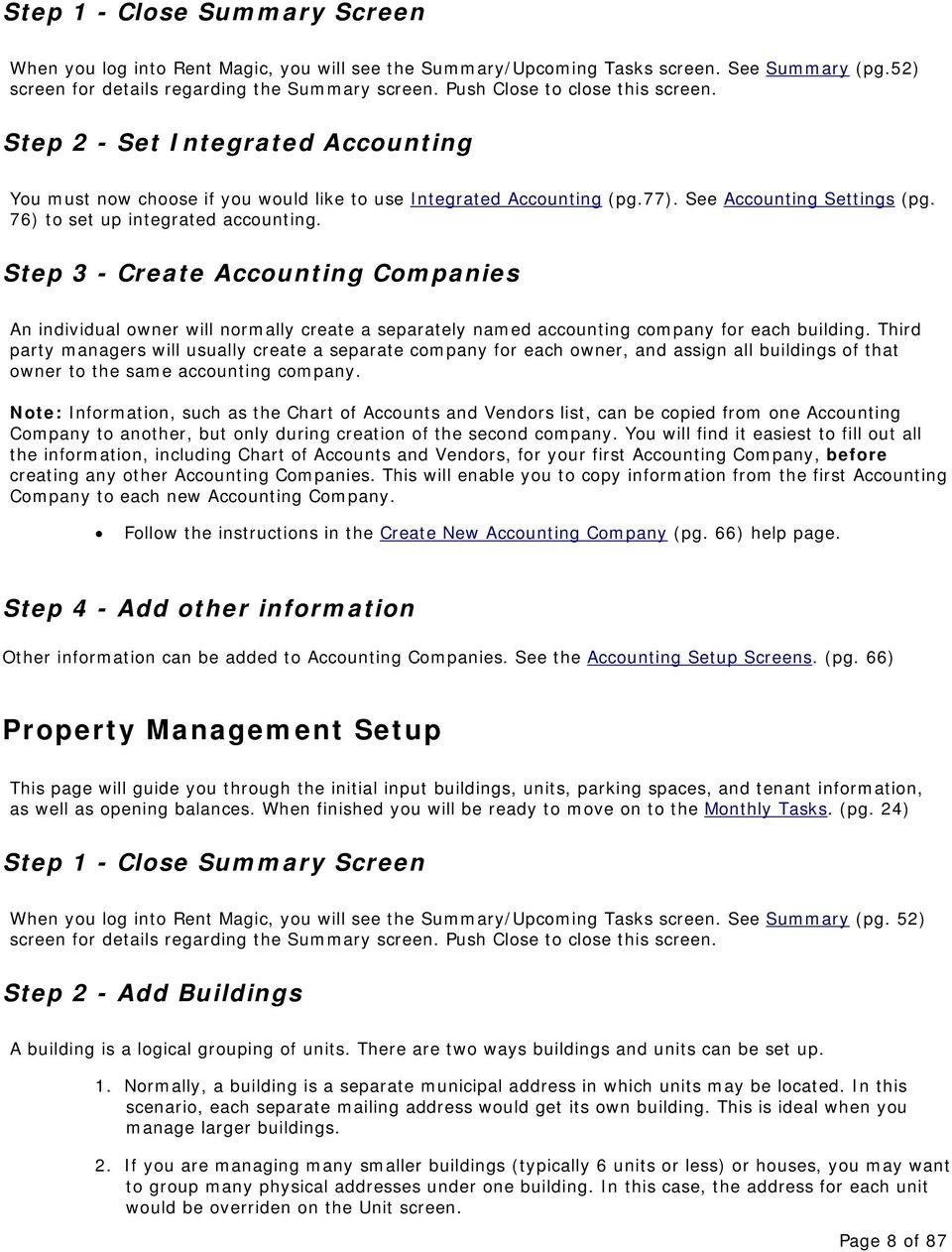
2 Table of Contents Rent Magic Documentation 1 Table of Contents 2 Getting Started 6 Quick Installation guide 6 Open Rent Magic, log in 7 Do you want to use Rent Magic's Accounting features? 7 Accounting Setup 7 Step 1 - Close Summary Screen 8 Step 2 - Set Integrated Accounting 8 Step 3 - Create Accounting Companies 8 Step 4 - Add other information 8 Property Management Setup 8 Step 1 - Close Summary Screen 8 Step 2 - Add Buildings 8 Step 3 - Add Units 9 Step 4 - Add Parking Spots 9 Step 5 - Move tenants into units 9 Step 6 - Opening Balances 9 Building Management 9 Add a new building 9 Edit an existing building 10 Building Address 11 Manager Information 11 Signature 11 Building Defaults 12 Rename a building 13 Delete a building 13 Add a unit 14 Edit an existing unit 14 Rename a unit 15 Delete a unit 16 Unit Information 16 Unit Features and Amenities 17 Add a new parking spot 18 Edit a parking spot 19 Page 2 of 87

3 Rename a parking spot 19 Delete a parking spot 20 Custom Monthly Charges 20 Appliances 21 Edit New or Existing Appliance 22 Work Orders 22 Tenant Management 24 What do you want to do? 24 Monthly Tasks 24 Actions with tenants 25 Non-financial actions 25 Move in a Tenant 25 Move a Tenant out 26 Move a Tenant Between Units 27 Batch Functions 28 Monthly Charges 28 Monthly Payments 29 Late Payment or N4 Notices 30 NSF Charges 31 Increase Notices 32 Apply Annual Rent Increase 33 Apply New Rents 34 Individual Financial Actions 36 Recurrent Transactions 36 Bonuses and Charges 36 Memorized Transactions 37 Transactions 38 Transactions screen 39 Opening Balances 40 Roommates 41 Other Notices 42 Open Tenant Information 43 Information about current tenants 43 Tenant Editor 43 Main Tenant Information 44 Other Tenant Information 45 Parking Information 47 Expiring Leases 47 Page 3 of 87

4 Subscreens 48 Occupant List 48 Tenant Account History 48 Transaction Editor 49 Occupant Details 50 Increase Information 51 Information about past/future/potential tenants 52 Summary 52 Pending Occupants 54 Future Tenants 55 Previous Tenants 56 Accounting 57 Accounting Functions Screens 57 Purchase Orders 57 Purchase Invoices 58 Payments 60 Deposits 61 General Journal 62 Bank Reconciliation 62 Accounting Subscreens 65 Ledger Details 65 General Ledger Details Subscreen 65 Deposit Items 66 Accounting Toolbar 66 Accounting Setup Screens 66 Create New Accounting Company 66 Choose Company 67 Company Information 68 Company Defaults 69 Chart of Accounts 71 Vendors 72 Jobs 74 Customers 75 Accounting Settings 76 Change Accounting Period 76 When should I use Accounting Periods 76 Set up opening or starting balances 77 Integrated Accounting 77 Page 4 of 87
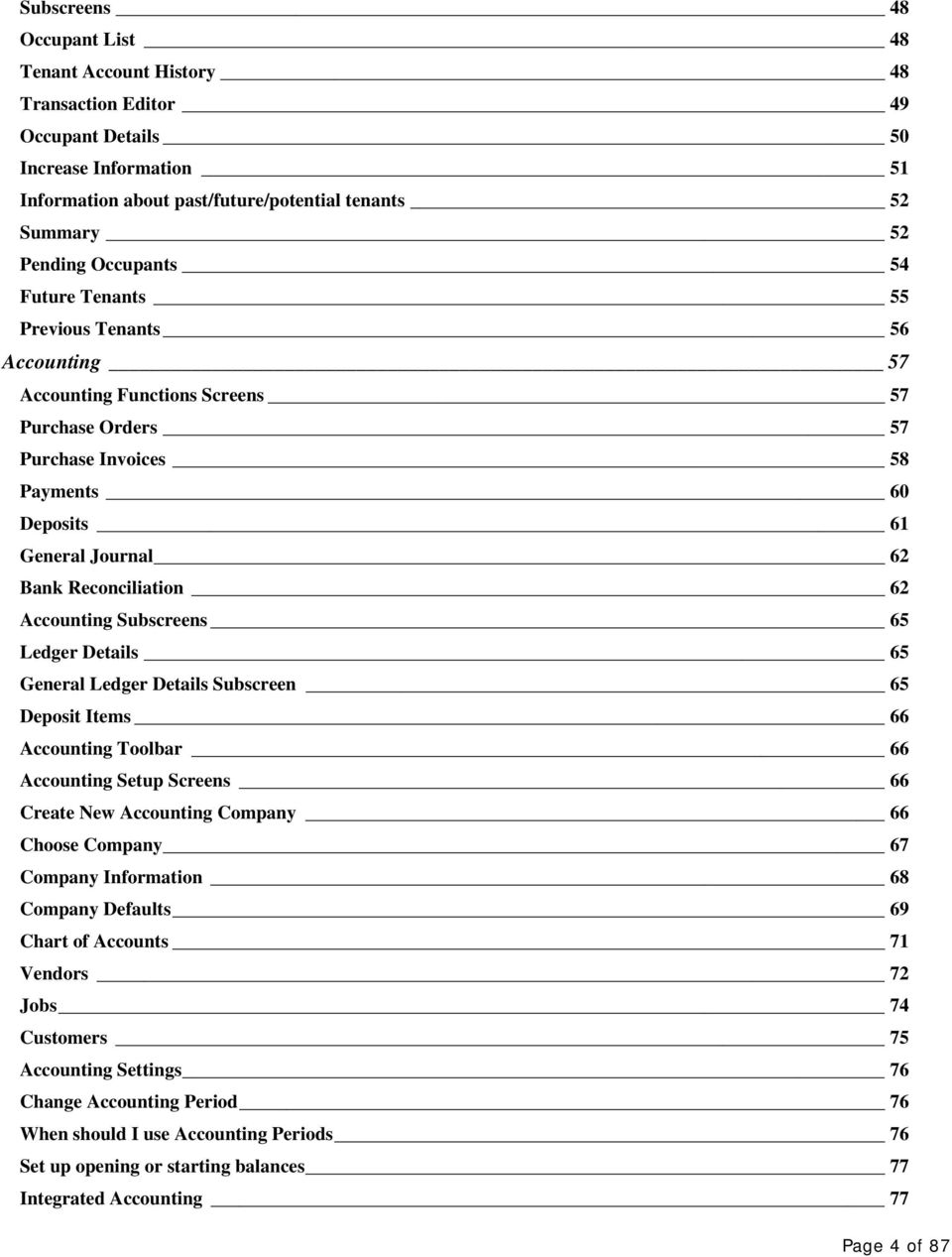
5 Reports 77 Step 1 Open the Reports screen 78 Step 2 Make your selections 78 Step 3 Generate the Report or Cancel 78 Other Items 79 Notes/Attachments subscreen 79 Templates 80 Attachment Editor 80 Word Processor 81 Networking Issues 82 I cannot connect to Rent Magic from another computer over the internet. 82 I cannot connect to Rent Magic from another computer on the network. 82 How do I find my computer name? 83 How do I allow Rent Magic through the Windows Firewall? 83 Appendix 83 Definitions 83 Government Guidelines 86 Internet Backup 86 LMR interest 86 Main Menu screen 86 Page 5 of 87

6 Getting Started Rent Magic will save you a lot of time with your property management, but first you need to tell Rent Magic all about your properties. This page directs you how to get started with Rent Magic. Quick Installation guide If you are installing from CD: o o Put CD into computer If the install screen comes up, skip to Run the Installer (this page) If you are using Windows XP or later: 1. Click the Start Menu, and select My Computer. 2. Double click the icon for CD drive which has the Rent Magic disk inside. 3. Double click the file, Loader. If you are using a previous version of Windows: 1. Click My Computer on the desktop. 2. Double click the icon for CD drive which has the Rent Magic disk inside. 3. Double click the file, Loader. If you are downloading the software from the internet: Please download the software from the link provided by Rent Magic. Run the Installer Click the icon on the top, "Install Rent Magic". Follow the installation instructions. If you are installing the server, see Installing the server.(pg.7) Push Finish Congratulations! You have successfully installed Rent Magic/ManageUDA Online. The information packet received with your copy of Rent Magic On-Premise/ManageUDA Online should contain the username and password for your account. Note that both are case sensitive. If you have lost this documentation, please contact Rent Magic Technical Support for recovery 1. If you would like to change the For security purposes, we do not publish the default usernames and passwords for Rent Magic on our website. Page 6 of 87
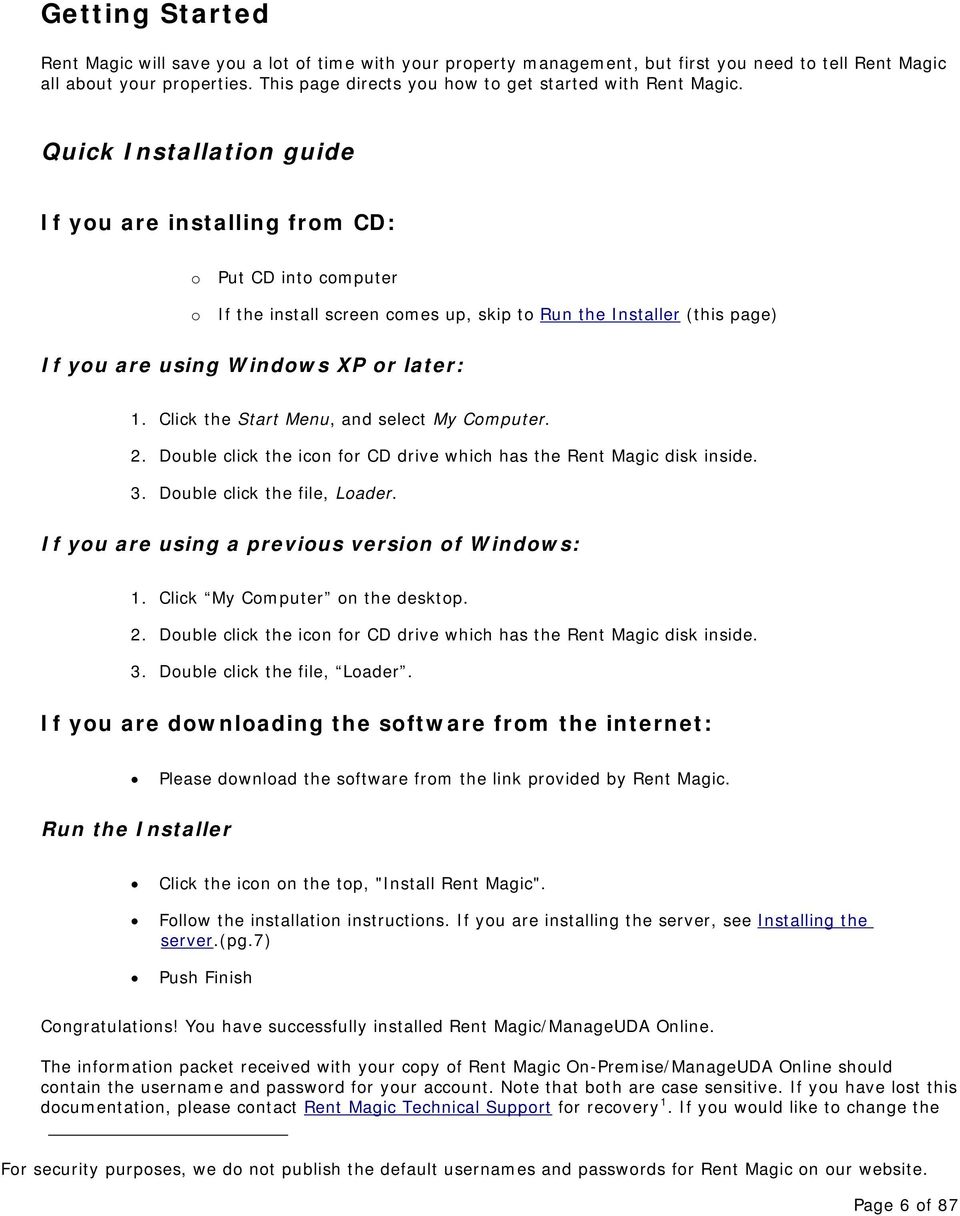
7 default username and password, read the section of documentation on Users and Permissions. When you enter Rent Magic, you will be presented with the login screen. If you are running on the server, ensure that the Local computer radio button is selected. If the Rent Magic data is stored on another computer on the network, select Remote Computer, and type in the computer name beside it. If you do not know the computer name, contact your network administrator. Type in your username and password, and click the checkboxes Save Info and Save Password. Finally, push Connect. You will now be in Rent Magic. You may view our online documentation here. You can also load this by going to going to Help and selecting Online Help from the menu bar. You may view training videos here. Server Installation Important: When installing on the server, you must check Rent Magic Server on the Components selection screen. When installing Rent Magic on the server, a screen will pop up called License Key & Activation Code. Click Activate Online to activate your product online. If you do not have an internet connection, call Rent Magic at or toll free at to manually activate your product. If this screen does not pop up, you must run the installation again, and ensure that you have checked Rent Magic Server on the Components selection screen. Open Rent Magic, log in After the installation process, there will be a Rent Magic icon on your desktop. Double click it to start Rent Magic. See Logging On? for information about logging on to Rent Magic. Do you want to use Rent Magic's Accounting features? Rent Magic has a full accounting module that can be completely integrated with Rent Magic's Property Management functions. When Integrated Accounting is turned on, transactions such as rent payments are automatically recorded in both the Property Management and the Accounting modules in the tenant history and the General Ledger, respectively. See Integrated Accounting (pg. 77) for more information. If Integrated Accounting is turned off, transactions only appear in the Property Management module, and cannot be later linked to an accounting company. All the Property Management features of Rent Magic will function normally. If you would like to use Integrated Accounting, you must set up accounting before entering any transactions. Accounting Setup This page will guide you through the initial entering of information regarding Accounting Companies, Charts of Accounts, Vendors, etc. After completing all this information, you will create buildings (pg. 8,9) and assign them to the Accounting Companies. Page 7 of 87

8 Step 1 - Close Summary Screen When you log into Rent Magic, you will see the Summary/Upcoming Tasks screen. See Summary (pg.52) screen for details regarding the Summary screen. Push Close to close this screen. Step 2 - Set Integrated Accounting You must now choose if you would like to use Integrated Accounting (pg.77). See Accounting Settings (pg. 76) to set up integrated accounting. Step 3 - Create Accounting Companies An individual owner will normally create a separately named accounting company for each building. Third party managers will usually create a separate company for each owner, and assign all buildings of that owner to the same accounting company. Note: Information, such as the Chart of Accounts and Vendors list, can be copied from one Accounting Company to another, but only during creation of the second company. You will find it easiest to fill out all the information, including Chart of Accounts and Vendors, for your first Accounting Company, before creating any other Accounting Companies. This will enable you to copy information from the first Accounting Company to each new Accounting Company. Follow the instructions in the Create New Accounting Company (pg. 66) help page. Step 4 - Add other information Other information can be added to Accounting Companies. See the Accounting Setup Screens. (pg. 66) Property Management Setup This page will guide you through the initial input buildings, units, parking spaces, and tenant information, as well as opening balances. When finished you will be ready to move on to the Monthly Tasks. (pg. 24) Step 1 - Close Summary Screen When you log into Rent Magic, you will see the Summary/Upcoming Tasks screen. See Summary (pg. 52) screen for details regarding the Summary screen. Push Close to close this screen. Step 2 - Add Buildings A building is a logical grouping of units. There are two ways buildings and units can be set up. 1. Normally, a building is a separate municipal address in which units may be located. In this scenario, each separate mailing address would get its own building. This is ideal when you manage larger buildings. 2. If you are managing many smaller buildings (typically 6 units or less) or houses, you may want to group many physical addresses under one building. In this case, the address for each unit would be overriden on the Unit screen. Page 8 of 87
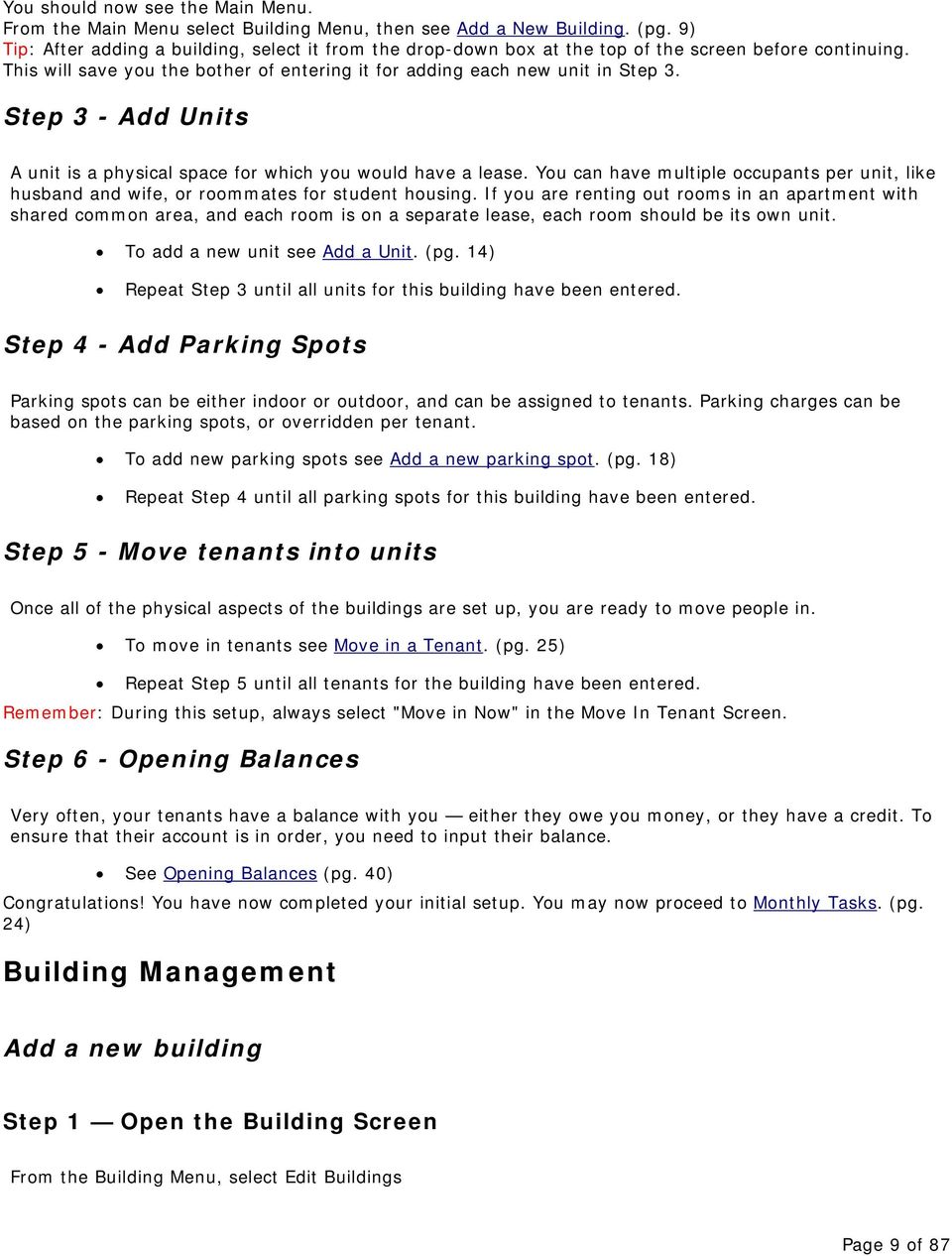
9 You should now see the Main Menu. From the Main Menu select Building Menu, then see Add a New Building. (pg. 9) Tip: After adding a building, select it from the drop-down box at the top of the screen before continuing. This will save you the bother of entering it for adding each new unit in Step 3. Step 3 - Add Units A unit is a physical space for which you would have a lease. You can have multiple occupants per unit, like husband and wife, or roommates for student housing. If you are renting out rooms in an apartment with shared common area, and each room is on a separate lease, each room should be its own unit. To add a new unit see Add a Unit. (pg. 14) Repeat Step 3 until all units for this building have been entered. Step 4 - Add Parking Spots Parking spots can be either indoor or outdoor, and can be assigned to tenants. Parking charges can be based on the parking spots, or overridden per tenant. To add new parking spots see Add a new parking spot. (pg. 18) Repeat Step 4 until all parking spots for this building have been entered. Step 5 - Move tenants into units Once all of the physical aspects of the buildings are set up, you are ready to move people in. To move in tenants see Move in a Tenant. (pg. 25) Repeat Step 5 until all tenants for the building have been entered. Remember: During this setup, always select "Move in Now" in the Move In Tenant Screen. Step 6 - Opening Balances Very often, your tenants have a balance with you either they owe you money, or they have a credit. To ensure that their account is in order, you need to input their balance. See Opening Balances (pg. 40) Congratulations! You have now completed your initial setup. You may now proceed to Monthly Tasks. (pg. 24) Building Management Add a new building Step 1 Open the Building Screen From the Building Menu, select Edit Buildings Page 9 of 87
10 Step 2 Select Add New If you have not exceeded your building license limit, the from the first drop down box, select <Add New...>. Step 3 Type in new Building Name, then click on the Next button In the bottom Edit box, type in the name you would like to call your building. This is an internal name only. Step 4 Press Next Press Next to advance to the Building Information screen. Step 5 Set Building Information There are three subscreens for editing building information: o Building Address (pg. 11) o Manager Information (pg. 11) o Building Defaults (pg. 12) Step 6 Save or Cancel Press Save to save the edited information and exit. Press Cancel to cancel changes and exit. Edit an existing building Step 1 Open Edit Buildings screen From the Building Management menu, select Edit Buildings Step 2 Select building to be edited Select the building from the drop down list. Step 3 Click on Next To edit the building information, press "Next" Step 4 Edit building information Building information is spread over three subscreens: Building Address (pg. 11) Page 10 of 87
11 Manager Information (pg. 11) Building Defaults (pg. 12) When you finish editing the first screen, jump to the others and edit them in turn. Step 5 Save or Cancel To save the edited information, click Save. To cancel changes, press Cancel. Building Address On the first page, Building Address, type in the building address and the superintendent information. At the bottom of the screen, there is a section where optional Notes or Attachments can be added to the building information. For more information on this, see Notes and Attachments List. (pg. 79) Manager Information Enter the manager information, except for the signature, into the relevant boxes. Note: To enter a Signature into Rent Magic, you must have the signature already saved as a picture file on your computer. See Signature (pg. 11) for more details. For the signature, click within the signature box. This will open a new window. Locate the file on your computer with the saved signature, select it, and press OK. Note: The Title, Signer Name, and Signature on this screen are what Rent Magic will print on legal forms. Signature This page explains how to prepare the Manager's signature for addition into Rent Magic, assuming that you have access to a scanner. Note: Each scanner has its own software interface. You may need to read your scanner's documentation to complete the steps below. 1. Pre-Scan a page that is blank except for the signature. 2. Create a box (for cropping) around the signature. This box should be made as small as possible while containing the whole signature. 3. Scan this box, saving it as a file on your computer, in JPEG or GIF format. You will need to remember the location of this file to add the signature to Rent Magic. 4. After adding the signature into the Manager Information (pg. 11) in Rent Magic, you may delete this scanned file. Notes: If you create a box for cropping that is larger than necessary, then the signature will appear shrunken and misplaced in the Signature box in Manager Information (pg. 11) and on all forms. Page 11 of 87

12 If the signature is especially short or long, then it may appear compressed in the Signature box; however it will appear correctly on all forms. Building Defaults Field Definitions Increase rent yearly by is the default rent increase amount. For 2006, the increase rate in Ontario is 2.1%. For 2007, the increase rate in Ontario is 2.6%. Automatically decrease rent by is the default amount tenants' monthly rents will be decreased from the maximum rent set in Main Tenant Information. (pg. 44) Round lets the rent be rounded. NSF Check is the default amount charged on an NSF Check when done through the "NSF Charges" menu. LMR Action: If you must pay interest on tenant Last Month Rent (security deposit), this field explains what to do with the interest. These actions take place when Apply New Rents are applied in Batch Mode. Field Options Explanation None Increase LMR Issue Credit Issue Check Choose this option if you do not pay interest on LMR deposits This transfers all the interest to the tenant's LMR deposit This transfers some interest to tenant LMR deposit to have deposit equal tenant's increased rent, and applies all remaining LMR interest as a credit in the month on rent increase. This transfers some interest to tenant LMR deposit to have deposit equal tenant's increased rent, and issues a check to the tenant for the remaining LMR interest. LMR Interest Rate is the amount of interest that will be paid on the last month's rent is set. You can have accuracy to 4 decimal places. Setting LMR Letter If an LMR action other than None is selected, then a letter to tenants, explaining what action has been taken with their LMR interest, is generated. If you do not want a tenant letter do not click Change and select a template letter. To choose which template to send with the LMR actions: 1. Click the Change' field next beside the action for which you would like to change the letter. 2. Click the template. 3. Click Select at the bottom. Default Action This field tells Rent Magic what to do with the automatically generated LMR letter. Options Save and Print Explanation This will save a copy of the letter generated to the tenant file, and then print the letter. Page 12 of 87

13 Just Save This will save a copy of the letter generated to the tenant file, but will not print a letter. Default Accounting Company From the dropdown box select the accounting company for this building. The accounting company must already have been created. See Create New Accounting Company. (pg. 66) If you do not want to link the building to an accounting company select None. The integrated accounting will thus NOT be enabled. Use Defaults from Accounting Company The accounting company has been assigned default accounts for Bank, Rental Income, LMR Holding Account etc. See Company Defaults. (pg. 69) To use these default accounts for this building make sure the box is checked. If for some reason you do not want to use the accounting company defaults for this building, uncheck the box. Save or Cancel To save all your changes, press Save. If you want to revert, press Cancel. Rename a building To rename a building, simply follow the following steps: 1. From the Building Management menu, or the Building Menu screen select Edit Buildings 2. Right click the building name, and click Rename' 3. Type in the new name of your building. 4. Press OK Note that the these building names are internal to Rent Magic, and will not appear on any forms. Delete a building Warning: this cannot be undone!! To delete a building, simply follow these steps: 1. From the Building Management menu, select Edit Buildings 2. Select from the building you would like to delete. 3. Click the Delete button next to the drop down box. 4. Click "Yes" to confirm the deletion. Page 13 of 87

14 Add a unit Step 1 - Go to Edit Units menu Select Edit Units from the Building Management menu. Step 2 - Select a building Select the building to which you would like to add a unit. Step 3 - Select <Add New...> If you have not exceeded your unit license limit, the from the second drop down box, select <Add New...> Step 4 - Enter the unit number or name In the box below type in the number or name of the unit you wish to add; numbers and letters may be used. Step 5 (optional) - Copy existing unit's information Many times the new unit being added will have the same information as an already created unit. It may be more convenient to copy the previously created unit's information to the new unit. From the lower drop down boxes, select the building and unit from which the unit's information will be copied, then select Next. Step 6 - Set Unit Information See Unit Information (pg. 16) screen to set the unit's information. Step 7 - Save Select and click Save - The inputted information will only be saved is Save is selected. Edit an existing unit Step 1 Select Edit Units from the Building Management menu. Page 14 of 87

15 Step 2 Select the building to which you would like to add a unit. Step 3 Select the unit which you would like to edit. Step 4 After selecting the unit, press Next. See Unit Information (pg. 16) for information on editing the unit's information. Rename a unit Step 1 - Open Unit Information Screen From the Building Management menu, select Edit Units Step 2 - Select Building Select the building from the drop down menu Step 3 - Select Unit Select the unit you would like to rename. Step 4 - Right click Right click the unit name, and click Rename. Step 5 - Type in new unit name Type in the new name you of your unit. Press OK The unit is now renamed! Page 15 of 87

16 Delete a unit Note: This cannot be undone! Step 1 - Units Screen From the Building Management menu, select Edit Units Step 2 - Select Building Select from the building in which the unit is located. Step 3 - Select Unit Select the unit you would like to delete. Step 4 - Click Delete Click the "Delete" button next to the drop down box. Step 5 - Click Yes Note: this cannot be undone! Click Yes to confirm the deletion. The unit is now deleted. Unit Information Step 1 Style Select # bedrooms or style from drop-down box. If Commercial, Retail, Industrial, or Office is selected, any tenants in this unit will be commercial tenants. Otherwise, they will be residential. Step 2 Other optional fields Area of unit Balconies Input the area of the unit here. You may also select the measurement type, square feet or metres. Buildings with commercial units will use this field for CAM charges. Enter the number of balconies this unit has. Page 16 of 87

17 Bathrooms Enter the number of bathrooms for this unit. Estimated Rent Enter the current estimated rent; this is use for vacancy loss. Step 3 Amenities and Included Select which Amenities this apartment contains, and what is included in the rent. To edit the Unit Features and Amenities lists - click the link titled Unit Features and Amenities on the right. See the Unit Features and Amenities (pg. 17) for more information. Current Tenant with Balance is displayed on the upper right. Edit Tenant - This is a shortcut to the Tenant Information screen for this unit. Step 4 Address At times the addresses for units is not the same as the "building" address. For example in a mobile home development you may want to consider the whole development as one "building". There may be different street address with different postal codes for individual units. The specific postal address may be set here so that all forms and letters will have the correct mailing address of the tenant. The reports though, will still show the coding for the unit number which was previously entered. Select Address and the Unit Address sub screen is accessed. The address is defaulted to the building address entered previously. To over-ride the default unit address in situations as discussed above, unclick the box and enter the full address you want for the unit. Step 5 Notes and Attachments Subscreen Select Notes, Attachments, Work Orders/Tasks, Appliances or Payments to view The Work Orders/Tasks, Appliances and Payments screen show items in each of the above categories that are linked to this unit. To add a new note or attachment, click on the Add button. Step 6 Click Save To save the information inputted, click Save or push enter. To cancel changes, click Cancel or push escape. Unit Features and Amenities Editing, Adding, and deleting unit Amenities and Included. Amenities are special unit features which you want to make note of. Included are those items included in the rent. Unit Features and Amenities Screen From Building Management on the top line select Unit Features Page 17 of 87
18 Edit An Entry To edit an Amenity or Included entry click on the entry and edit Push Save to save your changes. Delete an entry To delete an Amenity or Included entry click on the entry to highlight, then click Delete. Move an entry up or down in the list To move an Amenity or Included entry up or down in the list, highlight the entry then push Up or Down as required. Add an item Scroll down to the bottom of the list to which you would like to add an item. Click on Click to add new at the bottom of the list and enter the new item's name. Add a new parking spot Step 1 Parking Editor From Building Menu select Parking Editor Step 2 Select Building Select the building from the drop-down box Step 3 Select <Add New...> The second drop-down box displays all created parking spots - create new spots by selecting <Add New > Step 4 Name the spot Name of Parking spot - assign a name to a specific parking spot such as 1, 2,3,4, etc., or edit the name. Step 5 Advance See Edit a Parking Spot For information on editing parking spots. Page 18 of 87
19 Edit a parking spot Open Parking Editor From the Building Management menu, select Parking Editor Select Building and Unit 1. From the building drop down box, select the building for the parking spot you would like to edit. 2. From the parking drop down box, select the parking spot you would like to edit. Set Fields Make your choices for these fields: Field Name Price Price included in rent Location Delete Description assign a price to the parking spot. This may be changed when the parking spot is assigned to a tenant. See Tenant Editor for information on assigning a parking spot to a tenant. Check if the price of this parking spot is included in the rent. This is the same box as in the Main Tenant Information Screen. The choices are Indoor and Outdoor. Use the drop-down box and select the appropriate choice. This allows you to delete the selected parking spot. Save or Cancel To save the edited information, click Save. To cancel changes, press Cancel. Rename a parking spot Step 1 - Open Parking Editor Screen From the Building Management menu, select Edit Parking Step 2 - Select Building Select the building from the drop down menu Step 3 - Select Spot Select the spot you would like to rename. Page 19 of 87

20 Step 4 - Right click Right click the spot name, and click Rename. Step 5 - Type in new spot name Type in the new name you of your spot. This is an internal name only. Press OK The spot is now renamed! Delete a parking spot Step 1 - Open Parking Editor Screen From the Building Management menu, select Edit Parking Step 2 - Select Building Select the building from the drop down menu Step 3 - Select Spot Select the spot you would like to delete. Step 4 - Select Delete To delete the spot click Delete Press Save The spot is now deleted! Custom Monthly Charges There are three built-in types of monthly charges: Rent Charge, Parking Charge, and Other. In this screen you may create other types of named monthly charges for the whole building, which will show up on the Main Tenant Information (pg. 44) screen. Step 1 Enter Monthly Charges screen From Building Management in the menu bar (pg. 85) select charges to enter the Monthly Charges screen. Step 2 Add new Monthly Charge From the drop-down box select Add New. Page 20 of 87

21 Step 3 Name new custom monthly charge In the box Name of Charge enter the name of the new custom monthly charge. Step 4 Select the charge's defaults Check the appropriate boxes below if you want to: Include this charge in the tenant s LMR Default to increase this charge by the building default. Otherwise this charge will not be automatically increased. Include this charge in increase notices. Make a separate transaction on the tenant ledger. This will create a separate entry charge in the tenant account history. Otherwise the charge will be added to and included in the rent charge. Note: When you check the "Make a separate transaction" checkbox, two drop-down boxes appear. Select the account that this transaction will be debited from, and the account it will be credited to. Accounts are given by a name; these names, and the number in the Chart of Accounts to which each corresponds, are set in Company Defaults. (pg. 69) Set advanced options If this charge is a percentage of rent (for example, taxes), click on Advanced Options, and specify the tax amount. Currently, GST is 6.00%. Step 5 Save or Cancel Press Save to save the new Monthly Charge. Press Cancel to cancel changes. Appliances Step 1 - Open the Appliance screen From the top menu bar, (pg. 85) select Building Management, then Edit Appliances. Search currently installed appliances You can search the list of currently installed appliances by selected selecting a building, unit, and appliance type. Edit an existing appliance. Double click an appliance to edit the appliance. See Edit New or Existing Appliance (pg.22) for details on how to fill in the appliance information. Page 21 of 87
22 Delete an appliance Note: This cannot be undone! 1. Select the appliance you would like to delete. 2. Push the Delete button on the bottom. 3. When prompted, push Yes. Add a new appliance Click the Add New button in the bottom right. See Edit New or Existing Appliance (pg. 22) for details on how to fill in the appliance information. Click Save To save your changes, click Save. Edit New or Existing Appliance Step 1 - Fill in appliance information In the Inventory Item screen fill in the various fields. To assign the appliance to a unit select Change Location on the bottom right. Select Yes to the question, "Are you sure you would like to move this item out of its current building/unit?" This will also be used to move or put into storage appliances currently assigned to units or storage. Step 2 - Select location In the Select Building & Unit screen select a building and unit or check Discarded to discard the appliance. To put an appliance into storage check "Put in storage for interval". Step 3 - Click OK Press OK to save your selection, press cancel to cancel your changes. Work Orders Step 1 - Opening the Work Orders window From the Main Menu select the Work Orders function Page 22 of 87
23 Step 2 - Select/create a Work Order or Todo To view an existing work order/todo, click on it to highlight it, and then click the View button. To create a work order/todo, click on the Add New button, then select either New Work Order or New Todo. Step 3 - Editing the fields You may edit any of the fields on this page, by typing in the information or by using the drop-down boxes, as appropriate. Name Brief Description Other information How to assign Date Reported Date that the problem was reported to management Select from dropdown box calendar. Date Assigned Date that management assigned the Work Order/Todo Select from dropdown box calendar. Target/Due Date The expected completion date Select from dropdown box calendar. Date Completed The actual completion date First check the checkbox, then select date from drop-down box calendar. Work Order Number You may assign a number to a Work Order. Click within the box, then type. Building, Unit The building and unit respectively. If a unit is selected, then the Primary Tenant Info will be shown in the upper right. Select first building then unit, from the drop-down boxes. Priority - Select from the drop-down box. % Complete Estimated percent completion of the Work Order/Todo. The default is 0. You can update this field at any time. Click within the box, then type. Contact The person or company assigned to this Work Order/Todo is the Contact. Contacts must be previously defined. See Contacts?. After selection, the Contact's information will be shown. Select from the drop-down box. Job A Work Order may be assigned to a previously created job. See Jobs (pg. 74) for further information Select from the drop-down box. Comments Any comments you wish to add; for example, a description of the work to be done Text may be added at any time to the comments field. Click within the box, then type. Appliances If the Work Order/Todo involves appliances click on Appliances. (pg.21) Various appliances may then See Appliances (pg. 21) for more details Page 23 of 87
24 be removed, added, moved, or repaired. Step 4 - Saving/Cancelling or Printing To print the edited work order, click on the Print Work Order button. Press OK to save your changes, or Cancel to cancel them. Tenant Management What do you want to do? Move in a new tenant (pg. 25) Move out an existing tenant (pg. 26) Move a tenant between units (pg. 27) Charge monthly rents to all tenants (pg. 28) Apply tenant payments (pg. 29) Send rent increase notices (pg. 32) Apply new rents increases and LMR (pg. 34) Add a manual transaction (pg. 38) Memorize a transaction (pg. 37) Enter Opening Balances (pg. 40) Monthly Tasks We recommend the following schedule. We recommend to spread out your tasks over the course of the month so you don't feel a crunch at the end of the month. Day of month Function Description 1st-3rd 3rd-4th Various Middle of the month Middle of the month Near the end of the month (23rd) Near the end of the month (23rd) Monthly Payments (pg. 29) Late Payment or N4 Notices (pg. 30) NSF Charges (pg. 31) Increase Notices (pg. 32) Apply New Rents (pg. 34) Move a tenant out (pg. 26) Move in a tenant (pg. 25) Input, in batch mode, tenant rent payments When tenants have not paid rent, it is important to send them notice as soon as possible to speed up rent collection. If any cheques come in that are NSF, you must tell the system about them. According to the ORHT, you must send a notice of a rent increase at least three months in advance to the tenant. For all tenants whose rent who were sent rent increase notices, you must tell the system to actually increase their rent the month before. Any tenants moving out at the end of the month should be moved out. Any tenants moving in at the end of the month or the beginning of next month should be moved in. Page 24 of 87
25 At the end of the month (28th) Monthly Charges (pg. 28) Charge all tenants their monthly charges. Actions with tenants Non-financial actions Move in a Tenant This is where you tell Rent Magic that a tenant will move into a unit. Actual possession (or the start of the lease, if applicable) can take place immediately, or at some point in the future (see Step 3b, future movein). To move in an already-recorded applicant, see Moving In a Pending Occupant in the Pending Occupants (pg. 54) help page. Note: Future move-ins must be confirmed on their effective dates; this changes the tenant's status from "future tenant" to "current tenant." You can confirm a previously set up future move-in from the Summary (pg. 52) screen. Step 1 - Move In Screen From the Tenant Management menu, select Move In Tenants. Step 2 - Select Building From the first drop down box, select into which building the tenant is moving. Step 3 - Select date of Move in Is the tenant moving in immediately, or at some future date? Step 3a - Move in Immediately Choose this if the tenant has possession of the unit effective immediately. Note: For initial setup of Rent Magic, choose Move in Immediately. Ensure that Move in Now is selected. Step 3b - Setting up a future move in Choose this if the tenant will take possession of the unit on some future date. This tenant will be a "Future tenant" and can be accessed only through the Future Tenants (pg. 55) or Summary (pg. 52) screens, until actual possession is confirmed (through the Summary (pg. 52) screen). Select Move in on. Page 25 of 87
26 Select the date on which the tenant will take possession of the unit, from the drop-down calendar below Move in on. If the unit is currently occupied, check the Show units currently occupied checkbox. Step 4 - Select the unit Select the unit into which the tenant will move. Step 5 - Set pro-rating arrangements Select which tenant charges you would like to be pro-rated for the month of move in. Note: If you set the tenant's lease start date during Step 7 below, then the selected charges will be prorated from that date instead of the tenant's move-in date. Step 6 - Push Next Press Next. Step 7 - Advance See Steps 5 and 6 of Tenant Editor (pg. 43) for instructions on editing tenant information. Move a Tenant out Note: If you have already set up a future move out, and would like to apply it now, do so from the Summary (pg. 52) screen. Step 1 - Tenant Editor screen From the Tenant Management menu, select Tenant Editor Step 2 - Select building of tenant From the first drop down box, select the building which the tenant currently occupies. Step 3 - Select a tenant's unit Select the unit the tenant occupies. Step 4 - Press Move Out Press the Move Out button. Page 26 of 87
27 Step 5 - Move out now or later To move out the tenant immediately, select Move out now To move out a tenant on a future date: o o Select Move out on Select the date on which to move out the tenant Step 6 - LMR Credit Action If you would like to Rent Magic to automatically give a credit and/or send a letter to the tenant about their LMR Credit, select the chosen action from the drop down box. To add the LMR Interest for the past year, check Add LMR interest to date', and select until which month the credit should be calculated If you would like to send the tenant a letter, click Change' o o o Select which template you would like to use for the letter Press Select' at the bottom To add your own or change existing templates, see Templates Step 7 - Press OK Press OK to move the tenant out. Confirm by pressing Yes. Move a Tenant Between Units Note: If you have already set up a future move out, and would like to apply it now, do so from the Summary (pg. 52) screen. Step 1 - Tenant Editor screen From the Tenant Management menu, select Tenant Editor Step 2 - Select building of tenant From the first drop down box, select the building which the tenant currently occupies. Step 3 - Select a tenant's unit Select the unit the tenant occupies. Page 27 of 87
28 Step 4 - Press Move Unit Press the Move Unit button. Step 5 - Select new building and unit From the drop down boxes, select the new building and unit for this tenant. The unit must currently be vacant. See Move a tenant out (pg. 26) if the unit does not show up in the drop down list. Step 6 - Press OK Press OK to move the tenant. Confirm by pressing Yes. Batch Functions Batch functions let you process many/all of your tenants at once. Monthly Charges Step 1 - Monthly Charges screen From the Tenant Management menu, select Batch Mode Functions, and select Monthly Charges. Step 2 - Select buildings From the list of buildings, select which buildings you would like to charge. You can select more than one by holding the CTRL button while you click. To select all buildings, press the Select All checkbox. Step 3 - Review Last Charge Date To make sure monthly charges are not inadvertently charged more than once, Last Charge Date displays the date that Monthly Charges were last performed for the specified building. Step 4 - Select date of charge In the date field, type in the date you would like the charges to occur. It is defaulted to the first of the upcoming month. Note: If the date of charge is not after the last charge date of all selected buildings, Rent Magic will ask you to confirm if you would like to perform the charges. Page 28 of 87
29 Step 5 - Select Print Rent Rolls (optional) If you would like to now print out a rent roll for each of the buildings after the charges are done, select the Print Rent Rolls checkbox. The rent rolls can be printed from reports at any time. See Reports. (pg. 77) Step 6 - Press Go Warning: Press Go only once! To perform charges on the selected building, press Go. Monthly Payments The monthly payments screen allows you to quickly and easily input many payments at once. Step 1 - Monthly Payments screen From the Tenant Management menu, select Batch Mode Functions, and select Monthly Payments Step 2 - Select building In the top left, select the individual building, or All Buildings, for which you would like to make payments. Only tenants with balances will show up on this screen. To do individual transactions, see the Transactions screen. (pg. 39) Step 3 - Set Default Date The default date of the Date of Payment column is the first of the current month. Use the dropdown calendar box to change the Date of Payment date default. Step 4 - Select which tenants have paid Select All or Select None allows you to check or uncheck all of the units with one click. Tenants who currently have a balance are listed. If a tenant has given a payment, ensure they are checked. If they have not paid, remove the check. You may edit the fields, Date of Payment, Rent Paid, and Rent Paid Type. Field Date Default First of the current month Rent Paid Total tenant balance Page 29 of 87
30 Paid Type Cheque New Balance displays the balance remaining after the current rent payment. Step 5 - Press Apply Payments Press Apply Payments, and Yes to the confirmation dialog. Print Deposit Slips - clicking this provides a shortcut to the printing of Bank Deposit Slips in Reports. (pg. 77) Late Payment or N4 Notices The Late Payment and N4 Notices lets you easily send late payment notices and/or N4s to tenants in arrears. Step 1 - Open the Late Payment Notices Screen From the Tenant Management Menu select Batch Functions, then select N4 Notices. Step 2 - Select Building From the building combo box in the top left, select for which building you would like to send notices. To show all tenants in arrears from all buildings, select [All Buildings]. Step 3 - Balance filter Only tenants with balances more than you type in will be shown. Step 4 - Item to Send From the drop-down box select to send an N4, a letter, or both. Step 5 - Letter to Send & Change The present default letter to send is highlighted. To change the default letter click Change and from the Templates menu highlight an entry and click Select. For more information see Templates. (pg. 80) Step 6 - Number of Copies You may enter the number of copies to be printed. The default is one. A copy will always be stored on the system. Page 30 of 87
31 Step 7 - Log entry If you would like to save the generated notice, ensure that Log Form is checked. Put log entry in specifies where the N4 will be saved, either in Pending Forms or the Tenant File. Usually, N4s are stored in Pending Forms temporarily, until the N4s to be acted on are transferred to the Tenant File, and those not acted on are deleted. Step 8 - Select tenants Check those tenants to be issued N4s/Letters by ensuring the box beside the Apartment number is clicked. Select All will insert a checkmark in all boxes. Select None will erase all checkmarks. Step 9 - Print or Preview To print click Print To Preview click Preview Note: Preview will be very slow for multiple N4 previews Step 10 - Close When finished click Close NSF Charges The monthly charges screen allows you to easily set an existing cheque as NSF. The tenant account is automatically debited for the amount of the cheque and a NSF service charge may be added. Step 1 - Opening the NSF Charges screen From the Tenant Management menu, select Batch Mode Functions, and select NSF Charges. Step 2 - Select building In the top right, select the building for which you would like to set cheques as NSF. Step 3 - Select tenant's NSF Cheques In the top list, select for which tenants you would like to set NSF Cheques, and check them off. In the bottom list, select which payments were NSF. Page 31 of 87
32 Step 4 - Set NSF charge/amount (optional) To override the building default NSF Charge, the NSF Amount or the transaction date for an individual tenant, just type in the new values in the appropriate fields. Step 5 - Select N4 and log action At the top of screen: Select the N4 action you would like to perform: Preview, Print, or None. Type in the number of copies you would like to print; if you type in 0, it will still be saved to the tenant file. Choose where you would like to log the N4 (if you choose to make one) in the tenant file, or in pending forms. See Pending Forms for more information. Decide if you would like to log the actual N4 generated by Rent Magic: if so, check the Log Form checkbox. Step 6 - Press Apply Charges Press Apply Charges to apply charges to the selected tenants. Increase Notices The Increase Notices screen lets you easily set the new rents and produce N1 notices. Step 1 - Opening the Increase Notices and N1 screen From the Tenant Menu select Batch Functions, then select Increase Notices. Step 2 - Select buildings From the list of buildings, select which buildings you would like to charge. You can select more than one by holding the CTRL button while you click. To select all buildings, press the Select All checkbox. Step 3 - Select Month From the drop-down Month box select the increase month. The default is four months in advance. Step 4 - Fill in various fields Log form and information that Rent Magic generates - this tells Rent Magic whether to keep a copy of the N1 generated. It is defaulted checked. Number of Copies - fill in the number of printed copies desired the default is one. Page 32 of 87
33 Put long entry in - The drop-down box has two choices: Tenant File and Pending Forms. Pending Forms is not usually used for N1s. The default is Tenant File. Step 5 - Select units You will see a list of units whose increase month is the selected month. The columns displayed are Apartment, Last Name, charges of Rent, Parking, Other, and Total. Charges have been calculated as per the building defaults for the Increase Month. Select the units that you want to generate a rent increase notice for. You can check or uncheck ALL apartments. Step 6 - Over-riding the Building Defaults Double-clicking a tenant opens the tenant's Increase Information (pg. 51) screen. See Increase Information (pg. 51) for details on changing the information on this screen. Step 7 - Preview or Print When finished Select either Preview or Print. Note: Preview will be very slow for multiple N1 previews. Apply Annual Rent Increase To apply the annual rent increase for all tenants whose Rent Increase Month is the coming month, simply run the batch function Apply New Rents. (pg. 34) You can also send tenants a rent increase notice in advance of the increase. See Increase Notices (pg. 32) for more details. Note: The Apply New Rents (pg. 34) function for a given month must be run before the rents are charged for that month but after the rents were charged for the prior month. Step 1 - Open the Rent Increases screen From the Main Menu screen (pg. 86) select Tenant Menu, then select Batch Functions, then select Apply New Rents. Step 2 - Select a building From the drop-down list of buildings, select the building for which you would like to do the update. Step 3 - Select Month From the drop-down Month box select the increase month. The default is the upcoming month. Page 33 of 87
34 Step 4 - Number of Copies - of printed letter to tenant This number represents the number of copies of the LMR action letter to be printed, for those tenants whose chosen action in Increase Information (pg. 51) is to Save and Print (see also Building Defaults (pg. 12)). Type in the desired number. The default is one. Step 5 - View the generated list A list of all tenants whose Rent Increase Month is your selected month is presented. The columns displayed are Apartment, Last Name, and the new values of the charges Rent, Parking, Other, and Total, as determined either by Building Defaults (pg. 12) or by an individual tenant's Increase Information. (pg. 51) Step 6 - Modify tenant list (Optional) Checking/unchecking the box to the left of a tenant will select/unselect that tenant, respectively. You may select or unselect all tenants at once by clicking on the Select All or Select None link at the bottom of the screen. Step 7 - Override Building Defaults (Optional) Double-click a tenant to open tenant's Increase Information screen. You may change any of the settings there. Step 8 - Click Apply When satisfied with all entries click Apply. You may now select another building. For each tenant selected, a copy of the LMR action letter is saved to the Correspondence list in the tenant's Other Information. (pg. 45) See LMR interest (pg. 86) for more details. Step 9 - Close Click Close to close this screen. Apply New Rents The Apply New Rents screen lets you easily apply to the Tenant file the new rent to be charged for the next 12 months and apply the updated LMR. Depending on the LMR action selected in Building Defaults or tenants' Other Information, a credit may be automatically made in the Tenant Account History and a letter regarding the LMR increase and LMR interest may be generated. The timing to do Apply New Rents is crucial. It must be done before the rents are charged for the increase month but after the rents were charged for the prior month. Page 34 of 87
35 Step 1 - Open the Rent Increases screen From the Main Menu screen (pg. 86) select Tenant Menu, then select Batch Functions, then select Apply New Rents. Step 2 - Select a building From the drop-down list of buildings, select the building for which you would like to do the update. Step 3 - Select Month From the drop-down Month box select the increase month. The default is the upcoming month. Step 4 - Number of Copies - of printed letter to tenant This number represents the number of copies of the LMR action letter to be printed, for those tenants whose chosen action in Increase Information (pg. 51) is to Save and Print (see also Building Defaults (pg. 12)). Type in the desired number. The default is one. Step 5 - View the generated list A list of all tenants whose Rent Increase Month is your selected month is presented. The columns displayed are Apartment, Last Name, and the new values of the charges Rent, Parking, Other, and Total, as determined either by Building Defaults (pg. 12) or by an individual tenant's Increase Information. (pg. 51) Step 6 - Modify tenant list (Optional) Checking/unchecking the box to the left of a tenant will select/unselect that tenant, respectively. You may select or unselect all tenants at once by clicking on the Select All or Select None link at the bottom of the screen. Step 7 - Override Building Defaults (Optional) Double-click a tenant to open tenant's Increase Information screen. You may change any of the settings there. Step 8 - Click Apply When satisfied with all entries click Apply. You may now select another building. For each tenant selected, a copy of the LMR action letter is saved to the Correspondence list in the tenant's Other Information. (pg. 45) Page 35 of 87
36 Step 9 - Close Click Close to close this screen. Individual Financial Actions Recurrent Transactions There are three methods for setting up recurrent transactions for tenants. One creates a new charge type, with a name of your choice, for every tenant in a building. The amount of the charge is then entered for each tenant separately. The other two methods create a recurrent transaction for an individual tenant. With one method, the given transaction is done automatically repeatedly by Rent Magic; with the other, Rent Magic gives you a reminder and you select to apply the given transaction. In either case, the transaction may be a credit or a debit, and it may repeat a fixed number of times, until a specific date, or indefinitely. The building-wide method is called Custom Monthly Charges. See Custom Monthly Charges. (pg. 20) The automatic method for an individual tenant is called Bonuses/Charges. See Bonuses and Charges. (pg. 36) The reminder method for an individual tenant is called Memorized Transactions. See Memorized Transactions. (pg. 37) Bonuses and Charges Step 1 In the Main Tenant Information screen select Bonuses/Charges and click. Step 2 In the Tenant Bonuses screen select the Add Bonus/Charge box on the bottom. Step 3 In the New Todo screen which comes up fill in the various fields. o o o o From the pop-up box on the upper right select the tenant. Enter the date when you want the credit or charge to begin. Enter the amount of the credit or charge. Select from the pop-up box to the right of Amount, the desired type of credit or charge. Bonus Credit is the default. Page 36 of 87
37 o o o Make a note, if you wish, regarding the transaction which will appear automatically on the transaction record whenever the transaction is applied If the transaction is to occur more than once check the Recur box. Lastly select Apply Later (to be changed to Apply) on the bottom right, which takes you to the next screen called Recurrence Set. Step 4 Press OK in Recurrence Set screen and enter the New Todo screen. Step 5 In New Todo screen select Basic and then Apply Now to enter the Recurrence pattern. Step 6 See Memorized Transactions (pg. 37) and start at Step 2. In the Recurrence Set screen select OK. In the New Todo screen which comes up select Basic on the top and you enter the Recurrence pattern screen. You now will select the frequency and overall time length of the recurrent transaction. On the top select the Recurrence pattern, here selected to be monthly, which then defaults to the first day of every month in the fields to the right. This can be changed by selecting and filling in one of the two lines below. To the right, select when in the recurrence cycle; here selected was the first day of every month. In the bottom half is the Range of recurrence information. Select the date for the transaction to commence by filling in Starts on. The length of the recurrence is set to the right. There are three choices to select from: No end date, Ends after a given number of occurrences, or Ends by a specific date. Once the fields are filled out click on Apply Now. Memorized Transactions Memorized Transactions are transactions that will be repeated in the future with reminders given. Step 1: Click Repeat Checkbox To define the repeating rules for a transaction, click the Repeat check box. Step 2: Basic Tab Click the Basic tab to set the recurrence properties. Step 3: Set Recurrence Pattern You have a choice of four recurrence patterns: Daily, Weekly, Monthly, and Yearly. Daily Page 37 of 87
38 Weekly Monthly A recurrence pattern of Daily will let you perform the action every X days, or on every weekday. A recurrence pattern of Weekly will let you perform the action every X weeks, and only on certain days in those weeks. A recurrence pattern of Monthly will let you perform the action every X months, on specific days of the month. Note: The most used type of recurrence for transactions is monthly. Yearly A recurrence pattern of Yearly will let you perform the action on a certain day of the year, every year. Step 4: Set recurrence range The recurrence range lets you choose when you would like the recurrence of the action to stop. For the action to continue indefinitely, select No end date. To stop the action after a specified number of occurrences, select Ends after and type in the number of occurrences. To stop the action by a certain date, select Ends by and select by when you would like the action to stop. Step 5: Finish Click Apply Now Transactions There is an easier way to create a transaction, that works for current tenants only. See Transactions screen (pg. 39) for details. Step 1 - Open the tenant's Main Tenant Information screen. See Open Tenant Information (pg. 43) for details. Step 2 - Click on the Add Transaction button Click the "Add Transaction" button on the right of the Main Tenant Information screen. Step 3 - Select the transaction type. Select a transaction type from the Type drop-down box. You will be able to change this during the next step. Page 38 of 87
39 Step 4 - Enter information Usually you will simply enter the date and amount of the transaction and then click Apply Now. Select the date of the transaction from the drop-down box. Type in the amount of the transaction in the Amount box. For details on the other fields on the Transaction screen, see Transaction Editor. (pg. 49) Step 5 - Save or Cancel Press Apply Now to save the transaction immediately. Press Apply Later to hold the transaction to a future time. Press Cancel to cancel the transaction. Transactions screen The Transactions screen can be used only for current tenants. For past or future tenants, see Transactions. (pg. 38) Open the Transactions screen From the Tenant Menu, select Transactions. Select tenant From the drop down boxes, select the building, then the unit, which the tenant currently occupies. For past or future tenants, see Transactions. (pg. 38) Choose a function: Add a new transaction 1. Press the transaction button to add a new transaction. 2. Select the transaction type. You will be able to change this later. 3. See the Transaction Editor (pg. 49) for the next steps. Note: If you check the Advance to next unit after transaction checkbox, then after you add the transaction, the information for the next unit will appear. This allows you to quickly add one transaction per unit. However, some transactions, such as rent payments or rent charges, are best done in batch mode. See Batch Functions (pg. 28) for more information. Page 39 of 87
40 Delete a transaction The tenant's complete transaction history is presented at the bottom of the Transactions (pg. 38) screen. See Tenant Account History (pg. 48) for more information about this list. 1. Right click on a transaction. A list of choices will appear. 2. Select Delete Transaction. A warning window will appear, asking if you are certain you want to delete the transaction. 3. Click 'Yes' to confirm. View/Edit a transaction 1. Right click on a transaction. A list of choices will appear. 2. Select View/Edit Transaction. A transaction window will appear. 3. See Transaction Editor (pg. 49) to understand the transaction window. 4. Click Apply to make the changes to the transaction, or click Cancel to cancel the changes. Change the order of transactions This is done to move transactions into correct date sequence. Select the transaction you would like to move and select Move Up or Move Down. Each click of Move Up or Move down moves the selected transaction up or down one line at a time. The balances will be readjusted if you close the transaction screen and then re-enter. Opening Balances To minimize the number of tenants with opening balances to be entered, it is advisable to do the Property Management Setup in the middle of the month after the majority of rental payments are in and most tenant balances are at zero. The opening balance is the amount the tenant owes (debit) or the amount they have overpaid (credit) at the time they are first entered onto the system. This should be entered before any regular monthly functions (2Monthly Tasks (pg. 24)) or other transactions are done. The opening balance may be entered as part of the move-in for the individual tenant or done for all tenants with opening balances in a given building after all the tenants have been moved in. While the tenant is being moved in: In the Move in Tenant - Main Tenant Information (pg. 44) screen, click Add Transaction. See Transactions (pg. 38) and Transaction Editor. (pg. 49) Page 40 of 87
41 After tenants have been moved in - do all tenants in a building: o o Note - Select the building from the Building drop-down box on the top left. Note - The Opening Balances are entered individually for each tenant through the Transactions screen. (pg. 39) Go to Transactions screen (pg. 39) and see Transaction Editor (pg. 49). Debits and credits are entered. Enter a brief note in the Notes box, such as "o/b" or "opening balance". o Debits (Owing) - There are two types of amounts which may be owing, rental, and nonrental such as damage charges, tribunal application fees, NSF cheque charges. It is vital to enter these two types under the correct headings so that N4s will be produced properly. 1. Rent Owing - Ensure that the transaction type used is Rent Charge 2. Non-Rent Owing - Ensure that the transaction type used is Misc. Charge o Credits (Overpaid) - Likewise for Credits there are rental and non-rental overpayment possibilities. 1. Rent Credit - Ensure the transaction type used is Rent Paid. 2. Non-Rent Credit - Ensure the transaction type used is Paid. Roommates About Roommates When multiple occupants assigned to a unit are charged rent separately, and are individually responsible for payment of their portion of the total unit rent, yet are all on a single lease, we call these occupants roommates. Occupants must be on a single lease to be considered roommates. If there a multiple leases, you should assign a separate unit for each area with its own lease. See Property Management Setup (pg. 8) for more information. Once roommates have been set up within Rent Magic, the functions Monthly Charges and Monthly Payments will apply the charges and payments to each roommate individually. Yearly rent increases will be applied to each roommate separately so that the increase and new rent are in the same proportion to the total unit amounts as was previously. Set up Roommates Step 1 - Open Tenant Information for the Unit 1. From the Tenant Menu, select Edit Tenants. 2. Select the building and unit the room-mates occupy. 3. Click the Next button. Page 41 of 87
42 Step 2 - Check the Roommates checkbox Click inside the box beside Roommates, on the right of the Main Tenant Information (pg. 44) screen, just below the Occupant List (pg. 48). A checkmark should appear in the box. Step 3 - Open Occupant Details screen If a roommate's name has already been entered into Rent Magic, simply double click on the name. To create a new roommate, right click inside the Occupant List (pg.48), then select Add New Person. Step 4 - Enter roommate information In addition to any personal details about the tenant, enter at the bottom of the Occupant Details (pg. 50) screen the amount of rent this roommate is responsible for. Only one person can be selected as the Primary Tenant. You may select as primary tenant any roommate who has signed the lease. Each other roommate should then be listed as a Secondary Tenant. Repeat Steps 3 and 4 for each roommate Step 5 - Save or Cancel Press Save to save your changes. If the roommate rents you entered do not add up to the total rent for the unit, an error message will inform you of this. Correct the information and press Save again. Press Cancel to cancel your changes. Other Notices Rent Magic can automatically generate legal forms or tenant notices that have the manager's signature and all the tenant's information already included. Legal forms A complete list of the Legal Forms that Rent Magic knows can be found by clicking on the Legal Forms button in the Main Menu screen. (pg. 86) Other tenant notices A complete list of the other tenant notices that Rent Magic generates can be found by clicking on the Edit Templates button in the Menu. Page 42 of 87
43 (Advanced) To create a new custom notice that will automatically fill in all tenant information, see Templates. (pg. 80) Open Tenant Information This page explains how to open the Tenant Information screen for a given tenant. For a description of the tenant information screens, see Main Tenant Information (pg. 44) and its related pages. The steps for opening a tenant's Tenant Information screen depends on whether the tenant is current, past, or future. Current Tenants 1. From the Tenant Menu screen, click Edit Tenants. 2. From the first drop down box, select the building which the tenant occupies. 3. From the second drop down box, select the unit the tenant occupies. 4. Click Next. The tenant's Main Tenant Information (pg. 44) screen will appear. Past tenants 1. From the top menu bar, select Previous Tenants. 2. From the first drop down box, select the building which the tenant most recently occupied. 3. From the second drop down box, select the unit the tenant most recently occupied. 4. Select the tenant from the list provided. 5. Click Next. The tenant's Main Tenant Information (pg. 44) screen will appear. Future tenants 1. From the top menu bar, select Future Tenants. 2. From the first drop down box, select the building which the tenant will occupy. 3. From the second drop down box, select the unit the tenant will occupy. 4. Select the tenant from the list provided. 5. Click Next. The tenant's Main Tenant Information (pg. 44) screen will appear. Information about current tenants Tenant Editor Here you can see all the information about a current tenant, including contact information, rent, and Page 43 of 87
44 complete tenant history. Tenants are accessed through the unit they currently occupy to access past or future tenants see Previous Tenants (pg. 56) or Future Tenants (pg. 55). Step 1 - Open the Tenant Editor screen From the Tenant Menu select Edit Tenants. (Alternatively, from the top menu bar, select Tenant Management, then Tenant Editor.) Step 2 - Select building of tenant From the first drop down box, select the building which the tenant currently occupies. Step 3 - Select a tenant's unit Select the unit the tenant occupies. Step 4 - Press Next Press Next to advance to the Main Tenant Information screen. Step 5 - Edit tenant information Tenant information is spread over three subscreens: Main Tenant Information (pg. 44) Other Information (pg. 45) Parking Information (pg. 47) When you finish editing the first subscreen, jump to the others and edit them in turn. Step 6 - Save or Cancel To save the edited information, click Save. To cancel changes, press Cancel. Expiring Leases (pg. 47) shows all leases that will expire in a given time frame Reports (pg. 77) how to produce various reports/summaries, such as Rent Roll or Three- Month Summary Main Tenant Information At the top of the Main Tenant Information subscreen is a list of occupants of the unit. The link Occupant List (pg. 48) explains how to create, edit, or remove occupants from this list. Other entries are described below. Note: Checkboxes are to the left of their descriptors, and other fields are below them. By default you should: Page 44 of 87
45 check the Discount Rent Charge box set the Discount Rent Charge percentage to 0.00 enter the current monthly rent into the Maximum Rent field. Field Name Roommates Maximum Rent Discount Rent Charge by Rent Charge Bonuses/Charge Parking Charge Set to sum of parking spot charges Extra Charge Lease Add Transaction Description Check the box only if the occupants entered are to be considered roommates. See Roommates. (pg. 41) This is the rent on the unit before any discounts or bonuses. If the checkbox is checked, then the actual Rent Charge to the tenant is automatically calculated to be the Maximum Rent less the percentage you enter. To discount by a dollar amount, see Bonuses and Charges. (pg. 36) This is the tenant's actual Rent Charge that they will be charged every month, before Bonuses and Charges (pg. 36) are applied. To make any changes to this field, you must first uncheck the 'Discount Rent' box. These are either credits or charges, usually recurrent for a given time period. See Bonuses and Charges. (pg. 36) This is the tenant's Parking Charge that they will be charged every month. See Bonuses and Charges. (pg. 36) When this box is checked, the parking charge for the tenant will be automatically set to the total of the charges on the tenant's individual parking spots. See Parking Information. (pg. 47) If there are other miscellaneous charges you want to charge the tenant every month, enter the total amount of them here. If the tenant has a lease, check the box beside Lease; you can then set the Start and Expiry dates of the lease. When the lease is coming up for renewal, you will see this on the Expiring Leases (pg. 47) screen. When present, this button is a shortcut to add a new transaction for the tenant. After you click the button, select from the drop-down menu which type of transaction you plan to do. For current tenants, this function can also be reached from the Transactions screen. (pg. 39) Total Monthly Charge This is the sum of the Rent, Parking, and Other charges. Current Balance Jump to Building/Unit This is the tenant's current balance. If you select any building and unit, you can edit the Tenant Information for that unit. Other Tenant Information The Tenant Information - Other Information subscreen contains a lot of information about the tenant's history, organized by subject. The most frequently accessed is the Tenant Account History. You may print either the complete history, or only a date-limited subset, by clicking on the Print Tenant Account History link near the top of this subscreen. This opens the Tenant Account History Report - see Reports (pg. 77) for more information. Page 45 of 87
46 Alternatively you may view the complete history on the current subscreen with the Tenant Account History tab (see below). For each of the following topics, select its tab to get the list of tenant information about that topic. To open a list item, double-click it; to delete it right click on it and select Delete. Name of Topic Tenant Account History Changes Attachments Pictures Notes Incidents Corres. (Correspondence) Forms Work Orders Payments Description Displays the tenant's account transaction history since move-in. For more information, see Tenant Account History. (pg. 48) Certain automatically generated changes, such as old and new LMR values, are stored here. You can store documents and attach any type of file to the tenant here. To add attachments, click on the Add button. Each attachment can contain any number of files. See Attachment Editor (pg. 80) for more information. Similar to Attachments. Generally used for image files. To add a note about the tenant for your own information, click on the Add button. In the Notes Window that appears, type in your note. See Word Processor (pg. 81) for more information. Similar to Notes. Generally used for incidents, such as noise complaints. Rent Magic stores all generated letters here. Rent Magic generates a record of every legal form (N1, N4, etc.) that is sent to the tenant, and stores the date and a copy of the actual form here. See Work Orders (pg. 22) for more information. See Payments (pg. 60) for more information. You may sort the list by the various fields (date, Payee, etc.) by clicking on the field box. The other items on this subscreen are described below: Rent Increase Month LMR Credit Start Date This is the month in which the tenant's rent can be increased. It is used on the Increase Notices (pg. 32) screen and the Apply New Rents (pg. 34) screen. This stores the tenant's Last Month Rent Credit. This is the when the tenant moved in. Work orders that were assigned to the unit will be displayed with the tenant starting this day. Increase Information Click on this button to set how the tenant's monthly rent, parking, and other charges, plus LMR Action, will be handled for the next year. These defaults are applied to the rent increase notices and the tenant file. For more information, see Increase Information (pg. 51). Jump to Building/Unit By selecting a different building and unit from the drop-down boxes, you can edit a different tenant. Page 46 of 87
47 Parking Information The drop-down box gives the list of available parking spots. Pushing the Add button assigns the selected parking spot to the tenant; spots are added one at a time. The following are options for added parking spots: Field Name Required? Description Price Included Licence The price of the parking spot. This is saved with the parking spot. See Edit a Parking Spot. Check this box if this parking spot is already included with the rent; the Price field should then be set to $0.00. License plate number of the car in the spot. Location Required The location of the parking spot, either Indoors or Outdoors. Remove Click Remove to disassociate this spot from the tenant. Other options on this page: Set Parking charge to sum of charges for individual spots When this box is checked, the parking charge for the tenant will be automatically set to the total of the charges on the tenant's individual parking spots. This checkbox is the same as the one of the same name on the Main Tenant Information (pg. 44) screen. Parking Charge Enter the total parking charge. To make any changes to this field, you must first uncheck the Set Parking Charge... checkbox. This field is the same as the Parking Charge on the Main Tenant Information (pg. 44) screen. Expiring Leases The Expiring Leases screen lists all leases expiring within a specified period. To open this screen, select Expiring Leases from the Tenant Management menu. You can restrict the data that appears on the screen according to several criteria as follows: Feature name Show expired leases and those expiring in up to... days Show Expirations only for... Tenant list Explanation This will have Rent Magic filter your data so that only leases that are expiring in a specified amount of days are shown. This drop-down menu allows you to select the building whose expiring leases will be shown. This lists all tenants that fit your criteria, as well as when their lease started and when it ends. Double clicking a tenant will allow you to edit/view their data. Page 47 of 87
48 Subscreens Occupant List See also Occupant Details (pg. 50) for details on editing an occupant. Occupant List This list is on the Main Tenant Information (pg. 44) subscreen. To access this subscreen see Tenant Editor (pg. 43). Add a new occupant Right click anywhere in the list, and select Add New Person. Enter the occupant's information. See Occupant Details (pg. 50) for details. Edit an occupant To edit an occupant, double click the occupant you would like to edit. Edit the occupant's information. See Occupant Details (pg. 50) for details. Delete an existing occupant Note: this cannot be undone! 1. Right click the occupant you would like to delete, and select Delete. 2. To confirm the deletion, press Yes. Add a pending occupant Note: See the Pending Occupants (pg. 54) Screen to find out how to add/remove pending occupants from Rent Magic. Right click inside the screen and select Add Pending. Select the pending tenant you would like to add to the unit, and click Add. Tenant Account History This is the Tenant Account History List, found in a tenant's Other Information subscreen, or on the Transactions screen. It displays previously executed transactions. Description of terms The following is an explanation of the columns: Page 48 of 87
49 Field Name Date Code Amount Description Balance Description This is the date that the transaction is posted. This is the code for the transaction, such as Rent Charge, Rent Paid, Credit, Charge, etc. This is the amount that was credited or debited for the transaction. This is an optional description that could have been given when the transaction was entered. This is the running balance after the transaction. Editing a transaction Right click the transaction you would like to edit, and select Edit/View Transaction. See the Transaction Editor (pg. 49) subscreen for information about editing a transaction. Deleting an existing transaction Right click the transaction you would like to delete, and select Delete Transaction. To confirm the deletion, press Yes. Transaction Editor Following is a description of all the items on the Transactions Editor screen: Note: The first few entries will be filled in already. Usually you will simply enter the three required fields and then click Apply Now. Field_Name Building ID Unit ID Tenant Name Balance Added by Required? Description This is the building for the unit. This is the unit for which the transaction will be posted. This is the name of the individual making the transaction. By default, this is the primary tenant. This is what the tenant's balance will be after the transaction. This is the user who added the transaction. Date Required This is the date of the transaction. It is defaulted to the first of the current month. Amount Required This is the amount of the transaction. Page 49 of 87
50 Recur Transaction Code Notes Transaction Type Deposit Reference Number Use Accounting Defaults Apply Now Cancel Apply Later Required When this box is checked, the transaction will be repeated at regular intervals. See Memorized Transactions (pg. 37) for more information. This is the code for the transaction, such as Rent Paid or NSF. This is where you can put a short note about the transaction. This is the payment or charge type of the transaction, like Cheque, Charge. You may also select 'None'. If your transaction is a deposit, this allows you to create a new deposit reference and assign the deposit to it, or to assign the deposit to an exisiting deposit reference When this box is checked, Rent Magic uses the Transaction Code (above) and the defaults assigned to the Accounting Company to determine which accounts in the Chart of Accounts are credited/debited. Unchecking this box opens new drop-down menus in which you select the accounts to which the transaction is assigned. You will normally leave this box checked. This will apply the transaction to the tenant file immediately. This will cancel the transaction. This will save the transaction to be applied in the future. See Applying a previously defined transaction. Note: If you are editing an existing transaction, Apply Now will be labeled Apply, and Apply Later will not be an option. Occupant Details Field Last Name First Name Description Required Occupant's last name Occupant's first name Social Insurance # Occupant's Social Insurance # Date of Birth Driver's License Address Phone numbers Include on all forms Type Occupant's Date of Birth Occupant's Driver's license Occupant's address Select from the list box which type of phone number to set, and then type in the phone number beside. If this box is selected, this occupant's name will be included on all legal forms. The primary tenant is defaulted to be included on all forms. This field describes what type of occupant this is. It can have any value, but you must ensure that you have exactly one occupant set to Primary per unit. Page 50 of 87
51 Notes Rent to pay (for roommates only) Here you can add word processing documents to the occupant file. See the Notes and Attachments Subscreen (pg. 79) for more information. If this occupant is a roommate, then enter the monthly rent to be charged for this roommate only. See Roommates. (pg. 41) Increase Information This is the Increase Information window, reached through a tenant's Other Information (pg. 45) subscreen of the Tenant Editor (pg. 43) screen, or through the Increase Notices (pg. 32) screen. Here you can change the rent defaults and LMR increase information for an individual tenant. Individual fields are defined below. Increase In This is the tenant's increase month. This is the same as Rent Increase Month in the tenant's Other Information. LMR Action This is the action to take for the LMR interest. Option Building Defaults Increase Current LMR Issue credit, send letter Issue cheque, send letter Do nothing Description Use the building defaults of LMR action. See Building Defaults screen for information on setting the building defaults. This will add all LMR interest to the LMR deposit. The new amount will appear in the tenant's Other Information screen. Issue a credit in the rent increase month for the difference between the LMR interest credit and the amount required to update the LMR to the new rent, and optionally send a letter to the tenant. Issue a check in the rent increase month for the difference between the LMR interest credit and the amount required to update the LMR to the new rent, and optionally send a letter to the tenant. Do nothing to the tenant's LMR credit. Choose this option if tenants need not recieve interest on their deposits. Letter to send This is the letter to send to the tenant to explain any credits being given to the tenant. Press Change to change the letter you would like to send. It will be saved to the tenant's file, under Correspondence. See the Tenant Editor (pg. 43) screen for more information on viewing tenant's file. Letter Action This defines what you would like to do with the letter being sent to the tenant. If you want only to save it to the tenant file, select Just Save. If you want to print a copy at the same time, select Save and Print. Letters are saved under the Correspondence tab in Other Information (pg. 45). Charge Type Select the charge type from the drop down box to set its increase information. Note: The increase for each charge Rent Charge, Parking Charge, and Other Charge is individually set. Use building defaults/set manually Page 51 of 87
52 Increase By This determines the increase on the chosen charge. If you would like to use the building defaults, select Use building defaults. If you would like to set all of the increase information manually, select Set manually. This allows you to specify how you would like to increase the tenant's rent. If you would like to increase it by a set percentage, select Percentage and type in the percentage amount underneath. To increase it by a set amount, select Set amount, and type in the amount underneath. If you want to keep the rent the same, you can set to 0 percent or set the amount to 0. Automatically decrease rent Round This allows you to have Rent Magic automatically decrease the tenant's rent by a certain percentage or amount. If you would like to do this, ensure the checkbox is checked, select the type of decrease you would like to perform, and type in the amount of the decrease in the appropriate box. This instructs Rent Magic to round the tenant's rent to a specified amount. You can choose if you would like to round up, down, or either way. New Amount This is the newly calculated rent. Information about past/future/potential tenants Summary Opening the Summary/Upcoming Tasks Screen The summary screen normally appears when you start up Rent Magic. You can re-open it at any time: From the top menu bar, select PIM, then Summary. Set Limits for Summary Information (optional) The entries in the orange box are customizable. Customizable entries: Item Meaning Default Value Show events happening in the next...days Show Information for: The summary will report on all items that will occur during the number of days you enter The Summary will report either on items for all buildings, or only those for the building you select from the drop-down box. 30 All Buildings Note: Future vacancy information is displayed for three months ahead no matter the number of days selected for the other information. Page 52 of 87
53 Reading the Summary information Month Listing: The current month and three following months display vacancy information. Clicking on a unit opens a menu of shortcuts to other screens in Rent Magic: Field Name View/Edit Unit View/Edit Current Tenant Move in New Tenant Action Opens the Unit Information (pg. 16) screen for that unit Opens the Main Tenant Information (pg. 44) screen for the tenant currently in that unit (this option only appears if there is a current tenant) Opens the Tenant Editor (pg. 43) for the creation of a new tenant for that unit Legend: Image Green Circle Yellow Circle Red Circle Meaning The current tenant of this unit will move out, but the unit is already rented with a future occupant. The current tenant of this unit will move out, and the unit is not yet rented. The unit is Currently Vacant. Upcoming Events: This lists the number of each of the specified items that will occur within the specified number of days. Item Name Help page with further information Move Ins Move in a Tenant (pg. 25) Move Outs Move a tenant out (pg. 26) Lease Expirations Expiring Leases (pg. 47), Main Tenant Information (pg. 44) Pending Work Orders Work Orders (pg. 22) Upcoming Transactions Transaction Editor (pg. 49) Miscellaneous Todos Work Orders (pg. 22) Pending Forms Late Payment or N4 Notices (pg. 30), Increase Notices (pg. 32) Note: You can access the individual items by clicking on the number to the right of the Event type. Unit Availability: Displayed are Total Units, Current Vacancies, and Pending Occupants. You can access the individual items by clicking on the number to the right of the Event type. Page 53 of 87
54 Other Items Print 3 Month Summary: Select this to print the information on the Summary Upcoming Tasks screen. This is a shortcut to the 3 Month Summary Report on the Reports (pg. 77) Screen. Checkbox - By default, the Summary Screen will automatically appear every time you start up Rent Magic. Uncheck the checkbox to prevent this. Closing the Summary Screen Click on the Close button to close the Summary Screen. Pending Occupants A Pending Occupant is anyone who applies to rent an apartment and has not yet been accepted as a tenant. Here you can add, edit, delete or move in a Pending Occupant. Opening the Pending Occupants screen From the Tenant Menu, select Pending Occupants. Filtering the Pending Occupants list (optional) If you wish, you may filter the list of Pending Occupants to show only those for a given building, or even a given unit, by selecting from the drop-down boxes. 1. Select a building from the Building drop-down box, or leave as All Buildings. 2. Select a unit from the Unit drop-down box, or leave as blank. Adding a new Pending Occupant 1. Press the Add button in the bottom left corner of the screen. 2. Enter the Pending Occupant (applicant) data in the Tenant Information screen that comes up. Remember: You must select the building from its drop-down box before you can select the unit. 3. Click OK to save the information. For more information, see Occupant Details. (pg. 50) Editing an existing Pending Occupant Double click (or right-click and select Edit) on the occupant you would like to edit. For more information, see Occupant Details. (pg. 50) Deleting an existing Pending Occupant Note: Deleting a Pending Occupant is permanent this action cannot be undone! Page 54 of 87
55 1. Right click the occupant you would like to delete, and select Delete 2. Press Yes to confirm deletion. Moving In a Pending Occupant This is when the pending occupant has been accepted as a tenant. The Pending Occupant will then become either a current tenant or a Future Tenant (pg. 55), depending on whether the tenant's physical move-in takes place immediately or at a future date. 1. Select the occupant you would like to move in. 2. Press Perform Move In, in the bottom right corner of the screen. This will open the Move in a Tenant (pg. 25) Screen. 3. Complete all the steps in Move in a Tenant (pg. 25) note that the Pending Occupant's information is already present. 4. If there were multiple Pending Occupants for this unit, a window will appear asking if you want to delete the remaining Pending Occupants. Notes You may move the Pending Occupant into any unit, not just the one you originally selected. You must close and re-open the Pending Occupants screen to refresh it. Future Tenants A future tenant is an applicant who has already been accepted for tenancy, but whose lease has not started and who has not taken possession of the unit. For other applicants, see Pending Occupants. (pg. 54) Note: Future tenants must be confirmed to have taken possession; this changes the tenant's status from "future tenant" to "current tenant." You can confirm a previously set up future tenant from the Summary (pg. 52) screen. Here you can edit or delete future tenants. To create a future tenant, see Move in a Tenant (pg. 25). Step 1 - Opening the Future Tenants screen From the top menu bar (pg. 85), select Tenant Management, then Future Tenants. Step 2 - Select building of tenant From the first drop down box, select the building which the tenant will occupy. Step 3 - Select a tenant's unit Select the unit the tenant will occupy. Page 55 of 87
56 Step 4 - Select tenant Select the tenant you would like to edit. Step 4a - Deleting a Future Tenant Warning: Deleting a future tenant is permanent this action cannot be undone! Press Delete Selected Tenant. Press Yes to confirm deletion. Step 5 - Press Next Press Next. Step 6 - Advance See Tenant Editor (pg. 43) for information on editing a tenant. Previous Tenants Step 1 - Opening the Previous Tenants screen From the Tenant Management menu, select Previous Tenants. Step 2 - Select building of tenant From the first drop down box, select the building which the tenant occupied. Step 3 - Select a tenant's unit Select the unit the tenant occupied. Step 4 - Select tenant Select the tenant you would like to view. Step 5 - Press Next Press Next to view the tenant's information. Page 56 of 87
57 Step 6 - Advance Accounting See Tenant Editor (pg. 43) for information on information on editing a tenant. You will not be able to modify any information, but you will be able to add transactions. For a good accounting tutorial, see the NetMBA website. Accounting Functions Screens Purchase Orders Rent Magic provides a seamless transition from Purchase Orders (you are here) to Purchase Invoices (pg. 58) to Payments (pg. 60). To open Purchase Orders screen From the Accounting Menu select Purchase Orders. You now have several options, as listed on the top bar: New, Save, Open, Print, Delete. See the Accounting Toolbar (pg. 66) for more information. Purchase Orders fields The_field_name Required? Description PO # required The Purchase Order number Building Unit Vendor ID Date Good Thru Close Purchase Order Ship Via required The building assigned to the Purchase Order. You can select it from the drop-down box or select None. If the current Accounting Company has a building defaulted to it, that building appears in the Building box. See Company Defaults (pg. 69) for more information. The individual unit assigned to the Purchase Order, if applicable. You can select it from the drop-down box, if the building has already been selected. The vendor from whom the purchase is made. Select it from the drop-down box. To create a new vendor, see Vendors. (pg. 72) The date of the Purchase Order. Select it from the drop-down box. Select the expiry date of the Purchase Order from the drop-down box. Check this box to indicate that the Purchase Order is closed. The method of shipment. Select from the drop-down box. A/P Account required The accounts payable (pg. 83) (account for the Purchase Order. Select it Page 57 of 87
58 from the drop-down box. The lower part of the screen contains the Ledger Details with five fields to enter. See Ledger Details. (pg. 65) You may optionally enter into this Purchase Order any special terms you may have with the Vendor: o o o Discount Date - From the drop-down box select the date. Discount Amount - Enter the amount of the discount. Displayed Terms - Enter any other special terms. To save/cancel and exit There are three buttons on the bottom on the Purchase Orders screen for exiting: Save and New Save and Close Close Saves any changes to this Purchase Order, and resets the Purchase Orders screen for entry of further Purchase Orders. Saves any changes to this Purchase Order, and closes the Purchase Orders screen. Cancels any changes to this Purchase Order, and closes the Purchase Orders screen. Purchase Invoices Rent Magic provides a seamless transition from Purchase Orders (pg. 57) to Purchase Invoices (you are here) to Payments (pg. 60). To open Purchase Invoices screen From the Accounting Menu select Purchases. (Alternatively, from the top menu bar, select Accounting, then Purchases.) You now have several options, as listed on the top bar: New, Save, Open, Print, Delete. See the Accounting Toolbar (pg. 66) for more information. Purchase Invoices fields Field Name Required? Description Invoice # required The Invoice number. Building Unit The building assigned to the Invoice. You can select it from the dropdown box or select None. If the current Accounting Company has a building defaulted to it, that building appears in the Building box. See Company Defaults (pg. 69) for more information. The individual unit assigned to the Invoice, if applicable. You can select it from the drop-down box, if the building has already been selected. Page 58 of 87
59 Vendor ID required The vendor from whom the purchase is made. Select it from the dropdown box. To create a new vendor, see Vendors. (pg. 72) Date required The date of the Invoice. Select it from the drop-down box. Ship Via A/P Account required The method of shipment. Select from the drop-down box. The accounts payable (pg. 83) account for the Invoice. Select it from the drop-down box. To add Ledger Details If this Purchase (Invoice) refers to a previously entered Purchase Order for this Vendor select Apply to Purchase Orders. o This will display previously entered Purchase Orders for this Vendor in the Ledger Details at the bottom of the screen. Select the one that this Purchase (Invoice) refers to. Note: To edit a Purchase Order number or amount, you must use the Purchase Orders (pg. 57) screen; other entries, such as the terms, can be edited here. If instead this Purchase (Invoice) is stand-alone without reference to any Purchase Order, select instead Apply to Invoices. The lower part of the screen contains the Ledger Details with additional fields to enter. See Ledger Details (pg. 65) for more information. Terms - You may optionally enter into this Purchase any special terms you may have with the Vendor. If you have selected the Purchase Order that this Purchase (Invoice) refers to, then its terms will appear. o o o Discount Date - From the drop-down box select the date. Discount Amount - Enter the amount of the discount. Date Due - Enter the due date of the invoice. Total Invoice: - The dollar total of this invoice is displayed. Already paid: - The amount of this invoice already paid is displayed. Currently due: - The amount current due is displayed. To save/cancel and exit There are three buttons on the bottom on the Purchase Invoices screen for exiting: Save and New Save and Close Close Saves any changes to this Purchase Invoice, and resets the Purchase Invoices screen, for entry of further Purchase Invoices. Saves any changes to this Purchase Invoice, and closes the Purchase Invoices screen. Cancels any changes to this Purchase Invoice, and closes the Purchase Invoices screen. Page 59 of 87
60 Payments Rent Magic provides a seamless transition from Purchase Orders (pg. 57) to Purchase Invoices (pg. 58) to Payments (you are here). To open Payments screen From the Accounting Menu select Payments. You now have several options, as listed on the top bar: New, Save, Open, Print, Delete. See the Accounting Toolbar (pg. 66) for more information. Payment fields Field Name Required? Description Check # Advance to next check Building Unit Cash Account Vendor ID See Advance to next check required required Check number of this Payment. When this box is checked, the cheque number will advance by one after each entry. If you want the check number to remain blank, or be manually entered, then ensure the box is unchecked. The building assigned to the Payment. You can select it from the dropdown box or select None. If the current Accounting Company has a building defaulted to it, that building appears in the Building box. See Company Defaults (pg. 69) for more information. The individual unit assigned to the Payment, if applicable. You can select it from the drop-down box, if the building has already been selected. By default this is the default Income Account of the current company. See Chart of Accounts (pg. 71) for more details. Select an account from the drop down-list. The vendor from whom the purchase is made. Select it from the dropdown box. To create a new vendor, see Vendors. (pg. 72) Date required The date of the Payment. Select it from the drop-down box. If this Payment refers to a previously entered Purchase (Invoice) for this Vendor select Apply to Invoices. o This will display all those Purchase Invoices for this Vendor with outstanding balances. You may now enter the amount of the Payment towards each displayed Invoice, together with a description. To enter information simply click on, then type into, the relevant entry. Purchase Invoice information can be edited only in the Purchases (pg. 58) screen. If instead this Payment is stand-alone without reference to any Purchase Invoice, select instead Apply to Expenses, and then enter the Ledger Details (pg. 65). Page 60 of 87
61 To save/cancel and exit There are three buttons on the bottom on the Payments screen for exiting: Save and New Save and Close Close Saves any changes to this Payment, and resets the Payments screen, for entry of further Payments. Saves any changes to this Payment, and closes the Payments screen. Cancels any changes to this Payment, and closes the Payments screen. Deposits The Make Deposits screen allows you to deposit into the bank account, credit the income account with rental income not yet credited, or make miscellaneous deposits such as laundry etc. in the deposits journal. Step 1 - Open the Make Deposits screen From the Accounting Menu select Deposits. Step 2 - Edit the deposit's information There are a number of fields that you can set: Entry No. Company Name Date Memo Deposit into Building Income Account Optional. This box allows you to organize a deposit entry numbering system. The present default company name is displayed. To change, select a new company from the Accounting Company drop-down box on the action bar. The date to be shown for the deposit. Edit from the drop-down box. Optional. A descriptive memo may be entered. The bank account for the deposit is defaulted to the present company bank account. Use the drop-down box to edit and change bank accounts if desired. Select a building from the drop-down box. If the present default company is assigned to a single building, then that building is the default. The Income Account for the deposit is defaulted to the present company Income Account. Use the drop-down box to edit and change the Income Account if desired. All the tenant payments for the selected building that are attached to this deposit item are displayed at the bottom. Deposits Ledger - This list is described in Ledger Details (pg. 65). Step 3 - Save deposit information Click Save and New to save the deposit and re-enter the Deposits screen. Page 61 of 87
62 Click Save and Close to save the deposit and return to the Accounting Menu. Click Cancel to discard your changes. General Journal The General Journal screen allows you to debit and credit accounts manually, when it not a payment (pg. 60), invoice (pg. 58), deposit (pg. 61) or other type of entry. Step 1 - Open the General Journal screen From the Accounting Menu select General Journal Step 2 - Enter the Journal entry information There are a number of fields that you can set: Entry No. Optional. This box allows you to organize a journal entry numbering system. Next Entry No. Company Name Date Optional. Check this if you would like Rent Magic to automatically advance to the next entry number. The present default company name is displayed. To change, select a new company from the Accounting Company drop-down box on the action bar. The date to be shown for the journal. Edit from the drop-down box. Memo Building Balanced Optional. A descriptive memo may be entered. Select a building from the drop-down box. If the present default company is assigned to a single building, then that building is the default. This will say "Balanced" when the entry is balanced, and "Not Balanced" is not balanced. For inputting the item details of the ledger item, please see the General Ledger Details (pg. 65) subscreen. Step 3 - Save entry information Click Save and New to save the deposit and re-enter the General Journal screen. Click Save and Close to save the deposit and return to the Accounting Menu. Click Cancel to discard your changes. Bank Reconciliation The Bank Reconciliation screen lets you reconcile your individual bank accounts. The account's Cleared Balance is calculated from previously entered Deposits/Credits and Checks/Debits and any Service Charges/Interest that you enter in this screen, and is then compared to the bank statement's Ending Balance. Page 62 of 87
63 Important: You must first ensure that the opening balances have been set up properly. This is often done as a General Journal entry, but other methods are possible. Get professional accounting advice if not certain what method to use. Step 1 - Open the Bank Reconciliation screen From the Accounting Menu select Bank Reconciliation. Step 2 - Select Bank Account and Statement date There are two items to select: Account This is the bank account to be reconciled. Select from the drop-down box. Date of Bank Statement This is the date of the bank statement you want to reconcile. Select from the drop-down calendar. Step 3 - Enter Bank Charges/Credits The bank may have charged various Service Charges or paid Interest that you have not yet recorded in Rent Magic. You must enter them here. Service Charges: Enter here any Bank Service Charges that you have not yet recorded in Rent Magic. o o Amount - Enter the amount of the Service Charges Account - From the drop-down box select from the Chart of Accounts the account to which the Service Charges are to be applied. Interest: Enter here any Bank Interest that you have not yet recorded in Rent Magic. o Amount - Enter the amount of the Interest o Account - From the drop-down box select from the Chart of Accounts the account to which the Interest is to be applied. Note: Do not record Service Charges or Interest that you have already recorded in Rent Magic as Deposits/Credits or Checks/Debits. If you do, they will appear twice! Step 4 - Select Deposits/Credits and Checks/Debits Rent Magic displays a list of previously entered Deposits/Credits and Checks/Debits. There are five columns: Name Date Description The date of the deposit/credit or cheque/debit. Ref The reference # such as cheque # or deposit reference #. Payee Memo The Vendor name. The memo entered along with the deposit or cheque. Page 63 of 87
64 Amount The amount of the deposit/credit or cheque/debit. By default this list provides all items from the date of the last reconciliation until the Date of the Bank Statement. Check the Show all items checkbox to show all items from the date of the last reconciliations until the most recent entry, uncheck to return to the default list. The bank statement or other payment records may then be used to check off the list items. An individual item may be selected/unselected by checking/unchecking the checkbox to the side of the item. Click on Select All at the bottom of the list, to automatically select all items. Step 5 - Enter bank statement's Ending Balance, add/edit entries Enter the closing balance on the bank statement in the Ending Balance box. Rent Magic now determines if the bank statement reconciles with your entries. Several fields are displayed: Field Name Description Starting Balance Deposits/Credits totaling Cheques/Debits totaling Interest earned, Service Charges Ending Balance Cleared Balance Difference The balance at the end of the last performed bank reconciliation The number of deposits/credits that you have checked off is displayed on the left and the total amount of these deposits/credits is displayed on the right. Unchecked items are ignored. The number of cheques/debits that you have checked off is displayed on the left and the total amount of these cheques/debits is displayed on the right. Unchecked items are ignored. These are determined from your entries in the Interest and Service Charges fields at the top of this screen. Items previously listed in Deposits/Credits or Cheques/Debits will not appear. The bank statement's closing balance, as entered by you. This value is calculated by the system from the Items marked as cleared as follows: Starting Balance + Deposits/Credits + Interest earned - Cheques/Debits - Service Charges The calculated difference between the Cleared Balance and the Ending Balance. If the difference is zero, then the bank balances. If the difference is not zero, there are three steps to take: 1. Determine if an item in the Deposit/Credits or Checks/Debits list was incorrectly checked or unchecked. 2. Determine if the difference is an un-entered item on the bank statement. If forgotten, then enter the item. See Payments (pg. 60) for instructions. 3. Determine if the amounts displayed in the lists on this screen (Credits, Debits, Interest, etc.) match the amounts for the items on the bank statement. To correct a Bank Charge or Credit, simply edit it on this screen. To correct a Deposit/Credit or Page 64 of 87
65 Cheque/Debit, double click anywhere on the item's line in its list, then edit and save. Step 6 - Record Reconciliation When the difference is zero select Reconcile. Accounting Subscreens Ledger Details Ledger Details is the list on lower half of the screen, for those screens Deposits (pg. 61), Purchases (pg. 58), etc. whose help page links to this page. Each line of the Ledger Details list has five columns: Account (Required) - The account to debit/credit. The name of the selected account appears on the line below. Default: Default account of the selected item in the main screen. Description (Optional) - A description of the ledger item. Job (Optional) - Job to which to assign this ledger item. Select the job from the drop-down box. To edit the job list, select Edit from the job list; see Jobs (pg. 74) for more information. Building (Optional) - This is where you may assign the item to a building and a unit. o o o The original building selection is the building selected in the main screen. To change the building and/or assign a unit click in the box. In the Select a Building and Unit subscreen use the drop-down boxes to select a building and unit, then click OK to save the selection. Amount (Required) - Enter the dollar amount of the item. Default: $0.00. Additional items for this Vendor/Customer may be entered on successive lines. Note - For additional items on successive lines of the same screen no information should be altered on the top half of the screen as this information is being applied to the previous item entered. In such cases a new item for the same Vendor/Customer should be made, by clicking on Save and New. General Ledger Details Subscreen On the bottom half of the General Journal Screen there are six columns. 1. Account - Select the Chart of Account for this entry. 2. Debit - Enter the amount if debit is applicable 3. Credit - Enter the amount if credit is applicable 4. Memo (Optional) - Enter an optional memo e.g. Year-end Adjustments 5. Building - The building previously selected in the General Journal Screen is displayed. To edit see General Journal (pg. 62) Screen 6. Jobs (Optional) - From the drop-down box select an existing job. Page 65 of 87
66 To create a new job, see Jobs. (pg. 74) Note: Multiple GJ entries may be made on the same entry. Deposit Items Deposit Items is a list of all deposited items up to a given date. It has eight columns: Building Unit Last Name Date Code Amount The building for which the deposit is being applied. The unit of the building. The last name of the tenant in the unit. The date the transaction was applied. The Transaction Code. The amount of the deposit. Description Displays a previously entered description of the transaction. Type Type of payment. Accounting Toolbar The toolbar is common to many of the accounting screens. It contains five selections: New Save Open Print Clears the screen and starts a new item. Save the current item. Displays all previously entered items of this type for this building. For example, in the Deposits screen, clicking Open displays recent bank deposits, listed by Deposit Reference Number. You may select an item by double-clicking on it. Prints the item. In the Payments (pg. 60) screen, you may select Print Cheque or Print Payment. Delete Deletes the item presently on the screen. Accounting Setup Screens Create New Accounting Company The individual owner normally creates a separately named accounting company for each building for which he wants to track income and expenses. Third party managers usually create a separate company for each owner, and assign all buildings of that owner to the same accounting company. Individual income and other reports may still be obtained for each building. Please consult your accountant for guidance. Step 1 - Choose Company Screen From the Accounting Menu, select Company Settings, then Choose Company. Page 66 of 87
67 Step 2 - Add a new company From the Choose Company menu select the pop-down menu on top, and select <Add New>. Enter the company name. You will later assign the accounting company to one or more buildings see Building Defaults (pg. 12). Step 3 - Copy Chart of Accounts and Vendors (Optional) You may either copy an existing Chart of Accounts or Vendors list and then edit it, or create it from scratch. If you want to base the Chart of Accounts and/or Vendors on one for an existing company, check the copy box for Vendors and/or Chart of Accounts. Step 4 - Create/Edit Chart of Accounts and Vendors To create from scratch a new Chart of Accounts and/or Vendors for this company, or to modify the ones you copied in Step 3, see Chart of Accounts (pg. 71) and Vendors (pg. 72). Step 5 - Save Save the information by selecting Create Company Choose Company The Choose Company screen lets you create or delete companies. It also lets you select the accounting company that Rent Magic will work with. However, there is an easier way to select a company. Selecting a company Rent Magic's accounting screens do not have a field letting you choose the accounting company; they assume that you have already chosen the company. Selecting a company is easy: From the action bar select an existing company from the Accounting Company drop-down menu. This choice will remain in effect until you select a new accounting company. Using the Choose Company screen Open the Choose Company screen From the top menu bar select Accounting, then Company Settings, and finally Choose Company. Page 67 of 87
68 Create a new company (optional) Follow these steps to create a new company. 1. From the drop-down menu at the top of the Choose Company screen, select <Add New...>. 2. Type in the company's name. This is the name that Rent Magic will use for the company, it need not be the company's legal name. Note: This name cannot be changed. Other information, such as the company's legal name and address, can be modified in the Company Information (pg. 68) screen. 1. If you want to copy the Vendor list or Chart of Accounts from an existing company, check the appropriate box, and select the company from the drop-down menu. 2. Select the month in which this company's accounting year will begin. Delete a company (optional) 1. From the drop-down menu at the top of the Choose Company screen, select the company you wish to delete. 2. Click the Delete button. This immediately deletes the company and all its records. Select a company If you are creating a new company, then this new company has already been selected. Otherwise, From the drop-down menu at the top of the Choose Company screen, select the desired company. Press Choose Company Press Choose Company to confirm your changes, i.e. either creating a new company or selecting an existing company, or press Cancel to close the screen without applying any changes. Company Information The Company Information screen allows you to enter or change information about an accounting company. Select company From the action bar select the desired accounting company from the Accounting Company drop-down menu. Open Company Information screen From the top menu bar select Accounting, then Company Settings, and finally Company Information Page 68 of 87
69 Edit Company information There are various fields that you can set. All are optional. Field Name Legal Name Address City Province Postal Phone number Fax number Description Type in the legal name of the company. Type in the street and number where the company is located. Type in the city the company is in. Select the province from the drop-down menu. Type in the postal code of the company's address. Type in the company's phone number. Type in the company's fax number. address Type in the company's address. Website Type in the company's website. Press OK or Cancel Press OK to save your changes, or press Cancel to cancel any changes. Company Defaults This is where account defaults are set for the accounting company. In particular, this is where you assign which account in the Chart of Accounts is to be used for various Property Management functions. Step 1 Open Company Defaults Window From the menu bar, select Accounting, then Company Settings, then Company Defaults. Step 2 Set Default Building See the table to see what to select. Number of buildings assigned to company Only one More than one What to select from the Default Building dropdown box Select that building Select <None> Result of this selection The building name will then come up whenever you do various functions in the Accounting Company. You will then later assign in the accounting function you are in, the specific building for the accounting company you are in. Page 69 of 87
70 Step 3 - Set Accounting Company specific defaults Account Name Default Bank Account Default A/P (Accounts Payable) Account Default Income Account Definition This is the account to which any deposits are made. This is the account that is defaulted as your accounts payable on Purchase Orders (pg. 57), Purchases (pg. 58), and Payments (pg. 60). This is the account for non-rent deposits, made through the Deposits (pg. 61) screen. Step 4 - Set Property Management Account defaults These accounts will be assigned to all buildings you select in this accounting company. Note: Even if multiple buildings are assigned to a company, you may assigned the same accounts to the different buildings, and still be able to view transactions by both building and account. Account Name meaning Rental Income Account This is the rental income account. (pg. 85) Rent Receivables Account This is the rental receivables account. (pg. 83) Other Income Account Other Receivables Account LMR Holding Account LMR Credit Account Rent Credit Account This is the income account (pg. 85) for miscellaneous charges and payments. This is the receivables account (pg. 83) for miscellaneous charges and payments. This liability account (pg. 85) stores the amount of LMR (pg. 85) you currently hold. This expense account (pg. 84) is debited whenever you pay a tenant LMR interest. This expense account (pg. 84) is debited whenever you give a tenant a rent credit. You may also select up to 6 additional accounts to assign to custom property management transactions. Step 5 - Set Payroll Account defaults Click on the Payroll tab (just above the Property Management defaults). This opens the Payroll Account defaults. You may change any of these default accounts. Account Name Salary Acct Reg Hourly Pay Acct Meaning This expense account (pg. 84) is debited whenever you pay an salaried employee This expense account (pg. 84) is debited whenever you pay an hourly employee Overtime Pay Acct This expense account (pg. 84) is debited whenever you pay overtime to an employee EI Clearing Acct. This is the payables account (pg. 83) for employees' EI (Employment Insurance) Page 70 of 87
71 payments RRSP Acct Union Dues Acct Federal Taxes Acct Provincial Taxes Acct CPP Clearing Acct CPP Expense Acct WCB Acct EI Expense Acct This expense account (pg. 84) is debited whenever you contribute to an employee's RRSP This expense account (pg. 84) lists employee's union dues This expense account (pg. 84) lists employee's federal taxes This expense account (pg. 84) lists employee's provincial/state taxes This is the payables account (pg. 83) for employees' CPP (Canada Pension Plan/Social Security) payments This expense account (pg. 84) lists employee's CPP payments This is the payables account (pg. 83) for employees' WCB (Workman's Compensation Board) payments This expense account (pg. 84) lists employee EI payments Step 6 - Save or Cancel Click OK to save the information. Click Cancel to cancel any changes. Chart of Accounts The Chart of Accounts for an Accounting Company is a listing of all the accounts in the general ledger of the Accounting Company, each account accompanied by a reference number. To set up a Chart of Accounts, one first needs to define the various accounts to be used by the business. Each account should have a number to identify it. For very small businesses, three digits may suffice for the account number, though more digits are highly desirable in order to allow for new accounts to be added as the business grows. With more digits, new accounts can be added while maintaining the logical order. Complex businesses may have thousands of accounts and require longer account reference numbers. It is worthwhile to put thought into assigning the account numbers in a logical way, and to follow any specific industry standards.(1) Remember: Copying from an existing Chart of Accounts can only be done during the creation of the accounting company see Create New Accounting Company (pg. 66) Step 1 - Choose Accounting Company If you haven't yet created the accounting company, please follow the instructions in Create New Accounting Company (pg. 66). From the Accounting Company drop-down box on the action bar, select the company whose Chart of Accounts you want to edit. Page 71 of 87
72 Step 2 - Open Chart of Accounts From the Accounting Menu, select Maintenance, then select Chart of Accounts. (Alternatively, from the top menu bar, click on Accounting, then select Chart of Accounts.) Step 3 - Select Account to create/view/edit From the drop-down box select Add New or an existing account to edit. Step 4 - View/Edit the account information There are various items to set: Field Name Account Number Account Name Account Type Starting Balance Child of: Description Description The number you choose to assign to this account. The name you choose to describe this account. Select from the drop-down box. You may set up your opening balances here. The other side of the entry is assigned to account 349. Note: Opening balances may also be set up as General Journal entries. Speak to your accountant to determine your recommended form of entry. You may check the Child of: box to indicate that this account is a child (pg. 83) of another (parent) account. Select the parent account from the drop-down box. You may enter a more detailed description of the account here. The system generates an activity graph for this account, displayed in the Summary Graph Area. Step 5 - Save or Cancel When finished you must click Save to save the entry. Vendors Opening the Vendors screen From the Accounting Menu screen, click the Maintenance button, then select Vendors. (Alternatively you can reach it from the top menu bar, under Accounting.) Page 72 of 87
73 Creating a vendor 1. From the top drop-down box click on <Add New>. 2. In the screen that appears, fill in the relevant entries. Field name Vendor ID Required? Description A unique code that you assign to each vendor. Usually they are just numbers in ascending order but other numbers and letters may be used. Active Name Vendor Type Contact Account # Address/City/Prov./Postal/Country Telephone 1,2/Fax , Website Purchase Account required required required Checked for active vendors, unchecked for inactive. By default this is checked. The Vendor's name goes here. This is used for categorizing vendors; the list of typed is user defined. Name of a contact person at the vendor. The account number you have with this vendor. The vendor's address information. The vendor's telephone, fax numbers. The vendor's and website addresses. The account in the Chart of Accounts that is debited when you purchase from this vendor. Select it from the dropdown box. To create new accounts see Chart of Accounts. (pg. 71) Viewing/editing an existing vendor From the top drop-down box select an existing Vendor, then click OK. The vendor's information will appear. All the fields described above may be edited. In addition to those fields, Rent Magic automatically generates an activity graph for this account, presenting it in the Summary Graph Area. Deleting an existing vendor From the top drop-down box select an existing Vendor. Select Delete to delete this vendor. Save or Cancel Click Save to save your changes and exit. Click Cancel to discard your changes and exit. Page 73 of 87
74 Jobs Job Definition and Example At times we wish to collect information for a group of activities; for example, if we are renovating kitchens, this will involve plumbing, flooring, cabinets, electrical, etc. We may wish to cost the whole project under one grouping which we call a job. All invoices and payments to the separate vendors will be assigned to this job and be available for later analysis. We can make a budget and a work timetable. The information may be seamlessly stored in the unit file if we assign payments to a specific unit. Creating, Editing or Deleting a Job Step 1 - Open Jobs screen From the Accounting menu select Maintenance, select Jobs. Alternatively, select Accounting on the top menu toolbar, and select Jobs. Step 2 - Select or create a Job Select an existing job from the drop-down box the date of creation is displayed. Create a new Job by clicking Add New Step 3 - View/Edit or Delete To Delete the Job click Delete To Edit the Job edit the desired fields Field Name Description Default Value Name Active Supervisor A name you assign to the job. This field is required. Check for an active Job, uncheck for inactive Job. The job supervisor's name. checked (active) Start Date The start date for the job. Use drop-down date box to edit. Today's date. End Date The planned end date for the job. Use drop-down box to edit. Today's date. Building Projections Child of: From the drop-down box you may select a building to assign to this job. Expenses and Revenue projections for this job may be entered. Check the Child of: box to indicate that this Job is a child (pg. 83) of another (parent) Job, then select the parent Job from the drop-down Page 74 of 87
75 box. Description You may enter a description of the job created. Customers Opening the Customers screen From the Accounting Menu screen, click the Maintenance button, then select Customers. (Alternatively you can reach it from the top menu bar, under Accounting.) Creating a customer 1. From the top drop-down box click on <Add New>. 2. In the screen that appears, fill in the relevant entries. Field name Customer ID Active Name Customer Type Contact Account # Description A unique code that you assign to each customer. Usually they are just numbers in ascending order but other numbers and letters may be used. This field is required. Checked for active customers, unchecked for inactive. By default this is checked. The Customer's name goes here. This is used for categorizing customers; the list of typed is user defined. Name of a contact person at the customer. The account number you have with this customer. Address/City/Prov./Postal/Country The customer's address information. Telephone 1,2/Fax , Website Purchase Account The customer's telephone, fax numbers. The customer's and website addresses. The account in the Chart of Accounts that is debited when you purchase from this customer. Select it from the drop-down box. To create new accounts see Chart of Accounts. (pg. 71) Viewing/editing an existing customer From the top drop-down box select an existing Customer, then click OK. The customer's information will appear. All the fields described above may be edited. In addition to those fields, Rent Magic automatically generates an activity graph for this account, presenting it in the Summary Graph Area. Page 75 of 87
76 Deleting an existing customer From the top drop-down box select an existing Customer. Select Delete to delete this customer. Save or Cancel Click Save to save your changes and exit. Click Cancel to discard your changes and exit. Accounting Settings Open Accounting Settings menu From the menu bar on top, select Edit Accounting Settings Set Options There are various options to set on this page: Field Name Integrated Accounting Integration Start Date Description This enables integration between the property management side of Rent Magic and the accounting side. See Integrated Accounting for more information. Any tenant transactions entered before this date will not be integrated. If you used Rent Magic without accounting integration, this should be set to the day you started. Otherwise, this should be the date of your first transactions in Rent Magic. When you are done, push OK to save your changes. Change Accounting Period On this screen, you can change the accounting or fiscal period (pg. 84). To change the fiscal period in which you are working, select the correct period from the drop down box. If you do not want to use different periods, check Do not use accounting periods. For more information on accounting periods see When should I use Accounting Periods? pg. 76) When should I use Accounting Periods Accounting periods are built into Rent Magic for security. In many cases, after closing an accounting period, you do not want users to change any ledger entries (such as creating, editing or deleting general ledger entries (such as Purchases, Payments, General Journal, and Deposits) as that will affect any end of month reports created. However, Rent Magic does allow users with the correct permissions to manually edit items outside of the Page 76 of 87
77 current period. In general, this permission is only given to the accountant or controller. Set up opening or starting balances There are different ways to set up opening balances for accounts. Check with your accountant if you need advice. The easiest way is to enter the starting balance in the respective Chart of Account. Go to the respective chart of account, see Chart of Accounts, and enter the value in the field "Starting Balance". The other side of the entry is assigned automatically to the 349 account. Alternatively, a General Journal entry may be made. Remember that both sides of the entry must be made. Integrated Accounting Rent Magic 2.1 and greater allows the ability to integrate property management transactions into the accounting subsystem. For example, whenever you charge rents, your income would be credited, and your Rent Receivables would be debited. As well, you will have the ability to integrate your bank deposits into your transactions, so that you can group many transactions together in one deposit. The following is a table of which accounts would get credited and debited on various transactions: Charge Type Credited Debited Rent Charge Rental Income Rents Receivable Rent Paid Credit Rents Receivable Bank Rents Receivable Rent Credit Misc. Charge Other Income Other Receivable Paid Other Receivable Bank NSF Service Charge Other Income Other Receivable NSF Cheque Bank Rent Receivable Bonus Credit Rent Receivable Tenant Credit Transfer From LMR LMR Rent Receivable Transfer to LMR Rent Receivable LMR Starting with Rent Magic , you have the option to disable integrated accounting. See Accounting Settings (pg. 76) for more information. Reports Reports are where information is organized to be viewed, printed, ed or saved. Page 77 of 87
78 Step 1 Open the Reports screen From the Main Menu screen (pg. 86) select Reports, then select the report type on the left. Step 2 Make your selections 1. Report Name: Select the report which you would like to view/print. 2. Building - Select an individual building or All Buildings from the drop-down box. 3. Sort By - You may sort by Apartment, Balance, Increase Month, Tenant Name. For some Reports some of these choices are not applicable or necessary. 4. Date Range: Select a start and end date. For some Reports a Date Range is not applicable or necessary. o o From: Select the start date from the drop-down box calendar. To: Select the end date from the drop-down box calendar. 5. Each of the following options can be adjusted in all Reports, by selecting from its drop-down box. Field Name Possible choices Description Default choice Paper Size Letter, Legal The Report will fill this size paper Letter Font Size Large, Medium, Small, Extra Small The size of the text in the Report Small Report Type Acrobat, Word, Web Page, Excel The generated Report will be a file of the selected type Acrobat Action Preview, Print, Save, Preview shows the Report on your screen, Print sends it to your printer, Save saves it as a file on your computer that you select through a Save As window, uses your computer's default setup to the Report. Preview Step 3 Generate the Report or Cancel Press Go to process the Report with your selected Action. Note: You may now custom edit your Report, if Report Type was set to Word or Excel, and Action to Preview. Press Print to automatically print the Report, no matter what Action you selected. To cancel the report, press Cancel. Page 78 of 87
79 Other Items Notes/Attachments subscreen This is the Notes and Attachments subscreen. It contains different tabs for different categories of notes and attachments. Attachments can contain any number of files. There are two note types allowed in this box: 1. Word Processor Documents 2. Acrobat Documents Add new empty notes/attachment Select the category in which you would like to add the note/attachment. Right click in the list area Select Add New Note or Add Attachment, depending on which you would like to add. See the Word Processor subscreen or the Attachment Editor subscreen for information on editing the new note or attachment. Note: If neither option appears, the category is either Read Only or not of document or attachment type. Add new note (document) from template Select the category in which you would like to add the note/attachment. Click the Add button in the top right corner of the subscreen. Select the template you would like to add to the unit. See the Word Processor subscreen for information on editing the new note (document.) Note: If the Add button is disabled, the category is either Read Only or not of the document type. Edit an existing item To edit an existing item, double click the item you would like to edit. If the item is an Acrobat document, you will only be able to view it. See the Word Processor (pg. 81) subscreen or the Attachment Editor (pg. 80) subscreen for information on editing the note or attachment. Note: Some items are not viewable or editable. For example, if an Acrobat item does not say after its description (saved), the generated form was not saved in Rent Magic, so it is not viewable. Delete an Item Select Delete Right click the item you would like to delete, and select Delete. Page 79 of 87
80 Press Yes To confirm the deletion, press Yes. Templates Opening the Templates Editor Go to Edit Letter Templates The different tabs refer to different types of templates that you will be able to access at different times. Creating a new Template Click Add New'. Type up template, or paste from another editing program (Microsoft Word, Corel WordPerfect, etc). Give the template a description in the top box that says description'. Custom Data To add in text that will be different for every user (for example, Tenant Name, Building Address, etc), go to Insert Rent Magic Data, and then choose what you want to add. It will add a field which will be replaced by text. Mathematical Formulas To add mathematical formulars, precede the formula with <<[ and finish it with ]>> For example, the amount a tenant's rent is being increased would be <<[<<[New Total Amount]>> - <<[Current Total Amount]>>]>> Attachments Attachments are groups of files you can save in the program. Attachment Editor This page explains how to add attachments to buildings, units, tenants, or occupants, depending on which screen you used to open the Attachment Editor. Note: you can add multiple files as a single attachment. Creating or Editing Attachments Providing a Description of the Attachment Type in a brief description of the attachment, for example Photos at move-in. Page 80 of 87
81 Adding files from your computer 1. On the right side of the screen, click Browse and browse your computer for the file you would like to add. 2. In the box under File description, type in a description of the file, for example Kitchen. 3. Click Add File to add the file to the attachment. Repeat as desired. Adding pictures from a digital camera Note: You must have Windows XP or greater and have camera drivers installed prior to using this feature. 1. Plug the camera into your computer, and set it to PC transfer mode. 2. Click Get Pictures from Camera/Scanner 3. Check off the pictures you would like to add to the attachment. 4. Click OK. Removing a file from an attachment 1. Select the file you would like to delete. 2. Click Delete. 3. To confirm the deletion, press Yes. Closing the Editor Press Save to save your changes, Cancel to cancel them. Note: After saving an attachment, you may delete the original file from your computer. Viewing a file in an existing attachment 1. Open the attachment 2. Select the file you would like to view. 3. Click View. Note: You cannot edit attachments directly within Rent Magic. You must save a file to your computer, edit this file, and then add this file to (and delete the older version from) your attachment. Saving a file from an existing attachment to your computer o Open the attachment 2. Select the file you would like to save. 3. Click Save. 4. Browse to where you would like to save it on your computer, and press OK. Word Processor Rent Magic has a built-in word processor, which runs in its own window, called Notes. It has several features: You may paste in from other programs, such as Microsoft Word or Internet Explorer, by copying text within the other program (using Edit from the menu bar) and pasting it within the Notes Window. Page 81 of 87
82 You can easily copy tenant/building information by selecting Insert Rent Magic from the Notes Window menu bar. Click on the "Save and Close" button to save the Note and close the Notes Window, or simply close the Notes Window to cancel. Networking Issues Note: Please consult your network administrator before changing any network settings! I cannot connect to Rent Magic from another computer over the internet. Server side settings: Ensure that you do not have a software firewall blocking port Only Windows XP has a built-in firewall. If you are using Windows XP, see How do I allow Rent Magic through the Windows Firewall (pg. 83). Consult your computer or network administrator to see if you have another software firewall installed. If you have a router, ensure that you have port forwarded port 3306 to the server, or have set the server as a DMZ. Please consult your router documentation for setup instructions or contact your network administrator. Client side settings: Ensure you selected Remote Computer on the connection screen, and you typed in the server computer name or IP address correctly. To obtain your IP address, consult your network administrator. If the above do not solve the issues, please consult your network administrator. I cannot connect to Rent Magic from another computer on the network. Server side settings: Ensure that you do not have a software firewall blocking port Only Windows XP has a built-in firewall. If you are using Windows XP, see How do I allow Rent Magic through the Windows Firewall (pg. 83). Consult your computer or network administrator to see if you have another software firewall installed. Client side settings: Ensure you selected Remote Computer on the connection screen, and you typed in the server computer name correctly. See How to find your computer name. If the above do not solve the issues, please consult your network administrator. Page 82 of 87
83 How do I find my computer name? Windows 95, 98, NT 1. Open the Windows Control Panel by pressing the Start button and select Settings Control Panel from the menu. 2. Double-click the Network applet. The Network dialog should appear. 3. Select the Identification tab of the Network dialog. The computer name will be displayed in the dialog. Windows 2000, XP and 2003 Server 1. Right click My Computer on the desktop and select Properties from the popup menu. The System Properties dialog will appear. 2. Select the Network Identification tab. The computer name will be displayed on the dialog. How do I allow Rent Magic through the Windows Firewall? These instructions are adapted from Microsoft KB Article # Click Start, click Run, type wscui.cpl in the Open box, and then click OK. 2. Click Windows 3. On the Exceptions tab, click Add Port. 4. In the Add a Port dialog box, type in 3306 in the Port number box, and then click TCP. 5. Type a name for the port, and then click OK. For example, type RMServer. 6. On the Exceptions tab, notice that the new service is listed. To enable the port, click to select the check box next to the service, and then click OK. Appendix Definitions Accounts Payable A type of short-term debt, accounts payable are amounts a business owes - bills from suppliers for goods or services purchased on credit. Accounts Payable is classified as a Current Liability because the obligation is generally due within 12 months from the initial transaction date. In Rent Magic, accounts payable is usually credited through the Purchases (pg. screen, and debited in the Payments (pg. 59) screen. Accounts Receivable Accounts receivable is one of a series of accounting transactions dealing with the billing of customers which owe money to a person, company or organization for goods and services that have been provided to the customer. In Rent Magic, Accounts Receivables is mostly used to keep track of the amount of money owed by tenants. Page 83 of 87
84 Action Bar Directly beneath the top menu bar (pg. 85) in Rent Magic is the action bar. You can select a building, unit, or accounting company, simply by choosing from the appropriate drop-down menu. (Of course, to select a unit you must first select the building.) Once selected, your choices will be used as the defaults in any future windows in Rent Magic. For example, if you have selected a unit in the action bar, then the Tenant Editor (pg. 43) screen will automatically open to the current occupant of the unit, rather than first asking you to choose a unit (Steps 2-3 on the Tenant Editor (pg. 43) help page). CAM CAM, or Common Area Maintenance, is the amount of additional rent charged to the tenant in addition to the base rent to maintain the common areas of the property shared by the tenants and from which all tenants derive some benefit. Most often, this does not include capital improvements that are made to the property. At the end of the year, CAM Reconciliation is done, to calculate the difference between what the tenant was charged in their CAM, and what actually paid out. Child Account A Child Account is a sub-account of a main account. For example, if your Repair and Maintenance account is 5110, plumbing could be 5111, electrical 5112 etc. The 5110 account would contain the information of all the children accounts, yet the children accounts could be accessed individually. This can be extended to several levels of nesting accounts. Child Job A Child Job is a sub-job of a main Job. For example, you could create a parent Job named Renovations, and children Jobs named Kitchen Renovations, Bathroom Renovations, Painting Renovations, etc. Your main Job would contain the information of all the children Jobs, yet the children Jobs could be accessed and assigned individually. This can be extended to several levels of nesting Jobs. Expense Expenses are the costs associated with running a business. An account with an expense type usually contains a debit balance. Fiscal Period The fiscal period is a unit of time (corresponding to calendar months) into which the fiscal year is divided. For example, if the beginning of your fiscal year is March, then Period 1 is July 1st through July 31st, and so on. Fiscal Year A fiscal year or financial year is a 12-month period used for calculating annual ("yearly") financial reports in businesses and other organizations. In many jurisdictions, regulatory laws regarding accounting require such reports once per twelve months, but do not require that the twelve months consitute a calendar year (i.e. January to December). However, a new company or business has to decide at the beginning on which month their fiscal year will start, and then (generally) stay with it. (1) Page 84 of 87
85 General Ledger The general ledger, sometimes known as the nominal ledger, is the main accounting record of a business which uses double-entry bookkeeping. It will usually include accounts for such items as fixed assets, current assets and liabilities, profit and loss or income and expenditure items, and funds or reserves. The general ledger is a summary of all of the transactions that occur in the company. (1) The items in the general ledger are taken from any item posted to Rent Magic for example, (such as Purchases, Payments, General Journal, and Deposits). If Integrated Accounting (pg. 77) is enabled, tenant transactions are also posted to the general ledger. Income Account An Income Account is an account used in Rent Magic to record revenue. Note that Rent Magic charts of accounts can have both Income and Other Income accounts. Jump To You can jump between different subscreens (pg. 85). To jump to a given subscreen, click on the subscreen name on the Jump To list. Liability A liability is an amount owing by an entity due to be paid within the next twelve months. Since tenants can usually move out at anytime, their Last Month's Rent deposit is considered a current liability. LMR LMR, or Last Month's Rent, is a security deposit that you may require a tenant to pay, usually at the beginning of the tenancy. It is kept, in holding, as a credit that is applied to their last month of tenancy. On this amount, you may be required to pay interest. The current rate is 6%. See Government Guidelines (pg. 86) for information. Menu Bar The menu bar is the line at the top of the main Rent Magic window, where you can select File, Edit, PIM, etc. The menu bar of other programs is similar. Clicking on a selection opens a small menu providing further selections that can be clicked on in turn. For example clicking on File gives a menu containing the choices: Main Menu, etc. You can access all of Rent Magic's functions from the menu bar; however, you may find it easier to use the Main Menu screen (pg. 86), where you can access Rent Magic's most commonly used functions. Menu The Menu screens in Rent Magic give you easy access to the functions you'll use most. They are all accessed through the Main Menu screen (pg. 86). See the help page Main Menu screen (pg. 86) for more information. Subscreen Some screens in Rent Magic have too much information for one window, and are split into subscreens. The name of a subscreen is listed at the top of its window. The list of available subscreens is near the bottom of the window, just above the Back button. Page 85 of 87
86 Government Guidelines Ontario Guidelines Interest that must be paid on LMR 6 Maximum Rent Increase 2.6 Days in advance tenant must receive N4 (Notice of Eviction) 14 Internet Backup With Internet backup through gvault, you can securely save all your saved data in Rent Magic to a commercial data storage centre. You can easily back your data up at any time, and set Rent Magic to run an automatic backup on a regular basis. To subscribe or for further details about Online Backup using gvault, please contact [email protected] If you have the Server Helper running, backups will be done every day. You can also do a manual backup at any time: From the Main Menu screen, select Internet Backup Note: If you subscribe to ManageUDA Online, then you already enjoy the features of Internet Backup: your data is always stored in a secure location, and is backed up every day. LMR interest In some jurisdictions, including Ontario, the landlord must pay the tenant interest on the last month's rent (LMR) deposit. Rent Magic's Apply New Rents (pg. 34) function automatically calculates LMR interest at the same time as it increases tenants' rents. There are various settings that you can adjust: In Building Defaults (pg. 12) you can set the interest rate and specify Rent Magic's default action with LMR interest, for each building. See Building Defaults (pg. 12) for more information. You can change the default action for each individual tenant from the building default, through the tenant's Increase Information (pg. 51) screen. To access the Increase Information screen, first open the tenant's Tenant Information screen (see Open Tenant Information (pg. 43) for details), jump to the Open Tenant Information (pg. 43) screen, then click on the Increase Information button. See Increase Information (pg. 51) for more information. While running the Apply New Rents (pg. 34) function, you may change the action for any tenant from the default for that tenant. See Apply New Rents (pg. 34) for more information. Main Menu screen The main menu screen lets you access the most common functions in Rent Magic. See also the top menu Page 86 of 87
87 bar. Opening the Main Menu screen The Main Menu normally remains open in Rent Magic, so that it should appear if all other screens are closed. If it is closed, it can easily be re-opened. From the top menu bar, select File, then Main Menu. Actions from Main Menu screen From the Main Menu screen, you can select the three main screens in Rent Magic: Tenant Menu Building Menu Accounting Menu by clicking on the appropriate button, or you can access the functions listed at the top of the Main Menu screen. The functions of most use to the typical user are o Internet Backup (pg. 86) o Reports (pg. 77) o Work Orders (pg. 22) Page 87 of 87
icam 3.0 Basics To access Remote Desktop locate the Remote Desktop icon on the computer s main desktop and double-click the icon.
 Signing onto Remote Desktop In order to utilize icam 3.0, managers will need to sign into Remote Desktop using the username and password assigned to them from the Home Office which was received to management
BSDI Advanced Fitness & Wellness Software
 BSDI Advanced Fitness & Wellness Software 6 Kellie Ct. Califon, NJ 07830 http://www.bsdi.cc SOFTWARE BACKUP/RESTORE INSTRUCTION SHEET This document will outline the steps necessary to take configure the
AppFolio Property Manager User Guide
 AppFolio Property Manager User Guide January, 2010 AppFolio, Inc. 55 Castilian Dr. Goleta, CA 93117 805.617.2167 866.648.1536 [email protected] [email protected] [email protected] [email protected]
Payco, Inc. Evolution and Employee Portal. Payco Services, Inc.., 2013. 1 Home
 Payco, Inc. Evolution and Employee Portal Payco Services, Inc.., 2013 1 Table of Contents Payco Services, Inc.., 2013 Table of Contents Installing Evolution... 4 Commonly Used Buttons... 5 Employee Information...
TimeValue Software Due Date Tracking and Task Management Software
 User s Guide TM TimeValue Software Due Date Tracking and Task Management Software File In Time Software User s Guide Copyright TimeValue Software, Inc. (a California Corporation) 1992-2010. All rights
Probill Software Services, Inc. User s Guide. Version 2.8. 2377 West Beacon Circle Cedar City, Utah 84720
 Probill Software Services, Inc. 2015 User s Guide Version 2.8 2377 West Beacon Circle Cedar City, Utah 84720 Contents INTRODUCTION... 5 GETTING STARTED... 5 Minimum System Requirements... 5 Installation...
Virtual Office Remote Installation Guide
 Virtual Office Remote Installation Guide Table of Contents VIRTUAL OFFICE REMOTE INSTALLATION GUIDE... 3 UNIVERSAL PRINTER CONFIGURATION INSTRUCTIONS... 12 CHANGING DEFAULT PRINTERS ON LOCAL SYSTEM...
IPM-Software. CornerStone 3.0 Update Summary
 IPM-Software CornerStone 3.0 Update Summary This document provides installation instructions and a summary of program changes and enhancements. This document printed on: Thursday, July 28, 2005 UPDATE
BIGPOND ONLINE STORAGE USER GUIDE Issue 1.1.0-18 August 2005
 BIGPOND ONLINE STORAGE USER GUIDE Issue 1.1.0-18 August 2005 PLEASE NOTE: The contents of this publication, and any associated documentation provided to you, must not be disclosed to any third party without
How To Sync Between Quickbooks And Act
 QSalesData User Guide Note: In addition to this User Guide, we have an extensive Online Video Library that you can access from our website: www.qsalesdata.com/onlinevideos Updated: 11/14/2014 Installing
User Guide. Version 3.2. Copyright 2002-2009 Snow Software AB. All rights reserved.
 Version 3.2 User Guide Copyright 2002-2009 Snow Software AB. All rights reserved. This manual and computer program is protected by copyright law and international treaties. Unauthorized reproduction or
Appointment Scheduler
 EZClaim Appointment Scheduler User Guide Last Update: 11/19/2008 Copyright 2008 EZClaim This page intentionally left blank Contents Contents... iii Getting Started... 5 System Requirements... 5 Installing
Accounts Receivable WalkThrough
 PRACTICE CS Accounts Receivable WalkThrough Version 2014.x.x TL 27675a 1/16/15 Copyright Information Text copyright 2004-2015 by Thomson Reuters. All rights reserved. Video display images copyright 2004-2015
Rental Property Manager 2. User Manual
 Rental Property Manager 2 User Manual Copyright 2008, Source IT. All rights reserved. All rights reserved. This publication is provided to support users of Source IT software. Despite its marvelous usefulness
CLIENT BOOKKEEPING SOLUTION ACCOUNTS RECEIVABLE. Getting Started. version 2007.x.x
 CLIENT BOOKKEEPING SOLUTION ACCOUNTS RECEIVABLE Getting Started version 2007.x.x TL 20746 (06/09/09) Copyright Information Text copyright 1997 2009 by Thomson Reuters/Tax & Accounting. All rights reserved.
Exchange 2010. Outlook Profile/POP/IMAP/SMTP Setup Guide
 Exchange 2010 Outlook Profile/POP/IMAP/SMTP Setup Guide September, 2013 Exchange 2010 Outlook Profile/POP/IMAP/SMTP Setup Guide i Contents Exchange 2010 Outlook Profile Configuration... 1 Outlook Profile
16.4.3 Lab: Data Backup and Recovery in Windows XP
 16.4.3 Lab: Data Backup and Recovery in Windows XP Introduction Print and complete this lab. In this lab, you will back up data. You will also perform a recovery of the data. Recommended Equipment The
Overview. Benefits for the Business Owner. For more information, refer to Appendix A, Client Data Review.
 SHARING QUICKBOOKS DATA WITH YOUR ACCOUNTANT One feature that truly sets QuickBooks apart from other business accounting software is the ease and flexibility of sharing a copy of the data between the business
How To Use Senior Systems Cloud Services
 Senior Systems Cloud Services In this guide... Senior Systems Cloud Services 1 Cloud Services User Guide 2 Working In Your Cloud Environment 3 Cloud Profile Management Tool 6 How To Save Files 8 How To
IDEAS Property Clerk Enterprise Property Management Accounting Software. IDEAS Software 1-866-346-6700 www.ideascomputer.com
 IDEAS Property Clerk Enterprise Property Management Accounting Software IDEAS Software 1-866-346-6700 www.ideascomputer.com Table of Contents IDEAS Property Clerk Enterprise Product Overview...1 Key Benefits
User Guide for Version 8.0+ Copyright 1995-2015 by W G Software, Inc., All Rights Reserved.
 User Guide for Version 8.0+ Copyright 1995-2015 by W G Software, Inc., All Rights Reserved. TABLE OF CONTENTS GETTING STARTED 6 Installation and Setup... 6 Installation and Requirements... 6 Basic Concepts...
Outlook Profile Setup Guide Exchange 2010 Quick Start and Detailed Instructions
 HOSTING Administrator Control Panel / Quick Reference Guide Page 1 of 9 Outlook Profile Setup Guide Exchange 2010 Quick Start and Detailed Instructions Exchange 2010 Outlook Profile Setup Page 2 of 9 Exchange
Studio Designer 80 Guide
 Table Of Contents Introduction... 1 Installation... 3 Installation... 3 Getting started... 5 Enter your company information... 5 Enter employees... 6 Enter clients... 7 Enter vendors... 8 Customize the
Advanced Event Viewer Manual
 Advanced Event Viewer Manual Document version: 2.2944.01 Download Advanced Event Viewer at: http://www.advancedeventviewer.com Page 1 Introduction Advanced Event Viewer is an award winning application
BulkSMS Text Messenger Product Manual
 BulkSMS Text Messenger Product Manual 1. Installing the software 1.1. Download the BulkSMS Text Messenger Go to www.bulksms.com and choose your country. process. Click on products on the top menu and select
Launch Create Store. Import Orders Enter Orders Manually Process Orders. Note: Ctrl+click on a number to jump to that topic.
 Order Manager Version 5 QUICK START GUIDE Updated 1/6/11 About the Quick Start Guide This Quick Start Guide is designed to help users get started with the Order Manager as rapidly as possible. Although
Accounts Receivable Reference Guide
 Last Updated: March 7, 2009 About this Guide This Guide is for use by SedonaOffice customers only. This guide is not meant to serve as an operating or training manual, its purpose is to provide an overview
Top Producer 8i Training Manual
 Top Producer 8i Training Manual Information in this document is subject to change without notice. Companies, names and data used in examples herein are fictitious unless otherwise noted, and are used for
RentMaster Frequently Asked Questions
 RentMaster Frequently Asked Questions How do I...? How do I do my end of month procedure as a property manager. At the end of the month a property manager normally pays their landlord clients. Prior to
Entity Overview...6 Owners...6 Property...7 Tenant...8 Mortgage...9
 Operating Manual 1 Table of Contents Introduction 3 Business Elements 6 Entity Overview...6 Owners...6 Property...7 Tenant...8 Mortgage...9 Transactional details 10 Income Transactions... 10 Expense Transactions...
Using Your New Webmail
 1 Using Your New Webmail Contents Compose a New Message... 3 Add an Attachment... 5 Insert a Hyperlink... 6 Forward an Email... 7 Search Email... 8 Download Email from an existing POP3 Account... 9 Move
INTRODUCTION SAHAJ ACCOUNTING
 INTRODUCTION Welcome to SAHAJ ACCOUNTING software, not just accounting, complete business solutions. Whether you plan to manage your personal accounts or the finances of your business, you can use SAHAJ
PCLaw 11.0. Administration Guide
 PCLaw 11.0 Administration Guide About this guide This guide provides a list of tasks for installing PCLaw Practice Management Software. If you need additional information, refer to the PCLaw Support Center.
Batch Scanning. 70 Royal Little Drive. Providence, RI 02904. Copyright 2002-2011 Ingenix. All rights reserved.
 70 Royal Little Drive Providence, RI 02904 Copyright 2002-2011 Ingenix. All rights reserved. Updated: December 13, 2011 Table of Contents 1 Batch Scanning... 1 1.1 Installing the CareTracker Client...
Harcourts Sales and Trust Accounting User Manual June 2008
 Harcourts Sales and Trust Accounting User Manual June 2008 Table of Contents Harcourts Sales and Trust Accounting Manual Overview...1 Glossary of Terms and Acronyms...2 Help Desk Information...2 Trust
PCLaw Administration Guide. Version 13.0
 PCLaw Administration Guide Version 13.0. Copyright and Trademark LexisNexis, Lexis, and the Knowledge Burst logo are registered trademarks of Reed Elsevier Properties Inc., used under license. PCLaw is
Integrated Accounting System for Mac OS X and Windows
 Integrated Accounting System for Mac OS X and Windows Program version: 6.2 110111 2011 HansaWorld Ireland Limited, Dublin, Ireland Preface Books by HansaWorld is a powerful accounting system for the Mac
Sage 50 Accounting. Premium 2014 Level 2. Courseware 1616-1. For Evauluation Only. MasterTrak Accounting Series
 Sage 50 Accounting Premium 2014 Level 2 Courseware 1616-1 MasterTrak Accounting Series Sage 50 Premium Accounting 2014 Level 2 Lesson 2: Banking and Credit Cards Lesson Objectives In this lesson, you will
QuickBooks Business Accounting Software 2013-2006 for Windows
 QuickBooks Business Accounting Software 2013-2006 for Windows Account Conversion Instructions for Web Connect to Direct Connect QuickBooks Business Accounting Software 2008 2010 for Windows Account Connect
Microsoft Outlook 2003 Module 1
 Microsoft Outlook 200 Module 1 http://pds.hccfl.edu/pds Microsoft Outlook 200: Module 1 October 2006 2006 Hillsborough Community College - Professional Development Services Hillsborough Community College
Overview... 2 How to Add New Documents... 3 Adding a Note / SMS or Phone Message... 3 Adding a New Letter... 4. How to Create Letter Templates...
 THE DOCUMENT MANAGER Chapter 14 THE DOCUMENT MANAGER CONTENTS Overview... 2 How to Add New Documents... 3 Adding a Note / SMS or Phone Message... 3 Adding a New Letter... 4 How to Create Letter Templates...
How To Set Up Total Recall Web On A Microsoft Memorybook 2.5.2.2 (For A Microtron)
 Total Recall Web Web Module Manual and Customer Quick Reference Guides COPYRIGHT NOTICE Copyright 1994-2009 by DHS Associates, Inc. All Rights Reserved. All TOTAL RECALL, TOTAL RECALL SQL, TOTAL RECALL
10.3.1.6 Lab - Data Backup and Recovery in Windows XP
 5.0 10.3.1.6 Lab - Data Backup and Recovery in Windows XP Introduction Print and complete this lab. In this lab, you will back up data. You will also perform a recovery of the data. Recommended Equipment
efunds User Guide For School Office Employees
 efunds User Guide For School Office Employees Table of Contents Introduction & Login Procedure... 1 Welcome to efunds: Main Screen... 3 General Ledger... 3 Receive Money... 3 Pay Bills... 3 Bank Reconciliation...
ProjectWise Explorer V8i User Manual for Subconsultants & Team Members
 ProjectWise Explorer V8i User Manual for Subconsultants & Team Members submitted to Michael Baker International Subconsultants & Team Members submitted by Michael Baker International ProjectWise Support
How To Write Tvalue Amortization Software
 TimeValue Software Amortization Software Version 5 User s Guide s o f t w a r e User's Guide TimeValue Software Amortization Software Version 5 ii s o f t w a r e ii TValue Amortization Software, Version
TOPS PROFESSIONAL ACCOUNTS PAYABLE MANUAL. By TOPS Software, LLC Clearwater, FL
 TOPS PROFESSIONAL ACCOUNTS PAYABLE MANUAL By TOPS Software, LLC Clearwater, FL Document History Version Edition Date Document Software Version 1 10-2011 TOPS-AP 10-10-11 Professional Version 4 Trademark
Strategic Asset Tracking System User Guide
 Strategic Asset Tracking System User Guide Contents 1 Overview 2 Web Application 2.1 Logging In 2.2 Navigation 2.3 Assets 2.3.1 Favorites 2.3.3 Purchasing 2.3.4 User Fields 2.3.5 History 2.3.6 Import Data
Juris Year-End Checklist 2009
 Juris Year-End Checklist 2009 Table of Contents Checklist for 2009... 1 Make a Backup!... 1 Performing the Year-end... 1 Before you begin... 1 Closing the Accounting Year... 3 Juris Disbursements... 8
Clickfree Software User Guide
 Clickfree Software User Guide Last Revised: Nov 2, 2011 Clickfree_backup_software_user_guide_v1.0 Clickfree and the Clickfree logo are trademarks or registered trademarks of Storage Appliance Corporation.
NAS 253 Introduction to Backup Plan
 NAS 253 Introduction to Backup Plan Create backup jobs using Backup Plan in Windows A S U S T O R C O L L E G E COURSE OBJECTIVES Upon completion of this course you should be able to: 1. Create backup
As your financial institution completes its system conversion, you
 QuickBooks Business Accounting Software 2007 2009 for Windows Account Conversion Instructions Converting from Direct Connect to Web Connect As your financial institution completes its system conversion,
ScanShell.Net Install Guide
 ScanShell.Net Install Guide Please install the software first - DO NOT PLUG IN THE SCANNER The scanner has been carefully packaged to avoid damage during transportation. Before operating the scanner, please
LANDesk Management Suite 9.0. Getting started with Patch Manager
 LANDesk Management Suite 9.0 Getting started with Patch Manager DOWNLOAD PATCH CONTENT TO THE CORE SERVER INTRODUCTION This document is intended to assist LANDesk Management Suite administrators with implementing
Chapter 28. Poi nt of Sale But. FrontDesk v4.1.25. Point of Sale Menus. Voiding Invoices. Redeeming Gift Certificates. Revised on: 06/10/2009
 Chapter 28 Point of Sale FrontDesk v4.1.25 Point of Sale Poi nt of Sale But tons Point of Sale Menus Opening and Closing Register Drawers Making a Sale Voiding Invoices Reprinting Receipts Selling Gift
MS Word 2007. Microsoft Outlook 2010 Mailbox Maintenance
 MS Word 2007 Microsoft Outlook 2010 Mailbox Maintenance INTRODUCTION... 1 Understanding the MS Outlook Mailbox... 1 BASIC MAILBOX MAINTENANCE... 1 Mailbox Cleanup... 1 Check Your Mailbox Size... 1 AutoDelete
Computer Helper Publishing, Inc. 800-533-5227 www.churchwindows.com
 Training 2010 Financial to Accounting Transition Book 3: Transactions & Corrections Computer Helper Publishing, Inc. 800-533-5227 www.churchwindows.com Book 3 Transactions & Corrections Basic Transactions...
UF Health SharePoint 2010 Document Libraries
 UF Health SharePoint 2010 Document Libraries Email: [email protected] Web Page: http://training.health.ufl.edu Last Updated 2/7/2014 SharePoint 2010 Document Libraries 1.5 Hours 1.0 Shared Network
Microsoft Outlook 2013 -And- Outlook Web App (OWA) Using Office 365
 1 C H A P T E R Microsoft Outlook 2013 -And- Outlook Web App (OWA) Using Office 365 1 MICROSOFT OUTLOOK 2013 AND OUTLOOK WEB ACCESS (OWA) Table of Contents Chapter 1: Signing Into the Microsoft Email System...
GP REPORTS VIEWER USER GUIDE
 GP Reports Viewer Dynamics GP Reporting Made Easy GP REPORTS VIEWER USER GUIDE For Dynamics GP Version 2015 (Build 5) Dynamics GP Version 2013 (Build 14) Dynamics GP Version 2010 (Build 65) Last updated
Guide to Credit Card Processing
 CBS ACCOUNTS RECEIVABLE Guide to Credit Card Processing version 2007.x.x TL 25746 (07/27/12) Copyright Information Text copyright 1998-2012 by Thomson Reuters. All rights reserved. Video display images
Amicus Small Firm Accounting: Frequently Asked Questions
 Amicus Small Firm Accounting: Frequently Asked Questions Questions Administration... 3 1 How do I add another user account? 3 2 How are passwords set up and how are they used? 3 3 What does "Reset User
Chapter 7: Historical and manual data entry
 Chapter 7: Historical and manual data entry Historical data is comprised of transactions that are dated before the first transaction downloaded for a bank account. You can only enter historical data for
BillQuick Agent 2010 Getting Started Guide
 Time Billing and Project Management Software Built With Your Industry Knowledge BillQuick Agent 2010 Getting Started Guide BQE Software, Inc. 2601 Airport Drive Suite 380 Torrance CA 90505 Support: (310)
Outlook: Storing Email
 Outlook: Storing Email Academic Computing Services www.ku.edu/acs Abstract: Use AutoArchive to move items to an archive file (.pst). Archiving copies items to the archive file and then removes them from
ivms-4200 Client Software Quick Start Guide
 ivms-4200 Client Software Quick Start Guide Notices The information in this documentation is subject to change without notice and does not represent any commitment on behalf of HIKVISION. HIKVISION disclaims
CLIENT BOOKKEEPING SOLUTION. Tutorial. version 2007.x.x
 CLIENT BOOKKEEPING SOLUTION Tutorial version 2007.x.x TL 22537 (06/09/09) Copyright Information Text copyright 1997-2009 by Thomson Reuters/Tax & Accounting. All rights reserved. Video display images copyright
Akin Gump Strauss Hauer & Feld LLP Remote Access Resources (DUO)
 Akin Gump Strauss Hauer & Feld LLP Remote Access Resources (DUO) Firm Laptop Windows Home PC Mac Computer Apple ipad Android Devices Exit akingump.com 2015 Akin Gump Strauss Hauer & Feld LLP Check Point
Driver Updater Manual
 Driver Updater Manual Keep your drivers up-to-date! Improve your system performance and stability by keeping your drivers updated. Automatically find, update and fix the drivers on your computer and turn
RedBeam Asset Tracking User Manual
 RedBeam Asset Tracking User Manual Contact us at www.redbeam.com. Page 1 Table of Contents Table of Contents... 2 Overview... 4 PC Prerequisites... 4 Mobile Computer Prerequisites... 4 Section 1: Installation...
MAS 90 MAS 200 Tips, Tricks and Frequently Asked Questions (FAQ s) Prepared by: The Fitzgerald Group August 11, 2004
 MAS 90 MAS 200 Tips, Tricks and Frequently Asked Questions (FAQ s) Prepared by: The Fitzgerald Group August 11, 2004 This is a compilation of ideas from The Fitzgerald Group staff, from clients and from
NovaBACKUP. User Manual. NovaStor / November 2011
 NovaBACKUP User Manual NovaStor / November 2011 2011 NovaStor, all rights reserved. All trademarks are the property of their respective owners. Features and specifications are subject to change without
SOS SO S O n O lin n e lin e Bac Ba kup cku ck p u USER MANUAL
 SOS Online Backup USER MANUAL HOW TO INSTALL THE SOFTWARE 1. Download the software from the website: http://www.sosonlinebackup.com/download_the_software.htm 2. Click Run to install when promoted, or alternatively,
Document Manager 2.0. Corporate Administrator Guide
 Document Manager 2.0 Corporate Administrator Guide Introduction to the Corporate Administrator Guide Document Manager 2.0 is the Web to Print ordering application for OfficeMax ImPress. Many features and
Zimbra Connector for Microsoft Outlook User Guide 7.1
 Zimbra Connector for Microsoft Outlook User Guide 7.1 March 2011 Legal Notices Copyright 2005-2011 VMware, Inc. All rights reserved. This product is protected by U.S. and international copyright and intellectual
Using Webmail. Document Updated: 11/10. Technical Manual: User Guide. The Webmail Window. Logging In to Webmail. Displaying and Hiding the Full Header
 Using Webmail Technical Manual: User Guide Webmail is supported in the following browsers: Windows Internet Explorer 6, Internet Explorer 7, Firefox 2, and Firefox 3 Mac OSX Safari 2, Safari 3, Firefox
Web Intelligence User Guide
 Web Intelligence User Guide Office of Financial Management - Enterprise Reporting Services 4/11/2011 Table of Contents Chapter 1 - Overview... 1 Purpose... 1 Chapter 2 Logon Procedure... 3 Web Intelligence
Chapter 2: Clients, charts of accounts, and bank accounts
 Chapter 2: Clients, charts of accounts, and bank accounts Most operations in BankLink Practice are client specific. These include all work on coding transactions, reporting, and maintaining chart of accounts
SonicWALL SSL VPN 3.5: Virtual Assist
 SonicWALL SSL VPN 3.5: Virtual Assist Document Scope This document describes how to use the SonicWALL Virtual Assist add-on for SonicWALL SSL VPN security appliances. This document contains the following
Getting Started - The Control Panel
 Table of Contents 1. Getting Started - the Control Panel Login Navigation Bar Domain Limits Domain User Account Properties Session Management 2. FTP Management Creating and Editing Users Accessing FTP
Outlook 2010 Essentials
 Outlook 2010 Essentials Training Manual SD35 Langley Page 1 TABLE OF CONTENTS Module One: Opening and Logging in to Outlook...1 Opening Outlook... 1 Understanding the Interface... 2 Using Backstage View...
USER GUIDE. Unit 2: Synergy. Chapter 2: Using Schoolwires Synergy
 USER GUIDE Unit 2: Synergy Chapter 2: Using Schoolwires Synergy Schoolwires Synergy & Assist Version 2.0 TABLE OF CONTENTS Introductions... 1 Audience... 1 Objectives... 1 Before You Begin... 1 Getting
Need help? The Accounts Payable Help Documentation is designed to make your Accounts Payable experience as efficient as possible.
 Need help? The Accounts Payable Help Documentation is designed to make your Accounts Payable experience as efficient as possible. All you have to do to navigate through this document is simply use the
Snap 9 Professional s Scanning Module
 Miami s Quick Start Guide for Using Snap 9 Professional s Scanning Module to Create a Scannable Paper Survey Miami s Survey Solutions Snap 9 Professional Scanning Module Overview The Snap Scanning Module
Auto Archiving Folders in Outlook XP
 Auto Archiving Folders in Outlook XP Your Outlook email account on the Exchange server is allotted 50 megabytes of storage space on the server. Items in the Inbox, Calendar, Sent Items, Deleted Items,
How to Set Up Your. Email Account
 How to Set Up Your Email Account Contents Outlook 2002 (Office XP)... 3 Outlook 2003 (Office 2003)... 6 Outlook 2007 (Office 2007)... 10 Outlook 2010 (Office 2010)... 14 Outlook Account Setup Page 2 HOW
NTI Backup Now EZ v2 User s Guide
 NTI Backup Now EZ v2 User s Guide GMAA00423010 11/12 2 Copyright statement This guide is copyrighted by Toshiba Corporation with all rights reserved. Under the copyright laws, this guide cannot be reproduced
email-lead Grabber Business 2010 User Guide
 email-lead Grabber Business 2010 User Guide Copyright and Trademark Information in this documentation is subject to change without notice. The software described in this manual is furnished under a license
PCLaw/PCLawPro Version 6.6x Training Tips and Tricks
 PCLaw/PCLawPro Version 6.6x Training Tips and Tricks PCLaw Tips and Tricks Matter Manager... 3 Memos... 4 Collection Memos... 4 Summary Tab... 5 Appointments Tab... 5 Calls Tab... 6 Notes Tab... 6 Ledger,
Remote Viewer Recording Backup
 Remote Viewer Recording Backup Introduction: In this tutorial we will explain how to retrieve your recordings using the Web Service online. Using this method you can backup videos onto your computer using
Exchange 2010. Outlook Profile/POP/IMAP/SMTP Setup Guide
 Exchange 2010 Outlook Profile/POP/IMAP/SMTP Setup Guide Document Revision Date: Nov. 13, 2013 Exchange 2010 Outlook Profile/POP/IMAP/SMTP Setup Guide i Contents Introduction... 1 Exchange 2010 Outlook
Acclipse Document Manager
 Acclipse Document Manager Administration Guide Edition 22.11.2010 Acclipse NZ Ltd Acclipse Pty Ltd PO Box 2869 PO Box 690 Level 3, 10 Oxford Tce Suite 15/40 Montclair Avenue Christchurch, New Zealand Glen
Blackbaud FundWare Accounts Receivable Guide VOLUME 1 SETTING UP ACCOUNTS RECEIVABLE
 Blackbaud FundWare Accounts Receivable Guide VOLUME 1 SETTING UP ACCOUNTS RECEIVABLE VERSION 7.50, JULY 2008 Blackbaud FundWare Accounts Receivable Guide Volume 1 USER GUIDE HISTORY Date Changes June 2000
Almyta Control System Advanced Reference Contents
 Almyta Control System Advanced Reference Contents Almyta Control System Advanced Reference... 1 Software Maintenance... 2 Sharing Your Local Company with Other Users. Networked Installation.... 5 Connecting
Catholic Archdiocese of Atlanta Outlook 2003 Training
 Catholic Archdiocese of Atlanta Outlook 2003 Training Information Technology Department of the Archdiocese of Atlanta Table of Contents BARRACUDA SPAM FILTER... 3 WHAT IS THE SPAM FILTER MS OUTLOOK PLUG-IN?...