
Job Management Partner 1/IT Desktop Management
|
|
|
- Charlene Simon
- 10 years ago
- Views:
Transcription

1 Job Management Partner 1/IT Desktop Management S99(E)

2 Relevant program product P L Job Management Partner 1/IT Desktop Management - Manager 09-50(for Windows 7 Professional,Windows 7 Enterprise,Windows 7 Ultimate,Windows Server 2008 Enterprise,Windows Server 2008 Standard,Windows Server 2003) Trademarks Active Directory is either a registered trademark or a trademark of Microsoft Corporation in the United States and/or other countries. Apple is a registered trademark of Apple Computer, Inc. Firefox is a registered trademark of the Mozilla Foundation. HP-UX is a product name of Hewlett-Packard Development Company, L.P. in the U.S. and other countries. Internet Explorer is either a registered trademark or trademark of Microsoft Corporation in the United States and/or other countries. Linux is the registered trademark of Linus Torvalds in the U.S. and other countries. Mac and Mac OS are trademarks of Apple Computer, Inc., registered in the U.S. and other countries. Microsoft is either a registered trademark or a trademark of Microsoft Corporation in the United States and/or other countries. Microsoft Mail is a product name of Microsoft Corporation MS-DOS is either a registered trademark or a trademark of Microsoft Corporation in the United States and/or other countries. Outlook is either a registered trademark or a trademark of Microsoft Corporation in the United States and/or other countries. UNIX is a registered trademark of The Open Group in the United States and other countries. Windows is either a registered trademark or a trademark of Microsoft Corporation in the United States and/or other countries. Windows Media is either a registered trademark or a trademark of Microsoft Corporation in the United States and/or other countries. Windows NT is either a registered trademark or a trademark of Microsoft Corporation in the United States and/or other countries. Windows Server is either a registered trademark or a trademark of Microsoft Corporation in the United States and/or other countries. Windows Vista is either a registered trademark or a trademark of Microsoft Corporation in the United States and/or other countries. This product includes software developed by the Apache Software Foundation ( This product includes software developed by Ben Laurie for use in the Apache-SSL HTTP server project. This product includes software developed by Daisuke Okajima and Kohsuke Kawaguchi ( relaxngcc.sf.net/). This product includes software developed by IAIK of Graz University of Technology. ii

3 Portions of this software were developed at the National Center for Supercomputing Applications (NCSA) at the University of Illinois at Urbana-Champaign. This product includes software developed by the University of California, Berkeley and its contributors. This software contains code derived from the RSA Data Security Inc. MD5 Message-Digest Algorithm, including various modifications by Spyglass Inc., Carnegie Mellon University, and Bell Communications Research, Inc (Bellcore). Regular expression support is provided by the PCRE library package, which is open source software, written by Philip Hazel, and copyright by the University of Cambridge, England. The original software is available from ftp://ftp.csx.cam.ac.uk/pub/software/programming/pcre/ This product includes software developed by Ralf S. Engelschall for use in the mod_ssl project ( RSA, BSAFE are either registered trademarks or trademarks of RSA Security Inc. in the United States and/or other countries. RSA Security Inc. All rights reserved. Other product and company names mentioned in this document may be the trademarks of their respective owners. Throughout this document Hitachi has attempted to distinguish trademarks from descriptive terms by writing the name with the capitalization used by the manufacturer, or by writing the name with initial capital letters. Hitachi cannot attest to the accuracy of this information. Use of a trademark in this document should not be regarded as affecting the validity of the trademark. Restrictions Information in this document is subject to change without notice and does not represent a commitment on the part of Hitachi. The software described in this manual is furnished according to a license agreement with Hitachi. The license agreement contains all of the terms and conditions governing your use of the software and documentation, including all warranty rights, limitations of liability, and disclaimers of warranty. Material contained in this document may describe Hitachi products not available or features not available in your country. No part of this material may be reproduced in any form or by any means without permission in writing from the publisher. Printed in Japan. iii

4 Issued May. 2012: S99(E) Copyright All Rights Reserved. Copyright (C) 2012, Hitachi, Ltd. Copyright, patent, trademark, and other intellectual property rights related to the "TMEng.dll" file are owned exclusively by Trend Micro Incorporated. iv

5 Contents Preface...ix Intended readers...x Organization of this manual...x Microsoft product name abbreviations...x Conventions: Fonts and symbols...xiii Conventions: Version numbers...xiv 1 Overview Overview of the getting started process Setup and installation Overview Flow of setting up a basic system JP1/IT Desktop Management system requirements Requirements for the management server Requirements for agent computers Requirement for agentless computers Requirements for Client computers Requirements for optional settings Requirements for remote control Requirements for network access control Requirements for the site server List of Port Numbers JP1/IT Desktop Management - Manager installation types Installing JP1/IT Desktop Management Custom installation Configuring cluster environments Setting up JP1/IT Desktop Management in primary server Setting up JP1/IT Desktop Management on a secondary server Logging in and registration a license Overview Launching the login panel Overview of product licenses v

6 Registering licenses Completing the initial setup Overview Notes on passwords Setting up user accounts Assigning user permissions Setting up automatic product updates Introducing JP1/IT Desktop Management Referring to online help Preparing for management Overview Notes on discovery prerequisites Notes on discovery credential information Discovering nodes by Active Directory Discovering nodes by IP address range After discovery Agent and agentless management Installing agents Agentless management Brief introduction to JP1/IT Desktop Management s features Setting up system configurations Setting up an agentless system Flow of setting up an agentless system Setting up a site server system Flow of setting up a site server system Installing a site server program Installing the site server program from the provided media Installing the site server program from the operation window Setting up the site server Setting up a Windows update management system Flow for setting up a Windows update management system Setting up an Active Directory linkage system Flow for setting up an Active Directory linkage system Re-installing products Re-installing JP1/IT Desktop Management - Manager Re-installing agents from the provided media Re-installing a site server program from the provided media Re-installing a network access control agent from the provided media How to update components Migrating an environment Replacing the management server Replacing a site server Connecting the site server to another management server vi

7 A Appendix A...A-1 Setting up and installation...a-2 Allowing communication through Windows firewalls...a-2 Setting up AMT functionality...a-2 Creating group resource in primary server...a-3 JP1_ITDM_DB Service settings...a-3 JP1_ITDM_DB Cluster Service settings...a-4 JP1_ITDM_Service settings...a-4 JP1_ITDM_Web Container settings...a-5 JP1_ITDM_Web Server settings...a-6 JP1_ITDM_Agent Control settings...a-6 Other service resource settings...a-7 User Management - Default account values...a-7 Agent and Agentless management capacity...a-7 Communication between the management server and a site server...a-9 Communication between a site server and an agent...a-10 Reference Material for This Manual...A-10 Glossary Index vii

8 viii

9 Preface This manual provides the prerequisites for Job Management Partner 1/IT Desktop Management, and explains how to install and set up Job Management Partner 1/IT Desktop Management. In this manual, Job Management Partner 1 is abbreviated as JP1. Intended readers Organization of this manual Microsoft product name abbreviations Conventions: Fonts and symbols Preface ix
10 Intended readers Knowledge on how to install and uninstall JP1/IT Desktop Management, and how to migrate its environment Knowledge on how to configure a JP1/IT Desktop Management system and knowledge of the procedures. Organization of this manual This manual is organized into the following chapters: Chapter 1 Overview This chapter provides an overview of JP1/IT Desktop Management. Chapter 2 Setup and installation This chapter describes the prerequisites and provides the procedure for intalling JP1/IT Desktop Management. Chapter 3 Logging in and activating a license This chapter describes the procedure for displaying the JP1/IT Desktop Management login window, provides an overview of product licenses, and describes how to register a product license. Chapter 4 Completing the initial setup This chapter describes how to log in to JP1/IT Desktop Management, how to manage user accounts, and the procedure for setting up a connection to the support service. Chapter 5 Preparing for management This chapter describes the procedure for searching the network to discover nodes. Chapter 6 Setting up system configurations This chapter provides an overview of system configurations for using JP1/ IT Desktop Management, and provides the procedures for setting up the configurations. Chapter 7 Re-installing products This chapter describes the procedure for re-installing JP1/IT Desktop Management and its components. Chapter 8 Migrating an environment This chapter describes the procedures for replacing the management server and site server and connecting a site server to another management server. Microsoft product name abbreviations This manual uses the following abbreviations for Microsoft product names. x Preface
11 Abbreviation Product name Active Directory AppLocker Internet Explorer Microsoft.NET Microsoft Internet Explorer Windows Internet Explorer Microsoft(R) Active Directory(R) Microsoft(R) AppLocker(TM) Microsoft(R) Internet Explorer(R) Windows(R) Internet Explorer(R) Microsoft(R).NET Microsoft Cluster Service Microsoft Outlook Microsoft Outlook Express MS-DOS Windows Windows 2000 Windows 2000 Advanced Server Windows 2000 Professional Windows 2000 Server Microsoft(R) Cluster Service Microsoft(R) Outlook(R) Microsoft(R) Office Outlook(R) Microsoft(R) MS-DOS(R) Microsoft(R) Windows(R) 2000 Advanced Server Operating System Microsoft(R) Windows(R) 2000 Professional Operating System Microsoft(R) Windows(R) 2000 Server Operating System Windows 7 Microsoft(R) Windows(R) 7 Enterprise Microsoft(R) Windows(R) 7 Home Basic Microsoft(R) Windows(R) 7 Home Premium Microsoft(R) Windows(R) 7 Professional Microsoft(R) Windows(R) 7 Starter Microsoft(R) Windows(R) 7 Ultimate Windows Server 2003 Windows Server 2003 Windows Server 2003 (x64) Microsoft(R) Windows Server(R) 2003, Enterprise Edition Microsoft(R) Windows Server(R) 2003, Standard Edition Microsoft(R) Windows Server(R) 2003 R2, Enterprise Edition Microsoft(R) Windows Server(R) 2003 R2, Standard Edition Microsoft(R) Windows Server(R) 2003, Enterprise x64 Edition Microsoft(R) Windows Server(R) 2003, Standard x64 Edition Preface xi

12 Abbreviation Product name Windows Server 2008 Windows Vista Windows XP Windows Server 2008 Enterprise Windows Server 2008 Foundation Windows Server 2008 Standard Windows XP Home Edition Windows XP Professional Microsoft(R) Windows Server(R) 2003 R2, Enterprise x64 Edition Microsoft(R) Windows Server(R) 2003 R2, Standard x64 Edition Microsoft(R) Windows Server(R) 2008 Enterprise Microsoft(R) Windows Server(R) 2008 Enterprise without Hyper-V Microsoft(R) Windows Server(R) 2008 R2 Enterprise Microsoft(R) Windows Server(R) 2008 R2 Foundation Microsoft(R) Windows Server(R) 2008 R2 Standard Microsoft(R) Windows Server(R) 2008 Standard Microsoft(R) Windows Server(R) 2008 Standard without Hyper-V Microsoft(R) Windows Vista(R) Business Microsoft(R) Windows Vista(R) Enterprise Microsoft(R) Windows Vista(R) Home Basic Microsoft(R) Windows Vista(R) Home Premium Microsoft(R) Windows Vista(R) Ultimate Microsoft(R) Windows(R) XP Home Edition Operating System Microsoft(R) Windows(R) XP Professional Operating System Windows 95 Microsoft(R) Windows(R) 95 Operating System Windows 98 Microsoft(R) Windows(R) 98 Operating System Windows Live Mail Windows Me Windows Media Player Windows Live(TM) Mail Microsoft(R) Windows(R) Millennium Edition Operating System Windows Media(R) Player xii Preface

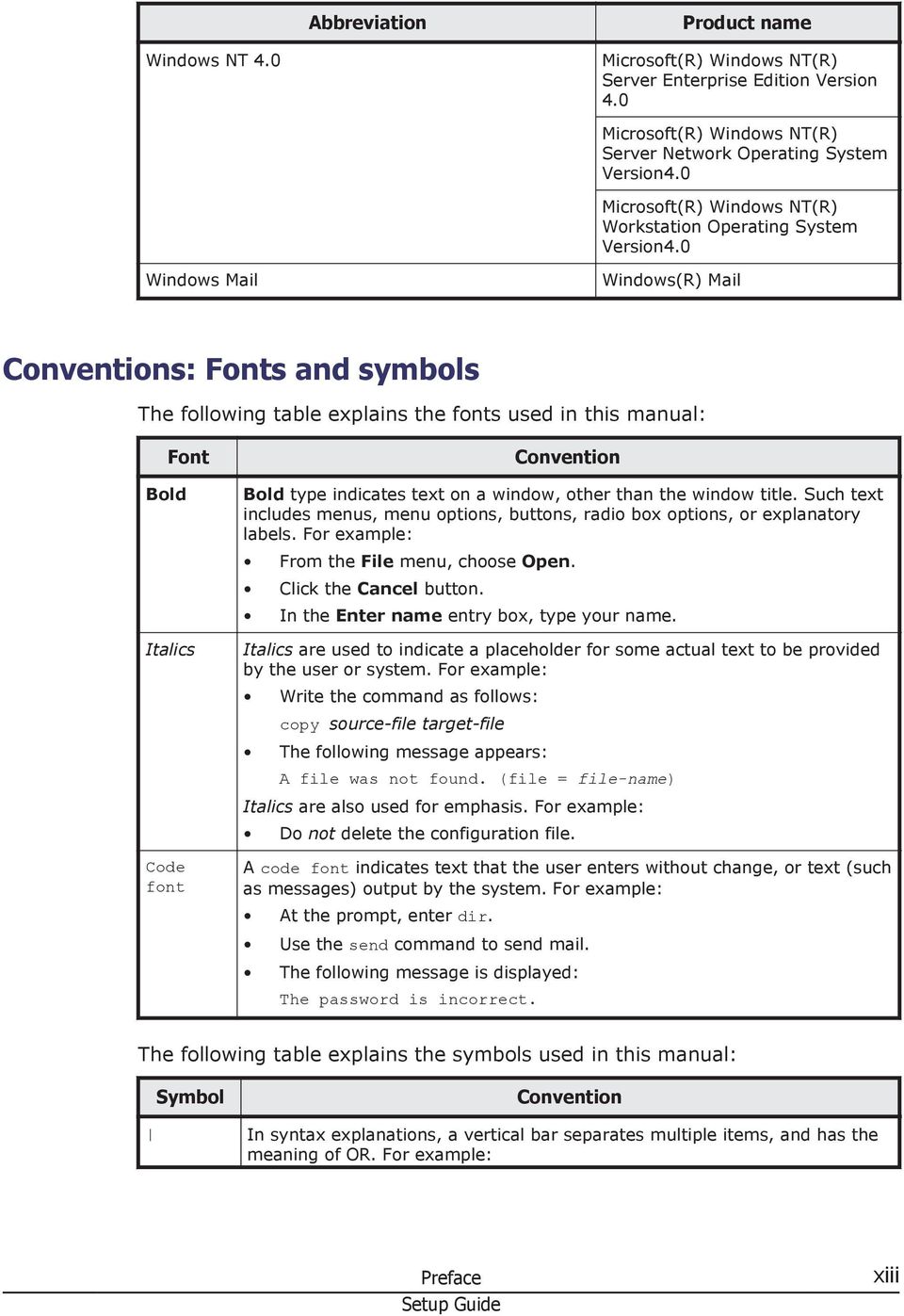
13 Abbreviation Product name Windows NT 4.0 Microsoft(R) Windows NT(R) Server Enterprise Edition Version 4.0 Microsoft(R) Windows NT(R) Server Network Operating System Version4.0 Microsoft(R) Windows NT(R) Workstation Operating System Version4.0 Windows Mail Windows(R) Mail Conventions: Fonts and symbols The following table explains the fonts used in this manual: Bold Font Italics Convention Bold type indicates text on a window, other than the window title. Such text includes menus, menu options, buttons, radio box options, or explanatory labels. For example: From the File menu, choose Open. Click the Cancel button. In the Enter name entry box, type your name. Italics are used to indicate a placeholder for some actual text to be provided by the user or system. For example: Write the command as follows: copy source-file target-file The following message appears: A file was not found. (file = file-name) Italics are also used for emphasis. For example: Do not delete the configuration file. Code font A code font indicates text that the user enters without change, or text (such as messages) output by the system. For example: At the prompt, enter dir. Use the send command to send mail. The following message is displayed: The password is incorrect. The following table explains the symbols used in this manual: Symbol Convention In syntax explanations, a vertical bar separates multiple items, and has the meaning of OR. For example: Preface xiii
14 Symbol A B C means A, or B, or C. Convention { } In syntax explanations, curly brackets indicate that only one of the enclosed items is to be selected. For example: {A B C} means only one of A, or B, or C. [ ] In syntax explanations, square brackets indicate that the enclosed item or items are optional. For example: [A] means that you can specify A or nothing. [B C] means that you can specify B, or C, or nothing.... In coding, an ellipsis (...) indicates that one or more lines of coding are not shown for purposes of brevity. In syntax explanations, an ellipsis indicates that the immediately preceding item can be repeated as many times as necessary. For example: A, B, B,... means that, after you specifya, B, you can specify B as many times as necessary. Icon Description Caution: Indicates a situation that requires caution from the user. WARNING: Indicates a situation that requires immediate user action. Note: Indicates important useful information for the user. Tip: Indicates a useful tip for the user. Conventions: Version numbers The version numbers of Hitachi program products are usually written as two sets of two digits each, separated by a hyphen. For example: Version 1.00 (or 1.0) is written as Version 2.05 is written as Version 2.50 (or 2.5) is written as Version is written as The version number might be shown on the spine of a manual as Ver. 2.00, but the same version number would be written in the program as xiv Preface
![For example: [A] means that you can specify A or nothing. [B C] means that you can specify B, or C, or nothing.... In coding, an ellipsis (.](/docs-images/55/8376114/images/page_14.jpg "..) indicates that one or more lines of coding are not shown for purposes of brevity.")
15 1 Overview This chapter provides an overview of the tasks that you need complete to install, configure, and begin using JP1/IT Desktop Management. Overview of the getting started process Overview 1-1

16 Overview of the getting started process The following steps outline the processes involved in initial setup and discovering nodes: 1. Prepare for the installation: To prepare for installation, make sure you have the required system and OS requirements in your environment. For details, see JP1/IT Desktop Management system requirements on page 2-2. Refer to the List of Port Numbers on page You may need to change the firewall settings for JP1/IT Desktop Management to communicate with the network. For details, Allowing communication through Windows firewalls on page A Install JP1/IT Desktop Management: Install the software on a server running a supported operating system. See Requirements for the management server on page 2-3 for details. This document refers to the server as your management server. An Installation Wizard with Quick Install and Custom Install options helps you to install JP1/IT Desktop Management. 3. Register a product license: Register a valid product license. You can register a product license from the login panel. 4. Login and complete initial setup: After registering a product license, use the default login credentials to log in to JP1/IT Desktop Management. Afterwards, for security reasons, you will be prompted to change your user ID and password. After that, you set up user accounts for other administrators. 5. Discover nodes and install agents: JP1/IT Desktop Management s management process involves communication between the management server and nodes connected to the network. The management server collects data for management from agents installed on the discovered nodes. From the Getting Started Wizard, you will discover nodes, install agents for management or start managing the discovered nodes without agents. 6. Begin management: After discovering the nodes install agents to start managing your IT operations environment. You can define and implement security policies; manage software, hardware assets, contracts and licenses; manage software and file distribution, get alerts for security events and generate reports. 1-2 Overview

17 2 Setup and installation This chapter outlines the system requirements and the installation instructions. It includes the following key topics: Overview Flow of setting up a basic system JP1/IT Desktop Management system requirements List of Port Numbers JP1/IT Desktop Management - Manager installation types Installing JP1/IT Desktop Management Custom installation Setup and installation 2-1

18 Overview To install JP1/IT Desktop Management on your management server, you must first set up the client computer and make sure your target computers meet the agent and agentless requirements. This section outlines the complete system requirements and the list of port numbers. System requirements: Make sure your environment meets the system requirements that are detailed in JP1/IT Desktop Management system requirements on page 2-2. Port Numbers: Gather access protocol credentials for each management target in List of Port Numbers on page Flow of setting up a basic system To set up a basic system, first set up the management server, and then install an agent on each computer to be managed. 1. Set up the management server. 2. Register a product license for JP1/IT Desktop Management, log in to the system, and then specify the user account information. 3. Install an agent on each computer to be managed by JP1/IT Desktop Management. Setup of the basic system is completed. Related Topics: Registering licenses on page 3-4 Launching the login panel on page 3-2 Installing agents on page 5-8 JP1/IT Desktop Management system requirements Working with JP1/IT Desktop Management includes the Management server, Client computer and Agent/Agentless devices. 2-2 Setup and installation
19 System requirements for JP1/IT Desktop Management include the hardware and software requirements for the following: Management server Agent computers Agentless computers Client computer Optional settings - AMT Remote control Network access control Requirements for the management server JP1/IT Desktop Management is installed on the management server. JP1/IT Desktop Management uses a client computer to communicate with both agent and agentless computers. Network communication environment Management server and client computer: Environment must allow HTTP communication through browser. Management server and agent: Configure the network setting so the management server and agent can directly reference to each other s host name and IP address. See List of Port Numbers on page 2-14 for Port Number specifications. JP1/IT Desktop Management uses the TCP/IP protocol for communication. So you must create exceptions in Windows Firewall settings to allow communication between the management server and Setup and installation 2-3

20 managed devices through the ports. See Allowing communication through Windows firewalls on page A-2 for details. Management server and agentless computer: Each managed target computers must have Administrative Share (Admin$) and IPC$ permission. All managed target computers without an agent must have common access accounts. Hardware The following table lists the hardware requirements for the management server. Item Requirements Computer CPU Recommended system requirements for Windows Server Hard Disk PC/AT-compatible 2.0 GHz or faster 32-bit (x86) processor 2.0 GHZ or faster 64-bit (x64) processor 2.4 GB or more (Main program) 35.0 GB or more (Database) 500 MB (on the system drive (for the work area)) Memory 2.0 GB or more The following table lists the additional free space required to use the distribution facility. Item Drive on which JP1/IT Desktop Management - Manager is installed Drive that contains the data folder System drive Required environment Free space equal to at least twice the size of the package (before compression to a ZIP file) Free space equal to at least twice the size of the package (before compression to a ZIP file) Free space equal to the size of the package (before compression to a ZIP file) The following table lists the free space required to automatically update components. Item Drive on which JP1/IT Desktop Management - Manager is installed 500 MB Required environment Drive that contains the data folder System drive 2-4 Setup and installation

21 Operating System The following table lists the requirements for the management server s operating system. OS Details Windows 7 #1 Windows 7 Enterprise #2 Windows 7 Professional #2 Windows 7 Ultimate #2 Windows Server 2008 #3 Windows Server 2008 Enterprise #4 Windows Server 2008 Enterprise without Hyper-V #4 Windows Server 2008 R2 Enterprise #2 Windows Server 2008 Standard #4 Windows Server 2008 Standard without Hyper-V #4 Windows Server 2008 R2 Standard #2 Windows Server 2003 Windows Server 2003, Enterprise Edition #2, #4 Windows Server 2003, Enterprise x64 Edition #2, #4 Windows Server 2003 R2, Enterprise Edition #4 Windows Server 2003 R2, Enterprise x64 Edition #4 Windows Server 2003, Standard Edition #2, #4 Windows Server 2003, Standard x64 Edition #2, #4 Windows Server 2003 R2, Standard Edition #4 Windows Server 2003 R2, Standard x64 Edition #4 #1: XP mode is not supported. #2: Including Service Pack 1. #3: Server Core cannot be used as an installation option. #4: Including Service Pack 2. Requirements for agent computers The management server communicates with managed nodes through agents. Following are the requirements for JP1/IT Desktop Management - Agent. Hardware The following table lists the hardware requirements for agent computers: Setup and installation 2-5
22 Item Requirements Computer Hard Disk Virtual memory CPU/Physical Memory PC/AT-Compatible 20 MB (40 MB or more is recommended) 40 MB or more Windows CPU Physical Memory MHz or faster 32-bit (x86) processor 64 MB + 20 MB or more XP Server 2003 Vista 300 MHz or faster 32-bit (x86) processor 133 MHz or faster 32-bit (x86) or 64-bit (x64) processor 800 MHz or faster 32-bit (x86) or 64-bit(x64) processor 128 MB + 20 MB or more 128 MB + 20 MB or more 512 MB + 20 MB or more Server GHz or faster 32- bit (x86) processor 1.4 GHz or faster 64- bit (x64) processor GHz or faster 32-bit (x86) or 64-bit (x64) processor 512 MB + 20 MB or more 1 GB + 20 MB or more The following table lists the additional free space required to use the distribution facility. Item Drive on which an agent is installed System drive of a computer on which an agent is installed Required environment Free space equal to at least twice the size of the package (before compression to a ZIP file) Free space equal to the size of the package (before compression to a ZIP file) The following table lists the free space required to automatically update an agent. Item Required environment Drive on which an agent is installed 50 MB System drive of a computer on which an agent is installed Operating System The following table lists the OS requirements for agent computers: 2-6 Setup and installation
23 OS Details Windows 7 #1 Windows 7 Enterprise #2 Windows 7 Home Basic #2 Windows 7 Home Premium #2 Windows 7 Professional #2 Windows 7 Starter #2 Windows 7 Ultimate #2 Windows Server 2008 #3 Windows Server 2008 Enterprise #4 Windows Server 2008 Enterprise without Hyper-V #4 Windows Server 2008 R2 Enterprise #2 Windows Server 2008 Standard #4 Windows Server 2008 Standard without Hyper-V #4 Windows Server 2008 R2 Standard #2 Windows Vista Windows Vista Business #2, #4 Windows Vista Enterprise #2, #4 Windows Vista Home Basic #2, #4 Windows Vista Home Premium #2, #4 Windows Vista Ultimate #2, #4 Windows Server 2003 Windows Server 2003, Enterprise Edition #2, #4 Windows Server 2003, Enterprise x64 Edition #2, #4 Windows Server 2003 R2, Enterprise Edition #4 Windows Server 2003 R2, Enterprise x64 Edition #4 Windows Server 2003, Standard Edition #2 Windows Server 2003, Standard x64 Edition #2, #4 Windows Server 2003 R2, Standard Edition #4 Windows Server 2003 R2, Standard x64 Edition #4 Windows XP Windows XP Home Edition Operating System (Service Pack 2, 3) Windows XP Professional Operating System (Service Pack 2, 3) Windows 2000 Windows 2000 Advanced Server Operating System (Service Pack 4) Windows 2000 Professional Operating System (Service Pack 4) Windows 2000 Server Operating System (Service Pack 4) #1: XP mode is not supported. Setup and installation 2-7
24 #2: Including Service Pack 1. #3: Server Core cannot be used as an installation option. #4: Including Service Pack 2. Web browser and applications To collect Operation Logs on user s activities such as sending/receiving attachments and file upload/download from a Web browser, check that your environment adheres to the Web browser and application requirements. The following table lists the agent requirements that support tracking attachments and file upload/download activity from the Web browser. Type Product Name Version application Microsoft Outlook Express 6 Microsoft Outlook 2002 Windows Mail Windows Live Mail 2009 Web Browser Microsoft Internet Explorer Windows Internet Explorer FireFox Requirement for agentless computers If you decide to manage some of the discovered nodes without agents, after discovering nodes you can set up an Auto Monitoring Schedule for the selected nodes. Agentless management has certain management limitations. See Agent and Agentless management capacity on page A-7 for details on agentless management capacity. The agentless computers should have the following prerequisites: Windows must have Administrative Share. 2-8 Setup and installation
25 If you want to discover using Active Directory discovery, the system must be registered as a domain computer. SNMP agent is required for Network Devices and Printers. The following table shows the system specifications for agentless management: Device OS Category Operating System Machine Type System Device Windows Windows 7 PC Windows Server 2008 R2 Windows Server 2008 Windows Vista Windows Server 2003 WindowsXP Professional WindowsXP Home WindowsMe PC # Windows2000 Professional PC Windows2000 Server Windows98 PC # WindowsNT 4.0 WindowsNT 3.51 Unix HP-UX PC Other than the above UNIX PC # Linux RedHat Linux PC Other than the above Linux PC # Mac OS Mac OS X PC Other than the above Mac OS PC # Network Device Except PC Printer - Printer Network Device Router Network Device Bridge Repeater Other IP Device - Other Device Note: Legend: #: JP1/IT Desktop Management may determine these devices as Other PC devices. Setup and installation 2-9
26 Requirements for Client computers You will use a client computer s Web browser to connect to JP1/IT Desktop Management s management server. The following table shows the requirements for client computers. Item Product Name Requirements Version Web Browser Microsoft Internet Explorer 6.0 Windows Internet Explorer Firefox 3.5 or later Web browser plug-in Adobe Flash Player 10.3 or later Requirements for optional settings If you do not have JP1/IT Desktop Management s Agent installed in the managed target computers, but still want to monitor and remotely access the agentless computer, you can use Intel AMT to access the target computers. To setup AMT functionality, see Setting up AMT functionality on page A-2. The following table shows the requirements for using Intel AMT: Product Item Details Common (manager, agent) Required software.net Framework 2.0 or later Agent Required hardware PC equipped with Intel vpro technology PC equipped with Intel Centrino Pro technology Required drivers Intel Management Engine Interface Intel AMT AMT BIOS settings Set to Small Business Enable DHCP mode Network environment DHCP environment Using Intel AMT has the following restrictions. If a local area network and wireless local area network are connected to the same subnet, the AMT functionality will not get activated Setup and installation
27 If a computer gets disconnected from wireless local area network connection, AMT will not function and you cannot start the machine using AMT. If connection fails, Wake on LAN is re-executed. If the computer is running on battery and stops due to battery failure, AMT will not function and you cannot start the machine from AMT. Requirements for remote control To use the remote control feature, the following configuration is required to support the controller. Software requirements: You can connect remote control both in agent and agentless management environment. When you manage the computers with an agent, the remote control OS requirement is the same as your agent OS requirement. Agent remote control: You should have JP1/IT Desktop Management Agent, installed in the agent computers. Agentless remote control: You should have client software, RFB protocol to support remote control connection to VNCClient, Apple Remote Desktop, Intel vpro6.0 Hardware KVM Hardware requirements for remote controller: The following table lists the hardware requirements for remote controller: Item Requirement Computer Hard Disk CPU/Physical Memory PC/AT - Compatible 20 MB or more Windows CPU Physical Memory GHz or faster 32-bit (x86)or 64-bit (x64) processor 1GB + #1 Server GHz or faster 32-bit (x86) processor 1.4 GHz or faster 64-bit(x64) processor 512 MB + #1 Vista Server 2003 XP 800 MHz or faster 32-bit (x86)or 64-bit (x64) processor 133 MHz or faster 32-bit (x86)or 64-bit (x64) processor 300 MHz or faster 32-bit (x86)processor 512 MB + #1 128 MB + #1 128 MB + #1 Setup and installation 2-11
28 Note: Legend: #1 indicates the required physical memory for the following functions: Temporary buffer for drawing - 5 MB in Agents. Temporary buffer for file transfer - 2 MB Buffer for chat server - 2+ MB (0.1 per connection) Buffer for chat client - 2+ (0.1 per connection) Requirements for network access control To use the network access control feature, your agent computers should have the following software and hardware requirements. Software requirements: The network access controller requires V 3.0 JP1/ IT Desktop Management - Agent and the software and hardware specified in this section. Hardware requirements: The following table lists the hardware requirements for network access control: Item Requirement Computer Hard Disk Virtual Memory CPU/Physical Memory PC/AT - Compatible 20 MB or more.(recommended 40 MB or more) 32 MB or more Windows CPU Physical Memory Server GHz or faster 32-bit (x86) processor 1.4 GHz or faster 64-bit(x64) processor 512 MB + 20 MB more Server MHz or faster 32-bit (x86)processor 128 MB + 20 MB more Operating systems requirements: The following table lists the operating system requirements for using JP1/IT Desktop Management s network access control in your environment. Item Windows Server 2003 Requirement Windows Server 2003, Standard Edition Windows Server 2003, Enterprise Edition Windows Server 2003 R2, Standard Edition Windows Server 2003 R2, Enterprise Edition 2-12 Setup and installation
29 Windows XP Item Requirement Windows XP Professional Operating System (Service Pack 2/3) Requirements for the site server This subsection describes the hardware, OS, and software requirements for the site server. Hardware The following table lists the hardware requirements for the site server. Item Requirements Computer CPU Recommended system requirements for Windows Server Hard Disk PC/AT-compatible 2.0 GHz or faster 32-bit (x86) processor 2.0 GHZ or faster 64-bit (x64) processor 2.4 GB or more.(recommended 3.0 GB or more) (Main program) 4.0 GB or more (Database) Memory 2.0 GB or more OS The following table lists the OS requirements for the site server. OS Details Windows 7 #1 Windows 7 Enterprise #2 Windows 7 Professional #2 Windows 7 Ultimate #2 Windows Server 2008 #3 Windows Server 2008 Enterprise #4 Windows Server 2008 Enterprise without Hyper-V #4 Windows Server 2008 R2 Enterprise #2 Windows Server 2008 Standard #4 Windows Server 2008 Standard without Hyper-V #4 Windows Server 2008 R2 Standard #2 Windows Server 2003 Windows Server 2003, Enterprise Edition #2, #4 Windows Server 2003, Enterprise x64 Edition #2, #4 Setup and installation 2-13
30 OS Details Windows Server 2003 R2, Enterprise Edition #4 Windows Server 2003 R2, Enterprise x64 Edition #4 Windows Server 2003, Standard Edition #2, #4 Windows Server 2003, Standard x64 Edition #2, #4 Windows Server 2003 R2, Standard Edition #4 Windows Server 2003 R2, Standard x64 Edition #4 #1: XP mode is not supported. #2: Including Service Pack 1. #3: Server Core cannot be used as an installation option. #4: Including Service Pack 2. Software An agent must be installed. List of Port Numbers The following tables have a list of Port Numbers that are used by JP1/IT Desktop Management and JP1/IT Desktop Management Agent. Management Server [port number] Connection direction Connection Target [port number] Protocol Usage Management Server [31000] <- Computer[ephem eral] TCP Connect to Management Server from computer Management Server [31001] -> Computer[ephem eral] TCP Connect to computer from Management Server Management Server [31080] <- Client[ephemeral ] TCP Connect to Management Server from each browser Management Server [16992] -> Computer[ephem eral] TCP Control power on/ off by using AMT Management Server ~ None None TCP For internal process of JP1/IT Desktop Management 2-14 Setup and installation
31 Each port number is set by default at delivery of the product. If the port number (given in the list above) is already used in your system environment, specify a different port number at the time of setting up of JP1/IT Desktop Management. In addition, if you control the ports in the network between JP1/IT Desktop Management and JP1/IT Desktop Management Agent by firewall, please enable the connection to pass through the ports (given in the list above). To set a protocol port: 1. From the Windows Control Panel, select Windows Firewall > Advanced Settings. 2. From the tree in the dialog box that appears, select Inbound Rules, and then select New Rule in the operation window. Follow the instructions displayed in the New Inbound Rule Wizard panel to set a protocol port. Note: You can use netstat -a command to see used ports. If you find default port numbers in the returned list, change the default port number during installation. As for the network between JP1/IT Desktop Management and agentless computers, please make sure the following ports are available to pass through. Port Number Connect ion directio n Connection Target[Port Number] Protocol Usage Agentless[445] <- Management Server[ephemeral] Agentless[139] <- Management Server[ephemeral] TCP or UDP TCP To connect to File and Printer from Management Server. To connect to File and Printer from Management Server. Agentless[137 and 138] <- Management Server[ephemeral] UDP To connect to File and Printer from Management Server. Port Number Connect ion directio n Connection Target[Port Number] Protocol Usage Agentless[161] <- Management Server[ephemera l] UDP To connect with SMTP server. Setup and installation 2-15
32 Agent (Port Number) Connec tion directio n Connection Target [Port Number] Protocol Usage Agent [31000] -> Management Server [ephemeral] Agent[31001] <- Management Server [ephemeral] Agent [16992] <- Management Server [ephemeral] TCP TCP TCP Connect to Management Server from computer Connect to computer from Management Server Control power on/off by using AMT Each port number is set by default at delivery of the product. If the port number (given in the list above) is already used in your system environment, please specify a different port number. Also, if you control the ports in the network between JP1/IT Desktop Management and JP1/IT Desktop Management Agent by firewall, please enable the connection to pass through the ports (given in the list above). Note: You can set up the Protocol to allow communication through the Windows firewall from Windows Control Panel > Windows Firewall > Exceptions panel. Agent (Port Number) Connec tion directio n Connection Target [Port Number] Protocol Usage Controller [31016] -> Remote Control Agent Controller [31017] -> Remote Control Agent TCP TCP Remote Control File Transfer from Controller to agent Controller [31018] -> <- Remote Control Agent TCP Chat Controller [31019] <- Remote Control Agent Controller [31020] <- Remote Control Agent TCP TCP Connection request from agent to Controller File Transfer from agent to Controller All port numbers are set to their default values when the product is shipped. If a default port number (shown in the list above) is already used in your system environment, specify a different port number as described below. Port number for Controller Use the Options dialog box in Controller. Port number for Remote Control Agent 2-16 Setup and installation
33 Use the dialog box that opens by clicking Remote Control Settings in the agent settings. Port number for the chat facility Use the Connect tab in the Options dialog box in the Chat window. List of port numbers for the site server The following table lists the port number used by the site server. Site Server (Port Number) Connection direction Connection Target [Port Number] Protoc ol Usage None None TCP For internal processing of the site server All port numbers are set to their default values when the product is shipped. If a default port number (shown in the list above) is already used in your system environment, specify a different port number during setup of the site server. JP1/IT Desktop Management - Manager installation types There are two installation methods for JP1/IT Desktop Management - Manager. Select the method that best suits your situation. Quick installation This requires minimal effort for installation and setup. Default values are used during installation and setup. We recommend this method unless special settings are required. Custom installation You must specify the settings during the installation. After installation is completed, you need to perform the setup procedure to create a database. We recommend this method if you want to set non-default values during installation and setup. Installing JP1/IT Desktop Management Make sure to log into the management server with your administrative permission. Run the setup executable, setup.exe, from the provided media to launch the JP1/IT Desktop Management s InstallShield Wizard. After you agree to the terms and conditions, you can select two options to install JP1/IT Desktop Management. To install JP1/IT Desktop Management: 1. The setup.exe launches the InstallShield Wizard and displays Welcome panel. Setup and installation 2-17
34 2. Click Next. The License Agreement panel opens with information on software license terms. Note: To print the license agreement, click Print. 3. Read the agreement and select I accept the terms of license agreement and click Next. Select one of the following two options to install JP1/IT Desktop Management: Quick Installation Custom Installation 4. If you selected Quick Installation, follow the instructions and complete the requirements in all six panels of the InstallShield Wizard. 5. For information on the Custom Installation option, refer to the Custom installation on page Note: You have to create exceptions for JP1/IT Desktop Management and Agent to communicate with each other, in the Windows Firewall settings. If you installed JP1/IT Desktop Management with your Windows Firewall settings Off, make sure you execute Allow Communication through Windows Firewall settings command. See Allowing communication through Windows firewalls on page A-2 for details. Custom installation If you selected custom installation, you can customize JP1/IT Desktop Management s setup and environment based on your company s management requirements. You can customize the following settings: Specify cluster environment, see Configuring cluster environments on page Specify folder settings Change Operations Log settings Change port numbers Control network bandwidth Change currency unit Specify Folder Settings Do the following in the primary server s folder setup window to set up JP1/IT Desktop Management in a cluster environment Setup and installation
35 Specify the path for the shared disk in the following items: Database folder Data folder Specify the other items (except the ones specified in the window above) in the same way as you would specify other setups. Changing Operation Logs settings During Custom installation, you can specify or change the Operation Logs settings such as: The number of computers that are used to collect Operation Logs Maximum retention period for collected Operation Logs Required capacity Operation Logs database folder Setup and installation 2-19
36 After installing the product, you can refer to the online help for more details on changing Operation Logs settings. Changing Port Numbers During custom installation, Port Number Settings Window prompts give you the option to change management server connection and management server s port numbers. You can also change Port Numbers any time after installing the software. Refer to Online Help for detailed information on changing port numbers after installation. Note: The port number you specify here will be used for the URL of the Web Console. The first 12 number starting from the specified number will be reserved for management server. For example if you specify 31000, than to will be used. See List of Port Numbers on page Changing the currency unit and controlling network bandwidth During custom installation, you can also change the Currency Unit setting in Currency Unit Setting and set the maximum transmission speed for distribution in Control Network bandwidth from a management server. You can perform all custom installation options even while you are working on JP1/IT Desktop Management. Configuring cluster environments Custom installation on page 2-18 also has an option to install JP1/IT Desktop Management in cluster environment. To configure cluster environment: 1. Select Custom Installation and install JP1/IT Desktop Management in Primary Server and Secondary Server. WARNING: Do not run setup.exe after installation completes. 2. Create groups of resources in the Primary Server. See Creating group resource in primary server on page A-3 for details. 3. After creating the groups, execute set up on the Primary Server. 4. Copy the output file after set up completion from the Primary Server to the Secondary Server. 5. Move the groups of resources from Primary Server to Secondary server to execute set up in Secondary Server. 6. Move the groups of resources to Primary server to start operations in a clustered environment. 7. Specify online service resources for JP1/IT Desktop Management Setup and installation
37 JP1/IT Desktop Management starts operating in a cluster environment. Setting up JP1/IT Desktop Management in primary server Setup JP1/IT Desktop Management in the primary (active) server. To operate the cluster system and setup the primary server complete the following: Select the check box Use cluster configuration to operate [ProductName]. Select Primary. Specify Logical host name and Logical IP address. Setting file to import is inactive, you need not select file now. As you finish the setup, the file will be created in the path shown below. Copy the file to the Secondary server.installation Folder of JP1/IT Desktop Management\mgr\conf\jdn_manager_setup.conf After setting up JP1/IT Desktop Management in primary server, you can set it up in the secondary server to operate in cluster environment. Setup and installation 2-21
38 Setting up JP1/IT Desktop Management on a secondary server To operate JP1/IT Desktop Management in a cluster environment, you can setup JP1/IT Desktop Management in the secondary server (standby) in the same way as the primary server. Specify the following in the Cluster Environment Window during setup: Select [Use cluster configuration to operate [ProductName] ]. Select Secondary In Setting file to import, select the file copied from Primary server Setup. Setting the folder windows settings are the same as other setup tasks. But you cannot specify the following items that are inactive in secondary server. Database folder Data folder Database extraction folder Note: You are not required to register agents in the secondary server. JP1/IT Desktop Management s management operations will automatically move to the secondary server in case of any problem in the primary server Setup and installation
39 3 Logging in and registration a license After installing JP1/IT Desktop Management, you need to register a license. If your company has more than one management server, each machine requires a separate license. Overview Launching the login panel Overview of product licenses Registering licenses Logging in and registration a license 3-1
40 Overview JP1/IT Desktop Management uses the one-license-per-managed-node method to control the number of licenses used. In this method, one license is used for a managed device regardless of the device type. This means that as many devices as the number of licenses registered in JP1/IT Desktop Management can be managed. Note that licenses are used for only managing devices, and not used for registering assets. To register licenses, use the product license key file that was provided when you purchased JP1/IT Desktop Management. If the number of licenses used has reached the maximum number of registered licenses, no more devices can be added. Confirm in advance that you have a sufficient number of licenses. If the number of devices you want to manage exceeds the number of registered licenses, you need to add more licenses. To add licenses, purchase product licenses and register them. Launching the login panel To register a product license, access the login panel. Figure 3-1 Login panel Use the host name and port data that you entered during the installation, to specify the JP1/IT Desktop Management URL. 1. Launch your browser. 3-2 Logging in and registration a license
41 2. Use this format to go to login panel: jp1itdm/jp1itdm.jsp For example, if your host name is host ITDM and port number 31080, type ITDM:31080/jp1itdm/jp1itdm.jsp JP1/IT Desktop Management panel opens. You can also launch login panel from Windows. From the Windows Start menu, select All Programs > JP1/IT Desktop Management - Manager > Login. The login panel opens. You have to register your license to login and start using your software. Note: If you have installed JP1/IT Desktop Management using the Custom Installation, specify the port number in the web browser. If you have used Quick Installation the default value becomes the port number for the browser. Overview of product licenses JP1/IT Desktop Management uses the one-license-per-managed-node method to control the number of licenses used. In this method, one license is used for a managed device regardless of the device type. This means that as many devices as the number of licenses registered in JP1/IT Desktop Management can be managed. Note that licenses are used for only managing devices, and not used for registering assets. To register licenses, use the product license key file that was provided when you purchased JP1/IT Desktop Management. If the number of licenses used has reached the maximum number of registered licenses, no more devices can be added. Confirm in advance that you have a sufficient number of licenses. If the number of devices you want to manage exceeds the number of registered licenses, you need to add more licenses. To add licenses, purchase product licenses and register them. If devices are automatically registered as managed devices during discovery and there are not enough licenses, the devices are handled as discovered nodes. Although the discovered nodes are displayed on the Discovered Nodes panel displayed by selecting Discovery in the Settings panel, they are not management targets (no licenses are used). You can reduce the number of licenses in use by excluding nodes from management or by deleting nodes. Tip: In an OS muiltiboot environment, because the information reported to the management server is different for each OS, each OS is handled as a separate device. Tip: To use the network access control facility, register all computers permitted to connect to the network as management targets. Devices other than computers do not need to be registered as management targets. Logging in and registration a license 3-3
42 Tip: To use the remote control facility, register the devices that will be subject to remote control as management targets. Registering licenses By registering licenses in JP1/IT Desktop Management, you can manage devices up to the number of registered licenses. To register a license: 1. Open the login panel. 2. Click the License button. 3. In the dialog box that opens, click the Register License button. 4. In the dialog box that opens, select the license key file and click the Open button. License registration has finished. Tip: Except for the initial registration, you can also register licenses in the License Details panel that is opened by selecting Product Licenses in the Settings panel. Click the Register License button. In the dialog box that opens, select the license key file and then click the Open button to finish license registration. Tip: Except for the initial registration, you can also register licenses in the License Details dialog box that is opened by clicking Help in the top-left corner of the screen, and then clicking About. After that, click Register License. In the dialog box that opens, select the license key file and then click the Open button to finish license registration. 3-4 Logging in and registration a license
43 4 Completing the initial setup After the registration of a product license has finished, you can log in to the application using the default user account credentials. The first time you log in, be sure to create a new user ID and password for yourself. Overview Notes on passwords Setting up user accounts Setting up automatic product updates Introducing JP1/IT Desktop Management Referring to online help Completing the initial setup 4-1
44 Overview JP1/IT Desktop Management includes a built-in user account. You will use the built-in user account credentials for initial login. At your first log in you will be prompted to change the password. After changing the password, you can set up your own user account and user accounts for any other administrative users who will use the software. The built-in user account cannot be deleted. Following are the built-in user account credentials: User ID: system Password: manager Notes on passwords Following are important points to remember on password specification for any user account you create in JP1/IT Desktop Management: Passwords are valid for 180 days. You get password change notification at log in time during the last 7 days. Passwords are case sensitive and should have the following: Note: Upper case or lower case alphabet, numbers or English symbols. Should be 8 to 32 characters long. Do not use a character string with all same characters ( or aaaaaa) The User ID cannot be used for the password. When changing passwords, do not reuse the existing password. Setting up user accounts If you have more than one administrator who will be working on the management process in JP1/IT Desktop Management, you have to create separate user accounts for each user. You have the flexibility to add, edit or remove any user accounts, except the built-in account, at any time. Note: Built-in user account and administrative user accounts are different. You can add/edit and delete any of the administrative user accounts. But built-in user account remains in the system with administrative permission. See User Management - Default account values on page A-7 for default account values. For more details on built-in user account refer to online help To add an user account: 1. Click on Settings to go to Settings Menu> User Management> Account Management and click Add New User. Add New User dialog box opens. 4-2 Completing the initial setup
45 Figure 4-1 Add New User dialog box 2. Enter the user details, such as User ID, Password,User Name, and select appropriate permission in the check box. 3. Click OK. JP1/IT Desktop Management saves the user information to the users list and displays the details. Added users can access information or start managing devices in JP1/IT Desktop Management. Assigning user permissions While registering or adding new user accounts, assign access permission based on user role. Administrative users and Business users will have different set of access permissions. Administrative access permissions will vary based on roles of system administrator or business managers. System administrator will have the most access permissions. System Administrator permission: Permission for performing all operations except registering, editing and deleting user accounts. User Management permission: Permission for only registering, editing and deleting user accounts. View permission: Permission for viewing and outputting (printing) all information except system setting information. The following table explains the types of users and their access permission: Completing the initial setup 4-3
46 User Access Permission System administrator System Administrator permission. User Management permission. Business user View permission Note: If you do not select any user permission (System Administrator and User Management) for the user account, in Permissions field, the created user will have only View permission. Business managers with View permission will only have access to Home and Reports modules in JP1/IT Desktop Management. You can create an user account with only User Management permission. Setting up automatic product updates JP1/IT Desktop Management gives you an option to enable automatic product updates. When you enable automatic product update, you can receive up to date information on judging security policy adherence and receive new Windows updates from Microsoft Corporation. To enable product update, the Proxy server settings is also required. To specify settings automatic product updates: 1. From Settings > Settings menu > General > Product Update, select the Enable Product Update check box. Fill in required information in the given fields. Note: Product Update provides you the ability to collect patch information to monitor individual, selected patch information in Security Policy. If you do not want to monitor the patch information automatically, you can uncheck the Enable Product Update check box, to disable monitoring automatic patch updates. 2. Select Use Proxy Server check box. Fill in required information in the given fields. 3. Click Test to check the connectivity. 4. Apply button gets enabled after filling in the details. Click Apply to apply the settings. After enabling proxy server settings, you can select the required Windows Updates from Security module. For more information on setting up Windows Updates, refer to online help. JP1/IT Desktop Management automatically gets product update information and determines security status of each managed target computer based on it. Tip: After information is acquired from the Support Service site and the security policy is updated, the security status of each device is evaluated. 4-4 Completing the initial setup
47 Introducing JP1/IT Desktop Management After you login, you will see JP1/IT Desktop Management s Home module dashboard. At every login you go to Home module by default. At your first login, you see the Getting Started Wizard option open. Clicking on Getting Started, takes you to What is this Wizard? panel. You can continue clicking through this wizard to start the first step for management, the discovery process. Figure 4-2 JP1/IT Desktop Management Home page Desktop components Your JP1/IT Desktop Management s desktop is designed in such a way that it is easy to navigate, manage and access required information at any given time in the management process. The image below introduces some of the terms referred frequently in this document and online help when referring to JP1/IT Desktop Management s navigation components. Completing the initial setup 4-5
48 Figure 4-3 JP1/IT Desktop Management Desktop components Desktop components Item Name 1 Menu bar: This menu bar has the following options: System: Contains Logout option to end the session. View: Lists the Panel Layout to select panels view, Option with History and Selection Item and Change View Default options. Go: Lists the options to navigate to Getting Started Wizard and Change Profile dialog box. Help: Lists the JP1/IT Desktop Management Help, JP1/IT Desktop Management Site Map, Update, About, andversion Information options. 2 Module: Contains the active navigation buttons for the JP1/IT Desktop Management modules Home, Security, Assets, Inventory, Distribution, Events, Reports and Setting. 3 Module menu: This area shows the key resources that are associated with the selected module. When you make a selection from the menu, details about it are displayed in the information area. 4 Information area: This area changes depending on the selected module and your selection from the module menu. Depending on your permissions and the options that are available based on the selected menu item, you may also be able to add, edit, or delete data. For more detailed information about navigating in JP1/IT Desktop Management, refer to online help. 4-6 Completing the initial setup
49 Referring to online help JP1/IT Desktop Management s Help system provides you a comprehensive overview of all available functionalists and detailed procedures to perform all related tasks. The online help gives you detailed procedures and related information with active links to go back and forth based on your requirements while performing any task. Also an active Help button within the panels and dialog boxes provides you context sensitive help. Context sensitive help gives you the specific information related to the task you perform in the dialog box or panel. Completing the initial setup 4-7
50 4-8 Completing the initial setup
51 5 Preparing for management The Getting Started wizard provides options to discover the nodes you want to manage with JP1/IT Desktop Management. After discovery, you can manage the nodes with or without an agent in JP1/IT Desktop Management. When you manage with an agent, you can utilize all available aspects of management from JP1/IT Desktop Management. To manage with an agent, you will install an agent in the discovered nodes. Overview Notes on discovery prerequisites Notes on discovery credential information Discovering nodes by Active Directory Discovering nodes by IP address range After discovery Agent and agentless management Brief introduction to JP1/IT Desktop Management s features Preparing for management 5-1
52 Overview When you log into JP1/IT Desktop Management for the first time, you will see the Getting Started button in the Home module. Figure 5-1 Getting Started The Getting Started Wizard with self explanatory panels, will guide you through configuring the discovery process. When you configure the discovery for the first time, you can use the default agent configuration to install agent in the discovered devices. You can also create a new agent installer. But, if you only want to discover the nodes and not install agents now, when you specify the discovery configurations, in Specify Discovery Option panel, do not select Auto-Manage Discovered Nodes or Auto-Install Agent options. You can install agents on the nodes later. Notes on discovery prerequisites The following information provides you the explanation about the Active Directory and IP address range discovery prerequisites. Active Directory discovery In Active Directory discovery, the credential information, User ID and Password, are used to authenticate computer. So, to discover all computers, make sure you do the following: Define the credential information in all computers. Specified user should have Administrator privileges. JP1/IT Desktop Management must be able to resolve address for computer's host name that is obtained from Active Directory by discovery, at management server. There are two ways to resolve the address: 5-2 Preparing for management
53 Resolve the address for computer s host name that is obtained from Active Directory at the DNS where JP1/IT Desktop Management manager is connected. Make sure the JP1/IT Desktop Management Management server belongs to the Active Directory domain. IP Address Range discovery In the IP Address Range discovery, JP1/IT Desktop Management can discover devices only by using ARP and ICMP. To collect the device details from discovered devices, JP1/IT Desktop Management should access the discovered devices using SNMP or Windows Administrative share. Discovery credential information specified in IP address range discovery is also used to deploy agents to the discovered devices. If you want to deploy agent after discovery, specify the Windows Administrative Share credential information for target IP address range in Settings > Discovery > Configurations > IP Address Range. Windows computers Windows firewall setting: If Windows Firewall is enabled in target computers, in Windows Firewall setting, make sure File and Printer Sharing is selected in Exceptions tab. Simple file sharing (for XP): Simple file sharing should be disabled. You can see this option from target computer's Explorer > Tools > Folder Options > View tab. Make sure the Use simple file sharing (Recommended) is not selected. Administrative share: ADMIN$ is enabled. You can check whether ADMIN$ is enabled using net share command at the Windows command prompt. To enable ADMIN$, execute netshareadmin$ at the Windows command prompt. At the time of discovery, if the log on authentication with Administrative right is specified, JP1/IT Desktop Management can find the device type and collect most of the device details. You can also deploy and install agent in these computers. Shared resource: IPC$ is enabled. You can check whether IPC$ is enabled using net shared command at the Windows command prompt. Usually IPC$ is enabled. SNMP nodes IP Address: This is the address of the SNMP node. Port Number: The port number where the SNMP node waits for the communication. The default setting is UDP/161. Community Name: This is the Community name used for SNMP nodes. The default setting is public. At the time of discovery, if the specified Community Name matches, JP1/ IT Desktop Management can find the device type and collect part of device information. Preparing for management 5-3
54 Notes on discovery credential information After discovering the devices, JP1/IT Desktop Management collects the device details for management purposes. To collect device details JP1/IT Desktop Management should access the devices using the credential information. So you have to specify the credential information for the target devices when you specify the discovery schedule. Note: Both in Active Directory Discovery and IP Address Range discovery, if target computer's OS is Windows Me, Windows 98, Windows 95, or Windows NT 4.0, its device type could become Unknown when discovered. Discovering nodes by Active Directory Active Directory discovery collects the device information based on devices that are registered in the Active Directory domain. Discovering nodes by using Active Directory domain information is one of the two options to discover the status of all IT devices before agent installation. To discover nodes by Active Directory domain information: 1. Click Go > Getting Started Wizard. The What is this Wizard? panel opens. 2. Click Next to open Select How to Get Started panel. 3. Select Discover Nodes and click Next to open Select How to Discover Nodes panel. 4. Select Discovery from Active Directory and Click Next and go to Specify Active Directory Domains panel. 5. Enter information in the required fields, about the Active Directory domain which you want to discover the status and click OK. Note: Domain Name: This is the Domain name of Active Directory. Host name: This is the Active Directory host name. User ID: User who is registered to Active Directory and has Domain Administrator right. Password: This is the password that is associated with the User ID. Root OU: Root OU (Organization Unit) of Department information in Active Directory. Computers existing under this root OU will be the discovery target. Specify the Root OU in the following format: <Domain Name>/<OU>/<OU> For example: If the domain name is hitachi.com and the OU is Unit 1, the root OU will be hitachi.com/unit 1 Also if you have a built-in folder as Computers, you cannot use it to connect as Root OU. 6. Click Next to open Specify Discovery Schedule panel. 5-4 Preparing for management
55 Note: If you check mark Discover Immediately check box, the discovery process starts immediately, right after completing the Discovery Wizard. Specify the date, time and day, and click Next, and open Specify Discovery Option panel. 7. Check mark Auto-Manage Discovered Nodes and if necessary Auto- Install Agent check boxes ON and click Next. 8. In Set Discovery Notifications panel, enter address to receive discovery completion notification, specify SMTP Server Settings and click Next. 9. In Confirm Content and Finish Settings panel, verify the settings and click Complete. The Discovery Settings Configured panel appears. 10. Click Discovery Log. you can view the discovered devices and select to manage devices from the displayed list. Or you can Click Close to close and exit the Discovery from Active Directory Wizard and start the discovery process. You will receive an notification when discovery process is completed. If you have selected Auto-Install Agent in Specify Discovery Option panel, JP1/IT Desktop Management will install the assigned agent in the discovered device for management. You can view the Active Directory discovery log in Settings >Settings Menu > Discovery > Last Discovery Log > Active Directory. From here you can select Go to Discovered Nodes for further management options. Discovering nodes by IP address range Discovering nodes using IP address range is another option to determine the status of devices connected to your network. IP address range discovery discovers and collects information from the nodes based on the specified IP address range. JP1/IT Desktop Management discovers all IT devices, including file servers, PCs, printers, and network switches, that are within a specified address range and that are connected to the network. Prerequisites for performing IP address range discovery: Network IP range. Node credentials. To discover nodes by specified IP address range: 1. On the menu bar, click Go > Getting Started Wizard. The What is this Wizard? panel opens. 2. Click Next to open Select How to Get Started panel. 3. Select Discover Nodes and click Next to open the Select How to Discover Nodes panel. 4. Select Discovery from IP Address Range and click Next to go to Discovery from IP Address Range panel. Preparing for management 5-5
56 5. Click Add IP Address Range to launch Add IP Address Range dialog box. 6. Enter Discovery Range Name and IP address range and click OK. JP1/IT Desktop Management adds the IP address range to discovery list. 7. Click Next. The Specify Credentials panel opens. See Notes on discovery credential information on page 5-4 for details on the credential information. 8. Click Add Credential to launch Add Credential dialog. Enter credential information and click OK. Your credential information is included in Discovery list. 9. Click Next. The Associate Credentials panel opens. 10. Assign the credential information for each IP address range and click Next. WARNING: Make sure to assign credential information for each IP address range. Some target computers might have account lock enabled, to lock the account after few successive unsuccessful log on. If you select Any, JP1/IT Desktop Management will try to authenticate the target computers with all credentials and the account in the target computer might get locked without the user s knowledge. Caution: If you select All, JP1/IT Desktop Management attempts to access the device by using each authentication information item. This increases the number of transmissions and the load on the network. Be sure to consider the extra load on the network before selecting this option. 11. In Specify Discovery Schedule panel set discovery schedule and click Next. Caution: If you select the Intensive Discovery check box, the next discovery starts immediately after the current discovery ends. As a result, a heavy load is put on the network during the discovery phase. Be sure to consider the extra load on the network before selecting this option. Note: If you check mark Discover Immediately check box, the discovery process starts immediately, right after completing the Discovery Wizard. If you want to repeat discovery, you can check mark Intensive Discovery. 12. In Specify Discovery Option panel check mark Auto-Manage Discovered Nodes and if necessary Auto-Install Agent check boxes ON and click Next. 13. In Set Discovery Notification panel, enter your to get discovery completion notification, specify SMTP Server Settings and click Next. You see Confirm and Finish Settings panel. 14. Make sure the entered settings are right and click Complete. The Discovery Settings Configured panel opens. 15. Click Discovery Log. you can view the discovered devices and select to manage devices from the displayed list. 5-6 Preparing for management
57 Or you can click Close to close and exit the Discovery from IP Address Range wizard and start the discovery process. If you have selected Auto-Install Agent option in Specify Discovery Schedule panel, JP1/ IT Desktop Management installs agent in the discovered devices. You can view the IP Address Range discovery log in Settings >Settings Menu > Discovery > Last Discovery Log > IP Address Range. From here you can select Go to Discovered Nodes for further management options. After discovery Discovery process takes place based on the specified schedule. After the discovery, you can view a list of the discovered nodes from Settings module, Discovery > Discovered Nodes. Discovered Nodes panel Figure 5-2 Discovered Nodes panel Item Description 1 Displays the total number of discovered nodes in the current discovery. 2 Shows available management capacity for your software license. 3 You can select the nodes and select the option to Manage or Ignore the nodes. 4 List of discovered nodes with discovery details. For more detailed options that you can perform in this panel, refer to the Online Help. Preparing for management 5-7
58 Agent and agentless management Installing agents After discovering devices, you can begin management with or without an agent. For JP1/IT Desktop Management s agent and agentless management capacity, refer to Agent and Agentless management capacity on page A-7 in Appendix. JP1/IT Desktop Management s Agent gives you complete management capacity. With an agent in the managed nodes you can define and apply security policies, distribute, install and uninstall software and remote control computers for troubleshooting and management. To install agent in the discovered nodes, you have to do the following: Create an agent installer Deploy and install agent in the selected nodes Creating agent installer Agent installer is the combination of agent configuration and installation command. You can either use the default agent configuration or specify a customized configuration based on your management requirements. To create an agent installer: 1. From the Menu bar, click Go > Getting Started Wizard. You see What is this Wizard? 2. Click Next to open Select How to Get Started panel. 3. Select Create Agent Installer and click Next. 4. In Select Agent Configuration, set Agent Configuration Name, specify Installation Folder and click Create. Note: You can also specify the account to install agent in target devices. You get a pop up window with a message that prompts you to save the Agent Installer file and close that window after saving. 5. Click Save, to save agent installer on your desktop. Now you see Complete Agent Installer wizard. 6. Click Close to close the wizard. You have created the agent installer to distribute agent to the devices you want to manage with JP1/IT Desktop Management. Agent deployment and installation After configuring your agent, you can deploy and install the agent to the target devices in the following two ways: Automatic installation: You can push install agent in the selected nodes. To install agent automatically in the selected nodes, select the Auto-Install 5-8 Preparing for management
59 Agent check box in Specify Discovery Option panel while specifying discovery schedule in Discovery Wizard. JP1/IT Desktop Management automatically installs agent after discovery and starts managing the nodes. Manual installation: To install agent manually, you will create an agent installer set and then follow one of the following five methods to install agents in discovered nodes: Installing agents by domain: Distribute and install agent by selected active directory domains. Installing agent by user: agent installer to the users and request them to download and install agents in their computers. Installing agent by department: Contact each department s system administrators and instruct them to distribute agent within their departments. Distributing agent by web portal: Upload agent configuration in the web portal and instruct the users to download and install. Installing agent by CD: In special circumstances, copy agent configuration in CD ROM and install in target devices. For further details on agent deployment and distribution, refer to Online help. Agentless management You can manage the discovered nodes without an agent. But in agentless management you will have certain limitations. Automatic enforcement of security policies and software or file data distribution is not possible without an agent installed on managed devices. Refer to Agent and Agentless management capacity on page A-7 for the limitations on Agentless management. Brief introduction to JP1/IT Desktop Management s features JP1/IT Desktop Management allows an administrator to take charge of the IT environment by delivering an easy to use, integrated solution for tracking assets, distributing or removing software, and managing security. The combination of these features in a single package is what allows the software to efficiently provide protection and control in an IT environment. With JP1/IT Desktop Management, you can efficiently manage security policies, network access, IT assets, distribution and generate management reports. The following table lists the major features and functions available in JP1/IT Desktop Management. Feature Functions Security management Assign, define and customize security policies Monitor security status Review operations log Acquire and distribute Windows Updates Control the network access Preparing for management 5-9
60 Feature Functions Assets management Hardware assets Software licenses Software assets Contracts (hardware and software license contracts) Inventory management Device inventory Software inventory Remote control Distribution Management Distribute software packages Distribute file data Uninstall software Monitor and manage events Generate management reports Events module provides list of all security and error events captured by the management system with appropriate status message such as: Critical Warning Information Generate reports under the following categories for viewing and printing: Summary Reports Security Diagnosis Reports Security Details Report Inventory Details Report Assets Details Reports Other notable features With JP1/IT Desktop Management in your IT Operations management you can Specify settings to receive alerts or critical issues and fix security violations Save cost and time with remote control to troubleshoot agent computers from anywhere Record and play back remote sessions and covert the recording to AVI file to use for training purposes Use chat, when the remote control user s phone is busy, to share information 5-10 Preparing for management
61 6 Setting up system configurations This chapter describes how to set up each system configuration. Setting up an agentless system Setting up a site server system Setting up a Windows update management system Setting up an Active Directory linkage system Setting up system configurations 6-1
62 Setting up an agentless system This section describes how to set up an agentless system. Flow of setting up an agentless system To set up an agentless system, you must first set up the management server, perform discovery, and then register the discovered nodes as management targets. 1. Set up the management server. 2. From the operation window, perform discovery for the network to find nodes. If you want to manage all devices, you can specify the discovery settings so that discovered nodes are automatically registered as management targets. In this case, go to step Register the discovered nodes as management targets. 4. Specify the settings to periodically update device information. Setup of the agentless system is completed. Tip: If you want to set up a system in which a computer containing an agent and a computer without an agent co-exist, set up the basic system and then start the above procedure from step 2. Related Topics: After discovery on page 5-7 Setting up a site server system This section describes how to set up a site server system. Flow of setting up a site server system To set up a site server system, you must first set up the basic system, set up the site server, and then configure the server for the system. 1. Set up the basic system. 2. Install the site server program on the computer on which an agent has been installed, and then set up the program. 3. In the operation window, configure the server. Setup of the site server system is completed. Related Topics: Setting up the site server on page Setting up system configurations
63 Installing a site server program There are two installation methods for a site server program. Select the method that best suits your situation. Installation from the provided media You must specify settings on the target computer to proceed with the installation. After installation, you need to perform the setup procedure. We recommend this method if you want to set non-default values during installation and setup. Installation from the operation window From the operation window displayed on the administrator's computer, select a computer and then install the program. The default values are set during installation and setup. We recommend this method unless special settings are required. Tip: When the site server program is installed, a message appears at the top of the home window and on the Notice panel. Installing the site server program from the provided media To install the site server program, you need to log on to a computer containing an agent as a user with Administrator permissions. Caution: When you install the program on a Windows computer that supports user account control (UAC), a dialog box that prompts you to promote your permissions might appear. If this dialog box appears, promote your permissions. Caution: Do not shut down the OS during installation. If you do so and try to re-install the program later, the program might not run normally. Tip: The site server program cannot be installed on the management server. To install the site server program from the provided media: 1. Insert the provided media into the CD/DVD drive. 2. In the Hitachi Integrated Installer dialog box that opens, select JP1/ IT Desktop Management - Remote Site Server and then click the Install button. 3. In the dialog box for starting installation, click the Next button. 4. In the User Registration dialog box, enter the user name and company name, and then click the Next button. 5. In the Installation folder dialog box, specify the installation folder, and then click the Next button. 6. A confirmation dialog box opens. Confirm that there are no problems with the installation settings, and then click the Install button. Setting up system configurations 6-3
64 Installation is performed. If you find a problem in the installation settings, click the Back button and correct the settings. 7. When the installation process is completed, click the Finish button. Installation of the site server program is completed. If a message that prompts you to restart your computer appears, restart the computer. After installation is completed, you need to perform the setup procedure to create a database. If you have selected the Setup check box upon completion of the installation, the setup process is automatically started after installation is completed. Installing the site server program from the operation window From the Device window, you can select a computer on which an agent is installed, and then install the site server program. Caution: Do not shut down the OS during installation. If you do so and try to re-install the program later, the program might not run normally. Tip: To install the site server program from the Device window, the component (site server program) must be registered with the management server in advance. Tip: The site server program cannot be installed on the management server. To install the site server program from the operation window: 1. Display the Device window. 2. From Device Information, select the list of devices that contains the computer you want to install the site server program on. The list of devices is displayed in the Information area. 3. In the Information area, select a computer on which an agent is already installed. 4. Select Install Site Server Program from Action. 5. In the Install Site Server Program dialog box, click OK. The site server program is installed on the selected computer. To install site server programs on multiple computers, repeat the above steps. For the computer on which the site server program is installed, displayed for the management type. is Tip: For the computers on which the site server program is installed, access denial by network access control is suppressed. A site server computer is also automatically registered as an exclusive communication target. However, if you install the site server program on a computer whose connection is already blocked, the computer is not permitted to be connected to the network. 6-4 Setting up system configurations
65 Setting up the site server After installing the site server program from the provided media, you need to set up the site server by creating a database and specifying environment settings. To set up the site server: 1. From the Windows Start menu, select All Programs > JP1_IT Desktop Management - Remote Site Server > Setup. 2. In the Setup window, click the Next button. 3. In the Select a Setup window, select the type of setup, and then click the Next button. This window is not displayed for the initial setup after installation. 4. In the Folder Settings window, specify the folder types that the site server program will use, and then click the Next button. 5. In the Port Number Settings window, specify the port number that the site server program will use, and then click the Next button. 6. In the Other Settings window, specify whether to enable flow control when the distribution facility is used, and then click the Next button. 7. In the Confirm Setup Settings window, confirm that there are no problems with the setup settings, and then click the Next button. Setup is performed. If you find a problem in the setup settings, click the Back button and correct the settings. 8. When the setup process is completed, click OK. Setup is completed and the site server runs with the specified settings. Tip: If you run the setup program immediately after installation, a database will be created during setup. Setting up a Windows update management system This section describes how to set up a Windows update management system. Flow for setting up a Windows update management system To set up a Windows update management system, you must first set up the basic system, and then specify the information necessary for connecting to the Support Service site. 1. Set up the basic system. 2. Enter the information necessary for connecting to the Support Service site into the window. Tip: To determine whether Windows updates are applied and automatically take action according to determination results, you need to specify the security policy settings. Setting up system configurations 6-5
66 Setup of the Windows update management system is completed. Related Topics: Setting up automatic product updates on page 4-4 Setting up an Active Directory linkage system This section describes how to set up an Active Directory linkage system. Flow for setting up an Active Directory linkage system To set up an Active Directory linkage system, you must connect Active Directory to the network and the computers registered with Active Directory as management targets. 1. Set up the management server within the system in which Active Directory has been installed. 2. Specify the information necessary for connecting JP1/IT Desktop Management to Active Directory. 3. If necessary, specify the settings so that the information items managed by Active Directory are acquired as additional management items. 4. Perform discovery to find the computers registered in Active Directory. If you want to manage all devices, you can specify the discovery settings so that discovered nodes are automatically registered as management targets. Similarly, it is also possible to simultaneously perform discovery and automatic agent deployment. Perform steps 5 and 6, if necessary. 5. Register the discovered computers as management targets. 6. Install an agent on each computer that is to be managed. Setup of the Active Directory linkage system is completed. Related Topics: Discovering nodes by Active Directory on page Setting up system configurations
67 7 Re-installing products Installing a program that has the same version number but a revision number that is different from the revision number of the installed program is called re-installation. This chapter describes how to re-install JP1/IT Desktop Management - Manager, agents, the site server program, and network access control agents. Re-installing JP1/IT Desktop Management - Manager Re-installing agents from the provided media Re-installing a site server program from the provided media Re-installing a network access control agent from the provided media How to update components Re-installing products 7-1
68 Re-installing JP1/IT Desktop Management - Manager JP1/IT Desktop Management - Manager can only be overwritten if the version number of the product to be installed is the same as, and the revision number is the same as or later than, the existing installed product. Reinstallation requires at least 2.4 GB of free space on the hard disk. Caution: Before starting re-installation, log out of JP1/IT Desktop Management and close the operation window. If you start re-installation with the operation window open, the operation window might not be displayed correctly after installation. Caution: When you install the product on a Windows computer that supports user account control (UAC), a dialog box that prompts you to promote your permissions might appear. If this dialog box appears, promote your permissions. Caution: Do not shut down the OS during installation. If you do so and try to re-install the program later, the program might not run normally. To re-install JP1/IT Desktop Management - Manager: 1. Insert the provided media into the CD/DVD drive. 2. In the Hitachi Integrated Installer dialog box that opens, select JP1/ IT Desktop Management - Manager and then click the Install button. 3. In the dialog box for starting installation, click the Next button. 4. After checking the information displayed in the License Agreement for Usage dialog box, select Accept the conditions of license agreement for usage, and then click the Next button. 5. In the dialog box indicating that the installation is ready, check the displayed information and then click the Install button. Installation is performed. For a cluster configuration, if necessary, a dialog box that prompts you to stop the services appears. Follow the instructions shown in the dialog box. 6. In the dialog box indicating the completion of the installation, specify the settings related to component updates, and then click the Finish button. Tip: If upgrading the database is required, the Setup check box for starting the setup process is displayed in the dialog box that indicates the completion of re-installation. Select this check box or start the setup process from the Start menu. After doing so, component-related settings are displayed in the dialog box that indicates the completion of setup. Re-installation of JP1/IT Desktop Management - Manager is completed. If a message that prompts you to restart your computer appears, restart the computer. Related Topics: How to update components on page Re-installing products
69 Custom installation on page 2-18 Re-installing agents from the provided media An agent can only be overwritten if the version number of the product to be installed is the same as, and the revision number is the same as or later than, the existing installed product. Caution: When you install the product on a Windows computer that supports user account control (UAC), a dialog box that prompts you to promote your permissions might appear. If this dialog box appears, promote your permissions. Caution: Do not shut down the OS during installation. If you do so and try to re-install the program later, the program might not run normally. To re-install an agent: 1. Insert the provided media into the CD/DVD drive. 2. In the Hitachi Integrated Installer dialog box that opens, select JP1/ IT Desktop Management - Agent and then click the Install button. 3. In the dialog box for starting installation, click the Next button. 4. In the dialog box indicating that installation is ready, click the Install button. Installation is performed. 5. In the dialog box indicating the completion of installation, click the Finish button. Re-installation of the agent is completed. If a message that prompts you to restart your computer appears, restart the computer. Re-installing a site server program from the provided media A site server program can only be overwritten if the version number of the product to be installed is the same as, and the revision number is the same as or later than, the existing installed product. Caution: When you install the program on a Windows computer that supports user account control (UAC), a dialog box that prompts you to promote your permissions might appear. If this dialog box appears, promote your permissions. Caution: Do not shut down the OS during installation. If you do so and try to re-install the program later, the program might not run normally. To re-installation a site server program: 1. Insert the provided media into the CD/DVD drive. Re-installing products 7-3
70 2. In the Hitachi Integrated Installer dialog box that opens, select JP1/ IT Desktop Management - Remote Site Server, and then click the Install button. 3. In the dialog box for starting installation, click the Next button. 4. In the dialog box indicating that installation is ready, click the Install button. Installation is performed. 5. In the dialog box indicating the completion of installation, click the Finish button. Re-installation of the site server program is completed. If a message that prompts you to restart your computer appears, restart the computer. Re-installing a network access control agent from the provided media A network access control agent can only be overwritten if the version number of the product to be installed is the same as, and the revision number is the same as or later than, the existing installed product. You also need to log on to the OS as a user with Administrator permissions. Caution: When you install the product on a Windows computer that supports user account control (UAC), a dialog box that prompts you to promote your permissions might appear. If this dialog box appears, promote your permissions. Caution: Do not shut down the OS during installation. If you do so and try to re-install the program later, the program might not run normally. To re-install the network access control agent: 1. Insert the provided media into the CD/DVD drive. 2. In the Hitachi Integrated Installer dialog box that opens, select JP1/ IT Desktop Management - Network Monitor, and then click the Install button. 3. In the dialog box for starting installation, click the Next button. 4. In the dialog box indicating that installation is ready, click the Install button. Installation is performed. 5. In the dialog box indicating the completion of installation, click the Finish button. Re-installation of the network access control agent is completed. You do not need to restart the computer. 7-4 Re-installing products
71 How to update components Components are agents, site server programs, and network access control agents. The following methods are available for updating these programs. Automatic update by registering programs on the management server Components are updated by registering new versions of programs on the management server and automatically distributing them. To update multiple programs including JP1/IT Desktop Management - Manager, such as when upgrading the entire system, specify that components are to be automatically updated during re-installation of JP1/ IT Desktop Management - Manager. This enables new versions of agents, site server programs, and network access control agents to be automatically registered on the management server, and distributed to target computers. To update individual programs separately, manually specify that components are to be automatically updated and register each program. By doing so, the new versions of programs will be distributed automatically. To specify that components are to be automatically updated or to register programs on the management server, you can use the dialog box that indicates that the overwrite of JP1/IT Desktop Management - Manager has completed, or the Component Registration dialog box that is opened from the Start menu of the management server. Update by using the distribution facility Components are updated by registering a package on the management server, creating a task, and then distributing the package. This method is useful if you do not want to automatically update components because, for example, you want to control the time when a load is put on the network (by updates). To update multiple programs including JP1/IT Desktop Management - Manager, such as when upgrading the entire system, during reinstallation of JP1/IT Desktop Management - Manager, specify the settings to register components as packages. This allows new versions of agents, site server programs, and network access control agent to be registered automatically as packages on the management server. To update individual programs separately, manually specify the settings for registering components as packages for distribution, and then register the programs that need updates. This allows the packages to be registered automatically. To specify the registration of components as packages or to register programs on the management server, you can use the dialog box that indicates that the overwrite of JP1/IT Desktop Management - Manager has completed, or the Component Registration dialog box that is opened from the Start menu of the management server. The names of automatically registered packages follow the format program-name_version-number_program-name-of-each-component (example: P L_0950_JP1_IT Desktop Management - Agent). Add a task with such a package specified, and distribute it. Re-installing products 7-5
72 Tip: If a package of the same version has already been registered, the existing package is not overwritten. Updates using provided media You can update components by re-installing programs from a new version of the provided media. This causes the existing version to be overwritten. To upgrade the entire system, you need to upgrade JP1/IT Desktop Management - Manager, the agents, and then other components. It does not matter whether the site server programs or network access control agents are upgraded first. 7-6 Re-installing products
73 8 Migrating an environment This chapter describes how to migrate a JP1/IT Desktop Management environment. Replacing the management server Replacing a site server Connecting the site server to another management server Migrating an environment 8-1
74 Replacing the management server Replacing the management server means configuring a computer on which JP1/IT Desktop Management - Manager is not installed so that the computer can be used as a new management server. WARNING: The first four digits of the product version information (for example, in product version ) for JP1/IT Desktop Management - Manager to be installed on the replacement-target computer must be the same as that for the product on the replacement-source. WARNING: You cannot upgrade the version of JP1/IT Desktop Management - Manager when replacing the management server. Upgrade the version after replacement is completed, or replace the management server after upgrading the version. The following describes how to replace the management server. You can replace the management server by installing JP1/IT Desktop Management - Manager on the replacement-target computer and moving data from the replacement-source computer. To replace the management server: 1. Stop the JP1/IT Desktop Management services. From the Windows Start menu, select Administrative Tools > Services. In the dialog box that opens, right-click on a service name, and then choose Stop to stop the service. You need to stop the following services: JP1_ITDM_Agent Control JP1_ITDM_Service JP1_ITDM_Web Container 2. Back up the database. Use Database Manager to back up the database. As a general guideline, make sure that the drive for the backup folder has at least 20 GB of free space. If automatic backup of the operation logs is enabled, save the backup data from the operation log backup folder specified during setup. 3. Store the operation log backup data on the replacement-target computer. If you have saved the operation log backup data in step 2, store the data in the folder that you want to specify as the operation-log-backup-folder on the replacement-target computer before installation. In this folder, do not store any data other than the operation log backup data. 4. Disconnect the replacement-source computer from the network. 5. Install JP1/IT Desktop Management - Manager on the replacement-target computer. 6. Set up JP1/IT Desktop Management - Manager. 8-2 Migrating an environment
75 If automatic backup of the operation logs is enabled, specify, as the operation log backup folder, the folder in which you stored the backup data in step Restore the database you have backed up in step 2. Use Database Manager to restore the database. If you have saved the data from the operation log backup folder, store the data in the folder specified during setup. 8. Register a license. Register a license from the operation window for JP1/IT Desktop Management - Manager installed on the replacement-target computer. 9. Change the connection destination of the agent. Log in to JP1/IT Desktop Management - Manager. Select Agent Basic Settings in the Agent Configurations window. Then, specify the IP address or host name for the replacement-target computer in the Management Server text box under Basic Settings. 10. Uninstall JP1/IT Desktop Management - Manager from the replacementsource computer. 11. Delete the backup you created in step 2. Replacement of the management server is completed. Tip: To confirm that agents connect to the new management server after replacement, use the Device List window in the Device window to check whether the value of Last Modified Date/Time has been updated. If theagents are not connecting to the new server, check whether the connection destination is correctly specified in the Setup window for the agents on the users' computers. Tip: For a cluster environment, perform the following after restoring the database (step 7) and before registering a license (step 8): 1. Set up the primary management server. Select Modify settings, and then complete the setup process without changing the settings. 2. Set up the secondary management server. Select Modify settings, specify the following file for Setting file to import in the Cluster Environment window, and then complete the setup process. primary-management-server-installation-folder\mgr\conf \jdn_manager_setup.conf Notes on replacement Caution: You need to change the connection destination of the agent (step 9) only when the management server's IP address or host name before and after the replacement has changed. Migrating an environment 8-3
76 Caution: If you want to change the connection destination of the agent because the IP address of the replacement-target computer is different from that of the replacement-source computer, you need to ensure that the network is configured so that the replacement-target management server and the agents can directly reference each other. This network configuration must allow the management server and the agent to communicate using each other's host name and IP address via ICMP communication. You also need to permit communication between the TCP protocol ports used by the management server and agents. Caution: To allow the management server to inherit the system configuration from the replacement-source, the IP addresses of managed devices must be the same before and after replacement. For example, if the location and IP address of any managed computer changes during the replacement of the management server, that managed computer will not connect to the replacement-target management server. In such a case, create an installation set for the replacement-target management server, and then install the agent on that computer. This will enable the computer to connect to the management server. To allow the management server to inherit the system configuration from the replacement-source, the IP addresses of managed devices must be the same before and after replacement. Caution: If you want the connection settings between the management server and the agent to be inherited, you need to back up the database and restore it to the replacement-target computer (steps 2 and 7). If you do not back up and restore the database, the replacement-target management server will not connect to the agent. If you do not want the connection settings between the management server and the agent to be inherited, there is no need to back up or restore the database. However, if you want to connect to the same agents, after replacement is completed, you need to re-create the environment by reinstalling the agents and re-specifying the security policies. Caution: If you connect the replacement-source management server to the network without uninstalling JP1/IT Desktop Management - Manager, the replacement-target management server will not be able to manage the agents correctly. This is because the replacement-source management server and replacement-target management server can both connect to the agents. If each management server issues different instructions, the agents might not respond to administrator commands. In addition, information reported by agents connected to the replacement-source management server will not be reported to the replacement-target management server. This causes differences in information managed by each management server. Related Topics: Installing JP1/IT Desktop Management on page 2-17 Custom installation on page Migrating an environment
77 Replacing a site server Replacing a site server means transferring the function of the site server from the computer on which the site server is currently installed to another computer. On the replacement-target computer, you need to set up a site server and migrate the operation log data from the replacement-source site server. Caution: The first four digits of the product version information (for example, in product version ) of the site server program to be installed on the replacement-target computer must be the same as that for the product on the replacement-source computer. Caution: You cannot upgrade the site server program when replacing the site server. Upgrade the program after replacement is completed, or replace the site server after upgrading the program. To replace the site server: 1. Install the agent on the replacement-target computer. 2. Install the site server program on the computer indicated in step 1, and then perform the setup procedure. 3. Stop the site server service (JP1_ITDM_Remote Site Service) on the computer indicated in step Manually copy the operation log data from the replacement-source site server to the computer indicated in step 3. When copying data, make sure that the folder structure below the operation log data folder is the same between the replacement-source site server and the replacement-target site server. The operation log data folder is the folder specified in Operation log data folder during the setup of each site server. Tip: The larger the operation log data, the longer it takes to re-create the index information for the data in later steps. We recommend only copy the data that is necessary. Tip: You do not need to manually copy the data relayed by the distribution functionality. This data is automatically downloaded from the management server. 5. Change the server configuration in the operation window. In the Settings window, select Server Configuration and then Server Configuration Settings. In the Site Server Group Settings area, click the Edit button for the site server group that contains the replacementsource site server. In the Edit Site server Group dialog box that opens, delete the replacement-source site server, add the replacement-target site server, and then adjust the priorities. Tip: If the replacement-target site server is not displayed in the Edit Site server Group dialog box, confirm that the target computer is connected to the network, and then wait a while. Migrating an environment 8-5
78 6. Use the recreatelogdb command on the replacement-target site server to re-create the operation log index information. Specify -all for the command argument. 7. Start the site server service (JP1_ITDM_Remote Site Service) on the replacement-target site server. 8. Uninstall the site server program from the replacement-source site server. Because the operation log data is not automatically deleted, manually delete it from the operation log data folder. Replacement of the site server is completed. Caution: After the recreatelogdb command ends, creation of operation log index information is started when the site server is started. Because the site server is under a heavy load during creation of the index information, it might take several days to complete the creation of the index, depending on the amount of operation log data. In addition, because operation logs generated during creation of the index information cannot be checked until the creation process is completed, detection of suspicious operations might be delayed. Be sure to take these issues into consideration before executing the recreatelogdb command. Related Topics: Installing a site server program on page 6-3 Setting up the site server on page 6-5 Connecting the site server to another management server This section describes the operations required, if any, if the following occurs due to system integration, a change in the administration scope, or for any other reason: If the connection destination for the site server used on a system must be changed to the management server on another system. If the connection destination for the site server used on a system must be changed to a newly configured management server. # #: This does not apply to a replaced management server whose database has been restored from backup data of the management server of the original system. Operations differ depending on whether the operation log data is to be inherited from the site server, or the operation log data is to be deleted and the site server is to be used as a new site server. To connect the site server to another management server: 1. Change the connection destination of the target site server. 8-6 Migrating an environment
79 You can change the connection destination of the site server in the Setup window for the agent. From the Windows Start menu, select All Programs > JP1_IT Desktop Management - Agent > Administrator Tool > Setup. In the Setup window that opens, change the IP address for the management server displayed for Connected management server. Tip: If password protection is enabled for the agent, the password entry window appears when the agent setup process is started. The default password is manager. Tip: If you want to change the connection destinations for many site servers, add the agent settings containing new connection destination management servers to the migration source system and assign the information to the target computer. If you do not want the migration destination to inherit the operation log data, go to step If you want the migration destination to inherit the stored operation log data, report the operation log index information to the management server. Execute the recreatelogdb command with the -node argument specified on the target site server. Go to step 4 after execution of the command. Tip: If an attempt to execute the command fails, wait until the period specified for Server Connection Interval in the agent settings (default: 30 minutes) has elapsed, and then execute the command again. 3. If you do not want the operation log data to be inherited, initialize the site server database and delete the operation log data. From the Windows Start menu, select All Programs > JP1_IT Desktop Management - Remote Site Server > Setup. In the Setup window that opens, select Database Recreation to re-create the database. In the dialog box that indicates the completion of the setup, clear the Store operation log data in the re-created database check box. Delete all files and folders in the operation-log-data-folder. The operation-log-data-folder is the folder specified for Operation log data folder during setup of the site server. 4. Stop the site server service and delete the distribution data stored in the site server. Stop the site server service (JP1_ITDM_Remote Site Service) on the target site server. Delete all files and folders in the following folder, and then start the site server service. data-folder\agc\cds data-folder is the folder specified for Data folder during setup of the site server. 5. Change the server configuration in the migration-destination system. Migrating an environment 8-7
80 In the Settings window (select Server Configuration and then Server Configuration Settings), change the site server group settings and server configuration according to the environment. If necessary, also change the settings for the migration-source system. Tip: If a site server connection destination change is not displayed in the Edit Site server Group dialog box for the migration destination system, confirm that the target computer is connected to the network, and then wait a while. The connection destination of the site server is changed. The site server can now be used on the migration-destination system. 8-8 Migrating an environment
81 A Appendix A This Appendix provides you topics that you need to refer to in the process of installation, setup and getting started. This appendix includes the following key topics: Setting up and installation User Management - Default account values Agent and Agentless management capacity Communication between the management server and a site server Communication between a site server and an agent Reference Material for This Manual Appendix A A-1
82 Setting up and installation This sections provides you details and procedures for optional tasks during the installation process. Allowing communication through Windows firewalls While Installing JP1/IT Desktop Management, if you have the Windows Firewall settings turned ON, the software is automatically added to exceptions. If you have the firewall settings Off when installing JP1/IT Desktop Management, and if you want to turn the firewall settings ON after the installation, use addfwlist.bat to allow JP1/IT Desktop Management to communicate through Windows firewall. After completing installation, make sure to allow communication through Windows firewall for JP1/IT Desktop Management s management operation. Note: You must have administrative privileges to execute this command. Execute the firewall command addfwlist.bat when Windows Firewall Service is running. Return values for addfwlist.bat command: Returned value Description 0 The command ended successfully. -1 The command ended abnormally. Example: To configure Windows Firewall to allow communication from JP1/IT Desktop Management, use the following command: addfwlist.bat Setting up AMT functionality Follow the steps provided below to setup AMT functionality. To use AMT functions: 1. Install the AMT driver. 2. Set up AMT from the BIOS. 3. Perform assembly registration for the AMT functionality DLLs (jdngamt.dll, jdnagcamt.dll). The following is an example of command execution using the default installation destination for the product. Agent Regasm.exe /register /codebase C:\Program Files\Hitachi\jp1itdmm\mgr \bin\jdngamt.dll Manager A-2 Appendix A
83 Regasm.exe /register C:\Program Files\Hitachi\jp1itdmm\mgr\bin \jdnagcamt.dllfiles\hitachi\jp1itdmm\mgr\bin\jdnagcamt.dll Creating group resource in primary server After installing JP1/IT Desktop Management, create the group and register the resources required for it in Microsoft Cluster Service or Windows Server Failover Cluster. You should have administrative privileges to create group resources in primary server. Tip: Refer to Microsoft Cluster Service/Windows Server Failover Cluster manuals to learn how to create group resources. To create group resource in management server: 1. Create another group apart from the Cluster Group that is already registered in Microsoft Cluster Service or Windows Server Failover Cluster. 2. Create the resources required for the created group. Refer to Group Resource to view the required resources to be registered for group. 3. Set the running server as the primary (active) server. 4. Make the Generic resources offline and the other service resources of JP1/ IT Desktop Management online. 5. If you have Windows Server 2008, Run the command for in the command prompt, given below. "cluster *res*"jp1/it Desktop Management Web Service"*/ priv*startupparameters=""" Note: Legend: * symbol means a single-byte space. For setting items and values for each resources, see the following topics: JP1_ITDM_DB Service settings on page A-3 JP1_ITDM_DB Cluster Service settings on page A-4 JP1_ITDM_Web Container settings on page A-5 JP1_ITDM_Agent Control settings on page A-6 Other service resource settings on page A-7 JP1_ITDM_DB Service settings The following table shows the settings and value for JP1_ITDM_DB Service. Resource name Item Value JP1_ITDM_DB Service Name Specify a name Resource type Specify "Generic Service " Appendix A A-3
84 Resource name Item Value Group Possible owners Dependencies Service Name Registry Replication Failover threshold Failover period (seconds) Pending timeout (seconds) Specify a group name for the management server Specify the two, primary (active) and secondary (standby) servers. Specify Network Name resource and Shared disk (Physical disk) Resource. Specify HiRDBEmbeddedEdition_JE1". Do not specify 0 (Fix) 0 (Fix) 300 (recommended value) JP1_ITDM_DB Cluster Service settings The following table shows the settings and value for JP1_ITDM_DB Cluster Service. Resource name Item Value JP1_ITDM_DB Cluster Service Name Specify a name Resource type Specify "Generic Service " Group Possible owners Dependencies Service Name Registry Replication Failover threshold Failover period (seconds) Pending timeout (seconds) Specify a group name for the management server Specify the two primary (active) and secondary (standby) servers. Specify the resource of "JP1_ITDM_DB Service" Specify "HiRDBClusterService_JE1". Do not specify. 1 (recommended value) 900 (recommended value) 300 (recommended value) JP1_ITDM_Service settings The following table shows the settings and value for JP1_ITDM_Service. A-4 Appendix A
85 Resource name Item Value JP1_ITDM_Service Name Specify a name Resource type Specify "Generic Service " Group Possible owners Dependencies Specify a group name for the management server Specify the two primary (active) and secondary (standby) servers. Specify the resource of "JP1_ITDM_DB Cluster Service". Service Name Specify " JP1_DTNAVI_MGRSRV". Registry Replication Failover threshold Failover period (seconds) Pending timeout (seconds) Do not specify. 1 (recommended value) 900 (recommended value) 300 (recommended value) JP1_ITDM_Web Container settings The following table shows the settings and value for JP1_ITDM_Web Container settings. Resource name Item Value JP1_ITDM_Web Container Name Specify a name Resource type Specify "Generic Service " Group Possible owners Specify a group name for the management server Specify the two primary (active) and secondary (standby) servers. Dependencies Specify the resource of " JP1_ITDM_DB Cluster Service". Service Name Registry Replication Failover threshold Failover period (seconds) Pending timeout (seconds) Specify "JP1_DTNAVI_WEBCON". Do not specify. 1 (recommended value) 900 (recommended value) 300 (recommended value) Appendix A A-5
86 JP1_ITDM_Web Server settings The following table shows the settings and value for JP1_ITDM_Web Server settings. Resource name Item Value JP1_ITDM_Web Server Name Specify a name Resource type Specify " Generic Service " Group Possible owners Dependencies Service Name Registry Replication Failover threshold Failover period (seconds) Pending timeout (seconds) Specify a group name for the management server Specify the two primary (active) and secondary (standby) servers. Specify the resource of "Network Name resource ". Specify "JP1_DTNAVI_WEBSVR". Do not specify. 1 (recommended value) 900 (recommended value) 300 (recommended value) JP1_ITDM_Agent Control settings The following table shows the settings and value for JP1_ITDM_Agent Control settings. Resource name Item Value JP1_ITDM_Agent Control Name Specify a name Resource type Specify "Generic Service " Group Possible owners Specify a group name for the management server Specify the two primary (active) and secondary (standby) servers. Dependencies Specify the resource of " JP1_ITDM_DB Cluster Service". Service Name Registry Replication Failover threshold Failover period (seconds) Specify "JP1_DTNAVI_AGCTRL". Do not specify. 1 (recommended value) 900 (recommended value) A-6 Appendix A
87 Resource name Item Value Pending timeout (seconds) 300 (recommended value) Other service resource settings The following table shows required resources for setting resource settings for resources other than service resources. Resource name Item Value -IP Address resource -Network Name resource -Shared disk (Physical disk) Resource Failover threshold Failover period (seconds) Pending timeout (seconds) 1 (recommended value) 900 (recommended value) 300 (recommended value) User Management - Default account values The following table provides the details of built-in account values. Item Initial Value Notes User ID system Cannot be changed. Password manager At initial login, change password and specify in user management window. Permissions System Management and User Account Management N/A Username None N/A None N/A Description Built-in account N/A User profile None This item is not created at initial registration. Agent and Agentless management capacity The following table compares JP1/IT Desktop Management s management capabilities with Agent and without Agent. Category Agent Manageme nt Agentless Manageme nt Device information collection #1 Y P Appendix A A-7
88 Category Agent Manageme nt Agentless Manageme nt Security status diagnosis Security policy allocation Y Y #2 Security status diagnosis Y P Security management Policy allocation Y Y Track security status and enforce security compliance Y P Collect operation logs Y N Notification messages to end users Prevent following unauthorized actions: Printing External Device Software Y Y N N Power On/Off Y N Asset management Device information collection #3 Y P Hardware management Y P Software license management Y Y Software management Y Y Contract management Y Y Software/file distribution Software distribution Y N File distribution Y N Windows update distribution Y N Software uninstallation Y N Remote control Computer operation Y Y #4 Troubleshoot Y P Chat Y N File transfer Y N Network Access Control Enable access control Y N Network connection control Y Y Report creation Y P Note: Legend: Y - Yes, Management possible. N - No, Management not possible. A-8 Appendix A
89 P - Partial Management possible. (Cannot perform all management tasks, but you can perform part of the tasks) #1 - The device information that can be collected depends on whether the agent is present. #2 - If you want to diagnose the security status for an agentless computer, use Windows Administrative Share. For individual agentless computers, the security status of the screensaver cannot be determined. #3 - Collecting device information depends on the presence of agent and credential settings. #4 - You can operate computers as long as they are connected via RFB. Communication between the management server and a site server In many cases, JP1/IT Desktop Management provides communication between the management server, a site server, and an agent by sending and receiving data. For each function, the following describes when communication between the management server and a site server occurs. Device management When device discovery is performed Security management When security policies are created or edited When security policies are assigned When an operation log stored in the site server is searched or viewed Distribution management When a package is created When software is installed or files are distributed Others When agent settings are changed When an agent program is registered with the management server When an agent is deployed on a computer When a site server program is registered with the management server When a site server is installed on a computer in the operation window When server configuration management settings are changed When a network access control agent program is registered with the management server Appendix A A-9
90 When a network access control agent is installed on a computer in the operation window Communication between a site server and an agent In many cases, JP1/IT Desktop Management provides communication between the management server, a site server, and an agent by sending and receiving data. For each function, the following describes when communication between a site server and an agent occurs. Security management When security policies are assigned When an operation log is acquired Distribution management When software is installed or files are distributed Others When an agent is deployed on a computer When a site server is installed on a computer in the operation window When a network access control agent is installed on a computer in the operation window Reference Material for This Manual This appendix provides reference information, including various conventions, for this manual. Conventions: Abbreviations for product names This manual uses the following acronyms: Abbreviation AMT Firefox Intel Linux Mac OS VMWare Full name or meaning Intel(R) Active Management Technology Firefox(R) Intel(R) Linux(R) MAC OS(R) VMWare(R) The following table shows the function names written in this manual. A-10 Appendix A
91 Abbreviation Full name Programs and Features Add/Remove Applications Add/Remove Programs Programs and Features Conventions: Acronyms This manual uses the following acronyms: Acronym Full name or meaning ARP AVI BIOS CD DVD HTTP ICMP ID IP KVM LAN OS PC PDA RFB SMTP SNMP TCP UAC UDP URL USB VNC Address Resolution Protocol Audio Video Interleaving Basic Input / Output System Compact Disc Digital Versatile Disc Hyper Text Transfer Protocol Internet Control Message Protocol IDentification Internet Protocol Keyboard Video Mouse Local Area Network Operating System Personal Computer Personal Digital Assistant Remote Framebuffer Simple Mail Transfer Protocol Simple Network Management Protocol Transmission Control Protocol User Account Control User Datagram Protocol Uniform Resource Locator Universal Serial Bus Virtual Network Computing Conventions: KB, MB, GB, TB, and PB This manual uses the following conventions: Appendix A A-11
92 1 KB (kilobyte) is 1,024 bytes. 1 MB (megabyte) is 1,024 2 bytes. 1 GB (gigabyte) is 1,024 3 bytes. 1 TB (terabyte) is 1,024 4 bytes. 1 PB (petabyte) is 1,024 5 bytes. A-12 Appendix A
93 Glossary This glossary defines the special terms used in this document. Click the desired letter below to display the glossary entries that start with that letter. A Access Permission JP1/IT Desktop Management user accounts have three permissions levels; user management permission, administrator permission and view only permission. The user s access to the application is defined by the assigned user permission. AD Discovery Active Directory discovery collects the device information based on devices that are registered in the Active Directory domain. Administration Scope Administration scope, which is set for a user account, is the range that the organization administrator controls. Agent Configuration Agent configuration is the package that contains agent s installation parameters along with the agent program to install in target computers. You can customize the configuration to suit the management requirement for target computers. Agent Installer Agent Installer is the package with Agent Configuration, Installation Folder, and Installation command. You can deploy the installer set and install an agent in target computers for managing the devices with the agent. Agentless Management Managing devices connected to the network without installing an agent in them. # A B C D E F G H I J K L M N O P Q R S T U V W X Y Z Glossary-1
94 Agents JP1/IT Desktop Management agents are specialized programs that run on managed target computers and communicate with the management server. These agents allow IT managers to monitor file and network activity, enforce security settings, and distribute software and files to managed PCs. Auto Discovery Based on specified discovery schedule, JP1/IT Desktop Management executes discovery automatically to find new devices in the management system. Auto-Install Agent This is an option in the Discovery Wizard > Specify Discovery Option panel. When you select this option, JP1/IT Desktop Management installs agent on the discovered node, right after discovery. B Built-in user account The software application has a built-in user account called system with administrative permission. C Chat The ability to chat with end users on an agent computer during a remote session. Client machine This is a computer that is used to access the management server. Cluster Configuration Configuring JP1/IT Desktop Management s operation settings in primary and secondary server setup. The secondary server works as a Failover Server. If JP1/IT Desktop Management s management system has an interruption or failure, the secondary server takes over for uninterrupted management process. Controller The computer from which you operate a remote session on the agent computer. You can download the controller from JP1/IT Desktop Management and install it on your computer before starting remote control. Credential Credentials are user login authentication for nodes in the discovery process. The credential information, enables JP1/IT Desktop Management to collect device details from the discovered nodes, after discovery. # A B C D E F G H I J K L M N O P Q R S T U V W X Y Z Glossary-2
95 D Default Agent Configuration JP1/IT Desktop Management provides a default agent configuration. If you do not specify the agent configuration, JP1/IT Desktop Management assigns the default agent configuration to the target devices. You can customize the default configuration to suit your specific management targets. Deployment This is a function to transfer the software (agent) to managing-target devices and make it executable. Also, this is a function to remove executable software from managingtarget devices. Discovered Nodes This is a tab within the Setting module that shows all the discovered and rediscovered nodes that were identified by the JP1/IT Desktop Management. Administrators use this view to select which discovered nodes they want to manage, or ignore. Discovery This is a function to search nodes that are connected to networks, in a specified network range. Discovery Log A log that displays discovered nodes, discovery process and the related details of discovered nodes. Discovery Notification that notifies recipients that the discovery process is complete. Discovery Process A process used to identify nodes on a network. Discovery Status Shows the status of discovery process. Discovery Wizard A Windows wizard that allows system administrators to configure settings (such as IP address range or Active Directory domain information) for initiating the discovery process that identifies nodes connected to a network. Distributed Operation Log Distributed operation logs are stored on site servers. From the operation window, you can view the distributed operation logs separately from the operation logs stored on the management server. # A B C D E F G H I J K L M N O P Q R S T U V W X Y Z Glossary-3
96 E notification JP1/IT Desktop Management generates automatic notifications for system events. You can specify the notification settings for discovery notification. JP1/IT Desktop Management uses the built-in user account as the from address for system generated s. H Home module Home module provides an overview of system status in dynamic panes view. Each pane displays a summary of the managed environments. Links within each pane allow you to navigate to the specific modules for details. HRC Hitachi Remote Control protocol. Uses JP1/IT Desktop Management s Agent to remotely access the target computers. I Ignored Nodes Within the Settings module, the JP1/IT Desktop Management Admin can manually designate nodes that the JP1/IT Desktop Management should not manage. These nodes are moved to the Ignored Nodes panel of the Settings module. IP address range The IP address range is all the IP addresses between the two IP address, From and To you specify in the IP address range dialog box. L Last Discovery Log The Last Discovery Log tab contains details of discovered nodes, status of the discovery process and the option to start discovery. If the number of discovered nodes exceeds or get close to maximum number associated with the purchased license, a warning message displays. License Key File A license key file is provided when you purchase a JP1/IT Desktop Management license. Use this file for registering licenses. # A B C D E F G H I J K L M N O P Q R S T U V W X Y Z Glossary-4
97 M Managed Computer Computers managed in JP1/IT Desktop Management. Managed Device Device managed by JP1/IT Desktop Management. Can be a computer, printer or USB device. Managed Nodes This refers to discovered nodes that are selected for management. Management Server Server on which JP1/IT Desktop Management is installed, is called a Management Server. Monitoring Interval Based on the monitoring interval you specify in Agent Configuration dialog box, JP1/IT Desktop Management Agents collect device information and report the details to manager at the specified intervals. In Agentless management, the device details are collected at the time specified in Auto-Monitoring interval. N Navigation area Refers to the left-pane view of the JP1/IT Desktop Management dashboard. The contents of this area adjusts based on the selected module (Home, Security, Assets, Inventory, Events, Reports, Settings). Network access control The ability to detect unauthorized network access in the JP1/IT Desktop Management s management environment and to deny or permit user access to the network. With network access control you can also configure security policies for temporary network access or denial. Network Access Controller JP1/IT Desktop Management s feature that enables you to detect and allow or deny access to unauthorized computers that attempt to access your network. Node Refers to a monitored computer, switch, or a storage. # A B C D E F G H I J K L M N O P Q R S T U V W X Y Z Glossary-5
98 P Product Update You can automatically setup to receive or download product updates to your software and windows update from the Support Service site. R Remote Control The ability to remotely access agent computers, and troubleshoot errors. With this feature you can transfer files between computers, record remote access sessions, transfer clipboard data, and chat with the agent- computer users. Remote Controller Allows you to perform the remote operations on the agent computer from the controller. When you connect to multiple agents from a controller, multiple remote controllers appear on the controller screen. RFB Remote framebuffer protocol, uses the simple protocol to remotely access managed nodes when the target computer is in agentless management. S Site Server A computer on which a site server program is installed. You can deploy site servers and use them as storage locations for operation logs or relay points for the distribution facility to reduce the load on the management server and network. Site Server Group A group of more than one site server. When you deploy site servers, set a site server group and specify each site server as a storage location for operation logs for each network segment or a relay point for the distribution facility. When multiple site servers are registered in the site server group, if a site server cannot be connected to, another site server in a group is automatically connected to. This increases functional availability of site servers. Site Server Program A program installed on a computer used for load balancing on the management server. The site server program communicates with JP1/IT Desktop Management - Manager and agents to support functions related to operation logs and distribution-related functions. The program is called JP1/IT Desktop Management - Remote Site Server. # A B C D E F G H I J K L M N O P Q R S T U V W X Y Z Glossary-6
99 Smart Device A portable small terminal, such as a smartphone, tablet PC, or PDA. Start Discovery Wizard This wizard launches for capturing information about your environment. System Administrator Permission Permission for performing all operations except registering, editing and deleting user accounts. U User Account User Account is the unique user access credentials for each user with an ID, password and associated for logging into JP1/IT Desktop Management. User ID Each user will have an User Account with unique User ID to log into the management system. User Management This involves the following operations like 1. Adding, editing, or removing (deleting) an user account that have logged into the Management Server. 2. User information management. 3.Control of login authentication and user permissions. User Management Permission Permission for only registering, editing and deleting user accounts. W Windows Update Management The ability to receive alerts about the latest Windows updates from Microsoft, manage downloads, and setup automatic distribution of updates to target computers. # A B C D E F G H I J K L M N O P Q R S T U V W X Y Z Glossary-7
100 # A B C D E F G H I J K L M N O P Q R S T U V W X Y Z Glossary-8
101 Index A abbreviations defined A-10 acronyms defined A-11 active directory specify domain;discovery schedule;discovery option 5-4 Active Directory linkage system flow for setting up 6-6 setting up 6-6 agent communication between site server A-10 installation,install by domain, by CD,by webportal, by desktop user 5-8 re-installing from provided media 7-3 agentless system flow of setting up 6-2 setting up 6-2 B basic system flow of setting up 2-2 C cluster environments 2-20 connecting site server to another management server 8-6 conventions Abbreviations for product names A-10 acronyms A-11 fonts xiii KB, MB, GB, and TB A-11 symbols xiii version numbers xiv custom installation 2-18 E each system configuration setting up 6-1 F features 5-9 flow for setting up Active Directory linkage system 6-6 Windows update management system 6-5 flow of setting up agentless system 6-2 basic system 2-2 site server system 6-2 G GB meaning A-11 Getting started Prepare;install;activate;login;discover;manage 1-2 H how to update component 7-5 Index-1
102 I initial login built-in user account 4-2 Installation 2-17 installation types JP1/IT Desktop Management - Manager 2-17 installing site server program 6-3 installing site server program (operation window) 6-4 installing site server program (provided media) 6-3 IP address range specify IP address range;discovery range name;discovery schedule;discovery option 5-5 J JP1/IT Desktop Management - Manager installation types 2-17 re-installing 7-2 K KB meaning A-11 P license 3-3 password 4-2 PB meaning A-11 Port Numbers 2-14 product re-installing 7-1 product license 3-3 R re-installing agent (provided media) 7-3 re-installing JP1/IT Desktop Management - Manager 7-2 re-installing network access control agent (provided media) 7-4 re-installing product 7-1 re-installing site server program (provided media) 7-3 registering license 3-4 replacing management server 8-2 replacing site server 8-5 L license overview 3-3 registering 3-4 Login panel 3-2 M management server communication between site server A-9 replacing 8-2 MB meaning A-11 N network access control agent re-installing from provided media 7-4 O overview S setting up Active Directory linkage system 6-6 setting up agentless system 6-2 setting up each system configuration 6-1 setting up site server 6-5 setting up site server system 6-2 setting up system configuration 6-1 setting up Windows update management system 6-5 Setup system requirements 2-1 site server communication between agent A-10 communication between management server A-9 replacing 8-5 setting up 6-5 system requirements 2-13 site server program installing 6-3 installing from operation window 6-4 installing from provided media 6-3 re-installing from provided media 7-3 Index-2
103 site server system flow of setting up 6-2 setting up 6-2 special icons caution xiv note xiv tip xiv warning xiv system configuration setting up 6-1 system requirements 2-2 agent computers 2-5, 2-11, 2-12 agentless computers 2-8 client computers 2-10 management server 2-3 site server 2-13 W Windows update management system flow for setting up 6-5 setting up 6-5 T Table JP1/IT Desktop Management s features 5-9 port numbers - agent 2-16 port numbers - file and printer sharing 2-15 port numbers - management server 2-14 port numbers - SNMP protocol 2-15 requirements - agent computers - hardware 2-6 requirements - agent computers - operating system 2-7 requirements - agentless computers 2-9 requirements - client computers 2-10 requirements - management server - hardware 2-4 requirements - management server - operating system 2-5 requirements - optional settings 2-10 requirements - site server - hardware 2-13 TB meaning A-11 U user permission systems administrator,user account management, business manager 4-3 V version number conventions xiv Index-3
104 Index-4
105
106 S99(E)
Job Management Partner 1/Data Highway - Server System Administrator Guide
 Job Management Partner 1 Version 10 Job Management Partner 1/Data Highway - Server System Administrator Guide Description, User's Guide, Operator's Guide 3021-3-359(E) Notices Relevant program products
Job Management Partner 1/IT Desktop Management 2 - Asset Console Description
 Job Management Partner 1 Version 10 Job Management Partner 1/IT Desktop Management 2 - Asset Console Description 3021-3-375(E) Notices Relevant program products Job Management Partner 1/IT Desktop Management
JP1/Data Highway - Server System Administrator Guide
 JP1 Version 11 JP1/Data Highway - Server System Administrator Guide Description, User's Guide, Operator's Guide 3021-3-B43(E) Notices Relevant program products For details about the applicable OS versions,
Job Management Partner 1/Performance Management - Remote Monitor for Virtual Machine Description, User's Guide and Reference
 Job Management Partner 1 Version 10 Job Management Partner 1/Performance Management - Remote Monitor for Virtual Machine Description, User's Guide and Reference 3021-3-353(E) Relevant program products
Core Protection for Virtual Machines 1
 Core Protection for Virtual Machines 1 Comprehensive Threat Protection for Virtual Environments. Installation Guide e Endpoint Security Trend Micro Incorporated reserves the right to make changes to this
JP1/Data Highway - Server Configuration and Administration Guide
 JP1 Version 11 JP1/Data Highway - Server Configuration and Administration Guide Description, User's Guide, Reference, Operator's Guide 3021-3-B42(E) Notices Relevant program products For details about
Job Management Partner 1/File Transmission Server/FTP Description, Reference and Operator's Guide
 For Windows Systems Job Management Partner 1 Version 10 Job Management Partner 1/File Transmission Server/FTP Description, Reference and Operator's Guide 3021-3-334-10(E) Notices Relevant program products
Pre-Installation Checks Installation Creating Users and Quick Setup Usage Examples and Settings Appendix
 Standard Setup Guide 1 2 3 4 5 Pre-Installation Checks Installation Creating Users and Quick Setup Usage Examples and Settings Appendix Read this manual carefully before you use this product and keep it
User Manual. Onsight Management Suite Version 5.1. Another Innovation by Librestream
 User Manual Onsight Management Suite Version 5.1 Another Innovation by Librestream Doc #: 400075-06 May 2012 Information in this document is subject to change without notice. Reproduction in any manner
http://docs.trendmicro.com
 Trend Micro Incorporated reserves the right to make changes to this document and to the products described herein without notice. Before installing and using the product, please review the readme files,
http://docs.trendmicro.com
 Trend Micro Incorporated reserves the right to make changes to this document and to the products described herein without notice. Before installing and using the product, please review the readme files,
Sharp Remote Device Manager (SRDM) Server Software Setup Guide
 Sharp Remote Device Manager (SRDM) Server Software Setup Guide This Guide explains how to install the software which is required in order to use Sharp Remote Device Manager (SRDM). SRDM is a web-based
EMC NetWorker Module for Microsoft Exchange Server Release 5.1
 EMC NetWorker Module for Microsoft Exchange Server Release 5.1 Installation Guide P/N 300-004-750 REV A02 EMC Corporation Corporate Headquarters: Hopkinton, MA 01748-9103 1-508-435-1000 www.emc.com Copyright
Quick Start Guide for VMware and Windows 7
 PROPALMS VDI Version 2.1 Quick Start Guide for VMware and Windows 7 Rev. 1.1 Published: JULY-2011 1999-2011 Propalms Ltd. All rights reserved. The information contained in this document represents the
Dell Statistica 13.0. Statistica Enterprise Installation Instructions
 Dell Statistica 13.0 2015 Dell Inc. ALL RIGHTS RESERVED. This guide contains proprietary information protected by copyright. The software described in this guide is furnished under a software license or
Freshservice Discovery Probe User Guide
 Freshservice Discovery Probe User Guide 1. What is Freshservice Discovery Probe? 1.1 What details does Probe fetch? 1.2 How does Probe fetch the information? 2. What are the minimum system requirements
DocuPrint C3290 FS Features Setup Guide
 DocuPrint C3290 FS Features Setup Guide Adobe and PostScript are trademarks of Adobe Systems Incorporated in the United States and/or other countries. Apple, Bonjour, ColorSync, EtherTalk, Macintosh, and
Archive One Policy V4.2 Quick Start Guide October 2005
 Archive One Policy V4.2 Quick Start Guide October 2005 Archive One Policy Quick Start Guide V4.2 Page 1 of 33 CONTENTS Introduction... 3 Components...3 Before You Start...4 System Requirements...5 Prerequisites...7
Legal Notes. Regarding Trademarks. 2013 KYOCERA Document Solutions Inc.
 Legal Notes Unauthorized reproduction of all or part of this guide is prohibited. The information in this guide is subject to change without notice. We cannot be held liable for any problems arising from
Enterprise Manager. Version 6.2. Installation Guide
 Enterprise Manager Version 6.2 Installation Guide Enterprise Manager 6.2 Installation Guide Document Number 680-028-014 Revision Date Description A August 2012 Initial release to support version 6.2.1
intertrax Suite resource MGR Web
 intertrax Suite resource MGR Web Resource Management Installation Guide Version 4 2012 Copyright 2003-2012 by Salamander Technologies, Inc. Protected by US Patents 5,573,278; 5,596,652; 5,793,882; 6,761,312;
UFR II Driver Guide. UFR II Driver Ver. 2.20 ENG
 UFR II Driver Guide UFR II Driver Ver. 2.20 Please read this guide before operating this product. After you finish reading this guide, store it in a safe place for future reference. ENG 0 Ot UFR II Driver
Configuring a Softphone for Windows for Virtual Contact Center
 Configuring Bria 3 for Virtual Contact Center Configuring a Softphone for Windows for Virtual Contact Center 8x8 issues softphone licenses to Virtual Contact Center customers allowing them to manage all
Important. Please read this User s Manual carefully to familiarize yourself with safe and effective usage.
 Important Please read this User s Manual carefully to familiarize yourself with safe and effective usage. About This Manual This manual describes how to install and configure RadiNET Pro Gateway and RadiCS
Quick Start Guide for Parallels Virtuozzo
 PROPALMS VDI Version 2.1 Quick Start Guide for Parallels Virtuozzo Rev. 1.1 Published: JULY-2011 1999-2011 Propalms Ltd. All rights reserved. The information contained in this document represents the current
formerly Help Desk Authority 9.1.3 Upgrade Guide
 formerly Help Desk Authority 9.1.3 Upgrade Guide 2 Contacting Quest Software Email: Mail: Web site: [email protected] Quest Software, Inc. World Headquarters 5 Polaris Way Aliso Viejo, CA 92656 USA www.quest.com
Interworks. Interworks Cloud Platform Installation Guide
 Interworks Interworks Cloud Platform Installation Guide Published: March, 2014 This document contains information proprietary to Interworks and its receipt or possession does not convey any rights to reproduce,
Sage ERP MAS 90 Sage ERP MAS 200 Sage ERP MAS 200 SQL. Installation and System Administrator's Guide 4MASIN450-08
 Sage ERP MAS 90 Sage ERP MAS 200 Sage ERP MAS 200 SQL Installation and System Administrator's Guide 4MASIN450-08 2011 Sage Software, Inc. All rights reserved. Sage, the Sage logos and the Sage product
Lepide Active Directory Self Service. Installation Guide. Lepide Active Directory Self Service Tool. Lepide Software Private Limited Page 1
 Installation Guide Lepide Active Directory Self Service Tool Lepide Software Private Limited Page 1 Lepide Software Private Limited, All Rights Reserved This User Guide and documentation is copyright of
Sage 100 ERP. Installation and System Administrator s Guide
 Sage 100 ERP Installation and System Administrator s Guide This is a publication of Sage Software, Inc. Version 2014 Copyright 2013 Sage Software, Inc. All rights reserved. Sage, the Sage logos, and the
Manuals for This Product
 Installation Guide Manuals for This Product Manuals for this product have the following structure. Read the manual according to your purpose for using this product. Disc Guides with this symbol are PDF
Acronis Backup & Recovery 11.5 Quick Start Guide
 Acronis Backup & Recovery 11.5 Quick Start Guide Applies to the following editions: Advanced Server for Windows Virtual Edition Advanced Server SBS Edition Advanced Workstation Server for Linux Server
Xerox Global Print Driver. Installation Guide
 Xerox 2010 Xerox Corporation. All Rights Reserved. Unpublished rights reserved under the copyright laws of the United States. Contents of this publication may not be reproduced in any form without permission
Scholastic Reading Inventory Installation Guide
 Scholastic Reading Inventory Installation Guide For use with Scholastic Reading Inventory version 2.0.1 or later and SAM version 2.0.2 or later Copyright 2011 by Scholastic Inc. All rights reserved. Published
Network FAX Driver. Operation Guide
 Network FAX Driver Operation Guide About this Operation Guide This Operation Guide explains the settings for the Network FAX driver as well as the procedures that are required in order to use the Network
About This Manual. 2 About This Manual
 Ver.4.1 Important This System Guide applies to RadiNET Pro Ver. 4.1. Please read this System Guide and the User s Manual on the RadiNET Pro CD-ROM carefully to familiarize yourself with safe and effective
CA Nimsoft Monitor Snap
 CA Nimsoft Monitor Snap Quick Start Guide 7.0 Legal Notices Copyright 2013, CA. All rights reserved. Warranty The material contained in this document is provided "as is," and is subject to being changed,
DameWare Server. Administrator Guide
 DameWare Server Administrator Guide About DameWare Contact Information Team Contact Information Sales 1.866.270.1449 General Support Technical Support Customer Service User Forums http://www.dameware.com/customers.aspx
Server Installation Guide ZENworks Patch Management 6.4 SP2
 Server Installation Guide ZENworks Patch Management 6.4 SP2 02_016N 6.4SP2 Server Installation Guide - 2 - Notices Version Information ZENworks Patch Management Server Installation Guide - ZENworks Patch
PHD Virtual Backup for Hyper-V
 PHD Virtual Backup for Hyper-V version 7.0 Installation & Getting Started Guide Document Release Date: December 18, 2013 www.phdvirtual.com PHDVB v7 for Hyper-V Legal Notices PHD Virtual Backup for Hyper-V
FAS Asset Accounting FAS CIP Accounting FAS Asset Inventory SQL Server Installation & Administration Guide Version 2011.1
 FAS Asset Accounting FAS CIP Accounting FAS Asset Inventory SQL Server Installation & Administration Guide Version 2011.1 2011 Sage Software, Inc. All rights reserved. Published by Sage 2325 Dulles Corner
NETWRIX WINDOWS SERVER CHANGE REPORTER
 NETWRIX WINDOWS SERVER CHANGE REPORTER INSTALLATION AND CONFIGURATION GUIDE Product Version: 4.0 March 2013. Legal Notice The information in this publication is furnished for information use only, and
AVG 8.5 Anti-Virus Network Edition
 AVG 8.5 Anti-Virus Network Edition User Manual Document revision 85.2 (23. 4. 2009) Copyright AVG Technologies CZ, s.r.o. All rights reserved. All other trademarks are the property of their respective
Troubleshooting File and Printer Sharing in Microsoft Windows XP
 Operating System Troubleshooting File and Printer Sharing in Microsoft Windows XP Microsoft Corporation Published: November 2003 Updated: August 2004 Abstract File and printer sharing for Microsoft Windows
Trend Micro Incorporated reserves the right to make changes to this document and to the products described herein without notice.
 Trend Micro Incorporated reserves the right to make changes to this document and to the products described herein without notice. Before installing and using the software, please review the readme files,
FileMaker Server 7. Administrator s Guide. For Windows and Mac OS
 FileMaker Server 7 Administrator s Guide For Windows and Mac OS 1994-2004, FileMaker, Inc. All Rights Reserved. FileMaker, Inc. 5201 Patrick Henry Drive Santa Clara, California 95054 FileMaker is a trademark
Operation, Monitoring, and Linkage Guide
 ucosminexus Application Server Operation, Monitoring, and Linkage Guide 3020-3-Y10-10(E) Relevant program products See the manual ucosminexus Application Server Overview. Export restrictions If you export
WhatsUp Gold v16.2 Installation and Configuration Guide
 WhatsUp Gold v16.2 Installation and Configuration Guide Contents Installing and Configuring Ipswitch WhatsUp Gold v16.2 using WhatsUp Setup Installing WhatsUp Gold using WhatsUp Setup... 1 Security guidelines
STATISTICA VERSION 12 STATISTICA ENTERPRISE SMALL BUSINESS INSTALLATION INSTRUCTIONS
 STATISTICA VERSION 12 STATISTICA ENTERPRISE SMALL BUSINESS INSTALLATION INSTRUCTIONS Notes 1. The installation of STATISTICA Enterprise Small Business entails two parts: a) a server installation, and b)
CONFIGURING MICROSOFT SQL SERVER REPORTING SERVICES
 CONFIGURING MICROSOFT SQL SERVER REPORTING SERVICES TECHNICAL ARTICLE November/2011. Legal Notice The information in this publication is furnished for information use only, and does not constitute a commitment
Installation Guide: Delta Module Manager Launcher
 Installation Guide: Delta Module Manager Launcher Overview... 2 Delta Module Manager Launcher... 2 Pre-Installation Considerations... 3 Hardware Requirements... 3 Software Requirements... 3 Virtualisation...
SyncThru TM Web Admin Service Administrator Manual
 SyncThru TM Web Admin Service Administrator Manual 2007 Samsung Electronics Co., Ltd. All rights reserved. This administrator's guide is provided for information purposes only. All information included
Online Backup Client User Manual
 Online Backup Client User Manual Software version 3.21 For Linux distributions January 2011 Version 2.0 Disclaimer This document is compiled with the greatest possible care. However, errors might have
WhatsUp Gold v16.3 Installation and Configuration Guide
 WhatsUp Gold v16.3 Installation and Configuration Guide Contents Installing and Configuring WhatsUp Gold using WhatsUp Setup Installation Overview... 1 Overview... 1 Security considerations... 2 Standard
Central Management System
 Central Management System Software Installation Guide Ver. 1.5.0.101115.001 ... ii System Introduction... 3 Client/Server Architecture...3 System Requirements... 4 System Setup...4 Multiple Monitor Configuration...5
HP Business Availability Center
 HP Business Availability Center for the Windows and Solaris operating systems Software Version: 8.05 Business Process Monitor Administration Document Release Date:September 2010 Software Release Date:
MGC WebCommander Web Server Manager
 MGC WebCommander Web Server Manager Installation and Configuration Guide Version 8.0 Copyright 2006 Polycom, Inc. All Rights Reserved Catalog No. DOC2138B Version 8.0 Proprietary and Confidential The information
Quick Install Guide. Lumension Endpoint Management and Security Suite 7.1
 Quick Install Guide Lumension Endpoint Management and Security Suite 7.1 Lumension Endpoint Management and Security Suite - 2 - Notices Version Information Lumension Endpoint Management and Security Suite
Silect Software s MP Author
 Silect MP Author for Microsoft System Center Operations Manager Silect Software s MP Author User Guide September 2, 2015 Disclaimer The information in this document is furnished for informational use only,
CentreWare Internet Services Setup and User Guide. Version 2.0
 CentreWare Internet Services Setup and User Guide Version 2.0 Xerox Corporation Copyright 1999 by Xerox Corporation. All rights reserved. XEROX, The Document Company, the digital X logo, CentreWare, and
Introweb Remote Backup Client for Mac OS X User Manual. Version 3.20
 Introweb Remote Backup Client for Mac OS X User Manual Version 3.20 1. Contents 1. Contents...2 2. Product Information...4 3. Benefits...4 4. Features...5 5. System Requirements...6 6. Setup...7 6.1. Setup
INSTALLING MICROSOFT SQL SERVER AND CONFIGURING REPORTING SERVICES
 INSTALLING MICROSOFT SQL SERVER AND CONFIGURING REPORTING SERVICES TECHNICAL ARTICLE November 2012. Legal Notice The information in this publication is furnished for information use only, and does not
SC-T35/SC-T45/SC-T46/SC-T47 ViewSonic Device Manager User Guide
 SC-T35/SC-T45/SC-T46/SC-T47 ViewSonic Device Manager User Guide Copyright and Trademark Statements 2014 ViewSonic Computer Corp. All rights reserved. This document contains proprietary information that
RecoveryVault Express Client User Manual
 For Linux distributions Software version 4.1.7 Version 2.0 Disclaimer This document is compiled with the greatest possible care. However, errors might have been introduced caused by human mistakes or by
RLP Citrix Setup Guide
 RLP Citrix Setup Guide M Version 2.1 Trademarks IBM is a registered trademark of International Business Machines Corporation. The following are trademarks of International Business Machines Corporation
Introduction 1-1 Installing FAS 500 Asset Accounting the First Time 2-1 Installing FAS 500 Asset Accounting: Upgrading from a Prior Version 3-1
 Contents 1. Introduction 1-1 Supported Operating Environments................ 1-1 System Requirements............................. 1-2 Security Requirements........................ 1-3 Installing Server
Point of Sale 2015 Enterprise. Installation Guide
 Point of Sale 2015 Enterprise Installation Guide Contents About this guide 3 System Requirements - Microsoft SQL Server 2008 R2 Express 3 System Requirements - POS Enterprise 2015 (Administrator) 3 System
NSi Mobile Installation Guide. Version 6.2
 NSi Mobile Installation Guide Version 6.2 Revision History Version Date 1.0 October 2, 2012 2.0 September 18, 2013 2 CONTENTS TABLE OF CONTENTS PREFACE... 5 Purpose of this Document... 5 Version Compatibility...
LifeSize Control Installation Guide
 LifeSize Control Installation Guide April 2005 Part Number 132-00001-001, Version 1.0 Copyright Notice Copyright 2005 LifeSize Communications. All rights reserved. LifeSize Communications has made every
XenClient Enterprise Synchronizer Installation Guide
 XenClient Enterprise Synchronizer Installation Guide Version 5.1.0 March 26, 2014 Table of Contents About this Guide...3 Hardware, Software and Browser Requirements...3 BIOS Settings...4 Adding Hyper-V
5nine Cloud Monitor for Hyper-V
 5nine Cloud Monitor for Hyper-V Getting Started Guide Table of Contents System Requirements... 2 Installation... 3 Getting Started... 8 Settings... 9 Authentication... 9 5nine Cloud Monitor for Hyper-V
Verax Service Desk Installation Guide for UNIX and Windows
 Verax Service Desk Installation Guide for UNIX and Windows March 2015 Version 1.8.7 and higher Verax Service Desk Installation Guide 2 Contact Information: E-mail: [email protected] Internet: http://www.veraxsystems.com/
Table of Contents. Introduction...9. Installation...17. Program Tour...31. The Program Components...10 Main Program Features...11
 2011 AdRem Software, Inc. This document is written by AdRem Software and represents the views and opinions of AdRem Software regarding its content, as of the date the document was issued. The information
PREFACE http://www.okiprintingsolutions.com 07108001 iss.01 -
 Network Guide PREFACE Every effort has been made to ensure that the information in this document is complete, accurate, and up-to-date. The manufacturer assumes no responsibility for the results of errors
VERITAS Backup Exec TM 10.0 for Windows Servers
 VERITAS Backup Exec TM 10.0 for Windows Servers Quick Installation Guide N134418 July 2004 Disclaimer The information contained in this publication is subject to change without notice. VERITAS Software
Pearl Echo Installation Checklist
 Pearl Echo Installation Checklist Use this checklist to enter critical installation and setup information that will be required to install Pearl Echo in your network. For detailed deployment instructions
SMART Classroom Suite 2011
 SMART Classroom Suite 2011 Windows operating systems System administrator s guide Trademark notice SMART Board, SMART Classroom Suite, SMART Notebook, SMART Response, SMART Sync, SMART Document Camera,
Citrix Access Gateway Plug-in for Windows User Guide
 Citrix Access Gateway Plug-in for Windows User Guide Access Gateway 9.2, Enterprise Edition Copyright and Trademark Notice Use of the product documented in this guide is subject to your prior acceptance
Installation Instruction STATISTICA Enterprise Small Business
 Installation Instruction STATISTICA Enterprise Small Business Notes: ❶ The installation of STATISTICA Enterprise Small Business entails two parts: a) a server installation, and b) workstation installations
IBM Remote Lab Platform Citrix Setup Guide
 Citrix Setup Guide Version 1.8.2 Trademarks IBM is a registered trademark of International Business Machines Corporation. The following are trademarks of International Business Machines Corporation in
Remote Control 5.1.2. Tivoli Endpoint Manager - TRC User's Guide
 Tivoli Remote Control 5.1.2 Tivoli Endpoint Manager - TRC User's Guide Tivoli Remote Control 5.1.2 Tivoli Endpoint Manager - TRC User's Guide Note Before using this information and the product it supports,
Kaseya Server Instal ation User Guide June 6, 2008
 Kaseya Server Installation User Guide June 6, 2008 About Kaseya Kaseya is a global provider of IT automation software for IT Solution Providers and Public and Private Sector IT organizations. Kaseya's
Administration guide. Océ LF Systems. Connectivity information for Scan-to-File
 Administration guide Océ LF Systems Connectivity information for Scan-to-File Copyright 2014, Océ All rights reserved. No part of this work may be reproduced, copied, adapted, or transmitted in any form
FileMaker Server 8. Administrator s Guide
 FileMaker Server 8 Administrator s Guide 1994-2005 FileMaker, Inc. All Rights Reserved. FileMaker, Inc. 5201 Patrick Henry Drive Santa Clara, California 95054 FileMaker is a trademark of FileMaker, Inc.,
Documentation Road Map
 FUJITSU Software ServerView Resource Orchestrator V3.2.0 Documentation Road Map Windows/Linux J2X1-7768-03ENZ0(01) July 2015 Preface Purpose of This Document This manual explains documentation road map
DIGITAL MULTIFUNCTIONAL SYSTEM
 MODEL: MX-M283N MX-M363N MX-M453N MX-M503N DIGITAL MULTIFUNCTIONAL SYSTEM Software Setup Guide BEFORE INSTALLING THE SOFTWARE SETUP IN A WINDOWS ENVIRONMENT SETUP IN A MACINTOSH ENVIRONMENT TROUBLESHOOTING
WebSpy Vantage Ultimate 2.2 Web Module Administrators Guide
 WebSpy Vantage Ultimate 2.2 Web Module Administrators Guide This document is intended to help you get started using WebSpy Vantage Ultimate and the Web Module. For more detailed information, please see
Legal Notes. Regarding Trademarks. Models supported by the KX printer driver. 2011 KYOCERA MITA Corporation
 Legal Notes Unauthorized reproduction of all or part of this guide is prohibited. The information in this guide is subject to change without notice. We cannot be held liable for any problems arising from
Online Backup Linux Client User Manual
 Online Backup Linux Client User Manual Software version 4.0.x For Linux distributions August 2011 Version 1.0 Disclaimer This document is compiled with the greatest possible care. However, errors might
Consolidated Monitoring, Analysis and Automated Remediation For Hybrid IT Infrastructures. Goliath Performance Monitor Installation Guide v11.
 Consolidated Monitoring, Analysis and Automated Remediation For Hybrid IT Infrastructures Goliath Performance Monitor Installation Guide v11.5 (v11.5) Document Date: March 2015 www.goliathtechnologies.com
WhatsUp Gold v16.1 Installation and Configuration Guide
 WhatsUp Gold v16.1 Installation and Configuration Guide Contents Installing and Configuring Ipswitch WhatsUp Gold v16.1 using WhatsUp Setup Installing WhatsUp Gold using WhatsUp Setup... 1 Security guidelines
Virtual CD v10. Network Management Server Manual. H+H Software GmbH
 Virtual CD v10 Network Management Server Manual H+H Software GmbH Table of Contents Table of Contents Introduction 1 Legal Notices... 2 What Virtual CD NMS can do for you... 3 New Features in Virtual
Verizon Remote Access User Guide
 Version 17.12 Last Updated: August 2012 2012 Verizon. All Rights Reserved. The Verizon names and logos and all other names, logos, and slogans identifying Verizon s products and services are trademarks
Online Backup Client User Manual
 For Linux distributions Software version 4.1.7 Version 2.0 Disclaimer This document is compiled with the greatest possible care. However, errors might have been introduced caused by human mistakes or by
Parallels Virtual Automation 6.1
 Parallels Virtual Automation 6.1 Installation Guide for Windows April 08, 2014 Copyright 1999-2014 Parallels IP Holdings GmbH and its affiliates. All rights reserved. Parallels IP Holdings GmbH. c/o Parallels
How To Set Up A Firewall Enterprise, Multi Firewall Edition And Virtual Firewall
 Quick Start Guide McAfee Firewall Enterprise, Multi-Firewall Edition model S7032 This quick start guide provides high-level instructions for setting up McAfee Firewall Enterprise, Multi-Firewall Edition
1. Product Information
 ORIXCLOUD BACKUP CLIENT USER MANUAL LINUX 1. Product Information Product: Orixcloud Backup Client for Linux Version: 4.1.7 1.1 System Requirements Linux (RedHat, SuSE, Debian and Debian based systems such
Online Backup Client User Manual Linux
 Online Backup Client User Manual Linux 1. Product Information Product: Online Backup Client for Linux Version: 4.1.7 1.1 System Requirements Operating System Linux (RedHat, SuSE, Debian and Debian based
Networking Best Practices Guide. Version 6.5
 Networking Best Practices Guide Version 6.5 Summer 2010 Copyright: 2010, CCH, a Wolters Kluwer business. All rights reserved. Material in this publication may not be reproduced or transmitted in any form