
MGC WebCommander Web Server Manager
|
|
|
- Morgan Conley
- 10 years ago
- Views:
Transcription
1 MGC WebCommander Web Server Manager Installation and Configuration Guide Version 8.0

2 Copyright 2006 Polycom, Inc. All Rights Reserved Catalog No. DOC2138B Version 8.0 Proprietary and Confidential The information contained herein is the sole intellectual property of Polycom, Inc. No distribution, reproduction or unauthorized use of these materials is permitted without the expressed written consent of Polycom, Inc. Information contained herein is subject to change without notice and does not represent commitment of any type on the part of Polycom, Inc. Polycom and Accord are registered trademarks of Polycom, Inc. Notice While reasonable effort was made to ensure that the information in this document was complete and accurate at the time of printing, Polycom, Inc., cannot assume responsibility for any errors. Changes and/or corrections to the information contained in this document may be incorporated into future issues.

3 Table of Contents Introduction MGC Web Server Architecture The Network Server Server Requirements Prerequisites Installation and Configuration Flow Installation Flow at a Glance About MGC WebCommander Server Manager Installation Guide Conventions Internet Information Service (IIS) Installation Installing the IIS Application (Windows NT Workstation/Professional Only) Installing the Internet Service Manager Application (Windows NT Workstation Only) SQL Server Installation Installing Windows NT Service Pack Installing the SQL Server MGC Web Server Manager Installation Prior to Installation and Software Upgrade Backing Up the SQL/MSDE Database Backing up the Access Database Product Validation Installing the MGC Web Server and MGC Web Server Manager Application Installation Wizard Configuration SQL Server Configuration (For SQL/MSDE Server Installations Only). 5-2 Existing WebCommander Users Upgrading to the SQL/MSDE Database Registering the SQL/MSDE Database in the SQL Enterprise Manager Restoring the SQL Server i

4 Table of Contents Registering the SQL Database in the ODBC Data Sources Registering the Access Database in the ODBC Data Sources Defining the MGC Web Server Security Properties Windows NT Server Windows 2000 Server Windows 2003 Server Selecting the User Account for Accessing the MGC Web Server Starting up the Server Selecting the User Account for Accessing the WAM Server Starting up the WAM Server Optimizing Delivery on the Server Integrating Polycom PathNavigator Connecting to the PathNavigator Database Updating the Database Configuring the Polycom Datastore Database Configuring the Internet Information Service (IIS) for Windows Authentication Configuring the MGC Web Site to work in Windows Authentication Mode in Windows NT/ Configuring the MGC Web Site to work in Windows Authentication Mode in Windows Defining MGC WebCommander Users in the MGC Server Manager Configuring the WebCommander as an External Database application for User Authentication System.cfg Flags Configuration Configuring the MGC Web Server Manager Configuring the Party Headers Order MGC Personal Scheduler Plug-in Configuration Personal Scheduler Configuration Remote Installation of the Personal Scheduler Client Deploying the Client Application Manually by Individual Users Deploying the Client Application Automatically to Individual Users Installing and Configuring the MGC Web Server Client Installation Wizard ii
5 Configuring the Client s Database SSL (Secure Socket Layer) Configuration Detailed Description Troubleshooting Configuring the IIS to Work with the MGC Web Server WebCommander Troubleshooting Page Login Error MGC WebCommander Configuration Tool Starting the WebCommander Configuration Tool Customizing the WebCommander Web Site The Login Page Tab Main Frame Background, Button Background and Text Colors 7-3 MGC WebCommander Languages Images and Text HTML Editing Background Image Link The General Settings Tab Top Banner Buttons - For Internet Explorer users only Colors Links Background Image The Pop-up Windows Tab Colors The Parties Lists Tab Title Bar Rows The Main Menu Tab Colors Left Links Buttons - for Internet Explorer users only Lists Rows Logo iii
6 Table of Contents Link The Meeting Director Tab Menu Links Colors The Meeting Scheduler Tab Menu Links The Reservations (Calendar) Tab Menu Links Backgrounds Calendar iv

7 1 Introduction The MGC Web Server Manager application is the user interface to the MGC Web Server. The MGC Web Server Manager allows the user to communicate via the Web Server with the MCUs. It provides database access via the Web pages and manages the Web site that contains the reservation pages. MGC Web Server Architecture The MGC Web site is a location on a computer network. It contains reservation information in the form of different web pages that can be accessed by users logging into the site with browser applications such as Microsoft Internet Explorer or Netscape Communicator. 1-1
8 Chapter 1 - Introduction The Internet client connects to the Web site located on the Internet server and, via the MGC Web Server, gains access to the reservation pages, the database tables, and the MCU that runs the conference. Internet users Access the MGC WebCommander site via Internet Browser Public Database MGC Manager Application Internet MGC Manager Application Hosts the: * MGC Web Server * MGC Web Server Manager application * MGC WebCommander site MCUs MGC Manager Application Internet Server and Database Server (optional) LAN 1-2

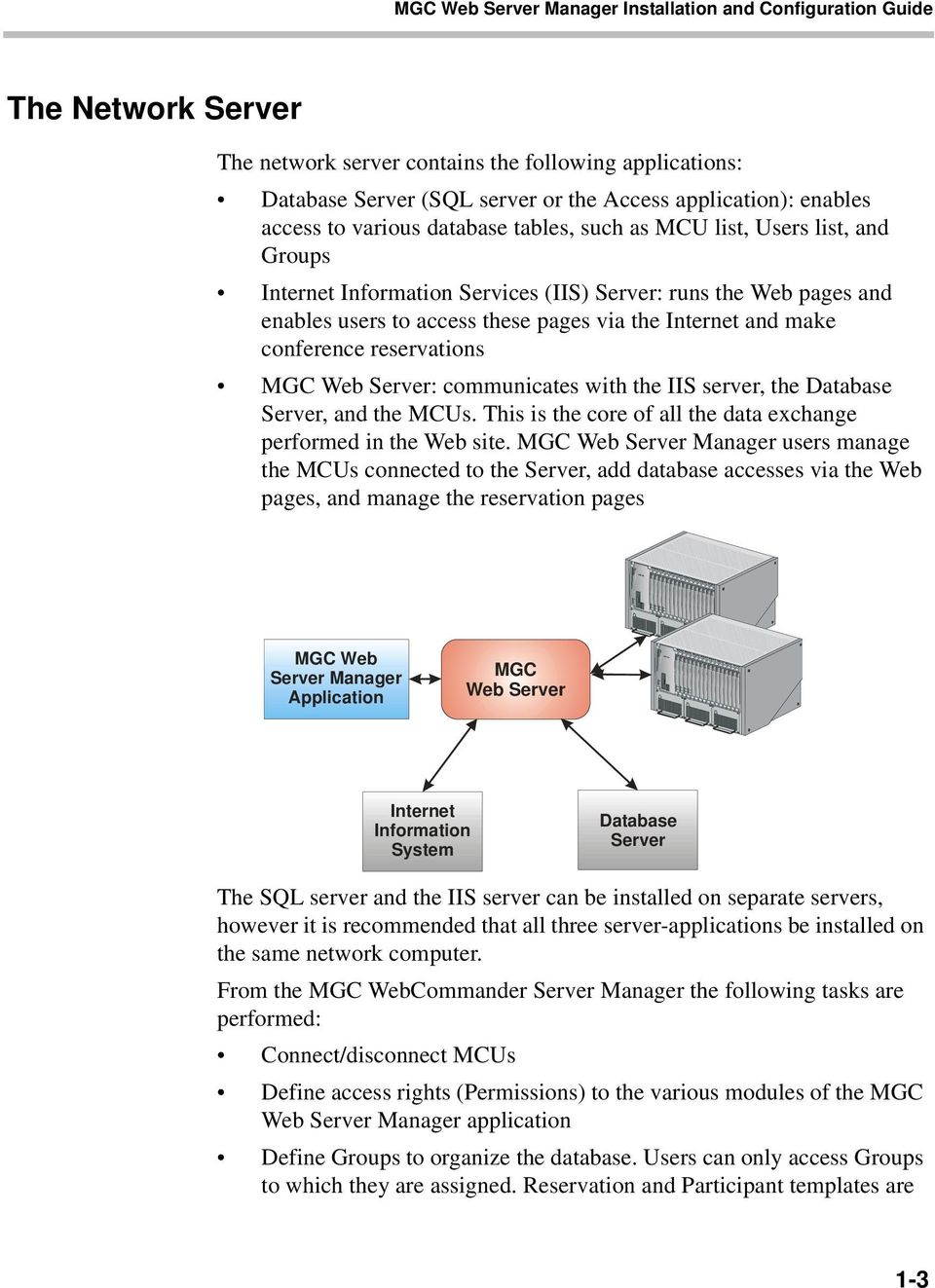
9 MGC Web Server Manager Installation and Configuration Guide The Network Server The network server contains the following applications: Database Server (SQL server or the Access application): enables access to various database tables, such as MCU list, Users list, and Groups Internet Information Services (IIS) Server: runs the Web pages and enables users to access these pages via the Internet and make conference reservations MGC Web Server: communicates with the IIS server, the Database Server, and the MCUs. This is the core of all the data exchange performed in the Web site. MGC Web Server Manager users manage the MCUs connected to the Server, add database accesses via the Web pages, and manage the reservation pages MGC Web Server Manager Application MGC Web Server Internet Information System Database Server The SQL server and the IIS server can be installed on separate servers, however it is recommended that all three server-applications be installed on the same network computer. From the MGC WebCommander Server Manager the following tasks are performed: Connect/disconnect MCUs Define access rights (Permissions) to the various modules of the MGC Web Server Manager application Define Groups to organize the database. Users can only access Groups to which they are assigned. Reservation and Participant templates are 1-3
10 Chapter 1 - Introduction created from within a Group and can be viewed only by users who have access rights to that Group Define the MGC Web Server Manager users and assign access rights and permissions Define the conference, participant and general system default parameters. Users cannot modify most of these parameters if they do not have the appropriate access rights These tasks are described in detail in the MGC Web Server Manager User's Guide. 1-4

11 MGC Web Server Manager Installation and Configuration Guide Server Requirements PC with Pentium III, 400MHz (or higher) processor. 64 MB RAM. Recommended, 128 MB RAM. Windows NT Server, Windows 2000 Server, or Windows 2000 Advanced Server, Windows 2003 Server (the last three are mandatory for Japanese and Chinese language support) Microsoft IIS version 4.0 with Service Pack 4.0. For Japanese and Chinese language support, Microsoft IIS version 5.0 with Service Pack 1.0 is required. Free hard disk space: For MGC Web Server Manager application - 20 MB For database records 30 MB If SQL server is to be installed MB Database Software: With the WebCommander and MGC Personal Scheduler it is recommended to use Microsoft SQL Server database. Microsoft Access can be used for the MGC Manager application When integrating the Polycom PathNavigator database, use the Microsoft SQL Server version 7.5 or the SQL 2000 application. In this case, Windows NT Service Pack 4.0 or later is required. 15" SVGA Monitor, 600 x 800 pixels. Recommended 17" monitor. Prerequisites This document assumes that the user has the following knowledge: Familiarity with the Windows NT environment and interface Basic knowledge of videoconferencing concepts 1-5
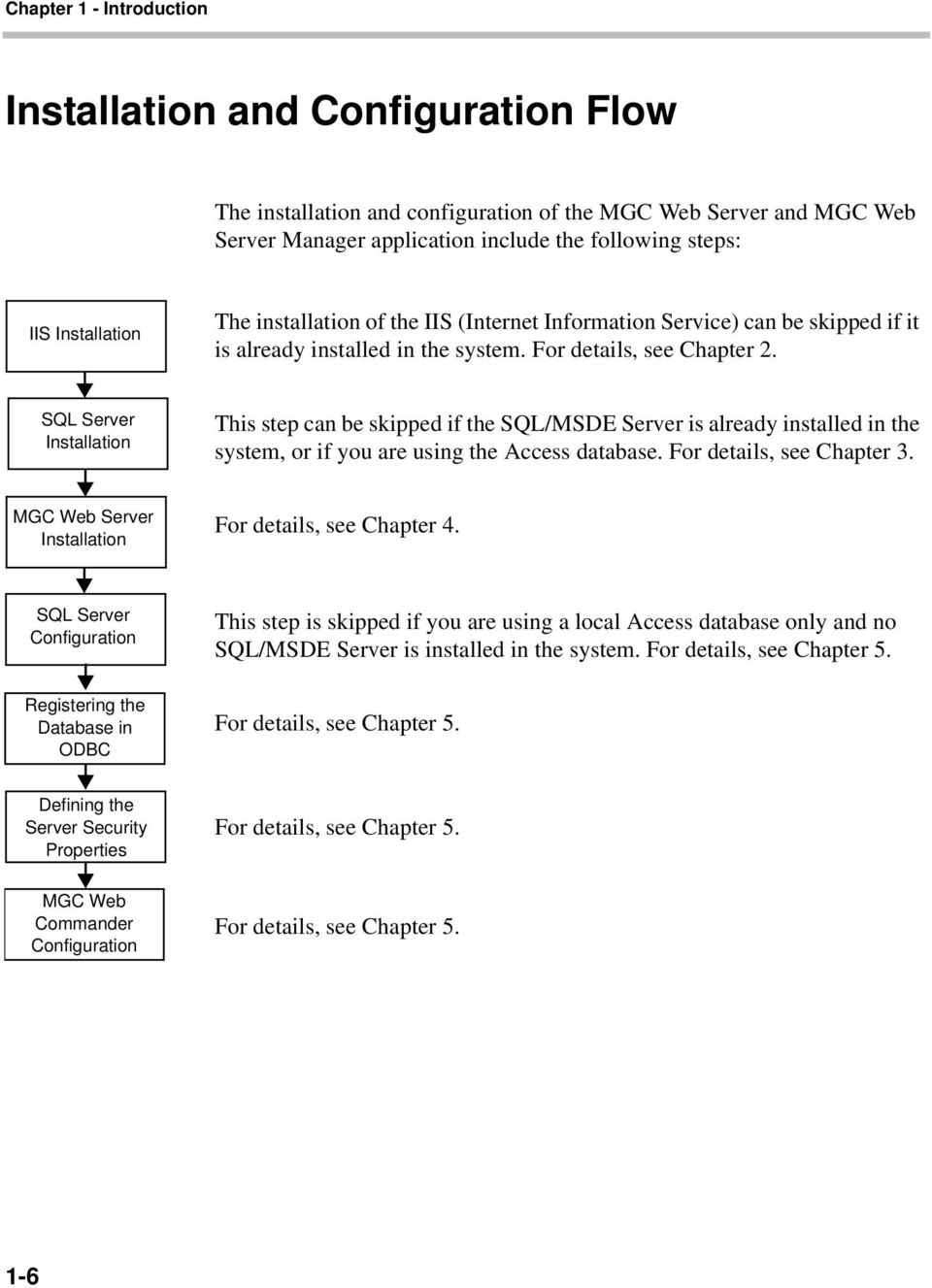
12 Chapter 1 - Introduction Installation and Configuration Flow The installation and configuration of the MGC Web Server and MGC Web Server Manager application include the following steps: IIS Installation The installation of the IIS (Internet Information Service) can be skipped if it is already installed in the system. For details, see Chapter 2. SQL Server Installation This step can be skipped if the SQL/MSDE Server is already installed in the system, or if you are using the Access database. For details, see Chapter 3. MGC Web Server Installation For details, see Chapter 4. SQL Server Configuration Registering the Database in ODBC This step is skipped if you are using a local Access database only and no SQL/MSDE Server is installed in the system. For details, see Chapter 5. For details, see Chapter 5. Defining the Server Security Properties MGC Web Commander Configuration For details, see Chapter 5. For details, see Chapter
13 MGC Web Server Manager Installation and Configuration Guide Installation Flow at a Glance Install the IIS server if it is not installed; follow the on-screen instructions. Install the SQL server if it is not installed; follow the on-screen instructions. If you are installing the SQL server in a non-latin environment, see note in Chapter 3, page 3-3. Install the MGC Web Server and the MGC WebCommander Server Manager application; follow the on-screen instructions. In the Setup Type window, select Client to install the MGC Web Server Manager application on a computer other than the computer running the MGC Web Server. To install the MGC Web Server and the MGC Web Server Manager application on the same computer, select the appropriate Server. In the Site Alias Name window, enter the Alias name, which automatically redirects participants to the most updated Web site in the event that the address changes. Configure the database provided with the MGC Web Server Manager, and define the MGC Web Manager security and user account. Register the SQL database supplied with the MGC Web Server Manager with the SQL Server, if one is installed. For a detailed description, see Chapter 5, SQL Server Configuration (For SQL/ MSDE Server Installations Only) on page 5-2. Register the SQL database supplied with the MGC Web Server Manager application in the ODBC Data Source (from the Control Panel). For more details, see Chapter 5, Registering the SQL Database in the ODBC Data Sources on page Register the Access database supplied with the MGC Web Server Manager application in the ODBC Data Source (from the Control Panel). For more details, see Chapter 5, Registering the SQL Database in the ODBC Data Sources on page (Optional) Register the PathNavigator SQL database in the ODBC Data Source. For more details, see Chapter 5, Integrating Polycom PathNavigator on page (Optional) Register the Polycom Datastore database in the ODBC Data Source and configure it to work with the Web Server 1-7
14 Chapter 1 - Introduction Manager. For more details, see Chapter 5, Configuring the Polycom Datastore Database on page Define the security properties of the MGC Web Server (ConfSiteV8_0 and ConfPollerSiteV8_0 in the IIS. For more details, see Chapter 5, Defining the MGC Web Server Security Properties on page Select the User Account in the Services (from the Control Panel) for accessing the MGC Web Server. For more details, see Chapter 5, Selecting the User Account for Accessing the MGC Web Server on page In the MGC Web Server Manager application, on the Options menu, click Web Configuration. In the Web Configuration dialog box, in the Accessible Database from Web list, select the database to be accessed from the Web by the MGC WebCommander users. For more information, see Chapter 5, Configuring the Internet Information Service (IIS) for Windows Authentication on page In the Language Database Selection for Web list, select the database from which the text strings to be displayed in the dialog boxes and Web pages will be taken. For more information, see Chapter 5, Configuring the Internet Information Service (IIS) for Windows Authentication on page To enable the Meet Me Per Conference and Meeting Rooms options in your site, the Virtual Conference Suite must be installed on the MCU s hardware. To use the notification option, the SMTP module must be installed in the Windows NT/2000 Server. 1-8
15 MGC Web Server Manager Installation and Configuration Guide About MGC WebCommander Server Manager Installation Guide The MGC Web Server Manager Installation Guide includes the following topics: Chapter 1 - Overview Provides a general description of MGC WebCommander Server, its configuration and its main features. In addition, this chapter includes a concise description of the installation and configuration procedure with references to the appropriate sections in this guide. Chapter 2 - Internet Information Service (IIS) Installation Includes step-by-step instructions for installing the Internet Information Service. This chapter may be skipped if the IIS is already installed on your server. Chapter 3 - SQL Server Installation Includes step-by-step instructions for installing the SQL server if you wish to use this database application for the MGC WebCommander. This chapter may be skipped if the SQL Server is already installed on your server. Chapter 4 - MGC Web Server Manager Installation Includes step-by-step instructions for installing the MGC WebCommander Server/Client and the MGC WebCommander Server Manager application. Chapter 5 - Configuration Includes step-by-step instructions for configuring the SQL Server, registering the database in the ODBC, configuring the MGC Web Server Manager and installing the MGC Web Server Manager client application. Chapter 6 - Troubleshooting Describes the various operations and procedures that can be performed when you have problems connecting to the MGC Web Server. Chapter 7 - MGC Web Configuration Tool Describes the various windows of the MGC Web Configuration Tool. This tool enables you to select the languages in which the Web pages may be displayed, the color scheme and logos of the different pages. 1-9
16 Chapter 1 - Introduction Conventions The term "Double-click" is used when you need to click twice on an entry to modify it. The term "Select" or "Click" is used to highlight a part of the window, dialog box or menu, to be changed with your next action. The term "Right-click" is used when you press the right mouse button on an entry to open a pop-up menu. The term "Click OK" means that you can either click the OK button with the mouse, or press the <Enter> key on the keyboard. Keyboard keys appear between the two symbols: < >. For example, the Shift key appears as <Shift>. The plus sign (+) between two key names indicates that you must press and hold down one key while pressing down the second key. For example, "press <Alt>+<P> means that you press and hold down the Alt key while you press the P key. Bold type appearing in the text, or in a procedure indicates the word or the character that you should type into a text box from the keyboard. It is also used to indicate the name of the menu, button or function that you should select. Italic type appearing in the text or in a procedure indicates the name of menu, dialog box or field from which an option should be selected or into which parameters should be entered. Tips and notes appear in a different typeface. For example: This is an example of notes that you may encounter throughout this Guide. 1-10
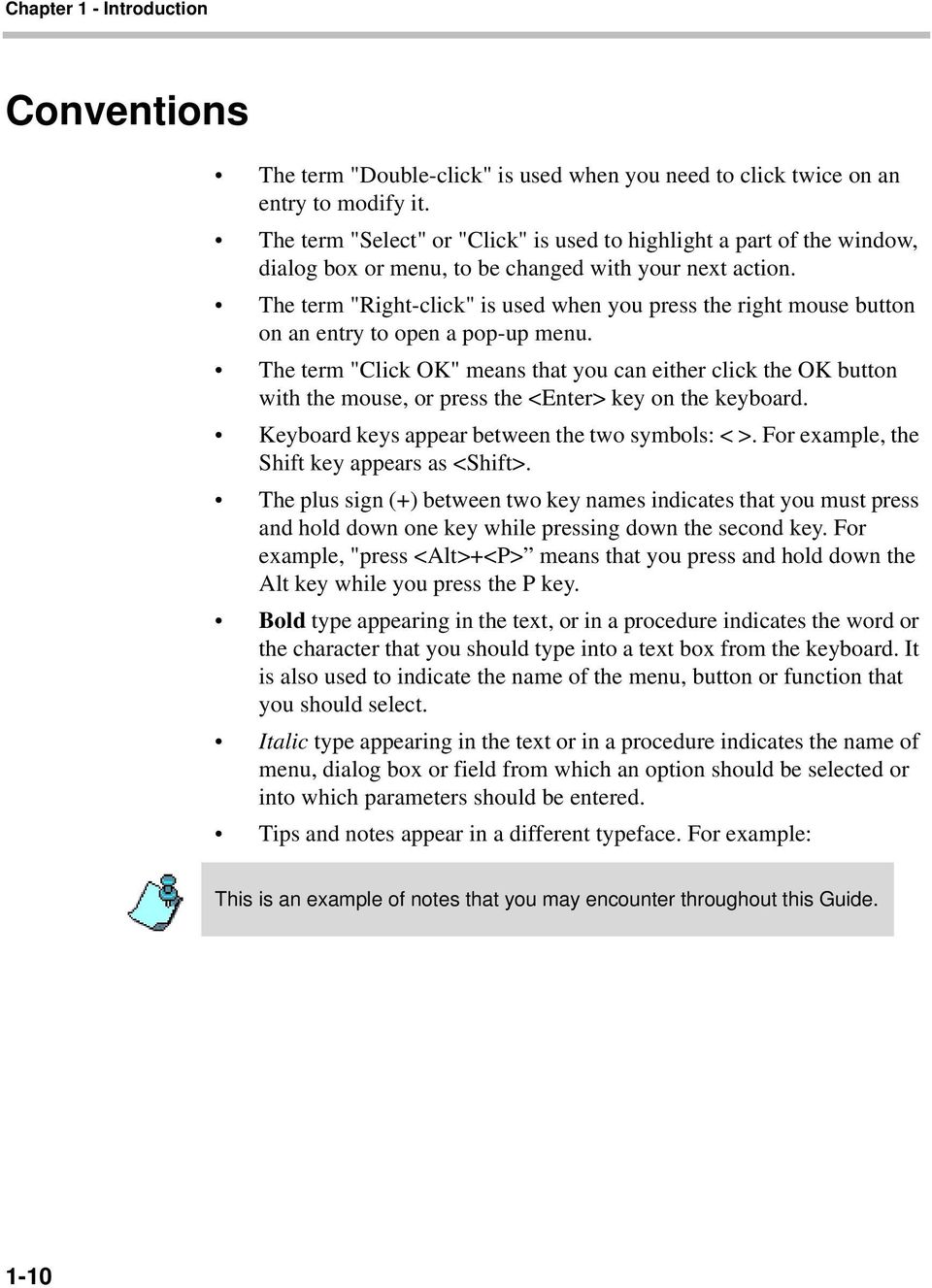
17 2 Internet Information Service (IIS) Installation IIS Installation This chapter describes the installation of the IIS. This chapter can be skipped if you have Windows 2000 & 2003 Server installed or if the IIS Server is already installed on your server. SQL Server Installation MGC Web Server Installation SQL Server Configuration Registering the Database in ODBC Defining the Server Security Properties MGC Web Commander Configuration 2-1
18 Chapter 2 - Internet Information Service (IIS) Installation Installing the IIS Application (Windows NT Workstation/Professional Only) The user must be logged in with administrator rights on the server to install the IIS. To install the Internet Information Services Application: 1. Insert the Windows NT Option Pack CD into the CD drive. 2. Using the Windows NT browser or any other file management application, display the list of files stored on the CD. 3. Double-click the Setup icon. The Setup Wizard opens. 4. Click the Install hyperlink in the left frame. 5. Click the Install Windows NT 4.0 Option Pack hyperlink. The File Download window opens. 6. Click the Run this program from its current location option and then click OK. A window indicating the installation destination path opens. 7. Click OK to continue. The Windows NT 4.0 Option Pack Welcome window opens. 8. Click Next. The End User License Agreement window opens. 9. Click Accept. The Installation Type window opens. 10. Click the Typical button to select the installation type. 11. Select the target directory for the IIS installation and click OK. The system installs the IIS application in the selected directory. 12. When the installation is complete, restart Windows NT. For a more detailed explanation on installing the IIS server, refer to Microsoft documentation. 2-2
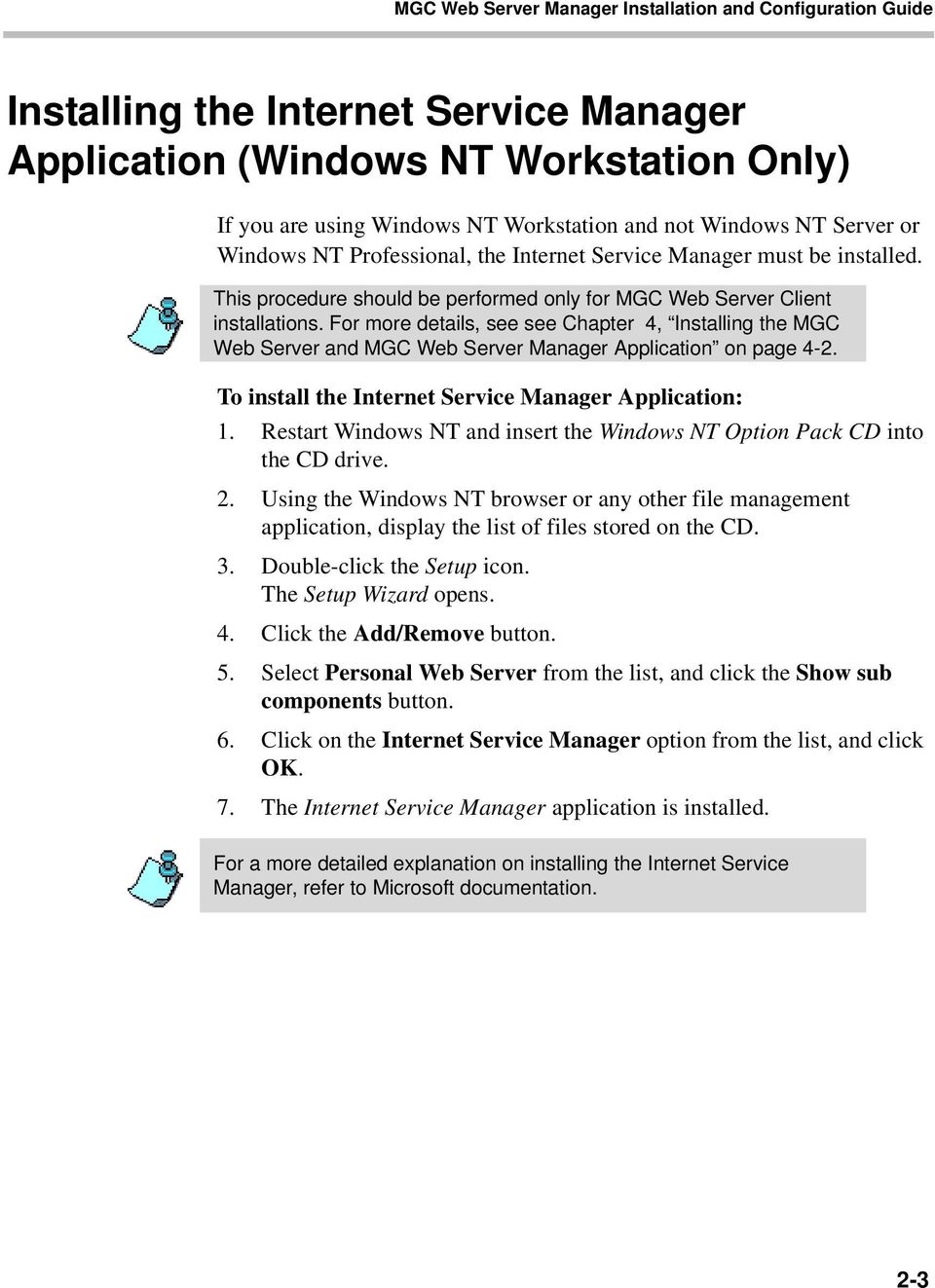
19 MGC Web Server Manager Installation and Configuration Guide Installing the Internet Service Manager Application (Windows NT Workstation Only) If you are using Windows NT Workstation and not Windows NT Server or Windows NT Professional, the Internet Service Manager must be installed. This procedure should be performed only for MGC Web Server Client installations. For more details, see see Chapter 4, Installing the MGC Web Server and MGC Web Server Manager Application on page 4-2. To install the Internet Service Manager Application: 1. Restart Windows NT and insert the Windows NT Option Pack CD into the CD drive. 2. Using the Windows NT browser or any other file management application, display the list of files stored on the CD. 3. Double-click the Setup icon. The Setup Wizard opens. 4. Click the Add/Remove button. 5. Select Personal Web Server from the list, and click the Show sub components button. 6. Click on the Internet Service Manager option from the list, and click OK. 7. The Internet Service Manager application is installed. For a more detailed explanation on installing the Internet Service Manager, refer to Microsoft documentation. 2-3
20 Chapter 2 - Internet Information Service (IIS) Installation 2-4

21 3 SQL Server Installation IIS Installation This chapter describes the installation of the SQL server. This chapter can be skipped if you are using only the Polycom Datastore or Access database provided with the MGC WebCommander application. SQL Server Installation MGC Web Server Installation SQL Server Configuration Registering the Database in ODBC Defining the Server Security Properties MGC Web Commander Configuration 3-1
22 Chapter 3 - SQL Server Installation Installing Windows NT Service Pack 4.0 The Windows NT Service Pack 4.0 should be installed prior to installing the SQL Server to ensure the SQL Server operates smoothly. To install the Windows NT Service Pack: 1. Insert the Windows NT Service Pack 4.0 CD into the CD drive. 2. Using the Windows NT browser or any other file management application, display the list of files stored on the CD. 3. Double-click the Setup icon. The Setup Wizard opens. 4. Click the Install Service Pack 4.0 option in the Section Contents list. The File Download window opens. 5. Click the Run this program from its current location option, and then click OK. A window indicating the installation destination path opens. 6. Click OK to continue. The Windows NT 4.0 Service Pack Welcome window appears. 7. Click Next. The End User License Agreement window opens. 8. Click Accept. 9. Click the Install button. 10. At the end of the installation, restart Windows NT For a detailed explanation on installing Windows NT Service Pack 4.0 refer to Microsoft documentation. 3-2
23 MGC Web Server Manager Installation and Configuration Guide Installing the SQL Server The user must be logged in with administrator rights on the server to install the SQL. To install the SQL Server: 1. Insert the SQL Server CD into the CD drive. The Setup Wizard window opens. 2. Double-click the Setup icon. The Setup Wizard opens. 3. Click the Install SQL Server 7.5 and components option. 4. Select the Desktop Edition option. The File Download window opens. 5. Click the Local Install to local disk option, and then click Next. 6. Click Next again to continue. The Installation Type window opens. 7. Click Typical, and then click Next. The Service Accounts window opens. Installing SQL in workstations having Windows NT with non-latin Language support (Chinese, Hebrew, etc.) may cause, in some cases, an error message when configuring the database (as described in Chapter 5). In such an installation, the Custom installation may be used. For more details, see Installing the SQL Server in Windows NT with non-latin language support at the end of this procedure. 8. Select the Use the same account for each service and the Auto Start SQL Server Service options. The Service Settings dialog box opens. 9. Click the Use a domain user account option, and then click Next. 10. Click Next to start the installation. The Setup Complete window opens when the installation is complete. 11. Click Finish to exit the SQL Server application. 3-3
24 Chapter 3 - SQL Server Installation Installing the SQL Server in Windows NT with non-latin language support: 1. Perform steps 1 to 6 in the previous procedure. 2. In the Setup Type window, select the Custom option button. 3. Click Next. The Select Components window opens. 4. Click Next to install the default components. 3-4
25 MGC Web Server Manager Installation and Configuration Guide The Character Set window opens. 5. Select the following parameters: Character Set 1252/ISO Character Set Set Order Dictionary order, case-insensitive Unicode Collation General Unicode Check the following check boxes: Case-insensitive, Widthinsensitive and Kana-insensitive 6. Click Next. The Network Libraries window opens. 7. Click Next to accept the system defaults. 8. Perform steps 8 to 11 of the previous procedure. For a detailed explanation on installing Windows NT Service Pack 4.0 refer to Microsoft documentation. 3-5
26 Chapter 3 - SQL Server Installation 3-6
27 4 MGC Web Server Manager Installation IIS Installation This chapter describes the installation of the MGC Web Server. The MGC Web Server communicates with the IIS sever, the database server and the MCUs. SQL Server Installation MGC Web Server Installation SQL Server Configuration Registering the Database in ODBC Defining the Server Security Properties MGC Web Commander Configuration On a clean installation of Windows NT or 2000 Server, the WebCommander is automatically installed under Default Web Site and is assigned active port 80 of the IIS. As the Default Web site is well known, it may be vulnerable to viruses. Therefore it is recommended to create a virtual directory (under a different name) to which the port 80 Web site on the IIS will be assigned, so that when installing WebCommander, the application is automatically installed under this new Web site, and not the Default Web site. Do not perform this step if there are virtual sites already in use that are residing in the Default Web site in your system, as all sites located in the Default Web site stop working after creating a new port 80 Web site. If there is already an active port 80 Web site that is not the Default Web site configured on the IIS, there is no need to create a new Web site, as the IIS is already protected. The security of the site may also be increased by installing the Cumulative Patch for Internet Information Services that can be found in: treeview/default.asp?url=/technet/security/bulletin/ms asp 4-1
28 Chapter 4 - MGC Web Server Manager Installation Prior to Installation and Software Upgrade If you are upgrading from a previous version, it is recommended to backup the SQL/MSDE or Access database. The WebCommander and MGC Personal Scheduler supports NT authentication when using an ODBC connection. SQL authentication is available starting with version 7.5. Backing Up the SQL/MSDE Database To backup the SQL/MSDE database: 1. On the Start-Programs menu, click Microsoft SQL Server and then Enterprise Manager. The SQL Server Enterprise Manager window opens. 2. Click the [+] icon next to Microsoft SQL Server to expand the list. 3. Click the [+] icon next to SQL Server Group to expand the list. 4. Click the [+] icon next to <PC Name> to expand the list. 4-2
29 MGC Web Server Manager Installation and Configuration Guide 5. Right-click the Databases folder icon. On the pop-up menu click All Tasks, and then select Backup Database. The SQL Server Backup General dialog box opens. 4-3
30 Chapter 4 - MGC Web Server Manager Installation 6. On the General tab, select a database from the list and enter a name for the backup file, select a backup destination folder and click OK. When the backup process is completed, the SQL Server Enterprise Manager message is displayed, indicating the backup operation was completed successfully. 7. Click OK. The new backup file is located in the destination folder selected in step 6. Backing up the Access Database To backup the Access database: 1. Open the folder where the database resides. 2. Select the database file by clicking it. 3. From the Edit menu, select Copy, and then select Paste. 4. The backup database file called Copy of <database_name>, appears in the same folder as the original database. This file can be moved to any folder. 4-4
31 MGC Web Server Manager Installation and Configuration Guide Product Validation WebCommander Version 8.0, requires product validation to operate. To validate your product it must be registered in the Polycom Resource Center Web site ( prior to software installation or during the software installation and the key code that is retrieved is used during the software installation. Your MGC WebCommander software product is shipped with the appropriate license number (found on the software CD) and the licensed number of users. When the number of users permitted on his license is exceeded, you can upgrade the license to increase the number of WebCommander users. If you are downloading the new software version from Polycom FTP and the appropriate license number was not provided, contact your next level of support for the appropriate license number. Retrieving the Key Code from a Polycom Web Site: Access the Polycom web site signon.html. User ID and Password are required to access this site. If you are new to Polycom's Resource Center, you must first get a New User Account. 4-5
32 Chapter 4 - MGC Web Server Manager Installation 1. In the Polycom's Resource Center page, login using your User ID and Password. 2. Click Product Activation. 4-6
33 MGC Web Server Manager Installation and Configuration Guide The Activate Your Product web page opens. 3. Select one of the following of options according to your installation type: a. If you are upgrading from a previous version that is already registered with Polycom s Resource Center, in the Software Upgrade Key Code box, click Retrieve Software Key Code to generate the appropriate key code. b. If you are registering a new product, in the Single License Number box, enter the License and Serial Number and then click Generate to retrieve the key code. c. If you are registering a new product with multiple licenses, create a text file with all the license numbers. In the Multiple License Numbers box, click Attach File to add the text file with all your product Licenses and Serial Numbers and automatically send it to Polycom s Resource Center. An listing all the required key codes is sent to your registered address. The retrieved Key Code together with the product s License number are used during the product installation or upgrade. 4-7
34 Chapter 4 - MGC Web Server Manager Installation Installing the MGC Web Server and MGC Web Server Manager Application Product validation procedure must be performed prior to the software upgrade. During the WebCommander installation setup, the Enter License Information window provides a link in order to access the website. For existing WebCommander users that want to upgrade to the latest version, the Polycom sales order number of your invoice is assigned as the WebCommander serial number. A Polycom sales order number is generated when a product is ordered, by a Polycom reseller or customer, from Polycom. Please keep the assigned WebCommander serial number on file, as it is needed to be referenced for downloading WebCommander software upgrades from the Polycom Resource Center web site ( extranet.polycom.com), or when placing service support calls. The MGC WebCommander software package is based on the type license purchased. The following product types are available: Professional Server Installs the MGC Web Server, the MGC Web Server Manager, the WebCommander Configuration tool and the MGC Personal Scheduler/Client applications to enable full functionality from the Web, and conference scheduling from Microsoft Outlook. This installation allows users to schedule and start reservations, monitor, and control On Going conferences from the Web. Meeting Director Server - Installs the MGC Web Server and MGC Web Server Manager applications that enables the monitoring of conferences via the Web. Meeting Scheduler - Installs the MGC Web Server, the MGC Web Server Manager and the MGC Personal Scheduler applications that enable the scheduling of conferences via the Web. This module enables users to schedule and organize conferences using the Meeting Scheduler, Personal Scheduler or just the Client application. The Installation Wizard guides you through the installation process for the MGC Web Server. When a Firewall is present on your network it is recommended that you use Port 80 for your WebCommander configuration. 4-8
35 MGC Web Server Manager Installation and Configuration Guide If installing from FTP: 1. Download the software from the FTP site and unzip the files. 2. Open Windows Explorer and browse to the directory that contains the MGC WebCommander diskettes. 3. Expand the Disk 1 folder and double-click the Setup.exe file. The Installation Wizard Welcome screen opens. If installing from a CD: 1. Insert the CD into the CD drive. 2. From the Start menu, select Run. 3. In the Run dialog box, enter D:Setup, where D is the CD drive name, and then click OK. The Installation Wizard Welcome screen opens. Installation Wizard The installer must have administrator rights or domain administration rights to install software. It is also important that the password used to access the domain is permanent and does not expire after 90 days. To Upgrade version 8.0 using an existing product License A customer may be required to upgrade the WebCommander when installing a different package from the one currently installed. When a change in the product type is required, the customer is required to enter the new license Serial Number and Key Code. 1. In the Upgrade wizard s Software License Agreement window, click Yes to accept and continue. The Question dialog box appears. 4-9
36 Chapter 4 - MGC Web Server Manager Installation 2. Click No to use the current license number. The Question dialog box appears. a. Click Yes to use the existing product license and complete the installation. For more information, continue on page 12, with step 5. b. When you click No, you exit the installation. New WebCommander Installations and Version Upgrades: 1. From the Polycom Resource Center s Website retrieve the KeyCode information by entering the product s license and serial number in the Activate Your Product - Single License Number/Multiple License Numbers dialog box, for more information see Retrieving the Key Code from a Polycom Web Site: on page 5. The WebCommander installation disk lists the product s license. You will be required to provide this information when running the Installation Wizard. 2. In the Software License Agreement window, click Yes to accept and continue. The Enter License Information window opens. 4-10
37 MGC Web Server Manager Installation and Configuration Guide Click Polycom Resource Center to register your product on the Polycom Website and retrieve your product s Key Code. See Retrieving the Key Code from a Polycom Web Site: on page 5. In the License field enter the serial number located on the Product CD In the Key Code field enter the key code retrieved from the Polycom website 3. When incorrect information is entered, a Warning dialog box appears. Click OK, and re-type the sequence of codes. If this dialog box re-appears, please contact customer support. 4. Click OK and continue the installation setup. If this dialog box re-appears, please contact customer support. In certain instances the following dialog box appears. Click Yes, to upgrade your MDAC version and continue the installation. Windows automatically reboots after the MDAC installation, and the WebCommander installation setup restarts automatically. 4-11
38 Chapter 4 - MGC Web Server Manager Installation 5. Click OK and continue the installation setup. The Software License Agreement window appears. 6. Click Yes, to accept and continue. The Welcome window opens. 4-12
39 MGC Web Server Manager Installation and Configuration Guide 7. Click Next. The User Information window opens. 8. Enter the user Name and Company details and click Next. The Setup Type window opens, listing the products according to the purchased package. 9. Select the appropriate product type as follows: Client Installs the MGC Web Server Manager application on a computer other than the server for remote access to the MGC Web Server. 4-13
40 Chapter 4 - MGC Web Server Manager Installation MGC Personal Scheduler Installs the MGC Web Server and MGC Web Server Manager applications that enable users to define, modify, and start reservations via the Web or Microsoft Outlook. Meeting Director Server - Installs the MGC Web Server and MGC Web Server Manager applications that controls and manages On Going conferences via the Web. This module enables users to monitor the ongoing conference status, and perform various operations. Professional Server Installs the MGC Personal Scheduler and the Meeting Director Server components to enable full functionality from the Web, and conference scheduling from Microsoft Outlook. This installation allows users to schedule and start reservations, monitor, and control On Going conferences from the Web. 10. Click Next. The Choose Destination Location window opens. 4-14
41 MGC Web Server Manager Installation and Configuration Guide 11. Select the target path for the installation (it is recommended to accept the suggested path and directory name) and click Next. The Select Programs Folder window opens. 12. Click Next to accept the suggested group folder and name and start downloading the software files. When the download is complete, a dialog box appears, prompting you whether to configure the PathNavigator gatekeeper. 13. Select: Yes to automatically configure the link to the PathNavigator Gatekeeper. Proceed with step 12. No, if no PathNavigator gatekeeper is installed in your environment, or to manually define the link to the PathNavigator. Proceed with step 15 on page
42 Chapter 4 - MGC Web Server Manager Installation 14. If you have selected Yes, the Select Components window opens. The following options are available: Specify is the default setting. It enables you to manually define the link to the PathNavigator gatekeeper. Automatically lets the WebCommander search for a PathNavigator database on all the SQL servers installed in the local domain and automatically create the link between them. a. To manually select the PathNavigator gatekeeper server, click Next. 4-16
43 MGC Web Server Manager Installation and Configuration Guide The Enter Information window opens. Enter the name of the PathNavigator gatekeeper server, and click Next. A confirmation dialog box (Server found) opens. Click OK. b. Select Automatically to let the system to detect automatically select the PathNavigator gatekeeper, and click Next. A confirmation dialog box opens. Click Yes to enable the system to automatically search for the PathNavigator Gatekeeper, or click Cancel, to Specify the PathNavigator gatekeeper. If you have selected Yes, the Select a PathNavigator Database dialog box opens, listing the SQL Servers found in the local domain. 4-17
44 Chapter 4 - MGC Web Server Manager Installation Select the required PathNavigator Server, and then click Next. c. If you have selected Cancel, the Select Components window reopens. When you enter an incorrect name, a Warning dialog box appears. 4-18
45 MGC Web Server Manager Installation and Configuration Guide 15. The Site alias name window opens. The site Alias name automatically redirects participants to the correct Web site in the event that the address changes (for instance, when upgrading to a higher version). For example, the alias entered to go to the Web site can be abcabc, where abcabc is the IP address of the WebCommander server. 16. Enter the site Alias name and then click Next. The Setup Complete window opens. 4-19
46 Chapter 4 - MGC Web Server Manager Installation 17. At the end of the installation, click Finish to complete the installation procedure and exit the Setup Wizard. Sometimes the error message Cannot Create Application appears at the end of the installation. This error message may appear when there are two Web sites installed in the system. In this case, you need to manually create and configure the ConfSiteV8_0 and ConfPollerSiteV8_0 in the IIS application. 4-20
47 5 Configuration IIS Installation SQL Server Installation MGC Web Server Installation SQL Server Configuration Registering the Database in ODBC Defining the Server Security Properties This chapter describes the steps required to configure the various components of the MGC Web Server, MGC WebCommander and MGC Personal Scheduler applications. This chapter also describes the Client installation and configuration, and the integration with Polycom PathNavigator. The following steps are described in this chapter: SQL Server Configuration Registering the database in the ODBC Data Sources Integrating Polycom PathNavigator Configuring the Polycom Datastore Database Defining the Server Security properties Configuring the Internet Information Service for Windows Authentication MGC WebCommander configuration MGC Personal Scheduler plug-in configuration Remote installation of the MGC Personal Scheduler Client Installation and Configuration of the MGC Web Server Client MGC Web Commander Configuration 5-1
48 Chapter 5 - Configuration SQL Server Configuration (For SQL/MSDE Server Installations Only) IIS Installation SQL Server Installation MGC Web Server Installation SQL Server Configuration Registering the Database in ODBC Defining the Server Security Properties MGC Web Commander Configuration This step is required only if you have an SQL/MSDE Server installed in your configuration. In this step, the SQL/MSDE database supplied with the MGC Web Server Manager application is registered, restored and configured in the SQL Server application. When using the SQL/MSDE Server, the SQL Server must be configured to work with the SQL database supplied with the MGC Web Server. The database in the ODBC must then be configured. This step is required for both SQL/MSDE and Access databases. The following table describes the system behavior when the SQL/MSDE or the Access database is installed on a remote computer (on a computer other than the server), or on the local server (same computer as the MGC Web Server), using System Account or User Account. Whether the database is remote or local is defined during the configuration of the database, according to the desired behavior and the account type. System Account Before Login System Account After Login Local Access Remote Access Local SQL/ MSDE Remote SQL/ MSDE X X X X User Account Before Login User Account After Login X - Access to the database X- No access to the database 5-2
49 MGC Web Server Manager Installation and Configuration Guide Existing WebCommander Users Upgrading to the SQL/MSDE Database If you are using WebCommander with a default database and want to migrate to SQL or MSDE database you are required to install SQL or MSDE database package including the SQL database management tool, the SQL Server Enterprise Manager application. First install the database package and then install the management tools package. After installation of both components you are required to register the SQL database in the Enterprise Manager application. For more information see Registering the SQL/MSDE Database in the SQL Enterprise Manager on page 5-3. When complete, create an Login account in the Enterprise Manager application. For more information see Adding an SQL/MSDE Database Login Account in the SQL Enterprise Manager: on page 5-8. Registering the SQL/MSDE Database in the SQL Enterprise Manager Registration with the SQL sever allows you to define the authentication link that will be used to connect the database and the server. 1. Access the SQL Enterprise Manager. 2. Right-click the SQL Services Group and select New SQL Server Registration. 5-3
50 Chapter 5 - Configuration The Register SQL Server Wizard dialog box opens. 3. Click Next. 4. The wizard automatically populates a list of servers available on the network, select the server that has to connect to the Database. 5. Select the Add button and then click Next. 5-4
51 MGC Web Server Manager Installation and Configuration Guide 6. Select the Authentication mode used to connect to the SQL Server: Windows Authentication SQL Server Authentication Then click Next. 5-5
52 Chapter 5 - Configuration 7. If you selected SQL Server Authentication you can login automatically by providing the Login name and Password. You may also be prompted for the Login name and Password when the connection to the SQL Server is established. If working with a SQL database and there is no connection to the PathNavigator database the following login entries are required: Login name: GKUser Password: Gatekeeper When PathNavigator is installed, the GKUser is already defined in the database, and you do not need to add a Login account. 8. Click Next. \ 5-6
53 MGC Web Server Manager Installation and Configuration Guide 9. You can add the SQL Server to an existing SQL Server Group or select to create a new one, and click Next. 10. The setup is complete and the wizard lists the name of the server that is connecting to the SQL Server. Complete the wizard installation by clicking Finish. 5-7
54 Chapter 5 - Configuration Adding an SQL/MSDE Database Login Account in the SQL Enterprise Manager: Setting up an Login account with the SQL sever allows you to define the authentication link that will be used to connect the database and the enterprise manager. 1. Select the SQL Server registered in the SQL Enterprise Manager and expand the tree. 2. Expand the Security list, right-click Logins and select New Login. The SQL Server Login Properties - New Login dialog box opens 5-8
55 MGC Web Server Manager Installation and Configuration Guide 3. In the Name box enter the Windows Login name of the Server. 4. In the Authentication pane select the mode that is used to connect to the server: Windows Authentication - Select from the Domain list, the domain that is required to access the network and click Grant access. SQL Server Authentication - Enter the password used to access the SQL server. 5-9
56 Chapter 5 - Configuration 5. Choose the Database Access tab and select the database to access during login. 6. Select in the Permit in Database Role the type of user (public) that can access the database and the database owner (db owner). 7. Click OK. The user is added to the Logins list. 5-10
57 MGC Web Server Manager Installation and Configuration Guide Restoring the SQL Server The server security properties must then be defined and the User or System account must be selected according to the desired behavior and the account to be used. To configure the SQL Server: 1. On the Start-Programs menu, click Microsoft SQL Server, and then Enterprise Manager. The SQL Server Enterprise Manager window opens. 2. Click the plus [+] icon next to the Microsoft SQL Servers to expand the list. 3. Click the plus [+] icon next to the SQL Server Group to expand the list. 4. Right-click the Databases folder icon and then click All Tasks Restore Database on the pop-up menu. 5-11
58 Chapter 5 - Configuration The Restore database General dialog box opens. 5. In the Restore as database box, enter a name to identify the database and select the From device option. 6. Click the Select Devices button. The Choose Restore Devices dialog box opens. 7. Click the Add button. 5-12
59 MGC Web Server Manager Installation and Configuration Guide The Choose Restore Destination dialog box opens. 8. In the File Name box, enter the name and path of the SQL database file (AccordSQLDB) to be restored in the SQL Server Manager. This file is installed with the MGC Web Server Manager application, and is stored in the Accord MGC Web Server Manager\Database directory (the path of the default installation is c:\program Files\Accord MGC Web ManagerV8.0\Database\AccordSQLDB). 9. Click the browse button (...) to select this file from the file browser. One SQL database may be used by both the MGC WebCommander applications and the MGC Manager application provided the same database is selected for both applications. If the MGC Manager is installed first, select the database configured in the MGC Manager ODBC. If the WebCommander Server Manager application is installed first, select the database configured here as the database for the MGC Manager application. In both cases, the database can be installed on a network server other than the one used for the Web Server. 10. Click OK to confirm. The system returns to the Choose Restore Devices dialog box, displaying the path and name of the database file to be restored. 11. Click OK to confirm. 5-13
60 Chapter 5 - Configuration The system returns to the Restore database General dialog box. 12. Click the Options tab to verify that the appropriate path of the SQL Server is selected. If it is incorrect, type the correct path (usually you will have to modify the drive, i.e., from D to C). 13. Click OK to confirm. The system exits the Restore Database dialog box and launches the restore operation. At the end of the restore operation, the restored database appears in the list of databases. In some installations the following error message may be displayed when clicking OK: 5-14
61 MGC Web Server Manager Installation and Configuration Guide To overcome this problem perform the following steps: 1. Stop the SQL Server: In the System Tray, right click the SQL Server icon, and then click MSSQLSever Stop. 2. Using Windows Explorer, access the SQL directory on your system and copy the Data directory either to the same location (a Copy of Data directory is created), or to a different location. 3. Using Windows Explorer, access the SQL directory and the BINN directory, and double-click the Rebuildm.exe utility. 5-15
62 Chapter 5 - Configuration The Rebuild Master dialog box opens. 4. Click the Browse button to select the master database to be used to change the sort order. The Browse for Folder dialog box opens. 5. Select the Copy of Data folder according to its path (as resulting from step 2 of this procedure). 6. Click OK. The name of the folder appears in the Source Directory containing Data Files box. 7. Click Settings to select the appropriate sort order. The Character Set/ Sort Order/Unicode Collation dialog box opens. 5-16
63 MGC Web Server Manager Installation and Configuration Guide 8. Define the following parameters: Character Set 1252/ISO Character Set Sort Order Dictionary order, case-insensitive Unicode Collation General Unicode 9. Select the following check boxes: Case-insensitive, Width-insensitive and Kana-insensitive 10. Click Next. The Rebuild Master dialog box opens. 11. Click Rebuild. At the end of the processing, the Rebuild Master dialog box closes. 12. Reconnect the SQL Server: In the System Tray, right click the SQL Server icon, and then click SMMQLSEVER Start on the pop-up menu. 13. Perform steps 1 to 11 in the SQL Server Configuration procedure. Make sure that the appropriate path is selected in the Restore Database Options dialog box. 5-17
64 Chapter 5 - Configuration Registering the SQL Database in the ODBC Data Sources If you are upgrading from a previous MGC Web Server Manager version without changing the database path, this procedure can be skipped. IIS Installation SQL Server Installation MGC Web Server Installation The SQL database provided with the MGC Web Server must be registered in the ODBC Data Source to enable its use by both the SQL and MGC WebCommander applications. The Database can be registered either from the MGC Web Server Manager application, or from the Control Panel. To register the SQL Database: 1. On the Start - Settings menu, click Control Panel. SQL Server Configuration Registering the Database in ODBC Defining the Server Security Properties The Control Panel window opens. 2. Double-click the Administrative Tools icon. MGC Web Commander Configuration The Administrative Tools window opens. 3. Double-click the ODBC Data Sources icon. 5-18
65 MGC Web Server Manager Installation and Configuration Guide 4. The ODBC Data Sources dialog box opens. Alternatively, in the MGC Web Server Manager application, click the Options menu, and then click Add/Remove connection to ODBC. The ODBC Data Sources dialog box opens. 5. Click the System DSN tab to display the System DSN window. 6. Click the Add button. The Create New Data Source dialog box opens. 7. In the database type list, select SQL Server. 5-19
66 Chapter 5 - Configuration 8. Click Finish. The Create a New Data Source to SQL Server Wizard dialog box opens. 9. In the Name box, enter a name to identify the database file in the MGC Web Server Manager application. 10. From the SQL Server list, select Local if the SQL Server is installed on the same computer as the MGC Web Server. Otherwise select the appropriate server name from the list. The list shows the names of all the SQL servers currently installed in the network. One SQL database can be used by both the MGC WebCommander applications and the MGC Manager application provided the same database is selected for both applications. If the MGC Manager is installed first, select the database configured in the MGC Manager ODBC. If the WebCommander Server Manager application is installed first, select the database configured here as the database for the MGC Manager application. In both cases, the database may be installed on a network server other than the one used for the Web Server. In both cases, the database must be installed on a disk defined as Shared or on one of the network disk that can be accessed by all MGC Manager and MGC WebCommander users. 11. Click Next. The fields in the Create a New Data Source to SQL Server window change. 5-20
67 MGC Web Server Manager Installation and Configuration Guide 12. Select the With Windows NT authentication using the network login ID option. 13. Select the Connect to SQL Server to obtain default settings for the additional configuration options check box. 14. Click Next. The fields in the Create a New Data Source to SQL Server window change. 15. Select the Change the default database to check box, and then select the database that was restored in the SQL Server. 5-21
68 Chapter 5 - Configuration 16. Click Next. The fields in the Create a New Data Source to SQL Server window change. 17. To change the User Interface language used in the database, select the Change the Language of SQL Server System Message to check box and select the desired language from the drop-down list. 18. Click Finish. The ODBC Microsoft SQL Server Setup window opens, displaying the ODBC data source configuration. 5-22
69 MGC Web Server Manager Installation and Configuration Guide 19. Click Test Data Source to make sure that the appropriate database was selected. The SQL Server ODBC Data Source Test window opens, with the message TESTS COMPLETED SUCCESSFULLY. 20. Click OK to confirm. The selected database is added to System DSN list. 21. Click OK to exit the ODBC. 5-23
70 Chapter 5 - Configuration Registering the Access Database in the ODBC Data Sources IIS Installation SQL Server Installation MGC Web Server Installation SQL Server Configuration Registering the Database in ODBC Defining the Server Security Properties This procedure is required only when additional databases (on the local disk or from the network) are to be used with the WebCommander. Otherwise, the registration of the Access database provided with MGC Web Server Manager application is automatically performed during installation. If you are upgrading from a previous Web Server Manager version without changing the database path you can skip this procedure. The following table describes the system behavior when an Access database is installed on a remote computer (on a computer other than the server) or a local server (same computer as the server), using System Account or User Account. Local Access Remote Access User Account Before Login X User Account After Login - Access to the database X - No access to the database The Database can be registered either from the MGC Web Server Manager application or from the Control Panel. MGC Web Commander Configuration 5-24
71 MGC Web Server Manager Installation and Configuration Guide To register the Access Database: 1. On the Start - Settings menu, click Control Panel. The Control Panel window opens. 2. Double-click the Administrative Tools icon. The Administrative Tools window opens. 3. Double-click the ODBC Data Sources icon. The ODBC Data Sources dialog box opens. Alternatively, in the MGC Web Server Manager application, click the Options menu, and then click Add/Remove connection to ODBC. The ODBC Data Sources dialog box opens. 5-25
72 Chapter 5 - Configuration 4. Click the System DSN tab. 5. Click the Add button. The Create New Data Source dialog box opens. 6. In the database type list, select Microsoft Data Access. 7. Click Finish. The ODBC Microsoft Access Setup dialog box opens. 8. In the Data Source Name box, enter a name that to identify the database file in the MGC Web Server Manager. 5-26
73 MGC Web Server Manager Installation and Configuration Guide 9. Click Select. The Select Database dialog box opens. 10. Select the database file supplied with the MGC Web Server Manager (AccordAccess.mdb) located in the MGC Web Server\DataBase folder. 11. Click OK. 5-27
74 Chapter 5 - Configuration One Access database can be used by both the MGC WebCommander application and the MGC Manager application provided the same database is selected for both applications. If the MGC Manager is installed first, select the database configured in the MGC Manager ODBC. If the WebCommander Server Manager application is installed first, select the database configured here as the database for the MGC Manager application. In both cases, the database may be installed on a network server other than the one used for the Web Server. In both cases, the database must be installed on a disk defined as Shared or on one of the network disk that can be accessed by all MGC Manager and MGC WebCommander users. The system returns to the ODBC Microsoft Access Setup dialog box, displaying the name and path of the selected database file. 12. Click OK. The System DSN dialog box opens. 13. Click OK to confirm and exit the ODBC settings. 5-28
75 MGC Web Server Manager Installation and Configuration Guide Defining the MGC Web Server Security Properties The security properties of the MGC Web Server must be defined to allow access to the Server. The security properties are defined differently for the Windows NT Server, Windows 2000 Server and Windows 2003 Server. If you want to use the Windows Authentication Method for logging into the WebCommander, the Web Server Properties definition changes. For more details see the Web Server Manager Installation and Configuration Guide, Configuring the Internet Information Service (IIS) for Windows Authentication. Windows NT Server To define the security properties in Windows NT Server: 1. On the Start - Programs menu, click Windows NT Option Pack 4.0, Microsoft Personal Web Server, and then Internet Service Manager. The Internet Information Services window opens. 2. Click the [+] icon next to Internet Information Server to expand the list. The Internet Information Services (IIS) must be located within the Domain. The installer must have administrator rights or domain administration rights to install software. It is also important that the password used to access the domain is permanent and does not have an expiration date. 3. Click the [+] icon next to the Server name to expand the list. 5-29
76 Chapter 5 - Configuration 4. Click on the [+] icon next to the Default Web Site to expand the list. The MGC WebCommander application works with two Web sites: ConfSiteV8_0 and ConfPollerSiteV8_0. The ConfSiteV8_0 contains the Web pages that enable the user to schedule reservations and manage the site. The ConfPollerSiteV8_0 enables the monitoring of On Going conferences. These sites function differently and require different buffering settings. Therefore, each of these sites must be configured separately. 5. Right-click the ConfSiteV8_0 icon, and then click Properties. The ConfSiteV8_0 Properties-Virtual Directory dialog box opens. 5-30
77 MGC Web Server Manager Installation and Configuration Guide 6. Click the Virtual Directory tab, and then click Configuration. The Application Configuration dialog box opens. 5-31
78 Chapter 5 - Configuration 7. Click the App Options tab and ensure that the Enable buffering check box is selected. When configuring ConfPollersite V8.0 configuration clear this checkbox. The Enable buffering should not be selected. 5-32
79 MGC Web Server Manager Installation and Configuration Guide 8. Click the Directory Security tab, and then click Edit. The Authentication Methods dialog box opens. 9. Select the Anonymous access check box, and then click Edit. The Anonymous User Account dialog box opens. 5-33
80 Chapter 5 - Configuration 10. Click the Browse button to select the user name. The Select User dialog box opens. 11. Select the user name from the list, and then click OK. The Anonymous User Account dialog box opens. 12. Enter the Password, and then click OK. 5-34
81 MGC Web Server Manager Installation and Configuration Guide The Confirm Password dialog box opens. 13. Enter the Password, and then click OK. The system returns to the Authentication Methods dialog box. 14. Click OK. The system returns to the ConfSiteV8_0 Properties dialog box. 15. Click OK. The system returns to the Internet Information Services window. 16. Right-click the ConfPollerSiteV8_0 icon, and then click Properties on the pop-up menu. The ConfPollerSiteV8_0 Properties-Virtual Directory dialog box opens. 17. Repeat steps 6 13 of the ConfSite V8_0 configuration procedure to complete the ConfPollerSiteV8_0 configuration. 5-35
82 Chapter 5 - Configuration Windows 2000 Server To define the security properties in Windows 2000 Server 1. On the Start - Programs menu, click Settings, and then click Control Panel. The Control Panel window opens. 2. Click the Administrative Tools icon. The Administrative Tools window opens. 3. Click the Internet Services Manager icon. The Internet Information Services window opens. 4. Click the [+] icon next to Internet Information Server to expand the list. 5. Click the [+] icon next to the Server name to expand the list. 5-36
83 MGC Web Server Manager Installation and Configuration Guide 6. Click the [+] icon next to the Default Web Site to expand the list. The MGC WebCommander application works with two Web sites: ConfSiteV8_0 and ConfPollerSiteV8_0. The ConfSiteV8_0 contains the Web pages that enable the user to schedule reservations and manage the site. The ConfPollerSiteV8_0 enables the monitoring of On Going conferences. These sites function differently and require different buffering settings. Therefore, each of these sites must be configured separately. 7. Right-click the ConfSiteV8_0 icon, and then click Properties. 5-37
84 Chapter 5 - Configuration The ConfSiteV8_0 Properties-Virtual Directory dialog box opens. 8. Click the Virtual Directory tab, and then click Configuration. The Application Configuration dialog box opens. 5-38
85 MGC Web Server Manager Installation and Configuration Guide 9. Click the App Options tab and ensure that the Enable buffering check box is selected. When configuring ConfPollersite V8.0 configuration clear this checkbox. The Enable buffering should not be selected. 5-39
86 Chapter 5 - Configuration 10. Click OK. 11. Click the Directory Security tab, and then click Edit in the Anonymous access and authentication control pane. The Authentication Methods dialog box opens. 12. Select the Anonymous access check box, and then click Edit. The Anonymous User Account dialog box opens. 5-40
87 MGC Web Server Manager Installation and Configuration Guide 13. Click the Browse button to select the user name. The Select User dialog box opens. 14. Select the user name from the list, and then click OK. The Anonymous User Account dialog box opens. 15. Enter the Password, and then click OK. 5-41
88 Chapter 5 - Configuration The Confirm Password dialog box opens. The system returns to the Authentication Method dialog box. 16. Click OK. The system returns to the ConfSiteV8_0 Properties dialog box. 17. Click OK. The system returns to the Internet Information Services window. 18. Right-click the ConfPollerSiteV8_0 icon, and then click Properties. The ConfPollerSiteV8_0 Properties-Virtual Directory dialog box opens. 19. Repeat steps 8 15 of the ConfSite V8_0 configuration procedure to complete the ConfPollerSiteV8_0 configuration. 5-42
89 MGC Web Server Manager Installation and Configuration Guide Windows 2003 Server To define the security properties in Windows 2003 Server: 1. On the Start - Programs menu, click Settings, and then click Control Panel. The Control Panel window opens. 2. Click the Administrative Tools icon. The Administrative Tools window opens. 3. Click the Internet Services Manager icon. The Internet Information Services window opens. 4. Click the [+] icon next to Internet Information Server to expand the list. 5. Click the [+] icon next to the Server name to expand the list. 6. Click the [+] icon next to the Web Sites to expand the list. 5-43
90 Chapter 5 - Configuration 7. Click the [+] icon next to the Default Web Site to expand the list. The MGC WebCommander application works with two Web sites: ConfSiteV8_0 and ConfPollerSiteV8_0. The ConfSiteV8_0 contains the Web pages that enable the user to schedule reservations and manage the site. The ConfPollerSiteV8_0 enables the monitoring of On Going conferences. These sites function differently and require different buffering settings. Therefore, each of these sites must be configured separately. 5-44
91 MGC Web Server Manager Installation and Configuration Guide 8. Right-click the ConfSiteV8_0 icon, and then click Properties. The ConfSiteV8_0 Properties-Virtual Directory dialog box opens. 5-45
92 Chapter 5 - Configuration 9. Click the Virtual Directory tab, and then click Configuration. The Application Configuration dialog box opens. 5-46
93 MGC Web Server Manager Installation and Configuration Guide 10. Click the Options tab and ensure that the Enable buffering check box is selected. When configuring ConfPollersite V8.0 configuration clear this checkbox. The Enable buffering must not be selected. 11. Click OK. 5-47
94 Chapter 5 - Configuration 12. Click the Directory Security tab, and then click Edit in the Anonymous access and authentication control pane. The Authentication Methods dialog box opens. 5-48
95 MGC Web Server Manager Installation and Configuration Guide 13. Select the Enable Anonymous access check box, and then click Edit. The Select User dialog box opens. 14. Click the Object Types button to select the user name. The Object Types dialog box opens. 5-49
96 Chapter 5 - Configuration 15. Select the user name from the list, and then click OK. The Select User dialog box opens. 16. Enter the Enter the object name to select, and then click OK. The system returns to the ConfSiteV8_0 Properties dialog box. 17. Click OK. The system returns to the Internet Information Services window. 5-50
97 MGC Web Server Manager Installation and Configuration Guide 18. Right-click the ConfPollerSiteV8_0 icon, and then click Properties. The ConfPollerSiteV8_0 Properties-Virtual Directory dialog box opens. 19. Repeat steps 8 15 of the ConfSite V8_0 configuration procedure to complete the ConfPollerSiteV8_0 configuration. 20. Select the Web Server Extension and click Activate Server Pages. 5-51
98 Chapter 5 - Configuration 21. Click Allow. The installation is complete. 5-52
99 MGC Web Server Manager Installation and Configuration Guide Selecting the User Account for Accessing the MGC Web Server By default, the Web Server is installed during the installation process. When using a local database, there is no need to define the Web Server security properties. All other definitions require setting the properties of the Web Server. To select the user account in Windows NT/2000 Server: 1. On the Start - Programs menu, click Administrative Tools, and then click Services. The Services window opens. 2. Right-click OperSrvV8_0, and then click Properties. 5-53
100 Chapter 5 - Configuration The OperSrvV8_0 Properties (Local Computer) dialog box opens. 3. Click the Log On tab. 4. Select This account to select the user with access to the MGC WebCommander Server. 5. Click the Browse button to select the user name. The Select User dialog box opens. 6. Select the user name from the list, and then click OK. 5-54
101 MGC Web Server Manager Installation and Configuration Guide The system returns to the OperSrvV8_0 Properties (Local Computer) dialog box. 7. Enter the user password in the Password field. 8. Enter the user password again in the Confirm Password field. 9. Click OK. A confirmation box opens. 10. Click OK to confirm and complete this procedure. To select the user account in Windows 2003 Server: 1. On the Start - Programs menu, click Administrative Tools, and then click Component Services. The Services window opens. 2. Right-click OperSrvV8_0, and then click Properties. The OperSrvV8_0 Properties (Local Computer) dialog box opens. 3. Click the Log On tab. 4. Select This account to select the user with access to the MGC WebCommander Server. 5-55
102 Chapter 5 - Configuration 5. Click the Browse button to select the user name. The Select User dialog box opens. 6. Select the user name from the list, and then click OK. The system returns to the OperSrvV8_0 Properties (Local Computer) dialog box. 7. Enter the user password in the Password field. 8. Enter the user password again in the Confirm Password field. 9. Click OK. A confirmation box opens. 10. Click OK to confirm and complete this procedure. 5-56
103 MGC Web Server Manager Installation and Configuration Guide Starting up the Server When the application is installed, the server is started automatically. Manual start of the server is only required when the password is changed or for troubleshooting. To start up the Server in Windows NT/2000/2003 Server: 1. On the Start - Programs menu, click Administrative Tools, and then click Services. In Windows 2003 Server click Component Services. This is shown in step 1 of the previous section. The Services window opens. 5-57
104 Chapter 5 - Configuration 2. Right-click OperSrvV8_0, and then click Start on the pop-up menu. The Service Control box opens, indicating that Windows is attempting to start the OperSrvV8_0 service. 5-58
105 MGC Web Server Manager Installation and Configuration Guide 3. In the Services dialog box, the status of the service changes to Started. 5-59
106 Chapter 5 - Configuration Selecting the User Account for Accessing the WAM Server By default, the WAM Server is installed during the installation process. When using a local database, there is no need to define the WAM Server security properties. All other definitions require setting the properties of the WAM Server. To select the user account in Windows NT/2000/2003 Server: 1. On the Start - Programs menu, click Administrative Tools, and then click Services. In Windows 2003 Server click Component Services. The Services window opens. 5-60
107 MGC Web Server Manager Installation and Configuration Guide 2. Right-click WAM, and then click Properties. The WAM Properties (Local Computer) dialog box opens. 3. Click the Log On tab. 4. Select This account to select the user with access to the MGC WebCommander Server. 5-61
108 Chapter 5 - Configuration 5. Select this account to open and then click the Browse button to select the user name. The Select User dialog box opens. 6. Select the user name from the list, and then click OK. The system returns to the WAM (Local Computer) dialog box. 7. Enter the user password in the Password field. 8. Enter the user password again in the Confirm Password field. 9. Click OK. A confirmation box opens. 10. Click OK to confirm and complete this procedure. 5-62
109 MGC Web Server Manager Installation and Configuration Guide Starting up the WAM Server When the application is installed, the server is started automatically. Manual start of the server is only required when the password is changed or when troubleshooting. To start up the WAM Server in Windows NT/2000/2003 Server: 1. On the Start - Programs menu, click Administrative Tools, and then click Services. In Windows 2003 Server click Component Services. The Services window opens. 5-63
110 Chapter 5 - Configuration 2. Right-click WAM, and then click Start on the pop-up menu. The Service Control box opens, indicating that Windows is attempting to start the WAM service. 5-64
111 MGC Web Server Manager Installation and Configuration Guide In the Services dialog box, the status of the service changes to Started. 5-65
112 Chapter 5 - Configuration Optimizing Delivery on the Server To Optimize Delivery on your Server: 1. Access the Internet Services Manager. The Internet Information Services window opens. 2. Click the [+] icon next to Internet Information Server to expand the list. The Internet Information Services (IIS) must be located within the Domain. The installer must have administrator rights or domain administration rights to install software. It is also important that the password used to access the domain is permanent and does not have an expiration date. 3. Click the [+] icon next to the Server name to expand the list. 4. Click Default SMTP Virtual Server. 5-66
113 MGC Web Server Manager Installation and Configuration Guide 5. Right-click Default SMTP Virtual Server and select Properties. 5-67
114 Chapter 5 - Configuration 6. The Default SMTP Virtual Server Properties window opens, then click Delivery. The Default SMTP Virtual Server Properties - Delivery opens. 7. Click Advanced. The Advanced Delivery window opens. 5-68
115 MGC Web Server Manager Installation and Configuration Guide 8. The Fully-qualified domain name field is registered by the system, and appears automatically. 9. In the Smart host field enter your organization s mail server name or IP address of the server. 10. Click OK. 5-69
116 Chapter 5 - Configuration Integrating Polycom PathNavigator You must use an SQL database or SQL-compatible database (such as MSDE - see below) for the Polycom PathNavigator For large databases, use an SQL database for the Polycom PathNavigator. For smaller databases, you can use an MSDE database that can be installed from your Microsoft Office 2000 or Microsoft Access 2000 CD-ROM. MSDE databases are SQL-compatible. For more information, see: off2000/html/acconaboutmsde.asp It is recommended that PathNavigator and WebCommander use the same SQL DB SQL should be installed on the WebCommander server and not on the PathNavigator server PathNavigator must be installed first and WebCommander is installed second Installations using an existing separate SQL server is supported but must be part of a domain when accessing the same database from an MGC Manager workstations PathNavigator WebCommander \ SQL Server SQL 5-70
117 MGC Web Server Manager Installation and Configuration Guide You can transfer Access data into an SQL database by building the structure of an empty SQL database and using the import utility in the SQL server. Verify that the IIS is already installed on the server and correctly configured on the network before installing the WebCommander application Connecting to the PathNavigator Database The process of integrating the PathNavigator is the same process as adding a new database to be accessed by the Web Server Manager. During the WebCommander installation setup, you have the option to Specify or Automatically add the PathNavigator database by clicking Yes. For more information see Chapter 4, Installing the MGC Web Server and MGC Web Server Manager Application on page 4-5. If the MGC Web Server Manager is installed on the same server as the PathNavigator, do not use the database entry in the DNS (ODBC Data Source) that was automatically created when the PathNavigator was originally installed. Add a new DNS entry for the PathNavigator to be accessed by the MGC Web Server. 5-71
118 Chapter 5 - Configuration To add Polycom PathNavigator SQL database to the list of connections in the Web Server Manager: 1. On the Options menu, select Add/Remove Connection to ODBC. The ODBC Data Source Administrator window opens. 2. Click the System DSN tab. 3. Click Add. The Create New Data Source window opens. 5-72
119 MGC Web Server Manager Installation and Configuration Guide 4. Select SQL Server. 5. Click Finish. The Create a New Data Source to SQL Server Wizard dialog box opens. 6. In the Name box, enter a name to identify the database file in the MGC Web Server Manager application. 7. From the SQL Server list, select Local if the SQL Server is installed on the same computer as the MGC Web Server. Otherwise select the 5-73
120 Chapter 5 - Configuration appropriate server name from the list. The list shows the names of all the SQL servers currently installed in the network. One SQL database can be used by both the MGC WebCommander applications and the MGC Manager application, provided the same database is selected in both applications. If the MGC Manager is installed first, select the database configured in the MGC Manager ODBC. If the WebCommander Server Manager application is installed first, select the database configured here as the database for the MGC Manager application. In both cases, the database may be installed on a network server other than the one used for the Web Server. In both cases, the database must be installed on a disk defined as Shared or on one of the network disk that can be accessed by all MGC Manager and MGC WebCommander users. 8. Click Next. Additional options are displayed. 9. Select With Windows NT authentication using the network login ID or With Windows SQL authentication using a login ID and password entered by the user. 5-74
121 MGC Web Server Manager Installation and Configuration Guide 10. Select the Connect to SQL Server to obtain default settings for the additional configuration options check box. 11. Click Next. 12. Select the Change the default database to check box, and then select the database that was restored in the SQL Server. 13. Click Next. Options enabling you to select the user interface language used in the database are displayed. 5-75
122 Chapter 5 - Configuration 14. To change the User Interface language used in the database, click the Change the Language of SQL Server System Message to check box and select the desired language from the drop-down list. 15. Click Finish. The ODBC Microsoft SQL Server Setup window opens, containing the ODBC data source configuration. 16. Click Test Data Source to make sure that the appropriate database was selected. 5-76
123 MGC Web Server Manager Installation and Configuration Guide The SQL Server ODBC Data Source Test window opens, with the message TESTS COMPLETED SUCCESSFULLY. 17. Click OK to confirm. The selected database is added to System DSN list. 18. Click OK to exit the ODBC. 19. At this point you need to update the PathNavigator database. Follow the steps described in Updating the Database on page
124 Chapter 5 - Configuration Adding an SQL/MSDE Database Login Account in the SQL Server Enterprise Manager: This is login account is only required when the PathNavigator database is not installed. Setting up an Login account with the SQL sever allows you to define the authentication link that will be used to connect the database and the enterprise manager. With SQL Authentication however, configuration of the Login account is required when no PathNavigator is present on the network. 1. Select the SQL Server registered in the SQL Enterprise Manager and expand the tree. 2. Expand the Security list, right-click Logins and select New Login. The SQL Server Login Properties - New Login dialog box opens 5-78
125 MGC Web Server Manager Installation and Configuration Guide 3. In the Name box enter the Windows Login name of the Server. 4. In the Authentication pane select SQL Server Authentication. 5. Enter the Password used to access the SQL server. 5-79
126 Chapter 5 - Configuration 6. Choose the Database Access tab and select the database to access during login. 7. Select in the Permit in Database Role the type of user (public) that can access the database and the database owner (db owner). 8. Click OK. The user is added to the Logins list. 5-80
127 MGC Web Server Manager Installation and Configuration Guide Updating the Database When upgrading from a previous version of the MGC Web Server Manager, the old database is saved during the installation procedure. It is recommended that you back-up the database before updating the database. At the end of the installation procedure, you must access the MGC Web Server Manager application to automatically update the database. The procedure for updating the database is the same for Windows NT, Windows 2000 and Windows Windows 95/98 does not support Unicode; therefore, when upgrading from a previous version, the language tables will not be upgraded. In such a case, perform the upgrade from a computer where Windows NT/2000 is installed. To update the database: 1. On the Start Programs menu, click MGC Web Manager Ver8.0, and then click MGC Web Server Manager. The Database Login dialog box opens. 2. Enter your Login Name and Password as defined in the database and click Login. The default Login Name is admin1. The default Password is 123. The system automatically starts the update process. 5-81
128 Chapter 5 - Configuration 3. If there are discrepancies in the number of fields between the old and the new databases, the system prompts whether to update the existing database to the new format. 4. Click Yes to automatically update the database (recommended), or No to leave the database unchanged. If you select No, new entries added to the database via the MGC Web Server Manager will not be saved. If you select Yes, the UpdateDB dialog box opens, indicating which databases require updating. Updating all the databases you intend to use is recommended. To cancel the update of a database, clear the check mark next to the database. 5-82
129 MGC Web Server Manager Installation and Configuration Guide 5. Click Apply to update the selected databases. The updating process may take time, depending on the size of the database. At the end of the process, an Update Database Results dialog box may open, listing the fields that were updated. On computers that support Unicode, this dialog box does not appear. 6. Click OK to return to the UpdateDB dialog box. Click Cancel to close the dialog box and exit the update process. 5-83
130 Chapter 5 - Configuration When upgrading from a previous version which did not support Groups, the Update Database process - automatically performed by the Server Manager - creates a group for each listed user, and retains the access rights defined for a user as the access rights to that group. Participant templates and Conference templates are automatically assigned to the Root directory; therefore, only users who have access rights to the root directory (usually administrators) are able to view these conferences. The templates can be moved to the appropriate group in the Groups tree in the MGC Manager Database Manager segment, using Copy and Paste (drag & drop is not available). When you open the MGC Web Server Manager for the first time after an upgrade, and you have not yet updated the database, you can do it later using the db s to Update from the Options menu. 5-84
131 MGC Web Server Manager Installation and Configuration Guide Configuring the Polycom Datastore Database Polycom Datastore (PDS) database is a central database where all Polycom applications and endpoints interact and share stored information. When the Polycom Datastore database is configured in the Web Server Manager, a group called Polycom Datastore is automatically defined in the WebCommander database. When defined, information can be exchanged to synchronize the WebCommander db and Polycom Datastore databases using the PDS API application (XML and Html). To configure the Polycom Datastore database in the Web Server Manager: 1. Register the Polycom Datastore database in the ODBC source. If the Polycom Datastore database is in SQL, follow the instructions in Registering the SQL Database in the ODBC Data Sources on page If the Polycom Datastore database is in Access, follow the instructions in Registering the Access Database in the ODBC Data Sources on page In the Options menu, click Polycom Datastore DB. The Polycom Datastore Setting dialog box opens. 5-85
132 Chapter 5 - Configuration 3. Select the check box(es) next to the database(s) to synchronize with the Polycom Datastore database. 4. Fill in the parameters as described in the following table:. Parameter Server IP Description The IP address of the server. Alternatively, you can enter the server URL. Server Port The port of the server. By default this is Username Password Not applicable Not applicable 5. Click OK. The name of the database(s) synchronized with Polycom Datastore appear, listing the server IP and version number. A new participant group, Polycom Datastore, appears in the New Meeting window in the WebCommander Web site. 5-86
133 MGC Web Server Manager Installation and Configuration Guide The names of the endpoints synchronized with the Polycom Data Store database are listed. 5-87
134 Chapter 5 - Configuration Configuring the Internet Information Service (IIS) for Windows Authentication Windows Authentication mechanism allows users registered with the network servers to access the MGC WebCommander Web site using their Windows login name and password. Windows users are authenticated by Windows NT through the Internet Service Manager. To enable the Windows Authentication working mode, the MGC Web Site (ConfSiteV8_0) must be configured accordingly in the IIS application. Windows Authentication is not supported by Netscape browser. Configuring the MGC Web Site to work in Windows Authentication Mode in Windows NT/2000 To configure the MGC Web Site ConfSiteV8_0: 1. In the Start - Settings menu, click Control Panel. 2. In the Control Panel list, double-click the Administrative Tools icon. 3. In the Administrative Tools list, double-click the Internet Services Manager icon. The Internet Information Services window opens. 4. Expand the server categories tree. 5-88
135 MGC Web Server Manager Installation and Configuration Guide 5. Expand the Default Web Site tree. In Windows 2003, expand the Web Sites tree and then select the Default Web Site. 6. Right-click ConfSiteV8_0, and then click Properties. 5-89
136 Chapter 5 - Configuration 7. ConfSiteV8_0 Properties window opens. The Authentication Methods window opens. 8. Click the Directory Security tab. 9. In the ConfSiteV8_0 Properties - Directory Security window, click the Edit button in the Anonymous access and authentication access pane. 10. Clear the Anonymous access check box. 11. Select the Integrated Windows authentication check box. 12. Click OK. Configuring the MGC Web Site to work in Windows Authentication Mode in Windows 2003 To configure the MGC Web Site ConfSiteV8_0: 1. In the Start - Settings menu, click Control Panel. 2. In the Control Panel list, double-click the Administrative Tools icon. 3. In the Administrative Tools list, double-click the Internet Services Manager icon. The Internet Information Services window opens. 5-90
137 MGC Web Server Manager Installation and Configuration Guide 4. Expand the server categories tree. 5. Expand the Web Sites tree. 6. Expand the Default Web Site tree. 7. Right-click ConfSiteV8_0, and then click Properties. 8. ConfSiteV8_0 Properties window opens. The Authentication Methods window opens. 9. Click the Directory Security tab. 5-91
138 Chapter 5 - Configuration 10. In the ConfSiteV8_0 Properties - Directory Security window, click the Edit button in the Anonymous access and authentication access pane. 11. Clear the Enable Anonymous access check box. 12. Select the Integrated Windows authentication check box. 13. Click OK. Defining MGC WebCommander Users in the MGC Server Manager When the IIS is configured to Windows Authentication mode, Windows users can be automatically added to the WebCommander users list when the MGC Web Server is configured to the Automatic mode. For more details on the automatic mode configuration, see Configuring the MGC Web Server Manager on page The Windows users are automatically added to the MGC Web Server Manager Users list based on their Windows user Name and Password. All other User properties remain blank and have to be manually defined by the system administrator when required. For more details on Users definition, see the MGC Web Server Manager User s Guide, Chapter
139 MGC Web Server Manager Installation and Configuration Guide Configuring the WebCommander as an External Database application for User Authentication You can configure the WebCommander application to be used as the external database application for users authentication when they login to the MGC. When a user connects to the MCU (via the MGC Manager or another application), the user is validated with the MGC Operators list. If the user is not defined in the MGC, an authentication request is sent from the MGC to the WebCommander server, where the user is validated with the Users list. When the users are defined in the WebCommander Users list, one of the three permissions that correspond to the MGC Manager permissions should be assigned to them: Administrator, Operator and Attendant. For more details about the MGC Manager Permissions, see the MGC Administrator s Guide, Chapter 6. These permissions must be defined in the Permissions table of the WebCommander. When the Users log into the MGC Manager, their WebCommander Permission is translated to the appropriate permission in the MGC Manager. Users with a permission other than these three permissions, when logging into the MGC Manager are granted Attendant permissions. System.cfg Flags Configuration To use the WebCommander as the external database application for MGC Operator authentication, the following flags must be set in the MGC system.cfg file: ENABLE_EXTERNAL_DB_ACCESS = YES EXTERNAL_DB_PORT = 5005 EXTERNAL_DB_LOGIN = POLYCOM (MCU logon passwords) EXTERNAL_DB_PASSWORD = POLYCOM EXTERNAL_DB_IP = xxx.xx.xxx.xxx (WebCommander server's IP address) AUTHENTICATE_USER = YES For more information on system.cfg flags and their settings, see the MGC Administrator s Guide Chapter 5, MCU Utilities. WebCommander Server configuration: 1. In the Server Manager Browser area expand the Database list. 5-93
140 Chapter 5 - Configuration 2. Right-click Database icon and click Personal Scheduler Configuration. The MGC Personal Scheduler Configuration dialog box opens. 3. Specify the following settings: Database (the external database) User - administrator (required) Template group: Default (required) IP Address: localhost (required) Port: 5005 (required) For more information, see the Personal Scheduler Quick Start Guide Chapter 2, MGC Personal Scheduler Parameter Configuration. 5-94
141 MGC Web Server Manager Installation and Configuration Guide 4. In the Database - MCUs list, verify that the correct user login and password are used. For more information, see the MGC Web Server Manager User s Guide Chapter 5, Defining an MCU. 5-95
142 Chapter 5 - Configuration 5. In the Permissions list, make sure that the required MGC Permissions (Administrator, Operator and Attendant) are defined, and if not add the required Permissions. For more information, see the MGC Web Server Manager User s Guide Chapter 5, Defining Permissions. 6. Define the Users properties: set the Name, Password, and Permission. These parameters are used to authenticate the user login on the MGC. For more information, see the MGC Web Server Manager User s Guide Chapter 5, Defining a New User. 5-96
143 MGC Web Server Manager Installation and Configuration Guide Configuring the MGC Web Server Manager IIS Installation SQL Server Installation MGC Web Server Installation Selecting the databases that are accessible from the Web is a mandatory step. Other parameters such as the language database and the date format should also be configured. These parameters enable users to define and modify conference and participant templates, schedule reservations or monitor On Going conferences using the Web browser. To select the MGC Web Server s Authentication Mode: 1. Access the MGC Web Server Manager. 2. On the Options menu, click Web Configuration. SQL Server Configuration Registering the Database in ODBC Defining the Server Security Properties MGC Web Commander Configuration 5-97
144 Chapter 5 - Configuration The Configuration dialog box opens. The sample window lists an SQL database with two types of login modes defined: NTAUTHDB - Uses Windows NT Login SQLAUTHDB - Uses SQL Authentication Login In this example the SQL Database with SQL Authentication (SQLAUTHDB) is selected. 5-98
145 MGC Web Server Manager Installation and Configuration Guide 3. Define the following parameters: Table 5-1: Web Configuration Parameters Option Highest MCU Version Audio Look&Feel Description The WebCommander behavior is determined according to the MCU version. Three MCU version levels can be selected, 3, 4, or 4.5 and above. If the highest level selected is 3 or 4, the Audio Look and Feel check box option is disabled in the Configuration dialog box, and the option to select Audio Only conferences is disabled in the WebCommander site. If the highest level selected is 4.5 and above, the Audio Look and Feel check box is enabled. If the Audio Look and Feel check box is cleared, both Video and Audio Only conferences are enabled in the WebCommander site. When the Audio Look and Feel check box is selected, the option for Video conferences is disabled in the WebCommander site. Select this check box to enable all template defaults to automatically be set to Audio Only configuration for conferences implementing the VoicePlus features. The WebCommander user interface changes to show only audio options. All video options are hidden and cannot be accessed. 5-99
146 Chapter 5 - Configuration Table 5-1: Web Configuration Parameters Option Allocate Permanent Dial in Numbers Conference End Time Alert (Minutes) Automatic Naming of Conferences Description This option is applicable only to Meet Me Per Conference conferences that are set and run via the Web. When enabled, the MGC Web Server allocates a dial-in number to a Meet Me Per Conference conference when it is saved to the database. This number will remain assigned to the conference indefinitely regardless of the system resources status. When disabled, the dial-in number for the conference is allocated by the MCU only when the conference is started. Note: The dial-in number can be deleted from the conference. In such a case, the MCU will allocate the dial-in number to the conference when the reservation is transferred to the MCU. Enter the number of minutes before the end of the conference in which the End of Conference Reminder icon should appear. For example, if you enter 5, the End of Conference Reminder icon will be displayed five minutes prior to the end of the conference. Entering 0 disables the display of the warning icon. The format of the conference name can be based on the user name or based on the user s address, and also includes the template name and a randomly generated number. When the format of the conference name is based on the users name, the format is: TemplateName_UserName_Random Number For example: Sales_Admin1_886 When the format of the conference name is based on the user s address, the format is: TemplateName_User _Random Number For example: [email protected]_
147 MGC Web Server Manager Installation and Configuration Guide Table 5-1: Web Configuration Parameters Option On Going Participants Names Display Language database for the Web site Database Language database for the Web site Party Headers Order Description In the On Going Participants Names Display pane, select an option: Custom Length - stipulate the maximum number of letters in a name Full Name In the Database list, select the database from which the text appearing in the user interface of the Web pages is taken. The list includes all the databases registered in the ODBC. If the SQL database is selected, the language is defined during the restore operation of the SQL database. Click this button to modify the party headers order presented in the MGC WebCommander Application. Party headers are the column in the table displaying the participant s details in the Participants pane in the Participant template window, and in the Conference template window of the WebCommander site. Note: The configuration of the Party Headers order is done in the language area of the database. Every time WebCommander is installed, the default database is completely erased, including all language configurations. Therefore it is strongly recommended to select a database other than the Default database to store the configuration of the Party Headers order, so that you do not need to reconfigure the party headers each time a new version is installed. For details, see page
148 Chapter 5 - Configuration Table 5-1: Web Configuration Parameters Option Databases accessible from the Web site Automatically add authenticated Windows users to WebCommanders Users list Description The Accessible Database from Web box lists all of the databases registered in the ODBC utility. Databases of different types may be selected i.e., Microsoft Access and SQL. By default, all the databases are selected. To cancel the selection of a specific database, clear the check box next to the database. Click the UnSelect All button to cancel the selection of all the listed databases (all check boxes are cleared). The UnSelect All button toggles with the Select All, enabling you to select all of the databases to be accessed from the web. Select this check box to allow users registered in the Windows domain to be automatically added to the MGC WebCommander Web Server Users list with their Windows login name and password. All other user parameters such as address, Permission, and WebOffice URL have to be manually added to the user definition in the MGC Web Server Manager Users table. For more details, see the MGC Web Server Manager User s Guide, Chapter 4. The Windows Authentication mechanism allows users registered with the network servers to access the MGC WebCommander Web site using their Windows login name and password. In order to enable the Windows Authentication working mode, the MGC Web Site (ConfSiteV8_0) must be configured accordingly in the IIS application. For more details, see Integrating Polycom PathNavigator on page
149 MGC Web Server Manager Installation and Configuration Guide Table 5-1: Web Configuration Parameters Option Create private groups for automatically added users Description By selecting this checkbox, the Web Server Manager application can be configured to automatically add a new group for users who have been automatically added to the WebCommander Users table of the database. The new Group can be used by the user as a private address book to which personal contacts can be added. Users can be automatically added to the WebCommander Users table when: The user accesses the WebCommander application pages from the Web Portal. If the user has the right to access the WebCommander application pages, the user is automatically added to the WebCommander Users table and his or her properties are imported from a table also shared by the Web Portal. The user accesses the WebCommander database for the first time, using Windows login name and password. At the end of the authentication process, a new user is created in the User table of the WebCommander database, copying the parameters from the User table of the SQL Server. The name of new private group that is created is taken from the user name. The Read/Write permissions to the new Group are identical to those defined for the Default User. 4. In the Databases accessible from the web site pane, select the Database required. 5. Click OK
150 Chapter 5 - Configuration Configuring the Party Headers Order Party headers are the column in the table displaying the participant s details in the Participants pane in the Participant template window, and in the Conference template window of the WebCommander site. You can select the columns displayed in the participants table that is displayed and the order in which they appear in the On Going Conferences window. The configuration is done per permission and you can have different settings for different permissions
151 MGC Web Server Manager Installation and Configuration Guide To configure the On Going Party Headers Order columns display: 1. In the database Permissions Properties -Settings1 dialog box, click the Custom Headers Order check box. The columns header is defined in a table which is part of the WebCommander database. Each time WebCommander is installed, the Accord database (not SQL) is overwritten, including all the tables. Therefore it is strongly recommended to rename or backup the database, so that you do not need to reconfigure the On Going party headers each time a new version is installed
152 Chapter 5 - Configuration 2. Click the Select Headers Order button. The On Going Party Headers Order window opens. Lists the columns that will not be displayed in the Participants pane. Lists the columns that will be displayed in the Participants pane, and their order. The On Going Party Headers list displays the columns not displayed in the Participant Details pane. The Selected On Going Party Headers list displays the columns that would appear in the ongoing conference pane. The order in which the columns are listed is the order in which they appear in the ongoing conference pane. 3. To display a column, in the On Going Party Headers list, select the column name to be displayed and then click the double right arrow button [>>]. The column is added to the end of the Selected On Going Party Headers list. To hide a column, in the Selected On Going Party Headers list, select the column name to hide, and then click the double left arrow button [<<]. The selected column) is moved to the On Going Party headers list. If working with more than one database, you must repeat the configuration modifications for each database. Permissions can be copied from one database to another. 4. To change the order in which columns are displayed, select the column name and click the Up or Down button to move it to the required position. When you double-click a field it is moved to the top of the list
153 MGC Web Server Manager Installation and Configuration Guide 5-107
154 Chapter 5 - Configuration MGC Personal Scheduler Plug-in Configuration The Polycom MGC Personal Scheduler is designed for scheduling audio and video conferences on the MCU directly from the Microsoft Outlook application. Using the standard Microsoft Outlook conventions, the user schedules the conference start date and time, conference duration, and invites other participants from their Microsoft Outlook Calendar. The conference participants can be dial-in or dial-out. MGC Personal Scheduler is a plug-in to the users Outlook Client. This plugin communicates with the Web Server Manager, which reserves the conference on an MGC unit. The MGC Personal Scheduler is configured by an Administrator who s the MGC Personal Scheduler application to end-users. The installation of the client software is automatic - allowing the MGC Personal Scheduler to seamlessly interface with the end-users Microsoft Outlook application. Once the user schedules the conference in Microsoft Outlook, it is submitted to the Web Server Manager for MCU resource availability. An accept/reject notification box opens, notifying the conference organizer if the conference has been successfully reserved on the MCU. The conference is rejected by the MCU when resources are insufficient to run the conference at the requested date and time (or dates and times if a recurring conference). If the conference is accepted, a signature is added to the conference , including various 5-108
155 MGC Web Server Manager Installation and Configuration Guide conference parameters required to start the conference, such as the conference name (for IP and ISDN conferences), password (if applicable), and the dial-in number (for IP and ISDN conferences). Users can modify the conference date, time, duration and add/delete participants using the standard Microsoft Outlook conventions. Conferences reserved via MGC Personal Scheduler function in the exact same way as conferences reserved via the WebCommander, and are monitored on the WebCommander Web site. The MGC Personal Scheduler is configured from the Web Server Manager. After the MGC Personal Scheduler is configured, the MGC Personal Scheduler client application is sent by to end-users or using a multinetwork installation tool, perform a background installation of the client application on all the computers in the network. When sent by , The MGC Personal Scheduler client is automatically installed when the end-user runs (double-clicks) the attachment. MGC Personal Scheduler is configured solely by the administrator; there is no configuration required on the part of the end-user
156 Chapter 5 - Configuration Personal Scheduler Configuration The MGC Web Server Manager application is the user interface for configuration of the MGC Personal Scheduler. You can specify the text, icons and images, and configure the Tab fields and properties in the client s Personal Scheduler. The following items can be customized in the Outlook New menu from the MGC Personal Scheduler Configuration window: Meeting request menu name Appointment request menu name Menu icons Menu icon 5-110
157 MGC Web Server Manager Installation and Configuration Guide The Message Header title in the message can be customized: Message Header The MGCScheduler.oft file is now automatically backed up in the CustomizeMGCSchedule.oft file located in the ClientInstall folder
158 Chapter 5 - Configuration When the MGC Personal Scheduler is re-installed, for example with you upgrade your version, the administrator can simply copy and paste the Visual Configuration information from the CustomizeMGCSchedule.oft file to the MGCScheduler.oft file prior to deploying the Client application. This saves the administrator the need to re-configure the Visual Configuration. To configure the MGC Personal Scheduler: At least one MCU must be connected in the MGC Web Server Manager before you can configure the MGC Personal Scheduler. 1. From the Start-Programs menu, select MGC Web Manager ver 8.0, MGC Web Server Manager The MGC Web Server Manager window opens
159 MGC Web Server Manager Installation and Configuration Guide 2. Right-click the Database icon, and then click Personal Scheduler Configuration. The MGC Personal Scheduler Configuration dialog box opens
160 Chapter 5 - Configuration 3. Fill in the fields as described in Table 5-2. Table 5-2: MGC Personal Scheduler Configuration Fields Field Database User Templates Group Description Select the database that contains the Conference template that will be used to schedule conferences from the Personal Scheduler. The database contains five default Conference templates. For more information on templates, see Personal Scheduler - Appendix A or the MGC Web Server Manager, Chapter 4. Select the User name that the client software uses to login to the database. This login is transparent to the User. Each User is assigned permissions which defines his/her access rights to various Groups. It is strongly recommended to use User admin1, as this User has full read and write permissions in the database. If you change the User, you must make sure that this User has all permissions assigned to the Group selected, and that the Group has valid templates under it. Select the Templates Group name that the client software uses to login to the database. This login is transparent to the User. Template Groups increase system security as they limit the access to conferences and participant data to authorized users only. The Groups contains the templates that are used with the Personal Scheduler application. It is strongly recommended to use the Templates Group Default, as this is the Group where the default templates are located. If you change the Group, you must make sure that the Group has a User with all permissions assigned to it, and that the Group has valid templates under it
161 MGC Web Server Manager Installation and Configuration Guide Table 5-2: MGC Personal Scheduler Configuration Fields Field IP Address Port Number Description Enter the IP Address of the computer on which the Personal Scheduler server is installed. The IP Address automatically gets written to the server.txt file, which is part of the client installation files. It is distributed to all end-users and is used by the client application to connect to the Personal Scheduler Server. Note: In this field, We recommend you put the computer name (preferred) of the server or the IP address of the server. Enter the Port number of the computer on which the Personal Scheduler server is installed. The Port number automatically gets written to the server.txt file, which is part of the client installation files. It is distributed to all end-users and is used by the client application to connect to the Personal Scheduler Server. Note: When Polycom WebOffice software is installed the port number settings in the Web Server Manager change to In that case, in the Web Server Manager you are required to manually change the MGC Personal Scheduler Configuration port settings to Preferences Enable MCU Selection Enable Dial Out When this check box is selected, an MCU list appears in the Polycom Office window when creating a new Appointment or Meeting in Outlook. This list contains Auto and a list of connected MCUs. When Auto is selected, the system selects the MCU according to the order in which they are defined in the MCU table in the MGC Server Manager. When this check box is selected, the user can select dial-out endpoints. When the conference starts the MCU will call these endpoints
162 Chapter 5 - Configuration Table 5-2: MGC Personal Scheduler Configuration Fields Field Enable Numeric Conference Name Allow Undefined Users PreConference Activation Enable Limit Recurrences Enable Dial-in Endpoints/Phones Show Via Video Auto Connection field Description When this check box is selected, the conference name can be numerical. This is an advantage for dial-in IP endpoints that do not accept alphabetic strings. If this check box is cleared, the conference name can only be alphabetical. When this check box is selected, any user with the MGC Personal Scheduler can schedule a conference. If this check box is cleared, only users that are predefined on the Server Manager can schedule conferences. You can select to start the reservation x minutes before the conference start time. This is recommended to allow dial-in participants to connect to the conference a few minutes before the start time. The default value is 10 minutes. Click Enable Limit Recurrences. The Limit Recurrences number is enabled. Select the number of reservation recurrences permitted when initiating an meeting invitation. When selected the Dial-in Endpoints/Phones field appears in the Outlook Polycom Office window. If disabled the user cannot view or edit this field, however the definition settings are still taken from the conference Reservation Template, enabling participant dial-in. When selected, the Show Via Video Auto Connection field appears in the Outlook Polycom Office window. The *.plcm file can then be added as an (optional) attachment to the meeting invitation. When the meeting participants click on the ViaVideo link, their ViaVideo endpoint automatically opens and connects to the On Going conference
163 MGC Web Server Manager Installation and Configuration Guide Table 5-2: MGC Personal Scheduler Configuration Fields Field Include time fields in Format Description There are a number of time fields marked by an asterisks (*) in the Customize Format window. For more information see, the Web Server Manager User s Guide, Chapter 4. These fields can be enabled by the administrator in any Personal Scheduler Client by selecting the Include time fields in Format option in the Web Server Manager - Personal Scheduler Configuration window
164 Chapter 5 - Configuration Table 5-2: MGC Personal Scheduler Configuration Fields Field Allow Language Selection Description Select this box to enable the default language selection. The default language of the MGC Personal Scheduler is the default language of the computer s operating system. Default Language - From the drop down box select the default language of the WebCommander Web site. Language selection allows for a different language to be set as the default language for the text of the automatically generated messages and for the Personal Scheduler pop-up message boxes in Outlook. The languages supported include: English French German Chinese Chinese Traditional Japanese Portuguese Spanish Norwegian Italian Russian Swedish Croatian Hungarian Polish Slovak Customize Meeting Request Menu Name Specify the Meeting request menu name
165 MGC Web Server Manager Installation and Configuration Guide Table 5-2: MGC Personal Scheduler Configuration Fields Field Appointment Menu Name Message Header Title field Menu Icon Path Description Enter the Appointment request menu name. Enter the name of the Message Header. Enter the path of the bitmap. The File must be in.bmp format
166 Chapter 5 - Configuration Remote Installation of the Personal Scheduler Client The Administrator has the option to automatically deploy the Personal Scheduler Client or enable user s to manually install the Client on their hard disk. Deploying the Client Application Manually by Individual Users The Administrator of MGC Personal Scheduler Client can enable the user to install the Client in one of two ways: Attach the ClientInstall Version 8.0 folder in an enabling the user to save the folder to disk. The user then installs MGC Personal Scheduler by double clicking setup.exe icon in the folder. Alternatively, send the link of a folder located on the network in an E- mail. To install Personal Scheduler, the user double-click s the setup.exe icon. When the MGC Personal Scheduler is configured by the administrator, the Client application is deployed on the network by sending out an e- mail with an shortcut as an attachment. End-users open this selfextracting file which automatically installs the MGC Personal Scheduler on their computer. To the Client application shortcut: The folder where the Setup file is located must be shared or the end-user will not be able to access the shortcut for installation. 1. Create a new message. The New Message window opens. 2. On the Insert menu, click File, or click the Attach File icon. The Insert File dialog box opens. 3. Browse to the directory where the Client Setup file is located. By default this file is located at: C:\Program Files\MGC Web Manager ver 8.0\MGC Personal Scheduler\ClientInstall. 4. Click the Setup file
167 MGC Web Server Manager Installation and Configuration Guide 5. Click the Insert button arrow, and then click the Insert as Shortcut. The link appears in the message as a shortcut. 6. Send the to end-users for installation
168 Chapter 5 - Configuration 7. Once the is received by the end-user, he/she double-click s the shortcut to start the self-extracting installation of MGC Personal Scheduler. 8. In rare instances when the MGC Personal Scheduler cannot recognize the Clients address, the following dialog box opens, asking the user to enter their address. This dialog box only appears once, the first time the Client installation is installed. Deploying the Client Application Automatically to Individual Users The Personal scheduler client can be deployed automatically by network managers from ClientInstall folder to all Personal Scheduler users. The installation process automatically starts and installs when the end user logs in. The installation is performed in the background and does not affect any PC s application or processes. The end user is not required to perform any task, neither is he/she required to close Microsoft Outlook. This procedure is available only with a multi network installation application. The user is not required to close Microsoft Outlook
169 MGC Web Server Manager Installation and Configuration Guide By default on the Server, the installation folder is located in: C:\Program Files\MGC Web Manager ver 8.0\MGC Personal Scheduler\ClientInstall To Launch the Automatic Deployment of MGC Personal Scheduler Client: 1. To enable the automatic installation to all network clients, the ClientInstall Setup.exe must be configured with a suffix (-s) two ways: creating a shortcut to setup.exe or in the Run dialog box. a. Open the Client Install folder, and create a shortcut to the Setup.exe file. Using the Multi Network Installation application, double-click the shortcut created to launch the installation for all users
170 Chapter 5 - Configuration Open the shortcut, and in the Target box, type -s at the end. b. Alternatively, from the Start menu select Run. The Run dialog box. Click the Browse button and select the Setup.exe file from the Client Install folder. Type -s at the end and click OK
171 MGC Web Server Manager Installation and Configuration Guide 2. In the ClientInstall folder a log file is created in the installation Directory, with the name Setup. This file indicates the success or failure of the installation (this file is created only in automatic installations). 3. To find out if the installation was successful, open the Setup log file with any available text browser. The setup log file contains the one following entries: ResultCode=0 - indicates that installation was successful. ResultCode= any number other than 0 - the installation has failed. In MGC Personal Scheduler Client installations (WebCommander version and below) with the ResultCode of 0 (successful installation), you must restart your PC to complete the installation
172 Chapter 5 - Configuration Installing and Configuring the MGC Web Server Client IIS Installation SQL Server Installation MGC Web Server Installation SQL Server Configuration Registering the Database in ODBC Defining the Server Security Properties The WebCommander Server Manager application can be installed on a computer other than the server, for remote access to the MGC Web Server. Once the WebCommander Server Manager application is installed, the database installed with the MGC Web Server may be configured as the client s database making sure that all the MGC Web Server clients are synchronized with the same data. If installing from FTP: 1. Download the software from the FTP site and unzip the files. 2. Open Windows Explorer and browse to the directory that contains the MGC WebCommander diskettes. 3. Expand the Disk 1 folder and double click the Setup.exe file. The Installation Wizard Welcome screen opens. If installing from a CD: 1. Insert the CD into the CD drive. 2. From the Start menu, select Run. 3. Type D:Setup, where D is the CD drive name, and then click OK. The Installation Wizard Welcome screen opens. MGC Web Commander Configuration Installation Wizard Follow the on-screen instructions to complete the installation procedure. 1. From the Polycom Resource Center s Website retrieve the KeyCode information by entering the product s license in the Activate Your Product dialog box. The WebCommander installation disk lists the 5-126
173 MGC Web Server Manager Installation and Configuration Guide product License. You will be required to provide this information when running the Installation Wizard. 2. The Question dialog box appears. 3. Click Yes. The Enter License Information window opens. Click Polycom Resource Center to register your product on the Polycom Website and retrieve the Key Code In the License field enter the code located on the Product CD In the Key Code field enter the product code retrieved from the Polycom website 4. When incorrect information is entered, a Warning dialog box appears. Click OK, and re-type the sequence of codes
174 Chapter 5 - Configuration If this dialog box re-appears, please contact customer support. In certain instances the following dialog box appears. Click Yes, to upgrade your MDAC version and continue the installation. Windows automatically reboots after the MDAC installation, and the WebCommander installation setup restarts automatically. 5. Click OK and continue the installation setup. The Software License Agreement window opens
175 MGC Web Server Manager Installation and Configuration Guide 6. Click Yes, to accept and continue. The Welcome window opens. 7. Click Next. The User Information window opens. 8. Enter the user Name and Company details and click Next. The Setup Type window opens
176 Chapter 5 - Configuration 9. Select Client. 10. Click Next. The Choose Destination Location window opens
177 MGC Web Server Manager Installation and Configuration Guide 11. Select the target path for the installation (it is recommended to accept the suggested path and directory name) and click Next. The Select Programs Folder window opens. 12. Click Next to accept the suggested group folder and name and start downloading the software files. When the download is complete, the Question dialog box appears. 13. You have two options: Click Yes to configure an automatic SQL link and database with the PathNavigator Gatekeeper. Proceed with step 9. Click No, if there is no PathNavigator gatekeeper requirement or you do require the configuration of an automatic SQL link. Proceed with step
178 Chapter 5 - Configuration 14. If you clicked Yes, the Select Components window opens. Specify is the default setting - the user is required to enter the Gatekeeper database server path. Automatically, the WebCommander looks for a database called Gatekeeper on a SQL server. This is also the PathNavigator database server. a. Select Automatically to enable the system to detect automatically select the PathNavigator gatekeeper, and click Next. The Question dialog box opens. Click Yes to enable the system to automatically search for the PathNavigator Gatekeeper. The Select a PathNavigator Database dialog box appears. From the list, select the PathNavigator Server required and then click 5-132
179 MGC Web Server Manager Installation and Configuration Guide Next. b. Or click Cancel, to Specify the PathNavigator gatekeeper. The Select Components window re-appears. Select Specify, to manually select the PathNavigator gatekeeper, and click Next. The Enter Information window opens. Enter the name of the PathNavigator gatekeeper server, and click Next
180 Chapter 5 - Configuration The Server found dialog box opens, and click OK. When you enter an incorrect name, a Warning dialog box appears. 15. The Site alias name window opens. The site Alias name automatically redirects participants to the correct Web site in the event that the address changes (for instance, when upgrading to a higher version). For example, the alias entered to go to the Web site can be abcabc, where abcabc is the IP address of the WebCommander server
181 MGC Web Server Manager Installation and Configuration Guide 16. Enter the site Alias name and then click Next. The Setup Complete window opens. 17. Select one of the following options: Yes, I want to restart my computer now (default) No, I will restart my computer later 18. At the end of the installation, click Finish to complete the installation procedure and exit the Setup Wizard. Sometimes the error message Cannot Create Application appears at the end of the installation. This error message may appear when there are two Web sites installed in the system. In this case, you need to manually create and configure the ConfSiteV8_0 and ConfPollerSiteV8_0 in the IIS application. Configuring the Client s Database The WebCommander Server Manager Client can be configured to work with the same database that is used by the WebCommander Server Manager Server. To select the database used by the Server as the Client s database: 1. Open the WebCommander Server Manager Client application
182 Chapter 5 - Configuration 2. Right-click the Server icon, and then click Select Server. The Select Server dialog box opens. 3. Enter the server Alias Name or IP Address, and then click OK. 4. If there are connection problems with the server when using one addressing option (e.g., Alias Name or IP Address), try the other option. 5. On the Options menu, click Add/Remove connection to ODBC. The ODBC Data Source Administrator dialog box opens
183 MGC Web Server Manager Installation and Configuration Guide 6. Click the System DSN tab. 7. In the databases list, click the database Driver, and then click Add. The Create New Data Source dialog box opens. 8. Select Access or SQL Server Driver depending on the database used by the MGC Web Server. 9. To configure the Access database, repeat steps 5-13 of Registering the Access Database in the ODBC Data Sources on page To configure the SQL database, repeat steps 5-20 of Registering the SQL Database in the ODBC Data Sources on page If defining the connection to an Access database, make sure the database is installed on a shared disk or on a network disk
184 Chapter 5 - Configuration SSL (Secure Socket Layer) Configuration SSL (Secure Socket Layer) enables secure HTTP connection on MCU s with XPEK Operating Systems. Detailed Description SSL Certificate is required to enable SSL-level security for the MCU s connection to external applications. SSL uses a third party, that is the Certificate Authority, to identify HTTP transactions and secure them using the HTTPS protocol. The SSL certificate must be obtained on first connection to the MCU. To obtain the SSL certificate: 1. Connect to the MCU. 2. Right-click the unit s icon or name, and then click Create SSL Certificate Request. The dialog box opens where you can enter data for the request and apply. 3. Fill in the following information: Enter complete information, as all fields are mandatory for the request
185 MGC Web Server Manager Installation and Configuration Guide Table 5-3: SSL Certificate Request - Required Information Field Country State or Province Locality Organization Organizational Unit Common Name (DNS/IP) Description Enter any 2 letter code for the country name. Enter the full name of the state or province. Enter the full name of the town/city/location. Enter the full name of your organization for which the certificate will be issued. Enter the full name of the unit (group or division) for which the certificate will be issued. Enter the DNS or the IP address of the MCU. 4. Click Apply. The new certificate request appears in the details box. 5. Click Copy, then click Close. Alternatively, for a previously defined MCU for which SSL has been obtained before, click Get to get the latest certificate request from the MCU. 6. In the browser, access your preferred certificate authority (for example, and select from the quick login box: Certificate 5-139
186 Chapter 5 - Configuration Status), paste the certificate request from MCU and submit. The authority issues the SSL certificate, and sends the certificate to you by When the with the certificate arrives from the authority, select the text and click Copy. 8. Back in the MGC Manager application, right-click the MCU s icon and click Send SSL Certificate. The Send SSL Certificate dialog box opens. 9. Paste the certificate s text in the Send SSL certificate window
187 MGC Web Server Manager Installation and Configuration Guide 10. Click Send. The MCU validates the certificate. If the certificate is not valid, the following message appears: If the certificate matches the private key, and the task is completed, a message informs you that the certificate was created successfully. 11. Reset the MCU. The system has access to the SSL-secured port
188 Chapter 5 - Configuration To enable a Mandatory and Secure connection for the MCU: 1. Before connecting the MCU, right-click the MCU icon and click MCU Utils, then click Edit system.cfg. The SysConfig dialog box opens. 2. In the GENERAL section, set the following flags to: SECURED_PORT_MANDATORY_FOR_API=YES SECURED_PORT_MANDATORY_FOR_FILE=YES PREFERRED_SECURED_PORT= Click OK and then reset the MCU. 4. Right-click the MCU icon and then click Properties. Do not connect to the MCU. When you right-click the MCU, the MCU should be disconnected and the icon appear grey. The Properties dialog box opens. 5. Click Advanced. 6. Select the Secured check box to enable mandatory security. 7. Ensure that the Automatic Discovery option is deactivated (clear the check box). 8. The Port Number box is enabled, enter port 443 as the Port Number. 9. Click OK
189 MGC Web Server Manager Installation and Configuration Guide 10. Connect to the MCU. When reconnected, the MCU uses the secured port. After reconnecting, it is recommended to change the login password. The HTTPS protocol is indicated in the Connections list Protocol column under the MCU Configuration icon. Port 443 and the Secured (the lock) icon are indicated in the MGC Manager window s status bar
190 Chapter 5 - Configuration 5-144
191 6 Troubleshooting If the Web server does not perform its tasks correctly, the following should be performed to attempt to correct the problem: 1. Close the Internet browser application and then start it again. Usually this solves most of the problems. 2. If problems still continue, right-click the Server icon and select Terminate Server from the pop-up menu. This action shuts down the server completely. Then, reconnect the server by selecting Connect from the Server s right-click pop-up menu. 3. Reboot the computer. In addition, check the configuration of the IIS working with the MGC Web Server (as follows). Configuring the IIS to Work with the MGC Web Server To configure the IIS in Windows NT/ 2000: 1. On the Start - Programs menu, click Windows NT4.0/Windows 2000 Option Pack, Microsoft Web Server and then Internet Service Manager. 6-1
192 Chapter 6 - Troubleshooting 2. Click the plus [+] icon next to Internet Information Service to expand the list. 3. Click the plus [+] icon next to the Server name to expand the list. 4. Click the plus [+] icon next to the Default Web Site to expand the list. 5. Right-click the ConfPollerSiteV8_0 icon, and select Properties from the pop-up menu. The ConfPollerSiteV8_0 Properties Virtual Directory dialog box opens. 6. Make sure that the MGC Web Site path is correctly selected in the Local Path box. 6-2
193 MGC Web Server Manager Installation and Configuration Guide From the Application Protection drop-down menu, select High (Isolated). 7. Click OK to confirm and exit the Properties dialog box. To configure the IIS in Windows 2003: 1. On the Start - Programs menu, click Administrative tools, and then click Internet Services Manager. 2. Click the plus [+] icon next to the Server name to expand the list. 3. Click the plus [+] icon next to the Web Sites to expand the list. 4. Click the plus [+] icon next to the Default Web Site to expand the list. 6-3
194 Chapter 6 - Troubleshooting 5. Right-click the ConfPollerSiteV8_0 icon, and click Properties on the pop-up menu. The ConfPollerSite8_0 Properties Virtual Directory dialog box opens. 6-4
195 MGC Web Server Manager Installation and Configuration Guide 6. Make sure that the MGC Web Site path is correctly selected in the Local Path box. 7. Click OK to confirm and exit the Properties dialog box. 6-5
196 Chapter 6 - Troubleshooting WebCommander Troubleshooting Page Another tool that can be used to analyze the problems you may have with the installation is the troubleshooting page, which can be reached at the following address: Computer name or IP address/confsitev8_0/ts/ts.htm Use the Browser application, to display this page. If you are unable to display it, toggle between the computer name and the computer s IP address. If you still cannot display the page, there may be a problem with the IIS. Try to open the page from within the IIS. If you do succeed doing so, the problem may be in the network itself, or you may have entered an incorrect IP address or computer name. Figure 6-1: Troubleshooting page sample 6-6
197 MGC Web Server Manager Installation and Configuration Guide Login Error The following error may be displayed after logging into the WebCommander Web site: The table below describes possible causes for this message and recommended solutions: Table 6-1: Possible causes for this message and recommended solutions Reason for Error Message The user does not have permission to perform any action or view any aspect of the WebCommander site The user performing the server installation does not have Registry Write access. Solution Allow this user to access sections of the WebCommander site by modifying his/her user permissions. For more information, see the MGC Web Server Manager User s Guide, Chapter 4. Log into the server as the administrator who has Registry Write access and reinstall the MGC Web Server. 6-7
198 Chapter 6 - Troubleshooting 6-8
199 7 MGC WebCommander Configuration Tool The WebCommander Configuration tool is automatically installed during the WebCommander Server Manager installation. This tool enables you to: Set the language list from which the WebCommander user selects the language(s) in which the WebCommander pages will be displayed Set the default language of the WebCommander site Set the color scheme for the various Web pages, such as the color of the table rows, links, headings, body text, button color and menus Replace the current logos and top banner with any given logo, such as your company logo Use any picture/file as the application background Modify the HTML in the WebCommander pages Add customized links to the MGC WebCommander pages Prior to modifying the Web pages, it is recommended to plan the changes to be performed and make sure that only small graphic files are used (logos, background picture), preferably GIF or JPEG. Bitmap files may be used but they may slow the downloading of the Web pages. 7-1
200 Chapter 7 - MGC WebCommander Configuration Tool Starting the WebCommander Configuration Tool To start the Configuration Tool: From the Start Programs menu, select MGC Web Manager Ver 8.0, and then MGC WebCommander Configuration. The WebCommander Configuration Current Web Settings Login Page window opens. 7-2
201 MGC Web Server Manager Installation and Configuration Guide Customizing the WebCommander Web Site The Login Page Tab The following sections describe how you can customize the colors, icons and language of the WebCommander Web site. The parameters in the MGC WebCommander Configuration Current Web Settings Login Page window affect the general behavior of the MGC WebCommander site. Main Frame Background, Button Background and Text Colors The colors of the following components may be modified: Main Frame Background - The background of the main box of the Login page Button Background - The background of the left frame of the Login page, behind the language buttons Text Color - The color of the text in the middle of the page ( Please enter your username and password ) 7-3
202 Chapter 7 - MGC WebCommander Configuration Tool To select the Main Frame Background, Button Background and Text Color: 1. Click the Pick button next to the item to modify. The Color dialog box opens. 2. Select a color from the Basic Colors or the Custom Colors palette (if custom colors were previously defined), or you can create a color using one of the following methods: Click anywhere in the Color box. The cross-hair indicates the selected color. Enter the values for the color in the Hue, Sat, Sum, Red, Green or Blue boxes: Red/Green/Blue The higher the value, the more Red/Green/ Blue the color contains. Enter a number between 0 to 255 to adjust the amount of Red/Green/Blue in the color. The higher the value, the more Red/Green/Blue the color contains. 7-4
203 MGC Web Server Manager Installation and Configuration Guide Hue The color itself. Enter a number from 0 to 255 or drag the cross-hair horizontally. Saturation The intensity of the color. The higher the number, the more intense the color. Enter a number from 0 to 255 or drag the cross-hair vertically. Luminance The brightness of the color or the amount of black and white added to the color. Enter a number from 0 to 255 or drag the slider on the vertical color bar. The Color/Solid box displays the color selected in this dialog box. Once the custom color is selected, you can add it to the Custom Colors palette for future use by clicking the Add to Custom Colors button. Click OK to confirm and return to the MGC WebCommander Configuration Current Web Settings Login Page window. The changes in the background and text colors can be seen in the Preview box. MGC WebCommander Languages The WebCommander pages can be displayed in different languages: English, French, German, Japanese, Chinese, Portuguese, Norwegian, Spanish, Russian and Italian. When accessing the MGC WebCommander Login page, the user selects the language to in which the MGC WebCommander pages will be displayed. The default language in which the Login page will be displayed is also selected. To define the languages available for selection: In the Languages pane, select the check box(es) next to the languages to be available for selection in the Login screen. 7-5
204 Chapter 7 - MGC WebCommander Configuration Tool To select the default language in which the Login page will be displayed: In the Default list, select the desired default language. If the user in the WebCommander browser selects a language other than the default language, a cookie will remember this language the next time the Login window is opened, the previously selected language appears. Images and Text Images, such as logos and icons, and free text can be added to the Login window. Images and text are added as the last entry, after existing images and text at the top of the page. The User Name and Password text fields will appear further down on the page. The language buttons remain on the left side of the window at the same height, regardless of the images/text that is added. 7-6
205 MGC Web Server Manager Installation and Configuration Guide To add an image: 1. In the Images/Text box, click Add Image. The Select Image dialog box opens. 2. Select the image to be added by indicating its path and name using the standard Windows conventions. 3. In the Dimensions and Alignment Height and Width fields, enter the size of the file in pixels. If the picture is larger than the specified size, the system scales down the picture by disregarding the extra pixels. If the picture is smaller than the specified size, the system enlarges the picture by duplicating pixels. When enlarging or reducing the image size, the quality of the image may be affected. 4. In the Dimensions and Alignment Alignment field, select the alignment of the picture relative to the screen margins. From the dropdown box, select Left, Center, or Right. To add text: 1. In the Images/Text box, click Add Text. The Add Text dialog box opens. 2. Enter the text to appear on the Login window. 7-7
206 Chapter 7 - MGC WebCommander Configuration Tool 3. In the Alignment box, select the alignment of the text relative to the screen margins. From the drop-down box, select Left, Center, or Right. 4. In the Size box, select the size of the text from the drop-down box. 5. Click OK. To erase all the images and text entries in the Login window: In the Images/Text box, click Delete All. HTML Editing The HTML that appears in the Login window, to the right of the language buttons and above the Login and Password fields, can be edited. Only users familiar with HTML should utilize this tool. If you are not familiar with HTML, images and free text can still be added. Refer to the previous section: Images and Text. 7-8
207 MGC Web Server Manager Installation and Configuration Guide To edit the HTML: 1. In the Images/Text box, click Edit HTML. The Edit HTML box opens. 2. Edit the HTML and click OK. Background Image A picture can be added as the background of the Login window. By default, no background is selected. To add a background image: 1. In the Background Image box, click Browse. The Select Image dialog box opens. 7-9
208 Chapter 7 - MGC WebCommander Configuration Tool 2. Select the image to be added by indicating its path and name using the standard Windows conventions. 3. The picture is added to the top left corner of the window. Therefore, make sure that the image is large enough to fill the window in the designated screen resolution. For example, if you expect the users to view the Web pages in a resolution of 1024 x 768, make sure that the file contains at least this number of pixels in the height and width respectively. It is recommended to use GIF, JPEG, or PNG images, as they are smaller in file size. To delete the background image and use a solid color as the background: In the Background Image box, click No Background Image. Link You can add links to other pages in the site or to other sites on the Internet. To add a link: 1. In the Link box, click Select. The Choose link dialog box opens. 2. In the URL box, enter the URL of the destination site/page. 3. In the Shown Text box, enter the name or description of the destination site/page. 4. Click OK to add the link to the Login window. To remove a link: In the Link box, click Delete Link. 7-10
209 MGC Web Server Manager Installation and Configuration Guide The General Settings Tab The following sections describe the various parameters that can be configured in the MGC WebCommander Configuration Current Web Settings General Settings window. These parameters are used to set the color scheme for all windows, as well as the colors of the title, commanded buttons (Microsoft Internet Explorer only) and links. Top Banner In this box a picture can be added as the top banner that appears on all pages. Selecting another picture replaces the default picture. If no picture is added, the default picture is displayed. If the top banner is deleted, no picture is displayed. The picture can be in any graphic format. To select the top banner: 1. In the Top Banner box, click Browse. 7-11
210 Chapter 7 - MGC WebCommander Configuration Tool The Select image dialog box opens. 2. Select the desired image and indicate the height of the image (in pixels) in the Height box. Click Open. The image is added as the top banner. If the image added is too wide or narrow for the specified height, the picture s size might need to be modified. To delete the Top Banner: In the Top Banner box, click Delete Banner. The picture (including the default picture) is deleted. Buttons - For Internet Explorer users only In this box the following colors are defined: The background color (shading) of the command buttons The text color of command buttons For a detailed description of the color definition procedure, see page
211 MGC Web Server Manager Installation and Configuration Guide Colors In this box the following colors are defined: The background color of all general windows The body text color of all general windows The text color of the page title that appears on the top of each Web page For a detailed description of the color definition procedure, see page 7-4. Links In this box you define the color of the link when selected. For a detailed description of the color definition procedure, see page 7-4. Background Image In this box a picture can be added as the background of all general windows. By default, no background is selected. For a detailed description of this procedure, refer to page
212 Chapter 7 - MGC WebCommander Configuration Tool The Pop-up Windows Tab The following sections describe the various parameters that can be configured in the MGC WebCommander Configuration Current Web Settings Pop-up window. These parameters are used to set the background and text color of pop-up dialog boxes, messages and windows. Colors In this box the following colors are defined: The color of the Filter pop-up window The color of the conference Start and Reservation Recurrence windows The color of the Add Participant window The color of the New Participant Page window used for adding participants to New Meetings or On Going conferences The color of pop-up windows that are accessed from On Going conferences, such as Video Layout and Lecture Mode For a detailed description of the color definition procedure, see page
213 MGC Web Server Manager Installation and Configuration Guide The Parties Lists Tab The participant templates stored in the database can be viewed in a table format. The participants assigned to a reservation template or to an ongoing conference are also listed in table format. The following sections describe the various parameters that can be configured in the MGC WebCommander Configuration Current Web Settings Parties Lists window. These parameters are used to set the color scheme for the tables listing the Participants templates, including the background color and text of the rows. Title Bar In this box the following colors are defined: The background color (shading) of the heading row The text color of the heading row For a detailed description of the color definition procedure, see page
214 Chapter 7 - MGC WebCommander Configuration Tool Rows The Main Menu Tab In this box the following colors are defined: The background color (shading) of the table rows - all rows can be the same shade, or alternate between rows The text color of the table rows For a detailed description of the color definition procedure, see page 7-4. The following sections describe the various parameters that can be configured in the MGC WebCommander Configuration Current Web Settings Main Menu window. These parameters are used to set the color scheme for the Main Menu box, the New Meeting window, the On Going Conferences List window, the Meeting Rooms List window and Gateway Sessions List window. In addition, you can add links to other Web pages/site and add a logo (image). 7-16
215 MGC Web Server Manager Installation and Configuration Guide Colors In this box the following colors are defined: The background color of the window The body text color of the window For a detailed description of the color definition procedure, see page 7-5. Left Links In this box the following colors are defined: The highlight color of the links on the left side of the window For a detailed description of the color definition procedure, see page 7-5. Buttons - for Internet Explorer users only In this box the following colors are defined: The background color (shading) of the command buttons The text color of command buttons For a detailed description of the color definition procedure, see page 7-5. Lists The reservation templates and the On Going conferences are listed in a table format. In this box the following colors are defined: The background color (shading) of the title row The text color of the title row For a detailed description of the color definition procedure, see page 7-5. Rows The reservation templates and the on-going conferences are listed in a table format. In this box the following colors are defined: The background color (shading) of the table rows - all rows can be the same shade, or alternate between rows The text color of the table rows For a detailed description of the color definition procedure, see page
216 Chapter 7 - MGC WebCommander Configuration Tool Logo The Meeting Director Tab In this box, logos and other images are added to the Main Menu window. The images are added as the last entry, after existing images, at the top of the page. For a detailed description of this procedure, refer to Images and Text on page 7-6. Link This box enables you to add links to other Web pages or sites. Refer to Link on page The following sections describe the various parameters that can be configured in the MGC WebCommander Configuration Current Web Settings Meeting Director window. These parameters are used to set the color scheme for the Meeting Director window (displayed when monitoring an ongoing conference) in the MGC WebCommander site. 7-18
217 MGC Web Server Manager Installation and Configuration Guide Menu In this box the following colors are defined: The background color (shading) of the menu bar The color of the menu titles For a detailed description of the color definition procedure, see page 7-5. Links In this box select the color of the link, when the cursor is placed on top of it. For a detailed description of the color definition procedure, see page 7-5. Colors In this box the following colors are defined: The background color of the window The body text color of the window For a detailed description of the color definition procedure, see page
218 Chapter 7 - MGC WebCommander Configuration Tool The Meeting Scheduler Tab The parameters in the MGC WebCommander Configuration Current Web Settings Meeting Scheduler window are used to set the color scheme for the Meeting Scheduler window. The Meeting Scheduler is used to define/ edit conference parameters and to add participants to a conference. Menu In this box the following colors are defined: The background color (shading) of the menu bar The color of the menu titles For a detailed description of the color definition procedure, see page 7-5. Links In this box select the color of the link, when the cursor is placed on top of it. For a detailed description of the color definition procedure, see page
219 MGC Web Server Manager Installation and Configuration Guide Colors In this box, the following colors are defined: The background color (shading) of the Reservation definition dialog boxes The color of the selected tab (reservation or participant definition tabbed dialog box) the color is used to highlight the selection The color of the other, non-selected tabs The color of the text (field names) displayed in the right box For a detailed description of the color definition procedure, see page 7-5. The Reservations (Calendar) Tab The parameters in the MGC WebCommander Configuration Current Web Settings Reservations (Calendar) window are used to set the color scheme for the Calendar window in the MGC WebCommander site. 7-21
220 Chapter 7 - MGC WebCommander Configuration Tool Menu In this box the following colors are defined: The background color (shading) of the menu bar The color of the menu titles For a detailed description of the color definition procedure, see page 7-5. Links In this box select the color of the link, when the cursor is placed on top of it. For a detailed description of the color definition procedure, see page 7-5. Backgrounds In this box the following colors are defined: The background color (shading) of the menu bar The background color (shading) of the calendar box For a detailed description of the color definition procedure, see page 7-5. Calendar In this box the following colors are defined: The color of the reservation text Title Bar Background color Text color Relevant Dates Background color Text color Other Dates Background color Text color Weekly/Daily View Background color of the reservation box in the weekly and daily view Text color of hour indicators For a detailed description of the color definition procedure, see page
MGC WebCommander Web Server Manager
 MGC WebCommander Web Server Manager Installation and Configuration Guide Version 9.0 Copyright 2007 Polycom, Inc. All Rights Reserved Catalog No. DOC2138C Version 9.0 Proprietary and Confidential The information
VERITAS Backup Exec 9.1 for Windows Servers Quick Installation Guide
 VERITAS Backup Exec 9.1 for Windows Servers Quick Installation Guide N109548 Disclaimer The information contained in this publication is subject to change without notice. VERITAS Software Corporation makes
Server Installation Guide ZENworks Patch Management 6.4 SP2
 Server Installation Guide ZENworks Patch Management 6.4 SP2 02_016N 6.4SP2 Server Installation Guide - 2 - Notices Version Information ZENworks Patch Management Server Installation Guide - ZENworks Patch
Crystal Reports Installation Guide
 Crystal Reports Installation Guide Version XI Infor Global Solutions, Inc. Copyright 2006 Infor IP Holdings C.V. and/or its affiliates or licensors. All rights reserved. The Infor word and design marks
Introduction and Overview
 Inmagic Content Server Workgroup 10.00 Microsoft SQL Server 2005 Express Edition Installation Notes Introduction and Overview These installation notes are intended for the following scenarios: 1) New installations
WhatsUp Gold v16.2 Installation and Configuration Guide
 WhatsUp Gold v16.2 Installation and Configuration Guide Contents Installing and Configuring Ipswitch WhatsUp Gold v16.2 using WhatsUp Setup Installing WhatsUp Gold using WhatsUp Setup... 1 Security guidelines
http://docs.trendmicro.com
 Trend Micro Incorporated reserves the right to make changes to this document and to the products described herein without notice. Before installing and using the product, please review the readme files,
Remote Management System
 RMS Copyright and Distribution Notice November 2009 Copyright 2009 ARTROMICK International, Inc. ALL RIGHTS RESERVED. Published 2009. Printed in the United States of America WARNING: ANY UNAUTHORIZED
LifeSize Control Installation Guide
 LifeSize Control Installation Guide April 2005 Part Number 132-00001-001, Version 1.0 Copyright Notice Copyright 2005 LifeSize Communications. All rights reserved. LifeSize Communications has made every
WhatsUp Gold v16.3 Installation and Configuration Guide
 WhatsUp Gold v16.3 Installation and Configuration Guide Contents Installing and Configuring WhatsUp Gold using WhatsUp Setup Installation Overview... 1 Overview... 1 Security considerations... 2 Standard
Web Filter. SurfControl Web Filter 5.0 Installation Guide. www.surfcontrol.com. The World s #1 Web & E-mail Filtering Company
 Web Filter SurfControl Web Filter 5.0 Installation Guide www.surfcontrol.com The World s #1 Web & E-mail Filtering Company NOTICES NOTICES Copyright 2005 SurfControl plc. All rights reserved. No part
WhatsUp Gold v16.1 Installation and Configuration Guide
 WhatsUp Gold v16.1 Installation and Configuration Guide Contents Installing and Configuring Ipswitch WhatsUp Gold v16.1 using WhatsUp Setup Installing WhatsUp Gold using WhatsUp Setup... 1 Security guidelines
Installing LearningBay Enterprise Part 2
 Installing LearningBay Enterprise Part 2 Support Document Copyright 2012 Axiom. All Rights Reserved. Page 1 Please note that this document is one of three that details the process for installing LearningBay
VERITAS Backup Exec TM 10.0 for Windows Servers
 VERITAS Backup Exec TM 10.0 for Windows Servers Quick Installation Guide N134418 July 2004 Disclaimer The information contained in this publication is subject to change without notice. VERITAS Software
Portions of this product were created using LEADTOOLS 1991-2009 LEAD Technologies, Inc. ALL RIGHTS RESERVED.
 Installation Guide Lenel OnGuard 2009 Installation Guide, product version 6.3. This guide is item number DOC-110, revision 1.038, May 2009 Copyright 1992-2009 Lenel Systems International, Inc. Information
Sage ERP MAS 90 Sage ERP MAS 200 Sage ERP MAS 200 SQL. Installation and System Administrator's Guide 4MASIN450-08
 Sage ERP MAS 90 Sage ERP MAS 200 Sage ERP MAS 200 SQL Installation and System Administrator's Guide 4MASIN450-08 2011 Sage Software, Inc. All rights reserved. Sage, the Sage logos and the Sage product
Table of Contents. CHAPTER 1 About This Guide... 9. CHAPTER 2 Introduction... 11. CHAPTER 3 Database Backup and Restoration... 15
 Table of Contents CHAPTER 1 About This Guide......................... 9 The Installation Guides....................................... 10 CHAPTER 2 Introduction............................ 11 Required
Installation Instruction STATISTICA Enterprise Server
 Installation Instruction STATISTICA Enterprise Server Notes: ❶ The installation of STATISTICA Enterprise Server entails two parts: a) a server installation, and b) workstation installations on each of
FAS Asset Accounting FAS CIP Accounting FAS Asset Inventory SQL Server Installation & Administration Guide Version 2011.1
 FAS Asset Accounting FAS CIP Accounting FAS Asset Inventory SQL Server Installation & Administration Guide Version 2011.1 2011 Sage Software, Inc. All rights reserved. Published by Sage 2325 Dulles Corner
Upgrading from Call Center Reporting to Reporting for Contact Center. BCM Contact Center
 Upgrading from Call Center Reporting to Reporting for Contact Center BCM Contact Center Document Number: NN40010-400 Document Status: Standard Document Version: 02.00 Date: June 2006 Copyright Nortel Networks
Network Scanner Tool R3.1. User s Guide Version 3.0.04
 Network Scanner Tool R3.1 User s Guide Version 3.0.04 Copyright 2000-2004 by Sharp Corporation. All rights reserved. Reproduction, adaptation or translation without prior written permission is prohibited,
Installation Instructions Release Version 15.0 January 30 th, 2011
 Release Version 15.0 January 30 th, 2011 ARGUS Software: ARGUS Valuation - DCF The contents of this document are considered proprietary by ARGUS Software, the information enclosed and any portion thereof
Migrating MSDE to Microsoft SQL 2008 R2 Express
 How To Updated: 11/11/2011 2011 Shelby Systems, Inc. All Rights Reserved Other brand and product names are trademarks or registered trademarks of the respective holders. If you are still on MSDE 2000,
Sage 100 ERP. Installation and System Administrator s Guide
 Sage 100 ERP Installation and System Administrator s Guide This is a publication of Sage Software, Inc. Version 2014 Copyright 2013 Sage Software, Inc. All rights reserved. Sage, the Sage logos, and the
Reporting for Contact Center Setup and Operations Guide. BCM Contact Center
 Reporting for Contact Center Setup and Operations Guide BCM Contact Center Document Number: NN40040-302 Document Status: Standard Document Version: 04.00 Part Code: N0060637 Date: June 2006 Copyright 2005
Installing and Configuring WhatsUp Gold
 Installing and Configuring WhatsUp Gold This guide provides information about installing and configuring WhatsUp Gold v14.2, including instructions on how to run the WhatsUp web interface through an Internet
Installation Guide for Pulse on Windows Server 2012
 MadCap Software Installation Guide for Pulse on Windows Server 2012 Pulse Copyright 2014 MadCap Software. All rights reserved. Information in this document is subject to change without notice. The software
Operating System Installation Guide
 Operating System Installation Guide This guide provides instructions on the following: Installing the Windows Server 2008 operating systems on page 1 Installing the Windows Small Business Server 2011 operating
http://docs.trendmicro.com
 Trend Micro Incorporated reserves the right to make changes to this document and to the products described herein without notice. Before installing and using the product, please review the readme files,
Diamond II v2.3 Service Pack 4 Installation Manual
 Diamond II v2.3 Service Pack 4 Installation Manual P/N 460987001B ISS 26APR11 Copyright Disclaimer Trademarks and patents Intended use Software license agreement FCC compliance Certification and compliance
SonicWALL Global Management System Installation Guide Entry Edition. Version 2.1
 SonicWALL Global Management System Installation Guide Entry Edition Version 2.1 Copyright Information 2001 SonicWALL, Inc. All rights reserved. Under the copyright laws, this manual or the software described
Installation Instruction STATISTICA Enterprise Small Business
 Installation Instruction STATISTICA Enterprise Small Business Notes: ❶ The installation of STATISTICA Enterprise Small Business entails two parts: a) a server installation, and b) workstation installations
Getting Started with. Ascent Capture Internet Server 5. 10300260-000 Revision A
 Ascent Capture Internet Server 5 Getting Started with Ascent Capture Internet Server 5 10300260-000 Revision A Copyright Copyright 2001 Kofax Image Products. All Rights Reserved. Printed in USA. The information
Portions of this product were created using LEADTOOLS 1991-2010 LEAD Technologies, Inc. ALL RIGHTS RESERVED.
 Installation Guide Lenel OnGuard 2010 Installation Guide, product version 6.4. This guide is item number DOC-110, revision 1.045, May 2010 Copyright 1995-2010 Lenel Systems International, Inc. Information
Bosch ReadykeyPRO Unlimited Installation Guide, product version 6.5. This guide is item number DOC-110-2-029, revision 2.029, May 2012.
 Bosch ReadykeyPRO Unlimited Installation Guide, product version 6.5. This guide is item number DOC-110-2-029, revision 2.029, May 2012. Copyright 1995-2012 Lenel Systems International, Inc. Information
Installation Guide for Workstations
 Installation Guide for Workstations Copyright 1998-2005, E-Z Data, Inc. All Rights Reserved. No part of this documentation may be copied, reproduced, or translated in any form without the prior written
Introduction 1-1 Installing FAS 500 Asset Accounting the First Time 2-1 Installing FAS 500 Asset Accounting: Upgrading from a Prior Version 3-1
 Contents 1. Introduction 1-1 Supported Operating Environments................ 1-1 System Requirements............................. 1-2 Security Requirements........................ 1-3 Installing Server
Installation / Migration Guide for Windows 2000/2003 Servers
 PSQL v9 SP1 (9.1) & Installation / Migration Guide for Windows 2000/2003 Servers Ebix, Inc. Corporate Headquarters Concourse Parkway, Suite 3200 Atlanta, GA 30328 USA Phone: 678-281-2020 Fax: 678-281-2019
InventoryControl for use with QuoteWerks Quick Start Guide
 InventoryControl for use with QuoteWerks Quick Start Guide Copyright 2013 Wasp Barcode Technologies 1400 10 th St. Plano, TX 75074 All Rights Reserved STATEMENTS IN THIS DOCUMENT REGARDING THIRD PARTY
Microsoft BackOffice Small Business Server 4.5 Installation Instructions for Compaq Prosignia and ProLiant Servers
 Integration Note October 2000 Prepared by OS Integration Engineering Compaq Computer Corporation Contents Introduction...3 Requirements...3 Minimum Requirements...4 Required Information...5 Additional
Migrating helpdesk to a new server
 Migrating helpdesk to a new server Table of Contents 1. Helpdesk Migration... 2 Configure Virtual Web on IIS 6 Windows 2003 Server:... 2 Role Services required on IIS 7 Windows 2008 / 2012 Server:... 2
ilaw Installation Procedure
 ilaw Installation Procedure This guide will provide a reference for a full installation of ilaw Case Management Software. Contents ilaw Overview How ilaw works Installing ilaw Server on a PC Installing
Quick Install Guide. Lumension Endpoint Management and Security Suite 7.1
 Quick Install Guide Lumension Endpoint Management and Security Suite 7.1 Lumension Endpoint Management and Security Suite - 2 - Notices Version Information Lumension Endpoint Management and Security Suite
Dell SupportAssist Version 2.0 for Dell OpenManage Essentials Quick Start Guide
 Dell SupportAssist Version 2.0 for Dell OpenManage Essentials Quick Start Guide Notes, Cautions, and Warnings NOTE: A NOTE indicates important information that helps you make better use of your computer.
Dell Statistica 13.0. Statistica Enterprise Installation Instructions
 Dell Statistica 13.0 2015 Dell Inc. ALL RIGHTS RESERVED. This guide contains proprietary information protected by copyright. The software described in this guide is furnished under a software license or
PLEASE NOTE: The client data used in these manuals is purely fictional.
 Welcome! CAREWare Quick Start guides will walk you through the basics of setting up, managing and using the main CAREWare functions. It is intended for non-technical users who just need to get basic information
Installation & Upgrade Guide. Hand-Held Configuration Devices Mobility DHH820-DMS. Mobility DHH820-DMS Device Management System Software
 Installation & Upgrade Guide Hand-Held Configuration Devices Mobility DHH820-DMS Mobility DHH820-DMS Device Management System Software WARNING notices as used in this manual apply to hazards or unsafe
Microsoft Dynamics GP. Workflow Installation Guide Release 10.0
 Microsoft Dynamics GP Workflow Installation Guide Release 10.0 Copyright Copyright 2008 Microsoft Corporation. All rights reserved. Complying with all applicable copyright laws is the responsibility of
Installing the Microsoft Network Driver Interface
 Installing the Microsoft Network Driver Interface Overview This guide explains how to install the PictureTel Live200 Microsoft Network Driver Interface (NDIS) software you have downloaded from PictureTel's
TANDBERG MANAGEMENT SUITE 10.0
 TANDBERG MANAGEMENT SUITE 10.0 Installation Manual Getting Started D12786 Rev.16 This document is not to be reproduced in whole or in part without permission in writing from: Contents INTRODUCTION 3 REQUIREMENTS
Issue Tracking Anywhere Installation Guide
 TM Issue Tracking Anywhere Installation Guide The leading developer of version control and issue tracking software Table of Contents Introduction...3 Installation Guide...3 Installation Prerequisites...3
Omgeo OASYS Workstation Installation Guide. Version 6.4 December 13, 2011
 Omgeo OASYS Workstation Installation Guide Version 6.4 December 13, 2011 Copyright 2011 Omgeo LLC. All rights reserved. This publication (including, without limitation, any text, image, logo, compilation,
Version 4.61 or Later. Copyright 2013 Interactive Financial Solutions, Inc. All Rights Reserved. ProviderPro Network Administration Guide.
 Version 4.61 or Later Copyright 2013 Interactive Financial Solutions, Inc. All Rights Reserved. ProviderPro Network Administration Guide. This manual, as well as the software described in it, is furnished
Quick Start Guide 0514US
 Quick Start Guide Copyright Wasp Barcode Technologies 2014 No part of this publication may be reproduced or transmitted in any form or by any means without the written permission of Wasp Barcode Technologies.
Secret Server Installation Windows 8 / 8.1 and Windows Server 2012 / R2
 Secret Server Installation Windows 8 / 8.1 and Windows Server 2012 / R2 Table of Contents Table of Contents... 1 I. Introduction... 3 A. ASP.NET Website... 3 B. SQL Server Database... 3 C. Administrative
7.92 Installation Guide
 7.92 Installation Guide 042412 2012 Blackbaud, Inc. This publication, or any part thereof, may not be reproduced or transmitted in any form or by any means, electronic, or mechanical, including photocopying,
Installation Guide for Pulse on Windows Server 2008R2
 MadCap Software Installation Guide for Pulse on Windows Server 2008R2 Pulse Copyright 2014 MadCap Software. All rights reserved. Information in this document is subject to change without notice. The software
Core Protection for Virtual Machines 1
 Core Protection for Virtual Machines 1 Comprehensive Threat Protection for Virtual Environments. Installation Guide e Endpoint Security Trend Micro Incorporated reserves the right to make changes to this
Mobility Services Platform 3.1.1 Software Installation Guide
 Mobility Services Platform 3.1.1 Software Installation Guide Mobility Services Platform 3.1.1 Software Installation Guide 72E-100159-04 Revision D January 2008 2007 by Motorola, Inc. All rights reserved.
GUARD1 PLUS SE Administrator's Manual
 GUARD1 PLUS SE Administrator's Manual Version 4.4 30700 Bainbridge Road Solon, Ohio 44139 Phone 216-595-0890 Fax 216-595-0991 [email protected] www.guard1.com i 2010 TimeKeeping Systems, Inc. GUARD1 PLUS
Lepide Active Directory Self Service. Installation Guide. Lepide Active Directory Self Service Tool. Lepide Software Private Limited Page 1
 Installation Guide Lepide Active Directory Self Service Tool Lepide Software Private Limited Page 1 Lepide Software Private Limited, All Rights Reserved This User Guide and documentation is copyright of
Sage Intelligence Financial Reporting for Sage ERP X3 Version 6.5 Installation Guide
 Sage Intelligence Financial Reporting for Sage ERP X3 Version 6.5 Installation Guide Table of Contents TABLE OF CONTENTS... 3 1.0 INTRODUCTION... 1 1.1 HOW TO USE THIS GUIDE... 1 1.2 TOPIC SUMMARY...
User Manual. Onsight Management Suite Version 5.1. Another Innovation by Librestream
 User Manual Onsight Management Suite Version 5.1 Another Innovation by Librestream Doc #: 400075-06 May 2012 Information in this document is subject to change without notice. Reproduction in any manner
Installation and Program Essentials
 CS PROFESSIONAL SUITE ACCOUNTING PRODUCTS Installation and Program Essentials version 2010.x.x TL 22538 (5/25/10) Copyright Information Text copyright 1998 2010 by Thomson Reuters/Tax & Accounting. All
Meridian 1 Meridian 1 Attendant PC LAN Interface Installation Guide
 Meridian 1 Meridian 1 Attendant PC LAN Interface Installation Guide Document Number: P0874391 Document Release: Standard 1.00 Date: November 1997 Year Publish FCC TM 1997 All rights reserved Printed in
STATISTICA VERSION 12 STATISTICA ENTERPRISE SMALL BUSINESS INSTALLATION INSTRUCTIONS
 STATISTICA VERSION 12 STATISTICA ENTERPRISE SMALL BUSINESS INSTALLATION INSTRUCTIONS Notes 1. The installation of STATISTICA Enterprise Small Business entails two parts: a) a server installation, and b)
Manual POLICY PATROL SECURE FILE TRANSFER
 Manual POLICY PATROL SECURE FILE TRANSFER MANUAL Policy Patrol Secure File Transfer This manual, and the software described in this manual, are copyrighted. No part of this manual or the described software
Installing Windows Rights Management Services with Service Pack 2 Step-by- Step Guide
 Installing Windows Rights Management Services with Service Pack 2 Step-by- Step Guide Microsoft Corporation Published: October 2006 Author: Brian Lich Editor: Carolyn Eller Abstract This step-by-step guide
Partner. Sage Pastel. Accounting. Installation Guide
 Sage Pastel Accounting Partner Installation Guide Sage Pastel: +27 11 304 3000 Sage Pastel Intl: +27 11 304 3400 www.pastel.co.za www.sagepastel.com [email protected] [email protected] Sage Pastel Accounting
Spector 360 Deployment Guide. Version 7
 Spector 360 Deployment Guide Version 7 December 11, 2009 Table of Contents Deployment Guide...1 Spector 360 DeploymentGuide... 1 Installing Spector 360... 3 Installing Spector 360 Servers (Details)...
Upgrading to Document Manager 2.7
 Upgrading to Document Manager 2.7 22 July 2013 Trademarks Document Manager and Document Manager Administration are trademarks of Document Logistix Ltd. TokOpen, TokAdmin, TokImport and TokExRef are registered
MAS 90. Installation and System Administrator's Guide 4WIN1010-02/04
 MAS 90 Installation and System Administrator's Guide 4WIN1010-02/04 Copyright 1998-2004 Best Software, Inc. All rights reserved. Rev 02 Contents Chapter 1 Introduction 1 How to Use This Manual 1 Graphic
Microsoft Dynamics GP Release
 Microsoft Dynamics GP Release Workflow Installation and Upgrade Guide February 17, 2011 Copyright Copyright 2011 Microsoft. All rights reserved. Limitation of liability This document is provided as-is.
ArcGIS 9. Installation Guide: Workgroup for Microsoft SQL Server Express
 ArcGIS 9 Installation Guide: Workgroup for Microsoft SQL Server Express Copyright 2006 ESRI All Rights Reserved. Printed in the United States of America. The information contained in this document is the
Nortel Networks Call Center Reporting Set Up and Operation Guide
 Nortel Networks Call Center Reporting Set Up and Operation Guide www.nortelnetworks.com 2001 Nortel Networks P0919439 Issue 07 (24) Table of contents How to use this guide... 5 Introduction...5 How this
Symantec Backup Exec TM 11d for Windows Servers. Quick Installation Guide
 Symantec Backup Exec TM 11d for Windows Servers Quick Installation Guide September 2006 Symantec Legal Notice Copyright 2006 Symantec Corporation. All rights reserved. Symantec, Backup Exec, and the Symantec
Client Program Installation Guide
 Siku Quanshu (Wenyuange Edition) Online Subscription Services Client Program Installation Guide 1. System Requirements The minimum requirements of the Siku Quanshu (Wenyuange Edition) Online Subscription
Desktop Deployment Guide ARGUS Enterprise 10.6. 5/29/2015 ARGUS Software An Altus Group Company
 ARGUS Enterprise 10.6 5/29/2015 ARGUS Software An Altus Group Company for ARGUS Enterprise Version 10.6 5/29/2015 Published by: ARGUS Software, Inc. 3050 Post Oak Boulevard Suite 900 Houston, Texas 77056
Pearl Echo Installation Checklist
 Pearl Echo Installation Checklist Use this checklist to enter critical installation and setup information that will be required to install Pearl Echo in your network. For detailed deployment instructions
Kaseya 2. Installation guide. Version 7.0. English
 Kaseya 2 Kaseya Server Setup Installation guide Version 7.0 English September 4, 2014 Agreement The purchase and use of all Software and Services is subject to the Agreement as defined in Kaseya s Click-Accept
Sage 300 ERP 2012. Sage CRM 7.1 Integration Guide
 Sage 300 ERP 2012 Sage CRM 7.1 Integration Guide This is a publication of Sage Software, Inc. Version 2012 Copyright 2012. Sage Software, Inc. All rights reserved. Sage, the Sage logos, and the Sage product
STATISTICA VERSION 9 STATISTICA ENTERPRISE INSTALLATION INSTRUCTIONS FOR USE WITH TERMINAL SERVER
 Notes: STATISTICA VERSION 9 STATISTICA ENTERPRISE INSTALLATION INSTRUCTIONS FOR USE WITH TERMINAL SERVER 1. These instructions focus on installation on Windows Terminal Server (WTS), but are applicable
Installation and Deployment
 Installation and Deployment Help Documentation This document was auto-created from web content and is subject to change at any time. Copyright (c) 2016 SmarterTools Inc. Installation and Deployment SmarterStats
Guide to Installing BBL Crystal MIND on Windows 7
 Guide to Installing BBL Crystal MIND on Windows 7 Introduction The BBL Crystal MIND software can not be directly installed on the Microsoft Windows 7 platform, however it can be installed and run via XP
Upgrading from MSDE to SQL Server 2005 Express Edition with Advanced Services SP2
 Upgrading from MSDE to SQL Server 2005 Express Edition with Advanced Services SP2 Installation and Configuration Introduction This document will walk you step by step in removing MSDE and the setup and
Magaya Software Installation Guide
 Magaya Software Installation Guide MAGAYA SOFTWARE INSTALLATION GUIDE INTRODUCTION Introduction This installation guide explains the system requirements for installing any Magaya software, the steps to
Team Foundation Server 2010, Visual Studio Ultimate 2010, Team Build 2010, & Lab Management Beta 2 Installation Guide
 Page 1 of 243 Team Foundation Server 2010, Visual Studio Ultimate 2010, Team Build 2010, & Lab Management Beta 2 Installation Guide (This is an alpha version of Benjamin Day Consulting, Inc. s installation
STIDistrict Server Replacement
 STIDistrict Server Replacement Major Steps Defined This document addresses how to migrate data and applications from an existing STIDistrict (SQL) Server to a new machine. There will be 8 major steps:
LifeSize Control TM Deployment Guide
 LifeSize Control TM Deployment Guide July 2011 LifeSize Control Deployment Guide 2 LifeSize Control This guide is for network administrators who use LifeSize Control to manage video and voice communications
Nexio Connectus with Nexio G-Scribe
 Nexio Connectus with Nexio G-Scribe 2.1.2 3/20/2014 Edition: A 2.1.2 Publication Information 2014 Imagine Communications. Proprietary and Confidential. Imagine Communications considers this document and
Bitrix Site Manager ASP.NET. Installation Guide
 Bitrix Site Manager ASP.NET Installation Guide Contents Introduction... 4 Chapter 1. Checking for IIS Installation... 5 Chapter 2. Using An Archive File to Install Bitrix Site Manager ASP.NET... 7 Preliminary
Trend ScanMail. for Microsoft Exchange. Quick Start Guide
 Trend ScanMail for Microsoft Exchange Quick Start Guide Trend ScanMail for Microsoft Exchange ScanMail for Exchange This Quick Start Guide provides a step-by-step guide to installing ScanMail for Exchange,
Database Administration Guide
 Database Administration Guide 013008 2008 Blackbaud, Inc. This publication, or any part thereof, may not be reproduced or transmitted in any form or by any means, electronic, or mechanical, including photocopying,
Enterprise Vault Installing and Configuring
 Enterprise Vault Installing and Configuring Enterprise Vault 6.0 Legal Notice Copyright 2005 Symantec Corporation. All rights reserved. Symantec, the Symantec Logo, VERITAS, the VERITAS Logo, and Enterprise
Ajera 7 Installation Guide
 Ajera 7 Installation Guide Ajera 7 Installation Guide NOTICE This documentation and the Axium software programs may only be used in accordance with the accompanying Axium Software License and Services
MadCap Software. Upgrading Guide. Pulse
 MadCap Software Upgrading Guide Pulse Copyright 2014 MadCap Software. All rights reserved. Information in this document is subject to change without notice. The software described in this document is furnished
Getting Started with Vision 6
 Getting Started with Vision 6 Version 6.9 Notice Copyright 1981-2009 Netop Business Solutions A/S. All Rights Reserved. Portions used under license from third parties. Please send any comments to: Netop
POLICY PATROL MFT. Manual
 POLICY PATROL MFT Manual MANUAL Policy Patrol MFT This manual, and the software described in this manual, are copyrighted. No part of this manual or the described software may be copied, reproduced, translated
safend a w a v e s y s t e m s c o m p a n y
 safend a w a v e s y s t e m s c o m p a n y SAFEND Data Protection Suite Installation Guide Version 3.4.5 Important Notice This guide is delivered subject to the following conditions and restrictions: