
Operation, Monitoring, and Linkage Guide
|
|
|
- Theresa Pearson
- 10 years ago
- Views:
Transcription
1 ucosminexus Application Server Operation, Monitoring, and Linkage Guide Y10-10(E)

2 Relevant program products See the manual ucosminexus Application Server Overview. Export restrictions If you export this product, please check all restrictions (for example, Japan's Foreign Exchange and Foreign Trade Law, and USA export control laws and regulations), and carry out all required procedures. If you require more information or clarification, please contact your Hitachi sales representative. Trademarks Active Directory is either a registered trademark or trademark of Microsoft Corporation in the United States and/or other countries. AIX is a trademark of International Business Machines Corporation in the United States, other countries, or both. AX2000 is a product name of A10 Networks, Inc. F5, F5 Networks, BIG-IP and icontrol are trademarks or registered trademarks of F5 Networks, Inc. in the U.S. and certain other countries. All Borland brand and product names are trademarks or registered trademarks of Borland Software Corporation in the United States and other countries. BSAFE is a registered trademark or trademark of EMC Corporation in the United States and/or other countries. CORBA is a registered trademark of Object Management Group, Inc. in the United States. DB2 is a trademark of International Business Machines Corporation in the United States, other countries, or both. HP-UX is a product name of Hewlett-Packard Development Company, L.P. in the U.S. and other countries. IIOP is a trademark of Object Management Group, Inc. in the United States. Intel is a trademark of Intel Corporation in the U.S. and/or other countries. Internet Explorer is either a registered trademark or trademark of Microsoft Corporation in the United States and/or other countries. Linux(R) is the registered trademark of Linus Torvalds in the U.S. and other countries. Microsoft is either a registered trademark or trademark of Microsoft Corporation in the United States and/or other countries. Microsoft Office and Excel are either registered trademarks or trademarks of Microsoft Corporation in the United States and/or other countries. OMG, CORBA, IIOP, UML, Unified Modeling Language, MDA, and Model Driven Architecture are either registered trademarks or trademarks of Object Management Group, Inc. in the United States and/or other countries. Oracle and Java are registered trademarks of Oracle Corporation and/or its affiliates. Red Hat is a trademark or a registered trademark of Red Hat Inc. in the United States and other countries. RSA is a registered trademark or a trademark of EMC Corporation in the United States and/or other countries. SOAP is an XML-based protocol for sending messages and making remote procedure calls in a distributed environment. All SPARC trademarks are used under license and are trademarks or registered trademarks of SPARC International, Inc., in the United States and other countries. Products bearing SPARC trademarks are based upon an architecture developed by Sun Microsystems, Inc. UNIX is a registered trademark of The Open Group in the United States and other countries. VisiBroker is a trademark or registered trademark of Micro Focus IP Development Limited or its subsidiaries or affiliated companies in the United Kingdom, United States, and other countries. Windows, Windows Server, and Windows Vista are either registered trademarks or trademarks of Microsoft Corporation in the United States and/or other countries. The other company names and product names are either trademarks or registered trademarks of the respective companies. Eclipse is an open development platform for tools integration provided by Eclipse Foundation, Inc., an open source community for development tool providers. This product includes software developed by the Apache Software Foundation ( Throughout this document Hitachi has attempted to distinguish trademarks from descriptive terms by writing the name with the capitalization used by the manufacturer, or by writing the name with initial capital letters. Hitachi cannot attest to the accuracy of this information. Use of a trademark in this document should not be regarded as affecting the validity of the trademark. Microsoft product screen shots Microsoft product screen shots reprinted with permission from Microsoft Corporation. Microsoft product name abbreviations This manual uses the following abbreviations for Microsoft product names.

3 Abbreviation Full name or meaning Active Directory Excel Microsoft(R) Active Directory(R) Microsoft(R) Excel Microsoft(R) Office Excel Internet Explorer Microsoft(R) Internet Explorer(R) Windows(R) Internet Explorer(R) Microsoft IIS Microsoft IIS 7.0 Microsoft(R) Internet Information Services 7.0 Microsoft IIS 7.5 Microsoft(R) Internet Information Services 7.5 SQL Server SQL Server 2005 Microsoft(R) SQL Server 2005 SQL Server 2008 Microsoft(R) SQL Server 2008 Microsoft(R) SQL Server 2008 R2 SQL Server 2012 Microsoft(R) SQL Server 2012 JDBC driver for SQL Server SQL Server JDBC Driver Microsoft(R) SQL Server JDBC Driver 3.0 Microsoft(R) JDBC Driver 4.0 for SQL Server Windows Windows Server 2008 Windows Server 2008 x86 Microsoft(R) Windows Server(R) 2008 Standard 32-bit Microsoft(R) Windows Server(R) 2008 Enterprise 32-bit Windows Server 2008 x64 Microsoft(R) Windows Server(R) 2008 Standard Microsoft(R) Windows Server(R) 2008 Enterprise Windows Server 2008 R2 Microsoft(R) Windows Server(R) 2008 R2 Standard Microsoft(R) Windows Server(R) 2008 R2 Enterprise Microsoft(R) Windows Server(R) 2008 R2 Datacenter Windows Server 2012 Windows Server 2012 Standard Microsoft(R) Windows Server(R) 2012 Standard Windows Server 2012 Datacenter Microsoft(R) Windows Server(R) 2012 Datacenter Windows XP Microsoft(R) Windows(R) XP Professional Operating System Windows Vista Windows Vista Business Microsoft(R) Windows Vista(R) Business (32-bit) Windows Vista Enterprise Microsoft(R) Windows Vista(R) Enterprise (32-bit) Windows Vista Ultimate Microsoft(R) Windows Vista(R) Ultimate (32-bit) Windows 7 Windows 7 x86 Microsoft(R) Windows(R) 7 Professional (32-bit) Microsoft(R) Windows(R) 7 Enterprise (32-bit) Microsoft(R) Windows(R) 7 Ultimate (32-bit) Windows 7 x64 Microsoft(R) Windows(R) 7 Professional (64-bit) Microsoft(R) Windows(R) 7 Enterprise (64-bit) Microsoft(R) Windows(R) 7 Ultimate (64-bit) Windows 8 Windows 8 x86 Windows(R) 8 Pro (32-bit)
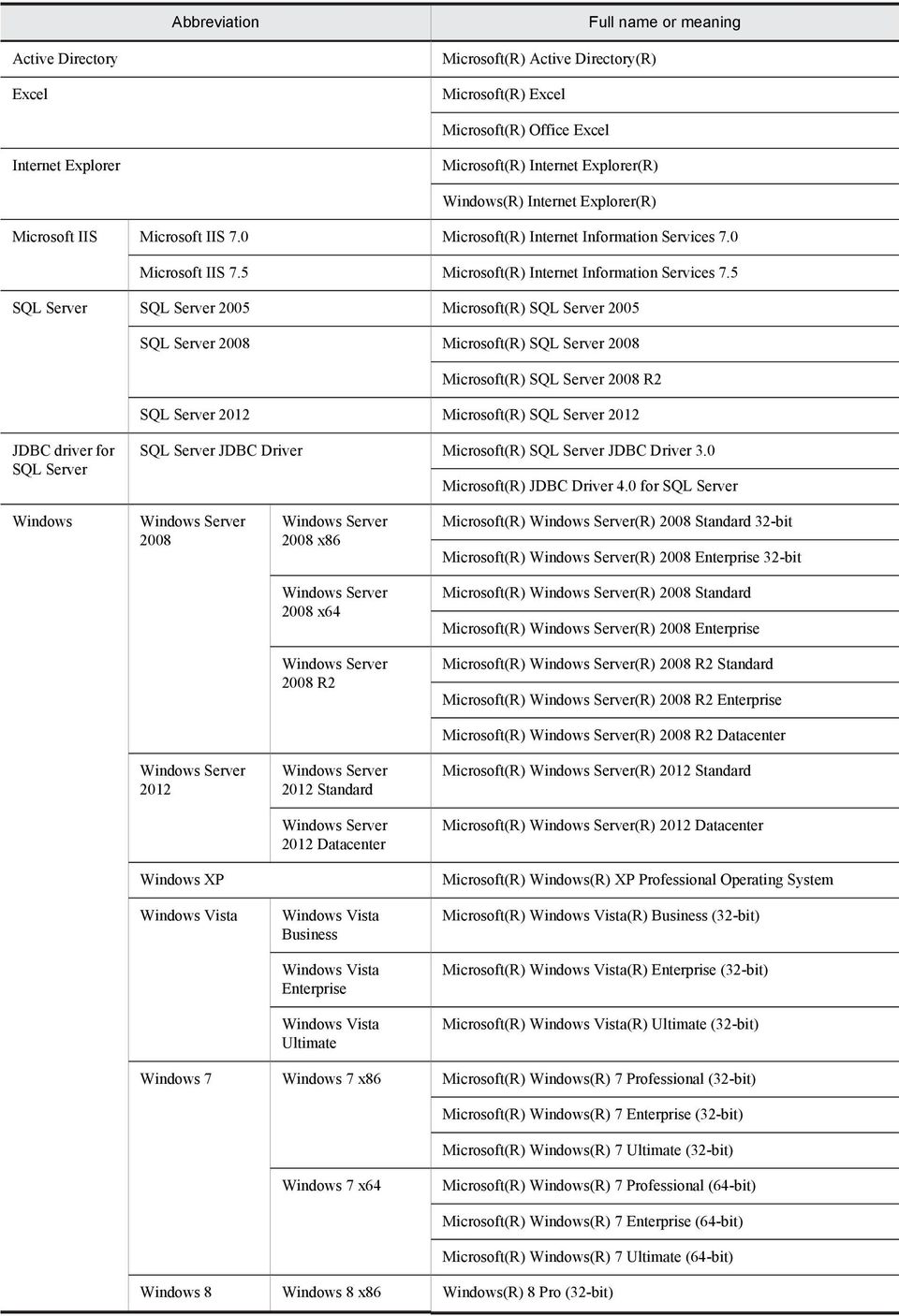
4 Abbreviation Full name or meaning Windows Windows 8 Windows 8 x86 Windows(R) 8 Enterprise (32-bit) Windows 8 x64 Windows(R) 8 Pro (64-bit) Windows(R) 8 Enterprise (64-bit) Windows Server Failover Cluster Windows Server(R) Failover Cluster Note that Windows 32 bit and Windows 64 bit are sometimes respectively referred to as Windows x86 and Windows x64. Restrictions Information in this document is subject to change without notice and does not represent a commitment on the part of Hitachi. The software described in this manual is furnished according to a license agreement with Hitachi. The license agreement contains all of the terms and conditions governing your use of the software and documentation, including all warranty rights, limitations of liability, and disclaimers of warranty. Material contained in this document may describe Hitachi products not available or features not available in your country. No part of this material may be reproduced in any form or by any means without permission in writing from the publisher. Printed in Japan. Issued Aug. 2013: Y10-10(E) Copyright All Rights Reserved. Copyright (C) 2013, Hitachi, Ltd.

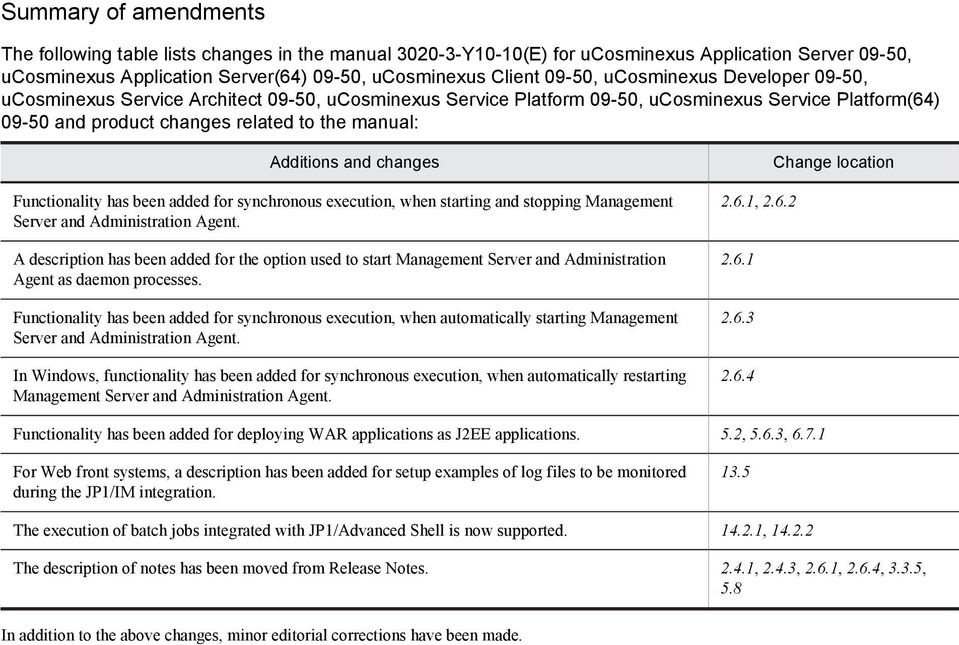
5 Summary of amendments The following table lists changes in the manual Y10-10(E) for ucosminexus Application Server 09-50, ucosminexus Application Server(64) 09-50, ucosminexus Client 09-50, ucosminexus Developer 09-50, ucosminexus Service Architect 09-50, ucosminexus Service Platform 09-50, ucosminexus Service Platform(64) and product changes related to the manual: Additions and changes Functionality has been added for synchronous execution, when starting and stopping Management Server and Administration Agent. A description has been added for the option used to start Management Server and Administration Agent as daemon processes. Functionality has been added for synchronous execution, when automatically starting Management Server and Administration Agent. In Windows, functionality has been added for synchronous execution, when automatically restarting Management Server and Administration Agent. Change location 2.6.1, Functionality has been added for deploying WAR applications as J2EE applications. 5.2, 5.6.3, For Web front systems, a description has been added for setup examples of log files to be monitored during the JP1/IM integration The execution of batch jobs integrated with JP1/Advanced Shell is now supported , The description of notes has been moved from Release Notes , 2.4.3, 2.6.1, 2.6.4, 3.3.5, 5.8 In addition to the above changes, minor editorial corrections have been made.
6

7 Preface For details on the prerequisites before reading this manual, see the manual ucosminexus Application Server Overview. Non-supported functionality Some functionality described in this manual is not supported. Non-supported functionality includes: Audit log functionality Compatibility functionality Cosminexus Component Transaction Monitor Cosminexus DABroker Library Cosminexus Reliable Messaging Cosminexus TPBroker and VisiBroker Cosminexus Web Service - Security Cosminexus XML Security - Core functionality JP1 linkage functionality Management portal functionality Migration functionality SOAP applications complying with specifications other than JAX-WS 2.1 ucosminexus OpenTP1 linkage functionality Virtualized system functionality XML Processor high-speed parse support functionality Non-supported compatibility functionality "Compatibility functionality" in the above list refers to the following functionality: Basic mode Check of JSP source compliance (cjjsp2java) with JSP1.1 and JSP1.2 specifications Database connection using Cosminexus DABroker Library EJB client application log subdirectory exclusive mode J2EE application test functionality Memory session failover functionality Servlet engine mode Simple Web server functionality Switching multiple existing execution environments Using EJB 2.1 and Servlet 2.4 annotation I

8

9 Contents Part 1: Overview 1 Application Server Functionality Classification of functionality Functionality that serves as the application execution platform Functionality for operating and maintaining the application execution platform Correspondence between functionality and manuals Functionality corresponding to the purpose of the system Functionality to support daily system operations Functionality that support system maintenance Operation functionality of a J2EE application Functionality to support system audit Management functionality based on JP1 integration Node switching functionality based on cluster software linkage Description of functionality mentioned in this manual Meaning of classification Examples of tables describing the classification System operations by the Component Container Administrator (In UNIX) Main updates in the functionality of Application Server Part 2: Operation and Monitoring Functionality 2 Starting and Stopping the System Organization of this chapter Starting and Stopping the System during Daily Operations Mechanism of Starting and Stopping the Logical Server Starting the Logical Server and Checking the Operations Stopping the Logical Server Automatically Restart When a Failure Occurs Automatic restart of Management Server Automatic restart of Administration Agent Automatic restart of logical server Monitoring System Operations Monitoring the system operations Monitoring the status Settings for starting and stopping the system 31 i

10 Contents Starting the system Stopping the system Settings for automatic start Settings for automatic restart Settings for automatic stop 38 3 Monitoring the Statistics (Statistics Collection Functionality) Organization of this chapter Overview of statistics collection functionality Statistics File Output Functionality Information Types that You Can Collect in Statistics Files Information that You Can Collect in Statistics Files Output Destination and Number of Statistics Files Settings for the execution environment (J2EE server settings) Output Format and Output Contents of Statistics Files Event issuing functionality Monitoring target for which threshold value can be set How to issue an event Definition in cosminexus.xml Settings for the execution environment (J2EE server settings) 75 4 Monitoring Resource Depletion Organization of this chapter Overview of resource depletion monitoring functionality Resource depletion monitoring functionality and output of resource depletion monitoring information Types of resources that can be monitored Definition in cosminexus.xml Settings for the execution environment Type of information output Output Format and Contents 86 5 Operations of J2EE Applications Organization of this chapter Overview of J2EE Application Operations Monitoring and Canceling a J2EE Application During Runtime Overview of monitoring and canceling the execution time of J2EE application Monitoring the execution time of J2EE application Method Timeout Method Cancellation Example of setting timeout value and the range of setting values 105 ii

11 Contents Thread count to be used Definition in cosminexus.xml Precautions When Implementing Settings for the execution environment Flow of monitoring and canceling the execution time of J2EE application Confirming the execution status of a J2EE application Canceling the request for which a timeout has occurred Log information that is output while monitoring the execution time J2EE applications Locking the J2EE application service Locking the Web Application Service and Releasing the Lock Methods of locking a service and stopping a J2EE application that can be executed for each system Service Lock Using a Load Balancer Stopping a J2EE application Terminating the J2EE application Lock process Stop process Forced termination process Definition in cosminexus.xml Settings for execution environment Stopping a J2EE application Switching the J2EE Application Replacing the J2EE application Switching the Web application by partially locking the service Replacing and Maintaining a J2EE Application Accessing network resources from J2EE applications Overview of accessing network resources Settings for accessing network resources Problems during operations Precautions when a J2EE application is operating Audit Log Output Functionality (INTENTIONALLY DELETED) INTENTIONALLY DELETED Database Audit Trail Linkage Functionality (INTENTIONALLY DELETED) INTENTIONALLY DELETED Statistical Output using Management Commands Organization of this chapter Overview of statistics output using management commands Methods to output server statistics 160 iii

12 Contents 8.4 Items that can be checked by statistics monitoring Automatic Execution of Processing Using Management Event Notification and Management Action Organization of this Chapter Overview of Management Event Notification and Management Action Controlling the Execution of Management Action Settings for automatic execution of processes by management events Procedure to Set Automatic Execution of Processes by Management Events Settings for execution environment Setting a Message ID List File for Issuing Management Events Setting Each Function Using the Management Event Issuing Function Setting a Property File for Executing Management Actions Settings of Management Action Execution Commands Collecting CTM Statistics (INTENTIONALLY DELETED) INTENTIONALLY DELETED Output of the Console Log Organization of this chapter Output target of the console log Target operations of the console log output Target processes of the console log output Settings for Acquiring the Console Log 194 Part 3: Linkage Functionality 12 Operating a JP1 Integrated System (INTENTIONALLY DELETED) INTENTIONALLY DELETED Centralized Monitoring of the System (Integrating with JP1/IM) (INTENTIONALLY DELETED) INTENTIONALLY DELETED Job-based Automatic Operations of a System (Integrating with JP1/AJS) (INTENTIONALLY DELETED) INTENTIONALLY DELETED 200 iv

13 Contents 15 Collecting and Consolidating the Audit Log (Integrating with JP1/NETM/Audit) (INTENTIONALLY DELETED) INTENTIONALLY DELETED Linking with Cluster Software Organization of this chapter Operations that can be implemented by linking with cluster software Systems that operate the executing node and the standby node in the 1-to-1 ratio (1-to-1 node switching system) System operating on mutual standby (mutual node switching systems) System that operates the standby node as the recovery server (N-to-1 recovery system) System in which Application Server machines (host) of the executing node and the standby node operate in a N-to-1 ratio (Node switching system for the host unit management model) Prerequisites for linking with the cluster software Servers for which nodes are to be switched Usage of light transaction functionality Operating methods of the systems Prerequisites for the executing node Prerequisites for the standby node to-1 Node Switching System (Linked with Cluster Software) Organization of this chapter Overview of 1-to-1 node switching system System configuration and operations of 1-to-1 node switching system Example system configuration for a 1-to-1 node switching system Timing for node switching Flow of the node switching process in the 1-to-1 node switching system System operations during node switching Inheriting information during node switching Settings of the 1-to-1 node switching system of Application Server (In Windows) Procedure for setting the 1-to-1 node switching system of Application Server Setting the environment of the cluster server Editing the configuration files Setting a cluster Setting Application Server Settings of the 1-to-1 node switching system in the Management Server (In Windows) Procedure for setting the 1-to-1 node switching system in the Management Server Environment settings in the cluster server Editing the setup files Copying the Management Server settings from the active node to the spare node Setting a cluster 230 v

14 Contents 17.6 Settings of the 1-to-1 node switching system of Application Server (In UNIX) Procedure for setting the 1-to-1 node switching system of Application Server Setting the environment of the cluster server Editing the configuration files Setting the environment of the HA monitor Creating a shell script file Setting the server-compliant environment Setting the LAN status Setting Application Server Settings of the 1-to-1 node switching system for the Management Server (In UNIX) Procedure for setting the 1-to-1 node switching system in the Management Server Environment settings in the cluster server Editing the setup files Copying the Management Server settings from the active node to the spare node HA monitor environment settings Creating the shell script file Server-compliant environment settings LAN status setup Starting and stopping the 1-to-1 node switching system in Application Server (In Windows) Starting the 1-to-1 node switching system of Application Server Stopping the 1-to-1 node switching system of Application Server Starting and stopping during planned node switching in the 1-to-1 node switching system of Application Server Starting and stopping the system during maintenance of the 1-to-1 node switching system of Application Server Starting and stopping a 1-to-1 node switching system for the Management Server (In Windows) Starting the 1-to-1 node switching system for the Management Server Stopping the 1-to-1 node switching system for the Management Server Starting and stopping a system when there is planned node switching in the 1-to-1 node switching system for the Management Server Starting and stopping a 1-to-1 node switching system for the Management Server (In UNIX) Starting the 1-to-1 node switching system Stopping the 1-to-1 node switching system Starting and stopping a system when there is a planned node switching in the 1-to-1 node switching system Starting and stopping the system during maintenance of the 1-to-1 node switching system of Application Server Starting and stopping the 1-to-1 node switching system of the Management Server for maintenance Mutual Node Switching System (Linked with Cluster Software) Organization of this chapter Overview of the mutual node switching system System configuration and operations of mutual node switching systems 268 vi
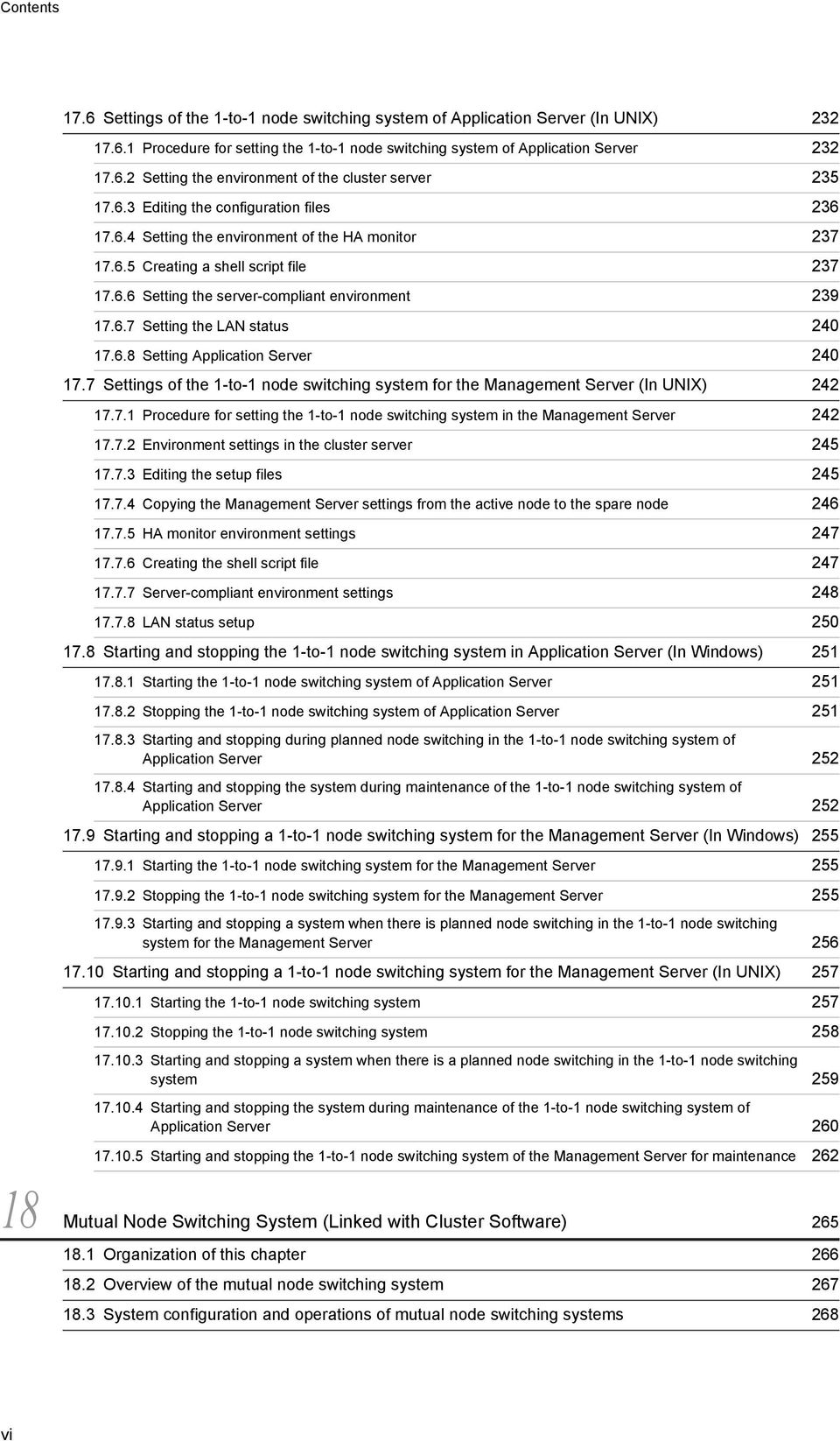
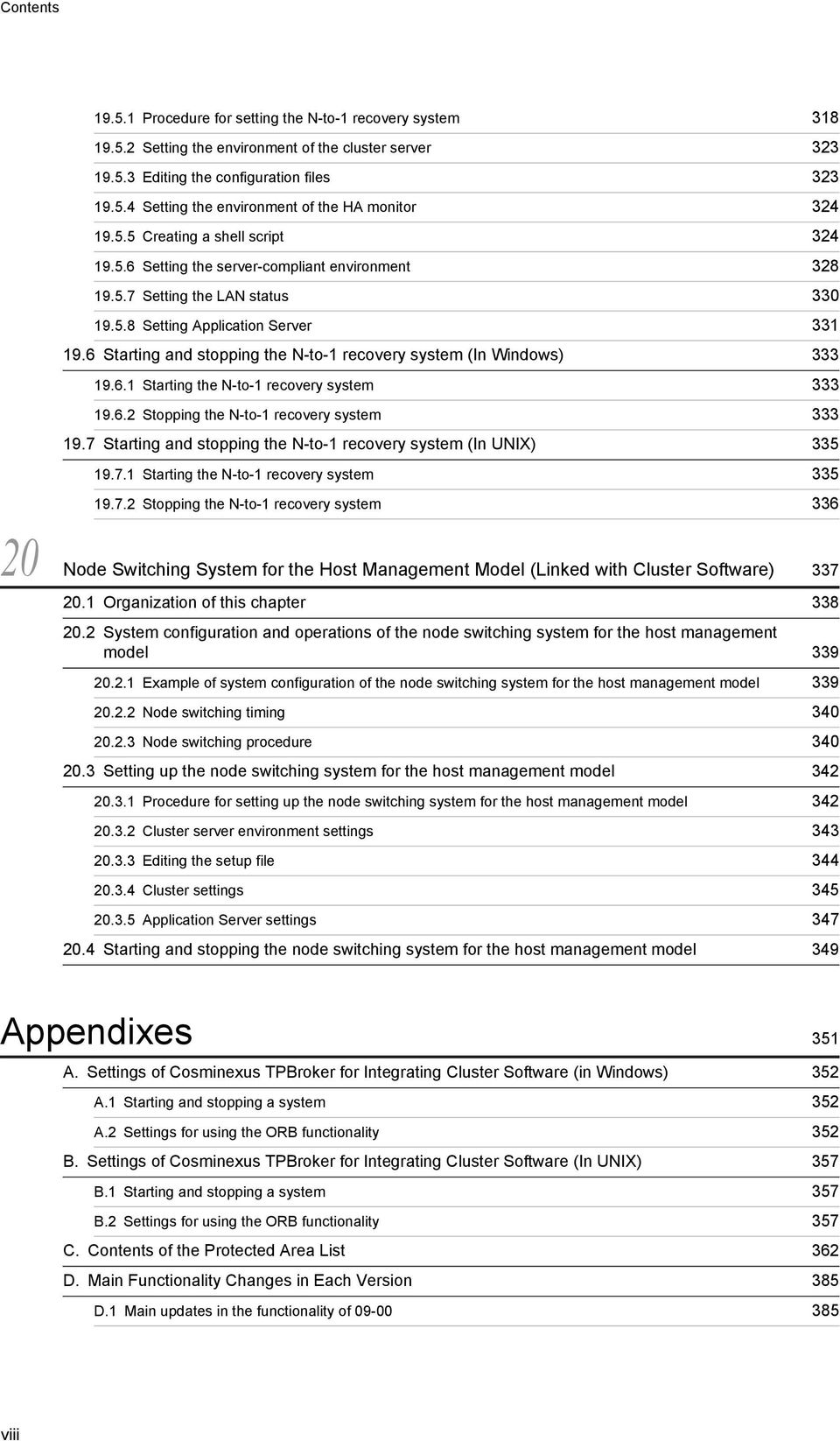
15 Contents Example of system configuration of the mutual node switching system Flow of the node switching process in the mutual node switching system Settings for the mutual node switching system (In Windows) Procedure for setting up the mutual node switching systems Environment settings of the cluster server Editing the setup file Setting a cluster Setting Application Server Settings for the mutual node switching system (In UNIX) Procedure for setting up the mutual node switching system Environment settings in the cluster server Editing the setup file HA monitor environment settings Creating the shell script file Server-compliant environment settings LAN status setup Setting Application Server Starting and stopping the mutual node switching system (In Windows) Starting the mutual node switching system Stopping the mutual node switching system Starting and stopping a system for planned node switching in the mutual node switching system Starting and stopping the mutual node switching system (In UNIX) Starting the mutual node switching system Stopping the mutual node switching system Starting and stopping a system for planned node switching in the mutual node switching system Starting and stopping the mutual node switching system for maintenance N-to-1 Recovery System (Linked with Cluster Software) Organization of this chapter Overview of the N-to-1 recovery system System configuration and operations of the N-to-1 recovery system Example of system configuration of the N-to-1 recovery system Flow of the recovery process Inheriting information during node switching Settings for the N-to-1 recovery system (In Windows) Procedure for setting the N-to-1 recovery system Setting the environment of the cluster server Editing the configuration files Setting a cluster Setting Application Server Settings for the N-to-1 recovery system (In UNIX) 318 vii

16 Contents Procedure for setting the N-to-1 recovery system Setting the environment of the cluster server Editing the configuration files Setting the environment of the HA monitor Creating a shell script Setting the server-compliant environment Setting the LAN status Setting Application Server Starting and stopping the N-to-1 recovery system (In Windows) Starting the N-to-1 recovery system Stopping the N-to-1 recovery system Starting and stopping the N-to-1 recovery system (In UNIX) Starting the N-to-1 recovery system Stopping the N-to-1 recovery system Node Switching System for the Host Management Model (Linked with Cluster Software) Organization of this chapter System configuration and operations of the node switching system for the host management model Example of system configuration of the node switching system for the host management model Node switching timing Node switching procedure Setting up the node switching system for the host management model Procedure for setting up the node switching system for the host management model Cluster server environment settings Editing the setup file Cluster settings Application Server settings Starting and stopping the node switching system for the host management model 349 Appendixes 351 A. Settings of Cosminexus TPBroker for Integrating Cluster Software (in Windows) 352 A.1 Starting and stopping a system 352 A.2 Settings for using the ORB functionality 352 B. Settings of Cosminexus TPBroker for Integrating Cluster Software (In UNIX) 357 B.1 Starting and stopping a system 357 B.2 Settings for using the ORB functionality 357 C. Contents of the Protected Area List 362 D. Main Functionality Changes in Each Version 385 D.1 Main updates in the functionality of viii
17 Contents D.2 Main updates in the functionality of D.3 Main updates in the functionality of D.4 Main updates in the functionality of D.5 Main functionality changes in E. Glossary 397 Index 399 ix

18

19 Part 1: Overview 1 Application Server Functionality This chapter describes the classification and purpose of the Application Server functionality, and the manuals corresponding to the functionality. This chapter also describes the functionality that has changed in this version. 1

20 1. Application Server Functionality 1.1 Classification of functionality Application Server is a product used for building an environment for executing applications mainly on a J2EE server compliant with Java EE 6 and for developing the applications that run in the execution environment. You can use a variety of functionality, such as functionality compliant with Java EE standard specifications and functionality independently extended on Application Server. By selecting and using functionality according to the purpose and intended use, you can build and operate a highly reliable system having an excellent processing performance. The following are the broad classifications of the Application Server functionality: Functionality that serves as an execution platform for the applications Functionality that is used for operating and maintaining the execution platform for the applications The above-mentioned functionality can be further classified according to the positioning and the intended usage of functionality. The Application Server manuals are provided according to the classification of functionality. The following figure shows the classification of Application Server functionality and the manuals corresponding to the functionality. Figure 1 1: Classification of Application Server functionality and the manuals corresponding to the functionality 2
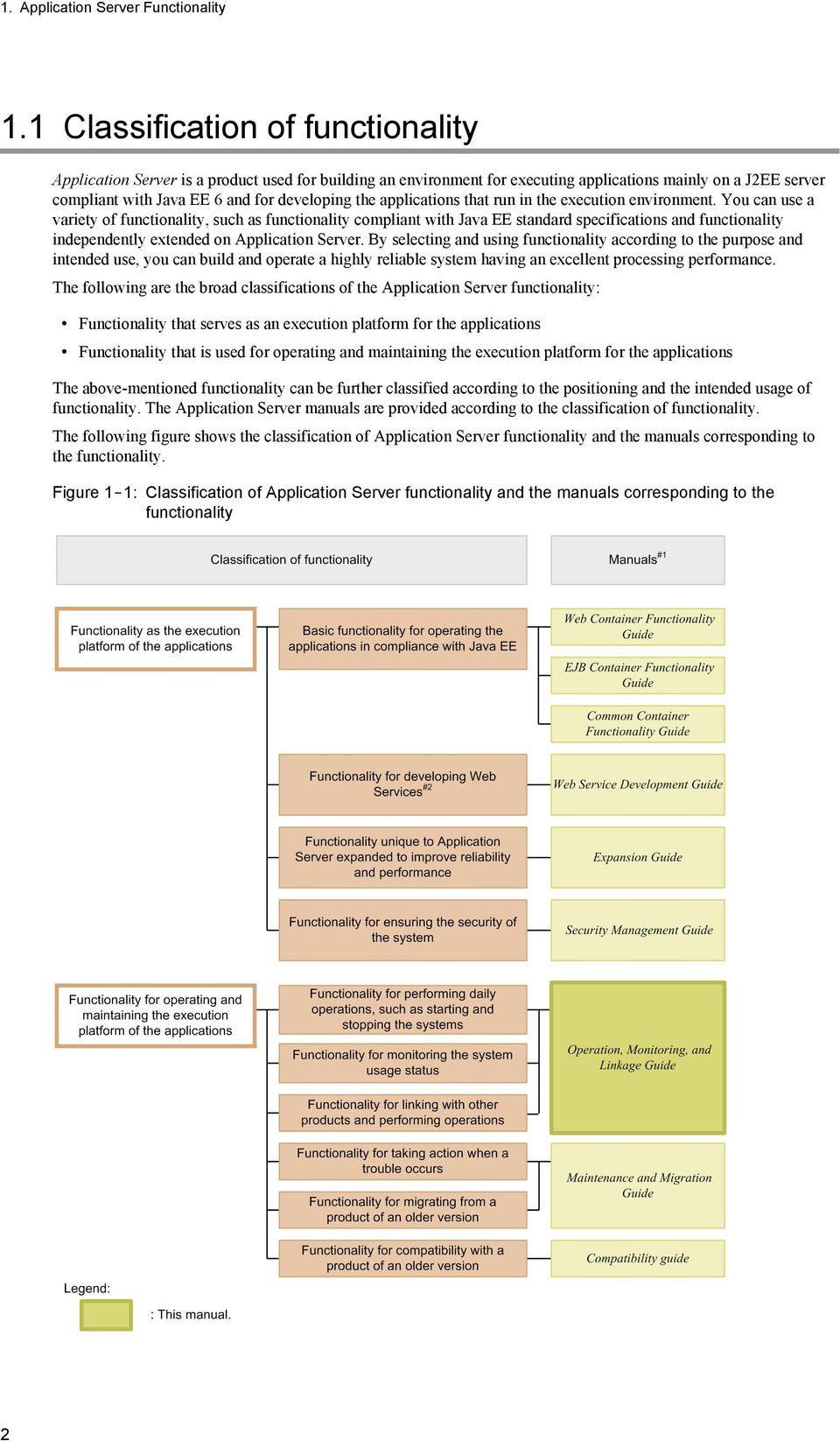
21 1. Application Server Functionality #1 ucosminexus Application Server has been omitted from the manual names. #2 With Application Server, you can execute SOAP Web Services and RESTful Web Services. Depending on the purpose, reference the following manuals apart from the ucosminexus Application Server Web Service Development Guide. When developing and executing SOAP applications ucosminexus Application Server SOAP Application Development Guide When ensuring the security of SOAP Web Services and SOAP applications ucosminexus Application Server XML Security - Core User Guide ucosminexus Application Server Web Service Security Users Guide For details about the XML processing ucosminexus Application Server XML Processor User Guide The following subsections describe the classification of functionality and the manuals corresponding to the functionality Functionality that serves as the application execution platform This functionality works as a platform for executing online businesses and batch businesses implemented as the applications. You choose functionality that you want to use according to the intended use of a system and your requirements. You must determine whether you want to use functionality that serves as the execution platform for the applications, even before you perform the system building or application development. The following are the classification-wise descriptions of functionality that serve as the application execution platform: (1) Basic functionality to operate applications (basic development functionality) This functionality includes the basic functionality for operating applications (J2EE applications). The J2EE server functionality is mainly included. Application Server provides a Java EE 6-compliant J2EE server. The J2EE server provides functionality that is compliant with the standard specifications and is independent of Application Server. The basic development functionality can be further classified into three types according to the types of the J2EE applications for which you use functionality. The manuals for Application Server function guide have been divided according to this classification. The following is an overview of each classification: Functionality for executing the Web applications (Web containers) This classification includes the Web container functionality that serves as the execution platform for Web applications and functionality executed by linking Web containers and Web servers. Functionality for executing the Enterprise Beans (EJB containers) This classification includes the EJB container functionality that serves as the execution platform of the Enterprise Bean. This classification also includes the EJB client functionality for invoking the Enterprise Bean. Functionality used in both Web applications and Enterprise Beans (Container common function) This classification includes functionality that can be used in the Web applications and the Enterprise Beans operating Web containers and EJB containers respectively. (2) Functionality for developing Web Services This includes the functionality as the execution and development environments of Web Services. Application Server provides the following engines: The JAX-WS engine to implement the binding of SOAP Messages according to the JAX-WS specifications 3
22 1. Application Server Functionality The JAX-RS engine to implement the binding of RESTful HTTP messages according to the JAX-RS specifications (3) Application Server independent functionality extended for improving the reliability and performance (extended functionality) This includes functionality extended independently on Application Server. This also includes functionality implemented by using non-j2ee server processes such as batch server, CTM, and database. On Application Server, various functionality are extended to improve the reliability of the system, and to implement stable operations. Furthermore, functionality is also extended to operate applications other than J2EE applications (batch applications) in the Java environment. (4) Functionality for ensuring the security of a system (security management functionality) This functionality is used for ensuring the security of an Application Server-based system. This includes functionality such as the authentication functionality used for preventing unauthorized access and the encryption functionality used for preventing information leakage in communication channels Functionality for operating and maintaining the application execution platform This functionality is used for effectively operating and maintaining the application execution platform. You use this functionality, after starting the system operations, as and when required. However, depending on functionality, you must implement the settings and applications in advance. The following are the classification-wise descriptions of functionality used for operating and maintaining the application execution platform: (1) Functionality used for daily operations, such as starting and stopping the systems (operation functionality) This classification includes functionality used in daily operations such as starting or stopping systems, starting or stopping applications, and replacing the applications. (2) Functionality for monitoring system usage (watch functionality) This classification includes functionality used for monitoring the system usage and resource depletion. This classification also includes functionality to output information used in monitoring the system operation history. (3) Functionality for operating the system by linking with other products (linkage functionality) This classification includes functionality to be linked and implemented with other products such as JP1 and the cluster software. (4) Functionality for troubleshooting (maintenance functionality) This classification includes functionality used for troubleshooting. This classification also includes functionality used for displaying the information that will be referenced during the troubleshooting. (5) Functionality for migrating from products of older versions (migration functionality) This classification includes functionality used for migrating from an older Application Server to a new Application Server. (6) Functionality for compatibility with products of older version (compatibility functionality) This includes functionality used for the compatibility with older versions of Application Server. For the compatibility functionality, we recommend the migration to the corresponding recommended functionality. 4
23 1. Application Server Functionality Correspondence between functionality and manuals The function guides for Application Server have been divided according to the classifications of functionality. The following table describes the classifications of functionality and the manuals corresponding to the functionality. Table 1 1: Classification of functionality and correspondence with the manuals explaining the functionality Category Functionality Reference manuals #1 Basic development functionality Web container Using JSF and JSTL Web server linkage In-process HTTP server Servlet and JSP implementation EJB container EJB client Precautions during Enterprise Bean implementation Naming management Resource connections and transaction management Invoking Application Server from OpenTP1 (TP1 inbound integrated function) JPA usage on Application Server Cosminexus JPA provider Cosminexus JMS Provider Using JavaMail Using CDI with Application Server Using Bean Validation with Application Server Application property management Using annotations Formatting and deploying J2EE applications Container extension library Web Container Functionality Guide EJB Container Functionality Guide Common Container Functionality Guide Extended functionality Executing applications using the batch server Expansion Guide Scheduling and load balancing requests using CTM Scheduling the batch applications Inheriting the session information between the J2EE servers (Session failover functionality) Database session failover functionality EADs session failover functionality Controlling full garbage collection using the Explicit heap functionality Output of the application user log Asynchronous parallel processing of threads 5
24 1. Application Server Functionality Category Functionality Reference manuals #1 Security management functionality Authentication using the integrated user management Authentication using application settings Using TLSv1.2 for the SSL/TLS communication Controlling with the management functionality of the load balancers that use API-based direct connections Security Management Guide Operation functionality Starting and stopping the system Operation, Monitoring, and Linkage Guide #2 Managing J2EE applications Watch functionality Monitoring the operation information (Statistics collection functionality) Monitoring resource depletion Database audit trail linkage functionality Output of operation information using the management commands Automatic execution of processing by using management event notification and management action Collecting statistical information of CTM Output of the console log Linkage functionality Operating a JP1 integrated system Centralized monitoring of the system (Integrating with JP1/IM) Automatic operations of systems by using jobs (integrating with JP1/AJS) Collection and uniform management of audit logs (integrating with JP1/Audit Management - Manager) Linking with cluster software 1-to-1 node switching system (Linking with cluster software) Mutual node switching system (Linking with cluster software) Node switching system for host unit management models (Integrating with cluster software) Maintenance functionality Troubleshooting related functionality Maintenance and Migration Guide Analyzing performance using the performance analysis trace JavaVM functionality of products (hereafter, might be abbreviated as JavaVM) Migration functionality Migrating from an older version of Application Server Migrating to a recommended functionality Compatibility functionality Basic mode Compatibility Guide Servlet engine mode Functionality for compatibility with the basic development functionality Functionality for compatibility with the extended functionality #1 ucosminexus Application Server is omitted from the above manual names. 6
25 1. Application Server Functionality #2 This manual. 7
26 1. Application Server Functionality 1.2 Functionality corresponding to the purpose of the system On Application Server, you must choose the applicable functionality according to the purpose of the system to be built and operated. This subsection describes how and where to use the following functionality mentioned in this manual. Note that the functionality is independently extended by Application Server. Functionality to support daily system operations Functionality that support system maintenance J2EE application operation functionality Functionality to support system audit Management functionality based on JP1 integration Node switching functionality based on cluster software linkage The functionality-wise support for the following items are described here: Reliability This functionality works well for performance-focused systems. Includes functionality used in the performance tuning of the system. Operation and maintenance This functionality works well when you want efficient operations and maintenance Functionality to support daily system operations The following table lists the purpose of functionality to support daily system operations. Choose the functionality in accordance with the system purpose. For details on the functionality, see the Reference column in the following table. Table 1 2: Purpose of functionality to support daily system operations Purpose Functionality name Reliability Operations/ Maintenance Reference Starting and stopping the system -- Y Chapter 2 Monitoring the statistics (Statistics collection functionality) -- Y Chapter 3 Monitoring resource depletion -- Y Chapter 4 Statistical output using management commands -- Y Chapter 8 Automatic execution of processing using management event notification and management action -- Y Chapter 9 Collecting CTM statistics # -- Y Chapter 10 Legend: Y: Applicable --: Not applicable # This functionality supports daily operations in an environment for executing J2EE applications. The functionality is not provided in an environment for executing batch applications. 8
27 1. Application Server Functionality Functionality that support system maintenance The following table lists the purpose of functionality to support system maintenance. Choose the functionality in accordance with the system purpose. For details on the functionality, see the Reference column in the following table. Table 1 3: Purpose of functionality to support system maintenance Functionality name Reliability Purpose Operation/ Maintenance Reference Output of the console log -- Y Chapter 11 Legend: Y: Applicable --: Not applicable Operation functionality of a J2EE application The following table lists the purpose of the operation functionality of a J2EE application. Choose the functionality in accordance with the system purpose. For details on the functionality, see the Reference column in the following table. Table 1 4: Purpose of the operation functionality of a J2EE application Functionality name Reliability Purpose Operation/ Maintenance Reference Monitoring and canceling a J2EE application during runtime -- Y 5.3 Locking the J2EE application service -- Y 5.4 Stopping a J2EE application -- Y 5.5 Switching the J2EE application -- Y 5.6 Accessing network resources from J2EE applications -- Y 5.7 Legend: Y: Applicable --: Not applicable Functionality to support system audit The following table lists the purpose of functionality to support system audit. Choose the functionality in accordance with the system purpose. For details on the functionality, see the Reference column in the following table. Table 1 5: Purpose of functionality to support system audit Functionality name Reliability Purpose Operation/ Maintenance Reference Audit log output functionality Y Y Chapter 6 Database audit trail linkage functionality Y Y Chapter 7 Legend: Y: Applicable 9
28 1. Application Server Functionality Management functionality based on JP1 integration The following table lists the purpose of operation management functionality based on JP1 integration. Choose the functionality in accordance with the system purpose. For details on the functionality, see the Reference column in the following table. Table 1 6: Purpose of the operation management functionality based on JP1 integration Functionality name Reliability Purpose Operation/ Maintenance Reference Operating a JP1 integrated system -- Y Chapter 12 Centralized monitoring of the system (Integrating with JP1/IM) -- Y Chapter 13 Job-based automatic operations of a system (integrating with JP1/ AJS) Collecting and consolidating audit logs (integrating with JP1/Audit Management - Manager) -- Y Chapter Y Chapter 15 Legend: Y: Applicable --: Not applicable Node switching functionality based on cluster software linkage The following table lists the purpose of the node switching functionality based on cluster software linkage. Choose the functionality in accordance with the system purpose. For details on the functionality, see the Reference column in the following table. Table 1 7: Purpose of the node switching functionality based on cluster software linkage Functionality name Reliability Purpose Operation/ Maintenance Reference Linking with cluster software Y Y Chapter 16 1-to-1 node switching system Y Y Chapter 17 Mutual node switching system Y Y Chapter 18 N-to-1 recovery system Y Y Chapter 19 Node switching system for the host management model Y Y Chapter 20 Legend: Y: Applicable 10
29 1. Application Server Functionality 1.3 Description of functionality mentioned in this manual This subsection describes the meaning of the classification used in the description of functionality in this manual and the example tables describing the classification Meaning of classification The description of functionality in this manual is classified into the following five points. You can select and read the required location depending on the purpose of referencing the manual. Explanation This is the description about functionality. This section describes the purpose, features, and mechanism of functionality. Read this section when you want an overview of functionality. Implementation This section describes the methods, such as the coding method and the DD writing method. Read this section when you develop applications. Settings This section describes the required property settings for building systems. Read this section when you build a system. Operations This section describes the operation method. This section describes the operating procedures and the execution examples of commands to be used. Read this section when you operate the system. Notes This section describes the general precautions for using functionality. Make sure that you read the notes Examples of tables describing the classification The following table lists the classification of functionality. The title of the table is "Organization of this chapter" or "Organization of this section". The following is an example table describing the classification of functionality: Example table describing the classification of functionality Table X-1Organization of this chapter (XX functionality) Category Title Reference Explanation What is the XX functionality X.1 Implementation Implementation of applications X.2 Definitions in DD and cosminexus.xml # X.3 Settings Settings in the execution environment X.4 Operations Operations using the XX functionality X.5 Notes Precautions when using the XX functionality X.6 Note: For details on cosminexus.xml, see 11. Managing Application Attributes in the ucosminexus Application Server Common Container Functionality Guide. Tip Property settings for applications that do not contain cosminexus.xml In applications that do not contain cosminexus.xml, you set or change properties after importing the properties into the execution environment. You can also change the set properties in the execution environment. 11
30 1. Application Server Functionality You specify the application settings in the execution environment using the server management commands and property files. For application settings with the server management commands and property files, see Procedure for setting the properties of a J2EE application in the ucosminexus Application Server Application Setup Guide. The tags specified in the property files correspond to DD or cosminexus.xml. For correspondence of DD or cosminexus.xml and the property file tags, see 3. Property Files Used for Setting J2EE Applications in the ucosminexus Application Server Application and Resource Definition Reference Guide. Note that the properties specified in each property file can also be specified in the HITACHI Application Integrated Property File. 12
31 1. Application Server Functionality 1.4 System operations by the Component Container Administrator (In UNIX) In UNIX, a superuser executes the tasks of setting up, starting and stopping the J2EE server or batch server, but even a general user, who is not the superuser, can be granted the permissions that will enable him to execute these tasks. This user is referenced to as a Component Container administrator. You can assign any user other than a superuser as the administrator by setting the Component Container administrator. Set up the Component Container administrator after installing Cosminexus Component Container that is the configuration software of Application Server. After the setup of Component Container administrator is complete, the superuser will not be able to execute the operations that can now be executed by the Component Container administrator, with the exception of a few operations. The following table describes the operations that the superuser and the Component Container administrator can execute when the Component Container administrator is setup. Table 1 8: Operations that the superuser and the Component Container administrator can execute Operations Superuser Component Container administrator Installing Cosminexus Component Container Y -- Setting the Component Container administrator (cjenvsetup command) Migrating the working directory and the user definition file (cjenvupdate command) Setting up and removing the setup of the J2EE server (cjsetup command) Y Y -- Y Settings of the redirector -- Y Starting and stopping the J2EE server or batch server (cjstartsv command, cjstopsv command) -- Y Executing the server management commands Y Y Acquiring the thread dump (cjdumpsv command) Y Y Acquiring the OS status information (cjgetsysinfo command) Y Y Batch execution command (cjexecjob command) # Y Y Batch forced termination command (cjkilljob command) # Y Y Batch list display command (cjlistjob command) # Y Y Legend: Y: Available --: Not available # These commands can be used in batch applications. Reference note If the Component Container administrator is not setup, the superuser is the administrator, and hence, he executes all the operations of the Component Container administrator mentioned in the table above. 13
32 1. Application Server Functionality 1.5 Main updates in the functionality of Application Server This subsection describes the main updates in the functionality of Application Server and the purpose of each change. The contents described in this section are as follows: This section gives an overview and describes the main updates in the functionality of Application Server For details on the functionality, check the description in the Reference location column. The Reference manual column and Reference location column specify the main sections with the description of a particular functionality. ucosminexus Application Server is omitted from the manual names mentioned in the Reference manual column. (1) Improving development productivity The following table describes the items that are changed to improve the development productivity. Table 1 9: Changes made for improving the development productivity Item Overview of changes Reference manual Simplifying the Eclipse setup The Eclipse environment can now be set up by using GUI. Application Development Guide Reference location 1.1.5, 2.4 Supporting debug using the user extended performance analysis trace The user extended performance analysis trace configuration file can now be created in the development environment. Application Development Guide 1.1.3, 6.5 (2) Simplifying implementation and setup The following table describes the items that are changed to simplify implementation and setup. Table 1 10: Changes made for simplifying implementation and setup Item Overview of changes Reference manual Reference location Expansion of the system configuration pattern in a virtual environment The types of tiers (http-tier, j2ee-tier, and ctm-tier) usable in a virtual environment are now increased. Because of this, the following system configuration patterns can now be set up: Virtual System Setup and Operation Guide Pattern that allocates Web servers and J2EE servers to another host Pattern that separates and deploys the front-end (servlet and JSP) and the back-end (EJB) Pattern that uses CTM (3) Supporting standard and existing functionality The following table describes the items that are changed to support standard and existing functionality. Table 1 11: Changes made for supporting standard and existing functionality Item Overview of changes Reference manual Reference location Supporting the JDBC 4.0 specifications HiRDB Type4 JDBC Driver of the JDBC 4.0 specifications and the JDBC driver of SQL Server are now supported by DB Connector. Common Container Functionality Guide
33 1. Application Server Functionality Item Overview of changes Reference manual Reference location Relaxing the naming conventions for the Portable Global JNDI name. Usable characters have been added in the Portable Global JNDI name. Common Container Functionality Guide Supporting the Servlet 3.0 specifications Updates of the HTTP Cookie name and the path parameter name of URL of Servlet 3.0 can now be used even with the versions earlier than Servlet 2.5. Web Container Functionality Guide 2.7 Applying the expansion of applications that can be integrated with Bean Validation Bean Validation can now be used and validated even with CDI and user applications. Common Container Functionality Guide Chapter 10 Supporting JavaMail The send and receive functionality that uses the JavaMail 1.4-compliant API can now be used. Common Container Functionality Guide Chapter 8 Applying the expansion of OSs in which the javacore command can be used The javacore command can now be used to acquire thread dumps of Windows. Command Reference Guide javacore (Acquiring thread dumps/ for Windows) (4) Maintaining and improving reliability The following table describes the items that are changed for maintaining and improving reliability. Table 1 12: Changes made for maintaining and improving reliability Item Overview of changes Reference manual Reference location Avoiding exhaustion of the code cache area By confirming the size of the code cache area used in the system, and changing the threshold value before the area becomes exhausted, the area exhaustion can now be avoided. System Design Guide Maintenance and Migration Guide , Definition Reference Guide 16.1, 16.2, 16.4 Supporting efficient application of the Explicit Memory Management functionality The automatic release processing time is now reduced, and the functionality that can control the objects moved to the Explicit heap has been added as the functionality to efficiently apply the Explicit Memory Management functionality. The functionality to control the movement of objects to the Explicit memory block The functionality to specify the Explicit Memory Management functionality exemption class The output of the object release rate information to the Explicit heap information System Design Guide Expansion Guide 8.2.2, 8.6.5, 8.10, , Maintenance and Migration Guide 5.5 Expanding the output range of the class-wise statistical information The reference relationship that is based on the static field can now be output to the extended thread dump that includes the class-wise statistical information. Maintenance and Migration Guide 9.6 (5) Maintaining and improving the operational performance The following table describes the items that are changed for maintaining and improving operational performance. 15
34 1. Application Server Functionality Table 1 13: Changes made for maintaining and improving operational performance Item Overview of changes Reference manual Reference location Supporting the EADs session failover functionality The EADs session failover functionality that implements the session failover functionality by integrating with EADs is now supported. Expansion Guide Chapter 5, Chapter 7 Operating with WAR A WAR application that consists of only WAR files can now be deployed on a J2EE server. Web Container Functionality Guide Common Container Functionality Guide 13.9 Command Reference Guide cjimportwar (Importing WAR applications) Starting and stopping with the synchronous execution of the management functionality Forced release of the Explicit memory block in the Explicit Memory Management functionality The option to synchronously execute the starting and stopping of the management functionality (Management Server and Administration Agent) has been added. The release processing of the Explicit memory block can now be executed at any timing using the javagc command. This manual 2.6.1, 2.6.2, 2.6.3, Command Reference Guide adminagentctl (Starting and stopping Administratio n Agent), mngautorun (Set up and unset up of automatic start and automatic restart), mngsvrctl (Starting, stopping, and set up of Management Server) Expansion Guide 8.6.1, 8.9 Command Reference Guide javagc (Forced occurrence of garbage collection) (6) Other purpose The following table describes the items that are changed for other purposes. Table 1 14: Changes made for other purposes Item Overview of changes Reference manual Reference location Acquiring the definition information Only the definition files can now be collected by the snapshot (snapshot log acquisition) command. Maintenance and Migration Guide 2.3 Command Reference Guide snapshotlog (Collection of snapshot log) Log output of the cjenvsetup command The execution information of the Component Container administrator setup (the cjenvsetup command) can now be output to message logs. System Setup and Operation Guide
35 1. Application Server Functionality Item Overview of changes Reference manual Reference location Log output of the cjenvsetup command The execution information of the Component Container administrator setup (the cjenvsetup command) can now be output to message logs. Maintenance and Migration Guide Command Reference Guide 4.20 cjenvsetup (Component Container administrator setup) Supporting BIG-IP v11 BIG-IP v11 has been added to the types of usable load balancer. System Setup and Operation Guide Virtual System Setup and Operation Guide 2.1 The output of the CPU time to the event log of the Explicit Memory Management functionality The CPU time required for the Explicit memory block release processing can now be output to the event logs of the Explicit Memory Management functionality. Maintenance and Migration Guide Expending the functionality of the user extended performance analysis trace The following functionality have been added in the user extended performance analysis trace: The specification methods for trace have been added to the specification methods of the regular method units, and can now be specified in each package or each class. Maintenance and Migration Guide 7.5.2, 7.5.3, The range of the usable event ID has been extended. The restriction on the number of lines that can be specified in the user extended performance analysis trace configuration file has been relaxed. The trace acquisition level can now be specified in the user extended performance analysis trace configuration file. Improving the information analysis when using the asynchronous invocation of Session Beans The root application information of the PRF trace is used so that the requests of the invocation source and invocation destination can now be compared. EJB Container Functionality Guide
36
37 Part 2: Operation and Monitoring Functionality 2 Starting and Stopping the System This chapter describes the normal operations that are executed such as starting and stopping the system and automatically restarting the system when a failure occurs. 19
38 2. Starting and Stopping the System 2.1 Organization of this chapter This chapter describes the daily operations such as starting and stopping the systems, mechanism of automatic restart when a failure occurs, and monitoring of the system operations. This chapter is organized as the following table. Table 2 1: Organization of this chapter (starting and stopping a system) Category Title Reference Description Starting and stopping the system during daily operations 2.2 Mechanism of starting and stopping the logical server 2.3 Automatically restart when a failure occurs 2.4 Monitoring system operations 2.5 Settings Settings for starting and stopping the system 2.6 Note: The function-specific explanation is not available for "Implementation", "Operations", and "Precautions". 20
39 2. Starting and Stopping the System 2.2 Starting and Stopping the System during Daily Operations To operate a system built with the application server, you need to start multiple server processes of the application server configuration software in an appropriate order. You may even start multiple server processes of the same type depending on the system configuration. Further, to start services, you also need to start J2EE applications. In the systems on the Application Server systems, a closed partial system that provides a business service configured by J2EE server and Web server is managed as a service unit. Using the Smart Composer functionality commands you can start and stop the logical servers for each service unit, or you can start and stop all the service units in a batch. You can also collectively start and stop all the service units in the Web system. As the Smart Composer functionality uses Management Server for management, start the system in the order of the steps described below. To stop the system, reverse the order of the steps. For more information on how to start and stop the logical server, see 2.3 Mechanism of Starting and Stopping the Logical Server. Furthermore, for details on the settings to start and stop the systems, see 2.6 Settings for starting and stopping the system. 1. Start the Administration Agent. 2. Start the Management Server. 3. Start the service unit (logical server) (Smart Composer functionality commands) 4. Start the resource adapters (server management commands) 5. Start the J2EE applications (server management commands) For starting and stopping the systems using the Smart Composer functionality, see the following subsections in the ucosminexus Application Server System Setup and Operation Guide Start the system (when using CUI) Stop the system (when using CUI) 21
40 2. Starting and Stopping the System 2.3 Mechanism of Starting and Stopping the Logical Server On the Application Server, you use the Management Server to start and stop logical servers and to check operations. This subsection describes the starting, operation checking mechanism, and the stop mechanism of the logical server using the Management Server Starting the Logical Server and Checking the Operations The following figure illustrates starting the logical server and checking the operations: Figure 2 1: Starting the logical server and checking the operations 1. The Management Server sends a request to the Administration Agent to start the logical server. 2. The administration agent executes the start command of the logical server to start the requested logical server. 3. The process ID of the logical server process is acquired in the Administration Agent. 4. The administration agent notifies the Management Server that the logical server is now running. 5. The administration agent monitors the logical server process and checks the operation of the logical server. The administration agent uses the process ID of the logical server process, checks if the process exists, and if it is able to verify the existence of the process, it checks the operation of the logical server. 6. The administration agent notifies the status of the logical server to the Management Server. The following table describes the method of checking the process and the operation for each type of logical server. Note that for the logical servers in case of which the operation checking method is not mentioned in the table, only the check for verifying whether the process exists is carried out. Table 2 2: Methods for checking the operations of logical servers Type of logical server Method of starting the process # Method of checking the operation of the logical server Check that the process exists Check the operation Logical performance tracer Indirect startup Check the existence of the process ID that is obtained by using the commands provided by the performance tracer
41 2. Starting and Stopping the System Type of logical server Method of starting the process # Method of checking the operation of the logical server Check that the process exists Check the operation Logical Smart Agent Direct startup Check the existence of the process ID of the start command. Logical Naming Service Direct startup Check the existence of the process ID of the start command. Logical CTM domain manager Indirect startup Check the existence of the process ID that is obtained by using the commands provided by the CTM domain manager. Logical CTM Naming service Direct startup Check the existence of the process ID of the start command. CTM daemon Indirect startup Check the existence of the process ID that is obtained by using the commands provided by the CTM daemon. -- Check that the root context can be obtained Logical SFO server (Compatibility functionality) Direct startup Check the existence of the process ID of the start command. Check that the SFO server application is running. Logical J2EE server Direct startup Check the existence of the process ID of the start command. Logical Web server Indirect startup Check the existence of the process ID of the control process and the server process of the web server, obtained from the httpd.pid file that is generated by the Web server. Logical user server Direct startup Check the existence of the process ID of the start command. Check that there is a response to the call by RMI. Check that a correct response can be received through the HTTP access of the URL for checking the Cosminexus HTTP Server operations. The response is sent by the server process of the Web server. When the isalive command is defined in the logical user server definition file, check that the processing is executed by using the isalive command. When not defined, it is assumed that the operation check was successful. Indirect startup Check the existence of the process ID obtained by the getprocessid command. Use the isalive command when it is defined in the logical user server definition file. When not defined, it is assumed that the operation check was successful. Legend: --: None # In the case of direct setup, the command that is executed is also monitored. In the case of indirect setup, the services or the processes invoked by the command are monitored. The command is also used to stop the services and processes that are invoked using other commands Stopping the Logical Server The following figure shows the process of stopping the logical server: 23
42 2. Starting and Stopping the System Figure 2 2: Stopping the logical server 1. The Management Server sends a request to the Administration Agent server to stop the logical server. 2. The Administration Agent executes the stop command of the logical server to stop the requested logical server. 3. The Administration Agent notifies the Management Server that the logical server is now stopped. 24
43 2. Starting and Stopping the System 2.4 Automatically Restart When a Failure Occurs If a failure occurs, Management Server, Administration Agent, and logical server can restart automatically. This section describes the automatic restart operation of each process Automatic restart of Management Server This subsection describes the automatic restart of Management Server, when a failure occurs. When a failure occurs, a stopped Management Server can restart automatically. If the processes of Management Server are down due to a failure, Management Server is automatically started, and therefore, operations can be continued. Also, if you specify automatic restart, Management Server also automatically starts simultaneously with the host. You use the mngautorun command to specify automatic restart. For details on how to specify the automatic restart, see Settings for automatic restart.! Important note When Management Server is stopped, if the operating logical server process detects an abnormal termination or a hang-up, and after that even if Management Server is restarted, even then the automatic stop processing and automatic restart processing are not executed Automatic restart of Administration Agent This subsection describes the automatic restart of Administration Agent, when a failure occurs. When a failure occurs, a stopped Administration Agent can restart automatically. If the processes of Administration Agent are down due to a failure, Administration Agent is automatically restarted, and operations can be continued. Also, if you specify automatic restart, Administration Agent also automatically starts simultaneously with the host. You use the mngautorun command to specify automatic restart. For details on how to specify the automatic restart, see Settings for automatic restart Automatic restart of logical server This subsection describes the automatic restart of logical servers, when a failure occurs. When a failure occurs, a stopped logical server can restart automatically using the Management Server. Automatic restart is executed when the status after startup is detected as 'failure', from the logical server that was started normally by the Management Server. 'Failure' is a state when the logical server stops without receiving any stop request. Administration Agent monitors the processes of the logical server and checks the operations of the logical server. When a logical server failure, such as a process is down or has hung up is found, Administration Agent detects the failure and notifies Management Server. When a failure is detected, the Management Server executes the commands and collects the snapshot logs, after that the Management Server collects the data used for troubleshooting, and then the logical server restarts automatically. When a failure occurs during the startup process requested by the user, instead of automatically restarting the logical server, the user is notified of the failure to start the logical server. Automatic restart is executed according to the automatic restart frequency and automatic restart retry interval that is specified when building the system. Note that automatic restart is not executed when the specified automatic restart frequency is '0'. When automatic restart exceeds the specified frequency, a message is output to Manager-log-output-directory/ mngsvr-number-of-files.log and the logical server status changes to 'failure'. If true is specified in the com.cosminexus.mngsvr.logical_server_abnormal_stop.exit key of the mserver.properties file (Management Server environment configuration file), Management Server stops when the logical server status changes to 'abnormal termination'. 'Abnormal termination' is a state wherein the logical server stops when the automatic restart frequency is exceeded or when 0 is specified as the automatic restart frequency and a failure is detected. 25
44 2. Starting and Stopping the System The following figure shows the flow of automatic restart when a failure occurs and the status of the logical server: Figure 2 3: Automatic restart when failure occurs Note that when an automatic restart is executed in the requisite logical server, then after the requisite logical server has automatically restarted, the logical server for which the corresponding logical server is specified as a pre-requisite is also restarted. Tip Detection of failure Check the status of the logical server by monitoring the process of the logical server, and checking the operation of the logical server in the Administration Agent. For example, process monitoring checks the existence of the process ID of the logical server process. If the process ID does not exist, the Administration Agent detects that the process is down and notifies the error to the Management Server. The contents of process monitoring and checking the operations differ depending upon the type of the logical server. For details, see 2.3 Mechanism of Starting and Stopping the Logical Server. If the logical server process ends immediately after successfully starting the logical server, the error detection and automatic restart might be executed again. In such cases, you can avoid this process by setting a value more than the time from when the process of the logical server starts until the process ends in the adminagent.server-type.watch.start_time key (the time from executing the start command of the logical server until the starting of operation confirmation) of adminagent.properties. 26
45 2. Starting and Stopping the System 2.5 Monitoring System Operations This subsection describes the status monitoring of the logical servers and the statistics monitoring of systems that are required during the system operations Monitoring the system operations You need to maintain stable operating conditions by checking that the status of a logical server and the statistics of a running system are appropriate. You also need to determine whether tuning is required based on the system performance output in the statistics. This subsection gives an overview of operations that monitor the system operations. The following table describes the monitoring of system operation: Table 2 3: Monitoring system operations Operation contents Measure Operation overview Reference manual Section Monitoring the status of service units Smart Composer functionality commands (cmx_list_status command) You can check the status of service units in the Web system and can monitor that the system is running normally. This manual 2.5.2(1) Monitoring the status of a logical server Management command (mngsvrutil) You can check the status of hosts and servers that configure the system and monitor whether the system is running normally. Based on this information, you can start, stop, and restart the system, as required (2) You can confirm the status of a logical server in the following units: Management domain unit Host unit Logical server unit Monitoring system operations Statistics collection You function #1 #2 can monitor the operation status of J2EE servers, batch servers, or SFO servers, and can display the status in a statistics file. 3.2 By monitoring the system performance, you can find the locations in the system where errors occur and this can help for performance tuning. Management command (mngsvrutil) You can monitor the operation status of J2EE servers, batch servers, or SFO servers, and can display the status in a CSV format file. 8.2 By monitoring the system performance, you can find the locations in the system where errors occur and this can help for performance tuning. Function for monitoring By resource depletion #1 #3 monitoring the transition of usage rate and the number of resources, the system can output a message when the usage rate or the number of used resources exceeds the threshold value. The system can periodically output the transition of usage rate and number of
46 2. Starting and Stopping the System Operation contents Measure Operation overview Reference manual Section Monitoring system operations Function for monitoring used resource depletion #1 #3 resources as the resource depletion monitoring information. When the threshold value is exceeded, you can prevent the occurrence of an error by analyzing the cause based on the output resource depletion monitoring information and take an appropriate action. Further, the resource depletion monitoring information is useful in analyzing the cause of an error. This manual 4.2 Management command (mngsvrutil) You can check the statistics for CTM #4 that exist in the management domain for the following units: 10.2 All CTM of the management domain Specified CTM from the management domain or the CTM that exists on a specified host Checking the transaction information Server management commands (cjlisttrn) You check information, such as the transaction status on running J2EE servers or the existence of a pending transaction on the stopped J2EE servers. Common Container Functionality Guide #1 #2 #3 #4 Since the file is output at a regular interval that is set when building a system, there is no need to use tools such as server management commands and the management command to output the file. If the frequency of full garbage collection output in the statistics file or the number of pending execution requests in a URL group unit exceeds the threshold value, a message is output (a threshold value event). Using this message, you can issue a management event and automate the corresponding action as the management action. For details on the threshold event settings, see Settings for the execution environment (J2EE server settings). For details on the settings for the automatic execution of processes using Management events, see 9.4 Settings for automatic execution of processes by management events. When the resource usage status exceeds the threshold, a management event can be issued. If a management event is used, the action can be automated as a management action. For details on how to set up the automatic execution of processes with Management events, see the section 9.4 Settings for automatic execution of processes by management events. You can use the CTM only in the products in which Cosminexus Component Transaction Monitor is included in the component software. For products that you can use, see Relationship of products and component software in the manual ucosminexus Application Server Overview Monitoring the status In Application Server, you can monitor that the operations of the system are functioning normally by monitoring the status. The status can be monitored in the following two ways: Monitoring the status of the service unit You can monitor the status of the service unit. Monitoring the status of the logical server You can monitor the status of a logical server. Reference note Server management commands can be used to monitor the status of the application that is running on the server and display the transaction information of the running J2EE server or batch server. 28
47 2. Starting and Stopping the System (1) Monitoring the status of service units You can use the Smart Composer functionality command (cmx_list_status command) to monitor the operational status of service units. For using the cmx_list_status commands, see cmx_list_status (Displaying the status of service units) in the ucosminexus Application Server Command Reference Guide. In the case of monitoring the status of the service unit, you can output the status of a specific service unit or the status of all the service units in the Web system, to a file in CSV format. (2) Monitoring the status of a logical server In the case of monitoring the status of the logical server, you can use the management commands (mngsvrutil) to monitor the status of the logical server. The status information can be output to a standard output, or a CSV format file. This section describes how to monitor the statistics (status) of a logical server, and the items that you can monitor. Reference note You can use the following methods to check the status of a Management Server and Administration Agent: check subcommand of the management command (mngsvrutil) adminagentcheck command For details on the management commands and the adminagentcheck commands, see mngsvrutil (Management commands of Management Server) and adminagentcheck (Checking the operations of Administration Agent) in the ucosminexus Application Server Command Reference Guide. (a) How to monitor the status You can use the management command (mngsvrutil) to monitor the status of a logical server. To monitor the status of logical servers, specify the subcommand list in the management command (mngsvrutil). As a result, you can output the status information of the logical server in the standard output, or a CSV format or an SNMP integration format file. You can specify a logical server for which you want to output the status by specifying the value in arguments of the list. For details on the management commands and there subcommands, see 7.3 Details of the subcommands of the mngsvrutil command in the ucosminexus Application Server Command Reference Guide. The execution format and example of execution are described below: When the logical server name and status information in a management domain are output Execution format mngsvrutil -m host-name-of-the-management-server[:port-number] -u managementuser-id -p management-password list status Execution example mngsvrutil -m mnghost -u user01 -p pw1 list status When the J2EE application name and status information imported in a specified logical server are output Execution format mngsvrutil -m host-name-of-the-management-server[:port-number] -u managementuser-id -p Management-password -t logical-server-name list appstatus Execution example mngsvrutil -m mnghost -u user01 -p pw1 -t J2Eeserver1 list appstatus (b) Items that you can check by monitoring the status You can confirm the start and stop status of a logical server by monitoring the status. You can also confirm the status of all logical servers. You can confirm the status for each of the following: 29
48 2. Starting and Stopping the System Management domain unit You can confirm the status of all logical servers included in a management domain at the same time. Host unit You can confirm the status of all logical servers in a selected host. Logical server unit You can check the status of selected logical servers. You can check the status for each type and for individual logical server. The following table describes types and meanings of a status that you can confirm: Table 2 4: Types and meaning of operational status Stop Start Run Stop Operational status Forced termination inprocess Abnormal termination Recovery in-process Communication failure Automatic termination in-process Automatic restart inprocess Planned termination inprocess Description An initial state of a logical server or a state in which a logical server is terminated after reception of a termination request, and completing the termination process. In this state, it is confirmed that the management agent is terminated after restoring the communication failure. A state where a logical server is being started, after reception of a start request until the logical server is operational. A state where a logical server is operational, after reception of a start request and completing the start process. Alternatively, this is a state in which it is confirmed that the management agent is operational after restoring the communication failure. A state where a logical server is being terminated, after reception of a termination request until the logical server is terminated. A state where a logical server is being terminated forcefully, after reception of a forced termination request until the logical server is terminated. A state where it is detected that a logical server is terminated without reception of a termination request. A state where a logical server is being started, after reception of a start request in the abnormal termination state until the logical server is operational. A state where there is a communication failure with a management agent, and the status cannot be displayed. A state where a logical server is being terminated forcefully, after reception of a notification of abnormality (notification that a process exists but is not running) of the logical server from a management agent. A state in which a running logical server with auto restart specifications, is being automatically restarted on reception of a notification for termination from a management agent. A planned termination state of a logical Web server until the actual termination, after receipt of a planned termination request. Only a logical Web server goes into this state. 30
49 2. Starting and Stopping the System 2.6 Settings for starting and stopping the system This subsection describes the procedure for starting and stopping a built system, and the settings to be specified for automatically starting and stopping the system. The following figure shows the procedure for starting and stopping of the programs and servers in a built system: Figure 2 4: Procedure for starting and stopping systems You can start and stop the programs and servers in a Web system automatically or manually. Determine the starting and stopping method of the system in conformity with the operating method, and specify the required settings Starting the system For the normal operations, we recommend that you use the automatic start method for starting Administration Agent and Management Server. If you specify automatic restart of Administration Agent and Management Server, the series of operations from the starting of Administration Agent up to the starting of Management Server can be executed simultaneously with the starting of the host. For details on how to specify the automatic start, see Settings for automatic start. The following are the start procedures for programs and servers: 1. Start Administration Agent 2. Start Management Server 3. Start the system To start programs and servers: (1) Start Administration Agent If you start Administration Agent manually, you start it by using the adminagentctl command for each host of Application Server. We recommend that you synchronize the state of the command processing and start processing of Administration Agent. In such cases, you specify the synchronous execution option (-sync option) when executing the command. If you specify this option, when the command processing ends, Administration Agent becomes in the operational state. Also, during the synchronous execution, you can specify the waiting time from when the command is executed until Administration Agent is in the operational state (the timeout time of synchronous execution), with the -timeout option. The start method is shown for each OS. In Windows Installation-directory-of-Cosminexus(1)\manager\bin\adminagentctl start -sync - timeout timeout-time-of-synchronous-execution 31
50 2. Starting and Stopping the System Reference note In UNIX Note that in Windows, you can also use services to start Administration Agent. # /opt/cosminexus/manager/bin/adminagentctl start -sync -timeout timeout-time-ofsynchronous-execution Reference note Note that in UNIX, if you specify the -daemon option with the adminagentctl command or if you use the daemon command, you can start Administration Agent as the daemon process. When you use the daemon command, the state of the command processing and start processing of Administration Agent cannot be synchronized. (2) Start Management Server If you start Management Server manually, you start it by specifying the start argument in the mngsvrctl command on the host on which Management Server is set up.! Important note When you define a host by specifying a host name that cannot be resolved or an IP address that does not exist, the starting of Management Server takes time. We recommend that you synchronize the state of the command processing and start processing of Management Server. In such cases, you specify the synchronous execution option (-sync option) when executing the command. If you specify this option, when the command processing ends Management Server is in the operational state. Also, during the synchronous execution, you can specify the waiting time from when the command is executed until Management Server is in the operational state (the timeout time of synchronous execution), with the -timeout option. The start method is shown for each OS. In Windows Installation-directory-of-Cosminexus\manager\bin\mngsvrctl start -sync -timeout timeout-time-of-synchronous-execution Reference note In UNIX Note that in Windows, you can also use services to start Management Server. # /opt/cosminexus/manager/bin/mngsvrctl start -sync -timeout timeout-time-ofsynchronous-execution Reference note Note that in UNIX, if you specify the -daemon option using the mngsvrctl command or if you use the daemon command, you can start Management Server as the daemon process. When you use the daemon command, the state of the command processing and start processing of Management Server cannot be synchronized. (3) Start the system You can start the Web system or service units in a batch using the Smart Composer functionality commands. If the system is started in each Web system, all the logical servers in all the service units that exist in the Web system will start. Reference note We recommend that you use the default settings for the starting order of logical servers. You can specify the starting order of logical servers with the mstartup.no parameter of the <configuration> tag for each logical server, in the Easy Setup definition file. 32
51 2. Starting and Stopping the System Stopping the system The following are the stop procedures and the stop methods for the programs and servers. Note that in UNIX, you cannot specify automatic stop for Administration Agent and Management Server. For the automatic stop, specify the setting in such a way so that Administration Agent and Management Server are stopped simultaneously with the host. For details about the automatic stop settings, see Settings for automatic stop. The following are the stop procedures and the stop methods for the programs and servers. You use the following procedure to stop programs and servers: 1. Stop the system 2. Stop Management Server 3. Stop Administration Agent To stop programs and servers: (1) Stop the system Use the Smart Composer functionality commands to stop Web systems or service units in a batch. (2) Stop Management Server If you stop Management Server manually, you stop it by specifying the stop argument in the mngsvrctl command on the host on which Management Server is set up. We recommend that you synchronize the state of the command processing and stop processing of Management Server. In such cases, you specify the synchronous execution option (-sync option) when executing the command. If you specify this option, when the command processing ends, Management Server is in the stopped state. Also, during the synchronous execution, you can specify the waiting time from when the command is executed until Management Server is in the stopped state (the timeout time of synchronous execution), with the -timeout option. The stop method is shown for each OS. In Windows Installation-directory-of-Cosminexus(1)\manager\bin\mngsvrctl stop -sync -timeout timeout-time-of-synchronous-execution Note that in Windows, you can also use services to stop Management Server. In UNIX # /opt/cosminexus/manager/bin/mngsvrctl stop -sync -timeout the timeout-time-ofsynchronous-execution (3) Stop Administration Agent If you stop Administration Agent manually, you stop it by using the adminagentctl command on each host of Application Server. We recommend that you synchronize the state of the command processing and stop processing of Administration Agent. In such cases, you specify the synchronous execution option (-sync option) when executing the command. If you specify this option, when the command processing ends, Administration Agent is in the stopped state. Also, during the synchronous execution, you can specify the waiting time from when the command is executed until Administration Agent is in the stopped state (the timeout time of synchronous execution), with the -timeout option. The stop method is shown for each OS. In Windows Installation-directory-of-Cosminexus\manager\bin\adminagentctl stop -sync -timeout timeout-time-of-synchronous-execution Note that in Windows, you can also use services to stop Administration Agent. 33
52 2. Starting and Stopping the System In UNIX # /opt/cosminexus/manager/bin/adminagentctl stop -sync -timeout timeout-time-ofsynchronous-execution Settings for automatic start Management Server and Administration Agent can automatically start simultaneously with the host. You use the mngautorun command to specify the automatic start of Management Server and Administration Agent. For details on the mngautorun command, see mngautorun (Set up/canceling the set up of autostart and autorestart) in the ucosminexus Application Server Command Reference Guide. We recommend that you make the automatic start processing of Management Server and Administration Agent that is set up with the mngautorun command to execute synchronously. In such cases, you specify the synchronous execution option (-sync option) when executing the command. If you specify this option, during the automatic start the starting of Management Server and Administration Agent is executed synchronously. Also, during the automatic start, you can specify the waiting time until the starting of Management Server and Administration Agent is executed synchronously (the timeout time of synchronous execution), with the -timeout option.! Important note If you are executing operations by specifying the automatic start settings of a version earlier than 09-00, when enabling the settings described in this subsection, you are required to cancel the automatic start settings of the version earlier than For details on how to change the settings, see 10.4 Checking the specification changes from previous versions in the ucosminexus Application Server Maintenance and Migration Guide. In UNIX, if you are executing operations by specifying the automatic start settings of a version earlier than 09-00, you cannot enable the synchronous execution. When canceling the automatic start settings of the version earlier than and specifying the automatic start settings by using the mngautorun command, enable the synchronous execution. The execution format and the execution example of the mngautorun command are as follows: Execution format mngautorun [once] {server agent both} [-e run-level(1)] # [-sync [-timeout timeout-time-ofsynchronous-execution]] # The run level can be specified in UNIX. In Windows, you cannot specify run-level. Execution example If Management Server automatically starts, when the host starts mngautorun once server If Administration Agent automatically starts, when the host starts mngautorun once agent If Management Server and Administration Agent automatically start, when the host starts mngautorun once both If Management Server and Administration Agent automatically start with synchronous execution, when the host starts mngautorun once both -sync The following subsections describe the contents of automatic start, set up in Management Server and Administration Agent, when executing the mngautorun command. (1) Contents of automatic start specified in Management Server The contents of automatic start specified in Management Server when executing the mngautorun command are described here for each OS. In Windows 34
53 2. Starting and Stopping the System In the service of Management Server, the following contents are specified such that the service starts when the host starts: Type of startup: Automatic Also, if you start both Management Server and Administration Agent on the same host, a dependency relationship is set up such that Administration Agent starts first. In Unix The entry of once is registered in the /etc/inittab file. However, in the case of Red Hat Enterprise Linux Server 6 or later, a job is registered by using upstart. Also, if you start both Management Server and Administration Agent on the same host, a dependency relationship is set up such that Administration Agent starts first. The following examples illustrate the respective setup contents: Example of inittab file setup CoMS:3:once:/opt/Cosminexus/manager/bin/mngsvrctl start Example of job registration # Register CoMS.conf in which the following contents are coded under the /etc/ init directory: start on runlevel [3] exec /opt/cosminexus/manager/bin/mngsvrctl start (2) Contents of automatic start setup in Administration Agent The contents of automatic start specified in Administration Agent when executing the mngautorun command are described here for each OS. Reference note With the automatic start process, before starting Administration Agent, the Administration Agent automatic start configuration file (/opt/cosminexus/manager/config/adminagentrc) is read. You can code the following settings in this file, so that the logical server which starts from Administration Agent inherits the settings: Control settings of resources (ulimit) Permissions at the time of file creation (umask) Environment variables Do not code the settings other than the settings mentioned in this subsection, in the Administration Agent automatic start configuration file. If you code other settings in the Administration Agent automatic start configuration file, operations are not guaranteed. The Administration Agent automatic start configuration file is executed as Shell Script. Therefore, if you change the contents coded in the Administration Agent automatic start configuration file, adequately check the operations. In Windows In the Administration Agent service, the following contents are set up to start the service, when the host starts: Type of startup: Automatic Also, if you start both Management Server and Administration Agent on the same host, a dependency relationship is set up such that Administration Agent starts first. In UNIX The entry of once is registered in the /etc/inittab file. However, in the case of Red Hat Enterprise Linux Server 6 or later, jobs are registered using upstart. Also, if you start both Management Server and Administration Agent on the same host, a dependency relationship is set up such that Administration Agent starts first. The following examples illustrate the respective setup contents: Example inittab file setup CoAA:3:once:/opt/Cosminexus/manager/bin/adminagentctl start Example of job registration # Register CoAA.conf in which the following contents are coded under the /etc/ init directory: 35
54 2. Starting and Stopping the System start on runlevel [3] exec /opt/cosminexus/manager/bin/adminagentctl start Settings for automatic restart When a failure occurs, the stopped Management Server and Administration Agent can restart automatically. If you set up automatic restart, the settings for automatic start are also valid. You use the mngautorun command to specify the automatic restart settings of Management Server and Administration Agent. For details on the mngautorun command, see mngautorun (Set up/canceling the set up of autostart and autorestart) in the ucosminexus Application Server Command Reference Guide. We recommend that in Windows, you make the automatic restart processing of Management Server and Administration Agent set up with the mngautorun command to execute synchronously. In such cases, you specify the synchronous execution option (-sync option) when executing the command. If you specify this option, during the automatic restart, the starting of Management Server and Administration Agent is executed synchronously. Also, during the automatic restart, you can specify the waiting time until the starting of Management Server and Administration Agent is executed synchronously (the timeout time of synchronous execution), with the -timeout option. In UNIX, the synchronous execution option cannot be specified for the automatic restart processing.! Important note When executing operations by specifying the automatic start settings of a version earlier than If you are executing operations by specifying the automatic start settings of a version earlier than 09-00, when enabling the settings described in this subsection, you are required to cancel the automatic start settings of the version earlier than For details on how to change the settings, see10.4 Checking the specification changes from previous versions in the ucosminexus Application Server Maintenance and Migration Guide. Settings for automatic restart when JavaVM is terminated abnormally (In Windows Server 2008, Windows 7, or Windows Vista) We recommend that when JavaVM terminates abnormally, after you acquire the user dump, for the correct operations of automatic restart of Application Server, you specify the registry value (DontShowUI : 1) in one of the following registry keys, and control response requests when acquiring the user dump: \\HKEY_LOCAL_MACHINE\SOFTWARE\Microsoft\Windows\Windows Error Reporting \\HKEY_CURRENT_USER\SOFTWARE\Microsoft\Windows\Windows Error Reporting (to be used when the above mentioned registry key is not present) The execution format and execution example of the mngautorun command are as follows: Execution format mngautorun respawn {server agent both} [-runlevel run-level] #1 [-sync #2 [-timeout timeouttime-of-synchronous-execution #2 ]] #1 #2 The run level can be specified in UNIX. In Windows, the run level cannot be specified. The synchronous execution option and the timeout time of the synchronous execution can be specified in Windows. In UNIX, synchronous execution option and the timeout time of the synchronous execution cannot be specified. Example of execution When restarting Management Server automatically mngautorun respawn server When restarting Administration Agent automatically mngautorun respawn agent When restarting Management Server and Administration Agent automatically mngautorun respawn both When synchronously executing the automatic restart of Management Server and Administration Agent # mngautorun respawn both -sync 36
55 2. Starting and Stopping the System #: The synchronous execution of the automatic restart can be specified in Windows. In UNIX, the synchronous execution of the automatic restart cannot be specified. The following subsection describes the contents of an automatic restart, set up in Management Server and Administration Agent, when executing the mngautorun command: (1) Contents of automatic restart setup in Management Server This subsection describes the OS-wise settings specified in Management Server for automatic restart, when executing the mngautorun command. In Windows The following contents are set up in the recovery functionality of a service so that if an error occurs, the service of Management Server restarts: Initial error: Restart the service Reset of an error count: 0 (error count is not reset) Restart of the service: 0 (restart is executed immediately after an abnormal termination) Note that you can manually change the settings for the values of reset of an error count and restart of the service. In UNIX The services of Management Server are monitored in the init process and the settings are specified such that when a service ends, the service restarts. In such cases, the entry of respawn is registered in the /etc/ inittab file. However, in the case of Red Hat Enterprise Linux Server 6 or later, a job is registered using upstart. Also, if you start both Management Server and Administration Agent on the same host, a dependency relationship is set up such that Administration Agent starts first. The following examples illustrate the respective setup contents: Example of inittab file setup CoMS:3:respawn:/opt/Cosminexus/manager/bin/mngsvrctl start Example of job registration # Register CoMS.conf in which the following contents are coded under the /etc/ init directory: start on runlevel [3] respawn exec /opt/cosminexus/manager/bin/mngsvrctl start! Important note In UNIX, irrespective of whether any failure occurs in the services of Management Server, if a service of Management Server is stopped by using the mngsvrctl command, the service is restarted. (2) Contents of automatic restart setup in Administration Agent This subsection describes the OS-wise settings specified in Administration Agent for automatic restart, when executing the mngautorun command. Reference note With the automatic restart process, the Administration Agent automatic start configuration file (/opt/cosminexus/ manager/config/adminagentrc) is read before starting Administration Agent. You can code the following settings in this file, so that the logical server which starts from Administration Agent inherits the settings: Control settings of resources (ulimit) Permissions at the time of file creation (umask) Environment variables Do not code settings other than the settings mentioned in this subsection, in the Administration Agent automatic start configuration file. If you code other settings in the Administration Agent automatic start configuration file, operations are not guaranteed. 37
56 2. Starting and Stopping the System The Administration Agent automatic start configuration file is executed as Shell Script. Therefore, if you change the contents coded in the Administration Agent automatic start configuration file, adequately check the operations. In Windows The following contents are set up in the recovery functionality of a service so that if an error occurs, the service of Administration Agent restarts: Initial error: Restart the service Reset of an error count: 0 (error count is not reset) Restart of the service: 0 (restart is executed immediately after an abnormal termination) Note that you can manually change the settings for the values of reset of an error count and restart of the service.! Important note After the adminagentsv process is down and then restarts, even if you use a service or a command to stop Administration Agent, a logical server is not stopped, because the following key is not valid: Installation-directory-of-Cosminexus adminagent.finalization.stop_servers key of \manager\config \adminagent.properties In UNIX The services of Administration Agent are monitored in the init process and the settings are specified such that when a service ends, the service restarts. In such cases, the entry of respawn is registered in the /etc/ inittab file. However, in the case of Red Hat Enterprise Linux Server 6 or later, a job is registered using upstart. Also, if you start both Management Server and Administration Agent on the same host, a dependency relationship is set up such that Administration Agent starts first. The following examples illustrate the respective setup contents: Example of inittab file setup CoAA:3:respawn:/opt/Cosminexus/manager/bin/adminagentctl start Example of job registration # Register CoAA.conf in which the following contents are coded under the /etc/ init directory start on runlevel [3] respawn exec /opt/cosminexus/manager/bin/adminagentctl start! Important note In UNIX, irrespective of whether any failure occurs in the services of Administration Agent, if a service of Administration Agent is stopped by using the adminagentctl command, the service is restarted Settings for automatic stop In UNIX, Management Server and Administration Agent can be stopped automatically when the host stops. (1) Settings for automatically stopping Management Server The procedures for specifying the settings for automatically stopping Management Server are described here for each OS.! Important note If you specify settings to automatically restart Management Server, Management Server cannot be stopped by these procedures. Stop the host after stopping each logical server. Stopping procedures for AIX The following actions are required to make Management Server stop automatically when the host stops: 38
57 2. Starting and Stopping the System 1. Create a script file to make Management Server stop. 2. Add the processing to make Management Server stop in the /etc/rc.shutdown script. The following are the methods to create a script file for stopping Management Server, and the methods of adding the stop processing of Management Server to the /etc/rc.shutdown script: Creating a script file to make Management Server stop Create a script file for making Management Server stop with any file name under /etc/ (example: /etc/ MngSvrStop). Furthermore, set up the authority of the script file to 755. The following is an example of a script file: #!/bin/sh BIN_PATH=/opt/Cosminexus/manager/bin # Stopping Management Server if [ -x $BIN_PATH/mngsvrctl ] ; then $BIN_PATH/mngsvrctl stop fi exit 0 In this example, even if the stop processing fails, the shutdown processing is not interrupted because of the last exit 0. If the shutdown is interrupted when an error occurs, check the return codes after the execution of respective commands and return a return code other than 0. Note that to stop a logical server when the host stops, add the script that stops the logical server above the script that stops the Management Server. The following is an example of a script file: #!/bin/sh BIN_PATH=/opt/Cosminexus/manager/bin #Stopping logical server if [ -x $BIN_PATH/mngsvrutil ] ; then $BIN_PATH/mngsvrutil -m mnghost: u user1 -p user1 -t mnghost -k host -s stop server fi # Stopping Management Server if [ -x $BIN_PATH/mngsvrctl ] ; then $BIN_PATH/mngsvrctl stop fi exit 0 Specify the various options of the mngsvrutil command in accordance with the operating environment. Adding the stop processing of Management Server to the /etc/rc.shutdown script Add the script file that stops Management Server in the /etc/rc.shutdown script as the processing executed using the /etc/rc.shutdown script. When stopping Management Server and Administration Agent on the same host, set up the order so that Management Server stops before Administration Agent stops. The following is an example of adding the stop processing of Management Server to the /etc/rc.shutdown script. Note that this is an example when the script file that stops Management Server is saved in /etc/ MngSvrStop. if [ -x /etc/mngsvrstop ]; then /etc/mngsvrstop fi Stopping procedures of HP-UX The procedures for specifying the settings that stop Management Server automatically when the host stops are described here. Also, the procedures for specifying the settings that stop the logical server automatically when the host stops are described. Procedures for specifying the settings that stop Management Server automatically when the host stops For specifying the settings so that Management Server stops automatically when the host stops, create a symbolic link to /sbin/init.d/mngsvr in the/sbin/rc<n>.d directory (<N> shows the execution level when Management Server is stopped). Note that the user with a root authority must create the symbolic link. Determine the execution level when Management Server is stopped and the order in which Management Server is stopped, which in turn are specified when the symbolic link is created, in accordance with the operating 39
58 2. Starting and Stopping the System environment. However, when stopping Management Server and Administration Agent on the same host, set up the order so that Management Server stops before Administration Agent stops. The following is an execution example that stops Management Server automatically. In this example, it is a prerequisite that Management Server is stopped automatically when the execution level changes from 2 to 1. # ln -s /sbin/init.d/mngsvr /sbin/rc2.d/k800mngsvr # chmod 755 /sbin/rc2.d/k800mngsvr Specify the name of the symbolic link in the K<NNN><stop script name> format. Specify a 3-digit numeral that shows the stopping sequence within the same execution level, in <NNN>. Specify the same name as the name of the stop script of the link destination, in stop-script-name. For details on the specification rules of the execution level and the symbolic link, see the OS documentation. Procedures for specifying the settings that make a logical server stop automatically when the host stops The following is the procedure for specifying the settings to make a logical server to stop automatically when the host stops: 1. Create the script file for making a logical server to stop with any file name under /opt/cosminexus/ manager/bin (example: /opt/cosminexus/manager/bin/ls_stop). The following is an example to create a script file: #!/bin/sh /opt/cosminexus/manager/bin/mngsvrutil -m mnghost: u user1 -p user1 -t mnghost -k host -s stop server ERROR=$? exit $ERROR Furthermore, specify the various options of the mngsvrutil command in accordance with the operating environment. 2. Set the authority of the script file to 755 for a logical server to stop and create a symbolic link to /opt/ Cosminexus/manager/bin/MngSvr_LS_stop. The following is an execution example: # chmod 755 /opt/cosminexus/manager/bin/ls_stop # ln -s /opt/cosminexus/manager/bin/ls_stop /opt/cosminexus/manager/bin/ MngSvr_LS_stop With this, the settings for a logical server to stop automatically when the host stops are complete. Stopping procedures in Linux The procedures to specify the settings for Management Server to stop automatically when the host stops are described here. Also, the procedures for specifying the settings for a logical server to stop automatically when the host stops are described.! Important note If the management domain is configured only on the host on which Management Server is stopped, logical servers can be stopped automatically when the host stops. If the management domain is configured on multiple hosts, all the logical servers within the management domain cannot be stopped when Management Server is stopped, and therefore it is necessary to stop the logical servers before stopping Management Server. Procedures for specifying the settings that stop Management Server automatically when the host stops For Management Server to stop automatically when the host stops, create a symbolic link to /etc/rc.d/ init.d/mngsvr in the /etc/rc.d/rc<n>.d directory (<N> shows the execution level when Management Server is stopped). Note that the user with a root authority must create the symbolic link. Determine the execution level when Management Server is stopped and the order in which Management Server is stopped, which in turn are specified when the symbolic link is created, in accordance with the operating environment. However, when stopping Management Server and Administration Agent on the same host, set up the order so that Management Server stops before Administration Agent stops. The following is an execution example for Management Server to stop automatically. In this example, it is a prerequisite that Management Server is stopped automatically when the execution level is 3. # ln -s /etc/rc.d/init.d/mngsvr /etc/rc.d/rc3.d/k90mngsvr # chmod 755 /etc/rc.d/rc3.d/k90mngsvr 40
59 2. Starting and Stopping the System Specify the name of the symbolic link in the K<NN><stop script name> format. Specify a 2-digit numeral that shows the stopping sequence within the same execution level, in <NN>. Specify the same name as the name of the stop script of the link destination, in stop-script-name. For details on the specification rules of the execution level and the symbolic link, see the OS documentation. Procedures for specifying the settings that stop a logical server automatically when the host stops The following is the procedure for specifying the settings for a logical server to stop automatically when the host stops. Note that in this procedure, it is a prerequisite that the management domain is configured only on the host on which Management Server is stopped. 1. Create the script file for a logical server to stop with any file name under /opt/cosminexus/ manager/bin (example: /opt/cosminexus/manager/bin/ls_stop). The following is an example to create a script file: #!/bin/sh /opt/cosminexus/manager/bin/mngsvrutil -m mnghost: u user1 -p user1 -t mnghost -k host -s stop server ERROR=$? exit $ERROR Furthermore, specify the various options of the mngsvrutil command in accordance with the operating environment. 2. Set the authority of the script file to 755 for a logical server to stop and create a symbolic link to /opt/ Cosminexus/manager/bin/MngSvr_LS_stop. The following is an execution example: # chmod 755 /opt/cosminexus/manager/bin/ls_stop # ln -s /opt/cosminexus/manager/bin/ls_stop /opt/cosminexus/manager/bin/ MngSvr_LS_stop Furthermore, definitely specify /opt/cosminexus/manager/bin/mngsvr_ls_stop in the creation destination of the symbolic link. With this, the settings for making a logical server to stop automatically when the host stops are complete. Stopping procedures for Solaris The procedure for specifying the settings that stop Management Server automatically when the host stops is described here. Also, the procedure for specifying the settings for a logical server to stop automatically when the host stops are described.! Important note If the management domain is configured only on the host on which Management Server is stopped, logical servers can be stopped automatically when Management Server is stopped. If the management domain is configured on multiple hosts, all the logical servers within the management domain cannot be stopped when Management Server is stopped, and therefore it is necessary to stop the logical servers before stopping Management Server. Procedure for specifying the settings that stop Management Server automatically when the host stops For Management Server to stop automatically when the host stops, create a symbolic link to /etc/init.d/ MngSvr in the /etc/rc<n>.d directory (<N> shows the execution level when Management Server is stopped). Note that the user with a root authority must create the symbolic link. Determine the execution level when Management Server is stopped and the order in which Management Server is stopped, which in turn are specified when the symbolic link is created, in accordance with the operating environment. However, when stopping Management Server and Administration Agent on the same host, set up the order so that Management Server stops even before Administration Agent stops. The following is an execution example of making Management Server to stop automatically. In this example, it is a prerequisite that Management Server is stopped automatically when the execution level changes from 2 to 1. # ln -s /etc/init.d/mngsvr /etc/rc2.d/k90mngsvr # chmod 755 /etc/rc2.d/k90mngsvr Specify the name of the symbolic link in the K<NN><stop script name> format. Specify a 2-digit numeral that shows the stopping sequence within the same execution level, in <NN>. Specify the same name as the name of the stop script of the link destination, in stop-script-name. For details on the specification rules of the execution level and the symbolic link, see the OS documentation. 41
60 2. Starting and Stopping the System Procedure for specifying the settings that stop a logical server automatically when the host stops The following is the procedure for specifying the settings for a logical server to stop automatically when the host stops. Note that in this procedure, it is a prerequisite that the management domain is configured only on the host on which Management Server is stopped. 1. Create the script file for a logical server to stop with any file name under /opt/cosminexus/ manager/bin (example: /opt/cosminexus/manager/bin/ls_stop). The following is an example to create a script file: #!/bin/sh /opt/cosminexus/manager/bin/mngsvrutil -m mnghost: u user1 -p user1 -t mnghost -k host -s stop server ERROR=$? exit $ERROR Furthermore, specify the various options of the mngsvrutil command in accordance with the operating environment. 2. Set the authority of the script file to 755 for making a logical server to stop and create a symbolic link to /opt/cosminexus/manager/bin/mngsvr_ls_stop. The following is an execution example: # chmod 755 /opt/cosminexus/manager/bin/ls_stop # ln -s /opt/cosminexus/manager/bin/ls_stop /opt/cosminexus/manager/bin/ MngSvr_LS_stop Furthermore, definitely specify /opt/cosminexus/manager/bin/mngsvr_ls_stop in the creation destination of the symbolic link. With this, the settings for a logical server to stop automatically when the host stops are complete. (2) Settings for automatically stopping Administration Agent The procedure for specifying the settings for automatically stopping Administration Agent are described here for each OS.! Important note If you specify settings to automatically restart Administration Agent, Administration Agent cannot be stopped by these procedures. Stop the host after stopping each logical server. Stopping procedures for AIX The following actions are required for Administration Agent to stop automatically when the host stops: 1. Create a script file for Administration Agent to stop. 2. Add a processing for Administration Agent to stop in the /etc/rc.shutdown script. The following are the procedures to create a script file for Administration Agent to stop, and the procedures of adding the stop processing of Administration Agent to the /etc/rc.shutdown script: Creating a script file for Administration Agent stop Create the script file that stops Administration Agent with any file name under /etc/ (example: /etc/ AdminAgentStop). Furthermore, set the authority of the script file to 755. The following is an example of a script file: #!/bin/sh BIN_PATH=/opt/Cosminexus/manager/bin # Stopping Administration Agent if [ -x $BIN_PATH/adminagentctl ] ; then $BIN_PATH/adminagentctl stop fi exit 0 In this example, even if the stop processing fails, the shutdown processing is not interrupted because of the last exit 0. If the shutdown is interrupted when an error occurs, check the return codes after the execution of respective commands and return a return code other than 0. 42
61 2. Starting and Stopping the System Adding the stop processing for Administration Agent to the /etc/rc.shutdown script Add the script file that makes Administration Agent to stop in the /etc/rc.shutdown script as the processing executed using the /etc/rc.shutdown script. The following is an example of adding the stop processing of Administration Agent to the /etc/rc.shutdown script. Note that this is an example when the script file for Administration Agent to stop is saved in /etc/ AdminAgentStop. if [ -x /etc/adminagentstop]; then /etc/adminagentstop fi Stopping procedures for HP-UX For Administration Agent to stop automatically when the host stops, create a symbolic link to /sbin/init.d/ AdminAgent in the/sbin/rc<n>.d directory (<N> shows the execution level when Administration Agent is stopped). Note that the user with a root authority must create the symbolic link. Determine the execution level when Administration Agent is stopped and the order in which Administration Agent is stopped, which in turn are specified when the symbolic link is created, in accordance with the operating environment. However, when stopping Administration Agent and Management Server on the same host, set the order so that Management Server stops before Administration Agent stops. The following is an execution example of making Administration Agent stop automatically. In this example, it is a prerequisite that Administration Agent is stopped automatically when the execution level changes from 2 to 1. # ln -s /sbin/init.d/adminagent /sbin/rc2.d/k900adminagent # chmod 755 /sbin/rc2.d/k900adminagent Specify the name of the symbolic link in the K<NNN>stop-script-name format. Specify a 3-digit numeral that shows the stopping sequence within the same execution level, in <NNN>. Specify the same name as the name of the stop script of the link destination, in stop-script-name. For details on the specification rules of the execution level and the symbolic link, see the OS documentation. Stopping procedures of Linux For Administration Agent to stop automatically when the host stops, create a symbolic link to /etc/rc.d/init.d in the /etc/rc.d/rc<n>.d directory (<N> shows the execution level when Administration Agent is stopped). Note that the user with a root authority should create the symbolic link. Determine the execution level when Administration Agent is stopped and the order in which Administration Agent is stopped, which in turn are specified when the symbolic link is created, in accordance with the operating environment. However, when stopping Administration Agent and Management Server on the same host, set the order so that Management Server stops before Administration Agent stops. The following is an execution example that stops Administration Agent automatically. In this example, it is a prerequisite that Administration Agent is stopped automatically when the execution level is 3. # ln -s /etc/rc.d/init.d/adminagent /etc/rc.d/rc3.d/k91adminagent # chmod 755 /etc/rc.d/rc3.d/k91adminagent Specify the name of the symbolic link in the K<NN>stop-script-name format. Specify a 2-digit numeral that shows the stopping sequence within the same execution level, in <NN>. Specify the same name as the name of the stop script of the link destination, in stop-script-name. For details on the specification rules of the execution level and the symbolic link, see the OS documentation. Stopping procedures for Solaris For Administration Agent to stop automatically when the host stops, create a symbolic link to /etc/init.d in the /etc/rc<n>.d directory (<N> shows the execution level when Administration Agent is stopped). Note that the user with a root authority must create the symbolic link. Determine the execution level when Administration Agent is stopped and the order in which Administration Agent is stopped, which in turn are specified when the symbolic link is created, in accordance with the operating environment. However, when stopping Administration Agent and Management Server on the same host, set up the order so that Management Server stops before Administration Agent stops. 43
62 2. Starting and Stopping the System The following is an execution example for Administration Agent to stop automatically. In this example, it is a prerequisite that Administration Agent is stopped automatically when the execution level changes from 2 to 1. # ln -s /etc/init.d/adminagent /etc/rc2.d/k91adminagent # chmod 755 /etc/rc2.d/k91adminagent Specify the name of the symbolic link in the K<NN>stop-script-name format. Specify a 2-digit numeral that shows the stopping sequence within the same execution level, in <NN>. Specify the same name as the name of the stop script of the link destination, in stop-script-name. For details on the specification rules of the execution level and the symbolic link, see the OS documentation. 44
63 3 Monitoring the Statistics (Statistics Collection Functionality) This chapter describes the functionality for collecting statistics such as server performance and resource information. When you use the statistics collection functionality to monitor the statistics, you can output the statistics in a statistics file. Furthermore, using the statistics collection functionality and the event issuing functionality, you can detect errors in the operating status that you want to monitor. 45
64 3. Monitoring the Statistics (Statistics Collection Functionality) 3.1 Organization of this chapter The following table lists the statistics collection functionality and the reference section for the functionality: Table 3 1: Statistics collection functionality and the reference section for each functionality Functionality Reference Overview of statistics collection functionality 3.2 Statistics file output functionality 3.3 Event issuing functionality
65 3. Monitoring the Statistics (Statistics Collection Functionality) 3.2 Overview of statistics collection functionality This section describes how to monitor the statistics of a J2EE server, batch server, and SFO server using statistics files. Using the statistics collection functionality, you can monitor the operating status of a J2EE server and a batch server periodically and can obtain the statistics such as server performance and resource information in a statistics file. A statistics file periodically output the statistics of a J2EE server, batch server, and SFO server. Statistics files are output for each function of J2EE servers and SFO servers. You can use the statistics to check the status of the J2EE server, batch server, and SFO server, refer the status results as the statistical information, and tune the configuration parameters of the J2EE server, batch server, and SFO server. Note that a system can output a message (threshold event), if the threshold value is exceeded while monitoring the frequency of full garbage collection output to a statistics file or the number of pending execution requests in a URL group unit. You can issue a management event using the output message, and can specify settings to automatically execute the required processes corresponding to this alert. For details on setting the automatic execution of processes with Management events, see the section 9.4 Settings for automatic execution of processes by management events. You can use the following functionality by monitoring the statistics: Output the statistics You can output the obtained statistics in a statistics file. For details on the output of statistics files, see 3.3 Statistics File Output Functionality. Issue an event You can set a threshold value for the monitoring targets and issue an event when the monitoring targets exceed this threshold value. For details on issuing the events, see 3.4 Event issuing functionality. When monitoring the statistics, you use the statistics file described in this chapter for normal operations. When you want to obtain more detailed information than the information obtained in the statistics file, only in that case you use the management commands to monitor the statistics. For details on the monitoring statistics using the management commands, see 8.2 Overview of statistics output using management commands. 47
66 3. Monitoring the Statistics (Statistics Collection Functionality) 3.3 Statistics File Output Functionality This subsection describes the functionality to output the obtained statistics as a statistics file. The following table describes the organization of this section: Table 3 2: Organization of this section (Statistics file output functionality) Category Title Reference Description Information types that you can collect in statistics files Information that you can collect in statistics files Output destination and number of statistics files Settings Settings for the execution environment (J2EE server settings) Operations Output format and output contents of statistics files Note: Function-specific explanation is not available for "Implementation" and "Precautions". The statistics file output functionality collects the statistics that are output by the functionality of the J2EE server or batch server at regular interval and outputs the statistics in a text file. The following figure illustrates the statistics output functionality: Figure 3 1: Types of statistics and J2EE server functionality to output the statistics The functionality that outputs the statistics is described below. The numbering of each functionality listed below corresponds to the number in the figure. 1. JavaVM 2. Process resource 48
67 3. Monitoring the Statistics (Statistics Collection Functionality) 3. Stateful Session Bean # 4. Stateless Session Bean # 5. Message-driven Bean # 6. DB Connector 7. JCA resource 8. Transaction service 9. Web Application # 10. Web container # 11. URL group # # Not applicable to the batch server. The following table describes the statistics that are output: Table 3 3: Output statistics Statistics Category Type Information Functionality that outputs the statistics Server performance Execution result information Number of received requests # Web Application URL group Number of responded requests # Web Application URL group Number of sessions # Web Application Number of requests exceeding the upper limit of the number of requests pending for execution # Web container Web Application URL group Number of messages received # Message-driven Bean Number of transactions resolved Transaction service Number of transaction rollbacks Transaction service Number of connection failures JCA resource Number of pooled PreparedStatement DBConnector Number of pooled CallableStatement DBConnector Frequency of invoking the PrepareStatement method DBConnector Frequency of invoking the PrepareCall method DBConnector Hit frequency of PreparedStatement in the pool DBConnector Hit frequency of CallableStatement in the pool DBConnector Server resource Flow control resource information Number of synchronous threads # Web container Web Application 49
68 3. Monitoring the Statistics (Statistics Collection Functionality) Statistics Category Type Information Functionality that outputs the statistics Server resource Flow control resource information Number of synchronous threads # Number of pending requests # URL group Web container Web Application URL group Number of entire pending requests # Web container Web Application Number of pooled instances # Stateless Session Bean Number of used instances in the pool # Stateless Session Bean Number of pending requests # Stateless Session Bean Number of connection sessions # Stateful Session Bean Number of pooled instances # Message-driven Bean Number of used instances in the pool # Message-driven Bean Number of pooled connections JCA resource Number of used connections in the pool JCA resource Number of threads waiting for connection JCA resource OS resource information JavaVM heap size JavaVM Frequency of copy garbage collection Frequency of full garbage collection Number of classes loaded Number of running JavaVM threads Number of threads blocked due to monitor lock Explicit heap size Number of Explicit memory blocks in the Explicit heap area Maximum size of Explicit memory block Maximum size of Explicit memory block acquired in an HTTP session Number of Explicit memory blocks acquired in an HTTP session Explicit heap size managed by containers excluding the Explicit heap area acquired in an HTTP session Explicit heap size managed by user applications and JavaVM Number of threads JavaVM JavaVM JavaVM JavaVM JavaVM JavaVM JavaVM JavaVM JavaVM JavaVM JavaVM JavaVM Process resource 50
69 3. Monitoring the Statistics (Statistics Collection Functionality) Statistics Category Type Information Functionality that outputs the statistics Server resource OS resource information Number of file descriptors Process resource # Not applicable to batch servers Information Types that You Can Collect in Statistics Files If you use a statistics file, you can collect the statistics of each function of a J2EE server, batch server, and SFO server. The information related to server performance and server resources is output to a statistics file as the statistics. The following table describes functions of J2EE servers, batch servers, and SFO servers that come within the scope of a statistics file and types of the statistics that you can acquire with each function: Table 3 4: Types of the statistics that you can acquire with each function Functionality JavaVM Process resource Stateful Session Bean Stateless Session Bean Message-driven Bean DB Connector Description of functionality JavaVM that uses a J2EE server or SFO server Process resources that are used by a J2EE server and SFO server Stateful Session Bean running on a J2EE server Stateless Session Bean running on a J2EE server Message-driven Bean running on a J2EE server DB Connector running on a J2EE server JavaVM heap size Type of the statistics Frequency of copy garbage collection Frequency of full garbage collection Number of classes loaded Number of operational threads Number of threads blocked due to monitor lock Explicit heap size Number of Explicit memory blocks in the Explicit heap area Maximum size of Explicit memory block Maximum size of Explicit memory block acquired in an HTTP session Number of Explicit memory blocks acquired in an HTTP session Explicit heap size managed by containers excluding the Explicit heap area acquired in an HTTP session Explicit heap size managed by user applications and JavaVM Number of threads Number of file descriptors Number of connection sessions Number of pooled instances Number of used instances in the pool Number of pending requests Number of pooled instances Number of used instances in the pool Number of messages received Number of pooled PreparedStatement Number of pooled CallableStatement Frequency of invoking the PrepareStatement method Frequency of invoking the PrepareCall method Hit frequency of PreparedStatement in the pool 51
70 3. Monitoring the Statistics (Statistics Collection Functionality) Functionality DB Connector JCA resource Transaction service Web Application Web container URL group Description of functionality DB Connector running on a J2EE server JCA resources that are used by resource adapters Transaction services used by a J2EE server Web applications running on a J2EE server Web containers running on a J2EE server Control of number of concurrently executing threads for each URL group defined in Web applications Type of the statistics Hit frequency of CallableStatement in the pool Number of pooled connections Number of used connections in the pool Number of threads waiting for connection Number of connection failures Number of transactions resolved Number of transaction rollbacks Number of synchronous threads Number of pending requests for Web applications Number of entire pending requests for Web applications Number of requests exceeding the upper limit of the number of requests pending for Web applications Number of received requests Number of responded requests Number of sessions Number of synchronous threads Number of pending requests for Web containers or number of default pending requests Number of entire pending requests for Web containers Number of requests exceeding the upper limit of the number of requests pending for Web containers Number of synchronous threads Number of pending requests for URL groups Number of requests exceeding the upper limit of the number of requests pending for URL groups Number of received requests Number of responded requests Note: If an SFO server is a target for monitoring the statistics, you can acquire the statistics of JavaVM and process resources. Tip The following table describes the relationship of the number of pending requests for Web applications, Web containers, and URL groups. Target Items Explanation Web application Web container Number of pending requests for Web applications Number of entire pending requests for Web applications Number of pending requests for Web containers or number of default pending requests Among the requests executed in a Web container, the number of pending requests for a Web application that controls the number of synchronous threads for Web applications. The number of pending requests for URL groups is not included. Among the requests executed in a Web container, the number of pending requests for a Web application that controls the number of synchronous threads for Web applications. The number of pending requests for URL groups is also included. Among the requests executed in a Web container, the number of pending requests for a Web application that does not control the number of synchronous threads for Web applications. 52
71 3. Monitoring the Statistics (Statistics Collection Functionality) Target Items Explanation Web container URL group Number of entire pending requests for Web containers Number of pending requests for URL groups The sum of the number of pending requests for Web containers and the number of the entire pending requests for all the Web applications. Among the requests executed in a Web container, the number of pending requests for a specific URL group that controls the number of synchronous threads for URL groups in a Web application controlling the number of synchronous threads for Web applications Information that You Can Collect in Statistics Files To investigate statistics files, you need to reference them with header files. A header file is output in one to one relationship with functions of a J2EE server and SFO server for which the statistics file is output, and the item names, corresponding to the information output in the statistics file, are output. As a result, you need to investigate the statistics while mapping the header files with the statistics files. The following figure shows an example of mapping header files with statistics files: Figure 3 2: Mapping header files with statistics files While investigating statistics files, reference the details such as date described in the first file name, and then select the statistics file to be investigated. Edit the selected statistics file and corresponding header file together in one file, and reference that file in an application program such as Excel. In such cases, Hitachi recommends you to reference the edited file by converting in a graph or table format. When referencing the items describing time in an application program such as Excel, Hitachi recommends the display settings of the cell to be in a format in which time is described. For example, when using Excel, set the display format of the cell as Time. The header file is created in the following folders when the J2EE server is running: In Windows Work-directory # \ejb\j2ee-server-name\stats In UNIX # Work-directory # /ejb/j2ee-server-name/stats The work-directory indicates a directory specified in the user definition of a J2EE server (ejb.public.directory in the usrconf.cfg file). The default value in Windows is Cosminexusinstallation-directory\CC\server\public, and in UNIX the default value is /opt/cosminexus/cc/ server/public. 53
72 3. Monitoring the Statistics (Statistics Collection Functionality) The configuration files and header files consist of items that are common for all statistics files and individual items. An individual item differs for each target function. For details on the output format and output contents of the statistics file, see Output Format and Output Contents of Statistics Files Output Destination and Number of Statistics Files This subsection describes the output destination of statistics files, number of files, switching intervals, and file names. (1) Output destination of statistics files In the case of default settings, statistics files are created in the following folders when the J2EE server is running: In Windows Work-directory # \ejb\j2ee-server-name\stats In UNIX # Work-directory # /ejb/j2ee-server-name/stats The work-directory indicates a directory specified in the user definition of a J2EE server (ejb.public.directory in the usrconf.cfg file). The default value in Windows is Cosminexusinstallation-directory \CC\server\public, and in UNIX the default value is /opt/cosminexus/cc/ server/public. You can also change the output destination of statistics files. For output destination settings of statistics files, see Settings for the execution environment (J2EE server settings). (2) Number and switching intervals of statistics files You can set the number of statistics files to be stored in an output destination and switching intervals of statistics files. For example, if you set the number of files to be stored as 7 and the switching interval of files as 24 (hours), the statistics files are switched once daily and you can save the files of the recent week (7 days). For details on the settings of the number of statistics files and the file switching interval, see Settings for the execution environment (J2EE server settings). (3) File names of statistics files The file name of a statistics file differs for each statistics collection function. The following table describes the file names of statistics files for each function: Table 3 5: File names of statistics files Functionality File name JavaVM Process resource Stateful Session Bean Stateless Session Bean Message-driven Bean DB Connector JCA resource Transaction service Web Application HJVMStats_YYYYMMDDhhmmTZ.csv HOSStats_YYYYMMDDhhmmTZ.csv HStatefulSessionBeanStats_YYYYMMDDhhmmTZ.csv HStatelessSessionBeanStats_YYYYMMDDhhmmTZ.csv HMessageDrivenBeanStats_YYYYMMDDhhmmTZ.csv HDBConnectorStats_YYYYMMDDhhmmTZ.csv HJCAConnectionPoolStats_YYYYMMDDhhmmTZ.csv HJTAStats_YYYYMMDDhhmmTZ.csv HWebModuleStats_YYYYMMDDhhmmTZ.csv 54
73 3. Monitoring the Statistics (Statistics Collection Functionality) Web container URL group Functionality File name HWebContainerStats_YYYYMMDDhhmmTZ.csv HWebURLGroupStats_YYYYMMDDhhmmTZ.csv Notes: The following are the values showing the time when a file is output in YYYYMMDDhhmmTZ: YYYY: Christian year, MM: month, DD: day, hh: hour, mm: minute In TZ, the time zone is displayed with a time difference from GMT (Greenwich Mean Time). In Japan, is displayed Settings for the execution environment (J2EE server settings) To collect the statistics files, you must specify settings for the J2EE server. You implement the J2EE server settings in the Easy Setup definition file. Specify the definition for statistics file collection in the <configuration> tag of the logical J2EE server (j2ee-server) in the Easy Setup definition file. The statistics file is output at the following locations by default. You specify the working directory in the ejb.public.directory parameter of the <configuration> tag for the logical J2EE server (j2ee-server), in the Easy Setup definition file. In Windows Work-directory\ejb\server-name\stats In UNIX Work-directory/ejb/server-name/stats By default, the statistics output by the J2EE server or batch server is collected and output into a statistics file. When the statistics monitoring target exceeds the threshold value, an event is issued. If you want to change the output destination or number of statistics files or if you want to change the statistics threshold value and monitoring interval, change the settings in the Easy Setup definition file. The following table describes the statistics file collection definition specified in the Easy Setup definition file. For batch server, the statistics file collection is specified in the user properties for the batch server in the Easy Setup definition file. Table 3 6: Definition required for statistics file collection in the Easy Setup definition file Items Parameters to be specified Setting contents Statistics collection interval Output the statistics ejbserver.management.stat istics.interval ejbserver.management.stat s_file.enabled ejbserver.management.stat s_file.dir ejbserver.management.stat s_file.num ejbserver.management.stat s_file.period ejbserver.management.stat s_file.base_time Specify the interval (seconds) to acquire the statistics. Specify whether to output the statistics files. The default value is true. Specify the output directory of the statistics file. Specify the number of statistics files. Specify the file switching interval (hour) for the statistics files. Specify the file switching base time for the statistics file. For details on the Easy Setup definition file and the parameters to be specified, see 4.6 Easy Setup definition file in the ucosminexus Application Server Definition Reference Guide. 55
74 3. Monitoring the Statistics (Statistics Collection Functionality) Output Format and Output Contents of Statistics Files The configuration files and header files consist of items that are common for all statistics files and individual items. An individual item differs for each target function. The following figure shows the configuration of a header file: The following table describes the viewpoint of items that are common to all statistics files: Table 3 7: Viewpoint of items that are common to all statistics files Character string (character string output in a header file) Date # ObjectName StatsPath Character-string-showing-the-type-of-statistics.StartTime # Description The collection time of statistics files is displayed as YYYY/MM/DD hh:mm:ss.nnn. YYYY: Christian year, MM: month, DD: day, hh: hour, mm: minute, ss: seconds, nnn: milliseconds Information is displayed for each statistics file in the same format. Information that is specific for each statistics file is output. For each type of statistics, the time when the collection target became operational is output. The time is displayed in milliseconds from 1st January 1970, hours onwards. # In the header file, in addition to this information, the time is displayed with a time difference from GMT (Greenwich Mean Time). For example, (for Japan) :Date(+0900), HeapSize.StartTime(+0900) Note that if a J2EE application is replaced by reloading, the time of reloading is displayed. The information is output in the following format for each statistics file in the ObjectName: Table 3 8: ObjectName format Statistics file (file name) JavaVM (HJVMStats_YYYYMMDDhhmmTZ.csv) Process resource (HOSStats_YYYYMMDDhhmmTZ.csv) Stateful Session Bean (HStatefulSessionBeanStats_YYYYMMDDhhmmTZ.csv) Stateless Session Bean (HstatelessSessionBeanStats_YYYYMMDDhhmmTZ.csv) Message-driven Bean (HmessageDrivenBeanStats_YYYYMMDDhhmmTZ.csv) Format of ObjectName com.cosminexus.management.j2ee:j2eeserver=j2ee-servername,j2eetype=jvm,name=jvm com.cosminexus.management.j2ee:j2eeserver=j2ee-servername,j2eetype=osresource,name=os com.cosminexus.management.j2ee:ejbmodule=ejb-applicationdisplay-name,j2eeapplication=j2ee-application-displayname,j2eeserver=j2ee-servername,j2eetype=statefulsessionbean,mode=operation-mode-ofapplication #1,name=Stateful-Session-Bean-name com.cosminexus.management.j2ee:ejbmodule=ejb-applicationdisplay-name,j2eeapplication=j2ee-application-displayname,j2eeserver=j2ee-servername,j2eetype=statelesssessionbean,mode=operation-mode-ofan-application #1,name=Stateless-Session-Bean-name com.cosminexus.management.j2ee:ejbmodule=ejb-applicationdisplay-name,j2eeapplication=j2ee-application-displayname,j2eeserver=j2ee-servername,j2eetype=messagedrivenbean,mode=operation-mode-ofan-application #1,name=Message-driven-Bean-name 56
75 3. Monitoring the Statistics (Statistics Collection Functionality) Statistics file (file name) DB Connector (HDBConnectorStats_YYYYMMDDhhmmTZ.csv) JCA resource (HJCAConnectionPoolStats_YYYYMMDDhhmmTZ.csv) Transaction service (HJTAStats_YYYYMMDDhhmmTZ.csv) Web application (HWebModuleStats_YYYYMMDDhhmmTZ.csv) Web container (HWebContainerStats_YYYYMMDDhhmmTZ.csv) URL group (HWebURLGroupStats_YYYYMMDDhhmmTZ.csv) Format of ObjectName com.cosminexus.management.j2ee:j2eeapplication=j2eeapplication-display-name #2,J2EEServer=J2EE-servername,ResourceAdapterModule=resource-adapter-displayname,j2eeType=ResourceAdapter,mode=Operation-mode-of-anapplication #1,raType=resource-adapter-type #3,name=resourceadapter-display-name com.cosminexus.management.j2ee:j2eeserver=j2ee-servername,resourceadapter=resource-adapter-displayname,j2eetype=jcaresource,mode=operation-mode-of-anapplication #1,raType=resource-adapter-type #3,app=J2EEapplication-display-name #4,name=resource-adapter-display-name com.cosminexus.management.j2ee:j2eeserver=j2ee-servername,j2eetype=jtaresource,name=jtaresource com.cosminexus.management.j2ee:j2eeapplication=j2eeapplication-display-name,j2eeserver=j2ee-servername,j2eetype=webmodule,mode=operation-mode-of-anapplication #1,name=Web-application-display-name com.cosminexus.management.j2ee:j2eeserver=j2ee-servername,j2eetype=webcontainer,name=webcontainer com.cosminexus.management.j2ee:j2eeapplication=j2eeapplication-display-name,j2eeserver=j2ee-servername,webmodule=web-applicationname,j2eetype=weburlgroup,mode=operation-mode-ofapplication #1,name=Definition-name-for-controlling-the-numberof-concurrently-executing-threads-in-a-URL-group-unit #1: The following values are output in an operation mode of an application: test: When operation mode of an application is test mode normal: When operation mode of an application is normal mode #2: J2EE-application-display-name is output only when the resource adapter is included and deployed in a J2EE application. If the resource adapter is deployed on the J2EE server directly, null is output. #3: ratype=resource-adapter-type is output in the following format only when the root resource adapter or member resource adapter is used: RootResourceAdapter: For root resource adapter MemberResourceAdapter: For member resource adapter #4: app=j2ee-application-display-name is output only when the resource adapter is included and deployed in a J2EE application. The overview of individual items in each statistics file is given below. The individual items are displayed in the following format in a header file: character-string-showing-type-of-the-statistics.item-name Each item is output by delimiting with a comma (, ) after a character string that shows type of the statistics. The following table describes the character strings that show types of the statistics: Table 3 9: Character strings showing type of the statistics Type of the statistics Character string showing type of the statistics JavaVM heap size Frequency of copy garbage collection Frequency of full garbage collection Number of classes loaded HeapSize CopyGCCount FullGCCount LoadedClassCount 57
76 3. Monitoring the Statistics (Statistics Collection Functionality) Type of the statistics Number of threads blocked due to monitor lock Explicit heap size Number of Explicit memory blocks in the Explicit heap area Maximum size of Explicit memory block Maximum size of Explicit memory block acquired in an HTTP session Number of Explicit memory blocks acquired in an HTTP session Explicit heap size managed by containers excluding the Explicit heap area acquired in an HTTP session Explicit heap size managed by user applications and JavaVM Number of threads Number of file descriptors Number of connection sessions Number of pooled instances Number of used instances in the pool Number of messages received Number of pending requests Number of pooled PreparedStatement Number of pooled CallableStatement Frequency of invoking the PrepareStatement method Frequency of invoking the preparecall method Hit frequency of PreparedStatement in the pool Hit frequency of CallableStatement in the pool Number of pooled connections Number of used connections in the pool Number of threads waiting for connection Number of connection failures Number of transactions resolved Number of transaction rollbacks Number of responded requests Number of synchronous threads Number of requests exceeding the upper limit of the number of requests pending for execution Number of received requests Number of sessions Character string showing type of the statistics ThreadBlockedCount EHeapSize EMemoryBlockCount EMemoryBlockMaxSize HTTPSessionEMemoryBlockMaxSize HTTPSessionEMemoryBlockCount ContainerEHeapSize ApplicationEHeapSize ThreadCount FileDescriptorCount ActiveSessionCount PooledInstanceCount ActivePooledInstanceCount MessageCount WaitingRequestCount PooledPreparedStatementCount PooledCallableStatementCount InvokedPrepareStatementMethodCount InvokedPrepareCallMethodCount PooledPreparedStatementHitCount PooledCallableStatementHitCount PoolSize ActivePoolSize WaitingThreadCount FailedRequestCount CompletionCount RolledbackCount ResponseCount ActiveThreadCount OverflowRequestCount RequestCount SessionCount 58
77 3. Monitoring the Statistics (Statistics Collection Functionality) Table 3 10: Item names of statistics files Item name (a character string output in a header file) Count HighWaterMark LowWaterMark Current UpperBound LowerBound Description Accumulation count or number of accumulations from the point at which the information, such as starting of the object, was acquired. Maximum value after the previous output of statistics files Minimum value after the previous output of statistics files Current value Upper limit Lower limit The following sections describe the items that are output separately for each statistics file: (1) Information output to a statistics file of JavaVM This section describes the information output to a statistics file of JavaVM. In the statistics file of JavaVM, you can investigate the statistics of JavaVM that is used by a J2EE server. Name of the statistics file HJVMStats_YYYYMMDDhhmmTZ.csv Name of the corresponding header file HJVMStats.txt Output of the statistics The following table describes the contents that are output to a statistics file of JavaVM: Table 3 11: Contents output to a JavaVM statistics file Type of the statistics Character string (character string output in a header file) JavaVM heap size HeapSize.UpperBound HeapSize.LowerBound HeapSize.HighWaterMark HeapSize.LowWaterMark HeapSize.Current Frequency of copy garbage collection #1#2 Frequency of full garbage collection #2#3 Number of classes loaded CopyGCCount.Count FullGCCount.Count LoadedClassCount.HighWaterMark LoadedClassCount.LowWaterMark LoadedClassCount.Current Number of operational threads ThreadCount.HighWaterMark ThreadCount.LowWaterMark ThreadCount.Current Number of threads blocked due to monitor lock ThreadBlockedCount.HighWaterMark ThreadBlockedCount.LowWaterMark ThreadBlockedCount.Current Explicit heap size EHeapSize UpperBound 59
78 3. Monitoring the Statistics (Statistics Collection Functionality) Type of the statistics Character string (character string output in a header file) Explicit heap size EHeapSize LowerBound EHeapSize HighWaterMark EHeapSize LowWaterMark EHeapSize Current Number of Explicit memory blocks in the Explicit heap area EMemoryBlockCount HighWaterMark EMemoryBlockCount LowWaterMark EMemoryBlockCount Current Maximum size of Explicit memory block EMemoryBlockMaxSize HighWaterMark EMemoryBlockMaxSize LowWaterMark EMemoryBlockMaxSize Current Maximum size of Explicit memory block acquired in an HTTP session #4 HTTPSessionEMemoryBlockMaxSize.HighWaterMark HTTPSessionEMemoryBlockMaxSize.LowWaterMark HTTPSessionEMemoryBlockMaxSize.Current Number of Explicit memory blocks acquired in an HTTP session HTTPSessionEMemoryBlockCount.HighWaterMark HTTPSessionEMemoryBlockCount.LowWaterMark HTTPSessionEMemoryBlockCount.Current Explicit heap size managed by containers excluding the Explicit heap area acquired in an HTTP session ContainerEHeapSize.HighWaterMark ContainerEHeapSize.LowWaterMark ContainerEHeapSize.Current Explicit heap size managed by user applications and JavaVM #4 ApplicationEHeapSize.HighWaterMark ApplicationEHeapSize.LowWaterMark ApplicationEHeapSize.Current #1 #2 The frequency of serial copy garbage collection is output. However, if parallel copy garbage collection is enabled when you specify the -XX:+UseParNewGC option, the frequency of parallel copy garbage collection is output. The frequency of the occurrence of garbage collection explicitly issued at one of the following timings by the J2EE server process is also included in the frequency of copy garbage collection and the frequency of full garbage collection that is in the JavaVM statistics: When only Web applications are reloaded with the reload of J2EE applications When EJB applications are reloaded with the reload of J2EE applications When J2EE applications are stopped When a stub is generated with the starting of J2EE applications When an attempt to start J2EE applications fails When J2EE applications are deleted When you enable the monitoring of the threshold value of the frequency of full garbage collection, you must consider the frequency that is counted at these timings. #3 The frequency of the occurrence of garbage collection explicitly issued at one of the following timings with the batch server process is also included in the frequency of full garbage collection that is in the JavaVM statistics: When the threshold value of the memory usage is exceeded with the garbage collection control functionality 60
79 3. Monitoring the Statistics (Statistics Collection Functionality) When batch applications are stopped When you monitor the frequency of the occurrence of full garbage collection, you must consider the frequency that is counted at these timings. #4 The output contents are different if you are using the memory usage reduction functionality of the Explicit heap used in an HTTP session. For details, see Notes on using the memory usage reduction functionality of Explicit heap used in an HTTP session in the ucosminexus Application Server Expansion Guide. (2) Information output to a statistics file of a process resource This section describes the information output to a statistics file of a process resource. In the statistics file of a process resource, you can investigate the statistics of OS resources using J2EE server processes. Name of the statistics file HOSStats_YYYYMMDDhhmmTZ.csv Name of the corresponding header file HOSStats.txt Output of the statistics The following table describes the contents that are output to the statistics file of a process resource: Table 3 12: Contents output to the statistics file of a process resource Type of the statistics Character string (character string output in a header file) Number of threads created by J2EE server processes ThreadCount.UpperBound #1 ThreadCount.LowerBound #2 ThreadCount.HighWaterMark #2 ThreadCount.LowWaterMark #2 ThreadCount.Current #2 Number of file descriptors that use J2EE server processes FileDescriptorCount.UpperBound #3 FileDescriptorCount.LowerBound #3 FileDescriptorCount.HighWaterMark #4 FileDescriptorCount.LowWaterMark #4 FileDescriptorCount.Current #4 #1 #2 #3 #4 This is invalid in Windows, Linux, or in Solaris, and -1 is output. This is invalid in Linux, and -1 is output. This is invalid in Windows, and -1 is output. This is invalid in Windows or AIX, and -1 is output. (3) Information output to a statistics file of a Stateful Session Bean This section describes the information output to a statistics file of a Stateful Session Bean. In the statistics file of Stateful Session Bean, you can investigate the statistics of Stateful Session Bean. Name of the statistics file HStatefulSessionBeanStats_YYYYMMDDhhmmTZ.csv 61
80 3. Monitoring the Statistics (Statistics Collection Functionality) Name of the corresponding header file HStatefulSessionBeanStats.txt Output of the statistics The following table describes the contents that are output to a statistics file of a Stateful Session Bean: Table 3 13: Contents output to the statistics file of a Stateful Session Bean Type of the statistics Character string (character string output in a header file) Remarks Number of connected sessions ActiveSessionCount.UpperBound 0 is output when the maximum number of active sessions in a Stateful Session Bean is unlimited. ActiveSessionCount.LowerBound This string will become invalid and -1 is output, since you cannot set a lower limit. ActiveSessionCount.HighWaterMark -- ActiveSessionCount.LowWaterMark -- ActiveSessionCount.Current -- Legend: --: Not applicable (4) Information output to a statistics file of a Stateless Session Bean This section describes the information output to a statistics file of a Stateless Session Bean. In the statistics file of Stateless Session Bean, you can investigate the statistics of Stateless Session Bean. Name of the statistics file HStatelessSessionBeanStats_YYYYMMDDhhmmTZ.csv Name of the corresponding header file HStatelessSessionBeanStats.txt Output of the statistics The following table describes the contents that are output to a statistics file of a Stateless Session Bean: Table 3 14: Contents output to the statistics file of a Stateless Session Bean Type of the statistics Character string (character string output in a header file) Remarks Number of pooled instances PooledInstanceCount.UpperBound 0 is output when the maximum number of instances in a pool of Stateless Session Bean is unlimited. PooledInstanceCount.LowerBound -- PooledInstanceCount.HighWaterMark -- PooledInstanceCount.LowWaterMark -- PooledInstanceCount.Current -- Number of used instances in the pool ActivePooledInstanceCount.UpperBound 0 is output when the maximum number of instances in a pool of Stateless Session Bean is unlimited. ActivePooledInstanceCount.LowerBound This string will become invalid and -1 is output, since you cannot set a lower limit. ActivePooledInstanceCount.HighWaterMark -- ActivePooledInstanceCount.LowWaterMark -- ActivePooledInstanceCount.Current -- 62
81 3. Monitoring the Statistics (Statistics Collection Functionality) Type of the statistics Character string (character string output in a header file) Remarks Number of pending requests WaitingRequestCount.HighWaterMark -- WaitingRequestCount.LowWaterMark -- WaitingRequestCount.Current -- Legend: --: Not applicable (5) Information output to a statistics file of a Message-driven Bean This section describes the information output to a statistics file of a Message-driven Bean. In a statistics file of Message-driven Bean, you can investigate the statistics of Message-driven Bean. Name of the statistics file HMessageDrivenBeanStats_YYYYMMDDhhmmTZ.csv Name of the corresponding header file HMessageDrivenBeanStats.txt Output of the statistics The following table describes the contents that are output to a statistics file of a Message-driven Bean: Table 3 15: Contents output to a statistics file of a Message-driven Bean Type of the statistics Character string (character string output in a header file) Remarks Number of pooled instances PooledInstanceCount.UpperBound 0 is output when the maximum number of instances in a pool of Message-driven Bean is unlimited. PooledInstanceCount.LowerBound -- PooledInstanceCount.HighWaterMark -- PooledInstanceCount.LowWaterMark -- PooledInstanceCount.Current -- Number of used instances in the pool ActivePooledInstanceCount.UpperBound 0 is output when the maximum number of instances in a pool of Message-driven Bean is unlimited. ActivePooledInstanceCount.LowerBound This string will become invalid and -1 is output, since you cannot set a lower limit. ActivePooledInstanceCount.HighWaterMark -- ActivePooledInstanceCount.LowWaterMark -- ActivePooledInstanceCount.Current -- Number of messages received MessageCount.Count -- Legend: --: Not applicable (6) Information output to a statistics file of a DB Connector This section describes the information output to a statistics file of a DB Connector. In the statistics file of DB Connector, you can investigate the statistics of DB Connector. 63
82 3. Monitoring the Statistics (Statistics Collection Functionality) When you are not using the connection pooling function, values other than the frequency of invoking the preparestatement method (InvokedPrepareStatementMethodCount.Count) and frequency of invoking the PrepareCall method (InvokedPrepareCallMethodCount.Count) will be invalid, and -1 will be output. Name of the statistics file HDBConnectorStats_YYYYMMDDhhmmTZ.csv Name of the corresponding header file HDBConnectorStats.txt Output of the statistics The following table describes the contents that are output to a statistics file of a DB Connector: Table 3 16: Contents output to the statistics file of a DB Connector Type of the statistics Character string (character string output in a header file) Remarks Number of PreparedStatement cached by the statement pooling function PooledPreparedStatementCount.UpperBound #1 The following values are output: Output value=size of the PreparedStatement for each connection set in the DB Connector * Upper limit for a connection pool If the upper limit of a connection pool is infinite, the character string is invalid and -1 is output. PooledPreparedStatementCount.LowerBound This string will become invalid and -1 is output, since you cannot set a lower limit. PooledPreparedStatementCount.HighWaterMark #1#2 -- PooledPreparedStatementCount.LowWaterMark #1#2 -- PooledPreparedStatementCount.Current #1#2 -- PooledPreparedStatementCount.Current #1#2#4 -- Number of CallableStatement cached by the statement pooling function PooledCallableStatementCount.UpperBound #3 The following values are output: Output value=size of PooledCallableStatement for each connection set in the DB Connector * Upper limit for a connection pool If the upper limit of a connection pool is infinite, the character string is invalid and -1 is output. PooledCallableStatementCount.LowerBound This string will become invalid and -1 is output, since you cannot set a lower limit. PooledCallableStatementCount.HighWaterMark #2#3 -- PooledCallableStatementCount.LowWaterMark #2#3 -- PooledCallableStatementCount.Current #2#3 -- PooledCallableStatementCount.Current #2#3#4 -- Frequency of invoking the PrepareStatement method Frequency of invoking the PrepareCall method Frequency of PreparedStatement hits InvokedPrepareStatementMethodCount.Count #2 -- InvokedPrepareCallMethodCount.Count #2 -- PooledPreparedStatementHitCount.Count #1#
83 3. Monitoring the Statistics (Statistics Collection Functionality) Type of the statistics Character string (character string output in a header file) Remarks cached by the statement pooling function Frequency of CallableStatement hits cached by the statement pooling function PooledPreparedStatementHitCount.Count #1#2 -- PooledCallableStatementHitCount.Count #2#3 -- Legend: --: Not applicable #1 #2 #3 #4 If you specify 0 for a pool size of PreparedStatement for each connection that is the DB Connector setting, the setting will become invalid and -1 will be output as the PreparedStatement will not be pooled. If you are using Oracle as a database to be connected to, or if you detect an error in the connection that is not using HiRDB as a database to be connected to, 1 or a value more than 1 is output even if the statement object is not created. If you specify 0 for a pool size of CallableStatement for each connection that is the DB Connector setting, the setting will become invalid and -1 is output since the CallableStatement will not be pooled. If used concurrently with the connection count adjustment function or connection failure detection, the unused connections removed from the connection pool are not counted as the number of connections in the connection pool; therefore, the number of pooled PreparedStatement and CallableStatement might temporarily exceed the following values: Number of PreparedStatement maximum-value-of-connection-pool x PreparedStatementPoolSize Number of CallableStatement maximum-value-of-connection-pool x CallableStatementPoolSize (7) Information output to a statistics file of a JCA resource This section describes the information output to a statistics file of a JCA resource. In the statistics file of a JCA resource, you can investigate the statistics of the JCA resource. However, if a connection pool is invalid or in the case of a root resource adapter, only the number of connection failures is output. For a member resource adapter, the statistics similar to that of a single resource adapter is output. If you are using the DB Connector for Cosminexus RM, the statistics is output to Cosminexus RM. The statistics is not output to the DB Connector for Cosminexus RM. If the used resource adapter is compliant with the Connector 1.5 specifications, the statistics corresponding to the first connection definition (the first definition in ra.xml) is output. If the Outbound connection definition does not exist, the HJCAConnectionPoolStats statistics is not output. Name of the statistics file HJCAConnectionPoolStats_YYYYMMDDhhmmTZ.csv Name of the corresponding header file HJCAConnectionPoolStats.txt Output of the statistics The following table describes the contents that are output to a statistics file of a JCA resource: Table 3 17: Contents output to the statistics file of a JCA resource Type of the statistics Character string (character string output in a header file) Remarks Number of pooled connections PoolSize.UpperBound -- PoolSize.LowerBound -- PoolSize.HighWaterMark -- PoolSize.LowWaterMark -- 65
84 3. Monitoring the Statistics (Statistics Collection Functionality) Type of the statistics Character string (character string output in a header file) Remarks Number of pooled connections Number of used connections in the pool PoolSize.Current -- ActivePoolSize.UpperBound -- ActivePoolSize.LowerBound This string will become invalid and -1 is output, since you cannot set a lower limit. ActivePoolSize.HighWaterMark ActivePoolSize.LowWaterMark ActivePoolSize.Current A value might change temporarily using the command execution and the automatic regulation of number of connections functionality. Number of threads waiting for connection WaitingThreadCount.UpperBound This string will become invalid and -1 will be output, since you cannot set a upper limit. WaitingThreadCount.LowerBound This string will become invalid and -1 is output, since you cannot set a lower limit. WaitingThreadCount.HighWaterMark -- WaitingThreadCount.LowWaterMark -- WaitingThreadCount.Current -- Number of connection failures FailedRequestCount.Count When you are using DB Connector for Cosminexus RM, this character string is output to the Cosminexus RM. Normally, 0 is output to the DB Connector for Cosminexus RM. Legend: --: Not applicable (8) Information output to a statistics file of a transaction service This section describes the information output to the statistics file of a transaction service. In the statistics file of a transaction service, you can investigate the statistics of the transaction service. Name of the statistics file HJTAStats_YYYYMMDDhhmmTZ.csv Name of the corresponding header file HJTAStats.txt Output of the statistics The following table describes the contents output to a statistics file of a transaction service: Table 3 18: Contents output to the statistics file of a transaction service Number of settled transactions Type of the statistics Number of rolled back transactions Character string (character string output in a header file) CompletionCount.Count RolledbackCount.Count (9) Information output to a statistics file of a Web application This section describes the information output to the statistics file of a Web application. You can investigate the statistics of the entire target Web application in a Web application statistics file. 66
85 3. Monitoring the Statistics (Statistics Collection Functionality) Name of the statistics file HWebModuleStats_YYYYMMDDhhmmTZ.csv Name of the corresponding header file HWebModuleStats.txt Output of the statistics The following table describes the contents output to a statistics file of a Web application: Table 3 19: Contents output to the statistics file of a Web application Type of the statistics Character string (character string output in a header file) Remarks Maximum number of concurrently executing threads ActiveThreadCount.UpperBound #1#2 -- ActiveThreadCount.LowerBound #3 -- ActiveThreadCount.HighWaterMark #1 -- ActiveThreadCount.LowWaterMark #1 -- ActiveThreadCount.Current #1 -- Number of pending requests for Web applications WaitingRequestCount.UpperBound #1#2#4 -- WaitingRequestCount.LowerBound #3#4 -- WaitingRequestCount.HighWaterMark #1 #4 -- WaitingRequestCount.LowWaterMark #1 #4 -- WaitingRequestCount.Current #1 #4 -- Number of entire pending requests for Web applications WholeWaitingRequestCount.UpperBound #1 #4 -- WholeWaitingRequestCount.LowerBound #1 #4 -- WholeWaitingRequestCount.HighWaterMark #1 #4 -- WholeWaitingRequestCount.LowWaterMark #1 #4 -- WholeWaitingRequestCount.Current #1 #4 -- Number of requests exceeding the upper limit of the number of requests pending for Web applications OverflowRequestCount.Count #1 -- Number of received requests RequestCount.Count #4 The number of requests received by a Web container for a Web application is output. The number of pending requests for Web applications is also counted. The number of requests received by a Web server but not transferred to the Web container is not counted. Number of responded requests ResponseCount.Count -- Number of sessions SessionCount.UpperBound If upper limit of the number of sessions is not set, this string becomes invalid and -1 is output. SessionCount.LowerBound #3 -- SessionCount.HighWaterMark -- 67
86 3. Monitoring the Statistics (Statistics Collection Functionality) Type of the statistics Character string (character string output in a header file) Remarks Number of sessions SessionCount.LowWaterMark -- SessionCount.Current -- Legend: --: Not applicable #1 #2 #3 #4 If you are not using the function to control the number of concurrently executing threads for each Web application or the function to control the number of concurrently executing threads in the target Web application, this string becomes invalid and -1 is output. If the control for the maximum number of concurrently executing threads in a target Web application is set, the maximum number of concurrently executing threads for each Web application is output. If you change the maximum number of concurrently executing threads dynamically, the value after the change is output. This string becomes invalid and -1 is output. The number of pending execution requests received by a Web application is not counted during the switch over processing using the reload function. The number of pending execution requests is counted after reloading is complete. (10) Information output to a statistics files of a Web container This section describes the information output to the statistics file of a Web container. You can investigate the statistics of a running Web application in a statistics file of a Web container. Name of the statistics file HWebContainerStats_YYYYMMDDhhmmTZ.csv Name of the corresponding header file HWebContainerStats.txt Output of the statistics The following table describes the contents output to a statistics file of a Web container: Table 3 20: Contents output to the statistics file of a Web container Type of the statistics Maximum number of concurrently executing threads Character string (character string output in a header file) ActiveThreadCount.UpperBound ActiveThreadCount.LowerBound #1 ActiveThreadCount.HighWaterMark #2 ActiveThreadCount.LowWaterMark #2 ActiveThreadCount.Current #2 Number of pending requests for Web containers or default pending requests WaitingRequestCount.UpperBound #3 WaitingRequestCount.LowerBound #1#3 WaitingRequestCount.HighWaterMark #4 WaitingRequestCount.LowWaterMark #4 WaitingRequestCount.Current #4 Number of entire pending requests for Web containers WholeWaitingRequestCount.UpperBound #5 WholeWaitingRequestCount.LowerBound #5 WholeWaitingRequestCount.HighWaterMark #5 68
87 3. Monitoring the Statistics (Statistics Collection Functionality) Type of the statistics Character string (character string output in a header file) Number of entire pending requests for Web containers WholeWaitingRequestCount.LowWaterMark #5 WholeWaitingRequestCount.Current #5 Number of requests exceeding the upper limit of the number of requests pending for Web containers OverflowRequestCount.Count #3 #1 #2 #3 #4 #5 This string becomes invalid and -1 is output. If the setting to control the maximum number of concurrently executing threads for each Web application is disabled, a new request received and pending for execution during reloading of the J2EE application is counted as a running thread. If the control for the maximum number of concurrently executing threads for each Web application is not set, this string becomes invalid and -1 is output. If the control is set, default information of the queue of pending executions is output. If the control for the maximum number of concurrently executing threads for each Web application is not set, the information of the queue of pending executions for each Web container is output. If the control is set, default information of the queue of pending executions is output. During the replacement processing using the reload functionality, the number of pending requests accepted by the Web container is not counted. The number of pending requests accepted by the Web container is counted after the reload processing ends. (11) Information output to a statistics file of a URL group This section describes the information output to a statistics file of a URL group. You can investigate the statistics of a URL group in a statistics file of a URL group. Name of the statistics file HWebURLGroupStats_YYYYMMDDhhmmTZ.csv Name of the corresponding header file HWebURLGroupStats.txt Output of the statistics The following table describes the contents output to a statistics file of a URL groups: Table 3 21: Contents output to the statistics file of a URL group Type of the statistics Character string (character string output in a header file) Maximum number of concurrently executing threads ActiveThreadCount.UpperBound #1 ActiveThreadCount.LowerBound #2 ActiveThreadCount.HighWaterMark ActiveThreadCount.LowWaterMark ActiveThreadCount.Current Number of pending requests for URL groups WaitingRequestCount.UpperBound #3 WaitingRequestCount.LowerBound #2#3 WaitingRequestCount.HighWaterMark #3 WaitingRequestCount.LowWaterMark #3 WaitingRequestCount.Current #3 69
88 3. Monitoring the Statistics (Statistics Collection Functionality) Type of the statistics Number of requests exceeding the upper limit of the number of requests pending for URL groups Character string (character string output in a header file) OverflowRequestCount.Count Number of received requests RequestCount.Count #4 Number of responded requests ResponseCount.Count #1 #2 #3 #4 If you dynamically change the maximum number of concurrently executing threads for each Web application, the value after change and not the set value, is output. This string becomes invalid and -1 is output. The number of pending requests for URL groups received by a Web application is not counted during the switch over processing using the reload function. The number of pending execution requests is counted after reloading is complete. The number of requests for URL groups received by a Web container is output. The number of pending requests for URL groups is also counted. The number of requests received by a Web server but not transferred to the Web container is not counted. 70
89 3. Monitoring the Statistics (Statistics Collection Functionality) 3.4 Event issuing functionality This subsection describes the functionality for issuing an event when a threshold value is set for a monitoring target and the monitoring target exceeds the threshold value. The following table describes the organization of this section: Table 3 22: Organization of this section (event issuing functionality) Category Title Reference Description Monitoring target for which threshold value can be set How to issue an event Implementation Definition in cosminexus.xml Settings Settings for the execution environment (J2EE server settings) Note: Function-specific explanations are not available for "Operations" and "Precautions". This functionality issues an event when the items whose statistics are to be monitored exceed the specified threshold value. You can detect any error in the status when an event is issued. A message is output, when an event is issued. You can use the message to issue a Management Event. For details on the management events and management actions, see the chapter 9 Automatic Execution of Processing Using Management Event Notification and Management Action Monitoring target for which threshold value can be set This subsection describes the two types of targets whose statistics are to be monitored and for which you can set a threshold value. Full garbage collection frequency Monitors the frequency of full garbage collection. The full garbage collection can detect frequently occurring abnormal conditions. Specify the frequency of full garbage collection as the threshold value. You can monitor the frequency of full garbage collection in the execution environments of the J2EE applications and batch applications. The message ID reported as a Management event is KDJE53850-W. Number of entire pending requests for Web containers Monitors the number of entire pending requests for Web containers. Before the number of entire pending requests for Web containers exceeds the request queue size, it can be detected that the request queue space has decreased. For a threshold value, specify the ratio of the number of entire pending requests for Web containers to the pending request queue size of the number of entire pending requests for Web containers. You can monitor the number of entire pending requests for Web containers in the execution environment of J2EE applications. The message IDs reported as a Management event are KDJE53862-W (High Threshold value), and KDJE53863-I (Low Threshold value). Number of pending requests for Web containers Monitors the number of pending requests for Web containers. Before the number of pending requests for Web containers exceeds the request queue size, it can be detected that the request queue space has decreased. For a threshold value, specify the ratio of the number of pending requests for Web containers to the pending request queue size of the number of pending requests for Web containers. You can monitor the number of pending requests for Web containers in the execution environment of J2EE applications. The message IDs reported as a Management event are KDJE53864-W (High Threshold value), and KDJE53865-I (Low Threshold value). Number of entire pending requests for Web applications Monitors the number of entire pending requests for Web applications. Before the number of entire pending requests for Web applications exceeds the request queue size, it can be detected that the request queue space has 71
90 3. Monitoring the Statistics (Statistics Collection Functionality) decreased. For a threshold value, specify the ratio of the number of entire pending requests for Web applications to the pending request queue size of the number of entire pending requests for Web applications. You can monitor the number of entire pending requests for Web applications in the execution environment of J2EE applications. The message IDs reported as a Management event are KDJE53866-W (High Threshold value), and KDJE53867-I (Low Threshold value). Number of pending requests for Web applications Monitors the number of pending requests for Web applications. Before the number of pending requests for Web applications exceeds the request queue size, it can be detected that the request queue space has decreased. For a threshold value, specify the ratio of the number of pending requests for Web applications to the pending request queue size of the number of pending requests for Web applications. You can monitor the number of pending requests for Web applications in the execution environment of J2EE applications. The message IDs reported as a Management event are KDJE53868-W (High Threshold value), and KDJE53869-I (Low Threshold value). Number of pending requests in URL group Monitors the number of requests present in the pending requests queue of a URL group. This type of monitoring can detect the reduced number of free slots in the request queue, before the number of pending requests for URL groups exceeds the size of the request queue. For the threshold value, specify the ratio of number of pending requests for URL groups to the pending request queue size for URL groups. The number of pending requests in a URL group can be monitored with the execution environment of J2EE applications. The message IDs reported as a Management event are KDJE53860-W (High Threshold value), and KDJE53861-I (Low Threshold value). Use the resource depletion monitoring functionality to set up and monitor a threshold value for the number of requests in the default pending queue for Web containers and the pending queue for Web applications. For the resource depletion monitoring functionality, see 4.3 Resource depletion monitoring functionality and output of resource depletion monitoring information How to issue an event The two ways of issuing an event include the frequency type and the incremental type, depending upon the monitoring target for which the threshold value is set. The following table describes the mapping of event issuing methods and monitoring targets. Table 3 23: Mapping of event issuing methods and monitoring targets Event issuing method Monitoring target Frequency type Incremental type Frequency of full garbage collection Number of entire pending requests for Web containers Number of pending requests for Web containers Number of entire pending requests for Web applications Number of pending requests for Web applications Number of pending requests for URL groups (1) In the case of frequency of full garbage collection (frequency type) This method counts the frequency of full garbage collection occurring at each specified monitoring time (threshold value monitoring interval) and issues an event when the threshold value is reached. The following figure illustrates the issuing of an event of threshold value when the frequency of full garbage collection is used: 72
91 3. Monitoring the Statistics (Statistics Collection Functionality) Figure 3 3: Issuing of an event of threshold value (when the frequency of full garbage collection is used) In the above figure, the threshold value of full garbage collection frequency is 10 and the threshold value monitoring interval is 5 minutes. The frequency of full garbage collection is counted at each threshold value monitoring interval, since the monitoring of statistics began, and an event is issued when the full garbage collection exceeds 10 times in a single threshold value monitoring interval. (2) In the case of number of pending requests in a URL group (incremental type) Specify the maximum and minimum threshold values and issue an event when the number of pending requests in a URL group reaches the respective threshold value. The event of maximum threshold value and the event of minimum threshold value are issued at the timing mentioned below. The maximum threshold value needs to be greater than the minimum threshold value. A maximum threshold value event is issued when the number of pending requests in a URL group reaches the maximum threshold value (warning zone). A minimum threshold value event is issued to indicate that normal state is restored, when the number of pending requests in a URL group reaches the minimum threshold value after a maximum threshold value event was issued. A maximum threshold value event is issued when the maximum threshold value is reached once again after the number of pending requests in a URL group has fallen below the minimum threshold value once after the maximum threshold value event was issued. A maximum threshold value event is not issued when the maximum threshold value is reached again without reaching the minimum threshold value, after the maximum threshold value event was issued. A minimum threshold value event is issued when the minimum threshold value is reached again after the number of pending requests in a URL group exceeds the maximum threshold value since a minimum threshold value event was issued. A minimum threshold value event is not issued when the minimum threshold value is reached again without reaching the maximum threshold value, after the minimum threshold value event is issued. The following figure illustrates the issuing of a threshold value event when the number of pending requests in a URL group is used: 73
92 3. Monitoring the Statistics (Statistics Collection Functionality) Figure 3 4: Issuing of a threshold value event (when the number of pending requests in a URL group is used) In the above figure, a maximum threshold value event is issued when the threshold value reaches the maximum value from the normal zone. Next, the maximum threshold value is reached once again after falling below the maximum threshold value, but a maximum threshold value event is not issued at this time. From this point onwards, a minimum threshold value event is issued when the minimum threshold value is reached and a maximum threshold value event is issued when the maximum threshold value is reached Definition in cosminexus.xml This subsection describes definition of cosminexus.xml required in the application development environment. Specify the definition for using the event issuing functionality in the <war> tag of cosminexus.xml. The following table describes the definition of the event issuing functionality in cosminexus.xml: Table 3 24: Definition of the event issuing functionality in cosminexus.xml Monitoring target Tags to be specified Setting contents Number of entire pending requests for Web applications Number of pending requests for Web applications <thread-control>-<thread-controlstats-monitor>-<whole-waitingrequest-count>-<enabled> <thread-control>-<thread-controlstats-monitor>-<whole-waitingrequest-count>-<high-threshold> <thread-control>-<thread-controlstats-monitor>-<whole-waitingrequest-count>-<low-threshold> <thread-control>-<thread-controlstats-monitor>-<waiting-requestcount>-<enabled> <thread-control>-<thread-controlstats-monitor>-<waiting-requestcount>-<high-threshold> <thread-control>-<thread-controlstats-monitor>-<waiting-requestcount>-<low-threshold> Specify whether to enable the monitoring of the entire pending request count of a Web application. The default value is true. Specify the upper limit threshold value of the entire pending request count for a Web application. The value is specified with the percentage (%) stored for the number of entire pending requests for Web applications. Specify the lower limit threshold value of the entire pending request count for a Web application. The value is specified with the percentage (%) stored for the number of entire pending requests for Web applications. Specify whether to enable the monitoring of the pending request count of a Web application. The default value is true. Specify the upper limit threshold value for the pending request count for a Web application. The value is specified with the percentage (%) stored for the number of pending requests for Web applications. Specify the lower limit threshold value of the pending request count for a Web application. The value is specified with the percentage (%) stored for 74
93 3. Monitoring the Statistics (Statistics Collection Functionality) Monitoring target Tags to be specified Setting contents Number of pending requests for Web applications Number of pending requests for URL groups <thread-control>-<thread-controlstats-monitor>-<waiting-requestcount>-<low-threshold> <thread-control>-<urlgroup-threadcontrol>-<stats-monitor>-<waitingrequest-count>-<enabled> <thread-control>-<urlgroup-threadcontrol>-<stats-monitor>-<waitingrequest-count>-<high-threshold> <thread-control>-<urlgroup-threadcontrol>-<stats-monitor>-<waitingrequest-count>-<low-threshold> the number of pending requests for Web applications. Specify whether to enable the monitoring of the pending request count of the URL group. The default value is true. Specify the upper limit threshold value for the pending request count for a URL group. The value is specified with the percentage (%) stored for the number of pending requests for URL groups. Specify the lower limit threshold value for the pending request count for a URL group. The value is specified with the percentage (%) stored for the number of pending requests for URL groups. For details on the tags to be specified, see War property details in the ucosminexus Application Server Application and Resource Definition Reference Guide Settings for the execution environment (J2EE server settings) To issue events using the statistics file, you must specify the J2EE server and J2EE application settings. You reference the J2EE application settings only when you want to set or change the properties of a J2EE application that does not contain cosminexus.xml. (1) Setting J2EE servers Implement the J2EE server settings in the Easy Setup definition file. Specify the definition for issuing events of the <configuration> tag for the logical J2EE server (j2ee-server), in the Easy Setup definition file. The following table describes the definition for event issuing specified in the Easy Setup definition file. Table 3 25: Definition for event issuing in the Easy Setup definition file Parameters to be specified ejbserver.management.jvm.stats_monitor.fullgc Count.enabled ejbserver.management.jvm.stats_monitor.fullgc Count.threshold ejbserver.management.jvm.stats_monitor.fullgc Count.interval ejbserver.management.webcontainer.stats_monit or.whole_waiting_request_count.enabled ejbserver.management.webcontainer.stats_monit or.whole_waiting_request_count.high_threshold ejbserver.management.webcontainer.stats_monit or.whole_waiting_request_count.low_threshold ejbserver.management.webcontainer.stats_monit or.waiting_request_count.enabled ejbserver.management.webcontainer.stats_monit or.waiting_request_count.high_threshold ejbserver.management.webcontainer.stats_monit or.waiting_request_count.low_threshold Setting contents Specify whether to enable the monitoring of the full garbage collection frequency. The default value is true. Specify the threshold value for monitoring the full garbage collection frequency. Specify the threshold value interval for monitoring the full garbage collection frequency. Specify whether to enable the monitoring of the entire pending request count of a Web container. The default value is true. Specify the upper limit threshold value of the entire pending request count for a Web container. Specify the lower limit threshold value of the entire pending request count for a Web container. Specify whether to enable the monitoring of the pending request count of a Web container. The default value is true. Specify the upper limit threshold value of the pending request count for a Web container. Specify the lower limit threshold value of the pending request count for a Web container. 75
94 3. Monitoring the Statistics (Statistics Collection Functionality) For details on the Easy Setup definition file and the parameters to be specified, see 4.6 Easy Setup definition file in the ucosminexus Application Server Definition Reference Guide. (2) Setting J2EE applications You implement the J2EE application settings for the execution environment using the server management commands and the property files. You use the WAR property file to define the issuing of events. The tags specified in the WAR property file correspond to cosminexus.xml. For details on the definitions of cosminexus.xml, see Definition in cosminexus.xml. 76
95 4 Monitoring Resource Depletion This chapter describes the resource depletion monitoring functionality provided in the Application Server system. You can also use this functionality in combination with management events. 77
96 4. Monitoring Resource Depletion 4.1 Organization of this chapter The following table describes the resource depletion monitoring functionality and the reference section for each functionality: Table 4 1: Resource depletion monitoring functionality and the reference section for each functionality Functionality Reference Overview of resource depletion monitoring functionality 4.2 Resource depletion monitoring functionality and output of resource depletion monitoring information
97 4. Monitoring Resource Depletion 4.2 Overview of resource depletion monitoring functionality This section describes how to monitor resource depletion, based on the change in the resource usage or the number of used resources of a J2EE or SFO server. You can use the resource depletion monitoring functionality to monitor seven types of resources. You can monitor all resources, or select the resources for monitoring. In the resource depletion monitoring functionality, specify the resources to be monitored and the threshold values for each resource. The objects targeted by the resource depletion monitoring functionality are the J2EE server, batch server, and the SFO server. If you specify settings to monitor the depletion of resources in the J2EE server, batch server, or the SFO server, the information about the resource being monitored is output to a file at regular intervals. This information is called resource depletion monitoring information. You can choose whether to output the resource depletion monitoring information for each type of resource to be monitored. The file to which the resource depletion monitoring information is output is called resource depletion monitoring log file. When the resource depletion monitoring information is used, you can check how the usage rate of resources or the number of resources used change. Moreover, this information can also be used to investigate the reason due to which the usage rate of resources or the number of used resources exceeds the threshold value. An alert occurs when the threshold value specified for the usage rate of resources or the number of used resources is exceeded. If an alert occurs when using the Management Server, you can output a message and notify an event to the Management Server. This event is called a Management event. At the Management Server side, you can define the operation to be executed when a management event is notified, so that an action can be automatically executed when the management event occurs. This action is called a Management action. You can combine and use the resource depletion monitoring functionality and the Management event to monitor the resources effectively and reliably. For details on the management events and management actions, see the section 9.3 Controlling the Execution of Management Action. For details on setting the automatic execution of processes with Management events, see the section 9.4 Settings for automatic execution of processes by management events. For output destination of the resource depletion monitoring log file, see Acquiring the Cosminexus Component Container Logs in the ucosminexus Application Server Maintenance and Migration Guide. For settings for monitoring the resource depletion, see Settings for the execution environment. Reference note You check the output destination file for thread dumps by monitoring the resource depletion. When there are multiple files in the thread dump output destination (default is work-directory/ejb/j2ee-server-name), multiple system resources (such as the CPU) are consumed in the check processing. 79
98 4. Monitoring Resource Depletion 4.3 Resource depletion monitoring functionality and output of resource depletion monitoring information This subsection describes the types of resources that you can monitor using the resource depletion monitoring functionality, and the information output into the log file. The following table describes the organization of this section: Table 4 2: Organization of this section (functionality that output resource depletion monitoring log file) Category Title Reference Description Types of resources that can be monitored Description Definition in cosminexus.xml Settings Settings for the execution environment Operations Type of information output Output format and contents Note: The function-specific explanation is not available for "Precautions" Types of resources that can be monitored The resource depletion monitoring functionality can monitor seven types of resources. You can choose to monitor all resources or the necessary resources only. However, there are resources that cannot be monitored depend on the OS used. Furthermore, in the batch server, you cannot monitor the HTTP request pending queue and the number of sessions. The details of each resource are explained below: Monitoring the memory Monitoring the memory involves monitoring the heap memory area in the JavaVM. You can use the monitoring result for tuning the heap size and memory size, because monitoring the usage of memory makes it possible to detect the full garbage collection in advance. KDJE34500-W is output when the set threshold value is exceeded. Tip A full garbage collection does not necessarily occur when the memory usage being monitored by this functionality reaches 100%. The monitored value is used for predicting if there is a high possibility of occurrence of the full garbage collection. Monitoring the file descriptor Monitoring the file descriptor involves monitoring the file descriptors that are open in the server processes. Monitoring the number of file descriptors helps to detect the depletion of file descriptors that can be used in the processing of server allocated to the system, and detect the depletion before the number of file descriptors that are requested in the estimate, is reached. KDJE34520-W is output when the set threshold value is reached. File descriptors cannot be monitored in Windows and AIX. Monitoring the threads Monitoring the threads involves monitoring the number of threads generated during the processing of server. By monitoring the number of threads that are generated, you can detect whether the number of threads that can be generated during the process of the server allocated to the system has exceeded before the number of threads requested in the estimate is reached. KDJE34540-W is output when the set threshold value is reached. Thread monitoring cannot be used in Linux. Monitoring the thread dump 80
99 4. Monitoring Resource Depletion Monitoring the thread dump involves monitoring the number of thread dump files that are output when monitoring the cjdumpsv command, or the J2EE application execution time, in a server. By monitoring the number of thread dump files; you can detect before the maximum number of files is reached. Note that if you specify the environment variable JAVACOREDIR, this functionality monitors the total number of files of the thread dump of both the directories; the directory specified in the environment variable JAVACOREDIR and the default output destination directory (in Windows: work-directory\ejb\server-name and in UNIX: work-directory/ejb/server-name). If the path specified in the environment variable JAVACOREDIR is not in the directory and the file list cannot be acquired, only the number of files of the default output destination are monitored. KDJE34580-W is output when the set threshold value is reached. KDJE34581-E is output when the maximum value is reached. For details on monitoring the J2EE application during runtime, see 5.3 Monitoring and Canceling a J2EE Application During Runtime. Notes The process of monitoring the thread dump has a load in proportion to the number of files and directories of the directory specified in the environment variable JAVACOREDIR and the default output destination directory. Therefore, set up the monitoring interval of the thread dump for a longer time or do not allocate unnecessary files to the directories. Monitoring the HTTP requests queue Monitoring the HTTP requests queue involves monitoring the number of requests in the pending queue in the synchronous thread control of a Web application. The pending queues to be monitored are the pending queue of each Web application and the default pending queue. You can monitor the queues on the J2EE server or the Web application. Monitoring the pending queue for each Web application and the default pending queue of the HTTP requests helps to detect the queue status before the requests exceed the size of these pending queues. However, when the specified size of the pending queue for each Web application and the default pending queue are '0', the HTTP requests queue is not monitored. The initial value specified for the threshold value does not change even when the size of the pending queue for each Web application changes dynamically. KDJE34621-W is output when the set threshold value is reached. For the number of concurrently executed threads, see 2.17 Controlling the number of concurrently executing threads in the Web application in the ucosminexus Application Server Web Container Functionality Guide. Use the statistics collection functionality to monitor requests in the pending queue for URL groups. For how to set up the threshold value using the statistics collection functionality, see Monitoring target for which threshold value can be set. Monitoring the number of sessions Monitoring the number of sessions involves monitoring the number of sessions that are generated in a Web application. Monitoring the number of sessions can detect any increase in the number of sessions. The number of sessions, however, is not monitored when '0' is specified for the number of sessions that can be created during the setup of number of sessions. KDJE34640-W is output when the set threshold value is reached. Monitoring the connection pool Monitoring the connection pool involves monitoring the usage of the connection pool. This can detect the depletion of connections before it occurs and hence, can be used to tune the connection pool. The usage of connection cannot be monitored when connection pool is inactive. Moreover, when the maximum value of the connection pool is infinite, the usage of the connection pool can be monitored but the management event is not notified. KDJE34660-W is output when the set threshold value is exceeded. KDJE34661-W is output when the maximum number is reached. For connection pool, see Connection pooling in the ucosminexus Application Server Common Container Functionality Guide Definition in cosminexus.xml This subsection describes the definitions required in cosminexus.xml in the application development environment. 81
100 4. Monitoring Resource Depletion Specify the definition for using the resource depletion monitoring functionality in the <war> tag of cosminexus.xml. The following table describes the definitions of the resource depletion monitoring functionality in cosminexus.xml: Table 4 3: Definition of the resource depletion monitoring functionality in cosminexus.xml Type of resource Specified tags Setting contents HTTP requests pending queue Number of sessions Specify the following tags under the <war>- <thread-control>-<resource-watcher> tag <watcher-enabled> tag <watcher-threshold> tag <watcher-interval> tag <watcher-writefile-enabled> tag Specify the following tags under the <httpsession>-<resource-watcher> tag <watcher-enabled> tag <watcher-threshold> tag <watcher-interval> tag <watcher-writefile-enabled> tag Make the settings for monitoring the HTTP requests pending queue for the pending queue of each Web application in each J2EE application. Issuing of alert by monitoring the HTTP requests pending queue Monitoring the threshold value Monitoring interval Existence of output of resource depletion monitoring log file Make the settings for monitoring the number of sessions for each J2EE application. Issuing of alert by monitoring the number of sessions Monitoring the threshold value Monitoring interval Existence of output of resource depletion monitoring log file For details on the specified tags, see War property details in the ucosminexus Application Server Application and Resource Definition Reference Guide Settings for the execution environment You can use the resource depletion monitoring functionality for the J2EE server, the batch server, or for the SFO server. In J2EE servers, the resources that can be monitored include memory, file descriptors, number of threads, thread dumps, HTTP requests pending queue, number of sessions, and connection pools. In batch servers, the resources that can be monitored include memory, file descriptors, number of threads, thread dumps, and connection pools. In SFO servers, the resources that can be monitored include memory, file descriptors, number of threads, and thread dumps. Note that file descriptors cannot be monitored in Windows and AIX. Furthermore, the number of threads cannot be monitored in Linux. The following settings are required when using the resource depletion monitoring functionality: J2EE server Hitachi Connector Property file J2EE application You reference the above settings only for setting or changing the properties of J2EE applications that do not include cosminexus.xml. (1) Setting J2EE servers You implement the J2EE server settings in the Easy Setup definition file. Specify the definition for resource depletion monitoring functionality in the <configuration> tag of the logical J2EE server (j2ee-server) or logical SFO server (sfo-server) in the Easy Setup definition file. You specify the settings for each batch server in the user properties for the batch server, in the Easy Setup definition file. The following two definitions are specified for the resource depletion monitoring functionality in the Easy Setup definition file: 82
101 4. Monitoring Resource Depletion Application of the resource depletion monitoring function Settings for monitoring for each resource type (a) Enabling the resource depletion monitoring function Specify whether you want to use the resource depletion monitoring functionality in the ejbserver.watch.enabled parameter of the <configuration> tag that exists in the logical J2EE server (j2ee-server) or the logical SFO server (sfo-server), in the Easy Setup definition file. By default, the resource depletion monitoring function is applied and all the resources are monitored. To disable the resource depletion monitoring functionality, you specify false (disable the resource depletion monitoring functionality) in the ejbserver.watch.enabled parameter. (b) Setting for monitoring for each resource type The following table describes the definitions for monitoring each resource type exists in the Easy Setup definition file: Table 4 4: Definition of the resource depletion monitoring functionality in the Easy Setup definition file Type of resource Parameters to be specified Setting contents Memory File descriptors Number of threads Thread dump HTTP requests pending queue ejbserver.watch.memory.enabled ejbserver.watch.memory.threshold ejbserver.watch.memory.interval ejbserver.watch.memory.writefile. enabled ejbserver.watch.filedescriptor.en abled ejbserver.watch.filedescriptor.th reshold ejbserver.watch.filedescriptor.in terval ejbserver.watch.filedescriptor.wr itefile.enabled ejbserver.watch.thread.enabled ejbserver.watch.thread.threshold ejbserver.watch.thread.interval ejbserver.watch.thread.writefile. enabled ejbserver.watch.threaddump.enable d ejbserver.watch.threaddump.thresh old ejbserver.watch.threaddump.interv al ejbserver.watch.threaddump.writef ile.enabled ejbserver.server.threaddump.filen um ejbserver.watch.defaultrequestque ue.enabled ejbserver.watch.defaultrequestque ue.threshold Specify the settings to monitor the memory for each of the J2EE server, batch server, or SFO server. Specify the alert issue existence, monitoring threshold value, monitoring interval, and existence of output of resource depletion monitoring log file based on memory monitoring. Also, specify the number of files and the size for the resource depletion monitoring log files. #1#2 Specify the settings to monitor the file descriptor for each of the J2EE server, batch server, or SFO server. Specify the alert issue existence, monitoring threshold value, monitoring interval, and existence of output of resource depletion monitoring log file based on file descriptor monitoring. Also, specify the number of files and the size for the resource depletion monitoring log files. #2 Specify the settings to monitor the number of threads for J2EE server or SFO server. Specify the alert issue existence, monitoring threshold value, monitoring interval, and existence of output of resource depletion monitoring log file based on the monitoring of the number of threads. Also, specify the number of files and the size for the resource depletion monitoring log files. #2 Specify the settings to monitor the thread dump for each J2EE server, batch server, or SFO server. Specify the alert issue existence, monitoring threshold value, monitoring interval, and existence of output of resource depletion monitoring log file based on thread dump monitoring. Also, specify the number of files and the size for the resource depletion monitoring log files. #2 Make the settings for monitoring the default HTTP requests pending queue for each J2EE server. Specify the alert issue existence, monitoring threshold value, monitoring interval, and existence of 83
102 4. Monitoring Resource Depletion Type of resource Parameters to be specified Setting contents HTTP requests pending queue ejbserver.watch.defaultrequestque ue.interval ejbserver.watch.defaultrequestque ue.writefile.enabled output of resource depletion monitoring log file based on the monitoring of the HTTP requests pending queue. Also, specify the number of files and the size for the resource depletion monitoring log files. #2 Number of sessions -- Specify the number and size of resource depletion monitoring log files in each J2EE server. #2 Connection pool -- Specify the number and size of resource depletion monitoring log files in each J2EE server or batch server. #2 Legend: --: None #1 When monitoring the memory, define the parameter to invoke JavaVM in the <configuration> tag of the logical J2EE server (j2ee-server) or logical SFO server (sfo-server). Hitachi recommends that you specify -XX:PermSize and -XX:MaxPermSize, and retain the same memory size in the JavaVM start parameter. If a different value is specified in the memory size, an alert might be issued even during the expansion of the Permanent area. The following contents are to be specified for the JavaVM start parameter: <param-name> tag add.jvm.arg <param-value> tag -XX:PermSize=setup-value -XX:MaxPermSize=setup-value To detect full garbage collection in advance, you need to tune the size of the Old area and New area of JavaVM. #2 Specify the number of files and the size for the resource depletion monitoring log file in the following parameters of the Easy Setup definition file: ejbserver.logger.channels.define.name-of-resource-to-be-monitoredwatchlogfile.filenum Specifies the number of resource depletion monitoring log files for each resource type. ejbserver.logger.channels.define.name-of-resource-to-be-monitoredwatchlogfile.filesize Specifies the size of the resource depletion monitoring log file for each resource type. In these parameters, specify the channel name for each resource type as the name of the resource to be monitored. For memory: MemoryWatchLogFile For file descriptor: FileDescriptorWatchLogFile For the number of threads: ThreadWatchLogFile For thread dump: ThreaddumpWatchLogFile For HTTP requests pending queue: RequestQueueWatchLogFile For the number of sessions: HttpSessionWatchLogFile For connection pools: ConnectionPoolWatchLogFile For details on the Easy Setup definition file and the parameters to be specified, see 4.6 Easy Setup definition file in the ucosminexus Application Server Definition Reference Guide. (2) Settings for Hitachi Connector Property file Make the settings for monitoring the connection pool in each resource adapter. You implement the resource adapter property settings using the server management commands and the Hitachi Connector Property file. Specify the issuing of alert, monitoring threshold values, monitoring intervals, and application of resource depletion monitoring log file output based on monitoring the connection pool in the <WatchEnabled>, <WatchThreshold>, <WatchInterval>, and <WatchWriteFileEnabled> tag specified as the <property-name> tag of the Hitachi Connector Property file. 84
103 4. Monitoring Resource Depletion For details on the tags to be specified, see 4.1 Hitachi Connector Property file in the ucosminexus Application Server Application and Resource Definition Reference Guide. For resource adapter property settings in the server management commands and the Hitachi Connector Property file, see Procedure for setting the properties of a J2EE resource adapter in the ucosminexus Application Server Application Setup Guide. (3) Setting J2EE applications You implement the settings for the J2EE applications in the execution environment using the server management commands and the property files. Use the WAR property file to define the resource depletion monitoring functionality. The tags specified in the WAR property file correspond to cosminexus.xml. For details on the definitions of cosminexus.xml, see Definition in cosminexus.xml Type of information output The following table describes the information output in resource depletion monitoring information. You cannot monitor the number of file descriptors in Windows or AIX. Thread monitoring cannot be used in Linux: Table 4 5: Information output in resource depletion monitoring information Information type File name Information overview Monitoring information of memory depletion Monitoring information of depletion of file descriptors Monitoring information of thread depletion Monitoring information of thread dump depletion Monitoring information of depletion of queue of pending execution of HTTP requests Cjmemorywatch cjfiledescriptorwatch Cjthreadwatch cjthreaddumpwatch cjrequestqueuewatch The result of monitoring the usage of heap and memory area of JavaVM is output. This information is output if true is set in the ejbserver.watch.memory.writefile.enabled key of the usrconf.properties. The result of monitoring the number of file descriptors using a J2EE server process is output. This information is output if true is set in the ejbserver.watch.filedescriptor.writefile.enabled key of the usrconf.properties. The result of monitoring the number of threads created by a J2EE server process is output. This information is output if true is set in the ejbserver.watch.thread.writefile.enabled key of the usrconf.properties. The result of monitoring the number of output files of thread dump is output. This information is output if true is set in the ejbserver.watch.threaddump.writefile.enabled key of the usrconf.properties. The following two types of queues of requests that are pending for execution are monitored, and results are output as results of monitoring the queue of HTTP requests pending execution: The queue of pending execution of Web applications, for which the maximum number of concurrently executing threads for each Web application is not set, is monitored and the result of monitoring the stored number of requests is output. This information is output if true is set in the ejbserver.watch.defaultrequestqueue.writefile.e nabled key of the usrconf.properties. The queue of pending execution of Web applications, for which the maximum number of concurrently executing threads for each Web application is set, is monitored and the result of monitoring the stored number of requests is output. 85
104 4. Monitoring Resource Depletion Information type File name Information overview Monitoring information of depletion of queue of pending execution of HTTP requests Monitoring information of depletion of number of sessions Monitoring information of depletion of connection pool cjrequestqueuewatch cjhttpsessionwatch cjconnectionpoolwatch This information is output as application attribute if true is set in the <watcher-writefile-enabled> tab below the <war><hitachi-war-property><threadcontrol><resource-watcher> tab. Note that if the control of the maximum number of concurrently executing threads for each Web application is enabled (if true is set in the webserver.container.thread_control.enabled key of the usrconf.properties), this monitoring is performed. The information about the pending queue for URL groups is not output to the depletion monitoring information of the HTTP request pending queue. Use the statistics collection functionality to monitor the information of the pending queue for URL groups. For the statistics collection functionality, see 3. Monitoring the Statistics (Statistics Collection Functionality). The result of monitoring the number of sessions for each Web application is output. This information is output as application attribute if true is set in the <watcher-writefile-enabled> tab below the <war><hitachi-warproperty><http-session><resource-watcher> tab. The result of monitoring the number of connection pools for each resource adapter is output. This information is output if true is set in the WatchWriteFileEnabled property as resource adapter property Output Format and Contents The records of resource depletion monitoring information are output in CSV format files. The following figure shows the output format: Figure 4 1: Output format of resource depletion monitoring information The output format is described below: The title line is output after every 100 lines so that contents of each column are understood clearly. The following items are output in the title as common information of resources. These items are output in the place of "Title1", "Title2", "Title3"... in the figure. Rate: Rate (usage) Current: Current value Max: Maximum value Threshold: Threshold value Apart from this, required information is output for each resource. For details, see the output contents of each resource. Result of determining the threshold value is output in the order of current value followed by the set threshold value. If multiple threshold values are determined multiple values are output. If threshold value is set in %, the calculation result of threshold value is also output in %. For example, if the calculation result is 0.752, and you have specified the threshold value in %, the calculation result is output as If threshold value is an absolute value, the calculation result of the threshold value is not output. If an upper limit is not set for the threshold value, the calculation result of threshold value is output as -. 86
105 4. Monitoring Resource Depletion If the value is in decimals, the second place after the decimal is rounded off and the value with one place after the decimal point is output. Even when determining a threshold value, the second place after the decimal is rounded off and the threshold value with one place after the decimal is used. The file output contents depend on the values set in usrconf.properties, application attributes, or resource adapter attributes. The output information for each is described in the following sections. (1) Monitoring information of memory depletion The following table describes the information output in monitoring information of memory depletion: Table 4 6: Contents output in monitoring information for memory depletion Character string of output title Rate1 Output contents Memory usage of the Old area is output. The unit is %. The memory usage of the Old area is calculated using the following formula: Memory usage of the Old area = Size of occupied Old area / Total size of Old area x 100 Rate2 Total memory usage of the New area is output for maximum free memory in the Old area. The unit is %. Total memory usage of the New area for the maximum free memory in the Old area is calculated using the following formula: Total memory usage of the New area for the maximum free memory in the Old area = Total size of New area / Maximum free size in the Old area x 100 Note that this value may exceed 100. Rate3 Memory usage of the Permanent area is output. The unit is %. The memory usage of the Permanent area is calculated using the following formula: Memory usage of the Permanent area = Occupied size of Permanent area / Total size of Permanent area x 100 Free [New] Total [New] Max [New] Free [Old] Total [Old] Max [Old] Free [Permanent] Total [Permanent] The free memory size of the New area is output. The unit is bytes. The total memory size of the New area is output. The unit is bytes. The maximum memory size of the New area is output. The unit is bytes. The free memory size of the Old area is output. The unit is bytes. The total memory size of the Old area is output. The unit is bytes. The maximum memory size of the Old area is output. The unit is bytes. The free memory size of the Permanent area is output. The unit is bytes. The total memory size of the Permanent area is output. The unit is bytes. 87
106 4. Monitoring Resource Depletion Character string of output title Max [Permanent] Threshold Output contents The maximum memory size of the Permanent area is output. The unit is bytes. Threshold value is output. The unit is %.! Important note The prerequisite of the function for monitoring memory depletion is a system tuned in such a way that the full garbage collection does not occur since sufficient memory is designed. The purpose of this function for monitoring memory depletion is to detect in advance the temporary termination of an application due to full garbage collection, even in a system tuned in such a way. Note that if the memory tuning is insufficient, unnecessary alerts may be output. When monitoring memory depletion, we recommend that you specify the same value for the maximum size and initial size of the Permanent area. To be more precise, set the same value for the -XX:MaxPermSize and -XX:PermSize of usrconf.cfg. If different values are specified, alerts might be issued even during the expansion of the Permanent area. For details on other tuning parameters, see the information on the Oracle website. A full garbage collection does not necessarily occur when the memory usage being monitored by this functionality reaches 100%. The monitored value is used for predicting if there is a high possibility of the occurrence of full garbage collection. The Java heap is now used effectively such that the full garbage collection does not easily occur from Application Server onwards. Due to this, the system continues to operate while the usage rate of the Java heap is high, and an unnecessary alert might be output. In such cases, adjust the threshold value. Reference note The heap and memory of JavaVM contain the following three types of areas: New area This area is applicable to Eden and Survivor. This area stores new objects. Old area This area is applicable to Tenured. This area stores objects existing for a long time. Permanent area This area stores classes loaded in JavaVM. The Information of free area, occupied area, and maximum area size for each of these areas at that point of time is output in memory monitoring result. If memory monitoring is set, messages are output in the following cases: If the occupied size of the Old area corresponding to the total size of the Old area exceeds the threshold value The message is output if "Occupied size of Old area / Total size of Old area x 100 threshold value(%)". If the total size of the New area corresponding to the maximum free size of the Old area exceeds the threshold value The message is output if "Total size of New area / Maximum free size of Old area x 100 threshold value(%)". If the occupied size of the Permanent area corresponding to the total size of the Permanent area exceeds the threshold value The message is output if "Occupied size of Permanent area / Total size of Permanent area x 100 threshold value(%)". (2) Monitoring information of depletion of file descriptors The following table describes the information output in the result of monitoring file descriptors information. You cannot monitor the number of file descriptors in Windows or AIX. Table 4 7: Contents output in the monitoring information for depletion of file descriptors Character string of output title Current Output contents The number of file descriptors used by J2EE server processes is output. 88
107 4. Monitoring Resource Depletion Character string of output title Max Threshold Output contents The number of file descriptors that can be allocated to a process is output. For Solaris, normally "-" is output. Threshold value is output. (3) Monitoring information of thread depletion The following table describes the information output in monitoring information of thread depletion: Table 4 8: Contents output in the monitoring information for thread depletion Character string of output title Current Max Threshold The number of threads using self-process is output. In Windows Normally "-" is output Output contents In UNIX Number of threads that can be generated by a process is output. Threshold value is output. (4) Monitoring information of depletion of thread dump The following table describes the information output in the monitoring information of depletion of thread dump: Table 4 9: Contents output in the monitoring information for thread dump depletion Character string of output title Rate Current Max Threshold Output contents The percentage of number of files of the current thread dump corresponding to its maximum value is output. The unit is %. The current value of the number of thread dump files is output. The upper limit of the number of thread dump files is output. Threshold value is output. The unit is %. (5) Monitoring information of depletion of queue of HTTP requests pending execution The queue of HTTP requests pending execution is the pending queue for Web applications and the default pending queue corresponding to the concurrently executing threads of the Web application. The following table describes the information output in the monitoring information depletion of queue of HTTP request pending execution. This depletion monitoring information includes the following two types of information: Result of monitoring the number of default stored requests of the pending queues for each J2EE server. Result of monitoring the number of stored queues of requests pending execution for each Web application. Table 4 10: Contents output in the monitoring information for depletion of HTTP requests pending queue Character string of output title Output contents J2eeApplicationName The J2EE application name is output. 89
108 4. Monitoring Resource Depletion Character string of output title J2eeApplicationName ContextRootName Rate Current Max Threshold Output contents For monitoring results of default queue of requests pending execution, "-" is output. Context root name is output. For monitoring results of default queue of requests pending execution, "-" is output. The percentage of the number of currently stored queues corresponding to its maximum value is output. The unit is %. The current value of the number of stored queues is output. The maximum value of the number of requests stored in the pending queue for Web applications and the default pending queue is output. Threshold value is output. The unit is %. (6) Monitoring information of the number of depleted sessions The following table describes the information output in monitoring information of the number of depleted sessions: Table 4 11: Contents output in the monitoring information for depletion of the number of sessions Character string of output title Output contents J2eeApplicationName ContextRootName Rate Current Max Threshold The J2EE application name is output. Context root name is output. The percentage of the number of current sessions created corresponding to its maximum value is output. The unit is %. If the maximum value is not set, "-" is output. The current value of the number of sessions is output. The maximum value of the number of sessions is output. If the maximum value is not set, "-" is output. Threshold value is output. The unit is %. (7) Monitoring information of the depletion of connection pool The following table describes the information output in monitoring information of depletion of a connection pool: Table 4 12: Contents output in the monitoring information for connection pool depletion Character string of output title ResourceName Output contents The resource adapter name given by the user is output in the following format: When the resource adapter is directly deployed on a J2EE server Resource-adapter-name When the resource adapter is deployed by including in a J2EE application J2EE-application-name:Resource-adapter-name 90
109 4. Monitoring Resource Depletion Character string of output title ResourceName Rate Active Free Output contents When the resource adapter is deployed by including in a J2EE application, and then starting in the test mode TEST#J2EE-application-name:Resource-adapter-name The usage of a connection pool is output. The unit is %. If the maximum value of the number of connections is infinite, "-" is output. The number of connections in use is output. The number of unused connections is output. Current The current value of the number of connections is output. # Min Max Threshold All # The minimum value of the number of connections is output. The maximum value of the number of connections is output. If a connection pool is infinite, "-1" is output. Threshold value is output. The unit is %. The total number of connections (total number of connections managed in connection pool and not managed in connection pool) is output. # Depending on the timing when the connection is established, a value greater than All might be output to Current temporarily. 91
110
111 5 Operations of J2EE Applications This chapter describes the operations of the J2EE applications. In the J2EE application operations, you can monitor the execution time of a J2EE application, perform service lock operations on a J2EE application, stop the J2EE application, switch the services, and access network resources from J2EE applications. 93
112 5. Operations of J2EE Applications 5.1 Organization of this chapter The following table lists the operation and reference of a J2EE application: Table 5 1: Operations of J2EE applications and the corresponding reference sections Functionality Reference Overview of J2EE application operations 5.2 Monitoring and canceling a J2EE application during runtime 5.3 Locking the J2EE application service 5.4 Stopping a J2EE application 5.5 Switching the J2EE application 5.6 Accessing network resources from J2EE applications
113 5. Operations of J2EE Applications 5.2 Overview of J2EE Application Operations J2EE application operations are the standard operations in daily business, such as appropriately changing the settings in accordance with the changes in business conditions to tune the J2EE applications deployed in the J2EE server. This subsection provides an overview of the operations of J2EE applications. (1) Canceling a timeout request When you cannot control a request that is being executed in a J2EE application because of causes such as infinite loop, you need to cancel the request forcefully and release the resources. You can cancel the incomplete request at the scheduled time by monitoring the execution status of methods in the J2EE application, in advance. (2) Stopping a J2EE application For a J2EE application that provides services to a client only for a specific time in a day, you need to stop the J2EE application every day at a fixed time and restart it on the following day. Further, when maintaining services that are continuously operated for 24 hours, you need to determine the operations that can provide continuous services by stopping only some operations instead of stopping all J2EE applications at the same time. When stopping a J2EE application, the method of first stopping the receipt of requests, processing the requests that are already received and then stopping the J2EE application is called service lock. When you stop a J2EE application during daily operations, you can stop the services safely by executing an appropriate service lock. The way of service lock that you can execute differs based on the configuration of J2EE applications and the system configuration. (3) Forced termination of J2EE applications In the case of terminating a J2EE application by normal operations or when you want to terminate a J2EE application immediately when an error occurs, the processing of a request in the J2EE application may not be finished, as a result, the termination processing also may not be finished. In such cases, you need to forcefully terminate the J2EE application. In forceful termination of J2EE applications, the incomplete requests are forcefully terminated. As a result, you can terminate the J2EE application. (4) Replacing J2EE applications You replace J2EE applications in the case of version up and maintenance of running J2EE applications. When you do not want to stop the services when replacing J2EE applications, you need to execute an appropriate service lock. The CTM will be used to control the request from the client to the J2EE server, and the J2EE application is replaced without stopping the entire system. As a result, the J2EE application is replaced in the online status while accepting the requests from the client. Note that CTM can control only the requests for remote interface invocation of the Stateless Session Bean that uses the RMI-IIOP communication. The CTM can only be used in the products that contain Cosminexus Component Transaction Monitor in the component software. For available products, see Relationship of products and component software in the manual ucosminexus Application Server Overview. (5) Accessing network resources from J2EE applications You can access the path of network resources from J2EE applications using a UNC or a network drive. Note that this functionality is used in Windows. In UNIX, you can access network resources from J2EE applications without any specific settings. (6) Operations and references for J2EE applications Tables 5-2 to 5-5 describe the operations of J2EE applications and the corresponding reference section of each operation. Note that the network resources or network drives can be accessed from J2EE applications only if the settings are specified beforehand; therefore, no tasks are performed during operations. 95
114 5. Operations of J2EE Applications Table 5 2: Monitoring and canceling the execution time of J2EE application Operation contents Measure Operation overview Reference manual Reference Confirming the execution status of a J2EE application Server management command (cjlistthread) Confirms the execution status of a running J2EE application. This manual Canceling the request for which a timeout has occurred Server management command (cjstopthread) Cancels the request that is not finished from amongst the requests running in a J2EE application Table 5 3: Locking a J2EE application Operation contents Measure Operation overview Reference manual Section Service lock using a load balancer Functions of load balancer Locks a service with the following methods, when a load balancer is used in a Web front: This manual Changes the request distribution destination of a load balancer Stops the load balancer Stops only a part of the Web application that configures the service Locking a service that uses CTM Management command (mngsvrutil) In a back-end system that uses CTM, when you want to stop the J2EE applications in a host at one time or you want to stop the J2EE applications sharing a queue at one time, directly lock the schedule queue of the J2EE applications. Expansion Guide Table 5 4: Stopping a J2EE application Operation contents Measure Operation overview Reference manual Section Stopping a J2EE application Server management command (cjstopapp) Performs normal termination or forced termination of a J2EE application. You can set a timeout for normal termination, and can also execute forced termination automatically. This manual Table 5 5: Replacing and maintaining a J2EE application Operation contents Measure Operation overview Reference manual Section Replacing a J2EE application Server management commands (cjstopapp, cjimportapp # ) Stops a J2EE application, and replaces with a new application. After replacing, restarts the J2EE application. This manual 5.6.3(1) Replacing a J2EE application by redeploying Server management command (cjreplaceapp) Replaces a J2EE application by re-deploying. You can replace a J2EE application in archive format with fewer procedures (2) Replacing a J2EE application by reloading Server management command (cjreloadapp) Replaces a J2EE application by re-loading. You can replace a J2EE application in exploded 5.6.3(3) 96
115 5. Operations of J2EE Applications Operation contents Measure Operation overview Reference manual Section Replacing a J2EE application by reloading Server management command (cjreloadapp) archive format with fewer procedures. This manual 5.6.3(3) Replacing a J2EE application to be executed after precompiling JSPs Server management command (cjstartapp) or cjjspc command Uses the JSP pre-compile function, and replaces a J2EE application after pre-compiling JSPs (4) Renaming a J2EE application Server management command (cjrenameapp) Renames an application, and simplifies the management of a J2EE application before and after replacing (5) Replacing a J2EE application that uses CTM in an online status Management command (mngsvrutil) Closes the outlet of the schedule queue and then replaces the J2EE application. Expansion Guide # In the case of a WAR application, the cjimportwar command is used. 97
116 5. Operations of J2EE Applications 5.3 Monitoring and Canceling a J2EE Application During Runtime This subsection describes the functionality for monitoring a J2EE application during runtime, and the method timeout and method cancellation functionality that is provided by the J2EE runtime monitoring functionality.! Important note Due to the constraints in Java specifications and JavaVM implementation, in some cases you cannot cancel a method. In such cases, the area for which method cancellation cannot be performed is set as a special protected area that is not a class unit. If a method cannot be cancelled due to the constraints in Java specifications and JavaVM implementation, the following class name is displayed with detailed information for the message KDJE52718-W: JP.co.Hitachi.soft.jvm.CriticalClass.dummy (Native Method) For details on the protected area, see 5.3.4(1) Protected area and non-protected area. The following table describes the organization of this section: Table 5 6: Organization of this section (Monitoring and canceling the execution time of the J2EE application during runtime) Category Title Reference Description Overview of monitoring and canceling the execution time of J2EE application Monitoring the execution time of J2EE application Method timeout Method cancellation Example of setting timeout value and the range of setting values Thread count to be used Implementation Definition in cosminexus.xml Settings Settings for the execution environment Operations Flow of monitoring and canceling the execution time of J2EE application Confirming the execution status of a J2EE application Canceling the request for which a timeout has occurred The log information that is output by monitoring the execution time of J2EE applications Notes Precautions when implementing Overview of monitoring and canceling the execution time of J2EE application If an infinite loop occurs internally in a J2EE application, you will not be able to control the operations of the J2EE application. For troubleshooting, set a timeout value in the runtime of the J2EE application such that the control is returned even if the process is not completed after a definite period. You can use the following two types of functionality to specify such settings: Method timeout functionality Method cancellation functionality With the function, a timeout period can be set and monitored in each method of a J2EE application, and the timeout of requests that are not stopped within a fixed period can be detected (the method timeout function). Furthermore, if a 98
117 5. Operations of J2EE Applications timeout occurs, a method can be canceled forcibly (the method cancellation function). At that time, transaction is also forcibly concluded. `You can set the method cancellation function such that it is executed automatically Monitoring the execution time of J2EE application The functionality for monitoring the J2EE application execution time monitors the request execution time of the EJB and Web applications. If an error such as, infinite loop, is detected in the J2EE application through this functionality, the user can be notified by timing out the method process that did not terminate within the fixed time. You can also use the method cancellation functionality to terminate the transactions forcibly and cancel the methods that are in use. The functionality for monitoring the J2EE application execution time includes method timeout and method cancellation functionality. Method timeout functionality This functionality notifies the user by performing timeout of the method processing that did not terminate within a fixed time, from among the requests existing in the monitoring base. The monitoring base provides the interface required for implementing the functionality for monitoring the J2EE application execution time and manages the monitoring information. Method cancellation functionality This function cancels the method after timeout has been notified by the method timeout functionality. The transaction is also concluded forcibly when the database is being accessed at the time of cancellation. Note that in the method timeout and the method cancellation functionality, the thread dump is output as the log information. The number of thread dump files that are generated can be monitored by the resource depletion monitoring functionality. For the resource monitoring functionality, see 4. Monitoring Resource Depletion. The following figure shows the functionality for monitoring the J2EE application execution time: 99
118 5. Operations of J2EE Applications Figure 5 1: Overview of functionality for monitoring the execution time of J2EE application The following points describe the commands in the above figure: List display command This command is used to confirm whether it is possible to execute the method cancellation command, before actually implementing it. For the list display command, see cjlistthread (display thread information) in the ucosminexus Application Server Command Reference Guide. Method cancellation command This command is used when timeout is detected or when the thread status is invalid. For the method cancellation command, see cjstopthread (Deleting threads) in the ucosminexus Application Server Command Reference Guide. Command for forced termination of application This command is used to terminate the application forcibly. For forced termination of applications, see 5.5 Stopping a J2EE application. For the command for forced termination of applications, see cjstopapp (Stopping J2EE applications) in the ucosminexus Application Server Command Reference Guide Method Timeout The method timeout functionality performs timeout of the methods that do not terminate within a fixed time and notifies the same to the user. 100
119 5. Operations of J2EE Applications (1) Determining a timeout and operations after the timeout The timeout occurs when the invocation of the method monitored in the monitoring base satisfies the following formula: Time-when-the-timeout-is-determined - Method-start-time > Timeout-time You can select either of the following operations (Method cancellation mode) after the occurrence of timeout. Output the KDJE52703-W message Output the KDJE52703-W message and execute the method cancellation functionality In both the cases, KDJE52716-I message is displayed when the timed out invocation terminates. (2) Target processes of the method timeout functionality Specify the timeout settings in the target processes of method timeout. The locations set are as follows: Request process of the Web application EJB method invocation process Note that the following processes are not included in the scope of method timeout: Processes operating when the J2EE applications are deployed and undeployed Enterprise Bean processes operating in the status management functionality and the active session timeout functionality of the EJB container Apart from the method invocation processes of the Enterprise Bean, the processes that the EJB container performs automatically as per the specified settings are not included in the scope of method timeout. There are times when you cannot perform method timeout depending upon the data structure of the J2EE application. For details, see Precautions When Implementing. (3) Timeout detection interval and method timeout time The following settings are required when using the method timeout functionality: Time interval for detecting timeout Specify the time interval for detecting the timeout. The J2EE server checks after every fixed interval of time to determine whether timeout has occurred. This time is set for each J2EE server. Moreover, as timeout detection is performed at fixed intervals, the maximum amount of time required for detection is as follows: Formula for calculating the time required for detecting the timeout Time-taken-for-timeout-detection = Timeout-time + Interval-of-time-to-detect-timeout Method timeout time for each J2EE application Specify the time to be set as method timeout in the J2EE application. The settings are made for each Enterprise Bean in the J2EE application or each Web application. For details on the settings for monitoring the execution time of J2EE application, see Settings for the execution environment Method Cancellation The method cancellation functionality cancels the running process that is the cause of timeout. When canceling the method, determine whether the process being currently executed can be cancelled. Tip When using a resource adapter compliant with the Connector 1.5 specifications, the following processes cannot be specified for method cancellation: 101
120 5. Operations of J2EE Applications Resource adapter specific methods Work executed in work management However, the processes in the Message-driven Bean invoked by Work can be specified for method cancellation. (1) Protected area and non-protected area The area where a method can be cancelled is known as a non-protected area and the area where a method cannot be cancelled is known as a protected area. Protected area is the area where a method cannot be cancelled. The protected area maintains data and area shared by J2EE server operations and guarantees the process executed in JavaVM, and hence, that method cannot be cancelled. The J2EE service, Web container, and EJB container are the protected areas. For details on the contents defined as protected area, see Appendix C Contents of the Protected Area List. In addition to the classes relevant to the protected area described here, if there are classes you want to handle as protected area, you describe the classes in the Protected area list file. On the other hand, the non-protected area is where the methods can be cancelled. A J2EE application is a nonprotected area. The judgment of protected area and non-protected area is performed for each class. However, there are times when non-protected area is handled as a protected area depending upon the runtime conditions. Even a J2EE application is determined as a protected area, when a native method is invoked or when a static initializer is executed. Furthermore, from Cosminexus Component Container 08-00, the wait method of the java.lang.object class is determined as an exceptional non-protected area, only in the cases where the method is not invoked in the extension of the static initializer. # # In versions subsequent to Cosminexus Component Container 08-00, the wait method of the java.lang.object class acquires the thread monitor (lock), when the process is restarted due to the lapse of the specified time or notify/ notifyall. If the protected area is determined while waiting for acquiring the monitor, the area is determined as a nonprotected area, but cancellation is actually executed immediately after the thread monitor is acquired. (2) Method cancellation processing A method can be cancelled only when the process currently executed is in the non-protected area. To confirm whether a method can be cancelled, when determining the protected area, determine whether the method that is to be cancelled is being executed in the non-protected area. Method is cancelled when the process being executed is in the nonprotected area. In case of a protected area, the process of determining the protected area is retried at fixed intervals. Whenever the area is determined as a protected area in the determining process, the KDJE52718-W message is displayed. When the control does not move to non-protected area in a fixed time, it is considered that method cancellation has failed and the method cancellation process terminates. The following figure shows the flow of the process for determining the protected area: 102
121 5. Operations of J2EE Applications Figure 5 2: Process for determining the protected area Note that the following processing is executed during the method cancellation: When a transaction is started, the transaction is timed out forcibly and is marked for rollback. When an SQL statement is executing and the statement cancellation functionality is enabled, the SQL statement is cancelled. The above mentioned processing is executed even when the method cancellation is not performed because the protected area is executing. For details on the transaction timeout, see Transaction timeout and statement cancellation in the ucosminexus Application Server Common Container Functionality Guide. (3) Operations during method cancellation in Web container and EJB container If a method is cancelled, ThreadDeath occurs in the threads executing the methods that are to be cancelled. In the Web container and EJB container, catch this ThreadDeath and implement the required processes. The following section describes the operations when canceling a method in the Web container and EJB container: (a) Operations in the Web container The operations differ depending upon the timing when ThreadDeath is thrown. 103
122 5. Operations of J2EE Applications When ThreadDeath is thrown during the request process in Web application filter, servlet, or JSP The javax.servlet.servletexception is thrown in the calling filter, servlet, or JSP. For example, when the servlet is executed in the dofilter method invocation extension of javax.servlet.filterchain from filter and ThreadDeath occurs during the execution of that servlet, javax.servlet.servletexception is thrown in the invocation of the dofilter method. Similarly, when the forward method or the include method of javax.servlet.requestdispatcher is invoked to forward a request to the servlet or JSP, ThreadDeath object is thrown during the getrootcause method of javax.servlet.servletexception. When ThreadDeath is thrown during the listener process of the Web application The Web container catches ThreadDeath, but an exception is not thrown for the user program because of which the event that led to the listener is invoked. For example, when HttpSession is created by invoking the getsession method of javax.servlet.http.httpservletrequest, the sessioncreated method of javax.servlet.http.httpsessionlistener is invoked. When ThreadDeath is thrown during the execution of this sessioncreated method, the Web container catches the thrown ThreadDeath, but exception is not thrown when invoking the getsession method where the event of HttpSession generation has occurred. (b) Operations in EJB container When ThreadDeath is thrown during the EJB method invocation, operations are the same as those when system exception defined in EJB specifications occurs. In the getcause method of the exception returned to calling source, the ThreadDeath object is returned. (4) Timing of Method cancellation execution This section explains the timing for canceling the method and the maximum time taken until the method is cancelled. When timeout occurs In the method cancellation mode for method timeout, when stop thread is set, the method is cancelled when timeout occurs. In the case of settings for message output only, method is not cancelled even when timeout occurs. The cancellation process of the method where timeout occurs is performed at fixed intervals. Moreover, the method cancellation process is executed asynchronously in a thread that is different from the thread that examines (monitors the timeout) whether the request process in operation has timed out. Hence, the maximum time required from the detection of timeout until the cancellation of method will be equal to the interval of method cancellation process. The time interval of the method cancellation process is the same as the time interval for monitoring the timeout. For the time interval settings of the method cancellation process, see Settings for the execution environment. When the method cancellation command is executed The method is cancelled when method cancellation command is executed during operation. You check the status of the thread where the timed out method is running, confirm that the method can be cancelled, and then execute the method cancellation command, as and when required. For details on the procedure for executing method cancellation, see Flow of monitoring and canceling the execution time of J2EE application. The method cancellation process is executed asynchronously after command execution. Moreover, the method cancellation process does not influence the time interval of the method cancellation process. When forced termination of J2EE applications is executed When a J2EE application is terminated forcibly, method cancellation is executed when there are running threads in the J2EE application that is to be stopped. For details on the forced termination of an application, see Forced termination process. The method cancellation process is executed asynchronously after command execution. Moreover, the method cancellation process does not influence the time interval of the method cancellation process. (5) Notes on method cancellation During method cancellation, the local variable information is output to the stack trace by default. 104
123 5. Operations of J2EE Applications Output of the local variable information to the stack trace might affect the performance, so we recommend that you specify -XX:-HitachiLocalsInStackTrace in the JavaVM extension option so that the local variable information is not output to the stack trace during method cancellation Example of setting timeout value and the range of setting values This section provides an example to set the timeout value and the range of the settings value when using the functionality for monitoring the J2EE application execution time for Web applications and for EJB. (1) In the case of Web application The following sections explain the settings of the timeout value for the Web applications: (a) Invocation of filter, servlet, or JSP The following figure shows the timeout settings for filter, servlet, or JSP invocation: Figure 5 3: Timeout settings for filter, servlet, or JSP invocation You need to set the timeout value for each location appropriately after considering the invocation sequence. For example, the timeout value of the dofilter method of the range A in the figure is applied to the monitoring of the process time from start of method until its completion. For this reason, when the process time of B or C reaches the time set in timeout value of A, timeout occurs at that time. As shown in the following example: Example where timeout occurs during processing It is assumed that the time shown in the following table is set as the timeout value of each of A, B, C in the figure: Table 5 7: Example of settings 1 for timeout value Location Timeout value that has been set A in the figure (dofilter method of filter) 240 seconds 105
124 5. Operations of J2EE Applications Location Timeout value that has been set B in the figure (Servlet) C in the figure (JSP) 180 seconds 120 seconds In the case of such settings, the following time is taken for the processing from A to B and the processing from B to C: Process from A to B: 120 seconds Process from B to C: 60 seconds Here, if the process in C takes more than 60 seconds, timeout occurs before process completion as the timeout value of A in the figure is reached in 240 seconds. Precautions when specifying the settings In the extension of processes within the servlets or JSPs performing uploads and downloads, there are times when communication with the client occurs. In such cases, since uploading and downloading are handled as processing of servlets and JSP, the execution time of the method is monitored. For this reason, you need to set the timeout for the servlets and JSPs performing uploads and downloads after considering the communication delays with the client. Especially for downloads, a dialog is displayed in the browser to confirm the download with the client. In such cases, note that the download is not complete (Servlet or JSP process does not complete) until the user on the client performs operations in the dialog for download confirmation, depending upon the data quantity to be downloaded. Note that when using a filter, the same precaution is required for the corresponding filter. (b) Initial request to servlet During initial access to a servlet, the timeout value set in the service method of the servlet becomes valid. However, in the case of a servlet or JSP where the <load-on-startup> tag of DD (web.xml) is not set, init method is executed during initial request. At this time, the timeout value set in the service method of corresponding servlet or JSP becomes valid in the init method. Moreover, even in the destroy method executed when javax.servlet.unavailableexception is thrown, indicating that the servlet or JSP cannot be used in the service method, the timeout value set in the service method of the corresponding servlet or JSP is applied. The following figure shows the timeout settings for the initial request to a servlet: 106
125 5. Operations of J2EE Applications Figure 5 4: Timeout settings for the initial request to a servlet (c) Initial request of servlets or JSPs passing through a filter The following figure shows the timeout settings for the initial request of servlets and JSPs passing through a filter: Figure 5 5: Timeout settings for the initial request of servlets passing through a filter 107
126 5. Operations of J2EE Applications Figure 5 6: Timeout settings for the initial request of JSPs passing through a filter In the filter process extensions, the filter timeout value when a servlet or JSP is invoked needs to be set after considering the timeout value of servlet or JSP invoked in filter extension. For example, in case of Figure 5-6, the timeout value of the filter of range A in the figure is applied to filter process time. For this reason, when the process time of B or C reaches the time set in timeout value of A, timeout occurs at that time. The following example shows the case of figure 5-6: Example where timeout occurs during processing It is assumed that the time shown in the following table is set as the timeout value of each of A, B, C in the figure: Table 5 8: Example of settings 2 for timeout value Location Timeout value that has been set A in the figure (filter) B and C in the figure (servlet) 240 seconds 180 seconds For such settings, the following time is taken for the processing in the filter and in the servlet: Processing in the filter: 60 seconds Processing in the init method of the servlet: 120 seconds At this time, if the process in the service method of the servlet takes more than 60 seconds, as the timeout value of A in the figure is reached in 240 seconds, timeout occurs before process completion of the service method of the servlet. Moreover, in the case of servlet or JSP where the <servlet> tag of DD (web.xml) is defined but the <load-onstartup> tag is not set, the init method of servlet or JSP is executed when executing the initial request in the extension of the dofilter method of the filter. The following table shows the timing when the init method is executed. 108
127 5. Operations of J2EE Applications Table 5 9: Timing when the 'init' method is executed Target Definition of <servlet> tag Definition of <load-onstartup> tag Timing when the 'init' method is executed Servlet Defined None Before the dofilter method is called None None Extension of the dofilter method JSP Defined None Extension of the dofilter method None None Extension of the dofilter method At this time, one of the following values is applied to the timeout value of the init method: When the Timeout-value-of-filter Timeout-value-of-Web-application The timeout value set in the service method of the corresponding servlet or JSP becomes valid. When the Timeout-value-of-the-filter < Timeout-value-of-Web-application The timeout value set in the filter becomes valid. (2) In the case of EJB The following figure shows the timeout settings for business method invocation of Stateless Session Bean. Note that the same settings can also be performed for other Bean types (Stateful Session Bean, Entity Bean, and Message-driven Bean). Figure 5 7: Timeout settings for business method invocation of Stateless Session Bean Timeout occurs if the time set in the timeout value of the business method is exceeded. Further, since the callback invoked in the EJB method invocation extension is a part of the business process, consider the execution time of the callback method when setting the timeout value. For details on the callback invoked in each method, see 5.3.8(2) Setting the timeout value in the method invocation process of the Enterprise Bean Thread count to be used The following table describes the generated threads and the thread count, when using the functionality for monitoring the J2EE application execution time: 109
128 5. Operations of J2EE Applications Table 5 10: Generated threads and the thread count Threads Number of threads Threads for method timeout monitoring # 1 Threads for canceling the method by using timeout 4 Threads for canceling the method by using commands 4 Threads for fetching the current time 1 # These threads examine whether the request process in operation has timed out. Further, the threads for canceling the method using commands are generated when the method cancellation command and the application forced termination command are executed, and are deleted when the command execution is completed. Other threads are generated with the start of the J2EE server and run until the J2EE server is stopped Definition in cosminexus.xml Specify the definition for using the functionality for monitoring the execution time of J2EE applications in the <war> tag of cosminexus.xml. The following table describes the functionality for monitoring the execution time of J2EE application defined in cosminexus.xml: Table 5 11: Definition of the functionality for monitoring the execution time of J2EE application in cosminexus.xml Items Tag to be specified Setting contents Setting the method timeout Settings in each EJB <ejb-method-observationtimeout>-<methodobservation-timeout> tag under <session>, <entity>, or <message> tag Specify the value for method timeout. Settings in each Web application <war>-<servlet>-<methodobservation-timeout> tag or <war>-<filter>-<methodobservation-timeout> tag Specify the method timeout value common to the methods in the servlet. Setting the mode of method cancellation <cosminexus-app>-<methodobservation-recovery-mode> tag Specify the mode of method cancellation. For details on the tags to be specified, see 2.2 Details of each property specified in the Cosminexus application property file (cosminexus.xml) in the ucosminexus Application Server Application and Resource Definition Reference Guide Precautions When Implementing This subsection describes the settings and precautions when implementing the method timeout functionality and method cancellation functionality. (1) Setting the timeout value in the processing of the Web application requests In the processing of the Web application requests, you can specify timeout values for the methods listed in the following table. For the range of the timeout values for each method, see Example of setting timeout value and the range of setting values. Define the servlets and JSPs that uses timeout in the <servlet> tag of DD (web.xml). 110
129 5. Operations of J2EE Applications Table 5 12: Targets applicable for method timeout (Processing of the Web application requests) Case Method Conditions Servlets or JSPs service No conditions. init destroy Method timeout is applied to servlets (JSP when JSP is used) where the <load-on-startup> tag is not defined in DD(web.xml), only when the method timeout is executed for the initial request. Method timeout is applied only when the method throws javax.servlet.unavailableexception. This exception indicates that the servlet is permanently unavailable when the service method is invoked. Filter dofilter No conditions. When the servlet is implemented as a sub class of the javax.servlet.http.httpservlet class and the doxxx method (doget method or dopost method) invoked from the service method of the javax.servlet.http.httpservlet class is overridden, a timeout is applicable to the overridden doxxx method. The JSP service method indicates the service method of the class where the javax.servlet.jsp.jsppage interface generated from JSP is implemented. The _jspservice method defined in JSP is executed with the JspPage service method extension from the implementation class of the JspPage interface. If JspPage is not specified in JSP, the implementation class of the JspPage interface provided by the Web container is used. (2) Setting the timeout value in the method invocation process of the Enterprise Bean In the method invocation process of the Enterprise Bean, you can specify the timeout value for each method. You cannot specify the timeout value for each Enterprise Bean. Table 5-13 lists the methods to which method timeout is applied in the methods for invoking the J2EE applications, and Table 5-14 lists the methods to which method timeout is applied in the callback methods implemented in the J2EE application. As in the case of the find method, the select method in CMP2.0, and the find method in CMP1.0, the method timeout is not applied to the methods that are not implemented in Java programs. Also, the method timeout is not applied to the callback methods (such as ejbactivate or ejbload) that determine whether to call a method depending on the status when the method was invoked. Table 5 13: Targets applicable for method timeout (Enterprise Bean invocation) Stateless Stateful Singleton Entity Entity Entity Message Interface Method Session Session Session Bean Bean Bean -driven Bean Bean Bean (BMP) (CMP2.0) (CMP1.1) Bean Home interface create N Y -- Y Y Y N finder Y N N -- select N home Y Y Component interface remove N Y -- Y Y Y N Business method Y Y -- Y Y Y -- Business interface Business method Business method Y Y A A N A
130 5. Operations of J2EE Applications Stateless Stateful Singleton Entity Entity Entity Message Interface Method Session Session Session Bean Bean Bean -driven Bean Bean Bean (BMP) (CMP2.0) (CMP1.1) Bean Business interface (asynchron ous) A N A javax.jms.messa gelistener onmessage Y Any message listener interface (EJB 2.1 or later) Any message listener method Y Legend: Y: Applied. N: Not applied. A: A method timeout is applied, but method cancellation is not applied. --: Not applicable. Table 5 14: Targets applicable for method timeout (Callback method) Stateless Stateful Singleton Entity Entity Entity Message Method Session Session Session Bean Bean Bean -driven Bean Bean Bean (BMP) (CMP2.0) (CMP1.1) Bean Constructor N N N N N N N setsessioncontext/ setentitycontext/ setmessagedrivencontext unsetsessioncontext/ unsetentitycontext N N N N N N N N N N N N N -- ejbcreate<method> N Y -- Y Y Y N ejbpostcreate<method> N N N -- ejbremove # N Y -- Y Y Y N ejbactivate N N -- N N N -- ejbpassivate N N -- N N N -- ejbload N N N -- ejbstore N N N -- ejbfind<method> Y ejbselect<method> N Y A N Y A home method Y Y Business method Y Y A Y Y Y -- onmessage Y Any message listener method (EJB 2.1 or later) Y 112
131 5. Operations of J2EE Applications Legend: Y: Applied N: Not applied A: A method timeout is applied, but method cancellation is not applied. --: Not applicable # Method timeout is not applied when the method is invoked by the container processes such as the timeout functionality. (3) Option message settings when the method timeout occurs When method timeout occurs, you can add an optional character string in the detailed part of the message that notifies the timeout by setting an option in advance. The following is the execution example. // User processing... // Addition of a message RequestMonitorMessage.setMessage("Add a message.");... // User processing You cannot use this method in applications that are not monitored such as the followings: EJB client applications Applications operating in threads generated and started by J2EE applications (4) Precautions during application development using method cancellation When using method cancellation, you must be careful about the data structure of the application when you develop the application. If you execute method cancellation, the execution of the thread is interrupted at an unexpected location. As a result, you must not use method cancellation for an application with the shared data that is updated or deleted using the threads other than the threads targeted for method cancellation. The shared data is destroyed and might affect the processing of other requests. For example, suppose a shared area (variables A=1, B=2) is set for an Enterprise Bean and is accessed by multiple threads (thread 1 and thread 2), if the ThreadDeath exception occurs while thread 1 is updating (A=10, B=20) the shared area, thread 1 will end with the half-finished (A=10, B=2) update. At this time, if thread 1 references the halfupdated data with thread 2 and calculates A*B, the result of the calculation will be invalid (Right: 200, Wrong: 20). As a result, you cannot use method cancellation in such examples. Furthermore, if the optimize local invocation functionality is used, you must check that the data has such a structure so that the update and delete operations are executed using multiple threads within or across applications Settings for the execution environment To use the functionality for monitoring the execution time of J2EE application you must specify settings for the J2EE server and J2EE applications. You reference the J2EE application settings only to set or change the properties of J2EE applications that do not contain cosminexus.xml. (1) Setting J2EE servers Implement the J2EE server settings in the Easy Setup definition file. Specify whether to use the functionality for monitoring the execution time of J2EE application in ejbserver.ext.method_observation.interval parameter in the <configuration> tag of the logical J2EE server (j2ee-server) in the Easy Setup definition file. If you specify 0, the functionality for monitoring the execution time of J2EE application will be disabled. If you specify a valid value of 1 or more, the functionality for monitoring the execution time of J2EE application will be enabled and that value is used as the following time intervals: Time interval to check if the processing of a request has timed out 113
132 5. Operations of J2EE Applications Time interval to cancel a timed out request (method) For details on the Easy Setup definition file and the parameters to be specified, see 4.6 Easy Setup definition file in the ucosminexus Application Server Definition Reference Guide. (2) Setting for J2EE applications Implement the settings for J2EE applications in the execution environment using the server management commands and the property files. You use the following property files for defining the functionality for monitoring the execution time of J2EE application. Setting the method timeout Settings in each EJB SessionBean property file, EntityBean property file, or MessageDrivenBean property file Settings in each Web application Servlet property file or filter property file Setting the method cancellation mode Application property file The tags to be specified in each property file correspond to cosminexus.xml. For the definitions of cosminexus.xml, see Definition in cosminexus.xml Flow of monitoring and canceling the execution time of J2EE application For the settings to monitor the execution time of a J2EE application and to automatically cancel a request for which a timeout has occurred, use server management commands. Specify whether to monitor the execution time of a J2EE application, and specify the monitoring time interval by customizing the operation settings of a J2EE server. For details on the settings for monitoring the execution time of J2EE application, see Settings for the execution environment. When method timeout occurs in a J2EE application, and when a thread for which an attempt of method cancellation has failed, exists, you need to use server management commands and manually execute (re-execute) method cancellation. The following is the procedure for executing method cancellation with server management commands: Procedure For executing the method cancellation, when a message indicating that a timeout has occurred or the thread status is invalid is received: 1. Confirm the execution status of the J2EE application (see subsection ) Perform this task using server management commands. 2. Cancel the request executed in the J2EE application when a timeout occurred (see subsection ) Perform this task using server management commands. Note that the method is canceled even when the J2EE application is terminated forcibly. For details on the forced termination of J2EE applications, see Stopping a J2EE application Confirming the execution status of a J2EE application When a message indicating that a timeout occurred in a method in a J2EE application or a message indicating that the thread status is incorrect due to the failure in method cancellation is output, check the execution status of the running J2EE application. Determine whether method cancellation can be executed according to the confirmation results. To check the execution status, use the server management commands (cjlistthread). Note that this command can also be used for confirming the stack trace acquired in the case of transition of the thread status. However, a stack trace is not output when the thread status is running. Note that when the thread status is 114
133 5. Operations of J2EE Applications stopping, the stack trace is output multiple times, so the latest stack trace will be output instead of the stack trace of the time of transition. Also, the threads exceeding the maximum number of concurrent executions specified in the Web container might be displayed in a list. The execution format and example are described below. For details on the cjlistthread command, see cjlistthread (Displaying the thread information) in the ucosminexus Application Server Command Reference Guide. Execution format cjlistthread J2EE-server-name If you specify the -detail option, you can also output the stack trace as details of the running thread information. cjlistthread J2EE-server-name -detail Execution example cjlistthread MyServer -detail The following is the format of an execution result when the -detail option is specified: Execution result Current Time=HH:MM:SS ThreadID=11111, RootApInfo=RootAP1, Status=timeout, AppName=AP1, StartTime=HH:MM:SS, TimeOut=60 com.hitachi.xxxx at com.hitachi.yyyy at user.code.userclass1 at com.hitachi.zzzz... ThreadID=22222, RootApInfo=RootAP2, Status=stopping, AppName=AP2, StartTime=HH:MM:SS, TimeOut=60 com.hitachi.xxxx at com.hitachi.yyyy at user.code.userclass2 at com.hitachi.zzzz The thread status is output after Status = of the execution result. The following table describes the thread status and the possibility of executing method cancellation: Table 5 15: Thread status and the possibility of executing method cancellation Thread status Meaning Possibility of executing method cancellation running The execution time is being monitored. Running normally. Can be executed. timeout A timeout is detected depending on the method timeout. Can be executed. stopping The method cancellation process is being executed. Cannot be executed. stopped The method cancellation process is yet to be completed. Cannot be executed. failed The method cancellation process has failed. Can be executed. However, a method cannot be canceled even when the thread status indicates that the method can be canceled, if that method is executed in the Protected area. For details on the protected area, see Method Cancellation. Tip The thread information output by this command is the snapshot when the cjlistthread command is executed. Therefore, the thread information changes every moment. Hitachi recommends you to execute the command multiple times and confirm the information for obtaining the accurate thread status. Note that if you specify the -detail option, the output quantity of the execution result increases. When you specify the - detail option, Hitachi recommends you to set a file as the output destination. 115
134 5. Operations of J2EE Applications Canceling the request for which a timeout has occurred In a J2EE application, cancel the request for which a timeout has occurred. This process is called method cancellation. Execute method cancellation when method cancellation is possible (running, timeout, or failed) after you confirm the thread execution status using the cjlistthread command, according to the contents of Confirming the execution status of a J2EE application. For method cancellation, use the server management commands (cjstopthread). You can cancel the methods of multiple threads by executing the command once. The execution format and example are described below. For details on the cjstopthread command, see cjstopthread (Deleting threads) in the ucosminexus Application Server Command Reference Guide. Execution format cjstopthread J2EE-server-name -tid thread-id [-tid thread-id] Execution example cjstopthread MyServer -tid In the thread-id of the option argument of the -tid option, specify a thread ID output to a message indicating that a timeout occurred, or a message indicating that the thread status is invalid. Note that when you execute this command, if the method cancellation has already been running, or a thread that is specified as a target of method cancellation does not exist, the method cancellation will not get executed and the command will end successfully. You can confirm the status of the thread after executing the command by using the cjlistthread command. Confirm with the procedures described in Confirming the execution status of a J2EE application Log information that is output while monitoring the execution time J2EE applications This subsection describes the log information that is output using the execution time monitoring functionality of J2EE applications. (1) Log information that is output when a J2EE server starts When a J2EE server starts, reading of properties, checking of JavaVM version, and reading of a protected area list file is executed. The following figure shows the log information that is output, when a J2EE server starts. 116
135 5. Operations of J2EE Applications Figure 5 8: Log information that is output when a J2EE server starts (2) Log information that is output when a method cancellation is executed by the extension of a timeout The following figure shows the log information that is output when a timeout occurs, and the method cancellation is executed by extending that process. The processing is continued even if any message is output. Note that the output count of the thread dump varies depending on whether the method cancellation mode is valid or invalid. If the method cancellation mode is valid The log information is output twice; when a timeout occurs and when the method cancellation is successful or failed. If the method cancellation mode is invalid The log information is output only once, when a timeout occurs. Also, KDJE52716-I is output, if the method that detects a timeout ends. The KDJE52716-I is output irrespective of whether the method cancellation is executed successfully. The log information is also output even if the method ends without execution. In other words, KDJE52703-W and KDJE52716-I are output in one to one ratio for the execution of one method. 117
136 5. Operations of J2EE Applications Figure 5 9: Log information that is output when the method cancellation is executed by extending a timeout (3) Log information that is output when the method cancellation is executed by a using command The following figure shows the log information that is output when canceling a method, in which a timeout has occurred, by executing Forced Stop or the method cancellation command (cjstopthread) of J2EE applications. The processing is continued, even if any message is output. Note that if an attempt to cancel the method fails, thread dump is output only once. Also, if the execution of the method cancellation command fails, the KDJE52713-E message is output. 118
137 5. Operations of J2EE Applications Figure 5 10: Log information that is output when the method cancellation is executed by using a command (4) Notes After checking the upper limit of number of the thread dump files of a J2EE server, a time lag occurs because the thread dump output request and the thread dump output processing of JavaVM is executed asynchronously. As a result, thread dump files that are output might exceed the value of upper limit. The upper limit of the number of thread dumps that are output is Upper limit of the specified thread dumps + 9. Also, with the thread dump output process of JavaVM, if multiple output requests exist simultaneously, you cannot output a thread dump. In such cases, the number of thread dumps is even less than the number that you want to be actually output. 119
138 5. Operations of J2EE Applications 5.4 Locking the J2EE application service This subsection describes the locking of the Web application service and the locking of the CTM schedule queue. The following table describes the organization of this section: Table 5 16: Organization of this section (Locking the J2EE application service) Category Title Reference Description Locking the Web application service and releasing the lock Operations Methods of locking a service and stopping a J2EE application that can be executed for each system Service lock using a load balancer Note: Function-specific explanation is not available for "Implementation", "Settings", and "Notes". A service implies the business provided by the J2EE application. You can lock the services by returning an error for the new request and by not returning an error and continuing the process for a request that is being executed Locking the Web Application Service and Releasing the Lock Locking the Web application service implies locking of services of the J2EE application that fronts the Web application. For example, the Web application service is locked when stopping services during non-business hours and during system maintenance. (1) Locking the services The following are the five methods of locking the Web application services: #1 #2 #3 Changing the distribution destination of requests in the load balancer #1 Stopping the load balancer #2 Stopping the Web server #3 Stopping the J2EE server Stopping the application When changing the distribution destination of requests in the load balancer, you use the following functionality of the load balancer to continue a request process being executed, without returning an error: Functionality that maintains the connection between the load balancer prior to change and the Web server, until the completion of the request process, when changing the distribution destination of request. When stopping the load balancer, you use the following functionality of the load balancer to continue a request process being executed while the load balancer is stopped, without returning an error: Functionality that maintains the connection between the load balancer and the Web server until the completion of the request process, when the load balancer stops Stopping the Web server is possible only when using Cosminexus HTTP Server as the Web server. When using Microsoft IIS, this method cannot be used since an error is returned to the request being executed. (2) Service lock in a system configuration using the load balancer The procedure to lock a service differs depending upon whether a load balancer is used or not. This section explains the locking of a service by changing the distribution destination of the request in the load balancer. 120
139 5. Operations of J2EE Applications When using the load balancer to change the distribution destination of requests, it is necessary to deploy a Web server for service locks. After locking the running Web applications, set the load balancer to forward requests to the Web server for service locks. The following figure shows the distribution of requests before and after service lock: Figure 5 11: Distribution of requests before and after service lock Note that in the Web server for service locks, an error page is returned when a request comes after locking the Web application service. The displayed error page can also be customized. For the displayed error page, see (3) Displaying the error page. (3) Displaying the error page An error page is displayed in the client when the services of a locked Web application are accessed. The displayed error page is any one of the following: Default error page of the Web server or error page created by the user Connection error page # Error page displaying error status code # It is displayed when the HTTP port of the connection destination is closed. (a) Method of locking the service and the displayed error page The displayed error page differs depending upon the method of locking the Web application service. The following table shows the method of locking the service and the displayed error page: 121
140 5. Operations of J2EE Applications Table 5 17: Method of locking the service and the displayed error page Method of locking the service Changing the distribution destination of requests in the load balancer Stopping the load balancer Displayed error page Error page set in the Web server for service locks Connection error page Stopping the Web server Connection error page #1 Stopping the J2EE server The page displaying any of the following error status codes 404 error #2 500 error #3 503 error #4 Stopping the application The page displaying any of the following error status codes 404 error #5 503 error #4 #1 #2 #3 #4 #5 If the load balancer is used, it depends upon the specifications of the used load balancer. 404 error, displayed when the J2EE server is stopped, is returned for the requests that have reached the J2EE server when the application is stopped, but not reached the pending queue of the Web application. 500 error is returned for the requests that have not reached the J2EE server when the application is stopped. 503 error is returned for the requests that are in the pending queue of the Web application when the application is stopped. 404 error, displayed when the application is stopped, is returned for the requests that have not reached the pending queue of the Web application. (b) Using an error page created by the user The displayed error page can be customized to a user-created error page. However, whether customization is possible depends on the method of locking the service. The following table indicates the method of locking the service and support for error page customization: Table 5 18: Method of locking the service and error page customization Method of locking the service Changing the distribution destination of requests in the load balancer Customizing the error page Y Stopping the load balancer -- Stopping the Web server -- Stopping the J2EE server Y # Stopping the application Y # Legend: Y: Yes --: No # In the Web server settings for customizing error page, 302 error is returned when full URL (a URL starting with and specifying the contents of another site) is specified in the ErrorDocument directive of the httpsd.conf file. For an overview of error page customization, see 4.8 Customizing the error page (Web server integration) in the ucosminexus Application Server Web Container Functionality Guide. For details on the settings for error page customization, see
141 5. Operations of J2EE Applications Execution environment settings (When the Smart Composer functionality is used) and Execution environment settings (When the Smart Composer functionality is not used) in the ucosminexus Application Server Web Container Functionality Guide, and the ucosminexus Application Server HTTP Server User Guide. The customization of error page is possible only when using Cosminexus HTTP Server as Web server. (4) Releasing the service lock The releasing of the service locks in Web applications differs depending upon the method of locking the service. The methods for releasing service locks are described below for each service locking method: Changing the distribution destination of requests in the load balancer Change the request distribution destination of the load balancer so that the request is forwarded to J2EE server. Stopping the load balancers Start the load balancers. Stopping the Web servers Start the Web server. Stopping the J2EE servers Start the J2EE server. Stopping the applications Start the application Methods of locking a service and stopping a J2EE application that can be executed for each system Execute a service lock for an element Front) that is the socket of requests from the client perspective. If you lock the front element, you can continue the execution of the request already received in the J2EE application without reception of new requests from clients. A Web front system or a back-end system that uses CTM has a load balancer, Web server, or CTM at the front-end of the J2EE application. If you lock an element corresponding to the front of the J2EE application, before directly terminating the J2EE application, you can execute a certain service lock. Stop the J2EE application to be executed after the service lock with the management command (mngsvrutil): For system types such as the Web front-end system and back-end system, see Purpose and configuration of the system in the ucosminexus Application Server System Design Guide. (1) Service lock of a Web front system A Web front system is a system that receives requests sent from a Web browser that is the front-end, and processes those requests. The target of service lock is a Web application in the J2EE application. In this system, you can execute a service lock with the methods described in the following table. You can reliably lock a service by executing the service lock with different methods before terminating the J2EE application. Table 5 19: Service lock that can be executed in a Web front system Service lock methods Description Measure Reference Change the request distribution destination of a load balancer Changes the settings of a load balancer such that no request is distributed to a J2EE server in which the J2EE application is to be terminated. As a result, the J2EE server cannot receive any request. Functions of load balancer Stop the load balancer # Stops a load balancer and stops the transfer of any request to J2EE server. As a result, the J2EE server cannot receive any request. Functions of load balancer
142 5. Operations of J2EE Applications Service lock methods Description Measure Reference Terminate a J2EE application normally If you normally terminate a J2EE application, that J2EE application cannot receive any new request. However, termination is not complete until the running process finishes. Server management commands # You can execute this method for a system using a load balancer. (2) Service lock of a back-end system (for a system using CTM) Back-end system is a system for executing common business services in multiple business systems operating at the back of a Web front system. In the system using CTM, you can execute a service lock for the CTM schedule queue. In this system, you can execute a service lock with the methods described in the following table. You can reliably lock a service by executing the service lock with different methods before terminating the J2EE application. Table 5 20: Service lock that can be executed in a back-end system (when CTM is used) Service lock methods Description Measure Reference manual Section Execute a service lock using the CTM functionality The schedule queue will be locked using the CTM functionality, and forwarding of the requests to the J2EE server will be stopped. As a result, the J2EE server cannot receive any request. Management commands Expansion Guide Terminate a J2EE application normally If you normally terminate a J2EE application, that J2EE application cannot receive any new request. However, termination is not complete until the running process finishes. Server management commands This manual (3) Service lock of a back-end system (for a system not using CTM) For a back-end system without CMT, the target of a service lock is a front Enterprise Bean (Front EJB) of a J2EE application. You can execute a service lock with the following methods in this system: Table 5 21: Service lock that can be executed in a back-end system (when CTM is not used) Service lock methods Description Measure Reference Terminate a J2EE application normally If you normally terminate a J2EE application, that J2EE application cannot receive any new request. However, termination is not complete until the running process finishes. Server management commands Note that when building a system, you need to define the front EJB in advance Service Lock Using a Load Balancer This subsection describes how to execute a service lock using a load balancer. You can execute a service lock using a load balancer for a Web front system. There are two methods of service lock using load balancer as follows: Normal service lock Partial service lock 124
143 5. Operations of J2EE Applications The following is the description for how to execute each method: Tip Execute a service lock using a load balancer when the load balancer is not managed by the Smart Composer functionality. You use the cmx_stop_target command, to execute a service lock when the load balancer is managed by the Smart Composer functionality. For cmx_stop_target commands, see cmx_stop_target (Stopping a Web system or service unit) in the ucosminexus Application Server Command Reference Guide. (1) Normal service lock Execute a normal service lock using load balancer by either of the following methods: Changes the request distribution destination of a load balancer Prepare a Web server other than the normally used Web server for service lock and switch the request distribution destination to a Web server used for locking the service at the service lock time. In the Web server used for service lock, set such that to display an error page. Stops the load balancer This method stops the load balancer, and then stops the reception of requests. The requests already sent to the Web server are executed as it is. Note that for lifting the service lock, switch the request distribution destination once again or start the load balancer. For the procedure, follow the usage methods of the load balancer in use. (2) Partial service lock When a Web server that receives a request and a J2EE server that executes the request are made redundant using a load balancer, you can stop only a part of the Web application configuring the service, without stopping the entire service. This locking method is called Partial service lock. Note that a system with the following configuration enables Partial service lock of a Web application: System using a load balancer Web server and J2EE server are redundant, and Web server and J2EE server are in the ratio of 1:1 or 1:N (N is an integer greater than 1) You can use the Partial service lock of a Web application by changing the request distribution destination using a load balancer, and not distributing the requests to the node locking the service. For execution methods, confirm the usage methods of the load balancer. Tip When executing Partial service lock using a load balancer, the session is disconnected for the request using the session created for a Web server to be stopped. In this case, the session needs to be reconnected for a running Web server. However, when the session failover function is used, part of the information of the session is inherited. For the session failover function, see 5. Inheritance of Session Information Between J2EE Servers in the ucosminexus Application Server Expansion Guide. 125
144 5. Operations of J2EE Applications 5.5 Stopping a J2EE application This section provides an overview of normal termination and forced termination and their process flow. The following table describes the organization of this section: Table 5 22: Organization of this section (Stopping a J2EE application) Category Title Reference Explanation Terminating the J2EE application Lock process Stop process Forced termination process Implementation Definition in cosminexus.xml Settings Settings for execution environment Operations Stopping a J2EE application Note: The function-specific explanation is not available for "Notes" Terminating the J2EE application Stopping a J2EE application means terminating the Web applications and Enterprise Beans that configure a J2EE application, and changing the status of the J2EE application so that the J2EE application does not accept requests from the client. This state is called termination. After this, the J2EE application stops on its own. This section describes the types of J2EE application termination and the method of termination. (1) Types of J2EE application termination The two types of J2EE application termination are as follows: Normal termination This is a method for terminating a J2EE application in daily operations. This method stops a Web application and Enterprise Bean in a J2EE application sequentially and stops the service safely. Note that when a request has been executed in the J2EE application, the J2EE application is not terminated until the request is finished. However, when normal termination is executed, you can set a timeout. If you have set a timeout, the control is returned to the client after a fixed period even if the J2EE application is not terminated. In normal termination, at first the service is locked, then the reception of requests is stopped, and finally the J2EE application is terminated. Service lock means executing a request that has already been received and refusing a new request. For example, in the following cases, if you want a planned termination for a J2EE application, first lock the service and then terminate the J2EE application: When a service is provided only for a specific period throughout the day When maintaining a system Forced termination This is a method for forcefully terminating a request without waiting for the request running in a J2EE application to finish. The resource that is being used is released by forced termination. When an error occurs in the J2EE application and the control is not returned to the client, you can promptly terminate the service using forced termination. Tip You cannot perform forced termination of a J2EE application in the following cases: When a statement cannot be canceled 126
145 5. Operations of J2EE Applications When a database is being operated and the processing of a running SQL is not returned, the statement is canceled. Statement cancel is the process of canceling the processing of a running SQL. However, depending on the resource adapter settings, system configuration, and the types of transactions being used, the statement may not be canceled. When a statement cannot be canceled, you cannot forcefully terminate a J2EE application in which the transaction with running SQL has timed out, and a J2EE application in which the SQL process has not returned. For statement cancellation, see Transaction timeout and statement cancellation in the ucosminexus Application Server Common Container Functionality Guide. When method cancellation cannot be executed On executing forced termination, the executing threads are interrupted at any unexpected place due to method cancellation. As a result, you cannot use method cancellation for a J2EE application with the shared data that is updated or deleted using the threads other than the threads targeted for method cancellation. For the configuration of J2EE applications for which method cancellation cannot be executed, see Method Cancellation. When 0 (zero) is set as the timeout value in the settings for de-activating the schedule queue used for undeploying a J2EE application in an environment with CTM When 0 is set as the timeout value of the process for de-activating the CTM schedule queue, locking by CTM does not finish until the request is complete. Therefore, you cannot terminate the J2EE application. For details, see Controlling the locking of schedule queues in the ucosminexus Application Server Expansion Guide. (2) Termination methods Execute normal termination and forced termination using the server management commands. For details on stopping a J2EE application, see 5.5 Stopping a J2EE application. (3) J2EE application termination process flow This section explains the J2EE application termination process flow. The following figure shows the process flow of normal termination and forced termination: 127
146 5. Operations of J2EE Applications Figure 5 12: Flow of J2EE application termination process Lock process and termination process are implemented in the normal termination process. The following sections explain lock process, termination process, and forced termination process Lock process In the lock process, from among the elements configuring the J2EE applications to be locked, lock the front part that receives requests, thus stopping the receipt of new requests. Note that the request being processed is processed uninterruptedly. (1) Lock sequence and process contents Lock procedure: 1. Lock process of the Web application 2. Lock process of the CTM schedule queue # 3. Lock process of the front-end EJB # If the system is not integrated with CTM, the lock process of the CTM schedule queue does not exists. 128
147 5. Operations of J2EE Applications The following sections explain the processing in each lock process: (a) Lock process of the Web application The following processes are executed: Terminate the receipt of new requests. Continue processing the requests that are being processed. Among the requests exist in the queue that controls the number of concurrently executed requests of the Web application, the requests for which processing has not started in the Web container are not processed. All the processes return the 503 error to the client. (b) Lock process of the CTM schedule queue The following processes are executed: Terminate the receipt of new requests. Among the requests entered in the CTM schedule queue, only the requests distributed to the J2EE server are processed. The exception java.rmi.remoteexception is thrown to the client. Among the requests entered in the CTM schedule queue, the processing of the requests continues, for which processing has already been started in the J2EE server. (c) Lock process of the front-end EJB The following processes are executed: Terminate the receipt of new requests. Continue processing the requests that are being processed. (2) Configuration pattern and locking methods of J2EE applications The following figure shows the form of J2EE application for the locking method of each configuration pattern of the J2EE application and describes each locking method: Figure 5 13: Configuration pattern of a J2EE application Locking method of J2EE application 1 J2EE application 1 includes Web applications. In this case, the front-end is normally a Web application. In J2EE application 1, lock the Web applications. 129
148 5. Operations of J2EE Applications Locking method of J2EE application 2 The J2EE application 2 integrates with CTM to invoke EJB. In this case, CTM becomes the front-end, as CTM is always invoked from the client. In J2EE application 2, lock the CTM. Locking method of J2EE application 3 The J2EE application 3 invokes EJB without using CTM. In this case, it is not possible to determine from the J2EE application configuration as to which EJB is the frontend. The user specifies the front-end EJB. In J2EE application 3, lock the front-end EJB specified by the user. Locking method of J2EE application 4 J2EE application 4 is a J2EE application where Web application is independent. In this case, the Web application is the front-end. In J2EE application 4, lock the Web applications. Locking method of J2EE application 5 J2EE application 5 is a J2EE application where EJB is independent. In this case, the EJB is the front-end. The user specifies the front-end EJB. In J2EE application 5, lock the frontend EJB specified by the user. For details on specifying the front-end EJB, see Settings for execution environment. (3) Precautions when executing the lock process It is necessary to take care of the following points when executing the lock process: (a) Precautions when using CTM You must take the following precautions for executing the lock process, when CTM is used: When the Web application or EJB use CTM to access the EJB present in the same J2EE application When the lock process finishes, even the requests that are being processed throw an exception to the client. In such cases, terminate the processing of the client that invokes the applicable Web application or EJB, and then stop the J2EE application. When a request is entered without using CTM for EJB invoked from CTM after the lock process New request is received since the EJB lock process is not implemented. In such cases, stop the processing of the client that invokes the applicable EJB, and then stop the J2EE application. When 0 is specified in the ejbserver.ctm.deactivatetimeout key of usrconf.properties In usrconf.properties, do not specify 0 in the ejbserver.ctm.deactivatetimeout key. If 0 is specified and an attempt is made to stop the application when a request is being processed via CTM, the lock process does not end until the request is complete. Therefore, if the request is incomplete due to failure, you cannot execute the forced termination. (b) Precautions when invoking Web applications across J2EE applications In a Web application, you can use getcontext of javax.servlet.servletcontext and access a Web application on the same Web container. When the Web application to be accessed is deployed on another J2EE application, first stop the J2EE application that includes the calling front-end Web application Stop process The stop process is implemented in the following order: 1. Stop process of the J2EE application 2. Undeploy process of the J2EE application. The following points describe each process: 130
149 5. Operations of J2EE Applications (1) Stop process The stop process is implemented in the following order. Note that the J2EE application cannot be executed after the process ends. 1. Processing to stop the Web application 2. Processing to stop EJB 3. Processing to stop the J2EE application The following points describe each process: (a) Processing to stop the Web application The stop process of Web application is implemented in the following order: 1. Processing to end the servlet or JSP The destroy method of servlet and the jspdestroy method of JSP is executed. 2. Destroying the HTTP session The HTTP session attributes are deleted and disabled. 3. Processing to end the filter The destroy method of filter is executed. 4. Destroying the servlet context The servlet context attributes are destroyed and disabled. 5. Deleting the execution environment of the Web application from the name space ejb-ref, ejb-local-ref, resource-ref, env-entity, etc., are deleted from the name space. (b) Processing to stop EJB The stop process of EJB is implemented in the following order: 1. Deleting the execution environment of EJB from the name space ejb-ref, ejb-local-ref, resource-ref, env-entity, etc., are deleted from the name space. 2. Deleting the EJB home object or the EJB local home object from the name space The EJB home object or the EJB local home object is deleted from the name space. 3. Deleting the pool The method-ready pool is deleted in the case of Session Bean and Message-driven Bean. The pool and ready pool are deleted in the case of Entity Beans. (c) Processing to stop the J2EE application The entries of the J2EE application are deleted from the name space in the stop process of the J2EE application. (2) Un-deploy process The un-deploy process is implemented in the following order. Note that the J2EE application is deleted from the J2EE server after the process ends. 1. Processing to un-deploy the Web application 2. Processing to un-deploy EJB 3. Processing to un-deploy the J2EE application The following points describe each process: (a) Processing to un-deploy the Web application Java source files and class files that are the JSP compilation results are deleted during the un-deploy process of the Web application. For JSP compilation results, see JSP compilation results when JSP pre-compile is not used in the ucosminexus Application Server Web Container Functionality Guide. 131
150 5. Operations of J2EE Applications (b) Processing to un-deploy EJB The un-deploy process of EJB is implemented in the following order: 1. Deleting the remote adapter (only when the remote interface is supported) 2. Deleting the table created when CMR is used (c) Processing to un-deploy the J2EE application The files downloaded manually by the user are deleted in the un-deploy process of the J2EE application Forced termination process In the forced termination process, the lock process and stop process are not executed for the normal termination. The process is cancelled forcibly even when there is a request that is being processed in the J2EE application. Note that a method being executed is cancelled. Handling the transaction when a J2EE application is terminated forcibly When a J2EE application is forcibly terminated, the transaction that is about to be performed is timed out forcibly. As a result, an exception occurs and the transaction cannot be started if you try to start the transaction after the J2EE application is terminated forcibly. However, when the in-process OTS is running across multiple JavaVM, the transaction is not timed out forcibly even when the J2EE application is terminated forcibly. Furthermore, if an SQL statement is being executed in Statement, CallableStatement, or PreparedStatement when the J2EE application is terminated forcibly, the execution is cancelled and the control tends to return to the J2EE application. The connection used in the J2EE application is destroyed and does not return to the pool. For details on the transaction timeout, see Transaction timeout and statement cancellation in the ucosminexus Application Server Common Container Functionality Guide Definition in cosminexus.xml This subsection describes the definitions in cosminexus.xml required in the application development environment. Specify the definition for using the forced termination functionality of a J2EE application in the <front-ejb> tag under the <session>, <entity>, or <message> tags of cosminexus.xml. For details on the tags to be specified, see 2.2 Details of each property specified in the Cosminexus application property file (cosminexus.xml) in the ucosminexus Application Server Application and Resource Definition Reference Guide Settings for execution environment When using the functionality for J2EE application operations, you must specify settings for the J2EE server and J2EE applications. (1) Setting J2EE servers To use the functionality for J2EE application operations, you must specify settings for the J2EE server. Implement the J2EE server settings in the Easy Setup definition file. Specify the definition of the functionality for J2EE application operations in the <configuration> tag of the logical J2EE server (j2ee-server) in the Easy Setup definition file. Table 5 23: Definitions required for the functionality for J2EE application operations Items Parameter to be specified Setting contents Forced termination of a J2EE application ejbserver.deploy.app.stop forcibly.disabled #1 Specifies whether to use the forced termination functionality of the J2EE application. 132
151 5. Operations of J2EE Applications Items Parameter to be specified Setting contents Forced termination of a J2EE application Monitoring the execution time of J2EE application ejbserver.deploy.app.stop forcibly.disabled #1 ejbserver.ext.method_obse rvation.interval #2 If the front-end (element that forms the request socket from the client perspective) of the J2EE application is an Enterprise Bean, use the server management command to specify the front Enterprise Bean (Front EJB). For details on the settings for using the server management commands to forcibly terminate a J2EE application, see (2) Setting the J2EE applications. Specifies whether to use the functionality for monitoring the execution time of J2EE application, the time interval for checking whether the processing of the request has timed out, and the time interval for canceling a timed out request (method). Specify the value for method timeout and the method cancellation mode. This value will be used in the functionality for monitoring the execution time of J2EE application runtime using the server management commands. For detailed settings, see 5.3.9(2) Setting for J2EE applications. #1 #2 Specify this parameter in the JavaVM system properties of the J2EE server in the Easy Setup definition file. Specify this parameter in the user properties of the J2EE server in the Easy Setup definition file. For details on the Easy Setup definition file and the parameters to be specified, see 4.6 Easy Setup definition file in the ucosminexus Application Server Definition Reference Guide. (2) Setting the J2EE applications Implement the J2EE application settings in the execution environment using the server management commands and property files. To define the forced termination of a J2EE application, use the SessionBean property file, EntityBean property file, or the MessageDrivenBean property file. The tags to be specified in each property file correspond to cosminexus.xml. For details on the definition of cosminexus.xml, see Definition in cosminexus.xml Stopping a J2EE application This subsection describes how to use server management commands to stop a J2EE application. There are five methods of stopping a J2EE application using server management commands as follows: 1. Executing normal termination by default timeout period 2. Executing normal termination by setting any timeout period 3. Executing forced termination when a J2EE application is not stopped with normal termination by default timeout 4. Executing forced termination when a J2EE application is not stopped by setting any timeout period and executing normal termination 5. Executing forced termination automatically when a J2EE application is not stopped by setting any timeout period and executing normal termination When the command is executed in an order other than mentioned above, the command is terminated abnormally. For example, if normal termination is not performed, the command cannot be executed in the forced termination format. Note that you can execute the above-mentioned process 1., 2., or 5. only once for one J2EE application. However, forced termination can be executed only in a system where the operation settings of the J2EE server are customized and the system is set in such a way that forced termination is applied. For details on the forced termination settings of J2EE servers, see Settings for execution environment. The following processes are executed in the termination process of a J2EE application: 133
152 5. Operations of J2EE Applications When a J2EE application front is a Web application New requests cannot be received. Requests being processed are kept processing. Within the requests stored in the control queue of concurrently executing number of the Web applications, HTTP503 error is returned only to the requests that are not processed in the Web container. When a J2EE application front is Enterprise Bean New requests cannot be received. Requests being processed are kept processing. You cannot invoke the method of Enterprise Beans included in an application that has terminated. If you attempt to invoke this method, the message indicating the stop could not lock string is output in the standard error output of the J2EE server. However, this is not a problem. The following subsections describe the procedures for executing server management commands for each pattern: (1) Executing normal termination in default timeout period The execution procedure, format, and example of the command are described below: 1. Execute normal termination of a J2EE application. Execute the cjstopapp command. Execution format cjstopapp J2EE-server-name -name J2EE-application-name Execution example cjstopapp Myserver -name App1 Note that when the command is executed in default timeout period, the control of the command is returned after 60 seconds even if the stop process is not completed. 2. Confirm the termination status of the J2EE application when the control of the command is returned by timeout. When the control of the command is returned by timeout, the stop process of the J2EE application may not have been completed. Therefore, check the status of the J2EE application when a timeout occurs. Check the status of the J2EE application by executing the cjlistapp command of server management commands. Execution format cjlistapp sever-name Execution example cjlistapp MyServer Either of the following status is output as the status of the J2EE application: Table 5 24: Status of the J2EE application The output string Meaning of the status running stopped stopfailure forcestopfailure blockadefailure blockading blockaded stopping Start Terminated Normal termination failure Forced termination failure Lock failure Locking Locked Normal termination in-process 134
153 5. Operations of J2EE Applications The output string Meaning of the status forcestopping Forced termination in-process After executing the procedure, confirm the status of the J2EE server. You need to restart the J2EE server in the following situations: Lock failure Normal termination failure (2) Setting any timeout period, and executing normal termination The execution procedure, format, and example of the command are described below: 1. Execute normal termination of a J2EE application. At that time, set the timeout period for returning the control of the command with the command option. Specify the -t option in the cjstopapp command and perform normal termination. Execution format cjstopapp J2EE-server-name -name J2EE-application-name -t timeout-time Execution example cjstopapp MyServer -name App1 -t 120 In this execution example, control of the command is returned after 120 seconds even if the stop process is not completed. 2. Confirm that the J2EE application is terminated when the control of the command is returned by timeout. When the control of the command is returned by timeout, the stop process of the 2EE application may not have been completed. Therefore, check the status of the J2EE application when a timeout occurs. Check the status of the J2EE application by executing the cjlistapp command. Execution format cjlistapp J2EE-server-name Execution example cjlistapp MyServer For details on the contents that are output as the status of J2EE applications, see procedure 2 of the subsection (1) Executing normal termination in default timeout period. After executing the procedure, confirm the status of the J2EE server. You need to restart the J2EE server in the following situations: Lock failure Normal termination failure (3) Executing forced termination when a J2EE application is not terminated by executing normal termination in default timeout The execution procedure, format, and example of the command are described below: 1. Execute normal termination of a J2EE application. Execute the cjstopapp command. Execution format cjstopapp J2EE-server-name -name J2EE-application-name Execution example cjstopapp MyServer -name App1 135
154 5. Operations of J2EE Applications Note that when the command is executed in default timeout period, the control of the command is returned after 60 seconds even if the stop process is not completed. 2. Confirm that the J2EE application is terminated when the control of the command is returned by timeout. When the control of the command is returned by timeout, the stop process of the 2EE application may not have been completed. Therefore, check the status of the J2EE application when a timeout occurs. Check the status of the J2EE application by executing the cjlistapp command. Execution format cjlistapp J2EE-server-name Execution example cjlistapp MyServer For details on the contents that are output as the status of J2EE applications, see procedure 2 of the subsection (1) Executing normal termination in default timeout period. 3. Execute forced termination of the J2EE application. Execute forced termination when the J2EE application is not stopped by normal termination. Specify the -cancel option in the cjstopapp command, and forcefully terminate the J2EE application. Execution format cjstopapp J2EE-server-name -name J2EE-application-name -cancel Execution example cjstopapp MyServer -name App1 -cancel If forced termination is successful, the request being processed in the J2EE application is aborted and normal termination that was being executed earlier finishes. After executing the procedure, confirm the status of the J2EE server. You need to restart the J2EE server in the following situations: Forced termination failure Lock failure Normal termination failure (4) Performing forced termination when the J2EE application does not stop even by setting a timeout and executing normal termination The execution procedure, format, and example of the command are described below: 1. Execute normal termination of a J2EE application. At that time, set the timeout period for returning the control of the command with the command option. Specify the -t option in the cjstopapp command and perform normal termination. Execution format cjstopapp J2EE-server-name -name J2EE-application-name -t timeout-time Execution example cjstopapp MyServer -name App1 -t 120 In this execution example, control of the command is returned after 120 seconds even if the stop process is not completed. 2. Confirm that the J2EE application is terminated when the control of the command is returned by timeout. When the control of the command is returned by timeout, the stop process of the 2EE application may not have been completed. Therefore, check the status of the J2EE application when a timeout occurs. Check the status of the J2EE application by executing the cjlistapp command. Execution format cjlistapp J2EE-server-name 136
155 5. Operations of J2EE Applications Execution example cjlistapp MyServer For details on the contents that are output as the status of J2EE applications, see procedure 2 of the subsection (1) Executing normal termination in default timeout period. 3. Execute forced termination of the J2EE application. Execute forced termination when the J2EE application is not stopped by normal termination. Specify the -cancel option in the cjstopapp command, and forcefully terminate the J2EE application. Execution format cjstopapp J2EE-server-name -name J2EE-application-name -cancel Execution example cjstopapp Myserver -name App1 -cancel If forced termination is successful, the request being processed in the J2EE application is aborted and normal termination that was being executed earlier finishes. After executing the procedure, confirm the status of the J2EE server. You need to restart the J2EE server in the following situations: Forced termination failure Lock failure Normal termination failure (5) Executing forced termination automatically, when a J2EE application does not terminate by setting a timeout period and executing normal termination The execution procedure, format, and example of the command are described below: 1. Terminate the J2EE application with forced termination after timeout. In this format, first try to stop the J2EE application normally and if the J2EE application does not stop in the specified timeout, terminate it forcefully. Specify the -t option and -force option in the cjstopapp command, and then execute forced termination. Execution format cjstopapp J2EE-server-name--name J2EE-application-name -t timeout-time -force Execution example cjstopapp MyServer -name App1 -t 120 -force After executing the procedure, confirm the status of the J2EE server. You need to restart the J2EE server in the following situations: Forced termination failure Lock failure Normal termination failure 137
156 5. Operations of J2EE Applications 5.6 Switching the J2EE Application This section provides an overview on how to switch a J2EE application. The following table describes the organization of this section: Table 5 25: Organization of this section (Replacing a J2EE application) Category Title Reference Description Replacing the J2EE application Switching the Web application by partially locking the service Operations Replacing and maintaining a J2EE application Note: The function-specific explanation is not available for "Implementation", "Settings", and "Notes" Replacing the J2EE application A J2EE application may be switched in order to maintain and upgrade the version of the J2EE application, after the system starts operating. Normally, to switch a J2EE application, it is necessary to stop the J2EE application that is running on the J2EE server, delete it, and then import and deploy a new J2EE application. The following figure shows the procedure to switch a normal J2EE application: Figure 5 14: Procedure for replacing a normal J2EE application When normally switching a J2EE application, it is necessary to stop the service for the span when the J2EE application is being switched. However, if partial lock of the service is used, you can switch the J2EE application without stopping the service. Moreover, if re-deploy functionality and reload functionality are used, you can switch a J2EE application in fewer steps as compared to normally switching J2EE applications. The following table describes the methods for switching J2EE applications: 138
157 5. Operations of J2EE Applications Table 5 26: Method of switching a J2EE application Method of switching Archive format Target J2EE applications Expanded archive format Switch by using partial lock of service Y Y Y Switching by redeploy functionality Y -- Switching by reload functionality -- Y Legend: Y: Yes --: No The following points describe each method of switching the J2EE application. For details on the replacing methods, see Replacing and Maintaining a J2EE Application. When replacing a J2EE application, you can also manage the generation of the J2EE application by renaming the existing J2EE application. When replacing a J2EE application that requires a 24-hour service, you can replace the J2EE application without stopping the service by partial locking of the Web application service and using CTM. (1) Replacing a J2EE application by partial locking of the service This implies partial locking of the service. This method can be used to maintain the system without stopping the service. You can maintain the system without stopping the service by using partial lock of the service when switching a J2EE application that needs to provide non-stop service for 24 hours. The execution method of the service partial lock differs depending upon the form of J2EE application. For example, in the case of a Web application, the distribution of requests from the load balancer is stopped for the J2EE server on which the J2EE application that is to be switched is running, and then the J2EE application is switched. You can switch the J2EE application without stopping the service by processing the request in another J2EE server during the span when the J2EE application is being switched. For details on switching the J2EE application by partially locking the service when the J2EE application is a Web application, see Switching the Web application by partially locking the service. Reference note You can also partially lock the service using CTM. For how to switch a J2EE application by locking the CTM schedule queue, see 3.7 Controlling the locking of requests in the ucosminexus Application Server Expansion Guide. (2) Replacing a J2EE application using the re-deploy functionality When testing during application development and during system operations, if you want to switch a running J2EE application with a corrected J2EE application, you can switch using the re-deploy functionality. The re-deploy is a deployment method of replacing a J2EE application with fewer procedures and at a high speed. You can use this functionality when switching J2EE applications where only the logic is changed. However, if the conditions are not suitable for executing the redeploy functionality, you need to use the normal procedures when switching the J2EE applications. For the conditions in which you can execute the redeploy functionality, see 13.7 Re-deploying J2EE applications in the ucosminexus Application Server Common Container Functionality Guide. You can use the re-deploy functionality to replace the archive format J2EE applications. The procedures for switching the application using the re-deploy functionality are as follows: 139
158 5. Operations of J2EE Applications Figure 5 15: Procedure for replacing the application using the re-deploy functionality When the re-deploy functionality is used, you can switch the application with a fewer number of steps as compared to switching a normal archive format J2EE application. Reference note Hitachi recommends that you execute the JSP pre-compile functionality before executing the re-deploy. The JSP precompile functionality is a functionality that compiles the JSP files included in the Web application before the files are deployed and generates the class files. The class files are already generated, so the response time, when the request reaches JSP for the first time and the start-up time of the WEB application can be reduced. For the JSP pre-compile functionality, see 2.5 Storing the JSP pre-compile functionality and compilation results in the ucosminexus Application Server Web Container Functionality Guide. For the redeploy functionality, see 13.7 Re-deploying J2EE applications in the ucosminexus Application Server Common Container Functionality Guide. (3) Replacing a J2EE application using the reload functionality When testing during application development and during system operations, if you want to switch a running J2EE application with a changed J2EE application you can switch them by using the reload functionality. You can reload the updated J2EE application using update notification and command execution, when a file in the expanded archive format J2EE application is updated. By using the reload functionality, the J2EE application is replaced dynamically using fewer steps. The process of switching with the reload functionality can be used to switch the expanded archive format J2EE applications. The procedure of switching an application by using the reload functionality is as follows: 140
159 5. Operations of J2EE Applications Figure 5 16: Switching an application by using the reload functionality When the reload functionality is used, you can switch an application in less number of steps as compared to switching a normal expanded archive format J2EE application. For the reload functionality, see 13.8 Detecting updates and reloading J2EE applications in the ucosminexus Application Server Common Container Functionality Guide. For replacing and maintaining a J2EE application, see Replacing and Maintaining a J2EE Application. For the operations of the server management commands, see 3. Basic Operations of Server Management Commands in the ucosminexus Application Server Application Setup Guide Switching the Web application by partially locking the service With service lock of the Web application, you can also lock the services partially. You can lock the Web application service partially to switch the J2EE application and perform system maintenance without stopping the service. (1) System configuration wherein partially locking the service is possible The system configurations where partially locking the service is possible are as follows: Configuration in which the load balancer is used to distribute requests to multiple Web servers Configuration in which the Web server and J2EE server are in a 1:1 or 1:n configuration Note that in the case of an application that uses a session, it is necessary to process requests of the same session in the same J2EE server. However, if you perform partial lock of the Web application service, the request is processed in another J2EE server that is different from the J2EE server that has the locked Web application. In order to inherit the session information, use the session failover functionality. For the session failover functionality, see 5. Inheritance of Session Information Between J2EE Servers in the ucosminexus Application Server Expansion Guide. (2) Method of partially locking the service To partially lock a Web application service, change the request distribution destination of the load balancer and ensure that the request is not forwarded to the Web application that you want to lock. At this time, in order to ensure that an error is not returned for the request, confirm that there is no request executed in the J2EE server. Implement the following depending upon the Web server used: When using Cosminexus HTTP Server as the Web server Terminate Cosminexus HTTP Server. No request will be forwarded to the J2EE server if Cosminexus HTTP Server is terminated. When using Microsoft IIS as the Web server Confirm that there is no request being executed in the corresponding J2EE server. To check the number of requests being executed in a J2EE server, obtain the information by using the mngsvrutil command of the 141
160 5. Operations of J2EE Applications Management Server. For details, see mngsvrutil (Management command of Management Server) in the ucosminexus Application Server Command Reference Guide. Note that when changing the request distribution destination, the load balancer requires a function to maintain the connection between the load balancer and the Web server prior to change until the request processing is completed. If a load balancer without this function is used, an error is returned in the request being executed Replacing and Maintaining a J2EE Application This subsection describes the replacing and maintaining of a J2EE application. A J2EE application may be replaced for version upgrade and maintenance. When replacing J2EE applications that require 24-hour service, if you use the method of replacing the J2EE applications in an online status using CTM, the J2EE application is replaced without stopping the service. (1) Replacing a J2EE application This subsection describes how to replace a J2EE application using server management commands. After terminating the J2EE application, replace with a new application. After replacing, restarts the J2EE application. This subsection describes the procedure of replacing an application containing cosminexus.xml. All the information required for a J2EE application is defined in cosminexus.xml. To replace the J2EE application: 1. Terminate the J2EE application to be replaced. Execute the cjstopapp command. The execution format and example are described below. Execution format cjstopapp J2EE-server-name -name J2EE-application-name Execution example cjstopapp MyServer -name App1 2. Delete the J2EE application. Execute the cjdeleteapp command. The execution format and example are described below. Execution format cjdeleteapp J2EE-server-name -name J2EE-application-name Execution example cjdeleteapp MyServer -name App1 3. Import the J2EE application after replacing. When you use server management commands, execute the cjimportapp command. The execution format and example are described below. Execution format cjimportapp J2EE-server-name -f EAR-file-path Execution example cjimportapp MyServer -f App1.ear Note that in the case of a WAR application, the cjimportwar command is executed. 4. Start the J2EE application. When you use server management commands, execute the cjstartapp command. The execution format and example are described below. Execution format cjstartapp J2EE-server-name -name J2EE-application-name- 142
161 5. Operations of J2EE Applications Execution example cjstartapp MyServer -name App1 Reference note For an application that contains cosminexus.xml that defines the required information, you need not to acquire and change the property file that is used after the application is imported. For the procedure of acquiring and changing the property file by using the server management commands, see 3.5 Property settings using the property files in the ucosminexus Application Server Application Setup Guide. (2) Replacing a J2EE application by redeploying This subsection describes how to replace J2EE applications by redeploying. Redeploy involves minimal changes, and you can redeploy an archive-type J2EE application with fewer procedures and a high speed. You can use this functionality when switching J2EE applications where only the logic is changed. You can redeploy with server management commands. Redeploying is possible in following conditions: Conditions where redeploying is possible Only a J2EE application that does not contain runtime information can be replaced. A J2EE application (ZIP file) containing runtime information cannot be redeployed. Configuration of the J2EE application before and after replacing must be same. Redeploying is not possible if the number of EJB-JARs, resource adapters, and WARs contained in the J2EE application are different and the file names are different. The names of the J2EE applications must also be the same. The method definition and annotation value of the home interface (local and remote) in an EJB-JAR, component interface (local and remote), and business interface (local and remote) contained in the J2EE application must be same before and after redeploying. When a J2EE application is set by inheriting only runtime attributes, the definition contents of a DD file (application.xml, ejb-jar.xml, ra.xml, and web.xml) that are set in the application development environment needs to be same. Moreover, when you replace a J2EE application, if you rename and save the J2EE application before replacing, you can manage the generation of the J2EE application using names. This subsection also describes how to rename a J2EE application. In redeploying, information of a J2EE application before replacing is inherited to the J2EE application after replacing. The following information is inherited: In the case of an Application Server of version or later In default settings, all the attributes of a J2EE application before replacing are inherited by the J2EE application after replacement. If you want to inherit only runtime attributes similar to version or prior, you need to specify the option and execute the cjreplaceapp command. For details on the commands, see cjreplaceapp (Replacing applications) in the ucosminexus Application Server Command Reference Guide. In the case of an Application Server earlier than version # The runtime attributes # set in the attribute file of a J2EE application before replacing are inherited. You can set the definition of DD (application.xml, ejb-jar.xml, ra.xml, and web.xml) and independent attribute files, in the attribute file. The defining of independent property files is called runtime attributes. When executing redeploy, the J2EE application can be either running or terminated. When a running J2EE application is replaced, the J2EE application starts automatically after replacing. However, J2EE application objects stored in the pool and cache are destroyed. When a terminated J2EE application is replaced, the J2EE application after replacing will also be terminated. Tip If a J2EE application is redeployed during initialization, it is terminated while redeploying and restarted after replacing. At this time, when the termination process exceeds the timeout set by server management commands (cjreplaceapp), forcefully terminate the J2EE application. If a timeout is not specified and terminating of the J2EE application exceeds
162 5. Operations of J2EE Applications seconds that is the default timeout, the J2EE application is forcefully terminated. After the forced termination, if the terminating process further exceeds the timeout period, the command is ended abnormally. Note that when a J2EE application restarts after replacing, if initialization takes more time than the timeout period specified in the ejbserver.rmi.request.timeout key of usrconf.properties for server management commands, the command is ended abnormally. The execution format and example of replacing are described below: Execution format cjreplaceapp J2EE-server-name -name J2EE-application-name -f Path-of-applicationfile-to-be-exchanged Execution example cjreplaceapp MyServer -name App1 -f App1.ear! Important note When redeploying an application containing cosminexus.xml, the Application Server-specific information defined in cosminexus.xml is overwritten by the information defined in cosminexus.xml, after the application is replaced. The other information defined for the elements (such as EJB-JAR file and resource adapter) and DD configuring the J2EE application inherits the information that exists before the application is replaced. When redeploying and replacing a WAR application, the cosminexus.xml file cannot be re-read. When changing the application properties of a WAR application, use server management commands (cjgetappprop and cjsetappprop commands). (3) Replacing a J2EE application by reloading This subsection describes how to replace a J2EE application by reloading. When an application containing cosminexus.xml is reloaded, the Application Server-specific information defined in cosminexus.xml is not reloaded. For details on replacing J2EE applications containing cosminexus.xml in exploded archive format, see the procedures in 5.6.3(1) Replacing a J2EE application. Reload is a function with which you can replace a J2EE application in exploded archive format with fewer procedures. For replacing a J2EE application using the reload function, operations like terminating and deleting an existing J2EE application, and archiving, importing, and restarting the J2EE application after replacing are not required. This function is especially effective in operations of a system where maintenance occurs frequently since you can update the J2EE application only by updating a class file and reloading the J2EE application. Note that settings are required in advance for replacing the J2EE application by reloading. For details on the settings, see Settings for detecting updates and reloading J2EE applications in the ucosminexus Application Server Common Container Functionality Guide. You can use the server management commands (cjreloadapp command) to replace a J2EE application by reloading. For details on the cjreloadapp command, see cjreloadapp (Reloading applications) in the ucosminexus Application Server Command Reference Guide. To reload: 1. Edit or create a Java source file as per the contents of maintenance, and compile in a class file. 2. Reload the J2EE application. Execute the cjreloadapp command. The execution format and example are described below. Execution format cjreloadapp J2EE-server-name -name J2EE-application-name Execution example cjreloadapp MyServer -name App1! Important note To delete an application for which an attempt to reload has failed, terminate the application and delete it after it is successfully reloaded or delete the application after restarting the J2EE server. 144
163 5. Operations of J2EE Applications (4) J Replacing a J2EE application to be executed after pre-compiling JSPs When JSPs are edited during the maintenance of a J2EE application, normally, the JSPs are compiled when the first request is received after a J2EE application is replaced. If you use the JSP pre-compile function, you can compile JSPs for the J2EE application before deployment, and can reduce the response time for the first request. To execute the JSP pre-compile function, use server management commands or cjjspc command. This subsection describes the execution timings and methods of the JSP pre-compile function. When a system is running, you can execute the JSP pre-compile function at the following timings: When starting a J2EE application (server management commands) When replacing a J2EE application by reloading (the cjjspc command) When replacing a J2EE application by re-deploying (the cjjspc command) The following section describes how to execute the JSP pre-compile function for each timing: (a) JSP pre-compile when starting a J2EE application Execute the JSP pre-compile function when starting a J2EE application. In this case, specify the -jspc option and execute the cjstartapp command. The execution format and example are described below. Execution format cjstartapp server-name -name J2EE-application-name -jspc Execution example cjstartapp MyServer -name account -jspc For details on the cjstartapp command, see cjstartapp (Starting J2EE applications) in the ucosminexus Application Server Command Reference Guide. (b) JSP pre-compile when replacing a J2EE application by reloading When you replace a J2EE application by reloading, execute the JSP pre-compile function before executing the cjreloadapp command. In this case, execute the cjjspc command. The execution format and example are described below. Execution format cjjspc -root root-directory-of-web-application Execution example (In Windows) cjjspc -root d:\app\webapp1 Execution example (In UNIX) cjjspc -root /tmp/app/webapp1 For details on the cjjspc command, see cjjspc (JSP pre-compile) in the ucosminexus Application Server Command Reference Guide. (c) JSP pre-compile when replacing a J2EE application by redeploying When replacing a J2EE application by redeploying, execute the JSP pre-compile function before executing the cjreplaceapp command. In this case, execute the cjjspc command. The execution format and example are described below. Execution format cjjspc -root root-directory-of-web-application Execution example (In Windows) cjjspc -root d:\app\webapp1 145
164 5. Operations of J2EE Applications Execution example (In UNIX) cjjspc -root /tmp/app/webapp1 For details on the cjjspc command, see cjjspc (JSP pre-compile) in the ucosminexus Application Server Command Reference Guide.! Important note When you use the pre-compile function for a J2EE application to be replaced by redeploying, the JSP pre-compile function cannot be executed unless the JSP compiled results are included in the J2EE application to be replaced. When using the JSP pre-compile function even after replacing the J2EE application, execute JSP pre-compile of each Web application and set such that the JSP compiled results are included in the J2EE application to be replaced. When a tag file, static included file, or TLD file is updated, compile all JSP files that reference the updated files. When a JSP file or tag file is added to the application in exploded archive format that uses the JSP pre-compile function, re-execute JSP pre-compile and compile the JSP file or all JSP files that reference the tag file. When a class file included in the JSP working directory of an application in exploded archive format is to be copied from the development environment and updated, copy all the class files executing JSP pre-compile from the development environment. When JSP pre-compile is executed using the cjjspc command and an error occurs during the translation of JSP file or tag file, an error message is output to the console. Note that when JSP pre-compile is executed using the cjstartapp command and an error occurs during translation of JSP file or tag file, an error message is output to the servlet log. (5) Renaming a J2EE application When you replace a J2EE application, you can manage the J2EE application generations, if you rename and store the existing J2EE application in advance. Note that if required, you can easily return to the J2EE application before replacement. Rename the J2EE applications using the server management commands. When a J2EE application with the same name as the name you want to rename to already exists, you cannot rename the application with that name. Names are not case-sensitive. Note that when renaming a J2EE application, lookup name also needs to be changed. When the Enterprise Bean that uses home interface or component interface performing remote call is included in the configuration element of the J2EE application, reacquire RMI-IIOP stubs and interfaces. Acquire RMI-IIOP stubs and interfaces using server management commands (cjgetstubsjar). You cannot acquire the same when the J2EE application has not been executed even once. Further, an error occurs while acquiring RMI-IIOP stubs and interfaces in the following cases: When only WAR is included in the J2EE application When all the home interfaces and component interfaces used in Enterprise Bean are locally invoked When Message-driven Bean is the only Enterprise Bean To rename a J2EE application: 1. Terminate the J2EE application to be renamed. Execute the server management command (cjstopapp). 2. Rename the J2EE application. Execute the server management command (cjrenameapp). The execution format and example are described below. Execution format cjrenameapp J2EE-server-name -name Old-J2EE-application-name -newname New-J2EE-application-name Execution example cjrenameapp MyServer -name App1 -newname App1bak 3. Start the J2EE application. Execute the server management command (cjstartapp). 146
165 5. Operations of J2EE Applications 4. Acquire RMI-IIOP stubs and interfaces when home interface or component interface in Enterprise Beans contained in the J2EE application is defined such that remote invocation is executed. Execute the server management command (cjgetstubsjar). The execution format and example are described below. Execution format cjgetstubsjar J2EE-server-name -name New-J2EE-application-name -d Path-of-thedirectory-that-stores-RMI-IIOP-stub-and-interface Execution example cjgetstubsjar MyServer -name App1bak -d temp! Important note When the Application Server is version or prior, index.html is displayed in the Web browser, and RMI-IIOP stubs and interfaces are acquired. When the Application Server is version or later, you can use this function only when the following conditions are fulfilled: When there is a J2EE application created by an older version in the J2EE server, and Application Server of version or later is installed When rename is not executed with the cjrenameapp command Note that you cannot acquire RMI-IIOP stubs and interfaces with index.html in the following cases: This function cannot be executed when a new J2EE application is imported in the environment of version or later, and also when either the J2EE application with or without runtime information is imported. When a new J2EE application is created in an environment of version or later When rename is executed using the cjrenameapp command 147
166 5. Operations of J2EE Applications 5.7 Accessing network resources from J2EE applications In Windows, you must specify the settings to access other hosts from J2EE applications with path of the network resources specified in a UNC or a network drive. This section describes about accessing network resources from J2EE applications. Note that in UNIX, network resources can be accessed without using the functionality described in this section. The following table describes the organization of this section: Table 5 27: Organization of this section (Accessing network resources from J2EE applications) Category Title Reference Description Overview of accessing network resources Settings Settings for accessing network resources Notes Problems during operations Note: Function-specific explanation is not available for "Implementation" and "Operations" Overview of accessing network resources The functionality to access network resources is used from J2EE applications, on the J2EE server running in Windows, for accessing the resources on other hosts. Using this functionality you can specify a UNC or a network drive to access the path of the resources of other hosts from the J2EE application. The following figure gives an overview of accessing network resources: Figure 5 17: Overview of accessing network resources In this figure, the shared directory of HostB is assumed to be allocated to X drive of HostA. You can use the functionality for accessing network resources and access the HostB shared directory allocated to X drive from the J2EE application of HostA. Note that to use this functionality, you must start the Administration Agent on HostA where the J2EE application is running, using an account of the Administrators group Settings for accessing network resources To access the network resources, specify the following settings. Note that the following description uses Windows Server 2008 as an example: 1. From the Control Panel, open Management Tools, and then Services. 2. Change the logon account of Administration Agent to an account belonging to the Administrators group. Change the logon account Cosminexus Management Server - Administration Agent to an account belonging to the Administrators group of the local host. 148
167 5. Operations of J2EE Applications 3. In adminagentuser.cfg, specify the network drive to be used in the J2EE application. Add the following description to Cosminexus-installation-directory\manager\config \adminagentuser.cfg. In this example, \\host\dir is allocated to X drive. add.network.drive=x=\\host\dir Note that you implement these settings only when using network drives for accessing network resources. Settings are not required when you use the UNC to access resources. Tip Settings for network drive allocation in step 3 Perform the following settings before invoking the Administration Agent. The specified network drive is allocated when the Administration Agent is invoked. However, the network drive is not allocated if the logon account of the Administration Agent is a local system account. The detailed description of the contents specified in step 3 is as follows: Files used Cosminexus-installation-directory\manager\config\adminagentuser.cfg Settings In the add.network.drive key, specify the name and the directory path of the drive you want to allocate as the network drive. Specification example: X=\\host\dir Note that if you specify these settings in the UNIX environment, KEOS21401-E message is output to Manager-logoutput-directory/adminagent.err and the Administration Agent terminates with end code 1. Note that you can also allocate multiple network drives. The following table describes the example of settings and operations of the add.network.drive key: Table 5 28: Example of settings and operations of the add.network.drive key Specified value Setting example Operation No key No value Specify one network drive Specify multiple network drives Specify multiple network drives (when the drive name is the same) (add.network.drive is not defined) add.network.drive= add.network.drive=x=\ \host\dir add.network.drive=x=\ \host\dir add.network.drive=y=\ \host\dir2 add.network.drive=x=\ \host\dir add.network.drive=x=\ \host\dir2 The network drive is not allocated. Outputs KEOS21304-I message and allocates \\host\dir to X drive. Outputs KEOS21304-I message and allocates \\host\dir to X drive and \ \host\dir2 to Y drive #1. Outputs KEOS21304-I message and allocates \\host\dir to X drive #1. Outputs KEOS21305-W message and fails in an attempt to allocate the \\host \dir2 #2. Note: If the logon account of the Administration Agent is a local system account, the KEOS21307-W message is output to Manager-log-output-directory\adminagent.err and the processing continues without allocating the network drive. #1 If the specified network drive is allocated successfully, the KEOS21304-I message is output to Manager-log-outputdirectory\adminagent.err and the processing continues. #2 If an attempt to allocate the specified network drive fails, the KEOS21305-W message is output to Manager-log-outputdirectory\adminagent.err and the processing continues. 4. From the Control Panel, open User Account and then Manage network passwords. 149
168 5. Operations of J2EE Applications If the logon account is the domain user, open Manage passwords. In this window, specify the settings to omit the access authentication processing for accessing the network resources. Implement these settings from the desktop of the logon account that invoked the Administration Agent. 5. In the Save user name and password dialog box, specify the host name, user name, and password for the resource to be accessed. However, the specified user must be allowed to access the shared directory. Tip Specifying the host name for resource to be accessed in step 5 Specify the host name and not the IP address in the 'host name to be accessed' that you will specify in step 5. If IPaddress is specified for the host name in the network drive settings in step 5, and if the host to be allocated in step 3 is host-name, an attempt to allocate the host fails as you cannot login to the host you want to access according to Windows specifications. The following table uses the allocation of host name 'host' (IP= ) as an example to describe whether the network can be allocated for different combinations of the host names specified in step 3 and the host names specified in step 5: Table 5 29: Availability of network allocation Host name specified in step 5 Host name specified in step 3 Allocation host add.network.drive=x=\\host\dir Y add.network.drive=x=\\ \dir Y add.network.drive=x=\\host\dir -- add.network.drive=x=\\ \dir Y Legend: Y: Network can be allocated --: Network cannot be allocated Problems during operations If the Administration Agent is invoked using an account that does not belong to the Administrators group, the following events occur: Occurrence timing When Cosminexus Management Server - Administration Agent is invoked from a Windows service or when the adminagentctl start command is executed Events An attempt to invoke the Administration Agent fails. Also, "KEOS21108-E The administration agent could not be started. (detail = The logon user is not using a local system account, or does not belong to the Administrators group)" is output to the event log. As an action, use the account for logging on to Cosminexus Management Server - Administration Agent from the Windows service as a local system account, or change the account to one belonging to the Administrators group. 150
169 5. Operations of J2EE Applications 5.8 Precautions when a J2EE application is operating In AIX, if an error exec error: parameter list or environment list is too long (in the case of environments other than Japanese environment: exec error: Arg list too long) occurs during the deployment of a J2EE application, the length of the argument of the java2iiop command exceeds the specified value of the ARG/ENV list which is the kernel parameter of the OS. By default, this error occurs when the number of home and component interfaces of an EnterpriseBean containing an application to be deployed exceeds approximately 570 (assuming that the average length of the interface names that include package names is 40 characters). If an error occurs, implement the following measures: 1. Execute the following command and check the value of the ARG/ENV list. lsattr -E -l sys0 -a ncargs Note that the default value is 6 (Units: 4 KB block). 2. Execute the following command and change to a value greater than the calculated value of the ARG/ENV list. chdev -l sys0 -a ncargs=value-of-arg/env-list-after-change Specify value-of-arg/env-list-after-change in the range from 6 through 128. Specify a value more than the value calculated in the following formula: Value of the ARG/ENV list after change = ((A + (B C)) # + 4,095) / 4,096 A: Approximately1,600 bytes (number of command bytes except for the parameter passed to the vbj command) B: Average length of the class name that includes the package name (Units: Bytes) C: Number of home and component interfaces #: With A + (B C), you can calculate the length of the command that is executed in bytes. 3. Redeploy the J2EE application. 151
170
171 6 Audit Log Output Functionality (INTENTIONALLY DELETED) INTENTIONALLY DELETED 153
172 6. Audit Log Output Functionality (INTENTIONALLY DELETED) 6.1 INTENTIONALLY DELETED INTENTIONALLY DELETED 154
173 7 Database Audit Trail Linkage Functionality (INTENTIONALLY DELETED) INTENTIONALLY DELETED 155
174 7. Database Audit Trail Linkage Functionality (INTENTIONALLY DELETED) 7.1 INTENTIONALLY DELETED INTENTIONALLY DELETED 156
175 8 Statistical Output using Management Commands This chapter describes the output of statistics using the management commands. 157
176 8. Statistical Output using Management Commands 8.1 Organization of this chapter This chapter is organized as the following table. Table 8 1: Organization of this chapter (Output of statistics using management commands) Category Title Reference Description Overview of statistics output using management commands 8.2 Methods to output server statistics 8.3 Items that can be checked by the statistics monitoring 8.4 Note: The function-specific explanation is not available for "Implementation", "Operations", "Settings", and "Precautions". 158
177 8. Statistical Output using Management Commands 8.2 Overview of statistics output using management commands You can output the statistics using the management command (mngsvrutil) of the Management Server. You can output the statistics to the files and check for each management domain. The files will be in the CSV format. The following figure shows the flow of the output in a statistics file. Figure 8 1: Flow of the output in a statistics file Reference note You can use the management command or the adminagentcheck command to check the status of the Administration Agent and the Management Server. Tip In normal operations, you use the statistics file to monitor statistics. Only when you want to obtain detailed information than the information obtained in a statistics file, you use the management commands for monitoring the statistics. For details on monitoring of statistics using the statistics file, see 3.2 Overview of statistics collection functionality. 159
178 8. Statistical Output using Management Commands 8.3 Methods to output server statistics You can monitor the statistics of a J2EE, batch, or SFO server using the operation management command (mngsvrutil). To monitor the statistics, you specify the subcommand get in the management command (mngsvrutil), and then execute the command. This enables the output of the statistics of a J2EE server or SFO server to the standard output or to a CSV format file. You can specify the target to which the statistics are to be output in the arguments of get. The execution format and example of execution while acquiring the statistics of a J2EE server are described below: Execution format mngsvrutil -m Management-Server-host-name[:port-number] -u management-user-id -p management-password -t J2EE-server-name get domain-name-or-category-to-be-obtained Execution example mngsvrutil -m mnghost -u user01 -p pw1 -t J2EEServer1 get j2eecontainer For details on the mngsvrutil command, subcommands, and information that can be acquired, see mngsvrutil (Management commands of Management Server) and 7.3 Details of the subcommands of the mngsvrutil command in the ucosminexus Application Server Command Reference Guide. 160
179 8. Statistical Output using Management Commands 8.4 Items that can be checked by statistics monitoring You can confirm the running status of a J2EE server, batch server, and SFO server by monitoring the statistics. The following table describes the items that can be monitored as the statistics: Table 8 2: Items that can be displayed by monitoring the statistics (for J2EE servers) Monitoring target Items that can be monitored J2EE server J2EE container J2EE server name Naming Service host Naming Service port number Container start time EJB container Web container Container name Basic information Container name Web container start time Port number of a management server Port number used for communication with a Web server Upper limit set for the socket backlog for communication with a Web server Upper limit set for number of running threads (processing requests) Port number of an in-process HTTP server Upper limit set for the socket backlog for communication with an in-process HTTP server Upper limit set for the number of threads for processing the requests of an in-process HTTP server Lower limit set for the number of threads for processing the requests of an in-process HTTP server Upper limit set for the number of running threads of the inprocess HTTP server The number of pooling threads of the in-process HTTP server Upper limit set for the number of connections of the in-process HTTP server Upper limit set for the number of Persistent connections of the in-process HTTP server Upper limit set for the total number of requests processed during disconnection of Persistent connection of the in-process HTTP server Upper limit set for the Persistent connection request waiting time of the in-process HTTP server Maximum number of concurrently executing threads Default pending queue size Statistics Number of connections between a Web server and Web container Number of running threads (HTTP server connector) Number of requests pending for Web containers Number of threads for processing the requests of an in-process HTTP server Number of running threads of an in-process HTTP server 161
180 8. Statistical Output using Management Commands Monitoring target Items that can be monitored J2EE server Web container Number of pooling threads of an in-process HTTP server Number of connections of an in-process HTTP server Number of Persistent connections of an in-process HTTP server Total number of requests processed during disconnection of Persistent connection of the in-process HTTP server Persistent connection request waiting time of the in-process HTTP server Number of requests pending for Web containers of the inprocess HTTP server Number of requests that were denied access to the in-process HTTP server Upper limit of the number of concurrently executing threads Number of running threads Number of default pending requests Number of requests exceeding the default pending queue Number of running threads (HTTP server) JavaVM Basic information JavaVM name JavaVM version Maximum memory used by JavaVM Statistics Free memory of JavaVM Total memory space of JavaVM Applications J2EE application Application name (display name) Description Time of deployment EJB application Enterprise Bean (Stateful Session Bean) EJB-JAR name Description Basic information Enterprise Bean name Description Bean name (for internal identification) Home interface name Local Home interface name Component interface name Local Component interface name EJB class name Transaction type Value of maximum concurrent connections Value of maximum concurrent executions Passive session timeout Timeout for running sessions Statistics Number of sessions connected currently Number of running sessions 162
181 8. Statistical Output using Management Commands Applications Monitoring target Enterprise Bean (Stateful Session Bean) Enterprise Bean (Stateless Session Bean) Enterprise Bean (Entity Bean) Items that can be monitored Number of passive sessions Number of sessions waiting for connection Home interface Home interface name Response EJB method execution time Local Home interface Home interface name Response EJB method execution time Component interface Component interface name Response EJB method execution time Local Component interface Component interface name Response EJB method execution time Basic information Enterprise Bean name Description Bean name (for internal identification) Home interface name Local Home interface name Component interface name Local Component interface name EJB class name Transaction type Bean instance pool Statistics Number of sessions waiting for connection Current value of the Bean instance pool Number of Session Beans in use Number of unused Session Beans Home interface Same as Stateful Session Beans Local Home interface Same as Stateful Session Beans Component interface Same as Stateful Session Beans Local Component interface Same as Stateful Session Beans Basic information 163
182 8. Statistical Output using Management Commands Monitoring target Items that can be monitored Applications Enterprise Bean (Entity Bean) Enterprise Bean name Description Bean name (for internal identification) Home interface name Local Home interface name Component interface name Local Component interface name EJB class name EntityBean persistent type EntityBean cache model Value of maximum concurrent connections Bean instance pool Connection timeout Statistics Number of sessions connected currently Number of sessions waiting for connection Current value of the Bean instance pool Number of Entity Beans in use Number of unused Entity Beans Home interface Same as Stateful Session Beans Local Home interface Same as Stateful Session Beans Component interface Same as Stateful Session Beans Local Component interface Same as Stateful Session Beans Enterprise Bean (Messagedriven Bean) Basic information Enterprise Bean name Description Bean name (for internal identification) EJB class name Transaction type Destination type #1 Bean instance pool Statistics Number of sessions connected currently Current value of the Bean instance pool EJB method execution time Web Application Basic information Context root Number of dedicated threads Maximum number of concurrently executing threads Size of the pending queue for Web applications 164
183 8. Statistical Output using Management Commands Monitoring target Items that can be monitored Applications Web Application Statistics Number of valid sessions Upper limit of the number of concurrently executing threads Number of running threads Number of requests pending for Web applications Number of requests exceeding the pending queue for Web applications Servlet URL Servlet name Implementation class name of the servlet Servlet execution frequency Servlet failure frequency Servlet execution time Output data size URL URL invocation frequency URL invocation failure frequency URL execution time Output data size Resources Data source (SimpleJTA) Basic information Resource name Resource type Description Authentication type Login timeout User ID Connection pool Statistics Resource name Current Pool value (total) Used connections Unused connections Data source (FullJTA) Basic information Resource name Resource type Description Login timeout User ID Connection pool Statistics Resource name Current value of a pool Used connections Unused connections Execution time of the getconnection() method 165
184 8. Statistical Output using Management Commands Monitoring target Items that can be monitored Resources Data source (FullJTA) Execution time of the getxaconnection() method Frequency of failure frequency of the getconnection() method Frequency of FATAL errors occurring in the Connection Resource adapter Basic information Resource name Resource type Description Name of the vendor providing the resource adapter Version of JCA specifications to which the resource adapter conforms Resource adapter version Type of EIS to be connected Interface name of the ConnectionFactory Implementation class name of the ConnectionFactory Implementation class name of the ManagedConnectionFactory Interface name of the Connection Implementation class of the Connection Transaction support model Information of set properties User ID Connection pool #2#3 Statistics Resource name Service Transaction Basic information Current value of a pool (total) #2#3 Number of connections in use #2#3 Number of unused connections #2#3 Execution frequency of the createmanagedconnection() method of ManagedConnectionFactory #2#3 Execution frequency of the getconnection() method of ManagedConnection #2#3 Execution frequency of the cleanup() method of ManagedConnection #2#3 Execution frequency of the destroy() method of ManagedConnection #2#3 Execution time of the allocateconnection() method of ConnectionManager #2#3#4 Execution time of the createmanagedconnection() method of ManagedConnectionFactory #2#3 Frequency of failure of the allocateconnection() method of ConnectionManager #2#3#4 Frequency of FATAL errors occurring in ManagedConnection #2#3 Service name Service type Default value of transaction timeout Statistics 166
185 8. Statistical Output using Management Commands Monitoring target Items that can be monitored Service Transaction Number of active transactions Average transaction time Note: Some items may not be displayed depending on the function to be used (whether to use the Web server linkage function, inprocess HTTP server, control function for the maximum number of concurrently executing threads), option settings, and resources to be used. #1 #2 #3 #4 If a resource adapter compliant with the Connector 1.5 specifications is used, Other is output. If the root resource adapter is used, 0 or Not Available is output. If Cosminexus RM is used, these items are output as the statistics of Cosminexus RM. You cannot confirm these items by monitoring the statistics of a Management Server. If the member resource adapter is used, 0 or Not Available is output. Table 8 3: Items that can be displayed using statistics monitoring (in batch servers) Monitoring target Items that can be monitored Batch server J2EE container Batch server name Naming Service host Naming Service port number Container start time JavaVM Basic information JavaVM name JavaVM version Maximum memory used by JavaVM Statistics Free memory of JavaVM Total memory space of JavaVM Resources Data source (SimpleJTA) Basic information Resource name Resource type Description Authentication type Login timeout User ID Connection pool Statistics Resource name Current Pool value (total) Used connections Unused connections Data source (FullJTA) Basic information Resource name Resource type 167
186 8. Statistical Output using Management Commands Monitoring target Items that can be monitored Resources Data source (FullJTA) Description Login timeout User ID Connection pool Statistics Resource name Current value of a pool Used connections Unused connections Execution time of the getconnection() method Execution time of the getxaconnection() method Frequency of failure frequency of the getconnection() method Frequency of FATAL errors occurring in the Connection Resource adapter Basic information Resource name Resource type Description Name of the vendor providing the resource adapter Version of JCA specifications to which the resource adapter conforms Resource adapter version Type of EIS to be connected Interface name of the ConnectionFactory Implementation class name of the ConnectionFactory Implementation class name of the ManagedConnectionFactory Interface name of the Connection Implementation class of the Connection Transaction support model Information of set properties User ID Connection pool #1#2 Statistics Resource name Current pool value (total) #1#2 Number of connections in use #1#2 Number of unused connections #1#2 Execution frequency of the createmanagedconnection() method of ManagedConnectionFactory #1#2 Execution frequency of the getconnection() method of ManagedConnection #2#3 Execution frequency of the cleanup() method of ManagedConnection #2#3 Execution frequency of the destroy() method of ManagedConnection #1#2 Execution time of the allocateconnection() method of ConnectionManager #1#2#3 168
187 8. Statistical Output using Management Commands Monitoring target Items that can be monitored Resources Resource adapter Execution time of the createmanagedconnection() method of ManagedConnectionFactory #1#2 Service Transaction Basic information Frequency of failure of the allocateconnection() method of ConnectionManager #1#2#3 Frequency of FATAL errors occurring in ManagedConnection #1#2 Service name Service type Default value of transaction timeout Statistics Number of active transactions Average transaction time Note: Some items may not be displayed depending on the function to be used (whether to use the Web server linkage function, inprocess HTTP server, control function for the maximum number of concurrently executing threads), option settings, and resources to be used. #1 #2 #3 If the root resource adapter is used, 0 or Not Available is output. If Cosminexus RM is used, these items are output as the statistics of Cosminexus RM. You cannot confirm these items by monitoring the statistics of a Management Server. If the member resource adapter is used, 0 or Not Available is output. Table 8 4: Items that can be displayed by monitoring the statistics (for SFO servers) Monitoring target Items that can be monitored SFO server J2EE container J2EE server name Naming Service host Naming Service port number Container start time JavaVM Basic information JavaVM name JavaVM version Maximum memory used by JavaVM Statistics Free memory of JavaVM Total memory space of JavaVM SFO server application J2EE application Application name (display name) Description Time of deployment Tip Setting the sampling time of statistical information Specify sampling time of the statistical information, if the statistics are to be displayed. When you specify a sampling time, data within the time specified in the sampling time (this is called N seconds) can be displayed as statistical information, by tracing back the time when the window is displayed or updated. This statistical 169
188 8. Statistical Output using Management Commands information is N seconds peak and Average value in N seconds. The maximum and minimum values are extracted from the data after the sampling starts. You can specify a sampling time using the subcommand set of the operation management command (mngsvrutil). For details on the commands, see 7.3 Details of the subcommands of the mngsvrutil command in the ucosminexus Application Server Command Reference Guide. 170
189 9 Automatic Execution of Processing Using Management Event Notification and Management Action This chapter describes the automatic execution of the processing by using a management event. 171
190 9. Automatic Execution of Processing Using Management Event Notification and Management Action 9.1 Organization of this Chapter This chapter is organized as the following table. Table 9 1: Organization of this chapter (Automatic execution of processing using management event notification and management action) Category Title Reference Description Overview of management event notification and management action 9.2 Controlling the execution of management action 9.3 Settings Settings for automatic execution of processes by management events 9.4 Note: The function-specific explanation is not available for "Implementation", "Operations", and "Notes". 172
191 9. Automatic Execution of Processing Using Management Event Notification and Management Action 9.2 Overview of Management Event Notification and Management Action A Management event is an event for notifying events such as failure or resource depletion that occurs in the J2EE server in the management domain, or the SFO server, to the Management Server. A Management event can be issued when the message is output while the J2EE server, batch server, and SFO server are running. By defining the operations, to be performed when a Management event is notified, in the Management Server, the action can be executed automatically when the management event occurs. This action is called a Management action.! Important note From among the messages that are output by the J2EE server, batch server, and SFO server, the following messages are not used for issuing a Management event: KDJE90001-E KDJE90002-E KDJE90003-E KDJE90005-W KDJE90006-W KDJE90009-W For details on the messages, see the manual ucosminexus Application Server Messages. The following figure shows the flow from the time a Management event is issued until a management action is executed in the Management Server: Figure 9 1: Management event and action In the example, a management event is issued when the message is output to indicate that the threshold value specified in the resource depletion monitoring functionality has been exceeded. The flow of processes in the figure are explained below: 1. A management event is issued when the threshold value specified in the resource to be monitored is exceeded. 2. The management event is notified to the Management Server. 3. The process is executed automatically according to the management action definitions defined in the Management Server. 173
192 9. Automatic Execution of Processing Using Management Event Notification and Management Action In the definition of the management action, define the action corresponding to the Management event sent from the J2EE or batch server. The management action must be defined in advance. Note that when the resource depletion monitoring functionality is used to monitor the memory, you can pre-detect full garbage collection. When you pre-detect the full garbage collection while the memory is being monitored, its information is notified to the Management Server as a management event. If the management action is defined to shutdown and restart the service in a J2EE or batch server, and full garbage collection event is notified by the management event, then the defined action is automatically executed for the J2EE or batch server. This helps to prevent the termination of the request processing. 174
193 9. Automatic Execution of Processing Using Management Event Notification and Management Action 9.3 Controlling the Execution of Management Action This section describes how to control the execution of the management actions. You can control the execution of management actions by restraining the execution of identical management actions at regular intervals and setting the maximum number of concurrent executions. In this way, you can prevent the repeated execution of identical management actions and the concentration of the execution of the Management actions. The execution of management action refers to the process from the execution of the command, specified as the Management action, until the command terminates or is timed out. The following table describes the method of controlling the execution of the Management actions: Table 9 2: Controlling the execution of management action Method of controlling Restraint time control Controlling the number of concurrent executions Description After executing the Management action, the execution of identical management actions is restrained within a fixed time. As a result, the management actions to be executed for the management event occurring before a fixed time are consolidated. Restricts the number of concurrent executions of the identical management actions. As a result, it becomes possible to prevent repeated execution of the identical management actions during the execution of the management action. The number of synchronous executions is applied to each management action ID. When the two methods mentioned above are specified at the same time, the execution of management actions is restrained within the restraint time even when the maximum number of concurrent executions is not reached. The methods of controlling the management action are explained below with the help of examples: Example of setup-1 Assume the following settings: Execution time of the management action: 5 seconds Restraint time: 10 seconds Maximum number of concurrent executions: 2 The following figure illustrates an example of controlling the management actions: Figure 9 2: Example of controlling the management actions-1 In the example illustrated in this figure, after action 1, the execution of action 2 and action 3 is restrained because the execution of identical actions is restrained for 10 seconds. Action 4 can be executed after the restraint time has elapsed. Setup example-2 Assume the following settings: 175
194 9. Automatic Execution of Processing Using Management Event Notification and Management Action Execution time of the management action: 5 seconds Restraint time: 0 seconds (not restrained) Maximum number of concurrent executions: 2 The following figure illustrates an example of controlling the management actions: Figure 9 3: Example of controlling the management actions-2 In the example illustrated in this figure, there is no restriction of restraint time, and therefore, action 2 is executed after the execution of action 1. At this time, the execution of action 3 is restrained, because the number of concurrent executions of the identical management actions has reached the maximum value. Action 4 can be executed after the execution of action 1 is complete. Action 5 and action 6 are controlled in the same way as action 2 and action 3. Setup example-3 Assume the following settings: Execution time of the management action: 12 seconds Restraint time: 3 seconds Maximum number of concurrent executions: 2 The following figure illustrates an example of controlling the management actions: Figure 9 4: Example of controlling the management actions-3 In the example illustrated in this figure, execution of action 2 is restrained because execution of identical management actions is restrained for 3 seconds after the execution of action 1. Execution of action 4 is restrained 176
195 9. Automatic Execution of Processing Using Management Event Notification and Management Action after the execution of action 3, because the number of concurrent executions of identical management actions has reached the maximum value. Action 5 can be executed after the execution of action 1 is complete. 177
196 9. Automatic Execution of Processing Using Management Event Notification and Management Action 9.4 Settings for automatic execution of processes by management events This section describes settings for automatic execution of processes by Management events. Management events are events that notify about the events such as failure and resource depletion that occur in a J2EE server, batch server, or SFO server in an operation management domain. This functionality can issue Management events using all the messages, output when the J2EE server, batch server, and SFO server are running, as a trigger. By defining the operations, to be performed when a Management event is notified, in the Management Server, the action can be executed automatically when the management event occurs. This action is called a management action. For example, make settings so that when using the resource depletion monitoring function to monitor the status of memory usage, if a threshold value is exceeded, a message is output by generating an alert, and a Management event is issued before the full garbage collection occurs. By defining a Management action in advance to block services and restart the J2EE server or batch server, you can detect a full garbage collection before it occurs, and automatically execute the action to prevent the termination of request processing. By detecting events such as a failure using a Management event and defining a corresponding action for the Management event as a Management action, you can automatically execute the processes for the occurred events such as actions for preventing failures Procedure to Set Automatic Execution of Processes by Management Events The following figure describes the procedure for setting automatic execution of processes by Management events. Figure 9 5: Procedure for setting the automatic execution of processes by management events Stages 1. to 5. of the figure are explained below: 1. Make the settings to issue Management events in the execution environment. Enable issuing of Management events and set the operation to be performed when Management events are issued. For details, see Settings for execution environment. 2. Set a message ID list file for issuing Management events. In the list file, specify a message for which a Management event is to be issued. For details, see Setting a Message ID List File for Issuing Management Events. 3. Set each function using the Management event issuing function. 178
197 9. Automatic Execution of Processing Using Management Event Notification and Management Action Use the Management event issuing function to set the functions that notify Management events to the Management Server. Furthermore, make the settings to execute Management actions corresponding to the set Management events. For details, see Setting Each Function Using the Management Event Issuing Function. 4. Set a property file for executing Management actions. Define the Management actions and mapping of message IDs with Management actions in a property file. For details, see Setting a Property File for Executing Management Actions. 5. Set the management action execution commands. Create a command file (batch file or shell script file) to code commands to be executed as Management actions. For details, see Settings of Management Action Execution Commands Settings for execution environment To issue a management event, you must specify settings for a J2EE server or an SFO server. (1) Setting J2EE servers You implement the J2EE server settings in the Easy Setup definition file. You specify the issuing definition for the management event in the <configuration> tag of the logical J2EE server (j2ee-server), in the Easy Setup definition file. The following table describes the issuing definition for management events defined in the Easy Setup definition file: Table 9 3: Issuing definition for management events in the Easy Setup definition file (J2EE server) Items Parameters to be specified Setting contents Application of issuing Management events Setting the operation to be performed when a Management event is issued ejbserver.manager.agent.meventagent.enabled manager.mevent.send.timeout manager.mevent.retry.limit manager.mevent.retry.interval manager.mevent.send.max manager.mevent.message_id.list manager.mevent.sender.bind.host Specifies whether to enable the issuing of management event. To issue a management event, specify true. Specifies the send timeout value (seconds) for the management event. Specifies the retry limit for the management event. Specifies the retry interval (seconds) for the management event. Specifies the maximum number of concurrently issued management events. Specifies the path of the message ID list file. Specifies the presence or absence of a fixed local address. For details on the Easy Setup definition file and the parameters to be specified, see 4.6 Easy Setup definition file in the ucosminexus Application Server Definition Reference Guide. (2) Setting an SFO server You implement the SFO server settings in the Easy Setup definition file. You specify the issuing definition for the management event in the <configuration> tag of the logical SFO server (sfo-server) in the Easy Setup definition file. The following table describes the issuing definition for management events defined in the Easy Setup definition file: 179
198 9. Automatic Execution of Processing Using Management Event Notification and Management Action Table 9 4: Issuing definition for management events in the Easy Setup definition file (SFO server) Items Parameters to be specified Setting contents Application of issuing Management events Settings for the operation to be performed when a Management event is issued. ejbserver.manager.agent.meventagent.enabled manager.mevent.send.timeout manager.mevent.retry.limit manager.mevent.retry.interval manager.mevent.send.max manager.mevent.message_id.list manager.mevent.sender.bind.host Specifies whether to enable the issuing of management events. To issue a management event, you specify true. Specifies the send timeout value (seconds) for management events. Specifies the retry limit for the management event. Specifies the retry interval (seconds) for management events. Specifies the maximum number of concurrently issued management events. Specifies the path of the message ID list file. Specifies the presence or absence of a fixed local address. For details on the Easy Setup definition file and the parameters to be specified, see 4.6 Easy Setup definition file in the ucosminexus Application Server Definition Reference Guide Setting a Message ID List File for Issuing Management Events Code the message ID of the message for which you want to issue a Management event in the message ID list file used for issuing Management events. For details on the message ID list file used for issuing Management events, see Message ID list file for issuing Management events in the ucosminexus Application Server Definition Reference Guide. (1) Contents specified in the file Code the message ID of the message for which you want to issue a Management event in the message ID list file used for issuing Management events. A message that is output while the J2EE server, SFO server, and batch server are running can issue a Management event. The messages and user logs output during starting and stopping do not issue Management events. If you omit the settings of the message ID list file used for issuing Management events, Management events are issued with the default message IDs. If you want to use default settings, you need not set the message ID list file used for issuing Management events. For details on default message IDs, see the description of the message ID list file used for issuing Management events. For message ID list file used for issuing Management events, see Message ID list file for issuing Management events in the ucosminexus Application Server Definition Reference Guide. (2) Storage location of the file A sample of the message ID list file used for issuing Management events is stored in the following location. Copy the sample file to create a list file. In Windows Cosminexus-installation-directory\manager\config\templates\mevent.midlist.conf In UNIX /opt/cosminexus/manager/config/templates/mevent.midlist.conf You specify the path of the created list file in the manager.mevent.message_id.list parameter of the <configuration> tag for the logical J2EE server (j2ee-server) or the logical SFO server (sfo-server), in the Easy Setup definition file. 180
199 9. Automatic Execution of Processing Using Management Event Notification and Management Action (3) Example of creating a file The following is an example of creating a message ID list file for issuing Management events: # Monitoring of resources # : Status of memory(java Heap) KDJE34500-W # : Number of file descriptors KDJE34520-W # : Number of threads KDJE34540-W # : Number of thread dump files -KDJE34580-W KDJE34581-E # : Number of HTTP requests in queue -KDJE34621-W # : Number of HTTP sessions KDJE34640-W # : Status of connection pool -KDJE34660-W KDJE34661-W # Monitoring of execution time of user program KDJE52702-W KDJE52703-W KDJE52705-W KDJE52713-E If you code a plus (+) sign before a message ID, that message issues a Management event. If you code a minus (-) sign before a message ID, that message will not issue a Management event. If you omit plus (+) and minus (-) signs, that message issues a Management event Setting Each Function Using the Management Event Issuing Function Set the functions that issue Management events. As an example, this subsection describes the required settings to issue management events in the following functions: Function to monitor resource depletion Function to monitor the execution time of J2EE applications (1) Settings for monitoring resource depletion Specify the resource-monitoring interval and threshold value to monitor resources and make the settings so that a Management event is issued when the threshold is exceeded. For details on the functionality and settings to monitor resource depletion, see 4.3 Resource depletion monitoring functionality and output of resource depletion monitoring information. (2) Settings for monitoring the J2EE application execution time When monitoring the execution time of a request make the settings so that if an error such as indefinite loop occurs, a Management event is issued. For details on the functionality and settings for monitoring the J2EE application execution time, see 5.3 Monitoring and Canceling a J2EE Application During Runtime. Specify timeout in the target of the method timeout function such as request processing of Web applications and method invocation processing of EJBs. For details on the settings, see Precautions When Implementing. 181
200 9. Automatic Execution of Processing Using Management Event Notification and Management Action Setting a Property File for Executing Management Actions The definition of the management action, and the mapping between the message IDs and management actions are defined in the property file for executing management action (maction.properties). For maction.properties, see maction.properties (Property file for executing Management actions) in the ucosminexus Application Server Definition Reference Guide. (1) Storage location of the file The storage location of maction.properties is as follows: In Windows Cosminexus-installation-directory\manager\config\maction.properties In UNIX /opt/cosminexus/manager/config/maction.properties (2) Example of setting the file The following is an example of setting the property file used for executing Management actions in Windows: # Defining the Management action maction.restart.command=c\:\\tmp\\command1.bat maction.restart.timeout=12 maction.restart.timeout.forced_stop=true maction.restart.exclusive_time=60 maction.restart.max_executable_actions=1 # Mapping of the message ID and Management action maction.message.kdje11111-e.mactions=restart maction.message.kdje22222-e.mactions=restart # Mapping of the logical server and Management action maction.server.j2ee1.mactions=restart maction.server.j2ee2.mactions=restart maction.server.j2eeclstr1.mactions=restart This setting example defines restart as an ID to identify Management action (Management action ID). This section describes the operation and settings of the Management action of restart: Run the command file command1.bat as a command to execute the Management action. Set 12 seconds as a timeout for the Management action execution command. If the Management action execution command is timed out, the command is forcefully terminated. Set the suppression time of the Management action as 60 seconds, and the number of concurrent executions of Management actions as 1. # Execute this management action if messages KDJE11111-E and KDJE22222-E are output from the J2EE server j2ee1, j2ee2, and j2eeclstr1. # Management actions are distinguished by Management action IDs, and you can execute the same Management action for multiple servers and for different message IDs. By setting the suppression time and the number of concurrent executions, and controlling the execution of Management actions, you can prevent the aggregation and duplication of Management actions. For details on the execution control, see 9.3 Controlling the Execution of Management Action. (3) Notes The following are the precautions related to the property file for executing Management actions: Priority of properties The logical server and cluster specified by the following keys contain the inclusive relation of the J2EE server < J2EE server cluster < service unit < physical tier: 182
201 9. Automatic Execution of Processing Using Management Event Notification and Management Action maction.server.logical-server-name.mactions maction.unit.web-system-name.service-unit-name.mactions maction.tier.web-system-name.physical-tier-type-name.mactions Therefore, to define different Management actions for each logical server containing inclusive relationships such as a J2EE server cluster and J2EE servers that are the components of that J2EE server cluster, execute any one of the Management actions with the priority order described below: 1. A J2EE server from where a Management event is issued 2. A J2EE server cluster including the J2EE server from where a Management event is issued 3. A service unit including the J2EE server from where a Management event is issued 4. A physical tier including the J2EE server from where a Management event is issued A Web system, service unit, and physical tier are the concepts to build a system using the Smart Composer function. For the Smart Composer functionality, see Smart Composer functionality in the ucosminexus Application Server System Setup and Operation Guide. Specification order of Management actions If the specification order of Management actions differs in the following two keys, the specification order of the maction.message.message-id.mactions key is given priority: maction.message.message-id.mactions This key maps message IDs with Management actions. maction.server.logical-server-name.mactions This key maps logical servers with Management actions. (Examples) In this example, act1 is given priority. maction.message.kdje99999-e.mactions=act1,act2 maction.server.j2ee01.mactions=act3,act2,act Settings of Management Action Execution Commands You can code the commands to be executed as Management actions in the command files (batch files or shell script files). Create command files as required. Note that for batch servers, you cannot use request scheduling by CTM, and therefore, CTM- related description is not applicable. The following are the environment variables that can be used in the command files and samples of command files: (1) Environment variables that can be used in command files The following table lists the environment variables that you can use in the command files: Table 9 5: Environment variables that can be used in the command files of the management action execution commands Environment variable COSMI_MNG_MACT_LSNAME COSMI_MNG_MACT_HOST COSMI_MNG_MACT_MSG_ID COSMI_MNG_MACT_MSG_TEXT COSMI_MNG_MACT_CTM COSMI_MNG_MACT_WEBSYSTEM Description Logical server name from where the Management event is issued. Host name of a logical server from where the Management event is issued. Message ID issued by the Management event. Message text issued by the Management event. Logical CTM name specified for the logical server from where the management event is issued. Web system name to which the logical server, from where the Management event is issued, belongs. 183
202 9. Automatic Execution of Processing Using Management Event Notification and Management Action Environment variable COSMI_MNG_MACT_UNIT COSMI_MNG_MACT_TIER COSMI_MNG_MACT_OPTN COSMI_MNG_MACT_MNGSVR_PORT COSMI_MNG_MACT_RNAME COSMI_MNG_MACT_NS_HOSTPORT Description Service unit name to which the logical server, from where the Management event is issued, belongs. Physical tier type to which the logical server, from where the Management event is issued, belongs. An option string notified by the Management event. The embedded characters of the message are used as option string. N is an integer from 0 and above, and the environment variable expressing the first option string is COSMI_MNG_MACT_OPT0. For details on the set strings, see the information displayed in the variable values of the message text of messages that issue Management events. HTTP port number of a Management Server. Actual server name of the logical server from where the Management event is issued. Host name and port number of the naming service used by the logical server from where the Management event is issued. For example: HostA: 900, when the host name is HostA and the port number is 900. (2) Samples of command files Reference the provided samples of command files and create a command file. The samples are stored in the following location: In Windows Cosminexus-installation-directory\manager\examples\maction In UNIX /opt/cosminexus/manager/examples/maction For using a sample, change the arguments of the mngsvrutil command (such as -m, -u, and -p options), and the storage destination of a log file in conformity with the environment. (a) Sample to restart the server that issues Management events File name of a sample In Windows: mactionsample_restartserver.bat In UNIX: mactionsample_restartserver.sh Operating the sample Restart the logical server from where the Management event is issued. You can use this sample to issue Management events with the resource depletion monitoring function. 1. Using the resource depletion monitoring function, the status of memory usage is monitored in JavaVM, and when the value exceeds the set threshold value and the full garbage is likely to occur, a message is output. 2. The Management event issuing function executes a Management action after issuing a Management event in correspondence with the output message, and restarts the J2EE server from where the Management event is issued. By terminating the J2EE server from where the Management event is issued, you can block the J2EE application. Furthermore, if the J2EE server uses CTM for the load balancing of requests, you can terminate the J2EE server for distributing new requests to other J2EE servers. The sample to restart the server from where the Management event is issued is described below: In Windows (Omitted)... rem Management action sample for restart server. 184
203 9. Automatic Execution of Processing Using Management Event Notification and Management Action setlocal set LSNAME=%COSMI_MNG_MACT_LSNAME% set MSGID=%COSMI_MNG_MACT_MSG_ID% set CJCLDELLOG=%COSMINEXUS_HOME%\CC\client\bin\cjcldellog.bat set LOG_ROOT_DIR=%SystemDrive%\<MyLogDir> if not exist "%LOG_ROOT_DIR%" mkdir "%LOG_ROOT_DIR%" call "%CJCLDELLOG%" -t 30d -f "%LOG_ROOT_DIR%" set LOG_DIR=%LOG_ROOT_DIR%\%date:/=% if not exist "%LOG_DIR%" mkdir "%LOG_DIR%" set LOG=%LOG_DIR%\%time::=%_%LSNAME%_%MSGID%.txt echo %0 > "%LOG%" set MNGSVR=localhost:%COSMI_MNG_MACT_MNGSVR_PORT% set UID=<User-id> set PWD=<Password> echo mngsvrutil.exe -m %MNGSVR% -u %UID% -p %PWD% -t %LSNAME% -s stop server >> "%LOG%" 2>&1 mngsvrutil.exe -m %MNGSVR% -u %UID% -p %PWD% -t %LSNAME% -s stop server >> "%LOG%" 2>&1 set RET=%ERRORLEVEL% echo %RET% >> "%LOG%" if not %RET% == 0 goto END echo mngsvrutil.exe -m %MNGSVR% -u %UID% -p %PWD% -t %LSNAME% -s start server >> "%LOG%" 2>&1 mngsvrutil.exe -m %MNGSVR% -u %UID% -p %PWD% -t %LSNAME% -s start server >> "%LOG %" 2>&1 set RET=%ERRORLEVEL% echo %RET% >> "%LOG%" :END exit %RET% In UNIX (Omitted)... # Management action sample for restart server. LSNAME=${COSMI_MNG_MACT_LSNAME} MSGID=${COSMI_MNG_MACT_MSG_ID} LOG_ROOT_DIR=/tmp/<MyLogDir> if [! -d ${LOG_ROOT_DIR} ]; then /bin/mkdir ${LOG_ROOT_DIR} fi /usr/bin/find ${LOG_ROOT_DIR}/* -depth -mtime +30 /usr/bin/xargs /bin/rm -fr LOG_DIR=${LOG_ROOT_DIR}/`/bin/date +%y%m%d` if [! -d ${LOG_DIR} ]; then /bin/mkdir ${LOG_DIR} fi LOG=${LOG_DIR}/`/bin/date +%H%M%S`_${LSNAME}_${MSGID}.txt echo $0 > "${LOG}" MNGSVR=localhost:${COSMI_MNG_MACT_MNGSVR_PORT} USERID=<User-id> PASSWD=<Password> echo./mngsvrutil -m ${MNGSVR} -u ${USERID} -p ${PASSWD} -t ${LSNAME} -s stop server >> "${LOG}" 2>&1./mngsvrutil -m ${MNGSVR} -u ${USERID} -p ${PASSWD} -t ${LSNAME} -s stop server >> "${LOG}" 2>&1 RET=$? echo ${RET} >> "${LOG}" if [ $RET -eq 0 ]; then echo./mngsvrutil -m ${MNGSVR} -u ${USERID} -p ${PASSWD} -t ${LSNAME} -s start server >> "${LOG}" 2>&1./mngsvrutil -m ${MNGSVR} -u ${USERID} -p ${PASSWD} -t ${LSNAME} -s start server >> "${LOG}" 2>&1 RET=$? echo ${RET} >> "${LOG}" fi exit ${RET} 185
204 9. Automatic Execution of Processing Using Management Event Notification and Management Action (b) A sample for blocking a service unit belonging to the server issuing Management events Reference the sample provided for blocking the service units belonging to the server from where the management event is issued, and create a sample. The sample file name and operations are as follows: File name of a sample In Windows: mactionsample_closeunit.bat In UNIX: mactionsample_closeunit.sh Operating the sample When errors such as resource depletion occur in a J2EE server belonging to a service unit, block the server from where the Management event is issued. The sample for blocking service units belonging to the server from where the Management event is issued is described below: In Windows (Omitted)... rem Management action sample for close unit. setlocal set LSNAME=%COSMI_MNG_MACT_LSNAME% set MSGID=%COSMI_MNG_MACT_MSG_ID% set WEBSYSTEM=%COSMI_MNG_MACT_WEBSYSTEM% set UNIT=%COSMI_MNG_MACT_UNIT% set CJCLDELLOG=%COSMINEXUS_HOME%\CC\client\bin\cjcldellog.bat set LOG_ROOT_DIR=%SystemDrive%\<MyLogDir> if not exist "%LOG_ROOT_DIR%" mkdir "%LOG_ROOT_DIR%" call "%CJCLDELLOG%" -t 30d -f "%LOG_ROOT_DIR%" set LOG_DIR=%LOG_ROOT_DIR%\%date:/=% if not exist "%LOG_DIR%" mkdir "%LOG_DIR%" set LOG=%LOG_DIR%\%time::=%_%LSNAME%_%MSGID%.txt echo %0 > "%LOG%" if "%WEBSYSTEM%" == "" goto :ERR if "%UNIT%" == "" goto :ERR set MNGSVR=localhost:%COSMI_MNG_MACT_MNGSVR_PORT% set UID=<User-id> set PWD=<Password> echo cmx_stop_target.exe -m %MNGSVR% -u %UID% -p %PWD% -mode ALL -s %WEBSYSTEM% - unit %UNIT% >> "%LOG%" 2>&1 cmx_stop_target.exe -m %MNGSVR% -u %UID% -p %PWD% -mode ALL -s %WEBSYSTEM% -unit %UNIT% >> "%LOG%" 2>&1 set RET=%ERRORLEVEL% echo %RET% >> "%LOG%" goto :END :ERR set RET=2 :END exit %RET% In UNIX (Omitted)... # Management action sample for close unit. LSNAME=${COSMI_MNG_MACT_LSNAME} MSGID=${COSMI_MNG_MACT_MSG_ID} WEBSYSTEM=${COSMI_MNG_MACT_WEBSYSTEM} UNIT=${COSMI_MNG_MACT_UNIT} LOG_ROOT_DIR=/tmp/<MyLogDir> if [! -d ${LOG_ROOT_DIR} ]; then /bin/mkdir ${LOG_ROOT_DIR} fi /usr/bin/find ${LOG_ROOT_DIR} -depth -mtime +30 -mindepth 1 -exec /bin/rm -fr {} \; LOG_DIR=${LOG_ROOT_DIR}/`/bin/date +%y%m%d` 186
205 9. Automatic Execution of Processing Using Management Event Notification and Management Action if [! -d ${LOG_DIR} ]; then /bin/mkdir ${LOG_DIR} fi LOG=${LOG_DIR}/`/bin/date +%H%M%S`_${LSNAME}_${MSGID}.txt echo $0 > "${LOG}" if [ "${WEBSYSTEM}" = "" -o "${UNIT}" = "" ]; then exit 2 fi MNGSVR=localhost:${COSMI_MNG_MACT_MNGSVR_PORT} USERID=<User-id> PASSWD=<Password> echo./cmx_stop_target -m ${MNGSVR} -u ${USERID} -p ${PASSWD} -mode ALL -s $ {WEBSYSTEM} -unit ${UNIT} >> "${LOG}" 2>&1./cmx_stop_target -m ${MNGSVR} -u ${USERID} -p ${PASSWD} -mode ALL -s ${WEBSYSTEM} -unit ${UNIT} >> "${LOG}" 2>&1 RET=$? echo ${RET} >> "${LOG}" exit ${RET} (3) Operations of Management action execution commands The following section describes the operation of management action execution commands: The Management Server does not acquire the standard output and standard error output from the commands to execute a Management action. To acquire the standard output and standard error output of a command, information must be output to a file during command execution. The Management Server runs commands to execute Management actions. The executing user is the user who executes the Management Server. The environment variables are inherited from the environment variables set in the Management Server. The working directory for the management action execution commands is Cosminexus-installation-directory \manager\bin (in Windows) or /opt/cosminexus/manager/bin (in UNIX). 187
206
207 10 Collecting CTM Statistics (INTENTIONALLY DELETED) INTENTIONALLY DELETED 189
208 10. Collecting CTM Statistics (INTENTIONALLY DELETED) 10.1 INTENTIONALLY DELETED INTENTIONALLY DELETED 190
209 11 Output of the Console Log This chapter describes the output functionality of the console log such as the standard output and the standard error output of processes invoked by the Administration Agent. 191
210 11. Output of the Console Log 11.1 Organization of this chapter This chapter is organized as the following table. Table 11 1: Organization of the chapter (Output of the console log) Category Title Reference Description Output target of the console log 11.2 Settings Settings for acquiring the console log 11.3 Note: The function-specific explanation is not available for "Implementation", "Operations", and "Precautions". 192
211 11. Output of the Console Log 11.2 Output target of the console log This section describes the output target of the console log. When you use the Management Server for operations, you can acquire the standard output or the standard error output of the processes executed by the Administration Agent as the console output information. The following figure shows how to get the console output information: Figure 11 1: Acquiring the console output information The console output information that the Administration Agent obtains from each process is output in the log file (console log). When using Eclipse plugins that use Management Server, the console output information is also displayed on the Eclipse console via the Management Server. The console output information is notified to the Management Server as an event. The event is retained in the event queue, and is then extracted from the sequential event queue and notified to the Management Server. If the event cannot be notified due to reasons such as the Management Server is not running, the event is resent until it can be notified. If the events in the event queue exceed the queue size, the earlier events are removed from the queue Target operations of the console log output When operating the logical server, J2EE application or the resource by using the following methods, you can obtain the console log because the Administration Agent starts or stops the processes: When using the Smart Composer functionality commands When using the management command (mngsvrutil) of the Management Server When using the Eclipse plugins that use Management Server Target processes of the console log output The following processes are targets for console log output: The processes that configure the logical server The processes that operate the J2EE application or the resource In Windows, however, you cannot obtain the console log from the processes that have been indirectly started. For more information on the logical server that is indirectly invoked, see 2.3 Mechanism of Starting and Stopping the Logical Server.! Important note If the process invoked by the Administration Agent outputs a large number of strings at one time, the target process may be temporarily stopped due to the garbage collection timing of the Administration Agent. 193
212 11. Output of the Console Log 11.3 Settings for Acquiring the Console Log When using the Management server, you can acquire the standard output, standard error output of the process started by the Administration Agent as the console output information. This subsection describes the changes in the settings for acquiring the console log. When changing the settings for the output of the log files (console log) of the console output information, specify the following keys in adminagent.properties: adminagent.process.consolelog.enabled Specify whether to output the console output information. By default, true is specified and output occurs. adminagent.userserver.process.console_log.enabled Specify whether to output the console output information of the logical J2EE server to the console log. By default, false is specified and output does not occur. If you specify true in the adminagent.j2ee.process.console_log.enabled key, you also need to specify true in the adminagent.process.consolelog.enabled key. adminagent.userserver.process.console_event.enabled Specify whether to output the console output information of the logical user server to the console log. By default, false is specified and output does not occur. If you specify true in the adminagent.userserver.process.console_log.enabled key, you also need to specify true in the adminagent.process.consolelog.enabled key. adminagent.j2ee.process.console_log.enabled Specify whether to display the console output information of the logical J2EE server in the Eclipse plugin that uses Management Server. By default, false is specified and the console output information is not displayed. If you specify true in the adminagent.j2ee.process.console_event.enabled key, you also need to specify true in the adminagent.process.consolelog.enabled key. adminagent.userserver.process.console_log.enabled Specify whether to display the console output information of the logical user server in the Eclipse plugin that uses Management Server. By default, false is specified and the console output information is not displayed. If you specify true in the adminagent.userserver.process.console_event.enabled key, you also need to specify true in the adminagent.process.consolelog.enabled key. adminagent.process.consolelog.filenum Specify the number of console logs. adminagent.process.consolelog.filesize Specify the maximum size for each console log. 194
213 Part 3: Linkage Functionality 12 Operating a JP1 Integrated System (INTENTIONALLY DELETED) INTENTIONALLY DELETED 195
214 12. Operating a JP1 Integrated System (INTENTIONALLY DELETED) 12.1 INTENTIONALLY DELETED INTENTIONALLY DELETED 196
215 13 Centralized Monitoring of the System (Integrating with JP1/IM) (INTENTIONALLY DELETED) INTENTIONALLY DELETED 197
216 13. Centralized Monitoring of the System (Integrating with JP1/IM) (INTENTIONALLY DELETED) 13.1 INTENTIONALLY DELETED INTENTIONALLY DELETED 198
217 14 Job-based Automatic Operations of a System (Integrating with JP1/ AJS) (INTENTIONALLY DELETED) INTENTIONALLY DELETED 199
218 14. Job-based Automatic Operations of a System (Integrating with JP1/AJS) (INTENTIONALLY DELETED) 14.1 INTENTIONALLY DELETED INTENTIONALLY DELETED 200
219 15 Collecting and Consolidating the Audit Log (Integrating with JP1/ NETM/Audit) (INTENTIONALLY DELETED) INTENTIONALLY DELETED 201
220 15. Collecting and Consolidating the Audit Log (Integrating with JP1/NETM/Audit) (INTENTIONALLY DELETED) 15.1 INTENTIONALLY DELETED INTENTIONALLY DELETED 202
221 16 Linking with Cluster Software This chapter describes the operations of the systems linked with the cluster software. 203
222 16. Linking with Cluster Software 16.1 Organization of this chapter This chapter is organized as the following table. Table 16 1: Organization of this chapter (Linking with cluster software) Category Title Reference Description Operations that can be implemented by linking with cluster software 16.2 Prerequisites for linking with the cluster software 16.3 Note: The function-specific explanation is not available for "Implementation", "Settings", "Operations", and "Notes". 204
223 16. Linking with Cluster Software 16.2 Operations that can be implemented by linking with cluster software This section describes an overview about the settings for integrating with the cluster software. The cluster software is a program that aims to improve the reliability and operating rate of the system, and implements switching of the systems containing server programs. In Application Server, you can integrate the system with the following cluster software: Windows Server Failover Cluster This is the cluster software used in Windows Server 2012 and Windows Server You can use the following operating systems: Microsoft Windows Server 2012 Standard Microsoft Windows Server 2012 Datacenter Microsoft Windows Server 2008 Enterprise 32-bit Microsoft Windows Server 2008 Enterprise Microsoft Windows Server 2008 R2 Enterprise HA monitor This is the cluster software used in AIX/ HP-UX/ Linux. Note that in Solaris, you cannot operate a system linked with cluster software. When you operate a system that is linked with the cluster software, if a failure occurs in the Application Server, the application server switches automatically. Therefore, you can execute the recovery process of the Application Server wherein the failure has occurred using the standby recovery server. Also, when failure occurs in the Management Server, you can switch to the Management Server that is set up in the standby mode. As a result, you can reduce the system downtime, and can improve the reliability and operating rate of the system.! Important note When monitoring the failure of Administration Agent and Management Server, and then switching the systems linked with the cluster software, do not set up automatic restart in Administration Agent and Management Server. In the systems of the Application Server, you can operate the systems linked with the cluster software for reducing the system downtime as per the failure. You can continue the operations even when failure occurs. In the Application Server, the following node switching functionality is used based on the linkage with cluster software: 1-to-1 node switching system 1-to-1 node switching of the Management Server Using a configuration in which the Management Server of the executing node and the Management Server of the standby node have the 1-to-1 ratio, you can continue the operations by switching the nodes when a failure occurs in the Management Server of the executing node. Mutual node switching In this system, the Application Server of the executing node and the Application Server of the standby node are specified in the 1-to-1 ratio, and while each Application Server operates as an executing node, each Application Server functions as the standby node for the other Application Server. This enables the execution of economical operations using a few Application Server machines. Node switching system for the host unit management model In this system, deploy multiple (1-to-N) executing node Application Server machines (hosts) and one standby node Application Server machine (host), and then deploy Management Server and Administration Agent in each Application Server machine. When a failure occurs in the Application Server machine of the executing node, you can continue the operations by performing node switching with the Application Server machine of the standby node. Reference note You use the following cluster software to build and operate the 1-to-1 node switching system and node switching system for the host unit management model in Application Server: 205
224 16. Linking with Cluster Software Windows Server Failover Cluster (In Windows) HA monitor (In AIX, HP-UX, or Linux) In Solaris, you cannot operate a system linked with the cluster software. You must understand the following terminology when you link a system with the cluster software. In a cluster software, the generic name for the entire system that contains programs and communication equipment apart from the hardware required for the business processing is called a node. The names for distinguishing the nodes running in systems are the executing node and the standby node. Executing node A node that has a server running currently. If node switching occurs, this node becomes the standby node. Standby node A node that has a server currently in the standby mode. If node switching occurs, this node becomes the executing node. Furthermore, the names for distinguishing the nodes in the system settings when the system is not running are the active node and the spare node. Active node A node that is initially started as an executing node. Spare node A node that is initially started as a standby node. In Application Server, by integrating the systems with the cluster software, you can operate the system using the nodeswitching configuration of the J2EE application execution environment. The following table lists and describes the references of the node switching functionality according to the linkage with the cluster software. Table 16 2: Node switching functionality based on linkage with cluster software Functionality Reference 1-to-1 node switching system 1-to-1 node switching of Management Server 17.2 Mutual node switching 18.2 Node switching system for the host unit management model Systems that operate the executing node and the standby node in the 1-to-1 ratio (1-to-1 node switching system) The 1-to-1 node switching system is a system in which the executing node and the standby node are in 1-to-1 ratio. Application Server supports the operations in the 1-to-1 node switching system of Management Server. However, in the execution environment of the batch application, the Management Server is not deployed, and therefore, the operations cannot be executed in the 1-to-1 node switching system of the Management Server. In the 1-to-1 node switching system, if some failure occurs in the executing node, the cluster software detects the failure, automatically switches to the standby node, and continues the operations. Also, even when a failure does not occur, if the running system has preventive maintenance or other requirements, you can switch to the standby node in a planned manner using the operations of the operator. For details on the 1-to-1 node switching system, see to-1 Node Switching System (Linked with Cluster Software) System operating on mutual standby (mutual node switching systems) The mutual node switching system is a system in which the configuration of the 1-to-1 node switching system is used, and while each server operates as an active node, each server become the spare node for the other server. The Application Server supports operations of the mutual switching systems of the Application Server. 206
225 16. Linking with Cluster Software In the mutual node switching system, a J2EE application or batch application is operated respectively on each server and when a failure occurs, the node is switched automatically to the mutual standby node, and after that the operations are continued. Also, same as in the case of the 1-to-1 node switching system, even when failure does not occur, if the running system has preventive maintenance or other requirements, you can switch to the standby node in a planned manner using the operations of the operator. For details on the mutual node switching system, see 18. Mutual Node Switching System (Linked with Cluster Software) System that operates the standby node as the recovery server (Nto-1 recovery system) The N-to-1 recovery system is a system in which a recovery server is deployed as the standby node with respect to multiple (N number of) Application Servers of the executing node in a cluster configuration. Execute a business in Application Server of the executing node. If a failure occurs in Application Server in which you are executing a business, the recovery server concludes the transaction that was in progress in Application Server in which the failure occurred. Note that you cannot use the N-to-1 recovery system in a batch server. For details on the N-to-1 recovery system, see the chapter 19. N-to-1 Recovery System (Linked with Cluster Software) System in which Application Server machines (host) of the executing node and the standby node operate in a N-to-1 ratio (Node switching system for the host unit management model) The node switching system for the host unit management model supports the operations in a node switching system for the host unit management model with a configuration in which Management Server and Administration Agent are deployed in each of the N number of Application Servers of the executing node and also in Application Server of the standby node. In the node switching system for the host unit management model, if a failure occurs in Management Server or Administration Agent of the executing node, the cluster software detects the failure, and continues the operations by switching to the standby node. For details on the node switching systems for the host unit management model, see the chapter 20. Node Switching System for the Host Management Model (Linked with Cluster Software). 207
226 16. Linking with Cluster Software 16.3 Prerequisites for linking with the cluster software This section describes the prerequisites for operating a system linked with the cluster software Servers for which nodes are to be switched The following table describes and lists the servers for which nodes are to be switched, when operating the systems linked with the cluster software: Table 16 3: Servers for which nodes are to be switched Node switching types Servers for which nodes are to be switched Example of system configurations when operating the systems by linking with cluster software 1-to-1 node switching system Management Server See Example system configuration for a 1-to-1 node switching system. Mutual node switching system Application server See Example of system configuration of the mutual node switching system. Node switching system for the host unit management model Application Server of the host unit management model See Example of system configuration of the node switching system for the host management model. For details on the system configuration for operating the system linked with the cluster software, see Example system configuration for a 1-to-1 node switching system and Example of system configuration of the mutual node switching system Usage of light transaction functionality For linking with the cluster software, the types of node switching that you can use depend on whether the light transaction functionality is enabled. The following table lists the node switching types and the usage of the light transaction functionality. Note that the executing node and the standby node are required to be specified in the same operation mode. Table 16 4: Node switching types and usage of the light transaction functionality Node switching types Enabled Light transaction Disabled 1-to-1 node switching system Y Y Mutual node switching system Y Y Node switching system for the host unit management model Y Y Legend: Y: Available In the execution environment of the batch application, the N-to-1 node switching system cannot be used to enable the light transaction functionality Operating methods of the systems When the system is linked with the cluster software, regardless of the node switching types, you must use the Management Server to operate the system. 208
227 16. Linking with Cluster Software For details on the settings to link the systems with the cluster software, see 16.2 Operations that can be implemented by linking with cluster software. Reference note For the 1-to-1 node switching system of the Management Server, the cluster software monitors the Management Server Prerequisites for the executing node In an N-to-1 node switching system, the executing node Application Server must satisfy the following prerequisites. However, the executing node does not have any prerequisites to satisfy in 1-to-1 node switching systems and mutual node switching systems. Use a global transaction. Use the CORBA Naming Service and the transaction service as an in-process. Save the status file of the transaction service in the directory of the shared disk device Prerequisites for the standby node The prerequisites of the standby node are as follows: When operating the systems linked with the cluster software, the standby node waits for node switching with the cold standby. The cold standby is a method in which a standby node server is started after the node switching occurs. (1) In 1-to-1 node switching systems, mutual node switching systems, and node switching systems for the host unit management model In 1-to-1 node switching systems, mutual node switching systems, and node switching systems for the host unit management model, Application Server related processes cannot be started in Application Server of the standby node. Therefore, note that you cannot execute the following operations: Deploying and undeploying applications in the J2EE server Includes replacing J2EE applications Management operations by the Management Server and the Administration Agent Also, you cannot access a shared disk device from Application Server of the standby node. When J2EE servers are used and when there is a global transaction, the definition information of the transaction service is stored in the shared disk device. However, you cannot change this definition information from Application Server of the standby node. 209
228
229 17 1-to-1 Node Switching System (Linked with Cluster Software) This chapter describes a system in which the executing node and the standby node are operated as the 1-to-1 ratio (1-to-1 node switching system). 211
230 17. 1-to-1 Node Switching System (Linked with Cluster Software) 17.1 Organization of this chapter This chapter is organized as the following table. Table 17 1: Organization of this chapter (1-to-1 node switching system (integrated with cluster software)) Category Title Reference Description Overview of 1-to-1 node switching system 17.2 System configuration and operations of 1-to-1 node switching system 17.3 Settings Operations Settings of the 1-to-1 node switching system in the Management Server (In Windows) Settings of the 1-to-1 node switching system for the Management Server (In UNIX) Starting and stopping a 1-to-1 node switching system for the Management Server (In Windows) Starting and stopping a 1-to-1 node switching system for the Management Server (In UNIX) Note: Function-specific explanation is not available for "Implementation" and "Precautions". 212
231 17. 1-to-1 Node Switching System (Linked with Cluster Software) 17.2 Overview of 1-to-1 node switching system The 1-to-1 node switching system is the system in which the executing node and the standby node have 1-to-1 ratio. Application Server supports the 1-to-1 node switching system of Management Server. However, you cannot use the 1- to-1 node switching system of Management Server in the execution environment of batch applications. 1-to-1 node switching system of Management Server In this configuration, one Management Server machine of the standby node is prepared for one Management Server machine of the executing node. If a problem occurs in the Management Server machine of the executing node and the machine stops, or if the Management Server process terminates, the cluster software starts the Management Server machine of the standby node and switches the processing. 213
232 17. 1-to-1 Node Switching System (Linked with Cluster Software) 17.3 System configuration and operations of 1-to-1 node switching system This section describes the configuration examples of the 1-to-1 node switching system, and the flow of the node switching processing Example system configuration for a 1-to-1 node switching system The following figure shows an example of system configuration for operating Management Server in the 1-to-1 node switching system by linking with cluster software: To operate the Management Server in the 1-to-1 node switching system The following figure shows the example of system configuration for operating the Management Server in the 1- to-1 node switching system. The Management Server appears to restart with the same logical address from the Web server and from the Application Server during node switching. Figure 17 1: Example system configuration for operating the Management Server in the 1-to-1 node switching system Reference note In the Management Server, the Management Server-related settings such as the configuration information about the management domain are stored in a file. In the 1-to-1 node switching system of the Management Server, if there are changes in the management domain configuration, the information defined in the executing node (such as various definition files of the Management Server, and the J2EE applications and the resource adapters defined in the Management Server) must be copied into the standby node before starting the system so that the executing node information is inherited in the standby node. For details on how to copy the Management Server-related settings, see Copying the Management Server settings from the active node to the spare node. You can execute the following types of operations in the 1-to-1 node switching system: For JP1 integration: In a cluster software configuration, you can integrate the system with JP1. 214
233 17. 1-to-1 Node Switching System (Linked with Cluster Software) For integrating the system with JP1, the Application Server also requires JP1/Base. You must manage JP1 in the cluster software separately from the Application Server. Integration with cluster software in a database server: You can also use a cluster software configuration in the database server. In this case, if only the virtual address (logical address) is recognized in the Application Server, you cannot recognize that the database server is using the cluster software. Application of the load balancer Though not described in this system configuration example, you can also apply the load balancer by preparing several Web servers in the same configuration. As a result, you can improve the reliability and operating rate of the Web server. For details on the system configuration to be used for operating Application Server in the 1-to-1 node switching system, see Configuration in which the executing and standby nodes of Application Server have 1-to-1 correspondence (When the transaction service is not used) and Configuration in which the executing and standby nodes of Application Server have 1-to-1 correspondence (When the transaction service is used) in the ucosminexus Application Server System Design Guide. For details on the system configuration to be used for operating Management Server in the 1-to-1 node switching system, see Configuration in which the executing and standby nodes of Management Server have 1-to-1 correspondence in the ucosminexus Application Server System Design Guide Timing for node switching Implement the node switching at the following timing: When the cluster software detects node failure # such as hardware failure When the process being monitored (Administration Agent or Management Server) is down When the node switching command of the cluster software is used When other events in which the cluster software switches the node occur # Indicates failure occurring in nodes except the servers. This includes hardware failure in nodes and cluster software failure Flow of the node switching process in the 1-to-1 node switching system This subsection describes the operations and the process flow during the node switching in 1-to-1 node switching system. (1) Node switching operations The following figure shows the node switching in a 1-to-1 node switching system. This figure describes an example in which failure occurs in node A and the system switches over to node B: 215
234 17. 1-to-1 Node Switching System (Linked with Cluster Software) Figure 17 2: Node switching operations in the 1-to-1 node switching system (2) Flow of node switching process There are two node switching methods that you can apply in the 1-to-1 node switching system; one is automatic node switching method and the other is planned node switching method. The automatic node switching is a method in which the cluster software automatically switches the nodes. If a failure occurs in the executing node, automatic node switching occurs. On the other hand, the planned node switching is a method in which the operator switches the nodes in a planned manner during the node maintenance. The operator switches the nodes from the executing node, using the cluster software commands. The following points separately describe the flow of the node switching process for automatic node switching and planned node switching: 216
235 17. 1-to-1 Node Switching System (Linked with Cluster Software) (a) Flow of automatic node switching process This subsection describes the flow of automatic node switching process of a 1-to-1 node switching system. This subsection describes the flow for switching to node B that is the standby node when failure occurs in node A that is the executing node. The following figure shows the flow of automatic node switching process in a 1-to-1 node switching system in the Management Server: Figure 17 3: Flow of automatic node switching process in the 1-to-1 node switching system of the Management Server (b) Flow of planned node switching process This subsection describes the flow of planned node switching process in a 1-to-1 node switching system. This subsection describes the process flow when you are using the cluster software commands to switch the executing node A into the standby node, and the standby node B into the executing node. The following figure shows the flow of planned node switching process into a 1-to-1 node switching system of the Management Server: Figure 17 4: Flow of planned node switching process in the 1-to-1 node switching system of the Management Server System operations during node switching This subsection describes the system operations during the node switching. 217
236 17. 1-to-1 Node Switching System (Linked with Cluster Software) (1) Inheriting the HTTP session information When you do not use the session failover functionality, the HTTP session information #1 managed by the Web container and the attribute information #2 specified in ServletContext remains only in the memory of the J2EE server, and this information is not shared between the executing node and the standby node. After the nodes are switched, the HTTP session information is lost. Therefore, invalid operations might be executed in the Web applications and Web client where the session is already running. In order to prevent this, you specify settings in applications so that if inconsistency occurs in the session information, appropriate action can be taken. When using the session failover functionality, you can maintain the HTTP session information even after the node switching. However, you can only maintain the session information that is inherited with the session failover functionality. In order to maintain the session after node switching, you must uniquely set up the session in the applications so that the session is managed by DBMS, and can be referenced from both the executing node and the standby node. #1 #2 Indicates information stored in the javax.servlet.http.httpsession object acquired using the javax.servlet.http.httpservletrequest#getsession method. Indicates information stored in the javax.servlet.servletcontext object acquired using the javax.servlet.servletcontext#getservletcontext method. (2) Inheriting the EJB session information The session information # managed by the EJB container is only in the memory of the J2EE server, and therefore, once the node is switched, the session information is lost (the session information is not shared between the executing node and standby node). Therefore, normal operations might not continue in the EJB client that is already running the session. If the session information is lost, you are required to design the EJB client so that the process from the Home lookup will re-execute. Note that the same problem occurs in the CTM environment. # Indicates the object information of the home interface and component interface. (3) Inheriting the transaction information The inheriting of the transaction information depends on the types of transaction. The inheriting of the transaction information for local transaction and global transaction is as follows: (a) In the local transaction In a local transaction, the transaction information is not inherited when the nodes are switched. When the system is down due to failure and if node switching occurs due to process failure in the J2EE server, both commit and rollback are not executed for a running transaction. Alike planned node switching, when the J2EE server terminates normally, the transaction does not remain in the running state. (b) In the global transaction In a global transaction, the transaction inherited after node switching is used to execute the transaction recovery process when the J2EE server starts. As a result, the appropriate process from commit or rollback is implemented. (4) Operations of the Administration Agent In the Administration Agent, information is not inherited directly between the executing node and the standby node. After node switching, the logical server coded in the starting script of the Administration Agent will start. For details on the starting script of Administration Agent, see Creating the general-purpose script file. 218
237 17. 1-to-1 Node Switching System (Linked with Cluster Software) (5) Key information output to the Trace based Performance Analysis The key information for identifying the series of processes is provided in the information output to the Trace based Performance Analysis. This key information includes the IP address used for creation. When there is a host with several IP addresses, the key information includes one of the IP addresses of that host. Therefore, in the Trace based Performance Analysis that is output to the executing node host, the stationary IP address (IP address that does not move to other nodes by node switching) and the alias IP address (IP address dynamically allocated by cluster software) might be included as the key information. Note that subsequently, the IP address included in the key information might change before or after the node switching. For the key information that is output to the Trace based Performance Analysis, see 7.2 Overview of performance analysis trace in the ucosminexus Application Server Maintenance and Migration Guide Inheriting information during node switching This subsection describes the information that is inherited and information that is not inherited using the standby node during the node switching. Information that is inherited OTS transaction information (in global transaction) After the node is switched from the executing node to the standby node, the OTS transaction information is inherited, and the transaction recovery process is executed. Information that is not inherited Note that when node switching occurs, the following information is not inherited in the node after the switching: # HTTP session information # of applications managed by the Web container Attribute information set in ServletContext of the Web container Session information for the Bean of the home interface and the component interface Information related to the operating conditions of applications, status of JNDI cache, connection pool, and CTM queue. When the session failover functionality is used, only the session information set as the target for inheritance can be inherited. 219
238 17. 1-to-1 Node Switching System (Linked with Cluster Software) 17.4 Settings of the 1-to-1 node switching system of Application Server (In Windows) The 1-to-1 node switching system is a system in which you set the executing node and the standby node in 1-to-1 ratio. In Application Server, you can build and operate a system in which you deploy one Application Server of the executing node for one Application Server of the standby node, and a system in which you deploy one Management Server of the executing node for one Management Server of the standby node. Use the management portal to build a system in which you deploy Application Servers in 1-to-1 ratio. For details on the management portal, see the ucosminexus Application Server Management Portal User Guide. This section describes the settings for a node switching system in which you deploy the Application Server of the executing node and Application Server of the standby node in a 1-to-1 ratio. In node switching systems, where you deploy the executing node and the standby node of Application Server in 1-to-1 ratio, if a machine failure or failures such as termination of the Administration Agent occur in the Application Server of the executing node, the cluster software detects the failure, and continues the operations by automatically switching to the standby node. Also, even if a failure does not occur and the operating system requires preventive maintenance, the operator can switch to the standby node in a planned manner. For details on the 1-to-1 node switching system of Application Server, see 17.2 Overview of 1-to-1 node switching system. For system configuration, see Configuration in which the executing and standby nodes of Application Server have 1-to-1 correspondence (When the transaction service is not used) and Configuration in which the executing and standby nodes of Application Server have 1-to-1 correspondence (When the transaction service is used) in the ucosminexus Application Server System Design Guide Procedure for setting the 1-to-1 node switching system of Application Server This subsection describes the example of system configuration and the procedure for setting the system for the 1-to-1 node switching system of Application Server. (1) Example system configuration The following figure shows an example of configuration for the 1-to-1 node switching system of Application Server. Note that the subsequent points describe examples of building the system using this example of system configuration. 220
239 17. 1-to-1 Node Switching System (Linked with Cluster Software) Figure 17 5: Configuration example of the 1-to-1 node switching system of Application Server (In Windows) In this example, the executing node (active node) of Application Server and the standby node (spare node) of Application Server are deployed in 1-to-1 ratio. Also, Management Server is deployed in a machine different from Application Server. In the 1-to-1 node switching system of Application Server, first of all you build a cluster, and then you define Application Server as the active node (Node1 in the example) and the spare node (Node2 in the example) within the cluster (APS in the example). Also, the active node and the spare node are defined as one resource group (ClusterA in the example) containing the 'physical disk resource', 'IP address resource', 'network name resource', and 'generalpurpose script resource'. To deploy Application Server in a cluster configuration, set the alias IP address, and specify settings so that the running node inherits the alias IP address and the client does not consider the nodes in the cluster. In the 1-to-1 node switching system, the alias IP address becomes the address that Windows Server Failover Cluster allocates dynamically (cluster IP address). (2) Procedure for system setup When integrating with Windows Server Failover Cluster, you must set the management portal and cluster administrator. The following figure shows the procedure for setting the 1-to-1 node switching system of Application Server: 221
240 17. 1-to-1 Node Switching System (Linked with Cluster Software) Figure 17 6: Procedure for setting the 1to-1 node switching system of Application Server (In Windows) The following points describe the step 1 through 6 in the above figure: 1. Create a partition in the shared disk to build a file system. Create the storage location for the cluster management file of Windows Server Failover Cluster. Also, when you are using a global transaction, create the storage location for the transaction information. Note that you might store the cluster management file and the transaction information in the same partition. 2. Allocate the shared disk to the system. When allocating the shared disk to the system, allocate the same drive character to the active node and spare node. 3. Set the environment of the cluster server with the management portal. Specify the settings for using Windows Server Failover Cluster in 'Configuration definition of management domain' and 'Environment setup of a logical server' of the management portal. For details, see Setting the environment of the cluster server. 4. Edit the configuration files. Set various definition files of Administration Agent, Management Server, and Cosminexus HTTP Server. For details, see Editing the configuration files. 5. Setting a cluster Create a script file for monitoring the environment settings of the cluster software and Administration Agent. For details, see Setting a cluster. 6. Set Application Server with the management portal and cluster administrator. Use the management portal and the cluster administrator to deploy Application Server in the cluster configuration, and then set the J2EE applications and resource adapters. For details, see Setting Application Server Setting the environment of the cluster server This subsection describes the points for you to consider when specifying the settings with the management portal during integration with Windows Server Failover Cluster. Reference note To set the operating environment of the system with the management portal, you must start Management Server beforehand. Also, you must set up Management Server on the host in which you will be using Management Server for the first time. For details on setting the operating environment with the management portal, and the operating procedures and screens, see the ucosminexus Application Server Management Portal User Guide. 222
241 17. 1-to-1 Node Switching System (Linked with Cluster Software) (1) Settings in the 'Configuration definition of management domain' Define the configuration of the host for setting the logical servers and the configuration of each logical server. At this point, set the cluster IP address in 'host name' in the Host Definition screen. (2) Settings in the 'Environment setup of logical server' Make a note of the following points when setting the Logical J2EE Server, Logical Web Server, and Logical Naming Service: (a) Setting the logical J2EE server Host fixing Set 'Fix' in 'Fix Host' at the following locations: 'Fix Host' under 'Setting the Management Agent' in the J2EE Container Settings screen 'Fix Host' in the EJB Container Settings screen 'Fix Host' under 'Connecting to the Web Server' and 'Setting the server for management' in the Web Container Settings screen When you fix the host, the host name defined in the 'Configuration definition of management domain' will be used. Setting the global transaction Specify the following settings when using a global transaction: Set 'Light transaction functionality' to 'Disable' in the Transaction Settings screen. Specify the directory of the shared disk device in the 'Status file storage destination of in-process OTS' in the Transaction Settings screen. Setup example L:\Group1\otsstatus (b) Setting the Logical Web Server Set 'Fix' in 'Fix Host' in the Web Server Settings screen. (c) Setting the Logical Naming Service Set 'Fix' in 'Fix Host' in the Naming Service Settings screen. At this point, do not check the 'Use the host of Administration Agent as fixed host' checkbox when setting the Naming Service (started as an out-process) used by the J2EE server. By specifying the settings in this way, the host name specified in the Adding Naming Service screen of 'Configuration definition of management domain' is used Editing the configuration files Set various definition files of Administration Agent, Management Server, and Cosminexus HTTP Server. This subsection describes the file settings that you must be careful about when integrating with Windows Server Failover Cluster. (1) Setting the Administration Agent Among the items to be set in adminagent.properties (Administration Agent property file), the settings that you must be careful about when integrating with Windows Server Failover Cluster are as follows. For adminagent.properties, see 10.2 adminagent.properties (Administration Agent property file) in the ucosminexus Application Server Definition Reference Guide. adminagent.adapter.bind_host key Specify the cluster IP address with the adminagent.adapter.bind_host key. Only the cluster IP address receives the requests for management. Specify as described in the following example: adminagent.adapter.bind_host=
242 17. 1-to-1 Node Switching System (Linked with Cluster Software) adminagent.cluster.localaddress.check key Specify the settings for stopping the logical server or Administration Agent of the standby node that did not stop due to a failure during node switching of Application Server. adminagent.cluster.localaddress.check=true (2) Setting Cosminexus HTTP Server (When integrating with Web server) Among the items to be set in httpsd.conf (Cosminexus HTTP Server definition file), the settings that you must be careful about when integrating with Windows Server Failover Cluster are as follows. For details on each directive of the httpsd.conf file, see the ucosminexus Application Server HTTP Server User Guide. Listen directive and BindAddress directive Specify the cluster IP address in the Listen directive and the BindAddress directive. The cluster IP address provides services to the client. ServerName directive Specify the cluster IP address or a host name that you can resolve to the cluster IP address in the ServerName directive. (3) Setting the worker (When integrating with Web server) Among the items to be set in workers.properties ( worker definition file), the settings that you must be careful about when integrating with Windows Server Failover Cluster are as follows. For workers.properties, see 9.5 workers.properties (Worker definition file) in the ucosminexus Application Server Definition Reference Guide. In workers.properties, specify the following key in accordance with network settings: worker.worker-name.host=clusteripaddress (4) Setting the Smart Agent (when using CTM) When you use CTM to integrate with Management Server, you must edit the following file: localaddr Create localaddr, and in localaddr, you set the stationary IP address and cluster IP address to enable the Smart Agent to use the stationary IP address and alias IP address for communication. For details on the settings of localaddr, see Appendix A Settings of Cosminexus TPBroker for Integrating Cluster Software (In Windows) Setting a cluster You execute the following settings for a cluster: Create a script file Environment settings of the cluster software (1) Create a script file Create a script file for starting and stopping a monitoring target. Also, you must determine how to monitor a cluster in the script file. For details on how to create the script files, see the see the manual of the OS that is being used. This subsection describes the monitoring targets and the monitoring methods for 1-to-1 node switching systems of Application Server. (a) Monitoring targets The monitoring target for 1-to-1 node switching systems of Application Server is as follows: Administration Agent The node switching is executed when Administration Agent ends. 224
243 17. 1-to-1 Node Switching System (Linked with Cluster Software) (b) Monitoring method You monitor the availability of processes of Administration Agent. You monitor the following process: adminagent.exe (2) Environment settings for Windows Server Failover Cluster For details on the environment settings of Windows Server Failover Cluster, see the documentation of the cluster software that is being used Setting Application Server When setting Application Server, deploy Application Server in a cluster configuration using the management portal and cluster administrator. Also, set up the logical servers and distribute the configuration information, and then import the J2EE applications and resource adapters. Following is the procedure to set Application Server: 1. Start Management Server. For starting the Management Server, see Procedure for starting a system and Methods of starting a system in the ucosminexus Application Server Management Portal User Guide. 2. In Node1, set the resource group ClusterA to online. 3. Set up the J2EE server with the management portal. Set up the J2EE server with the Setup screen of 'Configuration definition of management domain'. For details on performing operations with the management portal and details on the screens, see the ucosminexus Application Server Management Portal User Guide. 4. Using the management portal, distribute the information set in the J2EE server to Node1. Distribute the information set in the J2EE server to Node1 in the Distribution of Setup Information screen of 'Environment setup of the logical server'. 5. Use the server management commands to import the J2EE application and resource adapter in the J2EE server of Node1. Set and start the imported J2EE applications and resource adapters. For the settings of the J2EE applications, see Setting and starting the business application (when using CUI) in the ucosminexus Application Server System Setup and Operation Guide and for the settings of the resource adapters, see the following subsections of the ucosminexus Application Server System Setup and Operation Guide: Setting DB Connector (when using CUI) Setting resource adapters other than DB Connector (when using CUI) Starting the resource adapter (when using CUI) For operations of the server management commands, see 3. Basic Operations of Server Management Commands in the ucosminexus Application Server Application Setup Guide. Execute the server management commands after starting the J2EE server and its prerequisite processes. Once you have completed the operations with server management commands, stop the server management commands. 6. With the cluster administrator, execute 'Move Group' for the resource group ClusterA to switch the nodes, and then change the resource owner to Node2. 7. Execute step 3. to step 5. in Node2. 8. With the cluster administrator, execute 'Move Group' for the resource group ClusterA to switch the nodes, and then return the resource owner to Node1. 225
244 17. 1-to-1 Node Switching System (Linked with Cluster Software) 17.5 Settings of the 1-to-1 node switching system in the Management Server (In Windows) The 1-to-1 node switching system is a system in which the executing node and the standby node have the 1-to-1 ratio. In Application Server, you can build and operate a system in which one Management Server of the executing node is deployed for one Management Server of the standby node. You use the Smart Composer functionality to build a node switching system by deploying Management Servers having the 1-to-1 ratio. This section describes the settings for a node switching system in which Management Server of the executing node and Management Server of the standby node are deployed with the 1-to-1 ratio. In a node switching system where Management Servers are deployed with the 1-to-1 ratio, if a machine failure occurs or if Management Server processes terminate in Management Server of the executing node, the cluster software detects the failure, automatically switches to a standby node, and continues operations. Also, even if failure does not occur and the running system requires preventive maintenance, the operator can switch to a standby node in a planned manner. For details on the 1-to-1 node switching system of the Management Server, see 17.2 Overview of 1-to-1 node switching system. For system configuration, see Configuration in which the executing and standby nodes of Management Server have 1-to-1 correspondence in the ucosminexus Application Server System Design Guide Procedure for setting the 1-to-1 node switching system in the Management Server This subsection describes the example of system configuration and the procedure for setting the 1-to-1 node switching system of Application Server. (1) System configuration example The following figure shows the example configuration for the 1-to-1 node switching system of the Management Server. Note that the subsequent points describe the system configuration example using this configuration example. 226
245 17. 1-to-1 Node Switching System (Linked with Cluster Software) Figure 17 7: Configuration example of 1-to-1 node switching system for the Management Server (in Windows) The executing node (active node) of the Management Server and the standby node (spare node) of the Management Server are deployed in 1-to-1 ratio. In the 1-to-1 node switching system of the Management Server, first the cluster is built, and then the Management Server is defined as the active node (Node1 in the example) and spare node (Node2 in the example) in the cluster (APS in the example). Also, the active node and spare node are defined as one resource group (Group in the example) containing 'physical disk resource', 'IP address resource', 'network name resource', and 'general-purpose script resource'. Note that in order to deploy the application server in a cluster configuration, set the alias IP address, and specify settings such that the running node inherits the alias IP address so that the client does not consider the nodes in the cluster. When there is 1-to-1 node switching system, the alias IP address is dynamically allocated by Windows Server Failover Cluster (cluster IP address). (2) Procedure of system setup When integrating the system with Windows Server Failover Cluster, settings must be specified for the Management Server and the Cluster Administrator. The following figure shows the procedure for setting up the 1-to-1 node switching system of the Management Server. 227
246 17. 1-to-1 Node Switching System (Linked with Cluster Software) Figure 17 8: Procedure for setting the 1-to-1 node switching system in the management server (in Windows) The following points describe the steps 1 through 6 in the above figure: 1. Create a partition in the shared disk to build a file system. You create a location for storing the cluster management file of Windows Server Failover Cluster. Also, when using the global transaction, create the location for storing the transaction information. The cluster management file and the transaction information might be stored in the same partition. 2. Allocate a shared disk to the system. When allocating a shared disk to the system, allocate the same drive character to the active node and the spare node. 3. Set up the cluster server environment in the Management Server. In the Easy Setup definition file of the Smart Composer functionality for the Management Server, specify the settings for using Windows Server Failover Cluster. For details, see Environment settings in the cluster server. 4. Edit the setup files. Specify the settings for various definition files of the Management Server that cannot be set up in the Easy Setup definition file. For details, see Editing the setup files. 5. Copy the Management Server settings from the active node to the spare node. To set the same environment for the active node and the spare node, copy the Management Server-related settings of the active node into the spare node. For details, see Copying the Management Server settings from the active node to the spare node. 6. Set up the cluster. Create a script file for monitoring the environment settings of the cluster software and Management Sever. For details, see Setting a cluster Environment settings in the cluster server This subsection describes the points that you must note when you specify the settings in the Management Server while integrating the system with Windows Server Failover Cluster. Reference note You must set up the Management Server on the host in which the Management Server is used for the first time. For the Management Server setup, see Setting the management functionality in the ucosminexus Application Server System Setup and Operation Guide. 228
247 17. 1-to-1 Node Switching System (Linked with Cluster Software) (1) Settings in the Easy Setup definition file In the Easy Setup definition file for the Smart Composer functionality of the Management Server, you define the host on which the logical server is set up and define the configuration of each logical server. Also, you set up the logical server environment and start and stop operations in the <configuration> tag of each logical server, as and when required. You use the Smart Composer functionality commands to set up the Web system based on an already set up Easy Setup definition file. As and when required, use the server management commands to import and start the J2EE applications and resource adapters Editing the setup files You can edit the setup files. This subsection describes the setup files that you must take care of while integrating the system with Windows Server Failover Cluster. Note that different settings are required in the active node and the spare node. 1. Management Server settings 2. Settings for the management command (mngsvrutil) of the Management Server You specify step 1 and 2 in the active node. Specify step 2 only in the spare node. You can specify step 1 by copying the Management Server settings from the active node, so the settings are not required here. (1) Management Server settings From the items set up in the Management Server environment settings file (mserver.properties), this point describes the settings that you must note while integrating the system with Windows Server Failover Cluster. For mserver.properties, see 10.7 mserver.properties (Management Server environment settings file) in the ucosminexus Application Server Definition Reference Guide. mngsvr.myhost.name Specify the cluster IP address with the mngsvr.myhost.name key. Specify as described in the following example: mngsvr.myhost.name= (2) Settings for the management command (mngsvrutil) in the Management Server In the home directory of the local system account, you prepare the client definition file (.mngsvrutilrc) for the management command (mngsvrutil) of the Management Server. You specify the user ID and password of the management user of the Management Server. Also, set appropriate access privileges for the client definition file. You use this file to operate the mngsvrutil command in the script for monitoring, starting, and stopping the Management Server. For the client-side definition file (.mngsvrutilrc) of the mngsvrutil command, see mngsvrutilrc (Client-side definition file of the mngsvrutil command) in the ucosminexus Application Server Definition Reference Guide Copying the Management Server settings from the active node to the spare node To set up the same environment for the active node and the spare node, copy the Management Server-related settings of the active node to the spare node. Use the save and recovery command in the Management Server settings to copy settings such as various definition files of the Management Server set up as the active node, and copy J2EE applications and resource adapters registered in the Management Server from the active node to the spare node. 229
248 17. 1-to-1 Node Switching System (Linked with Cluster Software) (1) Procedure for copying the Management Server settings To copy the Management Server settings: 1. Execute the mstrexport command in the active node. The mstrexport command collects the Management Server settings of the active node to be executed by the mstrexport command and saves the collected information in a ZIP file. You specify the file name of the saved ZIP file in the mstrexport command argument. Command storage location Cosminexus-installation-directory\manager\bin Execution example mstrexport C:\work\mstruct.zip Note that you can execute the mstrexport command regardless of the starting and stopping of the Management Server that is executed by the mstrexport command. 2. Copy the ZIP file saved in step 1 from the active node into the spare node. 3. Execute the mstrimport command in the spare node. You use the mstrimport command for deploying the copied ZIP file in the Management Server of the spare node that is executed by the command. As a result, you can specify the same settings for the Management Server of the active node and Management Server of the spare node. Specify the file name of the copied ZIP file in the mstrimport command argument. Command storage location Cosminexus-installation-directory\manager\bin Execution example mstrimport D:\recovery\mstruct.zip Note that you can execute the mstrimport command only when the Management Server to be executed by the mstrimport command is not running. For commands, see mstrexport (Storing the Management Server administrative files) and mstrimport (Recovering the Management Server administrative files) in the ucosminexus Application Server Command Reference Guide. (2) Defining the files to be collected You can specify the file (file that defines the save target for the Management Server administrative file) that describes the collection target of the mstrexport command as the argument of the mstrexport command. Execution example mstrexport c:\work\mstruct.zip "C:\Documents and Settings\MyUser \filelist.txt" By default, you can collect the information required for building and operating a system in the Management Server such as various definition files of the Management Server and the J2EE applications and resource adapters registered in the Management Server using the mstrexport command. In addition to this information, if you want to add usercreated commands in the collection target of the mstrexport command, specify the absolute path of the file to be collected in the file that defines the save target for the Management Server administrative file. Coding example of file ${cosminexus.home}/manager/apps/myapp.ear D:/home/confdir/message1.conf For files, see Save target definition file for the Management Server administrative files in the ucosminexus Application Server Definition Reference Guide Setting a cluster You execute the following settings for a cluster: 230
249 17. 1-to-1 Node Switching System (Linked with Cluster Software) Create a script file Environment settings of the cluster software (1) Create a script file This subsection describes the monitoring targets and monitoring methods for 1-to-1 node switching systems of Management Server. You create a script file for starting and stopping a monitoring target. Also, you must determine how to monitor a cluster in the script file. For details on how to create the script files, see the manual of the OS that is being used. (a) Monitoring target The monitoring target for 1-to-1 node switching systems of Management Server is as follows: Management Server The node switching is executed when Management Server ends. (b) Monitoring method You monitor the availability of processes of Management Server. You monitor the following process: mngsvr.exe (2) Environment settings of Windows Server Failover Cluster For details on the environment settings of Windows Server Failover Cluster, see the manual of the cluster software that is being used. 231
250 17. 1-to-1 Node Switching System (Linked with Cluster Software) 17.6 Settings of the 1-to-1 node switching system of Application Server (In UNIX) The 1-to-1 node switching system is a system in which you set the executing node and the standby node in 1-to-1 ratio. In Application Server, you can build and operate a system in which one Application Server of the executing node is deployed for one Application Server of the standby node and one Management Server of the executing node is deployed for one Management Server of the standby node. Use the management portal to build a system in which you can deploy Application Server in 1-to-1 ratio. For details on the management portal, see the ucosminexus Application Server Management Portal User Guide. This section describes the settings for a node switching system in which you deploy the Application Server of the executing node and Application Server of the standby node in 1-to-1 ratio. In a node switching system, where the executing node and the standby node of Application Server are deployed in 1- to-1 ratio, if a machine failure or failures such as termination of the Administration Agent occur in Application Server of the executing node, the HA monitor detects the failure, and continues the operations by automatically switching to the standby node. Also, when a failure does not occur and the operating system requires preventive maintenance, the operator can switch to the standby node in a planned manner. Note that you can use the operations of the 1-to-1 node switching system of Application Server only in AIX, HP-UX, or Linux. For details on the functions, see 17.2 Overview of 1-to-1 node switching system. For system configuration, see Configuration in which the executing and standby nodes of Application Server have 1-to-1 correspondence (When the transaction service is not used) and Configuration in which the executing and standby nodes of Application Server have 1-to-1 correspondence (When the transaction service is used) in the ucosminexus Application Server System Design Guide. For HA monitor, see the manual High-reliability System Monitoring Functionality HA Monitor Procedure for setting the 1-to-1 node switching system of Application Server This subsection describes an example of system configuration and the procedure for setting the system. (1) Example of system configuration The following figure shows an example of configuration for the 1-to-1 node switching system of Application Server. Note that the subsequent points describe the examples of building the system using this example of system configuration. 232
251 17. 1-to-1 Node Switching System (Linked with Cluster Software) Figure 17 9: Configuration example of the 1to-1 node switching system of Application Server (In UNIX) In this example, the executing node (active node) of Application Server and the standby node (spare node) of Application Server are deployed in 1-to-1 ratio. Also, Management Server is deployed in a machine different from Application Server. In the 1-to-1 node switching system of Application Server, first of all build a cluster, and then define Application Server as the active node and spare node within the cluster. Also, specify the distinguished name of the server (server optional name) for the commands used in the HA monitor and the messages to be output. Specify the same name (CAP in the example) for the active node and spare node. To deploy Application Server in a cluster configuration, set the alias IP address, and specify settings so that the running node inherits the alias IP address and the client does not consider the nodes in the cluster. In case of the 1-to-1 node switching system, the alias IP address becomes the address that the HA monitor allocates dynamically. (2) Procedure for system setup When integrating with the HA monitor, you must set the management portal and the files of the HA monitor. The following figure shows the procedure for setting the 1-to-1 node switching system of Application Server: 233
252 17. 1-to-1 Node Switching System (Linked with Cluster Software) Figure 17 10: Procedure for setting the 1to-1 node switching system of Application Server (In UNIX) Steps 1. to 9. of the figure are as follows: 1. When using a global transaction, create a partition in the shared disk to build a file system. To use a global transaction, create the storage location of the transaction information. 2. When using a global transaction, allocate the shared disk to the system. When allocating the shared disk to the system, specify the same mount destination directory in the active node and spare node. 3. Set the environment of the cluster server with the management portal. Specify the settings for using the HA monitor in 'Configuration definition of management domain' and 'Environment setup of a logical server' of the management portal. For details, see Setting the environment of the cluster server. 4. Edit the configuration files. Set various definition files of the Administration Agent, Management Server, and Cosminexus HTTP Server. For details, see Editing the configuration files. 5. Set the environment of the HA monitor. Define the environment of the HA monitor with the sysdef file of the HA monitor. For details, see Setting the environment of the HA monitor. 6. Create the shell script file. Create the shell script file for monitoring the Administration Agent and for starting and stopping the Administration Agent and logical servers. For details, see Creating a shell script file. 7. Set the server-compliant environment. Using the servers file of the HA monitor, define the environment of the active node server and the spare node server to be operated on the nodes. For details, see Setting the server-compliant environment. 8. Set the status of LAN. Using the LAN status setup file of the HA monitor, specify the IP address of the LAN adapter, and define switching of LAN in the HA monitor. For details, see Setting the LAN status. 9. Using the management portal and commands of the HA monitor, specify the settings for Application Server. 234
253 17. 1-to-1 Node Switching System (Linked with Cluster Software) Using the management portal and commands of the HA monitor, deploy Application Server in a cluster configuration, and set the J2EE applications and resource adapters. For details, see Setting Application Server.! Important note The precautions to be taken during system setup when integrating with the HA monitor are as follows: Setting the client for connecting to Application Server integrated with the HA monitor In the client used to connect to Application Server integrated with the HA monitor, specify Application Server with the alias IP address when invoking Application Server integrated with the HA monitor during EJB lookup Setting the environment of the cluster server This subsection describes the points for you to consider when specifying the settings with the management portal during integration with the HA monitor. Reference note To set the operating environment of the system with the management portal, you must start Management Server beforehand. Also, you must set up Management Server on the host on which Management Server is used for the first time. For details on setting the operating environment with the management portal, and the operating procedures and screens, see the ucosminexus Application Server Management Portal User Guide. (1) Settings in the 'Configuration definition of management domain' Define the configuration of the host on which you will set the logical servers, and also the configuration of each logical server. At this point, set the alias IP address in 'host name' in the Host Definition screen. (2) Settings in the 'Environment setup of a logical server' Note the following points when setting the Logical J2EE Server, Logical Web Server, and Logical Naming Service: (a) Setting the logical J2EE server Host fixing Set 'Fix' in 'Fix Host' at the following locations: 'Fix Host' under 'Setting the Management Agent' in the J2EE Container Settings screen 'Fix Host' in the EJB Container Settings screen 'Fix Host' under 'Connecting to the Web Server' and 'Setting the server for management' in the Web Container Settings screen When you fix the host, the host name defined in the 'Configuration definition of management domain' is used. Setting the global transaction Specify the following settings when using a global transaction: Set 'Light transaction functionality' to 'Disable' in the Transaction Settings screen. Specify the directory of the shared disk device in the 'Status file storage destination of in-process OTS' in the Transaction Settings screen. Setup example /hamon (b) Setting the Logical Web Server Set 'Fix' in 'Fix Host' in the Web Server Settings screen. (c) Setting the Logical Naming Service Set 'Fix' in 'Fix Host' in the Naming Service Settings screen. At this point, do not check the 'Use the host of Administration Agent as fixed host' checkbox when setting the Naming Service (started as an out-process) used by the 235
254 17. 1-to-1 Node Switching System (Linked with Cluster Software) J2EE server. By specifying the settings in this way, the host name specified in the Adding Naming Service screen of 'Configuration definition of management domain' is used Editing the configuration files Set various definition files of the Administration Agent, Management Server, and Cosminexus HTTP Server. This subsection describes the file settings that you must be careful about when integrating with the HA monitor. (1) Setting the Administration Agent Among the items to be set in adminagent.properties (Administration Agent property file), the settings that you must be careful about when integrating with the HA monitor are as follows. For adminagent.properties, see 10.2 adminagent.properties (Administration Agent property file) in the ucosminexus Application Server Definition Reference Guide. adminagent.adapter.bind_host key Specify the alias IP address with the adminagent.adapter.bind_host key. Only the alias IP address receives the requests for management. Specify as described in the following example: adminagent.adapter.bind_host= adminagent.cluster.localaddress.check key Specify the settings for stopping the logical server or Administration Agent of the standby node that did not stop due to a failure during node switching of Application Server. adminagent.cluster.localaddress.check=true (2) Setting Cosminexus HTTP Server (When integrating with Web server) Among the items to be set in httpsd.conf (Cosminexus HTTP Server definition file), the settings that you must be careful about when integrating with the HA monitor are as follows. For details on each directive of the httpsd.conf file, see the ucosminexus Application Server HTTP Server User Guide. Listen directive and BindAddress directive Specify the alias IP address in the Listen directive and BindAddress directive. Only the alias IP address provides services to the client. ServerName directive Specify the alias IP address or a host name that you can resolve to the alias IP address in the ServerName directive. (3) Setting the worker (When integrating with Web server) Among the items to be set in workers.properties (worker definition file), the settings that you must be careful about when integrating with the HA monitor are as follows. For workers.properties, see 9.5 workers.properties (Worker definition file) in the ucosminexus Application Server Definition Reference Guide. In workers.properties, specify the following key in accordance with network settings: worker.worker-name.host = cluster-ip-address (4) Setting the Smart Agent (When using CTM) When you use CTM to integrate with Management Server, you must edit the following file: localaddr Create localaddr and set the stationary IP address and alias IP address to enable the Smart Agent to use the IP addresses for communication. For details on the settings of localaddr, see Appendix B. Settings of Cosminexus TPBroker for Integrating Cluster Software (In UNIX). 236
255 17. 1-to-1 Node Switching System (Linked with Cluster Software) (5) Setting the management command (mngsvrutil) of Management Server In the home directory of the root of active and spare nodes, prepare the definition file at client side (.mngsvrutilrc) of the management command (mngsvrutil) of Management Server, and then set the user ID and password of the management user of Management Server. Also, set appropriate access privileges for the definition file at client side. This file is the script for monitoring the processes of the Administration Agent and for starting and stopping the Administration Agent and logical servers. You can also use this file for executing the mngsvrutil command. For the client-side definition file (.mngsvrutilrc) of the mngsvrutil command, see mngsvrutilrc (Client-side definition file of the mngsvrutil command) in the ucosminexus Application Server Definition Reference Guide Setting the environment of the HA monitor Depending on the system you are using, define the environment of the HA monitor in the definition file sysdef. For details on setting the environment of the HA monitor, see the manual High reliability System Monitoring Functionality HA Monitor Creating a shell script file Create the following shell script files to monitor the processes of the Administration Agent and to start and stop the Administration Agent and logical servers: Shell script file for monitoring the processes of the Administration Agent Shell script file for starting the Administration Agent and logical servers Shell script file for stopping the Administration Agent and logical servers Use the same shell script file in Application Server of the active node and Application Server of the spare node, and deploy in the same path. (1) Shell script file for monitoring the processes of the Administration Agent An example of the shell script file for monitoring the processes of the Administration Agent (manager_adminagent_monitor.sh) is as follows: #!/bin/sh LOGDIR=/home/manager/hamon/log AA=/opt/Cosminexus/manager/bin/adminagent logg() { echo `date '+[%Y/%m/%d %H:%M:%S]'`"[$$]: $1" \ >> ${LOGDIR}/adminagent.log 2>&1 } logg "### $0: started. ###" while true do CHECK=`ps -ef grep $AA grep -v grep` if [ "$CHECK" = "" ] then logg "### $0: stop. ###" exit 0 fi sleep 10 done 237
256 17. 1-to-1 Node Switching System (Linked with Cluster Software) (2) Shell script file for starting the Administration Agent and logical servers An example of the shell script file for starting the Administration Agent and logical servers (manager_adminagent_start.sh) is as follows: #!/bin/sh LOGDIR=/home/manager/hamon/log SCRIPTDIR=/home/manager/hamon/bin MNGDIR=/opt/Cosminexus/manager logg() { echo `date '+[%Y/%m/%d %H:%M:%S]'`"[$$]: $1" \ >> ${LOGDIR}/adminagent.log 2>&1 } # make adminagent.access.info logg "### $0: make adminagent.access.info ###" echo :28080,hostA:20295 > $MNGDIR/tmp/adminagent.access.info # start Administration Agent logg "### $0: starting Administration Agent. ###" $MNGDIR/bin/adminagentctl start if [ $? -eq 0 ] ; then logg "### $0: Administration Agent start normally. ###" else logg "### $0: Administration Agent cannot start. ###" exit 1 fi sleep 10 # start logical server logg "### $0: starting logical servers. ###" $MNGDIR/bin/mngsvrutil -m mnghost: t lserver1 -s start server $MNGDIR/bin/mngsvrutil -m mnghost: t lserver2 -s start server $MNGDIR/bin/mngsvrutil -m mnghost: t lserver3 -s start server exit 0 Use the shell script file to create the access information file (/opt/cosminexus/manager/tmp/ adminagent.access.info) #, and to start the Administration Agent and logical servers. # The access information file is deleted after starting the Administration Agent and is restarted when accessing the file from Management Server. Here, specify the settings in such a way so that the contents are the same as those re-created when you access the access information file from Management Server. Based on this file, each logical server is restarted when node switching occurs due to failure of a node. The settings to be specified in the shell script file are as follows: Creating the access information file Coding corresponding to the shell script file in the example Format echo :28080,hostA:20295 > $MNGDIR/tmp/adminagent.access.info <Mng_ip>:<Mng_port>,<AA_host>:<AA_port> The contents to be specified are as follows: Mng_ip Specifies the IP address of the host in which Management Server exists. Mng_port Specifies the HTTP port number for connecting to Management Server. AA_host Specifies the host name of the Administration Agent. Specify the value specified in the host in 'Configuration definition of management domain' of the management portal of Management Server. 238
257 17. 1-to-1 Node Switching System (Linked with Cluster Software) AA_port Specifies the port number of the Administration Agent. Specify the value specified in the port number of the Administration Agent in 'Configuration definition of management domain' of the management portal of Management Server. Starting the logical servers Specify the settings for starting the logical servers. Use the mngsvrutil command to start the logical servers. For the mngsvrutil command, see mngsvrutil (Management commands of Management Server) in the ucosminexus Application Server Command Reference Guide. (3) Shell script file for stopping the Administration Agent and logical servers An example of the shell script file for stopping the Administration Agent and logical servers (manager_adminagent_stop.sh) is as follows: #!/bin/sh LOGDIR=/home/manager/hamon/log MNGDIR=/opt/Cosminexus/manager logg() { echo `date '+[%Y/%m/%d %H:%M:%S]'`"[$$]: $1" \ >> ${LOGDIR}/adminagent.log 2>&1 } # stop logical server logg "### $0: stop logical servers. ###" $MNGDIR/bin/mngsvrutil -m mnghost: t lserver3 -s stop server $MNGDIR/bin/mngsvrutil -m mnghost: t lserver2 -s stop server $MNGDIR/bin/mngsvrutil -m mnghost: t lserver1 -s stop server # stop Administration Agent logg "### $0: stopping Administration Agent. ###" $MNGDIR/bin/adminagentctl stop Setting the server-compliant environment When setting the server-compliant environment with the HA monitor, define the environment of the executing server and the standby server to be operated on the nodes. In the definition file called servers, define the server-compliant environment for 1-to-1 node switching of Application Server. The following table describes the settings for the server-compliant environment: Table 17 2: Settings for the servercompliant environment (in 1-to-1 node switching of Application Server) Operand Setting contents name alias acttype termcommand initial This operand specifies the shell script file for starting the Administration Agent and logical servers. Specification example: /home/manager/hamon/bin/ manager_adminagent_start.sh This operand specifies the identification name of the server. You can specify the same name in the active node and spare node. Specification example: CAP This operand specifies the startup method of the server. Here, specify monitor because you start the server with the HA monitor command. This operand specifies the shell script file for stopping the Administration Agent and logical servers. Specification example: /home/manager/hamon/bin/ manager_adminagent_stop.sh This operand specifies the status when you start the server. 239
258 17. 1-to-1 Node Switching System (Linked with Cluster Software) Operand Setting contents initial disk lan_updown fs_name fs_mount_dir patrolcommand In the active node Specify online. In the spare node Specify standby. This operand specifies the character-type special file name of the shared disk device. Specification example: /dev/vg00 This operand specifies whether or not to use the status setup file of LAN. Here, specify use because you are using the status setup file of LAN. This operand specifies the absolute path name of the logical volume corresponding to the file system to be switched. Note that you require this setting only when using $TPFS in a UNIX file. Specification example: /dev/rdisk0 This operand specifies the absolute path name of the mount-destination directory of the file system to be switched. Note that you require this setting only when using $TPFS in a UNIX file. Specification example: /hamon This operand specifies the shell script file for monitoring the processes of the Administration Agent. Specification example: /home/manager/hamon/bin/ manager_adminagent_monitor.sh servexec_retry This operand specifies the restart frequency when the system detects a failure. Here, specify 0 because you switch the node without restarting when the system detects a failure. waitserv_exec This operand specifies whether to wait for completion of the execution command when you execute the startup completion process of the Administration Agent and logical servers. Here, specify yes because the server waits for completion of execution. For details on setting the server-compliant environment, see the manual High-reliability System Monitoring Functionality HA Monitor Setting the LAN status This subsection defines switching of LAN in the HA monitor by specifying the IP address of the LAN adapter in the LAN status setup file of the HA monitor. Specify the alias IP address in the following files: server-identification-name.up file Use this file during LAN connection. Specify the alias IP address to be added to the LAN adapter. server-identification-name.down file Use this file when switching LAN. Specify the alias IP address to be deleted from the LAN adapter. In server-identification-name, specify the value of alias of server-compliant environment settings (servers file). For details on setting the LAN status, see the manual High-Reliability System Monitoring Functionality HA Monitor Setting Application Server When setting Application Server, deploy Application Server in a cluster configuration using the management portal and the commands of the HA monitor. Also, set up the logical server and distribute the configuration information, and then import J2EE applications and resource adapters. Following is the procedure to set Application Server: 1. Start Management Server. 240
259 17. 1-to-1 Node Switching System (Linked with Cluster Software) For starting the Management Server, see Procedure for starting a system and Methods of starting a system in the ucosminexus Application Server Management Portal User Guide. 2. In Node1 and Node2, execute the monbegin command of the HA monitor, start Application Server of the active node as the executing node and set Application Server of the spare node to the standby state. Command execution example in Node1 Execute # monbegin CAP, and then start the active node Node1. Command execution example in Node2 Execute # monbegin CAP, and then set the spare node Node2 to the standby status. 3. With the management portal, set up the J2EE server of the active node Node1. Set up the J2EE server with the Setup screen of 'Configuration definition of management domain'. For details on the operating procedures and screens when using the management portal, see the ucosminexus Application Server Management Portal User Guide. 4. Using the management portal, distribute the information set in the J2EE server to the active node Node1. Distribute the information set in the J2EE server to the active node Node1 with the Distribution of Setup Information screen of 'Environment setup of a logical server'. 5. Use the server management commands to import the J2EE application and resource adapter in the J2EE server of the active node Node1. Set and start the imported J2EE application and resource adapter. For operations of the server management commands, see 3. Basic Operations of Server Management Commands in the ucosminexus Application Server Application Setup Guide. Execute the server management commands after starting the J2EE server and its prerequisite processes. Once you have completed the operations with server management commands, stop the server management commands. 6. Execute the monswap command of the HA monitor in Node1 to switch nodes. Command execution example in Node1 Execute # monswap CAP and switch the nodes with the server identification name CAP. The spare node Node2 is started and the active node Node1 is set to the standby state. 7. Execute step 3. to step 5. in the spare node Node2. As the settings specified in the spare node are exactly the same as the active node, the setup procedure and contents are the same as the active node. 8. Execute the monswap command of the HA monitor in Node2, switch nodes and then return to the normal operation state. Command execution example in Node2 Execute # monswap CAP, and switch the nodes with the server identification name CAP. The active node Node1 is started and the spare node Node2 is set to the standby state. 241
260 17. 1-to-1 Node Switching System (Linked with Cluster Software) 17.7 Settings of the 1-to-1 node switching system for the Management Server (In UNIX) The 1-to-1 node switching system is a system in which the executing node and the standby node are in the 1-to-1 ratio. With the Application Server, you can build and operate a system in which one Management Server of the executing node is deployed for one Management Server of the standby node. You use the Smart Composer functionality to build a node switching system by deploying the Management Servers in the 1-to-1 ratio. This section describes the settings for a node switching system in which the Management Server of the executing node and the Management Server of the standby node are deployed in the 1-to-1 ratio. In a node switching system where the Management Servers are deployed in the 1-to-1 ratio, if machine failure occurs or if the Management Server process terminates in the Management Server of the executing node, the HA monitor detects the failure, automatically switches to a standby node, and then continues the operations. Also, if a running system requires preventive maintenance, the operator can switch to a standby node in a planned manner, even if a failure does not occur. Note that you can only use the operations of the 1-to-1 node switching system of the Management Server in AIX, HP- UX, or in Linux. For details on the functionality, see 17.2 Overview of 1-to-1 node switching system. For system configuration, see Configuration in which the executing and standby nodes of management server have 1-to-1 correspondence in the ucosminexus Application Server System Design Guide. Also, for details on the HA monitor, see the manual Reliable System Monitoring Functionality HA Monitor Procedure for setting the 1-to-1 node switching system in the Management Server This subsection describes the example system configuration and the procedure for specifying the system settings. (1) System configuration example The following figure shows the example configuration for the 1-to-1 node switching system of the Management Server. Note that the subsequent points describe the example system configuration using this example configuration. 242
261 17. 1-to-1 Node Switching System (Linked with Cluster Software) Figure 17 11: Configuration example of 1-to-1 node switching system for the Management Server (In UNIX) The executing node of the management server (active node) and the standby node of the management server (spare node) are deployed as 1-to-1. In the 1-to-1 node switching system of the Management Server, first the cluster is built, and then the management server is defined as the active node and the spare node in the cluster. Also, specify the server identification name (alias name of the server) for the used commands, and the messages output to the HA monitor. Specify the same name in the active node and the spare node (such as CMS in the example). Note that in order to deploy the Application Server in a cluster configuration, set up the alias IP address and specify the settings in such a way so that the running node inherits the alias IP address, and the client does not realize the nodes in the cluster. When there is a 1-to-1 node switching system, the alias IP address is dynamically allocated by the HA monitor. (2) Procedure of the system setup For integrating the system with the HA monitor, settings must be specified for the Management Server and the HA monitor file. The following figure shows the procedure for setting up the 1-to-1 node switching system of the Management Server: 243
262 17. 1-to-1 Node Switching System (Linked with Cluster Software) Figure 17 12: Procedure for setting the 1-to-1 node switching system in the Management Server (In UNIX) Stages 1. to 9. of the figure are explained below: 1. When using the global transaction, create a partition in the shared disk and build the file system. To use the global transaction, create the location to store the transaction information. 2. When using the global transaction, allocate a shared disk to the system. When allocating a shared disk to the system, specify the same directory to mount the shared disk in the active node and the spare node. 3. Set up the cluster server environment in the Management Server. In the Easy Setup definition file of the Smart Composer functionality for the Management Server, you specify the settings for using the HA monitor. For details, see Environment settings in the cluster server. 4. Edit the setup files. Specify the settings for various definition files of the Management Server that cannot be specified in the Easy Setup definition file. For details, see Editing the setup files. 5. Copy the Management Server settings from the active node to the spare node. To set the same environment for the active node and the spare node, copy the Management Server-related settings of the active node into the spare node. For details, see Copying the Management Server settings from the active node to the spare node. 6. Set up the HA monitor environment. Define the HA monitor environment in the sysdef file of the HA monitor. For details, see HA monitor environment settings. 7. Create the shell script file. Create the shell script file to monitor the Management Server and to start and stop the Management Server. For details, see Creating the shell script file. 8. Set up a server-compliant environment. Define the environment for the active node server and spare node server to be operated on the node, in the servers file of the HA monitor. For details, see Server-compliant environment settings. 9. Set up the LAN status. 244
263 17. 1-to-1 Node Switching System (Linked with Cluster Software) In the LAN status setup files of the HA monitor, specify settings such as the IP address of the LAN adapter to define the switching of LAN in the HA monitor. For details, see LAN status setup Environment settings in the cluster server This subsection describes the points that you must note while specifying the settings in the Management Server, for integrating the system with the HA monitor. Reference note You must set up the Management Server on the host on which the Management Server is used for the first time. For the Management Server setup, see Setting the management functionality in the ucosminexus Application Server System Setup and Operation Guide. (1) Settings in the Easy Setup definition file In the Easy Setup definition file of the Smart Composer functionality of the Management Server, you define the host on which the logical server is set up, and define the configuration of each logical server. Also, set up the logical server environment and the start and stop operations in the <configuration> tag of each logical server, as and when required. You use the Smart Composer functionality commands to set up the Web system based on an already set up Easy Setup definition file. After starting the set up Web system with the Smart Composer functionality commands, use the server management commands to import and start the J2EE applications and resource adapters, as and when required Editing the setup files Edit the setup files. This subsection describes the setup files for which you must be careful when you integrate the system with the HA monitor. Note that different settings are required in the active node and the spare node. 1. Management Server settings 2. Settings for the management command (mngsvrutil) of the Management Server Specify step 1 and 2 in the active node. Specify only step 2 in the spare node. For step 1, you can copy the setting information of the Management Server from the active node, so the settings need not be specified here. (1) Management Server settings From the items set up in the Management Server environment settings file (mserver.properties), this point describes the settings that you must note for integrating the system with the HA monitor. For mserver.properties, see 10.7 mserver.properties (Management Server environment settings file) in the ucosminexus Application Server Definition Reference Guide. mngsvr.myhost.name You specify the Alias IP address with the mngsvr.myhost.name key. Specify as described in the following example: mngsvr.myhost.name= (2) Settings for the management command (mngsvrutil) in the Management Server In the home directory of the local system account, prepare the client definition file (.mngsvrutilrc) for the management command (mngsvrutil) of the Management Server and specify the user ID and password of the management user of the Management Server. Also, set appropriate access privileges for the client definition file. Use this file to execute the mngsvrutil command in the script for monitoring the Management Server processes and in the script for starting and stopping the Management Server. For the client definition file (.mngsvrutilrc) of the mngsvrutil command, see mngsvrutilrc (Client definition file of the mngsvrutil command) in the ucosminexus Application Server Definition Reference Guide. 245
264 17. 1-to-1 Node Switching System (Linked with Cluster Software) Copying the Management Server settings from the active node to the spare node To set up the same environment for the active node and the spare node, you copy the Management Server-related settings from the active node to the spare node. You use the save and recovery command of the Management Server settings for copying various definition files of the Management Server that is specified in the active node, and the J2EE applications and resource adapters that are registered in the Management Server from the active node into the spare node. (1) Procedure for copying the Management Server settings To copy the Management Server settings: 1. Execute the mstrexport command in the active node. The mstrexport command collects the Management Server settings of the active node to be executed using the mstrexport command, and saves the collected information in a ZIP file. You specify the file name of the saved ZIP file in the mstrexport command argument. Command storage location /opt/cosminexus/manager/bin Execution example mstrexport /tmp/work/mstruct.zip Note that you can execute the mstrexport command regardless of the starting and stopping of the Management Server to be executed using the mstrexport command. 2. Copy the ZIP file saved in step 1 from the active node into the spare node. 3. Execute the mstrimport command in the spare node. The mstrimport command deploys the copied ZIP file in the Management Server of the spare node to be executed using the command. As a result, you can specify the same settings for the Management Server of the active node and the Management Server of the spare node. You specify the file name of the copied ZIP file in the mstrimport command argument. Command storage location /opt/cosminexus/manager/bin Execution example mstrimport /tmp/recovery/mstruct.zip Note that you can execute the mstrimport command only when the Management Server to be executed using the mstrimport command is not running. For commands, see mstrexport (Storing the Management Server administrative files) and mstrimport (Recovering the Management Server administrative files) in the ucosminexus Application Server Command Reference Guide. (2) Defining the files to be collected You can specify the file (file that defines the save target for the Management Server administrative file) that describes the collection target of the mstrexport command as the argument of the mstrexport command. Execution example mstrexport /tmp/work/mstruct.zip "/work/filelist.txt" By default, you can collect the information required for building and operating a system in the Management Server such as various definition files of the Management Server, and the J2EE applications and resource adapters that are registered in the Management Server using the mstrexport command. In addition to this information, if you want to add user-created commands in the collection target of the mstrexport command, specify the absolute path of the file to be collected in the file that defines the save target for the Management Server administrative file. Coding example of file ${cosminexus.home}/manager/apps/myapp.ear 246
265 17. 1-to-1 Node Switching System (Linked with Cluster Software) /home/confdir/message1.conf For files, see Save target definition file for the Management Server administrative files in the ucosminexus Application Server Definition Reference Guide HA monitor environment settings According to the system being used, define the HA monitor environment in the definition file called as sysdef. For details on the settings for the HA monitor environment, see the manual Reliable System Monitoring Functionality HA Monitor Creating the shell script file Create the following shell script files for monitoring the Management Server process, and for starting and stopping the Management Server: Shell script file for monitoring the Management Server process Shell script file for starting the Management Server Shell script file for stopping the Management Server You use the same shell script file in the Management Server of the active node and the Management Server of the spare node, and deploy the file in the same path. (1) Shell script file for monitoring the Management Server process An example of the shell script file for monitoring the Management Server process (manager_mngsvr_monitor.sh) is as follows: #!/bin/sh LOGDIR=/home/manager/hamon/log MNGDIR=/opt/Cosminexus/manager logg () { echo `date '+[%Y/%m/%d %H:%M:%S]'`"[$$]: $1" \ >> ${LOGDIR}/mngsvr.log 2>&1 } logg "### $0: started. ###" while true do $MNGDIR/bin/mngsvrutil -m :28080 check mngsvr if [ $? -ne 0 ] then logg "### $0: stop. ###" exit 0 fi sleep 10 done In this shell script file, you check the operational status of the Management Server with the check command of mngsvrutil. You specify the Alias IP address in the argument host name of the -m option of the mngsvrutil command. (2) Shell script file for starting the Management Server An example of the shell script file for starting the Management Server (manager_mngsvr_start.sh) is as follows: #!/bin/sh LOGDIR=/home/manager/hamon/log MNGDIR=/opt/Cosminexus/manager 247
266 17. 1-to-1 Node Switching System (Linked with Cluster Software) RETRY_COUNT=20 RETRY_INTERVAL=10 logg () { echo `date '+[%Y/%m/%d %H:%M:%S]'`"[$$]: $1" \ >> ${LOGDIR}/mngsvr.log 2>&1 } # start Management Server logg "### $0: starting Management Server. ###" $MNGDIR/bin/mngsvrctl start & I=0 while [ $I -lt $RETRY_COUNT ] ; do MNGDIR/bin/mngsvrutil -m :28080 check mngsvr if [ $? -eq 0 ] ; then break fi sleep $RETRY_INTERVAL I=`expr $I + 1` done exit 0 (3) Shell script file for stopping the Management Server An example of the shell script file for stopping the Management Server (manager_mngsvr_stop.sh) is as follows: #!/bin/sh LOGDIR=/home/manager/hamon/log MNGDIR=/opt/Cosminexus/manager logg () { echo `date '+[%Y/%m/%d %H:%M:%S]'`"[$$]: $1" \ >> ${LOGDIR}/mngsvr.log 2>&1 } # stop Management Server logg "### $0: stop Management Server. ###" $MNGDIR/bin/mngsvrctl stop exit Server-compliant environment settings In the server-compliant environment settings of the HA monitor, define the environment for the executing server and the standby server to be operated on the node. You define the server-compliant environment for the 1-to-1 node switching of the Management Server in the definition file named servers. The following table lists the contents to be set up in the server-compliant environment settings: Table 17 3: Contents to be set up in the server-compliant environment settings (in 1-to-1 node switching of the management server) Operand Setting contents name alias acttype termcommand Specify the shell script file for starting the Management Server. Example specification: /home/manager/hamon/bin/manager_mngsvr_start.sh Specify the server identification name. Specify the same name in the active node and the spare node. Example specification: CMS Specify the server starting method. Specify 'monitor' since the server is started using the HA monitor command. Specify the shell script file for stopping the management server. Example specification: /home/manager/hamon/bin/manager_mngsvr_stop.sh 248
267 17. 1-to-1 Node Switching System (Linked with Cluster Software) Operand Setting contents initial Specify the server startup status. For the active node Specify 'online'. For the spare node Specify 'standby'. disk lan_updown fs_name fs_mount_dir patrolcommand servexec_retry waitserv_exec Specify the name of the character type special file for the shared disk device. Example specification: /dev/vg00 Specify whether to use the LAN status setup files. Specify use since the LAN status setup files are used here. Specify the absolute path name of the logical volume corresponding to the switched file system. Note that this setting is required only when $TPFS is used in the UNIX file. Example specification: /dev/rdisk0 Specify the absolute path name of the directory to mount the switched file system. Note that this setting is required only when $TPFS is used in the UNIX file. Example of specification: /hamon Specify the shell script file for monitoring the Management Server process. Example specification: /home/manager/hamon/bin/ manager_mngsvr_monitor.sh Specify the frequency of retrying when failure is detected. Specify 0 since the node is switched without retrying when failure occurs. Specify whether to wait for the execution of the start command to finish when executing the start completion process of the management server. Specify yes since the server waits for the execution to finish. The examples of the servers file are described below: Example of servers file (in the active node) An example of the servers file for the active node is as follows: server name /home/manager/hamon/bin/manager_mngsvr_start.sh, alias CMS, acttype monitor, termcommand /home/manager/hamon/bin/manager_mngsvr_stop.sh, initial online, disk /dev/vg00, lan_updown use, fs_name /dev/rdisk0, fs_mount_dir /hamon, patrolcommand /home/manager/hamon/bin/manager_mngsvr_monitor.sh, servexec_retry 0, waitserv_exec yes; Example of servers file (in the spare node) An example of the servers file for the spare node is as follows: server name /home/manager/hamon/bin/manager_mngsvr_start.sh, alias CMS, acttype monitor, termcommand /home/manager/hamon/bin/manager_mngsvr_stop.sh, initial standby, disk /dev/vg00, lan_updown use, fs_name /dev/rdisk0, fs_mount_dir /hamon, patrolcommand /home/manager/hamon/bin/manager_mngsvr_monitor.sh, servexec_retry 0, waitserv_exec yes; 249
268 17. 1-to-1 Node Switching System (Linked with Cluster Software) For details on the server-compliant environment settings, see the manual Reliable System Monitoring Functionality HA Monitor LAN status setup You define the settings for switching LAN in the HA monitor by specifying the IP address of the LAN adapter in the LAN status setup files of the HA monitor. You set up the alias IP address in the following files: Server-identification-name.up file Use this file to connect LAN. You specify the alias IP address to be added to the LAN adapter. Server-identification-name.down file Use this file to disconnect LAN. You specify the alias IP address to be deleted from the LAN adapter. Specify the alias value of the server-compliant environment settings (servers file) in the server-identification-name. For details on the LAN status setup, see the manual Reliable System Monitoring Functionality HA Monitor. 250
269 17. 1-to-1 Node Switching System (Linked with Cluster Software) 17.8 Starting and stopping the 1-to-1 node switching system in Application Server (In Windows) This section describes the procedure for starting and stopping the system when you are using 1-to-1 node switching system in Application Server. This section also describes the procedure for starting and stopping the system when you are performing maintenance of the J2EE server or the batch server after starting the operation. In the 1-to-1 node switching system of Application Server, use the cluster service. For details on the cluster service, see the OS manual. When performing the operation using the 1-to-1 node switching system, you must specify beforehand the required environment settings, such as preparing the two hosts as the active node and spare node, and registering the script for monitoring, starting, and stopping the Administration Agent in which you run the cluster service. For details on how to specify the settings, see 17.4 Settings of the 1-to-1 node switching system of Application Server (In Windows). Note that the description in this section is based on the prerequisite that before you execute planned node switching according to the procedure; the active node host must be running as the executing node host.! Important note If node switching occurs as a result of failure of the Administration Agent, the processes of each logical server remains in the host in which the Administration Agent has failed. If processes are still running, you cannot start the logical servers when node switching occurs, and therefore, you must stop all processes before occurrence of node switching. Apart from this, execute the tasks beforehand for proper start of applications. Tip When you use the 1-to-1 node switching system, start Management Server in Management Server. In each Application Server host, do not specify the settings for starting the Administration Agent together with the OS Starting the 1-to-1 node switching system of Application Server This subsection describes how to start the 1-to-1 node switching system of Application Server. To start the 1-to-1 node switching system of the Application Server, you must start Management Server beforehand. If you have not yet started Management Server, start it first. For starting the Management Server, see Procedure for starting a system and Methods of starting a system in the ucosminexus Application Server Management Portal User Guide. Following is the procedure to start the 1-to-1 node switching system of Application Server: 1. From the Start menu, select Control Panel - Performance and Maintenance - Management Tools, and then select Cluster Administrator. The Cluster Administrator starts. 2. In the console tree (left pane), select the active node, and then from the File menu, choose Start Cluster Service. The cluster service of the active node starts. 3. In the console tree (left pane), select the spare node, and then from the File menu, choose Start Cluster Service. The cluster service of the spare node starts. 4. In the console tree (left pane), select the resource group that contains the active node and spare node, and then from the File menu, choose Set to Online. The 1-to-1 node switching system starts Stopping the 1-to-1 node switching system of Application Server To stop the 1-to-1 node switching system of Application Server: 1. From the Start menu, select Control Panel - Performance and Maintenance - Management Tools, and then select Cluster Administrator. The Cluster Administrator starts. 251
270 17. 1-to-1 Node Switching System (Linked with Cluster Software) 2. In the console tree (left pane), select the resource group that contains the executing node and standby node, and then from the File menu, choose Set to Offline. The resource group containing the executing node and standby node goes offline. 3. In the console tree (left pane), select the spare node, and then from the File menu, choose Stop Cluster Service. The cluster service of the spare node stops. 4. In the console tree (left pane), select the active node, and then from the File menu, choose Stop Cluster Service. The cluster service of the active node stops. Manually stop Management Server at the end. For stopping the Management Server, see Procedure for stopping a system and Methods of stopping a system in the ucosminexus Application Server Management Portal User Guide Starting and stopping during planned node switching in the 1-to-1 node switching system of Application Server This subsection describes the procedure for switching the executing node and standby node of 1-to-1 node switching system in Application Server in cases other than those where an error has occurred. When you are switching nodes, Application Server in the standby node host must be in the standby state. 1. From the Start menu, select Control Panel - Performance and Maintenance - Management Tools, and then select Cluster Administrator. The Cluster Administrator starts. 2. In the console tree (left pane), select the resource group that contains the executing node and standby node, and then from the File menu, choose Migrate Group. The nodes switch Starting and stopping the system during maintenance of the 1-to-1 node switching system of Application Server This subsection describes the procedures for starting and stopping the system when you perform maintenance of a 1- to-1 node switching system in Application Server. Note that these procedures are applicable when Application Server is already running in the executing node host. (1) Procedure when you do not need to restart the system during maintenance 1. In the executing node host, stop the running J2EE application and resource adapter. In case of a batch server, check that the batch application is not running and then stop the resource adapter. For stopping the system, see Appendix G.4 Methods of stopping a system in the ucosminexus Application Server Command Reference Guide. 2. Use the server management commands to execute the maintenance process. For operations of the server management commands, see 3. Basic Operations of Server Management Commands in the ucosminexus Application Server Application Setup Guide. 3. Start the J2EE application and resource adapter that you stopped in step 1. In case of the J2EE server, start the J2EE application and resource adapter. In case of the batch server, start the resource adapter. For the startup methods, see Appendix D.2 Methods of starting a system in the ucosminexus Application Server Command Reference Guide. 4. As and when required, check the operation of the J2EE application and resource adapter. 5. From the Start menu, select Control Panel - Performance and Maintenance - Management Tools, and then select Cluster Administrator. The Cluster Administrator starts. 252
271 17. 1-to-1 Node Switching System (Linked with Cluster Software) 6. In the console tree (left pane), select the resource group that contains the executing node and standby node, and then from the File menu, choose Migrate Group. The nodes switch. 7. In the executing node host following switching, execute step 1. to step To return the post-switching executing node host to the executing node, in the console tree (left pane), select the resource group that contains the executing node and standby node, and then from the File menu, choose Migrate Group. Maintenance is complete. (2) When you need to restart the system during maintenance (stopping both nodes concurrently) 1. When you have not specified the settings for batch stop of the logical servers, stop each logical server in the executing node host. This step is not required when you have specified the settings for batch stop with the Management Server. For stopping the logical servers, see the following manuals: In a system executing J2EE applications See Procedure for stopping a system and Methods of stopping a system in the ucosminexus Application Server Management Portal User Guide. In a system executing batch applications See Procedure for stopping a system and Methods of stopping a system in the ucosminexus Application Server Management Portal User Guide. 2. From the Start menu, select Control Panel - Performance and Maintenance - Management Tools, and then select Cluster Administrator. The Cluster Administrator starts. 3. In the console tree (left pane), select the resource group that contains the executing node and standby node, and then from the File menu, choose Set to Offline. The resource group containing the executing node and standby node goes offline. 4. In the console tree (left pane), select the spare node, and then from the File menu, choose Stop Cluster Service. The cluster service of the spare node stops. 5. In the console tree (left pane), select the active node, and then from the File menu, choose Stop Cluster Service. The cluster service of the active node stops. 6. In the active node and spare-node host, execute the maintenance operation including changing the definition file. 7. In the console tree (left pane), select the active node, and then from the File menu, choose Start Cluster Service. The cluster service of the active node starts. 8. In the console tree (left pane), select the spare node, and then from the File menu, choose Start Cluster Service. The cluster service of the spare node starts. 9. In the console tree (left pane), select the resource group that contains the active node and spare node, and then from the File menu, choose Set to Online. The 1-to-1 node switching system restarts. 10. When you have not specified the settings for batch start of the logical servers, start each logical server in the executing node host. This step is not required when you have specified the settings for batch start with Management Server. For the startup method, see the following manuals: In a system executing J2EE applications See Procedure for starting a system and Methods of starting a system in the ucosminexus Application Server Management Portal User Guide. In a system executing batch applications See Procedure for starting a system and Methods of starting a system in the ucosminexus Application Server Management Portal User Guide. 11. In the executing node host, confirm the operation related to definition changes as and when required. 253
272 17. 1-to-1 Node Switching System (Linked with Cluster Software) Maintenance is complete. (3) When you need to restart the system during maintenance (avoid stopping both the nodes concurrently) 1. In the spare-node host, execute the maintenance operation including changing the definition file. 2. From the Start menu, select Control Panel - Performance and Maintenance - Management Tools, and then select Cluster Administrator. The Cluster Administrator starts. 3. In the console tree (left pane), select the resource group that contains the executing node and standby node, and then from the File menu, choose Migrate Group. Application Server running on the executing node host stops, and Application Server starts on the node that was in standby status until now. As a result, the host for which you have already performed maintenance becomes the executing node host. 4. In the post-switching executing node host, confirm the operation related to definition changes as and when required. 5. In the post-switching standby node host, execute the maintenance operation including editing of definition files. 6. To return the post-switching executing node host to the executing node, in the console tree (left pane), select the resource group that contains the executing node and standby node, and then from the File menu, choose Migrate Group. 7. In the post-switching executing node host, confirm the operation related to definition changes. Maintenance is complete. 254
273 17. 1-to-1 Node Switching System (Linked with Cluster Software) 17.9 Starting and stopping a 1-to-1 node switching system for the Management Server (In Windows) This section describes how to start and stop the system when you use the 1-to-1 node switching system for the Management Server. The 1-to-1 node switching system for the Management Server uses the cluster service. For details on the cluster service, see the OS manual. To use the 1-to-1 node switching system for the Management Server, you must first specify the necessary environment settings such as preparing the two hosts of the active node and spare node, and registering the script for monitoring, starting, and stopping the Management Server that is the target of the cluster service. For details on the setup methods, see 17.5 Settings of the 1-to-1 node switching system in the Management Server (In Windows). For details on the active node and spare node, see 16.2 Operations that can be implemented by linking with cluster software Starting the 1-to-1 node switching system for the Management Server This subsection describes how to start the 1-to-1 node switching system for the Management Server. To start the 1-to-1 node switching system for the Management Server, you must first start the Administration Agent of the Application Server that you want to start. If the Administration Agent is not running, start the Administration Agent first. For starting the Administration Agent, see Methods of starting a system in the ucosminexus Application Server Management Portal User Guide. To start the 1-to-1 node switching system for the Management Server: 1. From the Start menu, choose Control Panel - Performance and Maintenance - Management Tools, and then select Cluster Administrator. The Cluster Administrator starts. 2. In the console tree (left pane), select the active node of the Management Server, and then from the File menu, choose Start Cluster Service. The cluster service of the active node starts. 3. In the console tree (left pane), select the spare node of the Management Server, and then from the File menu, choose Start Cluster Service. The cluster service of the spare node starts. 4. In the console tree (left pane), select the resource group that contains the active node and spare node of the Management Server, and then from the File menu, choose Set to Online. The 1-to-1 node switching system for the Management Server will start Stopping the 1-to-1 node switching system for the Management Server This subsection describes how to stop the 1-to-1 node switching system for the Management Server. 1. From the Start menu, choose Control Panel - Performance and Maintenance - Management Tools, and then select Cluster Administrator. The Cluster Administrator starts. 2. In the console tree (left pane), select the resource group that contains the executing node and standby node of the Management Server, and then from the File menu, choose Set to Offline. The resource group containing the executing node and standby node of the Management Server goes offline. 3. In the console tree (left pane), select the spare node of the Management Server, and then from the File menu, choose Stop Cluster Service. The cluster service of the spare node of the Management Server will stop. 255
274 17. 1-to-1 Node Switching System (Linked with Cluster Software) 4. In the console tree (left pane), select the active node of the Management Server, and then from the File menu, choose Stop Cluster Service. The cluster service of the active node of the Management Server will stop. 5. The Administration Agent of the application server will stop. For stopping the Administration Agent, see Methods of stopping a system in the ucosminexus Application Server Management Portal User Guide Starting and stopping a system when there is planned node switching in the 1-to-1 node switching system for the Management Server This subsection describes how to switch the executing node and standby node of the 1-to-1 node switching system for the Management Server for the issues other than errors. When the node is switched, the Application Server must be in the standby status in the standby node host. 1. If you change the Management Server settings while the system is running, collect the Management Server settings of the executing node and copy from the executing node to the standby node. Also, execute the mstrimport command to apply the copied Management Server settings in the standby node. There would be same settings in the Management Server of the executing node and the Management Server of the standby node. For details on how to copy the Management Server settings from the executing node to the standby node and to apply the settings in the standby node, see the description related to the settings for the 1-to-1 node switching system in Copying the Management Server settings from the active node to the spare node. 2. From the Start menu, choose Control Panel - Performance and Maintenance - Management Tools, and then select Cluster Administrator. The Cluster Administrator starts. 3. In the console tree (left pane), select the resource group that contains the executing node and standby node, and then from the File menu, choose Migrate Group. The node will switch. 256
275 17. 1-to-1 Node Switching System (Linked with Cluster Software) Starting and stopping a 1-to-1 node switching system for the Management Server (In UNIX) This section describes how to start and stop the system when you use HA monitor-based 1-to-1 node switching system. This section also describes the starting and stopping procedure when maintenance is performed for the Management Server after starting the operations. Note that the HA monitor can only be used in AIX, HP-UX, or Linux. In Solaris, you cannot use the HA monitor. To use the 1-to-1 node switching system for operations, you must first specify the necessary environment settings such as preparing the two hosts of the active node and spare node and registering the script for monitoring, starting, and stopping the Management Server (in the 1-to-1 node switching system of the Management Server) to be monitored by the HA monitor. For details on method of setup, see 17.6 Settings of the 1-to-1 node switching system for Application Server (In UNIX) and 17.7 Settings of the 1-to-1 node switching system of the Management Server (In UNIX). The following table lists and describes the operations that can be executed in the 1-to-1 node switching system of Management Server and the references for the operations: Table 17 4: Operations that can be executed in the 1-to-1 node switching system Operation 1-to-1 node switching system of the Management Server Starting the system Stopping the system Starting and stopping the system when there is planned node switching of the executing node and the standby node Starting and stopping the system for maintenance The following commands are provided by the HA monitor. For details, see the manual Reliable System Monitoring Functionality HA Monitor. monbegin (Starting a server that does not have an interface with the HA monitor) monend (Communication to stop a server that does not have an interface with the HA monitor) monsbystp (Stopping a standby server) monswap (Planned node switching) Starting the 1-to-1 node switching system This subsection describes the points you must keep in mind when you start the system using the 1-to-1 node switching system and the procedure for starting the system. (1) Points to remember when starting the system Keep the following points in mind when you start a system using the 1-to-1 node switching system: The HA monitor deployed on the host of active node and spare node starts simultaneously as the OS. If you are using the Management Server to start the 1-to-1 node switching system of Application Server, make sure that you start the Management Server beforehand. For starting the Management Server, see Procedure for starting a system and Methods of starting a system in the ucosminexus Application Server Management Portal User Guide. When starting the 1-to-1 node switching system of the management server, start the Administration Agent of the Application Server existing in the management domain in advance, if the application server is deployed on another host. For starting the Administration Agent, see Methods of starting a system in the ucosminexus Application Server Management Portal User Guide. 257
276 17. 1-to-1 Node Switching System (Linked with Cluster Software) (2) Procedure to start the system To start a system using the 1-to-1 node switching system: 1. Execute the monbegin command in the active node host to start the active node host as the executing node. # monbegin server-identification-name In the underlined part, specify the server identification name specified in the operand 'alias' of the servers file. As a result, the processes defined in the script file to start the Administration Agent are executed and the active node host will start as the executing node. 2. Execute the monbegin command in the spare node host to start the spare node host as the standby node. # monbegin server-identification-name In the underlined part, specify the server identification name specified in the operand 'alias' of the servers file. As a result, the spare node host becomes the standby node and prepares for the failure in the executing node.! Important note If you have not specified settings to collectively start the logical servers exist on the management domain when the Management Server starts, you start each logical server for the active node host. Note that if you have specified settings to collectively start the logical servers present in the management domain when the Management Server starts, you need not start the logical servers manually. For the startup methods, see the following manuals: In a system executing J2EE applications See Procedure for starting a system and Methods of starting a system in the ucosminexus Application Server Management Portal User Guide. In a system executing batch applications See Procedure for starting a system and Methods of starting a system in the ucosminexus Application Server Management Portal User Guide. Reference note For details on the servers file definition (server environment settings in the HA monitor), see Server-compliant environment settings Stopping the 1-to-1 node switching system This subsection describes the procedure for stopping the 1-to-1 node switching system. The stopping procedure will be described for the following two cases: When stopping both the executing node and the standby node hosts When stopping only the standby node host (1) When stopping both the executing node and the standby node hosts To stop both the executing node and the standby node hosts: 1. If you have not specified the settings to collectively stop the logical servers exist on the management domain in the script for stopping the Administration Agent, stop each logical server of the executing node host. You need not execute this step, if you specify settings to stop the logical server in the script for stopping the Administration Agent. For stopping the logical servers, see the following manuals: In a system executing J2EE applications See Methods of stopping a system in the ucosminexus Application Server Management Portal User Guide. In a system executing batch applications See Methods of stopping a system in the ucosminexus Application Server Management Portal User Guide. 258
277 17. 1-to-1 Node Switching System (Linked with Cluster Software) 2. Execute the monend command in the executing node host to stop the Administration Agent of the executing node host. # monend server-identification-name In the underlined part, specify the server identification name specified in the operand 'alias' of the servers file. As a result, the Administration Agent of the executing node host will stop. Also, stop instruction is automatically sent to the standby node by the HA monitor and the Administration Agent of the standby node host also stops. Note that if you are using the Management Server in the 1-to-1 node switching system of Application Server, manually stop the Management Server at the end. For stopping the Management Server, see Procedure for stopping a system and Methods of stopping a system in the ucosminexus Application Server Management Portal User Guide. Reference note For details on the servers file definition (server environment settings in the HA monitor), see Server-compliant environment settings. (2) When stopping only the standby node host To end the standby status in the standby node without stopping the executing node, execute the following command in the standby node host: # monsbystp server-identification-name In the underlined part, specify the server identification name specified in the operand 'alias' of the servers file Starting and stopping a system when there is a planned node switching in the 1-to-1 node switching system This subsection describes the planned node switching of the executing node and standby node for the issues other than the problems in the 1-to-1 node switching system. When the node is switched, the Application Server must be in standby status in the standby node host. The following points describe how to switch the executing node and standby node in the 1-to-1 node switching system in a planned manner. Note that the active node host is presumed to be running as the executing node. 1. If you have not specified the settings to collectively stop the logical servers exist in the management domain in the script for stopping the Administration Agent, stop each logical server of the executing node host. You need not execute this step if you specify settings to stop the logical server in the script for stopping the Administration Agent. For stopping the logical servers, see the following manuals: In a system executing J2EE applications See Methods of stopping a system in the ucosminexus Application Server Management Portal User Guide. In a system executing batch applications See Methods of stopping a system in the ucosminexus Application Server Management Portal User Guide. 2. Execute the monswap command in the executing node host to switch the nodes. # monswap server-identification-name In the underlined part, specify the server identification name specified in the operand 'alias' of the servers file. The processes defined in the script for stopping the Administration Agent are executed and the Application Server of the executing node host stops. Thereafter, the Application Server will start in the node that was in standby status until now. Thus, the planned node switching procedure is complete. Reference note For details on how to start and stop the 1-to-1 node switching system for maintenance, see Starting and stopping the 1-to-1 node switching system of the Management Server for maintenance. 259
278 17. 1-to-1 Node Switching System (Linked with Cluster Software) For details on the servers file definition (server environment settings in the HA monitor), see Servercompliant environment settings Starting and stopping the system during maintenance of the 1- to-1 node switching system of Application Server This subsection describes the procedure for starting and stopping the system when you perform maintenance of the 1- to-1 node switching system of Application Server. The stopping procedure for the following three cases is as follows: When you do not need to restart the system during maintenance When you need to restart the system during maintenance (stopping both nodes concurrently) When you need to restart the system during maintenance (avoid stopping both the nodes concurrently) Note that these procedures are applicable when Application Server is already running in the executing node host.! Important note If node switching occurs as a result of failure of the Administration Agent, the processes of each logical server remains in the host in which the Administration Agent has failed. If processes are still running, you cannot start the logical servers when node switching occurs, and therefore, you must stop all processes before occurrence of node switching. Apart from this, execute the tasks for proper start of applications beforehand. (1) When you do not need to restart the system during maintenance To start and stop the system when you do not need to perform restart during maintenance: 1. In the executing node host, stop the running J2EE application and resource adapter. In case of a batch server, check that the batch application is not running, and then stop the resource adapter. For stopping the system, see the following manuals: In a system executing J2EE applications See Procedure for stopping a system and Methods of stopping a system in the ucosminexus Application Server Management Portal User Guide. In a system executing batch applications See Procedure for stopping a system and Methods of stopping a system in the ucosminexus Application Server Management Portal User Guide. 2. Use the server management commands to execute the maintenance process. For operations of the server management commands, see 3. Basic Operations of Server Management Commands in the ucosminexus Application Server Application Setup Guide. 3. Start the J2EE application and resource adapter that you stopped in step 1. In case of the J2EE server, start the J2EE application and resource adapter. In case of the batch server, start the resource adapter. For the startup methods, see the following manuals: In a system executing J2EE applications See Procedure for starting a system and Methods of starting a system in the ucosminexus Application Server Management Portal User Guide. In a system executing batch applications See Procedure for starting a system and Methods of starting a system in the ucosminexus Application Server Management Portal User Guide. 4. As and when required, check the operation of the J2EE application and resource adapter. 5. In the executing node host (active node host), execute the monswap command and switch the nodes. The executing node host (active node host) changes to the standby node host, and the host that earlier was the standby node (spare-node host) becomes the executing node host. 260
279 17. 1-to-1 Node Switching System (Linked with Cluster Software) 6. In the executing node host following switching (spare-node host), execute step 1. to step In the post-switching executing node host (spare-node host), execute the monswap command again as and when required. Execute this step to return the active node host to the executing node. This completes the start and stop process during maintenance. (2) When you need to restart the system during maintenance (How to stop both the nodes concurrently) Following is the procedure to start and stop the system by stopping both the nodes concurrently when you need to perform restart during maintenance: 1. When you have not specified the settings for batch stop of the logical servers of the management domain in the script for stopping the Administration Agent, stop each logical server in the executing node host. This step is not required when you have specified the settings for stopping the logical servers in the script for stopping the Administration Agent. For stopping the logical servers, see the following manuals: In a system executing J2EE applications See Methods of stopping a system in the ucosminexus Application Server Management Portal User Guide. In a system executing batch applications See Methods of stopping a system in the ucosminexus Application Server Management Portal User Guide. 2. In the executing node host, execute the monend command and stop the system. # monend server-identification-name In the underlined part, specify the identification name of the server specified in the operand alias in the servers file. The executing node host stops. Also, an instruction for stopping is output automatically in the standby node by the HA monitor, and the standby node host also stops. 3. In the active node and spare node host, execute the maintenance operation including changing the definition file. 4. In the active node host, execute the monbegin command and start the Administration Agent of the active node host. # monbegin server-identification-name In the underlined part, specify the identification name of the server specified in the operand alias in the servers file. By doing this, the active node host starts operating as the executing node. 5. Execute the monbegin command in the spare-node host. # monbegin server-identification-name In the underlined part, specify the identification name of the server specified in the operand alias in the servers file. By doing this, the spare-node host starts operating as the standby node. 6. When you have not specified the settings for batch start of the logical servers of management domain in the script for starting the Administration Agent, start each logical server of the executing node host. This step is not required when you have specified the settings for starting the logical servers in the script for starting the Administration Agent. For starting the logical servers, see the following manuals: In a system executing J2EE applications See Methods of starting a system in the ucosminexus Application Server Management Portal User Guide. In a system executing batch applications See Methods of starting a system in the ucosminexus Application Server Management Portal User Guide. 261
280 17. 1-to-1 Node Switching System (Linked with Cluster Software) 7. In the executing node host, confirm the operation related to definition changes as and when required. Reference note For details on defining the servers file (setting the server environment with the HA monitor), see Setting the server-compliant environment. (3) When you need to restart the system during maintenance (How to avoid stopping both the nodes concurrently) To start and stop the system by stopping both nodes concurrently when you need to perform restart during maintenance: 1. In the standby node host, execute the maintenance operation including changing the definition file. 2. In the executing node host, execute the monswap command and switch the nodes. # monswap server-identification-name In the underlined part, specify the identification name of the server specified in the operand alias in the servers file. Application Server running on the executing node host stops, and Application Server starts on the node that was in the standby status until now. As a result, the host for which you have already performed maintenance becomes the executing node host. 3. In the post-switching executing node host (spare node host), confirm the operation related to definition changes as and when required. 4. In the post-switching standby node host (active node host), execute the maintenance operation including editing of definition files. 5. In the post-switching executing node host (spare node host), execute the monswap command again as and when required. Execute this step when returning the active node host to the executing node. 6. In the post-switching executing node host (active node host), confirm the operation related to definition changes as and when required. This completes the start and stop process during maintenance. Reference note For details on defining the servers file (setting the server environment with the HA monitor), see Setting the server-compliant environment Starting and stopping the 1-to-1 node switching system of the Management Server for maintenance This subsection describes how to start and stop the 1-to-1 node switching system of the Management Server for maintenance in order to change the Management Server settings. Note that this is a procedure for the case in which the Management Server is already running in the executing node host. 1. Execute the mstrexport command in the executing node host (active node host). # mstrexport mstruct.zip The Management Server settings of the active node host are automatically collected and the collected information is saved in a ZIP file. In the underlined part, specify the path of the ZIP file that saves the automatically collected settings. 2. Copy the ZIP file saved in step 1 from the executing node to the standby node. 3. Execute the mstrimport command in the standby node host (spare node host). # mstrimport mstruct.zip 262
281 17. 1-to-1 Node Switching System (Linked with Cluster Software) In the underlined part, specify the path of the ZIP file copied in step 2. As a result, the Management Server settings copied in step 2. are deployed in the standby node host and the Management Server of the executing node and the standby node have the same settings. 4. Execute the monswap command in the executing node host to switch the nodes. # monswap server-identification-name In the underlined part, specify the server identification name specified in the operand 'alias' of the servers file. The Management Server of the executing node host stops, and then the Management Server starts through the node that was in standby status until now. The executing node settings are applied in the system when the Management Server starts. 5. As and when required, check the operations related to the changes in definitions in the executing node host (spare node host) after the nodes are switched. 6. As and when required, re-execute the monswap command in the executing node host (spare node host) after the nodes are switched. Execute the command to return the active node host to the executing node. 7. As and when required, check the operations related to the changes in definitions in the executing node host (active node host) after the nodes are switched. Therefore, the procedure for starting and stopping the system for maintenance is complete. Reference note For details on the servers file definition (server environment settings in the HA monitor), see Server-compliant environment settings. 263
282
283 18 Mutual Node Switching System (Linked with Cluster Software) This chapter describes the systems that link with the cluster software and operate with the mutual node switching systems. 265
284 18. Mutual Node Switching System (Linked with Cluster Software) 18.1 Organization of this chapter This chapter is organized as the following table: Table 18 1: Organization of this chapter (Mutual node switching system (Linked with cluster software)) Category Title Reference Description Overview of the mutual node switching system 18.2 System configuration and operations of mutual node switching systems 18.3 Settings Settings for the mutual node switching system (In Windows) 18.4 Settings for the mutual node switching system (In UNIX) 18.5 Operations Starting and stopping the mutual node switching system (In Windows) 18.6 Starting and stopping the mutual node switching system (In UNIX) 18.7 Note: The function-specific explanation is not available for "Implementation" and "Precautions". 266
285 18. Mutual Node Switching System (Linked with Cluster Software) 18.2 Overview of the mutual node switching system The mutual node switching system is a system in which two servers are configured as a 1-to-1 node switching system. The two servers run as the active nodes, and each server becomes the spare node for the other server. This section describes an example system configuration for a mutual standby system and the flow of the node switching process. The timing for node switching and the system operations during the switching of nodes are the same as for a 1-to-1 node switching configuration. The following table lists the reference sections: Table 18 2: Node switching operations and their corresponding references Node switching operations Reference Timing for node switching System operations during node switching Inheriting information during node switching
286 18. Mutual Node Switching System (Linked with Cluster Software) 18.3 System configuration and operations of mutual node switching systems This section describes an example configuration for a mutual node switching systems and the flow of the node switching process Example of system configuration of the mutual node switching system The following figure shows an example configuration for a mutual node switching system that is integrated with cluster software. From outside the server such as from the client or database, Application Server appears to restart with the same logical address during the node switching. Figure 18 1: Configuration example for a mutual node switching system 268
287 18. Mutual Node Switching System (Linked with Cluster Software) The mutual node switching system shown in the figure is as follows: Each Application Server of the executing node 1 (standby node 2) and standby node 1 (executing node 2) is managed in a different management domain. In each management domain, two virtual hosts of the active node and spare node are defined. The virtual hosts of the active node and spare node are used as the executing node Application Server and the standby node Application Server respectively. When failure occurs, the virtual hosts in the mutual management domains are switched. For example, as shown in the figure, if a failure occurs in the active node virtual host of server 1, the node is switched to the spare node virtual host of server 1. The IP address to be used in the operations of each server is the IP address dynamically allocated by the cluster software (alias IP address). For the mutual node switching system of the figure, 'xxx.xxx.1.111' and 'xxx.xxx ' become the alias IP addresses. Note that the cluster software switches LAN for each IP address, and therefore, a unique value is allocated to the cluster IP address of server 1 and server 2. During node switching, the alias IP address is deleted in the active node virtual host, and the alias IP address is added in the spare node virtual host so the processing is continued. To send requests from the Management Server to the Administration Agent, use the IP address that does not move to another node due to node switching (stationary IP address) is used. In the mutual node switching system of the figure, 'xxx.xxx.0.11' of the active node 1 and 'xxx.xxx.0.22' of the spare node 1 become the stationary IP addresses. Reference note A virtual host is a configuration in which multiple different IP addresses can be allocated to one machine, and the machine can be used as multiple physical hosts. The virtual hosts in the same management domain can control operations such as starting and stopping Application Server using one Administration Agent, but the IP addresses used for operations are different, so the virtual hosts are handled as apparently different physical hosts. You can execute the following types of operations in the mutual node switching systems: Using the shared disk device The use of the shared disk device is different in the local transaction and the global transaction. In a local transaction The shared disk device is not required. In the local transaction, no session information is to be inherited between the executing node and standby node, so the shared disk device is not used. In the global transaction The shared disk device is required. The shared disk device is used for inheriting the transaction information such as the OTS status during the node switching. For JP1 integration In a cluster software configuration, you can integrate the system with JP1. For integrating with JP1, Application Server also requires JP1/Base. You must manage JP1 in the cluster software separately from Application Server. Integration with cluster software in a database server You can also use a cluster software configuration in the database server. In this case, if only the virtual address (logical address) is recognized in Application Server, you need not be aware that the database server is using the cluster software. Application of the load balancer Though not described in this system configuration example, you can also apply the load balancer by providing several Web servers in the same configuration. As a result, you can improve the reliability and operating rate of the Web server. For details on the system configuration of the mutual node switching system, see Configuration in which the executing and standby nodes of Application Server are at mutual standby in the ucosminexus Application Server System Design Guide. 269
288 18. Mutual Node Switching System (Linked with Cluster Software) Flow of the node switching process in the mutual node switching system This subsection describes the operations and the flow of processes during the node switching in mutual node switching systems. (1) Node switching operations The node switching is performed in the mutual node switching system, as shown in the following figure. The following figure shows an example when a failure occurs in the active node virtual host of the executing node 1 (standby node 2) and the node is switched to the spare node virtual host of the standby node 1 (executing node 2): Figure 18 2: Node switching operations in the mutual node switching system 270
289 18. Mutual Node Switching System (Linked with Cluster Software) (2) Flow of the node switching process The node switching methods that can be applied in the mutual node switching system are the automatic node switching and the planned node switching. The automatic node switching is a method in which the cluster software automatically switches the node. An automatic node switching occurs, when a failure occurs in the executing node. On the other hand, the planned node switching is a method in which the operator switches the nodes in a planned manner during the node maintenance. The node is switched using the cluster software commands from the executing node. The following points separately describe the flow of the node switching process for automatic node switching and for planned node switching: (a) Flow of automatic node switching process The following figure shows the flow of automatic node switching process in a mutual node switching system. The figure shows the process flow when a failure occurs in the active node virtual host of the executing node 1 (standby node 2) and the node is switched to the spare node virtual host of the standby node 1 (executing node 2): Figure 18 3: Flow of automatic node switching process in the mutual node switching system (b) Flow of planned node switching process The following figure shows the flow of planned node switching process in the mutual node switching system. The figure shows the process flow when the cluster software commands are used for switching the active node virtual host of the executing node 1 (standby node 2) to the spare node virtual host and the spare node virtual host of the standby node 1 (executing node 2) to the active node virtual host: Figure 18 4: Flow of planned node switching process in the mutual node switching system 271
290 18. Mutual Node Switching System (Linked with Cluster Software) 18.4 Settings for the mutual node switching system (In Windows) The mutual node switching system is one of the configurations in which the executing node and the standby node of Application Server are arranged in a 1-to-1 ratio, and while each Application Server is operating as an executing node, each Application Server is set as the standby node for the other Application Server (mutual standby configuration). Deploy the same types of J2EE servers in each Application Server, and start different J2EE servers in advance, each Application Server operates as an executing node, and each Application Server functions as a standby node for the other Application Server. If a failure occurs in any one of the nodes, the system switches to the other node. This enables the economical operations using a few Application Server machines. You use the Smart Composer functionality to build this system. This subsection describes the settings for a mutual node switching system. For details on the mutual node switching systems, see 18.2 Overview of the mutual node switching system. For the system configuration, see Configuration in which the executing and standby nodes of Application Server are at mutual standby in the ucosminexus Application Server System Design Guide Procedure for setting up the mutual node switching systems This subsection describes the example of the system configuration and the procedures for specifying the system settings when integrating with Windows Server Failover Cluster. (1) System configuration examples The following figure shows an example configuration of a mutual node switching system. Note that the subsequent points describe the system configuration based on this configuration example. 272
291 18. Mutual Node Switching System (Linked with Cluster Software) Figure 18 5: Configuration example of mutual node switching system (in Windows) In this example, two types of application servers (assumed to be application server 1 and application server 2) are used. The executing node (active node 1) and standby node (spare node 2) of Application Server 1 and the executing node (active node 2) and standby node (spare node 1) of Application Server 2 are deployed in 1-to-1 ratio. Each Application Server deploys a Management Server having a separate management domain, and the Management Server is started on both the machines. In the mutual node switching system, two virtual hosts are defined in one management domain and are configured as the host of the active node Application Server and the host of the spare node Application Server respectively. In this example, the combination is as follows: Active node 1 (virtual host 1) of Node 1 and spare node 1 (virtual host 1) of Node 2 Active node 2 (virtual host 2) of Node 2 and spare node 2 (virtual host 2) of Node 1 The virtual host controls the starting and stopping of Application Server using one Administration Agent, but the IP addresses allocated for operations are different, so the virtual hosts are defined as apparently different hosts. 273
292 18. Mutual Node Switching System (Linked with Cluster Software) Note that in order to deploy Application Server in a cluster configuration, set the alias IP address and specify settings in such a way so that the running node inherits the alias IP address, and the client does not realize the nodes in the cluster. For the mutual node switching system, the alias IP address is the address (cluster IP address) that is dynamically allocated by the cluster software. For the IP address to be used in the operations of Application Server, you use the cluster IP address, and for sending the requests from the Management Server to the Administration Agent, you use the IP address (stationary IP address) that does not move to other nodes due to node switching. (2) Procedure for system setup When integrating the system with Windows Server Failover Cluster, you must set up Management Server and Cluster Administrator. The following figure shows the procedure for setting up the mutual node switching system: Figure 18 6: Procedure for setting up the mutual node switching system (in Windows) The following points describe the step 1 through 6 of the above figure: 1. Create a partition in the shared disk to build the file system. You create a location for storing the cluster management file of Windows Server Failover Cluster. Also, when using the global transaction, create the location for storing the transaction information. The cluster management file and the transaction information can be stored in the same partition. 2. Allocate a shared disk to the system. When allocating a shared disk to the system, allocate the same drive characters to the active node 1 and spare node 1, and to the active node 2 and spare node Set up the cluster server environment in the Management Server. In the Easy Setup definition file of the Smart Composer functionality for Management Server, specify the settings for using Windows Server Failover Cluster. For details, see Environment settings of the cluster server. 4. Edit the setup file. Specify the settings for various definition files of Administration Agent, Management Server, and Cosminexus HTTP Server that cannot be set up in the Easy Setup definition file. For details, see Editing the setup file. 5. Setting a cluster. Create a script file for monitoring the environment settings of the cluster software, Management Sever, and Administration Agent. For details, see Setting a cluster. 6. Set up Application Server in Management Server and Cluster Administrator. Use Management Server and Cluster Administrator to deploy Application Server in the cluster configuration, and to set up J2EE applications and resource adapters. For details, see Setting Application Server. 274
293 18. Mutual Node Switching System (Linked with Cluster Software) Environment settings of the cluster server This subsection describes the points to be remembered when you specify the settings in Management Server for a system that is linked with Windows Server Failover Cluster. Reference note The Management Server must be set up on the host in which Management Server is used for the first time. For the Management Server setup, see Setting the management functionality in the ucosminexus Application Server System Setup and Operation Guide. (1) Settings of the Easy Setup definition file In the Easy Setup definition file of the Smart Composer functionality for the Management Server, you define the Web system and hosts. Note the following points when you define the hosts to set up logical servers, and define the configuration of each logical server: Defining a Web system Define the Web system that will be used in the Smart Composer functionality. Specify a different Web system for each virtual host. Defining the host You define a host that exists on the management domain. You specify the cluster IP address to be used in the server operations in the <host-name> tag for the virtual host of the active node and spare node respectively. In the example, the following is specified: In active node 1 of Node 1 and spare node 1 of Node 2: In active node 2 of Node 2 and spare node 2 of Node 1: Also, in the <agent-host> tag, specify the stationary IP address of the host. In the example, the following is specified: In Node 1: In Node 2: Note the following points when you specify the <configuration> tag of the logical J2EE server (j2ee-server) and logical Web server (web-server). (a) Setting logical J2EE servers Settings for fixing the host You specify any value in the following parameters of the <configuration> tag for the logical J2EE server (j2ee-server), and fix the management host and operation host: mngagent.connector.host parameter # (Host name or IP address of the Administration Agent) vbroker.se.iiop_tp.host parameter (Host name or IP address of the EJB container for each J2EE server) webserver.connector.http.bind_host parameter (Local IP address to be used in the server for managing the Web container or local host name that can be resolved) webserver.connector.inprocess_http.bind_host parameter (IP address or host name to be used in the in-process HTTP server) webserver.connector.ajp13.bind_host parameter (Host name or IP address that receives the communication from the redirector) # When you specify the mngagent.connector.port parameter along with the mngagent.connector.host parameter, specify a different port number for each virtual host. Global transaction settings For using the global transaction, specify the following settings in the following parameters of the <configuration> tag for the logical J2EE server (j2ee-server): Specify 'false' in the ejbserver.distributedtx.xatransaction.enabled parameter (specify settings to enable or disable the light transaction functionality). By default, 'false' is set up. 275
294 18. Mutual Node Switching System (Linked with Cluster Software) Specify the directory for the shared disk device in the ejbserver.distributedtx.ots.status.directory1 parameter (location for saving the backup of the status file of the in-process OTS). By default, otsstatus is set up. Example settings L:\Group1\otsstatus (b) Setting the logical Web server The following settings must be specified in the <configuration> tag of the logical Web server (web-server): Settings for fixing the host Specify the IP address or host name that receives the request in the Listen parameter and fix the host for the Web server Editing the setup file You edit the setup file. This subsection describes the setup files for which you must take precautions when linking the system with Windows Server Failover Cluster. (1) Setting the administration agent Of the items set up in the adminagent.properties (Administration Agent property file), this point describes the settings that you must note when integrating the system with Windows Server Failover Cluster. For adminagent.properties, see 10.2 adminagent.properties (Administration Agent property file) in the ucosminexus Application Server Definition Reference Guide. adminagent.adapter.bind_host key Specify the stationary IP address (in the example, or ) in the adminagent.adapter.bind_host key. The management request is received only in the stationary IP address. (2) Settings for the management command (mngsvrutil) in the Management Server Under the Cosminexus-installation-directory\manager\config directory, provide the common definition file at the client side (mngsvrutilcl.properties) for the management command (mngsvrutil) in the Management Server, and specify the user ID and password of the management user in the Management Server. Also, set up appropriate access privileges for the common definition file that is at the client side. You use this file to execute the mngsvrutil command in the script for monitoring the Administration Agent, and in the script for starting and stopping logical servers. For the client-side common definition file (mngsvrutilcl.properties) of the mngsvrutil command, see mngsvrutilcl.properties (Client-side common definition file of the mngsvrutil command) in the ucosminexus Application Server Definition Reference Guide. (3) Setting Management Server Among the items to be set in mserver.properties (Management Server environment settings file), the settings that you must be careful about when integrating with Windows Server Failover Cluster are as follows. For the mserver.properties file, see 10.7 mserver.properties (Management Server environment settings file) in the ucosminexus Application Server Definition Reference Guide. com.cosminexus.mngsvr.logical_server_abnormal_stop.exit Specify the settings for switching the nodes when the operating status of the logical servers is 'abnormal termination' (when the system has exceeded the automatic restart frequency, or when the system detects a failure at automatic restart frequency 0). A setup example is as follows: com.cosminexus.mngsvr.logical_server_abnormal_stop.exit=true 276
295 18. Mutual Node Switching System (Linked with Cluster Software)! Important note If automatic restart is specified for Management Server, node switching is not executed during this time. For executing the node switching during this time, do not set up automatic restart for Management Server. Set the following items as and when required: webserver.connector.http.bind_host Specify the real IP address in the webserver.connector.http.bind_host key. mngsvr.myhost.name Specify the real IP address in the mngsvr.myhost.name key. com.cosminexus.mngsvr.management.host Specify the virtual IP address in the com.cosminexus.mngsvr.management.host key Setting a cluster You execute the following settings for a cluster: Create a script file Environment settings of the cluster software (1) Create a script file Create a script file for starting and stopping a monitoring target. Also, you must determine how to monitor a cluster in the script file. For details on how to create the script files, see the documentation of the OS that is being used. This subsection describes the monitoring targets and the monitoring methods for mutual node switching systems. (a) Monitoring targets The monitoring targets for mutual node switching systems are as follows: Management Server Administration Agent The node switching is executed when Management Server or Administration Agent ends. (b) Monitoring method You monitor the availability of processes of the monitoring targets. The following table lists the processes to be monitored. Table 18 3: Process to be monitored Monitoring target Process name Management Server Administration Agent mngsvr.exe adminagent.exe (2) Environment settings of Windows Server Failover Cluster For details on the environment settings of Windows Server Failover Cluster, see the documentation of the cluster software that is being used. 277
296 18. Mutual Node Switching System (Linked with Cluster Software) Setting Application Server In the Application Server settings, you use Management Server and Cluster Administrator to deploy Application Server in the cluster configuration. Also, you import and start the J2EE applications and resource adapters in the J2EE server. To set Application Server: 1. Start the Administration Agent and Management Server in Node 1 and Node 2 respectively. For details on how to start the Administration Agent and Management Server, see 2.6 Settings for starting and stopping the system. 2. Start the cluster service and set the resource groups GroupA and GroupB to online. The operating status becomes normal wherein Application Server of the active node (active node 1 of Node 1 and active node 2 of Node 2) is started, and Application Server of the spare node (spare node 1 of Node 2 and spare node 2 of Node 1) is in the standby state. 3. For Application Server of the active node (active node 1 of Node 1 and active node 2 of Node 2), you use the Smart Composer functionality commands of the Management Server for setting up and starting the Web system based on the already set up Easy Setup definition file. Also, use the server management commands to import the J2EE applications and resource adapters and to start the imported J2EE applications and resource adapters. For the settings of the J2EE applications, see Setting and starting the business application (when using CUI) in the ucosminexus Application Server System Setup and Operation Guide and for the settings of the resource adapters, see the following subsections of the ucosminexus Application Server System Setup and Operation Guide: Setting up DB Connector (when using CUI) Setting up resource adapters other than DB Connector (when using CUI) Starting the resource adapters (when using CUI) For operations of the server management commands, see 3. Basic Operations of Server Management Commands in the ucosminexus Application Server Application Setup Guide. 4. Execute 'Migrate Group' for the resource group GroupB in the Cluster Administrator, switch the nodes, and start Application Server of the spare node 2 in Node For Application Server of the spare node 2 in Node 1, you use the Smart Composer functionality commands of the Management Server for setting up and starting the Web system based on an already set up Easy Setup definition file. Also, use the server management commands to import the J2EE applications and resource adapters, and to start the imported J2EE applications and resource adapters. Import the same J2EE applications and resource adapters as the active node 2 of Node 2 in the spare node 2 of Node
297 18. Mutual Node Switching System (Linked with Cluster Software) 6. Execute 'Migrate Group' for the resource group GroupB in the Cluster Administrator, switch the nodes, start Application Server of the active node 2 in Node 2, and return to the normal operating state. 7. Execute 'Migrate Group' for the resource group GroupA, switch the nodes, and start Application Server of the spare node 1 in Node For Application Server of the spare node 1 in Node 2, you use the Smart Composer functionality commands of the Management Server for setting up and starting the Web system based on the already set up Easy Setup definition file. Also, use the server management commands to import the J2EE applications and resource adapters, and to start the imported J2EE applications and resource adapters. Import the same J2EE applications and resource adapters as the active node 1 of Node 1 in the spare node 1 of Node Execute 'Migrate Group' for the resource group GroupA, switch the nodes, start Application Server of the active node 1 in Node 1, and return to the normal operating state. 279
298 18. Mutual Node Switching System (Linked with Cluster Software) 18.5 Settings for the mutual node switching system (In UNIX) The mutual node switching system is one of the configurations in which the executing node and standby node of Application Server are arranged in the 1-to-1 ratio. Each Application Server operates as an executing node, and one Application Server is set as the standby node of other Application Server and the vice versa (mutual standby configuration). By deploying the same types of J2EE servers in each Application Server and by starting different J2EE servers in advance, each Application Server operates as an executing node and simultaneously functions as the standby node of the other Application Server. If a failure occurs in any one of the nodes, the system switches to the other node. This enables the economical operations using a few application server machines. You use the Smart Composer functionality to build this system. This subsection describes the settings for the mutual node switching systems. Note that the operations of the mutual node switching system can only be used in AIX, HP-UX, or in Linux. For details on the functionality, see 18.2 Overview of the mutual node switching system. For the system configuration, see Configuration in which the executing and standby nodes of Application Server are at mutual standby in the ucosminexus Application Server System Design Guide. Also, for HA monitor, see the manual Reliable System Monitoring Functionality HA Monitor Procedure for setting up the mutual node switching system This subsection describes the example system configuration and the procedure for specifying the system settings. (1) System configuration example The following figure shows the configuration example for the mutual node switching system. Note that the subsequent points describe the system configuration example using this configuration example. 280
299 18. Mutual Node Switching System (Linked with Cluster Software) Figure 18 7: Configuration example of mutual node switching system (In UNIX) In this example, two types of Application Servers (assumed to be Application Server 1 and Application Server 2) are used. The executing node (active node 1) and standby node (spare node 2) of Application Server 1 and the executing node (active node 2) and standby node (spare node 1) of Application Server 2 are deployed in the 1-to-1 ratio. Each Application Server deploys a Management Server having a separate management domain, and the Management Server is started on both the machines. In the mutual node switching system, two virtual hosts are defined in one management domain, and are configured as the host of the active node Application Server and the host of the spare node Application Server respectively. In this example, the combination is as follows: Active node 1 (virtual host 1) of Node 1 and spare node 1 (virtual host 1) of Node 2 Active node 2 (virtual host 2) of Node 2 and spare node 2 (virtual host 2) of Node 1 The virtual host controls the starting and stopping of Application Server using one Administration Agent, but the IP addresses allocated for operations are different, and therefore, the virtual hosts are defined as apparently different hosts. 281
300 18. Mutual Node Switching System (Linked with Cluster Software) Note that in order to deploy Application Server in a cluster configuration, specify the alias IP address and specify settings in such a way so that the running node inherits the alias IP address, and the client does not realize the nodes in the cluster. For the mutual node switching system, the alias IP address is the address that is dynamically allocated by the HA monitor. For the IP address to be used for Application Server operations, you use the alias IP address, and for sending requests from the Management Server to the Administration Agent, you use the IP address that does not move to other nodes due to node switching (stationary IP address). (2) Procedure of system setup For linking the system with the HA monitor, you must specify the settings of the Management Server and HA monitor files. The following figure shows the procedure for setting up a mutual node switching system: Figure 18 8: Procedure for setting up the mutual node switching system (in UNIX) Stages 1. to 9. of the figure are explained below: 1. When using the global transaction, create a partition in the shared disk, and build the file system. To use the global transaction, create the location to store the transaction information. 2. When using the global transaction, allocate a shared disk to the system. For allocating a shared disk to the system, specify the same directory to mount the shared disk in the active node 1 and spare node 1, active node 2 and spare node Set up the cluster server environment in the Management Server. In the Easy Setup definition file of the Smart Composer functionality for the Management Server, specify the settings for using the HA monitor. For details, see Environment settings in the cluster server. 4. Edit the setup file. Specify the settings for various definition files of Administration Agent, Management Server, and Cosminexus HTTP Server that you cannot set up in the Easy Setup definition file. For details, see Editing the setup file. 5. Set up the HA monitor environment. Define the HA monitor environment in the sysdef file of the HA monitor. For details, see HA monitor environment settings. 6. Create the shell script file. 282
301 18. Mutual Node Switching System (Linked with Cluster Software) Create the shell script file to monitor the Administration Agent and to start and stop the logical servers. For details, see Creating the shell script file. 7. Set up a server-compliant environment. Define the environment for the active node server and spare node server to be run with the node using the servers file of the HA monitor. For details, see Server-compliant environment settings. 8. Set up the LAN status. In the LAN status setup file of the HA monitor, specify settings such as the IP address of the LAN adapter to define the switching of LAN in the HA monitor. For details, see LAN status setup. 9. Set up Application Server using Management Server and HA monitor commands. Use Management Server and HA monitor commands to deploy Application Server in the cluster configuration, and to set up the J2EE applications and resource adapters. For details, see Setting Application Server Environment settings in the cluster server This subsection describes the points to be remembered when you specify the settings in the Management Server when the system is integrated with the HA monitor. Reference note The Management Server must be set up on the host in which the Management Server is used for the first time. For the Management Server setup, see Setting the management functionality in the ucosminexus Application Server System Setup and Operation Guide. (1) Settings in the Easy Setup definition file In the Easy Setup definition file of the Smart Composer functionality of the Management Server, define the Web system and host. Note the following when you define the host on which the logical server is to be set up and define the configuration of each logical server: Defining the Web system Define the Web system that will be used in the Smart Composer functionality. Specify a different Web system for each virtual host. Defining the host Define the host exists on the management domain. Specify the Alias IP address to be used in the server operations in the <host-name> tag for the virtual host of the active node and spare node respectively. In the example, the following is specified: In active node 1 of Node 1 and spare node 1 of Node 2: In active node 2 of Node 2 and spare node 2 of Node 1: Also, in the <agent-host> tag, specify the stationary IP address of the host. In the example, the following is specified: In Node 1: In Node 2: Note the following points when you specify the <configuration> tag of the logical J2EE server (j2ee-server) and logical Web server (web-server). (a) Setting logical J2EE servers Settings for fixing the host Specify any value in the following parameters in the <configuration> tag of the logical J2EE server (j2eeserver) and fix the management host and operation host: mngagent.connector.host parameter # (Host name or IP address of the Administration Agent) vbroker.se.iiop_tp.host parameter (Host name or IP address of the EJB container for each J2EE server) 283
302 18. Mutual Node Switching System (Linked with Cluster Software) webserver.connector.http.bind_host parameter (Local IP address to be used in the server for managing the Web container or local host name that can be resolved) webserver.connector.inprocess_http.bind_host parameter (IP address or host name to be used in the in-process HTTP server) webserver.connector.ajp13.bind_host parameter (Host name or IP address that receives the communication from the redirector) # When you specify the mngagent.connector.port parameter along with the mngagent.connector.host parameter, specify a different port number for each virtual host. Global transaction settings When the global transaction is used, specify the following settings in the following parameters in the <configuration> tag of the logical J2EE server (j2ee-server): Specify 'true' in the ejbserver.distributedtx.xatransaction.enabled parameter (specify settings to enable or disable the light transaction functionality). By default, 'false' is set up. Specify the directory for the shared disk device in the ejbserver.distributedtx.ots.status.directory1 parameter (location for saving the backup of the status file of the in-process OTS). By default, otsstatus is set up. Example settings /hamon (b) Setting the logical Web server The following settings must be specified in the <configuration> tag of the logical Web server (web-server): Settings for fixing the host Specify the IP address or host name that receives the request in the Listen parameter and fix the host for the Web server Editing the setup file You edit the setup file. This subsection describes the setup files for which you need to be careful when the system is linked with the HA monitor. (1) Setting the administration agent Of the items set up in the adminagent.properties (Administration Agent property file), this point describes the settings that you must note for integrating the system with the HA monitor. For adminagent.properties, see 10.2 adminagent.properties (Administration Agent property file) in the ucosminexus Application Server Definition Reference Guide. adminagent.adapter.bind_host key Specify the stationary IP address (in the example, or ) in the adminagent.adapter.bind_host key. The management request is only received in the stationary IP address. (2) Settings for the management command (mngsvrutil) in the Management Server Under the /opt/cosminexus/manager/config directory, provide the common definition file at client side (mngsvrutilcl.properties) for the management command (mngsvrutil) for the Management Server and specify the user ID and password of the management user of the Management Server. Also, set appropriate access privileges for the common definition file at the client. You use this file to execute the mngsvrutil command in the script for monitoring the Administration Agent process, and in the script for starting and stopping the logical server. For the client-side common definition file (mngsvrutilcl.properties) of the mngsvrutil command, see mngsvrutilcl.properties (Client-side common definition file of the mngsvrutil command) in the ucosminexus Application Server Definition Reference Guide. 284
303 18. Mutual Node Switching System (Linked with Cluster Software) (3) Setting Management Server Among the items to be set in mserver.properties (Management Server environment settings file), the settings that you must be careful about when integrating with the HA monitor are described as follows. For the mserver.properties file, see 10.7 mserver.properties (Management Server environment settings file) in the ucosminexus Application Server Definition Reference Guide. com.cosminexus.mngsvr.logical_server_abnormal_stop.exit Specify the settings for switching the nodes when the operating status of the logical servers is 'abnormal termination' (when the system has exceeded the automatic restart frequency, or when the system detects a failure at automatic restart frequency 0). A setup example is as follows: com.cosminexus.mngsvr.logical_server_abnormal_stop.exit=true! Important note If automatic restart is specified for Management Server, node switching is not executed during this time. For executing the node switching during this time, do not set up automatic restart for Management Server. Set the following items as and when required: webserver.connector.http.bind_host Specify the real IP address in the webserver.connector.http.bind_host key. mngsvr.myhost.name Specify the real IP address in the mngsvr.myhost.name key. com.cosminexus.mngsvr.management.host Specify the virtual IP address in the com.cosminexus.mngsvr.management.host key HA monitor environment settings According to the system being used, define the HA monitor environment in the definition file called as sysdef. For details on the settings for the HA monitor environment, see the manual Reliable System Monitoring Functionality HA Monitor Creating the shell script file Create the following shell script files to monitor the Administration Agent process and to start and stop the logical servers: Shell script file for monitoring the Administration Agent processes Shell script file for starting the logical server Shell script file for stopping the logical server Note that when you have specified the settings for switching the nodes when the operating status of the logical servers is 'abnormal termination' (when the system has exceeded the automatic restart frequency or when the system detects a failure at automatic restart frequency 0), add the monitoring process of Management Server in the shell script file. (1) Shell script file for monitoring the Administration Agent process An example of the shell script file for monitoring the Administration Agent process (manager_adminagent_monitor.sh) is as follows: #!/bin/sh LOGDIR=/home/manager/hamon/log AA=/opt/Cosminexus/manager/bin/adminagent MNGDIR=/opt/Cosminexus/manager 285
304 18. Mutual Node Switching System (Linked with Cluster Software) logg () { echo `date '+[%Y/%m/%d %H:%M:%S]'`"[$$]: $1" \ >> ${LOGDIR}/adminagent.log 2>&1 } logg "### $0: started. ###" while true do $MNGDIR/bin/mngsvrutil -m to-1 : t to-1 1-to-1 check adminagent if [ $? -ne 0 ] then logg "### $0: stop. ###" exit 0 fi sleep 10 done In this shell script file, you check the operational status of the Administration Agent using the check command of mngsvrutil. Specify the stationary IP address of the host in the argument host name of the -m option and the alias IP address of the virtual host of the active node in the argument of the -t option of the mngsvrutil command. Note that this shell script file describes the monitoring of the Administration Agent that runs on the active node 1 (spare node 2) of the Node 1. For using the shell script file in the spare node 1 (active node 2) of Node 2, replace the argument host name of the -m option with the stationary IP address ( ) of Node 2 and the argument in the -t option with the alias IP address ( ) of the virtual host of the active node. (2) Shell script file for starting the logical server An example of the shell script file for starting the logical server (manager_apserver1_start.sh) is as follows: #!/bin/sh MNGDIR=/opt/Cosminexus/manager logg () { echo `date '+[%Y/%m/%d %H:%M:%S]'`"[$$]: $1" \ >> ${LOGDIR}/adminagent.log 2>&1 } # start logical server logg "### $0: starting logical servers. ###" $MNGDIR/bin/mngsvrutil -m to-1 : t performance-tracer -s start server $MNGDIR/bin/mngsvrutil -m to-1 : t J2EE-server-1 -s start server $MNGDIR/bin/mngsvrutil -m to-1 : t Web-server-1 -s start server exit 0 In this shell script file, you start the logical server. Specify the stationary IP address of the host in the argument host name of the -m option and the name of the logical server to be started in the argument of the -t option of the mngsvrutil command. Note that this shell script file describes the starting of the logical server in the active node 1 of Node 1. (3) Shell script file for stopping the logical server An example of the shell script file for stopping the logical server (manager_apserver1_stop.sh) is as follows: #!/bin/sh MNGDIR=/opt/Cosminexus/manager logg () { echo `date '+[%Y/%m/%d %H:%M:%S]'`"[$$]: $1" \ >> ${LOGDIR}/adminagent.log 2>&1 } # stop logical server logg "### $0: stop logical servers. ###" $MNGDIR/bin/mngsvrutil -m to-1 : t Web-server-1 -s stop server graceful:300 $MNGDIR/bin/mngsvrutil -m to-1 : t J2EE-server-1 -s stop server $MNGDIR/bin/mngsvrutil -m to-1 : t performance-tracer -s stop server 286
305 18. Mutual Node Switching System (Linked with Cluster Software) In this shell script file, you stop the logical server. Specify the stationary IP address of the host in the argument host name of the -m option and the name of the logical server to be stopped in the argument of the -t option of the mngsvrutil command. Note that this shell script file illustrates the stopping of the logical server in the active node 1 of Node Server-compliant environment settings In the server-compliant environment settings of the HA monitor, you define the environment for the executing server and the standby server to be operated on the node. Define the server-compliant environment for mutual node switching system in the definition file called servers. The following table lists the contents to be set up in the server-compliant environment settings: Table 18 4: Contents to be set up in the server-compliant environment settings (In the mutual node switching system) Operand Setting contents name alias acttype termcommand initial Specify the shell script file for starting the logical server. Example specification: /home/manager/hamon/bin/ manager_apserver1_start.sh Specify the server identification name. Specify the same name in the corresponding active node and spare node. Example specification: AP1 (for active node 1 and spare node 1), AP2 (for active node 2 and spare node 2) Specify the server starting method. Specify 'monitor' to start the server using the HA monitor command. Specify the shell script file for stopping the logical server. Example specification: /home/manager/hamon/bin/ manager_apserver1_stop.sh Specify the server startup status. For the active node Specify 'online'. For the spare node Specify 'standby'. disk lan_updown fs_name fs_mount_dir patrolcommand servexec_retry Specify the special file name for the character type of the shared disk device. Example specification: /dev/vg00 (for active node 1 and spare node 1), /dev/vg01 (for active node 2 and spare node 2) Specify whether to use the LAN status setup file. Specify 'use' since the LAN status setup file is used here. Specify the absolute path name of the logical volume corresponding to the switched file system. Note that this setting is required only when $TPFS is used in the UNIX file. Example specification: /dev/rdisk0 Specify the absolute path name of the directory to mount the switched file system. Note that this setting is required only when $TPFS is used in the UNIX file. Example of specification: /hamon Specify the shell script file for monitoring the Administration Agent process. Example specification: /home/manager/hamon/bin/ manager_adminagent_monitor.sh Specify the retry frequency, when failure is detected. Specify '0' since the node is switched without retrying when failure occurs. 287
306 18. Mutual Node Switching System (Linked with Cluster Software) Operand waitserv_exec Setting contents Specify whether to wait for the completion of execution of the start command when executing the start completion process of the logical server. Specify 'yes' since the server waits for the completion of execution. The examples of the servers file are described below: Example of servers file (in the active node 1 (spare node 2) of Node 1) An example of the servers file for the active node 1 (spare node 2) of Node 1 is as follows: server name /home/manager/hamon/bin/manager_apserver1_start.sh, alias AP1, acttype monitor, termcommand /home/manager/hamon/bin/manager_apserver1_stop.sh, initial online, disk /dev/vg00, lan_updown use, fs_name /dev/rdisk0, fs_mount_dir /hamon, patrolcommand /home/manager/hamon/bin/manager_adminagent_monitor.sh, servexec_retry 0, waitserv_exec yes; server name /home/manager/hamon/bin/manager_apserver2_start.sh, alias AP2, acttype monitor, termcommand /home/manager/hamon/bin/manager_apserver2_stop.sh, initial standby, disk /dev/vg01, lan_updown use, fs_name /dev/rdisk1, fs_mount_dir /hamon1, patrolcommand /home/manager/hamon/bin/manager_adminagent_monitor.sh, servexec_retry 0, waitserv_exec yes; Example of servers file (in spare node 1 (active node 2) of Node 2) An example of the servers file for the spare node 1 (active node 2) of Node 2 is as follows: server name /home/manager/hamon/bin/manager_apserver1_start.sh, alias AP1, acttype monitor, termcommand /home/manager/hamon/bin/manager_apserver1_stop.sh, initial standby, disk /dev/vg00, lan_updown use, fs_name /dev/rdisk0, fs_mount_dir /hamon, patrolcommand /home/manager/hamon/bin/manager_adminagent_monitor.sh, servexec_retry 0, waitserv_exec yes; server name /home/manager/hamon/bin/manager_apserver2_start.sh, alias AP2, acttype monitor, termcommand /home/manager/hamon/bin/manager_apserver2_stop.sh, initial online, disk /dev/vg01, lan_updown use, fs_name /dev/rdisk1, fs_mount_dir /hamon1, patrolcommand /home/manager/hamon/bin/manager_adminagent_monitor.sh, servexec_retry 0, waitserv_exec yes; In this example, a directory on the shared disk is specified as the location for storing the status file of the inprocess transaction service. Specify the location for storing the status file of the in-process transaction service in the ejbserver.distributedtx.ots.status.directory1 parameter of the <configuration> tag. The <configuration> tag exists in the logical J2EE server (j2ee-server) of the Easy Setup definition file that is used for the Smart Composer functionality of the Management Server. 288
307 18. Mutual Node Switching System (Linked with Cluster Software) LAN status setup Define the settings for switching LAN in the HA monitor by specifying the IP address of the LAN adapter in the LAN status setup file of the HA monitor. Set up the Alias IP address in the following files: <Server-identification-name>.up file Use this file to connect LAN. Specify the Alias IP address to be added to the LAN adapter. <Server-identification-name>.down file Use this file to disconnect LAN. Specify the Alias IP address to be deleted from the LAN adapter. Specify the alias value of the server-compliant environment settings (servers file) in the server-identification-name. For details on the LAN status setup, see the manual Reliable System Monitoring Functionality HA Monitor Setting Application Server In the Application Server settings, you use the Management Server and HA monitor commands to deploy Application Server in the cluster configuration. Also, you set up the logical server and distribute the settings to import and start the J2EE applications and resource adapters in the J2EE server. To set Application Server: 1. Start the Administration Agent and Management Server in Node 1 and Node 2 respectively. For details on how to start the Administration Agent and Management Server, see 2.6 Settings for starting and stopping the system. 2. Run the monbegin command of the HA monitor in Node 1 and Node 2 and start Application Server of the active node as the executing node and set Application Server of the spare node to standby. Example of command execution in Node 1 Run '# monbegin AP1' to start the active node 1 of Node 1. Run '# monbegin AP2' to set the spare node 2 of Node 1 to standby. Example of command execution in Node 2 Run '# monbegin AP1' to set the spare node 1 of Node 2 to standby. Run '# monbegin AP2' to start the active node 2 of Node 2. The operation status becomes normal wherein application server of active node (active node 1 of Node 1 and active node 2 of Node 2) is started and application server of spare node (spare node 1 of Node 2 and spare node 2 of Node 1) is in the standby state. 3. Use the Smart Composer functionality commands of the Management Server to set up, and start the Web system based on an already set up Easy Setup definition file for Application Server of the active node (active node 1 of Node 1 and active node 2 of Node 2). Also, use the server management commands to import the J2EE applications and resource adapters and to start the imported J2EE applications and resource adapters. For the settings of the J2EE applications, see Setting and starting the business application (when using CUI) in the ucosminexus Application Server System Setup and Operation Guide and for the settings of the resource adapters, see the following subsections of the ucosminexus Application Server System Setup and Operation Guide: Setting DB Connector (when using CUI) 289
308 18. Mutual Node Switching System (Linked with Cluster Software) Setting resource adapters other than DB Connector (when using CUI) Starting the resource adapter (when using CUI) For operations of the server management commands, see 3. Basic Operations of Server Management Commands in the ucosminexus Application Server Application Setup Guide. 4. Run the monswap command of the HA monitor in Node 2 to switch the nodes. Example of command execution in Node 2 Run '# monswap AP2' to switch the node by server identification name 'AP2'. The spare node 2 of Node 1 is started and the active node 2 of Node 2 is in the standby state. 5. Use the Smart Composer functionality commands of the Management Server to set up and start the Web system based on an already set up Easy Setup definition file for Application Server of the spare node 2 in Node 1. Also, use the server management commands to import the J2EE applications and resource adapters and to start the imported J2EE applications and resource adapters. Import the same J2EE applications and resource adapters as the active node 2 of Node 2 in the spare node 2 of Node Run the monswap command of the HA monitor in Node 1 to switch the nodes and return to the normal operating state. Example of command execution in Node 1 Run '# monswap AP2' to switch the node by the server identification name 'AP2'. The active node 2 of Node 2 is started and the spare node 2 of Node 1 is in the standby state. 7. Run the monswap command of the HA monitor in Node 1 to switch the nodes. Example of command execution in Node 1 Run '# monswap AP1' to switch the node with the server identification name 'AP1'. The spare node 1 of Node 2 is started and the active node 1 of Node 1 is in the standby state. 290
309 18. Mutual Node Switching System (Linked with Cluster Software) 8. Use the Smart Composer functionality commands of the Management Server to set up and start the Web system based on an already set up Easy Setup definition file for Application Server of the spare node 1 in Node 2. Also, use the server management commands to import the J2EE applications and resource adapters and to start the imported J2EE applications and resource adapters. Import the same J2EE applications and resource adapters as the active node 1 of Node 1 in the spare node 1 of Node Run the monswap command of the HA monitor in Node 2 to switch the nodes and return to the normal operating state. Example of command execution in Node 2 Run '# monswap AP1' to switch the node by the server identification name 'AP1'. The active node 1 of Node 1 is started and the spare node 1 of Node 2 is in the standby state. 291
310 18. Mutual Node Switching System (Linked with Cluster Software) 18.6 Starting and stopping the mutual node switching system (In Windows) This section describes how to start and stop the system when you use the mutual node switching system. The mutual node switching system is one of the configurations in which the executing node and standby node of Application Server are arranged in the 1-to-1 ratio. Each Application Server operates as an executing node, and each Application Server is set as the standby node of the other Application Server. For details on the executing node and the standby node, see 16.2 Operations that can be implemented by linking with cluster software. This section describes the configuration in which Application Servers are deployed as Application Server 1 and Application Server 2. The executing node of the J2EE server A and the standby node of J2EE server B are deployed in Application Server 1, and the standby node of J2EE server A and executing node of J2EE server B are deployed in Application Server 2. The following figure shows a configuration example In this example, the executing node and the standby node of J2EE server A are set up in the resource group A, and the executing node and the standby node of J2EE server B are set up in the resource group B. Figure 18 9: Configuration example of mutual standby system! Important note If node switching occurs due to a failure in the Management Server or Administration Agent, the process of each logical server might remain in the failed host. If process remains in the host, the logical server cannot be started when node failback occurs, therefore, all the processes must be stopped before the node failback occurs. Moreover, you implement the operations for starting the business correctly in advance Starting the mutual node switching system This subsection describes how to start the system when you use the mutual node switching system. To start the mutual node switching system, you must first start the Management Server and Administration Agent. If the Management Server and Administration Agent are not running, start the Management Server and Administration Agent first. The sequence for starting the mutual node switching system is as follows: 1. From the Start menu, choose Control Panel - Performance and Maintenance - Management Tools, and then select Cluster Administrator. The Cluster Administrator starts. 2. In the console tree (left pane), select the node of Application Server 1, and then from the File menu choose Start Cluster Service. The cluster service of the node for Application Server 1 starts. 292
311 18. Mutual Node Switching System (Linked with Cluster Software) 3. In the console tree (left pane), select the node of Application Server 2, and then from the File menu choose Start Cluster Service. The cluster service of the node for application server 2 starts. 4. In the console tree (left pane), select resource group A and then from the File menu, choose Set to Online. The executing node (Application Server A) goes online. 5. In the console tree (left pane), select resource group B, and then from the File menu choose Set to Online. The executing node (Application Server B) goes online Stopping the mutual node switching system This subsection describes how to stop the mutual node switching system. 1. From the Start menu, choose Control Panel - Performance and Maintenance - Management Tools, and then select Cluster Administrator. The Cluster Administrator starts. 2. In the console tree (left pane), select resource group B, and then from the File menu choose Set to Offline. The resource group B goes offline. 3. In the console tree (left pane), select resource group A, and then from the File menu choose Set to Offline. The resource group A goes offline. 4. In the console tree (left pane), select the node of Application Server 2, and then from the File menu choose Stop Cluster Service. The cluster service of the node of Application Server 2 will stop. 5. In the console tree (left pane), select the node of Application Server 1, and then from the File menu choose Stop Cluster Service. The cluster service of the node of Application Server 1 will stop. Manually stop the Management Server and Administration Agent at the end. For stopping the Management Server and the Administration Agent, see the following manuals: In a system executing J2EE applications See Procedure for stopping a system and Methods of stopping a system in the ucosminexus Application Server Management Portal User Guide. In a system executing batch applications See Procedure for stopping a system and Methods of stopping a system in the ucosminexus Application Server Management Portal User Guide Starting and stopping a system for planned node switching in the mutual node switching system This subsection describes how to switch the executing node and the standby node of the mutual node switching system in the cases other than when the trouble occurs. When the node is switched, Application Server must be in the standby state on the standby node host. This subsection describes node switching for J2EE server A. You can switch the nodes using the same procedure for J2EE server B. 1. From the Start menu, choose Control Panel - Performance and Maintenance - Management Tools, and then select Cluster Administrator. The Cluster Administrator starts. 2. In the console tree (left pane), select resource group A, and then from the File menu choose Migrate Group. The node will switch. 293
312 18. Mutual Node Switching System (Linked with Cluster Software) 18.7 Starting and stopping the mutual node switching system (In UNIX) This section describes how to start and stop the system when you use the HA monitor-based mutual node switching system. This section also describes the starting and stopping procedure when maintenance is performed for the J2EE server and batch server after the start of operations. Note that the HA monitor can only be used in AIX, HP-UX, or in Linux. In Solaris, you cannot use the HA monitor. To use the mutual node switching system, you must first specify the necessary environment settings such as preparing the two types of hosts as the active node and the spare node, and registering the script for monitoring, starting, and stopping the Administration Server to be monitored by the HA monitor. For details on the setup methods, see the description related to the HA monitor settings in HA monitor environment settings. The following figure shows a configuration example of the mutual node switching system. This subsection describes how to start and stop the mutual node switching system based on this system configuration. Figure 18 10: Configuration example of the mutual node switching system From the servers file definitions (server environment settings in the HA monitor) in each Application Server in the figure, the following table lists the definition items related to the starting and stopping of the system. 294
313 18. Mutual Node Switching System (Linked with Cluster Software) Table 18 5: Definitions in the servers file for Application Server 1 Specified value Operand Description Active node 1 Spare node 2 (Virtual host 1) (Virtual host 2) alias Server identification name AP1 AP2 initial Server starting method in the HA monitor online standby Table 18 6: Definitions in the servers file for Application Server 2 Specified value Operand Description Spare node 1 Active node 2 (Virtual host 1) (Virtual host 2) alias Server identification name AP1 AP2 initial Server starting method in the HA monitor standby online For details on the servers file definitions, see Server-compliant environment settings. The following commands are provided by the HA monitor. For details, see the manual Reliable System Monitoring Functionality HA Monitor. monbegin (Starting a server that does not have an interface with the HA monitor) monend (Communication to stop the executing server that does not have an interface with the HA monitor) monsbystp (Stopping a standby server) monswap (Planned node switching)! Important note If node switching occurs due to a failure in the Management Server or Administration Agent, the logical server processes might remain in the failed host. If processes remain in the host, the logical server cannot be started when node failback occurs, therefore, all the processes must be stopped before node failback occurs. In addition, implement operations for starting the business correctly in advance Starting the mutual node switching system This subsection describes the points you must keep in mind when you start the system using the mutual node switching system and the procedure for starting the system. (1) Points to remember when starting the system Keep the following points in mind when you start a system using the mutual node switching system: The HA monitor deployed on the host of Application Server 1 and Application Server 2 starts simultaneously as the OS starts. Before starting the virtual host on the hosts of Application Server 1 and Application Server 2, first start the Management Server. (2) Procedure to start the system The following figure shows the flow for starting the mutual node switching system. Start the system as per the flow shown in the following figure on the hosts of Application Server 1 and Application Server 2: 295
314 18. Mutual Node Switching System (Linked with Cluster Software) Figure 18 11: Flow for starting the mutual node switching system Reference note The virtual host can be started in any order on the hosts of Application Server 1 and Application Server 2. You may start either from active node virtual host or spare node virtual host. Note that this manual describes the procedure of starting in the order of virtual host 1 and virtual host 2. For steps 1. and 2. in the figure for starting the Management Server, see the following manuals: In a system executing J2EE applications See Procedure for starting a system in the ucosminexus Application Server Management Portal User Guide. In a system executing batch applications See Procedure for starting a system in the ucosminexus Application Server Management Portal User Guide. Note that if auto-start settings are specified, the Administration Agent and Management Server also start when the host starts, therefore, you can omit stages 1 and 2. For details on how to start the system, see 2.6 Settings for starting and stopping the system. The procedure for starting the virtual host shown in the figure is described below. To start the virtual host in the hosts of Application Server 1 and Application Server 2: To start the virtual host in application server 1 1. Starting the active node 1 (virtual host 1) Run the monbegin command to start the active node 1 (virtual host 1) as the executing node. # monbegin AP1 As a result, the process defined in the script file that starts the virtual host of the active node is executed and the virtual host of the active node is started as the executing node. 2. Starting the spare node 2 (virtual host 2) Run the monbegin command to start the spare node 2 (virtual host 2) as the standby node. # monbegin AP2 As a result, the virtual host of the spare node becomes the standby node and prepares for the failure in the executing node. To start the virtual host in Application Server 2 1. Starting the spare node 1 (virtual host 1) Run the monbegin command to start the spare node 1 (virtual host 1) as the standby node. # monbegin AP1 296
315 18. Mutual Node Switching System (Linked with Cluster Software) As a result, the virtual host of the spare node becomes the standby node and prepares for the failure in the executing node. 2. Starting the active node 2 (virtual host 2) Run the monbegin command to start the active node 2 (virtual host 2) as the executing node. # monbegin AP2 As a result, the process defined in the script file that starts the virtual host of the active node is executed and the virtual host of the active node is started as the executing node Stopping the mutual node switching system This subsection describes the procedure for stopping the mutual node switching system. The stopping procedure will be described for the following two cases: When stopping the virtual hosts of both the executing node and the standby node When stopping only the virtual host of the standby node (1) When stopping the virtual hosts of both the executing node and the standby node The procedure for stopping the virtual hosts of both the executing node and standby node will be described below. The following figure shows the flow for stopping the mutual node switching system when the virtual hosts of both the executing node and standby node are stopped. Figure 18 12: Flow for stopping the mutual node switching system Reference note The virtual host 1 and virtual host 2 can be stopped in any order. This manual describes the procedure of stopping in the order of virtual host 1 and virtual host 2. Stop all the virtual hosts, and then stop the Management Server for the hosts of Application Server 1 and Application Server 2. For steps 1 and 2 in the figure for stopping Management Server, see the following manuals: 297
316 18. Mutual Node Switching System (Linked with Cluster Software) In a system executing J2EE applications See Procedure for stopping a system in the ucosminexus Application Server Management Portal User Guide. In a system executing batch applications See Procedure for stopping a system in the ucosminexus Application Server Management Portal User Guide. Note that if auto-stop settings are specified, the Management Server and Administration Agent also stop while the host stops, and therefore, you can omit the stages 1 and 2. For details on how to stop the systems, see 2.6 Settings for starting and stopping the system. The procedure for stopping the virtual host shown in the figure is described below. To stop the virtual host in the hosts of Application Server 1 and Application Server 2: To stop the virtual host in Application Server 1 1. Run the monend command in Application Server 1 to stop the virtual host 1 of the executing node. # monend AP1 As a result, the executing node 1 (virtual host 1) of Application Server 1 will stop. Also, stop instruction is automatically sent to the standby node by the HA monitor and the standby node 1 (virtual host 1) of Application Server 2 also stops. To stop the virtual host in Application Server 2 1. Run the monend command in Application Server 2 to stop the virtual host 2 of the executing node. # monend AP2 As a result, the executing node 2 (virtual host 2) of Application Server 2 will stop. Also, stop instruction is automatically sent to the standby node by the HA monitor and the standby node 2 (virtual host 2) of Application Server 1 also stops. (2) When stopping only the virtual host of the standby node To end the standby status in the virtual host of the standby node without stopping the virtual host of the executing node: To end the standby status in the standby node 2 (virtual host 2) of Application Server 1 Run the following command in the host of Application Server 1: # monsbystp AP2 To end the standby status in the standby node 1 (virtual host 1) of Application Server 2 Run the following command in the host of Application Server 2: # monsbystp AP Starting and stopping a system for planned node switching in the mutual node switching system This subsection describes the planned node switching of the executing node and standby node in the cases other than when the trouble occurs in the mutual node switching system. When the node is switched, the virtual host of the standby node must be at standby. The following points describe how to switch the executing node and standby node of the virtual host 1 and virtual host 2 in a planned manner. Note that the active node host is presumed to be running as the executing node. 298
317 18. Mutual Node Switching System (Linked with Cluster Software) Reference note For details on starting and stopping the mutual node switching system for maintenance, see Starting and stopping the mutual node switching system for maintenance. (1) Planned node switching for virtual host 1 To switch the nodes for the virtual host 1 in a planned manner: 1. Run the monswap command in Application Server 1 to switch the nodes. # monswap AP1 As a result, as shown in the figure, the executing node 1 (virtual host 1) of Application Server 1 switches to the virtual host of the standby node and the standby node 1 (virtual host 1) of Application Server 2 switches to the virtual host of the executing node. 2. To return to the normal executing node and standby node operations, run the monswap command in Application Server 2 and switch the nodes. # monswap AP1 As a result, as shown in the figure, the executing node 1 (virtual host 1) of Application Server 2 switches to the virtual host of the standby node and the standby node 1 (virtual host 1) of Application Server 1 switches to the virtual host of the executing node. Thus, the executing node and standby node operations return to normal. (2) Planned node switching for virtual host 2 Procedures to switch the nodes for the virtual host 2 in a planned manner: 1. Run the monswap command in Application Server 2 to switch the nodes. # monswap AP2 As a result, as shown in the figure, the executing node 2 (virtual host 2) of Application Server 2 switches to the virtual host of the standby node and the standby node 2 (virtual host 2) of Application Server 1 switches to the virtual host of the executing node. 299
318 18. Mutual Node Switching System (Linked with Cluster Software) 2. To return to the normal executing node and standby node operations, run the monswap command in Application Server 1 and switch the nodes. # monswap AP2 As a result, as shown in the figure, the executing node 2 (virtual host 2) of Application Server 1 switches to the virtual host of the standby node and the standby node 2 (virtual host 2) of Application Server 2 switches to the virtual host of the executing node. Therefore, the executing node and standby node operations return to normal Starting and stopping the mutual node switching system for maintenance This subsection describes how to start and stop the mutual node switching system for maintenance. The stopping procedure will be described for the following three cases: When maintenance that does not require restart When maintenance that requires restart (method of stopping both the nodes at the same time) When maintenance that requires restart (method of not stopping both the nodes at the same time) Note that this is the procedure for the case where both the virtual hosts of the executing nodes are already running. (1) When maintenance that does not require restart To start and stop the system for maintenance that does not require system restart: 1. In the virtual host of the executing node (virtual host of the active node), stop the J2EE applications and resource adapters that are running. When the batch server, confirm that the batch applications are not running and then stop the resource adapter. For stopping the J2EE applications and resource adapters, see the following manuals: In a system executing J2EE applications See Procedure for stopping a system and Methods of stopping a system in the ucosminexus Application Server Management Portal User Guide. 300
319 18. Mutual Node Switching System (Linked with Cluster Software) In a system executing batch applications See Procedure for stopping a system and Methods of stopping a system in the ucosminexus Application Server Management Portal User Guide. 2. Perform maintenance using server management commands. For operations of the server management commands, see 3. Basic Operations of Server Management Commands in the ucosminexus Application Server Application Setup Guide. 3. Start the J2EE applications and resource adapters that were stopped in step 1. For the J2EE server, the J2EE applications and resource adapters will start. The resource adapters will start even for the batch server. For starting the J2EE applications and resource adapters, see the following manuals: In a system executing J2EE applications See Procedure for starting a system and Methods of starting a system in the ucosminexus Application Server Management Portal User Guide. In a system executing batch applications See Procedure for starting a system and Methods of starting a system in the ucosminexus Application Server Management Portal User Guide. 4. Check the operations of the J2EE applications and resource adapters as needed. 5. For the virtual host of the executing node (virtual host of the active node), run the monswap command to switch the nodes. # monswap server-identification-name In the underlined part, specify the server identification name of the virtual host of the executing node specified in the operand 'alias' of the servers file. The servers file exists in application server where the virtual host of the executing node is deployed. The virtual host of the executing node (virtual host of the active node) switches to the virtual host of the standby node and the virtual host that was the standby node (virtual host of the spare node) becomes the virtual host of the executing node. 6. Execute steps 1 to 4 in the virtual host of the executing node (virtual host of the spare node) after the nodes are switched. 7. As needed, run the monswap command again in the executing node host (virtual host of the spare node) after the nodes are switched. # monswap server-identification-name In the underlined part, specify the same server identification name as that specified in the monswap command argument in step 5. Execute this command to return the virtual host of the active node to the executing node. Thus, the procedure for starting and stopping the system for maintenance is complete. (2) When maintenance that requires restart (method of stopping both the nodes at the same time) To start and stop the system for maintenance that requires system restart: 1. Run the monend command for the virtual host of the executing node to stop the system. # monend server-identification-name In the underlined part, specify the server identification name of the virtual host of the executing node specified in the operand 'alias' of the servers file in application server where the virtual host of the executing node is deployed. The virtual host of the executing node will stop. Also, stop instruction is automatically sent to the standby node by the HA monitor and the virtual host of the standby node also stops. 2. Execute maintenance operations such as changing the definition files for the virtual hosts of both the active node and spare node. 3. Run the monbegin command for the virtual host of the active node. 301
320 18. Mutual Node Switching System (Linked with Cluster Software) # monbegin server-identification-name In the underlined part, specify the same server identification name as that specified in the monend command argument in step 1. As a result, the virtual host of the active node will start as the executing node. 4. Run the monbegin command for the virtual host of the spare node. # monbegin server-identification-name In the underlined part, specify the same server identification name as that specified in the monend command argument in step 1. As a result, the virtual host of the spare node will start as the standby node. 5. As needed, check the operations related to changes in definitions in the virtual host of the executing node. Reference note For details on the servers file definition (server environment settings in the HA monitor), see Server-compliant environment settings. (3) When maintenance that requires restart (method of not stopping both the nodes at the same time) To start and stop the system for maintenance that requires system restart: 1. Execute maintenance operations such as changing the definition files for the virtual host of the standby node. 2. Run the monswap command for the virtual host of the executing node to switch the nodes. # monswap server-identification-name In the underlined part, specify the server identification name of the virtual host of the executing node specified in the operand 'alias' of the servers file in Application Server where the virtual host of the executing node is deployed. The virtual host of the executing node will be stopped, and then the standby node will start. As a result, the virtual host for which maintenance is complete becomes the virtual host of the executing node. 3. As needed, check the operations related to the changes in definitions for the executing node host (virtual host of the spare node) after the nodes are switched. 4. Execute maintenance operations such as editing the definition file in the standby node host (virtual host of the active node) after the nodes are switched. 5. As needed, run the monswap command again for the virtual host of the executing node (spare node host) after the nodes are switched. # monswap server-identification-name In the underlined part, specify the same server identification name as that specified in the monswap command argument in step 2. Execute this command to return the virtual host of the active node to the executing node. 6. As needed, check the operations related to changes in definitions in the virtual host of the executing node (virtual host of the active node) after the nodes are switched. Thus, the procedure for starting and stopping the system for maintenance is complete. 302
321 19 N-to-1 Recovery System (Linked with Cluster Software) This chapter describes the systems that link with cluster software and operate with the N-to-1 recovery system. 303
322 19. N-to-1 Recovery System (Linked with Cluster Software) 19.1 Organization of this chapter The following table describes the organization of this chapter: Table 19 1: Organization of this chapter (N-to-1 recovery system (Linking with Cluster Software)) Category Title Reference Description Overview of the N-to-1 recovery system 19.2 System configuration and operations of the N-to-1 recovery system 19.3 Settings Settings for the N-to-1 recovery system (In Windows) 19.4 Settings for the N-to-1 recovery system (In UNIX) 19.5 Operations Starting and stopping the N-to-1 recovery system (In Windows) 19.6 Starting and stopping the N-to-1 recovery system (In UNIX) 19.7 Note: The function-specific explanation is not available for "Implementation" and "Precautions". 304
323 19. N-to-1 Recovery System (Linked with Cluster Software) 19.2 Overview of the N-to-1 recovery system The N-to-1 recovery system is a system in which you deploy one recovery server as the standby node for multiple (N number of) executing node Application Servers in a cluster configuration. However, for batch application execution environment, you cannot use the N-to-1 recovery system. 305
324 19. N-to-1 Recovery System (Linked with Cluster Software) 19.3 System configuration and operations of the N-to-1 recovery system This section describes an example of system configuration and the flow of the recovery process Example of system configuration of the N-to-1 recovery system The following figure shows an example of system configuration of the N-to-1 recovery system linked with cluster software. In a cluster configuration, if a failure occurs in the running Application Server, the standby node recovery server starts up and terminates the transaction of the executing node in which the failure occurred. Import all resource adapters that are imported to the executing node, to the J2EE server of the standby node recovery server. Note that you need not deploy applications in the recovery server as the recovery server is only meant to perform recovery for the executing node Application Server in which the failure has occurred. Figure 19 1: Example of system configuration of the N-to-1 recovery system You can perform the following operations in the N-to-1 recovery system: 306
325 19. N-to-1 Recovery System (Linked with Cluster Software) Using a shared disk device You require a shared disk device to inherit the transaction information, such as the status of OTS. The transaction information is inherited between each executing node Application Server and standby node recovery server. Applying the load balancer Though not mentioned in this example of system configuration, you can apply a load balancer by preparing multiple Web servers with the same configuration. You can thereby improve the reliability and operating efficiency of Web servers. For details on the system configuration of an N-to-1 recovery system, see Configuration for using a recovery server (N-to-1 recovery system) in the ucosminexus Application Server System Design Guide Flow of the recovery process Perform the operations with the executing node arranged in a cluster configuration, and a single standby node that acts as the recovery server. If a failure occurs even in one of the multiple executing node Application Servers, the cluster software detects the failure and switches to the standby node recovery server. The standby node terminates the transaction of the executing node Application Server in which the failure occurred. The following figure shows the flow of the recovery process: Figure 19 2: Flow of the recovery process 1. The cluster software of the recovery server detects the failure. If a failure occurs in the executing node Application Server C and if the server terminates, the cluster software of the standby node recovery server detects the termination of Application Server C. 2. Perform node switching with the cluster software of the recovery server. Switch to the standby node recovery server. At this point, switch and mount the shared disk device, and set up the IP address of the virtual host. 3. Lock the recovery server. 307
326 19. N-to-1 Recovery System (Linked with Cluster Software) Execute the recovery process sequentially in the recovery server. Before you execute the recovery process, lock the recovery server. 4. Execute the recovery command in the cluster software of the recovery server, and then start Application Server of the recovery server in the recovery mode. 5. In the recovery server, execute the recovery process of the transaction that was running in Application Server C in which the failure occurred. Only the recovery process of the transaction is executed in the recovery server. Application Server of the recovery server terminates after the completion of the recovery process. 6. Release the lock of the recovery server. 7. Execute the process following the termination of Application Server in the cluster software of the recovery server. Switch and unmount the shared disk device, and delete the IP address of the virtual host. If a failure occurs in another executing node Application Server, execute the recovery process. Note that executing node Application Servers A and B are not affected by the failure in Application Server C and they continue with the application processing. Notes If a failure occurs in multiple executing nodes and Application Servers terminate, the recovery server (standby node) executes the sequential recovery process exclusively. During the recovery process in the recovery server, the service port of the recovery server is blocked, and therefore, no processing is received. When the recovery processing does not terminate in the recovery server, timeout monitoring is executed. If a timeout occurs due to a failure in the database, execute the recovery process manually. For details, see When errors occur in the N-to-1 recovery system in the ucosminexus Application Server Maintenance and Migration Guide. Double failures such as termination of recovery servers are not supported Inheriting information during node switching This subsection describes the information that the standby node inherits and the information that the standby node does not inherit during node switching. Information that the standby node inherits Inheriting the OTS transaction information (in a global transaction) After you switch from the executing node to the standby node, the standby node inherits the OTS transaction information and performs the transaction recovery process. Information that the standby node does not inherit Note that when node switching occurs, the post-switching node does not inherit the following information: HTTP session information of the application that the Web container manages Attribute information set in ServletContext of the Web container Session information of the Bean of the home interface and component interface Information about the operation status of applications, and the status of JNDI cache, connection pool and CTM queue 308
327 19. N-to-1 Recovery System (Linked with Cluster Software) 19.4 Settings for the N-to-1 recovery system (In Windows) The N-to-1 recovery system has one configuration in which you prepare one standby node (recovery server) for N number of executing nodes. When using a global transaction in a configuration with redundant J2EE servers, use the N-to-1 recovery system to terminate the transaction when an error occurs in a particular J2EE server. Use the management portal to build this system. For details on the management portal, see the ucosminexus Application Server Management Portal User Guide. This section describes the settings of the N-to-1 recovery system. Execute applications in N number of executing node Application Servers. If a failure occurs on Application Server in which applications are running, the cluster software detects this failure, and the recovery server terminates the transaction running on Application Server in which the failure occurred. Following this, application continues processing in the remaining executing node Application Servers that are operating. For details on the N-to-1 recover system, see 19.2 Overview of the N-to-1 recovery system. For the system configuration, see Configuration for using a recovery server (N-to-1 recovery system) in the ucosminexus Application Server System Design Guide Procedure for setting the N-to-1 recovery system This subsection describes an example of the system configuration and the procedure for setting up systems, when the systems are integrated with Windows Server Failover Cluster. (1) Example of system configuration The following figure shows an example of system configuration of the N-to-1 recovery system. Note that the subsequent sections describe examples of building the system using this example of system configuration. 309
328 19. N-to-1 Recovery System (Linked with Cluster Software) Figure 19 3: Example of system configuration (In the N-to-1 recovery system) In this example, deploy four executing node servers and one recovery server. In three of the four executing nodes, deploy the same J2EE server called MyServer in which you deploy the same J2EE application and resource adapter. In the remaining one executing node, deploy a J2EE server called MyServer2 that is different from the other J2EE server names and has a different J2EE application and resource adapter deployed in it. In the N-to-1 recovery configuration, build multiple virtual hosts within one cluster. A combination of the executing node and recovery node configures the virtual host with the J2EE server deployed in a cluster configuration. In the N- to-1 recovery configuration, the J2EE server operates within the virtual host rather than the cluster. Therefore, set the IP address and host name of the virtual host. A virtual host is defined as a resource group and includes the 'physical disk resource', 'IP address resource', 'network resource name', and 'general-purpose script resource'. The following figure shows an example of the resource groups described in this section: 310
329 19. N-to-1 Recovery System (Linked with Cluster Software) Figure 19 4: Example of the resource group To deploy Application Server in a cluster configuration, set the alias IP address, and specify settings so that the running node inherits the alias IP address and the client does not consider the nodes in the cluster. In the N-to-1 recovery configuration, the alias IP address becomes the IP address of the virtual host. In the J2EE server of the standby node, import and deploy a resource adapter with the same settings as all resource adapters that you are using in the J2EE servers of the executing node. (2) Procedure for system setup When integrating with Windows Server Failover Cluster, you must set up the management portal and cluster administrator. The following figure shows the procedure for setting the N-to-1 recovery system: 311
330 19. N-to-1 Recovery System (Linked with Cluster Software) Figure 19 5: Procedure for setting the N-to-1 recovery system (In Windows) The following points describe the step 1 through 6 in the above figure: 1. Create N number of partitions in the shared disk to build a file system. You create a storage location for the cluster management file of Windows Server Failover Cluster. Also, to use a global transaction in the N-to-1 recovery system, create the storage location for the transaction information. Note that you may store the cluster management file and transaction information in the same partition. 2. Allocate the shared disk to the system. When allocating the shared disk to the system, allocate the same drive character to the executing node and standby node. 3. Set the environment of the cluster server with the management portal. You specify the settings for using Windows Server Failover Cluster in 'Configuration definition of management domain' and 'Environment setup of a logical server' of the management portal. For details, see Setting the environment of the cluster server. 4. Edit the configuration files. You set up various definition files of Administration Agent, Management Server, and Cosminexus HTTP Server. For details, see Editing the configuration files. 5. Setting a cluster. You set up an environment for the cluster software. For details, see Setting a cluster 6. Set Application Server with the management portal and cluster administrator. Use the management portal and cluster administrator to deploy Application Server in the cluster configuration, and then set the J2EE applications and resource adapters. For details, see Setting Application Server Setting the environment of the cluster server For details on the points to be considered when specifying the settings with the management portal during integration with Windows Server Failover Cluster, see Setting the environment of the cluster server. In the N-to-1 recovery configuration, set the IP address of the virtual host rather than the cluster IP address for the host name. 312
331 19. N-to-1 Recovery System (Linked with Cluster Software) Editing the configuration files You set up various definition files of Administration Agent, Management Server, and Cosminexus HTTP Server. This subsection describes the file settings that you must be careful about when linking with Windows Server Failover Cluster. (1) Files to be set The files that you must set are different for the executing node and standby node. In the executing node You must note the following settings for executing node: Setting the Administration Agent Setting Cosminexus HTTP Server Setting the worker Setting the Smart Agent For details on setting these files, see Editing the configuration files. In the N-to-1 recovery configuration, set the IP address of the virtual host rather than the cluster IP address in the host name. In the standby node (dedicated for recovery) You must note the following settings for standby node (dedicated for recovery): Setting the properties of the J2EE server These settings are described as follows: (2) Setting the properties of the J2EE server in the standby node Note the following keys when setting properties in usrconf.properties in the J2EE server of the standby node: ejbserver.distributedtx.xatransaction.enabled Set true to disable the light transaction Setting a cluster You execute the following settings for a cluster: Create a script file Environment settings of the cluster software (1) Create a script file Code a script file for starting and stopping Application Server in the executing node using VBScript. Use the same script file in each node of the executing node, and allocate the script file to the same path. The script file uses the general-purpose script as it is. For an example of the general-purpose script file, see (2) Example of a general-purpose script file of the executing node. This subsection describes the monitoring targets and the monitoring methods for N-to-1 recovery systems. (a) Monitoring targets The monitoring target for 1-to-1 node switching systems of Application Server is as follows: Administration Agent The node switching is executed when Administration Agent ends. (b) Monitoring method You monitor the availability of processes of Administration Agent. You monitor the following process: 313
332 19. N-to-1 Recovery System (Linked with Cluster Software) adminagent.exe (2) Example of a general-purpose script file for the executing node The following example describes a general-purpose script file used in the executing node of an N-to-1 recovery system: Dim WshShell, fso, AccessInfoFile, oexec, orun, ocosmihome, oadmin, omngsvut, ocjsleep Dim omnghost, ouser, opass Set WshShell = CreateObject("WScript.Shell") ocosmihome = WshShell.ExpandEnvironmentStrings("%COSMINEXUS_HOME%") oadminac = """" & ocosmihome & "\manager\bin\adminagentctl""" omngsvut = """" & ocosmihome & "\manager\bin\mngsvrutil""" ocjsleep = """" & ocosmihome & "\CC\server\bin\cjsleep""" omnghost = " " '--- Management Server ouser = "admin" ' --- Management Server's userid opass = "admin" ' --- Management Server's password '==== Open ==== Function Open( ) Resource.LogInformation "======== Entering Open. ========" ' --- J2EE Server Name --- If Resource.PropertyExists("ServerName") = False Then Resource.LogInformation "### Private property ServerName is not set. ###" End If ' --- Inprocess OTS Status Path --- If Resource.PropertyExists("StatusPath") = False Then Resource.LogInformation "### Private property StatusPath is not set. ###" End If ' --- Cluster IP Address --- If Resource.PropertyExists("IPAddress") = False Then Resource.LogInformation "### Private property IPAddress is not set. ###" End If ' --- Cluster Host Name --- If Resource.PropertyExists("HostName") = False Then Resource.LogInformation "### Private property HostName is not set. ###" End If Open = True End Function '==== Online ==== Function Online( ) Resource.LogInformation "======== Entering Online. ========" '--- private properties --- If Resource.PropertyExists("ServerName") = False Or _ Resource.PropertyExists("StatusPath") = False Or _ Resource.PropertyExists("IPAddress") = False Or _ Resource.PropertyExists("HostName") = False Then Resource.LogInformation "### Private property is not set. ###" Online = False Exit Function End If '--- adminagentctl --- Set oexec = WshShell.Exec(oAdminac & " start") Do While oexec.status = 0 WshShell.Run ocjsleep & " 1", 0, True Loop If oexec.exitcode <> 0 Then Resource.LogInformation "### Administration Agent cannot start. ### rtn=" & oresult Resource.LogInformation oexec.stderr.readall Online = False Exit Function End If '--- mngsvrutil --- orun = omngsvut & " -m "& omnghost &": u " & ouser & " -p " & opass & _ " -t " & Resource.IPAddress & " -k host -s start server" Set oexec = WshShell.Exec(oRun) Do While oexec.status = 0 WshShell.Run ocjsleep & " 1", 0, True Loop If oexec.exitcode <> 0 Then Resource.LogInformation "### Logical Servers start failed. ### rtn=" & oresult Resource.LogInformation oexec.stderr.readall Online = False Exit Function End If 314
333 19. N-to-1 Recovery System (Linked with Cluster Software) Online = True End Function '==== LooksAlive ==== Function LooksAlive( ) Resource.LogInformation "======== Entering LooksAlive. ========" '--- tasklist --- Set oexec = WshShell.Exec("tasklist /NH /FI ""IMAGENAME eq adminagent.exe""") Do While oexec.status = 0 WshShell.Run ocjsleep & " 1", 0, True Loop If InStr(1, oexec.stdout.readall, "adminagent.exe", 1) <> 0 Then LooksAlive = True Else LooksAlive = False End If End Function '==== IsAlive ==== Function IsAlive( ) Resource.LogInformation "======== Entering IsAlive. ========" '--- mngsvrutil --- orun = omngsvut & " -m " & omnghost & ": u " & ouser & " -p " & opass & _ " -t " & Resource.IPAddress & " -k host check adminagent" Set oexec = WshShell.Exec(oRun) Do While oexec.status = 0 WshShell.Run ocjsleep & " 1", 0, True Loop If oexec.exitcode <> 0 Then Resource.LogInformation "### Administration Agent command failed. ### rtn=" & oexec.exitcode Resource.LogInformation oexec.stderr.readall IsAlive = False Else IsAlive = True End If End Function '==== Offline ==== Function Offline( ) Resource.LogInformation "======== Entering Offline. ========" '--- mngsvrutil --- orun = omngsvut & " -m " & omnghost & ": u " & ouser & " -p " & opass & _ " -t " & Resource.IPAddress & " -k host -s stop server" Set oexec = WshShell.Exec(oRun) Do While oexec.status = 0 WshShell.Run ocjsleep & " 1", 0, True Loop If oexec.exitcode <> 0 Then Resource.LogInformation "### Logical Server stopping failed. ### rtn=" & oresult Resource.LogInformation oexec.stderr.readall Offline = False Exit Function End If '--- adminagentctl --- Set oexec = WshShell.Exec(oAdminac & " stop") Do While oexec.status = 0 WshShell.Run ocjsleep & " 1", 0, True Loop If oexec.exitcode <> 0 Then Resource.LogInformation "### Administration Agent stopping failed. ### rtn=" & oresult Resource.LogInformation oexec.stderr.readall Offline = False Exit Function End If Offline = True End Function '==== Close ==== Function Close( ) Resource.LogInformation "======== Entering Close. ========" Close = True End Function '==== Terminate ==== Function Terminate( ) 315
334 19. N-to-1 Recovery System (Linked with Cluster Software) Resource.LogInformation "======== Entering Terminate. ========" Terminate = True End Function With the general-purpose script file of the executing node, you change variable values as and when required. For details on the variables defined in the general-purpose script file, see (a) Variables of the general-purpose script file. Also, with the general-purpose script file of the N-to-1 recovery system, one script file is referenced from multiple virtual servers. Because of this, use a private property so that the general-purpose script file can reference the settings of each server. For details on the private property specified for each virtual server, see (3) Settings of private property. (a) Variables of the general-purpose script file With the general-purpose script file of the executing node, change variable values as and when required. Change the values of the variables described in the following table. Table 19 2: Variables of the general-purpose script file of the executing node (In N-to-1 recovery system) Variable name Contents omnghost ouser opass Host being operated by Management Server Login ID for logging to Management Server Password for logging to Management Server (3) Settings of private property Set up a private property for each virtual server. The following table describes the private properties required for the general-purpose script file. Table 19 3: Private properties required for the general-purpose script file Private property Contents (Example) ServerName StatusPath IPAddress HostName J2EE server name Specification example: MyServer Status path of the in-process OTS Specification example: I:\otsstatus IP address of the virtual server Specification example: Virtual server name Specification example: Server1 The private properties are set up in the cluster command. For details on the cluster command, see the documentation of the OS that is being used. The following example describes the settings of a private property that uses the cluster command: cluster res Script1 /priv ServerName=MyServer cluster res Script1 /priv StatusPath="I:\otsstatus" cluster res Script1 /priv IPAddress= cluster res Script1 /priv HostName=Server1 cluster res Script2 /priv ServerName=MyServer cluster res Script2 /priv StatusPath="J:\otsstatus" cluster res Script2 /priv IPAddress= cluster res Script2 /priv HostName=Server2 cluster res Script3 /priv ServerName=MyServer cluster res Script3 /priv StatusPath="K:\otsstatus" cluster res Script3 /priv IPAddress= cluster res Script3 /priv HostName=Server3 cluster res Script4 /priv ServerName=MyServer2 316
335 19. N-to-1 Recovery System (Linked with Cluster Software) cluster res Script4 /priv StatusPath="L:\otsstatus" cluster res Script4 /priv IPAddress= cluster res Script4 /priv HostName=Server4 (4) Environment settings of the cluster software For the environment settings of Windows Server Failover Cluster, see the documentation of the cluster software that is being used Setting Application Server When setting Application Server, deploy Application Server in a cluster configuration using the management portal and cluster administrator. Also, set up the logical servers and distribute the configuration information, and then import J2EE applications and resource adapters in the J2EE servers. The following is the procedure to set Application Server: 1. In each executing node, set each resource group to online. Set Group1 of Node1, Group2 of Node2, Group3 of Node3, and Group4 of Node4 to online. 2. Using the management portal, set up the J2EE server of each executing node. Set up the J2EE server with the Setup screen of 'Configuration definition of management domain'. For details on the performing operations with the management portal and various screens, see the ucosminexus Application Server Management Portal User Guide. 3. Using the management portal, distribute the information set in the J2EE servers to the executing nodes. Distribute the information set in the J2EE servers to each executing node with the Distribution of Setup Information screen of 'Environment setup of a logical server'. 4. Use the server management commands to import J2EE applications and resource adapters in the J2EE server of Application Server of each executing node. Set up and start the imported J2EE applications and resource adapters. For details on the settings of the J2EE applications, see Setting and starting the business application (when using CUI) in the ucosminexus Application Server System Setup and Operation Guide and for the settings of the resource adapters, see the following subsections in the ucosminexus Application Server System Setup and Operation Guide: Setting DB Connector (when using CUI) Setting resource adapters other than DB Connector (when using CUI) Starting the resource adapter (when using CUI) For operations of the server management commands, see 3. Basic Operations of Server Management Commands in the ucosminexus Application Server Application Setup Guide. Execute the server management commands after starting the J2EE server and its prerequisite processes. Once you have completed the operations with server management commands, stop the server management commands. 5. With the cluster administrator, execute 'Move Group' for each resource group to switch the nodes, and then change the resource owner to the standby node (NodeR). 6. Using the server management commands, import the resource adapter in the standby node Application Server. In the J2EE server of the standby node, import a resource adapter with the same settings as the resource adapter being used in each J2EE server of the executing node. However, you need not use the connection pooling functionality in the resource adapter to be defined in the J2EE server of the standby node. Specify 0 as the minimum and maximum value of the connections to be set with the server management commands. 7. With the cluster administrator, execute 'Move Group' for each resource group to switch the nodes, and then return the resource owner to each executing node. 317
336 19. N-to-1 Recovery System (Linked with Cluster Software) 19.5 Settings for the N-to-1 recovery system (In UNIX) The N-to-1 recovery system has one configuration in which you prepare one standby node (recovery server) for N number of executing nodes. When using a global transaction in a configuration with redundant J2EE servers, use the N-to-1 recovery system to terminate the transaction when an error occurs in a particular J2EE server. Use the management portal to build this system. For details on the management portal, see the ucosminexus Application Server Management Portal User Guide. This section describes the settings of the N-to-1 recovery system. Execute applications in N number of executing node Application Servers. If a failure occurs in Application Server in which applications are running, the HA monitor software detects this failure and the recovery server terminates the transaction running on Application Server in which the failure occurred. Following this, application continues processing in the remaining executing node Application Servers that are operating. Note that you can use the operations of the N-to-1 recovery system only in AIX, HP-UX, or Linux. For details on the functionality, see 19.2 Overview of the N-to-1 recovery system. For system configuration, see Configuration for using a recovery server (N-to-1 recovery system) in the ucosminexus Application Server System Design Guide. For HA monitor, see the manual High-reliability System Monitoring Functionality HA Monitor Procedure for setting the N-to-1 recovery system This subsection describes an example of system configuration and the procedure for setting the system. This subsection also describes the setup procedure for adding or deleting an executing node. (1) Example of system configuration The following figure shows an example of system configuration of the N-to-1 recovery system. Note that the subsequent points describe examples of building the system using this example of system configuration. 318
337 19. N-to-1 Recovery System (Linked with Cluster Software) Figure 19 6: Configuration example of the N-to-1 recovery system (In UNIX) An overview of this example is described as follows: Deploy four executing node servers and one recovery server. The J2EE servers in the four executing nodes are configured so that the settings of the J2EE applications and resource adapters are the same. Only the alias IP address and the shared disk device to be mounted are different. Set the same name for the J2EE server in the executing node and the standby node. In this case, as you have deployed a J2EE server called MyServer in the executing nodes, also deploy a J2EE server called MyServer in the standby node. Build and perform operation management of the system using the management portal of Management Server. Operate Administration Agent in the executing node and not in the standby node. When operating the N-to-1 recovery system, build an Application Server that satisfies the following conditions: Use a global transaction that uses OTS. Save the status file of the transaction in the shared disk device. Operate the Naming Service as an in-process. 319
338 19. N-to-1 Recovery System (Linked with Cluster Software) In the J2EE server of the standby node, import and deploy a resource adapter with the same settings as all resource adapters that you are using in the J2EE servers of the executing node. In the N-to-1 recovery configuration, build multiple virtual hosts within one cluster. The executing node and recovery server configure the virtual host with the J2EE server deployed in a cluster configuration. In the N-to-1 recovery configuration, the J2EE server operates within the virtual host rather than the cluster. Therefore, set the IP address and host name of the virtual host. To deploy Application Server in a cluster configuration, set the alias IP address, and specify settings so that the running node inherits the alias IP address and the client does not consider the nodes in the cluster. In the N-to-1 recovery configuration, the alias IP address becomes the IP address of the virtual host. A configuration example of the virtual host in the N-to-1 recovery configuration is as follows: Figure 19 7: Configuration example of the virtual host in the N-to-1 recovery configuration (2) Procedure for system setup When integrating with the HA monitor, you must set the files of the management portal and HA monitor. The following figure shows the procedure for setting the N-to-1 recovery system: 320
339 19. N-to-1 Recovery System (Linked with Cluster Software) Figure 19 8: Procedure for setting the N-to-1 recovery system (In UNIX) Steps 1 to 9 of the figure are described as follows: 1. Create N number of partitions in the shared disk to build a file system. 2. Allocate the shared disk to the system. When allocating the shared disk to the system, specify the same mount destination directory in the active node and spare node. 3. Set the environment of the cluster server with the management portal. Specify the settings for using the HA monitor in 'Settings of Cosminexus Management Server', 'Configuration definition of management domain' and 'Environment setup of a logical server' of the management portal. For details, see Setting the environment of the cluster server. 4. Edit the configuration files. Specify various definition files of Administration Agent, Management Server, and Cosminexus HTTP Server. For details, see Editing the configuration files. 5. Set the environment of the HA monitor. Define the environment of the HA monitor with the sysdef file. For details, see Setting the environment of the HA monitor. 6. Create the shell script file. Create the shell script file for monitoring the Administration Agent, and for starting and stopping the logical servers on Application Server. For details, see Creating a shell script. 7. Set the server-compliant environment. Using the servers file of the HA monitor, define the environment of the active-node server and spare-node server to be operated on the nodes. For details, see Setting the server-compliant environment. 8. Set the status of LAN. Using the LAN status setup file of the HA monitor, specify the IP address of the LAN adapter, and define switching of LAN in the HA monitor. For details, see Setting the LAN status. 9. Using the management portal and commands of the HA monitor, specify the settings for Application Server. Using the management portal and commands of the HA monitor, deploy Application Server in a cluster configuration, and set the J2EE applications and resource adapters. For details, see Setting Application Server. 321
340 19. N-to-1 Recovery System (Linked with Cluster Software) Reference note In the N-to-1 recovery system, if there is timeout for the recovery process in the standby node due to a failure (when the server is down or a deadlock has occurred) in the database server, you must execute the recovery process manually. After finding the cause for timeout, execute the monbegin command corresponding to the executing node host that has stopped, and then execute the monact command corresponding to the executing node host that has stopped, in the standby node host. When an error occurs in the N-to-1 recovery system, see When errors occur in the N-to-1 recovery system in the ucosminexus Application Server Maintenance and Migration Guide. The files that you must set in the N-to-1 recovery system are different for the executing node and the standby node. The following table describes the necessity of setting files in the N-to-1 recovery system: Table 19 4: Necessity of setting files in the N-to-1 recovery system Necessity of setting the file Category File type (N number of) Executing nodes (One) Standby node (dedicated for recovery) Reference Setting Application Server Setting the Administration Agent Setting the Smart Agent adminagent.pro perties localaddr Necessary (Individual settings in N nodes) N Setting Cosminexus HTTP Server httpsd.conf # Setting the properties of the J2EE server usrconf.proper ties # Necessary (Common settings in N nodes) Necessary (Almost same as the executing node, except for alias IP address) Setting the worker workers.proper ties # Necessary (Individual settings in N nodes) N Setting the HA monitor Setting the environment of the HA monitor sysdef Necessary (Individual settings in each host) Necessary (Settings for each of the N nodes) Creating the shell script file monitor.sh start.sh stop.sh Necessary (Usage of a common command for N nodes) N Setting the servercompliant environment servers Necessary (Individual settings in N nodes) Necessary (Settings for each of the N nodes) recover.sh N Necessary (Usage of a common command for N number of executing nodes. Differences are passed with arguments) Setting the LAN status server-identificationname.up Necessary (Individual Necessary (Copy the configuration
341 19. N-to-1 Recovery System (Linked with Cluster Software) Necessity of setting the file Category File type (N number of) Executing nodes (One) Standby node (dedicated for recovery) Reference Setting the HA monitor Setting the LAN status server-identificationname.down settings in each host) file of the executing node) Legend: N: Not required. # You can set these files when you build the execution environment of Application Server using the management portal. (3) Setup procedure for adding or deleting an executing node The setup procedure for adding or deleting (degenerating) an executing node in the N-to-1 recovery system is described as follows. Adding an executing node 1. Create a mount directory in the executing node to be added. 2. In the servers file of the standby node, add an entry corresponding to the executing node to be added. You do not require this step if the entry corresponding to the executing node to be added already exists. 3. In the standby node, execute the monbegin command corresponding to the executing node that you have added. 4. In the executing node, execute the monbegin command. 5. Using the management portal, build the execution environment of Application Server in the executing node to be added. 6. Using the management portal, start the executing node Application Servers as a batch. Deleting an executing node 1. Execute the monend command in the executing node Setting the environment of the cluster server For details on the points to be considered when specifying the settings with the management portal during integration with HA monitor, see Setting the environment of the cluster server. In the N-to-1 recovery configuration, specify the IP address of the virtual host instead of the alias IP address in the host name Editing the configuration files Specify various definition files of Administration Agent, Management Server, and Cosminexus HTTP Server. This subsection describes the file settings that you must be careful about when integrating with the HA monitor. (1) Files to be set The files that you must set are different for the executing node and standby node. In the (N number of) executing nodes The settings that you must be careful about in the (N number of) executing nodes are as follows: Files that you can set by direct editing You can set the following files by editing them directly: Setting the Administration Agent (adminagent.properties) Setting the Smart Agent (localaddr) 323
342 19. N-to-1 Recovery System (Linked with Cluster Software) Files that you can set with the management portal You can set the following files when building the execution environment of Application Server using the management portal: Setting Cosminexus HTTP Server (httpsd.conf) Setting the properties of the J2EE server (usrconf.properties) Setting the worker (workers.properties) For details on setting these files, see Editing the configuration files. In the N-to-1 recovery configuration, set the IP address of the virtual host instead of the alias IP address in the host name. In the standby node (One node for recovery) The configuration file that you must be careful about in the standby node (one node for recovery) is described as follows. Note that you can set this file by editing it directly. Setting the properties of the J2EE server (usrconf.properties) (2) Setting the properties of the J2EE server in the standby node The key that you must pay attention to when setting properties in usrconf.properties in the J2EE server of the standby node is as follows: ejbserver.distributedtx.xatransaction.enabled Set true to disable the light transaction Setting the environment of the HA monitor Depending on the system you are using, define the environment of the HA monitor in the definition file sysdef. You must specify the settings individually in each host including the N number of executing nodes and the single standby node for recovery. Set a unique name (host name of the HA monitor), address (unique value for resetting the CPU), lan (host name of LAN) according to the host environment. You must set unique values even in the N number of executing nodes and the single standby node for recovery. Also, you must set the same value for lanport (service name corresponding to the host name specified in the lan operand) even in the N number of executing nodes and the single standby node for recovery. An example of the sysdef file is as follows. N in the sample indicates the N th value. environment name $host_n, #Host name of the own node address $uniq_n, #Unique value for resetting the CPU patrol 5, #Time period for judging node failure lan $host_n #Host name of LAN lanport $service_n #Service name corresponding to the host name of lan operand For details on setting the environment of the HA monitor, see the manual High reliability System Monitoring Functionality HA Monitor Creating a shell script Create the following shell script files to monitor the processes of the Administration Agent and to start and stop the Administration Agent and logical servers: In the (N number of) executing nodes The shell script files that you must set in the executing nodes are described as follows. Note that you must use a common command in the N number of nodes. Shell script file for monitoring the processes of the Administration Agent Shell script file for starting the Administration Agent Shell script file for stopping the Administration Agent and logical servers 324
343 19. N-to-1 Recovery System (Linked with Cluster Software) In the standby node (One node for recovery) The shell script file that you must set in the standby node is described as follows. Note that you use a common command for the N number of executing nodes and pass the differences with the arguments of the command. Shell script file for executing the recovery process Each script is described as follows: (1) Shell script file for monitoring the processes of the Administration Agent An example of the shell script file for monitoring the processes of the Administration Agent (monitor.sh) is described as follows: #!/bin/sh LOGDIR=/home/manager/hamon/log AA=/opt/Cosminexus/manager/bin/adminagent logg() { echo `date '+[%Y/%m/%d %H:%M:%S]'`"[$$]: $1" \ >> ${LOGDIR}/adminagent.log 2>&1 } logg "### $0: started. ###" while true do CHECK=`ps -ef grep $AA grep -v grep` if [ "$CHECK" = "" ] then logg "### $0: stop. ###" exit 0 fi sleep 10 done In this example, every 10 seconds, the shell script file monitors whether the processes of the Administration Agent exist. (2) Shell script file for starting the Administration Agent #!/bin/sh An example of the shell script file for starting the Administration Agent (start.sh) is described as follows: LOGDIR=/home/manager/hamon/log MNGDIR=/opt/Cosminexus/manager logg() { echo `date '+[%Y/%m/%d %H:%M:%S]'`"[$$]: $1" \ >> ${LOGDIR}/adminagent.log 2>&1 } # start Administration Agent logg "### $0: starting Administration Agent. ###" $MNGDIR/bin/adminagentctl start if [ $? -eq 0 ] ; then logg "### $0: Administration Agent start normally. ###" else logg "### $0: Administration Agent cannot start. ###" exit 1 fi exit 0 (3) Shell script file for stopping the Administration Agent and logical servers An example of the shell script file for stopping the Administration Agent and logical servers (stop.sh) is described as follows: 325
344 19. N-to-1 Recovery System (Linked with Cluster Software) #!/bin/sh LOGDIR=/home/manager/hamon/log MNGDIR=/opt/Cosminexus/manager logg() { echo `date '+[%Y/%m/%d %H:%M:%S]'`"[$$]: $1" \ >> ${LOGDIR}/adminagent.log 2>&1 } # stop logical server logg "### $0: stop logical servers. ###" $MNGDIR/bin/mngsvrutil -m mnghost: u admin -p admin \ -t k host -s stop server # stop Administration Agent logg "### $0: stopping Administration Agent. ###" $MNGDIR/bin/adminagentctl stop exit 0 The settings to be specified in the shell script file are described as follows. For details on the commands and files, see the manual Cosminexus Application Server Commands, or the manual Cosminexus Application Server Server Definitions. Stopping the logical servers Specify the settings for batch stop of the logical servers running on the same host. Use the mngsvrutil command for batch stop of logical servers. The user name and password are passed as arguments. Describe these values in the client-machine definition file (.mngsvrutilrc) of the mngsvrutil command, and set appropriate access privileges to manage these values. Specify the alias IP address in the -t option of the mngsvrutil command. For the mngsvrutil command, see mngsvrutil (Management Server management command) in the ucosminexus Application Server Command Reference Guide. For the client-machine definition file (.mngsvrutilrc), see mngsvrutilrc (Client-side definition file of the mngsvrutil command) in the ucosminexus Application Server Definition Reference Guide. Stopping the Administration Agent Specify the settings for stopping the Administration Agent. Use adminagentctl stop to stop the Administration Agent. For the adminagentctl command, see adminagentctl (Starting and stopping Administration Agent) in the ucosminexus Application Server Command Reference Guide. (4) Shell script file for executing the recovery process An example of the shell script file for executing the recovery process for each J2EE server (recover.sh) is described as follows: #!/bin/sh LOGDIR=/home/manager/hamon/log PATH=/opt/Cosminexus/CC/server/bin:/bin:/usr/bin:/home/manager/hamon/bin LD_LIBRARY_PATH=/opt/DABroker/lib:/opt/Cosminexus/jdk/lib:/opt/Cosminexus/TPB/lib:/opt/ Cosminexus/PRF/lib:/opt/Cosminexus/CTM/lib:/bin:/opt/HiRDB/client/lib:/opt/oracle/app/ oracle/product/10.1.0/client_1/lib:/opt/oracle/app/oracle/product/10.1.0/client_1/lib/ libclntsh.so.10.1:/opt/oracle/app/oracle/product/10.1.0/client_1/lib/libclntsh.so export LD_LIBRARY_PATH LOCKFILE=/var/lock/kosmi_recover.lock SLEEP_TIME=60 RETRIES=30 STATUS_PATH=$3/otsstatus cjlockfile() { counter=$2 TMP_LOCK_FILE=`dirname $3`/$$.lock echo $$ > $TMP_LOCK_FILE 326
345 19. N-to-1 Recovery System (Linked with Cluster Software) if [ -f $3 ] then kill -0 `cat $3` 2>/dev/null rm -f $3 fi until ln $TMP_LOCK_FILE $3 2>/dev/null do counter=`expr $counter - 1` if [ $counter -le 0 ] then rm -f $TMP_LOCK_FILE return 1 fi sleep $1 done } rm -f $TMP_LOCK_FILE return 0 logg() { echo `date '+[%Y/%m/%d %H:%M:%S]'`"[$$]: $1" \ >> ${LOGDIR}/adminagent.log 2>&1 } if cjlockfile ${SLEEP_TIME} ${RETRIES} ${LOCKFILE} then logg "### $0: started for $1 ###" cjstartrecover MyServer -p vbroker.se.iiop_tp.host=$2 \ -p ejbserver.distributedtx.ots.status.directory1=$status_path \ -t 600 logg "### $0: ended. $? ###" fi rm -f $LOCKFILE exit 0 The settings to be specified in the shell script file are described as follows. For details on the commands and files, see the manual Cosminexus Application Server Commands, or the manual Cosminexus Application Server Server Definitions. The information that is different for each executing node (alias name, alias IP address, and mount directory) and is required for the recovery process is passed with actcommand of the standby node of servers file, as an argument of the command. You must explicitly specify environment variables such as LD_LIBRARY_PATH. For the environment variables, see Environment variables in the ucosminexus Application Server System Setup and Operation Guide. Use the cjlockfile function to execute the recovery process exclusively. This function provides a semaphore based on file lock. Specify the sleep time (in seconds) in the first argument, retry frequency in the second argument, and the lock file in the third argument. In this function, if the file specified in the third argument is locked, the system retries the acquisition of the file lock after waiting for the time period specified in the first argument. If the file lock cannot be acquired even after retrying for the number of times specified in the second argument, the recovery process fails. If the process for locking the file does not exist, the lock is cancelled. Execute the recovery process for the J2EE server (MyServer) with jstartrecover. In this sample, the timeout period is set to 600 seconds. With the -p option of the cjstartrecover command, specify the status file directory of the executing node that has stopped, in the ejbserver.distributedtx.ots.status.directory1 key. With the -p option of the cjstartrecover command, specify the alias IP address after node switching, in the vbroker.se.iiop_tp.host key. With the -p option of the cjstartrecover command, overwrite a different property in each executing node that has stopped. In case of a configuration with multiple J2EE servers, execute the cjstartrecover command only as many times as the number of J2EE servers. In such cases, properly modify the J2EE server name (MyServer) and the path of the OTS status file directory. 327
346 19. N-to-1 Recovery System (Linked with Cluster Software) For the cjstartrecover command, see cjstartrecover (Recovering the J2EE server transactions) in the ucosminexus Application Server Command Reference Guide. For the ejbserver.distributedtx.ots.status.directory1 and vbroker.se.iiop_tp.host keys, see 2.4 usrconf.properties (User property file for J2EE servers) in the ucosminexus Application Server Definition Reference Guide Setting the server-compliant environment When setting the server-compliant environment with the HA monitor, define the environment of the executing server and standby server to be operated on the nodes. In the (N number of) executing nodes You must specify individual settings in the N number of nodes. In the standby node (One node for recovery) You must specify the settings for N number of executing nodes. In the servers definition file, define the server-compliant environment for N-to-1 recovery system. The following table describes the settings for the server-compliant environment: Table 19 5: Settings for the server-compliant environment (In the N-to-1 recovery system) Operand Settings name alias acttype termcommand initial In the executing nodes To generalize the startup command in the N nodes, specify a unique name in name, and describe the shell script file for starting the Administration Agent in actcommand. In the standby node Specify the same value as the corresponding executing node. In the executing nodes This operand specifies the identification name of the server. Specification example: AP1 In the standby node Specify the same value as the corresponding executing node. This operand specifies the startup method of the server. Here, you specify monitor because you start the server with the HA monitor command. In the executing nodes This operand specifies the shell script file for stopping the Administration Agent and logical servers of the executing nodes. Specification example: /home/manager/hamon/bin/stop.sh In the standby node This operand specifies the shell script file for stopping the Administration Agent and logical servers of the standby node. This operand specifies the status when you start the server. In the executing nodes Specify online. In the standby node Specify standby. disk This operand specifies the character-type special file name of the shared disk device. In the executing nodes Specify in accordance with the allocated shared disk. In the standby node Specify the same value as the corresponding executing node. 328
347 19. N-to-1 Recovery System (Linked with Cluster Software) lan_updown fs_name Operand Settings This operand specifies whether or not to use the status setup file of LAN. Specify use because you are using the status setup file of LAN. This operand specifies the absolute path name of the logical volume corresponding to the file system to be switched to. In the executing nodes Specify in accordance with the allocated shared disk. In the standby node Specify the same value as the corresponding executing node. fs_mount_dir This operand specifies the absolute path name of the mount-destination directory of the file system to be switched to. In the executing nodes Specify in accordance with the allocated shared disk. In the standby node The mount directory is different for each corresponding executing node. You must create the mount directory beforehand when building the standby node because only an existent directory must be specified. patrolcommand servexec_retry waitserv_exec actcommand In the executing nodes This operand specifies the shell script file for monitoring the processes of the Administration Agent. Specification example: /home/manager/hamon/bin/monitor.sh In the standby node Specify the monend command, and once the recovery process with actcommand has terminated, you terminate the HA monitor. This operand specifies the restart frequency when the system detects a failure in an executing node. Specify the same value in the executing nodes and the standby node. Specify yes to wait for completion of execution of the startup command when the startup completion process is executed. In the executing nodes This operand specifies the shell script file for starting the Administration Agent. Specification example: /home/manager/hamon/bin/start.sh In the standby node This operand specifies the shell script file for executing the recovery process. Specification example: /home/manager/hamon/bin/recover.sh A sample of the servers file is described as follows. N and N + 1 in the sample indicate the N th value and N + 1 th value, respectively. Sample of the servers file (In the executing node) The underlined part in this sample indicates that the contents are different for each executing node. server name $name_n, alias $alias_n, acttype monitor, initial online, termcommand /home/manager/hamon/bin/stop.sh, disk $disk_n, lan_updown use, fs_name $fs_name_n, fs_mount_dir /hamon, patrolcommand /home/manager/hamon/bin/monitor.sh, servexec_retry 3, waitserv_exec yes, actcommand /home/manager/hamon/bin/start.sh; 329
348 19. N-to-1 Recovery System (Linked with Cluster Software) Sample of the servers file (In the standby node) In this sample, to set a single command for executing the recovery process, different information (alias name, alias IP address, and mount directory) is passed as arguments for each executing node. The underlined part in this sample indicates that the contents are different from the servers file of the executing node. server name $name_n, alias $alias_n, acttype monitor, initial standby, termcommand /home/manager/hamon/bin/stop.sh, disk $disk_n, lan_updown use, fs_name $fs_name_n, fs_mount_dir $mnt_n, patrolcommand "/opt/hitachi/hamon/bin/monend $alias_n", servexec_retry 3, waitserv_exec yes, actcommand "/home/manager/hamon/bin/recover.sh $alias_n $ip_n $mnt_n"; server name $name_n+1, alias $alias_n+1, acttype monitor, initial standby, termcommand /home/manager/hamon/bin/stop.sh, lan_updown use, disk $disk_n+1, fs_name $fs_name_n+1, fs_mount_dir $mnt_n+1, patrolcommand "/opt/hitachi/hamon/bin/monend $alias_n+1", servexec_retry 3, waitserv_exec yes, actcommand "/home/manager/hamon/bin/recover.sh $alias_n+1 $ip_n+1 $mnt_n+1"; The settings to be specified in the servers file of the standby node are described as follows. Describe the settings for the N number of executing nodes in the servers file of the standby node. Also describe entries corresponding to the executing nodes. To set a single command for executing the recovery process, we recommend that you pass different information (alias name, alias IP address, and mount directory) as arguments for each executing node Setting the LAN status This subsection defines switching of LAN in the HA monitor by specifying the IP address of the LAN adapter in the LAN status setup file of the HA monitor. Specify the alias IP address in the following files: server-identification-name.up file You use this file when connecting LAN. Specify the alias IP address to be added to the LAN adapter. server-identification-name.down file You use this file when switching LAN. Specify the alias IP address to be deleted from the LAN adapter. In server-identification-name, specify the value of alias of server-compliant environment settings (servers file). Create a LAN status setup file for each of the executing nodes and the standby node. (N number of) Executing nodes Create the script for setting and deleting the alias IP address. Specify the settings in accordance with the alias IP address in each host. Standby node (One node for recovery) Prepare the.up file and.down file for the N number of executing node hosts. Specify a unique value for the logical network device in each of the N number of executing node hosts. For details on setting the LAN status, see the manual High-reliability System Monitoring Functionality HA Monitor. The following is an example of creating the file in Linux. For details on creating the file in other operating systems, see the manual High-reliability System Monitoring Functionality HA Monitor. 330
349 19. N-to-1 Recovery System (Linked with Cluster Software) Example of the server-identification-name.up file #!/bin/sh /sbin/ifconfig eth0:1 inet \ netmask broadcast up /sbin/arping -U -c 2 -I eth Example of the server-identification-name.down file #!/bin/sh /sbin/ifconfig eth0:1 down Setting Application Server When setting Application Server, deploy Application Server in a cluster configuration using the management portal and commands of the HA monitor. Furthermore, set up the logical servers, distribute the configuration information, and then import J2EE applications and resource adapters. The following is the procedure to set Application Server: 1. In the standby node, start the J2EE server for recovery. Using the cjstartsv command, start the J2EE server for recovery in the standby node (NodeR). 2. In the J2EE for recovery in the standby node, set the resource adapter. In the standby node, import, deploy, and start a resource adapter with the same settings as all resource adapters that you are using in the executing nodes. However, you need not use the connection pooling functionality in the resource adapter to be defined in the J2EE server of the standby node. Specify 0 as the minimum and maximum value of the connection to be set with the server management commands. Use server management commands to import, deploy and start the resource adapter. For the operations of the server management commands, see 3. Basic Operations of Server Management Commands in the ucosminexus Application Server Application Setup Guide. 3. When the setting of the resource adapter is complete, stop the J2EE server for recovery in the standby node. Using the cjstopsv command, stop the J2EE server for recovery in the standby node (NodeR). 4. In the standby node, execute the monbegin command of the HA monitor, and set the spare-node Application Server to the standby state. Command execution example in the standby node In the standby node (NodeR), execute # monbegin server-identification-name corresponding to the N number of executing nodes (Node1 to Node4), and set the standby node corresponding to the N number of executing nodes to the standby state. 5. Start Management Server. Start the Management Server, and then start the Administration Agent, Management Server, and logical server (CORBA Naming Service for monitoring) on the Management Server. For details on how to start Management Server, see Procedure for starting a system and Methods of starting a system in the ucosminexus Application Server Management Portal User Guide. 6. In the executing nodes (Node1 to Node4), execute the monbegin command of the HA monitor, and start the executing node Application Servers as the executing nodes. Command execution example in executing nodes In Node1 to Node4, execute # monbegin server-identification-name, and start each of the executing nodes. In this example, you execute the shell script file (start.sh), and start the Administration Agent of each executing node from Node1 to Node4. 7. With the management portal, set up the J2EE server of each executing node from Node1 to Node4. Set up the J2EE server with the Setup screen of 'Configuration definition of management domain'. For details on the operating procedures and screens when using the management portal, see the ucosminexus Application Server Management Portal User Guide. 8. Using the management portal, distribute the information set in the J2EE servers to each executing node from Node1 to Node4. Distribute the information set in the J2EE servers to each executing node from Node1 to Node4 with the Distribution of Setup Information screen of 'Environment setup of a logical server'. 331
350 19. N-to-1 Recovery System (Linked with Cluster Software) 9. With the management portal, start the logical server of each executing node. In this example, as you do not start the logical server of the executing nodes in the shell script file (start.sh), start the logical servers using the management portal. 10. Use the server management commands to import the J2EE application and resource adapter in the J2EE server of each executing node from Node1 to Node4. Set and start the imported J2EE application and resource adapter. For the operations of the server management commands, see 3. Basic Operations of Server Management Commands in the ucosminexus Application Server Application Setup Guide. Execute the server management commands after starting the J2EE server and its prerequisite processes. Once you have completed the operations with server management commands, stop the server management commands. 332
351 19. N-to-1 Recovery System (Linked with Cluster Software) 19.6 Starting and stopping the N-to-1 recovery system (In Windows) This section describes the procedure for starting and stopping the system when you are using an N-to-1 recovery system. When performing the operation using N-to-1 recovery system, you must specify beforehand the required environment settings beforehand, such as preparing the two hosts as the active node and spare node, and registering the script for monitoring, starting, and stopping the Administration Agent in which you run the cluster service. For details on how to specify the settings, see 19.4 Settings for the N-to-1 recovery system (In Windows). Tip When you use the N-to-1 recovery system, Management Server starts. In each Application-Server host, do not specify the settings for starting the Administration Agent together with the OS. Reference note When differentiating the nodes during operation, divide them into the 'executing node' and 'standby node'. Executing node This is the node containing N number of Application Servers for executing the business processing. Standby node This is the node containing a single recovery server Starting the N-to-1 recovery system This subsection describes how to start the system when you are using the N-to-1 recovery system. To use the N-to-1 recovery system, you must start the Management Server beforehand. Start the Management Server if you have not yet started. For details on how to start Management Server, see Procedure for starting a system and Methods of starting a system in the ucosminexus Application Server Management Portal User Guide. Furthermore, in the N-to-1 recovery system, the node that you start first operates as the executing node and the node that you start later operates as the standby node. Always start the active node before the spare node. The following is the procedure to start the N-to-1 recovery system: 1. From the Start menu, select Control Panel - Performance and Maintenance - Management Tools, and then select Cluster Administrator. The Cluster Administrator starts. 2. In the console tree (left pane), select an active node, and then from the File menu, choose Start Cluster Service. The cluster service of the selected active node starts. Execute this step for all active nodes. 3. In the console tree (left pane), select the spare node, and then from the File menu, choose Start Cluster Service. The cluster service of the spare node starts. 4. In the console tree (left pane), select a resource group that contains an active node and the spare node, and then from the File menu, choose Set to Online. The selected resource group goes online. Execute this step for all resource groups. 5. Start each logical server of the executing node host. For details on how to start the logical servers, see Methods of starting a system in the ucosminexus Application Server Management Portal User Guide Stopping the N-to-1 recovery system The following is the procedure to stop the N-to-1 recovery system: 1. From the Start menu, select Control Panel - Performance and Maintenance - Management Tools, and then select Cluster Administrator. 333
352 19. N-to-1 Recovery System (Linked with Cluster Software) The Cluster Administrator starts. 2. In the console tree (left pane), select a resource group that contains an executing node and the standby node, and then from the File menu, choose Set to Offline. The selected resource group goes offline. Execute this step for all resource groups. 3. In the console tree (left pane), select the spare node, and then from the File menu, choose Stop Cluster Service. The cluster service of the spare node stops. 4. In the console tree (left pane), select an active node, and then from the File menu, choose Stop Cluster Service. The cluster service of the selected active node stops. Execute this step for all active nodes. Stop the Management Server manually at the end. For details on how to stop Management Server, see Procedure for stopping a system and Methods of stopping a system in the ucosminexus Application Server Management Portal User Guide. 334
353 19. N-to-1 Recovery System (Linked with Cluster Software) 19.7 Starting and stopping the N-to-1 recovery system (In UNIX) This section describes the procedure for starting and stopping a system when you are using an N-to-1 recovery system based on the HA monitor. Note that you can use the HA monitor only in AIX, HP-UX, or Linux. You cannot use the HA monitor in Solaris. When performing the operation using the N-to-1 recovery system based on the HA monitor, you must specify the required environment settings beforehand, such as preparing the two hosts as the active node and spare node, and registering the script for monitoring, starting, and stopping the Administration Agent in which you run the cluster service. For details on how to specify the settings, see 19.5 Settings for the N-to-1 recovery system (In UNIX). Tip When you use the N-to-1 recovery system based on the HA monitor, start Management Server, and start only the Administration Agent in each Application-Server host. In each Application-Server host, do not specify the settings for starting the Administration Agent together with the OS. The following commands are the commands provided by the HA monitor. For details, see the manual High-reliability System Monitoring Functionality HA Monitor. monbegin (Starting a server that does not have an interface with the HA monitor) monend (Communication to stop a running server that does not have an interface with the HA monitor) Reference note When differentiating the nodes during operation of the HA monitor, divide them into the 'executing node' and 'standby node'. Executing node This is the node containing N number of Application Servers for executing the business processing. Standby node This is the node containing a single recovery server Starting the N-to-1 recovery system This subsection describes the points to be considered during system startup when you are using the N-to-1 recovery system based on the HA monitor, and also describes the procedure for starting the system. (1) Points to consider when starting the system The points to be considered during system startup when you are using the N-to-1 recovery system based on the HA monitor are as follows: The HA monitor deployed on the executing node and standby node host starts simultaneously with the OS. Start Management Server if you have not yet started. For details on how to start Management Server, see Procedure for starting a system and Methods of starting a system in the ucosminexus Application Server Management Portal User Guide. (2) Procedure for starting the system The following is the procedure to start the system when you are using the N-to-1 recovery system based on the HA monitor: 1. In the standby node host, execute the monbegin command corresponding to each executing node N number of times. # monbegin server-identification-name 335
354 19. N-to-1 Recovery System (Linked with Cluster Software) In the underlined part, specify the identification name of the executing node server specified in the operand alias in the servers file. By doing this, the standby node recovery server starts monitoring the executing nodes. 2. In each of the N number of executing node hosts, execute the monbegin command, and start the Administration Agent of each executing node host. # monbegin server-identification-name In the underlined part, specify the identification name of the server specified in the operand alias in the servers file. By doing this, the Administration Agent of each executing node host starts.! Important note When you have not specified the settings for batch start of the logical servers in the management domain during startup of Management Server, start the logical server of each executing node host. When you have specified the settings for batch start of the logical servers in the management domain during startup of Management Server, you need not start the logical servers manually. For starting the logical servers, see Methods of starting a system in the ucosminexus Application Server Management Portal User Guide. Reference note For details on defining the servers file (setting the server environment with the HA monitor), see Setting the server-compliant environment Stopping the N-to-1 recovery system The following is the procedure to stop the system when you are using N-to-1 recovery system based on the HA monitor: 1. When you have not specified the settings for stopping the logical servers of the management domain in the script for stopping the Administration Agent, stop each logical server in the executing node host. This step is not required when you have specified the settings for stopping the logical servers in the script for stopping the Administration Agent. For details on stopping the logical servers, see Methods of stopping a system in the ucosminexus Application Server Management Portal User Guide. 2. In each of the N number of executing node hosts, execute the monend command, and stop the Administration Agent of each executing node host. # monend server-identification-name In the underlined part, specify the identification name of the server specified in the operand alias in the servers file. By doing this, the Administration Agent of each executing node host stops. Reference note For details on defining the servers file (setting the server environment with the HA monitor), see Setting the server-compliant environment. Stop Management Server manually at the end. For details on stopping Management Server, see Procedure for stopping a system and Methods of stopping a system in the ucosminexus Application Server Management Portal User Guide. 336
355 20 Node Switching System for the Host Management Model (Linked with Cluster Software) This chapter describes the systems to be operated on the node switching system for the host management model. 337
356 20. Node Switching System for the Host Management Model (Linked with Cluster Software) 20.1 Organization of this chapter The following table describes the organization of this chapter: Table 20 1: Organization of this chapter (Node switching system for the host management model (Integrating with cluster software)) Category Title Reference Description System configuration and operations of the node switching system for the host management model 20.2 Settings Setting up the node switching system for the host management model 20.3 Operations Starting and stopping the node switching system for the host management model 20.4 Note: The function-specific explanation is not available for "Implementation" and "Precautions". The node switching system for the host management model is a system in which you deploy multiple (1-to-N) executing node Application Server machines (hosts) and one standby node Application Server machine (host), and then deploy Management Server and Administration Agent on each node. 338
357 20. Node Switching System for the Host Management Model (Linked with Cluster Software) 20.2 System configuration and operations of the node switching system for the host management model This section describes an example of the system configuration of the node switching system for the host management model and the procedure of node switching process Example of system configuration of the node switching system for the host management model The following figure shows a configuration example of the node switching system for the host management model of N executing nodes: Figure 20 1: Example of system configuration of the node switching system for the host management model The description of the node switching system for the host management model is as follows: This is a cluster configuration system in which N executing nodes and one standby node are deployed on the Application Server machine (host) and Management Server, and Administration Agent is deployed on each node. 339
358 20. Node Switching System for the Host Management Model (Linked with Cluster Software) For every executing node Application Server, there are one or multiple servers with virtual host defined. On the other hand, multiple virtual hosts are defined for one standby node Application Server. For details on the virtual hosts, see Example of system configuration of the mutual node switching system. If a failure occurs in the executing node Application Server, the node switches to the standby node. For example, if failure occurs in Management Server of the virtual host 1 of the executing node in figure, the node is switched to the virtual host 1 of the standby node. The virtual IP address allocated by the cluster software is used as the IP address for Application Server operations of the executing node and standby node respectively, and the real IP address that does not move to another node by node switching is used as the IP address of Management Server and Administration Agent. Note that you can execute the following operations in the node switching system for the host management model: Using shared disk devices A shared disk device is used to inherit the transaction information, such as the OTS status during node switching. Note that if the cluster software is an HA monitor, shared disk devices are not required when using the local transactions Node switching timing Node switching is implemented at the following timing: #1 #2 When Administration Agent or Management Server are down #1. When the automatic restart frequency of the logical server exceeds the automatic restart frequency specified during system setup #2. When a failure occurs in the node hardware or cluster software. If automatic restart is specified for Administration Agent and Management Server, node switching is not executed during this time. For executing the node switching during this time, do not set up automatic restart for Administration Agent and Management Server. You must specify the settings for switching the node (true) in the com.cosminexus.mngsvr.logical_server_abnormal_stop.exit key of the mserver.properties (Management Server environment setup file), when the logical server status is "abnormal termination" (the automatic restart frequency is exceeded or when 0 is specified as the automatic restart frequency and a failure is detected). For details on the settings for mserver.properties (Management Server environment setup file), see Editing the setup file. If automatic restart is specified for Management Server, node switching is not executed during this time. For executing the node switching during this time, do not set up automatic restart for Management Server. If automatic restart is specified, use the mngautorun command to cancel the settings. For details on the mngautorun command, see mngautorun (Set up/canceling the set up of autostart and autorestart) in the ucosminexus Application Server Command Reference Guide Node switching procedure The following figure shows the node switching procedure for the host management model: 340
359 20. Node Switching System for the Host Management Model (Linked with Cluster Software) Figure 20 2: Node switching procedure 1. Detect the failure. If the Administration Agent of the executing node 2 is down due to a failure, the cluster software of the standby node detects the failure of the Administration Agent of the executing node Switch the node. The cluster software of the standby node switches the virtual host 2 of the executing node 2 to the virtual host 2 of the standby node. In this case, the shared disk device is switched and the IP address of the virtual host is inherited. 3. Invoke the Administration Agent of the standby node. The cluster software of the standby node invokes the Administration Agent. 4. Invoke Management Server of the standby node. The cluster software of the standby node invokes Management Server. 5. Invoke the logical server. The Administration Agent invokes the virtual host 2 logical server of the standby node. The Administration Agent, Management Server, and logical server are invoked by the start server script registered in the cluster system. For details on the start server script, see the OS manual in use. 341
360 20. Node Switching System for the Host Management Model (Linked with Cluster Software) 20.3 Setting up the node switching system for the host management model The node switching system for the host management model is a system in which you deploy multiple executing nodes (1-to-N) and one standby node on the Application Server machine (host), and then deploy Management Server and Administration Agent on each node. This section describes how to set up the node switching system for the host management model Procedure for setting up the node switching system for the host management model The following figure shows the procedure for setting up the node switching system for the host management model: Figure 20 3: Procedure for setting up the node switching system for the host management model The points 1 to 6 in the figure are described as follows: 1. Create a partition in the shared disk, and then build the file system. When using a global transaction, create the storage location for the transaction information. Note that this step is not required when using the local transaction, if the HA monitor is used. 2. Allocate a shared disk to the system. When allocating a shared disk to the system, check that you allocate the same drive character in the virtual host 1 of the active node 1 and the virtual host 1 of the standby node, and the virtual host 2 of the active node 2 and the virtual host 2 of the standby node. 3. Set up the cluster server environment in Management Server. Set up the cluster server environment (each logical server and the hosts on which the logical servers are set up) in the Easy Setup definition file of the Smart Composer functionality of Management Server. For details, see Cluster server environment settings. 4. Edit the setup file. Set up various definition files used on the Administration Agent and Management Server. For details, see Editing the setup file. 5. Set up the cluster. Create the cluster software environment settings and the script files for monitoring the Management Sever and Administration Agent. For details, see Cluster settings. 342
361 20. Node Switching System for the Host Management Model (Linked with Cluster Software) 6. Set up Application Server. The J2EE application deploys Application Server in a cluster configuration and sets up the resource adapter. For details, see Application Server settings. Implement the above procedure for both, active node and standby node. Reference note The logical servers are deployed on different hosts, but externally operate as the same logical server. On the other hand, Management Servers operate separately on different hosts and have respective management domains. Define one virtual host in one management domain and set up as active node Application Server host and standby node Application Server host respectively. A virtual host controls the starting and stopping of Application Server using the Administration Agent, but allocates the same IP address as the one used for operations and is defined so that it appears to be the same host Cluster server environment settings This subsection describes the points to be noted about Management Server when you specify the cluster server environment settings when integrating with the cluster software. Reference note You must set up the Management Server on the host where the Management Server will be used for the first time. For details on the Management Server setup, see Setting the management functionality in the ucosminexus Application Server System Setup and Operation Guide. (1) Settings in the Easy Setup definition file Define each logical server and the hosts on which the logical servers are set up, in the Easy Setup definition file of the Smart Composer functionality of Management Server. (a) Defining the hosts Define the hosts in the management domain. Set up the virtual IP address to be used for the individual server operations in the <host-name> tag for the virtual host of the active node and standby node. Also, set up the real IP address in the <agent-host> tag. (b) Setting up the logical server The points to be noted when setting up the logical J2EE server (j2ee-server) and logical Web server (webserver) are as follows: Setting up the logical J2EE server (j2ee-server) Set up a virtual IP address and a real IP address in the parameters in the <configuration> tag of the logical J2EE server (j2ee-server) as and when required. The following table describes the parameters to be specified in the <configuration> tag of the logical J2EE server (j2ee-server): Table 20 2: Parameters to be specified in the <configuration> tag of the logical J2EE server (j2ee-server) Parameter name Content Set IP address vbroker.se.iiop_tp.host webserver.connector.http.bind_ host webserver.connector.ajp13.bind _host webserver.connector.inprocess_ http.bind_host Host name or IP address of the EJB container for J2EE servers Local IP address used on the server for managing the Web container, or a resolvable local host name IP address or host name used for linking to the Web server IP address or host name used on the inprocess HTTP server Virtual IP address Virtual IP address Virtual IP address Virtual IP address 343
362 20. Node Switching System for the Host Management Model (Linked with Cluster Software) Parameter name Content Set IP address webserver.connector.http.permi tted.hosts IP address or host name of the host that is allowed to access the server for managing the Web container Real IP address, Virtual IP address, localhost #1 add.jvm.arg Parameters for invoking JavaVM #2 -Djava.rmi.server.hostname = virtual-ip-address #1 #2 The settings described here allow access from the same host as the logical J2EE server. To allow access from another host for operations, add the IP address or the name of that host. Set up the parameters for all the J2EE servers of the spare node. The settings need not be done for the active node. Also, in the 1- to-1 node switching system, the settings need not be done for both the active node and spare node. Setting up the logical Web server Set up the following parameter in the <configuration> tag of the logical Web server (web-server) and fix the host. Set up the virtual IP address as the IP address. Listen parameter (IP address or host name that accepts the request) Editing the setup file This subsection describes the points to be noted when you edit the setup file used in Management Server, while integrating the system with the cluster software. For the adminagent.properties file, see 10.2 adminagent.properties (Administration Agent property file) in the ucosminexus Application Server Definition Reference Guide. (1) Administration Agent settings Among the items to be specified in adminagent.properties (Administration Agent property file), this section describes the settings to be noted when integrating with cluster software. adminagent.adapter.bind_host Specify the real IP address in the adminagent.adapter.bind_host key. (2) Management Server settings Among the items to be specified in mserver.properties (Management Server environment setup file), this section describes the settings to be noted when integrating with cluster software. com.cosminexus.mngsvr.logical_server_abnormal_stop.exit Specify the settings (true) for switching the node when the logical server status is "abnormal termination" (when exceeds the automatic restart frequency or when 0 is specified as the automatic restart frequency and a failure is detected). A settings example is as follows: com.cosminexus.mngsvr.logical_server_abnormal_stop.exit = true! Important note If automatic restart is specified for Management Server, node switching is not executed during this time. For executing the node switching during this time, do not specify automatic restart for Management Server. webserver.connector.http.bind_host Specify the real IP address in the webserver.connector.http.bind_host key. mngsvr.myhost.name Specify the real IP address in the mngsvr.myhost.name key. 344
363 20. Node Switching System for the Host Management Model (Linked with Cluster Software) (3) Settings for the property file for issuing Management events The mevent.logical-server-name.properties file (Property file for issuing Management events) is a setup file related to the J2EE servers; therefore, the file is created after you set up the system using the Smart Composer functionality. Specify the following key after the system setup: manager.mevent.send.host Specify the real IP address in the manager.mevent.send.host key. (4) Settings for the Management Server management command (mngsvrutil) Specify the following keys in the client-side definition file (.mngsvrutilrc) or client-side common definition file (mngsvrutilcl.properties) of the Management Server management command (mngsvrutil): mngsvrutil.connect.host Specify the real IP address in the mngsvrutil.connect.host key. mngsvrutil.target_name Specify the virtual IP address in the mngsvrutil.target_name key. Check that you specify this key only when specifying the host name. Reference note Use the.mngsvrutilrc file to set up individual default values for each client. If you want to set up a common default value for all the clients, use the mngsvrutilcl.properties file. Note that when you are using both the files, the.mngsvrutilrc file is applied. The mngsvrutilcl.properties file is not read. The mngsvrutilcl.properties file is used when the mngsvrutil command is executed with the script for monitoring, starting, and stopping Management Server. (5) Settings for the commands provided in the Smart Composer functionality Specify the following key in the client settings property file (.cmxrc) or client common settings property file (cmxclient.properties): cmx.connect.host Specify the real IP address in the cmx.connect.host key. Reference note Use the.cmxrc file to set up individual default values for each client. If you want to set up a common default value for all the clients, use the cmxclient.properties file. Note that when you are using both the files, the.cmxrc file is applied. The cmxclient.properties file is not read. (6) Settings for the invoke monitor command (In Windows) You can only use the invoke monitor command in Windows. Specify the following key in the.mngsvrmonitorrc file (invoke monitor setup file for JP1/IM integration). For the.mngsvrmonitorrc file, see mngsvrmonitorrc (Setup file of the monitor startup command for JP1/IM integration) in the ucosminexus Application Server Definition Reference Guide. mngsvrmonitor.connect.host Specify the real IP address in the mngsvrmonitor.connect.host key Cluster settings Specify the following settings for a cluster: Creating a script file Cluster software environment settings 345
364 20. Node Switching System for the Host Management Model (Linked with Cluster Software) (1) Creating a script file Create script files for starting and stopping Management Server, Administration Agent, and Application Server. You must also determine the cluster monitoring method in the script file. For details on creating the script files, see the OS manual in use. This subsection describes the monitoring targets and monitoring methods of node switching for the host management model. (a) Monitoring targets Management Server Administration Agent Logical server # # The node is switched when the logical server status becomes "abnormal termination" (the automatic restart frequency is exceeded or when 0 is specified as the automatic restart frequency and a failure is detected). Specify the following key in mserver.properties (Management Server environment setup file): com.cosminexus.mngsvr.logical_server_abnormal_stop.exit = true If automatic restart is specified for Management Server, node switching is not executed during this time. For executing the node switching during this time, do not specify automatic restart for Management Server. (b) Monitoring methods This subsection describes the monitoring methods to be implemented in node switching for the host management model. Use one of the following methods according to the operation or environment used: Process monitoring This method does not place too much load on the monitoring process. Process monitoring and health check The monitoring accuracy is higher than the method of monitoring only the processes, but this method places some load on the monitoring process. To monitor a logical server, see the notes described in (a) Monitoring targets. Process monitoring This method monitors the existence of Management Server processes. The following table describes the names of the monitored processes: Table 20 3: Monitored processes Monitoring target In Windows Process name In UNIX Management Server mngsvr.exe cjstartsv #1, #2 Administration Agent adminagent.exe adminagent Logical server mngsvr.exe cjstartsv #1 #1 #2 The cjstartsv process has the same name as the process name of the J2EE server. You identify the process of Management Server by the server name. The command line name of Management Server begins with the following character string: /opt/cosminexus/cc/server/bin/cjstartsv cosmi_m cosmi_m is the default server name. If Management Server is set up with a server name other than cosmi_m, change the server name. 346
365 20. Node Switching System for the Host Management Model (Linked with Cluster Software) Health check This method monitors the existence of Management Server processes and whether the existing processes are running. Confirm by executing the following commands in Management Server: When monitoring Management Server and logical server mngsvrutil command When monitoring the Administration Agent adminagentcheck command (2) Cluster software environment settings For details on the cluster software environment settings, see the cluster software documentation in use Application Server settings To set up Application Server, invoke the Administration Agent and Management Server of the active node and standby node respectively. After invocation, set up the logical server, deploy the setup file, and then import the applications and resource adapters into the J2EE server. The procedure to set up Application Server for 2 active nodes (Node1, Node2) and 1 standby node (Node3) is as follows: 1. For Node1and Node2, the cluster software starts the node. The operating state is normal with the active node Application Server (virtual host 1 of Node1 and virtual host 2 of Node2) in running state and the standby node Application Server (virtual host 1 and virtual host 2 of Node3) in standby state. 2. Based on the Easy Setup definition file that is setup, the Web system is set up and started using the Smart Composer functionality commands for the active node Application Server (virtual host 1 of Node1and virtual host 2 of Node2). Also, the server management commands are used to import the J2EE applications and resource adapters, and then the imported J2EE applications and resource adapters are started. For operations of the server management commands, see 3. Basic Operations of Server Management Commands in the ucosminexus Application Server Application Setup Guide. 3. The cluster software switches the node of virtual host 1. The nodes of active node Application Server (virtual host 1 of Node1) are switched and the standby node Application Server (virtual host 1 of Node3) is started. 4. Implement step 2. for the standby node Application Server (virtual host 1 of Node3). 347
366 20. Node Switching System for the Host Management Model (Linked with Cluster Software) 5. The cluster software returns the node of virtual host 1. The nodes of the standby node Application Server (virtual host 1 of Node3) are switched and the active node Application Server (virtual host 1 of Node1) is started. The system returns to a normal operating state. 6. The cluster software switches the node of virtual host 2. The nodes of the active node Application Server (virtual host 2 of Node2) are switched and the standby node Application Server (virtual host 2 of Node3) is started. 7. Implement step 2 for the standby node Application Server (virtual host 2 of Node3). 8. The cluster software returns the node of virtual host 2. Nodes of the standby node Application Server (virtual host 2 of Node3) are switched and the active node Application Server (virtual host 2 of Node2) is started. The system returns to a normal operating state. 9. In Node1 and Node2, the cluster software stops the node. The active node Application Server (virtual host 1 of Node1and virtual host 2 of Node2) stops and is in a waiting state. 348
367 20. Node Switching System for the Host Management Model (Linked with Cluster Software) 20.4 Starting and stopping the node switching system for the host management model To use and operate the node switching system for the host management model, you must first specify the required environment settings, such as preparing the hosts for the N active nodes and one standby node and registering the script for monitoring, starting, or stopping Management Server and Administration Agent that are monitored by the cluster software. For details on how to specify the settings, see Procedure for setting up the node switching system for the host management model. This subsection describes the points to be noted when starting and stopping a cluster configuration of the active node Application Server (active node 1 of Node1 and active node 2 of Node2) and the standby node Application Server (standby node 1 and standby node 2 of Node3). When you start the operations, start the active node Application Server (active node 1 of Node1 and active node 2 of Node2) and set the standby node Application Server (standby node 1 and standby node 2 of Node3) in the standby state. You cannot start the active node and standby node Application Servers concurrently. When you need to replace J2EE applications, stop the service, and then switch the active node and standby node. Stop the J2EE applications one by one, replace them, and then set up and deploy the J2EE applications as and when required. 349
368
369 Appendixes 351
370 A. Settings of Cosminexus TPBroker for Integrating Cluster Software (in Windows) A. Settings of Cosminexus TPBroker for Integrating Cluster Software (in Windows) You can use the cluster software (Windows Server Failover Cluster) to operate Cosminexus TPBroker in a cluster configuration. With Cosminexus TPBroker, the following are the causes of node switching: Detection of system failure such as hardware failure by cluster services Planned node switching by the user Use a shared disk for the OTS functionality. A.1 Starting and stopping a system Determine the Cosminexus TPBroker functionality and environment settings required for configuring the node switching system based on the system requirements. First, determine whether you want to use the following functionality: ORB functionality OTS functionality To use the OTS functionality, you use a shared disk. (1) ORB functionality To operate Smart Agent and the processes connected to Smart Agent with the cluster software (Windows Server Failover Cluster), you must set up various IP addresses related to the ORB functionality. For details, see A.2. Settings for using the ORB functionality. The processes connected to the Smart Agent are the CORBA Naming Service, CTM daemon, and the J2EE server # that uses the Smart Agent. # Indicates that true is specified in the vbroker.agent.enablelocator key of the usrconf.properties file, and the J2EE server is started. (2) OTS functionality Start the transaction service in the in-process. A.2 Settings for using the ORB functionality This section describes the settings for using the ORB functionality. You specify these settings on the host where Windows Server Failover Cluster will run when you execute the following processes: Smart Agent CORBA Naming Service To set up Smart Agent as a failover target, register the Smart Agent as a 'General-purpose application' in Windows Server Failover Cluster. 352
371 A. Settings of Cosminexus TPBroker for Integrating Cluster Software (in Windows) (1) Settings for localaddr file and htc.clienthandleraddr file of the Smart Agent For starting the Smart Agent on cluster software, you set up the localaddr file and htc.clienthandleraddr file of each node. Note that the settings are different for the multi-homed host environment and for the non multihomed host environment. The following table describes the settings for the localaddr file of the Smart Agent when a cluster environment is built on a multi-homed host environment or a multi-homed host environment. Table A 1: Settings for the localaddr file of the Smart Agent Host environment on which the cluster service and Smart Agent are running Settings for the localaddr file of the Smart Agent When Smart Agent is set as failover target When Smart Agent is not set as failover target Multi-homed host environment Non multi-homed host environment Fixed IP address (primary IP address) IP address that you want to explicitly specify in the Smart Agent Cluster IP address Fixed IP address (primary IP address) Cluster IP address Fixed IP address (primary IP address) IP address that you want to explicitly specify in the Smart Agent Fixed IP address (primary IP address) The following points describe the detailed settings for each environment. The details on the htc.clienthandleraddr file are also described. (a) Multi-homed host environment When Smart Agent is set as a target for failover Make sure that you specify settings for the fixed IP address (primary IP address), IP address that you want to explicitly specify in the Smart Agent #, and the cluster IP address used by the Smart Agent in the localaddr file. Also, you define the htc.clienthandleraddr file in such a manner so that the cluster IP address is returned for the processes connected to the Smart Agent. When Smart Agent is not set as a target for failover Make sure that you specify settings for the fixed IP address (primary IP address) and the IP address that you want to explicitly specify in the Smart Agent # in the localaddr file. You do not specify the cluster IP address. Also, you define the htc.clienthandleraddr file in such a manner so that the fixed IP address is returned for the processes connected to the Smart Agent. # If you specify the localaddr file, the Smart Agent will only recognize the IP address specified in the localaddr file. If you do not specify the localaddr file, the Smart Agent will recognize the IP addresses that can be acquired from gethostbyname() by default. (b) Non multi-homed host environment When Smart Agent is set as a target for failover Make sure that you specify settings for the fixed IP address (primary IP address) and the cluster IP address used by the Smart Agent in the localaddr file. Also, you define the htc.clienthandleraddr file in such a manner so that the cluster IP address is returned for the processes connected to the Smart Agent. When Smart Agent is not set as a target for failover Make sure that you specify settings for the fixed IP address (primary IP address) in the localaddr file. You do not specify the cluster IP address. Also, you define the htc.clienthandleraddr file in such a manner so that the fixed IP address is returned for the processes connected to the Smart Agent. 353
372 A. Settings of Cosminexus TPBroker for Integrating Cluster Software (in Windows) (2) Settings for the agentaddr file, vbroker.agent.addr property, and environment variable OSAGENT_ADDR of the Smart Agent or processes connected to the Smart Agent For communication between Smart Agents exist on different network domains or for communication between the Smart Agent and the processes connected to the Smart Agent present on different network domains, you must specify the settings for the Smart Agents or for the processes connected to the Smart Agents. Specify the settings in the agentaddr file, vbroker.agent.addr property, and the environment variable OSAGENT_ADDR of each node. (a) Settings of the Smart Agents For communications between the Smart Agents exist on different network domains and for setting up the Smart Agent as a failover target, you make sure to specify the cluster IP address in the agentaddr file of the Smart Agent that communicates with the target Smart Agent. (b) Settings in the processes connected to Smart Agents For starting a Smart Agent and the processes connected to the Smart Agent on different network domains and for setting a Smart Agent as a failover target, you make sure to specify the cluster IP address of the Smart Agent that becomes the failover target in either of the agentaddr file of the processes connected to the Smart Agent, vbroker.agent.addr property, or the environment variable OSAGENT_ADDR. (3) Settings for the CORBA Naming Service For setting the CORBA Naming Service as the failover target, you specify the start property of the CORBA Naming Service. You set up the following start property in the nameserv command, and start the CORBA Naming Service: -J-Dvbroker.se.iiop_tp.host=cluster-IP-address-or-cluster-network-name Also, you apply the cluster IP address or cluster network specified in this property in the following key settings of the usrconf.properties (user property file for J2EE server) file: IP address or host name specified in the ejbserver.naming.host key Provider URL specified in the ejbserver.jndi.namingservice.group.specify-groupname.providerurls key For details on the usrconf.properties file, see 2.4 usrconf.properties (User property file for J2EE servers) in the ucosminexus Application Server Definition Reference Guide. For starting the CORBA Naming Service using the nameserv command, see Appendix D.2 How to start the system in the ucosminexus Application Server Command Reference Guide. (4) Settings for the vbroker.se.iiop_tp.host key and vbroker.se.iiop_tp.scm.iiop_tp.listener.port key of J2EE server To set up the J2EE server as the failover target, specify the cluster IP address in the vbroker.se.iiop_tp.host key, and start the J2EE server. Furthermore, use and manage the vbroker.se.iiop_tp.scm.iiop_tp.listener.port key of the usrconf.properties file in such a manner so that the same port number can be used for the port number that the J2EE server uses in all the nodes. (5) Settings for the environment variables and options To start the Smart Agent in the cluster environment, the following environment variable and option settings must be specified in the Smart Agent. Specify the options only when you want to set the Smart Agent as a failover target. Environment variable name: OSAGENT_CLIENT_HANDLER_PORT Option: -m 354
373 A. Settings of Cosminexus TPBroker for Integrating Cluster Software (in Windows) (6) Setting examples The following figure shows an example of the IP address settings: Setting example 1 Figure A 1: Example of the IP address settings when the Smart Agent is set as a target for failover The points from 1 to 5 in the figure are as follows: 1. Specify 'hosta fixed IP address (A.A.A.A) subnet broadcast' and 'cluster IP address (C.C.C.C) subnet broadcast' in the localaddr file of hosta. 2. Specify ' hostb fixed IP address (B.B.B.B) subnet broadcast' and 'cluster IP address (C.C.C.C) subnet broadcast' in the localaddr file of hostb. 3. Specify 'Fixed IP address of client (F.F.F.F) subnet cluster IP address (C.C.C.C)' in the htc.clienthandleraddr file of hosta and hostb. 4. Specify the environment variable 'OSAGENT_CLIENT_HANDLER_PORT' and -m option in the Smart Agent started on hosta and hostb. 5. Specify the cluster IP address (C.C.C.C) in the agentaddr file of hostc. 355
374 A. Settings of Cosminexus TPBroker for Integrating Cluster Software (in Windows) Setting example 2 Figure A 2: Example of the IP address settings when smart agent is not set as a target for failover The points 1 to 5 in the figure are as follows: 1. Specify 'hosta fixed IP address (A.A.A.A) subnet broadcast' in the localaddr file of hosta. 2. Specify 'hostb fixed IP address (B.B.B.B) subnet broadcast' in the localaddr file of hostb. 3. Specify 'Client's fixed IP address (F.F.F.F) subnet hosta stationary IP address (A.A.A.A)' in the htc.clienthandleraddr file of hosta. 4. Specify 'Client's fixed IP address (F.F.F.F) subnet hostb stationary IP address (B.B.B.B)' in the htc.clienthandleraddr file of hostb. 5. Specify A.A.A.A and B.B.B.B in the agentaddr file of hostc. 6. Specify the environment variable OSAGENT_CLIENT_HANDLER_PORT in the Smart Agent running on hosta and hostb. 356
375 B. Settings of Cosminexus TPBroker for Integrating Cluster Software (In UNIX) B. Settings of Cosminexus TPBroker for Integrating Cluster Software (In UNIX) You can use the cluster software (HA monitor) to operate Cosminexus TPBroker in a cluster configuration. However, in Solaris, the system cannot be integrated with HA monitor. With Cosminexus TPBroker, the following are the causes for node switching: Detection of system failure such as hardware failure by cluster services Planned node switching by user B.1 Starting and stopping a system You determine the Cosminexus TPBroker functionality and environment settings required for building the node switching based on the system requirements. First, determine whether you want to use the following functionality: ORB functionality OTS functionality To use the OTS functionality, you use a shared disk. (1) ORB functionality For operating a Smart Agent and the processes connected to Smart Agent with the cluster software (HA monitor), you must set up various IP addresses related to the ORB functionality. For details, see B.2. Settings for using the ORB functionality. The processes connected to the Smart Agent are the CORBA Naming Service, CTM daemon, and the J2EE server # that uses the Smart Agent. # Indicates that the true is specified in the vbroker.agent.enablelocator key of usrconf.properties, and J2EE server is started. (2) OTS functionality Start the transaction service in the in process. (3) Notes for operations in the cluster configuration Note the following points for operating Cosminexus TPBroker in the cluster configuration: Store the program suite containing Cosminexus TPBroker on the local disk of each node. Unify the Cosminexus TPBroker versions on all the nodes. Unify the system environment definition of Cosminexus TPBroker on all the nodes. If the port number used by the J2EE application is fixed, you make sure that the same port number can be used in all the nodes. B.2 Settings for using the ORB functionality This section describes the settings for using the ORB functionality. You specify these settings on the host where the HA monitor will run when you execute the following processes: Smart Agent 357
376 B. Settings of Cosminexus TPBroker for Integrating Cluster Software (In UNIX) CORBA Naming Service (1) Settings for the localaddr file and htc.clienthandleraddr file of the Smart Agent For starting the Smart Agent on cluster software, you set up the localaddr file and htc.clienthandleraddr file of each node. Note that the settings are different for the multi-homed host environment and for non multi-homed host environment. The following table describes the settings for the localaddr file of the Smart Agent when a cluster environment is built on a multi-homed host environment or a non multi-homed host environment. Table B 1: Settings for the localaddr file of the Smart Agent Host environment on which the cluster service and Smart Agent are running Settings for the localaddr file of the Smart Agent When Smart Agent is set as the target for node switching When Smart Agent is not set as the target for node switching Multi-homed host environment Non multi-homed host environment Fixed IP address (primary IP address) IP address that you want to explicitly specify in the Smart Agent Alias IP address IP address (primary IP address) Alias IP address Fixed IP address (primary IP address) IP address that you want to explicitly specify in the Smart Agent IP address (primary IP address) The following points describe the detailed settings for each environment. The details on the htc.clienthandleraddr file are also described. (a) Multi-homed host environment When Smart Agent is set as the target for node switching Make sure that you specify settings for the fixed IP address (primary IP address), IP address that you want to explicitly specify in the Smart Agent #, and the Alias IP address used by the Smart Agent in the localaddr file. Also, you define the htc.clienthandleraddr file in such a manner so that the Alias IP address is returned for the processes connected to the Smart Agent. When Smart Agent is not set as the target for node switching Make sure that you specify settings for the fixed IP address (primary IP address) and the IP address that you want to explicitly specify in the Smart Agent # in the localaddr file. You do not specify the Alias IP address. Also, you define the htc.clienthandleraddr file in such a manner so that the fixed IP address is returned for the processes connected to the Smart Agent. # If you specify the localaddr file, the Smart Agent will only recognize the IP address specified in the localaddr file. If you do not specify the localaddr file, the Smart Agent will recognize the IP addresses that can be acquired from gethostbyname() by default. Note that you can specify the -v option in the osagent command, set the verbose mode to ON, and then start the Smart Agent for checking the IP address recognized by the Smart Agent (b) Non multi-homed host environment When Smart Agent is set as the target for node switching Make sure that you specify settings for the fixed IP address (primary IP address) and the Alias IP address used by the Smart Agent in the localaddr file. Also, you define the htc.clienthandleraddr file in such a manner so that the Alias IP address is returned for the processes connected to the Smart Agent. When Smart Agent is not set as the target for node switching Make sure that you specify settings for the fixed IP address (primary IP address) in the localaddr file. You do not specify the Alias IP address. 358
377 B. Settings of Cosminexus TPBroker for Integrating Cluster Software (In UNIX) Also, you define the htc.clienthandleraddr file in such a manner so that the stationary IP address is returned for the processes connected to the Smart Agent. (2) Settings for the agentaddr file, vbroker.agent.addr property, and environment variable OSAGENT_ADDR of the Smart Agent or processes connected to the Smart Agent For communication between Smart Agents exist on different network domains or for communication between the Smart Agent and the processes connected to the Smart Agent present on different network domains, you must specify the settings for the Smart Agents or for the processes connected to the Smart Agents. Specify the settings in the agentaddr file, vbroker.agent.addr property, and the environment variable OSAGENT_ADDR of each node. (a) Settings of the Smart Agents For communications between the Smart Agents exist on different network domains and for setting up the Smart Agent as a target for node switching, you make sure to specify the Alias IP address in the agentaddr file of the Smart Agent that communicates with the target Smart Agent. (b) Settings in the processes connected to Smart Agents For starting a Smart Agent and the processes connected to the Smart Agent on different network domains and for setting a Smart Agent as a target for node switching, you make sure to specify the Alias IP address of the Smart Agent that becomes the target of node switching in either of the agentaddr file of the processes connected to the Smart Agent, vbroker.agent.addr property, or the environment variable OSAGENT_ADDR. (3) Settings for the CORBA Naming Service For setting the CORBA Naming Service as the target for node switching, you specify the start property of the CORBA Naming Service. You set up the following start property in the nameserv command, and start the CORBA Naming Service: -J-Dvbroker.se.iiop_tp.host = Alias-IP-address or Alias-host-name Also, you apply the Alias IP address or Alias host name specified in this property in the following key settings of the usrconf.properties (user property file for J2EE server) file: IP address or host name specified in the ejbserver.naming.host key Provider URL specified in the ejbserver.jndi.namingservice.group.specify-groupname.providerurls key. For details on the usrconf.properties file, see 2.4 usrconf.properties (User property file for J2EE servers) in the ucosminexus Application Server Definition Reference Guide. For starting the CORBA Naming Service using the nameserv command, see Appendix D.2 How to start the system in the ucosminexus Application Server Command Reference Guide. (4) Settings for the vbroker.se.iiop_tp.host key and vbroker.se.iiop_tp.scm.iiop_tp.listener.port key of J2EE server To set up the J2EE server as the failover target, specify the cluster IP address in the vbroker.se.iiop_tp.host key and start the J2EE server. Furthermore, use and manage the vbroker.se.iiop_tp.scm.iiop_tp.listener.port key of the usrconf.properties file in such a manner so that the same port number can be used for the port number that the J2EE server uses in all the nodes. (5) Settings for the environment variables To start the Smart Agent in the cluster environment, the following environment variable settings must be specified in the Smart Agent: Environment variable name: OSAGENT_CLIENT_HANDLER_PORT 359
378 B. Settings of Cosminexus TPBroker for Integrating Cluster Software (In UNIX) (6) Setting examples The following figure shows an example of the IP address settings: Setting examples 1 Figure B 1: Example of the IP address settings when the Smart Agent is set as a target for node switching The points 1 to 5 in the figure are as follows: 1. Specify 'hosta fixed IP address (A.A.A.A) subnet broadcast' and Alias IP address (C.C.C.C) subnet broadcast' in the localaddr file of hosta. 2. Specify ' hostb fixed IP address (B.B.B.B) subnet broadcast' and Alias IP address (C.C.C.C) subnet broadcast' in the localaddr file of hostb. 3. Specify 'Fixed IP address of client (F.F.F.F) subnet Alias IP address (C.C.C.C)' in the htc.clienthandleraddr file of hosta and hostb. 4. Specify the environment variable 'OSAGENT_CLIENT_HANDLER_PORT' in the Smart Agent started on hosta and hostb. 5. Specify the Alias IP address (C.C.C.C) in the agentaddr file of hostc. 360
379 B. Settings of Cosminexus TPBroker for Integrating Cluster Software (In UNIX) Setting example 2 Figure B 2: Example of the IP address settings when Smart Agent is not set as a target for node switching The points 1 to 6 in the figure are as follows: 1. Specify 'hosta fixed IP address (A.A.A.A) subnet broadcast' in the localaddr file of hosta. 2. Specify 'hostb fixed IP address (B.B.B.B) subnet broadcast' in the localaddr file of hostb. 3. Specify 'Fixed IP address of client (F.F.F.F) subnet hosta fixed IP address (A.A.A.A)' in the htc.clienthandleraddr file of hosta. 4. Specify 'Fixed IP address of client (F.F.F.F) subnet hostb fixed IP address (B.B.B.B)' in the htc.clienthandleraddr file of hostb. 5. Specify A.A.A.A and B.B.B.B in the agentaddr file of hostc. 6. Specify the environment variable OSAGENT_CLIENT_HANDLER_PORT in the Smart Agent that is running on hosta and hostb. 361
380 C. Contents of the Protected Area List C. Contents of the Protected Area List The following are the contents of the protected area list: # # DO NOT EDIT THIS FILE. # # All Rights Reserved. Copyright (C) 2004, 2013, Hitachi, Ltd. # # Cosminexus Component Container # com.hitachi.software.auditlog.* com.hitachi.software.ejb.* com.hitachi.software.jpa.* com.sun.ejb.* com.sun.enterprise.* com.sun.web.* com.sun.activation.* com.sun.mail.* com.hitachi.software.javamail.* com.hitachi.software.web.* com.hitachi.software.was.logger.* com.hitachi.software.was.tracer.* com.hitachi.software.was.web.* com.hitachi.software.was.sfo.* org.apache.ajp.* org.apache.catalina.* org.apache.coyote.* org.apache.jasper.* org.apache.jk.* org.apache.naming.* org.apache.tomcat.* com.cosminexus.cc.lib.* # # HiRDB Type4 JDBC Driver # JP.co.Hitachi.soft.HiRDB.JDBC.* # # Oracle JDBC Thin Driver # oracle.* # # DB2 Universal JDBC Driver # com.ibm.db2.* COM.ibm.db2.* COM.ibm.db2os390.* sqlj.runtime.* # # Microsoft SQL Server JDBC Driver # com.microsoft.sqlserver.jdbc.* microsoft.sql.* # # PostgreSQL JDBC Driver # org.postgresql.* # # MySQL Connector/J # com.mysql.* org.gjt.mm.mysql.* # # HNTRLib 362
381 C. Contents of the Protected Area List # jp.co.hitachi.soft.hntrlib2.* jp.co.hitachi.soft.hntrlibm.* # # Cosminexus TPBroker(ORB) # com.inprise.vbroker.* com.borland.security.* com.borland.vbroker.* org.omg.bidirpolicy.* org.omg.corba.* org.omg.corba_2_3.* org.omg.coseventchanneladmin.* org.omg.coseventcomm.* org.omg.cosnaming.* org.omg.cosnotification.* org.omg.cosnotifychanneladmin.* org.omg.cosnotifycomm.* org.omg.cosnotifyfilter.* org.omg.costransactions.* org.omg.costypedeventchanneladmin.* org.omg.costypedeventcomm.* org.omg.costypednotifychanneladmin.* org.omg.costypednotifycomm.* org.omg.dynamic.* org.omg.dynamicany.* org.omg.firewall.* org.omg.iop.* org.omg.messagerouting.* org.omg.messaging.* org.omg.portableinterceptor.* org.omg.portableserver.* org.omg.sendingcontext.* org.omg.timebase.* javax.rmi.* # # Cosminexus TPBroker(OTS) # COM.Hitachi.software.TPBroker.OTS.* COM.Hitachi.software.TPBroker.otsinprocess.* org.omg.costransactions.* org.omg.costsinteroperation.* # # Cosminexus Performance Tracer # com.hitachi.software.ejb.prf.* com.hitachi.software.ejb.ctm.* JP.co.Hitachi.soft.CPRF.* # # Cosminexus Manager # com.cosminexus.mngsvr.* com.cosminexus.admin.* com.cosminexus.manager.* # # Cosminexus DABroker Library # JP.co.Hitachi.soft.DBPSV_Driver.* # # Cosminexus Component Library # com.cosminexus.cwc.* # # TP1/Message Queue - Access # jp.co.hitachi.soft.mqadaptor.* 363
382 C. Contents of the Protected Area List # # Cosminexus Reliable Messaging # jp.co.hitachi.soft.reliablemessaging.* jp.co.hitachi.soft.reliablemessaging_np.* # # Cosminexus TP1 Connector # jp.co.hitachi_system.tp1connector.* JP.co.Hitachi.soft.OpenTP1.* # # Cosminexus Service Coordinator # jp.co.hitachi.soft.csc.* jp.co.hitachi.soft.csciw.* com.cosminexus.ftp.* com.cosminexus.csc.monitor.* # # Cosminexus SOAP # com.cosminexus.cws.* com.cosminexus.c4web.* org.apache.axis.types.* org.apache.commons.discovery.tools.* javax.xml.soap.* javax.xml.rpc.* # # Cosminexus Web Services - Security # com.cosminexus.wss.* # # Cosminexus JAX-WS(CJW) # com.cosminexus.xml.ws.* com.cosminexus.tools.ws.* com.cosminexus.istack.ws.* com.cosminexus.org.jvnet.fastinfoset.* com.cosminexus.xml.fastinfoset.* com.cosminexus.org.apache.xml.internal.resolver.* com.cosminexus.xml.messaging.saaj.* com.cosminexus.xml.stream.buffer.* org.jvnet.mimepull.* com.cosminexus.org.glassfish.external.* com.cosminexus.org.glassfish.gmbal.* javax.xml.ws.* com.sun.xml.ws.* com.cosminexus.wsrm.* com.cosminexus.wsit.* # # Cosminexus JAX-RS(CJR) # com.cosminexus.jersey.* com.cosminexus.ws.rs.* com.sun.research.ws.wadl.* com.cosminexus.org.codehaus.jackson.* com.cosminexus.org.codehaus.jettison.* javax.ws.rs.* # # ucosminexus Hitachi Code Conversion # JP.co.Hitachi.soft.codeconv.* # # Cosminexus JMS Provider # com.cosminexus.jmsprovider.* 364
383 C. Contents of the Protected Area List # # Cosminexus JSF/JSTL/BV # javax.faces.* com.sun.faces.* com.hitachi.software.faces.* org.apache.taglibs.* org.hibernate.validator.* # # ucosminexus Elastic Application Data Store # com.hitachi.software.eads.* # # Cosminexus CDI # com.hitachi.software.cdi.* # # J2SE # JP.co.Hitachi.soft.jvm.* com.sun.corba.se.* com.sun.crypto.provider.* com.sun.image.* com.sun.imageio.* com.sun.inputmethods.internal.indicim.devanagariinputmethoddescriptor com.sun.inputmethods.internal.thaiim.thaiinputmethoddescriptor com.sun.java.browser.dom.domservice com.sun.java.swing.* com.sun.java.util.jar.pack.attribute com.sun.java.util.jar.pack.coding com.sun.java.util.jar.pack.constantpool com.sun.java.util.jar.pack.constants com.sun.java.util.jar.pack.instruction com.sun.java.util.jar.pack.nativeunpack com.sun.jdi.bootstrap com.sun.jlex.internal.main com.sun.jmx.interceptor.defaultmbeanserverinterceptor com.sun.jmx.mbeanserver.basemetadataimpl com.sun.jmx.mbeanserver.classloaderrepositorysupport com.sun.jmx.mbeanserver.dynamicmetadataimpl com.sun.jmx.mbeanserver.jmxmbeanserver com.sun.jmx.mbeanserver.mbeaninstantiatorimpl com.sun.jmx.mbeanserver.metadataimpl com.sun.jmx.mbeanserver.repositorysupport com.sun.jmx.mbeanserver.standardmbeanmetadataimpl com.sun.jmx.mbeanserver.standardmetadataimpl com.sun.jmx.remote.internal.arraynotificationbuffer com.sun.jmx.remote.internal.clientcommunicatoradmin com.sun.jmx.remote.internal.clientcommunicatoradmin$checker com.sun.jmx.remote.internal.clientnotifforwarder com.sun.jmx.remote.internal.clientnotifforwarder$linearexecutor com.sun.jmx.remote.internal.clientnotifforwarder$linearexecutor$1 com.sun.jmx.remote.internal.clientnotifforwarder$notiffetcher com.sun.jmx.remote.internal.servercommunicatoradmin com.sun.jmx.remote.internal.servercommunicatoradmin$timeout com.sun.jmx.remote.internal.servernotifforwarder com.sun.jmx.remote.security.mbeanserverfileaccesscontroller com.sun.jmx.remote.security.subjectdelegator com.sun.jmx.remote.util.classlogger com.sun.jmx.remote.util.envhelp com.sun.jmx.snmp.ipacl.ascii_charstream com.sun.jmx.snmp.ipacl.parser com.sun.jmx.snmp.ipacl.snmpacl com.sun.jmx.snmp.snmpcounter64 com.sun.jmx.snmp.snmpint com.sun.jmx.snmp.snmpnull com.sun.jmx.snmp.snmpoid com.sun.jmx.snmp.snmpoidtablesupport com.sun.jmx.snmp.snmpparameters com.sun.jmx.snmp.snmppeer com.sun.jmx.snmp.snmpstring 365
384 com.sun.jmx.snmp.snmpvarbind com.sun.jmx.snmp.snmpvarbindlist com.sun.jmx.snmp.timestamp com.sun.jmx.snmp.agent.snmpmibtable com.sun.jmx.snmp.agent.snmptablesupport com.sun.jmx.snmp.daemon.communicatorserver com.sun.jmx.snmp.daemon.sendq com.sun.jmx.snmp.daemon.snmpadaptorserver com.sun.jmx.snmp.daemon.snmpinformrequest com.sun.jmx.snmp.daemon.snmprequestcounter com.sun.jmx.snmp.daemon.snmpresponsehandler com.sun.jmx.snmp.daemon.snmpsendserver com.sun.jmx.snmp.daemon.snmpsession com.sun.jmx.snmp.daemon.snmpsocket com.sun.jmx.snmp.daemon.snmptimerserver com.sun.jmx.snmp.daemon.waitq com.sun.jmx.snmp.internal.snmpengineimpl com.sun.jmx.snmp.tasks.threadservice com.sun.jmx.snmp.tasks.threadservice$executorthread com.sun.jmx.trace.trace com.sun.jndi.dns.dnsclient com.sun.jndi.dns.dnscontext com.sun.jndi.dns.zonenode com.sun.jndi.ldap.connection com.sun.jndi.ldap.eventqueue com.sun.jndi.ldap.eventsupport com.sun.jndi.ldap.ldapclient com.sun.jndi.ldap.ldapctx com.sun.jndi.ldap.ldaprequest com.sun.jndi.ldap.ldapschemactx$schemainfo com.sun.jndi.ldap.pool.connectiondesc com.sun.jndi.ldap.pool.connections com.sun.jndi.ldap.pool.pool com.sun.jndi.ldap.pool.poolcleaner com.sun.jndi.toolkit.corba.corbautils com.sun.management.osmbeanfactory com.sun.management.operatingsystem com.sun.management.jmx.introspector com.sun.media.* com.sun.naming.internal.factoryenumeration com.sun.naming.internal.resourcemanager com.sun.org.apache.bcel.internal.constants com.sun.org.apache.bcel.internal.util.classloader com.sun.org.apache.bcel.internal.util.instructionfinder com.sun.org.apache.bcel.internal.verifier.nativeverifier com.sun.org.apache.bcel.internal.verifier.verifierappframe com.sun.org.apache.bcel.internal.verifier.verifierfactorylistmodel com.sun.org.apache.bcel.internal.verifier.verifydialog com.sun.org.apache.bcel.internal.verifier.statics.pass3averifier $InstOperandConstraintVisitor com.sun.org.apache.html.internal.dom.htmlbuilder com.sun.org.apache.html.internal.dom.htmlcollectionimpl com.sun.org.apache.html.internal.dom.htmldocumentimpl com.sun.org.apache.html.internal.dom.htmltableelementimpl com.sun.org.apache.html.internal.dom.objectfactory com.sun.org.apache.regexp.internal.redemo com.sun.org.apache.regexp.internal.retest com.sun.org.apache.regexp.internal.recompile com.sun.org.apache.xalan.internal.client.xsltprocessorapplet com.sun.org.apache.xalan.internal.client.xsltprocessorapplet$trustedagent com.sun.org.apache.xalan.internal.lib.exsltstrings com.sun.org.apache.xalan.internal.lib.extensions com.sun.org.apache.xalan.internal.lib.objectfactory com.sun.org.apache.xalan.internal.xslt.objectfactory com.sun.org.apache.xalan.internal.xslt.process com.sun.org.apache.xalan.internal.xsltc.cmdline.objectfactory com.sun.org.apache.xalan.internal.xsltc.compiler.objectfactory com.sun.org.apache.xalan.internal.xsltc.compiler.xsltc com.sun.org.apache.xalan.internal.xsltc.compiler.util.objectfactory com.sun.org.apache.xalan.internal.xsltc.dom.documentcache com.sun.org.apache.xalan.internal.xsltc.dom.objectfactory com.sun.org.apache.xalan.internal.xsltc.runtime.objectfactory com.sun.org.apache.xalan.internal.xsltc.trax.objectfactory com.sun.org.apache.xalan.internal.xsltc.trax.templateshandlerimpl C. Contents of the Protected Area List 366
385 com.sun.org.apache.xalan.internal.xsltc.trax.templatesimpl com.sun.org.apache.xerces.internal.dom.coredomimplementationimpl com.sun.org.apache.xerces.internal.dom.objectfactory com.sun.org.apache.xerces.internal.impl.xmlentitymanager com.sun.org.apache.xerces.internal.impl.dv.dtddvfactory com.sun.org.apache.xerces.internal.impl.dv.objectfactory com.sun.org.apache.xerces.internal.impl.dv.schemadvfactory com.sun.org.apache.xerces.internal.impl.dv.xs.abstractdatetimedv$datetimedata com.sun.org.apache.xerces.internal.impl.dv.xs.base64binarydv$xbase64 com.sun.org.apache.xerces.internal.impl.dv.xs.decimaldv$xdecimal com.sun.org.apache.xerces.internal.impl.dv.xs.doubledv$xdouble com.sun.org.apache.xerces.internal.impl.dv.xs.floatdv$xfloat com.sun.org.apache.xerces.internal.impl.dv.xs.hexbinarydv$xhex com.sun.org.apache.xerces.internal.impl.dv.xs.listdv$listdata com.sun.org.apache.xerces.internal.impl.dv.xs.qnamedv$xqname com.sun.org.apache.xerces.internal.impl.dv.xs.xssimpletypedecl com.sun.org.apache.xerces.internal.impl.xpath.regex.match com.sun.org.apache.xerces.internal.impl.xpath.regex.parserforxmlschema com.sun.org.apache.xerces.internal.impl.xpath.regex.reutil com.sun.org.apache.xerces.internal.impl.xpath.regex.rangetoken com.sun.org.apache.xerces.internal.impl.xpath.regex.regexparser com.sun.org.apache.xerces.internal.impl.xpath.regex.regularexpression com.sun.org.apache.xerces.internal.impl.xpath.regex.token com.sun.org.apache.xerces.internal.impl.xs.schemagrammar com.sun.org.apache.xerces.internal.impl.xs.schemagrammar$builtinschemagrammar com.sun.org.apache.xerces.internal.impl.xs.xsannotationimpl com.sun.org.apache.xerces.internal.impl.xs.xscomplextypedecl com.sun.org.apache.xerces.internal.impl.xs.xsmodelimpl com.sun.org.apache.xerces.internal.impl.xs.util.xsnamedmap4types com.sun.org.apache.xerces.internal.impl.xs.util.xsnamedmapimpl com.sun.org.apache.xerces.internal.parsers.cachingparserpool $SynchronizedGrammarPool com.sun.org.apache.xerces.internal.parsers.jaxpconfiguration com.sun.org.apache.xerces.internal.parsers.objectfactory com.sun.org.apache.xerces.internal.util.synchronizedsymboltable com.sun.org.apache.xerces.internal.util.xmlgrammarpoolimpl com.sun.org.apache.xerces.internal.xinclude.objectfactory com.sun.org.apache.xml.internal.dtm.dtmexception com.sun.org.apache.xml.internal.dtm.dtmmanager com.sun.org.apache.xml.internal.dtm.factoryfinder com.sun.org.apache.xml.internal.dtm.objectfactory com.sun.org.apache.xml.internal.dtm.ref.coroutinemanager com.sun.org.apache.xml.internal.dtm.ref.dtmmanagerdefault com.sun.org.apache.xml.internal.dtm.ref.dtmsafestringpool com.sun.org.apache.xml.internal.dtm.ref.objectfactory com.sun.org.apache.xml.internal.serialize.objectfactory com.sun.org.apache.xml.internal.serialize.outputformat com.sun.org.apache.xml.internal.serialize.serializerfactory com.sun.org.apache.xml.internal.serializer.charinfo com.sun.org.apache.xml.internal.serializer.objectfactory com.sun.org.apache.xml.internal.serializer.outputpropertiesfactory com.sun.org.apache.xml.internal.serializer.tohtmlstream com.sun.org.apache.xml.internal.serializer.tostream com.sun.org.apache.xml.internal.utils.objectfactory com.sun.org.apache.xml.internal.utils.objectpool com.sun.org.apache.xml.internal.utils.stringbufferpool com.sun.org.apache.xml.internal.utils.xmlreadermanager com.sun.org.apache.xpath.internal.variablestack com.sun.org.apache.xpath.internal.axes.iteratorpool com.sun.org.apache.xpath.internal.compiler.compiler com.sun.org.apache.xpath.internal.compiler.objectfactory com.sun.org.apache.xpath.internal.functions.objectfactory com.sun.org.omg.corba.attrdescriptionseqhelper com.sun.org.omg.corba.attributedescriptionhelper com.sun.org.omg.corba.attributemodehelper com.sun.org.omg.corba.contextidseqhelper com.sun.org.omg.corba.contextidentifierhelper com.sun.org.omg.corba.definitionkindhelper com.sun.org.omg.corba.excdescriptionseqhelper com.sun.org.omg.corba.exceptiondescriptionhelper com.sun.org.omg.corba.idltypehelper com.sun.org.omg.corba.identifierhelper com.sun.org.omg.corba.initializerhelper com.sun.org.omg.corba.initializerseqhelper C. Contents of the Protected Area List 367
386 com.sun.org.omg.corba.opdescriptionseqhelper com.sun.org.omg.corba.operationdescriptionhelper com.sun.org.omg.corba.operationmodehelper com.sun.org.omg.corba.pardescriptionseqhelper com.sun.org.omg.corba.parameterdescriptionhelper com.sun.org.omg.corba.parametermodehelper com.sun.org.omg.corba.repositoryhelper com.sun.org.omg.corba.repositoryidhelper com.sun.org.omg.corba.repositoryidseqhelper com.sun.org.omg.corba.structmemberhelper com.sun.org.omg.corba.structmemberseqhelper com.sun.org.omg.corba.valuedefpackage.fullvaluedescriptionhelper com.sun.org.omg.corba.valuememberhelper com.sun.org.omg.corba.valuememberseqhelper com.sun.org.omg.corba.versionspechelper com.sun.org.omg.corba.visibilityhelper com.sun.org.omg.sendingcontext.codebasehelper com.sun.org.omg.sendingcontext.codebasepackage.urlhelper com.sun.org.omg.sendingcontext.codebasepackage.urlseqhelper com.sun.org.omg.sendingcontext.codebasepackage.valuedescseqhelper com.sun.rmi.rmid.execoptionpermission com.sun.rmi.rmid.execpermission com.sun.rowset.jdbcrowsetimpl com.sun.rowset.jdbcrowsetresourcebundle com.sun.rowset.internal.webrowsetxmlreader com.sun.security.* com.sun.swing.* com.sun.tools.apt.comp.apt com.sun.tools.apt.main.main com.sun.tools.corba.se.idl.som.cff.messages com.sun.tools.corba.se.idl.tojavaportable.factories com.sun.tools.corba.se.idl.tojavaportable.helper com.sun.tools.doclets.internal.toolkit.builders.layoutparser com.sun.tools.doclets.internal.toolkit.util.util com.sun.tools.example.debug.expr.ascii_ucodeesc_charstream com.sun.tools.example.debug.expr.expressionparserconstants com.sun.tools.example.debug.expr.expressionparsertokenmanager com.sun.tools.example.debug.expr.lvalue com.sun.tools.example.debug.tty.commands com.sun.tools.example.debug.tty.env com.sun.tools.example.debug.tty.eventhandler com.sun.tools.example.debug.tty.eventrequestspec com.sun.tools.example.debug.tty.eventrequestspeclist com.sun.tools.example.debug.tty.messageoutput com.sun.tools.example.debug.tty.ttyresources com.sun.tools.example.debug.tty.ttyresources_ja com.sun.tools.example.debug.tty.ttyresources_zh_cn com.sun.tools.example.debug.tty.threadinfo com.sun.tools.example.debug.tty.vmconnection com.sun.tools.javac.code.flags com.sun.tools.javac.jvm.bytecodes com.sun.tools.javac.jvm.code$mneumonics com.sun.tools.javac.main.main com.sun.tools.javac.parser.tokens com.sun.tools.javac.resources.compiler com.sun.tools.javac.resources.compiler_ja com.sun.tools.javac.tree.pretty com.sun.tools.javac.util.name$table com.sun.tools.javadoc.start com.sun.tools.jdi.abstractlauncher$helper com.sun.tools.jdi.eventqueueimpl com.sun.tools.jdi.eventqueueimpl$timerthread com.sun.tools.jdi.eventrequestmanagerimpl com.sun.tools.jdi.eventrequestmanagerimpl$classvisibleeventrequestimpl com.sun.tools.jdi.eventrequestmanagerimpl$eventrequestimpl com.sun.tools.jdi.eventrequestmanagerimpl$threadvisibleeventrequestimpl com.sun.tools.jdi.eventsetimpl com.sun.tools.jdi.jnitypeparser com.sun.tools.jdi.objectreferenceimpl com.sun.tools.jdi.packet com.sun.tools.jdi.referencetypeimpl com.sun.tools.jdi.sharedmemoryconnection com.sun.tools.jdi.sharedmemorytransportservice com.sun.tools.jdi.socketconnection C. Contents of the Protected Area List 368
387 com.sun.tools.jdi.sockettransportservice com.sun.tools.jdi.stackframeimpl com.sun.tools.jdi.targetvm com.sun.tools.jdi.targetvm$eventcontroller com.sun.tools.jdi.threadreferenceimpl com.sun.tools.jdi.vmstate com.sun.tools.jdi.virtualmachineimpl com.sun.tools.jdi.virtualmachinemanagerimpl java.applet.* java.awt.* java.beans.beansappletcontext java.beans.defaultpersistencedelegate java.beans.eventhandler java.beans.eventsetdescriptor java.beans.indexedpropertydescriptor java.beans.introspector java.beans.metadata java.beans.methoddescriptor java.beans.propertychangesupport java.beans.propertydescriptor java.beans.propertyeditormanager java.beans.propertyeditorsupport java.beans.reflectionutils java.beans.vetoablechangesupport java.beans.beancontext.beancontextchildsupport java.beans.beancontext.beancontextevent java.beans.beancontext.beancontextservicessupport java.beans.beancontext.beancontextservicessupport$bcsschild java.beans.beancontext.beancontextsupport java.io.bufferedinputstream java.io.bufferedoutputstream java.io.bufferedreader java.io.bufferedwriter java.io.bytearrayinputstream java.io.bytearrayoutputstream java.io.chararrayreader java.io.chararraywriter java.io.dataoutputstream java.io.expiringcache java.io.file java.io.filedescriptor java.io.fileinputstream java.io.fileoutputstream java.io.filepermissioncollection java.io.filesystem java.io.filterinputstream java.io.ioexception java.io.inputstream java.io.linenumberreader java.io.objectinputstream java.io.objectinputstream$caches java.io.objectinputstream$callbackcontext java.io.objectoutputstream java.io.objectoutputstream$caches java.io.objectstreamclass java.io.objectstreamclass$caches java.io.objectstreamclass$entryfuture java.io.outputstream java.io.pipedinputstream java.io.pipedoutputstream java.io.pipedreader java.io.pipedwriter java.io.printstream java.io.printwriter java.io.pushbackinputstream java.io.pushbackreader java.io.randomaccessfile java.io.reader java.io.serializable java.io.stringbufferinputstream java.io.stringreader java.io.win32filesystem java.io.winntfilesystem java.io.writer C. Contents of the Protected Area List 369
388 java.lang.abstractmethoderror java.lang.arithmeticexception java.lang.arrayindexoutofboundsexception java.lang.arraystoreexception java.lang.assertionstatusdirectives java.lang.boolean java.lang.byte java.lang.charsequence java.lang.character java.lang.class java.lang.classcastexception java.lang.classcircularityerror java.lang.classformaterror java.lang.classloader java.lang.classloader$nativelibrary java.lang.classnotfoundexception java.lang.clonenotsupportedexception java.lang.cloneable java.lang.compiler java.lang.double java.lang.error java.lang.exception java.lang.exceptionininitializererror java.lang.float java.lang.illegalaccesserror java.lang.illegalaccessexception java.lang.illegalargumentexception java.lang.illegalmonitorstateexception java.lang.illegalthreadstateexception java.lang.incompatibleclasschangeerror java.lang.indexoutofboundsexception java.lang.instantiationerror java.lang.instantiationexception java.lang.integer java.lang.internalerror java.lang.interruptedexception java.lang.invalidclassexception java.lang.linkageerror java.lang.long java.lang.math java.lang.negativearraysizeexception java.lang.noclassdeffounderror java.lang.nosuchfielderror java.lang.nosuchfieldexception java.lang.nosuchmethoderror java.lang.nosuchmethodexception java.lang.nullpointerexception java.lang.object java.lang.outofmemoryerror java.lang.package java.lang.processenvironment java.lang.processimpl java.lang.runtime java.lang.runtimeexception java.lang.securitymanager java.lang.short java.lang.shutdown java.lang.stackoverflowerror java.lang.stacktraceelement java.lang.strictmath java.lang.string java.lang.stringbuffer java.lang.stringindexoutofboundsexception java.lang.system java.lang.thread java.lang.threaddeath java.lang.threadgroup java.lang.threadlocal java.lang.throwable java.lang.unsatisfiedlinkerror java.lang.unsupportedclassversionerror java.lang.verifyerror java.lang.management.managementfactory java.lang.ref.finalreference C. Contents of the Protected Area List 370
389 java.lang.ref.finalizer java.lang.ref.finalizer$3 java.lang.ref.phantomreference java.lang.ref.reference java.lang.ref.reference$referencehandler java.lang.ref.referencequeue java.lang.ref.softreference java.lang.ref.weakreference java.lang.reflect.accessibleobject java.lang.reflect.array java.lang.reflect.constructor java.lang.reflect.field java.lang.reflect.invocationtargetexception java.lang.reflect.method java.lang.reflect.modifier java.lang.reflect.proxy java.math.bigdecimal java.math.mathcontext java.net.authenticator java.net.cookiehandler java.net.datagrampacket java.net.datagramsocket java.net.factoryurlclassloader java.net.inet4address java.net.inet4addressimpl java.net.inet6address java.net.inet6addressimpl java.net.inetaddress java.net.inetaddressimplfactory java.net.multicastsocket java.net.networkinterface java.net.plaindatagramsocketimpl java.net.plainsocketimpl java.net.responsecache java.net.serversocket java.net.socket java.net.socketinputstream java.net.socketoutputstream java.net.socketpermission java.net.socketpermissioncollection java.net.sockssocketimpl java.net.url java.net.urlconnection java.net.urlstreamhandler java.nio.bits java.nio.mappedbytebuffer java.nio.channels.channels java.nio.channels.channels$1 java.nio.channels.channels$readablebytechannelimpl java.nio.channels.channels$writablebytechannelimpl java.nio.channels.spi.abstractinterruptiblechannel java.nio.channels.spi.abstractinterruptiblechannel$1 java.nio.channels.spi.abstractselectablechannel java.nio.channels.spi.abstractselectionkey java.nio.channels.spi.abstractselector java.nio.channels.spi.selectorprovider java.nio.charset.charset java.nio.charset.coderresult$cache java.rmi.activation.activationgroup java.rmi.server.logstream java.rmi.server.objid$insecurerandom java.rmi.server.rmisocketfactory java.rmi.server.remoteobjectinvocationhandler$methodtohash_maps$1 java.rmi.server.uid java.security.* java.sql.drivermanager java.sql.sqlexception java.sql.date java.sql.time java.sql.timestamp java.sql.batchupdateexception java.sql.sqlwarning java.text.attributedstring java.text.attributedstring$attributemap C. Contents of the Protected Area List 371
390 java.text.attributedstring$attributedstringiterator java.text.bidi java.text.breakiterator java.text.collator java.text.decimalformat java.text.rulebasedcollator java.util.abstractlist java.util.calendar java.util.collections java.util.collections$synchronizedcollection java.util.collections$synchronizedlist java.util.collections$synchronizedmap java.util.collections$synchronizedrandomaccesslist java.util.collections$synchronizedset java.util.collections$synchronizedsortedmap java.util.collections$synchronizedsortedset java.util.currency java.util.date java.util.gregoriancalendar java.util.hashtable java.util.hashtable$enumerator java.util.listresourcebundle java.util.locale java.util.observable java.util.properties java.util.propertypermission java.util.propertypermissioncollection java.util.random java.util.resourcebundle java.util.simpletimezone java.util.stack java.util.timezone java.util.timezone$displaynames java.util.timer java.util.timer$1 java.util.timertask java.util.timerthread java.util.vector java.util.vector$1 java.util.concurrent.* java.util.jar.jarfile java.util.jar.jarverifier java.util.jar.pack200 java.util.logging.errormanager java.util.logging.filehandler java.util.logging.formatter java.util.logging.handler java.util.logging.level java.util.logging.logmanager java.util.logging.logmanager$cleaner java.util.logging.logrecord java.util.logging.logger java.util.logging.memoryhandler java.util.logging.simpleformatter java.util.logging.sockethandler java.util.logging.streamhandler java.util.prefs.abstractpreferences java.util.prefs.abstractpreferences$eventdispatchthread java.util.prefs.windowspreferences java.util.prefs.xmlsupport java.util.regex.pattern java.util.zip.* javax.imageio.* javax.management.attributechangenotificationfilter javax.management.mbeaninfo javax.management.mbeanserverdelegate javax.management.mbeanserverfactory javax.management.mbeanserverpermission javax.management.mbeanserverpermissioncollection javax.management.notificationbroadcastersupport javax.management.notificationfiltersupport javax.management.objectname javax.management.standardmbean javax.management.loading.mlet C. Contents of the Protected Area List 372
391 javax.management.modelmbean.descriptorsupport javax.management.modelmbean.requiredmodelmbean javax.management.monitor.countermonitor javax.management.monitor.gaugemonitor javax.management.monitor.monitor javax.management.monitor.stringmonitor javax.management.relation.mbeanservernotificationfilter javax.management.relation.relationservice javax.management.relation.relationsupport javax.management.remote.jmxconnectorserver javax.management.remote.rmi.rmiconnectionimpl javax.management.remote.rmi.rmiconnector javax.management.remote.rmi.rmiconnector$rmiclientcommunicatoradmin javax.management.remote.rmi.rmiconnectorserver javax.management.remote.rmi.rmiserverimpl javax.management.timer.timer javax.naming.spi.namingmanager javax.print.* javax.rmi.ssl.sslrmiclientsocketfactory javax.rmi.ssl.sslrmiserversocketfactory javax.security.* javax.sound.* javax.sql.connectionevent javax.sql.rowset.spi.syncfactory javax.swing.* javax.xml.datatype.factoryfinder javax.xml.parsers.factoryfinder javax.xml.transform.factoryfinder javax.xml.transform.transformerexception javax.xml.validation.schemafactoryfinder javax.xml.xpath.xpathfactoryfinder org.omg.corba.anyseqhelper org.omg.corba.booleanseqhelper org.omg.corba.charseqhelper org.omg.corba.completionstatushelper org.omg.corba.currenthelper org.omg.corba.definitionkindhelper org.omg.corba.doubleseqhelper org.omg.corba.fieldnamehelper org.omg.corba.floatseqhelper org.omg.corba.idltypehelper org.omg.corba.identifierhelper org.omg.corba.longlongseqhelper org.omg.corba.longseqhelper org.omg.corba.namevaluepairhelper org.omg.corba.orb org.omg.corba.objecthelper org.omg.corba.octetseqhelper org.omg.corba.parametermodehelper org.omg.corba.policyerrorcodehelper org.omg.corba.policyerrorhelper org.omg.corba.policyhelper org.omg.corba.policylisthelper org.omg.corba.policytypehelper org.omg.corba.repositoryidhelper org.omg.corba.servicedetailhelper org.omg.corba.serviceinformationhelper org.omg.corba.setoverridetypehelper org.omg.corba.shortseqhelper org.omg.corba.stringseqhelper org.omg.corba.stringvaluehelper org.omg.corba.structmemberhelper org.omg.corba.ulonglongseqhelper org.omg.corba.ulongseqhelper org.omg.corba.ushortseqhelper org.omg.corba.unionmemberhelper org.omg.corba.unknownuserexceptionhelper org.omg.corba.valuebasehelper org.omg.corba.valuememberhelper org.omg.corba.versionspechelper org.omg.corba.visibilityhelper org.omg.corba.wcharseqhelper org.omg.corba.wstringseqhelper org.omg.corba.wstringvaluehelper C. Contents of the Protected Area List 373
392 org.omg.corba.wrongtransactionhelper org.omg.cosnaming.bindinghelper org.omg.cosnaming.bindingiteratorhelper org.omg.cosnaming.bindinglisthelper org.omg.cosnaming.bindingtypehelper org.omg.cosnaming.istringhelper org.omg.cosnaming.namecomponenthelper org.omg.cosnaming.namehelper org.omg.cosnaming.namingcontextexthelper org.omg.cosnaming.namingcontextextpackage.addresshelper org.omg.cosnaming.namingcontextextpackage.invalidaddresshelper org.omg.cosnaming.namingcontextextpackage.stringnamehelper org.omg.cosnaming.namingcontextextpackage.urlstringhelper org.omg.cosnaming.namingcontexthelper org.omg.cosnaming.namingcontextpackage.alreadyboundhelper org.omg.cosnaming.namingcontextpackage.cannotproceedhelper org.omg.cosnaming.namingcontextpackage.invalidnamehelper org.omg.cosnaming.namingcontextpackage.notemptyhelper org.omg.cosnaming.namingcontextpackage.notfoundhelper org.omg.cosnaming.namingcontextpackage.notfoundreasonhelper org.omg.dynamicany.anyseqhelper org.omg.dynamicany.dynanyfactoryhelper org.omg.dynamicany.dynanyfactorypackage.inconsistenttypecodehelper org.omg.dynamicany.dynanyhelper org.omg.dynamicany.dynanypackage.invalidvaluehelper org.omg.dynamicany.dynanypackage.typemismatchhelper org.omg.dynamicany.dynanyseqhelper org.omg.dynamicany.dynarrayhelper org.omg.dynamicany.dynenumhelper org.omg.dynamicany.dynfixedhelper org.omg.dynamicany.dynsequencehelper org.omg.dynamicany.dynstructhelper org.omg.dynamicany.dynunionhelper org.omg.dynamicany.dynvaluehelper org.omg.dynamicany.fieldnamehelper org.omg.dynamicany.namedynanypairhelper org.omg.dynamicany.namedynanypairseqhelper org.omg.dynamicany.namevaluepairhelper org.omg.dynamicany.namevaluepairseqhelper org.omg.iop.codecfactoryhelper org.omg.iop.codecfactorypackage.unknownencodinghelper org.omg.iop.codecpackage.formatmismatchhelper org.omg.iop.codecpackage.invalidtypeforencodinghelper org.omg.iop.codecpackage.typemismatchhelper org.omg.iop.componentidhelper org.omg.iop.iorhelper org.omg.iop.multiplecomponentprofilehelper org.omg.iop.profileidhelper org.omg.iop.servicecontexthelper org.omg.iop.servicecontextlisthelper org.omg.iop.serviceidhelper org.omg.iop.taggedcomponenthelper org.omg.iop.taggedprofilehelper org.omg.messaging.syncscopehelper org.omg.portableinterceptor.adaptermanageridhelper org.omg.portableinterceptor.adapternamehelper org.omg.portableinterceptor.adapterstatehelper org.omg.portableinterceptor.currenthelper org.omg.portableinterceptor.forwardrequesthelper org.omg.portableinterceptor.iorinterceptor_3_0helper org.omg.portableinterceptor.invalidslothelper org.omg.portableinterceptor.orbidhelper org.omg.portableinterceptor.orbinitinfopackage.duplicatenamehelper org.omg.portableinterceptor.orbinitinfopackage.invalidnamehelper org.omg.portableinterceptor.orbinitinfopackage.objectidhelper org.omg.portableinterceptor.objectidhelper org.omg.portableinterceptor.objectreferencefactoryhelper org.omg.portableinterceptor.objectreferencetemplatehelper org.omg.portableinterceptor.objectreferencetemplateseqhelper org.omg.portableinterceptor.serveridhelper org.omg.portableserver.currenthelper org.omg.portableserver.currentpackage.nocontexthelper org.omg.portableserver.forwardrequesthelper org.omg.portableserver.poahelper C. Contents of the Protected Area List 374
393 org.omg.portableserver.poamanagerpackage.adapterinactivehelper org.omg.portableserver.poapackage.adapteralreadyexistshelper org.omg.portableserver.poapackage.adapternonexistenthelper org.omg.portableserver.poapackage.invalidpolicyhelper org.omg.portableserver.poapackage.noservanthelper org.omg.portableserver.poapackage.objectalreadyactivehelper org.omg.portableserver.poapackage.objectnotactivehelper org.omg.portableserver.poapackage.servantalreadyactivehelper org.omg.portableserver.poapackage.servantnotactivehelper org.omg.portableserver.poapackage.wrongadapterhelper org.omg.portableserver.poapackage.wrongpolicyhelper org.omg.portableserver.servantactivatorhelper org.omg.portableserver.servantlocatorhelper org.omg.stub.javax.management.remote.rmi._rmiconnectionimpl_tie org.omg.stub.javax.management.remote.rmi._rmiconnection_stub org.omg.stub.javax.management.remote.rmi._rmiserverimpl_tie org.omg.stub.javax.management.remote.rmi._rmiserver_stub sun.applet.* sun.audio.* sun.awt.* sun.corba.bridge sun.dc.pr.* sun.font.advancecache sun.font.compositefont sun.font.filefont sun.font.filefont$filefontdisposer sun.font.filefontstrike sun.font.font2d sun.font.fontfamily sun.font.fontmanager sun.font.fontstrikedisposer sun.font.glyphlayout sun.font.glyphlist sun.font.physicalstrike sun.font.strikecache sun.font.sunlayoutengine sun.font.truetypefont sun.font.truetypefont$ttdisposerrecord sun.font.type1font sun.instrument.instrumentationimpl sun.instrument.transformermanager sun.io.characterencoding sun.io.converters sun.java2d.* sun.jdbc.* sun.jvmstat.monitor.monitoredhost sun.jvmstat.perfdata.monitor.perfdatabufferimpl sun.jvmstat.perfdata.monitor.protocol.local.localeventtimer sun.jvmstat.perfdata.monitor.protocol.local.localmonitoredvm sun.jvmstat.perfdata.monitor.protocol.local.localvmmanager sun.jvmstat.perfdata.monitor.protocol.local.monitoredhostprovider sun.jvmstat.perfdata.monitor.protocol.rmi.monitoredhostprovider sun.jvmstat.perfdata.monitor.protocol.rmi.perfdatabuffer sun.jvmstat.perfdata.monitor.protocol.rmi.remotemonitoredvm sun.management.agent sun.management.classloadingimpl sun.management.filesystem sun.management.filesystemimpl sun.management.garbagecollectorimpl sun.management.gcinfobuilder sun.management.gcinfocompositedata sun.management.hotspotruntime sun.management.hotspotthread sun.management.lazycompositedata sun.management.mxbeansupport sun.management.managementfactory sun.management.mappedmxbeantype sun.management.memoryimpl sun.management.memorymanagerimpl sun.management.memorypoolimpl sun.management.notificationemittersupport sun.management.sensor sun.management.threadimpl sun.management.vmmanagementimpl C. Contents of the Protected Area List 375
394 sun.management.counter.perf.perfinstrumentation sun.management.jmxremote.connectorbootstrap sun.management.jmxremote.connectorbootstrap$permanentexporter sun.management.snmp.adaptorbootstrap sun.management.snmp.jvminstr.jvm_management_mib_impl sun.management.snmp.jvminstr.jvmmempoolentryimpl sun.management.snmp.jvminstr.jvmthreadingimpl sun.management.snmp.jvmmib.jvmmemgctablemeta sun.management.snmp.jvmmib.jvmmemmanagertablemeta sun.management.snmp.jvmmib.jvmmemmgrpoolreltablemeta sun.management.snmp.jvmmib.jvmmempooltablemeta sun.management.snmp.jvmmib.jvmrtbootclasspathtablemeta sun.management.snmp.jvmmib.jvmrtclasspathtablemeta sun.management.snmp.jvmmib.jvmrtinputargstablemeta sun.management.snmp.jvmmib.jvmrtlibrarypathtablemeta sun.management.snmp.jvmmib.jvmthreadinstancetablemeta sun.management.snmp.util.jvmcontextfactory sun.management.snmp.util.snmptablecache sun.misc.atomiclong sun.misc.atomiclongcsimpl sun.misc.atomiclonglockimpl sun.misc.cache sun.misc.classfiletransformer sun.misc.cleaner sun.misc.conditionlock sun.misc.extensiondependency sun.misc.fifoqueueenumerator sun.misc.floatingdecimal sun.misc.floatingdecimal$1 sun.misc.formattedfloatingdecimal sun.misc.formattedfloatingdecimal$1 sun.misc.gc sun.misc.gc$daemon sun.misc.gc$latencyrequest sun.misc.lifoqueueenumerator sun.misc.launcher$appclassloader sun.misc.lock sun.misc.messageutils sun.misc.nativesignalhandler sun.misc.pathpermissions sun.misc.perf sun.misc.perf$1 sun.misc.performancelogger sun.misc.queue sun.misc.ref sun.misc.requestprocessor sun.misc.resource sun.misc.signal sun.misc.timer sun.misc.timerthread sun.misc.timertickthread sun.misc.urlclasspath sun.misc.unsafe sun.misc.vm sun.net.inetaddresscachepolicy sun.net.progressmonitor sun.net.dns.resolverconfiguration sun.net.dns.resolverconfigurationimpl sun.net.dns.resolverconfigurationimpl$addresschangelistener sun.net.ftp.ftpclient sun.net.spi.defaultproxyselector sun.net.spi.defaultproxyselector$2 sun.net. sun.net. sun.net. sun.net. sun.net. sun.net. sun.net. sun.net. sun.net. sun.net. sun.net. sun.net. C. Contents of the Protected Area List 376
395 sun.net. sun.net. sun.net. sun.net. sun.net. sun.net. sun.net. sun.net. sun.net. sun.net. sun.net. sun.net. sun.net. sun.net. sun.net. sun.net. sun.net. sun.nio.ch.allocatednativeobject sun.nio.ch.channelinputstream sun.nio.ch.datagramchannelimpl sun.nio.ch.datagramdispatcher sun.nio.ch.datagramsocketadaptor sun.nio.ch.filechannelimpl sun.nio.ch.filedispatcher sun.nio.ch.filelockimpl sun.nio.ch.ioutil sun.nio.ch.nativethreadset sun.nio.ch.net sun.nio.ch.selectorimpl sun.nio.ch.serversocketadaptor sun.nio.ch.serversocketchannelimpl sun.nio.ch.socketadaptor sun.nio.ch.socketadaptor$socketinputstream sun.nio.ch.socketchannelimpl sun.nio.ch.socketdispatcher sun.nio.ch.util sun.nio.ch.util$selectorwrapper$closer sun.nio.ch.windowsselectorimpl sun.nio.ch.windowsselectorimpl$finishlock sun.nio.ch.windowsselectorimpl$startlock sun.nio.ch.windowsselectorimpl$subselector sun.nio.cs.abstractcharsetprovider sun.nio.cs.fastcharsetprovider sun.nio.cs.streamdecoder sun.nio.cs.streamencoder sun.print.* sun.reflect.constantpool sun.reflect.methodaccessorgenerator sun.reflect.nativeconstructoraccessorimpl sun.reflect.nativemethodaccessorimpl sun.reflect.reflection sun.reflect.annotation.annotationtype sun.reflect.misc.methodutil sun.rmi.log.reliablelog sun.rmi.registry.registryimpl sun.rmi.rmic.batchenvironment sun.rmi.rmic.main sun.rmi.rmic.iiop.directoryloader sun.rmi.rmic.iiop.namecontext sun.rmi.rmic.newrmic.main sun.rmi.runtime.log$logstreamlog sun.rmi.runtime.log$loggerlog sun.rmi.runtime.threadpool sun.rmi.runtime.threadpool$worker sun.rmi.server.activatableref sun.rmi.server.activation sun.rmi.server.activation$activationsystemimpl sun.rmi.server.activation$delayedacceptserversocket sun.rmi.server.activation$groupentry sun.rmi.server.activation$groupentry$watchdog sun.rmi.server.activation$objectentry sun.rmi.server.activation$shutdown sun.rmi.server.activation$shutdownhook sun.rmi.server.activationgroupimpl C. Contents of the Protected Area List 377
396 sun.rmi.server.loaderhandler sun.rmi.server.marshalinputstream sun.rmi.server.pipewriter sun.rmi.server.unicastref sun.rmi.server.unicastserverref sun.rmi.server.util sun.rmi.server.weakclasshashmap sun.rmi.transport.dgcackhandler sun.rmi.transport.dgcclient sun.rmi.transport.dgcclient$endpointentry sun.rmi.transport.dgcclient$endpointentry$renewcleanthread sun.rmi.transport.dgcimpl sun.rmi.transport.dgcimpl$leaseinfo sun.rmi.transport.objecttable sun.rmi.transport.objecttable$reaper sun.rmi.transport.target sun.rmi.transport.weakref sun.rmi.transport.proxy.httpoutputstream sun.rmi.transport.proxy.httpreceivesocket sun.rmi.transport.proxy.httpsendinputstream sun.rmi.transport.proxy.httpsendsocket sun.rmi.transport.proxy.rmimastersocketfactory sun.rmi.transport.proxy.rmimastersocketfactory$asyncconnector sun.rmi.transport.proxy.wrappedsocket sun.rmi.transport.tcp.connectionacceptor sun.rmi.transport.tcp.connectionmultiplexer sun.rmi.transport.tcp.multiplexinputstream sun.rmi.transport.tcp.multiplexoutputstream sun.rmi.transport.tcp.tcpchannel sun.rmi.transport.tcp.tcpendpoint sun.rmi.transport.tcp.tcpendpoint$fqdn sun.rmi.transport.tcp.tcptransport sun.rmi.transport.tcp.tcptransport$connectionhandler sun.security.* sun.swing.* sun.text.resources.dateformatzonedata sun.text.resources.localedata sun.tools.asm.switchdata sun.tools.hprof.tracker sun.tools.jar.jarverifierstream sun.tools.jar.main sun.tools.java.constants sun.tools.java.identifier sun.tools.java.imports sun.tools.java.memberdefinition sun.tools.java.runtimeconstants sun.tools.java.type sun.tools.javac.main sun.tools.javac.sourceclass sun.tools.javap.classdata sun.tools.javap.constants sun.tools.javap.methoddata sun.tools.javap.runtimeconstants sun.tools.javap.tables sun.tools.jstat.jstatlogger sun.tools.jstat.jstat$2 sun.tools.jstatd.remotehostimpl sun.tools.native2ascii.main sun.tools.serialver.serialver sun.tools.tree.synchronizedstatement sun.util.calendar.calendarsystem sun.util.calendar.zoneinfo sun.util.calendar.zoneinfofile javax.crypto.* javax.net.serversocketfactory javax.net.defaultserversocketfactory javax.net.socketfactory javax.net.defaultsocketfactory javax.net.ssl.* sun.net. com.sun.net.ssl.* com.sun.management.unixoperatingsystem java.io.unixfilesystem java.lang.unixprocess C. Contents of the Protected Area List 378
397 java.lang.unixprocess$1$1 java.lang.unixprocess$2$1 java.lang.unixprocess$deferredcloseinputstream java.lang.unixprocess$gate java.util.prefs.filesystempreferences sun.font.nativestrikedisposer sun.font.xmap sun.io.chartobytecompound_text sun.nio.ch.devpollarraywrapper sun.nio.ch.devpollselectorimpl sun.nio.ch.inheritedchannel sun.nio.ch.pollselectorimpl com.sun.java.util.jar.pack.propmap com.sun.java.util.jar.pack.unpackerimpl com.sun.org.apache.bcel.internal.verifier.statics.pass2verifier$cpessc_visitor com.sun.tools.corba.se.idl.token com.sun.tools.javac.comp.attr com.sun.tools.javac.resources.compiler_zh_cn com.sun.tools.javah.oldjavah.oldheaders sun.font.nativefont sun.font.nativestrike sun.font.x11textrenderer sun.jvm.hotspot.hotspotagent sun.jvm.hotspot.hotspotagent$1 sun.jvm.hotspot.bugspot.bugspotagent sun.jvm.hotspot.bugspot.bugspotagent$1 sun.jvm.hotspot.debugger.pagecache sun.jvm.hotspot.debugger.dbx.dbxdebuggerlocal sun.jvm.hotspot.debugger.linux.linuxdebuggerlocal sun.jvm.hotspot.debugger.linux.linuxdebuggerlocal $LinuxDebuggerLocalWorkerThread sun.jvm.hotspot.debugger.proc.procdebuggerlocal sun.jvm.hotspot.debugger.win32.win32debuggerlocal sun.jvm.hotspot.debugger.windbg.windbgdebuggerlocal sun.jvm.hotspot.interpreter.bytecodes sun.jvm.hotspot.interpreter.oopmapcacheentry sun.jvm.hotspot.interpreter.oopmapforcacheentry sun.jvm.hotspot.jdi.sajdiclassloader sun.jvm.hotspot.jdi.virtualmachineimpl sun.jvm.hotspot.oops.accessflags sun.jvm.hotspot.tools.jstack sun.jvm.hotspot.utilities.heapgxlwriter sun.jvm.hotspot.utilities.heaphprofbinwriter sun.jvm.hotspot.utilities.messagequeuebackend$messagequeueimpl sun.jvm.hotspot.utilities.streammonitor sun.jvm.hotspot.utilities.systemdictionaryhelper sun.nio.ch.nativethread sun.nio.ch.sinkchannelimpl sun.nio.ch.sourcechannelimpl sun.rmi.rmic.iiop.constants sun.tools.jconsole.connectdialog$managedvmtablemodel sun.tools.jconsole.proxyclient sun.tools.jconsole.resources sun.tools.jconsole.tab sun.tools.jconsole.vmpanel sun.tools.jconsole.worker sun.tools.jconsole.inspector.utils sun.tools.jconsole.inspector.xmbeanattributes sun.tools.jconsole.inspector.xmbeanattributes$attributeslistener$1 sun.tools.jconsole.inspector.xmbeannotifications sun.tools.jconsole.inspector.xmbeannotifications$xmbeannotificationslistener sun.tools.jconsole.inspector.xmbeantree sun.tools.jconsole.inspector.xobject sun.tools.jconsole.inspector.xoperations sun.tools.jconsole.inspector.xoperations$1 sun.tools.jconsole.inspector.xsheet sun.tools.jconsole.inspector.xsheet$1 sun.tools.jconsole.inspector.xsheet$3 sun.tools.jconsole.inspector.xsheet$4 sun.tools.jconsole.inspector.xsheet$xmbeanpane sun.tools.jconsole.inspector.xtree com.sun.jndi.cosnaming.cnctx com.sun.jndi.cosnaming.orbreusetracker com.sun.org.apache.xml.internal.utils.threadcontrollerwrapper$threadcontroller C. Contents of the Protected Area List 379
398 C. Contents of the Protected Area List $SafeThread com.sun.servicetag.installer com.sun.servicetag.registrationdata com.sun.servicetag.systemenvironment com.sun.servicetag.util sun.font.createdfonttracker sun.font.type1font$t1disposerrecord sun.management.connectoraddresslink sun.net. sun.nio.ch.epollarraywrapper sun.nio.ch.epollselectorimpl sun.net.resourcemanager # # J2SE (JDK6 or later) # com.sun.activation.registries.logsupport com.sun.activation.registries.mailcapfile com.sun.codemodel.internal.codewriter com.sun.codemodel.internal.util.encoderfactory com.sun.istack.internal.pool$impl com.sun.istack.internal.tools.maskingclassloader com.sun.jmx.mbeanserver.introspector com.sun.jmx.mbeanserver.mbeaninstantiator com.sun.jmx.mbeanserver.mbeanintrospector com.sun.jmx.mbeanserver.mxbeanlookup com.sun.jmx.mbeanserver.mxbeansupport com.sun.jmx.mbeanserver.openconverter com.sun.jmx.mbeanserver.repository com.sun.jmx.mbeanserver.standardmbeanintrospector com.sun.jmx.mbeanserver.util com.sun.jmx.remote.internal.servernotifforwarder$2 com.sun.net.httpserver.spi.httpserverprovider com.sun.org.apache.regexp.internal.recompiler com.sun.org.apache.regexp.internal.retestcase com.sun.org.apache.xalan.internal.xsltc.trax.sax2dom com.sun.org.apache.xerces.internal.impl.dv.xs.precisiondecimaldv $XPrecisionDecimal com.sun.org.apache.xerces.internal.impl.xs.elementpsvimpl com.sun.org.apache.xerces.internal.impl.xs.schemagrammar$schema4annotations com.sun.org.apache.xerces.internal.jaxp.saxparserimpl$jaxpsaxparser com.sun.org.apache.xerces.internal.jaxp.validation.softreferencegrammarpool com.sun.org.apache.xerces.internal.jaxp.validation.weakreferencexmlschema com.sun.org.apache.xerces.internal.util.xmlcatalogresolver com.sun.org.apache.xml.internal.resolver.catalog com.sun.org.apache.xml.internal.security.init com.sun.org.apache.xml.internal.security.exceptions.xmlsecurityexception com.sun.org.apache.xml.internal.security.exceptions.xmlsecurityruntimeexception com.sun.org.apache.xml.internal.security.keys.content.x509.xmlx509ski com.sun.org.apache.xml.internal.security.utils.i18n com.sun.org.apache.xml.internal.security.utils.idresolver com.sun.tools.attach.spi.attachprovider com.sun.tools.hat.internal.model.snapshot com.sun.tools.hat.internal.oql.oqlengine com.sun.tools.hat.internal.parser.filereadbuffer com.sun.tools.hat.internal.parser.mappedreadbuffer com.sun.tools.hat.internal.server.platformclasses com.sun.tools.internal.ws.processor.model.asyncoperation com.sun.tools.internal.ws.processor.util.indentingwriter com.sun.tools.internal.ws.wscompile.options com.sun.tools.internal.ws.wsdl.framework.twsdlparsercontextimpl com.sun.tools.internal.xjc.driver$1 com.sun.tools.internal.xjc.schemacache com.sun.tools.internal.xjc.addon.sync.synchronizedmethodaddon com.sun.tools.internal.xjc.api.impl.s2j.schemacompilerimpl com.sun.tools.internal.xjc.reader.xmlschema.bindinfo.bindinfo com.sun.tools.javac.api.javactaskimpl com.sun.tools.javac.api.javactaskimpl$1 com.sun.tools.javac.code.symbol$varsymbol com.sun.tools.javac.processing.javacfiler com.sun.tools.javac.processing.javacfiler$fileroutputfileobject com.sun.tools.javac.processing.javacfiler$fileroutputstream com.sun.tools.javac.processing.javacfiler$filerwriter com.sun.tools.javac.processing.javacprocessingenvironment$discoveredprocessors 380
399 $ProcessorStateIterator com.sun.tools.javac.processing.javacprocessingenvironment$nameprocessiterator com.sun.tools.javac.processing.javacprocessingenvironment$processorstate com.sun.tools.javac.sym.createsymbols com.sun.tools.javac.util.defaultfilemanager com.sun.tools.javac.util.log com.sun.tools.javac.util.paths com.sun.tools.javac.zip.zipfileindex com.sun.tools.jconsole.jconsoleplugin com.sun.tools.jdi.eventrequestmanagerimpl$classpreparerequestimpl com.sun.tools.jdi.monitorinfoimpl com.sun.xml.internal.bind.accessorfactoryimpl com.sun.xml.internal.bind.v2.runtime.jaxbcontextimpl com.sun.xml.internal.bind.v2.runtime.marshallerimpl com.sun.xml.internal.bind.v2.runtime.reflect.lister com.sun.xml.internal.bind.v2.runtime.reflect.lister$idrefs$pack com.sun.xml.internal.bind.v2.runtime.reflect.transducedaccessor $IDREFTransducedAccessorImpl com.sun.xml.internal.bind.v2.runtime.reflect.transducedaccessor $IDREFTransducedAccessorImpl$1 com.sun.xml.internal.bind.v2.runtime.reflect.opt.injector com.sun.xml.internal.bind.v2.runtime.unmarshaller.unmarshallingcontext com.sun.xml.internal.fastinfoset.abstractresourcebundle com.sun.xml.internal.fastinfoset.commonresourcebundle com.sun.xml.internal.messaging.saaj.soapexceptionimpl com.sun.xml.internal.messaging.saaj.packaging.mime.messagingexception com.sun.xml.internal.messaging.saaj.packaging.mime.internet.mimemultipart com.sun.xml.internal.messaging.saaj.soap.attachmentpartimpl com.sun.xml.internal.messaging.saaj.soap.messageimpl com.sun.xml.internal.messaging.saaj.util.parserpool com.sun.xml.internal.messaging.saaj.util.teeinputstream com.sun.xml.internal.rngom.parse.compact.javacharstream com.sun.xml.internal.ws.api.pipe.engine com.sun.xml.internal.ws.api.pipe.engine$daemonthreadfactory com.sun.xml.internal.ws.api.pipe.fiber com.sun.xml.internal.ws.api.streaming.xmlstreamreaderfactory$default com.sun.xml.internal.ws.api.streaming.xmlstreamwriterfactory$default com.sun.xml.internal.ws.client.asyncresponseimpl com.sun.xml.internal.ws.client.responseimpl com.sun.xml.internal.ws.client.stub com.sun.xml.internal.ws.client.wsservicedelegate com.sun.xml.internal.ws.client.dispatch.dispatchimpl com.sun.xml.internal.ws.client.dispatch.dispatchimpl$dispatchasyncinvoker$1 com.sun.xml.internal.ws.client.sei.asyncmethodhandler com.sun.xml.internal.ws.client.sei.asyncmethodhandler$invoker com.sun.xml.internal.ws.client.sei.callbackmethodhandler com.sun.xml.internal.ws.server.statefulinstanceresolver com.sun.xml.internal.ws.server.statefulinstanceresolver$instance com.sun.xml.internal.ws.server.statefulinstanceresolver$instance$1 com.sun.xml.internal.ws.server.wsendpointimpl com.sun.xml.internal.ws.transport.http.httpadapter com.sun.xml.internal.ws.transport.http.client.cookiejar com.sun.xml.internal.ws.transport.http.client.httptransportpipe com.sun.xml.internal.ws.transport.http.server.endpointimpl com.sun.xml.internal.ws.transport.http.server.httpendpoint com.sun.xml.internal.ws.transport.http.server.servermgr com.sun.xml.internal.ws.transport.http.server.wshttphandler com.sun.xml.internal.ws.transport.http.server.wshttphandler$httphandlerrunnable com.sun.xml.internal.ws.util.completedfuture com.sun.xml.internal.ws.util.domutil com.sun.xml.internal.ws.util.pool com.sun.xml.internal.ws.util.pipe.standalonepipeassembler com.sun.xml.internal.ws.util.pipe.standalonetubeassembler com.sun.xml.internal.xsom.impl.scd.simplecharstream java.beans.java_util_collections$synchronizedcollection_persistencedelegate java.beans.java_util_collections$synchronizedlist_persistencedelegate java.beans.java_util_collections$synchronizedmap_persistencedelegate java.beans.java_util_collections $SynchronizedRandomAccessList_PersistenceDelegate java.beans.java_util_collections$synchronizedset_persistencedelegate java.beans.java_util_collections$synchronizedsortedmap_persistencedelegate java.beans.java_util_collections$synchronizedsortedset_persistencedelegate java.io.console java.io.console$linereader C. Contents of the Protected Area List 381
400 java.io.deleteonexithook java.lang.applicationshutdownhooks java.lang.byte$bytecache java.lang.character$charactercache java.lang.integer$integercache java.lang.long$longcache java.lang.securityexception java.lang.short$shortcache java.lang.virtualmachineerror java.lang.management.garbagecollectormxbean java.lang.management.memorymanagermxbean java.lang.management.memorypoolmxbean java.rmi.server.objid java.sql.driverservice java.text.numberformat java.util.arrays java.util.serviceloader$lazyiterator javax.activation.datahandler javax.activation.mailcapcommandmap javax.activation.mimetypesfiletypemap javax.activation.objectdatacontenthandler javax.annotation.processing.abstractprocessor javax.management.monitor.countermonitor$countermonitorobservedobject javax.management.monitor.gaugemonitor$gaugemonitorobservedobject javax.management.monitor.monitor$daemonthreadfactory javax.management.monitor.monitor$monitortask javax.management.monitor.monitor$observedobject javax.management.monitor.monitor$schedulertask javax.management.monitor.stringmonitor$stringmonitorobservedobject javax.management.openmbean.opentype javax.management.remote.rmi._rmiconnectionimpl_tie javax.management.remote.rmi._rmiconnection_stub javax.management.remote.rmi._rmiserverimpl_tie javax.management.remote.rmi._rmiserver_stub javax.tools.diagnosticcollector javax.tools.standardlocation javax.tools.toolprovider javax.tools.toolprovider$lazy javax.xml.bind.contextfinder javax.xml.bind.jaxbexception javax.xml.bind.typeconstraintexception javax.xml.soap.soapexception javax.xml.stream.factoryfinder javax.xml.ws.service sun.font.fontdesignmetrics sun.font.fontdesignmetrics$keyreference sun.font.glyphlayout$sdcache sun.jkernel.backgrounddownloader sun.jkernel.bundle sun.jkernel.downloadmanager sun.jkernel.mutex sun.management.flag sun.management.hotspotdiagnostic sun.misc.classloaderutil sun.misc.launcher sun.misc.metaindex sun.misc.vmsupport sun.misc.version sun.net.httpserver.contextlist sun.net.httpserver.httpconnection sun.net.httpserver.httpserverimpl sun.net.httpserver.httpsserverimpl sun.net.httpserver.leftoverinputstream sun.net.httpserver.request$readstream sun.net.httpserver.request$writestream sun.net.httpserver.sslstreams sun.net.httpserver.sslstreams$enginewrapper sun.net.httpserver.selectorcache sun.net.httpserver.selectorcache$cachecleaner sun.net.httpserver.serverimpl sun.net.httpserver.serverimpl$dispatcher sun.net.httpserver.serverimpl$servertimertask sun.net. sun.net. C. Contents of the Protected Area List 382
401 C. Contents of the Protected Area List sun.net. sun.net. sun.nio.ch.filechannelimpl$sharedfilelocktable sun.nio.ch.filechannelimpl$simplefilelocktable sun.rmi.runtime.runtimeutil sun.rmi.runtime.runtimeutil$1 sun.tools.attach.hotspotattachprovider sun.tools.attach.hotspotvirtualmachine sun.tools.attach.windowsvirtualmachine sun.tools.attach.windowsvirtualmachine$pipedinputstream sun.tools.jconsole.classtab$2 sun.tools.jconsole.htmlpane sun.tools.jconsole.internaldialog$mastheadicon sun.tools.jconsole.jconsole sun.tools.jconsole.memorytab$4 sun.tools.jconsole.plotter sun.tools.jconsole.proxyclient$snapshotinvocationhandler sun.tools.jconsole.summarytab sun.tools.jconsole.summarytab$1 sun.tools.jconsole.threadtab$1 sun.tools.jconsole.inspector.xmbean sun.tools.jconsole.inspector.xmbeannotifications$xmbeannotificationslistener$1 sun.tools.jconsole.resources.jconsoleresources sun.tools.jconsole.resources.jconsoleresources_ja sun.tools.jconsole.resources.jconsoleresources_zh_cn sun.util.localeserviceproviderpool sun.util.timezonenameutility com.sun.codemodel.internal.jjavaname com.sun.codemodel.internal.jmods com.sun.tools.hat.internal.model.stackframe com.sun.tools.internal.ws.processor.generator.names com.sun.tools.javac.parser.token com.sun.xml.internal.bind.api.impl.nameutil java.lang.management.threadinfo javax.lang.model.sourceversion sun.jvm.hotspot.memory.systemdictionary sun.nio.cs.ext.compound_text_encoder sun.nio.cs.ext.compoundtextsupport sun.tools.attach.linuxvirtualmachine sun.tools.attach.linuxvirtualmachine$socketinputstream com.sun.org.apache.xalan.internal.xsltc.runtime.basislibrary com.sun.xml.internal.org.jvnet.mimepull.datafile com.sun.xml.internal.org.jvnet.mimepull.datahead com.sun.xml.internal.org.jvnet.mimepull.datahead$readoncestream com.sun.xml.internal.org.jvnet.mimepull.mimemessage com.sun.xml.internal.org.jvnet.mimepull.weakdatafile com.sun.xml.internal.ws.api.server.httpendpoint com.sun.xml.internal.ws.client.asyncinvoker com.sun.xml.internal.ws.client.sei.asyncmethodhandler$seiasyncinvoker$1 com.sun.xml.internal.ws.encoding.mimecodec com.sun.xml.internal.ws.model.wrapperbeangenerator com.sun.xml.internal.ws.server.jmxagent sun.jvm.hotspot.commandprocessor$9 sun.jvm.hotspot.commandprocessor$9$1 sun.jvm.hotspot.salauncherloader sun.jvm.hotspot.ui.annotatedmemorypanel sun.jvm.hotspot.ui.classbrowser.htmlgenerator sun.jvm.hotspot.ui.findincodecachepanel$visitor$1 sun.jvm.hotspot.ui.processlistpanel sun.jvm.hotspot.utilities.soql.soqlengine sun.net.spi.defaultproxyselector$3 # # Package, class added to "J2SE" # (Did not exist in version 0870 of JDK5 or JDK6, but was included in version 0900) # com.rsa.* com.sun.tools.javac.util.closeableurlclassloader java.text.dateformatsymbols java.text.simpledateformat sun.nio.cs.ext.big5 sun.nio.cs.ext.big5_solaris sun.nio.cs.ext.ms
402 C. Contents of the Protected Area List # # Package, class added to "J2SE" # (Did not exist in 0900, but was included in 0950) # com.sun.beans.appcontext com.sun.org.apache.xalan.internal.utils.objectfactory # # J2EE # javax.activation.* javax.annotation.* javax.ejb.* javax.el.* javax.jms.* javax.mail.* javax.management.* javax.persistence.* javax.resource.* javax.servlet.* javax.transaction.* 384
403 D. Main Functionality Changes in Each Version D. Main Functionality Changes in Each Version This appendix describes the main updates in the functionality of Application Server versions prior to The updates are described here with the respective purpose. For the main updates in the functionality of 09-50, see 1.5 Main updates in the functionality of Application Server The description contents are as follows: This section gives an overview and describes the main updates in the functionality of Application Server. For details on the functionality, check the description in the Section column of the Reference manual column in the following table. The Reference manual column and Section column show the main locations for the descriptions of the corresponding functionality in the manuals for ucosminexus Application Server is omitted from the manual names mentioned in the Reference manual column. D.1 Main updates in the functionality of (1) Simplifying implementation and setup The following table lists the items that are changed for simplifying the implementation and setup. Table D 1: Changes for simplifying implementation and setup Item Overview of changes Reference manual Reference location Changing the units to be set up and operated in the virtual environment The units to be operated when you set up and operate the virtual environment were changed from the virtual server to the virtual server group. You can now use the file in which the virtual server group is defined, and register multiple virtual servers to a management unit in a batch. Virtual System Setup and Operation Guide Canceling the restrictions on the environment setup by using Setup Wizard The restrictions on the environments that can be set up with Setup Wizard were removed. Even if an environment has been set up with another functionality, you can now unset up the environment and use Setup Wizard for setup. System Setup and Operation Guide Simplifying the procedure for deleting the setup environment The deletion procedure has now been simplified by adding the functionality to delete a system environment set up by using Management Server (mngunsetup command). System Setup and Operation Guide Management Portal User Guide , 5.4 Command Reference Guide mngunsetup (Deleting the setup environment of Management Server) (2) Supporting standard and existing functionality The following table lists the items that are changed to support the standard and existing functionality. Table D 2: Changes for supporting the standard and the existing functionality Item Overview of changes Reference manual Supporting Servlet 3.0 Servlet 3.0 is now supported. Web Container Functionality Guide Supporting EJB 3.1 EJB 3.1 is now supported. EJB Container Functionality Guide Reference location Chapter 6 Chapter 2 385
404 D. Main Functionality Changes in Each Version Item Overview of changes Reference manual Supporting JSF 2.1 JSF 2.1 is now supported. Web Container Functionality Guide Supporting JSTL 1.2 JSTL 1.2 is now supported. Web Container Functionality Guide Supporting CDI 1.0 CDI 1.0 is now supported. Common Container Functionality Guide Reference location Chapter 3 Chapter 3 Chapter 9 Using the Portable Global JNDI name You can now look up objects for which Portable Global JNDI names are used. Common Container Functionality Guide 2.4 Supporting JAX-WS 2.2 JAX-WS 2.2 is now supported. Web Service Development Guide Supporting JAX-RS 1.1 JAX-RS 1.1 is now supported. Web Service Development Guide 1.1, , , , , , , , , , , , , , 19.1, , 37.2, , , , 1.2.2, 1.3.2, 1.4.2, 1.5.1, 1.6, 2.3, Chapter 11, Chapter12, Chapter 13, Chapter 17, Chapter 24, Chapter 39 (3) Maintaining and improving reliability The following table lists the items that are changed for maintaining and improving reliability. Table D 3: Changes for maintaining and improving the reliability Item Overview of changes Reference manual Reference location Using TLSv1.2 in the SSL/TLS communication You can now use RSA BSAFE SSL-J to execute the SSL/TLS communication with a security protocol containing TLSv 1.2. Security Management Guide 7.3 (4) Maintaining and improving operational performance The following table lists the items that are changed for maintaining and improving operational performance. Table D 4: Changes for maintaining and improving operational performance Item Overview of changes Reference manual Reference location Monitoring the total pending queues of the entire Web container You can now output the total pending queues of the entire Web container in the operation information and monitor the number of queues. This manual Chapter 3 386
405 D. Main Functionality Changes in Each Version Item Overview of changes Reference manual Reference location Output of performance analysis trace for applications (userextended trace) The performance analysis trace used for analyzing the processing performance of user-developed applications can now be output without changing the applications. Maintenance and Migration Guide Chapter 7 Operations performed by using the user script in a virtual environment The user-created script (user script) can now be executed on a virtual server at any timing Virtual System Setup and Operation Guide 7.8 Improving the management portal Changes were made so that the messages describing the procedure are displayed on the following management portal windows: Distribution of setup information window Start windows for the Web server, J2EE server, and SFO server Batch start, batch restart, and start windows for Web server cluster and J2EE server cluster Management Portal User Guide , , , , , , , , , Adding the restart functionality of the management functionality You can now specify the settings for automatic restart by the management functionality (Management Server and Administration Agent), and continue operations even when an error occurs in the management functionality. The procedure for automatic start settings was also changed. This manual 2.4.1, 2.4.2, 2.6.3, Command Reference Guide mngautorun (Set up and unset up of automatic start and automatic restart) (5) Other purposes The following table lists the items that are changed for other purposes. Table D 5: Changes for other purposes Item Overview of changes Reference manual Reference location Changing the file switching units when log is output The output destination files are now switched by the date when the log is output. Maintenance and Migration Guide Changing the Web server name The name of the Web server included in Application Server is changed to HTTP Server. HTTP Server User Guide -- Supporting the direct connection that uses BIG-IP APIs (SOAP architecture) The direct connection that uses APIs (SOAP architecture) in BIG-IP (load balancer) is now supported.also, the procedure for setting up the connection environment of the load balancer was changed for using the direct connection that uses APIs. System Setup and Operation Guide Virtual System Setup and Operation Guide 4.7.3, Appendix K 2.1, Appendix C Security Management Guide 8.2, 8.4, 8.5, 8.6, 18.2, 18.3, 18.4 Legend: --: Reference the entire manual 387
406 D. Main Functionality Changes in Each Version D.2 Main updates in the functionality of (1) Simplifying implementation and setup The following table lists the items that are changed for simplifying the implementation and setup. Table D 6: Changes for simplifying implementation and setup Item Overview of changes Reference manual Section Improving the management portal Changes have been made to enable the user to set up the property (settings of the Connector property file) for defining resource adapter attributes and performing the connection test, using the management portal window. Also, J2EE applications (ear file and zip file) can now be uploaded on Management Server using the Management portal window. First Step Guide 3.5 Management Portal User Guide -- Adding the import attribute implicit import functionality of the page/tag directive The import attribute implicit import functionality of the page/tag directive can now be used. Web Container Functionality Guide Supporting the automatic environment settings for the JP1 products in a virtual environment Changes have been made so that when Application Server is set up on a virtual server, the environment settings of the JP1 products can be automatically set up for the virtual server by using the hook script. Virtual System Setup and Operation Guide Improving the Integrated user management functionality When using a database in a user information repository, the database can now be connected by using the JDBC driver of the database products. The database connection through the JDBC driver of Cosminexus DABroker Library is not supported anymore. Security Management Guide Management Portal User Guide Chapter 5, , You can now set up the integrated user management functionality using the Easy Setup definition file and the management portal window. Active Directory now supports double byte characters such as Japanese language in DN. Enhancing HTTP Server settings You can now directly set up the directives (settings of httpsd.conf) that define the operation environment of HTTP Server using the Easy Setup definition file and the management portal window. System Setup and Operation Guide Management Portal User Guide Definition Reference Guide 4.13 Legend: --: Reference the entire manual. (2) Supporting standard and existing functionality The following table lists the items that are changed to support the standard and existing functionality. Table D 7: Changes for supporting the standard and the existing functionality Item Overview of changes Reference manual Section Adding items to be specified in ejb-jar.xml The class level and method level interceptors can now be specified in ejb-jar.xml. EJB Container Functionality Guide 2.15 Supporting the parallel copy garbage collection The parallel copy garbage collection can now be selected. Definition Reference Guide 16.5 Supporting the global transaction of the Inbound Transacted Delivery can now be used with the resource adapters conforming to the Connector 1.5 Common Container Functionality Guide
407 D. Main Functionality Changes in Each Version Item Overview of changes Reference manual Section resource adapters conforming to the Connector 1.5 specifications specifications. This enables participation of EIS invoking Message-driven Beans in the global transaction. Common Container Functionality Guide Supporting MHP of TP1 inbound adapters MHP can now be used as an OpenTP1client that invokes Application Server by using TP1 inbound adapters. Common Container Functionality Guide Chapter 4 Supporting the FTP inbound adapter of the cjrarupdate command An FTP inbound adapter has been added to the resource adapters that can be upgraded by using the cjrarupdate command. Command Reference Guide 2.2 (3) Maintaining and improving reliability The following table lists the items that are changed for maintaining and improving reliability. Table D 8: Changes for maintaining and improving the reliability Item Overview of changes Reference manual Section Improving the database session failover functionality The user can now select a mode that does not acquire the lock of the database in which the global session information is stored in a performance-centric system. Also, exclusive requests for references can now be defined without updating the database. Expansion Guide Chapter 6 Expanding a process for the OutOfMemory handling functionality A process for the OutOfMemory handling functionality has been added. Maintenance and Migration Guide Definition Reference Guide Adding the memory saving functionality for the Explicit heap used in an HTTP session The functionality to minimize the amount of the Explicit heap memory used in an HTTP session has been added. Expansion Guide 8.11 (4) Maintaining and improving the operational performance The following table lists the items that are changed for maintaining and improving the operational performance. Table D 9: Changes for maintaining and improving the operational performance Item Overview of changes Reference manual Section Supporting user authentication using JP1 products in a virtual environment (handling cloud operations) The administration and the authentication of the users using a virtual server manager can now be performed by using the authentication server of the JP1 products when integrating JP1. Virtual System Setup and Operation Guide 1.2.2, Chapter 3, Chapter 4, Chapter 5, Chapter 6, 7.9 (5) Other purposes The following table lists the items that are changed for other purposes. Table D 10: Changes for other purposes Item Overview of changes Reference manual Section Supporting the direct connection using APIs (REST The direct connection using APIs (REST architecture) is now supported as a method to connect to the load balancing functionality. System Setup and Operation Guide 4.7.2,
408 D. Main Functionality Changes in Each Version Item Overview of changes Reference manual Section architecture) to the load balancing functionality ACOS (AX2500) is added to the types of the available load balancing functions. Virtual System Setup and Operation Guide 2.1 Definition Reference Guide 4.5 Improving the response timeout when collecting the snapshot logs and the collection targets You can now stop the snapshot log collection (timeout) at a specified time. The contents collected as the primary delivery data have been changed. Maintenance and Migration Guide Appendix A D.3 Main updates in the functionality of (1) Simplifying implementation and setup The following table lists the items that are changed to simplify implementation and setup: Table D 11: Changes made for simplifying implementation and setup Item Overview of changes Reference manual Section Setting up a virtual environment corresponding to various hypervisors Application Server can now be set up on a virtual server implemented by using various hypervisors. Also, an environment with multiple co-existing hypervisors is also supported now. Virtual System Setup and Operation Guide Chapter 2, Chapter 3, Chapter 5 (2) Supporting standard and existing functionality The following table lists the items that are changed to support standard and existing functionality: Table D 12: Changes made for supporting standard and existing functionality Item Overview of changes Reference manual Section Invoking from OpenTP1 that supports transaction integration Transactions can now be integrated when a Message-driven Bean operating on the Application Server is invoked from OpenTP1. Common Container Functionality Guide Chapter 4 JavaMail A mail receiving function using APIs compliant with JavaMail 1.3 is now available by integrating with a mail server compliant with POP3. Common Container Functionality Guide Chapter 8 (3) Maintaining and improving reliability The following table lists the items that are changed for maintaining and improving reliability: Table D 13: Changes made for maintaining and improving the reliability Items Overview of changes Reference manual Section Improving the JavaVM troubleshooting functionality The following functionality is now available as the JavaVM troubleshooting functionality: The operations when OutOfMemoryError occurs can now be changed. The maximum value for C heap to be allocated during JIT compilation can now be set up. Maintenance and Migration Guide Chapter 4, Chapter 5, Chapter 9 The maximum number of threads can now be set up. The items output to the extension verbosegc information have been extended. 390
409 D. Main Functionality Changes in Each Version (4) Maintaining and improving the operational performance The following table lists the items that are changed for maintaining and improving operational performance: Table D 14: Changes made for maintaining and improving operational performance Item Overview of changes Reference manual Section Supporting JP1/ITRM JP1/ITRM, a product that uniformly manages IT resources, is now supported. Virtual System Setup and Operation Guide 1.3, 2.1 (5) Other purpose The following table lists the items that are changed for other purpose: Table D 15: Changes made for other purposes Item Overview of changes Reference manual Section Supporting Microsoft IIS 7.0 and Microsoft IIS 7.5 Microsoft IIS 7.0 and Microsoft IIS 7.5 are now supported as Web servers Supporting HiRDB Version 9 and SQL Server 2008 The following products are now supported as databases: HiRDB Server Version 9 Common Container Functionality Guide Chapter 3 HiRDB/Developer's Kit Version 9 HiRDB/Run Time Version 9 SQL Server 2008 Also, SQL Server JDBC Driver is supported as the JDBC driver for SQL Server Legend: --: Not applicable. D.4 Main updates in the functionality of (1) Simplifying implementation and setup The following table lists the items that are changed to simplify implementation and setup: Table D 16: Changes made for simplifying implementation and setup Item Overview of changes Reference manual Section Changing the specification of required tags of web.xml at the Web service provider machine Specifications of the listener, servlet, and servlet-mapping tags have been changed from 'Required to 'Optional' in the web.xml on the Web service provider machine. Definition Reference Guide 2.4 Using network resources of logical servers Simplifying the execution procedure of sample programs Functionality has been added for accessing network resources or a network drive on another host from a J2EE application. Sample programs have been provided in the EAR format to simplify the execution procedure. This manual 1.2.3, 5.2, 5.7 First Step Guide 3.5 System Setup and Operation Guide Appendix M Improving the operations of the Management Portal window The default window update interval has been changed from 'Do not update' to '3 seconds'. Management Portal User Guide Improving the completion window of the Setup Wizard Changes have been made to enable the display of the Easy Setup definition file and the HITACHI Connector Property System Setup and Operation Guide
410 D. Main Functionality Changes in Each Version Item Overview of changes Reference manual Section Improving the completion window of the Setup Wizard file, used during the setup, on the screen that is displayed when the Setup Wizard completes. System Setup and Operation Guide Setting up the virtual environment A procedure has been added for setting up Application Server on the virtual server, implemented by using a hypervisor. # Virtual System Setup and Operation Guide Chapter 3, Chapter 5 # To set up a virtual environment in the mode, see Appendix D. Settings for Using Virtual Server Manager in the Mode in the ucosminexus Application Server Virtual System Setup and Operation Guide. (2) Supporting standard and existing functionality The following table lists the items that are changed to support standard and existing functionality: Table D 17: Changes made for supporting standard and existing functionality Item Overview of changes Reference manual Section Supporting invocation from OpenTP1 Changes have been made to enable the invocation of Message-driven Beans operating on Application Server from OpenTP1. Common Container Functionality Guide Chapter 4 Supporting JMS Changes have been made to enable the use of the Cosminexus JMS provider functionality corresponding to the JMS1.1 specifications. Common Container Functionality Guide Chapter 7 Supporting Java SE 6 Changes have been made to enable the use of the functionality provided with Java SE 6. Maintenance and Migration Guide 5.5, Supporting the use of Generics Changes have been made to enable the usage of Generics in EJBs. EJB Container Functionality Guide (3) Maintaining and improving reliability The following table lists the items that are changed for maintaining and improving reliability: Table D 18: Changes made for maintaining and improving the reliability Item Overview of changes Reference manual Section Improving usability of the Explicit Memory Management functionality Controlling URI units of the database session failover functionality Changes have been made to enable easy usage of the Explicit Memory Management functionality with the automatic arrangement setup file. Changes have been made to enable the specification of requests that are outside the scope of the functionality in URI units, when using the database session failover functionality. System Design Guide 7.1.1, 7.6.3, , Expansion Guide Chapter 8 Expansion Guide Monitoring errors in a virtual environment A virtual server in a virtual system can now be monitored and the occurrence of errors can be detected. Virtual System Setup and Operation Guide Appendix D (4) Maintaining and improving the operational performance The following table lists the items that are changed for maintaining and improving operational performance: 392
411 D. Main Functionality Changes in Each Version Table D 19: Changes made for maintaining and improving operational performance Item Overview of changes Reference manual Section Omitting the management user account Changes have been made to enable the omission of entering user login IDs and passwords in commands of Management Server and commands of the Smart Composer functionality. System Setup and Operation Guide Management Portal User Guide , 7.1.1, 7.1.2, 7.1.3, 8.1, 8.2.1, F.2 Command Reference Guide 1.4, mngsvrctl (Starting/ Stopping/ Setting up Management Server), mngsvrutil (Management Server management command), 8.3, cmx_admin_passwd (Setting up the management user account for Management Server) Virtual environment operations A procedure has been added for executing batch start or batch stop and scalein or scaleout for multiple virtual servers in a virtual system. # Virtual System Setup and Operation Guide Chapter 4, Chapter 6 # To operate the virtual environment in the mode, see Appendix D. Settings for Using Virtual Server Manager in the Mode in the ucosminexus Application Server Virtual System Setup and Operation Guide. (5) Other purpose The following table lists the items that are changed for other purpose: Table D 20: Changes made for other purposes Item Overview of changes Reference manual Section Unused objects statistical functionality in the Tenured area Changes have been made to enable identification of only the required objects in the Tenured area Maintenance and Migration Guide 9.8 Base object list output functionality for Tenured augmentation factors Changes have been made to enable the information output about objects acting as the base of the unused objects that are identified using the unused object statistics functionality in the Tenured area. 9.9 Class-wise statistics analysis functionality Changes have been made to enable the output of class-wise statistics in the CSV format Cluster node switching based on detection of the excessive automatic restart count of logical servers Node switching system for the host management model Changes have been made to enable node switching when a logical server stops abnormally (when the automatic restart count exceeds or when a failure is detected while the automatic restart is set to 0) for the cluster configuration in which node switching is monitored using Management Server. Changes have been made to enable node switching for host unit management models while operating the systems integrated with cluster software. This manual , , , , Chapter 20 Supporting ACOS (AX2000, BS320) ACOS (AX2000, BS320) was added as a load balancer type that can be used. System Setup and Operation Guide 4.7.2, 4.7.3, 4.7.5, 4.7.6, Appendix K, 393
412 D. Main Functionality Changes in Each Version Item Overview of changes Reference manual Section Supporting ACOS (AX2000, BS320) ACOS (AX2000, BS320) was added as a load balancer type that can be used. System Setup and Operation Guide Appendix K.2 Definition Reference Guide 4.5, 4.6.2, 4.6.4, Adding transaction attributes that can be specified in the Stateful Session Bean (SessionSynchronizati on) when performing transaction management with CMT Changes have been made to enable the specification of Supports, NotSupported, and Never as transaction attributes in the Stateful Session Bean (SessionSynchronization), when performing transaction management with CMT. EJB Container Functionality Guide Forced termination of Administration Agent when OutOfMemoryError occurs Changes have been made to enable the forced termination of Administration Agent when OutOfMemory occurs in Java VM. Maintenance and Migration Guide Asynchronous parallel processing of threads Changes have been made to enable the implementation of asynchronous timer processing and asynchronous thread processing using TimerManager and WorkManager. Expansion Guide Chapter 10 D.5 Main functionality changes in (1) Improving the development productivity The following table lists the items that are changed for improving the development productivity: Table D 21: Changesmade for improving the development productivity Item Overview of changes Reference manual Section Easy migration from other Application Server products The use of the following functionality was enabled for smooth migration from other Application Server products: Web Container Functionality Guide 2.3, The upper limit of the HTTP sessions can now be determined using exceptions. If the JavaBeans ID is repeated and if the upper case or lower case in the custom tag property name and TLD definition are different, the occurrence of translation errors can now be controlled. Provision of cosminexus.xml By specifying the Cosminexus Application Server independent property in cosminexus.xml, J2EE applications can be started without specifying the property settings after being imported into the J2EE server. Common Container Functionality Guide 11.3 (2) Supporting standard functionality The following table lists the items that are changed to support the standard functionality: Table D 22: Changesmade for supporting standard functionality Item Overview of changes Reference manual Section Support for Servlet 2.5 Servlet 2.5 is supported. Web Container Functionality Guide 2.2, 2.5.4, 2.6, Chapter 6 394
413 D. Main Functionality Changes in Each Version Item Overview of changes Reference manual Section Support for JSP 2.1 JSP 2.1 is supported. Web Container Functionality Guide 2.3.1, 2.3.3, 2.5, 2.6, Chapter 6 JSP debugging JSP debugging can now be performed in the development environment using MyEclipse. # Web Container Functionality Guide 2.4 Storing tag library in the library JAR and TLD mapping If the tag library is stored in the library JAR, the following processing occurs: When the Web application starts, the TLD file in the library JAR is searched by the Web container and can be automatically mapped. Web Container Functionality Guide Omitting application.xml application.xml can now be omitted in J2EE applications. Common Container Functionality Guide 11.4 Combined use of annotation and DD Annotation and DD can now be used together and the contents specified in annotation can be updated in DD. Common Container Functionality Guide 12.5 Conforming annotation to Java EE 5 standards (default interceptor) The default interceptor can now be stored in the library JAR. Also, DI can be performed from the default interceptor. Common Container Functionality Guide 11.4 Resolving references The resource references can now be resolved Common Container Functionality Guide 12.4 Support for JPA JPA specifications are supported. Common Container Functionality Guide Chapter 5, Chapter 6 # With version or later, you can use the JSP debug functionality in the development environment using WTP. (3) Maintaining and improving reliability The following table lists the items that are changed for maintaining and improving reliability: Table D 23: Changesmade for maintaining and improving the reliability Item Overview of changes Reference manual Section Persistence of session information The session information of the HTTP session can now be saved and inherited in the database. Expansion Guide Chapter 5, Chapter 6 Control of full garbage collection By deploying the object that causes full garbage collection outside the Java heap, the occurrence of full garbage collection can now be controlled. Expansion Guide Chapter 8 Client performance monitor The time required for client processing can now be checked or analyzed Legend: --: This functionality has been deleted in version (4) Maintaining and improving the operational performance The following table lists the items that are changed for maintaining and improving operational performance: 395
414 D. Main Functionality Changes in Each Version Table D 24: Changesmade for maintaining and improving operational performance Item Overview of changes Reference manual Section Improving the operational performance of applications on the management portal The server management commands and management portal can now be interoperated for the application and resource operations. Management Portal User Guide (5) Other purpose The following table lists the items that are changed for other purpose: Table D 25: Changes made for other purposes Item Overview of changes Reference manual Section Deleting invalid HTTP Cookie Invalid HTTP Cookies can now be deleted. Web Container Functionality Guide Detecting Naming Service failure When a naming service failure occurs, the EJB client can now detect the error faster. Common Container Functionality Guide 2.9 Timeout in detecting connection failure A timeout value can now be specified for the connection failure detection timeout. Common Container Functionality Guide Support for Oracle11g Oracle11g can now be used as the database. Common Container Functionality Guide Chapter 3 Scheduling of batch processing The execution of batch applications can now be scheduled using CTM. Expansion Guide Chapter 4 Batch processing log Changes have been made so that the size and number of log files of batch execution commands, and the retry frequency and retry interval when a failure occurs in the log exclusion processing, can be specified. Definition Reference Guide 3.6 Snapshot log The collected contents of the snapshot log are changed. Maintenance and Migration Guide Appendi x A.1, Appendi x A.2 Releasing the protected area of method cancellation The contents of the protected area list that are not the target for method cancellation were released. This manual Appendi x C Select garbage collection before statistics functionality You can now select whether to execute garbage collection before the class-wise statistical information is output. Maintenance and Migration Guide 9.7 Age distribution information output functionality for survivor area The age distribution information of the Java objects in the Survivor area can now be output in the JavaVM log file. Maintenance and Migration Guide 9.11 Finalize retention cancellation functionality Changing the maximum heap size of the server management command The JavaVM finalize processing status can now be monitored and processing retention can be cancelled. The maximum heap size used by the server management command has changed Definition Reference Guide 5.2, 5.3 Support when nonrecommended display name has specified. When an unrecommended display name has specified for a J2EE application, a message will now be displayed. Messages KDJE W Legend: --: Functionality deleted in
415 E. Glossary E. Glossary Terminology used in this manual For the terms used in the manual, see the ucosminexus Application Server and BPM/ESB Platform Terminology Guide. 397
416
417 Index Symbols.mngsvrutilrc 237 Numerics 1-to-1 node switching system 206, to-1 node switching system for the Management Server to-1 node switching system of application server 251 A accessing network resources from j2ee applications 95, 148 actcommand 327 active node 206 adminagent.adapter.bind_host 223, 236, 284 adminagent.cluster.localaddress.check 224, 236 adminagent.j2ee.process.console_log.enabled 194 adminagent.process.consolelog.enabled 194 adminagent.process.consolelog.filenum 194 adminagent.process.consolelog.filesize 194 adminagent.properties 194, 223, 284 adminagent.userserver.process.console_event.enabled 194 adminagent.userserver.process.console_log.enabled 194 adminagent.adapter.bind_host 276 adminagentcheck 159 agentaddr 354, 359 alias IP address 219, 269 alias ip address 221 application of issuing Management events 179 Application Server 2 archive format 139 automatic node switching 216, 271 automatic restart of Administration Agent 25 automatic restart of logical server 25 automatic restart of Management Server 25 B batch operation 27 C canceling timeout request 95 cjjspc 145 cjlistthread 114 cjstopthread 116 cluster 316 cluster ip address 221 cmx_stop_target command 125 cold standby 209 Component Container administrator 13 Configuration example of 1-to-1 node switching system for the Management Server (In UNIX) 243 Configuration example of 1-to-1 node switching system for the Management Server (in Windows) 227 configuration example of 1-to-1 node switching system of application server (in unix) 233 configuration example of 1-to-1 node switching system of application server (in windows) 221 Configuration example of mutual node switching system 268, 294 Configuration example of mutual node switching system (in UNIX) 281 Configuration example of mutual node switching system (in Windows) 273 Configuration example of mutual standby system 292 configuration example of n-to-1 recovery system (in unix) 319 configuration example of virtual host in n-to-1 recovery configuration 320 Configuration pattern and locking methods of J2EE applications 129 confirming execution status of J2EE application 114 console log 193 console output information 193 Contents to be set up in the server-compliant environment settings (in 1-to-1 node switching of the Management Server) 248 Contents to be set up in the server-compliant environment settings (in the mutual node switching system) 287 Copying the Management Server settings from the active node to the spare node 246 Copying the Management Server settings from the active node to the spare node 229 D Definition for event issuing in Easy Setup definition file 75 Definition of event issuing functionality in cosminexus.xml 74 Definition of the resource depletion monitoring functionality in cosminexus.xml 82 Definition of the resource depletion monitoring functionality in the Easy Setup definition file 83 Definition required for functionality for J2EE application operations 132 Definition required for statistics file collection in the Easy Setup definition file 55 determining timeout and operations after timeout 101 E ejbserver.distributedtx.ots.status.directory1 276, 284, 327 ejbserver.distributedtx.xatransaction.enabled 313 ejbserver.distributedtx.xatransaction.enabled 275, 284 ejbserver.manager.agent.meventagent.enabled 179 environment variables that can be used in command files of management action execution commands 183 Event issuing functionality
418 Index example of ip address settings when smart agent is not set as target for failover 356 Example of setting timeout value and the range of setting values 105 example of system configuration (in n-to-1 recovery system) 310 example of system configuration of n-to-1 recovery system 306 Example of system configuration of the mutual node switching system 268 Example of the IP address settings when Smart Agent is not set as a target for node switching 361 Example of the IP address settings when the smart agent is set as a target for failover 355 Example of the IP address settings when the Smart Agent is set as a target for node switching 360 example system configuration for a 1-to-1 node switching system 214 executing node 206 executing node 333, 335 expanded archive format 140 F Flow for starting the mutual node switching system 296 Flow for stopping the mutual node switching system 297 Flow of automatic node switching process 217, 271 Flow of automatic node switching process in the 1-to-1 node switching system of the Management Server 217 Flow of automatic node switching process in the mutual node switching system 271 flow of monitoring and canceling execution time of J2EE application 114 Flow of planned node switching process 217, 271 Flow of planned node switching process in the mutual node switching system 271 Flow of planned node switching process in the 1-to-1 node switching system of the Management Server 217 flow of recovery process 307 Flow of the node switching process 271 Flow of the node switching process in the 1-to-1 node switching system 215 Flow of the node switching process in the mutual node switching system 270 forced termination command 100 forced termination of J2EE applications 95, 132 forced termination process 132 front 123 front EJB 124, 133 Full garbage collection frequency 71 functionality method cancellation 99 method timeout 99 supporting daily system operations 8 supporting system audit 9 supporting system maintenance 9 Functionality for compatibility with products of older version (compatibility functionality) 4 Functionality for executing the Enterprise Beans (EJB containers) 3 Functionality for executing the Web applications (Web containers) 3 Functionality for migrating from products of older versions (migration functionality) 4 Functionality for monitoring system usage (watch functionality) 4 Functionality for operating the system by linking with other products (linkage functionality) 4 Functionality for troubleshooting (maintenance functionality) 4 Functionality used for daily operations, such as starting and stopping the systems (operation functionality) 4 Functionality used in both Web applications and Enterprise Beans (Container common functions) 3 H HA monitor 205 HA monitor-based 1-to-1 node switching system 257 HA monitor environment settings 247 header file 53 How to issue an event 72 htc.clienthandleraddr 353, 358 I inheriting information during node switching 219, 308 Issuing definition for management events in the Easy Setup definition file (J2EE server) 179 Issuing definition for management events in the Easy Setup definition file (SFO server) 180 items that can be displayed using statistics monitoring (in batch servers) 167 items that can be monitored as the statistics 161 J J2EE application canceling 98 canceling request for which timeout has occurred 116 forced termination after normal termination by setting any timeout period (server management command) 136 forced termination after normal termination in default timeout period (server management command) 135 forced termination automatically after normal termination by setting any timeout period (server management command) 137 monitoring 98 normal service lock (using load balancer) 125 normal termination in default timeout period (server management command) 134 normal termination setting any timeout period (server management command) 135 operation 95 operation functionality 9 partial service lock (using load balancer) 125 renaming 146 replacing (redeploying) 143 replacing (reloading) 144 replacing and maintaining 142 service lock (using load balancer)
419 Index service lock (Web front system) 123 structure 126 J2EE application termination forced termination 126 normal termination 126 J2EE application termination process flow 127 J2EE server functionality 3 JSP pre-compile 145 JSP pre-compile replacing J2EE application by reloading 145 starting J2EE application 145 JSP pre-compile functionality 140 JSP pre-compile when replacing a J2EE application by redeploying 145 jstartrecover 327 L list display command 100 localaddr 224, 236, 353, 358 locking a J2EE application 96 lock process 128 CTM schedule 129 front-end EJB 129 Web application 129 logical server 23 log information that is output when J2EE server starts 116 log information that is output when method cancellation is executed by extension of timeout 117 log information that is output when method cancellation is executed by using command 118 log information that is output while monitoring execution time of J2EE applications 116 M maction.properties 182 maintaining J2EE application 96 management action 28, 79, 173 controlling 175 management event 28, 79, 173 management functionality based on JP1 integration 10 manager.mevent.message_id.list 179 manager.mevent.retry.interval 179 manager.mevent.retry.limit 179 manager.mevent.send.max 179 manager.mevent.send.timeout 179 manager.mevent.sender.bind.host 179 manage the J2EE application generations 146 mapping headerfileswithstatisticsfiles 53 method cancellation 101 operation 103 processing 102 timing 104 method cancellation command 100 Method for checking the operations of logical servers 22 Method of switching a J2EE application 139 method timeout 100 Method timeout time for each J2EE application 101 Method to output server statistics 160 mngagent.connector.host 275, 283 mngsvr.myhost.name 229, 245 monbegin 257, 295, 335 monend 257, 295, 335 monitoring J2EE server 161 logical server 29 SFO server 169 status 29 Items that you can check by monitoring the status29 monitoring and canceling the execution time of J2EE application 96 monitoring base 99 monitoring connection pool 81 monitoring execution time of J2EE application 99 monitoring file descriptor 80 monitoring for each resource type 83 monitoring HTTP request queue 81 monitoring memory 80 monitoring number of sessions 81 monitoring system operations 27 monitoring target for which threshold value can be set 71 monitoring the execution time of J2EE application 133 monitoring the status of service units 29 monitoring thread 80 monitoring thread dump 80 monsbystp 257, 295 monswap 257, 295 mserver.properties 229 mstrexport 230, 246 mstrimport 230 mutual node switching system 206 mutual standby configuration 272, 280 N necessity of setting files in n-to-1 recovery system 322 node 206 node switching functionality based on cluster software linkage 10 node switching functionality based on linkage with cluster software 206 node switching operations 270 node switching operations in the 1-to-1 node switching system 216 node switching operations in the mutual node switching system 270 non-protected area 102 N seconds 169 n-to-1 recovery system 305 n-to-1 recovery system 207 Number of entire pending requests for Web applications 71 number of entire pending requests for Web containers 71 Number of pending requests for Web applications 72 Number of pending requests for Web containers 71 number of switching intervals and number of statistics files 54 O operations Management action execution command
420 Index Operations that can be executed in the 1-to-1 node switching system 257 Option message settings when method timeout occurs 113 ORB functionality 352, 357 OTS functionality 352, 357 Output destination and number of statistics files 54 Output format resource depletion monitoring information 86 Output statistics 49 Output target of the console log 193 overview of accessing network resources 148 P partial service lock 125 planned node switching 216, 271 precautions during application development using method cancellation 113 prerequisites for executing node 209 prerequisites for standby node 209 problems during operations 150 Procedure for copying the Management Server settings 230 Procedure for replacing a normal J2EE application 138 Procedure for replacing the application using the re-deploy functionality 140 Procedure for starting and stopping systems 31 property file for executing mangement action 182 protected area 98, 102 protected area 115 protected area list file 102 R recovery server 309, 318 redeploy 139, 143 reload 140, 144 replacing J2EE application by partial locking of the service 139 replacing J2EE application 95, 96, 138, 142 replacing J2EE application using the re-deploy functionality 139 replacing J2EE application using the reload functionality 140 resource depletion monitoring functionality 80 resource depletion monitoring functionality 83 resource depletion monitoring information 79, 85 connection pool depletion 90 file descriptor depletion 88 HTTP request pending queue depletion 89 memory depletion 87 session depletion 90 thread depletion 89 thread dump depletion 89 resource depletion monitoring log file 79 restarting when failure occurs 25 runtime attributes 143 S sample to restart the server that issues Management events 184 sampling time 169 server for which nodes are to be switched 208 service lock 95, 120, 126 displayed error page 121 method 120 releasing 123 when using load balancer 120 Service lock of back-end system (for system using CTM) 124 service lock partially method 141 system configuration 141 service lock that can be executed in back-end system (when CTM is not used) 124 service lock that can be executed in back-end system (when CTM is used) 124 Service lock that can be executed in Web front system 123 service unit 21 setting acquiring console log 194 automatic execution of process by Management event 178 each function (using management event issuing function) 181 Management action execution command 179, 183 message id list file for issuing management event 180 message ID list file for issuing management event 178 monitoring resource depletion 181 operation for publishing Management event 179 procedure of automatic execution of process by Management event 178 property file used to execute Management action 179, 182 setting lan status 240 setting of Cosminexus TPBroker for integrating cluster software (in UNIX) 357 settings for accessing network resources 148 Settings for automatic restart 36 Settings for automatic start 34 settings for automatic stop 38 Settings for Hitachi Connector Property file 84 Settings for monitoring the J2EE application execution time 181 Settings for mutual node switching system (In UNIX) 280 settings for n-to-1 recovery system (in unix) 318 settings for n-to-1 recovery system (in windows) 309 settings for server-compliant environment (in 1-to-1 node switching of application server) 239 settings for server-compliant environment (in n-to-1 recovery system) 328 Settings for starting and stopping the system 31 Settings for the localaddr file of the Smart Agent 358 Settings for the localaddr file of the smart agent 353 Settings for the mutual node switching system (in Windows) 272 Setting for using the ORB functionality 357 Settings for using the ORB functionality 352 settings of 1-to-1 node switching system of application server (in unix)
421 Index settings of 1-to-1 node switching system of application server (in windows) 220 settings of Cosminexus TPBroker for integrating cluster software (in Windows) 352 settings of private property 316 Settings of the 1-to-1 node switching system for the Management Server (In UNIX) 242 Settings of the 1-to-1 node switching system in the Management Server (In windows) 226 Setting timeout value in method invocation process of Enterprise Bean 111 Setting timeout value in processing of Web application requests 110 SFO server (compatibility functionality) 23 spare node 206 standby node 206 standby node 333, 335 starting and checking logical server 22 starting and stopping logical server 22 starting and stopping 1-to-1 node switching system in application server (in windows) 251 Starting and stopping a 1-to-1 node switching system for the Management Server (In UNIX) 257 Starting and stopping a 1-to-1 node switching system for the Management Server (In Windows) 255 starting and stopping n-to-1 recovery system (in unix) 335 starting and stopping n-to-1 recovery system (in windows) 333 Starting and stopping system during daily operations 21 Starting and stopping the mutual node switching system (in UNIX) 294 Starting and stopping the mutual node switching system (In Windows) 292 Starting and stopping the mutual node switching system for maintenance 300 Starting system 31 statement cancel 127 stationary IP address 219, 269 statistics collection functionality 47 statistics file 47 output functionality 48 statistics file 51, 53 file name 54 output destination 54 output format and output contents 56 statistics file (output information) DB Connector 63 JavaVM 59 JCA resource 65 Message-driven Bean 63 process resource 61 Stateful Session Bean 61 Stateless Session Bean 62 transaction service 66 URL group 69 Web application 66 Web container 68 Status of the J2EE application 134 stopping logical server 23 system 33 stopping a J2EE application 95, 126 Stopping a J2EE application 96 stop process 130 sysdef 237, 285, 324 example system configuration for operating management server in the 1-to-1 node switching system 214 system operation monitoring 27 T Target operations of the console log output 193 Target processes of method timeout functionality 101 Target processes of the console log output 193 targets applicable for method timeout (Callback method) 112 Targets applicable for method timeout (Enterprise Bean invocation) 111 targets applicable for method timeout (Processing of Web application requests) 111 thread status and possibility of executing method cancellation 115 threshold event 47 Time interval for detecting timeout 101 Timeout detection interval and method timeout time 101 Timing for node switching 215 Types and meaning of operational status 30 Types of resources that can be monitored 80 Types of statistics and J2EE server functionality to output the statistics 48 U un-deploy process 131 URL group number of pending requests 72 Usage of light transaction functionality 208 V vbroker.agent.addr 354, 359 vbroker.agent.enablelocator 357 vbroker.se.iiop_tp.host 275, 283, 327 W Web application switching 141 webserver.connector.ajp13.bind_host 275, 284 webserver.connector.http.bind_host 275, 284 webserver.connector.inprocess_http.bind_host 275, 284 windows server failover cluster 205 worker definition file 224, 236 workers.properties 224, 236 working directory for the management action execution commands
ucosminexus Application Server and BPM/ESB Platform Terminology Guide 3020-3-Y99(E)
 ucosminexus Application Server and BPM/ESB Platform Terminology Guide 3020-3-Y99(E) Relevant program products See the manual ucosminexus Application Server Overview. Export restrictions If you export this
Job Management Partner 1/Performance Management - Remote Monitor for Virtual Machine Description, User's Guide and Reference
 Job Management Partner 1 Version 10 Job Management Partner 1/Performance Management - Remote Monitor for Virtual Machine Description, User's Guide and Reference 3021-3-353(E) Relevant program products
JP1/Automatic Job Management System 3 - Definition Assistant Description, Operator's Guide and Reference
 JP1 Version 11 JP1/Automatic Job Management System 3 - Definition Assistant Description, Operator's Guide and Reference 3021-3-B25(E) Notices Relevant program products For details about the applicable
Job Management Partner 1/IT Desktop Management 2 - Asset Console Description
 Job Management Partner 1 Version 10 Job Management Partner 1/IT Desktop Management 2 - Asset Console Description 3021-3-375(E) Notices Relevant program products Job Management Partner 1/IT Desktop Management
JP1/IT Desktop Management 2 - Agent (For UNIX Systems)
 JP1 Version 11 JP1/IT Desktop Management 2 - Agent (For UNIX Systems) 3021-3-B62(E) Notices Relevant program products JP1/IT Desktop Management 2 - Additional License for Linux P-8142-7GBL JP1/IT Desktop
Interstage Application Server V7.0 Single Sign-on Operator's Guide
 Interstage Application Server V7.0 Single Sign-on Operator's Guide Single Sign-on Operator's Guide - Preface Trademarks Trademarks of other companies are used in this user guide only to identify particular
for Exchange Server Operation Guide
 ETERNUS SF AdvancedCopy Manager V15.3 for Exchange Server Operation Guide Windows B1FW-5996-01ENZ0(00) June 2013 Preface Purpose This manual explains how to execute the Exchange Server Restore function
Documentation Road Map
 FUJITSU Software ServerView Resource Orchestrator V3.2.0 Documentation Road Map Windows/Linux J2X1-7768-03ENZ0(01) July 2015 Preface Purpose of This Document This manual explains documentation road map
Siebel Application Deployment Manager Guide. Siebel Innovation Pack 2013 Version 8.1/8.2 September 2013
 Siebel Application Deployment Manager Guide Siebel Innovation Pack 2013 Version 8.1/8.2 September 2013 Copyright 2005, 2013 Oracle and/or its affiliates. All rights reserved. This software and related
IBM WebSphere Server Administration
 IBM WebSphere Server Administration This course teaches the administration and deployment of web applications in the IBM WebSphere Application Server. Duration 24 hours Course Objectives Upon completion
ITG Software Engineering
 IBM WebSphere Administration 8.5 Course ID: Page 1 Last Updated 12/15/2014 WebSphere Administration 8.5 Course Overview: This 5 Day course will cover the administration and configuration of WebSphere 8.5.
Job Management Partner 1/Data Highway - Server System Administrator Guide
 Job Management Partner 1 Version 10 Job Management Partner 1/Data Highway - Server System Administrator Guide Description, User's Guide, Operator's Guide 3021-3-359(E) Notices Relevant program products
WebSphere Server Administration Course
 WebSphere Server Administration Course Chapter 1. Java EE and WebSphere Overview Goals of Enterprise Applications What is Java? What is Java EE? The Java EE Specifications Role of Application Server What
Course Description. Course Audience. Course Outline. Course Page - Page 1 of 5
 Course Page - Page 1 of 5 WebSphere Application Server 7.0 Administration on Windows BSP-1700 Length: 5 days Price: $ 2,895.00 Course Description This course teaches the basics of the administration and
24x7 Scheduler Multi-platform Edition 5.2
 24x7 Scheduler Multi-platform Edition 5.2 Installing and Using 24x7 Web-Based Management Console with Apache Tomcat web server Copyright SoftTree Technologies, Inc. 2004-2014 All rights reserved Table
WebSphere Training Outline
 WEBSPHERE TRAINING WebSphere Training Outline WebSphere Platform Overview o WebSphere Product Categories o WebSphere Development, Presentation, Integration and Deployment Tools o WebSphere Application
Basic TCP/IP networking knowledge of client/server concepts Basic Linux commands and desktop navigation (if don't know we will cover it )
 About Oracle WebLogic Server Oracle WebLogic Server is the industry's best application server for building and deploying enterprise Java EE applications with support for new features for lowering cost
Documentation Road Map
 FUJITSU Software Interstage Information Integrator V11.0.0 Documentation Road Map Windows B1X1-0291-01ENZ0(00) August 2013 Manual system and pronunciation Application product of manual Each manual of Interstage
APPLICATION MANAGEMENT SUITE FOR ORACLE E-BUSINESS SUITE APPLICATIONS
 APPLICATION MANAGEMENT SUITE FOR ORACLE E-BUSINESS SUITE APPLICATIONS Oracle Application Management Suite for Oracle E-Business Suite delivers capabilities that helps to achieve high levels of application
HP Business Service Management
 HP Business Service Management for the Windows and Linux operating systems Software Version: 9.10 Business Process Insight Server Administration Guide Document Release Date: August 2011 Software Release
StreamServe Persuasion SP5 StreamStudio
 StreamServe Persuasion SP5 StreamStudio Administrator s Guide Rev B StreamServe Persuasion SP5 StreamStudio Administrator s Guide Rev B OPEN TEXT CORPORATION ALL RIGHTS RESERVED United States and other
Operation Guide for Optimization Function
 FUJITSU Storage ETERNUS SF Storage Cruiser V16.3 Operation Guide for Optimization Function Windows/Solaris/Linux B1FW-6008-04ENZ0(00) October 2015 Preface Purpose This manual describes Optimization Function,
IBM Tivoli Remote Control
 Robust remote desktop management across the enterprise IBM Tivoli Remote Control Highlights Enables organizations to Supports Federal Desktop Core remotely manage thousands of Configuration (FDCC) and
No.1 IT Online training institute from Hyderabad Email: [email protected] URL: sriramtechnologies.com
 I. Basics 1. What is Application Server 2. The need for an Application Server 3. Java Application Solution Architecture 4. 3-tier architecture 5. Various commercial products in 3-tiers 6. The logic behind
s@lm@n Oracle Exam 1z0-102 Oracle Weblogic Server 11g: System Administration I Version: 9.0 [ Total Questions: 111 ]
![s@lm@n Oracle Exam 1z0-102 Oracle Weblogic Server 11g: System Administration I Version: 9.0 [ Total Questions: 111 ]](/thumbs/34/13135225.jpg "s@lm@n Oracle Exam 1z0-102 Oracle Weblogic Server 11g: System Administration I Version: 9.0 [ Total Questions: 111 ]") s@lm@n Oracle Exam 1z0-102 Oracle Weblogic Server 11g: System Administration I Version: 9.0 [ Total Questions: 111 ] Oracle 1z0-102 : Practice Test Question No : 1 Which two statements are true about java
s@lm@n Oracle Exam 1z0-102 Oracle Weblogic Server 11g: System Administration I Version: 9.0 [ Total Questions: 111 ] Oracle 1z0-102 : Practice Test Question No : 1 Which two statements are true about java
CHAPTER 1 - JAVA EE OVERVIEW FOR ADMINISTRATORS
 CHAPTER 1 - JAVA EE OVERVIEW FOR ADMINISTRATORS Java EE Components Java EE Vendor Specifications Containers Java EE Blueprint Services JDBC Data Sources Java Naming and Directory Interface Java Message
Job Management Partner 1/File Transmission Server/FTP Description, Reference and Operator's Guide
 For Windows Systems Job Management Partner 1 Version 10 Job Management Partner 1/File Transmission Server/FTP Description, Reference and Operator's Guide 3021-3-334-10(E) Notices Relevant program products
WebLogic Server 11g Administration Handbook
 ORACLE: Oracle Press Oracle WebLogic Server 11g Administration Handbook Sam R. Alapati Mc Graw Hill New York Chicago San Francisco Lisbon London Madrid Mexico City Milan New Delhi San Juan Seoul Singapore
APPLICATION MANAGEMENT SUITE FOR SIEBEL APPLICATIONS
 APPLICATION MANAGEMENT SUITE FOR SIEBEL APPLICATIONS USER EXPERIENCE MANAGEMENT SERVICE LEVEL OBJECTIVE REAL USER MONITORING SYNTHETIC USER MONITORING SERVICE TEST KEY PERFORMANCE INDICATOR PERFORMANCE
WEBLOGIC ADMINISTRATION
 WEBLOGIC ADMINISTRATION Session 1: Introduction Oracle Weblogic Server Components Java SDK and Java Enterprise Edition Application Servers & Web Servers Documentation Session 2: Installation System Configuration
Oracle WebLogic Server 11g Administration
 Oracle WebLogic Server 11g Administration This course is designed to provide instruction and hands-on practice in installing and configuring Oracle WebLogic Server 11g. These tasks include starting and
Application Discovery Manager User s Guide vcenter Application Discovery Manager 6.2.1
 Application Discovery Manager User s Guide vcenter Application Discovery Manager 6.2.1 This document supports the version of each product listed and supports all subsequent versions until the document
WEBLOGIC SERVER MANAGEMENT PACK ENTERPRISE EDITION
 WEBLOGIC SERVER MANAGEMENT PACK ENTERPRISE EDITION COMPLETE WEBLOGIC SERVER MANAGEMENT KEY FEATURES Manage multiple domains centrally Gain in-depth JVM diagnostics Trace transactions across multi-tier
Siebel Installation Guide for UNIX. Siebel Innovation Pack 2013 Version 8.1/8.2, Rev. A April 2014
 Siebel Installation Guide for UNIX Siebel Innovation Pack 2013 Version 8.1/8.2, Rev. A April 2014 Copyright 2005, 2014 Oracle and/or its affiliates. All rights reserved. This software and related documentation
TIBCO Administrator User s Guide. Software Release 5.7.1 March 2012
 TIBCO Administrator User s Guide Software Release 5.7.1 March 2012 Important Information SOME TIBCO SOFTWARE EMBEDS OR BUNDLES OTHER TIBCO SOFTWARE. USE OF SUCH EMBEDDED OR BUNDLED TIBCO SOFTWARE IS SOLELY
Workshop for WebLogic introduces new tools in support of Java EE 5.0 standards. The support for Java EE5 includes the following technologies:
 Oracle Workshop for WebLogic 10g R3 Hands on Labs Workshop for WebLogic extends Eclipse and Web Tools Platform for development of Web Services, Java, JavaEE, Object Relational Mapping, Spring, Beehive,
ServletExec TM 6.0 Installation Guide. for Microsoft Internet Information Server SunONE Web Server Sun Java System Web Server and Apache HTTP Server
 ServletExec TM 6.0 Installation Guide for Microsoft Internet Information Server SunONE Web Server Sun Java System Web Server and Apache HTTP Server ServletExec TM NEW ATLANTA COMMUNICATIONS, LLC 6.0 Installation
1 What Are Web Services?
 Oracle Fusion Middleware Introducing Web Services 11g Release 1 (11.1.1.6) E14294-06 November 2011 This document provides an overview of Web services in Oracle Fusion Middleware 11g. Sections include:
DOCUMENTATION MySQL BACKUP & RESTORE OPERATIONS
 DOCUMENTATION Copyright Notice The use and copying of this product is subject to a license agreement. Any other use is prohibited. No part of this publication may be reproduced, transmitted, transcribed,
enterprise^ IBM WebSphere Application Server v7.0 Security "publishing Secure your WebSphere applications with Java EE and JAAS security standards
 IBM WebSphere Application Server v7.0 Security Secure your WebSphere applications with Java EE and JAAS security standards Omar Siliceo "publishing enterprise^ birmingham - mumbai Preface 1 Chapter 1:
SW5706 Application deployment problems
 SW5706 This presentation will focus on application deployment problem determination on WebSphere Application Server V6. SW5706G11_AppDeployProblems.ppt Page 1 of 20 Unit objectives After completing this
Oracle Business Intelligence Publisher. 1 Oracle Business Intelligence Publisher Certification. Certification Information 10g Release 3 (10.1.3.4.
 Oracle Business Intelligence Publisher Certification Information 10g Release 3 (10.1.3.4.2) E12692-08 September 2011 This document outlines the certified hardware and software configurations for Oracle
TIBCO ActiveMatrix BusinessWorks Process Monitor Server. Installation
 TIBCO ActiveMatrix BusinessWorks Process Monitor Server Installation Software Release 2.1.2 Published: May 2013 Important Information SOME TIBCO SOFTWARE EMBEDS OR BUNDLES OTHER TIBCO SOFTWARE. USE OF
JP1/Data Highway - Server Configuration and Administration Guide
 JP1 Version 11 JP1/Data Highway - Server Configuration and Administration Guide Description, User's Guide, Reference, Operator's Guide 3021-3-B42(E) Notices Relevant program products For details about
Performance brief for IBM WebSphere Application Server 7.0 with VMware ESX 4.0 on HP ProLiant DL380 G6 server
 Performance brief for IBM WebSphere Application Server.0 with VMware ESX.0 on HP ProLiant DL0 G server Table of contents Executive summary... WebSphere test configuration... Server information... WebSphere
Tivoli Endpoint Manager for Remote Control Version 8 Release 2. User s Guide
 Tivoli Endpoint Manager for Remote Control Version 8 Release 2 User s Guide Tivoli Endpoint Manager for Remote Control Version 8 Release 2 User s Guide Note Before using this information and the product
1Z0-102. Oracle Weblogic Server 11g: System Administration I. Version: Demo. Page <<1/7>>
 1Z0-102 Oracle Weblogic Server 11g: System Administration I Version: Demo Page 1. Which two statements are true about java EE shared libraries? A. A shared library cannot bedeployed to a cluster.
Interstage Application Server V6.0 Operator's Guide
 Interstage Application Server V6.0 Operator's Guide Operator's Guide Trademarks Trademarks of other companies are used in this user guide only to identify particular products or systems: Product Microsoft,
By Wick Gankanda Updated: August 8, 2012
 DATA SOURCE AND RESOURCE REFERENCE SETTINGS IN WEBSPHERE 7.0, RATIONAL APPLICATION DEVELOPER FOR WEBSPHERE VER 8 WITH JAVA 6 AND MICROSOFT SQL SERVER 2008 By Wick Gankanda Updated: August 8, 2012 Table
TIBCO ActiveMatrix BusinessWorks SmartMapper Plug-in Release Notes
 TIBCO ActiveMatrix BusinessWorks SmartMapper Plug-in Release Notes Software Release 6.0.0 November 2013 Two-Second Advantage Important Information SOME TIBCO SOFTWARE EMBEDS OR BUNDLES OTHER TIBCO SOFTWARE.
Data Sheet VISUAL COBOL 2.2.1 WHAT S NEW? COBOL JVM. Java Application Servers. Web Tools Platform PERFORMANCE. Web Services and JSP Tutorials
 Visual COBOL is the industry leading solution for COBOL application development and deployment on Windows, Unix and Linux systems. It combines best in class development tooling within Eclipse and Visual
applications. JBoss Enterprise Application Platform
 JBoss Enterprise Application Platform What is it? JBoss Enterprise Application Platform is the industryleading platform for next-generation enterprise Java applications. It provides a stable, open source
Oracle EXAM - 1Z0-102. Oracle Weblogic Server 11g: System Administration I. Buy Full Product. http://www.examskey.com/1z0-102.html
 Oracle EXAM - 1Z0-102 Oracle Weblogic Server 11g: System Administration I Buy Full Product http://www.examskey.com/1z0-102.html Examskey Oracle 1Z0-102 exam demo product is here for you to test the quality
DOCUMENTATION MICROSOFT SQL BACKUP & RESTORE OPERATIONS
 DOCUMENTATION MICROSOFT SQL BACKUP & RESTORE OPERATIONS Copyright Notice The use and copying of this product is subject to a license agreement. Any other use is prohibited. No part of this publication
TIBCO ActiveMatrix BusinessWorks Plug-in for TIBCO Managed File Transfer Software Installation
 TIBCO ActiveMatrix BusinessWorks Plug-in for TIBCO Managed File Transfer Software Installation Software Release 6.0 November 2015 Two-Second Advantage 2 Important Information SOME TIBCO SOFTWARE EMBEDS
Disaster Recovery. Websense Web Security Web Security Gateway. v7.6
 Disaster Recovery Websense Web Security Web Security Gateway v7.6 1996 2011, Websense, Inc. All rights reserved. 10240 Sorrento Valley Rd., San Diego, CA 92121, USA Published 2011 The products and/or methods
Oracle WebLogic Server 11g: Administration Essentials
 Oracle University Contact Us: 1.800.529.0165 Oracle WebLogic Server 11g: Administration Essentials Duration: 5 Days What you will learn This Oracle WebLogic Server 11g: Administration Essentials training
CA Identity Manager. Installation Guide (WebLogic) r12.5 SP8
 CA Identity Manager Installation Guide (WebLogic) r12.5 SP8 This documentation, which includes embedded help systems and electronically distributed materials, (hereinafter referred to as the Documentation
BMC Impact Solutions Infrastructure Management Guide
 BMC Impact Solutions Infrastructure Management Guide Supporting BMC Impact Manager version 7.3 BMC Impact Administration Server 7.3 BMC Impact Explorer version 7.3 BMC Impact Portal version 7.3 February
IBM Rational Asset Manager
 Providing business intelligence for your software assets IBM Rational Asset Manager Highlights A collaborative software development asset management solution, IBM Enabling effective asset management Rational
DOCUMENTATION FILE RESTORE
 DOCUMENTATION Copyright Notice The use and copying of this product is subject to a license agreement. Any other use is prohibited. No part of this publication may be reproduced, transmitted, transcribed,
An Oracle White Paper October 2011. BI Publisher 11g Scheduling & Apache ActiveMQ as JMS Provider
 An Oracle White Paper October 2011 BI Publisher 11g Scheduling & Apache ActiveMQ as JMS Provider Disclaimer The following is intended to outline our general product direction. It is intended for information
Siebel Installation Guide for Microsoft Windows. Siebel Innovation Pack 2013 Version 8.1/8.2, Rev. A April 2014
 Siebel Installation Guide for Microsoft Windows Siebel Innovation Pack 2013 Version 8.1/8.2, Rev. A April 2014 Copyright 2005, 2014 Oracle and/or its affiliates. All rights reserved. This software and
APPLICATION MANAGEMENT SUITE FOR ORACLE E-BUSINESS SUITE APPLICATIONS
 APPLICATION MANAGEMENT SUITE FOR ORACLE E-BUSINESS SUITE APPLICATIONS Oracle Application Management Suite for Oracle E-Business Suite is a robust application management solution that helps you achieve
Architecture and Mode of Operation
 Software- und Organisations-Service Open Source Scheduler Architecture and Mode of Operation Software- und Organisations-Service GmbH www.sos-berlin.com Scheduler worldwide Open Source Users and Commercial
Application Servers - BEA WebLogic. Installing the Application Server
 Proven Practice Application Servers - BEA WebLogic. Installing the Application Server Product(s): IBM Cognos 8.4, BEA WebLogic Server Area of Interest: Infrastructure DOC ID: AS01 Version 8.4.0.0 Application
Release 6.2.1 System Administrator s Guide
 IBM Maximo Release 6.2.1 System Administrator s Guide Note Before using this information and the product it supports, read the information in Notices on page Notices-1. First Edition (January 2007) This
This brochure has been created using Acrobat PDF format from Adobe Systems Incorporated. All Rights Reserved. Copyright 2009, Hitachi, Ltd.
 This brochure has been created using Acrobat PDF format from Adobe Systems Incorporated. All Rights Reserved. Copyright 2009, Hitachi, Ltd. 1 Job Management Partner 1 Version 9 Availability Management
MagDiSoft Web Solutions Office No. 102, Bramha Majestic, NIBM Road Kondhwa, Pune -411048 Tel: 808-769-4605 / 814-921-0979 www.magdisoft.
 WebLogic Server Course Following is the list of topics that will be covered during the course: Introduction to WebLogic What is Java? What is Java EE? The Java EE Architecture Enterprise JavaBeans Application
Supported Platforms. HP Vertica Analytic Database. Software Version: 7.1.x
 HP Vertica Analytic Database Software Version: 7.1.x Document Release Date: 10/14/2015 Legal Notices Warranty The only warranties for HP products and services are set forth in the express warranty statements
http://docs.trendmicro.com
 Trend Micro Incorporated reserves the right to make changes to this document and to the products described herein without notice. Before installing and using the product, please review the readme files,
HP Universal CMDB. Software Version: 10.20. Support Matrix
 HP Universal CMDB Software Version: 10.20 Support Matrix Document Release Date: January 2015 Software Release Date: January 2015 Legal Notices Warranty The only warranties for HP products and services
Oracle WebLogic Foundation of Oracle Fusion Middleware. Lawrence Manickam Toyork Systems Inc www.toyork.com http://ca.linkedin.
 Oracle WebLogic Foundation of Oracle Fusion Middleware Lawrence Manickam Toyork Systems Inc www.toyork.com http://ca.linkedin.com/in/lawrence143 History of WebLogic WebLogic Inc started in 1995 was a company
DOCUMENTATION SYSTEM STATE BACKUP & RESTORE OPERATIONS
 DOCUMENTATION SYSTEM STATE BACKUP & RESTORE OPERATIONS Copyright Notice The use and copying of this product is subject to a license agreement. Any other use is prohibited. No part of this publication may
Supported Platforms. HP Vertica Analytic Database. Software Version: 7.0.x
 HP Vertica Analytic Database Software Version: 7.0.x Document Release Date: 5/7/2014 Legal Notices Warranty The only warranties for HP products and services are set forth in the express warranty statements
Hitachi Application Server V10 User's Guide (For Windows Systems)
 Hitachi Application Server V10 User's Guide (For Windows Systems) Overview, User's Guide and Operator's Guide 3021-3-414-20(E) Notices Relevant program products Applicable OSs: Windows 7 x64 #, Windows
1z0-102 Q&A. DEMO Version
 Oracle Weblogic Server 11g: System Administration Q&A DEMO Version Copyright (c) 2013 Chinatag LLC. All rights reserved. Important Note Please Read Carefully For demonstration purpose only, this free version
Why IBM WebSphere Application Server V8.0?
 Why IBM Application Server V8.0? Providing the right application foundation to meet your business needs Contents 1 Introduction 2 Speed the delivery of new applications and services 3 Improve operational
This training is targeted at System Administrators and developers wanting to understand more about administering a WebLogic instance.
 This course teaches system/application administrators to setup, configure and manage an Oracle WebLogic Application Server, its resources and environment and the Java EE Applications running on it. This
TIBCO Runtime Agent Authentication API User s Guide. Software Release 5.8.0 November 2012
 TIBCO Runtime Agent Authentication API User s Guide Software Release 5.8.0 November 2012 Important Information SOME TIBCO SOFTWARE EMBEDS OR BUNDLES OTHER TIBCO SOFTWARE. USE OF SUCH EMBEDDED OR BUNDLED
HiRDB 9 HiRDB is an evolving database for continuing business services.
 Nonstop database Version 9 9 is an evolving database for continuing business services. All Rights Reserved. Copyright 2011, Hitachi, Ltd. Ensuring Non-stop Business - Hitachi is an IT vendor representing
Enterprise Manager. Version 6.2. Installation Guide
 Enterprise Manager Version 6.2 Installation Guide Enterprise Manager 6.2 Installation Guide Document Number 680-028-014 Revision Date Description A August 2012 Initial release to support version 6.2.1
Choose an IBM WebSphere Application Server configuration to suit your business needs
 IBM is the industry s market leading foundation for building, deploying, reusing, integrating and managing applications and services Choose an IBM configuration to suit your business needs Highlights Unparalleled
User Guidance. CimTrak Integrity & Compliance Suite 2.0.6.19
 CimTrak Integrity & Compliance Suite 2.0.6.19 Master Repository Management Console File System Agent Network Device Agent Command Line Utility Ping Utility Proxy Utility FTP Repository Interface User Guidance
Code:1Z0-599. Titre: Oracle WebLogic. Version: Demo. Server 12c Essentials. http://www.it-exams.fr/
 Code:1Z0-599 Titre: Oracle WebLogic Server 12c Essentials Version: Demo http://www.it-exams.fr/ QUESTION NO: 1 You deploy more than one application to the same WebLogic container. The security is set on
Converting Java EE Applications into OSGi Applications
 Converting Java EE Applications into OSGi Applications Author: Nichole Stewart Date: Jan 27, 2011 2010 IBM Corporation THE INFORMATION CONTAINED IN THIS REPORT IS PROVIDED FOR INFORMATIONAL PURPOSES ONLY.
Heroix Longitude Quick Start Guide V7.1
 Heroix Longitude Quick Start Guide V7.1 Copyright 2011 Heroix 165 Bay State Drive Braintree, MA 02184 Tel: 800-229-6500 / 781-848-1701 Fax: 781-843-3472 Email: [email protected] Notice Heroix provides
Oracle WebLogic Server 11g: Monitor and Tune Performance
 D61529GC10 Edition 1.0 March 2010 D66055 Oracle WebLogic Server 11g: Monitor and Tune Performance Student Guide Author Shankar Raman Technical Contributors and Reviewer s Werner Bauer Nicole Haba Bala
CA IDMS Server r17. Product Overview. Business Value. Delivery Approach
 PRODUCT sheet: CA IDMS SERVER r17 CA IDMS Server r17 CA IDMS Server helps enable secure, open access to CA IDMS mainframe data and applications from the Web, Web services, PCs and other distributed platforms.
http://docs.trendmicro.com
 Trend Micro Incorporated reserves the right to make changes to this document and to the products described herein without notice. Before installing and using the product, please review the readme files,
Using the Adobe Access Server for Protected Streaming
 Adobe Access April 2014 Version 4.0 Using the Adobe Access Server for Protected Streaming Copyright 2012-2014 Adobe Systems Incorporated. All rights reserved. This guide is protected under copyright law,
HP Application Lifecycle Management
 HP Application Lifecycle Management Software Version: 11.00 Installation Guide Document Release Date: October 2010 Software Release Date: October 2010 Legal Notices Warranty The only warranties for HP
JP1 Version 11: Example Configurations
 JP1 Version 11: Example Configurations Job Management January 2016 List of s for job management (1/2) Job scheduler (including configurations linking with other job management products) JOB - 01 Configuration
NetIQ Identity Manager Setup Guide
 NetIQ Identity Manager Setup Guide July 2015 www.netiq.com/documentation Legal Notice THIS DOCUMENT AND THE SOFTWARE DESCRIBED IN THIS DOCUMENT ARE FURNISHED UNDER AND ARE SUBJECT TO THE TERMS OF A LICENSE
bbc Installing Your Development Environment Adobe LiveCycle ES July 2007 Version 8.0
 bbc Installing Your Development Environment Adobe LiveCycle ES July 2007 Version 8.0 2007 Adobe Systems Incorporated. All rights reserved. Adobe LiveCycle ES 8.0 Installing Your Development Environment
Managing Your Workflow System
 SUNGARD SUMMIT 2007 sungardsummit.com 1 Managing Your Workflow System Presented by: Michael Brzycki, SunGard Higher Education March 20, 2007 A Community of Learning Introduction Topic: Learn how to leverage