
COLLEGE OF EDUCATION HANDBOOK 2014
|
|
|
- May Stevenson
- 10 years ago
- Views:
Transcription
1 COLLEGE OF EDUCATION HANDBOOK

2 DISCLAIMER The information contained in Victoria University s 2014 College of Education was current at 01 November 2013 In today s university environment, changes to courses occur far more frequently than in the past. For current information on Victoria University s courses, readers are advised to access the University s online courses database at If you have difficulty in accessing this material electronically, please phone (03) for assistance. IMPORTANT INFORMATION The course details in this handbook (Plus details of all other Victoria University courses) can also be searched on the University s online courses database at This handbook can be downloaded as a pdf file from the Victoria University website at Copyright Victoria University 2014 Published by Victoria University PO Box Melbourne VIC 8001 Australia 2
3 HOW TO USE THIS HANDBOOK Victoria University s 2014 College of Education Handbook is designed to provide students with detailed information on course structures and unit details for undergraduate and postgraduate courses offered by the college in The definition of fields used in course tables throughout this handbook include: Credit Point the number of credit points a unit contributes towards the total points needed to complete a course. PLEASE NOTE This handbook provides a guide to courses available within Victoria University s College of Education in Although all attempts have been made to make the information as accurate as possible, students should check with the college that the information is accurate when planning their courses. NOTE: Prospective students are strongly advised to search the University s online courses database at for the most up-to-date list of courses. This handbook includes descriptions of courses that may later be altered or include courses that may not be offered due to unforseen circumstances, such as insufficient enrolments or changes in teaching personnel. The fact that details of a course are included in this handbook can in no way be taken as creating an obligation on the part of the University to teach it in any given year or in the manner described. The University reserves the right to discontinue or vary courses at any time without notice. OTHER INFORMATION Information about course fees, articulation and credit transfer, recognition of prior learning, admission and enrolment procedures, examinations, and services available to students can be accessed on the University s website or by contacting the University directly. 3

4 CONTENTS CERTIFICATE III IN EDUCATION SUPPORT CHC30812 College of Education CERTIFICATE IV IN ALCOHOL AND OTHER DRUGS CHC40412 COURSE IN FIRST AID MANAGEMENT OF ANAPHYLAXIS 22099VIC CERTIFICATE IV IN CHILDREN'S SERVICES (OUTSIDE SCHOOL HOURS CARE) CHC41212 BACHELOR OF EDUCATION (EARLY CHILDHOOD/PRIMARY) ABEC CERTIFICATE IV IN YOUTH WORK CHC41812 BACHELOR OF EDUCATION BACHELOR OF EDUCATION (VET/SECONDARY TEACHING) BACHELOR OF YOUTH WORK/BACHELOR OF SPORT AND RECREATION MANAGEMENT BACHELOR OF YOUTH WORK DIPLOMA OF EDUCATION STUDIES GRADUATE DIPLOMA IN EDUCATIONAL LEARNING AND LEADERSHIP ABED ABVS ABYR ABYW ADES AGEB DIPLOMA OF CHILDREN'S SERVICES (EARLY CHILDHOOD EDUCATION AND CARE) DIPLOMA OF CHILDREN'S SERVICES (OUTSIDE SCHOOL HOURS CARE) DIPLOMA OF YOUTH WORK BACHELOR OF EDUCATION BACHELOR OF ARTS (KYINANDOO) BACHELOR OF ARTS (YOUTH STUDIES) CHC50908 CHC51008 CHC51408 HBED HBHK HBYS GRADUATE DIPLOMA IN EARLY CHILDHOOD EDUCATION AGEE GRADUATE DIPLOMA IN SECONDARY EDUCATION HGES GRADUATE DIPLOMA IN EARLY CHILDHOOD TEACHING AGTE DOCTOR OF PHILOSOPHY HPED GRADUATE DIPLOMA IN TESOL AGTL MASTER OF EDUCATION HRED GRADUATE DIPLOMA IN PRIMARY TEACHING AGTP GRADUATE CERTIFICATE IN TERTIARY EDUCATION HTHE GRADUATE DIPLOMA IN YOUTH SERVICES MANAGEMENT AGYS DOCTOR OF EDUCATION HZED MASTER OF EDUCATION AMEB CERTIFICATE IV IN TRAINING AND ASSESSMENT TAE40110 MASTER OF EDUCATION AMED DIPLOMA OF VOCATIONAL EDUCATION AND TRAINING TAE50111 MASTER OF TEACHING AMTE SPECIALISATIONS MASTER OF TESOL AMTL UNITS MASTER OF EDUCATION (VET) AMVT MASTER OF YOUTH SERVICES MANAGEMENT AMYS DOCTOR OF PHILOSOPHY APED GRADUATE CERTIFICATE IN EDUCATIONAL LEARNING AND LEADERSHIP ATEB GRADUATE CERTIFICATE IN TERTIARY EDUCATION ATHE GRADUATE CERTIFICATE IN TESOL ATTL GRADUATE CERTIFICATE IN YOUTH SERVICES MANAGEMENT ATYS CERTIFICATE III IN CHILDREN'S SERVICES CHC
5 College of Education Below are details of courses offered by the College of Education in This information is also available online on the University s searchable courses database at NOTE: Courses available to international students are marked with the (I) symbol. COURSE IN FIRST AID MANAGEMENT OF ANAPHYLAXIS Course Code:22099VIC Campus:Werribee, Footscray Nicholson, Newport, Industry, City King St, Melton, Footscray Park, City Queen, Sunshine, City Flinders, St Albans. About this course:participants in this course will learn to assist a person suffering an anaphylactic reaction, until the arrival of medical assistance. Admission Requirements Other:NA COURSE STRUCTURE Students must complete the following two (2) units VU20296 VU20297 PROVIDE FIRST AID MANAGEMENT OF SEVERE ALLERGIC REACTIONS AND ANAPHYLAXIS DEVELOP RISK MINIMISATION AND MANAGEMENT STRATEGIES FOR ALLERGIC REACTION AND ANAPHYLAXIS BACHELOR OF EDUCATION (EARLY CHILDHOOD/PRIMARY) Course Code:ABEC Campus:St Albans. 2 2 Describe Practice - the practices of teaching and learning described with particular emphasis on recording how young people's learning is an outcome of teaching; Interpret Practice - the practices of teaching and learning understood through the application of appropriate educational theory; Theorise Practice - understanding used to generate explanations for practical teaching and learning experiences which become the basis for changed and improved practice; Change Practice - the trialling of new practice. Thus, teaching in all stages in the course is developed so that pre-service teachers become researchers of their own practice. In all units, teacher educators, even when directly proposing curriculum methodology and teaching strategies, should locate their own classroom practice within a spirit of mutual respect, inquiry and research. The focus for such research is the connection between teaching and learning. Course Objectives:Graduates of this course will be able to integrate theoretical and practical knowledge that includes: the diversity of human growth and development, the likely impact of culture, family, genetic inheritance and life experiences on children s learning and development; young children as capable, confident citizens with rights and responsibilities; the changing nature of society (technological, economic, environmental and cultural) and its implications for education, with particular emphasis on the global knowledge economy and society; social justice and democratic participation in education through partnership-based teacher education; children s rights and an ethics of care. About this course:teaching and Learning in the Bachelor of Education (Early Childhood/Primary) The College of Education offers the 4 year Bachelor of Education (Early Childhood/Primary) degree at the St Albans Campus. Pre-service teachers will prepare to teach in both primary and Early Childhood (EC) services. Pre-service teachers undertake core education units that cover all the strands and domains of the AusVELS requirements and those of the National Early Years Learning Framework. Partnerships Partnerships provide the authentic context for pre-service teachers, their school/ec service mentors and teacher educators to collaboratively understand and enhance teaching competence. The practical experiences of pre-service teachers in partnerships are also the basis of their critical reflection and theorising of practice which leads to sustainable improvement and change for both pre-service teachers and educational institutions involved in partnerships. Practice-Theory The College of Education at Victoria University has an ongoing commitment to teacher education which connects practice and theory. The course is framed within an intention to project education as a 'practical social science'. Other similar concepts highlighted throughout the course are action research, reflective practice, teacher as researcher, social philosophy and practical theorising. Teaching in the course will require teacher educators to make explicit links between pre-service teachers' experiences in partnerships and the development of understanding in university tutorials and through the completion of assessment tasks. Practice-theory develops when preservice teachers: Graduates of this course will have: cognitive skills to review, critically, analyse, consolidate and synthesise knowledge relating to learning and teaching in early childhood and primary school contexts; cognitive and practical skills to demonstrate a broad understanding of knowledge with depth in regards to responsive curriculum, effective teaching, organisation of learning spaces; and of current and innovative teaching and learning strategies to engage young children in both children s services and primary schools; skills necessary to be reflective and reflexive practitioners, to think critically, understand the ethical dimensions of practice and to teach children in diverse contexts; communication skills to present a clear, coherent and independent exposition of knowledge and ideas in relation to reciprocal, respectful and responsive partnerships with children, families, colleagues and the wider community, to maximise the learning potential of each child. Graduates of this course will demonstrate the application of knowledge and skills by: being mindful, respectful and critical of the professional standards; critically applying theoretical and practical knowledge, skills and dispositions of learning and teaching in early childhood and primary schools settings; 5
6 6 responding in ethical ways to diverse and changing learning and teaching contexts; acting on and in accordance with democratic principles; developing dialogic and reflective practice in order to become lifelong learners. Careers:The course provides a community and school-based approach to teacher education with substantial opportunities for students to pursue studies and future employment in early childhood education and primary school education. Graduates will be qualified to teach in early childhood services and primary schools on successful completion of the course. Course Duration:4 years Admission Requirements Year 12:Units 3 and 4 - a study score of at least 25 in English (ESL) or 20 in any other English AND completion of Units 1 and 2 - two units of general mathematics or mathematical methods (CAS). Admission Requirements International:International students from non-english speaking countries are required to demonstrate a minimum IELTS of 7.0. Admission Requirements Mature Age:Applicants who do not meet the normal admission requirements but who possess appropriate educational qualifications, work or life experiences which would enable them to successfully undertake the course, will be considered for admission. COURSE STRUCTURE The course structure provides a community and school-based approach to teacher education with substantial opportunities for students to pursue studies in early childhood education and primary school education. The course comprises thirty-one units including compulsory studies in early childhood education and primary school education, curriculum and teaching in each year. Students also undertake practical experience: a minimum of 110 supervised placement days across the course, with a minimum of 45 days in primary schools. Major studies: Childhood development, Curriculum studies, Early childhood education, Early childhood studies, Education, Education studies, Teaching (pre-school), Teaching (primary). Year 1, Semester 1 ACX1001 KNOWING AND KNOWLEDGE A 12 AEB1171 HISTORY AND PHILOSOPHY OF EARLY CHILDHOOD EDUCATION 12 AEB1181 PLAY DEVELOPMENT AND LEARNING 12 AEB1306 MATHEMATICAL KNOWLEDGE FOR TEACHING 1 12 Year 1, Semester 2 AEB1261 LANGUAGE AND LITERACY IN EARLY CHILDHOOD 12 AEB1262 MUSIC, MOVEMENT AND DRAMATIC ARTS 12 AEB1282 DEVELOPMENT STUDIES 1 12 AEB1307 MATHEMATICAL KNOWLEDGE FOR TEACHING 2 12 Year 2, Semester 1 AEB2160 MATHEMATICS AND NUMERACY IN EARLY CHILDHOOD 12 AEB2164 HEALTH, PE AND MOTOR DEVELOPMENT 12 AEB2283 DEVELOPMENT STUDIES 2 12 PLUS one general studies elective Year 2, Semester 2 AEB2163 VISUAL AND CREATIVE ARTS 12 AEB2265 SCIENCE ENVIRONMENT AND SOCIETY 12 AEB2266 PRACTICE AND PARTNERSHIP (ECE 0-2) 12 AEB2301 RETHINKING AUSTRALIAN STUDIES 12 Year 3, Semester 1 AEB3167 LANGUAGE AND LITERACY IN PRIMARY 12 AEB4169 MATHEMATICS AND NUMERACY IN PRIMARY 12 AEB3252 ORIENTATION TO PRIMARY SCHOOLS 12 AEB3285 INCLUSIVE PRACTICE IN EDUCATION 12 Year 3, Semester 2 AEB3100 STUDENT DIVERSITY IN EARLY YEARS EDUCATION 12 AEB3172 MANAGEMENT, ADVOCACY AND LEADERSHIP 12 AEB3184 CURRICULUM THEORY 12 AEB3268 PRACTICE IN PARTNERSHIP 1 (ECE 3-6 YEARS) 12 Year 4, Semester 1 AEB3173 CRITICAL CONTEMPORARY ISSUES IN EARLY CHILDHOOD 12 AEB3174 CHANGE AND SOCIAL JUSTICE IN EARLY CHILDHOOD 12 AEB4268 PRACTICE IN PARTNERSHIP 2 (ECE 0-6 YEARS) 12 PLUS one general studies elective Year 4, Semester 2 AEB4210 PRACTICE IN PARTNERSHIP 24 AEB4212 JOINING THE TEACHING PROFESSION 12 AEB4251 UNDERSTANDING THE TEACHING PROFESSION 12 BACHELOR OF EDUCATION Course Code:ABED Campus:Footscray Park, St Albans. About this course:the Bachelor of Education is a four-year, full-time Partnership-based Teacher Education course which may be studied in part-time mode. Partnerships

7 between schools and the University provide the context in which students will learn the practice and theory of education. Normally student teachers will work in schools and other educational settings for part of each week throughout the course. In Year 4 of the course, students will have an extended placement in a school. This course provides a community and school-based approach to teacher education with substantial opportunities for students to pursue their general education. PRACTICAL EXPERIENCE A minimum of 80 days supervised teaching practice in both primary and secondary schools is undertaken during the course. Students should note that they will be subject to safety screenings (Working with Children Check) before practice placements, in accordance with Department of Education and Training Policy. Course Objectives:The aims of the course are to: offer a four-year pre-service teacher education program for students from diverse educational backgrounds; graduate teachers who are competent to teach in both primary and secondary schools; graduate competent teachers who participate actively in the teaching, curriculum, administrative and community life of schools; graduate teachers with social commitment and critical understanding of the changing nature of society; and establish close partnership relations with schools and other community, industry and welfare institutions with similar educational commitments. Careers:Graduates from the Bachelor of Education are qualified for registration to teach in primary and secondary school settings. Course Duration:4 years Admission Requirements Year 12:Units 3 and 4 - a study score of at least 25 in English (ESL) or 20 in any other English AND completion of Units 1 and 2 - two units of general mathematics or mathematical methods (CAS). Admission Requirements International:International students from non-english speaking countries are required to demonstrate a minimum IELTS of 6.5. Those students whose IELTS score is below 7.0 will be required to satisfactorily complete AEB1100 Literacy and Language and demonstrate an IELTS score of 7.0. Admission Requirements Mature Age:Applicants who do not meet the normal admission requirements but who possess appropriate educational qualifications, work or life experiences which would enable them to successfully undertake the course, will be considered for admission. COURSE STRUCTURE To be awarded the Bachelor of Education (P-12) degree students must have successfully completed 384 credit points. Students must complete 20 core education units and 11 electives which are usually connected to the chosen specialisations. Students also complete a minimum of 80 days supervised teaching practice (Project Partnerships Learning in the Workplace). Year 1, Semester 1 AEB1101 LEARNING IN A CHANGED WORLD 12 AEB1306 MATHEMATICAL KNOWLEDGE FOR TEACHING 1 12 Discipline Specialisation A1 Discipline Specialisation B1 Year 1, Semester 2 AEB1210 UNDERSTANDING LEARNING 12 AEB1250 COMMUNICATION AND SOCIAL ACTION 12 AEB1307 MATHEMATICAL KNOWLEDGE FOR TEACHING 2 12 Discipline Specialisation B2 Year 2, Semester 1 AEB2110 TEACHERS KNOWING STUDENTS 12 AEB2150 REASONING FOR PROBLEM SOLVING 12 Discipline Specialisation A2 Discipline Specialisation B3 Year 2, Semester 2 AEB2210 MAKING THE CONDITIONS FOR LEARNING 12 AEB2302 SCIENCE, ENVIRONMENT AND SUSTAINABILITY 12 Discipline Specialisation A3 Discipline Specialisation B4 Year 3, Semester 1 AEB3301 INQUIRY INTO ADOLESCENT TEACHING AND LEARNING 12 Secondary PCK for Specialisation A Discipline Specialisation A4 Discipline Specialisation B5 or other elective Year 3, Semester 2 AEB3302 CRITICAL PRACTICES FOR TEACHERS IN SECONDARY SCHOOLS 12 Secondary PCK for Specialisation B Discipline Specialisation A5 or other elective Discipline Specialisation B6 or other elective Year 4, Semester 1 AEB4110 CHANGE AND SOCIAL JUSTICE 12 AEB2250 HEALTHY ACTIVITY, COMMUNITY AND WELLBEING 12 AEB2251 IMAGINATION, CREATIVITY AND DESIGN 12 7

8 AEB2301 RETHINKING AUSTRALIAN STUDIES 12 Year 4, Semester 2 AEB4210 PRACTICE IN PARTNERSHIP 24 AEB4250 PROFESSIONAL ORIENTATION 12 AEB4211 JOINING THE PROFESSION 12 The following unit will serve as an elective to provide extra support for students who are identified as needing additional mathematical grounding AEB1200 NUMERACY AND MATHEMATICS 12 experience. Applicants that meet these admission requirements will be granted credit for the first two years of the program. COURSE STRUCTURE The course is an integrated TAFE/Higher Education program. YEAR ONE Advanced Standing Year 1 - Full Credit YEAR TWO Advanced Standing Year 2 - Full Credit AEPCKS AEEPEU YEAR 3 SECONDARY PCK UNITS EDUCATION AND PEDAGOGY ELECTIVE UNITS YEAR THREE TAFE Study (equivalent to 60 credit points/5 HE units) comprising: BACHELOR OF EDUCATION (VET/SECONDARY TEACHING) Course Code:ABVS Campus:Newport, Footscray Park, St Albans. This course is for Continuing students only. About this course:this degree has two distinctive outcomes: that graduates can be registered with the Victorian Institute of Teaching as qualified to teach in Victorian Secondary Schools in two curriculum areas; and open high demand areas of schooling, curriculum field, and geographical area to potential teachers without current university qualifications in a way which does not impose a demand for unpaid study and work. Students will be able to teach in Victorian Schools under the Victorian Institute of Teaching s permission to teach provision. Course Objectives:The Bachelor of Education (VET/Secondary Teaching) will have two distinctive outcomes: that graduates can be registered with the Victorian Institute of Teaching as qualified to teach in Victorian Secondary Schools in two curriculum areas. Music, Technology, Information Technology and Vocational Educational and Training are likely teaching fields; that the course is designed to open high demand areas of schooling, curriculum field, and geographical area to potential teachers without current university qualifications in a way which does not impose a demand for unpaid study and work. Students in the Bachelor of Education (VET/Secondary Teaching) will be able to teach in Victorian Schools under the Victorian Institute of Teaching's permission to teach provision. Careers:Graduates from this program will qualify for registration as teachers with the Victorian Institute of Teaching (VIT) and be registered to teach in schools based on their areas of specialisation as outlined in the VIT Specialist Area Guidelines. Course Duration:4 years Admission Requirements Mature Age:The BEd (VET/Secondary) program is open to applicants possessing: A completed Apprenticeship plus 8 years of relevant industrial experience (counted from the start of the apprenticeship); or A two year former Associate Diploma or current TAFE Diploma plus 2 years of relevant industrial experience; or A Certificate of Technology plus 6 years of relevant industrial 8 - Completion of TAE40110 Certificate IV in Training and Assessment - Study towards 21852VIC Graduate Certificate in Vocational Education and Training PLUS higher education study (36 credit points) comprising of the following units: AEB2115 LEARNING AND TEACHING 12 AEB3301 INQUIRY INTO ADOLESCENT TEACHING AND LEARNING 12 AEB3150 ENGAGEMENT AND PATHWAYS 12 YEAR FOUR TAFE Study (equivalent to 12 credit points/1 HE unit) comprising: - Completion of 21852VIC Graduate Certificate in Vocational Education and Training PLUS higher education study (84 credit points) comprising of the following units: AEB3302 CRITICAL PRACTICES FOR TEACHERS IN SECONDARY SCHOOLS 12 AEB3319 TECHNOLOGY AND VET PEDAGOGY AND PRACTICE FOR SECONDARY STUDENTS AEB4110 CHANGE AND SOCIAL JUSTICE 12 AEB4211 JOINING THE PROFESSION 12 AEB4215 PRACTICE IN PARTNERSHIP (VET-SECONDARY TEACHING) 24 AEB4250 PROFESSIONAL ORIENTATION 12 BACHELOR OF YOUTH WORK/BACHELOR OF SPORT AND RECREATION MANAGEMENT Course Code:ABYR Campus:Footscray Park. About this course:the aim of the course is to produce competent youth workers and recreation professionals who have practical management and leadership skills. Youth work helps young people learn about themselves, others and society, through informal educational activities which combine enjoyment, challenge and learning. 12
9 Youth work seeks to promote young people's personal and social development and enable them to have a voice, influence and place in their communities and society as a whole. Commonly one of the key tools that is utilised in this work is recreation and adventure programs. The double degree therefore has an important synergy that mirrors community demand for professionals with this range of skills. This course is well placed to train professionals who wish to work with young people using the tools of recreation to assist young people to fulfil their potential. The course provides students with an understanding of working with young people in community recreation settings while also equipping them with a sound knowledge of the structure and practices of the Australian sport and recreation industry. The course also seeks to graduate students who have a critical awareness of the benefits of recreation while working with disadvantaged communities, in particular young people. Course Objectives:The objectives, to be achieved through self-engagement in learning, include: an understanding and appreciation of the nature, role and significance of recreation for young people in its differing social, political and economic contexts; a critical understanding of youth work practice and its role in empowering young people; knowledge and skills in youth work policy, practice and management; generic understandings and skills that enable professional effectiveness in recreation settings (eg. oral and written communication, self-reliance, teamwork, research); a knowledge of the functions of sport and recreation managers in a range of recreation management roles that are suitable for application in a variety of sport and recreation service organisations (professional sport and recreation clubs, state and national sport and recreation agencies, leisure centres, stadiums and facilities, community service organisations, outdoor recreation service providers, all levels of government sport and recreation services, commercial sport and recreation services, and sports management consultancies); knowledge and skills in working with young people in community settings; knowledge and skills in the role of a recreation manager in planning and policy in relation to services for young people; a critical understanding of the social and political dimensions of disadvantage, in particular how it relates to young people; an understanding of leadership functions and the possession of a range of leadership skills that can be applied in recreation delivery and facilitation. Careers:This course is well placed to train professionals to use the tools of recreation to assist young people to fulfil their potential. It produces graduates who are qualified to work in community organisations, local government and community recreation services. Graduates may also apply to enrol in the Graduate Diploma of Secondary Education. Course Duration:4 years Admission Requirements Year 12:Units 3 and 4 - a study score of at least 25 in English (ESL) or 20 in any other English. Admission Requirements International:Completion of a secondary school qualification equivalent to Australia s year 12 or VCE qualification. IELTS minimum 6.0 (no band less than 6) or equivalent. Admission Requirements Mature Age:Applicants with relevant work, education and/or community experience may be considered on the basis of equivalence. Admission Requirements VET:Pathways are available from a range of VET courses including: Diploma in Youth Work; Diploma in Sport Development; Diploma in Fitness; Diploma in Sport and Recreation and Diploma in Sport Coaching. Applicants with relevant VET study may also be considered. COURSE STRUCTURE To be awarded the double degree of Bachelor of Youth Work/ Bachelor of Sport and Recreation Management, students must have satisfactorily completed a total of 384 credit points. All units of study are worth 12 credit points. Full time students will normally complete an average of 48 points in each semester. Year 1, Semester 1 AHS1100 INTRODUCTION TO SPORT AND RECREATION 12 AHS1202 RECREATION PROGRAMMING 12 AEB1800 YOUTH WORK PRACTICE 12 ASW2203 INTERPERSONAL AND COMMUNICATION SKILLS 12 Year 1, Semester 2 AEB1801 YOUTH WORK PRACTICE 2 12 AEB1802 YOUTH WORK PROGRAMS 12 AHS0134 INCLUSIVE RECREATION STRATEGIES 12 AHS1107 SPORT, LEISURE AND SOCIETY 12 Year 2, Semester 1 AHS1207 SPORT AND RECREATION CAREER DEVELOPMENT 1 12 AEB2800 WORKING WITH DIVERSE YOUNG PEOPLE 12 AEB2805 YOUNG PEOPLE, DIVERSION AND RESTORATIVE PRACTICES 12 Plus one elective Year 2, Semester 2 AHS3503 LEGAL ISSUES IN SPORT AND RECREATION 12 AHS2301 SPORT AND RECREATION SERVICES MARKETING 12 AEB3803 PROFESSIONAL PRACTICE 1 12 Plus one elective Year 3, Semester 1 9
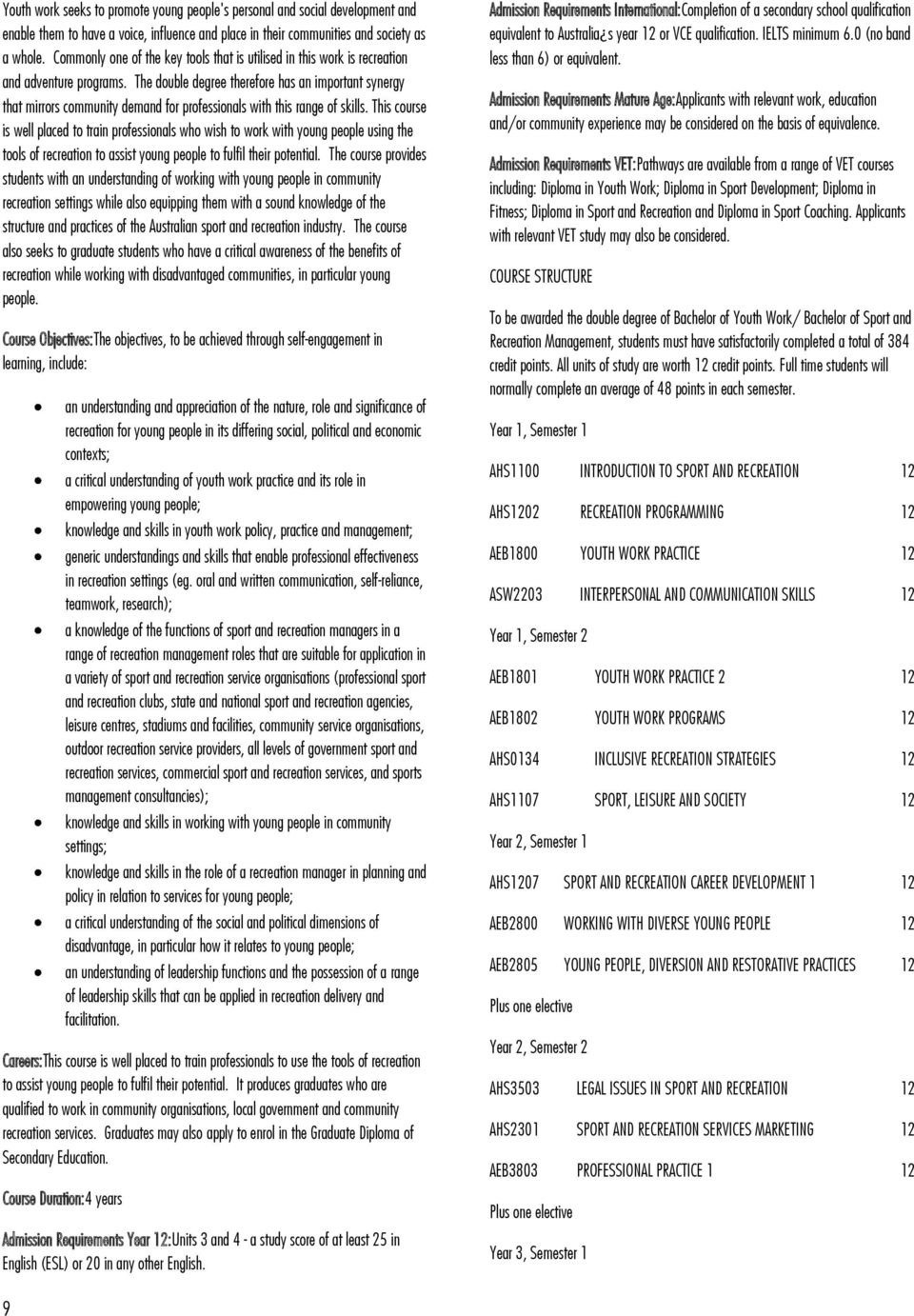
10 AHS3114 SPORT AND RECREATION FACILITY MANAGEMENT 12 AHS2404 RECREATION AND COMMUNITY DEVELOPMENT 12 AEB2802 ETHICS AND YOUTH WORK PRACTICE 12 AEB3802 PROFESSIONAL CULTURE AND COLLABORATION 12 Year 3, Semester 2 AHS2300 EVENT MANAGEMENT IN SPORT AND RECREATION 12 AEB2803 HOLISTIC PRACTICE WITH YOUNG PEOPLE 12 AEK1201 INDIGENOUS AUSTRALIAN KNOWING 12 Plus one elective Year 4, Semester 1 AEB3804 RESEARCH AND YOUNG PEOPLE 12 AEB3801 YOUTH POLICY AND CIVICS 12 AEB2801 GANGS AND GROUPS: THE CULTURE OF YOUNG PEOPLE 12 Plus one elective Year 4, Semester 2 AEB3805 YOUTH POLICY, CIVICS AND CULTURE 12 AEB3807 YOUTH RESEARCH PROJECT 12 Plus one of the following two units: AEB3808 PROFESSIONAL PRACTICE 2 12 AHS3600 SPORT AND RECREATION CAREER DEVELOPMENT 12 Plus one elective EXAMPLES OF ELECTIVE SEQUENCES THAT COULD BE UNDERTAKEN BY STUDENTS Community Development English Health Information and Communication Technology Media Studies Outdoor Education It is important to note that students do not need the exact sequence for their VIT registration because they already have completed that within their core units. This means they can have a greater level of flexibility, undertaking for example three units from one sequence and two from another. BACHELOR OF YOUTH WORK Course Code:ABYW Campus:Footscray Park. About this course:this course aims to provide youth workers with practical management and leadership skills.to help young people learn about themselves, others and society, through informal educational activities which combine enjoyment, challenge and learning. Youth Work seeks to promote young people s personal and social development and enable them to have a voice, influence and place in their communities and society as a whole. Commonly one of the key tools that is utilised in this work is recreation and adventure programs so on that basis the course has included units from recreation management. The course is well placed to train professionals who wish to work with young people to assist them to fulfil their potential. Students will increase their understanding of working with young people in community settings as well as.acquire a sound knowledge of the structure and practices of the Youth Work industry. The course seeks to graduate students who have a critical awareness of the benefits of recreation in working with disadvantaged communities, in particular young people. Course Objectives:The course objectives, to be achieved through self-engagement in learning, include: a critical understanding of youth work practice and its role in empowering young people; an understanding and appreciation of the nature, role and significance of recreation for young people in its differing social, political and economic contexts; knowledge and skills in youth work policy, practice and management; generic understandings and skills that enable professional effectiveness in youth work settings; knowledge and skills in working with young people in community settings; a critical understanding of the social and political dimensions of disadvantage, in particular how it relates to young people; an understanding of leadership functions and the possession of a range of leadership skills that can be applied in recreation delivery and facilitation. Careers:This course provides students with the knowledge, skills and understanding to work with young people in a range of community settings. It also has multiple employment exit points into schools, as graduates will be qualified to enter the Graduate Diploma of Secondary Education or pursue a career in local government. Course Duration:3 years Admission Requirements Year 12:Units 3 and 4 - a study score of at least 25 in English (ESL) or 20 in any other English. Admission Requirements International:Completion of a secondary school qualification equivalent to Australia s year 12 or VCE qualification. IELTS minimum 6.0 (no band less than 6) or equivalent. Admission Requirements Mature Age:Applicants with relevant work, education and/or community experience may be considered on the basis of equivalence. 10
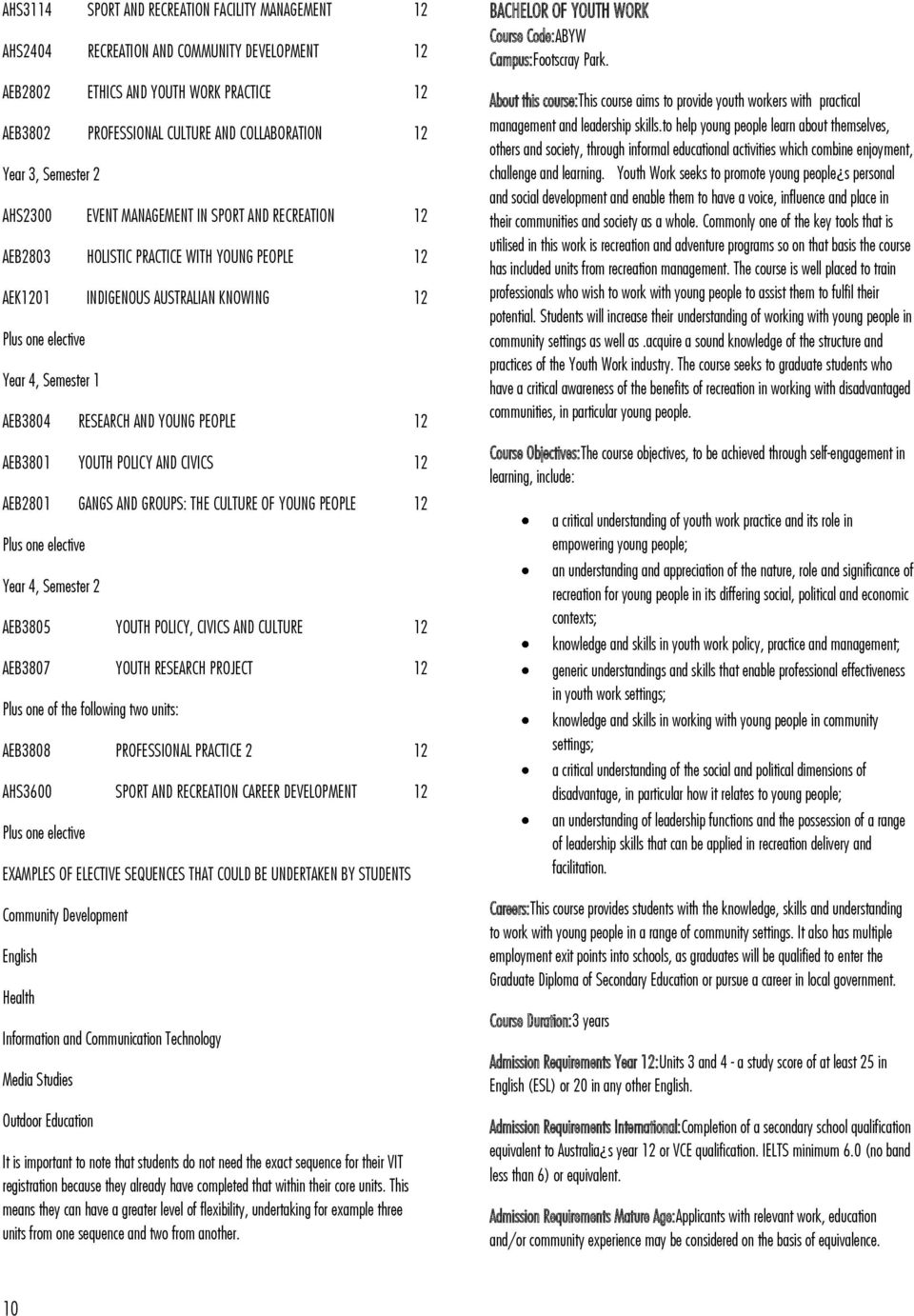
11 Admission Requirements VET:Pathways are available from a range of VET courses. Applicants with relevant VET study may also be considered. COURSE STRUCTURE To be awarded the degree of Bachelor of Youth Work students must have successfully completed a total of 288 credit points. All units of study are worth 12 credit points. Full-time students will normally complete an average of 48 points each semester. Year 1, Semester 1 AEB1803 YOUTH WORK CONTEXTS 12 AEB1800 YOUTH WORK PRACTICE 12 AHS1202 RECREATION PROGRAMMING 12 ASW2203 INTERPERSONAL AND COMMUNICATION SKILLS 12 Year 1, Semester 2 AEB1801 YOUTH WORK PRACTICE 2 12 AEB1802 YOUTH WORK PROGRAMS 12 AEB2800 WORKING WITH DIVERSE YOUNG PEOPLE 12 AHS1107 SPORT, LEISURE AND SOCIETY 12 Year 2, Semester 1 AEB2801 GANGS AND GROUPS: THE CULTURE OF YOUNG PEOPLE 12 AEB2805 YOUNG PEOPLE, DIVERSION AND RESTORATIVE PRACTICES 12 AEB3803 PROFESSIONAL PRACTICE 1 12 Plus one elective Year 2, Semester 2 AEB2803 HOLISTIC PRACTICE WITH YOUNG PEOPLE 12 AEK1201 INDIGENOUS AUSTRALIAN KNOWING 12 AHS2300 EVENT MANAGEMENT IN SPORT AND RECREATION 12 AEB2806 PRINCIPLES OF YOUTH PARTICIPATION 12 Year 3, Semester 1 AEB2802 ETHICS AND YOUTH WORK PRACTICE 12 AEB3801 YOUTH POLICY AND CIVICS 12 AEB3802 PROFESSIONAL CULTURE AND COLLABORATION 12 AEB3804 RESEARCH AND YOUNG PEOPLE 12 Year 3, Semester 2 AEB3805 YOUTH POLICY, CIVICS AND CULTURE 12 AEB3806 SOCIAL INQUIRY THEORY AND RESEARCH 12 AEB3807 YOUTH RESEARCH PROJECT 12 AEB3808 PROFESSIONAL PRACTICE 2 12 DIPLOMA OF EDUCATION STUDIES Course Code:ADES Campus:Footscray Nicholson, This course also delivered at Hume Global Learning Centre - Broadmeadows as part of Hume Multiversity.. About this course:the Diploma of Education Studies is a VU Diploma level pathway into the Bachelor of Education. Those students who have successfully completed all aspects of the Diploma of Education Studies program, at the agreed achievement level, will be able to transfer into the VU Bachelor of Education (P-12) program via the internal course transfer process. A significant feature of this one year program is that it will provide intensive support for the development of capacity in literacy and numeracy suitable for a career in education. While the program is not a teacher education program it is designed to be equivalent to one year of study in the Bachelor of Education (P-12) program at Victoria University. Course Objectives:The aims of the course are to: Offer an opportunity to engage in academic study that enhances knowledge and agency Offer a pathway into the Bachelor of Education (BEd) Build capacity in literacy and numeracy to enable successful completion of the BEd Give students multiple exit points in the education and transition cluster of courses Provide a course which has multiple pathways Provide an opportunity to embark on an Education pathway for those who do not meet the VTAC B Ed selection criteria. Careers:Those students who have successfully completed all aspects of the Diploma of Education Studies program, at the agreed achievement level, will be able to transfer into the VU Bachelor of Education (P-12) program via the internal course transfer process. Graduates from the Diploma of Education Studies will also be eligible to apply for other Bachelor level programs. Graduates from the Diploma could seek work as teacher aides / integration aides because there is no qualifications / employment nexus in this sector of the Victorian education industry. Course Duration:1 year Admission Requirements Year 12:Units 3 and 4 - a study score of at least 25 in English (ESL) or 20 in any other English. Admission Requirements International:IELTS of 5.5 with no band less than 5. Admission Requirements Mature Age:Direct application with personal information and possible interview Admission Requirements VET:Certificate IV in Liberal Arts or equivalent COURSE STRUCTURE 11
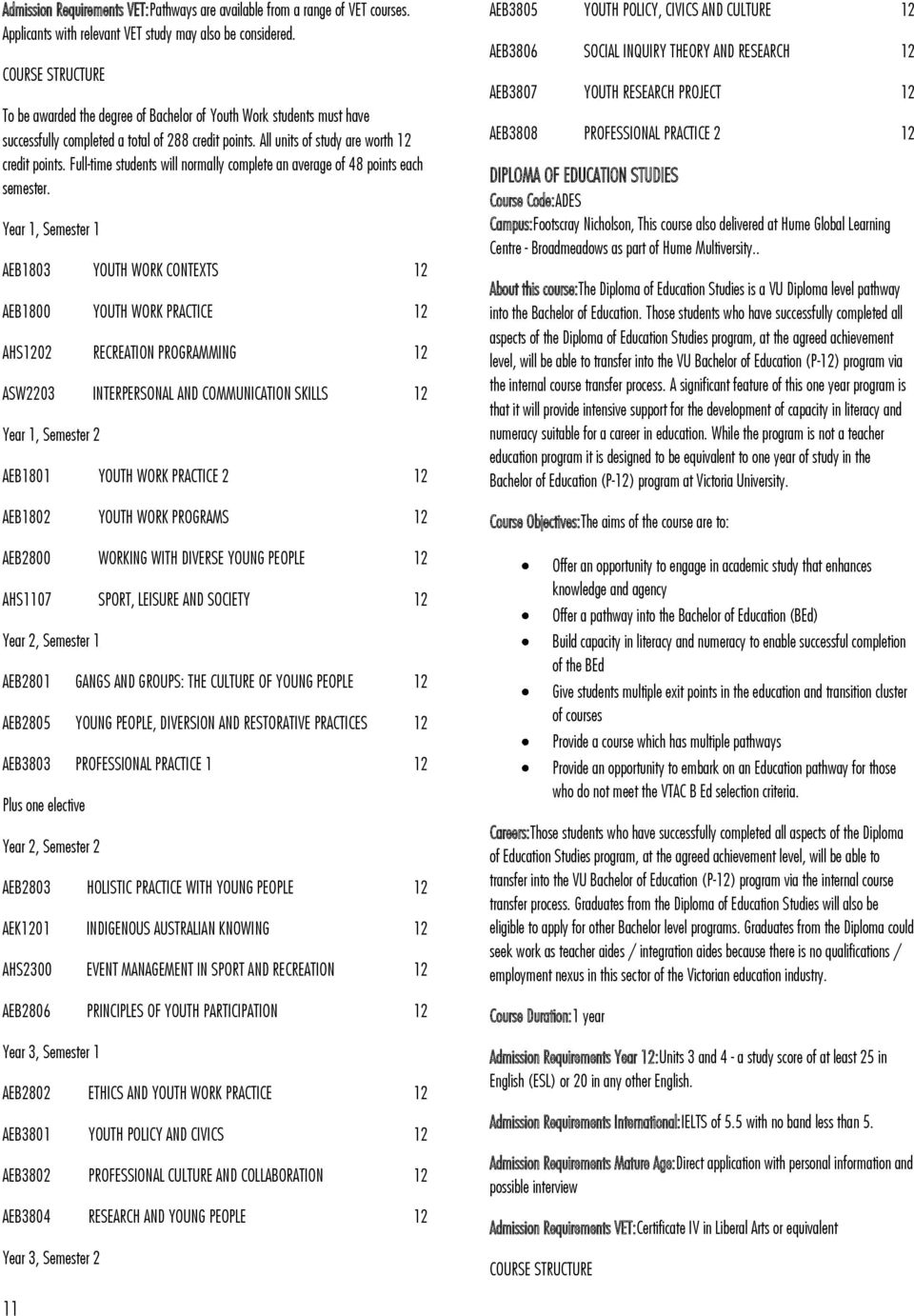
12 Students enrolled in the Diploma of Education Studies will complete ten units of study over one year of full time study. The units will include: Year 1, Semester 1 2 units from the first year of the Bachelor of Education Program, AEB Mathematical Knowledge for Teaching 2 and AEB1101- Learning in a Changing World a year long study in Mathematics for Education including ADE1000 and ADE1001 a year long study in Researching Literacy and Learning including AED1002 and AED1003 a year long study in Tradition and Modernity including 2 units ADE1004 and ADE elective units from ADE1006, ADE1007, ADE1008 and ADE1009. ADE1000 MATHEMATICS FOR EDUCATION A 6 ADE1002 RESEARCHING LITERACIES AND LEARNING A 6 ADE1004 TRADITION AND MODERNITY A 12 AEB1101 LEARNING IN A CHANGED WORLD 12 Plus one elective from the list of electives below Year 1, Semester 2 ADE1001 MATHEMATICS FOR EDUCATION B 6 ADE1003 RESEARCHING LITERACIES AND LEARNING B 6 ADE1005 TRADITION AND MODERNITY B 12 AEB1307 MATHEMATICAL KNOWLEDGE FOR TEACHING 2 12 Plus one elective from the list of electives below List of Electives ADE1006 ANALYSE SOCIOLOGICAL UNDERSTANDINGS OF HUMAN RELATIONSHIPS ADE1007 ANALYSE URBAN FORM AND CULTURE 12 ADE1008 ANALYSE THEORIES OF SELF 12 ADE1009 ANALYSE LITERARY TEXTS AND GENRES 12 GRADUATE DIPLOMA IN EDUCATIONAL LEARNING AND LEADERSHIP Course Code:AGEB Campus:Footscray Park, St Albans, Some units may be delivered offshore. About this course:the course is designed for professionals from a variety of roles in different settings who respond to the educational opportunities and challenges in education, community, government and industry. It requires students to engage in professional learning through practitioner research informed by contemporary theories of learning, leadership and personal, workplace and social change. 12 Course Objectives:This course aims to develop within graduates the following attributes: advanced knowledge about theories of learning and teaching and the application of these theories in their professional work; skills and knowledge to lead educational innovation and professional learning in their workplace; a strong theoretical perspective and critical literacy in education for lifelong learning informed by current research; an understanding of the contemporary context of education, training and professional leadership; an international perspective on education, change and leadership related to their professional field; skills to develop and manage learning sites and programs in their professional field; creativity and flexibility in the application of knowledge of new situations, to solve complex problems and to think rigorously and independently; a high order of skill in analysis, critical evaluation and professional application in designing, conducting and reporting educational inquiry/research into professional practice; a commitment to ethical action and social responsibility as an educator, professional and researcher. Careers:This course is designed to support the professional learning of educational practitioners. Course Duration:1 year Admission Requirements International:The admission requirement for the Graduate Diploma course is a three year first degree. Applicants with relevant work, education and/or community experience may be considered on the basis of equivalence. IELTS minimum 6.5 (no band less than 6.0) or equivalent. Admission Requirements Mature Age:To qualify for admission to the course, applicants must have a university degree completed at a meritorious level, or an equivalent qualification as approved by the College of Education. Extensive experience in the professional field is an advantage. COURSE STRUCTURE Students completing this course in full-time mode must complete 96 credit points over two semesters as defined in the course structure below. Year 1, Semester 1 AED5001 EDUCATION RESEARCH DESIGN AND METHODS 24 plus ONE core unit selected from the core unit list - (students can exit after Semester 1 with the Graduate Certificate in Educational Learning and Leadership (ATEB)). Year 1, Semester 2 ONE core unit selected from the core unit list plus ONE additional unit selected from either the core unit list or the elective unit list CORE UNITS AED5007 CURRICULUM 24 12
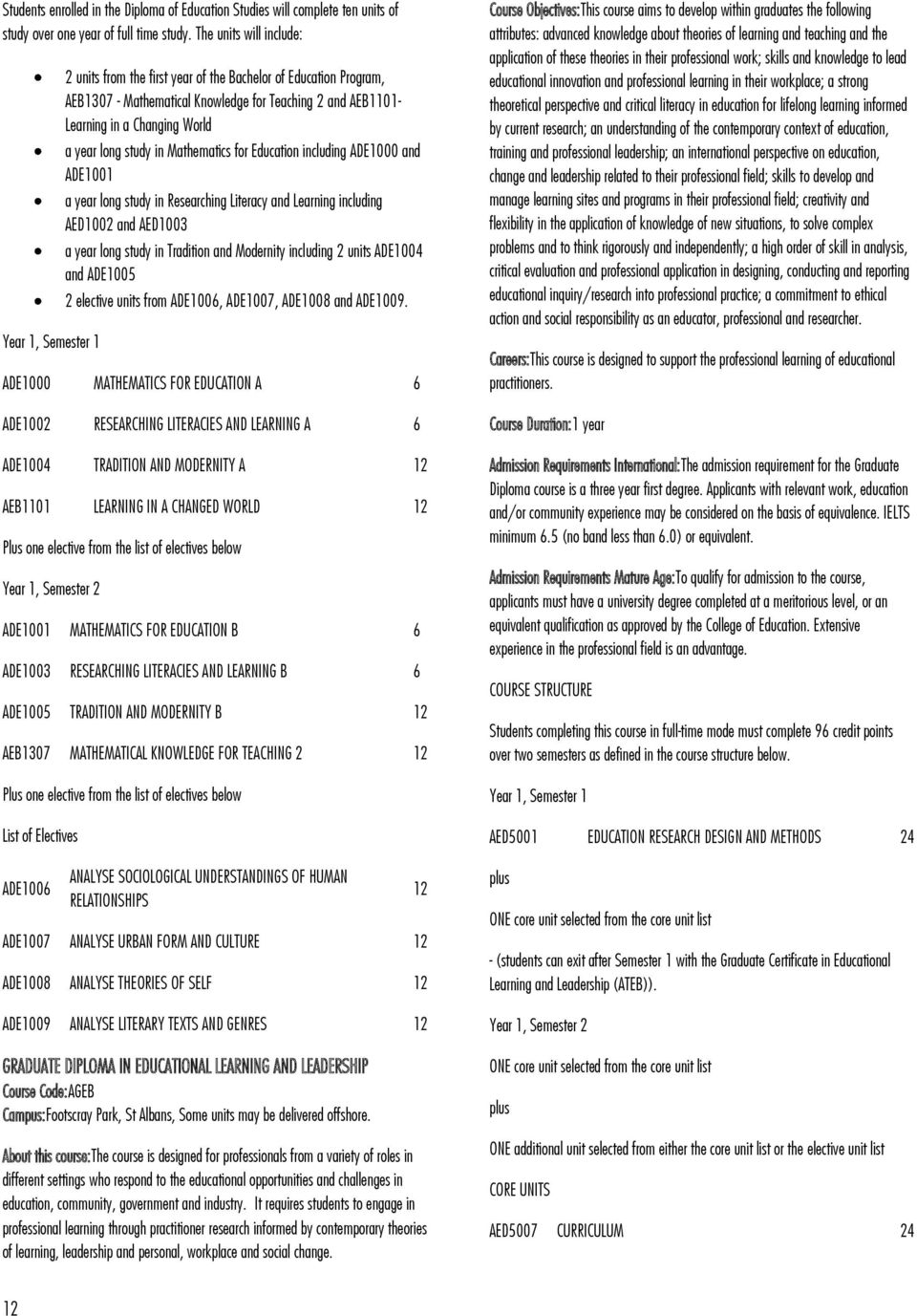
13 AED5009 INNOVATION 24 AED5011 APPROACHES TO LEARNING 24 AED5012 EDUCATIONAL LEADERSHIP 24 ELECTIVE UNITS AED5002 THEORIES OF EDUCATION, TRAINING AND SOCIAL CHANGE 24 AED5003 WORKPLACE RESEARCH PROJECT 24 AED5004 CURRENT ISSUES IN COMMUNITY ARTS 24 AED5005 PORTFOLIO DEVELOPMENT 24 AED5006 ACTION RESEARCH PROJECT 24 AED5008 EVALUATION 24 AED5010 INTERACTIVE WEB DESIGN AND PUBLISHING 24 AED5013 EXPERIENTIAL LEARNING OUTDOORS: PROGRAMMING THE JOURNEY AED5014 MANAGING SITES FOR TEACHING AND LEARNING 24 AED5015 TRAINING DESIGN AND PRACTICE 24 AED5016 FACILITATING LEARNING ORGANISATIONS 24 AED5017 MENTORING AND COACHING IN THE WORKPLACE 24 AED5018 ASSESSMENT 24 AED5019 PROFESSIONAL PRACTICE IN EDUCATIONAL CONSULTANCY 24 AED5020 REFORMING PEDAGOGY 24 AED5021 PROMOTING MATHEMATICS UNDERSTANDING 24 AED5022 APPROACHES TO CAREER EDUCATION 24 AED5023 E-LEARNING 24 AED5024 VOCATIONAL EDUCATION AND TRAINING: POLICY AND PRACTICE 24 AED5025 DEVELOPING THE VET PROFESSIONAL 24 AED5026 POSTCOMPULSORY EDUCATION: POLICY AND PRACTICE 24 AED5027 ORGANISATIONAL CULTURE AND CHANGE IN EDUCATION AND TRAINING AED5028 INTERNATIONALISATION IN EDUCATION AND TRAINING 24 AED5029 ADVANCED QUANTITATIVE RESEARCH METHODS 24 AED5030 POSITIVE EDUCATION GRADUATE DIPLOMA IN EARLY CHILDHOOD EDUCATION Course Code:AGEE Campus:St Albans. About this course:next intake 2015 The Graduate Diploma in Early Childhood Education will provide three-year trained, early childhood teaching graduates with: increased career opportunities and professional recognition through an upgraded four-year qualification; the ability and commitment to develop their teaching further in their own interests, those of young people and those of the early childhood services and communities in which they teach; the opportunity, upon successful completion of the graduate diploma, to enrol in a Master of Education or Master of Teaching degree. Course Objectives:Within the objectives of Victoria University, the Graduate Diploma in Early Childhood Education aims to: develop teachers as active and reflective practitioners, equipped with the critical awareness, teaching competence, knowledge and attitudes to teach children in both early childhood services and primary schools in the 21st century; develop teachers' critical understanding of the changing nature of society (technological, economic, environmental and cultural) and its implications for education; introduce teachers to a range of approaches for the education of children, enabling the development of personal teaching practices which are suitable for teaching in early childhood services in economically and culturally diverse communities; develop in teachers insights into patterns of the cultural and political relations in which early childhood services are located, with particular reference to education in economically and culturally diverse communities; graduate teachers with the commitment to develop their teaching further in their own interests, those of young people and those of the early childhood services and communities in which they teach. Careers:Graduates will be qualified to educate children from birth to age eight. This would enable graduates to seek employment in early childhood services and community organisations. Course Duration:1 year Admission Requirements Mature Age:Prerequisite: Applicants must hold a three-year teaching degree in Early Childhood (or equivalent*) that covers birth to eight years. *Applicants must refer to the list of approved early childhood teacher qualifications available at or Selection Mode: Academic record, form, interview. See Extra requirements for specifics. Admission Requirements Other:Form: Applicants must complete and submit a VTAC Pi form Interview (some applicants only): Details will be provided by telephone or mail to the applicants required to attend. COURSE STRUCTURE 13

14 The Graduate Diploma in Early Childhood is a 96 credit point (eight unit) one-year full-time award which may be studied in part-time mode. CORE UNITS AEE5101 ACTION RESEARCH 1 12 AEE5102 ACTION RESEARCH 2 12 AEE5103 CHILD DEVELOPMENT 3 12 AEE5104 LEARNING, TEACHING AND SOCIAL JUSTICE 12 requirement may fulfil this requirement with a score of 7.5 in the IELTS (Academic) test, with a minimum of 7.0 in each band in any of the four skills areas, and a score of no less than 8 in speaking and listening. COURSE STRUCTURE The course is comprised of 8 units of study plus partnership placements (practicum) in a range of early childhood services Year 1, Semester 1 AEG5115 EARLY CHILDHOOD DEVELOPMENT, LEARNING AND TEACHING 1 12 ASH5002 INTEGRATING THEORY, RESEARCH AND PRACTICE IN COMMUNITY SERVICES 12 AEG5117 EARLY CHILDHOOD CURRICULUM AND PEDAGOGY 1: THE SCIENCES 12 AEE5106 CONTEMPORARY ISSUES IN EARLY CHILDHOOD CONTEXTS 12 AEE5107 INDIGENOUS STUDIES 12 Plus one elective (12 credit points) GRADUATE DIPLOMA IN EARLY CHILDHOOD TEACHING Course Code:AGTE Campus:St Albans. About this course:the Graduate Diploma in Early Childhood Teaching, is both a part of the proposed Master of Teaching, as well as a stand alone course which will allow Graduates with an approved 3 year Bachelor Degree in any discipline to qualify as an accredited early childhood teacher Course Objectives:Within the objectives of Victoria University, the Graduate Diploma in Early Childhood Teaching aims to: Develop teachers as active and reflective practitioners, equipped with the critical awareness, teaching competence, knowledge and attitudes to teach children in early childhood services and in the 21st century; Develop teachers' critical understanding of the changing nature of society (technological, economic, environmental and cultural) and its implications for education; Introduce teachers to a range of approaches for the education of children, enabling the development of personal teaching practices which are suitable for teaching in early childhood services in economically and culturally diverse communities; Develop in teachers insights into patterns of the cultural and political relations in which early childhood services are located, with particular reference to education in economically and culturally diverse communities; Graduate teachers with the commitment to develop their teaching further in their own interests, those of young people and those of the early childhood services and communities in which they teach; To provide the College of Education with a suite of preservice teacher education courses which will attract international students and enable them to have extended participation in Australian educational settings needed for them to satisfy teacher registration requirements; Enable graduates to complete the proposed Master of Teaching currently being developed by the College of Education. Careers:Employment as early childhood teachers and directors in a range of early childhood services and programs Course Duration:1 year Admission Requirements Other:Applicants must hold an approved three or four year Bachelor Degree in any discipline. Applicants who do not meet the English language 14 AEG5119 CONTEMPORARY ISSUES, SOCIAL CONTEXTS OF LEARNING AND SOCIAL JUSTICE AEG5121 LANGUAGES AND LITERACY IN EARLY CHILDHOOD 12 Year 1, Semester 2 AEG5116 EARLY CHILDHOOD DEVELOPMENT, LEARNING AND TEACHING 2 12 AEG5118 EARLY CHILDHOOD CURRICULUM AND PEDAGOGY 2: THE ARTS 12 AEG5120 PROFESSIONAL ISSUES 12 AEG5122 INCLUSIVE PRACTICE IN EDUCATION 12 GRADUATE DIPLOMA IN TESOL Course Code:AGTL Campus:Footscray Park. About this course:the Graduate Diploma in TESOL offers qualified teachers the opportunity to become effective teachers of English to Speakers of Other Languages and provides them with the skills required to be employed in a range of TESOL contexts. The Graduate Diploma in TESOL program meets the Victorian Institute of Teaching 'Specialist Area Guidelines for TESOL'. Note: Usually only part time places are offered for applicants who wish to enrol mid-year (except in special circumstances - see the course coordinator). Course Objectives:Graduates of this course will be Analyse English language learners needs; Design, implement, assess and evaluate English as a second or additional language curricula and pedagogical programs that are locally, nationally and internationally applicable; Implement English as a second or additional language learning programs that are underpinned by researched principles of language teaching and a thorough knowledge of the systems of the English language; Undertake applied research relevant to their professional responsibilities and interests in the area of TESOL; apply the theoretical and practical learning opportunities provided in each unit of study to become accomplished TESOL practitioners; Utilise their enhanced teaching skills and understanding of educational processes to work effectively in second language contexts; 12
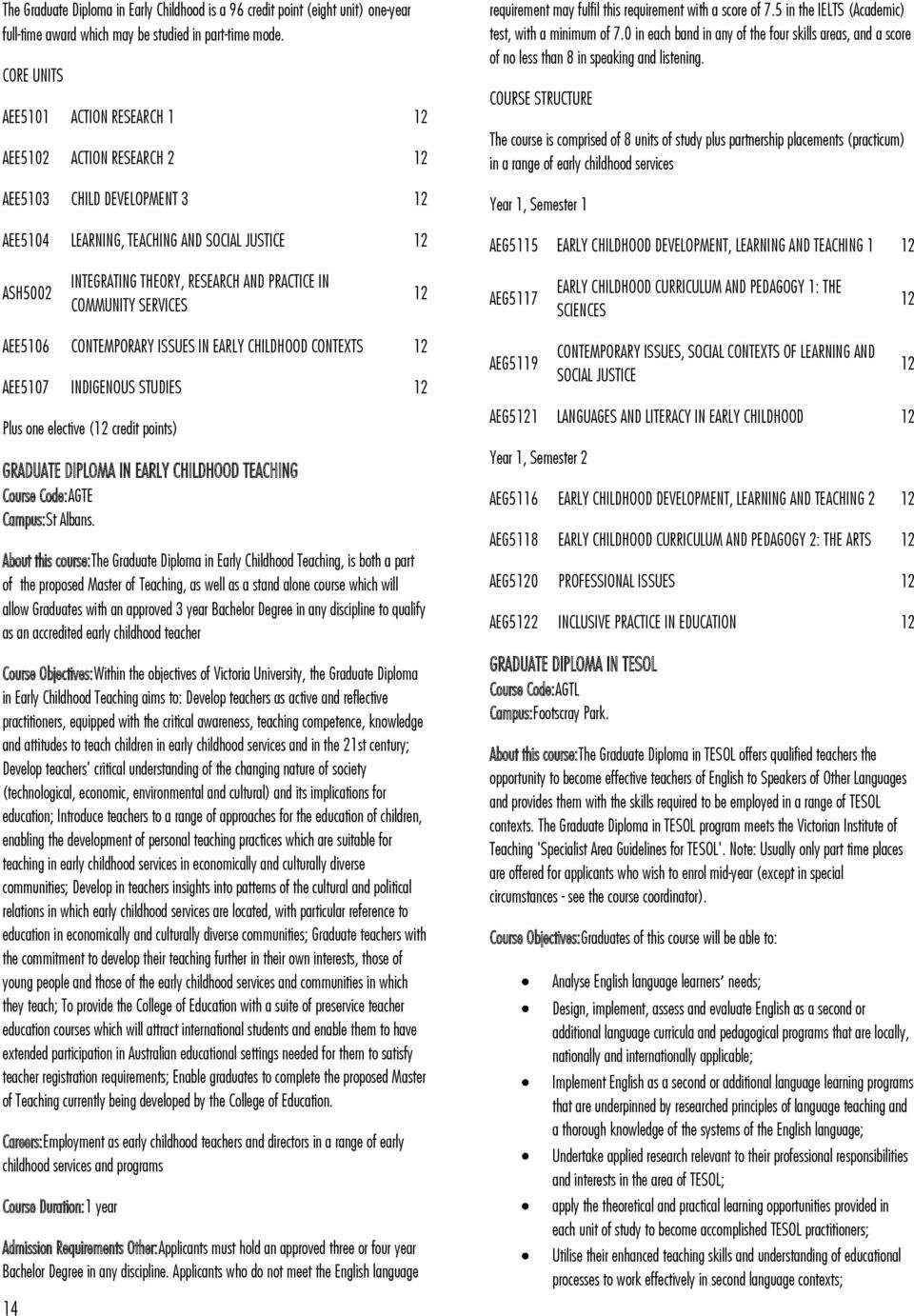
15 Confidently seek employment opportunities for English as a second or additional language teachers in a wide range of local, national and international contexts; Extend their existing professional careers in education by achieving a recognised specialist area qualification; Understand the English as a second or additional language teaching profession in local, national and international contexts. Careers:Most graduates of the Graduate Diploma in TESOL find employment in primary, secondary, adult sector or ELICOS educational institutions locally, nationally or internationally. These graduates teach or manage English as a Second Language (ESL), English as a Foreign Language (EFL) or English as an Additional Language (EAL) programs for students from culturally and linguistically diverse backgrounds. Course Duration:1 year Admission Requirements International:The admission requirement for the Graduate Diploma in TESOL is a recognised degree of at least three years duration preferably in English/ Linguistics/ TESOL (or related disciplines). Current working experience in an education or teaching environment is highly desirable. All applicants must have a minimum IELTS of 7.0 overall (preferably with band 7 in both speaking and listening and no band less than 6.0) or approved equivalent. Admission Requirements Mature Age:The admission requirement for the Graduate Diploma in TESOL is a recognised Australian teaching qualification of at least four years duration or equivalent. An applicant with a recognised Australian degree of at least three years duration or equivalent may apply based on their commitment to work in TESOL programs. Examples of commitment to work in TESOL programs include completed CELTA, working experience as a teacher of English as a second/international/ additional language, participation in professional development. Current working experience in an education or teaching environment for all applicants is highly desirable. Admission Requirements Other:All applicants are expected to demonstrate very high levels of language, literacy and numeracy skills. Applicants are required (1) to attend an interview with the Course Coordinator, (2) to submit a current version of their CV with a list of at least 3 referees and (3) to present a 200 word statement outlining why they are interested in undertaking this course. COURSE STRUCTURE NOTE: This course is part of a postgraduate program which also includes ATTL Graduate Certificate in TESOL and AMTL Master of TESOL. The Graduate Diploma in TESOL comprises six units of study: AEG5123, AEG5124, AEG5125, AEG5126, ACA5021 and ACA5022. These units of study are related to TESOL methodology, the nature of the English language, second language acquisition, literacy, sociolinguistics and the institutional contexts of English language teaching. AEG5123 is a prerequisite for AEG5124 and AEG5126. International students must seek advice from the course coordinator before enrolling in AEG5124 'Professional Practice TESOL'. If this unit is not recommended or not required by international students, they can choose one of the units from the Master of Education (AMEB) course. Local students seeking accreditation with bodies such as the Victorian Institute of Teaching (VIT) or the National English Language Teaching Accreditation System (NEAS) must complete AEG5124 Professional Practice - TESOL. AEG5123 TESOL METHODOLOGY 24 AEG5125 LITERACY METHODOLOGY 12 ACA5021 FOUNDATIONS OF LANGUAGE 12 Year 1, Semester 2 AEG5126 TECHNIQUES IN TESOL 12 ACA5022 COMMUNICATION CULTURE AND DIVERSITY 12 AEG5124 PROFESSIONAL PRACTICE - TESOL 24 or One unit from the Recommended Unit List below (24 credit points) *ThIs unit may not be available to some students RECOMMENDED UNIT LIST - See course coordinator to discuss appropriate unit AED5002 THEORIES OF EDUCATION, TRAINING AND SOCIAL CHANGE 24 AED5003 WORKPLACE RESEARCH PROJECT 24 AED5004 CURRENT ISSUES IN COMMUNITY ARTS 24 AED5005 PORTFOLIO DEVELOPMENT 24 AED5006 ACTION RESEARCH PROJECT 24 AED5007 CURRICULUM 24 AED5008 EVALUATION 24 AED5009 INNOVATION 24 AED5010 INTERACTIVE WEB DESIGN AND PUBLISHING 24 AED5011 APPROACHES TO LEARNING 24 AED5012 EDUCATIONAL LEADERSHIP 24 AED5013 EXPERIENTIAL LEARNING OUTDOORS: PROGRAMMING THE JOURNEY AED5014 MANAGING SITES FOR TEACHING AND LEARNING 24 AED5015 TRAINING DESIGN AND PRACTICE 24 AED5016 FACILITATING LEARNING ORGANISATIONS 24 AED5017 MENTORING AND COACHING IN THE WORKPLACE 24 AED5018 ASSESSMENT 24 AED5019 PROFESSIONAL PRACTICE IN EDUCATIONAL CONSULTANCY 24 AED5020 REFORMING PEDAGOGY Year 1, Semester 1 15

16 AED5021 PROMOTING MATHEMATICS UNDERSTANDING 24 AED5022 APPROACHES TO CAREER EDUCATION 24 AED5023 E-LEARNING 24 AED5024 VOCATIONAL EDUCATION AND TRAINING: POLICY AND PRACTICE 24 AED5025 DEVELOPING THE VET PROFESSIONAL 24 AED5026 POSTCOMPULSORY EDUCATION: POLICY AND PRACTICE 24 AED ORGANISATIONAL CULTURE AND CHANGE IN EDUCATION AND TRAINING AED5028 INTERNATIONALISATION IN EDUCATION AND TRAINING 24 AED5029 ADVANCED QUANTITATIVE RESEARCH METHODS 24 AED5030 POSITIVE EDUCATION 24 GRADUATE DIPLOMA IN PRIMARY TEACHING Course Code:AGTP Campus:Footscray Park, St Albans. About this course:this one-year course is designed for those students who wish to pursue a career in primary education. Students entering this course will have completed an undergraduate degree. The course is practice-based through strong school-university partnerships. Course Objectives:Graduates of this course will be Function as active and reflective practitioners, equipped with the critical awareness, teaching competence, knowledge and attitudes to teach children in primary education and in the 21st century; Demonstrate a critical understanding of the changing nature of society (technological, economic, environmental and cultural) and its implications for education; Assess, critically evaluate and implement a range of educational approaches that enable the development of personal teaching practices which are suitable for teaching in primary education in economically and culturally diverse communities; Identify existing and emerging patterns of the cultural and political relations in which primary education services are located, with particular reference to education in economically and culturally diverse communities; Develop their teaching further in the interests of themselves, young people, primary education and the communities in which they teach; Demonstrate advanced cognitive, communication and problem-solving skills to successfully study at a Master level. Careers:Graduates of this course will be qualified to teach in primary education settings. Course Duration:1 year Admission Requirements Other:Applicants must hold an approved Bachelor degree. Applicants who do not meet the English language requirement may fulfil this 24 requirement via the IELTS (Academic) test, with an average score of 7.5 across all four bands, with no score below 7.0 in any band and no score less than 8 in speaking and listening. Alternatively, applicants may meet the English language requirement with an internet-based TOEFL result of 104 with no individual score less than 26. PRACTICAL PLACEMENT: Students should note that they will be subject to safety screenings (police checks) before practice placements, in accordance with Department of Education and Early Childhood Development policy. COURSE STRUCTURE The course comprises eight units of study. The eight units are: Year 1, Semester 1 There are four units in Semester 1. AEG5108 SOCIAL CONTEXT OF TEACHING AND LEARNING 12 AEG5111 LITERACY IN EDUCATION 12 AEG5113 INTEGRATED STUDIES 1 12 AEG5135 TEACHING AND LEARNING 1 (PRIMARY) 12 Year 1, Semester 2 There are four units in Semester 2. AEG5107 NEW LEARNING 12 AEG5112 NUMERACY IN EDUCATION 12 AEG5114 INTEGRATED STUDIES 2 12 AEG5136 TEACHING AND LEARNING 2 (PRIMARY) 12 GRADUATE DIPLOMA IN YOUTH SERVICES MANAGEMENT Course Code:AGYS Campus:Footscray Park, Some units are offered at City Flinders campus. About this course:this course has been designed for those working in the youth sector who are wanting to develop knowledge and skills in youth sector management. It is a one year full-time course which may be studied in part-time mode. Course Objectives:This course aims to: encourage students to apply higher order analysis to current developments in youth work policy and practice to enable application into the youth sector. provide learners with a strong professional framework based on good practice, ethics and principles equip professionals with a range of public sector management skills including human resource management, establishing social enterprises, managing budgets and new technology. encourage students to investigate issues associated with policy development and implementation and trial approaches to policy formation
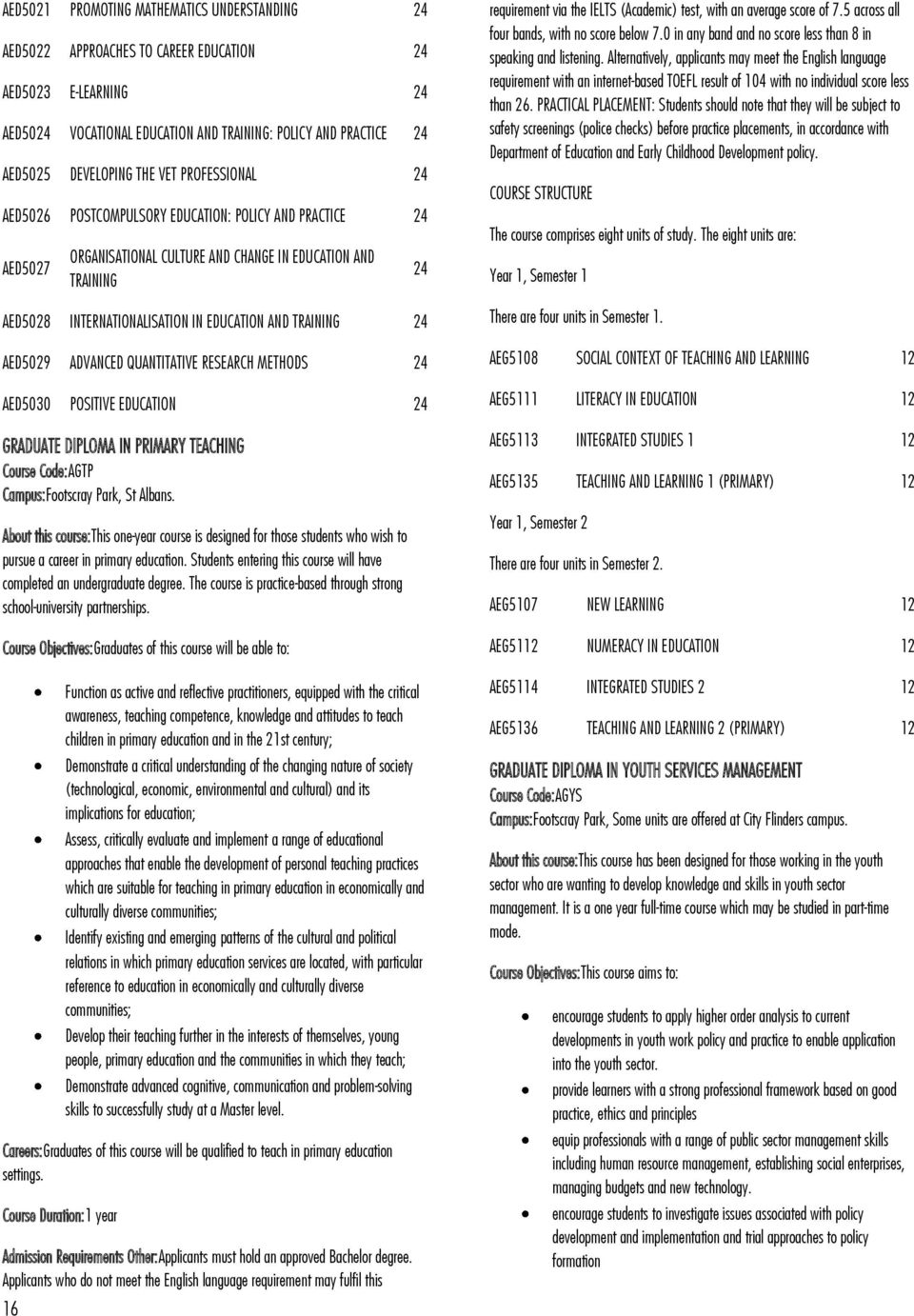
17 develop the skills required to be a good advocate who is strategic in their approach to their work develop professional youth workers critical understanding of the changing nature of society (technological, economic, environmental and cultural) and its implications for young people, with particular emphasis on the developments associated with the global knowledge economy and society help students develop insights into patterns of the cultural and political relations in which youth services is located, with particular reference to economically and culturally diverse communities and in those communities that include Australian Indigenous peoples. Careers:Graduates of the Graduate Diploma in Youth Services Management course will develop skills that will enable them to supervise and manage a youth work service in a government or community organisation. Course Duration:1 year Admission Requirements Mature Age:Students are expected to have completed the Post-Graduate Certificate in Youth Services Management or its equivalent. Admission Requirements Other:Students undertaking the Post Graduate Diploma in Youth Services Management will usually be working within the youth services sector. COURSE STRUCTURE Students are required to complete two semesters of study equalling 96 credit points as per the structure below. Year 1, Semester 1 AEY5001 YOUNG PEOPLE AND SOCIAL POLICY 12 AEY5002 PROFESSIONAL PRACTICE FOR YOUTH DEVELOPMENT 12 Plus two units (2 x 12 credit points) selected from the Master of Business (Management) units listed below Year 1, Semester 2 AEY5003 EXPERIENTIAL AND APPLIED LEARNING 24 Plus AED5001 EDUCATION RESEARCH DESIGN AND METHODS 24 #Compulsory unit for students intending to undertake the minor thesis option in the Master of Youth Services Management Or One unit (24 credit points) selected from the Master of Education units listed below Or Two units (2 x 12 credit points) selected from the Master of Business (Management) units listed below Elective Units** Master of Business (Management) units BMO5533 ORGANISATION CONSULTING AND COUNSELLING 12 BMO5544 INDUSTRIAL RELATIONS 12 BMO5564 HUMAN RESOURCE MANAGEMENT 12 BMO5567 MANAGING WORKPLACE CONFLICT 12 BMO5568 TEAMWORKING 12 BMO5602 BUSINESS PROJECT MANAGEMENT 12 BMO5650 MANAGING ORGANISATION KNOWLEDGE 12 BMO6506 WORK AND ORGANISATION SYSTEMS 12 BMO6511 STRATEGIC MANAGEMENT AND BUSINESS POLICY 12 BMO6622 MANAGING INNOVATION AND ENTREPRENEURSHIP 12 BMO6624 ORGANISATION CHANGE MANAGEMENT 12 BMO6625 PERFORMANCE MANAGEMENT AND REWARDS 12 Master of Education units AED5002 THEORIES OF EDUCATION, TRAINING AND SOCIAL CHANGE 24 AED5003 WORKPLACE RESEARCH PROJECT 24 AED5008 EVALUATION 24 AED5009 INNOVATION 24 AED5010 INTERACTIVE WEB DESIGN AND PUBLISHING 24 AED5011 APPROACHES TO LEARNING 24 AED5012 EDUCATIONAL LEADERSHIP 24 AED5017 MENTORING AND COACHING IN THE WORKPLACE 24 AED5023 E-LEARNING 24 AED5024 AED5027 VOCATIONAL EDUCATION AND TRAINING: POLICY AND PRACTICE ORGANISATIONAL CULTURE AND CHANGE IN EDUCATION AND TRAINING AED5030 POSITIVE EDUCATION 24 **Check timetable to see which semester and campus units are offered at. MASTER OF EDUCATION Course Code:AMEB Campus:Footscray Park, St Albans, Some units may be delivered offshore This course
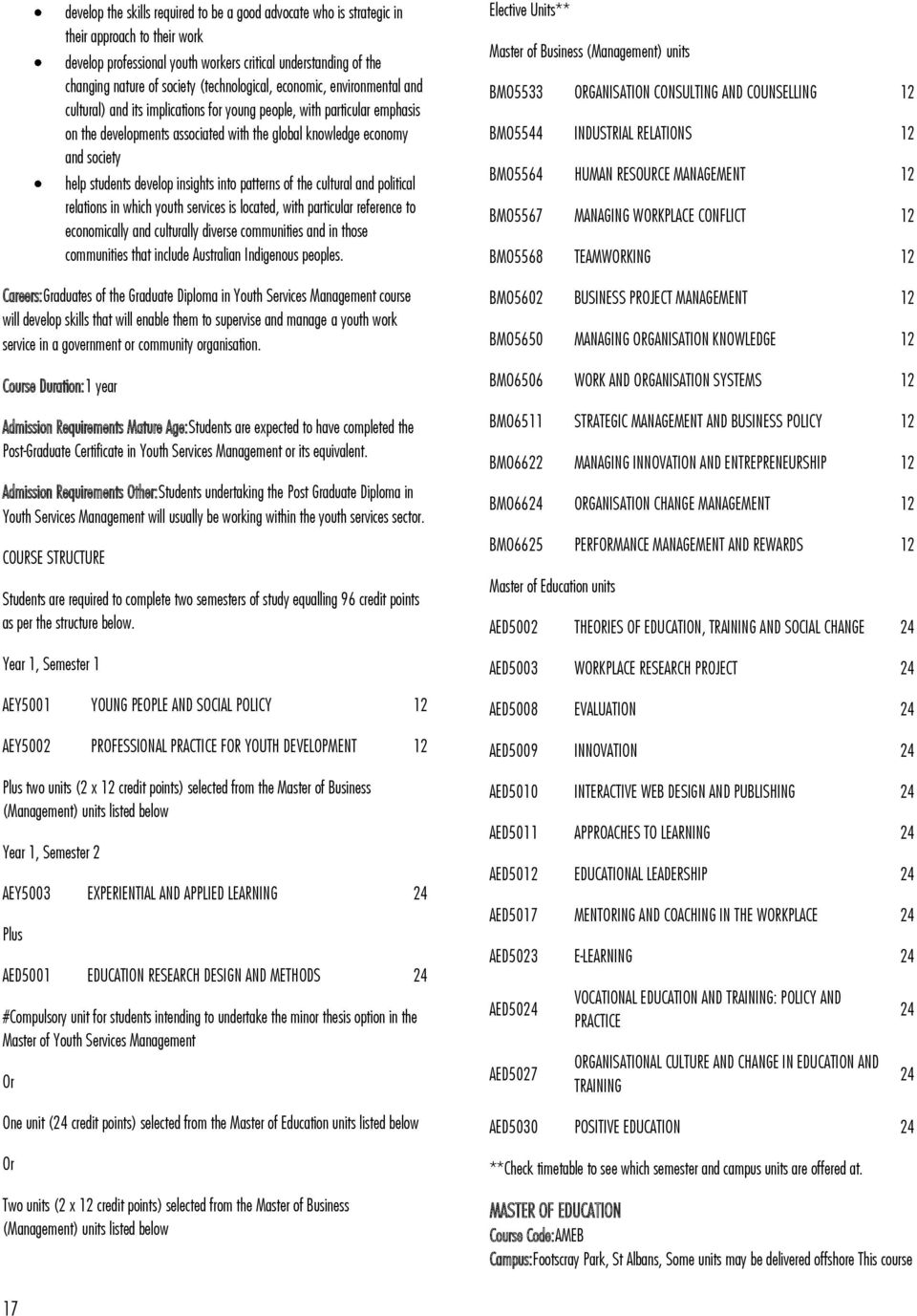
18 is also delivered at Hume Global Learning Centre - Broadmeadows as part of Hume Multiversity.. About this course:the course is designed for professionals from a variety of roles in different settings who respond to the educational opportunities and challenges in education, community, government and industry. It requires students to engage in professional learning through practitioner research informed by contemporary theories of learning, leadership and personal, workplace and social change. Course Objectives:This course aims to develop within graduates the following attributes: advanced knowledge about theories of learning and teaching and the application of these theories in their professional work; skills and knowledge to lead educational innovation and professional learning in their workplace; a strong theoretical perspective and critical literacy in education for lifelong learning informed by current research; an understanding of the contemporary context of education, training and professional leadership; an international perspective on education, change and leadership related to their professional field; skills to develop and manage learning sites and programs in their professional field; creativity and flexibility in the application of knowledge of new situations, to solve complex problems and to think rigorously and independently; a high order of skill in analysis, critical evaluation and professional application in designing, conducting and reporting educational inquiry/research into professional practice; a commitment to ethical action and social responsibility as an educator, professional and researcher. Careers:This course is designed to support the professional learning of educational practitioners. Course Duration:1.5 years Admission Requirements International:The admission requirement for the Masters course is a three year first degree. Applicants with relevant work, education and/or community experience may be considered on the basis of equivalence. IELTS minimum 6.5 (no band less than 6.0) or equivalent. Admission Requirements Mature Age:To qualify for admission to the course, applicants must have a university degree completed at a meritorious level, or an equivalent qualification as approved by the College of Education. To undertake the minor thesis option, the College of Education requires evidence of aptitude for a comprehensive research project. Extensive experience in the professional field is an advantage. COURSE STRUCTURE Students completing this course in full-time mode must complete 144 credit points over three semesters. Year 1 AED5001 EDUCATION RESEARCH DESIGN AND METHODS 24 Plus TWO units selected from the CORE unit list Plus ONE additional unit selected from either the CORE unit list or the elective list Year 2, Semester 1 In the final semester students have two options. Option 1: Complete TWO units Option 2: Complete a Minor Thesis (either full-time or part-time) OPTION 1: TWO units selected from units offered in the core unit list and elective list OPTION 2: AED6001 MINOR THESIS (FULL-TIME) 48 Or if part-time enrol in the following unit for two semesters: AED6002 MINOR THESIS (PART-TIME) 24 CORE UNITS Students must complete at least TWO of these: AED5007 CURRICULUM 24 AED5009 INNOVATION 24 AED5011 APPROACHES TO LEARNING 24 AED5012 EDUCATIONAL LEADERSHIP 24 ELECTIVES UNITS AED5002 THEORIES OF EDUCATION, TRAINING AND SOCIAL CHANGE 24 AED5003 WORKPLACE RESEARCH PROJECT 24 AED5004 CURRENT ISSUES IN COMMUNITY ARTS 24 AED5005 PORTFOLIO DEVELOPMENT 24 AED5006 ACTION RESEARCH PROJECT 24 AED5008 EVALUATION 24 AED5010 INTERACTIVE WEB DESIGN AND PUBLISHING 24 AED5013 EXPERIENTIAL LEARNING OUTDOORS: PROGRAMMING THE JOURNEY AED5014 MANAGING SITES FOR TEACHING AND LEARNING 24 AED5015 TRAINING DESIGN AND PRACTICE 24 AED5016 FACILITATING LEARNING ORGANISATIONS 24 AED5017 MENTORING AND COACHING IN THE WORKPLACE 24 AED5018 ASSESSMENT

19 AED5019 PROFESSIONAL PRACTICE IN EDUCATIONAL CONSULTANCY 24 AED5020 REFORMING PEDAGOGY 24 AED5021 PROMOTING MATHEMATICS UNDERSTANDING 24 AED5022 APPROACHES TO CAREER EDUCATION 24 AED5023 E-LEARNING 24 AED5024 VOCATIONAL EDUCATION AND TRAINING: POLICY AND PRACTICE 24 AED5025 DEVELOPING THE VET PROFESSIONAL 24 AED5026 POSTCOMPULSORY EDUCATION: POLICY AND PRACTICE 24 AED5027 ORGANISATIONAL CULTURE AND CHANGE IN EDUCATION AND TRAINING AED5028 INTERNATIONALISATION IN EDUCATION AND TRAINING 24 AED5029 ADVANCED QUANTITATIVE RESEARCH METHODS 24 AED5030 POSITIVE EDUCATION 24 Students can exit after Semester 1 with the Graduate Certificate in Educational Learning and Leadership (ATEB). Students can exit after Semester 2 with the Graduate Diploma in Educational Learning and Leadership (AGEB). MASTER OF EDUCATION Course Code:AMED Campus:Footscray Park. This course is for Continuing students only. About this course:the course is designed for professionals from a variety of roles in different settings who respond to the educational opportunities and challenges in education, community, government and industry. It requires students to engage in professional learning through practitioner research informed by contemporary theories of learning, leadership and personal, workplace and social change. Course Objectives:This course aims to develop within graduates the following attributes: 24 a high order of skill in analysis, critical evaluation and professional application in designing, conducting and reporting educational inquiry/research into professional practice; a commitment to ethical action and social responsibility as an educator, professional and researcher. Careers:The Graduate Certificate and Graduate Diploma in Educational Learning and Leadership and the Master of Education provide professional development and extension for professionals engaged primarily in education and training. The majority of course participants are employed full time. There is evidence that the course has contributed to career change, opened promotion and business opportunities and has contributed to the enhancement of participants skills and expertise. Graduates have also continued with their study pathways enrolling in the Doctor of Education. Course Duration:1.5 years Admission Requirements Mature Age:To qualify for admission to the course, applicants must have a university degree completed at a meritorious level, or an equivalent qualification as approved by the College of Education. To undertake the minor thesis option, the College requires evidence of aptitude for a comprehensive research project. Extensive experience in the professional fields associated with the specialisations in the course is an advantage. International students require an IELTS score of 6.5 with a minimum of six (6) in any band. COURSE STRUCTURE Students must complete 144 credit points as defined in the course structure. Students who have completed the Graduate Certificate in Tertiary Education (available to University staff only) or the Graduate Certificate of Educational Learning and Leadership will receive credit for semester one. Students who have completed the Graduate Diploma of Educational Learning and Leadership will receive credit for semesters one and two. SEMESTER ONE - total 48 credit points One core unit of study plus two other units of study selected from the units listed below - 3 x 16 credit points SEMESTER TWO - total 48 credit points 19 advanced knowledge about theories of learning and teaching and the application of these theories in their professional work; skills and knowledge to lead educational innovation and professional learning in their workplace; a strong theoretical perspective and critical literacy in education for lifelong learning informed by current research; an understanding of the contemporary context of education, training and professional leadership; an international perspective on education, change and leadership related to their professional field; skills to develop and manage learning sites and programs in their professional field; creativity and flexibility in the application of knowledge of new situations, to solve complex problems and to think rigorously and independently; One core unit of study plus two other units of study selected from the units listed below - 3 x 16 credit points SEMESTER THREE- total 48 credit points AEM6100 EDUCATION RESEARCH DESIGN AND METHODS 16 AND AEM1659 MINOR THESIS (FULL-TIME) 32 - OR if studying part-time then enrol in the following unit for 2 semesters AEM1660 MINOR THESIS (PART-TIME) 16 CORE UNITS OF STUDY
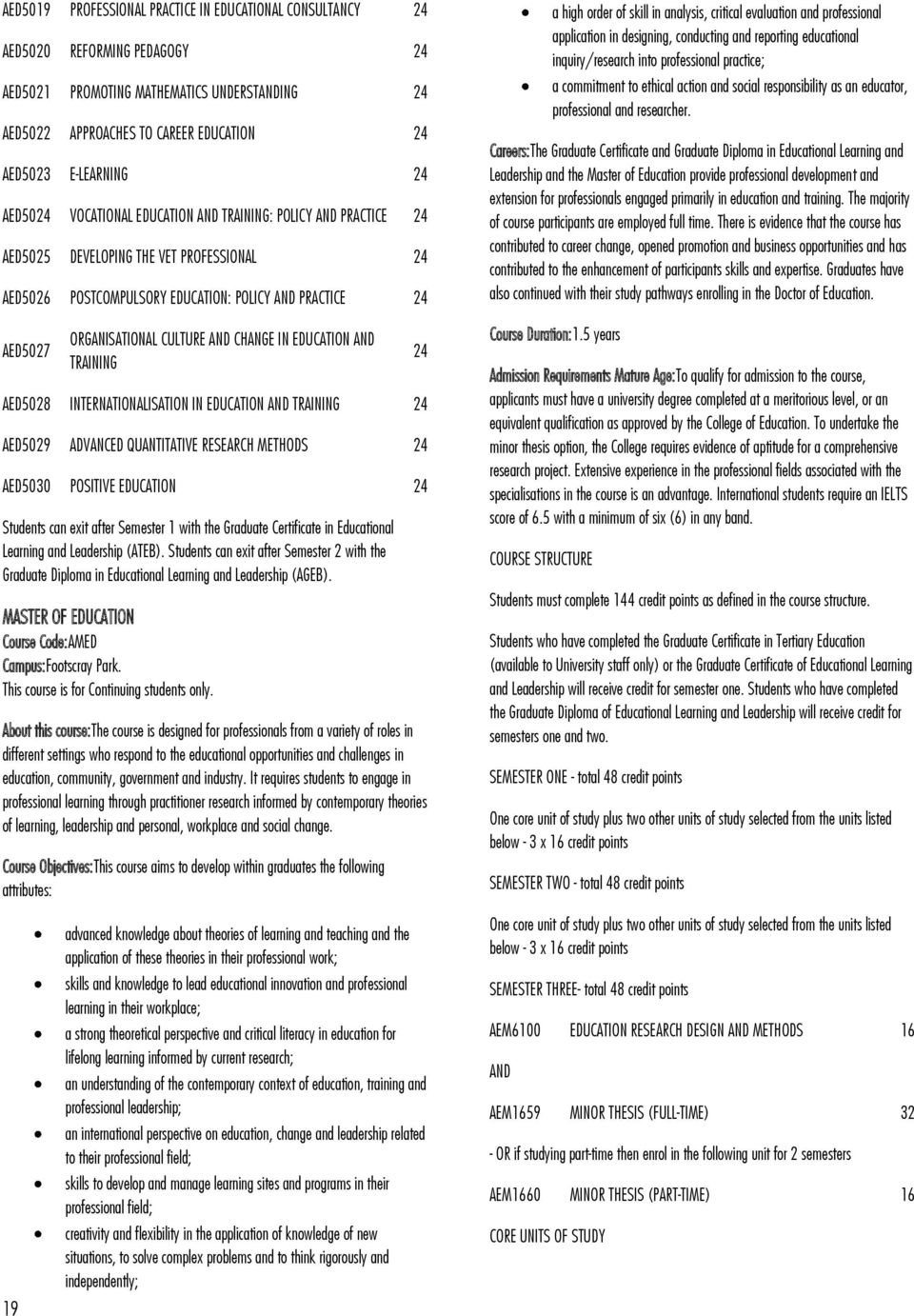
20 AEG1501 CURRICULUM 16 AEG1504 INNOVATION 16 AEG5001 APPROACHES TO LEARNING 16 AEG5002 EDUCATIONAL LEADERSHIP 16 RESEARCH METHODS UNITS OF STUDY AEM6100 EDUCATION RESEARCH DESIGN AND METHODS 16 RESEARCH UNITS OF STUDY AEG1411 ACTION RESEARCH PROJECT 16 AEM6101 THEORIES OF EDUCATION, TRAINING AND SOCIAL CHANGE 16 AEM6102 WORKPLACE RESEARCH PROJECT 16 ELECTIVE UNITS OF STUDY AEG1003 CURRENT ISSUES IN COMMUNITY ARTS 16 AEG1310 PORTFOLIO DEVELOPMENT 16 AEG1501 CURRICULUM 16 AEG1502 EVALUATION 16 AEG1504 INNOVATION 16 AEG4222 INTERACTIVE WEB DESIGN AND PUBLISHING 16 AEG5002 EDUCATIONAL LEADERSHIP 16 AEG EXPERIENTIAL LEARNING OUTDOORS: PROGRAMMING THE JOURNEY AEG5005 MANAGING SITES FOR TEACHING AND LEARNING 16 AEG5006 TRAINING DESIGN AND PRACTICE 16 AEG5007 FACILITATING LEARNING ORGANISATIONS 16 AEG5008 MENTORING AND COACHING IN THE WORKPLACE 16 AEG5009 ASSESSMENT 16 AEG5010 PROFESSIONAL PRACTICE IN EDUCATIONAL CONSULTANCY 16 AEG5011 REFORMING PEDAGOGY 16 AEG5012 PROMOTING MATHEMATICS UNDERSTANDING 16 AEG5014 APPROACHES TO CAREER EDUCATION 16 AEG5018 E-LEARNING 16 AEG5019 VOCATIONAL EDUCATION AND TRAINING: POLICY AND PRACTICE MASTER OF TEACHING Course Code:AMTE Campus:Footscray Park. About this course:the course will enable prospective students to: graduate with a depth of knowledge and understanding of teaching and learning processes and systems to a level which allows them to have informed influences in educational environments; satisfy Victorian Institute of Teaching registration requirements including the requisite number of supervised teaching days; experience 'learning in the workplace' which involves both engaging fully with their own teaching practices as well as engaging in the wider educational community; develop knowledge about and experience in educational research linked to their practice; engage with researchbased teaching and apply theoretical models to their practice; take leadership in the intellectual, professional and social dimensions of learning institutions; fully engage in a program that expresses explicit social justice commitments in education; share their culturally and linguistic diverse backgrounds; engage in two years of study in Australia. Course Objectives:Within the objectives of Victoria University, the Master of Teaching aims to: To enable relationships between the course supporting the individual s teaching experience, their stage of teaching e.g. those in their induction period, those more experienced teachers; Ability to connect to professional, personal and political level (Grounded in political agendas e.g. literacy/numeracy focus); Build and extend relationships bring people together about their practice. Collaboration with school personnel; Create opportunities for professional discourse i.e. the course becomes a forum for dialogue; It's not about content delivery but the course contains an inquiry approach; Making practice public e.g. presentations, publications; To provide the College of Education with a suite of preservice teacher education courses which will attract international students and enable them to have extended participation in Australian education settings needed for them to satisfy teacher registration requirements. Careers:This course has two career outcomes: a) teaching qualifications that enable registration in one of the following education sectors: early childhood, primary or secondary education; and b) extended professional learning and development opportunities for practising teachers. Course Duration:2 years Admission Requirements Other:Successful completion of a Graduate Diploma which meets Victorian Institute of Teaching requirements for either primary or secondary teaching will provide access to the Master of Teaching. Alternatively applicants must hold an approved Bachelor degree or equivalent Diploma from a recognised tertiary institution and have completed the pre-requisite studies for their chosen teaching methods which generally involved completion of at least one sub-major in that subject area, except in the case of LOTE which requires completion of a major. Further information on teaching method requirements is available from the Victorian Institute of Teaching website (follow the Teacher Education Program link for information about the 'Standards for initial teacher education'.)

21 Applicants who do not meet the English language requirement may fulfil this requirement via the IELTS (Academic) test, with an average score of 7.5 across all four bands with the following required in each of the skill areas: speaking 8.0, listening 8.0, reading 7.0 and writing 7.0. Alternatively, applicants may meet the English language requirement s of the International Second Language Proficiency Rating (ISLPR) with Level 4 required in each of the areas of speaking, listening, reading and writing OR Professional English Assessment for Teachers (PEAT) with Band A required in each of the areas of speaking, listening, reading and writing. COURSE STRUCTURE The MTeach is a two-year program which can be taken full-time or part-time. The course comprises four semesters of study each of 48 credit points with a total of 192 credit points over two years. Each graduate will graduate with both the Master of Teaching and a Graduate Diploma which meets VIT registration requirements. NON- IELTS STUDENTS For students who do not require an IELTS score, the first year of the course comprises eight core units (8 x 12 credit point units worth a total of 96 credit points) which relate to a specific education sector. Each student will choose from early childhood, primary or secondary. In the second year each student will undertake approved electives totalling 96 credit points. IELTS STUDENTS For IELTS students the first semester will include three specified English Communication units (totalling 48 credits points). The second and third semesters will comprise eight core units (8 x 12 credit point units worth a total of 96 credit points) which relate to a specific education sector. Each student will choose from early childhood, primary or secondary. In the fourth and final semester each student will undertake approved electives totalling 48 credit points. The intake for IELTS students is usually mid-year. IELTS STUDENTS First semester ACG5001 PROFESSIONAL ENGLISH FOR NON-NATIVE SPEAKERS OF ENGLISH ACG5002 INTERACTING IN THE PROFESSIONAL WORKPLACE 12 ACG5003 PROFESSIONAL PRACTICE IN THE WORKPLACE 24 Second and third semesters Complete one of the following courses: Graduate Diploma in Early Childhood Education (AGTE), Graduate Diploma in Primary Education (AGTP) or Graduate Diploma in Secondary Education (HGES) Fourth semester Complete 48 credit points of approved electives. These will usually be selected from the electives available in the Master of Education (AMEB). NON-IELTS STUDENTS First and second semesters Complete one of the following courses: Graduate Diploma in Early Childhood Education (AGTE), Graduate Diploma in Primary Education (AGTP) or Graduate Diploma in Secondary Education (HGES). 12 Third and fourth semesters Complete 96 credit points of approved electives. These will usually be selected from the electives available in the Master of Education (AMEB). MASTER OF TESOL Course Code:AMTL Campus:Footscray Park, Off-shore. About this course:the onshore Master of TESOL course provides students with relevant content and community based learning opportunities to allow them to become effective teachers and managers of English to Speakers of Other Languages programs in the western region of Melbourne, in Australia and internationally. The offshore Master of TESOL course provides students with relevant content and research based learning opportunities to allow them to become effective teachers and managers of English to Speakers of Other Languages programs in Vietnam. Course Objectives:Graduates of this course will be Analyse English language learners needs; Design, implement, assess and evaluate English as a second or additional language curricula and pedagogical programs that are locally, nationally and internationally applicable; Implement English as a second or additional language learning programs that are underpinned by researched principles of language teaching and a thorough knowledge of the systems of the English language; Undertake applied research relevant to their professional responsibilities and interests in the area of TESOL; Apply the theoretical and practical learning opportunities provided in each unit of study to become accomplished TESOL practitioners; Utilise their enhanced teaching skills and understanding of educational processes to work effectively in second language contexts; Confidently seek employment opportunities for English as a second or additional language teachers in a wide range of local, national and international contexts; Extend their existing professional careers in education by achieving a recognised specialist area qualification; Demonstrate understanding of English as a second or additional language teaching profession in local, national and international contexts. Careers:The Master of TESOL course provides onshore and offshore learners with opportunities to be employed in a range of TESOL contexts in a range of TESOL related teaching and managerial roles. Course Duration:1.5 years Admission Requirements International:The admission requirement for the Master of TESOL is a recognised degree of at least three years duration preferably in English/ Linguistics/ TESOL (or related disciplines). Current working experience in an education or teaching environment is essential. All applicants must have a minimum IELTS of 7.0 overall (preferably with band 7 in both speaking and listening and no band less than 6.0) or approved equivalent. 21
22 Admission Requirements Mature Age:The admission requirement for the Master of TESOL is successful completion of the units of the Graduate Diploma in TESOL with a minimum average of Second Class Honours or Distinction (70%/H2A/D) or equivalent. Current working experience in an education or teaching environment for all applicants is essential. Admission Requirements Other:All applicants are expected to demonstrate very high levels of language, literacy and numeracy skills. Applicants are required (1) to attend an interview with the Course Coordinator, (2) to submit a current version of their CV with a list of at least 3 referees and (3) to present a 200 word statement outlining why they are interested in undertaking this course. COURSE STRUCTURE All students complete 144 credit points: Year 1 Semester 1 Onshore students 96 credit points of coursework units and have two options to complete the Masters - Option 1: Minor Thesis or Option 2: Coursework; Offshore students (after receiving 72 credit points advanced standing for completing the Graduate Diploma in TESOL from either Hanoi University or Ho Chi Minh City Open University) complete 72 credit points of Option 3 or 4. AEG5123 TESOL METHODOLOGY 24 AEG5125 LITERACY METHODOLOGY 12 ACA5021 FOUNDATIONS OF LANGUAGE 12 Year 1 Semester 2 AEG5126 TECHNIQUES IN TESOL 12 ACA5022 COMMUNICATION CULTURE AND DIVERSITY 12 AEG5124 PROFESSIONAL PRACTICE - TESOL 24 or One unit from the Recommended Unit List below (24 credit points) * This unit may not be available to some students - see the course coordinator for an alternative unit Year 2 OPTION 1 - MINOR THESIS - Local students only (onshore) Full-time - enrol in AED6001 for 1 semester AED6001 MINOR THESIS (FULL-TIME) 48 or Part-time - enrol in AED6002 for 2 semesters AED6002 MINOR THESIS (PART-TIME) 24 OPTION 2 - COURSEWORK - Local students only (onshore) AED5001 EDUCATION RESEARCH DESIGN AND METHODS 24 plus One unit from the Recommended Unit List below (24 credit points) OPTION 3 - OFFSHORE STUDENTS (Vietnam campus) AED5001 EDUCATION RESEARCH DESIGN AND METHODS 24 AED5008 EVALUATION 24 AED5009 INNOVATION 24 OPTION 4 - OFFSHORE STUDENTS (Vietnam campus) Only available to students who meet the following criteria: - Achieved an HD (high distinction) for AED5001 and - Have been invited to enrol in AED6001. AED5001 EDUCATION RESEARCH DESIGN AND METHODS 24 plus Full-time - enrol in AED6001 for 1 semester AED6001 MINOR THESIS (FULL-TIME) 48 or Part-time - enrol in AED6002 for 2 semesters AED6002 MINOR THESIS (PART-TIME) 24 RECOMMENDED UNIT LIST AED5002 THEORIES OF EDUCATION, TRAINING AND SOCIAL CHANGE 24 AED5003 WORKPLACE RESEARCH PROJECT 24 AED5004 CURRENT ISSUES IN COMMUNITY ARTS 24 AED5005 PORTFOLIO DEVELOPMENT 24 AED5006 ACTION RESEARCH PROJECT 24 AED5007 CURRICULUM 24 AED5008 EVALUATION 24 AED5009 INNOVATION 24 AED5010 INTERACTIVE WEB DESIGN AND PUBLISHING 24 AED5011 APPROACHES TO LEARNING 24 22
23 AED5012 EDUCATIONAL LEADERSHIP 24 AED5013 EXPERIENTIAL LEARNING OUTDOORS: PROGRAMMING THE JOURNEY AED5014 MANAGING SITES FOR TEACHING AND LEARNING 24 AED5015 TRAINING DESIGN AND PRACTICE 24 AED5016 FACILITATING LEARNING ORGANISATIONS 24 AED5017 MENTORING AND COACHING IN THE WORKPLACE 24 AED5018 ASSESSMENT 24 AED5019 PROFESSIONAL PRACTICE IN EDUCATIONAL CONSULTANCY 24 AED5020 REFORMING PEDAGOGY 24 AED5021 PROMOTING MATHEMATICS UNDERSTANDING 24 AED5022 APPROACHES TO CAREER EDUCATION 24 AED5023 E-LEARNING 24 AED5024 VOCATIONAL EDUCATION AND TRAINING: POLICY AND PRACTICE 24 AED5025 DEVELOPING THE VET PROFESSIONAL 24 AED5026 POSTCOMPULSORY EDUCATION: POLICY AND PRACTICE 24 AED5027 ORGANISATIONAL CULTURE AND CHANGE IN EDUCATION AND TRAINING AED5028 INTERNATIONALISATION IN EDUCATION AND TRAINING 24 AED5029 ADVANCED QUANTITATIVE RESEARCH METHODS 24 AED5030 POSITIVE EDUCATION 24 MASTER OF EDUCATION (VET) Course Code:AMVT Campus:Footscray Park. About this course:the Master of VET (AMVT) provides vocational and education training professionals with the opportunity to further develop and enhance skills in design, implementation and research in the field. The course focus is on VET policy, theory and practice with critical review of relevant issues. Participants may follow a coursework or coursework and research option, with opportunities to apply to study at doctoral level. Course Objectives:Students should be analyse and evaluate vocational education policy, theory and practice demonstrate high level research skills locate and utilise vocational education and training literature and research provide evidence of working with colleagues and peers in VET related professional undertakings demonstrate high order skills in designing, conducting and reporting research in VET policy and practice demonstrate mastery of the field of study and related professional practice Careers:Graduates in the Master of Education have throughout the course of their study gained promotions and new positions. It is expected that the graduates of the Master of Education VET will similarly have their promotion and career opportunities enhanced by their study. Course Duration:1.5 years Admission Requirements International:Successful applicants will usually have an undergraduate degree or equivalent, and/or a Graduate Certificate/ Graduate Diploma in VET and/or an equivalent qualification as approved by the College of Education. IELTS minimum 6.5 (no band less than 6.0) or equivalent. Admission Requirements Mature Age:Successful applicants will usually have an undergraduate degree or equivalent, and/or a Graduate Certificate/ Graduate Diploma in VET and/or an equivalent qualification as approved by the College of Education. COURSE STRUCTURE Students in this course can elect to undertake either a coursework option or a coursework plus research option. The coursework option consists of six elective units of study (6 x 24 = 144 credit points) COURSEWORK OPTION Select six units from the following fourteen electives: AED5001 EDUCATION RESEARCH DESIGN AND METHODS 24 AED5003 WORKPLACE RESEARCH PROJECT 24 AED5008 EVALUATION 24 AED5011 APPROACHES TO LEARNING 24 AED5012 EDUCATIONAL LEADERSHIP 24 AED5018 ASSESSMENT 24 AED5019 PROFESSIONAL PRACTICE IN EDUCATIONAL CONSULTANCY 24 AED5023 E-LEARNING 24 AED5024 VOCATIONAL EDUCATION AND TRAINING: POLICY AND PRACTICE 24 AED5025 DEVELOPING THE VET PROFESSIONAL 24 AED5026 POSTCOMPULSORY EDUCATION: POLICY AND PRACTICE 24 AED5027 ORGANISATIONAL CULTURE AND CHANGE IN EDUCATION AND TRAINING AED5028 INTERNATIONALISATION IN EDUCATION AND TRAINING 24 AED5029 ADVANCED QUANTITATIVE RESEARCH METHODS
24 The coursework plus research option consists of two elective units of study (2 x 24 = 48 credit points), two core research units (2 x 24 = 48 credit points), and a minor thesis (48 credit points). COURSEWORK PLUS RESEARCH OPTION Core Units AED5001 EDUCATION RESEARCH DESIGN AND METHODS 24 AED5029 ADVANCED QUANTITATIVE RESEARCH METHODS 24 Minor Thesis Units AED6001 MINOR THESIS (FULL-TIME) 48 Or if part-time enrol in the following unit for two semesters: AED6002 MINOR THESIS (PART-TIME) 24 ELECTIVES Select two units from the following eleven electives: AED5008 EVALUATION 24 AED5011 APPROACHES TO LEARNING 24 AED5012 EDUCATIONAL LEADERSHIP 24 AED5018 ASSESSMENT 24 AED5019 PROFESSIONAL PRACTICE IN EDUCATIONAL CONSULTANCY 24 AED5023 E-LEARNING 24 AED5024 VOCATIONAL EDUCATION AND TRAINING: POLICY AND PRACTICE 24 AED5025 DEVELOPING THE VET PROFESSIONAL 24 AED5026 POSTCOMPULSORY EDUCATION: POLICY AND PRACTICE 24 AED5027 ORGANISATIONAL CULTURE AND CHANGE IN EDUCATION AND TRAINING AED5028 INTERNATIONALISATION IN EDUCATION AND TRAINING 24 MASTER OF YOUTH SERVICES MANAGEMENT Course Code:AMYS Campus:Footscray Park, Some units are offered at City Flinders campus. About this course:the Master of Youth Services Management course is designed to meet the needs of practitioners who are working in youth and community services and who are interested in improving their management and supervision skills in the workplace. The course is aimed at early career managers who have established an initial career path within the youth sector and are now looking to build on their professional skills and knowledge to increase labour market opportunities. Participants in the program will develop and acquire the necessary skills and knowledge to enable them to manage programs and teams of staff in a community services setting. The course has been developed in collaboration with the College of 24 Business to offer a suite of management units that are appropriate to the needs of community service professionals. Course Objectives:This course aims to: encourage students to apply higher order analysis to current developments in youth work policy and practice to enable application into the youth sector. provide learners with a strong professional framework based on good practice, ethics and principles equip professionals with a range of public sector management skills including human resource management, establishing social enterprises, managing budgets and new technology. encourage students to investigate issues associated with policy development and implementation and trial approaches to policy formation develop the skills required to be a good advocate who is strategic in their approach to their work develop professional youth workers critical understanding of the changing nature of society (technological, economic, environmental and cultural) and its implications for young people, with particular emphasis on the developments associated with the global knowledge economy and society help students develop insights into patterns of the cultural and political relations in which youth services is located, with particular reference to economically and culturally diverse communities and in those communities that include Australian Indigenous peoples. Careers:Graduates will have developed skills suitable for managing a youth work service in a government or community organisation. Course Duration:1.5 years Admission Requirements International:The admission requirement for this Masters course is a university degree or equivalent qualification as approved by the College of Education. IELTS minimum 6.5 (no band less than 6.0). Students undertaking this course will usually be working in a youth work setting.to undertake the minor thesis option, the College requires evidence of aptitude for a comprehensive research project. Admission Requirements Mature Age:Students are expected to have successfully completed the Graduate Diploma in Youth Services Management or its equivalent. Students undertaking this course will usually be working in a youth work setting. To undertake the minor thesis option, the College requires evidence of aptitude for a comprehensive research project. COURSE STRUCTURE This course comprises three semesters of 48 credit points with a total of 144 credit points.students who are full-time enrolled can exit after semester 1 with the Graduate Certificate of Youth Services Management (ATYS) or semester 2 with the Graduate Diploma of Youth Services Management (AGYS). Year 1, Semester 1 24
25 AEY5001 YOUNG PEOPLE AND SOCIAL POLICY 12 AEY5002 PROFESSIONAL PRACTICE FOR YOUTH DEVELOPMENT 12 Plus two units selected from the Master of Business (Management) units listed below Year 1, Semester 2 AEY5003 EXPERIENTIAL AND APPLIED LEARNING 24 Plus AED5001 EDUCATION RESEARCH DESIGN AND METHODS 24 #Compulsory unit for students intending to undertake the minor thesis option in the Master of Youth Services Management Or One unit (24 credit points) selected from the Master of Education units listed below Or Two units (2 x 12 credit points) selected from the Master of Business (Management) units listed below Year 2, Semester 1 Students select one of the following four options: OPTION 1 (Students must have completed AED5001 Education Research Design and Methods) AED6001 MINOR THESIS (FULL-TIME) 48 Or OPTION 2 (Enrol in this unit for two semesters - 2 x 24 credit points) AED6002 MINOR THESIS (PART-TIME) 24 Or OPTION 3 Two units (48 credit points) selected from the Master of Education units listed below Or OPTION 4 One unit (24 credit points) selected from the Master of Education units listed below Plus Two units (2 x 12 credit points) selected from the Master of Business (Management) units listed below **Elective Units Master of Business (Management) Units BMO5533 ORGANISATION CONSULTING AND COUNSELLING 12 BMO5544 INDUSTRIAL RELATIONS 12 BMO5564 HUMAN RESOURCE MANAGEMENT 12 BMO5567 MANAGING WORKPLACE CONFLICT 12 BMO5568 TEAMWORKING 12 BMO5602 BUSINESS PROJECT MANAGEMENT 12 BMO5650 MANAGING ORGANISATION KNOWLEDGE 12 BMO6506 WORK AND ORGANISATION SYSTEMS 12 BMO6511 STRATEGIC MANAGEMENT AND BUSINESS POLICY 12 BMO6622 MANAGING INNOVATION AND ENTREPRENEURSHIP 12 BMO6624 ORGANISATION CHANGE MANAGEMENT 12 BMO6625 PERFORMANCE MANAGEMENT AND REWARDS 12 Master of Education Units: AED5002 THEORIES OF EDUCATION, TRAINING AND SOCIAL CHANGE 24 AED5003 WORKPLACE RESEARCH PROJECT 24 AED5008 EVALUATION 24 AED5009 INNOVATION 24 AED5010 INTERACTIVE WEB DESIGN AND PUBLISHING 24 AED5011 APPROACHES TO LEARNING 24 AED5012 EDUCATIONAL LEADERSHIP 24 AED5017 MENTORING AND COACHING IN THE WORKPLACE 24 AED5023 E-LEARNING 24 AED5024 AED5027 VOCATIONAL EDUCATION AND TRAINING: POLICY AND PRACTICE ORGANISATIONAL CULTURE AND CHANGE IN EDUCATION AND TRAINING AED5030 POSITIVE EDUCATION 24 **Only a selection of the units in both these programs will be offered in each year, as approved by the respective Course Coordinators. Check timetable to see which semester and campus units are offered at. DOCTOR OF PHILOSOPHY Course Code:APED Campus:Footscray Park, St Albans
26 About this course:the PhD in the College of Education is offered across a range of teaching learning contexts. The College is committed to research addressing teaching, learning and evaluation in education and training; family and school relationships on learning; social basis of schooling; school change and reform and practitioner research/action research. Course Objectives:The College of Education offers PhD research supervision in the following areas: teaching, learning and evaluation in education and training; effect of family and school relationships on learning; social basis of schooling; school change and reform; practitioner research/action research; young people at risk; language and literacy; school-based curriculum development; school, family and community links; early childhood education; inter-professional collaboration; recruitment, selection and appraisal in education and training; student learning in higher education; multimedia, online learning and computer-enhanced learning; vocational education and training; equity and inclusive teaching; teacher development; assessment; numeracy and mathematics education; science education; learning in the workplace; adult and community education; recognition of prior learning; outdoor education; arts education; experiential learning. Students who have areas of interest in education other than those listed above are nevertheless encouraged to discuss enrolment possibilities with the College, which can facilitate co-supervisory links with other schools or institutions. Careers:The PhD in Education will position the graduate to work in education, training or academia. Course Duration:4 years Admission Requirements Mature Age:To qualify for admission to the course applicants must have: a Master of Education degree by research; or a Master of Education by coursework with a minor thesis completed to a high standard; or an equivalent qualification with demonstrated achievement in research. Students with a Masters degree but without a recent and relevant research background will be required to undertake and complete an appropriate research methods unit of study at a high standard in the first semester of study. COURSE STRUCTURE The research thesis must be original work conducted under the supervision of the student advisor/s and with the approval of the Postgraduate Studies Committee of the University. The thesis of the candidate will be examined externally by examiners of high academic standing in the area of the candidate's thesis topic. GRADUATE CERTIFICATE IN EDUCATIONAL LEARNING AND LEADERSHIP Course Code:ATEB Campus:Footscray Park, St Albans, Some units may be delivered offshore. About this course:the course is designed for professionals from a variety of roles in different settings who respond to the educational opportunities and challenges in education, community, government and industry. It requires students to engage in professional learning through practitioner research informed by contemporary theories of learning, leadership and personal, workplace and social change. Course Objectives:This course aims to develop within graduates the following attributes: advanced knowledge about theories of learning and teaching and the application of these theories in their professional work; skills and knowledge to lead 26 educational innovation and professional learning in their workplace; a strong theoretical perspective and critical literacy in education for lifelong learning informed by current research; an understanding of the contemporary context of education, training and professional leadership; an international perspective on education, change and leadership related to their professional field; skills to develop and manage learning sites and programs in their professional field; creativity and flexibility in the application of knowledge of new situations, to solve complex problems and to think rigorously and independently; a high order of skill in analysis, critical evaluation and professional application in designing, conducting and reporting educational inquiry/research into professional practice; a commitment to ethical action and social responsibility as an educator, professional and researcher. Careers:This course is designed to support the professional learning of educational practitioners. Course Duration:0.5 years Admission Requirements International:The admission requirement for the Graduate Certificate course is a three year first degree. Applicants with relevant work, education and/or community experience may be considered on the basis of equivalence. IELTS minimum 6.5 (no band less than 6.0) or equivalent. Admission Requirements Mature Age:To qualify for admission to the course, applicants must have a university degree completed at a meritorious level, or an equivalent qualification as approved by the College of Education. Extensive experience in the professional field is an advantage. COURSE STRUCTURE Students completing this course in full-time mode must complete 48 credit points over one semester as defined in the course structure below. Year 1, Semester 1 AED5001 EDUCATION RESEARCH DESIGN AND METHODS 24 Plus ONE additional unit from the list below: AED5007 CURRICULUM 24 AED5009 INNOVATION 24 AED5011 APPROACHES TO LEARNING 24 AED5012 EDUCATIONAL LEADERSHIP 24 AED5002 THEORIES OF EDUCATION, TRAINING AND SOCIAL CHANGE 24 AED5003 WORKPLACE RESEARCH PROJECT 24 AED5004 CURRENT ISSUES IN COMMUNITY ARTS 24 AED5005 PORTFOLIO DEVELOPMENT 24 AED5006 ACTION RESEARCH PROJECT 24 AED5008 EVALUATION 24 AED5010 INTERACTIVE WEB DESIGN AND PUBLISHING 24
27 AED EXPERIENTIAL LEARNING OUTDOORS: PROGRAMMING THE JOURNEY AED5014 MANAGING SITES FOR TEACHING AND LEARNING 24 AED5015 TRAINING DESIGN AND PRACTICE 24 AED5016 FACILITATING LEARNING ORGANISATIONS 24 AED5017 MENTORING AND COACHING IN THE WORKPLACE 24 AED5018 ASSESSMENT 24 AED5019 PROFESSIONAL PRACTICE IN EDUCATIONAL CONSULTANCY 24 AED5020 REFORMING PEDAGOGY 24 AED5021 PROMOTING MATHEMATICS UNDERSTANDING 24 AED5022 APPROACHES TO CAREER EDUCATION 24 AED5023 E-LEARNING 24 AED5024 VOCATIONAL EDUCATION AND TRAINING: POLICY AND PRACTICE 24 AED5025 DEVELOPING THE VET PROFESSIONAL 24 AED5026 POSTCOMPULSORY EDUCATION: POLICY AND PRACTICE 24 AED5027 ORGANISATIONAL CULTURE AND CHANGE IN EDUCATION AND TRAINING AED5028 INTERNATIONALISATION IN EDUCATION AND TRAINING 24 AED5029 ADVANCED QUANTITATIVE RESEARCH METHODS 24 AED5030 POSITIVE EDUCATION 24 GRADUATE CERTIFICATE IN TERTIARY EDUCATION Course Code:ATHE Campus:Footscray Park. About this course:the Graduate Certificate in Tertiary Education is a theory-informed but practice-oriented course designed for teachers in higher, further and vocational education. The course is delivered using a flexible blended approach, with a combination of face-to-face workshops and online activities in each unit. Core and elective units provide participants with opportunities to develop skills and knowledge across a range of approaches to learning, teaching and assessment. The course has a strong focus on scholarly and practical research-based approaches to tertiary education and is designed to develop skills in context, with strong inquiry-led approach to learning and options for elective studies in supervisory practice as well as independent investigations of topics relevant to the individual teaching context. The course also meets the requirements for TAFE teachers to progress to the top of the TAFE teacher salary structure and prepares graduates to progress to further postgraduate study. Course Objectives:Graduates of this course will be Demonstrate knowledge of educational theories and practices in tertiary education; Plan and design a structured and aligned learning and teaching programme to meet the needs of the different student cohorts; Use a mix of theoretical knowledge, peer observation, student feedback, student work and self-reflection to critically evaluate a wide range of learning and teaching activities and outcomes; Design assessment that identifies and strengthens student learning, provides feedback and informs future planning; and Systematically investigate educational practice and/or contextual issue and report on findings, recommendations and implications for practice. Careers:This course is designed to support the professional learning of educational practitioners. Course Duration:0.5 years Admission Requirements Mature Age:To qualify for admission to the course, applicants must have successfully completed a non-cognate qualification at level 7 of the Australian Qualifications Framework or international equivalent, or a cognate qualification at level 5 plus relevant experience in a tertiary environment as approved by the College of Education. In addition, applicants are expected to have recent or current teaching experience in a tertiary institution. COURSE STRUCTURE This course will normally be completed part-time over one to two years. Participants must complete four, 12-credit point units, a total of 48 credit points. STUDENTS COMPLETE THE FOLLOWING TWO CORE UNITS: AET4001 FOUNDATIONS OF LEARNING AND TEACHING IN TERTIARY EDUCATION AET4002 CURRICULUM DESIGN AND STUDENT ASSESSMENT 12 PLUS TWO OF THE FOLLOWING ELECTIVES: AET4003 IMPROVING PRACTICE 12 AET4004 IMPROVING PRACTICE: INVESTIGATION AND EVALUATION 12 AET4005 SUPERVISION OF STUDENT RESEARCH 12 AET4006 LEADERSHIP FOR EDUCATIONAL CHANGE 12 AET4007 TEACHING PRACTICUM 12 GRADUATE CERTIFICATE IN TESOL Course Code:ATTL Campus:Footscray Park. About this course:the Graduate Certificate in TESOL comprises two compulsory units of study and one elective unit of study. The compulsory units are AEG5123 (TESOL Methodology) and ACA5021 (Foundations of Language). The electives are AEG5125 (Literacy Methodology), AEG5126 (Techniques in TESOL) and ACA5022 (Communication, Culture and Diversity). These units of study are related to language teaching methodologies and the nature of the English language. The Certificate is usually completed on a part-time basis. The Certificate can only be completed on a full time basis if enrolled in semester 1. 12
28 Course Objectives:The course aims to provide: a comprehensive overview of issues in Teaching English to Speakers of Other Languages (TESOL), with specific focus on current TESOL teaching practices; and skills sufficient to function as competent TESOL program designers and teachers in a range of educational contexts. Careers:Graduates of the Graduate Certificate in TESOL may be able to use this qualification to find employment as English language teachers or instructors in second language (ESL / EFL) programs with educational providers locally or internationally. Course Duration:0.5 years Admission Requirements International:The admission requirement for the Graduate Certificate in TESOL is a recognised degree of at least three years duration preferably in English/ Linguistics/ TESOL (or related disciplines). Current working experience in an education or teaching environment is highly desirable. All applicants must have a minimum IELTS of 7.0 overall (preferably with band 7 in both speaking and listening and no band less than 6.0) or approved equivalent. Admission Requirements Mature Age:The admission requirement for the Graduate Certificate in TESOL is a recognised Australian teaching qualification of at least four years duration or equivalent. An applicant with a recognised Australian degree of at least three years duration or equivalent may apply based on their commitment to work in TESOL programs. Examples of commitment to work in TESOL programs include completed CELTA, working experience as a teacher of English as a second/international/ additional language, participation in professional development. Current working experience in an education or teaching environment for all applicants is highly desirable. Admission Requirements Other:All applicants are expected to demonstrate very high levels of language, literacy and numeracy skills. Applicants are required (1) to attend an interview with the Course Coordinator, (2) to submit a current version of their CV with a list of at least 3 referees and (3) to present a 200 word statement outlining why they are interested in undertaking this course. COURSE STRUCTURE NOTE: This course is part of a postgraduate program which includes AGTL Graduate Diploma in TESOL and AMTL Master of TESOL. The Graduate Certificate in TESOL comprises two compulsory units of study and one elective unit of study. The compulsory units are AEG5123 (TESOL Methodology) and ACA5021 (Foundations of Language). The electives are AEG5125 (Literacy Methodology), AEG5126 (Techniques in TESOL) and ACA5022 (Communication, Culture and Diversity). These units of study are related to language teaching methodologies and the nature of the English language. AEG5123 TESOL METHODOLOGY 24 ACA5021 FOUNDATIONS OF LANGUAGE 12 PLUS one of the following three units: AEG5125 LITERACY METHODOLOGY 12 AEG5126 TECHNIQUES IN TESOL 12 ACA5022 COMMUNICATION CULTURE AND DIVERSITY 12 AEG5123, ACA5021 and AEG5125 are usually offered in semester 1 and AEG5126 and ACA5022 are usually offered in semester 2. AEG5123 is a prerequisite for AEG5126. GRADUATE CERTIFICATE IN YOUTH SERVICES MANAGEMENT Course Code:ATYS Campus:Footscray Park, Some units are offered at City Flinders campus. About this course:this course has been designed for those working in the youth sector who are wanting to develop knowledge and skills in youth sector management. It is a one semester full-time course which may be studied in part-time mode. Course Objectives:This course aims to: encourage students to apply higher order analysis to current developments in youth work policy and practice to enable application into the youth sector. provide learners with a strong professional framework based on good practice, ethics and principles equip professionals with a range of public sector management skills including human resource management, establishing social enterprises, managing budgets and new technology. encourage students to investigate issues associated with policy development and implementation and trial approaches to policy formation develop the skills required to be a good advocate who is strategic in their approach to their work develop professional youth workers critical understanding of the changing nature of society (technological, economic, environmental and cultural) and its implications for young people, with particular emphasis on the developments associated with the global knowledge economy and society help students develop insights into patterns of the cultural and political relations in which youth services is located, with particular reference to economically and culturally diverse communities and in those communities that include Australian Indigenous peoples. Careers:Graduates of the Graduate Certificate in Youth Services Management will develop skills to be able to supervise and manage a youth work service in a Government or community organisation. Course Duration:0.5 years Admission Requirements Mature Age:Students are expected to have already completed an undergraduate degree or equivalent with at least two years work experience in the youth work sector. Admission Requirements Other:Students undertaking this course will usually be working within the youth sector. COURSE STRUCTURE Students are required to complete one semester of study equalling 48 credit points as per the structure below. 28
29 Year 1, Semester 1 AEY5001 YOUNG PEOPLE AND SOCIAL POLICY 12 AEY5002 PROFESSIONAL PRACTICE FOR YOUTH DEVELOPMENT 12 Plus two units (2 x 12 credit points) selected from the Master of Business (Management) units listed below: BMO5533 ORGANISATION CONSULTING AND COUNSELLING 12 BMO5544 INDUSTRIAL RELATIONS 12 BMO5564 HUMAN RESOURCE MANAGEMENT 12 BMO5567 MANAGING WORKPLACE CONFLICT 12 BMO5568 TEAMWORKING 12 BMO5602 BUSINESS PROJECT MANAGEMENT 12 BMO5650 MANAGING ORGANISATION KNOWLEDGE 12 BMO6506 WORK AND ORGANISATION SYSTEMS 12 BMO6511 STRATEGIC MANAGEMENT AND BUSINESS POLICY 12 BMO6622 MANAGING INNOVATION AND ENTREPRENEURSHIP 12 BMO6624 ORGANISATION CHANGE MANAGEMENT 12 BMO6625 PERFORMANCE MANAGEMENT AND REWARDS 12 NOTE: This course is connected to AGYS Graduate Diploma in Youth Services Management. Students successfully completing the Graduate Certificate in Youth Services Management may apply for admission to the Graduate Diploma. CERTIFICATE III IN CHILDREN'S SERVICES Course Code:CHC30712 Campus:Werribee, Footscray Nicholson, Industry, St Albans, Banksia Gardens Community Centre, Melton Campus.. About this course:this course is for those working as assistants in a range of early childhood settings. This course will help you to develop skills in planning activities and providing care to children, facilitating their leisure and play and enabling them to achieve their developmental outcomes. Students will be qualified to be a Children s Services Worker Level 3, working with local communities in the provision of services. You would generally work under direct supervision and in some settings, may also have limited supervisory responsibilities of volunteers. Study Pathway: CHC50908 Diploma of Children s Services Course Objectives:This qualification covers workers who use organisation policies, procedures and individual children's profiles to plan activities and provide care to children, facilitating their leisure and play and enabling them to achieve their developmental outcomes. Depending on the setting, workers may work under direct supervision or autonomously. Early childhood educator Outside school hours care assistant Careers: Playgroup supervisor Recreation assistant Family day care worker Nanny Childhood Educator Mobile assistant Childhood educator assistant Course Duration:0.5 years Admission Requirements Year 12:Students must be aged 18 or over. Students should have achieved a successful year 10 Pass (and above) and be eligible to meet all other entry requirements. Admission Requirements International:IELTS 5.5 or equivalent. Admission Requirements Mature Age:Students should have achieved a successful year 10 Pass (and above) and be eligible to meet all other entry requirements. Admission Requirements Other:Working with children/police checks may be required to participate in this course Selection Processes:Direct Entry, Interview, Written Application COURSE STRUCTURE To qualify for the Certificate III in Children's Services participants must successfully complete a total of 15 units of study, comprising of 11 core units and 4 elective units in accordance with the packaging rules specified in CHC08 Community Services Training Package and the University's approval. Core Units CHCCHILD401B IDENTIFY AND RESPOND TO CHILDREN AND YOUNG PEOPLE AT RISK CHCCN301C ENSURE THE HEALTH AND SAFETY OF CHILDREN 60 CHCCN302A PROVIDE CARE FOR CHILDREN 70 CHCCN303A CHCCS400C CONTRIBUTE TO PROVISION OF NUTRITIONALLY BALANCED FOOD IN A SAFE AND HYGIENIC MANNER WORK WITHIN A RELEVANT LEGAL AND ETHICAL FRAMEWORK CHCFC301A SUPPORT THE DEVELOPMENT OF CHILDREN 45 CHCIC301E INTERACT EFFECTIVELY WITH CHILDREN 70 CHCPR301C CHCPR303D PROVIDE EXPERIENCES TO SUPPORT CHILDREN'S PLAY AND LEARNING DEVELOP UNDERSTANDING OF CHILDREN S INTERESTS AND DEVELOPMENTAL NEEDS
30 HLTFA311A APPLY FIRST AID 18 HLTWHS300A CONTRIBUTE TO WHS PROCESSES 20 Elective Units (4 required, as per the Training Package rules and the University's approval) CHCCN305B PROVIDE CARE FOR BABIES 40 CHCORG303C PARTICIPATE EFFECTIVELY IN THE WORK ENVIRONMENT 20 CHCRF301E WORK EFFECTIVELY WITH FAMILIES TO CARE FOR THE CHILD CHCPR302A SUPPORT SUSTAINABLE PRACTICE CHCEDS301B CHCEDS303A COMPLY WITH LEGISLATIVE, POLICY AND INDUSTRIAL REQUIREMENTS IN THE EDUCATION ENVIRONMENT CONTRIBUTE TO STUDENT EDUCATION IN ALL DEVELOPMENTAL DOMAINS CHCEDS312A WORK WITH DIVERSITY IN THE EDUCATION ENVIRONMENT 35 CHCEDS313B COMMUNICATE WITH STUDENTS 35 CHCEDS314B WORK EFFECTIVELY IN AN EDUCATION TEAM 35 CHCEDS316B COMPLY WITH SCHOOL ADMINISTRATIVE REQUIREMENTS 30 HLTWHS300A CONTRIBUTE TO WHS PROCESSES CHCCOM302D COMMUNICATE APPROPRIATELY WITH CLIENTS AND COLLEAGUES 20 Elective Units (6 required, as per the Training Package rules and the University's approval) CERTIFICATE III IN EDUCATION SUPPORT Course Code:CHC30812 Campus:Footscray Nicholson, Industry, Footscray Park, St Albans. About this course:this qualification will equip students to provide assistance and support to teachers and students in a range of education settings, including public schools, independent schools and community education. This course will open opportunities for further studies in Education and career development. Course Objectives:This qualification covers workers in a range of education settings including public and independent schools and community education settings that provide assistance and support to teachers and students under broad based supervision. Careers:Possible career outcomes: Education assistant; support worker (working with children with disabilities); Teacher assistant; Teacher aide; Aboriginal and/or Torres Strait Islander education worker, Indigenous language and culture teaching assistant. Course Duration:9 months Admission Requirements Year 12:Successful completion of VCE or equivalent. Admission Requirements Mature Age:Relevant industry or vocational experience or assessed as being capable to complete the course by the University. Admission Requirements Other:Working with children/police checks may be required to participate in this course Selection Processes:Direct Entry, Interview, Written Application, Written Test COURSE STRUCTURE To qualify for the Certificate III in Education Support participants must successfully complete a total of 14 units of study, comprising of 18 core units and 6 elective units in accordance with the packaging rules specified in CHC08 Community Services Training Package and the University's approval. Core Units CHCCHILD301B SUPPORT BEHAVIOUR OF CHILDREN AND YOUNG PEOPLE 30 CHCDIS411A CHCCHILD401B COMMUNICATE USING AUGMENTATIVE AND ALTERNATIVE COMMUNICATION STRATEGIES IDENTIFY AND RESPOND TO CHILDREN AND YOUNG PEOPLE AT RISK CHCDIS301C WORK EFFECTIVELY WITH PEOPLE WITH A DISABILITY 50 CHCCS312A USE ELECTRONIC LEARNING MATERIALS 15 CHCEDS306A SUPPORT THE DEVELOPMENT OF WRITING SKILLS 50 CHCEDS335A CHCEDS322A SUPPORT STUDENTS WITH ADDITIONAL NEEDS IN THE CLASSROOM ENVIRONMENT SUPPORT STUDENTS WITH ENGLISH AS A SECOND LANGUAGE CHCEDS305A SUPPORT THE DEVELOPMENT OF READING SKILLS 45 HLTHIR404D WORK EFFECTIVELY WITH ABORIGINAL AND TORRES STRAIT ISLANDER PEOPLE HLTFA311A APPLY FIRST AID 18 CHCEDS434A CHCLLN403A PROVIDE SUPPORT TO STUDENTS WITH AUTISM SPECTRUM DISORDER IDENTIFY CLIENTS WITH LANGUAGE, LITERACY AND NUMERACY NEEDS AND RESPOND EFFECTIVELY CERTIFICATE IV IN ALCOHOL AND OTHER DRUGS Course Code:CHC40412 Campus:Industry, Footscray Park, City Flinders. About this course:this qualification educates workers who provide a range of services and interventions to clients with alcohol and other drugs issues and/or implement health promotion and community interventions. Work may take place in a range of contexts such as community based organisations, residential rehabilitation services and outreach services. This qualification:
31 Defines the knowledge and skills for support workers and care workers who work autonomously under the broad guidance of other practitioners and professionals in the community services and health sectors Refers to specific knowledge of a client with alcohol and other drugs issues and to appropriate intervention processes applied in residential and community settings. Course Objectives:This qualification covers workers who provide a range of services and interventions to clients with alcohol and other drugs issues and/or implement health promotion and community interventions. Work may take place in a range of contexts such as community based organisations, residential rehabilitation services and outreach services. This qualification: Careers: Defines the knowledge and skills for support workers and care workers who work autonomously under the broad guidance of other practitioners and professionals in the community services and health sectors Refers to specific knowledge of a client with alcohol and other drugs issues and to appropriate intervention processes applied in residential and community settings. Case worker Family support worker Community support worker Outreach worker Detoxification worker Support worker Course Duration:1 year Drug and alcohol worker Admission Requirements Year 12:Successful Completion of VCE or equivalent Admission Requirements Mature Age:Relevant industry or vocational experience or assessed as being capable to complete the course by the University. CHCAOD411A CHCCM404A CHCCOM403A CHCCS400C CHCWHS312A PROVIDE INTERVENTIONS FOR PEOPLE WITH ALCOHOL AND OTHER DRUG ISSUES UNDERTAKE CASE MANAGEMENT FOR CLIENTS WITH COMPLEX NEEDS USE TARGETED COMMUNICATION SKILLS TO BUILD RELATIONSHIPS WORK WITHIN A RELEVANT LEGAL AND ETHICAL FRAMEWORK FOLLOW WHS SAFETY PROCEDURES FOR DIRECT CARE WORK Elective Units (9 required, as per the Training Package rules and the University's approval) Group A: The following unit must be selected HLTFA311A APPLY FIRST AID 18 Group B: one unit must be selected for this qualification CHCAOD409E PROVIDE ALCOHOL AND/OR OTHER DRUG WITHDRAWAL SERVICES CHCORG405E MAINTAIN AN EFFECTIVE WORK ENVIRONMENT 50 General Electives CHCCHILD404B CHCCS422B SUPPORT THE RIGHTS AND SAFETY OF CHILDREN AND YOUNG PEOPLE RESPOND HOLISTICALLY TO CLIENT ISSUES AND REFER APPROPRIATELY CHCICS406B SUPPORT CLIENT SELF-MANAGEMENT Admission Requirements Other:Working with children/police checks may be required to participate in this course HLTHIR403C WORK EFFECTIVELY WITH CULTURALLY DIVERSE CLIENTS AND CO-WORKERS 20 Selection Processes:Direct Entry, Interview, Written Application, VTAC COURSE STRUCTURE To qualify for the Certificate IV in Alcohol and Other Drugs participants must successfully complete a total of 16 units of study, comprising of 7 core units and 9 elective units in accordance with the packaging rules specified in CHC08 Community Services Training Package and the University's approval. Core Units CHCAOD406E WORK WITH CLIENTS WHO ARE INTOXICATED 50 CHCYTH506B PROVIDE SERVICES FOR YOUNG PEOPLE APPROPRIATE TO THEIR NEEDS AND CIRCUMSTANCES CHCYTH407E RESPOND TO CRITICAL SITUATIONS 90 CHCCD508D SUPPORT COMMUNITY ACTION 90 CHCCD412B WORK WITHIN A COMMUNITY DEVELOPMENT FRAMEWORK CHCAOD402B WORK EFFECTIVELY IN THE ALCOHOL AND OTHER DRUGS SECTOR 50 CHCMH401A WORK EFFECTIVELY IN MENTAL HEALTH SETTINGS 45 CHCAOD408B ASSESS NEEDS OF CLIENTS WITH ALCOHOL AND-OR OTHER DRUGS ISSUES 125 CHCMH504E PROVIDE A RANGE OF SERVICES TO PEOPLE WITH MENTAL HEALTH ISSUES 150 CHCAOD510B WORK EFFECTIVELY WITH CLIENTS WITH COMPLEX 75 31
32 ALCOHOL AND-OR OTHER DRUGS ISSUES (TRUNC) CHCCS504B PROVIDE SERVICES TO CLIENTS WITH COMPLEX NEEDS 60 CHCLD514B ANALYSE IMPACTS OF SOCIOLOGICAL FACTORS ON CLIENTS COMMUNITY WORK AND SERVICES CERTIFICATE IV IN CHILDREN'S SERVICES (OUTSIDE SCHOOL HOURS CARE) Course Code:CHC41212 Campus:Werribee, Footscray Nicholson, Industry, St Albans, Banksia Gardens Community Centre, Melton Campus About this course:this course is for those working as assistants in a range of early childhood settings. This course will help you to develop skills in planning activities and providing care to children, facilitating their leisure and play and enabling them to achieve their developmental outcomes. Students will be qualified to be a Children s Services Worker Level 3, working with local communities in the provision of services. You would generally work under direct supervision and in some settings, may also have limited supervisory responsibilities of volunteers. Study Pathway: CHC50908 Diploma of Children's Services Course Objectives:This qualification covers workers who conduct vacation programs as well as before and after school care activities for children of school age. Outside school hours care workers: Plan activities and provide care to children, facilitating their leisure and play and enabling them to achieve their developmental outcomes May work under direct supervision or autonomously May have some supervisory responsibilities for volunteers and other workers. Admission Requirements Mature Age:Students should have achieved a successful year 10 Pass (and above) and be eligible to meet all other entry requirements. Admission Requirements Other:Working with children/police checks may be required to participate in this course. Selection Processes:Direct Entry, Interview, Written Application, Written Test, VTAC COURSE STRUCTURE To qualify for the Certificate IV in Children's Services (Outside School Hours Care) participants must successfully complete a total of 16 units of study, comprising of 12 core units and 4 elective units in accordance with the packaging rules specified in CHC08 Community Services Training Package and the University's approval. Core Units CHCCHILD401B IDENTIFY AND RESPOND TO CHILDREN AND YOUNG PEOPLE AT RISK CHCCN301C ENSURE THE HEALTH AND SAFETY OF CHILDREN 60 CHCCN303A CHCCS400C CONTRIBUTE TO PROVISION OF NUTRITIONALLY BALANCED FOOD IN A SAFE AND HYGIENIC MANNER WORK WITHIN A RELEVANT LEGAL AND ETHICAL FRAMEWORK CHCFC301A SUPPORT THE DEVELOPMENT OF CHILDREN 45 CHCOSHC401A SUPPORT CHILDREN TO PARTICIPATE IN OUTSIDE SCHOOL HOURS CARE Careers:Students will be qualified to be a Children s Services Worker Level 3, working with local communities in the provision of services. You would generally work under direct supervision and in some settings, may also have limited supervisory responsibilities of volunteers. This qualification covers workers who use organisation policies, procedures and individual children's profiles to plan activities and provide care to children, facilitating their leisure and play and enabling them to achieve their developmental outcomes. Depending on the setting, workers may work under direct supervision or autonomously. Occupational titles may include: CHCOSHC402B CHCOSHC403B CHCPR301C DEVELOP AND IMPLEMENT ACTIVITIES IN OUTSIDE SCHOOL HOURS CARE WORK EFFECTIVELY WITH CHILDREN IN OUTSIDE SCHOOL HOURS CARE PROVIDE EXPERIENCES TO SUPPORT CHILDREN'S PLAY AND LEARNING Early childhood educator Outside school hours care assistant Playgroup supervisor Recreation assistant Family day care worker Nanny Childhood Educator Mobile assistant Childhood educator assistant Course Duration:0.5 years HLTFA311A APPLY FIRST AID 18 HLTHIR403C WORK EFFECTIVELY WITH CULTURALLY DIVERSE CLIENTS AND CO-WORKERS HLTWHS300A CONTRIBUTE TO WHS PROCESSES 20 Elective Units (4 required, as per the Training Package rules and the University's approval) CHCORG303C PARTICIPATE EFFECTIVELY IN THE WORK ENVIRONMENT 20 CHCPR302A SUPPORT SUSTAINABLE PRACTICE Admission Requirements Year 12:Students must be aged 18 or over. Students should have achieved a successful year 10 Pass (and above) and be eligible to meet all other entry requirements. CHCORG611C LEAD AND DEVELOP OTHERS IN A COMMUNITY SECTOR WORKPLACE 90 32
33 SISCCRO301A ASSIST WITH RECREATION GAMES NOT REQUIRING EQUIPMENT CERTIFICATE IV IN YOUTH WORK Course Code:CHC41812 Campus:Footscray Nicholson, Industry, Footscray Park, City Flinders, St Albans. 10 Core Units CHCCD412B WORK WITHIN A COMMUNITY DEVELOPMENT FRAMEWORK 65 CHCCOM403A USE TARGETED COMMUNICATION SKILLS TO BUILD RELATIONSHIPS 55 About this course:the Certificate IV Youth Work qualification covers workers who develop and facilitate programs for young people through a range of community based programs designed to address the social, behavioural, health, welfare, developmental and protection needs of young people. This work may be undertaken through employment in community, government and welfare agencies and workers will be: Responsible for implementing policies and guidelines of the employing organisation Largely self directed with fairly autonomous decision making capacity under the indirect supervision of a manager. Course Objectives:This qualification covers workers who develop and facilitate programs for young people through a range of community based programs designed to address the social, behavioural, health, welfare, developmental and protection needs of young people. This work may be undertaken through employment in community, government and welfare agencies and workers will be: Responsible for implementing policies and guidelines of the employing organisation Largely self directed with fairly autonomous decision making capacity under the indirect supervision of a manager. Careers:Occupational titles may include: Community development worker (youth) Youth and family resource officer Indigenous youth worker Youth and family service worker Recreational youth activities worker Youth case worker Residential care worker Youth housing support worker Support worker residential Youth worker Youth alcohol and other drugs worker Course Duration:1 year Admission Requirements Year 12:Successful completion of VCE or equivalent. Admission Requirements International:IELTS 5.5 or Equivalent. Admission Requirements Mature Age:Relevant industry or vocational experience or assessed as being capable to complete the course by the University. Admission Requirements Other:Working with children/police checks may be required to participate in this course Selection Processes:Direct Entry, Interview, Written Application, VTAC COURSE STRUCTURE To qualify for the Certificate IV in Youth Work participants must successfully complete a total of 16 units of study, comprising of 10 core units and 6 elective units in accordance with the packaging rules specified in CHC08 Community Services Training Package and the University's approval. CHCCS400C CHCCS422B WORK WITHIN A RELEVANT LEGAL AND ETHICAL FRAMEWORK RESPOND HOLISTICALLY TO CLIENT ISSUES AND REFER APPROPRIATELY CHCICS406B SUPPORT CLIENT SELF-MANAGEMENT 50 CHCYTH401B ENGAGE RESPECTFULLY WITH YOUNG PEOPLE 55 CHCYTH402C CHCYTH403C HLTHIR403C WORK EFFECTIVELY WITH YOUNG PEOPLE IN THE YOUTH WORK CONTEXT SUPPORT YOUNG PEOPLE TO CREATE OPPORTUNITIES IN THEIR LIVES WORK EFFECTIVELY WITH CULTURALLY DIVERSE CLIENTS AND CO-WORKERS HLTWHS300A CONTRIBUTE TO WHS PROCESSES 20 Elective Units (6 required, as per the Training Package rules and the University's approval) One of the following units must be selected for this qualification. CHCYTH404E SUPPORT YOUNG PEOPLE IN CRISIS 40 (Note pre-requisite: CHCYTH301E) or CHCYTH407E RESPOND TO CRITICAL SITUATIONS 90 General Elective Units CHCAOD402B WORK EFFECTIVELY IN THE ALCOHOL AND OTHER DRUGS SECTOR CHCCD508D SUPPORT COMMUNITY ACTION 90 HLTFA311A APPLY FIRST AID 18 CHCCHILD401B CHCCHILD404B CHCCOM504B IDENTIFY AND RESPOND TO CHILDREN AND YOUNG PEOPLE AT RISK SUPPORT THE RIGHTS AND SAFETY OF CHILDREN AND YOUNG PEOPLE DEVELOP, IMPLEMENT AND PROMOTE EFFECTIVE WORKPLACE COMMUNICATION CHCCS502C MAINTAIN LEGAL AND ETHICAL WORK PRACTICES
34 CHCCS503B DEVELOP, IMPLEMENT AND REVIEW SERVICES AND PROGRAMS TO MEET CLIENT NEEDS 70 Admission Requirements Year 12:To gain entry students must complete CHC30708 Certificate III in Children's Services. Apply via VTAC CHCCS513C MAINTAIN AN EFFECTIVE COMMUNITY SECTOR WORK ENVIRONMENT 45 Admission Requirements International:IELTS 5.5 To gain entry students must complete CHC30708 Certificate III in Children's Services. CHCGROUP403D PLAN AND CONDUCT GROUP ACTIVITIES 50 CHCNET404B FACILITATE LINKS WITH OTHER SERVICES 70 CHCYTH504A SUPPORT YOUNG PEOPLE TO TAKE COLLECTIVE ACTION 55 CHCYTH505E SUPPORT YOUTH PROGRAMS 150 CHCYTH608D MANAGE SERVICE RESPONSE TO YOUNG PEOPLE IN CRISIS HLTWHS401A MAINTAIN WORKPLACE WHS PROCESSES 40 CHCYTH506B PROVIDE SERVICES FOR YOUNG PEOPLE APPROPRIATE TO THEIR NEEDS AND CIRCUMSTANCES CHCPOL403C UNDERTAKE RESEARCH ACTIVITIES 50 CHCPOL504B DEVELOP AND IMPLEMENT POLICY 90 CHCCD413E WORK WITHIN SPECIFIC COMMUNITIES 70 BSBWRT401A WRITE COMPLEX DOCUMENTS 50 CHCLD514B ANALYSE IMPACTS OF SOCIOLOGICAL FACTORS ON CLIENTS COMMUNITY WORK AND SERVICES CHCYTH301E WORK EFFECTIVELY WITH YOUNG PEOPLE 40 CHCMH301C WORK EFFECTIVELY IN MENTAL HEALTH Admission Requirements Mature Age:To gain entry students must complete CHC30708 Certificate III in Children's Services. Apply via: VTAC, Direct Entry, interview, written application Selection Processes:Direct Entry, Interview, Written Application, Written Test, VTAC COURSE STRUCTURE 18 units must be selected for this qualification including 13 compulsory units and 5 elective units. A wide range of elective units are available and may include units of competency to address workplace requirements and packaged at the level of this qualification or higher in Community Services and/or Health Training Packages. Where appropriate, workplace requirements, units of competency packaged at this level or higher in other relevant Training Packages. CHCCN511B ESTABLISH AND MAINTAIN A SAFE AND HEALTHY ENVIRONMENT FOR CHILDREN CHCFC502A FOSTER PHYSICAL DEVELOPMENT IN EARLY CHILDHOOD 45 CHCFC503A FOSTER SOCIAL DEVELOPMENT IN EARLY CHILDHOOD 70 CHCFC504A SUPPORT EMOTIONAL AND PSYCHOLOGICAL DEVELOPMENT IN EARLY CHILDHOOD CHCFC505A FOSTER COGNITIVE DEVELOPMENT IN EARLY CHILDHOOD 85 CHCFC506A FOSTER CHILDREN S LANGUAGE AND COMMUNICATION DEVELOPMENT CHCMH401A WORK EFFECTIVELY IN MENTAL HEALTH SETTINGS 45 DIPLOMA OF CHILDREN'S SERVICES (EARLY CHILDHOOD EDUCATION AND CARE) Course Code:CHC50908 Campus:Werribee, Footscray Nicholson, Industry, Melton, St Albans. About this course:become a fully qualified child care supervisor where you will be responsible for planning, implementing and managing programs in early childhood services. In most states this is the highest qualification required at director or service manager level for children s service centre-based care, and you will learn all the licensing, accreditation and duty of care requirements. Course Objectives:This qualification covers workers in children s services who are responsible for planning, implementing and managing programs in early childhood services, in accordance with licensing, accreditation and duty of care requirements. At this level workers have responsibility for supervision of other staff and volunteers. In most states it is the highest qualification required at director or service manager level for children s service centre-based care. CHCIC501B CHCIC510A CHCIC512A CHCPR502E CHCPR509A CHCPR510B CHCRF511A MANAGE CHILDREN'S SERVICES WORKPLACE PRACTICE TO ADDRESS REGULATIONS AND QUALITY ASSURANCE ESTABLISH AND IMPLEMENT PLANS FOR DEVELOPING COOPERATIVE BEHAVIOUR PLAN AND IMPLEMENT INCLUSION OF CHILDREN WITH ADDITIONAL NEEDS ORGANISE EXPERIENCES TO FACILITATE AND ENHANCE CHILDREN'S DEVELOPMENT GATHER, INTERPRET AND USE INFORMATION ABOUT CHILDREN DESIGN, IMPLEMENT AND EVALUATE PROGRAMS AND CARE ROUTINES FOR CHILDREN WORK IN PARTNERSHIP WITH FAMILIES TO PROVIDE APPROPRIATE CARE FOR CHILDREN Careers:Child care supervisor, director, service manager CHCCN305B PROVIDE CARE FOR BABIES 40 Course Duration:2 years 34
35 CHCORG303C PARTICIPATE EFFECTIVELY IN THE WORK ENVIRONMENT 20 CHCRF301E WORK EFFECTIVELY WITH FAMILIES TO CARE FOR THE CHILD CHCPR302A SUPPORT SUSTAINABLE PRACTICE 30 CHCCOM302D CHCIC302A COMMUNICATE APPROPRIATELY WITH CLIENTS AND COLLEAGUES SUPPORT ABORIGINAL AND/OR TORRES STRAIT ISLAND FAMILIES TO PARTICIPATE IN CHILDREN'S SERVICES To achieve the qualification 18 units must be successfully completed including 11 core units and 7 elective units. A wide range of elective units are available to address workplace requirements at this level or higher in the Community Services / Health Training Packages and other relevant national endorsed Training Packages approved by the College of Education. CHCCN511B ESTABLISH AND MAINTAIN A SAFE AND HEALTHY ENVIRONMENT FOR CHILDREN CHCFC512A FOSTER PHYSICAL DEVELOPMENT IN MIDDLE CHILDHOOD 40 CHCFC513A FOSTER SOCIAL DEVELOPMENT IN MIDDLE CHILDHOOD CHCIC511A IMPLEMENT AND PROMOTE INCLUSIVE POLICIES AND PRACTICES IN CHILDREN'S SERVICES 40 CHCFC514A SUPPORT EMOTIONAL AND PSYCHOLOGICAL DEVELOPMENT IN MIDDLE CHILDHOOD 40 CHCFC508A CHCPR515A CHCORG428A CHCCN303A FOSTER CHILDREN'S AESTHETIC AND CREATIVE DEVELOPMENT DEVELOP AND IMPLEMENT A PROGRAM TO SUPPORT SUSTAINABLE PRACTICE REFLECT ON AND IMPROVE OWN PROFESSIONAL PRACTICE CONTRIBUTE TO PROVISION OF NUTRITIONALLY BALANCED FOOD IN A SAFE AND HYGIENIC MANNER DIPLOMA OF CHILDREN'S SERVICES (OUTSIDE SCHOOL HOURS CARE) Course Code:CHC51008 Campus:Industry, St Albans CHCFC515A FOSTER COGNITIVE DEVELOPMENT IN MIDDLE CHILDHOOD 70 CHCIC501B CHCIC510A CHCIC512A MANAGE CHILDREN'S SERVICES WORKPLACE PRACTICE TO ADDRESS REGULATIONS AND QUALITY ASSURANCE ESTABLISH AND IMPLEMENT PLANS FOR DEVELOPING COOPERATIVE BEHAVIOUR PLAN AND IMPLEMENT INCLUSION OF CHILDREN WITH ADDITIONAL NEEDS CHCPOL504B DEVELOP AND IMPLEMENT POLICY 90 CHCPR510B DESIGN, IMPLEMENT AND EVALUATE PROGRAMS AND CARE ROUTINES FOR CHILDREN About this course:advance your career in children s services with a course that provides training in co-ordination and management. The course is designed for individuals working in a full-time, part-time or voluntary basis as assistants in a range of school-aged settings, including before and after school care, vacation programs and school-aged services. The course includes units on childhood development, caring for children, and management of children s services. Course Objectives:This course is designed for individuals working in a full-time, parttime or voluntary basis as assistants in a range of school aged settings. These settings may include before and after school care, holiday/vacation programs, school aged services. Careers:Outside school hours care coordinator/worker, Program Leader, Service Director/Manger, Vacation care coordinator, Group coordinator/leader and Director of Outside School Hours Care. Course Duration:1 year Admission Requirements Other:To gain entry students must complete the CHC41208 Certificate IV in OSHC. Selection Processes:Direct Entry, Interview, User Choice (Apprenticeships), Written Test, Employer Choice COURSE STRUCTURE 35 CHCRF511A CHCIC302A CHCIC511A CHCFC508A CHCORG428A HLTHIR403C CHCPR515A WORK IN PARTNERSHIP WITH FAMILIES TO PROVIDE APPROPRIATE CARE FOR CHILDREN SUPPORT ABORIGINAL AND/OR TORRES STRAIT ISLAND FAMILIES TO PARTICIPATE IN CHILDREN'S SERVICES IMPLEMENT AND PROMOTE INCLUSIVE POLICIES AND PRACTICES IN CHILDREN'S SERVICES FOSTER CHILDREN'S AESTHETIC AND CREATIVE DEVELOPMENT REFLECT ON AND IMPROVE OWN PROFESSIONAL PRACTICE WORK EFFECTIVELY WITH CULTURALLY DIVERSE CLIENTS AND CO-WORKERS DEVELOP AND IMPLEMENT A PROGRAM TO SUPPORT SUSTAINABLE PRACTICE BSBMGT401A SHOW LEADERSHIP IN THE WORKPLACE 50 CHCORG627B PROVIDE MENTORING SUPPORT TO COLLEAGUES 60 DIPLOMA OF YOUTH WORK Course Code:CHC51408 Campus:Industry, Footscray Park, St Albans
36 About this course:develop the skills required to work as a supervisor or coordinator to develop and facilitate programs for young people. The Diploma of Youth Work trains you to be responsible for programs and services designed to meet the social, behavioural, health, welfare, developmental and protection needs of young people, managed through a range of community and institution-based agencies. Course Objectives:Students will develop skills required to facilitate programs for young people through a range of community based programs designed to address the social, behavioural, health, welfare, developmental and protection needs of young people. Students will also gain specialised skills required to work with young people. Careers:Case Manager, Co-ordinator Youth and Family Services, Co-ordinator Youth Services, Program Manager, Senior Case Worker, Senior Youth Worker, Youth Work Team Leader. Course Duration:1 year Admission Requirements Year 12:To quality for admission students must demonstrate experience either paid or unpaid in the Youth Work sector or Community Services Industry. Admission Requirements Mature Age:Applicants must demonstrate to the satisfaction of the head of department that they are capable of successfully completing the course Selection Processes:Direct Entry, Interview, Written Application, VTAC COURSE STRUCTURE The units in the Certificate IV in Youth Work are pre-requisites for entry to this qualification. To qualify for the qualification, participants must successfully complete a total of 15 units or study, comprising of 12 core units and 3 elective units in accordance with the packaging rules specified in CHC08 Community Services Training Package. CHCCS502C MAINTAIN LEGAL AND ETHICAL WORK PRACTICES 70 CHCCS503B 36 DEVELOP, IMPLEMENT AND REVIEW SERVICES AND PROGRAMS TO MEET CLIENT NEEDS CHCGROUP403D PLAN AND CONDUCT GROUP ACTIVITIES 50 CHCCS513C CHCCOM504B MAINTAIN AN EFFECTIVE COMMUNITY SECTOR WORK ENVIRONMENT DEVELOP, IMPLEMENT AND PROMOTE EFFECTIVE WORKPLACE COMMUNICATION CHCNET404B FACILITATE LINKS WITH OTHER SERVICES 70 CHCYTH505E SUPPORT YOUTH PROGRAMS 150 HLTWHS401A MAINTAIN WORKPLACE WHS PROCESSES 40 CHCYTH504A SUPPORT YOUNG PEOPLE TO TAKE COLLECTIVE ACTION 55 CHCYTH608D MANAGE SERVICE RESPONSE TO YOUNG PEOPLE IN CHCCHILD404B CHCYTH506B CRISIS SUPPORT THE RIGHTS AND SAFETY OF CHILDREN AND YOUNG PEOPLE PROVIDE SERVICES FOR YOUNG PEOPLE APPROPRIATE TO THEIR NEEDS AND CIRCUMSTANCES CHCORG506E COORDINATE THE WORK ENVIRONMENT 90 CHCPOL504B DEVELOP AND IMPLEMENT POLICY 90 CHCPOL403C UNDERTAKE RESEARCH ACTIVITIES 50 CHCCD508D SUPPORT COMMUNITY ACTION 90 CHCCS422B RESPOND HOLISTICALLY TO CLIENT ISSUES AND REFER APPROPRIATELY CHCYTH407E RESPOND TO CRITICAL SITUATIONS 90 CHCCD412B CHCYTH403C CHCYTH402C WORK WITHIN A COMMUNITY DEVELOPMENT FRAMEWORK SUPPORT YOUNG PEOPLE TO CREATE OPPORTUNITIES IN THEIR LIVES WORK EFFECTIVELY WITH YOUNG PEOPLE IN THE YOUTH WORK CONTEXT CHCICS406B SUPPORT CLIENT SELF-MANAGEMENT 50 CHCCOM403A USE TARGETED COMMUNICATION SKILLS TO BUILD RELATIONSHIPS CHCYTH401B ENGAGE RESPECTFULLY WITH YOUNG PEOPLE 55 CHCAOD402B CHCCS400C WORK EFFECTIVELY IN THE ALCOHOL AND OTHER DRUGS SECTOR WORK WITHIN A RELEVANT LEGAL AND ETHICAL FRAMEWORK HLTFA311A APPLY FIRST AID 18 HLTHIR403C WORK EFFECTIVELY WITH CULTURALLY DIVERSE CLIENTS AND CO-WORKERS HLTWHS300A CONTRIBUTE TO WHS PROCESSES 20 CHCCM404A CHCLD514B UNDERTAKE CASE MANAGEMENT FOR CLIENTS WITH COMPLEX NEEDS ANALYSE IMPACTS OF SOCIOLOGICAL FACTORS ON CLIENTS COMMUNITY WORK AND SERVICES BACHELOR OF EDUCATION Course Code:HBED Campus:Footscray Park, St Albans. This course is for Continuing students only
37 About this course:the Bachelor of Education is a Partnership-based Teacher Education course. Partnerships between schools and the University provide the context in which students will learn the practice and theory of education. Normally student teachers will work in schools and other educational settings for part of each week throughout the course. In Year 4 of the course, students will have an extended placement in a school. This course provides a community and school-based approach to teacher education with substantial opportunities for students to pursue their general education. PRACTICAL EXPERIENCE A minimum of 80 days supervised teaching practice in both primary and secondary schools during the course. Students should note that they will be subject to safety screenings (police checks) before practice placements, in accordance with Department of Education and Training Policy. Course Objectives:The aims of the course are to:offer a four-year pre-service teacher education program for students from diverse educational backgrounds;graduate teachers who are competent to teach in both primary and secondary schools;graduate competent teachers who participate actively in the teaching, curriculum, administrative and community life of schools;graduate teachers with social commitment and critical understanding of the changing nature of society; andestablish close partnership relations with schools and other community, industry and welfare institutions with similar educational commitments. Careers:Primary or Secondary Year School Teacher. Course Duration:4 years Admission Requirements Year 12:To qualify for admission to the course, applicants must have successfully completed the Victorian Certificate of Education (VCE), or its equivalent, with Units 3 and 4 and a study score of at least 20 for English. Applicants without satisfactory VCE mathematics study will be required to demonstrate competence in mathematics, and may be required to complete additional mathematics study. Applicants who do not meet the normal admission requirements but who possess appropriate educational qualifications, work or life experiences which would enable them to successfully undertake the course, will be considered for admission. Articulation PathwaysThe design of the course accommodates those students who seek transfer to or from the course after establishing a need for change of course or career orientation. While the course is designed as a four-year concurrent program, it can accommodate students who have already completed a first degree, for example a Bachelor of Arts or a Bachelor of Applied Science. COURSE STRUCTURE Compulsory studies in primary and secondary education, curriculum and teaching practice in each year. Year 1, Semester 1 AEB1101 LEARNING IN A CHANGED WORLD 12 AEB1102 INQUIRY FOR UNDERSTANDING 12 Elective General Studies Unit 1 Elective General Studies Unit 2 Year 1, Semester 2 37 AEB1210 UNDERSTANDING LEARNING 12 AEB1250 COMMUNICATION AND SOCIAL ACTION 12 Elective General Studies Unit 3 Elective General Studies Unit 4 Year 2, Semester 1 AEB2110 TEACHERS KNOWING STUDENTS 12 AEB2150 REASONING FOR PROBLEM SOLVING 12 Discipline Specialisation A 3 Discipline Specialisation B 3 Year 2, Semester 2 AEB2210 MAKING THE CONDITIONS FOR LEARNING 12 Year 2 Primary PCK Unit Discipline Specialisation A 4 Discipline Specialisation B 4 Year 3, Semester 1 AEB3301 INQUIRY INTO ADOLESCENT TEACHING AND LEARNING 12 Secondary PCK A: Choose from Secondary PCK units to match Discipline Specialisation A Elective: Choose from Education and Pedagogy Electives or Discipline Specialisation units Discipline Specialisation B 5 or Discipline Specialisation C 1 Year 3, Semester 2 AEB3302 CRITICAL PRACTICES FOR TEACHERS IN SECONDARY SCHOOLS Secondary PCK B: Choose from Secondary PCK units to match Discipline Specialisation B Elective: Choose from Year 3 Primary PCK units, Education and Pedagogy Electives and Discipline Specialisations Discipline Specialisation B 6 or Discipline Specialisation C 2 Year 4, Semester 1 AEB4110 CHANGE AND SOCIAL JUSTICE 12 AEB4301 CURRICULUM AND PEDAGOGY FOR THE 21ST CENTURY 12 Primary PCK Unit: Choose from Year 4 Primary PCK units Elective: Choose from Year 4 Primary PCK units and Education and Pedagogy 12
38 Electives Year 4, Semester 2 AEB4210 PRACTICE IN PARTNERSHIP 24 AEB4250 PROFESSIONAL ORIENTATION 12 AEB4211 JOINING THE PROFESSION 12 to determine their suitability and potential for success in the course. Applicants who consider their capacity to qualify under normal entry provisions have been limited by some disadvantage, for example, illness, disability, economic hardship or isolation may apply to be considered as a disadvantaged person. Applicants will be assessed on an individual basis to determine their suitability and potential for success in the course. COURSE STRUCTURE AEPCKT AEPCKS YEAR 2 PRIMARY PCK UNITS YEAR 3 SECONDARY PCK UNITS Students must complete fourteen core units and ten approved electives. For the electives students may choose to complete an Arts specialisation, or do a selection of units from a range of study areas. BACHELOR OF ARTS (KYINANDOO) Course Code:HBHK Campus:St Albans. About this course:the BA Kyinandoo is primarily directed at Indigenous Australians, but also has appeal to non-indigenous students with an interest in working with and for Indigenous people. The course aims to provide students with an understanding of the historical, spiritual, social, economic, and political contexts of Indigenous Australia through a program that is inclusive of and responsive to Indigenous Australians, their communities, and their ways of knowing. This course will enable students to work in leadership positions in Indigenous communities, businesses, advisory positions, government and so on. The content and modes of delivery in the course will encompass, reflect, and critique Indigenous knowledges and ways of learning; the course will be delivered by Indigenous Australian staff, or staff with significant experience in working with Indigenous Australians. Course Objectives:The objectives of the Kyinandoo course are to provide: A culturally appropriate learning environment for Indigenous Australians Indigenous Australians with the knowledge and skills to undertake leadership positions within their communities Indigenous Australians with the opportunity and/or ability to articulate and contextualise their individual experiences of their Indigeneity Non-Indigenous Australians with an understanding of the historical, spiritual, social, economic and political contexts of Indigenous Australia so as to allow them the context and skills to be able to work for and with Indigenous Australians Students with knowledge about global Indigenous peoples, and their similarity to, and differences with Indigenous Australia Students with a base from which they can access further programs in both TAFE and Higher Education Students with the opportunity to undertake electives in their areas of interest and future careers. Careers:Leadership and service positions with Indigenous communities or business and/or dealing with Indigenous issues in government education, health, social sciences, sports and tourism. Course Duration:3 years Admission Requirements Year 12:Units 3 and 4 - a study score of at least 25 in English (ESL) or 20 in any other English. Admission Requirements Other:Applicants who do not meet the normal admission requirements but who possess appropriate educational qualifications, work or life experiences which would enable them to successfully undertake the course, will be considered for admission. Persons of Aboriginal or Torres Strait Islander descent are encouraged to apply for admission. Applicants will be assessed on an individual basis CORE UNITS OF STUDY AEK1101 INDIGENOUS AUSTRALIAN ISSUES AND UNDERSTANDINGS 12 AEK1102 GLOBAL INDIGENOUS CULTURES 12 AEK1103 INDIGENOUS CAREERS DEVELOPMENT 12 AEK1104 MANAGING LEARNING AND INQUIRY 12 AEK1201 INDIGENOUS AUSTRALIAN KNOWING 12 AEK1202 GLOBAL INDIGENOUS COMMUNITIES 12 AEK2101 WORKING IN INDIGENOUS AUSTRALIAN COMMUNITIES 12 AEK2102 ORAL TRADITIONS IN INDIGENOUS COMMUNITIES 12 AEK2201 LEARNING IN INDIGENOUS AUSTRALIAN COMMUNITIES 12 AEK2202 GLOBAL INDIGENOUS ISSUES 12 AEK3101 KNOWING INDIGENOUS AUSTRALIAN COMMUNITIES 12 AEK3102 INDIGENOUS LITERACIES 12 AEK3201 LEADERSHIP IN INDIGENOUS AUSTRALIAN COMMUNITIES 12 AEK3202 GLOBAL INDIGENOUS LEADERSHIP 12 ELECTIVE UNITS OF STUDY AEK2203 INDIGENOUS PERSPECTIVES ON SUSTAINABILITY 12 AEK2204 INDIGENOUS ART 12 Ten approved electives BACHELOR OF ARTS (YOUTH STUDIES) Course Code:HBYS Campus:Footscray Park. This course is for Continuing students only. About this course:this degree trains students to be youth workers who have an understanding of quality service delivery and the latest developments in youth work. Students research and computer skills are also developed. Core studies include action research, and youth policy and practice. 38
39 Course Objectives:The aims of the course are to: assist workers with young people to extend their understanding of quality service delivery within the changing professional and societal context; examine current developments in youth work policy and practice and implications for professionals in the field; develop research skills which have direct application within the workplace; extend understandings of and facility with computer technologies which extend the information base and service delivery options for practitioners working with young people; enhance the knowledge base and skills of those working with young people to enable them to function more effectively in their current practice; investigate issues associated with policy development and implementation and to trial approaches to policy formulation; identify advantages of and barriers to interagency and inter-professional collaboration in supporting young people; and practice interagency/inter-professional collaboration through involvement in community-based projects. Course Duration:3 years Admission Requirements Year 12:To qualify for admission to the course applicants must have completed year 12 or equivalent. COURSE STRUCTURE Semesters 1 to 4 CHCMH1B ORIENTATION TO MENTAL HEALTH WORK 50 CHCRF2A CHCYTH9C PROVIDE INTERVENTION SUPPORT TO CHILDREN AND FAMILIES DEVELOP AND IMPLEMENT PROCEDURES TO ENABLE YOUNG PEOPLE TO ADDRESS THEIR NEEDS CHCNET3B DEVELOP NEW NETWORKS 75 CHCAOD8C CHCCWI4A CHCDFV5B ASSESS THE NEEDS OF CLIENTS WHO HAVE ALCOHOL AND/OR OTHER DRUGS ISSUES DESIGN AND SUPERVISE FAMILY INTERVENTION STRATEGIES COUNSEL CLIENTS AFFECTED BY DOMESTIC AND FAMILY VIOLENCE CHCPOL4A DEVELOP AND IMPLEMENT POLICY 70 CHCYTH10A WORK EFFECTIVELY WITH THE FAMILIES OF YOUNG PEOPLE CHCAD2B A SUPPORT FOR THE INTERESTS, RIGHTS AND NEEDS OF CLIENTS WITHIN DUTY OF CARE REQUIREMENTS 75 CHCCS405A WORK EFFECTIVELY WITH CULTURALLY DIVERSE CLIENTS AND CO-WORKERS 30 CHCCS3C CO-ORDINATE THE PROVISION OF SERVICES AND PROGRAMS 75 CHCCS501A ASSESS AND RESPOND TO INDIVIDUALS AT RISK OF SELF-HARM OR SUICIDE 150 CHCNET4A WORK WITH OTHER SERVICES 70 CHCCOM4B DEVELOP, IMPLEMENT AND PROMOTE EFFECTIVE COMMUNICATIONS TECHNIQUES CHCYTH5C SUPPORT YOUTH PROGRAMS 150 CHCYTH6C PROVIDE APPROPRIATE SERVICES FOR YOUNG PEOPLE 150 CHCYTH8B MANAGE SERVICE RESPONSE TO YOUNG PEOPLE IN CRISIS CHCCS402A RESPOND HOLISTICALLY TO CLIENT ISSUES 75 CHCGROUP3C PLAN AND CONDUCT GROUP ACTIVITIES 50 CHCOHS401A CHCCHILD1C Elective Units of Study At least 2 units from the following: IMPLEMENT AND MONITOR OHS POLICIES AND PROCEDURES FOR A WORKPLACE IDENTIFY AND RESPOND TO CHILDREN AND YOUNG PEOPLE AT RISK OF HARM CHCCM2C ESTABLISH AND MONITOR A CASE PLAN 50 CHCCM3B DEVELOP, FACILITATE AND MONITOR ALL ASPECTS OF CASE MANAGEMENT CHCORG25B RECRUIT AND CO-ORDINATE VOLUNTEERS 70 CHCORG27A PROVIDE MENTORING SUPPORT TO COLLEAGUES 60 SRXTEM003A WORK AUTONOMOUSLY 7 Semester 5 AEB0060 INTERPROFESSIONAL COLLABORATION 12 AEB0063 POLICY AND CIVICS EDUCATION 12 AEB4174 ACTION RESEARCH 1 12 AEB4284 REFLECTIVE PRACTICE SEMINAR 12 Semester 6 AEB0064 SOCIAL INQUIRY THEORY AND RESEARCH 12 AEB4274 ACTION RESEARCH 2 12 AEB4282 YOUTH POLICY AND PRACTICE 2 12 Plus One Elective Semester 7 - Winter AEB4283 PROFESSIONAL PRACTICE 48 The choice of electives will be individually tailored to students and can be chosen 39
40 from other courses within the College. Please refer all inquiries to the Course Coordinator. Approval must be given by the Course Co-ordinator. GRADUATE DIPLOMA IN SECONDARY EDUCATION Course Code:HGES Campus:Footscray Park, St Albans. About this course:the Graduate Diploma of Secondary Education is a one year full time postgraduate program designed to prepare students for registration as secondary teachers. The course involves significant learning in the workplace through Project Partnerships. The course prepares teachers in a wide range of discipline areas. Course Objectives:Graduates of this course will be Critically examine historical and contemporary issues in post primary education at a local, national and international level; Review different pedagogical theories and practices that support the diversity of learners found in post primary educational settings; Plan, implement and evaluate a range of educational practices; Use critical analytical and communication skills to evaluate, discuss and debate key theories and academic concepts of teaching and learning; Employ advanced skills in research to work with educational stakeholders in educational settings; Produce written reports and essays which demonstrate evidence of independent thought and wider research; Apply knowledge and skills within classrooms and the school community to develop inclusive cultures of learning where all school students are supported to achieve; Communicate clearly and effectively through presentations and interactive activities, key concepts that related to the graduate's specialist teaching area. Careers:Graduates of the Graduate Diploma in Secondary Education are eligible for registration as Secondary teachers. Course Duration:1 year Admission Requirements Other:Applicants must hold an approved Bachelor degree or equivalent Diploma from a recognised tertiary institution and have completed the prerequisite studies for their chosen teaching methods which generally involved completion of at least one sub-major in that subject area, except in the case of LOTE which requires completion of a major. Further information on teaching method requirements is available from the Victorian Institute of Teaching website (follow the Teacher Education Program link for information about the 'Standards for initial teacher education'.) Applicants who do not meet the English language requirement may fulfil this requirement via the IELTS (Academic) test, with an average score of 7.5 across all four bands, with no score below 7.0 in any band and no score less than 7.5 in speaking and listening. Alternatively, applicants may meet the English language requirement with an internet-based TOEFL result of 104 with no individual score less than 26. PRACTICAL PLACEMENT: Students should note that they will be subject to safety screenings (police checks) before practice placements, in accordance with Department of Education and Early Childhood Development policy. Students in the Graduate Diploma in Secondary Education must complete four core units of study (consisting of two teaching and learning units and two praxis inquiry units) and four discipline studies/teaching method units. FULL-TIME OPTION Year 1, Semester 1 AEG5137 INCLUSION AND DIVERSITY: SCHOOLS, COMMUNITY AND SOCIETY AEG5109 APPROACHES TO TEACHING AND LEARNING 1 12 First Discipline Study - Unit 1 (12 credit points) Second Discipline Study - Unit 2 (12 credit points) (AEG5109 incorporates 20 days of supervised teaching practice and 5 days Project Partnership) Year 1, Semester 2 AEG5138 INCLUSION AND DIVERSITY: CURRICULUM DESIGN FOR MULTI- MODAL LEARNING AEG5110 APPROACHES TO TEACHING AND LEARNING 2 12 First Discipline Study - Unit 1 (12 credit points) Second Discipline Study - Unit 2 (12 credit points) (AEG5110 incorporates 30 days of supervised teaching practice and 5 days Project Partnership) PART-TIME OPTION Year 1, Semester 1 AEG5109 APPROACHES TO TEACHING AND LEARNING 1 12 First Discipline Study - Unit 1 (12 credit points) Year 1, Semester 2 AEG5110 APPROACHES TO TEACHING AND LEARNING 2 12 First Discipline Study - Unit 2 (12 credit points) Year 2, Semester 1 AEG5137 INCLUSION AND DIVERSITY: SCHOOLS, COMMUNITY AND SOCIETY Second Discipline Study - Unit 1 (12 credit points) Year 2, Semester 2 AEG5138 INCLUSION AND DIVERSITY: CURRICULUM DESIGN FOR MULTI- MODAL LEARNING COURSE STRUCTURE 40
41 Second Discipline Study - Unit 2 (12 credit points) DISCIPLINE STUDIES Full-time students choose two pairs of the following discipline studies units Part-time students choose one pair of the following discipline studies units per year AEG5201 TEACHING BUSINESS 1 12 AEG5202 TEACHING BUSINESS 2 12 AEG5203 TEACHING COMPUTING 1 12 AEG5204 TEACHING COMPUTING 2 12 AEG5205 TEACHING CREATIVITY AND THE ARTS 1 12 AEG5206 TEACHING CREATIVITY AND THE ARTS 2 12 AEG5207 TEACHING ENGLISH 1 12 AEG5208 TEACHING ENGLISH 2 12 AEG5209 TEACHING ENGLISH AS A SECOND LANGUAGE 1 12 AEG5210 TEACHING ENGLISH AS A SECOND LANGUAGE 2 12 AEG5211 TEACHING HUMANITIES 1 12 AEG5212 TEACHING HUMANITIES 2 12 AEG5213 TEACHING LANGUAGES OTHER THAN ENGLISH 1 12 AEG5214 TEACHING LANGUAGES OTHER THAN ENGLISH 2 12 AEG5215 TEACHING MATHEMATICS 1 12 AEG5216 TEACHING MATHEMATICS 2 12 AEG5217 TEACHING MUSIC 1 12 AEG5218 TEACHING MUSIC 2 12 AEG5219 TEACHING OUTDOOR EDUCATION 1 12 AEG5220 TEACHING OUTDOOR EDUCATION 2 12 AEG5221 TEACHING PHYSICAL EDUCATION 1 12 AEG5222 TEACHING PHYSICAL EDUCATION 2 12 AEG5223 TEACHING PSYCHOLOGY 1 12 AEG5224 TEACHING PSYCHOLOGY 2 12 AEG5225 TEACHING SCIENCE 1 12 AEG5226 TEACHING SCIENCE 2 12 AEG5227 TEACHING STUDENT WELFARE 1 12 AEG5228 TEACHING STUDENT WELFARE 2 12 AEG5229 TEACHING TECHNOLOGY 1 12 AEG5230 TEACHING TECHNOLOGY 2 12 AEG5231 TEACHING VOCATIONAL EDUCATION AND TRAINING 1 12 AEG5232 TEACHING VOCATIONAL EDUCATION AND TRAINING 2 12 AEG5233 EXTENDED DISCIPLINE STUDY 1 12 AEG5234 EXTENDED DISCIPLINE STUDY 2 12 AEG5235 TEACHING HEALTH 1 12 AEG5236 TEACHING HEALTH 2 12 AEG5237 TEACHING MIDDLE YEARS AEG5238 TEACHING MIDDLE YEARS DOCTOR OF PHILOSOPHY Course Code:HPED Campus:Footscray Park. This course is for Continuing students only. Course Objectives:The College of Education offers PhD research supervision in the following areas: teaching, learning and evaluation in education and training; effect of family and school relationships on learning; social basis of schooling; school change and reform; practitioner research/action research; young people at risk; language and literacy; school-based curriculum development; school, family and community links; early childhood education; inter-professional collaboration; recruitment, selection and appraisal in education and training; student learning in higher education; multimedia, online learning and computer-enhanced learning; vocational education and training; equity and inclusive teaching; teacher development assessment numeracy and mathematics education; science education; learning in the workplace; adult and community education; recognition of prior learning; outdoor education; computer-mediated art; experiential learning. Students who have areas of interest in education other than those listed above are nevertheless encouraged to discuss enrolment possibilities with the College, which can facilitate co-supervisory links with other colleges or institutions. Course Duration:3 years Admission Requirements Mature Age:To qualify for admission to the course applicants must have: a Master of Education degree by research; or a Master of Education by coursework with a minor thesis completed to a high standard; or an equivalent qualification with demonstrated achievement in research. Students with a Masters degree but without recent and relevant research background will be required to undertake and complete an appropriate research methods unit of study at a high standard in the first semester of study. COURSE STRUCTURE The research thesis must be original work conducted under the supervision of the student advisor/s and with the approval of the Postgraduate Studies Committee of 41
42 the University. The thesis of the candidate will be examined externally by examiners of high academic standing in the area of the candidate's thesis topic. MASTER OF EDUCATION Course Code:HRED Campus:Footscray Park. Course Objectives:The College of Education offers a Master of Education degree by major research thesis. This is an alternative to the Master of Education and Training specialisation, which is done by a combination of coursework and minor thesis. Students are invited to contact the College to discuss the selection of a major research topic and to explore ways in which preparation for the major thesis by research can be arranged. Staff in the College have research interests in the following areas: teaching, learning and evaluation in education and training; effects of family and school relationships on learning; social basis of schooling; school change and reform; practitioner research/action research; young people at risk; language and literacy; school-based curriculum development; school, family and community links; early childhood education; inter-professional collaboration; recruitment, selection and appraisal in education and training; student learning in higher education; multimedia, online learning and computer-enhanced learning; vocational education and training; numeracy and mathematics education; science education; learning in the workplace; adult and community education; recognition of prior learning; outdoor education; computer mediated art; wilderness adventure based therapy; experiential learning; gender and affirmative action and policy studies. Students who have areas of interest in education other than those mentioned above are nevertheless encouraged to discuss enrolment possibilities with the College, which can facilitate co-supervisory links with other colleges or institutions. Students, once accepted by the College for admission to the Master of Education by Research, will work with their supervisor to produce an application for candidature based upon a specific research topic. Upon acceptance of candidature by the University, the degree is normally completed within a minimum of 24 months of full-time study. Part-time study is also available, and can be carried out in conjunction with projects appropriate to the candidate's workplace. Course Duration:2 years Admission Requirements Mature Age:To qualify for admission to the course, applicants must have a university degree completed at a meritorious level; and satisfied the College that they have aptitude for an extended research project. Some applicants may be required to audit a coursework unit of study in Research Methodology. COURSE STRUCTURE The research thesis must be original work conducted under the supervision of the student advisor/s and with the approval of the Postgraduate Studies Committee of the University. The thesis of the candidate will be examined externally by examiners of high academic standing in the area of the candidate's thesis topic. GRADUATE CERTIFICATE IN TERTIARY EDUCATION Course Code:HTHE Campus:Footscray Park. This course is for Continuing students only. About this course:available to VU teaching staff only This course has been designed as an integrated introduction to, or refresher for, teaching and learning in Victoria University, either in higher, further or vocational education. It therefore focuses on the development of teaching competence in the classroom, and understanding of the Australian tertiary education and training system, information literacy in the field of tertiary education and critical reflection on teaching with the aim of improving practice. Its cross-sectoral orientation is designed to encourage understanding across the sectors. Course Objectives:The Graduate Certificate in Tertiary Education aims to: widen students' repertoire of, and capabilities in, teaching and assessment methods; increase students' understanding of teaching and learning theories and processes so they can make appropriate and informed decisions about course design and choices of teaching, learning and assessment methods; enable students to support their practice with a range of educational technologies; enable students to demonstrate an integrated and developmental approach to curriculum design and delivery; foster the habit of reflective practice for evaluating and improving teaching; foster the development of a scholarly and research-based approach to teaching and learning in tertiary education and in our disciplines; foster collegial and interdisciplinary dialogue; and demonstrate core values of respect for principles of social justice and global citizenship amongst our students and ourselves. COURSE LEVEL LEARNING OBJECTIVES On completion of the GCTE, students should be able to*: demonstrate knowledge of educational theories and practices in tertiary education generally, and in application to their disciplines and contexts (1, 2, 7); plan and design a learning and teaching program from a course outline, document or syllabus (4); use a mix of peer observation, student feedback, student work and selfreflection to critically evaluate a wide range of learning and teaching activities (8); monitor and critically examine the way they provide educational and pastoral support to students through their own interventions as well as though the use of VU's referral services (3,5,6); design assessment that identifies and strengthens student learning, provides feedback and informs future planning (4,5); investigate an issue in teaching in their own discipline and show resulting changes in practice (1,4,8). * Numbers shown in brackets indicate cross matching to VU Teacher Capabilities Careers:Progression and promotion Course Duration:1.5 years Admission Requirements Mature Age:To qualify for admission to the course, applicants must have successfully completed an undergraduate degree or an 42
43 equivalent qualification, as approved by the College of Education. In addition, the applicant must currently have a teaching role in a tertiary institution. COURSE STRUCTURE The course is 48 credit points with a mixture of 6-credit point units and a 12-credit point unit. AET4102 LEARNING AND DIVERSITY 6 AET4103 STUDENT ASSESSMENT 6 AET4104 DESIGNING FOR LEARNING 6 AET4105 MANAGING LEARNING 6 AET4106 IMPROVING PRACTICE 6 AET4107 TEACHING PORTFOLIO 6 AET4001 FOUNDATIONS OF LEARNING AND TEACHING IN TERTIARY EDUCATION DOCTOR OF EDUCATION Course Code:HZED Campus:Footscray Park, Burapha University, Thailand and other locations as negotiated.. About this course:the Doctor of Education is a professional doctorate providing experienced professionals with an opportunity to combine high level course work studies with research into an aspect of professional practice relevant to the workplace. Course Objectives:The course aims to provide experienced professionals with opportunities to extend understandings about research and theory, as it relates to practice, to expert levels of scholarship; and enhance performance in roles in education and training to standards expected of leaders in the field. Careers:Graduates from the Doctor of Education have demonstrated career enhancement and advancement, through promotion, career change, and transition to new fields of endeavour. Course Duration:3 years Admission Requirements Mature Age:To qualify for admission to the course, applicants must normally have successfully completed: a Bachelor of Education with honours of first (H1) or upper second class (H2A); or a Master of Education by coursework degree where the thesis has been completed to a level of second class honours (H2) or higher, or equivalent; or an acceptable alternative Masters qualification; and significant professional experience of at least three years. All applicants will be required to attend an interview. International applicants must have an IELTS of a minimum of 7.0. COURSE REGULATIONS The following should be read in conjunction with the College Regulations and the University Statutes and Regulations: Unsatisfactory Progress: the following regulations apply: a student must successfully complete the coursework in four years; and failure to satisfactorily complete all coursework units of study precludes the candidate from continuing. COURSE STRUCTURE 12 All coursework is completed in the first year of the program via a 12-week trimester system (part-time equivalent applies). The course will be delivered primarily as a set of small group lecture/seminar sessions. Intensive workshop sessions and distance learning methods may also be employed. After successful completion of all coursework units, students will continue on to complete a Doctor of Education (HZED) or complete the Workplace Project (Masters) and exit with a Master of Education - Professional Practice (HMEP). Note: to proceed to the projects, students must pass all coursework units with an average of at least H2A. COURSEWORK UNITS (ONE YEAR FULL-TIME OR TWO YEARS PART-TIME) AER8510 POLICY CONTEXT OF PROFESSIONAL PRACTICE 24 AER8514 THE PRACTICE OF PROFESSIONAL DEVELOPMENT 24 AER8517 INVESTIGATING PROFESSIONAL PRACTICE 24 AER8518 RESEARCHING PROFESSIONAL PRACTICE 24 DOCTORAL (FULL-TIME) Students have the option of choosing a thesis or a workplace project WORKPLACE PROJECT OPTION Second Year Students enrol in the following unit for two semesters: AER8520 WORKPLACE PROJECT A (DOCTORAL) 48 Third Year Students enrol in the following unit for two semesters: AER8521 WORKPLACE PROJECT B (DOCTORAL) 48 THESIS OPTION Second and Third Years Students enrol in the following unit for four semesters: AER8507 RESEARCH THESIS (FULL-TIME) 48 DOCTORAL (PART-TIME) WORKPLACE PROJECT OPTION Students have the option of choosing a thesis or a workplace project Third and Fourth Years Students enrol in the following unit for four semesters: AER8532 WORKPLACE PROJECT A (DOCTORAL) PART-TIME 24 Fifth and Sixth Years Students enrol in the following unit for four semesters: 43
44 AER8533 WORKPLACE PROJECT B (DOCTORAL) PART-TIME 24 THESIS OPTION Third, Fourth, Fifth and Sixth Years Students enrol in the following unit for eight semesters: AER8509 RESEARCH THESIS (PART-TIME) 24 EXIT POINT: MASTER OF EDUCATION - PROFESSIONAL PRACTICE (FULL-TIME) Second Year Students enrol in the following unit for one semester: AER8519 WORKPLACE PROJECT (MASTERS) 48 EXIT POINT: MASTER OF EDUCATION - PROFESSIONAL PRACTICE (PART-TIME) Third Year Students enrol in the following unit for two semesters: AER8531 WORKPLACE PROJECT (MASTERS) PART-TIME 24 CERTIFICATE IV IN TRAINING AND ASSESSMENT Course Code:TAE40110 Campus:Footscray Nicholson, Industry, City King St, Footscray Park, Sunshine, Offshore, St Albans, Santiago de Chile - Universidad Tecnológica de Chile (INACAP). About this course:become a fully qualified TAFE teacher as you gain the vocational expertise to move into a career delivering and assessing qualifications and accredited courses in their relevant industry fields. This course is designed for people who are currently working in or wish to work in the area of training/teaching development, delivery and assessment. When you graduate, you will meet the compliance standards for teachers/trainers to deliver training and assessment services in a Registered Training Organisation. Course Objectives:The Certificate IV in Training and Assessment is a nationally recognised training and assessment qualification, which replaces the previous TAA40104 Training Package for Assessment and Training. The new TAE10 Training Package is designed to meet the current and future competency development and qualification needs of new and existing personnel working across a broad range of work functions and activities within Vocational Education and Training (VET). This qualification is offered to: People seeking to undertake training and assessment Individuals undertaking professional development or staff development Individuals seeking to extend or enhance and compliment their existing qualifications Registered Training Organisations and staff intending to deliver and or assess Training Package qualifications to internal or external clients. Careers:Possible job titles and roles include: Enterprise trainer and/or assessor RTO Trainer/assessor Training Advisor/Training Needs Analyst Vocational Education Teacher Course Duration:0.5 years Admission Requirements Mature Age:A combination of relevant vocational industry experience/qualifications and educational experience/qualifications 44 Admission Requirements Other:Direct Entry A combination of relevant vocational industry experience/qualifications and educational experience/qualifications Selection Processes:Direct Entry COURSE STRUCTURE Learners must complete seven core units plus three elective units. At least 2 elective units must be selected from the elective units listed below. One elective may be selected from any currently endorsed Training Package or accredited course. Elective units must be relevant to the work outcome, local industry requirements and the qualification level. Where a unit is chosen from another currently endorsed Training Package or accredited course, it must be from a qualification or course at Certificate III level or above, and must contribute towards the vocational outcome of the program. Core Units TAEDEL401A PLAN, ORGANISE AND DELIVER GROUP BASED LEARNING 30 TAEDEL402A PLAN, ORGANISE AND FACILITATE LEARNING IN THE WORKPLACE TAEDES401A DESIGN AND DEVELOP LEARNING PROGRAMS 50 TAEDES402A USE TRAINING PACKAGES AND ACCREDITED COURSES TO MEET CLIENTS NEEDS TAEASS401B PLAN ASSESSMENT ACTIVITIES AND PROCESSES 20 TAEASS402B ASSESS COMPETENCE 15 TAEASS403B PARTICIPATE IN ASSESSMENT VALIDATION 20 Electives TAEDEL301A PROVIDE WORK SKILL INSTRUCTION 40 TAELLN401A TAESUS501A ADDRESS ADULT LANGUAGE, LITERACY AND NUMERACY SKILLS ANALYSE AND APPLY SUSTAINABILITY SKILLS TO LEARNING PROGRAMS BSBCMM401A MAKE A PRESENTATION 30 Industry Electives TAEDEL404A MENTOR IN THE WORKPLACE 30 TAETAS401A MAINTAIN TRAINING AND ASSESSMENT INFORMATION 40 BSBAUD402B PARTICIPATE IN A QUALITY AUDIT 40 CHCCS405A WORK EFFECTIVELY WITH CULTURALLY DIVERSE CLIENTS AND CO-WORKERS BSBLED401A DEVELOP TEAMS AND INDIVIDUALS 40 TAEDEL403A COORDINATE AND FACILITATE DISTANCE-BASED LEARNING
45 TAEEDU401A COORDINATE PROVISION OF PASTORAL CARE SERVICES TO INTERNATIONAL STUDENTS 50 access to a vocational teaching environment to carry out the supervised teaching practicum required of the qualification. BSBMKG413A PROMOTE PRODUCTS AND SERVICES 40 BSBREL402A BUILD CLIENT RELATIONSHIPS AND BUSINESS NETWORKS 50 BSBRES401A ANALYSE AND PRESENT RESEARCH INFORMATION 40 BSBWOR401A ESTABLISH EFFECTIVE WORKPLACE RELATIONSHIPS 50 BSBIND302A WORK EFFECTIVELY IN THE INTERNATIONAL EDUCATION SERVICES INDUSTRY TAEASS301B CONTRIBUTE TO ASSESSMENT 10 TAEASS502B DESIGN AND DEVELOP ASSESSMENT TOOLS 30 DIPLOMA OF VOCATIONAL EDUCATION AND TRAINING Course Code:TAE50111 Campus:Footscray Nicholson, Industry, Footscray Park, Sunshine, St Albans. About this course:this course is designed for teachers and trainers primarily in Registered Training Organisations who organise and carry out a range of learning and assessment functions and who are keen to enhance their capabilities in designing, facilitating and assessing learning in both traditional and non-traditional learning environments. Course Objectives:This qualification reflects the roles of experienced practitioners delivering training and assessment services usually within Registered Training Organisations (RTOs) within the vocational education and training (VET) sector. They may have a role in leading other trainers and assessors and in providing mentoring or advice to new trainers or assessors as well as designing approaches to learning and assessment strategies across a significant area within the RTO. The course will provide skill and knowledge necessary to: Teach and assess effectively across a range of VET- related contexts Facilitate new insights and problem solving when working with learners Manage the learning process to facilitate change and action in learners Undertake effective self-assessment in the role as teacher/trainer in a VET environment Research teaching methodologies and relevant theoretical knowledge to build teaching capabilities. Training manager Lead trainer Lead assessor Enterprise trainer 50 Selection Processes:Direct Entry, Interview COURSE STRUCTURE The Diploma of Vocational Education and Training is made up of 6 core units plus 4 elective units. At least 2 elective units must be selected from the elective units listed. The remaining 2 elective units may be selected from any currently endorsed Training Package or accredited course. Where a unit is chosen from another currently endorsed Training Package or accredited course, it must be from a qualification or course at Diploma level or above. Elective units must be relevant to the work outcome, local industry requirements and the qualification level. TAEASS501A PROVIDE ADVANCED ASSESSMENT PRACTICE 50 TAEASS502B DESIGN AND DEVELOP ASSESSMENT TOOLS 30 TAEDEL502A PROVIDE ADVANCED FACILITATION PRACTICE 50 TAEDES501A DESIGN AND DEVELOP LEARNING STRATEGIES 40 TAELLN401A ADDRESS ADULT LANGUAGE, LITERACY AND NUMERACY SKILLS TAEPDD501A MAINTAIN AND ENHANCE PROFESSIONAL PRACTICE 45 TAEDEL501A FACILITATE E-LEARNING 30 TAEDES502A DESIGN AND DEVELOP LEARNING RESOURCES 50 TAEDES503A DESIGN AND DEVELOP E-LEARNING RESOURCES 50 TAEDES505A EVALUATE A TRAINING PROGRAM 50 TAEICR501A TAESUS501A TAESUS502A WORK IN PARTNERSHIP WITH INDUSTRY, ENTERPRISES AND COMMUNITY GROUPS ANALYSE AND APPLY SUSTAINABILITY SKILLS TO LEARNING PROGRAMS IDENTIFY AND APPLY CURRENT SUSTAINABILITY EDUCATION PRINCIPLE (TRUNC) TAETAS501B UNDERTAKE ORGANISATIONAL TRAINING NEEDS ANALYSIS 40 TAELLN501B SUPPORT THE DEVELOPMENT OF ADULT LANGUAGE, LITERACY AND NUMERACY SKILLS Careers: Course Duration:1 year Admission Requirements Mature Age:You must have skills in training and assessing in a vocational education context which can be demonstrated by having a TAE40110 Certificate IV in Training and Assessment or equivalent; and experience in training and assessment within an RTO or similar organisation. You will also need to have 45
46 SPECIALISATIONS AEEPEU EDUCATION AND PEDAGOGY ELECTIVE UNITS Locations:Footscray Park, St Albans These units provide additional opportunities for students to deepen their discipline content knowledge for teaching in primary settings or to enrich their pedagogical knowledge for teaching diverse students in complex learning settings. Students may elect these units in Year 3 and in semester one of Year 4. Students may also take these units in Semester 3 and 4 from Year 2 when they are offered in these semesters. AEB0060 INTERPROFESSIONAL COLLABORATION 12 AEB1100 LITERACY AND LANGUAGE 12 AEB1181 PLAY DEVELOPMENT AND LEARNING 12 AEB1401 AEB2304 CRITICAL CONTEXTS IN DIS/ABILITY AND INCLUSION IN EDUCATION PEDAGOGICAL APPROACHES FOR DEVELOPING WELLBEING IN SCHOOLS AEB2305 PROJECT PARTNERSHIPS IN PRACTICE 12 AEB3150 ENGAGEMENT AND PATHWAYS 12 AEB3320 TEACHING STUDENTS WITH SPECIAL LEARNING NEEDS 12 AEB3321 LEARNING IN A GLOBALISED WORLD 12 AEB3322 FOOD AND NUTRITION EDUCATION 12 AEK3101 KNOWING INDIGENOUS AUSTRALIAN COMMUNITIES 12 AEX1099 STUDENT LEADERSHIP AND MENTORING 12 ACX2001 INTERNATIONAL STUDY 12 AEPCKF YEARS 3 AND 4 PRIMARY PCK UNITS Locations:Footscray Park, St Albans When selecting the Primary PCK Units in Year 3 and Year 4 students must select the PCK Unit(s) to ensure that in their set of Primary and Secondary PCK units they complete at least one PCK unit of study from each of the following curriculum domains: humanities, science and technology, the creative arts, and physical activity and health. AEB2250 HEALTHY ACTIVITY, COMMUNITY AND WELLBEING 12 AEB2251 IMAGINATION, CREATIVITY AND DESIGN 12 AEB2301 RETHINKING AUSTRALIAN STUDIES AEB3303 ART PEDAGOGY AND PRACTICE FOR SECONDARY STUDENTS 12 AEB3304 DRAMA AND DANCE PEDAGOGY AND PRACTICE FOR SECONDARY STUDENTS AEB3305 ENGLISH PEDAGOGY AND PRACTICE FOR SECONDARY STUDENTS 12 AEB3306 TESL PEDAGOGY AND PRACTICE FOR SECONDARY STUDENTS 12 AEB3307 HEALTH PEDAGOGY AND PRACTICE FOR SECONDARY STUDENTS 12 AEB3308 AEB3309 HUMANITIES PEDAGOGY AND PRACTICE FOR SECONDARY STUDENTS INFORMATION AND COMMUNICATION TECHNOLOGIES PEDAGOGY AND PRACTICE FOR SECONDARY STUDENTS AEB3310 LOTE PEDAGOGY AND PRACTICE FOR SECONDARY STUDENTS 12 AEB3311 MATHEMATICS PEDAGOGY AND PRACTICE FOR SECONDARY STUDENTS AEB3312 MEDIA PEDAGOGY AND PRACTICE FOR SECONDARY STUDENTS 12 AEB3313 MUSIC PEDAGOGY AND PRACTICE FOR SECONDARY STUDENTS 12 AEB3314 AEB3315 AEB3316 OUTDOOR EDUCATION PEDAGOGY AND PRACTICE FOR SECONDARY STUDENTS PHYSICAL EDUCATION PEDAGOGY AND PRACTICE FOR PRIMARY STUDENTS PSYCHOLOGY PEDAGOGY AND PRACTICE FOR SECONDARY STUDENTS AEB3318 LEARNER WELFARE AND WELLBEING 12 AEB3319 TECHNOLOGY AND VET PEDAGOGY AND PRACTICE FOR SECONDARY STUDENTS AEB3332 SCIENCE PEDAGOGY AND PRACTICE FOR SECONDARY STUDENTS 12 AEPCKT YEAR 2 PRIMARY PCK UNITS Locations:Footscray Park, St Albans Students who take one or two Discipline Specialisations from Art, English/Literary Studies, Humanities, Drama and Performance Studies or Music should take AEB2302. Students who take one or two Discipline Specialisations from Business Studies, Health, Mathematics, ICT, Physical Education, Outdoor Education, Psychology, Science, Technology should take AEB2301. AEB2301 RETHINKING AUSTRALIAN STUDIES 12 AEB2302 SCIENCE, ENVIRONMENT AND SUSTAINABILITY AEB2302 SCIENCE, ENVIRONMENT AND SUSTAINABILITY 12 AEPCKS YEAR 3 SECONDARY PCK UNITS Locations:Footscray Park, St Albans In Year 3 students select the two Secondary PCK Units to match their two Discipline Specialisations: A and B. 46
47 UNITS AEB0040 LANGUAGE FUNCTIONS AND ANALYSIS 1 Locations:Footscray Park. Description:This unit of study is part of a major sequence in Language and Literary Studies in the Bachelor of Education. This unit is also a compulsory unit for TESL method studies for students enrolled in the Graduate Diploma of Secondary Education who do not have the required languages or linguistics background to be qualified to teach ESL by the Victorian Institute of Teaching. The unit will provide an introduction to major areas of language use, language structures and language functions. Students will learn about syntax, semantics, phonology, morphology and pragmatics through practical application and critical analysis relevant to their experiences and needs. 47 Clearly define what is meant by a 'standard' language; Show comprehension of the many varieties of the one language; Identify basic grammatical features of the English language; Comprehend the principles involved in word formation; Demonstrate how in language words get their meanings and how these meanings are contextual; Recognise the main pragmatic features of social discourse; Articulate how language is involved in the development of social, ethnic, class and gender identity. Class Contact:Three hours per week for one semester comprising one one-hour lecture and one two-hour workshop. Required Reading:Fromkin, V, Rodman, R, Hyams, N, Collins, P & Amberber, M 2005, 5th edn, An introduction to language, South Melbourne: Thomson Assessment:Exercise, Homework tasks, 25%. Project, Language related research project, 75%. Total effective word limit 3000 words. AEB0041 LANGUAGE FUNCTIONS AND ANALYSIS 2 Description:This unit of study is part of a major sequence in Language and Literary Studies of the Bachelor of Education. The unit will introduce students to the social and cultural aspects of language such as dialects, styles, registers and discourse patterns. Furthermore, some aspects of language change such as phonological, morphological, syntactical and lexical, will be considered. These will be related to varieties of current language use through critical application and practice in written and spoken forms of discourse. Learning Outcomes:On successful completion of this unit, students will be Recognise the various eras in the history of the English language and factors involved in the development of pidgin, creole and patois; Understand the range and complexity of Australia's original languages; Appreciate alternative modes of communication such as non-verbal communication, Ausland, visual literacy, technology and language for the vision impaired. Class Contact:Three hours per week for one semester comprising one one-hour lecture and one two-hour project. Required Reading:Fromkin, V, Rodman, R, Collins, P & Blair, D 1996, An introduction to language, 3rd edn, Holt, Rinehart & Winston, New York. Assessment:Participation, Class participation, 20%. Assignment, Written assignments, 20%. Project, Research project, 60%. AEB0060 INTERPROFESSIONAL COLLABORATION Locations:Footscray Park. Description:This unit of study will expect students to generate the principles of interprofessional collaboration in their own practice. Topics to be investigated will be drawn from: team building; problem-solving and action research in interprofessional collaboration; focus on professional roles; skills and beliefs; communication across disciplines; professions; cultures; confidentiality and information sharing in interprofessional collaboration; responsibilities in interprofessional collaboration; defining levels of collaboration; input and outcomes in interprofessional collaboration; barriers to and opportunities in interprofessional collaboration and issues of reprofessionalisation or deprofessionalisation in interprofessional collaboration. Learning Outcomes:On successful completion of this unit, students will be Demonstrate awareness of how professional frames of reference influence our perspectives on community issues; Utilise current research findings and theory to develop frameworks for collaborative practice and generate shared goals; Learn and demonstrate a range of skills which facilitate interprofessional collaboration; Know and understand the principles, benefits and challenges of interprofessional collaboration and interdisciplinary service provision; Identify an issue or problem affecting young people and participate in a disciplinary team to develop a creative community-based approach to address the problem; Reflect on their own learning and the process of collaborating as they experience and observe it in their class teams and in their agency placement; Appreciate current collaboration and partnership practice models through participation in the 'Student Leadership Program' Facilitators workshop and other youth-related activities and events. Class Contact:Four hours per week equivalent tutorials for one semester, compromising campus and community-based meetings and activities or equivalent. Required Reading:Bruffee, KA 1993, Collaborative learning, higher education, interdependence and the authority of knowledge, The John Hopkins University Press, Baltimore. Hooper-Briar, K & Lawson, H 1994, Serving children, youth and families through interprofessional collaboration and service integration: framework for action, The Institute for Educational Renewal at Miami University and the Danforth Foundation, Oxford, OH. Assessment:Project, Preparation and workshop presentation of a 3000-word report on a community-based action rsearch team project, 70%. Other, Personal reflection,
48 20%. Presentation, Workshop presentation of the principles of interprofessional collaboration, 10%. AEB0063 POLICY AND CIVICS EDUCATION Locations:Footscray Park. Description:This unit of study will be constructed around an inquiry by students into the policy and organisational context of their professional practice, with particular attention given to the application of social theory to questions of social justice and social action. The unit will also explore the context, development and implementation of social policy and its relationship to civics education in Australia. It will examine current models of social policy and provide a basis for the development of a framework of civics education for young people. Topics to be examined in relation to youth policy formulation and implementation will include the organisation of government and non-government organisations, and an investigation of many of the current debates surrounding the role of the welfare state. Learning Outcomes:On successful completion of this unit, students will be 48 Identify the broad parameters of the study of social policy; Demonstrate understanding of how youth policy impacts on young people, youth workers, teachers and service providers in this state; Understand the broader impact of policy in constructing social outcomes particularly in developing equitable outcomes; Consider the role of policy in constructing a fair society and the importance of understanding policy mechanisms in the constructs of civics education in our society; Demonstrate the development of skills and knowledge about the theory/s that underpin and involves youth policy; Demonstrate knowledge of the different processes and mechanisms that may be undertaken to develop and formulate youth policy. Class Contact:Thirty-nine hours of workshops for one semester or equivalent. Required Reading:Irving, T, Maunders, D & Sherington, G 1995, Youth in Australia: policy administration and politics, Macmillan, Melbourne. Assessment:Report, Reports of reading, 50%. Project, Activities and projects, 50%. AEB0064 SOCIAL INQUIRY THEORY AND RESEARCH Locations:Footscray Park. Description:This unit of study is concerned with developing understandings of the range and application of modern social theory. This unit offers a critique of some of the new perspectives in sociology. It investigates philosophical inquiry as an essential function of critical social inquiry, theory and research. It concentrates on critical theory and the critical theorists. It introduces students to research processes and methods and students undertake and report a social research investigation as a significant component of this unit. Class Contact:Thirty-nine hours of workshops for one semester or equivalent. Required Reading:Barbie, ER 1998, The practice of social research, Wadsworth, Belmont CA. Assessment:Report, Reports of reading, 50%. Report, Research report, 50%. AEB1100 LITERACY AND LANGUAGE Locations:Melton, Footscray Park. Description:This unit of study will require students to develop their own literacy and understanding of language. Topics will include: oral language - formal and informal speech; introductory linguistics; written language including grammar, syntax, semantics; language and culture; language and society; language and communication; language and technology; critical literacy, social action and social change; language in academic discourse. Students will be expected to produce practical demonstrations of literacy competence. Learning Outcomes:On successful completion of this unit, students will be Understand the functions of formal and informal written and spoken language and their underlying systems; Demonstrate an understanding of the relationship between language, culture and personal identification; Investigate concepts of change, including critical literacy, technology and language, and social action; Practically apply literacy principles. Class Contact:Three hours per week, or equivalent, in lectures and workshops for one semester. Workshops may include mentored activity with Year four students. Required Reading:Anstey, M & Bull, G 1996, The literacy labyrinth Prentice Hall, Sydney. Bull, G & Anstey, M 1996, The literacy lexicon, Prentice Hall, Sydney. Assessment:Essay, To be advised, 70%. Exercise, Class papers, 30%. AEB1101 LEARNING IN A CHANGED WORLD Locations:Footscray Nicholson, Footscray Park, St Albans. Prerequisites:This unit is only available for students enrolled in ABEC and ABED. Description:In this unit preservice teachers are introduced to the concept of learning. They question, investigate, actively reflect on and theorise their own and others' learning experiences, which is based on the study of contemporary learning theories. Preservice teachers are encouraged to connect their own experiences with recent developments in education and within a global context. Preservice teachers ask questions such as: Who am I and how do I learn? What is it like to be a learner? What is happening in the world and how does this influence learning? They engage in diverse activities designed to stimulate description and reflection on personal experiences of learning, seek explanations for the information and ideas they have gathered and begin to articulate their personal theories of learning. Preservice teachers connect with other people's ideas and consider what impact their inquiry and learning will have on their own practice as they prepare for their first school placement. They also work collaboratively with colleagues and university teachers to evaluate and improve personal literacy understanding and skills. Use self-reflective and investigative skills; Apply information and communication technologies skills; Connect personal theories of learning and those of key theorists whose ideas are influencing current educational practice; Confirm personal literacy understanding and skills; Develop an action plan to improve personal literacy understandings and skills; Work in teams to develop collaborative and professional working practices. Class Contact:Thirty-six hours in one semester including common activities, workshops and online sessions.
49 Required Reading:Illeris, K 2007, How we learn: learning and non-learning in school and beyond, London: Routledge. Assessment:Workshop, In-class discussion of reading (10 weeks), 10%. Presentation, Group presentation, 10%. Review, Reflective summary of team work, 20%. Essay, Critical reflection on one's own learning, 60%. Students are also required to pass one hurdle task related to an understanding of self-directed learning and learning styles Total effective word limit 3000 words. AEB1102 INQUIRY FOR UNDERSTANDING Description:This unit extends the exploration of personal learning into the realm of mathematics. This exploration will require the application of social and mathematical inquiry processes to gain a deeper understanding of primary mathematics and to investigate approaches to teaching mathematics in primary schools. Pre-service teachers will work independently and collaboratively using a Praxis Inquiry approach to articulate questions such as: How is mathematics used in our daily lives and in the community? What is the nature of mathematical knowledge for primary teaching? Students will: complete a self-appraisal of mathematical knowledge for teaching (MKT); develop an inquiry plan to improve MKT; participate in an inquiry process to deepen their understanding of MKT; conduct an inquiry into MKT in primary classrooms and/or community learning centres; seek to connect their emerging theories of MKT with other people's theories and ideas; consider the possible implications of MKT for learners and learning. 49 Connect context and inquiry; Engage in a process of inquiry learning using multi-literacies; Identify the characteristics of successful inquiry relationships; Recognise the value of literacy and technology when applied to a mathematical inquiry process; Demonstrate competence when applying mathematical concepts and procedures to achieve understanding of mathematics for primary teaching. (Pre-service teachers unable to demonstrate competence of mathematical knowledge for primary teaching may be required to complete an additional unit of study, AEB1200 Numeracy and Mathematics concurrently with this unit of study). Class Contact:Thirty-six hours for one semester including common activities, workshops and project partnerships. Required Reading:Booker, G, Bond, D, Briggs, J, Sparrow, L & Swan, P 2004, 3rd edn, Teaching primary mathematics, Frenchs Forest NSW: Pearson. Assessment:Report, Structured Professional Exposition: Mathematical Knowledge for Primary Teaching, 100%. Structured Professional Exposition: Mathematical Knowledge for Primary Teaching. The exposition will require pre-service teachers to use a prescribed structure, including use of digital technologies, to report on their inquiry into mathematical knowledge for primary teaching. AEB1103 LEARNING, TEACHING AND PRAXIS INQUIRY Description:This Praxis Inquiry unit of study provides an opportunity for pre-service teachers commencing in the Accelerated Bachelor of Education program to undertake inquiries into learning and teaching in schools using the Praxis Inquiry protocol. The unit will provide an opportunity for personal research and self-directed learning and explore theories relevant to P12 education. Throughout the unit, pre-service teachers will be required to present examples of their personal literacy and numeracy competence. This unit of study will introduce pre-service teachers to the concept of Praxis Inquiry. They will question, investigate, reflect on and theorise on their own and others learning experiences. Pre-service teachers will: ask questions such as: Who am I and how do I learn? What is it like to be a learner? What is happening in the world and how does this influence learning?; They will also engage in diverse activities designed to stimulate description and reflection on personal experiences of learning; consider what impact their inquiry and learning will have on their own practice as they prepare for their first school placement; work collaboratively with colleagues and university teachers to evaluate and improve personal practice; shape the development of increasingly sophisticated habits of reflective practice including observational and other forms of data collection and analysis; encourage the construction of pedagogical understandings in response to the complexity and diversity of observed influences on student learning; assist pre-service teachers to build schemata that illustrate the multiple ways that students learn, the key influences on learning, and the dilemmas facing learners and teachers; assist preservice teachers to articulate their observations in order to refine their personal theory of learning. Learning Outcomes:On successful completion of this unit, students will be Focus on the personal experiences of learning and learning in classrooms; Use a range of pedagogies which are employed to support learning and develop an understanding of educational contexts; Connect between Project Partnership experiences and a range of theories of learning; Evaluate personal literacy and numeracy; Demonstrate the competence needed for entry to the teaching profession; Apply self-reflective and investigative skills. Class Contact:Thirty-six hours per semester comprising lectures and tutorials. Required Reading:Groundwater-Smith, S, Brennan, M, McFadden, M & Mitchell, J 2001, Secondary schooling in a changing world, Harcourt, Sydney. Teese R & Polesel, J 2003, Undemocratic schooling: equity and quality in mass secondary education in Australia, Melbourne University Press, Carlton. Assessment:Portfolio, Professional exposition - learners and learning: compilation and presentation of an electronic portfolio, 50%. Journal, Personal learning log: inquiry into own capacities; profile of knowledge & abilities; demonstrating literacy & numeracy readiness in primary school, 50%. AEB1171 HISTORY AND PHILOSOPHY OF EARLY CHILDHOOD EDUCATION Locations:St Albans. Description:This unit focuses on: the origins of early childhood education, both locally and internationally; the theoretical perspectives that have contributed to the history and philosophy of early childhood education; the role of history and philosophy in the current early childhood context, both internationally and locally; cross-cultural perspectives on early childhood education and care; philosophies, theories and
50 theorists throughout the ages; changing views of children; contexts for childhood and children's learning; social and political changes in the 19th and 20th centuries and their impact on early education including the importance of philosophy in early childhood education and care. Demonstrate knowledge and understanding of both the historical and philosophical underpinnings of early childhood education; Identify how history and philosophy have impacted on current, contemporary early childhood education; Identify the different beliefs and attitudes towards, and about children, throughout the ages; Demonstrate knowledge of a wide variety of philosophical approaches and theories to children's learning and pedagogy on present day early childhood programs; Discuss the social and political changes throughout the 19th and 20th centuries that have influenced current teaching practices and views about children's learning. Class Contact:Three hours or equivalent per week comprising of lectures, workshops, tutorials, centre visits. There are no placements required for this unit. Required Reading:Churchill R et al 2011, 2nd edn, Teaching making a difference, Wiley and Sons: Milton, Qld. Assessment:Report, Influential thinkers who shaped early childhood education and care (900 words), 30%. Presentation, Peer presentation of teacher identity resource (equivalent to 600 words), 20%. Portfolio, Investigate theories and approaches in early childhood education (equivalent to 1500 words), 50%. The portfolio and presentation will focus on the pre-service teachers' developing knowledge with respect to the philosophical, theoretical and practical influences on the early childhood program. The tasks and activities consider the impact of significant historical events that influenced changing views of early childhood and/or early childhood practices. AEB1181 PLAY DEVELOPMENT AND LEARNING Locations:St Albans. Description:In this unit, pre-service teachers undertake a period of teaching in an early childhood setting with children under six years of age. The unit presents the theoretical and practical basis for working with children. It considers the stages and types of play through the ages and exposes pre-service teachers to the different approaches to children's learning and development. Drawing on relevant theories about young children's play, pre-service teachers learn how to plan for and implement stimulating, culturally inclusive, sustainable and dynamic indoor and outdoor play experiences. Opportunities to develop learning resources are incorporated into the unit, including the use of technology. Using a praxis inquiry protocol, pre-service teachers consider a range of strategies and approaches to reflect on and improve personal teaching practice. Working with peers, pre-service teachers engage with families and community members to support children's play, development and learning. Demonstrate understanding of the fundamental role of play in children's learning and development through observation and planning skills to implement play-based educational experiences for children; Reflect on and improve personal teaching practice; Effectively work with peers, families and community members to support children's play, development and learning; Identify and analyse the major theories about children's play to recognise the stages and types of play and plan and implement culturally inclusive play experiences for children; Develop age-appropriate learning experiences for children. Class Contact:Three hours or equivalent per week comprising lectures, workshops, tutorials, centre visits. Required Reading:Brock, A, Dodds, S Jarvis, P & Olusoga, Y 2009, Perspectives on play: learning for life, Pearson Longman Harlow. Assessment:Project, Play-based projects (equivalent to 900 words), 30%. Essay, The value of children's play and learning (1200 words), 40%. Presentation, Reporting on children's development and learning (equivalent to 900 words), 30%. Total effective word limit 3000 words for the graded assessment. Assessment for the playbased projects will be developed and implemented within early childhood settings (0-3 year old and 4-5 year old). Pre-service teachers will also document aspects of children's play, development and learning, which links the theoretical and practical aspects of play. This will also be presented in class. Hurdle Requirement: A satisfactory Project partnership report (ungraded). Satisfactory progress reported by project partnership mentor teacher is required for successful completion of this unit. Refer to the Essentials booklet for details. AEB1200 NUMERACY AND MATHEMATICS Description:This unit is designed for preservice teachers to develop their own understanding of the mathematical concepts needed to teach mathematics to children in primary schools. Preservice teachers assess their own understanding of the mathematics that underpins the teaching and learning of mathematics in primary school and identify aspects they would like to work on. The unit is designed to assist preservice teachers to develop understanding of, and demonstrate competence in, mathematical content and proficiencies as described in The Australian Curriculum: Mathematics. Assess their own understanding of the mathematics that underpins the teaching and learning of mathematics in primary school; Identify aspects of their own mathematical knowledge, understanding and confidence they would like to develop in this unit; Plan an appropriate course of study to address the mathematical ideas they would like to develop; Successfully compete tasks and activities relevant to the content and proficiencies of the mathematics curriculum in the primary school; Apply aspects of mathematics to everyday life, including work and study; Communicate mathematical ideas orally, in writing and with concrete materials; Use technology to investigate mathematical concepts and solve problems. Class Contact:Three hours per week, or equivalent, for one semester in lectures and workshops. 50
51 Required Reading:Booker, G et al 2012, Mathematics in the primary school, Frenchs Forest NSW: Pearson. Students who already have the 4th edition of Teaching primary mathematics by Booker, G, Bond, D, Briggs, J, Sparrow, L & Swan, P may use this text instead of the required text above. Assessment:There are two assessment tasks that must be successfully completed for this unit. For students who are undertaking this unit as a result of a UM grade in AEB1301, AEB 2150, AEB4168 or AEG5112 there is an additional compulsory but ungraded assessment task. Assignment, Mathematics learning file - reflection and action plan, 20%. Other, Open book tasks, 80%. Ungraded hurdle task: mathematics skills and knowledge test Total effective word limit 3000 words. AEB1210 UNDERSTANDING LEARNING Prerequisites:AEB LEARNING IN A CHANGED WORLD Description:This unit connects with and complements project partnerships and the curriculum, pedagogy and assessment study being undertaken in the same semester. In this unit a praxis inquiry approach is introduced to assist preservice teachers to identify the initiating question: Who are the learners and how do they learn? It then: articulates further significant questions about learners' experience of learning; shapes the development of increasingly sophisticated habits of reflective practices, including observational and other forms of data collection and analysis; encourages the construction of pedagogical understandings in response to the complexity of observed social, cultural, gender and religious diversity on student learning; assists preservice teachers to build schemata that illustrate the multiple ways that students learn, the key influences on learning and the dilemmas facing learners and teachers in 21st century classrooms; assists preservice teachers to articulate beginning professional judgements of teaching and learning based on their experiences in their practicum setting. Focus on the implementation of diversity in classrooms in relation to pedagogical approaches; Focus on the range of pedagogies which are employed to support learning and develop an understanding of educational contexts; Make connections between Project Partnership experiences and a range of theories/approaches of learning; and Actively participate in Project Partnership experiences and engage in reflexive practices. Class Contact:Project partnerships: One week (5 days supervised teaching practice). University participation: 24 hours comprising 16 hours in university lectures and workshops, eight hours in online discussion. Required Reading:Fellowes, J & Oakley, G 2010, Language, literacy and early childhood education, Australia: OUP Assessment:When an assessment task is based on a site-based experience preservice teachers are required to attend all site-based sessions for satisfactory completion of the assessment task. In the case of the praxis inquiry logbook, preservice teachers are required to attend 8 sessions at a school within the designated time to be able to successfully complete this assessment task. During the 8 sessions at a school site preservice teachers are required to submit lesson plans in a timely way. Failure to submit lesson plans can result in an unsuccessful completion of the praxis inquiry logbook component. Portfolio, Common assessment task: continued construction of electronic portfolio (2000 words equivalent), 70%. Assignment, Development of a case and commentary (1000 words equivalent), 30%. Hurdle requirement: students must also complete: 1. A satisfactory project partnership report (ungraded) 2. A praxis inquiry logbook (submitted with the digital portfolio) 3. A school-based journal (SBJ) report Total effective word limit 3000 words. 51 AEB1250 COMMUNICATION AND SOCIAL ACTION Prerequisites:AEB LEARNING IN A CHANGED WORLD Description:This unit connects with and complements project partnerships and the praxis inquiry study being undertaken in the same semester. In this unit preservice teachers seek a deeper understanding of the sociocultural basis of language, literacy methods and pedagogy. They examine the developing nature of multi-literacies; and investigate literacy / language learning in the early and middle years of schooling. They also undertake a reflective evaluation of their experiences in project partnerships focusing on: planning and implementing lessons, classroom management, inclusive education, working with literacy support colleagues, as well as formative and summative assessment strategies. They then review and evaluate current education system policies on literacy education, including consideration of state and national studies and inquiries. Preservice teachers become familiar with new literacies in the teaching and learning of literacy. Demonstrate understanding of the literacy curriculum; Show familiarity with current practices for teaching and assessing literacy; Connect literacy to different dimensions of communication and social action; Apply a critical approach to the exploration of diverse issues and contrasting beliefs relating to literacy education;. Undertake an active role in developing personal and professional literacies; Demonstrate an emerging understanding of the core competencies around language and literacy pedagogies. Class Contact:Thirty-six hours for one semester including common activities, workshops and online sessions. Required Reading:Fellowes, J & Oakley, G 2010, Language, literacy and early childhood education, Australia: OUP Assessment:Where an assessment task is based on a site-based experience preservice teachers are required to attend all site-based sessions for satisfactory completion of the assessment task Report, Common assessment task: inquiry research project, 100%. Total effective word limit 3000 words. AEB1261 LANGUAGE AND LITERACY IN EARLY CHILDHOOD Locations:St Albans. Description:This unit provides an opportunity for pre-service teachers to build knowledge and understanding of learners and learning through an investigation into the ways in which children acquire language and literacy and how people apply these skills to communicate and act purposefully in society. Through this focused exploration into curriculum, pedagogy and assessment, pre-service teachers are encouraged to consider local practices in the context of national and international research and development.
52 Demonstrate an understanding of the receptive and expressive language development of children; Identify aspects of early literacies and issues relating to teaching and learning of these; Apply the knowledge of the ways in which young children become literate to early childhood contexts. Class Contact:Lecture: 12 x 1 hour; Workshops/tutorials/centre visits: 12 x 2 hours. Required Reading:Hill, S 2012, Developing early literacy, Melbourne: Eleanor Curtain Publishing. Assessment:Workshop, Demonstrating knowledge relating to learning and teaching language and literacy in early childhood contexts, 50%. Essay, Identifying aspects of how young children become literate (1500 words), 50%. Total effective word limit 3000 words. AEB1262 MUSIC, MOVEMENT AND DRAMATIC ARTS Locations:St Albans. Prerequisites:AEB PLAY DEVELOPMENT AND LEARNING Description:This unit focuses on: the importance of a range of experiences, including music, creative movement, and drama, for children aged 0-8 years; creative expression with singing, instruments, and dance; using singing to promote language development and movement and promote awareness of space and position; philosophical and pedagogical issues in the dramatic arts and early childhood education; the role of the educator as facilitator of children's creative, aesthetic, musical and dramatic development. Pre-service teachers explore their own drama and music history and consider how attitudes they now hold toward music, movement, dance and drama may have been fostered. Teachers' performance skills and selfconsciousness are considered. Pre-service teachers also consider: the dramatic arts in a multicultural society; promoting listening, language and physical skills through movement; teaching music and drama to young children with special needs and abilities; creating, performing and evaluating musical and dramatic arts tasks. Examine the skills and teaching experiences necessary in a range of developmentally appropriate early childhood expressive arts approaches; Apply the practical aspects of the performing arts to children's learning and demonstrate skills in the areas of early childhood music, dance and drama. Use singing to promote children's language development and movement and show awareness of space and position Gain knowledge of philosophical and pedagogical issues in the dramatic arts and early childhood education and the role of the educator as facilitator of children's creative, aesthetic, musical and dramatic development Consider the influences on their attitudes towards music, movement, dance and drama may have been fostered. Class Contact:Three hours or equivalent per week comprising lectures, workshops, tutorials, centre visits. Required Reading:Greata, J 2005, Introduction to music in early childhood education, Thomson Delmar Learning. Edwards, L 2006, The creative arts: a process approach for teachers and children, Upper Saddle River, NJ: Pearson/Merrill/Prentice Hall. 52 Assessment:Portfolio, Portfolio documenting practice in project partnerships emphasising children's development in music, movement & dramatic arts (equivalent to 600 words), 20%. Performance, Music and movement performances and Kinder Kinda presentation (equivalent to 900 words), 30%. Workshop, Dance movement experience (equivalent to 1200 words), 40%. Creative Works, Link music to a picture (equivalent to 300 words), 10%. Total effective word limit 3000 words for the graded assessment. The range of assessments in this unit require preservice teachers to demonstrate the knowledge and skills in selecting, planning, presenting and evaluating a range of developmentally appropriate music and movement experiences for children from infancy to primary education. AEB1282 DEVELOPMENT STUDIES 1 Locations:St Albans. Prerequisites:AEB PLAY DEVELOPMENT AND LEARNING Description:During this unit of study pre-service teachers are introduced to the ways that children 0-3 years develop across all areas: social, physical, emotional, language, cognitive, perceptual. There are opportunities to explore current research and the primary theories in relation to infant and toddler development. Demonstrate their knowledge and understanding of the development of 0-3 year old children across all developmental domains; Describe their knowledge of the major theorists/theories, current research and contemporary issues in relation to infant and toddler development; Be aware of their own abilities, attitudes, values and beliefs with respect to young children's learning and development; Explain their understanding of the diversity of human growth and development and the likely impact of culture, family, genetic inheritance and life experiences on development. Class Contact:Lecture: 12 x 1 hour; Workshops/tutorials/centre visits: 12 x 2 hours. Required Reading:Berk, L 2012, 9th edn, Child development, Boston: Allyn & Bacon. Assessment:Exercise, Discussion of readings identifying main issues, 30%. Case Study, Child development profile (900 words), 30%. Essay, Aspects of children's development (1200 words), 40%. The total effective word limit is 3000 words. Hurdle Requirement: A satisfactory Project partnership report (ungraded). Satisfactory progress reported by project partnership mentor teacher is required for successful completion of this unit. Refer to the Essentials booklet for details. AEB1301 INQUIRY FOR MATHEMATICAL UNDERSTANDING Prerequisites:AEB1200 is a prereq for students in ABED and ABEC. Description:This unit extends the exploration of personal learning into the realm of mathematics. Students apply the foundations of mathematics for educators. This requires the application of social, scientific and mathematical inquiry processes to gain a deeper understanding of mathematics and approaches to teaching mathematics in primary schools. Preservice teachers articulate questions such as: what is the nature of the changing world and how is mathematics used in our daily lives? The unit includes a self-appraisal of mathematical knowledge for teaching (MKT) with reference to the learning that has taken place in AEB1200, the
53 development of an inquiry plan to improve personal mathematical skills and knowledge and an investigation of MKT in classrooms and / or community learning centres. Preservice teachers are required to participate in an inquiry process to deepen their understanding of mathematical knowledge for teaching. Connect context (mathematics teaching and learning) and inquiry (deepening mathematical knowledge for teaching); Engage in a process of inquiry learning using multi-literacies; Identify the characteristics of successful self-directed learning and inquiry relationships; Recognise the value of literacy and technology when applied to a mathematical inquiry process; Use ICT in education (ICTE) to conduct their inquiry into mathematics knowledge for teaching; Apply mathematical concepts and procedures to achieve understanding of mathematics for primary teaching; Explore Internationalisation through self-appraisal and inquiry into the multicultural nature of mathematics and mathematics education. Class Contact:One-hour lecture and two-hour tutorial (or three-hour workshop) for 12 weeks. Required Reading:Booker, G et al 2012, Mathematics in the primary school, Frenchs Forest, NSW: Pearson. Students who already have the 4th edition of Teaching primary mathematics by Booker, G, Bond, D, Briggs, J, Sparrow, L & Swan, P may use this text instead of the required text above. Assessment:Assignment, Structured professional exposition: mathematical knowledge for primary teaching including personal reflection, open book tasks and digital exposition, 100%. Total effective word limit 3000 words for the graded assessment. Hurdle Task: mathematical knowledge and skills test. (All students must satisfactorily complete a hurdle test to demonstrate their mathematical knowledge for teaching in primary schools.). AEB1306 MATHEMATICAL KNOWLEDGE FOR TEACHING 1 Description:This unit is designed for pre-service teachers to develop their own understanding of the mathematical concepts needed to teach mathematics to children in primary schools. Pre-service teachers assess their own understanding of the mathematics that underpins the teaching and learning of mathematics in primary school and identify aspects they would like to work on. The unit includes a selfappraisal of mathematical knowledge for teaching (MKT). The unit is designed to assist pre-service teachers to develop understanding of, and demonstrate competence in, mathematical content and proficiencies as described in The Australian Curriculum: Mathematics. This unit initiates the exploration of the MKT narrative on a variety of mathematical topics. This narrative then continues with AEB1307. Appreciate the importance of the Mathematical Knowledge of Teaching (MKT) model and apply its elements on various mathematical areas; Assess their own understanding of the mathematics that underpins the teaching and learning of mathematics in primary school; Identify aspects of their own mathematical 53 knowledge, understanding and confidence they would like to develop in this unit; Plan an appropriate course of study to address the mathematical ideas they would like to develop; Successfully compete tasks and activities relevant to the content and proficiencies of the mathematics curriculum in the primary school; Apply aspects of mathematics to everyday life, including work and study; Communicate mathematical ideas orally, in writing and with concrete materials; Use technology to investigate mathematical concepts and solve problems. Class Contact:One-hour lecture and two-hour tutorial (or three-hour workshop) for 12 weeks. Required Reading:Booker, G et al 2012, Mathematics in the primary school, Frenchs Forest NSW: Pearson. Students who already have the 4th edition of Teaching primary mathematics by Booker, G, Bond, D, Briggs, J, Sparrow, L & Swan, P may use this text instead of the required text above. Assessment:There are two assessment tasks for this unit. Students are required to obtain an overall mark of 50% or above to pass this unit Assignment, Mathematics learning file - reflection and action plan, 28%. Exercise, Open book tasks, 72%. Ungraded hurdle task: mathematics skills and knowledge test Total effective word limit 3000 words. AEB1307 MATHEMATICAL KNOWLEDGE FOR TEACHING 2 Prerequisites:AEB1306 is a prerequisite for students enrolled in ABED and ABEC. Description:This unit extends the exploration of personal learning into the realm of mathematics. Students apply the foundations of mathematics for educators. This requires the application of social, scientific and mathematical inquiry processes to gain a deeper understanding of mathematics and approaches to teaching mathematics in primary schools. Pre-service teachers articulate questions such as: what is the nature of the changing world and how is mathematics used in our daily lives? This unit further develops the Mathematical Knowledge for Teaching narrative that has already been initiated by AEB1306. The unit includes a self-appraisal towards the development of an inquiry plan to improve personal mathematical skills and knowledge and an investigation of MKT in classrooms and / or community learning centres. Pre-service teachers are required to participate in an inquiry process to deepen their understanding of mathematical knowledge for teaching. Connect context (mathematics teaching and learning) and inquiry (deepening mathematical knowledge for teaching); Engage in a process of inquiry learning using multi-literacies; Identify the characteristics of successful self-directed learning and inquiry relationships; Recognise the value of literacy and technology when applied to a mathematical inquiry process; Use ICT in education (ICTE) to conduct their inquiry into mathematics knowledge for teaching; Apply mathematical concepts and procedures to achieve understanding of mathematics for primary teaching; Explore Internationalisation through self-appraisal and inquiry into the multicultural nature of mathematics and mathematics education. Class Contact:One-hour lecture and two-hour tutorial (or three-hour workshop) for 12 weeks.
54 Required Reading:Booker, G et al 2012, Mathematics in the primary school, Frenchs Forest, NSW: Pearson. Students who already have the 4th edition of Teaching primary mathematics by Booker, G, Bond, D, Briggs, J, Sparrow, L & Swan, P may use this text instead of the required text above. Assessment:Assignment, Structured professional exposition: mathematical knowledge for primary teaching including personal reflection, open book tasks and digital exposition, 100%. Total effective word limit 3000 words for the graded assessment. Hurdle Task: mathematical knowledge and skills test. (All students must satisfactorily complete a hurdle test to demonstrate their mathematical knowledge for teaching in primary schools.). AEB1401 CRITICAL CONTEXTS IN DIS/ABILITY AND INCLUSION IN EDUCATION Prerequisites:Nil Description:This unit offers a broad overview of the critical contexts, issues, ideas and tensions in dis/ability and inclusion in education. Key readings in the fields of disability studies and inclusive education will be introduced. Throughout the duration of the unit of study students will examine different definitions and perspectives of dis/ability. From this understanding students will then examine the concept of inclusion in the wider society and more specifically in learning experiences. Students will be formulating their concepts of disability and inclusion throughout this introductory unit. The initiating questions for the unit will be: 1. What is dis/ability? 2. What is Special Education? 3.What is inclusion? Learning Outcomes:On successful completion of this unit students are expected to be Listen for and recount stories of dis/ability and inclusion in education Work together to seek explanations and identify connections, distinctions and assumptions between different perspectives of dis/ability and inclusion in education Draw on the literature to gain a deeper understanding of dis/ability and inclusion in education Describe what they have learned about dis/ability and inclusion in education. Class Contact:One three hour seminar per week. Required Reading:Slee R 2010, The irregular school, UK: Routledge Press Assessment:There are three assessment tasks. Tasks 1 and 3 will be completed individually and Task 2 will be completed in groups. Assignment, Recount a real life story of an individual s journey of learning and achievement and identify ten questions for further inquiry., 30%. Poster, Create two posters, one with a concept map about dis/ability and/or inclusion and the other reporting inquiry into the literature., 40%. Essay, Write a personal reflection on what you have learned about dis/ability and inclusion., 30%. Total effective word limit 3000 words. AEB1501 FOOD AND NUTRITION EDUCATION Locations:Footscray Nicholson. Description:This unit of study provides insight into food and nutrition education for individuals, families and communities. It describes the ways in which food contributes to an individual's health and wellbeing and the use of dietary selection models. It considers the socio-cultural, political and economic factors that influence food and its use, food habits and lifestyle, and gastronomy. The unit covers aspects affecting food and eating including: trends in food consumption, food supply, food safety and security, food policy and public health nutrition. It takes into account techniques and considerations of providing food and nutrition education within diverse communities with a specific focus on schools as a setting for health promotion. Evaluate the role of food in developing an individual's health and wellbeing; Evaluate influences on food availability and selection; Interpret information on food consumption trends, food safety and security; Analyse food policy in the context of public health promotion; Demonstrate a range of approaches to the teaching of food and nutrition within a health promotion framework. Class Contact:Lecture: 12 x 2 hour; Tutorial: 12 x 1 hour. Required Reading:A Unit Reader will be required. Details will be provided at the beginning of the unit. Assessment:Assignment, Investigation of socio-cultural, political and economic factors on food and nutrition education (1000 words), 30%. Report, Evaluation of the food supply system in diverse Australian communities (800 words), 20%. Case Study, Presentation of annotated reflections on two food and nutrition education units using an explicit health promotion focus (1200 words), 50%. Hurdle tasks (collection of food and nutrition education artefacts) (ungraded). AEB1502 LEARNING THE SERVICE OF FOOD AND BEVERAGE Locations:Footscray Nicholson. Description:This unit of study is for education students and provides insight into the development and contemporary requirements of providing food and beverage service. Specific government requirements and consumer expectations are considered. It describes the ways in which food and beverage service is undertaken in educational settings in safe and dependable ways. This includes occupational health and safety, food hygiene and responsible service of alcohol. It explores how menu development both contributes to and is shaped by food and beverage service. Interpret legislative requirements in food and beverage service; Evaluate influences on the provision of food hygiene and safety; Analyse menus and consider their impact on food and beverage provided to customers; Demonstrate a range of approaches to the safe and responsible service of food and beverage. Class Contact:Lecture: 12 x 1 hour; Tutorial: 12 x 2 hour. Required Reading:A Unit Reader will be required. Details will be provided at the beginning of the unit. Assessment:Students must successfully complete all assessment tasks to gain a passing grade in this unit. Test, Completion of industry certificates Hygiene for Food Handlers and Responsible Service of Alcohol (600 words), 20%. Assignment, Investigation of an aspect of menu development and it s influences on food and beverage service (1200 words), 40%. Case Study, Evaluation of kitchen health and safety practices in response to a range of stimulus materials in context of legislative requirements (1200 words), 40%. 54
55 AEB1503 FOOD SCIENCE AND TECHNOLOGY EDUCATION Locations:Footscray Park. Prerequisites:AEB LEARNING THE SERVICE OF FOOD AND BEVERAGE Description:In this unit students participate in experiences to understand changes in food and investigate the concepts of palatable food through sensory evaluation. Students will develop an understanding about the science of food and related technologies to inform delivery within school contexts and the key learning area of Design and Technology. There is a focus on physical and chemical changes to food such as the impact of cold and heat; aeration; ph and specific preparation techniques; and how proteins, carbohydrates and fats both change and develop specific products and dishes. 55 Distinguish ways to use and change ingredients and techniques for specific outcomes; Conceptualise and evaluate food production for intended outcomes; Analyse how specific physical and chemical change in food occurs; Investigate a range of techniques to develop particular food products; Connect food science to specific characteristics of food products. Class Contact:Online modules 12 x 1 hour; Practicals: 12 x 2 hours (Total 36 hours) Required Reading:A Unit Reader will be required. Details will be provided at the beginning of the unit. Assessment:Research Paper, Investigation of a specified food including preparation and production techniques for food products and sensory criteria, 35%. Workshop, Creation and testing of recipes during food clinics that explore changes in food, 15%. Case Study, Presentation of annotated reflections about changes to food through physical or chemical change and/or to develop palatability, 50%. Total effective word limit 3000 words. Hurdle requirement: In addition to students demonstrating professional practice in the practicum components, students must successfully complete all areas of assessment to gain a passing grade in this unit. AEB1600 CAREER EDUCATION AND YOUNG PEOPLE Description:This elective will provide an introduction to a series of themes around the notions of society, industry and work, leading to an exploration of pathways to careers and effective citizenship for secondary school students. It will draw upon the three key areas of the Australian Blueprint for Career Development, viz Personal Management, Learning and Work Exploration and Career Building. Components of the elective may include: Personal management: understanding of self (utilising ABCD categories); social/generic skills and attitudes necessary for work readiness; aspects of counselling; work/life balance; self efficacy and capability; and learning and work exploration: future of work; vocational testing; AQTF and pathways; roles and relationships of education providers; labour market: trends, resources and interpretation; demographics; currency of information: commonly used resources; careers education programs and evaluation frameworks; engaging the disengaged. Learning Outcomes:On successful completion of this unit, students will be Demonstrate an understanding of the place of career education in the broad context of lifelong learning; Explore and discuss the connections between theoretical frameworks and real life, and school to work transition experiences; Design a careers unit for delivery in a secondary school. Class Contact:Thirty-six hours in one semester. Required Reading:Department of Education, Science and Technology 2004, Australian blueprint for career development, Canberra. Assessment:Assessment for this unit of study will draw on the personal and professional experiences of students and includes an electronic portfolio and critical analysis of issues on career education.task one: electronic portfolio 50%. Portfolio will include evidence of both personal and professional material which highlights the pre-service teachers' own career development. The final product will be presented to the class (1500 words equivalent).task Two: A case of teaching and learning practice in careers education 50%. Case is based on personal and professional experience with young people, careers and work. Drawing on literature and research in the field, students will identify the issues, describe them in the case and write a critical commentary on how you, as a beginning teacher, would address the situation presented, along with an analysis and reasoning for the approach and strategies (1500 words). AEB1800 YOUTH WORK PRACTICE Description:This unit aims to provide a structural foundation for understanding the development and the dynamics of youth work. It will explore the evolution of youth work within a sociological and cultural framework that discusses the links between health, agency and empowerment, as well as a diverse range of youth work models that support and inform reflexive practitioners. Topics to be covered include the following: concepts of youth: historic and global development of the role of adolescence and the development of specific youth work practices; social, cultural and biological constructs of adolescence; social determinants of health in relation to resilience, risk and protective factors; constructs of marginalisation and disadvantage; identity, agency and empowerment; case studies of significant people who are agents of social change; models of youth work practice treatment, reform, advocacy; settings and context of youth work. Demonstrate knowledge and understanding of the evolution of youth work in a range of social and cultural contexts; Select an appropriate youth work model and approach to tailor responses to specific scenarios or situations; Critically analyse the risk and protective factors within a range of settings and environments; Have a broad understanding of strategies to enhance the agency and empowerment of young people; Discuss the role of youth work within the broader context and politics of social change. Required Reading:Sapin, K 2013, Essential Skills for Youth Work Practice. London: Sage Publications.
56 Assessment:Assignment, Prepare an icebreaker for class, 20%. Exercise, Youth worker Panel and group work, 20%. Other, Community map, 30%. Essay, What is youth work?, 30%. Total effective word limit for both tasks is 3000 words. AEB1801 YOUTH WORK PRACTICE 2 Prerequisites:AEB YOUTH WORK PRACTICEAEB1800 can also be taken as a co-requisite to this unit. Description:This unit begins by looking at a definition of 'youth' and explains the importance of understanding the concept of adolescence and youth. It discusses the meaning and different concepts of adolescent welfare and wellbeing and describes the contemporary socio-economic and political context of adolescent welfare. This unit provides a definition of 'youth' as determined socially and culturally, as well as biologically whereby adolescent welfare is defined as socially constructed as well as a physical phenomenon that is integrated with social structures and processes. Using this integration of social structures and processes with the physiological challenges of adolescence this unit will canvass the range of adolescent issues that are prevalent today. 56 Demonstrate an understanding of adolescent welfare within the context of adolescent physical development; Identify the social construction of current transition patterns from childhood to adulthood; Discuss adolescent welfare in relation to experimentation and risk taking as young men and women develop their identities and personalities based on their own judgements, as well as those of peers, parents, families and teachers; and Recognise current adolescent welfare issues including drugs and alcohol, anxiety and depression, peers and family relationships, social inclusion and capital and its impact on an individual's welfare. Class Contact:Students undertake three hours per week via a combination of lectures, workshops and syndicate groups and project work. Required Reading:Selection of current readings drawn from the texts outlined below, youth magazines, online You Tube postings and Youthwork Journals.Kelly C, Kitchener B & Jorm A, 2010, 2nd edn, Youth mental health first aid: a manual for adults assisting young people, Melbourne: Orygen Youth Health. Office for Youth 2010, Positive pathways for Victoria's vulnerable young people, Victorian Government Publishing Service Wood J & Hine J (eds) 2009, Work with young people, London: Sage. Wyn J 2009, Youth health and welfare: the cultural politics of education and wellbeing, Oxford University Press Other readings as recommended by the lecturer. Assessment:Report, A report on the policies and practices of adolescent welfare programs in Victoria., 40%. Project, A critical evaluation of a local welfare program for adolescents, 60%. Total effective word limit 3000 words. AEB1802 YOUTH WORK PROGRAMS Locations:Footscray Park. Prerequisites:Nil Description:Youth workers are expected to develop and implement a range of youth work programs that are underpinned by youth work practice that uses informal and applied learning approaches to build robust programs for young people. In this unit, students develop knowledge and understanding of the nature of experiential learning and non-formal education as tools to engage and re-engage at-risk young people. Topics covered include: using experiential learning practices to work in youth work settings and with groups of young people; understanding attitudinal and motivational factors in learning; engaging and building connections with young people, including considering the diversity of learners and their learning. Throughout the unit, students review and critique a range of theoretical learning models which are underpinned by experiential learning theory and practice in order to gain skills and competencies for working effectively with young people. Students then link this understanding to the building of youth work programs. able to : Recognise experiential and applied learning as it relates to the development and delivery of youth programs; Demonstrate an understanding of the delivery of youth programs with groups of young people using experiential and applied learning models; Explain how youth programs built within a youth work practice framework can improve the capacity of young people to connect to other youth; Develop a youth program that evidences a robust understanding of development, delivery and evaluation of youth programs with groups of young people. Class Contact:A combination of lecture, workshops and syndicate groups and project work. Required Reading:Beard C & Wilson JP, 2006, Experiential learning: a best practice handbook for educators and trainers, London: Kogan Page. Benjamin J, Bessant J & Watts R, 1997, Making groups work: rethinking practice, St Leonards, Australia: Allen & Unwin. Other readings as specified by the lecturer. Assessment:Assignment, Develop a youth program plan that reflects the key principles of informal and applied learning and how the program connects young people at risk., 40%. Essay, Undertake a reflective assesment of youth at risk - their levels of engagement, challenges and barriers in the program., 40%. Report, Report on a youth program observational visit undertaken during the semester reflecting on the program methodology/outcomes it aims to achieve., 20%. Total effective word limit 3000 words. AEB1803 YOUTH WORK CONTEXTS Description:Youth Workers are employed in a variety of organisational contexts: Local and regional Councils, Not for Profit organisations, Education - secondary, tertiary and alternative; Charity and Faith based services. This subject will focus on ensuring that youth workers have the knowledge and skills to be successful in a range of youth contexts and work environments. Understanding the historical evolution of these services within the construct of social change is an important foundation to enable students to build a rich understanding of Youth Work. Developing the skills to successfully navigate youth specific organisations within the context of responding to government policy and funding imperatives are essential tools. Youth Workers also need a range of specific communication skills to meet industry standards and protocols in relation to the writing of case management notes, funding applications,
57 evaluations and research reports. Learning Outcomes:On successful completion of this subject students are expected to be 57 Develop a perspective of the historical evolution of specific youth services and their approaches to engage young people; Apply theoretical and practical perspectives in relation to a range of youth work settings and contexts; Employ effective communication skills to enhance vocational success within youth work organisations; Identify the changing youth policy contexts in which organisations must work. Required Reading:Fusco, D (Ed). 2012, Advancing youth work: Current trends, critical questions, Routledge Publishing. Sapin, K 2009, Essential skills for youth work practice, Sage Publications. Assessment:Case Study, Identify and apply industry protocols to a specific program, 20%. Presentation, Contextualising youth work, 30%. Essay, Contrast the different sociological developments of two youth work organisations., 50%. Total effective number of words is AEB2110 TEACHERS KNOWING STUDENTS Prerequisites:AEB LEARNING IN A CHANGED WORLD Description:This unit focuses on the development of skills and understandings related to teaching informed by knowing students well. It extends preservice teachers understanding of themselves as learners by reflecting upon the learning of others. Preservice teachers ask questions about the nature of teaching and learning in the context of mathematics and numeracy, and conduct inquiries related to those questions. Preservice teachers are involved in a range of experiences designed to facilitate development of their understanding of, and ability to assess student learning. They plan, implement and assess learning experiences for primary school students. These activities are designed to develop the ability to listen to children in order to understand the thinking processes involved in the development of mathematical concepts. Preservice teachers are expected to integrate student experiences with the reading of relevant theories and curriculum documents. Assess primary school students understanding of mathematical ideas; Explain the issues related to students learning in primary schools; Investigate aspects of teaching and learning mathematics; Plan, implement and evaluate appropriate activities to facilitate learning in mathematics that meets the needs of different students; Illustrate knowledge of theories and curriculum that inform current approaches to teaching mathematics in primary school. Class Contact:Project partnerships: 17 days (five days supervised teaching practice). University participation: 24 hours comprising school visits and workshops. Required Reading:Booker, G et al 2012, Mathematics in the primary school, Frenchs Forest NSW: Pearson. Students who already have the 4th edition of Teaching primary mathematics by Booker, G, Bond, D, Briggs, J, Sparrow, L & Swan, P may use this text instead of the required text above. If you already purchased the text listed above you do not need to purchase a new copy. Assessment:Report, Curriculum planning report, 30%. Assignment, Lesson planning and evaluation, 40%. Report, Mathematics teaching report, 30%. Ungraded hurdle requirements: 1. Either the mid-year OR end-of-year project partnership report 2. Either the applied curriculum project plan OR report 3. Early years numeracy interview Total effective word limit 3000 words. AEB2115 LEARNING AND TEACHING Locations:All campuses on which the Bachelor of Education is taught.. Description:This Praxis Inquiry unit of study provides an opportunity for pre-service teachers commencing in the second year VET/Secondary Teaching Bachelor of Education to undertake introductory inquiries into learning and teaching in schools using the Praxis Inquiry protocol. The unit will explore theories of learning relevant to secondary education with an emphasis on the practices which support student learning in technology (or similar fields) and VET programs in schools. Throughout the unit, pre-service teachers will be required to present examples of their personal literacy and numeracy competence and to participate in support programs when one or both is identified as less than required to enter the teaching profession. Learning Outcomes:On successful completion of this unit, students will be Understand learners' personal and social characteristics, including their learning, through a focus on the diversity of learners encountered in classrooms and using a Praxis Inquiry protocol; Generate working explanations for the diversity of student learning encountered during Project Partnerships; Make connections between Project Partnership experiences and a range of theories of learning; Establish how a range of pedagogies support learning; Evaluate personal literacy and numeracy Demonstrate the competence needed for entry to the teaching profession, if necessary, after undertaking a support program. Class Contact:Project Partnerships: 24 days (15 days supervised teaching practice); University participation: 44 hours comprising 36 hours in university lectures and workshops and 8 hours in online discussions. Required Reading:Groundwater-Smith, S, Brennan, M, McFadden, M & Mitchell, J 2001, Secondary schooling in a changing world, Harcourt, Sydney. Assessment:Other, Common Assessment Task, 50%. Review, Evaluation of pedagogies, 30%. Review, Review of inquiry, 20%. Pass grade required for each task. Plus project partnership report (ungraded). AEB2150 REASONING FOR PROBLEM SOLVING Prerequisites:Nil Description:This unit introduces preservice teachers to the curriculum and pedagogy required for effective teaching of mathematics with a focus on students in the early and middle years of schooling. Preservice teachers are encouraged to develop their understanding of current theories of how children learn mathematics and approaches for teaching and curriculum development. A wide range of topics are explored which include: thinking mathematically and solving problems; doing practical work and
58 conducting investigations; developing children's understanding of number; developing number sense; teaching measurement and developing measurement sense; language learning in measurement; exploring children's understanding of space, chance and data; learning operations with whole number, fractions and decimals; asking good questions; using rich assessment; and assessing student learning in mathematics. 58 Demonstrate understanding of the diverse ways in which children learn; Demonstrate understadnig of the mathematics curriculum, teaching and learning in primary schools and the guidelines and resources available to support the implementation of mathematics curriculum; Show competence in the mathematical skills and understandings required to teach the primary curriculum; Apply the mathematical skills and understandings contained in the primary curriculum; Plan purposeful lessons that foster mathematical thinking, motivate students and generate specific student learning outcomes; Use a range of teaching approaches and resources to promote student learning; Design and implement lessons that incorporate technology as an aid for learning specific mathematics concepts, skills and understandings; Identify recent trends in teaching, learning and assessment in mathematics; and Evaluate their own planning and teaching of mathematics. Class Contact:Thirty-six hours in lectures and workshops. Required Reading:Booker, G et al 2012, Mathematics in the primary school, Frenchs Forest NSW: Pearson. Students who already have the 4th edition of Teaching primary mathematics by Booker, G, Bond, D, Briggs, J, Sparrow, L & Swan, P may use this text instead of the required text above. If you already purchased the text listed above you do not need to purchase a new copy. Assessment:Assignment, Critique of one high quality unit for teaching primary school mathematics, 30%. Report, Workshop and report on teaching and learning mathematics, 40%. Report, Mathematical investigation and discussion, 30%. Ungraded Hurdle Task: Mathematical understanding and skills test Total effective word limit 3000 words. AEB2160 MATHEMATICS AND NUMERACY IN EARLY CHILDHOOD Locations:St Albans. Prerequisites:AEB MATHEMATICAL KNOWLEDGE FOR TEACHING 1 Description:In this curriculum, pedagogy and assessment unit, pre-service teachers investigate the ways children learn mathematics and learn how to apply it in solving authentic problems: problems of interest to children and connected with the world as they experience it. The unit introduces the practices of teaching mathematics in early childhood programs, and the early years of school, with an emphasis on pedagogical practices consistent with play based learning. Pre-service teachers are encouraged to relate their developing curriculum knowledge to specific practical challenges in teaching mathematics in their project partnerships settings. Apply their understanding of how children learn in diverse ways to the mathematics and numeracy fields; Demonstrate understanding of the concepts and principles underpinning mathematics teaching and learning in early childhood settings and everyday environments; Plan, implement and evaluate learning experiences and teach purposeful lessons that motivate students, foster mathematical thinking and generate specific student learning outcomes; Implement a range of teaching approaches to promote student learning including experimentation, trial and error, repetition, investigation, practical work, problem-solving, posing and exposition; Use or design experiences that use technology as an aid for learning specific mathematics concepts and skills using discussion and practice. Class Contact:Three hours or equivalent per week comprising lectures, workshops, tutorials, centre visits. Required Reading:Booker, G et al, 2004, 3rd edn, Teaching primary mathematics, NSW: Pearson. Assessment:Assignment, Reflection on strategies for teaching and learning mathematics (600 words), 20%. Project, Create mathematical resources (equivalent to 1800 words), 60%. Exercise, Mathematical learning in everyday environments, 20%. The assessment in this unit will support pre-service teachers' understanding of mathematical principles and concepts and curriculum in early childhood and primary school settings. Relevant resources will be created to support mathematical teaching and learning. Total effective word limit 3000 words. AEB2163 VISUAL AND CREATIVE ARTS Locations:St Albans. Prerequisites:AEB DEVELOPMENT STUDIES 1 Description:The aims of this unit of study are for pre-service teachers to: examine their own attitudes towards visual and creative arts; develop an understanding of, and skills in, a range of early childhood visual and creative arts experiences; and employ these understandings, attitudes and skills to suit the developmental, sociocultural and aesthetic needs of the young child. Recognise visual and creative arts theories in relation to the needs and sociocultural perspectives of young children; Explore their own artistic influences and attitudes and the impact these can have on the implementation of effective visual and creative arts teaching programs; Critically inquire about the role of the arts and culture in education and the community; Generate and document specific teaching strategies that incorporate philosophical inquiry and employ information technologies and concrete materials within co-operative group work in visual and creative arts. Class Contact:Three hours or equivalent per week comprising lectures, workshops, tutorials, centre visits.
59 Required Reading:A booklet of selected readings will be available for this unit. Assessment:Report, Art in the community (600 words), 20%. Review, Review visual and creative art readings (750 words), 25%. Poster, Includes philosophy, literature and project work (equivalent to 1650 words), 55%. Total effective word limit 3000 words for the graded assessment. Assessment in this unit will involve an exploration of art in the community, a consideration of relevant visual and creative arts readings, and a poster presentation that relates to visual and creative arts programs for children. AEB2164 HEALTH, PE AND MOTOR DEVELOPMENT Locations:St Albans. Prerequisites:AEB DEVELOPMENT STUDIES 1 Description:This unit presents pre-service teachers with a thorough grounding in the health and physical education needs of children from 0-12 years of age together with detailed knowledge and understanding of the motor development of children. Demonstrate an understanding of the motor development theories of children from birth through 12 years of age; Identify varied health issues which impact on children from birth through 12 years of age; Demonstrate the ability to plan physical education, health experiences and programs in early childhood and primary school settings; Apply knowledge and skills of health and physical education in primary and early childhood settings. Class Contact:Lecture: 12 x 1 hour; Workshops/tutorials/centre visits: 12 x 2 hours. Required Reading:Macintyre C & McVitty K 2004, 1st edn, Movement and learning in the early years, Paul Chapman Publishers, London Assessment:Literature Review, Motor development research paper including brief summary of selected articles posted on a Wiki (1200 words), 40%. Report, Report on an existing PE program in a primary school setting (600 words), 20%. Portfolio, Construction and presentation of a portfolio documenting practice in project partnership relating to motor development theories (equiv to 900 words), 30%. Exercise, Present examples of the link between practical activities and the lessons' theoretical aspects, 10%. The literature review critically analyses a current motor development theory in relation to other movement theories. The report incorporates discussion of responses from primary school PE teachers. The portfolio involves three parts: observations of motor development in partnership settings, lesson plans and an evolving philosophy. Presentation of portfolio (30% in total) comprises: 1: Four research articles relating to Motor Development theories post 2000 (15%) 2: Powerpoint presentation in relation to these articles (15%) Total effective word limit 3000 words for the graded assessment. AEB2210 MAKING THE CONDITIONS FOR LEARNING Prerequisites:AEB UNDERSTANDING LEARNING Description:In this unit, preservice teachers use a praxis inquiry protocol to ask questions about teaching and learners such as: What are the conditions that support students in becoming active and engaged learners? Students also observe and reflect on the processes by which teachers build a secure classroom environment and relationships which support student learning. They document their developing teaching practices and the impact they have on students and learning. Preservice teachers use their descriptive records to generate personal, school-based, theoretical and sociocultural explanations.they also make connections to key literature explanations that identify characteristics of pedagogy and the conditions for learning which seem most effective in engaging all students. They develop confidence in working with groups and whole classes of students using an expanding pedagogical repertoire and apply their understanding of learning to support the development of students' thinking, reasoning, creativity, meta-cognition and inquiry. Preservice teachers also investigate the impact of social, cultural, gender and spiritual diversity on student learning. Identify, interpret and evaluate specific teaching strategies by relating them to specific theories of learning; Trial approaches to the documentation of lesson and curriculum planning and the assessment of student learning; and Demonstrate the use of a range of approaches to reflect on and improve personal teaching practice. Class Contact:University participation: 24 hours comprising university lectures, workshops and/or online activities. Project Partnerships as detailed in the Year 2 Project Partnership Essentials document Required Reading:Groundwater-Smith, S, Ewing, R & Le Cornu, R 2006, 3rd edn, Teaching: challenges and dilemmas, South Melbourne: Thomson Learning. Assessment:Experience in project partnerships informs all assessment tasks in this unit. Report, Three praxis inquiry protocols, 50%. Review, Evaluation of pedagogies: inquiry into a range of teaching strategies trialled during project partnership, 50%. Successful completion of this unit also requires: 1. A satisfactory partnership report (if taken in semester 1 this will be a mid-year report and if taken in semester 2 this will be an end-of-year report). 2. Either an approved applied curriculum project plan (ACP) (semester 1) or an approved ACP report (semester 2). Total effective word limit 3000 words. AEB2250 HEALTHY ACTIVITY, COMMUNITY AND WELLBEING Description:In this unit preservice teachers are introduced to the curriculum and pedagogy required for effective teaching of health, physical and outdoor education with a focus on students in the early and middle years of schooling. Through their participation in project partnerships and formal inquiry in the related praxis inquiry unit, preservice teachers apply their developing health, physical and outdoor education understanding and practices to the enhancement of students' wellbeing and community participation. Topics include: planning for teaching; lesson structures, teaching strategies, questioning strategies and lesson plans in health, physical and outdoor education; planning, organising and implementing a camp experience; planning sporting carnivals and monitoring student development; planning a children's healthy activity as a stimulus for learning; understanding personal difference - including gender - and learning in health, physical and outdoor education; understanding children's wellbeing and resilience as the responsibility of the teacher and the school. Preservice teachers also study: community, cultural and economic diversity and participation in physical and outdoor activity, including the place of physical activity in Indigenous communities and enhancing the learning of Indigenous 59
60 students; the Health Promoting Schools model as a community approach to health and wellbeing; designing curriculum units which cater for the diversity of young people's interests and capabilities; setting up learning environments for active learning through individual, small group and whole group activities; resourcing for health, physical and outdoor education programs, including support on the internet; assessing children's inquiries and understanding in health, physical and outdoor education. Show their understanding of how children learn in diverse ways in health, physical and outdoor education; Interpret the health, physical and outdoor education curriculum, teaching and learning and the guidelines, procedures and resources available to support the implementation of the curriculum; Plan, teach and evaluate purposeful lessons that engage and challenge students and foster their personal wellbeing and their health participation in physical activity at school, outdoors and in the local community; Choose a range of strategies for teaching and learning in health, physical and outdoor studies, including integrated and inquiry approaches, effective outdoor management approaches, environmental and community issues and the role of teachers and schools in interprofessional collaboration; Demonstrate sensitivity to the cultural basis for young people's attitudes to, and participation in, physical and outdoor activity. Class Contact:Thirty-six hours in lectures and workshops Required Reading:Australian Institute of Health and Welfare 2002, Australia's children: their health and wellbeing, Canberra: Commonwealth of Australia. Tinning, R, MacDonald, D, Wright, J & Hickey, C 2001, Becoming a physical education teacher: contemporary and enduring issues, Sydney: Prentice Hall. Victorian Curriculum and Assessment Authority, current curriculum policies and documents. Assessment:Assignment, Set of four consecutive lesson plans in physical education, 33%. Assignment, School camp program, 34%. Essay, School-based issues in health, 33%. To receive a pass for this unit, students must: 1. Get a pass grade for each assessment task; and 2. Participate in all health education sessions. Total effective word limit 3000 words. AEB2251 IMAGINATION, CREATIVITY AND DESIGN Description:This unit introduces preservice teachers to arts education and creative pedagogies; that is, the practice of teaching with and through creative approaches. These approaches include an introduction to the curriculum and pedagogy required for effective teaching of the arts, with a focus on music, drama, visual arts and media and how these subject areas can productively intersect with other subject areas for effective teaching and learning. The interdisciplinary skills of creativity, design, technology and thinking in the primary and middle years of schooling (P-9) are also explored. Through their participation in project partnerships, preservice teachers apply their developing arts understanding and practices to enhance and stimulate students creativity and imagination. 60 Apply their understanding of how children learn in diverse ways to the arts (visual arts, drama, computer mediated art, music and performance); Explain the arts curriculum in relation to teaching and learning in primary schools and demonstrate an awareness of relevant guidelines, assessment, procedures and resources; Plan, design, teach and evaluate lessons that engage and challenge students, foster their creativity and imagination in arts, design and technology; Demonstrate awareness of, and sensitivity to, diverse ways of knowing in areas of artistic expression and how participation in the arts can engage diverse student needs in learning. Class Contact:Thirty-six hours in lectures and workshops. This class will be a one hour lecture followed by a two hour tutorial Required Reading:Gibson, R & Ewing, R 2011, Transforming the curriculum through the arts, Melbourne: Palgrave Macmillan. Assessment:Review, Research - into a field of arts practice, 10%. Project, Unit overview and arts lesson plans, 40%. Presentation, Arts journey project culminating in presentation, performance or exhibition, 50%. Ungraded Hurdle Task: presentation of an arts experience. Where an assessment task is based on a site-based experience, preservice teachers are required to attend all site-based sessions for satisfactory completion of the task. Total effective word limit 3000 words. AEB2265 SCIENCE ENVIRONMENT AND SOCIETY Locations:St Albans. Prerequisites:Nil Description:In this unit, pre-service teachers investigate the ways in which children learn to inquire into the natural world by applying their curiosity and sense of exploration in questions of interest. It explores the ways in which constructivist theories of learning enable teachers to plan and implement integrated curriculum programs in early childhood and primary school settings. The praxis inquiry protocol encourages pre-service teachers to relate their developing curriculum knowledge to specific practical challenges in teaching science and environmental studies in project partnerships. Demonstrate understanding of how children develop and learn in diverse ways to science learning in project partnership settings; Demonstrate knowledge of the areas of science and environmental studies and its application in curriculum, teaching and learning in early childhood programs and primary schools; Design, implement and evaluate learning experiences which integrate science and environmental studies; Demonstrate awareness of, and sensitivity to, Indigenous ways of knowing and how participation in science and environmental studies can engage Indigenous Australian children in learning;
61 61 Explore the integration of science learning across and through all development domains: cognitive, social, emotional, physical and language. Class Contact:Lecture: 12 x 1 hour; Workshops/tutorials/centre visits: 12 x 2 hours. Required Reading:Young, T & Elliott, S 2003, Just investigate: science and technology experiences for young children, Croydon, Victoria: Tertiary Press. Young, T & Elliott, S 2003, Just discover: connecting young children with the outside world, Croydon, Victoria: Tertiary Press. Assessment:Portfolio, Portfolio of pre service teacher's science resources, 50%. Assignment, Plan, implement and evaluate science experiences with children, 40%. Report, Reflection on excursions and the unit, 10%. The portfolio includes documentation of science learning in practical settings. The assignment is related to planning and implementing and evaluating science experiences conducted with children aged 0-6 years. The report is a vehicle for reflection on science learning environments. Total effective word limit 3000 words. AEB2266 PRACTICE AND PARTNERSHIP (ECE 0-2) Locations:St Albans. Prerequisites:AEB DEVELOPMENT STUDIES 1 Description:In this unit, pre-service teachers undertake a period of teaching in an early childhood setting with children under three years of age. As their professional competence develops, they increasingly take responsibility for learning experiences and the program within a team environment. Using a praxis inquiry protocol, preservice teachers consider a range of strategies and approaches to reflect on and improve personal teaching practice. They document their teaching and pedagogical approaches for the purposes of engaging diverse learners in curriculum areas. Connections are made to key literature to support pre-service teachers with their understanding of young children's learning and development. As part of this unit, preservice teachers learn about appropriate professional codes of conduct (AITSL/VIT and ACECQA) and understand professional responsibilities. Recognise the diverse roles and responsibilities undertaken by early childhood educators in a range of contexts; Apply theoretical concepts to inform the use of a range of strategies and approaches to reflect on and improve personal teaching practice; Evaluate professional codes of conduct, including professional standards and responsibilities, effective communication, skills, knowledge and appropriate behaviour; Acknowledge the diverse learning and developmental needs of young children and how to plan for these, in a culturally responsive way and create the conditions for learning to engage young children as active learners in various curriculum areas; Analyse and evaluate specific teaching strategies by relating them to specific theories of learning and development and the Early Years Learning Frameworks. Class Contact:Three hours of seminars, workshops and/or online activities each week. As part of this unit pre-service teachers will also undertake the required number of days of supervised teaching practice days as specified by ACECQA. Required Reading:Arthur, L, Beecher, B, Death, E, Dockett, S & Farmer, S th edn, Programming and planning in early childhood settings, South Melbourne: Thomson Learning. Greenman, J & Stonehouse, A 2008, 2nd edn, Prime times: a handbook for excellence in infant and toddler programs, St Paul, MN: Redleaf Press. Assessment:Portfolio, Presentation of a formal professional portfolio (equivalent to 1500 words), 50%. Journal, Praxis inquiry logs (900 words), 30%. Exercise, Class tasks, 20%. Hurdle: A satisfactory partnership (placement) report is required for successful completion of this unit. Refer to The Essentials Year 2 for Partnership Placement Requirements. Total effective word limit 3000 words. AEB2283 DEVELOPMENT STUDIES 2 Locations:St Albans. Prerequisites:AEB DEVELOPMENT STUDIES 1 Description:In this unit of study, pre-service teachers undertake a period of teaching in an early childhood setting with children three-eight years of age. As their professional competence develops, they increasingly take responsibility for learning experiences and the program within a team environment. Using a praxis inquiry protocol, pre-service teachers consider a range of strategies and approaches to reflect on and improve personal teaching practice. Pre-service teachers are introduced to major theorists and current research across a range of developmental areas including: cognition, physical, emotional, social development; diversity issues; individual learning styles; and the contribution of play to children's development. Pre-service teachers explore a range of philosophical and psychological theories and curriculum models, including Early Years Learning Frameworks from which to develop a teaching philosophy. Demonstrate knowledge of major theorists and theories and the development of children aged 3 to 8 years across all developmental domains; Demonstrate an understanding of the current research and contemporary issues in relation to the development of 3-8 year olds; Examine the contribution of play to children's development using VEYLDF and current curriculum resources to reflect the diversity of human growth and development; the likely impact of culture, family, genetic inheritance and life experiences on development; Identify, interpret, analyse and evaluate specific teaching strategies by relating them to specific theories of learning and development and to individual children's learning styles; Reflect on their own abilities, attitudes, values and beliefs to enable them to clearly articulate their emerging philosophy about young children's learning and development. Class Contact:Lecture: 12 x 1 hour; Workshops/tutorials/centre visits: 12 x 2 hours. Required Reading:Berk L 2012, 9th edn Child development, Boston: Allyn &Bacon. Arthur, L, Beecher, B, Death, E, Dockett, S & Farmer, S 2012, 5th edn Programming and planning in early childhood settings Nelson Assessment:Report, A report related to a current debate about child development and learning, 25%. Portfolio, Comprised of the planning, teaching and evaluation of experiences designed to enhance children's learning and development in project partnerships, 50%. Presentation, Presentation of emerging philosophy of teaching, 25%. Hurdle: A satisfactory partnership (placement) report is required for successful
62 completion of this unit. Refer to The Essentials Year 2 for Partnership Placement Requirements. Total effective word limit 3000 words. AEB2301 RETHINKING AUSTRALIAN STUDIES Description:In this unit pre-service teachers develop their skills, knowledge and practices to include Indigenous perspectives in Australian Studies. Students explore the theoretical and complex meanings of history education for primary and middle years classrooms by responding to State and National curriculum frameworks. The overall goal for the inclusion of Aboriginal and Torres Strait Islander peoples, places and perspectives in compulsory schooling is to acknowledge the past in order to value the wealth and diversity of our shared future. Schools, institutions, governments and organisations increasingly operate in ways that respect the cultural values of Aboriginal and Torres Strait Islander peoples as a means to reconcile with Australia's First Peoples. Using Australian Indigenous perspectives within the Humanities, enables students to develop deeper understandings of historical and contemporary issues in Australian society. The goals of this unit are for students to become familiar with the key terms, ideas and motivations of State and National curriculum frameworks. Students read from a range of resources and materials; respond to work and tutorial activities as reflective learners and think critically about how classroom practices connect to past(s), the present and possible futures. Students consider and design curriculum that interrupts colonial narratives with Indigenous perspectives. Assess the State and National curriculum frameworks to identify where content specifically relevant to Indigenous Australia is included and where it could be included; Review current resources for the inclusion of Indigenous Australian themes in teaching and learning activities using criteria established by the Curriculum Corporation and the Australian Institute of Aboriginal and Torres Strait Islander Studies; Identify the most appropriate content for the inclusion within teaching and learning of information about Indigenous Australia; Develop strategies for providing a safe and secure classroom environment when teaching and learning content includes sensitive and/or contentious issues; Identify the skills required to decolonise classroom environments; Apply reflective teaching practices. Class Contact:Lecture: 12 x 1 hour; Tutorial 12 x 2 hours. Required Reading:A unit reader will be made available online. Assessment:Assignment, Personal and professional reflection of the history (education) wars, 10%. Exercise, Develop three teaching and learning activities that introduce Indigenous resistance, 30%. Assignment, Develop and design a unit of work incorporating Indigenous perspectives and the humanities curriculum, 60%. Total effective word limit 3000 words. AEB2302 SCIENCE, ENVIRONMENT AND SUSTAINABILITY 62 Description:This unit introduces preservice teachers to the curriculum, pedagogy and practice required for effective teaching of science, environmental studies and geography connected to social contexts for students in the early and middle years of schooling. Using an inquiry-based approach along with their participation in project partnerships and other learning and teaching situations, preservice teachers explore their developing understanding of teaching practices and student learning. The unit includes: engaging preservice teachers in a range of science, environment and sustainability based topics; development of skills for implementing science education within the curricula; an investigation into structures that support planning for teaching including constructivist learning theories, the science inquiry process, the provision of safety in a science-based environment and available resources; designing crosscurriculum units which integrate a range of curriculum areas with science, environment and sustainability; integration of appropriate ICT activities; and investigation of the issues in Indigenous ways of knowing the world that relate to the management and sustainability of the environment. Apply their knowledge and understanding of how children learn in diverse ways to the construction of innovative approaches and crosscurricular material to support learning in the many fields of science, environment and sustainability; Develop an understanding of the inquiry in science, environment and sustainability in social contexts and its application in curriculum, teaching and learning in primary schools; Remain aware of, and be able to locate, current relevant policy documents and research and, through deep critical evaluation, appreciate and understand the impact and direction of these contemporary practices in the field of science education, and apply these changes to their teaching and learning of science in primary and middle years settings. Class Contact:One hour lecture followed by a two hour tutorial Required Reading:A unit reader will be available for this unit. Assessment:Report, A comparative analysis of two science excursions, 30%. Journal, Developing a portfolio unit of work, 50%. Report, Microteaching, 20%. Total effective word limit 3000 words. AEB2303 INTERNATIONAL TEACHING AND LEARNING CONTEXT Locations:Off-shore. Prerequisites:AEB UNDERSTANDING LEARNING Description:This unit of study adopts a Praxis Inquiry approach and is designed for preservice teachers undertaking approved teaching practicum overseas as part of their course. This may be through participation in an organised short term study tour to a specified country for the purpose of formal practicum. Through participating in an international practicum preservice teachers will also examine the country s language, culture and society combined with experiential learning through living in the country and dealing with real-life intercultural teaching and learning experiences. Preservice teachers participating in a student exchange program to an international university who may consider undertaking teaching practicum in a local school may also undertake this unit of study. All applications to undertake this unit of study must firstly be approved by the student s course co-ordinator at Victoria University. In this unit preservice teachers will be asked to identify initiating questions such as, How is
63 learning shaped in international contexts?, How does culture impact on teaching and learning? and how does an international experience inform my current teaching and learning practices and ideologies? The usual format for an international study unit which encompasses between 2-4 weeks of study will be undertaken in this unit. There will also be a series of workshops usually designed by the lecturer to follow up topics explored in the international classroom experience. Through a sequence of activities this unit of study will support preservice teachers growing awareness of diverse cultures. Based on inquiry and reflection preservice teachers will generate questions and propositions to shape professional conversations tied to teaching and learning through an international lens. This unit will replace the Praxis Inquiry unit that would normally have been completed by preservice teachers in their year level. This unit will only be offered to years 1,2 & 3 preservice teachers. 63 Demonstrate an understanding of other cultures and societies through teaching in an international context; Develop core graduate attributes in problem-solving, using information, oral and written communication, working autonomously and collaboratively and working in socially and culturally diverse contexts; Make connections between an international practicum experience and a range of theories/approaches of teaching and learning; Demonstrate greater personal insight into the impact of culture and history on teaching and learning contexts; Focus on the implementation of diversity in classrooms in relation to pedagogical approaches within an international context; Actively participate in and international Project Partnership experience and engagement in reflexive practices. Class Contact:36 hours per unit which will be delivered in burst mode in an off shore setting Required Reading:Barron, N, Grimm, N, Gruber, S (ed) 2006, 1st edn, Social change in diverse teaching contexts, New York: Peter Lang. Hall, B 2005, 1st edn, Among cultures: the challenge of communication, Australia: Wadsworth. Krause, K,. Bochner, S., Duchesne, S. (2003). 1st edn, Educational psychology for learning and teaching, South Bank, Victoria: Thompson Learning. Oakes, J & Lipton, M 2003, 2nd edn, Teaching to change the world, Boston MA: McGraw Hill. Assessment:Journal, Praxis Inquiry Journal, 30%. Report, Report, 60%. Presentation, Presentation of Report, 10%. Satisfactory Practicum Report (Hurdle Requirement) is needed for a satisfactory pass in this unit Total effective word limit 3000 words. AEB2304 PEDAGOGICAL APPROACHES FOR DEVELOPING WELLBEING IN SCHOOLS Description:This unit of study addresses pedagogical approaches for developing academic, social and emotional wellbeing in school students. The focus of the unit is on the factors that contribute to the ability of individuals, groups and organisations to flourish in school settings. The unit offers participants the opportunity to explore the pedagogy involved in working with school students on approaches to developing things such as resilience, flow, positive emotions, self esteem, self efficacy, confidence, goal setting and the use of character strengths. Pre-service teachers will explore these themes in practical ways related to their own school-based experiences. Become familiar with research based approaches to the development of academic, social and emotional wellbeing in schools; Develop and trial pedagogical approaches contributing to the wellbeing and flourishing of school students; and Investigate the approaches used by schools to foster the academic, social and emotional wellbeing of students in schools. Class Contact:36 hours contact (usually 3 hours per week for 12 weeks, although this could be varied in summer or winter school) Required Reading:Reivich, K & Shatte, A 2003, 1st edn, The resilience factor: 7 essential skills for overcoming life's inevitable obstacles, New York: Broadway Books Assessment:Portfolio, Portfolio of reflections and research on pedagogical approaches for developing wellbeing and flourishing in school settings, 50%. Report, Report investigating aspects of teaching and learning relating to the development of academic, social and emotional wellbeing of students in schools, 50%. Total effective word limit 3000 words. AEB2305 PROJECT PARTNERSHIPS IN PRACTICE Description:This unit of study addresses the skills and understandings required by preservice teachers to be successful in school settings. The qualities of teaching professionals will be analysed to identify the attitudes and behaviours that contribute to success. Opportunities to develop these skills and understandings will be provided. Pre-service teachers will engage in ongoing self-evaluation and reflection. A supervised teaching practice of 10 to 15 days in an Australian school is an essential component of this unit. Effectively set goals for professional learning; Analyse student behaviour and attitudes in educational settings; Develop skills in classrooms for managing students, including those who demonstrate disengagement and/or disruptive behaviour; Develop skills in researching and planning for lessons; Conduct self analysis of personal performance in micro-teaching tasks; Develop personal abilities to listen to and act upon feedback; Set goals for personal teaching and learning and draw upon individual character strengths; and Demonstrate competence in teaching and operating in educational/school and classroom settings. Class Contact:36 hours face to face (6 hrs per week for 6 weeks in summer semester). In addition to this students must complete supervised teaching practice in a school setting of at least 10 days in a school setting. The number of days is determined by the course and year level of each student in accordance with the
64 Victorian Institute of Teaching specifications. The student must obtain a satisfactory report at the end of the practicum. Required Reading:The following references will be useful in this uniteyster, R & Martin, C 2010, Successful classroom management: Real-world, time-tested techniques for the most important skill set every teacher needs, Electronic resource Skowron, J 2006, Powerful lesson planning: every teacher's guide to effective instruction, Thousand Oaks, California: Corwin Press. Assessment:Journal, Knowledge skills, values and understandings developed in this unit will be assessed in the reflective journal., Pass/Fail. Practicum, Supervised teaching practice of at least 10 days in a school setting. The number of days to be determined by course and/or year level coordinators., Pass/Fail. Other, Effective teaching strategies, Knowledge of pedagogy and content will be assessed through Micro - teaching in tutorials, Pass/Fail. Other, Lesson planning for micro-teaching and the practicum will be assessed, Pass/Fail. Total effective word limit 3000 words. AEB2307 DESIGN AND TECHNOLOGY EDUCATION Locations:Footscray Nicholson, Footscray Park, St Albans. Description:In this unit, students participate in product design processes and develop critical insights about design. The process of developing a product design requires a range of skills, abilities and resources. The provision of opportunities related to product design and technology is based on several understandings about: systematic approaches - the conceptualisation and evaluation of ideas and how their subsequent production can be organised in logical ways; multifaceted and multidiscipline perspectives - the production of two and three-dimensional products requires understandings of art, science and technology; and principles of sustainability and innovation - as a response to social and cultural imperatives and with a history (past and current) that informs the near future. Distinguish ways to conceptualise and evaluate innovation, concept development and production; Analyse how design and product development is influenced by context; Investigate a range of approaches to two and three-dimensional products; Connect design and product development to the fields of art, science and technology; Evaluate design and product development for cogence with sustainability principles; Compare innovations within their social and cultural contexts; and Investigate the timelines of innovations to inform their developmental possibilities. Class Contact:Lectures: 12 x 1 hour; Practicals: 12 x 2 hours (Total 36 hours). Required Reading:A Unit Reader will be required. Details will be provided at the beginning of the unit. Assessment:Research Paper, Investigation of the social and cultural context of an innovation and identification or predication of its impact in the near future (1000 words), 30%. Report, Evaluation of systemic approaches for innovation and product development (800 words), 25%. Case Study, Presentation of annotated reflections and reflections about product design and development of a selected artefact to (1200 words), 45%. Hurdle requirement: In addition to students demonstrating 64 professional practice in the practicum components, students must successfully complete all areas of assessment to gain a passing grade in this unit. AEB2501 CULINARY ARTS EDUCATION Locations:Footscray Nicholson. Prerequisites:AEB LEARNING THE SERVICE OF FOOD AND BEVERAGE Description:This unit of study develops basic skills in food preparation, methods of cookery and technologies used in the production of food. It considers the application of safe food handling practices particularly those in simulated work environments (e.g. school settings) and the influences of diet, cultural and social factors in the provision of food. Utilise food production methods and technology in the kitchen as a simulated work environment; Analyse food preparation and costing through recipes to determine commodities required by classification, purchasing and storage conditions, safe food handling and preparation; Display culinary preparation, cooking and presentation styles through use of a range of recipes; and Interpret how a range of factors including diet, cultural, social impact on food preparation and provision. Class Contact:Lectures: 12 x 1 hour; Practicals: 12 x 5 hours. (Total 72 hrs) Required Reading:A Unit Reader, tool kit and uniform will be required. Details will be provided at the beginning of the unit. Assessment:Case Study, Investigation of costings associated with food related classes in a simulated work environment (1200 words), 40%. Portfolio, Investigation of socio-cultural influences on food production (1800 words), 60%. Hurdle Requirement: In addition to students demonstrating professional practice in the practicum students must successfully complete all assessment tasks to gain a passing grade in this unit. AEB2800 WORKING WITH DIVERSE YOUNG PEOPLE Prerequisites:Nil Description:This unit investigates the experience of diversity and the implications for youth work practice. In particular, this unit considers the young people who are marginalised due to their cultural background, sexual preference, or gender. It focuses on the role of youth workers in promoting social inclusion and incorporates identification of cultural beliefs and values that influence practice. The unit also focuses on strategies to enhance practitioner sensitivity and understand good practice. Developing a general understanding of difference leads to a framework of appropriate practice. Topics to be covered include: cultural self awareness - beliefs and values; discrimination, inclusive and exclusive activities; appropriate approaches to youth engagement for diverse groups; the migrant and refugee journey; strategies to include young marginalised people.
65 65 Analyse aspects of their own cultural background, values and beliefs and understand how this impacts on their practice; Demonstrate understanding of and respect for different cultural behaviours and beliefs; Demonstrate understanding of diversity and how groups of young people are marginalised in society; Develop strategies to engage culturally diverse young people; Apply professional skills and practices that are sensitive to the issues that young people face who are marginalised due to sexual preference, gender or culture; Use strategies that focus on social inclusion of diverse groups of young people. Required Reading:Australian Research Centre in Sex,Health & Society 2009, Writing themselves in again - 6 years on, Australian Research Centre in Sex, Health & Society Other readings as suggested by your lecturer. Assessment:Project, Develop an appropriate program for a group of marginalised youth, 40%. Presentation, Presentation of a social inclusion program, 20%. Report, Write a reflective report on the key theories and frameworks of social inclusion., 40%. Total effective word limit for all three tasks is 3000 words. AEB2801 GANGS AND GROUPS: THE CULTURE OF YOUNG PEOPLE Prerequisites:Nil Description:This unit aims to gain a deeper understanding of the attraction of youth subcultures and behavioural patterns according to group membership. More often these groups are a part of the community tension about public space heightening their group identity. This unit provides students with an understanding of why young people join groups and as a practitioner how they may interact with the issues of young people who are in the public arena. Case studies of successful planning and community strategies inform new practitioner approaches to working with youth subcultures and communities. Students examine the concept of youth subcultures and the historic and global development of identity construction via group membership. They explore the history of public space and communities and develop an understanding of public space usage patterns in communities. Other topics covered include the history of youth subcultures in Australia; perceptions of functional and dysfunctional youth; gang mentality and successful Interventions to negate destructive youth subcultures. Demonstrate knowledge and understanding of group and cult behaviour; Critically analyse the attraction of youth subcultures and develop an understanding of the positive and negative implications of group membership for young people; Develop a broad understanding of intervention strategies to support young people establish positive behaviours in the use of public space; Review community policies and strategies necessary to ensure young people get access to public space. Class Contact:Lectures, workshops, syndicate groups and project work. Required Reading:Readings as recommended by the lecturer. Assessment:Essay, Discuss the historic context of subcultures and identify the benefits and hazards of belonging to a particular subculture., 40%. Presentation, Develop a range of interventions that might be appropriate when working with young people wanting to leave subcultures and gangs., 20%. Research Paper, Consider a range of current public space examples and choose one to construct a case study and analysis., 40%. Total effective word limit 3000 words. AEB2802 ETHICS AND YOUTH WORK PRACTICE Prerequisites:Nil Description:This unit focuses on developing ethical approaches to all aspects of youth work in Australia and internationally. From an initial examination of the personal values and beliefs that shape individual practice, students are encouraged to analyse, evaluate and develop a framework for professional youth work practice. This includes the principles of youth work practice, aspects of professional conduct, and communication standards. Topics to be covered include: What are personal and professional ethics? Evolution of principles for youth work practice; professional conduct; establishing boundaries, relationship equity, power and empowerment; professional role of a youth worker; case studies in ethical dilemmas, crisis management and referral. Discuss the role of personal values and ethics within youth work practice; Develop strategies to maintain professional relationships with clients and other workers, Demonstrate understanding of the national and international development of ethics in youth work; Identify appropriate ethical practice in a range of situations and scenarios; Class Contact:Three hours per week or equivalent. Class times will be conducted in a variety of ways including: Lecture Workshops and syndicate study groups Project work Required Reading:Banks, S 2010, 2nd edn Ethical issues in youth work, Hoboken Taylor and Francis Sercombe, H 2010, Youth work ethic, London: Sage Assessment:Presentation, Utilise role plays to analyse ethical dilemmas and discuss and document appropriate ethical outcomes, 40%. Research Paper, A discussion of the professional guidelines for youth workers. This will be framed within the context of an understanding of ethical practice, 60%. Total effective word limit 3000 words. AEB2803 HOLISTIC PRACTICE WITH YOUNG PEOPLE Prerequisites:Nil Description:This unit introduces students to the theoretical and practical frameworks used to effectively understand the role of practitioners working with young people in supporting and referring young people with social, health and wellbeing issues. The unit aims to ensure good practice in relation to youth workers acting as referral points and working collaboratively with specialist practitioners. Youth workers work from a strengths-based framework of practice and as such, students consider various strategies to use while working with young people who present with various forms of wellbeing issues including, bullying, challenging behaviours and other causal
66 circumstances such as homelessness. Through the use of case studies and session plans, students are expected to demonstrate basic skills and knowledge in the areas of case management, youth referrals and the provision of advice and support for young people with a range of social issues that impact on their wellbeing. The unit also considers the ethical challenges that confront practitioners when considering confidentiality, referral and disclosure of personal information. This is primarily a practice unit to enable students to understand the parameters of their professional practice, identify strengths-based practice and learn how to utilise complementary practitioners. 66 Develop an understanding of social, health and wellbeing issues that affect young people; Demonstrate understanding of the theoretical underpinnings of strengthsbased practice with young people; Explain the practical and theoretical interventions and practice frameworks needed to work with young people with a range of social, health and wellbeing issues; Demonstrate understanding of referrals, care and support as provided to young people; Develop an awareness of the need for self-care while working with young people. Class Contact:Lectures, workshops, syndicate study groups and project work. Required Reading:Readings as specified by the lecturer. Assessment:Report, A written report and presentation to class on a particular issue, outlining the strategies offered and models of practice used, 40%. Case Study, Identify the theoretical principles used to work with young people using a strengthsbased approach and develop a case study, 60%. Total effective word limit 3000 words. AEB2805 YOUNG PEOPLE, DIVERSION AND RESTORATIVE PRACTICES Prerequisites:Nil Description:This unit looks at the issue of young people and the emergence of restorative justice programs as an approach to 'repairing the harm' and considers a range of programs from Australia that are a part of the current youth diversion and restorative programs. The unit considers the practices in relation to youthwork and how it can be used within community and education settings and how youth workers can work within these settings to the benefit of young people. The aim is to consider how these approaches have a range of beneficial outcomes, including lowering recidivism in young people, community involvement and how youth workers can use such practices to support young people and ensure that they are empowered through the process. There is a growing number of youth diversion programs utilising creative restorative programs as a part of their practice with young people; this unit considers the opportunities and limitations of the diversion and restorative strategies in diverse societies. Assess adolescent risk taking behaviour and how it interlinks with antisocial patterns at a community level; Identify the social construction of victims and perpetrators and how young people are disadvantaged because of these structural barriers; Demonstrate an understanding of current diversion and restorative programs and how they may be utilised within a youth work practice framework that seeks to empower young people; Develop a diversion and a restorative justice program that responds to a range of community and education settings including personal crime, public infrastructure crime and social offences using social media. Class Contact:A combination of lectures, workshops and syndicate groups and project work. Required Reading:A unit reader will be provided for the unit.other readings as recommended by the lecturer. Assessment:Assignment, Develop a restorative or diversion program in response to a specific community issue, 40%. Report, A 2000 word paper on the theoretical frameworks that impact on youth work practice when working with diversion or restorative programs, 60%. Total effective word limit 3000 words. AEB2806 PRINCIPLES OF YOUTH PARTICIPATION Description:In this unit students develop a theoretical framework of practice, which reflects the key principles of youth participation, to enable young people to have a role, identity and voice in every community. Students learn to identify appropriate theories that assist them to understand the systemic barriers young people face and to develop strategies to assist young people to overcome these barriers. Investigating the various participation models informs practice and enables students to use and apply that knowledge in a range of settings within State, National and International Organisations. Adapting experiential processes to engage young people is also a central component of effective youth participation. Learning Outcomes:On successful completion of this subject students are expected to be Explain the principles of participation for young people; Identify, interpret and analyse the systemic barriers young people face; Investigate the principles of practice embedded within State, National and International organisations; Analyse the models of participation and how they can be applied; Identify a range of strategies that can expand the participation roles of young people in their community. Class Contact:A combination of lecture, workshops and syndicate groups and project work. Required Reading:Buchroth, I, Parkin, C 2010, Using theory in youth and community practice, UK: Learning Matters. Jeffs, T, & Smith, M 2010, Youth work practice, UK: Palgrave. Tyler, M, Hoggarth, L & Merton, B 2010, Managing modern youth work, UK: Learning Matters. Assessment:Essay, Analyse the theoretical frameworks that guide the principles of youth participation., 50%. Report, Identify the barriers to participation for a range of youth and select appropriate strategies for action or intervention., 50%. Total effective word limit 3000 words.
67 AEB3100 STUDENT DIVERSITY IN EARLY YEARS EDUCATION Locations:St Albans. Prerequisites:AEB PRACTICE AND PARTNERSHIP (ECE 0-2) Description:This unit provides an opportunity for pre-service teachers to extend their focus on student learning to include systematic investigation and response to diversity. Particular attention is paid to early childhood. The unit aims to teach preservice teachers to recognise inclusive teaching practice in early childhood services and kindergarten. Learning Outcomes:On successful completion of this unit, pre service teachers are expected to be Analyse connections between the diverse learning, social and cultural characteristics of individuals and groups to specific features of curriculum, pedagogy and assessment; Critically evaluate their developing practice in planning, teaching and seeking different strategies and outcomes to suit the needs of individuals and groups; Engage in a range of approaches to reflect on, and improve practice, especially in ongoing planning and evaluation; Generate theoretically-informed strategies and resources that respond to student diversity. Class Contact:Two hours per week comprising lectures, workshops and online discussions. Required Reading:Foreman, P 2011, 3rd edn. Inclusion in action, Cengage. Assessment:Assignment, Engage in discussion with a pre-school teacher (900 words), 30%. Portfolio, Document practice in student diversity (1200 words), 40%. Exercise, Critically evaluate inclusive resources (900 words), 30%. Total effective word limit 3000 words for the graded assessment. AEB3150 ENGAGEMENT AND PATHWAYS Description:In this unit preservice teachers extend and deepen their knowledge of curriculum and pedagogy in the post-compulsory years. They explore the philosophical, theoretical and historical bases of senior secondary and VET curriculum to understand current issues in the provision and structure of post-compulsory curriculum in Victoria and Australia, and the pathways for engaging young people in life-long learning. Preservice teachers work in learning teams (or learning circles) to investigate the way in which schools plan and implement post-compulsory programs for a diverse community of learners. The learning team may be organised by partnership setting (eg. a secondary school) or by complementary disciplines (from multiple partnership settings). Each learning team negotiates a set of questions to inform their inquiry and develops their understanding of effective teaching, engagements and learning in the post-compulsory years. Topics include: socio-cultural factors related to participation and success in various post-compulsory pathways (VCE, VCAL, VETiS, IB); providing access and success for young people through pathways, applied learning and career planning; inclusive pedagogies in the postcompulsory years of schooling; effective practices in the post-compulsory years; teaching and learning resources for teaching various contexts (pathways); assessment requirements, practices and processes in post-compulsory education; and working with young people to support their learning. 67 Discuss the range of post-compulsory education policies and programs; Understand and apply the principles and practices of curriculum and pedagogy for teaching in the post-compulsory years; Critically evaluate pathways and programs according to student needs; Design, trial and evaluate lessons and learning activities with students in the post-compulsory programs and subjects; Design assessment tasks, participate in assessment processes (such as moderation, competency-based processes) and evaluate student learning in post-compulsory settings; Work collaboratively with peers to inquire, report and present findings of collaborative praxis inquiry. Class Contact:One hour lecture and two hour tutorial per week Required Reading:Helme, S, Teese, R, Dufler, N, Robinson, L & Jones, T 2009, Provision, participation and achievement: a study of the western metropolitan region, Centre for Post Compulsory Education and Lifelong Learning, The University of Melbourne Assessment:Report, School based research report, 40%. Project, Project for improving post-compulsory student engagement, 60%. Total effective word limit 3000 words. AEB3167 LANGUAGE AND LITERACY IN PRIMARY Locations:St Albans. Prerequisites:AEB PRACTICE AND PARTNERSHIP (ECE 0-2) Description:This unit aims to assist pre-service teachers develop their knowledge and understanding of the development of children's language and literacy skills, together with an ability to plan effectively to fully develop children's literacy learning for children in a primary school context. The unit also aims to link the learning and development of language and literacy in early childhood programs to the curriculum in primary schools. Interpret the structure of the English language as it applies to the needs, rights and interests of primary school students; Review learning and teaching pedagogies of literacy appropriate to primary school children including current government guidelines; Critically evaluate relevant theoretical perspectives that underpin your role as a teacher of literacy. Class Contact:Lecture: 12 x 1 hour; Workshops/tutorials/fieldwork activities: 12 x 2 hours. Workshops may include mentored activity with 5-12 year old children. Required Reading:A unit reader will be available for this unit. Assessment:Assignment, Knowledge of English language structure in relation to primary school learning and teaching (1200 words), 40%. Portfolio, Critical analysis of literacy lessons (equivalent to 1800 words), 60%. Total effective word limit 3000 words for the graded assessment. AEB3172 MANAGEMENT, ADVOCACY AND LEADERSHIP Locations:St Albans. Prerequisites:AEB PRACTICE AND PARTNERSHIP (ECE 0-2)
68 Description:This unit focuses on current understandings of management, leadership and advocacy in early childhood services. It provides knowledge of how to lead practice across the Early Years Learning Framework, including how to establish and sustain a working culture of collaboration and cooperation. Pre-service teachers are expected to develop an understanding of the legal and ethical responsibilities when managing children's services, such as duty of care responsibilities, safeguarding children, knowledge of the rights of children, equal opportunity and antidiscriminatory practice. Current and future trends in early childhood services are explored as is the nature and development of leadership, mentoring and advocacy for children and families. Critically reflect on professional responsibilities and practices in early childhood programs in terms of management, leadership and advocacy; Interpret the policy framework for early childhood services in Australia; Evaluate effective leadership and management strategies for children's services; Analyse early childhood legal and ethical frameworks for evidence of strategies that promote diversity, equity and inclusivity. Class Contact:Lecture: 12 x 1 hour; Workshops/tutorials/centre visits: 12 x 2 hours. Required Reading:Rodd, J 2012, 4th edn. Leadership in early childhood: the pathway to professionalism, Crows Nest, Australia: Allen & Unwin. Assessment:Assignment, Critical reflection on professional responsibilities in early childhood programs in terms of management, leadership and advocacy (1500 words), 50%. Review, Policy and frameworks analysis (1500 words), 50%. Total effective word limit 3000 words for the graded assessment. AEB3173 CRITICAL CONTEMPORARY ISSUES IN EARLY CHILDHOOD Locations:St Albans. Prerequisites:AEB PRACTICE IN PARTNERSHIP 1 (ECE 3-6 YEARS)AEB INCLUSIVE PRACTICE IN EDUCATION Description:The aim of this unit is to assist pre-service teachers to interpret and critically analyse current research in early childhood education and development, and to consider how research impacts on current thinking and methodologies with regard to teaching and learning in early childhood programs. Debate the major professional, educational, political and philosophical issues that impact on the work of contemporary early childhood professionals working in a range of contexts; Analyse issues related to the provision of appropriate early childhood services in culturally diverse communities; Generate an investigative report within which the basics of quantitative and qualitative research, research design and the significance of research findings are considered in relation to practice; Review a range of peer-reviewed research papers on a chosen issue in contemporary early childhood education. Class Contact:Lecture: 12 x 1 hour; Workshops/tutorials/centre visits: 12 x 2 hours. Required Reading:MacNaughton, G, Rolfe, S & Siraj-Blatchford, I 2001, Doing early childhood research: international perspectives on theory and practice, St Leonards, NSW: Allen and Unwin. Yelland, N 2005, Critical issues in early childhood education Maidenhead, UK: Open University Press Assessment:Review, Critical review of two current research reports on early childhood development or education (1500 words or equivalent), 50%. Report, Investigative report which considers the implications for practice of one identified current issue in early childhood education (1500 words or equiv), 50%. Total effective word limit 3000 words for the graded assessment. AEB3174 CHANGE AND SOCIAL JUSTICE IN EARLY CHILDHOOD Prerequisites:AEB PRACTICE IN PARTNERSHIP 1 (ECE 3-6 YEARS)AEB CURRICULUM THEORYAEB INCLUSIVE PRACTICE IN EDUCATION Description:This unit of study provides an opportunity for pre-service teachers to commence the final stage of their preparation to enter the teacher profession by orienting themselves to the practices of the activist reflective practitioner. With a focus on the changing nature of education, children's services, schools and teaching, they will systematically explore how teachers can express commitment to social justice in education. In order to demonstrate that they are able to act individually and collaboratively as reflective practitioners pre-service teachers will: Ask: How do I take responsibility for student/children's learning? What areas of competence do I need to work on if I am to become an activist reflective practitioner? Recognise how children's services, schools and teachers can encourage students to be engaged with and to work for the improvement of their own communities Generate sustainable and effective approaches to the documentation of professional practice Investigate the professional knowledge, practice and engagement from the standpoint of education for a socially just society Develop a personal educational philosophy that will inform their practice as they enter the profession Develop a personal educational philosophy that will inform their practice as they enter the profession; Generate and communicate a cohesive, socially inclusive professional discourse about teaching and learning in a changing world; Articulate understandings of historical and socio-political perspectives on social justice; Critically evaluate their knowledge and practice in relation to the Australian Professional Standards for Teachers (AITSL). Class Contact:University participation: 36 hours comprising university lectures, workshops and online activities. Required Reading:Australian Institute for Teaching & School Leadership (2013), Professional Standards for Teachers: Graduates, retrieved from Assessment:Experience in Partnerships informs all assessment tasks in this unit. Review, Review of readiness to teach (1200 words), 40%. Assignment, Professional development action plan (750 words), 25%. Exercise, Documenting understandings with reflective annotations & commentary, 35%. Total effective word limit 3000 words. 68
69 AEB3184 CURRICULUM THEORY Locations:St Albans. Prerequisites:AEB PRACTICE AND PARTNERSHIP (ECE 0-2) Description:The aim of this unit of study is to enable pre-service teachers to explore a range of philosophical and psychological theories, pedagogical approaches and curriculum models from which to construct their own their emerging teacher identity. Through this exploration pre-service teachers critically analyse and apply a thorough understanding of a range of theoretical and practical approaches to teaching and learning. Articulate the construction of their emerging professional teaching identity, making the links between their own philosophy and the influences underpinning their beliefs about learning and teaching; Develop a critical perspective of a range of psychological and developmental theories in relation to early childhood and primary learning and development; Critically analyse and apply a range of approaches to teaching and learning; Apply an understanding of theoretical and practical perspectives in early childhood settings and contexts; Critically examine curriculum design in early childhood and primary school education. Class Contact:Lecture: 12 x 1 hour; Workshops/tutorials/centre visits: 12 x 2 hours. Required Reading:Churchill, R, Ferguson, P, Godinho, S, Johnson, N, Keddie, A, Letts, W et al 2011, 2nd edn, Teaching: making a difference, Qld: Wiley & Sons. Assessment:Essay, An academic paper that demonstrates an understanding of emerging teacher identity and how it links to pedagogy and curriculum design (2400 words), 80%. Exercise, Complete set readings and participate in class tasks and discussion (equivalent to 600 words), 20%. Total effective word limit 3000 words for the graded assessment. AEB3250 PEDAGOGY FOR INCLUSION Description:This unit of study will be organised as plenary/special interest groups with all pre-service teachers participating in a common program on the challenge of, and pedagogy for, the inclusion of students in learning. They will also attend special interest workshops which will relate the concepts and practices in the common program to the particular learning areas (normally two) for which they are preparing to teach in secondary settings. Topics will include: common program: curriculum and pedagogy which respond constructively and inclusively to social division, poverty and education, education for a multicultural and anti-racist society and gender inclusive education; pedagogy appropriate for teaching Indigenous Australians. Inclusive approaches to teaching and learning for students with special abilities and needs including the development and application of the individual learning management plan; establishing relationships between teachers and students, and students, parents and teachers, including reporting to parents. The specific strategies schools and teachers can use to maintain safe and secure learning environments and support learning-focused relationships with and among students, including the pastoral care program as a curriculum feature, key issues in government policies relating to 69 diversity, equality and disability. Pre-service teachers will also examine: interprofessional collaboration between teachers, social welfare and integration colleagues; special interest workshops: within the framework of the common program, for each curriculum field in the secondary school; curriculum features and demands of each learning field; current education policies, curriculum documents and related support materials; examples of current successful curriculum practice in secondary schools; planning and implementing the teaching program in the specific learning areas; setting up the classroom for successful learning including safety issues where appropriate; formative and summative assessment strategies; how teachers can support students' career pathways planning in particular discipline fields and learning areas; selection/preparation of appropriate learning support materials, including ICT and online resources. Learning Outcomes:On successful completion of this unit, students will be Understand and apply inclusive curriculum planning and teaching which take account of the diversity of students' abilities and of their social and cultural backgrounds; Better understand curriculum, teaching and learning requirements of two secondary curriculum areas, together with the guidelines, procedures and resources available to support the implementation of the curriculum; Generate consistent and sustainable classroom management practices whose goal is to engage students in learning; Demonstrate familiarity with the form of, and processes for, negotiating individual learning management plans. Class Contact:Thirty-six hours in lectures and workshops. Required Reading:Foreman, P (ed) 2004, Inclusion in action, Thomson Learning, Southbank, Victoria. Victorian Curriculum and Assessment Authority, current curriculum policies and documents. In 2005, the Curriculum and Standards Framework (II) was replaced by the Victorian Essential Learning Standards. Victorian Curriculum and Assessment Authority , VCE Units 1-4 Study Guides for all relevant learning areas. Assessment:Portfolio, Common Assessment Task: use of portfolio to demonstrate understanding of experiences teaching in Project Partnership setting, 50%. Report, Curriculum project that reports on the development of curriculum understanding and practice, 25%. Project, Curriculum project to report the development of curriculum understanding & practice, 25%. AEB3252 ORIENTATION TO PRIMARY SCHOOLS Locations:St Albans. Prerequisites:AEB PRACTICE AND PARTNERSHIP (ECE 0-2) Description:Partnership experience is the context for this unit. Pre-service teachers bring their deep knowledge of early childhood as they are introduced to the primary school setting, gaining knowledge of AusVELS and how it relates to the developmental, learning and educational needs of children in a primary school. Articulate and justify the requirements of teaching in a primary school setting;
70 Demonstrate understanding of AusVELS and how it matches needs identified in early childhood; Show familiarity with school focused policies and programs; Identify the structure and functions of the Department of Education and Early Childhood Development. Class Contact:Lecture: 12 x 1 hour; Workshops/tutorials: 12 x 2 hours. Required Reading:Australian Institute for Teaching & School Leadership 2013, Professional Standards for Teachers: Graduates, retrieved from Assessment:Portfolio, Documentation of practice in project partnerships with annotations and critical commentary, 100%. A satisfactory partnership (placement) report is required for successful completion of this unit. Refer to The Essentials Year 3 for Partnership Placement Requirements Total effective word limit 3000 words.. AEB3268 PRACTICE IN PARTNERSHIP 1 (ECE 3-6 YEARS) Locations:St Albans. Prerequisites:AEB PRACTICE AND PARTNERSHIP (ECE 0-2)AEB DEVELOPMENT STUDIES 2 Description:This praxis inquiry unit provides an opportunity for pre-service teachers to work with mentor teachers in kindergartens to experience and investigate the systematic processes by which teachers work together to engage students in learning. With a focus on the changing nature of education, learning, curriculum, early childhood services and teaching, students systematically explore how teachers can express commitment to social justice in education as they take responsibility for student learning during their third year project partnership. Pre-service teachers will be provided with the opportunity to observe practices, collect data, read research literature, and synthesize findings that will inform their final Project Report. As part of this unit pre-service teachers will be assessed in practice. Compose a personal educational and child learning philosophy which will inform their practice; Conduct a small scale research project (professional project) focusing on ways to improve teaching, learning and caring practices in early childhood; Evaluate the use of a range of approaches to reflect on and improve practice, especially in ongoing planning and evaluation and in professional practice; Discuss the requirements for developing a successful relationship, based on a professional discourse about teaching and learning, with a mentor teacher; Take full responsibility and critically reflect upon the planning and implementation of the educational program for both the whole group and small groups of 4-5 year old children. Class Contact:Project Partnerships: 20 days (20 days supervised teaching practice). University participation: university, lectures, workshops and participation in online discussion. Required Reading:DEECD 2009, Victorian Early Years Learning and Development Framework Melbourne: VCAA. State of Victoria 2005, Putting children first, Melbourne: Government Printer. State of Victoria 2005, Joining the dots, Melbourne: 70 Government Printer. Assessment:Report, Report on small scale research project carried out by pre-service teachers. (1500 words), 50%. Portfolio, Submission of a portfolio based on the kindergarten placement (1500 words), 50%. Total effective word limit 3000 words for the graded assessment. Assessment in this unit involves the satisfactory evaluation of an existing early childhood program that is negotiated with the unit coordinator. The evaluation involves a brief literature review, observational data and their analyses, and culminates in a formal report of approximately 1500 words. Assessment also involves the completion of a case study in which the following aspects of the kindergarten placement are described and critically analysed: teaching approaches, the design of the curriculum, and reflections upon discussions with the mentor teacher. Hurdle Requirement: A satisfactory Project partnership report (ungraded). Satisfactory progress reported by project partnership mentor teacher is required for successful completion of this unit. Refer to the Essentials booklet for details. AEB3285 INCLUSIVE PRACTICE IN EDUCATION Locations:St Albans. Prerequisites:AEB PRACTICE AND PARTNERSHIP (ECE 0-2) Description:This unit aims to provide pre-service teachers with the ability to investigate the principles and practices of curriculum and pedagogy which address issues of diversity, equality and disability through inclusive and integrated approaches to teaching, learning and assessment. Use of the praxis inquiry protocol encourages pre-service teachers to relate their developing child development and curriculum knowledge to specific practical challenges in teaching in their project partnerships. Apply and evaluate inclusive curriculum planning and teaching which takes account of the diversity of children's/students' abilities and of their social and cultural backgrounds; Combine understanding of the developmental, curriculum, teaching and learning requirements of 0-12 year old children, together with the guidelines, procedures and resources available to support the implementation of an inclusive curriculum; Consider and debate a range of sustainable early childhood service and classroom management practices whose goal is to engage students in learning; Discuss and evaluate the forms of, and processes for, negotiating individual learning management plans. Discuss the diversity of human development; the likely impact of culture, family, and life experiences on learning and development. Class Contact:Lecture: 12 x 1 hour; Workshops/tutorials/centre visits: 12 x 2 hours. Required Reading:Foreman, P (Ed) 2011, 3rd edn. Inclusion in action, Cengage. Assessment:Project, Plan and implement a lesson in the partnership context, 20%. Case Study, Case Writing - 2 cases from the partnership context, 30%. Essay, Reflective Essay, 25%. Presentation, Present findings from a structured discussion with someone who has immigrated/fled to Australia, 25%. Total effective word limit 3000 words. AEB3301 INQUIRY INTO ADOLESCENT TEACHING AND LEARNING
71 Prerequisites:AEB TEACHERS KNOWING STUDENTSAEB MAKING THE CONDITIONS FOR LEARNING Description:This unit connects with and complements project partnerships and the pedagogical content knowledge (PCK) study being undertaken in the same semester. Preservice teachers articulate and reflect on important questions regarding the impact of teachers' work on students' experiences of, and learning in, secondary schooling. The initiating question for the year is: how do teachers and schools achieve engaged and authentic learning for all adolescent students? Preservice teachers investigate personal, school-based, theoretical and socio-cultural explanations of their experiences in educational settings. The focus is on inclusive education and the social, cultural, gender and spiritual diversity of students, including those from disadvantaged cohorts and those from Indigenous Australian backgrounds. Preservice teachers also engage in critical discourse as they propose broad principles and organisational policies for teaching which take into account the range of diversity in project partnership settings. They demonstrate developing practice which takes account of student diversity by applying different strategies and a range of outcome possibilities for individuals and groups, including the principles underpinning the creation of safe and secure classroom environments. Preservice teachers explore the principles and practices of pastoral care programs which are designed to support the wellbeing of students and their continued participation in schooling and develop strategies which encourage students to learn cooperatively with their peers in classrooms characterised by personal and cultural diversity. 71 Make connections between the diverse learning, social and cultural characteristics of adolescent students and groups of adolescents to specific features of curriculum, pedagogy and assessment; Document their developing practice in planning, teaching and seeking different strategies and outcomes to suit the needs of individuals and groups; Apply a range of approaches to reflect on and improve practice, especially in ongoing planning and evaluation; and Articulate the connection between practice and theory in seeking to understand the challenge of responding to student diversity. Class Contact:One hour lecture and one hour tutorial class Required Reading:MYCEETA 2008, available online at: The Melbourne declaration on educational goals for young Australians, Educational_Goals_for_Young_Australians.pdf Additional online resources will be provided to students in this unit. Assessment:Report, School schema, 50%. Presentation, Development of an inquiry framework, 50%. Report, Mid-year project partnership report, 0%. Successful completion of a mid-year project partnerships report is a hurdle requirement. Where an assessment task is based on a site-based experience, preservice teachers are required to attend all site-based sessions for satisfactory completion of the assessment task. Total effective word limit 3000 words. AEB3302 CRITICAL PRACTICES FOR TEACHERS IN SECONDARY SCHOOLS Prerequisites:AEB TEACHERS KNOWING STUDENTSAEB MAKING THE CONDITIONS FOR LEARNING Description:This unit connects with and complements project partnerships and the pedagogical content knowledge (PCK) study being undertaken in the same semester. Preservice teachers articulate and reflect on important questions about the impact of teachers' work on students' experience of secondary schooling starting with the questions: What forms of professional collaboration support all students to learn successfully? How do teachers work together and with other professionals to support engaged and authentic student learning? Preservice teachers document, reflect, analyse and critique their contribution to a collaborating team of teachers, focusing on their participation in, and evaluation of, the professional discourses which enable teachers to respond constructively to students and their learning needs. They also explore, reflect on and articulate how theories of pedagogy are expressed in educational settings and develop succinct critical ideas of purposes and processes in teaching and learning. Preservice teachers investigate the structures of power in creating educational success, finding pathways with colleagues and learners that reflect the core values of respect, shared inquiry and tolerance. They explore the range of explanations and practices of effective teacher collaboration, including the structures and cultures of secondary schools and school systems. They engage in social and theoretical inquiry and generate an understanding of their preferred professional learning pathways and the ways in which inter-professional collaboration supports their professional development. Preservice teachers report developing practice which demonstrates that they have made a substantial contribution to a collaborating team of teachers who are responsible for the learning of a group of students. Present accounts of their effective contribution to the work of a collaborating team of teachers whose focus is student engagement and learning; Articulate insights into the nature of teachers' work in a secondary school including post-compulsory pathways (VCE, VET and VCAL); Use a range of approaches to reflect on and improve practice, especially in ongoing planning and evaluation, as recorded in the project partnership report; Develop an understanding of access and success in secondary education including the post-compulsory years (VCE, VET and VCAL); and Critique and articulate the educational theories underpinning the programs they work on in their educational settings. Class Contact:This unit consists of a one-hour lecture and a one-hour tutorial per week Required Reading:Australian Curriculum, Assessment and Reporting Authority (ACARA), 2010 available online at: Phase 3 - The Australian Curriculum Readings will be provided and at times taken from the Regional Network for schools in the Northern Region. Assessment:Portfolio, Four annotated artefacts from secondary setting experience., 50%. Presentation, Applied curriculum project inquiry and evaluation., 50%. Report, End-of-year project partnership report, 0%. Successful project partnership report is a hurdle task for this unit. Where an assessment task is based on a site-based experience, preservice teachers are required to attend all site-based sessions for
72 satisfactory completion of the assessment task. Total effective word limit 3000 words. AEB3303 ART PEDAGOGY AND PRACTICE FOR SECONDARY STUDENTS Locations:Footscray Park. Description:Preservice teachers undertake a specific inquiry into the teaching of visual art pedagogy and practices. They explore the philosophical bases of the subject area, as well as investigating different strategies for developing student thinking and skills, catering to the diverse needs of students, inclusive education, and the purposes and processes of assessment and evaluation. Preservice teachers are encouraged to experiment with different teaching strategies in Art Pedagogy and Practice for Secondary Students, and actively reflect on student learning. This unit of study will connect with and complement Project Partnerships. Preservice teachers will develop a theoretical and practical approach to visual art teaching and critical understanding. They will investigate: personal, school-based, creative and professional arts practices that support students' understandings of the role of art in society, both local and global. Preservice teachers will investigate community arts organisations and explore the value of collaborative school/community relationships in art projects. They will also examine, investigate, articulate and reflect on important questions regarding the impact of teachers' work in visual arts within teaching and learning in secondary contexts. Preservice teachers will also examine state and national government policy documents, broaden their understanding of available arts resources and investigate the research literature. 72 Identify, interpret and evaluate specific teaching strategies related to visual arts learning; Trial approaches to the documentation of lesson and curriculum planning and the assessment of student learning in the arts; and Demonstrate the use of a range of approaches to reflect on and improve personal teaching practice within the arts. Class Contact:Thirty-six hours contact (12 weeks at three hours per week of lecture/tutorial) including possible site visits in semester 1 or 2. Required Reading:Sinclair, C, Jeanneret, N & O'Toole, J 2009, Education in the arts, Melbourne: Oxford Assessment:Where assessment tasks are based on a site-based experience, preservice teachers are required to attend all site-based sessions for satisfactory completion of the assessment task. Creative Works, Visual arts presentation (2000 words or equivalent), 70%. Report, Excursion proposal report (1000 words or equivalent), 30%. AEB3304 DRAMA AND DANCE PEDAGOGY AND PRACTICE FOR SECONDARY STUDENTS Locations:Footscray Park, St Albans, In some instances this unit may be offered as a site-based unit and delivered in a school or other learning setting.. Description:Preservice teachers undertake a specific inquiry into the teaching of Drama and Dance. They explore the philosophical bases of the subject area, as well as investigating different strategies for developing student thinking and skills, catering to the diverse needs of students, inclusive education, the purposes and processes of assessment and evaluation, and relevant documentation. Preservice teachers are encouraged to experiment with different teaching strategies in Drama, Dance and Performance. Pre-service teachers will develop a theoretical and practical approach to Drama and Dance teaching and critical understanding. Pre-service teachers will investigate: personal, school-based, creative, and professional arts practices that support students' understandings of the role of Performance in society, both local and global. Pre-service teachers will investigate community arts organisations and explore the value of solo, ensemble and scripted/choreographed work. In this unit of study pre-service teachers will examine, investigate, articulate and reflect on important questions regarding the impact of teachers' work in Dance and Drama within teaching and learning in secondary contexts. Pre-service teachers will also examine state and national government policy documents, broaden their understanding of available arts resources, and investigate the research literature. Design and apply a teaching program for Dance, Drama and/or Performing Arts in a secondary school setting; Express, in teaching practice, a philosophical stance on Arts Education; Assess and evaluate personal and student performances in Drama and Dance; and Demonstrate understanding and apply the processes of creative engagement, particularly in ensemble, solo and scripted work. Class Contact:one hour lecture and two hour tutorial for 12 weeks in semester 1 or 2. Required Reading:Unit reader Assessment:Where an assessment task is based on a site-based experience preservice teachers are required to attend all site-based sessions for satisfactory completion of the assessment task. Presentation, Presentation an issue of teaching and learning relevant, 30%. Performance, Major collaborative project, 70%. Where an assessment task is based on a site-based experience preservice teachers are required to attend all site-based sessions for satisfactory completion of the assessment task. Total effective word limit 3000 words.. AEB3305 ENGLISH PEDAGOGY AND PRACTICE FOR SECONDARY STUDENTS Locations:Footscray Park, St Albans, In some instances this unit may be offered as a site-based unit and delivered in a school or other learning setting.. Description:Preservice teachers undertake a specific inquiry into the teaching of English. They explore the philosophical bases of the teaching of literature and literacy, as well as investigating different strategies for developing student thinking and skills, catering to the diverse needs of students, inclusive education, and the purposes and processes of assessment and evaluation. Preservice teachers are encouraged to experiment with different teaching strategies in English, and actively reflect on student learning. Preservice teachers will develop a theoretical and practical approach to literacy, English language and literature teaching and critical understanding. Preservice teachers will investigate: personal, school-based, creative, and professional literary practices that support students' understandings of the role of literacy and literature in society, both local and global. In this unit of study preservice teachers will examine, investigate, articulate and reflect on important questions regarding the impact of teachers' work in English within teaching and learning in secondary contexts. Preservice teachers will also examine state and national
73 government policy and curriculum documents, broaden their understanding of available literacy, language and literature resources, and investigate the research literature for the teaching and learning of English. 73 Articulate a professional and philosophical position as teachers of English in secondary schools; Design and teach engaging lessons in English which cater to the needs of diverse cohorts of secondary school students; Analyse differing theories of literacy acquisition and development and apply them in varying teaching and learning contexts; and Assess and evaluate the literary awareness and competency of themselves and of students in secondary schools. Class Contact:One hour lecture and two hour tutorial for 12 weeks in semester 1 or 2 Required Reading:Unit reader Assessment:Presentation, Presentation of an English related teaching and learning arising from involvement in teaching practice, 40%. Project, Report and presentation on a question or issue to be negotiated with the lecturer., 60%. Where an assessment task is based on a site-based experience preservice teachers are required to attend all site-based sessions for satisfactory completion of the assessment task. Total effective word limit 3000 words. AEB3306 TESL PEDAGOGY AND PRACTICE FOR SECONDARY STUDENTS Locations:Footscray Park, St Albans, In some instances this unit may be offered as a site-based unit and delivered in a school or other learning setting.. Description:Preservice teachers undertake inquiry into the teaching of English as a Second Language. They engage in an historical overview of the development of methods and approaches to Teaching English as a Second Language (TESL), and investigate the nature of language and the socio-cultural context of learning and teaching ESL in Australia. They review current research of ESL and its implications for the teaching of speaking, listening, reading and writing in the second language classroom. Preservice teachers explore learner variables and cultural factors which impinge on learning and communication, and inquire into TESL-specific teaching strategies and effective practices for successful learning of the four macro-skills with grammar, vocabulary and non-verbal communication. Also included are introductions to language needs analyses and the assessment of communicative competence and language proficiency. Understand the socio-cultural context of TESL in Australia, particularly in secondary school settings; Use their knowledge of the main features of the English language (syntax, pragmatics, morphology, phonology, lexis, semantics) to teach ESL; Describe the processes and variables involved in learning English as a second (or additional) language; Analyse ESL learners' language and socio-cultural needs; Design and evaluate lessons and teaching programs to meet ESL learners' language and socio-cultural needs; and Read, understand and relate current research of ESL to the teaching of ESL. Class Contact:Three hour seminar (or One hour lecture and two hour tutorial) for 12 weeks in semester 1 or 2 Required Reading:Brown, HD 2006, 5th Principles of language learning and teaching New Jersey: Prentice Hall Brown, HD 2007, 3rd Teaching by principles: an interactive approach to language pedagogy New Jersey: Prentice Hall Assessment:Where an assessment task is based on a site-based experience preservice teachers are required to attend all site-based sessions for satisfactory completion of the assessment task. Assignment, TESL teaching practice exposition and presentation (1500 words or equivalent), 50%. Report, Report and presentation of an inquiry into a negotiated language-related pedagogy and practice issue (1500 words or equivalent), 50%. AEB3307 HEALTH PEDAGOGY AND PRACTICE FOR SECONDARY STUDENTS Description:In this unit preservice teachers examine, investigate, articulate and reflect on: how health education is structured within schools; health education for individuals and communities; and health education as a holistic approach using the health promoting schools model. The unit includes: (1) consideration of health education - physical, social, psychological; (2) reflection on the provision of health education and promotion across culturally diverse communities; (3) evaluation of the health promoting schools model; (4) reflection on the provision of health services and interventions; (5) factors that support the development of secondary students' health literacy; and (6) development of classroom and school practices that support health. Preservice teachers also examine government policy documents, broaden their understanding of the range of interest groups / organisations and investigate the research literature for implementation of recent findings on health education and promotion in secondary schools. Use the Health Promoting Schools Model to develop strategies and programs for holistic education / promotion in secondary schools; Identify, interpret and evaluate specific teaching strategies that support the development of health literacy; Trial and evaluate approaches to the documentation of lesson and curriculum planning and the assessment of student learning; and Demonstrate the use of a range of approaches to reflect on and improve personal teaching practice. Class Contact:One-hour lecture and two-hour tutorial per semester Required Reading:A unit reader will be provided for this unit of work. Assessment:Review, Evaluation of pedagogies: Inquiry into teaching strategies for health education/promotion (related to teaching practice,, 30%. Research Paper, Review of the research literature into the Health Promoting Schools Model and its application for secondary schools and communities., 20%. Portfolio, Portfolio and presentation of health education curriculum and practice in a secondary school.,
74 50%. Where an assessment task is based on a site-based experience preservice teachers are required to attend all site-based sessions for satisfactory completion of the assessment task. Hurdle tasks (participation in a range of health education activities offered in classes) (ungraded). Total effective word limit 3000 words. AEB3308 HUMANITIES PEDAGOGY AND PRACTICE FOR SECONDARY STUDENTS Description:In this unit, preservice teachers undertake a specific inquiry into the teaching of the humanities (economics, geography and history) in secondary schools. They explore: the philosophical approaches of the subject area and investigate different strategies for developing student thinking and skills; the purposes and processes of assessment and evaluation; and relevant documentation produced by government and other stakeholders. Preservice teachers are encouraged to experiment with different pedagogies in the humanities and reflect on student learning. They are introduced to a range of pedagogies and curriculum tools in order to develop a professional stance on the teaching of the humanities. Preservice teachers are encouraged to critically reflect on how we might teach the humanities in a range of educational settings with a focus on inclusive education and the diversity of students, including those from disadvantaged cohorts and Indigenous backgrounds. Preservice teachers are also given the opportunity to critically examine the place of the humanities in the context of contemporary educational debates and issues. 74 Explore, reflect and articulate a professional view on the context and practice of humanities curriculum and pedagogy; Cater for the diverse needs of students; Critique current relevant documentation produced by government and other stakeholders; and Apply an understanding of and response to different teaching strategies and the purposes and processes of assessment and evaluation within the secondary humanities curriculum. Class Contact:3 hours comprising lectures and/or workshop/tutorials Required Reading:A unit reader will be available for this unit of study. Assessment:Review, Review of humanities teaching in Australia (1200 words or equivalent), 30%. Project, Humanities project (1800 words or equivalent), 70%. Where an assessment task is based on a site-based experience preservice teachers are required to attend all site-based sessions for satisfactory completion of the assessment task. Total effective word limit 3000 words. AEB3309 INFORMATION AND COMMUNICATION TECHNOLOGIES PEDAGOGY AND PRACTICE FOR SECONDARY STUDENTS Locations:Footscray Park, St Albans, In some instances this unit may be offered as a site-based unit and delivered in a school or other learning setting.. Description:In this unit of study preservice teachers will be engaging in an inquiryoriented curriculum that will contribute to the development of professional capabilities and practices required for engaging learners in middle years and secondary schools in learning about, with and through digital technologies in accordance with state and national curriculum requirements. The unit will offer preservice teachers a range of innovative learning experiences that will extend their digital literacy as well as their understanding of the pedagogical and socio-cultural implications of learning and teaching with digital technologies in a variety of educational contexts. Through a range of personalised, collaborative and negotiated learning activities the unit will help preservice teachers (1) extend their functional digital literacy in order to effectively use a variety of emerging digital media to facilitate multiliterate approaches to learning in middle and secondary schools; (2) develop strategies to address equity issues related to equal access for all students, including different levels of ability, gender, socioeconomic status, language and culture;(3) understand the implications of digital divide for student learning social participation, social mobility and access to success; (4) understand how ICT-enriched curricular activities can facilitate inquiry, problem-solving, critical thinking and knowledge construction in middle and secondary school settings;(5) explore innovative uses of ICT, such as being connected across multiple dimensions, local and global communication and collaboration; (6) demonstrate understanding of how the integration of ICT can influence the restructuring / reorganisation of classrooms and schools for improved student learning and inclusive communities of learners; (7) maintain a critically reflective approach in the use of electronic information in relation to vulnerability of children / youth culture to misinformation, marketing and inappropriate relationships;(8) apply appropriate ethical positions and responsible behaviours associated with the use of ICT, such as socially and ecologically sustainable practices with digital technologies. Apply their knowledge and understandings in a range of educational contexts engaging adolescents and youth in innovative learning experiences with digital technologies; Engage with current educational discourses, policy directions and maintain a critical perspective related to deployment and integration of digital technologies in schools and the broader society; Use a range of ICT-rich pedagogical approaches and strategies to respond to the diverse needs of learners in a variety of educational settings; Work autonomously and collaboratively with peers and professionals in the field to solve problems related to the effective integration of digital technologies into student learning and other social practices; Work with digital technologies in an environmentally, socially and culturally responsible manner; Engage with the broader community to minimise the effects of digital divide and support parents and other community members to acquire critical digital literacy; and Demonstrate their digital literacy in a range of professional contexts. Class Contact:One hour lecture and two hour tutorial for 12 weeks in semesters 1 and 2. Required Reading:Online resources will be provided to preservice teachers when they begin the unit.bauman, Z. (2007) Liquid times: Living in an age of uncertainty. Cambridge: Polity. N. Yelland, G. Neal & E. Dakich (Eds.) (2008) Rethinking education with ICT: New directions for effective practices. Rotterdam and Taipei: Sense Publishers.
75 Assessment:Where an assessment task is based on a site-based experience preservice teachers are required to attend all site-based sessions for satisfactory completion of the assessment task. Assignment, Investigation and report (1800 words or equivalent), 40%. Project, Digital Praxis Inquiry project (1200 words or equivalent), 60%. Where the assessment task is based on a site-based experience preservice teachers are required to attend all sessions for satisfactory completion of this task. AEB3310 LOTE PEDAGOGY AND PRACTICE FOR SECONDARY STUDENTS Locations:Footscray Park, St Albans, In some instances this unit may be offered as a site-based unit and delivered in a school or other learning setting.. Description:Preservice teachers undertake inquiry into the teaching of languages other than English in secondary schools. They explore socio-cultural context of languages in Australia and globally and the rationale and philosophical bases of LOTE teaching and learning and its place and structure in state and national school curriculum. They research theories of language acquisition and investigate students acquisition of LOTE. Preservice teachers are encouraged to experiment with a range of teaching strategies to engage secondary students in LOTE, catering for their diverse needs and interests and reflect on student learning. They will inquire into discipline-specific teaching strategies and approaches in language teaching; developing and integrating language macro-skills in the LOTE classroom; pronunciation, speaking and listening; reading, writing and teaching vocabulary and grammar. 75 Understand the socio-cultural context of LOTE in Australia, particularly in secondary school settings; Demonstrate knowledge of how students learn language; Demonstrate knowledge of LOTE curriculum in secondary schools and effective teaching strategies and practices for LOTE; Use their knowledge of the main features of language to plan, teach and reflect on lessons and sequences of lessons that engage students in the learning of a LOTE; and Reflect, evaluate and improve their pedagogical knowledge and practice in the discipline. Class Contact:One hour lecture and two hour tutorial for 12 weeks in semester 1 or 2 Required Reading:Ur, P 1997, A course in language teaching, Cambridge University Press Assessment:Assignment, LOTE teaching practice exposition (1500 words or equivalent), 50%. Report, Report and presentation of pedagogical inquiry into LOTE teaching and learning (1500 words or equivalent), 50%. Normally assignments will relate to practicum experience and students taking this unit must be concurrently enrolled in AEB3301 or AEB3302. When this unit is delivered in site-based mode, one assessment task will be negotiated as a project in the school or learning setting and 100% attendance is a requirement for satisfactory completion of the assignment. AEB3311 MATHEMATICS PEDAGOGY AND PRACTICE FOR SECONDARY STUDENTS Description:In this unit preservice teachers undertake inquiry into the teaching of mathematics in secondary schools. They explore the philosophical bases of the subject and its place and structure in state and national school curriculum. They investigate secondary students' developing mathematical thinking, reasoning and problem-solving, making connections with primary school mathematics curriculum and practice. Preservice teachers are encouraged to experiment with a range of teaching strategies to engage secondary students of different school year levels, catering for their diverse needs and interests. They engage with a range of processes for assessing learning to develop understanding of its purpose in mathematics teaching and learning and for accreditation in the senior secondary years. Preservice teachers inquire into discipline-specific teaching strategies and effective practices for successful learning in secondary mathematics, including selecting effective mathematics learning tasks and student investigations, using appropriate mathematical representations and using digital tools and materials to support mathematical inquiry and thinking. Through their inquiry of mathematics pedagogy preservice teachers deepen their mathematical knowledge making connections between concepts and topics in mathematics and with the real world. Explain how secondary students learn mathematics; Demonstrate understanding of the mathematics curriculum, teaching and learning in secondary schools and the guidelines and resources available to support the implementation of mathematics curriculum; Plan purposeful lessons that motivate students, foster mathematical thinking and generate specific student learning outcomes; Monitor and assess student learning; Refresh and improve their own understanding of mathematical concepts and skills; and Evaluate their planning and teaching of mathematics. Class Contact:One-hour lecture and two-hour tutorial (or three-hour seminar) per week Required Reading:Goos, M, Stillman, G & Vale, C 2007, Teaching secondary school mathematics: research and practice for the 21st century, Crows Nest, NSW: Allen and Unwin. Assessment:Report, Learning cycle report (900 words or equivalent), 30%. Assignment, Annotated collection of teaching resources and artefacts (1500 words or equivalent), 50%. Report, Pedagogical content knowledge report and presentation (600 words or equivalent), 20%. AEB3312 MEDIA PEDAGOGY AND PRACTICE FOR SECONDARY STUDENTS Locations:Footscray Park, St Albans, In some instances this unit may be offered as a site-based unit and delivered in a school or other learning setting.. Description:In this unit of study preservice teachers will examine, investigate, articulate and reflect on important questions regarding the impact of teachers' work in media studies in secondary contexts. Preservice teachers will develop a theoretical and practical approach to media experiences and critical understanding. They will investigate: personal, school-based, creative, and professional multimedia practices that support students' understandings of the role of the media in society, both local
76 and global. Pre-service teachers will investigate community media organisations and explore the value of collaborative school/community relationships in multimedia projects. The unit includes: (1) an examination of a general model for learning within a media-based context; (2) implementation of differentiated teaching and assessment based on current educational guidelines; (3) classroom environment management in secondary school settings; and (4) the use of technology to facilitate learning. Preservice teachers will also examine local and national government policy documents, broaden their understanding of available media resources and investigate the research literature. Identify, interpret and evaluate specific teaching strategies related to media studies; Trial approaches to the documentation of lesson and curriculum planning and the assessment of student learning in media studies; and Demonstrate the use of a range of approaches to reflect on and improve personal teaching parctice within media studies. Class Contact:One-hour lecture and two-hour tutorial for 12 weeks in semester 1 or 2. Required Reading:Sinclair, C, Jeanneret, N & O'Toole, J 2009, Education in the arts Oxford University Press. Edwards, LC 2006, The Creative arts: a process approach for teachers and children, Upper Saddle River NJ: Pearson Education Frau-Meigs, D 2006, Media education: a kit for teachers, students, parents and professionals, Paris: UNESCO Publications. Assessment:Report, Evaluation of local media facility (or organisation) as a setting for student learning (1000 words or equivalent), 30%. Presentation, Media teaching practice exposition (2000 words or equivalent), 70%. Presentation Pre-service teachers will document their media understanding, culminating in an exhibition, performance (group and/or individual) or presentation which documents their personal media literacy development over the semester (2000 word limit). AEB3313 MUSIC PEDAGOGY AND PRACTICE FOR SECONDARY STUDENTS Locations:Footscray Park, St Albans, In some instances this unit may be offered as a site-based unit and delivered in a school or other learning setting.. Description:Preservice teachers undertake inquiry into the teaching of music in secondary schools. They explore the socio-cultural context of music and the philosophical bases of the discipline and its place and structure in state and national school curriculum. They investigate students' engagement with music and how students learn the skills, knowledge and understanding of music and develop and use creative processes for musical performance. Preservice teachers are encouraged to experiment with a range of teaching strategies and learning experiences to engage secondary students with diverse needs and interests in music and reflect on student learning. Preservice teachers will inquire into discipline-specific teaching strategies and effective practices for successful performance of a range of music forms and styles, and for interpretation and critique of music artworks. Understand the socio-cultural context of teaching music in schools in Australia, particularly in secondary school settings; Describe the processes and variables involved in learning to interpret and perform musical works; Plan, implement and reflect on lessons and other learning experiences; Monitor and assess student learning of music; and Reflect, evaluate and improve their pedagogical knowledge and practice in the discipline. Class Contact:One-hour lecture and two-hour tutorial for 12 weeks in semester 1. Required Reading:Katz, M 2005, 1st edn, Capturing sound: how technology has changed music, University of California, Berkeley. Frith, S (ed) 2004, 1st edn, Popular music: critical concepts in media and cultural studies, Routledge. London Assessment:Where an assessment task is based on a site-based experience preservice teachers are required to attend all site-based sessions for satisfactory completion of the assessment task. Creative Works, Music teaching practice exposition (1500 words or equivalent), 50%. Report, Report and presentation of pedagogical inquiry into music teaching and learning (1500 words or equivalent), 50%. AEB3314 OUTDOOR EDUCATION PEDAGOGY AND PRACTICE FOR SECONDARY STUDENTS Locations:Footscray Park, St Albans, In some instances this unit may be offered as a site-based unit and delivered in a school or other learning setting.. Description:This unit of study will provide preservice teachers with a sound understanding of the constructs of the discipline area. They will become familiar with the knowledge and concepts required for teaching in this discipline study. This unit reflects the objectives of the overall course which is designed to provide graduates with the skills to participate as competent and reflective members of the teaching profession. Whilst emphasis will be on developing a 'tool box' of teaching strategies, the broad set of values and beliefs that inform the teaching and design of this unit will also be reflected upon and will inform the design of the graduating portfolio. The unit will also cover the following: techniques of teaching and classroom management, including inquiry approaches, small and large group projects, discussions, exposition, demonstration, coaching, audiovisual and computer-assisted techniques, role-play, negotiation; techniques in curriculum planning, materials development, and resource selection, including the construction of program and lesson plans, the writing of units of work, and the evaluation of available texts and materials; techniques in assessment and reporting, including learning outcome approaches and descriptive reporting, the construction and use of tests, observation schedules, and exercises such as concept mapping, the establishment of criteria of quality of performance, the organisation and use of student self-assessment and peer assessment. Understand the aims, approaches and resources relevant to the unit of study, especially as outlined in the Victorian Essential Learning Standards, VCAL and the VCE; Record outdoor education teaching experiences; Inquire into current issues in outdoor education; and 76
77 Articulate values and philosophies associated with outdoor education. Class Contact:One-hour lecture and two-hour tutorial for 12 weeks in semester 1 or 2. Required Reading:Graham, J 1997, Outdoor leadership: technique, commonsense and self confidence, Washington: The Mountaineers Priest, S & Gass, M 1998, Effective leadership in adventure programming, USA: Venture Publishing Victorian Bushwalking and Mountain Craft Training Advisory Board 2000, Bushwalking and mountain craft leadership, Melbourne: Melbourne Department of Sport and Recreation Hunt, JS 1990, Ethical issues in experiential education, The Association for Experiential Education, Kendall/Hunt Publishing Dubuque Johnson, D & Johnson, F 1997, 6th edn, Joining together group theory and group skills, Boston: Allyn & Bacon Assessment:Where an assessment task is based on a site-based experience preservice teachers are required to attend all site-based sessions for satisfactory completion of the assessment task. Report, Report on experiences of outdoor education teaching (1500 words or equivalent), 50%. Report, Report and presentation of an inquiry into an issue in outdoor education (1500 words or equivalent), 50%. AEB3315 PHYSICAL EDUCATION PEDAGOGY AND PRACTICE FOR PRIMARY STUDENTS Locations:Footscray Park, St Albans, One component of this unit will be delivered in site-based unit at a school or other learning setting.. Description:In this unit of study preservice teachers will engage in an inquiry-oriented curriculum that will contribute to the development of professional capabilities and practices required for engaging learners in the primary and middle years of schooling in the domain of physical education. The unit will offer preservice teachers a range of innovative learning experiences that will extend their practice capabilities in partnership with their understanding of the pedagogical and socio-cultural implications of learning and teaching physical education in a variety of educational contexts. Through a range of personalised, collaborative and negotiated learning activities, the unit will include the following concepts: (1) curriculum and processes used to teach PE in the government sector will be detailed and analysed. Students will be presented with material associated with the best practice format of schools operating with limited or basic levels of funding and resources. This session will also include the examination of the broad content of the Victorian DEECD guidelines for both the National curriculum and VELS; (2) specific information regarding the current instructional models used both in the Australian setting and throughout the world for teaching physical education to students in the middle years (upper primary and lower secondary); (3) an overview of the main teaching styles adopted within the delivery of physical education in the middle years; (4) students develop scenarios that detail student behaviours associated with low levels of engagement in physical engagement. The students will then contrast this presentation with a matching scenario in which teaching behaviours are demonstrated that will lead to an improvement in engagement; (5) examination of techniques and approaches to management within the physical education teaching environment. Procedures associated with rules, routines, discipline and positive engagement will be discussed. Specific systems used currently within the teaching profession will be also be detailed; (6) students will complete site-based sessions focusing on facilitating involvement of Year 5 and 6 students in a practical school sport program. Apply their knowledge and understanding in a range of educational contexts to engaging middle years students in positive learning experiences in physical education; Engage with current educational discourses, policy directions and maintain a critical perspective related to deployment and integration of physical education in schools and the broader society; Use a range of physical education pedagogical approaches and strategies to respond to the diverse needs of learners in a variety of educational settings; Work autonomously and collaboratively with peers and professionals in the field to problem-solve issues related to the effective engagement of middle years students to facilitate their learning and other social practices; and Demonstrate the use of a range of approaches to develop the practical representation of the physical education teaching skills. Class Contact:One-hour lecture and two-hour tutorial for 12 weeks in semester 1 or 2 including site-based school project. Required Reading:To be provided by the lecturer. Assessment:An overview of implementing a specific instructional model for teaching in physical education 40% This assignment will be in the form of an essay evaluating models of teaching in physical education. The student should examine and review appropriate research and theory to formulate a framework as to how a particular model could be implemented within the typical lower school physical education curriculum. Evaluating Scenarios of Student Behaviour 40% Development of a video presentation of before and after scenarios that involve a change in teaching behaviours that lead to improved student engagement. The video material will be supplemented with the submission Site-based school sport program 20% Log book report of involvement in the on-site school sport program ( words). Detail should relate to the specific activities presented and a reflection on the engagement of the students in the program. Essay, An overview of implementing a specific instructional model for teaching in physical education, 40%. Project, Evaluating scenarios of student behaviour, 40%. Project, Site-based school sport program, 20%. Where an assessment task is based on a site-based experience preservice teachers are required to attend all site-based sessions for satisfactory completion of the assessment task. Total effective word limit 3000 words. AEB3316 PSYCHOLOGY PEDAGOGY AND PRACTICE FOR SECONDARY STUDENTS Locations:Footscray Park, St Albans, In some instances this unit may be offered as a site-based unit and delivered in a school or other learning setting.. Description:Preservice teachers undertake a specific inquiry into the teaching of psychology. They explore the philosophical bases of the subject area, as well as investigate different strategies for developing student thinking and skills, catering to the diverse needs of students, inclusive education, the purposes and processes of assessment and evaluation, and relevant documentation, eg. VELS, VCE study designs and relevant documentation produced by government and other stakeholders. Preservice teachers are encouraged to experiment with different teaching strategies in the area of psychology and reflect on student learning. This unit will provide preservice teachers with an understanding and familiarity of the 77
78 current course content and state and national curriculum guidelines (VCAA and ACCA) for successful implementation of the curriculum for Psychology Units 1-4. Preservice teachers will develop the skills to enable them to participate as competent and reflective psychology teachers in secondary schools. A focus of the unit is to provide preservice teachers with the skills and resources to develop and deliver quality lessons to their learners. They will be expected to develop the practical skills necessary for successful implementation of the theoretical concepts studied within the unit. Preservice teachers will develop the skills necessary to plan, develop and implement suitable assessment tasks which satisfy the requirements set by secondary accreditation authorities (VCAA). Demonstrate an understanding of the curriculum, teaching and learning in secondary schools and the guidelines and resources available to support the implementation of the curriculum; Plan purposeful lessons that motivate students, foster psychological thinking and generate specific student learning outcomes; Monitor and assess student learning; Demonstrate their own deeper understanding of psychological concepts and skills; Demonstrate skills in evaluating their planning and teaching of psychology; Communicate effectively as a professional and as a citizen; and Work both autonomously and collaboratively as a professional. Class Contact:One hour for lectures and two hours for workshops and tutorials in semesters 1 and 2. Required Reading:Department of Education & Training 2005, Principles of learning and teaching P to12 learning change program, Victorian Government, Melbourne VCCA 2005, Victorian Certificate of Education (VCE), Victorian Curriculum and Assessment Authority, Melbourne VCAA 2005, Victorian Essential Learning Standards (VELS), Victorian Curriculum and Assessment Authority, Melbourne. VIT 2003, Standards of professional practice for full registration approved, Victorian Institute of Teaching, Melbourne. Assessment:Where an assessment task is based on a site-based experience preservice teachers are required to attend all site-based sessions for satisfactory completion of the assessment task. Report, An investigation and report into pedagogy for psychology, 50%. Report, A report on the planning and teaching of psychology, 50%. Total effective word limit 3000 words. AEB3318 LEARNER WELFARE AND WELLBEING Locations:Footscray Park, St Albans, In some instances this unit may be offered as a site-based unit and delivered in a school or other learning setting.. Description:Preservice teachers will undertake a specific inquiry into the current and emerging issues related to learner welfare and wellbeing by exploring contemporary literature and evaluation of current practices used in schools. They will explore the educational structures and models used for supporting learners, focussing on pastoral care, career counselling, mentoring, resilience development and inter-professional collaboration. Preservice teachers will develop key understandings and insights into the collaborative roles of and between school personnel, the family and communities in the provision of pastoral and supportive care to learners. This unit will provide preservice teachers with an understanding of key current perspectives and practices of the schools' role in the provision of welfare services to learners. Preservice teachers will develop a familiarity with the processes and systems involved and required to respond effectively and appropriately to the needs of learners who present with complex issues that may arise out of their interactions and relationships with the school, the family and the community. A focus of the unit is to develop best practice skills particularly for working with young people in schools. Such skills include: managing and establishing groups, understanding group dynamics, negotiating positive group behaviour, conflict resolution and counselling and interprofessional collaboration. Preservice teachers will develop an appreciation for the appropriate support, collaboration and partnership that takes place between the school, the community, community services, welfare organisations and other agencies. In addition, this unit will examine the roles, responsibilities and ethical considerations of teachers in direct service delivery work. Solve problems related to the welfare needs of young people and their families; Critically evaluate the relevant policy directions and existing models of student welfare that support the provision and management of sensitive data; Engage with and create a range of verbal and written texts for effective communication in a school-based setting; Work autonomously to develop strategies required to deal with issues that affect young people in schools; Work collaboratively to facilitate and coordinate family and community support for learners in schools; Work with young people in schools in culturally responsive ways; Manage data in an ethical manner that reflects a working knowledge of privacy issues in relation to young people in schools; and Apply current knowledge and develop deep critical understanding of contemporary practices in the field of student welfare and wellbeing. Class Contact:One-hour lecture and two hours of tutorials/workshops in semesters 1 and 2. Required Reading:Department of Education and Early Childhood Development, Victoria 2008, Effective strategies to increase school completion report, Melbourne: DEECD Hartley R & Wolcott, I 1994, The position of young people in relation to the family, Hobart: NYARS Luxmoore N 2000, Listening to young people in school, youth work and counselling, London: Jessica Kingsley Publishers Nixon D & O'Brien A 2008, Searches for self, working with young people in Australia, David Barlow Publishing Walker,L & Rowling, L 2002, Debates, confusion, collaboration and emerging practice, Australia: McGraw Hill Assessment:Where an assessment task is based on a site-based experience preservice teachers are required to attend all site-based sessions for satisfactory completion of the assessment task. Report, Investigation and report into a school's student welfare policies and programs, 50%. Review, An inquiry into the programs that support learner welfare and wellbeing, 50%. Total effective word limit 3000 words. 78
79 AEB3319 TECHNOLOGY AND VET PEDAGOGY AND PRACTICE FOR SECONDARY STUDENTS Locations:Footscray Park, St Albans, In some instances this unit may be offered as a site-based unit and delivered in a school or other learning setting.. Description:In this unit of study preservice teachers will be provided with the opportunity to explore and review the conditions and expectations necessary for effective learning and teaching in VETiS or technology context. In considering the nature and expectations of technology education, preservice teachers will be invited to investigate the requirements and the possibilities for technology education. Preservice teachers will be supported in their development of relevant and potentially successful approaches to teaching in a technology classroom and reflect upon experiences as a means of enhancing professional insights. In consideration of the nature of pedagogy in technology and VETiS, preservice teachers will examine, investigate, articulate and reflect on theory and practice relevant to the specific dimensions of learning and teaching. The unit, therefore, includes: (1) an examination of a general model for teaching technology content and concepts; (2) an indepth exploration of the needs and opportunities presented to the technology educator; (3) implementation of competency-based delivery and a vocational focus; (4) understandings of the requirements of delivery of vocational education and training competency and accountability; (5) provision of a safe and secure classroom environment and the development of in-class relationships which supports learning; (6) classroom environment procedures to facilitate learning (eg. appropriate grouping strategies, classroom management, peer and teacher/student relationships, individualised programs; and (7) the use of technology to facilitate learning for students. Preservice teachers will also examine government policy documents, broaden their understanding of available resources that include industry organisations and subject associations as well as investigate the research literature pertaining to technology and vocational education. Identify, interpret and respond to potential challenges and opportunities, as well as the mandated curriculum and assessment requirements presented to teachers and students in technology and VETis learning environments; Trial approaches to the documentation of lesson and curriculum planning and the assessment of student learning; Demonstrate the use of a range of approaches to reflect on and improve personal teaching practice; Explore pathways to meet diverse students' needs; Provide a safe, secure and supportive classroom environment. Class Contact:One-hour lecture and two-hour tutorial for 12 weeks in semester 1 or 2. Required Reading:Relevant and current readings will be provided in class throughout the duration of the unit. Assessment:Assignment, Annotated unit of teaching, 60%. Review, Review and critique of technology or VETiS classes, 40%. Where an assessment task is based on a site-based experience preservice teachers are required to attend all site-based sessions for satisfactory completion of the assessment task. Total effective word limit 3000 words. AEB3320 TEACHING STUDENTS WITH SPECIAL LEARNING NEEDS Locations:Footscray Park, St Albans, In some instances this unit may be offered as a site-based unit and delivered in a school or other learning setting.. Prerequisites:AEB TEACHERS KNOWING STUDENTSAEB MAKING THE CONDITIONS FOR LEARNING Description:In this unit of study preservice teachers will examine, investigate, articulate and reflect on important questions regarding the provision of appropriate environments to the special learning needs of students who are from the extremes of the ability continuum, ie. intellectually gifted and talented, and the range of disabilities. This unit will focus on developing knowledge and skills to teach students with special learning needs who are in mainstream schools and classrooms. The unit includes: (1) an examination of a general model for teaching learners with special learning needs; (2) the use of the learning characteristics of students with special learning needs to identify the most appropriate instructional and pedagogic procedures; (3) implementation of differentiated teaching and assessment based on identified categories of gifted and talented learning (eg. verbal gifted knowledge, mathematical gifted knowledge, nonverbal gifted knowledge) and disability needs (eg. hearing or vision impaired); (4) the influence of culture on gifted and talented teaching procedures (eg. teaching indigenous gifted students, students from other cultures; (5) provision of a safe and secure classroom environment and the development of in-class relationships that support learning; (6) identification of the learning characteristics of gifted learning disabled students to facilitate the provision of a range of appropriate pedagogical approaches; (7) classroom environment procedures likely to facilitate learning (eg. appropriate grouping strategies, classroom management, peer and teacher/student relationships, individualised programs; and (8) the use of technology to facilitate learning for students with special learning needs from both extremes of the continuum. Preservice teachers will also examine government policy documents, broaden their understanding of available support facilities that include parent groups, school principals and particular associations (eg. CHIP foundation), and investigate the research literature for implementation of recent findings for each extreme of the ability spectrum. Identify, interpret and evaluate specific teaching strategies related to the special needs of students in a classroom setting; Trial approaches to the documentation of lesson and curriculum planning associated with students with special learning needs in a classroom setting; Critically evaluate assessment approaches commonly used for students with special learning needs in a classroom setting; Demonstrate an integrated approach to working with students with special learning needs in a classroom setting; Use a range of approaches to reflect on and improve personal teaching practice associated with the special learning needs of students in a classroom setting. Class Contact:One-hour lecture and two-hour tutorial for 12 weeks in semesters 1 and 2. Required Reading:Foreman, P 2008, 2nd edn, Inclusion in action South Melbourne: Thomson Learning Australia Assessment:Where an assessment task is based on a site-based experience 79
80 preservice teachers are required to attend all site-based sessions for satisfactory completion of the assessment task. Project, A documented reflective commentary and critical evaluation into the practice/observations in an appropriate special learning needs environment, 40%. Other, A collection of artefacts that demonstrate and reflect knowledge and skills for providing a special learning needs environment, 60%. Total effective word limit 3000 words. AEB3321 LEARNING IN A GLOBALISED WORLD Description:In this unit of study preservice teachers examine, investigate and reflect on concepts and issues relating to learning in a globalised world. Preservice teachers are encouraged to develop an understanding of the connection between the economy and education through an analysis of themes and case studies relating to issues such as: the knowledge economy, the environment, poverty and inequality, the internationalisation of the curriculum, and shrinking of the world through the information communication technologies. Preservice teachers develop a theoretical and socio-cultural explanation of their understanding of globalisation and its impact on Australian education. In order to develop a critical understanding of globalisation, preservice teachers investigate the historical background of globalisation theory and its validity and examine government documents, research literature, and the popular media in order to build their understanding of globalisation. At the completion of this unit of study preservice teachers are encouraged to articulate a personal and professional stance on the implications of learning in a globalised world. Preservice teachers are also encouraged to critically analyse and reflect on the impact of a globalised world on their Project Partnership setting. Some examples of the issues that they might reflect upon include: inclusive education, the diversity of students, including those from disadvantaged cohorts, and those from indigenous backgrounds. 80 Articulate a theoretical and socio-cultural explanation of globalisation and its impact on Australian education; Connect the historical background of globalisation theories and educational contexts; Identify a personal and professional stance about the implications of learning in a globalised world within educational settings; Critically analyse and reflect on the impact of a globalised world on their Project Partnership setting. Class Contact:One-hour lecture and two-hour tutorial per week Required Reading:A unit reader will be developed for this unit of study. Assessment:Essay, An investigation and report, 30%. Assignment, An annotated collection of artefacts, 60%. Journal, Ten brief reflections on tutorial discussions, 10%. Total effective word limit 3000 words. AEB3322 FOOD AND NUTRITION EDUCATION Description:This unit of study provides insight into food and nutrition education for individuals, families and communities. It describes the ways in which food contributes to an individual's health and wellbeing and the use of dietary selection models. It considers the socio-cultural, political and economic factors that influence food and its use, food habits and lifestyle, and gastronomy. The unit covers aspects affecting food and eating including: trends in food consumption, food supply, food safety and security, food policy and public health nutrition. It takes into account techniques and considerations of providing food and nutrition education within diverse communities with a specific focus on schools as a setting for health promotion. Evaluate the role of food in developing an individual's health and wellbeing; Evaluate influences on food availability and selection; Interpret information on food consumption trends, food safety and security; Analyse food policy in the context of public health promotion; Demonstrate a range of approaches to the teaching of food and nutrition within a health promotion framework. Required Reading:A Unit Reader will be required. Details will be provided at the beginning of the unit. Assessment:Research Paper, Investigation of socio-cultural, political and economic factors on food and nutrition education (1000 words), 30%. Report, Evaluation of the food supply system in diverse Australian communities (800 words), 20%. Case Study, Presentation of annotated reflections on two food and nutrition education units using an explicit health promotion focus (1200 words), 50%. Hurdle tasks (collection of food and nutrition education artefacts) (ungraded). AEB3332 SCIENCE PEDAGOGY AND PRACTICE FOR SECONDARY STUDENTS Description:In this unit, preservice teachers analyse the curriculum, pedagogy and practice required for the effective teaching of science in a secondary environment. This is facilitated through an analysis of state and national curriculum documents and the impact of these educational directives on the teaching and learning of science in a secondary environment. The features, demands and impact of international and research studies on the teaching and learning of science in years 7-10 are also examined. Issues around assessment, including formative and summative assessment strategies, are also analysed. Preservice teachers are encouraged to experiment with a range of teaching strategies and alternative learning environments to engage secondary students of different school year levels, catering to their interests, diverse needs and abilities. Aspects associated with the setting up of a safe and successful learning environment are analysed, including access to, and provision of, appropriate support material, ICT, online resources and examples of current successful curriculum practice. Preservice teachers also learn about supporting students' science career pathways. Explain how students in the middle and senior years can be engaged in learning science through alternative mediums; Apply different mediums to provide for a range of student abilities and interest levels; Recognise the place of various government initiatives and varying educational theories in the development of a science-based education that accommodates all students learning approaches; Plan purposeful lessons that motivate students, foster high level thinking skills, and generate specific student learning outcomes; Monitor and assess student learning;
81 Improve personal understanding of scientific concepts and skills; and Evaluate the planning and teaching of science. Class Contact:Weekly one-hour lecture and two-hour tutorial per week Required Reading:A unit reader will be developed for this unit of study. Assessment:Report, Report on school experience, 20%. Assignment, Development of a unit of work, a resource or a combination of both, 60%. Review, Peer and lecturer evaluation of micro-teaching, 20%. Where an assessment task is based on a sitebased experience preservice teachers are required to attend all site-based sessions for satisfactory completion of the assessment task. Total effective word limit 3000 words.. AEB3801 YOUTH POLICY AND CIVICS Locations:Footscray Park. Description:This unit of study is constructed around an inquiry by students into youth policy by firstly understanding the social and economic context in Australia and globally that frames our economy and society. This unit considers postmodern social theory to questions of social justice and social action. Topics to be examined in relation to youth policy formulation and implementation include: the organisation of resources in a democratic society; the use of the guide post of history and social theory; the political process used to develop policy; and how the community understands and impacts on that process. The unit also explores the context, development and implementation of social policy and its relationship to civics education in Australia. It examines current models of social policy and provides a basis for the development of a framework of civics education for young people. Topics to be examined in relation to youth policy formulation and implementation include the organisation of government and non-government organisations, and an investigation of many of the current debates surrounding the role of the welfare state. Identify the broad parameters of the study of social policy; Demonstrate understanding of how youth policy impacts on young people, youth workers, teachers and service providers in this state; Understand the broader impact of policy in constructing social outcomes particularly in developing equitable outcomes; Consider the role of policy in constructing a fair society and the importance of understanding policy mechanisms in the constructs of civics education in our society; Demonstrate the development of skills and knowledge about the theory/s that underpin and involves youth policy; Demonstrate knowledge of the different processes and mechanisms that may be undertaken to develop and formulate youth policy. Class Contact:A typical session will consist of a lecture, workshops and group work activities. Required Reading:Cox, E 1995, A truly civil society, Sydney: ABC Books. Assessment:Review, A review of youth policy., 20%. Report, A major analysis of a youth policy, 65%. Presentation, The impact of media on youth policy, 15%. Total effective word limit 3000 words. AEB3802 PROFESSIONAL CULTURE AND COLLABORATION Prerequisites:Nil Description:This unit aims to introduce students to the theory and practice of interprofessional collaboration as a practice framework and method for working across disciplines to improve outcomes for young people. It provides students with an understanding of professional collaboration as a framework for engaging with other professionals such as teachers, policy planners, community development workers and health and legal personnel. An integral part is that students understand the importance of planning, negotiation and collaboration, especially in the current political and competitive environment where, as youth workers, they need to advocate effectively for young people, while working closely with other professionals. The unit aims to develop a better understanding of collaboration and the principles and processes that underpin it. Students develop skills and knowledge of planning and learn to establish effective partnerships with key stakeholders, so as to better manage the competition that might arise, and drive a vision that is youth-orientated. Practice elements include drafting MOUs and letters of agreement, and designing a multi-outcome project in a community setting with a consortium or funding agency. The unit is thematically structured with a focus on understanding the culture of different professional groups that youth workers would normally collaborate with. In the first five weeks, students focus on teachers and schools given a need to understand how to work with schools. They then move on to focusing on principles for working with other professionals such as health workers or legal practitioners. Develop awareness of how professional frames of reference influence perspectives and practices of youth work; Utilise current research findings and theory to develop frameworks for collaborative practice and generate shared goals; Demonstrate a range of skills which facilitate inter-professional collaboration; Develop knowledge and understanding of the principles, benefits and challenges of inter-professional collaboration and interdisciplinary service provision; Identify an issue or problem affecting young people and participate in a disciplinary team to develop a creative community-based approach to address the problem; Reflect on their own learning and the process of collaborating as they experience and observe it in their class teams and in their agency placement; Develop an appreciation of current collaboration and partnership practice models through participation in youth-related activities. Class Contact:Three hours per week equivalent tutorials for one semester, compromising campus and community-based meetings and activities or equivalent. Required Reading:DEECD Effective strategies to increase school completion report, Melbourne: Communications Division for Youth Transitions. Other readings as suggested by your Lecturer. Assessment:Report, A report on inter-professional collaboration as a practice framework, 40%. Review, Assessment of an inter-collaborative agency or project, 81
82 40%. Exercise, In-class inter-professional activities and tasks, 20%. Total effective word count 3000 words. AEB3803 PROFESSIONAL PRACTICE 1 Locations:Footscray Park. Description:Professional Practice provides the authentic context for a collaboration of student youth work practitioners, their community sector mentors and the university, to understand and enhance youth work professional practice. The practical experiences of student youth workers in partnerships are also the basis of their critical reflection and theorising on practice, which leads to sustainable improvement and change. Third year students also need to complete a substantial written research project for the organisation. This may take the form of a youth consultation, needs analysis, program evaluation, documentation of practice/best practice or other negotiated project. As each placement is unique, students are required to negotiate their tasks, responsibilities and timelines with their agency supervisor and undertake regular supervision to reflect on their practice. This unit of study is designed to support and prepare students make the transition from university to employment. Develop skills and knowledge in research methods specific to the youth sector; Extend knowledge and practice in connecting theory to practice to industry standard; Increase awareness and issues of the youth work sector. Class Contact:Professional placement to be undertaken in a flexible mode between January and November on the basis of completing 200 hours of placement in a professional workplace. Required Reading:Cleak, H & Wilson, J 2007, Making the most of field placement, Sth Melbourne: Thomson. Assessment:Other, Develop a fieldwork placement workplan, 40%. Report, Interim supervisor report, 30%. Project, Research project proposal, 30%. Total effective word count 3000 words. AEB3804 RESEARCH AND YOUNG PEOPLE Prerequisites:AEB YOUTH WORK PRACTICE Description:This unit of study introduces students to action-based research in youth, education and community-focused settings by their placement in such settings. Students plan and implement a specific activity based on a literature review and participation in professional practice. Students are expected to generate a personal discourse which explains and enhances personal agency in the context of professional and bureaucratic structures. Skills to be developed include: planning for change; goal and outcomes setting; data collection and interpretation in action research; writing for professional audiences; journal and case writing. The unit of study encourages students to work together in co-operative groups, whilst also assisting them to be reflective practitioners; our ability as professionals to reflect, evaluate and improve our work practices is essential. This unit is designed to provide students with an understanding of the different research tools and how to apply them. Demonstrate understanding of the importance of being a reflective practitioner; Develop evaluation tools for a range of programs and community research; Identify and implement a range of research tools; Develop a research proposal; Use literature to identify good practice; Identify a range of literature useful to professional practice debates. Class Contact:Lecture: 12 x 1 hour; Workshop: 12 x 2 hours. Required Reading:Neuman, WL 2007, 2nd edn, Basics of social research, qualitative and quantitative approaches, USA: Pearson Education. O'Leary, Z 2005, Researching real-world problems. A guide to methods of inquiry, London: Sage. Assessment:Research Paper, Research proposal (1500 words), 35%. Review, Review and opinion piece, 25%. Review, Literature review, 25%. Exercise, Classbased activities, 15%. Total effective word count 3000 words. AEB3805 YOUTH POLICY, CIVICS AND CULTURE Locations:Footscray Park. Prerequisites:AEB YOUTH POLICY AND CIVICS Description:This unit aims to provide students with the knowledge and skills needed to work constructively within the policy and practice context of organisations serving young people. It looks specifically at the role of local government as an important player in shaping local communities and in supporting and connecting federal, state and community run services and activities within the community. As the third level of government, local government is often poorly understood and its impact on communities and their young people greatly underestimated. This unit allows students to gain insights into the council's role as a key planner for local, natural and built environments and the community, and a provider of many local essential services, many of which play important roles in the lives of young people who live, go to school or recreate in that municipality. This unit seeks to provide an understanding of these impacts, their particular significance for young people, and how policy might shape them. Topics will be selected from the following: responding to national and state policy; identifying youth needs; youth consultation and communication; working in teams to plan and write submissions for funding to state and non-government funding agencies; program evaluation and reporting; managing a funded program; and developing strategies for empowering young people through their participation in a formally organised youth policy and planning project. Gain an understanding of local government in Victoria: its functions, structure and operation; Gain awareness of the Local government s relationship with community and other levels of government; Demonstration understanding of local governments' impacts, interactions and roles with young people; Develop awareness of the role of local government youth services; 82
83 Gain insights into the processes and systems used for youth policy and planning at local government level. Class Contact:Three hours per week for one semester comprising one one-hour lecture and one-two hour workshop. Required Reading:Hill, R 2010, Making youth plans and policy for local government, Melbourne. Victorian government report, 2010, Vulnerable framework for youth, Melbourne. Assessment:Review, Review of young people and policy, 25%. Report, Youth policy and strategy plan: develop a policy and strategy plan on a youth issue that affects young people in local council area, 60%. Assignment, Reflect on the policy development process, 15%. Total effective word limit for the three tasks is 3000 words. AEB3806 SOCIAL INQUIRY THEORY AND RESEARCH Description:This unit provides students with the opportunity to explore in depth an area of professional youth work practice. Students make the links between theory and practice as an integral part of their learning. Students gain a better understanding of the current policy and interventions applicable to their chosen area of research. Social Inquiry is designed as an applied learning unit where students undertake a small research project in a key area of industry practice. Students explore current policy and interventions applicable to industry and apply their own analysis as to what may constitute best practice in that area. This unit provides students the opportunity to evidence their own specialist knowledge in an area that may be a future career path. The unit is also designed to assist students in their professional presentation skills as they must evidence their research in a major presentation at the conclusion of the semester. Utilise a variety of research methods, including web-based research, to explore a diverse range of social issues that impact on young people in today's society; Respond effectively to issues that are experienced in the workplace and be conversant with using and applying youth work practice methods; Demonstrate knowledge and skills to respond to such issues; Develop skills and knowledge in particular areas that are relevant to youth work practice methods; Produce evidence research and formally present on a topic of relevance to a professional audience; Develop and maintain a resource kit for use in the workplace. Class Contact:Three hours of workshops per week over one semester or equivalent. Required Reading:Barbie, ER 1998, The practice of social research, Belmont CA: Wadsworth. Wadsworth, Y 1997, Everyday evaluation on the run: Melbourne: Action research Issues Centre. Assessment:Other, Group work and peer assessments, 20%. Essay, Individual essay, 50%. Presentation, Group presentation and kit, 30%. Total effective word limit 3000 words. AEB3807 YOUTH RESEARCH PROJECT Locations:Footscray Park. Prerequisites:AEB RESEARCH AND YOUNG PEOPLE Description:This unit aims to provide students with the skills to implement and report on an action research project located in a youth, education or community setting. Students discuss and select their research topics with guidance from placement supervisors and work closely with their research supervisor to refine focus and direction of the project. Class sessions guide students systematically through the research process and cover topics such as: youth research design and framing; data collection and analysis methods with young people; ethics and confidentiality of youth research; report construction and youth sector funding submissions. Students participate in workshops where they report on their project opportunities, challenges and findings. Particular attention is given to the identification of projects' intended and unintended consequences, including the interactions between structural constraints and democratic action. Students are also introduced to research and data sources, including from government, local websites and databases, as well as from professional youth networks and agencies. This unit has an industry specific focus on the professional youth work sector. Demonstrate an enhancement of their skills in the following areas: goal and outcomes setting, data collection and interpretation in action research, writing for professional audiences, journal and case writing, outcomes-based evaluation, formulation and presentation of findings of an action research project; Work together in co-operative groups; Develop skills and knowledge in research methods; Improve their knowledge of the current research mechanisms utilised in community settings; Extend their resource knowledge about research, program and funding tools that will assist them in their work upon graduation; Increase awareness of the professional youth networks and agencies in existence in their local setting; Complete an action research project that has relevance to young people within their local setting. Class Contact:Three hours per week for one semester comprising one one-hour lecture and one two-hour workshop. Required Reading:O'Leary, Z 2010, The essential guide to doing your research project, Sage Publications. Other readings as suggested by your lecturer. Assessment:Project, In-class group mini-investigation into research processes, 15%. Research Paper, Major research project, 85%. Total effective word limit 5000 words. AEB3808 PROFESSIONAL PRACTICE 2 Locations:Footscray Park. Prerequisites:AEB PROFESSIONAL PRACTICE 1 Description:Professional practice provides the authentic context for a collaboration of student youth work practitioners, their community sector mentors and the university, to understand and enhance youth work professional practice. The practical experiences of student youth workers in partnerships are also the basis of their critical reflection and theorising on practice, which leads to sustainable improvement 83
84 and change. Third year students also need to complete a substantial written research project for the organisation. Students can also undertake their own research project so it is not a requirement of the placement. This may take the form of a youth consultation, needs analysis, program evaluation, and documentation of practice/best practice or other negotiated project. As each placement is unique, students are required to negotiate their tasks, responsibilities and timelines with their agency supervisor and undertake regular supervision to reflect on their practice. This unit of study is designed to support and prepare students make the transition from university to employment. 84 Develop skills and knowledge in research methods specific to the youth sector; Extend knowledge and practice in connecting theory to practice to industry standard; Increase awareness and issues of the youth work sector. Class Contact:Professional placement to be undertaken in a flexible mode between January and November on the basis of completing 200 hours of placement in a professional workplace. Required Reading:AUSYOUTH 2002, Better than fantastic: young people talk about youth development, Canberra: Government Publishing Service. Cleak, H & Wilson, J 2007, Making the most of field placement, South Melbourne: Thomson. Assessment:Portfolio, Complete a professional portfolio, 30%. Report, Final supervision report, 40%. Report, Final research report, 30%. Total effective word limit for all three tasks is 3000 words. AEB4110 CHANGE AND SOCIAL JUSTICE Prerequisites:For students enrolled in ABED: (AEB3301 Inquiry into Adolescent Teaching and Learning OR AEB3110 Responding to Student Diversity) AND (AEB3302 Critical Practices for Teachers in Secondary Schools OR AEB3210 Collaborating for Access and Success). For students enrolled in ABEC: AEB3268 Practice in Partnership 1 (ECE 3-6 years) Description:In this unit, preservice teachers commence the final stage of their preparation to enter the teaching profession by orienting themselves to the practices of the activist reflective practitioner. With a focus on the changing nature of education, schools and teaching, students systematically explore how teachers can express commitment to social justice in education as they take responsibility for student learning during their Year 4 project partnerships. Express a personal education philosophy that will inform their practice as they enter the profession; Form a successful relationship with a mentor teacher, based on a professional discourse about teaching and learning; Plan for taking responsibility for a whole class of students in extended practice in Semester 2; Employ a range of approaches used by the competent professional teacher to reflect on, and improve practice, especially in ongoing planning and evaluation. Class Contact:Project partnerships: 12 days. University participation: 36 hours comprising university lectures, workshops and online activities. Required Reading:Victorian Institute of Teaching 2003, Professional standards for full teacher registration, Melbourne: Victorian Institute of Teaching. Assessment:Experience in Project Partnerships informs all assessment tasks in this unit. Review, Review of readiness to teach, 25%. Assignment, Professional development action plan, 25%. Exercise, Documenting understandings with reflective annotations & commentary, 50%. Successful completion of this unit also requires: 1. Satisfactory mid-year project partnership report. 2. An approved applied curriculum project plan. Total effective word limit 3000 words. AEB4169 MATHEMATICS AND NUMERACY IN PRIMARY Locations:St Albans. Prerequisites:AEB MATHEMATICAL KNOWLEDGE FOR TEACHING 1AEB MATHEMATICAL KNOWLEDGE FOR TEACHING 2AEB PRACTICE AND PARTNERSHIP (ECE 0-2) Description:This unit aims to assist pre-service teachers to develop their knowledge and understanding of the development of children's numeracy and mathematical understandings and skills and an ability to plan effectively to fully develop children's learning of mathematics. The unit aims to link the learning and development of mathematics and numeracy in early childhood programs to the curriculum and teaching in primary schools. Identify the complex link between a child's life experiences, individual growth, family background and the development of mathematical understanding and skills; Demonstrate an understanding of numeracy and mathematics processes for young children; Show how technology can be used to support and enhance young children's numeracy and mathematics development; Apply principles how children learn to planning appropriate mathematics teaching, monitoring, recording and evaluation strategies for young mathematics learners, and consistent with AusVELS Mathematics Standards; Develop experiences for small group work and whole class discussion in mathematics learning in which the role of active participation and social interaction with other students is demonstrated. Class Contact:Three hours or equivalent per week comprising one hour lecture and two hours of workshops/tutorials/centre visits. Required Reading:Booker, G et al 2012, Mathematics in the primary school, Frenchs Forest NSW: Pearson. Students who already have the 4th edition of Teaching primary mathematics by Booker, G, Bond, D, Briggs, J, Sparrow, L & Swan, P may use this text instead of the required text above. If you already purchased the text listed above you do not need to purchase a new copy. Assessment:Assignment, Critique of one high quality unit for teaching primary school mathematics (900 words), 30%. Report, Workshop and report on teaching and
85 learning mathematics (1200 words), 40%. Report, Mathematical investigation and discussion (900 words), 30%. Plus report of satisfactory participation in partnership activities as detailed in The Essentials Year 3. Total effective word limit 3000 words for the graded assessment. AEB4170 ACTION RESEARCH IN EDUCATION 1 (FULL-TIME) Description:This unit of study aims to: recognise that the focus of curriculum change is the relationship between teacher and children in the classroom; promote formal and systematic reflection by teachers on their classroom practice; link the theoretical and practical orientations of the Department of Education and its courses with curriculum planning and action by teachers in schools in the western region; provide teachers with the opportunity to base significant curriculum research on the planning, teaching and evaluation of their classroom work; ensure that the theoretical understanding gained from the unit is supported by evidence based on the implementation of curriculum in the classroom in the Action Research project area; provide opportunities for teachers in western region schools to work with staff from the Department of Education on curriculum research projects. Class Contact:Full-time program: 20 days per semester (or equivalent) in the integrated interdisciplinary Action Research project. Part-time program: 10 days per semester (or equivalent) in the integrated interdisciplinary Action Research project. Required Reading:To be advised by lecturer. Assessment:Participation, Attendance and participation, 50%. Journal, To be advised, 50%. All components of assessment must be completed satisfactorily to pass the unit of study. AEB4174 ACTION RESEARCH 1 Locations:Footscray Park. Description:This unit of study will introduce students to action-based research in youth, education and community-focused settings by their placement in such settings. Students will plan and implement a specific activity based on a literature review and participation in professional practice. The unit will expect students to generate a personal discourse which explains and enhances personal agency in the context of professional and bureaucratic structures. Skills to be developed will include: planning for change; goal and outcomes setting; data collection and interpretation in action research; writing for professional audiences; journal and case writing. The unit of study will encourage students to work together in co-operative groups. Learning Outcomes:On successful completion of this unit, students will be 85 Understand the importance of being a reflective practitioner; Develop evaluation tools for a range of programs and community research; Identify and implement a range of research tools; Develop a research proposal; Use literature in identifying good practice; Identify a range of literature useful to professional practice debates. Class Contact:Three hours per week for one semester comprising one one-hour lecture and one two-hour workshop. Students will be expected to be participating in regular professional practice. Required Reading:Grundy, S 1995, Action research as professional development, Innovative Links Project, National Office, School of Education, Murdoch University. McTaggart, R 1991, 'Principles of participatory action research' in Adult Education Quarterly, 41(3) Spring, pp Assessment:Research Paper, Research plan (3000 words), 50%. Journal, Maintenance of journal, 25%. Presentation, Workshop presentation of research plan, 25%. AEB4181 YOUTH POLICY AND PRACTICE 1 Locations:Footscray Park. Description:This unit of study will be constructed around an inquiry by students into the policy and organisational context of their professional practice, with particular attention given to the application of social theory to questions of social justice and social action. Topics to be examined in relation to youth policy formulation and implementation will include: the organisation of government and non-government organisations, the professional-bureaucratic interface, the emerging professionalism of the youth worker, issues of case management, young people's rights and negotiating with young people. Class Contact:Three hours per week for one semester comprising one one-hour lecture and one two-hour workshop. Students will be expected to be participating in regular professional practice. Required Reading:Irving, T, Maunders, D & Sherington, G 1995, Youth in Australia: policy administration and politics, Macmillan, Melbourne. Commonwealth Youth Bureau 1993, A national youth policy: a statement of principles and objectives, Commonwealth Youth Bureau, Canberra, ACT. Assessment:Review, Review of policy and procedural documents related to the student's professional practice (2000 words), 50%. Assignment, Preparation and presentation of 1000 word tutorial paper, 50%. AEB4210 PRACTICE IN PARTNERSHIP Prerequisites:Before commencing this unit and the final semester of the Bachelor of Education, preservice teachers will usually have completed all units in previous semesters of the course structure. Description:In this unit, preservice teachers undertake an extended and continuous period of teaching in a primary school. They take increasing responsibility for the classroom program, as professional competence develops and manage their progress towards professional competence and recognition (in conjunction with the classroom mentor teacher(s), the school partnership coordinator and the assigned university colleague). They also meet regularly with mentors to monitor their developing competence and confidence as a preservice teacher. Credit Points:24 Meet the professional requirements of the graduating teacher as indicated by the Victorian Institute of Teaching Professional Standards for Graduating Teachers from learning-focused relationships with students; Perform the duties of a graduating teacher and demonstrate their readiness to teach, to the satisfaction of the assigned mentor teacher(s) and university mentor(s); and
86 86 Contribute to school and student learning by demonstrating the active and collaborative teacher professionalism expected of a graduating teacher. Class Contact:Thirty days of full-time supervised teaching practice and at least one day of additional agreed/negotiated partnership support. Regular meetings between preservice teacher, mentor teacher and, when possible, university colleague will be essential support for the preservice teacher. Required Reading:Australian Institute for Teaching & School Leadership 2013, Professional Standards for Teachers: Graduates, retrieved from Department of Education & Early Childhood Development 2013, Early Childhood Learning, retrieved from t.aspx Assessment:Portfolio, Professional portfolio: demonstration of competence to teach, 100%. To pass this unit, the graduating preservice teacher must have: 1. A 'Satisfactory' project partnership report confirming their readiness to teach; and 2. A pass grade in the professional portfolio. Total effective word limit 3000 words.. AEB4211 JOINING THE PROFESSION Description:This unit of study is the culmination of the Bachelor of Education for Year 4 graduating teachers. It is workshop-based and enables Year 4 preservice teachers to work with colleagues, principals, other school leaders and teachers in completing graduation requirements. Complete and present a comprehensive professional portfolio containing a personal educational philosophy, a succinct record of teaching and accompanying annotations and reflective commentaries, within both the Victorian Institute of Teaching Professional Standards for Full Teacher Registration and the Graduate Teacher level of the Pre-School Teacher Validation Process guidelines; Articulate a personal definition of active and collaborative teacher professionalism containing a personal and social commitment to students and the enhancement of education; Articulate an understanding and acceptance that contemporary Australia is founded on 60,000 years of Indigenous Australia, and the histories and aspirations of Indigenous Australia must be spoken about in Australia s schools; Prepare a convincing application for relevant teaching in educational settings; Demonstrate readiness to participate confidently in interviews and similar teaching position selection procedures. Class Contact:Eighteen hours in lectures and workshops. Required Reading:Victorian Institute of Teaching 2003, Professional standards for full teacher registration, Melbourne: Victorian Institute of Teaching Assessment:Portfolio, Professional portfolio, 100%. The graduating teacher is required to present a formal professional portfolio that demonstrates readiness to join the teaching profession and documents the professional contributions the graduating teacher has made to the school and school colleagues. Assessment in this unit documents preservice teacher practice and reflection on practice. Practice in AEB4210 informs the preparation of the final portfolio. Satisfactory completion of the project partnerships placement is a hurdle requirement. Total effective word limit 3000 words. AEB4212 JOINING THE TEACHING PROFESSION Locations:St Albans. Description:This unit of study is the culmination of the Bachelor of Education for Year 4 graduating teachers. It will be workshop-based and enable Year 4 pre-service teachers to work with colleagues, principals, centre directors, other school and early childhood service leaders, both early childhood and primary teachers in completing graduation requirements. Complete and present a comprehensive professional portfolio containing a personal educational philosophy, a succinct record of teaching and accompanying annotations and reflective commentaries, within the AITSL Australian Professional Standards for Teachers (Graduate Teachers); Articulate a personal definition of active and collaborative teacher professionalism containing a personal and social commitment to students and the enhancement of education; Prepare a convincing application for relevant teaching in educational settings; Role-play strategies in order to participate confidently in interviews and similar teaching position selection procedures. Class Contact:Two hours or equivalent per week comprising one one-hour lecture and one hour of workshops/tutorials/centre visits. Required Reading:Australian Institute for Teaching & School Leadership 2013, Professional Standards for Teachers: Graduates, retrieved from Department of Education & Early Childhood Development 2013, Early Childhood Learning, retrieved from t.aspx Assessment:Portfolio, Professional portfolio, 100%. Successful completion of this unit also requires: 1. Satisfactory mid-year project partnership report. 2. An approved applied curriculum project plan. The graduating teacher will be required to present a formal professional portfolio which demonstrates readiness to join the teaching profession and documents the professional contributions the graduating teacher has made to the school and school colleagues. To pass this unit, the single professional portfolio completed in the second semester of Year 4, which forms the basis of the interview, will also need to show that the graduating teacher has applied ICT in support of student learning. Total effective word limit 3000 words for the graded assessment. AEB4215 PRACTICE IN PARTNERSHIP (VET-SECONDARY TEACHING)
87 Description:In this unit of study, extended participation in a partnership setting will provide graduating teachers with the opportunity to strengthen personal understanding and teaching and to show that they have acquired the knowledge, understanding and practical competence needed to join the teaching profession. Credit Points:24 Learning Outcomes:On successful completion of this unit, students will be Demonstrate, to the satisfaction of the assigned mentor teacher(s) and university mentor(s), their readiness to teach; Meet the professional requirements of the beginning teacher as indicated by the Victorian Institute of Teaching Professional Standards for Full Teacher Registration; Form learning-focused relationships with students; Contribute to the school and student learning by demonstrating the active and collaborative teacher professionalism expected of the graduating teacher. Class Contact:Thirty days of supervised teaching practice and at least one day of additional agreed/negotiated partnership support. Regular meetings between preservice teacher, mentor teacher and when possible, university colleague will be essential support for the pre-service teacher. Required Reading:As advised by lecturer Assessment:To pass this unit of study the graduating pre-service teacher must be judged as 'Satisfactory' in Readiness to Teach AND have at least obtained a pass grade in the Professional Portfolio component. The grade for the unit of study will be that awarded to the Professional Portfolio on the condition that the pre-service teacher has been just as 'Satisfactory' in Readiness to Teach. The graduating teacher will be required to present a formal Professional Portfolio which demonstrates readiness to join the teaching profession and documents the professional contributions the graduating teacher has made to the school and school colleagues. AEB4250 PROFESSIONAL ORIENTATION Prerequisites:Students must complete either AEB1101 or AEB1103 as a pre or corequisite. Description:This unit gives preservice teachers an opportunity to undertake a critical overview of teachers' professional responsibilities. The emphasis is on ensuring that graduating preservice teachers are aware of the organisational and legal conditions of teachers' work in forming relationships with and teaching students, planning and managing curriculum and pedagogy and in working with colleagues in leadership teams. Complete and present a comprehensive professional portfolio containing a personal educational philosophy, a succinct record of teaching and accompanying annotations and reflective commentaries, within the Victorian Institute of Teaching Professional Standards for Graduating Teachers; Explain the legal and organisational responsibilities required of the graduating teacher; Confidently articulate the understanding of the organisational and systemic conditions of teachers' work needed to make judgements about possible employment situations. Class Contact:Eighteen hours in lectures and workshops (taken over 6 weeks). Required Reading:Victorian Institute of Teaching 2003, Professional standards for full teacher registration, Melbourne: Victorian Institute of Teaching. Assessment:Portfolio, Professional portfolio, 100%. Report, Year 4 end-of-year project partnership report, 0%. The graduating teacher is required to present a formal professional portfolio which demonstrates readiness to join the teaching profession and documents the professional contributions the graduating teacher has made during the final practicum. A satisfactory end-of-year project partnerships report is a hurdle requirement for this unit. Total effective word limit 3000 words. AEB4251 UNDERSTANDING THE TEACHING PROFESSION Locations:St Albans. Prerequisites:Nil Description:This unit gives pre-service teachers a critical overview of teachers' professional responsibilities as preschool directors and teachers and staff in schools and in school systems. The emphasis of the unit is ensuring that graduating preservice teachers are aware of the organisational and legal conditions of teachers' work in forming relationships with and teaching students, planning and managing curriculum and pedagogy and in working with colleagues with both schools and early childhood leadership teams. Generate a comprehensive professional portfolio containing a personal educational philosophy, a succinct record of teaching and accompanying annotations and reflective commentaries, within the AITSL Australian Professional Standards for Teachers (Graduate Teachers); Critically analyse, their understanding of the legal and organisational responsibilities required of the beginning teacher in both early childhood and primary settings; Confidently articulate an understanding of the organisational and system conditions of teachers' work needed to make judgements about possible employment situations. Class Contact:Lecture: 12 x 1 hour; Workshops/tutorials/centre visits: 12 x 1 hour. Required Reading:Australian Institute for Teaching & School Leadership 2013, Professional Standards for Teachers: Graduates, retrieved from Department of Education & Early Childhood Development 2013, Early Childhood Learning, retrieved from t.aspx Assessment:Portfolio, Professional portfolio, 100%. Successful completion of this unit also requires: 1. Satisfactory mid-year project partnership report. 2. An approved applied curriculum project plan. The graduating teacher will be required to present a formal professional portfolio in an interview situation, which demonstrates readiness to join the teaching profession and documents the professional contributions the graduating teacher has made to the preschool, centre, school and colleagues. To pass this unit, the single professional portfolio completed in the second semester of 87
88 Year 4, will also need to show that the graduating teacher has applied ICT in support of student learning. Total effective word limit 3000 words for the graded assessment. AEB4268 PRACTICE IN PARTNERSHIP 2 (ECE 0-6 YEARS) Locations:St Albans. Prerequisites:AEB CURRICULUM THEORYAEB PRACTICE IN PARTNERSHIP 1 (ECE 3-6 YEARS)AEB INCLUSIVE PRACTICE IN EDUCATION Description:This praxis inquiry unit provides an opportunity for pre-service teachers to work with mentor teachers in kindergartens to build on the experience of investigating the systematic processes by which teachers work together to engage students in learning. It also provides an opportunity for pre-service teachers to commence the final stage of their preparation to enter the early childhood teacher profession by orienting themselves to the practices of the activist, reflective practitioner. With a focus on the changing nature of education, learning, curriculum, early childhood services and teaching, students systematically explore how teachers can express commitment to social justice in education as they take responsibility for student learning during their fourth year project partnership. At the end of this unit, pre-service teachers are required to show that they are ready to teach. 88 Refine a personal educational and child learning philosophy and explain how it informs their teaching identity, pedagogy and curriculum design as they enter the profession; Build a successful relationship, based on a professional discourse about teaching and learning, with a mentor teacher; Take full responsibility and critically reflect upon the planning and implementation of the educational program for both the whole group and small groups of 4-5 year old children; Demonstrate, to the satisfaction of the assigned mentor teacher(s) and designated university personnel, their readiness to teach; Meet the Graduate Standards of the Preschool Teacher Validation System as indicated by Early Childhood Australia. Class Contact:Project partnerships: 25 days supervised teaching practice. University participation: 12 hours comprising eight hours in university lectures and workshops and four hours in online discussions. Required Reading:Raban, B, Nolan, A, Waniganayake, M, Ure, C, Brown R, Deans, J 2007, Building capacity: strategic professional development for early childhood practitioners, Australia: Thomson. Assessment:Portfolio, Professional portfolio, 100%. The professional portfolio requires evidence of critical reflection upon aspects of the graduating teacher's professional practice. Hurdle Requirement: A satisfactory Project partnership report (ungraded). Satisfactory progress reported by project partnership mentor teacher is required for successful completion of this unit. Refer to the Essentials booklet for details. Total effective word limit 3000 words for the graded assessment. AEB4270 ACTION RESEARCH IN EDUCATION 2 Locations:Footscray Park. Description:Teachers enrolling in the unit of study will participate in Action Research teams of about 15 students, although the number of students may vary in each team. Each team will select from a range of research projects which are of current interest and are related to the equity and multicultural policies of the Department of Education. The exact nature of each team's project and the specific content of an individual student's project will be a matter for negotiation between students and the Department of Education. The aims of the unit is to: provide practising teachers with the opportunity to prepare, implement and evaluate a plan for research in a particular curriculum area; introduce students to the discourse, literature and method of the collaborative Action Research process; develop students' competence in the formal recording of the progress of research in a particular curriculum area; develop students' skills in critical reflection of the progress of the collaborative Action Research project through the keeping of a personal journal; report the progress in literary and other formats of collaborative action research in particular curriculum areas to the education and wider communities. Class Contact:Full-time program: 20 hours per week in the integrated interdisciplinary Action Research project. Part-time program: 10 hours per week in the integrated interdisciplinary Action Research project. Required Reading:Kemmis, S & McTaggart, R 1982, The action research planner, Deakin University, Geelong. Assessment:Report, Research plan, 40%. Journal, To be advised, 30%. Other, Graduation seminar, 30%. All components of assessment must be completed satisfactorily to pass the unit of study. AEB4274 ACTION RESEARCH 2 Locations:Footscray Park. Description:Students will implement and report on an Action Research project located in a youth, education or community setting in which they are located. Students will be expected to participate in workshops in which they will report on their project findings. Particular attention will be given to the identification of projects' intended and unintended consequences, including the interactions between structural constraints and democratic action. Learning Outcomes:On successful completion of this unit, students will be Demonstrate an enhancement of their skills in the following areas: goal and outcomes setting, data collection and interpretation in Action Research, writing for professional audiences, journal and case writing, outcomes-based evaluation, formulation and presentation of findings of an Action Research project; Work together in co-operative groups. Class Contact:Three hours per week for one semester comprising one one-hour lecture and one two-hour workshop. Students will be expected to be participating in regular professional practice. Required Reading:Grundy, S 1995, Action research as professional development, Innovative Links Project, National Office, School of Education, Murdoch University. McTaggart, R 1991, 'Principles of participatory action research' in Adult Education Quarterly, 41(3) Spring, pp Wadsworth, Y 1991, Everyday evaluation on the run, Action Research Issues Association, Melbourne. Assessment:Journal, Maintenance of journal, 25%. Presentation, Presentation of a 2000-word research report, or equivalent, to a formal professional conference, 50%. Workshop, Leading a workshop on the applicability of action research to relevant fields of professional practice, 25%.
89 AEB4282 YOUTH POLICY AND PRACTICE 2 Locations:Footscray Park. Description:Students will acquire the knowledge and skills needed to work constructively within the policy and practice context of organisations serving young people. Topics will be selected from the following: responding to national and state policy; working in teams to plan and write submissions for funding to national, state and non-government funding agencies; program evaluation and reporting; managing a funded program; developing strategies for case management and empowering young people through their participation in a formally organised youth project. Learning Outcomes:On successful completion of this unit, students will be 89 Demonstrate skills and knowledge of the different processes and mechanisms that may be undertaken to develop and formulate youth policy; Better understand how youth policy impacts on young people, youth workers, teachers and service providers in this state; Understand the broader impact of policy in constructing positive outcomes for young people; Consider the role of policy in youth development and its contribution to overall national development; Demonstrate the development of skills and knowledge regarding the theory/s that underpin and involves youth policy; Develop a Policy and Implementation Plan relevant to young people. Class Contact:Three hours per week for one semester comprising one one-hour lecture and one-two hour workshop. Students will be expected to be participating in regular professional practice. Required Reading:Coleman, J & Warren AC 1992, Youth policy in the 1990s: the way forward, Routledge, London. Wadsworth, Y 1991, Everyday evaluation on the run, Action Research Issues Association, Melbourne. Assessment:Assignment, Preparation of a program document (submission, evaluation, report) related to each student's professional workplace (2000 words), 50%. Report, Preparation and presentation of tutorial paper, 50%. AEB4283 PROFESSIONAL PRACTICE Locations:St Albans. Description:This unit of study aims to strengthen links to workplace learning and in so doing strengthen the Youth Studies course and the ability of students to link theory and practice. Credit Points:48 Learning Outcomes:On successful completion of this unit, students will be Apply good practice within the working community; Investigate the roles and responsibilities involved in working as a practitioner with young people within communities; Understand the requirements of organisation and agency policy in relation to young people; Determine good practice in relation to the process of referrals, adequate follow-up, and the requirements of duty of care and legal responsibility. Class Contact:Professional placement of 220 hours undertaken between August and January on the basis of 1.5 days per week or in a flexible mode that includes some block time between October and January. Required Reading:Bamber, J & Murphy, H 1999, 'Youth work: the possibilities for critical practice,' in Journal of Youth Studies, Vol 2(2), pp. 5-16, Australian Clearinghouse for Youth Studies, Australia. Barton, WH, Watkins, M & Jajoura, R 1998, 'Youth and communities: toward comprehensive strategies for youth development' in PL Ewalt, EM Freeman and DL Poole (eds), Community building: renewal, well-being and shared responsibility, National Association of Social Workers, Washington DC, pp Benard, B 1996,'From research to practice: the foundation of the resiliency paradigm,' in Resiliency in Action, Vol 1(1), pp Corey, G, Corey, MS & Callanan, P 1998, Issues and ethics in the helping professions, Cole Publishing, Pacific Grove California Brooks, USA. Assessment:One written assignment totalling 5000 words (graded) and satisfactory participation in a professional placement. The portfolio will be in line with University policy on portfolios and will expect that students include the following: Professional Portfolio 50%; a journal and reflective activity will be a further 30% and 20% respectively. The Professional Portfolio will include the following: a resume and two major items of work from the final year from the following: Major Youth Policy analysis; Development of a Local Government Youth Services Strategy Plan; Project Inquiry; Literature Review. It is envisaged that the reflective activity will include the student leading a discussion on an issue from the workplace and seeking resolution and problem-solving with peers. This activity will require the student to reflect on relevant theory and good practice when presenting the issue for discussion. AEB4284 REFLECTIVE PRACTICE SEMINAR Locations:St Albans. Description:In conjunction with the Professional Practice unit, this seminar aims to engage students in an action reflection process based on their placement experiences and develop a professional portfolio that will embed theory and practice links and enhance students' employment opportunities upon graduation. Learning Outcomes:On successful completion of this unit, students will be Demonstrate the development of a stronger action reflection framework for their practice; Identify the roles and responsibilities involved in working as a practitioner with young people within communities; Document the requirements of organisation and agency policy in relation to young people; Identify good practice in relation to the process of referrals, adequate follow-up, and the requirements of duty of care and legal liability. Class Contact:Two hours per week for semester two. Required Reading:Bamber, J & Murphy, H 1999, 'Youth work: the possibilities for critical practice,' Journal of Youth Studies, Vol 2(2), pp Malekoff, A 1997, Group work with adolescents: principles and practice, Guildford Press, New York. National Crime Prevention 1999, Living rough, preventing crime and victimisation among homeless young people, Attorney General's Department, Canberra. Prilleltensky, I, Nelson, G & Peirson, L 2001, Promoting family wellness and preventing child maltreatment: fundamentals for thinking and action, University of Toronto Press, Canada. Barton, WH, Watkins, M & Jajoura, R 1998, 'Youth and communities: toward comprehensive strategies for youth development,' in PL Ewalt,
90 EM Freeman & DL Poole (eds), Community building: renewal, well-being and shared responsibility,, National Association of Social Workers, Washington DC, pp Benard, B 1996, 'From research to practice: the foundation of the resiliency paradigm,' Resiliency in Action, 1(1), pp Corey, G, Corey, MS & Callanan, P 1998, Issues and ethics in the helping professions, Cole Publishing, Pacific Grove California Brooks, USA. Assessment:This unit of study will assist students in developing their portfolio including a Professional Practice statement (1000 words), current resume, a Professional Practice journal that will act as a record of the placement and a reflective activity of skills and knowledge gained. AEB4301 CURRICULUM AND PEDAGOGY FOR THE 21ST CENTURY Description:In this unit students take an inquiry approach to seeking a deeper understanding of curriculum and pedagogy for the 21st century. Preservice teachers identify, document and analyse evidence of new learning practices being utilised within schools and other settings. In developing personal understandings of new learning, preservice teachers examine and critique curricula, pedagogy, deep learning, multiliteracies, life-long learning and new social technologies (including podding, blogging, smart mobs, wikis, tweets and virtual learning environments) and emergent socio-cultural practices in pedagogy. Curriculum and pedagogy for the 21st century involves understanding a range of learning outcomes, learning processes, educational and psychological theories, which emphasise active rather than passive learning, collaboration rather than individualism and utilises advances in media and technology (eg. social software) to enhance educational outcomes and experiences. 90 Explain contemporary theories and practices and generate own understandings of the term 'curriculum and pedagogy for the 21st century'; Engage in critical discussion about contemporary theories and practices of 21st century teaching and learning; Critically analyse the impact of 21st century learning on the curriculum and pedagogical practices of Australian schools and classrooms; Apply elements of new teaching and learning where appropriate into their practice; Communicate effectively using academic and professional protocols and standards. Class Contact:One-hour lecture and two-hour tutorial per week Required Reading:A unit reader is available for this unit. Assessment:Assignment, Group investigation into the connection between 21st century teaching and learning and one aspect of learning theory, 50%. Assignment, Development of a curriculum resource that connects with 21st century teaching and learning, 50%. Assessment in this unit demonstrates how curriculum and pedagogy connect with principles of 21st century teaching and learning. Total effective word limit 3000 words. AED5001 EDUCATION RESEARCH DESIGN AND METHODS Locations:Footscray Park, St Albans, The unit is delivered overseas, in Hanoi University and Ho Chi Minh City, Vietnam and also Singapore.. Description:In this unit of study, students consider the following questions: How is education research relevant to our work? How does education research inform and improve practice, outcomes and policy in various learning settings, including workplaces? What research paradigms are used in education research and why? How is education research conducted? The key characteristics of a range of qualitative and quantitative methods commonly used in education research are introduced. These include case studies, ethnography, critical theory research, action research, historical research, evaluation research, design experiments, descriptive and causal-comparative research, correlational research and experimental research. Students conduct an in-depth inquiry into one particular research design and its methods and review recently published and innovative research articles/papers that connect to current policy and practice issues. One outcome of this inquiry is a proposal for research. Credit Points:24 Explain how research might be used to improve educational practice; Describe how qualitative and quantitative researchers differ in their views of knowledge; Describe the characteristics and the advantages and limitations of a range of research designs that are commonly used in educational research; Explain the relationship between epistemological views and research design and methods; Critically read and respond to research literature; Prepare a research proposal and explain how the research would be conducted ethically; Work individually and collaboratively on research processes and tasks and describe the processes and protocols of working collaboratively with other practitioners on research tasks. Class Contact:Unit is delivered via face-to-face contact over 36 hours. In some instances the unit will be delivered partially or fully online and in others the unit will be delivered in burst mode. Required Reading:Texts and other reading material to be advised by lecturer. Assessment:Literature Review, Read and critique key texts, 20%. Presentation, Oral presentation (or other as negotiated with the course co-ordinator), 20%. Assignment, A research outline which may be presented as an ethics application or scoping document, 60%. Minimum effective word limit 8000 words. AED5002 THEORIES OF EDUCATION, TRAINING AND SOCIAL CHANGE Description:In this unit of study students will work towards articulating their own pedagogical theories and positions following inquiry into a range of theories about education, training and social change. They will consider issues concerning Indigenous education and education and training in the context of the crises of economic globalisation. Theories will include: the progressives tradition Dewey, Rogers, Graves, Knowles, Ivan Illich; the behaviourists and their critics Skinner, Tiler, Fordism; post-fordism and the competency movement; education, capitalism and critical theory: Bowles and Gintis, Friere, Gramsci, Habermas, Apple; feminist
91 pedagogy and the contribution of feminism to education and social change; language, subjectivity and discourse: the contribution of poststructuralist thinkers to issues of education and social change; the impact of globalisation and global economic trends on education and training. Credit Points:24 91 Critique social theories underpinning educational thinking over the past 100 years; Apply that knowledge when analysing current educational policy and issues; Articulate their own pedagogical theory and position; Develop their skills of critical reading of policy documents and research reports. Class Contact:Thirty-six hours per semester. Required Reading:Palmer, JA 2001, Fifty modern thinkers on education from Piaget to the present London: Routledge Assessment:Essay, Essay exploring theories of education (6000 words or equivalent), 70%. Presentation, Oral presentation to promote discussion (2000 words or equivalent), 30%. AED5003 WORKPLACE RESEARCH PROJECT Prerequisites:AED EDUCATION RESEARCH DESIGN AND METHODSAEM EDUCATION RESEARCH DESIGN AND METHODSEither/ Or Description:This unit of study focuses on the development and production of a research project located in the students' workplace or related to their professional practice. Research skills are developed in an interactive learning environment. Credit Points:24 Define a focus for study related to work and professional practice; Review relevant and current theoretical and practical literature; Use selected research methods to gather and analyse data; Work collaboratively and ethically with colleagues in the conduct of the research; Produce a report of the project using a high standard of English. Class Contact:Thirty-six hours for one semester. Required Reading:Gray, DE 2004, Doing research in the real world, London: Sage Publications Foley, G (ed) 2004, Dimensions of adult learning, Crow's Nest, NSW: Allen and Unwin Kervin, L, Vialle, W, Herrington, J & Okely, T 2006, Research for educators, South Melbourne: Thomson Social Science Press Selected readings as sourced by the student and though consultation with the supervisor. Assessment:Literature Review, Review and present reading for discussion, 20%. Research Paper, Report of workplace research, 80%. Present a reading to the class and lead a discussion of the selected reading. Present a 500 word overview of the selected paper. The workplace research project is the key assessment task (7500 words or equivalent). The assessment tasks will be negotiated. AED5004 CURRENT ISSUES IN COMMUNITY ARTS Description:The first half of this practical unit will involve the demonstration of different arts education processes. This will involve both visits to schools and community groups. There will be study of community arts theory relevant to the work projects being demonstrated involving an indepth analysis of the process of empowerment. The second part of the unit will involve students planning and delivering their own arts workshops, working in small groups and concentrating on projects of immediate practical value to their own situations. Credit Points:24 Analyse the historical, social, political and economic factors influencing community arts conceptualisation in a range of cultural contexts; Relate learning theories, principles and practices to community arts; Identify and evaluate the values informing community arts development; Analyse and compare models of community art; Develop community art that is flexible and responsive to the experiences of learners; Collaborate experiences of community art development in a range of contexts; Identify personal and professional needs and strengths in terms of community arts knowledge and community arts development experience. Class Contact:Thirty-six hours for one semester including lectures, workshops or equivalent. Required Reading:Boal, A 1995, Theatre of the oppressed, London: Polity Press Neelands, J 1990, Structuring drama work, Cambridge University Press Willis, P 1990, Moving culture: an enquiry into the cultural activities of young people, London: Calouste Gulbenkian Foundation Assessment:Other, A critical exploration of key issues in this unit,as negotiated with lecturer, 100%. Total assessment for this unit will be 8000 words or equivalent, details to be negotiated with lecturer. AED5005 PORTFOLIO DEVELOPMENT Locations:Footscray Park. Description:This unit explores how to construct a professional portfolio which demonstrates professional action learning and reflects its relationship to the improvement of learning of the learner's students. It explores the needs and strengths of the practice of the professional educator in terms of teaching, learning, pedagogy and research. It identifies what counts as artefacts of practice and differentiates between artefacts of practice and artefacts as evidence of practice, knowledge and capability. Students will organise a portfolio for effective demonstration of knowledge, practice, capability and improvement as well as provide a critical reflection by making connections between practice and research. Students will investigate various portfolio forms, including e-portfolio, exhibition, film etc. Credit Points:24
92 92 Identify the impact of personal educational practice and engagement on the learning of others through the development of an historical record of personal practice; Explicitly report effective educational practice, evidence of improvement and its relationship to the learning of others; Critically engage with workplace learning as the basis of improvement in practice; Report research-based decision-making for improving practice; Understand and apply action learning principles for improving practice; Reflect on workplace learning as a mechanism for understanding practice and determining directions for change. Class Contact:Unit is delivered via face-to-face contact over 36 hours. In some instances the unit will be delivered partially or fully online and in others the unit will be delivered in burst mode. Required Reading:Campbell, DM 2004, How to develop a professional portfolio: a manual for teachers, Boston: Pearson, Allyn & Bacon Wolf, K 1999, Leading the professional portfolio process for change, Arlington Heights, Ill: Skylight Training and Publishing Assessment:The student will design, construct and present a comprehensive portfolio of professional practice (8000 words or equivalent). Portfolio, Professional portfolio, 100%. AED5006 ACTION RESEARCH PROJECT Locations:Footscray Park. Description:This unit of study will examine the following topics: action research in education and training - what is it and why use it?; planning an action research project; paradigms of knowledge and epistemology in action research; action research evaluation of curriculum; action research and action learning; traditional research and issues of methodology; planning and conducting an action research project; gathering data for action research; and ethical issues in action research. Credit Points:24 Explain and critique the traditions, philosophy and methodology of action research, as relevant to educational and workplace research; Apply knowledge and skills in planning, carrying out and reporting on their own or a group action research project; Work collaboratively and ethically with colleagues in the conduct of the action research; Evaluate the similarities and differences between action research and other forms of qualitative and quantitative research; Provide a rationale for using action research for particular research questions in education and training. Class Contact:Thirty-six hours via flexible delivery. Required Reading:Kemmis, S & McTaggart, R 1988, The action research planner, Geelong: Deakin University Press Stringer, E 2004, Action research in education, Ohio: Pearson Reason, P 2001, 'Learning and change through action research,' in J Henry (ed), Creative management, London: Sage (available online: Assessment:The assessment for this unit of study will be negotiated and will include the following tasks: Assignment, Assignment of 2000 words or equivalent, 30%. Presentation, Presentation on an action research project (2000 words or equivalent), 30%. Report, Action research report (4000 words), 40%. AED5007 CURRICULUM Locations:Footscray Nicholson, Footscray Park, St Albans. Description:This unit of study will include: theory and practice of curriculum in education and training; methods for undertaking an inquiry about curriculum; historical, social, political, cultural and economic conceptualisation of curriculum; models of curriculum; adult and individual learning processes and patterns that influence curriculum development; factors that can make curriculum flexible and responsive to the experiences of learners; critique of the values informing curriculum development; intended and actual curriculum; curriculum perspectives on technology and learning processes; strategies for engagement in collaborative curriculum development processes; methods for the critique of curriculum and competency frameworks; evaluation of resources for active participation by teachers, students and parents in curriculum review and development processes; strategies for facilitation and leadership in curriculum action at the personal, professional, school, community and institutional levels. Credit Points:24 Analyse the historical, social, political and economic factors influencing curriculum conceptualisation in a range of cultural contexts; Relate learning theories, principles and practices to curriculum; Identify and evaluate the values informing curriculum development; Analyse and compare models of curriculum; Develop curriculum that is flexible and responsive to the experiences of learners; Collaborate experiences of curriculum development in a range of contexts; Identify personal and professional needs and strengths in terms of curriculum knowledge and curriculum development experience. Class Contact:Unit is delivered via face-to-face contact over 36 hours. Periodic online delivery will be provided to approved cohorts of students. Required Reading:Flinders, J & Thornton, S 2009, 3rd edn, The curriculum studies reader, Routledge Assessment:Presentation, A critical exploration of key issues in this unit, as negotiated with lecturer, 100%. Total assessment for this unit will be 8000 words or equivalent, details to be negotiated with lecturer. AED5008 EVALUATION Locations:Footscray Park, St Albans, Hanoi University and Ho Chi Minh City, Vietnam.. Description:The theories and processes of evaluation for use in various learning settings are presented in this unit. The meaning of evaluation and the importance of evaluation goals and objectives are explained and various evaluation models and their appropriate use analysed. The particular evaluation processes include experimental, goal oriented, decision-focused, user oriented and responsive
93 evaluation and the basic distinctions between formative (focusing on actual process) and summative (focusing on final product) are discussed. The processes for conducting outcome-based evaluations, including the importance of ethics in an evaluation investigation and the methods of data collection and analysis and report writing, are included. Credit Points:24 Analyse the historical, social, political and economic factors influencing evaluation in a range of cultural contexts; Criticlly reflect on learning theories, principles and practices that relate to evaluation; Critique the values informing evaluation development; Evaluate the social, economic and political context to various forms of evaluation; Analyse and compare models of evaluation; Develop evaluation that is flexible and responsive to the experiences of learners; Collaborate experiences of evaluation development in a range of contexts Class Contact:Thirty-six hours via flexible delivery. Required Reading:Required texts will be advised by lecturer Assessment:Assignment, A critical exploration of key issues in this unit, as negotiated with lecturer, 15%. Research Paper, A reflective evaluation of the innovation project, 85%. Minimum effective word limit 8000 words. AED5009 INNOVATION Locations:Footscray Park, St Albans, Hanoi University and Ho Chi Minh City, Vietnam. Description:This unit focuses on innovation and planned change at individual, enterprise and societal levels with a specific emphasis on education in various learning settings, including the workplace and community. It examines values underlying particular innovations and models and strategies for developing, promoting, disseminating and implementing change and factors affecting adoption and institutionalisation. 'Innovation' is synonymous with change and how people and organisations address change is incorporated into the study. The unit includes: the purposes and goals of innovation; theories that inform a culture of innovation; values underpinning change; change and innovation at individual, local, organisational and global levels; strategies for developing innovative education and training practices; professional development models for transformation; strategies for developing communities of inquiry and professional learning teams; case studies of innovation in community learning settings, workplaces and educational and training institutions. Credit Points:24 Analyse the historical, social, political and economic factors influencing innovation in a range of cultural contexts; Relate learning theories, principles and practices to innovation; Identify and critique the values informing innovation; Relate the social, economic and political context to various forms of innovation; Analyse and compare models of innovation; Develop innovation that is flexible and responsive to the experiences of learners; Collaborate experiences of innovation in a range of contexts; Identify personal and professional needs and strengths in terms of knowledge of innovation. Class Contact:Unit is delivered via face-to-face contact over 36 hours. Periodic online delivery will be provided to approved cohorts of students. Required Reading:Required texts will be advised by lecturer Assessment:Assignment, A critical exploration of key issues in this unit, as negotiated with course co-ordinator, 20%. Presentation, Oral presentation (or other as negotiated with the course co-ordinator), 30%. Report, A critical analysis of an innovation in a specific educational or organisational setting, or alternative by negotiation., 50%. Minimum effective word limit 8000 words. AED5010 INTERACTIVE WEB DESIGN AND PUBLISHING Locations:Footscray Nicholson, Footscray Park, St Albans. Description:Students will learn how to create hypermedia documents in HTML, the formatting language used by the World Wide Web and acquire skills in basic web design with a focus on coding web pages. Credit Points:24 Analyse and evaluate current issues in interactive web design and publishing; Articulate and defend an evidence-based stance on interactive web design and publishing; Collaborate experiences of interactive web design and publishing in a range of contexts; Relate social, economic and political contexts to various forms of interactive web design and publishing; Analyse and compare models of interactive web design and publishing; Identify personal and professional needs and strengths in terms of knowledge of interactive web design and publishing; Use the knowledge gained to develop and publish a website. Class Contact:Three hours per week over one semester. Required Reading:Software learning notes will be provided by the lecturer. Assessment:Website development 60%; Lab exercise 40%. Other, A critical exploration of key issues in this unit, as negotiated with lecturer, 100%. Total assessment for this unit will be 8000 words or equivalent, details to be negotiated with lecturer. AED5011 APPROACHES TO LEARNING Locations:Footscray Nicholson, Footscray Park, St Albans, This unit is also taught overseas, in Singapore. Description:This unit of study locates individual learning and teaching experiences in 93
94 broader sociopolitical and psychological frameworks. As such it focuses on both the individual and wider benefits of learning through exploration of theoretical perspectives and research practice in: identifying and defining personal, academic and professional learning journeys; experiential learning and teaching of children, youth and adults, including mature age learners and workers, both formal and informal; learning in the workplace; learning and teaching for innovation and transformation; teaching and learning styles for individual, professional and community development; life-long learning and capability; attitudinal and motivational factors in learning and teaching; and evaluation of personal learning and teaching, and consideration of diversity in learners and their learning. Students engage actively in learning and teaching experiences, including opportunities to meet within each others' workplace and professional settings and to contribute to a joint publication of learning resulting from this unit of study. Credit Points:24 Analyse and evaluate current issues in learning and teaching; Articulate and defend an evidence-based stance on learning and teaching; Collaborate experiences of learning and teaching in a range of contexts; Relate social, economic and political contexts to various forms of teaching and learning; Analyse and compare models of teaching and learning; Identify personal and professional needs and strengths in terms of knowledge of teaching and learning. Class Contact:This unit is delivered via face-to-face contact over 36 hours. Periodic online delivery will be provided to approved cohorts of students. Required Reading:Texts and other reading material to be advised by lecturer Assessment:Other, A critical exploration of key issues in this unit, as negotiated with lecturer, 100%. Total assessment for this unit will be 8000 words or equivalent, details to be negotiated with lecturer. AED5012 EDUCATIONAL LEADERSHIP Locations:Footscray Nicholson, Footscray Park, Aspects of this unit may be offered on a variety of sites, as negotiated between lecturer and students.. Description:This unit of study will address the following questions: What are the key roles and responsibilities of an educational leader within schools, community education settings and industry learning sites? How does educational leadership and follower-ship theory inform practice? What are the key characteristics of informal and formal leadership? What are the roles and capabilities of a leader as a change agent? How does a leader support a 'leading for learning' approach in a learning organisation? What are the relationships between educational leadership and organisational culture? What are the similarities and differences in educational leadership in Australia and internationally? What are the similarities and differences in the roles of leaders and managers? Credit Points:24 Analyse the historical, social, political and economic factors influencing educational leadership in a range of cultural contexts; Relate learning theories, principles and practices to educational leadership; Identify and critique the values informing educational leadership; Relate the social, economic and political context to various forms of educational leadership; Analyse and compare models of educational leadership; Develop educational leadership that is flexible and responsive to the experiences of learners; Collaborate experiences of educational leadership in a range of contexts; Identify personal and professional needs and strengths in terms of knowledge of educational leadership. Class Contact:Unit is delivered via face-to-face contact over 36 hours. Periodic online delivery will be provided to approved cohorts of students. Required Reading:Brundett, M, Burton, N & Smith, R (eds) 2003, Leadership in education, London: Sage Pierce, M & Stapleton, D 2003, The 21st century principal, United States: Harvard Education Press Davies, B & West-Burnham, J 2003, Handbook of educational leadership and management, London: Pearson-Longman Marquardt, MJ & Berger, NO 2000, Global leaders for the 21st century, SUNY: Albany Storey, J 2004, Leadership in organizations: current issues and key trends, London: Routledge Assessment:Students will be offered a variety of assessment tasks which may include the following: a reflection on an autobiography or biography of a leader; an analysis of formal and informal leadership in an educational organisation; a report on a leadership question or issue. Other, A critical exploration of key issues in this unit, as negotiated with lecturer, 100%. Total assessment for this unit will be 8000 words or equivalent, details to be negotiated with lecturer. AED5013 EXPERIENTIAL LEARNING OUTDOORS: PROGRAMMING THE JOURNEY Locations:Footscray Nicholson, Footscray Park, St Albans. Description:Topics in this unit of study will include: the current theories and practice of journey elements and the underpinning philosophies; expedition planning and organisation; group dynamics and facilitation in the outdoors; selection of appropriate program content for the specific clients and environments; selecting and sequencing activities including risk analysis and management; identifying own leadership skills and development of practical skills and experience. Credit Points:24 Analyse and evaluate current issues in experiential learning outdoors; Articulate and defend an evidence-based stance on experiential learning outdoors; Collaborate experiences of experiential learning outdoors in a range of contexts; Relate social, economic and political contexts to various forms of experiential learning outdoors; Analyse and compare models of experiential learning outdoors ; 94
95 95 Identify personal and professional needs and strengths in terms of knowledge of experiential learning outdoors. Class Contact:Thirty-six hours via flexible delivery. Required Reading:Priest, S & Gass, M 1998, Effective leadership in adventure programming, Human Kinetics, USA. Assessment:Students will be assessed through a variety of tasks which may include: reflective journal; presentation on a negotiated topic; review of the literature. Other, A critical exploration of key issues in this unit, as negotiated with lecturer, 100%. Total assessment for this unit will be 8000 words or equivalent, details to be negotiated with lecturer. AED5014 MANAGING SITES FOR TEACHING AND LEARNING Locations:Footscray Nicholson, Footscray Park, St Albans. Description:This unit of study will investigate organisational practice in relation to managing sites for teaching and learning with specific communities. The inquiry will explore the policies and protocols appropriate for the specific community in the learning setting, including aspects of the site, the learner, the organisation, the volunteers and the environment. Evaluation of processes in the delivery of programs, establishment of good practice in occupational health and safety, human resources, and policy development for crisis management are essential and will form the basis of a case study investigation in this unit of study. Credit Points:24 Analyse and evaluate current issues related to managing sites for teaching and learning; Articulate and defend an evidence-based stance on managing sites for teaching and learning; Collaborate experiences of managing sites for teaching and learning in a range of contexts; Relate social, economic and political contexts to various ways of managing sites for teaching and learning; Analyse and compare models of managing sites for teaching and learning; Identify personal and professional needs and strengths in terms of knowledge of managing sites for teaching and learning. Class Contact:Thirty-six hours via flexible delivery. Required Reading:Burke, R 2004, 4th edn, Project management, planning and control techniques, South Africa: Burke Publishing Mitchell, JT & Everly, GS 2001, Critical incident stress debriefing: an operations manual for CISD, defusing and other group crisis intervention services, United States: Chevron Publishing Liddell, M 2003, Developing human service organisations, NSA: Sprint Print Gevers, L 2000, Evaluating service delivery in human service organisations, North Fremantle, WA: Leslie Gevers Community Management Services Assessment:Students will undertake a project-based case study that will be based on their workplace or a simulated organisation. Students will be required to complete a project (8000 words or equivalent) that will include the following: A review of literature that identifies good practice in relation to their organisation; a case study of the organisation that will include program outlines, staff induction, action research evaluation and critical incident policies and debriefing processes 100%. Other, A critical exploration of key issues in this unit, as negotiated with lecturer, 100%. Total assessment for this unit will be 8000 words or equivalent, details to be negotiated with lecturer. AED5015 TRAINING DESIGN AND PRACTICE Locations:Footscray Park. Description:This unit of study will encompass the theoretical and practical foundations of learning program development. It will include: comparison of learning program design models; skills and knowledge required to undertake learning needs assessments; the essential components of the learning program design; the determination of measurable learning outcomes; assessment processes and instruments; the development of assessment tools; incorporating contemporary learning technologies in learning program design; and the use learning technologies. Credit Points:24 Analyse and evaluate current issues related to training design and practice; Articulate and defend an evidence-based stance on training design and practice; Collaborate experiences of training design and practice in a range of context; Relate social, economic and political contexts to various approaches to training design and practice; Analyse and compare models of training design and practice; Identify personal and professional needs and strengths in terms of knowledge of training design and practice. Class Contact:Thirty-six hours via flexible delivery. Required Reading:To be advised. Assessment:Assessment for this unit of study will be negotiated with the lecturer. Other, A critical exploration of key issues in this unit, as negotiated with lecturer, 100%. Total assessment for this unit will be 8000 words or equivalent, details to be negotiated with lecturer. AED5016 FACILITATING LEARNING ORGANISATIONS Locations:Footscray Nicholson, Footscray Park, St Albans. Description:This unit of study will include: adult learning theory and individual learning styles, preferences and processes; action learning theory, practice and evaluation; theories of learning organisations, structures, processes and outcomes; managing and facilitating organisational learning processes; managing and facilitating change management processes; reviewing organisational learning policies and practices; communities of practice theories and implementation strategies; evaluating organisational learning processes. Credit Points:24 Analyse and evaluate current issues related to facilitating learning organisations;
96 Articulate and defend an evidence-based stance on an aspect of facilitating learning organisations; Collaborate experiences of facilitating learning organisations in a range of context; Relate social, economic and political contexts to various approaches to facilitating learning organisations; Analyse and compare models of facilitating learning organisations; Identify personal and professional needs and strengths in terms of knowledge of facilitating learning organisations. Class Contact:Thirty-six hours via flexible delivery. Required Reading:McIntyre, J & Solomon, N 1999, The policy environment of workbased learning: globalisation, institutions and the workplace, Sydney: UTS Research Centre for Vocational Education and Training, Sugarman, B 2003, Learning, working, managing, sharing: the new paradigm of the 'learning organization', United States: Lesley College McIntyre, J, Chappell, C, Scheeres, H, Solomon, N, Symes, C & Tennant, M 1999, The RAVL symposium: new questions about work and learning, Sydney University of Technology, Sydney: UTS Research Centre for Vocational Education and Training Mitchell, J, Wood, S & Young, S 2001, Communities of practice: reshaping professional practice and improving organisational productivity in the vocational education and training (VET) sector: a literature review Mitchell, J, Wood, S & Young, S 2001, Reframing the future, Adelaide Assessment:Other, A critical exploration of key issues in this unit, as negotiated with lecturer, 100%. Total assessment for this unit will be 8000 words or equivalent, details to be negotiated with lecturer. AED5017 MENTORING AND COACHING IN THE WORKPLACE Locations:Footscray Nicholson, Footscray Park, St Albans. Description:This unit of study will include: adult learning theory and individual learning styles, preferences and processes; workplace learning theory and practice; human resource management structures, processes and outcomes; theories and practice of mentoring and coaching in workplaces; managing and facilitating mentoring and coaching programs in workplaces; locating funding sources for workplace learning programs and projects; evaluating workplace learning processes utilising action research and case study methodologies. Credit Points:24 Analyse and evaluate current issues related to mentoring and coaching in the workplace; Articulate and defend an evidence-based stance on an aspect of mentoring and coaching in the workplace; Collaborate experiences of mentoring and coaching in the workplace; Relate social, economic and political contexts to various approaches to mentoring and coaching in the workplace; Analyse and compare models of mentoring and coaching in the workplace; Identify personal and professional needs and strengths in terms of knowledge of mentoring and coaching in the workplace. Class Contact:Thirty-six hours via flexible delivery. Required Reading:Mitchell, J (et al) 2002, Reframing the future, Melbourne: ANTA Skippington, P 2002, work: good practice in work-based learning: case studies of reframing the future projects, Brisbane: AGPS Garrick, J 1988, Informal learning in the workplace: unmasking human resource development, London: Routledge Henry, J 2001, Work-based learning and professional development in the VET sector of Australia: a literature review, Adelaide Assessment:Other, A critical exploration of key issues in this unit, as negotiated with lecturer, 100%. Total assessment for this unit will be 8000 words or equivalent, details to be negotiated with lecturer. AED5018 ASSESSMENT Locations:Footscray Nicholson, Footscray Park, St Albans. Description:This unit of study aims to build on the current and prior experiences of students to extend their knowledge and enhance their ability to use assessment and reporting effectively. In particular the unit of study aims to provide an opportunity for students to: investigate the assessment and reporting policies and practices of various learning settings and programs; consider the design and use of assessment and reporting for a range of purposes and needs; and critique and analyse assessment strategies and practices. Credit Points:24 Describe and critique a range of different purposes, evidence gathering procedures, interpretation frameworks, decision-making strategies, as well as recording and reporting formats that can be used in a range of learning settings; Debate the policies and uses of assessment in learning and teaching; Design assessment processes for specific settings; Evaluate assessment practices and policies used in various settings. Required Reading:A reading pack containing contemporary readings will be prepared and made available for purchasing from the University Bookshop. Assessment:Report, A report of an inquiry into assessment practices and issues, 100%. A report of an inquiry into assessment practices and issues in an education and/or training setting (8000 words). AED5019 PROFESSIONAL PRACTICE IN EDUCATIONAL CONSULTANCY Locations:Footscray Park. Description:The content of this unit of study will focus on students exploring the issues and practices of operating a professional consultancy practice servicing the education and training sectors. It includes: policies and practices that maximise a successful professional consultancy practice; identifying the needs of the education and/or training client/provider; the elements, design and writing of operational plans; the economic and technological impact on consultancy operations; promotional strategies for professional consultancy operations; the processes of event administration; professional practice networking processes; client services maintenance; and professional practice consultancy teams. Credit Points:24 96
97 Analyse and evaluate current issues related to professional practice in educational consultancy; Articulate and defend an evidence-based stance on an aspect of professional practice in educational consultancy; Collaborate experiences of professional practice in educational consultancy; Relate social, economic and political contexts to various approaches to professional practice in educational consultancy; Analyse and compare models of professional practice in educational consultancy; Identify personal and professional needs and strengths in terms of knowledge of professional practice in educational consultancy. Class Contact:Thirty-six hours via flexible delivery. Required Reading:Block, P 1981, Flawless consultancy: a guide to getting your expertise used, Sydney: Pfeiffer and Company Jackman, A 2004, United Kingdom: Octopus Publishing Group How to negotiate: the fast route to getting the results you want, Kishel, G & P 1996, How to start and run a successful consultancy business, New York: John Wiley and Sons Lewin, M 1996, The overnight consultant, New York: John Wiley and Sons Assessment:It is expected that students will independently or collaboratively complete the assessment assignments for this unit of study. These may include: an operational plan for a professional consulting practice in education; a proposal to a client for educational services, or other tasks as negotiated with the lecturer. Other, A critical exploration of key issues in this unit, as negotiated with lecturer, 100%. Total assessment for this unit will be 8000 words or equivalent, details to be negotiated with lecturer. AED5020 REFORMING PEDAGOGY Locations:Footscray Park, St Albans, This unit is taught overseas, in Singapore.. Description:This unit of study will address the following areas as they influence pedagogy and teaching and learning practice: definitions of pedagogy and andragogy; learning styles and approaches; teaching styles and approaches; praxisinquiry about personal pedagogy; multi-literacies and their impact on teaching and learning; the cultural and social background of learners; age, gender and race sensitive pedagogies; learner responsive pedagogy; theories of learning and their impact on teaching practice; subject specific pedagogies; role and agency of teachers and learners and curriculum structures and frameworks. Credit Points:24 Evaluate their own pedagogical practice and its relationship to the learning of their students; Extend their repertoire of teaching and learning strategies; Develop a sound basis for change and improvement in their own teaching practice through engagement with current research, reflection on personal practice and peer critique and review. Class Contact:Thirty-six hours via flexible delivery. Required Reading:Texts and other reading material to be advised by lecturer Assessment:Presentation, Individual or group presentations as negotiated, 30%. Report, Inquiry report for professional audience, 70%. Total assessment for this unit will be 8000 words or equivalent, details to be negotiated with lecturer. AED5021 PROMOTING MATHEMATICS UNDERSTANDING Locations:Footscray Park. Description:This unit of study is inquiry-based and students will explore effective teaching and the principles and practices of generative teaching through a focus on issues and content in mathematics learning and teaching relevant to their professional setting (from pre-school to adult and workplace settings). Content will be negotiated with students and may include the following inquiries: promoting mathematical understanding; making connections and constructing relationships in mathematics and for mathematics learning; generating mathematical thinking; explaining, justifying and evaluating mathematical thinking; developing numeracy or mathematical literacy; improving student engagement; new developments in mathematics curriculum and teaching practice; intervention; workplace learning of mathematics; mathematics for social action; mathematics as social activity; equity and social justice in mathematics learning; and curriculum and professional leadership of mathematics. Credit Points:24 Explain contemporary theories and practices of learning and teaching mathematics; Use higher order thinking and reasoning to inquire into, reflect upon and evaluate professional practice; Think creatively and flexibly to solve complex problems concerning the teaching and learning of mathematics; Communicate effectively using academic and professional protocols and standards; Demonstrate leadership in innovation and professional learning in mathematics teaching and learning in their professional context. Class Contact:Thirty-six hours via flexible delivery. Required Reading:AAMT 2002 Standards of excellence in teaching mathematics in Australian school, Adelaide: The Australian Association of Mathematics Teachers Inc. Askew, M, Brown, M, Rhodes, V, Wiliam, D & Johnson, D 1997, 'Effective teachers of numeracy in UK primary schools: teachers' beliefs, practices and pupils' learning,' in E Pehkonen (ed), Vol 2, pp , Proceedings of the 21st conference of the international group for the psychology of mathematics education, Finland, PME, Lahti Carpenter, TP, Blanton, ML, Cobb, P, Franke, ML, Kaput, J & McClain, K 2004, Scaling up innovative practices in mathematics and science, Madison, Winsconsin: Winsconsin Centre for Education Research Fenemma, E & Romberg, T 1999, Classrooms that promote mathematical understanding, Mahwah, New Jersey, Erlbaum Assessment:Assessment will be negotiated with the students and will be inquirybased. Presentation, Individual and/or group presentations, 30%. Report, Written report for a professional audience, 70%. Total assessment for this unit will be 8000 words or equivalent, details to be negotiated with lecturer. 97
98 AED5022 APPROACHES TO CAREER EDUCATION Description:This unit of study will provide an introduction to a series of themes around the notions of society, industry and work, leading to an exploration of pathways to careers and effective citizenship. It will critique current policies and programs for career education. Three key areas of career development will form the basis of this unit of study: personal management, learning and work exploration, and career building. Topics for study will include: work readiness, counselling, selfefficacy, vocational testing, labour market trends, career education programs and evaluation frameworks, theories of career development across the life span and career decision-making. Credit Points:24 Demonstrate an understanding of the place of career education in the broad context of lifelong learning; Explore and discuss the connections between theoretical frameworks and real life, and school-to-work transition experiences; Design curriculum materials for career education. Class Contact:Thirty-six hours, three hours per week. Required Reading:Currie, J, Thiele, B & Harris, P 2002, Gendered universities in globalized economies: power, careers and sacrifices, Lanham, Md: Lexington Books DEST 2004, Australian blueprint for career development, Canberra McMahon, M & Tatham, P 2001, Career more than just a job: career guidance understandings informing the development of the national career information system, Canberra: DETYA and Education.au Ltd Assessment:Students will complete two tasks: A literature review and presentation focusing on an issue related to career education (4000 words or equivalent) A report on an inquiry into a career education program/issue in your professional setting (4000 words or equivalent) Review, Review including presentation, 50%. Research Paper, Workplace research, 50%. AED5023 E-LEARNING Description:Students will extend their skills and knowledge of e-learning and the utilisation of this in training, teaching, learning and research situations. Applications are explored. Skills and strategies are developed. Credit Points:24 Author basic educational web projects; Demonstrate the use of a range of sources of electronic information for teaching and learning; Explore the development and utilisation of e-learning; Critique existing e-learning scenarios and programs; Explore future e-learning possibilities for a specific workplace. Class Contact:Thirty-six hours per semester. Required Reading:Horton, W 2006, E-learning by design, San Francisco: Pfeiffer Bersin, J 2004, The blended learning book: best practices: proven methodologies and lessons learned, San Francisco: Pfeiffer Horton, W & Horton, K 2003, E-learning tools and technologies: a consumer's guide for trainers, teachers, educators and instructional designers, London: John Wiley and Sons Assessment:Exercise, Weekly practical exercises, 20%. Project, Web-based project, 40%. Report, Report on e-learning, 40%. Total effective word limit 8000 words. AED5024 VOCATIONAL EDUCATION AND TRAINING: POLICY AND PRACTICE Locations:Footscray Nicholson, Footscray Park. Description:This unit provides a critical overview of Vocational Education and Training (VET) policy and practice, in Australia and internationally, which enables students to identify their place in the overall VET context, and to critically evaluate both their practice and policy implementation in order to improve their VET practice or their relationships with VET practitioners in the workplace. Credit Points:24 Identify and discuss policy implementation and direction in vocational education and training; Identify key stakeholders in a policy formation and outline the processes employed to form new policy; Critically analyse a policy change which you have experienced within the vocational education and training sector and identify unresolved issues and benefits associated with that policy; Apply understandings gained through undertaking this unit to their own VET practice and/or relationships with VET practitioners; Analyse the nexus between policy formation, implementation and practice; and Locate and use relevant literature on policy formation and implementation Class Contact:Thirty-six hours for one semester. Required Reading:A reading pack containing contemporary readings will be available for purchase from the University Bookshop. Assessment:Assignment, Critique of a key vocational education and training initiative (2000 words), 25%. Essay, Article for a targeted publication on a selected aspect of vocational education and training (6000 words), 75%. AED5025 DEVELOPING THE VET PROFESSIONAL Locations:Footscray Park, The unit may be offered in other locations as negotiated with the participants.. Description:Participants critically analyse recent policies and approaches to the development of vocational education and training professionals. Issues of culture, identity, status and standards in the context of the industrial and pedagogical practices of the VET professional are examined. The format of the unit is negotiated with the participants to facilitate inclusion of their professional concerns and the issues. Practical responses to current challenges to the development of VET teachers and trainers will be formed. Workplace and work-based learning are integral to this 98
99 unit. Credit Points:24 99 Identify the current challenges to the development of VET professionals; Explore the culture, identity, status and standards applicable to the VET sector professionals; Identify and critique policy directions for professional development of VET practitioners; Analyse the impact of pedagogic and industrial practices in the VET sector; and Develop a professional development plan which is based on personal and institutional strategic directions for improvement in practice. Class Contact:12 weeks with 3 hour lecture/tutorial per week. Total of 36 contact hours per unit. Required Reading:A reading pack containing contemporary readings will be prepared and made available for purchasing from the University Bookshop. Assessment:Research Paper, Critique an aspect of VET professional development policy and/or practice, 50%. Report, A report of an inquiry into a selected element of professional practice, as negotiated with the lecturer., 50%. Minimum effective word limit 8000 words. AED5026 POSTCOMPULSORY EDUCATION: POLICY AND PRACTICE Locations:Footscray Park, Other locations may be negotiated with course participants.. Description:This unit explores the post-compulsory years of vocational education and training and focuses on the reflexive nature of policy and practice. Both policies and practice are explored from theoretical and strategic perspectives. Aspects considered include: cross-sectoral, state, national and international education policy and practice; the learning requirements, needs and values of adolescent and young adult learners; and patterns of participation and outcomes within and across sectors. Also considered and analysed are the provision of support for learners including early leavers, students at risk, and rural student. Transitions, pathways and outcomes are considered and related to labour market mobility and needs. Credit Points:24 Discuss and analyse the policies and practices of the post-compulsory years of vocational education and training at cross-sectoral, state, national and international levels; Consider the needs of the young people participating in post-compulsory vocational education and training, including those at risk, early leavers, and rural students; Evaluate the outcomes of post-compulsory programs in the context of labour market needs and mobility; Critique post-compulsory policy and implementation from a theoretical perspective; and Compare and contrast the post-compulsory policies of two different states/organisations and the rationale for differences. Class Contact:Total of 36 contact hours over one semester (12 weeks with 3 hour lectures/tutorials per week) Required Reading:A reading pack containing contemporary readings will be prepared and made available for purchasing from the University Bookshop. Assessment:Case Study, A case study of a postcompulsory vocational education and training program, 40%. Assignment, A comparison of two postcompulsory vocational education and training policies, 60%. Minimum effective word limit 8000 words. AED5027 ORGANISATIONAL CULTURE AND CHANGE IN EDUCATION AND TRAINING Locations:Footscray Nicholson, Footscray Park, Other locations may be negotiated, such as the workplaces of participants.. Description:This unit focuses on the development, implementation and evaluation of change in organisations. Contemporary perspectives on organisational development provide a theoretical framework for the consideration of change management perspectives, methods, communication strategies and initiatives. This unit enables participants to focus on the culture and change of their own respective organisations. Credit Points:24 Discuss and analyse theoretical perspectives on organisational culture and development; Develop, implement and evaluate change management strategies; Relate theories of workplace change and culture to changes within the VET environment at local, national and international levels; Review personal workplace culture and change through the lens of the literature in the field; and Apply theoretical perspectives to their own experience within VET contexts. Class Contact:Total semester hours = 36 contact hours (12 * 3hours) Required Reading:A reading pack containing contemporary readings will be prepared and made available for purchasing from the University Bookshop. Assessment:Literature Review, Review of the literature relevant to organisational culture and change, 30%. Assignment, Evaluate an organisational change conducted in students' workplace, 70%. Minimum effective word limit 8000 words. AED5028 INTERNATIONALISATION IN EDUCATION AND TRAINING Locations:Footscray Park, Other locations may be developed over time.. Description:This unit explores the policies and practices employed internationally in vocational education and training. Different national models of provision are compared, within the context of national, continental and international competency standards. Within this context, the professional preparation of staff which will enable them to meet the needs of students within a globalised educational environment whilst still recognising and supporting the contextual issues which shape differing educational systems and environments. This will involve rethinking the curriculum to ensure inclusion rather than exclusion and to enable students to recognise the transforming nature of internationalised curriculum. Credit Points:24
100 Identify and critically analyse international issues and challenges facing VET; Analyse international developments in vocational education and training and the contextual issues on which they are based; Evaluate policy trends in terms of context (economic, national and political); Consider innovative international approaches to VET; and Develop strategies which support the internationalisation of local curriculum and the transformational role of using inclusive models of curriculum development. Class Contact:Total 36 contact hour per semester (12*3 hours per week) Required Reading:A reading pack containing contemporary readings will be prepared and made available for purchasing from the University Bookshop. Assessment:Presentation, Policy document on international education direction, 30%. Assignment, Analysis and argument on internationalisation of education, 70%. Minimum effective word limit 8000 words. AED5029 ADVANCED QUANTITATIVE RESEARCH METHODS Locations:Footscray Park, St Albans, (as per student enrolment). Description:This unit of study provides a detailed examination of advanced quantitative methodologies, design and analyses as key elements of the research process, with an emphasis on the importance of experimental design and statistical decision-making. The unit covers such topics as: the general linear model; analysis of variance and covariance; statistical power; multivariate designs including: multiple regression analyses, multivariate analysis of variance, and factor analysis. The unit also introduces students to the use of non-parametric data analyses and underlying reasons for choosing non-parametric over parametric statistical tests. Students will also receive practical experience in data analysis using the SPSSx computer package, however, the focus of the course will be on statistical analyses as a part of the total research process. Credit Points:24 Demonstrate skills in the collection, analysis and reporting of quantitative data; Demonstrate an understanding of the major issues in the design and use of instruments for the collection of quantitative data; Use a computer package for statistical analysis to perform a range of data analysis techniques and reporting of quantitative data. Class Contact:One two-hour seminar and one one-hour tutorial per week for one semester. Required Reading:Coladarci, T, Cobb, CD, Minium, EW & Clarke, RB 2008, Fundamentals of statistical researching in education, New Jersey, USA: John Wiley and Sons Assessment:Assignment, Research proposal or critique, 30%. Project, Data analysis project, 70%. Total assessment will be equivalent to 8000 words. AED5030 POSITIVE EDUCATION Description:This unit of study addresses issues of wellbeing in the context of educational settings. The focus of the unit is to investigate the factors that contribute to ability of individuals, groups and organisations to flourish. The unit will draw on a range of research findings from the emerging discipline of Positive Psychology (Seligman et al.) and examine their applications in educational settings. The unit will offer participants the opportunity to explore a range of topics contributing to wellbeing including resilience, flow, positive emotions, happiness, self esteem and self Efficacy, beliefs as self fulfilling prophecies, the pitfalls of perfectionism, goal setting and the use of character strengths. Students will explore these themes in practical ways related to their own educational contexts. Credit Points:24 Demonstrate their understanding of and ability to apply ideas on positive education; Contribute to the establishment of curriculum that enhances wellbeing and a meaningful life for learners and teachers; Understand the link between self-concordant goals and character strengths; Inquire into teacher effectiveness and the impact of teacher beliefs on student learning; Develop knowledge of resilience and the impact of resilience on learners in educational contexts; Develop knowledge of resilience and its impact on an individual's personal and professional life. Class Contact:Thirty-six hours contact (equivalent to 12 weeks at three hours per week of lecture/tutorial) Required Reading:Snyder, CR & Lopez, SJ 2007, 2nd edn, Handbook of positive psychology, New York: Oxford University Press. Gilman, R, Huebner, ES & Furlong, MJ (eds) 2009, 1st edn, Handbook of positive psychology in schools, New York: Routledge. Seligman, M, Reivich, K & Jaycox, L 2007, 1st edn, The optimistic child Houghton Mifflin: New York. Reivich, K & Shatte, A 2003, 1st edn, The resilience factor, Broadway Books: New York Ben-Shahar, T 2007, 1st edn, Happier, New York: McGraw Hill Assessment:In this unit students will complete a series of exercises related to the tutorials, make a presentation on a positive education action research project and submit a wriiten project report on the action research project. Exercise, Response papers, 40%. Project, Written report on action research project, 40%. Presentation, Presentation of action research project, 20%. Total effective word limit is 8000 words. AED6001 MINOR THESIS (FULL-TIME) Locations:Footscray Park, St Albans, Hanoi University and Ho Chi Minh City. Prerequisites:AED EDUCATION RESEARCH DESIGN AND METHODSStudents must have been awarded a high distinction in AED5001. Students who have completed AEM6100 do not have to complete AED5001. MTESOL applicants who want to study this unit are required to either (a) audit AED5001 or (b) demonstrate evidence of having met the learning outcomes of AED
101 Description:In this unit, students independently conduct research which demonstrates their ability to define a problem, undertake a detailed literature search and review the relevant theoretical and practical literature. Students develop a methodology and apply it to an appropriate problem or situation. They also demonstrate good data selection, collection and analysis skills. The written minor thesis involves a high standard of written communication skills. A supervisor is allocated to each student. Credit Points: Identify an academic research question and design a research project to investigate this thesis; Choose a research methodology and methods and use these methods to collect and analyse data; Apply their academic learning to construct a formal thesis incorporating a review of literature, a methodology and methods, collection and analysis of data, findings and conclusion or equivalent processes if choosing the creative work option. Class Contact:Independent research in addition to regular meetings with the supervisor. Required Reading:To be advised. Assessment:Thesis, Minor thesis (15-20,000 words), Pass/Fail. The minor thesis will be a paper of no less than 15,000 or more than 20,000 words. Examination of the minor thesis will be conducted by one external examiner and one internal examiner. The supervisor will not be the examiner. The examiners will recommend one of four outcomes for the minor thesis: (a) passed; (b) passed unit of study subject to specified minor amendments being made; (c) deferred for resubmission subsequent to major revision; or (d) failed. AED6002 MINOR THESIS (PART-TIME) Locations:Footscray Park, St Albans, Hanoi University and Ho Chi Minh City. Prerequisites:AED EDUCATION RESEARCH DESIGN AND METHODSMTESOL applicants who want to study this unit are required to either (a) audit AED5001 or (b) demonstrate evidence of having met the learning outcomes of AED5001. Description:In this unit, students independently conduct research which demonstrates their ability to define a problem, undertake a detailed literature search and review the relevant theoretical and practical literature. Students develop a methodology and apply it to an appropriate problem or situation. They also demonstrate good data selection, collection and analysis skills. The written minor thesis involves a high standard of written communication skills. A supervisor is allocated to each student. Credit Points:24 Identify an academic research question and design a research project to investigate this thesis; Choose a research methodology and methods and use these methods to collect and analyse data; Apply their academic learning to construct a formal thesis incorporating a review of literature, a methodology and methods, collection and analysis of data, findings and conclusion or equivalent processes if choosing the creative work option. Class Contact:Independent research in addition to regular meetings with the supervisor. Required Reading:To be advised. Assessment:Thesis, Minor thesis (15,000-20,000 words), Pass/Fail. The minor thesis will be a paper of no less than 15,000 or more than 20,000 words. Examination of the minor thesis will be conducted by one external examiner and one internal examiner. The supervisor will not be the examiner. The examiners will recommend one of four outcomes for the minor thesis: (a) passed; (b) passed unit to specified minor amendments being made; (c) deferred for resubmission subsequent to major revision; or (d) failed. AEE5101 ACTION RESEARCH 1 Locations:St Albans. Description:This unit of study aims for students to develop an understanding of Action Research and how it connects to issues in their workplace. Students will engage in high level reflective and professional practice Understand the importance of being a reflective practitioner; Develop evaluation tools for a range of programs and community research; Identify and implement a range of research tools; Develop a research proposal; Use literature in identifying good practice; Identify a range of literature useful to professional practice debates. Class Contact:3 hours or equivalent per week comprising seminars and tutorials Required Reading:Wiersma, W th edn, Research methods in education: an introduction, Needham Heights MA: Allyn & Bacon Assessment:Assignment, Research plan (2000 words) and presentation (equivalent 1500 words), 75%. Journal, Maintenance of journal, 25%. AEE5102 ACTION RESEARCH 2 Locations:St Albans. Prerequisites:AEE ACTION RESEARCH 1 Description:This unit of study aims for students to engage in action research based on research proposals written in AEE5101 Action Research 1. Students will develop an understanding of data collection, analysis, formulation and professional presentation of their Action Research projects. Demonstrate enhanced skills in goal and outcomes setting; Undertake data collection and interpretation in Action Research; Write for professional audiences; Demonstrate skills in journal and case writing; Perform outcomes-based evaluation; Formulate and present findings of an Action Research project; Work together in co-operative groups.
102 Class Contact:Workshops, tutorials Required Reading:Grundy, S 1995 Action research as professional development, Western Australia: Murdoch University Assessment:Journal, Maintenance of journal (1000 words), 10%. Report, Report & Presentation to formal professional conference (equivalent 3000 words), 75%. Workshop, Leading a workshop on the applicability of action research to relevant fields of professional practice (equivalent 1000 words), 15%. AEE5103 CHILD DEVELOPMENT 3 Locations:St Albans. Description:The aim of this unit is for teachers to have an in-depth understanding of the issues related to the developmental and educational rights of children with additional needs (including children with developmental delay and gifted children) and their families and to understand the impact of exceptional abilities on the child, the family, and the educational service. Articulate a clear philosophy and rationale for meeting the needs of children with additional needs in early childhood programs; Demonstrate their ability to work effectively as a teacher in partnership with families and allied health professionals; Demonstrate an awareness of the effect a child with an additional need can have on the family and early childhood service; Demonstrate their understanding of government policy related to the education and inclusion of children with additional needs. Class Contact:Tutorials, workshops Required Reading:Coates, P 2005 Raising champions: a parents' perspective, Melbourne: Lothian Assessment:Essay, Children with additional needs, 50%. Presentation, Support organisations for children with additional needs, 25%. Other, Self guided learning tasks, 25%. AEE5104 LEARNING, TEACHING AND SOCIAL JUSTICE Locations:St Albans. Description:This unit of study provides an opportunity for students to develop their practices as activist reflective practitioners. With a focus on the changing nature of education, early childhood services and teaching, they will systematically explore how teachers can express commitment to social justice in education as they take responsibility for children s learning and development in their early childhood program. Further develop their personal educational philosophy which will inform their practice as they work in the early childhood profession; Develop a successful relationship, based on a professional discourse about teaching and learning, with student colleagues and university staff; Demonstrate the use of a range of approaches used by the competent professional teacher to reflect on and improve practice, especially in ongoing planning and evaluation; Consider their professional roles in relation to social justice and advocacy in early childhood. Class Contact:Tutorials and workshops Required Reading:McInerney, P 2004, Making hope practical: school reform for social justice, Flaxton QLD: Post Pressed Assessment:Report, Research Report, 40%. Presentation, Advocacy Plan, 60%. AEE5106 CONTEMPORARY ISSUES IN EARLY CHILDHOOD CONTEXTS Locations:St Albans. Description:The aim of this unit is for students to interpret and critically analyse current issues and research in early childhood education and development, and to consider how research impacts on current thinking and methodologies with regard to teaching and learning in early childhood programs. Understand, identify and discuss the major professional, educational, political and philosophical issues that impact on the work of contemporary early childhood professionals working in a range of contexts; Analyse issues related to the provision of appropriate early childhood services in culturally diverse communities. Class Contact:Tutorials and workshops Required Reading:Kessing-Styles, L & Hedge, H 2007, Theorizing early childhood practice: emerging dialogues, Pademelon Press Assessment:Assignment, Research review, 50%. Report, Research report, 50%. AEE5107 INDIGENOUS STUDIES Locations:St Albans. Description:This unit of study will critically explore the history and sources of Aboriginal culture and knowledge in developing an understanding of Aboriginal culture and the role of community, family and young people in that culture. A social history approach will be used to explore how we interpret colonial and indigenous versions of history in Australia. Learning Outcomes:At the completion of this unit of study, students are expected to be Understand the history and sources of Aboriginal culture and knowledge; Identify key aspects of Aboriginal culture including the role of young people; Understand Aboriginal cultural expressions and identities; 102
103 Understand the social history approach to exploring indigenous and nonindigenous experiences in Australia. Class Contact:Tutorials and workshops Required Reading:Hollinsworth, D 1998, The construction of Australian racism, South Melbourne: Social Science Press Assessment:Report, Reports of reading (1500 words), 33%. Presentation, Tutorial presentation (equivalent 1500 words), 33%. Report, Written project report (2000 words), 34%. AEG5107 NEW LEARNING Prerequisites:AEG SOCIAL CONTEXT OF TEACHING AND LEARNING Description:This unit adopts an inquiry approach whereby students explore the development and implementation of new learning in Victorian and interstate schools. Preservice teachers identify and document evidence of innovative pedagogical practices being utilised within schools and other settings. In particular, students examine and critique new curriculum developments such as the Victorian Essential Learning Standards and the Australian curriculum as well as notions of productive pedagogy, deep learning, multi-literacies, lifelong learning, new technologies (podding, bloggosphere, smart mobs, network learning and virtual learning environments) and emergent sociocultural practices. Explain contemporary theories and practices of new learning; Critically discuss new learning and its impact on the curriculum and pedagogical practices in Australian schools; Introduce elements of new learning, where appropriate, into their practice; Communicate effectively using academic and professional protocols and standards. Class Contact:Three hours per week Required Reading:VCAA 2005, Victorian Essential Learning Standards, Melbourne, VCAA, online: Martino, J 2005, Approaches to teaching and learning, Melbourne: Nelson Custom Publishing Kalantzis, M (ed) 2001, New learning: a charter for education in Australia, ACT: Australian Council of Deans of Education Kalantzis, M 2002, Learning for the future: new worlds, new literacies, new learning, new people, Altona: Common Ground Publishing Assessment:Assignment, Group task - poster/ website, 40%. Essay, As negotiated, 30%. Report, Project report, 30%. Total effective word limit 3000 words. AEG5108 SOCIAL CONTEXT OF TEACHING AND LEARNING Description:This unit of study is designed to reflect the objectives of the overall course which is 'designed to provide graduates with the skills to participate as competent and reflective members of the teaching profession.' This unit will analyse the premise that schools do not exist in isolation from the society which surrounds them and that they are part of a complex ecological system. During the semester we will examine the social, cultural, economic and political trends which impact upon schooling and which contribute to its complexity. Explain the impact of a range of sociological, political and economic issues on student outcomes in schools; Examine different approaches to curriculm design and pedagogy available to schools in order to deal with the previously mentioned issues; Communicate effectively using academic and professional protocols and standards. Class Contact:Three hours per week. Required Reading:Bourdieu, P 1977, Reproduction in education, society and culture, London: Sage Publications Martino, J 2005, Approaches to teaching and learning, Melbourne: Nelson Custom Publishing Teese, R 2003, Undemocratic schooling: equity and quality in mass secondary education in Australia, Carlton: Melbourne University Press Assessment:Assignment, Group task - poster/ website, 40%. Essay, As negotiated, 30%. Report, Project report, 30%. Plus hurdle tasks (collection of teaching and learning artefacts) (ungraded). Total effective word limit 3000 words. AEG5109 APPROACHES TO TEACHING AND LEARNING 1 Description:This unit of study is designed to blend with and supplement the knowledge and skills provided in other core and discipline studies in order to help beginning teachers effectively plan curriculum and manage its implementation. The unit will focus on aspects of learning theory related to lesson planning and implementation; classroom management strategies, including a variety of discipline and pedagogical skills; issues related to assessment methods; legal and safety aspects of teaching; and student welfare issues. The central focus in this unit is on learning - what is it that creates an effective learning environment that is inclusive of all students? How do we evaluate whether this has been achieved? In this context the Praxis Inquiry protocol will be used over the semester. Document their understanding of a wide range of teaching (pedagogy) and learning (cognition) theories and practices; Generate working explanations for the diversity of student learning encountered during Project Partnerships; Present a record of satisfactory practice in Project Partnerships showing they have taken account of the diversity of student learning; Demonstrate their capacity to document lesson/curriculum planning and the assessment of student learning; Demonstrate the use of a range of approaches to reflect on and improve practice. Class Contact:Three hours per week (plus 20 days of supervised teaching practice and 5 days Project Partnership). 103
104 Required Reading:VCAA 2005, Victorian Essential Learning Standards Melbourne: Victorian Curriculum and Assessment Authority, viewed 15/3/05, available online at Martino, J 2005, Approaches to teaching and learning, Melbourne: Nelson Custom Publishing VIT 2003, Standards of professional practice for full registration approval, Melbourne: VIT viewed 15/3/05 available online at: Assessment:Assignment, Group task - lesson plan/ learning theory exposition (1000 words), 40%. Other, Classroom management plan (500 words), 20%. Report, Partnership report (500 words), 20%. Portfolio, Draft professional portfolio (1000 words), 20%. Plus hurdle tasks (collection of teaching and learning artefacts) (ungraded). AEG5110 APPROACHES TO TEACHING AND LEARNING 2 Prerequisites:AEG APPROACHES TO TEACHING AND LEARNING 1 Description:This unit of study is designed to extend and supplement the knowledge and skills developed in Approaches to Teaching and Learning 1. In this unit of study preservice teachers will continue to examine: aspects of different learning theories as they relate to lesson planning and implementation; classroom management strategies including a variety of discipline and pedagogical skills and practices; issues related to assessment methods, legal and safety aspects of teaching, and student welfare issues. As in Approaches to Teaching and Learning 1 the central focus in this unit is on learning: What is it that creates an effective learning environment that is inclusive of all students? And how do we evaluate whether this has been achieved? The Praxis Inquiry protocol will continue to be utilised in this unit to help unpack our understanding of how learning occurs and how pre-service teachers can improve their pedagogical practices. Document their understanding of a wide range of teaching and learning (pedagogy) theories and practices; Generate working explanations for the diversity of student learning encountered during Project Partnerships; Present a record of satisfactory practice in Project Partnerships showing they have taken account of the diversity of student learning; Demonstrate their capacity to document lesson/curriculum planning and the assessment of student learning; Demonstrate the use of a range of approaches to reflect on and improve practice; Develop and present a professional portfolio. Class Contact:Three hours per week (plus 30 days of supervised teaching practice and 5 days Project Partnership). Required Reading:VCAA 2005, Victorian Essential Learning Standards, Melbourne: Victorian Curriculum and Assessment Authority, viewed 15/3/2003, available online: Martino, J 2005, Approaches to teaching and learning, Melbourne: Nelson Custom Publishing VIT 2003, Standards of professional practice for full registration approval, Melbourne: Victorian Institute of Teaching, viewed 15 March, 2003, available online: Assessment:Assignment, Group Task lesson plan/learning theory exposition 104 (1000 words), 40%. Report, Final Partnership report (1000 words), 20%. Portfolio, Professional portfolio (1000 words), 40%. Plus hurdle tasks (collection of teaching and learning artefacts) (ungraded). AEG5111 LITERACY IN EDUCATION Description:In this unit of study preservice teachers will seek: a deeper understanding of the sociocultural basis of language and literacy by exploring the literacy learning of Indigenous Australians and people from non-english speaking backgrounds; examine the developing nature of multi-literacies; and investigate literacy/language learning in the early and middle years of schooling. They will also undertake a reflective evaluation of their experiences in Project Partnerships focusing on: planning and implementing lessons; classroom management; inclusive education; working with literacy support colleagues as well as formative and summative assessment strategies. They will then review and evaluate current education system policies on literacy education, including consideration of state and national studies and inquiries and become familiar with diverse electronic resources which might be used in literacy programs. Understand the literacy curriculum; Demonstrate familiarity with current practices for teaching and assessing literacy; Connect literacy to different dimensions of communication and social action; Take a critical approach to the exploration of diverse issues and contrasting beliefs relating to literacy education. Class Contact:Three hours per week Required Reading:Hill, S 2006, Developing early literacy assessment and teaching, Australia: Eleanor Curtin Assessment:Report, Inquiry research report, 100%. Total effective word limit 3000 words. AEG5112 NUMERACY IN EDUCATION Description:This unit of study will introduce preservice teachers to the curriculum and pedagogy required for effective teaching of mathematics with a focus on students in the primary years of schooling. Preservice teachers will apply their developing mathematics education understanding and practices in enhancing students' mathematics and numeracy learning. Topics will include: planning for teaching: lesson structures, teaching strategies, questioning strategies and lesson plans; children's learning of mathematics; social constructivism; learning cycle; children thinking mathematically and solving problems, doing practical work and conducting investigations; children's understanding of number; developing number sense; number in the early years; Indigenous Australians' understanding of number; children's understanding of measurement; developing measurement sense; language learning in measurement; Indigenous Australians' understanding of space and measurement, children's understanding of space, chance and data; learning operations with whole number, fractions and decimals, assessing children's
105 mathematics; learning cycles; clinical interviews; using good questions; rich assessment tasks; annotated work samples; recording student learning, using technology for mathematics learning; calculators; generic and specific software and the internet; organising student learning with technology. Develop their understanding of current approaches in teaching and learning of mathematics; Apply their understanding of how children learn in diverse ways to the mathematics and numeracy fields; Understand mathematics curriculum, teaching and learning in primary schools and the guidelines and resources available to support the implementation of the mathematics curriculum; Plan and teach purposeful lessons that motivate students, foster mathematical thinking and generate specific student learning outcomes through their engagement in Project Partnerships; Use a range of teaching approaches to promote student learning, including investigation, practical work, problem-solving and posing, exposition, discussion and practice; Use or design lessons that use technology as an aid for learning specific mathematics concepts and skills; Demonstrate familiarity with recent trends in teaching, learning and assessment in mathematics (for example, early years literacy programs, middle years numeracy); Demonstrate familiarity with statewide testing programs and outcomesbased curriculum; Use skills to evaluate their own planning and teaching of mathematics. Class Contact:Three hours per week Required Reading:Booker, G, Bond, D, Briggs, J, Sparrow, L & Swan, P 2010, 3rd edn, Teaching primary mathematics French's Forest NSW: Pearson Assessment:Portfolio, Workshop and report on teaching and learning mathematics, 40%. Report, Mathematical investigations and discussions, 30%. Other, Presentation and analysis of teaching resources, 30%. Total effective word limit 3000 words. AEG5113 INTEGRATED STUDIES 1 Description:This unit of study will introduce preservice teachers to the curriculum and pedagogy required for effective teaching of physical education, health and science with a focus on students in the primary years of schooling. Preservice teachers will explore their developing understanding of teaching practices and student learning through an inquiry-based curriculum. Topics will include: planning for teaching, lesson structures, teaching strategies, questioning strategies and lesson plans in areas selected from the health, physical education, science, environmental studies and geography connected to social contexts. Preservice teachers will be involved in: designing curriculum units which cater for the diversity of young people's interests and capabilities; setting up learning environments for active learning through individual, small group and whole group activities; sustaining and informing children's awareness of global events and concern for the environment; thinking and communication; setting up and resourcing the classroom for safe and successful learning through individual, small group and whole class activities; and assessing children's learning. Apply their understanding of how children learn in diverse ways to the fields of physical education, health, science, environmental science and geography in their Project Partnership setting; Develop an understanding of the inquiry in physical education, health and science in social contexts and its application in curriculum, teaching and learning in primary schools; Design, trial and evaluate curriculum and learning activities (eg curriculum units) which integrate the subjects; Become aware of and be sensitive to Indigenous ways of knowing and how participation in physical education, health and science, environmental and geographical inquiry can engage Indigenous Australian students in learning. Class Contact:Three hours per week Required Reading:Australian Academy of Science and Australia Dept. of Education, Science and Training 2008, Primary connections Canberra: Australian Academy of Science and Australia Dept. of Education, Science and Training Australian Institute of Health and Welfare 2008, Australia's children: their health and wellbeing, Canberra: Commonwealth of Australia Tinning, R, MacDonald, D, Wright, J & Hickey, C 2001, Becoming a physical education teacher: contemporary and enduring issues, Sydney: Prentice Hall Assessment:Portfolio, Resource portfolio including annotations and commentary, 40%. Report, Report on planning, teaching & evaluation of health, physical and/or science education, 30%. Review, Inquiry of an issue related to the enhancement of young people's health & wellbeing through the teaching of health, physical & science education, 30%. Total effective word limit 3000 words. AEG5114 INTEGRATED STUDIES 2 Description:This unit of study will introduce preservice teachers to the curriculum and pedagogy required for effective teaching of humanities and the arts with a focus on students in the primary years of schooling. Preservice teachers will apply their developing understanding and practices of humanities and the arts as well as support the enhancement of students' creativity and imagination. Topics will include: planning for teaching: lesson structures, teaching strategies, questioning strategies and lesson plans; children's imagination and creativity; how children's awareness of history can be stimulated by examining developments in art, music, performance and technology; Indigenous ways of artistic expression; how to engage Indigenous Australian students in learning through the arts. This unit includes designing a curriculum unit which integrates a number of curriculum areas, for example, the arts, technology, history and English, through an application of the practice of 'multiliteracies'; setting up the classroom for successful learning through individual, small group and whole class activities; resourcing the humanities and arts class programs; assessing children's inquiry and understanding in the arts and humanities; using information technology to stimulate young people's imagination and creativity. 105
106 Better understand the humanites and the arts curriculum, teaching and learning in primary schools, and the guidelines, procedures and resources available to support the implementation of the curriculums; Apply their understanding of how children learn in diverse ways to the arts (visual arts, computer-mediated art, music and performances) and to the design and use of technology; Plan, teach and evaluate purposeful lessons that engage and challenge students, foster their creativity and imagination and generate specific student learning outcomes across curriculum fields; Evaluate learning activities (curriculum units) which integrate humanities and the arts and apply communication and information technologies; Demonstrate awareness of, and sensitivity to, Indigenous ways of artistic expression and how participation in the arts can engage Indigenous Australian students in learning. Class Contact:Three hours per week Required Reading:Gibson, R and Ewing, R 2011, Transforming the curriculum through the Arts, South Yarra: Palgrave Macmillan. Assessment:Portfolio, Construction and presentation of a portfolio documenting practice with annotations and commentary, 40%. Report, Curriculum report on the planning, teaching & evaluation of the arts and/or humanities studies, 30%. Review, Inquiry into an issue related the enhancement of creativity and imagination using the arts, technology and related humanities studies, 30%. Total effective word limit 3000 words. AEG5115 EARLY CHILDHOOD DEVELOPMENT, LEARNING AND TEACHING 1 Prerequisites:Nil Description:This unit aims to present to students an in-depth study of the development of children 0-3 years across all areas of development (social, physical, emotional, cognitive, perceptual), opportunities to explore current research and the primary theories in relation to infant and toddler development. Demonstrate their knowledge and understanding of the development of 0-3 year old children across all developmental domains, and be able to plan, implement and evaluate effective learning programs for children under 3 years of age; Understand the fundamental role of play in children s learning and development; Apply their observation and program planning skills to implement playbased educational experiences for individual children and groups of children; Analyse how valuable free-play experiences and free play time can be 'squeezed' through inappropriate routines and transitions in a range of early childhood programs; Explore the notion of play in a variety of socio-cultural contexts; Describe their knowledge of the major theorists/theories, current research and contemporary issues in relation to infant and toddler development; Reflect on their own abilities, attitudes, values and beliefs with respect to young children s learning and development; Explain their understanding of the diversity of human growth and development; and the likely impact of culture, family, genetic inheritance and life experiences on development; Focus on the range of pedagogies which are employed to support learning and develop an understanding of educational contexts; Make connections between Project Partnership experiences and a range of theories of learning. Class Contact:Three hours or equivalent per week comprising one hour of lectures and two hours of workshops/tutorials/centre visits/online. Required Reading:Berk, LE 2007, 8th edn, Child development. Boston, MA: Allyn & Bacon Greenman, J & Stonehouse, A 1997, Prime times: a handbook for excellence in infant-toddler programs, South Melbourne: Longman Assessment:Portfolio, Exposition: Learners, Development and Learning, 70%. Exercise, Develop inquiry outline, 15%. Report, Compile student profile, 15%. Other, Project Partnership report (Hurdle), 0%. Total effective word limit 3000 words. AEG5116 EARLY CHILDHOOD DEVELOPMENT, LEARNING AND TEACHING 2 Prerequisites:AEG EARLY CHILDHOOD DEVELOPMENT, LEARNING AND TEACHING 1 Description:The aim of this unit of study is to enable students to gain a thorough understanding of major theorists and current research across a range of developmental areas including cognition, physical, emotional, social development; diversity issues, individual learning styles; the contribution of play to children s development. Students will be expected to explore a range of philosophical and psychological theories and curriculum models from which to develop their own understanding of developing a teaching philosophy using a Praxis Inquiry approach Demonstrate their knowledge and understanding of the development of 3-8 year old children across all developmental domains and apply understandings of individual children's learning styles, learning theories and curriculum approaches to program planning in preschool and early years programs; Describe their knowledge and understanding of the major theorists/theories, current research and contemporary issues of child development in relation to 3-8 year old children; Identify and illustrate the contribution of play to children's development and learning in early years programs; Reflect on their own abilities, attitudes, values and beliefs with respect to young children's learning and development. Class Contact:3 hours per week in lectures/workshops/tutorials and on line activities Required Reading:Berk, L 2007, 8th edn, Child development, Boston: Allyn & Bacon Assessment:Portfolio, Professional Exposition: Learners, Development and Learning 106
107 , 70%. Report, Curriculum inquiry and report, 30%. Other, Project Partnership report (ungraded), 0%. Total effective word limit 3000 words. AEG5117 EARLY CHILDHOOD CURRICULUM AND PEDAGOGY 1: THE SCIENCES Description:This Curriculum and Pedagogy unit of study aims that preservice teachers investigate the ways children learn mathematics and science and learn how to apply it in solving authentic problems: problems of interest to children and connected with the world as they experience it. The unit of study has an emphasis on pedagogical practices consistent with social-constructivist theories of learning. Use of the Praxis Inquiry Protocol will encourage preservice teachers to relate their developing curriculum knowledge to specific practical challenges in developing mathematics, science and environment programs in their Project Partnerships Apply their understanding of how children learn in diverse ways to the mathematics, numeracy and science field; Deepen their understanding of the integration of mathematics, numeracy, science and environment learning across all development domains cognitive, social, emotional, physical and language; Develop an understanding of mathematics curriculum, teaching and learning in early childhood services and the guidelines and resources available to support the implementation of mathematics curriculum; Through Project Partnerships, plan and implement learning experiences that engage children, foster mathematical and scientific thinking and generate specific child learning outcomes; Use a range of teaching approaches to promote student learning including experimentation, trial and error, repetition, investigation, practical work, problem-solving and posing, exposition, discussion and practise. Class Contact:Three hours or equivalent per week comprising one hour of lectures and two hours of workshops/tutorials/centre visits. Required Reading:Yelland, N, Butler, D & Diezmann, C 1999, Early mathematical explorations, Needham Heights, MA : Pearson Young, T & Elliott, S 2003, Just investigate: science and technology experiences for young children, Croydon, Victoria: Tertiary Press Assessment:Portfolio, Common assessment task, 50%. Report, Curriculum report, 50%. Total effective word limit 3000 words. AEG5118 EARLY CHILDHOOD CURRICULUM AND PEDAGOGY 2: THE ARTS Description:The aims of this unit are for preservice teachers to examine their own attitudes towards visual and creative arts; to develop their theoretical knowledge, understanding of, and skills in, a range of early childhood visual, expressive, dramatic, musical arts and creative arts experiences; and to employ these understandings, attitudes and skills to suit the developmental, socio-cultural and aesthetic needs of the young child. 107 Demonstrate understanding, skills and teaching experience in a range of appropriate early childhood expressive arts approaches; experienced the practical aspects of the performing arts Extend their understandings and skills in the areas of early childhood music, dance, drama and the visual arts; Thoroughly understand the visual and creative art needs of young children, and the practical skills to implement effective visual and creative arts teaching programs; Use a range of strategies for learning which reflect the needs and preferred learning styles of young people and which presents and investigates a range of genre in visual and creative arts; Demonstrate an understanding of their own artistic influences and attitudes and the impact this can have on their ability to assist young children's arts development; Demonstrate an ability to inquire about, understand the role of the arts and culture in education and act critically; Use specific strategies such as the use of concrete materials, philosophical inquiry, cooperative groups, integrated and negotiated curriculum which addresses the socio-cultural perspective of learners. Class Contact:3 hours or equivalent per week comprising 1 hour of lectures and 2 hours of workshops/tutorials/centre visits. Required Reading:Edwards, LC 2006, The creative arts: a process approach for teachers and children. Upper Saddle River N.J.: Pearson/Merrill/Prentice Hall. Greata J D 2005, Introduction to music in early childhood education. Thomson Delmar Learning Lowenfeld, V & Brittain, WL 1996, 10th edn, Creative and mental growth New York: Macmillan. Assessment:There are two assessment tasks: Common Assessment Task (60%) The Common Assessment Task for the Praxis Inquiry unit of study being undertaken in the same semester. The Common Assessment Task is a Professional Exposition: Teaching and Learners. The portfolio will focus on teaching and learners and document practice in Project Partnerships with accompanying reflective annotations and commentary with particular emphasis on children's development and learning in the areas of music, movement and the dramatic arts. (2000 words equivalent) Curriculum Report (40%) Resource folder of experiences and resources for music, movement, drama, creative and visual arts experiences for children (1000 words). Portfolio, Professional Exposition: Teaching and Learners, 60%. Report, Curriculum resources for The Arts, 40%. AEG5119 CONTEMPORARY ISSUES, SOCIAL CONTEXTS OF LEARNING AND SOCIAL JUSTICE Locations:Footscray Nicholson, St Albans. Description:This unit of study provides an opportunity for students to develop their practices as activist reflective practitioners. With a focus on the changing nature of education, early childhood services and teaching, they will systematically explore how teachers can express commitment to social justice in education as they take responsibility for children s learning and development in their early childhood program. Preservice teachers will interpret and critically analyse current research and issues in early childhood education and development, consider how research impacts on current thinking and methodologies with regard to teaching and learning in early
108 childhood programs and consider a range of social influences on children s learning and development. 108 Understand, identify and discuss the major professional, educational, political and philosophical issues that impact on the work of contemporary early childhood professionals working in a range of contexts; Analyse issues related to the provision of appropriate early childhood services in socially and culturally diverse communities; Further develop their personal educational philosophy with respect to social, cultural, family and political influences on development and learning which will inform their practice as they work in the early childhood profession; Develop a successful relationship, based on a professional discourse about teaching and learning, with student colleagues and university staff; Demonstrate the use of a range of approaches used by the competent professional teacher to reflect on and improve practice, especially in ongoing planning and evaluation; Consider their professional roles in relation to social justice and advocacy in early childhood. Class Contact:Three hours per week of lectures, workshops, online activities, tutorial groups and/or special interest groups Required Reading:Kessing-Styles, L & Hedge, H (2007, Theorizing early childhood practice: emerging dialogues, Pademelon Press MacNaughton, G, Rolfe, SA & Siraj- Blatchford, I 2001, Doing early childhood research: international perspectives on theory and practice. St. Leonards, NSW: Allen & Unwin Assessment:Literature Review, Review of research, 50%. Report, Research report, 50%. Total effective word limit 3000 words. AEG5120 PROFESSIONAL ISSUES Description:This unit includes current understandings and implementation of all management practices and policies and shows how social and economic policies determine the direction of early childhood services. Preservice teachers develop an understanding of how policies are developed to support service delivery in relation to: gender, ethnicity, disability and social inclusion. Current and future trends in early childhood services are explored. The nature and development of leadership, mentoring and advocacy for children and families are explored together with a focus on preparing graduates to join the early childhood teaching profession. Evaluate how social and economic policies determine the direction of early childhood services; Appraise and undertake professional responsibilities in early childhood programs; Critically analyse the policy framework for early childhood services in Australia; Appraise effective early childhood service delivery for children and families; Synthesise knowledge, understanding and skills of leadership and advocacy in early childhood services. Class Contact:Three hours per week participation in lectures, workshops, management meetings, leadership and mentoring programs Required Reading:Kessing-Styles, L & Hedge, H 2007, Theorizing early childhood practice: emerging dialogues. Pademelon Press Assessment:Essay, Focusing on management, leadership and advocacy in early childhood education and care, 50%. Portfolio, Leadership in children's services, 50%. Minimum effective word limit 5000 words. AEG5121 LANGUAGES AND LITERACY IN EARLY CHILDHOOD Locations:St Albans. Description:This unit of study provides an opportunity for preservice teachers to extend their knowledge and understanding of learners and learning through an investigation into the ways in which children acquire language and literacy and how people apply these skills to communicate and act purposefully in society. Through this focused exploration into curriculum, pedagogy and assessment, preservice teachers will be encouraged to consider local practices in the context of national and international research and development. Understand the receptive and expressive language development of children; Understand the English curriculum; Demonstrate familiarity with current practices for teaching and assessing receptive and expressive language and literacy; Connect literacy to different dimensions of communication and social action; Take a critical approach to the exploration of diverse issues and contrasting beliefs relating to language and literacy education. Class Contact:Three hours or equivalent per week comprising a one-hour lecture and two hours of workshops/tutorials/centre visits. Required Reading:Beecher, B & Arthur, L 2001, Play and literacy in children's worlds, Newtown, New South Wales: Primary English Teaching Association Green, D & Campbell, R (eds) 2002, 2nd edn, Literacies and learners: current perspectives, Frenchs Forest, New South Wales: Pearson Education Department of Employment, Education and Training , (includes professional development materials and classroom resources), Early years literacy: teaching and learning resources Frenchs Forest, New South Wales: Pearson Longman McGee, L & Richgels, D 2004, 4th edn, Literacy's beginnings: supporting young readers and writers, Boston: Pearson Whitehead, MR 2002, 2nd edn, Developing language and literacy with young children, London: Paul Chapman Assessment:Assignment, Early language and literacy (2500 words), 50%. Case Study, Family literacy (2500 words), 50%. Assessment 1: Early Language and Literacy Discuss two critical experiences and their associated processes in the home
109 and in the preschool that have the potential to support young children's emergent language and literacy. Use references from the readings to justify your response (2500 words) Assessment 2: Family Literacy Interview a parent or guardian about their child's literacy using the ORIM model as a guide to your conversation. Use this information to design an early childhood environment that nurtures this children's literacy development. Explain and justify the activities you have chosen and the strategies you have adopted by reference to the related literature (2500 words). AEG5122 INCLUSIVE PRACTICE IN EDUCATION Locations:St Albans. Description:This unit of study aims to provide preservice teachers with the ability to investigate the principles and practices of curriculum and pedagogy which address issues of diversity, equality and disability through inclusive and integrated approaches to teaching, learning and assessment. Use of the Praxis Inquiry Protocol will encourage preservice teachers to relate their developing child development and curriculum knowledge to specific practical challenges in teaching in their Project Partnerships. A particular emphasis of this curriculum and pedagogy unit of study will be to extend preservice teachers' focus on early childhood teaching and learning to the broader organisational question of the way in which early childhood services can take account of the personal, cultural and social conditions of education to include all students in learning. 109 Understand and apply inclusive curriculum planning and teaching which take account of the diversity of children's/students' abilities and of their social and cultural backgrounds; Understand the developmental, curriculum and teaching and learning requirements of 0-12 year old children, together with the guidelines, procedures and resources available to support the implementation of the curriculum; Generate consistent and sustainable early childhood service and classroom management practices whose goal is to engage students in learning; Demonstrate familiarity with the form of, and processes for, negotiating individual learning management plans. Class Contact:Three hours or equivalent per week comprising one hour lecture and two hours of workshops/tutorials/centre visits. Required Reading:Foreman, P (ed) 2004, Inclusion in action, Southbank, Victoria: Thomson Learning Assessment:Essay, Engaging students in learning, 40%. Report, Curriculum project in which preservice teachers report the development of child development & learning, curriculum understanding & practice, 30%. Presentation, Application of inclusive curriculum planning and teaching, 30%. Assessment 1: 2000 words Assessment 2: 1500 words Assessment 3: 1500 words equivalent. AEG5123 TESOL METHODOLOGY Locations:Footscray Park. Description:This unit of study provides an introduction to second language teaching methodology and the concept of language proficiency. An historical overview of the development of methods and approaches, together with a study of the nature of language is followed by an examination of current research and its implications for the teaching of speaking, listening, reading and writing in the second language classroom. Learner variables and cultural factors which impinge on communication and language learning are analysed, while integration of the four macro-skills with syntax, lexis, pragmatics and non-verbal communication is discussed. Other topics to be treated include language needs analyses, the assessment of communicative competence and language proficiency, language testing, second language acquisition theory and research, language teachers as researchers, continuous evaluation practices, action research for classroom-based language teachers, the politics of language teaching and curriculum renewal. Credit Points:24 Demonstrate in written form how the nature of the English language influences the learning of English as a second (or additional) language; Demonstrate orally and in written form knowledge of the processes involved in learning English as a second (or additional) language, including the factors affecting the development of language proficiency; Demonstrate in a class presentation awareness of the socio-cultural context of TESOL particularly in the western region of Melbourne but also in Australia and internationally; Use knowledge of the institutional contexts of TESOL to demonstrate in writing and orally understanding of the roles of the TESOL teacher; Use a range of needs analyses techniques in class and in the community to ascertain ESL learners language needs; Use a range of language testing mechanisms in class to determine language proficiency; Develop appropriate language learning tasks in class both individually and in groups; Demonstrate the use of research skills to evaluate TESOL teaching practices through successful completion of the main assessment requirements. Class Contact:Three hours per week for one semester comprising one one-hour lecture and one two-hour workshop. Required Reading:Brown, HD 2006, 5th Principles of Language Learning and Teaching New Jersey: Prentice Hall Brown, HD 2007, 3rd Teaching by Principles: An Interactive Approach to Language Pedagogy New Jersey: Prentice Hall Assessment:Total Assessment: 8,000 words or equivalent. There will be a minimum of three separate tasks as advised by the lecturer. Assignment, As advised by the lecturer, 20%. Assignment, As advised by the lecturer, 30%. Assignment, As advised by the lecturer, 50%. Students are encouraged to apply what they have learnt and done in the other TESOL course units to complete their assessment tasks. AEG5124 PROFESSIONAL PRACTICE - TESOL Locations:Footscray Park. Prerequisites:AEG TESOL METHODOLOGY Description:This unit of study will involve a 22-day placement in an approved ESL teaching context under the supervision of a supervising teacher who holds postgraduate TESOL qualifications and who has taught ESL for at least two years. Placements can be undertaken in schools or a variety of adult settings. Student
110 placements should be according to the sector they intend working in. The 22 day practicum should comprise a minimum of 15 days where the student teaches planned lessons and a further 7 days of focussed observation of qualified and experienced ESL practitioners. During the placement, the student must be visited on at least one occasion by a university supervisor. It is a requirement that students participate as fully as possible in the ESL program during their placement. As well as observing and teaching classes, activities must include: familiarisation with policies and procedures of the program; study of the curriculum documents used with the learners; familiarisation with assessment procedures and practices; observation of learner placement interviews; assisting individual ESL learners / small group work within a class; correction of learners' work; preparation of teaching resources; participation in excursions and other special activities; attendance at staff / planning / department / curriculum meetings. Credit Points: Demonstrate in practice, in a supervisor's report and in a portfolio that they can plan appropriate language lessons independently; Practically demonstrate the ability to implement and evaluate language lessons; Demonstrate that they can assess and respond to students' needs, expectations and interests and their competence in English; Demonstrate in a portfolio that they can evaluate, utilise and modify a range of teaching resources; Provide evidence of their ability to document students' development in English; Demonstrate in a portfolio that they can critically self-evaluate language teaching practices; Practically demonstrate that they can use a range of teaching strategies and activities appropriate for students with disparate language proficiency; Complete research activities that demonstrate insights into what are successful TESOL practices. Class Contact:Twenty-two days practicum placement. Required Reading:As this is a field placement unit of study, no single required reading is recommended as students will be in a variety of settings. Assessment:Total Assessment: 8000 words or equivalent. In addition to a satisfactory report from the supervising teacher and the supervising lecturer, a professional practice portfolio (5,000 words) must be submitted. Portfolio, Professional practice portfolio, Pass/Fail. Practicum, Supervised professional practice, Pass/Fail. Students are encouraged to apply what they have learnt and done in the other TESOL course units to complete this assessment task. AEG5125 LITERACY METHODOLOGY Locations:Footscray Park. Description:This unit of study provides an introduction to the theoretical debate surrounding the concept of literacy in Australia and in other societies, and its implication for appropriate curriculum design. Profiles of typical youth and adult literacy students in education and workplace training sites will be developed and consequent learner variables analysed, including the needs of groups with both English speaking and non-english speaking background students. Appropriate teaching practices will then be discussed with due attention paid to a variety of influences over choice and effectiveness of particular strategies that can be used, including reconciliation of: centralised curriculum and accountability priorities, and local specialisation; traditional classroom delivery modes and more recent innovations linked to flexible delivery systems which respond to variation in student purpose and availability; and literacy defined initially as reading and writing then extended to include areas such as numeracy, techno-scientific and visual literacy, or defined more broadly to investigate changes in learning styles brought by new learning technologies. Opportunities will be available for practical experience in online participation within the unit. This experience in turn contributes to understanding ways to develop literacy programs and teaching materials that utilise computermediated communication systems. Demonstrate knowledge and understanding of the key theoretical frameworks related to the teaching of literacy skills in the 21st century; Demonstrate knowledge and understanding of the variety of literacy settings and learner groups; Demonstrate knowledge and understanding of the relationship between current literacy theories and literacy practices; Demonstrate knowledge and understanding of the Australian literacy policy environment; Demonstrate understanding of the changing demands for social, personal and vocational literacy skills and repertoires and the impacts of these on lives of individuals and communities. Class Contact:Three hours per week or equivalent for one semester comprising lectures, workshops or online delivery. Online access to unit materials will be available as an option to students to supplement lectures and interested students can access a unit of study home page, obtain web-based accounts and maintain contact with staff and students. Required Reading:Anstey, M & Bull, G 2004, 2nd edn, The literacy labyrinth, French's Forest, NSW: Prentice Hall. Assessment:Total Assessment: 5000 words or equivalent. There will be a minimum of three separate tasks as advised by the lecturer. Assignment, As advised by the lecturer, 20%. Assignment, As advised by the lecturer, 30%. Assignment, As advised by the lecturer, 50%. Students are encouraged to apply what they have learnt and done in the other TESOL course units to complete the assessment tasks. Students are also encouraged to use their current work experiences to complete the assessment tasks. AEG5126 TECHNIQUES IN TESOL Locations:Footscray Park. Prerequisites:AEG TESOL METHODOLOGY Description:This unit of study provides an extension of the skills and knowledge acquired in TESOL Methodology. Particular emphasis will be placed on language learning classroom processes and strategies as well as reflective professional practices. Topics will include: the integration of skills, group dynamics, the influence of gender, class and ethnicity, the influence of indigenous identities on learning English as an additional language, language curriculum development and the use of technology for language teaching. The interface of ESL and literacy will be explored
111 along with the principles underpinning the learning of English as a second language in the workplace. Demonstrate understanding of the socio-cultural context of TESOL in Australia; Use knowledge of the institutional contexts of TESOL, in particular the role of TESOL teachers, to function as a TESOL professional in a range of language learning environments; Analyse and meet ESL learners needs; Read, understand and relate current research of ESL to the teaching of ESL; Demonstrate awareness of the theories of first, second and additional language acquisition; Use and develop ESL curriculum frameworks and documents; Demonstrate how to integrate the teaching of language skills; Use knowledge of group dynamics to teach language; Demonstrate knowledge of the use of technology for language teaching. Class Contact:Three hours per week for one semester comprising one one-hour lecture and one two-hour workshop. Required Reading:Brown, HD 2006, 5th edn, Principles of language learning and teaching, White Plains, NY: Addison Wesley Longman. Brown, HD 2007, 3rd edn, Teaching by principles: An interactive approach to language pedagogy, White Plains, NY: Pearson Longman. Assessment:Total Assessment: 5000 words or equivalent. There will be a minimum of two separate tasks as advised by the lecturer. Assignment, As advised by the lecturer., 30%. Assignment, As advised by the lecturer., 70%. Students are encouraged to apply what they have learnt and done in the other TESOL course units to complete their assessment tasks. AEG5135 TEACHING AND LEARNING 1 (PRIMARY) Description:This unit of study is designed to blend with and supplement the knowledge and skills provided in other core and discipline studies in order to help beginning teachers effectively plan curriculum and manage its implementation. The unit focuses on aspects of learning theory related to lesson planning and implementation; classroom management strategies, including a variety of discipline and pedagogical skills; issues related to assessment methods; legal and safety aspects of teaching; and student welfare issues. The central focus in this unit is on learning - what is it that creates an effective learning environment that is inclusive of all students? How do we evaluate whether this has been achieved? In this context the Praxis Inquiry protocol will be used over the semester. Document their understanding of a wide range of teaching (pedagogy) and learning (cognition) theories and practices; Generate working explanations for the diversity of student learning encountered during Project Partnerships; Present a record of satisfactory practice in Project Partnerships showing they have taken account of the diversity of student learning; Demonstrate their capacity to document lesson/curriculum planning and the assessment of student learning; Demonstrate the use of a range of approaches to reflect on and improve practice. Class Contact:Three hours per week (plus 20 days of supervised teaching practice and 5 days Project Partnership). Required Reading:VCAA 2005, Victorian Essential Learning Standards Melbourne: Victorian Curriculum and Assessment Authority, viewed 15/3/05, available online at Martino, J 2005, Approaches to teaching and learning, Melbourne: Nelson Custom Publishing VIT 2003, Standards of professional practice for full registration approval, Melbourne: VIT viewed 15/3/05 available online at: Assessment:Assignment, Group task - lesson plan/ learning theory exposition (2000 words), 40%. Other, Classroom management plan (1000 words), 20%. Report, Partnership report (1000 words), 20%. Portfolio, Draft professional portfolio (1000words), 20%. Plus hurdle tasks (collection of teaching and learning artefacts) (ungraded). AEG5136 TEACHING AND LEARNING 2 (PRIMARY) Description:This unit of study is designed to extend and supplement the knowledge and skills developed in Approaches to Teaching and Learning 1. In this unit preservice teachers continue to examine: aspects of different learning theories as they relate to lesson planning and implementation; classroom management strategies including a variety of discipline and pedagogical skills and practices; issues related to assessment methods, legal and safety aspects of teaching, and student welfare issues. As in Approaches to Teaching and Learning 1 the central focus of this unit is learning: What is it that creates an effective learning environment that is inclusive of all students? How do we evaluate whether this has been achieved? The Praxis Inquiry protocol continues to be utilised in this unit to help unpack our understanding of how learning occurs and how pre-service teachers can improve their pedagogical practices. Document and apply their understanding of a wide range of teaching and learning (pedagogy) theories and practices; Generate working explanations for the diversity of student learning encountered during Project Partnerships; Present a record of satisfactory practice in Project Partnerships, including professional reflections, showing they have taken account of the diversity of student learning; Demonstrate their capacity to create and document lesson/curriculum planning and the assessment of student learning; Use a range of approaches to reflect on and improve practice; 111
112 112 Develop and present a professional portfolio to meet the graduating standards for beginning teachers. Class Contact:Three hours per week (plus 30 days of supervised teaching practice and 5 days Project Partnership). Required Reading:VCAA 2005, Victorian Essential Learning Standards, Melbourne: Victorian Curriculum and Assessment Authority, viewed 15/3/2003, available online: Martino, J 2005, Approaches to teaching and learning, Melbourne: Nelson Custom Publishing VIT 2003, Standards of professional practice for full registration approval, Melbourne: Victorian Institute of Teaching, viewed 15 March, 2003, available online: Assessment:Assignment, Group Task lesson plan/learning theory exposition (2000 words), 40%. Report, Final Partnership report (1000 words), 20%. Portfolio, Professional portfolio (2000 words), 40%. Plus hurdle tasks (collection of teaching and learning artefacts) (ungraded). AEG5137 INCLUSION AND DIVERSITY: SCHOOLS, COMMUNITY AND SOCIETY Description:This unit is designed to provide graduates with the skills to participate as competent and reflective members of the teaching profession. Students analyse the premise that schools do not exist in isolation from the society which surrounds them and that they are part of a complex socio-ecological system. They examine social diversity in the wider community and how this is reflected in schools and the classroom. How teachers cater for the needs of particular students due to gender differences, indigenous background, cultural background and socio-economic background is also explored. Students examine the social, cultural, economic and political trends which impact upon schooling and which contribute to its complexity. Critically evaluate and improve their knowledge of the social, political and economic factors impacting on young people in the secondary years of schooling; Appraise and apply knowledge to the purpose of developing relationships with the wider school community; Research, evaluate and critically appraise the literature into the ways in which students' gender, family and cultural backgrounds can influence their schooling experience; Evaluate the complexity of schooling and the interrelationships on a macro and micro level. Class Contact:Three hours per week Required Reading:Readings will be assigned in class Assessment:Report, Inquiry research report and reflection, 30%. Essay, Academic essay on inclusion and diversity in schooling, 30%. Project, Group project, 40%. Minimum effective word limit 5000 words. AEG5138 INCLUSION AND DIVERSITY: CURRICULUM DESIGN FOR MULTI- MODAL LEARNING Prerequisites:AEG INCLUSION AND DIVERSITY: SCHOOLS, COMMUNITY AND SOCIETYNil. Description:This unit adopts an inquiry approach whereby students explore the development and implementation of multi-modal learning and literacies in Victoria, interstate and globally. Pre-service teachers identify and document evidence of innovative pedagogical practices being utilised within schools and other settings. In particular students examine and critique new curriculum developments such as the AusVELS as well as notions of productive pedagogy, deep learning, multi-literacies, lifelong learning, new technologies (podding, blogosphere, smart mobs, network learning and virtual learning environments) and emergent sociocultural practices. Preservice teachers explore the concept of literacies as outlined in the interdisciplinary domain Communication of AusVELS, as a broad skill encompassing the ability to present and understand information presented in a range of formats and platforms. Comprehend, analyse and apply knowledge of contemporary theories and practices of multimodal learning and multiliteracy; Critically evaluate and discuss multi modal learning and its impact on the curriculum and pedagogical practices in Australian schools; Appraise, design and apply knowledge of new learning, where appropriate, into their practice to promote inclusion and cater for diversity of students; Research, evaluate and communicate directions in multimodal learning effectively using academic and professional protocols and standards. Class Contact:Three hours per week Required Reading:Readings will be provided in tutorials Assessment:Project, Group project on multi-modal learning, 40%. Other, Development of integrated learning activities, 30%. Report, Evaluation and assessment of multi modal learning, 30%. Minimum effective word limit 5000 words. AEG5201 TEACHING BUSINESS 1 Description:This unit of study provides pre-service teachers with a sound understanding of the constructs of the discipline area. They become familiar with the knowledge and concepts required for teaching in this discipline study. This unit reflects the objectives of the overall course which is designed to provide graduates with the skills to participate as competent and reflective members of the teaching profession. Whilst emphasis is on developing a 'tool box' of teaching strategies, the broad set of values and beliefs that inform the teaching and design of this unit are also reflected upon and inform the design of the graduating portfolio. The unit also covers the following: techniques of teaching and classroom management, including inquiry approaches, small and large group projects, discussions, exposition, demonstration, coaching, audiovisual and computer-assisted techniques, role-play, negotiation; techniques in curriculum planning, materials development, and resource selection, including the construction of program and lesson plans, the writing of units of work, and the evaluation of available texts and materials; techniques in assessment and reporting, including learning outcome approaches and descriptive reporting, the construction and use of tests, observation schedules, and exercises such as concept mapping, the establishment of criteria of quality of performance, the
113 organisation and use of student self-assessment and peer assessment; knowledge of the aims, approaches and resources relevant to the unit of study, especially as outlined through the AusVELS, the VCAL, the VCE and the Australian Curriculum. 113 Demonstrate knowledge of how students learn, effective teaching and assessment strategies and discipline specific content; Analyse the principles and practices of curriculum and pedagogy for teaching in the middle years and post-compulsory years with a focus on student engagement and safe and challenging learning environments; Investigate and evaluate the teaching, learning and assessment requirements of discipline specific curricula, together with the guidelines, procedures and resources available to support their implementation; Design, trial and evaluate discipline specific curriculum appropriate for the middle years and /or post-compulsory years of schooling; Analyse and appraise the personal, learning and social effects of discipline specific curriculum and pedagogy, demonstrating a capacity to reflect, evaluate and improve their knowledge and practice. Class Contact:Three hours per week. Required Reading:VCAA 2007, VCE Business Management study design, Melbourne. Assessment:Report, Teaching plan, 20%. Review, Curriculum evaluation activity, 40%. Project, Project partnership inquiry, 40%. Hurdle tasks (collection of teaching and learning artefacts) (ungraded). Minimum effective word limit of 5000 words in total. AEG5202 TEACHING BUSINESS 2 Description:This unit provides pre-service teachers with a sound understanding of the constructs of the discipline area. They become familiar with the knowledge and concepts required for teaching in this discipline study. This unit reflects the objectives of the overall course which is designed to provide graduates with the skills to participate as competent and reflective members of the teaching profession. Whilst emphasis is on developing a 'tool box' of teaching strategies, the broad set of values and beliefs that inform the teaching and design of this unit of curriculum is also reflected upon and informs the design of the graduating portfolio. The unit also covers the following: techniques of teaching and classroom management, including inquiry approaches, small and large group projects, discussions, exposition, demonstration, coaching, audiovisual and computer-assisted techniques, role-play, negotiation; techniques in curriculum planning, materials development, and resource selection, including the construction of program and lesson plans, the writing of units of work, and the evaluation of available texts and materials; techniques in assessment and reporting, including learning outcome approaches and descriptive reporting, the construction and use of tests, observation schedules, and exercises such as concept mapping, the establishment of criteria of quality of performance; the organisation and use of student self-assessment and peer assessment; knowledge of the aims, approaches and resources relevant to the unit of study, especially as outlined through the Victorian Essential Learning Standards, the VCAL, the VCE and the Australian Curriculum. Demonstrate knowledge of how students learn, effective teaching and assessment strategies and discipline specific content; Analyse the principles and practices of curriculum and pedagogy for teaching in the middle years and post-compulsory years with a focus on student engagement and safe and challenging learning environments; Investigate and evaluate the teaching, learning and assessment requirements of discipline specific curricula, together with the guidelines, procedures and resources available to support their implementation; Design, trial and evaluate discipline specific curriculum appropriate for the middle years and /or post-compulsory years of schooling; Analyse and appraise the personal, learning and social effects of discipline specific curriculum and pedagogy, demonstrating a capacity to reflect, evaluate and improve their knowledge and practice. Class Contact:Three hours per week. Required Reading:VCAA 2007, VCE Business Management study design, Melbourne. Assessment:Report, Teaching plan, 20%. Review, Curriculum evaluation activity, 40%. Project, Project partnership inquiry, 40%. Hurdle tasks (collection of teaching and learning artefacts) (ungraded). Minimum effective word limit of 5000 words in total. AEG5203 TEACHING COMPUTING 1 Description:This unit of study provides pre-service teachers with a sound understanding of the constructs of the discipline area. They become familiar with the knowledge and concepts required for teaching in this discipline study. This unit reflects the objectives of the overall course which is designed to provide graduates with the skills to participate as competent and reflective members of the teaching profession. Whilst emphasis is on developing a 'tool box' of teaching strategies, the broad set of values and beliefs that inform the teaching and design of this unit are also reflected upon and inform the design of the graduating portfolio. The unit also covers the following: techniques of teaching and classroom management, including inquiry approaches, small and large group projects, discussions, exposition, demonstration, coaching, audiovisual and computer-assisted techniques, role-play, negotiation; techniques in curriculum planning, materials development, and resource selection, including the construction of program and lesson plans, the writing of units of work, and the evaluation of available texts and materials; techniques in assessment and reporting, including learning outcome approaches and descriptive reporting, the construction and use of tests, observation schedules, and exercises such as concept mapping, the establishment of criteria of quality of performance, the organisation and use of student self-assessment and peer assessment; knowledge of the aims, approaches and resources relevant to the unit of study, especially as outlined through the Victorian Essential Learning Standards, the VCAL, the VCE and the Australian Curriculum. Demonstrate knowledge of how students learn, effective teaching and assessment strategies and discipline specific content;
114 114 Analyse the principles and practices of curriculum and pedagogy for teaching in the middle years and post-compulsory years with a focus on student engagement and safe and challenging learning environments; Investigate and evaluate the teaching, learning and assessment requirements of discipline specific curricula, together with the guidelines, procedures and resources available to support their implementation; Design, trial and evaluate discipline specific curriculum appropriate for the middle years and /or post-compulsory years of schooling; Analyse and appraise the personal, learning and social effects of discipline specific curriculum and pedagogy, demonstrating a capacity to reflect, evaluate and improve their knowledge and practice. Class Contact:Three hours per week. Required Reading:VCAA, Victorian Essential Learning Standards Victorian Curriculum and Assessment Authority, Melbourne, available online at Oppenheimer, T 2003, The flickering mind: the false promise of technology in the classroom and how learning can be saved, Australia: Random House VIT, Standards for graduating teachers, Victorian Institute of Teaching, Melbourne, accessed 13 June 2012, Teachers-jan-09.pdf. Australian Curriculum and Assessment Reporting Authority, The Australian curriculum, Australian Curriculum and Assessment Reporting Authority, accessed 13 June 2012, Assessment:Report, Teaching plan, 20%. Review, Curriculum evaluation activity, 40%. Project, Project partnership inquiry, 40%. Hurdle tasks (collection of teaching and learning artefacts) (ungraded). Minimum effective word limit of 5000 words in total. AEG5204 TEACHING COMPUTING 2 Description:This unit of study provides pre-service teachers with a sound understanding of the constructs of the discipline area. They become familiar with the knowledge and concepts required for teaching in this discipline study. This unit reflects the objectives of the overall course which is designed to provide graduates with the skills to participate as competent and reflective members of the teaching profession. Whilst emphasis is on developing a 'tool box' of teaching strategies, the broad set of values and beliefs that inform the teaching and design of this unit are also be reflected upon and inform the design of the graduating portfolio. The unit also covers the following: techniques of teaching and classroom management, including inquiry approaches, small and large group projects, discussions, exposition, demonstration, coaching, audiovisual and computer-assisted techniques, role-play, negotiation; techniques in curriculum planning, materials development, and resource selection, including the construction of program and lesson plans, the writing of units of work, and the evaluation of available texts and materials; techniques in assessment and reporting, including learning outcome approaches and descriptive reporting, the construction and use of tests, observation schedules, and exercises such as concept mapping, the establishment of criteria of quality of performance, the organisation and use of student self-assessment and peer assessment; knowledge of the aims, approaches and resources relevant to the unit of study, especially as outlined through the Victorian Essential Learning Standards, the VCAL, the VCE and the Australian Curriculum. Demonstrate knowledge of how students learn, effective teaching and assessment strategies and discipline specific content; Analyse the principles and practices of curriculum and pedagogy for teaching in the middle years and post-compulsory years with a focus on student engagement and safe and challenging learning environments; Investigate and evaluate the teaching, learning and assessment requirements of discipline specific curricula, together with the guidelines, procedures and resources available to support their implementation; Design, trial and evaluate discipline specific curriculum appropriate for the middle years and /or post-compulsory years of schooling; Analyse and appraise the personal, learning and social effects of discipline specific curriculum and pedagogy, demonstrating a capacity to reflect, evaluate and improve their knowledge and practice. Class Contact:Three hours per week. Required Reading:VCAA, Victorian Essential Learning Standards Victorian Curriculum and Assessment Authority, Melbourne, available online at Oppenheimer, T 2003, The flickering mind: the false promise of technology in the classroom and how learning can be saved, Random House. VIT, Standards for graduating teachers, Victorian Institute of Teaching, Melbourne, accessed 13 June 2012, Teachers-jan-09.pdf. Australian Curriculum and Assessment Reporting Authority, The Australian curriculum, Australian Curriculum and Assessment Reporting Authority, accessed 13 June 2012, Assessment:Report, Teaching plan, 20%. Review, Curriculum evaluation activity, 40%. Project, Project partnership inquiry, 40%. Hurdle tasks (collection of teaching and learning artefacts) (ungraded). Minimum effective word limit of 5000 words in total. AEG5205 TEACHING CREATIVITY AND THE ARTS 1 Description:This is a method designed for students who have met VIT requirements for Visual Arts, Drama, Dance and/or Media Studies. The unit provides pre-service teachers with a sound understanding of the constructs of the discipline area. They become familiar with the knowledge and concepts required for teaching in this discipline study. This unit reflects the objectives of the overall course which is designed to provide graduates with the skills to participate as competent and reflective members of the teaching profession. Whilst emphasis is on developing a 'tool box' of teaching strategies, the broad set of values and beliefs that inform the teaching and design of this unit of curriculum are also reflected upon, and inform the design of the graduating portfolio. The unit also covers the following: techniques of teaching and classroom management, including inquiry approaches, small and large group projects, discussions, exposition, demonstration, coaching, audiovisual and computer-assisted techniques, role-play, negotiation; techniques in curriculum planning, materials development and resource selection, including the construction of program and lesson plans, the writing of units of work, and the evaluation of available texts and materials; techniques in assessment and reporting, including learning outcome approaches and descriptive reporting; the construction and use of tests, observation schedules, and exercises such as concept mapping, the establishment of criteria of quality of performance, the organisation and use of
115 student self-assessment and peer assessment. 115 Demonstrate knowledge of how students learn, effective teaching and assessment strategies and discipline specific content; Analyse the principles and practices of curriculum and pedagogy for teaching in the middle years and post-compulsory years with a focus on student engagement and safe and challenging learning environments; Investigate and evaluate the teaching, learning and assessment requirements of discipline specific curricula, together with the guidelines, procedures and resources available to support their implementation; Design, trial and evaluate discipline specific curriculum appropriate for the middle years and /or post-compulsory years of schooling; Analyse and appraise the personal, learning and social effects of discipline specific curriculum and pedagogy, demonstrating a capacity to reflect, evaluate and improve their knowledge and practice. Class Contact:Three hours per week for one semester. Required Reading:Davis, JH Education as art - art as education, Davis, JH 2005, Framing education as art: the octopus has a good day, Teachers College Press, New York. REQUIRED READING VISUAL ARTS Flood, J, Heath, SB & Lapp, D (eds) 2005 Title handbook of research on teaching literacy through the communicative and visual arts, [electronic resource], Lawrence Erlbaum, Mahway, New Jersey. Learner, R (ed) 2003, Visual communication and design: Victorian certificate of education: study design, revised and reaccredited edn, VCAA, Carlton, Victoria. REQUIRED READING DRAMA Poston-Anderson, B 2007, Drama: learning connections in primary schools, Oxford University Press, Melbourne. Lewis, M, 2005, Teaching classroom drama and theatre: practical projects for secondary schools, Routledge Falmer, London, New York. REQUIRED READING MEDIA Mills, C (ed) 2003, Media: Victorian certificate of education study design, revised and reaccredited edn, VCAA, East Melbourne. Tremayne, M (ed) 2007, Blogging, citizenship, and the future of media, Routledge, London. Liestøl, G, Morrison, A & Rasmussen, T (eds) 2003, Digital media revisited: theoretical and conceptual innovation in digital domains, MIT Press, Cambridge, Mass. REQUIRED READING DANCE Overby, LY 2005, Interdisciplinary learning through dance: 101 overtures, Human Kinetics, Champaign, IL. Buckroyd, J 2000, The student dancer: emotional aspects of the teaching and learning of dance, Dance, London. Assessment:Assignment, Teaching plan, 20%. Review, Curriculum evaluation activity, 40%. Project, Project partnership inquiry, 40%. Plus hurdle tasks (collection of teaching and learning artefacts) (ungraded). Minimum effective word limit of 5000 words in total. AEG5206 TEACHING CREATIVITY AND THE ARTS 2 Description:This is a method designed for students who have met VIT requirements for teaching Visual Arts, Drama, Dance and/or Media Studies. This unit of study provides pre-service teachers with a sound understanding of the constructs of the discipline area. They become familiar with the knowledge and concepts required for teaching in this discipline study. This unit reflects the objectives of the overall course which is designed to provide graduates with the skills to participate as competent and reflective members of the teaching profession. Whilst emphasis is on developing a 'tool box' of teaching strategies the broad set of values and beliefs that inform the teaching and design of this unit of curriculum is also reflected upon and informs the design of the graduating portfolio. The unit also covers the following: techniques of teaching and classroom management, including inquiry approaches, small and large group projects, discussions, exposition, demonstration, coaching, audiovisual and computer-assisted techniques, role-play, negotiation; techniques in curriculum planning, materials development, and resource selection, including the construction of program and lesson plans, the writing of units of work, and the evaluation of available texts and materials; techniques in assessment and reporting, including learning outcome approaches and descriptive reporting, the construction and use of tests, observation schedules, and exercises such as concept mapping; the establishment of criteria of quality of performance, the organisation and use of student self-assessment and peer assessment. Demonstrate knowledge of how students learn, effective teaching and assessment strategies and discipline specific content; Analyse the principles and practices of curriculum and pedagogy for teaching in the middle years and post-compulsory years with a focus on student engagement and safe and challenging learning environments; Investigate and evaluate the teaching, learning and assessment requirements of discipline specific curricula, together with the guidelines, procedures and resources available to support their implementation; Design, trial and evaluate discipline specific curriculum appropriate for the middle years and /or post-compulsory years of schooling; Analyse and appraise the personal, learning and social effects of discipline specific curriculum and pedagogy, demonstrating a capacity to reflect, evaluate and improve their knowledge and practice. Class Contact:Three hours per week for one semester. Required Reading:Davis, JH, Education as art - art as education. Davis, JH 2005, Framing education as art: the octopus has a good day, Teachers College Press, New York. REQUIRED READING - VISUAL ARTSFlood, J, Heath, SB & Lapp, D 2005, Handbook of research on teaching literacy through the communicative and visual arts, [electronic resource] Lawrence Erlbaum, Mahway, New Jersey. Learner, R 2003, Visual communication and design: Victorian certificate of education: study design, revised and accredited edn, VCAA, Carlton, Victoria. REQUIRED READING - DRAMAPoston-Anderson, B 2007, Drama: learning connections in primary schools, Oxford University Press, Melbourne. Lewis, M 2005, Teaching classroom drama and theatre: practical projects for secondary schools, Routledge Falmer, London, New York. REQUIRED READING - MEDIA Mills, C (ed) 2003, Media: Victorian certificate of education study design, revised and reaccredited edn, VCAA, East Melbourne. Tremayne, M (ed) 2007, Blogging, citizenship, and the future of media, Routledge, London. Liestøl, G, Morrison, A & Rasmussen, T (eds) 2003, Digital media revisited: theoretical and conceptual innovation in digital domains, MIT Press, Cambridge, Mass.REQUIRED READING - DANCE Overby, LY 2005, Interdisciplinary learning through dance: 101 moventures, Human Kinetics, Champaign, IL. Buckroyd, J 2000, The student dancer: emotional aspects of the teaching and learning of dance, Dance, London. Assessment:Report, Teaching plan, 20%. Review, Curriculum evaluation activity, 40%. Project, Project partnership inquiry, 40%. Hurdle tasks (collection of teaching
116 and learning artefacts) (ungraded). Minimum effective word limit of 5000 words in total. AEG5207 TEACHING ENGLISH 1 Description:This unit of study provides pre-service teachers with a sound understanding of the constructs of the discipline area. They become familiar with the knowledge and concepts required for teaching in this discipline study. This unit reflects the objectives of the overall course which is designed to provide graduates with the skills to participate as competent and reflective members of the teaching profession. Whilst emphasis is on developing a 'tool box' of teaching strategies the broad set of values and beliefs that inform the teaching and design of this unit are also reflected upon and inform the design of the graduating portfolio. The unit also covers the following: techniques of teaching and classroom management, including inquiry approaches, small and large group projects, discussions, exposition, demonstration, coaching, audiovisual and computer-assisted techniques, role-play, negotiation; techniques in curriculum planning, materials development, and resource selection, including the construction of program and lesson plans, the writing of units of work, and the evaluation of available texts and materials; techniques in assessment and reporting, including learning outcome approaches and descriptive reporting, the construction and use of tests, observation schedules, and exercises such as concept mapping, the establishment of criteria of quality of performance, the organisation and use of student self-assessment and peer assessment; knowledge of the aims, approaches and resources relevant to the unit of study, especially as outlined through the Victorian Essential Learning Standards, the VCAL, the VCE and the Australian Curriculum. 116 Demonstrate knowledge of how students learn, effective teaching and assessment strategies and discipline specific content; Analyse the principles and practices of curriculum and pedagogy for teaching in the middle years and post-compulsory years with a focus on student engagement and safe and challenging learning environments; Investigate and evaluate the teaching, learning and assessment requirements of discipline specific curricula, together with the guidelines, procedures and resources available to support their implementation; Design, trial and evaluate discipline specific curriculum appropriate for the middle years and /or post-compulsory years of schooling; Analyse and appraise the personal, learning and social effects of discipline specific curriculum and pedagogy, demonstrating a capacity to reflect, evaluate and improve their knowledge and practice. Class Contact:Three hours per week. Required Reading:Birch, BM 2005, Learning and teaching English grammar K-12, Columbus Ohio: Pearson/Merrill/Prentice Hall. VCAA, Victorian Essential Learning Standards Victorian Curriculum and Assessment Authority, Melbourne, available online at VIT, Standards for graduating teachers,, Victorian Institute of Teaching, Melbourne, accessed 13 June 2012, Teachers-jan-09.pdf. Australian Curriculum and Assessment Reporting Authority, The Australian curriculum, Australian Curriculum and Assessment Reporting Authority, accessed 13 June 2012, Assessment:Report, Teaching plan, 20%. Review, Curriculum evaluation activity, 40%. Project, Project partnership inquiry, 40%. Hurdle tasks (collection of teaching and learning artefacts) (ungraded). Minimum effective word limit of 5000 words in total. AEG5208 TEACHING ENGLISH 2 Description:This unit of study provides pre-service teachers with a sound understanding of the constructs of the discipline area. They become familiar with the knowledge and concepts required for teaching in this discipline study. This unit reflects the objectives of the overall course which is designed to provide graduates with the skills to participate as competent and reflective members of the teaching profession. Whilst emphasis is on developing a 'tool box' of teaching strategies the broad set of values and beliefs that inform the teaching and design of this unit are also reflected upon and inform the design of the graduating portfolio. The unit also covers the following: techniques of teaching and classroom management, including inquiry approaches, small and large group projects, discussions, exposition, demonstration, coaching, audiovisual and computer-assisted techniques, role-play, negotiation; techniques in curriculum planning, materials development, and resource selection, including the construction of program and lesson plans, the writing of units of work, and the evaluation of available texts and materials; techniques in assessment and reporting, including learning outcome approaches and descriptive reporting, the construction and use of tests, observation schedules, and exercises such as concept mapping, the establishment of criteria of quality of performance, the organisation and use of student self-assessment and peer assessment; knowledge of the aims, approaches and resources relevant to the unit of study, especially as outlined through the Victorian Essential Learning Standards, the VCAL, the VCE and the Australian Curriculum. Demonstrate knowledge of how students learn, effective teaching and assessment strategies and discipline specific content; Analyse the principles and practices of curriculum and pedagogy for teaching in the middle years and post-compulsory years with a focus on student engagement and safe and challenging learning environments; Investigate and evaluate the teaching, learning and assessment requirements of discipline specific curricula, together with the guidelines, procedures and resources available to support their implementation; Design, trial and evaluate discipline specific curriculum appropriate for the middle years and /or post-compulsory years of schooling; Analyse and appraise the personal, learning and social effects of discipline specific curriculum and pedagogy, demonstrating a capacity to reflect, evaluate and improve their knowledge and practice. Class Contact:Three hours per week. Required Reading:Birch, BM 2005, Learning and teaching English grammar K-12, Columbus Ohio: Pearson/Merrill/Prentice Hall. VCAA, Victorian Essential Learning Standards, Victorian Curriculum and Assessment Authority, Melbourne, available online at VIT, Standards for graduating teachers, Victorian Institute of Teaching, Melbourne,
117 accessed 13 June 2012, Teachers-jan-09.pdf. Australian Curriculum and Assessment Reporting Authority, The Australian curriculum, Australian Curriculum and Assessment Reporting Authority, accessed 13 June 2012, Assessment:Report, Teaching plan, 20%. Review, Curriculum evaluation activity, 40%. Project, Project partnership inquiry, 40%. Hurdle tasks (collection of teaching and learning artefacts) (ungraded). Minimum effective word limit of 5000 words in total. AEG5209 TEACHING ENGLISH AS A SECOND LANGUAGE 1 Description:This unit provides an introduction to English as a Second Language teaching methodology to pre-service teachers. An historical overview of the development of methods and approaches to Teaching English as a Second Language (TESL), together with a study of the nature of language is followed by an examination of current research and its implications for the teaching of speaking, listening, reading and writing in the second language classroom. Learner variables and cultural factors which impinge on learning and communication are analysed, while integration of the four macro-skills with grammar, vocabulary and non-verbal communication is discussed. 117 Use their knowledge of the main features of the English language (syntax, pragmatics, morphology, phonology, lexis, semantics) to teach ESL; Describe the processes and variables involved in learning English as a second (or additional) language; Analyse ESL learners' language and socio-cultural needs; Design teaching programs to meet ESL learners' language and sociocultural needs; Read, understand and relate current research of ESL to the teaching of ESL. Class Contact:Three hours per week for one semester comprising one one-hour lecture and one two-hour workshop. Required Reading:Brown, HD 2006, 5th edn, Principles of language learning and teaching, New Jersey: Prentice Hall Brown, HD 2007, 3rd edn, Teaching by principles: an interactive approach to language pedagogy, New Jersey: Prentice Hall Assessment:Other, Option A or Option B or Option C (see assessment below), 80%. Exercise, Class-based tasks and home-based activities, 20%. Option A: Mentoring an ESL learner or learners plus a minute presentation of the evaluation of this mentoring with a 1000-word report of the mentoring 80%; OR Option B: One written research-based assignment of 2000 words 80%; OR Option C: A negotiated language-related and research-based task equivalent to 2000 words 80%. AEG5210 TEACHING ENGLISH AS A SECOND LANGUAGE 2 Description:This unit is a continuation of the TESL Methodology (AEG1674) unit which provides an introduction to second language teaching methodology to preservice teachers. This second unit of TESL Methodology focuses on language needs analyses, the assessment of communicative competence and language proficiency, language testing, second language acquisition theory and research, language teachers as researchers, continuous evaluation practices, action research for classroom-based language teachers, the politics of language teaching and language teaching curriculum renewal. Understand the socio-cultural context of TESL in Australia, particularly in secondary school settings; Use knowledge of the institutional contexts of TESL, in particular the role of TESL teachers, to function as a TESL professional in a range of language learning environments; Analyse and meet ESL learners' language and socio-cultural needs; Design teaching programs to meet ESL learners' language and sociocultural needs; Read, understand and relate current research of ESL to the teaching of ESL. Class Contact:Three hours per week for one semester comprising one one-hour lecture and one two-hour workshop. Required Reading:Brown, HD 2006, 5th edn, Principles of language learning and teaching, New Jersey: Prentice Hall Brown, HD 2007, 3rd edn, Teaching by principles: an interactive approach to language pedagogy, New Jersey: Prentice Hall Assessment:Other, Option A or Option B or Option C (see assessment below), 80%. Exercise, Class-based tasks and home-based activities, 20%. Option A: Mentoring an ESL learner or learners plus a minute presentation of the evaluation of this mentoring with a 1000-word report of the mentoring 80%; OR Option B: One written research-based assignment of 2000 words 80%; OR Option C: One negotiated language related and research-based task equivalent to 2000 words 80%. AEG5211 TEACHING HUMANITIES 1 Description:This unit of study provides pre-service teachers with: knowledge of how students learn; effective teaching strategies and discipline specific content; ability to plan and assess for effective learning; knowledge to employ a range of resources to engage students; ability to maintain a safe and challenging learning environment; ability to demonstrate a capacity to reflect, evaluate and improve their knowledge and practice in the discipline. Pre-service teachers are also provided with a sound understanding of the constructs of the discipline area. They become familiar with the knowledge and concepts required for teaching in this discipline study. This unit reflects the objectives of the overall course which is designed to provide graduates with the skills to participate as competent and reflective members of the teaching profession. Whilst emphasis is on developing a 'tool box' of teaching strategies the broad set of values and beliefs that inform the teaching and design of this unit are also reflected upon and inform the design of the graduating portfolio. The unit also covers the following: techniques of teaching and classroom management, including inquiry approaches, small and large group projects, discussions, exposition, demonstration, coaching, audiovisual and computer-assisted techniques, role-play, negotiation; techniques in curriculum planning, materials development, and resource
118 selection, including the construction of program and lesson plans, the writing of units of work, and the evaluation of available texts and materials; techniques in assessment and reporting, including learning outcome approaches and descriptive reporting, the construction and use of tests, observation schedules, and exercises such as concept mapping, the establishment of criteria of quality of performance, the organisation and use of student self-assessment and peer assessment; knowledge of the aims, approaches and resources relevant to the unit of study, especially as outlined through the Victorian Essential Learning Standards, the VCAL, the VCE and the Australian Curriculum. 118 Demonstrate knowledge of how students learn, effective teaching and assessment strategies and discipline specific content; Analyse the principles and practices of curriculum and pedagogy for teaching in the middle years and post-compulsory years with a focus on student engagement and safe and challenging learning environments; Investigate and evaluate the teaching, learning and assessment requirements of discipline specific curricula, together with the guidelines, procedures and resources available to support their implementation; Design, trial and evaluate discipline specific curriculum appropriate for the middle years and /or post-compulsory years of schooling; Analyse and appraise the personal, learning and social effects of discipline specific curriculum and pedagogy, demonstrating a capacity to reflect, evaluate and improve their knowledge and practice. Class Contact:Three hours per week. Required Reading:VCAA, Victorian Essential Learning Standards Victorian Curriculum and Assessment Authority, Melbourne, available online at VIT, Standards for graduating teachers, Victorian Institute of Teaching, Melbourne, accessed 13 June 2012, Teachers-jan-09.pdf. Australian Curriculum and Assessment Reporting Authority, The Australian curriculum, Australian Curriculum and Assessment Reporting Authority, accessed 13 June 2012, Assessment:Report, Teaching plan, 20%. Review, Curriculum evaluation activity, 40%. Project, Project partnership inquiry, 40%. Hurdle tasks (collection of teaching and learning artefacts) (ungraded). Minimum effective word limit of 5000 words in total. AEG5212 TEACHING HUMANITIES 2 Description:This unit of study provides pre-service teachers with a sound understanding of the constructs of the discipline area. They become familiar with the knowledge and concepts required for teaching in this discipline study. This unit reflects the objectives of the overall course which is designed to provide graduates with the skills to participate as competent and reflective members of the teaching profession. Whilst emphasis is on developing a 'tool box' of teaching strategies the broad set of values and beliefs that inform the teaching and design of this unit are also reflected upon and inform the design of the graduating portfolio. The unit also covers the following: techniques of teaching and classroom management, including inquiry approaches, small and large group projects, discussions, exposition, demonstration, coaching, audiovisual and computer-assisted techniques, role-play, negotiation; techniques in curriculum planning, materials development, and resource selection, including the construction of program and lesson plans, the writing of units of work, and the evaluation of available texts and materials; techniques in assessment and reporting, including learning outcome approaches and descriptive reporting, the construction and use of tests, observation schedules, and exercises such as concept mapping, the establishment of criteria of quality of performance, the organisation and use of student self-assessment and peer assessment; knowledge of the aims, approaches and resources relevant to the unit of study, especially as outlined through the Victorian Essential Learning Standards, the VCAL, the VCE and the Australian Curriculum. Demonstrate knowledge of how students learn, effective teaching and assessment strategies and discipline specific content; Analyse the principles and practices of curriculum and pedagogy for teaching in the middle years and post-compulsory years with a focus on student engagement and safe and challenging learning environments; Investigate and evaluate the teaching, learning and assessment requirements of discipline specific curricula, together with the guidelines, procedures and resources available to support their implementation; Design, trial and evaluate discipline specific curriculum appropriate for the middle years and /or post-compulsory years of schooling; Analyse and appraise the personal, learning and social effects of discipline specific curriculum and pedagogy, demonstrating a capacity to reflect, evaluate and improve their knowledge and practice. Class Contact:Three hours per week. Required Reading:VCAA, Victorian Essential Learning Standards, Victorian Curriculum and Assessment Authority, Melbourne, available online at VIT, Standards for graduating teachers, Victorian Institute of Teaching, Melbourne, accessed 13 June 2012, Teachers-jan-09.pdf. Australian Curriculum and Assessment Reporting Authority, The Australian curriculum, Australian Curriculum and Assessment Reporting Authority, accessed 13 June 2012, Assessment:Report, Teaching plan, 20%. Review, Curriculum evaluation activity, 40%. Project, Project partnership inquiry, 40%. Hurdle tasks (collection of teaching and learning artefacts) (ungraded). Minimum effective word limit of 5000 words in total. AEG5213 TEACHING LANGUAGES OTHER THAN ENGLISH 1 Description:Teaching LOTE 1 helps pre-service teachers to develop an understanding of the following: the rationale for LOTE teaching and learning; theories of language acquisition; methods and approaches in language teaching; developing and integrating language macro-skills in the LOTE classroom; pronunciation, speaking and listening; reading, writing and teaching vocabulary and grammar. This unit provides pre-service teachers with a sound understanding of the constructs of the discipline area. They become familiar with the knowledge and concepts required for teaching in this discipline study. This unit reflects the objectives of the overall course which is
119 designed to provide graduates with the skills to participate as competent and reflective members of the teaching profession. Whilst emphasis is on developing a 'tool box' of teaching strategies the broad set of values and beliefs that inform the teaching and design of this unit of curriculum are also reflected upon and inform the design of the graduating portfolio. The unit also covers the following: techniques of teaching and classroom management, including inquiry approaches, small and large group projects, discussions, exposition, demonstration, coaching, audiovisual and computer-assisted techniques, role-play, negotiation; techniques in curriculum planning, materials development, and resource selection, including the construction of program and lesson plans, the writing of units of work, and the evaluation of available texts and materials; techniques in assessment and reporting, including learning outcome approaches and descriptive reporting, the construction and use of tests, observation schedules, and exercises such as concept mapping, the establishment of criteria of quality of performance, the organisation and use of student self-assessment and peer assessment; knowledge of the aims, approaches and resources relevant to the unit of study, especially as outlined through the Victorian Essential Learning Standards, the VCAL, the VCE and the Australian Curriculum. 119 Demonstrate knowledge of how students learn, effective teaching and assessment strategies and discipline specific content; Analyse the principles and practices of curriculum and pedagogy for teaching in the middle years and post-compulsory years with a focus on student engagement and safe and challenging learning environments; Investigate and evaluate the teaching, learning and assessment requirements of discipline specific curricula, together with the guidelines, procedures and resources available to support their implementation; Design, trial and evaluate discipline specific curriculum appropriate for the middle years and /or post-compulsory years of schooling; Analyse and appraise the personal, learning and social effects of discipline specific curriculum and pedagogy, demonstrating a capacity to reflect, evaluate and improve their knowledge and practice. Class Contact:Three hours per week. Required Reading:Ur, P 1997, A course in language teaching, Cambridge University Press. VCAA, Victorian Essential Learning Standards, Victoria Curriculum and Assessment Authority, available online at VIT, Standards for graduating teachers, Victorian Institute of Teaching, Melbourne, accessed 13 June 2012, Teachers-jan-09.pdf. Australian Curriculum and Assessment Reporting Authority, The Australian curriculum, Australian Curriculum and Assessment Reporting Authority, accessed 13 June 2012, Assessment:Report, Teaching plan, 20%. Review, Curriculum evaluation activity, 40%. Project, Project partnership inquiry, 40%. Hurdle tasks (collection of teaching and learning artefacts) (ungraded). Minimum effective word limit of 5000 words in total. AEG5214 TEACHING LANGUAGES OTHER THAN ENGLISH 2 Description:Teaching LOTE 2 helps pre-service teachers to develop an understanding of the following: the rationale for LOTE teaching and learning; theories of language acquisition; methods and approaches in language teaching; developing and integrating language macro-skills in the LOTE classroom; pronunciation, speaking and listening; reading, writing and teaching vocabulary and grammar. This unit provides pre-service teachers with a sound understanding of the constructs of the discipline area. They become familiar with the knowledge and concepts required for teaching in this discipline study. This unit reflects the objectives of the overall course which is designed to provide graduates with the skills to participate as competent and reflective members of the teaching profession. Whilst emphasis is on developing a 'tool box' of teaching strategies the broad set of values and beliefs that inform the teaching and design of this unit of curriculum is also reflected upon and informs the design of the graduating portfolio. The unit also covers the following: techniques of teaching and classroom management, including inquiry approaches, small and large group projects, discussions, exposition, demonstration, coaching, audiovisual and computer-assisted techniques, role-play, negotiation; techniques in curriculum planning, materials development, and resource selection, including the construction of program and lesson plans, the writing of units of work, and the evaluation of available texts and materials; techniques in assessment and reporting, including learning outcome approaches and descriptive reporting, the construction and use of tests, observation schedules, and exercises such as concept mapping, the establishment of criteria of quality of performance, the organisation and use of student self-assessment and peer assessment; knowledge of the aims, approaches and resources relevant to the unit of study, especially as outlined through the Victorian Essential Learning Standards, the VCAL, the VCE and the Australian Curriculum. Demonstrate knowledge of how students learn, effective teaching and assessment strategies and discipline specific content; Analyse the principles and practices of curriculum and pedagogy for teaching in the middle years and post-compulsory years with a focus on student engagement and safe and challenging learning environments; Investigate and evaluate the teaching, learning and assessment requirements of discipline specific curricula, together with the guidelines, procedures and resources available to support their implementation; Design, trial and evaluate discipline specific curriculum appropriate for the middle years and /or post-compulsory years of schooling; Analyse and appraise the personal, learning and social effects of discipline specific curriculum and pedagogy, demonstrating a capacity to reflect, evaluate and improve their knowledge and practice. Class Contact:Three hours per week. Required Reading:Ur, P 1997, A course in language teaching, Cambridge University Press. VCAA, Victorian Essential Learning Standards, Victoria Curriculum and Assessment Authority, available online at VIT, Standards for graduating teachers, Victorian Institute of Teaching, Melbourne, accessed 13 June 2012, Teachers-jan-09.pdf. Australian Curriculum and Assessment Reporting Authority, The Australian curriculum, Australian Curriculum and Assessment Reporting Authority, accessed 13 June 2012,
120 Assessment:Report, Teaching plan, 20%. Review, Curriculum evaluation activity, 40%. Project, Project partnership inquiry, 40%. Hurdle tasks (collection of teaching and learning artefacts) (ungraded). Minimum effective word limit of 5000 words in total. AEG5215 TEACHING MATHEMATICS 1 Description:Through engagement with materials and interactions with colleagues in this unit of study and through work in schools during the partnership, pre-service teachers learn how students learn mathematics, and the theory and practice of teaching mathematics. Specifically, during the semester pre-service teachers examine and develop an understanding of how students in secondary (and primary) schools learn mathematics; they also develop an understanding of mathematics curriculum, teaching and learning in secondary schools and the guidelines and resources available to support the implementation of mathematics curriculum. Teaching Mathematics 1 provides pre-service teachers with a sound understanding of the constructs of the discipline area. They become familiar with the knowledge and concepts required for teaching in this discipline study. Teaching Mathematics 1 reflects the objectives of the overall course, which is designed to provide graduates with the skills to participate as competent and reflective members of the teaching profession. Whilst emphasis is on developing a 'tool box' of teaching strategies the broad set of values and beliefs that inform the teaching and design of this unit of curriculum is also reflected upon and informs the design of the graduating portfolio. The unit also covers the following: techniques of teaching and classroom management, including inquiry approaches, small and large group projects, discussions, exposition, demonstration, coaching, audiovisual and computer-assisted techniques, role-play, negotiation; techniques in curriculum planning, materials development, and resource selection, including the construction of program and lesson plans, the writing of units of work, and the evaluation of available texts and materials; techniques in assessment and reporting, including learning outcome approaches and descriptive reporting, the construction and use of tests, observation schedules, and exercises such as concept mapping, the establishment of criteria of quality of performance, the organisation and use of student self-assessment and peer assessment; knowledge of the aims, approaches and resources relevant to the unit of study, especially as outlined through the Victorian Essential Learning Standards, the VCAL, the VCE and the Australian Curriculum. 120 Demonstrate knowledge of how students learn, effective teaching and assessment strategies and discipline specific content; Analyse the principles and practices of curriculum and pedagogy for teaching in the middle years and post-compulsory years with a focus on student engagement and safe and challenging learning environments; Investigate and evaluate the teaching, learning and assessment requirements of discipline specific curricula, together with the guidelines, procedures and resources available to support their implementation; Design, trial and evaluate discipline specific curriculum appropriate for the middle years and /or post-compulsory years of schooling; Analyse and appraise the personal, learning and social effects of discipline specific curriculum and pedagogy, demonstrating a capacity to reflect, evaluate and improve their knowledge and practice. Class Contact:Three hours per week for one semester. Required Reading:Grimison, L & Pegg, J (eds) 1995, Teaching secondary school mathematics: theory into practice, Sydney: Harcourt Brace. VCAA, Victorian Essential Learning Standards, Victoria Curriculum and Assessment Authority available online at: VIT, Standards for graduating teachers, Victorian Institute of Teaching, Melbourne, accessed 13 June 2012, Teachers-jan-09.pdf. Australian Curriculum and Assessment Reporting Authority, The Australian curriculum, Australian Curriculum and Assessment Reporting Authority, accessed 13 June 2012, Assessment:Report, Teaching plan, 20%. Review, Curriculum evaluation activity, 40%. Project, Project partnership inquiry, 40%. Hurdle tasks (collection of teaching and learning artefacts) (ungraded). Minimum effective word limit of 5000 words in total. AEG5216 TEACHING MATHEMATICS 2 Description:Through engagement with materials and interactions with colleagues in this unit of study and through work in schools during the partnership, pre-service teachers learn about how students learn mathematics, and the theory and practice of teaching mathematics. Specifically during the semester pre-service teachers examine and develop an understanding of how students in secondary (and primary) schools learn mathematics; they also develop an understanding of mathematics curriculum, teaching and learning in secondary schools and the guidelines and resources available to support the implementation of mathematics curriculum. Teaching Mathematics 2 provides pre-service teachers with a sound understanding of the constructs of the discipline area. They become familiar with the knowledge and concepts required for teaching in this discipline study. Teaching Mathematics 2 reflects the objectives of the overall course, which is designed to provide graduates with the skills to participate as competent and reflective members of the teaching profession. Whilst emphasis is on developing a 'tool box' of teaching strategies the broad set of values and beliefs that inform the teaching and design of this unit of curriculum are also reflected upon and inform the design of the graduating portfolio. The unit also covers the following: techniques of teaching and classroom management, including inquiry approaches, small and large group projects, discussions, exposition, demonstration, coaching, audiovisual and computer-assisted techniques, role-play, negotiation; techniques in curriculum planning, materials development, and resource selection, including the construction of program and lesson plans, the writing of units of work, and the evaluation of available texts and materials; techniques in assessment and reporting, including learning outcome approaches and descriptive reporting, the construction and use of tests, observation schedules, and exercises such as concept mapping, the establishment of criteria of quality of performance, the organisation and use of student self-assessment and peer assessment; knowledge of the aims, approaches and resources relevant to the unit of study, especially as outlined through the Victorian Essential Learning Standards, the VCAL, the VCE and the Australian Curriculum. Demonstrate knowledge of how students learn, effective teaching and assessment strategies and discipline specific content;
121 Analyse the principles and practices of curriculum and pedagogy for teaching in the middle years and post-compulsory years with a focus on student engagement and safe and challenging learning environments; Investigate and evaluate the teaching, learning and assessment requirements of discipline specific curricula, together with the guidelines, procedures and resources available to support their implementation; Design, trial and evaluate discipline specific curriculum appropriate for the middle years and /or post-compulsory years of schooling; Analyse and appraise the personal, learning and social effects of discipline specific curriculum and pedagogy, demonstrating a capacity to reflect, evaluate and improve their knowledge and practice. Class Contact:Three hours per week. Required Reading:Grimison, L & Pegg, J (eds) 1995, Teaching secondary school mathematics: theory into practice, Sydney: Harcourt Brace. VCAA, Victorian Essential Learning Standards, Victoria Curriculum and Assessment Authority available online at: VIT, Standards for graduating teachers, Victorian Institute of Teaching, Melbourne, accessed 13 June 2012, Teachers-jan-09.pdf. Australian Curriculum and Assessment Reporting Authority, The Australian curriculum, Australian Curriculum and Assessment Reporting Authority, accessed 13 June 2012, Assessment:Report, Teaching plan, 20%. Review, Curriculum evaluation activity, 40%. Project, Project partnership inquiry, 40%. Hurdle tasks (collection of teaching and learning artefacts) (ungraded). Minimum effective word limit of 5000 words in total. AEG5217 TEACHING MUSIC 1 Locations:St Albans. Description:This unit of study provides pre-service teachers with a sound understanding of the constructs of the discipline area. They become familiar with the knowledge and concepts required for teaching in this discipline study. This unit reflects the objectives of the overall course, which is designed to provide graduates with the skills to participate as competent and reflective members of the teaching profession. Whilst emphasis is on developing a 'tool box' of teaching strategies the broad set of values and beliefs that inform the teaching and design of this unit are also reflected upon and inform the design of the graduating portfolio. The unit also covers the following: techniques of teaching and classroom management, including inquiry approaches, small and large group projects, discussions, exposition, demonstration, coaching, audiovisual and computer-assisted techniques, role-play, negotiation; techniques in curriculum planning, materials development, and resource selection, including the construction of program and lesson plans, the writing of units of work, and the evaluation of available texts and materials; techniques in assessment and reporting, including learning outcome approaches and descriptive reporting, the construction and use of tests, observation schedules, and exercises such as concept mapping, the establishment of criteria of quality of performance, the organisation and use of student self-assessment and peer assessment; knowledge of the aims, approaches and resources relevant to the unit of study, especially as outlined through the Victorian Essential Learning Standards, the VCAL, the VCE and the Australian Curriculum. 121 Demonstrate knowledge of how students learn, effective teaching and assessment strategies and discipline specific content; Analyse the principles and practices of curriculum and pedagogy for teaching in the middle years and post-compulsory years with a focus on student engagement and safe and challenging learning environments; Investigate and evaluate the teaching, learning and assessment requirements of discipline specific curricula, together with the guidelines, procedures and resources available to support their implementation; Design, trial and evaluate discipline specific curriculum appropriate for the middle years and /or post-compulsory years of schooling; Analyse and appraise the personal, learning and social effects of discipline specific curriculum and pedagogy, demonstrating a capacity to reflect, evaluate and improve their knowledge and practice. Class Contact:Three hours per week. Required Reading:VCAA, Victorian Essential Learning Standards, Victorian Curriculum and Assessment Authority, Melbourne available online at: Katz, M 2005, Capturing sound: how technology has changed music, Berkeley: University of California Press. Frith, S (ed) 2004, Popular music: critical concepts in media and cultural studies, London, New York: Routledge. VIT, Standards for graduating teachers, Victorian Institute of Teaching, Melbourne, accessed 13 June 2012, Teachers-jan-09.pdf. Australian Curriculum and Assessment Reporting Authority, The Australian curriculum, The Australian Curriculum, Australian Curriculum and Assessment Reporting Authority, accessed 13 June 2012, Assessment:Report, Teaching plan, 20%. Review, Curriculum evaluation activity, 40%. Project, Project partnership inquiry, 40%. Hurdle tasks (collection of teaching and learning artefacts) (ungraded). Minimum effective word limit of 5000 words in total. AEG5218 TEACHING MUSIC 2 Locations:St Albans. Description:This unit of study provides pre-service teachers with a sound understanding of the constructs of the discipline area. They become familiar with the knowledge and concepts required for teaching in this discipline study. This unit reflects the objectives of the overall course which is designed to provide graduates with the skills to participate as competent and reflective members of the teaching profession. Whilst emphasis is on developing a 'tool box' of teaching strategies the broad set of values and beliefs that inform the teaching and design of this unit are also reflected upon and inform the design of the graduating portfolio. The unit also covers the following: techniques of teaching and classroom management, including inquiry approaches, small and large group projects, discussions, exposition, demonstration, coaching, audiovisual and computer-assisted techniques, role-play, negotiation; techniques in curriculum planning, materials development, and resource selection, including the construction of program and lesson plans, the writing of units of work, and the evaluation of available texts and materials; techniques in assessment and reporting, including learning outcome approaches and descriptive reporting, the construction and use of tests, observation schedules, and exercises such as concept mapping, the establishment of criteria of quality of performance; the organisation and use of student self-assessment and peer assessment; knowledge of the aims, approaches and resources relevant to the unit of study, especially as
122 outlined through the Victorian Essential Learning Standards, the VCAL, the VCE and the Australian Curriculum. 122 Demonstrate knowledge of how students learn, effective teaching and assessment strategies and discipline specific content; Analyse the principles and practices of curriculum and pedagogy for teaching in the Middle Years and Post-compulsory Years with a focus on student engagement and safe and challenging learning environments; Investigate and evaluate the teaching, learning and assessment requirements of discipline specific curricula, together with the guidelines, procedures and resources available to support their implementation; Design, trial and evaluate discipline specific curriculum appropriate for the Middle Years and /or Post-Compulsory years of schooling; Analyse and appraise the personal, learning and social effects of discipline specific curriculum and pedagogy, demonstrating a capacity to reflect, evaluate and improve their knowledge and practice. Class Contact:Three hours per week. Required Reading:VCAA, Victorian Essential Learning Standards, Victorian Curriculum and Assessment Authority available online at: Katz, M 2005, Capturing sound: how technology has changed music, Berkeley: University of California Press. Frith, S (ed) 2004, Popular music: critical concepts in media and cultural studies, London, NY: Routledge. VIT, Standards for graduating teachers, Victorian Institute of Teaching, Melbourne, accessed 13 June 2012 available online at: Teachers-jan-09.pdf. Australian Curriculum and Assessment Reporting Authority, The Australian curriculum, Australian Curriculum and Assessment Reporting Authority, accessed 13 June 2012, Assessment:Report, Teaching plan, 20%. Review, Curriculum evaluation activity, 40%. Project, Project partnership inquiry, 40%. Hurdle tasks (collection of teaching and learning artefacts) (ungraded). Minimum effective word limit of 5000 words in total. AEG5219 TEACHING OUTDOOR EDUCATION 1 Description:This unit of study provides pre-service teachers with a sound understanding of the constructs of the discipline area. They become familiar with the knowledge and concepts required for teaching in this discipline study. This unit reflects the objectives of the overall course which is designed to provide graduates with the skills to participate as competent and reflective members of the teaching profession. Whilst emphasis is on developing a 'tool box' of teaching strategies the broad set of values and beliefs that inform the teaching and design of this unit are also reflected upon and inform the design of the graduating portfolio. The unit also covers the following: techniques of teaching and classroom management, including inquiry approaches, small and large group projects, discussions, exposition, demonstration, coaching, audiovisual and computer-assisted techniques, role-play, negotiation; techniques in curriculum planning, materials development, and resource selection, including the construction of program and lesson plans, the writing of units of work, and the evaluation of available texts and materials; techniques in assessment and reporting, including learning outcome approaches and descriptive reporting, the construction and use of tests, observation schedules, and exercises such as concept mapping, the establishment of criteria of quality of performance, the organisation and use of student self-assessment and peer assessment. Demonstrate knowledge of how students learn, effective teaching and assessment strategies and discipline specific content; Analyse the principles and practices of curriculum and pedagogy for teaching in the middle years and post-compulsory years with a focus on student engagement and safe and challenging learning environments; Investigate and evaluate the teaching, learning and assessment requirements of discipline specific curricula, together with the guidelines, procedures and resources available to support their implementation; Design, trial and evaluate discipline specific curriculum appropriate for the middle years and /or post-compulsory years of schooling; Analyse and appraise the personal, learning and social effects of discipline specific curriculum and pedagogy, demonstrating a capacity to reflect, evaluate and improve their knowledge and practice. Class Contact:Three hours per week for one semester. Required Reading:Graham, J 1997, Outdoor leadership: technique, common sense and self confidence, Washington: The Mountaineers. Priest, S & Gass, M 1998, Effective leadership in adventure programming, US: Venture Publishing. Victorian Bushwalking and Mountain craft Training Advisory Board 2000, Bushwalking and mountain craft leadership Melbourne: Melbourne Department of Sport and Recreation. Hunt, JS 1990, Ethical issues in experiential education, Dubuque: The Association for Experiential Education, Kendall/Hunt Publishing. Johnson, D & Johnson, F 1997, 6th edn, Joining together group theory and group skills, Boston: Allyn and Bacon. Assessment:Report, Teaching plan, 20%. Review, Curriculum evaluation activity, 40%. Project, Project partnership inquiry, 40%. Hurdle tasks (collection of teaching and learning artefacts) (ungraded). Minimum effective word limit of 5000 words in total. AEG5220 TEACHING OUTDOOR EDUCATION 2 Description:This unit of study provides pre-service teachers with a sound understanding of the constructs of the discipline area. They become familiar with the knowledge and concepts required for teaching in this discipline study. This unit reflects the objectives of the overall course which is designed to provide graduates with the skills to participate as competent and reflective members of the teaching profession. Whilst emphasis is on developing a 'tool box' of teaching strategies the broad set of values and beliefs that inform the teaching and design of this unit of curriculum are also reflected upon and inform the design of the graduating portfolio. The unit also covers the following: techniques of teaching and classroom management, including inquiry approaches, small and large group projects, discussions, exposition, demonstration, coaching, audiovisual and computer-assisted techniques, role-play, negotiation; techniques in curriculum planning, materials development, and resource selection, including the construction of program and lesson plans, the writing of units of work, and the evaluation of available texts and materials; techniques in assessment and reporting, including learning outcome
123 approaches and descriptive reporting, the construction and use of tests, observation schedules, and exercises such as concept mapping, the establishment of criteria of quality of performance, the organisation and use of student self-assessment and peer assessment. 123 Demonstrate knowledge of how students learn, effective teaching and assessment strategies and discipline specific content; Analyse the principles and practices of curriculum and pedagogy for teaching in the middle years and post-compulsory years with a focus on student engagement and safe and challenging learning environments; Investigate and evaluate the teaching, learning and assessment requirements of discipline specific curricula, together with the guidelines, procedures and resources available to support their implementation; Design, trial and evaluate discipline specific curriculum appropriate for the middle years and /or post-compulsory years of schooling; Analyse and appraise the personal, learning and social effects of discipline specific curriculum and pedagogy, demonstrating a capacity to reflect, evaluate and improve their knowledge and practice. Class Contact:Three hours per week for one semester. Required Reading:Graham, J 1997, Outdoor leadership: technique, common sense and self confidence, Washington: The Mountaineers. Priest, S & Gass, M 1998, Effective leadership in adventure programming, US: Venture Publishing. Victorian Bushwalking and Mountain Craft Training Advisory Board 2000, Bushwalking and mountain craft leadership, Melbourne: Melbourne Department of Sport and Recreation. Hunt, JS 1990, Ethical issues in experiential education, Dubuque: The Association for Experiential Education, Kendall/Hunt Publishing. Johnson, D & Johnson, F 1997, 6th edn, Joining together group theory and group skills, Boston: Allyn and Bacon. Assessment:Report, Teaching plan, 20%. Review, Curriculum evaluation activity, 40%. Project, Project partnership inquiry, 40%. Hurdle tasks (collection of teaching and learning artefacts) (ungraded). Minimum effective word limit of 5000 words in total. AEG5221 TEACHING PHYSICAL EDUCATION 1 Description:This unit provides pre-service teachers with a sound understanding of the constructs of the discipline area. They become familiar with the knowledge and concepts required for teaching in this discipline study. This unit reflects the objectives of the overall course which is designed to provide graduates with the skills to participate as competent and reflective members of the teaching profession. Whilst emphasis is on developing a 'tool box' of teaching strategies the broad set of values and beliefs that inform the teaching and design of this unit are also reflected upon and inform the design of the graduating portfolio. The unit also covers the following: techniques of teaching and classroom management, including inquiry approaches, small and large group projects, discussions, exposition, demonstration, coaching, audiovisual and computer-assisted techniques, role-play, negotiation; techniques in curriculum planning, materials development, and resource selection, including the construction of program and lesson plans, the writing of units of work, and the evaluation of available texts and materials; techniques in assessment and reporting, including learning outcome approaches and descriptive reporting, the construction and use of tests, observation schedules, and exercises such as concept mapping, the establishment of criteria of quality of performance, the organisation and use of student self-assessment and peer assessment; knowledge of the aims, approaches and resources relevant to the unit of study, especially as outlined through the Victorian Essential Learning Standards, the VCAL, the VCE and the Australian Curriculum. Demonstrate knowledge of how students learn, effective teaching and assessment strategies and discipline specific content; Analyse the principles and practices of curriculum and pedagogy for teaching in the middle years and post-compulsory years with a focus on student engagement and safe and challenging learning environments; Investigate and evaluate the teaching, learning and assessment requirements of discipline specific curricula, together with the guidelines, procedures and resources available to support their implementation; Design, trial and evaluate discipline specific curriculum appropriate for the middle years and /or post-compulsory years of schooling; Analyse and appraise the personal, learning and social effects of discipline specific curriculum and pedagogy, demonstrating a capacity to reflect, evaluate and improve their knowledge and practice. Class Contact:Three hours per week for one semester. Required Reading:Literature specified by the lecturer representative of knowledge and issues associated with the current frameworks of teaching of physical education and health.vcaa, Victorian Essential Learning Standards, Victorian Curriculum and Assessment Authority, Melbourne available online at: VIT, Standards for graduating teachers, Victorian Institute of Teaching, Melbourne, accessed 13 June 2012, Teachers-jan-09.pdf. Australian Curriculum and Assessment Reporting Authority, The Australian curriculum, Australian Curriculum and Assessment Reporting Authority, accessed 13 June 2012, Assessment:Report, Teaching plan, 20%. Review, Curriculum evaluation activity, 40%. Project, Project partnership inquiry, 40%. Hurdle tasks (collection of teaching and learning artefacts) (ungraded). Minimum effective word limit of 5000 words in total. AEG5222 TEACHING PHYSICAL EDUCATION 2 Description:This unit provides pre-service teachers with a sound understanding of the constructs of the discipline area. They become familiar with the knowledge and concepts required for teaching in this discipline study. This unit reflects the objectives of the overall course which is designed to provide graduates with the skills to participate as competent and reflective members of the teaching profession. Whilst emphasis is on developing a 'tool box' of teaching strategies the broad set of values and beliefs that inform the teaching and design of this unit of curriculum are also reflected upon and inform the design of the graduating portfolio. The unit also covers the following: techniques of teaching and classroom management, including inquiry approaches, small and large group projects, discussions, exposition, demonstration,
124 coaching, audiovisual and computer-assisted techniques, role-play, negotiation; techniques in curriculum planning, materials development, and resource selection, including the construction of program and lesson plans, the writing of units of work, and the evaluation of available texts and materials; techniques in assessment and reporting, including learning outcome approaches and descriptive reporting, the construction and use of tests, observation schedules, and exercises such as concept mapping, the establishment of criteria of quality of performance, the organisation and use of student self-assessment and peer assessment; knowledge of the aims, approaches and resources relevant to the unit of study, especially as outlined through the Victorian Essential Learning Standards, the VCAL, the VCE and the Australian Curriculum. 124 Demonstrate knowledge of how students learn, effective teaching and assessment strategies and discipline specific content; Analyse the principles and practices of curriculum and pedagogy for teaching in the middle years and post-compulsory years with a focus on student engagement and safe and challenging learning environments; Investigate and evaluate the teaching, learning and assessment requirements of discipline specific curricula, together with the guidelines, procedures and resources available to support their implementation; Design, trial and evaluate discipline specific curriculum appropriate for the middle years and /or post-compulsory years of schooling; Analyse and appraise the personal, learning and social effects of discipline specific curriculum and pedagogy, demonstrating a capacity to reflect, evaluate and improve their knowledge and practice. Class Contact:Three hours per week. Required Reading:Literature specified by the lecturer representative of knowledge and issues associated with the current frameworks of teaching of physical education and health.vcaa, Victorian Essential Learning Standards, Victorian Curriculum and Assessment Authority, Melbourne available online at: VIT, Standards for graduating teachers, Victorian Institute of Teaching, Melbourne, accessed 13 June 2012, Teachers-jan-09.pdf. Australian Curriculum and Assessment Reporting Authority, The Australian curriculum, Australian Curriculum and Assessment Reporting Authority, accessed 13 June 2012, Assessment:Report, Teaching plan, 20%. Review, Curriculum evaluation activity, 40%. Project, Project partnership inquiry, 40%. Hurdle tasks (collection of teaching and learning artefacts) (ungraded). Minimum effective word limit of 5000 words in total. AEG5223 TEACHING PSYCHOLOGY 1 Description:This unit provides pre-service teachers with a sound understanding of the constructs of the discipline area. They become familiar with the knowledge and concepts required for teaching in this discipline study. This unit reflects the objectives of the overall course which is designed to provide graduates with the skills to participate as competent and reflective members of the teaching profession. Whilst emphasis is on developing a 'tool box' of teaching strategies the broad set of values and beliefs that inform the teaching and design of this unit are also reflected upon and inform the design of the graduating portfolio. The unit of study also covers the following: techniques of teaching and classroom management, including inquiry approaches, small and large group projects, discussions, exposition, demonstration, coaching, audiovisual and computer-assisted techniques, role-play, negotiation; techniques in curriculum planning, materials development, and resource selection, including the construction of program and lesson plans, the writing of units of work, and the evaluation of available texts and materials; techniques in assessment and reporting, including learning outcome approaches and descriptive reporting, the construction and use of tests, observation schedules, and exercises such as concept mapping, the establishment of criteria of quality of performance, the organisation and use of student self-assessment and peer assessment; knowledge of the aims, approaches and resources relevant to the unit of study, especially as outlined through the Victorian Essential Learning Standards, the VCAL, the VCE and the Australian Curriculum. Demonstrate knowledge of how students learn, effective teaching and assessment strategies and discipline specific content; Analyse the principles and practices of curriculum and pedagogy for teaching in the middle years and post-compulsory years with a focus on student engagement and safe and challenging learning environments; Investigate and evaluate the teaching, learning and assessment requirements of discipline specific curricula, together with the guidelines, procedures and resources available to support their implementation; Design, trial and evaluate discipline specific curriculum appropriate for the middle years and /or post-compulsory years of schooling; Analyse and appraise the personal, learning and social effects of discipline specific curriculum and pedagogy, demonstrating a capacity to reflect, evaluate and improve their knowledge and practice. Class Contact:Three hours per week. Required Reading:VCAA 2010, Psychology study design, VCAA, Melbourne available online at: f. VIT, Standards for graduating teachers, Victorian Institute of Teaching, Melbourne, accessed 13 June 2012, Teachers-jan-09.pdf. Australian Curriculum and Assessment Reporting Authority, The Australian curriculum, Australian Curriculum and Assessment Reporting Authority, accessed 13 June 2012, Assessment:Report, Teaching plan, 20%. Review, Curriculum evaluation activity, 40%. Project, Project partnership inquiry, 40%. Hurdle tasks (collection of teaching and learning artefacts) (ungraded). Minimum effective word limit of 5000 words in total. AEG5224 TEACHING PSYCHOLOGY 2 Description:This unit provides pre-service teachers with a sound understanding of the constructs of the discipline area. They become familiar with the knowledge and concepts required for teaching in this discipline study. This unit reflects the objectives
125 of the overall course which is designed to provide graduates with the skills to participate as competent and reflective members of the teaching profession. Whilst emphasis is on developing a 'tool box' of teaching strategies the broad set of values and beliefs that inform the teaching and design of this unit of curriculum are also reflected upon and inform the design of the graduating portfolio. The unit also covers the following: techniques of teaching and classroom management, including inquiry approaches, small and large group projects, discussions, exposition, demonstration, coaching, audiovisual and computer-assisted techniques, role-play, negotiation; techniques in curriculum planning, materials development, and resource selection, including the construction of program and lesson plans, the writing of units of work, and the evaluation of available texts and materials; techniques in assessment and reporting, including learning outcome approaches and descriptive reporting, the construction and use of tests, observation schedules, and exercises such as concept mapping; the establishment of criteria of quality of performance; the organisation and use of student self-assessment and peer assessment; knowledge of the aims, approaches and resources relevant to the unit of study, especially as outlined through the Victorian Essential Learning Standards, the VCAL, the VCE and the Australian Curriculum. 125 Demonstrate knowledge of how students learn, effective teaching and assessment strategies and discipline specific content; Analyse the principles and practices of curriculum and pedagogy for teaching in the middle years and post-compulsory years with a focus on student engagement and safe and challenging learning environments; Investigate and evaluate the teaching, learning and assessment requirements of discipline specific curricula, together with the guidelines, procedures and resources available to support their implementation; Design, trial and evaluate discipline specific curriculum appropriate for the middle years and /or post-compulsory years of schooling; Analyse and appraise the personal, learning and social effects of discipline specific curriculum and pedagogy, demonstrating a capacity to reflect, evaluate and improve their knowledge and practice. Class Contact:Three hours per week for one semester. Required Reading:VCAA 2010, VCE Psychology study design, VCAA available online at: f. VIT, Standards for graduating teachers, Victorian Institute of Teaching, Melbourne, accessed 13 June 2012, Teachers-jan-09.pdf. Australian Curriculum and Assessment Reporting Authority, The Australian curriculum, Australian Curriculum and Assessment Reporting Authority, accessed 13 June 2012, Assessment:Report, Teaching plan, 20%. Review, Curriculum evaluation activity, 40%. Project, Project partnership inquiry, 40%. Hurdle tasks (collection of teaching and learning artefacts) (ungraded). Minimum effective word limit of 5000 words in total. AEG5225 TEACHING SCIENCE 1 Description:This unit of study provides pre-service teachers with a sound understanding of the constructs of the discipline area. They become familiar with the knowledge and concepts required for teaching in this discipline study. This unit reflects the objectives of the overall course which is designed to provide graduates with the skills to participate as competent and reflective members of the teaching profession. Whilst emphasis is on developing a 'tool box' of teaching strategies the broad set of values and beliefs that inform the teaching and design of this unit are also reflected upon and inform the design of the graduating portfolio. The unit also covers the following: techniques of teaching and classroom management, including inquiry approaches, small and large group projects, discussions, exposition, demonstration, coaching, audiovisual and computer-assisted techniques, role-play, negotiation; techniques in curriculum planning, materials development, and resource selection, including the construction of program and lesson plans, the writing of units of work, and the evaluation of available texts and materials; techniques in assessment and reporting, including learning outcome approaches and descriptive reporting, the construction and use of tests, observation schedules, and exercises such as concept mapping, the establishment of criteria of quality of performance, the organisation and use of student self-assessment and peer assessment; knowledge of the aims, approaches and resources relevant to the unit of study, especially as outlined through the Victorian Essential Learning Standards, the VCAL, the VCE and the Australian Curriculum. Demonstrate knowledge of how students learn, effective teaching and assessment strategies and discipline specific content; Analyse the principles and practices of curriculum and pedagogy for teaching in the middle years and post-compulsory years with a focus on student engagement and safe and challenging learning environments; Investigate and evaluate the teaching, learning and assessment requirements of discipline specific curricula, together with the guidelines, procedures and resources available to support their implementation; Design, trial and evaluate discipline specific curriculum appropriate for the middle years and /or post-compulsory years of schooling; Analyse and appraise the personal, learning and social effects of discipline specific curriculum and pedagogy, demonstrating a capacity to reflect, evaluate and improve their knowledge and practice. Class Contact:Three hours per week for one semester. Required Reading:Venville, GJ 2004, The art of teaching science, Crows Nest, NSW: Allen and Unwin. VCAA, Victorian Essential Learning Standards, Victorian Curriculum and Assessment Authority, Melbourne, available online at: VIT, Standards for graduating teachers, Victorian Institute of Teaching, Melbourne, accessed 13 June 2012, Teachers-jan-09.pdf. Australian Curriculum and Assessment Reporting Authority, The Australian curriculum, The Australian Curriculum, Australian Curriculum and Assessment Reporting Authority, accessed 13 June 2012, Assessment:Report, Teaching plan, 20%. Review, Curriculum evaluation activity, 40%. Project, Project partnership inquiry, 40%. Hurdle tasks (collection of teaching and learning artefacts) (ungraded). Minimum effective word limit of 5000 words in total.
126 AEG5226 TEACHING SCIENCE 2 Description:This unit of study provides pre-service teachers with a sound understanding of the constructs of the discipline area. They become familiar with the knowledge and concepts required for teaching in this discipline study. This unit reflects the objectives of the overall course which is designed to provide graduates with the skills to participate as competent and reflective members of the teaching profession. Whilst emphasis is on developing a 'tool box' of teaching strategies the broad set of values and beliefs that inform the teaching and design of this unit are also reflected upon and inform the design of the graduating portfolio. The unit also covers the following: techniques of teaching and classroom management, including inquiry approaches, small and large group projects, discussions, exposition, demonstration, coaching, audiovisual and computer-assisted techniques, role-play, negotiation; techniques in curriculum planning, materials development, and resource selection, including the construction of program and lesson plans, the writing of units of work, and the evaluation of available texts and materials; techniques in assessment and reporting, including learning outcome approaches and descriptive reporting, the construction and use of tests, observation schedules, and exercises such as concept mapping, the establishment of criteria of quality of performance, the organisation and use of student self-assessment and peer assessment; knowledge of the aims, approaches and resources relevant to the unit of study, especially as outlined through the Victorian Essential Learning Standards, the VCAL, the VCE and the Australian Curriculum. 126 Demonstrate knowledge of how students learn, effective teaching and assessment strategies and discipline specific content; Analyse the principles and practices of curriculum and pedagogy for teaching in the middle years and post-compulsory years with a focus on student engagement and safe and challenging learning environments; Investigate and evaluate the teaching, learning and assessment requirements of discipline specific curricula, together with the guidelines, procedures and resources available to support their implementation; Design, trial and evaluate discipline specific curriculum appropriate for the middle years and /or post-compulsory years of schooling; Analyse and appraise the personal, learning and social effects of discipline specific curriculum and pedagogy, demonstrating a capacity to reflect, evaluate and improve their knowledge and practice. Class Contact:Three hours per week. Required Reading:Venville, GJ 2004, The art of teaching science, Crows Nest, NSW: Allen and Unwin. VCAA, Victorian Essential Learning Standards, Victorian Curriculum and Assessment Authority, Melbourne available online at: VIT, Standards for graduating teachers, Victorian Institute of Teaching, Melbourne, accessed 13 June 2012, Teachers-jan-09.pdf. Australian Curriculum and Assessment Reporting Authority, The Australian curriculum, Australian Curriculum and Assessment Reporting Authority, accessed 13 June 2012, Assessment:Report, Teaching plan, 20%. Review, Curriculum evaluation activity, 40%. Project, Project partnership inquiry, 40%. Hurdle tasks (collection of teaching and learning artefacts) (ungraded). Minimum effective word limit of 5000 words in total. AEG5227 TEACHING STUDENT WELFARE 1 Description:This unit of study provides pre-service teachers with a sound understanding of the constructs of the discipline area. They become familiar with the knowledge and concepts required for teaching in this discipline study. This unit reflects the objectives of the overall course which is designed to provide graduates with the skills to participate as competent and reflective members of the teaching profession. Whilst emphasis is on developing a 'tool box' of teaching strategies the broad set of values and beliefs that inform the teaching and design of this unit of curriculum are also reflected upon and inform the design of the graduating portfolio. The unit also covers the following: techniques of teaching and classroom management, including inquiry approaches, small and large group projects, discussions, exposition, demonstration, coaching, audiovisual and computer-assisted techniques, role-play, negotiation; techniques in curriculum planning, materials development, and resource selection, including the construction of program and lesson plans, the writing of units of work, and the evaluation of available texts and materials; techniques in assessment and reporting, including learning outcome approaches and descriptive reporting, the construction and use of tests, observation schedules, and exercises such as concept mapping, the establishment of criteria of quality of performance, the organisation and use of student self-assessment and peer assessment; knowledge of the aims, approaches and resources relevant to the unit of study, especially as outlined through the Victorian Essential Learning Standards, the VCAL, the VCE and the Australian Curriculum. Demonstrate knowledge of how students learn, effective teaching and assessment strategies and discipline specific content; Analyse the principles and practices of curriculum and pedagogy for teaching in the middle years and post-compulsory years with a focus on student engagement and safe and challenging learning environments; Investigate and evaluate the teaching, learning and assessment requirements of discipline specific curricula, together with the guidelines, procedures and resources available to support their implementation; Design, trial and evaluate discipline specific curriculum appropriate for the middle years and /or post-compulsory years of schooling; Analyse and appraise the personal, learning and social effects of discipline specific curriculum and pedagogy, demonstrating a capacity to reflect, evaluate and improve their knowledge and practice. Class Contact:Three hours per week. Required Reading:VCAA, Victorian Essential Learning Standards, Victorian Curriculum and Assessment Authority, Melbourne available online at: Rogers, WA, Sword, B (et al) 1986, Discipline and student welfare: a policy approach, Western Metropolitan Region Ministry of Education, Melbourne. VIT, Standards for graduating teachers, Victorian Institute of Teaching, Melbourne, accessed 13 June 2012,
127 Teachers-jan-09.pdf. Australian Curriculum and Assessment Reporting Authority, The Australian curriculum, Australian Curriculum and Assessment Reporting Authority, accessed 13 June 2012, Assessment:Report, Teaching plan, 20%. Review, Curriculum evaluation activity, 40%. Project, Project partnership inquiry, 40%. Hurdle tasks (collection of teaching and learning artefacts) (ungraded). Minimum effective word limit of 5000 words in total. AEG5228 TEACHING STUDENT WELFARE 2 Description:This unit of study provides pre-service teachers with a sound understanding of the constructs of the discipline area. They become familiar with the knowledge and concepts required for teaching in this discipline study. This unit reflects the objectives of the overall course which is designed to provide graduates with the skills to participate as competent and reflective members of the teaching profession. Whilst emphasis is on developing a 'tool box' of teaching strategies the broad set of values and beliefs that inform the teaching and design of this unit of curriculum are also reflected upon and inform the design of the graduating portfolio. The unit also covers the following: techniques of teaching and classroom management, including inquiry approaches, small and large group projects, discussions, exposition, demonstration, coaching, audiovisual and computer-assisted techniques, role-play, negotiation; techniques in curriculum planning, materials development, and resource selection, including the construction of program and lesson plans, the writing of units of work, and the evaluation of available texts and materials; techniques in assessment and reporting, including learning outcome approaches and descriptive reporting, the construction and use of tests, observation schedules, and exercises such as concept mapping, the establishment of criteria of quality of performance, the organisation and use of student self-assessment and peer assessment; knowledge of the aims, approaches and resources relevant to the unit of study, especially as outlined through the Victorian Essential Learning Standards, the VCAL, the VCE and the Australian Curriculum. 127 Demonstrate knowledge of how students learn, effective teaching and assessment strategies and discipline specific content; Analyse the principles and practices of curriculum and pedagogy for teaching in the middle years and post-compulsory years with a focus on student engagement and safe and challenging learning environments; Investigate and evaluate the teaching, learning and assessment requirements of discipline specific curricula, together with the guidelines, procedures and resources available to support their implementation; Design, trial and evaluate discipline specific curriculum appropriate for the middle years and /or post-compulsory years of schooling; Analyse and appraise the personal, learning and social effects of discipline specific curriculum and pedagogy, demonstrating a capacity to reflect, evaluate and improve their knowledge and practice. Class Contact:Three hours per week. Required Reading:VCAA, Victorian Essential Learning Standards, Victorian Curriculum and Assessment Authority, Melbourne available online: Rogers, WA, Sword, B (et al) 1986, Discipline and student welfare: a policy approach, Western Metropolitan Region Ministry of Education, Melbourne. VIT, Standards for graduating teachers, Victorian Institute of Teaching, Melbourne, accessed 13 June 2012, Teachers-jan-09.pdf. Australian Curriculum and Assessment Reporting Authority The Australian curriculum, Australian Curriculum and Assessment Reporting Authority, accessed 13 June 2012, Assessment:Report, Teaching plan, 20%. Review, Curriculum evaluation activity, 40%. Project, Project partnership inquiry, 40%. Hurdle tasks (collection of teaching and learning artefacts) (ungraded). Minimum effective word limit of 5000 words in total. AEG5229 TEACHING TECHNOLOGY 1 Description:This unit of study will provide pre-service teachers with a sound understanding of the constructs of the discipline area. They will become familiar with the knowledge and concepts required for teaching in this discipline study. For example, pre-service teachers will examine the themes of information, materials and systems. Teaching Technology Studies 1 reflects the objectives of the overall course which is designed to provide graduates with the skills to participate as competent and reflective members of the teaching profession. Whilst emphasis will be on developing a 'tool box' of teaching strategies the broad set of values and beliefs that inform the teaching and design of this unit of curriculum will also be reflected upon and will inform the design of the graduating portfolio. The unit will also cover the following: techniques of teaching and classroom management, including inquiry approaches, small and large group projects, discussions, exposition, demonstration, coaching, audiovisual and computer-assisted techniques, role-play, negotiation; techniques in curriculum planning, materials development, and resource selection, including the construction of program and lesson plans, the writing of units of work, and the evaluation of available texts and materials; techniques in assessment and reporting, including learning outcome approaches and descriptive reporting, the construction and use of tests, observation schedules, and exercises such as concept mapping, the establishment of criteria of quality of performance, the organisation and use of student self-assessment and peer assessment; knowledge of the aims, approaches and resources relevant to the unit of study, especially as outlined through the CSFII, Essential Learning Standards, VCAL and the VCE. Demonstrate knowledge of how students learn, effective teaching strategies and discipline specific content; Plan and assess effective learning and employ a range of resources to engage students and maintain a safe and challenging learning environment; Reflect, evaluate and improve their knowledge and practice in the discipline. Class Contact:Three hours per week. Required Reading:VCAA 2005, Victorian Essential Learning Standards, Victorian Curriculum and Assessment Authority, Melbourne, accessed 15 March 2005, VIT 2003, Standards of professional practice for full registration approval, Victorian Institute of Teaching,
128 Melbourne. accessed 15 March, , Where to now?: guide to the VCE, VCAL and apprenticeships and traineeships for 2003, Victorian Curriculum and Assessment Authority, East Melbourne, Victoria. VCAA 2003, VCE and VCAL administrative handbook, Victorian Curriculum and Assessment Authority, East Melbourne, Victoria. Assessment:Report, Teaching plan (500 words), 20%. Report, Unit plan (1000 words), 30%. Assignment, Individual reflection (1000 words), 30%. Project, Partnership inquiry (500 words), 20%. Hurdle tasks (collection of teaching and learning artefacts) (ungraded). AEG5230 TEACHING TECHNOLOGY 2 Description:This unit of study will provide pre-service teachers with a sound understanding of the constructs of the discipline area. They will become familiar with the knowledge and concepts required for teaching in this discipline study. For example, pre-service teachers will examine the themes of information, materials and systems. Teaching Technology 2 reflects the objectives of the overall course which is designed to provide graduates with the skills to participate as competent and reflective members of the teaching profession. Whilst emphasis will be on developing a 'tool box' of teaching strategies the broad set of values and beliefs that inform the teaching and design of this unit will also be reflected upon and will inform the design of the graduating portfolio. The unit will also cover the following: techniques of teaching and classroom management, including inquiry approaches, small and large group projects, discussions, exposition, demonstration, coaching, audiovisual and computer-assisted techniques, role-play, negotiation; techniques in curriculum planning, materials development, and resource selection, including the construction of program and lesson plans, the writing of units of work, and the evaluation of available texts and materials; techniques in assessment and reporting, including learning outcome approaches and descriptive reporting, the construction and use of tests, observation schedules, and exercises such as concept mapping, the establishment of criteria of quality of performance, the organisation and use of student self-assessment and peer assessment; knowledge of the aims, approaches and resources relevant to the unit of study, especially as outlined through the CSFII, Essential Learning Standards, VCAL and the VCE. 128 Demonstrate knowledge of how students learn, effective teaching strategies and discipline specific content; Plan and assess effective learning and employ a range of resources to engage students and maintain a safe and challenging learning environment; Reflect, evaluate and improve their knowledge and practice in the discipline. Class Contact:Three hours per week for one semester. Required Reading:VCAA 2005, Victorian Essential Learning Standards, Victorian Curriculum and Assessment Authority, Melbourne, accessed 15 March, 2005, VIT 2003, Standards of professional practice for full registration approval, Victorian Institute of Teaching, Melbourne, accessed 15 March, 2005, VCAA 2002, Where to now?: guide to the VCE, VCAL and apprenticeships and traineeships for 2003, Victorian Curriculum and Assessment Authority, East Melbourne, Victoria. VCAA 2003, VCE and VCAL administrative handbook, Victorian Curriculum and Assessment Authority, East Melbourne, Victoria. Assessment:Report, Teaching plan (500 words), 20%. Report, Unit plan (1000 words), 30%. Assignment, Individual reflection (1000 words), 30%. Project, Partnership inquiry (500 words), 20%. Hurdle tasks (collection of teaching and learning artefacts) (ungraded). AEG5231 TEACHING VOCATIONAL EDUCATION AND TRAINING 1 Description:This unit of study provides pre-service teachers with a sound understanding of the constructs of the discipline area. They become familiar with the knowledge and concepts required for teaching in this discipline study. This unit reflects the objectives of the overall course which is designed to provide graduates with the skill to participate as competent and reflective members of the teaching profession. Whilst emphasis is on developing a 'tool box' of teaching strategies the broad set of values and beliefs that inform the teaching and design of this unit of study are also reflected upon and inform the design of the graduating portfolio. The unit also covers the following: techniques of teaching and classroom management, including inquiry approaches, small and large group projects, discussions, exposition, demonstration, coaching, audiovisual and computer-assisted techniques, role-play, negotiation; techniques in curriculum planning, materials development, and resources selection, including the construction of program and lesson plans, the writing of units of work, and the evaluation of available texts and materials; techniques in assessment and reporting, including learning outcome approaches and descriptive reporting, the construction and use of tests, observation schedules, and exercises such as concept mapping, the establishment of criteria of quality of performance, the organisation and use of student self-assessment and peer assessment; knowledge of aims, approaches and resources relevant to the unit of study, especially as outlined through the Victorian Essential Learning Standards, VCAL, VCE and the Australian Curriculum. Demonstrate knowledge of how students learn, effective teaching and assessment strategies and discipline specific content; Analyse the principles and practices of curriculum and pedagogy for teaching in the post-compulsory years with a focus on student engagement and safe and challenging learning environments; Investigate and evaluate the teaching, learning and assessment requirements of discipline specific curricula, together with the guidelines, procedures and resources available to support their implementation; Design, trial and evaluate discipline specific curriculum appropriate for the post-compulsory years of schooling; Analyse and appraise the personal, learning and social effects of discipline specific curriculum and pedagogy, demonstrating a capacity to reflect, evaluate and improve their knowledge and practice. Class Contact:Three hours per week for one semester. Required Reading:VCAA, Victorian Essential Learning Standards, Melbourne: Victorian
129 Curriculum and Assessment Authority available online at: VIT, Standards of professional practice for full registration approval, Melbourne: Victorian Institute of Teaching. Mitchell, J 2003, Emerging futures: innovation in teaching and learning in VET, Melbourne: Australian National Training Authority. Victorian Curriculum and Assessment Authority 2002, Where to now? Guide to the VCE, VCAL and apprenticeships and traineeships for 2003, East Melbourne, Victoria: Victorian Curriculum and Assessment Authority. Assessment:Report, Teaching plan, 20%. Review, Curriculum evaluation activity, 40%. Project, Project partnership inquiry, 40%. Hurdle tasks (collection of teaching and learning artefacts) (ungraded). Minimum effective word limit of 5000 words in total. AEG5232 TEACHING VOCATIONAL EDUCATION AND TRAINING 2 Description:This unit of study provides pre-service teachers with a sound understanding of the constructs of the discipline area. They become familiar with the knowledge and concepts required for teaching in this discipline study. This unit reflects the objectives of the overall course, which is designed to provide graduates with the skills to participate as competent and reflective members of the teaching profession. Whilst emphasis is on developing a 'tool box' of teaching strategies the broad set of values and beliefs that inform the teaching and design of this unit are also reflected upon and will inform the design of the graduating portfolio. The unit also covers the following: techniques of teaching and classroom management, including inquiry approaches, small and large group projects, discussions, exposition, demonstration, coaching, audiovisual and computer-assisted techniques, role-play, negotiation; techniques in curriculum planning, materials development, and resource selection, including the construction of program and lesson plans, the writing of units of work, and the evaluation of available texts and materials; techniques in assessment and reporting, including learning outcome approaches and descriptive reporting, the construction and use of tests, observation schedules, and exercises such as concept mapping, the establishment of criteria of quality of performance, the organisation and use of student self-assessment and peer assessment; knowledge of the aims, approaches and resources relevant to the unit of study, especially as outlined through the Victorian Essential Learning Standards, VCAL, VCE and the Australian Curriculum. Demonstrate knowledge of how students learn, effective teaching and assessment strategies and discipline specific content; Analyse the principles and practices of curriculum and pedagogy for teaching in the post-compulsory years with a focus on student engagement and safe and challenging learning environments; Investigate and evaluate the teaching, learning and assessment requirements of discipline specific curricula, together with the guidelines, procedures and resources available to support their implementation; Design, trial and evaluate discipline specific curriculum appropriate for the post-compulsory years of schooling; Analyse and appraise the personal, learning and social effects of discipline specific curriculum and pedagogy, demonstrating a capacity to reflect, evaluate and improve their knowledge and practice. Class Contact:Three hours per week. Required Reading:VCAA, Victorian Essential Learning Standards, Victorian Curriculum and Assessment Authority, Melbourne: available online: VIT, Standards of professional practice for full registration approval, Victorian Institute of Teaching, Melbourne, accessed 15 March, 2005, Katz, M 2005, Capturing sound: how technology has changed music, Berkeley: University of California Press. Fritz, S (ed) 2004, Popular music: critical concepts in media and cultural studies, London, NY: Routledge. Assessment:Report, Teaching plan, 20%. Review, Curriculum evaluation activity, 40%. Project, Project partnership inquiry, 40%. Hurdle tasks (collection of teaching and learning artefacts) (ungraded). A minimum effective word limit of 5000 words in total. AEG5233 EXTENDED DISCIPLINE STUDY 1 Description:Extended Discipline Study 1 offers pre-service teachers in nominated or high demand areas an opportunity to focus on an in-depth study of their discipline. This unit of study is designed as the equivalent of a double teaching method. Extended Discipline Study 1 aims to provide pre-service teachers with an opportunity to build on their discipline study through a program of focused inquiry, problem-based learning, research, curriculum development and practice. This unit provides pre-service teachers with a sound understanding of the constructs of the discipline area. They become familiar with the knowledge and concepts required for teaching in this discipline study. This unit reflects the objectives of the overall course, which is designed to provide graduates with the skills to participate as competent and reflective members of the teaching profession. Whilst emphasis is on developing a 'tool box' of teaching strategies the broad set of values and beliefs that inform the teaching and design of this unit are also reflected upon and inform the design of the graduating portfolio. The unit also covers the following: techniques of teaching and classroom management, including inquiry approaches, small and large group projects, discussions, exposition, demonstration, coaching, audiovisual and computerassisted techniques, role-play, negotiation; techniques in curriculum planning, materials development, and resource selection, including the construction of program and lesson plans, the writing of units of work, and the evaluation of available texts and materials; techniques in assessment and reporting, including learning outcome approaches and descriptive reporting, the construction and use of tests, observation schedules, and exercises such as concept mapping, the establishment of criteria of quality of performance, the organisation and use of student self-assessment and peer assessment; knowledge of the aims, approaches and resources relevant to the unit of study, especially as outlined through the Victorian Essential Learning Standards, the VCAL, the VCE and the Australian Curriculum. Demonstrate knowledge of how students learn, effective teaching and assessment strategies and discipline specific content; Analyse the principles and practices of curriculum and pedagogy for teaching in the middle years and post-compulsory years with a focus on student engagement and safe and challenging learning environments; 129
130 Investigate and evaluate the teaching, learning and assessment requirements of discipline specific curricula, together with the guidelines, procedures and resources available to support their implementation; Design, trial and evaluate discipline specific curriculum appropriate for the middle years and /or post-compulsory years of schooling; Analyse and appraise the personal, learning and social effects of discipline specific curriculum and pedagogy, demonstrating a capacity to reflect, evaluate and improve their knowledge and practice. Class Contact:Three hours per week. Required Reading:VCAA, Victorian Essential Learning Standards, Victorian Curriculum and Assessment Authority, Melbourne: VIT, Standards for graduating teachers, Victorian Institute of Teaching, Melbourne, accessed 13 June 2012, Graduating-Teachers-jan-09.pdf. Australian Curriculum and Assessment Reporting Authority, The Australian curriculum, Australian Curriculum and Assessment Reporting Authority, accessed 13 June 2012, Assessment:Report, Teaching plan, 20%. Review, Curriculum evaluation activity, 40%. Project, Project partnership inquiry, 40%. Hurdle tasks (collection of teaching and learning artefacts) (ungraded). Minimum effective word limit of 5000 words in total. AEG5234 EXTENDED DISCIPLINE STUDY 2 Description:Extended Discipline Study 2 offers pre-service teachers in nominated or high demand areas an opportunity to focus on an in-depth study of their discipline. This unit of study is designed as the equivalent of a double teaching method. Extended Discipline Study 2 aims to provide pre-service teachers with an opportunity to build on their discipline study through a program of focused inquiry, problem-based learning, research, curriculum development and practice. This unit provides pre-service teachers with a sound understanding of the constructs of the discipline area. They become familiar with the knowledge and concepts required for teaching in this discipline study. This unit reflects the objectives of the overall course which is designed to provide graduates with the skills to participate as competent and reflective members of the teaching profession. Whilst emphasis is on developing a 'tool box' of teaching strategies the broad set of values and beliefs that inform the teaching and design of this unit of curriculum are also reflected upon and inform the design of the graduating portfolio. The unit also covers the following: techniques of teaching and classroom management, including inquiry approaches, small and large group projects, discussions, exposition, demonstration, coaching, audiovisual and computer-assisted techniques, role-play, negotiation; techniques in curriculum planning, materials development, and resource selection, including the construction of program and lesson plans, the writing of units of work, and the evaluation of available texts and materials; techniques in assessment and reporting, including learning outcome approaches and descriptive reporting, the construction and use of tests, observation schedules, and exercises such as concept mapping, the establishment of criteria of quality of performance, the organisation and use of student self-assessment and peer assessment; knowledge of the aims, approaches and resources relevant to the unit of study, especially as outlined through the Victorian Essential Learning Standards, the VCAL, the VCE and the Australian Curriculum. Demonstrate knowledge of how students learn, effective teaching and assessment strategies and discipline specific content; Analyse the principles and practices of curriculum and pedagogy for teaching in the middle years and post-compulsory years with a focus on student engagement and safe and challenging learning environments; Investigate and evaluate the teaching, learning and assessment requirements of discipline specific curricula, together with the guidelines, procedures and resources available to support their implementation; Design, trial and evaluate discipline specific curriculum appropriate for the middle years and /or post-compulsory years of schooling; Analyse and appraise the personal, learning and social effects of discipline specific curriculum and pedagogy, demonstrating a capacity to reflect, evaluate and improve their knowledge and practice. Class Contact:Three hours per week. Required Reading:VCAA, Victorian Essential Learning Standards, Victorian Curriculum and Assessment Authority, Melbourne available online: VIT Standards for graduating teachers, Victorian Institute of Teaching, Melbourne, accessed 13 June 2012, Teachers-jan-09.pdf. Australian Curriculum and Assessment Reporting Authority, The Australian curriculum, Australian Curriculum and Assessment Reporting Authority, accessed 13 June 2012, Assessment:Report, Teaching plan, 20%. Review, Curriculum evaluation activity, 40%. Project, Project partnership inquiry, 40%. Hurdle tasks (collection of teaching and learning artifacts) (ungraded). Minimum effective word limit of 5000 words in total. AEG5235 TEACHING HEALTH 1 Description:This unit of study provides pre-service teachers with a sound understanding of the constructs of the discipline area. They become familiar with the knowledge and concepts required for teaching in this discipline study. This unit reflects the objectives of the overall course which is designed to provide graduates with the skills to participate as competent and reflective members of the teaching profession. Whilst emphasis is on developing a 'tool box' of teaching strategies, the broad set of values and beliefs that inform the teaching and design of this unit of curriculum are also reflected upon and inform the design of the graduating portfolio. The unit also covers the following: techniques of teaching and classroom management, including inquiry approaches, small and large group projects, discussions, exposition, demonstration, coaching, audiovisual and computer-assisted techniques, role-play, negotiation; techniques in curriculum planning, materials development, and resource selection, including the construction of program and lesson plans, the writing of units of work, and the evaluation of available texts and materials; techniques in assessment and reporting, including learning outcome approaches and descriptive reporting, the construction and use of tests, observation schedules, and exercises such as concept mapping, the establishment of criteria of quality of performance, the organisation and use of student self-assessment and peer assessment; knowledge of how health education is structured within schools; health education for individuals and communities; and health education as a holistic 130
131 approach using the health promoting schools model, especially as presented in current middle school and senior school curricula. 131 Distinguish the principles and practices of curriculum and pedagogy for teaching in the middle years and post-compulsory years; Discriminate between curriculum, teaching and learning requirements of secondary health curriculum, together with the guidelines, procedures and resources available to support the implementation of the curriculum; Design, trial and evaluate health curriculum (eg. curriculum units) appropriate for the middle years and /or post-compulsory years of schooling; Appraise the personal, learning and social effects of curriculum strategies. Class Contact:Thirty-six (36) hours for one semester comprising lectures, tutorials and workshops. Required Reading:A Unit Reader will be required. Details will be provided at the beginning of the unit. Assessment:Students will need to successfully complete all areas of assessment. Review, Health Promoting Schools (1500 words), 30%. Report, Teaching Plan (1000 words), 20%. Project, Partnership Inquiry (2500 words), 50%. Hurdle tasks (collection of teaching and learning artefacts) (ungraded). AEG5236 TEACHING HEALTH 2 Description:This unit of study provides pre-service teachers with a sound understanding of the constructs of the discipline area. They become familiar with the knowledge and concepts required for teaching in this discipline study. This unit reflects the objectives of the overall course which is designed to provide graduates with the skills to participate as competent and reflective members of the teaching profession. Whilst emphasis is on developing a 'tool box' of teaching strategies, the broad set of values and beliefs that inform the teaching and design of this unit of curriculum is also reflected upon and informs the design of the graduating portfolio. The unit also covers the following: techniques of teaching and classroom management, including inquiry approaches, small and large group projects, discussions, exposition, demonstration, coaching, audiovisual and computer-assisted techniques, role-play, negotiation; techniques in curriculum planning, materials development, and resource selection, including the construction of program and lesson plans, the writing of units of work, and the evaluation of available texts and materials; techniques in assessment and reporting, including learning outcome approaches and descriptive reporting, the construction and use of tests, observation schedules, and exercises such as concept mapping, the establishment of criteria of quality of performance, the organisation and use of student self-assessment and peer assessment; knowledge of how health education is structured within schools; health education for individuals and communities; and health education as a holistic approach using the health promoting schools model, especially as presented in middle school and senior school curricula. Demonstrate knowledge of how students learn, effective teaching and assessment strategies and discipline specific content; Analyse the principles and practices of curriculum and pedagogy for teaching in the middle years and post-compulsory years with a focus on student engagement and safe and challenging learning environments; Investigate and evaluate the teaching, learning and assessment requirements of discipline specific curricula, together with the guidelines, procedures and resources available to support their implementation; Design, trial and evaluate discipline specific curriculum appropriate for the middle years and /or post-compulsory years of schooling; Analyse and appraise the personal, learning and social effects of discipline specific curriculum and pedagogy, demonstrating a capacity to reflect, evaluate and improve their knowledge and practice. Required Reading:A Unit Reader will be required. Details will be provided at the beginning of the unit. Assessment:Students will need to successfully complete all areas of assessment. Report, Teaching Plan (2500 words), 50%. Review, Whole School Approaches to Health (1500 words), 30%. Project, Partnership Inquiry (1000 words), 20%. AEG5237 TEACHING MIDDLE YEARS - 1 Prerequisites:Satisfactory completion for Unit 1 and Unit 2 in VCE General Mathematics or Unit 1 and Unit 2 in VCE Mathematics Methods. Description:This unit of study provides pre-service teachers with a sound understanding of middle schooling approaches to learning. They become familiar with the concepts and constructs that guide teaching of middle years students which in Victoria are identified by the Department of Education and Early Childhood Development as Years 5 to 8. Pre-service teachers develop middle school approaches to their teaching practice based on the content knowledge of their first specialist teaching method. Using this specialist area they focus on theories and learning of middle schooling and development of middle years students' literacy and numeracy. The unit also covers the following: the importance of authentic curriculum; student engagement; the role of the student in teaching and learning partnerships; techniques of teaching and classroom management, including inquiry approaches, small and large group projects, discussions, exposition, demonstration, coaching, audiovisual and computer-assisted techniques, role-play and negotiation; techniques in lesson planning, materials development, resource selection, and the evaluation of available texts and materials; techniques in assessment and reporting, including learning outcome approaches and descriptive reporting, the construction and use of tests, observation schedules, and exercises such as concept mapping, the establishment of criteria of quality of performance, the organisation and use of student self-assessment and peer assessment; knowledge of how middle years approaches can be used to strengthen the inclusive nature of schools to develop student focused approaches to learning. Distinguish the principles and practices of curriculum and pedagogy for teaching in the middle years;
132 132 Discriminate between curriculum, teaching and learning requirements of middle years curriculum from primary and senior secondary years curriculum identifying the guidelines, procedures and resources which support the implementation of the middle schooling curriculum; Design, trial and evaluate middle schooling learning activities which draw on social constructivist approaches to learning, including group work, student negotiated learning, independent and small group inquiry and experiential learning; Evaluate the learning and development students have achieved through the teaching approaches and learning activities conducted. Class Contact:Thirty six (36) hours for one semester comprising lectures, tutorials and workshops. Required Reading:A unit reader is required. Details will be provided at the beginning of semester. Assessment:Review, Middle years pedagogy, 30%. Report, Teaching plan, 40%. Project, Monitoring middle years students' learning, 30%. Minimum effective word limit 5000 words. AEG5238 TEACHING MIDDLE YEARS - 2 Prerequisites:AEG TEACHING MIDDLE YEARS - 1 Description:This unit of study provides pre-service teachers with a sound understanding of middle schooling approaches to learning. They become familiar with the concepts and constructs that guide teaching of middle years students which in Victoria are identified by the Department of Education and Early Childhood Development as Years 5 to 8. Pre-service teachers develop middle school approaches to their teaching practice based on the content knowledge of their first specialist teaching method. Using this specialist area they focus on theories and learning of middle schooling and development of middle years students' literacy and numeracy. This unit builds on the areas covered in Teaching Middle Years 1. The unit investigates the use of pedagogical approaches to develop units of work which include authentic curriculum, experiential learning, inquiry learning and negotiated curriculum. These investigations also include the following: techniques of teaching and classroom management; techniques in curriculum planning, materials development and resource selection, including the construction of programs and lesson plans, the writing of units of work and the evaluation of available texts, materials and electronic resources; techniques in assessment and reporting, including learning outcome approaches and descriptive reporting, the construction and use of tests, observation schedules and exercises such as concept mapping, the establishment of criteria of quality of performance, the organisation and use of student self-assessment and peer assessment; knowledge of how middle schooling can be used to strengthen student learning, the inclusive nature of schools, and development of student focused approaches to learning. Distinguish the principles and practices of curriculum and pedagogy for teaching in the middle years; Discriminate between curriculum, teaching and learning requirements of middle years curriculum from primary and senior secondary years curriculum, identifying the guidelines, procedures and resources which support the implementation of the middle schooling curriculum; Develop units of work based on middle year curriculum, which is underpinned by social constructivist approaches to learning, such as inquiry learning, experiential learning, problem based learning and student negotiated learning; Appraise the personal development, learning and social effects of the implemented curriculum and teaching approaches. Class Contact:Thirty-six (36) hours for one semester comprising lectures, tutorials and workshops Required Reading:A unit reader is required for this unit. Details will be provided at the beginning of semester. Assessment:Review, Middle schooling, 30%. Report, Unit development plan, 40%. Project, Monitoring middle years students' learning and development, 30%. Minimum effective word limit 5000 words. AEK1101 INDIGENOUS AUSTRALIAN ISSUES AND UNDERSTANDINGS Locations:St Albans. Description:This unit of study gives an introduction to Indigenous Australian histories prior to The main themes of this unit will be: Indigenous Australian creation beliefs and epistemologies, the role of ceremony and ritual in traditional Indigenous Australian communities, the structure of traditional Indigenous Australian communities, the diversity of beliefs and customs among traditional and contemporary Indigenous Australian communities. Provide an historical overview of Indigenous Australia; Critically use culturally acceptable inquiry skills; Demonstrate an understanding of the complex traditional systems of Indigenous Australian communities; Demonstrate an understanding of the diversity of Indigenous Australia; and Articulate the impact of colonisation on the traditional life of Indigenous Australia. Class Contact:Twenty-four hours of workshops or equivalent, plus five days of community partnerships or equivalent research project. Required Reading:Students will be given their required readings in week one of classes. Assessment:Journal, Journal of issues discussed in classes., 50%. Creative Works, Students will be given the details of this in class., 50%. Total effective word limit 3000 words. AEK1102 GLOBAL INDIGENOUS CULTURES Locations:St Albans. Description:This unit of study will attempt to address such questions as: What are, if any, the commonalities between global Indigenous communities? This unit will compare and contrast Indigenous Australian ways of knowing and doing with the Indigenous peoples of other nations. What are the differences between and commonalities shared by these societies?
133 Critically articulate where contemporary Indigenous Australia fits within the global context of Indigenous societies, and the unique position this society holds on the global Indigenous scene; Demonstrate an understanding of the Indigenous Australian struggle and community commitment within a global context; Demonstrate an understanding of the diversity of Indigenous peoples from around the world; Critically articulate the commonalities amongst creation beliefs of Indigenous peoples of the world. Class Contact:Thirty-six contact hours, comprising a three hour seminar each week. Required Reading:The Unit Co-ordinator will supply a Unit Reader with required readings. Assessment:Research Paper, Research paper in issues raised in classes., 40%. Journal, Journal on issues raised in classes., 30%. Essay, As advised by lecturer., 30%. Total effective word limit 3000 words. AEK1103 INDIGENOUS CAREERS DEVELOPMENT Locations:St Albans. Description:This unit of study will explore careers through leadership and mentoring and its relevance to Indigenous Australian society. The main themes and questions are: Career opportunities; leadership careers; mentors - who are they?; What you know; what you need to know; leadership potential; goals and aims; skilling up. Critically articulate what mentoring is and have the skills to seek out appropriate mentors for their chosen fields of study or career; Demonstrate an understanding of the complexities of working within Indigenous Australian communities and/or community organisations; Demonstrate skills that will enable future collaborations and/or employment within Indigenous Australian communities; and Critically articulate individual career goals. Class Contact:Thirty-six hours class contact, comprising a three hour seminar. Required Reading:The Unit Coordinator will supply a Unit Reader including readings. Assessment:Case Study, Case study on Indigenous community organisation or business., 30%. Journal, On issues discussed in class., 40%. Presentation, On issues raised in classes., 30%. Total effective word limit 3000 words. AEK1104 MANAGING LEARNING AND INQUIRY Locations:St Albans. Description:This unit of study will focus on supporting students to successfully negotiate study at a higher education institute, through the following topics: time management; presentation skills, both written and oral; personal presentation different looks for different audiences; verbal communication; written communication; basic computer literacy; etiquette; everyday numeracy; everyday literacy; the connectedness of the above topics. Prepare well organised, properly documented research papers with appropriate and accepted documenting and reporting styles; and Edit and proof read, and know the tone and style required for various genres of writing. Class Contact:Thirty-six contact hours comprising a three hour seminar each week. Required Reading:The Unit Co-ordinator will supply a Unit Reader with required readings. Assessment:Essay, Essay on issues raised in classes., 50%. Journal, Journal on issues required readings and topics raised in tutorials., 50%. Total effective word limit 3000 words. AEK1201 INDIGENOUS AUSTRALIAN KNOWING Prerequisites:Nil Description:This unit of study will be an introduction to the history of the Indigenous struggle and the continual impact of colonisation upon Indigenous Australian peoples. Students will explore the role of Indigenous activism, including why Indigenous peoples have and continue to resist. Understand and critically articulate the impact of colonisation on Indigenous peoples and their communities; Demonstrate an understanding of the continual role of activism and resistance in Indigenous communities; Demonstrate an understanding of the systemic processes of colonialism in Australia; Demonstrate an understanding of the complexities of contemporary Indigenous Australian communities; Class Contact:Twenty-four hours of workshops or equivalent, plus five days Community Partnerships or equivalent research project. Required Reading:Prior, B & McDonald, M 2010, Maybe Tomorrow, Allen & Unwin. This book is available as an e-book via the Victoria University library website. Assessment:Review, Critical review and reflection on the required reading, 60%. Presentation, Presentation on topics raised in class, 40%. Total effective word limit 3000 words. AEK1202 GLOBAL INDIGENOUS COMMUNITIES Locations:St Albans. Prerequisites:Nil Description:This unit of study will attempt to address such questions as: What are the histories of global Indigenous peoples? What are, if any, the commonalities between global Indigenous communities? Are all Indigenous communities politically oppressed? What has been the impact of colonialism on global Indigenous peoples? 133
134 Critically articulate where contemporary Indigenous Australia fits within the global context of Indigenous societies, and the unique position this society holds on the global Indigenous scene; Critically articulate the diversity of global Indigenous groups; and Demonstrate an understanding of the role of colonialism amongst Indigenous peoples all over the world; Demonstrate an understanding of the continual impact of colonialism on Indigenous communities throughout the world. Class Contact:Thirty-six contact hours comprising a three hour seminar per week for 12 weeks. Required Reading:The Unit Co-ordinator will supply a Unit Reader with readings. Assessment:Presentation, Tutorial presentation., 25%. Journal, Journal of issues raised in classes., 40%. Essay, Essay on issues from classes., 35%. Total effective word limit 3000 words. AEK1203 INDIGENOUS HEALTH AND WELLBEING Locations:St Albans. Description:The origins of health behaviours are located in a complex range of environmental socioeconomic, family and community factors. A number of studies have found that between one-third and one-half of the health gap between Indigenous Australians and non-indigenous Australians is associated with differences in socioeconomic indicators such as education, employment and income. In this unit, students develop the knowledge and understanding of measures such as community functioning that show that Indigenous Australians draw strength from a range of health determinants such as connectedness to family, land, culture and identity. Students also investigate the impact of settlement / invasion and the pathways from racism to ill health that have led to cultural and social impacts on Indigenous individuals and communities. Students reflect on their own cultural understandings and are asked to critique a range of policy and professional practice processes. They delve into the epidemiological profile of Indigenous health in contemporary Australia and gain skills and competencies to collaborate and work with Indigenous Australians. demonstrate knowledge of the impact of colonial settlement on the cultural, health and social outcomes of different Indigenous populations; describe how different policy approaches and practices have shaped and framed cultural, health and social outcomes for Indigenous communities; demonstrate a clear understanding of the principal health issues confronting Indigenous communities; recognise the importance of culturally appropriate and culturally safe nursing and health services and modes of delivery for Indigenous populations. Class Contact:A total of 48 hours consisting of lectures, online activities and tutorials. Required Reading:Pryor, B (2010), Maybe tomorrow, Australia: Allen & Unwin. Assessment:Journal, Written assessment (1000 words), 30%. Presentation, Group presentation (1 hour), 30%. Essay, Written assessment (2000 words), 40%. AEK2101 WORKING IN INDIGENOUS AUSTRALIAN COMMUNITIES Locations:St Albans. Prerequisites:AEK INDIGENOUS AUSTRALIAN ISSUES AND UNDERSTANDINGSAEK INDIGENOUS AUSTRALIAN KNOWING Description:This is a core unit of study. The main themes explored in this unit of study are: the function and structure of Indigenous communities; the development of formal Indigenous Australian communities organisations; non-indigenous Australian society and its relationship to community leaders and organisations. It is part of a national inquiry sequence that aims to provide students with opportunities to develop skills which will lead to: successful engagement with Indigenous communities; and the ability to work collaboratively and in consultation with Indigenous communities. In this unit students will work with various Indigenous community organisations and/or Indigenous units in government agencies. It aims to provide students with a critical understanding of the roles of these organisations and their (potential) roles within these organisations. In particular, the unit aims to provide a critical understanding of the issues, dilemmas, and tensions of work places for Indigenous people especially policy development and enactment, working within non- Indigenous organisations such as the public sector and government appointed committees, and community needs/wants versus funding realities. This unit of study will also have a ten-day Community Partnership component. Where it is not possible to place students, they will undertake an equivalent research project. Demonstrate understanding of the important role of community organisations; Identify the differences between policies, the contexts in which they are enacted, and the limitations on their implementation; Critically articulate the issues, dilemmas, and tensions of work places for Indigenous peoples; Demonstrate an understanding of how Indigenous people in mainstream contexts maintain community connections. Class Contact:Twenty-four hours of workshops or equivalent, plus ten days Community Partnerships or research/community project equivalent. Required Reading:The Unit Co-ordinator will supply a Unit Reader with readings. Assessment:Presentation, Presentation on community project outcomes., 30%. Essay, Essay on issues covered in class., 40%. Research Paper, Research paper on issues raised in classes, readings and community involvement., 30%. Total effective word limit 3000 words. AEK2102 ORAL TRADITIONS IN INDIGENOUS COMMUNITIES Locations:St Albans. Prerequisites:AEK INDIGENOUS AUSTRALIAN ISSUES AND UNDERSTANDINGSAEK INDIGENOUS AUSTRALIAN KNOWING Description:This unit of study will explore the concept of oral tradition and its cultural relevance and importance to Indigenous Australians. The importance of preserving the cultural integrity of this tradition and the knowledge passed down through it will also be examined. Students will also explore colonial discourse and representations of Indigenous peoples. 134
135 Critically articulate the role of the oral tradition in both traditional and contemporary Indigenous Australian societies and how this affects legal cases, especially land rights cases; Demonstrate a critical understanding of the impact on Indigenous Australians of the legal reception of the oral tradition; and Demonstrate a critical understanding of the impact of colonial discourse on the representations of Indigenous peoples in different areas of oral literature; Demonstrate a critical understanding of the complexities of oral cultures. Class Contact:Thirty-six contact hours comprising, a three hour seminar each week. Required Reading:The Unit Co-ordinator will supply a Unit Reader with required readings. Assessment:Journal, Reflective Journal on issues discussed in tutorials., 40%. Essay, Essay on issues covered in class., 40%. Presentation, Presentation on issues raised in classes., 20%. Total effective word limit 3000 words. AEK2201 LEARNING IN INDIGENOUS AUSTRALIAN COMMUNITIES Locations:St Albans. Prerequisites:AEK INDIGENOUS AUSTRALIAN ISSUES AND UNDERSTANDINGSAEK INDIGENOUS AUSTRALIAN KNOWING Description:This unit of study will investigate traditional Indigenous Australian community structure with emphasis on the following themes: connections to 'country' and reciprocal rights; multi-connectedness/obligations to many 'countries'; traditional versus historical connections; the contemporary Indigenous Australian reality. This unit will also have a 10-day Community Partnership component or research project. Demonstrate an understanding of the reciprocal/obligatory nature of Indigenous Australian society and what this means both in contemporary Indigenous Australia and for community organisations; Demonstrate an understanding of the concept of 'country' and the obligations that are part of it; Demonstrate an understanding of the complexities of contemporary Indigenous Australian communities; Demonstrate an understanding of the diversity of Indigenous Australian communities. Class Contact:Twenty-four hours of workshops or equivalent, plus 10-days Community Partnerships or equivalent research project where it is not possible to place students. Required Reading:The Unit Co-ordinator will supply students with a Unit Reader. Assessment:Project, Participation in pre-arranged community project and/or placement., 30%. Report, Written report on community project and/or placement., 20%. Journal, Journal on issues covered in classes., 30%. Essay, Essay on issues covered in class., 20%. Total effective word limit 3000 words. AEK2202 GLOBAL INDIGENOUS ISSUES Locations:St Albans. Prerequisites:AEK INDIGENOUS AUSTRALIAN ISSUES AND UNDERSTANDINGSAEK INDIGENOUS AUSTRALIAN KNOWING Description:This unit of study will address the broader global issues that are common throughout Indigenous communities all over the world. This will be done through the exploration of themes and questions such as the following: construction of the notion of 'race'; ethnicity and multiple Indigenous ethnicities within one Indigenous society; identity, its construct and label appointment; legal national definition of Indigeneity. The origin of the concept of 'Whiteness': what is it? Learning Outcomes:On successful completion of this unit, students will be expected to be Demonstrate an understanding of the concepts of 'race', 'identity' and 'ethnicity'; Communicate in spoken and written words, the impact that these labels have on Indigenous communities throughout the world; Demonstrate an understanding of the construction of race, ethnicity and Indigeneity; Critically articulate the concept of 'Whiteness' and its impact on Indigenous societies, with emphasis on Indigenous Australian society. Class Contact:Thirty-six contact hours per semester, comprising of a three hour seminar per week for 12 weeks. Required Reading:The Unit Co-ordinator will supply a Unit Reader. Assessment:Research Paper, Topics to be discussed with lecturer., 50%. Journal, Journal on issues covered in classes., 50%. Total effective word limit 3000 words. AEK2203 INDIGENOUS PERSPECTIVES ON SUSTAINABILITY Locations:St Albans. Description:Indigenous Perspectives on Sustainability focuses on traditional Aboriginal society. The following key areas are investigated: the relationship of Indigenous people with the environment and the impact of colonisation/dispossession; contemporary Indigenous society; self-determination and control of cultural heritage; native Title - the meaning of Mabo, Wik and the 10 point plan; Indigenous society and plant resources; management of protected areas; council for Aboriginal reconciliation; ATSIC and beyond; Kulin Nation Cultural Heritage; and Indigenous Spirituality and Environment. Identify the key issues of land management for Indigenous communities; Describe the relevance of Indigenous perspectives to contemporary environmental issues in Australia; Summarise and analyse articles with a broad Indigenous focus; Connect and engage meaningfully with guest speakers. Class Contact:Classes will consist of 12 x 2 hour seminars. Required Reading:Presland, G 2004, Aboriginal Melbourne: The lost land of the Kulin 135
136 people, Melbourne: McPhee Gribble. Reynolds, H & Pascoe, B 1999, Convincing ground, Aboriginal Studies Press. Assessment:Assignment, Major assignment on relevance of Indigenous perspectives on contemporary issues of sustainable environmental management, 50%. Review, Review of 7 current newspaper articles on issues discussed in classes, 20%. Report, Based on community organisation visits, 30%. Total effective word limit 3000 words. AEK2204 INDIGENOUS ART Locations:St Albans. Prerequisites:AEK INDIGENOUS AUSTRALIAN ISSUES AND UNDERSTANDINGSAEK INDIGENOUS AUSTRALIAN KNOWINGStudents are required to complete either AEK1101 or AEK1201 before enrolling in this unit. Description:Aboriginal art is a global multi-million dollar business, and for many non- Indigenous people, the stereotypical view is that Indigenous art is only authentic if it is in the form of dot paintings. Contemporary Victorian Indigenous art, however, emanates from range of lifestyles, landscapes, cultural experiences and beliefs. Many Koori artists work from ancestral designs and their continuing connection to the land, producing possum skin cloaks, carving emu eggs and creating artefacts such as shields, boomerangs and jewellery, while others are inspired by contemporary issues, blending cultural traditions with personal and political views. Many urban Indigenous artists use their art practice to affect change across their communities through the provision and delivery of community development or health projects to enable positive outcomes in colonised and disadvantaged families and groups. Contemporary Indigenous art practice is an expression of Indigenous story/stories and is a way of articulating cultural sovereignty, autonomy and survival for the artists. In this unit, students investigate and understand the range of Victorian Indigenous art, its cultural underpinnings and its style and medium. Students analyse the impact of colonisation on Victorian Indigenous communities, the art practices in relation to outcomes in disadvantaged communities, the reclamation of cultural practices and oral traditions and subsequent effects on art style and subject matter. Students also reflect on their own understandings and undertake comparative research on Indigenous art in an Australian context. 136 Demonstrate knowledge of the impact of colonial settlement on the cultural, health and social outcomes of urban Victorian Indigenous populations and their art; Describe how different art styles and subject matter have shaped and framed Victorian Indigenous resistance and reclamation of cultural practices; Demonstrate a clear understanding of Indigenous art, its impact on Indigenous communities and how art and community development can transform place and space and impart oral tradition; Recognise and understand the importance of how culturally appropriate and culturally safe urban Indigenous art projects impact and produce positive outcomes in Indigenous communities; Recognise that contemporary Indigenous art practice, in all mediums, are fundamental products and processes of Indigenous sovereignty. Class Contact:A total of 24 hours consisting of lectures, workshops, seminars and offcampus visits. Required Reading:Students will be given copies of the required texts prior to the beginning of the first week of classes. Assessment:Journal, Written assessment (1000 words), 30%. Presentation, Group presentation (1 hour), 30%. Essay, Written assessment (2000 words), 40%. AEK3101 KNOWING INDIGENOUS AUSTRALIAN COMMUNITIES Prerequisites:AEK INDIGENOUS AUSTRALIAN ISSUES AND UNDERSTANDINGSAEK INDIGENOUS AUSTRALIAN KNOWING Description:This unit of study will address the unique and significant connection that Indigenous Australians have to 'country' and mother earth through exploring the land rights struggles of Indigenous people in Australia from 1788 to the present day. Topics that will be covered in this unit will include: land rights, native title, sovereignty, continuity and ownership. This unit will also have a 10-day Community Partnerships component. Where it is not possible to place students, they will undertake an equivalent research project. Identify the different Indigenous Australian concepts surrounding land, land ownership, and sovereignty; Critically articulate the history of the land rights struggle from the arrival of the First Fleet in 1788 until the present; Demonstrate an understanding of the effects that these histories and concepts have on Indigenous Australian through their community partnerships or research project; Demonstrate an understanding of the importance of Land/Country to Indigenous peoples; Class Contact:Twenty-four hours of workshops or equivalent, plus 10 days of Community Partnerships or research project equivalent. Required Reading:The Unit Co-ordinator will supply students with a Unit Reader. Assessment:Research Paper, Topics to be discussed in class., 50%. Journal, Journal on issues discussed in classes., 50%. Total effective word limit 3000 words. AEK3102 INDIGENOUS LITERACIES Description:This unit of study will explore the historical and contemporary contributions of Indigenous writers in Australia. Through examining the historical and contemporary forces placed upon Indigenous writers, students will appreciate how Colonialism and Resistance shape the context of Indigenous works of literature. Identify & have insight into the major themes of Indigenous Literature in Australia; Identify the complexities of the 'Indigenous voice' in Australian Literature; Develop critical ideas and arguments about purposes, audience and construction of Indigenous text; and
137 137 Identify the similarities between the experiences of Australian Indigenous peoples and those of global Indigenous peoples. Class Contact:Thirty-six contact hours comprising a three hour seminar per week for 12 weeks. Required Reading:The Unit Co-ordinator will supply a Unit Reader with readings. Assessment:Presentation, Students will present on topics discussed in class., 30%. Literature Review, Students will review class readings., 30%. Essay, Essay on topics from classes., 40%. Total effective word limit 3000 words. AEK3201 LEADERSHIP IN INDIGENOUS AUSTRALIAN COMMUNITIES Locations:St Albans. Prerequisites:AEK INDIGENOUS AUSTRALIAN ISSUES AND UNDERSTANDINGSAEK INDIGENOUS AUSTRALIAN KNOWING Description:This unit of study will explore leadership in Indigenous Australian Communities through posing and discussing the following themes and questions: When did it begin? What forms did it originally take? Who were these leaders? Who are the current leaders? What constitutes 'real' representation? Are the current organisations/leaders representative? Where to now? This unit will have a 10-day Community Partnership component. Where it is not possible to place students, they will undertake an equivalent research project. Demonstrate an understanding of the many manifestations of leadership; Articulate what it means to lead; Critically articulate the emergence of a Western concept of Indigenous Australian leadership; Demonstrate an understanding of the complexities of leadership in Indigenous Australian communities. Class Contact:Twenty-four hours of workshops or equivalent, plus 10-days of Community Partnerships or equivalent research or community project. Required Reading:The Unit Co-ordinator will supply the students with a Unit Reader. Assessment:Students enrolled in the Bachelor of Arts Kyinandoo undertaking this unit will be involved in a study tour or community project that will see them travel either nationally or internationally, assessment will be based on this project/study tour. Project, Project or research equivalent., 30%. Journal, Journal of project outcomes and issues or research equivalent., 30%. Creative Works, Creative piece about study tour or research equivalent., 40%. Total effective word limit 3000 words. AEK3202 GLOBAL INDIGENOUS LEADERSHIP Locations:St Albans. Prerequisites:AEK INDIGENOUS AUSTRALIAN ISSUES AND UNDERSTANDINGSAEK INDIGENOUS AUSTRALIAN KNOWING Description:Students will investigate how Indigenous Australian leadership compares to other world Indigenous leadership? This will be done through exploring the following themes and questions: What form does Indigenous leadership take? Who are the leaders and where are they from? Indigenous world leader case studies both historical and contemporary; Indigenous leadership within second world nations and its impact; Indigenous leadership within third world nations and its impact; What is a fourth world nation and how does Indigenous leadership impact on this group? The place of the United Nations. Where to now? able to; Critically examine the global issues that underpin government policy and global Indigenous issues; Communicate the emergence of global indignity, and the intertwining of Indigenous Australian and global issues in forums such as the UN; and Apply skills to assist them to become community leaders; Apply skills to assist future explorations of Indigenous peoples and histories; Demonstrate an understanding of the complexity of leadership and its manifestations; Class Contact:Thirty-six contact hours, comprising one three hour seminar per week for 12 weeks. Required Reading:The Unit Co-ordinator will supply a Unit Reader with readings. Assessment:Students enrolled in the Bachelor of Arts Kyinandoo and undertaking this unit will be involved in a study tour or equivalent research project either nationally or internationally that will be used as the basis for their assessment in this unit. Case Study, A case study on a particular form of global Indigenous leadership., 30%. Report, Report on participation in study tour or equivalent research project., 30%. Creative Works, Creative piece about study tour or research equivalent., 40%. Total effective word limit 3000 words. AEM1659 MINOR THESIS (FULL-TIME) Locations:Footscray Park. Description:Students will independently conduct research which demonstrates the ability to define a problem, to undertake a detailed literature search and review the relevant theoretical and practical literature on the topic area. The topic which is chosen should allow the student to develop a methodology and to apply it to an appropriate problem or situation. Good data selection, collection and analysis skills should be demonstrated. The written minor thesis should involve a high standard of written communication skills and conform to the prescribed format detailed in a booklet Notes for candidates undertaking the thesis which is available from the School of Education. The topic which is chosen should allow the student to develop a methodology and to apply it to an appropriate problem or situation. The student will be allocated one supervisor who will normally hold a degree at Master's level or above. Credit Points:32 Class Contact:Independent research in addition to regular meetings with the supervisor. Required Reading:To be advised. Assessment:The minor thesis will be a paper of no less than 15,000 or more than 20,000 words. Examination of the minor thesis will be conducted by one external examiner and one internal examiner. The supervisor will not be the examiner. The examiners will recommend one of four outcomes for the minor thesis: (a) passed; (b) passed unit of study to specified minor amendments being made; (c) deferred for resubmission subsequent to major revision; or (d) failed. AEM6100 EDUCATION RESEARCH DESIGN AND METHODS Locations:Footscray Park, The unit is delivered overseas, in Vietnam..
138 Description:In this unit of study, students will consider the following questions: How is education research relevant to our work? How does education research inform and improve practice, outcomes and policy in various learning settings, including workplaces? What research paradigms are used in education research and why? How is education research conducted? The key characteristics of a range of qualitative and quantitative methods commonly used in education research will be introduced. These will include case studies, ethnography, critical theory research, action research, historical research, evaluation research, design experiments, descriptive and causal-comparative research, correlational research and experimental research. Students will be required to conduct an in-depth inquiry into one particular research design and its methods and review recently published and innovative research articles/papers that connect to current policy and practice issues. One outcome of this inquiry will be a proposal for research. Credit Points:16 Class Contact:Unit is delivered via face-to-face contact over 36 hours. Periodic online delivery will be provided to approved cohorts of students. Required Reading:Gall, JP, Gall, MD & Borg, WR 2005, 5th edn, Applying educational research: a practical guide, Boston: Pearson Education Assessment:Group presentation about a research design commonly used in education 30%. Presentation of a draft research proposal 10%. Written commentary on another students' draft research proposal (500 words) 10%. Research proposal (3000 words) 50%. AER8000 RESEARCH THESIS (FULL-TIME) Locations:Footscray Park. Description:In this unit of study - the aim of which is to enable students to competently research an area of study utilising knowledge and skills gained in previous studies - consists of a project carried out by students on an individual basis. The project is expected to be an investigation of an approved topic, followed by the submission of a suitably formatted thesis in which the topic is introduced and formulated; the investigation described in detail; results and conclusions from the study elaborated; and an extended discussion presented. Students may be required to undertake some lecture courses, as specified at the time of commencement. Credit Points:48 Class Contact:Independent research in addition to regular meetings with the supervisor. Required Reading:To be advised by supervisor. Assessment:The thesis will normally be assessed by at least two expert examiners from an appropriate area of expertise. AER8001 RESEARCH THESIS (PART-TIME) Locations:Footscray Park. Description:In this unit of study - the aim of which is to enable students to competently research an area of study utilising knowledge and skills gained in previous studies - consists of a project carried out by students on an individual basis. The project is expected to be an investigation of an approved topic, followed by the submission of a suitably formatted thesis in which the topic is introduced and formulated; the investigation described in detail; results and conclusions from the study elaborated; and an extended discussion presented. Students may be required to undertake some lecture courses, as specified at the time of commencement. Credit Points:24 Class Contact:Independent research in addition to regular meetings with the 138 supervisor. Required Reading:To be advised by supervisor. Assessment:The thesis will normally be assessed by at least two expert examiners from an appropriate area of expertise. AER8507 RESEARCH THESIS (FULL-TIME) Locations:Footscray Park. Description:A dissertation proposal will be developed and defended in a first review process. An ethics application will be required for research involving humans. The work to be undertaken will involve scholarly study of the relevant theoretical and empirical literature; analysis; study in a practical context involving data collection using an appropriate range of techniques; and a conclusion pointing strategic and practical implications for the enhancement of professional practice. Credit Points:48 Learning Outcomes:On successful completion of this unit, students will be Develop and defend a research proposal; Make an ethics application, as required; Present a comprehensive literature review; Select and utilise a research methodology; Present a substantial and well ordered dissertation. Class Contact:Independent research in addition to regular meetings with supervisor and co-supervisor. Required Reading:As advised by lecturer Assessment:Research thesis 100% AER8509 RESEARCH THESIS (PART-TIME) Locations:Footscray Park. Description:A dissertation proposal will be developed and defended in a first review process. An ethics application will be required for research involving humans. The work to be undertaken will involve scholarly study of the relevant theoretical and empirical literature; analysis; study in a practical context involving data collection using an appropriate range of techniques; and a conclusion pointing strategic and practical implications for the enhancement of professional practice. Credit Points:24 Class Contact:The equivalent of four hours per week for four semesters. Support for undertaking the dissertation will be provided by a University supervisor and where appropriate by a member of staff in the student's profession in the role of mentor. Required Reading:As advised by lecturer Assessment:Research thesis 100%. AER8510 POLICY CONTEXT OF PROFESSIONAL PRACTICE Locations:Footscray Park, Off-shore, partnership locations.. Description:In this unit of study, traditional and contemporary perspectives on professional practice and the implications of these for the development of professionals are considered. Planning for professional growth includes having an understanding of background, skills and the current work contexts of professionals and practitioners. A range of strategies for exploring professional development needs and the potential of individuals are explored. Adult learning: principles and strategies relevant in contemporary workplaces are considered. The emphasis here will be on
139 the translation of these principles into practice. Concepts such as lifelong learning, open education and curriculum responses based on critically reflective learning strategies are considered. Credit Points:24 Learning Outcomes:On successful completion of this unit, students will be Define professional practice and professional development; Debate factors driving policy development for professional practice; Analyse policies implemented in the professional workplace; Evaluate the policy context for professional practice. Class Contact:Thirty-six hours for one semester. Assessment:A 5000-word report of an analysis of a small group of educators in a particular setting (depending on the relevant context the number investigated may be only one person). The aim will be to: (a) identify the significant issues that have impacted on the professional life of those under investigation and indicate how these relate to the literature on professional development and growth; and (b) identify those aspects of the professionals' context which would be of relevance in planning for professional development of the people. Issues from (a) above as well as expressed needs and needs implied through an analysis of the context are to be considered 100%. AER8514 THE PRACTICE OF PROFESSIONAL DEVELOPMENT Locations:Footscray Park, Thailand and other as nominated.. Description:Professional development in recent times has been reconceptualised within an economic rationalist framework. The terms 'professional development', 'staff development', 'professional education', 'in-service education' are frequently used interchangeably. 'Delivery', 'competencies' and 'outcomes' are terms which are part of the new language of transmission models of development. The literature however, emphasises the importance of critical reflection, collegiality, and action learning in the development of educators. This unit of study will develop an understanding of the contexts in which professional practice occurs, relevant substantive knowledge, theories about learning which transform that knowledge into pedagogical knowledge and appropriate policies which relate it to system priorities and the sociopolitical context in which the practice is set. A range of different models for considering development will be explored including the beginner/expert model, the ages and stages models and Vygotskian models of development. Implications of these for appraising needs as well as designing, implementing and evaluating programs are considered. Credit Points:24 Learning Outcomes:On successful completion of this unit, students will be Identify contexts of professional practice; Analyse the concept of an economic rationalist framework; Explore models for professional development: the novice/expert model, transmission models and Vygotskian model; Design, develop and evaluate a professional development program. Class Contact:Thirty-nine hours over one semester. Required Reading:To be advised by lecturer. Assessment:Review of the literature related to the practice of professional development (2500 words) 33%; Plan for personal professional development (5000 words) 67%. AER8517 INVESTIGATING PROFESSIONAL PRACTICE Locations:Footscray Park, and partnership locations.. Prerequisites:Nil Description:The focus of this unit is on action research as a method for investigating professional practice and workplace issues that impact on that practice. The history, traditions and philosophy of action research, especially as it applies in educational research and the development of professional practice are introduced. A small action research project will be carried out during the semester. Content includes: action research; history; traditions; philosophy;methodology; research; application of action research to professional practice; applied study. Credit Points:24 Learning Outcomes:On successful completion of this unit, students will be Plan and undertake an action research project; Critique relevant literature; Apply action research method to research project. Class Contact:Thirty-nine hours over one semester. Required Reading:As advised by the lecturer. Assessment:Report on the action research project (5000 words) 33%; Class presentation on the report (equiv 2500 words) 67%. AER8518 RESEARCHING PROFESSIONAL PRACTICE Locations:Footscray Park, and partnership locations.. Description:This unit of study involves a workplace study of professional practice; thesis and research project requirements; preparation to conduct research; research proposals; research questions; hypotheses; ethics; methodologies for researching workplace practice; data collection and analysis. Credit Points:24 Critique a selection of research methodologies; Design a research project; Conduct a research project; Report on a research project; Prepare for the thesis stage of the program; Address the requirements of a research proposal; Meet the requirements of an ethics application. Class Contact:Thirty-nine hours per semester. Required Reading:As recommended by the lecturer and resourced by the students. Assessment:Report on the research study which emphasises possible approaches to professional development (5000 words) 67%; Class presentation on a research proposal for a workplace project/thesis (equivalent to 2500 words) 33%. AER8519 WORKPLACE PROJECT (MASTERS) Locations:Footscray Park, and partnership locations.. 139
140 Description:This unit of study provides the opportunity to conduct research on professional practice in the workplace or of policies related to professional practice. It is a study of relevant literature, analysis and study in a practical context. It is preferred that the project focus on policy and documentary analysis. This project provides for exit from the Doctor of Education with a Master of Education (Professional Practice). Content is to be negotiated with the supervisor and should be a project of use and value to the student and to their work. Credit Points:48 Learning Outcomes:On successful completion of this unit, students will be 140 Produce a project on professional practice. The writing needs to be scholarly in the technical sense and in the formal sense when academics constitute the audience for the writing. It does not need to be 'scholarly' in the sense that one needs to impress with the breadth of literature read or in the complexities of styles that can be found so readily. The professional educator needs to be able to show mastery of the different genres. Class Contact:Research seminars, scheduled meetings with project mentor, time allocation as per negotiated workload. Required Reading:As recommended by the project mentor. Assessment:Production and presentation for examination of a workplace project (15,000-20,000 words) 100%. Examination by two examiners, one internal, one external, in the field of the project. AER8520 WORKPLACE PROJECT A (DOCTORAL) Locations:Footscray Park, and partnership locations.. Description:This unit of study will include issues in professional practice; workplace/work-based learning; research theories; project design to improve professional practice; mode 2 knowledge in trans-disciplinary social and economic contexts; utilisation of academic and 'industrial' resources and values. Credit Points:48 Learning Outcomes:On successful completion of this unit, students will be Research an aspect of professional practice in the workplace; Present a project for examination. Class Contact:Regular meetings with learning set members and with supervisor. Attendance at seminars and workshops. Required Reading:As negotiated and identified by the supervisor and student. Assessment:The workplace project is to be a workplace-based and workplace-relevant project undertaken with a learning contract between the organisation, the student and the University. At a length of 25,000 words each, the two workplace projects offer an alternative to the thesis. Examination by two external examiners, with professional expertise in the area of the thesis topic and professional field. Examiners may be international. AER8521 WORKPLACE PROJECT B (DOCTORAL) Locations:Footscray Park, and partnership locations.. Description:This unit of study will include: issues in professional practice; workplace/work-based learning; research theories; project design to improve professional practice; mode 2 knowledge in trans-disciplinary social and economic contexts; utilisation of academic and 'industrial' resources and values. Credit Points:48 Class Contact:Regular meetings with learning set members and with supervisor. Attendance at seminars and workshops. Required Reading:As negotiated and identified by the supervisor and student. Assessment:The workplace project is to be a workplace-based and workplace-relevant project undertaken with a learning contract between the organisation, the student and the University. At a length of 25,000 words each, the two workplace projects offer an alternative to the thesis. Examination by two external examiners, with professional expertise in the area of the thesis topic and professional field. Examiners may be international. AER8531 WORKPLACE PROJECT (MASTERS) PART-TIME Locations:Footscray Park, and partnership locations.. Description:This unit of study provides an opportunity to conduct research on professional practice in the workplace or on policies related to professional practice, on a topic of use and value to the student and their work. Students will negotiate the thesis topic with the University and their employer, with a formal learning contract and disclaimer for the project. The project provides for an exit from the Doctor of Education with a Master of Education Professional Practice. Credit Points:24 Develop a proposal for workplace project for research; Meet requirements for the ethical conduct of the research; Present a case for the methodology selected; Conduct research for the workplace research project; Present a project written in a scholarly style, drawing upon relevant literature. Class Contact:Research seminars, scheduled meetings with project mentor, time allocation as per negotiated workload. Required Reading:As recommended by the project mentor. Gray, D 2004, Doing research in the real world, London, Thousand Oaks, New Delhi: Sage Fox, M, Martin, P & Green, G 2007, Doing practitioner research, London, Thousand Oaks & New Delhi: Sage Assessment:Dissertation, A workplace research project, Pass/Fail. AER8532 WORKPLACE PROJECT A (DOCTORAL) PART-TIME Locations:Footscray Park, and partnership locations.. Description:The Workplace Project Doctoral is a research-based project addressing an important issue or question concerning policy and/or practice in a profession or industry culminating in the presentation of a substantial and intellectually coherent product for external examination. Credit Points:24 Develop a proposal for the workplace research project; Select relevant literature and methodology for the project;
141 Meet requirements for ethical conduct of the research; Research an aspect of professional practice in the workplace; Present a project for examination Class Contact:Regular meetings with learning set members and with supervisor. Attendance at seminars and workshops. Required Reading:As negotiated and identified by the supervisor and student.gray, D 2006, Doing research in the real world, London/Thousand Oaks/New Delhi: Sage Publications Assessment:Dissertation, The Workplace Project Doctoral is examined as per the requirements for this level of research., Pass/Fail. AER8533 WORKPLACE PROJECT B (DOCTORAL) PART-TIME Locations:Footscray Park, and partnership locations.. Description:The Workplace Project Doctoral is a research-based project addressing an issue or question concerning policy and/or practice in a profession or industry. The project will make a substantial contribution to knowledge and professional practice. Credit Points:24 Develop a proposal for the workplace research project; Select relevant literature and methodology for the project; Meet requirements for ethical conduct of the research; Research an aspect of professional practice in the workplace; Present a project for examination Class Contact:Regular meetings with learning set members and with supervisor. Attendance at seminars and workshops. Required Reading:As negotiated and identified by the supervisor and student.gray, D 2006, Doing research in the real world, London/Thousand Oaks/New Delhi: Sage Publications Assessment:Dissertation, Research project, Pass/Fail. AET4001 FOUNDATIONS OF LEARNING AND TEACHING IN TERTIARY EDUCATION Locations:Footscray Park. Description:This unit serves as an introduction to theories and principles in tertiary learning and teaching. The unit addresses the critical elements of quality teaching and learning, grounded in pedagogical research, and provides opportunities to apply them to specific disciplines or fields of study and to link theory and practice through a range of activities. A variety of teaching contexts and modes are explored, including accelerated, blended and online learning. The unit is delivered via a combination of face-to-face workshops and online engagement. Demonstrate an understanding of the role of the tertiary teacher, informed by a range of educational theories; Select and employ a range of learning and teaching practices appropriate to context; Take an evidence-based and scholarly approach to teaching and learning in tertiary education; Critically evaluate the impact of teaching practice through a variety of methods including peer review; and Identify their continuing professional development needs and aspirations within tertiary education. Class Contact:36 hours in blended mode comprising online and face-to-face workshops over the semester. Required Reading:Fry, H, Ketteridge, S & Marshall, S 2009, 3rd edn, A handbook for teaching and learning in higher education, New York & London: Routledge. Further readings will be advised during the unit. These will be chosen on the basis of their applicability to the whole student cohort, that is, VET teachers, Further Education teachers and Higher Education teachers. Assessment:Assignment, A collection of critical writings and/or artifacts, drawing on a range of evidence, 60%. Report, Report on evaluations of teaching practice, 40%. Minimum effective word limit 5000 words. AET4002 CURRICULUM DESIGN AND STUDENT ASSESSMENT Locations:Footscray Park. Description:This unit provides a framework for studying and evaluating course design. It invites students to explore a variety of curriculum models and their relevance to particular cohorts and learning outcomes, including blended, project and problem models, as well as emerging trends in active learning. Assessment strategies will be highlighted as an integral part of both course design and evaluation. The unit is delivered via a combination of face-to-face workshops and online engagement. Critically evaluate a range of approaches to course design and delivery, mindful of student learning needs; Apply systematic curriculum design processes at event, unit and course level; Apply the principles of alignment to learning goals, teaching and learning activities, and assessment tasks for effective learning; Design assessment that identifies and reports student learning, provides feedback to students about their learning and informs further learning; Use evidence-based evaluation to inform curriculum design; Make connections between practice and current theories and research on curriculum development and prepare recommendations for change. Class Contact:36 hours in blended mode comprising online and face-to-face workshops over the semester. Required Reading:Fry, H, Ketteridge, S & Marshall, S 2006, 3rd edn, A handbook for teaching and learning in higher education: enhancing academic practice, New York & London: Routledge. Further readings will be advised during the unit. These will be chosen on the basis of their applicability to the whole student cohort, that is, VET teachers, Further Education teachers and Higher Education teachers. Assessment:Assignment, A review of one or more curriculum approaches/models 141
142 relevant to context, 50%. Portfolio, An evidence portfolio including a detailed curriculum design proposal, 50%. Minimum effective word limit 5000 words. AET4003 IMPROVING PRACTICE Locations:Footscray Park. Description:The aim of this unit is to provide an opportunity to think more deeply about the role of an educator, to examine pedagogic research literature and to engage in a systematic and evidence-based evaluation of teaching and learning in order to improve practice. Students will undertake a project in an area of interest in order to develop a critical understanding of current educational practice in tertiary education based on educational research. The unit supports the consideration of ethical aspects of both evaluating teaching and making improvements to practice based on research findings. The unit is delivered via a combination of face-to-face workshops and online engagement. Utilise evidence-based and scholarly strategies to independently identify a critical issue in educational practice; Source and critically evaluate relevant literature and documented practice related to this issue; Systematically review practice and identify evidence and evaluation needs; Design a detailed evaluation proposal and/or change plan based on a thorough investigation; Report on project processes and findings to a specialist and non-specialist audience. Class Contact:36 hours in blended mode comprising online and face-to-face workshops over the semester. Required Reading:Fry, H, Ketteridge, S & Marshall, S 2009, 3rd edn, A handbook for teaching and learning in higher education: enhancing academic practice, New York & London: Routledge. Cousin, G. 2009, Researching learning in higher education, New York: Routledge. Assessment:Assignment, Critical identification of a learning and teaching issue, 30%. Report, Project report, 40%. Presentation, Seminar presentation/poster, 30%. Minimum effective word limit 5000 words. AET4004 IMPROVING PRACTICE: INVESTIGATION AND EVALUATION Locations:Footscray Park. Prerequisites:AET IMPROVING PRACTICE Description:This unit provides the opportunity to put into practice proposals, carry out additional evidence-based evaluation or develop a further specialist area building on work completed in AET4003 Improving Practice. The process will involve data collection from multiple data sources (including students), data analysis and interpretation and the writing of a final report that might form the basis of a refereed publication. The unit is delivered via a combination of face-to-face workshops and online engagement. Carry out a thorough and systematic literature review on a well-defined topic related to tertiary education practice; Use common education research and/or evaluation methods to design and carry out a study within ethical and practical constraints; Synthesise literature, data and experience in the interpretation of findings; Develop concise and clearly structured reports on research findings; Identify and make recommendations for further research and evaluation activities. Class Contact:36 hours in blended mode comprising online and face-to-face workshops over the semester. Required Reading:Gray, D 2009, 2nd edn, Doing research in the real world, London, Thousand Oaks, New Delhi & Singapore; Sage Publications. Assessment:Presentation, A mid-semester class presentation reporting on progress of investigation, highlighting issues encountered and resolutions sought., 20%. Research Paper, Detailed report on the investigation and evaluation of an issue related to tertiary education, 80%. The intention of the research activity and report is for students to develop practical and ethically-sound approaches to the conduct of their investigations. Students who choose to conduct research with students, rather than theoretical or secondary data analysis, will be required to gain prior approval from the Ethics Committee. Minimum effective word limit 5000 words. AET4005 SUPERVISION OF STUDENT RESEARCH Locations:Footscray Park. Description:This unit aims to give supervisors of student research knowledge of relevant national and institutional regulations on supervision and introduce them to effective supervisory practice. The unit gives supervisors the opportunity to monitor and evaluate their supervision and enhance their practice in a collaborative, peersupported environment. The unit is designed primarily for staff involved in supervising Higher Degree by Research students, but is also relevant for staff teaching research components of coursework masters and Honours programs. Many staff involved in supervision already engage in continuing professional development of their supervisory practice, and this unit consolidates and give credit for such development. The unit is delivered via a combination of face-to-face workshops and online engagement. Demonstrate knowledge of the national code and guidelines and institutional supervision-related policies; Critically reflect on effective supervisory practice within their disciplinary context and monitor and evaluate their own practices against these; Monitor and evaluate their own supervisory practices and their effectiveness in supporting quality and timely student outcomes; Critically examine the work of a research student against institutional and national standards; Research and plan an appropriate strategy for improving an aspect of student research within their disciplinary context; 142
143 143 Engage in continuous improvement of their supervisory practices and management of student research through continuing independent learning and professional development. Class Contact:36 hours in blended mode comprising online and face-to-face workshops over the semester. Required Reading:Wisker, G 2005, The good supervisor: supervising postgraduate and undergraduate research for doctoral theses and dissertations, Houndsmill: Palgrave Macmillan. Boud, D & Lee, A (eds) 2008, Changing practices of doctoral education, London: Routledge. Denholm, C & Evans, T 2007, Supervising doctorates from downunder: key to effective supervision in Australia and New Zealand, Camberwell: ACER Press. Kalmer, B & Thomson, P 2006, Helping doctoral students write: Pedagogies for supervision, London: Routledge Assessment:Test, Supervisor compliance test, 20%. Portfolio, Reflective portfolio, 40%. Project, Practice-enhancement project report, 40%. Minimum effective word limit 5000 words. AET4006 LEADERSHIP FOR EDUCATIONAL CHANGE Locations:Footscray Park. Description:The aim of this unit is to build educational leadership capacity in tertiary education. This unit is designed to support current and prospective people with responsibility for learning and teaching in their areas whether as deans/senior educators, course coordinators / education managers or unit coordinators. The unit is delivered via a combination of face-to-face workshops and online engagement. Demonstrate understanding of the changing tertiary education environment in Australia and the implications for Victoria University; Establish a plan for the development of learning and teaching for their school, course or unit, in line with the institution's learning and teaching strategic directions; Communicate the plan and direction to stakeholders in a manner that motivates them to align themselves and their resources with the plan; Organise or negotiate resources to realise the desired changes; Monitor and problem solve to ensure that appropriate efforts to change learning and teaching are implemented; and Critically self-reflect as leaders of educational change. Class Contact:36 hours in blended mode comprising online and face-to-face workshops over the semester. Required Reading:Brockbank, A & McGill, I 2007, Facilitating reflective learning in higher education, USA: McGraw-Hill. Further readings will be advised during the unit. These will be chosen on the basis of their applicability to the whole student cohort, that is, VET teachers, Further Education teachers and Higher Education teachers. Assessment:The assessment will involve participation in an action learning set and a reflection on the contribution of action learning to the outcome. Review, A review of an issue in learning and teaching in tertiary education from a policy and a research perspective, 20%. Assignment, An action plan to initiate and implement change in the reviewed area from their institutional position, 30%. Report, A report on the actioned plan with a self reflection on leading educational change, 50%. Minimum effective word limit 5000 words. AET4007 TEACHING PRACTICUM Locations:Footscray Park. Prerequisites:AET FOUNDATIONS OF LEARNING AND TEACHING IN TERTIARY EDUCATIONAET CURRICULUM DESIGN AND STUDENT ASSESSMENT Description:The aim of this unit is to provide the opportunity to critically examine and reflect on pedagogy including adult learning principles in the tertiary education environment (Vocational Education, Further Education and Higher Education) as it impacts on the role of a professional educator. This will occur via participation in a structured, supervised teaching practicum involving research, observation, feedback, professional conversations and critical reflection. The unit is delivered via a combination of face-to-face workshops and online engagement. Research learning and teaching approaches applicable to the contemporary tertiary education environment and their discipline; Obtain and evaluate feedback from students, peers and supervisors for continuous improvement of their teaching practice; Enhance their teaching practice based on research, critical reflection and analysis of their own practice. Class Contact:36 hours in blended mode comprising online and face-to-face workshops over the semester. Required Reading:Brookfield, S 2005, Power of critical theory for adult learning and teaching, Maidenhead, UK: Open University Press. Hillier, Y 2012, 3rd edn, Reflective teaching in further and adult education, London: Continuum. Further readings will be advised during the unit. These will be chosen on the basis of their applicability to the whole student cohort, that is, VET teachers, Further Education teachers and Higher Education teachers. Assessment:Literature Review, Examine a current pedagogical approach applicable to the student's discipline and evaluate its potential in his or her teaching., 30%. Portfolio, Create a reflective portfolio of evidence that exhibits continuous improvement in teaching, including observations., 70%. Minimum effective word limit 5000 words. AET4100 LEARNING MATTERS AT VICTORIA UNIVERSITY Locations:Newport, Footscray Park, City Flinders. Description:This unit of study will examine Victoria University policies with regard to: teaching and learning; credit and recognition of prior learning; legal and ethical issues; reporting and assessment; research and graduate studies; and student progress and pathways. It will also examine issues associated with post-compulsory education in Australia: secondary, TAFE and higher education and cross-sectoral approaches: principles, policies and practices. It will include: Victoria University's policies and procedures, systems and structures that support teaching and learning; Victoria University's students: the challenges and opportunities of diversity; and learner-centred teaching: principles and practices. Credit Points:6 Describe the multi-sectoral nature of VU and identify their place within it;
144 Illustrate knowledge of learning and teaching policies of VU through examples of the implications for their teaching; and Explain the concept of reflective practice and demonstrate their understanding in identifying their own teaching philosophy to produce a statement for their teaching portfolio. Class Contact:Twelve hours or equivalent. Required Reading:Biggs, J 2003, Teaching for quality learning at university: what the student does, 2nd edn, Society for Research in Higher Education and Open University Press, Buckingham. Assessment:Assignment, Teaching philosophy, 100%. Write a preliminary version of your teaching philosophy with reference to the research literature and the VU learning and teaching policies (Minimum effective 2000 words). AET4101 NEGOTIATING LEARNING Locations:Newport, Footscray Park, City Flinders. Prerequisites:AET LEARNING MATTERS AT VICTORIA UNIVERSITY Description:This unit of study will include the following topics: an exploration of the concept of student-centred learning and the different ways that can manifest itself in learning and teaching in different disciplines and at various levels of teaching. Credit Points:6 Demonstrate a knowledge of student-centred learning and the implications for their teaching. Class Contact:Twelve hours or equivalent. Required Reading:Stephenson, J, Laycock, M 1993, Using learning contracts in higher education, London: Kogan Page. Stephenson, J 2001, 'Ensuring an holistic approach to work-based learning: the capability envelope,' in D Boud & N Solomon (eds), Work-based learning: a new higher education? Buckingham: Society for Research into Higher Education and Open University Press. Assessment:Essay, Student-centred learning, 100%. Describe your student cohort and consider the implicaitons for your teaching (Minimum effective 2000 words). AET4102 LEARNING AND DIVERSITY Locations:Newport, Footscray Park, City Flinders. Prerequisites:AET NEGOTIATING LEARNING Description:The content of this unit of study will be negotiated with students depending on their prior learning and professional experience. It will be based on the following topics: the diverse background of students: sociocultural, age, locational, educational, language etc; teaching strategies and approaches which respond to and engage students from diverse backgrounds; learning approaches and preferences of students from diverse backgrounds; and the cultural identities of teachers and learners and their effects on teaching and learning. Credit Points:6 Explain the data available on the VU student cohort, and on students in their own courses and demonstrate understanding of the transition issues for these students; Demonstrate how to access resources to assist students from diverse backgrounds, and students with disabilities; and Review a teaching session in the context of your own discipline in reference to the learning needs of students from diverse backgrounds Class Contact:Twelve hours or equivalent. Required Reading:Kalantzis, M, Cope, B 2000, 'Towards an inclusive and international higher education,' in R King, D Hill & B Hemmings (eds), University and diversity, Wagga Wagga: Keon. Assessment:Review, Learning and Diversity review, 100%. Review your curriculum using the internationalisation of the curriculum (IoC) toolkit and write a brief report on possible opportunities for IoC in your curriculum. Or Review your teaching and learning practice in the light of the diversity of your student cohort drawing on the research literature and the VU learning and teaching policies. (Minimum effective 2000 words). AET4103 STUDENT ASSESSMENT Locations:Newport, Footscray Park, City Flinders. Prerequisites:AET NEGOTIATING LEARNING Description:The content of this unit of study will be negotiated with students depending on their prior learning and professional experience. It will be based on the following topics: design of assessment systems that respond to the learning needs of students as well as reflecting the requirements of the discipline or field of practice; development of assessment strategies and practices that are 'authentic' in that they reflect the work of practitioners in the field; development of formative assessment strategies and practices that provide prompt, informed and constructive feedback to students; moderation of assessment tools and practices with the aim of improving understanding of student learning and assuring quality of assessment; institutional processes and practices supporting student assessment, monitoring student progress and supporting students at risk. Credit Points:6 Describe and critique a range of different assessment purposes, evidence gathering procedures, interpretation frameworks, decision-making strategies, as well as recording and reporting formats that can be used in a range of tertiary education settings; Design assessment and reporting procedures for specific settings; and Establish procedures for ensuring the validity, reliability, fairness, flexibility and cost-effectiveness of the assessment srategy. Class Contact:Twelve hours or equivalent. Required Reading:Biggs, J 2003, 2nd edn, Teaching for quality learning at university: what the student does, Buckingham: Society for Research in Higher Education and Open University Press. Assessment:Report, Assessment inquiry, 100%. Prepare a report of an inquiry into assessment practices and issues in a tertiary education setting (Minimum effective 2000 words). AET4104 DESIGNING FOR LEARNING Locations:Newport, Footscray Park, City Flinders. Prerequisites:AET NEGOTIATING LEARNING Description:The content of this unit of study will be negotiated with students 144
145 depending on their prior learning and professional experience. It will be based on the following topics: design of aligned learning outcomes and assessment systems that respond to the learning needs of students as well as reflecting the requirements of the discipline or field of practice. Credit Points:6 145 Demonstrate the constructive alignment of their curriculum in terms of learning objectives, teaching strategies and assessment practices, that make learning outcomes achievable for their students; Write clear, assessable learning outcomes; and Describe basic principles of e-learning and recognise opportunities in their own courses/units where e-appraoches would enhance the student learning experience. Class Contact:Twelve hours or equivalent. Required Reading:Biggs, J 2003, 2nd edn, Teaching for quality learning at university: what the student does, Buckingham: Society for Research in Higher Education and Open University Press. Assessment:Assignment, Teaching and learning plan, 100%. Develop a plan for a session, unit or course showing constructive alignment of the learning outcomes, teaching processes and assessment strategies, with a critical commentary on the rationale for the plan, including identifying possible opportunities for blended learning.(minimum effective 2000 words). AET4105 MANAGING LEARNING Locations:Newport, Footscray Park, City Flinders. Prerequisites:AET NEGOTIATING LEARNING Description:The content of this unit of study will be negotiated with students depending on their prior learning and professional experience. It will be based on the following topics: managing learning in different environments, including classrooms, workplaces and online environments; learning theory and the development of a positive learning environment that supports active learning; negotiating learning arrangements, expectations, roles and responsibilities, relationships to supervisors, colleagues and peers for both students and teachers; establishing appropriate teaching and learning practices and environments with consideration of specific disciplines and fields of practice, eg. laboratories etc; understanding Victoria University's policies and procedures for safe and equitable learning for all students. Credit Points:6 Demonstrate the successful active engagement of students in at least two different learning contexts. Class Contact:Twelve hours or equivalent. Required Reading:Weimer, M 2002, Learner-centered teaching: five key changes to practice, San Francisco: Jossey-Bass. Assessment:Case Study, Student engagement, 100%. Write a case study highlighting an attempt to actively engage students in a learning activity with a critical reflection on the activity. (Minimum equivalent 2000 words). AET4106 IMPROVING PRACTICE Locations:Newport, Footscray Park, City Flinders. Prerequisites:AET NEGOTIATING LEARNINGNil. Description:The content of this unit of study will be negotiated with students depending on their prior learning and professional experience. It will be based on the following topics: exploration of effective teaching and learning environment, including classrooms, workplaces and online environment, including relevant theories of flexible learning and learning in the workplace; developing a professional learning plan to refresh substantive recent knowledge in relevant professional discipline or field of practice; participation in a professional community of practice for the improvement of teaching, including supervised teaching practice where required; initiating teaching as building student learning communities of practice for reflection and knowledge development in specific discipline or field of practice; practitioner research as inquiry about practice and the basis for scholarly improvement of practice. Credit Points:6 Evaluate their own teaching and curriculum through critical reflection, student feedback, student learning outcomes, peer review and research literature. Class Contact:Twelve hours or equivalent. Required Reading:Kember, D & Kelly, M 1993, Improving teaching through action research, Campbelltown: HERDSA. Assessment:Assignment, Improvement plan and/or report, 100%. Identify an aspect of your own teaching that you wish to improve and develop an improvement plan and/or report with reference to critical reflection, student feedback, student learning outcomes, peer review and research literature. (Minimum equivalent 2000 words). AET4107 TEACHING PORTFOLIO Locations:Newport, Footscray Park, City Flinders. Prerequisites:AET LEARNING AND DIVERSITYAET STUDENT ASSESSMENTAET DESIGNING FOR LEARNINGAET MANAGING LEARNINGAET IMPROVING PRACTICE Description:This unit of study will include the following topics: how to construct a teaching portfolio that identifies the needs and strengths of the practice of professional educators in terms of teaching, learning, pedagogy and research; identifying what counts as artefacts of practice; differentiating between artefacts of practice and artefacts as evidence of capability; organising a portfolio for effective demonstration of knowledge and practice in response to the capabilities of Victoria University teaching staff. Credit Points:6 Construct a teaching portfolio that identifies their progress towards achieving the Capabilities of VU Teaching Staff. Class Contact:Twelve hours or equivalent. Required Reading:Seldin, P 1991, The teaching portfolio: a practical guide to improved performance and promotion/tenure decisions, Boston, MA: Anker Publishing.
146 Assessment:Portfolio, Teaching Portfolio, 100%. Construct a teaching portfolio that demonstrates your progress towards achieving the Capabilities of Victoria University Teaching Staff. (Minimum equivalent 2000 words). AET4109 LEARNING MATTERS Locations:Newport, Footscray Park, City Flinders. Description:This unit of study will include the following topics: Victoria University's policies with regard to teaching and learning: credit and recognition of prior learning, legal and ethical issues, reporting and assessment, research and graduate studies, student progress and pathways; post-compulsory education in Australia: secondary, TAFE and higher education; cross-sectoral approaches: principles, policies and practices; Victoria University policies and procedures, systems and structures that support teaching and learning; Victoria University's students: the challenges and opportunities of diversity; learner-centred teaching: principles and practices. Class Contact:Twelve hours or equivalent. Required Reading:Biggs, J 2003, Teaching for quality learning at university: what the student does, 2nd edn, Society for Research in Higher Education and Open University Press, Buckingham. Assessment:Report on an inquiry into learning by students (2000 words or equivalent) 100%. AEX1099 STUDENT LEADERSHIP AND MENTORING Description:This unit of study provides an opportunity for students to develop their skills, knowledge and understanding by working with peers, teachers and students as mentors and leaders in settings both within Victoria University and in Victorian schools. This unit facilitates strong ACPs for students within dedicated school settings to plan for and facilitate responsive learner-centred environments. The unit will focus on inquiry, rich questioning, development and reporting of personal learning, development and engagement with issues and experiences of mentoring, ambassadorship and educational leadership. Using a constructivist approach, and developing knowledge and skills in supporting constructive inquiry and engagement with peers and community members, this unit will provide a preparation for mentoring and leadership for university students. This unit of study will connect with and complement student leadership and mentoring practice in a range of educational settings. Using a practice-theory approach students will: ask questions about student leadership and mentoring: What are the conditions that support individuals in becoming active and engaged? They will observe and reflect on the processes by which leaders and mentors promote safe and secure environments and relationships within and around schools. They will also: document their developing student leadership and mentoring practices and their effects on community members; use their descriptive records to generate personal theoretical explanations and make connections with key literature explanations and practices to identify characteristics of student leadership and mentoring and the conditions which seem most effective in engaging others; develop confidence in working with groups and individuals, using an expanding repertoire of student leadership and mentoring skills; apply their understanding of student leadership and mentoring to supporting the development of the engagement, inquiry and social action of others. 146 Understand and practice effective Writing, Inquiry, Collaboration, Organisation and Reading (WICOR) strategies; Identify, interpret and evaluate specific strategies for effective student leadership and mentoring by relating them to specific theories of student leadership and mentoring; Explore and demonstrate effective use of mentoring and/or leadership strategies which focus on service and responsiveness; Demonstrate the use of a range of approaches to reflect on and improve personal mentoring and/or leadership practice; Identify, interpret and evaluate specific strategies for effective student leadership and mentoring by relating them to specific theories of student leadership and mentoring; Explore and demonstrate effective use of mentoring and/or leadership strategies which focus on student-led inquiry and collaboration; Demonstrate the use of a range of approaches to reflect on and improve personal mentoring and/or leadership practice. Class Contact:Thirty-six hours of meetings, workshops and reflection on practice across one semester or equivalent. Required Reading:Conley, D T 2010, College and career ready: Helping all students succeed beyond high school, US: Jossey Bass Ltd, Shulman, J 2006, Mentoring teachers towards excellence: supporting and developing highly qualified teachers, San Francisco: Jossey-Bass Assessment:Portfolio, Student leadership and mentoring written portfolio, 50%. Case Study, Evaluation of pedagogies, 30%. Tutorial Participation, Contribution to Socratic seminars, 20%. Total effective word limit 3000 words. AEY5001 YOUNG PEOPLE AND SOCIAL POLICY Locations:Footscray Park, City Flinders. Description:The unit aims to analyse social policy that impacts on young people and the process of its formation and implementation. It focuses on policy as a context and limitation to professional practice. A detailed analysis of a specific area of youth policy is undertaken. Topics to be covered include: a framework for the critical analysis of social policy; driving concepts: citizenship, control, economic rationalism, rights, problem solving and development; youth as marginalised: the underclass; international influences: UN conventions, the Commonwealth Youth Programme; structures and agencies of policy development and implementation, government, industry and non-government; contexts of policy: employment and training, housing, health, corrections, income support, care and protection, refugees and indigenous Australians and community and recreation; and international comparisons. Employ an effective framework for the critical analysis of social policy; Demonstrate knowledge and understanding of youth policy in Australia, and/or their own country; Critically assess and analyse international trends and issues related to youth policy; and Evaluate the implications of global and local youth policy on professional youth work practice.
147 Class Contact:Lecture Workshops and syndicate study groups Project work Required Reading:The lecturer will recommend essential readings and learning materials for the unit as and if required. Assessment:Project, A review of a specific area of youth policy., 40%. Research Paper, A critical and contextual analysis of a specific area of youth policy., 60%. Minimum effective word limit 5000 words. AEY5002 PROFESSIONAL PRACTICE FOR YOUTH DEVELOPMENT Locations:Footscray Park, City Flinders. Description:This unit enables students to develop and review a framework for professional practice in youth development work. It provides an analysis of practice tools such as group work and case management and develops the principles of reflective practice. Some of the topics covered include: the concept of professionalism in relation to youth work; aims, objectives and values of youth work, enabling, ensuring and empowering; operational standards: Australian and overseas; group dynamics and group work practice; case management and its application to young people; contexts of practice: training, housing, health, corrections and leisure; strategies for work in a context of cultural diversity; practice in relation to gender and sexual preference;and development of reflective practice skills. 147 Demonstrate an awareness of the values of professional youth work including ethics and codes of practice; Critically analyse and understand competencies or operational standards of professional youth work; Apply tools of practice such as group work and case management; Implement and critically understand the process of reflective practice; Practise appropriately in relation to gender, culture, ethnicity and sexual orientation. Class Contact:Students undertake lectures, workshops and peer study groups, workbased learning and online communication Required Reading:The lecturer will advise on essential reading texts and learning materials as required. Assessment:Journal, Develop and maintain a journal of a period of practice, 40%. Review, A reflective paper analysing practice undertaken with young people, 60%. Total effective word limit 3000 words. AEY5003 EXPERIENTIAL AND APPLIED LEARNING Locations:Footscray Park, City Flinders. Prerequisites:Nil Description:This unit locates individual learning and experiences in broader social and cultural frameworks. As such, it focuses on both the individual and the wider benefits of learning through exploration of theoretical perspectives and practical experiences to identify and define personal, academic and professional learning journeys. Students develop knowledge and understanding of the nature of experiential learning and non-formal education as tools to engage and re-engage specialised communities in lifelong learning, whether through formal, informal or non-formal methodologies. Topics to be covered include: experiential learning and teaching of children, youth and adults in formal and informal settings; learning in the workplace; learning for innovation and transformation; teaching and learning styles for individual, professional and community development; lifelong learning and capability; attitudinal and motivational factors in learning; evaluation of personal learning and consideration of diversity in learners and their learning. Throughout the unit, students review and critique a range of theoretical learning models which are underpinned by experiential learning theory and practice in order to gain skills and competencies for working effectively with specialised communities, especially young people. Credit Points:24 Construct a knowledge discipline in experiential learning appropriate for specialised communities which incorporates the values and ethics of experiential education; Critically appraise how children, youths and adults learn in experiential learning settings, both formal and informal; Develop skills that engage and re-engage young people from specialist communities Evaluate alternative areas of specialised intervention programs, philosophies and perspectives; Review and critique a range of best practice models that encourage lifelong learning; Assess the learning styles of individuals in professional and community development settings. Class Contact:Class hours will consist of a combination of lectures, workshops and group discussions. Required Reading:Selected readings as sourced by the student and through consultation with the lecturer. Assessment:Assignment, One written assignment on a specific issue of experiential and applied learning, 70%. Presentation, Oral presentation to peers on a chosen area or issue of experiential learning, 30%. Minimum effective word limit 8000 words. CHCCHILD301B SUPPORT BEHAVIOUR OF CHILDREN AND YOUNG PEOPLE Locations:Footscray Nicholson, Werribee, Industry, St Albans. Description:This unit describes the knowledge and skills for workers to apply strategies to guide responsible behaviour in a safe and supportive environment Required Reading:No required text Assessment:- The individual being assessed must provide evidence of specified essential knowledge as well as skills - This unit could be assessed either on the job or off the job through an appropriate workplace simulation for a range of age groups and a range of conditions over a number of assessment situations CHCCHILD401B IDENTIFY AND RESPOND TO CHILDREN AND YOUNG PEOPLE AT RISK Locations:Footscray Nicholson, Werribee, Industry, St Albans. Description:This unit describes the knowledge and skills required to address duty of care requirements, working within an ethical framework and applying relevant legislation, policies and procedures in responding to children and young people. Required Reading:No text required. Assessment:- The individual being assessed must provide evidence of specified essential knowledge as well as skills - Assessment may occur both in the workplace and in off-the-job learning contexts through methods that present workplace practice
148 situations, using case studies, simulations etc. - Competence in this unit must be assessed over a period of time in order to ensure consistency of performance across contexts applicable to the work environment - Consistency in performance should consider the work environment, worker's role and responsibilities in the workplace. CHCCHILD404B SUPPORT THE RIGHTS AND SAFETY OF CHILDREN AND YOUNG PEOPLE Locations:Footscray Nicholson, Werribee, Industry, St Albans. Description:This unit describes the knowledge and skills required to address duty of care requirements, working within an ethical framework and applying relevant legislation, codes of conduct, international agreements (such as Convention on the Rights of the Child (CROC)-), policies and procedures in identifying, responding and supporting children's and young people's rights and safety Required Reading:No required text Assessment:- The individual being assessed must provide evidence of specified essential knowledge as well as skills - Assessment may occur both in the workplace and in off-the-job learning contexts through methods that present workplace practice situations, using case studies, simulations etc. - Competence in this unit must be assessed over a period of time in order to ensure consistency of performance across contexts applicable to the work environment - Consistency in performance should consider the work environment, worker's role and responsibilities in the workplace CHCCN301C ENSURE THE HEALTH AND SAFETY OF CHILDREN Locations:Footscray Nicholson, Werribee, Industry, St Albans. Description:This unit describes the knowledge and skills required for a worker to ensure the health and safety of children Required Reading:No required text Assessment:- The individual being assessed must provide evidence of specified essential knowledge as well as skills - This unit could be assessed either on the job or off the job through an appropriate workplace simulation for a range of age groups, and a range of conditions over a number of assessment situations - In relation to the administration of medication further guidance may be sought from unit CHCCS305A Assist clients with medication - In relation to the health, safety and nutrition further guidance may be sought from unit CHCCN303D Contribute to provision of nutritionally balanced food in a safe and hygienic manner CHCCN302A PROVIDE CARE FOR CHILDREN Locations:Footscray Nicholson, Werribee, Industry, St Albans. Description:This unit describes the knowledge and skills required by those working with children to ensure the child s physical and emotional well being is maintained and their self sufficiency is nurtured. Required Reading:No text required Assessment:- The individual being assessed must provide evidence of specified essential knowledge as well as skills - This unit is best assessed in the workplace or in a realistic simulated workplace setting under the normal range of workplace conditions, for a range of age groups, a range of conditions and over a number of assessment situations CHCCN303A CONTRIBUTE TO PROVISION OF NUTRITIONALLY BALANCED FOOD IN A SAFE AND HYGIENIC MANNER Locations:Footscray Nicholson, Werribee, Industry, St Albans. 148 Description:This unit describes the knowledge and skills required to ensure babies, children and young people are provided nutritionally balanced, safe and hygienically prepared food. Required Reading:No text required Assessment:- The individual being assessed must provide evidence of specified essential knowledge as well as skills - This unit could be assessed either on the job or off the job through an appropriate workplace simulation for a range of age groups and a range of conditions over a number of assessment situations CHCCN305B PROVIDE CARE FOR BABIES Locations:Footscray Nicholson, Werribee, Industry, St Albans. Description:This unit describes the knowledge and skills required by anyone working with babies/infants to ensure that their physical and emotional well being is maintained. Required Reading:No required text Assessment:- The individual being assessed must provide evidence of specified essential knowledge as well as skills - This unit is best assessed in the workplace or in a realistic simulated workplace setting under the normal range of workplace conditions, for a range of age groups, a range of conditions and over a number of assessment situations CHCCN511B ESTABLISH AND MAINTAIN A SAFE AND HEALTHY ENVIRONMENT FOR CHILDREN Locations:Footscray Nicholson, Werribee, Industry, St Albans. Description:This unit describes the knowledge and skills required for a worker to establish, manage and monitor the implementation of a safe and healthy environment when working with children. Required Reading:No text required. Assessment:- The individual being assessed must provide evidence of specified essential knowledge as well as skills - This unit is best assessed in the workplace or in a realistic simulated workplace setting under the normal range of workplace conditions - Consistency in performance is best assessed for a range of age groups, a range of conditions and over a number of assessment situations. CHCCS312A USE ELECTRONIC LEARNING MATERIALS Locations:Footscray Nicholson, Industry, St Albans. Description:This unit deals with the skills and knowledge required to provide basic organisation and support of learning through the use of electronic learning materials. It involves the worker constructing and sustaining support processes to allow for learner engagement and management. Required Reading:No required text Assessment:- The individual being assessed must provide evidence of specified essential knowledge as well as skills - This unit could be assessed either on the job or off the job through an appropriate workplace simulation for a range of age groups and a range of conditions over a number of assessment situations CHCCS400C WORK WITHIN A RELEVANT LEGAL AND ETHICAL FRAMEWORK Locations:Footscray Nicholson, Werribee, Industry, Footscray Park, City Flinders, St Albans. Description:This unit describes the knowledge and skills required to work within a legal and ethical framework that supports duty of care requirements.
149 Required Reading:No text required. Assessment:- The individual being assessed must provide evidence of specified essential knowledge as well as skills - This unit will be most appropriately assessed in the workplace or in a simulated workplace and under the normal range of workplace conditions - It is recommended that assessment or information for assessment will be conducted or gathered over a period of time and cover the normal range of workplace situations and settings CHCEDS301B COMPLY WITH LEGISLATIVE, POLICY AND INDUSTRIAL REQUIREMENTS IN THE EDUCATION ENVIRONMENT Locations:Footscray Nicholson, Werribee, Industry, St Albans. Description:This unit covers the skills and knowledge required to participate in quality improvement activities, monitor and obtain feedback on work performance, maintain compliance with legislation and industrial instruments that relate to the education support worker role Required Reading:No required text Assessment:- The individual being assessed must provide evidence of specified essential knowledge as well as skills - This unit could be assessed either on the job or off the job through an appropriate workplace simulation for a range of age groups and a range of conditions over a number of assessment situations CHCEDS303A CONTRIBUTE TO STUDENT EDUCATION IN ALL DEVELOPMENTAL DOMAINS Locations:Footscray Nicholson, Industry, St Albans. Description:This unit deals with the skills and knowledge required by a teacher assistant to contribute effectively to the education of students in all developmental domains. Supportive strategies acquired will enable high quality student focused learning to be delivered. Required Reading:No required text Assessment:- The individual being assessed must provide evidence of specified essential knowledge as well as skills - This unit could be assessed either on the job or off the job through an appropriate workplace simulation for a range of age groups and a range of conditions over a number of assessment situations CHCEDS305A SUPPORT THE DEVELOPMENT OF READING SKILLS Locations:Footscray Nicholson, Industry, St Albans. Description:This unit is focuses on the role of the education support worker in providing assistance to students who need additional support with their reading. Required Reading:No required text Assessment:- The individual being assessed must provide evidence of specified essential knowledge as well as skills - This unit could be assessed either on the job or off the job through an appropriate workplace simulation for a range of age groups and a range of conditions over a number of assessment situations CHCEDS306A SUPPORT THE DEVELOPMENT OF WRITING SKILLS Locations:Footscray Nicholson, Industry, St Albans. Description:This unit focuses on the role of education support workers in providing assistance to students in all phases of learning who need additional support with their writing. Required Reading:No required text Assessment:- The individual being assessed must provide evidence of specified 149 essential knowledge as well as skills - This unit could be assessed either on the job or off the job through an appropriate workplace simulation for a range of age groups and a range of conditions over a number of assessment situations CHCEDS312A WORK WITH DIVERSITY IN THE EDUCATION ENVIRONMENT Locations:Footscray Nicholson, Industry, St Albans. Description:This unit describes the knowledge and skills required for individuals without supervisory responsibilities to work effectively with diversity. It includes recognising and valuing individual differences and working effectively with diverse clients and colleagues. Required Reading:No required text Assessment:- The individual being assessed must provide evidence of specified essential knowledge as well as skills - This unit could be assessed either on the job or off the job through an appropriate workplace simulation for a range of age groups and a range of conditions over a number of assessment situations CHCEDS313B COMMUNICATE WITH STUDENTS Locations:Footscray Nicholson, Werribee, Industry, St Albans. Description:This unit describes the requirement for education support workers to effectively communicate with students. Required Reading:No required text Assessment:- The individual being assessed must provide evidence of specified essential knowledge as well as skills - This unit could be assessed either on the job or off the job through an appropriate workplace simulation for a range of age groups and a range of conditions over a number of assessment situations CHCEDS314B WORK EFFECTIVELY IN AN EDUCATION TEAM Locations:Footscray Nicholson, Werribee, Industry, St Albans. Description:This unit describes the skills and knowledge needed to work effectively with team members, colleagues and others in an educational work environment. Required Reading:No required text Assessment:- The individual being assessed must provide evidence of specified essential knowledge as well as skills - This unit could be assessed either on the job or off the job through an appropriate workplace simulation for a range of age groups and a range of conditions over a number of assessment situations CHCEDS316B COMPLY WITH SCHOOL ADMINISTRATIVE REQUIREMENTS Locations:Footscray Nicholson, Werribee, Industry, St Albans. Description:This unit deals with the skills and knowledge for education support workers to undertake administration and basic computer tasks in the education environment where administration is not the main focus of work. Required Reading:No required text Assessment:- The individual being assessed must provide evidence of specified essential knowledge as well as skills - This unit could be assessed either on the job or off the job through an appropriate workplace simulation for a range of age groups and a range of conditions over a number of assessment situations CHCEDS322A SUPPORT STUDENTS WITH ENGLISH AS A SECOND LANGUAGE Locations:Footscray Nicholson, Industry, St Albans. Description:This unit deals with the skills and knowledge required to provide support
150 to students who have English as a second language (ESL). Required Reading:No required text Assessment:- The individual being assessed must provide evidence of specified essential knowledge as well as skills - This unit could be assessed either on the job or off the job through an appropriate workplace simulation for a range of age groups and a range of conditions over a number of assessment situations CHCEDS335A SUPPORT STUDENTS WITH ADDITIONAL NEEDS IN THE CLASSROOM ENVIRONMENT Locations:Footscray Nicholson, Werribee, Industry, St Albans. Description:This unit describes the knowledge and skills required by a teacher aide to support students with additional needs in classrooms where there are students with a mix of abilities and needs Required Reading:No required text Assessment:The individual being assessed must provide evidence of specified essential knowledge as well as skills? Assessment should be on the job and/or related to actual workplace evidence? Simulated situations and hypothetical questioning may be used as a supplement to such assessment if this is necessary to enable the trainee/teacher aide todemonstrate all aspects of the competency? In order to establish consistency of performance, evidence should be collected over a period of time, across a range of events CHCEDS434A PROVIDE SUPPORT TO STUDENTS WITH AUTISM SPECTRUM DISORDER Locations:Footscray Nicholson, St Albans. Description:This unit deals with the competency requirements for education support workers to provide support to students who have education needs associated with an autism spectrum disorder (ASD) Education support personnel who support teachers play an important role in assisting these students to participate in their learning activities and a range of other school activities Required Reading:No required reading Assessment:- The individual being assessed must provide evidence of specified essential knowledge as well as skills - This unit could be assessed either on the job or off the job through an appropriate workplace simulation for a range of age groups and a range of conditions over a number of assessment situations Other, 500 word case study, Yes/No. Other, In class Role Plays, Yes/No. Test, Short answer based questions, Yes/No. CHCFC301A SUPPORT THE DEVELOPMENT OF CHILDREN Locations:Footscray Nicholson, Werribee, Industry, St Albans. Description:This unit describes the knowledge and skills required by workers who support the physical, social, emotional, psychological, language and creative development of children from 0-12 years of age. Required Reading:No text required Assessment:- The individual being assessed must provide evidence of specified essential knowledge as well as skills - This unit is best assessed in the workplace or in a realistic simulated workplace setting under the normal range of workplace conditions - Assessment of competency may be conducted on one or more occasions - Assessment should consider the range of differences among children identified in the Range Statement CHCFC502A FOSTER PHYSICAL DEVELOPMENT IN EARLY CHILDHOOD Locations:Footscray Nicholson, Werribee, Industry, St Albans. Description:This unit describes the knowledge and skills required to plan and provide experiences to enhance children s physical development Required Reading:No required text. Assessment:This unit may be assessed by reflective journal; roleplays; written assessments; group work; class discussion or in-class assessment activities. CHCFC503A FOSTER SOCIAL DEVELOPMENT IN EARLY CHILDHOOD Locations:Footscray Nicholson, Werribee, Industry, St Albans. Description:This unit describes the knowledge and skills required to foster the social development of children and to promote their ethical understanding Required Reading:No required text. Assessment:This unit may be assessed by reflective journal; roleplays; written assessments; group work; class discussion or in-class assessment activities. CHCFC504A SUPPORT EMOTIONAL AND PSYCHOLOGICAL DEVELOPMENT IN EARLY CHILDHOOD Locations:Footscray Nicholson, Werribee, Industry, St Albans. Description:This unit describes the knowledge and skills required to support the emotional and psychological development of children and to promote their ethical understanding Required Reading:No required text. Assessment:This unit may be assessed by reflective journal; roleplays; written assessments; group work; class discussion or in-class assessment activities. CHCFC505A FOSTER COGNITIVE DEVELOPMENT IN EARLY CHILDHOOD Locations:Footscray Nicholson, Werribee, Industry, St Albans. Description:This unit describes the knowledge and skills required to foster and enhance cognitive development of children Required Reading:No required text. Assessment:This unit may be assessed by reflective journal; roleplays; written assessments; group work; class discussion or in-class assessment activities. CHCFC506A FOSTER CHILDREN S LANGUAGE AND COMMUNICATION DEVELOPMENT Locations:Footscray Nicholson, Werribee, Industry, St Albans. Description:This unit describes the knowledge and skills required to foster and enhance language and communication development of children Required Reading:No required text. Assessment:This unit may be assessed by reflective journal; roleplays; written assessments; group work; class discussion or in-class assessment activities. CHCFC508A FOSTER CHILDREN'S AESTHETIC AND CREATIVE DEVELOPMENT Locations:Footscray Nicholson, Werribee, Industry, St Albans. Description:This unit describes the knowledge and skills required to develop and deliver programs that promote children's creative skills and aesthetic development. Required Reading:No required text. 150
151 Assessment:This unit may be assessed by reflective journal, role plays, written assessments, group work, class discussion or in-class assessment activities. CHCFC512A FOSTER PHYSICAL DEVELOPMENT IN MIDDLE CHILDHOOD Locations:Footscray Nicholson, Industry. Description:This unit describes the knowledge and skills required to plan and provide experiences to enhance children's physical development during middle childhood. Required Reading:No required text Assessment:Assessment includes assignments, tests and practical tasks. CHCFC513A FOSTER SOCIAL DEVELOPMENT IN MIDDLE CHILDHOOD Locations:Footscray Nicholson, Industry. Description:This unit describes the knowledge and skills required to foster the social development of children and to promote their ethical understanding during middle childhood. Required Reading:No required text Assessment:Assessment includes assignments, tests and practical tasks. CHCFC514A SUPPORT EMOTIONAL AND PSYCHOLOGICAL DEVELOPMENT IN MIDDLE CHILDHOOD Locations:Footscray Nicholson, Industry. Description:This unit describes the knowledge and skills required to support the emotional and psychological development of children and to promote their ethical understanding. Required Reading:No required text Assessment:Assessment includes assignments, tests and practical tasks. CHCFC515A FOSTER COGNITIVE DEVELOPMENT IN MIDDLE CHILDHOOD Locations:Footscray Nicholson, Industry. Description:This unit describes the knowledge and skills required to foster and enhance cognitive development of children. Required Reading:No required text Assessment:Assessment includes assignments, tests and practical tasks. CHCIC301D INTERACT EFFECTIVELY WITH CHILDREN Locations:Footscray Nicholson, Werribee, Industry, St Albans. Description:This unit describes the knowledge and skills required by anyone working with children to ensure they can develop and maintain effective relationships and promote positive behaviour in the childcare environment. Required Reading:No required text Assessment:Assessment includes assignments, tests and practical tasks. CHCIC301E INTERACT EFFECTIVELY WITH CHILDREN Locations:Footscray Nicholson, Werribee, Industry, St Albans. Description:This unit describes the knowledge and skills required by anyone working with children to ensure they can develop and maintain effective relationships and promote positive behaviour in the childcare environment. Required Reading:No required text Assessment:- The individual being assessed must provide evidence of specified 151 essential knowledge as well as skills - This unit must be assessed on the job under the normal workplace conditions for a range of age groups, a range of conditions, over a number of assessment situations CHCIC302A SUPPORT ABORIGINAL AND/OR TORRES STRAIT ISLAND FAMILIES TO PARTICIPATE IN CHILDREN'S SERVICES Locations:Footscray Nicholson, Werribee, Industry, St Albans. Description:This unit describes the skills and knowledge required to support participation of Aboriginal and/or Torres Strait Islander children and families in children's services. Required Reading:No required text. Assessment:This unit may be assessed by reflective journal, role plays, written assessments, group work, class discussion or in-class assessment activities. CHCIC501B MANAGE CHILDREN'S SERVICES WORKPLACE PRACTICE TO ADDRESS REGULATIONS AND QUALITY ASSURANCE Locations:Footscray Nicholson, Werribee, Industry, St Albans. Description:This unit describes the knowledge and skills required to facilitate the evaluation of an organisation involved in delivery of children's services through a quality assurance process and to manage regulatory compliance. Required Reading:No text required. Assessment:- The individual being assessed must provide evidence of specified essential knowledge as well as skills - This unit will be most appropriately assessed in the workplace or in a simulated workplace and under the normal range of workplace condition CHCIC510A ESTABLISH AND IMPLEMENT PLANS FOR DEVELOPING COOPERATIVE BEHAVIOUR Locations:Footscray Nicholson, Werribee, Industry, St Albans. Description:This unit describes the knowledge and skills required to establish, monitor and implement both individual and group plans for behaviour modification. Required Reading:No required text. Assessment:This unit may be assessed by reflective journal, role plays, written assessments, group work, class discussion or in-class assessment activities. CHCIC511A IMPLEMENT AND PROMOTE INCLUSIVE POLICIES AND PRACTICES IN CHILDREN'S SERVICES Locations:Footscray Nicholson, Werribee, Industry, St Albans. Description:This unit describes the knowledge and skills required for workers to implement and promote inclusive policies and practices in children's services work. Required Reading:No required text. Assessment:This unit may be assessed by reflective journal, role plays, written assessments, group work, class discussion or in-class assessment activities. CHCIC512A PLAN AND IMPLEMENT INCLUSION OF CHILDREN WITH ADDITIONAL NEEDS Locations:Footscray Nicholson, Werribee, Industry, St Albans. Description:This unit describes the knowledge and skills required for workers who provide care for a range of children to identify children with additional needs and work with relevant others to plan and implement inclusion strategies that meet
152 identified needs. Required Reading:No required text. Assessment:This unit may be assessed by reflective journal, role plays, written assessments, group work, class discussion or in-class assessment activities. CHCOSHC401A SUPPORT CHILDREN TO PARTICIPATE IN OUTSIDE SCHOOL HOURS CARE Locations:Footscray Nicholson, Industry. Description:This unit describes the skills and knowledge required to support and guide children's effective participation in outside school hours care. Required Reading:No required text Assessment:- The individual being assessed must provide evidence of specified essential knowledge as well as skills - This unit is most appropriately assessed in the workplace or in a simulated workplace setting under the normal range of workplace conditions - Assessment must demonstrate consistency of application of skills and knowledge described in this unit of competency CHCOSHC402B DEVELOP AND IMPLEMENT ACTIVITIES IN OUTSIDE SCHOOL HOURS CARE Locations:Footscray Nicholson, Industry. Description:This unit describes the skills and knowledge required to develop age and developmentally appropriate activities and programs for children participating in outside school hours care. Required Reading:No required text Assessment:- The individual being assessed must provide evidence of specified essential knowledge as well as skills - This unit is most appropriately assessed in the workplace or in a simulated workplace setting under the normal range of workplace conditions - Assessment must demonstrate consistency of application of skills and knowledge described in this unit of competency CHCOSHC403B WORK EFFECTIVELY WITH CHILDREN IN OUTSIDE SCHOOL HOURS CARE Locations:Footscray Nicholson, Industry. Description:This unit describes the skills and knowledge required to engage and interact with children in outside school hours care services. Required Reading:No required text Assessment:- The individual being assessed must provide evidence of specified essential knowledge as well as skills - This unit is most appropriately assessed in the workplace or in a simulated workplace setting under the normal range of workplace conditions - Assessment must demonstrate consistency of application of skills and knowledge described in this unit of competency CHCPR301C PROVIDE EXPERIENCES TO SUPPORT CHILDREN'S PLAY AND LEARNING Locations:Footscray Nicholson, Werribee, Industry, St Albans. Description:This unit describes the knowledge and skills required to conduct a range of activities that assist in enhancing children's developmental and leisure experiences Required Reading:No required text Assessment:- The individual being assessed must provide evidence of specified essential knowledge as well as skills - This unit must be assessed on the job under the normal workplace conditions for a range of age groups, a range of 152 conditions over a number of assessment situations - Assessment of competency may be conducted on one or more occasions - Assessment should consider the range of differences among children identified in the Range Statement CHCPR302A SUPPORT SUSTAINABLE PRACTICE Locations:Footscray Nicholson, Werribee, Industry, St Albans. Description:This unit describes the knowledge and skills required to support the child care workplace to implement environment sustainable work practices. Required Reading:No required text Assessment:- The individual being assessed must provide evidence of specified essential knowledge as well as skills - This unit is most appropriately assessed in the workplace or in a simulated workplace setting under the normal range of workplace conditions - Assessment must demonstrate consistency of application of skills and knowledge described in this unit of competency CHCPR303D DEVELOP UNDERSTANDING OF CHILDREN S INTERESTS AND DEVELOPMENTAL NEEDS Locations:Footscray Nicholson, Werribee, Industry, St Albans. Description:This unit describes the knowledge and skills required to gather information about children through observation and other sources as a basis for addressing their interests and developmental needs. Required Reading:No required text Assessment:- The individual being assessed must provide evidence of specified essential knowledge as well as skills - This unit could be assessed either on the job, or off the job through an appropriate workplace simulation for a range of age groups and a range of conditions over a number of assessment situations CHCPR502E ORGANISE EXPERIENCES TO FACILITATE AND ENHANCE CHILDREN'S DEVELOPMENT Locations:Footscray Nicholson, Werribee, Industry, St Albans. Description:This unit describes the knowledge and skills required to plan to define activities, environment and resources that are developmentally appropriate to enhance children's leisure and play. Required Reading:No required text Assessment:This unit may be assessed by reflective journal; roleplays; written assessments; group work; class discussion or in-class assessment activities. CHCPR509A GATHER, INTERPRET AND USE INFORMATION ABOUT CHILDREN Locations:Footscray Nicholson, Werribee, Industry, St Albans. Description:This unit describes the knowledge and skills required to collect high quality information on children to assist in program planning Required Reading:No required text. Assessment:This unit may be assessed by reflective journal; roleplays; written assessments; group work; class discussion or in-class assessment activities. CHCPR510B DESIGN, IMPLEMENT AND EVALUATE PROGRAMS AND CARE ROUTINES FOR CHILDREN Locations:Footscray Nicholson, Werribee, Industry, St Albans. Description:This unit describes the knowledge and skills required to design, implement and evaluate programs and individual care routines to foster and enhance
153 the development of children. Required Reading:No required text Assessment:This unit may be assessed by reflective journal, role plays, written assessments, group work, class discussion or in-class assessment activities. CHCPR515A DEVELOP AND IMPLEMENT A PROGRAM TO SUPPORT SUSTAINABLE PRACTICE Locations:Footscray Nicholson, Werribee, Industry, St Albans. Description:This unit describes the knowledge and skills required to analyse the child care workplace in relation to environmental sustainability of work practices, to implement improvements and analyse their effectiveness. Required Reading:No required text. Assessment:This unit may be assessed by reflective journal, role plays, written assessments, group work, class discussion or in-class assessment activities. CHCRF301E WORK EFFECTIVELY WITH FAMILIES TO CARE FOR THE CHILD Locations:Footscray Nicholson, Werribee, Industry, Melton, Footscray Park, St Albans. Description:This unit describes the knowledge and skills required to establish a positive relationship with the family of a child going into care and negotiate in relation to care practices to facilitate the child's transition into care. Required Reading:No required text. Assessment:- The individual being assessed must provide evidence of specified essential knowledge as well as skills - This unit could be assessed either on the job or off the job through an appropriate workplace simulation for a range of age groups and a range of conditions over a number of assessment situations CHCRF511A WORK IN PARTNERSHIP WITH FAMILIES TO PROVIDE APPROPRIATE CARE FOR CHILDREN Locations:Footscray Nicholson, Werribee, Industry, St Albans. Description:This unit describes the knowledge and skills required to work in partnership with families to care for the child. Required Reading:No required text. Assessment:This unit may be assessed by reflective journal, role plays, written assessments, group work, class discussion or in-class assessment activities. 153
154 154
Bachelor of Bachelor of Education (Honours)
 Bachelor of Bachelor of Education (Honours) Detailed Course Requirements The 2016 Monash University Handbook will be available from October 2015. This document contains interim 2016 course requirements
Careers in TESOL Do you want to teach ESOL (English to speakers of other languages)? Considerations before choosing a TESOL course
 Careers in TESOL Do you want to teach ESOL (English to speakers of other languages)? VicTESOL receives many enquiries from people who are thinking of becoming ESL teachers and who want to know what employment
MC-TEACHEC Master of Teaching (Early Childhood)
 MC-TEACHEC Master of Teaching (Early Childhood) Year and Campus: 2016 - Parkville CRICOS Code: Fees Information: Level: Duration & Credit Coordinator: 061226K Subject EFTSL, Level, Discipline & Census
Australian Child Life Therapy Framework: Recommended Undergraduate Degrees for New Recruit Child Life Therapists Version 1, 2014
 Australian Child Life Therapy Framework: Recommended Undergraduate Degrees for New Recruit Child Life Therapists Version 1, 2014 Many thanks to Rebecca Day and Kylie Estreich (Sydney Children s Hospital),
COLLEGE OF SPORT AND EXERCISE SCIENCE HANDBOOK 2014
 COLLEGE OF SPORT AND EXERCISE SCIENCE HANDBOOK 2014 1 DISCLAIMER The information contained in Victoria University s 2014 College of Sport and Exercise Science was current at 01 November 2013 In today s
Postgraduate EDUCATION COURSE GUIDE. latrobe.edu.au
 Postgraduate EDUCATION COURSE GUIDE 2014 latrobe.edu.au CONTENTS We offer postgraduate coursework and research programs that will expand your knowledge, extend your network and further your career. We
Bachelor of Early Childhood Education and Care (Birth-5) More than you imagine
 Bachelor of Early Childhood Education and Care (Birth-5) More than you imagine Study with TAFE NSW Higher Education Shellharbour Campus The TAFE NSW Bachelor of Early Childhood Education and Care (Birth-5)
flinders.edu.au Postgraduate Education
 flinders.edu.au 2013 Postgraduate Education A Flinders postgraduate degree can enhance your career Flinders offers a wide range of full-time or part-time postgraduate courses to help you secure a successful
EARLY CHILDHOOD/PRIMARY EDUCATION (BIRTH 12 YEARS)
 EARLY CHILDHOOD/PRIMARY EDUCATION (BIRTH 12 YEARS) WHY STUDY EARLY CHILDHOOD EDUCATION AT AVONDALE?... 2 BACHELOR OF EDUCATION (EARLY CHILDHOOD/PRIMARY) (BIRTH 12 YEARS)... 3 Details... 3 Overview... 3
EARLY CHILDHOOD EDUCATION (BIRTH 5 YEARS)
 EARLY CHILDHOOD EDUCATION (BIRTH 5 YEARS) WHY STUDY EARLY CHILDHOOD EDUCATION AT AVONDALE?... 2 BACHELOR OF EDUCATION EARLY CHILDHOOD (BIRTH 5 YEARS)... 3 Details... 3 Overview... 3 Entry Requirements...
VICTORIAN INSTITUTE OF TEACHING SPECIALIST AREA GUIDELINES for NATIONALLY ACCREDITED PROGRAMS only 2015
 VICTORIAN INSTITUTE OF TEACHING SPECIALIST AREA GUIDELINES for NATIONALLY ACCREDITED PROGRAMS only 2015 All initial teacher education programs offered by Victorian higher education institutions are currently
COLLEGE OF SPORT AND EXERCISE SCIENCE HANDBOOK 2015
 COLLEGE OF SPORT AND EXERCISE SCIENCE HANDBOOK 2015 1 DISCLAIMER The information contained in Victoria University s 2015 College of Sport and Exercise Science was current at 01 December 2014 In today s
PHD COURSES HANDBOOK 2015
 PHD COURSES HANDBOOK 2015 1 DISCLAIMER The information contained in Victoria University s 2015 PhD Courses was current at 01 December 2014 In today s university environment, changes to courses occur far
JCU Singapore is the first organisation with this accreditation.
 Education Bachelor of Education (Early Childhood Education) Master of Education (Leadership and Management) Master of Education (Global Contexts) Master of Guidance and Counselling Graduate Certificate
Master in School Leadership
 Education with specialist streams in Literacy and Numeracy Australia n China n India n Italy n Malaysia n South Africa www.education.monash.edu Become a transformational leader with the Faculty of Education
UNIVERSITY OF WOLLONGONG www.uow.edu.au 57
 UNIVERSITY OF WOLLONGONG www.uow.edu.au 57 EDUCATION The Faculty of has built an international reputation on the excellence of its pre-service education programs and the quality and diversity of its ongoing
MASTER OF TEACHING GRADUATE-ENTRY PROGRAM TO BECOME A TEACHER FACULTY OF EDUCATION AND SOCIAL WORK
 MASTER OF TEACHING GRADUATE-ENTRY PROGRAM TO BECOME A TEACHER FACULTY OF EDUCATION AND SOCIAL WORK 2 MASTER OF TEACHING The Master of Teaching degree at the University of Sydney is a professional qualification
BACHELOR OF EDUCATION (P-12)
 BACHELOR OF EDUCATION (P-12) COURSE STRUCTURE AND GUIDELINES BE THE TEACHER YOU WANT TO BE Our goal is to put you in charge of your study program. The Bachelor of Education (P-12) has the advantage that
Excellence in teaching with UWS
 TEACHING BE AT THE FOREFRONT OF QUALITY EDUCATION AND HELP TO NURTURE THE CRITICAL THINKERS OF TOMORROW. 2015 POSTGRADUATE STUDY Excellence in teaching with UWS The UWS School of Education is at the forefront
Meeting the demands of VET teaching and training
 Associate Degree in Training and Education Incorporating the new Diploma of Vocational Education and Training (TAE50111) Meeting the demands of VET teaching and training CRICOS Provider No. 00103D The
The 2016 Monash University Handbook will be available from October 2015. This document contains interim 2016 course requirements information.
 Master of Education Detailed Course Requirements The 2016 Monash University Handbook will be available from October 2015. This document contains interim 2016 course requirements information. Description
REGULATIONS FOR THE DEGREE OF MASTER OF EDUCATION (MEd)
 215 REGULATIONS FOR THE DEGREE OF MASTER OF EDUCATION (MEd) (See also General Regulations) Any publication based on work approved for a higher degree should contain a reference to the effect that the work
PRESERVICE. PROFESSIONAL STANDARDS FOR QUEENSLAND TEACHERS (graduate level): A guide for use with preservice teachers QUEENSLAND COLLEGE OF TEACHERS
 PRESERVICE PROFESSIONAL STANDARDS FOR TEACHERS (graduate level): March 2009 INTRODUCTION The Professional Standards for Queensland Teachers underpin all stages of teachers professional learning throughout
Education. griffith.edu.au/education. How your hippocampus helps you learn. At a glance. Dr Sarah Prestridge. Education
 At a glance es: Students: 3500+ Research and Academic Centres: 2 Undergraduate degrees: 6 degrees: 11 Rankings: ranked top 100 in the world* * QS World University Rankings by Subject 2015 Griffith s School
RECRUITMENT UNIT INFORMATION FOR APPLICANTS
 RECRUITMENT UNIT INFORMATION FOR APPLICANTS You can choose to have your employment at Victoria University governed by an Australian Workplace Agreement ( AWA ). Victoria University reserves the right to
Bachelor of Early Childhood Education and Care Birth 5
 TAFE NSW InTERNATIONAL Nirimba Campus Bachelor of Early Childhood Education and Care Birth 5 Information for International Students Bachelor of Early Childhood Education and Care Birth 5 Study with the
Upper Thomson Campus Ang Mo Kio Campus Education (Early Childhood Education) Education Guidance and Counselling Career Development Research Methods
 Education Bachelor of Education (Early Childhood Education) Master of Education Master of Guidance and Counselling Graduate Certificate of Career Development Graduate Certificate of Research Methods 1
STUDY AT ONE OF THE WORLD S BEST UNIVERSITIES
 STUDY AT ONE OF THE WORLD S BEST UNIVERSITIES WHY AT UOW Psychology at UOW connects you with people, programs and technology to enhance your learning experience. 1. RECOGNISED AUSTRALIA-WIDE When peak
B.A. in Education Specialization: Early Childhood Education (P-3) Student Handbook
 B.A. in Education Specialization: Early Childhood Education (P-3) Student Handbook Rowan University College of Education Teacher Education Department 1 Table of Contents Program Description 3 ECED Program
Outputs and performance measures
 Outputs and performance s This section reports on achievement against the outputs and performance s listed in the Budget Papers (Budget Paper no. 3, chapter 3). Outputs and performance s are listed under
Explore Leadership, Inclusive Education and Social Ecology with UWS
 ENGAGE WITH INNOVATIVE AND FLEXIBLE STUDIES AS YOU BUILD YOUR EXPERIENCE AND EXPERTISE. 2015 POSTGRADUATE STUDY Explore Leadership, Inclusive Education and Social Ecology with UWS The School of Education
REGULATIONS FOR THE DEGREE OF MASTER OF EDUCATION (MEd)
 247 REGULATIONS FOR THE DEGREE OF MASTER OF EDUCATION (MEd) (See also General Regulations) Any publication based on work approved for a higher degree should contain a reference to the effect that the work
The 2016 Monash University Handbook will be available from October 2015. This document contains interim 2016 course requirements information.
 Master of Leadership Detailed Course Requirements The 2016 Monash University Handbook will be available from October 2015. This document contains interim 2016 course requirements information. Description
COURSE REGULATIONS SCHOOL OF EDUCATION. GRADUATE CERTIFICATE IN EARLY CHILDHOOD EDUCATION GCertEaChEd COURSE CODE: 4147
 COURSE REGULATIONS SCHOOL OF EDUCATION GRADUATE CERTIFICATE IN EARLY CHILDHOOD EDUCATION GCertEaChEd COURSE CODE: 4147 THESE COURSE REGULATIONS ARE EFFECTIVE FROM 1.7.2016 SCHOOL OF EDUCATION 1. These
How To Get A Social Work Degree In Hku.Hku.Hk
 FACULTY OF SOCIAL 93 SOCIAL DEGREES OFFERED Website: http://www.hku.hk/socsc/ Title Abbreviation to be used JUPAS Code in the application form Bachelor of Social Sciences BSS 6717 BSocSc Bachelor of Social
MASTER OF TEACHING SOCIAL SCIENCES
 MASTER OF TEACHING SOCIAL SCIENCES 5 REASONS TO STUDY EDUCATION AT UOW Education at UOW connects you with people, programs and technology to enhance your learning experience. 1. OUR PROGRAMS Our quality
STUDY AT ONE OF THE WORLD S BEST UNIVERSITIES
 MASTER OF EDUCATION ADULT AND VOCATIONAL EDUCATION / EDUCATIONAL LEADERSHIP / HIGHER EDUCATION / INFORMATION AND COMMUNICATION TECHNOLOGY IN EDUCATION AND TRAINING / INTERDISCIPLINARY STUDIES IN EDUCATION
COURSE REGULATIONS SCHOOL OF EDUCATION BACHELOR OF EDUCATION / BACHELOR OF BEHAVIOURAL SCIENCE COURSE CODES: 3427, 3119 & 3130
 COURSE REGULATIONS SCHOOL OF EDUCATION BACHELOR OF EDUCATION / BACHELOR OF BEHAVIOURAL SCIENCE Early Childhood and Care: 0-8 YEARS (3427) - BEd(ECEC)/BBehSc Primary (3119) - BEd(Prim)/BBehSc Secondary
SUMMARY ACCREDITATION REPORT
 SUMMARY ACCREDITATION REPORT HONG KONG INSTITUTE OF TECHNOLOGY LEARNING PROGRAMME RE-ACCREDITATION ASSOCIATE DEGREE OF SCIENCE AND TECHNOLOGY, ASSOCIATE DEGREE OF ARTS AND ASSOCIATE DEGREE OF BUSINESS
Program aims. What s the degree about?
 Bachelor of Applied Finance (Financial Planning) @ St george Campus, Sydney Institute a degree in excellence Since 1891, Sydney Institute has established an enviable reputation for offering unrivalled
The University s course specification template has been developed to fulfil three main functions; it shall act:
 LONDON METROPOLITAN UNIVERSITY Course Specification template The University s course specification template has been developed to fulfil three main functions; it shall act: as a source of information for
COURSE REGULATIONS SCHOOL OF EDUCATION. BACHELOR OF EDUCATION (EARLY CHILDHOOD AND CARE: 0-8 YEARS) BEd(ECE) COURSE CODE: 3382
 COURSE REGULATIONS SCHOOL OF EDUCATION BACHELOR OF EDUCATION (EARLY CHILDHOOD AND CARE: 0-8 YEARS) BEd(ECE) COURSE CODE: 3382 THESE COURSE REGULATIONS ARE EFFECTIVE FROM 1.1.2015 SCHOOL OF EDUCATION 1.
Nottingham Trent University Programme Specification
 Nottingham Trent University Programme Specification Basic Programme Information 1 Awarding Institution: Nottingham Trent University 2 School/Campus: School of Education/ Clifton campus/ Offsite 3 Final
University of Ballarat Master of Nursing (Coursework)
 University of Ballarat Master of Nursing (Coursework) A message from the Dean The new School of Health Sciences was officially formed at the University of Ballarat in July 2011 with the convergence of
Entry options. Pathways to Flinders
 Education Pathways to Flinders At Flinders we recognise that every prospective student is an individual and that what works for one might not be right for another. That s why we provide multiple entry
SCOPING PROPOSAL. A suite of Graduate Certificate s in the Faculty of Education including:
 1 SCOPING PROPOSAL A suite of Graduate Certificate s in the Faculty of Education PROJECT NAME: A suite of Graduate Certificate s in the Faculty of Education including: Graduate Certificate in International
COURSE GUIDE DIPLOMA TO MASTERS 2016. Sydney, Melbourne, Brisbane, Adelaide, Online
 COURSE GUIDE DIPLOMA TO MASTERS 2016 Sydney, Melbourne, Brisbane, Adelaide, Online 2 ACAP VET, UNDERGRADUATE POSTGRADUATE STUDENT GUIDE 2015 Why study with ACAP? The Australian College of Applied Psychology
ASSOCIATE DEGREE OF BUSINESS COURSE OUTLINE 2015. Information correct as of August 2014. Provider CRICOS Code 00020G Higher Education Provider
 GOVERNMENT OF WESTERN AUSTRALIA ASSOCIATE DEGREE OF BUSINESS COURSE OUTLINE 2015 Information correct as of August 2014. Provider CRICOS Code 00020G Higher Education Provider The Administrative Information
Degrees. Psychology. swinburne.edu.au
 Degrees Psychology }2014 } swinburne.edu.au 2 }Study } areas Psychology Psychology and forensic science Psychology and psychophysiology Psychology and sport science VTAC fee-type codes CSP: Commonwealth
1. Introduction. 2. National Guidelines
 Australian Education Union Submission to the Parliament of Victoria s Education and Training Committee Inquiry into Pre-Service Teacher Education May 2004 1. Introduction The AEU welcomes the opportunity
Programme Specification. BA (Hons) Education Studies. Valid from: March 2014 Faculty of Humanities and Social Sciences
 Programme Specification BA (Hons) Studies Valid from: March 2014 Faculty of Humanities and Social Sciences SECTION 1: GENERAL INFORMATION Awarding body: Teaching institution and location: Final award:
Government response to the review of teacher education and school induction
 Government response to the review of teacher education and school induction Government response to the review of teacher education and school induction In February 2010, the Queensland Government released
Professional Graduate Certificate in Education (Post-compulsory Education)
 PROGRAMME SPECIFICATION Professional Graduate Certificate in Education (Post-compulsory Education) Postgraduate Certificate in Education (Post-compulsory Education) Incorporating Lifelong Learning UK (LLUK)
244CW Master of Public Health
 244CW Master of Public Health Year and Campus: 2016 - Parkville CRICOS Code: Fees Information: Level: Duration & Credit 020358D Subject EFTSL, Level, Discipline & Census Date, http://enrolment.unimelb.edu.au/fees
Undergraduate Courses 2015 - Psychology. Jeffrey Cheah School of Medicine and Health Sciences. www.med.monash.edu.my
 Undergraduate Courses 2015 - Psychology Jeffrey Cheah School of Medicine and Health Sciences www.med.monash.edu.my Psychology at Monash University Malaysia The academic team teaching psychology at Monash
Bachelor of Bachelor of Computer Science
 Bachelor of Bachelor of Computer Science Detailed Course Requirements The 2016 Monash University Handbook will be available from October 2015. This document contains interim 2016 course requirements information.
www.ihm.edu.au Graduate Diploma in Nursing CRICOS Code: 03407G
 www.ihm.edu.au Graduate Diploma in CRICOS Code: 03407G Healthcare needs and practices are always evolving, and the demand for collaborative and innovative leaders in today s healthcare world has never
Faculty of Education: Masters Degrees Regulations
 Made by the Academic Board of Monash University Version incorporating amendments as at 12 July 2013 Part I - General 1. Degrees 1.1 The masters degrees listed in Schedule 1 may be undertaken in the faculty
NEVER STOP LEARNING FAMILY CHILD EARLY YEARS PRACTICE CHILDCARE- STUDIES DE DEVELOPMENT MASTER OF ARTS
 NEVER STOP LEARNING FAMILY CHILD EARLY YEARS PRACTICE CHILDCARE- STUDIES DE DEVELOPMENT MASTER OF ARTS (Early Childhood Studies) Course Overview The Masters of Arts (Early Childhood Studies) has been developed
aitsl.edu.au Accreditation of Initial Teacher Education Programs in Australia
 aitsl.edu.au Accreditation of Initial Teacher Education Programs in Australia Standards and Procedures April 2011 2011 Education Services Australia as the legal entity for the Ministerial Council for Education,
COLLEGE OF LAW AND JUSTICE HANDBOOK 2014
 COLLEGE OF LAW AND JUSTICE HANDBOOK 2014 1 DISCLAIMER The information contained in Victoria University s 2014 College of Law and Justice was current at 01 November 2013 In today s university environment,
COLLEGE OF LAW AND JUSTICE HANDBOOK 2015
 COLLEGE OF LAW AND JUSTICE HANDBOOK 2015 1 DISCLAIMER The information contained in Victoria University s 2015 College of Law and Justice was current at 01 December 2014 In today s university environment,
New Health Science Courses
 New Health Science Courses The University of Western Sydney is introducing a new set of flexible health science courses in 2010. The new approach responds to the demand for healthcare professionals, especially
CONTENTS 1. INTRODUCTION 1 2. THE EVIDENCE BASE FOR INSPECTION 1 3. BACKGROUND TO THE COURSE 1 4. THE QUALITY OF PASTORAL CARE 2
 CONTENTS Section Page 1. INTRODUCTION 1 2. THE EVIDENCE BASE FOR INSPECTION 1 3. BACKGROUND TO THE COURSE 1 4. THE QUALITY OF PASTORAL CARE 2 5. THE QUALITY OF LEADERSHIP AND MANAGEMENT 2 6. THE QUALITY
Faculty of Education: Graduate and Postgraduate Diploma Regulations
 Faculty of Education: Graduate and Postgraduate Diploma Regulations Made by the Academic Board of Monash University Version incorporating amendments as at 12 July 2013 1. Diplomas 1.1 The graduate and
Graduate research courses
 Faculty of Education Graduate research courses The Faculty of Education views research as one of its core responsibilities. Our research activities aim to inform and lead professional practice, public
CHC50113 Diploma of Early Childhood Education and Care
 Introduction CHC50113 Diploma of Early Childhood Education and Care is a Registered Training Organisation (RTO number 41095) registered with the Australian Skills Quality Authority. Early Learning Institute
Programme Specification Cert HE and Foundation Degree (Arts) Support for Learning
 Programme Specification Cert HE and Foundation Degree (Arts) Support for Learning School of Education Faculty of Humanities and Social Sciences Partner organisations: Swindon College & Solihull College
OF MASTER ATION EDUC
 OF EDUCATION AN INSTITUTE OF DISTINCTION The National Institute of Education (NIE) is Singapore s national teacher education institute with a key role in shaping Singapore s education. Established in July
Professional Standards for Teachers
 Professional Standards for Teachers Guidelines for Professional Practice July 2005 Queensland the Smart State The State of Queensland (Department of Education) 2005 Copyright protects this publication.
Programme Specification and Curriculum Map for MA TESOL
 Programme Specification and Curriculum Map for MA TESOL 1. Programme title MA TESOL 2. Awarding institution Middlesex University 3. Teaching institution Middlesex University 4. Programme accredited by
POSTGRADUATE PROGRAMMES. DEGREES v DIPLOMAS. Faculty of Education
 POSTGRADUATE PROGRAMMES DEGREES v DIPLOMAS Faculty of Education FACULTY OF EDUCATION INDEX POSTGRADUATE PROGRAMMES The University reserves the right, at any time, should circumstance dictate, to make changes
Oxford Brookes University Faculty of Business / Abingdon & Witney College
 Programme Specification Foundation Degree (Arts) Business, Management and Communications Valid from: September 2014 Oxford Brookes University Faculty of Business / Abingdon & Witney College 1 SECTION 1:
COURSE REGULATIONS SCHOOL OF HEALTH SCIENCES BACHELOR OF HEALTH AND PHYSICAL EDUCATION (SECONDARY)
 COURSE REGULATIONS SCHOOL OF HEALTH SCIENCES BACHELOR OF HEALTH AND PHYSICAL EDUCATION (SECONDARY) BHPE (Sec) COURSE CODE: 3288 BACHELOR OF HEALTH AND PHYSICAL EDUCATION (SECONDARY) (Honours) BHPE(Sec)(Hons)
PRIMARY EDUCATION. 1 P age
 PRIMARY EDUCATION WHY STUDY PRIMARY EDUCATION AT AVONDALE?... 2 BACHELOR OF EDUCATION (PRIMARY) [BEd (Primary)]... 2 Details... 2 Overview... 2 Where it could take you... 3 Course Structure... 3 BACHELOR
MASTER OF EDUCATIONAL LEADERSHIP IN EARLY CHILDHOOD
 EDUCATIONAL LEADERSHIP IN EARLY CHILDHOOD 01 EDUCATIONAL LEADERSHIP IN EARLY CHILDHOOD The University of Canberra The University of Canberra (UC), established in 1968, is located in Australia s national
Professional practice in foundation skills Final Report June 2015 Attachment 1. Attachment 1 Qualifications desk research
 Qualifications desk research Table 1: Training Package s, single units and skill sets that build foundation skill capability.. 2 Table 2: Accredited courses in VET sector that build foundation skill capability...
ASSOCIATE DEGREE OF AVIATION (OPERATIONS MANAGEMENT) COURSE OUTLINE 2015
 GOVERNMENT OF WESTERN AUSTRALIA ASSOCIATE DEGREE OF AVIATION (OPERATIONS MANAGEMENT) COURSE OUTLINE 2015 Information correct as of August 2014. Provider CRICOS Code 00020G Higher Education Provider The
Degrees. Psychology }2015. swinburne.edu.au
 Degrees Psychology }2015 swinburne.edu.au }Study } areas Psychology Psychology and forensic science Psychology and psychophysiology Psychology and sport science 3 The best thing about my degree has been
Faculty of Social and Behavioral Sciences
 Faculty of Social and Behavioral Sciences Chair: Basma Faour, Ed.D. Mission The Faculty of Social and Behavioral Sciences (SBS) provides culturally and contextually relevant educational curricula that
Postgraduate coursework courses. www.education.monash.edu.au. Education Leadership and policy Counselling Psychology
 Postgraduate coursework courses www.education.monash.edu.au Education Leadership and policy Counselling Psychology Extend your knowledge Enhance your career Broaden your options Challenge yourself A postgraduate
Bachelor of Early Childhood Education and Care (Birth-5)
 Bachelor of Early Childhood Education and Care (Birth-5) Bachelor of Early Childhood Education and Care (Birth-5) Offering practical early childhood education and care skills, theoretical knowledge and
SECONDARY SCHOOLS CAREER ADVISOR GUIDE
 SECONDARY SCHOOLS CAREER ADVISOR GUIDE 2016 i changes alert The following is a list of changes since the 2015 study guides. More details can be found on page 52. While this information is correct at the
Professional Qualification Courses
 Professional Qualification Courses INSTITUTE OF FAMILY PRACTICE PROFESSIONAL QUALIFICATION COURSES Contents 2 WHY STUDY AT THE INSTITUTE OF FAMILY PRACTICE? 4 OVERVIEW OF RELATIONSHIP EDUCATION COURSES
Child Development and Family Studies
 Early Childhood Education (Formerly Early Childhood Education and Human Development) Program Description This program offers comprehensive study of child development, strategies for child guidance, techniques
Learning and Teaching, Doctoral Program (Ed.D.) in
 Hofstra University 2014-2015 Graduate Studies Bulletin Learning and Teaching, Doctoral Program (Ed.D.) in Professor Torff, Graduate Program Director, 516-463-5803 Leading to the degree of Doctor of Education
Bachelor of Education (Inservice)
 Bachelor of Education (Inservice) Handbook Year 2013 QUT code CRICOS (full-time) (part-time) Campus Domestic fee International fee Total credit points Start months Int. Start Months Deferment Course Discipline
INFORMATION BOOKLET CERTIFICATE IV IN DISABILITY
 INFORMATION BOOKLET CERTIFICATE IV IN DISABILITY Preston Campus Community, Health & Wellbeing Dept Building E, Room 120 77 St Georges Road Preston VIC 3072 PH: 9269 8438 [email protected]
Foundation Degree (Arts) International Hospitality Management
 Foundation Degree (Arts) International Programme Specification Programme Code: 2C44 Programme valid from September 2014 Valid for delivery at: University of Derby Derby College (from September 2015) CONTENTS
Le Cordon Bleu Bachelor Degrees The Art of Conversation
 Le Cordon Bleu Bachelor Degrees The Art of Conversation 13 Le Cordon Bleu Bachelor of Business (Culinary Management) Students begin this Bachelor of Business with a solid culinary foundation - Certificate
2015/16. BA (Hons) Sport Development with Coaching 體 育 發 展 與 訓 練 ( 榮 譽 ) 文 學 士 Course Code: CE68-502-00/51
 2015/16 Full-time Undergraduate Programmes 全 日 制 大 學 學 位 課 程 University of Northumbria at Newcastle 紐 卡 素 諾 森 比 亞 大 學 BA (Hons) Sport Development with Coaching 體 育 發 展 與 訓 練 ( 榮 譽 ) 文 學 士 Course Code: