
Bachelor of Education (Inservice)
|
|
|
- Lesley Banks
- 10 years ago
- Views:
Transcription
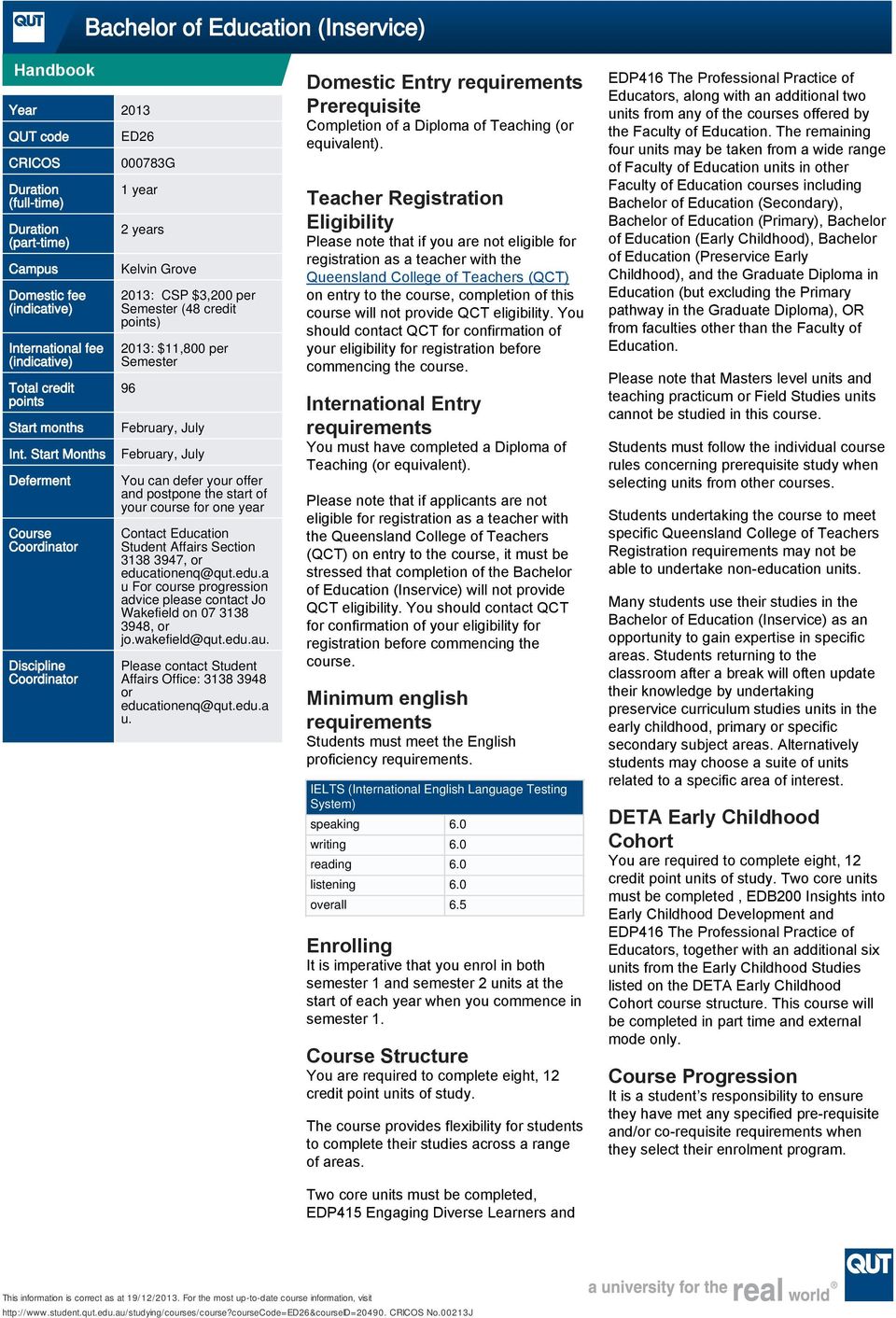
1 Bachelor of Education (Inservice) Handbook Year 2013 QUT code CRICOS (full-time) (part-time) Campus Domestic fee International fee Total credit points Start months Int. Start Months Deferment Course Discipline ED G 1 year 2 years Kelvin Grove 2013: CSP $3,200 per Semester (48 credit points) 2013: $11,800 per Semester 96 February, July February, July You can defer your offer and postpone the start of your course for one year Contact Education Student Affairs Section , or [email protected] u For course progression advice please contact Jo Wakefield on , or [email protected]. Please contact Student Affairs Office: or [email protected] u. Domestic Entry Prerequisite Completion of a Diploma of Teaching (or equivalent). Teacher Registration Eligibility Please note that if you are not eligible for registration as a teacher with the Queensland College of Teachers (QCT) on entry to the course, completion of this course will not provide QCT eligibility. You should contact QCT for confirmation of your eligibility for registration before commencing the course. International Entry You must have completed a Diploma of Teaching (or equivalent). Please note that if applicants are not eligible for registration as a teacher with the Queensland College of Teachers (QCT) on entry to the course, it must be stressed that completion of the Bachelor of Education (Inservice) will not provide QCT eligibility. You should contact QCT for confirmation of your eligibility for registration before commencing the course. Minimum english Students must meet the English proficiency. IELTS (International English Language Testing System) speaking 6.0 writing 6.0 reading 6.0 listening 6.0 overall 6.5 Enrolling It is imperative that you enrol in both semester 1 and semester 2 units at the start of each year when you commence in semester 1. Course Structure You are required to complete eight, 12 credit point units of study. The course provides flexibility for students to complete their studies across a range of areas. Two core units must be completed, EDP415 Engaging Diverse Learners and EDP416 The Professional Practice of Educators, along with an additional two units from any of the courses offered by the Faculty of Education. The remaining four units may be taken from a wide range of Faculty of Education units in other Faculty of Education courses including Bachelor of Education (Secondary), Bachelor of Education (Primary), Bachelor of Education (Early Childhood), Bachelor of Education (Preservice Early Childhood), and the Graduate Diploma in Education (but excluding the Primary pathway in the Graduate Diploma), OR from faculties other than the Faculty of Education. Please note that Masters level units and teaching practicum or Field Studies units cannot be studied in this course. Students must follow the individual course rules concerning prerequisite study when selecting units from other courses. Students undertaking the course to meet specific Queensland College of Teachers Registration may not be able to undertake non-education units. Many students use their studies in the Bachelor of Education (Inservice) as an opportunity to gain expertise in specific areas. Students returning to the classroom after a break will often update their knowledge by undertaking preservice curriculum studies units in the early childhood, primary or specific secondary subject areas. Alternatively students may choose a suite of units related to a specific area of interest. DETA Early Childhood Cohort You are required to complete eight, 12 credit point units of study. Two core units must be completed, EDB200 Insights into Early Childhood Development and EDP416 The Professional Practice of Educators, together with an additional six units from the Early Childhood Studies listed on the DETA Early Childhood Cohort course structure. This course will be completed in part time and external mode only. Course Progression It is a student s responsibility to ensure they have met any specified pre-requisite and/or co-requisite when they select their enrolment program. CRICOS No.00213J
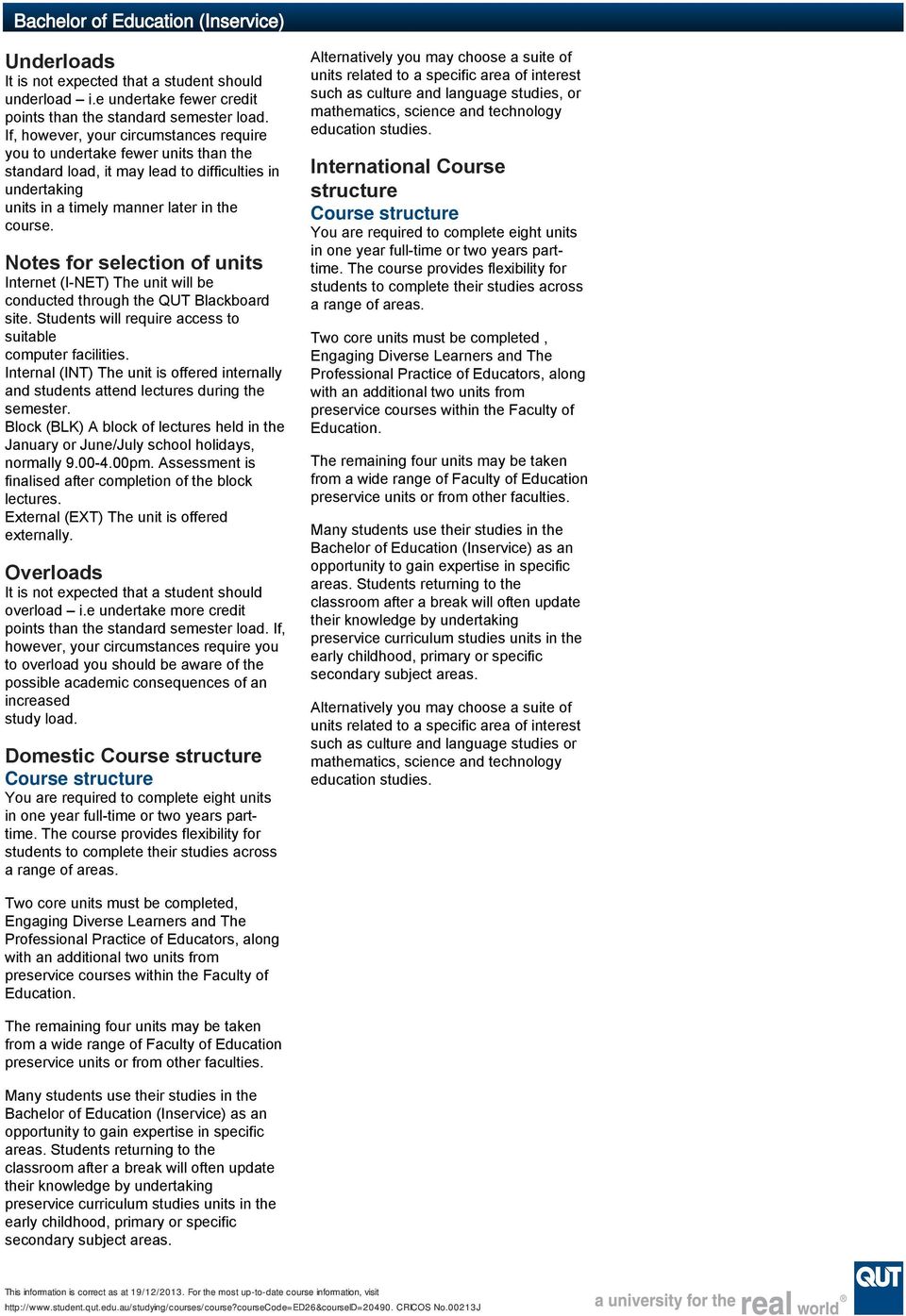
2 Bachelor of Education (Inservice) Underloads It is not expected that a student should underload i.e undertake fewer credit points than the standard semester load. If, however, your circumstances require you to undertake fewer units than the standard load, it may lead to difficulties in undertaking units in a timely manner later in the course. Notes for selection of units Internet (I-NET) The unit will be conducted through the QUT Blackboard site. Students will require access to suitable computer facilities. Internal (INT) The unit is offered internally and students attend lectures during the semester. Block (BLK) A block of lectures held in the January or June/July school holidays, normally pm. Assessment is finalised after completion of the block lectures. External (EXT) The unit is offered externally. Overloads It is not expected that a student should overload i.e undertake more credit points than the standard semester load. If, however, your circumstances require you to overload you should be aware of the possible academic consequences of an increased study load. Domestic Course structure Course structure You are required to complete eight units in one year full-time or two years parttime. The course provides flexibility for students to complete their studies across a range of areas. Alternatively you may choose a suite of units related to a specific area of interest such as culture and language studies, or mathematics, science and technology education studies. International Course structure Course structure You are required to complete eight units in one year full-time or two years parttime. The course provides flexibility for students to complete their studies across a range of areas. Two core units must be completed, Engaging Diverse Learners and The Professional Practice of Educators, along with an additional two units from preservice courses within the Faculty of Education. The remaining four units may be taken from a wide range of Faculty of Education preservice units or from other faculties. Many students use their studies in the Bachelor of Education (Inservice) as an opportunity to gain expertise in specific areas. Students returning to the classroom after a break will often update their knowledge by undertaking preservice curriculum studies units in the early childhood, primary or specific secondary subject areas. Alternatively you may choose a suite of units related to a specific area of interest such as culture and language studies or mathematics, science and technology education studies. Two core units must be completed, Engaging Diverse Learners and The Professional Practice of Educators, along with an additional two units from preservice courses within the Faculty of Education. The remaining four units may be taken from a wide range of Faculty of Education preservice units or from other faculties. Many students use their studies in the Bachelor of Education (Inservice) as an opportunity to gain expertise in specific areas. Students returning to the classroom after a break will often update their knowledge by undertaking preservice curriculum studies units in the early childhood, primary or specific secondary subject areas. CRICOS No.00213J
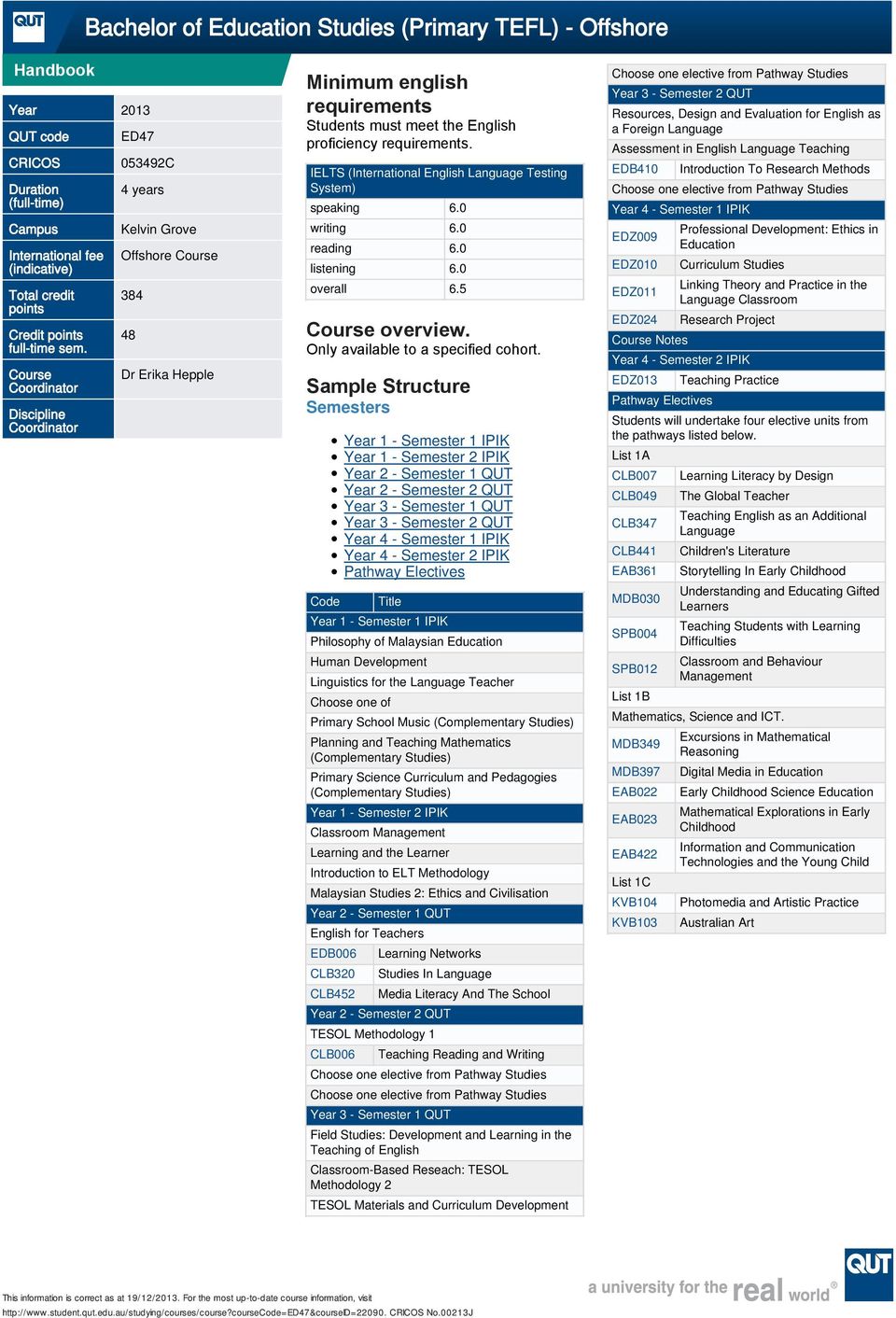
3 Bachelor of Education Studies (Primary TEFL) - Offshore Handbook Year 2013 QUT code CRICOS (full-time) Campus International fee Total credit points Credit points full-time sem. Course Discipline ED C 4 years Kelvin Grove Offshore Course Dr Erika Hepple Minimum english Students must meet the English proficiency. IELTS (International English Language Testing System) speaking 6.0 writing 6.0 reading 6.0 listening 6.0 overall 6.5 Course overview. Only available to a specified cohort. Sample Structure Semesters Code Year 1 - Semester 1 IPIK Year 1 - Semester 2 IPIK Year 2 - Semester 1 QUT Year 2 - Semester 2 QUT Year 3 - Semester 1 QUT Year 3 - Semester 2 QUT Year 4 - Semester 1 IPIK Year 4 - Semester 2 IPIK Pathway Electives Title Year 1 - Semester 1 IPIK Philosophy of Malaysian Education Human Development Linguistics for the Language Teacher Choose one of Primary School Music (Complementary Studies) Planning and Teaching Mathematics (Complementary Studies) Primary Science Curriculum and Pedagogies (Complementary Studies) Year 1 - Semester 2 IPIK Classroom Management Learning and the Learner Introduction to ELT Methodology Malaysian Studies 2: Ethics and Civilisation Year 2 - Semester 1 QUT English for Teachers EDB006 CLB320 CLB452 Learning Networks Studies In Language Media Literacy And The School Year 2 - Semester 2 QUT TESOL Methodology 1 CLB006 Teaching Reading and Writing Choose one elective from Pathway Studies Choose one elective from Pathway Studies Year 3 - Semester 1 QUT Field Studies: Development and Learning in the Teaching of English Classroom-Based Reseach: TESOL Methodology 2 TESOL Materials and Curriculum Development Choose one elective from Pathway Studies Year 3 - Semester 2 QUT Resources, Design and Evaluation for English as a Foreign Language Assessment in English Language Teaching EDB410 Introduction To Research Methods Choose one elective from Pathway Studies Year 4 - Semester 1 IPIK EDZ009 EDZ010 EDZ011 EDZ024 Course Notes Professional Development: Ethics in Education Curriculum Studies Linking Theory and Practice in the Language Classroom Research Project Year 4 - Semester 2 IPIK EDZ013 Pathway Electives Teaching Practice Students will undertake four elective units from the pathways listed below. List 1A CLB007 CLB049 CLB347 CLB441 EAB361 MDB030 SPB004 SPB012 List 1B Learning Literacy by Design The Global Teacher Teaching English as an Additional Language Children's Literature Storytelling In Early Childhood Understanding and Educating Gifted Learners Teaching Students with Learning Difficulties Classroom and Behaviour Management Mathematics, Science and ICT. MDB349 MDB397 EAB022 EAB023 EAB422 List 1C KVB104 KVB103 Excursions in Mathematical Reasoning Digital Media in Education Early Childhood Science Education Mathematical Explorations in Early Childhood Information and Communication Technologies and the Young Child Photomedia and Artistic Practice Australian Art CRICOS No.00213J
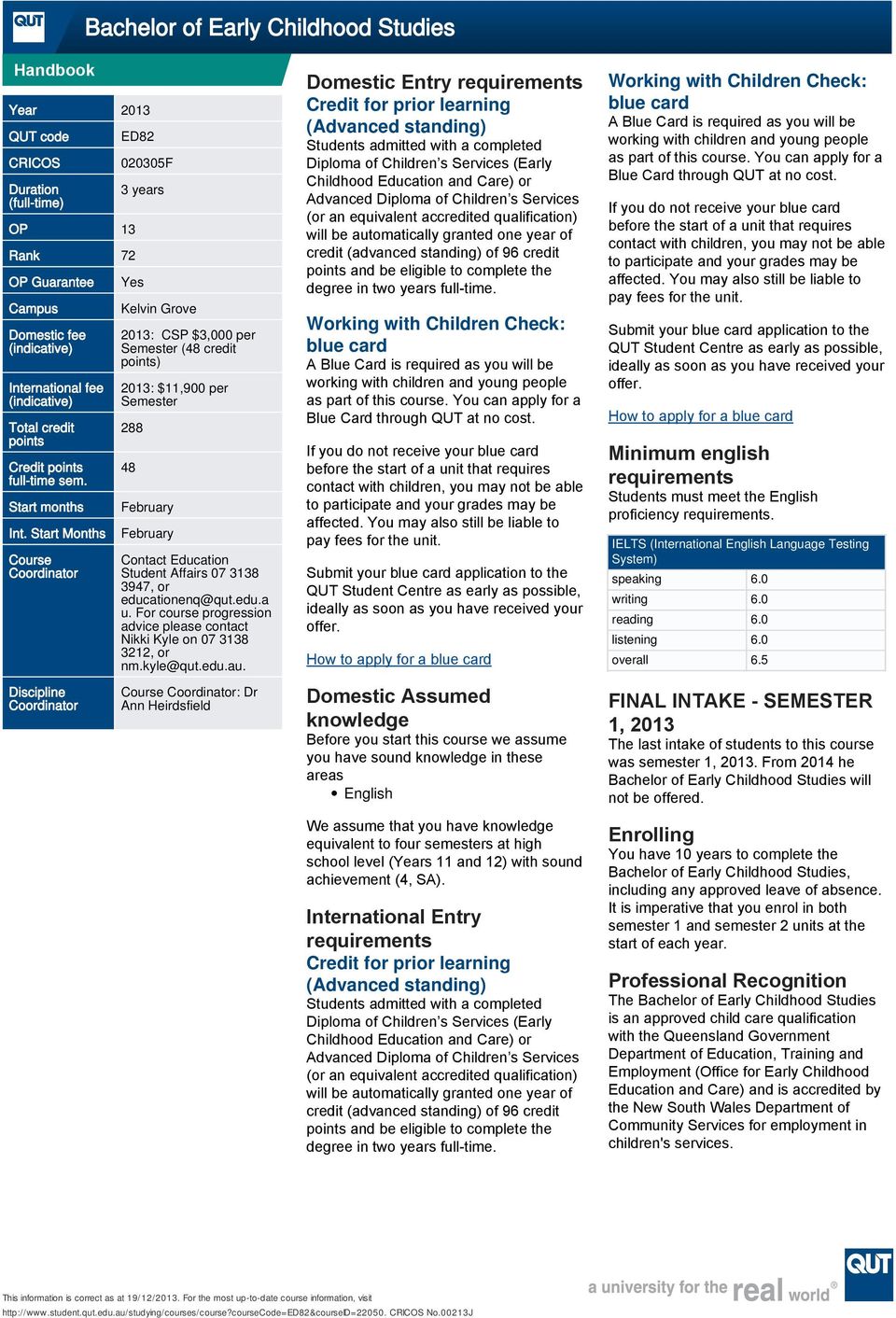
4 Bachelor of Early Childhood Studies Handbook Year 2013 QUT code CRICOS (full-time) OP 13 Rank 72 OP Guarantee Campus Domestic fee International fee Total credit points Credit points full-time sem. Start months Int. Start Months Course ED F 3 years Yes Kelvin Grove 2013: CSP $3,000 per Semester (48 credit points) 2013: $11,900 per Semester February February Contact Education Student Affairs , or [email protected] u. For course progression advice please contact Nikki Kyle on , or [email protected]. Domestic Entry Credit for prior learning (Advanced standing) Students admitted with a completed Diploma of Children s Services (Early Childhood Education and Care) or Advanced Diploma of Children s Services (or an equivalent accredited qualification) will be automatically granted one year of credit (advanced standing) of 96 credit points and be eligible to complete the degree in two years full-time. Working with Children Check: blue card A Blue Card is required as you will be working with children and young people as part of this course. You can apply for a Blue Card through QUT at no cost. If you do not receive your blue card before the start of a unit that requires contact with children, you may not be able to participate and your grades may be affected. You may also still be liable to pay fees for the unit. Submit your blue card application to the QUT Student Centre as early as possible, ideally as soon as you have received your offer. How to apply for a blue card Working with Children Check: blue card A Blue Card is required as you will be working with children and young people as part of this course. You can apply for a Blue Card through QUT at no cost. If you do not receive your blue card before the start of a unit that requires contact with children, you may not be able to participate and your grades may be affected. You may also still be liable to pay fees for the unit. Submit your blue card application to the QUT Student Centre as early as possible, ideally as soon as you have received your offer. How to apply for a blue card Minimum english Students must meet the English proficiency. IELTS (International English Language Testing System) speaking 6.0 writing 6.0 reading 6.0 listening 6.0 overall 6.5 Discipline Course : Dr Ann Heirdsfield Domestic Assumed knowledge Before you start this course we assume you have sound knowledge in these areas English FINAL INTAKE - SEMESTER 1, 2013 The last intake of students to this course was semester 1, From 2014 he Bachelor of Early Childhood Studies will not be offered. We assume that you have knowledge equivalent to four semesters at high school level (Years 11 and 12) with sound achievement (4, SA). International Entry Credit for prior learning (Advanced standing) Students admitted with a completed Diploma of Children s Services (Early Childhood Education and Care) or Advanced Diploma of Children s Services (or an equivalent accredited qualification) will be automatically granted one year of credit (advanced standing) of 96 credit points and be eligible to complete the degree in two years full-time. Enrolling You have 10 years to complete the Bachelor of Early Childhood Studies, including any approved leave of absence. It is imperative that you enrol in both semester 1 and semester 2 units at the start of each year. Professional Recognition The Bachelor of Early Childhood Studies is an approved child care qualification with the Queensland Government Department of Education, Training and Employment (Office for Early Childhood Education and Care) and is accredited by the New South Wales Department of Community Services for employment in children's services. CRICOS No.00213J
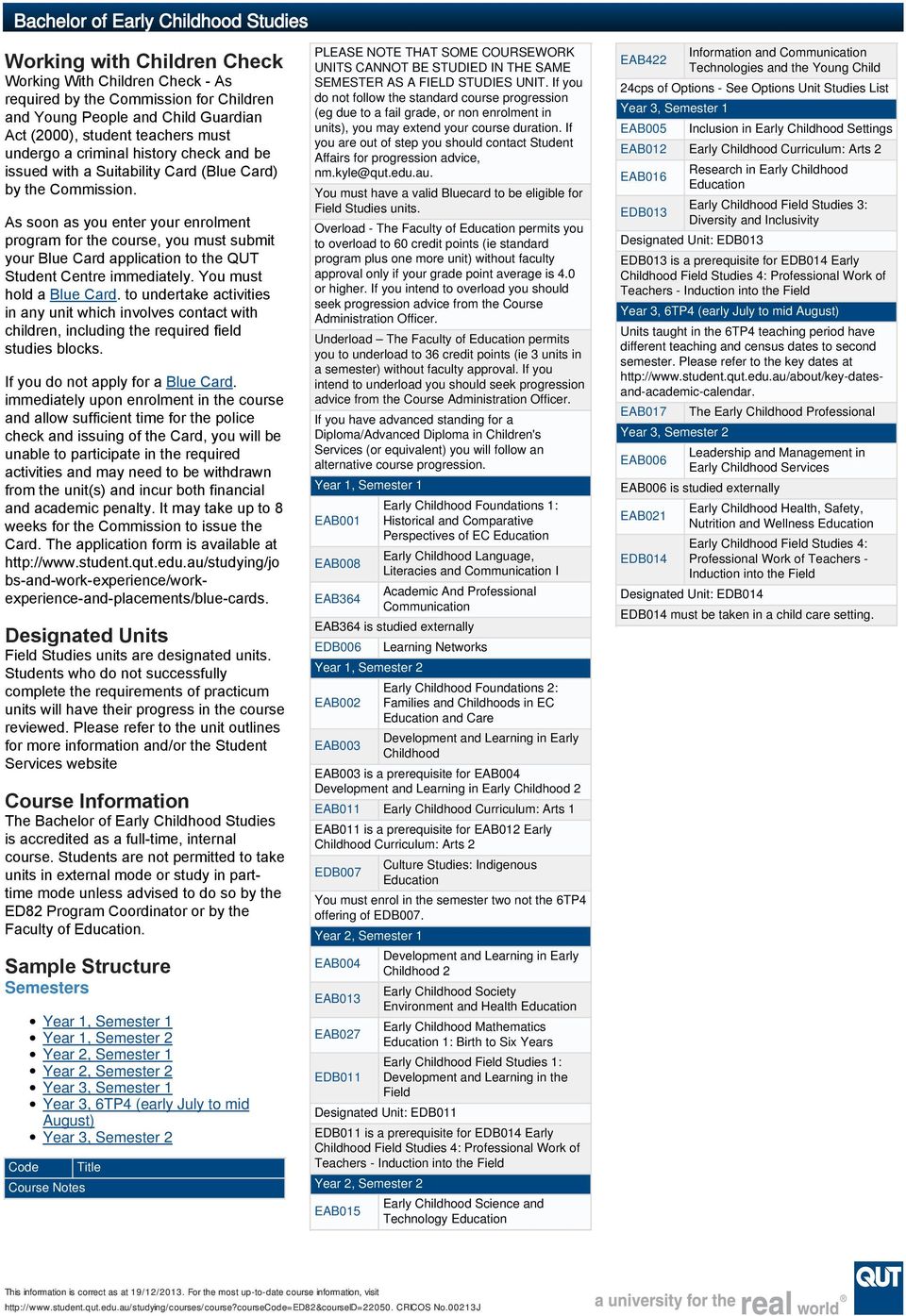
5 Bachelor of Early Childhood Studies Working with Children Check Working With Children Check - As required by the Commission for Children and Young People and Child Guardian Act (2000), student teachers must undergo a criminal history check and be issued with a Suitability Card (Blue Card) by the Commission. As soon as you enter your enrolment program for the course, you must submit your Blue Card application to the QUT Student Centre immediately. You must hold a Blue Card. to undertake activities in any unit which involves contact with children, including the required field studies blocks. If you do not apply for a Blue Card. immediately upon enrolment in the course and allow sufficient time for the police check and issuing of the Card, you will be unable to participate in the required activities and may need to be withdrawn from the unit(s) and incur both financial and academic penalty. It may take up to 8 weeks for the Commission to issue the Card. The application form is available at bs-and-work-experience/workexperience-and-placements/blue-cards. Designated Units Field Studies units are designated units. Students who do not successfully complete the of practicum units will have their progress in the course reviewed. Please refer to the unit outlines for more information and/or the Student Services website Course Information The Bachelor of Early Childhood Studies is accredited as a full-time, internal course. Students are not permitted to take units in external mode or study in parttime mode unless advised to do so by the ED82 Program or by the Faculty of Education. Sample Structure Semesters Code Year 1, Semester 1 Year 1, Semester 2 Year 2, Semester 1 Year 2, Semester 2 Year 3, Semester 1 Year 3, 6TP4 (early July to mid August) Year 3, Semester 2 Course Notes Title PLEASE NOTE THAT SOME COURSEWORK UNITS CANNOT BE STUDIED IN THE SAME SEMESTER AS A FIELD STUDIES UNIT. If you do not follow the standard course progression (eg due to a fail grade, or non enrolment in units), you may extend your course duration. If you are out of step you should contact Student Affairs for progression advice, [email protected]. You must have a valid Bluecard to be eligible for Field Studies units. Overload - The Faculty of Education permits you to overload to 60 credit points (ie standard program plus one more unit) without faculty approval only if your grade point average is 4.0 or higher. If you intend to overload you should seek progression advice from the Course Administration Officer. Underload The Faculty of Education permits you to underload to 36 credit points (ie 3 units in a semester) without faculty approval. If you intend to underload you should seek progression advice from the Course Administration Officer. If you have advanced standing for a Diploma/Advanced Diploma in Children's Services (or equivalent) you will follow an alternative course progression. Year 1, Semester 1 EAB001 EAB008 EAB364 Early Childhood Foundations 1: Historical and Comparative Perspectives of EC Education Early Childhood Language, Literacies and Communication I Academic And Professional Communication EAB364 is studied externally EDB006 Year 1, Semester 2 EAB002 EAB003 Learning Networks Early Childhood Foundations 2: Families and Childhoods in EC Education and Care Development and Learning in Early Childhood EAB003 is a prerequisite for EAB004 Development and Learning in Early Childhood 2 EAB011 Early Childhood Curriculum: Arts 1 EAB011 is a prerequisite for EAB012 Early Childhood Curriculum: Arts 2 EDB007 Culture Studies: Indigenous Education You must enrol in the semester two not the 6TP4 offering of EDB007. Year 2, Semester 1 EAB004 EAB013 EAB027 EDB011 Development and Learning in Early Childhood 2 Early Childhood Society Environment and Health Education Early Childhood Mathematics Education 1: Birth to Six Years Early Childhood Field Studies 1: Development and Learning in the Field Designated Unit: EDB011 EDB011 is a prerequisite for EDB014 Early Childhood Field Studies 4: Professional Work of Teachers - Induction into the Field Year 2, Semester 2 EAB015 Early Childhood Science and Technology Education EAB422 Information and Communication Technologies and the Young Child 24cps of Options - See Options Unit Studies List Year 3, Semester 1 EAB005 Inclusion in Early Childhood Settings EAB012 Early Childhood Curriculum: Arts 2 EAB016 EDB013 Research in Early Childhood Education Early Childhood Field Studies 3: Diversity and Inclusivity Designated Unit: EDB013 EDB013 is a prerequisite for EDB014 Early Childhood Field Studies 4: Professional Work of Teachers - Induction into the Field Year 3, 6TP4 (early July to mid August) Units taught in the 6TP4 teaching period have different teaching and census dates to second semester. Please refer to the key dates at EAB017 Year 3, Semester 2 EAB006 The Early Childhood Professional Leadership and Management in Early Childhood Services EAB006 is studied externally EAB021 EDB014 Early Childhood Health, Safety, Nutrition and Wellness Education Early Childhood Field Studies 4: Professional Work of Teachers - Induction into the Field Designated Unit: EDB014 EDB014 must be taken in a child care setting. CRICOS No.00213J
6 Bachelor of Early Childhood Handbook Year 2013 QUT code CRICOS (part-time domestic) Rank 87 Domestic fee Total credit points Credit points part-time sem. Dom. Start Months Course Discipline ED83 External 3 years 2013: CSP $3,000 per Semester (48 credit points) February Contact Education Student Affairs Section For course progression advice contact Claire Hogue ph: or [email protected] Domestic Entry Prerequisite: Prior Study Completion of a Diploma of Children's Services (Early Childhood Education and Care) or Diploma or Advanced Diploma of Children's Services, or an equivalent accredited qualification. Prerequisite: Prior Work Experience Diploma holders must also have the following early childhood experience: one year full-time (or equivalent) group leader experience; or two years full-time (or equivalent) family day care experience as an accredited provider; or two years full-time (or equivalent) early childhood teacher aide experience in a state preschool, prep or crèche and kindergarten association centre; or two years full-time (or equivalent) before and after school care experience. Advanced Diploma holders must complete the above early childhood experience before they graduate, however if you already have this experience you are strongly recommended to provide evidence with your QTAC application. Note: The majority of supervised professional experience must occur in Australian school settings. Automatic Advanced Standing (Credit) If admitted to this course you will be automatically granted advanced standing of one and half years of study (ie 144 credit points) for their completed Diploma of Children's Services (or an equivalent accredited qualification) and early childhood work experience. If admitted on the basis of an Advanced Diploma of Children's Services and you have not supplied QTAC with evidence of their early childhood experience you will only be automatically granted advanced standing of one year of study (ie 96 credit points) and you will be required to provide evidence of your early childhood experience to QUT prior to graduation. Working with Children Check: blue card A Blue Card is required as you will be working with children and young people as part of this course. You can apply for a Blue Card through QUT at no cost. If you do not receive your blue card before the start of a unit that requires contact with children, you may not be able to participate and your grades may be affected. You may also still be liable to pay fees for the unit. Submit your blue card application to the QUT Student Centre as early as possible, ideally as soon as you have received your offer. How to apply for a blue card International Entry Prerequisites Completion of a Diploma or Advanced Diploma of Children's Services (Early Childhood Education and Care); Children's Services; Community Services (Children's Services); Children's Services (Centre Based Care); or an equivalent accredited qualification and Diploma holders must have the following early childhood experience: one year full-time (or equivalent) group leader experience; or two years full-time (or equivalent) family day care experience as an accredited provider; or two years full-time (or equivalent) early childhood teacher aide experience in a state preschool, prep or crèche and kindergarten association centre; or two years full-time (or equivalent) before and after school care experience. Note: The majority of supervised professional experience must occur in Australian school settings. Credit for prior learning (Advanced standing) Students admitted to this course will be automatically granted advanced standing of one and half years of study (ie 144 credit points) for their completed Diploma of Children's Services (or an equivalent accredited qualification) and early childhood work experience. Students admitted on the basis of an CRICOS No.00213J

7 Bachelor of Early Childhood Advanced Diploma of Children's Services and who have not supplied QTAC with evidence of their early childhood experience will only be automatically granted advanced standing of one year of study (ie 96 credit points) and will be required to provide evidence of their early childhood experience to QUT prior to graduation. Working with Children Check: blue card A Blue Card is required as you will be working with children and young people as part of this course. You can apply for a Blue Card through QUT at no cost. If you do not receive your blue card before the start of a unit that requires contact with children, you may not be able to participate and your grades may be affected. You may also still be liable to pay fees for the unit. Submit your blue card application to the QUT Student Centre as early as possible, ideally as soon as you have received your offer. How to apply for a blue card Minimum english Students must meet the English proficiency. IELTS (International English Language Testing System) speaking 6.0 writing 6.0 reading 6.0 listening 6.0 overall 6.5 FINAL INTAKE - SEMESTER 1, 2013 The last intake of students to this course was semester 1, From 2014 he Bachelor of Early Childhood will not be offered. Enrolling It is imperative that you enrol in both semester 1 and semester 2 units at the start of each year. Professional Recognition The Bachelor of Early Childhood is an approved child care qualification with the Queensland Government Department of Education, Training and Employment (Office for Early Childhood Education and Care). Graduates of the Bachelor of Early Childhood are not eligible for registration with the Queensland College of Teachers. Bachelor of Early Childhood - ED83- Completion of 4th Year of Study Students will need to apply for admission to the ED93 Bachelor of Education (Preservice) Early childhood course in order to become registered as a teacher in Queensland. If you wish to admit to the ED93 course, please contact the Faculty Office for advice on advanced standing and the units you will need to complete and the admission form that you need to submit. The ED93 course requires successful completion of three x 20-day block practical units in order to be registered by the Queensland College of Teachers, the majority of which must be completed in an Australian primary school setting. Working With Children Check Working With Children Check - As required by the Commission for Children and Young People and Child Guardian Act (2000), student teachers must undergo a criminal history check and be issued with a Blue Card by the Commission. As soon as you enter your enrolment program for the course, you must submit your Blue Card application to the QUT Student Centre immediately. You must hold a Blue Card. to undertake activities in any unit which involves contact with children, including the required field studies blocks. If you do not apply for a Blue Card. immediately upon enrolment in the course and allow sufficient time for the police check and issuing of the Card, you will be unable to participate in the required activities and may need to be withdrawn from the unit(s) and incur both financial and academic penalty. It may take up to 12 weeks for the Commission to issue the Card. The application form is available at student.qut.edu.au/studying/jobs-andwork-experience/work-experience-andplacements/blue-cards. Sample Structure Semesters Year 1, Semester 1 Year 1, Semester 2 Year 2, Semester 1 Year 2, Semester 2 Year 3, Semester 1 Year 3, 6TP4 (early July to mid August) Code Course Notes Title The advanced standing granted on entry to the course reduces what would be an six year parttime degree to three years part-time. Students complete all 12 units listed on the course summary. Year 1, Semester 1 MDB440 EAB364 Year 1, Semester 2 Computers And Education Academic And Professional Communication EAB011 Early Childhood Curriculum: Arts 1 EAB013 Year 2, Semester 1 EAB027 EAB008 Year 2, Semester 2 EAB005 EAB006 Year 3, Semester 1 EDB200 EDB011 Early Childhood Society Environment and Health Education Early Childhood Mathematics Education 1: Birth to Six Years Early Childhood Language, Literacies and Communication I Inclusion in Early Childhood Settings Leadership and Management in Early Childhood Services Insights into Early Childhood Development Early Childhood Field Studies 1: Development and Learning in the Field Designated unit: EDB011 Year 3, 6TP4 (early July to mid August) Units taught in the 6TP4 teaching period have different teaching and census dates to second semester. Please refer to the key dates at EAB017 EDB007 The Early Childhood Professional Culture Studies: Indigenous Education CRICOS No.00213J

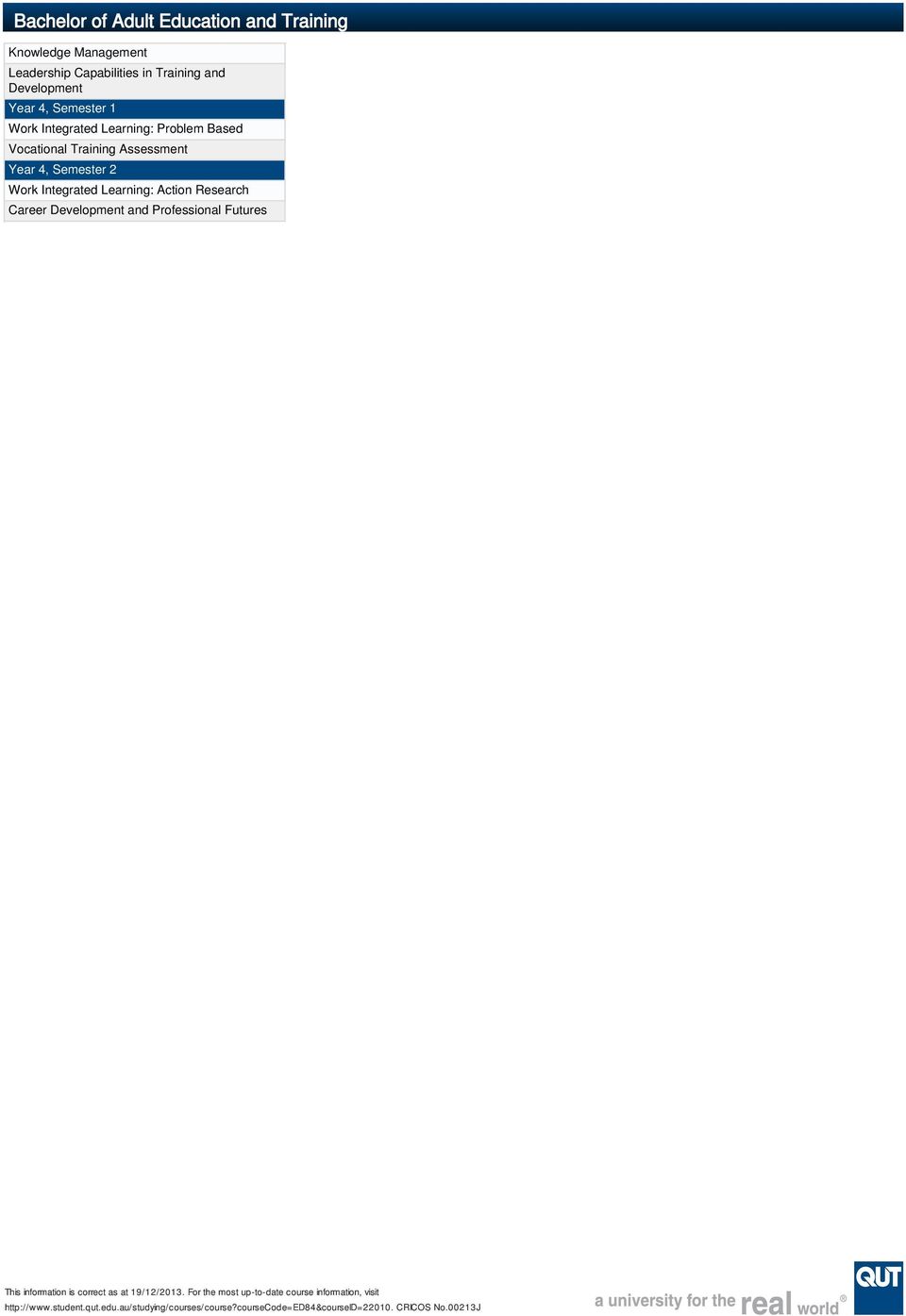
8 Bachelor of Adult Education and Training Handbook Year 2013 QUT code Domestic fee Discipline ED : CSP rate available August 2012 Minimum english Students must meet the English proficiency. NOTE: NO FURTHER INTAKE THERE IS NO FURTHER INTAKE INTO THIS COURSE Professional Recognition Graduates of the Bachelor of Adult Education and Training course will be eligible for membership with the Australian Institute of Management (AIM). Professional Projects and Experience Requirement Students will be required to undertake professional projects and experience in a negotiated workplace or community placement site. Potential foci for professional projects may include teaching and training; leadership and management; curriculum development and instructional design (including e- learning); policy work; consultancy; Indigenous education; research and community partnership development. Course Structure The Bachelor of Adult Education and Training is a four-year undergraduate degree program. On entry students are granted 192 credit points or two years credit as recognition of prior knowledge, experience and skills. The remaining two years full-time or four years part-time focuses on adult and community learning. The development of a professional portfolio throughout the degree enables students to individualise their own program to suit their professional development needs. Blue Card If you will be working with children or young people (under 18 years of age) during your professional experience units (EDB101, EDB102, EDB103, EDB104) you must obtain a Blue Card BEFORE you begin your placement. A Blue Card confirms that you have passed a screening of your criminal history (the 'Working with Children Check') and have been approved to work with children and young people under 18 years of age. You must either submit your Blue Card application to the QUT Student Centre or, if you already hold a valid Blue Card, submit an authorisation form to the Student Centre so that you may be registered with the Commission as a QUT student. If you do not hold a valid card at the commencement of your professional experience or have not applied for a renewal within the required time frame you will not be able to undertake your professional experience and will need to be withdrawn from the units(s). This may incur both financial and academic penalty depending on the date the application was submitted. The application form is available at Blue card applications and renewals can take up to 16 weeks to process. Domestic student tuition fee (Dfee) places Undergraduate domestic full fee places (Dfee) are not available in this course. Tuition fees are only applicable to currently enrolled students who were unable to comply regulations regarding their original Commonwealth Supported place (i.e. failure to lodge an ecaf, has consumed of other their Student Learning Entitlement etc.) and who have been invited and accepted to continue as a feepaying student. Sample Structure Semesters Code Year 1, Semester 1 Year 1, Semester 2 Year 2, Semester 1 Year 2, Semester 2 Year 3, Semester 1 Year 3, Semester 2 Year 4, Semester 1 Year 4, Semester 2 Year 1, Semester 1 Title Introduction to Learning Facilitation Professional Communication in Adult Learning Contexts Year 1, Semester 2 Advanced Learning Facilitation Research and Inquiry Year 2, Semester 1 Introduction to Adult Learning and Development Theorists in Adult Education Year 2, Semester 2 Program Design and Evaluation Contemporary Issues: Adult Education and Training Year 3, Semester 1 Politics of Diversity and Identity Managing Learning Organisations Year 3, Semester 2 CRICOS No.00213J

9 Bachelor of Adult Education and Training Knowledge Management Leadership Capabilities in Training and Development Year 4, Semester 1 Work Integrated Learning: Problem Based Vocational Training Assessment Year 4, Semester 2 Work Integrated Learning: Action Research Career Development and Professional Futures CRICOS No.00213J
10 Bachelor of Education (Secondary) Handbook Year 2013 QUT code CRICOS (full-time) OP 13 Rank 72 OP Guarantee Campus Domestic fee International fee Total credit points Credit points full-time sem. Start months Int. Start Months Deferment Course Discipline ED G 4 years Yes Gardens Point and Kelvin Grove 2013: CSP $4100 per Semester (48 credit points) 2013: $11,700 per Semester February February You can defer your offer and postpone the start of your course for one year Contact Education Student Affairs Section , or [email protected] u For course progression advice please contact Jo Wakefield on , or [email protected]. Course : Dr Alberto Bellocchi Domestic Entry Literacy course All Bachelor of Education students are required to satisfactorily complete assessment criteria relating to Queensland College of Teachers' (QCT) literacy standards by the end of year three of their course in order to meet the course and QCT professional accreditation. Literacy modules have been developed as a remedial action for students who do not attain satisfactory standards on the relevant literacy criterion during their assessment in the first year of their studies. Students will have the support of the First Year Experience. Students may attempt these modules any number of times during the first three years of their program. At the end of year three, unsatisfactory results within course work and these modules may result in a recommendation for an early exit from the four-year degree. The literacy requirement will also apply to double degree students with a slight variation. Working with Children Check: blue card A Blue Card is required as you will be working with children and young people as part of this course. You can apply for a Blue Card through QUT at no cost. If you do not receive your blue card before the start of a unit that requires contact with children, you may not be able to participate and your grades may be affected. You may also still be liable to pay fees for the unit. Submit your blue card application to the QUT Student Centre as early as possible, ideally as soon as you have received your offer. How to apply for a blue card Domestic Assumed knowledge Before you start this course we assume you have sound knowledge in these areas English. Maths B for Mathematics teaching area We assume that you have knowledge equivalent to four semesters at high school level (Years 11 and 12) with sound achievement (4, SA). International Entry Literacy course All Bachelor of Education students are required to satisfactorily complete assessment criteria relating to Queensland College of Teachers' (QCT) literacy standards by the end of year three of their course in order to meet the course and QCT professional accreditation. Literacy modules have been developed as a remedial action for students who do not attain satisfactory standards on the relevant literacy criterion during their assessment in the first year of their studies. Students will have the support of the First Year Experience. Students may attempt these modules any number of times during the first three years of their program. At the end of year three, unsatisfactory results within course work and these modules may result in a recommendation for an early exit from the four-year degree. The literacy requirement will also apply to double degree students with a slight variation. Working with Children Check: blue card A Blue Card is required as you will be working with children and young people as part of this course. You can apply for a Blue Card through QUT at no cost. If you do not receive your blue card before the start of a unit that requires contact with children, you may not be able to participate and your grades may be affected. You may also still be liable to pay fees for the unit. Submit your blue card application to the QUT Student Centre as early as possible, ideally as soon as you have received your offer. How to apply for a blue card Minimum english Students must meet the English proficiency. IELTS (International English Language Testing System) speaking 6.0 writing 6.0 reading CRICOS No.00213J
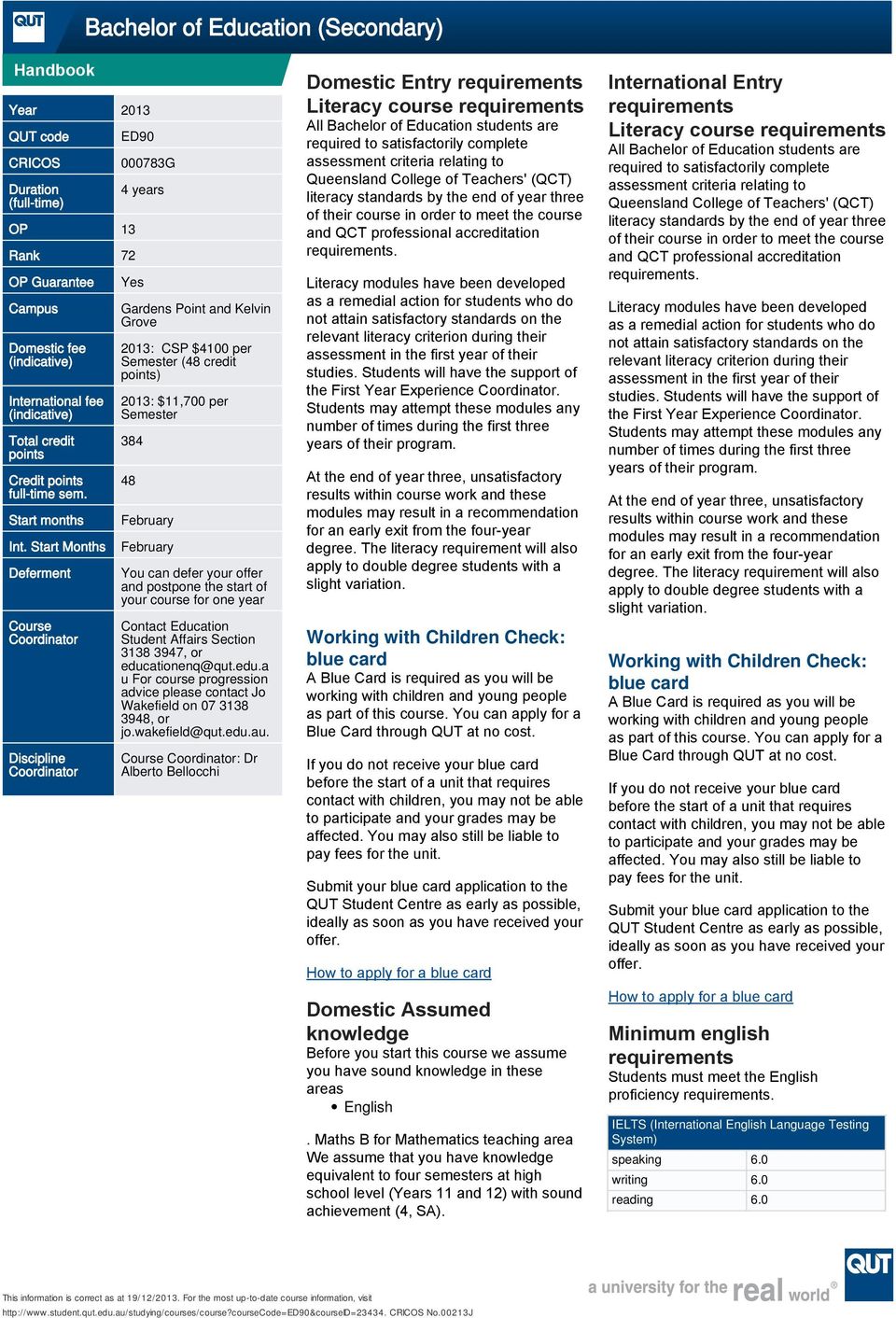
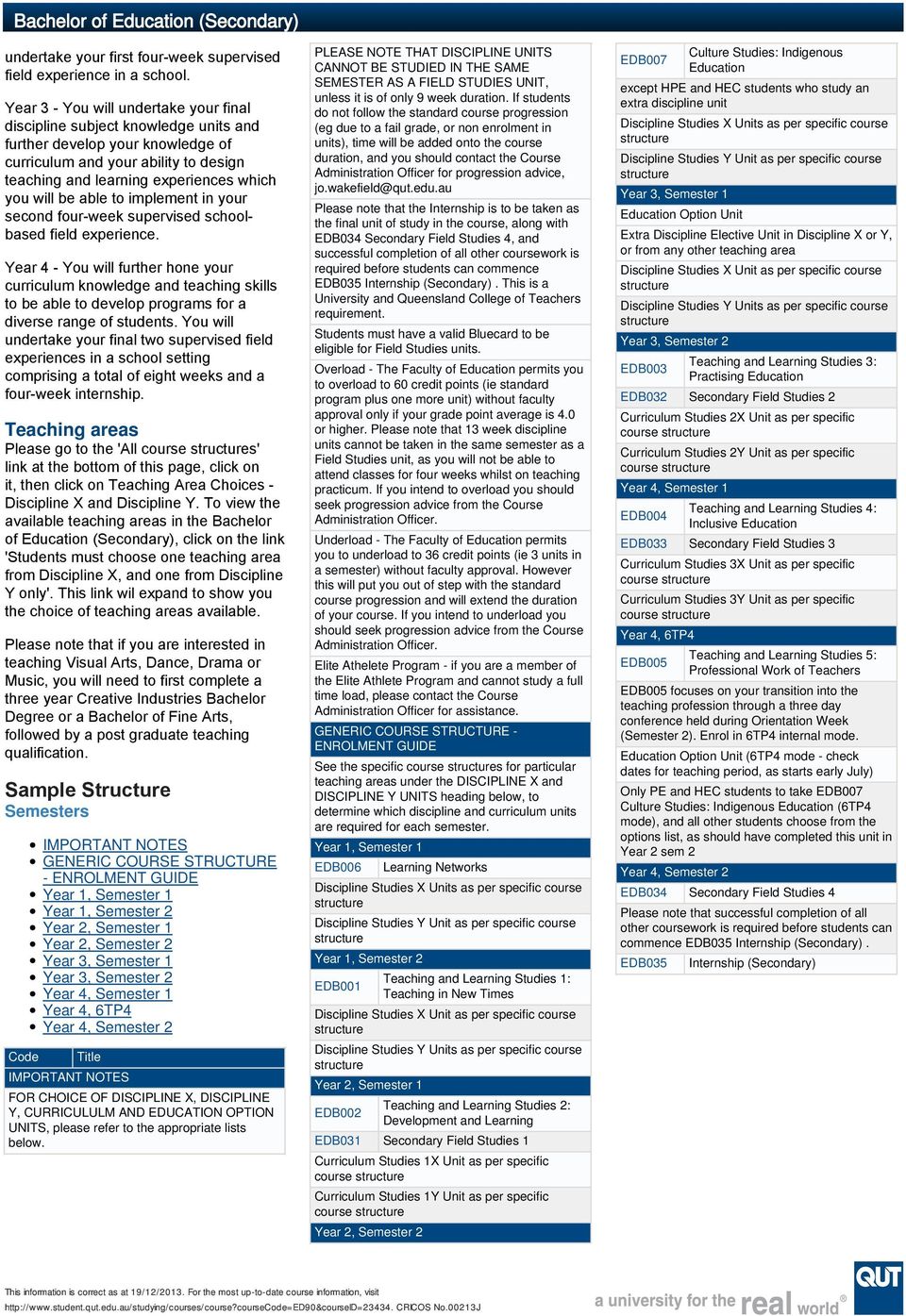
11 Bachelor of Education (Secondary) listening 6.0 overall 6.5 Enrolling It is imperative that you enrol in both semester 1 and semester 2 units at the start of each year. Literacy Standards All students are required to satisfactorily complete assessment criteria relating to Queensland College of Teachers' literacy standards by the end of year 3 of their course in order to meet course and QCT professional accreditation. Literacy modules have been developed as a remedial action for students who do not attain satisfactory standards on the relevant literacy criterion during their assessment in the first year of their studies. Students will have the support of the First Year Experience. Students may attempt these modules any number of times during the first three years of their program. At the end of year 3, unsatisfactory results within course work and these modules may result in a recommendation for an early exit from the four year degree. Literacy modules can be accessed through Blackboard. Select the Community tab, then enter 'literacy modules' in the community search. Professional Recognition The Bachelor of Education (Secondary) is recognised by the Queensland College of Teachers as meeting the for registration as a teacher in Queensland. Applicants for teacher registration in Queensland are subject to national criminal history checks. Graduates looking for employment in other parts of Australia and overseas may be required to meet additional conditions. Please note that the majority of supervised professional experience must occur in Australian Secondary school settings. Working With Children Check As required by the Commission for Children and Young People and Child Guardian Act (2000), student teachers must undergo a criminal history check and be issued with a Suitability Card (Blue Card) by the Commission. As soon as you enter your enrolment program for the course, you must submit your Blue Card application to the QUT Student Centre immediately. You must hold a Blue Card to undertake activities in any unit which involves contact with children, including the required field studies blocks. If you do not apply for a Blue Card immediately upon enrolment in the course and allow sufficient time for the police check and issuing of the Card, you will be unable to participate in the required activities and may need to be withdrawn from the unit(s) and incur both financial and academic penalty. It may take up to 8 weeks for the Commission to issue the Card. The application form is available at student.qut.edu.au/studying/jobs-andwork-experience/work-experience-andplacements/blue-cards. Field Studies Units will be taken in Queensland schools and settings. Teaching Area Combinations Students will select their two teaching areas from the lists (one from Group X and one from Group Y) shown under the Course Structure tab above. Research Pathway Option At the end of Year 2, certain students will be invited to undertake the Research Pathway Option. This option is designed to meet the needs of students wishing to undertake research-based higher degree study in the course of their future career. The pathway is designed to develop research skills and a research-oriented, reflective approach to teaching. Early Exit Option Students who are unable to complete ED90 can exit with ED45 Bachelor of General Studies (288cps) on meeting specific criteria. There is no direct entry to the Bachelor of General Studies and this course does not provide eligibility for Teacher Registration. Students wishing to exit from ED90 with ED45 should contact the Course Administration Officer on Designated Units Students who do not successfully complete the of practicum units will have their progress in the course reviewed. Please refer to the unit outlines for more information and/or the Student Services website Domestic Course structure Your course Year 1 - You will develop discipline subject knowledge (content) related to your two teaching areas to prepare you for your field studies and curriculum studies units in the second year of your course. You will also be introduced to the world of teaching through two introductory education units. Year 2 - You will be immersed in how students develop and learn and introduced to the curriculum for your two teaching areas, as well as continuing your discipline subject knowledge. You will undertake your first four-week supervised field experience in a school. Year 3 - You will undertake your final discipline subject knowledge units and further develop your knowledge of curriculum and your ability to design teaching and learning experiences which you will be able to implement in your second four-week supervised schoolbased field experience. Year 4 - You will further hone your curriculum knowledge and teaching skills to be able to develop programs for a diverse range of students. You will undertake your final two supervised field experiences in a school setting comprising a total of eight weeks and a four-week internship. Teaching areas Please go to the 'All course structures' link at the bottom of this page, click on it, then click on Teaching Area Choices - Discipline X and Discipline Y. To view the available teaching areas in the Bachelor of Education (Secondary), click on the link 'Students must choose one teaching area from Discipline X, and one from Discipline Y only'. This link wil expand to show you the choice of teaching areas available. Please note that if you are interested in teaching Visual Arts, Dance, Drama or Music, you will need to first complete a three year Creative Industries Bachelor Degree or a Bachelor of Fine Arts, followed by a post graduate teaching qualification. International Course structure Your course Year 1 - You will develop discipline subject knowledge (content) related to your two teaching areas to prepare you for your field studies and curriculum studies units in the second year of your course. You will also be introduced to the world of teaching through two introductory education units. Year 2 - You will be immersed in how students develop and learn and introduced to the curriculum for your two teaching areas, as well as continuing your discipline subject knowledge. You will CRICOS No.00213J

12 Bachelor of Education (Secondary) undertake your first four-week supervised field experience in a school. Year 3 - You will undertake your final discipline subject knowledge units and further develop your knowledge of curriculum and your ability to design teaching and learning experiences which you will be able to implement in your second four-week supervised schoolbased field experience. Year 4 - You will further hone your curriculum knowledge and teaching skills to be able to develop programs for a diverse range of students. You will undertake your final two supervised field experiences in a school setting comprising a total of eight weeks and a four-week internship. Teaching areas Please go to the 'All course structures' link at the bottom of this page, click on it, then click on Teaching Area Choices - Discipline X and Discipline Y. To view the available teaching areas in the Bachelor of Education (Secondary), click on the link 'Students must choose one teaching area from Discipline X, and one from Discipline Y only'. This link wil expand to show you the choice of teaching areas available. Please note that if you are interested in teaching Visual Arts, Dance, Drama or Music, you will need to first complete a three year Creative Industries Bachelor Degree or a Bachelor of Fine Arts, followed by a post graduate teaching qualification. Sample Structure Semesters Code IMPORTANT NOTES GENERIC COURSE STRUCTURE - ENROLMENT GUIDE Year 1, Semester 1 Year 1, Semester 2 Year 2, Semester 1 Year 2, Semester 2 Year 3, Semester 1 Year 3, Semester 2 Year 4, Semester 1 Year 4, 6TP4 Year 4, Semester 2 Title IMPORTANT NOTES FOR CHOICE OF DISCIPLINE X, DISCIPLINE Y, CURRICULULM AND EDUCATION OPTION UNITS, please refer to the appropriate lists below. PLEASE NOTE THAT DISCIPLINE UNITS CANNOT BE STUDIED IN THE SAME SEMESTER AS A FIELD STUDIES UNIT, unless it is of only 9 week duration. If students do not follow the standard course progression (eg due to a fail grade, or non enrolment in units), time will be added onto the course duration, and you should contact the Course Administration Officer for progression advice, [email protected] Please note that the Internship is to be taken as the final unit of study in the course, along with EDB034 Secondary Field Studies 4, and successful completion of all other coursework is required before students can commence EDB035 Internship (Secondary). This is a University and Queensland College of Teachers requirement. Students must have a valid Bluecard to be eligible for Field Studies units. Overload - The Faculty of Education permits you to overload to 60 credit points (ie standard program plus one more unit) without faculty approval only if your grade point average is 4.0 or higher. Please note that 13 week discipline units cannot be taken in the same semester as a Field Studies unit, as you will not be able to attend classes for four weeks whilst on teaching practicum. If you intend to overload you should seek progression advice from the Course Administration Officer. Underload - The Faculty of Education permits you to underload to 36 credit points (ie 3 units in a semester) without faculty approval. However this will put you out of step with the standard course progression and will extend the duration of your course. If you intend to underload you should seek progression advice from the Course Administration Officer. Elite Athelete Program - if you are a member of the Elite Athlete Program and cannot study a full time load, please contact the Course Administration Officer for assistance. GENERIC COURSE STRUCTURE - ENROLMENT GUIDE See the specific course structures for particular teaching areas under the DISCIPLINE X and DISCIPLINE Y UNITS heading below, to determine which discipline and curriculum units are required for each semester. Year 1, Semester 1 EDB006 Learning Networks Discipline Studies X Units as per specific course structure Discipline Studies Y Unit as per specific course structure Year 1, Semester 2 EDB001 Teaching and Learning Studies 1: Teaching in New Times Discipline Studies X Unit as per specific course structure Discipline Studies Y Units as per specific course structure Year 2, Semester 1 EDB002 Teaching and Learning Studies 2: Development and Learning EDB031 Secondary Field Studies 1 Curriculum Studies 1X Unit as per specific course structure Curriculum Studies 1Y Unit as per specific course structure Year 2, Semester 2 EDB007 Culture Studies: Indigenous Education except HPE and HEC students who study an extra discipline unit Discipline Studies X Units as per specific course structure Discipline Studies Y Unit as per specific course structure Year 3, Semester 1 Education Option Unit Extra Discipline Elective Unit in Discipline X or Y, or from any other teaching area Discipline Studies X Unit as per specific course structure Discipline Studies Y Units as per specific course structure Year 3, Semester 2 EDB003 Teaching and Learning Studies 3: Practising Education EDB032 Secondary Field Studies 2 Curriculum Studies 2X Unit as per specific course structure Curriculum Studies 2Y Unit as per specific course structure Year 4, Semester 1 EDB004 Teaching and Learning Studies 4: Inclusive Education EDB033 Secondary Field Studies 3 Curriculum Studies 3X Unit as per specific course structure Curriculum Studies 3Y Unit as per specific course structure Year 4, 6TP4 EDB005 Teaching and Learning Studies 5: Professional Work of Teachers EDB005 focuses on your transition into the teaching profession through a three day conference held during Orientation Week (Semester 2). Enrol in 6TP4 internal mode. Education Option Unit (6TP4 mode - check dates for teaching period, as starts early July) Only PE and HEC students to take EDB007 Culture Studies: Indigenous Education (6TP4 mode), and all other students choose from the options list, as should have completed this unit in Year 2 sem 2 Year 4, Semester 2 EDB034 Secondary Field Studies 4 Please note that successful completion of all other coursework is required before students can commence EDB035 Internship (Secondary). EDB035 Internship (Secondary) CRICOS No.00213J
13 Bachelor of Education (Primary) Handbook Year 2013 QUT code CRICOS (full-time) ED G 4 years OP Kelvin Grove: 13 Caboolture: 15 Rank Kelvin Grove: 72 Caboolture: 68 OP Guarantee Campus Domestic fee International fee Total credit points Credit points full-time sem. Start months Int. Start Months Deferment Course Discipline Yes Kelvin Grove and Caboolture 2013: CSP $3,000 per Semester (48 credit points) 2013: $11,900 per Semester February February You can defer your offer and postpone the start of your course for one year Contact Education Student Affairs (07) , or [email protected] u. For course progression advice please contact Nikki Kyle on , or [email protected]. Course Dr Lenore Adie Domestic Entry Credit for prior learning (advanced standing) Students admitted with a completed Diploma of Children s Services (Early Childhood Education and Care), or an Advanced Diploma of Children s Services, or an equivalent accredited qualification, will be automatically granted credit (advanced standing) of 48 credit points (four option units). This credit does not reduce the course duration. Literacy course All Bachelor of Education students are required to satisfactorily complete assessment criteria relating to Queensland College of Teachers' (QCT) literacy standards by the end of year three of their course in order to meet the course and QCT professional accreditation. Literacy modules have been developed as a remedial action for students who do not attain satisfactory standards on the relevant literacy criterion during their assessment in the first year of their studies. Students will have the support of the First Year Experience. Students may attempt these modules any number of times during the first three years of their program. At the end of year three, unsatisfactory results within course work and these modules may result in a recommendation for an early exit from the four-year degree. The literacy requirement will also apply to double degree students with a slight variation. Working with Children Check: blue card A Blue Card is required as you will be working with children and young people as part of this course. You can apply for a Blue Card through QUT at no cost. If you do not receive your blue card before the start of a unit that requires contact with children, you may not be able to participate and your grades may be affected. You may also still be liable to pay fees for the unit. Submit your blue card application to the QUT Student Centre as early as possible, ideally as soon as you have received your offer. How to apply for a blue card Domestic Assumed knowledge Before you start this course we assume you have sound knowledge in these areas English We assume that you have knowledge equivalent to four semesters at high school level (Years 11 and 12) with sound achievement (4, SA). International Entry Credit for prior learning (advanced standing) Students admitted with a completed Diploma of Children s Services (Early Childhood Education and Care), or an Advanced Diploma of Children s Services, or an equivalent accredited qualification, will be automatically granted credit (advanced standing) of 48 credit points (four option units). This credit does not reduce the course duration. Literacy course All Bachelor of Education students are required to satisfactorily complete assessment criteria relating to Queensland College of Teachers' (QCT) literacy standards by the end of year three of their course in order to meet the course and QCT professional accreditation. Literacy modules have been developed as a remedial action for students who do not attain satisfactory standards on the relevant literacy criterion during their assessment in the first year of their studies. Students will have the support of the First Year Experience. Students may attempt these modules any number of times during the first three years of their program. At the end of year three, unsatisfactory results within course work and these modules may result in a recommendation for an early exit from the four-year degree. The literacy requirement will also apply to double degree students with a slight variation. Working with Children Check: blue card A Blue Card is required as you will be working with children and young people as part of this course. You can apply for a Blue Card through QUT at no cost. CRICOS No.00213J
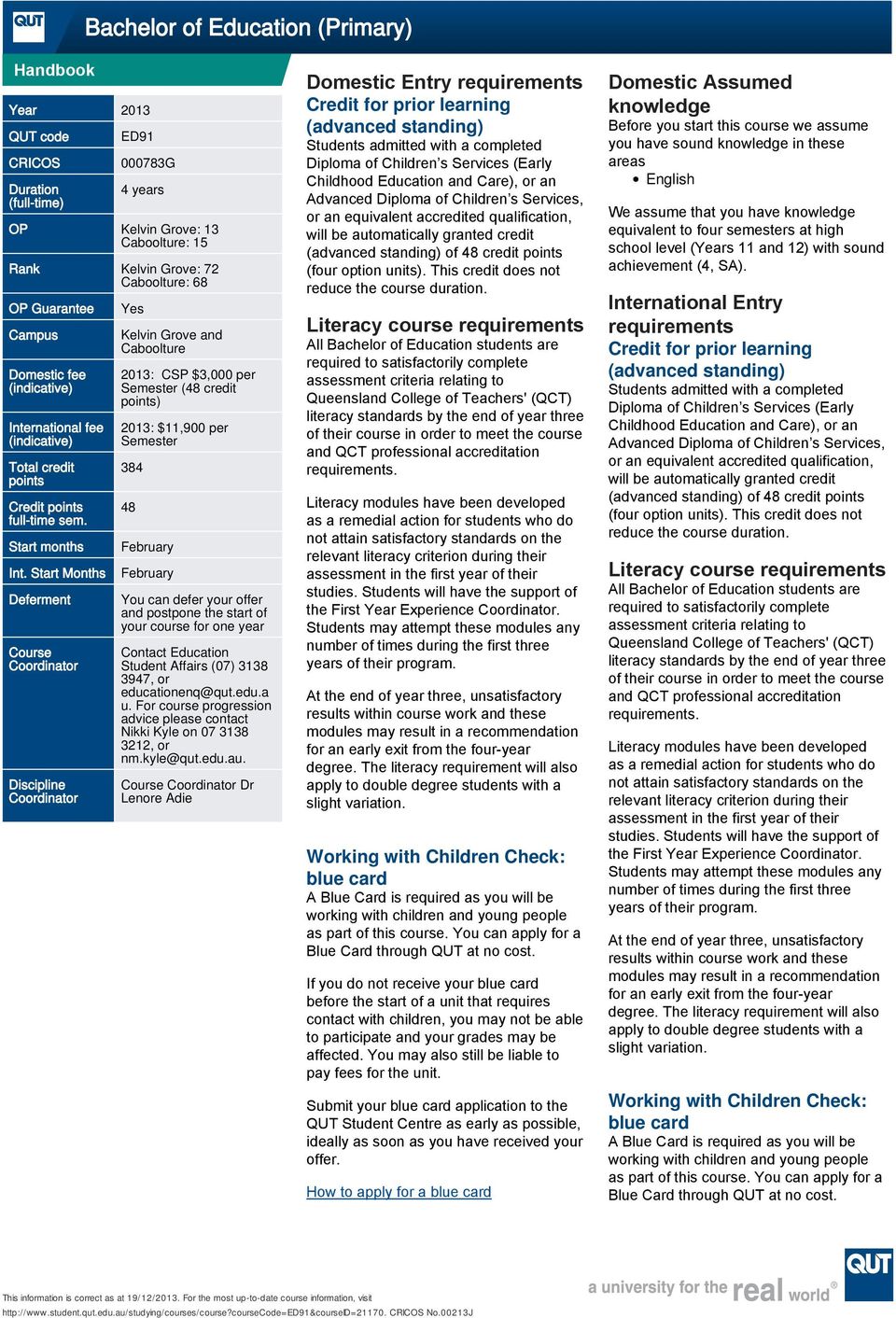
14 Bachelor of Education (Primary) If you do not receive your blue card before the start of a unit that requires contact with children, you may not be able to participate and your grades may be affected. You may also still be liable to pay fees for the unit. Submit your blue card application to the QUT Student Centre as early as possible, ideally as soon as you have received your offer. How to apply for a blue card Minimum english Students must meet the English proficiency. IELTS (International English Language Testing System) speaking 6.0 writing 6.0 reading 6.0 listening 6.0 overall 6.5 Enrolling You have 10 years to complete the Bachelor of Education (Primary), including any approved leave of absence. It is imperative that you enrol in both semester 1 and semester 2 units at the start of each year. Professional Recognition Graduates are eligible for registration as teachers in Queensland through the Queensland College of Teachers. Graduates looking for employment in other parts of Australia and overseas may be required to meet additional conditions. Literacy Standards All students are required to satisfactorily complete assessment criteria relating to Queensland College of Teachers' literacy standards by the end of year 3 of their course in order to meet course and QCT professional accreditation. Literacy modules have been developed as a remedial action for students who do not attain satisfactory standards on the relevant literacy criterion during their assessment in the first year of their studies. Students will have the support of the First Year Experience. Students may attempt these modules any number of times during the first three years of their program. At the end of year 3, unsatisfactory results within course work and these modules may result in a recommendation for an early exit from the four year degree. Literacy modules can be accessed through Blackboard. Select the Community tab, then enter 'literacy modules' in the community search. Working with Children Check Working With Children Check - As required by the Commission for Children and Young People and Child Guardian Act (2000), student teachers must undergo a criminal history check and be issued with a Suitability Card (Blue Card) by the Commission. As soon as you enter your enrolment program for the course, you must submit your Blue Card application to the QUT Student Centre immediately. You must hold a Blue Card. to undertake activities in any unit which involves contact with children, including the required field studies blocks. If you do not apply for a Blue Card immediately upon enrolment in the course and allow sufficient time for the police check and issuing of the Card, you will be unable to participate in the required activities and may need to be withdrawn from the unit(s) and incur both financial and academic penalty. It may take up to 8 weeks for the Commission to issue the Card. The application form is available at bs-and-work-experience/workexperience-and-placements/blue-cards. Field studies units will be taken in Queensland schools. Languages Other Than English (LOTE) Major Students undertaking a LOTE major will be required to attend other campuses and may be required to take language units at Griffith University or University of Queensland. Available languages are French, German, Indonesian, Japanese or Mandarin and students are required to select a specified sequence of six units (72 credit points) in language level 1-6 or 3-8. Students who have taken their LOTE to Year 12 or equivalent do not take the introductory units. Graduates with this major will be eligible to seek employment as a LOTE specialist teacher within Education Queensland, Catholic and Independent School sectors. The LOTE major is available to students at Kelvin Grove campus only. Health and Physical Education Major Students who commenced from 2009 will have the option of undertaking a Health and Physical Education major within the course. Students complete six health and physical education units, and undertake two field experience blocks in a health and physical education setting. Graduates completing this study area will be eligible to seek employment as a Primary Physical Education specialist teacher within Education Queensland, Catholic Education and Independent school sectors. This major is available at Kelvin Grove campus only. Entry criteria and quotas apply. Research Minor Option At the end of Year 2, certain students will be invited to undertake the Research minor option. This option is designed to meet the needs of students wishing to undertake research-based higher degree study in the course of their future career. The pathway is designed to develop research skills and a research-oriented, reflective approach to teaching. Early Exit Option Students who are unable to complete ED91 Bachelor of Education (Primary) can exit with ED45 Bachelor of General Studies (288cps) on meeting specific criteria. There is no direct entry to the Bachelor of General Studies and this course does not provide eligibility for Teacher Registration. Students wishing to exit from ED91 B Ed (Primary) with ED45 B Ed (General Studies) should contact the Course Administration Officer on Designated Units Students who do not successfully complete the of practicum units will have their progress in the course reviewed. Please refer to the unit outlines for more information and/or the Student Services website Domestic Course structure Your course Year 1 You will be involved in a foundation year that provides a global overview of learning and teaching. You will commence studies in curriculum and key learning areas in classroom practice as a foundation for the following years. Year 2 You will focus on the primary years and undertake curriculum, and teaching and learning studies that explore human development, from personal and interpersonal perspectives, and prepare you for your first four-week supervised field experience in a school. CRICOS No.00213J
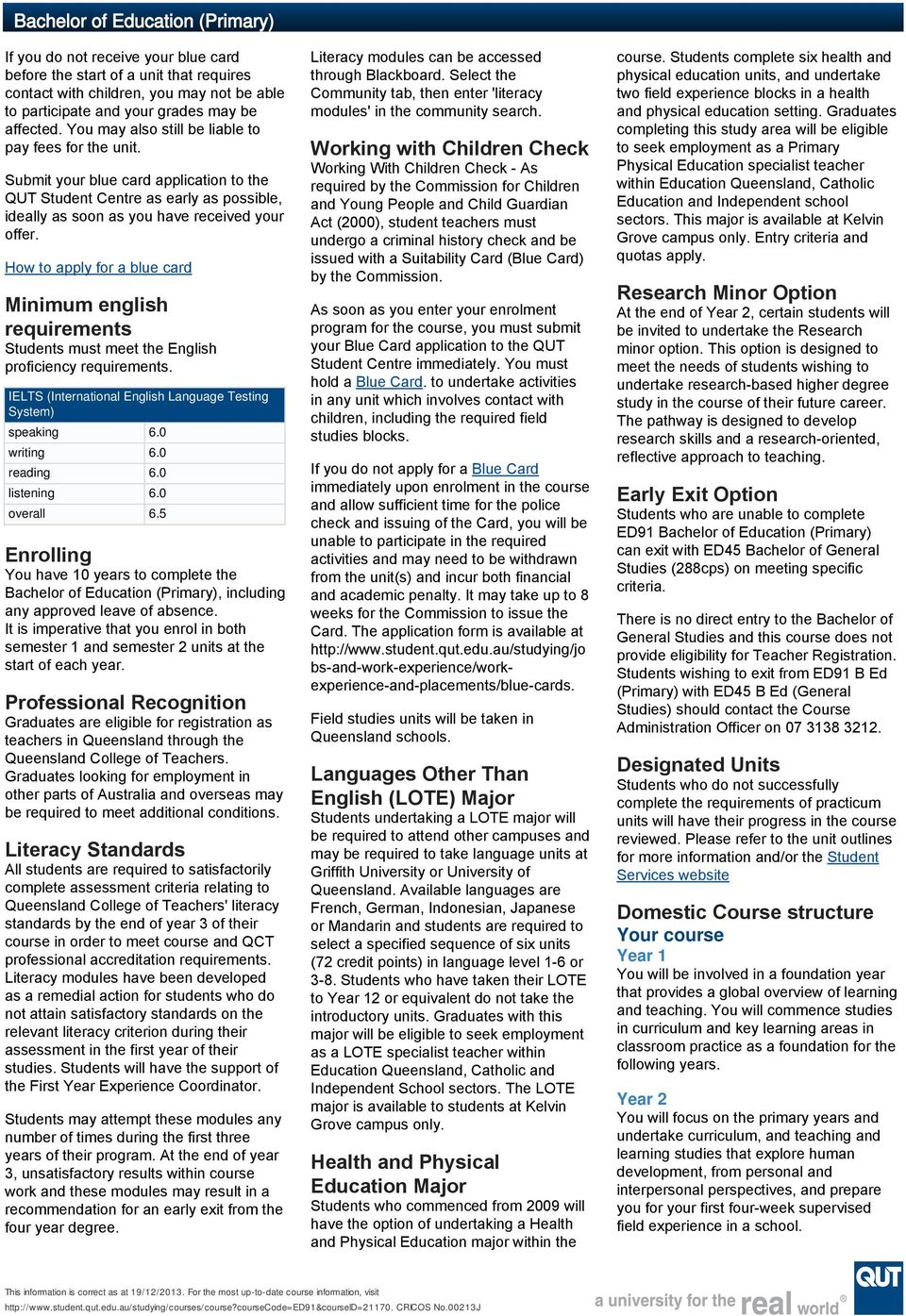
15 Bachelor of Education (Primary) Year 3 You will further develop your knowledge of primary curriculum and explore issues in practising education, with sensitivity to sociocultural contexts. You will continue option studies and undertake your second four-week supervised school-based field experience. Year 4 You will engage with specific aspects of learning, teaching, schools, policy and practices with almost half of your program involving you in classroom experiences including eight weeks of classroom practice and a final four-week internship that prepares you for your transition into the profession. Majors and minors The Bachelor of Education (Primary) offers you the opportunity to specialise in one major or one minor. Majors Optional majors include: Languages Other Than English (LOTE) Health and Physical Education (HPE). Graduates with a major may seek employment as specialist LOTE or HPE teachers. LOTE major QUT, The University of Queensland and Griffith University have formed an Australian-first alliance to expand higher learning in a range of Asian and European languages. LOTE is available in French, German, Indonesian, Japanese or Mandarin. LOTE units in Mandarin are undertaken at QUT s Gardens Point campus. The other languages are undertaken at the other universities. The LOTE major is available only to students with Kelvin Grove as the home campus. HPE major Students graduating with the HPE major will be eligible for membership of the Australian Council of Health, Physical Education and Recreation. Students apply for the HPE major after their first year of study. Entry criteria and quotas for this major will apply. This major is available only at Kelvin Grove campus. Minors If you do not select a major, then one minor, consisting of four units, may be selected instead. The minors include: Engaging Learners English as a Second Language (ESL) Health and Physical Activity Indigenous Education Literature and Media Studies Literacy Numeracy and Mathematics Research (for high-achieving students) Studies in Inclusive Education. You may also choose to undertake units across the range of available areas (no minor completed). The minors are subject to unit availability. Credit for prior learning (advanced standing) Students admitted with a completed Diploma of Children s Services (Early Childhood Education and Care), or an Advanced Diploma of Children s Services, or an equivalent accredited qualification, will be automatically granted credit (advanced standing) of 48 credit points (four option units). This credit does not reduce the course duration. International Course structure Your course Year 1 You will be involved in a foundation year that provides a global overview of learning and teaching. You will commence studies in curriculum and key learning areas in classroom practice as a foundation for the following years. Year 2 You will focus on the primary years and undertake curriculum, and teaching and learning studies that explore human development, from personal and interpersonal perspectives, and prepare you for your first four-week supervised field experience in a school. Year 3 You will further develop your knowledge of primary curriculum and explore issues in practising education, with sensitivity to sociocultural contexts. You will continue option studies and undertake your second four-week supervised school-based field experience. Year 4 You will engage with specific aspects of learning, teaching, schools, policy and practices with almost half of your program involving you in classroom experiences including eight weeks of classroom practice and a final four-week internship that prepares you for your transition into the profession. Majors and minors The Bachelor of Education (Primary) offers you the opportunity to specialise in one major or one minor. Majors Optional majors include: Languages Other Than English (LOTE) Health and Physical Education (HPE). Graduates with a major may seek employment as specialist LOTE or HPE teachers. LOTE major QUT, The University of Queensland and Griffith University have formed an Australian-first alliance to expand higher learning in a range of Asian and European languages. LOTE is available in French, German, Indonesian, Japanese or Mandarin. LOTE units in Mandarin are undertaken at QUT s Gardens Point campus. The other languages are undertaken at the other universities. HPE major Students graduating with the HPE major will be eligible for membership of the Australian Council of Health, Physical Education and Recreation. Students apply for the HPE major after their first year of study. Entry criteria and quotas for this major will apply. This major is available only at Kelvin Grove campus. Minors If you do not select a major, then one minor, consisting of four units, may be selected instead. The minors include: Engaging Learners English as a Second Language (ESL) Health and Physical Activity Indigenous Education Literature and Media Studies Literacy Numeracy and Mathematics Research (for high-achieving students) Studies in Inclusive Education. You may also choose to undertake units across the range of available areas (no minor completed). The minors are subject to unit availability. Credit for prior learning (advanced standing) Students admitted with a completed Diploma of Children s Services (Early Childhood Education and Care), or an CRICOS No.00213J
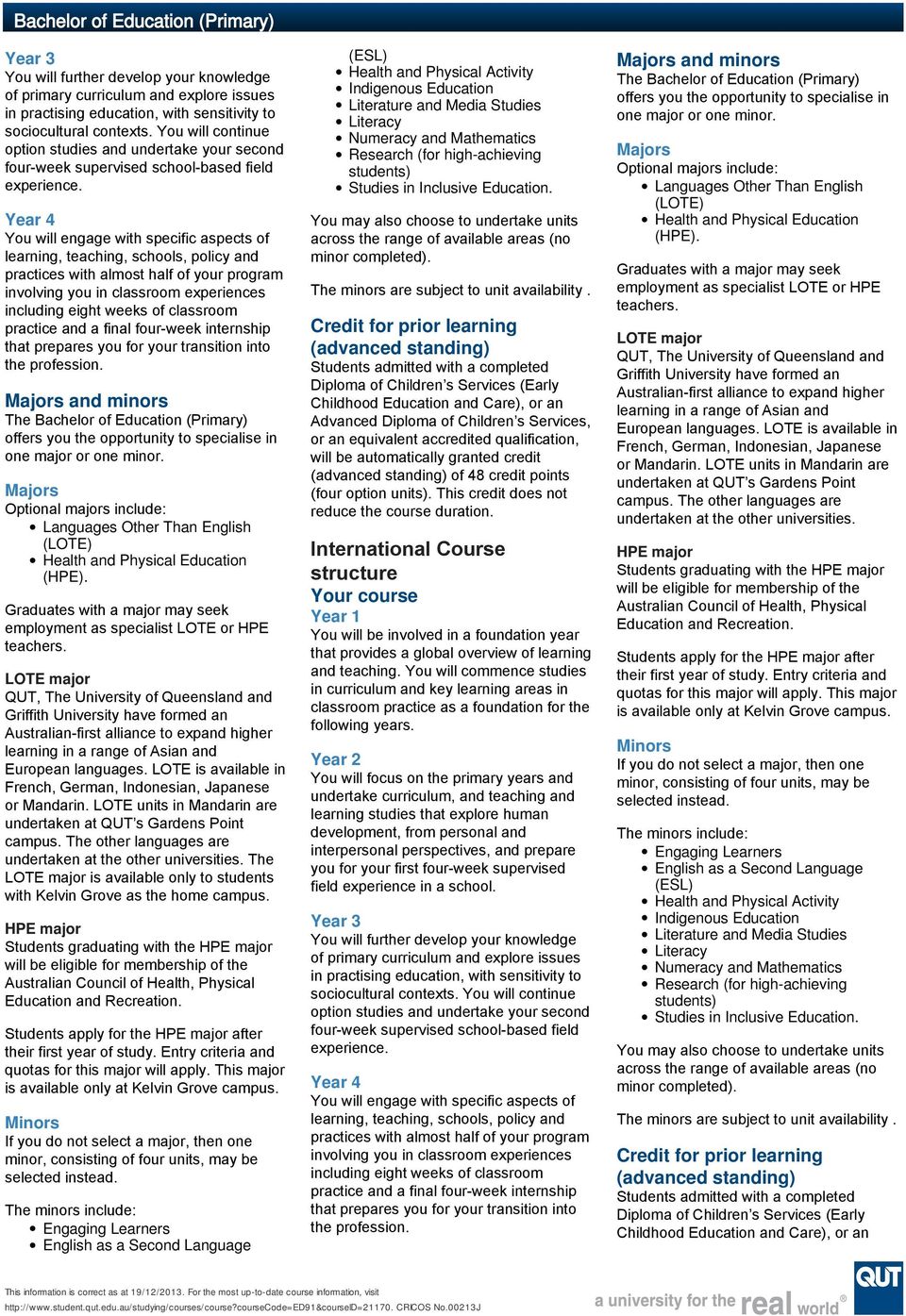
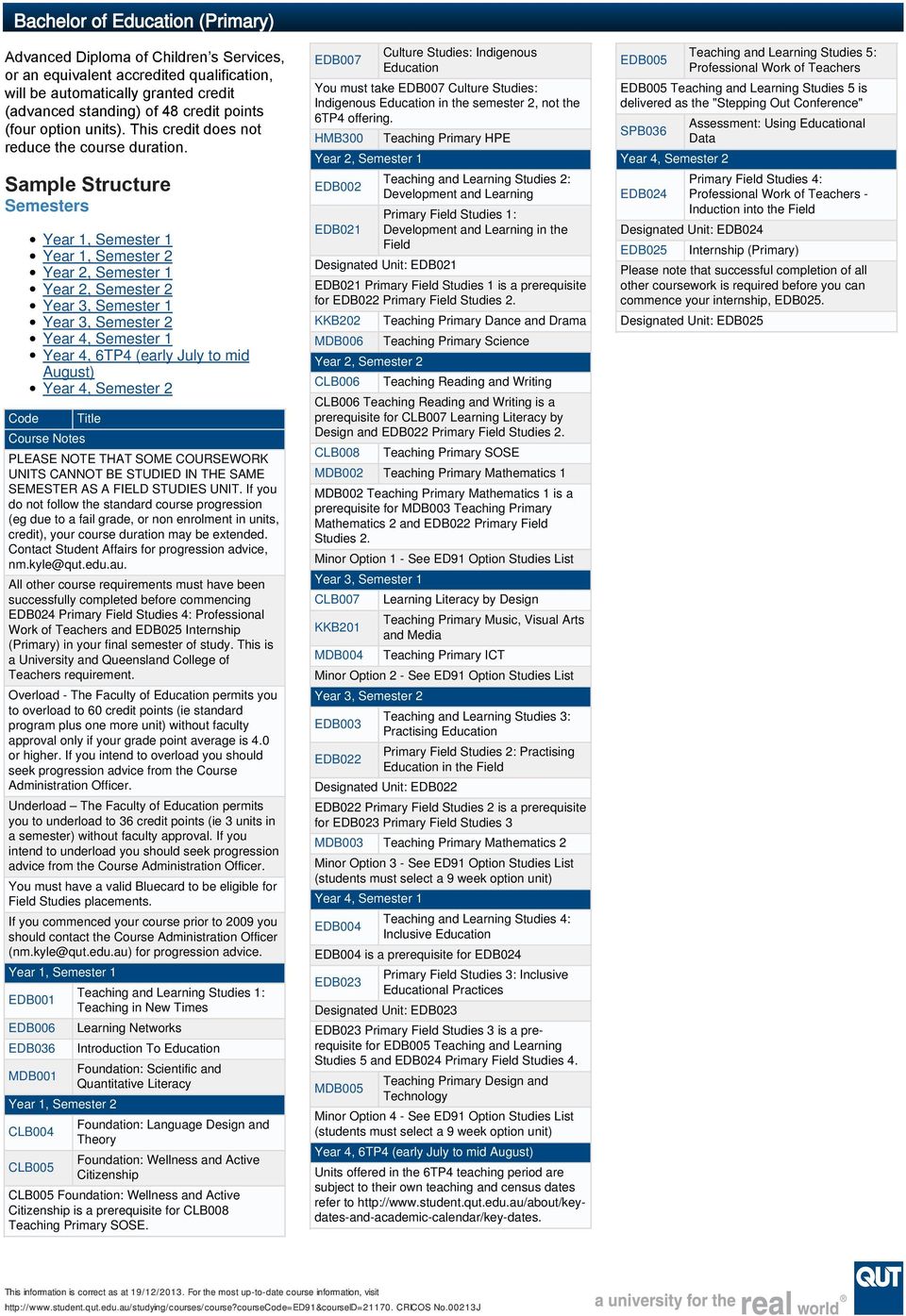
16 Bachelor of Education (Primary) Advanced Diploma of Children s Services, or an equivalent accredited qualification, will be automatically granted credit (advanced standing) of 48 credit points (four option units). This credit does not reduce the course duration. Sample Structure Semesters Code Year 1, Semester 1 Year 1, Semester 2 Year 2, Semester 1 Year 2, Semester 2 Year 3, Semester 1 Year 3, Semester 2 Year 4, Semester 1 Year 4, 6TP4 (early July to mid August) Year 4, Semester 2 Course Notes Title PLEASE NOTE THAT SOME COURSEWORK UNITS CANNOT BE STUDIED IN THE SAME SEMESTER AS A FIELD STUDIES UNIT. If you do not follow the standard course progression (eg due to a fail grade, or non enrolment in units, credit), your course duration may be extended. Contact Student Affairs for progression advice, [email protected]. All other course must have been successfully completed before commencing EDB024 Primary Field Studies 4: Professional Work of Teachers and EDB025 Internship (Primary) in your final semester of study. This is a University and Queensland College of Teachers requirement. Overload - The Faculty of Education permits you to overload to 60 credit points (ie standard program plus one more unit) without faculty approval only if your grade point average is 4.0 or higher. If you intend to overload you should seek progression advice from the Course Administration Officer. Underload The Faculty of Education permits you to underload to 36 credit points (ie 3 units in a semester) without faculty approval. If you intend to underload you should seek progression advice from the Course Administration Officer. You must have a valid Bluecard to be eligible for Field Studies placements. If you commenced your course prior to 2009 you should contact the Course Administration Officer ([email protected]) for progression advice. Year 1, Semester 1 EDB001 EDB006 EDB036 MDB001 Year 1, Semester 2 CLB004 CLB005 Teaching and Learning Studies 1: Teaching in New Times Learning Networks Introduction To Education Foundation: Scientific and Quantitative Literacy Foundation: Language Design and Theory Foundation: Wellness and Active Citizenship CLB005 Foundation: Wellness and Active Citizenship is a prerequisite for CLB008 Teaching Primary SOSE. EDB007 Culture Studies: Indigenous Education You must take EDB007 Culture Studies: Indigenous Education in the semester 2, not the 6TP4 offering. HMB300 Year 2, Semester 1 EDB002 EDB021 Teaching Primary HPE Teaching and Learning Studies 2: Development and Learning Primary Field Studies 1: Development and Learning in the Field Designated Unit: EDB021 EDB021 Primary Field Studies 1 is a prerequisite for EDB022 Primary Field Studies 2. KKB202 MDB006 Year 2, Semester 2 CLB006 Teaching Primary Dance and Drama Teaching Primary Science Teaching Reading and Writing CLB006 Teaching Reading and Writing is a prerequisite for CLB007 Learning Literacy by Design and EDB022 Primary Field Studies 2. CLB008 Teaching Primary SOSE MDB002 Teaching Primary Mathematics 1 MDB002 Teaching Primary Mathematics 1 is a prerequisite for MDB003 Teaching Primary Mathematics 2 and EDB022 Primary Field Studies 2. Minor Option 1 - See ED91 Option Studies List Year 3, Semester 1 CLB007 KKB201 MDB004 Learning Literacy by Design Teaching Primary Music, Visual Arts and Media Teaching Primary ICT Minor Option 2 - See ED91 Option Studies List Year 3, Semester 2 EDB003 EDB022 Teaching and Learning Studies 3: Practising Education Primary Field Studies 2: Practising Education in the Field Designated Unit: EDB022 EDB022 Primary Field Studies 2 is a prerequisite for EDB023 Primary Field Studies 3 MDB003 Teaching Primary Mathematics 2 Minor Option 3 - See ED91 Option Studies List (students must select a 9 week option unit) Year 4, Semester 1 EDB004 Teaching and Learning Studies 4: Inclusive Education EDB004 is a prerequisite for EDB024 EDB023 Primary Field Studies 3: Inclusive Educational Practices Designated Unit: EDB023 EDB023 Primary Field Studies 3 is a prerequisite for EDB005 Teaching and Learning Studies 5 and EDB024 Primary Field Studies 4. MDB005 Teaching Primary Design and Technology Minor Option 4 - See ED91 Option Studies List (students must select a 9 week option unit) Year 4, 6TP4 (early July to mid August) Units offered in the 6TP4 teaching period are subject to their own teaching and census dates refer to EDB005 Teaching and Learning Studies 5: Professional Work of Teachers EDB005 Teaching and Learning Studies 5 is delivered as the "Stepping Out Conference" SPB036 Year 4, Semester 2 EDB024 Assessment: Using Educational Data Primary Field Studies 4: Professional Work of Teachers - Induction into the Field Designated Unit: EDB024 EDB025 Internship (Primary) Please note that successful completion of all other coursework is required before you can commence your internship, EDB025. Designated Unit: EDB025 CRICOS No.00213J
17 Bachelor of Education (Early Childhood) Handbook Year 2013 QUT code CRICOS (full-time) ED G 4 years OP Kelvin Grove: 13 Caboolture: 15 Rank Kelvin Grove: 72 Caboolture: 68 OP Guarantee Campus Domestic fee International fee Total credit points Credit points full-time sem. Start months Int. Start Months Deferment Course Discipline Yes Kelvin Grove and Caboolture 2013: CSP $3,000 per Semester (48 credit points) 2013: $11,900 per Semester February February You can defer your offer and postpone the start of your course for one year Contact Education Student Affairs , or [email protected] u. For course progression advice please contact Nikki Kyle on , or [email protected]. Course Dr Ann Heirdsfield Domestic Entry Literacy course All Bachelor of Education students are required to satisfactorily complete assessment criteria relating to Queensland College of Teachers' (QCT) literacy standards by the end of year three of their course in order to meet the course and QCT professional accreditation. Literacy modules have been developed as a remedial action for students who do not attain satisfactory standards on the relevant literacy criterion during their assessment in the first year of their studies. Students will have the support of the First Year Experience. Students may attempt these modules any number of times during the first three years of their program. At the end of year three, unsatisfactory results within course work and these modules may result in a recommendation for an early exit from the four-year degree. The literacy requirement will also apply to double degree students with a slight variation. Working with Children Check: blue card A Blue Card is required as you will be working with children and young people as part of this course. You can apply for a Blue Card through QUT at no cost. If you do not receive your blue card before the start of a unit that requires contact with children, you may not be able to participate and your grades may be affected. You may also still be liable to pay fees for the unit. Submit your blue card application to the QUT Student Centre as early as possible, ideally as soon as you have received your offer. How to apply for a blue card Domestic Assumed knowledge Before you start this course we assume you have sound knowledge in these areas English We assume that you have knowledge equivalent to four semesters at high school level (Years 11 and 12) with sound achievement (4, SA). International Entry Literacy course All Bachelor of Education students are required to satisfactorily complete assessment criteria relating to Queensland College of Teachers' (QCT) literacy standards by the end of year three of their course in order to meet the course and QCT professional accreditation. Literacy modules have been developed as a remedial action for students who do not attain satisfactory standards on the relevant literacy criterion during their assessment in the first year of their studies. Students will have the support of the First Year Experience. Students may attempt these modules any number of times during the first three years of their program. At the end of year three, unsatisfactory results within course work and these modules may result in a recommendation for an early exit from the four-year degree. The literacy requirement will also apply to double degree students with a slight variation. Working with Children Check: blue card A Blue Card is required as you will be working with children and young people as part of this course. You can apply for a Blue Card through QUT at no cost. If you do not receive your blue card before the start of a unit that requires contact with children, you may not be able to participate and your grades may be affected. You may also still be liable to pay fees for the unit. Submit your blue card application to the QUT Student Centre as early as possible, ideally as soon as you have received your offer. How to apply for a blue card Minimum english Students must meet the English proficiency. IELTS (International English Language Testing System) speaking 6.0 writing 6.0 reading CRICOS No.00213J
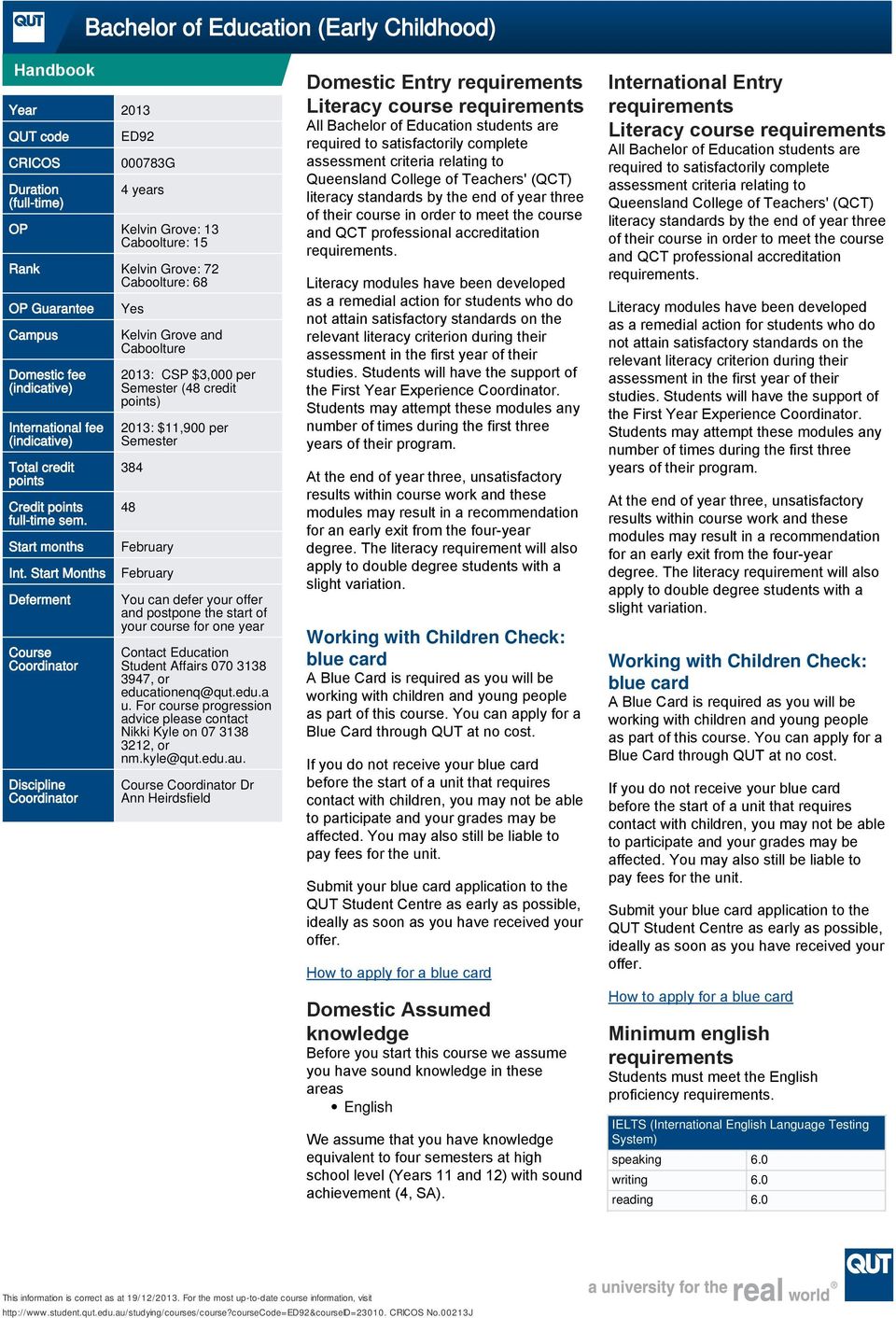
18 Bachelor of Education (Early Childhood) listening 6.0 overall 6.5 Enrolling You have 10 years to complete the Bachelor of Education (Early Childhood), including any approved leave of absence. It is imperative that you enrol in both semester 1 and semester 2 units at the start of each year. Professional Recognition The Bachelor of Education (Early Childhood) is recognised by the Queensland College of Teachers as meeting the for registration as a teacher in Queensland. Graduates looking for employment in other parts of Australia and overseas may be required to meet additional conditions. The Bachelor of Education (Early Childhood) is an approved child care qualification with the Queensland Government Department of Education, Training and Employment (Office for Early Childhood Education and Care), and is accredited by the New South Wales Department of Community Services for employment in children's services. Literacy Standards All students are required to satisfactorily complete assessment criteria relating to Queensland College of Teachers' literacy standards by the end of year 3 of their course in order to meet course and QCT professional accreditation. Literacy modules have been developed as a remedial action for students who do not attain satisfactory standards on the relevant literacy criterion during their assessment in the first year of their studies. Students will have the support of the First Year Experience. Students may attempt these modules any number of times during the first three years of their program. At the end of year 3, unsatisfactory results within course work and these modules may result in a recommendation for an early exit from the four year degree. Literacy modules can be accessed through Blackboard. Select the Community tab, then enter 'literacy modules' in the community search. Research option At the end of Year 2, you may be invited to undertake the Research Option which is designed to meet the needs of students wishing to undertake research-based higher degree study in the course of their future career. Working With Children Check Working With Children Check - As required by the Commission for Children and Young People and Child Guardian Act (2000), student teachers must undergo a criminal history check and be issued with a Suitability Card (Blue Card) by the Commission. As soon as you enter your enrolment program for the course, you must submit your Blue Card application to the QUT Student Centre immediately. You must hold a Blue Card. to undertake activities in any unit which involves contact with children, including the required field studies blocks. If you do not apply for a Blue Card. immediately upon enrolment in the course and allow sufficient time for the police check and issuing of the Card, you will be unable to participate in the required activities and may need to be withdrawn from the unit(s) and incur both financial and academic penalty. It may take up to 8 weeks for the Commission to issue the Card. The application form is available at bs-and-work-experience/workexperience-and-placements/blue-cards. Field Studies Units will be taken in Queensland schools and settings. Early Exit Option Students who have successfully completed three of the four years (288cps) of ED92 Bachelor of Education (Early Childhood) after following the standard course progression and who are unable to complete the final year of that course, can exit the course with ED82 Bachelor of Early Childhood Studies. Students wishing to take up this option should contact the Course Administration Officer on Designated Units Students who do not successfully complete the of practicum units will have their progress in the course reviewed. Please refer to the unit outlines for more information and/or the Student Services website Domestic Course structure Your course Year 1 You will focus on yourself as a commencing early childhood educator with foundation studies and exploration of essential professional characteristics. You will be introduced to early childhood curriculum areas related to literacy, ICTs and the arts and will also engage in workintegrated learning in the form of community activities. Year 2 You will focus on field experiences and curriculum studies in the creation of supportive learning environments for children. You will also undertake professional studies units which will focus on theory and practice relevant to early childhood settings, and consider the social and cultural implications of how education is constructed and organised. Year 3 You will focus on field experiences, further curriculum and professional studies contextualised in practical settings for children. You will build on your knowledge to understand and value inclusive educational practices for working with diverse cohorts of young children, including those with special needs. You will complete two of the four option units which can be undertaken in a diverse range of areas. Year 4 Your final year of study moves towards integrating the understandings you have developed with your professional practice by focusing on work-integrated learning, ethics and professionalism, and identity as a beginning practitioner. You will undertake your final two option units and your expertise in early childhood will converge to prepare you for your final field experience and internship. Complementary options You will have the opportunity to select complementary options (four units) in one or more of the following areas: Exploring the Sciences and Environment Health and Physical Activity Integrated Arts Curriculum Intercultural and International Teacher Literature and Media Studies Managing Learners and Learning Mathematics and ICT Middle Years of Schooling Music Research (for high-achieving students) Studies in Inclusive Education Studies in Indigenous Education Visual and Performing Arts. The complementary options are subject to availability. CRICOS No.00213J
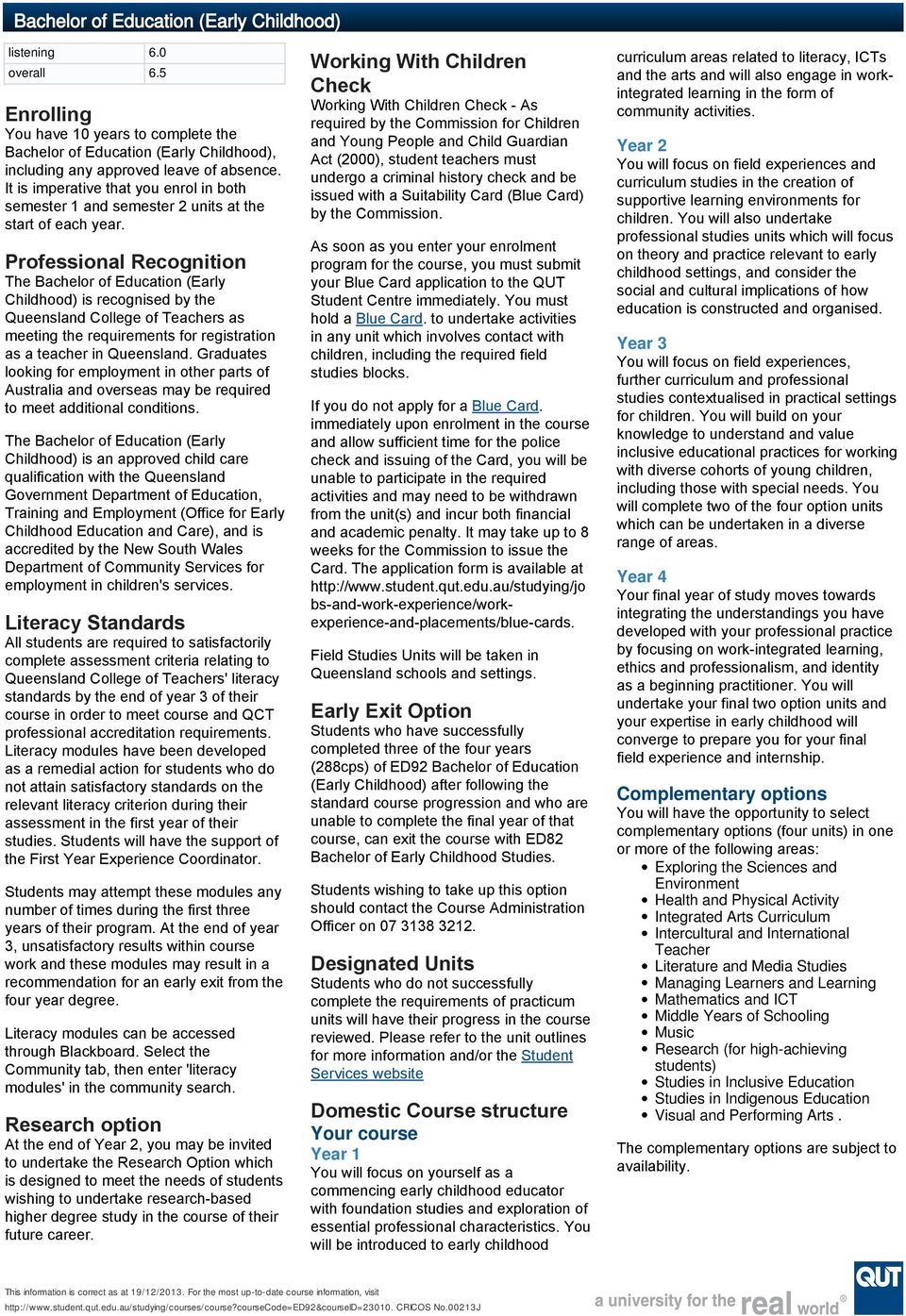
19 Bachelor of Education (Early Childhood) International Course structure Your course Year 1 You will focus on yourself as a commencing early childhood educator with foundation studies and exploration of essential professional characteristics. You will be introduced to early childhood curriculum areas related to literacy, ICTs and the arts and will also engage in workintegrated learning in the form of community activities. Year 2 You will focus on field experiences and curriculum studies in the creation of supportive learning environments for children. You will also undertake professional studies units which will focus on theory and practice relevant to early childhood settings, and consider the social and cultural implications of how education is constructed and organised. Year 3 You will focus on field experiences, further curriculum and professional studies contextualised in practical settings for children. You will build on your knowledge to understand and value inclusive educational practices for working with diverse cohorts of young children, including those with special needs. You will complete two of the four option units which can be undertaken in a diverse range of areas. Year 4 Your final year of study moves towards integrating the understandings you have developed with your professional practice by focusing on work-integrated learning, ethics and professionalism, and identity as a beginning practitioner. You will undertake your final two option units and your expertise in early childhood will converge to prepare you for your final field experience and internship. Complementary options You will have the opportunity to select complementary options (four units) in one or more of the following areas: Exploring the Sciences and Environment Health and Physical Activity Integrated Arts Curriculum Intercultural and International Teacher Literature and Media Studies Managing Learners and Learning Mathematics and ICT Middle Years of Schooling Music Research (for high-achieving students) Studies in Inclusive Education Studies in Indigenous Education Visual and Performing Arts. The complementary options are subject to availability. Sample Structure Semesters Code Year 1, Semester 1 Year 1, Semester 2 Year 2, Semester 1 Year 2, Semester 2 Year 3, Semester 1 Year 3, Semester 2 Year 4, Semester 1 Year 4, 6TP4 (early July to mid August) Year 4, Semester 2 Course Notes Title PLEASE NOTE THAT SOME COURSEWORK UNITS CANNOT BE STUDIED IN THE SAME SEMESTER AS A FIELD STUDIES UNIT. If you do not follow the standard course progression (eg due to a fail grade, or non enrolment in units), you may extend your course duration. If you are out of step you should contact Student Affairs for progression advice, [email protected]. All other course must have been successfully completed before commencing EDB014 Early Childhood Field Studies 4: Professional Work of Teachers - Induction into the Field and EDB015 Internship (Early Childhood) in your final semester of study. This is a University and Queensland College of Teachers requirement. Overload - The Faculty of Education permits you to overload to 60 credit points (ie standard program plus one more unit) without faculty approval only if your grade point average is 4.0 or higher. If you intend to overload you should seek progression advice from the Course Administration Officer. Underload The Faculty of Education permits you to underload to 36 credit points (ie 3 units in a semester) without faculty approval. If you intend to underload you should seek progression advice from the Course Administration Officer. You must have a valid Bluecard to be eligible for Field Studies units. If you have advanced standing for a Diploma/Advanced Diploma in Children's Services (or equivalent) you will follow an alternative course progression. Year 1, Semester 1 EAB001 EAB008 Early Childhood Foundations 1: Historical and Comparative Perspectives of EC Education Early Childhood Language, Literacies and Communication I EAB008 is a prerequiste for EAB009 Early Childhood Language, Literacies and Communication 2 EDB001 EDB006 Year 1, Semester 2 Teaching and Learning Studies 1: Teaching in New Times Learning Networks EAB002 EAB003 Early Childhood Foundations 2: Families and Childhoods in EC Education and Care Development and Learning in Early Childhood EAB003 is a prerequiste for EAB004 Early Childhood Language, Literacies and Communication 2 EAB011 Early Childhood Curriculum: Arts 1 EAB011 is a prerequiste for EAB012 Early Childhood Curriculum: Arts 2 EDB007 Culture Studies: Indigenous Education You must enrol in EDB007 in the semester 2, not the 6TP4 offering. Year 2, Semester 1 EAB004 EAB013 EAB027 Development and Learning in Early Childhood 2 Early Childhood Society Environment and Health Education Early Childhood Mathematics Education 1: Birth to Six Years EAB027 is a prerequiste for EAB028 Early Childhood Mathematics Education 2: Four to 8 Years EDB011 Early Childhood Field Studies 1: Development and Learning in the Field Designated Unit: EDB011 EDB011 is a prerequiste for EDB014 Early Childhood Field Studies 4: Professional Work of Teachers - Induction into the Field Year 2, Semester 2 EAB009 Early Childhood Language, Literacies and Communication 2 EAB009 is a prerequiste for EAB010 Early Childhood Language, Literacies and Communication 3 EAB015 EDB003 EDB012 Early Childhood Science and Technology Education Teaching and Learning Studies 3: Practising Education Early Childhood Field Studies 2: Practising Education in the Field Designated Unit: EDB012 EDB012 is a prerequiste for EDB014 Early Childhood Field Studies 4: Professional Work of Teachers - Induction into the Field Year 3, Semester 1 EAB005 Inclusion in Early Childhood Settings EAB012 Early Childhood Curriculum: Arts 2 EAB012 is a prerequiste for EAB026 Leadership and Management in Early Childhood Services EAB016 EDB013 Research in Early Childhood Education Early Childhood Field Studies 3: Diversity and Inclusivity Designated Unit: EDB013 EDB013 is a prerequiste for EDB014 Early Childhood Field Studies 4: Professional Work of Teachers - Induction into the Field. Year 3, Semester 2 EAB010 EAB028 Early Childhood Language, Literacies and Communication 3 Early Childhood Mathematics Education 2: Four to 8 Years 24cps of Option Studies - See Option Studies List CRICOS No.00213J
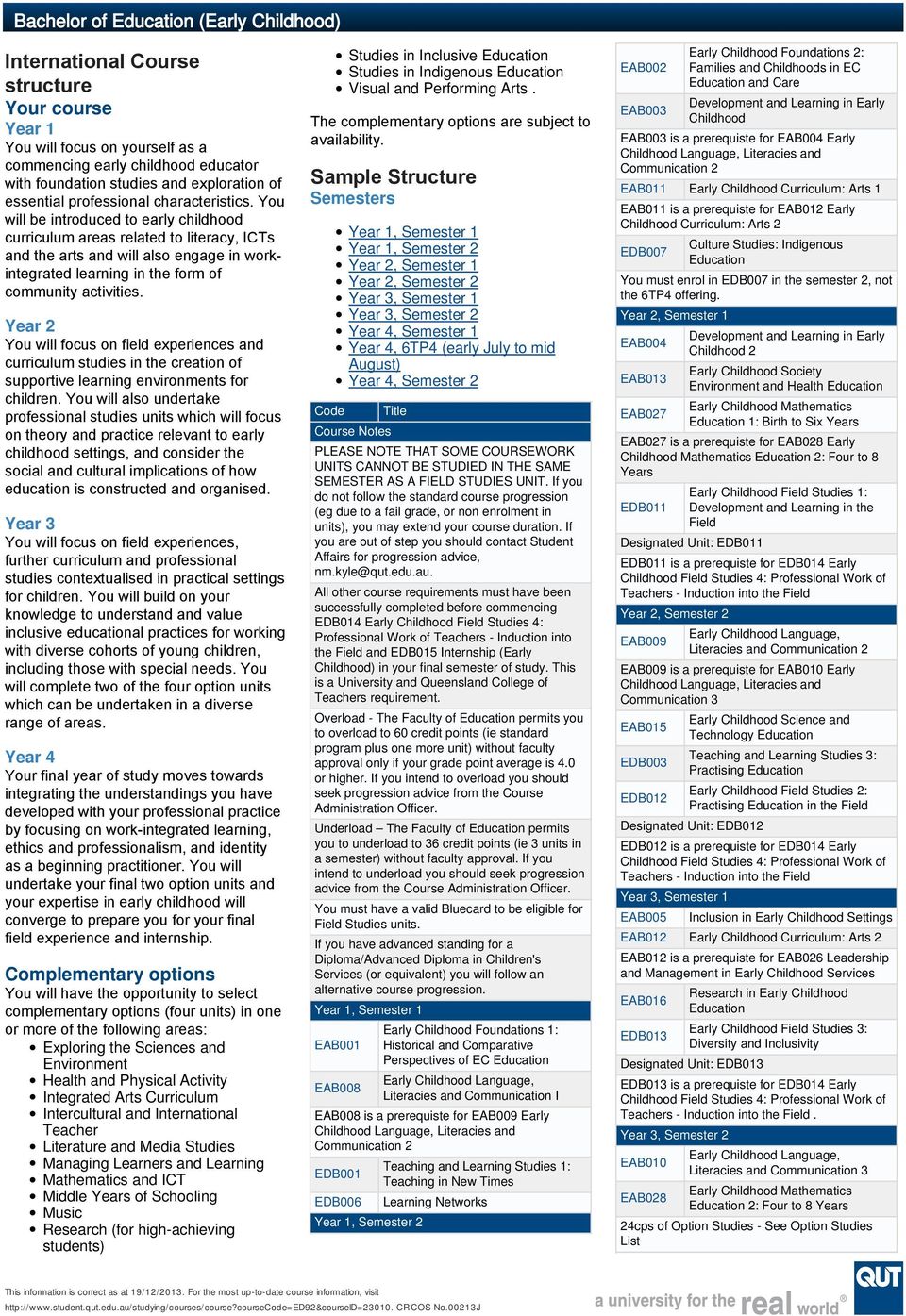
20 Bachelor of Education (Early Childhood) Year 4, Semester 1 EAB006 EAB026 Leadership and Management in Early Childhood Services Early Childhood Community Arts Project 24cps of Option Studies - See Option Studies List Year 4, 6TP4 (early July to mid August) Units taught in the 6TP4 teaching period have different teaching and census dates to second semester. Please refer to the key dates at EDB005 Teaching and Learning Studies 5: Professional Work of Teachers EDB005 is delivered through the Stepping Out Conference. EAB017 Year 4, Semester 2 EDB014 The Early Childhood Professional Early Childhood Field Studies 4: Professional Work of Teachers - Induction into the Field Designated Unit: EDB014 EDB015 Internship (Early Childhood) Please note that successful completion of all other coursework is required before you can commence your internship, EDB015. Designated Unit: EDB015 CRICOS No.00213J

21 Bachelor of Education (Preservice Early Childhood) Handbook Year 2013 QUT code CRICOS (part-time domestic) Rank 87 Domestic fee Total credit points Credit points part-time sem. Dom. Start Months Course Discipline ED93 External 5 years 2013: CSP $3,000 per Semester (48 credit points) 384 CP 24 CP February Contact Education Student Affairs Section ,For course progression advice contact Claire Hogue ph: or [email protected] Domestic Entry Prerequisite: Prior Study Completion of a Diploma of Children's Services (Early Childhood Education and Care) or Diploma or Advanced Diploma of Children's Services, or an equivalent accredited qualification. Prerequisite: Prior Work Experience Diploma holders must also have the following early childhood experience: one year full-time (or equivalent) group leader experience; or two years full-time (or equivalent) family day care experience as an accredited provider; or two years full-time (or equivalent) early childhood teacher aide experience in a state preschool, prep or crèche and kindergarten association centre; or two years full-time (or equivalent) before and after school care experience. Advanced Diploma holders must complete the above early childhood experience before they graduate, however if you already have this experience you are strongly recommended to provide evidence with your QTAC application. Note: The majority of supervised professional experience must occur in Australian school settings. Automatic Advanced Standing (Credit) If admitted to this course you will be automatically granted advanced standing of one and half years of study (ie 144 credit points) for their completed Diploma of Children's Services (or an equivalent accredited qualification) and early childhood work experience. If admitted on the basis of an Advanced Diploma of Children's Services and you have not supplied QTAC with evidence of their early childhood experience you will only be automatically granted advanced standing of one year of study (ie 96 credit points) and you will be required to provide evidence of your early childhood experience to QUT prior to graduation. Literacy course All Bachelor of Education students are required to satisfactorily complete assessment criteria relating to Queensland College of Teachers' (QCT) literacy standards by the end of year three of their course in order to meet the course and QCT professional accreditation. Literacy modules have been developed as a remedial action for students who do not attain satisfactory standards on the relevant literacy criterion during their assessment in the first year of their studies. Students will have the support of the First Year Experience. Students may attempt these modules any number of times during the first three years of their program. At the end of year three, unsatisfactory results within course work and these modules may result in a recommendation for an early exit from the four-year degree. The literacy requirement will also apply to double degree students with a slight variation. Working with Children Check: blue card A Blue Card is required as you will be working with children and young people as part of this course. You can apply for a Blue Card through QUT at no cost. If you do not receive your blue card before the start of a unit that requires contact with children, you may not be able to participate and your grades may be affected. You may also still be liable to pay fees for the unit. Submit your blue card application to the QUT Student Centre as early as possible, ideally as soon as you have received your offer. How to apply for a blue card International Entry Prerequisites Completion of a Diploma or Advanced Diploma of Children's Services (Early Childhood Education and Care) or Advanced Diploma of Children's Services, or an equivalent accredited qualification. You must also have the following early childhood experience: one year full-time (or equivalent) group leader experience; or two years full-time (or equivalent) family day care experience as an accredited provider; or two years full-time (or equivalent) early childhood teacher aide experience in a state preschool, CRICOS No.00213J
22 Bachelor of Education (Preservice Early Childhood) prep or crèche and kindergarten association centre; or two years full-time (or equivalent) before and after school care experience. Diploma holders need to provide evidence of this experience when they apply to QTAC to be eligible for entry. Note: The majority of supervised professional experience must occur in Australian school settings. Credit for prior learning (Advanced standing) Students admitted to this course will be automatically granted credit of one and half years of study (ie 144 credit points) for their completed Diploma of Children's Services (or an equivalent accredited qualification) and early childhood work experience. Students admitted on the basis of an Advanced Diploma of Children's Services and who have not supplied QTAC with evidence of their early childhood experience will only be automatically granted credit of one year of study (ie 96 credit points) and will be required to provide evidence of their early childhood experience to QUT prior to graduation. Literacy course All Bachelor of Education students are required to satisfactorily complete assessment criteria relating to Queensland College of Teachers' (QCT) literacy standards by the end of year three of their course in order to meet the course and QCT professional accreditation. Literacy modules have been developed as a remedial action for students who do not attain satisfactory standards on the relevant literacy criterion during their assessment in the first year of their studies. Students will have the support of the First Year Experience. Students may attempt these modules any number of times during the first three years of their program. At the end of year three, unsatisfactory results within course work and these modules may result in a recommendation for an early exit from the four-year degree. The literacy requirement will also apply to double degree students with a slight variation. Working with Children Check: blue card A Blue Card is required as you will be working with children and young people as part of this course. You can apply for a Blue Card through QUT at no cost. If you do not receive your blue card before the start of a unit that requires contact with children, you may not be able to participate and your grades may be affected. You may also still be liable to pay fees for the unit. Submit your blue card application to the QUT Student Centre as early as possible, ideally as soon as you have received your offer. How to apply for a blue card Minimum english Students must meet the English proficiency. IELTS (International English Language Testing System) speaking 6.0 writing 6.0 reading 6.0 listening 6.0 overall 6.5 Enrolling It is imperative that you enrol in both semester 1 and semester 2 units at the start of each year. Professional Recognition The Bachelor of Education (Preservice Early Childhood) is recognised by the Queensland College of Teachers as meeting the for registration as a teacher in Queensland. Graduates looking for employment in other parts of Australia and overseas may be required to meet additional conditions. The Bachelor of Education (Preservice Early Childhood) is an approved child care qualification with the Queensland Government Department of Education, Training and Employment (Office for Early Childhood Education and Care), and is accredited by the New South Wales Department of Community Services for employment in children's services. Literacy Standards All students are required to satisfactorily complete assessment criteria relating to Queensland College of Teachers literacy standards by the end of year 3 of their course in order to meet course and QCT professional accreditation. Literacy modules have been developed as a remedial action for students who do not attain satisfactory standards on the relevant literacy criterion during their assessment in the first year of their studies. Students will have the support of the First Year Experience. Students may attempt these modules any number of times during the first three years of their program. At the end of year 3, unsatisfactory results within course work and these modules may result in a recommendation for an early exit from the four year degree. Working With Children Check Working With Children Check - As required by the Commission for Children and Young People and Child Guardian Act (2000), student teachers must undergo a criminal history check and be issued with a Suitability Card (Blue Card) by the Commission. As soon as you enter your enrolment program for the course, you must submit your Blue Card application to the QUT Student Centre immediately. You must hold a Blue Card. to undertake activities in any unit which involves contact with children, including the required field studies blocks. If you do not apply for a Blue Card. immediately upon enrolment in the course and allow sufficient time for the police check and issuing of the Card, you will be unable to participate in the required activities and may need to be withdrawn from the unit(s) and incur both financial and academic penalty. It may take up to 12 weeks for the Commission to issue the Card. The application form is available at student.qut.edu.au/studying/jobs-andwork-experience/work-experience-andplacements/blue-cards. The majority of field studies must be taken in Australian schools. Early Exit - Bachelor of Early Childhood - ED83 Students wishing to exit the course early with a three year full-time equivalent ED83 Bachelor of Early Childhood should apply in the semester they expect to exit using an SRX Form which is available from To early exit students need to meet the course requirment for ED83 Bachelor of Early Childhood, which can be located at the following site: CRICOS No.00213J
23 Bachelor of Education (Preservice Early Childhood) urses/education Students wishing to complete their fourth year of study may re-apply for admission to the ED93 course at a later stage (subject to the course still being offered and/or the maximum completion time for ED93). Completion of the Bachelor of Education (ED83) course does not allow graduates to register as teachers with the Queensland College of Teachers. Designated Units Students who do not successfully complete the of practicum units will have their progress in the course reviewed. Please refer to the unit outlines for more information and/or the Student Services website Sample Structure Semesters Code Part-time Course Structure Year 1, Semester 1 Year 1, Semester 2 Year 2, Semester 1 Year 2, Semester 2 Year 3, Semester 1 Year 3, Semester 2 Year 4, Semester 1 Year 4, Semester 2 Year 5, Semester 1 Year 5, 6TP4 (early July to mid August) Year 5, Semester 2 Course Notes Title The advanced standing granted on entry to the course reduces what would be an eight year part-time preservice teaching degree to five years part-time. Students complete all 20 units listed on the course summary. Part-time Course Structure Year 1, Semester 1 MDB440 EAB364 Year 1, Semester 2 Computers And Education Academic And Professional Communication EAB011 Early Childhood Curriculum: Arts 1 EAB013 Year 2, Semester 1 EAB008 Early Childhood Society Environment and Health Education Early Childhood Language, Literacies and Communication I EAB008 is a prerequisite for EAB009 Early Childhood Language, Literacies and Communication 2 EAB027 Early Childhood Mathematics Education 1: Birth to Six Years EAB027 is a prerequisite for EAB028 Early Childhood Mathematics Education 2: Four to 8 Years Year 2, Semester 2 EAB005 Inclusion in Early Childhood Settings EAB006 Year 3, Semester 1 EDB200 EDB011 Leadership and Management in Early Childhood Services Insights into Early Childhood Development Early Childhood Field Studies 1: Development and Learning in the Field Designated Unit: EDB011 EDB011 is a prerequisite for EDB014 Early Childhood Field Studies 4: Professional Work of Teachers - Induction into the Field Year 3, Semester 2 EDB003 EAB009 Teaching and Learning Studies 3: Practising Education Early Childhood Language, Literacies and Communication 2 EAB009 is a prerequisite for EAB010 Early Childhood Language, Literacies and Communication 3 Year 4, Semester 1 EAB015 EDB012 Early Childhood Science and Technology Education Early Childhood Field Studies 2: Practising Education in the Field Designated Unit: EDB012 EDB012 is a prerequisite for EDB014 Early Childhood Field Studies 4: Professional Work of Teachers - Induction into the Field Year 4, Semester 2 EAB010 EAB028 Year 5, Semester 1 EAB130 EAB017 Early Childhood Language, Literacies and Communication 3 Early Childhood Mathematics Education 2: Four to 8 Years Negotiating Curriculum with Young Children The Early Childhood Professional Year 5, 6TP4 (early July to mid August) Units taught in the 6TP4 teaching period have different teaching and census dates to second semester. Please refer to the key dates at EDB007 Year 5, Semester 2 EDB014 Culture Studies: Indigenous Education Early Childhood Field Studies 4: Professional Work of Teachers - Induction into the Field Designated Unit: EDB014 EDB014 should be taken in the final semester of study ED93 students will require a prerequisite waiver for EDB014 as they are not required to complete one of the prerequisite units. If you have not yet been granted a prerequisite waiver for this unit please contact course administration officer Claire Hogue on or [email protected]. CRICOS No.00213J
24 Bachelor of Applied Science/Bachelor of Education (Secondary) Handbook Year 2013 QUT code CRICOS (full-time) IX02 OP 13 Rank 73 OP Guarantee Campus Domestic fee International fee Total credit points Credit points full-time sem. Start months Int. Start Months Deferment Course Discipline E 4 years Yes Gardens Point and Kelvin Grove 2013: CSP $4200 per Semester (48 credit points) 2013: $12,900 per Semester (semesters 1, 6-8), 60 (semesters 2-5) February February You can defer your offer and postpone the start of your course for one year Dr Marion Bateson (Science); Dr Alberto Bellocchi (Secondary). For science enquiries [email protected]. For education enquires [email protected] u or phone Dr Perry Hartfield (Biochemistry Major); Dr Marion Bateson (Biotechnology Major); Associate Professor Dennis Arnold (Chemistry Major); Dr Ian Williamson (Ecology Major); Dr Ian Williamson (Environmental Science Major); Dr Craig Sloss (Geoscience Major); Dr Scott McCue (Mathematics Major); Dr Christine Knox (Microbiology Major); Dr Stephen Hughes (Physics Major) Domestic Entry Literacy course All Bachelor of Education students are required to satisfactorily complete assessment criteria relating to Queensland College of Teachers' (QCT) literacy standards by the end of year three of their course in order to meet the course and QCT professional accreditation. Literacy modules have been developed as a remedial action for students who do not attain satisfactory standards on the relevant literacy criterion during their assessment in the first year of their studies. Students will have the support of the First Year Experience. Students may attempt these modules any number of times during the first three years of their program. At the end of year three, unsatisfactory results within course work and these modules may result in a recommendation for an early exit from the four-year degree. The literacy requirement will also apply to double degree students with a slight variation. Working with Children Check: blue card A Blue Card is required as you will be working with children and young people as part of this course. You can apply for a Blue Card through QUT at no cost. If you do not receive your blue card before the start of a unit that requires contact with children, you may not be able to participate and your grades may be affected. You may also still be liable to pay fees for the unit. Submit your blue card application to the QUT Student Centre as early as possible, ideally as soon as you have received your offer. How to apply for a blue card Domestic Assumed knowledge Before you start this course we assume you have sound knowledge in these areas Maths B English We assume that you have knowledge equivalent to four semesters at high school level (Years 11 and 12) with sound achievement (English (4, SA) and Maths B (4, SA)). Recommended study: At least one of the sciences. For biochemistry, biotechnology and microbiology majors - Biology and Chemistry; for physics major - Maths C. International Entry Literacy course All Bachelor of Education students are required to satisfactorily complete assessment criteria relating to Queensland College of Teachers' (QCT) literacy standards by the end of year three of their course in order to meet the course and QCT professional accreditation. Literacy modules have been developed as a remedial action for students who do not attain satisfactory standards on the relevant literacy criterion during their assessment in the first year of their studies. Students will have the support of the First Year Experience. Students may attempt these modules any number of times during the first three years of their program. At the end of year three, unsatisfactory results within course work and these modules may result in a recommendation for an early exit from the four-year degree. The literacy requirement will also apply to double degree students with a slight variation. Working with Children Check: blue card A Blue Card is required as you will be working with children and young people as part of this course. You can apply for a Blue Card through QUT at no cost. If you do not receive your blue card before the start of a unit that requires contact with children, you may not be able to participate and your grades may be affected. You may also still be liable to pay fees for the unit. Submit your blue card application to the QUT Student Centre as early as possible, ideally as soon as you have received your offer. How to apply for a blue card International Subject prerequisites Maths B English CRICOS No.00213J
25 Bachelor of Applied Science/Bachelor of Education (Secondary) You must have achieved this study at a level comparable to Australian Year 12 or in recognised post-secondary studies (English (4, SA) and Maths B (4, SA)). Recommended study: At least one of the sciences. For biochemistry, biotechnology and microbiology majors - Biology and Chemistry; for physics major - Maths C. Minimum english Students must meet the English proficiency. IELTS (International English Language Testing System) speaking 6.0 writing 6.0 reading 6.0 listening 6.0 overall 6.5 Enrolling It is imperative that you enrol in both semester 1 and semester 2 units at the start of each year. Course Overview This double degree enables you to work as a science professional or pursue a career in scientific research. Alternatively, the Bachelor of Education (Secondary) prepares you to teach in two curriculum areas in secondary school. The science majors that are most relevant if you are intending to follow a career in secondary school teaching are chemistry, ecology, geoscience, mathematics or physics. Professional Recognition This course meets the for registration as a teacher in Queensland. It is recognised nationally and internationally, however additional may be needed for some locations. Graduates will also satisfy the for membership of the relevant professional body for their chosen science major. See Studyfinder for details on the Bachelor of Applied Science majors. Other Course Requirements Blue Card As required by the Commission for Children and Young People and Child Guardian Act (2000), student teachers must undergo a criminal history check and be issued with a Suitability Card (Blue Card) by the Commission. You must hold a Blue Card to undertake activities in any unit which involves contact with children, including the required field studies blocks, which commence in late January Year 2. The application form is available at student.qut.edu.au/studying/jobs-andwork-experience/work-experience-andplacements/blue-cards. Literacy Students must meet the Queensland College of Teachers literacy standards by the end of Year 3. For more information please visit AskQUT and enter 'Literacy Modules' in the FAQ. Course Design See the Bachelor of Applied Science course information for details of major areas of study. To allow you to complete the double degree in a shorter period of time, co-majors are to be taken from the education technology program. Further Information For further information about this course, please contact the following: Science Dr Marion Bateson Phone: [email protected] Alternative phone contact: Alternative contact: [email protected] Education Dr Alberto Bellocchi Phone: [email protected] Faculty of Education Office Phone: Fax: [email protected] Discipline s Biochemistry Major Dr Perry Hartfield Phone: [email protected] Alternative phone contact: Alternative contact: [email protected] Biotechnology Major Dr Marion Bateson Phone: [email protected] Alternative phone contact: Alternative contact: [email protected] Chemistry Major Associate Professor Dennis Arnold Phone: [email protected] Alternative phone contact: Alternative contact: [email protected] Ecology Major Dr Ian Williamson Phone: [email protected] Alternative phone contact: Alternative contact: [email protected] Environmental Science Major Dr Ian Williamson Phone: [email protected] Alternative phone contact: Alternative contact: [email protected] Geoscience Major Dr Craig Sloss Phone: [email protected] Alternative phone contact: Alternative contact: [email protected] Mathematics Major Dr Scott McCue Phone: [email protected] Alternative phone contact: Alternative contact: [email protected] Microbiology Major Dr Christine Knox [email protected] Alternative phone contact: Alternative contact: [email protected] Physics Major Dr Stephen Hughes Phone: [email protected] Alternative phone contact: Alternative contact: [email protected] Domestic Course structure See the Bachelor of Applied Science course information for details of major areas of study. To allow you to complete the double degree in a shorter period of time, co-majors are to be taken from the CRICOS No.00213J
26 Bachelor of Applied Science/Bachelor of Education (Secondary) education technology program. The Bachelor of Applied Science majors that are relevant to secondary teaching include: chemistry ecology geoscience mathematics physics. International Course structure See the Bachelor of Applied Science course information for details of major areas of study. To allow you to complete the double degree in a shorter period of time, co-majors are to be taken from the education technology program. The Bachelor of Applied Science majors that are relevant to secondary teaching include: chemistry ecology geoscience mathematics physics. Sample Structure Semesters Code Year 1, Semester 1 Year 1, Semester 2 Year 2, Semester 1 Year 2, Semester 2 Year 3, Semester 1 Year 3, Semester 2 Year 4, Semester 1 Year 4, 6TP4 Year 4, Semester 2 Title Year 1, Semester 1 Science Major Unit Science Major Unit Science Major Unit Science Major Unit Year 1, Semester 2 Science Major Unit Science Major Unit Science Major Unit Science Major Unit Science Major Unit Year 2, Semester 1 EDB002 Teaching and Learning Studies 2: Development and Learning Curriculum Studies 1X (See List 1) EDB031 Secondary Field Studies 1 Please note: The teaching prac component of EDB031 will be organised to commence as soon as schools return for Term 1 in late January/ early February. Students will have to be available for four weeks prior to commencement of semester 1. This is to allieviate the problem of students studying 13 week discipline units in the same semester as a teaching prac. Contact the Student Affairs Office on for further information. Science Major Unit Science Major Unit Year 2, Semester 2 MDB454 Science Major Unit Science Major Unit Science Major Unit Science Major Unit Year 3, Semester 1 Science, Technology and Society Curriculum Studies 1Y (See List 1) Science Major Unit Science Major Unit Science Major Unit Science Major Unit Year 3, Semester 2 EDB003 Teaching and Learning Studies 3: Practising Education EDB032 Secondary Field Studies 2 Curriculum Studies 2X (See List 2) Curriculum Studies 2Y (See List 2) Year 4, Semester 1 EDB004 Teaching and Learning Studies 4: Inclusive Education EDB033 Secondary Field Studies 3 Curriculum Studies 3X (See List 3) Curriculum Studies 3Y (See List 3) Year 4, 6TP4 EDB005 EDB007 Teaching and Learning Studies 5: Professional Work of Teachers Culture Studies: Indigenous Education students must enrol in the 6TP4 mode for both EDB005 (internal) and EDB007 (external). The 6TP4 teaching period commences early July, running until mid August. EDB005 is delivered through the Stepping Out Conference, which runs over 3 days in 'O' Week of Semester 2 (dates TBA). Year 4, Semester 2 Please note that successful completion of all other coursework is required before students can commence the final Field Studies EDB034 and Internship EDB035. EDB034 Secondary Field Studies 4 EDB035 Internship (Secondary) CRICOS No.00213J
27 Bachelor of Applied Science (in Human Movement Studies)/ Bachelor of Education (Secondary) Handbook Year 2013 QUT code CRICOS (full-time) IX04 OP 13 Rank 75 OP Guarantee Campus Total credit points Start months Int. Start Months Course D 4 years Yes Gardens Point and Kelvin Grove 432 February February HMS enquiries: [email protected] or phone: ; Education enquiries: [email protected] u or Discipline or or [email protected] or [email protected] u Domestic Entry Literacy course All Bachelor of Education students are required to satisfactorily complete assessment criteria relating to Queensland College of Teachers' (QCT) literacy standards by the end of year three of their course in order to meet the course and QCT professional accreditation. Literacy modules have been developed as a remedial action for students who do not attain satisfactory standards on the relevant literacy criterion during their assessment in the first year of their studies. Students will have the support of the First Year Experience. Students may attempt these modules any number of times during the first three years of their program. At the end of year three, unsatisfactory results within course work and these modules may result in a recommendation for an early exit from the four-year degree. The literacy requirement will also apply to double degree students with a slight variation. Working with Children Check: blue card A Blue Card is required as you will be working with children and young people as part of this course. You can apply for a Blue Card through QUT at no cost. If you do not receive your blue card before the start of a unit that requires contact with children, you may not be able to participate and your grades may be affected. You may also still be liable to pay fees for the unit. Submit your blue card application to the QUT Student Centre as early as possible, ideally as soon as you have received your offer. How to apply for a blue card International Entry Literacy course All Bachelor of Education students are required to satisfactorily complete assessment criteria relating to Queensland College of Teachers' (QCT) literacy standards by the end of year three of their course in order to meet the course and QCT professional accreditation. Literacy modules have been developed as a remedial action for students who do not attain satisfactory standards on the relevant literacy criterion during their assessment in the first year of their studies. Students will have the support of the First Year Experience. Students may attempt these modules any number of times during the first three years of their program. At the end of year three, unsatisfactory results within course work and these modules may result in a recommendation for an early exit from the four-year degree. The literacy requirement will also apply to double degree students with a slight variation. Working with Children Check: blue card A Blue Card is required as you will be working with children and young people as part of this course. You can apply for a Blue Card through QUT at no cost. If you do not receive your blue card before the start of a unit that requires contact with children, you may not be able to participate and your grades may be affected. You may also still be liable to pay fees for the unit. Submit your blue card application to the QUT Student Centre as early as possible, ideally as soon as you have received your offer. How to apply for a blue card Minimum english Students must meet the English proficiency. IELTS (International English Language Testing System) speaking 10.0 writing 10.0 reading 10.0 listening 10.0 overall 6.5 Professional Recognition Graduates are eligible for registration as a teacher in Queensland. Other Course Requirements Bluecard As required by the Commission for Children and Young People and Child Guardian Act (2000), students must CRICOS No.00213J
28 Bachelor of Applied Science (in Human Movement Studies)/ Bachelor of Education (Secondary) undergo a criminal history check and be issued with a Blue Card before commencing clinical practice/field experience/practicum in an organisation where they may work with children or young people. For more information, visit Additional costs There are additional costs associated with this course including the purchase of the practicum shirt (approximately $50), the attainment of a current First Aid Certificate prior to the commencement of third year. Attendance at the orientation camp is highly recommended though not compulsory (approximately $115). Computing requirement The increased and more creative use of online teaching technology in this degree requires that you have access to suitable computer facilities with a minimum equivalent of a Pentium 3 processor, 56k modem and internet access. Literacy Students must meet the Queensland College of Teachers literacy standards by the end of Year 3. For more information please visit AskQUT and enter 'Literacy Modules' in the FAQ. Further Information For information about this course, please call the School of Exercise and Nutrition Sciences on or [email protected] OR contact the Faculty of Education on or [email protected] Domestic Course structure Your course This course gives you a science degree with the same support as the Bachelor of Applied Science program. Education units provide knowledge of teaching and learning theory and practice. International Course structure Your course This course gives you a science degree with the same support as the Bachelor of Applied Science program. Education units provide knowledge of teaching and learning theory and practice. Sample Structure This course has been discontinued. It was replaced by IX18 Bachelor of Exercise and Movement Science/ Bachelor of Education (Secondary). Semesters Year 1, Semester 1 Year 1, Semester 2 Year 2, Semester 1 Year 2, Semester 2 Year 3, Semester 1 Year 3, Semester 2 Year 4, Semester 1 Year 4, 6TP4 Year 4, Semester 2 Health Discipline Studies Y Maths Discipline Studies Y English Discipline Studies Y Biology Discipline Studies Y Code Title Year 1, Semester 1 LSB131 HMB313 HMB171 Anatomy Discipline Studies Year 1, Semester 2 LSB231 HMB172 HMB272 HMB315 Understanding Physical Activity Participation Fitness Health and Wellness Physiology Discipline Studies Nutrition and Physical Activity Biomechanics Year 2, Semester 1 HMB314 HMB231 EDB002 Games Based Learning in Physical Activity and Sport Alternative Physical Education Physical Education Curriculum Studies 1 Teaching and Learning Studies 2: Development and Learning EDB031 Secondary Field Studies 1 Curriculum Studies 1Y Year 2, Semester 2 HMB273 Exercise Physiology 1 HMB275 HMB276 HMB282 Discipline Studies Year 3, Semester 1 SPB012 HMB271 HMB274 HMB376 OR HMB377 Discipline Studies Year 3, Semester 2 EDB003 Exercise and Sport Psychology Research in Human Movement Resistance Training Classroom and Behaviour Management Foundations of Motor Control, Learning and Development Functional Anatomy Motor Development in Children Children in Sport Teaching and Learning Studies 3: Practising Education EDB032 Secondary Field Studies 2 HMB331 Curriculum Studies 2Y Year 4, Semester 1 EDB004 Physical Education Curriculum Studies 2 Teaching and Learning Studies 4: Inclusive Education EDB033 Secondary Field Studies 3 HMB431 Curriculum Studies 3Y Year 4, 6TP4 EDB005 EDB007 Physical Education Curriculum Studies 3 Teaching and Learning Studies 5: Professional Work of Teachers Culture Studies: Indigenous Education (Students must enrol in the 6TP4 mode for both EDB005 and EDB007) EDB005 is delivered through the Stepping Out Conference, which is held over 3 days in 'O' Week of semester 2 (dates TBA). Year 4, Semester 2 Please note that successful completion of all other coursework is required before students can commence the final Field Studies EDB034 and Internship EDB035. EDB034 Secondary Field Studies 4 EDB035 Internship (Secondary) Health Discipline Studies Y PUB251 PUB209 PUB530 HMB333 Contemporary Public Health Health, Culture and Society Health Education and Behaviour Change Child and Adolescent Health Maths Discipline Studies Y MAB101 Statistical Data Analysis 1 MAB120 Foundations of Calculus and Algebra (If students have completed MAB100, do not need to study MAB120) MAB121 Single Variable Calculus and Differential Equations (If students have completed MAB111, do not need to study MAB121) MAB122 Linear Algebra and Multivariable Calculus (If students have completed MAB112, do not need to study MAB122) English Discipline Studies Y CLB320 CLB321 CLB323 KWB109 Studies In Language Writing Workshop Teaching Adolescent Literature Writing Australia Biology Discipline Studies Y Cellular Basis of Life SCB120 Plant and Animal Physiology Cell and Molecular Biology SCB110 Science Concepts and Global Systems CRICOS No.00213J
29 Bachelor of Music/Bachelor of Education (Secondary) Handbook Year 2013 QUT code CRICOS (full-time) Campus Domestic fee International fee Total credit points Credit points full-time sem. Start months Int. Start Months Course Discipline IX M 4 years Kelvin Grove and Carseldine 2013: CSP $3,000 per Semester (48 credit points) 2013: $11,000 per Semester (average). (Note that the minimum enrolment for full-time status varies each year). February February Head of Studies, MECA (Creative Industries); Education : Dr Mal Shield Prof Phil Graham (Music) Music: Music: [email protected] Domestic Entry Literacy course All Bachelor of Education students are required to satisfactorily complete assessment criteria relating to Queensland College of Teachers' (QCT) literacy standards by the end of year three of their course in order to meet the course and QCT professional accreditation. Literacy modules have been developed as a remedial action for students who do not attain satisfactory standards on the relevant literacy criterion during their assessment in the first year of their studies. Students will have the support of the First Year Experience. Students may attempt these modules any number of times during the first three years of their program. At the end of year three, unsatisfactory results within course work and these modules may result in a recommendation for an early exit from the four-year degree. The literacy requirement will also apply to double degree students with a slight variation. Working with Children Check: blue card A Blue Card is required as you will be working with children and young people as part of this course. You can apply for a Blue Card through QUT at no cost. If you do not receive your blue card before the start of a unit that requires contact with children, you may not be able to participate and your grades may be affected. You may also still be liable to pay fees for the unit. Submit your blue card application to the QUT Student Centre as early as possible, ideally as soon as you have received your offer. How to apply for a blue card International Entry Literacy course All Bachelor of Education students are required to satisfactorily complete assessment criteria relating to Queensland College of Teachers' (QCT) literacy standards by the end of year three of their course in order to meet the course and QCT professional accreditation. Literacy modules have been developed as a remedial action for students who do not attain satisfactory standards on the relevant literacy criterion during their assessment in the first year of their studies. Students will have the support of the First Year Experience. Students may attempt these modules any number of times during the first three years of their program. At the end of year three, unsatisfactory results within course work and these modules may result in a recommendation for an early exit from the four-year degree. The literacy requirement will also apply to double degree students with a slight variation. Working with Children Check: blue card A Blue Card is required as you will be working with children and young people as part of this course. You can apply for a Blue Card through QUT at no cost. If you do not receive your blue card before the start of a unit that requires contact with children, you may not be able to participate and your grades may be affected. You may also still be liable to pay fees for the unit. Submit your blue card application to the QUT Student Centre as early as possible, ideally as soon as you have received your offer. How to apply for a blue card Minimum english Students must meet the English proficiency. IELTS (International English Language Testing System) speaking 6.0 writing 6.0 reading 6.0 listening 6.0 overall 6.5 NO INTAKE IN 2013 This course is available to continuing students only. Any remaining students should seek advice from the Course regarding their remaining course program. CRICOS No.00213J
30 Bachelor of Music/Bachelor of Education (Secondary) Professional Recognition Graduates are eligible for registration as teachers in Queensland through the Queensland College of Teachers. Graduates looking for employment in other parts of Australia and overseas may be required to meet additional conditions. Students should contact the Faculty of Education on if they have education units still to study. Working With Children Check Working With Children Check - As required by the Commission for Children and Young People and Child Guardian Act (2000), student teachers must undergo a criminal history check and be issued with a Suitability Card (Blue Card) by the Commission. As soon as you enter your enrolment program for the course, you must submit your Blue Card application to the QUT Student Centre immediately. You must hold a Blue Card. to undertake activities in any unit which involves contact with children, including the required field studies blocks. If you do not apply for a Blue Card. immediately upon enrolment in the course and allow sufficient time for the police check and issuing of the Card, you will be unable to participate in the required activities and may need to be withdrawn from the unit(s) and incur both financial and academic penalty. It may take up to 12 weeks for the Commission to issue the Card. The application form is available at student.qut.edu.au/studying/jobs-andwork-experience/work-experience-andplacements/blue-cards. Domestic Course structure Remaining students in IX07 will require individual course progression advice for enrolment. Students should contact the Creative Industries Faculty on [email protected] if they have music discipline units still to study. Students should contact the Faculty of Education on [email protected] if they have education units still to study. International Course structure Remaining students in IX07 will require individual course progression advice for enrolment. Students should contact the Creative Industries Faculty on [email protected] if they have music discipline units still to study. CRICOS No.00213J
31 Bachelor of Information Technology/Bachelor of Education (Secondary) Handbook Year 2013 QUT code CRICOS Total credit points Course Discipline IX B 432 Minimum english Students must meet the English proficiency. IELTS (International English Language Testing System) speaking 6.0 writing 6.0 reading 6.0 listening 6.0 overall 6.5 NOTE: NO FURTHER INTAKE (FOR CONTINUING STUDENTS ONLY) The Bachelor of Information Technology / Bachelor of Education (Secondary)is no longer offered. As the IT teaching area in the Graduate Diploma of Education (Senior Years) is no longer offered, there is now no course available at QUT which enables you to become a registered teacher with an IT teaching area. THERE IS NO FURTHER INTAKE INTO THIS COURSE. CRICOS No.00213J
32 Bachelor of Arts/Bachelor of Education (Early Childhood) Handbook Year 2013 QUT code CRICOS (full-time) IX11 OP 13 Rank 74 OP Guarantee Campus Total credit points Credit points full-time sem. Credit points part-time sem. Course Discipline C 4 years Yes Kelvin Grove 384 (192 in the BA; 192 in the B Ed) Arts - Contact Ms Nikki Kilkeary at [email protected]; Contact Education Student Affairs Section , or [email protected] Domestic Entry Literacy course All Bachelor of Education students are required to satisfactorily complete assessment criteria relating to Queensland College of Teachers' (QCT) literacy standards by the end of year three of their course in order to meet the course and QCT professional accreditation. Literacy modules have been developed as a remedial action for students who do not attain satisfactory standards on the relevant literacy criterion during their assessment in the first year of their studies. Students will have the support of the First Year Experience. Students may attempt these modules any number of times during the first three years of their program. At the end of year three, unsatisfactory results within course work and these modules may result in a recommendation for an early exit from the four-year degree. The literacy requirement will also apply to double degree students with a slight variation. Working with Children Check: blue card A Blue Card is required as you will be working with children and young people as part of this course. You can apply for a Blue Card through QUT at no cost. If you do not receive your blue card before the start of a unit that requires contact with children, you may not be able to participate and your grades may be affected. You may also still be liable to pay fees for the unit. Submit your blue card application to the QUT Student Centre as early as possible, ideally as soon as you have received your offer. How to apply for a blue card International Entry Literacy course All Bachelor of Education students are required to satisfactorily complete assessment criteria relating to Queensland College of Teachers' (QCT) literacy standards by the end of year three of their course in order to meet the course and QCT professional accreditation. Literacy modules have been developed as a remedial action for students who do not attain satisfactory standards on the relevant literacy criterion during their assessment in the first year of their studies. Students will have the support of the First Year Experience. Students may attempt these modules any number of times during the first three years of their program. At the end of year three, unsatisfactory results within course work and these modules may result in a recommendation for an early exit from the four-year degree. The literacy requirement will also apply to double degree students with a slight variation. Working with Children Check: blue card A Blue Card is required as you will be working with children and young people as part of this course. You can apply for a Blue Card through QUT at no cost. If you do not receive your blue card before the start of a unit that requires contact with children, you may not be able to participate and your grades may be affected. You may also still be liable to pay fees for the unit. Submit your blue card application to the QUT Student Centre as early as possible, ideally as soon as you have received your offer. How to apply for a blue card Minimum english Students must meet the English proficiency. IELTS (International English Language Testing System) speaking 6.0 writing 6.0 reading 6.0 listening 6.0 overall 6.5 NOTE: NO FURTHER INTAKE There is no further intake into this course. Career Outcomes The Arts component provides an excellent general education for future early childhood specialists. The Bachelor of Education (Early Childhood) provides graduates with the opportunity to be CRICOS No.00213J
33 Bachelor of Arts/Bachelor of Education (Early Childhood) employed in childcare centres, kindergartens, prep year and the lower three grades of primary school. Professional Recognition Graduates are eligible for registration as teachers in Queensland through the Queensland College of Teachers. The Early Childhood specialisation is also approved by the Department of Communities for employment in the area of child care. Graduates looking for employment in other parts of Australia and overseas may be required to meet additional conditions. Working With Children Check Working With Children Check - As required by the Commission for Children and Young People and Child Guardian Act (2000), student teachers must undergo a criminal history check and be issued with a Suitability Card (Blue Card) by the Commission. As soon as you enter your enrolment program for the course, you must submit your Blue Card application to the QUT Student Centre immediately. You must hold a Blue Card to undertake activities in any unit which involves contact with children, including the required field studies blocks. Students may attempt these modules any number of times during the first three years of their program. At the end of year 3, unsatisfactory results within course work and these modules may result in a recommendation for an early exit from the four year degree. Literacy modules can be accessed through Blackboard. Select the Community tab, then enter 'literacy modules' in the community search. Further Information Faculty of Education Student Affairs Phone: [email protected] Arts and Social Science Student Administration Contact Ms Rosemary Hobson Phone: [email protected] Designated Units Field Studies units are designated units. Students who do not successfully complete the of practicum units will have their progress in the course reviewed. Please refer to the unit outlines for more information and/or the Student Services website If you do not apply for a Blue Card. immediately upon enrolment in the course and allow sufficient time for the police check and issuing of the Card, you will be unable to participate in the required activities and may need to be withdrawn from the unit(s) and incur both financial and academic penalty. It may take up to 12 weeks for the Commission to issue the Card. The application form is available at student.qut.edu.au/studying/jobs-andwork-experience/work-experience-andplacements/blue-cards. Field studies units will be taken in Queensland schools. Literacy Standards All students are required to satisfactorily complete assessment criteria relating to Queensland College of Teachers' literacy standards by the end of year 3 of their course in order to meet course and QCT professional accreditation. Literacy modules have been developed as a remedial action for students who do not attain satisfactory standards on the relevant literacy criterion during their assessment in the first year of their studies. Students will have the support of the First Year Experience. CRICOS No.00213J
34 Bachelor of Arts/Bachelor of Education (Primary) Handbook Year 2013 QUT code (full-time) IX12 OP 13 Rank 74 OP Guarantee Campus Total credit points Credit points full-time sem. Course Discipline 4 years Yes Kelvin Grove Contact Ms Nikki Kilkeary at [email protected] (Arts). Contact Education Student Affairs Section , or [email protected] u.au. Domestic Entry Literacy course All Bachelor of Education students are required to satisfactorily complete assessment criteria relating to Queensland College of Teachers' (QCT) literacy standards by the end of year three of their course in order to meet the course and QCT professional accreditation. Literacy modules have been developed as a remedial action for students who do not attain satisfactory standards on the relevant literacy criterion during their assessment in the first year of their studies. Students will have the support of the First Year Experience. Students may attempt these modules any number of times during the first three years of their program. At the end of year three, unsatisfactory results within course work and these modules may result in a recommendation for an early exit from the four-year degree. The literacy requirement will also apply to double degree students with a slight variation. Working with Children Check: blue card A Blue Card is required as you will be working with children and young people as part of this course. You can apply for a Blue Card through QUT at no cost. If you do not receive your blue card before the start of a unit that requires contact with children, you may not be able to participate and your grades may be affected. You may also still be liable to pay fees for the unit. Submit your blue card application to the QUT Student Centre as early as possible, ideally as soon as you have received your offer. How to apply for a blue card International Entry Literacy course All Bachelor of Education students are required to satisfactorily complete assessment criteria relating to Queensland College of Teachers' (QCT) literacy standards by the end of year three of their course in order to meet the course and QCT professional accreditation. Literacy modules have been developed as a remedial action for students who do not attain satisfactory standards on the relevant literacy criterion during their assessment in the first year of their studies. Students will have the support of the First Year Experience. Students may attempt these modules any number of times during the first three years of their program. At the end of year three, unsatisfactory results within course work and these modules may result in a recommendation for an early exit from the four-year degree. The literacy requirement will also apply to double degree students with a slight variation. Working with Children Check: blue card A Blue Card is required as you will be working with children and young people as part of this course. You can apply for a Blue Card through QUT at no cost. If you do not receive your blue card before the start of a unit that requires contact with children, you may not be able to participate and your grades may be affected. You may also still be liable to pay fees for the unit. Submit your blue card application to the QUT Student Centre as early as possible, ideally as soon as you have received your offer. How to apply for a blue card Minimum english Students must meet the English proficiency. IELTS (International English Language Testing System) speaking 6.0 writing 6.0 reading 6.0 listening 6.0 overall 6.5 NOTE: NO FURTHER INTAKE There is no further intake into this course. Professional Recognition Graduates are eligible for registration as teachers in Queensland through the Queensland College of Teachers. CRICOS No.00213J
35 Bachelor of Arts/Bachelor of Education (Primary) Working With Children Check Working With Children Check - As required by the Commission for Children and Young People and Child Guardian Act (2000), student teachers must undergo a criminal history check and be issued with a Suitability Card (Blue Card) by the Commission. As soon as you enter your enrolment program for the course, you must submit your Blue Card application to the QUT Student Centre immediately. You must hold a Blue Card to undertake activities in any unit which involves contact with children, including the required field studies blocks. Student Affairs Phone: [email protected] Arts and Social Science students - contact Rosemary Hobson on [email protected] Tel: Designated Units Field Studies units are designated units. Students who do not successfully complete the of practicum units will have their progress in the course reviewed. Please refer to the unit outlines for more information and/or the Student Services website If you do not apply for a Blue Card immediately upon enrolment in the course and allow sufficient time for the police check and issuing of the Card, you will be unable to participate in the required activities and may need to be withdrawn from the unit(s) and incur both financial and academic penalty. It may take up to 12 weeks for the Commission to issue the Card. The application form is available at student.qut.edu.au/studying/jobs-andwork-experience/work-experience-andplacements/blue-cards. Field studies units will be taken in Queensland schools. Literacy Standards All students are required to satisfactorily complete assessment criteria relating to Queensland College of Teachers' literacy standards by the end of year 3 of their course in order to meet course and QCT professional accreditation. Literacy modules have been developed as a remedial action for students who do not attain satisfactory standards on the relevant literacy criterion during their assessment in the first year of their studies. Students will have the support of the First Year Experience. Students may attempt these modules any number of times during the first three years of their program. At the end of year 3, unsatisfactory results within course work and these modules may result in a recommendation for an early exit from the four year degree. Literacy modules can be accessed through Blackboard. Select the Community tab, then enter 'literacy modules' in the community search. Further Information Faculty of Education Office CRICOS No.00213J
36 Bachelor of Applied Science/Bachelor of Education (Primary) Handbook Year 2013 QUT code CRICOS (full-time) IX14 OP 13 Rank 73 OP Guarantee Campus Domestic fee International fee Total credit points Credit points full-time sem. Start months Int. Start Months Deferment Course Discipline M 4 years Yes Gardens Point and Kelvin Grove 2013: CSP $3900 per Semester (48 credit points) 2013: $12,600 per Semester February February You can defer your offer and postpone the start of your course for one year Dr Marion Bateson (Science). For Education contact Student Affairs , or [email protected] u. For course progression advice for the Education component contact Nikki Kyle on or [email protected]. Education Course Dr Lenore Adie. Science Discipline s: Dr Perry Hartfield (Biochemistry Major); Dr Marion Bateson (Biotechnology Major); Associate Professor Dennis Arnold (Chemistry Major); Dr Ian Williamson (Ecology Major); Dr Ian Williamson (Environmental Science Major); Dr Craig Sloss (Geoscience Major); Dr Scott McCue (Mathematics Major); Dr Christine Knox (Microbiology Major); Dr Stephen Hughes (Physics Major) Domestic Entry Literacy course All Bachelor of Education students are required to satisfactorily complete assessment criteria relating to Queensland College of Teachers' (QCT) literacy standards by the end of year three of their course in order to meet the course and QCT professional accreditation. Literacy modules have been developed as a remedial action for students who do not attain satisfactory standards on the relevant literacy criterion during their assessment in the first year of their studies. Students will have the support of the First Year Experience. Students may attempt these modules any number of times during the first three years of their program. At the end of year three, unsatisfactory results within course work and these modules may result in a recommendation for an early exit from the four-year degree. The literacy requirement will also apply to double degree students with a slight variation. Working with Children Check: blue card A Blue Card is required as you will be working with children and young people as part of this course. You can apply for a Blue Card through QUT at no cost. If you do not receive your blue card before the start of a unit that requires contact with children, you may not be able to participate and your grades may be affected. You may also still be liable to pay fees for the unit. Submit your blue card application to the QUT Student Centre as early as possible, ideally as soon as you have received your offer. How to apply for a blue card Domestic Assumed knowledge Before you start this course we assume you have sound knowledge in these areas Maths B English We assume that you have knowledge equivalent to four semesters at high school level (Years 11 and 12) with sound achievement (English (4, SA) and Maths B (4, SA)). International Entry Literacy course All Bachelor of Education students are required to satisfactorily complete assessment criteria relating to Queensland College of Teachers' (QCT) literacy standards by the end of year three of their course in order to meet the course and QCT professional accreditation. Literacy modules have been developed as a remedial action for students who do not attain satisfactory standards on the relevant literacy criterion during their assessment in the first year of their studies. Students will have the support of the First Year Experience. Students may attempt these modules any number of times during the first three years of their program. At the end of year three, unsatisfactory results within course work and these modules may result in a recommendation for an early exit from the four-year degree. The literacy requirement will also apply to double degree students with a slight variation. Working with Children Check: blue card A Blue Card is required as you will be working with children and young people as part of this course. You can apply for a Blue Card through QUT at no cost. If you do not receive your blue card before the start of a unit that requires contact with children, you may not be able to participate and your grades may be affected. You may also still be liable to pay fees for the unit. Submit your blue card application to the QUT Student Centre as early as possible, ideally as soon as you have received your offer. How to apply for a blue card International Subject prerequisites Maths B English You must have achieved this study at a level comparable to Australian Year 12 or in recognised post-secondary studies (English (4, SA) and Maths B (4, SA)). CRICOS No.00213J
37 Bachelor of Applied Science/Bachelor of Education (Primary) Minimum english Students must meet the English proficiency. IELTS (International English Language Testing System) speaking 6.0 writing 6.0 reading 6.0 listening 6.0 overall 6.5 Discontinued Course There is no further intake into this course. Course Overview This double degree enables you to work as a science professional or pursue a career in scientific research. Alternatively, the Bachelor of Education (Primary) will prepare you to teach at all levels of primary school. You may also complete a discipline and content studies major in one of the key learning areas of the Queensland school curriculum. Enrolling You have 11 years to complete the Bachelor of Applied Science/Bachelor of Education (Primary), including any approved leave of absence. It is imperative that you enrol in both semester 1 and semester 2 units at the start of each year. Professional Recognition This course meets the for registration as a teacher in Queensland. It is recognised nationally and internationally, however additional may be needed for some locations. Graduates will also satisfy the for membership of the relevant professional body for their chosen science major. See Studyfinder for details on the Bachelor of Applied Science majors. Working with Children Check Working With Children Check - As required by the Commission for Children and Young People and Child Guardian Act (2000), student teachers must undergo a criminal history check and be issued with a Suitability Card (Blue Card) by the Commission. As soon as you enter your enrolment program for the course, you must submit your Blue Card application to the QUT Student Centre immediately. You must hold a Blue Card. to undertake activities in any unit which involves contact with children, including the required field studies blocks. If you do not apply for a Blue Card immediately upon enrolment in the course and allow sufficient time for the police check and issuing of the Card, you will be unable to participate in the required activities and may need to be withdrawn from the unit(s) and incur both financial and academic penalty. It may take up to 8 weeks for the Commission to issue the Card. The application form is available at bs-and-work-experience/workexperience-and-placements/blue-cards. Field studies units will be taken in Queensland schools. Literacy Standards All students are required to satisfactorily complete assessment criteria relating to Queensland College of Teachers' literacy standards by the end of year 3 of their course in order to meet course and QCT professional accreditation. Literacy modules have been developed as a remedial action for students who do not attain satisfactory standards on the relevant literacy criterion during their assessment in the first year of their studies. Students will have the support of the First Year Experience. Students may attempt these modules any number of times during the first three years of their program. At the end of year 3, unsatisfactory results within course work and these modules may result in a recommendation for an early exit from the four year degree. Literacy modules can be accessed through Blackboard. Select the Community tab, then enter 'literacy modules' in the community search. Course Design Graduates from this double degree will have a science degree with the same core support and choice of major study areas as the graduates from the Bachelor of Applied Science (SC01) program. Education studies will comprise the comajor component. Field Studies units will be taken in Queensland schools. Designated Units Field Studies units are designated units. Students who do not successfully complete the of practicum units will have their progress in the course reviewed. Please refer to the unit outlines for more information and/or the Student Services website Further Information For further information about this course, please contact the following: Science Dr Marion Bateson Phone: [email protected] Alternative phone contact: Alternative contact: [email protected] Faculty of Education Student Affairs Phone: [email protected] Discipline s Biochemistry Major Dr Perry Hartfield Phone: [email protected] Alternative phone contact: Alternative contact: [email protected] Biotechnology Major Dr Marion Bateson Phone: [email protected] Alternative phone contact: Alternative contact: [email protected] Chemistry Major Associate Professor Dennis Arnold Phone: [email protected] Alternative phone contact: Alternative contact: [email protected] Ecology Major Dr Ian Williamson Phone: [email protected] Alternative phone contact: Alternative contact: [email protected] Environmental Science Major Dr Ian Williamson Phone: [email protected] Alternative phone contact: Alternative contact: [email protected] Geoscience Major Dr Craig Sloss CRICOS No.00213J
38 Bachelor of Applied Science/Bachelor of Education (Primary) Phone: [email protected] Alternative phone contact: Alternative contact: [email protected] Geoscience Major Dr Scott McCue Phone: [email protected] Alternative phone contact: Alternative contact: [email protected] Microbiology Major Dr Christine Knox [email protected] Alternative phone contact: Alternative contact: [email protected] Physics Major Dr Stephen Hughes Phone: [email protected] Alternative phone contact: Alternative contact: [email protected] Domestic Course structure Your course This double degree gives you a science degree with the same support and choice of major study areas as the Bachelor of Applied Science program. Available majors include: biochemistry biotechnology chemistry ecology environmental science geoscience mathematics microbiology physics. International Course structure Your course This double degree gives you a science degree with the same support and choice of major study areas as the Bachelor of Applied Science program. Available majors include: biochemistry biotechnology chemistry ecology environmental science geoscience mathematics microbiology physics. Sample Structure Semesters Code Year 1, Semester 1 Year 1, Semester 2 Year 2, Semester 1 Year 2, Semester 2 Year 3, Semester 1 Year 3, Semester 2 Year 4, Semester 1 Year 4, 6TP4 (early July to mid August) Year 4, Semester 2 Course Notes Title PLEASE NOTE THAT SOME COURSEWORK UNITS CANNOT BE STUDIED IN THE SAME SEMESTER AS A FIELD STUDIES UNIT. If students do not follow the standard course progression (eg due to a fail grade, or non enrolment in units), time will be added onto the course duration, and you should contact Student Affairs for progression advice, [email protected]. All other course must have been successfully completed before commencing EDB024 Primary Field Studies 4: Professional Work of Teachers - Induction into the Field and EDB025 Internship (Primary) in your final semester of study. This is a University and Queensland College of Teachers requirement. Overload - The Faculty of Education permits you to overload to 60 credit points (ie standard program plus one more unit) without faculty approval only if your grade point average is 4.0 or higher. If you intend to overload you should seek progression advice from the Course Administration Officer. Underload The Faculty of Education permits you to underload to 36 credit points (ie 3 units in a semester) without faculty approval. If you intend to underload you should seek progression advice from the Course Administration Officer. Students must have a valid Bluecard to be eligible for Field Studies units. Year 1, Semester 1 EDB002 Science Major Unit Science Major Unit Science Major Unit Year 1, Semester 2 EDB021 Teaching and Learning Studies 2: Development and Learning Primary Field Studies 1: Development and Learning in the Field Designated Unit: EDB021 Science Major Unit Science Major Unit Science Major Unit Year 2, Semester 1 MDB120 Science Major Unit Science Major Unit Science Major Unit Year 2, Semester 2 Mathematics Curriculum and Pedagogies CLB008 Science Major Unit Science Major Unit Science Major Unit Year 3, Semester 1 Science Major Unit Science Major Unit Science Major Unit Science Major Unit Year 3, Semester 2 CLB006 EDB003 EDB022 Teaching Primary SOSE Teaching Reading and Writing Teaching and Learning Studies 3: Practising Education Primary Field Studies 2: Practising Education in the Field Designated Unit: EDB022 HMB300 Year 4, Semester 1 EDB004 EDB023 Teaching Primary HPE Teaching and Learning Studies 4: Inclusive Education Primary Field Studies 3: Inclusive Educational Practices Designated Unit: EDB023 KKB202 MDB006 Teaching Primary Dance and Drama Teaching Primary Science Year 4, 6TP4 (early July to mid August) Units offered in the 6TP4 teaching period are subject to their own teaching and census dates refer to EDB005 Teaching and Learning Studies 5: Professional Work of Teachers EDB005 is offered via the Stepping Out Conference MDB004 Year 4, Semester 2 EDB024 Teaching Primary ICT Primary Field Studies 4: Professional Work of Teachers - Induction into the Field Designated Unit: EDB024 EDB025 Internship (Primary) Please note that successful completion of all other coursework is required before students can commence the final Internship unit EDB025. Designated Unit: EDB025 CRICOS No.00213J
39 Bachelor of Creative Industries (Dance)/Bachelor of Education (Secondary) Handbook Year 2013 QUT code (full-time) Campus Domestic fee International fee Total credit points Credit points full-time sem. Start months Int. Start Months Course Discipline IX16 4 years Kelvin Grove 2013: CSP $4100 per Semester (48 credit points) 2013: $11,800 per Semester 432 cp 54 cp ave February February Head, Undergraduate Studies (Creative Industries); (Education) Dr Mal Shield Rachel Pedro (Dance) CI: CI: [email protected] ; Education: [email protected] Domestic Entry Literacy course All Bachelor of Education students are required to satisfactorily complete assessment criteria relating to Queensland College of Teachers' (QCT) literacy standards by the end of year three of their course in order to meet the course and QCT professional accreditation. Literacy modules have been developed as a remedial action for students who do not attain satisfactory standards on the relevant literacy criterion during their assessment in the first year of their studies. Students will have the support of the First Year Experience. Students may attempt these modules any number of times during the first three years of their program. At the end of year three, unsatisfactory results within course work and these modules may result in a recommendation for an early exit from the four-year degree. The literacy requirement will also apply to double degree students with a slight variation. Working with Children Check: blue card A Blue Card is required as you will be working with children and young people as part of this course. You can apply for a Blue Card through QUT at no cost. If you do not receive your blue card before the start of a unit that requires contact with children, you may not be able to participate and your grades may be affected. You may also still be liable to pay fees for the unit. Submit your blue card application to the QUT Student Centre as early as possible, ideally as soon as you have received your offer. How to apply for a blue card International Entry Literacy course All Bachelor of Education students are required to satisfactorily complete assessment criteria relating to Queensland College of Teachers' (QCT) literacy standards by the end of year three of their course in order to meet the course and QCT professional accreditation. Literacy modules have been developed as a remedial action for students who do not attain satisfactory standards on the relevant literacy criterion during their assessment in the first year of their studies. Students will have the support of the First Year Experience. Students may attempt these modules any number of times during the first three years of their program. At the end of year three, unsatisfactory results within course work and these modules may result in a recommendation for an early exit from the four-year degree. The literacy requirement will also apply to double degree students with a slight variation. Working with Children Check: blue card A Blue Card is required as you will be working with children and young people as part of this course. You can apply for a Blue Card through QUT at no cost. If you do not receive your blue card before the start of a unit that requires contact with children, you may not be able to participate and your grades may be affected. You may also still be liable to pay fees for the unit. Submit your blue card application to the QUT Student Centre as early as possible, ideally as soon as you have received your offer. How to apply for a blue card Minimum english Students must meet the English proficiency. IELTS (International English Language Testing System) speaking 6.0 writing 6.0 reading 6.0 listening 6.0 overall 6.5 NO INTAKE INTO THIS COURSE IN 2010 Students wishing to undertake Dance and Education studies should refer to the entry for the Bachelor of Fine Arts (Dance)KK34 / Graduate Diploma in Education ED38 entry. Continuing students can complete their CRICOS No.00213J
40 Bachelor of Creative Industries (Dance)/Bachelor of Education (Secondary) existing IX16 course until the end of Professional Recognition Graduates are eligible for registration as teachers in Queensland through the Queensland College of Teachers. Graduates looking for employment in other parts of Australia and overseas may be required to meet additional conditions. Working With Children Check Working With Children Check - As required by the Commission for Children and Young People and Child Guardian Act (2000), student teachers must undergo a criminal history check and be issued with a Suitability Card (Blue Card) by the Commission. As soon as you enter your enrolment program for the course, you must submit your Blue Card application to the QUT Student Centre immediately. You must hold a Blue Card. to undertake activities in any unit which involves contact with children, including the required field studies blocks. If you do not apply for a Blue Card. immediately upon enrolment in the course and allow sufficient time for the police check and issuing of the Card, you will be unable to participate in the required activities and may need to be withdrawn from the unit(s) and incur both financial and academic penalty. It may take up to 12 weeks for the Commission to issue the Card. The application form is available at student.qut.edu.au/studying/jobs-andwork-experience/work-experience-andplacements/blue-cards. Computing Requirement The increased and more creative use of online teaching technology in this degree requires that you have access to suitable computer facilities with a minimum equivalent of a Pentium 3 processor, 56k modem and internet access. Deferment QUT's deferment policy does not apply to this course. Domestic Course structure Remaining students in IX16 will require individual course progression advice for enrolment. Education on [email protected] if they have education units still to study. International Course structure Remaining students in IX16 will require individual course progression advice for enrolment. Students should contact the Creative Industries Faculty on [email protected] if they have dance discipline units still to study. Students should contact the Faculty of Education on [email protected] if they have education units still to study. Sample Structure Semesters Code Year 1, Semester 1 Year 1, Semester 2 Year 2, Semester 1 Year 2, Semester 2 Title Year 1, Semester 1 A Creative Industries Core Unit (List A) KDB103 Dance Technique Studies 1 KDB105 KDB110 KTB103 Year 1, Semester 2 Architecture of the Body Deconstructing Dance in History Performing Skills 1: Character and Scene A Creative Industries Core Unit (List A) KDB104 Dance Technique Studies 2 KDB106 Dance Analysis KDB107 Choreographic Studies 1 KTB106 Year 2, Semester 1 KDB205 Performing Skills 2: Style and Form Teaching Dance KDB207-1 Choreographic Studies 2 KDB213 Dance Technique Studies 3 KTB101 KTB102 Understanding Theatre Process Drama *Note KDB205 will not be offered in Year 2, Semester 2 KDB204 Australian Dance KDB207-2 Choreographic Studies 2 KDB214 Dance Technique Studies 4 KTB207 Staging Australia Applied Performance Either KDB109 or KDB208: KDB109 KDB208 Funk, Tap and all that Jazz Integrated Professional Skills Students should contact the Creative Industries Faculty on [email protected] if they have dance discipline units still to study. Students should contact the Faculty of CRICOS No.00213J
41 Bachelor of Creative Industries (Drama)/Bachelor of Education (Secondary) Handbook Year 2013 QUT code (full-time) IX16 OP 11 Rank 78 Campus Domestic fee International fee Total credit points Credit points full-time sem. Start months Int. Start Months Course Discipline 4 years Kelvin Grove 2013: CSP $4100 per Semester (48 credit points) 2013: $11,800 per Semester 432 cp 54 cp ave February February Director of Undergraduate Studies (Creative Industries); Dr Mal Shield (Education) Mr Mark Radvan (Drama) CI: CI: [email protected] ; Education: [email protected] Domestic Entry Literacy course All Bachelor of Education students are required to satisfactorily complete assessment criteria relating to Queensland College of Teachers' (QCT) literacy standards by the end of year three of their course in order to meet the course and QCT professional accreditation. Literacy modules have been developed as a remedial action for students who do not attain satisfactory standards on the relevant literacy criterion during their assessment in the first year of their studies. Students will have the support of the First Year Experience. Students may attempt these modules any number of times during the first three years of their program. At the end of year three, unsatisfactory results within course work and these modules may result in a recommendation for an early exit from the four-year degree. The literacy requirement will also apply to double degree students with a slight variation. Working with Children Check: blue card A Blue Card is required as you will be working with children and young people as part of this course. You can apply for a Blue Card through QUT at no cost. If you do not receive your blue card before the start of a unit that requires contact with children, you may not be able to participate and your grades may be affected. You may also still be liable to pay fees for the unit. Submit your blue card application to the QUT Student Centre as early as possible, ideally as soon as you have received your offer. How to apply for a blue card International Entry Literacy course All Bachelor of Education students are required to satisfactorily complete assessment criteria relating to Queensland College of Teachers' (QCT) literacy standards by the end of year three of their course in order to meet the course and QCT professional accreditation. Literacy modules have been developed as a remedial action for students who do not attain satisfactory standards on the relevant literacy criterion during their assessment in the first year of their studies. Students will have the support of the First Year Experience. Students may attempt these modules any number of times during the first three years of their program. At the end of year three, unsatisfactory results within course work and these modules may result in a recommendation for an early exit from the four-year degree. The literacy requirement will also apply to double degree students with a slight variation. Working with Children Check: blue card A Blue Card is required as you will be working with children and young people as part of this course. You can apply for a Blue Card through QUT at no cost. If you do not receive your blue card before the start of a unit that requires contact with children, you may not be able to participate and your grades may be affected. You may also still be liable to pay fees for the unit. Submit your blue card application to the QUT Student Centre as early as possible, ideally as soon as you have received your offer. How to apply for a blue card Minimum english Students must meet the English proficiency. IELTS (International English Language Testing System) speaking 6.0 writing 6.0 reading 6.0 listening 6.0 overall 6.5 NO INTAKE INTO THIS COURSE IN 2010 Students wishing to undertake Drama and Education studies should refer to the entry for the KK34 Bachelor of Fine Arts(Drama) / ED38 Graduate Diploma in Education entry. Continuing students can complete their CRICOS No.00213J
42 Bachelor of Creative Industries (Drama)/Bachelor of Education (Secondary) existing IX16 course until the end of Professional Recognition Graduates are eligible for registration as teachers in Queensland through the Queensland College of Teachers. Graduates looking for employment in other parts of Australia and overseas may be required to meet additional conditions. Working With Children Check Working With Children Check - As required by the Commission for Children and Young People and Child Guardian Act (2000), student teachers must undergo a criminal history check and be issued with a Suitability Card (Blue Card) by the Commission. As soon as you enter your enrolment program for the course, you must submit your Blue Card application to the QUT Student Centre immediately. You must hold a Blue Card. to undertake activities in any unit which involves contact with children, including the required field studies blocks. If you do not apply for a Blue Card. immediately upon enrolment in the course and allow sufficient time for the police check and issuing of the Card, you will be unable to participate in the required activities and may need to be withdrawn from the unit(s) and incur both financial and academic penalty. It may take up to 12 weeks for the Commission to issue the Card. The application form is available at student.qut.edu.au/studying/jobs-andwork-experience/work-experience-andplacements/blue-cards. study. Students should contact the Faculty of Education on [email protected] if they have education units still to study. Sample Structure Semesters Code Semester 1, Year 1 Semester 2, Year 1 Semester 1, Year 2 Semester 2, Year 2 Title Semester 1, Year 1 A Creative Industries Core Unit (List A) KTB101 KTB102 KTB103 Understanding Theatre Process Drama Performing Skills 1: Character and Scene KDB103 Dance Technique Studies 1 Semester 2, Year 1 A Creative Industries Core Unit (List A) KTB104 Performance Innovation KTB105 Production 1 KTB106 Performing Skills 2: Style and Form KDB107 Choreographic Studies 1 Semester 1, Year 2 Understanding Performance KTB205 Production 2 The Creating Body KDB205 Teaching Dance KDB213 Dance Technique Studies 3 Semester 2, Year 2 Technical Theatre KTB207 Staging Australia Applied Performance KDB106 KDB109 Dance Analysis Funk, Tap and all that Jazz Domestic Course structure Remaining students in IX16 will require individual course progression advice for enrolment. Students should contact the Creative Industries Faculty on [email protected] if they have drama discipline units still to study. Students should contact the Faculty of Education on [email protected] if they have education units still to study. International Course structure Remaining students in IX16 will require individual course progression advice for enrolment. Students should contact the Creative Industries Faculty on [email protected] if they have drama discipline units still to CRICOS No.00213J
43 Bachelor of Creative Industries (Visual Arts)/Bachelor of Education (Secondary) Handbook Year 2013 QUT code (full-time) Campus Domestic fee Total credit points Credit points full-time sem. Dom. Start Months Course Discipline IX16 4 years Kelvin Grove 2013: CSP $4100 per Semester (48 credit points) 432 cp 54 cp ave February Head, Undergraduate Studies (Creative Industries); (Education) Dr Mal Shield Visual Arts: Dr Courtney Pedersen CI: Creative Industries: [email protected] ; Education: [email protected] Domestic Entry Literacy course All Bachelor of Education students are required to satisfactorily complete assessment criteria relating to Queensland College of Teachers' (QCT) literacy standards by the end of year three of their course in order to meet the course and QCT professional accreditation. Literacy modules have been developed as a remedial action for students who do not attain satisfactory standards on the relevant literacy criterion during their assessment in the first year of their studies. Students will have the support of the First Year Experience. Students may attempt these modules any number of times during the first three years of their program. At the end of year three, unsatisfactory results within course work and these modules may result in a recommendation for an early exit from the four-year degree. The literacy requirement will also apply to double degree students with a slight variation. Working with Children Check: blue card A Blue Card is required as you will be working with children and young people as part of this course. You can apply for a Blue Card through QUT at no cost. If you do not receive your blue card before the start of a unit that requires contact with children, you may not be able to participate and your grades may be affected. You may also still be liable to pay fees for the unit. Submit your blue card application to the QUT Student Centre as early as possible, ideally as soon as you have received your offer. How to apply for a blue card International Entry Literacy course All Bachelor of Education students are required to satisfactorily complete assessment criteria relating to Queensland College of Teachers' (QCT) literacy standards by the end of year three of their course in order to meet the course and QCT professional accreditation. Literacy modules have been developed as a remedial action for students who do not attain satisfactory standards on the relevant literacy criterion during their assessment in the first year of their studies. Students will have the support of the First Year Experience. Students may attempt these modules any number of times during the first three years of their program. At the end of year three, unsatisfactory results within course work and these modules may result in a recommendation for an early exit from the four-year degree. The literacy requirement will also apply to double degree students with a slight variation. Working with Children Check: blue card A Blue Card is required as you will be working with children and young people as part of this course. You can apply for a Blue Card through QUT at no cost. If you do not receive your blue card before the start of a unit that requires contact with children, you may not be able to participate and your grades may be affected. You may also still be liable to pay fees for the unit. Submit your blue card application to the QUT Student Centre as early as possible, ideally as soon as you have received your offer. How to apply for a blue card Minimum english Students must meet the English proficiency. IELTS (International English Language Testing System) speaking 6.0 writing 6.0 reading 6.0 listening 6.0 overall 6.5 NO INTAKE INTO THIS COURSE IN 2010 Students wishing to undertake a double Visual Arts and Education program should refer to the entry for the KK34 Bachelor of Fine Arts / ED38 Graduate Diploma in Education. Continuing students can complete their CRICOS No.00213J
44 Bachelor of Creative Industries (Visual Arts)/Bachelor of Education (Secondary) existing IX16 course until the end of Professional Recognition Graduates are eligible for registration as teachers in Queensland through the Queensland College of Teachers. Graduates looking for employment in other parts of Australia and overseas may be required to meet additional conditions. Education on if they have education units still to study. Working With Children Check Working With Children Check - As required by the Commission for Children and Young People and Child Guardian Act (2000), student teachers must undergo a criminal history check and be issued with a Suitability Card (Blue Card) by the Commission. As soon as you enter your enrolment program for the course, you must submit your Blue Card application to the QUT Student Centre immediately. You must hold a Blue Card. to undertake activities in any unit which involves contact with children, including the required field studies blocks. If you do not apply for a Blue Card. immediately upon enrolment in the course and allow sufficient time for the police check and issuing of the Card, you will be unable to participate in the required activities and may need to be withdrawn from the unit(s) and incur both financial and academic penalty. It may take up to 12 weeks for the Commission to issue the Card. The application form is available at student.qut.edu.au/studying/jobs-andwork-experience/work-experience-andplacements/blue-cards. Deferment QUT's deferment policy does not apply to this course. Computing Requirement The increased and more creative use of online teaching technology in this degree requires that you have access to suitable computer facilities with a minimum equivalent of a Pentium 3 processor, 56k modem and internet access. Domestic Course structure Remaining students in IX16 will require individual course progression advice for enrolment. Students should contact the Creative Industries Faculty on [email protected] if they have Visual Arts discipline units still to study. Students should contact the Faculty of CRICOS No.00213J
45 Bachelor of Exercise and Movement Science/Bachelor of Education (Secondary) Handbook Year 2013 QUT code CRICOS (full-time) IX18 OP 11 Rank 77 OP Guarantee Campus Domestic fee International fee Total credit points Start months Int. Start Months Deferment Course J 4 years Yes Kelvin Grove 2013: CSP $3700 per Semester (48 credit points) 2013: $12,300 per Semester 432 February February You can defer your offer and postpone the start of your course for one year Enquiries EMS - [email protected] phone: Education - [email protected] u or Discipline EMS ; Education EMS - [email protected]; Education - [email protected] u Domestic Entry Course Working with Children Check: blue card A Blue Card is required as you will be working with children and young people as part of this course. You can apply for a Blue Card through QUT at no cost. If you do not receive your blue card before the start of a unit that requires contact with children, you may not be able to participate and your grades may be affected. You may also still be liable to pay fees for the unit. Submit your blue card application to the QUT Student Centre as early as possible, ideally as soon as you have received your offer. How to apply for a blue card First aid, Tuberculosis screening and Flu Vaccination It is recommended that you complete a First Aid Certificate, Tuberculosis Screening and/or Flu Vaccination. However these are not mandatory. Uniform QUT School of Nursing polo shirt, navy blue trousers/long pants with pockets, and suitable footwear (black, brown or navy leather shoes with a non-slip sole) are required for this course. Students will need to cover this cost. Uniform A QUT T-shirt is required for Exercise and Movement Science and Clinical Exercise Physiology courses. Students will need to cover this cost. Orientation camp First year students have the option of attending an orientation camp. Students will need to cover this cost. Off-campus placements Students are required to undertake offcampus placements and will need to cover travel and accommodation costs. Literacy standards Students are required to satisfactorily complete assessment criteria relating to Queensland College of Teachers' literacy standards by the end of year 3 of their course in order to meet Course and QCT professional accreditation standards. Domestic Assumed knowledge Before you start this course we assume you have sound knowledge in these areas Maths B English and one of Chemistry, Physics or Biology (4, SA). We assume that you have knowledge equivalent to four semesters at high school level (Years 11 and 12) with sound achievement (4, SA). Recommended study: Health Education or Physical Education International Entry Course Working with Children Check: blue card A Blue Card is required as you will be working with children and young people as part of this course. You can apply for a Blue Card through QUT at no cost. If you do not receive your blue card before the start of a unit that requires contact with children, you may not be able to participate and your grades may be affected. You may also still be liable to pay fees for the unit. Submit your blue card application to the QUT Student Centre as early as possible, ideally as soon as you have received your offer. How to apply for a blue card First aid, Tuberculosis screening and Flu Vaccination It is recommended that you complete a First Aid Certificate, Tuberculosis Screening and/or Flu Vaccination. However these are not mandatory. Uniform QUT School of Nursing polo shirt, navy blue trousers/long pants with pockets, and suitable footwear (black, brown or navy leather shoes with a non-slip sole) are required for this course. Students will need to cover this cost. Uniform A QUT T-shirt is required for Exercise and Movement Science and Clinical Exercise Physiology courses. Students will need to cover this cost. CRICOS No.00213J
46 Bachelor of Exercise and Movement Science/Bachelor of Education (Secondary) Orientation camp First year students have the option of attending an orientation camp. Students will need to cover this cost. Off-campus placements Students are required to undertake offcampus placements and will need to cover travel and accommodation costs. Literacy standards Students are required to satisfactorily complete assessment criteria relating to Queensland College of Teachers' literacy standards by the end of year 3 of their course in order to meet Course and QCT professional accreditation standards. International Subject prerequisites Maths B English Also one of Chemistry, Physics or Biology You must have achieved this study at a level comparable to Australian Year 12 or in recognised post-secondary studies. Minimum english Students must meet the English proficiency. IELTS (International English Language Testing System) speaking 6.0 writing 6.0 reading 6.0 listening 6.0 overall 6.5 Enrolling It is imperative that you enrol in both semester 1 and semester 2 units at the start of each year. Pathways Graduates can apply for admission to the HM44 Bachelor of Clinical Exercise Physiology if they should wish to achieve full Exercise Physiologist status. Professional recognition The Bachelor of Education (Secondary) is recognised by the Queensland College of Teachers as meeting the for registration as a teacher in Queensland. Bluecard As required by the Commission for Children and Young People and Child Guardian Act (2000), student teachers must undergo a criminal history check and be issued with a Suitability Card (Blue Card) by the Commission. You must hold a Blue Card to undertake activities in any unit which involves contact with children, including the required field studies blocks, which commence in Year 2. The application form is available at student.qut.edu.au/studying/jobs-andwork-experience/work-experience-andplacements/blue-cards. Literacy Students must meet the Queensland College of Teachers literacy standards by the end of Year 3. For more information please visit AskQUT and enter 'Literacy Modules' in the FAQ. Further information For information about this course, please call the School of Exercise and Nutrition Sciences on or [email protected] OR contact the Faculty of Education on or [email protected] Sample Structure Semesters Code Year 1, Semester 1 Year 1, Semester 2 Year 2, Semester 1 Year 2, Semester 2 Year 3, Semester 1 Year 3, Semester 2 Year 4, Semester 1 Year 4, 6TP4 Year 4, Semester 2 Title Year 1, Semester 1 HMB171 HMB313 LSB131 Fitness Health and Wellness Understanding Physical Activity Participation Anatomy Second teaching area discipline unit Year 1, Semester 2 HMB172 Nutrition and Physical Activity Mathematics for Exercise Sciences HMB315 LSB231 Games Based Learning in Physical Activity and Sport Physiology Second teaching area discipline unit Year 2, Semester 1 HMB314 HMB231 EDB002 Alternative Physical Education Physical Education Curriculum Studies 1 Teaching and Learning Studies 2: Development and Learning EDB031 Secondary Field Studies 1 Curriculum Studies 1Y Year 2, Semester 2 HMB272 Biomechanics HMB273 Exercise Physiology 1 HMB275 HMB282 Exercise and Sport Psychology Resistance Training Second teaching area discipline unit Year 3, Semester 1 HMB271 HMB274 HMB377 SPB012 Foundations of Motor Control, Learning and Development Functional Anatomy Children in Sport Classroom and Behaviour Management Second teaching area discipline unit Year 3, Semester 2 EDB003 Teaching and Learning Studies 3: Practising Education EDB032 Secondary Field Studies 2 HMB331 Curriculum Studies 2Y Year 4, Semester 1 EDB004 Physical Education Curriculum Studies 2 Teaching and Learning Studies 4: Inclusive Education EDB033 Secondary Field Studies 3 HMB431 Curriculum Studies 3Y Year 4, 6TP4 EDB005 EDB007 Physical Education Curriculum Studies 3 Teaching and Learning Studies 5: Professional Work of Teachers Culture Studies: Indigenous Education Students must enrol in 6TP4 mode for both EDB005 (internal) and EDB007 (external). Please note that the 6TP4 teaching period commences early July, finishing mid August. EDB005 is delivered through the Stepping Out Conference, which is held over 3 days in 'O' Week of Semester 2 (dates TBA). Year 4, Semester 2 Please note that successful completion of all other coursework is required before students can commence the final Field Studies EDB034 and Internship EDB035. EDB034 Secondary Field Studies 4 EDB035 Internship (Secondary) CRICOS No.00213J
47 Bachelor of Arts/Bachelor of Education (Secondary) Handbook Year 2013 QUT code (full-time) OP Guarantee Campus Total credit points Course Discipline IX21 4 years Yes Kelvin Grove Arts: Contact Nikki Kilkeary at [email protected] Education: Contact Jo Wakefield on [email protected]. au. Domestic Entry Literacy course All Bachelor of Education students are required to satisfactorily complete assessment criteria relating to Queensland College of Teachers' (QCT) literacy standards by the end of year three of their course in order to meet the course and QCT professional accreditation. Literacy modules have been developed as a remedial action for students who do not attain satisfactory standards on the relevant literacy criterion during their assessment in the first year of their studies. Students will have the support of the First Year Experience. Students may attempt these modules any number of times during the first three years of their program. At the end of year three, unsatisfactory results within course work and these modules may result in a recommendation for an early exit from the four-year degree. The literacy requirement will also apply to double degree students with a slight variation. Working with Children Check: blue card A Blue Card is required as you will be working with children and young people as part of this course. You can apply for a Blue Card through QUT at no cost. If you do not receive your blue card before the start of a unit that requires contact with children, you may not be able to participate and your grades may be affected. You may also still be liable to pay fees for the unit. Submit your blue card application to the QUT Student Centre as early as possible, ideally as soon as you have received your offer. How to apply for a blue card International Entry Literacy course All Bachelor of Education students are required to satisfactorily complete assessment criteria relating to Queensland College of Teachers' (QCT) literacy standards by the end of year three of their course in order to meet the course and QCT professional accreditation. Literacy modules have been developed as a remedial action for students who do not attain satisfactory standards on the relevant literacy criterion during their assessment in the first year of their studies. Students will have the support of the First Year Experience. Students may attempt these modules any number of times during the first three years of their program. At the end of year three, unsatisfactory results within course work and these modules may result in a recommendation for an early exit from the four-year degree. The literacy requirement will also apply to double degree students with a slight variation. Working with Children Check: blue card A Blue Card is required as you will be working with children and young people as part of this course. You can apply for a Blue Card through QUT at no cost. If you do not receive your blue card before the start of a unit that requires contact with children, you may not be able to participate and your grades may be affected. You may also still be liable to pay fees for the unit. Submit your blue card application to the QUT Student Centre as early as possible, ideally as soon as you have received your offer. How to apply for a blue card Minimum english Students must meet the English proficiency. IELTS (International English Language Testing System) speaking 6.0 writing 6.0 reading 6.0 listening 6.0 overall 6.5 NO FURTHER INTAKE INTO THIS COURSE Professional Recognition Graduates are eligible for registration as teachers in Queensland through the Queensland College of Teachers. Graduates looking for employment in other parts of Australia and overseas may be required to meet additional conditions. CRICOS No.00213J
48 Bachelor of Arts/Bachelor of Education (Secondary) Working with Children Check Working With Children Check - As required by the Commission for Children and Young People and Child Guardian Act (2000), student teachers must undergo a criminal history check and be issued with a Suitability Card (Blue Card) by the Commission. As soon as you enter your enrolment program for the course, you must submit your Blue Card application to the QUT Student Centre immediately. You must hold a Blue Card to undertake activities in any unit which involves contact with children, including the required field studies blocks. If you do not apply for a Blue Card. immediately upon enrolment in the course and allow sufficient time for the police check and issuing of the Card, you will be unable to participate in the required activities and may need to be withdrawn from the unit(s) and incur both financial and academic penalty. It may take up to 8 weeks for the Commission to issue the Card. The application form is available at student.qut.edu.au/studying/jobs-andwork-experience/work-experience-andplacements/blue-cards. Domestic Course structure Remaining students in IX21 will require individual course progression advice for enrolment. Students who have Education units still to study, should contact Ms Jo Wakefield on [email protected] Students who have Arts discipline units still to study, should contact Ms Nikki Kilkeary on [email protected] International Course structure Remaining students in IX21 will require individual course progression advice for enrolment. Students who have Education units still to study, should contact Ms Jo Wakefield on [email protected] Students who have Arts discipline units still to study, should contact Ms Nikki Kilkeary on [email protected] Literacy Standards All students are required to satisfactorily complete assessment criteria relating to Queensland College of Teachers' literacy standards by the end of year 3 of their course in order to meet course and QCT professional accreditation. Literacy modules have been developed as a remedial action for students who do not attain satisfactory standards on the relevant literacy criterion during their assessment in the first year of their studies. Students will have the support of the First Year Experience. Students may attempt these modules any number of times during the first three years of their program. At the end of year 3, unsatisfactory results within course work and these modules may result in a recommendation for an early exit from the four year degree. Literacy modules can be accessed through Blackboard. Select the Community tab, then enter 'literacy modules' in the community search. Course Progression Advice For course progression advice, please contact the Student Affairs Office on , or [email protected] CRICOS No.00213J
49 Bachelor of Fine Arts (Dance)/Graduate Diploma in Education (Senior Years) Handbook Year 2013 QUT code (full-time) Campus Domestic fee International fee Total credit points Credit points full-time sem. Dom. Start Months Course Discipline KK34/ED38 4 years Kelvin Grove 2013: CSP $4,100 per Semester (48 credit points) 2012: $11,200 per Semester 288 cp 48 cp February Head of Studies, MECA (Creative Industries Faculty) Csaba Buday Phone: [email protected] Domestic Entry 2012 registrations have closed. Registration for 2012 intake was due on the 23 September 2011 and have now closed. If had not registered and you are considering applying to study in 2013 we recommend you read the following information as a guide only as it details for entry in 2012 and these may change prior to the 2013 intake. Thank you for your interest in Dance at the QUT Creative Industries Faculty. To be considered for a place you must both apply through QTAC and submit a Dance Registration Form to the Creative Industries Faculty. Please read through the following information carefully to ensure you are prepared to apply at that time. What is the closing date for additional entry registration with Dance at QUT Creative Industries? Registration for the 2012 intake will close by the extended closing date of 23 September, To register for an audition, you must submit a Dance Registration Form. You must also apply to QTAC, where the due date for on-time applications is 30 September. See the QTAC website for more information. What are the additional entry? You must submit the following and attend an audition: Academic record Personal statement Personal statement form is included in the Application Guide Photograph A current passport sized photograph ANDA full body shot, facing front in parallel, in leotard / swim suit (no board shorts) Physiotherapist's Report. A specialist dance or sports physiotherapist needs to assess various physical elements such as your flexibility range and history of injuries.physiotherapist report form is provided in the Application Guide What does the audition consist of? There are two rounds on your day of audition. All applicants will complete round one. Those applicants successful in moving onto round two will be posted on the notice board during the lunch break. Round One: a ballet class (no pointe work) a contemporary dance class a jazz class (for course code only) a course talk given by the Head of Dance a written interpretative exercise The written exercise requires no preparation. It is a half hour session that looks at the applicant's interpretative skills and writing skills - e.g. spelling, punctuation, grammar - in response to an image presented on the day. Round Two: a one minute solo in a dance genre of the applicant's choice This solo is an opportunity for you to dance in a genre of your own choice that you may feel better demonstrates your performance abilities - e.g. hip hop, adagio, Irish, tap. The solo is one minute long and music (if used) should be on CD. The solo may be choreographed by the applicant or someone else - e.g. teacher, guest choreographer a more advanced ballet and contemporary class, which includes pointe work (for course code only) A short impromptu talk from the auditionee on a topic given on the day (for course code st preference only.) What should I wear to my audition? Ballet class: women: pink tights, light coloured leotard and ballet shoes. If you do not own ballet shoes, please bring cotton socks. If you do not own tights and leotard, please wear bike pants and tight, light coloured, fitting t-shirt. men: tights and a light-coloured singlet or t-shirt and ballet shoes. If you do not own ballet shoes, please bring cotton socks. If you do not own tights, please wear bike pants and jock strap. Contemporary class: Same as above, but able to work in bare feet when required in this genre. Solo: no costumes or props please. Tights and leotard only. What do I need to bring on the day?' Please bring your dance gear and water bottle. If you bring lunch it can be stored in the fridge in the dance corridor. There are no cafes open on campus on CRICOS No.00213J
50 Bachelor of Fine Arts (Dance)/Graduate Diploma in Education (Senior Years) weekends. I have no formal training in classical / contemporary ballet. Can I still audition? You are assessed on potential, but formal training would benefit applicants. The selection panel looks at you for your movement potential, alignment, sense of musicality, and your degree of confidence. Studying a different technique (e.g. jazz, tap, contemporary) will also help you develop these skills. What do I have to do in the solo presentation? The solo presentation is one minute (maximum), which can be improvised or choreographed by yourself or another person, in a style of your choice (e.g. Tap, Irish Dance). The selection panel looks for confidence, appropriate quality and performance integrity. How do I apply? There are two steps to an application for Dance at QUT: 1. You must register for an audition by submitting a Dance Registration Form to the Creative Industries Faculty by the extended closing date of 23 September This should also include a copy of the QUTpay confirmation page from your online credit card payment of the $33 service charge. PLEASE NOTE: Q-Step and ATSI applicants are exempt from the service fee 2. You must also apply through QTAC, where the due date for ontime applications is the 30 September. See the QTAC website for more information. When and where are the auditions? Location and Dates Brisbane Saturday 8 October 2011 Bachelor of Fine Arts (Dance)/Graduate Diploma in Education QTAC code only QUT O Block, B Wing East Level 4, Kelvin Grove Campus Round 1: 8am - 2pm Round 2 (Call Back): 2.30pm pm Brisbane Sunday 9 October 2011 Bachelor of Fine Arts (Dance Performance) QTAC code only QUT O Block, B Wing East Level 4, Kelvin Grove Campus Round 1: 8am-2pm Round 2 (Call Back): 2.30pm pm Sydney Saturday 1 October 2011 University of NSW (Kensington Campus) Myers Studio Gate 2 High Street 9am - 5pm Melbourne Saturday 1 October 2011 Australian Ballet School 9am - 5pm You need to nominate the venue most suitable to you on your registration form. Confirmation of dates, time and place of audition, what to wear, what to bring on the day, will be sent out seven (7) working days after the extended closing date (23 September 2011). Please expect to be in attendance from 8am until 6pm on your day of audition. Please Note: Registering with QUT for an audition is separate and in addition to listing the course as a preference with QTAC. To successfully apply for entry into this course, you are required to do both. The audition process is managed by QUT Creative Industries; however, all offers for the course will be made through QTAC in the 15 December 2011 offer round. Domestic Assumed knowledge Before you start this course we assume you have sound knowledge in these areas English We assume that you have knowledge equivalent to four semesters at high school level (Years 11 and 12) with sound achievement (4, SA). Minimum english Students must meet the English proficiency. IELTS (International English Language Testing System) speaking 6.0 writing 6.0 reading 6.0 listening 6.0 overall 6.5 Working With Children Check Working With Children Check - As required by the Commission for Children and Young People and Child Guardian Act (2000), student teachers must undergo a criminal history check and be issued with a Suitability Card (Blue Card) by the Commission. As soon as you enter your enrolment program for the course, you must submit your Blue Card application to the QUT Student Centre immediately. You must hold a Blue Card. to undertake activities in any unit which involves contact with children, including the required field studies blocks. If you do not apply for a Blue Card. immediately upon enrolment in the course and allow sufficient time for the police check and issuing of the Card, you will be unable to participate in the required activities and may need to be withdrawn from the unit(s) and incur both financial and academic penalty. It may take up to 12 weeks for the Commission to issue the Card. The application form is available at student.qut.edu.au/studying/jobs-andwork-experience/work-experience-andplacements/blue-cards. Course Design This dual degree is structured to enable you to spend your first three years immersed in Dance and then, once completed, proceed seamlessly into 12 months of specialised teacher training in your fourth year. You will sample life as an educator prior to commencing the fourth year with foundation units in education studies which will include practical school-based field experience. You will also have the opportunity to choose minor studies in one other discipline during your first three years which will give you the advantage of being able to undertake study in a second teaching area and increase your teaching options. There are a large number of available second teaching areas which include drama, English, languages, mathematics, music, visual arts, business, social sciences and science education. CRICOS No.00213J
51 Bachelor of Fine Arts (Dance)/Graduate Diploma in Education (Senior Years) Professional Recognition Graduates are eligible for registration as teachers in Queensland. Graduates looking for teaching employment in other parts of Australia and overseas may be required to meet additional conditions. Pathways to further study On successful completion of this course, you will be eligible to apply for entry into the Bachelor of Fine Arts (Honours), provided you have achieved the required GPA. Domestic Course structure Your course You will spend your first three years immersed in dance and then, once completed, proceed seamlessly into 12 months of specialised teacher training in your fourth year. You will sample life as an educator prior to the fourth year with foundation units in education studies which include schoolbased field experience. Diverse course options provide specialist training in another field. You may choose a minor in areas such as: creative writing dance studies entertainment film studies journalism music. International Course structure Your course You will spend your first three years immersed in dance and then, once completed, proceed seamlessly into 12 months of specialised teacher training in your fourth year. You will sample life as an educator prior to the fourth year with foundation units in education studies which include schoolbased field experience. Diverse course options provide specialist training in another field. You may choose a minor in areas such as: creative writing dance studies entertainment film studies journalism music. Sample Structure A number of changes have been made to Creative Industries courses. Units have been recoded, renamed or discontinued. To see how these changes affect you, it is recommended that you consult one of the tables below in conjunction with your course outline. Changes to Creative Industries Units Discontinued Creative Industries Units Semesters Course Requirements Year 1, Semester 1 Year 1, Semester 2 Year 2, Semester 1 Year 2, Semester 2 Year 3, Semester 1 Year 3, Semester 2 Year 4, Semester 1 and Semester 2 Complementary Studies Study Area - Dance Education Minor Year 3, Semester 1 Year 3, Semester 2 Code Title Course Requirements In addition to the mandatory units in this course, you must complete 96 credit points of Complementary Studies. This must comprise the Dance Education Minor (compulsory) PLUS a Second Teaching Area (recommended) or a Minor or 48 credit points of Unit Options. Year 1, Semester 1 KDB105 Architecture of the Body KDB111 Performance in Context 1 KDB110 Deconstructing Dance in History KDB120 Dance Practice 1 Year 1, Semester 2 KDB106 Dance Analysis KDB107 Choreographic Studies 1 KDB109 Funk, Tap and all that Jazz KDB121 Dance Practice 2 Year 2, Semester 1 KDB108 KDB206 World Dance Contextualising Dance in the 21st Century KDB207-1 Choreographic Studies 2 KDB230 Dance Practice 3 Year 2, Semester 2 KDB205 Teaching Dance KDB207-2 Choreographic Studies 2 KDB215 Performance in Context 2 KDB231 Latin Dance Party A Complementary Studies unit Year 3, Semester 1 KDB305 Performance in Context 3 A Complementary Studies unit A Complementary Studies unit (a unit from the Dance Education Minor - see below) A Complementary Studies unit (a unit from the Dance Education Minor - see below) Year 3, Semester 2 A Complementary Studies unit A Complementary Studies unit A Complementary Studies unit (a unit from the Dance Education Minor - see below) A Complementary Studies unit (a unit from the Dance Education Minor - see below) Year 4, Semester 1 and Semester 2 Students who were accepted into the four year program (QTAC code: ) will automatically be transferred to their fourth year of study in ED38 Graduate Diploma of Education (Senior Years) upon successful completion of their first three years of study. Please refer to the ED38 Course Information for enrolment information. Complementary Studies Study Area - Dance Education Minor Year 3, Semester 1 EDB036 Introduction To Education EDUCATION-RELATED UNIT OPTIONS: One unit (12cp) from Education-related or the University Wide unit options lists (SPB012 or a Complementary Studies unit): SPB012 Classroom and Behaviour Management A Complementary Studies unit Year 3, Semester 2 EDB037 KDB204 Introduction To Educational Sites Australian Dance CRICOS No.00213J
52 Bachelor of Fine Arts (Drama)/Graduate Diploma in Education (Senior Years) Handbook Year 2013 QUT code (full-time) OP 9 Rank 83 OP Guarantee Campus Domestic fee International fee Total credit points Credit points full-time sem. Dom. Start Months Course Discipline KK34/ED38 4 years Yes Kelvin Grove 2013: CSP $4,100 per Semester (48 credit points) 2012: $11,200 per Semester 288 cp 48 cp February Head of Studies, MECA (Creative Industries Faculty) Mr Mark Radvan Phone: [email protected] Domestic Assumed knowledge Before you start this course we assume you have sound knowledge in these areas English We assume that you have knowledge equivalent to four semesters at high school level (Years 11 and 12) with sound achievement (4, SA). Minimum english Students must meet the English proficiency. IELTS (International English Language Testing System) speaking 6.0 writing 6.0 reading 6.0 listening 6.0 overall 6.5 Working With Children Check Working With Children Check - As required by the Commission for Children and Young People and Child Guardian Act (2000), student teachers must undergo a criminal history check and be issued with a Suitability Card (Blue Card) by the Commission. As soon as you enter your enrolment program for the course, you must submit your Blue Card application to the QUT Student Centre immediately. You must hold a Blue Card. to undertake activities in any unit which involves contact with children, including the required field studies blocks. If you do not apply for a Blue Card. immediately upon enrolment in the course and allow sufficient time for the police check and issuing of the Card, you will be unable to participate in the required activities and may need to be withdrawn from the unit(s) and incur both financial and academic penalty. It may take up to 12 weeks for the Commission to issue the Card. The application form is available at student.qut.edu.au/studying/jobs-andwork-experience/work-experience-andplacements/blue-cards. Course Design This dual degree is structured to enable you to spend your first three years immersed in Drama and then, once completed, proceed seamlessly into 12 months of specialised teacher training in your fourth year. You will sample life as an educator prior to commencing the fourth year with foundation units in education studies which will include practical school-based field experience. You will also have the opportunity to choose minor studies in one other discipline during your first three years which will give you the advantage of being able to undertake study in a second teaching area and increase your teaching options. There are a large number of available second teaching areas which include drama, English, languages, mathematics, music, visual arts, business, social sciences and science education. Professional Recognition This course meets the for registration as a teacher in Queensland. It is recognised nationally and internationally, however additional may be needed for some locations. Pathways to further study On successful completion of this course, you will be eligible to apply for entry into the Bachelor of Fine Arts (Honours), provided you have achieved the required GPA. top Domestic Course structure Your course You will spend your first three years immersed in drama and then, once completed, proceed seamlessly into 12 months of specialised teacher training in your fourth year. You will sample life as an educator prior to the fourth year with foundation units in education studies which include schoolbased field experience. Diverse course options provide specialist training in another field. You may choose a minor in areas such as: creative writing dance studies entertainment film studies journalism music. International Course structure CRICOS No.00213J
53 Bachelor of Fine Arts (Drama)/Graduate Diploma in Education (Senior Years) Your course You will spend your first three years immersed in drama and then, once completed, proceed seamlessly into 12 months of specialised teacher training in your fourth year. You will sample life as an educator prior to the fourth year with foundation units in education studies which include schoolbased field experience. Diverse course options provide specialist training in another field. You may choose a minor in areas such as: creative writing dance studies entertainment film studies journalism music. Sample Structure A number of changes have been made to Creative Industries courses. Units have been recoded, renamed or discontinued. To see how these changes affect you, it is recommended that you consult one of the tables below in conjunction with your course outline. Changes to Creative Industries Units Discontinued Creative Industries Units Semesters Course Requirements Year 1, Semester 1 Year 1, Semester 2 Year 2, Semester 1 Year 2, Semester 2 Year 3, Semester 1 Year 3, Semester 2 Year 4, Semester 1 and 2 Complementary Studies Study Area - Drama Education Minor Year 3, Semester 1 Year 3, Semester 2 Code Title Course Requirements In addition to the mandatory units in this course, you must complete 96 credit points of Complementary Studies selected from: * Drama Education Minor (compulsory); PLUS a Second Teaching Area (recommended) or a Minor or 48 credit points of Unit Options Year 1, Semester 1 KTB101 KTB102 KTB103 KTB107 Year 1, Semester 2 KTB104 Understanding Theatre Process Drama Performing Skills 1: Character and Scene The Creating Body Performance Innovation KTB105 Production 1 KTB106 KTB108 Performing Skills 2: Style and Form Applied Theatre Year 2, Semester 1 KTB205 Production 2 DRAMA SEMESTER 1 UNIT OPTIONS: One unit (12cp) from the Drama Semester 1 Unit Options (KTB210 or KTB212): KTB210 KTB212 Creative Industries Management Theatre and Community A Complementary Studies unit A Complementary Studies unit Year 2, Semester 2 KTB207 Staging Australia DRAMA SEMESTER 2 UNIT OPTIONS: One unit (12cp) from the Drama Semester 2 Unit Options (KTB211 or KTB213): KTB211 KTB213 Creative Industries Events and Festivals Directing Theatre A Complementary Studies unit A Complementary Studies unit Year 3, Semester 1 KTB302 Postdramatic Theatre KTB303 Production 3 A Complementary Studies unit (a unit from the Drama Education Minor - see below) A Complementary Studies unit (a unit from the Drama Education Minor - see below) Year 3, Semester 2 KTB305 The Entrepreneurial Artist KTB313 Production 4 A Complementary Studies unit (a unit from the Drama Education Minor - see below) A Complementary Studies unit (a unit from the Drama Education Minor - see below) Year 4, Semester 1 and 2 Students who were accepted into the four year program (QTAC code: ) will automatically be transferred to their fourth year of study in ED38 Graduate Diploma of Education (Senior Years) upon successful completion of their first three years of study. Please refer to the ED38 Course Information for enrolment information. Complementary Studies Study Area - Drama Education Minor Year 3, Semester 1 EDB036 Introduction To Education A Complementary Studies unit Year 3, Semester 2 EDB037 Introduction To Educational Sites One of the following two units: SPB012 Classroom and Behaviour Management A Complementary Studies unit CRICOS No.00213J
54 Bachelor of Fine Arts (Visual Arts)/Graduate Diploma in Education (Senior Years) Handbook Year 2013 QUT code (full-time) Campus Domestic fee International fee Total credit points Credit points full-time sem. Dom. Start Months Course Discipline KK34/ED38 4 years Kelvin Grove 2013: CSP $4,100 per Semester (48 credit points) 2012: $11,200 per Semester 288 cp 48 cp February Head of Studies, MECA (Creative Industries Faculty) Mr Charles Robb Phone: [email protected] Domestic Entry 2012 registrations have closed. Registration for 2012 intake was due on the 23 September 2011 and have now closed. If had not registered and you are considering applying to study in 2013 we recommend you read the following information as a guide only as it details for entry in 2012 and these may change prior to the 2013 intake. Thank you for your interest in Visual Arts at the QUT Creative Industries Faculty. To be considered for a place you must both apply through QTAC and register directly with the Creative Industries Faculty through our Online Registration Form. Please read through the following information carefully to ensure you are prepared to apply at that time. What is the closing date for additional entry registration with Visual Arts at QUT Creative Industries? You must register through the Online Registration Form with the Creative Industries Faculty by the extended closing date of 14 October You must also apply through QTAC, where the due date for on-time applications is 30 September. See the QTAC website for more information. What are the additional entry? You must supply the following: Academic record - A copy of your most recent report (it does not have to be your final end-of-year grades). Portfolio - Maximum of 20 pages of images that best demonstrate your current art achievements, working processes, commitment and potential. Consider the "Qualities" we look for (listed below) when compiling your portfolio. It may contain photographs, slides, photocopies of sketches and journal pages (showing your planning and preparation for a project), printed digital images and/or short video excerpts (no more than 2 minutes each). For a paperbased portfolio, keep pages to a maximum of A4 size and do not include large folders. If you are including CD/DVD/uploaded images, the preferred format is either as a 'PowerPoint' or.jpg files. We prefer video that can be opened in 'QuickTime' and only samples of work are required. To ensure we will be able to open and view any digital media files, keep the file size to a minimum (i.e. under 5MB) PLEASE NOTE: We do NOT return portfolios, so do NOT include any original copies of your work or documentation. Responses to a series of questions about your interest in visual art. These are essential. To lodge your responses, return to this site in early July to register online. Your responses to these questions are important - please answer them as specifically, carefully and informatively as possible. Are you planning to graduate as a studio artist, art teacher or other art industry professional? Please outline your career goals. What are you expecting to learn in a course of study in Visual Arts at QUT? Describe briefly which exhibitions and galleries you have visited in the past 12 months, and the art-related books/articles/reviews you have read, etc). Briefly list any group exhibitions, solo exhibitions, commissions and awards you have been included in, plus membership of art associations etc. What do you think is art's role in the twenty-first century? Outline briefly. Service charge of $33 (GST inclusive) - This is to cover the costs of administration and insurance in processing applications, and is non-refundable. The service charge can be paid by credit card online with QUTPay. PLEASE NOTE: Q-Step and ATSI applicants are exempt from the service fee. Passport style photograph How do I apply? To apply for this course, you must: Complete the Online Registration Form and print the confirmation pages; Post or deliver the confirmation pages with a passport-style photograph attached; a copy of your academic record; a copy of the QUTpay confirmation page from your online credit card payment for the $33 service charge; your portfolio (unless uploaded online); Apply for this course through QTAC. Please see the QTAC website for more information. Please Note: Registering with QUT for assessment of your portfolio is separate and in addition to listing the course as a preference with QTAC. To successfully apply for entry into this course, you are CRICOS No.00213J
55 Bachelor of Fine Arts (Visual Arts)/Graduate Diploma in Education (Senior Years) required to do both. The portfolio assessment is managed by QUT Creative Industries; however, all offers for the course will be made through QTAC in the 15 December 2011 offer round. What qualities are QUT Creative Industries looking for? Overall, we seek indications of your ability to think creatively, to be open to new ideas and challenges, and of your potential to succeed in the course. We look for evidence of versatility, skill, enterprise, inventiveness and knowledge of contemporary art and culture/s. We are also looking for candidates who bring a wide range of interests and enthusiasms to their study area (e.g. film, literature, music, digital culture, etc.). We look at your artistic achievement - the level of investigation and familiarity with particular media, the degree of sophistication and sensitivity in handling media, evidence of industry, hard work, sustained practice and familiarity with visual media. We look for the degree of exploration of ideas and evidence of the development of ideas. Some carefully selected key documentation of preliminary plans, working sketches, journals and work in progress help us in this regard. We also look for evidence of artwork that is totally self-initiated (i.e. not necessarily part of a set study program) and an indication that you are determined to pursue art interests in a range of circumstances. When and where are the interviews? Shortlisted applicants will be contacted, and interviewed, during November. If you are called, you are not required to bring anything with you to this interview, but you should be prepared to respond to questions about your artwork and your future goals. Interviews are designed to further assess your suitability for the style of Visual Arts course that we offer and will also present an opportunity for you to ask any questions you may have about the course. Interviews will occur at the QUT Kelvin Grove campus. Domestic Assumed knowledge Before you start this course we assume you have sound knowledge in these areas English We assume that you have knowledge equivalent to four semesters at high school level (Years 11 and 12) with sound achievement (4, SA). Minimum english Students must meet the English proficiency. IELTS (International English Language Testing System) speaking 6.0 writing 6.0 reading 6.0 listening 6.0 overall 6.5 Working With Children Check Working With Children Check - As required by the Commission for Children and Young People and Child Guardian Act (2000), student teachers must undergo a criminal history check and be issued with a Suitability Card (Blue Card) by the Commission. As soon as you enter your enrolment program for the course, you must submit your Blue Card application to the QUT Student Centre immediately. You must hold a Blue Card. to undertake activities in any unit which involves contact with children, including the required field studies blocks. If you do not apply for a Blue Card. immediately upon enrolment in the course and allow sufficient time for the police check and issuing of the Card, you will be unable to participate in the required activities and may need to be withdrawn from the unit(s) and incur both financial and academic penalty. It may take up to 12 weeks for the Commission to issue the Card. The application form is available at student.qut.edu.au/studying/jobs-andwork-experience/work-experience-andplacements/blue-cards. Course Design This dual degree is structured to enable you to spend your first three years immersed in Drama and then, once completed, proceed seamlessly into 12 months of specialised teacher training in your fourth year. You will sample life as an educator prior to commencing the fourth year with foundation units in education studies which will include practical school-based field experience. You will also have the opportunity to choose minor studies in one other discipline during your first three years which will give you the advantage of being able to undertake study in a second teaching area and increase your teaching options. There are a large number of available second teaching areas which include dance, English, languages, mathematics, music, visual arts, business, social sciences and science education. Professional Recognition This course meets the for registration as a teacher in Queensland. It is recognised nationally and internationally, however additional may be needed for some locations. Pathways to further study On successful completion of this course, you will be eligible to apply for entry into the Bachelor of Fine Arts (Honours), provided you have achieved the required GPA. Domestic Course structure Your course You will spend your first three years immersed in visual arts and then, once completed, proceed seamlessly into 12 months of specialised teacher training in your fourth year. You will sample life as an educator prior to the fourth year with foundation units in education studies which include schoolbased field experience. Diverse course options provide specialist training in another field. You may choose a minor in areas such as: creative writing dance studies entertainment film studies journalism music. International Course structure Your course You will spend your first three years immersed in visual arts and then, once completed, proceed seamlessly into 12 months of specialised teacher training in your fourth year. You will sample life as an educator prior to the fourth year with foundation units in education studies which include schoolbased field experience. Diverse course options provide specialist training in another field. You may choose a minor in areas such as: creative writing dance studies entertainment film studies CRICOS No.00213J
56 Bachelor of Fine Arts (Visual Arts)/Graduate Diploma in Education (Senior Years) journalism music. Sample Structure A number of changes have been made to Creative Industries courses. Units have been recoded, renamed or discontinued. To see how these changes affect you, it is recommended that you consult one of the tables below in conjunction with your course outline. Changes to Creative Industries Units Discontinued Creative Industries Units Semesters Course Requirements Year 1, Semester 1 Year 2, Semester 1 Year 2, Semester 2 Year 3, Semester 1 Year 3, Semester 2 Year 4, Semester 1 and Semester 2 Complementary Studies Study Area - Art Education Minor Year 3, Semester 1 Year 3, Semester 2 Code Title Course Requirements In addition to the mandatory units in the course, you must complete 96 credit points of Complementary Studies selected from: * Art Education Minor (compulsory); PLUS a Second Teaching Area (recommended) or a Minor or 48 credit points of Unit Options Year 1, Semester 1 KVB102 KVB109 Modernism Visual Arts Foundation KVB120 Studio Art Practice 1 Course Notes Digital Media Australian Art Studio Art Practice 2 Year 2, Semester 1 KVB200 Exhibition and Display in the Visual Arts A Complementary Studies unit KVB220 Studio Art Practice 3 Year 2, Semester 2 KVB221 Studio Art Practice 4 A Complementary Studies unit ART HISTORY UNIT OPTIONS: One unit (12cp) from the Art History Unit Options (KVB108 or KVB211): KVB108 KVB211 Contemporary Asian Visual Culture Post 1945 Art Year 3, Semester 1 KVB304 Contemporary Art Issues A Complementary Studies unit A Complementary Studies unit (a unit from the Visual Arts Education Minor - see below) A Complementary Studies unit (a unit from the Visual Arts Education Minor - see below) Year 3, Semester 2 ART THEORY UNIT OPTIONS: One unit (12cp) from the Art Theory Unit Options (KVB306 or KVB307): KVB306 KVB307 Video Art and Culture Theories of Spatial Culture A Complementary Studies unit A Complementary Studies unit (a unit from the Visual Arts Education Minor - see below) A Complementary Studies unit (a unit from the Visual Arts Education Minor - see below) Year 4, Semester 1 and Semester 2 Students who were accepted into the four year program (QTAC code: ) will automatically be transferred to their fourth year of study in ED38 Graduate Diploma of Education (Senior Years) upon successful completion of their first three years of study. Please refer to the ED38 Course Information for enrolment information. Complementary Studies Study Area - Art Education Minor Year 3, Semester 1 EDB036 Introduction To Education A Complementary Studies unit Year 3, Semester 2 EDB037 Introduction To Educational Sites One of the following two units: SPB012 Classroom and Behaviour Management A Complementary Studies unit Please note: KVB301 will be permitted to count towards this study area if completed in 2011 or earlier. CRICOS No.00213J
57 Graduate Certificate in Education Handbook Year 2013 QUT code CRICOS (full-time) (part-time domestic) Campus Domestic fee International fee Total credit points Credit points part-time sem. Start months Int. Start Months Course ED G 4 months 1 year Kelvin Grove 2013: CSP $3,000 per Semester (48 credit points) 2013: $11,700 per Semester February, July Career Development students may have a 'Block' unit scheduled before the beginning of semester. Please see the Career Development course structure for further information. February, July International students can complete a Generic; TESOL; or TEFL Graduate Certificate in one semester of study. TEFL is available full time in semester 1 only. Contact Education Student Affairs Section , or [email protected] u. Domestic Entry Applicants for the Graduate Certificate in Education must hold: An appropriate four-year Bachelor degree or equivalent at a standard acceptable to the Executive Dean OR A three-year Bachelor degree or equivalent at a standard acceptable to the Executive Dean PLUS at least one year of appropriate professional or industrial experience. In you intend to apply for the TESOL study area, you must have a teaching background (at least one year of appropriate professional experience). If you do not have a teaching background, you can apply to take the TEFL study area instead. International Entry An appropriate 4 year Bachelor degree or equivalent at a standard acceptable to the Executive Dean or a 3 year Bachelor degree or equivalent at a standard acceptable to the Executive Dean PLUS at least one year of appropriate professional or industrial experience. Students planning on studying the TESOL study area must have a teaching background (at least one year of appropriate professional experience). If the student does not have a teaching background, they will be required to take the TEFL study area instead. Minimum english Students must meet the English proficiency. IELTS (International English Language Testing System) speaking 6.0 writing 6.0 reading 6.0 listening 6.0 overall 6.5 Course Overview In the Graduate Certificate in Education you will acquire knowledge and understanding of specific issues in education, develop the skills necessary to identify and evaluate these issues, provide leadership within an educational setting and acquire abilities to manage the problems identified. These programs will suit teachers, educators and graduates with relevant employment experience who are seeking to make a career change within education or enhance their existing education career. The Graduate Certificate in Education does not lead to teacher registration. Please refer to ED38 Graduate Diploma of Education if you are seeking teachers registration. The course consists of four units (48 credit points) of study selected from the postgraduate units listed in the course. The Graduate Certificate in Education provides a two-semester part-time or onesemester full-time (subject to unit availability) postgraduate course in a range of study areas. A 'No Major/Study Area' Graduate Certificate in Education comprises any four units of study drawn from any of the study areas listed below. You have up to two (2) years to complete the course. Orientation It is recommended that commencing students attend the Master of Education/Graduate Certificate in Education Orientation held at the Kelvin Grove Campus on the first Saturday after orientation week each semester. Orientation will include sessions explaining the course structure and content; discussions on relevant topics by academics and students; general discussion and question time; meetings with the study area coordinators; and sessions on the Library, QUT Blackboard, and academic writing. Details will be available on the Orientation Planner on your QUT Virtual. After accepting your offer, you will receive information about the event via . Please make sure that you have linked your QUT to your personal so you can immediately receive s when you become a student. If you have not received any information prior to one week before the event, please contact Temora Brooks: [email protected]. Enrolling It is imperative that you enrol in both semester 1 and semester 2 units at the start of each year when you commence in CRICOS No.00213J
58 Graduate Certificate in Education semester 1. Study Areas for Domestic Students Career Development: The field of career development has undergone significant change with the attendant demand for accountability and accreditation. Successful completion of this study area will enable you to work as a career counsellor, career teacher or career coach. The Career Development study area is recognised by Career Industry Council of Australia (CICA). This endorsement has been granted for a five year period until Early Years: This study area has significant importance in current education policies, nationally and internationally. Early childhood research has consistently provided evidence that the experiences and environments of children in the early years are important to strong socialemotional development and positive learning outcomes through school and into adulthood. Thus, the early years have consequences for children s health and well-being across their life course. Because of increased recognition of the importance of the early years to later outcomes, there is increased demand for highly trained professionals who can support the diverse learning needs of young children. It should enable you to develop your knowledge and understanding of current theory and research that will inform effective practice with young children and their families in early years programs and services. Education Research: Theory and Practice: This study area will encourage and enhance critical thinking in a specific area of education of interest to you and provide the research grounding in a focussed area to give you the option to progress into higher degree study. While you may wish to pursue this area as an end in itself, you may wish to move to specific research projects either for awards within the higher education sector or as part of your work within specific organisations. Inclusive Education: While the understanding and application of learning theory is essential to the teaching of all students, most students with learning difficulties and disabilities require specialised instructional approaches in order to maximise their potential and achieve success. In order to address the learning, social, and behavioural needs of these students, teachers and other professionals require an understanding of theoretical models, socio-cognitive processes, current research and best practices related to supporting students with learning difficulties and disabilities. In addition, well-developed skills in consultation, collaborative problem-solving, and reporting are required. It will appeal to teachers, special education support teachers and allied professionals (e.g., Guidance Officers, social workers, and health professionals) who assist children, adolescents and adults with learning, social and behavioural challenges. Information Communication Technology (ICT): This study area focuses on the different roles that technology, particularly contemporary digital technology, plays across all education sectors. The study area introduces major frameworks for, and debates around; understanding these roles, but the main emphasis is on practical application. It is suitable for any teacher or administrator who seeks to deliberatively employ technology within educational contexts. Information-Learning Connections: This study area enables you to extend your conceptual understandings and professional practices for learning and teaching in rapidly changing informationrich learning environments. It will provide an opportunity for your career development across Education, Librarianship, and Information Services. Potential students include: experienced teachers and teacher-librarians; academics; instructional designers; academic developers; learning support specialists; academic, public and corporate librarians; information professionals; workplace educators. Leadership and Management: This study area focuses on building and enhancing leadership capacity in aspiring and existing leaders. The units provide leaders with requisite knowledge and understanding of central concepts connected to leading others, leading change processes, understanding and interpreting policy, and strategic managerial skills required in planning, monitoring and evaluating organisational systems. No Major/Study Area: Students can choose a generic Graduate Certificate which does not provide a study area and consists of any four (4) ED61 Graduate Certificate units. This program can be tailored to suit your individual study needs and interests. Studies in Literacy: The study area Studies in Literacy provides opportunities for participants to engage with current and historical issues and debates and specific areas of interest within the broad domain of literacy. The core units have been designed to meet the learning needs of teachers, educators and allied professionals (e.g. development officers) who have a strong interest in the literacy development of their students and clients as well as the contributions of political, professional, private and community contexts to understandings of literacy and literacy education. Current issues such as moves to standardise literacy curriculum and assessment at a time when literacy practices are changing in everyday life will also be examined. Teaching English as a Foreign Language (TEFL): TEFL is a coursework award designed to meet the needs of students seeking a course which is specifically focused on teaching English as a foreign Language. Teaching English as a Second Language (TESOL): TESOL is a coursework award that provides students with theoretical knowledge and practical skills required to gain employment in the field of teaching English to speakers of other languages. Please refer to the 'course structures' for study area and unit availabilities. Study Areas for International Students The study areas below are available to international students as they are offered internally and full-time: No Major/Study Area Graduate Certificate in Education: Students can choose a generic Graduate Certificate which does not provide a study area and consists of any four (4) ED61 Graduate Certificate units. Teaching English as a Foreign Language (TEFL) (Available in Semester 1 only): TEFL is a coursework award designed to meet the needs of students seeking a course which is specifically focused on teaching English as a foreign Language. Teaching English as a Second Language (TESOL) TESOL is a coursework award that provides students with theoretical knowledge and practical skills required to gain employment in the field of teaching English to speakers of other languages. CRICOS No.00213J
59 Graduate Certificate in Education Please refer to the 'course structures' for study area and unit availabilities. Course Rules UNIT DELIVERIES: Please ensure you select the correct teaching period, class and location code for all units you are enrolled in. EXTERNAL: The unit will be conducted through the QUT Blackboard site and other online learning platforms. Regular access to an up-to-date computer and reliable internet access is imperative. You will not need to 'register into classes' if you study externally. INTERNAL: The unit requires regular attendance at classes on Kelvin Grove campus during semester. BLOCK: The unit is offered in a block of lectures during the January or June/July vacation with attendance being over a number of days, usually Monday to Friday of a particular week. Assessment is completed during the remainder of the semester via the online learning platforms such QUT Blackboard. MINIMUM AND MAXIMIM UNIT ENROLMENT: Domestic students may enrol in a minimum of one (1) unit per semester. If you do not enrol in at least one (1) unit, you will need to apply for a leave of absence. Failure to do so may result in the system automatically withdrawing you from your course. If you wish to enrol in more than four (4) units per semester, you will need permission, in writing, from the Course. LEAVE OF ABSENCE: If you've completed your first semester or teaching period, and you need to take a break from your studies, you can apply for a formal leave of absence: If you are a commencing student and wish to start in a later teaching period, you can ask for your application to be considered and reassessed for the next available semester or teaching period by ing: [email protected]. You have two (2) years to complete the course, including any approved leave of absence. ADVANCED STANDING (Credit): You can apply for Advanced Standing from prior study at an equivalent level to Masters study. Undergraduate study or 4th year study (Honours or Graduate Diploma) are not generally considered at Masters level. Prior study must also be current. Study over 10 years old is not normally considered for Advanced Standing. If you are applying for credit for specific units, you will need to provide detailed unit/subject outlines from your previous study. You can also apply for Advanced Standing based on work or industry experience. Advanced standing is not able to be awarded for normal teaching experience. If you are responsible for an original academic work, such as creating a course and/or curriculum, or have published any original research etc. then you may be eligible for credit for work or industry experience. For further information, or an application form, please refer to the following website: CHANGE OF STUDY AREA: If you are a current student wanting to change your major within your current course, please refer to the following website: qut/cm/ FURTHER STUDY- ED79 MASTER OF EDUCATION: Students wishing to apply for further study can submit a PG Form to move into the Master of Education. A link to this form can be found on the Current Students / Forms /Admissions web page. As long as the units studied fit into your new chosen study area, you can apply to have all of your ED61 units credited into ED79 Master of Education. Further Information Faculty of Education Student Affairs Office A Block Level 2 Room 215 Kelvin Grove Campus Phone: Fax: [email protected] Domestic Course structure The Graduate Certificate in Education is comprised of four (4) units (48 credit points). If you have chosen one of the study areas, you will be required to complete the four core units from that study area (48 credit points). Alternatively, students can undertake a generic structure with no study area, consisting of four units of your choice. Please refer to the study area links for individual study area course structures. International Course structure The Graduate Certificate in Education is comprised of four (4) units (48 credit points). If you have chosen one of the study areas, you will be required to complete the four core units from that study area (48 credit points). Alternatively, students can undertake a generic structure with no study area, consisting of four units of your choice. International students on a student visa can take the No Major / Study Area Graduate Certificate in Education, or the TESOL or TEFL study areas as they are full time. TEFL is available full time in semester one only. Please refer to the study area links for individual study area course structures. CRICOS No.00213J
60 Graduate Certificate in Education (Career Development) Handbook Year 2013 QUT code CRICOS (full-time) (part-time domestic) Campus Domestic fee International fee Total credit points Credit points part-time sem. Dom. Start Months Course Discipline ED G 4 months 1 year Kelvin Grove 2013: CSP $3,000 per Semester (48 credit points) 2013: $11,700 per Semester January, February, June, July Career Development students may have a 'Block' unit scheduled before the beginning of semester. Please see Career Development course structure. Contact Education Student Affairs Section , or [email protected] u. Course Administration - Sian Rodgie (07) [email protected] u Domestic Entry An appropriate four (4) year Bachelor degree or equivalent at a standard acceptable to the Executive Dean or a three (3) year Bachelor degree or equivalent at a standard acceptable to the Executive Dean PLUS at least one year of appropriate professional or industrial experience. (Applicants who have completed a three (3) year Bachelor degree or equivalent are asked to supply an original copy of a letter from their employer outlining details of their employment history) Minimum english Students must meet the English proficiency. Graduate Certificate in Education Overview In the Graduate Certificate in Education you will acquire knowledge and understanding of specific issues in education, develop the skills necessary to identify and evaluate these issues, provide leadership within an educational setting and acquire abilities to manage the problems identified. These programs will suit teachers, educators and graduates with relevant employment experience who are seeking to make a career change within education or enhance their existing education career. The Graduate Certificate in Education does not lead to teacher registration. The course consists of four units (48 credit points) of study selected from the postgraduate units listed in the course. The Graduate Certificate in Education provides a two-semester part-time or onesemester full-time (subject to unit availability) postgraduate course in a range of study areas. (The generic; TEFL; and TESOL Graduate Certificates only can be completed in one semester). Domestic students are permitted to study one unit per semester if they wish. You have up to two (2) years to complete the course. Career Development - IMPORTANT INFORMATION The field of career development has undergone significant change with the attendant demand for accountability and accreditation. Successful completion of this study area will enable you to work as a career counsellor, career teacher or career coach. The Career Development study area is recognised by Career Industry Council of Australia (CICA). This endorsement has been granted for a five year period until In the Career Development study area you are required to complete the following four (4) units: SPN651 Introductory Educational Counselling OR SPN610 Advanced Educational Counselling; SPN618 Career Development and Professional Practice; SPN620 Career Counselling; and SPN654 Career Development: Policy and Process Context (48 credit points). PRIOR KNOWLEDGE: If you have previously studied an introductory counselling unit or have counselling experience, you may satisfy the prior knowledge required to study SPN610 Advanced Educational Counselling without the prerequisite of SPN651 Introductory Educational Counselling. If you do not satisfy the prerequisite, you will need to undertake the unit SPN651 Introductory Educational Counselling in your first unit of study. If you believe that you have sufficient prior knowledge to waive the requirement to study SPN651, you will need to send an to the study area coordinator, Ms Michele Moon ([email protected]), with a copy to the course administrator, Sian Rodgie ([email protected]) and provide certified evidence of your previous study, and/or an original or certified letter, on letterhead from your employer. This waiver must be approved BEFORE you enrol in SPN610 or SPN620. BLOCK DATES: As part of your course, you have a 'BLOCK unit to complete as a core unit. This unit comprises of a 5 day intensive at Kelvin Grove Campus during Queensland school holidays and BEFORE semester begins. There will also be some further work throughout the remainder of the teaching period. If you are required to study SPN651, you should undertake it in your first semester of study. The Block dates for Career Development are as follows: 13TP1 Teaching Period SPN651 Introductory Education Counselling: Mon 7 Fri 11 January, 2013; Semester 2 SPN651 Introductory Education Counselling: Mon 24 Fri 28 June, 2013 and SPN610 Advanced Educational Counselling: Mon 24 Fri 28 June, SPN651 is also offered in internal mode in semester 1 only, attending classes on campus each CRICOS No.00213J
61 Graduate Certificate in Education (Career Development) week at Kelvin Grove. 13TP1: 13TP1 is a teaching period that runs in conjunction with semester 1 each year. SPN651 is offered in this teaching period because the enrolment date is earlier than it is in semester 1. As the block is run so early in the year, the earlier enrolment date enables students to be better prepared for their January block unit. 13TP1 enrolment and census dates can be found on the 'Key Dates' page on the QUT website. It is recommended that you apply early if you plan to commence the units offered via block mode in your first semester as the block units commence prior to the start of the normal semester (eg January, and June or July). Career Development study area coordinator: Ms Michele Moon, [email protected], (07) , Room A317. Administration Officer: Ms Sian Rodgie, [email protected], (07) , Room A215. Orientation It is recommended that commencing students attend the Master of Education/Graduate Certificate in Education Orientation held at the Kelvin Grove Campus on the first Saturday after orientation week each semester. Orientation will include sessions explaining the course structure and content; discussions on relevant topics by academics and students; general discussion and question time; meetings with the study area coordinators; and sessions on the Library, QUT Blackboard, and academic writing. Details will be available on the Orientation Planner on your QUT Virtual. After accepting your offer, you will receive information about the event via . Please make sure that you have linked your QUT to your personal so you can immediately receive s when you become a student. If you have not received any information prior to one week before the event, please contact Temora Brooks: [email protected]. Course Rules UNIT DELIVERIES: Please ensure you select the correct teaching period, class and location code for all units you are enrolled in. EXTERNAL: The unit will be conducted through the QUT Blackboard site and other online learning platforms. Regular access to an up-to-date computer and reliable internet access is imperative. You will not need to 'register into classes' if you study externally. INTERNAL: The unit requires regular attendance at classes on Kelvin Grove campus during semester. BLOCK: The unit is offered in a block of lectures during the January or June/July vacation with attendance being over a number of days, usually Monday to Friday of a particular week. Assessment is completed during the remainder of the semester via the online learning platforms such QUT Blackboard. MINIMUM AND MAXIMIM UNIT ENROLMENT: Domestic students may enrol in a minimum of one (1) unit per semester. If you do not enrol in at least one (1) unit, you will need to apply for a leave of absence. Failure to do so may result in the system automatically withdrawing you from your course. If you wish to enrol in more than four (4) units per semester, you will need permission, in writing, from the Course. LEAVE OF ABSENCE: If you've completed your first semester or teaching period, and you need to take a break from your studies, you can apply for a formal leave of absence: If you are a commencing student and wish to start in a later teaching period, you can ask for your application to be considered and reassessed for the next available semester or teaching period by ing: Student Business Services postgraduate applications. You have two (2) years to complete the course, including any approved leave of absence. ADVANCED STANDING (Credit): You can apply for Advanced Standing from prior study at an equivalent level to Masters study. Undergraduate study or 4th year study (Honours or Graduate Diploma) are not generally considered at Masters level. Prior study must also be current. Study over 10 years old is not normally considered for Advanced Standing. If you are applying for credit for specific units, you will need to provide detailed unit/subject outlines from your previous study. You can also apply for Advanced Standing based on work or industry experience. Advanced standing is not able to be awarded for normal teaching experience. If you are responsible for an original academic work, such as creating a course and/or curriculum, or have published any original research etc. then you may be eligible for credit for work or industry experience. For further information, or an application form, please refer to the following website: CHANGE OF STUDY AREA: If you are a current student wanting to change your major within your current course, please refer to the following website: qut/cm/ FURTHER STUDY- ED79 MASTER OF EDUCATION: Students wishing to apply for further study can submit a PG Form to move into the Master of Education. A link to this form can be found on the Current Students / Forms /Admissions web page. As long as the units studied fit into your new chosen study area, you can apply to have all of your ED61 units credited into ED79 Master of Education. Further Information Faculty of Education Student Affairs Office A Block Level 2 Room 215 Kelvin Grove Campus Phone: Fax: [email protected] Domestic Course structure In the Career Development study area you are required to complete the following four (4) units (a total of 48 credit points): SPN651 Introductory Educational Counselling OR SPN610 Advanced Educational Counselling; SPN618 Career Development and Professional Practice; SPN620 Career Counselling; and SPN654 Career Development: Policy and Process Context. Please find important information about the study area and unit availabilities in the 'All course structures' link below. International Course structure As International students on a student visa can only study full-time, Career Development, which is only offered parttime, is not available to them. Sample Structure Semesters Units available in 13TP1 Units available in Semester 1 Units available in Semester 2 CRICOS No.00213J
62 Graduate Certificate in Education (Career Development) Code Title Units available in 13TP1 SPN651 Introductory Educational Counselling The SPN651 Block runs from Monday the 7 - Friday the 11 January This unit is in the 13TP1 teaching period, and you will be able to enrol earlier than the semester 1 enrolments open (see Key Dates). SPN651 is also available in INTERNAL mode in semester 1. Units available in Semester 1 SPN651 Introductory Educational Counselling If you have had course coordinator permission, in writing, to have SPN651 waived, then complete SPN610 in the semester 2 Block. SPN651 is offered in both Block and internal mode in semester 1, and Block mode only in semester 2. SPN618 SPN654 Career Development and Professional Practice Career Development: Policy and Process Context Units available in Semester 2 SPN651 Introductory Educational Counselling The SPN651 Block runs from Monday the 24 - Friday the 28 June If you have had course coordinator permission, in writing, to have SPN651 waived, then complete SPN610 in the semester 2 Block. SPN651 is offered in both Block and internal mode in semester 1, and Block mode only in semester 2. SPN610 Advanced Educational Counselling The SPN610 Block runs from Monday the 24 - Friday the 28 June SPN620 SPN654 Career Counselling Career Development: Policy and Process Context CRICOS No.00213J
63 Graduate Certificate in Education (Early Years) Handbook Year 2013 QUT code CRICOS (full-time) (part-time domestic) Campus Domestic fee International fee Total credit points Credit points part-time sem. Dom. Start Months Course Discipline ED G 4 months 1 year Kelvin Grove 2013: CSP $3,000 per Semester (48 credit points) 2013: $11,700 per Semester February, July Contact Education Student Affairs Section , or [email protected] u. Course Administration - Sian Rodgie (07) [email protected] u Domestic Entry An appropriate four (4) year Bachelor degree or equivalent at a standard acceptable to the Executive Dean or a three (3) year Bachelor degree or equivalent at a standard acceptable to the Executive Dean PLUS at least one year of appropriate professional or industrial experience. (Applicants who have completed a three (3) year Bachelor degree or equivalent are asked to supply an original copy of a letter from their employer outlining details of their employment history) Minimum english Students must meet the English proficiency. Graduate Certificate in Education Overview In the Graduate Certificate in Education you will acquire knowledge and understanding of specific issues in education, develop the skills necessary to identify and evaluate these issues, provide leadership within an educational setting and acquire abilities to manage the problems identified. These programs will suit teachers, educators and graduates with relevant employment experience who are seeking to make a career change within education or enhance their existing education career. The Graduate Certificate in Education does not lead to teacher registration. The course consists of four units (48 credit points) of study selected from the postgraduate units listed in the course. The Graduate Certificate in Education provides a two-semester part-time or onesemester full-time (subject to unit availability) postgraduate course in a range of study areas. (The generic; TEFL; and TESOL Graduate Certificates only can be completed in one semester). Domestic students are permitted to study one unit per semester if they wish. You have up to two (2) years to complete the course. Early Years - IMPORTANT INFORMATION This study area has significant importance in current education policies, nationally and internationally. Early childhood research has consistently provided evidence that the experiences and environments of children in the early years are important to strong socialemotional development and positive learning outcomes through school and into adulthood. Thus, the early years have consequences for children s health and well-being across their life course. Because of increased recognition of the importance of the early years to later outcomes, there is increased demand for highly trained professionals who can support the diverse learning needs of young children. It should enable you to develop your knowledge and understanding of current theory and research that will inform effective practice with young children and their families in early years programs and services. In the Early Years study area you are required to complete the following four (4) core units: EAN601 Investigating Curriculum and Pedagogy in Early Childhood; EAN603 Child Development in Context; EAN614 Arts and Sciences in Early Childhood; and EAN616 Language, Literacies and Communication in Early Childhood. Early Years study area coordinator: Dr Annette Woods, [email protected], (07) , Room B438. Administration Officer: Ms Sian Rodgie, [email protected], (07) , Room A215. Orientation It is recommended that commencing students attend the Master of Education/Graduate Certificate in Education Orientation held at the Kelvin Grove Campus on the first Saturday after orientation week each semester. Orientation will include sessions explaining the course structure and content; discussions on relevant topics by academics and students; general discussion and question time; meetings with the study area coordinators; and sessions on the Library, QUT Blackboard, and academic writing. Details will be available on the Orientation Planner on your QUT Virtual. After accepting your offer, you will receive information about the event via . Please make sure that you have linked your QUT to your personal so you can immediately receive s when you become a student. If you have not received any information prior to one week before the event, please contact CRICOS No.00213J
64 Graduate Certificate in Education (Early Years) Temora Brooks: Course Rules UNIT DELIVERIES: Please ensure you select the correct teaching period, class and location code for all units you are enrolled in. EXTERNAL: The unit will be conducted through the QUT Blackboard site and other online learning platforms. Regular access to an up-to-date computer and reliable internet access is imperative. You will not need to 'register into classes' if you study externally. INTERNAL: The unit requires regular attendance at classes on Kelvin Grove campus during semester. BLOCK: The unit is offered in a block of lectures during the January or June/July vacation with attendance being over a number of days, usually Monday to Friday of a particular week. Assessment is completed during the remainder of the semester via the online learning platforms such QUT Blackboard. MINIMUM AND MAXIMIM UNIT ENROLMENT: Domestic students may enrol in a minimum of one (1) unit per semester. If you do not enrol in at least one (1) unit, you will need to apply for a leave of absence. Failure to do so may result in the system automatically withdrawing you from your course. If you wish to enrol in more than four (4) units per semester, you will need permission, in writing, from the Course. LEAVE OF ABSENCE: If you've completed your first semester or teaching period, and you need to take a break from your studies, you can apply for a formal leave of absence: If you are a commencing student and wish to start in a later teaching period, you can ask for your application to be considered and reassessed for the next available semester or teaching period by ing: [email protected]. You have two (2) years to complete the course, including any approved leave of absence. ADVANCED STANDING (Credit): You can apply for Advanced Standing from prior study at an equivalent level to Masters study. Undergraduate study or 4th year study (Honours or Graduate Diploma) are not generally considered at Masters level. Prior study must also be current. Study over 10 years old is not normally considered for Advanced Standing. If you are applying for credit for specific units, you will need to provide detailed unit/subject outlines from your previous study. You can also apply for Advanced Standing based on work or industry experience. Advanced standing is not able to be awarded for normal teaching experience. If you are responsible for an original academic work, such as creating a course and/or curriculum, or have published any original research etc. then you may be eligible for credit for work or industry experience. For further information, or an application form, please refer to the following website: CHANGE OF STUDY AREA: If you are a current student wanting to change your major within your current course, please refer to the following website: qut/cm/ FURTHER STUDY- ED79 MASTER OF EDUCATION: Students wishing to apply for further study can submit a PG Form to move into the Master of Education. A link to this form can be found on the Current Students / Forms /Admissions web page. As long as the units studied fit into your new chosen study area, you can apply to have all of your ED61 units credited into ED79 Master of Education. Further Information Faculty of Education Student Affairs Office A Block Level 2 Room 215 Kelvin Grove Campus Phone: Fax: [email protected] Domestic Course structure In the Early Years study area you are required to complete the following four (4) core units (a total of 48 credit points): EAN601 Investigating Curriculum and Pedagogy in Early Childhood; EAN603 Child Development in Context; EAN614 Arts and Sciences in Early Childhood; and EAN616 Language, Literacies and Communication in Early Childhood. Please find important information about the study area and unit availabilities in the 'All course structures' link below. International Course structure As International students on a student visa can only study fulltime, Early Years, which is only offered part-time, is not available to them. Sample Structure Code Title Units available in Semester 1 EAN601 EAN614 Investigating Curriculum and Pedagogy in Early Childhood Arts and Sciences in Early Childhood Units available in Semester 2 EAN603 EAN616 Child Development in Context Language, Literacies and Communication in Early Childhood CRICOS No.00213J
65 Graduate Certificate in Education (Inclusive Education) Handbook Year 2013 QUT code CRICOS (full-time) (part-time domestic) Domestic fee International fee Total credit points Credit points part-time sem. Dom. Start Months Course Discipline ED G 4 months 1 year 2013: CSP $3,000 per Semester (48 credit points) 2013: $11,700 per Semester February, July Contact Education Student Affairs Section , or [email protected] u. Course Administration - Sian Rodgie (07) [email protected] u Domestic Entry An appropriate four (4) year Bachelor degree or equivalent at a standard acceptable to the Executive Dean or a three (3) year Bachelor degree or equivalent at a standard acceptable to the Executive Dean PLUS at least one year of appropriate professional or industrial experience. (Applicants who have completed a three (3) year Bachelor degree or equivalent are asked to supply an original copy of a letter from their employer outlining details of their employment history) Minimum english Students must meet the English proficiency. Graduate Certificate in Education Overview In the Graduate Certificate in Education you will acquire knowledge and understanding of specific issues in education, develop the skills necessary to identify and evaluate these issues, provide leadership within an educational setting and acquire abilities to manage the problems identified. These programs will suit teachers, educators and graduates with relevant employment experience who are seeking to make a career change within education or enhance their existing education career. The Graduate Certificate in Education does not lead to teacher registration. The course consists of four units (48 credit points) of study selected from the postgraduate units listed in the course. The Graduate Certificate in Education provides a two-semester part-time or onesemester full-time (subject to unit availability) postgraduate course in a range of study areas. (The generic; TEFL; and TESOL Graduate Certificates only can be completed in one semester). Domestic students are permitted to study one unit per semester if they wish. You have up to two (2) years to complete the course. Inclusive Education - IMPORTANT INFORMATION While the understanding and application of learning theory is essential to the teaching of all students, most students with learning difficulties and disabilities require specialised instructional approaches in order to maximise their potential and achieve success. In order to address the learning, social, and behavioural needs of these students, teachers and other professionals require an understanding of theoretical models, socio-cognitive processes, current research and best practices related to supporting students with learning difficulties and disabilities. In addition, well-developed skills in consultation, collaborative problem-solving, and reporting are required. It will appeal to teachers, special education support teachers and allied professionals (e.g., Guidance Officers, social workers, and health professionals) who assist children, adolescents and adults with learning, social and behavioural challenges. In the Inclusive Education study area you are required to complete the following four (4) core units: SPN644; SPN647; SPN649; and SPN650. Inclusive Education study area coordinator: Dr Louise Mercer, [email protected], (07) , Room A328. Administration Officer: Ms Sian Rodgie, [email protected], (07) , Room A215. Orientation It is recommended that commencing students attend the Master of Education/Graduate Certificate in Education Orientation held at the Kelvin Grove Campus on the first Saturday after orientation week each semester. Orientation will include sessions explaining the course structure and content; discussions on relevant topics by academics and students; general discussion and question time; meetings with the study area coordinators; and sessions on the Library, QUT Blackboard, and academic writing. Details will be available on the Orientation Planner on your QUT Virtual. After accepting your offer, you will receive information about the event via . Please make sure that you have linked your QUT to your personal so you can immediately receive s when you become a student. If you have not received any information prior to one week before the event, please contact Temora Brooks: [email protected]. CRICOS No.00213J
66 Graduate Certificate in Education (Inclusive Education) Course Rules UNIT DELIVERIES: Please ensure you select the correct teaching period, class and location code for all units you are enrolled in. EXTERNAL: The unit will be conducted through the QUT Blackboard site and other online learning platforms. Regular access to an up-to-date computer and reliable internet access is imperative. You will not need to 'register into classes' if you study externally. INTERNAL: The unit requires regular attendance at classes on Kelvin Grove campus during semester. BLOCK: The unit is offered in a block of lectures during the January or June/July vacation with attendance being over a number of days, usually Monday to Friday of a particular week. Assessment is completed during the remainder of the semester via the online learning platforms such QUT Blackboard. MINIMUM AND MAXIMIM UNIT ENROLMENT: Domestic students may enrol in a minimum of one (1) unit per semester. If you do not enrol in at least one (1) unit, you will need to apply for a leave of absence. Failure to do so may result in the system automatically withdrawing you from your course. If you wish to enrol in more than four (4) units per semester, you will need permission, in writing, from the Course. LEAVE OF ABSENCE: If you've completed your first semester or teaching period, and you need to take a break from your studies, you can apply for a formal leave of absence: If you are a commencing student and wish to start in a later teaching period, you can ask for your application to be considered and reassessed for the next available semester or teaching period by ing: [email protected]. You have two (2) years to complete the course, including any approved leave of absence. ADVANCED STANDING (Credit): You can apply for Advanced Standing from prior study at an equivalent level to Masters study. Undergraduate study or 4th year study (Honours or Graduate Diploma) are not generally considered at Masters level. Prior study must also be current. Study over 10 years old is not normally considered for Advanced Standing. If you are applying for credit for specific units, you will need to provide detailed unit/subject outlines from your previous study. You can also apply for Advanced Standing based on work or industry experience. Advanced standing is not able to be awarded for normal teaching experience. If you are responsible for an original academic work, such as creating a course and/or curriculum, or have published any original research etc. then you may be eligible for credit for work or industry experience. For further information, or an application form, please refer to the following website: CHANGE OF STUDY AREA: If you are a current student wanting to change your major within your current course, please refer to the following website: qut/cm/ FURTHER STUDY- ED79 MASTER OF EDUCATION: Students wishing to apply for further study can submit a PG Form to move into the Master of Education. A link to this form can be found on the Current Students / Forms /Admissions web page. As long as the units studied fit into your new chosen study area, you can apply to have all of your ED61 units credited into ED79 Master of Education. Further Information Faculty of Education Student Affairs Office A Block Level 2 Room 215 Kelvin Grove Campus Phone: Fax: [email protected] Domestic Course structure In the Inclusive Education study area you are required to complete the following four (4) core units (a total of 48 credit points): SPN644 Inclusive Education: Theory, Policy and Practice; SPN647 Understanding Reading and Writing Difficulties; SPN649 Supporting Students with Social, Emotional and Behavioural Needs; and SPN650 Supporting Students with Autistic Spectrum Disorder. Please find important information about the study area and unit availabilities in the 'All course structures' link below. International Course structure As International students on a student visa can only study full-time, Inclusive Education, which is only offered part-time, is not available to them. Sample Structure Code Title Units available in Semester 1 SPN644 SPN650 Inclusive Education: Theory, Policy and Practice Supporting Students with an Autistic Spectrum Disorder Units available in Semester 2 SPN647 SPN649 Understanding Reading and Writing Difficulties Supporting Students with Social, Emotional and Behavioural Needs CRICOS No.00213J
67 Graduate Certificate in Education (Information and Communications Technology - ICT) Handbook Year 2013 QUT code CRICOS (full-time) (part-time domestic) Domestic fee International fee Total credit points Credit points part-time sem. Dom. Start Months Course Discipline ED G 4 months 1 year 2013: CSP $3,000 per Semester (48 credit points) 2013: $11,700 per Semester February, July Contact Education Student Affairs Section , or [email protected] u. Course Administration - Sian Rodgie (07) [email protected] u Domestic Entry An appropriate four (4) year Bachelor degree or equivalent at a standard acceptable to the Executive Dean or a three (3) year Bachelor degree or equivalent at a standard acceptable to the Executive Dean PLUS at least one year of appropriate professional or industrial experience. (Applicants who have completed a three (3) year Bachelor degree or equivalent are asked to supply an original copy of a letter from their employer outlining details of their employment history) Minimum english Students must meet the English proficiency. Graduate Certificate in Education Overview In the Graduate Certificate in Education you will acquire knowledge and understanding of specific issues in education, develop the skills necessary to identify and evaluate these issues, provide leadership within an educational setting and acquire abilities to manage the problems identified. These programs will suit teachers, educators and graduates with relevant employment experience who are seeking to make a career change within education or enhance their existing education career. The Graduate Certificate in Education does not lead to teacher registration. The course consists of four units (48 credit points) of study selected from the postgraduate units listed in the course. The Graduate Certificate in Education provides a two-semester part-time or onesemester full-time (subject to unit availability) postgraduate course in a range of study areas. (The generic; TEFL; and TESOL Graduate Certificates only can be completed in one semester). Domestic students are permitted to study one unit per semester if they wish. You have up to two (2) years to complete the course. Information and Communications Technology (ICT) - IMPORTANT INFORMATION This study area focuses on the different roles that technology, particularly contemporary digital technology, plays across all education sectors. The study area introduces major frameworks for, and debates around; understanding these roles, but the main emphasis is on practical application. It is suitable for any teacher or administrator who seeks to deliberatively employ technology within educational contexts. In the ICT study area you are required to complete the following four (4) core units: MDN642; MDN643; MDN644; and MDN645. Information and Communication Technology (ICT) study area coordinator: Associate Professor Margaret Lloyd, [email protected], (07) , Room S409. Administration Officer: Ms Sian Rodgie, [email protected], (07) , Room A215. Orientation It is recommended that commencing students attend the Master of Education/Graduate Certificate in Education Orientation held at the Kelvin Grove Campus on the first Saturday after orientation week each semester. Orientation will include sessions explaining the course structure and content; discussions on relevant topics by academics and students; general discussion and question time; meetings with the study area coordinators; and sessions on the Library, QUT Blackboard, and academic writing. Details will be available on the Orientation Planner on your QUT Virtual. After accepting your offer, you will receive information about the event via . Please make sure that you have linked your QUT to your personal so you can immediately receive s when you become a student. If you have not received any information prior to one week before the event, please contact Temora Brooks: [email protected]. Course Rules UNIT DELIVERIES: Please ensure you select the correct teaching period, class and location code CRICOS No.00213J
68 Graduate Certificate in Education (Information and Communications Technology - ICT) for all units you are enrolled in. EXTERNAL: The unit will be conducted through the QUT Blackboard site and other online learning platforms. Regular access to an up-to-date computer and reliable internet access is imperative. You will not need to 'register into classes' if you study externally. INTERNAL: The unit requires regular attendance at classes on Kelvin Grove campus during semester. BLOCK: The unit is offered in a block of lectures during the January or June/July vacation with attendance being over a number of days, usually Monday to Friday of a particular week. Assessment is completed during the remainder of the semester via the online learning platforms such QUT Blackboard. MINIMUM AND MAXIMIM UNIT ENROLMENT: Domestic students may enrol in a minimum of one (1) unit per semester. If you do not enrol in at least one (1) unit, you will need to apply for a leave of absence. Failure to do so may result in the system automatically withdrawing you from your course. If you wish to enrol in more than four (4) units per semester, you will need permission, in writing, from the Course. LEAVE OF ABSENCE: If you've completed your first semester or teaching period, and you need to take a break from your studies, you can apply for a formal leave of absence: If you are a commencing student and wish to start in a later teaching period, you can ask for your application to be considered and reassessed for the next available semester or teaching period by ing: [email protected]. You have two (2) years to complete the course, including any approved leave of absence. ADVANCED STANDING (Credit): You can apply for Advanced Standing from prior study at an equivalent level to Masters study. Undergraduate study or 4th year study (Honours or Graduate Diploma) are not generally considered at Masters level. Prior study must also be current. Study over 10 years old is not normally considered for Advanced Standing. If you are applying for credit for specific units, you will need to provide detailed unit/subject outlines from your previous study. You can also apply for Advanced Standing based on work or industry experience. Advanced standing is not able to be awarded for normal teaching experience. If you are responsible for an original academic work, such as creating a course and/or curriculum, or have published any original research etc. then you may be eligible for credit for work or industry experience. For further information, or an application form, please refer to the following website: CHANGE OF STUDY AREA: If you are a current student wanting to change your major within your current course, please refer to the following website: qut/cm/ FURTHER STUDY- ED79 MASTER OF EDUCATION: Students wishing to apply for further study can submit a PG Form to move into the Master of Education. A link to this form can be found on the Current Students / Forms /Admissions web page. As long as the units studied fit into your new chosen study area, you can apply to have all of your ED61 units credited into ED79 Master of Education. Further Information Faculty of Education Student Affairs Office A Block Level 2 Room 215 Kelvin Grove Campus Phone: Fax: [email protected] Domestic Course structure In the ICT study area you are required to complete the following four (4) core units (a total of 48 credit points): MDN642 Digital Pedagogies; MDN643 Digital Perspectives; MDN644 Digital Expectancies: Innovative Practices with Emerging Technologies; and MDN645 Digital Leadership: Policy and Planning For the Future. Please find important information about the study area and unit availabilities in the 'All course structures' link below. International Course structure As International students on a student visa can only study full-time, ICT, which is only offered part-time, is not available to them. Sample Structure Code Title Units available in Semester 1 MDN643 MDN645 Digital Perspectives Digital Leadership Units available in Semester 2 MDN642 MDN644 Digital Pedagogies Digital Expectancies: Innovative Practices With Emerging Technologies CRICOS No.00213J
69 Graduate Certificate in Education (Information-Learning Connections) Handbook Year 2013 QUT code CRICOS (full-time) (part-time domestic) Domestic fee International fee Total credit points Credit points part-time sem. Dom. Start Months Course Discipline ED G 4 months 1 year 2013: CSP $3,000 per Semester (48 credit points) 2013: $11,700 per Semester February, July Contact Education Student Affairs Section , or [email protected] u. Course Administration - Sian Rodgie (07) [email protected] u Domestic Entry An appropriate four (4) year Bachelor degree or equivalent at a standard acceptable to the Executive Dean or a three (3) year Bachelor degree or equivalent at a standard acceptable to the Executive Dean PLUS at least one year of appropriate professional or industrial experience. (Applicants who have completed a three (3) year Bachelor degree or equivalent are asked to supply an original copy of a letter from their employer outlining details of their employment history) Minimum english Students must meet the English proficiency. Graduate Certificate in Education Overview In the Graduate Certificate in Education you will acquire knowledge and understanding of specific issues in education, develop the skills necessary to identify and evaluate these issues, provide leadership within an educational setting and acquire abilities to manage the problems identified. These programs will suit teachers, educators and graduates with relevant employment experience who are seeking to make a career change within education or enhance their existing education career. The Graduate Certificate in Education does not lead to teacher registration. The course consists of four units (48 credit points) of study selected from the postgraduate units listed in the course. The Graduate Certificate in Education provides a two-semester part-time or onesemester full-time (subject to unit availability) postgraduate course in a range of study areas. (The generic; TEFL; and TESOL Graduate Certificates only can be completed in one semester). Domestic students are permitted to study one unit per semester if they wish. You have up to two (2) years to complete the course. Information-Learning Connections - IMPORTANT INFORMATION This study area enables you to extend your conceptual understandings and professional practices for learning and teaching in rapidly changing informationrich learning environments. It will provide an opportunity for your career development across Education, Librarianship, and Information Services. Potential students include: experienced teachers and teacher-librarians; academics; instructional designers; academic developers; learning support specialists; academic, public and corporate librarians; information professionals; workplace educators. In the Information-Learning Connections study area you are required to complete the following four (4) core units: CLN601; CLN603; CLN647; and CLN650. Information-Learning Connections study area coordinator: Dr Mandy Lupton, [email protected], (07) , Room L128. Administration Officer: Ms Sian Rodgie, [email protected], (07) , Room A215. Orientation It is recommended that commencing students attend the Master of Education/Graduate Certificate in Education Orientation held at the Kelvin Grove Campus on the first Saturday after orientation week each semester. Orientation will include sessions explaining the course structure and content; discussions on relevant topics by academics and students; general discussion and question time; meetings with the study area coordinators; and sessions on the Library, QUT Blackboard, and academic writing. Details will be available on the Orientation Planner on your QUT Virtual. After accepting your offer, you will receive information about the event via . Please make sure that you have linked your QUT to your personal so you can immediately receive s when you become a student. If you have not received any information prior to one week before the event, please contact Temora Brooks: [email protected]. Course Rules UNIT DELIVERIES: Please ensure you select the correct teaching period, class and location code for all units you are enrolled in. EXTERNAL: The unit will be conducted through the QUT Blackboard site and other online learning platforms. Regular access to an up-to-date computer and CRICOS No.00213J
70 Graduate Certificate in Education (Information-Learning Connections) reliable internet access is imperative. You will not need to 'register into classes' if you study externally. INTERNAL: The unit requires regular attendance at classes on Kelvin Grove campus during semester. BLOCK: The unit is offered in a block of lectures during the January or June/July vacation with attendance being over a number of days, usually Monday to Friday of a particular week. Assessment is completed during the remainder of the semester via the online learning platforms such QUT Blackboard. further information, or an application form, please refer to the following website: CHANGE OF STUDY AREA: If you are a current student wanting to change your major within your current course, please refer to the following website: qut/cm/ CLN650 Information-Learning Nexus MINIMUM AND MAXIMIM UNIT ENROLMENT: Domestic students may enrol in a minimum of one (1) unit per semester. If you do not enrol in at least one (1) unit, you will need to apply for a leave of absence. Failure to do so may result in the system automatically withdrawing you from your course. If you wish to enrol in more than four (4) units per semester, you will need permission, in writing, from the Course. LEAVE OF ABSENCE: If you've completed your first semester or teaching period, and you need to take a break from your studies, you can apply for a formal leave of absence: If you are a commencing student and wish to start in a later teaching period, you can ask for your application to be considered and reassessed for the next available semester or teaching period by ing: [email protected]. You have two (2) years to complete the course, including any approved leave of absence. ADVANCED STANDING (Credit): You can apply for Advanced Standing from prior study at an equivalent level to Masters study. Undergraduate study or 4th year study (Honours or Graduate Diploma) are not generally considered at Masters level. Prior study must also be current. Study over 10 years old is not normally considered for Advanced Standing. If you are applying for credit for specific units, you will need to provide detailed unit/subject outlines from your previous study. You can also apply for Advanced Standing based on work or industry experience. Advanced standing is not able to be awarded for normal teaching experience. If you are responsible for an original academic work, such as creating a course and/or curriculum, or have published any original research etc. then you may be eligible for credit for work or industry experience. For FURTHER STUDY- ED79 MASTER OF EDUCATION: Students wishing to apply for further study can submit a PG Form to move into the Master of Education. A link to this form can be found on the Current Students / Forms /Admissions web page. As long as the units studied fit into your new chosen study area, you can apply to have all of your ED61 units credited into ED79 Master of Education. Further Information Faculty of Education Student Affairs Office A Block Level 2 Room 215 Kelvin Grove Campus Phone: Fax: [email protected] Domestic Course structure In the Information-Learning Connections study area you are required to complete the following four (4) core units (a total of 48 credit points): CLN601 Cyberlearning; CLN603 Designing Spaces for Learning; CLN647 Youth, Popular Culture, and Texts; and CLN650 Information-Learning Nexus. Please find important information about the study area and unit availabilities in the 'All course structures' link below. International Course structure As International students on a student visa can only study full-time, Information- Learning Connections, which is only offered part-time, is not available to them. Sample Structure Code Title Units available in Semester 1 CLN601 CLN603 Cyberlearning Designing Spaces for Learning Units available in Semester 2 CLN647 Youth, Popular Culture, and Texts CRICOS No.00213J
71 Graduate Certificate in Education (Leadership and Management) Handbook Year 2013 QUT code CRICOS (full-time) (part-time domestic) Campus Domestic fee International fee Total credit points Credit points part-time sem. Dom. Start Months Course Discipline ED G 4 months 1 year Kelvin Grove 2013: CSP $3,000 per Semester (48 credit points) 2013: $11,700 per Semester February, July Contact Education Student Affairs Section , or [email protected] u. Course Administration - Sian Rodgie (07) [email protected] u Domestic Entry An appropriate four (4) year Bachelor degree or equivalent at a standard acceptable to the Executive Dean or a three (3) year Bachelor degree or equivalent at a standard acceptable to the Executive Dean PLUS at least one year of appropriate professional or industrial experience. (Applicants who have completed a three (3) year Bachelor degree or equivalent are asked to supply an original copy of a letter from their employer outlining details of their employment history) Minimum english Students must meet the English proficiency. Graduate Certificate in Education Overview In the Graduate Certificate in Education you will acquire knowledge and understanding of specific issues in education, develop the skills necessary to identify and evaluate these issues, provide leadership within an educational setting and acquire abilities to manage the problems identified. These programs will suit teachers, educators and graduates with relevant employment experience who are seeking to make a career change within education or enhance their existing education career. The Graduate Certificate in Education does not lead to teacher registration. The course consists of four units (48 credit points) of study selected from the postgraduate units listed in the course. The Graduate Certificate in Education provides a two-semester part-time or onesemester full-time (subject to unit availability) postgraduate course in a range of study areas. (The generic; TEFL; and TESOL Graduate Certificates only can be completed in one semester). Domestic students are permitted to study one unit per semester if they wish. You have up to two (2) years to complete the course. Leadership and Management - IMPORTANT INFORMATION This study area focuses on building and enhancing leadership capacity in aspiring and existing leaders. The units provide leaders with requisite knowledge and understanding of central concepts connected to leading others, leading change processes, understanding and interpreting policy, and strategic managerial skills required in planning, monitoring and evaluating organisational systems. In the Leadership and Management study area you are required to complete the following four (4) core units: SPN625; SPN626; SPN645; and SPN646. Leadership and Management study area coordinator: Dr Jill Willis, [email protected], (07) , Room A307. Administration Officer: Ms Sian Rodgie, [email protected], (07) , Room A215. Orientation It is recommended that commencing students attend the Master of Education/Graduate Certificate in Education Orientation held at the Kelvin Grove Campus on the first Saturday after orientation week each semester. Orientation will include sessions explaining the course structure and content; discussions on relevant topics by academics and students; general discussion and question time; meetings with the study area coordinators; and sessions on the Library, QUT Blackboard, and academic writing. Details will be available on the Orientation Planner on your QUT Virtual. After accepting your offer, you will receive information about the event via . Please make sure that you have linked your QUT to your personal so you can immediately receive s when you become a student. If you have not received any information prior to one week before the event, please contact Temora Brooks: [email protected]. Course Rules UNIT DELIVERIES: Please ensure you select the correct teaching period, class and location code for all units you are enrolled in. EXTERNAL: The unit will be conducted through the QUT Blackboard site and other online learning platforms. Regular access to an up-to-date computer and reliable internet access is imperative. You will not need to 'register into classes' if you study externally. INTERNAL: The unit requires regular attendance at classes on Kelvin Grove campus during semester. CRICOS No.00213J
72 Graduate Certificate in Education (Leadership and Management) BLOCK: The unit is offered in a block of lectures during the January or June/July vacation with attendance being over a number of days, usually Monday to Friday of a particular week. Assessment is completed during the remainder of the semester via the online learning platforms such QUT Blackboard. MINIMUM AND MAXIMIM UNIT ENROLMENT: Domestic students may enrol in a minimum of one (1) unit per semester. If you do not enrol in at least one (1) unit, you will need to apply for a leave of absence. Failure to do so may result in the system automatically withdrawing you from your course. If you wish to enrol in more than four (4) units per semester, you will need permission, in writing, from the Course. LEAVE OF ABSENCE: If you've completed your first semester or teaching period, and you need to take a break from your studies, you can apply for a formal leave of absence: If you are a commencing student and wish to start in a later teaching period, you can ask for your application to be considered and reassessed for the next available semester or teaching period by ing: [email protected]. You have two (2) years to complete the course, including any approved leave of absence. ADVANCED STANDING (Credit): You can apply for Advanced Standing from prior study at an equivalent level to Masters study. Undergraduate study or 4th year study (Honours or Graduate Diploma) are not generally considered at Masters level. Prior study must also be current. Study over 10 years old is not normally considered for Advanced Standing. If you are applying for credit for specific units, you will need to provide detailed unit/subject outlines from your previous study. You can also apply for Advanced Standing based on work or industry experience. Advanced standing is not able to be awarded for normal teaching experience. If you are responsible for an original academic work, such as creating a course and/or curriculum, or have published any original research etc. then you may be eligible for credit for work or industry experience. For further information, or an application form, please refer to the following website: CHANGE OF STUDY AREA: If you are a current student wanting to change your major within your current course, please refer to the following website: qut/cm/ FURTHER STUDY- ED79 MASTER OF EDUCATION: Students wishing to apply for further study can submit a PG Form to move into the Master of Education. A link to this form can be found on the Current Students / Forms /Admissions web page. As long as the units studied fit into your new chosen study area, you can apply to have all of your ED61 units credited into ED79 Master of Education. Further Information Faculty of Education Student Affairs Office A Block Level 2 Room 215 Kelvin Grove Campus Phone: Fax: [email protected] Domestic Course structure In the Leadership and Management study area you are required to complete the following four (4) core units (a total of 48 credit points): SPN625 Leadership Concepts, Theories and Issues; SPN626 Leading and Managing People; SPN645 Leadership, Policy and Change in Action; and SPN646 Strategic Management. Please find important information about the study area and unit availabilities in the 'All course structures' link below. International Course structure As International students on a student visa can only study full-time, Leadership and Management, which is only offered part-time, is not available to them. Sample Structure Code Title Units available in Semester 1 SPN625 SPN645 Leadership Concepts, Theories and Issues Leadership, Policy and Change in Action Units available in Semester 2 SPN626 SPN646 Leading and Managing People Strategic Management CRICOS No.00213J
73 Graduate Certificate in Education (No Major/Study Area) Handbook Year 2013 QUT code CRICOS (full-time) (part-time domestic) Campus Domestic fee International fee Total credit points Credit points part-time sem. Start months Int. Start Months Course Discipline ED G 4 months 1 year Kelvin Grove 2013: CSP $3,000 per Semester (48 credit points) 2013: $11,700 per Semester February, July February, July Contact Education Student Affairs Section , or [email protected] u. Course Administration - Sian Rodgie (07) [email protected] u Domestic Entry An appropriate four (4) year Bachelor degree or equivalent at a standard acceptable to the Executive Dean or a three (3) year Bachelor degree or equivalent at a standard acceptable to the Executive Dean PLUS at least one year of appropriate professional or industrial experience. (Applicants who have completed a three (3) year Bachelor degree or equivalent are asked to supply an original copy of a letter from their employer outlining details of their employment history) International Entry An appropriate 4 year Bachelor degree or equivalent at a standard acceptable to the Executive Dean and at least one year of appropriate professional or industrial experience or a 3 year Bachelor degree or equivalent at a standard acceptable to the Executive Dean PLUS at least one year of appropriate professional or industrial experience. Students planning on studying the TESOL study area must have a teaching background (at least one year of appropriate professional experience). If the student does not have a teaching background, they will be required to take the TEFL study area instead. Minimum english Students must meet the English proficiency. IELTS (International English Language Testing System) speaking 6.0 writing 6.0 reading 6.0 listening 6.0 overall 6.5 Graduate Certificate in Education Overview In the Graduate Certificate in Education you will acquire knowledge and understanding of specific issues in education, develop the skills necessary to identify and evaluate these issues, provide leadership within an educational setting and acquire abilities to manage the problems identified. These programs will suit teachers, educators and graduates with relevant employment experience who are seeking to make a career change within education or enhance their existing education career. The Graduate Certificate in Education does not lead to teacher registration. The course consists of four units (48 credit points) of study selected from the postgraduate units listed in the course. The Graduate Certificate in Education provides a two-semester part-time or onesemester full-time (subject to unit availability) postgraduate course in a range of study areas. (The No Major/Study Area; TEFL; and TESOL Graduate Certificates only can be completed in one semester). Domestic students are permitted to study one unit per semester if they wish. You have a maximum of two (2) years to complete the course. No Major/Study Area - IMPORTANT INFORMATION Students can choose a No Major/Study Area Graduate Certificate which does not provide a study area and consists of any four (4) ED61 units. Please refer to the Course Structure of ED61 (No Major/Study Area) for a full list of option units and their semester of offering. Course : Dr Denise Beutel, [email protected], (07) , A308. Administration Officer: Ms Sian Rodgie, [email protected], (07) , Room A215. Orientation It is recommended that commencing students attend the Master of Education/Graduate Certificate in Education Orientation held at the Kelvin Grove Campus on the first Saturday after orientation week each semester. Orientation will include sessions explaining the course structure and content; discussions on relevant topics by academics and students; general discussion and question time; meetings with the study area coordinators; and sessions on the Library, QUT Blackboard, and academic writing. Details will be available on the Orientation Planner on your QUT Virtual. After accepting your offer, you will receive information about the event via . Please make sure CRICOS No.00213J
74 Graduate Certificate in Education (No Major/Study Area) that you have linked your QUT to your personal so you can immediately receive s when you become a student. If you have not received any information prior to one week before the event, please contact Temora Brooks: [email protected]. Course Rules UNIT DELIVERIES: Please ensure you select the correct teaching period, class and location code for all units you are enrolled in. EXTERNAL: The unit will be conducted through the QUT Blackboard site and other online learning platforms. Regular access to an up-to-date computer and reliable internet access is imperative. You will not need to 'register into classes' if you study externally. INTERNAL: The unit requires regular attendance at classes on Kelvin Grove campus during semester. BLOCK: The unit is offered in a block of lectures during the January or June/July vacation with attendance being over a number of days, usually Monday to Friday of a particular week. Assessment is completed during the remainder of the semester via the online learning platforms such QUT Blackboard. MINIMUM AND MAXIMIM UNIT ENROLMENT: Domestic students may enrol in a minimum of one (1) unit per semester. If you do not enrol in at least one (1) unit, you will need to apply for a leave of absence. Failure to do so may result in the system automatically withdrawing you from your course. If you wish to enrol in more than four (4) units per semester, you will need permission, in writing, from the Course. LEAVE OF ABSENCE: If you've completed your first semester or teaching period, and you need to take a break from your studies, you can apply for a formal leave of absence: If you are a commencing student and wish to start in a later teaching period, you can ask for your application to be considered and reassessed for the next available semester or teaching period by ing: [email protected]. You have two (2) years to complete the course, including any approved leave of absence. ADVANCED STANDING (Credit): You can apply for Advanced Standing from prior study at an equivalent level to Masters study. Undergraduate study or 4th year study (Honours or Graduate Diploma) are not generally considered at Masters level. Prior study must also be current. Study over 10 years old is not normally considered for Advanced Standing. If you are applying for credit for specific units, you will need to provide detailed unit/subject outlines from your previous study. You can also apply for Advanced Standing based on work or industry experience. Advanced standing is not able to be awarded for normal teaching experience. If you are responsible for an original academic work, such as creating a course and/or curriculum, or have published any original research etc. then you may be eligible for credit for work or industry experience. For further information, or an application form, please refer to the following website: CHANGE OF STUDY AREA: If you are a current student wanting to change your major within your current course, please refer to the following website: qut/cm/ FURTHER STUDY- ED79 MASTER OF EDUCATION: Students wishing to apply for further study can submit a PG Form to move into the Master of Education. A link to this form can be found on the Current Students / Forms /Admissions web page. As long as the units studied fit into your new chosen study area, you can apply to have all of your ED61 units credited into ED79 Master of Education. Further Information Faculty of Education Student Affairs Office A Block Level 2 Room 215 Kelvin Grove Campus Phone: Fax: [email protected] Domestic Course structure Students can elect to graduate with a No Major/Study Area Graduate Certificate in Education, comprising of any four (4) units of study selected from the ED61 OPTION UNITS listed in below. the 'All course structures' link International Course structure Students can elect to graduate with a No Major/Study Area Graduate Certificate in Education, comprising of any four (4) units of study selected from the ED61 OPTION UNITS listed in the 'All course structures' link below. International students on a student visa must study in full-time and internal mode: four (4) units per semester. International students are permitted to take a maximum of 25% (one (1) unit) of their course externally. Sample Structure Semesters Code ED61 13TP OPTION UNITS ED61 Semester 1 OPTION UNITS ED61 Semester 2 OPTION UNITS ED61 Summer OPTION UNITS Title ED61 13TP OPTION UNITS These units are in the 13TP1 teaching period, and you will therefore be able to enrol earlier than the semester 1 enrolments open (see Key Dates). SPN651 Introductory Educational Counselling The SPN651 Block runs from Monday the 7 - Friday the 11 January SPN651 is also available in INTERNAL mode in semester 1. SPN612 Psychoeducational Assessment The SPN612 Block runs from Monday the 14 - Friday the 18 January ED61 Semester 1 OPTION UNITS CLN601 CLN603 CLN608 CLN612 CLN654 CLN659 CLN660 EAN601 EAN614 EDN603 EDN604-1 EDN604-2 Cyberlearning Designing Spaces for Learning Second Language Acquisition Principles of Second Language Methodology Functional Grammar for Reading and Writing Children's Literature: Criticism and Practice Literacy Development and Performance Investigating Curriculum and Pedagogy in Early Childhood Arts and Sciences in Early Childhood Facilitated Study Unit Facilitated Study Unit Facilitated Study Unit EDN604-1 and EDN604-2 MUST be taken together, in the same semester or consecutive semesters. The two units together constitute a 24 credit point research project. EDN610 EDN611 MDN643 MDN645 Professional Dialogues in Education Professional Applications of Research Digital Perspectives Digital Leadership CRICOS No.00213J
75 Graduate Certificate in Education (No Major/Study Area) SPN618 SPN625 SPN644 SPN645 SPN650 SPN654 Career Development and Professional Practice Leadership Concepts, Theories and Issues Inclusive Education: Theory, Policy and Practice Leadership, Policy and Change in Action Supporting Students with an Autistic Spectrum Disorder Career Development: Policy and Process Context Units offered INTERNALLY only (at Kelvin Grove Campus): CLN615 Directed Reading In Second Language Education IMPORTANT: CLN615 requires study area coordinator permission. Please Dr Lyn May, CLN640 CLN642 EDN612 SPN651 Sociolinguistics Grammar for Second Language Teaching Conducting Innovative Educational Research Introductory Educational Counselling ED61 Semester 2 OPTION UNITS CLN608 CLN612 CLN613 CLN616 CLN618 CLN647 CLN650 Second Language Acquisition Principles of Second Language Methodology Second Language Curriculum Design Options Language Assessment In TESOL Technology and Second Language Learning Youth, Popular Culture, and Texts Information-Learning Nexus Unfortunately CLN652 - Literacies for English Language Learners is not offered in 2013 EAN603 EAN615 EAN616 EDN603 EDN604-1 EDN604-2 Child Development in Context Mathematics in Early Childhood Language, Literacies and Communication in Early Childhood Facilitated Study Unit Facilitated Study Unit Facilitated Study Unit EDN604-1 and EDN604-2 MUST be taken together, in the same semester or consecutive semesters. The two units together constitute a 24 credit point research project. EDN610 EDN611 EDN612 EDN619 MDN642 MDN644 SPN610 Professional Dialogues in Education Professional Applications of Research Conducting Innovative Educational Research Educational Research: Design, Methodology and Analysis Digital Pedagogies Digital Expectancies: Innovative Practices With Emerging Technologies Advanced Educational Counselling The SPN610 Block runs from Monday the 24 June - Friday the 28 June This block unit is part of the Semester 2 teaching period. SPN620 Career Counselling SPN626 SPN646 SPN647 SPN649 SPN651 Leading and Managing People Strategic Management Understanding Reading and Writing Difficulties Supporting Students with Social, Emotional and Behavioural Needs Introductory Educational Counselling The SPN651 Block runs from Monday the 24 June - Friday the 28 June This block unit is part of the Semester 2 teaching period. SPN654 Career Development: Policy and Process Context Units offered INTERNALLY only (at Kelvin Grove Campus): CLN617 CLN620 CLN615 Personalised Language Development Language and Culture Directed Reading In Second Language Education IMPORTANT: CLN615 requires study area coordinator permission. Please Dr Lyn May, [email protected] ED61 Summer OPTION UNITS PLEASE BE ADVISED THAT SUMMER UNITS ARE NOT COMMONWEALTH SUPPORTED. Units offered INTERNALLY only (at Kelvin Grove Campus): CLN615 Directed Reading In Second Language Education IMPORTANT: CLN615 requires study area coordinator permission. Please Dr Lyn May, [email protected] CRICOS No.00213J
76 Graduate Certificate in Education (Teaching English as a Foreign Language - TEFL) Handbook Year 2013 QUT code CRICOS (full-time) (part-time domestic) Campus Domestic fee International fee Total credit points Credit points part-time sem. Dom. Start Months Course Discipline ED G 4 months 1 year Kelvin Grove 2013: CSP $3,000 per Semester (48 credit points) 2013: $11,700 per Semester February, July Contact Education Student Affairs Section , or [email protected] u. Course Administration - Sian Rodgie (07) [email protected] u Domestic Entry An appropriate four (4) year Bachelor degree or equivalent at a standard acceptable to the Executive Dean or a three (3) year Bachelor degree or equivalent at a standard acceptable to the Executive Dean PLUS at least one year of appropriate professional or industrial experience. Students with at least one year of professional teaching experience should apply for the TESOL study area instead. TEFL is only offered internally at Kelvin Grove Campus. For full-time students, the TEFL study area can only be taken in semester one. International Entry An appropriate 4 year Bachelor degree or equivalent at a standard acceptable to the Executive Dean or a 3 year Bachelor degree or equivalent at a standard acceptable to the Executive Dean PLUS at least one year of appropriate professional or industrial experience. Students with at least one year of professional teaching experience should apply for the TESOL study area instead. Minimum english Students must meet the English proficiency. IELTS (International English Language Testing System) speaking 6.0 writing 6.0 reading 6.0 listening 6.0 overall 6.5 Graduate Certificate in Education Overview In the Graduate Certificate in Education you will acquire knowledge and understanding of specific issues in education, develop the skills necessary to identify and evaluate these issues, provide leadership within an educational setting and acquire abilities to manage the problems identified. These programs will suit teachers, educators and graduates with relevant employment experience who are seeking to make a career change within education or enhance their existing education career. The Graduate Certificate in Education does not lead to teacher registration. The course consists of four units (48 credit points) of study selected from the postgraduate units listed in the course. The Graduate Certificate in Education provides a two-semester part-time or onesemester full-time (subject to unit availability) postgraduate course in a range of study areas. (The generic; TEFL; and TESOL Graduate Certificates only can be completed in one semester). Domestic students are permitted to study one unit per semester if they wish. You have up to two (2) years to complete the course. TEFL - IMPORTANT INFORMATION Teaching English as a Foreign Language (TEFL) is a coursework award designed to meet the needs of students seeking a course which is specifically focused on teaching English as a foreign Language. In the TEFL study area you are required to complete three (3) TEFL core units: CLN608; CLN621 and CLN622 plus one (1) TESOL/TEFL option unit. CLN621 and CLN622 are offered in INTERNAL mode only, at Kelvin Grove Campus. They are both offered in semester 1 ONLY. Therefore, TEFL cannot be studied full-time in semester 2. Option units can be selected from the following TESOL/TEFL units: CLN613; CLN615*; CLN616; CLN617; CLN618; CLN620; CLN640; CLN641; and CLN642. *CLN615 Directed Readings in Second Language Education will be offered at the discretion of the study area coordinator (please [email protected]). TEFL study area coordinator: Dr Lynette May, [email protected], (07) , Room E125. Administration Officer: Ms Sian Rodgie, [email protected], (07) , Room A215. Orientation It is recommended that commencing students attend the Master of Education/Graduate Certificate in Education Orientation held at the Kelvin CRICOS No.00213J
77 Graduate Certificate in Education (Teaching English as a Foreign Language - TEFL) Grove Campus on the first Saturday after orientation week each semester. Orientation will include sessions explaining the course structure and content; discussions on relevant topics by academics and students; general discussion and question time; meetings with the study area coordinators; and sessions on the Library, QUT Blackboard, and academic writing. Details will be available on the Orientation Planner on your QUT Virtual. After accepting your offer, you will receive information about the event via . Please make sure that you have linked your QUT to your personal so you can immediately receive s when you become a student. If you have not received any information prior to one week before the event, please contact Temora Brooks: [email protected]. Course Rules UNIT DELIVERIES: Please ensure you select the correct teaching period, class and location code for all units you are enrolled in. EXTERNAL: The unit will be conducted through the QUT Blackboard site and other online learning platforms. Regular access to an up-to-date computer and reliable internet access is imperative. You will not need to 'register into classes' if you study externally. INTERNAL: The unit requires regular attendance at classes on Kelvin Grove campus during semester. BLOCK: The unit is offered in a block of lectures during the January or June/July vacation with attendance being over a number of days, usually Monday to Friday of a particular week. Assessment is completed during the remainder of the semester via the online learning platforms such QUT Blackboard. MINIMUM AND MAXIMIM UNIT ENROLMENT: Domestic students may enrol in a minimum of one (1) unit per semester. If you do not enrol in at least one (1) unit, you will need to apply for a leave of absence. Failure to do so may result in the system automatically withdrawing you from your course. If you wish to enrol in more than four (4) units per semester, you will need permission, in writing, from the Course. LEAVE OF ABSENCE: If you've completed your first semester or teaching period, and you need to take a break from your studies, you can apply for a formal leave of absence: If you are a commencing student and wish to start in a later teaching period, you can ask for your application to be considered and reassessed for the next available semester or teaching period by ing: [email protected]. You have two (2) years to complete the course, including any approved leave of absence. ADVANCED STANDING (Credit): You can apply for Advanced Standing from prior study at an equivalent level to Masters study. Undergraduate study or 4th year study (Honours or Graduate Diploma) are not generally considered at Masters level. Prior study must also be current. Study over 10 years old is not normally considered for Advanced Standing. If you are applying for credit for specific units, you will need to provide detailed unit/subject outlines from your previous study. You can also apply for Advanced Standing based on work or industry experience. Advanced standing is not able to be awarded for normal teaching experience. If you are responsible for an original academic work, such as creating a course and/or curriculum, or have published any original research etc. then you may be eligible for credit for work or industry experience. For further information, or an application form, please refer to the following website: CHANGE OF STUDY AREA: If you are a current student wanting to change your major within your current course, please refer to the following website: qut/cm/ FURTHER STUDY- ED79 MASTER OF EDUCATION: Students wishing to apply for further study can submit a PG Form to move into the Master of Education. A link to this form can be found on the Current Students / Forms /Admissions web page. As long as the units studied fit into your new chosen study area, you can apply to have all of your ED61 units credited into ED79 Master of Education. Further Information Faculty of Education Student Affairs Office A Block Level 2 Room 215 Kelvin Grove Campus Phone: Fax: [email protected] Domestic Course structure In the TEFL (Teaching English as a Foreign Language) study area you are required to complete three (3) TEFL core units: CLN608 Second Language Acquisition; CLN621 Principles of English as a Foreign Language (EFL) Methodology; and CLN622 Professional Practice in the EFL Context; plus one (1) TESOL/TEFL option unit (a total of 48 credit points). CLN621 and CLN622 are offered in INTERNAL mode only, at Kelvin Grove Campus. Please find important information about the study area; TESOL/TEFL option units; and unit availabilities in the 'All course structures' link below. International Course structure In the TEFL (Teaching English as a Foreign Language) study area you are required to complete three (3) TEFL core units: CLN608 Second Language Acquisition; CLN621 Principles of English as a Foreign Language (EFL) Methodology; and CLN622 Professional Practice in the EFL Context; plus one (1) TESOL/TEFL option unit (a total of 48 credit points). TEFL is available full time in semester one only. Please find important information about the study area; TESOL/TEFL option units; and unit availabilities in the 'All course structures' link below. Sample Structure Semesters Units available in Semester 1 Units available in Semester 2 Units available in Summer Semester Code Title Units available in Semester 1 CLN608 CLN621 CLN622 CLN615 Second Language Acquisition Principles of English as a Foreign Language (EFL) Methodology Professional Practice in the EFL Context Directed Reading In Second Language Education CRICOS No.00213J
78 Graduate Certificate in Education (Teaching English as a Foreign Language - TEFL) IMPORTANT: CLN615 requires study area coordinator permission. Please Dr Lyn May, [email protected] CLN640 CLN642 Sociolinguistics Grammar for Second Language Teaching Units available in Semester 2 CLN608 CLN613 CLN615 Second Language Acquisition Second Language Curriculum Design Options Directed Reading In Second Language Education IMPORTANT: CLN615 requires study area coordinator permission. Please Dr Lyn May, [email protected] CLN616 CLN617 CLN618 CLN620 Language Assessment In TESOL Personalised Language Development Technology and Second Language Learning Language and Culture Units available in Summer Semester PLEASE BE ADVISED THAT SUMMER UNITS ARE NOT COMMONWEALTH SUPPORTED. CLN615 Directed Reading In Second Language Education IMPORTANT: CLN615 requires study area coordinator permission. Please Dr Lyn May, [email protected] CRICOS No.00213J
79 Graduate Certificate in Education (Teaching English to Speakers of Other Languages - TESOL) Handbook Year 2013 QUT code CRICOS (full-time) (part-time domestic) Campus Domestic fee International fee Total credit points Credit points part-time sem. Start months Int. Start Months Course Discipline ED G 4 months 1 year Kelvin Grove 2013: CSP $3,000 per Semester (48 credit points) 2013: $11,700 per Semester February, July February, July Contact Education Student Affairs Section , or [email protected] u. Course Administration - Sian Rodgie (07) [email protected] u Domestic Entry An appropriate bachelor degree or equivalent (three (3) or four (4) year fulltime duration) at a standard acceptable to the Executive Dean PLUS at least one year of professional teaching experience. Applicants are asked to supply an original copy of a letter from their employer outlining details of their employment history. Students without at least one year of professional teaching experience can apply for the TEFL study area. International Entry An appropriate Bachelor degree or equivalent (3 or 4 year full-time duration) at a standard acceptable to the Executive Dean PLUS at least one year of professional teaching experience. Applicants are asked to supply an original copy of a letter from their employer outlining details of their employment history. Students without at least one year of professional teaching experience can apply for the TEFL study area. Minimum english Students must meet the English proficiency. IELTS (International English Language Testing System) speaking 6.0 writing 6.0 reading 6.0 listening 6.0 overall 6.5 Graduate Certificate in Education Overview In the Graduate Certificate in Education you will acquire knowledge and understanding of specific issues in education, develop the skills necessary to identify and evaluate these issues, provide leadership within an educational setting and acquire abilities to manage the problems identified. These programs will suit teachers, educators and graduates with relevant employment experience who are seeking to make a career change within education or enhance their existing education career. The Graduate Certificate in Education does not lead to teacher registration. The course consists of four units (48 credit points) of study selected from the postgraduate units listed in the course. The Graduate Certificate in Education provides a two-semester part-time or onesemester full-time (subject to unit availability) postgraduate course in a range of study areas. (The generic; TEFL; and TESOL Graduate Certificates only can be completed in one semester). Domestic students are permitted to study one unit per semester if they wish. You have up to two (2) years to complete the course. TESOL - IMPORTANT INFORMATION Teaching English as a Second Language (TESOL) is a coursework award that provides students with theoretical knowledge and practical skills required to gain employment in the field of teaching English to speakers of other languages. In the TESOL study area you are required to complete two (2) TESOL core units: CLN608 and CLN612 plus two (2) TESOL/TEFL option units. Option units can be selected from the following TESOL/TEFL units: CLN613; CLN615*; CLN616; CLN617; CLN618; CLN620; CLN640; CLN641; and CLN642. *CLN615 Directed Readings in Second Language Education will be offered at the discretion of the study area coordinator (please [email protected]). TESOL study area coordinator: Dr Lynette May, [email protected], (07) , Room E125. Administration Officer: Ms Sian Rodgie, [email protected], (07) , Room A215. Orientation It is recommended that commencing students attend the Master of Education/Graduate Certificate in Education Orientation held at the Kelvin Grove Campus on the first Saturday after orientation week each semester. Orientation will include sessions explaining the course structure and content; discussions on relevant topics by academics and students; general discussion and question time; meetings with the study area coordinators; and sessions on the Library, QUT Blackboard, CRICOS No.00213J
80 Graduate Certificate in Education (Teaching English to Speakers of Other Languages - TESOL) and academic writing. Details will be available on the Orientation Planner on your QUT Virtual. After accepting your offer, you will receive information about the event via . Please make sure that you have linked your QUT to your personal so you can immediately receive s when you become a student. If you have not received any information prior to one week before the event, please contact Temora Brooks: [email protected]. Course Rules UNIT DELIVERIES: Please ensure you select the correct teaching period, class and location code for all units you are enrolled in. EXTERNAL: The unit will be conducted through the QUT Blackboard site and other online learning platforms. Regular access to an up-to-date computer and reliable internet access is imperative. You will not need to 'register into classes' if you study externally. INTERNAL: The unit requires regular attendance at classes on Kelvin Grove campus during semester. BLOCK: The unit is offered in a block of lectures during the January or June/July vacation with attendance being over a number of days, usually Monday to Friday of a particular week. Assessment is completed during the remainder of the semester via the online learning platforms such QUT Blackboard. MINIMUM AND MAXIMIM UNIT ENROLMENT: Domestic students may enrol in a minimum of one (1) unit per semester. If you do not enrol in at least one (1) unit, you will need to apply for a leave of absence. Failure to do so may result in the system automatically withdrawing you from your course. If you wish to enrol in more than four (4) units per semester, you will need permission, in writing, from the Course. LEAVE OF ABSENCE: If you've completed your first semester or teaching period, and you need to take a break from your studies, you can apply for a formal leave of absence: If you are a commencing student and wish to start in a later teaching period, you can ask for your application to be considered and reassessed for the next available semester or teaching period by ing: [email protected]. You have two (2) years to complete the course, including any approved leave of absence. ADVANCED STANDING (Credit): You can apply for Advanced Standing from prior study at an equivalent level to Masters study. Undergraduate study or 4th year study (Honours or Graduate Diploma) are not generally considered at Masters level. Prior study must also be current. Study over 10 years old is not normally considered for Advanced Standing. If you are applying for credit for specific units, you will need to provide detailed unit/subject outlines from your previous study. You can also apply for Advanced Standing based on work or industry experience. Advanced standing is not able to be awarded for normal teaching experience. If you are responsible for an original academic work, such as creating a course and/or curriculum, or have published any original research etc. then you may be eligible for credit for work or industry experience. For further information, or an application form, please refer to the following website: CHANGE OF STUDY AREA: If you are a current student wanting to change your major within your current course, please refer to the following website: qut/cm/ FURTHER STUDY- ED79 MASTER OF EDUCATION: Students wishing to apply for further study can submit a PG Form to move into the Master of Education. A link to this form can be found on the Current Students / Forms /Admissions web page. As long as the units studied fit into your new chosen study area, you can apply to have all of your ED61 units credited into ED79 Master of Education. Further Information Faculty of Education Student Affairs Office A Block Level 2 Room 215 Kelvin Grove Campus Phone: Fax: [email protected] Domestic Course structure In the TESOL (Teaching English to Speakers of Other Languages) study area you are required to complete two (2) TESOL core units: CLN608 Second Language Acquisition; and CLN612 Principles of second language methodology plus two (2) TESOL/TEFL option units (a total of 48 credit points). Please find important information about the study area; TESOL/TEFL option units; and unit availabilities in the 'All course structures' link below. International Course structure In the TESOL (Teaching English to Speakers of Other Languages) study area you are required to complete two (2) TESOL core units: CLN608 Second Language Acquisition; and CLN612 Principles of second language methodology plus two (2) TESOL/TEFL option units (a total of 48 credit points). Please find important information about the study area; TESOL/TEFL option units; and unit availabilities in the 'All course structures' link below. Sample Structure Code Title ED61 TESOL IMPORTANT INFORMATION In the TESOL (Teaching English to Speakers of Other Languages) study area you are required to complete two (2) TESOL core units: CLN608 Second Language Acquisition; and CLN612 Principles of second language methodology plus two (2) TESOL/TEFL option units. At the beginning of each year, it is imperative that you enrol in BOTH semester 1 and semester 2. TESOL/TEFL OPTION UNITS: Option units can be selected from the following TESOL/TEFL units: CLN613 Second language curriculum design options; CLN615* Directed Readings in Second Language Education; CLN616 Language assessment in TESOL; CLN617 Personalised language development (recommended for international students); CLN618 Technology and 2nd language learning; CLN620 Language and culture; CLN640 Sociolinguistics; CLN641 From theory to practice - practical applications in the TESOL classroom; and CLN642 Grammar for Second Language Teaching. *CLN615 will be offered at the discretion of the study area coordinator. The semester of offering for these units is listed in the 'ED61 TESOL Units' link below. CRICOS No.00213J
81 Graduate Certificate in Education (Teaching English to Speakers of Other Languages - TESOL) ORIENTATION: It is recommended that commencing students attend the Master of Education/Graduate Certificate in Education Orientation held at the Kelvin Grove Campus on the first Saturday after orientation week each semester. Orientation will include sessions explaining the course structure and content; discussions on relevant topics by academics and students; general discussion and question time; meetings with the study area coordinators; and sessions on the Library, QUT Blackboard, and academic writing. Details will be available on the Orientation Planner on your QUT Virtual. After accepting your offer, you will receive information about the event via . Please make sure that you have linked your QUT to your personal so you can immediately receive s when you become a student. If you have not received any information prior to one week before the event, please contact Temora Brooks: [email protected]. For information about unit delivery types and course rules, please refer to the Current students tab, find your course, and select the Details tab. TESOL study area coordinator: Dr Lynette May, [email protected], (07) , Room E125. Administration Officer: Ms Sian Rodgie, [email protected], (07) , Room A CRICOS No.00213J
82 Graduate Diploma in Education Handbook Year 2013 QUT code CRICOS (full-time) (part-time domestic) Rank 93 Campus Domestic fee International fee Total credit points Credit points full-time sem. Credit points part-time sem. Dom. Start Months Deferment Course Discipline ED F 1 year 2 years Kelvin Grove 2013: CSP $3,000 per Semester (48 credit points) 2013: $11,700 per Semester February, July July entry is for full-time, internal study only for Senior Years (except for the following teaching areas: Film and Media Education, Languages Education, Dance Education, Drama Education, Music Education, Visual Arts Education). You can defer your offer and postpone the start of your course for one year Contact the Faculty of Education Student Affairs on or [email protected] u. For course progression advice please contact the relevant course administration officer: Senior Years: Claire Hogue ([email protected] or ); Middle Years: Jo Wakefield ([email protected] or ); Primary: P-7: Nikki Kyle ([email protected] or ); Early Years: Sian Rodgie ([email protected] or ). Domestic Entry Prerequisite: Prior Study Completion of a non-education degree (or equivalent) that required the minimum of three years of study in that course and does not lead to teacher registration. Completed graduate diplomas, masters and/or doctorates are the accepted equivalents. Prerequisite: Learning/Teaching Area Requirements The learning/teaching area for each major is listed below: Early Years and Primary Successful completion of eight semester units (one year of full-time study) of discipline studies relevant to two primary learning areas at a bachelors level (or higher), with a minimum of three units required for each learning area. The learning areas are: the arts (dance, drama, music, visual arts), English, health and physical education, LOTE, mathematics, science, social science and technology. Note: Satisfaction of the two learning areas is an entry requirement only and has no influence on the course structure. Middle Years Successful completion of six or more units (three quarters of one year of full-time study) in a bachelor s degree (or higher) in one nominated learning area; and successful completion of four or more units (half of one year of full-time study) in another nominated learning area. The learning areas are: the arts (dance, drama, music, visual arts), English, health and physical education, LOTE, mathematics, science, social science and technology. Note: Satisfaction of the two learning areas is an entry requirement only and has no influence on the course structure. Senior Years Successful completion of a six or more units (three quarters of one year of fulltime study) in a bachelor s degree (or higher) in one nominated teaching area. You should also have completed four or more units (half of one year of full-time study) in another nominated teaching area. Note: Only the first teaching area will be listed on the QTAC offer letter and on the academic transcript. Senior Years Teaching Area Entry Requirements For Senior Years the first teaching area only will be noted on the academic transcript. Business Education (Accounting/Business Management) A range of units in accounting and business management, with at least three accounting units of appropriate content. Business Education (Business Communication and Technologies) A range of units in business and business technology. Business Education (Legal Studies) A range of units from the fields of law, justice studies, and criminology. Dance Education -not available mid-year, offered in internal mode only, quota restrictions may apply A range of units covering Dance theory and practice at a university level. Drama Education -not available mid-year, offered in internal mode only, quota restrictions may apply A range of units covering theory and performance at university level. English Education A range of English units covering the areas of language and literacy, literary and cultural, and media and film studies. Applicants may not be accepted if their studies are too narrowly focused on one area. Film & Media Education - not available mid-year, offered in internal mode only A range of units covering the areas of film and media theory and production at university level. Applicants may not be accepted if their studies are too narrowly focused in one area. Languages Education -not available mid-year, offered in internal mode only Applicants must have completed at least a minimum of six language units in sequence beyond the secondary school level (or the equivalent). Native speakers CRICOS No.00213J
83 Graduate Diploma in Education can also apply and must be able to demonstrate completion of schooling and/or tertiary study in the first/native language and/or demonstrated/documented appropriate levels of language proficiency. Interview may be required. Languages available are French, German, Japanese, Indonesian, Chinese and Italian. Mathematics Education A range of mathematics units. Music (Secondary) Education -not avail midyr, internal mode only, quota restrictions may apply A degree in music or approved equivalent at university level. Science Education (Biology) A range of Biology units covering the area of animal studies and preferably at least one unit in plant biology. A completed degree in medicine, pharmacy, nursing or veterinary science would also be acceptable. Science Education (Chemistry) A range of Chemistry units covering the areas of physical, inorganic, bio-organic, analytical and environmental chemistry. Science Education (Earth Science) A range of units from the fields of environmental science, geology, geoscience and ecology. Science Education (Science Studies) Must have a range of units from the areas of physics, chemistry, biology and preferably at least one unit from earth science or astronomy. Science Education (Physics) A range of units from the areas of physics and mathematics. Social Education (Geography) A range of units from the fields of geography, geology, and environmental studies. Social Education (History) A range of History units. Applicants may not be accepted if their studies of history are too narrowly focused on one geographical area (eg Asia, Europe) or on one theme (eg warfare, colonisation). Social Education (Legal Studies) A range of units from the fields of law, justice studies, and criminology. Social Education (Social Science) Applicants must have completed at least one (1) unit of history. One (1) unit of geography and one (1) unit of sociology is desirable. Other units may be drawn from the fields of ethics, gender studies, political studies, sociology, indigenous studies, and international and global studies. Visual Arts Education -not avail midyr, offered internal mode only, quota restrictions may apply A range of Visual Arts units, which must include studio practice and art history/theory units at university level. Course Working with Children Check: blue card A Blue Card is required as you will be working with children and young people as part of this course. You can apply for a Blue Card through QUT at no cost. If you do not receive your blue card before the start of a unit that requires contact with children, you may not be able to participate and your grades may be affected. You may also still be liable to pay fees for the unit. Submit your blue card application to the QUT Student Centre as early as possible, ideally as soon as you have received your offer. How to apply for a blue card International Entry Completion of a non-education Bachelor degree that required the minimum of three years of study in that course and does not lead to teacher registration. (Education degrees or degrees that focus on education, teaching or child or family studies are not acceptable for entry.) and Satisfy the specific major entry requirement listed below: Senior Successful completion of six or more units (three quarters of one year of full-time study) in a bachelor s degree (or higher) in one nominated teaching area. You should also have completed four or more units (half of one year of full-time study) in another nominated teaching area. Not all teaching areas are available for semester two (July) entry. Note: Only the first teaching area will be listed on the offer letter and on the academic transcript. Primary Successful completion of eight semester units (one year of full-time study) of discipline studies relevant to two primary learning areas at a bachelors level (or higher), with a minimum of three units (or equivalent) required for each learning area. The learning areas are: the arts (dance, drama, music, visual arts), English, health and physical education, LOTE, mathematics, science, social science and technology. Not available for semester two (July) entry. Note: Satisfaction of the two learning areas is an entry requirement only and has no influence on the course structure. Early Years Successful completion of eight semester units (one year of full-time study) of discipline studies relevant to two primary learning areas at a bachelors level (or higher), with a minimum of three units (or equivalent) required for each learning area. The learning areas are: the arts (dance, drama, music, visual arts), English, health and physical education, LOTE, mathematics, science, social science and technology. Not available for semester two (July) entry. Note: Satisfaction of the two learning areas is an entry requirement only and has no influence on the course structure. How to Apply Complete and submit the following: F application form and attached the required documents Nominate one major: Senior, Primary or Early Years If you nominate Senior, you must also submit a Teaching area nomination form Teaching Area Notification Form (PDF file, KB). Apply before the closing date. Senior Years Teaching Area Entry Requirements For Senior Years the first teaching area only will be noted on the academic transcript. Business Education (Accounting/Business Management) A range of units in accounting and business management, with at least three accounting units of appropriate content. CRICOS No.00213J
84 Graduate Diploma in Education Business Education (Business Communication and Technologies) A range of units in business and business technology. Business Education (Legal Studies) A range of units from the fields of law, justice studies, and criminology. Dance Education -not available mid-year, offered in internal mode only, quota restrictions may apply A range of units covering Dance theory and practice at a university level. Drama Education -not available mid-year, offered in internal mode only, quota restrictions may apply A range of units covering theory and performance at university level. English Education A range of English units covering the areas of language and literacy, literary and cultural, and media and film studies. Applicants may not be accepted if their studies are too narrowly focused on one area. Film & Media Education - not available mid-year, offered in internal mode only A range of units covering the areas of film and media theory and production at university level. Applicants may not be accepted if their studies are too narrowly focused in one area. Languages Education -not available mid-year, offered in internal mode only Applicants must have completed at least a minimum of six language units in sequence beyond the secondary school level (or the equivalent). Native speakers can also apply and must be able to demonstrate completion of schooling and/or tertiary study in the first/native language and/or demonstrated/documented appropriate levels of language proficiency. Interview may be required. Languages available are French, German, Japanese, Indonesian, Chinese and Italian. Mathematics Education A range of mathematics units. Music (Secondary) Education -not avail midyr, internal mode only, quota restrictions may apply A degree in music or approved equivalent at university level. Science Education (Biology) A range of Biology units covering the area of animal studies and preferably at least one unit in plant biology. A completed degree in medicine, pharmacy, nursing or veterinary science would also be acceptable. Science Education (Chemistry) A range of Chemistry units covering the areas of physical, inorganic, bio-organic, analytical and environmental chemistry. Science Education (Earth Science) A range of units from the fields of environmental science, geology, geoscience and ecology. Science Education (Science Studies) Must have a range of units from the areas of physics, chemistry, biology and preferably at least one unit from earth science or astronomy. Science Education (Physics) A range of units from the areas of physics and mathematics. Social Education (Geography) A range of units from the fields of geography, geology, and environmental studies. Social Education (History) A range of History units. Applicants may not be accepted if their studies of history are too narrowly focused on one geographical area (eg Asia, Europe) or on one theme (eg warfare, colonisation). Social Education (Legal Studies) A range of units from the fields of law, justice studies, and criminology. Social Education (Social Science) Applicants must have completed at least one (1) unit of history. One (1) unit of geography and one (1) unit of sociology is desirable. Other units may be drawn from the fields of ethics, gender studies, political studies, sociology, indigenous studies, and international and global studies. Visual Arts Education -not avail midyr, offered internal mode only, quota restrictions may apply A range of Visual Arts units, which must include studio practice and art history/theory units at university level. Course Working with Children Check: blue card You'll need to apply for a blue card because you'll be working with children or young people as part of this course. There's no cost if you apply through QUT. Students wishing to accept their offer must submit their blue card application forms: no later than 24 December for Semester 1 (February entry) no later than 24 May for Semester 2 entry (July entry) Please submit your blue card application form immediately after receiving your offer. You won't be able to accept your offer and enrol if you don't submit your correctly completed blue card application form on time. How to apply for a blue card Minimum english Students must meet the English proficiency. IELTS (International English Language Testing System) speaking 8.0 writing 7.0 reading 7.0 listening 8.0 overall 7.5 Overview For graduates with an non-education undergraduate degree to obtain their first teaching qualification. Four areas of study: Early Years (emphasising birth to eight years, and preparing graduates to teach Prep-Year 3); Primary: P-7 - internal only (emphasising years Prep - 7); Middle Years - external and only available to domestic students (emphasising years 4-9); Senior Years (emphasising years as well as lower Secondary). Enrolling and course completion You have four years to complete the Graduate Diploma in Education, including any approved leave of absence, however, the Queensland College of Teachers has advised that students enrolled in the Graduate Diploma in Early Years, Primary:P-7 and Middle Years may need to complete the course by end 2015, to be assured of eligibility for teacher registration. It is imperative that you enrol in both semester 1 and semester 2 units at the CRICOS No.00213J
85 Graduate Diploma in Education start of each year when you commence in semester 1. INTERNATIONAL APPLICATIONS International students to apply for this course via the F-Form. IELTS (Academic) average band score of 7.5 across all four areas, with no score below 8 in Speaking and Listening and no score below 7 in Reading and Writing. The cost of the testing will be met by the applicant. English test results must be no more than two years old. International Students must also complete and attach to the F-Form a Teaching Area Nomination Form for International Students Professional Recognition The Graduate Diploma in Education is recognised by the Queensland College of Teachers as meeting the for registration as a teacher in Queensland. For graduates wishing to teach elsewhere or overseas please check with your local teacher registration authority before applying for entry to the course. Applicants for teacher registration in Queensland are subject to national criminal history checks. Working With Children Check Working With Children Check - As required by the Commission for Children and Young People and Child Guardian Act (2000), student teachers must undergo a criminal history check and be issued with a Suitability Card (Blue Card) by the Commission. As soon as you accept your offer and enrol in the course, you must submit your Blue Card application to the QUT Student Centre immediately. You must hold a Blue Card to undertake activities in any unit which involves contact with children, including the required field studies blocks. If you do not apply for a Blue Card immediately upon enrolment in the course and allow sufficient time for the police check and issuing of the card, you will be unable to participate in the required activities and may need to be withdrawn from the unit(s) and incur both financial and academic penalty. It may take up to 12 weeks for the Commission to issue the Card. The application form is available at student.qut.edu.au/studying/jobs-andwork-experience/work-experience-andplacements/blue-cards. Graduate School Program - Early Years Major The Graduate School Program enables students to gain early experience in schools before their formal field experience commences. The program is strongly recommended for commencing full-time internal students and it is essential that you have a valid blue card in order to participate. Designated Units Students who do not successfully complete the of practicum or field studies units will have their progress in the course reviewed. Please refer to the unit outlines for more information and/or the Student Services website Field Studies The majority of supervised professional experience must occur in Australian Primary and/or Secondary school settings. The final field experience unit must be completed in the last semester of enrolment in the course. Domestic Course structure Early Years and Primary: P-7 Early Years and Primary applicants undergraduate degree must include successful completion of eight semester units (one year of full-time study) of discipline studies relevant to two primary learning areas at a bachelors level (or higher), with a minimum of three units required for each learning area. N.B. Satisfaction of the two learning areas is an entry requirement only and has no influence on the course structure. The learning areas are: The Arts (Dance, Drama, Music, Visual Arts) English Mathematics Science Social Science Technology LOTE (languages other than English) Health and Physical Education Primary: P 7 is only available in internal, full-time study mode. Primary: P 7 and Early Years are not available for mid-year entry. Middle Years Middle Years applicants' undergraduate degree must include successful completion of a minimum of six units (three quarters of one year of full-time study) in a bachelor s degree (or higher) in one nominated learning area; and successful completion of a minimum of four units (half of one year of full-time study) in another nominated learning area. N.B. Satisfaction of the two learning areas is an entry requirement only and has no influence on the course structure. The learning areas are: The Arts (Dance, Drama, Music, Visual Arts) English Mathematics Science Social Science Technology LOTE (languages other than English) Health and Physical Education This study area is available only in the external study mode. Middle Years is not available for mid-year entry. Senior Years It is assumed that current knowledge in the chosen teaching areas has been maintained since completion of the relevant studies. Entry into Senior Years normally requires successful completion of a minimum of six units (three quarters of one year of full-time study) in a bachelor s degree (or higher) in one nominated teaching area. Applicants should also have completed a minimum of four units (half of one year of full-time study) in another nominated teaching area. N.B. Only the first teaching area will be listed on the QTAC offer letter and on the academic transcript. Senior Years teaching areas Business Education (Accounting/Business Management) Business Education (Business Communication and Technologies) Business Education (Legal Studies) Dance Education Drama Education English Education Film and Media Education Languages Education Mathematics Education Music (Secondary) Education Science Education (Biology) Science Education (Chemistry) Science Education (Earth Science) Science Education (Physics) Science Education (Science Studies) Social Education (Geography) Social Education (History) Social Education (Legal Studies) Social Education (Social Science) Visual Arts Education CRICOS No.00213J
86 Graduate Diploma in Education Dance, Drama, Film and media, Languages, Music (secondary) and Visual Arts teaching areas are available in an internal mode (at Kelvin Grove) only, and are not available for mid-year entry. Senior Years teaching areas are reviewed annually. International Course structure Early Years and Primary: P-7 Early Years and Primary applicants undergraduate degree must include successful completion of eight semester units (one year of full-time study) of discipline studies relevant to two primary learning areas at a bachelors level (or higher), with a minimum of three units required for each learning area. N.B. Satisfaction of the two learning areas is an entry requirement only and has no influence on the course structure. The learning areas are: The Arts (Dance, Drama, Music, Visual Arts) English Mathematics Science Social Science Technology LOTE (languages other than English) Health and Physical Education Primary: P 7 is only available in internal, full-time study mode. Primary: P 7 and Early Years are not available for mid-year entry. Senior Years It is assumed that current knowledge in the chosen teaching areas has been maintained since completion of the relevant studies. Entry into Senior Years normally requires successful completion of a minimum of six units (three quarters of one year of full-time study) in a bachelor s degree (or higher) in one nominated teaching area. Applicants should also have completed a minimum of four units (half of one year of full-time study) in another nominated teaching area. N.B. Only the first teaching area will be listed on the offer letter and on the academic transcript. Senior Years teaching areas Business Education (Accounting/Business Management) Business Education (Business Communication and Technologies) Business Education (Legal Studies) Dance Education Drama Education English Education Film and Media Education Languages Education Mathematics Education Music (Secondary) Education Science Education (Biology) Science Education (Chemistry) Science Education (Earth Science) Science Education (Physics) Science Education (Science Studies) Social Education (Geography) Social Education (History) Social Education (Legal Studies) Social Education (Social Science) Visual Arts Education Dance, Drama, Film and media, Languages, Music (secondary) and Visual Arts teaching areas are available in an internal mode (at Kelvin Grove) only, and are not available for mid-year entry. Senior Years teaching areas are reviewed annually. Sample Structure Semesters Code Semester 1 Semester 2 List 1 Curriculum Studies 1 List 2 Curriculum Studies 2 List 3 Curriculum Studies 3 List 4 Curriculum Unit Options Course Notes Title Students who require course progression advice should contac the Course Administration Officer Claire Hogue on ph: or [email protected] Semester 1 EDP415 EDP441 Engaging Diverse Learners Senior Years Field Studies 1: Engaging Diverse Learners Designated Unit: EDP441 Curriculum Studies 1 (see list 1) Curriculum Studies 1 must be completed in the same or a prior semester to EDP441 Senior Years Field Studies 1: Engaging Diverse Learners Curriculum Studies Unit Option (see list 4) Curriculum unit for second teaching area or option unit for students with one teaching area. Course Notes Semester 2 EDP416 EDP442 The Professional Practice of Educators Senior Years Field Studies 2: The Professional Practice of Educators Curriculum Studies 2 (see list 2) Curriculum Studies 3 (see list 3) Students should enrol in EDP442 in their final semster of study. Designated Unit: EDP442 List 1 Curriculum Studies 1 CLP402 Business Education Curriculum Studies 1 Students enrooled in Accounting/Business Management, Business Communications and Technologies and Business Education - Legal Studies teaching areas enrol in CLP402. CLP408 CLP411 English Education Curriculum Studies 1 Languages Education Curriculum Studies 1 Students enrolling in the Languages Education teaching area enrol in CLP411 and CLP413 in semester one; and CLP412 in semester two. CLP414 Social Education Curriculum Studies 1 Students enrolled in the Geography, History, Social Sciences and Social Education - Legal Studies teaching areas enrol in CLP414. CLP422 Film and Media Education Curriculum Studies 1 KDP201 Dance Curriculum Studies 1 KMP201 Music (Secondary) Curriculum Studies 1 KTP201 Drama Curriculum Studies 1 KVP301 Visual Arts Curriculum Studies 1 MDP456 MDP459 Mathematics Education Curriculum Studies 1 Science Education Curriculum Studies 1 Students enrolled in the Biology, Chemistry, Earth Science, Physics and Science Studies teaching areas enrol in MDP459. List 2 Curriculum Studies 2 CLP403 CLP404 CLP406 CLP409 CLP412 Business Education Curriculum Studies 2 (Business Communication and Technology) Business Education Curriculum Studies 2 (Accounting and Business Management) Legal Studies Education Curriculum Studies English Education Curriculum Studies 2 Languages Education Curriculum Studies 2 Students with a first teaching area of Languages Education enrol in CLP411 Languages Education Curriculum Studies 1 and CLP413 Languages Education Curriculum Studies 3 in semester one; and CLP412 Languages Education Curriculum Studies 2 in semester two. Please contact the course admin officer for advice on CLP415 CLP416 CLP417 CLP423 Social Education Curriculum Studies 2 (Geography) Social Education Curriculum Studies 2 (History) Social Education Curriculum Studies 2 (Senior Social Science) Film and Media Education Curriculum Studies 2 KDP202 Dance Curriculum Studies 2 KMP202 Music (Secondary) Curriculum Studies 2 KTP202 Drama Curriculum Studies 2 KVP302 Visual Arts Curriculum Studies 2 MDP457 Mathematics Education Curriculum Studies 2 CRICOS No.00213J
87 Graduate Diploma in Education MDP460 Science Education Curriculum Studies 2 MDP462 Biology Curriculum Studies 2 MDP463 Chemistry Curriculum Studies 2 MDP464 Earth Science Curriculum Studies 2 MDP465 Physics Curriculum Studies 2 List 3 Curriculum Studies 3 CLP407 Business Education Curriculum Studies 3 Students with a first teaching area of Accounting/Business Management, Business Communications and Technologies or Business Education - Legal Studies enrol in CLP407. CLP410 CLP413 English Education Curriculum Studies 3 Languages Education Curriculum Studies 3 Students with a first teaching area of Languages Education enrol in CLP411 Languages Education Curriculum Studies 1 and CLP413 Languages Education Curriculum Studies 3 in semester one; and CLP412 Languages Education Curriculum Studies 2 in semester two. Please contact the course admin officer for advice on CLP418 Social Education Curriculum Studies 3 Students with a first teaching area of Geography, History, Social Sciences or Social Education - Legal Studies enrol in CLP418. CLP424 Film and Media Education Curriculum Studies 3 KDP203 Dance Curriculum Studies 3 KMP203 Music (Secondary) Curriculum Studies 3 KTP203 Drama Curriculum Studies 3 KVP303 Visual Arts Curriculum Studies 3 MDP458 MDP461 Mathematics Education Curriculum Studies 3 Science Education Curriculum Studies 3 Students with a first teaching area of Biology, Chemistry, Earth Science, Physics or Science Studies enrol in MDP461 List 4 Curriculum Unit Options Second Teaching Area Curriculum Units (for students with a second teaching area) CLP402 CLP403 Business Education Curriculum Studies 1 Business Education Curriculum Studies 2 (Business Communication and Technology) Only for students who have a first teaching area in another Business Edcuation teaching area. CLP404 Business Education Curriculum Studies 2 (Accounting and Business Management) Only for students who have a first teaching area in another Business Edcuation teaching area. CLP406 Legal Studies Education Curriculum Studies Only for students who have a first teaching area in another Business Education/Social Education teaching area. CLP409 English Education Curriculum Studies 2 Students taking this unit as an elective do not need to complete CLP408 English Education Curriculum Studies 1, but must have at least 48 credit points of appropriate discipline studies. Students must contact the Student Affairs Office on for course progression advice before enrolling in this unit. CLP414 CLP415 Social Education Curriculum Studies 1 Social Education Curriculum Studies 2 (Geography) Only for students who have a first teaching area in another Social Edcuation teaching area. CLP416 Social Education Curriculum Studies 2 (History) Only for students who have a first teaching area in another Social Edcuation teaching area. CLP417 Social Education Curriculum Studies 2 (Senior Social Science) Only for students who have a first teaching area in another Social Edcuation teaching area. CLP419 CLP421 Social Education Curriculum - Senior History Primary Lote Curriculum Studies Students with a second teaching area in languages enrol in this unit. CLP422 Film and Media Education Curriculum Studies 1 KDP201 Dance Curriculum Studies 1 KMP101 Music (Primary / Instrumental) Curriculum Studies 1 Only students in the Music (Secondary) teaching area can enrol in this unit. KTP201 Drama Curriculum Studies 1 KMP201 Music (Secondary) Curriculum Studies 1 KVP301 Visual Arts Curriculum Studies 1 MDP456 MDP459 Mathematics Education Curriculum Studies 1 Science Education Curriculum Studies 1 Curriculum Option Units for Students without a Second Teaching Area CLP400 CLP401 MDP452 MDP453 SPP400 SPP403 Middle Years: Multiliteracies Middle Years: Transdisciplinary Arts and SOSE Middle Years: Mathematical Understandings Middle Years: Transdisciplinary Science and Technology Classroom and Behaviour Management Enhancing Your Teaching Practice SPP401 Classroom Assessment Practices not offered in sem 2/ CRICOS No.00213J
88 Handbook Year 2013 QUT code CRICOS (full-time) (part-time domestic) Campus Domestic fee International fee Total credit points Credit points full-time sem. Credit points part-time sem. Start months Int. Start Months Course Master of Education ED D 1 year 2 years Kelvin Grove 2013: CSP $3,000 per Semester (48 credit points) 2013: $11,700 per Semester February, July Career Development and School Guidance and Counselling students may have 'Block' units scheduled before the beginning of semester. Semester 1 Block units are held in the 13TP1 Teaching Period. Please see the course structures for these study areas. February, July Education Student Affairs, Ph: (07) , [email protected] u. Domestic Entry An appropriate 4 year Bachelor degree or equivalent at a standard acceptable to the Executive Dean or 3 year Bachelor degree or equivalent at a standard acceptable to the Executive Dean PLUS at least one year of appropriate professional or industrial experience Students undertaking study areas in Early Childhood Teaching and Teacher- Librarianship must be registered teachers or eligible for registration. Students are asked to supply current teacher registration on application if they have it. Students undertaking the study area School Guidance and Counselling must be registered teachers and supply original certified or original evidence of their teacher registration. If you want to study School Guidance and Counselling full-time, please be aware that applications for 2013 close early due to compulsory block units that are held before semester commencement. Applications must be submitted by Monday, 12 November (There is no mid-year entry for School Guidance and Counselling full-time. Only part-time study is available.) This qualification is only recognised by education employing authorities in Queensland. International Entry An appropriate four (4) year Bachelor degree or equivalent at a standard acceptable to the Executive Dean or a three (3) year Bachelor degree or equivalent at a standard acceptable to the Executive Dean PLUS at least one year of appropriate professional or industrial experience. Students planning on studying the TESOL study area must have at least one year of professional teaching experience. Students without at least one year of professional teaching experience can apply for the TEFL study area. The TEFL study area can only be taken internally, at Kelvin Grove Campus. The following majors are available for international students: Generic Program Early Years Program Inclusive Education. Leadership and Management TEFL (Teaching English as a Foreign Language) TESOL (Teaching English as a Second Language). Minimum english Students must meet the English proficiency. IELTS (International English Language Testing System) speaking 6.0 writing 6.0 reading 6.0 listening 6.0 overall 6.5 Course Overview ED79 Master of Education focuses on specialised study areas that are currently in demand and featuring innovative areas. The course has a fresh new approach to learning that values both the individual component and peer-to-peer relationships. The course will suit teachers, educators and graduates with relevant employment experience who are seeking to make a career change within education or enhance their existing education career. The Master of Education does not lead to teacher's registration. Please refer to ED38 Graduate Diploma of Education if you are seeking teachers registration. ED79 Master of Education consists of eight units (96 credit points) selected from the postgraduate units listed in the course structure. Course duration is one (1) year internal or external full-time, or two (2) years internal or external part-time. Domestic students are permitted to study one unit per semester if they wish. You have up to four (4) years to complete the course. Orientation It is recommended that commencing students attend the Master of Education/Graduate Certificate in Education Orientation held at the Kelvin Grove Campus on the first Saturday after orientation week each semester. Orientation will include sessions explaining the course structure and content; discussions on relevant topics by academics and students; general discussion and question time; meetings with the study area coordinators; and sessions on the Library, QUT Blackboard, and academic writing. Details will be CRICOS No.00213J
89 Master of Education available on the Orientation Planner on your QUT Virtual. After accepting your offer, you will receive information about the event via . Please make sure that you have linked your QUT to your personal so you can immediately receive s when you become a student. If you have not received any information prior to one week before the event, please contact Temora Brooks: [email protected]. Enrolling It is imperative that you enrol in both semester 1 and semester 2 units at the start of each year when you commence in semester 1. Study Areas for Domestic Students Career Development: The field of career development has undergone significant change with the attendant demand for accountability and accreditation. Successful completion of this study area will enable you to work as a career counsellor, career teacher or career coach. The Career Development study area is recognised by Career Industry Council of Australia (CICA). This endorsement has been granted for a five year period until Early Childhood Teaching: This study area will enable you to develop in-depth theoretical and practical knowledge and understanding of current theory and research that will inform effective practice with young children and their families in early years programs and services. This is a dedicated study area which enables qualified teachers upon completion, to become early childhood specialists, both in schools and as leaders in child care settings. Furthermore, the Early Childhood Teaching study area is recognised as a specialist early childhood qualification with Queensland Department of Communities and the Creche and Kindergarten Association (C&K). Early Years: This study area has significant importance in current education policies, nationally and internationally. Early childhood research has consistently provided evidence that the experiences and environments of children in the early years are important to strong socialemotional development and positive learning outcomes through school and into adulthood. Thus, the early years have consequences for children s health and well-being across their life course. Because of increased recognition of the importance of the early years to later outcomes, there is increased demand for highly trained professionals who can support the diverse learning needs of young children. It should enable you to develop your knowledge and understanding of current theory and research that will inform effective practice with young children and their families in early years programs and services. Education Research: Theory and Practice: This study area will encourage and enhance critical thinking in a specific area of education of interest to you and provide the research grounding in a focussed area to give you the option to progress into higher degree study. While you may wish to pursue this area as an end in itself, you may wish to move to specific research projects either for awards within the higher education sector or as part of your work within specific organisations. Inclusive Education: While the understanding and application of learning theory is essential to the teaching of all students, most students with learning difficulties and disabilities require specialised instructional approaches in order to maximise their potential and achieve success. In order to address the learning, social, and behavioural needs of these students, teachers and other professionals require an understanding of theoretical models, socio-cognitive processes, current research and best practices related to supporting students with learning difficulties and disabilities. In addition, well-developed skills in consultation, collaborative problem-solving, and reporting are required. It will appeal to teachers, special education support teachers and allied professionals (e.g., Guidance Officers, social workers, and health professionals) who assist children, adolescents and adults with learning, social and behavioural challenges. Information Communication Technology (ICT): This study area focuses on the different roles that technology, particularly contemporary digital technology, plays across all education sectors. The study area introduces major frameworks for, and debates around; understanding these roles, but the main emphasis is on practical application. It is suitable for any teacher or administrator who seeks to deliberatively employ technology within educational contexts. Information-Learning Connections: This study area enables you to extend your conceptual understandings and professional practices for learning and teaching in rapidly changing informationrich learning environments. It will provide an opportunity for your career development across Education, Librarianship, and Information Services. Potential students include: experienced teachers and teacher-librarians; academics; instructional designers; academic developers; learning support specialists; academic, public and corporate librarians; information professionals; workplace educators. Leadership and Management: This study area focuses on building and enhancing leadership capacity in aspiring and existing leaders. The units provide leaders with requisite knowledge and understanding of central concepts connected to leading others, leading change processes, understanding and interpreting policy, and strategic managerial skills required in planning, monitoring and evaluating organisational systems. No Major/Study Area: Students can choose a generic Masters which does not provide a study area and consists of two (2) core units and six (6) option units. This program can be tailored to suit your individual study needs and interests. School Guidance and Counselling (option A or B): This study area is suitable for guidance officers seeking to advance their knowledge or qualified teachers seeking a career change. The School Guidance and Counselling study area is recognised by Education Queensland, Catholic Education, and Independent Schools as a Guidance Officer qualification in Queensland schools. School Guidance and Counselling Option A will enable you to be eligible for employment from P-12. Option B is mainly for guidance and counselling in a secondary school as it also meets the Career Industry Council of Australia (CICA) professional standards. This endorsement has been granted for a five year period until PLEASE NOTE: This qualification is only recognised by education employing authorities in Queensland. Studies in Literacy: The study area Studies in Literacy provides opportunities for participants to engage with current and historical issues and debates and specific areas of interest within the broad domain of literacy. The core units have been designed to meet the learning needs of teachers, educators CRICOS No.00213J
90 Master of Education and allied professionals (e.g. development officers) who have a strong interest in the literacy development of their students and clients as well as the contributions of political, professional, private and community contexts to understandings of literacy and literacy education. Current issues such as moves to standardise literacy curriculum and assessment at a time when literacy practices are changing in everyday life will also be examined. Teacher-Librarianship: This is a specialist degree that prepares teachers for professional leadership as teacher-librarians in primary and secondary schools. You may also be eligible for employment in other sectors of library and information work. To practise as a Teacher-Librarian in Australian schools, graduates also need approved teaching qualifications. The study area is recognised by the Australian Library and Information Association (ALIA) for the six year period, January 2006-December Graduates are eligible for associate (professional) membership of ALIA and may seek employment in a wide range of library and information contexts, including school libraries. The Master of Education (Teacher-Librarianship) maintains close links with the Australian School Library Association (ASLA). Teaching English as a Foreign Language (TEFL): TEFL is a coursework award designed to meet the needs of students seeking a course which is specifically focused on teaching English as a foreign Language. Teaching English to Speakers of Other Languages (TESOL): TESOL is a coursework award that provides students with theoretical knowledge and practical skills required to gain employment in the field of teaching English to speakers of other languages. Please refer to 'course structures' for study area and suggested course progressions. Study Areas for International Students When choosing a study area, international students are restricted by the ESOS Act and their agreement with QUT. Study Areas must be offered in full-time and internal mode, as international students are required to study four (4) units per semester. The study areas below are available to international students: Early Years Program for International Students: This study area has significant importance in current education policies, nationally and internationally. Early childhood research has consistently provided evidence that the experiences and environments of children in the early years are important to strong socialemotional development and positive learning outcomes through school and into adulthood. Thus, the early years have consequences for children s health and well-being across their life course. Because of increased recognition of the importance of the early years to later outcomes, there is increased demand for highly trained professionals who can support the diverse learning needs of young children. It should enable you to develop your knowledge and understanding of current theory and research that will inform effective practice with young children and their families in early years programs and services. Inclusive Education for International Students: While the understanding and application of learning theory is essential to the teaching of all students, most students with learning difficulties and disabilities require specialised instructional approaches in order to maximise their potential and achieve success. In order to address the learning, social, and behavioural needs of these students, teachers and other professionals require an understanding of theoretical models, socio-cognitive processes, current research and best practices related to supporting students with learning difficulties and disabilities. In addition, well-developed skills in consultation, collaborative problem-solving, and reporting are required. It will appeal to teachers, special education support teachers and allied professionals (e.g., Guidance Officers, social workers, and health professionals) who assist children, adolescents and adults with learning, social and behavioural challenges. Leadership and Management for International Students: This study Area focuses on building and enhancing leadership capacity in aspiring and existing leaders. The units provide leaders with requisite knowledge and understanding of central concepts connected to leading others, leading change processes, understanding and interpreting policy, and strategic managerial skills required in planning, monitoring and evaluating organisational systems. No Major/Study Area Graduate Certificate in Education: Students can choose a generic Masters which does not provide a study area and consists of two (2) core units and six (6) option units. Teaching English as a Foreign Language (TEFL): TEFL is a coursework award designed to meet the needs of students seeking a course which is specifically focused on teaching English as a foreign Language. Teaching English as a Second Language (TESOL) TESOL is a coursework award that provides students with theoretical knowledge and practical skills required to gain employment in the field of teaching English to speakers of other languages. Please refer to 'course structures' for study area and suggested course progressions. Course Rules UNIT DELIVERIES: Please ensure you select the correct teaching period, class and location code for all units you are enrolled in. EXTERNAL: The unit will be conducted through the QUT Blackboard site and other online learning platforms. Regular access to an up-to-date computer and reliable internet access is imperative. You will not need to 'register into classes' if you study externally. INTERNAL: The unit requires regular attendance at classes on Kelvin Grove campus during semester. BLOCK: The unit is offered in a block of lectures during the January or June/July vacation with attendance being over a number of days, usually Monday to Friday of a particular week. Assessment is completed during the remainder of the semester via the online learning platforms such QUT Blackboard. OPTION UNITS: As part of most of the Masters study areas, you are able to complete two (2) option units which can be selected from any units listed under any of the study areas in ED79, with the exception of field studies or practicum units. Please refer to the Course Structure of Master of Education (No Major/Study Area) for a full list of option units and their semester of offering. MINIMUM AND MAXIMIM UNIT ENROLMENT: Domestic students may enrol in a minimum of one (1) unit per semester. If you do not enrol in at least one (1) unit, you will need to apply for a leave of absence. Failure to do so may result in the system automatically withdrawing you CRICOS No.00213J
91 Master of Education from your course. If you wish to enrol in more than four (4) units per semester, you will need permission, in writing, from the Course. LEAVE OF ABSENCE: If you've completed your first semester or teaching period, and you need to take a break from your studies, you can apply for a formal leave of absence: If you are a commencing student and wish to start in a later teaching period, you can ask for your application to be considered and reassessed for the next available semester or teaching period by ing: [email protected]. You have four (4) years to complete the course, including any approved leave of absence. WORKING WITH CHILDREN (BLUE CARD): Students in Early Childhood Teaching; School Guidance and Counselling; or Teacher-Librarianship must have current authorisation to work with children as applicable to the State in which you will be doing practicum and site visits. For Queensland schools, you need either a blue card (if you are not a Queensland registered teacher) or an exemption card (if you are a Queensland registered teacher). This authorisation must be obtained before you can undertake your practicum or field studies units, or you may be withdrawn from the relevant unit and incur both academic and financial penalties. Applications forms can be found on the Student Services / Forms webpage under Working with Children (blue card) at the bottom of the page. ADVANCED STANDING (Credit): You can apply for Advanced Standing from prior study at an equivalent level to Masters study. Undergraduate study or 4th year study (Honours or Graduate Diploma) are not generally considered at Masters level. Prior study must also be current. Study over 10 years old is not normally considered for Advanced Standing. If you are applying for credit for specific units, you will need to provide detailed unit/subject outlines from your previous study. You can also apply for Advanced Standing based on work or industry experience. Advanced standing is not able to be awarded for normal teaching experience. If you are responsible for an original academic work, such as creating a course and/or curriculum, or have published any original research etc. then you may be eligible for credit for work or industry experience. For further information, or an application form, please refer to the following website: CHANGE OF STUDY AREA: If you are a current student wanting to change your major within your current course, please refer to the following website: qut/cm/ EARLY EXIT - ED61 GRADUATE CERTIFICATE IN EDUCATION: If you wish to exit the course early with ED61 Graduate Certificate in Education you should apply in the semester that you expect to exit, using an SRX Form. A link to this form can be found on the Current Students / Forms web page. If you take this option you will need to withdraw from the Master of Education ED79 course (via e-student) once the SRX form has been approved. Further Information Faculty of Education Student Affairs Office A Block Level 2 Room 215 Kelvin Grove Campus Phone: Fax: [email protected] Domestic Course structure The Master of Education is comprised of eight (8) units (96 credit points). You will be required to study two (2) course core units: EDN610 Professional Dialogues in Education EDN611 Professional Applications of Research plus four (4) study area core units, plus two (2) option units. There are exceptions to this basic structure in Early Childhood Teaching, School Guidance and Counselling, TEFL, TESOL and Teacher- Librarianship. Students can choose from a variety of study areas or choose a No Major / Study Area Masters which consists of two (2) core units: EDN610 Professional Dialogues in Education EDN611 Professional Applications of Research and six (6) option units of your choice. Please refer to the study area links for individual study area course structures. International Course structure The Master of Education is comprised of eight units (96 credit points); two (2) core units: EDN610 Professional Dialogues in Education EDN611 Professional Applications of Research plus four (4) study area core units, and two (2) option units. There are exceptions to this basic structure in TEFL and TESOL. International students can choose from the following study areas: Early Years; Inclusive Education; Leadership and Management; TESOL; TEFL, or a No Major / Study Area Masters which consists of two (2) core units: EDN610 Professional Dialogues in Education EDN611 Professional Applications of Research and six (6) option units. International students on a student visa must study in full-time and internal mode: four (4) units per semester. International students are permitted to take a maximum of 25% (two (2) units) of their course externally. Please refer to the study area links for individual study area course structures. CRICOS No.00213J
92 Master of Education (Career Development) Handbook Year 2013 QUT code CRICOS (full-time) (part-time domestic) Campus Domestic fee International fee Total credit points Credit points full-time sem. Credit points part-time sem. Dom. Start Months Course Discipline ED D 1 year 2 years Kelvin Grove 2013: CSP $3,000 per Semester (48 credit points) 2013: $11,700 per Semester January, February, June, July Career Development students may have a 'Block' unit scheduled before the beginning of semester. Please see the Career Development course structure. Education Student Affairs, Ph: (07) , [email protected] u. Course Administration - Sian Rodgie (07) [email protected] u Domestic Entry An appropriate four (4) year Bachelor degree or equivalent at a standard acceptable to the Executive Dean or a three (3) year Bachelor degree or equivalent at a standard acceptable to the Executive Dean PLUS at least one year of appropriate professional or industrial experience. (Applicants who have completed a three (3) year Bachelor degree or equivalent are asked to supply an original copy of a letter from their employer outlining details of their employment history) Minimum english Students must meet the English proficiency. Master of Education Overview ED79 Master of Education focuses on specialised study areas that are currently in demand and featuring innovative areas. The course has a fresh new approach to learning that values both the individual component and peer-to-peer relationships. The course will suit teachers, educators and graduates with relevant employment experience who are seeking to make a career change within education or enhance their existing education career. The Master of Education does not lead to teacher's registration. Please refer to ED38 Graduate Diploma of Education if you are seeking teachers registration. ED79 Master of Education consists of eight units (96 credit points) selected from the postgraduate units listed in the course structure. Course duration is one (1) year internal or external full-time, or two (2) years internal or external part-time. Domestic students are permitted to study one unit per semester if they wish. You have up to four (4) years to complete the course. Course : Dr Denise Beutel, [email protected], (07) , A308. Career Development - IMPORTANT INFORMATION The field of career development has undergone significant change with the attendant demand for accountability and accreditation. Successful completion of this study area will enable you to work as a career counsellor, career teacher or career coach. The Career Development study area is recognised by Career Industry Council of Australia (CICA). This endorsement has been granted for a five year period until You are required to complete the two (2) MEd core units: EDN610 and EDN611, plus the four (4) Career Development core units: SPN651 OR SPN610; SPN618; SPN620; and SPN654, as well as two (2) option units. Please refer to the Course Structure of ED79 Generic (No Major/Study Area) for a full list of option units and their semester of offering. There is a suggested plan for your progression through the course under 'Course Structures' ('Units' tab for prospective students). As there are prerequisites and concurrent requisites involved, you will need to take great care when selecting your units. You are permitted to enrol in a minimum of one (1) unit per semester. PRIOR KNOWLEDGE: If you have previously studied an introductory counselling unit or have counselling experience, you may satisfy the prior knowledge required to study SPN610 Advanced Educational Counselling without the prerequisite of SPN651 Introductory Educational Counselling. If you do not satisfy the prerequisite, you will need to undertake the unit SPN651 Introductory Educational Counselling early in your study. If you believe that you have sufficient prior knowledge to waive the requirement to study SPN651, you will need to send an to the study area coordinator, Ms Michele Moon ([email protected]), with a copy to the course administrator, Sian Rodgie ([email protected]) and provide certified evidence of your previous study, and/or an original or certified letter, on letterhead from your employer. This waiver must be approved BEFORE you enrol in SPN610 or SPN620. BLOCK DATES: As part of your course, you have a 'BLOCK unit to complete as a core unit (SPN651 OR SPN610). This unit comprises of a 5 day intensive at Kelvin Grove Campus during Queensland school holidays and BEFORE semester begins. There will also be some further work throughout the remainder of the teaching period. The Block dates for Career Development are as follows: 13TP1 Teaching Period SPN651 Introductory Education Counselling: Mon 7 Fri 11 January, 2013; Semester 2 SPN651 Introductory Education Counselling: Mon 24 Fri 28 June, 2013 and SPN610 CRICOS No.00213J
93 Master of Education (Career Development) Advanced Educational Counselling: Mon 24 Fri 28 June, SPN651 is also offered in internal mode in semester 1 only, attending classes on campus each week at Kelvin Grove. 13TP1: 13TP1 is a teaching period that runs in conjunction with semester 1 each year. SPN651 is offered in this teaching period because the enrolment date is earlier than it is in semester 1. As the block is run so early in the year, the earlier enrolment date enables students to be better prepared for their January block unit. 13TP1 enrolment and census dates can be found on the 'Key Dates' page on the QUT website. It is recommended that you apply early if you plan to commence the units offered via block mode in your first semester as the block units commence prior to the start of the normal semester (eg January, and June or July). Career Development study area coordinator: Ms Michele Moon, [email protected], (07) , Room A317. Administration Officer: Ms Sian Rodgie, [email protected], (07) , Room A215. Orientation It is recommended that commencing students attend the Master of Education/Graduate Certificate in Education Orientation held at the Kelvin Grove Campus on the first Saturday after orientation week each semester. Orientation will include sessions explaining the course structure and content; discussions on relevant topics by academics and students; general discussion and question time; meetings with the study area coordinators; and sessions on the Library, QUT Blackboard, and academic writing. Details will be available on the Orientation Planner on your QUT Virtual. After accepting your offer, you will receive information about the event via . Please make sure that you have linked your QUT to your personal so you can immediately receive s when you become a student. If you have not received any information prior to one week before the event, please contact Temora Brooks: [email protected]. Course Rules UNIT DELIVERIES: Please ensure you select the correct teaching period, class and location code for all units you are enrolled in. EXTERNAL: The unit will be conducted through the QUT Blackboard site and other online learning platforms. Regular access to an up-to-date computer and reliable internet access is imperative. You will not need to 'register into classes' if you study externally. INTERNAL: The unit requires regular attendance at classes on Kelvin Grove campus during semester. BLOCK: The unit is offered in a block of lectures during the January or June/July vacation with attendance being over a number of days, usually Monday to Friday of a particular week. Assessment is completed during the remainder of the semester via the online learning platforms such QUT Blackboard. OPTION UNITS: As part of most of the Masters study areas, you are able to complete two (2) option units which can be selected from any units listed under any of the study areas in ED79, with the exception of field studies or practicum units. Please refer to the Course Structure of Master of Education (No Major/Study Area) for a full list of option units and their semester of offering. MINIMUM AND MAXIMIM UNIT ENROLMENT: Domestic students may enrol in a minimum of one (1) unit per semester. If you do not enrol in at least one (1) unit, you will need to apply for a leave of absence. Failure to do so may result in the system automatically withdrawing you from your course. If you wish to enrol in more than four (4) units per semester, you will need permission, in writing, from the Course. LEAVE OF ABSENCE: If you've completed your first semester or teaching period, and you need to take a break from your studies, you can apply for a formal leave of absence: If you are a commencing student and wish to start in a later teaching period, you can ask for your application to be considered and reassessed for the next available semester or teaching period by ing: [email protected]. You have four (4) years to complete the course, including any approved leave of absence. WORKING WITH CHILDREN (BLUE CARD): Students in Early Childhood Teaching; School Guidance and Counselling; or Teacher-Librarianship must have current authorisation to work with children as applicable to the State in which you will be doing practicum and site visits. For Queensland schools, you need either a blue card (if you are not a Queensland registered teacher) or an exemption card (if you are a Queensland registered teacher). This authorisation must be obtained before you can undertake your practicum or field studies units, or you may be withdrawn from the relevant unit and incur both academic and financial penalties. Applications forms can be found on the Student Services / Forms webpage under Working with Children (blue card) at the bottom of the page. ADVANCED STANDING (Credit): You can apply for Advanced Standing from prior study at an equivalent level to Masters study. Undergraduate study or 4th year study (Honours or Graduate Diploma) are not generally considered at Masters level. Prior study must also be current. Study over 10 years old is not normally considered for Advanced Standing. If you are applying for credit for specific units, you will need to provide detailed unit/subject outlines from your previous study. You can also apply for Advanced Standing based on work or industry experience. Advanced standing is not able to be awarded for normal teaching experience. If you are responsible for an original academic work, such as creating a course and/or curriculum, or have published any original research etc. then you may be eligible for credit for work or industry experience. For further information, or an application form, please refer to the following website: CHANGE OF STUDY AREA: If you are a current student wanting to change your major within your current course, please refer to the following website: qut/cm/ EARLY EXIT - ED61 GRADUATE CERTIFICATE IN EDUCATION: If you wish to exit the course early with ED61 Graduate Certificate in Education you should apply in the semester that you expect to exit, using an SRX Form. A link to this form can be found on the Current Students / Forms web page. If you take this option you will need to withdraw from the Master of Education ED79 course (via e-student) once the SRX form has been approved. CRICOS No.00213J
94 Master of Education (Career Development) Further Information Faculty of Education Student Affairs Office A Block Level 2 Room 215 Kelvin Grove Campus Phone: Fax: [email protected] Domestic Course structure In the Career Development study area you are required to complete the two (2) MEd core units: EDN610 Professional Dialogues in Education and EDN611 Professional Applications of Research SPN654 Career Development: Policy and Process Context SEMESTER 1 ENTRY: Your second semester of study (semester 2) EDN611 SPN620 Professional Applications of Research Career Counselling You may choose one unit from the list of ED79 Master's option units. You may choose one unit from the list of ED79 Master's option units. SEMESTER 2 ENTRY: Unfortunately Career Development does not have a semester 2 entry, full-time program available. Please call or the study area coordinator to discuss other options. plus the four (4) Career Development study area core units: SPN651 Introductory Educational Counselling OR SPN610 Advanced Educational Counselling SPN618 Career Development and Professional Practice SPN620 Career Counselling SPN654 Career Development: Policy and Process Context as well as two (2) option units (a total of 96 credit points). Please find important information about the study area and unit availabilities in the 'All course structures' link below. International Course structure As international students on a student visa can only study internally, Career Development, which is only offered externally, is not available to them. Sample Structure Semesters Code SEMESTER 1 ENTRY: Your first semester of study (13TP1 and semester 1) SEMESTER 1 ENTRY: Your second semester of study (semester 2) SEMESTER 2 ENTRY: Title SEMESTER 1 ENTRY: Your first semester of study (13TP1 and semester 1) EDN610 SPN618 SPN651 Professional Dialogues in Education Career Development and Professional Practice Introductory Educational Counselling The SPN651 Block runs from Monday the 7 - Friday the 11 January This unit is in the 13TP1 teaching period, and you will be able to enrol earlier than the semester 1 enrolments open (see Key Dates). SPN651 is also available in INTERNAL mode in semester 1. CRICOS No.00213J
95 Master of Education (Early Childhood Teaching) Handbook Year 2013 QUT code CRICOS (full-time) (part-time domestic) Campus Domestic fee International fee Total credit points Credit points full-time sem. Credit points part-time sem. Dom. Start Months Course Discipline ED D 1 year 2 years Kelvin Grove 2013: CSP $3,000 per Semester (48 credit points) 2013: $11,700 per Semester February, July Education Student Affairs, Ph: (07) , [email protected] u. Course Administration - Sian Rodgie (07) [email protected] u Domestic Entry An appropriate four (4) year Bachelor degree or equivalent at a standard acceptable to the Executive Dean or a three (3) year Bachelor degree or equivalent at a standard acceptable to the Executive Dean PLUS at least one year of appropriate professional or industrial experience. (Applicants who have completed a three (3) year Bachelor degree or equivalent are asked to supply an original copy of a letter from their employer outlining details of their employment history) Students undertaking the Early Childhood Teaching study area must be registered teachers or eligible for registration. (Applicants are asked to supply original evidence of their current teacher registration with their application if possible) Minimum english Students must meet the English proficiency. Master of Education Overview ED79 Master of Education focuses on specialised study areas that are currently in demand and featuring innovative areas. The course has a fresh new approach to learning that values both the individual component and peer-to-peer relationships. The course will suit teachers, educators and graduates with relevant employment experience who are seeking to make a career change within education or enhance their existing education career. The Master of Education does not lead to teacher's registration. Please refer to ED38 Graduate Diploma of Education if you are seeking teachers registration. ED79 Master of Education consists of eight units (96 credit points) selected from the postgraduate units listed in the course structure. Course duration is one (1) year internal or external full-time, or two (2) years internal or external part-time. Domestic students are permitted to study one unit per semester if they wish. You have up to four (4) years to complete the course. Course : Dr Denise Beutel, [email protected], (07) , A308. Early Childhood Teaching - IMPORTANT INFORMATION This study area will enable you to develop in-depth theoretical and practical knowledge and understanding of current theory and research that will inform effective practice with young children and their families in early years programs and services. This is a dedicated study area which enables qualified teachers upon completion, to become early childhood specialists, both in schools and as leaders in child care settings. Furthermore, the Early Childhood Teaching study area is recognised as a specialist early childhood qualification with Queensland Department of Communities and the Creche and Kindergarten Association (C&K). You are required to complete the two (2) MEd core units: EDN610 and EDN611, plus the six (6) Early Childhood Teaching core units: EAN601; EAN603; EAN614; EAN615; EAN616; with a choice of either EDN635 or EDN641. There is a suggested plan for your progression through the course under 'Course Structures' ('Units' tab for prospective students). As there are prerequisites and concurrent requisites involved, you will need to take great care when selecting your units. You are permitted to enrol in a minimum of one (1) unit per semester. When undertaking the unit EDN635 Field Studies in Early Childhood OR EDN641 Field Studies in Early Childhood: Birth to 5 Years, you must have current authorisation to work with children as applicable to the State in which you will be doing practicum and site visits. For Queensland schools, you need either a blue card (if you are not a Queensland registered teacher) or an exemption card (if you are a Queensland registered teacher). This authorisation must be obtained before you can undertake your practicum or field studies units, or you may be withdrawn from the relevant unit and incur both academic and financial penalties. Application forms can be found on the Student Services / Forms webpage under Working with Children (blue card) at the bottom of the page. Early Childhood Teaching study area coordinator: Dr Annette Woods, [email protected], (07) , Room B438. Administration Officer: Ms Sian Rodgie, [email protected], (07) , Room A CRICOS No.00213J
96 Master of Education (Early Childhood Teaching) Orientation It is recommended that commencing students attend the Master of Education/Graduate Certificate in Education Orientation held at the Kelvin Grove Campus on the first Saturday after orientation week each semester. Orientation will include sessions explaining the course structure and content; discussions on relevant topics by academics and students; general discussion and question time; meetings with the study area coordinators; and sessions on the Library, QUT Blackboard, and academic writing. Details will be available on the Orientation Planner on your QUT Virtual. After accepting your offer, you will receive information about the event via . Please make sure that you have linked your QUT to your personal so you can immediately receive s when you become a student. If you have not received any information prior to one week before the event, please contact Temora Brooks: [email protected]. Course Rules UNIT DELIVERIES: Please ensure you select the correct teaching period, class and location code for all units you are enrolled in. EXTERNAL: The unit will be conducted through the QUT Blackboard site and other online learning platforms. Regular access to an up-to-date computer and reliable internet access is imperative. You will not need to 'register into classes' if you study externally. INTERNAL: The unit requires regular attendance at classes on Kelvin Grove campus during semester. BLOCK: The unit is offered in a block of lectures during the January or June/July vacation with attendance being over a number of days, usually Monday to Friday of a particular week. Assessment is completed during the remainder of the semester via the online learning platforms such QUT Blackboard. OPTION UNITS: As part of most of the Masters study areas, you are able to complete two (2) option units which can be selected from any units listed under any of the study areas in ED79, with the exception of field studies or practicum units. Please refer to the Course Structure of Master of Education (No Major/Study Area) for a full list of option units and their semester of offering. MINIMUM AND MAXIMIM UNIT ENROLMENT: Domestic students may enrol in a minimum of one (1) unit per semester. If you do not enrol in at least one (1) unit, you will need to apply for a leave of absence. Failure to do so may result in the system automatically withdrawing you from your course. If you wish to enrol in more than four (4) units per semester, you will need permission, in writing, from the Course. LEAVE OF ABSENCE: If you've completed your first semester or teaching period, and you need to take a break from your studies, you can apply for a formal leave of absence: If you are a commencing student and wish to start in a later teaching period, you can ask for your application to be considered and reassessed for the next available semester or teaching period by ing: [email protected]. You have four (4) years to complete the course, including any approved leave of absence. WORKING WITH CHILDREN (BLUE CARD): Students in Early Childhood Teaching; School Guidance and Counselling; or Teacher-Librarianship must have current authorisation to work with children as applicable to the State in which you will be doing practicum and site visits. For Queensland schools, you need either a blue card (if you are not a Queensland registered teacher) or an exemption card (if you are a Queensland registered teacher). This authorisation must be obtained before you can undertake your practicum or field studies units, or you may be withdrawn from the relevant unit and incur both academic and financial penalties. Applications forms can be found on the Student Services / Forms webpage under Working with Children (blue card) at the bottom of the page. ADVANCED STANDING (Credit): You can apply for Advanced Standing from prior study at an equivalent level to Masters study. Undergraduate study or 4th year study (Honours or Graduate Diploma) are not generally considered at Masters level. Prior study must also be current. Study over 10 years old is not normally considered for Advanced Standing. If you are applying for credit for specific units, you will need to provide detailed unit/subject outlines from your previous study. You can also apply for Advanced Standing based on work or industry experience. Advanced standing is not able to be awarded for normal teaching experience. If you are responsible for an original academic work, such as creating a course and/or curriculum, or have published any original research etc. then you may be eligible for credit for work or industry experience. For further information, or an application form, please refer to the following website: CHANGE OF STUDY AREA: If you are a current student wanting to change your major within your current course, please refer to the following website: qut/cm/ EARLY EXIT - ED61 GRADUATE CERTIFICATE IN EDUCATION: If you wish to exit the course early with ED61 Graduate Certificate in Education you should apply in the semester that you expect to exit, using an SRX Form. A link to this form can be found on the Current Students / Forms web page. If you take this option you will need to withdraw from the Master of Education ED79 course (via e-student) once the SRX form has been approved. Further Information Faculty of Education Student Affairs Office A Block Level 2 Room 215 Kelvin Grove Campus Phone: Fax: [email protected] Domestic Course structure In the Early Childhood Teaching study area you are required to complete the two (2) MEd core units: EDN610 Professional Dialogues in Education EDN611 Professional Applications of Research plus the six (6) Early Childhood Teaching core units: EAN601 Investigating Curriculum and Pedagogy in Early Childhood EAN603 Child Development in Context EAN614 Arts and Sciences in Early Childhood EAN615 Mathematics in Early Childhood EAN616 Language, Literacies and Communication in Early Childhood plus a choice of either EDN635 Field Studies in Early Childhood or EDN641 Field Studies in Early Childhood: Birth to 5 Years. Please find important information about CRICOS No.00213J
97 Master of Education (Early Childhood Teaching) the study area and unit availabilities in the 'All course structures' link below. International Course structure As international students on a student visa can only study internally, Early Childhood Teaching, which is only offered externally, is not available to them. EDN641 Field Studies in Early Childhood: Birth To 5 Years Students should select EDN641 as an alternative option to EDN635 if they require recognition for their qualifications by the Queensland Department of Communities. Sample Structure Semesters SEMESTER 1 ENTRY: Your first semester of study (semester 1) SEMESTER 1 ENTRY: Your second semester of study (semester 2) SEMESTER 2 ENTRY: Your first semester of study (semester 2) SEMESTER 2 ENTRY: Your second semester of study (semester 1) Code Title SEMESTER 1 ENTRY: Your first semester of study (semester 1) EAN601 EAN614 EDN610 EDN611 Investigating Curriculum and Pedagogy in Early Childhood Arts and Sciences in Early Childhood Professional Dialogues in Education Professional Applications of Research SEMESTER 1 ENTRY: Your second semester of study (semester 2) EAN603 EAN615 EAN616 Child Development in Context Mathematics in Early Childhood Language, Literacies and Communication in Early Childhood Please select ONE (1) of the following two field studies units: EDN635 EDN641 Field Studies in Early Childhood Field Studies in Early Childhood: Birth To 5 Years Students should select EDN641 as an alternative option to EDN635 if they require recognition for their qualifications by the Queensland Department of Communities. SEMESTER 2 ENTRY: Your first semester of study (semester 2) EAN603 EAN615 EAN616 EDN610 Child Development in Context Mathematics in Early Childhood Language, Literacies and Communication in Early Childhood Professional Dialogues in Education SEMESTER 2 ENTRY: Your second semester of study (semester 1) EAN601 EAN614 EDN611 Investigating Curriculum and Pedagogy in Early Childhood Arts and Sciences in Early Childhood Professional Applications of Research Please select ONE (1) of the following two field studies units: EDN635 Field Studies in Early Childhood CRICOS No.00213J
98 Master of Education (Early Years) Handbook Year 2013 QUT code CRICOS (full-time) (part-time domestic) Campus Domestic fee International fee Total credit points Credit points full-time sem. Credit points part-time sem. Start months Int. Start Months Course Discipline ED D 1 year 2 years Kelvin Grove 2013: CSP $3,000 per Semester (48 credit points) 2013: $11,700 per Semester February, July February, July Education Student Affairs, Ph: (07) , [email protected] u. Course Administration - Sian Rodgie (07) [email protected] u Domestic Entry An appropriate four (4) year Bachelor degree or equivalent at a standard acceptable to the Executive Dean or a three (3) year Bachelor degree or equivalent at a standard acceptable to the Executive Dean PLUS at least one year of appropriate professional or industrial experience. (Applicants who have completed a three (3) year Bachelor degree or equivalent are asked to supply an original copy of a letter from their employer outlining details of their employment history) International Entry An appropriate four (4) year Bachelor degree or equivalent at a standard acceptable to the Executive Dean or a three (3) year Bachelor degree or equivalent at a standard acceptable to the Executive Dean PLUS at least one year of appropriate professional or industrial experience. Minimum english Students must meet the English proficiency. IELTS (International English Language Testing System) speaking 6.0 writing 6.0 reading 6.0 listening 6.0 overall 6.5 Master of Education Overview ED79 Master of Education focuses on specialised study areas that are currently in demand and featuring innovative areas. The course has a fresh new approach to learning that values both the individual component and peer-to-peer relationships. The course will suit teachers, educators and graduates with relevant employment experience who are seeking to make a career change within education or enhance their existing education career. The Master of Education does not lead to teacher's registration. Please refer to ED38 Graduate Diploma of Education if you are seeking teachers registration. ED79 Master of Education consists of eight units (96 credit points) selected from the postgraduate units listed in the course structure. Course duration is one (1) year internal or external full-time, or two (2) years internal or external part-time. Domestic students are permitted to study one unit per semester if they wish. You have up to four (4) years to complete the course. Course : Dr Denise Beutel, [email protected], (07) , A308. Early Years - IMPORTANT INFORMATION This study area has significant importance in current education policies, nationally and internationally. Early childhood research has consistently provided evidence that the experiences and environments of children in the early years are important to strong socialemotional development and positive learning outcomes through school and into adulthood. Thus, the early years have consequences for children s health and well-being across their life course. Because of increased recognition of the importance of the early years to later outcomes, there is increased demand for highly trained professionals who can support the diverse learning needs of young children. It should enable you to develop your knowledge and understanding of current theory and research that will inform effective practice with young children and their families in early years programs and services. You are required to complete the two (2) MEd core units: EDN610 and EDN611, plus the four (4) Early Years core units: EAN601; EAN603; EAN614; and EAN616, as well as two (2) option units. Please refer to the Course Structure of ED79 Generic (No Major/Study Area) for a full list of option units and their semester of offering. There is a suggested plan for your progression through the course under 'Course Structures' ('Units' tab for prospective students). You are permitted to enrol in a minimum of one (1) unit per semester. Early Years study area coordinator: Dr Annette Woods, [email protected], (07) , Room B438. Administration Officer: Ms Sian Rodgie, [email protected], (07) , Room A CRICOS No.00213J
99 Master of Education (Early Years) Orientation It is recommended that commencing students attend the Master of Education/Graduate Certificate in Education Orientation held at the Kelvin Grove Campus on the first Saturday after orientation week each semester. Orientation will include sessions explaining the course structure and content; discussions on relevant topics by academics and students; general discussion and question time; meetings with the study area coordinators; and sessions on the Library, QUT Blackboard, and academic writing. Details will be available on the Orientation Planner on your QUT Virtual. After accepting your offer, you will receive information about the event via . Please make sure that you have linked your QUT to your personal so you can immediately receive s when you become a student. If you have not received any information prior to one week before the event, please contact Temora Brooks: [email protected]. Course Rules UNIT DELIVERIES: Please ensure you select the correct teaching period, class and location code for all units you are enrolled in. EXTERNAL: The unit will be conducted through the QUT Blackboard site and other online learning platforms. Regular access to an up-to-date computer and reliable internet access is imperative. You will not need to 'register into classes' if you study externally. INTERNAL: The unit requires regular attendance at classes on Kelvin Grove campus during semester. BLOCK: The unit is offered in a block of lectures during the January or June/July vacation with attendance being over a number of days, usually Monday to Friday of a particular week. Assessment is completed during the remainder of the semester via the online learning platforms such QUT Blackboard. OPTION UNITS: As part of most of the Masters study areas, you are able to complete two (2) option units which can be selected from any units listed under any of the study areas in ED79, with the exception of field studies or practicum units. Please refer to the Course Structure of Master of Education (No Major/Study Area) for a full list of option units and their semester of offering. MINIMUM AND MAXIMIM UNIT ENROLMENT: Domestic students may enrol in a minimum of one (1) unit per semester. If you do not enrol in at least one (1) unit, you will need to apply for a leave of absence. Failure to do so may result in the system automatically withdrawing you from your course. If you wish to enrol in more than four (4) units per semester, you will need permission, in writing, from the Course. LEAVE OF ABSENCE: If you've completed your first semester or teaching period, and you need to take a break from your studies, you can apply for a formal leave of absence: If you are a commencing student and wish to start in a later teaching period, you can ask for your application to be considered and reassessed for the next available semester or teaching period by ing: [email protected]. You have four (4) years to complete the course, including any approved leave of absence. WORKING WITH CHILDREN (BLUE CARD): Students in Early Childhood Teaching; School Guidance and Counselling; or Teacher-Librarianship must have current authorisation to work with children as applicable to the State in which you will be doing practicum and site visits. For Queensland schools, you need either a blue card (if you are not a Queensland registered teacher) or an exemption card (if you are a Queensland registered teacher). This authorisation must be obtained before you can undertake your practicum or field studies units, or you may be withdrawn from the relevant unit and incur both academic and financial penalties. Applications forms can be found on the Student Services / Forms webpage under Working with Children (blue card) at the bottom of the page. ADVANCED STANDING (Credit): You can apply for Advanced Standing from prior study at an equivalent level to Masters study. Undergraduate study or 4th year study (Honours or Graduate Diploma) are not generally considered at Masters level. Prior study must also be current. Study over 10 years old is not normally considered for Advanced Standing. If you are applying for credit for specific units, you will need to provide detailed unit/subject outlines from your previous study. You can also apply for Advanced Standing based on work or industry experience. Advanced standing is not able to be awarded for normal teaching experience. If you are responsible for an original academic work, such as creating a course and/or curriculum, or have published any original research etc. then you may be eligible for credit for work or industry experience. For further information, or an application form, please refer to the following website: CHANGE OF STUDY AREA: If you are a current student wanting to change your major within your current course, please refer to the following website: qut/cm/ EARLY EXIT - ED61 GRADUATE CERTIFICATE IN EDUCATION: If you wish to exit the course early with ED61 Graduate Certificate in Education you should apply in the semester that you expect to exit, using an SRX Form. A link to this form can be found on the Current Students / Forms web page. If you take this option you will need to withdraw from the Master of Education ED79 course (via e-student) once the SRX form has been approved. Further Information Faculty of Education Student Affairs Office A Block Level 2 Room 215 Kelvin Grove Campus Phone: Fax: [email protected] Domestic Course structure In the Early Years study area you are required to complete two (2) MEd core units: EDN610 Professional Dialogues in Education EDN611 Professional Applications of Research, plus the four (4) Early Years study area core units: EAN601 Investigating Curriculum and Pedagogy in Early Childhood EAN603 Child Development in Context EAN614 Arts and Sciences in Early Childhood EAN616 Language, Literacies and Communication in Early Childhood as well as two (2) option units (a total of 96 credit points). You are permitted to enrol in a minimum of one (1) unit per semester. Please find important information about CRICOS No.00213J
100 Master of Education (Early Years) the study area and unit availabilities in the 'All course structures' link below. International Course structure In the Early Years study area you are required to complete two (2) MEd core units: EDN610 Professional Dialogues in Education EDN611 Professional Applications of Research, plus the four (4) Early Years study area core units: EAN601 Investigating Curriculum and Pedagogy in Early Childhood EAN603 Child Development in Context EAN614 Arts and Sciences in Early Childhood EAN616 Language, Literacies and Communication in Early Childhood EDN611 Professional Applications of Research You may choose one unit from the list of ED79 Master's option units. SEMESTER 2 ENTRY: Your first semester of study (semester 2) EAN603 EAN616 EDN610 Child Development in Context Language, Literacies and Communication in Early Childhood Professional Dialogues in Education You may choose one unit from the list of ED79 Master's option units. SEMESTER 2 ENTRY: Your second semester of study (semester 1) EAN601 EAN614 EDN611 Investigating Curriculum and Pedagogy in Early Childhood Arts and Sciences in Early Childhood Professional Applications of Research You may choose one unit from the list of ED79 Master's option units. as well as two (2) option units (a total of 96 credit points). International students on a student visa must study in full-time and internal mode: four (4) units per semester. International students are permitted to take a maximum of 25% (two (2) units) of their course externally. Please find important information about the study area and unit availabilities in the 'All course structures' link below. Sample Structure Semesters SEMESTER 1 ENTRY: Your first semester of study (semester 1) SEMESTER 1 ENTRY: Your second semester of study (semester 2) SEMESTER 2 ENTRY: Your first semester of study (semester 2) SEMESTER 2 ENTRY: Your second semester of study (semester 1) Code Title SEMESTER 1 ENTRY: Your first semester of study (semester 1) EAN601 EAN614 EDN610 Investigating Curriculum and Pedagogy in Early Childhood Arts and Sciences in Early Childhood Professional Dialogues in Education You may choose one unit from the list of ED79 Master's option units. SEMESTER 1 ENTRY: Your second semester of study (semester 2) EAN603 EAN616 Child Development in Context Language, Literacies and Communication in Early Childhood CRICOS No.00213J
101 Master of Education (Education Research: Theory and Practice) Handbook Year 2013 QUT code CRICOS (full-time) (part-time domestic) Campus Domestic fee International fee Total credit points Credit points full-time sem. Credit points part-time sem. Dom. Start Months Course Discipline ED D 1 year 2 years Kelvin Grove 2013: CSP $3,000 per Semester (48 credit points) 2013: $11,700 per Semester February, July Education Student Affairs, Ph: (07) , [email protected] u. Course Administration - Sian Rodgie (07) [email protected] u Domestic Entry An appropriate four (4) year Bachelor degree or equivalent at a standard acceptable to the Executive Dean or a three (3) year Bachelor degree or equivalent at a standard acceptable to the Executive Dean PLUS at least one year of appropriate professional or industrial experience. (Applicants who have completed a three (3) year Bachelor degree or equivalent are asked to supply an original copy of a letter from their employer outlining details of their employment history) Minimum english Students must meet the English proficiency. Master of Education Overview ED79 Master of Education focuses on specialised study areas that are currently in demand and featuring innovative areas. The course has a fresh new approach to learning that values both the individual component and peer-to-peer relationships. The course will suit teachers, educators and graduates with relevant employment experience who are seeking to make a career change within education or enhance their existing education career. The Master of Education does not lead to teacher's registration. Please refer to ED38 Graduate Diploma of Education if you are seeking teachers registration. ED79 Master of Education consists of eight units (96 credit points) selected from the postgraduate units listed in the course structure. Course duration is one (1) year internal or external full-time, or two (2) years internal or external part-time. Domestic students are permitted to study one unit per semester if they wish. You have up to four (4) years to complete the course. Course : Dr Denise Beutel, [email protected], (07) , A308. Education Research - IMPORTANT INFORMATION This study area will encourage and enhance critical thinking in a specific area of education of interest to you and provide the research grounding in a focussed area to give you the option to progress into higher degree study. While you may wish to pursue this area as an end in itself, you may wish to move to specific research projects either for awards within the higher education sector or as part of your work within specific organisations. You are required to complete the two (2) MEd core units: EDN610 and EDN611, plus the four (4) Education Research: Theory and Practice core units: EDN612; EDN619; EDN604-1; and EDN604-2, as well as two (2) option units. EDN604-1 and EDN604-2 MUST be taken together, in the same semester or consecutive semesters. The two units together constitute a 24 credit point research project. Please refer to the Course Structure of ED79 Generic (No Major/Study Area) for a full list of option units and their semester of offering. There is a suggested plan for your progression through the course under 'Course Structures' ('Units' tab for prospective students). As there are prerequisites and concurrent requisites involved, you will need to take great care when selecting your units. You are permitted to enrol in a minimum of one (1) unit per semester. Education Research: Theory and Practice study area coordinator: Prof John Lidstone, [email protected], (07) , Mobile: , Room E327. Administration Officer: Ms Sian Rodgie, [email protected], (07) , Room A215. Orientation It is recommended that commencing students attend the Master of Education/Graduate Certificate in Education Orientation held at the Kelvin Grove Campus on the first Saturday after orientation week each semester. Orientation will include sessions explaining the course structure and content; discussions on relevant topics by academics and students; general discussion and question time; meetings with the study area coordinators; and sessions on the Library, QUT Blackboard, and academic writing. Details will be available on the Orientation Planner on your QUT Virtual. After accepting your offer, you will receive information about the event via . Please make sure that you have linked your QUT to your personal so you can immediately receive s when you become a student. If you have not received any information prior to one CRICOS No.00213J
102 Master of Education (Education Research: Theory and Practice) week before the event, please contact Temora Brooks: Course Rules UNIT DELIVERIES: Please ensure you select the correct teaching period, class and location code for all units you are enrolled in. EXTERNAL: The unit will be conducted through the QUT Blackboard site and other online learning platforms. Regular access to an up-to-date computer and reliable internet access is imperative. You will not need to 'register into classes' if you study externally. INTERNAL: The unit requires regular attendance at classes on Kelvin Grove campus during semester. BLOCK: The unit is offered in a block of lectures during the January or June/July vacation with attendance being over a number of days, usually Monday to Friday of a particular week. Assessment is completed during the remainder of the semester via the online learning platforms such QUT Blackboard. OPTION UNITS: As part of most of the Masters study areas, you are able to complete two (2) option units which can be selected from any units listed under any of the study areas in ED79, with the exception of field studies or practicum units. Please refer to the Course Structure of Master of Education (No Major/Study Area) for a full list of option units and their semester of offering. MINIMUM AND MAXIMIM UNIT ENROLMENT: Domestic students may enrol in a minimum of one (1) unit per semester. If you do not enrol in at least one (1) unit, you will need to apply for a leave of absence. Failure to do so may result in the system automatically withdrawing you from your course. If you wish to enrol in more than four (4) units per semester, you will need permission, in writing, from the Course. LEAVE OF ABSENCE: If you've completed your first semester or teaching period, and you need to take a break from your studies, you can apply for a formal leave of absence: If you are a commencing student and wish to start in a later teaching period, you can ask for your application to be considered and reassessed for the next available semester or teaching period by ing: [email protected]. You have four (4) years to complete the course, including any approved leave of absence. WORKING WITH CHILDREN (BLUE CARD): Students in Early Childhood Teaching; School Guidance and Counselling; or Teacher-Librarianship must have current authorisation to work with children as applicable to the State in which you will be doing practicum and site visits. For Queensland schools, you need either a blue card (if you are not a Queensland registered teacher) or an exemption card (if you are a Queensland registered teacher). This authorisation must be obtained before you can undertake your practicum or field studies units, or you may be withdrawn from the relevant unit and incur both academic and financial penalties. Applications forms can be found on the Student Services / Forms webpage under Working with Children (blue card) at the bottom of the page. ADVANCED STANDING (Credit): You can apply for Advanced Standing from prior study at an equivalent level to Masters study. Undergraduate study or 4th year study (Honours or Graduate Diploma) are not generally considered at Masters level. Prior study must also be current. Study over 10 years old is not normally considered for Advanced Standing. If you are applying for credit for specific units, you will need to provide detailed unit/subject outlines from your previous study. You can also apply for Advanced Standing based on work or industry experience. Advanced standing is not able to be awarded for normal teaching experience. If you are responsible for an original academic work, such as creating a course and/or curriculum, or have published any original research etc. then you may be eligible for credit for work or industry experience. For further information, or an application form, please refer to the following website: CHANGE OF STUDY AREA: If you are a current student wanting to change your major within your current course, please refer to the following website: qut/cm/ EARLY EXIT - ED61 GRADUATE CERTIFICATE IN EDUCATION: If you wish to exit the course early with ED61 Graduate Certificate in Education you should apply in the semester that you expect to exit, using an SRX Form. A link to this form can be found on the Current Students / Forms web page. If you take this option you will need to withdraw from the Master of Education ED79 course (via e-student) once the SRX form has been approved. Further Information Faculty of Education Student Affairs Office A Block Level 2 Room 215 Kelvin Grove Campus Phone: Fax: [email protected] Domestic Course structure In the Education Research: Theory and Practice study area you are required to complete the two (2) MEd core units: EDN610 Professional Dialogues in Education EDN611 Professional Applications of Research plus the four (4) Education Research study area core units: EDN612 Conducting Innovative Educational Research EDN619 Educational Research: Design, Methodology and Analysis EDN604-1 Facilitated Study Unit EDN604-2 Facilitated Study Unit as well as two (2) option units (a total of 96 credit points). EDN604-1 and EDN604-2 MUST be taken together, in the same semester or consecutive semesters as the two units together constitute a 24 credit point research project. You are permitted to enrol in a minimum of one (1) unit per semester. Please find important information about the study area and unit availabilities in the 'All course structures' link below. International Course structure As international students on a student visa can only study internally, Education Research: Theory and Practice, which is only offered externally, is not available to them. Sample Structure Semesters SEMESTER 1 ENTRY: Your first semester of study (semester 1) SEMESTER 1 ENTRY: Your second semester of study (semester 2) SEMESTER 2 ENTRY: Your first semester of study (semester 2) CRICOS No.00213J
103 Master of Education (Education Research: Theory and Practice) Code SEMESTER 2 ENTRY: Your second semester of study (semester 1) Title SEMESTER 1 ENTRY: Your first semester of study (semester 1) EDN604-1 Facilitated Study Unit EDN604-1 and EDN604-2 MUST be taken together, in the same semester or consecutive semesters. The two units together constitute a 24 credit point research project. EDN610 EDN611 Professional Dialogues in Education Professional Applications of Research You may choose one unit from the list of ED79 Master's option units. SEMESTER 1 ENTRY: Your second semester of study (semester 2) EDN604-1 Facilitated Study Unit EDN604-1 and EDN604-2 MUST be taken together, in the same semester or consecutive semesters. The two units together constitute a 24 credit point research project. EDN612 EDN619 Conducting Innovative Educational Research Educational Research: Design, Methodology and Analysis You may choose one unit from the list of ED79 Master's option units. SEMESTER 2 ENTRY: Your first semester of study (semester 2) EDN610 EDN611 EDN612 EDN619 Professional Dialogues in Education Professional Applications of Research Conducting Innovative Educational Research Educational Research: Design, Methodology and Analysis SEMESTER 2 ENTRY: Your second semester of study (semester 1) EDN604-1 EDN604-2 Facilitated Study Unit Facilitated Study Unit EDN604-1 and EDN604-2 MUST be taken together, in the same semester or consecutive semesters. The two units together constitute a 24 credit point research project. You may choose one unit from the list of ED79 Master's option units. You may choose one unit from the list of ED79 Master's option units. CRICOS No.00213J
104 Master of Education (Higher Education - Continuing and Cohort Students Only) Handbook Year 2013 QUT code CRICOS (full-time) (part-time domestic) Campus Domestic fee International fee Total credit points Credit points full-time sem. Credit points part-time sem. Start months Course Discipline ED D 1 year 2 years Kelvin Grove 2013: CSP $3,000 per Semester (48 credit points) 2013: $11,700 per Semester The Higher Education study area has been discontinued. It is available for continuing and cohort students only. Education Student Affairs, Ph: (07) , [email protected] u. Course Administration - Sian Rodgie (07) [email protected] u Domestic Entry An appropriate four-year Bachelor degree or equivalent at a standard acceptable to the Executive Dean or a three-year Bachelor degree or equivalent at a standard acceptable to the Executive Dean PLUS at least one year of appropriate professional or industrial experience. Students planning on studying the TESOL study area must have a teaching background (at least one year of appropriate professional experience). If the student does not have a teaching background, they will be required to take the TEFL study area instead. The TEFL study area can only be taken internally. Students undertaking study areas in Early Childhood Teaching and Teacher- Librarianship must be registered teachers or eligible for registration. Students are asked to supply current teacher registration on application if they have it. Students undertaking the study area School Guidance and Counselling must be registered teachers and supply original certified or original evidence of their teacher registration. Minimum english Students must meet the English proficiency. Master of Education Overview ED79 Master of Education focuses on specialised study areas that are currently in demand and featuring innovative areas. The course has a fresh new approach to learning that values both the individual component and peer-to-peer relationships. The course will suit teachers, educators and graduates with relevant employment experience who are seeking to make a career change within education or enhance their existing education career. The Master of Education does not lead to teacher's registration. Please refer to ED38 Graduate Diploma of Education if you are seeking teachers registration. ED79 Master of Education consists of eight units (96 credit points) selected from the postgraduate units listed in the course structure. Course duration is one (1) year internal or external full-time, or two (2) years internal or external part-time. Domestic students are permitted to study one unit per semester if they wish. You have up to four (4) years to complete the course. Course : Dr Denise Beutel, [email protected], (07) , A308. Higher Education - IMPORTANT INFORMATION The Higher Education study area is no longer being offered to new students. It is available to continuing and cohort students only. You are required to complete the two (2) MEd core units: EDN610 and EDN611, plus the four (4) Higher Education core units: EDN626; EDN627; EDN629; and EDN630, as well as two (2) option units. Please refer to the Course Structure of ED79 Generic (No Major/Study Area) for a full list of option units and their semester of offering. There is a suggested plan for your progression through the course under 'Course Structures' ('Units' tab for prospective students). You are permitted to enrol in a minimum of one (1) unit per semester. Higher Education study area coordinator: Dr Mandy Lupton, [email protected], (07) , Room L128. Administration Officer: Ms Sian Rodgie, [email protected], (07) , Room A215. Course Rules UNIT DELIVERIES: Please ensure you select the correct teaching period, class and location code for all units you are enrolled in. EXTERNAL: The unit will be conducted through the QUT Blackboard site and other online learning platforms. Regular access to an up-to-date computer and reliable internet access is imperative. You will not need to 'register into classes' if you study externally. INTERNAL: The unit requires regular attendance at classes on Kelvin Grove campus during semester. BLOCK: The unit is offered in a block of lectures during the January or June/July vacation with attendance being over a number of days, usually Monday to Friday of a particular week. Assessment is completed during the remainder of the semester via the online learning platforms such QUT Blackboard. OPTION UNITS: CRICOS No.00213J
105 Master of Education (Higher Education - Continuing and Cohort Students Only) As part of most of the Masters study areas, you are able to complete two (2) option units which can be selected from any units listed under any of the study areas in ED79, with the exception of field studies or practicum units. Please refer to the Course Structure of Master of Education (No Major/Study Area) for a full list of option units and their semester of offering. MINIMUM AND MAXIMIM UNIT ENROLMENT: Domestic students may enrol in a minimum of one (1) unit per semester. If you do not enrol in at least one (1) unit, you will need to apply for a leave of absence. Failure to do so may result in the system automatically withdrawing you from your course. If you wish to enrol in more than four (4) units per semester, you will need permission, in writing, from the Course. LEAVE OF ABSENCE: If you've completed your first semester or teaching period, and you need to take a break from your studies, you can apply for a formal leave of absence: If you are a commencing student and wish to start in a later teaching period, you can ask for your application to be considered and reassessed for the next available semester or teaching period by ing: [email protected]. You have four (4) years to complete the course, including any approved leave of absence. WORKING WITH CHILDREN (BLUE CARD): Students in Early Childhood Teaching; School Guidance and Counselling; or Teacher-Librarianship must have current authorisation to work with children as applicable to the State in which you will be doing practicum and site visits. For Queensland schools, you need either a blue card (if you are not a Queensland registered teacher) or an exemption card (if you are a Queensland registered teacher). This authorisation must be obtained before you can undertake your practicum or field studies units, or you may be withdrawn from the relevant unit and incur both academic and financial penalties. Applications forms can be found on the Student Services / Forms webpage under Working with Children (blue card) at the bottom of the page. ADVANCED STANDING (Credit): You can apply for Advanced Standing from prior study at an equivalent level to Masters study. Undergraduate study or 4th year study (Honours or Graduate Diploma) are not generally considered at Masters level. Prior study must also be current. Study over 10 years old is not normally considered for Advanced Standing. If you are applying for credit for specific units, you will need to provide detailed unit/subject outlines from your previous study. You can also apply for Advanced Standing based on work or industry experience. Advanced standing is not able to be awarded for normal teaching experience. If you are responsible for an original academic work, such as creating a course and/or curriculum, or have published any original research etc. then you may be eligible for credit for work or industry experience. For further information, or an application form, please refer to the following website: CHANGE OF STUDY AREA: If you are a current student wanting to change your major within your current course, please refer to the following website: qut/cm/ EARLY EXIT - ED61 GRADUATE CERTIFICATE IN EDUCATION: If you wish to exit the course early with ED61 Graduate Certificate in Education you should apply in the semester that you expect to exit, using an SRX Form. A link to this form can be found on the Current Students / Forms web page. If you take this option you will need to withdraw from the Master of Education ED79 course (via e-student) once the SRX form has been approved. Further Information Faculty of Education Student Affairs Office A Block Level 2 Room 215 Kelvin Grove Campus Phone: Fax: [email protected] Domestic Course structure The Higher Education study area is available to continuing and cohort students only. Please contact the Faculty of Education if you have completed the four (4) Higher Education units required for entry into this study area: [email protected] International Course structure As international students on a student visa can only study internally, Higher Education, which is only offered externally, is not available to them. CRICOS No.00213J
106 Master of Education (Inclusive Education) Handbook Year 2013 QUT code CRICOS (full-time) (part-time domestic) Campus Domestic fee International fee Total credit points Credit points full-time sem. Credit points part-time sem. Start months Int. Start Months Course Discipline ED D 1 year 2 years Kelvin Grove 2013: CSP $3,000 per Semester (48 credit points) 2013: $11,700 per Semester February, July February, July Education Student Affairs, Ph: (07) , [email protected] u. Course Administration - Sian Rodgie (07) [email protected] u Domestic Entry An appropriate four (4) year Bachelor degree or equivalent at a standard acceptable to the Executive Dean or a three (3) year Bachelor degree or equivalent at a standard acceptable to the Executive Dean PLUS at least one year of appropriate professional or industrial experience. (Applicants who have completed a three (3) year Bachelor degree or equivalent are asked to supply an original copy of a letter from their employer outlining details of their employment history) International Entry An appropriate four (4) year Bachelor degree or equivalent at a standard acceptable to the Executive Dean or a three (3) year Bachelor degree or equivalent at a standard acceptable to the Executive Dean PLUS at least one year of appropriate professional or industrial experience. Minimum english Students must meet the English proficiency. IELTS (International English Language Testing System) speaking 6.0 writing 6.0 reading 6.0 listening 6.0 overall 6.5 Master of Education Overview ED79 Master of Education focuses on specialised study areas that are currently in demand and featuring innovative areas. The course has a fresh new approach to learning that values both the individual component and peer-to-peer relationships. The course will suit teachers, educators and graduates with relevant employment experience who are seeking to make a career change within education or enhance their existing education career. The Master of Education does not lead to teacher's registration. Please refer to ED38 Graduate Diploma of Education if you are seeking teachers registration. ED79 Master of Education consists of eight units (96 credit points) selected from the postgraduate units listed in the course structure. Course duration is one (1) year internal or external full-time, or two (2) years internal or external part-time. Domestic students are permitted to study one unit per semester if they wish. You have up to four (4) years to complete the course. Course : Dr Denise Beutel, [email protected], (07) , A308. Inclusive Education - IMPORTANT INFORMATION While the understanding and application of learning theory is essential to the teaching of all students, most students with learning difficulties and disabilities require specialised instructional approaches in order to maximise their potential and achieve success. In order to address the learning, social, and behavioural needs of these students, teachers and other professionals require an understanding of theoretical models, socio-cognitive processes, current research and best practices related to supporting students with learning difficulties and disabilities. In addition, well-developed skills in consultation, collaborative problem-solving, and reporting are required. It will appeal to teachers, special education support teachers and allied professionals (e.g., Guidance Officers, social workers, and health professionals) who assist children, adolescents and adults with learning, social and behavioural challenges. You are required to complete the two (2) MEd core units: EDN610 and EDN611, plus the four (4) Inclusive Education core units: SPN644; SPN647; SPN649; and SPN650, as well as two (2) option units. Please refer to the Course Structure of ED79 Generic (No Major/Study Area) for a full list of option units and their semester of offering. There is a suggested plan for your progression through the course under 'Course Structures' ('Units' tab for prospective students). You are permitted to enrol in a minimum of one (1) unit per semester. Inclusive Education study area coordinator: Dr Louise Mercer, [email protected], (07) , Room A328. Administration Officer: Ms Sian Rodgie, [email protected], (07) CRICOS No.00213J
107 Master of Education (Inclusive Education) 3947, Room A215. Orientation It is recommended that commencing students attend the Master of Education/Graduate Certificate in Education Orientation held at the Kelvin Grove Campus on the first Saturday after orientation week each semester. Orientation will include sessions explaining the course structure and content; discussions on relevant topics by academics and students; general discussion and question time; meetings with the study area coordinators; and sessions on the Library, QUT Blackboard, and academic writing. Details will be available on the Orientation Planner on your QUT Virtual. After accepting your offer, you will receive information about the event via . Please make sure that you have linked your QUT to your personal so you can immediately receive s when you become a student. If you have not received any information prior to one week before the event, please contact Temora Brooks: [email protected]. Course Rules UNIT DELIVERIES: Please ensure you select the correct teaching period, class and location code for all units you are enrolled in. EXTERNAL: The unit will be conducted through the QUT Blackboard site and other online learning platforms. Regular access to an up-to-date computer and reliable internet access is imperative. You will not need to 'register into classes' if you study externally. INTERNAL: The unit requires regular attendance at classes on Kelvin Grove campus during semester. BLOCK: The unit is offered in a block of lectures during the January or June/July vacation with attendance being over a number of days, usually Monday to Friday of a particular week. Assessment is completed during the remainder of the semester via the online learning platforms such QUT Blackboard. OPTION UNITS: As part of most of the Masters study areas, you are able to complete two (2) option units which can be selected from any units listed under any of the study areas in ED79, with the exception of field studies or practicum units. Please refer to the Course Structure of Master of Education (No Major/Study Area) for a full list of option units and their semester of offering. MINIMUM AND MAXIMIM UNIT ENROLMENT: Domestic students may enrol in a minimum of one (1) unit per semester. If you do not enrol in at least one (1) unit, you will need to apply for a leave of absence. Failure to do so may result in the system automatically withdrawing you from your course. If you wish to enrol in more than four (4) units per semester, you will need permission, in writing, from the Course. LEAVE OF ABSENCE: If you've completed your first semester or teaching period, and you need to take a break from your studies, you can apply for a formal leave of absence: If you are a commencing student and wish to start in a later teaching period, you can ask for your application to be considered and reassessed for the next available semester or teaching period by ing: [email protected]. You have four (4) years to complete the course, including any approved leave of absence. WORKING WITH CHILDREN (BLUE CARD): Students in Early Childhood Teaching; School Guidance and Counselling; or Teacher-Librarianship must have current authorisation to work with children as applicable to the State in which you will be doing practicum and site visits. For Queensland schools, you need either a blue card (if you are not a Queensland registered teacher) or an exemption card (if you are a Queensland registered teacher). This authorisation must be obtained before you can undertake your practicum or field studies units, or you may be withdrawn from the relevant unit and incur both academic and financial penalties. Applications forms can be found on the Student Services / Forms webpage under Working with Children (blue card) at the bottom of the page. ADVANCED STANDING (Credit): You can apply for Advanced Standing from prior study at an equivalent level to Masters study. Undergraduate study or 4th year study (Honours or Graduate Diploma) are not generally considered at Masters level. Prior study must also be current. Study over 10 years old is not normally considered for Advanced Standing. If you are applying for credit for specific units, you will need to provide detailed unit/subject outlines from your previous study. You can also apply for Advanced Standing based on work or industry experience. Advanced standing is not able to be awarded for normal teaching experience. If you are responsible for an original academic work, such as creating a course and/or curriculum, or have published any original research etc. then you may be eligible for credit for work or industry experience. For further information, or an application form, please refer to the following website: CHANGE OF STUDY AREA: If you are a current student wanting to change your major within your current course, please refer to the following website: qut/cm/ EARLY EXIT - ED61 GRADUATE CERTIFICATE IN EDUCATION: If you wish to exit the course early with ED61 Graduate Certificate in Education you should apply in the semester that you expect to exit, using an SRX Form. A link to this form can be found on the Current Students / Forms web page. If you take this option you will need to withdraw from the Master of Education ED79 course (via e-student) once the SRX form has been approved. Further Information Faculty of Education Student Affairs Office A Block Level 2 Room 215 Kelvin Grove Campus Phone: Fax: [email protected] Domestic Course structure In the Inclusive Education study area you are required to complete the two (2) MEd core units: EDN610 Professional Dialogues in Education EDN611 Professional Applications of Research plus the four (4) Inclusive Education core units: SPN644 Inclusive Education: Theory, Policy and Practice SPN647 Understanding Reading and Writing Difficulties SPN649 Supporting Students with Social, Emotional and Behavioural Needs SPN650 Supporting Students with an Autistic Spectrum Disorder as well as two (2) option units (a total of 96 credit points). You are permitted to enrol in a minimum of one (1) unit per semester. CRICOS No.00213J
108 Master of Education (Inclusive Education) Please find important information about the study area and unit availabilities in the 'All course structures' link below. International Course structure In the Inclusive Education study area you are required to complete the two (2) MEd core units: EDN610 Professional Dialogues in Education EDN611 Professional Applications of Research plus the four (4) Inclusive Education core units: SPN644 Inclusive Education: Theory, Policy and Practice SPN647 Understanding Reading and Writing Difficulties SPN649 Supporting Students with Social, Emotional and Behavioural Needs SPN650 Supporting Students with an Autistic Spectrum Disorder SEMESTER 2 ENTRY: Your first semester of study (semester 2) EDN610 EDN611 SPN647 SPN649 Professional Dialogues in Education Professional Applications of Research Understanding Reading and Writing Difficulties Supporting Students with Social, Emotional and Behavioural Needs SEMESTER 2 ENTRY: Your second semester of study (semester 1) SPN644 SPN650 Inclusive Education: Theory, Policy and Practice Supporting Students with an Autistic Spectrum Disorder You may choose one unit from the list of ED79 Master's option units. You may choose one unit from the list of ED79 Master's option units. as well as two (2) option units (a total of 96 credit points). Please find important information about the study area and unit availabilities in the 'All course structures' link below. Sample Structure Semesters SEMESTER 1 ENTRY: Your first semester of study (semester 1) SEMESTER 1 ENTRY: Your second semester of study (semester 2) SEMESTER 2 ENTRY: Your first semester of study (semester 2) SEMESTER 2 ENTRY: Your second semester of study (semester 1) Code Title SEMESTER 1 ENTRY: Your first semester of study (semester 1) EDN610 EDN611 SPN644 SPN650 Professional Dialogues in Education Professional Applications of Research Inclusive Education: Theory, Policy and Practice Supporting Students with an Autistic Spectrum Disorder SEMESTER 1 ENTRY: Your second semester of study (semester 2) SPN647 SPN649 Understanding Reading and Writing Difficulties Supporting Students with Social, Emotional and Behavioural Needs You may choose one unit from the list of ED79 Master's option units. You may choose one unit from the list of ED79 Master's option units. CRICOS No.00213J
109 Master of Education (Information and Communication Technology - ICT) Handbook Year 2013 QUT code CRICOS (full-time) (part-time domestic) Campus Domestic fee International fee Total credit points Credit points full-time sem. Credit points part-time sem. Dom. Start Months Course Discipline ED D 1 year 2 years Kelvin Grove 2013: CSP $3,000 per Semester (48 credit points) 2013: $11,700 per Semester February, July Education Student Affairs, Ph: (07) , [email protected] u. Course Administration - Sian Rodgie (07) [email protected] u Domestic Entry An appropriate four (4) year Bachelor degree or equivalent at a standard acceptable to the Executive Dean or a three (3) year Bachelor degree or equivalent at a standard acceptable to the Executive Dean PLUS at least one year of appropriate professional or industrial experience. (Applicants who have completed a three (3) year Bachelor degree or equivalent are asked to supply an original copy of a letter from their employer outlining details of their employment history) Minimum english Students must meet the English proficiency. Master of Education Overview ED79 Master of Education focuses on specialised study areas that are currently in demand and featuring innovative areas. The course has a fresh new approach to learning that values both the individual component and peer-to-peer relationships. The course will suit teachers, educators and graduates with relevant employment experience who are seeking to make a career change within education or enhance their existing education career. The Master of Education does not lead to teacher's registration. Please refer to ED38 Graduate Diploma of Education if you are seeking teachers registration. ED79 Master of Education consists of eight units (96 credit points) selected from the postgraduate units listed in the course structure. Course duration is one (1) year internal or external full-time, or two (2) years internal or external part-time. Domestic students are permitted to study one unit per semester if they wish. You have up to four (4) years to complete the course. Course : Dr Denise Beutel, [email protected], (07) , A308. Information Communication Technology (ICT) - IMPORTANT INFORMATION This study area focuses on the different roles that technology, particularly contemporary digital technology, plays across all education sectors. The study area introduces major frameworks for, and debates around; understanding these roles, but the main emphasis is on practical application. It is suitable for any teacher or administrator who seeks to deliberatively employ technology within educational contexts. You are required to complete the two (2) MEd core units: EDN610 and EDN611, plus the four (4) Information and Communication Technology (ICT) core units: MDN642; MDN643; MDN644; and MDN645, as well as two (2) option units. Please refer to the Course Structure of ED79 Generic (No Major/Study Area) for a full list of option units and their semester of offering. There is a suggested plan for your progression through the course under 'Course Structures' ('Units' tab for prospective students). You are permitted to enrol in a minimum of one (1) unit per semester. Information and Communication Technology (ICT) study area coordinator: Associate Professor Margaret Lloyd, [email protected], (07) , Room S409. Administration Officer: Ms Sian Rodgie, [email protected], (07) , Room A215. Orientation It is recommended that commencing students attend the Master of Education/Graduate Certificate in Education Orientation held at the Kelvin Grove Campus on the first Saturday after orientation week each semester. Orientation will include sessions explaining the course structure and content; discussions on relevant topics by academics and students; general discussion and question time; meetings with the study area coordinators; and sessions on the Library, QUT Blackboard, and academic writing. Details will be available on the Orientation Planner on your QUT Virtual. After accepting your offer, you will receive information about the event via . Please make sure that you have linked your QUT to your personal so you can immediately receive s when you become a student. If you have not received any information prior to one week before the event, please contact Temora Brooks: [email protected]. CRICOS No.00213J
110 Master of Education (Information and Communication Technology - ICT) Course Rules UNIT DELIVERIES: Please ensure you select the correct teaching period, class and location code for all units you are enrolled in. EXTERNAL: The unit will be conducted through the QUT Blackboard site and other online learning platforms. Regular access to an up-to-date computer and reliable internet access is imperative. You will not need to 'register into classes' if you study externally. INTERNAL: The unit requires regular attendance at classes on Kelvin Grove campus during semester. BLOCK: The unit is offered in a block of lectures during the January or June/July vacation with attendance being over a number of days, usually Monday to Friday of a particular week. Assessment is completed during the remainder of the semester via the online learning platforms such QUT Blackboard. OPTION UNITS: As part of most of the Masters study areas, you are able to complete two (2) option units which can be selected from any units listed under any of the study areas in ED79, with the exception of field studies or practicum units. Please refer to the Course Structure of Master of Education (No Major/Study Area) for a full list of option units and their semester of offering. MINIMUM AND MAXIMIM UNIT ENROLMENT: Domestic students may enrol in a minimum of one (1) unit per semester. If you do not enrol in at least one (1) unit, you will need to apply for a leave of absence. Failure to do so may result in the system automatically withdrawing you from your course. If you wish to enrol in more than four (4) units per semester, you will need permission, in writing, from the Course. LEAVE OF ABSENCE: If you've completed your first semester or teaching period, and you need to take a break from your studies, you can apply for a formal leave of absence: If you are a commencing student and wish to start in a later teaching period, you can ask for your application to be considered and reassessed for the next available semester or teaching period by ing: [email protected]. You have four (4) years to complete the course, including any approved leave of absence. WORKING WITH CHILDREN (BLUE CARD): Students in Early Childhood Teaching; School Guidance and Counselling; or Teacher-Librarianship must have current authorisation to work with children as applicable to the State in which you will be doing practicum and site visits. For Queensland schools, you need either a blue card (if you are not a Queensland registered teacher) or an exemption card (if you are a Queensland registered teacher). This authorisation must be obtained before you can undertake your practicum or field studies units, or you may be withdrawn from the relevant unit and incur both academic and financial penalties. Applications forms can be found on the Student Services / Forms webpage under Working with Children (blue card) at the bottom of the page. ADVANCED STANDING (Credit): You can apply for Advanced Standing from prior study at an equivalent level to Masters study. Undergraduate study or 4th year study (Honours or Graduate Diploma) are not generally considered at Masters level. Prior study must also be current. Study over 10 years old is not normally considered for Advanced Standing. If you are applying for credit for specific units, you will need to provide detailed unit/subject outlines from your previous study. You can also apply for Advanced Standing based on work or industry experience. Advanced standing is not able to be awarded for normal teaching experience. If you are responsible for an original academic work, such as creating a course and/or curriculum, or have published any original research etc. then you may be eligible for credit for work or industry experience. For further information, or an application form, please refer to the following website: CHANGE OF STUDY AREA: If you are a current student wanting to change your major within your current course, please refer to the following website: qut/cm/ EARLY EXIT - ED61 GRADUATE CERTIFICATE IN EDUCATION: If you wish to exit the course early with ED61 Graduate Certificate in Education you should apply in the semester that you expect to exit, using an SRX Form. A link to this form can be found on the Current Students / Forms web page. If you take this option you will need to withdraw from the Master of Education ED79 course (via e-student) once the SRX form has been approved. Further Information Faculty of Education Student Affairs Office A Block Level 2 Room 215 Kelvin Grove Campus Phone: Fax: [email protected] Domestic Course structure In the ICT study area you are required to complete the two (2) MEd core units: EDN610 Professional Dialogues in Education EDN611 Professional Applications of Research plus the four (4) ICT study area core units: MDN642 Digital Pedagogies MDN643 Digital Perspectives MDN644 Digital Expectancies: Innovative Practices with Emerging Technologies MDN645 Digital Leadership: Policy and Planning for the Future as well as two (2) option units (a total of 96 credit points). You are permitted to enrol in a minimum of one (1) unit per semester. Please find important information about the study area and unit availabilities in the 'All course structures' link below. International Course structure As international students on a student visa can only study internally, ICT, which is only offered externally, is not available to them. Sample Structure Semesters SEMESTER 1 ENTRY: Your first semester of study (semester 1) SEMESTER 1 ENTRY: Your second semester of study (semester 2) SEMESTER 2 ENTRY: Your first semester of study (semester 2) SEMESTER 2 ENTRY: Your second semester of study (semester 1) Code Title SEMESTER 1 ENTRY: Your first semester of study (semester 1) EDN610 EDN611 MDN643 Professional Dialogues in Education Professional Applications of Research Digital Perspectives CRICOS No.00213J
111 Master of Education (Information and Communication Technology - ICT) MDN645 Digital Leadership SEMESTER 1 ENTRY: Your second semester of study (semester 2) MDN642 MDN644 Digital Pedagogies Digital Expectancies: Innovative Practices With Emerging Technologies You may choose one unit from the list of ED79 Master's option units. You may choose one unit from the list of ED79 Master's option units. SEMESTER 2 ENTRY: Your first semester of study (semester 2) EDN610 EDN611 MDN642 MDN644 Professional Dialogues in Education Professional Applications of Research Digital Pedagogies Digital Expectancies: Innovative Practices With Emerging Technologies SEMESTER 2 ENTRY: Your second semester of study (semester 1) MDN643 MDN645 Digital Perspectives Digital Leadership You may choose one unit from the list of ED79 Master's option units. You may choose one unit from the list of ED79 Master's option units. CRICOS No.00213J
112 Master of Education (Information-Learning Connections) Handbook Year 2013 QUT code CRICOS (full-time) (part-time domestic) Campus Domestic fee International fee Total credit points Credit points full-time sem. Credit points part-time sem. Dom. Start Months Course Discipline ED D 1 year 2 years Kelvin Grove 2013: CSP $3,000 per Semester (48 credit points) 2013: $11,700 per Semester February, July Education Student Affairs, Ph: (07) , [email protected] u. Course Administration - Sian Rodgie (07) [email protected] u Domestic Entry An appropriate four (4) year Bachelor degree or equivalent at a standard acceptable to the Executive Dean or a three (3) year Bachelor degree or equivalent at a standard acceptable to the Executive Dean PLUS at least one year of appropriate professional or industrial experience. (Applicants who have completed a three (3) year Bachelor degree or equivalent are asked to supply an original copy of a letter from their employer outlining details of their employment history) Minimum english Students must meet the English proficiency. Master of Education Overview ED79 Master of Education focuses on specialised study areas that are currently in demand and featuring innovative areas. The course has a fresh new approach to learning that values both the individual component and peer-to-peer relationships. The course will suit teachers, educators and graduates with relevant employment experience who are seeking to make a career change within education or enhance their existing education career. The Master of Education does not lead to teacher's registration. Please refer to ED38 Graduate Diploma of Education if you are seeking teachers registration. ED79 Master of Education consists of eight units (96 credit points) selected from the postgraduate units listed in the course structure. Course duration is one (1) year internal or external full-time, or two (2) years internal or external part-time. Domestic students are permitted to study one unit per semester if they wish. You have up to four (4) years to complete the course. Course : Dr Alan Roberts, [email protected], (07) , L144. Information-Learning Connections - IMPORTANT INFORMATION This study area enables you to extend your conceptual understandings and professional practices for learning and teaching in rapidly changing informationrich learning environments. It will provide an opportunity for your career development across Education, Librarianship, and Information Services. Potential students include: experienced teachers and teacher-librarians; academics; instructional designers; academic developers; learning support specialists; academic, public and corporate librarians; information professionals; workplace educators. You are required to complete the two (2) MEd core units: EDN610 and EDN611, plus the four (4) Information-Learning Connections core units: CLN601; CLN603; CLN647; and CLN650, as well as two (2) option units. Please refer to the Course Structure of ED79 Generic (No Major/Study Area) for a full list of option units and their semester of offering. There is a suggested plan for your progression through the course under 'Course Structures' ('Units' tab for prospective students). You are permitted to enrol in a minimum of one (1) unit per semester. Information-Learning Connections study area coordinator: Dr Hilary Hughes, [email protected], (07) , Room L131. Administration Officer: Ms Sian Rodgie, [email protected], (07) , Room A215. Orientation It is recommended that new students attend the Master of Education/Graduate Certificate in Education Orientation, which is held at Kelvin Grove Campus during the weekend after the orientation week each semester. This comprises of sessions explaining the course and the two core units; discussions on topics by invited academics and students; general discussion and question time; meetings with the study area coordinators; and library sessions on the Library, QUT Blackboard, and academic writing. There will be details about this on the Orientation Planner on your QUT Virtual. You should also receive information about the event (via ) after you accept your offer. PLEASE ENSURE THAT YOU LINK YOUR QUT TO YOUR PERSONAL AS SOON AS POSSIBLE AFTER ACCEPTING YOUR OFFER. If you have not received any information up until one week before the event, please contact Michele Bean: [email protected] CRICOS No.00213J
113 Master of Education (Information-Learning Connections) Course Rules UNIT DELIVERIES: Please ensure you select the correct teaching period, class and location code for all units you are enrolled in. EXTERNAL: The unit will be conducted through the QUT Blackboard site and other online learning platforms. Regular access to an up-to-date computer and reliable internet access is imperative. You will not need to 'register into classes' if you study externally. INTERNAL: The unit requires regular attendance at classes on Kelvin Grove campus during semester. BLOCK: The unit is offered in a block of lectures during the January or June/July vacation with attendance being over a number of days, usually Monday to Friday of a particular week. Assessment is completed during the remainder of the semester via the online learning platforms such QUT Blackboard. OPTION UNITS: As part of most of the Masters study areas, you are able to complete two (2) option units which can be selected from any units listed under any of the study areas in ED79, with the exception of field studies or practicum units. Please refer to the Course Structure of Master of Education (No Major/Study Area) for a full list of option units and their semester of offering. MINIMUM AND MAXIMIM UNIT ENROLMENT: Domestic students may enrol in a minimum of one (1) unit per semester. If you do not enrol in at least one (1) unit, you will need to apply for a leave of absence. Failure to do so may result in the system automatically withdrawing you from your course. If you wish to enrol in more than four (4) units per semester, you will need permission, in writing, from the Course. LEAVE OF ABSENCE: If you've completed your first semester or teaching period, and you need to take a break from your studies, you can apply for a formal leave of absence: If you are a commencing student and wish to start in a later teaching period, you can ask for your application to be considered and reassessed for the next available semester or teaching period by ing: [email protected]. You have four (4) years to complete the course, including any approved leave of absence. WORKING WITH CHILDREN (BLUE CARD): Students in Early Childhood Teaching; School Guidance and Counselling; or Teacher-Librarianship must have current authorisation to work with children as applicable to the State in which you will be doing practicum and site visits. For Queensland schools, you need either a blue card (if you are not a Queensland registered teacher) or an exemption card (if you are a Queensland registered teacher). This authorisation must be obtained before you can undertake your practicum or field studies units, or you may be withdrawn from the relevant unit and incur both academic and financial penalties. Applications forms can be found on the Student Services / Forms webpage under Working with Children (blue card) at the bottom of the page. ADVANCED STANDING (Credit): You can apply for Advanced Standing from prior study at an equivalent level to Masters study. Undergraduate study or 4th year study (Honours or Graduate Diploma) are not generally considered at Masters level. Prior study must also be current. Study over 10 years old is not normally considered for Advanced Standing. If you are applying for credit for specific units, you will need to provide detailed unit/subject outlines from your previous study. You can also apply for Advanced Standing based on work or industry experience. Advanced standing is not able to be awarded for normal teaching experience. If you are responsible for an original academic work, such as creating a course and/or curriculum, or have published any original research etc. then you may be eligible for credit for work or industry experience. For further information, or an application form, please refer to the following website: CHANGE OF STUDY AREA: If you are a current student wanting to change your major within your current course, please refer to the following website: qut/cm/ EARLY EXIT - ED61 GRADUATE CERTIFICATE IN EDUCATION: If you wish to exit the course early with ED61 Graduate Certificate in Education you should apply in the semester that you expect to exit, using an SRX Form. A link to this form can be found on the Current Students / Forms web page. If you take this option you will need to withdraw from the Master of Education ED79 course (via e-student) once the SRX form has been approved. Further Information Further Information Faculty of Education Student Affairs Office A Block Level 2 Room 215 Kelvin Grove Campus Phone: Fax: [email protected] Domestic Course structure In the Information-Learning Connections study area you are required to complete the two (2) MEd core units: EDN610 Professional Dialogues in Education EDN611 Professional Applications of Research plus the four (4) Information-Learning Connections study area core units: CLN601 Cyberlearning CLN603 Designing Spaces for Learning CLN647 Youth, Popular Culture, and Texts CLN650 Information-Learning Nexus as well as two (2) option units (a total of 96 credit points). You are permitted to enrol in a minimum of one (1) unit per semester. Please find important information about the study area and unit availabilities in the 'All course structures' link below. International Course structure As international students on a student visa can only study internally, Information- Learning Connections, which is only offered externally, is not available to them. Sample Structure Semesters SEMESTER 1 ENTRY: Your first semester of study (semester 1) SEMESTER 1 ENTRY: Your second semester of study (semester 2) SEMESTER 2 ENTRY: Your first semester of study (semester 2) SEMESTER 2 ENTRY: Your second semester of study (semester 1) Code Title SEMESTER 1 ENTRY: Your first semester of study (semester 1) CLN601 Cyberlearning CRICOS No.00213J
114 Master of Education (Information-Learning Connections) CLN603 EDN610 EDN611 Designing Spaces for Learning Professional Dialogues in Education Professional Applications of Research SEMESTER 1 ENTRY: Your second semester of study (semester 2) CLN647 CLN650 Youth, Popular Culture, and Texts Information-Learning Nexus You may choose one unit from the list of ED79 Master's option units. You may choose one unit from the list of ED79 Master's option units. SEMESTER 2 ENTRY: Your first semester of study (semester 2) CLN647 CLN650 EDN610 EDN611 Youth, Popular Culture, and Texts Information-Learning Nexus Professional Dialogues in Education Professional Applications of Research SEMESTER 2 ENTRY: Your second semester of study (semester 1) CLN601 CLN603 Cyberlearning Designing Spaces for Learning You may choose one unit from the list of ED79 Master's option units. You may choose one unit from the list of ED79 Master's option units. CRICOS No.00213J
115 Master of Education (Leadership and Management) Handbook Year 2013 QUT code CRICOS (full-time) (part-time domestic) Campus Domestic fee International fee Total credit points Credit points full-time sem. Credit points part-time sem. Start months Int. Start Months Course Discipline ED D 1 year 2 years Kelvin Grove 2013: CSP $3,000 per Semester (48 credit points) 2013: $11,700 per Semester February, July February, July Education Student Affairs, Ph: (07) , [email protected] u. Course Administration - Sian Rodgie (07) [email protected] u Domestic Entry An appropriate four (4) year Bachelor degree or equivalent at a standard acceptable to the Executive Dean or a three (3) year Bachelor degree or equivalent at a standard acceptable to the Executive Dean PLUS at least one year of appropriate professional or industrial experience. (Applicants who have completed a three (3) year Bachelor degree or equivalent are asked to supply an original copy of a letter from their employer outlining details of their employment history) International Entry An appropriate four (4) year Bachelor degree or equivalent at a standard acceptable to the Executive Dean or a three (3) year Bachelor degree or equivalent at a standard acceptable to the Executive Dean PLUS at least one year of appropriate professional or industrial experience. Minimum english Students must meet the English proficiency. IELTS (International English Language Testing System) speaking 6.0 writing 6.0 reading 6.0 listening 6.0 overall 6.5 Master of Education Overview ED79 Master of Education focuses on specialised study areas that are currently in demand and featuring innovative areas. The course has a fresh new approach to learning that values both the individual component and peer-to-peer relationships. The course will suit teachers, educators and graduates with relevant employment experience who are seeking to make a career change within education or enhance their existing education career. The Master of Education does not lead to teacher's registration. Please refer to ED38 Graduate Diploma of Education if you are seeking teachers registration. ED79 Master of Education consists of eight units (96 credit points) selected from the postgraduate units listed in the course structure. Course duration is one (1) year internal or external full-time, or two (2) years internal or external part-time. Domestic students are permitted to study one unit per semester if they wish. You have up to four (4) years to complete the course. Course : Dr Denise Beutel, [email protected], (07) , A308. Leadership and Management - IMPORTANT INFORMATION This study area focuses on building and enhancing leadership capacity in aspiring and existing leaders. The units provide leaders with requisite knowledge and understanding of central concepts connected to leading others, leading change processes, understanding and interpreting policy, and strategic managerial skills required in planning, monitoring and evaluating organisational systems. You are required to complete the two (2) MEd core units: EDN610 and EDN611, plus the four (4) Leadership and Management core units: SPN625; SPN626; SPN645; and SPN646, as well as two (2) option units. Please refer to the Course Structure of ED79 Generic (No Major/Study Area) for a full list of option units and their semester of offering. There is a suggested plan for your progression through the course under 'Course Structures' ('Units' tab for prospective students). You are permitted to enrol in a minimum of one (1) unit per semester. Leadership and Management study area coordinator: Dr Jill Willis, [email protected], (07) , Room A307. Administration Officer: Ms Sian Rodgie, [email protected], (07) , Room A215. Orientation It is recommended that commencing students attend the Master of Education/Graduate Certificate in Education Orientation held at the Kelvin Grove Campus on the first Saturday after orientation week each semester. Orientation will include sessions explaining the course structure and content; discussions on relevant topics by academics and students; general CRICOS No.00213J
116 Master of Education (Leadership and Management) discussion and question time; meetings with the study area coordinators; and sessions on the Library, QUT Blackboard, and academic writing. Details will be available on the Orientation Planner on your QUT Virtual. After accepting your offer, you will receive information about the event via . Please make sure that you have linked your QUT to your personal so you can immediately receive s when you become a student. If you have not received any information prior to one week before the event, please contact Temora Brooks: [email protected]. Course Rules UNIT DELIVERIES: Please ensure you select the correct teaching period, class and location code for all units you are enrolled in. EXTERNAL: The unit will be conducted through the QUT Blackboard site and other online learning platforms. Regular access to an up-to-date computer and reliable internet access is imperative. You will not need to 'register into classes' if you study externally. INTERNAL: The unit requires regular attendance at classes on Kelvin Grove campus during semester. BLOCK: The unit is offered in a block of lectures during the January or June/July vacation with attendance being over a number of days, usually Monday to Friday of a particular week. Assessment is completed during the remainder of the semester via the online learning platforms such QUT Blackboard. OPTION UNITS: As part of most of the Masters study areas, you are able to complete two (2) option units which can be selected from any units listed under any of the study areas in ED79, with the exception of field studies or practicum units. Please refer to the Course Structure of Master of Education (No Major/Study Area) for a full list of option units and their semester of offering. MINIMUM AND MAXIMIM UNIT ENROLMENT: Domestic students may enrol in a minimum of one (1) unit per semester. If you do not enrol in at least one (1) unit, you will need to apply for a leave of absence. Failure to do so may result in the system automatically withdrawing you from your course. If you wish to enrol in more than four (4) units per semester, you will need permission, in writing, from the Course. LEAVE OF ABSENCE: If you've completed your first semester or teaching period, and you need to take a break from your studies, you can apply for a formal leave of absence: If you are a commencing student and wish to start in a later teaching period, you can ask for your application to be considered and reassessed for the next available semester or teaching period by ing: [email protected]. You have four (4) years to complete the course, including any approved leave of absence. WORKING WITH CHILDREN (BLUE CARD): Students in Early Childhood Teaching; School Guidance and Counselling; or Teacher-Librarianship must have current authorisation to work with children as applicable to the State in which you will be doing practicum and site visits. For Queensland schools, you need either a blue card (if you are not a Queensland registered teacher) or an exemption card (if you are a Queensland registered teacher). This authorisation must be obtained before you can undertake your practicum or field studies units, or you may be withdrawn from the relevant unit and incur both academic and financial penalties. Applications forms can be found on the Student Services / Forms webpage under Working with Children (blue card) at the bottom of the page. ADVANCED STANDING (Credit): You can apply for Advanced Standing from prior study at an equivalent level to Masters study. Undergraduate study or 4th year study (Honours or Graduate Diploma) are not generally considered at Masters level. Prior study must also be current. Study over 10 years old is not normally considered for Advanced Standing. If you are applying for credit for specific units, you will need to provide detailed unit/subject outlines from your previous study. You can also apply for Advanced Standing based on work or industry experience. Advanced standing is not able to be awarded for normal teaching experience. If you are responsible for an original academic work, such as creating a course and/or curriculum, or have published any original research etc. then you may be eligible for credit for work or industry experience. For further information, or an application form, please refer to the following website: CHANGE OF STUDY AREA: If you are a current student wanting to change your major within your current course, please refer to the following website: qut/cm/ EARLY EXIT - ED61 GRADUATE CERTIFICATE IN EDUCATION: If you wish to exit the course early with ED61 Graduate Certificate in Education you should apply in the semester that you expect to exit, using an SRX Form. A link to this form can be found on the Current Students / Forms web page. If you take this option you will need to withdraw from the Master of Education ED79 course (via e-student) once the SRX form has been approved. Further Information Faculty of Education Student Affairs Office A Block Level 2 Room 215 Kelvin Grove Campus Phone: Fax: [email protected] Domestic Course structure In the Leadership and Management study area you are required to complete the two (2) MEd core units: EDN610 Professional Dialogues in Education EDN611 Professional Applications of Research plus the four (4) Leadership and Management study area core units: SPN625 Leadership Concepts, Theories and Issues SPN626 Leading and Managing People SPN645 Leadership, Policy and Change in Action SPN646 Strategic Management as well as two (2) option units (a total of 96 credit points). Please find important information about the study area and unit availabilities in the 'All course structures' link below. International Course structure In the Leadership and Management study area you are required to complete the two (2) MEd core units: EDN610 Professional Dialogues in Education EDN611 Professional Applications of Research plus the four (4) Leadership and Management study area core units SPN625 Leadership Concepts, CRICOS No.00213J
117 Master of Education (Leadership and Management) Theories and Issues SPN626 Leading and Managing People SPN645 Leadership, Policy and Change in Action SPN646 Strategic Management You may choose one unit from the list of ED79 Master's option units. as well as two (2) option units (a total of 96 credit points). International students on a student visa must study in full-time and internal mode: four (4) units per semester. International students are permitted to take a maximum of 25% (two (2) units) of their course externally. Please find important information about the study area and unit availabilities in the 'All course structures' link below. Sample Structure Semesters SEMESTER 1 ENTRY: Your first semester of study (semester 1) SEMESTER 1 ENTRY: Your second semester of study (semester 2) SEMESTER 2 ENTRY: Your first semester of study (semester 2) SEMESTER 2 ENTRY: Your second semester of study (semester 1) Code Title SEMESTER 1 ENTRY: Your first semester of study (semester 1) EDN610 EDN611 SPN625 SPN645 Professional Dialogues in Education Professional Applications of Research Leadership Concepts, Theories and Issues Leadership, Policy and Change in Action SEMESTER 1 ENTRY: Your second semester of study (semester 2) SPN626 SPN646 Leading and Managing People Strategic Management You may choose one unit from the list of ED79 Master's option units. You may choose one unit from the list of ED79 Master's option units. SEMESTER 2 ENTRY: Your first semester of study (semester 2) EDN610 EDN611 SPN626 SPN646 Professional Dialogues in Education Professional Applications of Research Leading and Managing People Strategic Management SEMESTER 2 ENTRY: Your second semester of study (semester 1) SPN625 SPN645 Leadership Concepts, Theories and Issues Leadership, Policy and Change in Action You may choose one unit from the list of ED79 Master's option units. CRICOS No.00213J
118 Master of Education (No Major/Study Area) Handbook Year 2013 QUT code CRICOS (full-time) (part-time domestic) Campus Domestic fee International fee Total credit points Credit points full-time sem. Credit points part-time sem. Start months Int. Start Months Course Discipline ED D 1 year 2 years Kelvin Grove 2013: CSP $3,000 per Semester (48 credit points) 2013: $11,700 per Semester February, July February, July Education Student Affairs, Ph: (07) , [email protected] u. Course Administration - Sian Rodgie (07) [email protected] u Domestic Entry An appropriate four (4) year Bachelor degree or equivalent at a standard acceptable to the Executive Dean or a three (3) year Bachelor degree or equivalent at a standard acceptable to the Executive Dean PLUS at least one year of appropriate professional or industrial experience. (Applicants who have completed a three (3) year Bachelor degree or equivalent are asked to supply an original copy of a letter from their employer outlining details of their employment history) International Entry An appropriate four (4) year Bachelor degree or equivalent at a standard acceptable to the Executive Dean or a three (3) year Bachelor degree or equivalent at a standard acceptable to the Executive Dean PLUS at least one year of appropriate professional or industrial experience. Students planning on studying the TESOL study area must have at least one year of professional teaching experience. Students without at least one year of professional teaching experience can apply for the TEFL study area. Minimum english Students must meet the English proficiency. IELTS (International English Language Testing System) speaking 6.0 writing 6.0 reading 6.0 listening 6.0 overall 6.5 Master of Education Overview ED79 Master of Education focuses on specialised study areas that are currently in demand and featuring innovative areas. The course has a fresh new approach to learning that values both the individual component and peer-to-peer relationships. The course will suit teachers, educators and graduates with relevant employment experience who are seeking to make a career change within education or enhance their existing education career. The Master of Education does not lead to teacher's registration. Please refer to ED38 Graduate Diploma of Education if you are seeking teachers registration. ED79 Master of Education consists of eight units (96 credit points) selected from the postgraduate units listed in the course structure. Course duration is one (1) year internal or external full-time, or two (2) years internal or external part-time. Domestic students are permitted to study one unit per semester if they wish. You have up to four (4) years to complete the course. Course : Dr Denise Beutel, [email protected], (07) , A308. No Major / Study Area - IMPORTANT INFORMATION Students can choose a 'No Major / Study Area' Masters which does not provide a study area (your degree and parchment will read 'Master of Education' only) and consists of the two (2) MEd core units: EDN610 and EDN611, and six (6) option units of your choice. Option units can be selected from any of the units offered in other study areas, except practicums. Please refer to the Course Structure of ED79 'No Major/Study Area' for a full list of option units and their semester of offering. Domestic students are permitted to enrol in a minimum of one (1) unit per semester. Course : Dr Denise Beutel, [email protected], (07) , A308. Administration Officer: Ms Sian Rodgie, [email protected], (07) , Room A215. Orientation It is recommended that commencing students attend the Master of Education/Graduate Certificate in Education Orientation held at the Kelvin Grove Campus on the first Saturday after orientation week each semester. Orientation will include sessions explaining the course structure and content; discussions on relevant topics by academics and students; general discussion and question time; meetings with the study area coordinators; and sessions on the Library, QUT Blackboard, and academic writing. Details will be CRICOS No.00213J
119 Master of Education (No Major/Study Area) available on the Orientation Planner on your QUT Virtual. After accepting your offer, you will receive information about the event via . Please make sure that you have linked your QUT to your personal so you can immediately receive s when you become a student. If you have not received any information prior to one week before the event, please contact Temora Brooks: [email protected]. Course Rules UNIT DELIVERIES: Please ensure you select the correct teaching period, class and location code for all units you are enrolled in. EXTERNAL: The unit will be conducted through the QUT Blackboard site and other online learning platforms. Regular access to an up-to-date computer and reliable internet access is imperative. You will not need to 'register into classes' if you study externally. INTERNAL: The unit requires regular attendance at classes on Kelvin Grove campus during semester. BLOCK: The unit is offered in a block of lectures during the January or June/July vacation with attendance being over a number of days, usually Monday to Friday of a particular week. Assessment is completed during the remainder of the semester via the online learning platforms such QUT Blackboard. OPTION UNITS: As part of most of the Masters study areas, you are able to complete two (2) option units which can be selected from any units listed under any of the study areas in ED79, with the exception of field studies or practicum units. Please refer to the Course Structure of Master of Education (No Major/Study Area) for a full list of option units and their semester of offering. MINIMUM AND MAXIMIM UNIT ENROLMENT: Domestic students may enrol in a minimum of one (1) unit per semester. If you do not enrol in at least one (1) unit, you will need to apply for a leave of absence. Failure to do so may result in the system automatically withdrawing you from your course. If you wish to enrol in more than four (4) units per semester, you will need permission, in writing, from the Course. LEAVE OF ABSENCE: If you've completed your first semester or teaching period, and you need to take a break from your studies, you can apply for a formal leave of absence: and-orientation/enrolment/interrupting- your-studies If you are a commencing student and wish to start in a later teaching period, you can ask for your application to be considered and reassessed for the next available semester or teaching period by ing: [email protected]. You have four (4) years to complete the course, including any approved leave of absence. WORKING WITH CHILDREN (BLUE CARD): Students in Early Childhood Teaching; School Guidance and Counselling; or Teacher-Librarianship must have current authorisation to work with children as applicable to the State in which you will be doing practicum and site visits. For Queensland schools, you need either a blue card (if you are not a Queensland registered teacher) or an exemption card (if you are a Queensland registered teacher). This authorisation must be obtained before you can undertake your practicum or field studies units, or you may be withdrawn from the relevant unit and incur both academic and financial penalties. Applications forms can be found on the Student Services / Forms webpage under Working with Children (blue card) at the bottom of the page. ADVANCED STANDING (Credit): You can apply for Advanced Standing from prior study at an equivalent level to Masters study. Undergraduate study or 4th year study (Honours or Graduate Diploma) are not generally considered at Masters level. Prior study must also be current. Study over 10 years old is not normally considered for Advanced Standing. If you are applying for credit for specific units, you will need to provide detailed unit/subject outlines from your previous study. You can also apply for Advanced Standing based on work or industry experience. Advanced standing is not able to be awarded for normal teaching experience. If you are responsible for an original academic work, such as creating a course and/or curriculum, or have published any original research etc. then you may be eligible for credit for work or industry experience. For further information, or an application form, please refer to the following website: CHANGE OF STUDY AREA: If you are a current student wanting to change your major within your current course, please refer to the following website: qut/cm/ EARLY EXIT - ED61 GRADUATE CERTIFICATE IN EDUCATION: If you wish to exit the course early with ED61 Graduate Certificate in Education you should apply in the semester that you expect to exit, using an SRX Form. A link to this form can be found on the Current Students / Forms web page. If you take this option you will need to withdraw from the Master of Education ED79 course (via e-student) once the SRX form has been approved. Further Information Faculty of Education Student Affairs Office A Block Level 2 Room 215 Kelvin Grove Campus Phone: Fax: [email protected] Domestic Course structure In the Master of Education (No Major / Study Area), you are required to complete the two (2) MEd core units: EDN610 Professional Dialogues in Education EDN611 Professional Applications of Research plus six (6) option units of your choice (a total of 96 credit points). You are permitted to enrol in a minimum of one (1) unit per semester. Please find important information about the course, option units, and unit availabilities in the 'All course structures' link below. International Course structure In the Master of Education (No Major / Study Area), you are required to complete the two (2) MEd core units: EDN610 Professional Dialogues in Education EDN611 Professional Applications of Research plus six (6) option units of your choice. (a total of 96 credit points). International students on a student visa must study in full-time and internal mode: four (4) units per semester. International students are permitted to take a maximum of 25% (two (2) units) of their course externally. Please find important information about the course, option units, and unit CRICOS No.00213J
120 Master of Education (No Major/Study Area) availabilities in the 'All course structures' link below. Sample Structure Semesters Code ED79 13TP OPTION UNITS ED79 Semester 1 OPTION UNITS ED79 Semester 2 OPTION UNITS ED79 Summer OPTION UNITS Title ED79 13TP OPTION UNITS These units are in the 13TP1 teaching period, and you will therefore be able to enrol earlier than the semester 1 enrolments open (see Key Dates). SPN651 Introductory Educational Counselling The SPN651 Block runs from Monday the 7 - Friday the 11 January SPN651 is also available in INTERNAL mode in semester 1. SPN612 Psychoeducational Assessment The SPN612 Block runs from Monday the 14 - Friday the 18 January ED79 Semester 1 OPTION UNITS CLN601 CLN603 CLN608 CLN612 CLN654 CLN659 CLN660 EAN601 EAN614 EDN603 EDN604-1 EDN604-2 Cyberlearning Designing Spaces for Learning Second Language Acquisition Principles of Second Language Methodology Functional Grammar for Reading and Writing Children's Literature: Criticism and Practice Literacy Development and Performance Investigating Curriculum and Pedagogy in Early Childhood Arts and Sciences in Early Childhood Facilitated Study Unit Facilitated Study Unit Facilitated Study Unit EDN604-1 and EDN604-2 MUST be taken together, in the same semester or consecutive semesters. The two units together constitute a 24 credit point research project. EDN610 EDN611 MDN643 MDN645 SPN618 SPN625 SPN644 SPN645 SPN650 SPN654 Professional Dialogues in Education Professional Applications of Research Digital Perspectives Digital Leadership Career Development and Professional Practice Leadership Concepts, Theories and Issues Inclusive Education: Theory, Policy and Practice Leadership, Policy and Change in Action Supporting Students with an Autistic Spectrum Disorder Career Development: Policy and Process Context Units offered INTERNALLY only (at Kelvin Grove Campus): CLN615 Directed Reading In Second Language Education IMPORTANT: CLN615 requires study area coordinator permission. Please Dr Lyn May, [email protected] CLN640 CLN642 EDN612 SPN651 Sociolinguistics Grammar for Second Language Teaching Conducting Innovative Educational Research Introductory Educational Counselling ED79 Semester 2 OPTION UNITS CLN608 CLN612 CLN613 CLN616 CLN618 CLN647 CLN650 Second Language Acquisition Principles of Second Language Methodology Second Language Curriculum Design Options Language Assessment In TESOL Technology and Second Language Learning Youth, Popular Culture, and Texts Information-Learning Nexus Unfortunately CLN652 - Literacies for English Language Learners is not offered in 2013 EAN603 EAN615 EAN616 EDN603 EDN604-1 EDN604-2 Child Development in Context Mathematics in Early Childhood Language, Literacies and Communication in Early Childhood Facilitated Study Unit Facilitated Study Unit Facilitated Study Unit EDN604-1 and EDN604-2 MUST be taken together, in the same semester or consecutive semesters. The two units together constitute a 24 credit point research project. EDN610 EDN611 EDN612 EDN619 MDN642 MDN644 SPN610 Professional Dialogues in Education Professional Applications of Research Conducting Innovative Educational Research Educational Research: Design, Methodology and Analysis Digital Pedagogies Digital Expectancies: Innovative Practices With Emerging Technologies Advanced Educational Counselling The SPN610 Block runs from Monday the 24 June - Friday the 28 June This block unit is part of the Semester 2 teaching period. SPN620 SPN626 SPN646 SPN647 SPN649 SPN651 Career Counselling Leading and Managing People Strategic Management Understanding Reading and Writing Difficulties Supporting Students with Social, Emotional and Behavioural Needs Introductory Educational Counselling The SPN651 Block runs from Monday the 24 June - Friday the 28 June This block unit is part of the Semester 2 teaching period. SPN654 Career Development: Policy and Process Context Units offered INTERNALLY only (at Kelvin Grove Campus): CLN615 Directed Reading In Second Language Education IMPORTANT: CLN615 requires study area coordinator permission. Please Dr Lyn May, [email protected] CLN617 CLN620 Personalised Language Development Language and Culture ED79 Summer OPTION UNITS PLEASE BE ADVISED THAT SUMMER UNITS ARE NOT COMMONWEALTH SUPPORTED. Units offered INTERNALLY only (at Kelvin Grove Campus): CLN615 Directed Reading In Second Language Education IMPORTANT: CLN615 requires study area coordinator permission. Please Dr Lyn May, [email protected] CRICOS No.00213J
121 Master of Education (School Guidance and Counselling) Handbook Year 2013 QUT code CRICOS (full-time) (part-time domestic) Campus Domestic fee International fee Total credit points Credit points full-time sem. Credit points part-time sem. Dom. Start Months Course Discipline ED D 1 year 2 years Kelvin Grove 2013: CSP $3,000 per Semester (48 credit points) 2013: $11,700 per Semester January, February, June, July School Guidance and Counselling students may have 'Block' units scheduled before the beginning of semester. Please see the School Guidance and Counselling course structure. Education Student Affairs, Ph: (07) , [email protected] u. Course Administration - Sian Rodgie (07) [email protected] u Domestic Entry An appropriate four (4) year Bachelor degree or equivalent at a standard acceptable to the Executive Dean or a three (3) year Bachelor degree or equivalent at a standard acceptable to the Executive Dean PLUS at least one year of appropriate professional or industrial experience. (Applicants who have completed a three (3) year Bachelor degree or equivalent are asked to supply an original copy of a letter from their employer outlining details of their employment history) Students undertaking the School Guidance and Counselling study area must be registered teachers and supply original evidence of their teacher registration. If you want to study School Guidance and Counselling full-time, please be aware that applications for 2013 close early due to compulsory block units that are held before semester commencement. Applications must be submitted by close of business on Friday 16th November (There is no mid-year entry for School Guidance and Counselling fulltime. Only part-time study is available.) This qualification is only recognised by education employing authorities in Queensland. Minimum english Students must meet the English proficiency. Master of Education Overview ED79 Master of Education focuses on specialised study areas that are currently in demand and featuring innovative areas. The course has a fresh new approach to learning that values both the individual component and peer-to-peer relationships. The course will suit teachers, educators and graduates with relevant employment experience who are seeking to make a career change within education or enhance their existing education career. The Master of Education does not lead to teacher's registration. Please refer to ED38 Graduate Diploma of Education if you are seeking teachers registration. ED79 Master of Education consists of eight units (96 credit points) selected from the postgraduate units listed in the course structure. Course duration is one (1) year internal or external full-time, or two (2) years internal or external part-time. Domestic students are permitted to study one unit per semester if they wish. You have up to four (4) years to complete the course. Course : Dr Denise Beutel, [email protected], (07) , A308. School Guidance and Counselling - IMPORTANT INFORMATION This study area is suitable for guidance officers seeking to advance their knowledge or qualified teachers seeking a career change. The School Guidance and Counselling study area is recognised by Education Queensland, Catholic Education, and Independent Schools as a Guidance Officer qualification in Queensland schools. School Guidance and Counselling Option A will enable you to be eligible for employment from P-12. Option B is mainly for guidance and counselling in a secondary school as it also meets the Career Industry Council of Australia (CICA) professional standards. This endorsement has been granted for a five year period until PLEASE NOTE: This qualification is only recognised by education employing authorities in Queensland. School Guidance and Counselling students studying FULL-TIME ONLY (you can also study part-time), please be advised that applications close considerably earlier than all others due to compulsory block units that are held before semester begins. Full-time School Guidance and Counselling students must have their applications for 2013 in by Monday the 12 of November, The School Guidance and Counselling study area is recognised by Education Queensland, Catholic Education, and Independent Schools as a Guidance Officer qualification in Queensland schools. There are two options within the School Guidance and Counselling study area. Option A will enable you to be eligible for employment from P-12. Option B is mainly for guidance and counselling in a secondary school as it also meets the Career Industry Council of Australia (CICA) professional standards. This endorsement has been granted for a five year period until PLEASE NOTE: This qualification is only recognised by CRICOS No.00213J
122 Master of Education (School Guidance and Counselling) education employing authorities in Queensland. You are required to complete eight (8) School Guidance and Counselling study area core units (96 credit points): OPTION A: EDN610; SPN610; SPN611; SPN612; SPN618; SPN647; SPN648; and SPN651. OPTION B: SPN610; SPN611; SPN612; SPN618; SPN620; SPN648; SPN651; and SPN654. There is a suggested plan for your progression through the course under 'Course Structures' ('Units' tab for prospective students). As there are prerequisites and concurrent requisites involved, you will need to take great care when selecting your units. You are permitted to enrol in a minimum of one (1) unit per semester. BLOCK DATES: As part of the School Guidance and Counselling study area, there are a number of units that are held in a one week BLOCK of intensive study at QUT Kelvin Grove Campus. These are usually held BEFORE semester begins. The 2013 block dates for School Guidance and Counselling are as follows: 13TP - SPN651 Introductory Educational Counselling: Monday 7 - Friday 11 January, 2013 (It is important to complete this unit early in your course); SPN612 Psychoeducational Assessment: Monday 14 - Friday 18 January, These block units are held in the 13TP1 teaching period, and you will be able to enrol earlier than the semester 1 enrolments open (see Key Dates). SEMESTER 2 - SPN651 Introductory Educational Counselling: Monday 24 - Friday 28 June, 2013 (Unless previously completed, it is important to complete this unit early in your course); SPN610 Advanced Educational Counselling: Monday 24 - Friday 28 June, 2013; and SPN611 Educational Counselling: Professional Practice: Monday 1 - Friday 5 July, These block units are part of the Semester 2 teaching period. Students in School Guidance and Counselling must have current authorisation to work with children as applicable to the State in which you will be doing practicum and site visits. For Queensland schools, you need either a blue card (if you are not a Queensland registered teacher) or an exemption card (if you are a Queensland registered teacher). This authorisation must be obtained before you can undertake your practicum or field studies units, or you may be withdrawn from the relevant unit and incur both academic and financial penalties. Application forms can be found on the Student Services / Forms webpage under Working with Children (blue card) at the bottom of the page. PLEASE NOTE: This qualification is only recognised by education employing authorities in Queensland. School Guidance and Counselling study area coordinator: ASPRO Marilyn Campbell, [email protected], (07) , Room A315B. Administration Officer: Ms Sian Rodgie, [email protected], (07) , Room A215. Orientation It is recommended that commencing students attend the Master of Education/Graduate Certificate in Education Orientation held at the Kelvin Grove Campus on the first Saturday after orientation week each semester. Orientation will include sessions explaining the course structure and content; discussions on relevant topics by academics and students; general discussion and question time; meetings with the study area coordinators; and sessions on the Library, QUT Blackboard, and academic writing. Details will be available on the Orientation Planner on your QUT Virtual. After accepting your offer, you will receive information about the event via . Please make sure that you have linked your QUT to your personal so you can immediately receive s when you become a student. If you have not received any information prior to one week before the event, please contact Temora Brooks: [email protected]. Course Rules UNIT DELIVERIES: Please ensure you select the correct teaching period, class and location code for all units you are enrolled in. EXTERNAL: The unit will be conducted through the QUT Blackboard site and other online learning platforms. Regular access to an up-to-date computer and reliable internet access is imperative. You will not need to 'register into classes' if you study externally. INTERNAL: The unit requires regular attendance at classes on Kelvin Grove campus during semester. BLOCK: The unit is offered in a block of lectures during the January or June/July vacation with attendance being over a number of days, usually Monday to Friday of a particular week. Assessment is completed during the remainder of the semester via the online learning platforms such QUT Blackboard. OPTION UNITS: As part of most of the Masters study areas, you are able to complete two (2) option units which can be selected from any units listed under any of the study areas in ED79, with the exception of field studies or practicum units. Please refer to the Course Structure of Master of Education (No Major/Study Area) for a full list of option units and their semester of offering. MINIMUM AND MAXIMIM UNIT ENROLMENT: Domestic students may enrol in a minimum of one (1) unit per semester. If you do not enrol in at least one (1) unit, you will need to apply for a leave of absence. Failure to do so may result in the system automatically withdrawing you from your course. If you wish to enrol in more than four (4) units per semester, you will need permission, in writing, from the Course. LEAVE OF ABSENCE: If you've completed your first semester or teaching period, and you need to take a break from your studies, you can apply for a formal leave of absence: If you are a commencing student and wish to start in a later teaching period, you can ask for your application to be considered and reassessed for the next available semester or teaching period by ing: [email protected]. You have four (4) years to complete the course, including any approved leave of absence. WORKING WITH CHILDREN (BLUE CARD): Students in Early Childhood Teaching; School Guidance and Counselling; or Teacher-Librarianship must have current authorisation to work with children as applicable to the State in which you will be doing practicum and site visits. For Queensland schools, you need either a blue card (if you are not a Queensland registered teacher) or an exemption card (if you are a Queensland registered teacher). This authorisation must be obtained before you can undertake your practicum or field studies units, or you may be withdrawn from the relevant unit and incur both academic and financial penalties. Applications forms can be found on the Student Services / Forms webpage under Working with Children (blue card) at the bottom of the page. ADVANCED STANDING (Credit): You can apply for Advanced Standing from prior study at an equivalent level to CRICOS No.00213J
123 Master of Education (School Guidance and Counselling) Masters study. Undergraduate study or 4th year study (Honours or Graduate Diploma) are not generally considered at Masters level. Prior study must also be current. Study over 10 years old is not normally considered for Advanced Standing. If you are applying for credit for specific units, you will need to provide detailed unit/subject outlines from your previous study. You can also apply for Advanced Standing based on work or industry experience. Advanced standing is not able to be awarded for normal teaching experience. If you are responsible for an original academic work, such as creating a course and/or curriculum, or have published any original research etc. then you may be eligible for credit for work or industry experience. For further information, or an application form, please refer to the following website: CHANGE OF STUDY AREA: If you are a current student wanting to change your major within your current course, please refer to the following website: qut/cm/ EARLY EXIT - ED61 GRADUATE CERTIFICATE IN EDUCATION: If you wish to exit the course early with ED61 Graduate Certificate in Education you should apply in the semester that you expect to exit, using an SRX Form. A link to this form can be found on the Current Students / Forms web page. If you take this option you will need to withdraw from the Master of Education ED79 course (via e-student) once the SRX form has been approved. Further Information Faculty of Education Student Affairs Office A Block Level 2 Room 215 Kelvin Grove Campus Phone: Fax: [email protected] Domestic Course structure In the School Guidance and Counselling study area you are required to complete eight (8) School Guidance and Counselling study area core units (96 credit points). Please be advised that there are a number of one week BLOCK units that are held at the QUT Kelvin Grove Campus during the QLD school holidays: OPTION A: EDN610 Professional Dialogues in Education SPN610 Advanced Educational Counselling SPN611 Educational Guidance and Counselling: Professional Practice SPN612 Psychoeducational Assessment SPN618 Career Development and Professional Practice SPN647 Understanding Reading and Writing Difficulties SPN648 School Guidance and Counselling Practicum SPN651 Introductory Educational Counselling. OPTION B: SPN610 Advanced Educational Counselling SPN611 Educational Guidance and Counselling: Professional Practice SPN612 Psychoeducational Assessment SPN618 Career Development and Professional Practice SPN620 Career Counselling SPN648 School Guidance and Counselling Practicum SPN651 Introductory Educational Counselling SPN654 Career Development: Policy and Process Context. There is a recommended plan for your progression through the course (below). As there are prerequisites and concurrent requisites involved, you will need to take great care when selecting your units. You are permitted to enrol in a minimum of one (1) unit per semester. Please find important information about the study area and unit availabilities in the 'All course structures' link below. International Course structure As international students on a student visa can only study internally, School Guidance and Counselling, which is only offered externally, is not available to them. Sample Structure Semesters Code SEMESTER 1 ENTRY: Your first semester of study (13TP1 and semester 1) SEMESTER 1 ENTRY: Your second semester of study (semester 2) SEMESTER 2 ENTRY: Title SEMESTER 1 ENTRY: Your first semester of study (13TP1 and semester 1) SPN651 Introductory Educational Counselling The SPN651 Block runs from Monday the 7 - Friday the 11 January This unit is in the 13TP1 teaching period, and you will be able to enrol earlier than the semester 1 enrolments open (see Key Dates). SPN651 is also available in INTERNAL mode in semester 1. SPN612 Psychoeducational Assessment The SPN612 Block runs from Monday the 14 - Friday the 18 January This unit is in the 13TP1 teaching period, and you will be able to enrol earlier than the semester 1 enrolments open (see Key Dates). EDN610 SPN618 Professional Dialogues in Education Career Development and Professional Practice SEMESTER 1 ENTRY: Your second semester of study (semester 2) SPN610 Advanced Educational Counselling The SPN610 Block runs from Monday the 24 June - Friday 28 June This block unit is part of the Semester 2 teaching period. SPN611 Educational Guidance Counselling: Professional Practice The SPN611 Block runs from Monday the 1 - Friday the 5 July This block unit is part of the Semester 2 teaching period. SPN647 SPN648 SEMESTER 2 ENTRY: Understanding Reading and Writing Difficulties School Guidance and Counselling Practicum Unfortunately School Guidance and Counselling - Option A does not have a semester 2 entry, full-time program available. You are welcome to study part-time. CRICOS No.00213J
124 Master of Education (Studies in Literacy) Handbook Year 2013 QUT code CRICOS (full-time) (part-time domestic) Campus Domestic fee International fee Total credit points Credit points full-time sem. Credit points part-time sem. Dom. Start Months Course Discipline ED D 1 year 2 years Kelvin Grove 2013: CSP $3,000 per Semester (48 credit points) 2013: $11,700 per Semester February, July Education Student Affairs, Ph: (07) , [email protected] u. Course Administration - Sian Rodgie (07) [email protected] u Domestic Entry An appropriate four (4) year Bachelor degree or equivalent at a standard acceptable to the Executive Dean or a three (3) year Bachelor degree or equivalent at a standard acceptable to the Executive Dean PLUS at least one year of appropriate professional or industrial experience. (Applicants who have completed a three (3) year Bachelor degree or equivalent are asked to supply an original copy of a letter from their employer outlining details of their employment history). Minimum english Students must meet the English proficiency. Master of Education Overview ED79 Master of Education focuses on specialised study areas that are currently in demand and featuring innovative areas. The course has a fresh new approach to learning that values both the individual component and peer-to-peer relationships. The course will suit teachers, educators and graduates with relevant employment experience who are seeking to make a career change within education or enhance their existing education career. The Master of Education does not lead to teacher's registration. Please refer to ED38 Graduate Diploma of Education if you are seeking teachers registration. ED79 Master of Education consists of eight units (96 credit points) selected from the postgraduate units listed in the course structure. Course duration is one (1) year internal or external full-time, or two (2) years internal or external part-time. Domestic students are permitted to study one unit per semester if they wish. You have up to four (4) years to complete the course. Course : Dr Denise Beutel, [email protected], (07) , A308. Studies in Literacy - IMPORTANT INFORMATION The study area Studies in Literacy provides opportunities for participants to engage with current and historical issues and debates and specific areas of interest within the broad domain of literacy. The core units have been designed to meet the learning needs of teachers, educators and allied professionals (e.g. development officers) who have a strong interest in the literacy development of their students and clients as well as the contributions of political, professional, private and community contexts to understandings of literacy and literacy education. Current issues such as moves to standardise literacy curriculum and assessment at a time when literacy practices are changing in everyday life will also be examined. In the Studies in Literacy study area you are required to complete the two (2) MEd core units: EDN610 Professional Dialogues in Education and EDN611 Professional Applications of Research, plus the four (4) study area core units: CLN652 Literacies for English Language Learners; CLN654 Functional Grammar for Reading and Writing; CLN660 Literacy Development and Performance; and SPN647 Understanding Reading and Writing Difficulties, as well as two (2) option units. (a total of 96 credit points). Please refer to the Course Structure of ED79 Masters(No Major/Study Area) for a full list of option units and their semester of offering. There is a suggested plan for your progression through the course under 'Course Structures' ('Units' tab for prospective students). You are permitted to enrol in a minimum of one (1) unit per semester. Studies in Literacy study area coordinator: Dr Beryl Exley, [email protected], (07) , Rm L117. Administration Officer: Ms Sian Rodgie, [email protected], (07) , Room A215. Orientation It is recommended that commencing students attend the Master of Education/Graduate Certificate in Education Orientation held at the Kelvin Grove Campus on the first Saturday after orientation week each semester. Orientation will include sessions explaining the course structure and content; discussions on relevant topics by academics and students; general discussion and question time; meetings with the study area coordinators; and sessions on the Library, QUT Blackboard, and academic writing. Details will be available on the Orientation Planner on CRICOS No.00213J
125 Master of Education (Studies in Literacy) your QUT Virtual. After accepting your offer, you will receive information about the event via . Please make sure that you have linked your QUT to your personal so you can immediately receive s when you become a student. If you have not received any information prior to one week before the event, please contact Temora Brooks: [email protected]. Course Rules UNIT DELIVERIES: Please ensure you select the correct teaching period, class and location code for all units you are enrolled in. EXTERNAL: The unit will be conducted through the QUT Blackboard site and other online learning platforms. Regular access to an up-to-date computer and reliable internet access is imperative. You will not need to 'register into classes' if you study externally. INTERNAL: The unit requires regular attendance at classes on Kelvin Grove campus during semester. BLOCK: The unit is offered in a block of lectures during the January or June/July vacation with attendance being over a number of days, usually Monday to Friday of a particular week. Assessment is completed during the remainder of the semester via the online learning platforms such QUT Blackboard. OPTION UNITS: As part of most of the Masters study areas, you are able to complete two (2) option units which can be selected from any units listed under any of the study areas in ED79, with the exception of field studies or practicum units. Please refer to the Course Structure of Master of Education (No Major/Study Area) for a full list of option units and their semester of offering. MINIMUM AND MAXIMIM UNIT ENROLMENT: Domestic students may enrol in a minimum of one (1) unit per semester. If you do not enrol in at least one (1) unit, you will need to apply for a leave of absence. Failure to do so may result in the system automatically withdrawing you from your course. If you wish to enrol in more than four (4) units per semester, you will need permission, in writing, from the Course. LEAVE OF ABSENCE: If you've completed your first semester or teaching period, and you need to take a break from your studies, you can apply for a formal leave of absence: your-studies If you are a commencing student and wish to start in a later teaching period, you can ask for your application to be considered and reassessed for the next available semester or teaching period by ing: [email protected]. You have four (4) years to complete the course, including any approved leave of absence. WORKING WITH CHILDREN (BLUE CARD): Students in Early Childhood Teaching; School Guidance and Counselling; or Teacher-Librarianship must have current authorisation to work with children as applicable to the State in which you will be doing practicum and site visits. For Queensland schools, you need either a blue card (if you are not a Queensland registered teacher) or an exemption card (if you are a Queensland registered teacher). This authorisation must be obtained before you can undertake your practicum or field studies units, or you may be withdrawn from the relevant unit and incur both academic and financial penalties. Applications forms can be found on the Student Services / Forms webpage under Working with Children (blue card) at the bottom of the page. ADVANCED STANDING (Credit): You can apply for Advanced Standing from prior study at an equivalent level to Masters study. Undergraduate study or 4th year study (Honours or Graduate Diploma) are not generally considered at Masters level. Prior study must also be current. Study over 10 years old is not normally considered for Advanced Standing. If you are applying for credit for specific units, you will need to provide detailed unit/subject outlines from your previous study. You can also apply for Advanced Standing based on work or industry experience. Advanced standing is not able to be awarded for normal teaching experience. If you are responsible for an original academic work, such as creating a course and/or curriculum, or have published any original research etc. then you may be eligible for credit for work or industry experience. For further information, or an application form, please refer to the following website: CHANGE OF STUDY AREA: If you are a current student wanting to change your major within your current course, please refer to the following website: qut/cm/ EARLY EXIT - ED61 GRADUATE CERTIFICATE IN EDUCATION: If you wish to exit the course early with ED61 Graduate Certificate in Education you should apply in the semester that you expect to exit, using an SRX Form. A link to this form can be found on the Current Students / Forms web page. If you take this option you will need to withdraw from the Master of Education ED79 course (via e-student) once the SRX form has been approved. Further Information Faculty of Education Student Affairs Office A Block Level 2 Room 215 Kelvin Grove Campus Phone: Fax: [email protected] Domestic Course structure In the Studies in Literacy study area you are required to complete the two (2) MEd core units: EDN610 Professional Dialogues in Education EDN611 Professional Applications of Research plus the four (4) Studies in Literacy study area core units CLN652 Literacies for English Language Learners CLN654 Functional Grammar for Reading and Writing CLN660 Literacy Development and Performance SPN647 Understanding Reading and Writing Difficulties as well as two (2) option units. (a total of 96 credit points). Please find important information about the study area and unit availabilities in the 'All course structures' link below. International Course structure If you are an international student on a student visa who can only study internally, Studies in Literacy, which is only offered externally, is not available to you. Sample Structure Semesters SEMESTER 1 ENTRY: Your first semester of study (semester 1) SEMESTER 1 ENTRY: Your second semester of study (semester 2) SEMESTER 2 ENTRY: Your first semester of study (semester 2) CRICOS No.00213J
126 Master of Education (Studies in Literacy) Code SEMESTER 2 ENTRY: Your second semester of study (semester 1) Title SEMESTER 1 ENTRY: Your first semester of study (semester 1) CLN654 CLN660 EDN610 EDN611 Functional Grammar for Reading and Writing Literacy Development and Performance Professional Dialogues in Education Professional Applications of Research SEMESTER 1 ENTRY: Your second semester of study (semester 2) Unfortunately CLN652 - Literacies for English Language Learners is not offered in 2013 (Please contact the Faculty) SPN647 Understanding Reading and Writing Difficulties You may choose one unit from the list of ED79 Master's option units. You may choose one unit from the list of ED79 Master's option units. SEMESTER 2 ENTRY: Your first semester of study (semester 2) Unfortunately CLN652 - Literacies for English Language Learners is not offered in 2013 (Please contact the Faculty) EDN610 EDN611 SPN647 Professional Dialogues in Education Professional Applications of Research Understanding Reading and Writing Difficulties SEMESTER 2 ENTRY: Your second semester of study (semester 1) CLN654 CLN660 Functional Grammar for Reading and Writing Literacy Development and Performance You may choose one unit from the list of ED79 Master's option units. You may choose one unit from the list of ED79 Master's option units. CRICOS No.00213J
127 Master of Education (Teacher-Librarianship) Handbook Year 2013 QUT code CRICOS (full-time) (part-time domestic) Campus Domestic fee International fee Total credit points Credit points full-time sem. Credit points part-time sem. Dom. Start Months Course Discipline ED D 1 year 2 years Kelvin Grove 2013: CSP $3,000 per Semester (48 credit points) 2013: $11,700 per Semester February, July Education Student Affairs, Ph: (07) , [email protected] u. Course Administration - Sian Rodgie (07) [email protected] u Domestic Entry An appropriate four (4) year Bachelor degree or equivalent at a standard acceptable to the Executive Dean or a three (3) year Bachelor degree or equivalent at a standard acceptable to the Executive Dean PLUS at least one year of appropriate professional or industrial experience. (Applicants who have completed a three (3) year Bachelor degree or equivalent are asked to supply an original copy of a letter from their employer outlining details of their employment history) Students undertaking the Teacher- Librarianship study area must be registered teachers or eligible for registration. (Applicants are asked to supply original evidence of their current teacher registration with their application if possible) Minimum english Students must meet the English proficiency. Master of Education Overview ED79 Master of Education focuses on specialised study areas that are currently in demand and featuring innovative areas. The course has a fresh new approach to learning that values both the individual component and peer-to-peer relationships. The course will suit teachers, educators and graduates with relevant employment experience who are seeking to make a career change within education or enhance their existing education career. The Master of Education does not lead to teacher's registration. Please refer to ED38 Graduate Diploma of Education if you are seeking teachers registration. ED79 Master of Education consists of eight units (96 credit points) selected from the postgraduate units listed in the course structure. Course duration is one (1) year internal or external full-time, or two (2) years internal or external part-time. Domestic students are permitted to study one unit per semester if they wish. You have up to four (4) years to complete the course. Course : Dr Denise Beutel, [email protected], (07) , A308. Teacher-Librarianship - IMPORTANT INFORMATION This is a specialist degree that prepares teachers for professional leadership as teacher-librarians in primary and secondary schools. You may also be eligible for employment in other sectors of library and information work. To practise as a Teacher-Librarian in Australian schools, graduates also need approved teaching qualifications. The study area is recognised by the Australian Library and Information Association (ALIA) for the five year period, March 2012 to March Graduates are eligible for associate (professional) membership of ALIA and may seek employment in a wide range of library and information contexts, including school libraries. The Master of Education (Teacher-Librarianship) maintains close links with the Australian School Library Association (ASLA). In the Teacher-Librarianship study area you are required to complete one (1) MEd core unit: EDN611 Professional Applications of Research, plus the seven (7) Teacher-Librarianship core units: CLN601 Cyberlearning; CLN603 Designing Spaces for Learning; CLN646 Learning Hubs; CLN647 Youth, Popular Culture, and Texts; CLN650 Information- Learning Nexus; CLN659 Children's Literature: Criticism and Practice; and INN533 Informaton Organisation. There is a suggested plan for your progression through the course under 'Course Structures' ('Units' tab for prospective students). You are permitted to enrol in a minimum of one (1) unit per semester. Integrated into the study area is a Situated Professional Practice (SPP) program across seven (7) of the core units. The SPP program requires 60 hours of on-site activity in library locations, and the compilation of a Professional Portfolio. The purpose of SPP and the Professional Portfolio is to provide students with opportunities to engage in authentic, real-world learning that will enable them to reflect on current professional practices, apply critical thinking and problem-solving, and make connections between theory and practice. Students in Teacher-Librarianship must have current authorisation to work with children as applicable to the State in which you will be doing practicum and site visits. For Queensland schools, you need either a blue card (if you are not a CRICOS No.00213J
128 Master of Education (Teacher-Librarianship) Queensland registered teacher) or an exemption card (if you are a Queensland registered teacher). This authorisation must be obtained before you can undertake your practicum or field studies units, or you may be withdrawn from the relevant unit and incur both academic and financial penalties. Application forms can be found on the Student Services / Forms webpage under Working with Children (blue card) at the bottom of the page. Teacher-Librarianship study area coordinator: Dr Mandy Lupton, [email protected], (07) , Room L128. Administration Officer: Ms Sian Rodgie, [email protected], (07) , Room A215. Orientation It is recommended that commencing students attend the Master of Education/Graduate Certificate in Education Orientation held at the Kelvin Grove Campus on the first Saturday after orientation week each semester. Orientation will include sessions explaining the course structure and content; discussions on relevant topics by academics and students; general discussion and question time; meetings with the study area coordinators; and sessions on the Library, QUT Blackboard, and academic writing. Details will be available on the Orientation Planner on your QUT Virtual. After accepting your offer, you will receive information about the event via . Please make sure that you have linked your QUT to your personal so you can immediately receive s when you become a student. If you have not received any information prior to one week before the event, please contact Temora Brooks: [email protected]. Course Rules UNIT DELIVERIES: Please ensure you select the correct teaching period, class and location code for all units you are enrolled in. EXTERNAL: The unit will be conducted through the QUT Blackboard site and other online learning platforms. Regular access to an up-to-date computer and reliable internet access is imperative. You will not need to 'register into classes' if you study externally. INTERNAL: The unit requires regular attendance at classes on Kelvin Grove campus during semester. BLOCK: The unit is offered in a block of lectures during the January or June/July vacation with attendance being over a number of days, usually Monday to Friday of a particular week. Assessment is completed during the remainder of the semester via the online learning platforms such QUT Blackboard. OPTION UNITS: As part of most of the Masters study areas, you are able to complete two (2) option units which can be selected from any units listed under any of the study areas in ED79, with the exception of field studies or practicum units. Please refer to the Course Structure of Master of Education (No Major/Study Area) for a full list of option units and their semester of offering. MINIMUM AND MAXIMIM UNIT ENROLMENT: Domestic students may enrol in a minimum of one (1) unit per semester. If you do not enrol in at least one (1) unit, you will need to apply for a leave of absence. Failure to do so may result in the system automatically withdrawing you from your course. If you wish to enrol in more than four (4) units per semester, you will need permission, in writing, from the Course. LEAVE OF ABSENCE: If you've completed your first semester or teaching period, and you need to take a break from your studies, you can apply for a formal leave of absence: If you are a commencing student and wish to start in a later teaching period, you can ask for your application to be considered and reassessed for the next available semester or teaching period by ing: [email protected]. You have four (4) years to complete the course, including any approved leave of absence. WORKING WITH CHILDREN (BLUE CARD): Students in Early Childhood Teaching; School Guidance and Counselling; or Teacher-Librarianship must have current authorisation to work with children as applicable to the State in which you will be doing practicum and site visits. For Queensland schools, you need either a blue card (if you are not a Queensland registered teacher) or an exemption card (if you are a Queensland registered teacher). This authorisation must be obtained before you can undertake your practicum or field studies units, or you may be withdrawn from the relevant unit and incur both academic and financial penalties. Applications forms can be found on the Student Services / Forms webpage under Working with Children (blue card) at the bottom of the page. ADVANCED STANDING (Credit): You can apply for Advanced Standing from prior study at an equivalent level to Masters study. Undergraduate study or 4th year study (Honours or Graduate Diploma) are not generally considered at Masters level. Prior study must also be current. Study over 10 years old is not normally considered for Advanced Standing. If you are applying for credit for specific units, you will need to provide detailed unit/subject outlines from your previous study. You can also apply for Advanced Standing based on work or industry experience. Advanced standing is not able to be awarded for normal teaching experience. If you are responsible for an original academic work, such as creating a course and/or curriculum, or have published any original research etc. then you may be eligible for credit for work or industry experience. For further information, or an application form, please refer to the following website: CHANGE OF STUDY AREA: If you are a current student wanting to change your major within your current course, please refer to the following website: qut/cm/ EARLY EXIT - ED61 GRADUATE CERTIFICATE IN EDUCATION: If you wish to exit the course early with ED61 Graduate Certificate in Education you should apply in the semester that you expect to exit, using an SRX Form. A link to this form can be found on the Current Students / Forms web page. If you take this option you will need to withdraw from the Master of Education ED79 course (via e-student) once the SRX form has been approved. Further Information Faculty of Education Student Affairs Office A Block Level 2 Room 215 Kelvin Grove Campus Phone: Fax: [email protected] Domestic Course structure In the Teacher-Librarianship study area you are required to complete one (1) MEd core unit: EDN611 Professional Applications of Research CRICOS No.00213J
129 Master of Education (Teacher-Librarianship) plus the seven (7) Teacher-Librarianship core units: CLN601 Cyberlearning CLN603 Designing Spaces for Learning CLN646 Learning Hubs CLN647 Youth, Popular Culture, and Texts CLN650 Information-Learning Nexus CLN659 Children's Literature: Criticism and Practice INN533 Information Organisation. Even though you will probably be studying it externally, INN533 is a Gardens Point Campus unit, so when enrolling, please select 'All' or 'Gardens Point' as your location. SEMESTER 2 ENTRY: Your second semester of study (semester 1) CLN601 CLN603 EDN611 CLN659 Cyberlearning Designing Spaces for Learning Professional Applications of Research Children's Literature: Criticism and Practice Please find important information about the study area and unit availabilities in the 'All course structures' link below. International Course structure As international students on a student visa can only study internally, Teacher- Librarianship, which is only offered externally, is not available to them. Sample Structure Semesters SEMESTER 1 ENTRY: Your first semester of study (semester 1) SEMESTER 1 ENTRY: Your second semester of study (semester 2) SEMESTER 2 ENTRY: Your first semester of study (semester 2) SEMESTER 2 ENTRY: Your second semester of study (semester 1) Code Title SEMESTER 1 ENTRY: Your first semester of study (semester 1) CLN601 CLN603 CLN646 CLN659 Cyberlearning Designing Spaces for Learning Learning Hubs Children's Literature: Criticism and Practice SEMESTER 1 ENTRY: Your second semester of study (semester 2) CLN647 CLN650 EDN611 INN533 Youth, Popular Culture, and Texts Information-Learning Nexus Professional Applications of Research Information Organisation Even though you will probably be studying it externally, INN533 is a Gardens Point Campus unit, so when enrolling, please select 'All' or 'Gardens Point' as your location. SEMESTER 2 ENTRY: Your first semester of study (semester 2) CLN646 CLN647 CLN650 INN533 Learning Hubs Youth, Popular Culture, and Texts Information-Learning Nexus Information Organisation CRICOS No.00213J
130 Master of Education (Teaching English as a Foreign Language - TEFL) Handbook Year 2013 QUT code CRICOS (full-time) (part-time domestic) Campus Domestic fee International fee Total credit points Credit points full-time sem. Credit points part-time sem. Start months Int. Start Months Course Discipline ED D 1 year 2 years Kelvin Grove 2013: CSP $3,000 per Semester (48 credit points) 2013: $11,700 per Semester February, July February, July Education Student Affairs, Ph: (07) , [email protected] u. Course Administration - Sian Rodgie (07) [email protected] u Domestic Entry An appropriate four (4) year Bachelor degree or equivalent at a standard acceptable to the Executive Dean or a three (3) year Bachelor degree or equivalent at a standard acceptable to the Executive Dean PLUS at least one year of appropriate professional or industrial experience. Students with at least one year of professional teaching experience should apply for the TESOL study area instead. The TEFL study area can only be taken internally, at Kelvin Grove Campus. International Entry An appropriate four-year Bachelor degree or equivalent at a standard acceptable to the Executive Dean or a three-year Bachelor degree or equivalent at a standard acceptable to the Executive Dean PLUS at least one year of appropriate professional or industrial experience. Students with at least one year of professional teaching experience should apply for the TESOL study area instead. Minimum english Students must meet the English proficiency. IELTS (International English Language Testing System) speaking 6.0 writing 6.0 reading 6.0 listening 6.0 overall 6.5 Master of Education Overview ED79 Master of Education focuses on specialised study areas that are currently in demand and featuring innovative areas. The course has a fresh new approach to learning that values both the individual component and peer-to-peer relationships. The course will suit teachers, educators and graduates with relevant employment experience who are seeking to make a career change within education or enhance their existing education career. The Master of Education does not lead to teacher's registration. Please refer to ED38 Graduate Diploma of Education if you are seeking teachers registration. ED79 Master of Education consists of eight units (96 credit points) selected from the postgraduate units listed in the course structure. Course duration is one (1) year internal or external full-time, or two (2) years internal or external part-time. Domestic students are permitted to study one unit per semester if they wish. You have up to four (4) years to complete the course. Course : Dr Denise Beutel, [email protected], (07) , A308. TEFL - IMPORTANT INFORMATION Teaching English as a Foreign Language (TEFL) is a coursework award designed to meet the needs of students seeking a course which is specifically focused on teaching English as a foreign Language. You are required to complete four (4) TEFL core units: CLN608; CLN621; CLN622 and EDN611 plus two (2) TESOL/TEFL option units, plus two (2) Postgraduate Education option units (TESOL/TEFL option units are also included in this group of unit options). Please refer to the Course Structure of ED79 Generic (No Major/Study Area) for a full list of the Postgraduate Education option units and their semester of offering. There is a suggested plan for your progression through the course under 'Course Structures' ('Units' tab for prospective students). Domestic students are permitted to enrol in a minimum of one (1) unit per semester. TESOL/TEFL option units can be selected from the following: CLN613; CLN615*; CLN616; CLN617; CLN618; CLN620; CLN640; CLN641; and CLN642. *CLN615 Directed Readings in Second Language Education will be offered at the discretion of the study area coordinator. TEFL study area coordinator: Dr Lynette May, [email protected], (07) , Room E125. Administration Officer: Ms Sian Rodgie, [email protected], (07) , Room A215. Orientation It is recommended that commencing students attend the Master of Education/Graduate Certificate in CRICOS No.00213J
131 Master of Education (Teaching English as a Foreign Language - TEFL) Education Orientation held at the Kelvin Grove Campus on the first Saturday after orientation week each semester. Orientation will include sessions explaining the course structure and content; discussions on relevant topics by academics and students; general discussion and question time; meetings with the study area coordinators; and sessions on the Library, QUT Blackboard, and academic writing. Details will be available on the Orientation Planner on your QUT Virtual. After accepting your offer, you will receive information about the event via . Please make sure that you have linked your QUT to your personal so you can immediately receive s when you become a student. If you have not received any information prior to one week before the event, please contact Temora Brooks: [email protected]. Course Rules UNIT DELIVERIES: Please ensure you select the correct teaching period, class and location code for all units you are enrolled in. EXTERNAL: The unit will be conducted through the QUT Blackboard site and other online learning platforms. Regular access to an up-to-date computer and reliable internet access is imperative. You will not need to 'register into classes' if you study externally. INTERNAL: The unit requires regular attendance at classes on Kelvin Grove campus during semester. BLOCK: The unit is offered in a block of lectures during the January or June/July vacation with attendance being over a number of days, usually Monday to Friday of a particular week. Assessment is completed during the remainder of the semester via the online learning platforms such QUT Blackboard. OPTION UNITS: As part of most of the Masters study areas, you are able to complete two (2) option units which can be selected from any units listed under any of the study areas in ED79, with the exception of field studies or practicum units. Please refer to the Course Structure of Master of Education (No Major/Study Area) for a full list of option units and their semester of offering. MINIMUM AND MAXIMIM UNIT ENROLMENT: Domestic students may enrol in a minimum of one (1) unit per semester. If you do not enrol in at least one (1) unit, you will need to apply for a leave of absence. Failure to do so may result in the system automatically withdrawing you from your course. If you wish to enrol in more than four (4) units per semester, you will need permission, in writing, from the Course. LEAVE OF ABSENCE: If you've completed your first semester or teaching period, and you need to take a break from your studies, you can apply for a formal leave of absence: If you are a commencing student and wish to start in a later teaching period, you can ask for your application to be considered and reassessed for the next available semester or teaching period by ing: [email protected]. You have four (4) years to complete the course, including any approved leave of absence. WORKING WITH CHILDREN (BLUE CARD): Students in Early Childhood Teaching; School Guidance and Counselling; or Teacher-Librarianship must have current authorisation to work with children as applicable to the State in which you will be doing practicum and site visits. For Queensland schools, you need either a blue card (if you are not a Queensland registered teacher) or an exemption card (if you are a Queensland registered teacher). This authorisation must be obtained before you can undertake your practicum or field studies units, or you may be withdrawn from the relevant unit and incur both academic and financial penalties. Applications forms can be found on the Student Services / Forms webpage under Working with Children (blue card) at the bottom of the page. ADVANCED STANDING (Credit): You can apply for Advanced Standing from prior study at an equivalent level to Masters study. Undergraduate study or 4th year study (Honours or Graduate Diploma) are not generally considered at Masters level. Prior study must also be current. Study over 10 years old is not normally considered for Advanced Standing. If you are applying for credit for specific units, you will need to provide detailed unit/subject outlines from your previous study. You can also apply for Advanced Standing based on work or industry experience. Advanced standing is not able to be awarded for normal teaching experience. If you are responsible for an original academic work, such as creating a course and/or curriculum, or have published any original research etc. then you may be eligible for credit for work or industry experience. For further information, or an application form, please refer to the following website: CHANGE OF STUDY AREA: If you are a current student wanting to change your major within your current course, please refer to the following website: qut/cm/ EARLY EXIT - ED61 GRADUATE CERTIFICATE IN EDUCATION: If you wish to exit the course early with ED61 Graduate Certificate in Education you should apply in the semester that you expect to exit, using an SRX Form. A link to this form can be found on the Current Students / Forms web page. If you take this option you will need to withdraw from the Master of Education ED79 course (via e-student) once the SRX form has been approved. Further Information Faculty of Education Student Affairs Office A Block Level 2 Room 215 Kelvin Grove Campus Phone: Fax: [email protected] Domestic Course structure In the TEFL (Teaching English as a Foreign Language) study area you are required to complete four (4) TEFL core units: CLN608 Second Language Acquisition CLN621 Principles of English as a Foreign Language (EFL) Methodology CLN622 Professional Practice in the EFL Context EDN611 Professional Applications of Research plus two (2) TESOL/TEFL option units, plus two (2) Postgraduate Education option units (TESOL/TEFL option units are also included in this group of unit options) (a total of 96 credit points). You are permitted to enrol in a minimum of one (1) unit per semester. CLN621 and CLN622 are offered in INTERNAL mode only, in semester one at Kelvin Grove campus. Please find important information about the study area, TESOL/TEFL option units, and unit availabilities in the 'All course structures' link below. CRICOS No.00213J
132 Master of Education (Teaching English as a Foreign Language - TEFL) International Course structure In the TEFL (Teaching English as a Foreign Language) study area you are required to complete four (4) TEFL core units: CLN608 Second Language Acquisition CLN621 Principles of English as a Foreign Language (EFL) Methodology CLN622 Professional Practice in the EFL Context EDN611 Professional Applications of Research plus two (2) TESOL/TEFL option units, plus two (2) Postgraduate Education option units (TESOL/TEFL option units are also included in this group of unit options) (a total of 96 credit points). International students on a student visa must study in full-time and internal mode: four (4) units per semester. International students are permitted to take a maximum of 25% (two (2) units) of their course externally. You may choose one unit from the list of ED79 Postgraduate Education option units. You may choose one unit from the list of ED79 Postgraduate Education option units. SEMESTER 2 ENTRY: Your first semester of study (semester 2) CLN608 EDN611 Second Language Acquisition Professional Applications of Research You may choose one unit from the list of TESOL/TEFL option units. You may choose one unit from the list of TESOL/TEFL option units. SEMESTER 2 ENTRY: Your second semester of study (semester 1) The following two core units are offered in INTERNAL mode ONLY, at Kelvin Grove Campus: CLN621 CLN622 Principles of English as a Foreign Language (EFL) Methodology Professional Practice in the EFL Context You may choose one unit from the list of ED79 Postgraduate Education option units. You may choose one unit from the list of ED79 Postgraduate Education option units. Please find important information about the study area, TESOL/TEFL option units, and unit availabilities in the 'All course structures' link below. Sample Structure Semesters SEMESTER 1 ENTRY: Your first semester of study (semester 1) SEMESTER 1 ENTRY: Your second semester of study (semester 2) SEMESTER 2 ENTRY: Your first semester of study (semester 2) SEMESTER 2 ENTRY: Your second semester of study (semester 1) Code Title SEMESTER 1 ENTRY: Your first semester of study (semester 1) CLN608 EDN611 Second Language Acquisition Professional Applications of Research The following two core units are offered in INTERNAL mode ONLY, at Kelvin Grove Campus: CLN621 CLN622 Principles of English as a Foreign Language (EFL) Methodology Professional Practice in the EFL Context SEMESTER 1 ENTRY: Your second semester of study (semester 2) You may choose one unit from the list of TESOL/TEFL option units. You may choose one unit from the list of TESOL/TEFL option units. CRICOS No.00213J
133 Master of Education (Teaching English to Speakers of Other Languages - TESOL) Handbook Year 2013 QUT code CRICOS (full-time) (part-time domestic) Campus Domestic fee International fee Total credit points Credit points full-time sem. Credit points part-time sem. Start months Int. Start Months Course Discipline ED D 1 year 2 years Kelvin Grove 2013: CSP $3,000 per Semester (48 credit points) 2013: $11,700 per Semester February, July February, July Education Student Affairs, Ph: (07) , [email protected] u. Course Administration - Sian Rodgie (07) [email protected] u Domestic Entry An appropriate Bachelor degree or equivalent (three (3) or four (4) year fulltime duration) at a standard acceptable to the Executive Dean PLUS at least one year of professional teaching experience. Applicants are asked to supply an original copy of a letter from their employer outlining details of their employment history. Students without at least one year of professional teaching experience can apply for the TEFL study area. International Entry An appropriate Bachelor degree or equivalent (3 or 4 year full-time duration) at a standard acceptable to the Executive Dean PLUS at least one year of professional teaching experience. Applicants are asked to supply an original copy of a letter from their employer outlining details of their employment history. Students without at least one year of professional teaching experience can apply for the TEFL study area. Minimum english Students must meet the English proficiency. IELTS (International English Language Testing System) speaking 6.0 writing 6.0 reading 6.0 listening 6.0 overall 6.5 Master of Education Overview ED79 Master of Education focuses on specialised study areas that are currently in demand and featuring innovative areas. The course has a fresh new approach to learning that values both the individual component and peer-to-peer relationships. The course will suit teachers, educators and graduates with relevant employment experience who are seeking to make a career change within education or enhance their existing education career. The Master of Education does not lead to teacher's registration. Please refer to ED38 Graduate Diploma of Education if you are seeking teachers registration. ED79 Master of Education consists of eight units (96 credit points) selected from the postgraduate units listed in the course structure. Course duration is one (1) year internal or external full-time, or two (2) years internal or external part-time. Domestic students are permitted to study one unit per semester if they wish. You have up to four (4) years to complete the course. Course : Dr Denise Beutel, [email protected], (07) , A308. TESOL - IMPORTANT INFORMATION Teaching English to Speakers of Other Languages (TESOL) is a coursework award that provides students with theoretical knowledge and practical skills required to gain employment in the field of teaching English to speakers of other languages. You are required to complete three (3) TESOL core units: CLN608; CLN612 and EDN611 plus three (3) TESOL/TEFL option units, plus two (2) Postgraduate Education option units (TESOL/TEFL option units are also included in this group of unit options). Please refer to the Course Structure of ED79 Generic (No Major/Study Area) for a full list of Postgraduate Education option units and their semester of offering. There is a suggested plan for your progression through the course under 'Course Structures' ('Units' tab for prospective students). Domestic students are permitted to enrol in a minimum of one (1) unit per semester. TESOL/TEFL option units can be selected from the following: CLN613; CLN615*; CLN616; CLN617; CLN618; CLN620; CLN640; CLN641; and CLN642. *CLN615 Directed Readings in Second Language Education will be offered at the discretion of the study area coordinator. TESOL study area coordinator: Dr Lynette May, [email protected], (07) , Room E125. Administration Officer: Ms Sian Rodgie, [email protected], (07) , Room A CRICOS No.00213J
134 Master of Education (Teaching English to Speakers of Other Languages - TESOL) Orientation It is recommended that commencing students attend the Master of Education/Graduate Certificate in Education Orientation held at the Kelvin Grove Campus on the first Saturday after orientation week each semester. Orientation will include sessions explaining the course structure and content; discussions on relevant topics by academics and students; general discussion and question time; meetings with the study area coordinators; and sessions on the Library, QUT Blackboard, and academic writing. Details will be available on the Orientation Planner on your QUT Virtual. After accepting your offer, you will receive information about the event via . Please make sure that you have linked your QUT to your personal so you can immediately receive s when you become a student. If you have not received any information prior to one week before the event, please contact Temora Brooks: [email protected]. Course Rules UNIT DELIVERIES: Please ensure you select the correct teaching period, class and location code for all units you are enrolled in. EXTERNAL: The unit will be conducted through the QUT Blackboard site and other online learning platforms. Regular access to an up-to-date computer and reliable internet access is imperative. You will not need to 'register into classes' if you study externally. INTERNAL: The unit requires regular attendance at classes on Kelvin Grove campus during semester. BLOCK: The unit is offered in a block of lectures during the January or June/July vacation with attendance being over a number of days, usually Monday to Friday of a particular week. Assessment is completed during the remainder of the semester via the online learning platforms such QUT Blackboard. OPTION UNITS: As part of most of the Masters study areas, you are able to complete two (2) option units which can be selected from any units listed under any of the study areas in ED79, with the exception of field studies or practicum units. Please refer to the Course Structure of Master of Education (No Major/Study Area) for a full list of option units and their semester of offering. MINIMUM AND MAXIMIM UNIT ENROLMENT: Domestic students may enrol in a minimum of one (1) unit per semester. If you do not enrol in at least one (1) unit, you will need to apply for a leave of absence. Failure to do so may result in the system automatically withdrawing you from your course. If you wish to enrol in more than four (4) units per semester, you will need permission, in writing, from the Course. LEAVE OF ABSENCE: If you've completed your first semester or teaching period, and you need to take a break from your studies, you can apply for a formal leave of absence: If you are a commencing student and wish to start in a later teaching period, you can ask for your application to be considered and reassessed for the next available semester or teaching period by ing: [email protected]. You have four (4) years to complete the course, including any approved leave of absence. WORKING WITH CHILDREN (BLUE CARD): Students in Early Childhood Teaching; School Guidance and Counselling; or Teacher-Librarianship must have current authorisation to work with children as applicable to the State in which you will be doing practicum and site visits. For Queensland schools, you need either a blue card (if you are not a Queensland registered teacher) or an exemption card (if you are a Queensland registered teacher). This authorisation must be obtained before you can undertake your practicum or field studies units, or you may be withdrawn from the relevant unit and incur both academic and financial penalties. Applications forms can be found on the Student Services / Forms webpage under Working with Children (blue card) at the bottom of the page. ADVANCED STANDING (Credit): You can apply for Advanced Standing from prior study at an equivalent level to Masters study. Undergraduate study or 4th year study (Honours or Graduate Diploma) are not generally considered at Masters level. Prior study must also be current. Study over 10 years old is not normally considered for Advanced Standing. If you are applying for credit for specific units, you will need to provide detailed unit/subject outlines from your previous study. You can also apply for Advanced Standing based on work or industry experience. Advanced standing is not able to be awarded for normal teaching experience. If you are responsible for an original academic work, such as creating a course and/or curriculum, or have published any original research etc. then you may be eligible for credit for work or industry experience. For further information, or an application form, please refer to the following website: CHANGE OF STUDY AREA: If you are a current student wanting to change your major within your current course, please refer to the following website: qut/cm/ EARLY EXIT - ED61 GRADUATE CERTIFICATE IN EDUCATION: If you wish to exit the course early with ED61 Graduate Certificate in Education you should apply in the semester that you expect to exit, using an SRX Form. A link to this form can be found on the Current Students / Forms web page. If you take this option you will need to withdraw from the Master of Education ED79 course (via e-student) once the SRX form has been approved. Further Information Faculty of Education Student Affairs Office A Block Level 2 Room 215 Kelvin Grove Campus Phone: Fax: [email protected] Domestic Course structure In the TESOL (Teaching English to Speakers of Other Languages) study area you are required to complete three (3) TESOL core units: CLN608 Second Language Acquisition CLN612 Principles of Second Language Methodology EDN611 Professional Applications of Research plus three (3) TESOL/TEFL option units, plus two (2) Postgraduate Education option units (TESOL/TEFL option units are also included in this group of unit options) (a total of 96 credit points). You are permitted to enrol in a minimum of one (1) unit per semester. Please find important information about the study area, TESOL/TEFL option units, and unit availabilities in the 'All course structures' link below. CRICOS No.00213J
135 Master of Education (Teaching English to Speakers of Other Languages - TESOL) International Course structure In the TESOL (Teaching English to Speakers of Other Languages) study area you are required to complete three (3) TESOL core units: CLN608 Second Language Acquisition CLN612 Principles of Second Language Methodology EDN611 Professional Applications of Research plus three (3) TESOL/TEFL option units, plus two (2) Postgraduate Education option units (TESOL/TEFL option units are also included in this group of unit options) (a total of 96 credit points). International students on a student visa must study in full-time and internal mode: four (4) units per semester. International students are permitted to take a maximum of 25% (two (2) units) of their course externally. Please find important information about the study area, TESOL/TEFL option units, and unit availabilities in the 'All course structures' link below. Sample Structure Code Title SEMESTER 1 or 2 ENTRY: Your first semester of study CLN608 CLN612 EDN611 Second Language Acquisition Principles of Second Language Methodology Professional Applications of Research You may choose one unit from the list of TESOL/TEFL option units. SEMESTER 1 or 2 ENTRY: Your second semester of study You may choose one unit from the list of TESOL/TEFL option units. You may choose one unit from the list of TESOL/TEFL option units. You may choose one unit from the list of ED79 Postgraduate Education option units. You may choose one unit from the list of ED79 Postgraduate Education option units. CRICOS No.00213J
136 Master of Psychology (Educational and Developmental) Handbook Year 2013 QUT code CRICOS (full-time) (part-time domestic) Campus Domestic fee International fee Total credit points Credit points full-time sem. Credit points part-time sem. Start months Int. Start Months Course IX J 2 years 4 years Kelvin Grove 2013: CSP $3,000 per Semester (48 credit points) 2013: $11,300 per Semester February Closing date for applications is 1 October of the previous year in which you are applying for entry. February Closing date for applications is 1 October of the previous year in which you are applying for entry. Enquiries to [email protected] or phone: Discipline [email protected] Domestic Entry Entry to this course is competitive. Applications close on 1 October. To be considered for admission you must have an Australian Psychology Accreditation Council (APAC)-approved four-year training (or equivalent) from a recognised institution, with a minimum grade point average (GPA) of 5 in your fourth year of study. In addition, you will need to complete a course questionnaire and submit two confidential referee reports. It is recommended that one report be from your fourth-year thesis supervisor. Applicants will be shortlisted on the basis of their GPA and referee reports. Shortlisted applicants will be required to attend an interview. International Entry Entry to this course is competitive. Applications close on 1 October. To be considered for admission you must have an Australian Psychology Accreditation Council (APAC)-approved four-year training (or equivalent) from a recognised institution, with a minimum grade point average (GPA) of 5 in your fourth year of study. In addition, you will need to complete a course questionnaire and submit two confidential referee reports. It is recommended that one report be from your fourth-year thesis supervisor. Applicants will be shortlisted on the basis of their GPA and referee reports. Shortlisted applicants will be required to attend an interview. How to apply You must submit the following by 1 October: Completed F Form Attached all relevant documents as requested in the F Form (eg academic transcript and award certificates) Attach your Australian Psychological Society (APS) letter showing the assessment outcome of your Psychological Qualifications. The Australian Psychological Society (APS) assesses the level at which an applicant's overseas qualifications are comparable to an Australian Psychology Accreditation Council (APAC)-accredited sequence of study in psychology. To have your qualification assessed please contact APS, More information is available on the APS website: ership/qualifications/. Attach two referee reports Clinical psychology referee report (PDF file, KB) If you are shortlisted you will be contacted for a telephone interview. You will be notified of the outcome late December or early January. Minimum english Students must meet the English proficiency. IELTS (International English Language Testing System) speaking 7.0 writing 7.0 reading 7.0 listening 7.0 overall 7.5 Registration Requirements Undertaking the supervised psychological practice component of the course requires provisional registration as a probationary psychologist with the Psychology Board of Australia. The of the Board (including English language ) are available at Professional Recognition The course meets the for accreditation by the Australian Psychology Accreditation Council and the Australian Psychological Society College of Educational and Developmental Psychologists. Graduates meet the for registration by the Psychology Board of Australia. Please refer to the Psychology Board of Australia website: tration-standards.aspx for additional information on the Board's Registration Standards. Other Requirements blue card As required by the Commission for Children and Young People and Child Guardian Act (2000) students must undergo a criminal history check and be issued with a Suitability Care (Blue Card) before commencing field experience/practicum in an organisation where they may work with children or CRICOS No.00213J
137 Master of Psychology (Educational and Developmental) young people. This is a mandatory requirement that must be met prior to undertaking any field experience/practicum program throughout your course. For more information, visit International Student Entry QUT advises that international students may enrol only in full-time studies. The course meets the for accreditation by the Australian Psychology Accreditation Council and the Australian Psychological Society College of Clinical Psychologists. Graduates meet the for registration by the Psychology Board of Australia. Please refer to the Psychology Board of Australia website tration-standards.aspx for information on the Board's English Language Skills Registration Standard. Further Information For more information about this course, please contact the School of Psychology and Counselling on or [email protected] OR the Faculty of Education on or [email protected] Domestic Course structure Course structure The coursework component provides training in assessment, diagnosis and intervention in the area of educational and developmental issues across the lifespan with an emphasis on the school years. Students undertake two internships that are linked with a client base from the Catholic education system and from the Psychology and Counselling Clinic at QUT s Kelvin Grove campus. Following these internships, students undertake a further two external placements in other environments including schools, mental health and community settings. To undertake the supervised practice, students need to provide evidence of provisional registration as a psychologist with the Psychologists Board of Australia and hold a current blue card as required by the Commission for Children and Young People and Guardian Act (2000). International Course structure Course structure The coursework component provides training in assessment, diagnosis and intervention in the area of educational and developmental issues across the lifespan with an emphasis on the school years. Students undertake two internships that are linked with a client base from the Catholic education system and from the Psychology and Counselling Clinic at QUT s Kelvin Grove campus. Following these internships, students undertake a further two external placements in other environments including schools, mental health and community settings. To undertake the supervised practice, students need to provide evidence of provisional registration as a psychologist with the Psychologists Board of Australia and hold a current blue card as required by the Commission for Children and Young People and Guardian Act (2000). Sample Structure Semesters Code Year 1 Semester 1 Year 1 Semester 2 Year 2 Semester 1 Year 2 Semester 2 Title Year 1 Semester 1 EDN631 Supervised Practicum 1 PYN601 SPN640 SPN641 Year 1 Semester 2 Counselling and Consultation in Educational and Developmental Psychology Developmental and Educational Assessment Interventions in Educational and Developmental Psychology EDN632 Supervised Practicum 2 PYN603 Professional Practice in Educational and Developmental Psychology PYN610-1 Research Thesis 1 SPN642 Year 2 Semester 1 Learning Difficulties: Assessment and Intervention EDN633 Supervised Practicum 3 LCN628 PYN034 Developmental Processes and Disability Childhood Psychopathology and Treatment PYN610-2 Research Thesis 2 Year 2 Semester 2 EDN634 Supervised Practicum 4 PYN606 Applied Developmental Psychology PYN610-3 Research Thesis 3 PYN610-4 Research Thesis 4 CRICOS No.00213J
138 Master of Research Management and Commercialisation Course structure The Master of Research Management and Commercialisation is particularly suited to current or aspiring research management leaders, administrators and active researchers in corporations, universities and the public sector. The Masters builds on the content of the Graduate Certificate and allows you to develop a deeper understanding of the context and strategic issues involved in research management and commercialisation. You can tailor the course to your needs by applying these ideas and concepts to issues of relevance to you and, where possible, undertaking assessment through workplace-based projects. Students enrolled in the masters-level course can choose to exit with an award of Graduate Certificate or Diploma following the completion of four or eight approved units. Sample Structure Code Title Course Structure IFP100 Knowledge Transfer and Research Commercialisation Project Management and Research Entrepreneurial Foundations IFP105 Principles and Practice of Research Management Managing Research Careers IFP107 IFP109 Global Sustainability Contexts For Research & Development Management IFP110 R&D Management Project 1 IFP111 R&D Management Project 2 Introduction to Intellectual Property and Research CRICOS No.00213J
139 Master of Education (Research) Handbook Year 2013 QUT code CRICOS (full-time) (part-time) Campus Domestic fee International fee Total credit points Credit points full-time sem. Credit points part-time sem. Dom. Start Months Course Discipline ED G 1 year 2 years Kelvin Grove Aust citizens or PRs will be awarded an RTS/RTA place or a QUT sponsorship for tuition fees. If you exceed the max time, you may be charged : $9,500 per Semester 2013: $11,600 per Semester February, July A/Prof Gordon Tait Domestic Entry - a four-year education-related degree with a grade point average of at least 5 (on a 7-point scale) or equivalent, with demonstrated potential for further study and evidence of professional standing; - OR a graduate diploma in an educationrelated field with a grade point average of at least 5 (on a 7-point scale) or equivalent, with a demonstrated potential for further study and evidence of professional standing; - OR an honours degree in an educationrelated field with a minimum second class Honours division A or B. Applicants who do not have professional experience in an education-related field would normally be expected to demonstrate their potential for further study with a grade point average of 6 (on a 7-point scale)or better. Admission into the course is dependent on the availability of supervisors with expertise appropriate to the individual topic. International Entry - a four-year education-related degree with a grade point average of at least 5 (on a 7-point scale) or equivalent, with demonstrated potential for further study and evidence of professional standing; - OR a graduate diploma in an educationrelated field with a grade point average of at least 5 (on a 7-point scale) or equivalent, with a demonstrated potential for further study and evidence of professional standing; - OR an honours degree in an educationrelated field with a minimum second class Honours division A or B. Applicants who do not have professional experience in an education-related field would normally be expected to demonstrate their potential for further study with a grade point average of 6 (on a 7-point scale)or better. Admission into the course is dependent on the availability of supervisors with expertise appropriate to the individual topic. Minimum english Students must meet the English proficiency. IELTS (International English Language Testing System) speaking 6.0 writing 6.0 reading 6.0 listening 6.0 overall 6.5 Entry Requirements - a four-year education-related degree with a grade point average of at least 5 (on a 7-point scale) or equivalent, with demonstrated potential for further study and evidence of professional standing; - OR a graduate diploma in an educationrelated field with a grade point average of at least 5 (on a 7-point scale) or equivalent, with a demonstrated potential for further study and evidence of professional standing; - OR an honours degree in an educationrelated field with a minimum second class Honours division A or B. Applicants who do not have professional experience in an education-related field would normally be expected to demonstrate their potential for further study with a grade point average of 6 or higher (on a 7-point scale). Course Structure The course consists of four stages: - coursework preparation - confirmation of candidature - implementation, and - submission of a thesis Further Information Office of Education Research Phone: [email protected] Sample Structure Code Title Course Notes First Semester of Study EDN611 EDN612 Professional Applications of Research Conducting Innovative Educational Research CRICOS No.00213J
140 Doctor of Education Handbook Year 2013 QUT code CRICOS (part-time domestic) Campus Domestic fee International fee Total credit points Credit points part-time sem. Start months Int. Start Months ED C 6 years Kelvin Grove Aust citizens or PRs will be awarded an RTS/RTA place or a QUT sponsorship for tuition fees. If you exceed the max time, you may be charged : $9,600 per Semester 2013: $11,600 per Semester January January Domestic Entry You must possess a four-year education degree or its equivalent with first-class or second-class Honours division A or a Masters degree in education or in a field relevant to the professional doctorate in education, AND two years practice in a position of professional responsibility in education or a closely related field. International Entry You must possess a four-year education degree or its equivalent with first-class or second-class Honours division A or a Masters degree in education or in a field relevant to the professional doctorate in education, AND two years practice in a position of professional responsibility in education or a closely related field. Minimum english Students must meet the English proficiency. Course Requirements University and Faculty rules governing supervision, confirmation of candidature and examination of thesis apply to the Doctor of Education. Further Information Office of Education Research Phone: [email protected] Domestic Course structure Course Discipline Professor Steve Ritchie IELTS (International English Language Testing System) speaking 6.0 writing 6.0 reading 6.0 listening 6.0 overall 6.5 Entry Requirements You must possess a four-year education degree or its equivalent with first-class or second-class Honours division A or a Masters degree in education or in a field relevant to the professional doctorate in education, AND two years practice in a position of professional responsibility in education or a closely related field. Course Structure This course has an initial coursework component followed by a thesis. In January of your first semester, you attend a one-week, on-campus study school to complete the Interdisciplinary Education Studies unit. Subsequent study schools, during which you work on the methodology and design of your thesis, are held on campus in the second and third semesters of your enrolment (in June/July and the following January). Application Procedures You submit a short research proposal as part of your application for the course. CRICOS No.00213J
141 Doctor of Philosophy (Hosted by Faculty of Education) Handbook Year 2013 QUT code CRICOS Campus Domestic fee International fee Total credit points Credit points full-time sem. Credit points part-time sem. Start months Int. Start Months Course IF J Kelvin Grove Aust citizens or PRs will be awarded an RTS/RTA place or a QUT sponsorship for tuition fees. If you exceed the max time, you may be charged : $12,700 per Semester 2013: $14,000 per Semester At any time. Requires approval. At any time. Requires approval. Dr Mary Ryan Domestic Entry Admission to the Doctor of Philosophy depends on an applicant s demonstrated research aptitude and the availability of supervision, infrastructure and resources needed for the proposed research project. An applicant would normally hold: a relevant first or second class division A honours degree or equivalent, or an appropriate Masters degree or Professional Doctorate (by research or coursework) Masters and Professional Doctorates degrees by coursework must contain a significant research component, normally no less than 25%. Holders of Masters and Professional Doctoral by Coursework must: have a grade point average of at least 5.0 on a 7 point scale and present evidence of research experience and potential for approval International Entry Admission to the Doctor of Philosophy depends on an applicant s demonstrated research aptitude and the availability of supervision, infrastructure and resources needed for the proposed research project. An applicant would normally hold: a relevant first or second class division A honours degree or equivalent, or an appropriate Masters degree or Professional Doctorate (by research or coursework) Masters and Professional Doctorates degrees by coursework must contain a significant research component, normally no less than 25%. Holders of Masters and Professional Doctoral by Coursework must: have a grade point average of at least 5.0 on a 7 point scale and present evidence of research experience and potential for approval Financial Guarantee Acceptable forms of evidence include: A letter from an approved employer confirming the continuation of your salary; or A signed Scholarship Agreement between QUT and your sponsoring agency; or An accepted letter of offer from QUT for a postgraduate research scholarship; or An approved external scholarship. Minimum english Students must meet the English proficiency. IELTS (International English Language Testing System) speaking 6.0 writing 6.0 reading 6.0 listening 6.0 overall 6.5 International Student Entry Admission to the Doctor of Philosophy depends on an applicant s demonstrated research aptitude and the availability of supervision, infrastructure and resources needed for the proposed research project. An applicant would normally hold:. a relevant first or second class division A honours degree or equivalent, or. an appropriate Masters degree or Professional Doctorate (by research or coursework) Masters and Professional Doctorates degrees by coursework must contain a significant research component, normally no less than 25%. Holders of Masters and Professional Doctoral by Coursework must: have a grade point average of at least 5.0 on a 7 point scale and present evidence of research experience and potential for approval English language proficiency requires International applicants to meet an IELTS overall bandscore of 6.5 with no subscore below 6.0. FINANCIAL GUARANTEE Acceptable forms of evidence include: - A letter from an approved employer confirming the continuation of your salary; OR - A signed Scholarship Agreement between QUT and your sponsoring agency; OR - An accepted letter of offer from QUT for a postgraduate research scholarship; OR - An approved external scholarship. Location & duration The expected duration of the Doctor of Philosophy is three to four years full-time, or six to eight years part-time. Full-time CRICOS No.00213J
142 Doctor of Philosophy (Hosted by Faculty of Education) study is normally conducted on-campus at QUT. Part-time and external study options may be available depending on the project, infrastructure and funding arrangements. Although QUT offers this flexibility, candidates must meet minimum attendance and the university must be satisfied that adequate supervision and resources are available. International student visas require oncampus study to be completed full-time. Course structure QUT adopts a project management approach. PhD candidates work closely with their supervisory team to meet collegially reviewed milestones leading to timely submission of a thesis for examination. QUT is proud of its record of timely completions and low attrition rates realised by this approach. International Course structure Course design Mandatory IFN001 Advanced Information Retrieval Skills Time based Thesis Other units as agreed by student in negotiation with their supervisor and faculty. During candidature the supervisor and other key stakeholders will provide advice and direction to the candidate to encourage their participation in university scholarly activities such as research seminars, teaching and publication. The length of the thesis varies according to the topic, but should normally be no longer than 100,000 words, excluding bibliography. Fees Australian citizens and permanent residents will be awarded a Research Training Scheme (RTS) place. Domestic students are not required to apply for an RTS entitlement, as it will be automatically allocated. The RTS covers tuition fees but not other study related costs. PhD Students are entitled to four years full-time equivalent study under these schemes. Students who exceed this entitlement may apply to QUT for extension, however the University may charge fees for the period of the program, which exceeds the student's entitlement. The University determines the fee level for domestic and international students. Domestic Course structure Course design Mandatory IFN001 Advanced Information Retrieval Skills Time based Thesis Other units as agreed by student in negotiation with their supervisor and faculty. CRICOS No.00213J
Faculty of Education. Entry Programs (International) Certificate. Bachelor Degree. Bachelor Degree (Double)
 Faculty of Education Entry Programs (International) QC01 Accelerated Foundation QC02 Standard Foundation QC04 Extended Foundation QC10 English for Academic Purposes for degree programs QC10 English for
COURSE REGULATIONS SCHOOL OF EDUCATION. BACHELOR OF EDUCATION (EARLY CHILDHOOD AND CARE: 0-8 YEARS) BEd(ECE) COURSE CODE: 3382
 COURSE REGULATIONS SCHOOL OF EDUCATION BACHELOR OF EDUCATION (EARLY CHILDHOOD AND CARE: 0-8 YEARS) BEd(ECE) COURSE CODE: 3382 THESE COURSE REGULATIONS ARE EFFECTIVE FROM 1.1.2015 SCHOOL OF EDUCATION 1.
EARLY CHILDHOOD/PRIMARY EDUCATION (BIRTH 12 YEARS)
 EARLY CHILDHOOD/PRIMARY EDUCATION (BIRTH 12 YEARS) WHY STUDY EARLY CHILDHOOD EDUCATION AT AVONDALE?... 2 BACHELOR OF EDUCATION (EARLY CHILDHOOD/PRIMARY) (BIRTH 12 YEARS)... 3 Details... 3 Overview... 3
Bachelor of Bachelor of Education (Honours)
 Bachelor of Bachelor of Education (Honours) Detailed Course Requirements The 2016 Monash University Handbook will be available from October 2015. This document contains interim 2016 course requirements
EARLY CHILDHOOD EDUCATION (BIRTH 5 YEARS)
 EARLY CHILDHOOD EDUCATION (BIRTH 5 YEARS) WHY STUDY EARLY CHILDHOOD EDUCATION AT AVONDALE?... 2 BACHELOR OF EDUCATION EARLY CHILDHOOD (BIRTH 5 YEARS)... 3 Details... 3 Overview... 3 Entry Requirements...
COURSE REGULATIONS SCHOOL OF EDUCATION BACHELOR OF EDUCATION / BACHELOR OF BEHAVIOURAL SCIENCE COURSE CODES: 3427, 3119 & 3130
 COURSE REGULATIONS SCHOOL OF EDUCATION BACHELOR OF EDUCATION / BACHELOR OF BEHAVIOURAL SCIENCE Early Childhood and Care: 0-8 YEARS (3427) - BEd(ECEC)/BBehSc Primary (3119) - BEd(Prim)/BBehSc Secondary
MASTER OF TEACHING GRADUATE-ENTRY PROGRAM TO BECOME A TEACHER FACULTY OF EDUCATION AND SOCIAL WORK
 MASTER OF TEACHING GRADUATE-ENTRY PROGRAM TO BECOME A TEACHER FACULTY OF EDUCATION AND SOCIAL WORK 2 MASTER OF TEACHING The Master of Teaching degree at the University of Sydney is a professional qualification
COURSE REGULATIONS SCHOOL OF EDUCATION. GRADUATE CERTIFICATE IN EARLY CHILDHOOD EDUCATION GCertEaChEd COURSE CODE: 4147
 COURSE REGULATIONS SCHOOL OF EDUCATION GRADUATE CERTIFICATE IN EARLY CHILDHOOD EDUCATION GCertEaChEd COURSE CODE: 4147 THESE COURSE REGULATIONS ARE EFFECTIVE FROM 1.7.2016 SCHOOL OF EDUCATION 1. These
COURSE REGULATIONS SCHOOL OF HEALTH SCIENCES BACHELOR OF HEALTH AND PHYSICAL EDUCATION (SECONDARY)
 COURSE REGULATIONS SCHOOL OF HEALTH SCIENCES BACHELOR OF HEALTH AND PHYSICAL EDUCATION (SECONDARY) BHPE (Sec) COURSE CODE: 3288 BACHELOR OF HEALTH AND PHYSICAL EDUCATION (SECONDARY) (Honours) BHPE(Sec)(Hons)
PRIMARY EDUCATION. 1 P age
 PRIMARY EDUCATION WHY STUDY PRIMARY EDUCATION AT AVONDALE?... 2 BACHELOR OF EDUCATION (PRIMARY) [BEd (Primary)]... 2 Details... 2 Overview... 2 Where it could take you... 3 Course Structure... 3 BACHELOR
STUDY AT ONE OF THE WORLD S BEST UNIVERSITIES
 MASTER OF EDUCATION ADULT AND VOCATIONAL EDUCATION / EDUCATIONAL LEADERSHIP / HIGHER EDUCATION / INFORMATION AND COMMUNICATION TECHNOLOGY IN EDUCATION AND TRAINING / INTERDISCIPLINARY STUDIES IN EDUCATION
JCU Singapore is the first organisation with this accreditation.
 Education Bachelor of Education (Early Childhood Education) Master of Education (Leadership and Management) Master of Education (Global Contexts) Master of Guidance and Counselling Graduate Certificate
COURSE REGULATIONS SCHOOL OF EDUCATION. MASTER OF TEACHING CONVERSION (KINDERGARTEN YEAR 7) MTeach(K-7) COURSE CODE: 5086
 COURSE REGULATIONS SCHOOL OF EDUCATION MASTER OF TEACHING CONVERSION (KINDERGARTEN YEAR 7) MTeach(K-7) COURSE CODE: 5086 THESE COURSE REGULATIONS ARE EFFECTIVE FROM 1 January 2014. SCHOOL OF EDUCATION
Education. griffith.edu.au/education. How your hippocampus helps you learn. At a glance. Dr Sarah Prestridge. Education
 At a glance es: Students: 3500+ Research and Academic Centres: 2 Undergraduate degrees: 6 degrees: 11 Rankings: ranked top 100 in the world* * QS World University Rankings by Subject 2015 Griffith s School
COURSE REGULATIONS SCHOOL OF EDUCATION. GRADUATE CERTIFICATE IN EDUCATION (EARLY CHILDHOOD) GradCertEd(ECE) COURSE CODE: 4069
 ` COURSE REGULATIONS SCHOOL OF EDUCATION GRADUATE CERTIFICATE IN EDUCATION (EARLY CHILDHOOD) GradCertEd(ECE) COURSE CODE: 4069 THESE COURSE REGULATIONS ARE EFFECTIVE FROM 1.1.2015. SCHOOL OF EDUCATION
Excellence in teaching with UWS
 TEACHING BE AT THE FOREFRONT OF QUALITY EDUCATION AND HELP TO NURTURE THE CRITICAL THINKERS OF TOMORROW. 2015 POSTGRADUATE STUDY Excellence in teaching with UWS The UWS School of Education is at the forefront
Faculty of Education: Masters Degrees Regulations
 Made by the Academic Board of Monash University Version incorporating amendments as at 12 July 2013 Part I - General 1. Degrees 1.1 The masters degrees listed in Schedule 1 may be undertaken in the faculty
Faculty of Education: Graduate and Postgraduate Diploma Regulations
 Faculty of Education: Graduate and Postgraduate Diploma Regulations Made by the Academic Board of Monash University Version incorporating amendments as at 12 July 2013 1. Diplomas 1.1 The graduate and
Course Enrolment Guide 2011
 Course Enrolment Guide Associate Degree in Early Childhood (for Indigenous Students) Bachelor of Education (Early Childhood and Primary) (for Indigenous Students) School of Education Brisbane - Queensland
RULES APPROVED BY SENATE 18-10-2012 RULES SCHEDULE
 RULES APPROVED BY SENATE 18-10-2012 RULES SCHEDULE GENERAL UNIVERSITY RULES Amendment of Rules Enrolment and Academic Progression Rules... 1 Fee Rules... 3 General Award Rules... 5 PROGRAM RULES Business
UNIVERSITY OF WOLLONGONG www.uow.edu.au 57
 UNIVERSITY OF WOLLONGONG www.uow.edu.au 57 EDUCATION The Faculty of has built an international reputation on the excellence of its pre-service education programs and the quality and diversity of its ongoing
The 2016 Monash University Handbook will be available from October 2015. This document contains interim 2016 course requirements information.
 Master of Education Detailed Course Requirements The 2016 Monash University Handbook will be available from October 2015. This document contains interim 2016 course requirements information. Description
Graduate research courses
 Faculty of Education Graduate research courses The Faculty of Education views research as one of its core responsibilities. Our research activities aim to inform and lead professional practice, public
COURSE REGULATIONS SCHOOL OF EDUCATION. MASTER OF EDUCATION (SPECIAL LEARNING NEEDS) MEd(SN) COURSE CODE: 5032
 COURSE REGULATIONS SCHOOL OF EDUCATION MASTER OF EDUCATION (SPECIAL LEARNING NEEDS) MEd(SN) COURSE CODE: 5032 THESE COURSE REGULATIONS ARE EFFECTIVE FROM 1.1.2014 SCHOOL OF EDUCATION 1. These Course Regulations
MASTER OF CLINICAL NURSING ADVANCING PRACTICE CLINICAL IMPACT
 MASTER OF CLINICAL NURSING ADVANCING PRACTICE CLINICAL IMPACT School of Nursing The School of Nursing at the University of Adelaide brings together nursing clinicians and academics committed to advancing
Upper Thomson Campus Ang Mo Kio Campus Education (Early Childhood Education) Education Guidance and Counselling Career Development Research Methods
 Education Bachelor of Education (Early Childhood Education) Master of Education Master of Guidance and Counselling Graduate Certificate of Career Development Graduate Certificate of Research Methods 1
COURSE REGULATIONS SCHOOL OF EDUCATION. GRADUATE CERTIFICATE IN EDUCATION (LEADERSHIP AND MANAGEMENT) GradCertEd(L&M) COURSE CODE: 4071
 COURSE REGULATIONS SCHOOL OF EDUCATION GRADUATE CERTIFICATE IN EDUCATION (LEADERSHIP AND MANAGEMENT) GradCertEd(L&M) COURSE CODE: 4071 THESE COURSE REGULATIONS ARE EFFECTIVE FROM 1.1.2014. SCHOOL OF EDUCATION
Domestic Assumed knowledge. Before you start this course we assume you have sound knowledge in these areas English
 Diploma in Business Handbook Year 2015 QUT code CRICOS (full-time international) OP 14 Rank 70 Domestic fee International fee Total credit points full-time sem. Course Discipline BS40 081618F 1 year 2015:
International Business. Faculty of Business and Economics. Postgraduate Courses International Business 2014. Master of International Business
 Faculty of Business and Economics Postgraduate Courses International Business 2014 International Business Master of International Business AUSTRALIA CHINA INDIA ITALY MALAYSIA SOUTH AFRICA www.monash.edu/business-economics
2014/2015 FAQs Education
 2014/2015 FAQs Education 1. I have a degree but I would like to become a teacher? We have two (2) Postgraduate degrees in Teaching: Master of Teaching (Secondary) Both of these courses require a suitable
Master in School Leadership
 Education with specialist streams in Literacy and Numeracy Australia n China n India n Italy n Malaysia n South Africa www.education.monash.edu Become a transformational leader with the Faculty of Education
MC-TEACHEC Master of Teaching (Early Childhood)
 MC-TEACHEC Master of Teaching (Early Childhood) Year and Campus: 2016 - Parkville CRICOS Code: Fees Information: Level: Duration & Credit Coordinator: 061226K Subject EFTSL, Level, Discipline & Census
Accounting. Faculty of Business and Economics. Postgraduate Courses in Accounting 2014
 Faculty of Business and Economics Postgraduate Courses in Accounting 2014 Accounting Graduate Diploma in Accounting Master of Professional Accounting Master of Professional Accounting (Advanced) Master
Bachelor of Education Dual Degree Programs (Secondary & MYS) Introduction to Professional Practice. Professional Experience Handbook
 Bachelor of Education Dual Degree Programs (Secondary & MYS) Introduction to Professional Practice Professional Experience Handbook The University of Queensland 2015 B Ed Dual Degree Secondary Introduction
2015/16. BA (Hons) Sport Development with Coaching 體 育 發 展 與 訓 練 ( 榮 譽 ) 文 學 士 Course Code: CE68-502-00/51
 2015/16 Full-time Undergraduate Programmes 全 日 制 大 學 學 位 課 程 University of Northumbria at Newcastle 紐 卡 素 諾 森 比 亞 大 學 BA (Hons) Sport Development with Coaching 體 育 發 展 與 訓 練 ( 榮 譽 ) 文 學 士 Course Code:
Government response to the review of teacher education and school induction
 Government response to the review of teacher education and school induction Government response to the review of teacher education and school induction In February 2010, the Queensland Government released
Bachelor of Education Dual Degree Program or Graduate Diploma in Education (Secondary) (EDUC4715 or EDUC6615) Professional Practice
 Bachelor of Education Dual Degree Program or Graduate Diploma in Education (Secondary) (EDUC4715 or EDUC6615) Professional Practice Professional Experience Handbook The University of Queensland 2016 Preface
Bachelor of Early Childhood Education and Care Birth 5
 TAFE NSW InTERNATIONAL Nirimba Campus Bachelor of Early Childhood Education and Care Birth 5 Information for International Students Bachelor of Early Childhood Education and Care Birth 5 Study with the
flinders.edu.au Postgraduate Education
 flinders.edu.au 2013 Postgraduate Education A Flinders postgraduate degree can enhance your career Flinders offers a wide range of full-time or part-time postgraduate courses to help you secure a successful
2013 Course Enrolment Guide. Faculty of Education. National. Master of Teaching (Early Years) Information last updated on 14 June 2013
 2013 Course Enrolment Guide Faculty of Education National Master of Teaching (Early Years) Information last updated on 14 June 2013 Students should note that Course Enrolment Guides are updated regularly.
Bachelor of Early Childhood Education and Care (Birth-5) More than you imagine
 Bachelor of Early Childhood Education and Care (Birth-5) More than you imagine Study with TAFE NSW Higher Education Shellharbour Campus The TAFE NSW Bachelor of Early Childhood Education and Care (Birth-5)
Application for Admission to QUT as an International Student in a Research Program
 Queensland University of Technology Student Business Services Victoria Park Road Kelvin Grove Q 4059 Phone +61 7 3138 2000 Fax +61 7 3138 3529 www.international.qut.edu.au CRICOS No. 00213J ABN: 83 791
Faculty of Education. Entry Programs (International) Bachelor Degree. Bachelor Degree (Double) EDUCATION
 Faculty of Entry Programs (International) QC01 Foundation Program (1 Semester) QC02 Foundation Program (2 Semesters) QC03 Bridging Program QC04 Extended Foundation Program (3 Semesters) QC10 English for
COURSE REGULATIONS SCHOOL OF NURSING AND MIDWIFERY. MASTER OF NURSING (COURSEWORK) MNurs COURSE CODE: 5114
 COURSE REGULATIONS SCHOOL OF NURSING AND MIDWIFERY MASTER OF NURSING (COURSEWORK) MNurs COURSE CODE: 5114 THESE COURSE REGULATIONS ARE EFFECTIVE FROM 1.1.2014 SCHOOL OF NURSING AND MIDWIFERY 1. These Course
Medicine, Nursing and Health Sciences. Postgraduate Degrees. School of Nursing and Midwifery. www.med.monash.edu/nursing
 Medicine, Nursing and Health Sciences Postgraduate Degrees School of Nursing and Midwifery Monash University is ranked in the top 100 of World universities and is the only Australian member of the prestigious
COURSE REGULATIONS SCHOOL OF MEDICINE BACHELOR OF MEDICINE/BACHELOR OF SURGERY MBBS. BACHELOR OF MEDICINE/BACHELOR OF SURGERY (HONOURS) MBBS(Hons)
 COURSE REGULATIONS SCHOOL OF MEDICINE BACHELOR OF MEDICINE/BACHELOR OF SURGERY MBBS BACHELOR OF MEDICINE/BACHELOR OF SURGERY (HONOURS) MBBS(Hons) COURSE CODE: 3342 & 3314 THESE COURSE REGULATIONS ARE EFFECTIVE
BSB60207 Advanced Diploma of Business
 Course outline ANIBT Course Code: CRICOS Code: Delivery Mode: Location: Course Duration: Nominal Study Hours: Qualification Level: Nationally recognised ADB_BSB60207 071743F Varied: Face to Face Classroom;
Application for Admission to QUT as an International Student in a Research Program
 Queensland University of Technology Student Business Services Victoria Park Road Kelvin Grove Qld 4059 Australia Phone 07 3138 2000 Fax +61 7 3138 3529 www.international.qut.edu.au CRICOS No. 00213J ABN
ENGLISH LANGUAGE REQUIREMENTS POLICY. 1. Scope
 ENGLISH LANGUAGE REQUIREMENTS POLICY Approved by Academic Board: Revised by Academic Board: 7 October 2011 22 November 2013, 29 May 2015 1. Scope This policy applies to all applicants for coursework and
COURSE REGULATIONS SCHOOL OF ARTS AND SCIENCES. BACHELOR OF COMMUNICATIONS AND MEDIA/BACHELOR OF MARKETING AND PUBLIC RELATIONS BComnMedBMktg&PR
 COURSE REGULATIONS SCHOOL OF ARTS AND SCIENCES BACHELOR OF COMMUNICATIONS AND MEDIA/BACHELOR OF MARKETING AND PUBLIC RELATIONS BComnMedBMktg&PR COURSE CODE: 3365 THESE COURSE REGULATIONS ARE EFFECTIVE
POLICY DOCUMENT POLICY DOCUMENT. Admissions Policy
 POLICY DOCUMENT Students Admissions Policy Prepared by: Carol Gibney Title: Accreditation Manager Approved by: Gilliane Burford Title: CEO Development date: 07/05/2014 Approval Date: 07/05/2014 Revision
New Health Science Courses
 New Health Science Courses The University of Western Sydney is introducing a new set of flexible health science courses in 2010. The new approach responds to the demand for healthcare professionals, especially
Bachelor of Teaching (Early Childhood Education)
 PROGRAMME REGULATIONS Programme Schedule Bachelor of Teaching (Early Childhood Education) To be read in conjunction with the Bachelor Generic Regulations. 1. Programme Schedule This Schedule applies to
Undergraduate Courses 2015 - Psychology. Jeffrey Cheah School of Medicine and Health Sciences. www.med.monash.edu.my
 Undergraduate Courses 2015 - Psychology Jeffrey Cheah School of Medicine and Health Sciences www.med.monash.edu.my Psychology at Monash University Malaysia The academic team teaching psychology at Monash
ASSOCIATE DEGREE OF BUSINESS COURSE OUTLINE 2015. Information correct as of August 2014. Provider CRICOS Code 00020G Higher Education Provider
 GOVERNMENT OF WESTERN AUSTRALIA ASSOCIATE DEGREE OF BUSINESS COURSE OUTLINE 2015 Information correct as of August 2014. Provider CRICOS Code 00020G Higher Education Provider The Administrative Information
Nottingham Trent University Programme Specification
 Nottingham Trent University Programme Specification Basic Programme Information 1 Awarding Institution: Nottingham Trent University 2 School/Campus: School of Education/ Clifton campus/ Offsite 3 Final
BSB51107 Diploma of Management
 Course outline ANIBT Course Code: CRICOS Code: Delivery Mode: Location: Course Duration: Nominal Study Hours: Qualification Level: Nationally Recognised: DM_BSB51107 067673E Varied: Face to Face Classroom;
TAE40110 Certificate IV in Training and Assessment
 Course outline ANIBT Course Code: CRICOS Code: Delivery Mode: Location: Course Duration: Nominal Study Hours: Qualification Level: Nationally Recognised: C4TAE_TAE40110 N/A Varied: Face to Face Classroom;
Postgraduate EDUCATION COURSE GUIDE. latrobe.edu.au
 Postgraduate EDUCATION COURSE GUIDE 2014 latrobe.edu.au CONTENTS We offer postgraduate coursework and research programs that will expand your knowledge, extend your network and further your career. We
POSTGRADUATE PROGRAMMES. DEGREES v DIPLOMAS. Faculty of Education
 POSTGRADUATE PROGRAMMES DEGREES v DIPLOMAS Faculty of Education FACULTY OF EDUCATION INDEX POSTGRADUATE PROGRAMMES The University reserves the right, at any time, should circumstance dictate, to make changes
Le Cordon Bleu MASTERS DEGREES
 Masters Degrees 2010 MASTERS DEGREES Combining innovation with tradition, the Le Cordon Bleu Masters degrees are setting new benchmarks in the industry by grooming today s hospitality managers for the
Registration for Home Schooling in NSW Information Package
 Registration for Home Schooling in NSW Information Package August 2013 2013 Copyright Board of Studies NSW for and on behalf of the Crown in right of the State of New South Wales. This document contains
BSB41513 Certificate IV in Project Management Practice
 Course outline ANIBT Course Code: CRICOS Code: Delivery Mode: Location: Course Duration: Nominal Study Hours: Qualification Level: Nationally Recognised: C4PM_BSB41515 087130D Flexible delivery Melbourne
COURSE REGULATIONS SCHOOL OF BUSINESS BACHELOR OF SPORT AND RECREATION MANAGEMENT / BACHELOR OF SCIENCE BSPRECMGMT/BSC COURSE CODE: 3332
 COURSE REGULATIONS SCHOOL OF BUSINESS BACHELOR OF SPORT AND RECREATION MANAGEMENT / BACHELOR OF SCIENCE BSPRECMGMT/BSC COURSE CODE: 3332 THESE COURSE REGULATIONS ARE EFFECTIVE FROM 1.1.2015 SCHOOL OF BUSINESS
Postgraduate coursework courses. www.education.monash.edu.au. Education Leadership and policy Counselling Psychology
 Postgraduate coursework courses www.education.monash.edu.au Education Leadership and policy Counselling Psychology Extend your knowledge Enhance your career Broaden your options Challenge yourself A postgraduate
Palmetto College - Elementary Education - Bachelor of Arts Online Program. Table of Contents
 Palmetto College - Elementary Education - Bachelor of Arts Online Program USC-Columbia, College of Education, University of South Carolina, (803) 777-3570 STUDENT ADVISEMENT GUIDE/HANDBOOK For the BA in
REGULATIONS GOVERNING THE DEGREE OF MASTER OF EDUCATION
 REGULATIONS GOVERNING THE DEGREE OF MASTER OF EDUCATION May 27, 2013 NOTES: 1) Students who are admitted to the Master of Education Degree programs as of Spring Semester 1994 will be governed by the following
BSB60407 Advanced Diploma of Management
 Course outline ANIBT Course Code: Cricos Code: Delivery Mode: Location: Course Duration: Nominal Study Hours: Qualification Level: Nationally Recognised: ADM_BSB60407 071742G Varied: Face to Face Classroom;
COURSE REGULATIONS SCHOOL OF BUSINESS. MASTER OF BUSINESS MBus COURSE CODE: 5016
 COURSE REGULATIONS SCHOOL OF BUSINESS MASTER OF BUSINESS MBus COURSE CODE: 5016 THESE COURSE REGULATIONS ARE EFFECTIVE FROM 1.1.2014 SCHOOL OF BUSINESS 1. These Course Regulations apply to all students
Guidelines for the Presentation of the Australian Higher Education Graduation Statement
 Guidelines for the Presentation of the Australian Higher Education Graduation Statement November 2013 Introduction The Australian Higher Education Graduation Statement (AHEGS) is the Australian equivalent
1.2 School teacher qualifications are required for employment in all school teacher (classroom teacher and school leader) positions in the
 Policy Title: School Teacher Qualifications Published: 2009 Identifier: STQ200908 Legislation: Public Sector Management Act 1994 Public Sector Management Standards Education Act 2004 1. POLICY STATEMENT
BSB60207 Advanced Diploma of Business
 Course outline ANIBT Course Code: CRICOS Code: Delivery Mode: Location: Course Duration: Nominal Study Hours: Qualification Level: Nationally recognised ADB_BSB60207 071743F Varied: Face to Face Classroom;
REGULATIONS FOR THE DEGREE OF MASTER OF EDUCATION (MEd)
 215 REGULATIONS FOR THE DEGREE OF MASTER OF EDUCATION (MEd) (See also General Regulations) Any publication based on work approved for a higher degree should contain a reference to the effect that the work
BSB40507 Certificate IV in Business Administration
 Course outline ANIBT Course Code: CRICOS Code: Delivery Mode: Location: Course Duration: Nominal Study Hours: Qualification Level: Nationally Recognised: C4BA_BSB40507 071740J Varied: Face to Face Classroom;
Master of Clinical Psychology (Program 7601- coursework) Doctor of Philosophy (Clinical Psychology) (Program 9064 research)
 Graduate Programs in Clinical Psychology Master of Clinical Psychology (Program 7601- coursework) Doctor of Philosophy (Clinical Psychology) (Program 9064 research) In 2015, the Research School of Psychology
COURSE REGULATIONS SCHOOL OF BUSINESS. BACHELOR OF MARKETING AND PUBLIC RELATIONS / BACHELOR OF BEHAVIOURAL SCIENCE BMktg&PR/BBehSc COURSE CODE: 3505
 COURSE REGULATIONS SCHOOL OF BUSINESS BACHELOR OF MARKETING AND PUBLIC RELATIONS / BACHELOR OF BEHAVIOURAL SCIENCE BMktg&PR/BBehSc COURSE CODE: 3505 THESE COURSE REGULATIONS ARE EFFECTIVE FROM 1.1.2016
Jasmine Education Group trading as Queen Anne Business College. National Provider # 40458 CRICOS Code: 03240D
 BSB60907 Advanced diploma of management (Human resources) COURSE INFORMATION Qualification Name Advanced Diploma of Management (Human Resources) Qualification Code BSB60907 Provider Jasmine Education Group
University of Ballarat Master of Nursing (Coursework)
 University of Ballarat Master of Nursing (Coursework) A message from the Dean The new School of Health Sciences was officially formed at the University of Ballarat in July 2011 with the convergence of
MASTER OF TEACHING SOCIAL SCIENCES
 MASTER OF TEACHING SOCIAL SCIENCES 5 REASONS TO STUDY EDUCATION AT UOW Education at UOW connects you with people, programs and technology to enhance your learning experience. 1. OUR PROGRAMS Our quality
Entry options. Pathways to Flinders
 Education Pathways to Flinders At Flinders we recognise that every prospective student is an individual and that what works for one might not be right for another. That s why we provide multiple entry
BACHELOR OF EARLY CHILDHOOD LEADERSHIP PROGRAM (C300)
 BACHELOR OF EARLY CHILDHOOD LEADERSHIP PROGRAM (C300) PROGRAM NAME COURSE CODE SCHOOL CENTRE LOCATION DURATION Bachelor of Early Childhood Leadership C300 Community Services and Early Childhood George
Sims Drive Campus Ang Mo Kio Campus Arts (Psychology) Psychology Psychology Psychology (Clinical) Psychology (Clinical Psychology)
 Psychology Bachelor of Arts (Psychology) Bachelor of Psychology Graduate Diploma of Psychology Master of Psychology (Clinical) Doctor of Psychology (Clinical Psychology) 1 university 2 countries 3 tropical
Careers in TESOL Do you want to teach ESOL (English to speakers of other languages)? Considerations before choosing a TESOL course
 Careers in TESOL Do you want to teach ESOL (English to speakers of other languages)? VicTESOL receives many enquiries from people who are thinking of becoming ESL teachers and who want to know what employment
UNDERGRADUATE EARLY CHILDHOOD BE PREPARED TO NURTURE. www.designedforlife.me
 UNDERGRADUATE EARLY CHILDHOOD BE PREPARED TO NURTURE www.designedforlife.me 1 CONTENTS EARLY CHILDHOOD TEACHING overview 3 COURSE Bachelor of Education (Early Childhood) 4 ADMISSIONS Alternate entry 10
Mode of Study The MPH course will be delivered full-time and part-time on campus at the Kedleston Road site
 PROGRAMME SPECIFICATION DOCUMENT SECTION ONE: GENERAL INFORMATION Programme Title/ Subject Title: Master of Public Health Award title and Interim awards: Postgraduate Certificate in Public Health Postgraduate
Fact Sheet: Diploma of Early Childhood Education and Care
 The CHC50113 Diploma of Early Childhood has a strong emphasis on advocacy for the rights of children; the development of strong relationships, effective workplace processes; inclusive, respectful and responsive
BSB40507 Certificate IV in Business Administration
 Course outline ANIBT Course Code: CRICOS Code: C4BUSAD_0612 071740J Delivery Mode: Face to Face Classroom Location: Course Duration: Nominal Study Hours: Qualification Level: Nationally Recognised: Workshop
www.ihm.edu.au Graduate Diploma in Nursing CRICOS Code: 03407G
 www.ihm.edu.au Graduate Diploma in CRICOS Code: 03407G Healthcare needs and practices are always evolving, and the demand for collaborative and innovative leaders in today s healthcare world has never
Information Technology Project Management
 n Postgraduate Information Technology Project Management swinburne.edu.au/postgrad Program details Master of Information Technology Project Management Graduate Diploma of Information Technology Project
Guidelines for Massachusetts Early Educator Preparation Programs Participating in the Early Childhood Educator Scholarships Program.
 Guidelines for Massachusetts Early Educator Preparation Programs Participating in the Early Childhood Educator Scholarships Program Background The Departments of Higher Education and Early Education and