
Validating MOPITT Cloud Detection Techniques with MAS Images
|
|
|
- Hillary Jefferson
- 10 years ago
- Views:
Transcription
1 Validating MOPITT Cloud Detection Techniques with MAS Images Daniel Ziskin, Juying Warner, Paul Bailey, John Gille National Center for Atmospheric Research, P.O. Box 3000, Boulder, CO ABSTRACT The Measurements Of Pollution In The Troposphere (MOPITT) experiment will measure the amount of methane and carbon monoxide in the Earth s atmosphere utilizing spectroscopy in the near Infrared (IR) (2.2, 2.3, and 4.7 µm). In this wavelength region, clouds confound the retrieval of methane and carbon monoxide by shielding both the surface and atmospheric emission below the clouds from MOPITT. A technique has been developed to detect cloudy pixels, and an algorithm has been developed to estimate clear sky radiance from cloud contaminated pixels. This process is validated using images from the MODIS Airborne Simulator (MAS). MAS images are comprised of 50m pixels in comparison to the larger 22km MOPITT pixels. We aggregate the higher resolution MAS data to simulate MOPITT pixels. The aggregation is analyzed for clear and cloudy conditions and a cloud fraction is calculated. The aggregate is then averaged to recreate the scene that MOPITT would have seen. The cloud detection algorithms are applied to the degraded MAS image. The results are compared to validate the techniques imbedded in the standard MOPITT processing stream. Keywords: MOPITT MAS CLOUD IMAGE IR 1. INTRODUCTION The Measurements Of Pollution In The Troposphere (MOPITT) experiment will attempt to measure the amount of methane and carbon monoxide in the Earth s atmosphere. 1 The MOPITT retrieval algorithm 2 is based on correlative spectroscopy in the near Infrared (IR) (2.2, 2.3, and 4.7 µm). This instrument is mounted on NASA s Terra spacecraft 3, which is currently scheduled to launch late in the summer of It will orbit the earth in a near-polar sun-synchronous configuration at approximately 700km. From that height, virtually all the atmospheric CO and CH 4 in a cloud-free column should be visible to MOPITT. However, at these wavelengths clouds are not transparent. Clouds prevent either emitted or reflected radiation from gases below the clouds from reaching MOPITT. If this complication were ignored MOPITT retrievals would only detect the gases from above the cloud tops. The column amounts of CH 4 and CO would be grossly under-estimated. Therefore, being able to detect clouds and infer the amount of gas beneath them presents a challenge to the processing of MOPITT data. MOPITT addresses this problem with a cloud detection and cloud-clearing algorithm Objective An experiment was performed to validate the cloud detection and clearing techniques used in MOPITT processing. The goal is to demonstrate that cloudy pixels are accurately identified and that the clear-sky radiance for partially cloudy pixels is reasonably calculated. 1.2 Conclusion Cloud detection and clearing will be possible when cloud amounts exceed 15% over well-characterized surfaces. 1

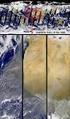
2 2. METHOD 2.1 MODIS Airborne Simulator (MAS) MAS is an imaging spectrometer flown on a NASA ER-2 aircraft. 5 It has 50 spectral bands ranging from the visible through the IR. Its pixels are 50m in spatial extent. An array of 440x440 MAS pixels were averaged to simulate a single 22km MOPITT pixel. MAS data was selected for this experiment from the Winter Cloud Experiment (WINCE) performed over the Wisconsin region in January and February Three MAS spectral bands were selected, two to match MOPITT bands and a third for visual cloud detection. These MAS bands are summarized in Table 1, taken from the WINCE campaign web site ( Table 1. MAS bands used to simulate MOPITT bands. All units are µm. MAS Band MAS Peak MAS Width at Half-Max MOPITT Center MOPITT Width (Solco) CO IR (cloud detection) N/A N/A The flight selected occurred on February 12, From this flight we selected track 6, which began at 18:24:28 and ended at 18:53:58 GMT. This track began over eastern Minnesota (clear sky), then continued above Lake Superior. Initially, the lake was ice covered with a small patch of clouds. As the flight proceeded east, the ice broke up into mostly open water, with some ice. Clouds appeared in appreciable amounts over the lake water. The flight was divided into 25 MOPITT pixels (440x440 MAS pixels), and analysis was performed on the cloudy pixels over water. An image of this section of the flight is presented in Figure 1. The pixels were numbered from 0 to 24, but only the last seven were analyzed. Figure 1. MAS data divided into MOPITT pixels over Lake Superior, February 12, :45 GMT. 2

3 Once these pixels were identified, each was analyzed independently. The cloud amount was estimated using a combination of methods. These methods ranged from creating histograms of the data (number of pixels versus radiance in various bands) to subjective guessing. The success of various methods depended on the contrast between cloudy pixels and the surface, as well as factors such as the homogeneity of the underlying surface. The average radiance of all the pixels was calculated, which was meant to simulate what MOPITT would have seen. The clear sky radiance was also estimated. The clear sky radiance was estimated to be the peak radiance of the histogram of solar CO (i.e. the most likely reflected radiance), and the warmest pixel in the thermal channel. Histograms of a MOPITT pixel (pixel 20) are presented as Figures 2 and 3. The histogram of the solar CO channel illustrates that the surface radiance is sharply peaked and easily identifiable. This peak radiance is selected to represent the clear sky radiance in the solar CO channel. The broad-peaked histogram of the thermal channel indicates that the radiances from the surface and the clouds blend together. Thus, distinguishing clouds from the cold lake surface radiometrically is nearly impossible. The radiance from the warmest pixel is selected to represent the clear sky radiance in the thermal channel. These radiances are presented in Table 2. Figure 2. Histogram of thermal MAS pixels within MOPITT pixel 20. Note how clouds form a continuous distribution with the surface. 3

4 Figure 3. Histogram of solar CO MAS pixels within MOPITT pixel 20. Note how identifiable the surface radiance peak is. Table 2. Average and s from MAS data and model calculations. Cloudiness is also estimated. MOPITT Pixel # % Cloud Average Model Average Model Clear sky radiances were calculated with the MOPABS 6 model. This model uses an absorption look-up table approach. It accounts for the contribution from H 2 O, CO 2, N 2 O, CO, and CH 4. The profiles of CO 2, O 3, and N 2 O are obtained from climatology. The profiles of CO and CH 4 were compiled from observations. The model derived clear sky radiances were calculated with input of the surface temperature set to 267K and the surface emissivity set to 0.98 for both IR bands. The atmospheric profiles of water vapor and temperature were obtained from a radiosonde released as part of the WINCE 7 campaign. The sonde was released approximately 10 minutes after the images were taken from a location approximately 400km south ( 'W, 'N at 19:06:34 GMT). It is unlikely that the lake surface temperature was actually 6K below freezing, but this parameter was the temperature closest to the surface reported by the sonde. It is assumed that the surface temperature contains the uncertainty of the emissivity and the possibility of subpixel contamination by floating ice. The model results, which were parameterized to the MOPITT wave bands, were adjusted to match the spectral response of the MAS data (See Table 1). The relative error of approximately 6% in the solar CO channel and from 0.25% to 4.6% in the thermal channel suggests that the model is adequate for operational use. It also adds confidence that clear pixels would not be erroneously 4

5 designated as cloudy. Since this experiment is an attempt to validate the MOPITT algorithm, rather than to actually determine the cloudiness of these pixels, all further calculations will treat the model calculations as the actual clear sky radiance. This will introduce model error into the analysis, with the advantage of being a more realistic scenario. 2.2 Cloud Detection Cloud detection is based on the premise that clouds will reflect more radiation in the solar CO channel and emit less thermal radiation than the surface. By how much clouds alter the radiation at the top of the atmosphere is highly variable. Certainly any fixed threshold applied globally to detect clouds will contain errors. Selecting the most appropriate thresholds to minimize this source of error is particularly challenging. This experiment tests the currently selected thresholds. The ratio of observed radiance to clear sky radiance is calculated (and referred to as the ratio test ). Also the difference between the clear sky radiance and the observed radiance is calculated ( difference test ). The ratio and difference tests are then compared to the pre-determined thresholds, which should indicate whether the pixel is cloudy or clear. The results of each of these tests are presented in Table 3. Since each pixel (except for one) exceeded the all thresholds set, these pixels would be classified as cloudy. Pixel 24 did not exceed the threshold set for cloudiness. However, the other three tests indicated that the pixel was cloudy. During operational MOPITT processing, if any one of these four tests indicates that a pixel is cloudy then it will be assumed to be cloudy. An attempt to radiometrically clear the effect of the clouds will be made before retrieval of CO or CH 4 is attempted on that pixel. Table 3. The ratio and difference tests compared to threshold values of cloudiness Pixel Number Ratio Ratio Threshold < 0.93 > 3.0 > 0.05 < ANALYSIS What is the minimum cloudiness that this technique could detect? To answer this question a much larger sample size of pixels would be required. The following analysis simply demonstrates the method and presents a rough approximate answer. The radiance is cast as a linear function of cloud amount: R obs = R cld f + R clr ( 1 f ). (1) R obs is the observed radiance, R cld and R clr are the cloudy and clear radiances respectively, and f is the cloud fraction. The ratio test can be represented as: And the difference test can be represented as: R obs /R clr = (R cld /R clr 1) f + 1. (2) R clr - R obs = (R clr - R cld ) f. (3) Both of these tests are linear functions of f, where the slope and intercept can be empirically calculated. The results are presented in Table 4 and Figure 4. 5

6 Figure 4. The ratio and difference tests for the thermal and solar CO bands as a function of cloud fraction. The solid line is the least-squares linear fit. The dashed line is the threshold. Note that the thermal ratio and solar CO difference tests would require a negative cloud fraction to register as clear pixels. Table 4. The derived slopes and intercepts of the various tests as a function of cloud fraction. The slope is in terms of cloud fraction (0-1) rather than percent (0-100). The threshold value is an estimate of the minimum cloudiness detectable by this method. Negative threshold values imply that any pixel (regardless of cloudiness) would have been classified as cloudy. Ratio Ratio Slope Intercept Threshold (%) Error Analysis 4. Conclusion This particular experiment stressed the cloud detection tests because the cold surface temperature reduced the contrast between clouds and the surface in the thermal channels. This could account for the poor performance of the thermal ratio test. Surprisingly, the thermal difference test proved to be one of the most sensitive. Perhaps the reason the thermal difference test was more successful than the thermal ratio test was the way model error (primarily due to uncertainty in the emissivity and surface temperature) is propagated through the test. The thermal difference test, as expressed in equation (3), indicates that model errors should be linear with cloud fraction. So at small cloud amounts, the error propagated to the difference should also be small. Whereas, errors in the model are not linear in the ratio test as written in equation (2). The solar CO tests were expected to perform better than the thermal tests, since the contrast between clear and cloudy MAS pixels was higher in this wave band. The solar CO ratio test did yield a more realistic threshold value than its thermal counterpart. Errors in the surface temperature and emissivity, propagated through model-calculated clear sky radiance, probably had a larger effect on the solar CO tests. As seen in Table 2, the model radiance is 6% higher than the observed clear sky radiance. 6

7 4.2 Prognosis for MOPITT These techniques appear quite adequate for detecting clouds under operational circumstances. Clearly, there will be some challenging scenes that any automated algorithm will fail. These tests also provided insight into the conservative nature of the selected thresholds. Under these conditions, it is more likely that clear pixels would be designated as cloudy than vice-versa. A bias in this direction will produce higher quality data in the initial stages of MOPITT production. ACKNOWLEDGEMENTS The National Aeronautics and Space Administration Earth Observing System (EOS) Program funded this work under contract NAS MAS data was provided by the NASA Goddard DAAC. The radiosonde profile was obtained from the WINCE web site. Thanks are offered to Liam Gumley for providing excellent access software to MAS data. Dave Grant and Dan Packman of the MOPITT team also provided assistance. REFERENCES 1. J. R. Drummond, Measurements Of Pollution In The Troposphere (MOPITT), The Use of EOS for Studies of Atmospheric Physics, J. C. Gille and G. Visconti, Eds., North-Holland, New York, pp , L. Pan, J. C. Gille, D. P. Edwards, P. Bailey, Retrieval of Tropospheric Carbon Monoxide for the MOPITT Experiment, JGR, 103:32,777-32,290, G. Asrar, J. Dozier, Science Strategy for the Earth Observing System, AIP Press, J. Warner, J. C. Gille, D. Edwards, P. Bailey, Cloud Detection and Clearing for the MOPITT Instrument, SPIE International Symposium on Optical Science, Engineering, and Instrumentation, Denver, L. E. Gumley, P. A. Hubanks, E. J. Masuoka, MODIS Airborne Simulator Level 1B Data User s Guide, NASA Technical Memorandum , Vol. 3, D. P. Edwards, C. Halvorson, J. C. Gille, Radiative Transfer Modeling for the EOS Terra Satellite Measurements Of Pollution In The Troposphere (MOPITT) Instrument, J. Geophys. Res., in press, S. A. Ackerman, C. C. Moeller, W. P. Menzel, J. D. Spinhirne, D. Hall, J. R. Wang, H. E. Revercomb, R. O. Knuteson, E. W. Eloranta, A. W. Nolin, and M. D. King, "WINCE, a winter cloud experiment", 10th Conference on Atmospheric Radiation, Madison, WI, AMS, June 26 - July 2,

Cloud detection and clearing for the MOPITT instrument
 Cloud detection and clearing for the MOPITT instrument Juying Warner, John Gille, David P. Edwards and Paul Bailey National Center for Atmospheric Research, Boulder, Colorado ABSTRACT The Measurement Of
Evaluation of the Effect of Upper-Level Cirrus Clouds on Satellite Retrievals of Low-Level Cloud Droplet Effective Radius
 Evaluation of the Effect of Upper-Level Cirrus Clouds on Satellite Retrievals of Low-Level Cloud Droplet Effective Radius F.-L. Chang and Z. Li Earth System Science Interdisciplinary Center University
Measurements Of Pollution In The Troposphere (MOPITT) NASA Langley ASDC Data Collection Guide
 Measurements Of Pollution In The Troposphere (MOPITT) NASA Langley ASDC Data Collection Guide Summary: The MOPITT data sets are designed to measure carbon monoxide (CO) and methane (CH 4 ) concentrations
SYNERGISTIC USE OF IMAGER WINDOW OBSERVATIONS FOR CLOUD- CLEARING OF SOUNDER OBSERVATION FOR INSAT-3D
 SYNERGISTIC USE OF IMAGER WINDOW OBSERVATIONS FOR CLOUD- CLEARING OF SOUNDER OBSERVATION FOR INSAT-3D ABSTRACT: Jyotirmayee Satapathy*, P.K. Thapliyal, M.V. Shukla, C. M. Kishtawal Atmospheric and Oceanic
Studying cloud properties from space using sounder data: A preparatory study for INSAT-3D
 Studying cloud properties from space using sounder data: A preparatory study for INSAT-3D Munn V. Shukla and P. K. Thapliyal Atmospheric Sciences Division Atmospheric and Oceanic Sciences Group Space Applications
Cloud Masking and Cloud Products
 Cloud Masking and Cloud Products MODIS Operational Algorithm MOD35 Paul Menzel, Steve Ackerman, Richard Frey, Kathy Strabala, Chris Moeller, Liam Gumley, Bryan Baum MODIS Cloud Masking Often done with
3.4 Cryosphere-related Algorithms
 3.4 Cryosphere-related Algorithms GLI Algorithm Description 3.4.-1 3.4.1 CTSK1 A. Algorithm Outline (1) Algorithm Code: CTSK1 (2) Product Code: CLFLG_p (3) PI Name: Dr. Knut Stamnes (4) Overview of Algorithm
Measurement of the effect of biomass burning aerosol on inhibition of cloud formation over the Amazon
 Supporting Online Material for Koren et al. Measurement of the effect of biomass burning aerosol on inhibition of cloud formation over the Amazon 1. MODIS new cloud detection algorithm The operational
A SURVEY OF CLOUD COVER OVER MĂGURELE, ROMANIA, USING CEILOMETER AND SATELLITE DATA
 Romanian Reports in Physics, Vol. 66, No. 3, P. 812 822, 2014 ATMOSPHERE PHYSICS A SURVEY OF CLOUD COVER OVER MĂGURELE, ROMANIA, USING CEILOMETER AND SATELLITE DATA S. STEFAN, I. UNGUREANU, C. GRIGORAS
Passive Remote Sensing of Clouds from Airborne Platforms
 Passive Remote Sensing of Clouds from Airborne Platforms Why airborne measurements? My instrument: the Solar Spectral Flux Radiometer (SSFR) Some spectrometry/radiometry basics How can we infer cloud properties
ARM SWS to study cloud drop size within the clear-cloud transition zone
 ARM SWS to study cloud drop size within the clear-cloud transition zone (GSFC) Yuri Knyazikhin Boston University Christine Chiu University of Reading Warren Wiscombe GSFC Thanks to Peter Pilewskie (UC)
Comparison of NOAA's Operational AVHRR Derived Cloud Amount to other Satellite Derived Cloud Climatologies.
 Comparison of NOAA's Operational AVHRR Derived Cloud Amount to other Satellite Derived Cloud Climatologies. Sarah M. Thomas University of Wisconsin, Cooperative Institute for Meteorological Satellite Studies
Clouds and the Energy Cycle
 August 1999 NF-207 The Earth Science Enterprise Series These articles discuss Earth's many dynamic processes and their interactions Clouds and the Energy Cycle he study of clouds, where they occur, and
Labs in Bologna & Potenza Menzel. Lab 3 Interrogating AIRS Data and Exploring Spectral Properties of Clouds and Moisture
 Labs in Bologna & Potenza Menzel Lab 3 Interrogating AIRS Data and Exploring Spectral Properties of Clouds and Moisture Figure 1: High resolution atmospheric absorption spectrum and comparative blackbody
Assessing Cloud Spatial and Vertical Distribution with Infrared Cloud Analyzer
 Assessing Cloud Spatial and Vertical Distribution with Infrared Cloud Analyzer I. Genkova and C. N. Long Pacific Northwest National Laboratory Richland, Washington T. Besnard ATMOS SARL Le Mans, France
Hyperspectral Satellite Imaging Planning a Mission
 Hyperspectral Satellite Imaging Planning a Mission Victor Gardner University of Maryland 2007 AIAA Region 1 Mid-Atlantic Student Conference National Institute of Aerospace, Langley, VA Outline Objective
RESULTS FROM A SIMPLE INFRARED CLOUD DETECTOR
 RESULTS FROM A SIMPLE INFRARED CLOUD DETECTOR A. Maghrabi 1 and R. Clay 2 1 Institute of Astronomical and Geophysical Research, King Abdulaziz City For Science and Technology, P.O. Box 6086 Riyadh 11442,
The Next Generation Flux Analysis: Adding Clear-Sky LW and LW Cloud Effects, Cloud Optical Depths, and Improved Sky Cover Estimates
 The Next Generation Flux Analysis: Adding Clear-Sky LW and LW Cloud Effects, Cloud Optical Depths, and Improved Sky Cover Estimates C. N. Long Pacific Northwest National Laboratory Richland, Washington
ECMWF Aerosol and Cloud Detection Software. User Guide. version 1.2 20/01/2015. Reima Eresmaa ECMWF
 ECMWF Aerosol and Cloud User Guide version 1.2 20/01/2015 Reima Eresmaa ECMWF This documentation was developed within the context of the EUMETSAT Satellite Application Facility on Numerical Weather Prediction
How To Understand Cloud Properties From Satellite Imagery
 P1.70 NIGHTTIME RETRIEVAL OF CLOUD MICROPHYSICAL PROPERTIES FOR GOES-R Patrick W. Heck * Cooperative Institute for Meteorological Satellite Studies, University of Wisconsin-Madison Madison, Wisconsin P.
Clear Sky Radiance (CSR) Product from MTSAT-1R. UESAWA Daisaku* Abstract
 Clear Sky Radiance (CSR) Product from MTSAT-1R UESAWA Daisaku* Abstract The Meteorological Satellite Center (MSC) has developed a Clear Sky Radiance (CSR) product from MTSAT-1R and has been disseminating
ESCI 107/109 The Atmosphere Lesson 2 Solar and Terrestrial Radiation
 ESCI 107/109 The Atmosphere Lesson 2 Solar and Terrestrial Radiation Reading: Meteorology Today, Chapters 2 and 3 EARTH-SUN GEOMETRY The Earth has an elliptical orbit around the sun The average Earth-Sun
CERES Edition 2 & Edition 3 Cloud Cover, Cloud Altitude and Temperature
 CERES Edition 2 & Edition 3 Cloud Cover, Cloud Altitude and Temperature S. Sun-Mack 1, P. Minnis 2, Y. Chen 1, R. Smith 1, Q. Z. Trepte 1, F. -L. Chang, D. Winker 2 (1) SSAI, Hampton, VA (2) NASA Langley
GOES-R AWG Cloud Team: ABI Cloud Height
 GOES-R AWG Cloud Team: ABI Cloud Height June 8, 2010 Presented By: Andrew Heidinger 1 1 NOAA/NESDIS/STAR 1 Outline Executive Summary Algorithm Description ADEB and IV&V Response Summary Requirements Specification
Estimating Firn Emissivity, from 1994 to1998, at the Ski Hi Automatic Weather Station on the West Antarctic Ice Sheet Using Passive Microwave Data
 Estimating Firn Emissivity, from 1994 to1998, at the Ski Hi Automatic Weather Station on the West Antarctic Ice Sheet Using Passive Microwave Data Mentor: Dr. Malcolm LeCompte Elizabeth City State University
Overview of the IR channels and their applications
 Ján Kaňák Slovak Hydrometeorological Institute [email protected] Overview of the IR channels and their applications EUMeTrain, 14 June 2011 Ján Kaňák, SHMÚ 1 Basics in satellite Infrared image interpretation
APPLICATION OF TERRA/ASTER DATA ON AGRICULTURE LAND MAPPING. Genya SAITO*, Naoki ISHITSUKA*, Yoneharu MATANO**, and Masatane KATO***
 APPLICATION OF TERRA/ASTER DATA ON AGRICULTURE LAND MAPPING Genya SAITO*, Naoki ISHITSUKA*, Yoneharu MATANO**, and Masatane KATO*** *National Institute for Agro-Environmental Sciences 3-1-3 Kannondai Tsukuba
ATM S 111, Global Warming: Understanding the Forecast
 ATM S 111, Global Warming: Understanding the Forecast DARGAN M. W. FRIERSON DEPARTMENT OF ATMOSPHERIC SCIENCES DAY 1: OCTOBER 1, 2015 Outline How exactly the Sun heats the Earth How strong? Important concept
Treasure Hunt. Lecture 2 How does Light Interact with the Environment? EMR Principles and Properties. EMR and Remote Sensing
 Lecture 2 How does Light Interact with the Environment? Treasure Hunt Find and scan all 11 QR codes Choose one to watch / read in detail Post the key points as a reaction to http://www.scoop.it/t/env202-502-w2
Assimilation of cloudy infrared satellite observations: The Met Office perspective
 Assimilation of cloudy infrared satellite observations: The Met Office perspective Ed Pavelin, Met Office International Symposium on Data Assimilation 2014, Munich Contents This presentation covers the
Remote Sensing of Contrails and Aircraft Altered Cirrus Clouds
 Remote Sensing of Contrails and Aircraft Altered Cirrus Clouds R. Palikonda 1, P. Minnis 2, L. Nguyen 1, D. P. Garber 1, W. L. Smith, r. 1, D. F. Young 2 1 Analytical Services and Materials, Inc. Hampton,
Corso di Fisica Te T cnica Ambientale Solar Radiation
 Solar Radiation Solar radiation i The Sun The Sun is the primary natural energy source for our planet. It has a diameter D = 1.39x10 6 km and a mass M = 1.989x10 30 kg and it is constituted by 1/3 of He
REMOTE SENSING OF CLOUD-AEROSOL RADIATIVE EFFECTS FROM SATELLITE DATA: A CASE STUDY OVER THE SOUTH OF PORTUGAL
 REMOTE SENSING OF CLOUD-AEROSOL RADIATIVE EFFECTS FROM SATELLITE DATA: A CASE STUDY OVER THE SOUTH OF PORTUGAL D. Santos (1), M. J. Costa (1,2), D. Bortoli (1,3) and A. M. Silva (1,2) (1) Évora Geophysics
CLOUD TOP PROPERTIES AND CLOUD PHASE ALGORITHM THEORETICAL BASIS DOCUMENT
 CLOUD TOP PROPERTIES AND CLOUD PHASE ALGORITHM THEORETICAL BASIS DOCUMENT W. Paul Menzel Cooperative Institute for Meteorological Satellite Studies University of Wisconsin Madison Richard A. Frey Cooperative
A comparison of NOAA/AVHRR derived cloud amount with MODIS and surface observation
 A comparison of NOAA/AVHRR derived cloud amount with MODIS and surface observation LIU Jian YANG Xiaofeng and CUI Peng National Satellite Meteorological Center, CMA, CHINA outline 1. Introduction 2. Data
An Airborne A-Band Spectrometer for Remote Sensing Of Aerosol and Cloud Optical Properties
 An Airborne A-Band Spectrometer for Remote Sensing Of Aerosol and Cloud Optical Properties Michael Pitts, Chris Hostetler, Lamont Poole, Carl Holden, and Didier Rault NASA Langley Research Center, MS 435,
A review of cloud top height and optical depth histograms from MISR, ISCCP, and MODIS
 JOURNAL OF GEOPHYSICAL RESEARCH, VOL. 115,, doi:10.1029/2009jd013422, 2010 A review of cloud top height and optical depth histograms from MISR, ISCCP, and MODIS Roger Marchand, 1 Thomas Ackerman, 1 Mike
Evaluating GCM clouds using instrument simulators
 Evaluating GCM clouds using instrument simulators University of Washington September 24, 2009 Why do we care about evaluation of clouds in GCMs? General Circulation Models (GCMs) project future climate
Received in revised form 24 March 2004; accepted 30 March 2004
 Remote Sensing of Environment 91 (2004) 237 242 www.elsevier.com/locate/rse Cloud detection in Landsat imagery of ice sheets using shadow matching technique and automatic normalized difference snow index
SATELLITE IMAGES IN ENVIRONMENTAL DATA PROCESSING
 SATELLITE IMAGES IN ENVIRONMENTAL DATA PROCESSING Magdaléna Kolínová Aleš Procházka Martin Slavík Prague Institute of Chemical Technology Department of Computing and Control Engineering Technická 95, 66
Remote Sensing of Clouds from Polarization
 Remote Sensing of Clouds from Polarization What polarization can tell us about clouds... and what not? J. Riedi Laboratoire d'optique Atmosphérique University of Science and Technology Lille / CNRS FRANCE
Towards assimilating IASI satellite observations over cold surfaces - the cloud detection aspect
 Towards assimilating IASI satellite observations over cold surfaces - the cloud detection aspect Tuuli Perttula, FMI + Thanks to: Nadia Fourrié, Lydie Lavanant, Florence Rabier and Vincent Guidard, Météo
DISCRIMINATING CLEAR-SKY FROM CLOUD WITH MODIS ALGORITHM THEORETICAL BASIS DOCUMENT (MOD35) MODIS Cloud Mask Team
 DISCRIMINATING CLEAR-SKY FROM CLOUD WITH MODIS ALGORITHM THEORETICAL BASIS DOCUMENT (MOD35) MODIS Cloud Mask Team Steve Ackerman, Richard Frey, Kathleen Strabala, Yinghui Liu, Liam Gumley, Bryan Baum,
IMPACT OF DRIZZLE AND 3D CLOUD STRUCTURE ON REMOTE SENSING OF CLOUD EFFECTIVE RADIUS
 IMPACT OF DRIZZLE AND 3D CLOUD STRUCTURE ON REMOTE SENSING OF CLOUD EFFECTIVE RADIUS Tobias Zinner 1, Gala Wind 2, Steven Platnick 2, Andy Ackerman 3 1 Deutsches Zentrum für Luft- und Raumfahrt (DLR) Oberpfaffenhofen,
Interactive comment on Total cloud cover from satellite observations and climate models by P. Probst et al.
 Interactive comment on Total cloud cover from satellite observations and climate models by P. Probst et al. Anonymous Referee #1 (Received and published: 20 October 2010) The paper compares CMIP3 model
Global Moderate Resolution Imaging Spectroradiometer (MODIS) cloud detection and height evaluation using CALIOP
 Click Here for Full Article JOURNAL OF GEOPHYSICAL RESEARCH, VOL. 113,, doi:10.1029/2008jd009837, 2008 Global Moderate Resolution Imaging Spectroradiometer (MODIS) cloud detection and height evaluation
Diurnal Cycle: Cloud Base Height clear sky
 Diurnal Cycle: Cloud Base Height clear sky Helsinki CNN I Madrid, 16 Dezember 2002 1 Cabauw Geesthacht Cabauw Geesthacht Helsinki Helsinki Petersburg Potsdam Petersburg Potsdam CNN I CNN II Madrid, 16
Satellite Remote Sensing of Volcanic Ash
 Marco Fulle www.stromboli.net Satellite Remote Sensing of Volcanic Ash Michael Pavolonis NOAA/NESDIS/STAR SCOPE Nowcasting 1 Meeting November 19 22, 2013 1 Outline Getty Images Volcanic ash satellite remote
Absorption of solar radiation by the cloudy atmosphere: Further interpretations of collocated aircraft measurements
 JOURNAL OF GEOPHYSICAL RESEARCH, VOL. 104, NO. D2, PAGES 2059 2066, JANUARY 27, 1999 Absorption of solar radiation by the cloudy atmosphere: Further interpretations of collocated aircraft measurements
Automated Spacecraft Scheduling The ASTER Example
 Automated Spacecraft Scheduling The ASTER Example Ron Cohen [email protected] Ground System Architectures Workshop 2002 Jet Propulsion Laboratory The Concept Scheduling by software instead of
Fundamentals of Climate Change (PCC 587): Water Vapor
 Fundamentals of Climate Change (PCC 587): Water Vapor DARGAN M. W. FRIERSON UNIVERSITY OF WASHINGTON, DEPARTMENT OF ATMOSPHERIC SCIENCES DAY 2: 9/30/13 Water Water is a remarkable molecule Water vapor
Technical note on MISR Cloud-Top-Height Optical-depth (CTH-OD) joint histogram product
 Technical note on MISR Cloud-Top-Height Optical-depth (CTH-OD) joint histogram product 1. Intend of this document and POC 1.a) General purpose The MISR CTH-OD product contains 2D histograms (joint distributions)
T.A. Tarasova, and C.A.Nobre
 SEASONAL VARIATIONS OF SURFACE SOLAR IRRADIANCES UNDER CLEAR-SKIES AND CLOUD COVER OBTAINED FROM LONG-TERM SOLAR RADIATION MEASUREMENTS IN THE RONDONIA REGION OF BRAZIL T.A. Tarasova, and C.A.Nobre Centro
High Resolution Information from Seven Years of ASTER Data
 High Resolution Information from Seven Years of ASTER Data Anna Colvin Michigan Technological University Department of Geological and Mining Engineering and Sciences Outline Part I ASTER mission Terra
Improvement in the Assessment of SIRS Broadband Longwave Radiation Data Quality
 Improvement in the Assessment of SIRS Broadband Longwave Radiation Data Quality M. E. Splitt University of Utah Salt Lake City, Utah C. P. Bahrmann Cooperative Institute for Meteorological Satellite Studies
Validation of SEVIRI cloud-top height retrievals from A-Train data
 Validation of SEVIRI cloud-top height retrievals from A-Train data Chu-Yong Chung, Pete N Francis, and Roger Saunders Contents Introduction MO GeoCloud AVAC-S Long-term monitoring Comparison with OCA Summary
What the Heck are Low-Cloud Feedbacks? Takanobu Yamaguchi Rachel R. McCrary Anna B. Harper
 What the Heck are Low-Cloud Feedbacks? Takanobu Yamaguchi Rachel R. McCrary Anna B. Harper IPCC Cloud feedbacks remain the largest source of uncertainty. Roadmap 1. Low cloud primer 2. Radiation and low
16 th IOCCG Committee annual meeting. Plymouth, UK 15 17 February 2011. mission: Present status and near future
 16 th IOCCG Committee annual meeting Plymouth, UK 15 17 February 2011 The Meteor 3M Mt satellite mission: Present status and near future plans MISSION AIMS Satellites of the series METEOR M M are purposed
Cloud Climatology for New Zealand and Implications for Radiation Fields
 Cloud Climatology for New Zealand and Implications for Radiation Fields G. Pfister, R.L. McKenzie, J.B. Liley, A. Thomas National Institute of Water and Atmospheric Research, Lauder, New Zealand M.J. Uddstrom
Sky Monitoring Techniques using Thermal Infrared Sensors. sabino piazzolla Optical Communications Group JPL
 Sky Monitoring Techniques using Thermal Infrared Sensors sabino piazzolla Optical Communications Group JPL Atmospheric Monitoring The atmospheric channel has a great impact on the channel capacity at optical
Sensitivity of Surface Cloud Radiative Forcing to Arctic Cloud Properties
 Sensitivity of Surface Cloud Radiative Forcing to Arctic Cloud Properties J. M. Intrieri National Oceanic and Atmospheric Administration Environmental Technology Laboratory Boulder, Colorado M. D. Shupe
Landsat 7 Automatic Cloud Cover Assessment
 Landsat 7 Automatic Cloud Cover Assessment Richard R. Irish Science Systems and Applications, Inc. NASA s Goddard Space Flight Center, Greenbelt, Maryland ABSTRACT An automatic cloud cover assessment algorithm
Electromagnetic Radiation (EMR) and Remote Sensing
 Electromagnetic Radiation (EMR) and Remote Sensing 1 Atmosphere Anything missing in between? Electromagnetic Radiation (EMR) is radiated by atomic particles at the source (the Sun), propagates through
SAFNWC/MSG Cloud type/height. Application for fog/low cloud situations
 SAFNWC/MSG Cloud type/height. Application for fog/low cloud situations 22 September 2011 Hervé LE GLEAU, Marcel DERRIEN Centre de météorologie Spatiale. Lannion Météo-France 1 Fog or low level clouds?
Ocean Level-3 Standard Mapped Image Products June 4, 2010
 Ocean Level-3 Standard Mapped Image Products June 4, 2010 1.0 Introduction This document describes the specifications of Ocean Level-3 standard mapped archive products that are produced and distributed
WATER BODY EXTRACTION FROM MULTI SPECTRAL IMAGE BY SPECTRAL PATTERN ANALYSIS
 WATER BODY EXTRACTION FROM MULTI SPECTRAL IMAGE BY SPECTRAL PATTERN ANALYSIS Nguyen Dinh Duong Department of Environmental Information Study and Analysis, Institute of Geography, 18 Hoang Quoc Viet Rd.,
Discriminating clear sky from clouds with MODIS
 JOURNAL OF GEOPHYSICAL RESEARCH, VOL. 103, NO. D24, PAGES 32,141-32,157, DECEMBER 27, 1998 Discriminating clear sky from clouds with MODIS Steven A. Ackerman, Kathleen I. Strabala, 2 W. Paul Menzel, 3
163 ANALYSIS OF THE URBAN HEAT ISLAND EFFECT COMPARISON OF GROUND-BASED AND REMOTELY SENSED TEMPERATURE OBSERVATIONS
 ANALYSIS OF THE URBAN HEAT ISLAND EFFECT COMPARISON OF GROUND-BASED AND REMOTELY SENSED TEMPERATURE OBSERVATIONS Rita Pongrácz *, Judit Bartholy, Enikő Lelovics, Zsuzsanna Dezső Eötvös Loránd University,
CrIS L1B Project Status
 CrIS L1B Project Status Graeme Martin 1, Hank Revercomb 1, Larrabee Strow 2, Dave Tobin 1, Howard Moteller 2, Liam Gumley 1, Ray Garcia 1, Greg Quinn 1, Joe Taylor 1, Coda Phillips 1, Bob Knuteson 1, Jessica
The Surface Energy Budget
 The Surface Energy Budget The radiation (R) budget Shortwave (solar) Radiation Longwave Radiation R SW R SW α α = surface albedo R LW εσt 4 ε = emissivity σ = Stefan-Boltzman constant T = temperature Subsurface
Stratosphere-Troposphere Exchange in the Tropics. Masatomo Fujiwara Hokkaido University, Japan (14 March 2006)
 Stratosphere-Troposphere Exchange in the Tropics Masatomo Fujiwara Hokkaido University, Japan (14 March 2006) Contents 1. Structure of Tropical Atmosphere 2. Water Vapor in the Stratosphere 3. General
Advances in Cloud Imager Remote Sensing
 Advances in Cloud Imager Remote Sensing Andrew Heidinger NOAA/NESDIS/ORA Madison, Wisconsin With material from Mike Pavolonis, Robert Holz, Amato Evan and Fred Nagle STAR Science Symposium November 9,
DISCRIMINATING CLEAR-SKY FROM CLOUD WITH MODIS ALGORITHM THEORETICAL BASIS DOCUMENT (MOD35) MODIS Cloud Mask Team
 DISCRIMINATING CLEAR-SKY FROM CLOUD WITH MODIS ALGORITHM THEORETICAL BASIS DOCUMENT (MOD35) MODIS Cloud Mask Team Steve Ackerman 1, Kathleen Strabala 1, Paul Menzel 1,2, Richard Frey 1, Chris Moeller 1,
Total radiative heating/cooling rates.
 Lecture. Total radiative heating/cooling rates. Objectives:. Solar heating rates.. Total radiative heating/cooling rates in a cloudy atmosphere.. Total radiative heating/cooling rates in different aerosol-laden
Overview. What is EMR? Electromagnetic Radiation (EMR) LA502 Special Studies Remote Sensing
 LA502 Special Studies Remote Sensing Electromagnetic Radiation (EMR) Dr. Ragab Khalil Department of Landscape Architecture Faculty of Environmental Design King AbdulAziz University Room 103 Overview What
CALCULATION OF CLOUD MOTION WIND WITH GMS-5 IMAGES IN CHINA. Satellite Meteorological Center Beijing 100081, China ABSTRACT
 CALCULATION OF CLOUD MOTION WIND WITH GMS-5 IMAGES IN CHINA Xu Jianmin Zhang Qisong Satellite Meteorological Center Beijing 100081, China ABSTRACT With GMS-5 images, cloud motion wind was calculated. For
Retrieval of cloud spherical albedo from top-of-atmosphere reflectance measurements performed at a single observation angle
 Atmos. Chem. Phys., 7, 3633 3637, 2007 Author(s) 2007. This work is licensed under a Creative Commons License. Atmospheric Chemistry and Physics Retrieval of cloud from top-of-atmosphere reflectance measurements
Generation of Cloud-free Imagery Using Landsat-8
 Generation of Cloud-free Imagery Using Landsat-8 Byeonghee Kim 1, Youkyung Han 2, Yonghyun Kim 3, Yongil Kim 4 Department of Civil and Environmental Engineering, Seoul National University (SNU), Seoul,
Saharan Dust Aerosols Detection Over the Region of Puerto Rico
 1 Saharan Dust Aerosols Detection Over the Region of Puerto Rico ARLENYS RAMÍREZ University of Puerto Rico at Mayagüez, P.R., 00683. Email:[email protected] ABSTRACT. Every year during the months
A remote sensing instrument collects information about an object or phenomenon within the
 Satellite Remote Sensing GE 4150- Natural Hazards Some slides taken from Ann Maclean: Introduction to Digital Image Processing Remote Sensing the art, science, and technology of obtaining reliable information
The Sentinel-4/UVN instrument on-board MTG-S
 The Sentinel-4/UVN instrument on-board MTG-S Grégory Bazalgette Courrèges-Lacoste; Berit Ahlers; Benedikt Guldimann; Alex Short; Ben Veihelmann, Hendrik Stark ESA ESTEC European Space Technology & Research
Cloud Thickness Estimation from GOES-8 Satellite Data Over the ARM-SGP Site
 Cloud Thickness Estimation from GOES-8 Satellite Data Over the ARM-SGP Site V. Chakrapani, D. R. Doelling, and A. D. Rapp Analytical Services and Materials, Inc. Hampton, Virginia P. Minnis National Aeronautics
Obtaining and Processing MODIS Data
 Obtaining and Processing MODIS Data MODIS is an extensive program using sensors on two satellites that each provide complete daily coverage of the earth. The data have a variety of resolutions; spectral,
Trace Gas Exchange Measurements with Standard Infrared Analyzers
 Practical Environmental Measurement Methods Trace Gas Exchange Measurements with Standard Infrared Analyzers Last change of document: February 23, 2007 Supervisor: Charles Robert Room no: S 4381 ph: 4352
SAMPLE MIDTERM QUESTIONS
 Geography 309 Sample MidTerm Questions Page 1 SAMPLE MIDTERM QUESTIONS Textbook Questions Chapter 1 Questions 4, 5, 6, Chapter 2 Questions 4, 7, 10 Chapter 4 Questions 8, 9 Chapter 10 Questions 1, 4, 7