
Saharan Dust Aerosols Detection Over the Region of Puerto Rico
|
|
|
- Rachel Watts
- 10 years ago
- Views:
Transcription
1 1 Saharan Dust Aerosols Detection Over the Region of Puerto Rico ARLENYS RAMÍREZ University of Puerto Rico at Mayagüez, P.R., ABSTRACT. Every year during the months of late May through August, aerosol from the Saharan desert travel across the Atlantic Ocean to the Caribbean, reaching the region of Puerto Rico. In this research we used satellite images from the Moderate Resolution Imaging Spectro Radiometer (MODIS) and applied the Brightness Temperature Difference (BTD)algorithm to detect the presence of saharan dust aerosol over the region of Puerto Rico (Lat ; Lon.-64.0, -69.0). We used Aqua MODIS Atmosphere Level 2, products images of 1km of spatial resolution for the months of June, July and August of the years of 2011,2012, Images were also processed using the SEADAS software as an alternative technique to identify aerosols from satellite images. Then we validated these observations with ground-based data using the AOD at 440nm from the Aerosol Robotic Network(AERONET) station of La Parguera (18.0,-67.0). Results for this research were different to the ones expected, since for our study region, non of the two techniques applied in this research were found to be effective for the identification of the dust aerosols due to the presence of clouds in the images. In general BTD is very simple to calculate however there is confusion for images where clouds are present. From the AERONET data we observed that there is a variation in the amount of aerosols presence in the air. Since monthly average values were always higher for the month of June, than for the months of July and August, for the three years studied. Finally there is not a significant difference in the amount of aerosols that reached the region of Puerto Rico (at least in the last three years); since the maximum value (0.27) of AOT between the three years appears in 2012 with a difference 0.03 (3%) from 2013 which was the second year with the higher. AOT value (0.24). KEYWORDS. MODIS, AERONET, AOD INTRODUCTION The Saharan Desert is the largest source of dust aerosols in the world and accounts approximately half of the dust supplied to the oceans (Christopher and Jones 2010). During the months of April though October, trade winds with enough speeds raises sediments from the ground up to ~5 km above the surface, making it easy for long-range transport of the dust particles over the Atlantic Ocean, and other regions as far as the Amazon. Transportation of the dust particles can take approximately from 5 to 7 days in arrive to the Caribbean, and it varies from season to season (Christopher and Jones 2010). The dust particles sizes varies with distance, with larger particles deposited near the source region, while smaller particles deposited along the Atlantic Ocean and the Caribbean (Christopher and Jones, 2010). Particles of the Saharan dust are mainly composed of silica with varying concentrations of other components, ranging from 0.1m to 10 m in radius size (Tegen and Lacis, 1996). Dust aerosols from the Saharan Desert have extensive local and regional impacts. Such as serving as a nutrient source for the oceans, modifying rainfall, affecting storms activities, affecting regional climate, algal blooms, and human health by changes in the air quality (Anunforom et al., 2007; Sassen et al., 2003; Longueville et al., 2010; Christopher and Jones, 2010; Goudie and Middleton, 2001). For that reason, during the last decade, the use of satellite techniques to the study of Saharan dust has become very popular. Since it is possible to track
2 the dust aerosols path over a wide range. Based on this approach we wanted to answer the question if there was a significant difference in the amount of aerosols that have arrived to the island in the past three years? To answer this question we used a simple methodology that will be discussed later. DATA AND METHODS During the last two decades remote sensing satellite data has been used to the observation and detection of dust aerosols. There are a few methods like the ones shown by Sundar and Jones (2010) and Baddock et al., (2009) which are techniques applied for providing information on dust detection over a region using different algorithms and the Moderate Resolution Imaging Spectroradiometer (MODIS). However, in this study we used a simple methodology consisting of the brightness temperature difference (BTD) using the bands 8 and 11 of MODIS combined with ground-based observations in order to validate the satellite images observations. We used satellite images from MODIS and ground-based measurements from the Aerosol Robotic Network (AERONET), to observe, detect, and compare the presence of saharan dust over the region of Puerto Rico. The objectives of this research were to observe and detect dust aerosols from the Sahara Desert in satellite images. Process and analyze images from different dates (June-August 2011,2012,2013) from the region of Puerto Rico. Finally estimate the concentration of dust aerosols from these dates and compare them. Satellite images were obtained from the MODIS AQUA sensor, from the period of June-August, , MODIS Level 2 (1km), Brightness Temperature images from the MODIS 5.1 collection, were downloaded from the National Aeronautics and Space Administration center (NASA) website MODIS is an instrument that provides high radiometric sensitivity in 36 spectral bands in wavelength from 0.4m to 11.4 m. It was launched onboard of the (EOS AM-1) platform, Terra on December 1999 and MODIS-Aqua on MODIS-Terra orbits the earth in the morning from 2 north to south across the equator, whereas MODIS- Aqua orbits the earth from south to north over the equator in the afternoon. For the dates used in this research, images with high amount of cloud or sun-glint were discarded. Then georeferencing, and spatial & spectral subsets were applied to each one of the images selected the images using the ENVI software, in order to select our study region (The region of Puerto Rico N,63.0,69.0w). Then in order to obtain the processed images, we manually applied into the ENVI software the Brightness Temperature Difference (BTD) BT D = BT 8 BT 11, where BT 8 is the brightness temperature at the band 8 and BT 11 is the brightness temperature at the band 11. Finally ground-based data was used to validated the results from images. We used the AERONET data from the station of La Parguera (18N,67W) with the parameter of Aerosol Optical Depth 440nm in order to detect the presence of dust aerosols in the study region. Images were also processed using the SEADAS software as an alternative technique to identify aerosols from satellite images. AERONET As mentioned before we use data from the AERONET at La Parguera (18N,67W) along with Level 2 Aqua-MODIS Brightness Temperature images from June, July, and August 2011, 2012 and The AERONET is a federation of ground-based remote sensing aerosol networks that was established by NASA and expanded by other collaborators. AERONET provides globally distributed observations of spectral aerosol optical depth (AOD). AOD or Aerosol Optical Tickness (AOT) is a degree to which aerosols prevents the transmission of light. Being a value <0.1 a crystal clear sky, and a value of 4 indicating high concentration of aerosols therefore is difficult to see the sun. Data for the aerosol optical depth are computed for three data quality levels: 1.0, 1.5 and 2.0. Level 2.0 data. products contains pre and post field calibration applied with cloud-screened data as well as AOD processing of fine and coarse mode AOD fine mode fraction. The Data is submitted every 24 hrs via satellite to the central centre and

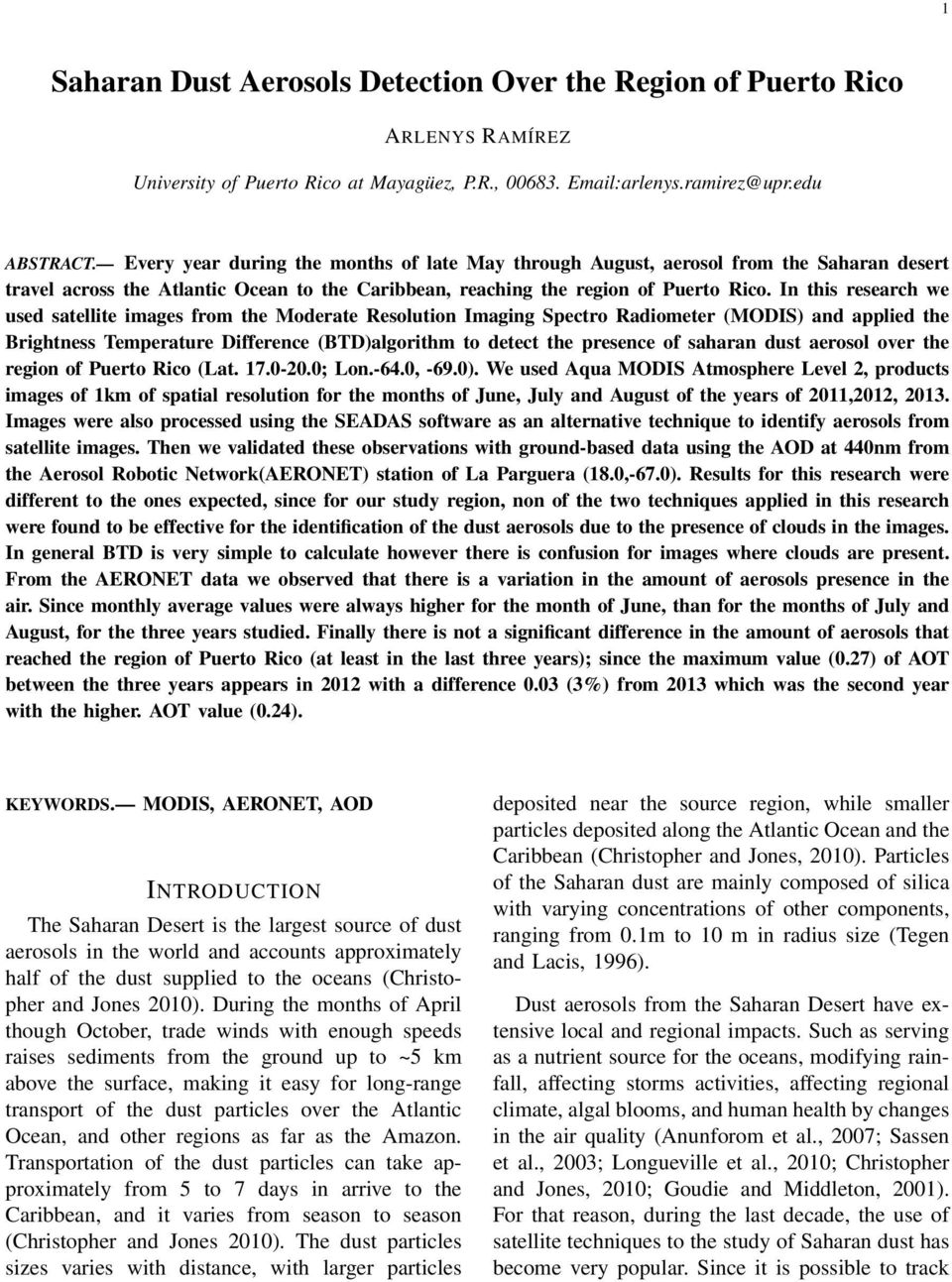
3 is available through the AERONET homepage at An important online analysis tool available that is available through AERONET is the Data Synergy Tool, which provides access to MODIS images and data. BRIGHTNESS TEMPERATURE DIFFERENCE The Brightness temperature difference (BTD) is a straightforward method that according to Baddock et al., 2009, is commonly used for the detection of both dust plume and source detection. Even thought this method is commonly applied to these type of research, these procedure does not appear to be very sensitive to observed the mineralogical variabilities between plumes and dust. Another disadvantage is that since there is no definition of dust/non dust, the data become subjective and can suffer from cloud cover elimination. Baddock et al., 2009 recommend that when applying this algorithm there should be a good understanding about the mineralogy of the aerosols and also an understanding of how and why ground surface characteristics may vary. FIG. 1. Images from The first set of images are from June 21, The second set of images are from July 18, 2011 and the thrid set of images are from August 1, All of the sets shows true color images (Left), and processed Image (Right). Red Colors indicate higher values. RESULTS Due to limitations with the MODIS images, not all the images that were intended to be used were used since there were a lot of images containing sunglint and clouds. Here we present the results form the images that were selected. 3 FIG. 2. Images from The first set of images are from June 26, The second set of images are from July 1, 2012 and the thrid set of images are from August 1, All of the sets shows true color images (Left), and processed Image (Right).Red Colors indicate higher values.

4 FIG. 4. Shows the AERONET data for AOT at 440nm from La Parguera for June, July and August Values in this scale goes from 0 to 4, where the values <0.1 indicate clear sky, whereas values of 4 indicates high concentrations of aerosols. Note that the highest pick ocurred during the month of June FIG. 3. Images from The first set of images are from June 21, The second set of images are from July 5, 2013 and the thrid set of images are from August 1, All of the sets shows true color images (Left), and processed Image (Right). Red Colors indicate higher values. Here we present the data that we obtained from the AERONET station of La Parguera, Puerto Rico for the diferent dates under study. 4 FIG. 5. Shows the AERONET data for AOT at 440nm from La Parguera for June, July and August Values in this scale goes from 0 to 4, where the values <0.1 indicate clear sky, whereas values of 4 indicates high concentrations of aerosols. Note that the highest pick ocurred during the month of July 2012.

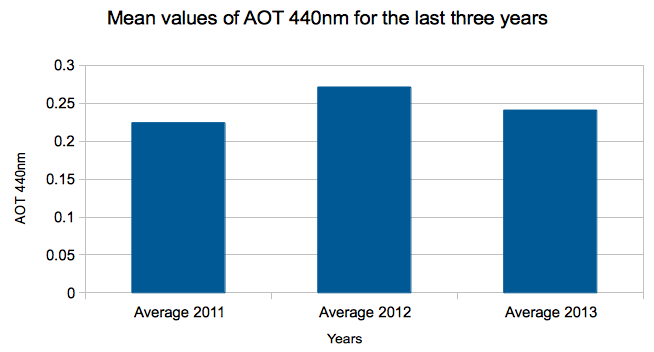
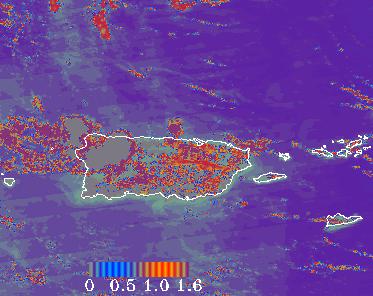
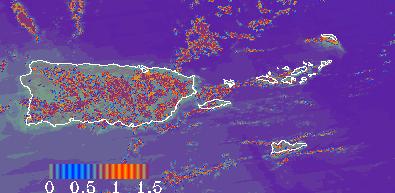
5 FIG. 7. Monthly mean values of Aerosol Optical Thickness. FIG. 6. Shows the AERONET data for AOT at 440nm from La Parguera for June, July and August Values in this scale goes from 0 to 4, where the values <0.1 indicate clear sky, whereas values of 4 indicates high concentrations of aerosols. Note that the highest pick ocurred during the month of July FIG. 8. Mean values of Aerosol Optical Thickness for June, July and Agoust the las three years. Note the higher values where in the year 2012.
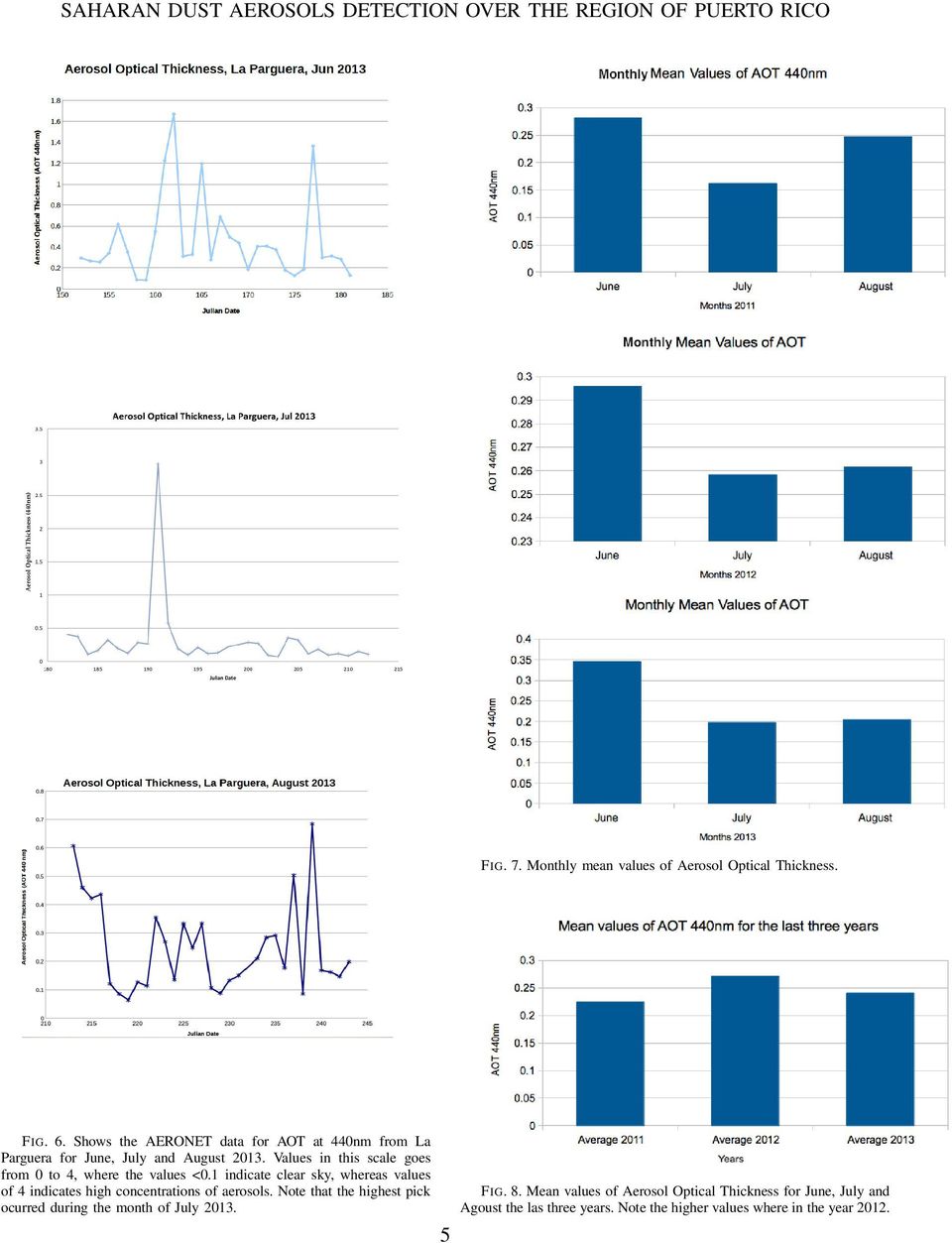
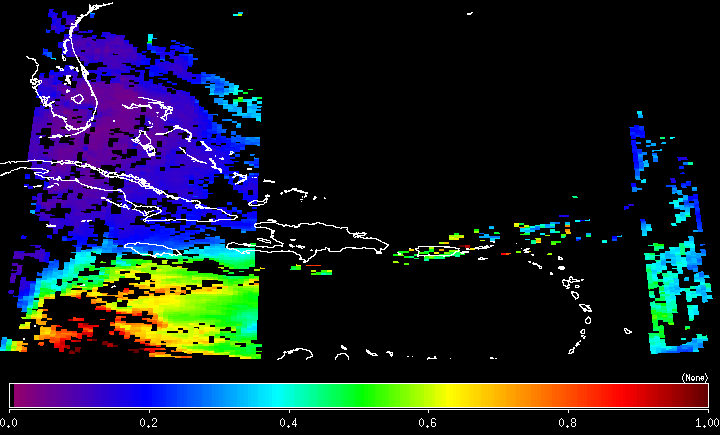
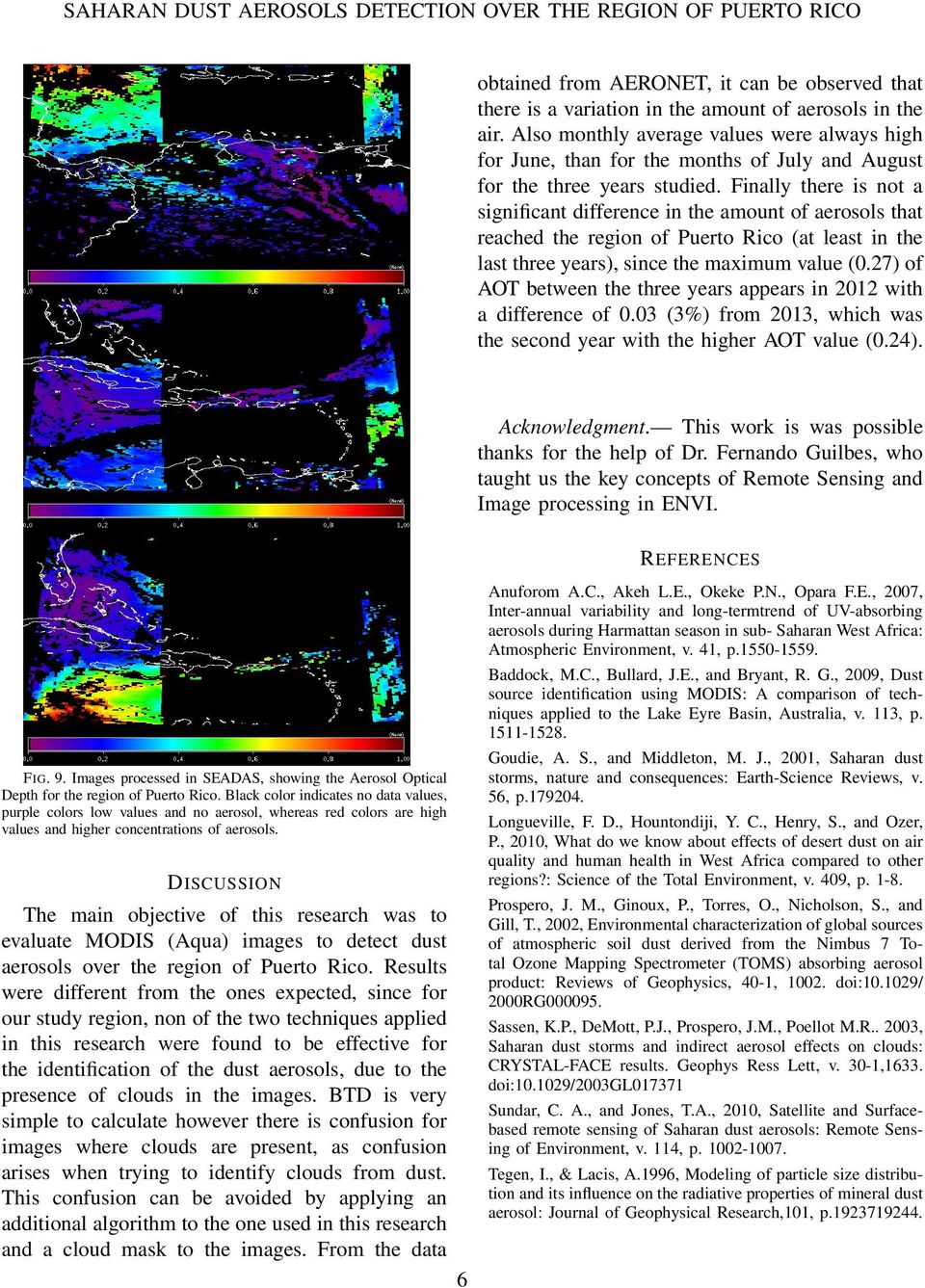
6 obtained from AERONET, it can be observed that there is a variation in the amount of aerosols in the air. Also monthly average values were always high for June, than for the months of July and August for the three years studied. Finally there is not a significant difference in the amount of aerosols that reached the region of Puerto Rico (at least in the last three years), since the maximum value (0.27) of AOT between the three years appears in 2012 with a difference of 0.03 (3%) from 2013, which was the second year with the higher AOT value (0.24). Acknowledgment. This work is was possible thanks for the help of Dr. Fernando Guilbes, who taught us the key concepts of Remote Sensing and Image processing in ENVI. REFERENCES FIG. 9. Images processed in SEADAS, showing the Aerosol Optical Depth for the region of Puerto Rico. Black color indicates no data values, purple colors low values and no aerosol, whereas red colors are high values and higher concentrations of aerosols. DISCUSSION The main objective of this research was to evaluate MODIS (Aqua) images to detect dust aerosols over the region of Puerto Rico. Results were different from the ones expected, since for our study region, non of the two techniques applied in this research were found to be effective for the identification of the dust aerosols, due to the presence of clouds in the images. BTD is very simple to calculate however there is confusion for images where clouds are present, as confusion arises when trying to identify clouds from dust. This confusion can be avoided by applying an additional algorithm to the one used in this research and a cloud mask to the images. From the data 6 Anuforom A.C., Akeh L.E., Okeke P.N., Opara F.E., 2007, Inter-annual variability and long-termtrend of UV-absorbing aerosols during Harmattan season in sub- Saharan West Africa: Atmospheric Environment, v. 41, p Baddock, M.C., Bullard, J.E., and Bryant, R. G., 2009, Dust source identification using MODIS: A comparison of techniques applied to the Lake Eyre Basin, Australia, v. 113, p Goudie, A. S., and Middleton, M. J., 2001, Saharan dust storms, nature and consequences: Earth-Science Reviews, v. 56, p Longueville, F. D., Hountondiji, Y. C., Henry, S., and Ozer, P., 2010, What do we know about effects of desert dust on air quality and human health in West Africa compared to other regions?: Science of the Total Environment, v. 409, p Prospero, J. M., Ginoux, P., Torres, O., Nicholson, S., and Gill, T., 2002, Environmental characterization of global sources of atmospheric soil dust derived from the Nimbus 7 Total Ozone Mapping Spectrometer (TOMS) absorbing aerosol product: Reviews of Geophysics, 40-1, doi: / 2000RG Sassen, K.P., DeMott, P.J., Prospero, J.M., Poellot M.R , Saharan dust storms and indirect aerosol effects on clouds: CRYSTAL-FACE results. Geophys Ress Lett, v. 30-1,1633. doi: /2003gl Sundar, C. A., and Jones, T.A., 2010, Satellite and Surfacebased remote sensing of Saharan dust aerosols: Remote Sensing of Environment, v. 114, p Tegen, I., & Lacis, A.1996, Modeling of particle size distribution and its influence on the radiative properties of mineral dust aerosol: Journal of Geophysical Research,101, p
Climatology and Monitoring of Dust and Sand Storms in the Arabian Peninsula
 Climatology and Monitoring of Dust and Sand Storms in the Arabian Peninsula Mansour Almazroui Center of Excellence for Climate Change Research (CECCR) King Abdulaziz University, Jeddah, Saudi Arabia E-mail:
Measurement of the effect of biomass burning aerosol on inhibition of cloud formation over the Amazon
 Supporting Online Material for Koren et al. Measurement of the effect of biomass burning aerosol on inhibition of cloud formation over the Amazon 1. MODIS new cloud detection algorithm The operational
DUST DETECTION ALGORITHM USING MODIS DATA AND HYDRA SOFTWARE
 PRESENT ENVIRONMENT AND SUSTAINABLE DEVELOPMENT, NR. 4, 2010 DUST DETECTION ALGORITHM USING MODIS DATA AND HYDRA SOFTWARE Marzia Boccone 1 Keywords: MODIS, remote sensing, dust, linear combination bands,
REMOTE SENSING OF CLOUD-AEROSOL RADIATIVE EFFECTS FROM SATELLITE DATA: A CASE STUDY OVER THE SOUTH OF PORTUGAL
 REMOTE SENSING OF CLOUD-AEROSOL RADIATIVE EFFECTS FROM SATELLITE DATA: A CASE STUDY OVER THE SOUTH OF PORTUGAL D. Santos (1), M. J. Costa (1,2), D. Bortoli (1,3) and A. M. Silva (1,2) (1) Évora Geophysics
Collection 005 Change Summary for MODIS Aerosol (04_L2) Algorithms
 Collection 005 Change Summary for MODIS Aerosol (04_L2) Algorithms Lorraine Remer, Yoram Kaufman, Didier Tanré Shana Mattoo, Rong-Rong Li, J.Vanderlei Martins, Robert Levy, D. Allen Chu, Richard Kleidman,
A remote sensing instrument collects information about an object or phenomenon within the
 Satellite Remote Sensing GE 4150- Natural Hazards Some slides taken from Ann Maclean: Introduction to Digital Image Processing Remote Sensing the art, science, and technology of obtaining reliable information
Electromagnetic Radiation (EMR) and Remote Sensing
 Electromagnetic Radiation (EMR) and Remote Sensing 1 Atmosphere Anything missing in between? Electromagnetic Radiation (EMR) is radiated by atomic particles at the source (the Sun), propagates through
Clouds and the Energy Cycle
 August 1999 NF-207 The Earth Science Enterprise Series These articles discuss Earth's many dynamic processes and their interactions Clouds and the Energy Cycle he study of clouds, where they occur, and
Obtaining and Processing MODIS Data
 Obtaining and Processing MODIS Data MODIS is an extensive program using sensors on two satellites that each provide complete daily coverage of the earth. The data have a variety of resolutions; spectral,
SATELLITE IMAGES IN ENVIRONMENTAL DATA PROCESSING
 SATELLITE IMAGES IN ENVIRONMENTAL DATA PROCESSING Magdaléna Kolínová Aleš Procházka Martin Slavík Prague Institute of Chemical Technology Department of Computing and Control Engineering Technická 95, 66
Evaluation of the Effect of Upper-Level Cirrus Clouds on Satellite Retrievals of Low-Level Cloud Droplet Effective Radius
 Evaluation of the Effect of Upper-Level Cirrus Clouds on Satellite Retrievals of Low-Level Cloud Droplet Effective Radius F.-L. Chang and Z. Li Earth System Science Interdisciplinary Center University
Review for Introduction to Remote Sensing: Science Concepts and Technology
 Review for Introduction to Remote Sensing: Science Concepts and Technology Ann Johnson Associate Director [email protected] Funded by National Science Foundation Advanced Technological Education program [DUE
T.A. Tarasova, and C.A.Nobre
 SEASONAL VARIATIONS OF SURFACE SOLAR IRRADIANCES UNDER CLEAR-SKIES AND CLOUD COVER OBTAINED FROM LONG-TERM SOLAR RADIATION MEASUREMENTS IN THE RONDONIA REGION OF BRAZIL T.A. Tarasova, and C.A.Nobre Centro
EXPLORING NASA AND ESA ATMOSPHERIC DATA USING GIOVANNI, THE ONLINE VISUALIZATION AND ANALYSIS TOOL
 EXPLORING NASA AND ESA ATMOSPHERIC DATA USING GIOVANNI, THE ONLINE VISUALIZATION AND ANALYSIS TOOL Gregory Leptoukh (1), Steve Cox (2), John Farley (2), Arun Gopalan (2), Jianping Mao (2), Stephen Berrick
NASA Earth System Science: Structure and data centers
 SUPPLEMENT MATERIALS NASA Earth System Science: Structure and data centers NASA http://nasa.gov/ NASA Mission Directorates Aeronautics Research Exploration Systems Science http://nasascience.nasa.gov/
Passive Remote Sensing of Clouds from Airborne Platforms
 Passive Remote Sensing of Clouds from Airborne Platforms Why airborne measurements? My instrument: the Solar Spectral Flux Radiometer (SSFR) Some spectrometry/radiometry basics How can we infer cloud properties
Cloud Masking and Cloud Products
 Cloud Masking and Cloud Products MODIS Operational Algorithm MOD35 Paul Menzel, Steve Ackerman, Richard Frey, Kathy Strabala, Chris Moeller, Liam Gumley, Bryan Baum MODIS Cloud Masking Often done with
Data processing (3) Cloud and Aerosol Imager (CAI)
 Data processing (3) Cloud and Aerosol Imager (CAI) 1) Nobuyuki Kikuchi, 2) Haruma Ishida, 2) Takashi Nakajima, 3) Satoru Fukuda, 3) Nick Schutgens, 3) Teruyuki Nakajima 1) National Institute for Environmental
Ocean Level-3 Standard Mapped Image Products June 4, 2010
 Ocean Level-3 Standard Mapped Image Products June 4, 2010 1.0 Introduction This document describes the specifications of Ocean Level-3 standard mapped archive products that are produced and distributed
163 ANALYSIS OF THE URBAN HEAT ISLAND EFFECT COMPARISON OF GROUND-BASED AND REMOTELY SENSED TEMPERATURE OBSERVATIONS
 ANALYSIS OF THE URBAN HEAT ISLAND EFFECT COMPARISON OF GROUND-BASED AND REMOTELY SENSED TEMPERATURE OBSERVATIONS Rita Pongrácz *, Judit Bartholy, Enikő Lelovics, Zsuzsanna Dezső Eötvös Loránd University,
Remote Sensing Satellite Information Sheets Geophysical Institute University of Alaska Fairbanks
 Remote Sensing Satellite Information Sheets Geophysical Institute University of Alaska Fairbanks ASTER Advanced Spaceborne Thermal Emission and Reflection Radiometer AVHRR Advanced Very High Resolution
STAR Algorithm and Data Products (ADP) Beta Review. Suomi NPP Surface Reflectance IP ARP Product
 STAR Algorithm and Data Products (ADP) Beta Review Suomi NPP Surface Reflectance IP ARP Product Alexei Lyapustin Surface Reflectance Cal Val Team 11/26/2012 STAR ADP Surface Reflectance ARP Team Member
Comparison of NOAA's Operational AVHRR Derived Cloud Amount to other Satellite Derived Cloud Climatologies.
 Comparison of NOAA's Operational AVHRR Derived Cloud Amount to other Satellite Derived Cloud Climatologies. Sarah M. Thomas University of Wisconsin, Cooperative Institute for Meteorological Satellite Studies
Multiangle cloud remote sensing from
 Multiangle cloud remote sensing from POLDER3/PARASOL Cloud phase, optical thickness and albedo F. Parol, J. Riedi, S. Zeng, C. Vanbauce, N. Ferlay, F. Thieuleux, L.C. Labonnote and C. Cornet Laboratoire
Overview. What is EMR? Electromagnetic Radiation (EMR) LA502 Special Studies Remote Sensing
 LA502 Special Studies Remote Sensing Electromagnetic Radiation (EMR) Dr. Ragab Khalil Department of Landscape Architecture Faculty of Environmental Design King AbdulAziz University Room 103 Overview What
MOD09 (Surface Reflectance) User s Guide
 MOD09 (Surface ) User s Guide MODIS Land Surface Science Computing Facility Principal Investigator: Dr. Eric F. Vermote Web site: http://modis-sr.ltdri.org Correspondence e-mail address: [email protected]
INVESTIGATION OF TOTAL SUSPENDED MATTER IN PORONG REGION USING AQUA-MODIS SATELLITE DATA AND NUMERICAL MODEL. e-mail : Bambang_sukresno@yahoo.
 INVESTIGATION OF TOTAL SUSPENDED MATTER IN PORONG REGION USING AQUA-MODIS SATELLITE DATA AND NUMERICAL MODEL Bambang Sukresno* 1, Bayu Priyono 2, Dedy Aan Zahrudin 3, Berny A Subki 4 1 Institute for Marine
16 th IOCCG Committee annual meeting. Plymouth, UK 15 17 February 2011. mission: Present status and near future
 16 th IOCCG Committee annual meeting Plymouth, UK 15 17 February 2011 The Meteor 3M Mt satellite mission: Present status and near future plans MISSION AIMS Satellites of the series METEOR M M are purposed
The NASA NEESPI Data Portal to Support Studies of Climate and Environmental Changes in Non-boreal Europe
 The NASA NEESPI Data Portal to Support Studies of Climate and Environmental Changes in Non-boreal Europe Suhung Shen NASA Goddard Space Flight Center/George Mason University Gregory Leptoukh, Tatiana Loboda,
Technical note on MISR Cloud-Top-Height Optical-depth (CTH-OD) joint histogram product
 Technical note on MISR Cloud-Top-Height Optical-depth (CTH-OD) joint histogram product 1. Intend of this document and POC 1.a) General purpose The MISR CTH-OD product contains 2D histograms (joint distributions)
The Balance of Power in the Earth-Sun System
 NASA Facts National Aeronautics and Space Administration www.nasa.gov The Balance of Power in the Earth-Sun System The Sun is the major source of energy for Earth s oceans, atmosphere, land, and biosphere.
Multiplatform analysis of the radiative effects and heating rates for an intense dust storm on 21 June 2007
 JOURNAL OF GEOPHYSICAL RESEARCH: ATMOSPHERES, VOL. 118, 1 14, doi:10.1002/jgrd.50713, 2013 Multiplatform analysis of the radiative effects and heating rates for an intense dust storm on 21 June 2007 Aaron
Studying cloud properties from space using sounder data: A preparatory study for INSAT-3D
 Studying cloud properties from space using sounder data: A preparatory study for INSAT-3D Munn V. Shukla and P. K. Thapliyal Atmospheric Sciences Division Atmospheric and Oceanic Sciences Group Space Applications
2.3 Spatial Resolution, Pixel Size, and Scale
 Section 2.3 Spatial Resolution, Pixel Size, and Scale Page 39 2.3 Spatial Resolution, Pixel Size, and Scale For some remote sensing instruments, the distance between the target being imaged and the platform,
A review of cloud top height and optical depth histograms from MISR, ISCCP, and MODIS
 JOURNAL OF GEOPHYSICAL RESEARCH, VOL. 115,, doi:10.1029/2009jd013422, 2010 A review of cloud top height and optical depth histograms from MISR, ISCCP, and MODIS Roger Marchand, 1 Thomas Ackerman, 1 Mike
Amy K. Huff Battelle Memorial Institute [email protected] BUSINESS SENSITIVE 1
 Using NASA Satellite Aerosol Optical Depth Data to Create Representative PM 2.5 Fields for Use in Human Health and Epidemiology Studies in Support of State and National Environmental Public Health Tracking
A SURVEY OF CLOUD COVER OVER MĂGURELE, ROMANIA, USING CEILOMETER AND SATELLITE DATA
 Romanian Reports in Physics, Vol. 66, No. 3, P. 812 822, 2014 ATMOSPHERE PHYSICS A SURVEY OF CLOUD COVER OVER MĂGURELE, ROMANIA, USING CEILOMETER AND SATELLITE DATA S. STEFAN, I. UNGUREANU, C. GRIGORAS
AERONET Web Data Access and Relational Database
 ÓPTICA PURA Y APLICADA Vol. 37, núm. 3, - 2004 AERONET Web Data Access and Relational Database David Giles (1,2) 1. 1 Science Systems and Applications, Inc. (SSAI), Lanham, MD, USA 2. 2 NASA Goddard Space
APPLICATION OF TERRA/ASTER DATA ON AGRICULTURE LAND MAPPING. Genya SAITO*, Naoki ISHITSUKA*, Yoneharu MATANO**, and Masatane KATO***
 APPLICATION OF TERRA/ASTER DATA ON AGRICULTURE LAND MAPPING Genya SAITO*, Naoki ISHITSUKA*, Yoneharu MATANO**, and Masatane KATO*** *National Institute for Agro-Environmental Sciences 3-1-3 Kannondai Tsukuba
MSG-SEVIRI cloud physical properties for model evaluations
 Rob Roebeling Weather Research Thanks to: Hartwig Deneke, Bastiaan Jonkheid, Wouter Greuell, Jan Fokke Meirink and Erwin Wolters (KNMI) MSG-SEVIRI cloud physical properties for model evaluations Cloud
RESULTS FROM A SIMPLE INFRARED CLOUD DETECTOR
 RESULTS FROM A SIMPLE INFRARED CLOUD DETECTOR A. Maghrabi 1 and R. Clay 2 1 Institute of Astronomical and Geophysical Research, King Abdulaziz City For Science and Technology, P.O. Box 6086 Riyadh 11442,
Corso di Fisica Te T cnica Ambientale Solar Radiation
 Solar Radiation Solar radiation i The Sun The Sun is the primary natural energy source for our planet. It has a diameter D = 1.39x10 6 km and a mass M = 1.989x10 30 kg and it is constituted by 1/3 of He
Surface-Based Remote Sensing of the Aerosol Indirect Effect at Southern Great Plains
 Surface-Based Remote Sensing of the Aerosol Indirect Effect at Southern Great Plains G. Feingold and W. L. Eberhard National Oceanic and Atmospheric Administration Environmental Technology Laboratory Boulder,
Satellite'&'NASA'Data'Intro'
 Satellite'&'NASA'Data'Intro' Research'vs.'Opera8ons' NASA':'Research'satellites' ' ' NOAA/DoD:'Opera8onal'Satellites' NOAA'Polar'Program:'NOAA>16,17,18,19,NPP' Geosta8onary:'GOES>east,'GOES>West' DMSP'series:'SSM/I,'SSMIS'
Using Remote Sensing to Monitor Soil Carbon Sequestration
 Using Remote Sensing to Monitor Soil Carbon Sequestration E. Raymond Hunt, Jr. USDA-ARS Hydrology and Remote Sensing Beltsville Agricultural Research Center Beltsville, Maryland Introduction and Overview
Data Processing Flow Chart
 Legend Start V1 V2 V3 Completed Version 2 Completion date Data Processing Flow Chart Data: Download a) AVHRR: 1981-1999 b) MODIS:2000-2010 c) SPOT : 1998-2002 No Progressing Started Did not start 03/12/12
Lectures Remote Sensing
 Lectures Remote Sensing ATMOSPHERIC CORRECTION dr.ir. Jan Clevers Centre of Geo-Information Environmental Sciences Wageningen UR Atmospheric Correction of Optical RS Data Background When needed? Model
How To Measure Solar Spectral Irradiance
 Accurate Determination of the TOA Solar Spectral NIR Irradiance Using a Primary Standard Source and the Bouguer-Langley Technique. D. Bolsée, N. Pereira, W. Decuyper, D. Gillotay, H. Yu Belgian Institute
Giovanni: A System for Rapid Access, Visualization and Analysis of Earth Science Data Online
 Giovanni: A System for Rapid Access, Visualization and Analysis of Earth Science Data Online Suhung Shen *, H. Rui, Z. Liu, T Zhu, L. Lu, S. Berrick, G. Leptoukh, W. Teng, J. Acker, J. Johnson, S. P. Ahmad,
Hyperspectral Satellite Imaging Planning a Mission
 Hyperspectral Satellite Imaging Planning a Mission Victor Gardner University of Maryland 2007 AIAA Region 1 Mid-Atlantic Student Conference National Institute of Aerospace, Langley, VA Outline Objective
NOAA flight planning support and satellite aerosol and cloud retrieval validation during TORERO
 NOAA flight planning support and satellite aerosol and cloud retrieval validation during TORERO R. Bradley Pierce and Andrew Heidinger NOAA/NESDIS/STAR Allen Lenzen 1, Todd Schaack 1, Ryan Spackman 2,
Joint Polar Satellite System (JPSS)
 Joint Polar Satellite System (JPSS) John Furgerson, User Liaison Joint Polar Satellite System National Environmental Satellite, Data, and Information Service National Oceanic and Atmospheric Administration
2 Absorbing Solar Energy
 2 Absorbing Solar Energy 2.1 Air Mass and the Solar Spectrum Now that we have introduced the solar cell, it is time to introduce the source of the energy the sun. The sun has many properties that could
Update on EUMETSAT ocean colour services. Ewa J. Kwiatkowska
 Update on EUMETSAT ocean colour services Ewa J. Kwiatkowska 1 st International Ocean Colour Science meeting, 6 8 May, 2013 EUMETSAT space data provider for operational oceanography Operational data provider
REDUCING UNCERTAINTY IN SOLAR ENERGY ESTIMATES
 REDUCING UNCERTAINTY IN SOLAR ENERGY ESTIMATES Mitigating Energy Risk through On-Site Monitoring Marie Schnitzer, Vice President of Consulting Services Christopher Thuman, Senior Meteorologist Peter Johnson,
Temporal variation in snow cover over sea ice in Antarctica using AMSR-E data product
 Temporal variation in snow cover over sea ice in Antarctica using AMSR-E data product Michael J. Lewis Ph.D. Student, Department of Earth and Environmental Science University of Texas at San Antonio ABSTRACT
NOAA Climate Reanalysis Task Force Workshop College Park, Maryland 4-5 May 2015
 Arlindo da Silva [email protected] Global Modeling and Assimilation Office, NASA/GSFC With contributions from Peter Colarco, Anton Darmenov, Virginie Buchard, Gala Wind, Cynthia Randles, Ravi Govindaradju
Cloud Oxygen Pressure Algorithm for POLDER-2
 Cloud Oxygen ressure Algorithm for OLDER-2 1/7 Cloud Oxygen ressure Algorithm for OLDER-2 Aim of the : Determination of cloud gen pressure from arent pressure by removing the contribution. Date of the
Validating MOPITT Cloud Detection Techniques with MAS Images
 Validating MOPITT Cloud Detection Techniques with MAS Images Daniel Ziskin, Juying Warner, Paul Bailey, John Gille National Center for Atmospheric Research, P.O. Box 3000, Boulder, CO 80307 ABSTRACT The
II. Related Activities
 (1) Global Cloud Resolving Model Simulations toward Numerical Weather Forecasting in the Tropics (FY2005-2010) (2) Scale Interaction and Large-Scale Variation of the Ocean Circulation (FY2006-2011) (3)
Landsat Monitoring our Earth s Condition for over 40 years
 Landsat Monitoring our Earth s Condition for over 40 years Thomas Cecere Land Remote Sensing Program USGS ISPRS:Earth Observing Data and Tools for Health Studies Arlington, VA August 28, 2013 U.S. Department
Near Real Time Blended Surface Winds
 Near Real Time Blended Surface Winds I. Summary To enhance the spatial and temporal resolutions of surface wind, the remotely sensed retrievals are blended to the operational ECMWF wind analyses over the
The study of cloud and aerosol properties during CalNex using newly developed spectral methods
 The study of cloud and aerosol properties during CalNex using newly developed spectral methods Patrick J. McBride, Samuel LeBlanc, K. Sebastian Schmidt, Peter Pilewskie University of Colorado, ATOC/LASP
Meteorological Forecasting of DNI, clouds and aerosols
 Meteorological Forecasting of DNI, clouds and aerosols DNICast 1st End-User Workshop, Madrid, 2014-05-07 Heiner Körnich (SMHI), Jan Remund (Meteotest), Marion Schroedter-Homscheidt (DLR) Overview What
FRESCO. Product Specification Document FRESCO. Authors : P. Wang, R.J. van der A (KNMI) REF : TEM/PSD2/003 ISSUE : 3.0 DATE : 30.05.
 PAGE : 1/11 TITLE: Product Specification Authors : P. Wang, R.J. van der A (KNMI) PAGE : 2/11 DOCUMENT STATUS SHEET Issue Date Modified Items / Reason for Change 0.9 19.01.06 First Version 1.0 22.01.06
Evaluating GCM clouds using instrument simulators
 Evaluating GCM clouds using instrument simulators University of Washington September 24, 2009 Why do we care about evaluation of clouds in GCMs? General Circulation Models (GCMs) project future climate
GOES-R Advanced Baseline Imager (ABI) Algorithm Theoretical Basis Document For Low Cloud and Fog
 NOAA NESDIS CENTER for SATELLITE APPLICATIONS and RESEARCH GOES-R Advanced Baseline Imager (ABI) Algorithm Theoretical Basis Document For Low Cloud and Fog Corey Calvert, UW/CIMSS Mike Pavolonis, NOAA/NESDIS/STAR
Satellite Products and Dissemination: Visualization and Data Access
 Satellite Products and Dissemination: Visualization and Data Access Gregory Leptoukh GES DISC, NASA GSFC Dana Ostrenga GES DISC, NASA GSFC Introduction The Goddard Earth Sciences Data and Information Services
Cloud detection and clearing for the MOPITT instrument
 Cloud detection and clearing for the MOPITT instrument Juying Warner, John Gille, David P. Edwards and Paul Bailey National Center for Atmospheric Research, Boulder, Colorado ABSTRACT The Measurement Of
An Airborne A-Band Spectrometer for Remote Sensing Of Aerosol and Cloud Optical Properties
 An Airborne A-Band Spectrometer for Remote Sensing Of Aerosol and Cloud Optical Properties Michael Pitts, Chris Hostetler, Lamont Poole, Carl Holden, and Didier Rault NASA Langley Research Center, MS 435,
ENVIRONMENTAL MONITORING Vol. I - Remote Sensing (Satellite) System Technologies - Michael A. Okoye and Greg T. Koeln
 REMOTE SENSING (SATELLITE) SYSTEM TECHNOLOGIES Michael A. Okoye and Greg T. Earth Satellite Corporation, Rockville Maryland, USA Keywords: active microwave, advantages of satellite remote sensing, atmospheric
China Earth Observation
 China High-resolution Earth Observation China Earth Observation System (CHEOS) and its Lastest Development The Earth Observation System and Data Center, CNSA 2014-2 Outlines 1 Introduction 2 The composition
Environmental Data Services for Delaware:
 Environmental Data Services for Delaware: Serving Emergency Responders, Planners, and Researchers Network Delaware Day November 6, 2013 Overview Operational Data Services More than just research DEOS and
Slide 1. Slide 2. Slide 3
 Satellite Analysis of Sea Surface Temperatures in the Florida Keys to Monitor Coral Reef Health NASA Stennis Space Center Earthzine/DEVELOP Virtual Poster Session, Summer 2011 Video Transcript Slide 1
A Microwave Retrieval Algorithm of Above-Cloud Electric Fields
 A Microwave Retrieval Algorithm of Above-Cloud Electric Fields Michael J. Peterson The University of Utah Chuntao Liu Texas A & M University Corpus Christi Douglas Mach Global Hydrology and Climate Center
Welcome to NASA Applied Remote Sensing Training (ARSET) Webinar Series
 Welcome to NASA Applied Remote Sensing Training (ARSET) Webinar Series Introduction to Remote Sensing Data for Water Resources Management Course Dates: October 17, 24, 31 November 7, 14 Time: 8-9 a.m.
SYNERGISTIC USE OF IMAGER WINDOW OBSERVATIONS FOR CLOUD- CLEARING OF SOUNDER OBSERVATION FOR INSAT-3D
 SYNERGISTIC USE OF IMAGER WINDOW OBSERVATIONS FOR CLOUD- CLEARING OF SOUNDER OBSERVATION FOR INSAT-3D ABSTRACT: Jyotirmayee Satapathy*, P.K. Thapliyal, M.V. Shukla, C. M. Kishtawal Atmospheric and Oceanic
The Surface Energy Budget
 The Surface Energy Budget The radiation (R) budget Shortwave (solar) Radiation Longwave Radiation R SW R SW α α = surface albedo R LW εσt 4 ε = emissivity σ = Stefan-Boltzman constant T = temperature Subsurface
TECHNICAL REPORTS. Authors: Tatsuhiro Noguchi* and Takaaki Ishikawa*
 Application and Evaluation of Observation Data by Advanced Microwave Scanning Radiometer 2 Achievement of World s Top-Class Microwave Radiometer AMSR Series Authors: Tatsuhiro Noguchi* and Takaaki Ishikawa*
Climatology of aerosol and cloud properties at the ARM sites:
 Climatology of aerosol and cloud properties at the ARM sites: MFRSR combined with other measurements Qilong Min ASRC, SUNY at Albany MFRSR: Spectral irradiances at 6 six wavelength passbands: 415, 500,
Remote Sensing of Clouds from Polarization
 Remote Sensing of Clouds from Polarization What polarization can tell us about clouds... and what not? J. Riedi Laboratoire d'optique Atmosphérique University of Science and Technology Lille / CNRS FRANCE
CBERS Program Update Jacie 2011. Frederico dos Santos Liporace AMS Kepler [email protected]
 CBERS Program Update Jacie 2011 Frederico dos Santos Liporace AMS Kepler [email protected] Overview CBERS 3 and 4 characteristics Differences from previous CBERS satellites (CBERS 1/2/2B) Geometric
NASA 2014 The Hyperspectral Infrared Imager (HyspIRI) Science Impact of Deploying Instruments on Separate Platforms
 JPL Publication 14-13 NASA 2014 The Hyperspectral Infrared Imager (HyspIRI) Science Impact of Deploying Instruments on Separate Platforms HyspIRI Group Edited by Simon J. Hook Question Leads: CQ1 - Kevin
DISCRIMINATING CLEAR-SKY FROM CLOUD WITH MODIS ALGORITHM THEORETICAL BASIS DOCUMENT (MOD35) MODIS Cloud Mask Team
 DISCRIMINATING CLEAR-SKY FROM CLOUD WITH MODIS ALGORITHM THEORETICAL BASIS DOCUMENT (MOD35) MODIS Cloud Mask Team Steve Ackerman, Richard Frey, Kathleen Strabala, Yinghui Liu, Liam Gumley, Bryan Baum,
Sunlight and its Properties. EE 495/695 Y. Baghzouz
 Sunlight and its Properties EE 495/695 Y. Baghzouz The sun is a hot sphere of gas whose internal temperatures reach over 20 million deg. K. Nuclear fusion reaction at the sun's core converts hydrogen to
Expert System for Solar Thermal Power Stations. Deutsches Zentrum für Luft- und Raumfahrt e.v. Institute of Technical Thermodynamics
 Expert System for Solar Thermal Power Stations Institute of Technical Thermodynamics Stuttgart, July 2001 - Expert System for Solar Thermal Power Stations 2 Solar radiation and land resources for solar