
The use of algae in feed products - AQUACULTURE
|
|
|
- Felicity Hood
- 10 years ago
- Views:
Transcription
1 Algae Biomass Novel Foods Workshop, October 2014 The use of algae in feed products - AQUACULTURE Jorunn Skjermo Silje Forbord, Kristine Braaten Steinhovden and Aleksander Handå, N-7465 Trondheim (Norway) 1

2 Seaweed in aquaculture feed Whole, fresh biomass: Gracilaria, Laminaria, Sargassum for abalone, sea cucumber, sea urchin (e.g. Qi et al. 2010) 2

3 Seaweed in aquaculture feed Whole, as seaweed meal: Porphyra, 10% replacement of protein and lipid in diet for rainbow trout (Soler-vila et al. 2009) Ulva, 5% replacement of lipids with Ulva meal in diet for Nile tilapia (Ergün et al. 2008) Gracilaria, Porphyra, Ascophyllum and Ulva, 5-10% of protein in sea bream and sea bass (Mustafa et al. 1995; Valente et al. 2005) Sargassum, Macrocystis et al. in shrimps diet, 10% Commercial seaweed meal: OceanFeed TM, mixture of several species, 15% inclusion in salmon diet improves colour and lice resistance (Ocean Harvest Technology) 3

4 What is the potential? 5-15% inclusion of seaweed meal gives beneficial effects (or neutral) Higher inclusions of whole seaweed causes problem due to anti-nutrient effects: Polyphenols (lower protein digestion) Heavy metals (arsenic, cadmium, mercury, lead) Kainic acid (neurotoxin) Too high mineral levels Bigger replacement possible by using pure components Increased costs still attractive? 4

5 Expected growth in Norwegian salmon production and in feed demand 6 5 Salmon production Feed demand million tons % protein DKNVS/NTVA (Olafsen et al., 2012) 5

6 Trends in the price of fishmeal and soybean meal Source: FAO FAO Fisheries and Aquaculture Information and Statistics Branch. Rome. 6

7 Feed production potential from seaweeds tons protein from 20 million tons of seaweed Sustainable production Increase the degree of self-sufficiency Proteins (1000 tons) 1000 tons Imported soy protein 2013 Protein demand 2030 Protein demand 2050 From kelp 2030 From kelp 2050 PS: Kelps cultivated in IMTA grow faster, have a higher N content and more protein 7

8 Amino acid profiles in seaweed and soy bean meal S.latissima Soy bean meal Source: Holdt&Kraan, 2011; Experts in Team, NTNU,

9 Sugar kelp as protein source for salmon feed Salmon AA profile (% of protein) Seaweed AA profile (% of total AA) 31/10/2014

10 Why cultivated biomass? Large volumes possible (170 tons ha -1 ) Environmental friendly, sustainable production of biomass, no (known)negative effect on the benthic ecosystem Attractive biomass (composition affected by season and age) Effective harvesting and freshness of biomass Possibilities for nutrients recycling (IMTA) Wide range of species (480 in Norway) No use of arable land, fresh water, pesticides or fertilizers Seaweed Energy Solutions

11 Saccharina latissima: 170 tons biomass ha-1 year-1 (Broch et al., 2013) Area needed for cultivation of 20 million tons: km2 11

12 From spores to biomass Low-tech 12

13 Cultivated macroalgae as feedstock (example: Saccharina latissima) Water Alginate Glucan (laminaran and cellulose) Mannitol Protein Minerals Polyphenols Fucoidan Fucoxantin Lipid 13

14 "Biorefinery is a sustainable processing of biomass into several products and energy" Cultivation Extraction Food end feed Carbohydrates Proteins Minerals Bioactives Thermochemical conversion Hydrothermal conditions Biofuels Chemicals Chemical conversion Water based chemistry DHMF (Bis(hydroxmethyl)furan) Polyuretan and polyesters Biochemical/-technological conversion High viscosity Biofuels Chemicals Food and feed Value chain biorefinery: ~300 Billion $ in 2020 (The World Economic Forum ) 14

15 Bio-active compounds in aquaculture feed Laminaran (β-1,3 glucan) and high-m-alginate Immunomodulatory Pigments: Fucoxanthin, Astaxanthin and Tocopherol Antioxidant activity, colour 15

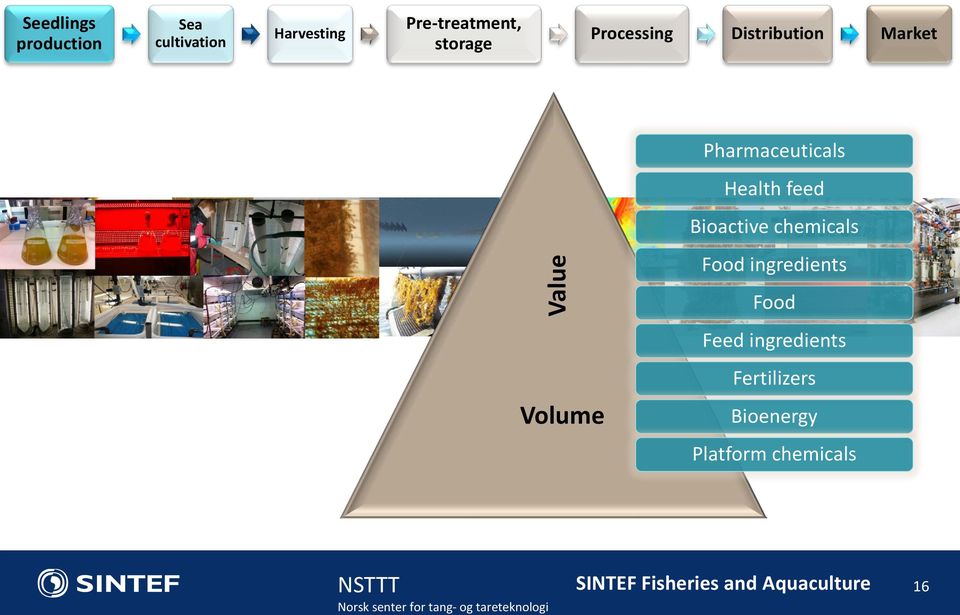
16 Seedlings production Sea cultivation Harvesting Pre-treatment, storage Processing Distribution Market Value Volume Pharmaceuticals Health feed Bioactive chemicals Food ingredients Food Feed ingredients Fertilizers Bioenergy Platform chemicals 16
17 Cycling of nutrients in salmon aquaculture Feed (100% N) (100% P) Integrated multi-trophic aquaculture (IMTA) Particulate nutrients ( 15% N) ( 44% P) Fish (N 40%) (P 35%) Dissolved nutrients ( 45% N) ( 18% P) Wang et al., Aquaculture and Environment Interactions, 2:

18 Challenges Industry: Marked pull Immature technology Research: Large variations in productivity (volumes) Large variations in chemical composition Footprints Potential 1 ha (0.01 km 2 ) cultivation area: 170 tons biomass sugar kelp (wet) 26 tons dry matter 15 tons carbohydrates 3.8 tons protein

19 Thanks to SINTEF for the priority project 'Biobased products from sustainable resources (seaweed)' Thank you 19

Tare Arbeidsplasser av et klimavennlig råstoff
 Naturviterne Frokostmøte 12. februar 2015 Bergen Tare Arbeidsplasser av et klimavennlig råstoff Jorunn Skjermo Silje Forbord, Kristine Braaten Steinhovden and Aleksander Handå SINTEF Fiskeri og havbruk
Cultivation of seaweed biomass for nutrients and energy
 Marine Ingredients Conference, Oslo 23-24.September 2013 Cultivation of seaweed biomass for nutrients and energy Jorunn Skjermo, Silje Forbord, Ole Jacob Broch, Kjell Inge Reitan, Roar Solbakken, Kristine
Seaweed Hatchery and Cultivation Methods
 Seaweed Hatchery and Cultivation Methods Silje Forbord Zeeland 18-19 September Outline 1. Development of Saccharina latissima (Phaeophyceae) kelp hatcheries with year-round production of zoospores and
Fuel From Seaweed Project supported by the INTERREG IVA Programme managed by SEUPB
 Fuel From Seaweed Project supported by the INTERREG IVA Programme managed by SEUPB Michele Stanley Coordination Centre SAMS, Dunstaffnage Marine Laboratory, Argyll, Scotland T: 01631559000 F: 01631559001
SPATIAL VARIATION IN THE BIOCHEMICAL COMPOSITION OF SACCHARINA LATISSIMA
 SPATIAL VARIATION IN THE BIOCHEMICAL COMPOSITION OF SACCHARINA LATISSIMA Bruhn A, Nielsen MM, Manns D, Rasmussen MB, Petersen JK & Krause-Jensen D 4 TH NORDIC ALGAE CONFERENCE GRENÅ 2014 BIOCHEMICAL VARIATION
Ongoing macroalgae projects in Norway
 Ongoing macroalgae projects in Norway Algae Conference Bodø 2012 Anne Lise Leonczek Bellona From Pollution to Solution Photo: Bellona How does Bellona work? Bellona offices and representatives Murmansk
Selected regulations and future development of salmon farming in Norway
 Stirling, 8 October 2013 Selected regulations and future development of salmon farming in Norway Ulf Winther, Research Director, SINTEF Fisheries and Aquaculture 1 My presentation in brief Glimpses of
The Macroalgae Biorefinery (MAB3) with Focus on Cultivation, Bioethanol Production, Fish Feed and Sustainability Assessment
 The Macroalgae Biorefinery (MAB3) with Focus on Cultivation, Bioethanol Production, Fish Feed and Sustainability Assessment Dr. Anne-Belinda Bjerre Xiaoru Hou, Annette Bruhn, Michael Bo Rasmussen, Mette
MACROALGAE PRODUCTION IN PORTUGAL: PRESENT, POTENTIAL DEVELOPMENT AND CHALLENGES
 MACROALGAE PRODUCTION IN PORTUGAL: PRESENT, POTENTIAL DEVELOPMENT AND CHALLENGES Isabel Sousa Pinto Centre for Marine and Environmental Research University of Porto Diversity of macroalgae in Portugal
Conversion of macroalgae to bioethanol and fish feed preliminary trials in the MAB3 project
 Conversion of macroalgae to bioethanol and fish feed preliminary trials in the MAB3 project Anne-Belinda Bjerre, Senior Scientist PhD Danish Technological Institute 3rd Danish Macroalgae conference Grenå
Prospects for using insect products in aqua feeds
 Prospects for using insect products in aqua feeds Erik-Jan Lock DTI 13.11.14 Presentation outline Aquafeeds for Atlantic salmon. What is it made of and what has changed during the past 25 years Studies
Cultivation of green algae
 biology, technology and economy Annette Bruhn and Michael Bo Rasmussen Aarhus University National Center for Energy & Environment Silkeborg Denmark Why cultivate green algae? Green tides Natural harvest
Algal cultivation: a new resource for biorefineries. Susan Løvstad Holdt Researcher at Biological Institute, KU and DTU Environment
 Algal cultivation: a new resource for biorefineries Susan Løvstad Holdt Researcher at Biological Institute, KU and DTU Environment Objectives Biorefinery biomass Harvest vs. Cultivation Cultivation methods:
Algae activities in Sweden. Eva Albers Chalmers University of Technology, Göteborg Swedish Academic key partner
 Algae activities in Sweden Eva Albers Chalmers University of Technology, Göteborg Swedish Academic key partner Algal Activities in Sweden - Summary Academic activities Strong basic research in marine biology
Algae for fish-feed and other. Tron Kjønnø General Manager
 Algae for fish-feed and other Tron Kjønnø General Manager October 2013 AGENDA 1. Algea, the Arctic Company 2. Our ID Card 3. Our seaweed 4. Our Solutions for different markets 5. Challenges and opportunities
Analysis of marine by-products 2013 English summary
 Analysis of marine by-products 2013 English summary SINTEF Fiskeri og havbruk AS SINTEF Fisheries and Aquaculture Address: Postboks 118 NO-9252 Tromsø NORWAY Telephone: +47 40005350 Telefax:+47 [email protected]
Biorefineries. International status quo and future directions. Ed de Jong / Rene van Ree
 Biorefineries International status quo and future directions Ed de Jong / Rene van Ree Contents 1. Biobased Economy 2. Biorefineries - Definition 3. Biorefineries - Categories 4. Biorefineries - Objective
Algae for feed, food, fertilizers and cosmetics. Tron Kjønnø General Manager
 Algae for feed, food, fertilizers and cosmetics Tron Kjønnø General Manager October 2013 AGENDA 1. Algea, the Arctic Company 2. Our ID Card 3. Our precious brown seaweed: Ascophyllum nodosum 4. Our Solutions
Centre d Etude et de Valorisation des Algues
 Centre d Etude et de Valorisation des Algues CEVA : Centre d Etude et de Valorisation des Algues - Technical Center created in 1982 - Missions : - develop algae-based economy in a sustainable manner -
Fish In - Fish Out (FIFO) Ratios explained
 Fish In - Fish Out () Ratios explained By Andrew Jackson One of the long continued debates in aquaculture is the use of fishmeal and fish oil in feeds and the amount of wild fish it takes to produce farmed
Mussel Farming in the Baltic May Recycle Nutrients Into High Quality Feedstuff
 Mussel Farming in the Baltic May Recycle Nutrients Into High Quality Feedstuff Odd Lindahl The Royal Swedish Academy of Sciences at Kristineberg, Sweden Nutrients a resource to recycle: Nitrogen - because
Perspektiver på utviklingen av havbruk og andre biomarine næringer i Nord-Troms
 Skjervøy 30. september 2014 Perspektiver på utviklingen av havbruk og andre biomarine næringer i Nord-Troms Roger Richardsen SINTEF Nord / SINTEF Fiskeri og havbruk [email protected] 1 1000 people
A Review of the Potential of Marine Algae as a Source of Biofuel in Ireland
 A Review of the Potential of Marine Algae as a Source of Biofuel in Ireland A Review of the Potential of Marine Algae as a Source of Biofuel in Ireland A Review of the Potential of Marine Algae as a Source
R&D in a Global Salmon Farming Company
 R&D in a Global Salmon Farming Company Petter Arnesen Technical Director, Marine Harvest ASA Salmon Industry in Chile and Norway How can research and technology development help meet our challenges? Trondheim
SUSTAINABLE AQUACULTURE
 SUSTAINABLE AQUACULTURE Dr. Elena Mente Assistant Professor School of Agricultural Sciences, Department of Ichthyology and Aquatic Environment, University of Thessaly, Volos, Greece Overview of my presentation
The etuber - A Very High Yielding, Sustainable Feedstock for ABF Biofuels, Plastics and High Value Co-Products
 The etuber - A Very High Yielding, Sustainable Feedstock for ABF Biofuels, Plastics and High Value Co-Products CAREnergy of SC: Dr. Janice Ryan- Bohac, PhD BIO World Congress 2015 EE-Tuber Allows Expansion
12 th November 2014. Dr Francesco Ometto
 12 th November Dr Francesco Ometto Scandinavian Biogas in brief 2 Founded in December 2005 Former Prime Minister of Sweden Göran Persson as Chairman of the Board Ability to prove and optimize concepts
Antonio Di Giulio Head of Unit E1 Directorate-General Research & Innovation European Commission
 Antonio Di Giulio Head of Unit E1 Directorate-General Research & Innovation European Commission Building bioeconomy in Europe http://ec.europa.eu/research/bioeconomy/ Building Bioeconomy in Europe Issues
LARGE BREED COMPLETE DOG FOOD
 JWB Large Dog Leaflet 7 11_JWB 25/07/2011 14:53 Page 1 LARGE BREED COMPLETE DOG FOOD NATURALLY hypo-allergenic complete dog food NO added artifical colours, flavours or preservatives JWB Large Dog Leaflet
Biofuels from Microalgae: The Promise and Challenge of Algae as a Renewable Source of Biofuels
 Biofuels from Microalgae: The Promise and Challenge of Algae as a Renewable Source of Biofuels Mike Hightower 1 and Ron Pate 2 1 Sandia National Laboratories, Energy Systems Analysis 2 Sandia National
Biowaste Biorefinery for the integrated chemical and energy production from organic waste and byproducts
 LABMEETING-RIFIUTI - 22 maggio 2014 - RAVENNA2014 Biowaste Biorefinery for the integrated chemical and energy production from organic waste and byproducts Fabio Fava PhD, Dr.h.c., Professor School of Engineering,
DSM Position on Sustainable Biomass
 Corporate Public Affairs Het Overloon 1, 6411 TE Heerlen, the Netherlands www.dsm.com April 2012 DSM Position on Sustainable Biomass Key messages DSM is a leading Life Sciences and Materials Sciences company
May 3, 2011. Claudia Stamme, Andreas Scheidig, Klaudija Milos
 Enzymatic algae processing Claudia Stamme, Andreas Scheidig, Klaudija Milos Direvo Industrial Biotech In 2008 Direvo Industrial Biotech was spun out of Direvo AG which pharmaceutical applications was sold
Lesson 6. BioMara gratefully acknowledges the following funders: Content Section - How Algae can be used to produce Biofuel.
 Lesson 6 Content Section - How Algae can be used to produce Biofuel. From lesson 5 you have discovered that there are many uses for algae. You also have discovered that algae can be used to produce biofuels.
LIFE CYCLE ASSESSMENT ON COTTON AND VISCOSE FIBRES FOR TEXTILE PRODUCTION
 LIFE CYCLE ASSESSMENT ON COTTON AND VISCOSE FIBRES FOR TEXTILE PRODUCTION Janka Dibdiakova, Volkmar Timmermann Norwegian Forest and Landscape Institute (NFLI) Ås, Norway COST FP1205 Innovative applications
Algers anvendelse i foder og fødevarer -med fokus på indholdsstoffer
 Algers anvendelse i foder og fødevarer -med fokus på indholdsstoffer Susan Løvstad Holdt PhD, Adjunkt DTU Fødevareinstituttet Leder af Tangnetværket i DK Temadag om Nye proteiner til foder og fødevareapplikationer-
Dr Erhard Briendenhann
 Dr Erhard Briendenhann Protein Research Foundation Soya processing nutritional and financial benefits Sponsored by: Protein Research Foundation SOYBEAN PROCESSING Nutritional and financial benefits Dr
How many kilos of feed fish does it take to produce one kilo of farmed fish, via fishmeal and fish oil in feed?
 How many kilos of feed fish does it take to produce one kilo of farmed fish, via fishmeal and fish oil in feed? Key Points 1. The correct FIFO (Fish in: Fish out) for the conversion of wild feed fish to
The LignoRef project; - A national research initiative to enhance biorefinery process developments in Norway -
 The LignoRef project; - A national research initiative to enhance biorefinery process developments in Norway - Nasjonalt Seminar Industriell Bioteknologi, Oslo, 06.06.2013 Karin Øyaas, Kai Toven 1, Ingvild
Biorefinery competence building in Norway
 Developing the biobased industry in Norway lines to the future Biorefinery competence building in Norway Industrial Biotech Network - Norway Annual meeting Oslo June 19th 2014 Karin Øyaas, PFI (Paper and
Study seminar. Dirdal, May 2013
 Study seminar Dirdal, May 2013 We have reduced marine ingredients by half in 7 years Average Inclusion in EWOS AS Feeds 70% Fishmeal Fishoil 60% 50% 40% 30% 20% 10% 0% 2005 2006 2007 2008 2009 2010 2011
Bedriftens samfunnsansvar
 Bedriftens samfunnsansvar Mørekonferansen Ålesund 25. november 2014 Lise Bergan Kommunikasjonsdirektør Agenda Hva slag selskap er Cermaq Hva er samfunnsansvar for Cermaq Hvordan jobber vi med samfunnsansvar
Coral Triangle Aquaculture: 3 OPPORTUNITIES FOR MARKETS IN CHINA
 IMPACT+ Coral Triangle Aquaculture: 3 OPPORTUNITIES FOR MARKETS IN CHINA Seaplants productivity base for a multi-billion dollar aquaculture industry INDONESIA SUPPLY CHINA DEMAND seaplant photosynthesis
THE NORWEGIAN SEAWEED INDUSTRY WORK PACKAGE 1&2
 THE NORWEGIAN SEAWEED INDUSTRY WORK PACKAGE 1&2 November 2012 Bioforsk Norwegian Institute for Agricultural and Environmental Research M. Meland, C. Rebours 1 EXECUTIVE SUMMARY The Netalgae project was
Macroalgae biorefinery Produc3on of bioethanol and protein for fish feed from brown seaweed, Laminaria digitata
 Macroalgae biorefinery Produc3on of bioethanol and protein for fish feed from brown seaweed, Laminaria digitata Anne- Belinda Bjerre, Chem Eng PhD Senior Scien)st, Danish Technological Ins)tute Adjunct Professor,
Danish State-of-Art on Micro and Macro Algae
 Danish State-of-Art on Micro and Macro Algae Lars Nikolaisen, B.Sc. (Mech.Eng.) Danish Technological Institute. Lone Thybo Mouritsen M.Sc. Ocean Centre Denmark Annette Bruhn, PhD. Aarhus University 15
Green chemistry in South Korea
 IA Seoul Yewon Cha, Info: http://www.agentschapnl.nl/ia-netwerk Green chemistry in South Korea Introduction When the terminology bio-based economy was first introduced in Korea, it referred to life science
Fish and seafood consumption in Norway Benefits and risks Norwegian scientific committee for food safety, March 2006 English summary
 Fish and seafood consumption in Norway Benefits and risks Norwegian scientific committee for food safety, March 2006 English summary The assignment Fish and other seafood contain substances that have a
Global Outlook for Shrimp Markets and Demand. Felix Dent Fishery Industry Officer Fish Products, Trade & Marketing Branch (FIPM)
 Global Outlook for Shrimp Markets and Demand Felix Dent Fishery Industry Officer Fish Products, Trade & Marketing Branch (FIPM) FAO? What is... Food and Agriculture Organization of the United Nations Established
Carl-Christian Schmidt
 Carl-Christian Schmidt Organisation for Economic Co-Operation and Development France As head of the Fisheries Policies Division in the Organisation for Economic Co-operation and Development s Directorate
Danish State-of-Art on Micro and Macro Algae
 Danish State-of-Art on Micro and Macro Algae Lars Nikolaisen, B.Sc. (Mech.Eng.) Danish Technological Institute. Ditte B.Tørring, MSc. Danish Shellfish Centre Annette Bruhn, Ph.D. Aarhus University Bodil
Farmed Or Wild? Both Types Of Salmon Taste Good And Are Good For You
 marketplace Farmed Or Wild? Both Types Of Salmon Taste Good And Are Good For You Pamela D. Tom University of California Davis Sea Grant Extension Program Food Science and Technology Department 1 Shields
Production of 2nd generation bioethanol from lucerne with optimized hydrothermal pretreatment
 Downloaded from orbit.dtu.dk on: Feb 03, 2016 Production of 2nd generation bioethanol from lucerne with optimized hydrothermal pretreatment Thomsen, Sune Tjalfe; Ambye-Jensen, Morten; Schmidt, Jens Ejbye
Using LCA models to inform about industry-led efforts to reduce the ecological footprint of farmed salmon from feed and other inputs "
 Using LCA models to inform about industry-led efforts to reduce the ecological footprint of farmed salmon from feed and other inputs " Authors Jason Mann (EWOS Canada, presentation) Louise Buttle (EWOS
Division of Diabetes Treatment and Prevention Advancements in Diabetes Seminar December 3, 2013
 Division of Diabetes Treatment and Prevention Advancements in Diabetes Seminar December 3, 2013 Alaskan Natives are the Healthiest People in the World 2 Time of Contact for Alaska Native Groups Aleut/Unangan
Dominique P. Bureau. Abstract
 Better Defining Nutritional Requirements of Fish and the Nutritive Value of Feed Ingredients: Lessons from Integration of Experimental Data from a Wide Variety of Sources Dominique P. Bureau UG/OMNR Fish
Introduction to Feed Amino Acids. Bank of America Merrill Lynch Chemicals Conference
 Introduction to Feed Amino Acids Bank of America Merrill Lynch Chemicals Conference Dr. Reiner Beste President Health & Nutrition 3 December 2014 Business Lines Segment Positioning within Evonik Strong
Emerging BioFuel Crops and Technology Kurt Thelen Michigan State University, East Lansing, Michigan ABSTRACT
 Emerging BioFuel Crops and Technology Kurt Thelen Michigan State University, East Lansing, Michigan ABSTRACT United States energy policy requires 36 billion gallons of ethanol by the year 2022, with 21
Ecology 1 Star. 1. Missing from the diagram of this ecosystem are the
 Name: ate: 1. Missing from the diagram of this ecosystem are the 5. ase your answer(s) to the following question(s) on the diagram below and on your knowledge of biology.. biotic factors and decomposers.
Aquaculture Insurance Information
 Aquaculture Insurance Information TABLE OF CONTENTS ABOUT LONGLINE ENVIRONMENT EXECUTIVE SUMMARY WHAT IS AQUACULTURE INSURANCE? WHY IS AQUACULTURE INSURANCE NOT WIDESPREAD? WHAT SPECIES CAN BE INSURED?
The Future of Aquafeeds
 NOAA Technical Memorandum NMFS F/SPO-124 NOAA/USDA Alternative Feeds Initiative December 2011 Disclaimer: views represented in this report are the views the participants in the meetings and the authors.
Responsible stock enhancement, restocking and sea ranching: rational and terminology
 Responsible stock enhancement, restocking and sea ranching: rational and terminology Devin M. Bartley FAO Rome Ecosystem-based Stock Enhancement Workshop: development of a road map to evaluate the potential
Business strategy: dal progetto Pro.E.Sa agli investimenti per la realizzazione degli impianti
 Business strategy: dal progetto Pro.E.Sa agli investimenti per la realizzazione degli impianti Business strategy: from the Pro.E.Sa project to the investments for plants constructions Ing. Dario Giordano,
IMPORTS AND EXPORTS OF FISHERY PRODUCTS ANNUAL SUMMARY, 2012
 CURRENT FISHERY STATISTICS NO. 2012-2 IMPORTS AND EXPORTS OF FISHERY PRODUCTS ANNUAL SUMMARY, 2012 Effective in 2012 substantial changes were made to the fishery product sections of the Harmonized Tariff
The IMES Master Programme
 The IMES Master Programme The IMES Master Programme is built to reach the main goal of the Master, which is to provide to the students the professional skills required for private or public entities undertaking
Integrated Pest Management Program for Sea Lice in New Brunswick
 Integrated Pest Management Program for Sea Lice in New Brunswick World Aquaculture Society Meeting February 25, 2013 Nashville, TN Kathy Brewer-Dalton New Brunswick Department of Agriculture, Aquaculture
Lerøy Seafood Group Cash Management Dagen 22 oktober, Bergen
 Lerøy Seafood Group ASA Lerøy Seafood Group Cash Management Dagen 22 oktober, Bergen CFO HL AS/S&D: Siren Grønhaug Vekstambisjoner i sjømatnæringen Sjømatnæringen i Norge Lerøy Seafood Group Cash Management
Peter Cook University of Western Australia Chairman: ASC Technical Advisory Group
 June 2014 ASC Hier komt verantwoord de titel van gekweekte de presentatie tilapia nu verkrijgbaar THE AQUACULTURE STEWARDSHIP COUNCIL: A GUIDE TO THE CERTIFICATION PROCESS Peter Cook University of Western
U.S. Environmental Protection Agency, Region IX Response to Comments on the Goleta Sanitary District Draft NPDES Permit and 301(h) TDD
 U.S. Environmental Protection Agency, Region IX Response to Comments on the Goleta Sanitary District Draft NPDES Permit and 301(h) TDD A. Kamil S. Azoury of Goleta Sanitary District provided comments on
The Production and Use of High-Valued Canola Protein Concentrates
 The Production and Use of High-Valued Canola Protein Concentrates David D. Maenz Chief Scientific Officer MCN BioProducts Inc. Conventional Canola Processing Whole seed Solvent extraction or double press
DOE Office of Biological & Environmental Research: Biofuels Strategic Plan
 DOE Office of Biological & Environmental Research: Biofuels Strategic Plan I. Current Situation The vast majority of liquid transportation fuel used in the United States is derived from fossil fuels. In
Harvesting energy with fertilizers
 Harvesting energy with fertilizers Sustainable agriculture in Europe 1 Harvesting energy with fertilizers The reason for agriculture s existence is to supply energy to mankind. Agriculture converts solar
Section 3: Trophic Structures
 Marine Conservation Science and Policy Service learning Program Trophic Structure refers to the way in which organisms utilize food resources and hence where energy transfer occurs within an ecosystem.
STUDY GUIDE AGRICULTURAL SCIENCES GRADE 11
 STUDY GUIDE AGRICULTURAL SCIENCES GRADE 11 A publication of Impak Onderwysdiens (Pty) Ltd Copyright reserved. Apart from any fair dealing for the purpose of research, criticism or review as permitted under
Efficient forest biomass supply chain for biorefineries A project for cross border cooperation
 Forest Refine Efficient forest biomass supply chain for biorefineries A project for cross border cooperation HighBio 2 Seminar Luleå 16 Jan Magnus Matisons BioFuel Region Project Manager Forest Refine
HIGH VALUE ECO-INDUSTRIAL SOLUTIONS
 HIGH VALUE ECO-INDUSTRIAL SOLUTIONS 2 WHO ARE WE? PHYCOENERGY, a young company (established in 2012) in the ecoindustrial sector, whose aim is to sign, velop and implement technological and innovative
Looking forward: challenges and trends to factor in a long-term strategy for agricultural R&I by 2020 and beyond? Erik Mathijs 19 June 2015
 Looking forward: challenges and trends to factor in a long-term strategy for agricultural R&I by 2020 and beyond? Erik Mathijs 19 June 2015 4th SCAR Foresight Expert Group Long-term experts Erik Mathijs
BIOVALUE PROJECT 2 ANDERS PETER S. ADAMSEN AARHUS UNIVERSITY HEALTH 04 JUNE 2015
 BIOVALUE PROJECT 2 ANDERS PETER ADAMSEN CONTENT Protein work KU Effekt of time lag between harvest and processing Flow sheeting Pilot plant OLIGOSACCHARIDES - A Upgrading of C5 oligomers Structural composition
7 Energy Flow Through an Ecosystem investigation 2 c l a s s se s s i o n s
 7 Energy Flow Through an Ecosystem investigation 2 c l a s s se s s i o n s Overview Students create a food web of a kelp forest ecosystem with which they explore the flow of energy between ecosystem organisms.
Thailand s Great Undeveloped Resource
 Thailand s Great Undeveloped Resource INVESTMENT STRATEGY The primary goal of is to aggregate a significant land package targeting potash, at a very low cost of entry, 6 claims for a total of 96 sq. km.
Appendix 5 Making homemade fish feed
 193 Appendix 5 Making homemade fish feed Fish feed is one of the most expensive inputs for a small-scale aquaponic unit. Feed is also one of the most important components of the whole aquaponic ecosystem
From Biomass. NREL Leads the Way. to Biofuels
 From Biomass NREL Leads the Way to Biofuels The Wide World of Biofuels Fuel Source Benefits Maturity Grain/Sugar Ethanol Biodiesel Corn, sorghum, and sugarcane Vegetable oils, fats, and greases Produces
Challenges in animal feed production - focus on sustainable raw material supply
 Challenges in animal feed production - focus on sustainable raw material supply Cycle meeting 26. may - 2014 Hallgeir Sterten Felleskjøpet Fôrutvikling AS Outline Global trends feed and food Situation
EFFECT OF DIETARY OLIVE POMACE OIL AND L-CARNITINE ON GROWTH AND CHEMICAL COMPOSITION OF AFRICAN CATFISH, CLARIAS GARIEPINUS (BURCHELL, 1822)
 14 The Israeli Journal of Aquaculture Bamidgeh 56 (1), 2004, 14-21. EFFECT OF DIETARY OLIVE POMACE OIL AND L-CARNITINE ON GROWTH AND CHEMICAL COMPOSITION OF AFRICAN CATFISH, CLARIAS GARIEPINUS (BURCHELL,
Bioeconomy: Policy Implementation
 Bioeconomy: Policy Implementation Dr. Antonio Di Giulio Head of Strategy Unit Bioeconomy Directorate Directorate-General for Research & Innovation European Commission Building bioeconomy in Europe http://ec.europa.eu/research/bioeconomy/
Chapter 2. The Chemistry of Life Worksheets
 Chapter 2 The Chemistry of Life Worksheets (Opening image courtesy of David Iberri, http://en.wikipedia.org/wiki/file:camkii.png, and under the Creative Commons license CC-BY-SA 3.0.) Lesson 2.1: Matter
CURRICULUM VITAE. Luis O. Peña-Ortega. Instituto Tecnológico y de Estudios Superiores de Monterrey. Campus Monterrey
 CURRICULUM VITAE Luis O. Peña-Ortega Instituto Tecnológico y de Estudios Superiores de Monterrey Campus Monterrey Agrobiotechnology and Agribusiness Department Biotechnology and Food Division Tel: +52
FOOD CHAINS AND FOOD WEBS PHYTOPLANKTON ZOOPLANKTON SILVERSIDE BLUEFISH
 FOOD CHAINS AND FOOD WEBS Food Chains All living organisms (plants and animals) must eat some type of food for survival. Plants make their own food through a process called photosynthesis. Using the energy
Sustainable production of biogas and bioethanol from waste
 Sustainable production of biogas and bioethanol from waste Waste - Resources on the wrong way Jens Ejbye Schmidt Head of programme NRG Biomass & Bioenergy Biosystem Division Risø The Technical University
Dominique P. Bureau Fish Nutrition Research Laboratory, Department of Animal and Poultry Science, University of Guelph
 Deconstructing the Fish Meal and Fish Oil Replacement Story in Aquaculture: Focusing on Nutrient Requirements, Characterization of Feed Ingredients and Pragmatic Approaches Dominique P. Bureau Fish Nutrition
Bio renewable Resources Platform. Ton Runneboom, Chairman
 Bio renewable Resources Platform Ton Runneboom, Chairman Sustainable Economy A Bio-based Economy(BBE) is a subset of a sustainable economy UN definition for sustainable development: Development which meets
The Basic Humic Acid Products
 The Basic Humic Acid Products Over at least twelve years of actual field experience with an ample variety of humic acid formulations (some of them developed many years before) have given us a singular