
Ecology 1 Star. 1. Missing from the diagram of this ecosystem are the
|
|
|
- Logan Watkins
- 9 years ago
- Views:
Transcription
1 Name: ate: 1. Missing from the diagram of this ecosystem are the 5. ase your answer(s) to the following question(s) on the diagram below and on your knowledge of biology.. biotic factors and decomposers. abiotic factors and decomposers. autotrophs, only. heterotrophs, only What is an appropriate title for this diagram?. Energy Flow in a ommunity. Ecological Succession. iological Evolution 2. Which group would most likely be represented in a food chain?. Food hain. biotic factors. abiotic factors. inorganic compounds 6. The diagram below represents a food web.. finite resources 3. relationship between a consumer and producer is best illustrated by a. snake eating a bird. tree absorbing minerals. fungus breaking down wastes. deer eating grass 4. The greatest number of relationships between the organisms in an ecosystem is best shown in. a food chain. an energy pyramid. a food web Two of the herbivores represented in this food web are. toads and snakes. deer and mice. wolves and raccoons. grasshoppers and toads. an ecological succession diagram page 1

2 7. Which ecological term best describes the polar bears in the cartoon? 9. ase your answer(s) to the following question(s) on the passage below and on your knowledge of biology. Keystone Species keystone species is one whose presence contributes to the diversity of life and whose extinction would lead to the extinction of other forms of life. keystone species helps to support the ecosystem of which it is a part. n example of what can happen when a keystone species is removed occurred when fur hunters eliminated sea otters from some Pacific Ocean kelp beds. Otters eat sea urchins, which eat kelp. With its major predator gone, sea urchin populations exploded and consumed most of the kelp. Fish, snails, and other animals associated with the kelp beds disappeared.. herbivores. parasites. carnivores. producers The grizzly bear is another example of a keystone species. Grizzlies transfer nutrients from the ocean ecosystem to the forest ecosystem. The first stage of this transfer is performed by salmon that swim up rivers, sometimes for hundreds of miles. Salmon are rich in nitrogen, sulfur, carbon, and phosphorus. The bears capture the salmon and carry them onto dry land, scattering nutrient-rich feces (wastes) and partially eaten salmon carcasses. It has been estimated that the bears leave up to half of the salmon they harvest on the forest floor. Which organism is most likely not functioning as a keystone species in its ecosystem? 8. ase your answer(s) to the following question(s) on the diagram of a food web and on your knowledge of biology.. beaver transforms its territory from a stream to a pond or swamp, maintaining the habitat for a variety of native species. elephant destroys trees, making room for grass species and preventing the environment from becoming a woodland. black-tailed prairie dogs burrows act as homes to other creatures, including burrowing owls, badgers, rabbits, snakes, salamanders, and insects. zebra mussels compete with native species, reducing the biodiversity of the Great Lakes ecosystem If the population of mice is reduced by disease, which change will most likely occur in the food web?. The cricket population will increase.. The snake population will increase.. The grasses will decrease.. The deer population will decrease. 10. Environmentalists are hoping to protect endangered organisms by calling for a reduction in the use of pesticides, because loss of these organisms would. increase the mutation rate in plants. cause pesticides to become more toxic to insects. reduce biodiversity in various ecosystems. decrease the space and resources available to other organisms page 2

3 11. Over a long period of time, the stages represented in the diagram below were each present in a particular ecosystem. Stages in an Ecosystem 13. Scientists have been concerned about the reduction of shark populations due to overfishing off the east coast of the United States. Sharks feed on rays, which feed on scallops. Scallops feed on microscopic algae, which they filter from seawater. Without sharks, the rays consume and eliminate scallop beds, harming the scallop fishing industry. This situation demonstrates that. sharks are not important for the stability of this ecosystem. reducing the shark population increases the quantity of scallops that can be harvested. humans can upset ecosystem stability by removing species fter a forest fire, what is the most likely order in which these stages appeared?. humans improve ecosystem diversity by removing predators The diagram below represents a cycling of materials. Which row in the chart below shows the substances represented by X and Y? Row X Y (1) oxygen carbon dioxide (2) glucose oxygen (3) carbon dioxide oxygen (4) amino acids carbon dioxide 14. ase your answer(s) to the following question(s) on the data table below and on your knowledge of biology. The data table shows the number of breeding pairs of bald eagles in New York State from 1991 to Year Number of reeding Pairs of ald Eagles in New York State from 1991 to 2003 Number of reeding pairs In which time period did New York State see the largest increase in breeding pairs of bald eagles? (1). (2). (3). (4) page 3


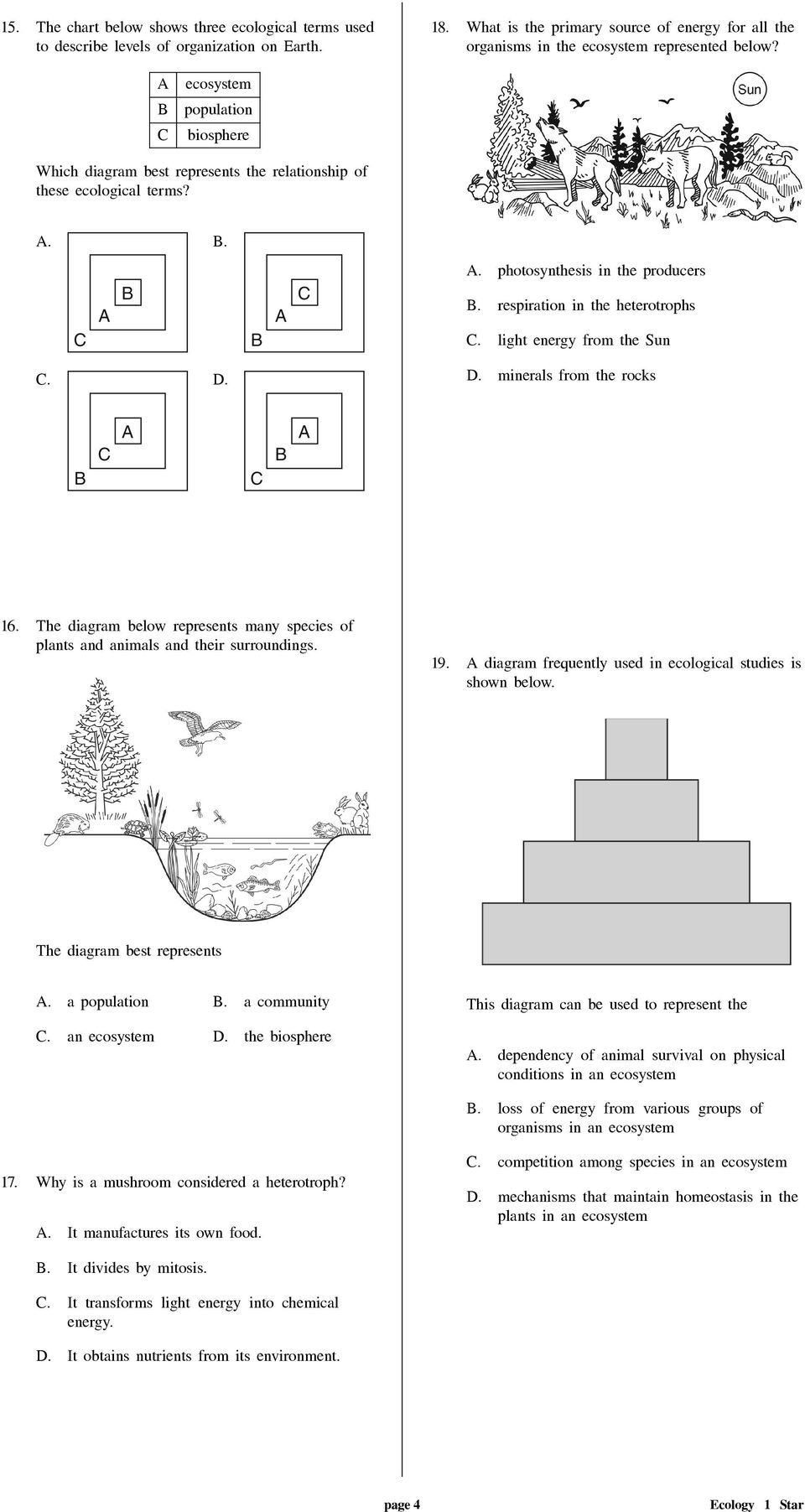
4 15. The chart below shows three ecological terms used to describe levels of organization on Earth. 18. What is the primary source of energy for all the organisms in the ecosystem represented below? ecosystem population biosphere Which diagram best represents the relationship of these ecological terms?... photosynthesis in the producers. respiration in the heterotrophs. light energy from the Sun... minerals from the rocks 16. The diagram below represents many species of plants and animals and their surroundings. 19. diagram frequently used in ecological studies is shown below. The diagram best represents. a population. a community. an ecosystem. the biosphere This diagram can be used to represent the. dependency of animal survival on physical conditions in an ecosystem. loss of energy from various groups of organisms in an ecosystem 17. Why is a mushroom considered a heterotroph?. It manufactures its own food.. competition among species in an ecosystem. mechanisms that maintain homeostasis in the plants in an ecosystem. It divides by mitosis.. It transforms light energy into chemical energy.. It obtains nutrients from its environment. page 4
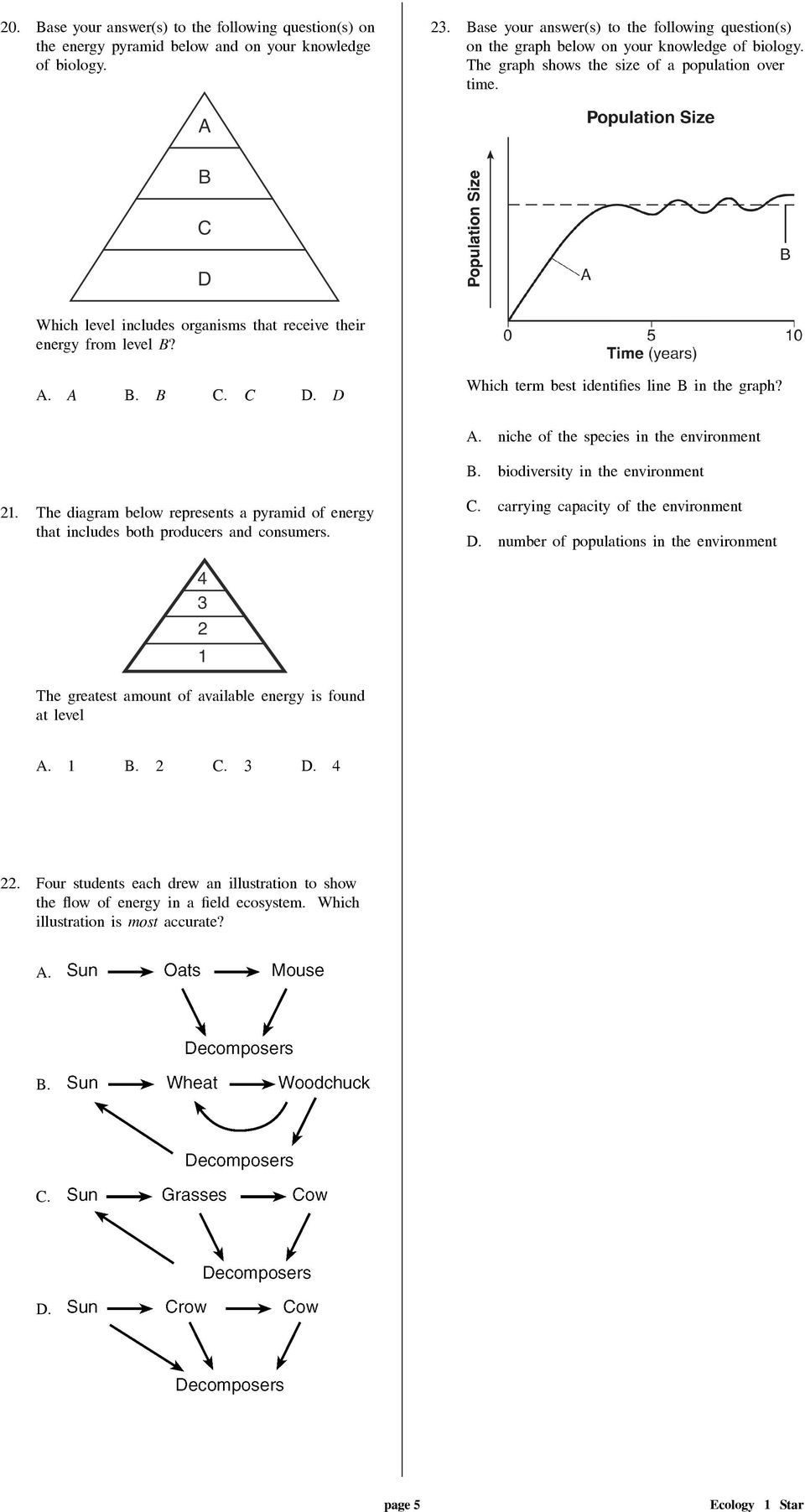
5 20. ase your answer(s) to the following question(s) on the energy pyramid below and on your knowledge of biology. 23. ase your answer(s) to the following question(s) on the graph below on your knowledge of biology. The graph shows the size of a population over time. Which level includes organisms that receive their energy from level?.... Which term best identifies line in the graph?. niche of the species in the environment. biodiversity in the environment 21. The diagram below represents a pyramid of energy that includes both producers and consumers.. carrying capacity of the environment. number of populations in the environment The greatest amount of available energy is found at level Four students each drew an illustration to show the flow of energy in a field ecosystem. Which illustration is most accurate?.... page 5
6 24. The graph below shows the growth of a field mouse population in an ecosystem over time. 26. Which term refers to the ecological niche of many bacteria and fungi in an ecosystem?. decomposer. herbivore. producer. scavenger The dashed line indicating the carrying capacity for the mouse population is correctly shown on which graph? 27. The diagram represents the changes in an area over time.. This series of changes in the area over hundreds of years is known as. evolution.. feedback. ecological succession. direct harvesting. 28. Which concept is best represented in the diagram below?.. random mutations. ecological succession. genetic engineering. direct harvesting 25. Which row in the chart below best identifies the relationship between the mice and the wheat? Row Role of Mice Role of Wheat (1) producer consumer (2) predator host (3) host predator (4) consumer producer 29. serious threat to biodiversity is. habitat destruction. maintenance of food chains. competition within a species. a stable population size. (1). (2). (3). (4) page 6

7 Problem-ttic format version c Educide Software Licensed for use by Vincent Joralemon Terms of Use at 05/20/

Matter and Energy in Ecosystems
 Matter and Energy in Ecosystems The interactions that take place among biotic and abiotic factors lead to transfers of energy and matter. Every species has a particular role, or niche, in an ecosystem.
The animals at higher levels are more competitive, so fewer animals survive. B.
 Energy Flow in Ecosystems 1. The diagram below shows an energy pyramid. Which of the following best explains why the number of organisms at each level decreases while moving up the energy pyramid? The
a. a population. c. an ecosystem. b. a community. d. a species.
 Name: practice test Score: 0 / 35 (0%) [12 subjective questions not graded] The Biosphere Practice Test Multiple Choice Identify the letter of the choice that best completes the statement or answers the
Food Chains and Food Webs
 Program Support Notes by: Spiro Liacos B.Ed. Produced by: VEA Pty Ltd Commissioning Editor: Sandra Frerichs B.Ed, M.Ed. Executive Producers: Edwina Baden-Powell B.A, CVP. Sandra Frerichs B.Ed, M.Ed. You
Lesson Plan Two - Ecosystems
 Lesson Plan Two - Ecosystems Summary Students discuss what living things need to survive. They identify the abiotic and biotic components of an ecosystem and describe the roles and interactions of producers
Introduction to Ecology
 Introduction to Ecology Ecology is the scientific study of the interactions between living organisms and their environment. Scientists who study ecology are called ecologists. Because our planet has many
Lesson 1. Objectives: ocus: Subjects:
 Lesson 1 The Web of Life Objectives: 1. Understand the concept of an ecosystem. 2. Understand the interdependence of members of an ecosystem. Subjects: 1. Ecology 2. Language 3. Art MATERIALS: Copies of
Use this diagram of a food web to answer questions 1 through 5.
 North arolina Testing Program EO iology Sample Items Goal 4 Use this diagram of a food web to answer questions 1 through 5. coyotes 3. If these organisms were arranged in a food pyramid, which organism
5.1 Ecosystems, Energy, and Nutrients
 CHAPTER 5 ECOSYSTEMS 5.1 Ecosystems, Energy, and Nutrients Did anyone ever ask you the question: Where do you get your energy? Energy enters our world from the Sun but how does the Sun s energy become
FOOD CHAINS, FOOD WEBS AND ECOLOGICAL PYRAMIDS
 FOOD CHAINS, FOOD WEBS AND ECOLOGICAL PYRAMIDS SECTION 1 In an ecosystem, plants capture the sun's energy and use it to convert inorganic compounds into energy-rich organic compounds. This process of using
Ecosystems and Food Webs
 Ecosystems and Food Webs How do AIS affect our lakes? Background Information All things on the planet both living and nonliving interact. An Ecosystem is defined as the set of elements, living and nonliving,
NOTE TO TEACHER: It is appropriate to introduce the mitochondria (where energy is made) as a major structure common to all cells.
 5.2.1 Recall the cell as the smallest unit of life and identify its major structures (including cell membrane, cytoplasm, nucleus, and vacuole). Taxonomy level: 1.1 and 1.2-A Remember Factual Knowledge
Section 3: Trophic Structures
 Marine Conservation Science and Policy Service learning Program Trophic Structure refers to the way in which organisms utilize food resources and hence where energy transfer occurs within an ecosystem.
Grassland Food Webs: Teacher Notes
 Grassland Food Webs: Teacher Notes Alan Henderson ecosystem Objectives After completing this activity students will be able to: Create a food web and identify producers and consumers. Assign organisms
The main source of energy in most ecosystems is sunlight.
 Energy in Ecosystems: Ecology: Part 2: Energy and Biomass The main source of energy in most ecosystems is sunlight. What is the amount of energy from the sun? 100 W/ft 2 The energy gets transferred through
STUDY GUIDE ECOLOGY. CHAPTER 21: Populations 1. An overview of ecology. Ecology is the study of interactions between organisms and their environment.
 STUDY GUIDE ECOLOGY CHAPTER 21: Populations 1. An overview of ecology. Ecology is the study of interactions between organisms and their environment. 2. A Hierarchy of interactions: cells tissues organs
food webs reflect look out! what do you think?
 reflect Imagine for a moment that you stay after school one day to clean up the classroom. While cleaning, you move some plants away from the sunny windows. A week later, you remember to move the plants
6. Which of the following is not a basic need off all animals a. food b. *friends c. water d. protection from predators. NAME SOL 4.
 NAME SOL 4.5 REVIEW - Revised Habitats, Niches and Adaptations POPULATION A group of the same species living in the same place at the same time. COMMUNITY-- All of the populations that live in the same
ECOSYSTEM RESPONSES. reflect
 reflect There is a saying, No man is an island, which means that people need one another in order to survive. Everyone on Earth is interconnected in some way. This is not only true of human beings, but
CCR Biology - Chapter 13 Practice Test - Summer 2012
 Name: Class: Date: CCR Biology - Chapter 13 Practice Test - Summer 2012 Multiple Choice Identify the choice that best completes the statement or answers the question. 1. A group of organisms of the same
AP Biology Unit I: Ecological Interactions
 AP Biology Unit I: Ecological Interactions Essential knowledge 1.C.1: Speciation and extinction have occurred throughout the Earth s history. Species extinction rates are rapid at times of ecological stress.
ENERGY FLOW THROUGH LIVING SYSTEMS
 reflect Enter the word domino as a search term on the Internet; you can fi nd some amazing domino runs. You can make your own by setting up a series of dominoes in a line. When you push the fi rst domino
2. What kind of energy is stored in food? A. chemical energy B. heat energy C. kinetic energy D. light energy
 Assessment Bank Matter and Energy in Living Things SC.8.L.18.4 1. What is energy? A. anything that takes up space B. anything that has mass C. the ability to conduct current D. the ability to do work 2.
www.irishseedsavers.ie Natural surface water on earth includes lakes, ponds, streams, rivers, estuaries, seas and oceans.
 www.irishseedsavers.ie POND LIFE FACT SHEET Natural surface water on earth includes lakes, ponds, streams, rivers, estuaries, seas and oceans. A pond is a small body of fresh water shallow enough for sunlight
Biology Keystone (PA Core) Quiz Ecology - (BIO.B.4.1.1 ) Ecological Organization, (BIO.B.4.1.2 ) Ecosystem Characteristics, (BIO.B.4.2.
 Biology Keystone (PA Core) Quiz Ecology - (BIO.B.4.1.1 ) Ecological Organization, (BIO.B.4.1.2 ) Ecosystem Characteristics, (BIO.B.4.2.1 ) Energy Flow 1) Student Name: Teacher Name: Jared George Date:
Ecology Module B, Anchor 4
 Ecology Module B, Anchor 4 Key Concepts: - The biological influences on organisms are called biotic factors. The physical components of an ecosystem are called abiotic factors. - Primary producers are
7 Energy Flow Through an Ecosystem investigation 2 c l a s s se s s i o n s
 7 Energy Flow Through an Ecosystem investigation 2 c l a s s se s s i o n s Overview Students create a food web of a kelp forest ecosystem with which they explore the flow of energy between ecosystem organisms.
Prairie Food Chains & Webs Producers, Consumers & Decomposers
 Kansas Prairies s, s & Decomposers Science, Life Science, Reading, Math Materials Vocabulary worksheet Food Chain worksheet Overview To explore the organisms found on a prairie and identify the various
13.1. Principles of Ecology CHAPTER 13. Ecology is the study of the relationships among organisms and their environment.
 SECTION 13.1 KEY CONCEPT ECOLOGISTS STUDY RELATIONSHIPS Study Guide Ecology is the study of the relationships among organisms and their environment. VOCABULARY ecology community MAIN IDEA: Ecologists study
3. Which relationship can correctly be inferred from the data presented in the graphs below?
 1. Recent evidence indicates that lakes in large areas of New York State are being affected by acid rain. The major effect of acid rain in the lakes is (1) an increase in game fish population levels (3)
D. Categorize Words. E. Find the Odd Word
 Answer Key Vocabulary Practice A. Synonyms or Antonyms 1. synonym 2. antonym 3. antonym 4. synonym 5. antonym 6. antonym B. Stepped-Out Vocabulary 1. A species that has an unusually large effect on its
REVIEW UNIT 10: ECOLOGY SAMPLE QUESTIONS
 Period Date REVIEW UNIT 10: ECOLOGY SAMPLE QUESTIONS A. Sample Multiple Choice Questions Complete the multiple choice questions to review this unit. 1. All of the following are density-dependent factors
Lesson Overview. Biodiversity. Lesson Overview. 6.3 Biodiversity
 Lesson Overview 6.3 6.3 Objectives Define biodiversity and explain its value. Identify current threats to biodiversity. Describe how biodiversity can be preserved. THINK ABOUT IT From multicolored coral
Life Science Study Guide. Environment Everything that surrounds and influences (has an effect on) an organism.
 Life Science Study Guide Environment Everything that surrounds and influences (has an effect on) an organism. Organism Any living thing, including plants and animals. Environmental Factor An environmental
Energy Flow Through an Ecosystem. Food Chains, Food Webs, and Ecological Pyramids
 Energy Flow Through an Ecosystem Food Chains, Food Webs, and Ecological Pyramids What is Ecology? ECOLOGY is a branch of biology that studies ecosystems. Ecological Terminology Environment Ecology Biotic
Which of the following can be determined based on this model? The atmosphere is the only reservoir on Earth that can store carbon in any form. A.
 Earth s Cycles 1. Models are often used to explain scientific knowledge or experimental results. A model of the carbon cycle is shown below. Which of the following can be determined based on this model?
Prairie Food Chains & Webs Producers, Consumers, & Decomposers
 Kansas Prairies Prairie Food Chains & Webs Producers, s, & Decomposers Life Science, Math, Reading, Science Materials Student Worksheet A: Vocabulary Student Worksheet B: Food Chain Overview To explore
Principles of Ecology
 2 Principles of Ecology section 1 Organisms and Their Relationships Before You Read On the lines below, list the organisms that you have encountered today. You share the same environment with these organisms.
Topic 3: Nutrition, Photosynthesis, and Respiration
 1. Base your answer to the following question on the chemical reaction represented below and on your knowledge of biology. If this reaction takes place in an organism that requires sunlight to produce
ECOSYSTEM 1. SOME IMPORTANT TERMS
 ECOSYSTEM 1. SOME IMPORTANT TERMS ECOSYSTEM:- A functional unit of nature where interactions of living organisms with physical environment takes place. STRATIFICATION:- Vertical distribution of different
1. Biodiversity & Distribution of Life
 National 5 Biology Unit 3 Life on Earth Summary notes 1. Biodiversity & Distribution of Life Perhaps the best place to start in this topic is with Biomes. Biomes are regions of our planet which have a
4. Which choice below lists the biomes in order from lowest precipitation amounts to highest precipitation amounts?
 Ecosystems and Biomes 1. All of the living organisms in a forest plus their environment is an example of A. a biome. B. a community. C. a population. D. an ecosystem. 2. Which of the following best describes
This hands-on activity incorporates observing, classifying, predicting, sequencing, formulating models, and drawing conclusions.
 SCIENCE Science and the Environment 4 th Grade FOOD CHAINS Overview: All organisms, or living things, depend on other organisms for nutrients. The movement of nutrients through an environment is visualized
Ecosystems Processes: Energy Flow
 Ecosystems Processes: Energy Flow 6 STRUCTURE 6.1 Introduction 6.2 Objectives 6.3 Understanding Energy Flow 6.4 Energy in Ecological Systems 6.5 Food Chains 6.6 Understanding Food Chains 6.7 Conclusion
Food Webs and Food Chains Grade Five
 Ohio Standards Connection: Life Sciences Benchmark B Analyze plant and animal structures and functions needed for survival and describe the flow of energy through a system that all organisms use to survive.
What s For Lunch? Exploring the Role of GloFish in Its Ecosystem, Food Chain and Energy Pyramid
 Name Period Date What s For Lunch? Exploring the Role of GloFish in Its Ecosystem, Food Chain and Energy Pyramid Objective The learner will define terms related to relationships and energy transfer in
Energy Flow in the Pond Teacher s Guide February 2011
 Energy Flow in the Pond Teacher s Guide February 2011 Grades: 6, 7 & 8 Time: 3 hours With the pond as a model, students explore how energy that originates from the sun keeps changing shape and form as
Food Chains (and webs) Flow of energy through an ecosystem Grade 5 Austin Carter, Dale Rucker, Allison Hursey
 Food Chains (and webs) Flow of energy through an ecosystem Grade 5 Austin Carter, Dale Rucker, Allison Hursey References: Columbus Public Schools Curriculum Guide- Grade 5 GK-12 Biological Science Lesson
Producers, Consumers, and Food Webs
 reflect Think about the last meal you ate. Where did the food come from? Maybe it came from the grocery store or a restaurant. Maybe it even came from your backyard. Now think of a lion living on the plains
Living Environment Review Booklet
 Living Environment Review Booklet Instructions to the Students: This booklet contains Regents questions taken from past examinations. They cover the material that you have been working on in your Regents
Energy flow in ecosystems. Lecture 6 Chap. 6
 Energy flow in ecosystems Lecture 6 Chap. 6 1 What is an ecosystem? System = regularly interacting and interdependent components forming a unified whole Ecosystem = an ecological system; = a community
Food Web Crasher. An introduction to food chains and food webs
 Food Web Crasher An introduction to food chains and food webs Activity Students create a physical food web and watch what happens when an aquatic nuisance species is introduced into the ecosystem. Grade
THE WATER CYCLE. Ecology
 THE WATER CYCLE Water is the most abundant substance in living things. The human body, for example, is composed of about 70% water, and jellyfish are 95% water. Water participates in many important biochemical
Rain Forests. America's. Web of Life. Rain Forest Ecology. Prince William Network's OVERVIEW OBJECTIVES SUBJECTS
 Rain Forest Ecology National Science Education Standards Standard C: Life Sciences Populations and ecosystems. Standard C: Life Sciences Diversity and adaptation of organisms. Standard F: Science in Personal
Practice Questions 1: Evolution
 Practice Questions 1: Evolution 1. Which concept is best illustrated in the flowchart below? A. natural selection B. genetic manipulation C. dynamic equilibrium D. material cycles 2. The diagram below
8.2 - A Local Ecosystem:
 8.2 - A Local Ecosystem: 1. The distribution, diversity and numbers of plants and animals found in ecosystems are determined by biotic and abiotic factors: Distinguish between the abiotic and biotic factors
1.2 The Biosphere and Energy
 1.2 The Biosphere and Energy All activities require a source of energy a fuel. For example, to sustain a campfire, you need to keep it supplied with wood. To reach a destination by car, you need to have
Marine Ecosystems and Biodiversity
 This website would like to remind you: Your browser (Apple Safari 7) is out of date. Update your browser for more security, comfort and the best experience on this site. lesson Marine Ecosystems and Biodiversity
CCR Biology - Chapter 14 Practice Test - Summer 2012
 Name: Class: Date: CCR Biology - Chapter 14 Practice Test - Summer 2012 Multiple Choice Identify the choice that best completes the statement or answers the question. 1. Zebras live on the savannas of
The Balance of Nature Food Chains 101 (Suitable for grades 4-12)
 Environmental Education using Live Birds of Prey Thank you to Xcel Energy Foundation and their Environmental Partnership Program The Balance of Nature Food Chains 101 (Suitable for grades 4-12) OBJECTIVE
Weaving the Web. Overview Students construct food webs to learn how food chains are interconnected. Suggested Grade Level 2 5
 Weaving the Overview Students construct food webs to learn how food chains are interconnected. Suggested Grade Level 2 5 Estimated Time 30 40 minutes Objectives Students will be able to: 1. construct a
Grade 10 - Sustainability of Ecosystems - Pre-Assessment. Grade 7 - Interactions Within Ecosystems. Grade 10 - Sustainability of Ecosystems
 Purpose: This document is for grade 10 teachers to use as a pre-assessment for the Sustainability of Ecosystems unit. It assesses students understanding of the of the end of unit knowledge outcomes from
Cellular Respiration: Practice Questions #1
 Cellular Respiration: Practice Questions #1 1. Which statement best describes one of the events taking place in the chemical reaction? A. Energy is being stored as a result of aerobic respiration. B. Fermentation
CHAPTER 20 COMMUNITY ECOLOGY
 CHAPTER 20 COMMUNITY ECOLOGY MULTIPLE CHOICE 1. The relationship between a predator and its prey is best illustrated by a. a snake eating a bird. c. a lion eating a zebra. b. a fox eating a mouse. d. a
reflect look out! organisms: living things
 reflect Imagine that a student in your school fell down and is having difficulty breathing. Sirens wail as an ambulance pulls into the school parking lot. The emergency workers rush over to help the student.
Ecosystems. The two main ecosystem processes: Energy flow and Chemical cycling
 Ecosystems THE REALM OF ECOLOGY Biosphere An island ecosystem A desert spring ecosystem Biosphere Ecosystem Ecology: Interactions between the species in a given habitat and their physical environment.
THE ECOSYSTEM - Biomes
 Biomes The Ecosystem - Biomes Side 2 THE ECOSYSTEM - Biomes By the end of this topic you should be able to:- SYLLABUS STATEMENT ASSESSMENT STATEMENT CHECK NOTES 2.4 BIOMES 2.4.1 Define the term biome.
Pond Vocabulary Words and Meanings
 Pond Vocabulary Words and Meanings Adapt: to adjust to a use or situation Aquatic: from or in the water Bacteria: tiny organisms, too small to be seen with the naked eye Carnivore: an animal that eats
FOOD CHAINS AND FOOD WEBS PHYTOPLANKTON ZOOPLANKTON SILVERSIDE BLUEFISH
 FOOD CHAINS AND FOOD WEBS Food Chains All living organisms (plants and animals) must eat some type of food for survival. Plants make their own food through a process called photosynthesis. Using the energy
Key Idea 2: Ecosystems
 Key Idea 2: Ecosystems Ecosystems An ecosystem is a living community of plants and animals sharing an environment with non-living elements such as climate and soil. An example of a small scale ecosystem
food chains reflect How are these organisms important to one another? organism: a living thing
 reflect Different plants and animals live together. Look at the picture of the garden. What organisms live there? Grass, trees, bugs, and birds live there. Fish and frogs live there, too. Can you think
Section 5.1 Food chains and food webs
 Section 5.1 Food chains and food webs The ultimate source of energy in an ecosystem comes from sunlight This energy is converted to an organic form using photosynthesis which is then passed between organisms
DOG Pets cat - dog - horse - hamster - rabbit - fish
 CAT Pets cat - dog - horse - hamster - rabbit - fish DOG Pets cat - dog - horse - hamster - rabbit - fish HORSE Pets cat - dog - horse - hamster - rabbit - fish HAMSTER Pets cat - dog - horse - hamster
Worksheet: The food chain
 Worksheet: The food chain Foundation Phase Grade 1-3 Learning area: Natural Science Specific Aim 2: Investigating phenomena in natural sciences Activity Sheet Activity 1: What is a food chain? Every time
3.1 Measuring Biodiversity
 3.1 Measuring Biodiversity Every year, a news headline reads, New species discovered in. For example, in 2006, scientists discovered 36 new species of fish, corals, and shrimp in the warm ocean waters
Importance of Wildlife
 Importance of Wildlife The wildlife comprises all living organism (plants, animals, microorganisms) in their natural habitats which are neither cultivated or domesticated nor tamed. But in its strictest
Web of Water. Teacher s Guide Webisode 1 Blue Ridge
 Web of Water Teacher s Guide Webisode 1 Blue Ridge Table of Contents About Blue Ridge.... 3 South Carolina Science Standards.. 4 Discussion Questions.. 10 Knowitall Resources....... 13 Credits..... 14
Creating Chains and Webs to Model Ecological Relationships
 Creating Chains and Webs to Model Ecological Relationships Overview This hands-on activity supports the HHMI short film The Guide and the 2015 Holiday Lectures on Science: Patterns and Processes in Ecology.
Rainforest Food Web Tropical Rainforests Temperate Rainforests
 Rainforest Food Web The list of plants and animals endemic to rainforest biome is exhaustive, and that makes the rainforest food web one of the most complex food webs of the world. Continue reading...
2. Fill in the blank. The of a cell is like a leader, directing and telling the different parts of the cell what to do.
 1. Plant and animal cells have some similarities as well as differences. What is one thing that plant and animal cells have in common? A. cell wall B. chlorophyll C. nucleus D. chloroplasts 2. Fill in
Activity 1.6: Food for Thought: Climate Change and Trophic Cascades
 Activity 1.6: Food for Thought: Climate Change and Trophic Cascades Grades 7 9 Description: Students will read an article about the impact of melting ice on the Arctic food web. Students will diagram food
XII. Biology, Grade 10
 XII. Biology, Grade 10 Grade 10 Biology Pilot Test The spring 2004 Grade 10 MCAS Biology Test was based on learning standards in the Biology content strand of the Massachusetts Science and Technology/Engineering
2.2 Interactions Among Species
 Key Terms ecological niche bog predator prey mutualism parasite ecological niche the way that an organism occupies a position in an ecosystem, including all the necessary biotic and abiotic factors 2.2
Symbiotic Relationships Cards
 Predation Cards: Symbiotic Relationships Cards Biology Lion and Zebra The lion hunts and kills the zebra for its food. Wolf and Rabbit The wolf hunts and kills the rabbit for its food. Bear and Salmon
IDENTIFICATION OF ORGANISMS
 reflect Take a look at the pictures on the right. Think about what the two organisms have in common. They both need food and water to survive. They both grow and reproduce. They both have similar body
Living Things and the Environment
 Living Things and the Environment (pages 6 11) Habitats (page 7) Key Concept: An organism obtains food, water, shelter, and other things it needs to live, grow, and reproduce from its environment. An organism
Biomes An Overview of Ecology Biomes Freshwater Biomes
 Biomes An Overview of Ecology Ecology is the scientific study of the interactions between organisms and their environments. Ecology can be divided into four increasingly comprehensive levels: Organismal
Communities, Biomes, and Ecosystems
 Communities, Biomes, and Ecosystems Before You Read Before you read the chapter, respond to these statements. 1. Write an A if you agree with the statement. 2. Write a D if you disagree with the statement.
Unit 20A Energy and Matter Exchange in the Biosphere
 Unit 20A Energy and Matter Exchange in the Biosphere unit 20A Energy and Matter Exchange in the Biosphere About 50 years ago, the first photographs taken from space allowed us to see our planet as a whole.
Science Standards of Learning for Virginia Public Schools Correlation with National Science Standards
 Standards of Learning for Virginia Public Schools Correlation with National Standards Key P = Pre-activity E = Extension activity C = Core activity S = Supplemental activity Standard Strands Finding Common
Science Grade 7 Unit 01 & 02: Science Safety & Flow of Energy 2012 2013
 Science Grade 7 Unit 01 & 02: Science Safety & Flow of Energy 2012 2013 1 2 Using the diagram above of a grassland ecosystem, complete the following: Draw and label an energy pyramid to represent this
LeSSon 2 Food Chains and Food Webs in an ecosystem
 LeSSon 2 Food Chains and Food Webs in an ecosystem G4 U3 L2 Important Note to the Teacher: This lesson and the next lesson involve observation and experimentation with guppies, which are vertebrates. Fish
ENVIRONMENTAL SCIENCE CURRICULUM for CLASS IX to X
 ENVIRONMENTAL SCIENCE CURRICULUM for CLASS IX to X The Royal Society for Protection of Nature (RSPN) in collaboration with Department of Curriculum Research & Development (DCRD) of Ministry of Education
YMCA Camp Orkila ENVIRONMENTAL EDUCATION CLASSES
 YMCA Camp Orkila ENVIRONMENTAL EDUCATION CLASSES Introduction: The class abstracts below show alignment with GLEs released by the state of WA in 2009. BEACH WALK Life Science Location: The Beach LEARNING
Amherst County Public Schools. AP Environmental Science Curriculum Pacing Guide. College Board AP Environmental Science Site
 Amherst County Public Schools AP Environmental Science Curriculum Pacing Guide College Board AP Environmental Science Site REV: 8/12 1 st 9 weeks AP Objectives Energy Resources and Consumption A. Energy
You are What You Eat
 You are What You Eat By: Tanja Schollmeier, marine biologist, School of Fisheries and Ocean Sciences, University of Alaska Fairbanks Grade level: 6-8th grade Context: This lesson emphasizes human impacts
Rainforest Rescuers Overview
 Rainforest Rescuers Overview Rainforest Rescuers takes students into a thriving coastal rainforest to learn about its ecosystem and the delicate balance and interdependence of its flora and fauna. Through
Chapter 3 Communities, Biomes, and Ecosystems
 Communities, Biomes, and Ecosystems Section 1: Community Ecology Section 2: Terrestrial Biomes Section 3: Aquatic Ecosystems Click on a lesson name to select. 3.1 Community Ecology Communities A biological
Broken Arrow Public Schools AP Environmental Science Objectives Revised 11-19-08
 1 st six weeks 1 Identify questions and problems that can be answered through scientific investigation. 2 Design and conduct scientific investigations to answer questions about the world by creating hypotheses;
RESTORATION & REVITALIZATION
 RESTORATION & REVITALIZATION Legal preservation has not proved to be sufficient to preserve natural communities. Restoration activities are diverse and includes revitalization of natural communities which